Anngrove (formerly Ballinsperrig), Carrigtwohill, Co Cork – demolished by ca. 1965
Mark Bence-Jones. A Guide to Irish Country Houses (originally published as Burke’s Guide to Country Houses volume 1 Ireland by Burke’s Peerage Ltd. 1978); Revised edition 1988 Constable and Company Ltd, London.
p. 6. “(Cotter, Bt/PB; Barry/IFR; Gubbins/LG1937 supp) A remarkable late C17 house built by Sir James Cotter, MP, a staunch adherent of Charles II who, in 1664, went to Switzerland with two companions and shot the fugitive Regicide, John Lisle. ..One of the rooms originally contained a velvet bed with hangings and gold brocade which was said to have belonged to Charles I and to have been given to Sir James Cotter by Queen Henrietta Maria “as a mark of her royal favour and thanks” for having led the successful action against Lisle. James II is traditionally supposed to have stayed a night in the house and to have slept in this bed. The lands on which the house was built were leased from the Barrys, Earls of Barrymore; some time post 1720, the widow of sir James Cotter’s son sold the reversion of the lease to the 4th Earl and the Cotter family seat was henceforth Rockforest. The 5th Earl of Barrymore, as Viscount Buttevant, lived for a period in Anngrove; but it was afterwards let. Charles I’s bed, which the Cotters left behind, was removed to Castle Lyons, the principal Barrymore seat, where it was burnt in the fire of 1771. Towards the end of the C18, or in early C19, Anngrove passed to the Wise family, from whom it was inherited, later in C19, by the Gubbins family. The house was still standing in 1950s but was demolished by ca. 1965.”
Listed in Vanishing Country Houses of Ireland by The Knight of Glin, David J. Griffin and Nicholas K. Robinson, published by The Irish Architectural Archive and The Irish Georgian Society, 1988.
“A very important late 17C and early 18C two storey house for James Cotter MP. Five bay with projecting square corner towers which had high-pitched pyramidal roofs. Demolished.”
https://landedfamilies.blogspot.com/search/label/Ireland
Barry of Castle Lyons and Anngrove, Earls of Barrymore
The Barrys are one of the most ancient landed families in the British Isles, and can be traced back to Odo de Barri, a knight who assisted with the Norman conquest of Pembrokeshire at the end of the 11th century and was granted large estates including Manorbier Castle and Barry Island, from which the family took its name. His grandsons included the historian, Giraldus Cambrensis [Gerald of Wales] (c.1146-1223), and also Gerald’s elder brothers, Robert and Philip, who accompanied their half-uncle Richard FitzStephen to Ireland on his expedition of 1169 to help Dermot, King of Leinster, recover his throne. Robert was killed in Ireland in about 1185, but Philip de Barry (d. c.1200) was granted the cantreds of Olethan, Muskerry and Killyde in County Cork, parts of which large estate remained the property of his descendants until the end of the 18th century. Although Manorbier Castle in Pembrokeshire remained a principal seat of the family until the 15th century, their focus was increasingly on Ireland. Philip’s grandson, Sir David Barry (d. 1261) was the first to attract the soubriquet ‘Barry More’ [i.e., Barry the Great], and his son, David Oge Barry (d. 1278), who was Lord Justiciar of Ireland in 1267 and founded Buttevant Abbey, was probably the first of the family to be summoned to the Irish parliament as a baron, although (as the Complete Peerage expresses it), ‘any date given for the origin of early prescriptive Irish titles such as this must be in the nature of guesswork’. It is not even clear whether David Oge Barry and his descendants were properly styled Lord Barry, Lord Barrymore, or Lord Buttevant, since in later centuries the titles were used interchangeably.
William Barry, the 11th Lord Barry, was one of the fifteen peers summoned to Greenwich (Kent) by King Henry VII in 1489, when he ranked as the premier baron of Ireland, and was styled ‘Lord Barry of Buttevant’. He was presumably aligned with the Yorkist faction in the Wars of the Roses, since he supported Perkin Warbeck’s claim to the throne in the 1490s, but although he seems to have made his peace with King Henry VII, he was murdered by his brother, the Archdeacon of Cork and Cloyne, in 1500. The archdeacon was himself killed and burned in reprisal, and another brother, Edmund, had his eyes put out by William’s widow. This was evidently all part of a bitter blood-feud by which the family was riven in the late 15th and 16th centuries. William’s son, John Barry, the 12th Lord Barry, was killed by the Earl of Desmond in 1530, whereupon the title and estates passed to William’s surviving brother John Barry (d. 1534), who seems to have been the only one of his generation to die in his bed, unmaimed.
John’s eldest son, John Barry (c.1517-53), 14th Baron Barry, sat in the Irish parliament of 1541 as a Viscount, and although there is no record of the creation of a peerage of this degree, which may simply have been assumed, the peerage was henceforward regarded as a viscountcy by the Crown (again variously called Viscount Barry, Viscount Barrymore and Viscount Buttevant). John Barry sat in the 1541 Parliament, indeed, as the premier viscount, implying a precedence of creation over the Gormanston viscountcy (of 1478). This led earlier writers to try and characterise the family’s peerage as a viscountcy in earlier centuries, but there is no evidence for this, and it may simply be that Barry’s peers were not willing or able to resist the claims of the belligerent Barrys when forcefully asserted. John was succeeded in turn in the viscountcy and estates by his brothers Edmond (d. 1556) and James (d. 1558), both of whom made settlements of their property in default of male heirs on their kinsman, James Barry (d. 1581) and his descendants. These settlements seem to have been made under coercion, and on the death of James Barry, the 3rd Viscount, in 1558 the viscountcy should have become extinct and the barony and estates should have passed to Edmond More Barry of Rathcoban, but this did not happen, for the estates were seized by James Barry (d. 1581), who also assumed both the barony and the viscountcy. James was clearly a man of exceptional violence (he had already murdered the four sons of his half-uncle, David Downe Barry (who had himself murdered his uncle and James’ half-brother), and it would seem no one – not even the Lord Deputy or Queen Elizabeth – was willing to stand up him. In 1558 he was pardoned for the four murders; in 1560 he was summoned to parliament as a viscount; and in 1561 he secured an assignment of the family estates from the rightful heir, Edmond More Barry, no doubt by his usual unscrupulous methods, and had livery of them from the Crown. In a few short years, by sheer thuggery, James had not only secured the family estates and titles but secured recognition of his right to them from the Crown.
James, 4th Viscount Buttevant, is the blackest character in this family, although others were far from estimable. His eldest son, Richard Barry (d. 1622), was born deaf and dumb, and was on that account (though not mentally impaired) passed over in the succession to the peerages and a major part of the estates, which descended to David Barry (1550-1617), 5th Viscount Buttevant. He joined the Earl of Desmond’s revolt against the Crown in 1593 but abandoned the rebel cause in 1599 and secured a pardon in 1602 on payment of a fine of £500. He thereafter remained loyal to the Crown and was indeed trusted and encouraged by King James I. His eldest son died in 1604/5, and it was therefore a posthumous grandson, David Barry (1605-42), who inherited the title and estates in 1617. The Crown granted his wardship to Richard Boyle, 1st Earl of Cork, and he was brought up a Protestant in a civilised household. The relationship with Lord Cork went well beyond guardianship, however, for Cork took mortgages on the Barry estates in order to pay off the inherited debts, and in 1621, arranged David’s marriage to his eldest but barely teenage daughter, Alice (1607-66). Finally, in 1628, he paid £3,000 for the young man, who had recently come of age, to be raised to the next rank of the peerage, as Earl of Barrymore, and a few years later built him a comfortable if still fortified new house, Castle Lyons, on the Barry estate.
The new-minted Earl had all the loyalty to the Crown which his grandfather had exhibited in his later years, and as the country moved towards Civil War he was strongly royalist. He raised men at his own expense to fight in the First Bishops’ War in Scotland in 1639-40 and then worked in harness with Lord Inchiquin to fight the Confederacy in Ireland in 1641-42, but he was mortally wounded at the Battle of Liscarroll in July 1642 and died a few weeks later. Once again, the heir was a minor: his son, Richard Barry (1630-94), 2nd Earl of Barrymore, who was sent to London (where he studied under John Milton for at least a year) and then to France, where he married a Catholic, against his mother’s wishes. He stayed in France until his first wife’s death but then returned to London, where he married the daughter of the president of Cromwell’s council. These connections made him acceptable to both the Royalist and Parliamentarian factions, and at the Restoration he was able to become a colonel in the army and join the Irish privy council.
The 2nd Earl had fifteen children by his three wives and was succeeded first by his eldest son, Laurence Barry (c.1657-99), 3rd Earl of Barrymore, who died without issue, and then by Laurence’s half-brother, Lt-Gen. James Barry (1667-1748), 4th Earl of Barrymore, who was a career soldier until relieved of his command at the time of the Jacobite uprising in 1715 on the grounds that his loyalty to the Hanoverians was doubtful.
 |
| Rocksavage Hall: the Tudor house inherited by the 4th Earl passed to his daughter and thence to the Cholmondeley family, under whom it fell into ruins. |
By his second marriage, the 4th Earl acquired estates in Cheshire, Lancashire and Yorkshire centered on Rocksavage Hall (Ches.) that brought with them political control of the parliamentary borough of Wigan. As an Irish peer he was eligible to sit in the British House of Commons, and he did so, first as MP for Stockbridge, 1710-13 and 1714-15, and then for Wigan, which he represented 1715-27 and 1734-47. As an old man, his sympathy for the Jacobite cause strengthened, and from 1740 onwards he was actively involved in planning for a second Jacobite rebellion, with the assistance of one of his younger sons, who was a naval officer. He was arrested on suspicion of treason in 1744, and had his papers seized, but after the rebellion failed the Government decided not to prosecute him, perhaps partly because of his age; he died at the beginning of 1748. His Cheshire estate had been settled on his daughter by his second wife at the time of her marriage to Maj-Gen. James Cholmondeley in 1730, and when he divorced her for adultery in 1736 passed permanently into the hands of that family. His other English property was bequeathed to the same daughter, who later sold it in 1760. His extensive property in Ireland, augmented by his purchase of Anngrove, passed to his eldest son, James Barry (1717-51), 5th Earl of Barrymore, who probably had substantial debts since he was living in Boulogne from 1748 until his death three years later. The 5th Earl’s son, Richard Barrymore (1745-73), 6th Earl of Barrymore, was just six years old when he inherited and was brought up by his mother. On reaching maturity, he joined the army, but he is chiefly remembered for his fondness for gambling and practical jokes. The jokes were sometimes very practical: for example, on one occasion he invited two friends to dine in a private room at an inn and, apparently on a whim, suggested a wager on how many playing cards it would take to entirely cover the floor of the room; what they did not know was that he had dined in the same room a few days previously and that after eating he had piled up all the furniture in the corridor outside and had conducted an experiment to determine the answer.
The 6th Earl married in 1767 and over the next six years had three sons and one daughter. He had leased Anngrove out, and in 1771 Castle Lyons was destroyed by fire, but he lived chiefly in London, where he had a house in Portman Square. In 1773 he died suddenly, probably of a fever (although dark tales circulated later to the effect that he had killed himself after losing heavily at cards), and once again the earldom passed to a minor, in this case Richard Barry (1769-93), 7th Earl of Barrymore. As adolescents lodged with a tutor at Wargrave (Berks), he and his brothers were known for their practical joking (on moonlit nights, they would occupy themselves with switching around the hanging innsigns of local Berkshire inns, so that puzzled landlords might go to bed in the Five Bells and wake up in the Rose & Crown). He had the misfortune to lose his mother in 1780, and the only restraining influence on his crucial formative years was his grandmother, who seems to have been indulgent to a fault.
 |
| Satirical print of the 7th Earl and his brothers by James Gillray, 1791. |
She sent him up to Eton with £1,000 in pocket money, which can only have encouraged profligacy and enabled him to explore all the vices which London had to offer at a tender age. He was intelligent, good-looking, charming, rash, and given to sudden enthusiasms on which a great deal of money might be spent before he tired of the occupation and moved on to something else, such as hunting (he bought his own pack of hounds) and boxing. His hedonistic lifetime brought him to the attention of George, Prince of Wales, to whose circle the 7th Earl and his siblings became known as the four Gates: the rash young earl was Hellgate; his next brother, who had a club foot, was Cripplegate; the youngest brother, always in scrapes, was Newgate; and the sister, known for her colourful language, was Billingsgate, which was witty, if not kind.
 |
| Barrymore, Wargave: the house rented by the 7th Earl but much altered since his time. Image: Historic England. |
 |
| Barrymore, Wargrave: the interior of the private theatre built by the 7th Earl c.1789 and demolished in 1792. |
The Earl’s only constant passion was for the theatre and amateur theatricals and when he rented a house at Wargrave (Berks) he built a theatre in the garden (reputedly at a cost of £60,000), in which full-scale performances were given to invited audiences by the Earl, his friends, and some professional actors. He also maintained a smaller theatre in London. Alongside unrestrained gambling and womanising, it begins to be credible that in less than five years he ran through a fortune of £300,000 (perhaps £20m today), leaving the Irish estates mortgaged to the hilt and having to be sold. As early as 1791 he had to come to an arrangement with his creditors whereby his income was reduced to an allowance of £2,500, while the remaining income from the estate was applied to reducing his debts, and it comes as something of a surprise to find that he managed to keep out of the bankruptcy courts and was even nominally solvent when he died in 1793. His death, like his life, was dramatic. He had become an officer in the militia and was being driven in a curricle as escort to a detachment of French prisoners of war being taken from Rye to Dover Castle. He was holding his musket between his knees when a particularly violent jolt caused it to be discharged and the ball went through his head: he died shortly afterwards. Although this sounds remarkably like a disguised suicide, the possibility does not seem to have been suggested at the time, and it may have been, as reported, a tragic accident.
The 7th Earl had married shortly before his death a great beauty who happened to be the daughter of a sedan chairman in London. Although the girl, who was a minor, married with her father’s blessing, he had the romantic fantasy of eloping with her to Gretna Green for the marriage with all the speed he could command. She later married an army officer and survived, as plain Mrs Williams, until 1866.
 |
| “Lady Barrymore”, the boxing baroness, was actually Mary Ann Pierce, the former mistress of the 7th Earl of Barrymore. |
The name ‘Lady Barrymore’ remained prominent in the London press throughout the early 19th century, however, because one of the 7th Earl’s cast-off mistresses, Mary Ann Pierce (d. 1832) took to calling herself by that name. She became ‘the lowest form of prostitute’ and took to drink. When she was in liquor she became violent, and if a publican refused to serve her she thought nothing of breaking up his premises. She was a more than capable boxer (she had learned alongside the 7th Earl and the press dubbed her ‘The Boxing Baroness’), and would beat up watchmen who came to arrest her. She appeared at Bow St. magistrates court more than 150 times charged with affray and similar offences, and is said to have spent seven of her last ten years in gaol, but once there, and dried out, she became a different person and was so useful in keeping order among the female prisoners that she was routinely employed by the prison authorities for that purpose.
The 7th Earl’s club-footed younger brother, Henry Barry (1770-1823), succeeded him as 8th Earl of Barrymore, and completed the process of selling the family’s Irish estates. He lived in London, and was also part of the Prince of Wales’ set, but although he once fought a duel (something his elder brother is not recorded to have done), he had neither the income nor the personality to be a rake on the same scale. He married a daughter of Joseph Coghlan of the magical Ardo in Co. Waterford, but had no children, and on his death the earldom of Barrymore became extinct (it was the subject of a new creation for a descendant of the 4th Earl in 1902). The 8th Earl was also the 13th Viscount Buttevant and 26th Baron Barry, and a claim was made in the 1820s to these lesser titles, but could not be proved, and they too are now regarded as extinct.
Castle Lyons, Co. Cork
An early 17th century fortified mansion, built on the foundations of the castle of the O’Lehans, from whom the place took its name. It became the principal seat of the Barry family from the 1620s, when it superseded Barryscourt Castle. The house was apparently remodelled from 1636 onwards at the cost of the Earl of Cork for his son-in-law, David Barry (1605-42), 1st Earl of Barrymore. The new house was laid out around a central courtyard, with, on one side, the great hall, hung with weapons, on another the kitchen, and on a third side a two-storey gallery ninety feet long, which was, however, called unfinished in 1750 (work probably stopped with the start of war in 1640 and never resumed). One front of the house overlooked gardens with a large canal, supplied with water from the river by an aqueduct which also supplied the kitchens, which a visitor in 1797 said was contrived by a local miller ‘after the exertions of a celebrated artist from England had failed in bringing the water by another course’; one wonders who the ‘celebrated artist’ was? The demesne included a deer park.
 |
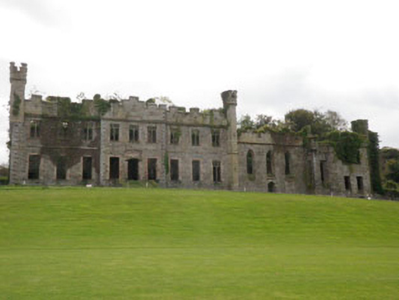
| Castle Lyons: the ruins of the house today. |
By the 18th century, the Earls of Barrymore were probably spending as much time in London and Dublin as in County Cork, but the 4th Earl (1667-1748) acquired Anngrove as a new seat, and Castle Lyons evidently fell into disrepair. The 6th Earl (1745-73), who lived chiefly in Dublin and London, let Anngrove, but in 1771 he was carrying out repairs at Castle Lyons when the carelessness of a tinker employed to make repairs to the lead roof caused the house to be burned down. It was never rebuilt, for the 6th Earl died two years after the fire and was succeeded by the infant 7th Earl (1769-93), who grew up to be a notorious rake, one of the boon companions of George, Prince of Wales, who gambled away the family fortune. He sold Castle Lyons and his other estates in Co. Cork and the ruins of the house, with numerous tall chimneys, remain a prominent object in the landscape..
Descent: James Barry (d. 1581), 4th Viscount Buttevant; to son, David Barry (1550-1617), 5th Viscount Buttevant; to grandson, David Barry (1605-42), 6th Viscount Buttevant and 1st Earl of Barrymore; to son, Richard Barry (1630-94), 2nd Earl of Barrymore; to son, Lawrence Barry (c.1657-99), 3rd Earl of Barrymore; to half-brother, James Barry (1667-1748), 4th Earl of Barrymore; to son, James Barry (1717-51), 5th Earl of Barrymore; to son, Richard Barry (1745-73), 6th Earl of Barrymore; to son, Richard Barry (1769-93), 7th Earl of Barrymore; to brother, Henry Barry (1770-1823), 8th Earl of Barrymore, who sold 1799 to John Anderson.
Anngrove alias Ballinsperrig, Carrigtwohill, Co. Cork
 |
| Anngrove: the entrance front |
Anngrove was a remarkable and important late 17th century house, built about 1685 for Sir James Cotter MP, a staunch Royalist who in 1664 went to Switzerland with two companions and shot the fugitive regicide, John Lisle, for which he was rewarded with a large pension and the Governorship of the Leeward Islands. Anngrove was built on his return from this posting, and consisted of a two storey five bay centre with a high hipped roof, and boldly projecting corner towers, capped with pyramidal roofs that were slightly lower than the high pitched roof of the central block. A moulded cornice and a prominent string course ran around the house and towers, uniting them into a single composition. Inside, one room originally contained a ‘velvet bed with hangings and gold brocade’ which was said to have belonged to Charles I and to have been a gift from Queen Henrietta Maria as a thank-you present to Cotter for his despatch of John Lisle. James II is supposed to have stayed a night in the house and to have slept in this bed, during his operations in Ireland in 1689-91.
The lands on which Anngrove was built were leased by Sir James Cotter from the Earls of Barrymore, and sometime after 1720 the 4th Earl bought back the lease. After the death of the 5th Earl, Anngrove was let again. Charles I’s bed was taken to Castle Lyons, where it was destroyed in the fire of 1771. The Barrys then used the house again for a few years, but towards the end of the 18th century, Anngrove was sold by the profligate 7th Earl to the Wise family, from whom it was inherited in the 19th century by the Gubbins family. The estate was sold to the Land Commission in 1909, and by the 1950s the house was attached to a small farm. It began to suffer from subsidence and was progressively abandoned as it became dangerous. In the early 1960s a new bungalow was built behind the old house to replace it, and some fittings from the old house were relocated there before the shell of the building was blown up with the help of an explosives expert from a nearby quarry; demolition had taken place by 1965.
Descent: built for Sir James Cotter (c.1630-1705); to son, James Cotter (1689-1720); to widow Margaret, who sold to James Barry (1667-1748), 4th Earl of Barrymore; to son, James Barry (1717-51), 5th Earl of Barrymore; to son, Richard Barry (1745-73), 6th Earl of Barrymore; to son, Richard Barry (1769-93), 7th Earl of Barrymore; who sold to Francis Wise (1766-1842); to nephew, Francis Wise (1797-1881); to nephew?, Thomas Wise Gubbins (d. 1904); estate sold to Irish Land Commission, 1909… Joe Fenton (fl. 1950-2000), who demolished the house c.1965.






 Irish Historic Houses