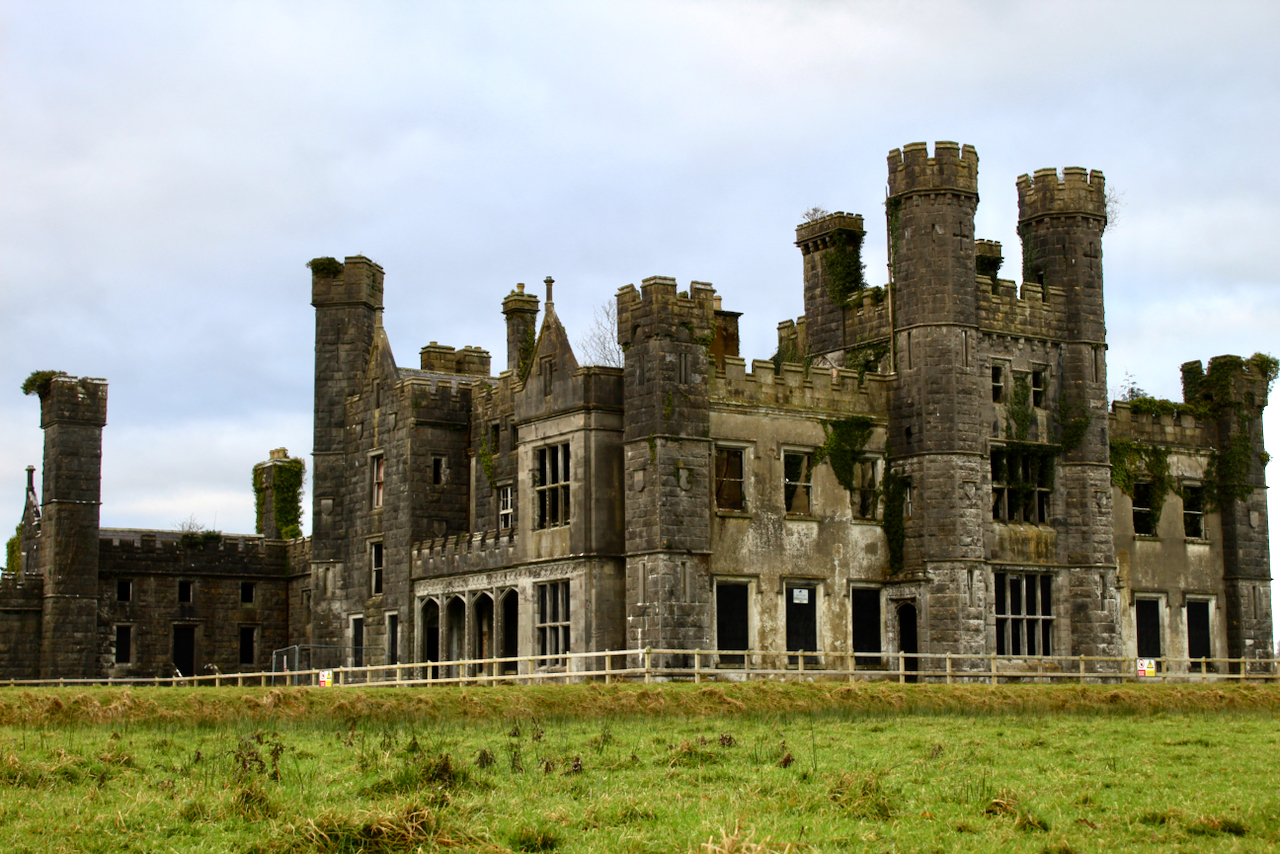
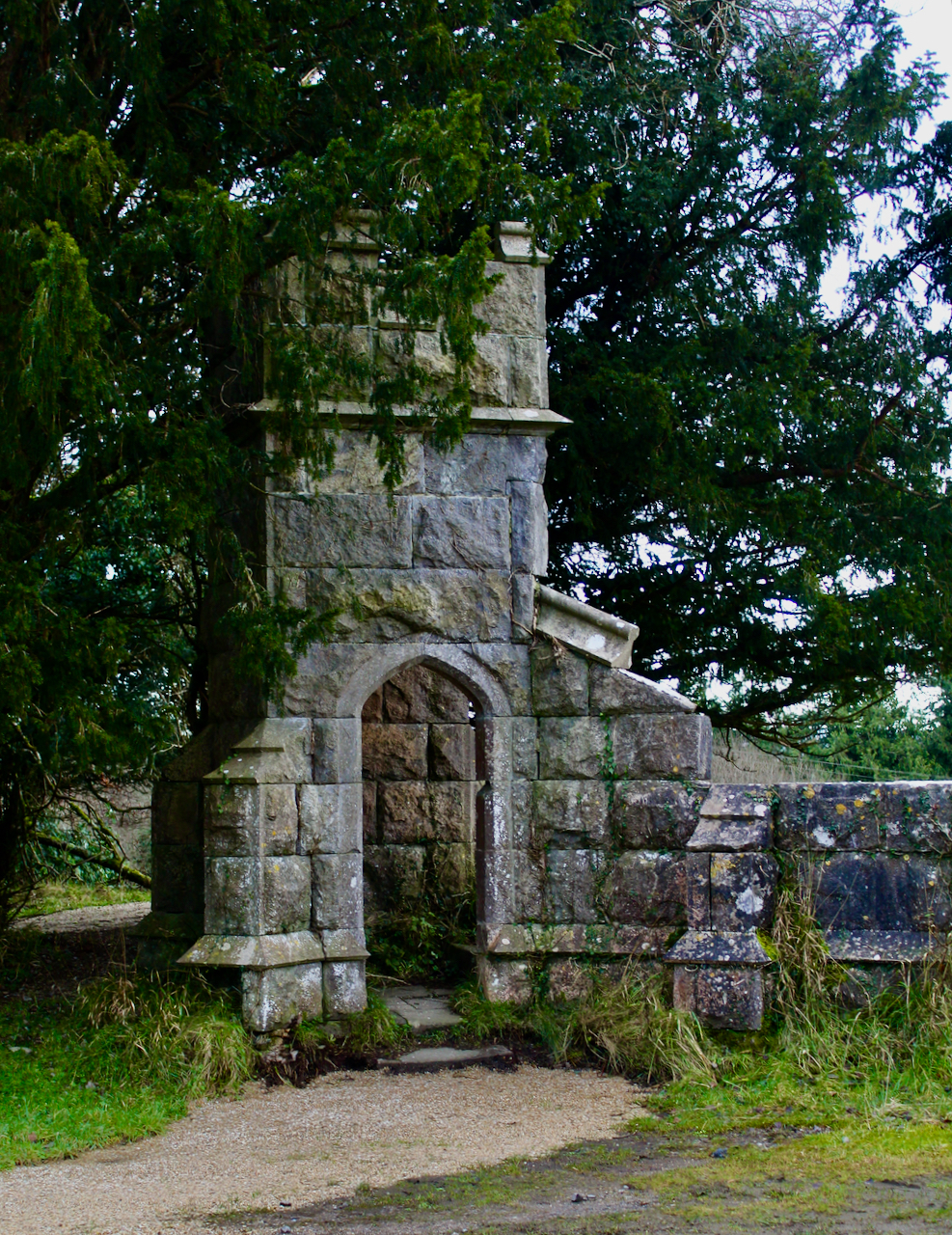
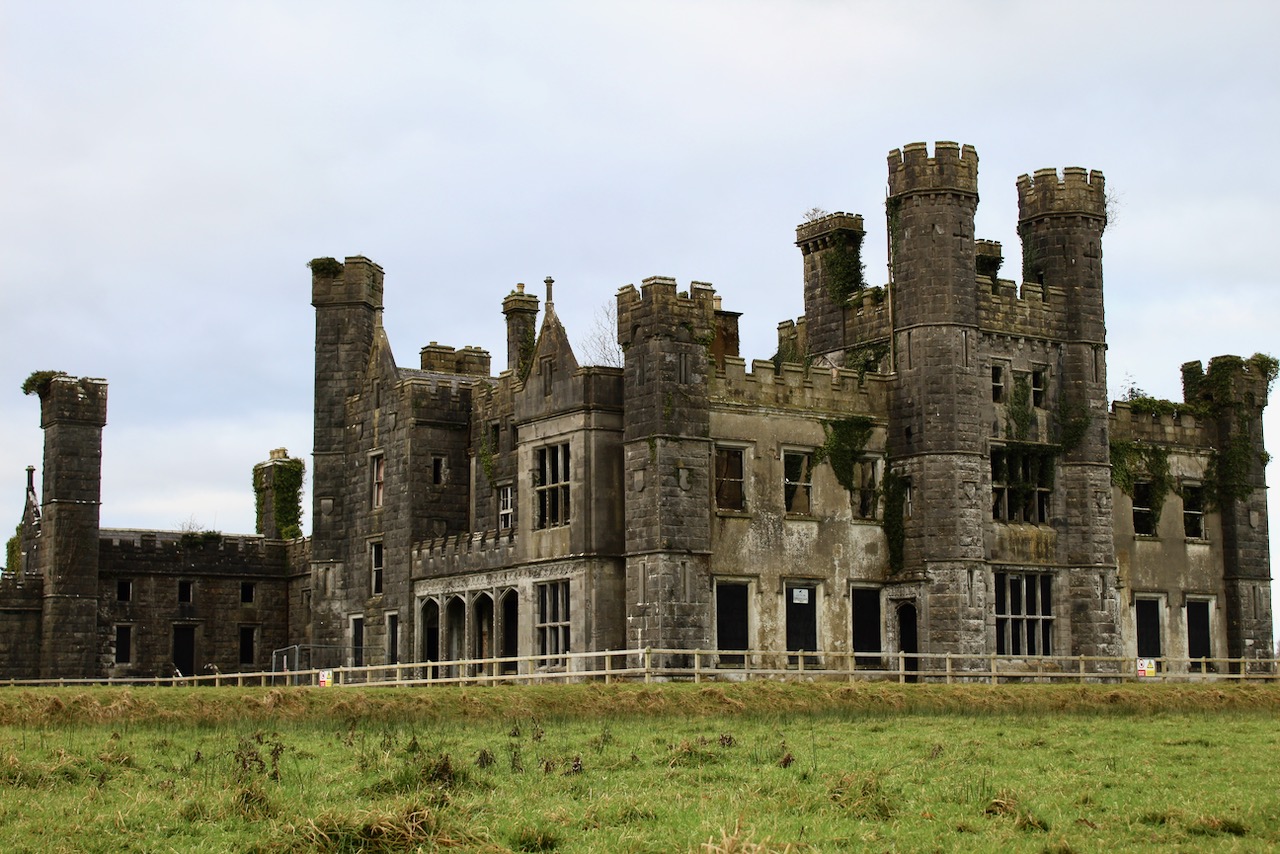
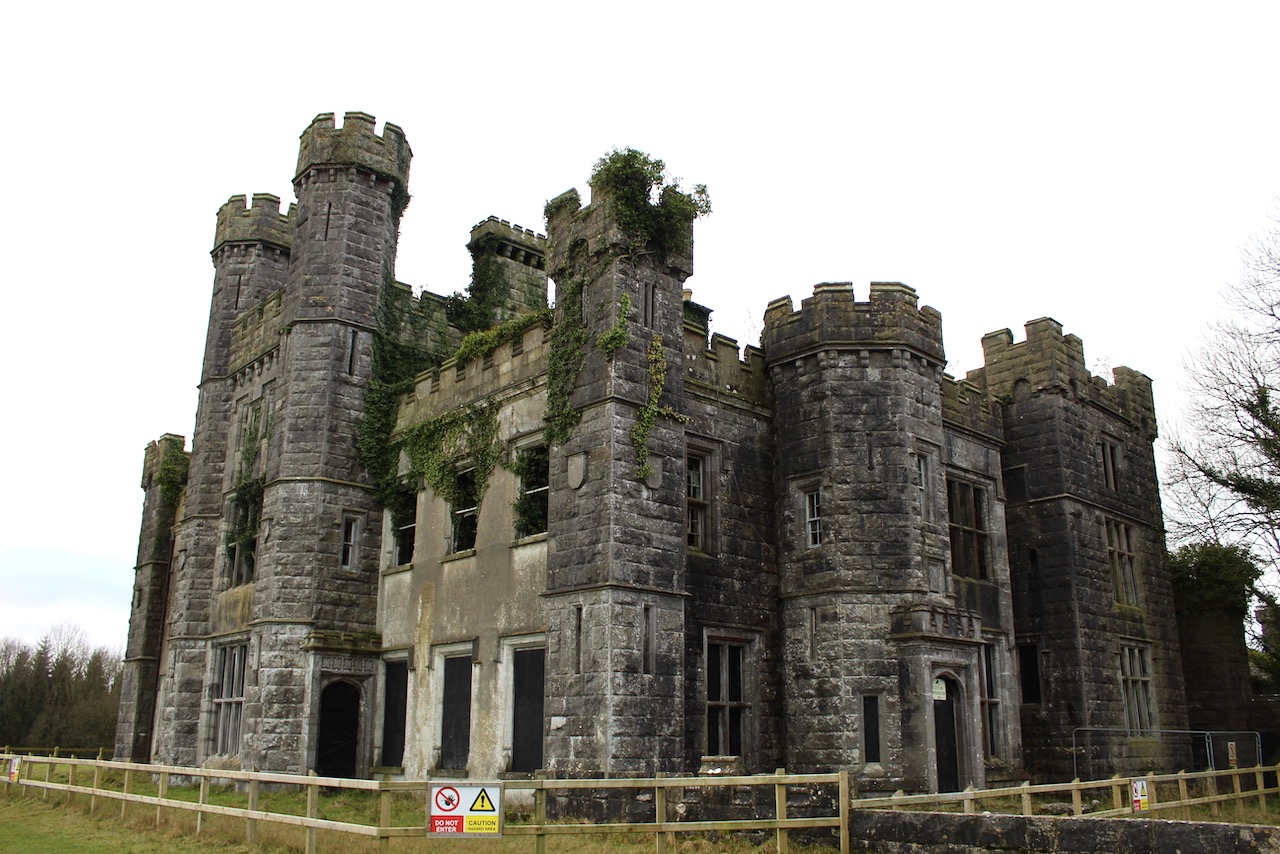
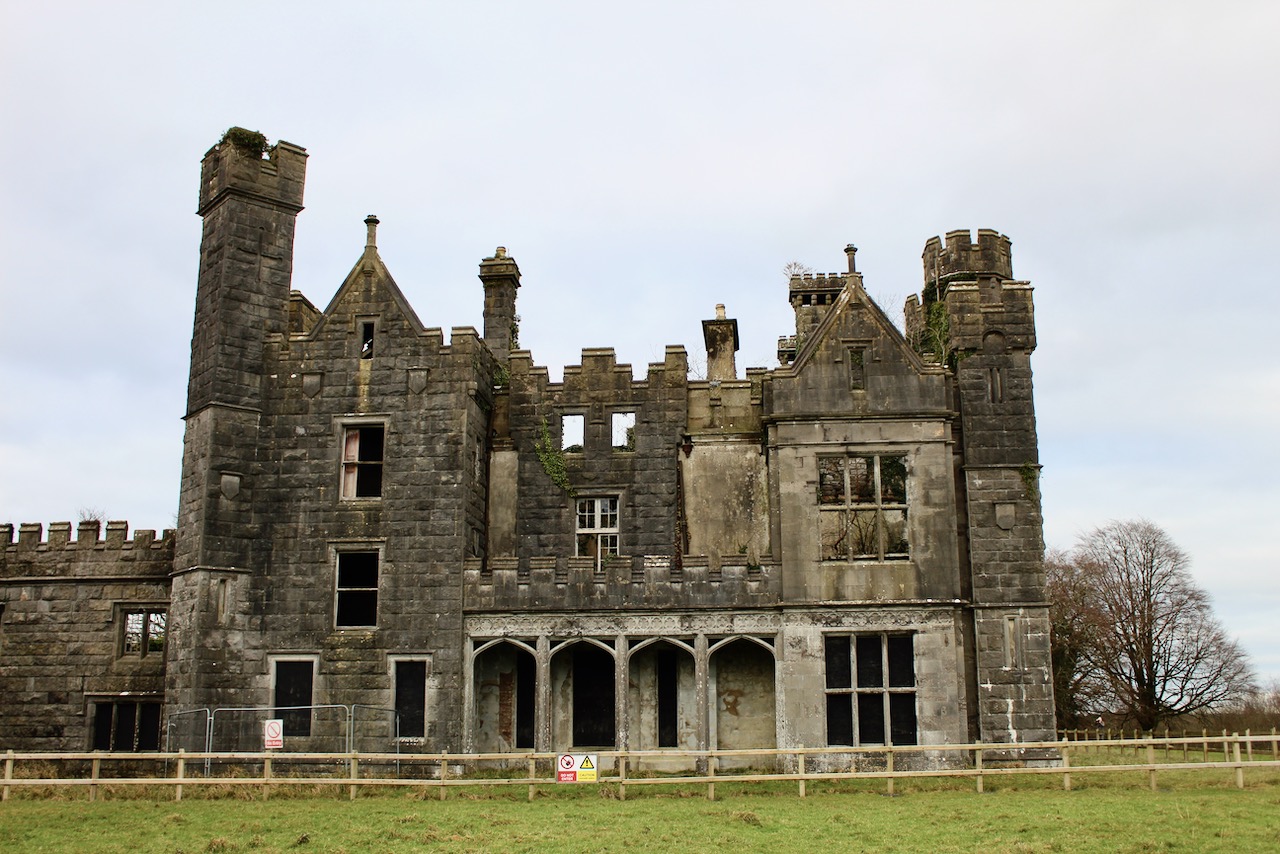
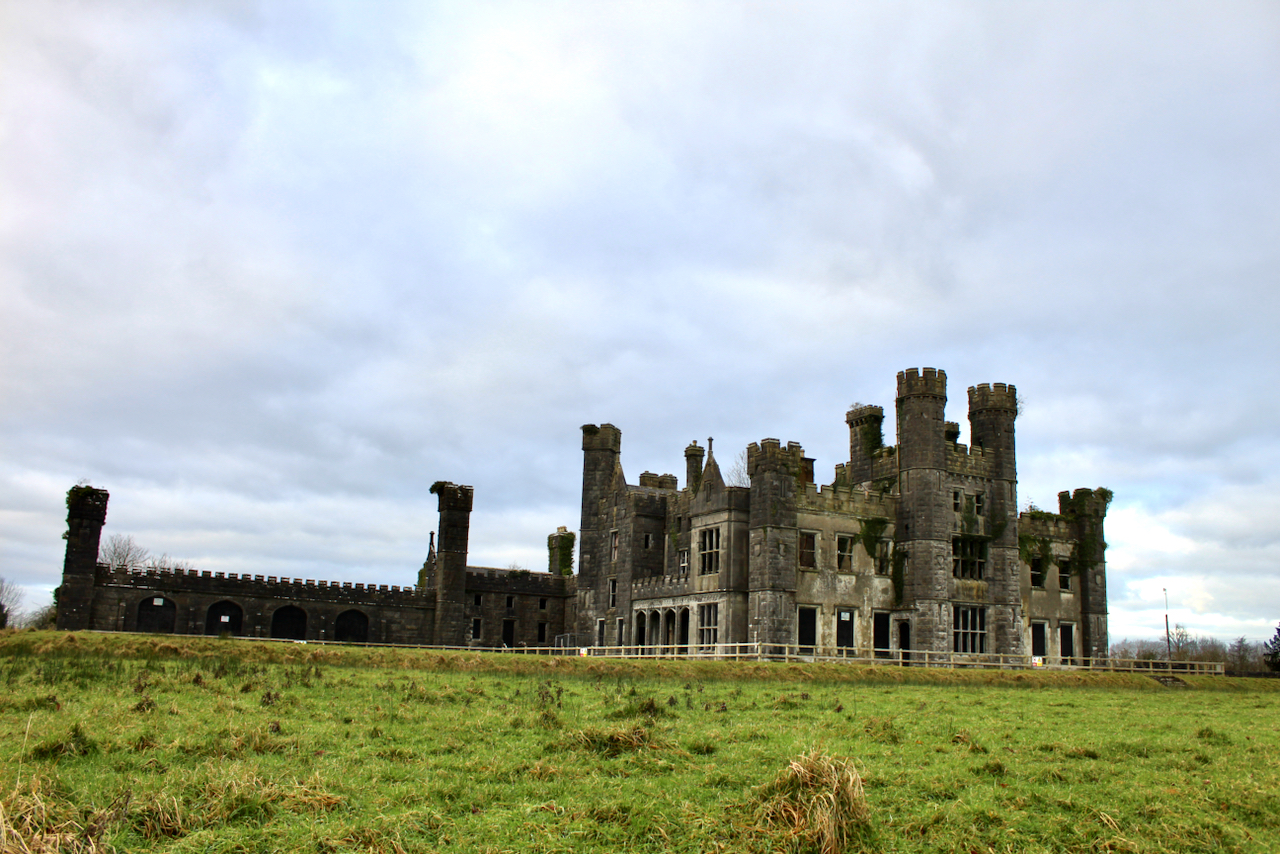
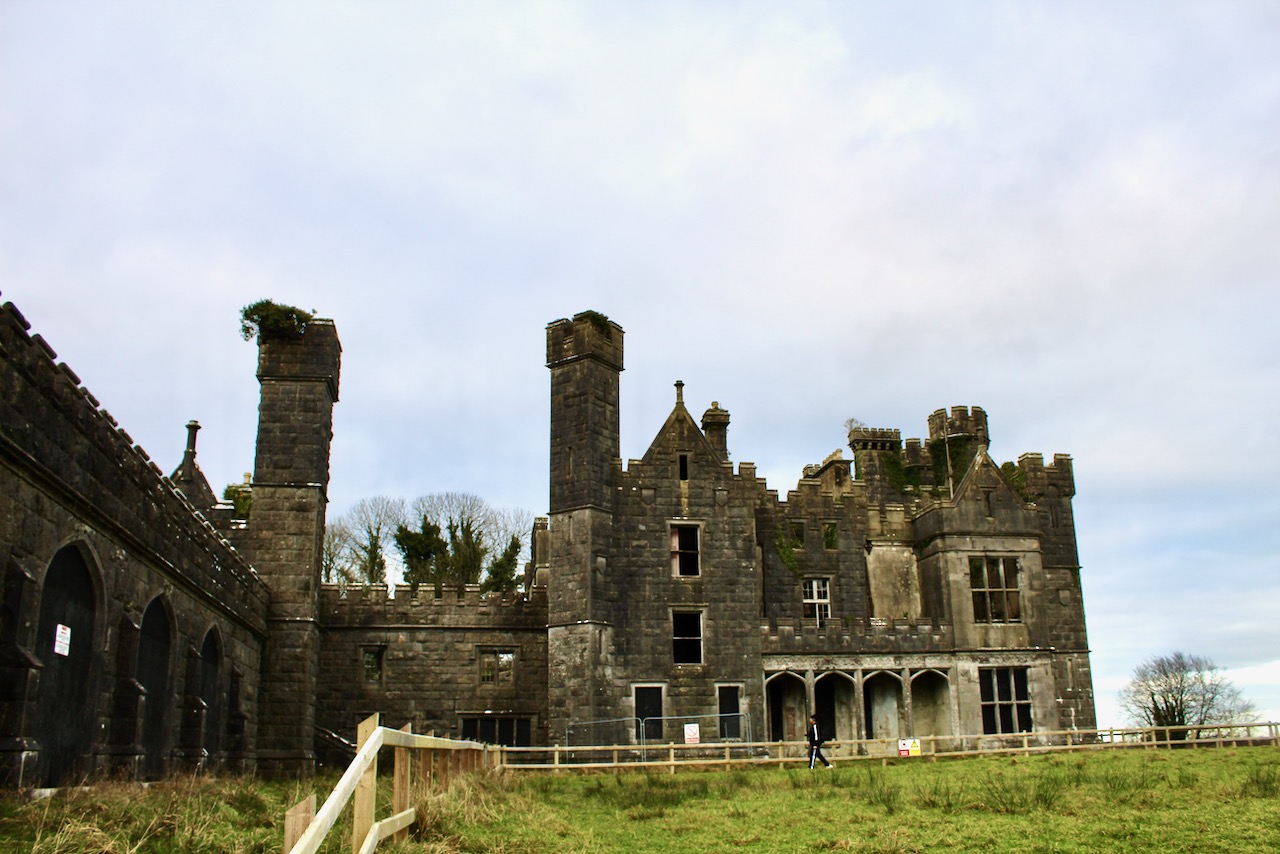
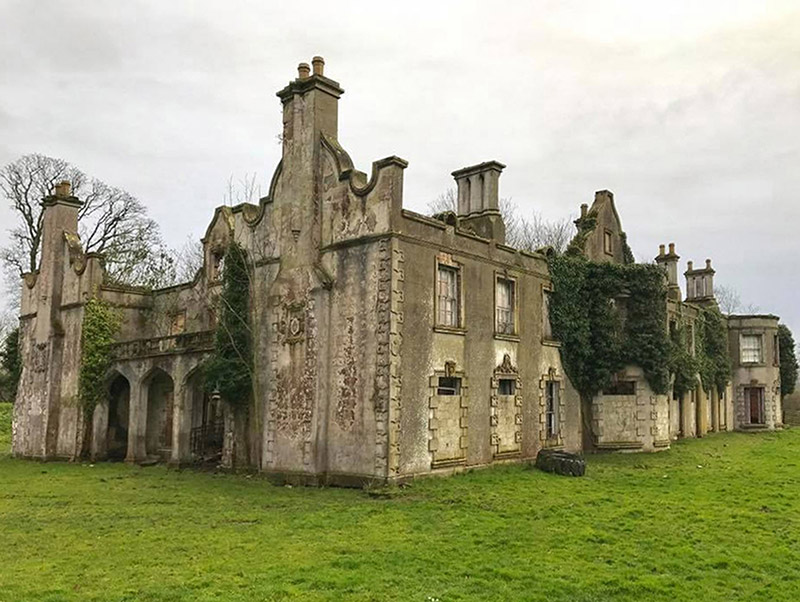
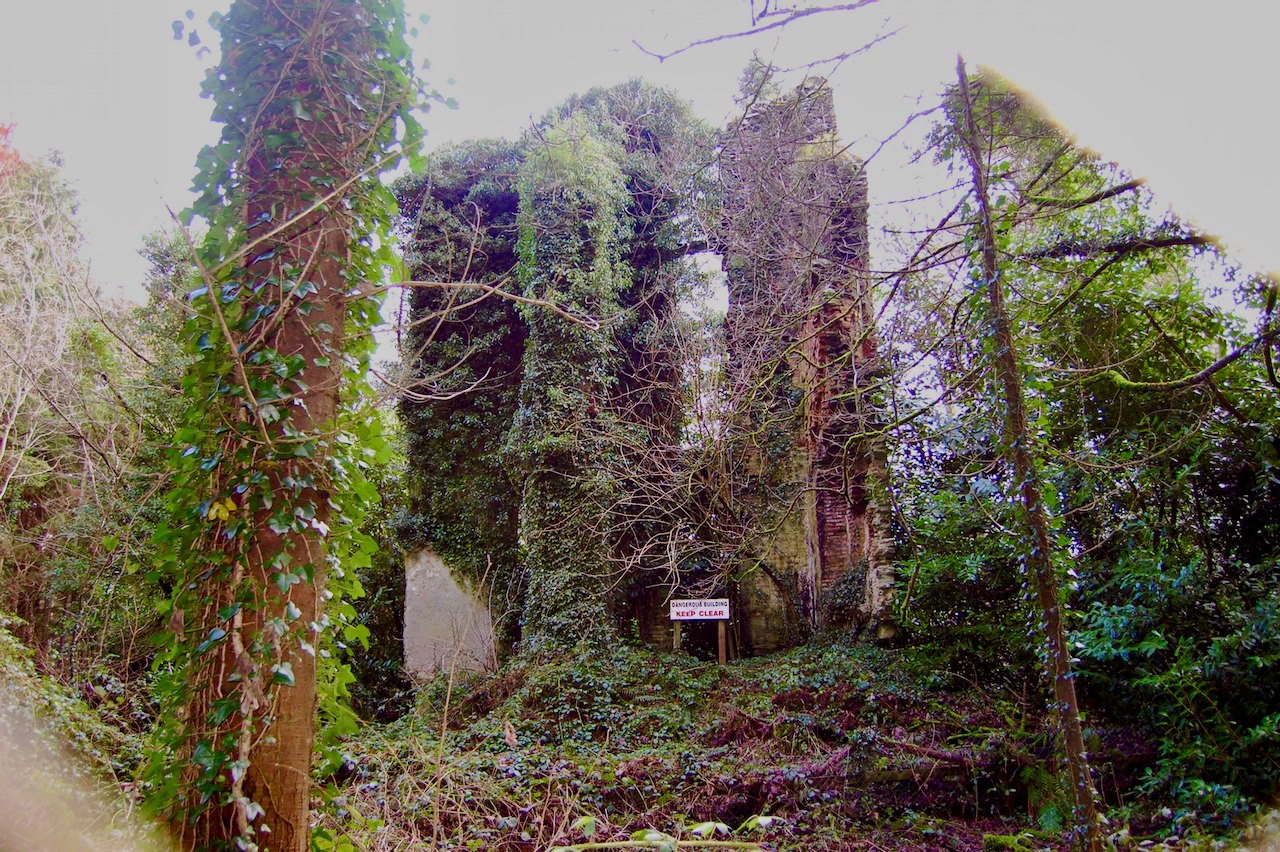
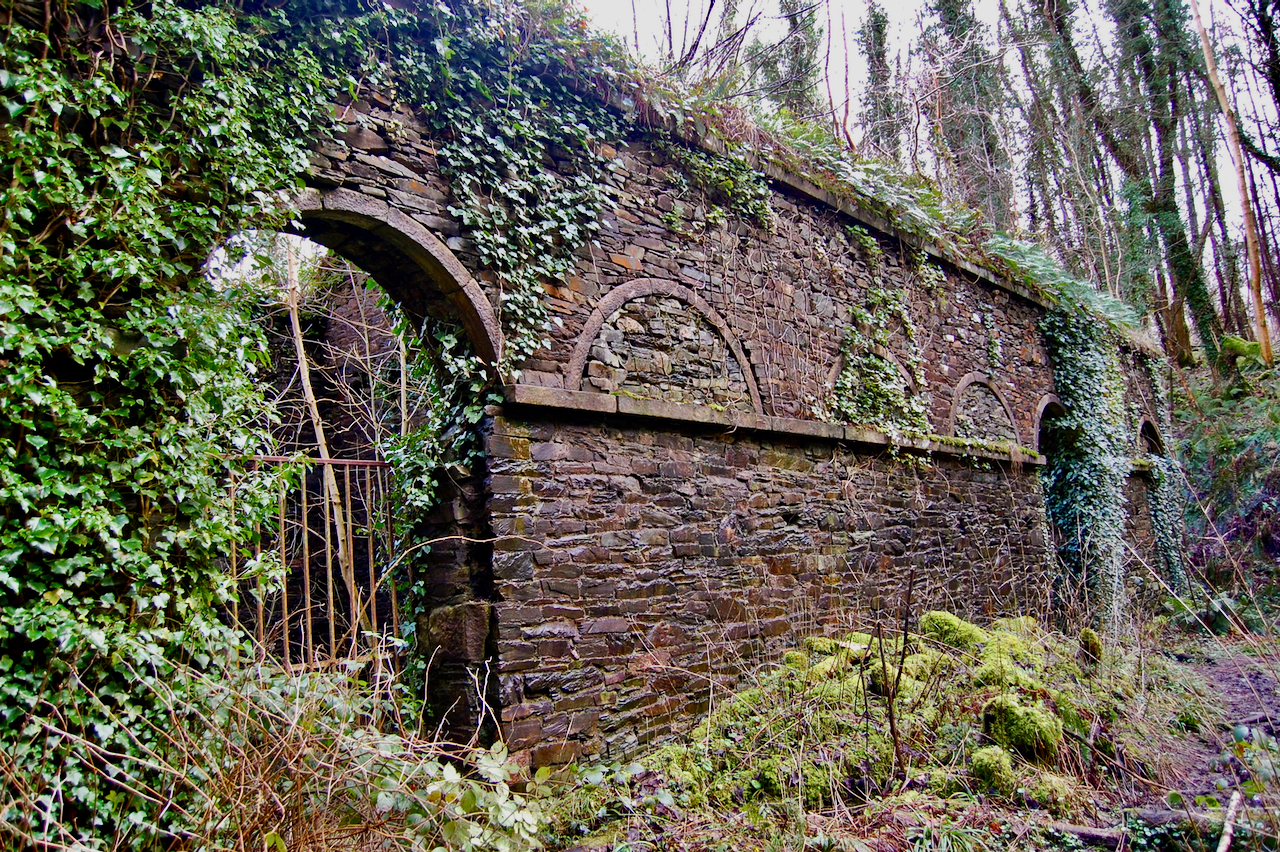
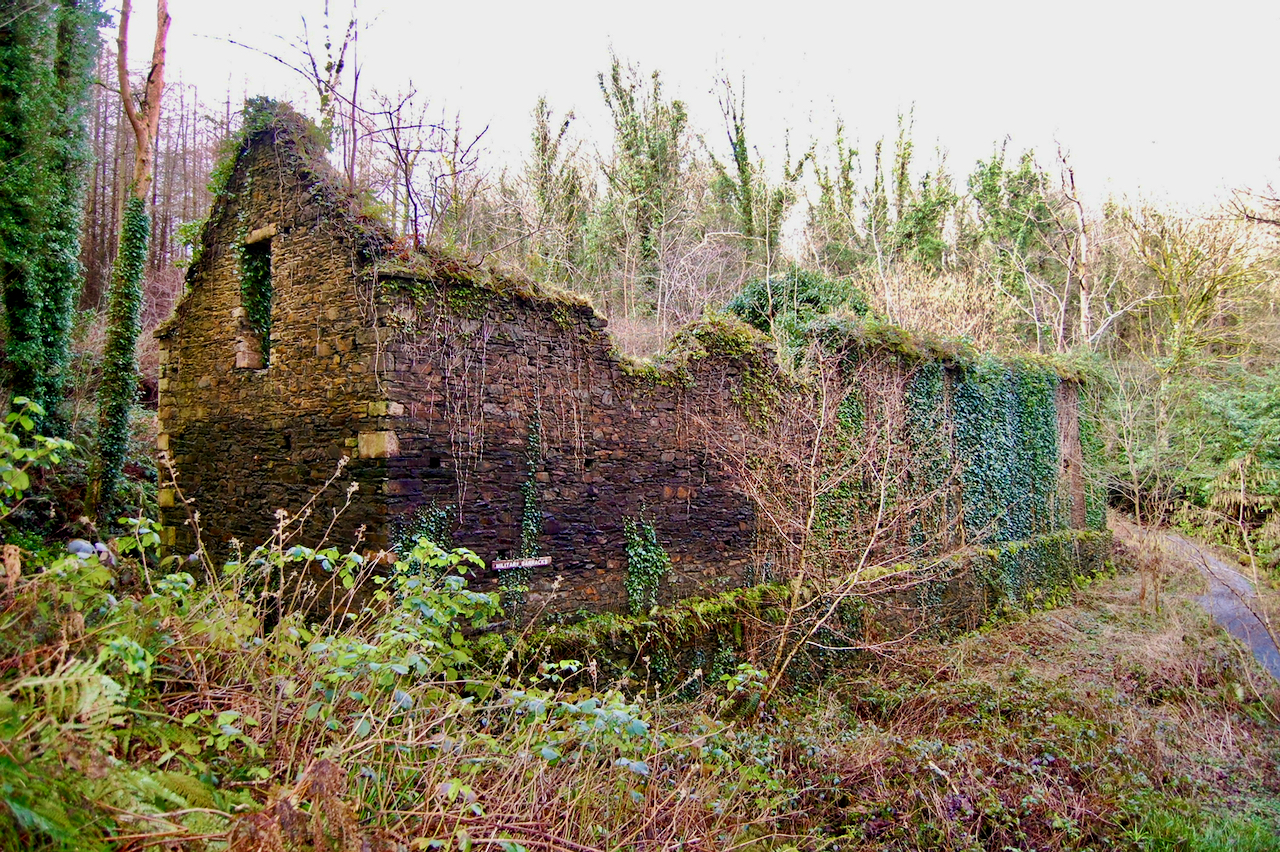
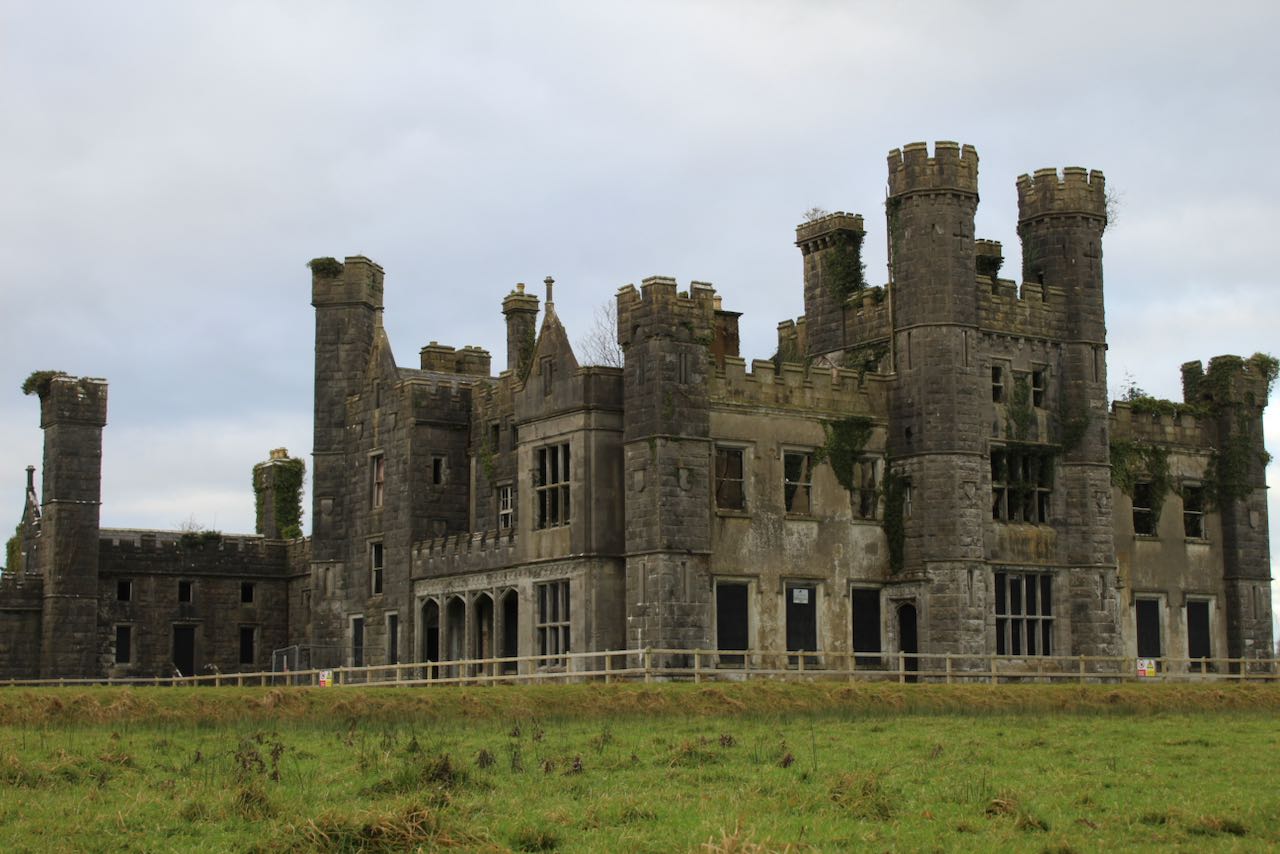
This property is not listed on the Section 482 Revenue list but is open to the public to visit, although at a distance, due to safety considerations. We visited in December 2020. Nearby, a World Peace Centre for the Scouts has been established. The castle was destroyed by fire in 1990.
The castle, which dates from 1840, was destroyed by fire in 1990.
Mark Bence-Jones writes in his A Guide to Irish Country Houses (1988) that it’s a large castellated mansion combining both baronial and Tudor-Revival elements, built around 1840. He likens the style to that of Crom Castle, attributed to Edward Blore, which is only about five miles away in County Fermanagh. [1] The National Inventory tells us that the work on Castle Saunderson was carried out by George Sudden, but he may have worked according to designs by Blore.
Crom Castle, County Fermanagh, photograph by Robert French, (between ca. 1865-1914), Lawrence Photograph Collection, National Library of Ireland.
The Dictionary of Irish Architects tells us that Edward Blore (1787-1879), from London, designed Crom Castle in County Fermanagh from 1833-41, Ballydrain in County Antrim in 1837-8, additions at Castle Upton, County Antrim in 1836-7, and proposed the addition of a tower at Mallow Castle, County Cork in 1837. [2]
The Dictionary of Irish Biography tells us that George Sudden was Clerk of works, architect and stonemason, active in Counties Fermanagh and Monaghan in the 1830s and 1840s. In 1830 when Crom Castle, newly completed to designs by Edward Blore, was destroyed by fire, John Creighton appointed Sudden to rebuild the house to Blore’s specifications. [3]
The National Inventory of Architectural Heritage tells us that Castle Saunderson was built around 1835.
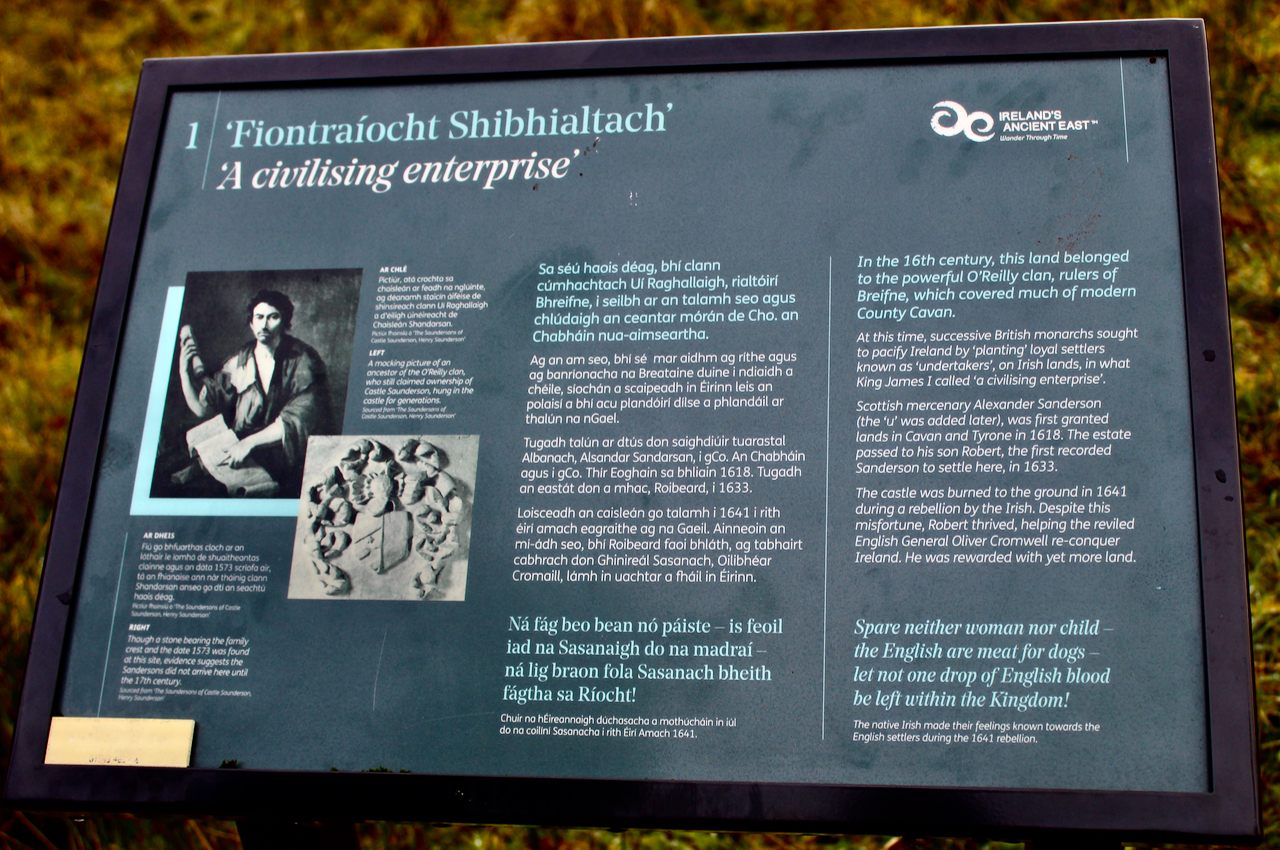
The land belonged to the O’Reilly clan in the 16th century, rulers of Breifne, which covered much of modern County Cavan. Scottish mercenatry Alexander Sanderson (the ‘u’ was added later), was first granted lands in Cavan and Tyrone in 1618. The estate passed to his son Robert, the first recorded Sanderson to live here, in 1633. The castle that was there at that time was burned to the ground in 1641 during the Rebellion. Robert Sanderson helped Oliver Cromwell’s troops to reconquer, and he was awarded with more land.
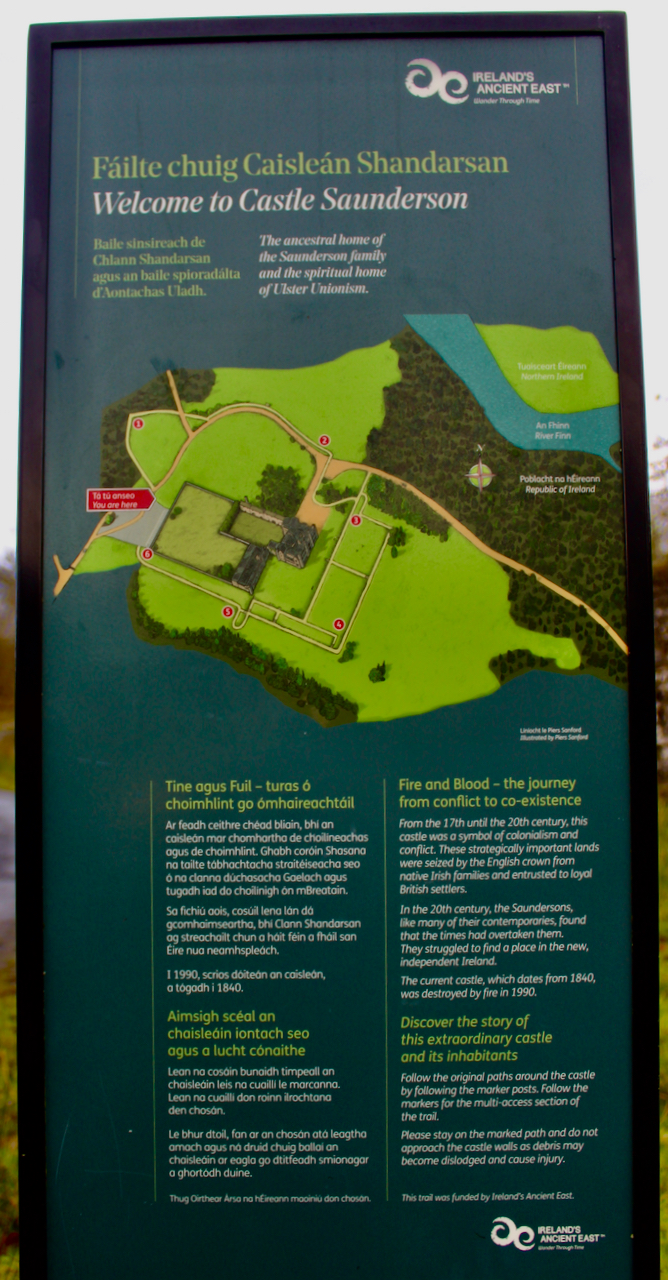
An information board tells us that the land belonged to the O’Reilly clan, rulers of Breifne, in the 16th century. Breifne covered much of modern County Cavan. Scottish mercenatry Alexander Sanderson (the ‘u’ was added later), was first granted lands in Cavan and Tyrone in 1618. He served as High Sheriff for County Tyrone.
The estate passed to his son Robert (c1602-c1676), the first recorded Sanderson to live here, in 1633. The castle that was there at that time was burned to the ground in 1641 during the Rebellion.
Robert Sanderson was a colonel in the army of Gustavus Adolphus of Sweden. He served in Oliver Cromwell’s army, and was awarded with more land. [4] Another residence must have been built at the site: the Landed Estates database tells us that Robert Sanderson built Castle Sanderson near Belturbet in county Cavan in the mid-17th century.
Robert’s son, also named Robert (1653-1724), served as MP for County Cavan, and was a colonel of a regiment in William III’s army. He married Jane Leslie, daughter of the Right Rev John Leslie, Lord Bishop of Clogher, “The Fighting Bishop” (see my entry for Castle Leslie https://irishhistorichouses.com/2020/08/07/castle-leslie-glaslough-county-monaghan/ ). His heir to Castle Saunderson was his nephew, Alexander Sanderson. Alexander served as High Sheriff of County Cavan in 1714, and wedded Mabella, daughter of William Saunderson, of Moycashel, County Westmeath. He was buried at St Mary’s in Dublin in 1726 and was succeeded at Castle Saunderson by his son Francis (d. 1746). (see [4])
Francis served as High Sheriff of County Cavan in 1740 and espoused Anne, eldest daughter of Anthony Atkinson of Cangort, County Offaly. Francis died in 1746 and it was his son, Alexander, who changed the spelling of his name to Saunderson. (see [4])
Alexander married Rose Lloyd, daughter of Trevor Lloyd of Gloster in County Offaly, a section 482 property in 2025. Alexander Saunderson also served as High Sheriff for County Cavan.
The National Inventory tells us that the Castle Saunderson that we see today incorporates fabric of an older residence, a Georgian house dating from around 1780. This house may have been built by Alexander and Rose’s son and heir Francis Saunderson (1754-1827). He also served as High Sheriff for County Cavan, and he married Anne Bassett, daughter of Stephen White, of Miskin, Glamorgan, and heir of the Bassett estates in that county. (see [4])
It was then Francis and Anne’s son and heir, Alexander (1783-1857) who probably built the current Tudor-Gothic version of the castle around 1835.
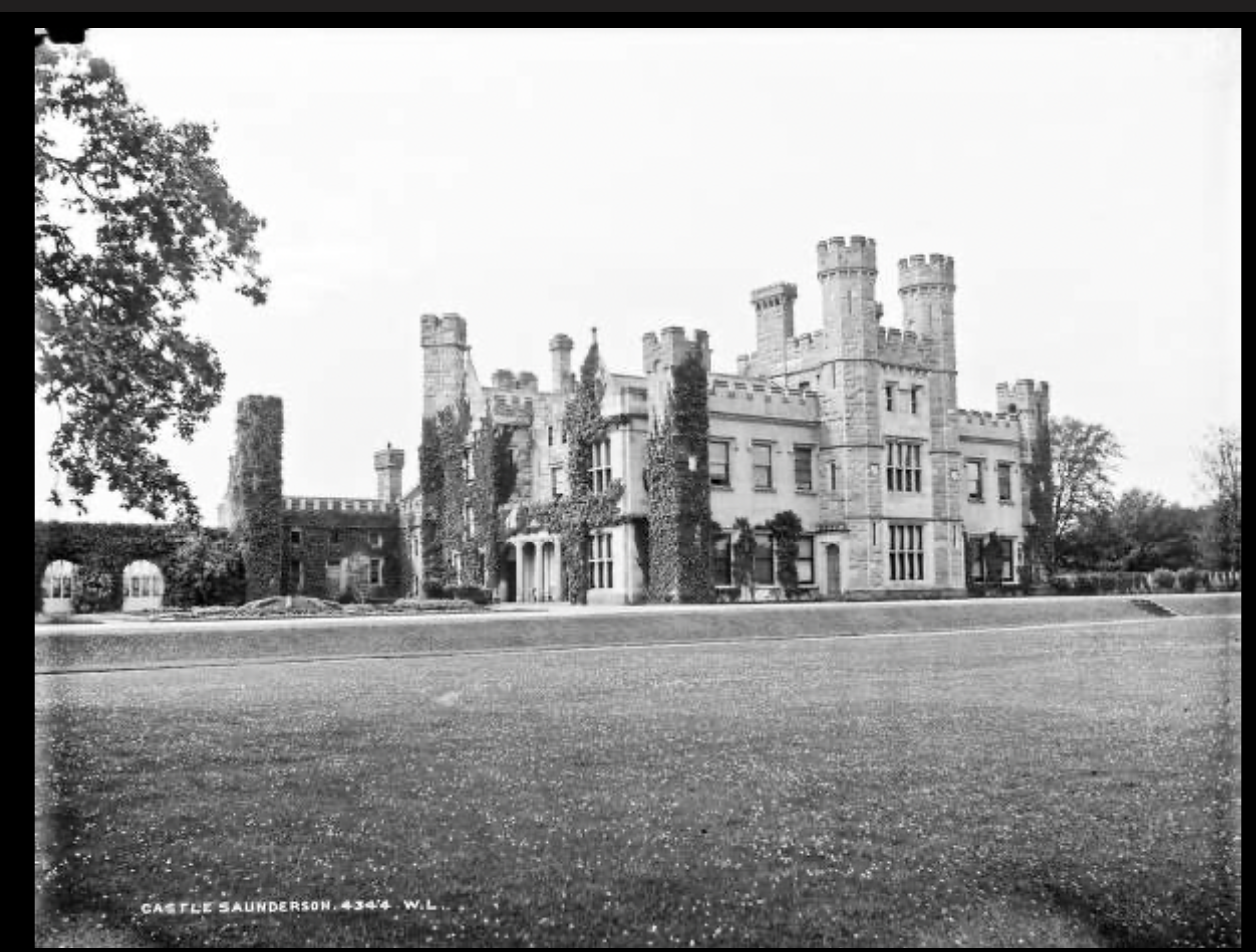
p. 75. “Entrance front symmetrical, with a battlemented parapet, square end turrets and a tall central gatehouse tower which is unusual in having the entrance door in its side rather than in its front.” [1]
Castle Saunderson, County Cavan, photograph by Robert French, (between ca. 1865-1914), Lawrence Photograph Collection, National Library of Ireland.
It looks like there is an entrance door on either side of what Bence-Jones calls the central gatehouse tower.
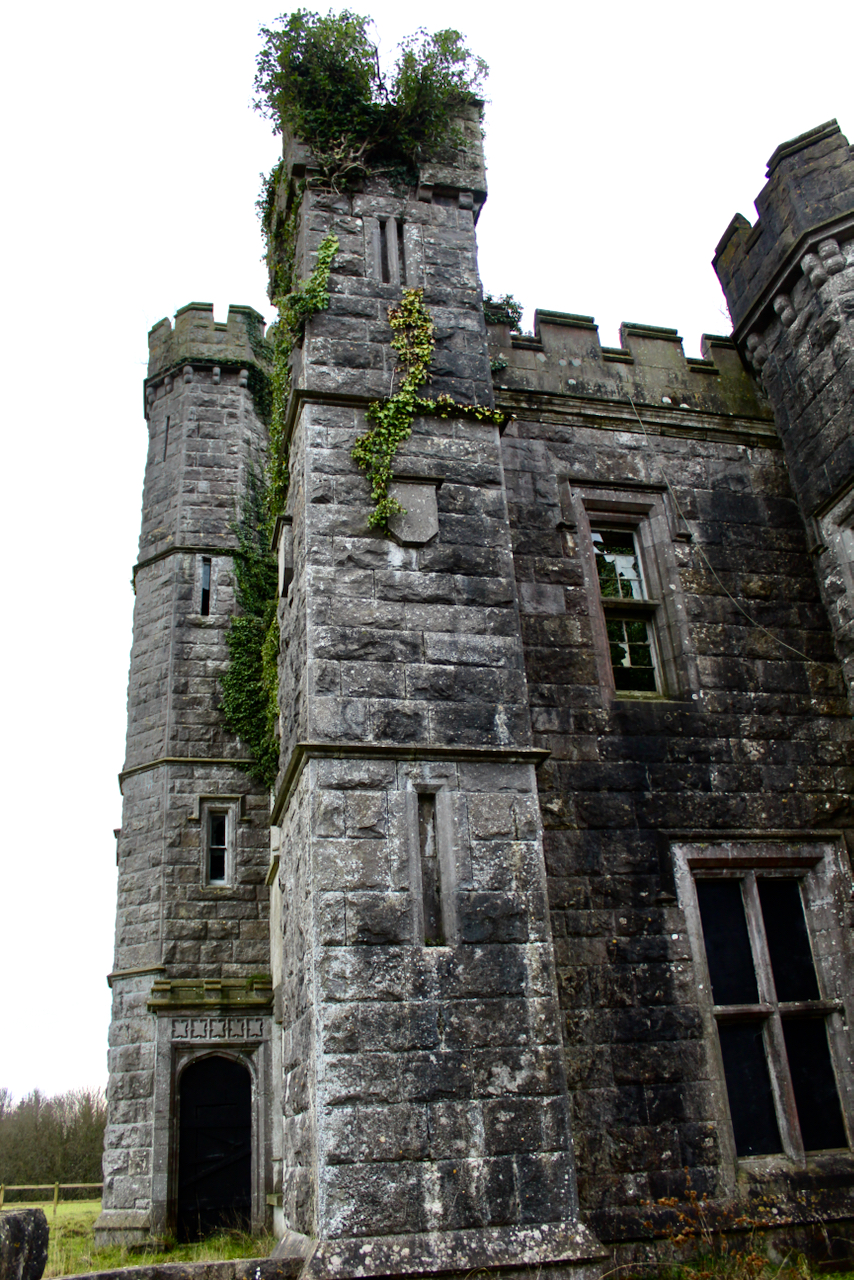
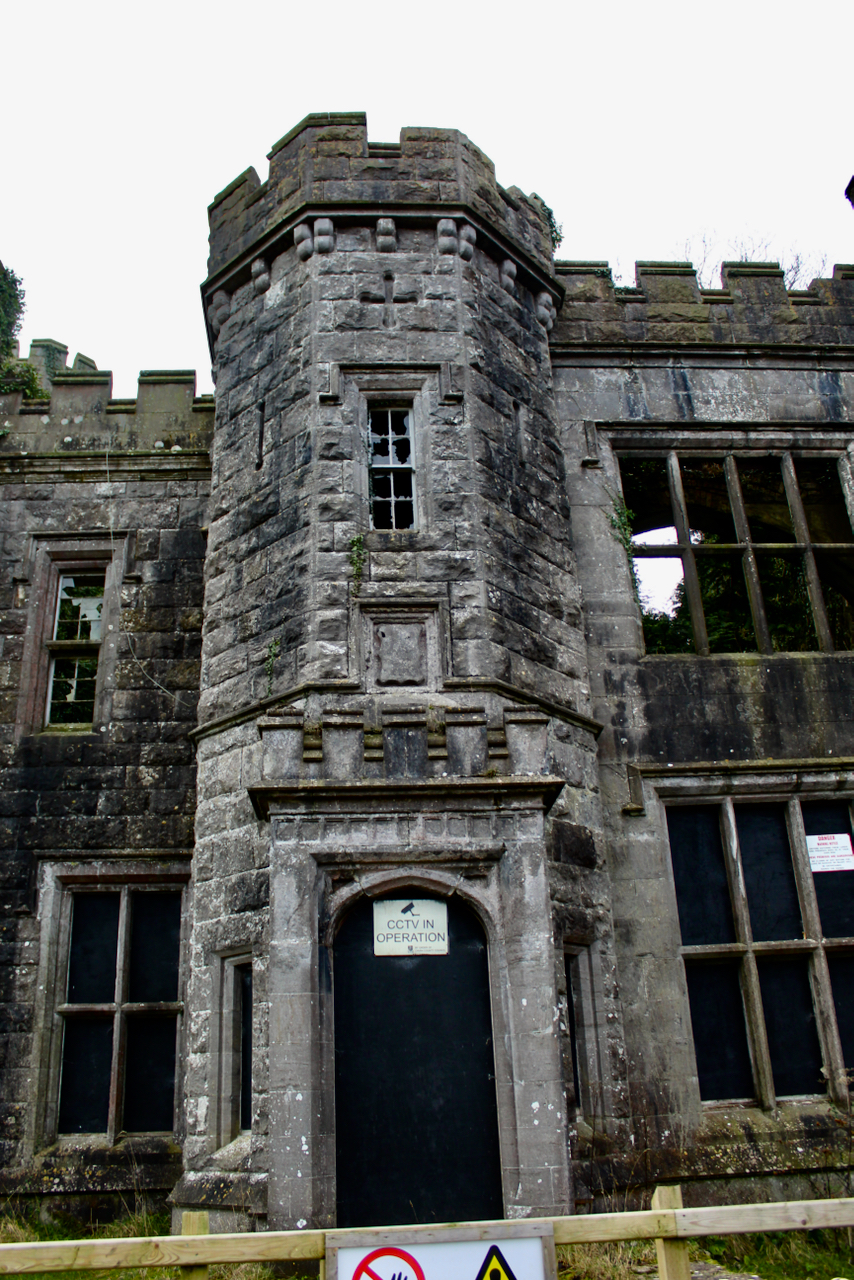
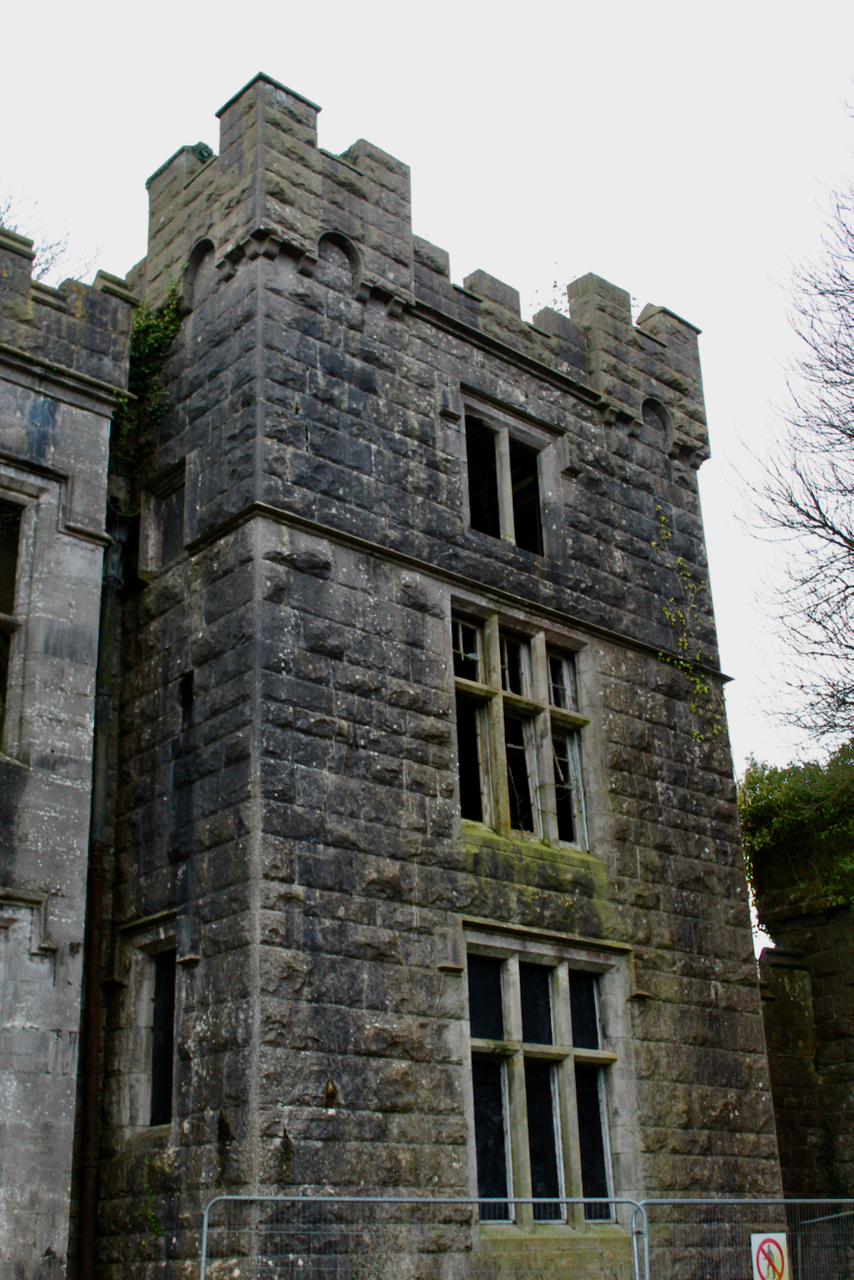
The side to the right of the entrance front has another octagonal tower with an entrance door, and another square tower. The National Inventory calls this side, the north elevation, the entrance side, describing it as: “Four-bay two-storey entrance elevation to north having advanced square-plan three-stage tower to west, corner turret to east and engaged octagonal-plan entrance tower with castellated doorcase, mullioned-and transomed hood-moulded windows of varying size and smaller incidental windows.” [5]
The doors have arched openings, and windows have hood mouldings.
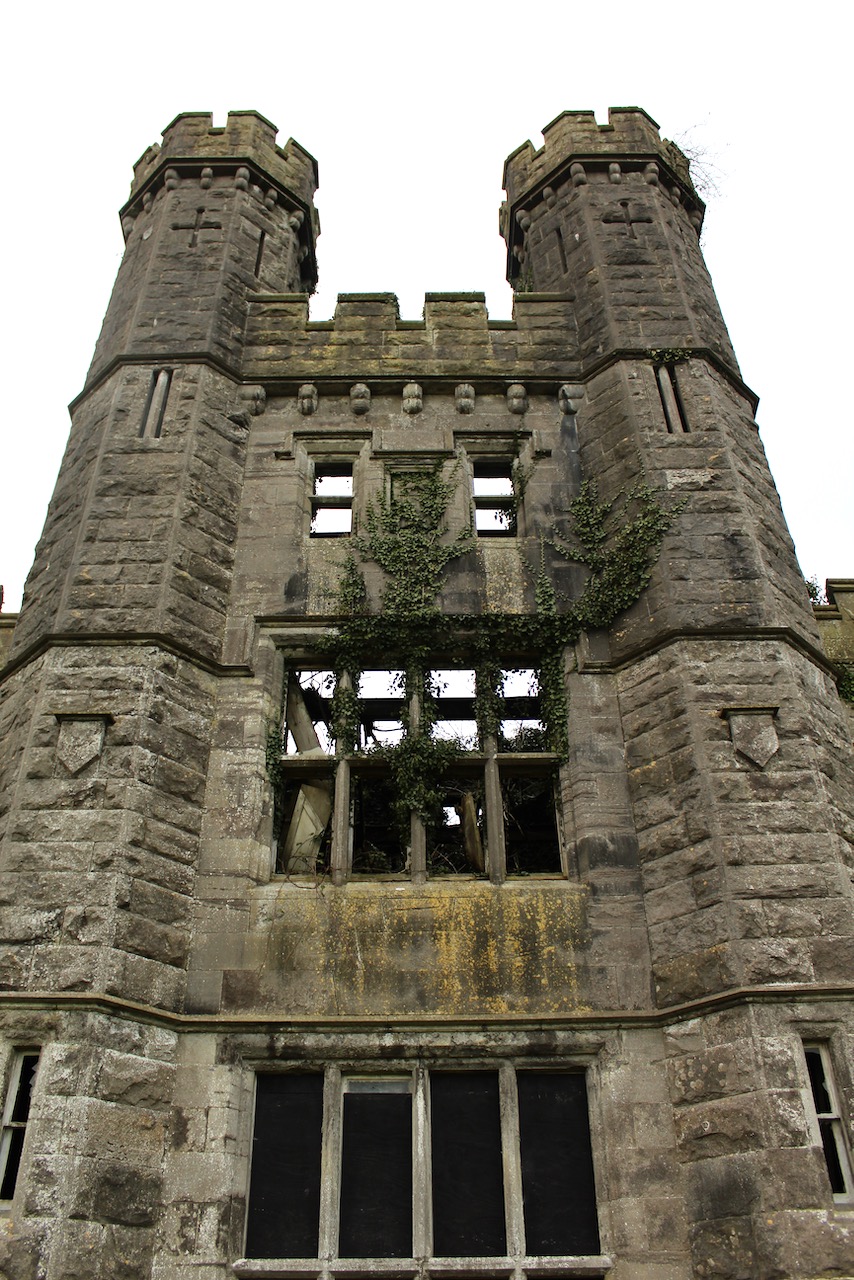
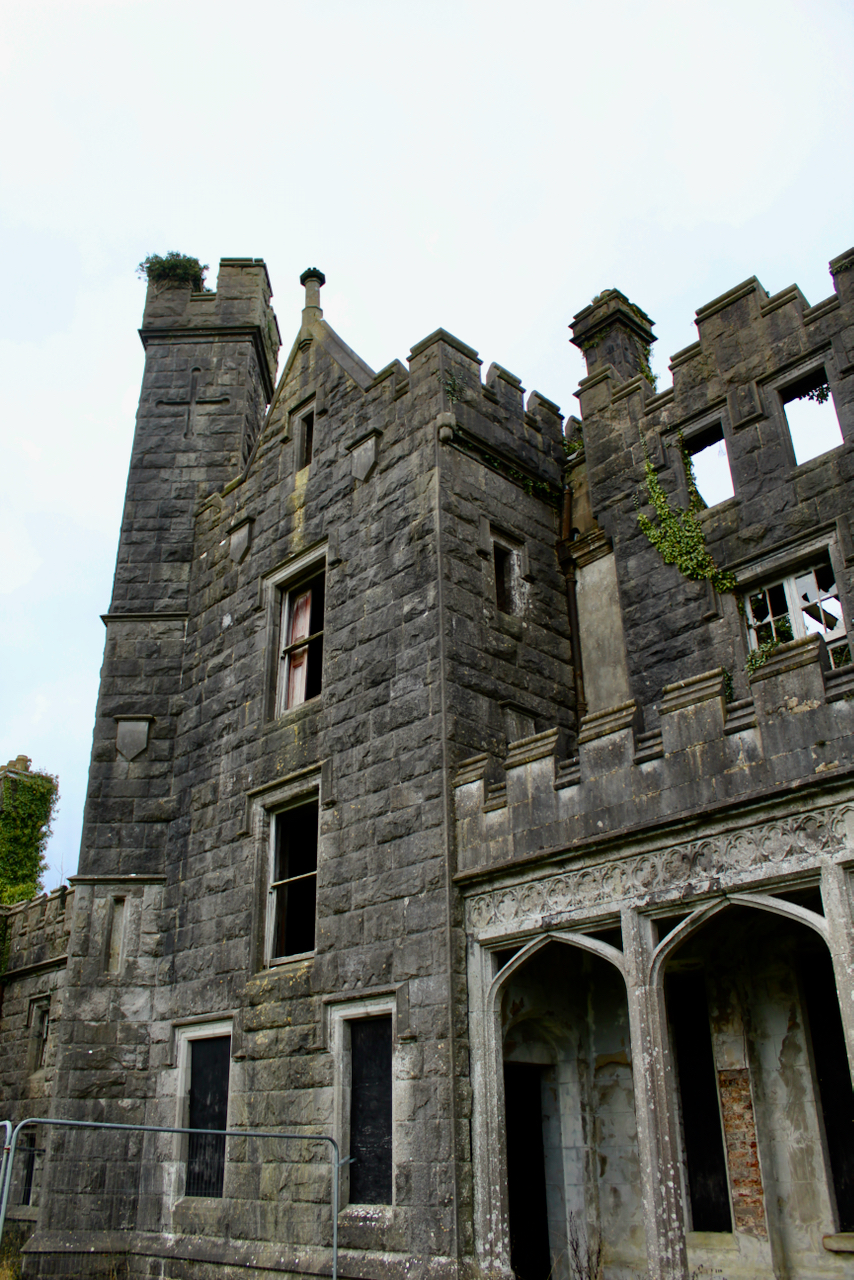
Bence-Jones continues: “The adjoining garden front is more irregular, with a recessed centre between two projecting wings of unequal size and fenestration, each having a Tudor gable; the two wings being joined at ground floor level by a rather fragile Gothic arcade. To the left of this front, a lower “L”-shaped wing with a battlemented parapet and various turrets, ending in a long Gothic conservatory. Castle Saunderson has stood empty for years and is now semi-derelict.” [1]
The various towers have “balistraria” cruciform and vertical arrow slit windows.
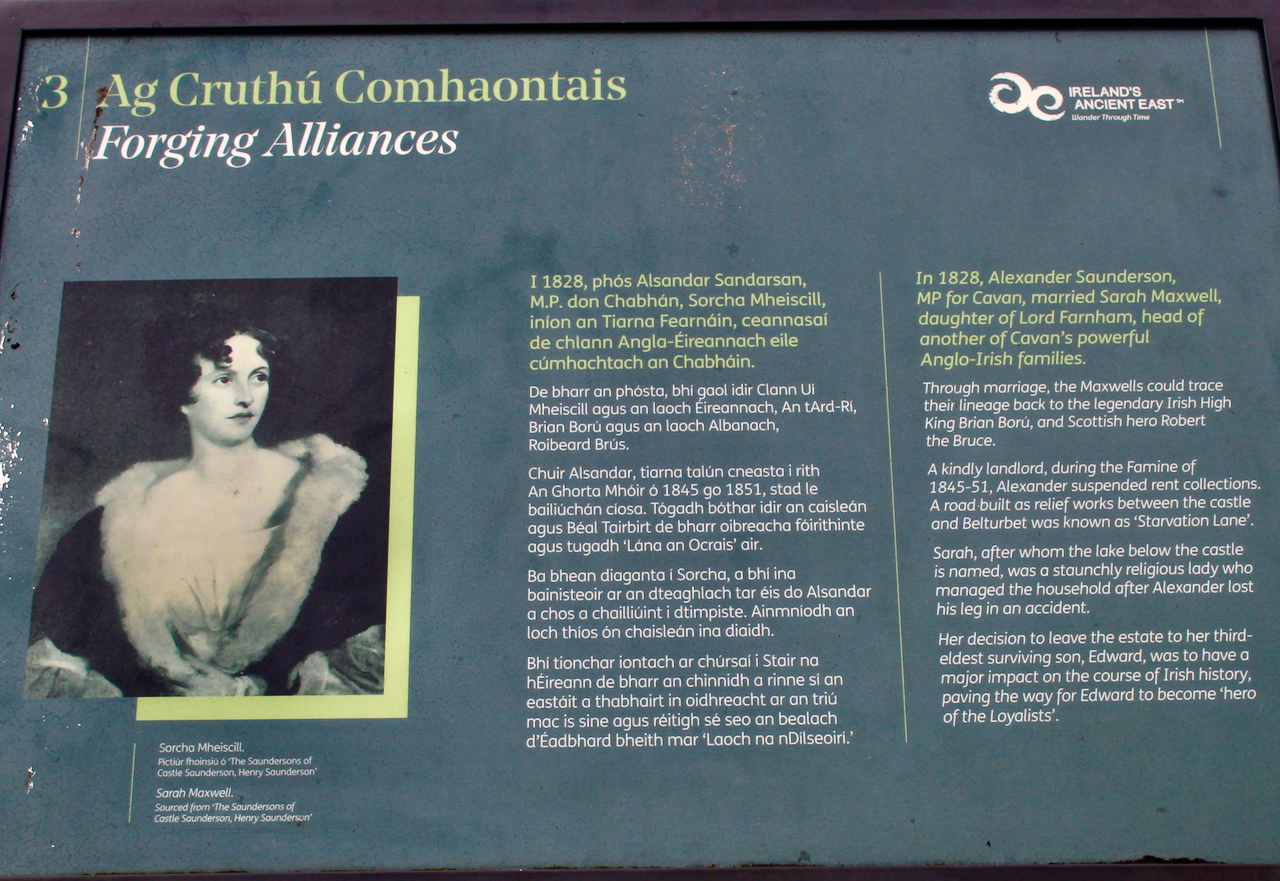
Alexander Saunderson (1783-1857) married Sarah Maxwell, the daughter of Reverend Henry Maxwell 6th Baron Farnham of Farnham in County Cavan.
In 1828, Alexander Saunderson, MP for Cavan, married Sarah Maxwell, daughter of Reverend Henry Maxwell 6th Baron Farnham, head of another of Cavan’s powerful Anglo-Irish families (Farnham Estate is now a hotel). Through marriage, the Maxwells are reputed to be able to trace their lineage back to the High King Brian Boru, and to the Scottish Robert Bruce. Alexander was a kind landlord, suspending rent collection from 1845-51 due to the famine.
The information board tells us that Alexander was a king landlord and the during the Famine of 1845-51, he suspended rent collection from his tenants. Alexander served as High Sheriff of County Cavan in 1818, and was MP for County Cavan.
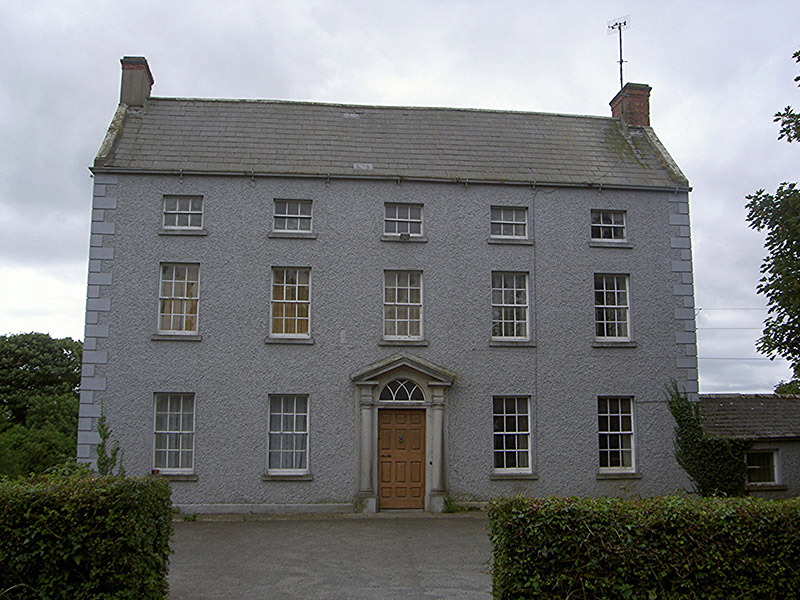
Sarah decided to leave the estate to her third eldest surviving son, Edward. The older sons were Alexander de Bedick (1832-60) and Somerset Bassett (1834-92) – I am not sure why they did not inherit Castle Saunderson, but perhaps they inherited the Bassett estates in Glamorgan. The Landed Estates database tells us that in the mid-19th century the main part of Colonel Alexander (1783-1857) Saunderson’s estate was in the parishes of Annagelliff and Lavey in the barony of Upper Loughtee [Drumkeen], but he also held sizable portions of land in the parishes of Larah, Annagh and Killinkere [Castle Saunderson and Clover Hill]. He also bought some of the estate of the Earl of Mornington which was for sale in 1853. His brother, the Reverend Francis Saunderson, rector of Kildallan, county Cavan, held an estate in the parishes of Drumlane and Killashandra. [6]
Loreto College, formerly Drumkeen or Dromkeen, County Cavan, photograph courtesy of National Inventory.
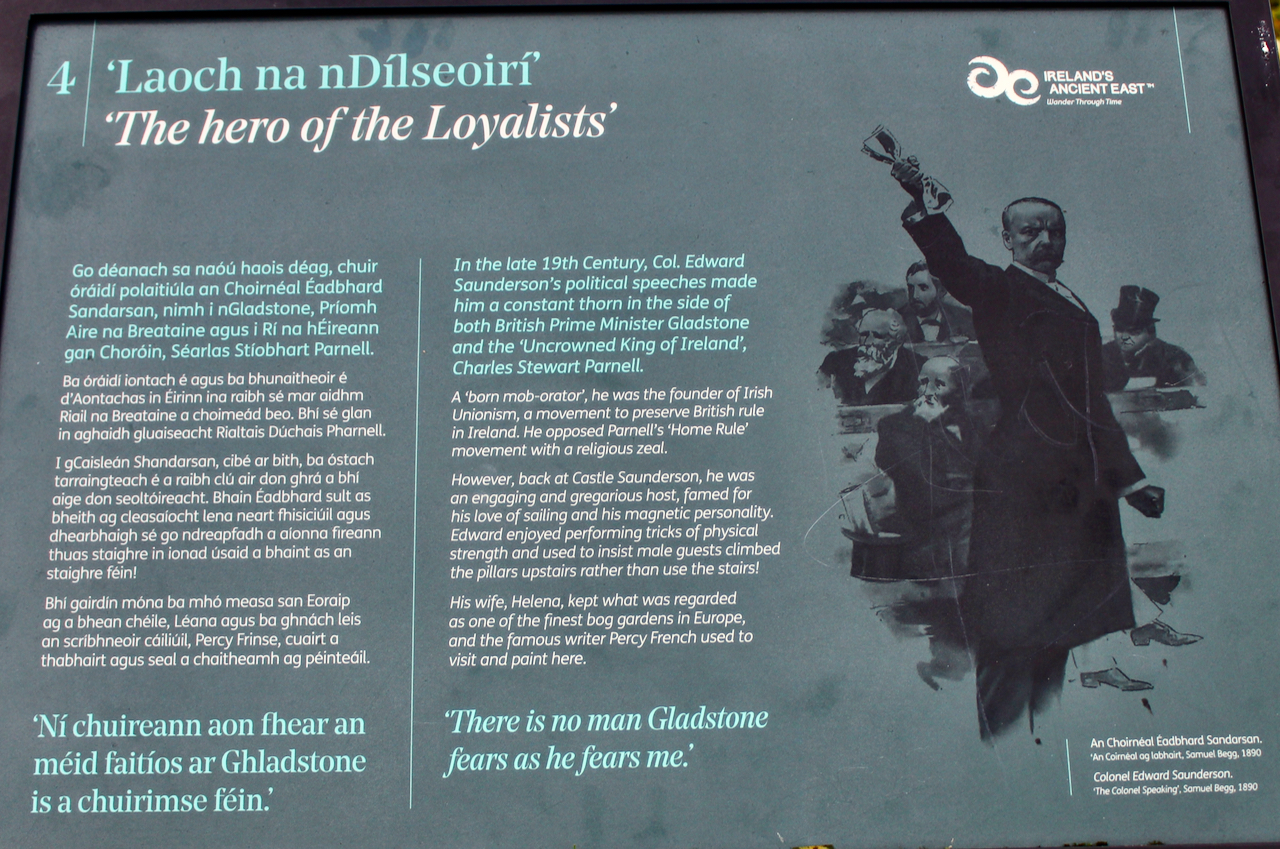
It was Edward Saunderson (1837-1906) who inherited Castle Saunderson. Edward Saunderson, the information board tells us, was the founder of British Unionism, the movement to preserve British rule in Ireland. He opposed Charles Stewart Parnell’s “Home Rule” movement, which sought to bring a parliament back to Ireland after it was abolished in 1800.
The notice board tells us that Edward enjoyed feats of strength, and made his male guests climb the pillars rather than using the stairs! His wife, Helena Emily de Moleyns, youngest daughter of Thomas, 3rd Baron Ventry, developed a bog garden, regarded as one of the finest in Europe, and the writer Percy French used to visit.
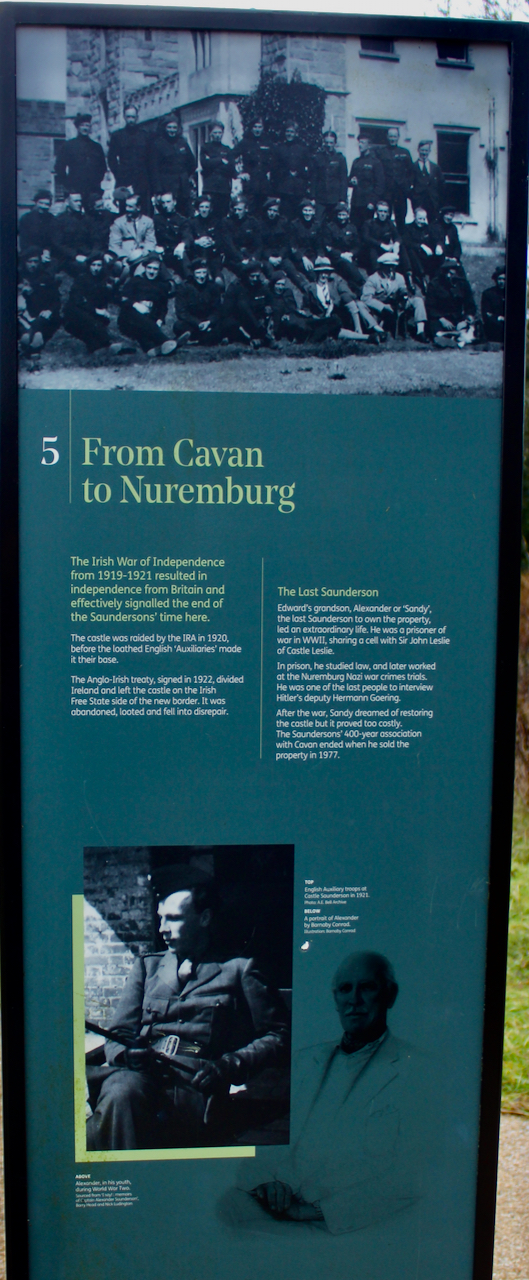
In the late 19th century, Colonel Edward Saunderson opposed Charles Stewart Parnell. Saunderson was the founder of Irish Unionism, a movement to preserve British rule in Ireland. The last Saunderson, Alexander, or “Sandy,” was a prisoner of war in WWII, sharing a cell with Sir John Leslie of Castle Leslie. In prison he studied law and later worked at the Nuremburg Nazi war crimes trials.
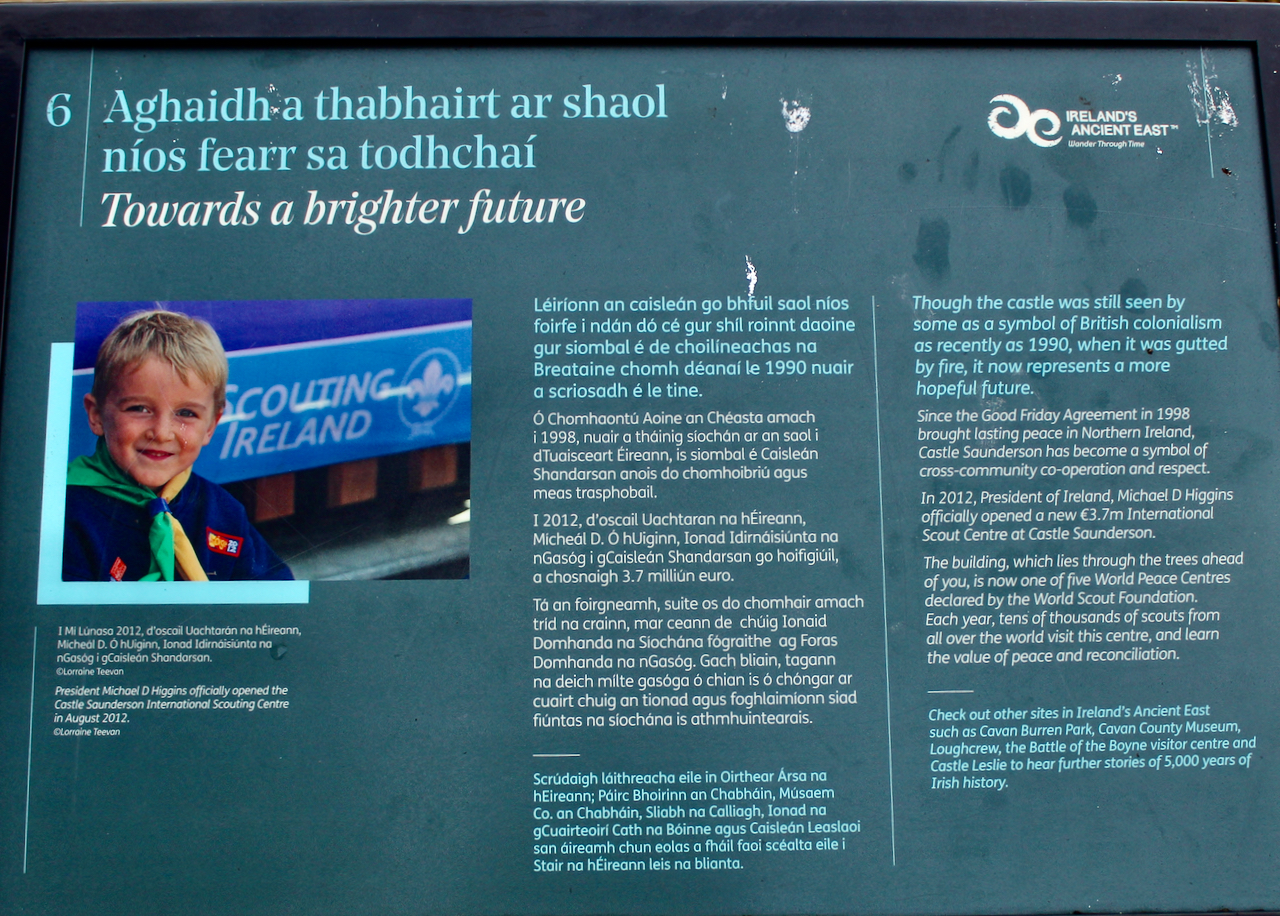
Alexander Saunderson (1917-2004), the last of the family to live there, sold the property to a London-based businessman in 1977. (see [4]). The Castle was in a state of disrepair and plans to have it completely renovated as a private dwelling at this time never materialized. The estate was sold again in 1990 to be developed as a hotel. These plans were also abandoned after a fire gutted and destroyed most of the Castle interior. This was the third fire to take place in the history of the castle. (see[4]). The property was then sold to Scouts Ireland.
A Scout centre nearby has been established, and is a World Peace Centre for the Scouts.
[1] p. 75, Bence-Jones, Mark. A Guide to Irish Country Houses (originally published as Burke’s Guide to Country Houses volume 1 Ireland by Burke’s Peerage Ltd. 1978); Revised edition 1988 Constable and Company Ltd, London.
www.cabracastle.com Open in 2026: all year, except Dec 24, 25, 26, 11am-4pm Fee: Free to visit
donation
Help me to pay the entrance fee to one of the houses on this website. This site is created purely out of love for the subject and I receive no payment so any donation is appreciated!
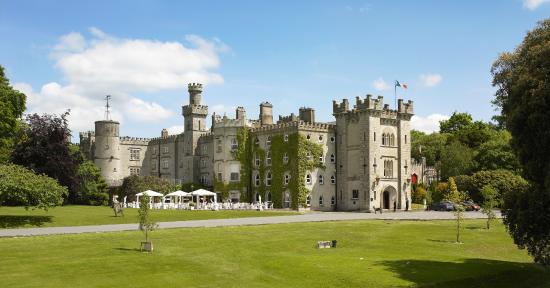
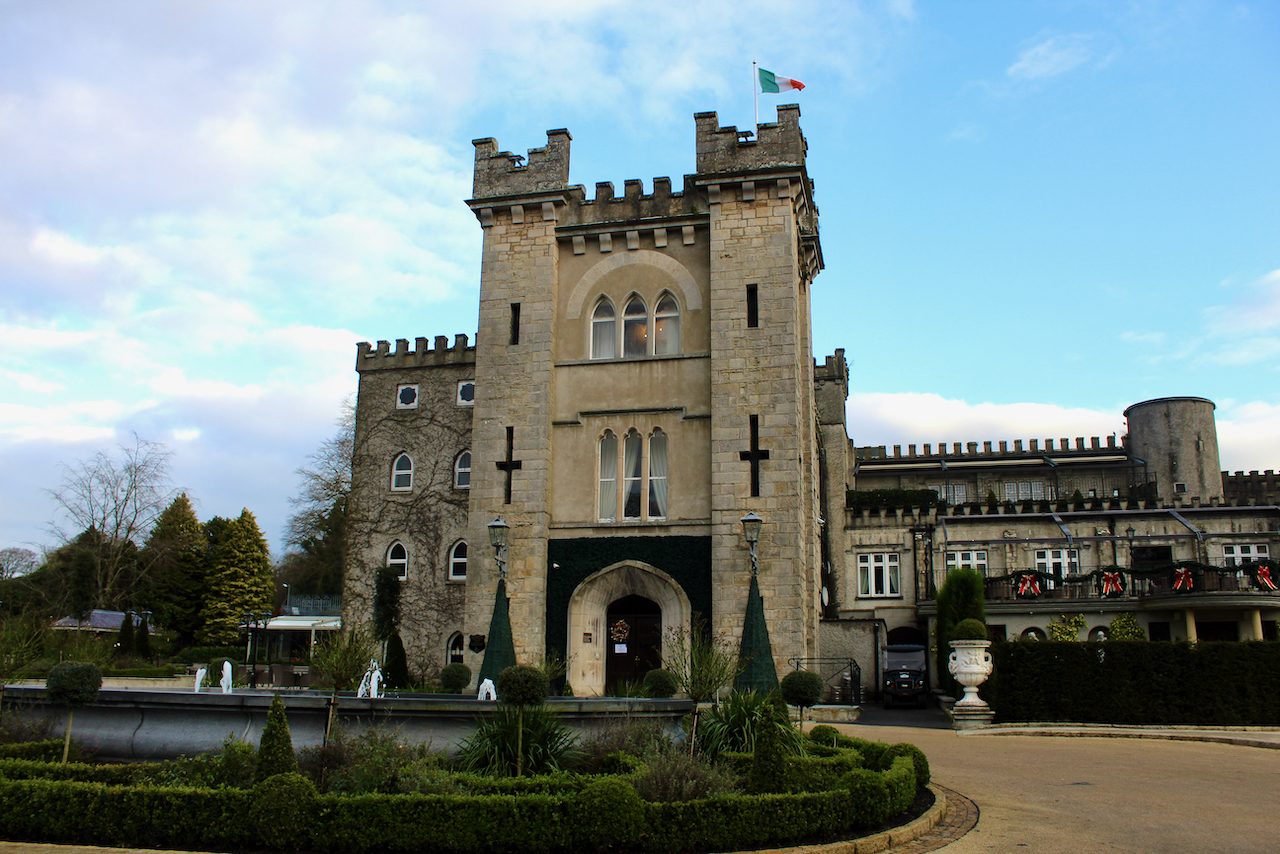
Stephen and I visited Cabra Castle in December 2020. I contacted the owner, Howard Corscadden, in advance, to request a tour of the castle. The Corscadden family own several beautiful Irish properties which provide unique castle accommodation. As well as Cabra Castle, they own Markree Castle in County Sligo and Ballyseede Castle in County Kerry, both of which are on the Section 482 list, as well as Bellingham Castle in County Louth. They are all hotels except the latter which is available as a four star venue for weddings and events, with accommodation. Howard’s parents and grandparents were also in the hotel business in Ireland, as are his siblings – Ballyseede is run by his sister Marnie, Castle Bellingham by his brother Patrick and Markree Castle by his sister Patricia. Howard worked in the Waldorf hotel in Switzerland and in Dromoland Castle in Ireland before purchasing Cabra Castle in 1991. [1] It had been converted to a hotel in 1964 by the local Brennan family. In 1986 it was sold to become a private house once more, but with a change in fortune the family sold to Howard Corscadden.
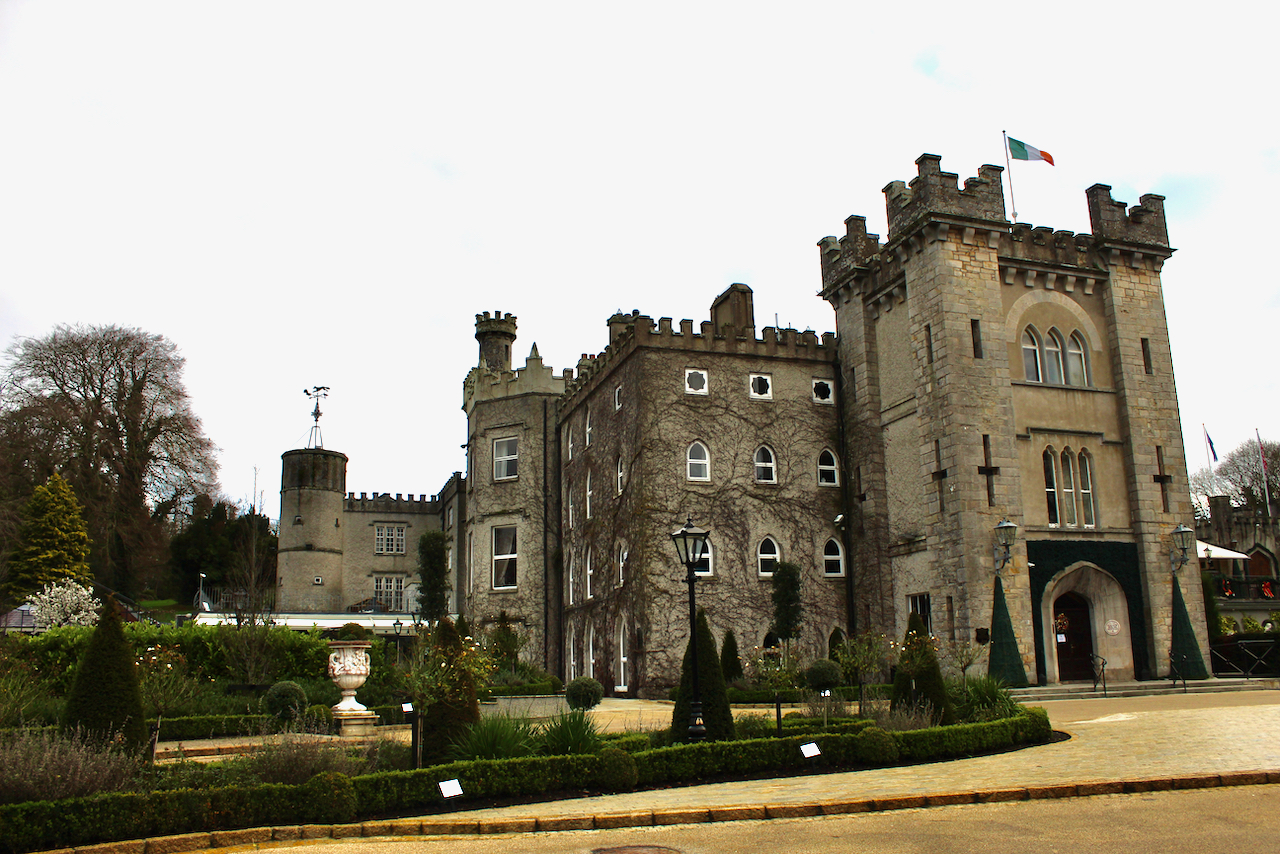
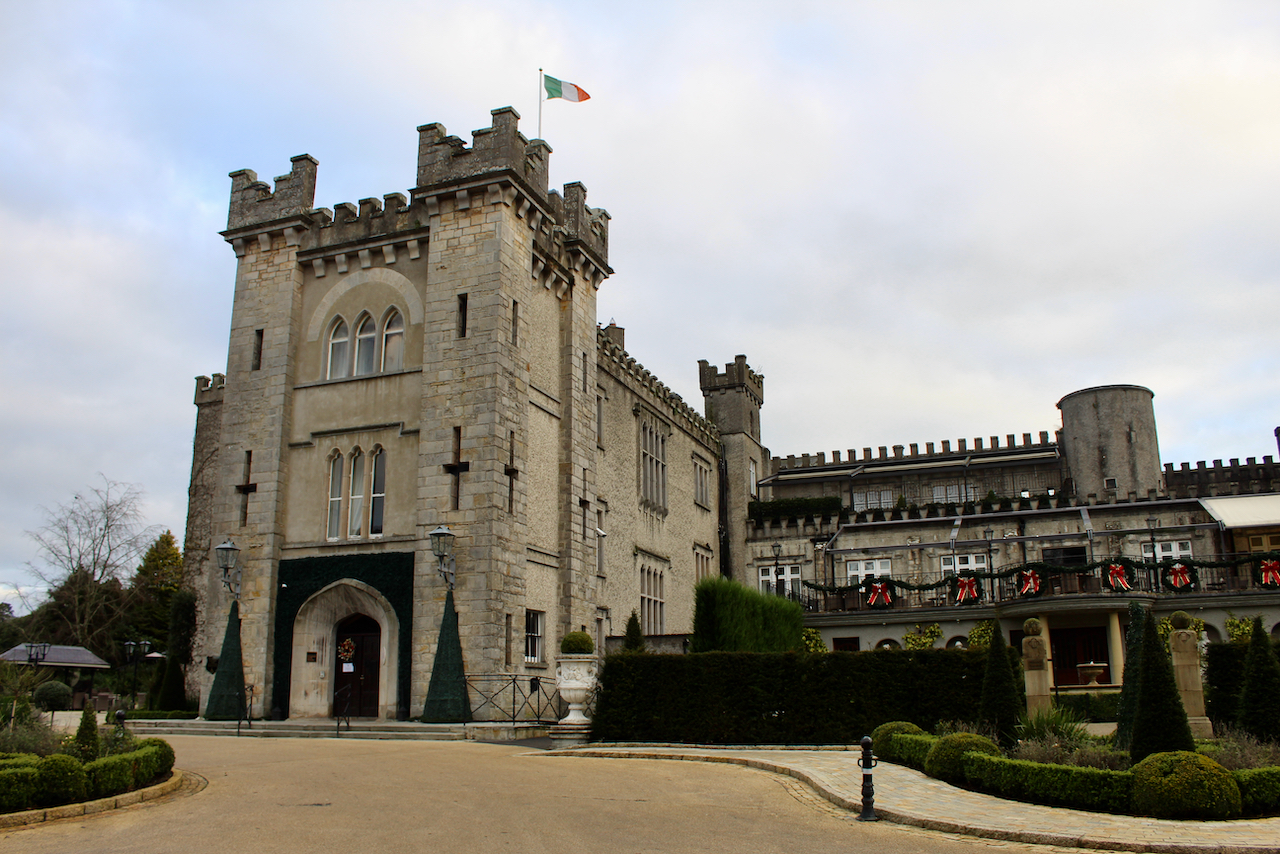
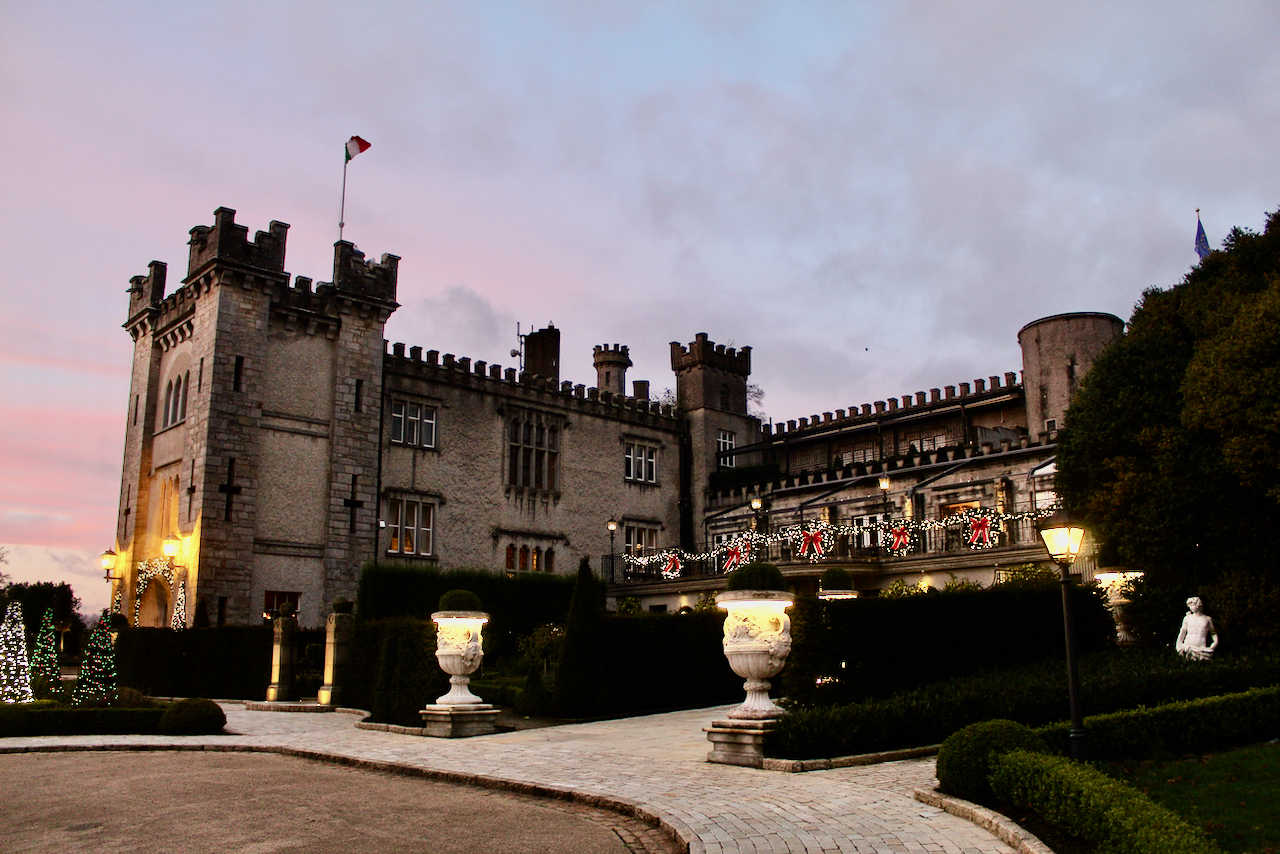
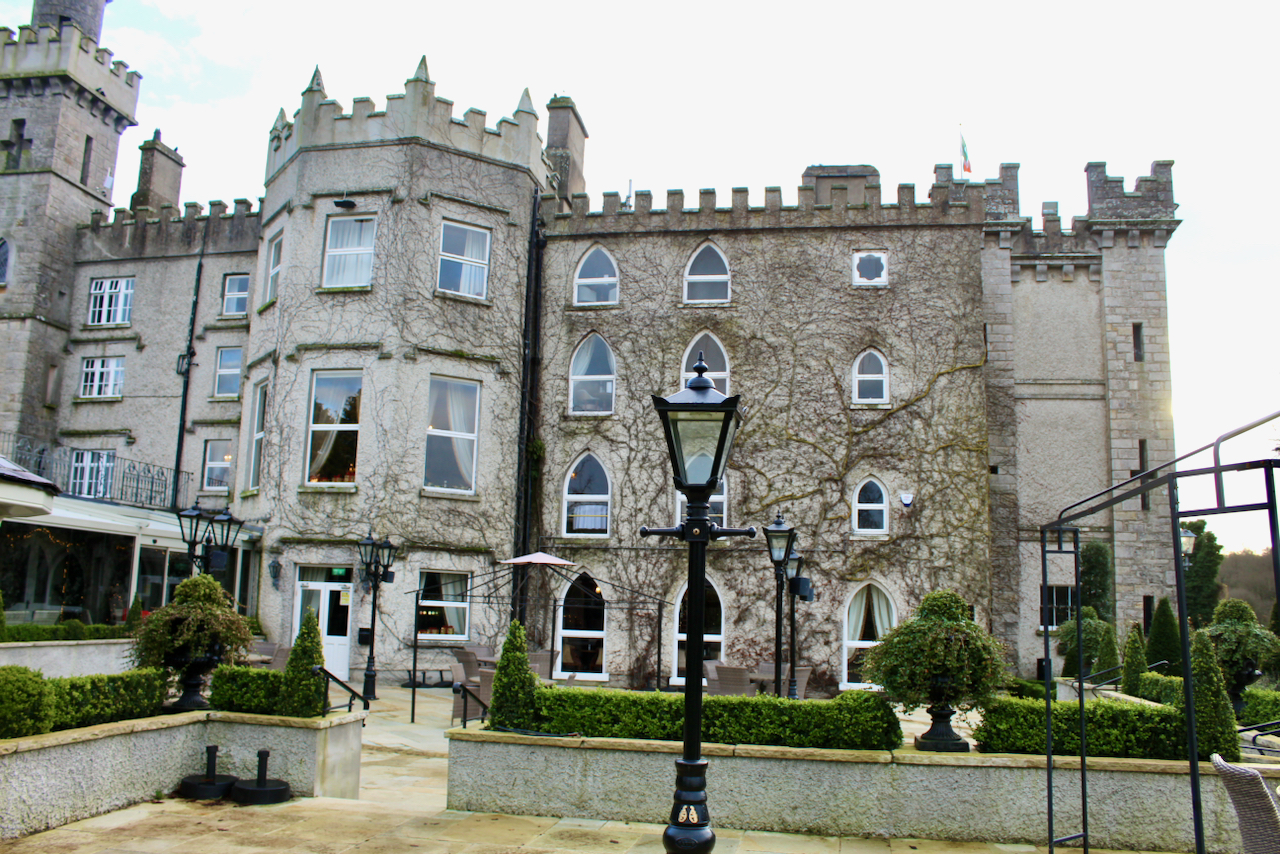
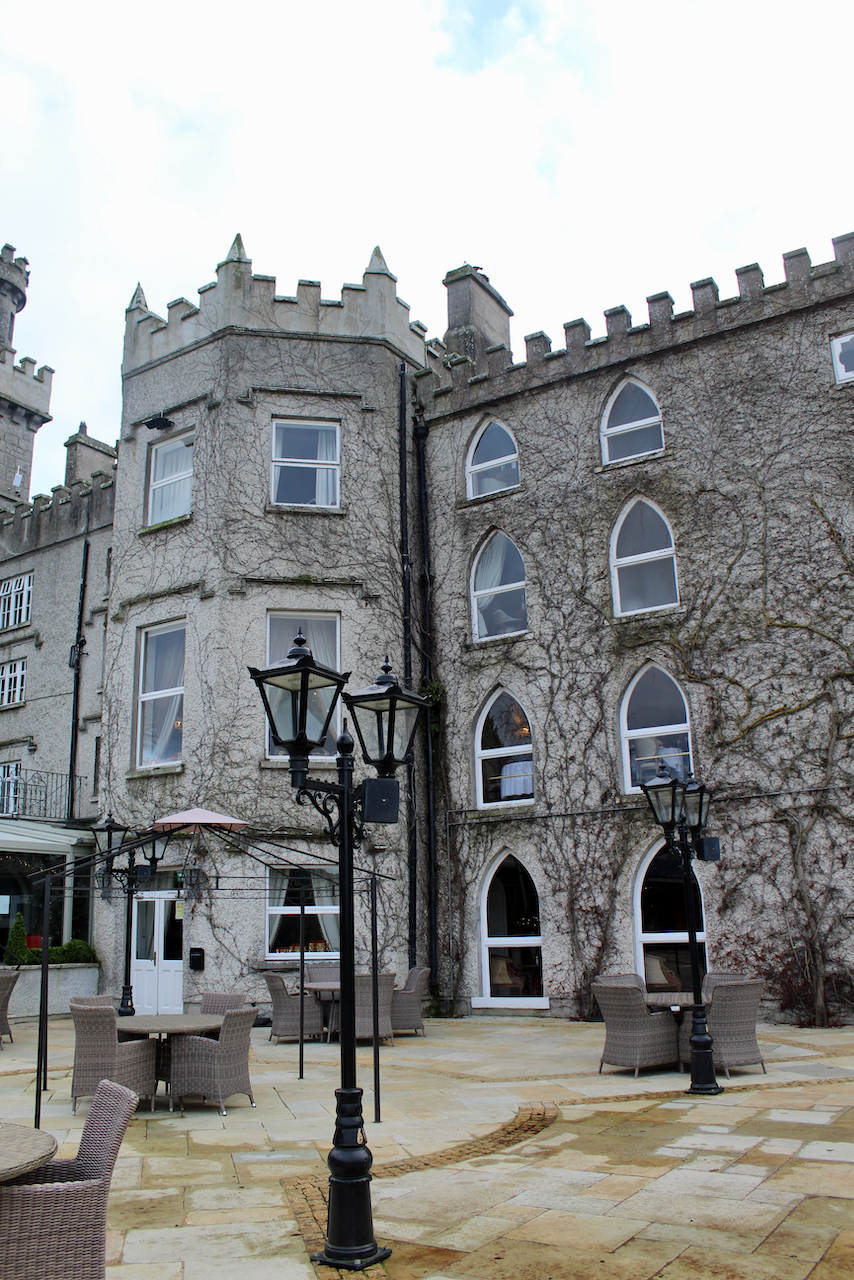
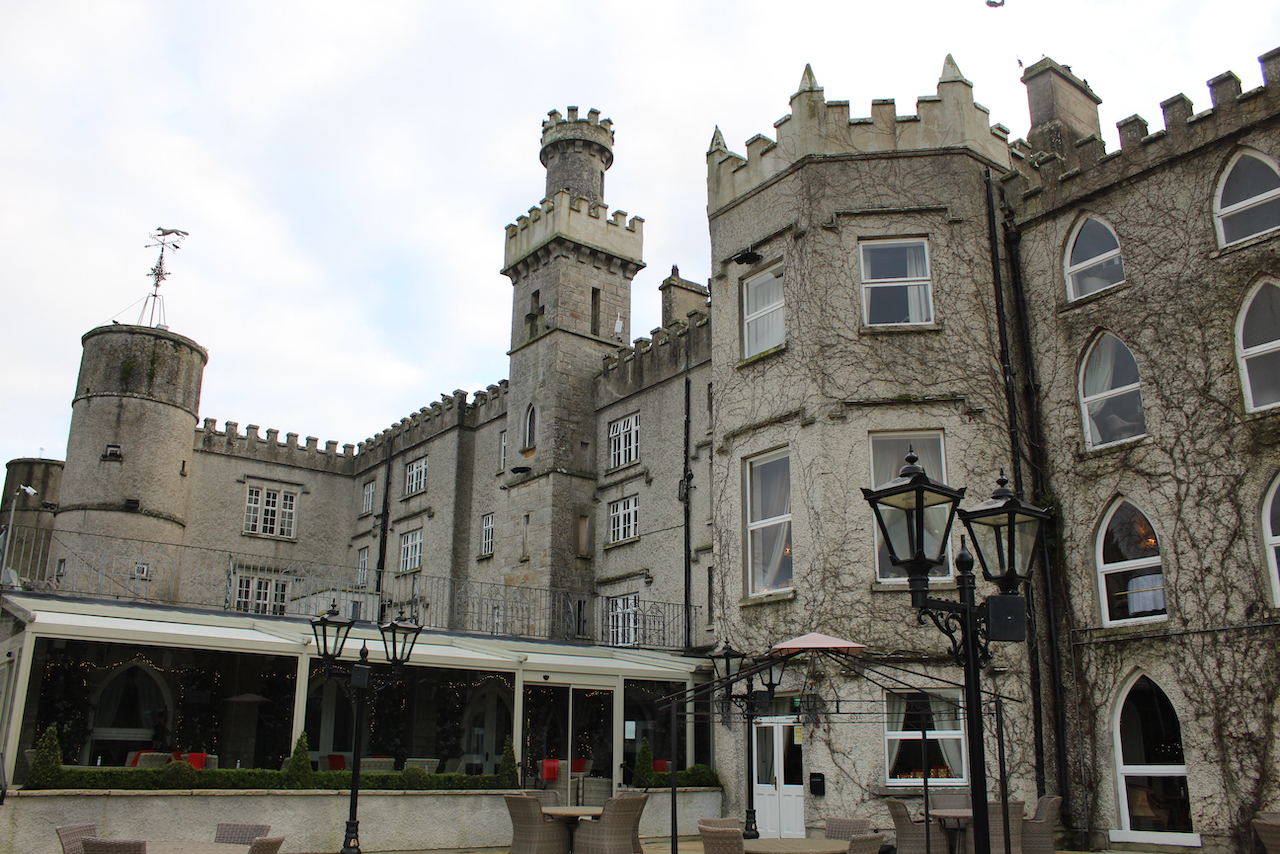
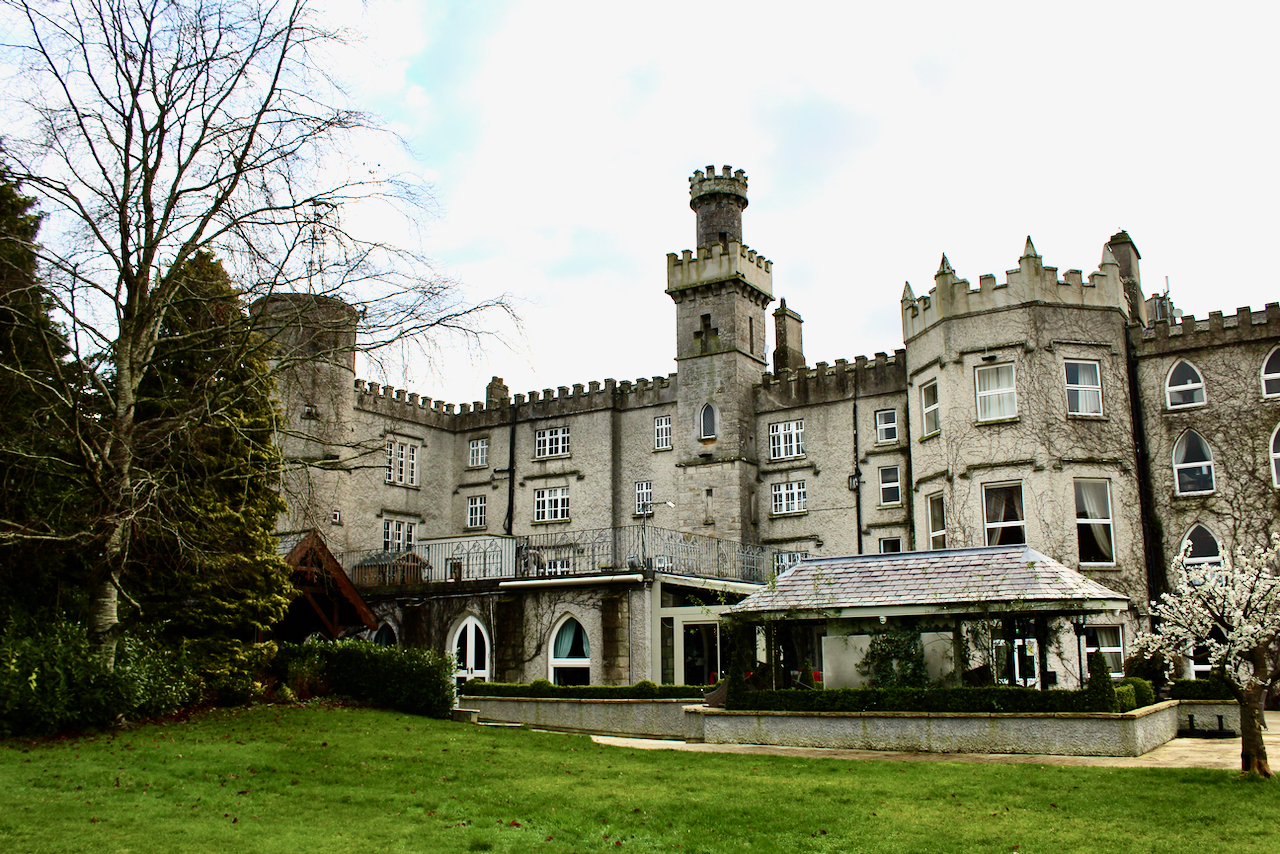
Cabra Castle, December 2020.
The early history of the castle is the history of two land-owning families, the Fosters and the Pratts. The building now known as Cabra Castle was originally known as Cormy Castle. At that time, an adjacent property was called “Cabra.” Cormy Castle was named after the townland of Cormy.
In 1795 the land, which contained an old round tower castle called Cormy Castle, belonged to John Thomas Foster (1747-1796), who had been MP for Dunleer, County Louth, and for Ennis, County Clare. The main building of Cormy Castle was in ruins, destroyed during the Cromwellian War, but its adjacent courtyard remained in good repair.
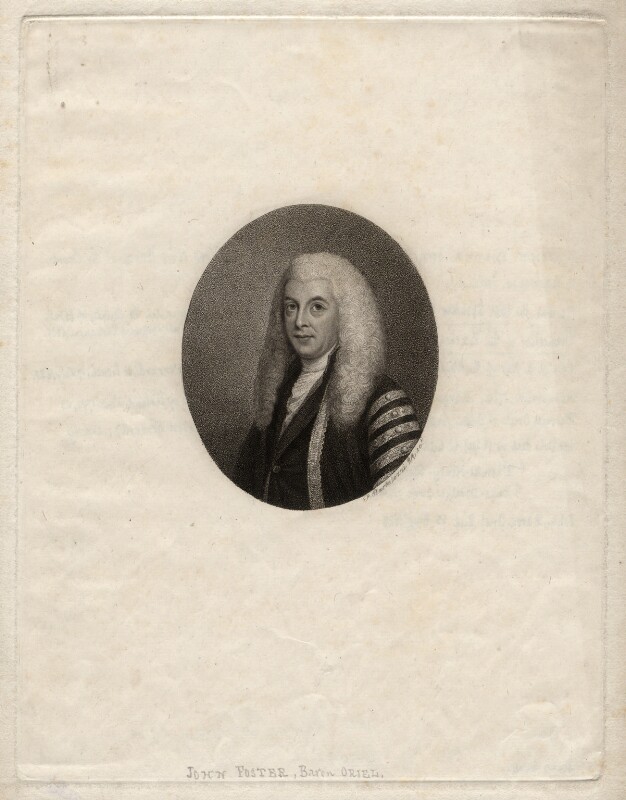
The Foster family owned large amounts of land in County Louth and their family seat was in Dunleer. The family produced many members of the Irish Parliament. John Thomas’s grandfather John Foster (1665-1747) had been MP for Dunleer. His father, Reverend Thomas Foster (1709-1784) was Rector at Dunleer. His uncle Anthony Foster (1705-1778) had also been MP for Dunleer and for County Louth, and was Chief Baron of the Exchequer, and lived at Collon, County Louth. [2] Anthony’s son John Foster (1740-1828) was Speaker of the Irish House of Commons, created 1st Baron Oriel of Ferrard, and also owned property which is now part of University College Dublin and the adjacent road Foster Avenue is named after him.
John Foster, 1st Baron Oriel, by Francesco Bartolozzi, after Unknown artist, stipple engraving, late 18th century. Photograph from National Portrait Gallery, London.
Turtle Bunbury tells us that John Thomas Foster’s father Reverend Thomas, the rector of Dunleer, acquired land in County Louth in the 1750s and 1760. He then acquired the 700 acre manor of Killany, County Louth, from 1763 on a series of long leases from the Provost and Fellows of Trinity College Dublin. He purchased Stonehouse, Dunleer, around 1787. [3]
Stone House, County Louth, built around 1760 and purchased by Reverend Thomas Foster in around 1787. Photograph from National Archive of Architectural Heritage.
In 1776 John Thomas Foster married Elizabeth Christina Hervey, daughter of the 4th Earl of Bristol. After the marriage they lived with her father in Suffolk. They had two sons: Frederick Thomas (1777-1853) and Augustus John (1780-1848). [4]
The marriage of John Thomas and Elizabeth Christina was not a success, and they separated after five years. Foster took the sons, and she did not see them for fourteen years. [5]
In 1783 John Thomas Foster inherited a property named Rosy Park in Louth from his uncle, John William Foster. In 1820 it was renamed Glyde Park by his son, Augustus. [6] It is unfortunately now a ruin.
The ruin of Glyde Court, County Louth, built around 1780. Photograph from National Inventory of Architectural Heritage.
John Thomas died in 1796, when his sons were still minors. They moved back to England to live with their mother, who by this time was living with William Cavendish, the 5th Duke of Devonshire, along with his wife, Georgiana, and had born him two children. A film starring Keira Knightly, “The Duchess,” is based on their story. [7] She married him in 1809 when his wife died.
Meanwhile, a cousin of John Thomas Foster, Henry Foster (c. 1747-1838), was appointed Trustee and Executor of the property of Cormy. He lived at Cormy Castle while acting as Trustee for his wards. According to Turtle Bunbury, he was a magistrate for Meath, Cavan and Louth. There is a record in the National Library of Ireland of a Grant of Arms to Henry Foster of Cormy Castle from March 13th 1806, when he was about to be created a baronet, but “the creation did not eventuate” (i.e. he was not made baronet). The National Library also has a map of the demesne of Cormy Castle from 1810, named as the seat of Henry Foster. In 1808 he began to rebuild and enlarge the castle. However, he exhausted the personal estate of his wards in doing so, and incurred debts, and the castle and land had to be sold. In about 1813 his wards sold the estate to Colonel Joseph Pratt, who lived on the adjacent property. [8]
John Thomas Foster’s son Frederick Thomas Foster may have remained in England, as he served as MP for Bury St. Edwards between 1812 and 1818. His brother Augustus John Foster became a politician and diplomat. Between roughly 1802 and 1804 he was Secretary to the British Legion in Naples. He held the office of Envoy Extraordinary and Minister Plenipotentiary to the U.S.A. in 1812. He wrote about his American experiences in Notes on the United States of America.
From 1814-1824 he held the office of Minister Plenipotentiary to Denmark. He was created 1st Baronet Foster of Glyde Court in 1831, and was appointed Privy Counsellor. His final posting was to Turin, in the Kingdom of Sardinia.
Colonel Joseph Pratt, who owned the adjacent Cabra estate, continued the enlargement of Cormy Castle, and the work was completed in 1837. In 1820 he renamed it Cabra Castle. [9]
Before we examine the development of Cabra Castle, let’s look at the history of the property of Cabra across the road from the current Cabra Castle.
According to the Cabra Castle website, this area belonged to the O’Reilly family. In 1607 Gerald Fleming, who had been granted territory by King James I, built a castle on the property. He lost his lands, however, when he supported James II against William III, and Colonel Thomas Cooch (1632-1699) acquired the property. [10]
Colonel Thomas Cooch married Elizabeth Mervyn, (sister of Audley Mervyn, Speaker of the Irish House of Commons), and they had an only daughter and heiress, Elizabeth.
Elizabeth’s first husband (Nathaniel Pole, who lived in County Meath) died in 1685, before they had any children, and Elizabeth then married Joseph Pratt, who lived not far off at Garadice, Co. Meath, a property which his father received for his support of Oliver Cromwell. [11] This marriage (which was also Joseph Pratt’s second) took place in 1686 and a son, Mervyn Pratt, was born in 1687. Joseph Pratt held the office of High Sheriff of County Meath in 1698. He and Elizabeth had several other children.
Colonel Thomas Cooch left his Cabra property to his grandson Mervyn.
Mervyn Pratt was only 12 years old when his grandfather died. He graduated from Trinity College, Dublin and married Elizabeth Coote, daughter of Sir Thomas Coote, Judge, of Bellamont, Coote Hill, County Cavan. Mervyn and Elizabeth lived at Cabra near the Wishing Well. He followed in his father’s footsteps and held the office of High Sheriff, but of County Cavan rather than Meath. He was also an MP for County Cavan.
The Fleming castle was modernised by Mervyn Pratt. The new villa may have been designed by Edward Lovett Pearce, who was a cousin of Elizabeth Coote. The Irish Aesthete quotes a visitor to Mervyn Pratt in Cabra:
“On August 25th 1732, the future Mrs Delany (then the merrily widowed Mrs Pendarves) embarked on a journey from Navan, County Meath to Cootehill, County Cavan. She wrote in her journal, ‘travelled through bad roads and a dull, uninhabited country, till we came to Cabaragh, Mr Prat’s house, an old castle modernized, and made very pretty: the master of it is a virtuoso, and discovers whim in all his improvements. The house stands on the side of a high hill; has some tall old trees about it; the gardens are small but neat; there are two little terrace walks, and down in a hollow is a little commodious lodge where Mr Prat lived whilst his house was repairing. But the thing that most pleased me, was a rivulet that tumbles down from rocks in a little glen, full of shrub-wood and trees; here a fine spring joins the river, of the sweetest water in the world.’” [12]
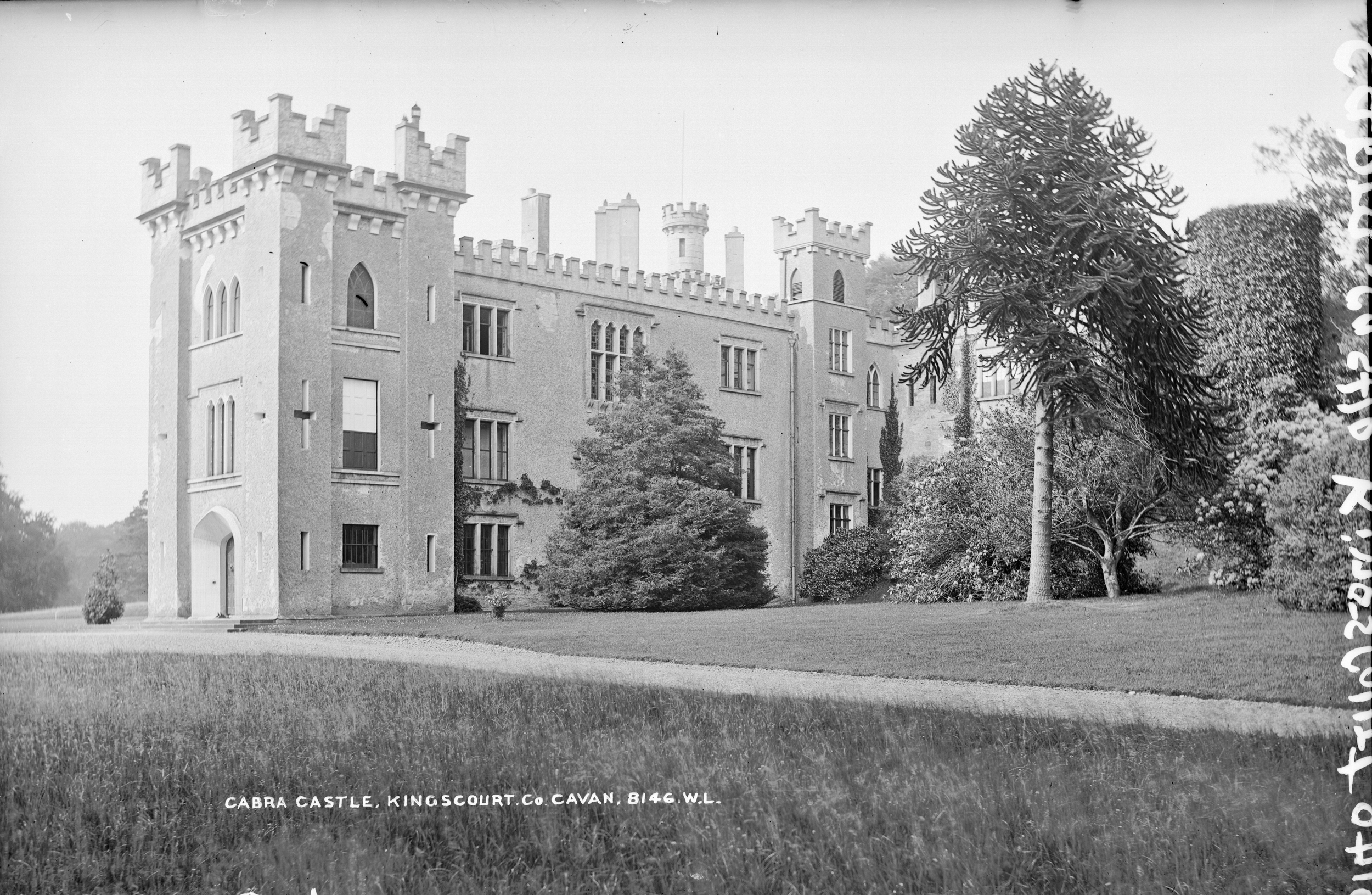
Cabra Castle by Robert French, Lawrence Photograph Collection NLI flickr constant commons.
Mervyn and Elizabeth Pratt had three daughters and one son. Their son Joseph joined the clergy. Reverend Joseph married Elizabeth Chetwood and had five children.
Of the five children of Reverend Joseph Pratt, a daughter Anne married her neighbour Henry Foster the trustee for Cormy Castle. [13] A son, James Butler Pratt, married a sibling of Henry Foster, Margaret. Another son entered the clergy, Reverend Joseph Pratt (1738-1831).
This second Reverend Joseph Pratt married Sarah Morres, daughter of the 1st Viscount Mountmorres, of Castle Morres, County Kilkenny (which has been demolished). Their son, Colonel Joseph Pratt (1775-1863), purchased Cormy Castle from Henry Foster. Their other son, Hervey Randall Saville Pratt inherited the property of Castle Morres through his mother.
The house at Cabra was destroyed by fire in the 1950s, and is now part of Dun na Ri Forest Park, a lovely place to explore, owned by Coillte. After Joseph Pratt moved to Cormy Castle and created a new seat for his family, his former property became known as Old Cabra. [14]
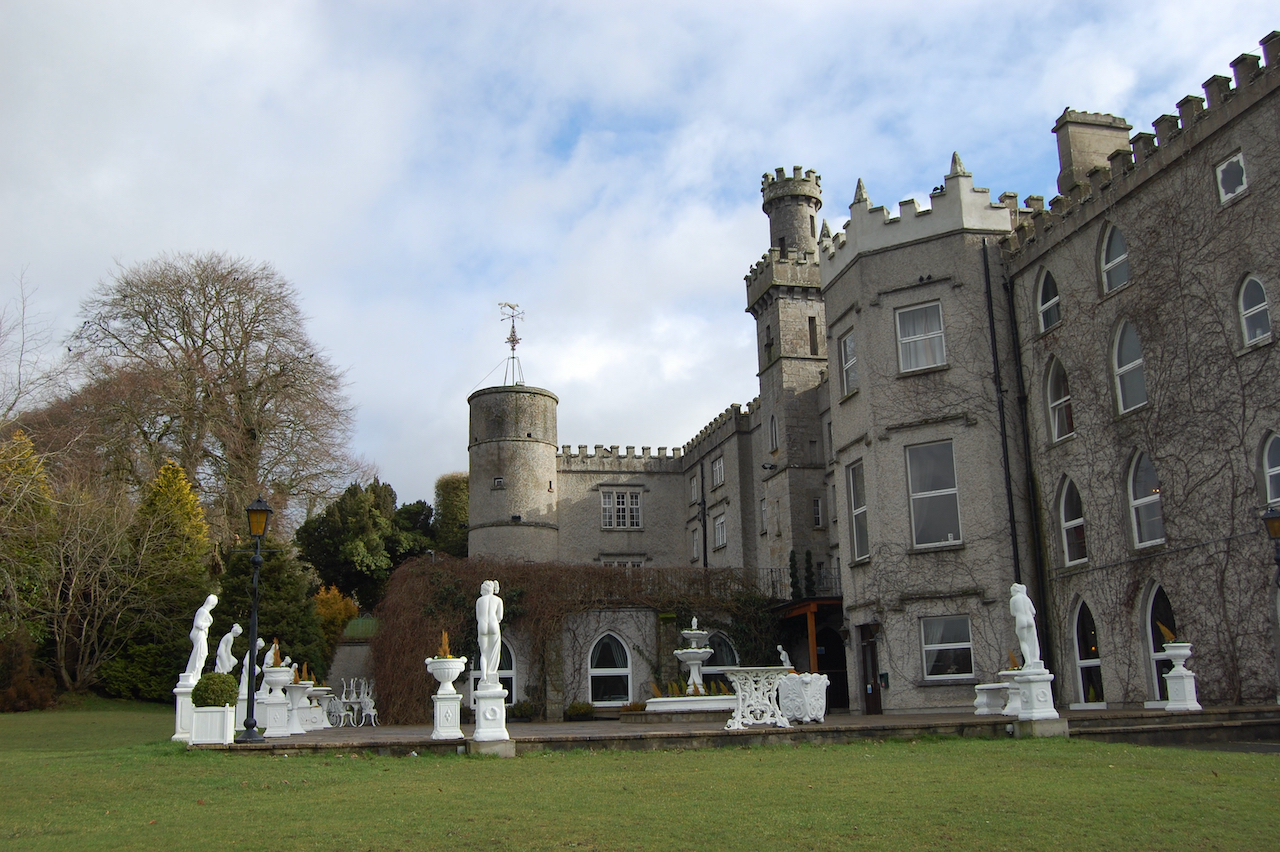
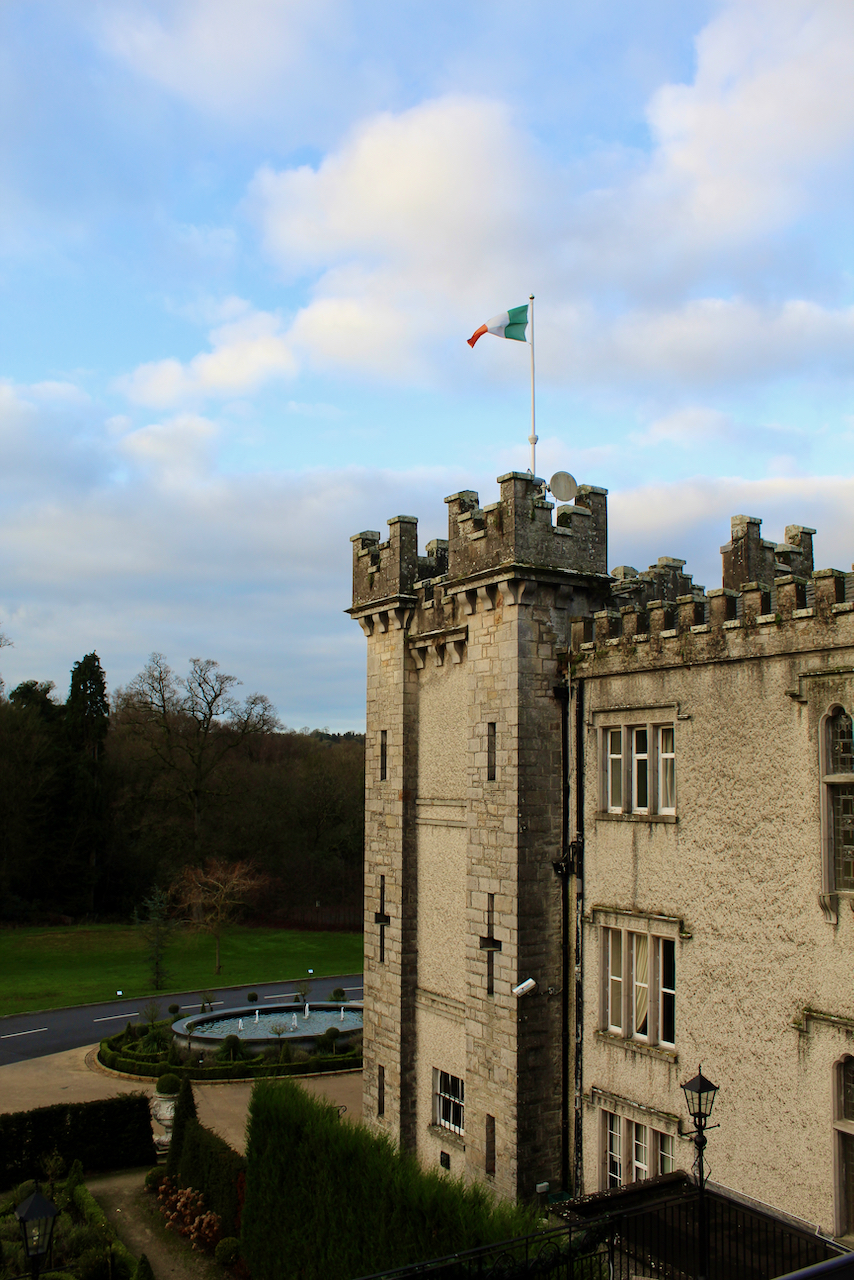
Now let us travel back across the road to the former Cormy Castle, now Cabra Castle. Cabra Castle is a mixture of Norman and Gothic styles.
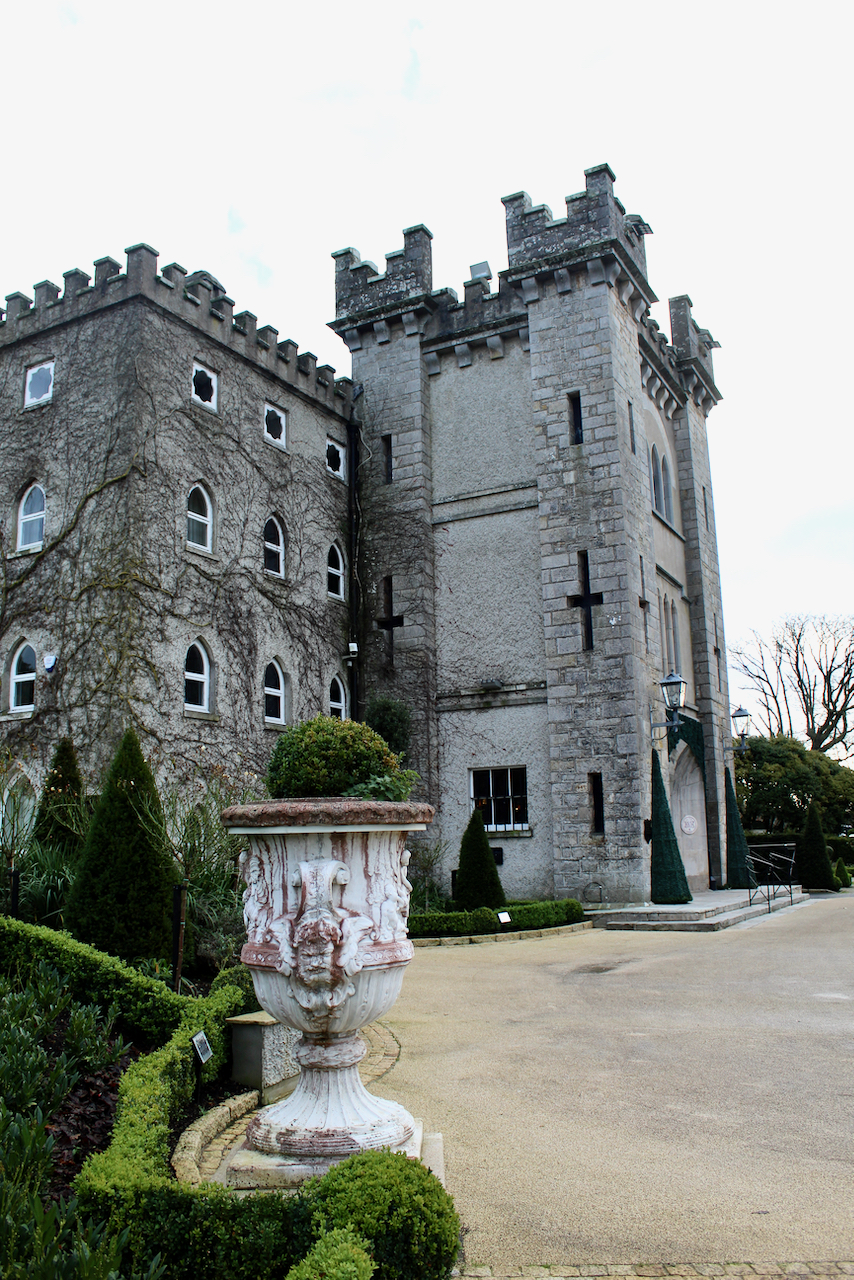
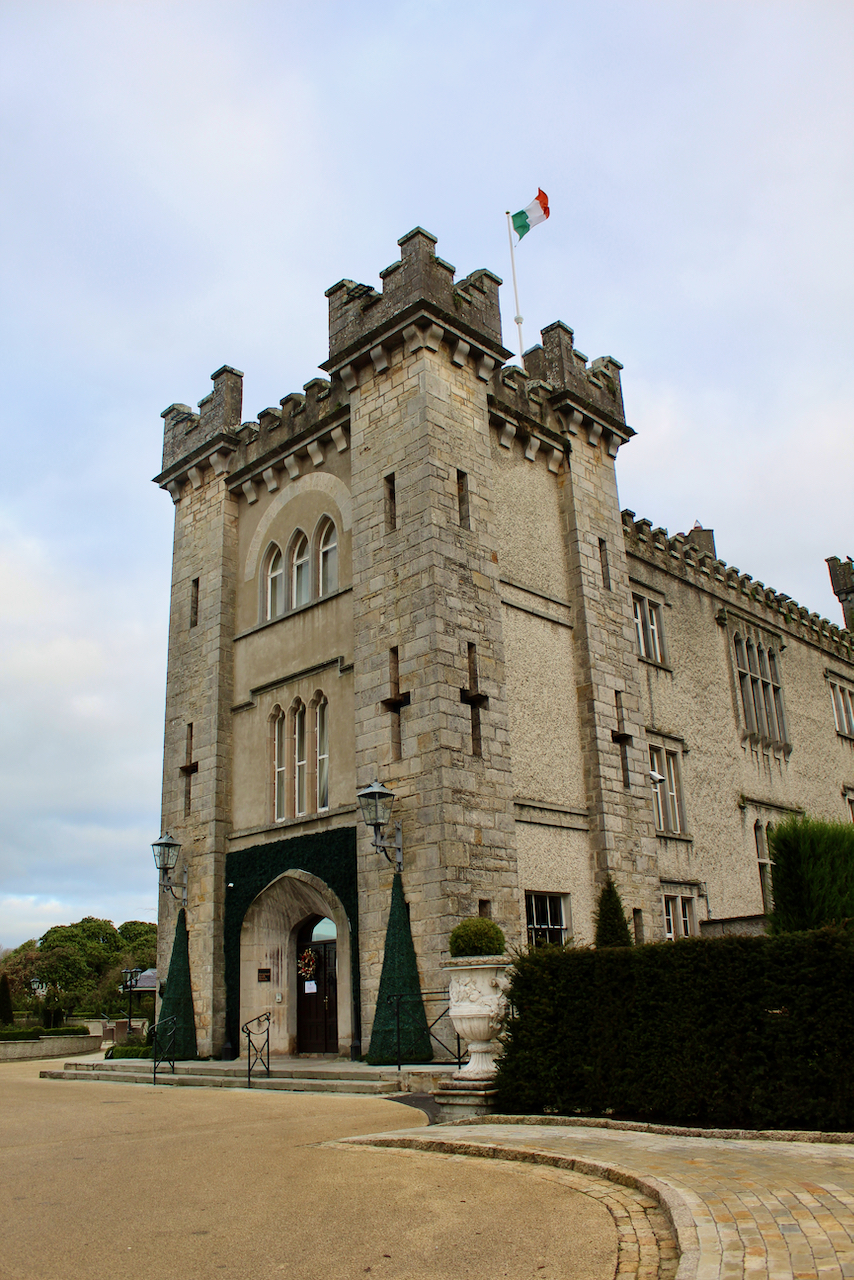
The entrance is in a Norman-style “donjon” or square tower house, with corner turret. The door is in a deeply recessed pointed arch.
The building has two, three and four story sections over a basement. The building, including outbuildings, is castellated, and has several round and square towers.
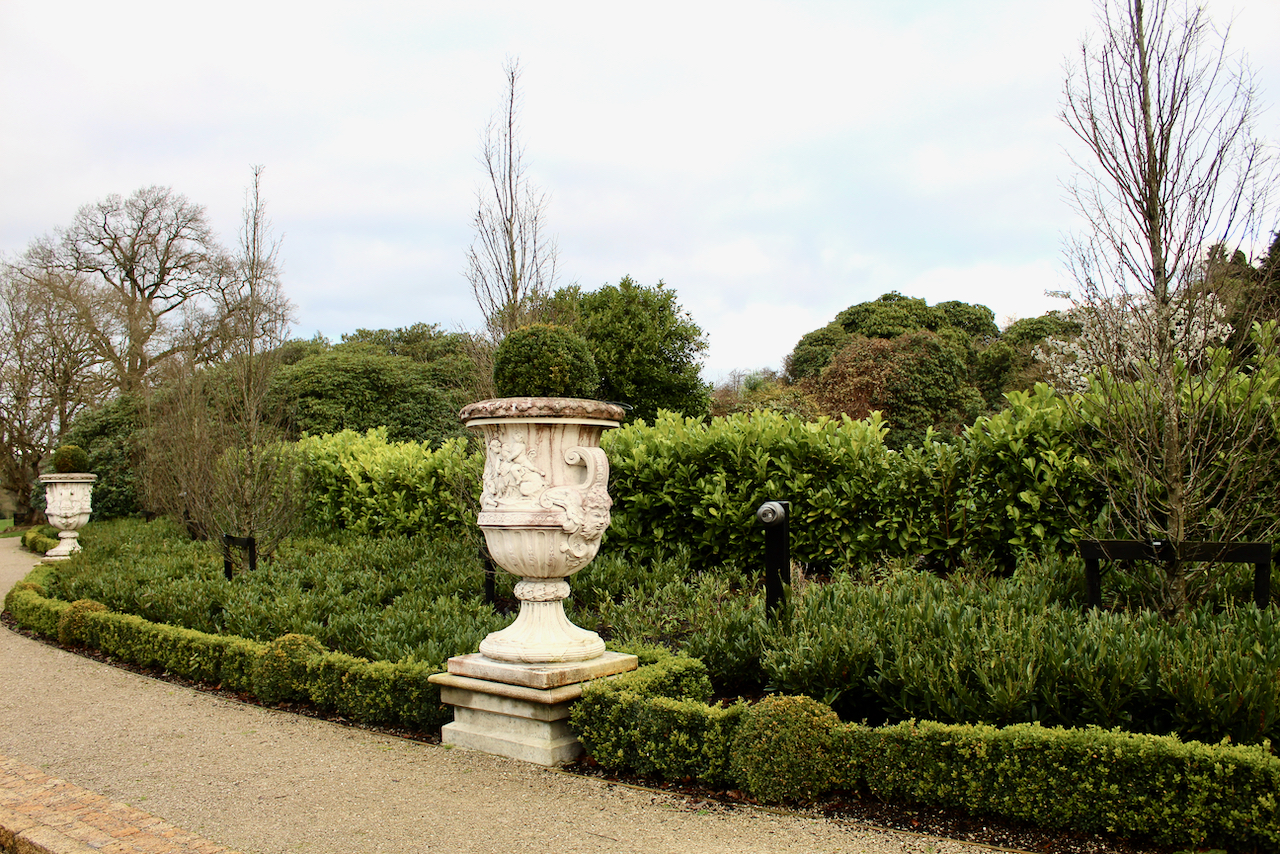
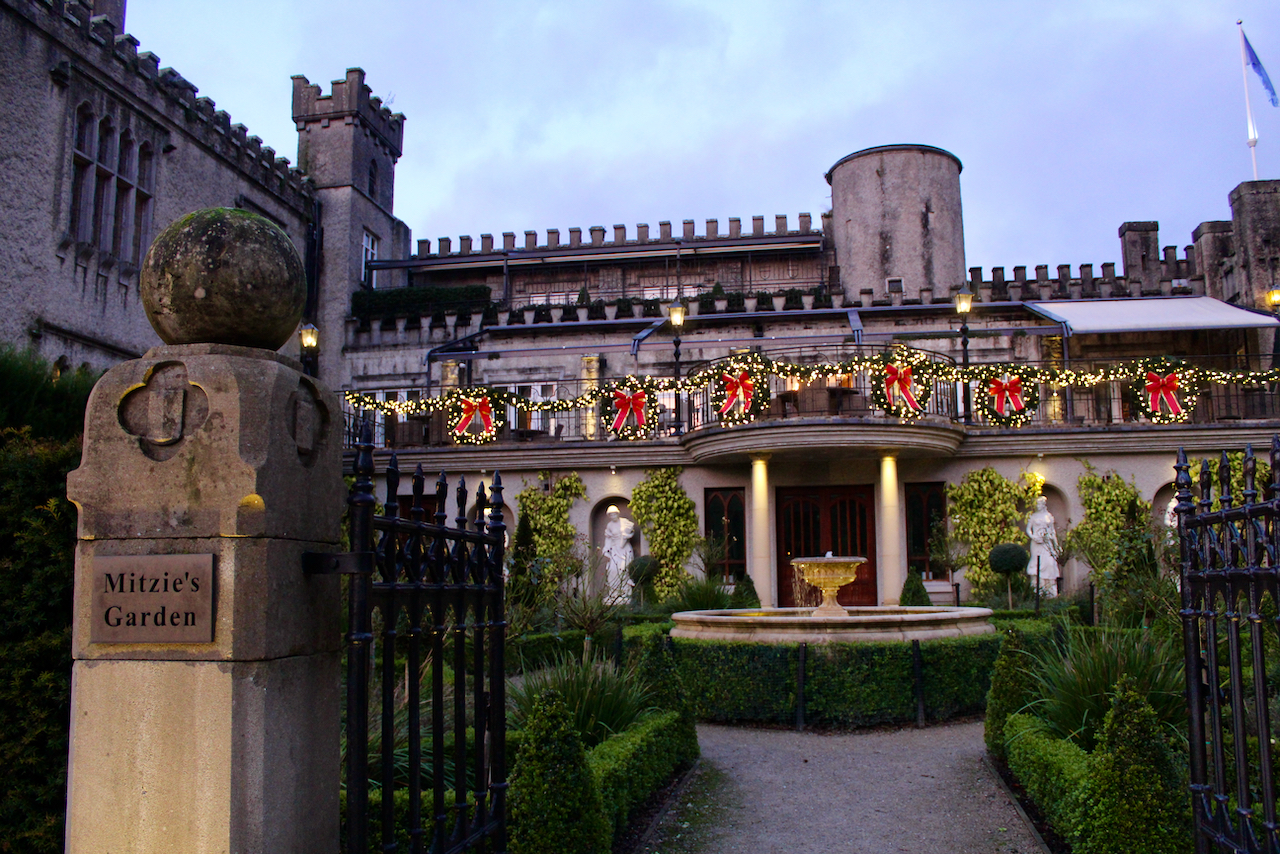
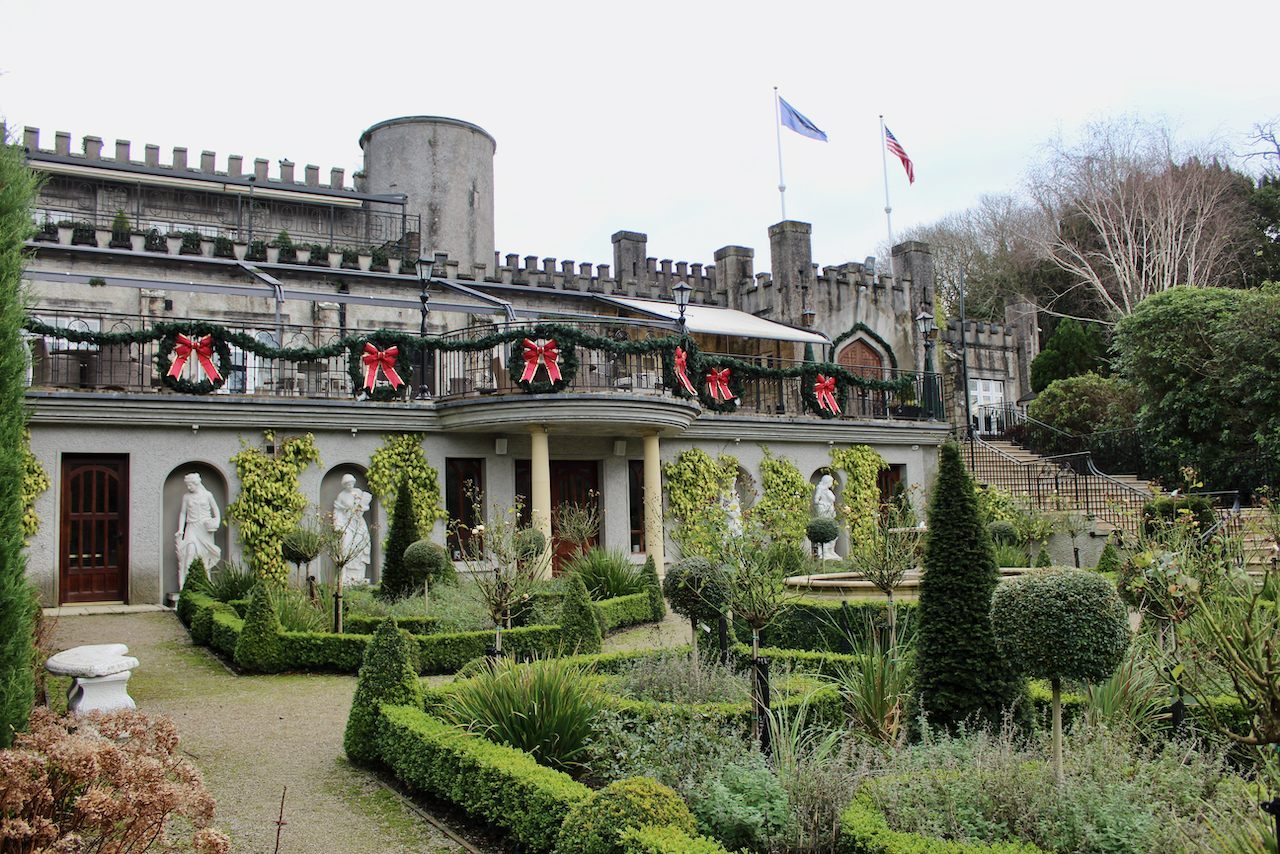
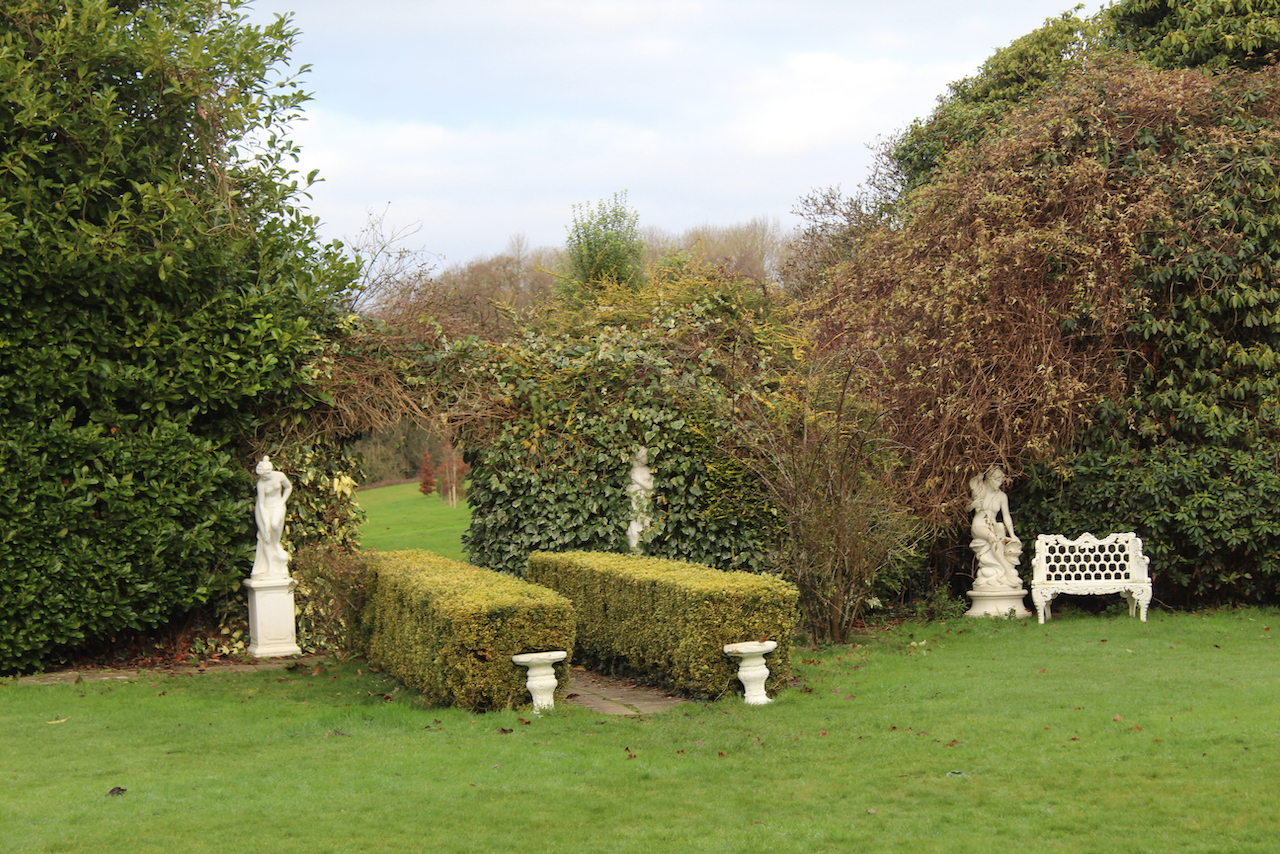
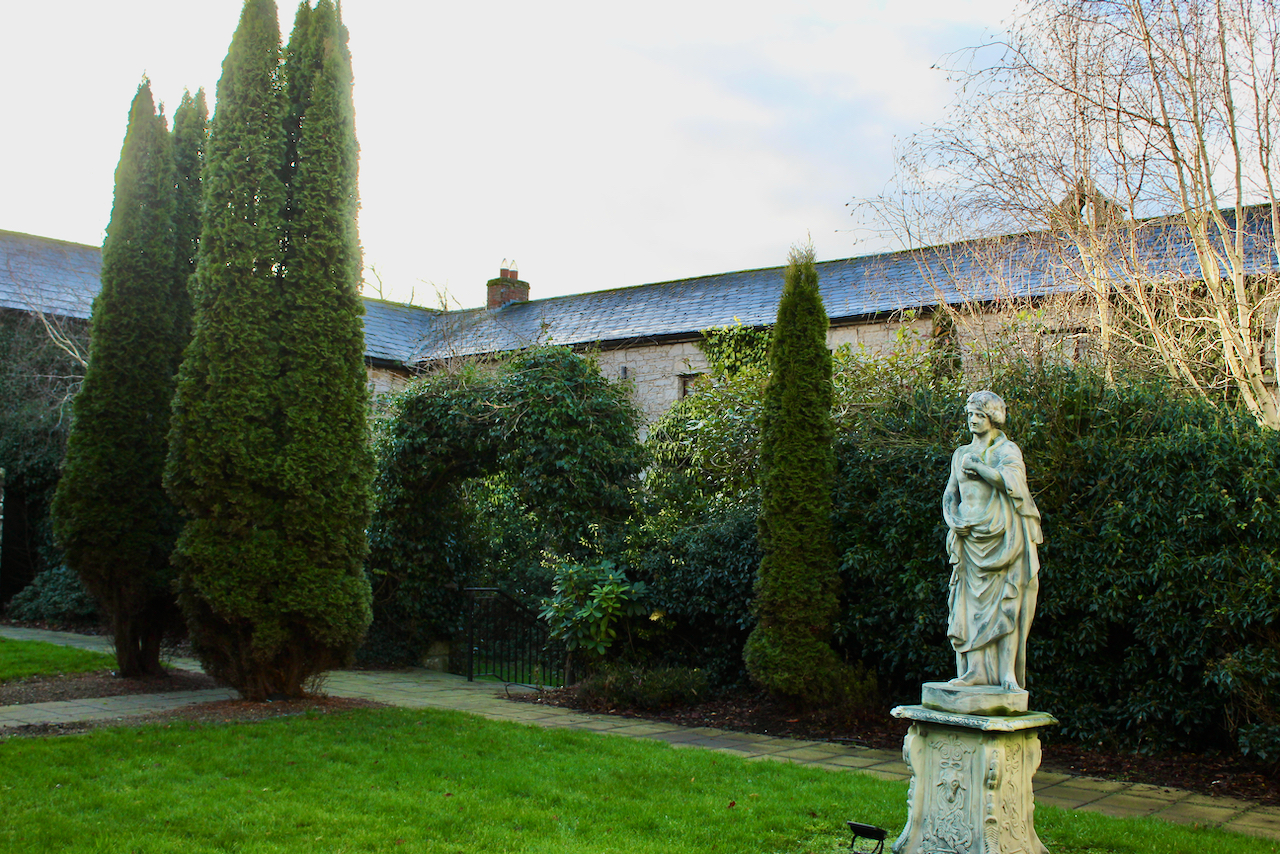
A recent creation to one side of the tower is “Mitzi’s garden,” a formal garden with fountain, tribute to the mother of the current generation of Corscaddens, who is nicknamed Mitzi. This area used to be used for parking.
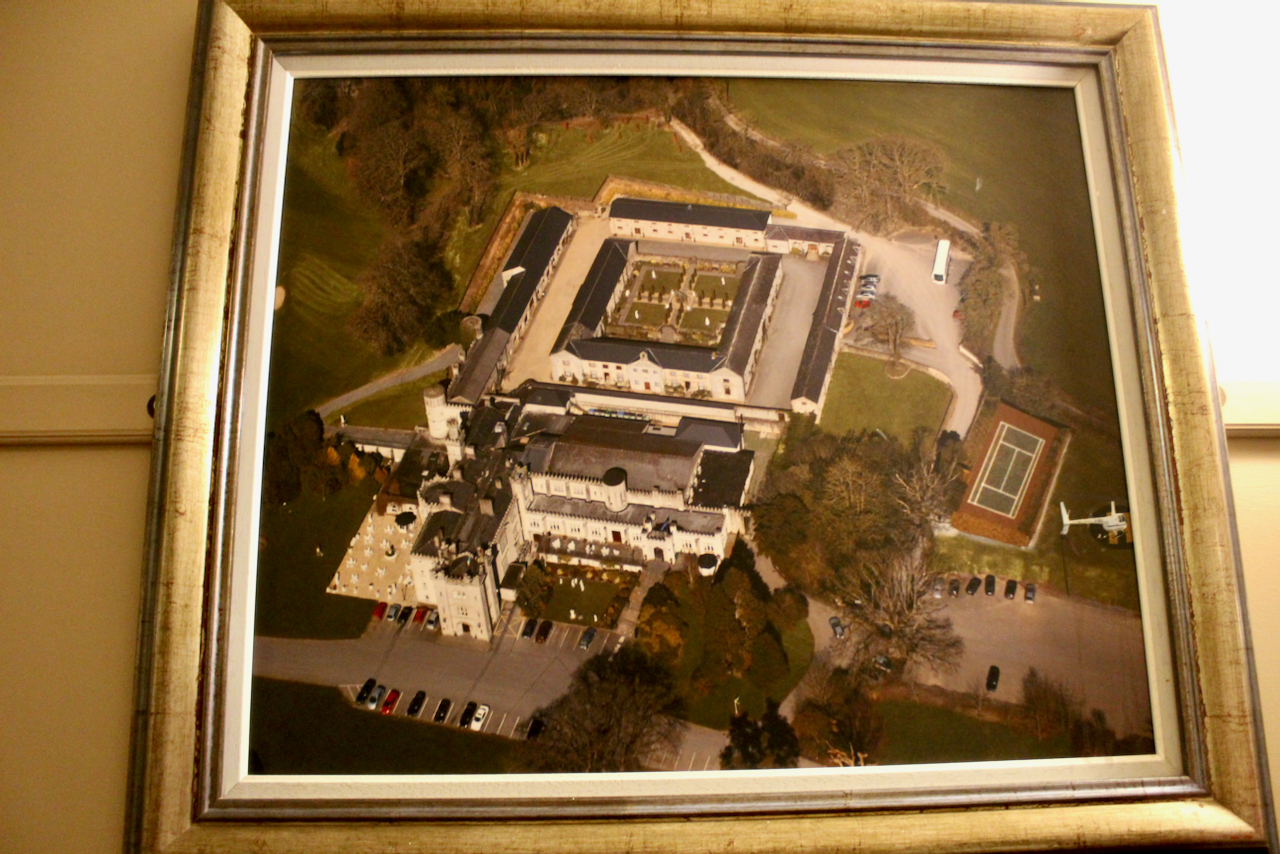
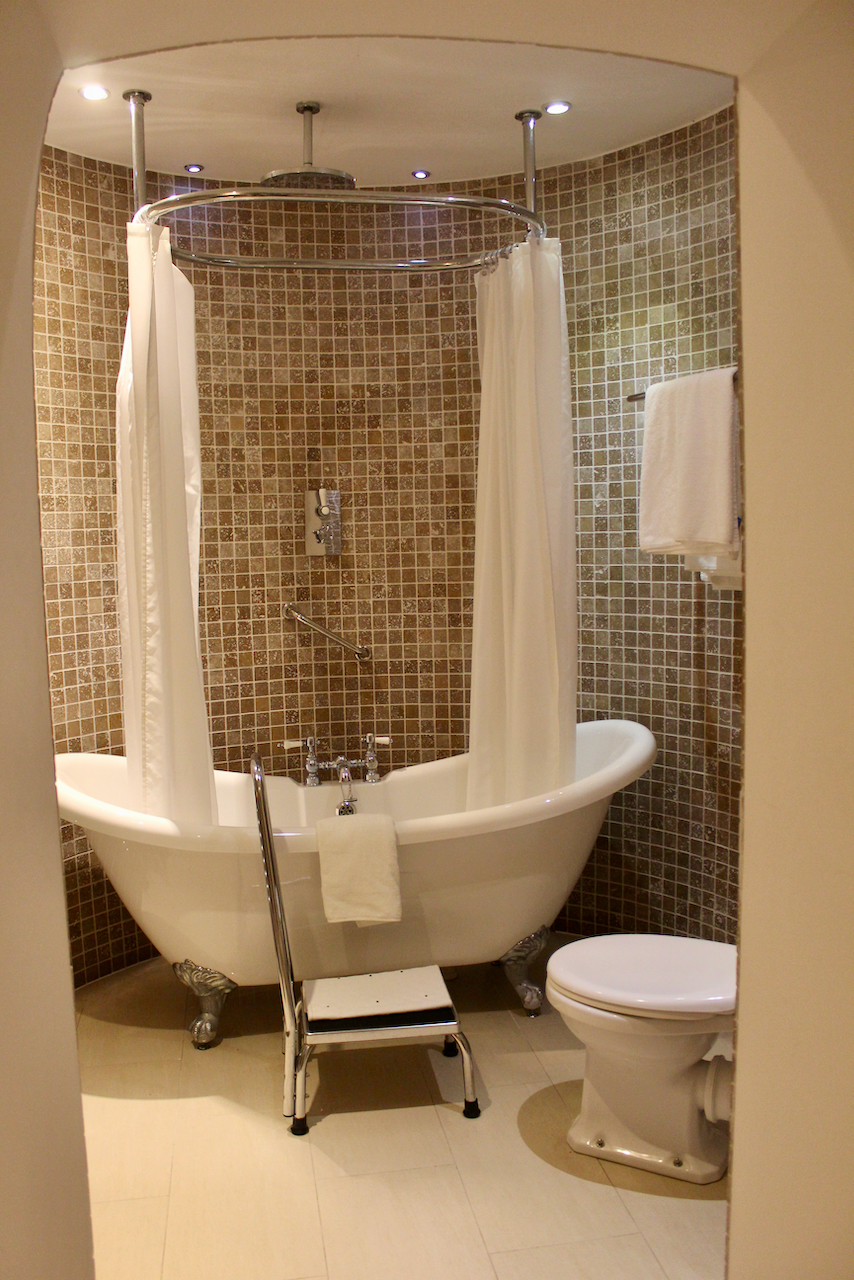
The oldest part of the castle can be pinpointed in the aerial view. According to the National Inventory of Architectural Heritage the “earlier house of c.1750 [is] embedded within northern section of south-east side concealed behind extension of c.1990, junction marked by square-plan rendered turret corresponding to north-west side in simplified form.” This square plan turret actually contains our bathroom!
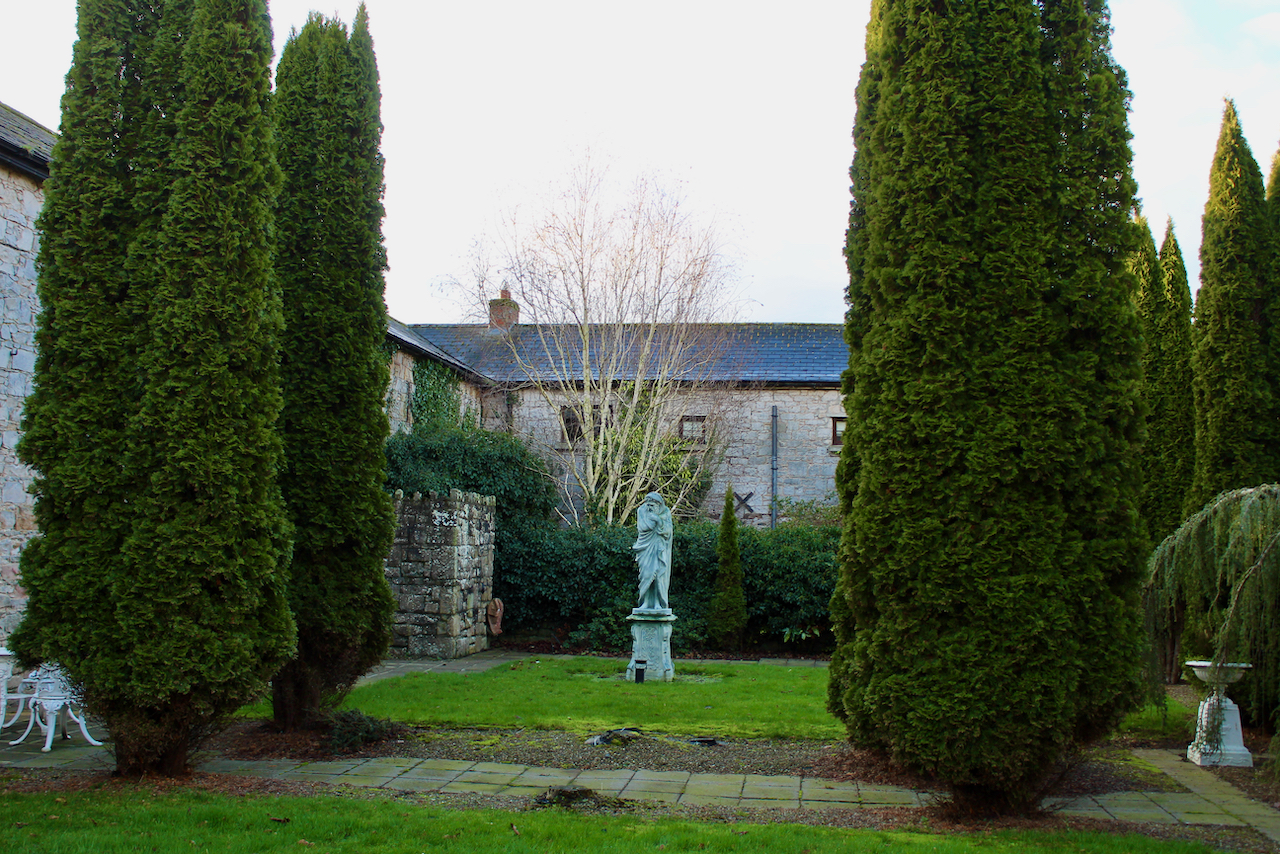
Beyond Mitzi’s Garden a path leads to the car park and further self-catering accommodation, beyond the tennis court. A branch of this path and driveway curves around to the courtyard at the back of the castle. One can also enter this courtyard through the castle. The courtyard originally contained the stables, but these have been converted into more hotel accommodation. There are about sixty rooms in the courtyard.
“Colonel Joseph Pratt had married Jamima, daughter of Sir James Tynte [of Tynte Park, County Wicklow – the beautiful house that stands there today wasn’t built until around 1820; Jamima married in 1806], and had ten children. The eldest – Mervyn, born in 1807 – married Madeline Jackson, only daughter and heiress of Colonel Jackson of Enniscoe, Co. Mayo. They inherited this property when Colonel Pratt died.
“He succeeded his father, Col. Joseph Pratt, as owner of Cabra in 1863, but from this time onwards, the interests of the Pratt Family were divided between Cabra in Co. Cavan and Enniscoe in Co. Mayo. Mervyn Pratt died in 1890 and was succeeded on his death by his eldest son – Major Mervyn Pratt, in 1927.”
Enniscoe, by the way, is another Section 482 property which I look forward to visiting, which also provides accommodation. The house was completed in 1798. [15]
Mervyn Pratt (1807-1890) who married into Enniscoe had several brothers. Joseph Pratt took the name of Tynte in 1836 from his mother and lived in Tynte Park. Mervyn held the offices of High Sheriff of County Cavan in 1841 and High Sheriff of County Mayo in 1843. He was also Justice of the Peace for County Cavan and High Sheriff for County Meath in 1875. His son Joseph Pratt (1843-1929) inherited Enniscoe and Cabra Castle, and then Joseph’s son Mervyn (1873-1950) lived at Enniscoe and left Cabra Castle unoccupied. He served in the military, and was a Justice of the Peace, and never married. He bequeathed Cabra to his nearest male relative, Mervyn Sheppard (1905-1994), a Malayan Civil Servant. [16] According to the Cabra Castle website, death duties and taxes, rates, the cost of repairs, and farm losses, meant he could not afford to live there, and he had to sell it. It was sold in 1964 to the Brennans and turned into a 22 bedroom hotel.
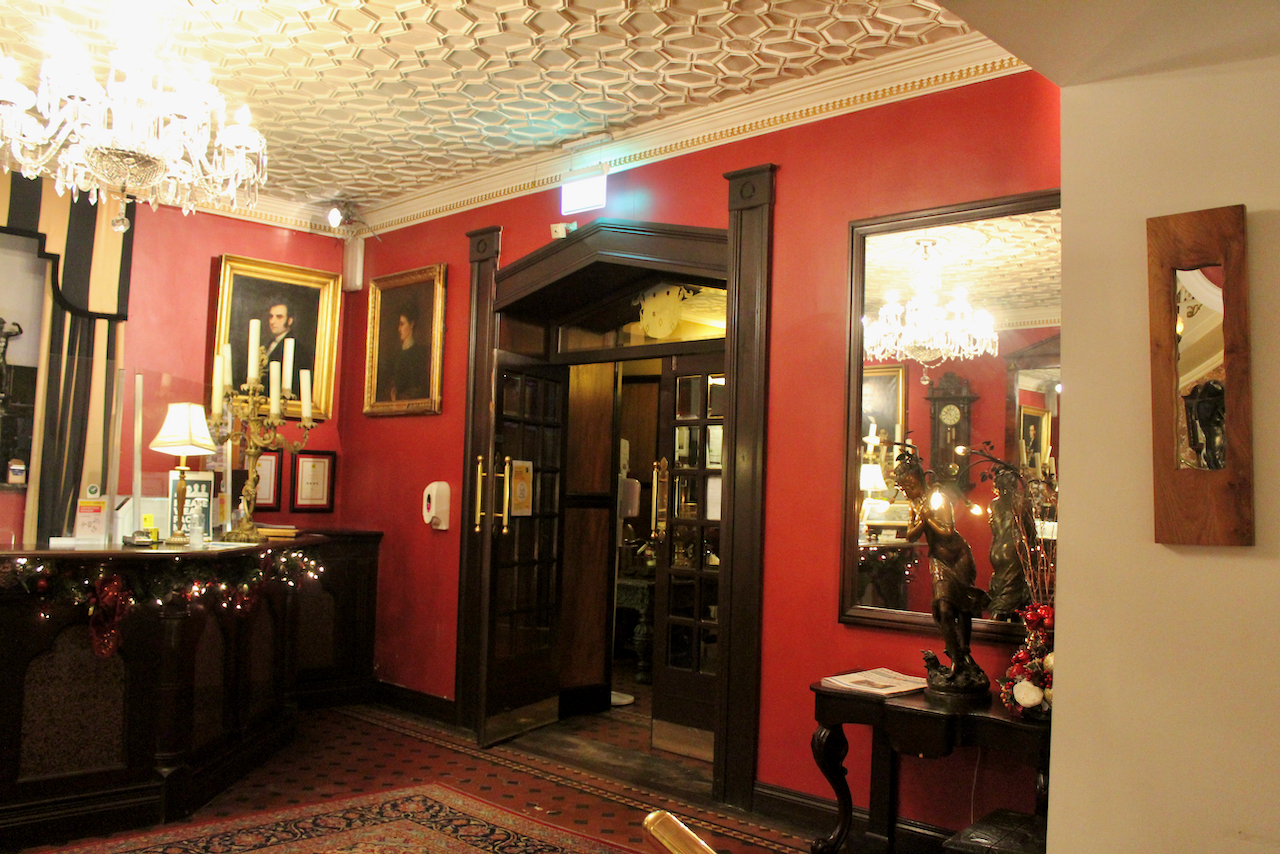
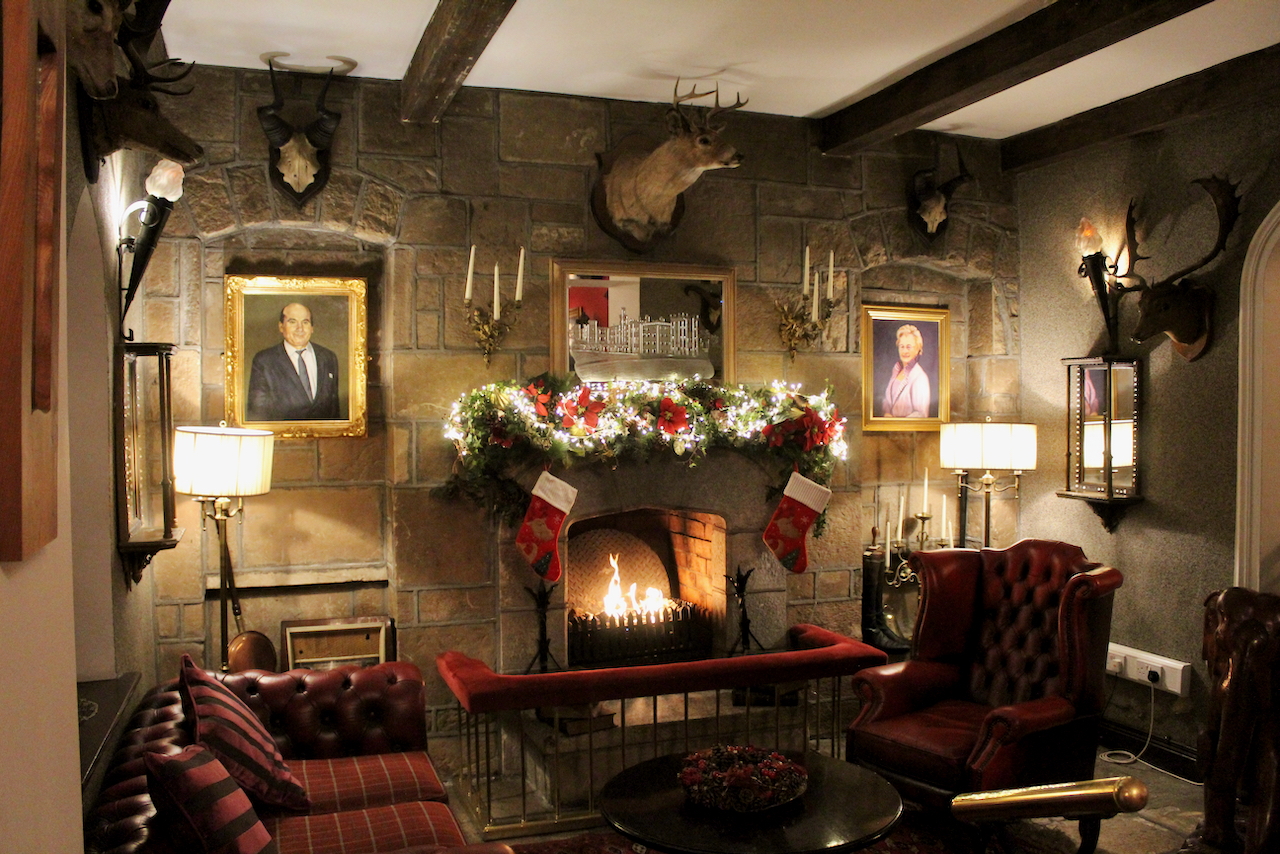
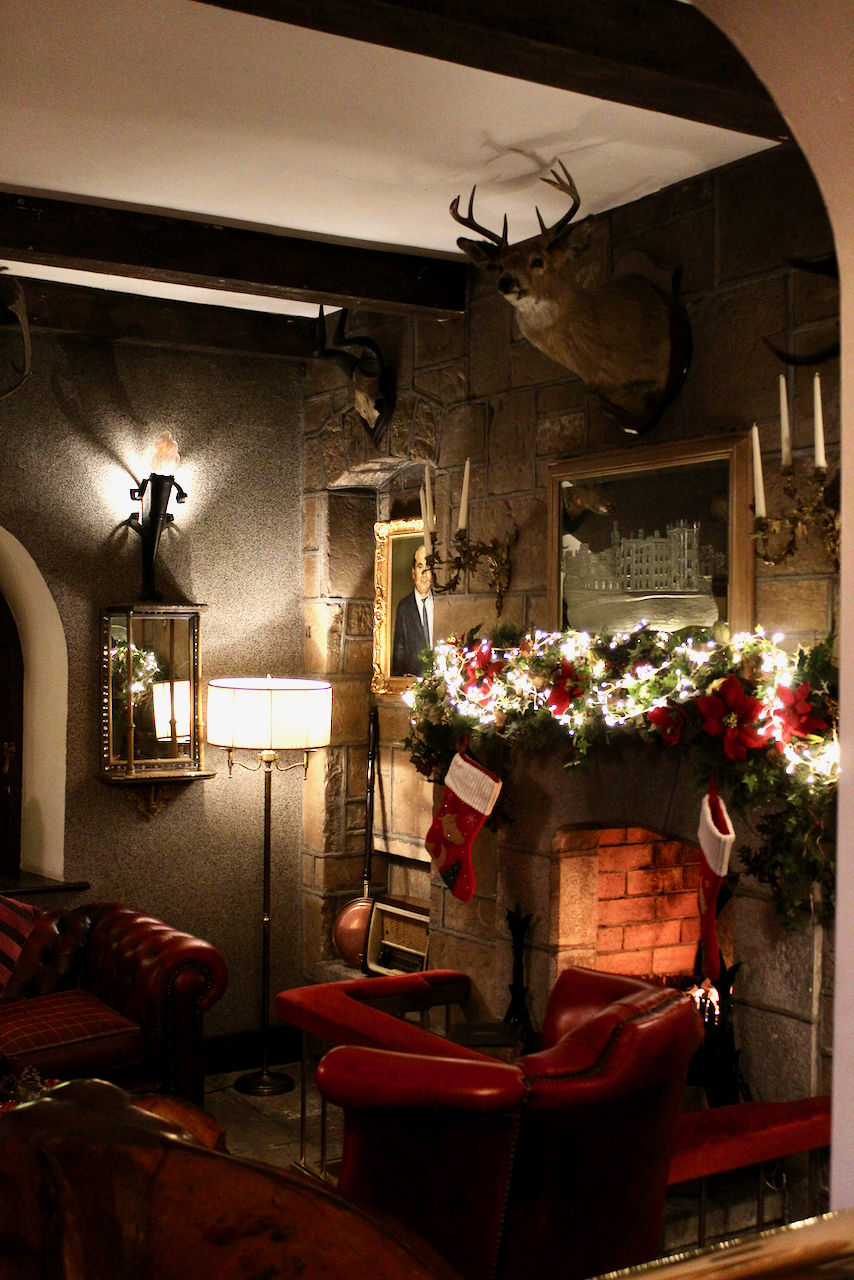
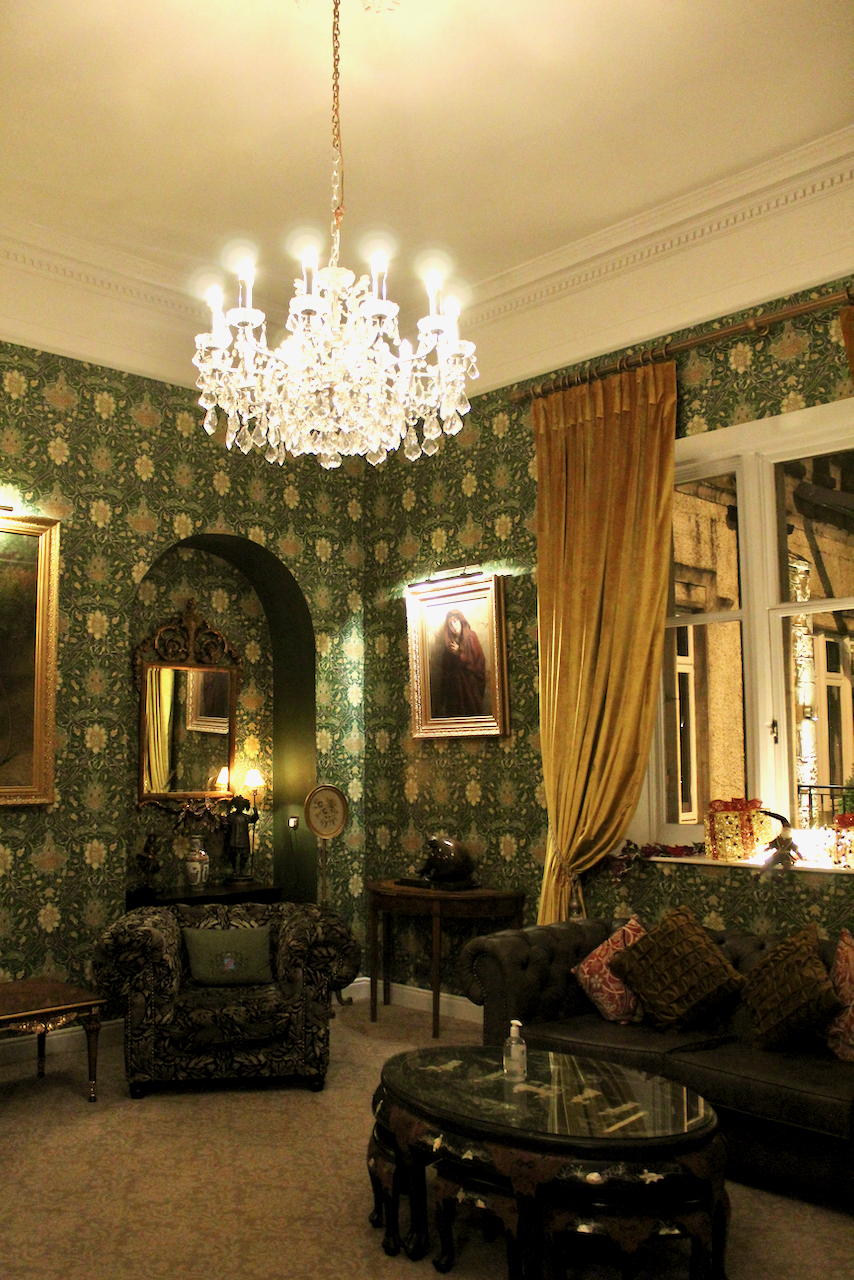
The manager of the hotel, Johnny, took us on a tour. While we waited for him we sat by an open fire in a small sitting room off the reception hall.
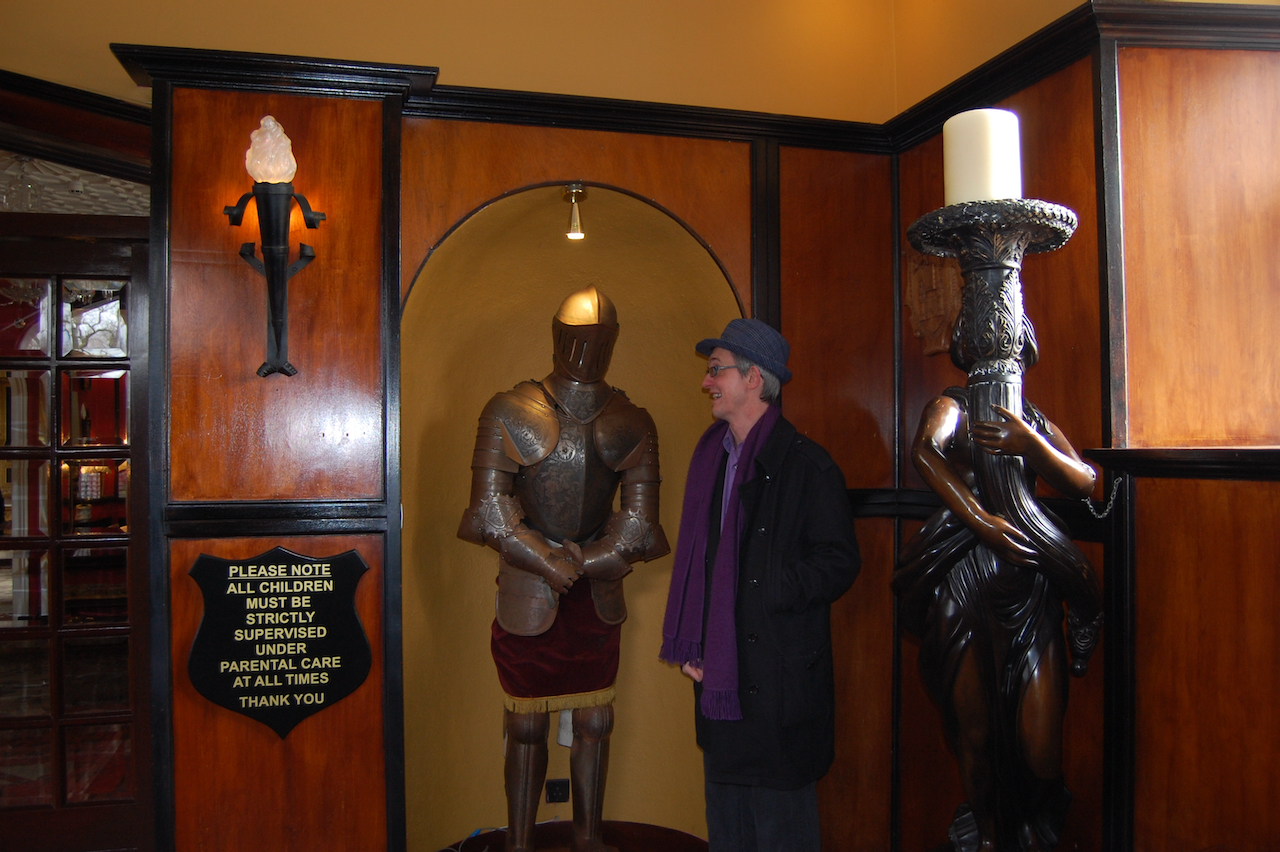
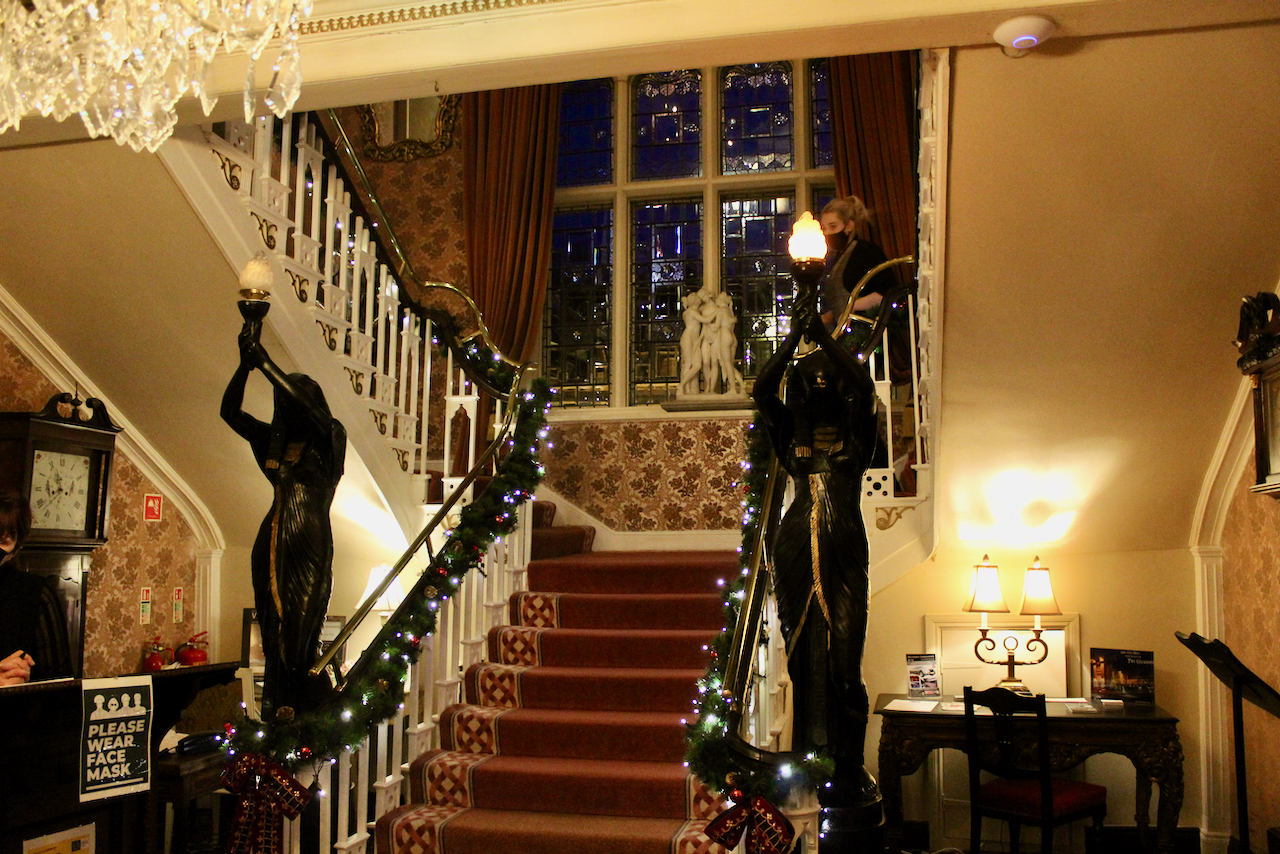
Beyond the reception area is the staircase hall with a bifurcating staircase with metalwork balustrade ascending to the first floor. Two statues very similar to the ones that were recently removed from outside the Shelbourne Hotel in Dublin while the owners determined whether they represented slave girls or not (they do not) adorn the staircase. [17]
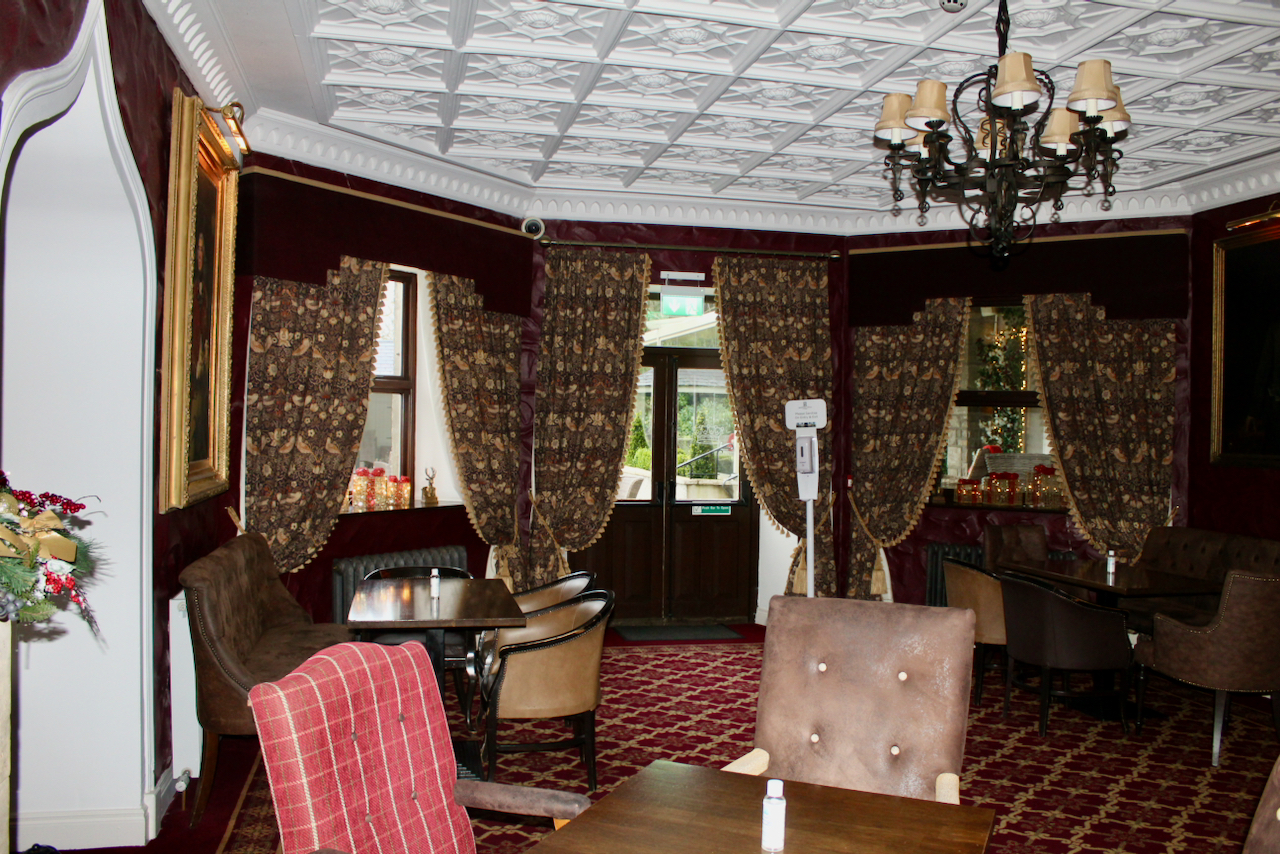
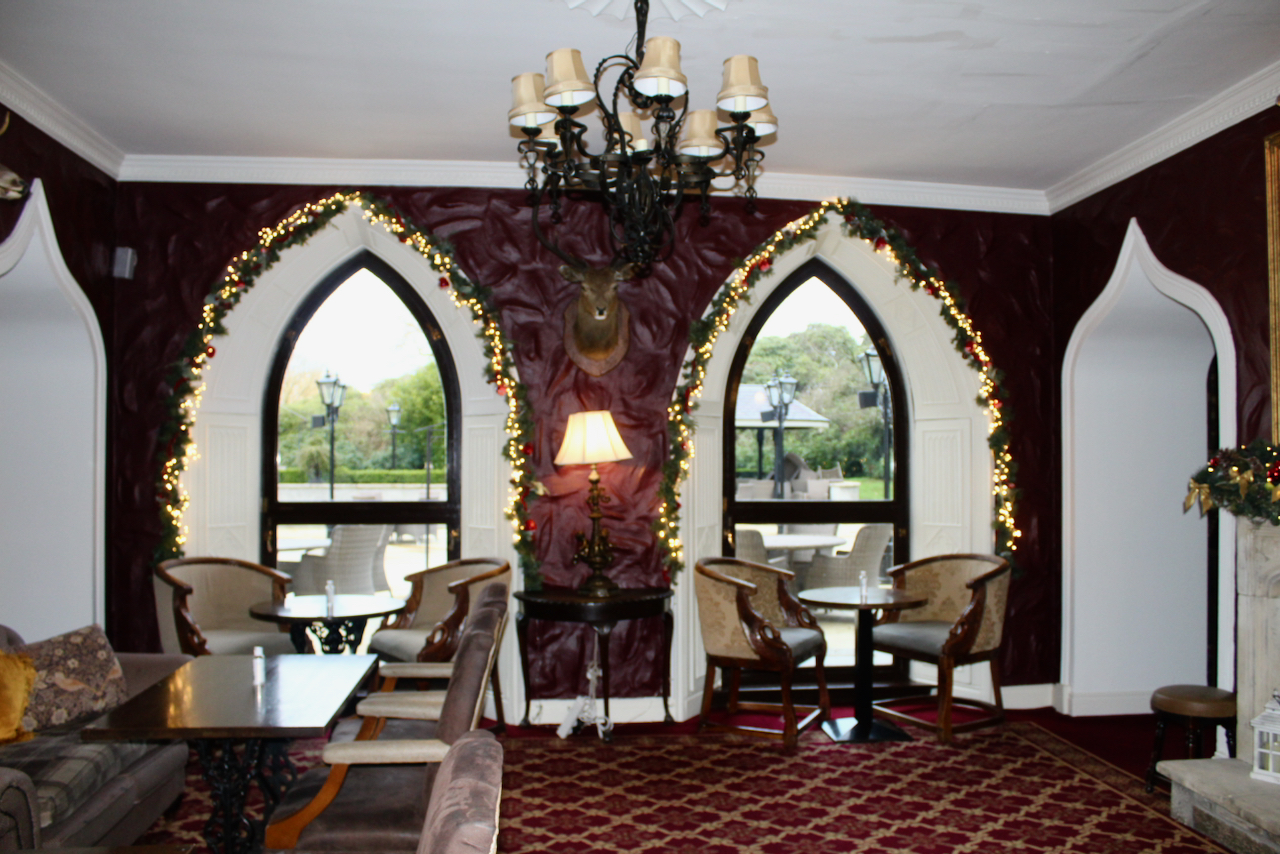
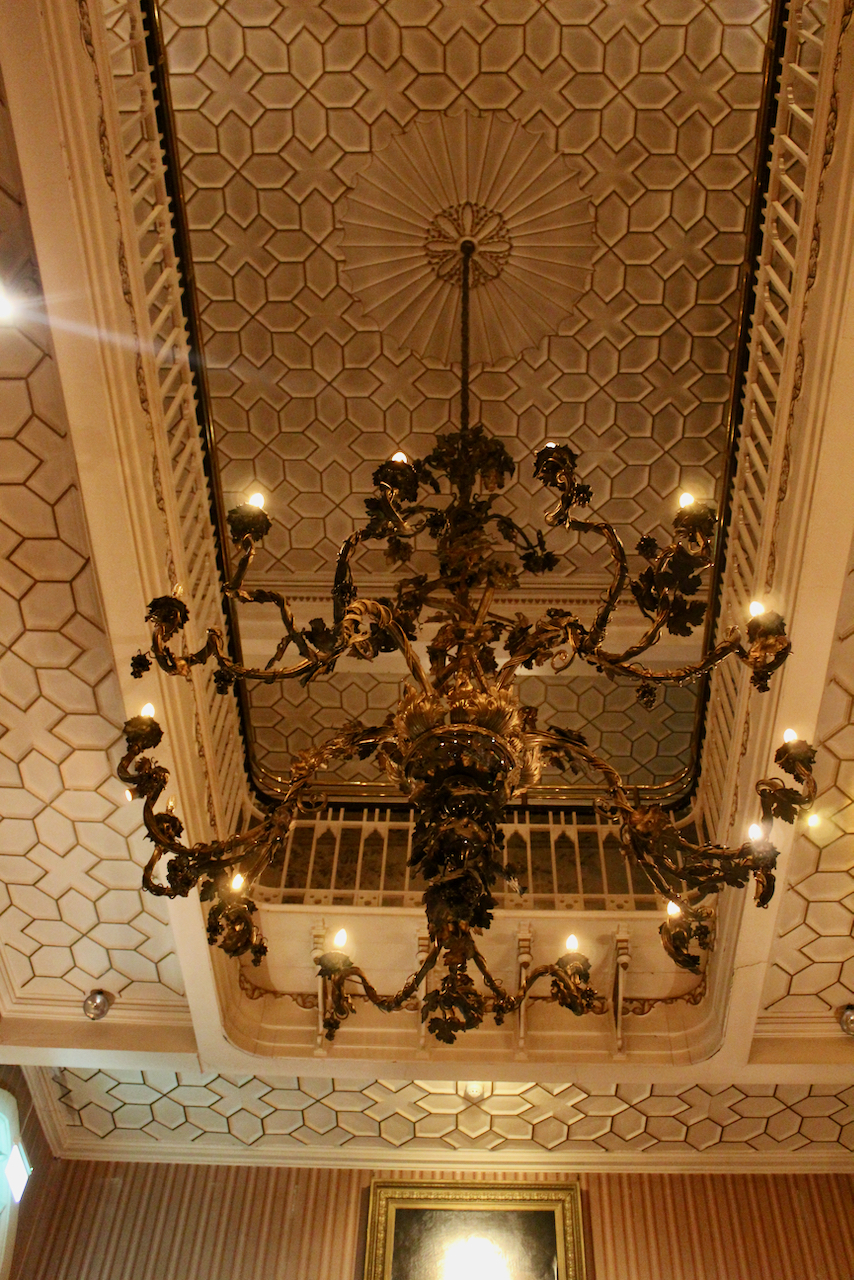
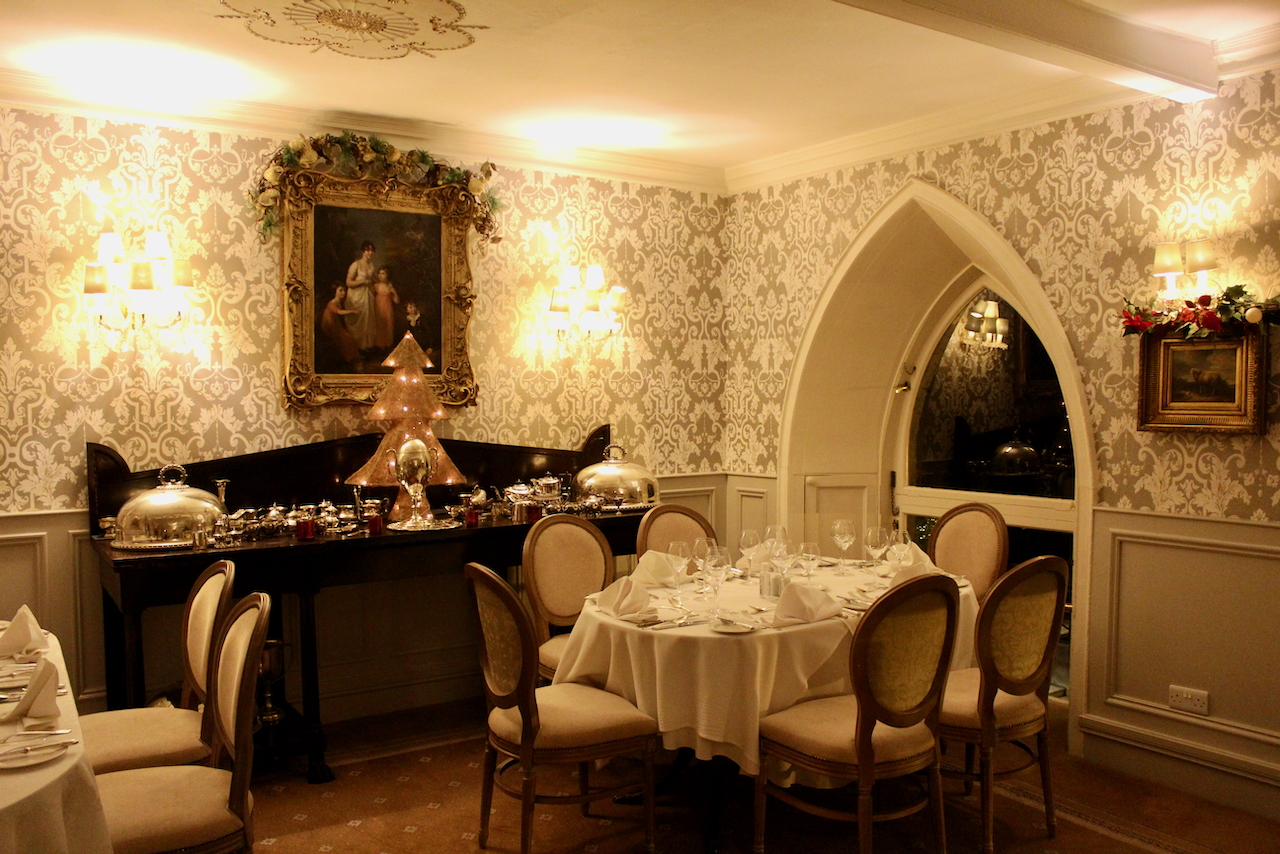
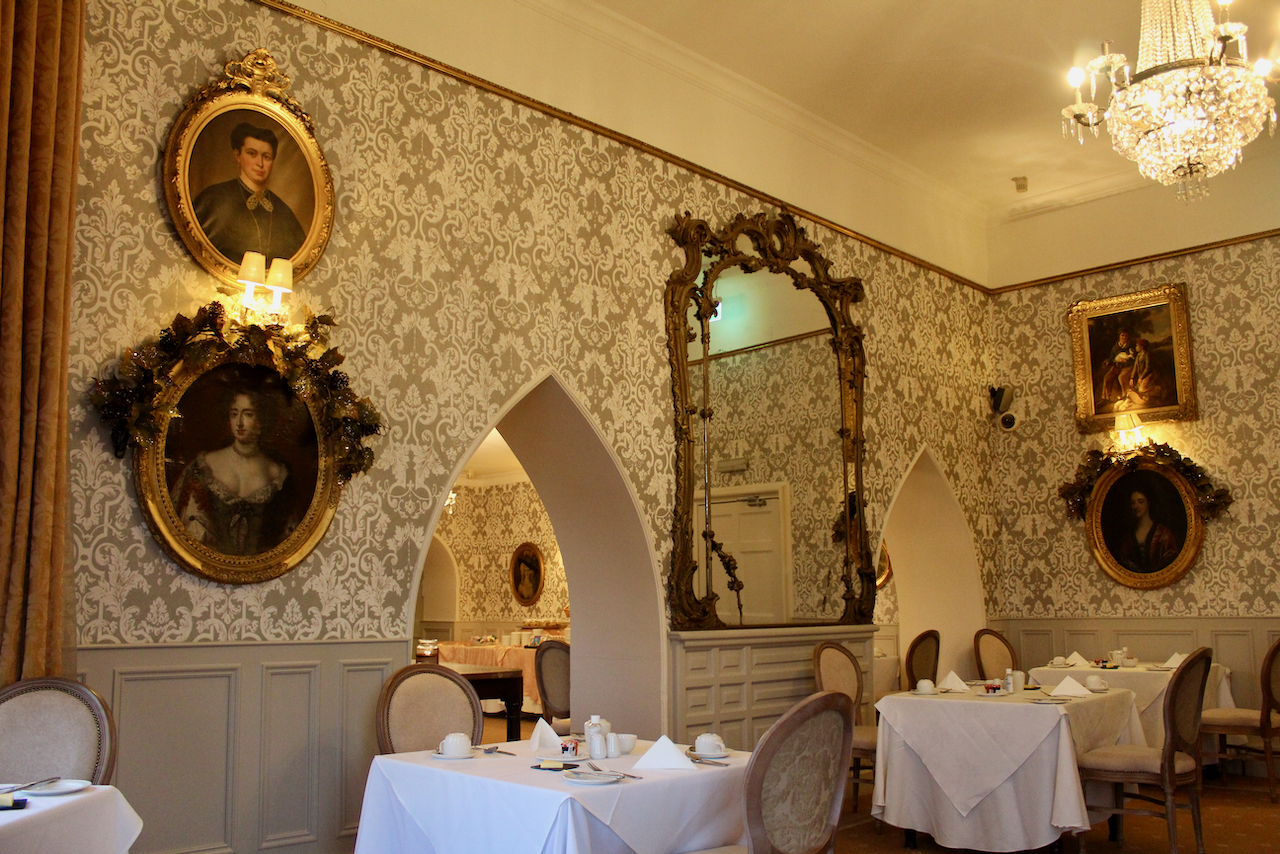
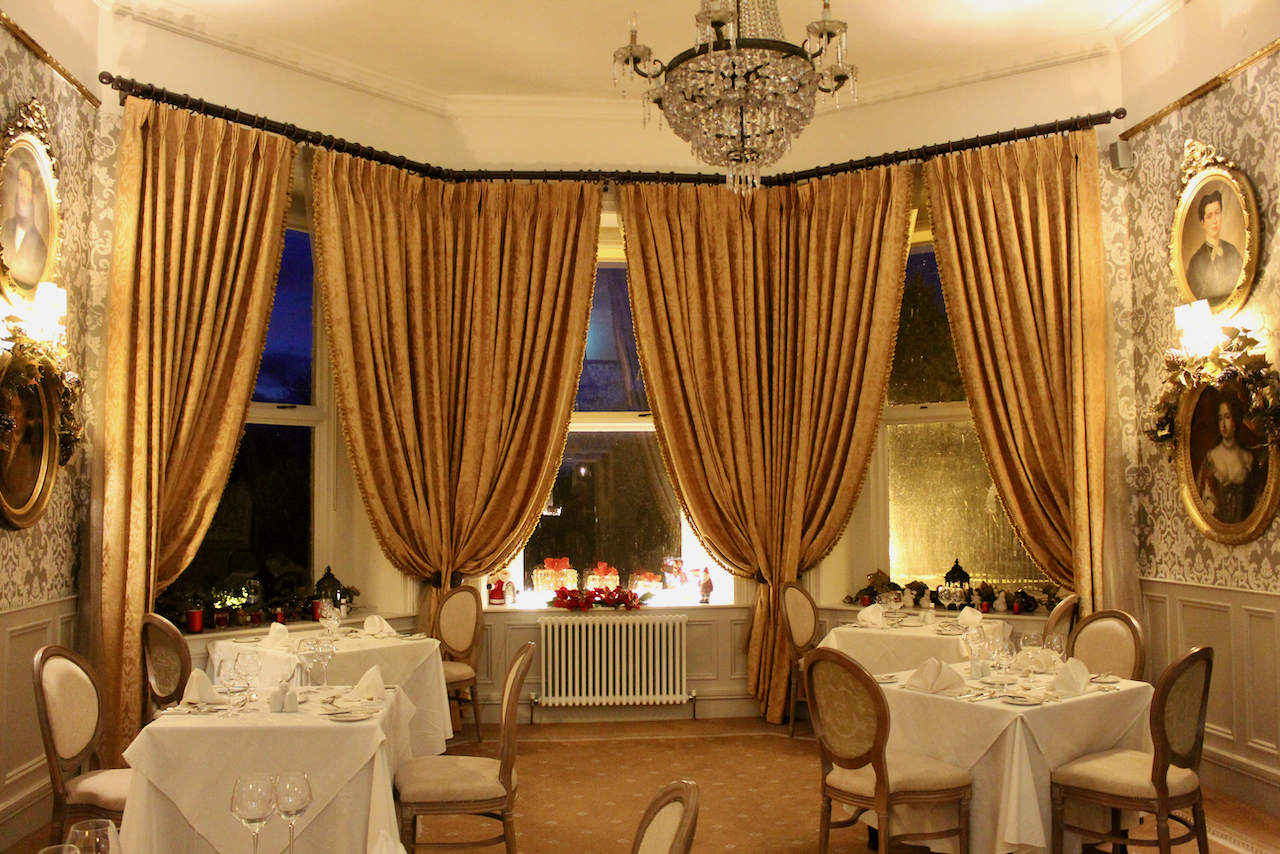
The ceiling has matching gilt decoration. Next to this room, facing the staircase, is the dining area – a suite of several rooms. The arches between the rooms reflect the entrance arch to the castle and the arched windows.
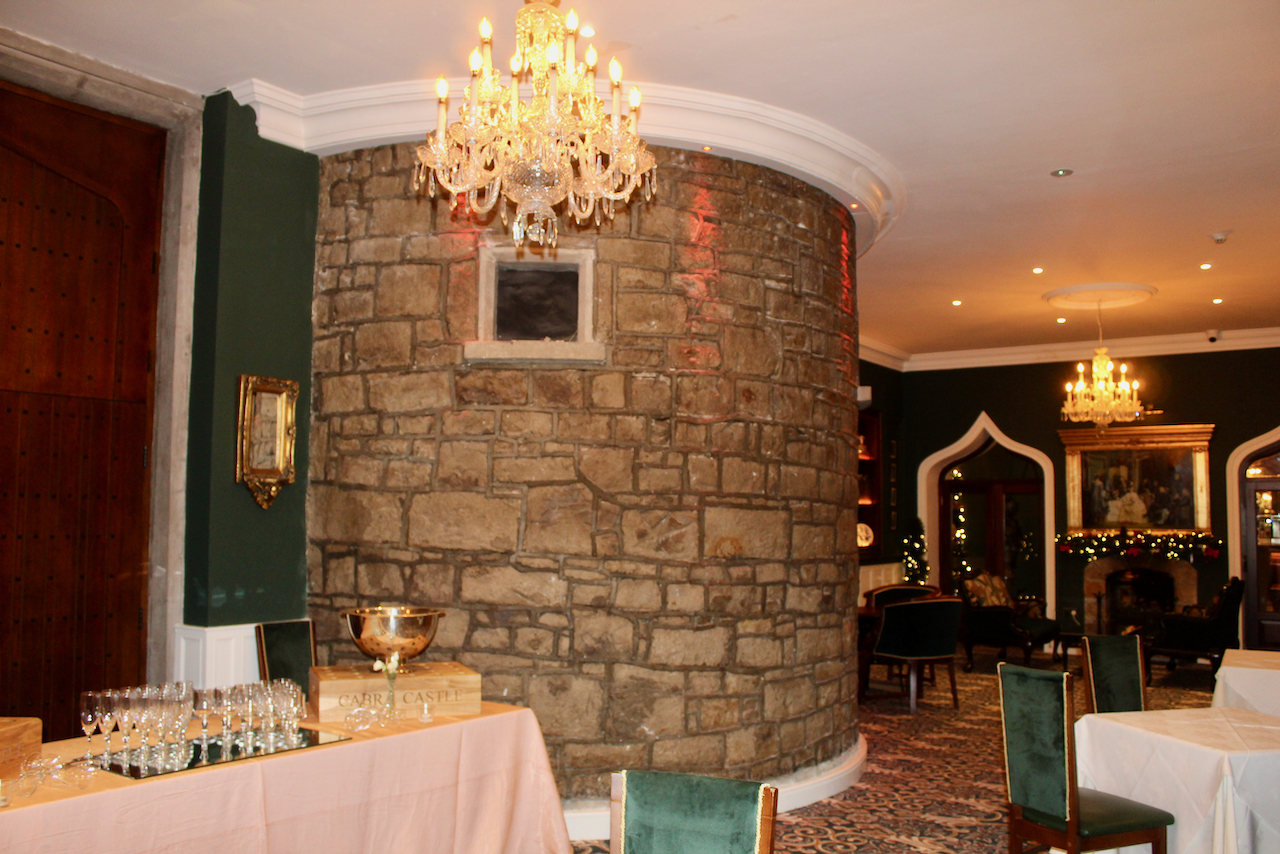
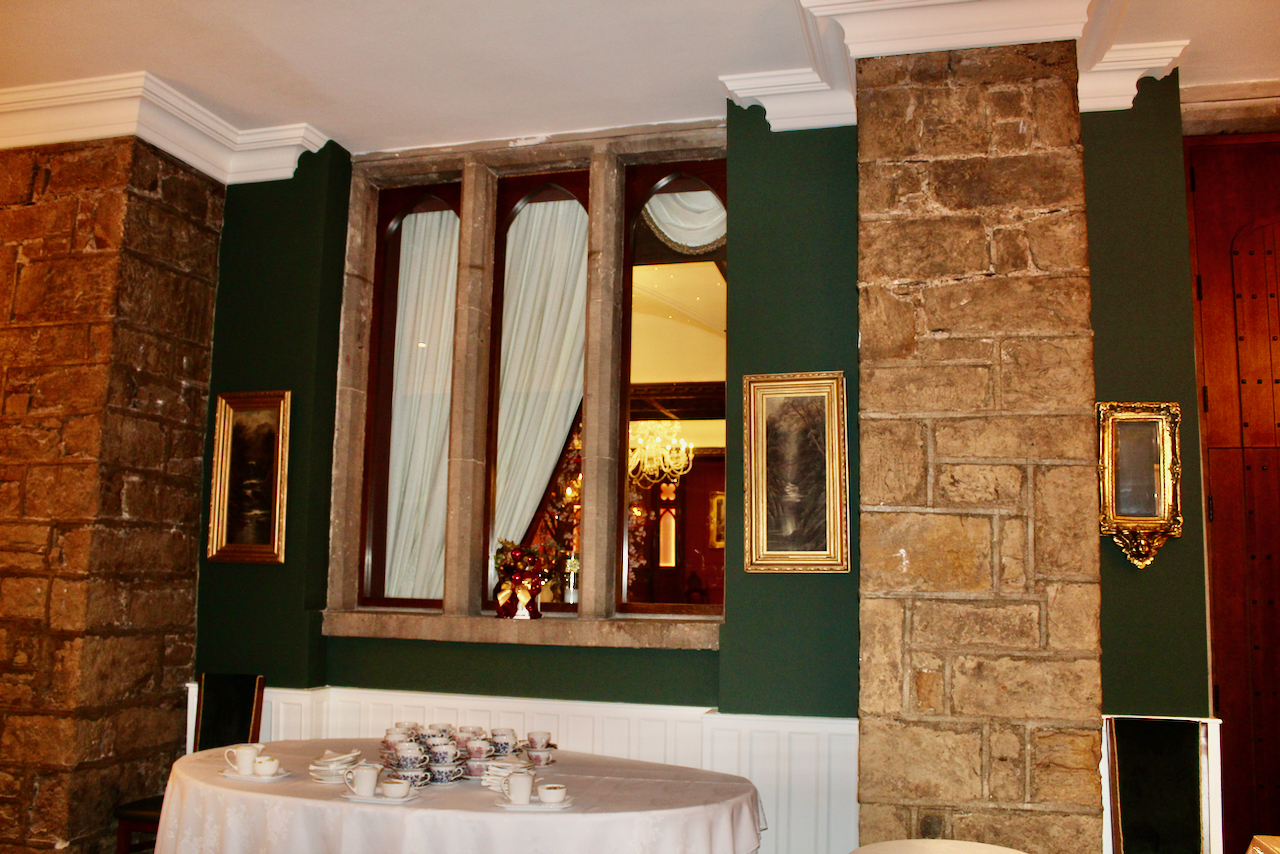
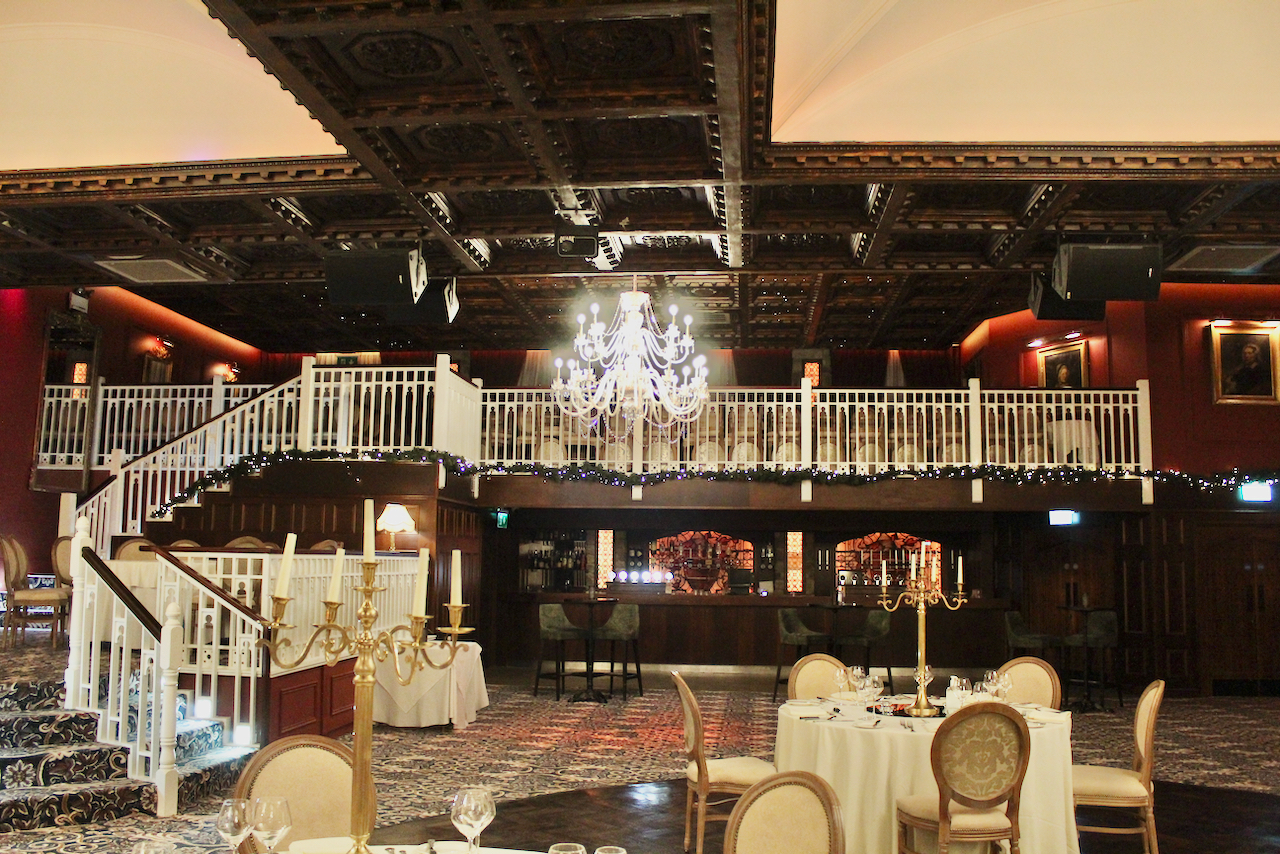
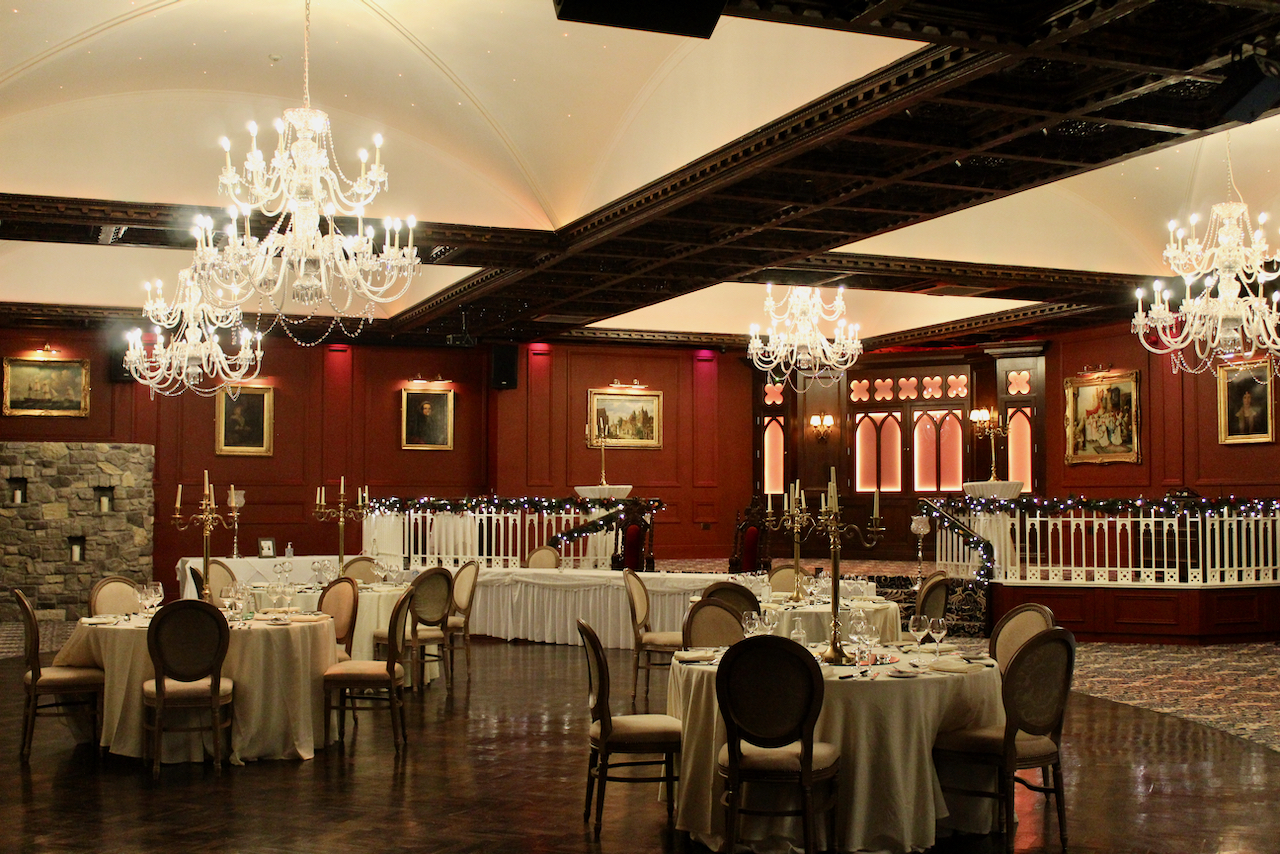
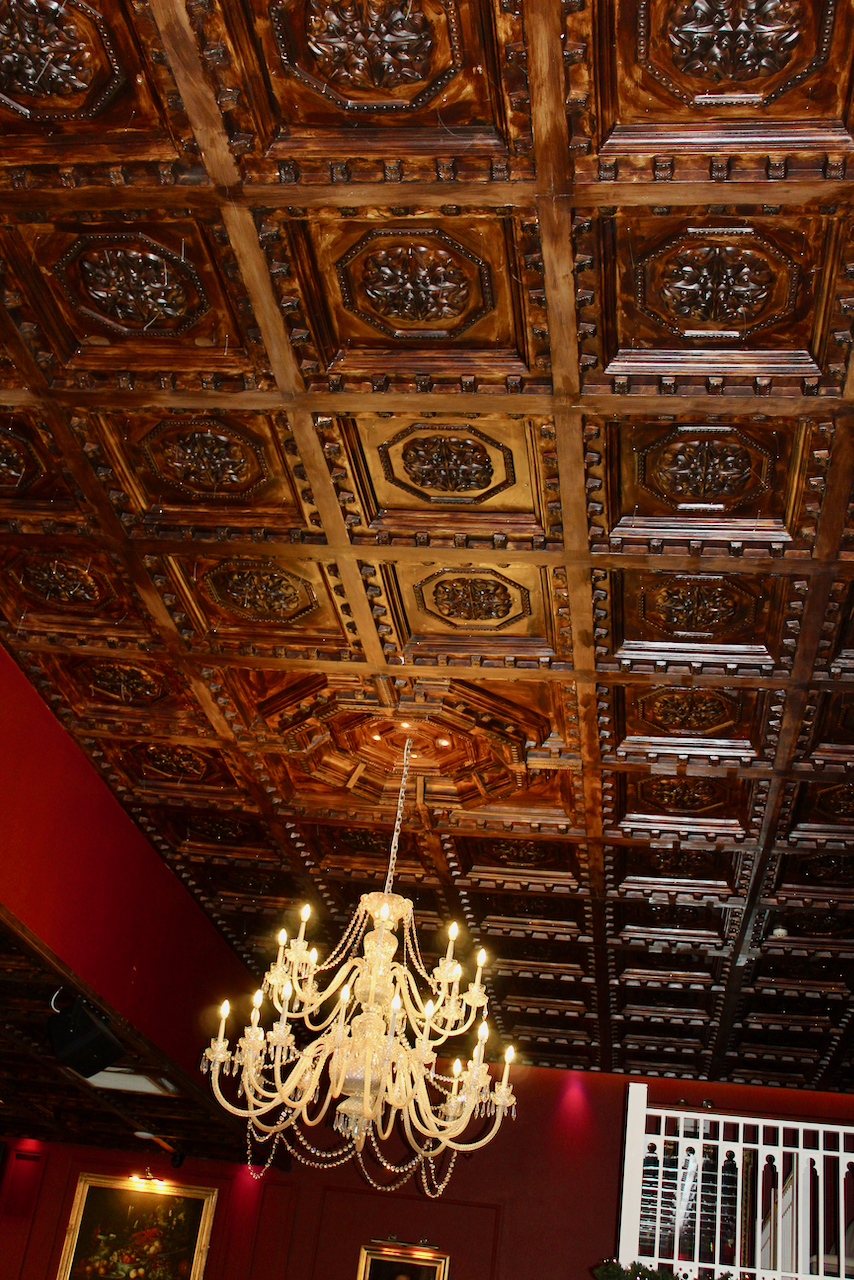
The manager then took us through to the most recent piece de resistance, the Ballroom. It has been sensitively built and decorated to reflect the style of the older parts of the castle, and I loved the ceiling, which is quite amazing and looks like heavy medieval carved wood but is actually manufactured using a modern technique. In the hallway leading to the ballroom, our guide pointed out that the original round stone tower of the castle has been incorporated.
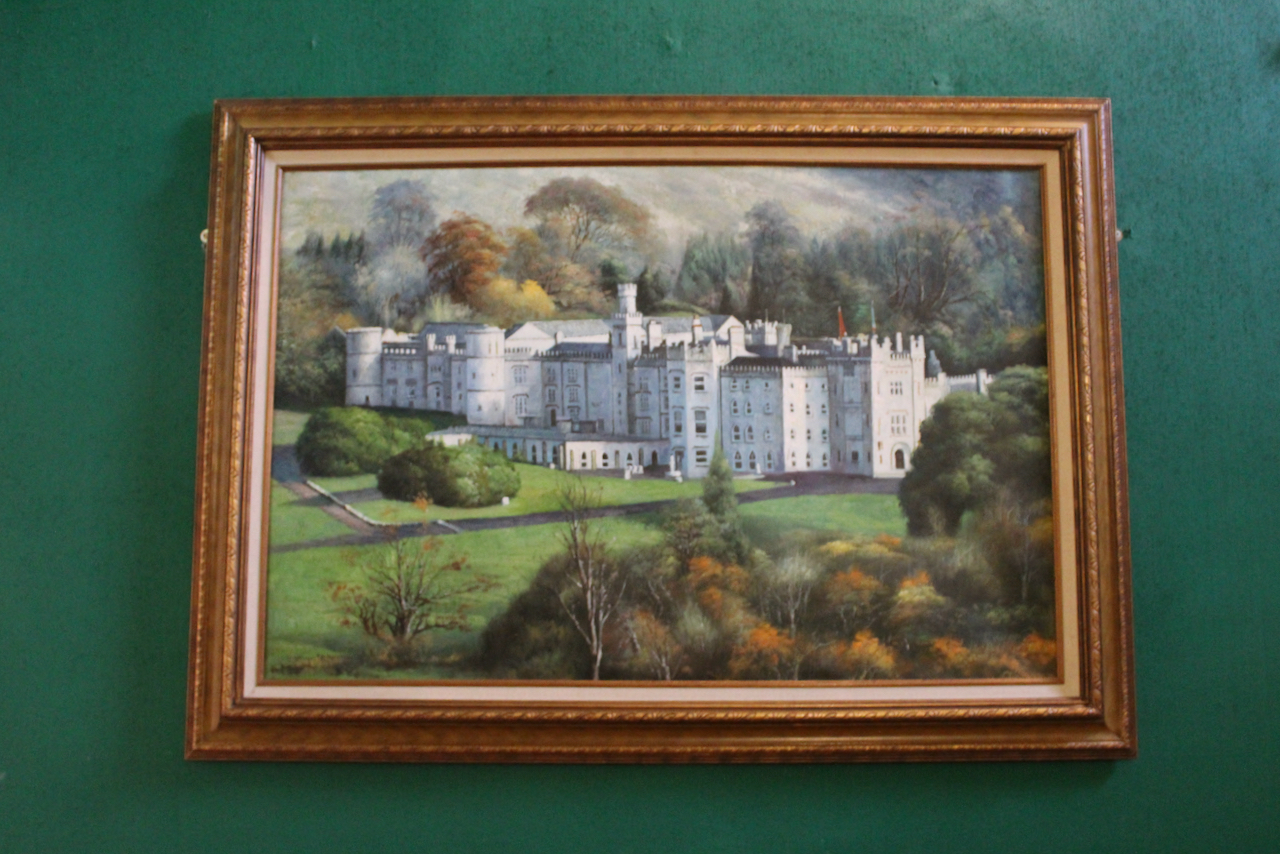
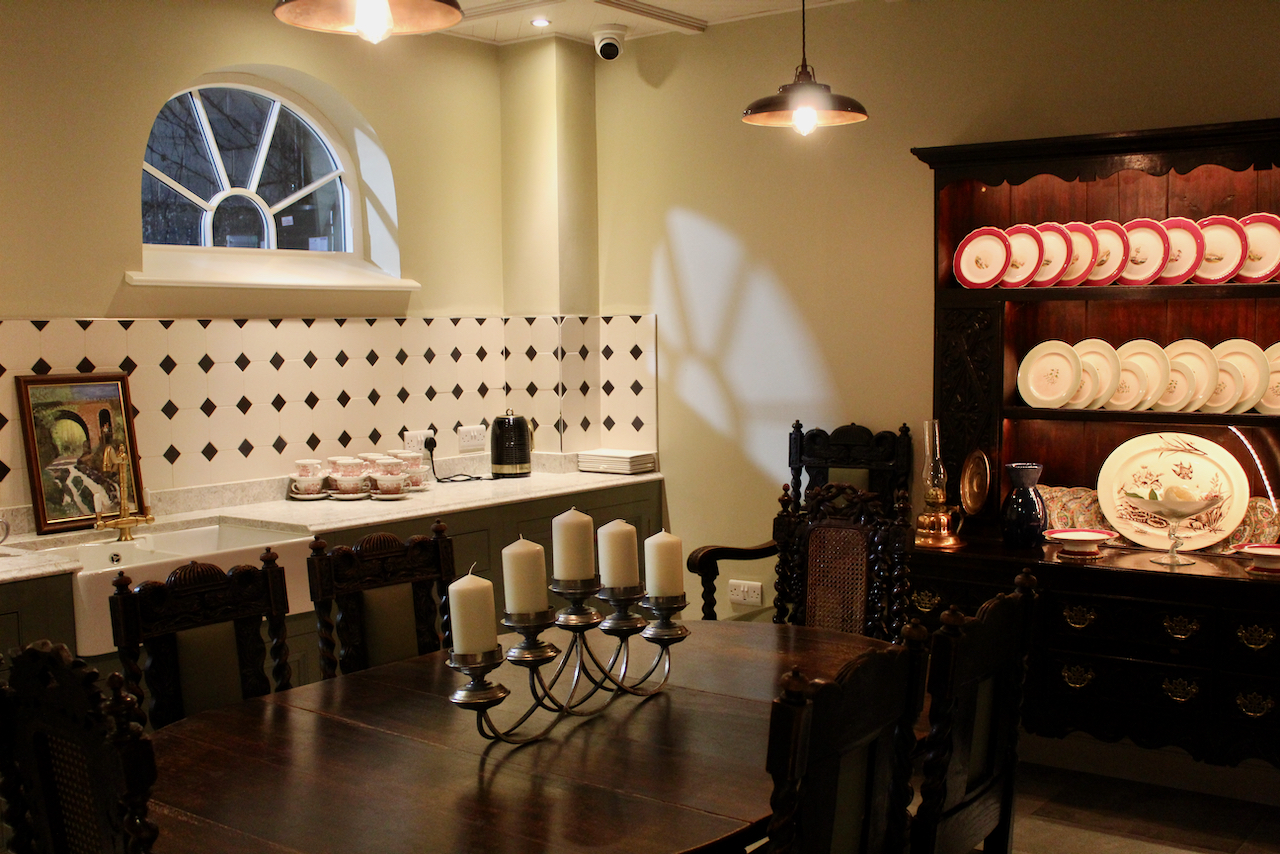
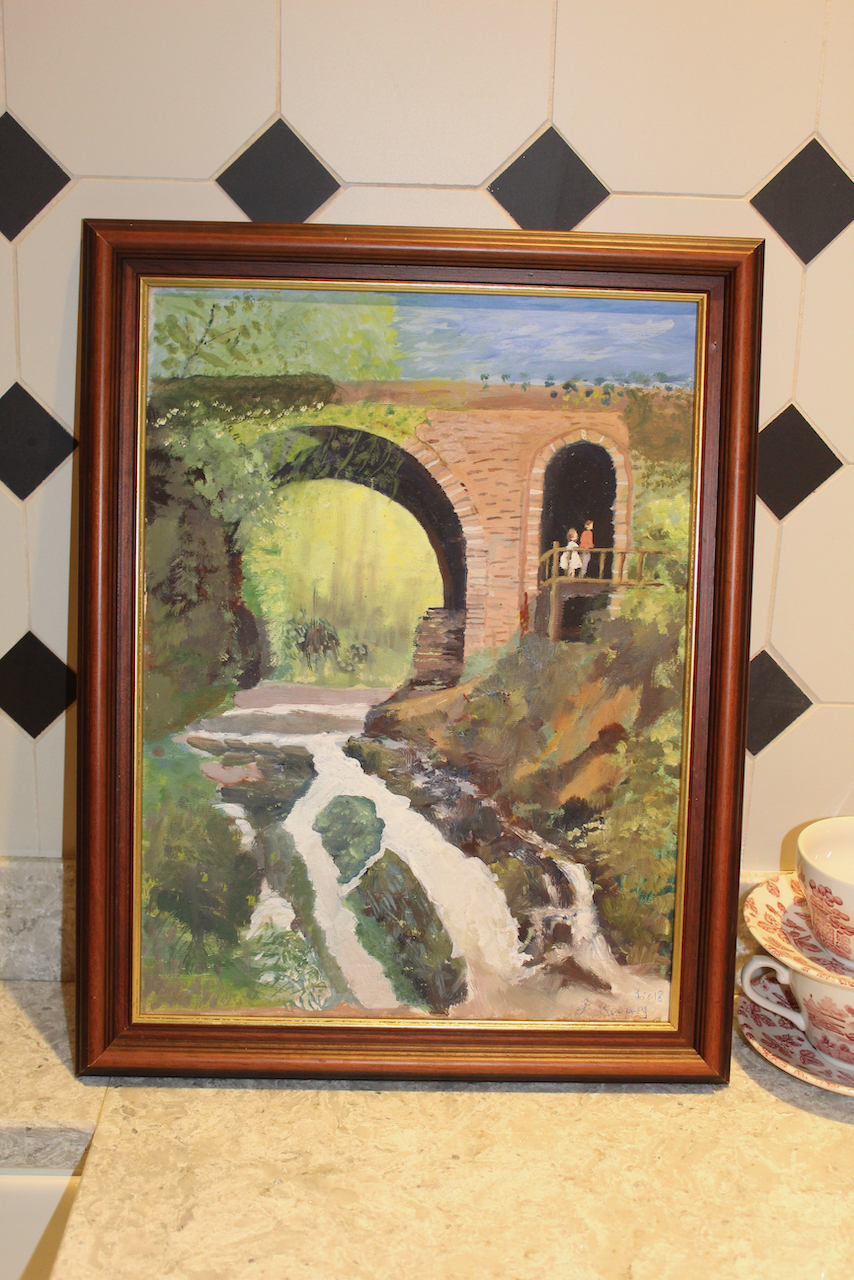
In Josephine’s kitchen, guests can help themselves to tea and coffee. A painting of Cormy Bridge, near where Old Cabra was located, is by Josephine herself!
Cabra Castle, December 2020.
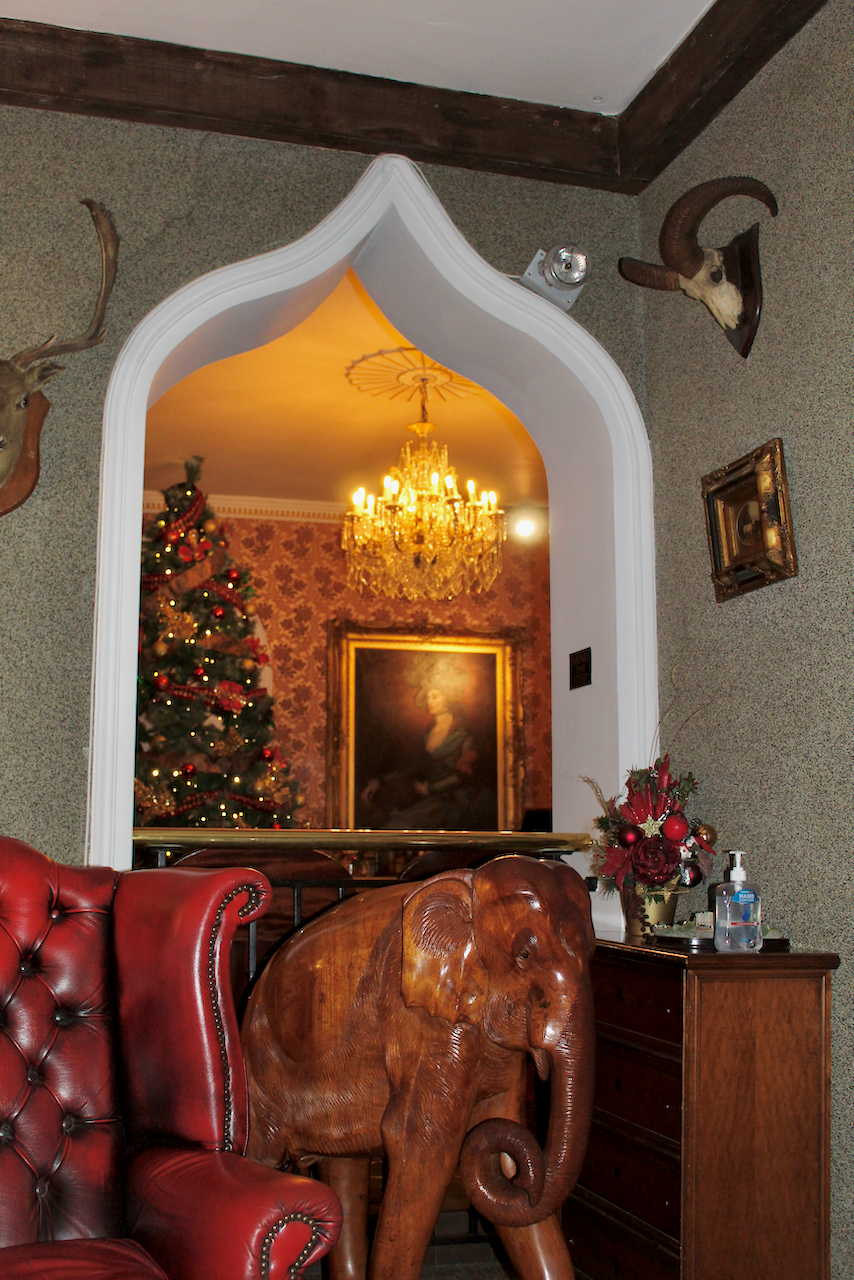
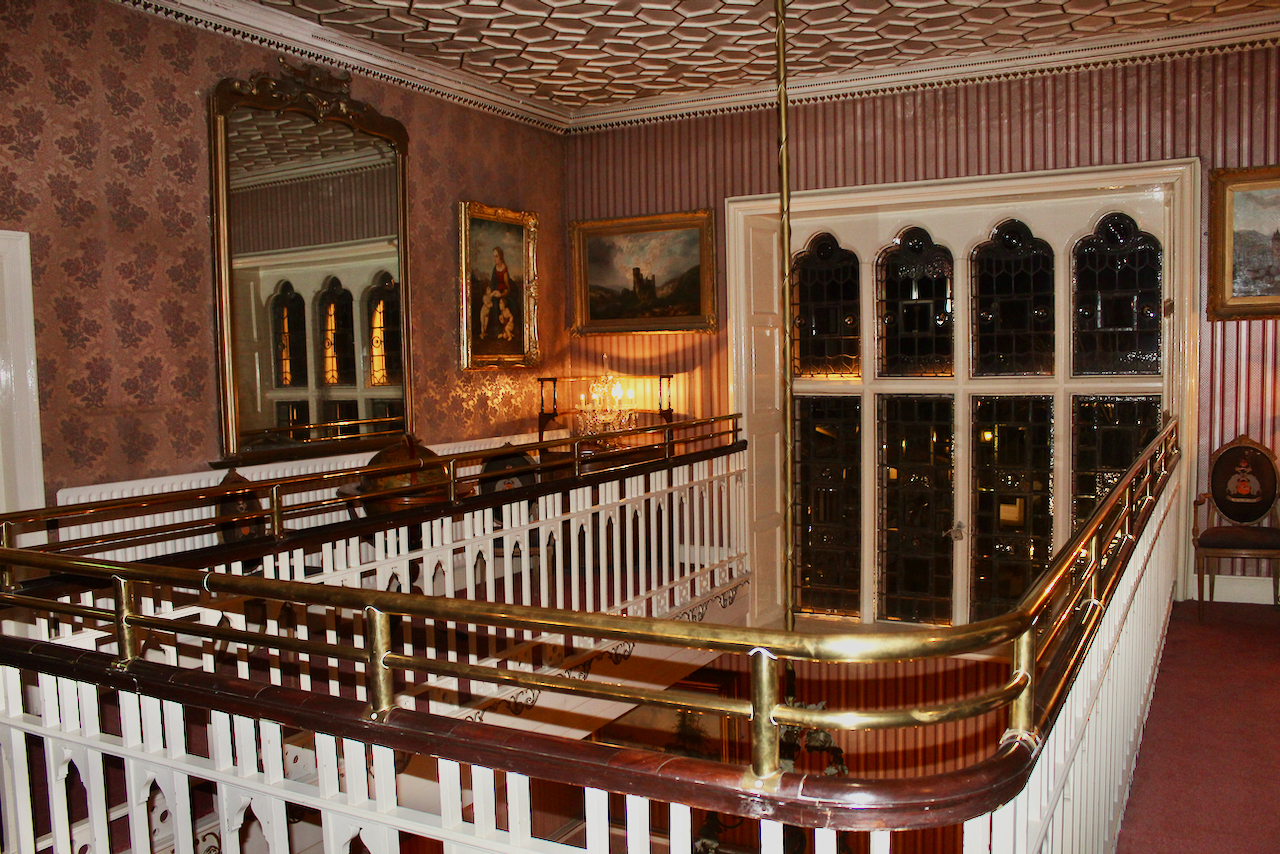
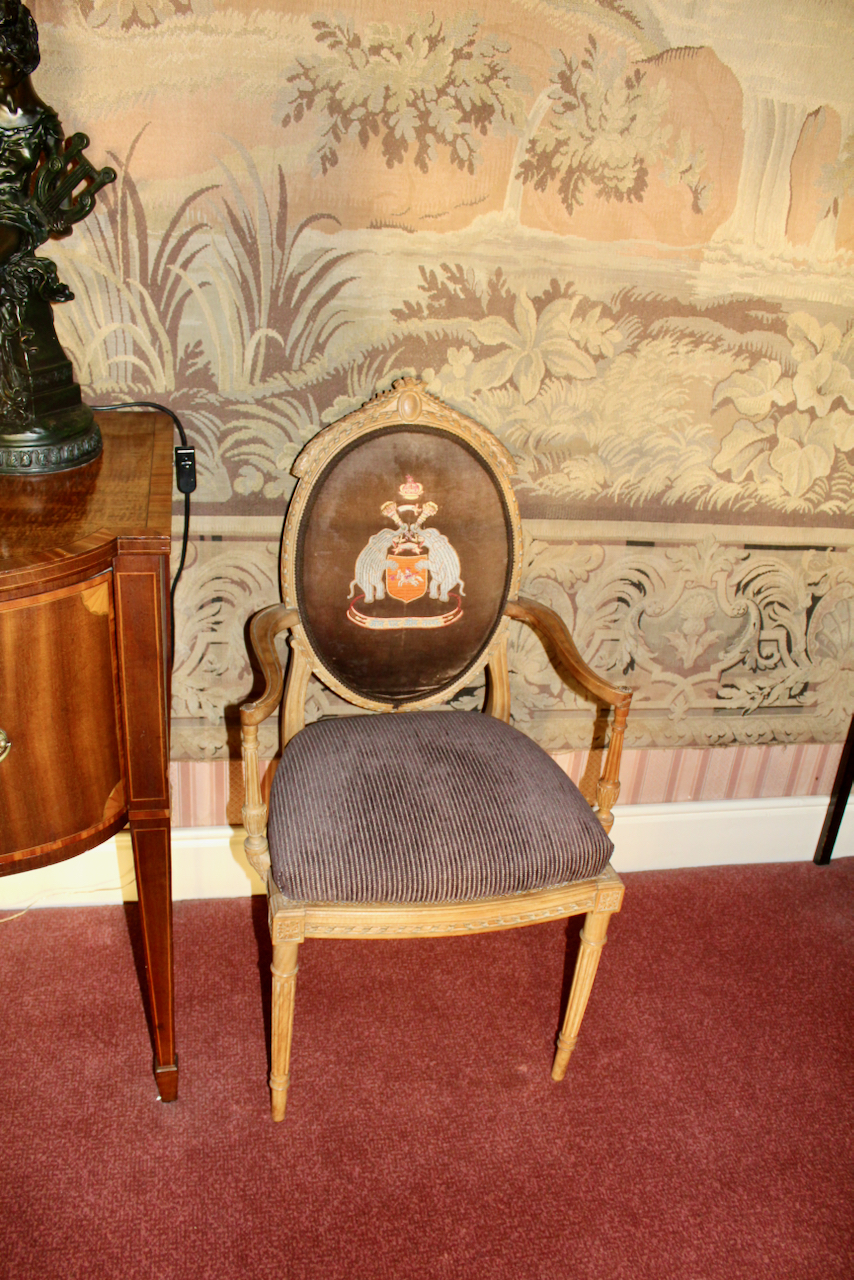
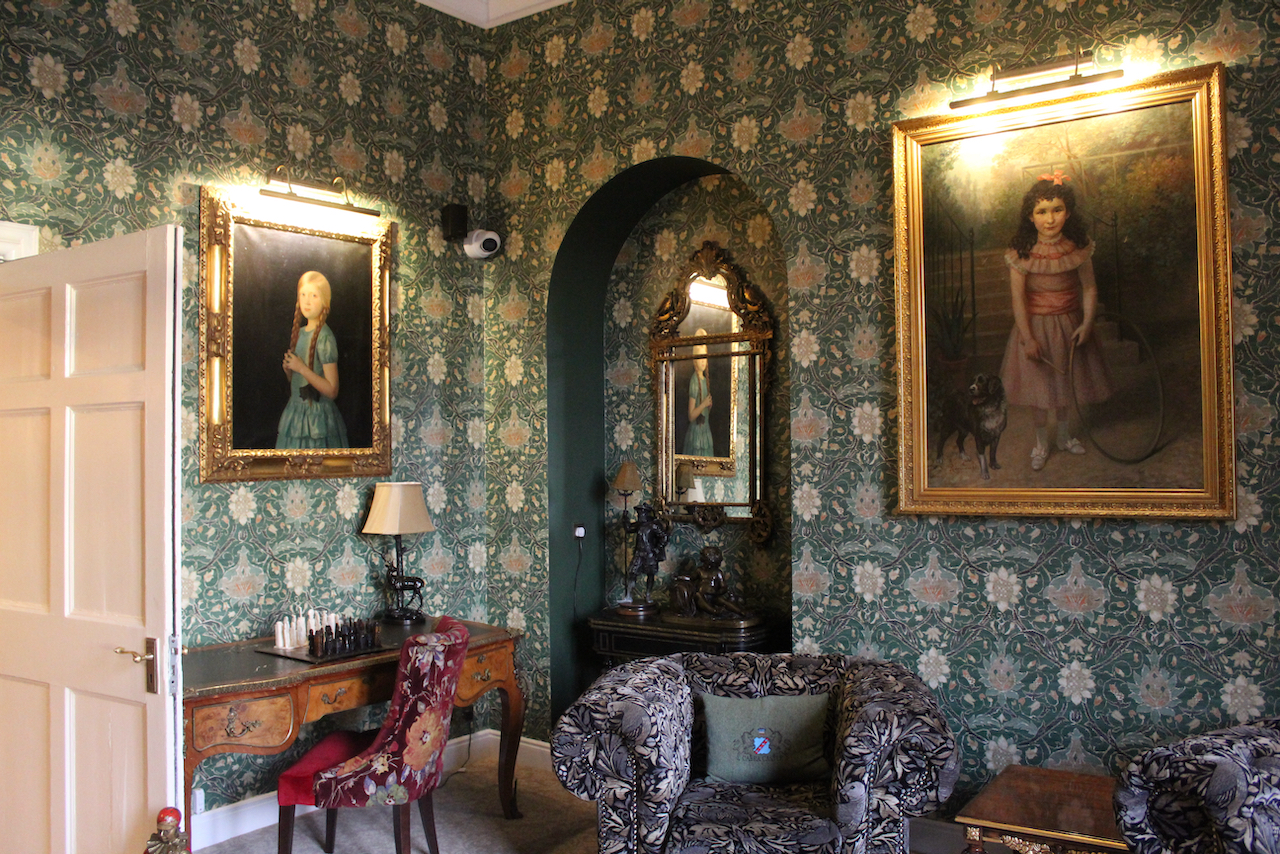
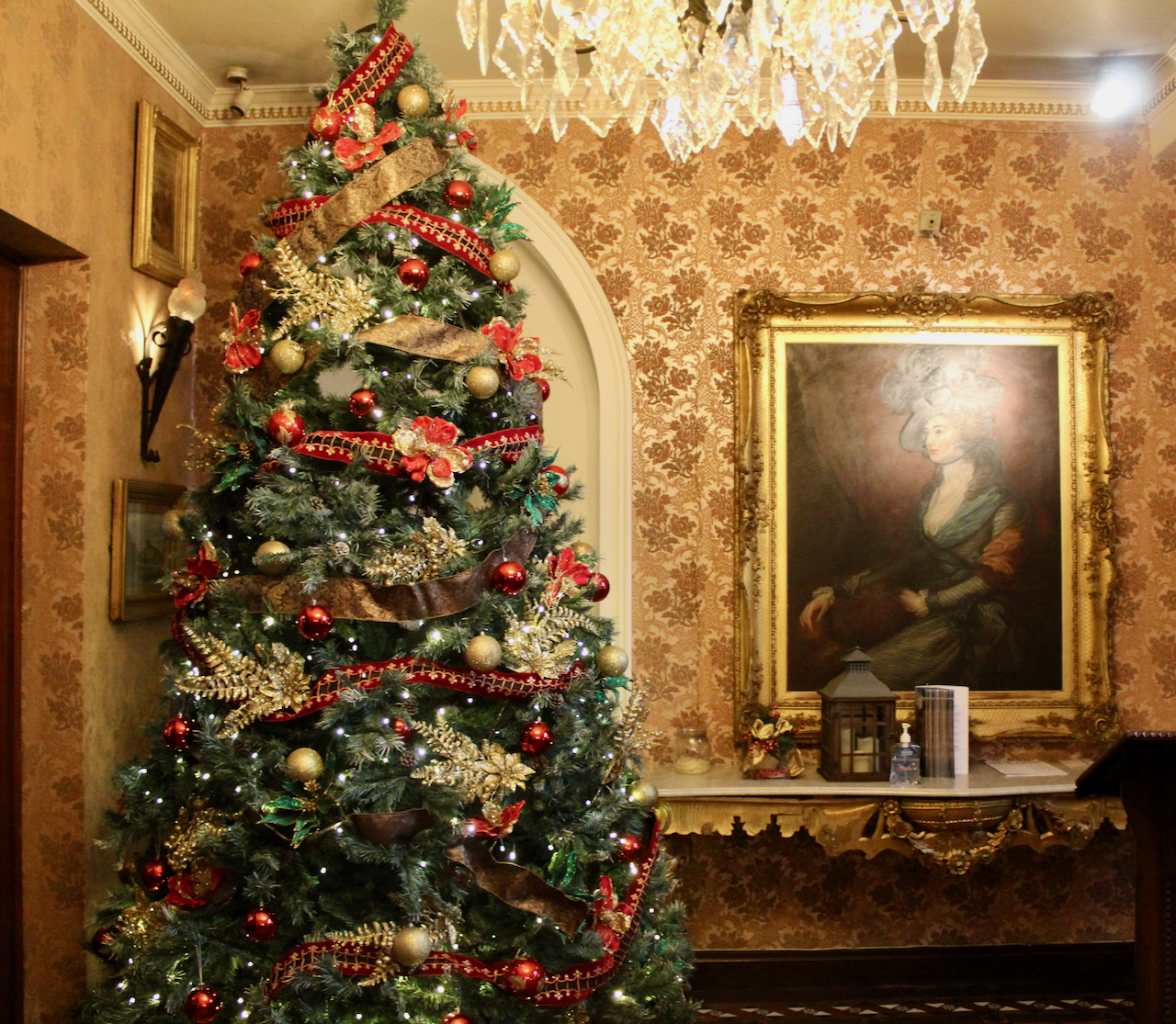
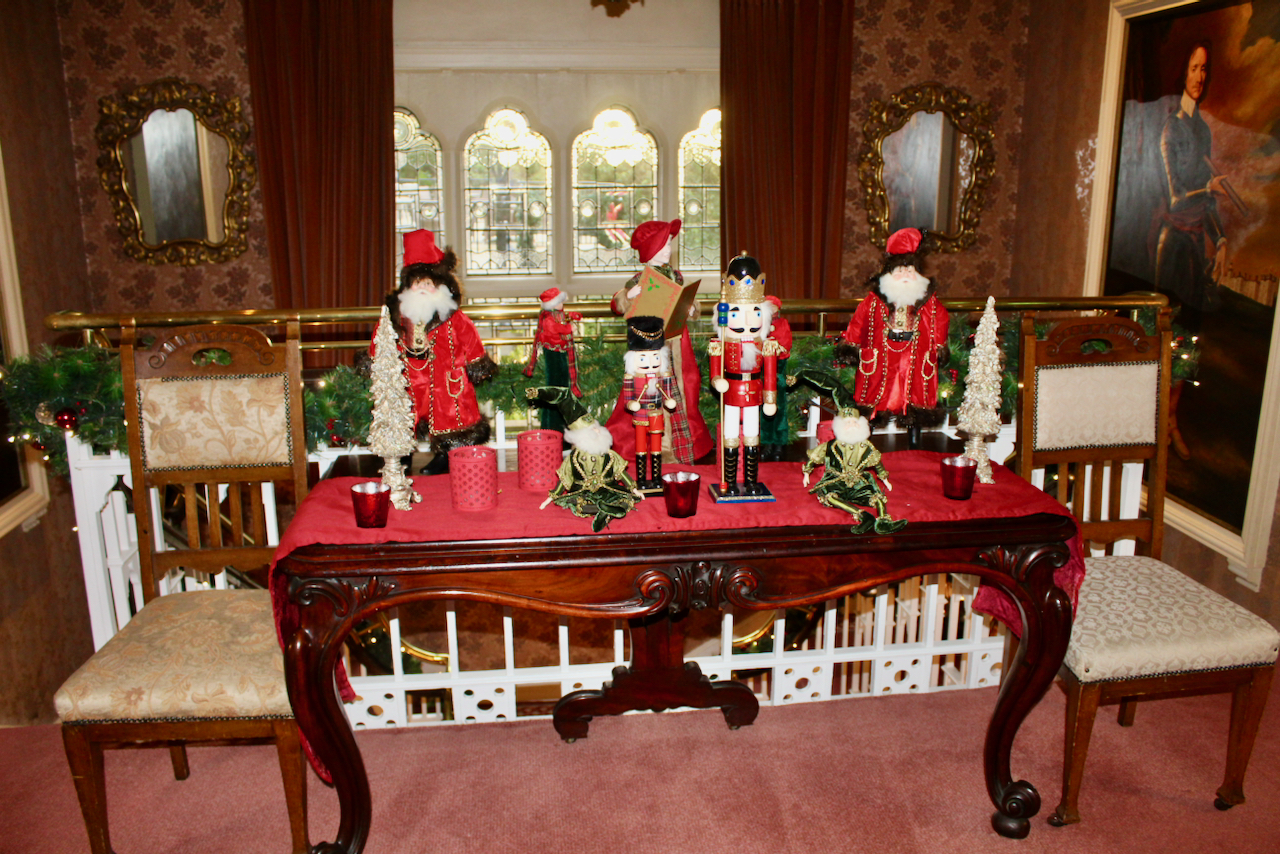
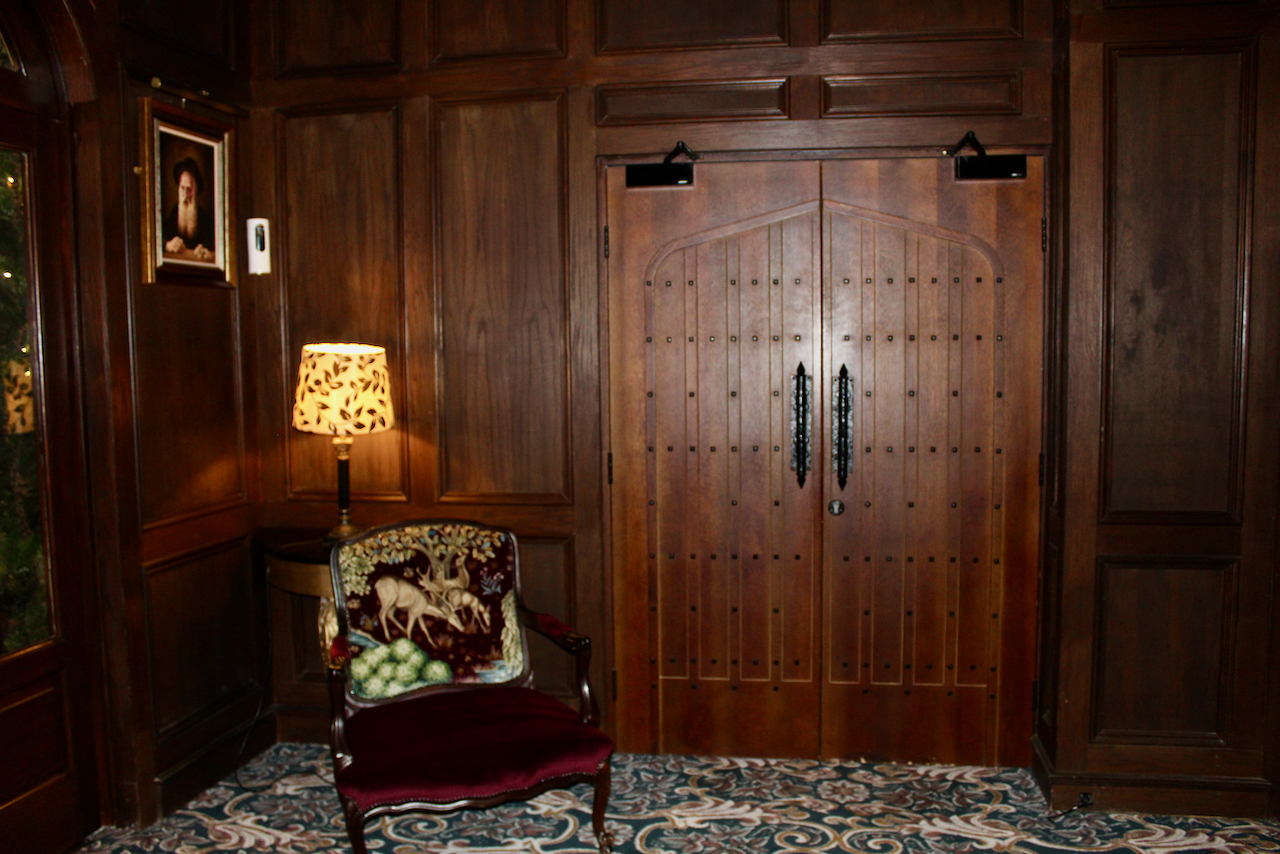
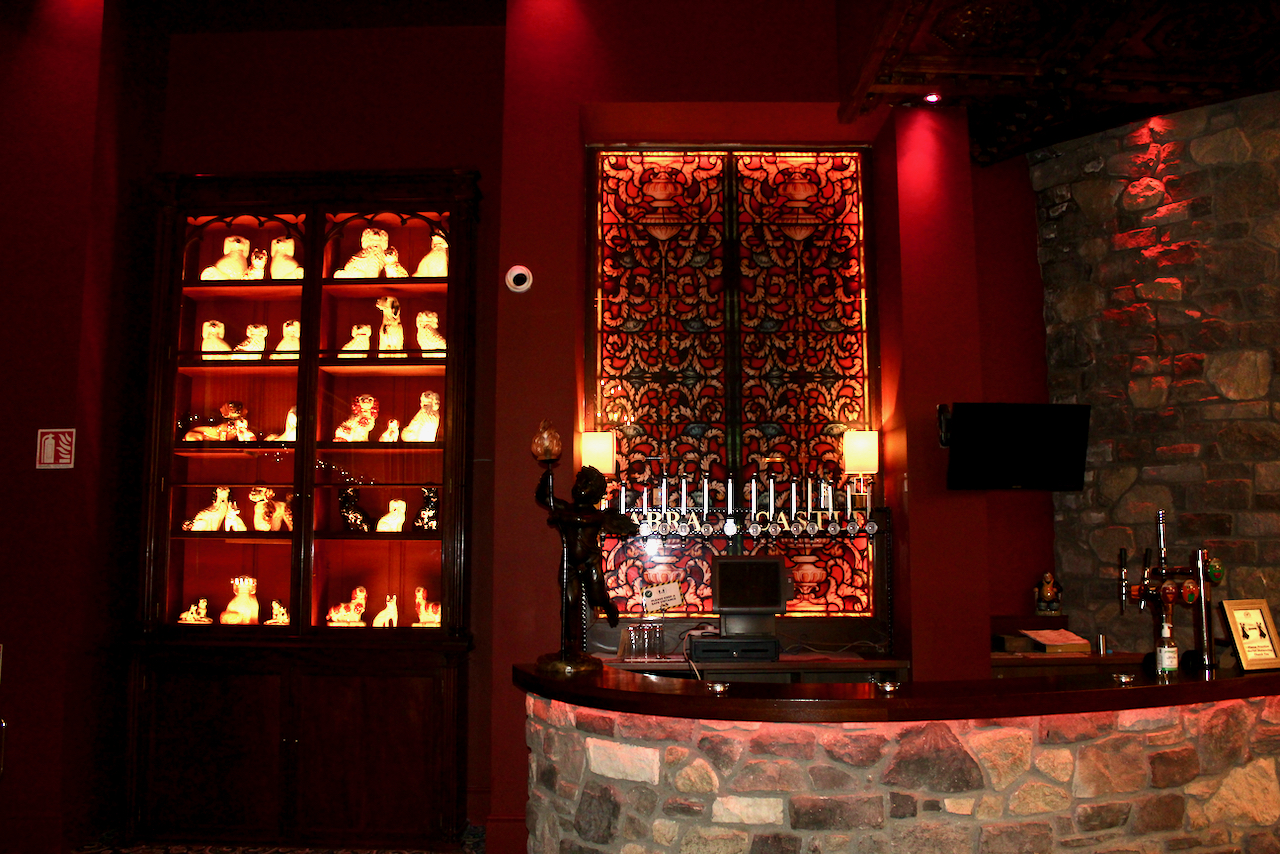
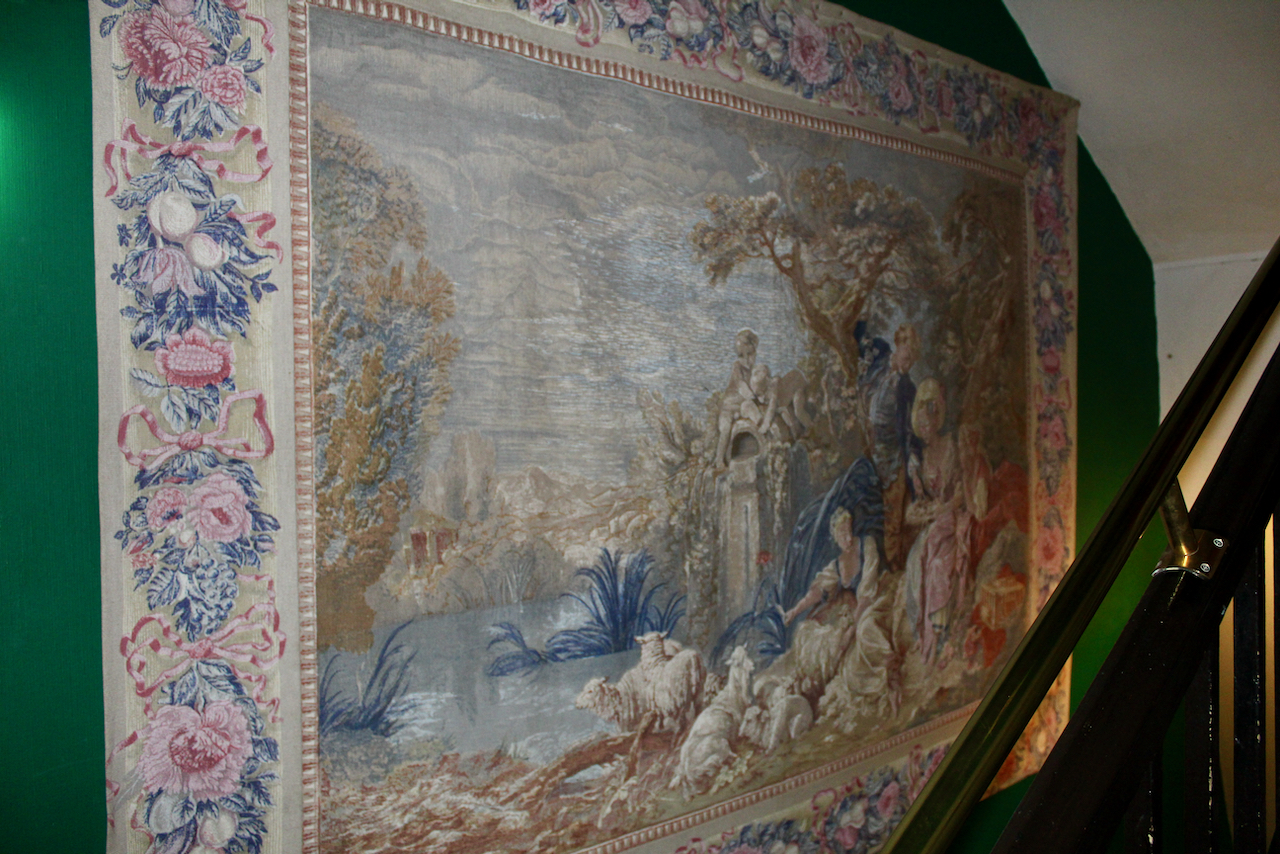
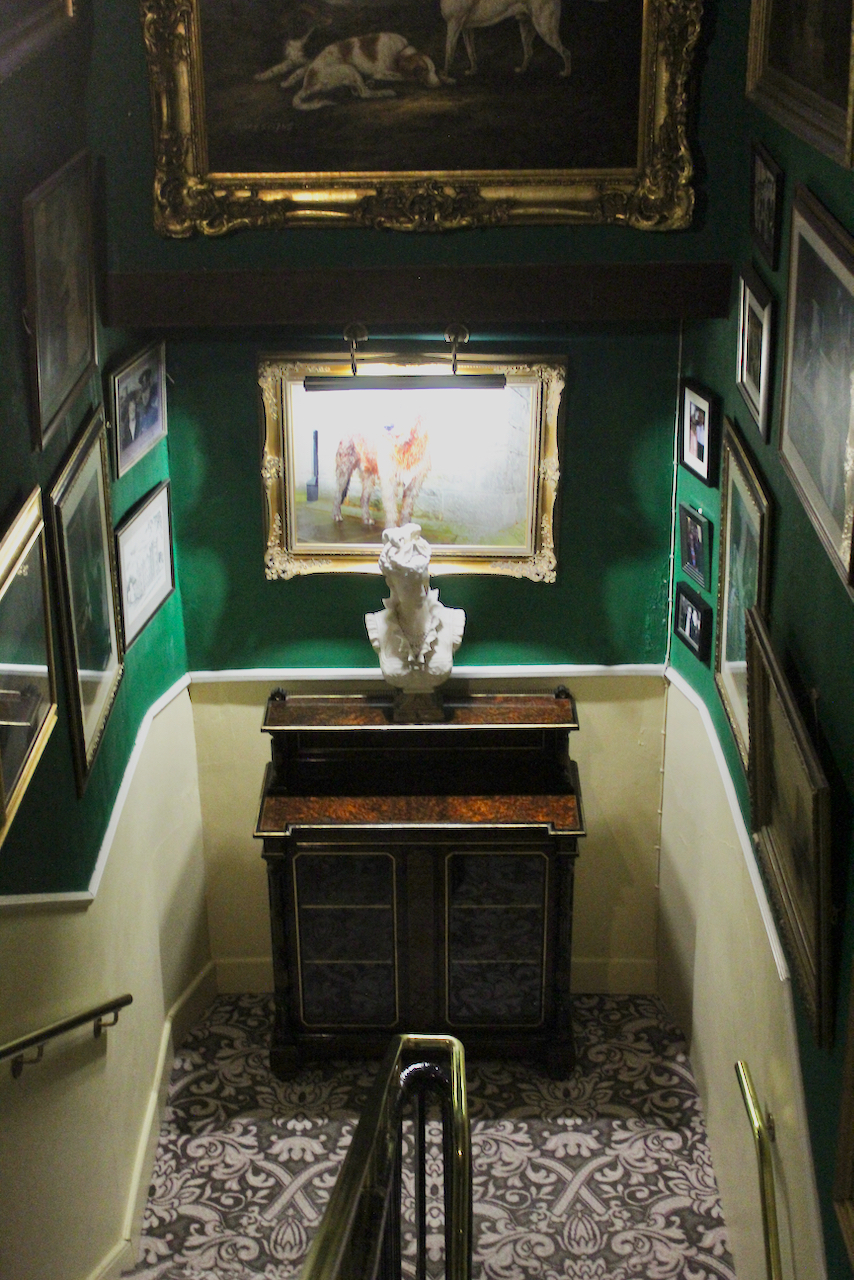
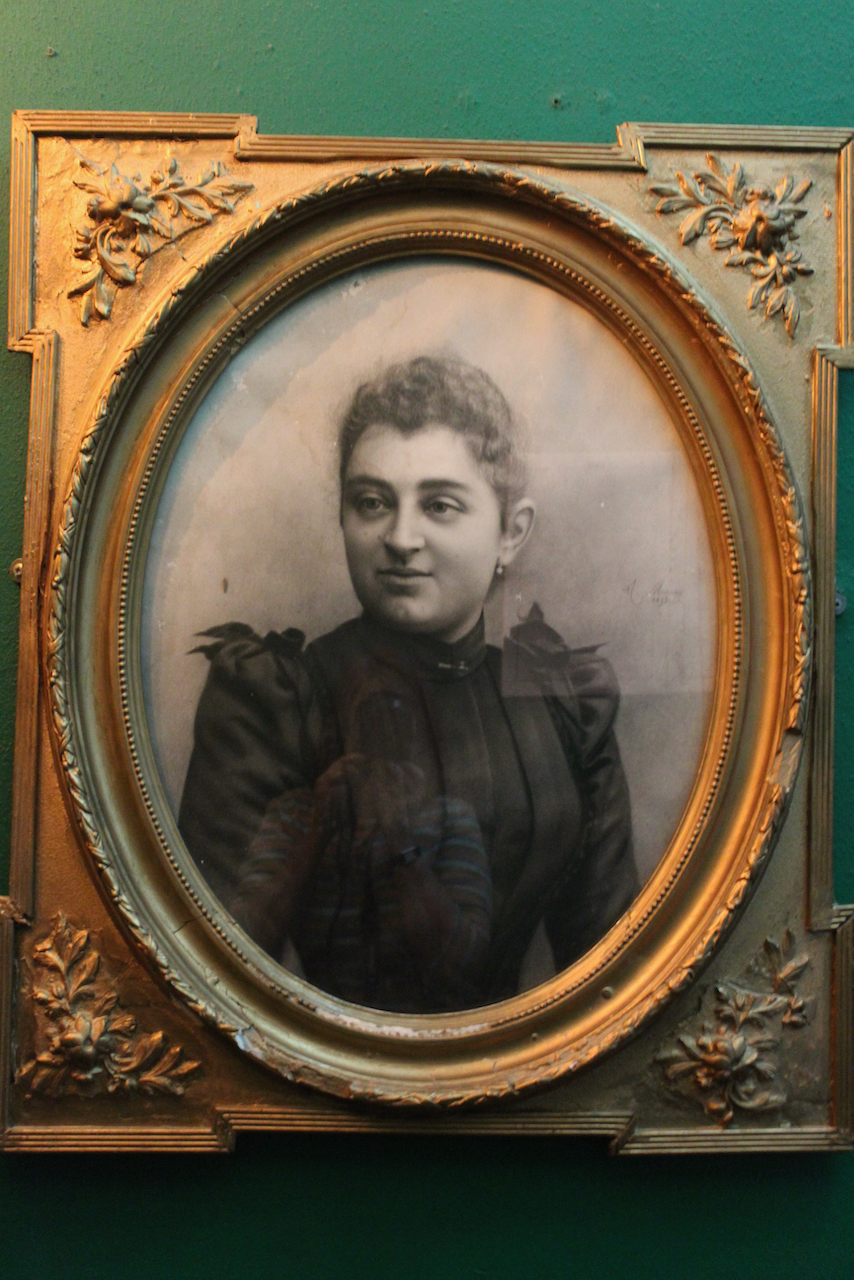
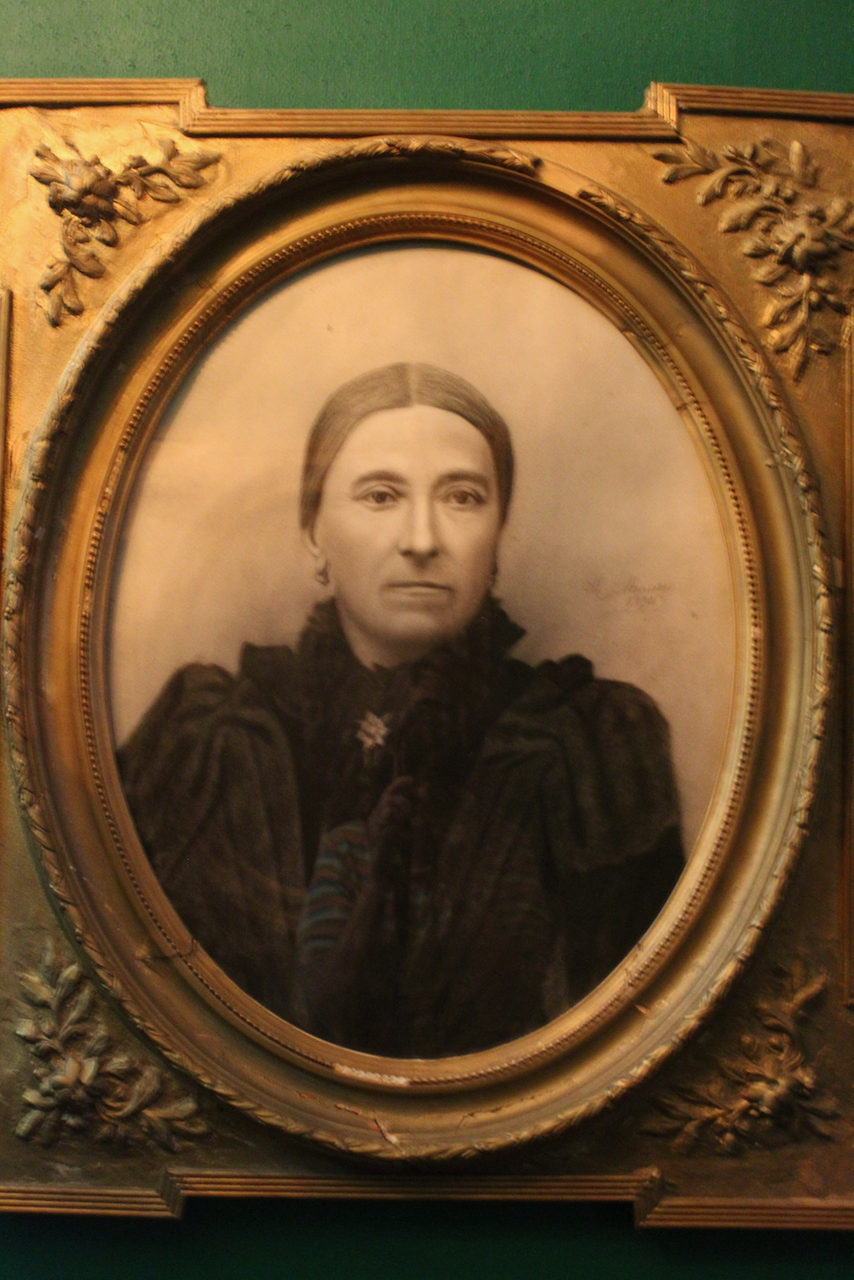
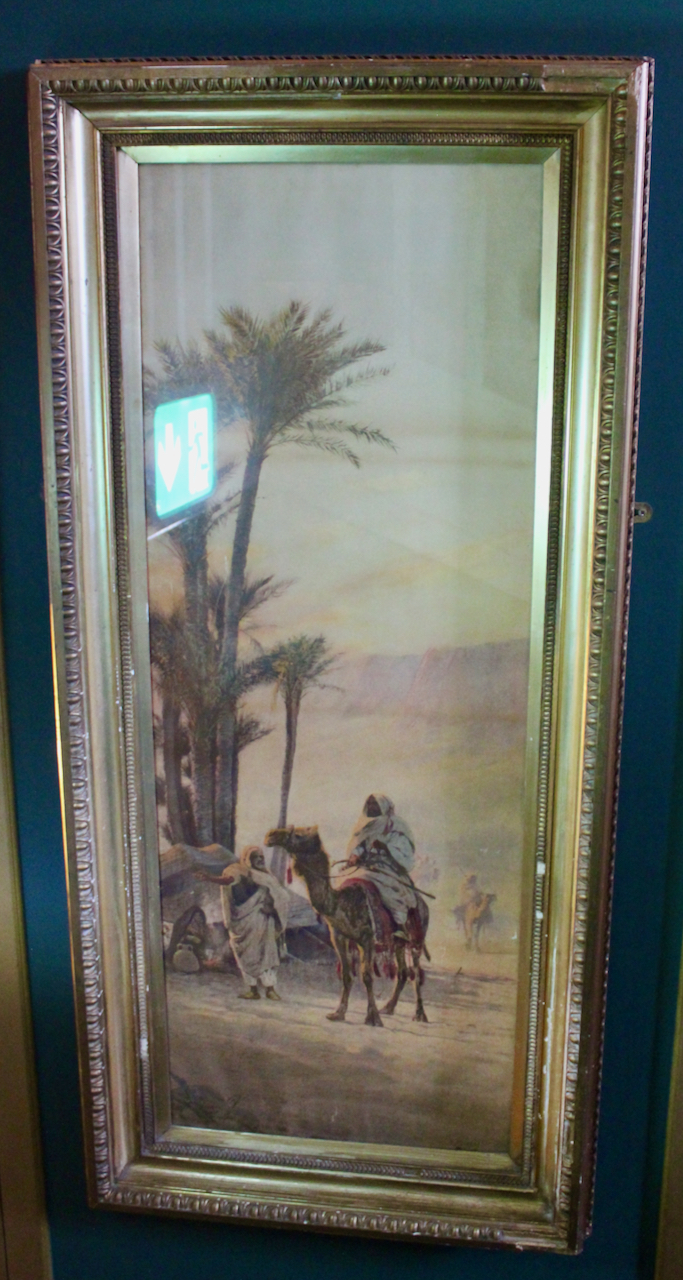
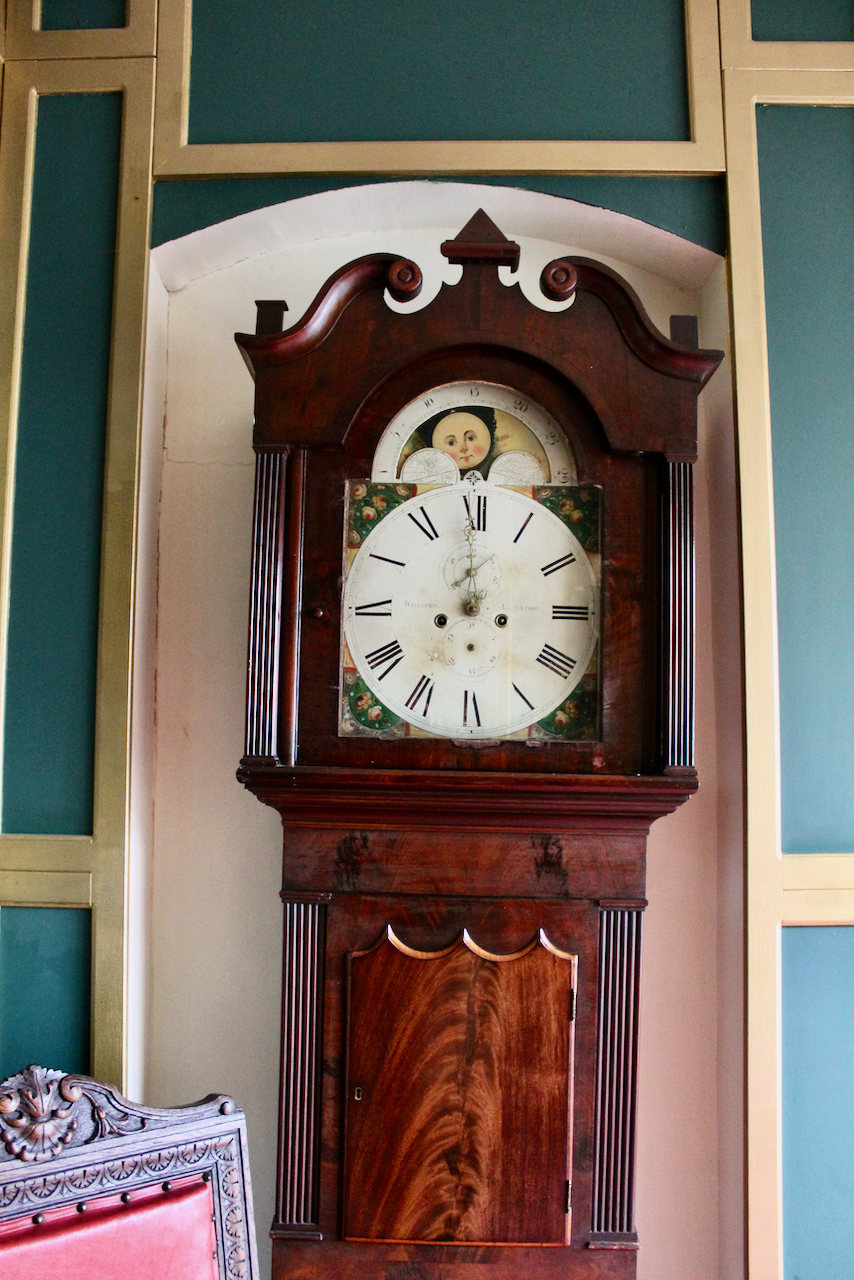
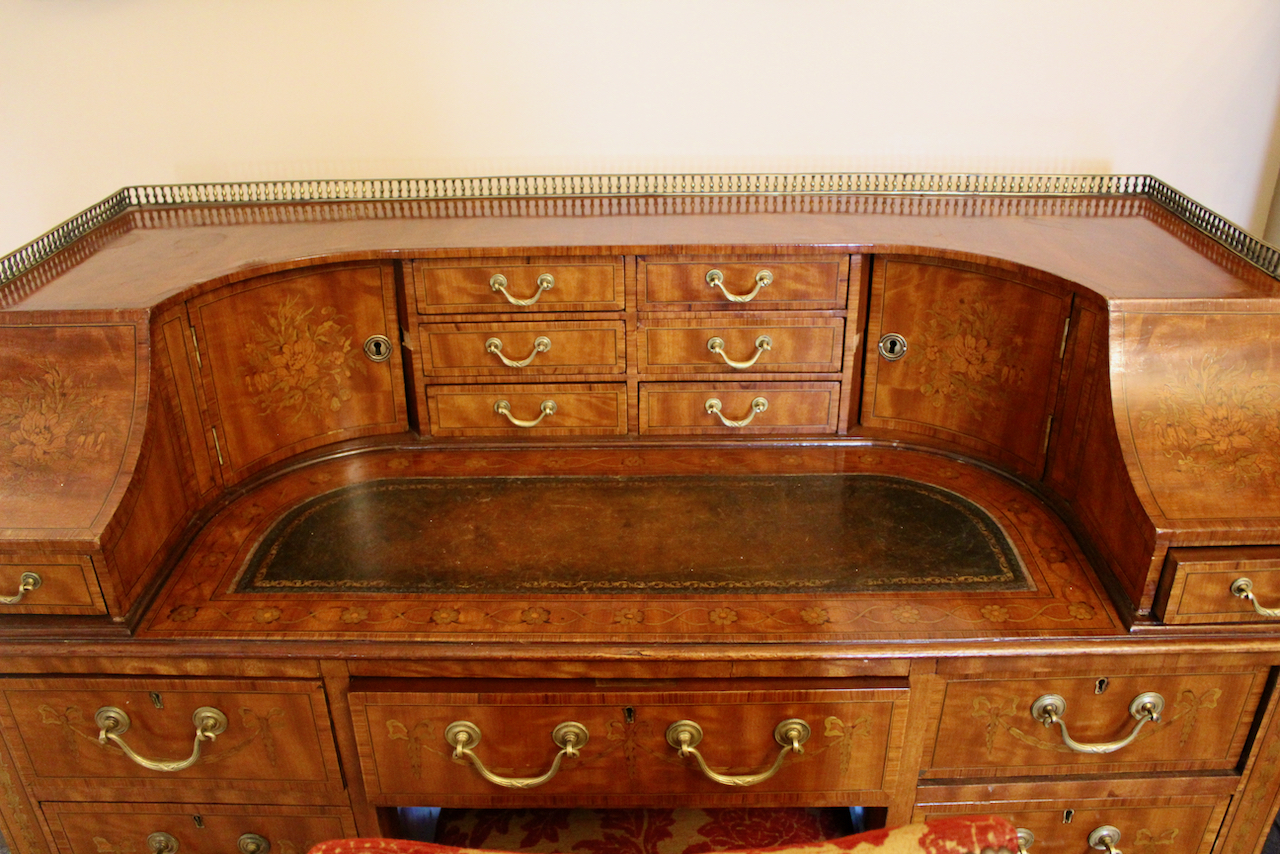
Our guide told us that Howard Corscadden likes to pick up antiques to add to the décor. I love these additions, making me feel like I was a visitor in the days of the Pratts when the castle must have boasted its full glory. After our tour, I explored the nooks and crannies, enjoying the irregularity of the stairways and corridors.
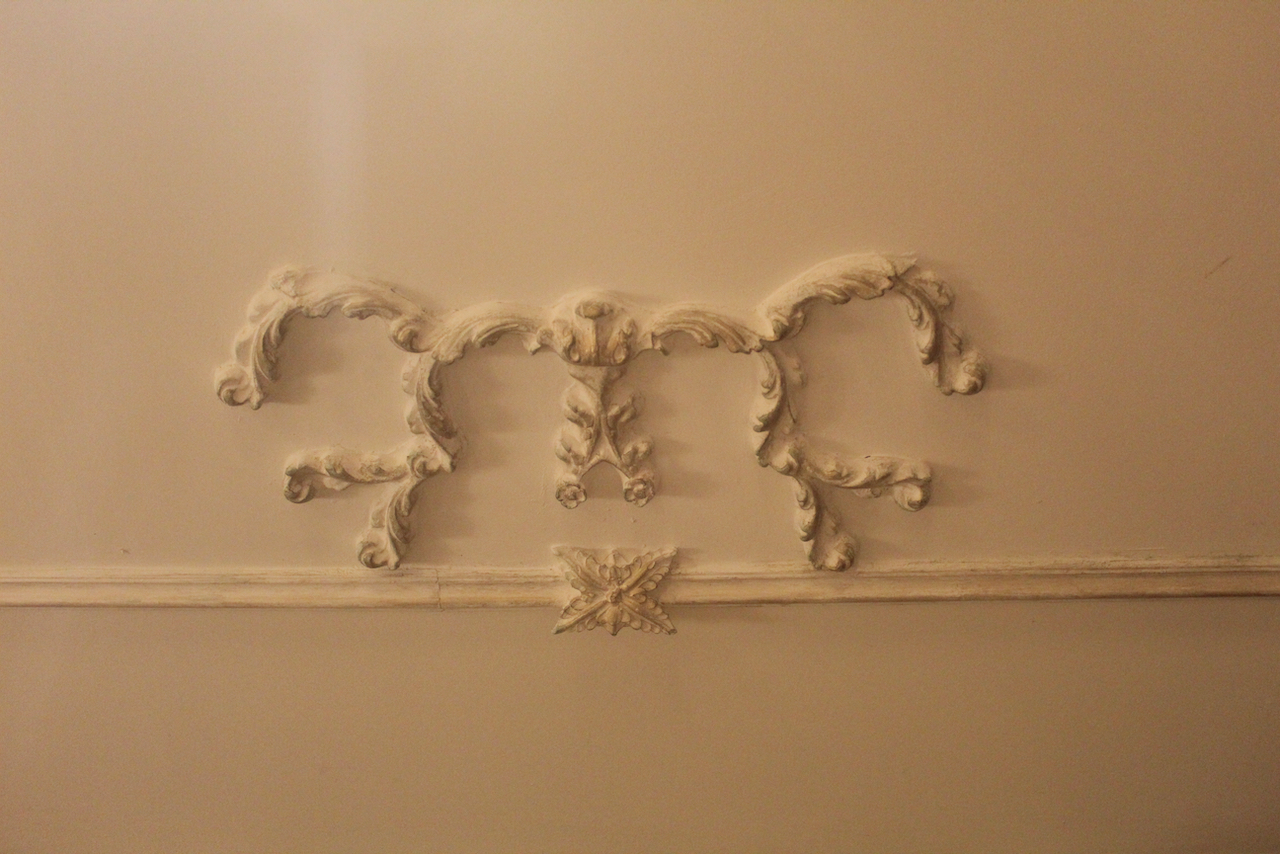
Our guide showed us to one of his favourite bedrooms, which has a ceiling recently adorned with plasterwork. He particularly loves the use of the round tower, renovated into a gorgeous bathroom.
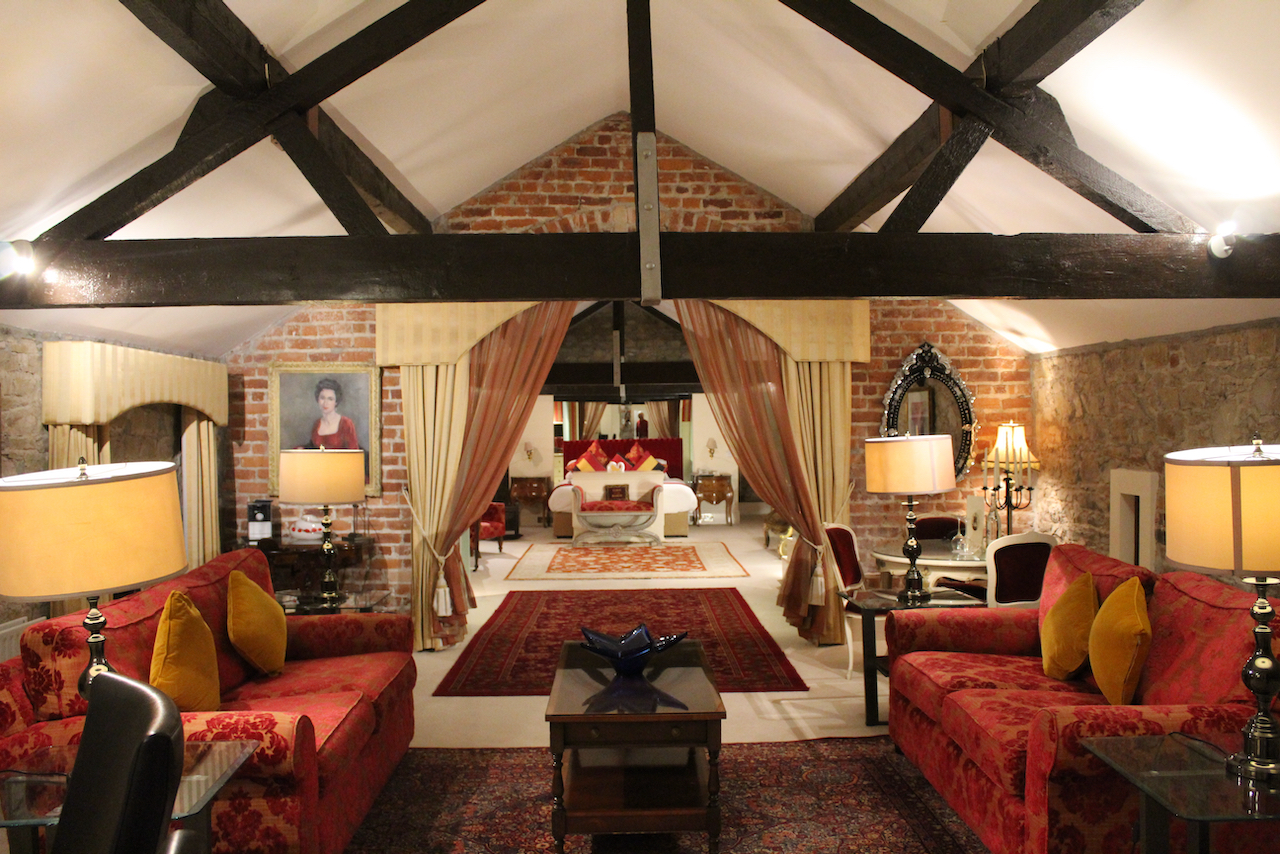
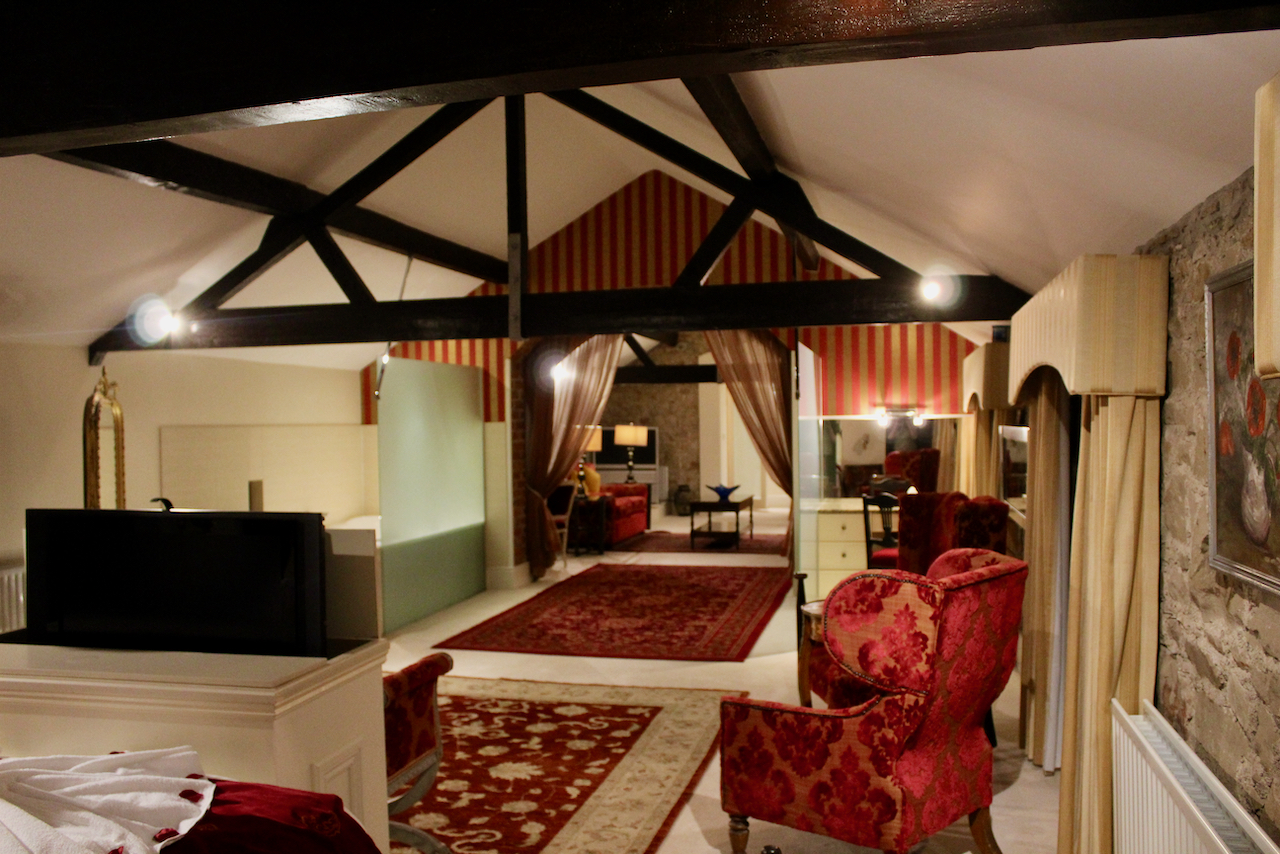
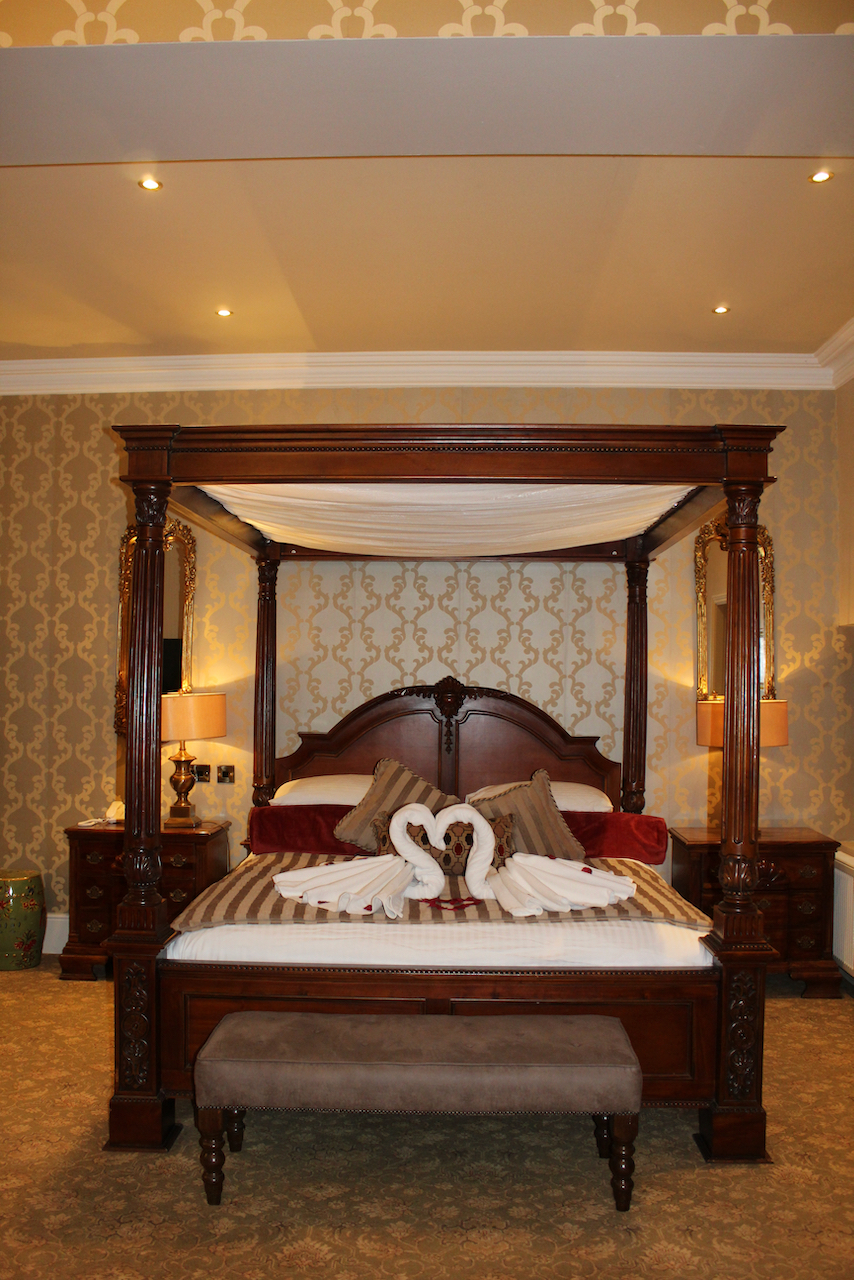
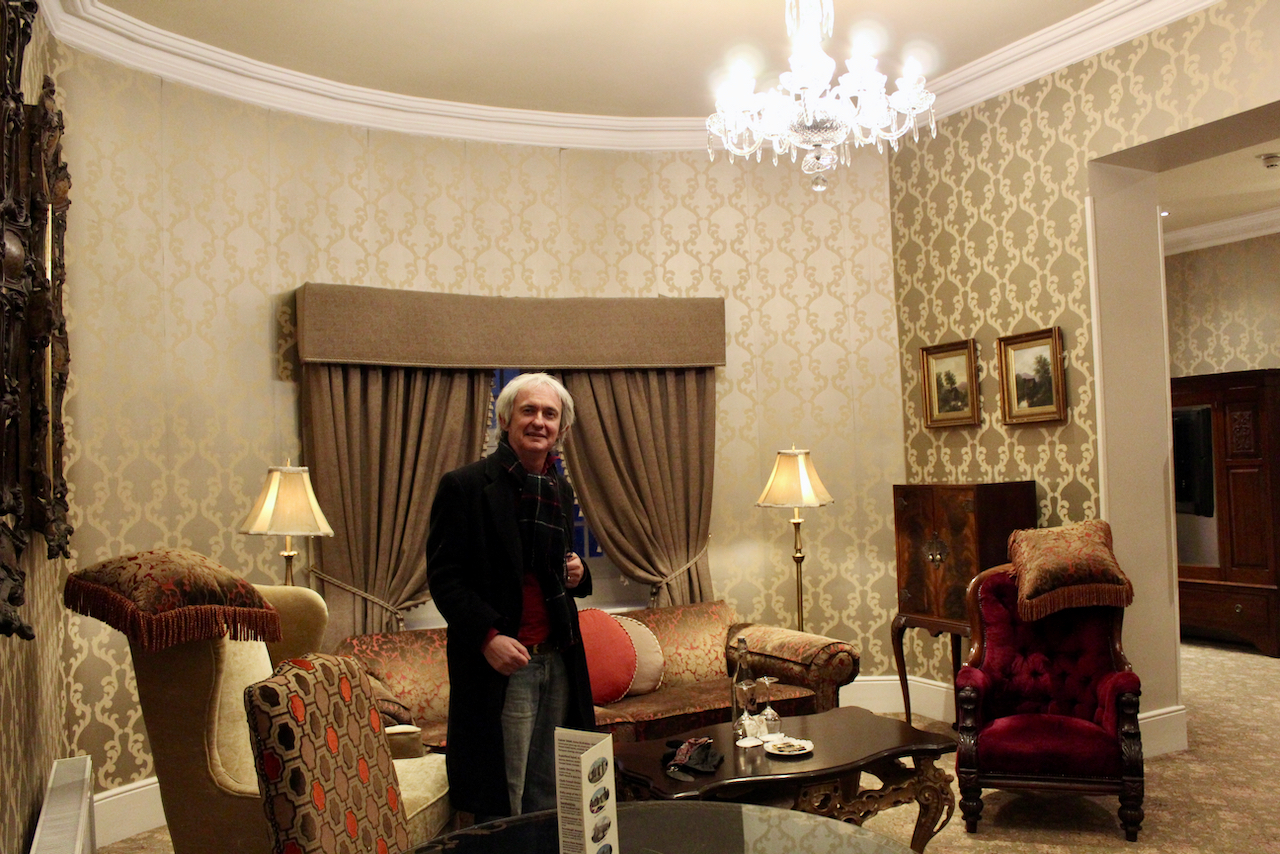
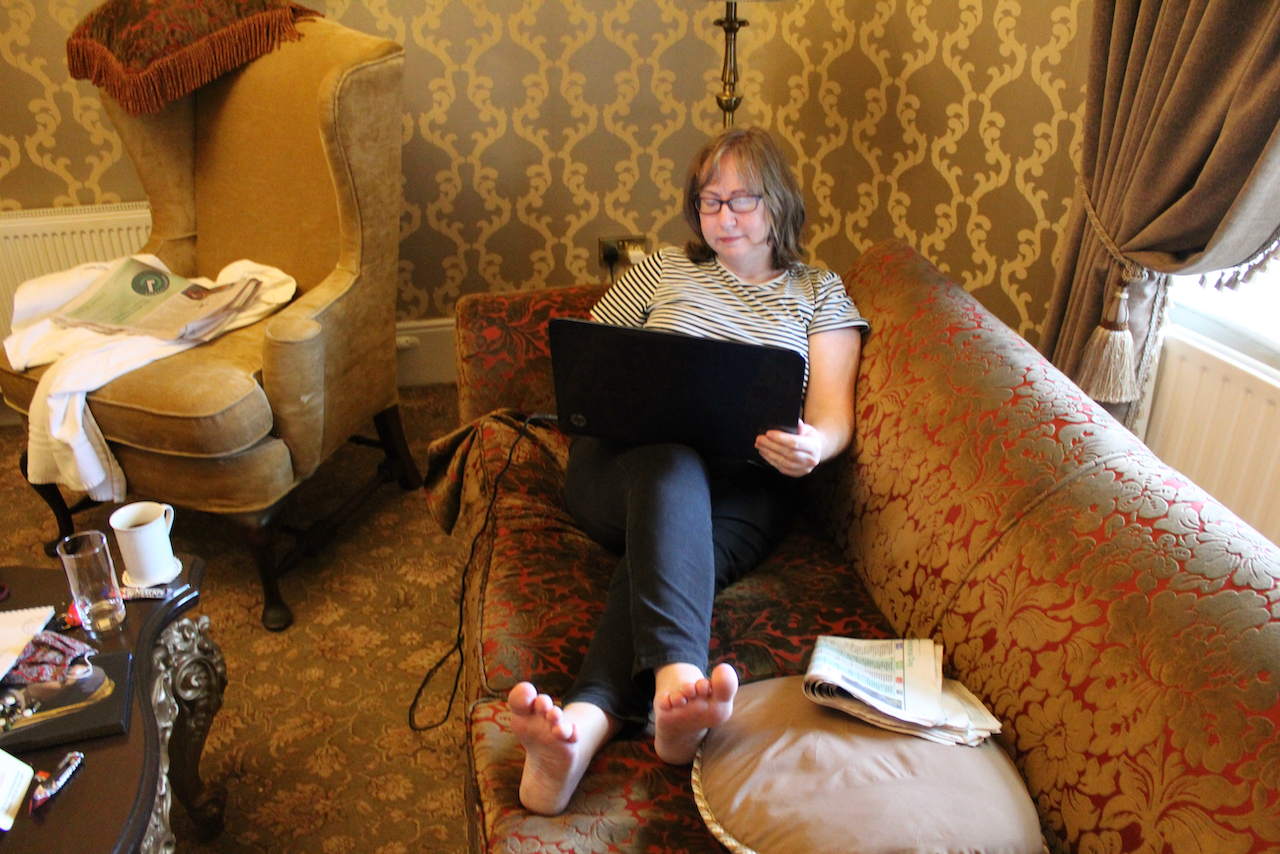
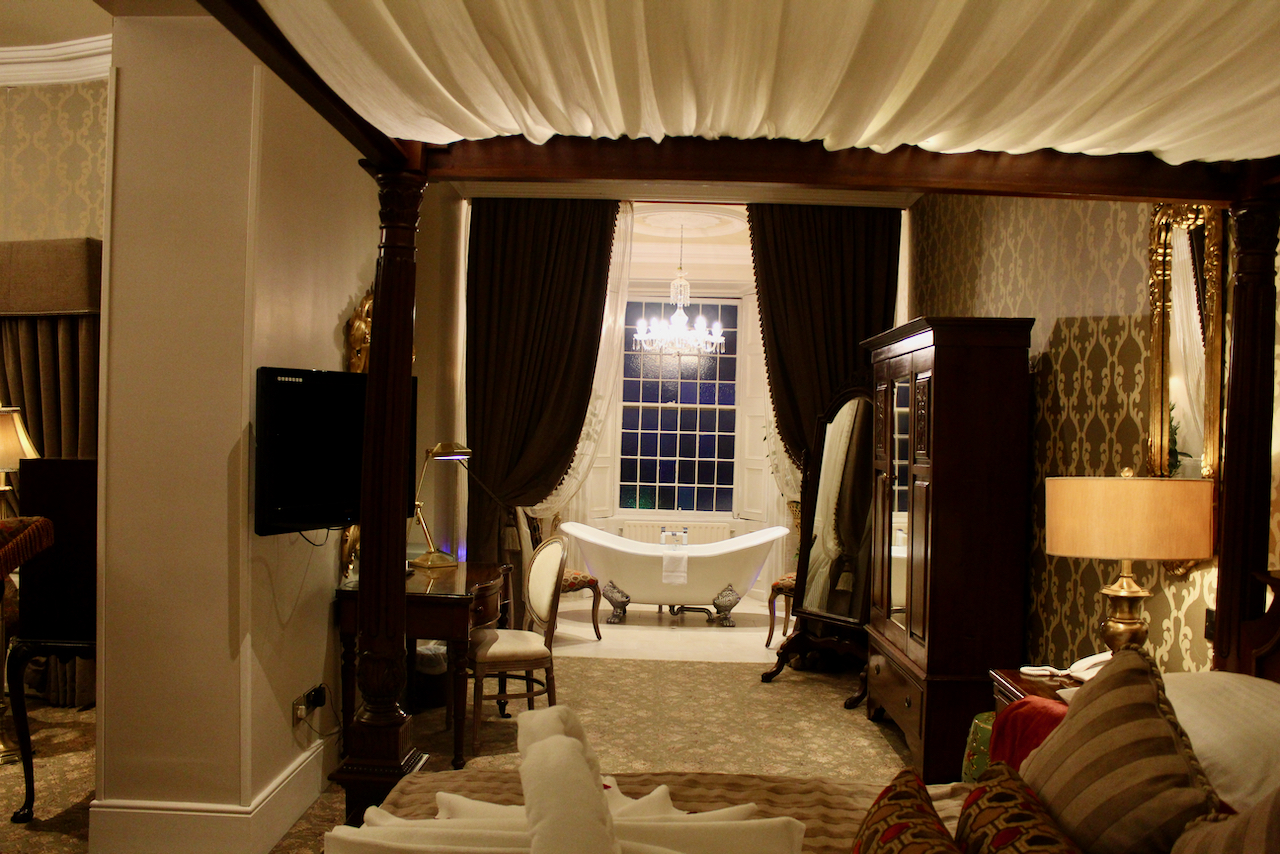
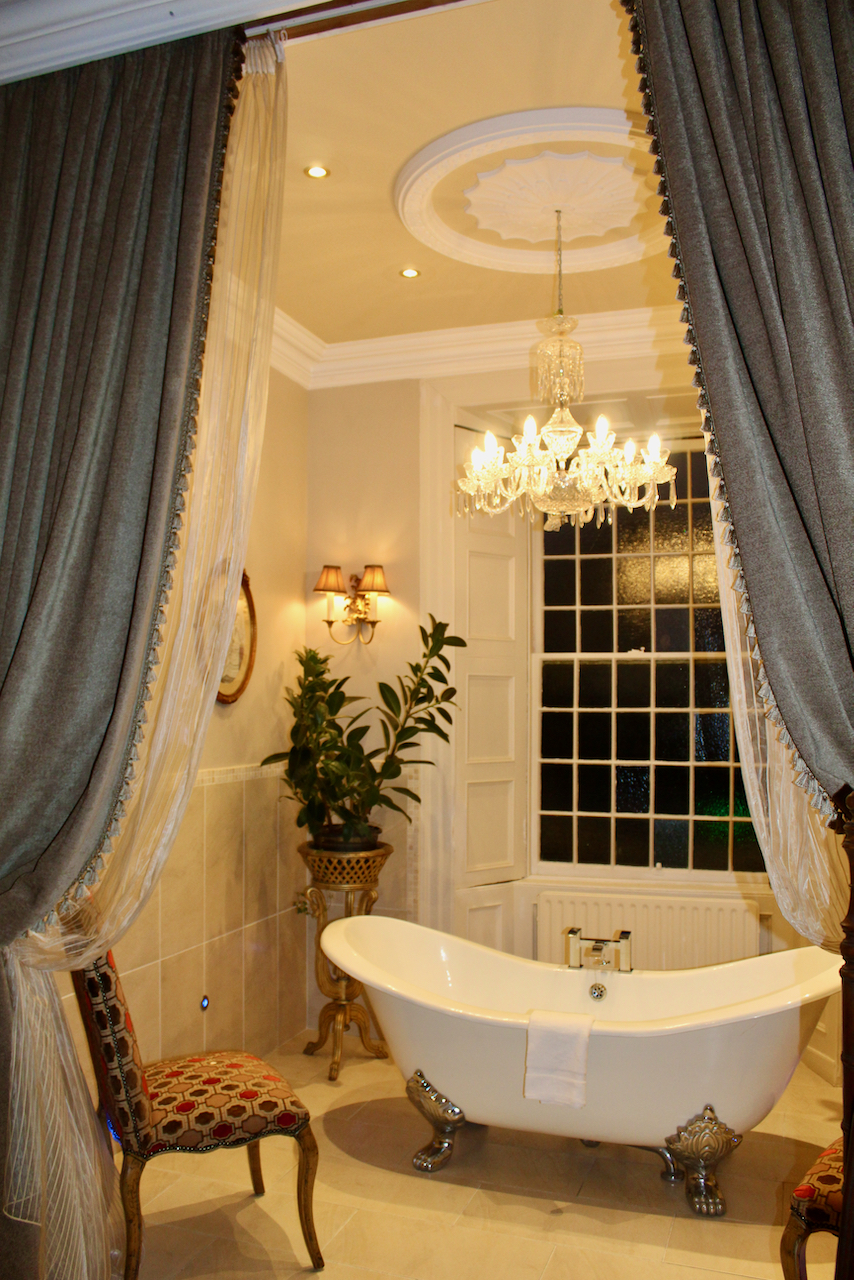
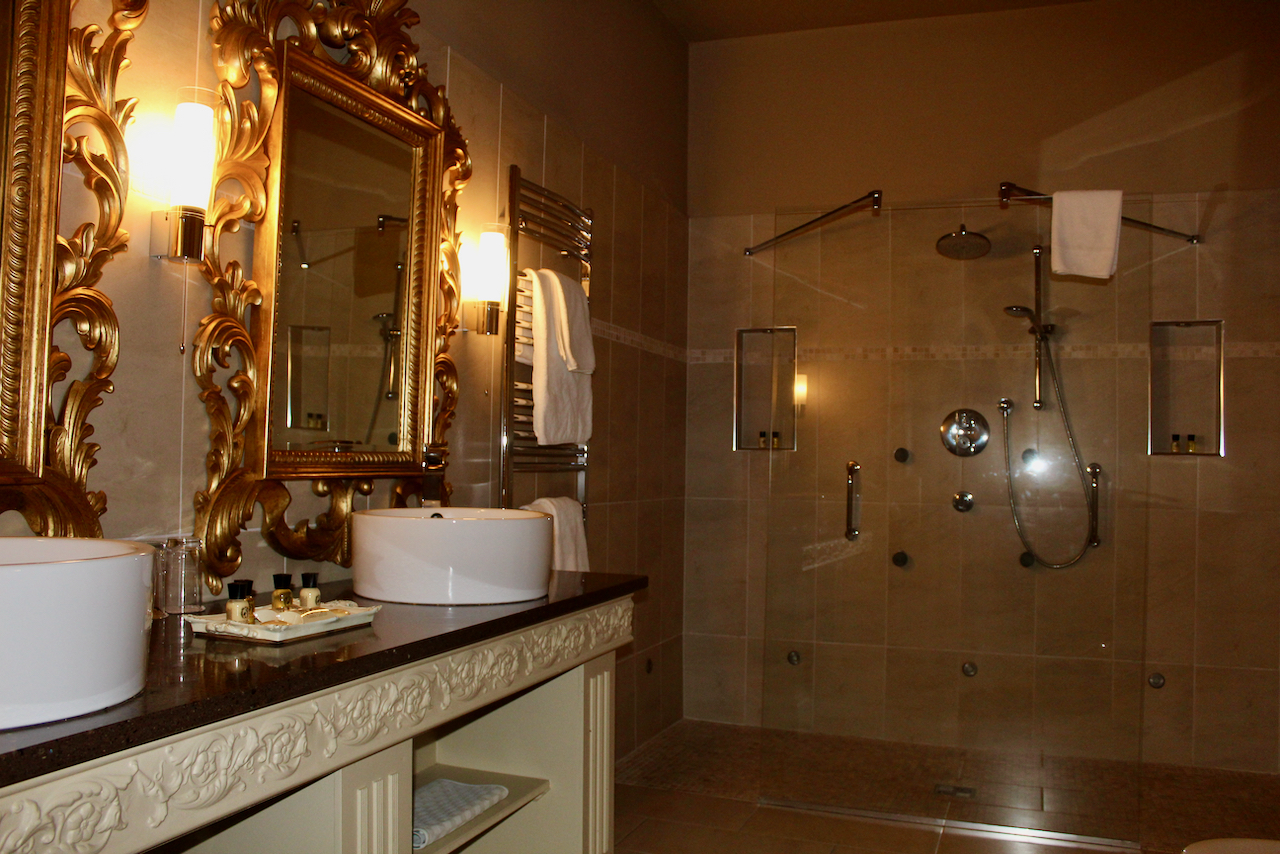
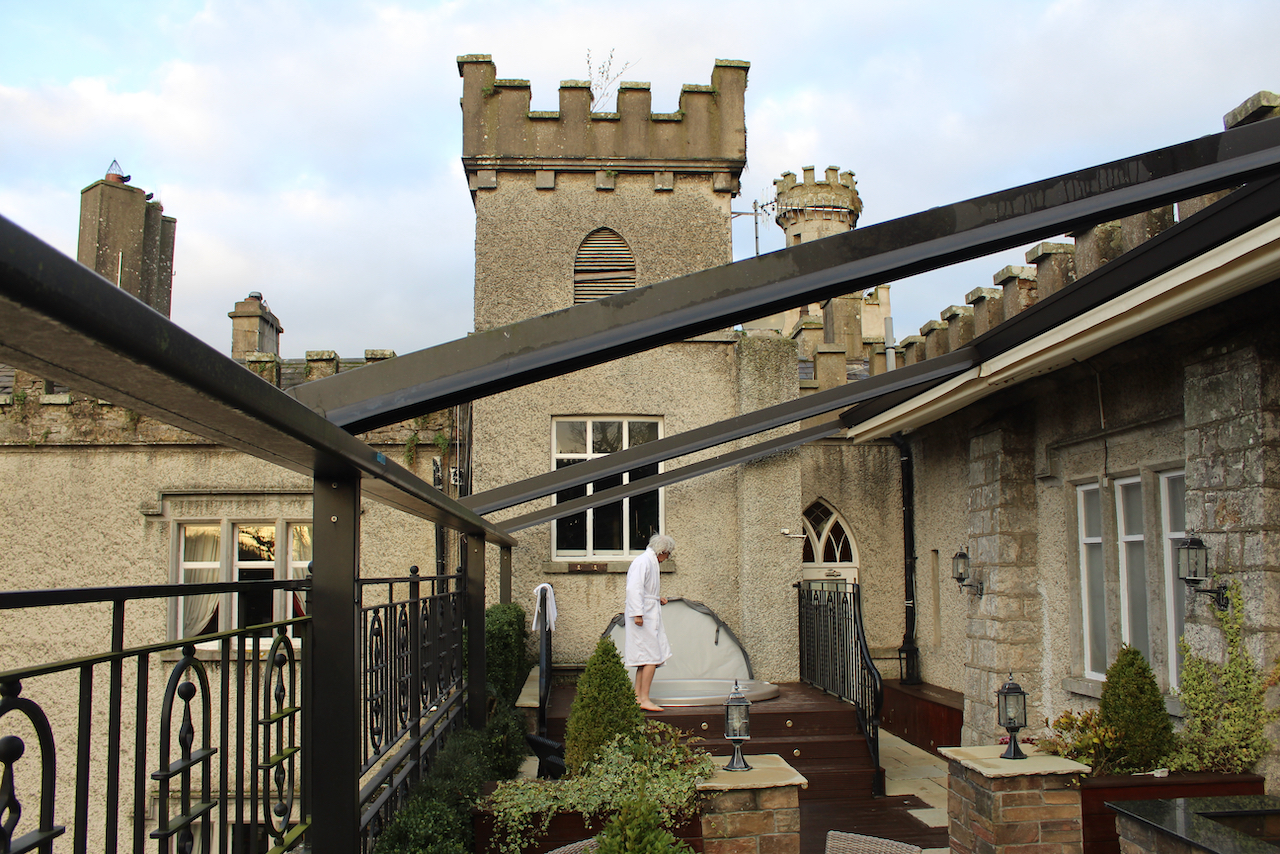
There is another Bridal Suite, inside the castle. I have saved the best until last, because this was our room! It used to be three bedrooms, a hallway and an office, all now incorporated into a luxurious suite. It has a canopied four poster bed, a comfortable seating area with fireplace, and a beautiful clawfoot bath.
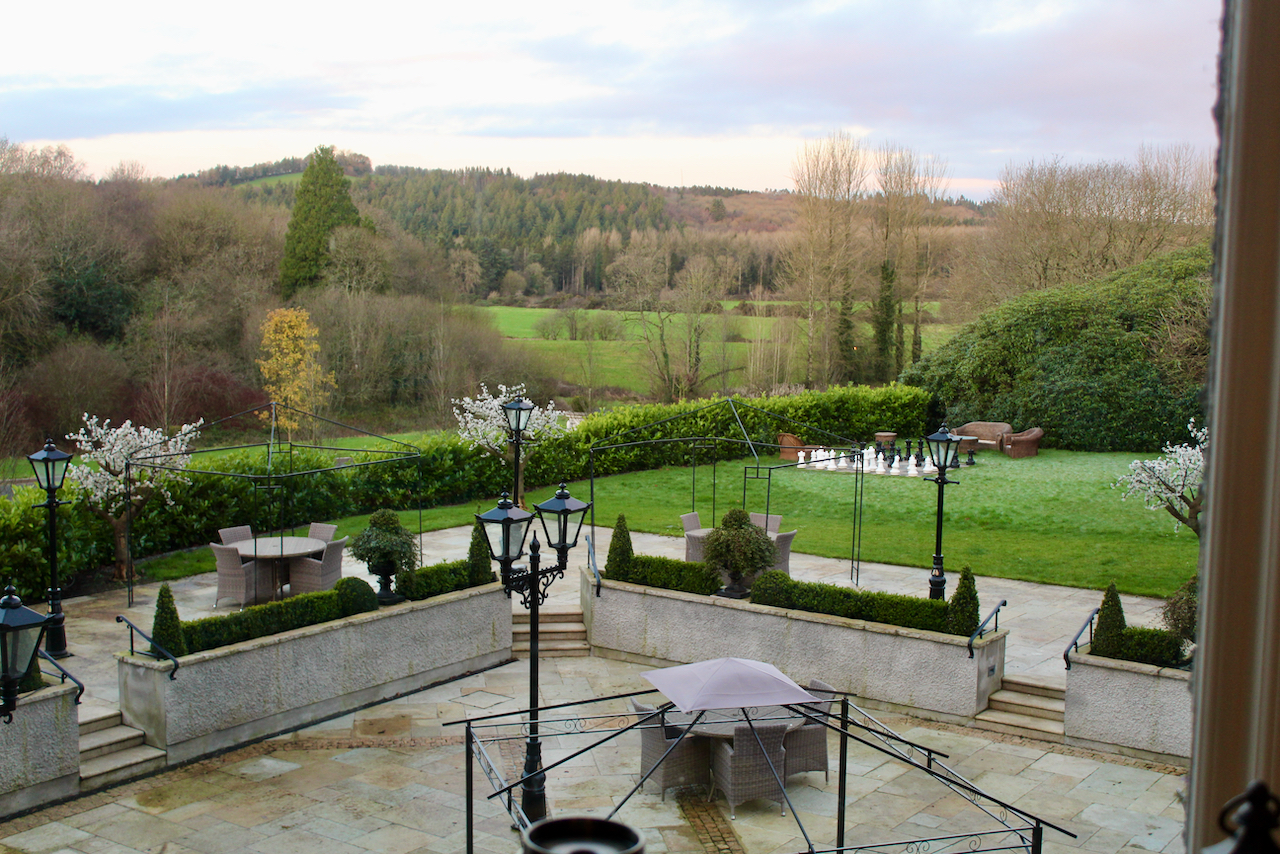
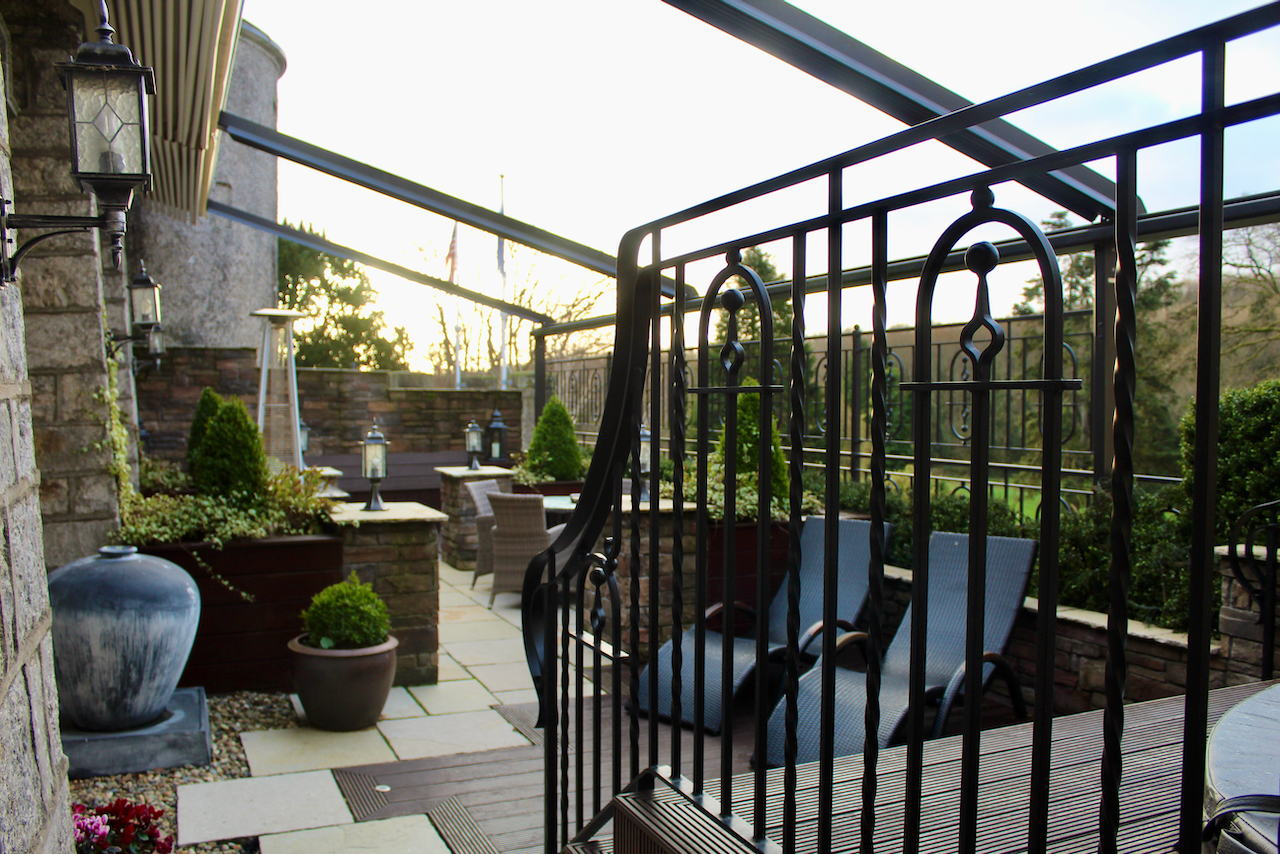
The bathroom has a door to a large private patio, with stunning views over Mitzi’s Garden and the landscape beyond. And best of all, we had our own private outdoor jacuzzi!
There are self-catering cottages where one can also stay. It is a beautiful part of the country. Before heading home, we availed of the opportunity to visit the impressive remnants nearby of Castle Saunderson.
It is interesting to note that his neighbour, Dr. Benjamin Pratt, son of Joseph Pratt and Elizabeth Cooch, was a Provost of Trinity College Dublin in 1710.
[14]Mark Bence-Jones. A Guide to Irish Country Houses. Originally published as Burke’s Guide to Country Houses volume 1 Ireland by Burke’s Peerage Ltd. 1978; Revised edition 1988 Constable and Company Ltd, London.
[16] Imagine inheriting a castle from a distant relative! Mervyn Pratt died in 1950 and his siblings had predeceased him and had no children. Louisa Catherine Hannah Pratt was his aunt. It was through her line that Mervyn Sheppard inherited.
Louisa Pratt was the sister of Joseph Pratt (1843-1929), who lived at Enniscoe, the father of Mervyn Pratt. Louisa Pratt married Thomas Rothwell. Thomas Rothwell served in County Meath militia, and was High Sheriff of County Meath in 1867, and also served as Justice of the Peace for County Meath. He lived at Rockfield, County Meath.
Louisa and Thomas had four daughters. Louisa Frances Rothwell must have been the oldest of the daughters, as it was through her son that Mervyn Sheppard inherited. Mervyn Sheppard was the son of Canon James William ffrank Sheppard and Louisa Frances Rothwell. Mervyn probably grew up in England where father was rector. He had a twin, Frank Baden ffrank Sheppard, who served in the military, and a younger brother.
[17] An Irish Times article by Ronan McGreevy from Thursday Sept 24th 2020 explains the origin of the Shelbourne hotel statues. They were designed and sculpted by Mathurin Moreau (1822-1912) and were cast in a foundry in Paris. The statues represent Egyptian and Nubian women.
I receive no funding nor aid to create and maintain this website, it is a labour of love. I travel all over Ireland to visit Section 482 properties and sometimes this entails an overnight stay. A donation would help to fund my accommodation.

































 Irish Historic Houses