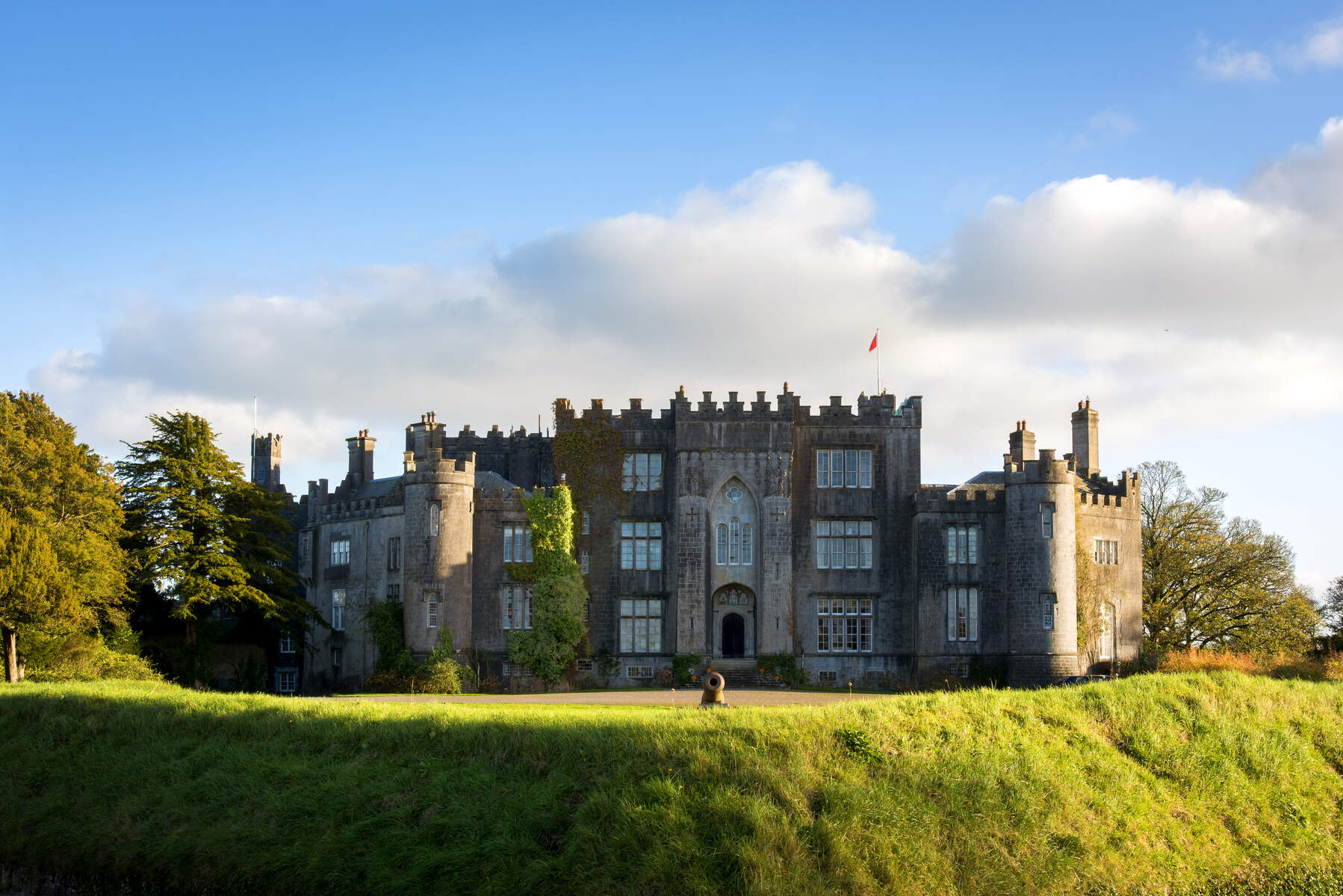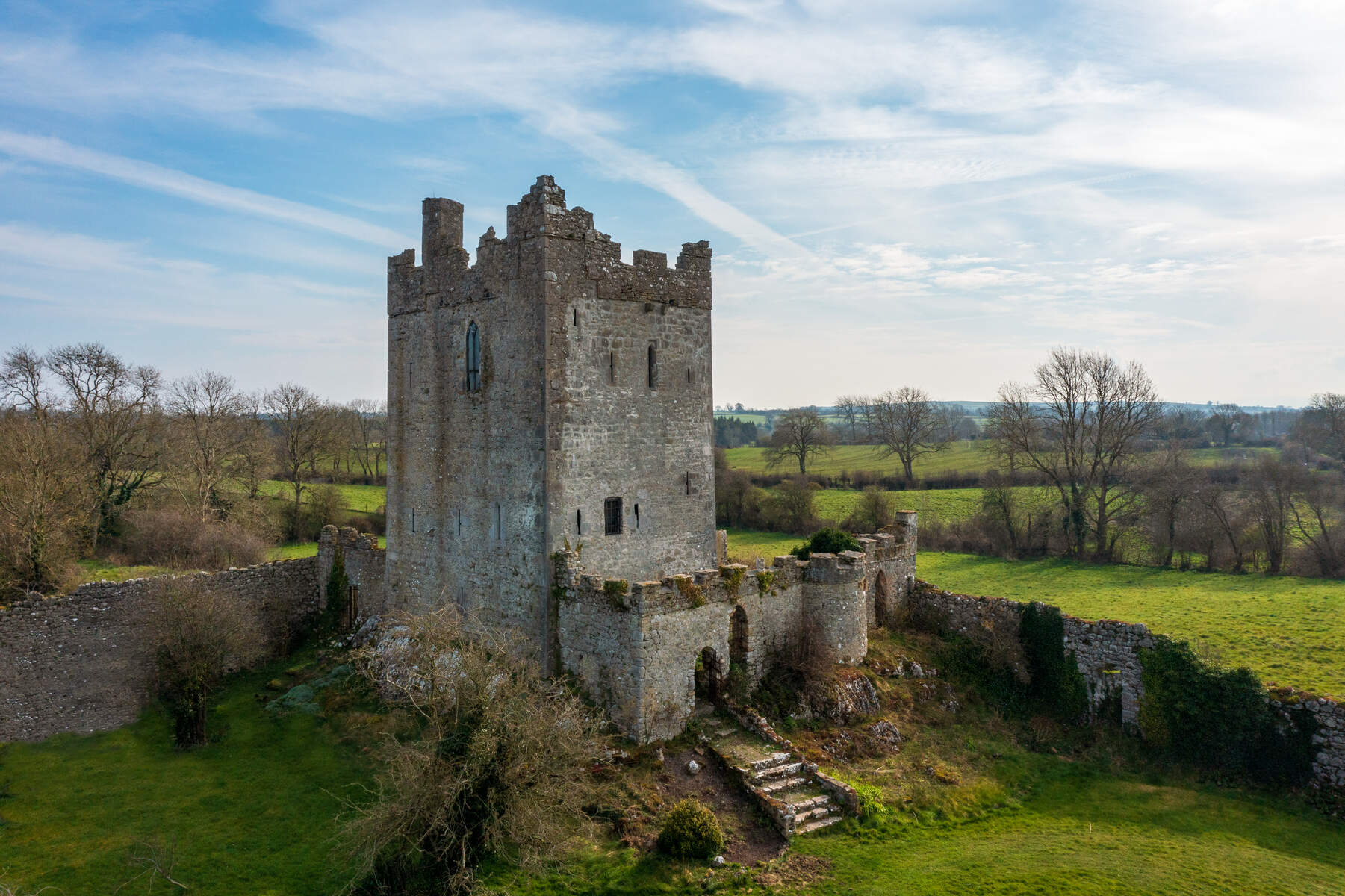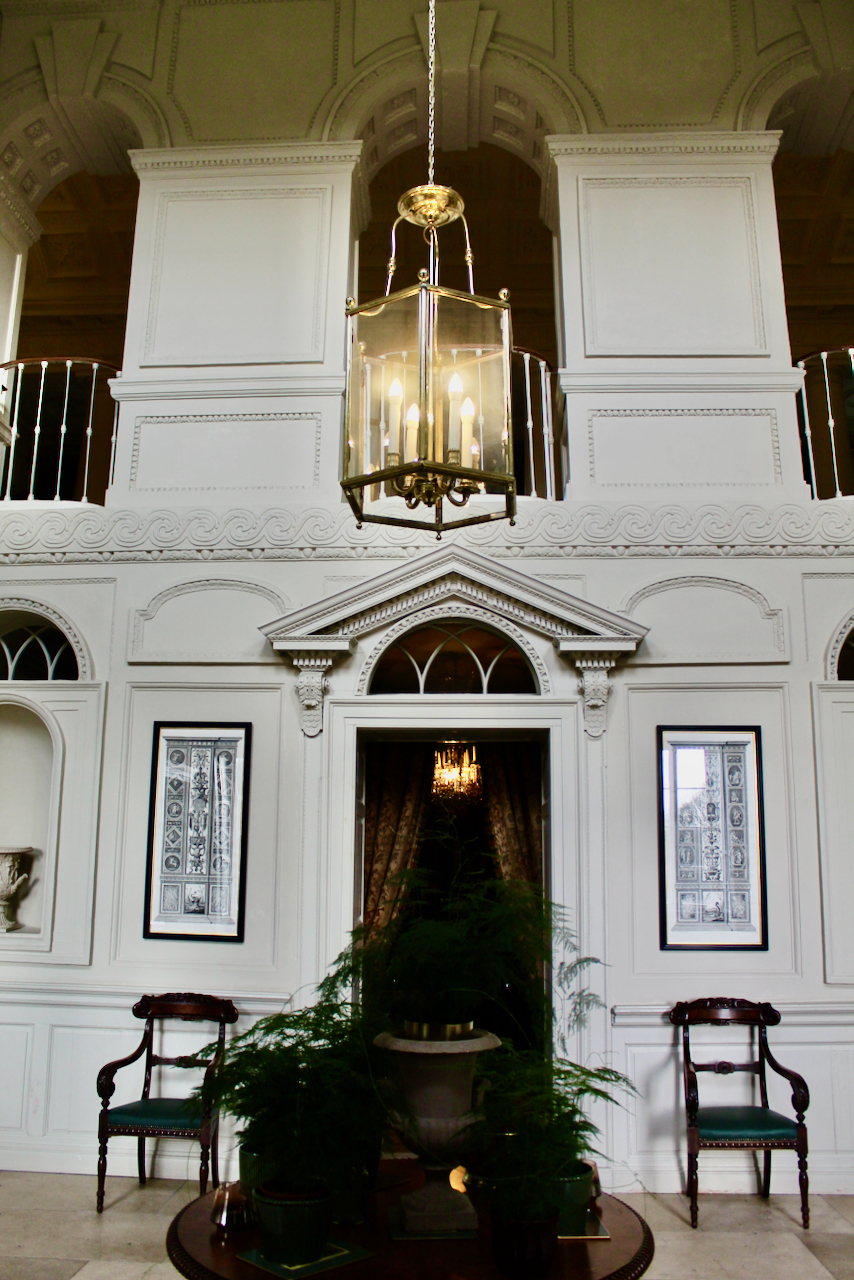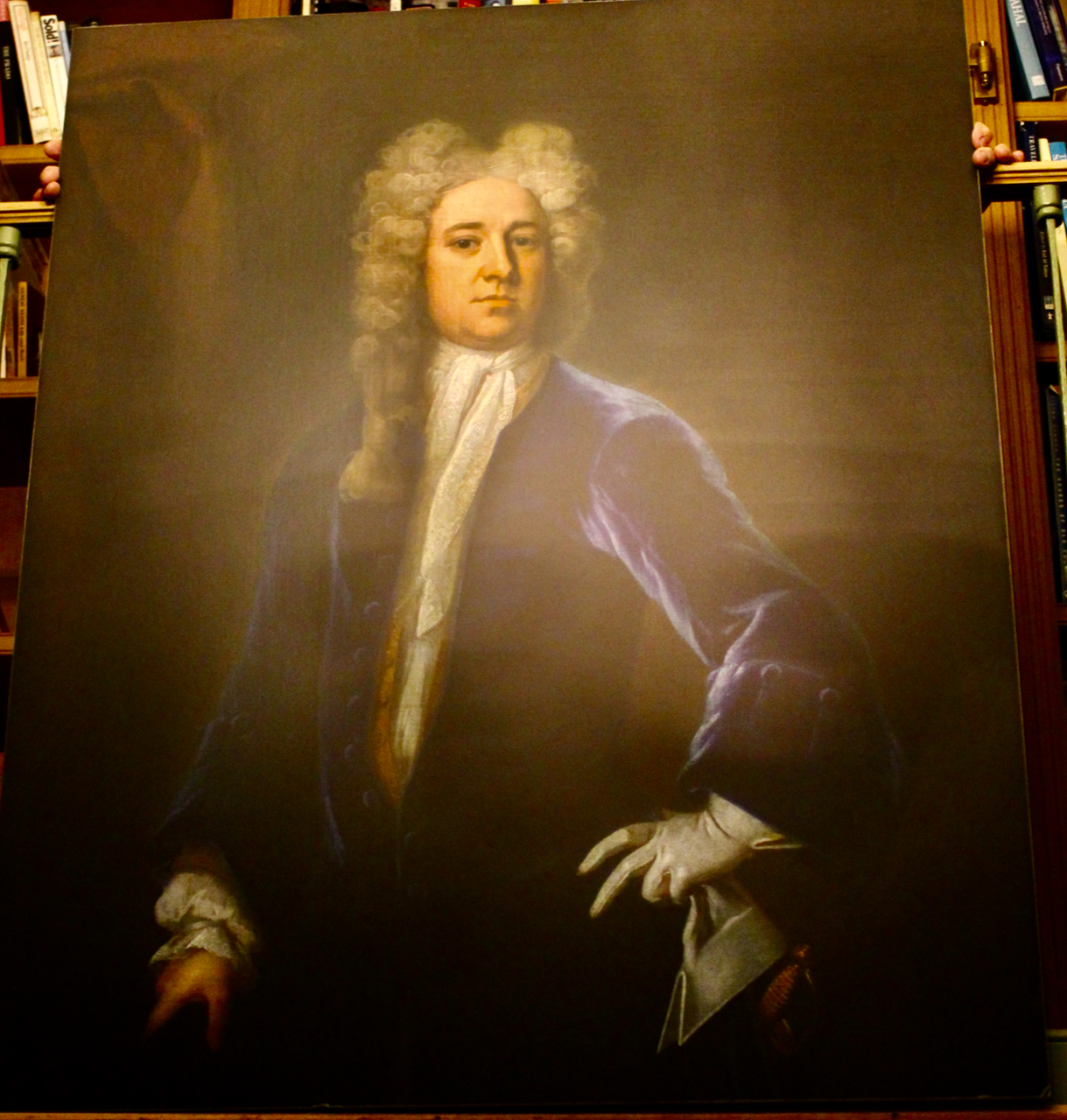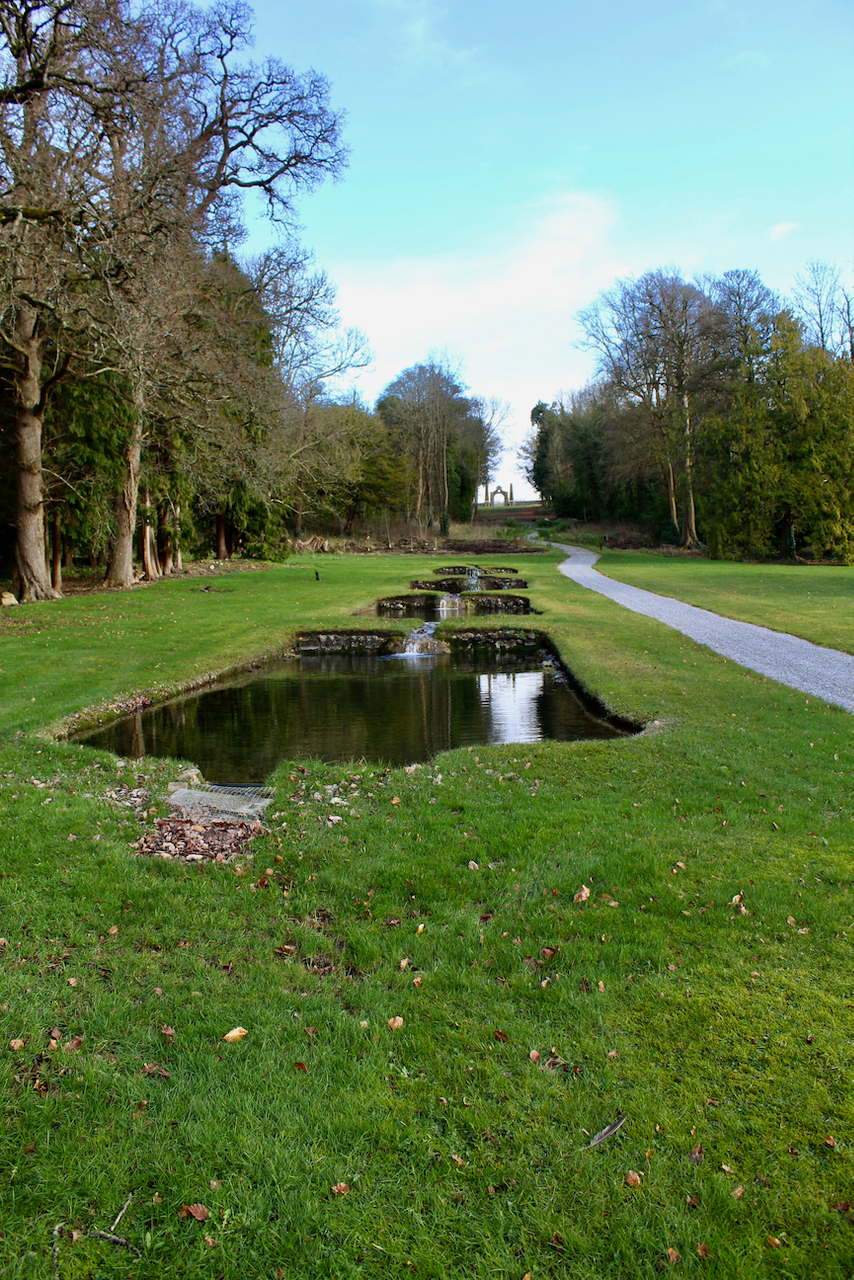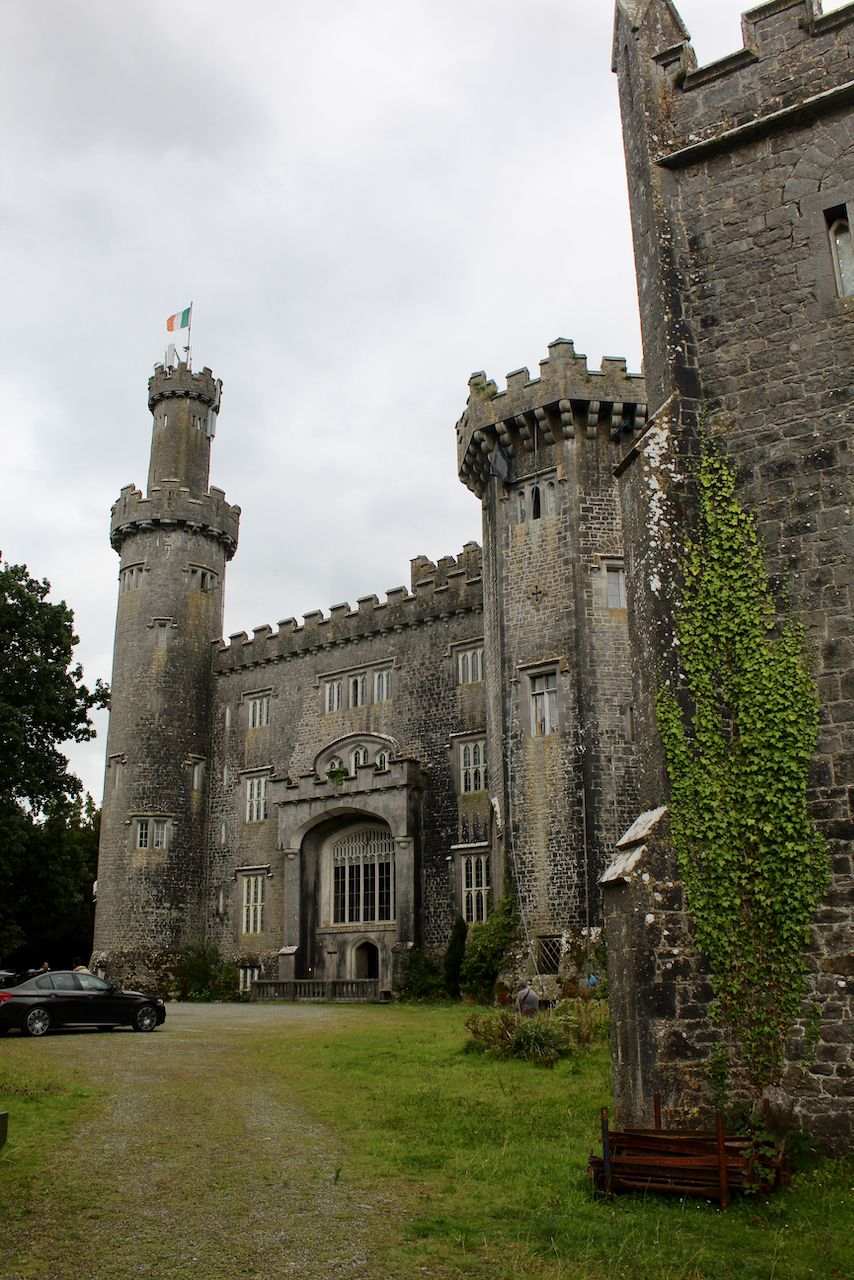
Charleville Forest Castle, Tullamore, County Offaly – sometimes open to public, run by Charleville Castle Heritage Trust

Charleville Forest Castle, County Offaly, Heritage Week, August 2024 Photograph © Jennifer Winder-Baggot, www.irishhistorichouses.com

Charleville Castle is not a Section 482 property, but sometimes opens to the public during Heritage Week, see the website.

http://www.charlevillecastle.ie/

It was built built 1798-1812 for Charles William Bury (1764-1835), later 1st Earl of Charleville, and was designed by Francis Johnston. The castle took 14 years to build, partly because Johnston was busy with other commissions as he was appointed to the Board of Works in 1805. From his work on the castle, Francis Johnston gained many more commissions, and he worked simultaneously on Killeen Castle in County Meath (1802-1812), Markree Castle in County Sligo (1802-1805, see my entry) and Glanmore, County Wicklow (1803-04).

Mark Bence-Jones writes (1988, p. 82) that Charleville Castle is the “finest and most spectacular early nineteenth century castle in Ireland, Francis Johnston’s Gothic masterpiece, just as Townley Hall, County Louth, is his Classical masterpiece.” [1]
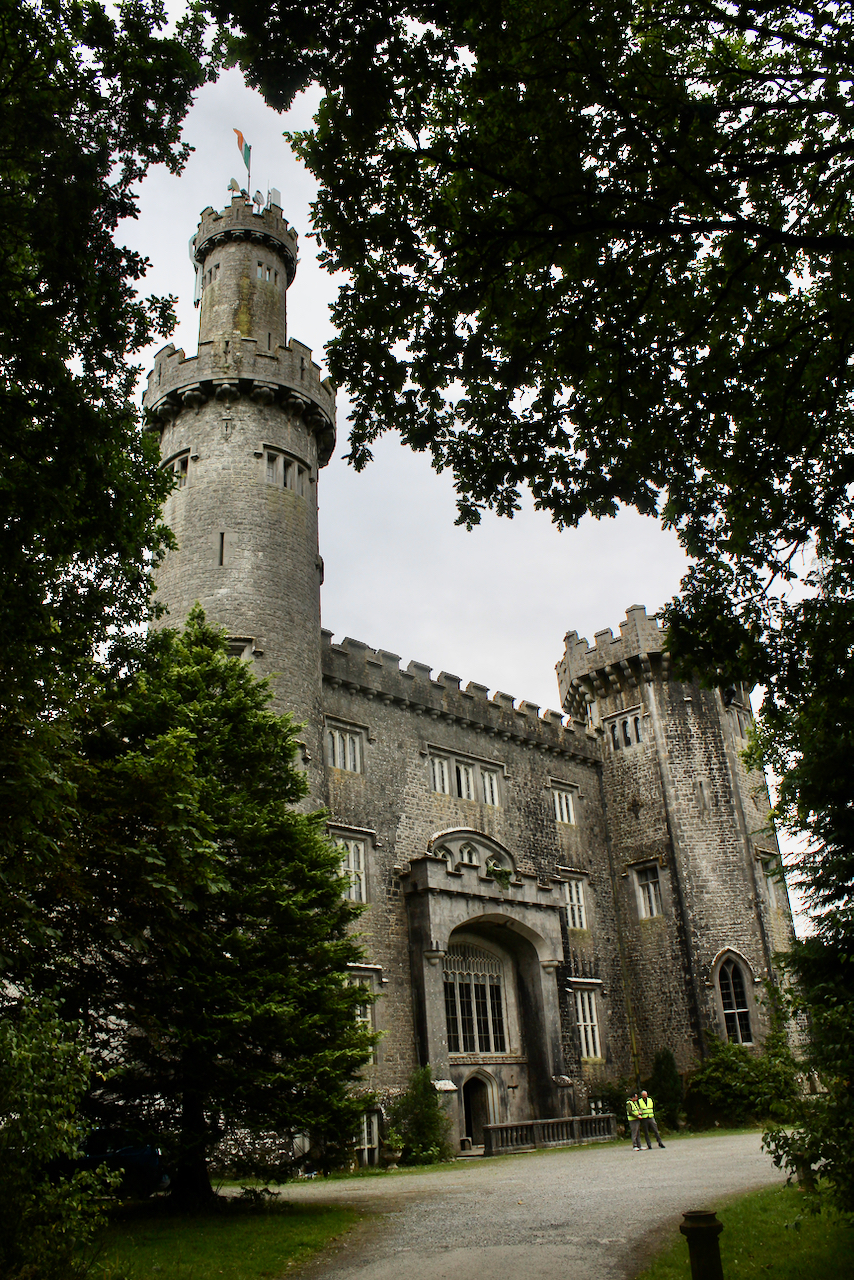
Charleville Forest Castle, County Offaly, Heritage Week, August 2024 Photograph © Jennifer Winder-Baggot, www.irishhistorichouses.com

In Irish Houses and Gardens. From the Archives of Country Life, Sean O’Reilly tells us that Charles William Bury and his wife, Catherine Maria née Dawson, had some hand in drawing plans for the building. He tells us: “Bury’s intention, as he wrote in his own unfinished account of the work, was to ‘exhibit specimens of Gothic architecture’ adapted to ‘chimneypieces, ceilings, windows, balustrades, etc.’ but without excluding ‘convenience and modern refinements in luxury.’ This recipe for the Georgian gothic villa had already been used at Horace Walpole’s Strawberry Hill in London, and Bury’s cultivated lifestyle in England certainly would have made him aware of that house and its long line of descendants.” [2]

Charles William Bury was President of the Royal Irish Academy between 1812 and 1822. He saw himself as the castle’s architect.

O’Reilly continues: “It may be that Bury himself – possibly with the assistance of his wife – outlined some of the more dramatic features in his new house, as is suggested by a number of drawings relating to the final design which still survive, now in the Irish Architectural Archive in Dublin. These all show the crude hand of an amateur, but equally betray a total freedom of imagination unshackled by the discipline of architectural training. In particular, a drawing of the exterior shows the smaller tower rising up out of the ground like a tree, with its base spreading and separating as it grows into the ground like roots.” [2]

Charleville Forest was written up by Mark Girouard for Country Life in 1962. Just over fifty-three years later Country Life published another article (October 2016), this time by Dr Judith Hill, awarded a doctorate for her work on the Gothic in Ireland.

Hill researched the role that Charles William Bury’s wife Catherine played in the design of Charleville, and shared her findings in a lecture given to the Offaly History Society and published on the Offaly History blog. She tells us:

“…it was time to look more closely at the collection of Charleville drawings which had been auctioned in the 1980s. Many of these are in the Irish architectural Archive, and those that were not bought were photographed. Here I found two pages of designs for windows that were signed by Catherine (‘CMC’: Catherine Maria Charleville). There is a sketch of a door annotated in her hand writing. There is a drawing showing a section through the castle depicting the wall decoration and furniture that had been attributed to Catherine. Rolf Loeber had a perspective drawing of the castle which showed the building, not quite as it was built, in a clearing in a wood. The architecture was quite confidently drawn and the trees were excellent. It was labelled ‘Countess Charleville’. I looked again at some of the sketches of early ideas for the castle in the Irish Architectural Archive. In one, the building design was hesitant while the trees were detailed; an architect wouldn’t bother with such good trees for an early design sketch. There was another that had an architect’s stamp; the massing of the building quickly drawn, the surrounding trees extremely shadowy. I could see Catherine and [Francis] Johnston talking about the design in these drawings.” [3]
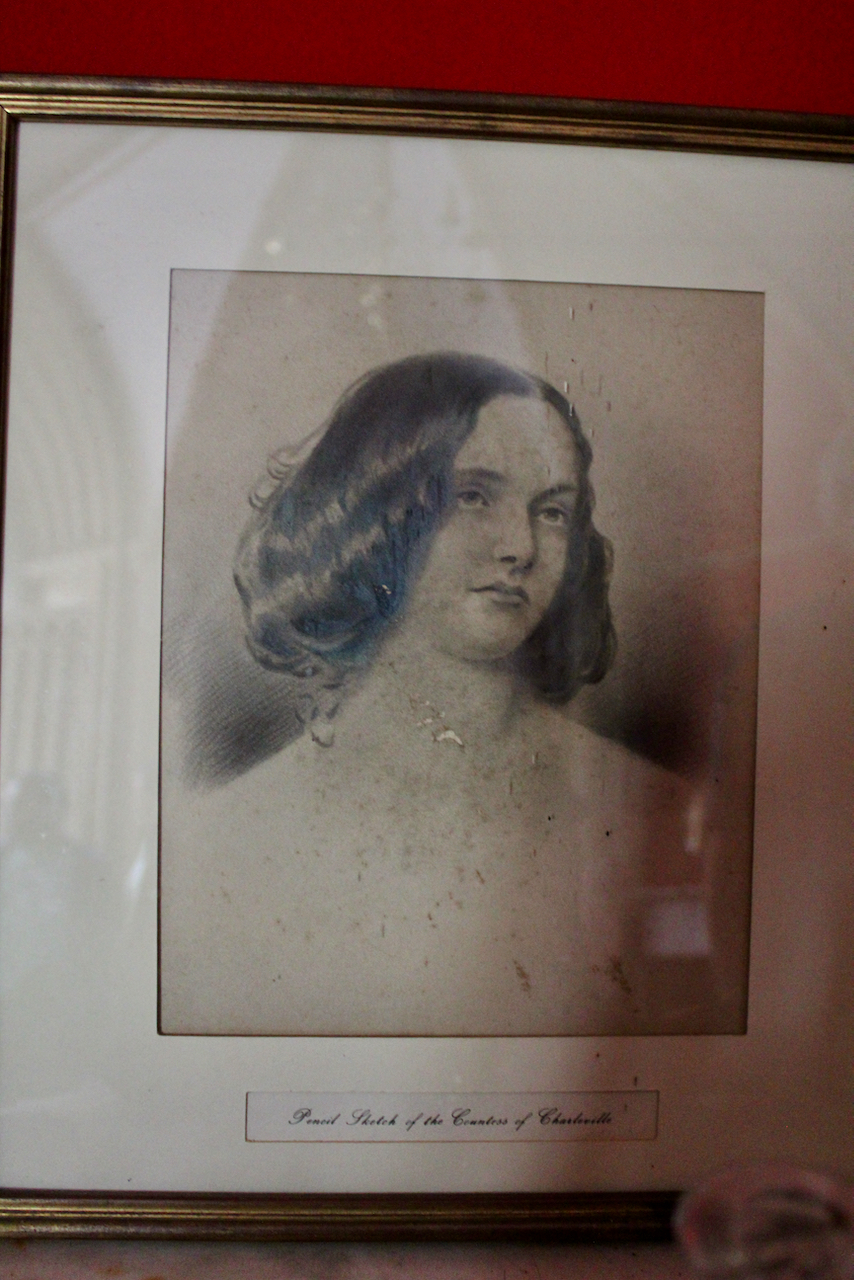
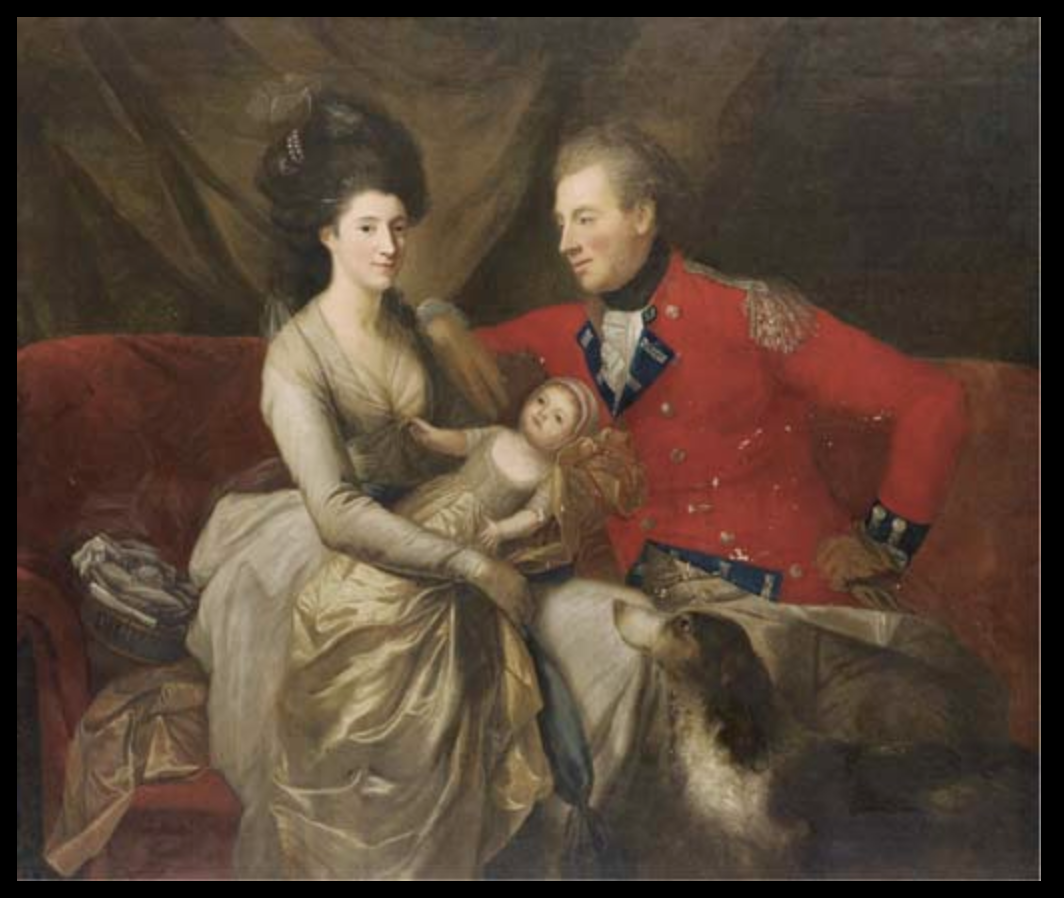
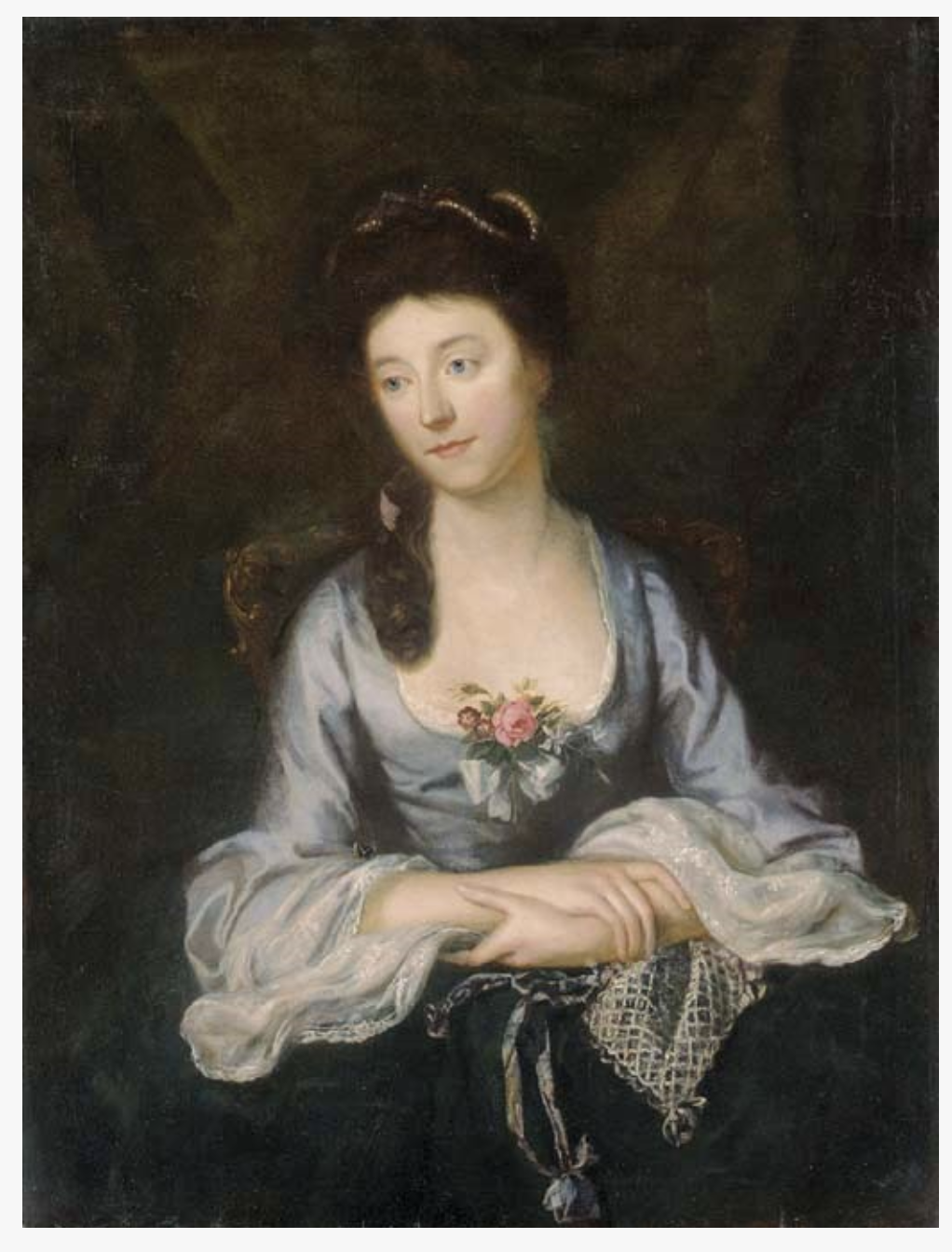
One of the Countesses of Charleville, though I don’t know which one. Possibly Harriet Charlotte Beaujolois, the third daughter of Col. John Campbell of Shawfield in Scotland and Lady Charlotte Susan Maria Campbell. She was the second countess of Charleville and mother of Beaujolois or Little Beau.

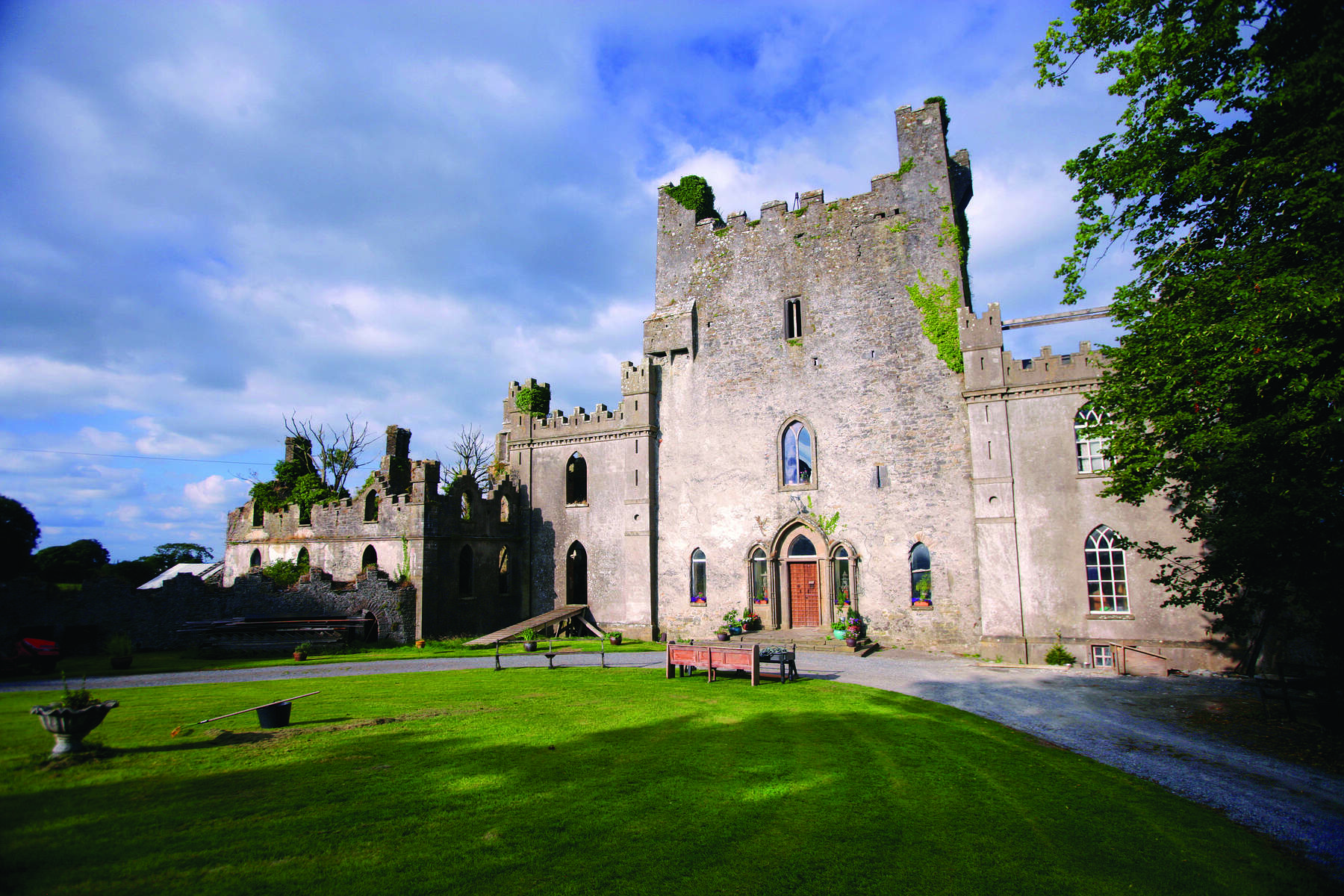
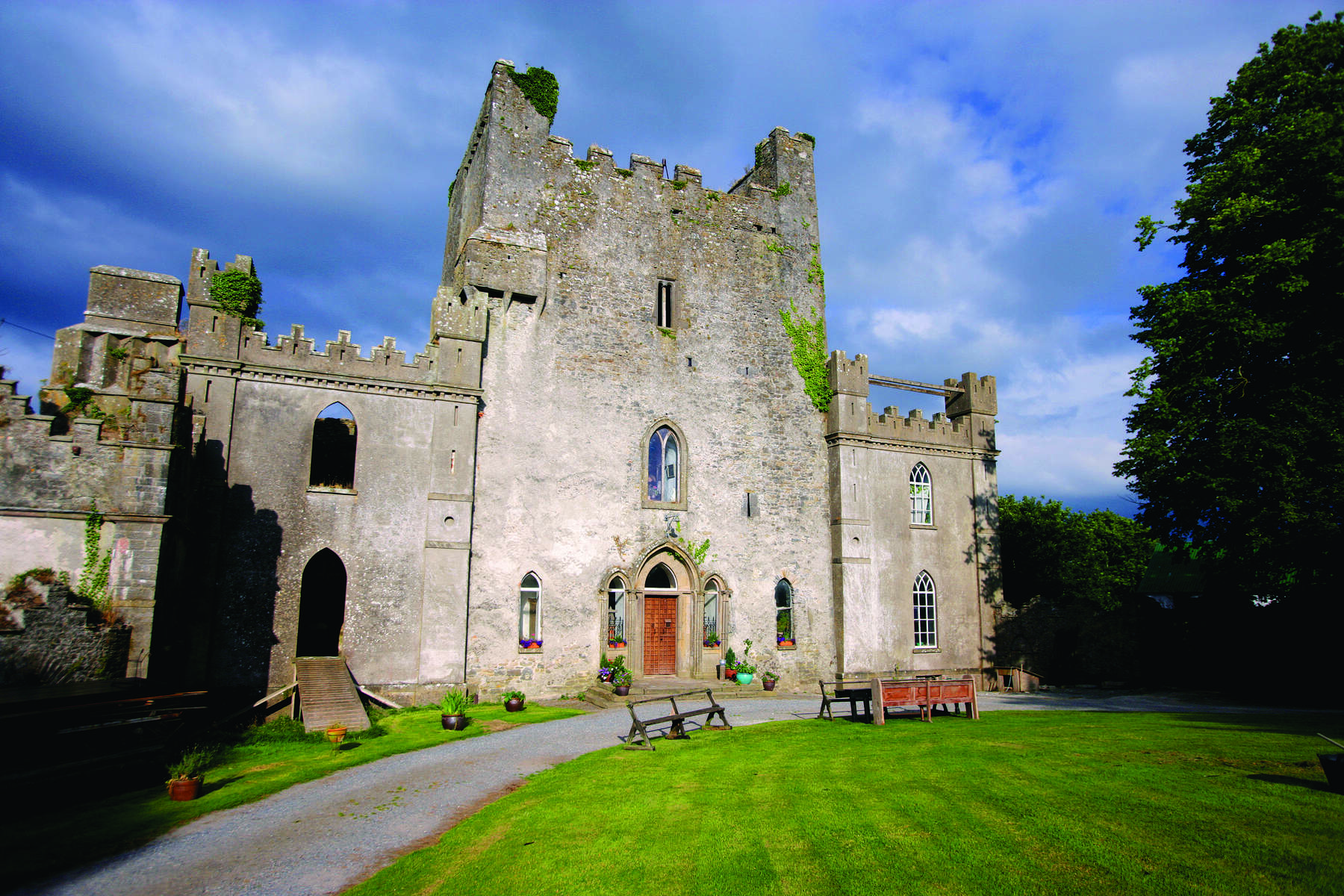
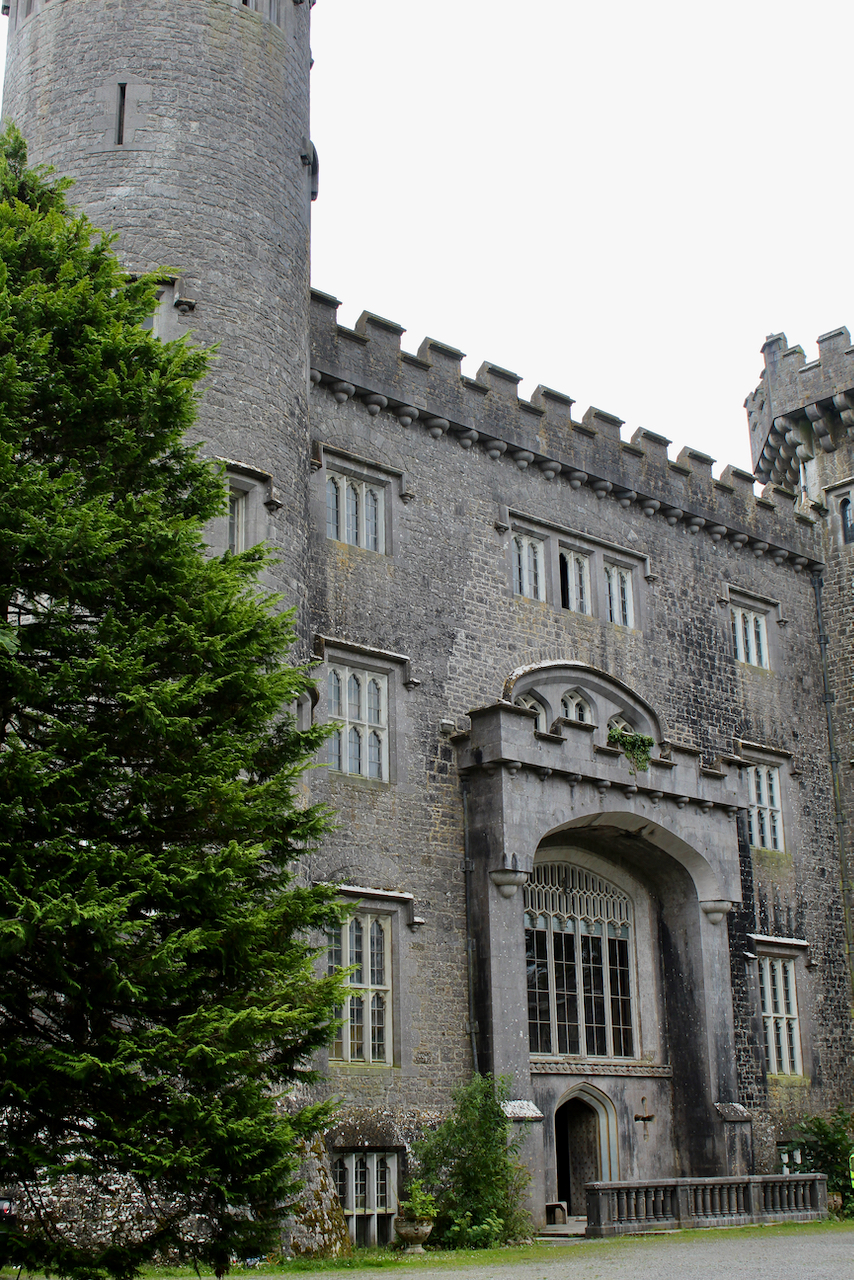
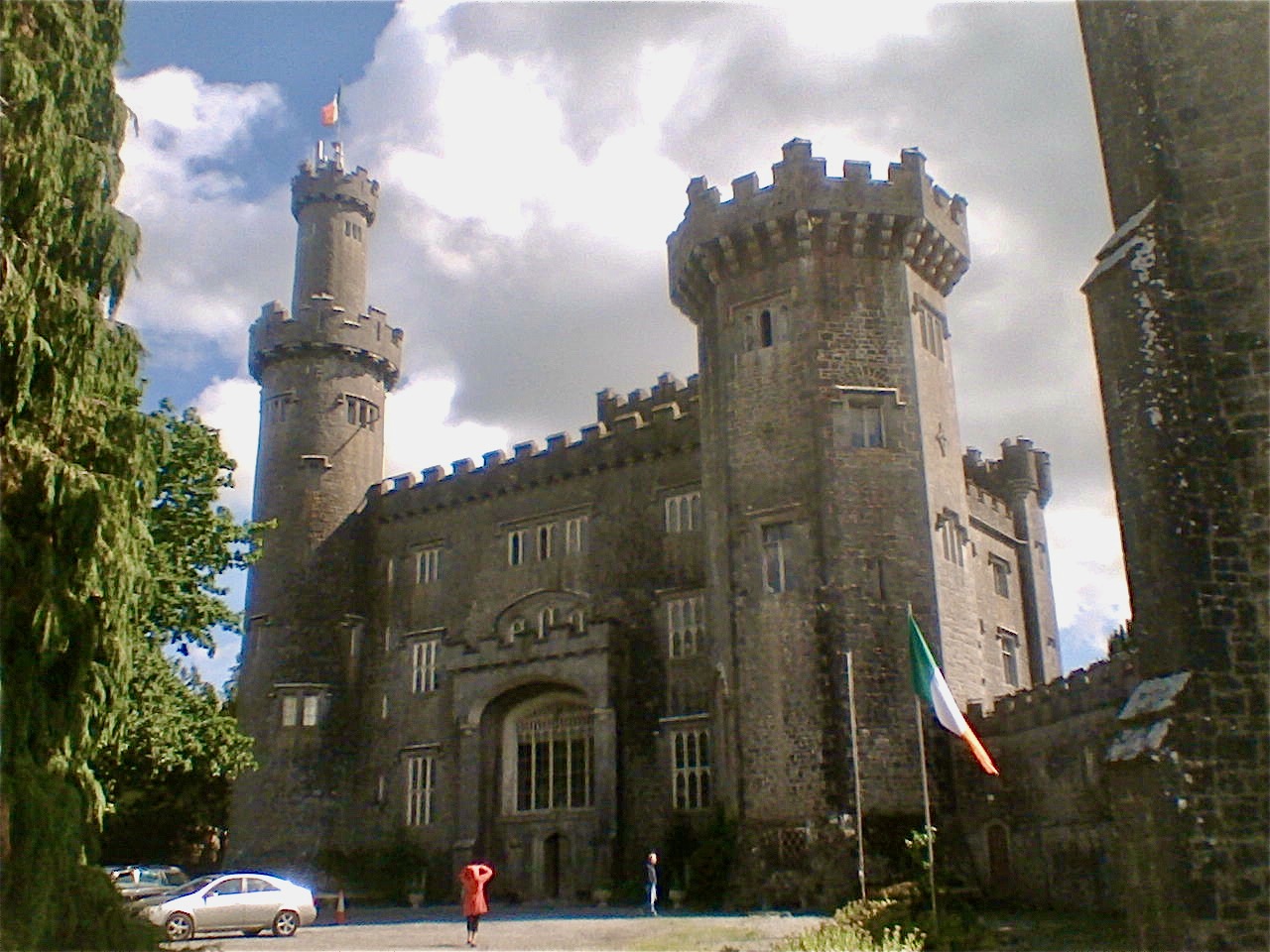
Bence-Jones describes Charleville Forest castle as “a high square battlemented block with, at one corner, a heavily machicolated octagon tower, and at the other, a slender round tower rising to a height of 125 feet, which has been compared to a castellated lighthouse. From the centre of the block rises a tower-like lantern. The entrance door, and the window over it, are beneath a massive corbelled arch. The entire building is cut-stone, of beautiful quality.” [see 1]
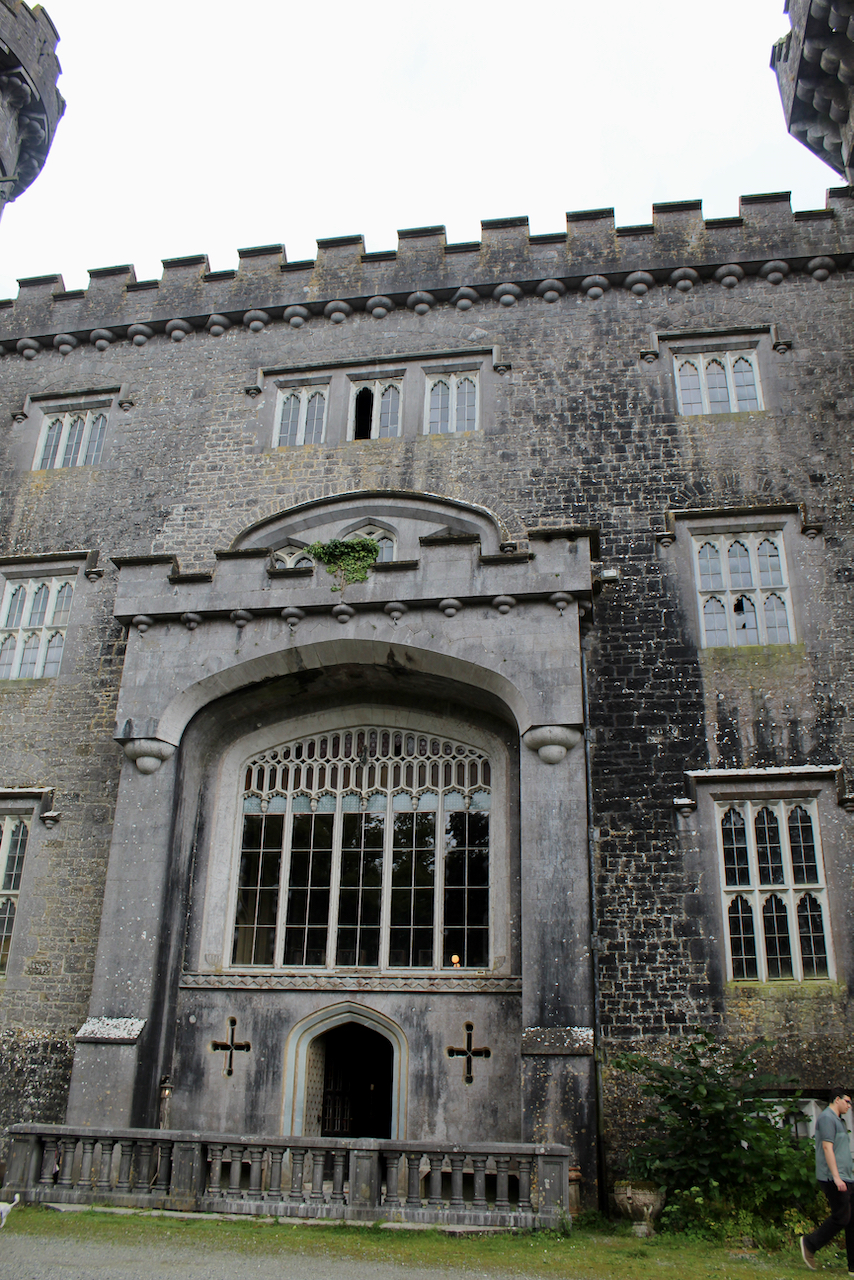
“The entrance door, and the window over it, are beneath a massive corbelled arch.” Charleville Forest Castle, County Offaly, Heritage Week, August 2024 Photograph © Jennifer Winder-Baggot, www.irishhistorichouses.com
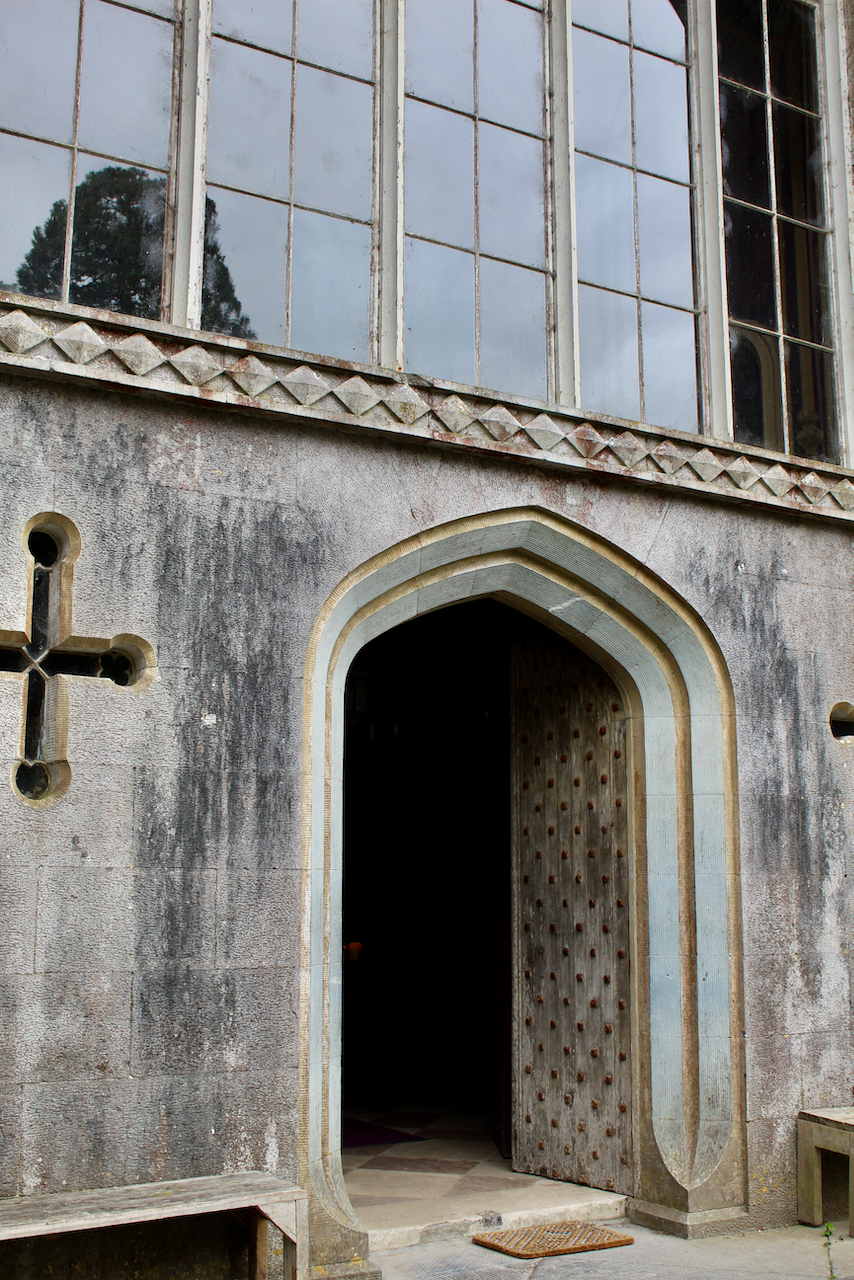
Front door, Charleville Forest Castle, County Offaly, Heritage Week, August 2024 Photograph © Jennifer Winder-Baggot, www.irishhistorichouses.com

Beginning in 1912, with the departure of Lady Emily, the last surviving daughter of the 4th Earl of Charleville, the house was left empty for 68 years.

In 1970 David Hutton-Bury (who owned and lived on the estate adjacent to the castle) granted a 35-year lease for the castle and surrounding 200 acres to Michael McMullen. McMullen lived in the castle and began its restoration in the early 1980s, during which time he restored the six main public rooms. In 1987 Bridget Vance and her mother, Constance Vance-Heavey, took over the leasehold from McMullen and continued the restoration. [4] It is now owned by the Charleville Castle Heritage Trust.

The land of Charleville Forest was inherited by Charles William’s father, John Bury (1725-1764) of Shannongrove, County Limerick. He succeeded to the estates of his maternal uncle, Charles Moore (1712-1764) 1st Earl of Charleville, in February 1764.
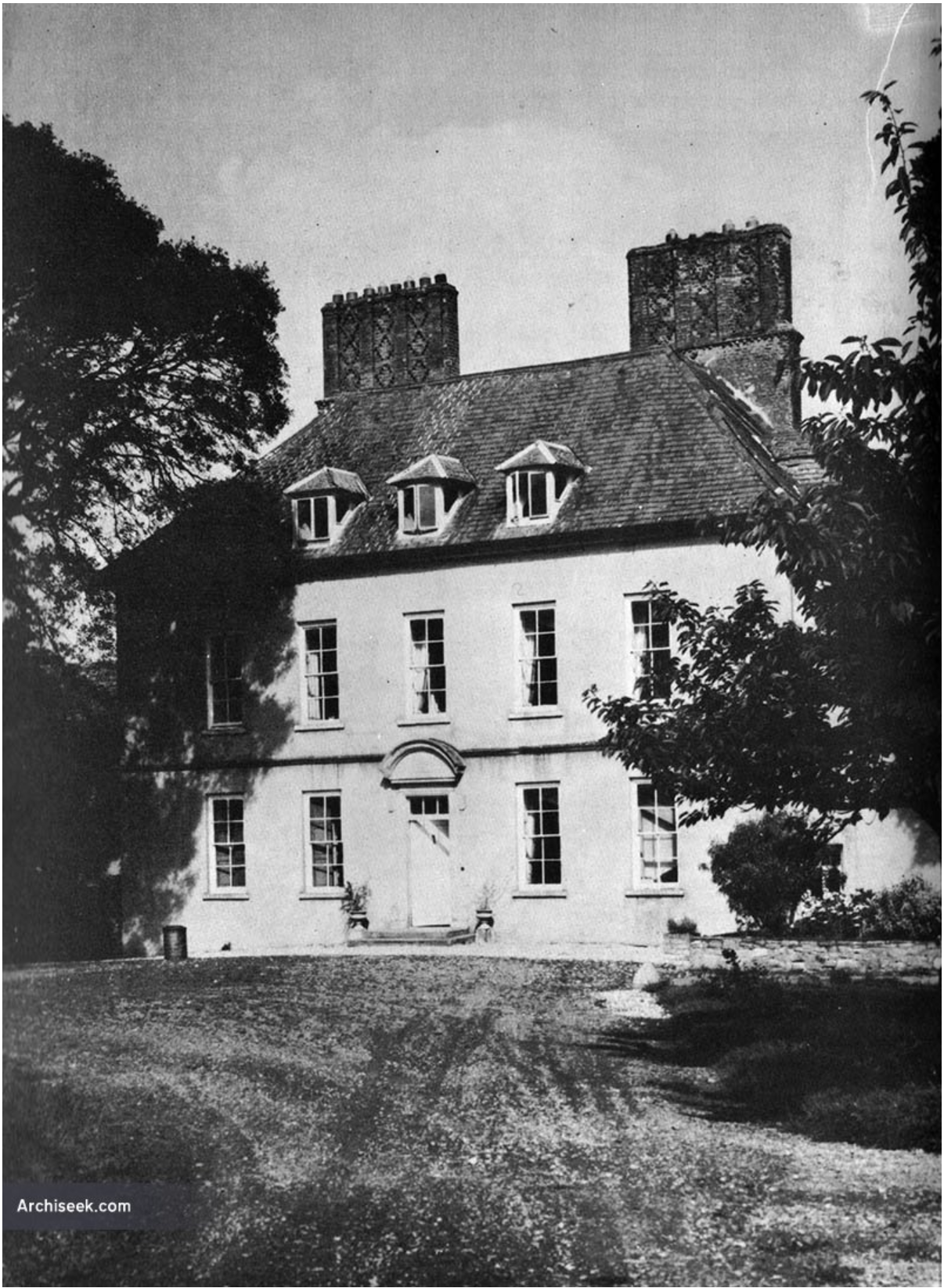
Shannongrove, County Limerick, the home of Charles William Bury’s father, courtesy of Archiseek. [5]

The oak forest and lands were gifted by Queen Elizabeth I to John Moore of Croghan Castle in 1577. Moore leased the land to Robert Forth, who built a house he called Redwood next to the river Clodiagh. In the 1740s Charles Moore 2nd Baron Moore and later 1st Earl of Charleville bought out the lease and made the house the family seat and named it Charleville, after himself.

Due to the lack of male heirs in the Moore family after Charles Moore’s death in 1764, and the fact that John Moore died later that year in 1764, the land was inherited by Charles William Bury who was the grand nephew of the last Earl, at just six months old.

Charles William Bury’s mother Catherine Sadleir was from Sopwell Hall County Tipperary. After her husband John Bury died, she married Henry Prittie (1743-1801) 1st Baron Dunally of Kilboy, which whom she went on to have several more children. The family probably moved to the house he had built called Kilboy House in County Tipperary.
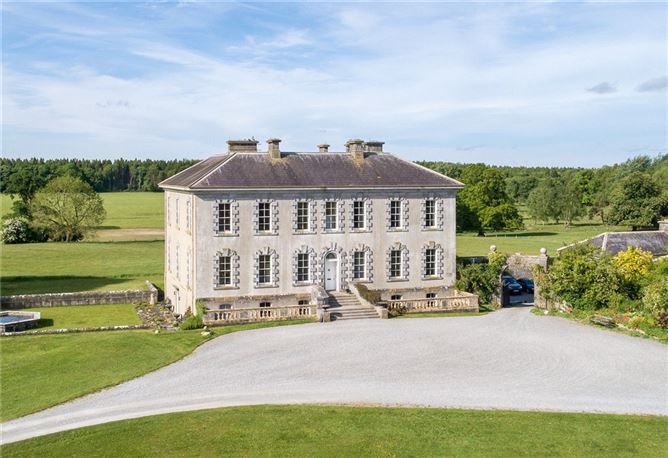
Sopwell Hall, County Tipperary, courtesy of Colliers estate agents and myhome.ie. It was built in 1745 to a design attributed to Francis Bindon. The sale site tells us that in 1745 Francis Sadlier (1709-1797) built Sopwell Hall. The Sopwell Estate ownership passed to the Trench family in 1797 through the marriage of his daughter, Mary. The Trench family remained in ownership until 1985. See more photos in footnotes [6]
Henry Prittie, 1st Baron Dunalley (1743-1801), Irish school, courtesy of Christie’s. He was the stepfather of Charles William Bury.

On Charles Moore’s death the title became extinct until Charles William Bury was created 1st Earl of Charleville of the second creation in 1806. Before this, in 1797 he was created Baron Tullamore and in 1800, Viscount Charleville. Bury was returned to the Irish Parliament for Kilmallock in January 1790, but lost the seat in May of that year. He was once again elected for Kilmallock in 1792, and retained the seat until 1797. In 1801 he was elected as an Irish representative to sit in the British House of Lords in England.

Charles William Bury’s wife Catherine was daughter of Thomas Townley Dawson and widow of James Tisdall. From that marriage she had a daughter named Catherine.
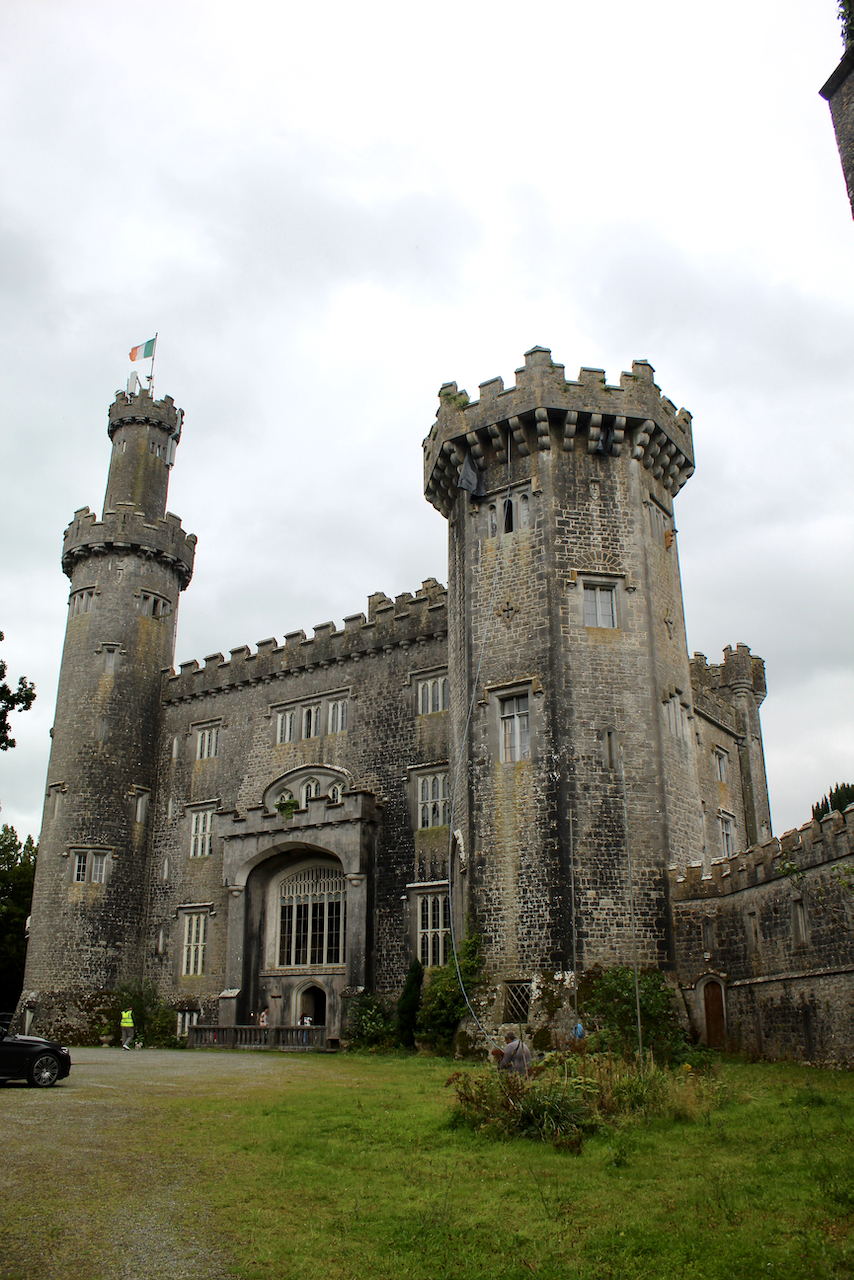
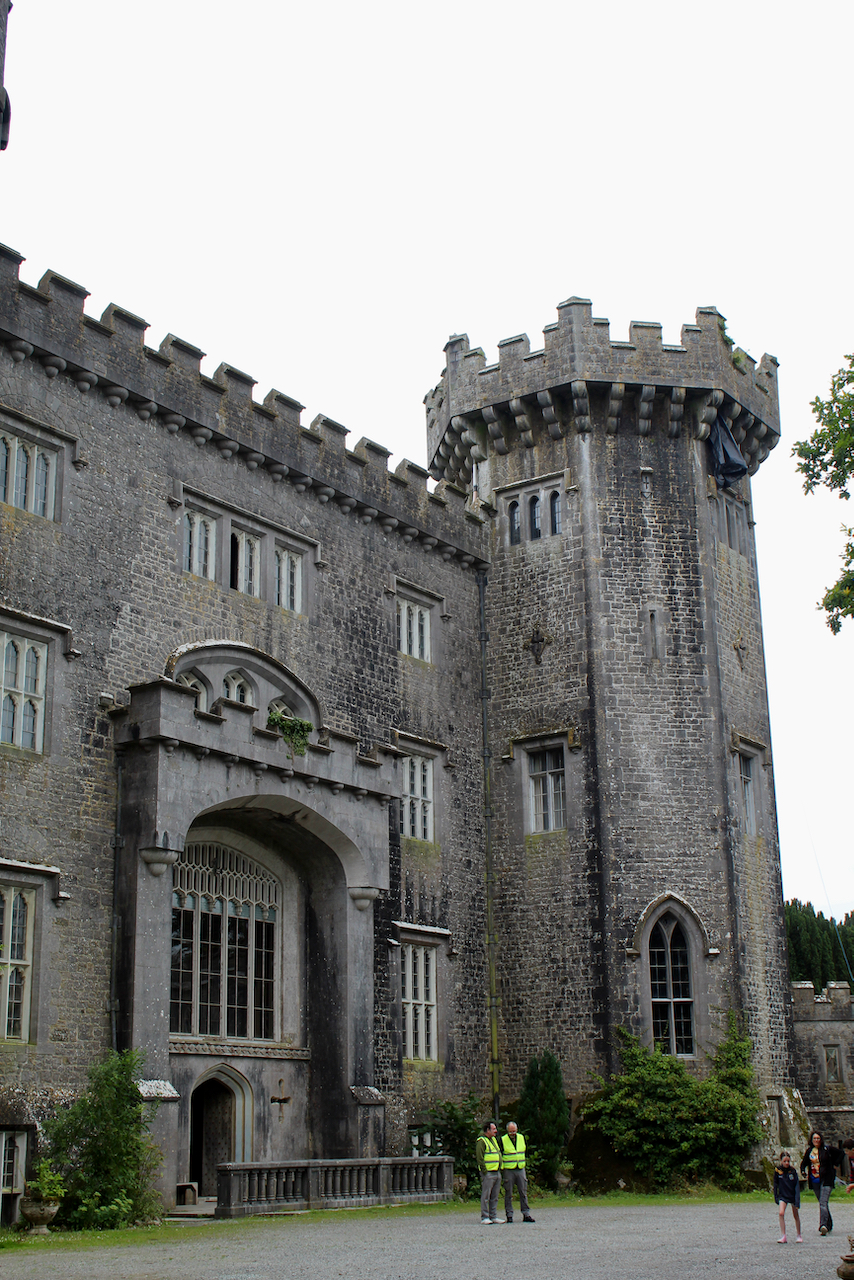
Charleville Forest Castle, August 2024. Photograph © Jennifer Winder-Baggot, www.irishhistorichouses.com
Charleville Forest Castle, County Offaly, Heritage Week, August 2024 Photograph © Jennifer Winder-Baggot, www.irishhistorichouses.com

Andrew Tierney describes Charleville Forest Castle in The Buildings of Ireland: Central Leinster: Kildare, Laois and Offaly:

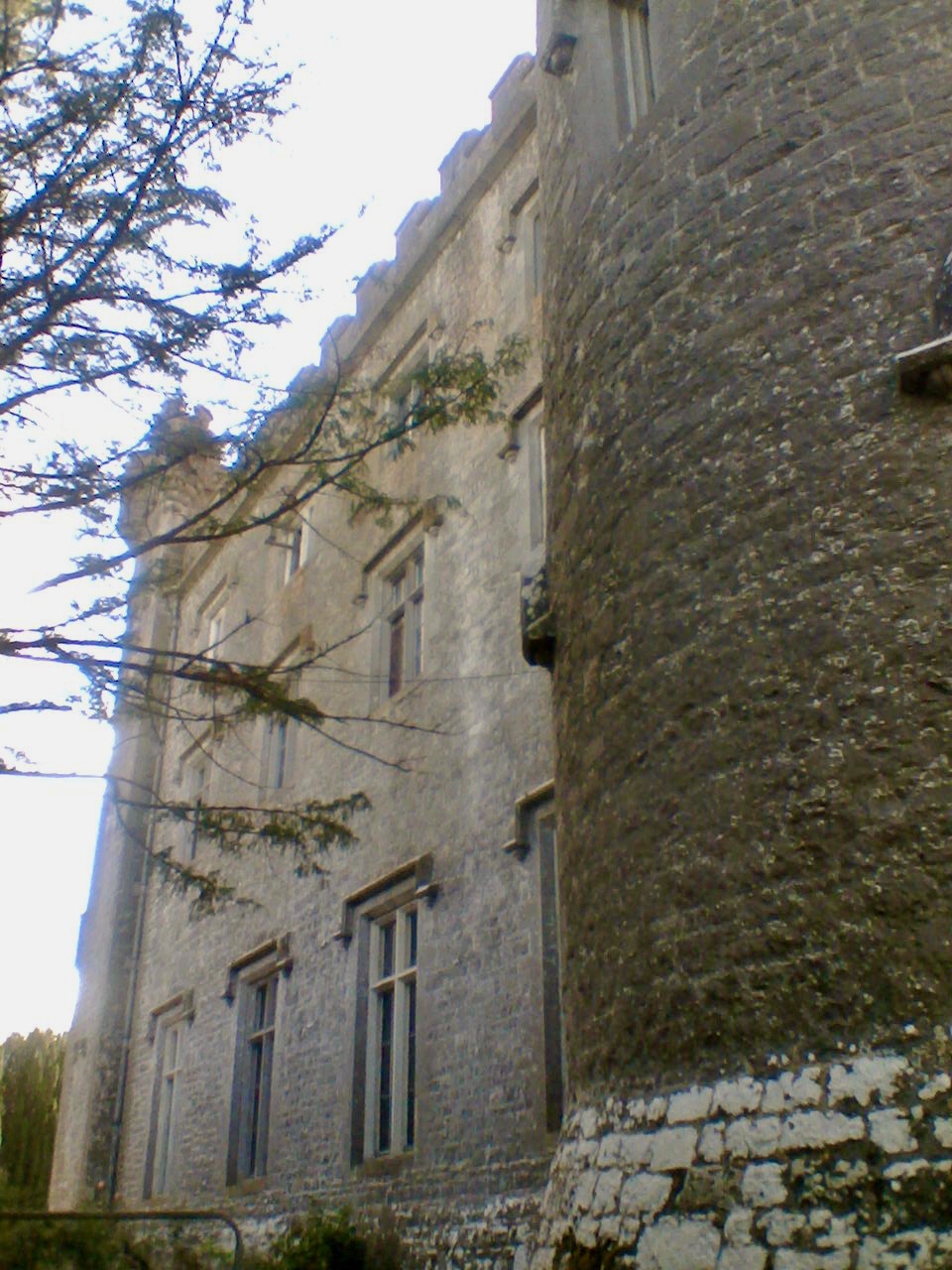
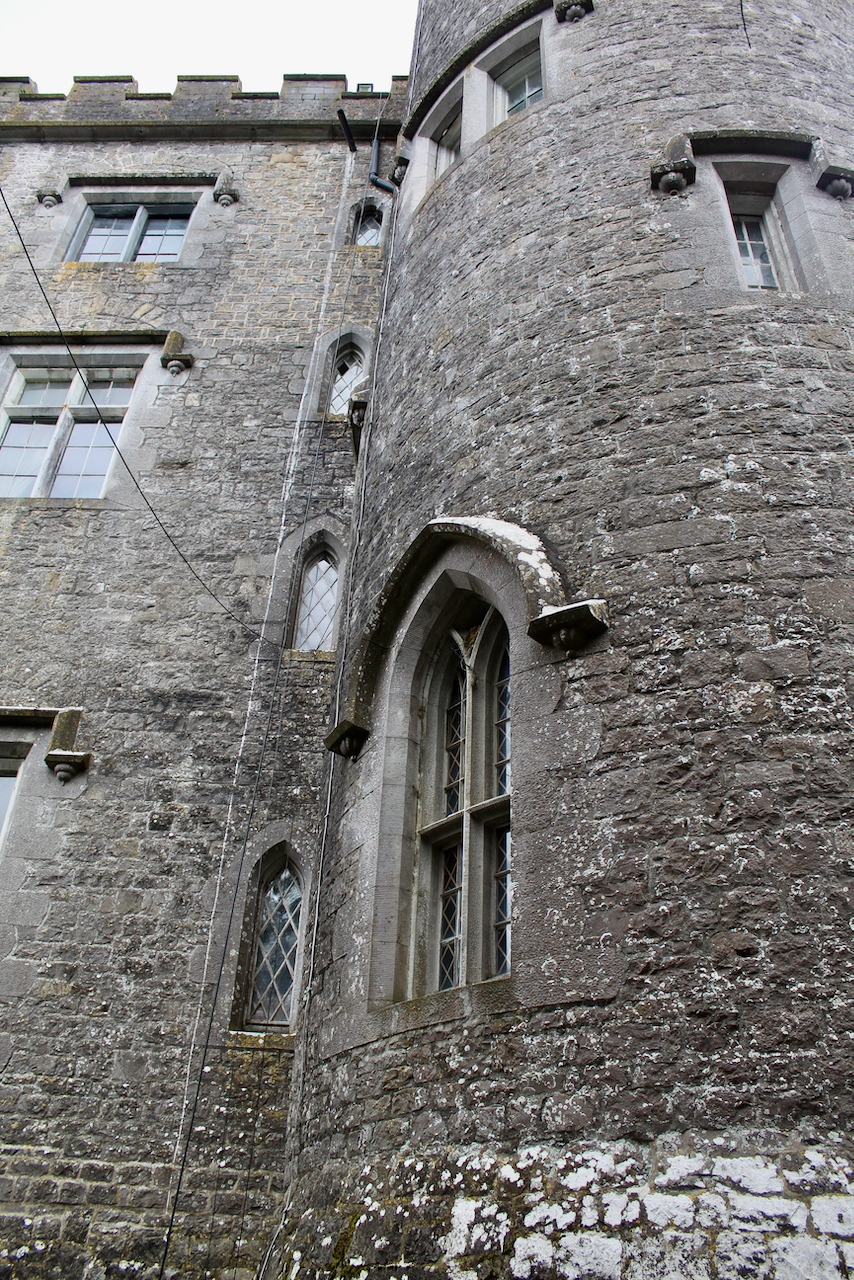
The castle comprises a tall castellated block of snecked [snecked masonry has a mixture of roughly squared stones of different sizes] limestone rubble with ashlar trim, with a great muscular octagonal tower to the northwest and a narrow round tower with soaring tourelle [small tower] to the NE…The composition breaks out more fully in the collective irregular massing of the towers, the chapel and the stable block, which rambles off to the west.” [7]
Charleville Forest Castle, County Offaly, Heritage Week, August 2024 Photograph © Jennifer Winder-Baggot, www.irishhistorichouses.com

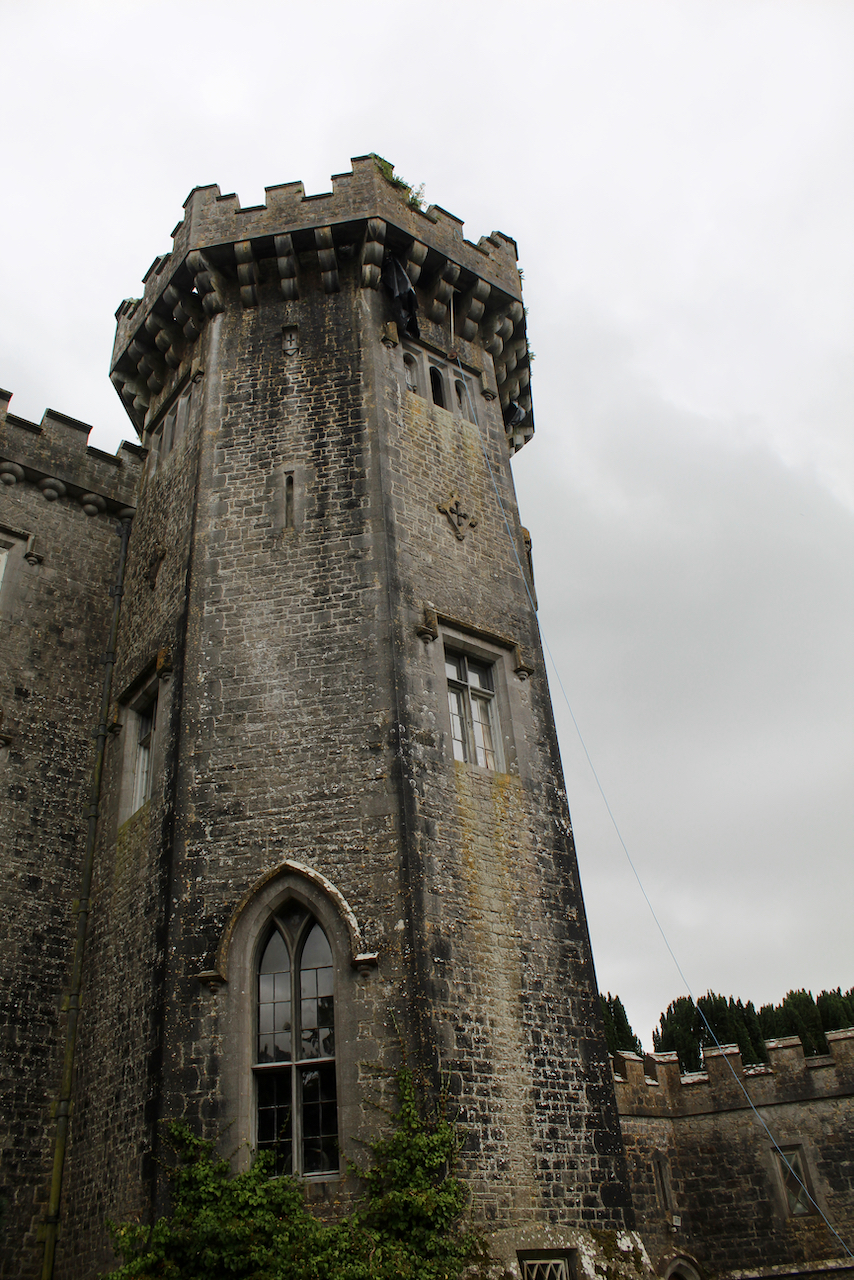
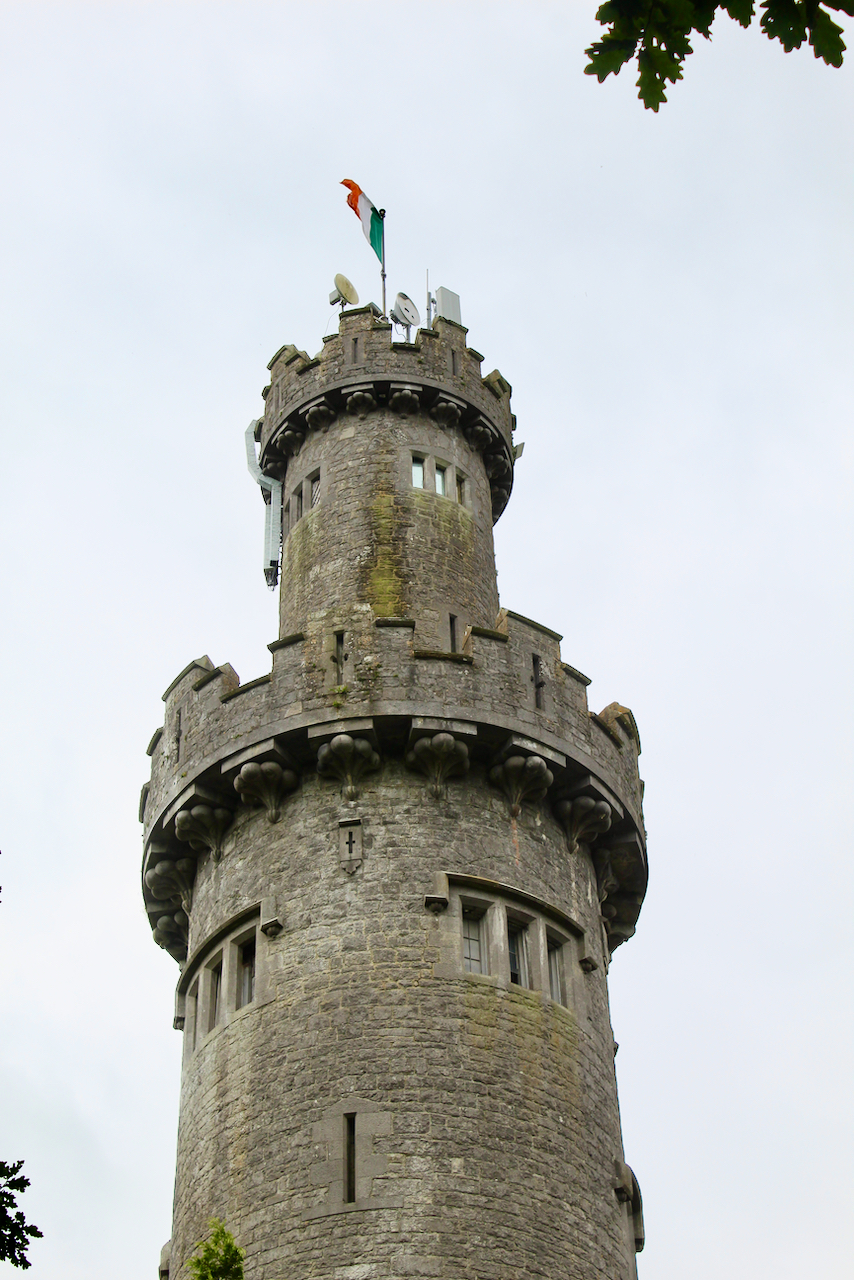
Tierney continues: “The positioning of a great window over the doorway bears comparison with the earlier group of Pale castles, such as Castle Browne (now Clongowes Woods school), attributed to Thomas Wogan Browne. It appears as a portcullis descending from a Gothic arch with a drawbridge in Lord Charleville’s original drawing (which also had a Radcliffean damsel in distress screaming from the battlements). He spent a lot of time drawing a sevenlight panelled window in its stead – the effect is much the same from afar – although the executed window is a more complex Perp design, probably by Johnston. The Tudor arch is employed three times in succession: over the door, in the recess of the great window and in the tripartite window above, which is subdivided into three further arches. This use of the same detailing at varying scales is also seen in the corbelling – a sort pair of intersecting hemispheres. The battlements are simple crenels on the main block but on the towers are rendered in a distinctly Irish fashion (a distinction Johnston would make at Tullynally and Markree), and here the corbelling is also more elaborate, sprouting upwards like cauliflower on the NE tower.

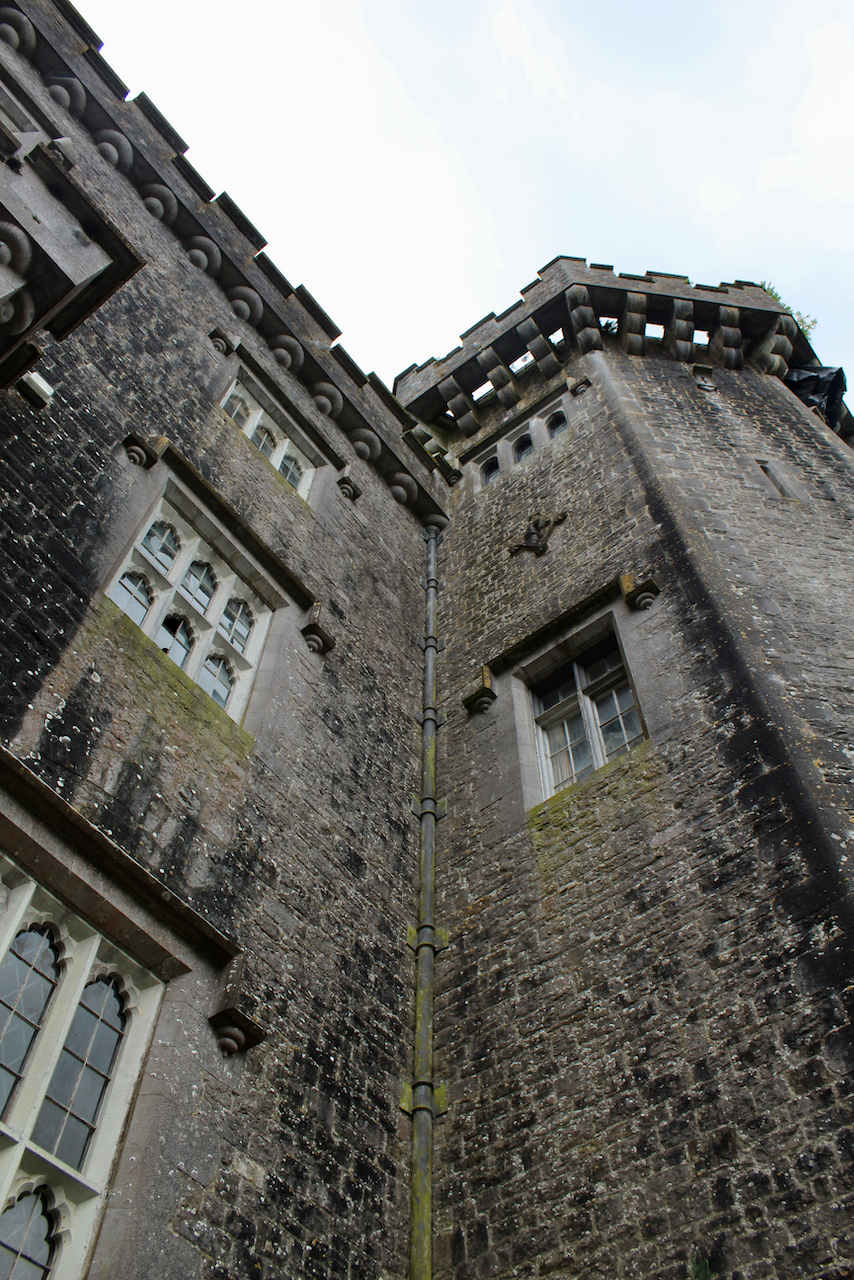
“Muscular” octagonal tower, Charleville, County Offaly. Photograph © Jennifer Winder-Baggot, www.irishhistorichouses.com
Charleville Castle octagonal tower, August 2024. Tierney describes the windows in front of the castle as “cinquefoil.” Photograph © Jennifer Winder-Baggot, www.irishhistorichouses.com
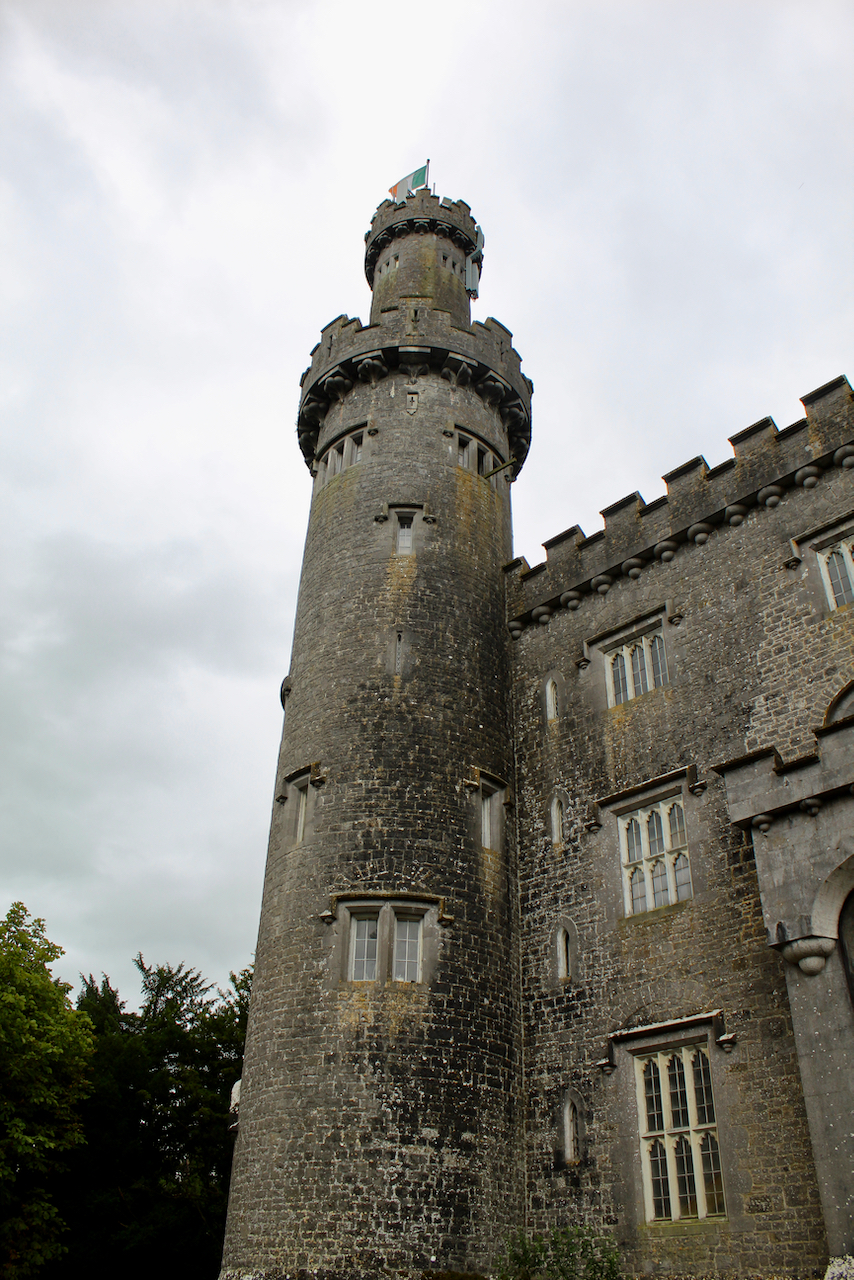
The northeast tower with telescoping “tourelle” and the corbelling “sprouting upwards like cauliflower,” Charleville Forest Castle, County Offaly, Heritage Week, August 2024 Photograph © Jennifer Winder-Baggot, www.irishhistorichouses.com
Charleville, County Offaly, 2018. Photograph © Jennifer Winder-Baggot, www.irishhistorichouses.com
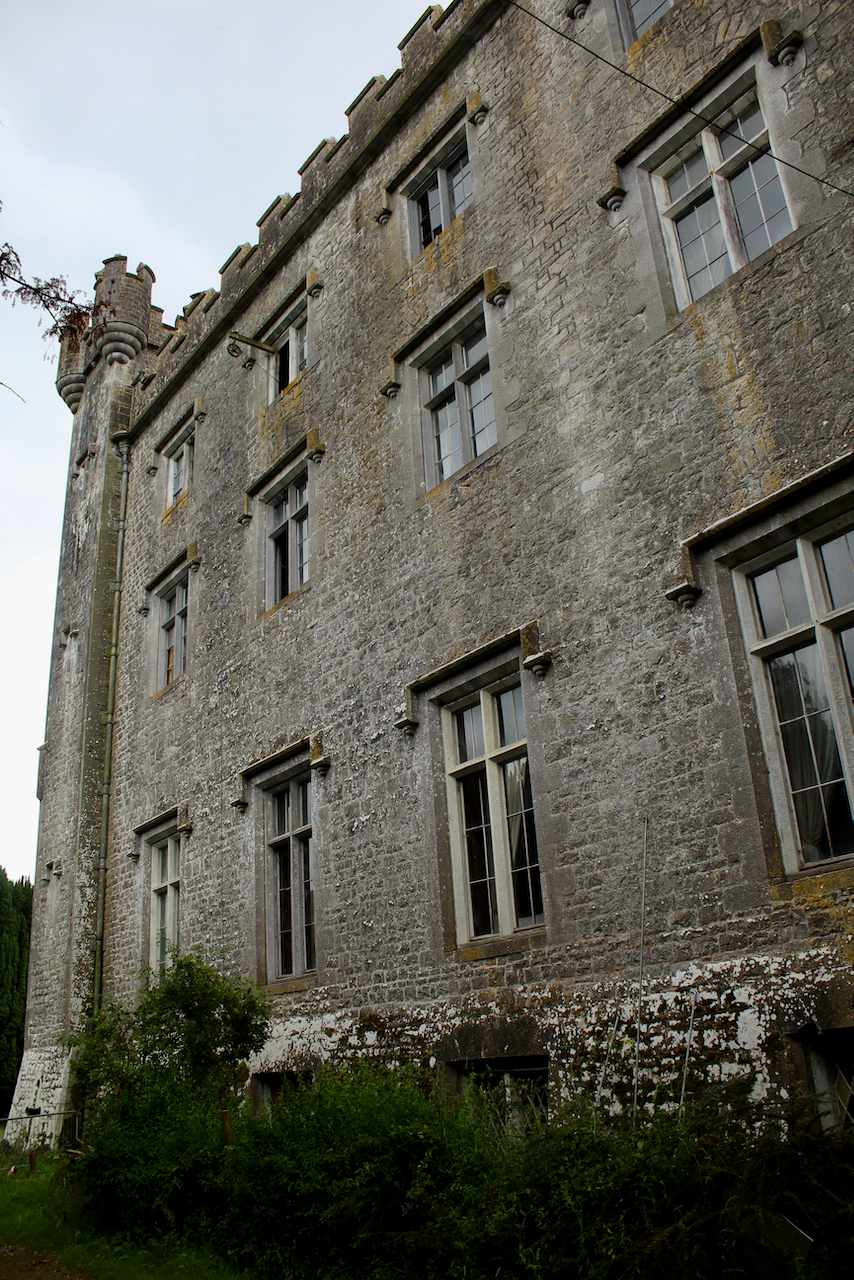
Side facade with NE tower, Charleville, County Offaly. Photograph © Jennifer Winder-Baggot, www.irishhistorichouses.com
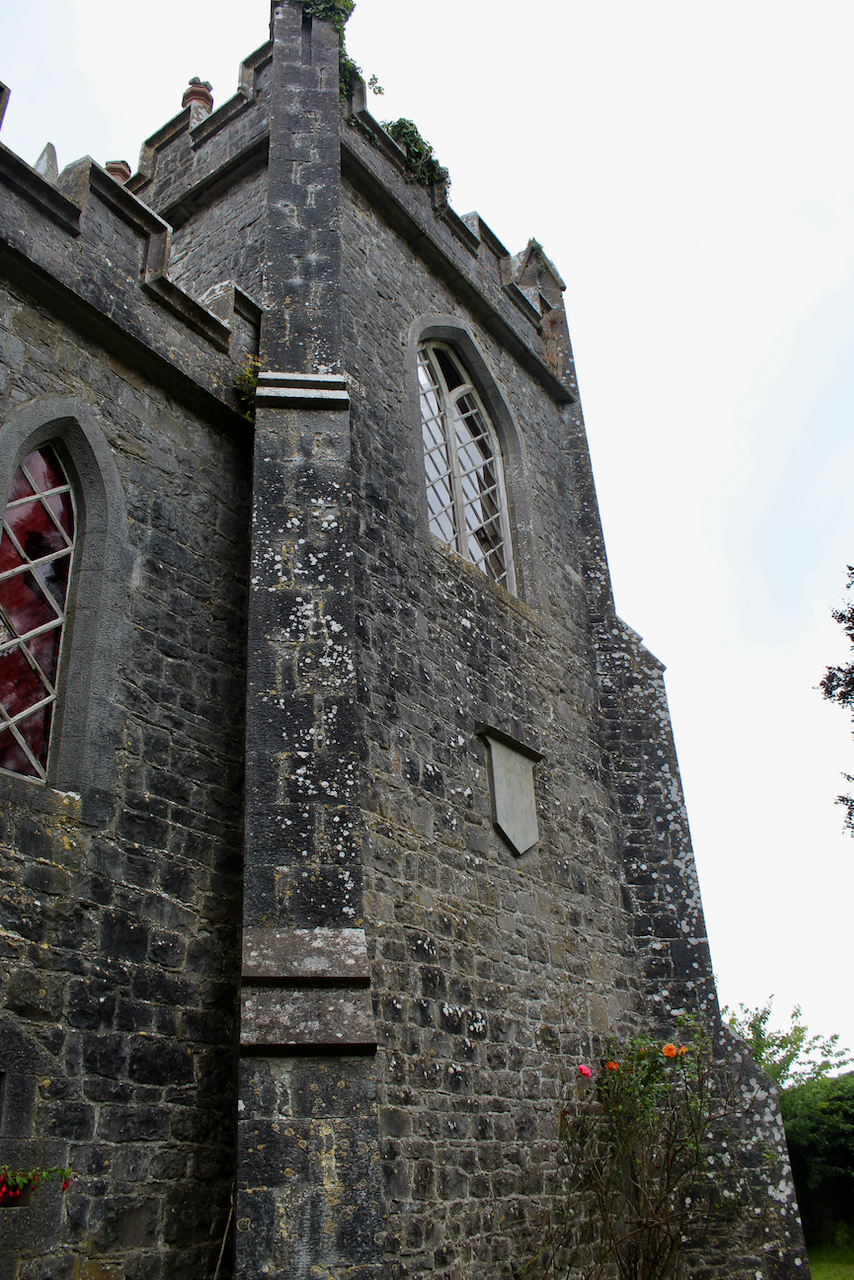
Side facade with NE tower, and Y shaped early 14th century style tracery arched windows, Charleville, County Offaly. Photograph © Jennifer Winder-Baggot, www.irishhistorichouses.com
Side facade, with Elizabethan style mullions and transoms of timber tooled to look like stone, Charleville, County Offaly. Photograph © Jennifer Winder-Baggot, www.irishhistorichouses.com

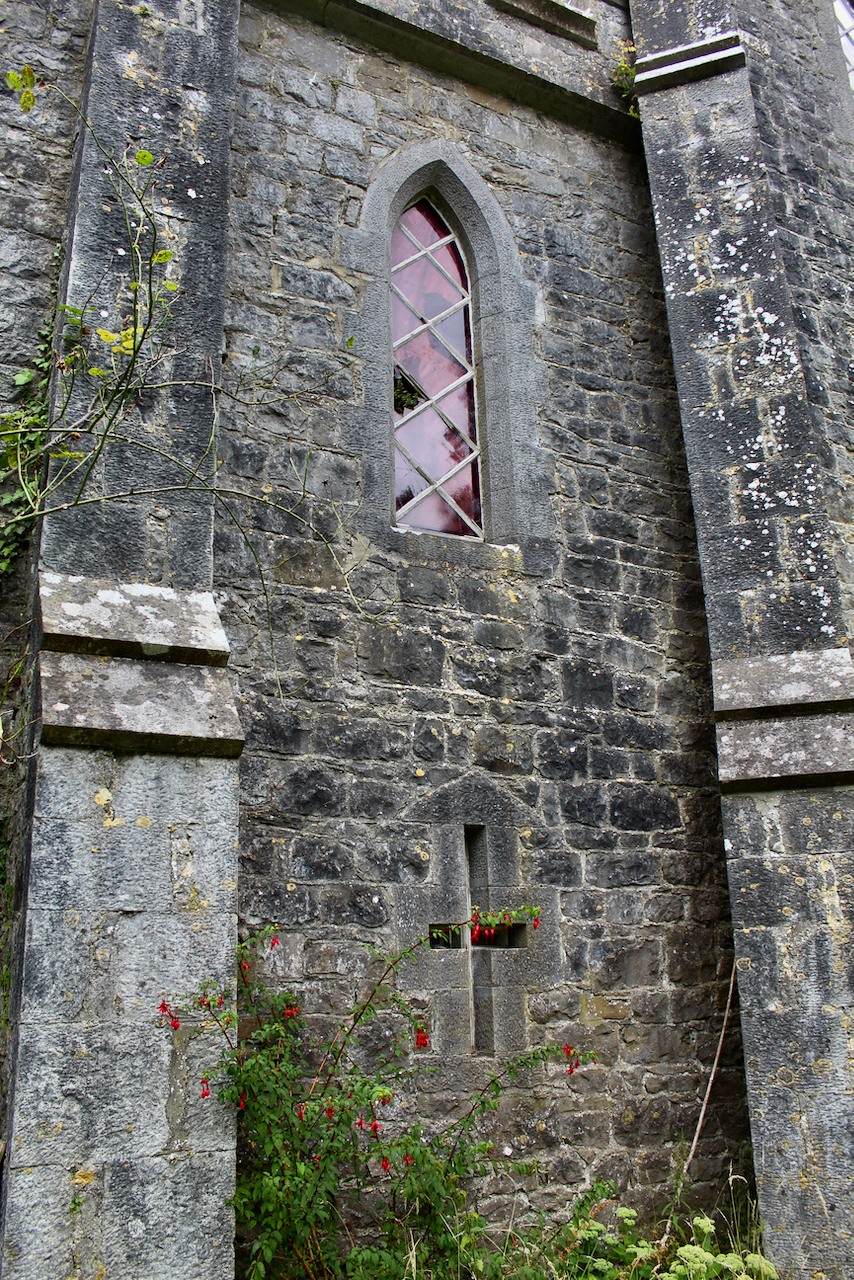
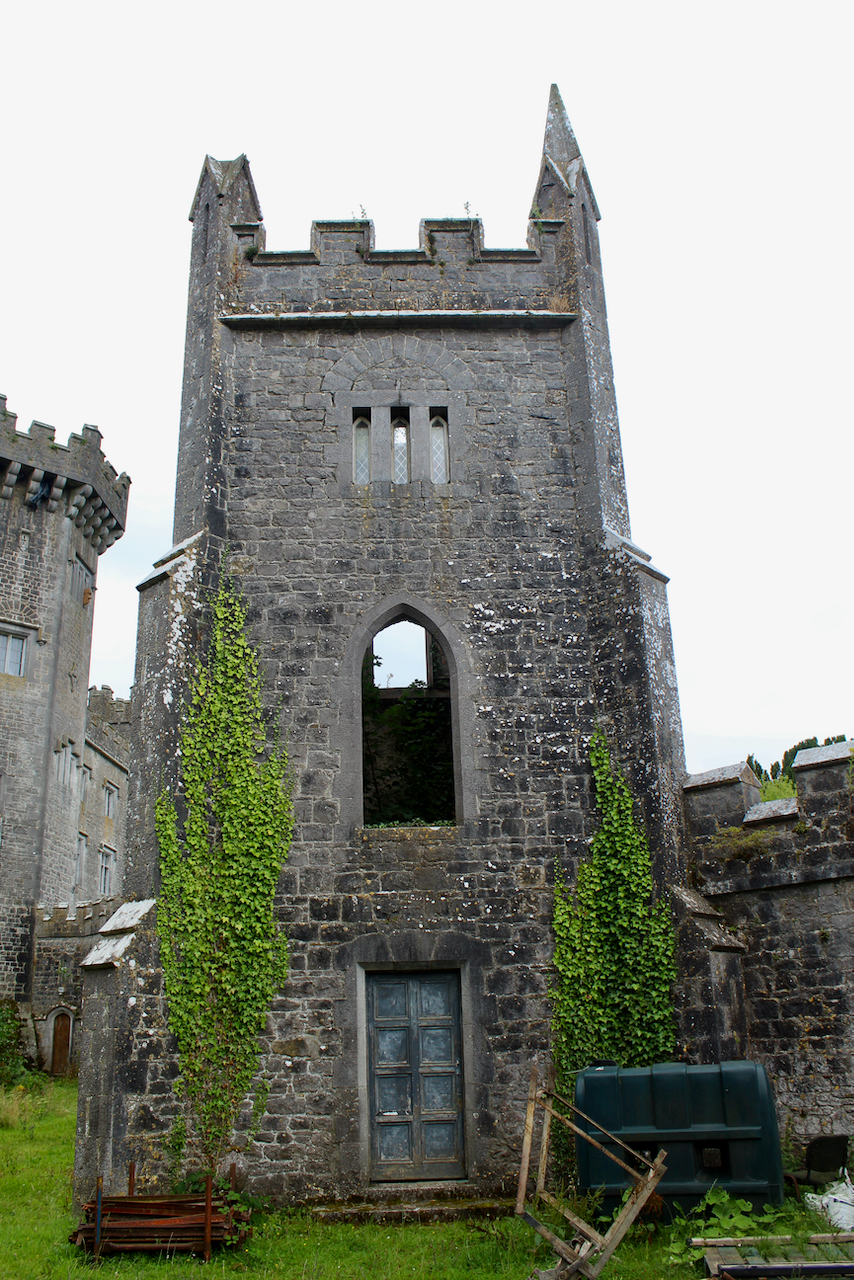
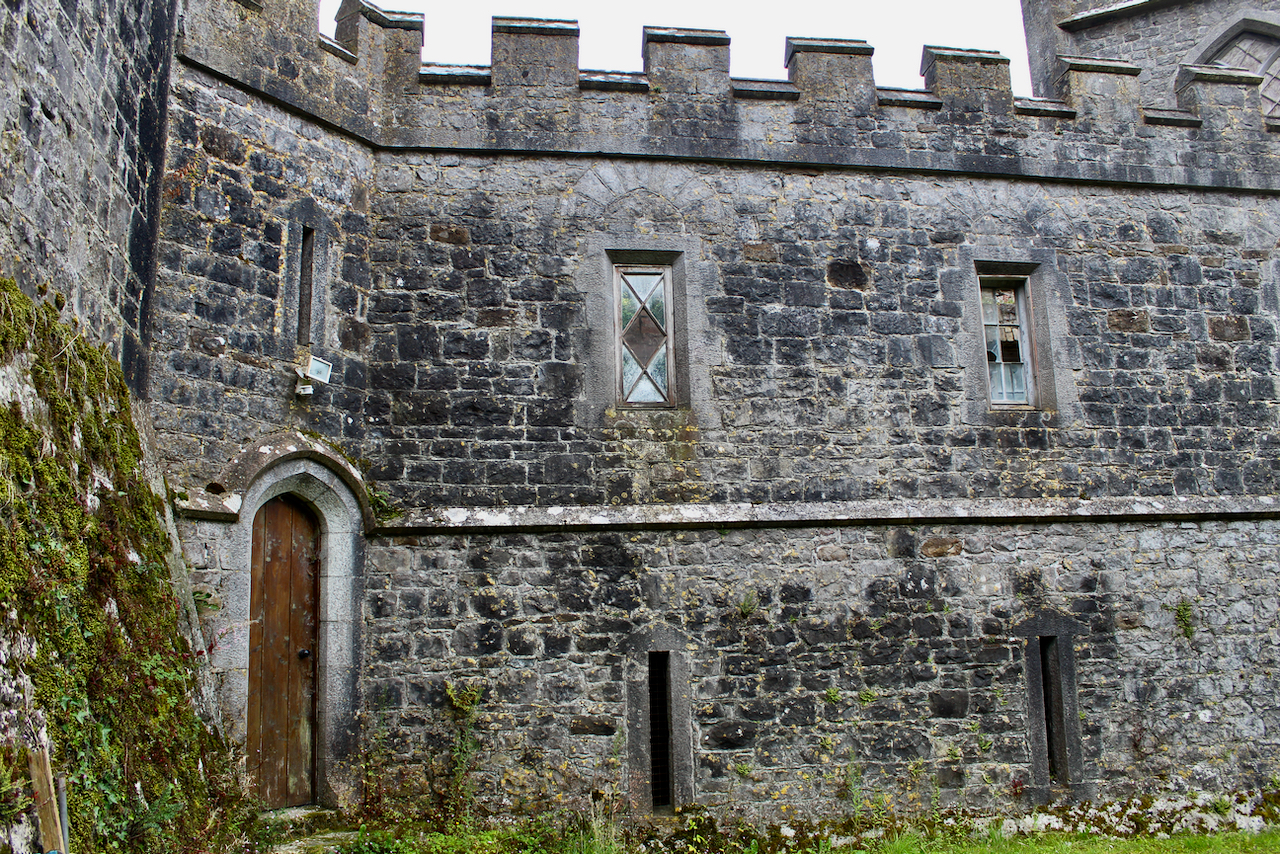
To the right of the entrance front, and giving picturesque variety to the composition, is a long, low range of battlemented offices and a chapel, including a tower with pinnacles and a gateway.
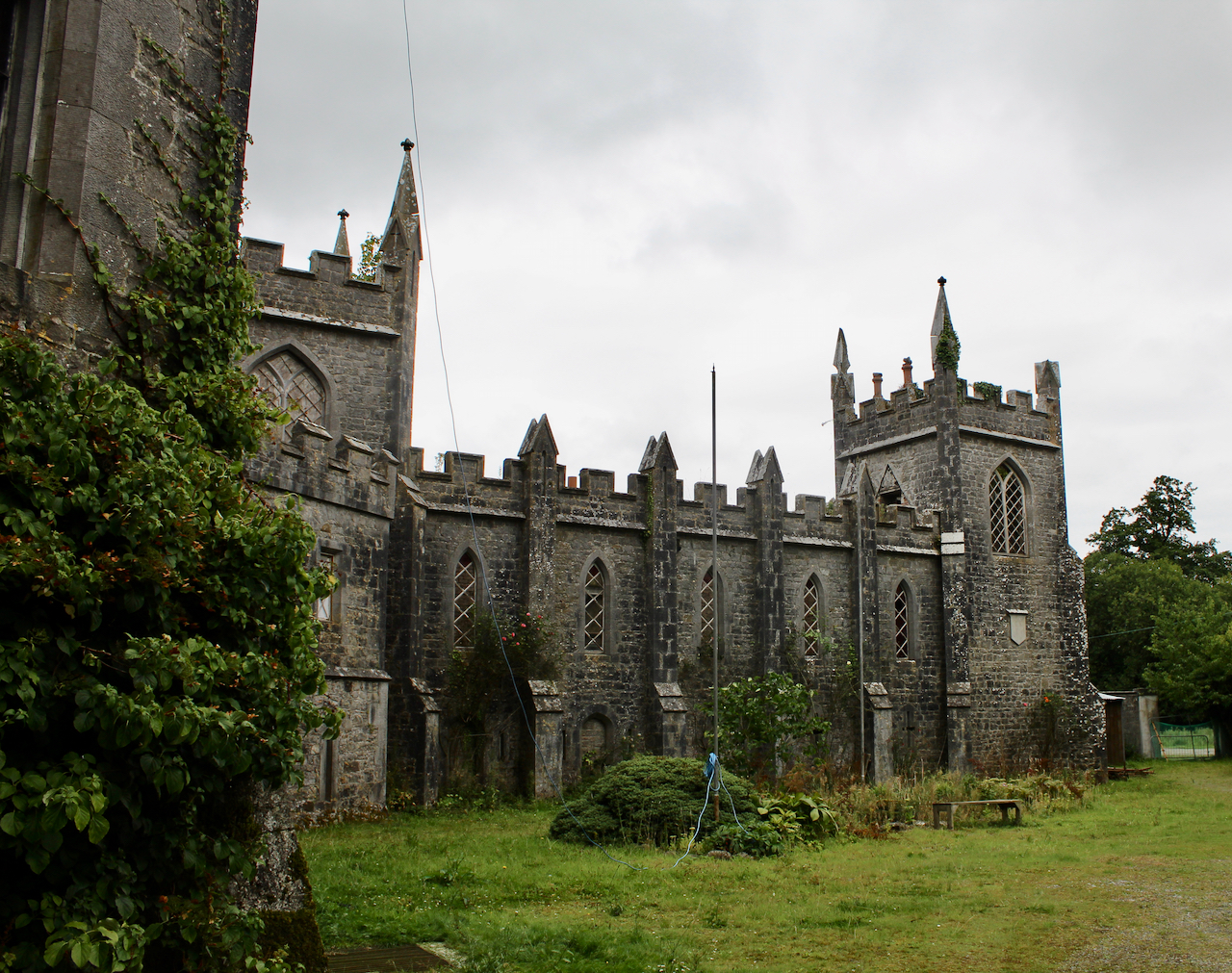
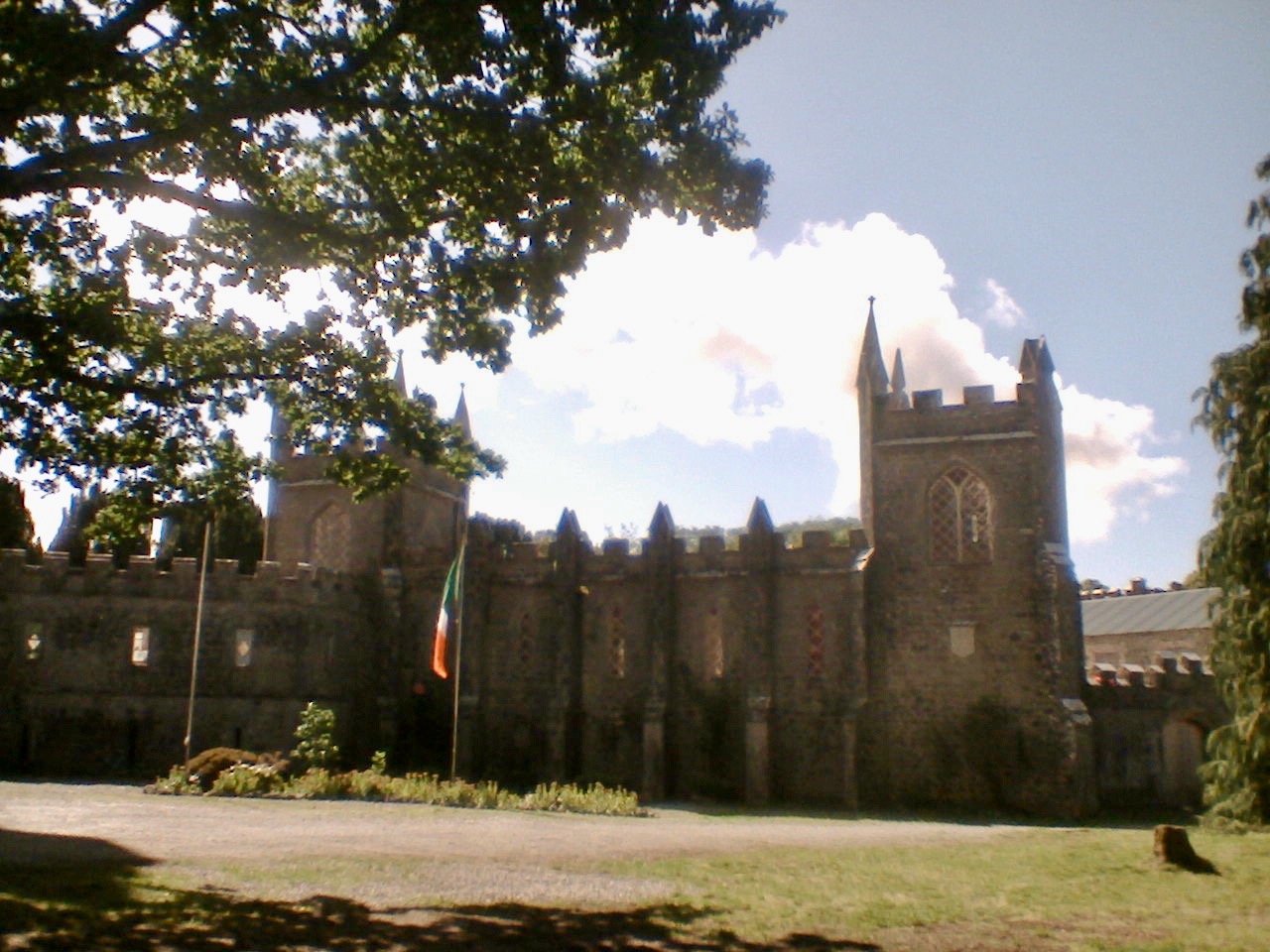
Charleville Castle chapel, August 2024, Photograph © Jennifer Winder-Baggot, www.irishhistorichouses.com
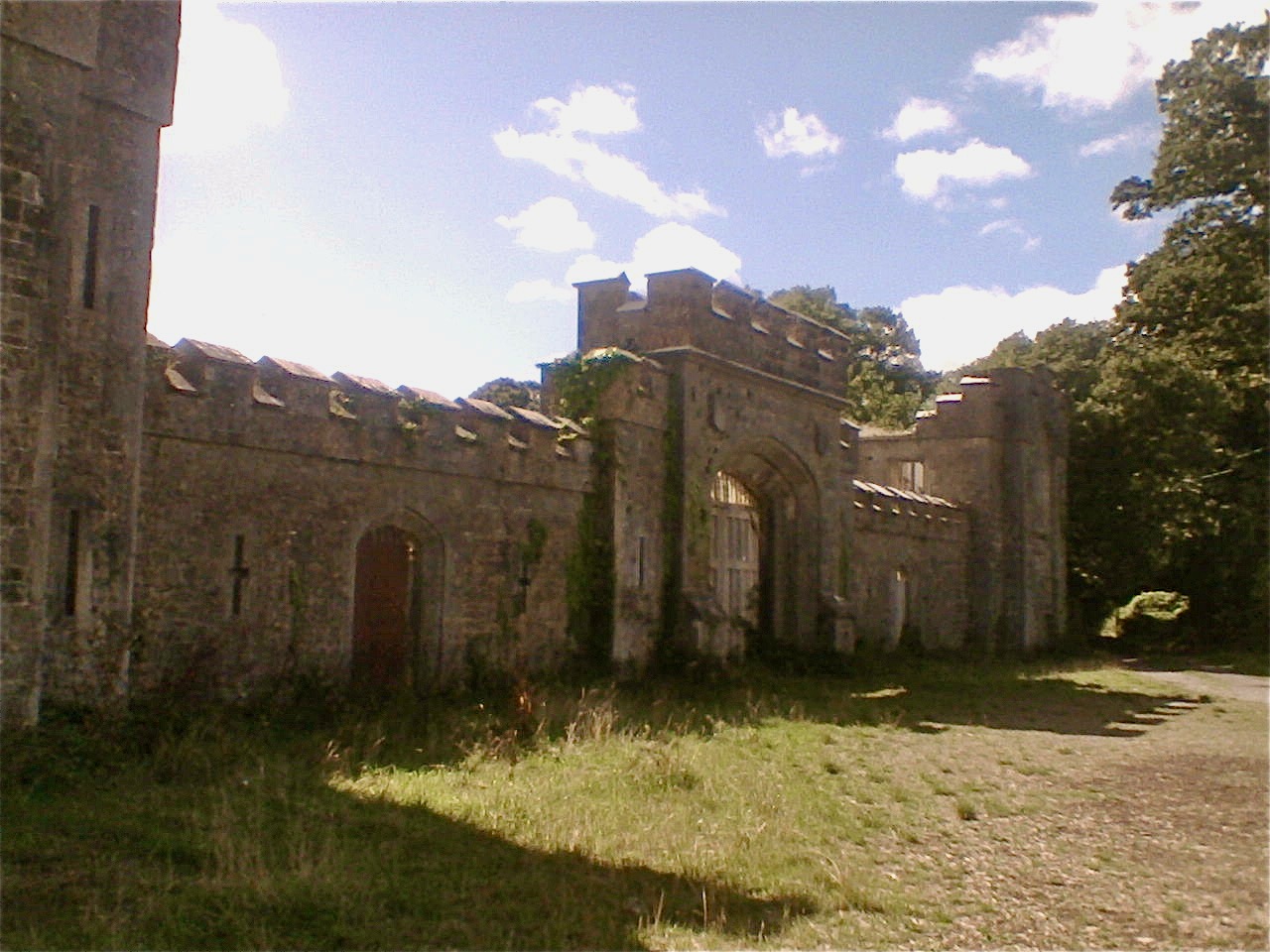
To the right of the entrance front, and giving picturesque variety to the composition, is a long, low range of battlemented offices, including a tower with pinnacles and a gateway. Charleville Castle, August 2018. Photograph © Jennifer Winder-Baggot, www.irishhistorichouses.com
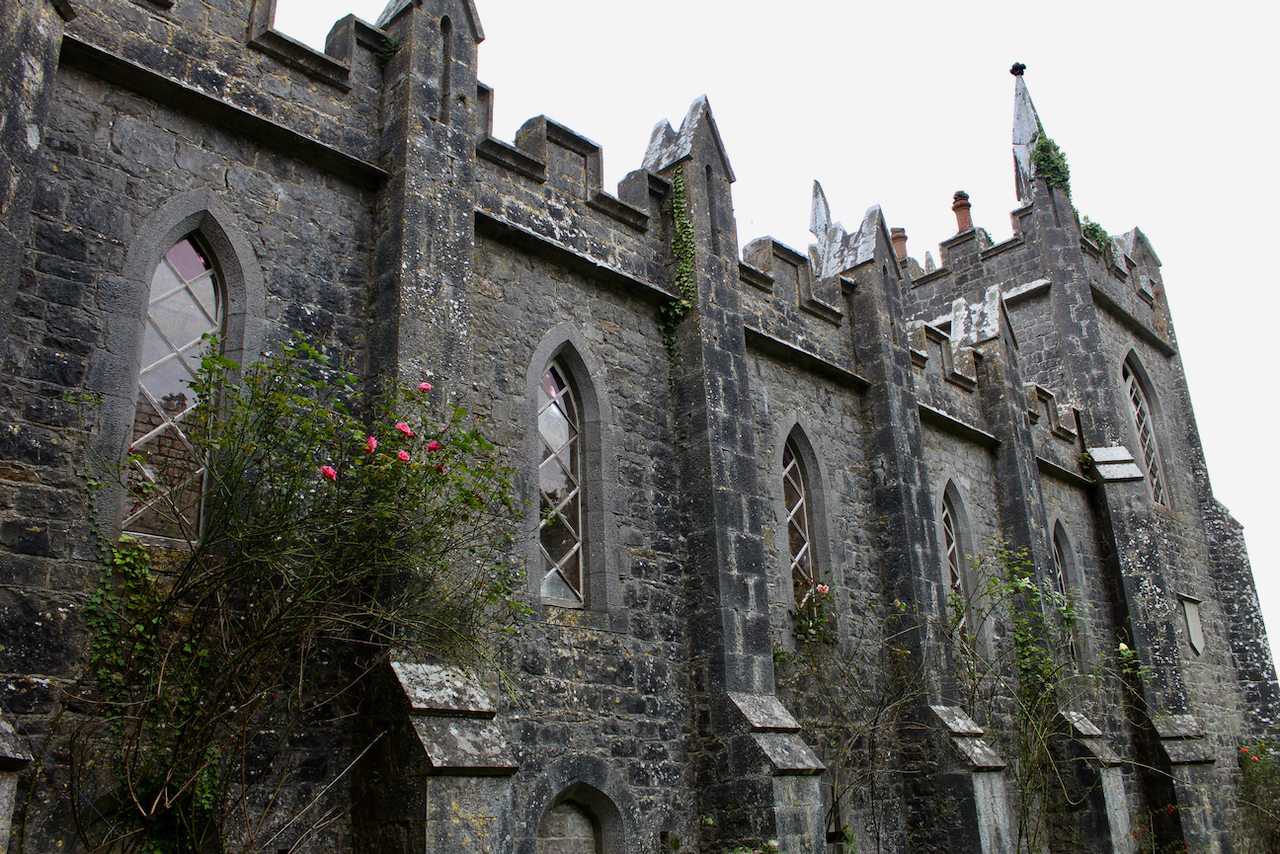
Charleville Castle chapel, August 2024, Photograph © Jennifer Winder-Baggot, www.irishhistorichouses.com
Photograph © Jennifer Winder-Baggot, www.irishhistorichouses.com
The end of the chapel wing, which housed the kitchen and other offices. Photograph © Jennifer Winder-Baggot, www.irishhistorichouses.com
Charleville Castle, August 2024, Photograph © Jennifer Winder-Baggot, www.irishhistorichouses.com
The Stableyard lies behind these walls. Charleville, County Offaly, 2018. Photograph © Jennifer Winder-Baggot, www.irishhistorichouses.com

The Stableyard lies beyond the chapel but is not open to the public, which is unfortunate as Tierney describes it as the finest castellated stableyard in Ireland, although now derelict. It is also by Francis Johnston.
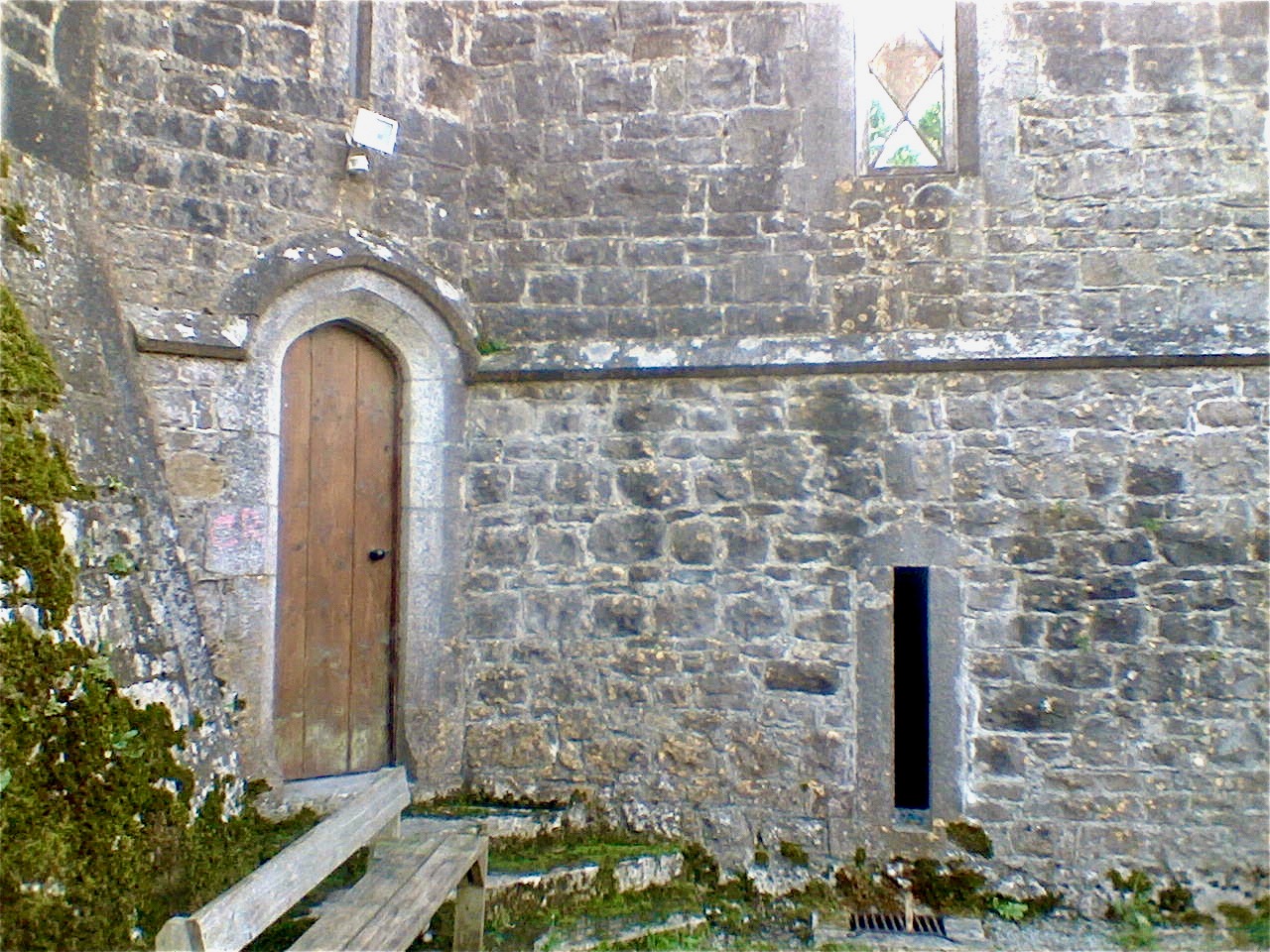
Charleville, County Offaly. Photograph © Jennifer Winder-Baggot, www.irishhistorichouses.com

Mark Bence-Jones continues:

The interior is as dramatic and well-finished as the exterior. In the hall, with its plaster groined ceiling carried on graceful shafts, a straight flight of stairs rises between galleries to piano nobile level, where a great double door, carved in florid Decorated style, leads to a vast saloon or gallery running the whole length of the garden front.”
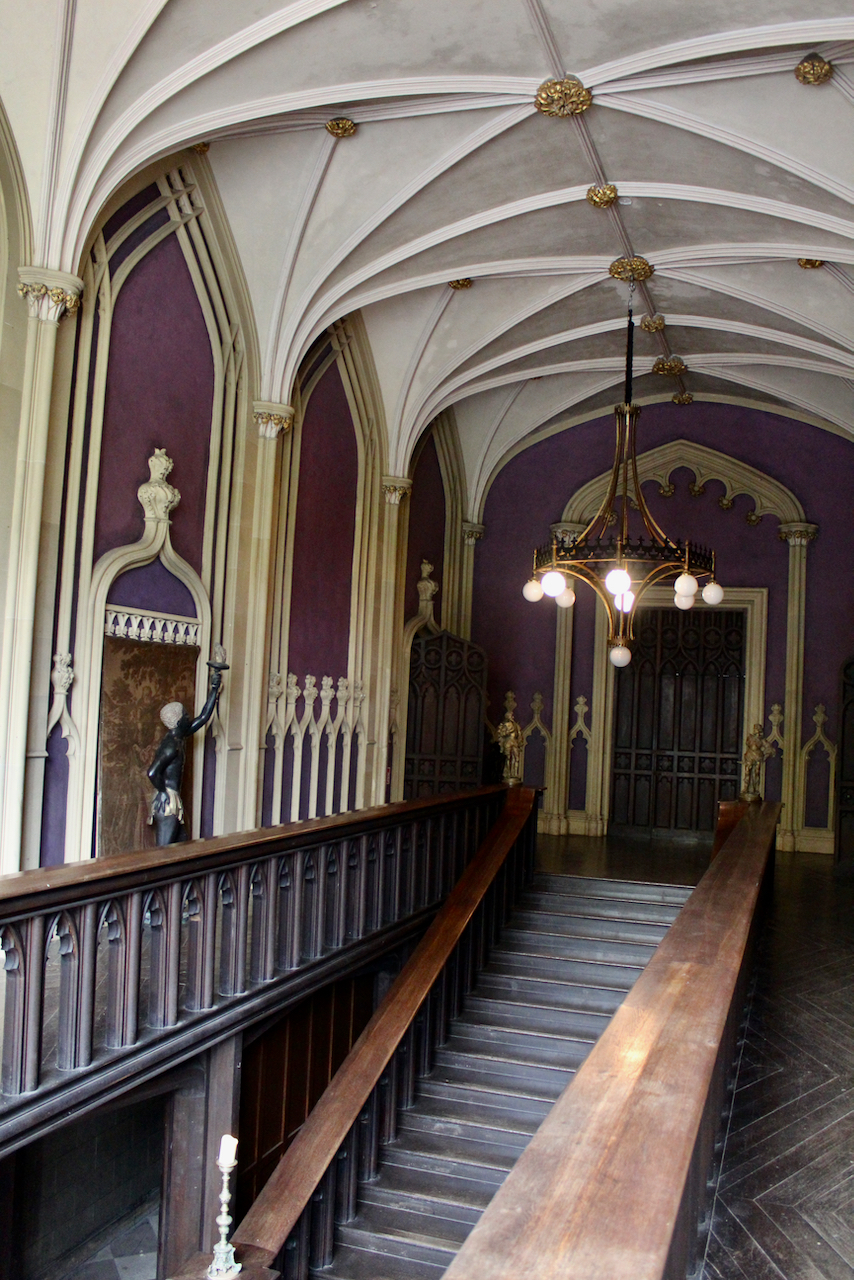
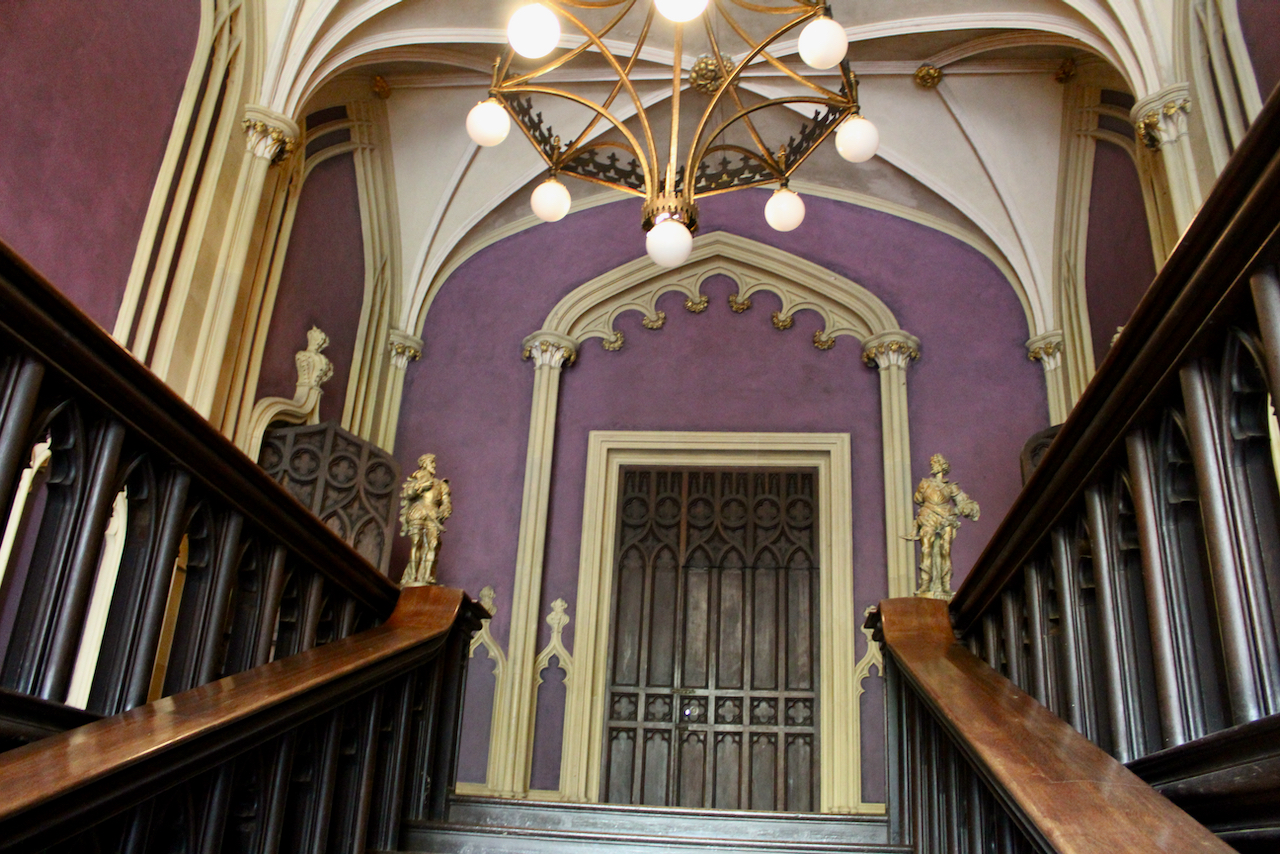
“In the hall, with its plaster groined ceiling carried on graceful shafts, a straight flight of stairs rises between galleries to piano nobile level, where a great double door, carved in florid Decorated style, leads to a vast saloon or gallery running the whole length of the garden front.” Charleville, County Offaly. Photograph © Jennifer Winder-Baggot, www.irishhistorichouses.com
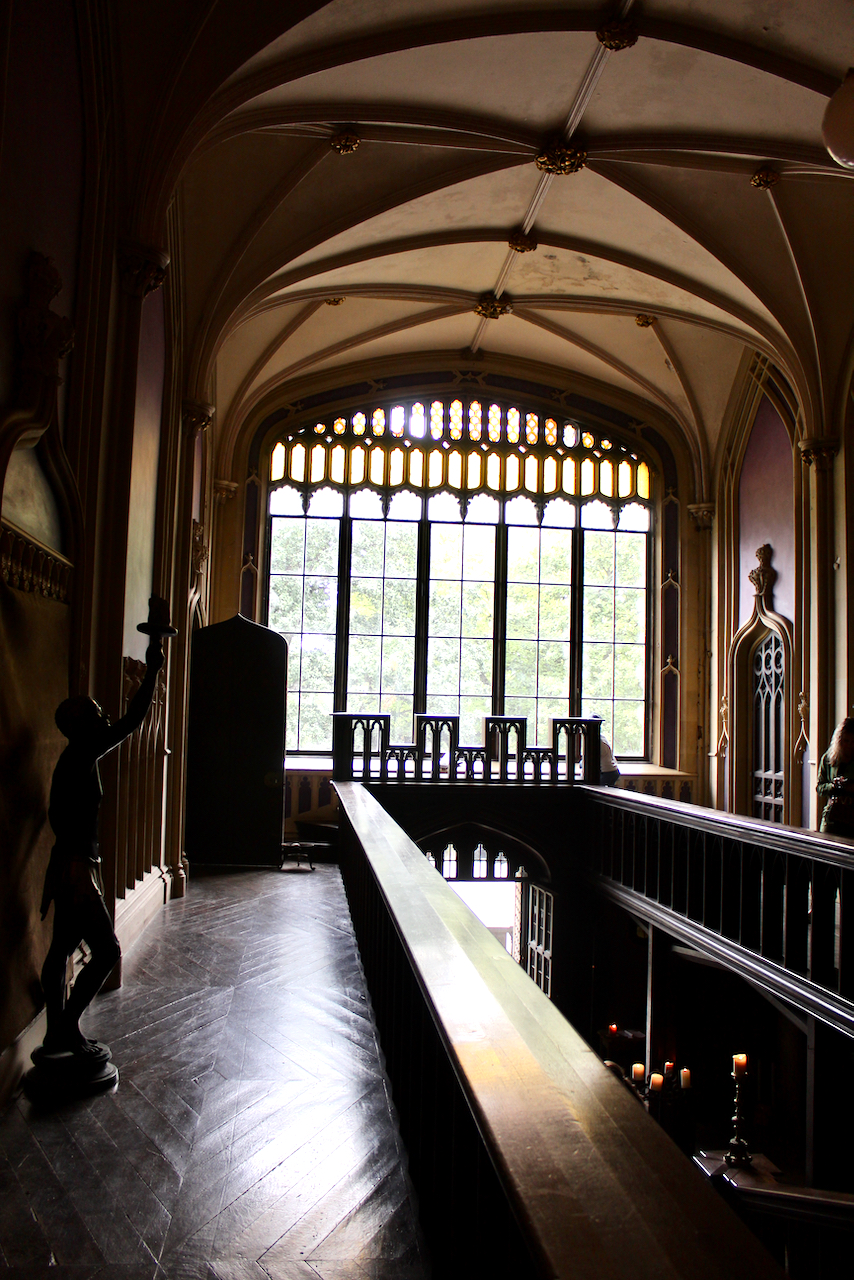
Charleville, County Offaly. Photograph © Jennifer Winder-Baggot, www.irishhistorichouses.com

The heavy oak stairs run from the basement to piano nobile. This imitates a similar configuration by James Wyatt at Fonthill and Windsor, which Lord Charleville knew. The upper stage, Tierney describes, has a plaster-panelled dado with ogee-headed niches in the style of Batty Langley, conceived for a parade of suits of armour in drawings by Lady Charleville.
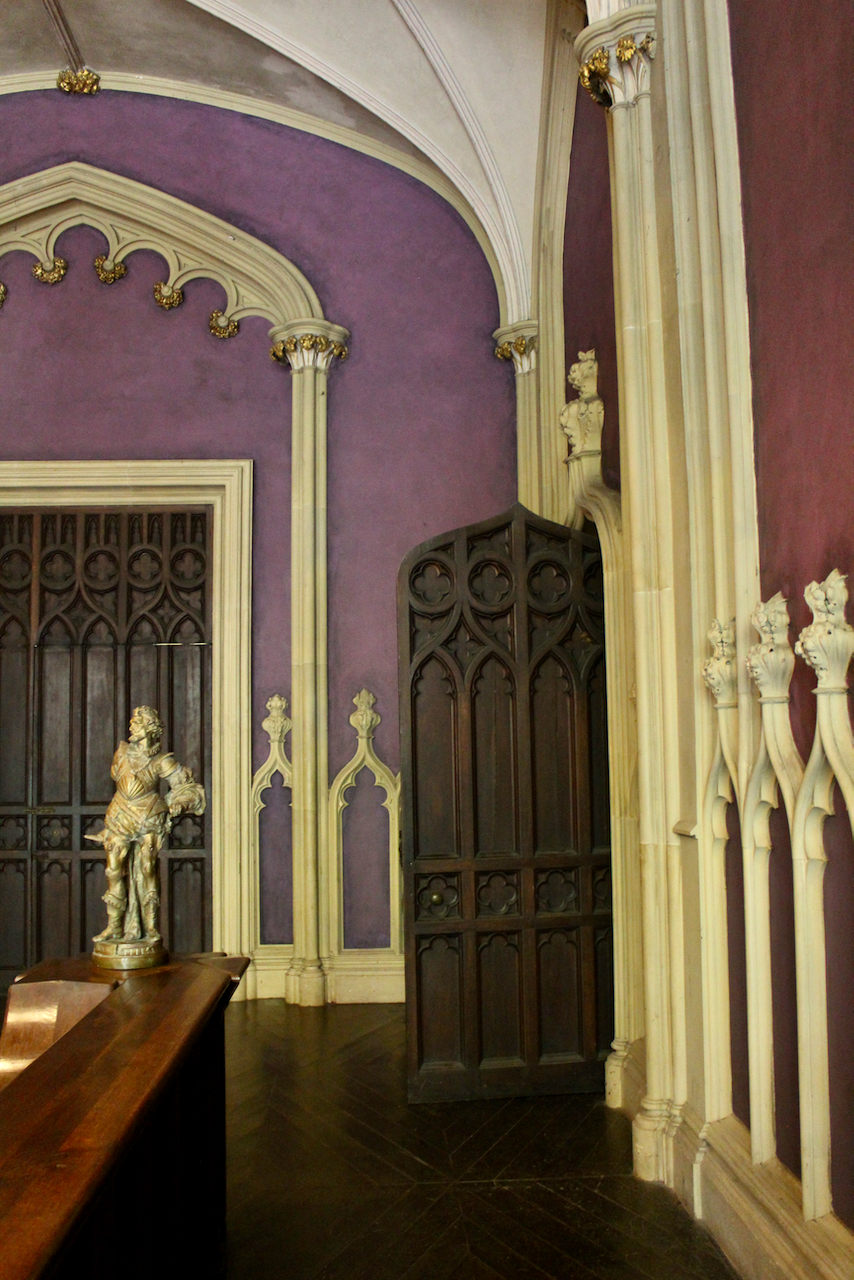
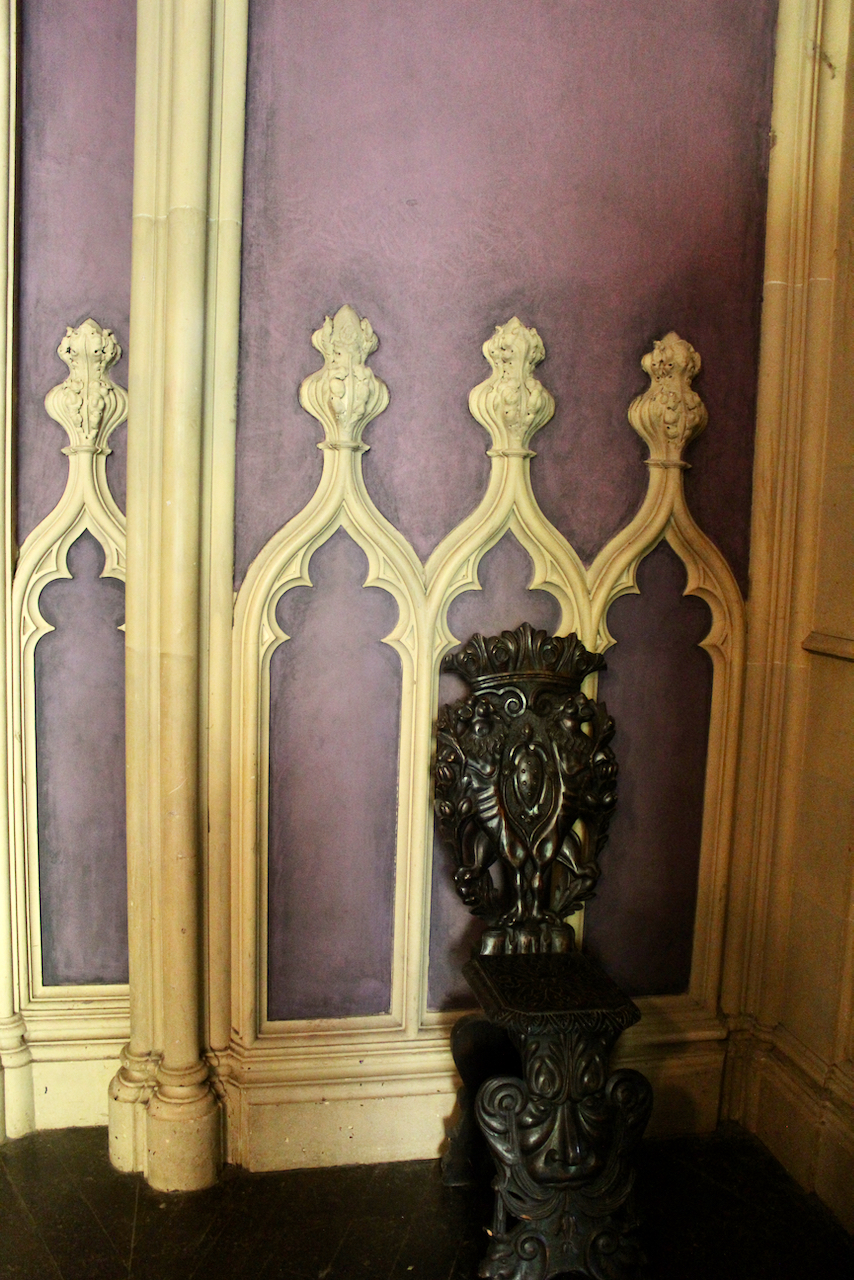
Charleville, County Offaly. Photograph © Jennifer Winder-Baggot, www.irishhistorichouses.com
August 2024, Photograph © Jennifer Winder-Baggot, www.irishhistorichouses.com

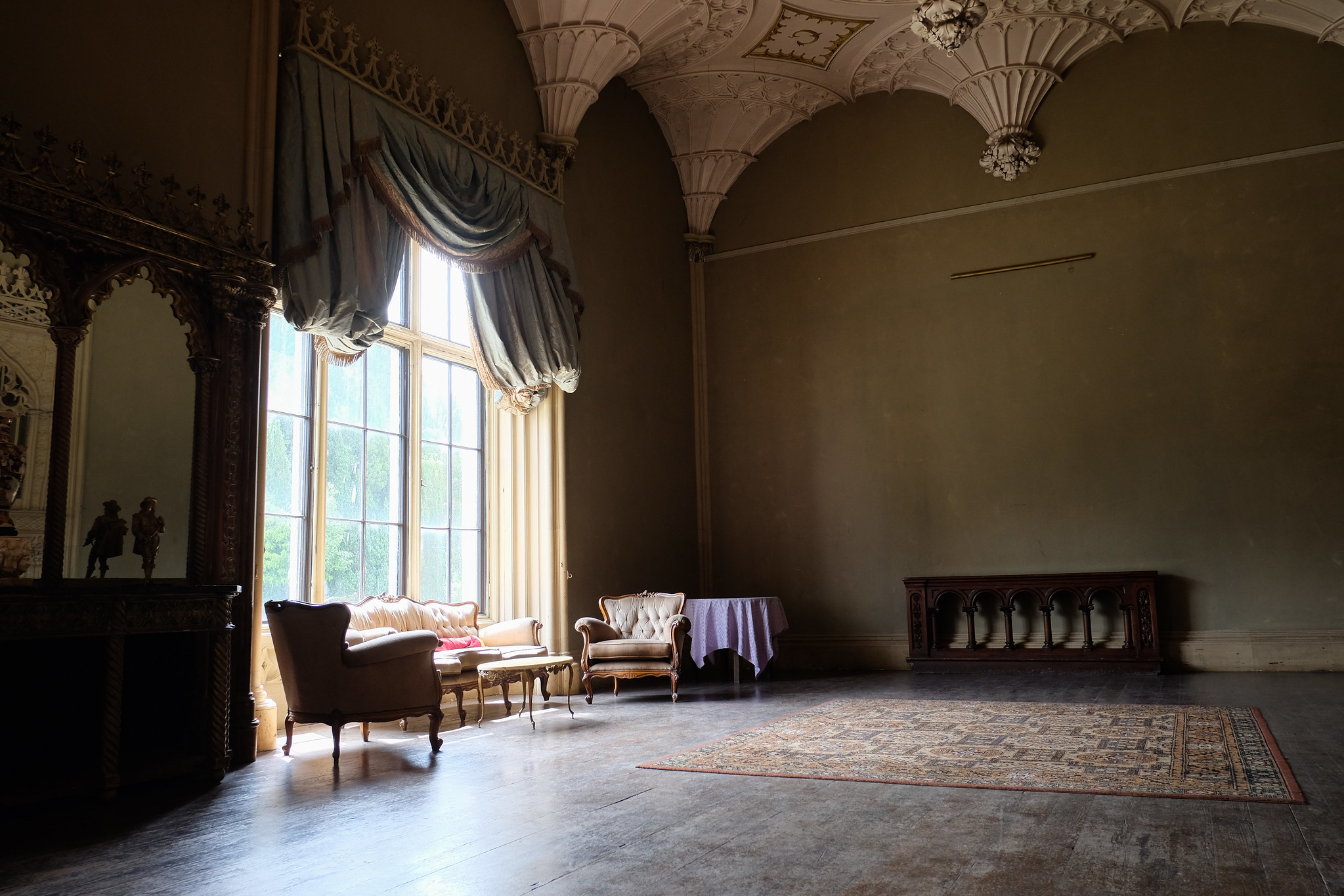
Through the double doors is the most splendid room, the south facing Gallery. Unfortunately this was closed on our Heritage Week visit in 2024 due to filming of the Addams family movie, “Wednesday.” Mark Bence-Jones continues:“This is one of the most splendid Gothic Revival interiors in Ireland; it has a ceiling of plaster fan vaulting with a row of gigantic pendants down the middle; two lavishly carved fireplaces of grained wood, Gothic decoration in the frames of the windows opposite and Gothic bookcases and side-tables to match.

Charleville Castle Tullamore by Alex Johnson June 2017, courtesy of flickr constant commons.
Photograph of Charleville Forest Castle that appeared in 1962 in Country Life. The castle was uninhabited at this time and the furniture was borrowed from Belvedere, County Westmeath.

The fan-vaulted ceiling is inspired by Horace Walpole’s Strawberry Hill, which the Burys visited, which is in turn based on Henry VII’s Chapel at Westminster Abbey, Tierney tells us. The ceiling is thought to have been executed by George Stapleton, who is also responsible for the fan-vaulting in Johnston’s Chapel Royal in Dublin Castle. The ceiling is anchored with clustered shafts along the walls, with bays framing the two Gothic chimneypieces, the doorcase on the north wall, and the Gothic casings of the windows.

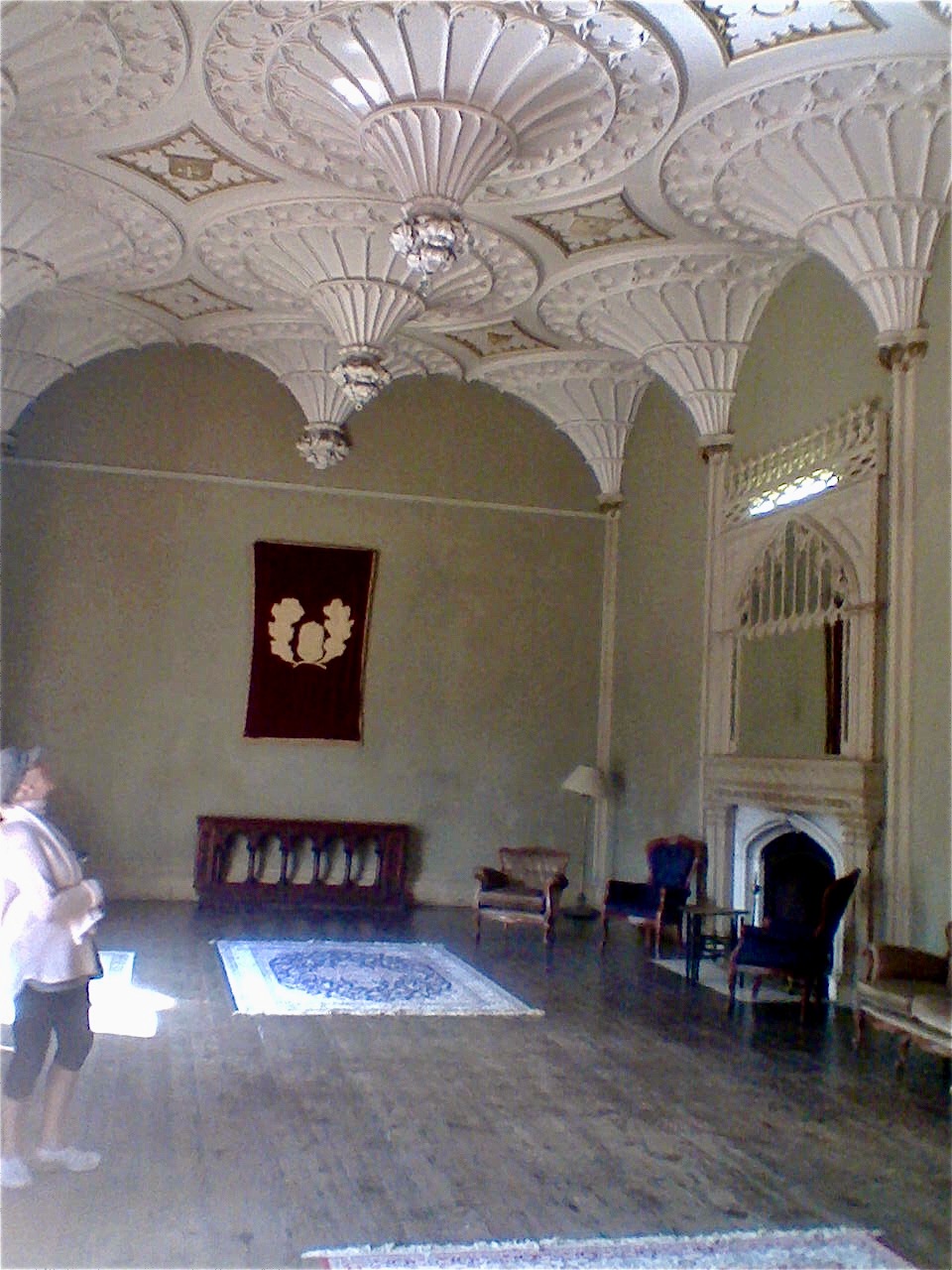
Charleville Castle Tullamore by Matt McKnight 2007, courtesy of flickr constant commons.
It has a ceiling of plaster fan vaulting with a row of gigantic pendants down the middle. Heraldic shields depict different branches of the Bury family. Photograph 2018, poor quality due to being taken on an old mobile phone © Jennifer Winder-Baggot, www.irishhistorichouses.com
Charleville, County Offaly. The Moorish doorway on the stage was left from a film set. Photograph 2018, poor quality due to being taken on an old mobile phone © Jennifer Winder-Baggot, www.irishhistorichouses.com

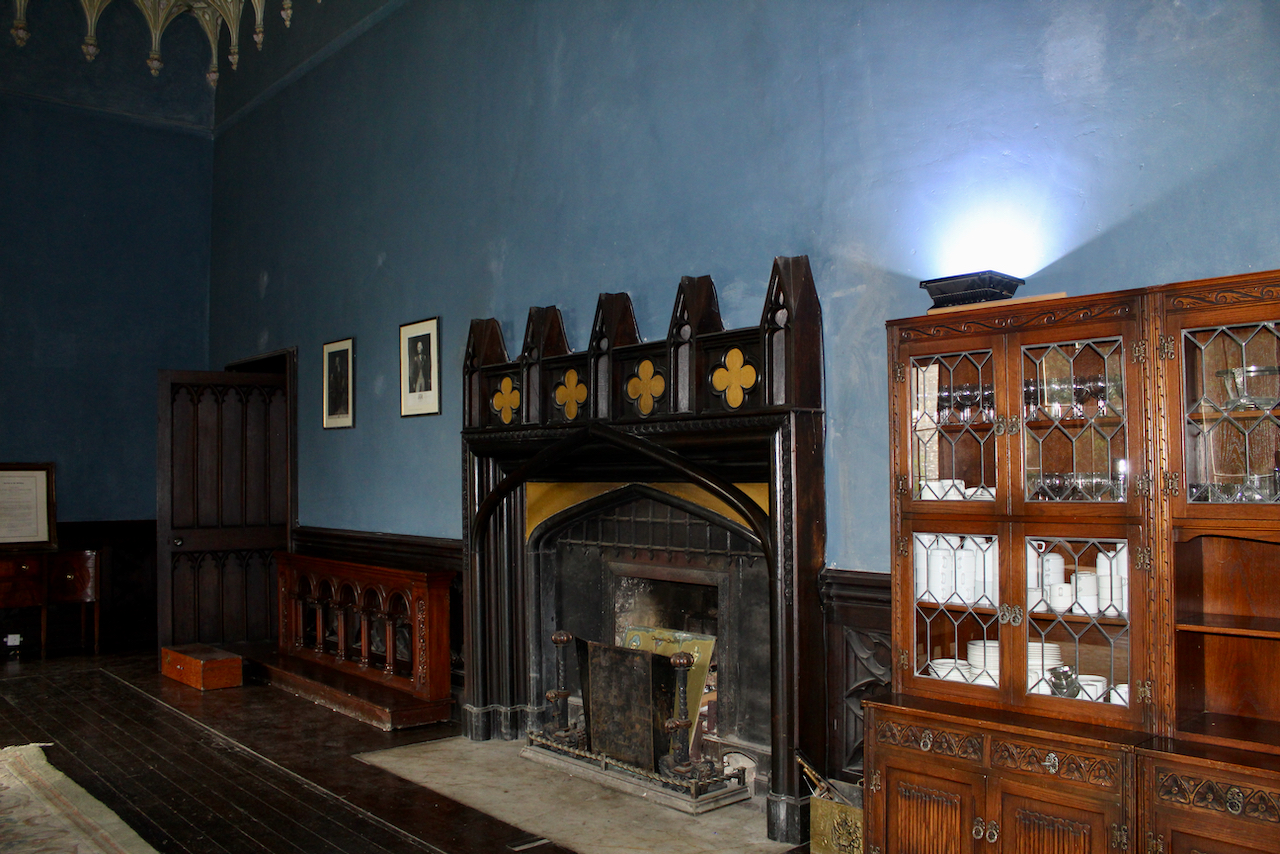
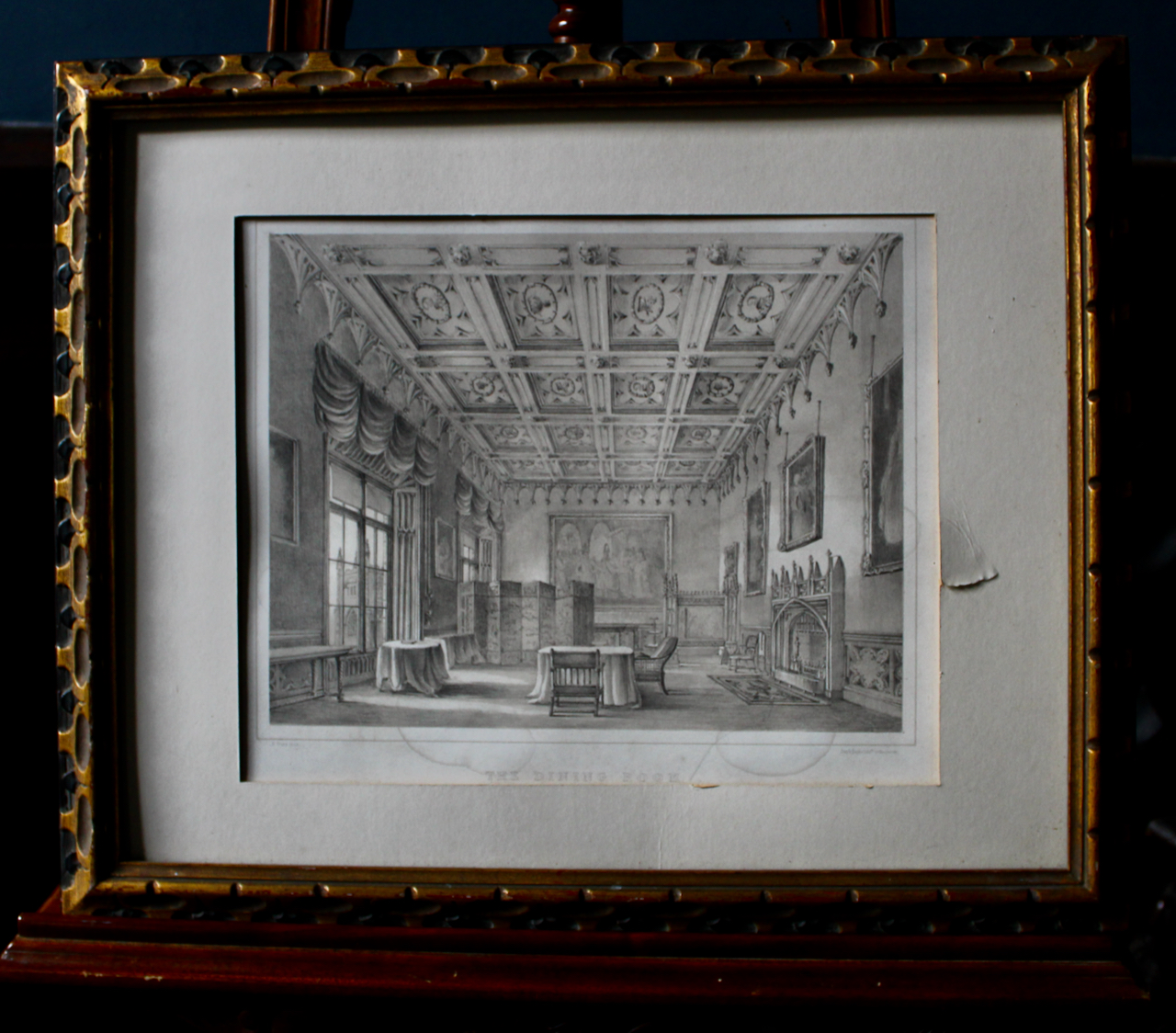
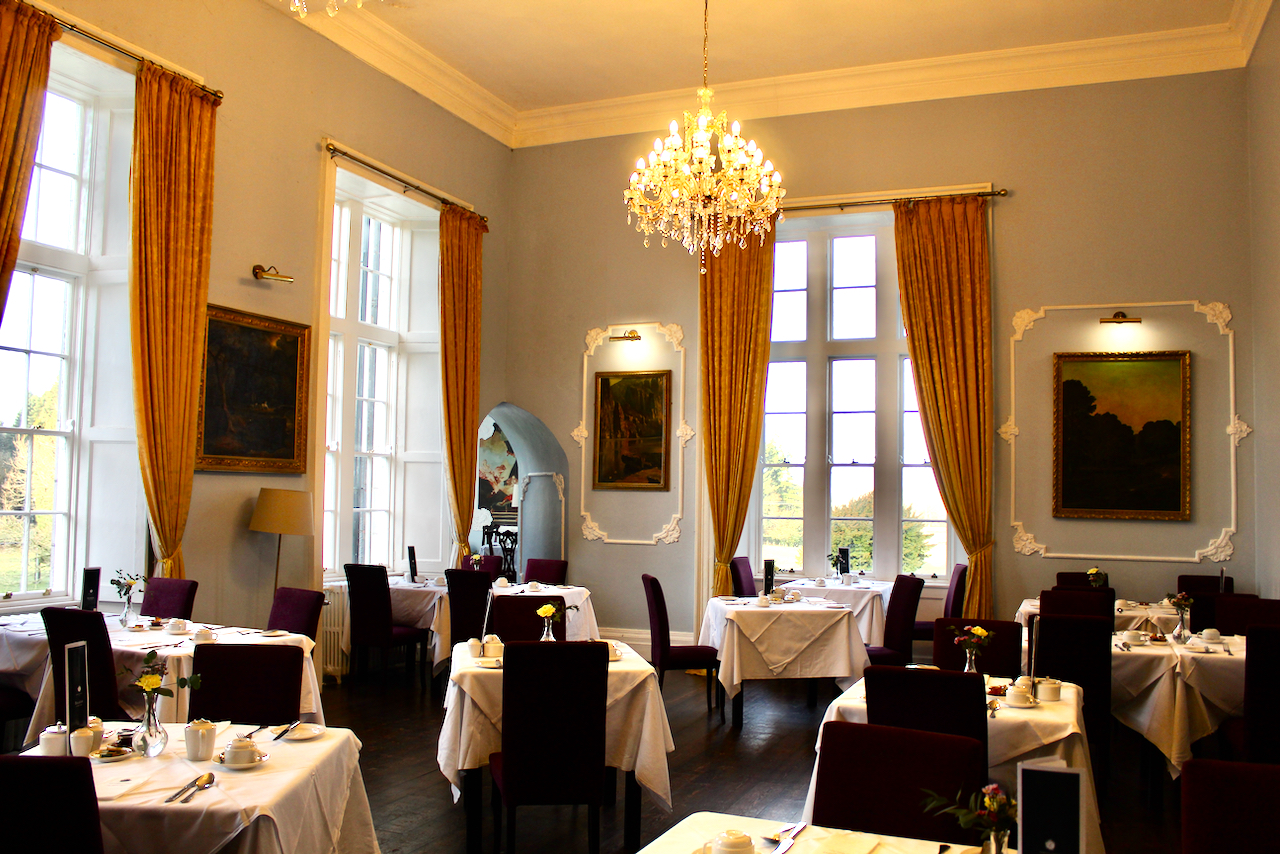
The drawing room and dining room are on either side of the entrance hall. The dining room on the west side has a coffered ceiling and a fireplace which is a copy of the west door of Magdalen College chapel, Oxford.
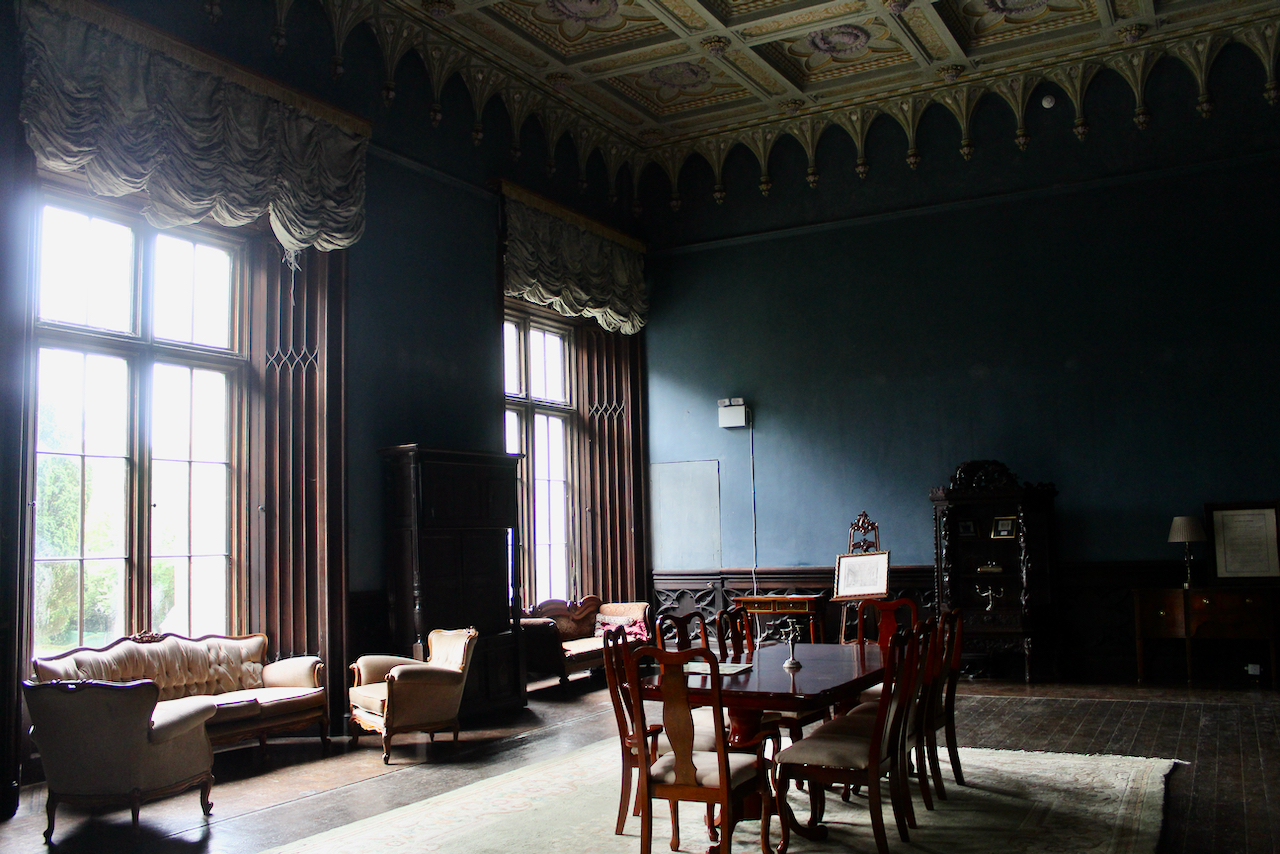
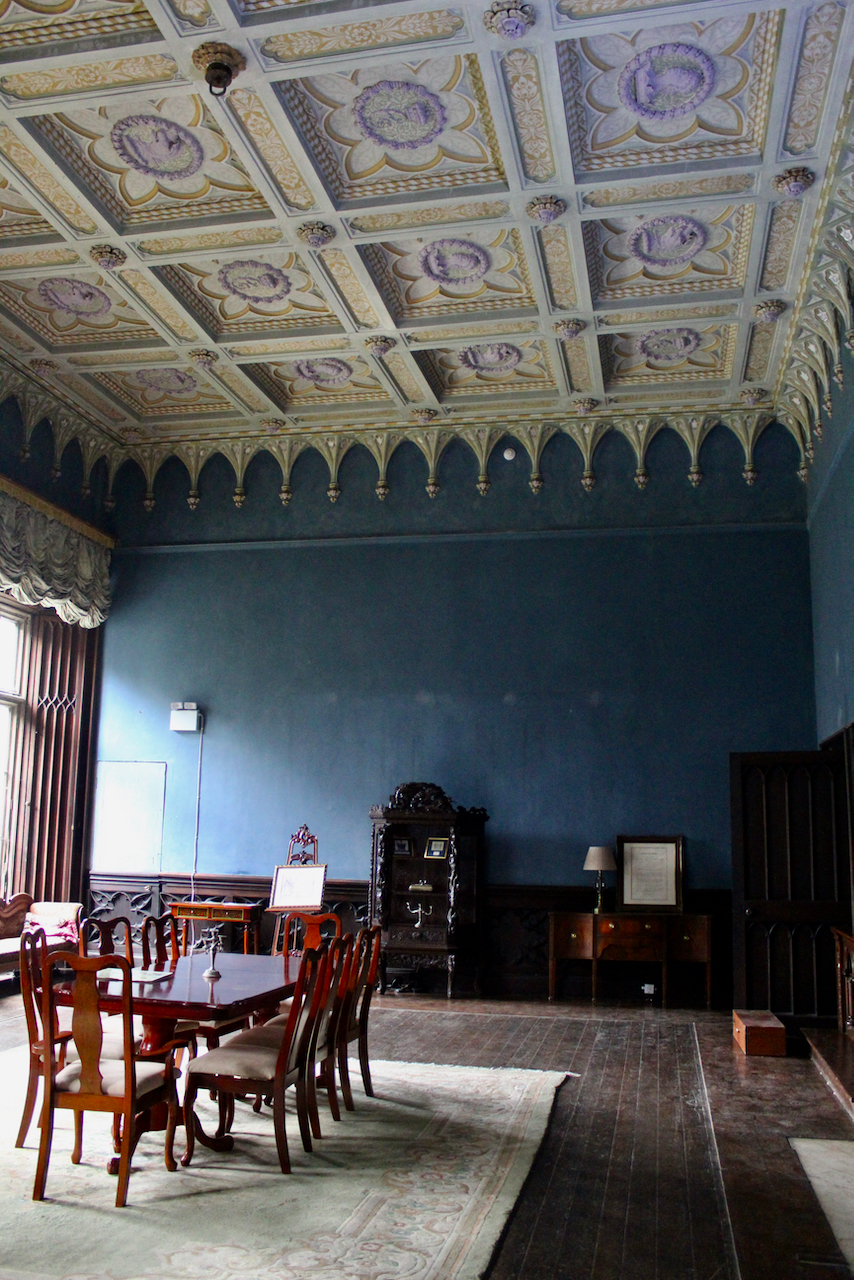
The dining room, August 2024, Photograph © Jennifer Winder-Baggot, www.irishhistorichouses.com
The dining room has a fireplace that incorporates the design of the west door of the chapel at Magdalen College, Oxford. It has its own miniature portcullis! Photograph © Jennifer Winder-Baggot, www.irishhistorichouses.com

The dining room has, Tierney points out, a Dado of double-cusped panelling derived from the staircase balustrade of Strawberry Hill. The ceiling has crests of the family in the panel, supported by a Gothic frieze in the form of miniature fan vaults. The Moores are represented by a silhouette of a Moorish person, and the Burys by a boar’s head with an arrow through its neck. There are also “C”s for “Charleville.” The volunteers during Heritage Week told us that the ceiling is by William Morris, but Tierney tells us that he redecorated the room in 1875, but the scheme no longer survives. The decoration on the miniature fan vault frieze does look rather William Morris-esque to me, as well as the painting between the crests.
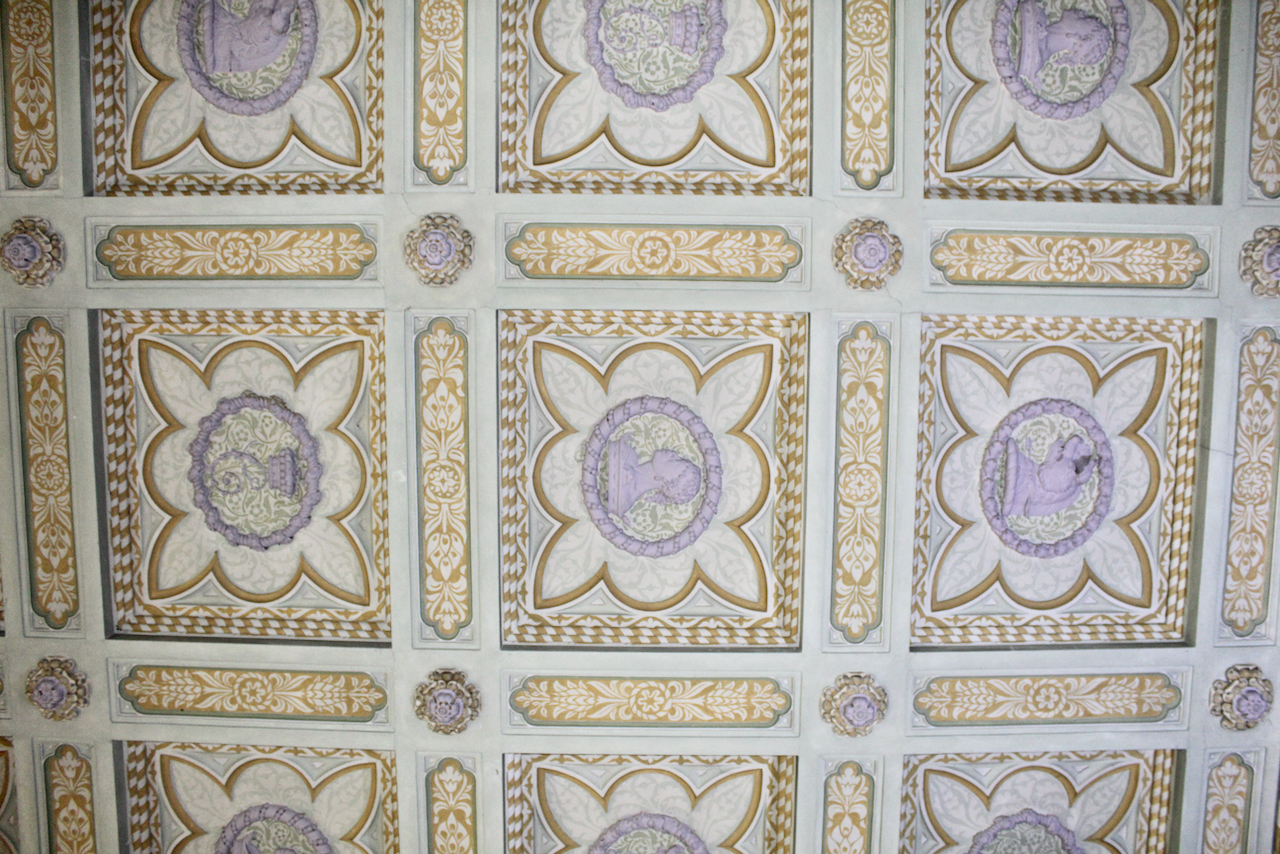
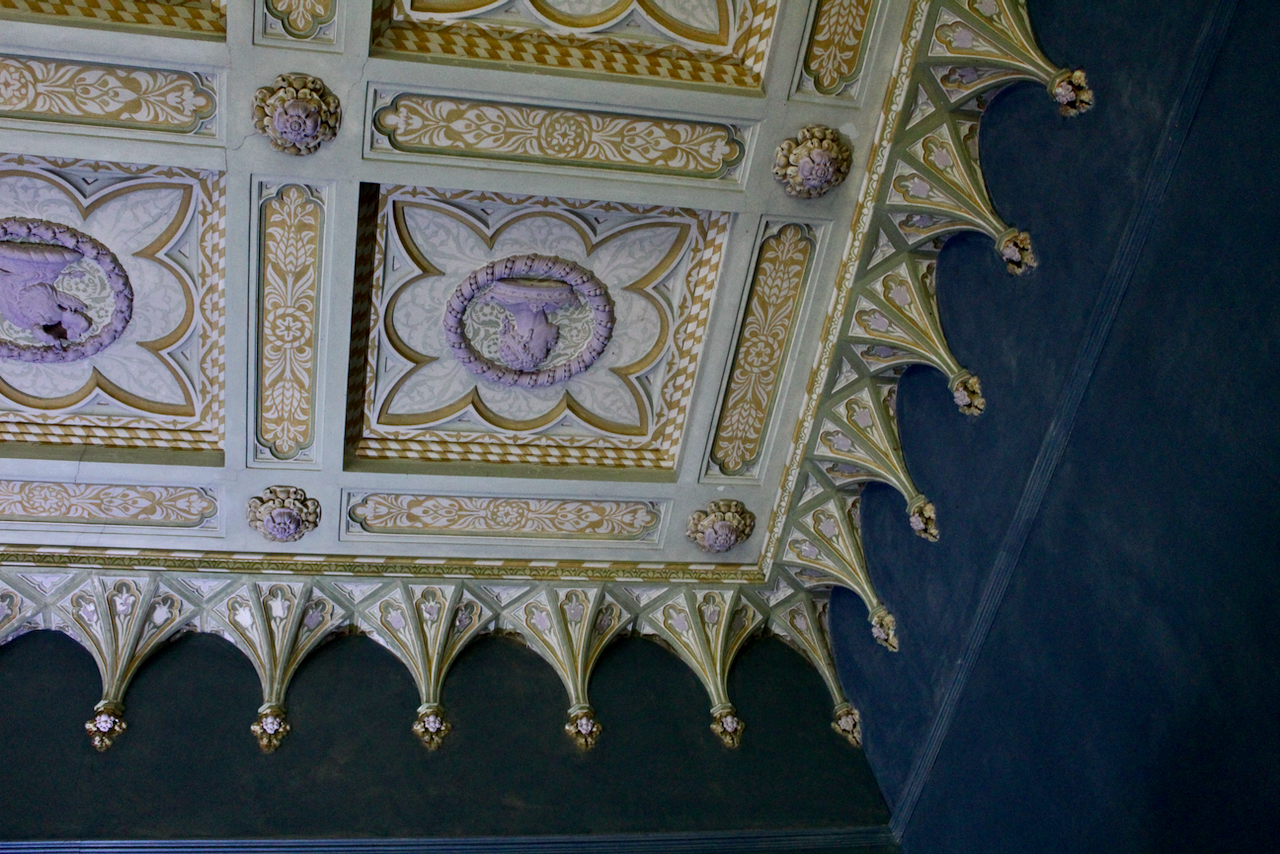
The Moores are represented by a silhouette of a Moorish person, and the Burys by a boar’s head with an arrow through its neck. There are also “C”s for “Charleville.” August 2024. Photograph © Jennifer Winder-Baggot, www.irishhistorichouses.com
The volunteers during Heritage Week told us that the ceiling is by William Morris, but Tierney tells us that he redecorated the room in 1875, but the scheme no longer survives. The decoration on the miniature fan vault frieze does look rather William Morris-esque to me, as well as the painting between the crests. August 2024. Photograph © Jennifer Winder-Baggot, www.irishhistorichouses.com
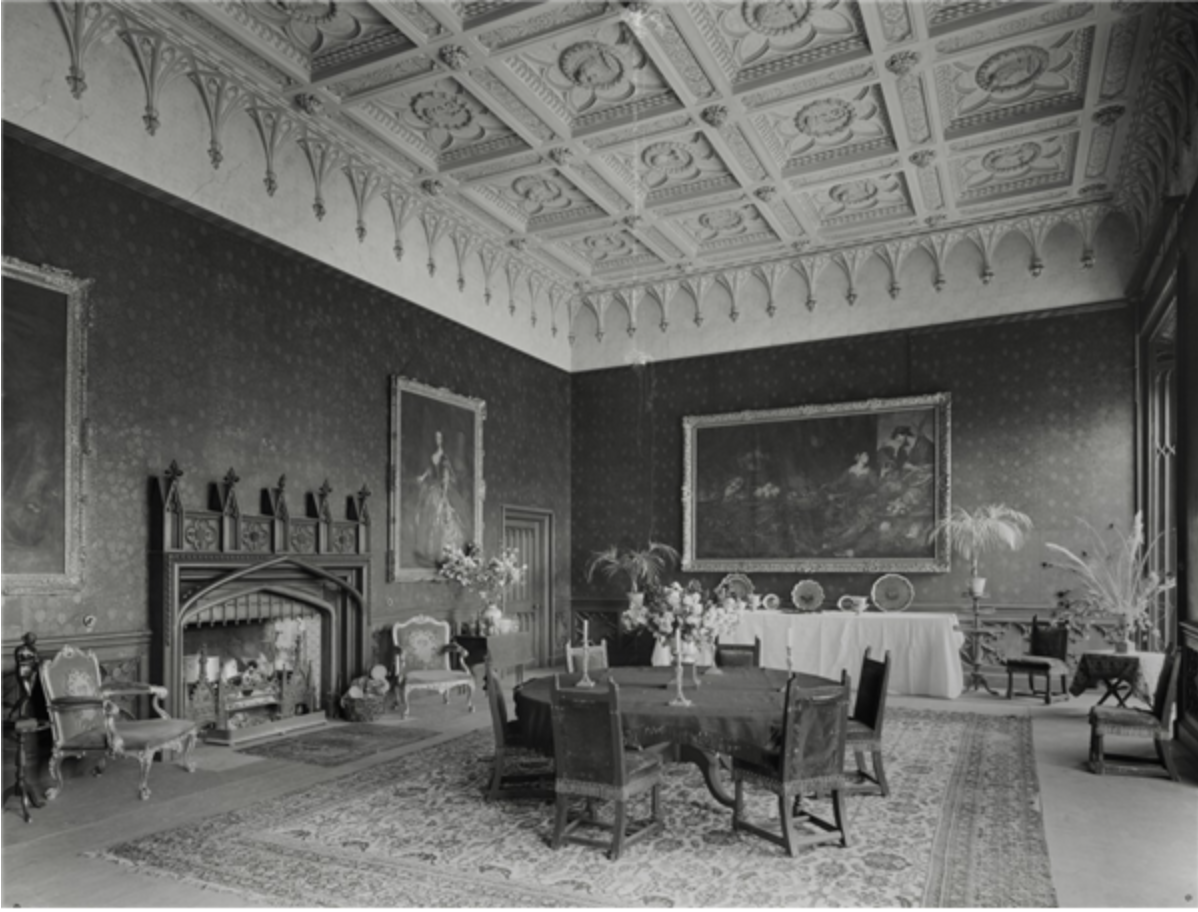
Photograph of Charleville Forest Castle that appeared in 1962 in Country Life. The castle was uninhabited at this time and the furniture was borrowed from Belvedere, County Westmeath.
The dining room. Photograph © Jennifer Winder-Baggot, www.irishhistorichouses.com
The dining room, a sketch by Beaujolois Bury, 1843. Beaujolois Elenora Catherine was the only daughter of the second earl of Charleville (1801–51) and his wife Harriet Charlotte Beaujolois Bury née Campbell (1803–48). The unusual name was due to her having Louis Charles d’Orleans, Comte de Beaujolais, brother of Louis Phillipe, as her godfather. Louis Philippe I (1773 – 1850), nicknamed the Citizen King, was King of the French from 1830 to 1848, the penultimate monarch of France, and the last French monarch to bear the title “King”. He abdicated from his throne during the French Revolution of 1848, which led to the foundation of the French Second Republic. [8] Photograph © Jennifer Winder-Baggot, www.irishhistorichouses.com

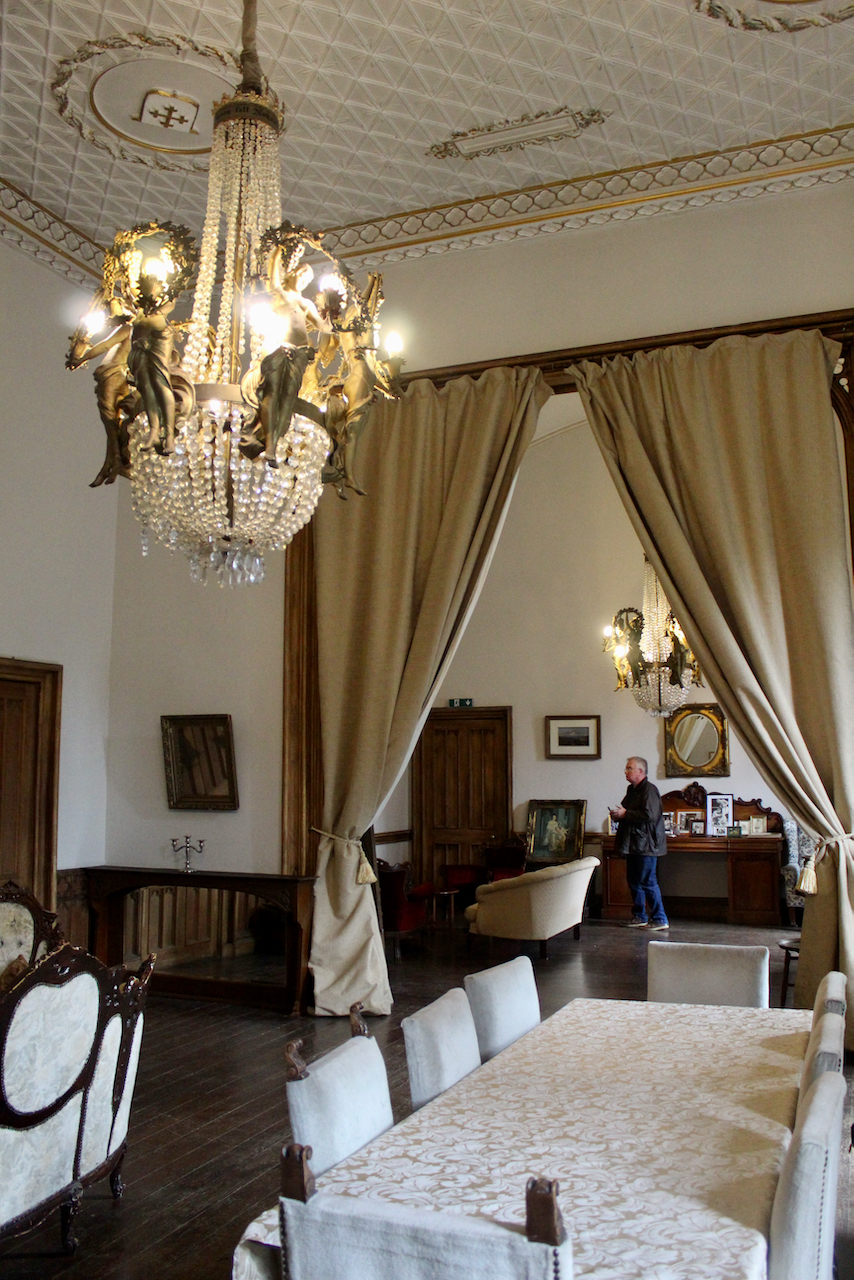
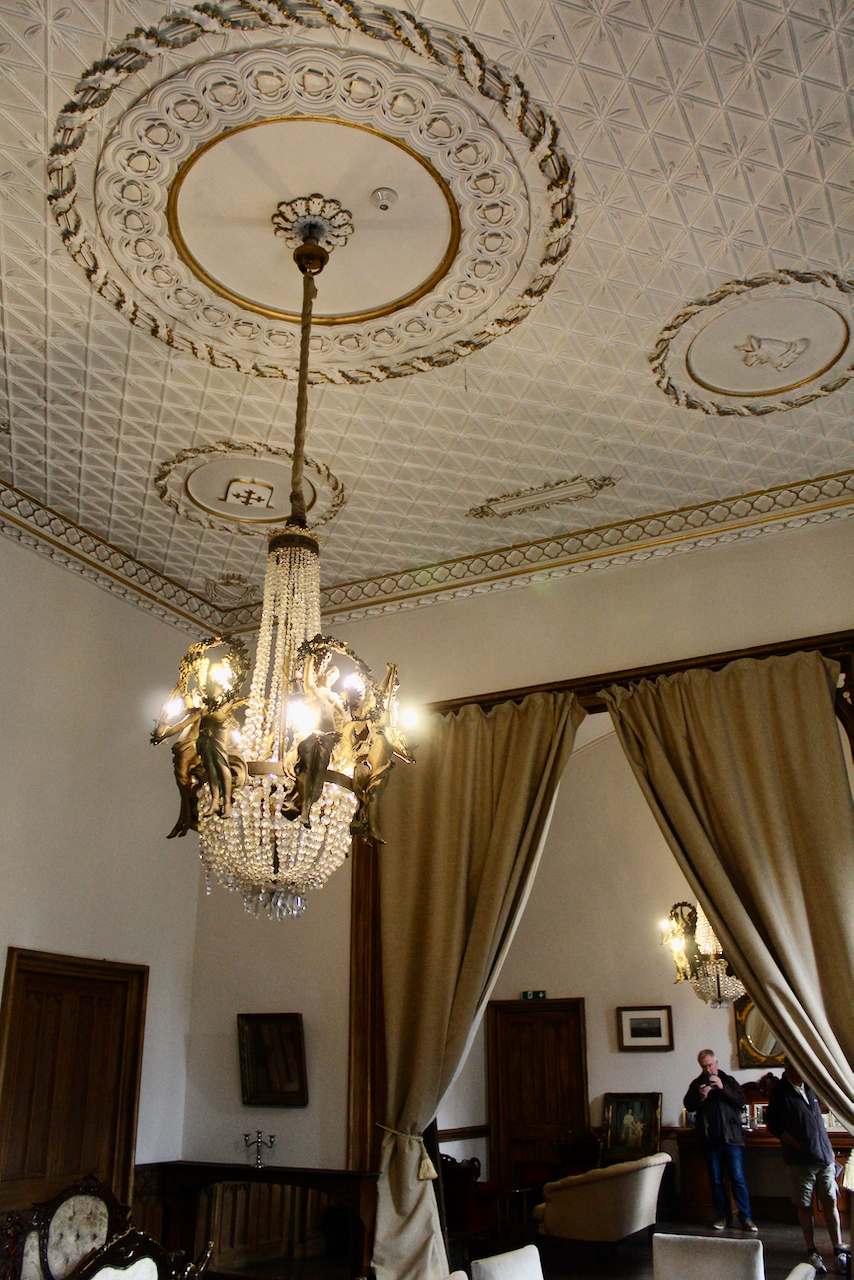
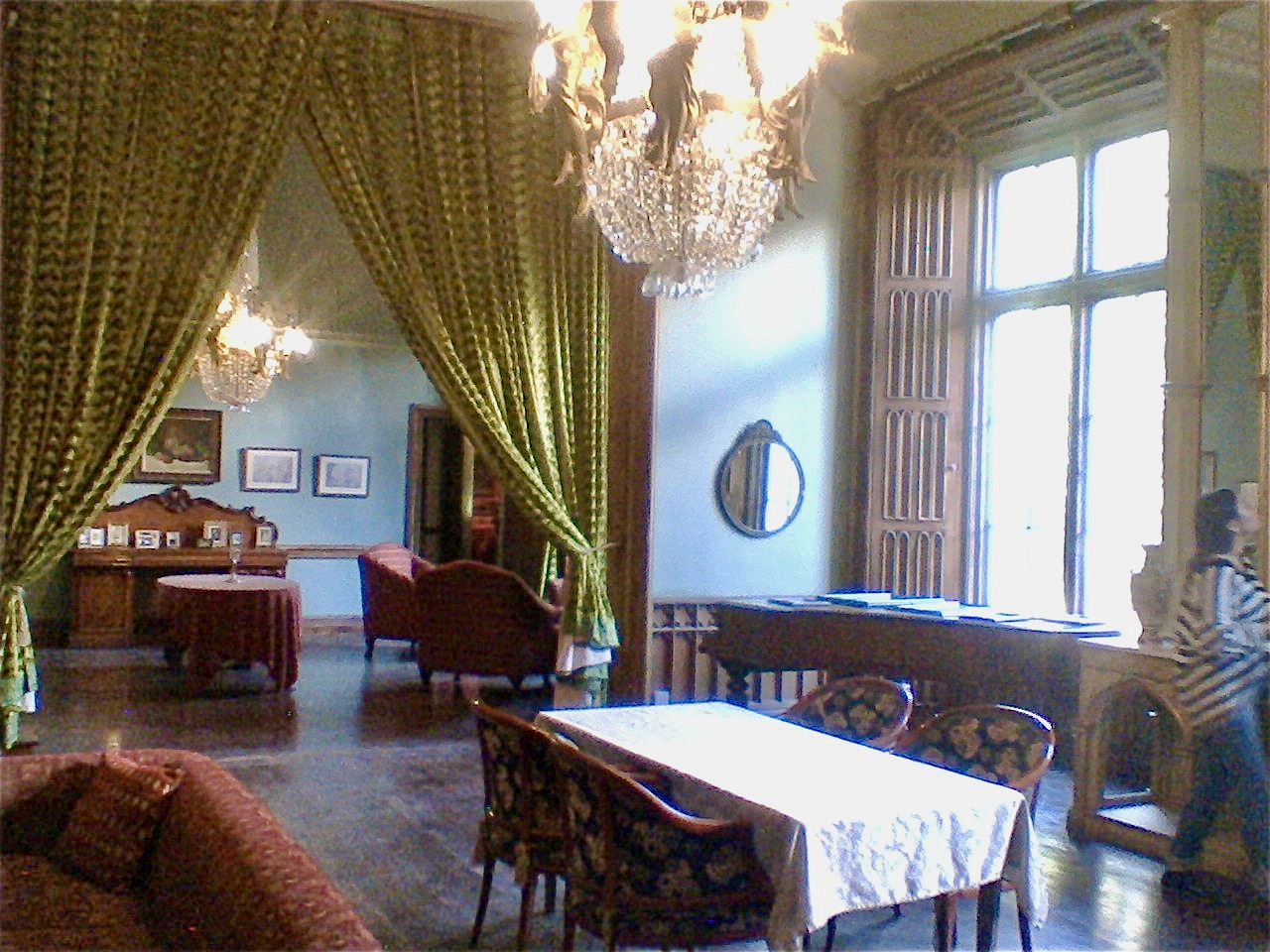
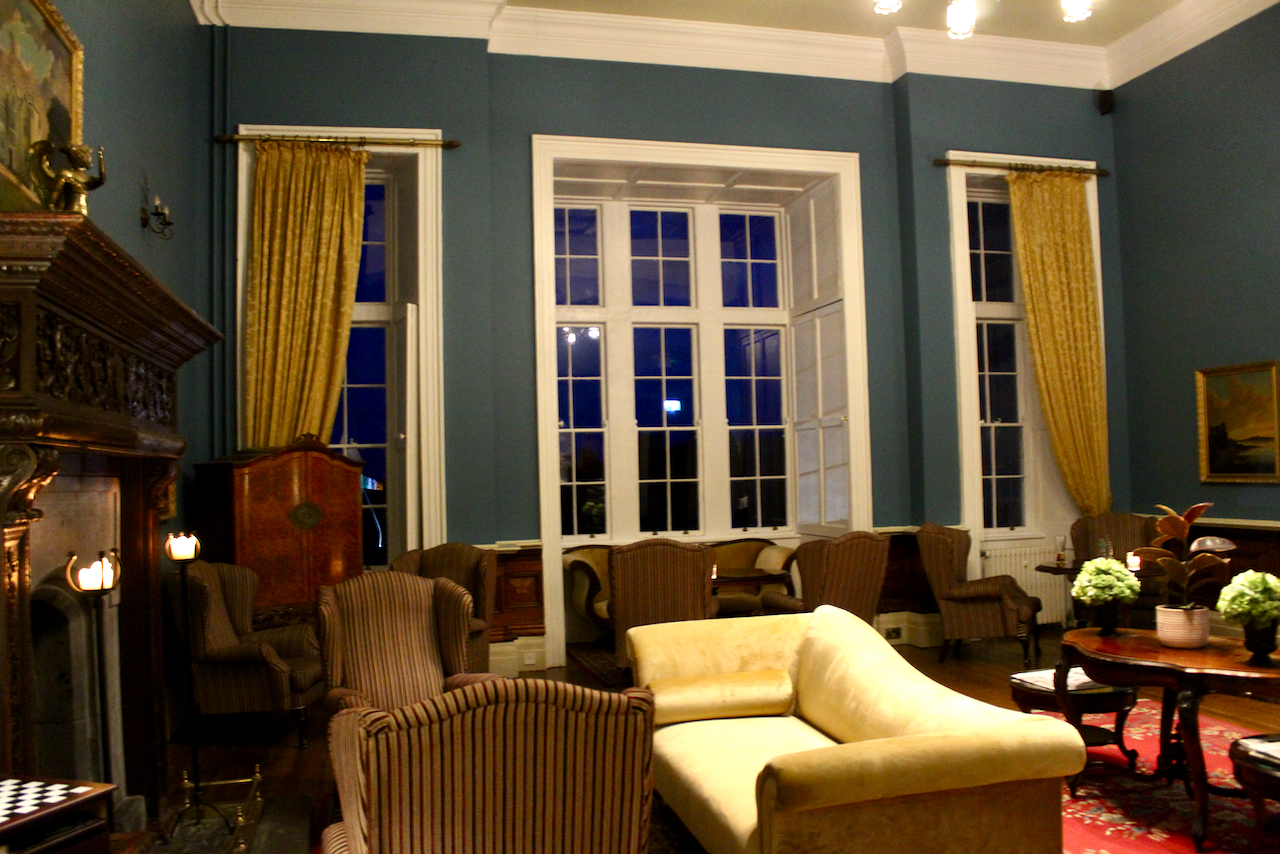
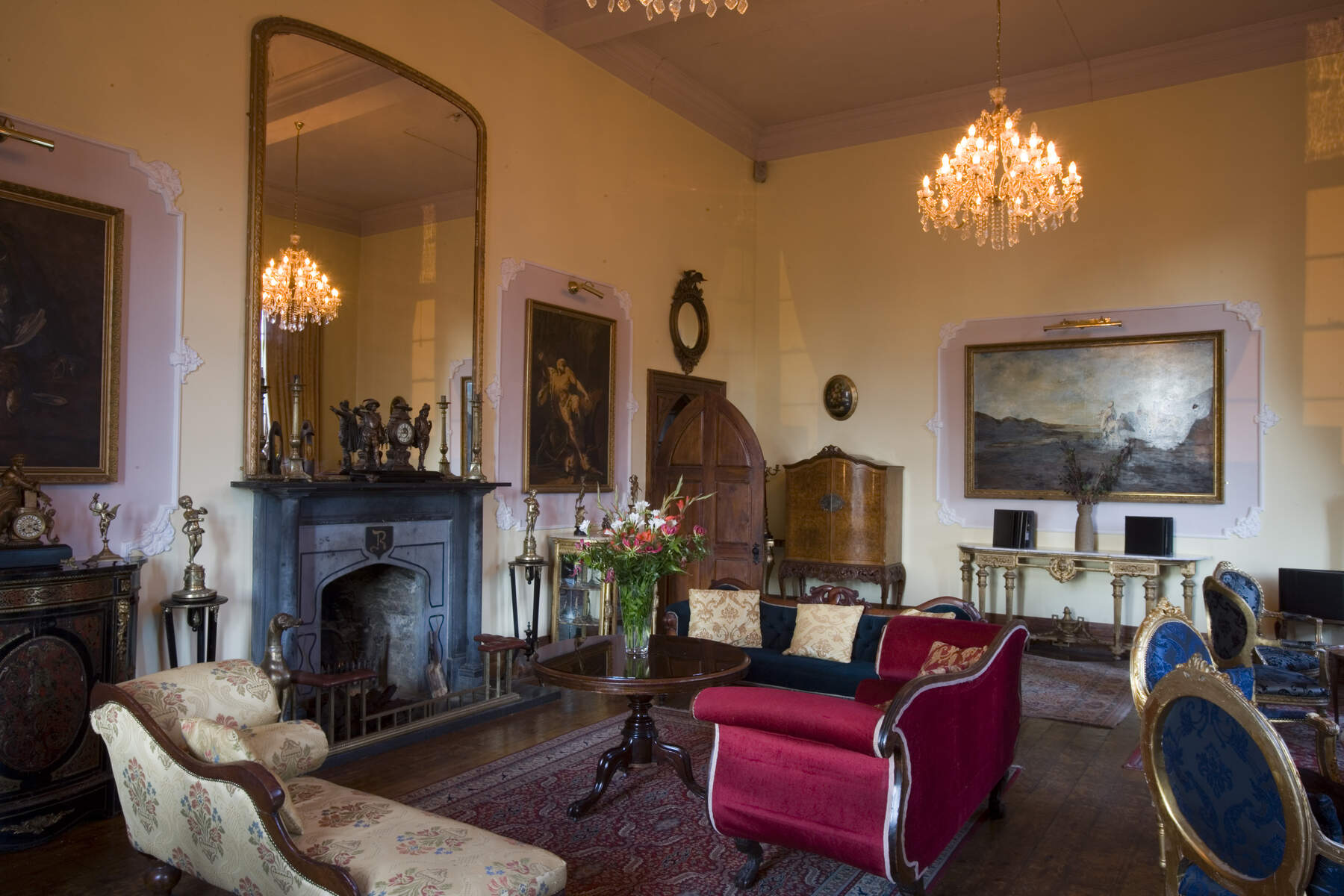
The Drawing Room is on the east side of the house. It has a fretwork ceiling with circular heraldic panels, a panelled dado and quatrefoil cornice. The room connects through a great arch with the rib-vaulted music room to its north. Unfortunately none of the furniture is original to the house but was brought it by the current owners.
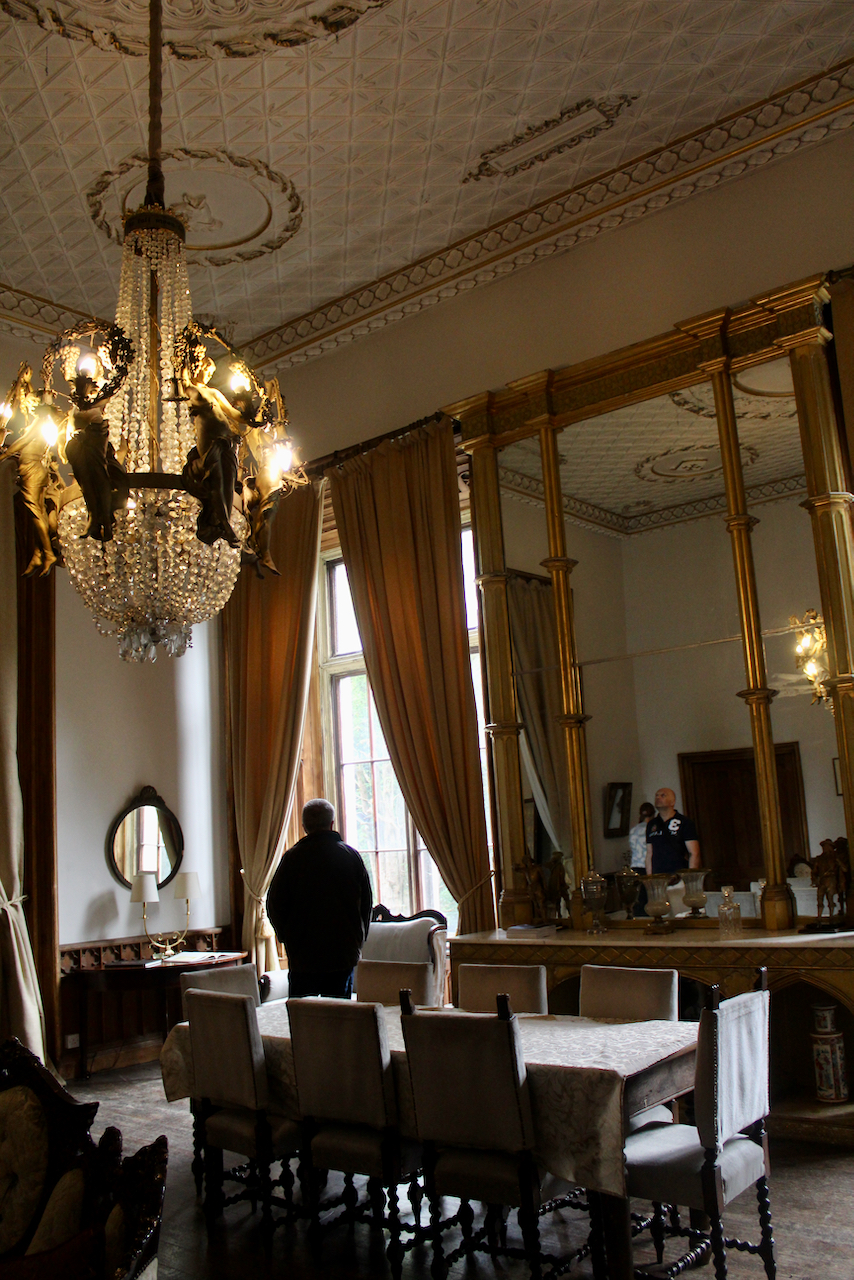
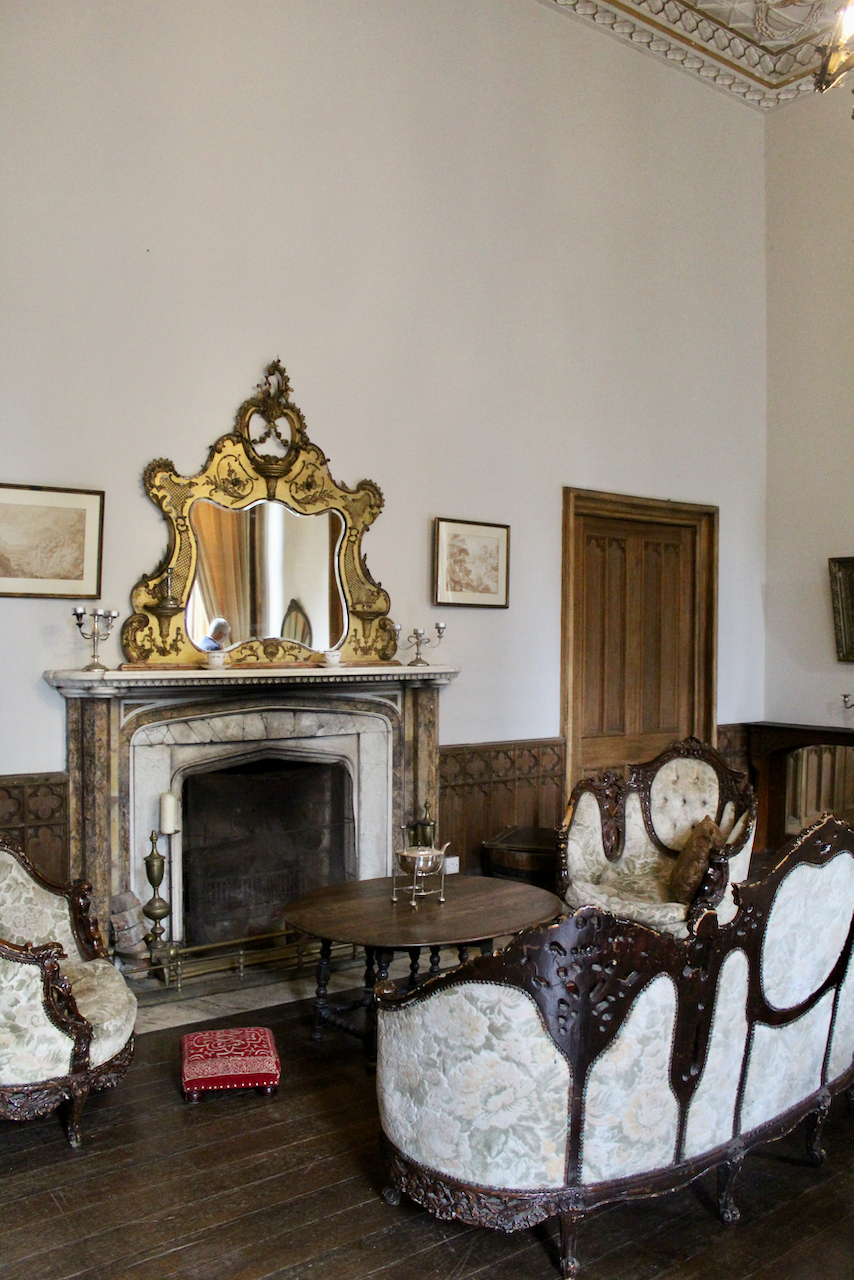
The Drawing Room. Photograph © Jennifer Winder-Baggot, www.irishhistorichouses.com
The Drawing Room, with arch through to the Music Room. Photograph © Jennifer Winder-Baggot, www.irishhistorichouses.com
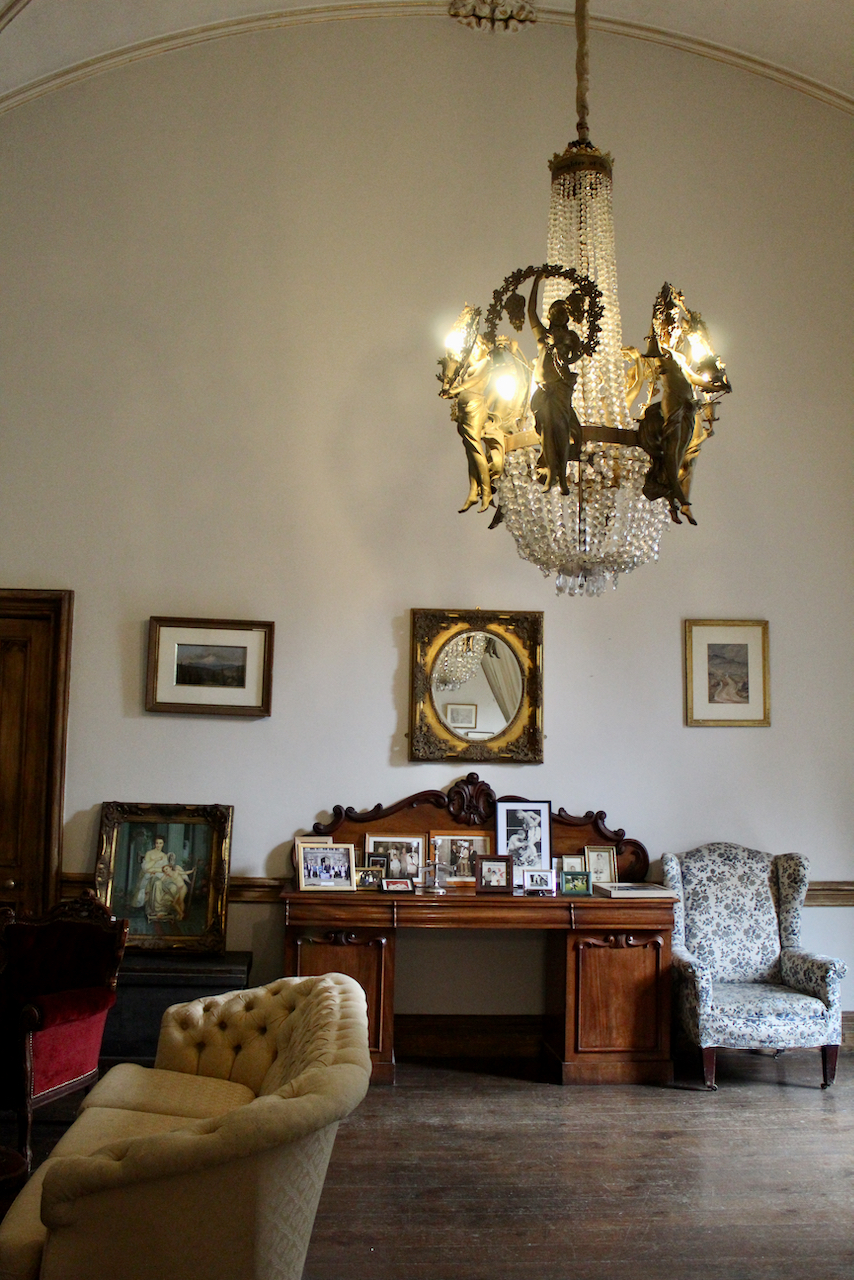
The Drawing Room and Music Room. I love the chandeliers with the figures which look like Muses. Photograph © Jennifer Winder-Baggot, www.irishhistorichouses.com
Charleville, County Offaly, 2018. Photograph © Jennifer Winder-Baggot, www.irishhistorichouses.com
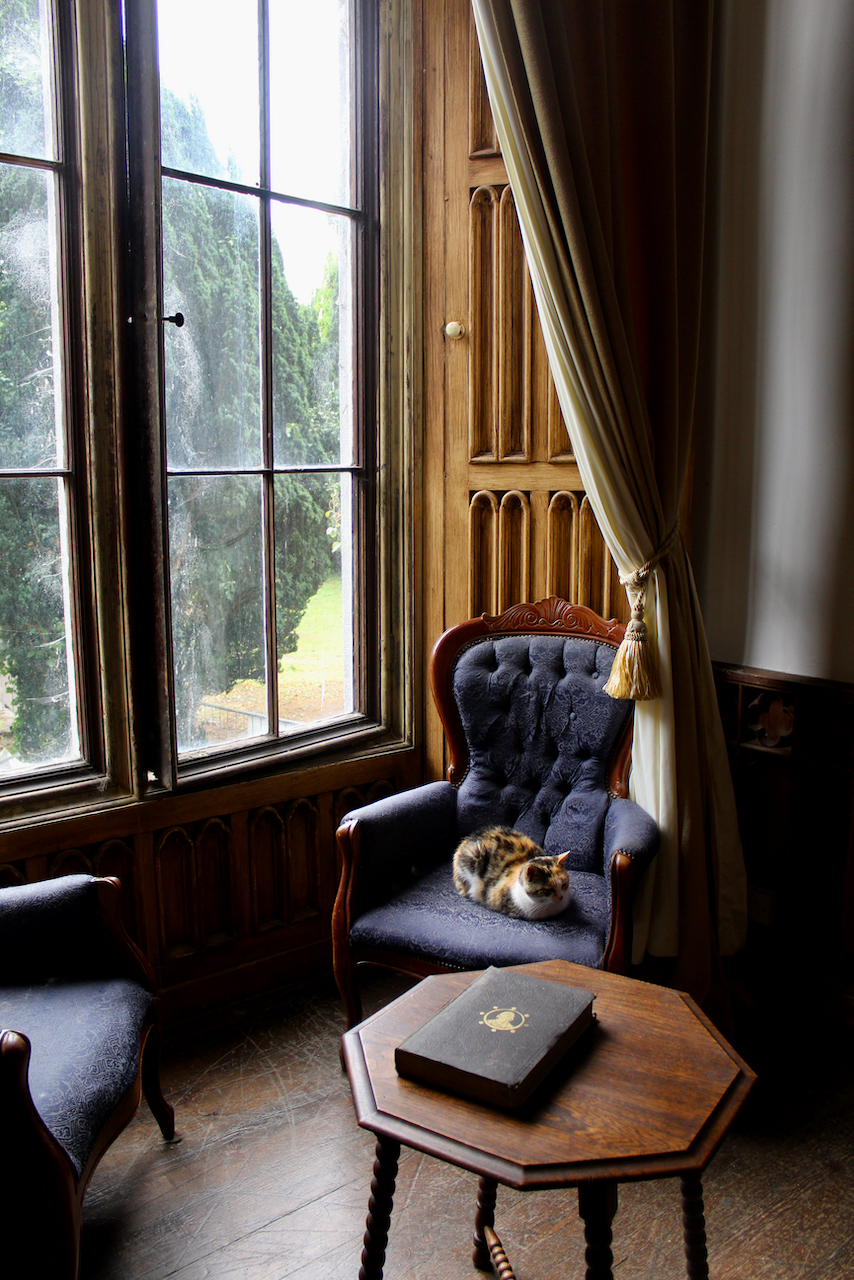
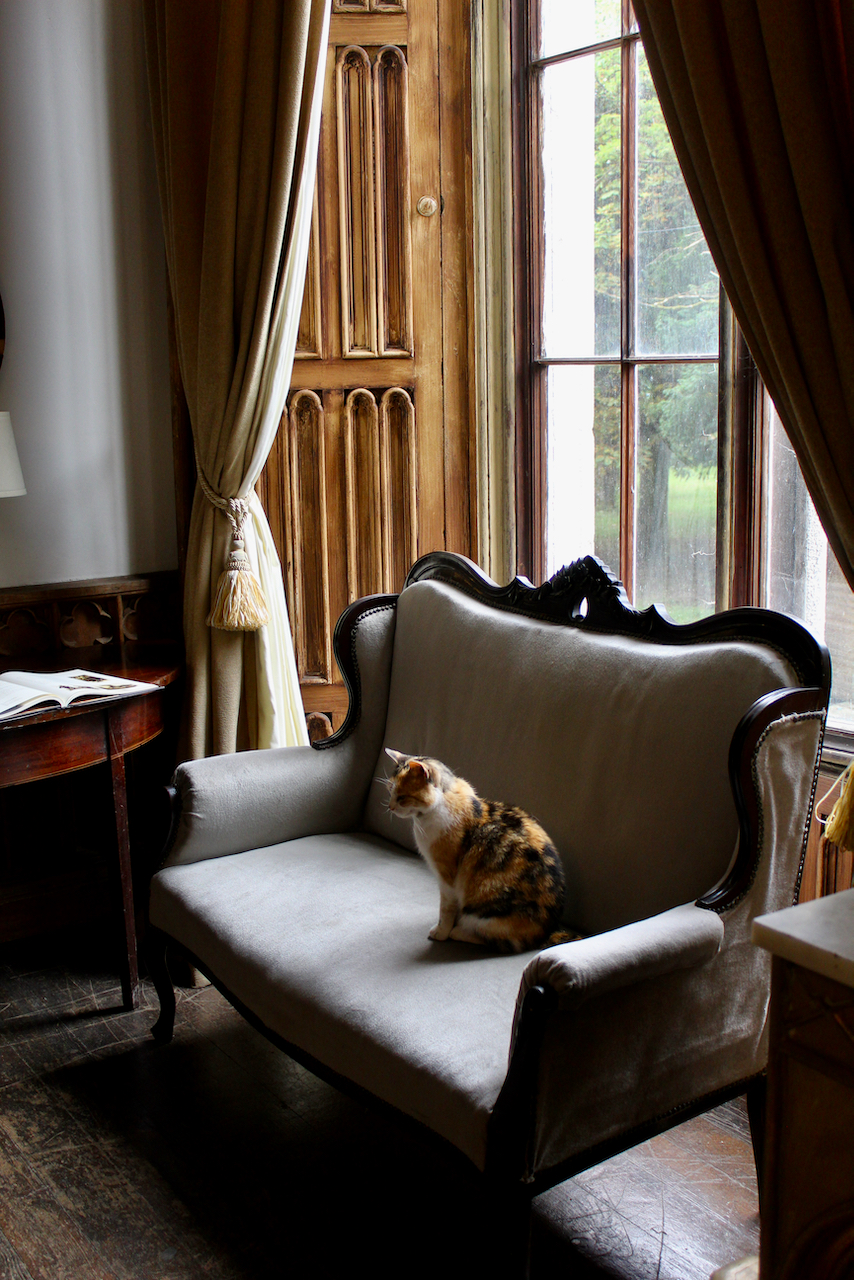
The “Princess” of the castle as Bonnie told us. Photograph © Jennifer Winder-Baggot, www.irishhistorichouses.com
Photograph © Jennifer Winder-Baggot, www.irishhistorichouses.com

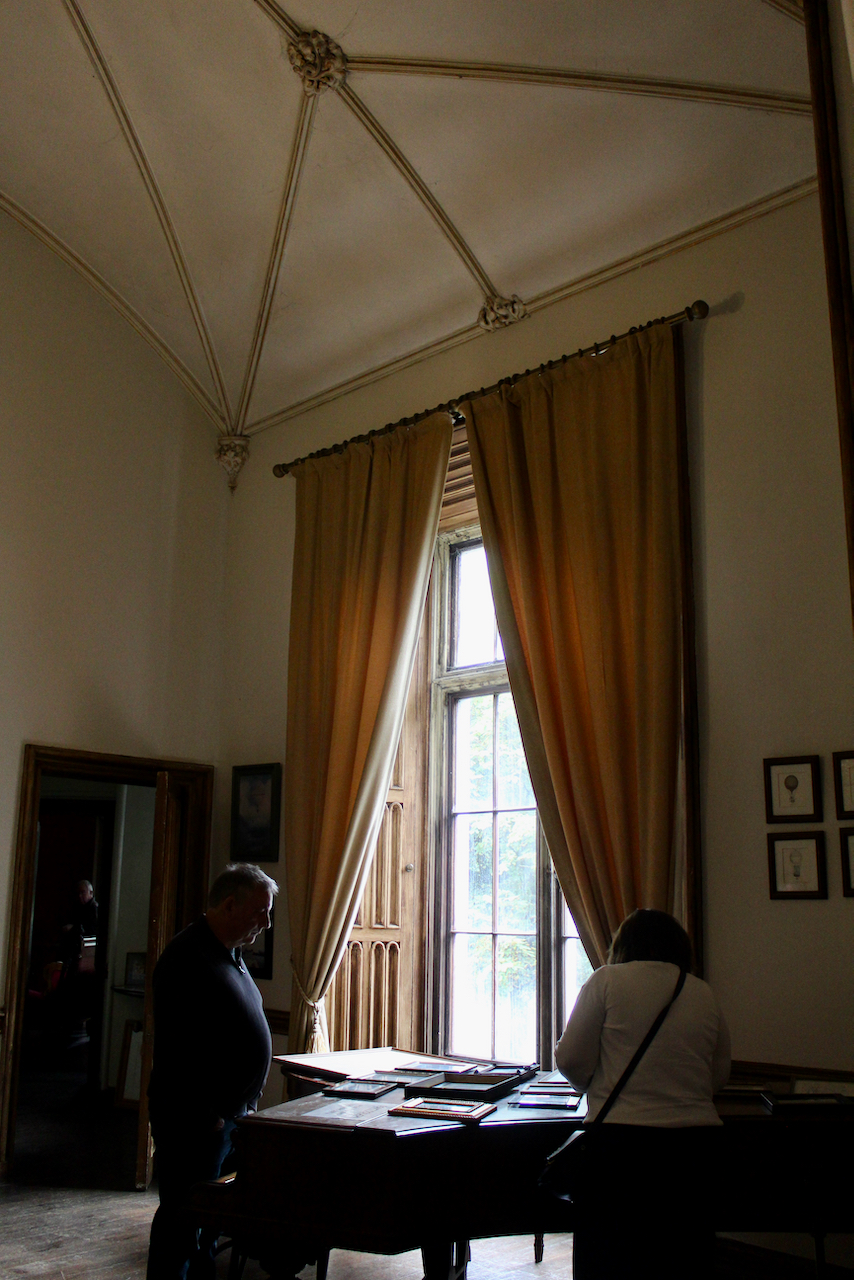
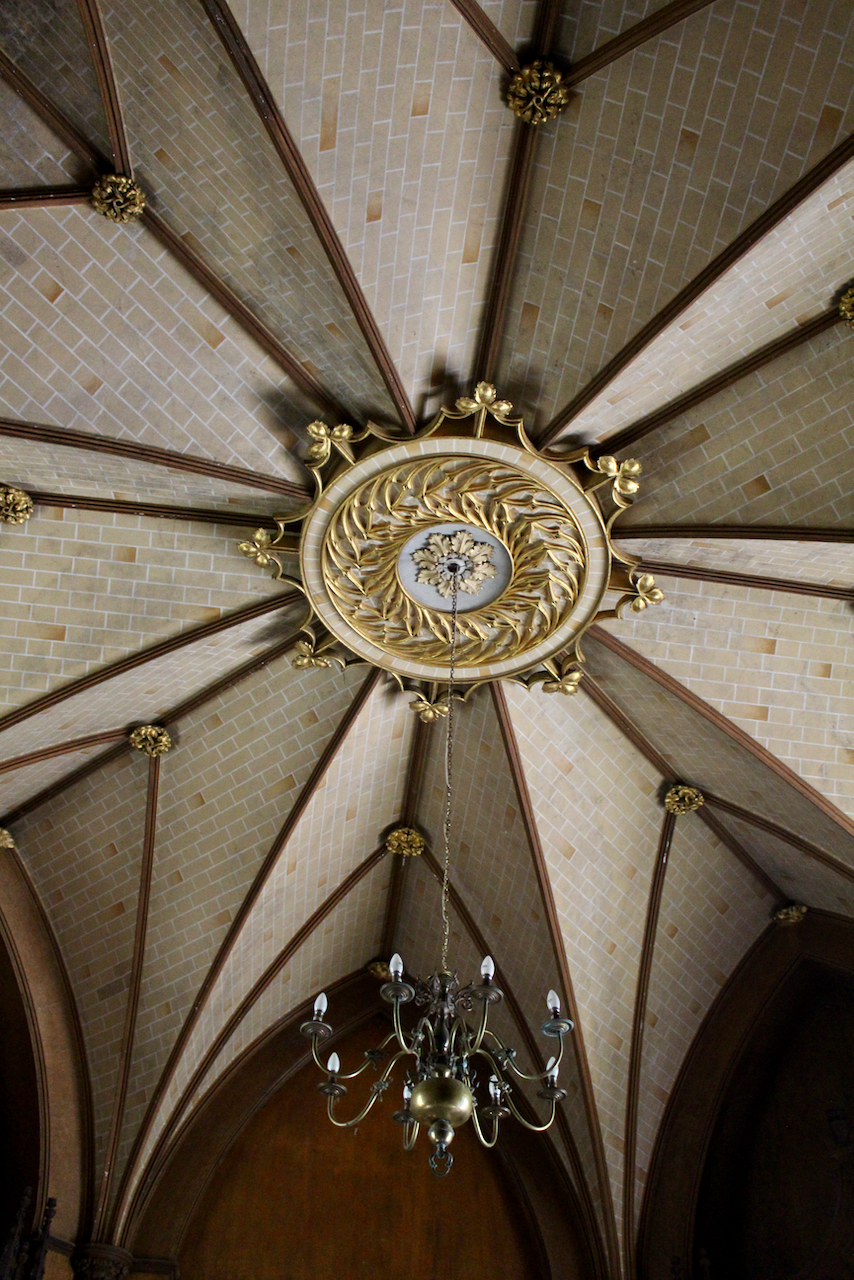
The Music Room has a rib-vaulted ceiling.
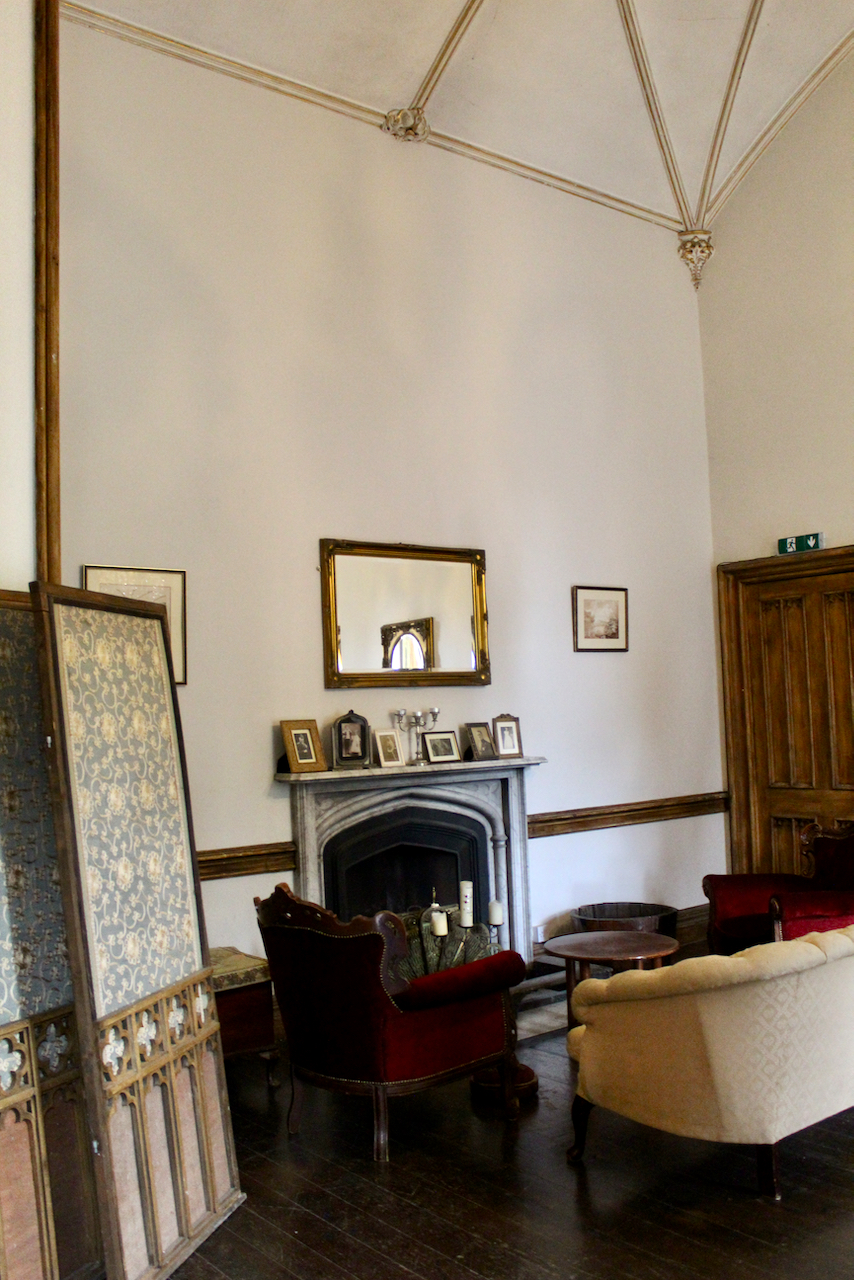
The Music Room. Photograph © Jennifer Winder-Baggot, www.irishhistorichouses.com
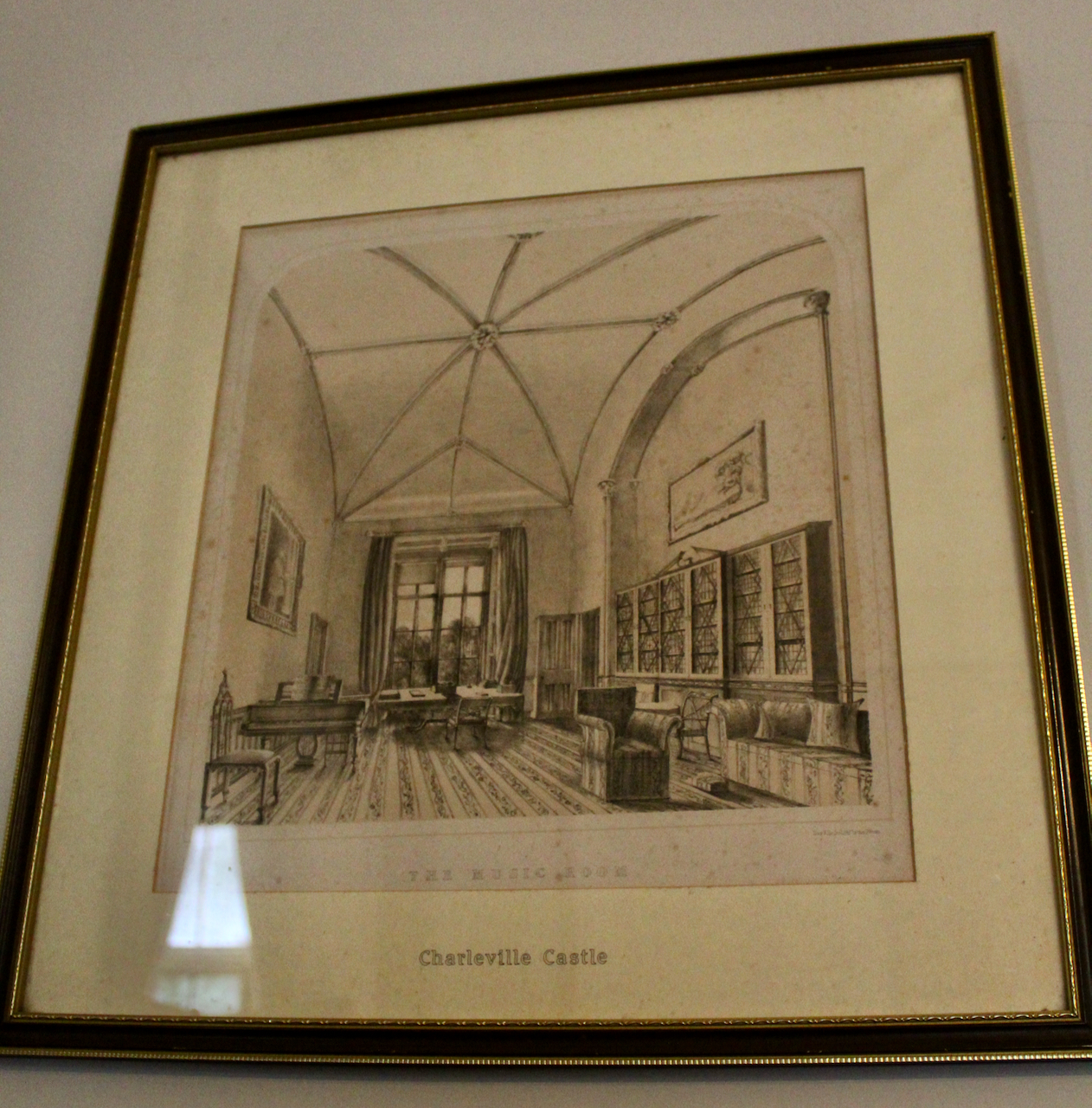
The music room at Charleville c. 1843 with the Gothic chair from the Strawberry Hill sale on left. By Beaujolois Bury [see 8].

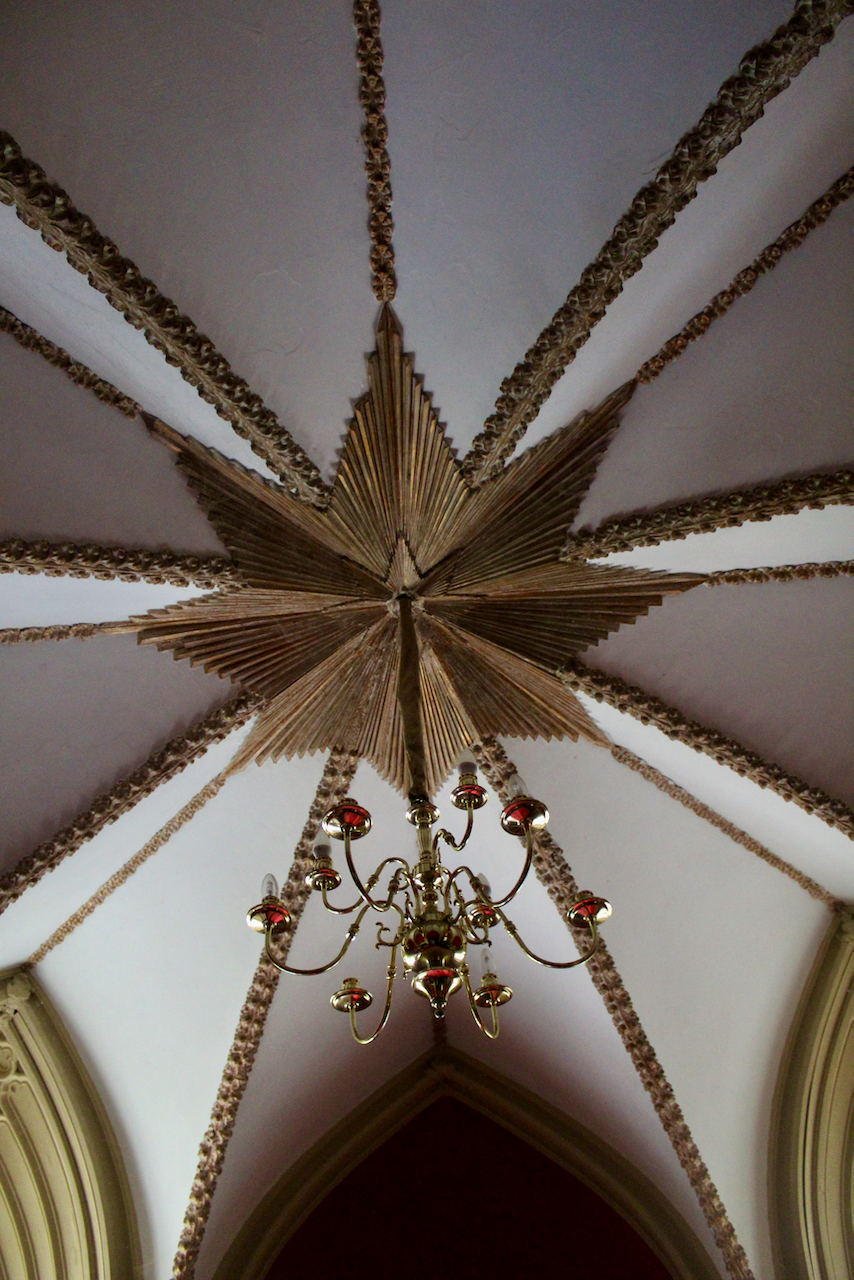
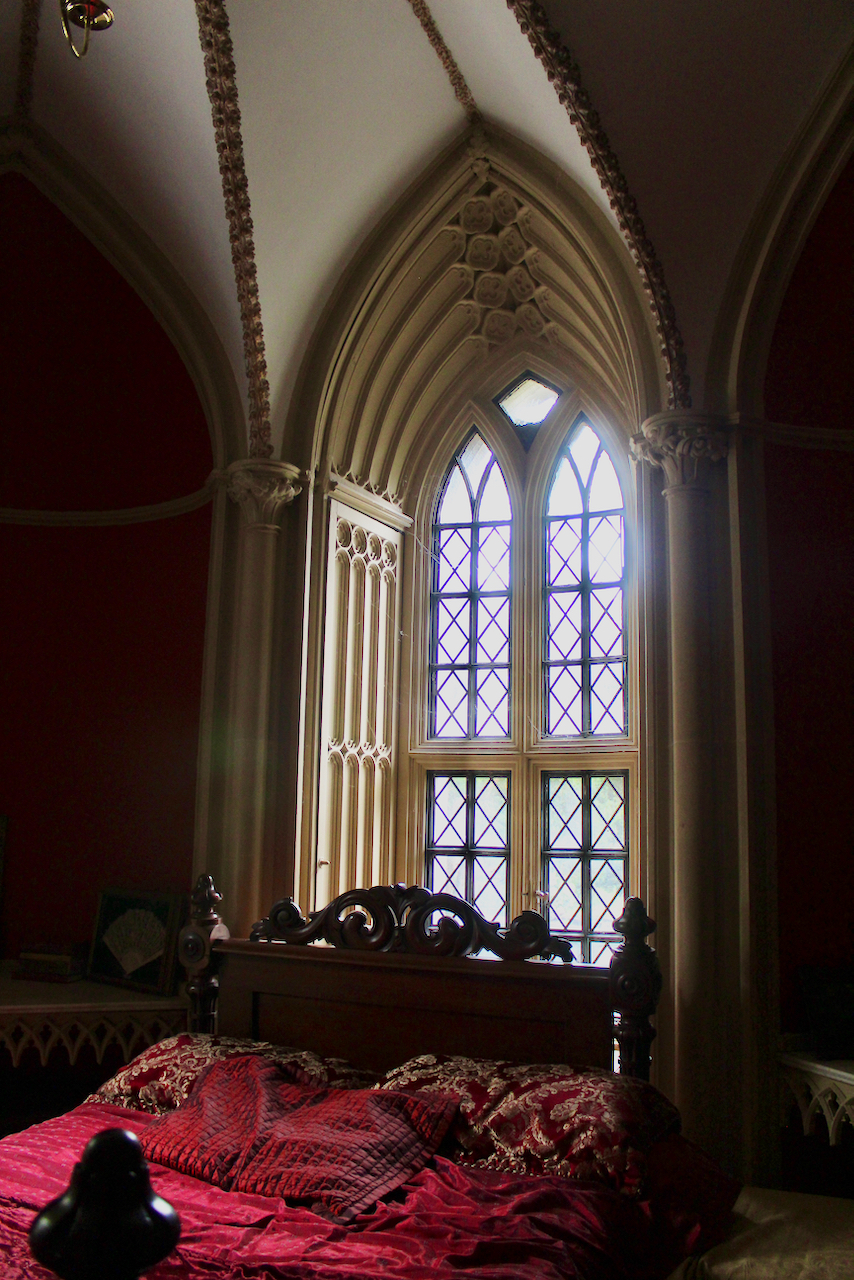
The Music Room connects via a curved short corridor to the Boudoir in the northeast tower, a homage to Walpole’s Tribune in Strawberry Hill, Tierney tells us. This used to be my friend Howard Fox’s bedroom when he was staying as a guest, leading mushroom foraging walks in Charleville Woods! It is a star-vaulted circular room, with bays alternating between four wide round niches and smaller openings for windows, door and fireplace. Above was Lord Charleville’s dressing room, but we did not get to go there.
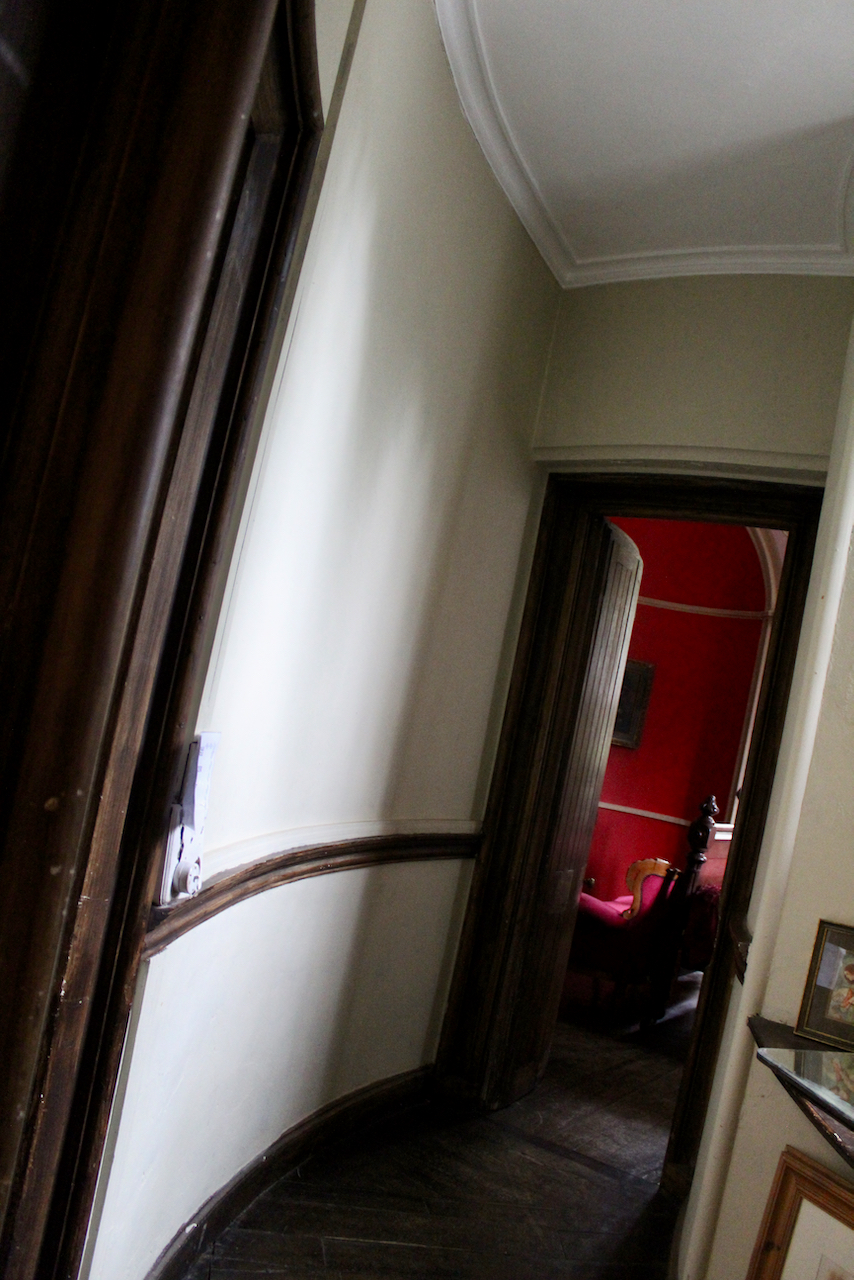
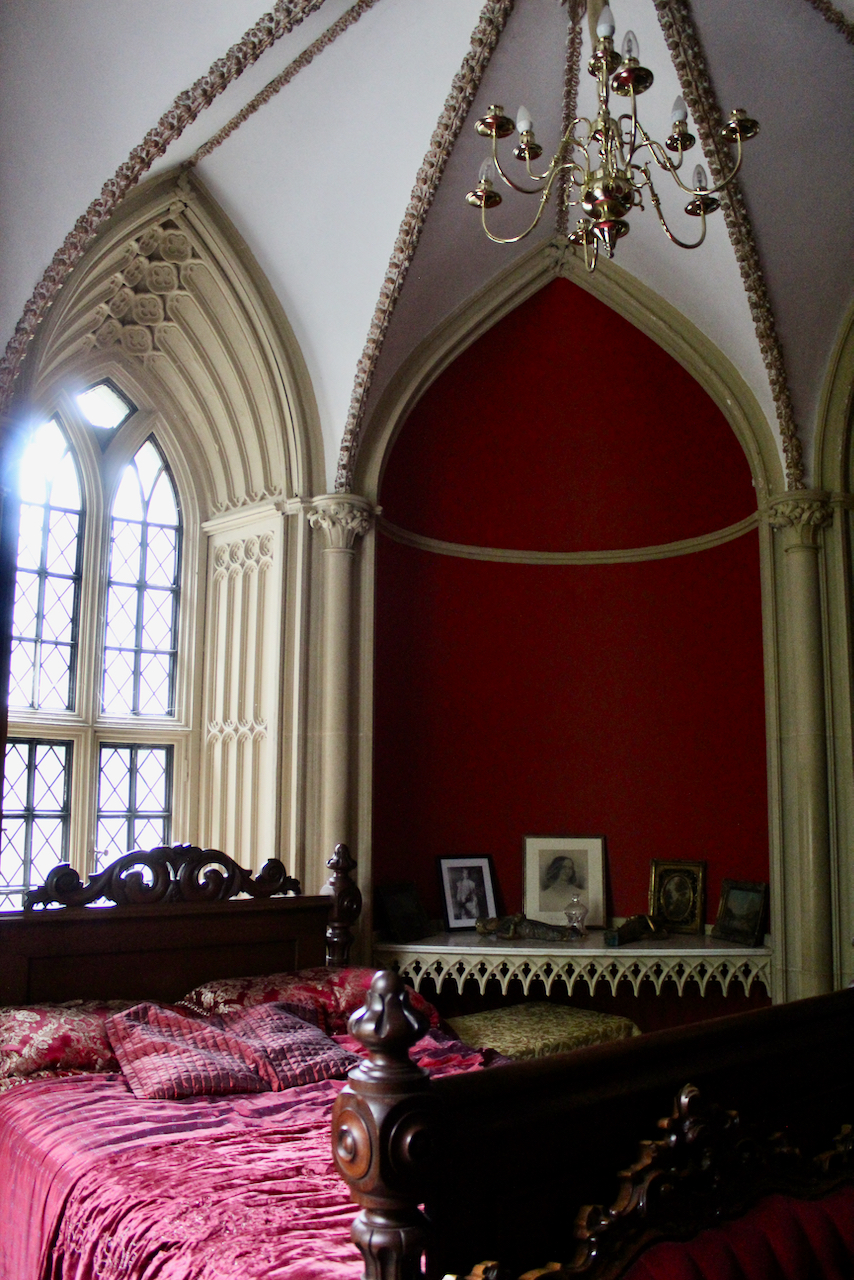
The narrow curved corridor leading to the Boudoir. Photograph © Jennifer Winder-Baggot, www.irishhistorichouses.com
The Boudoir. Photograph © Jennifer Winder-Baggot, www.irishhistorichouses.com
The Boudoir ceiling. Photograph © Jennifer Winder-Baggot, www.irishhistorichouses.com
The Boudoir. Photograph © Jennifer Winder-Baggot, www.irishhistorichouses.com
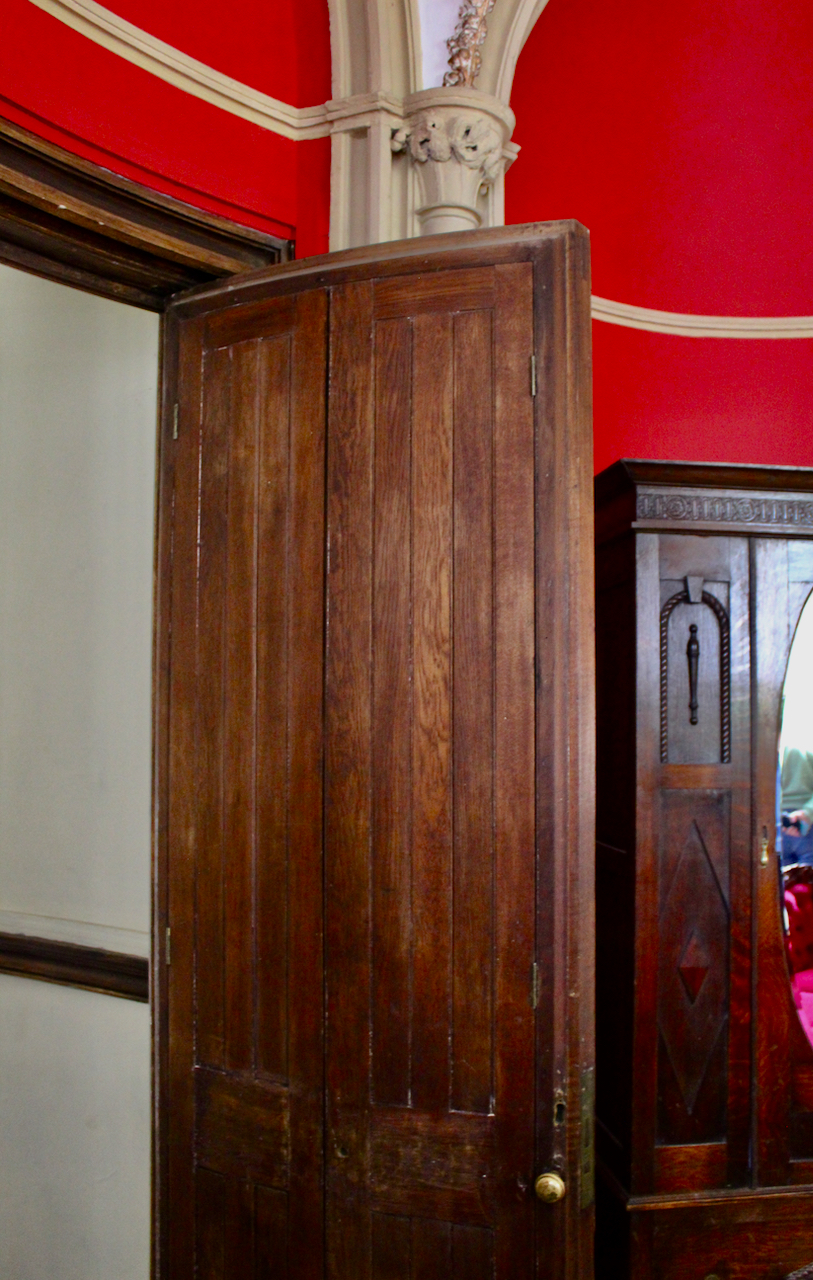
The door into the Boudoir is curved. Photograph © Jennifer Winder-Baggot, www.irishhistorichouses.com

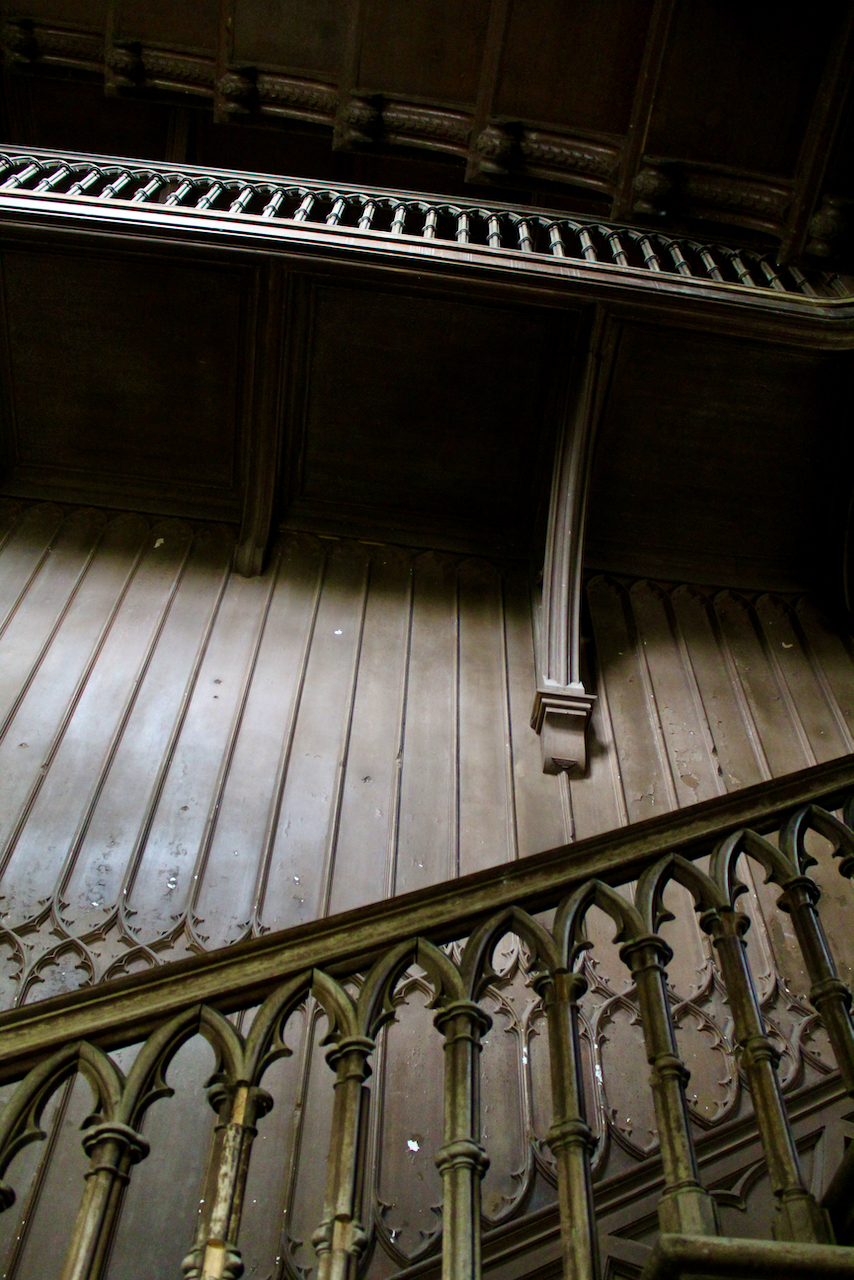
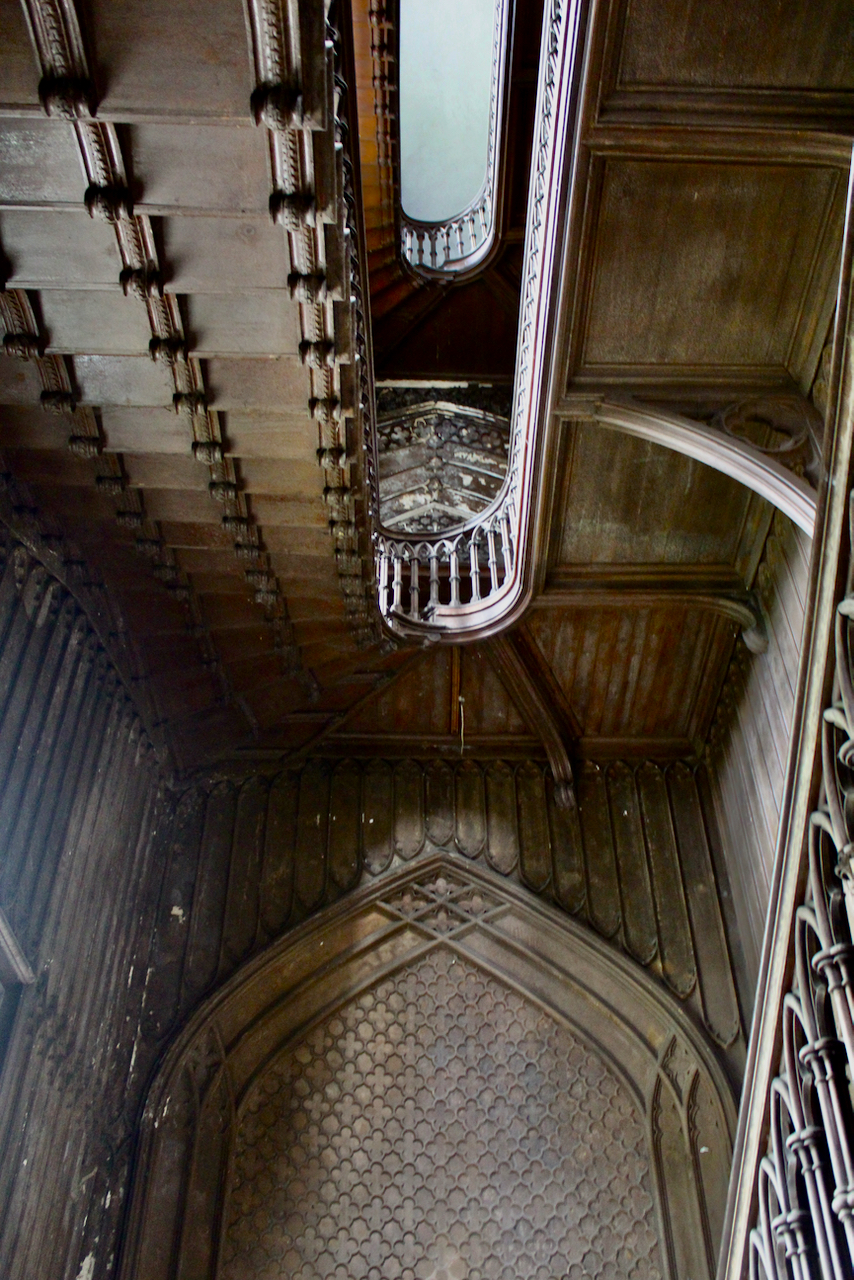
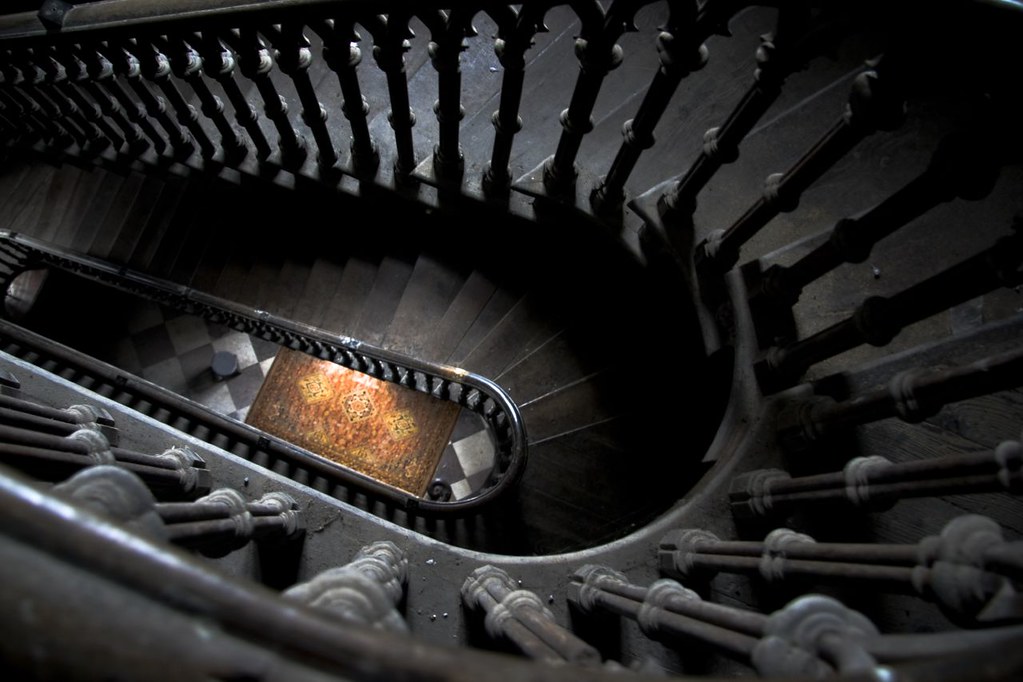
The stairs is tucked away in an odd place, behind a door off the northwest corner of the entrance hall. It is an intricate tightly curved staircase of Gothic joinery leading to the upper storeys, with Gothic mouldings on walls. The wall panelling is plaster painted and grained to look like oak. It rises through three storeys.
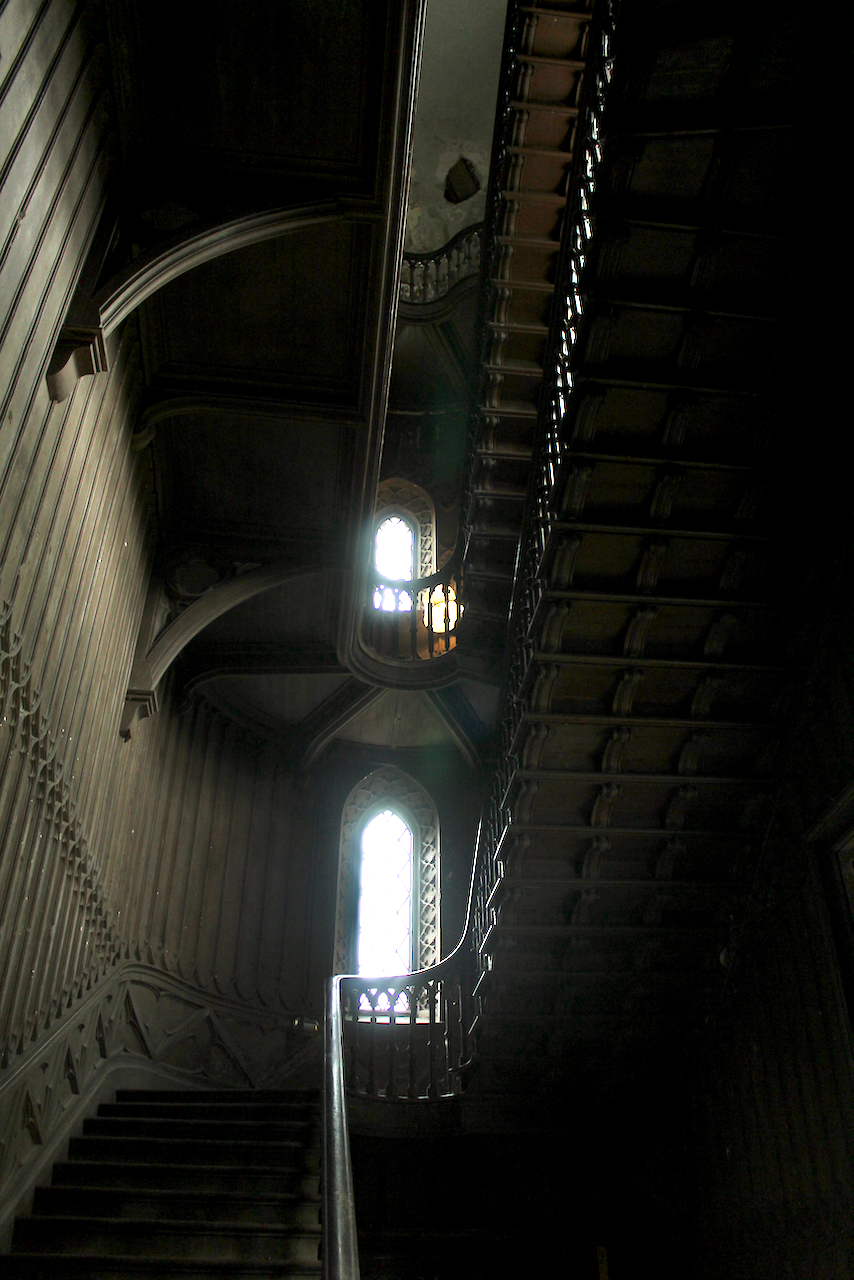
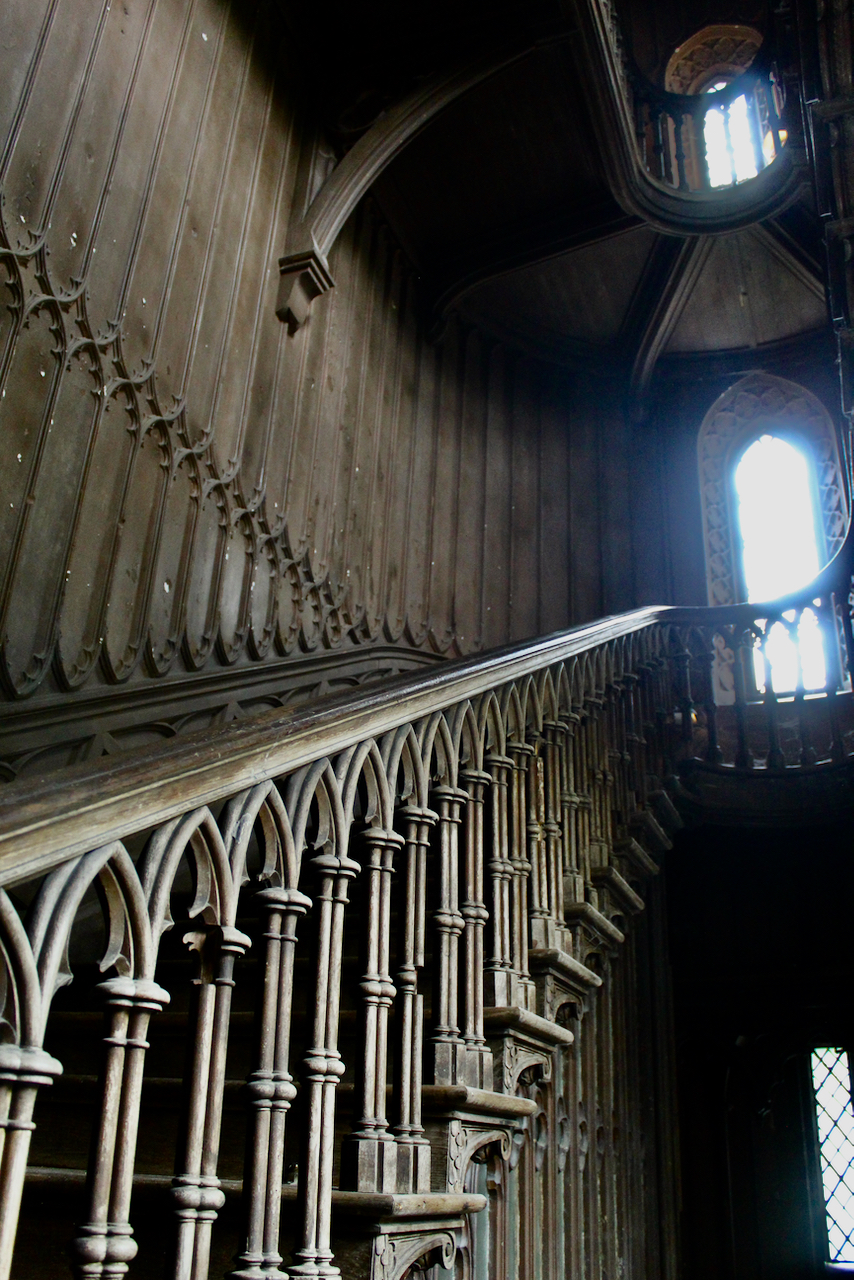
The Staircase. Photograph © Jennifer Winder-Baggot, www.irishhistorichouses.com

Tierney tells us that at the top of each flight, there is a great cavetto-moulded doorcase enriched with quatrefoil fretwork in plaster. The cavetto is a concave molding with a profile approximately a quarter-circle, quarter-ellipse, or similar curve. I find the staircase thrilling. Tierney writes: “Its dark colouring is in tune with the “gloomth” of its north facing aspect, and no Gothic room in Ireland rivals its Hmmer Horror atmosphere“!
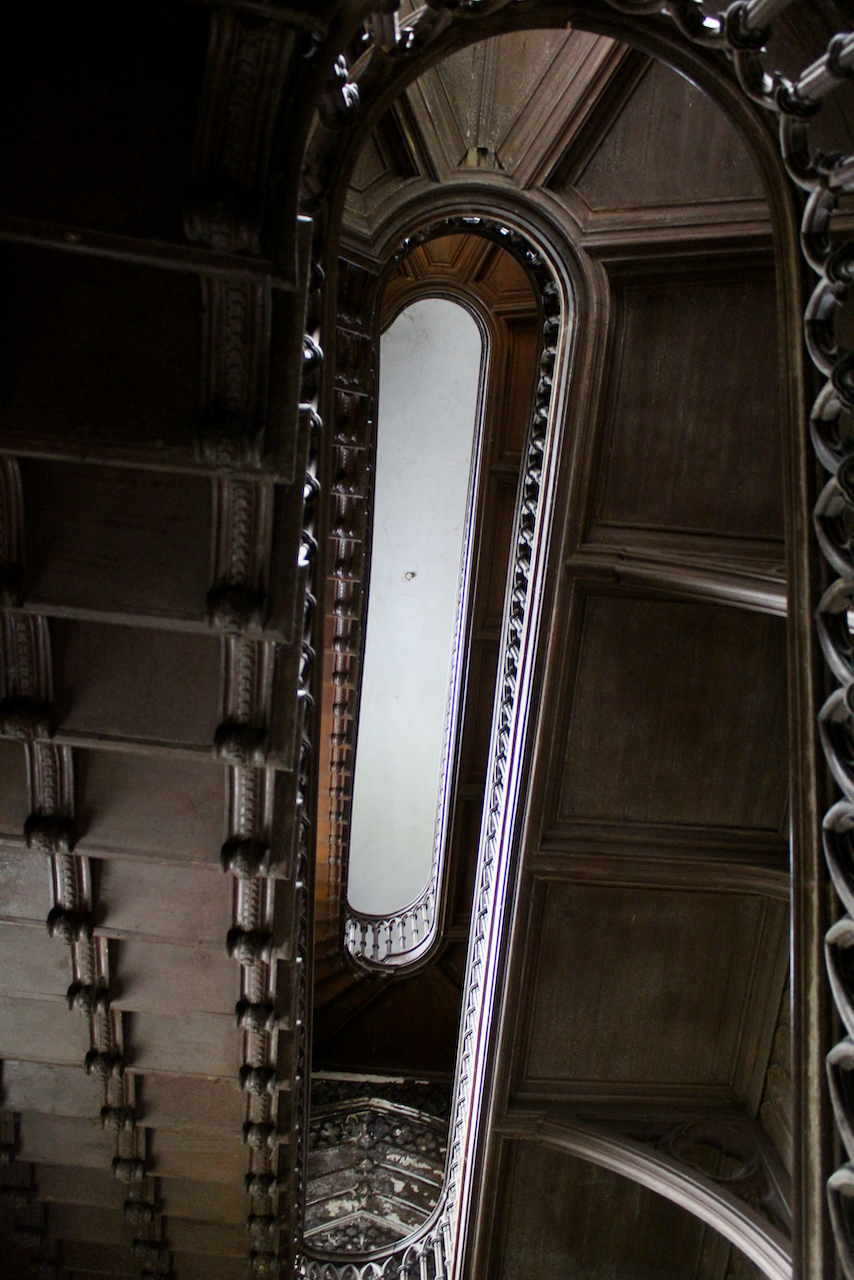
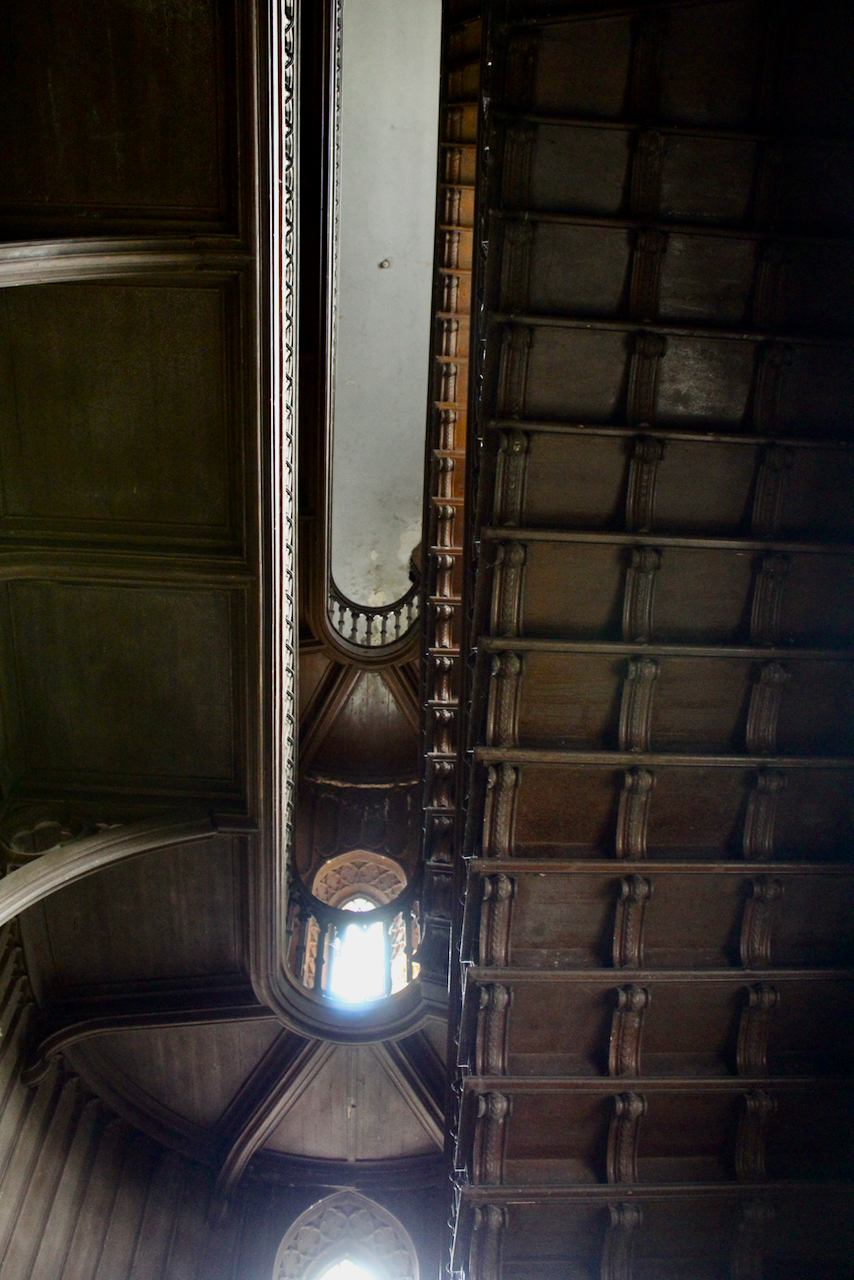
The Staircase. Photograph © Jennifer Winder-Baggot, www.irishhistorichouses.com
Charleville Castle Tullamore by Matt McKnight 2007, courtesy of flickr constant commons.

A tragic accident occurred in 1861 when the 5th Earl’s young sister Harriet was sliding down the balustrade of the Gothic staircase from the nursery on the third floor and fell. She is said to haunt the staircase and to be heard singing.
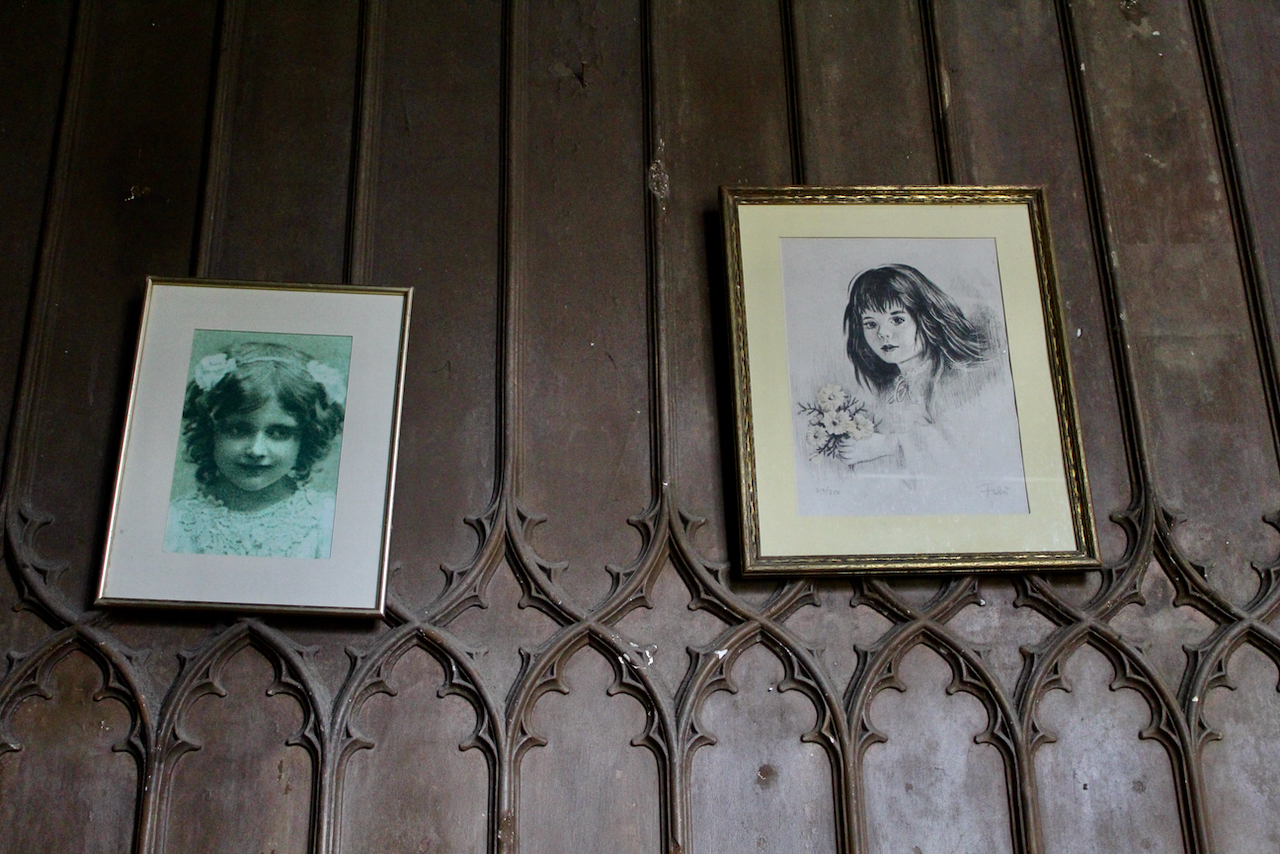
I’m not sure if this is a photograph of Harriet who died falling from the staircase.

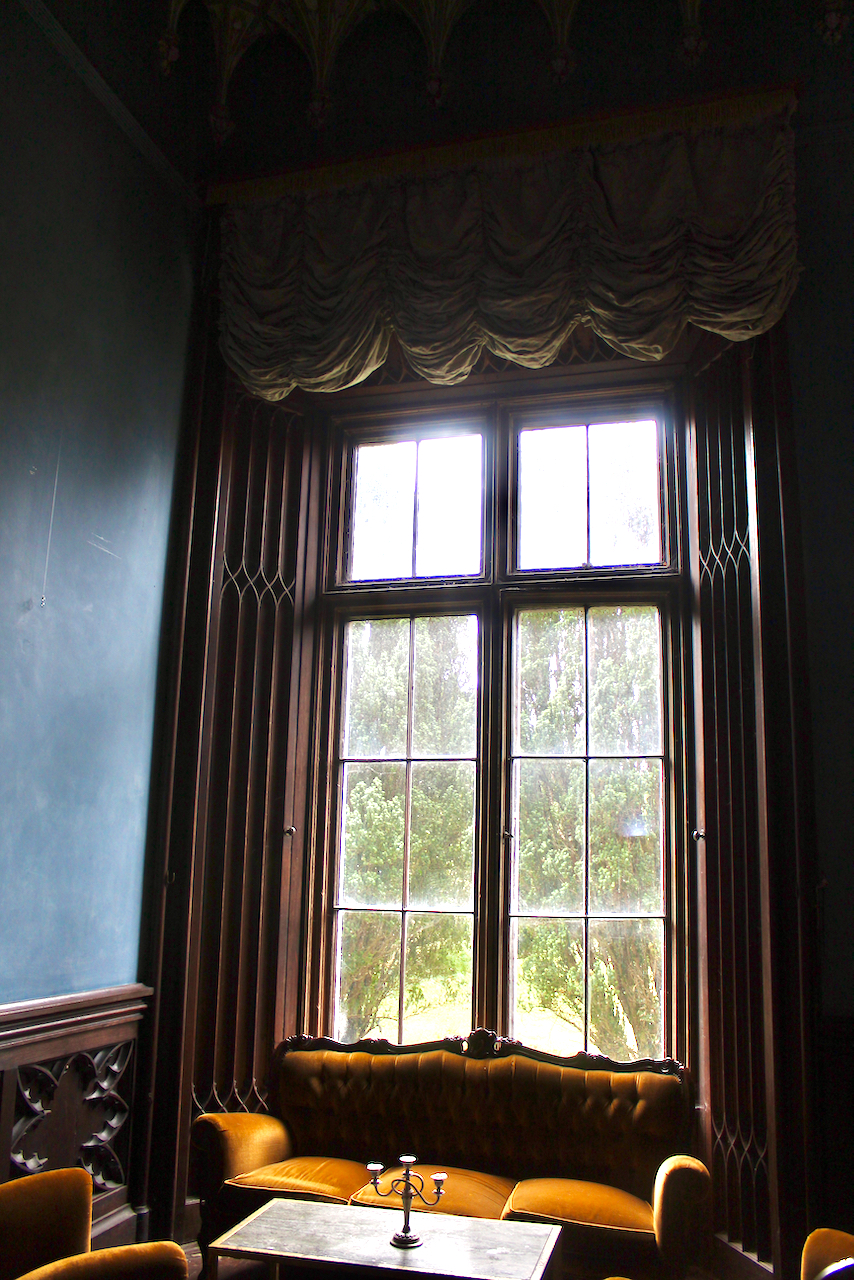
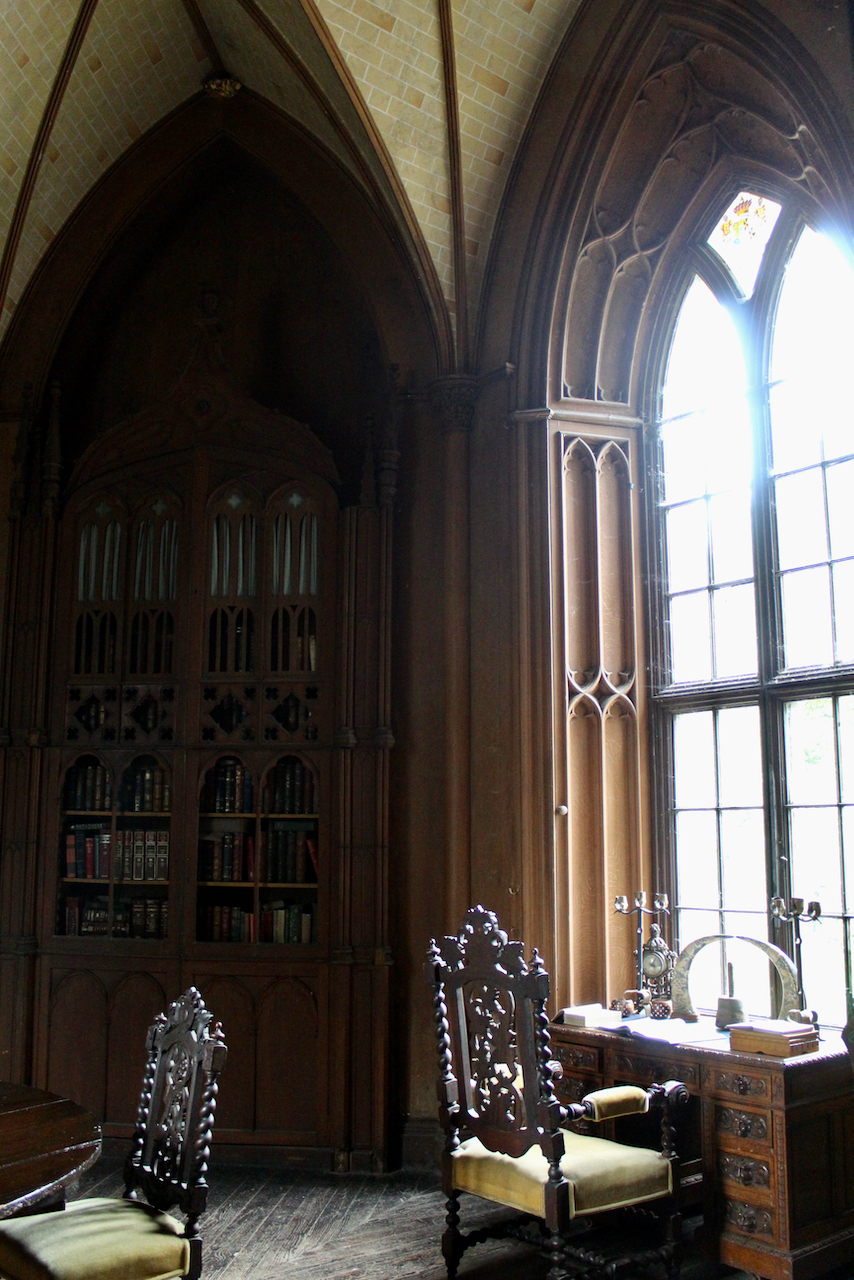
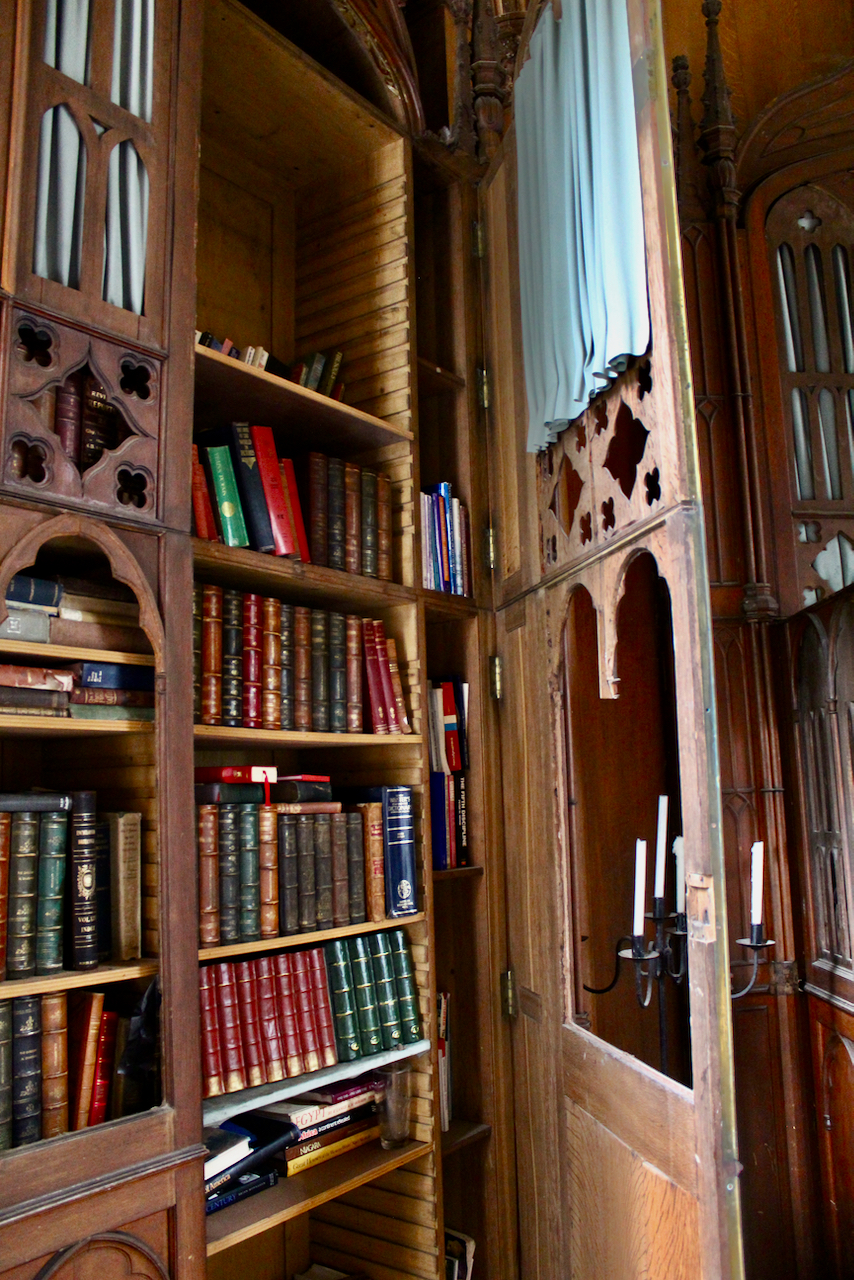
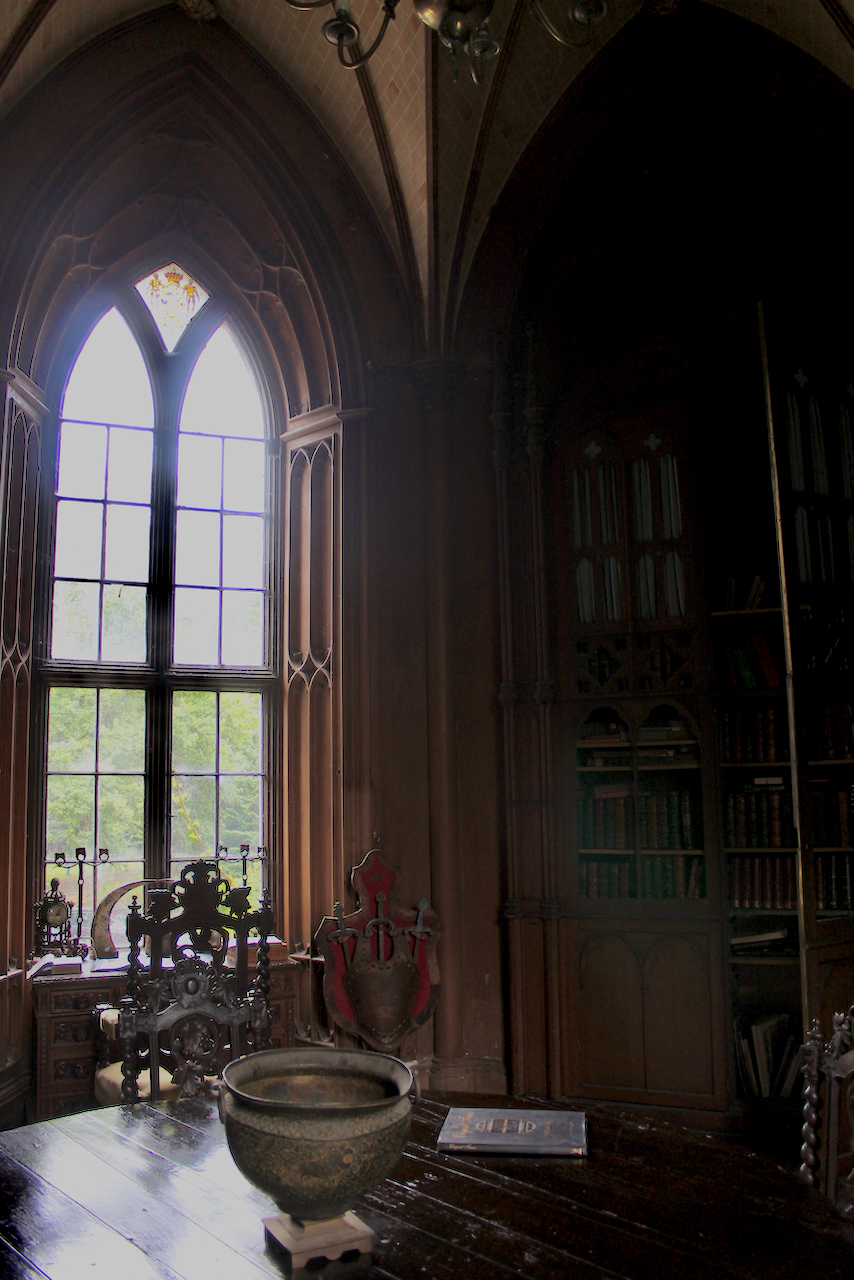
Beyond the staircase on the primary level is a small library with rib vaulted ceiling and Gothic bookcases.
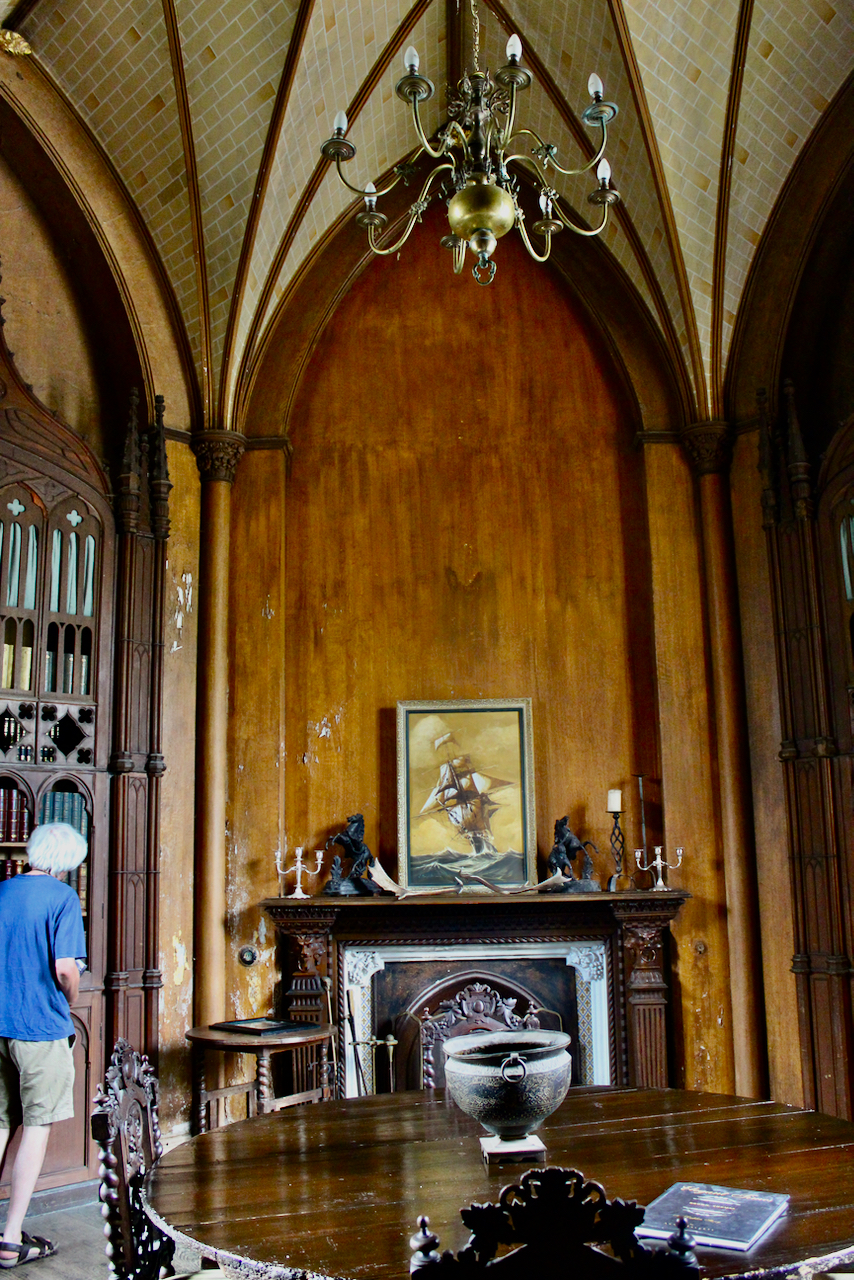
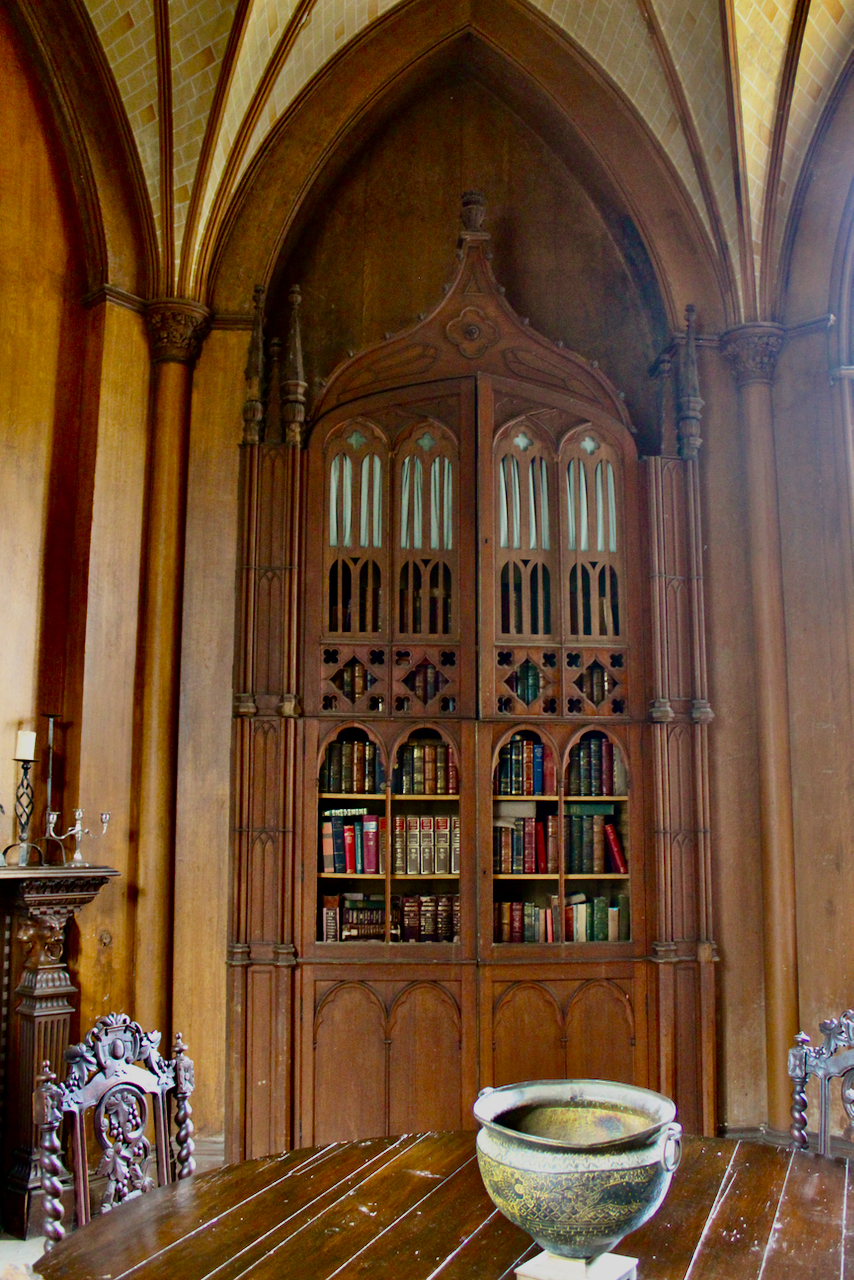
The Library. Photograph © Jennifer Winder-Baggot, www.irishhistorichouses.com

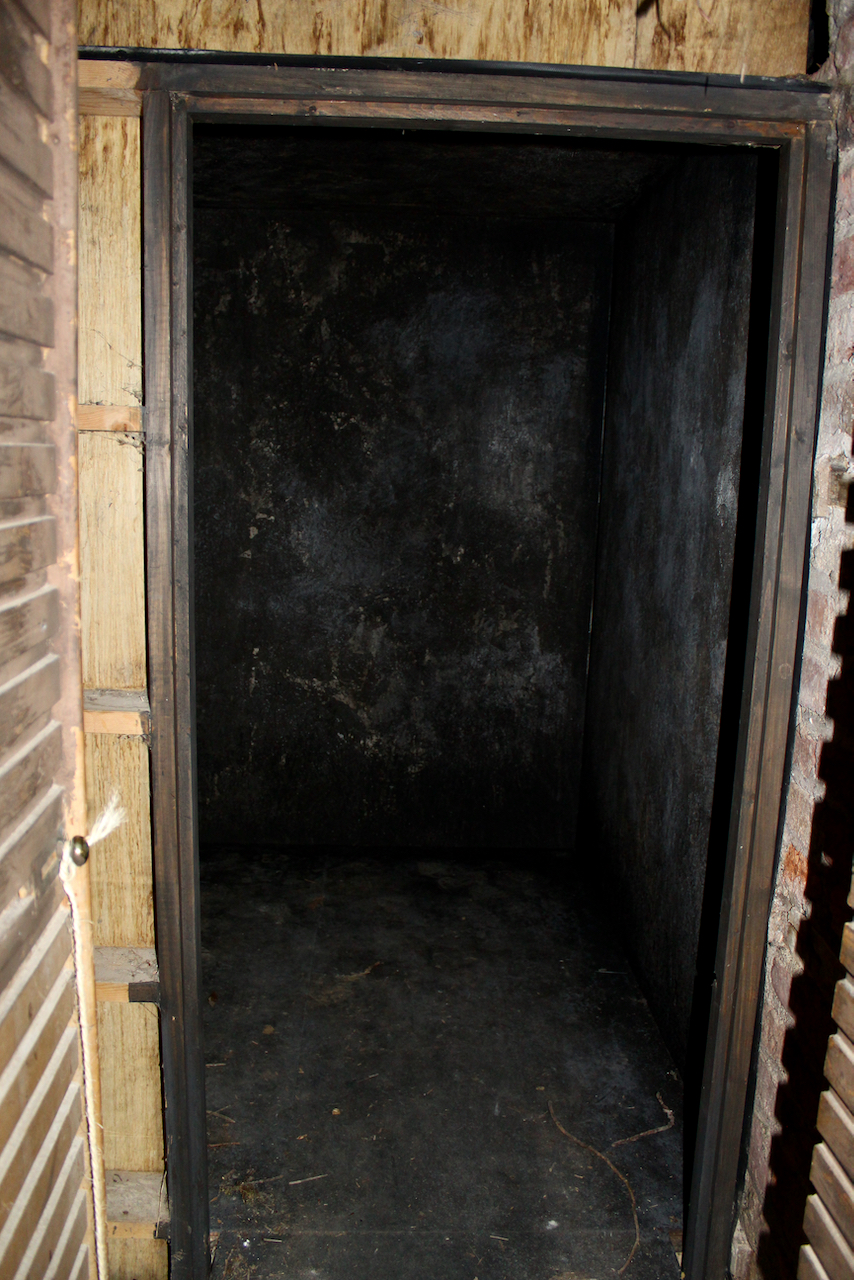
The panelling by each bookcase can be opened to reveal more space, and behind one secret door is a small room which leads out to the chapel, the guide told us.
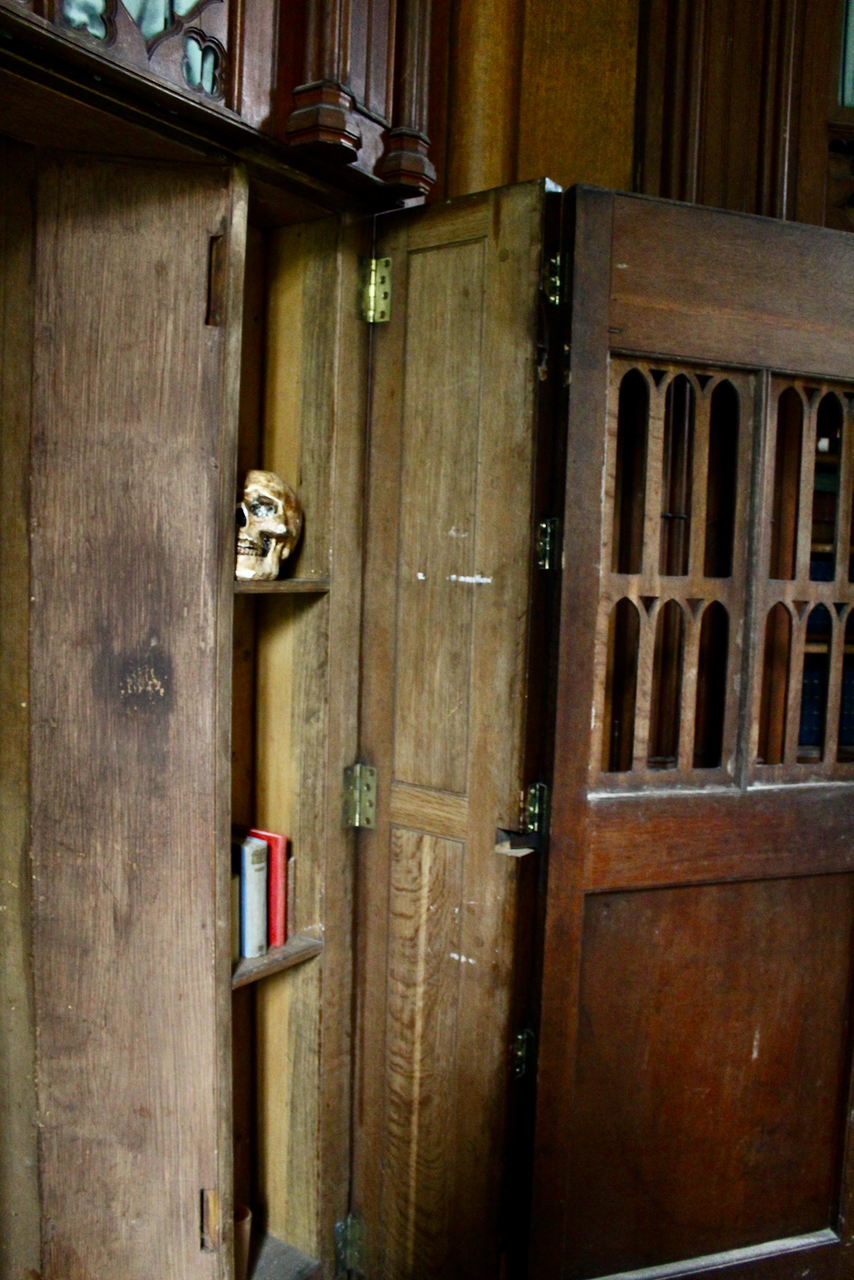
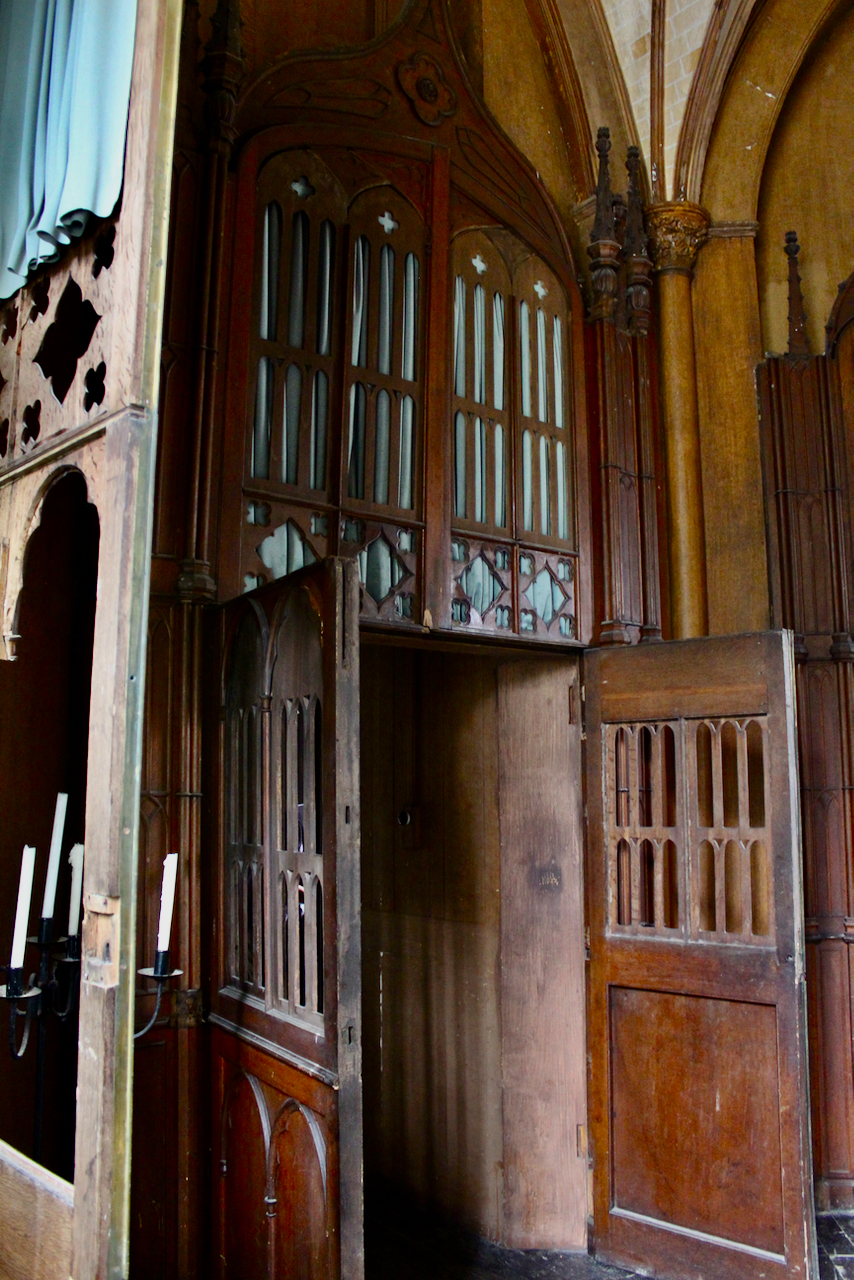
The Library. Photograph © Jennifer Winder-Baggot, www.irishhistorichouses.com
The Secret Room off the library – we did not see the passage to the chapel, which is now without a roof. Photograph © Jennifer Winder-Baggot, www.irishhistorichouses.com
The Library. Photograph © Jennifer Winder-Baggot, www.irishhistorichouses.com

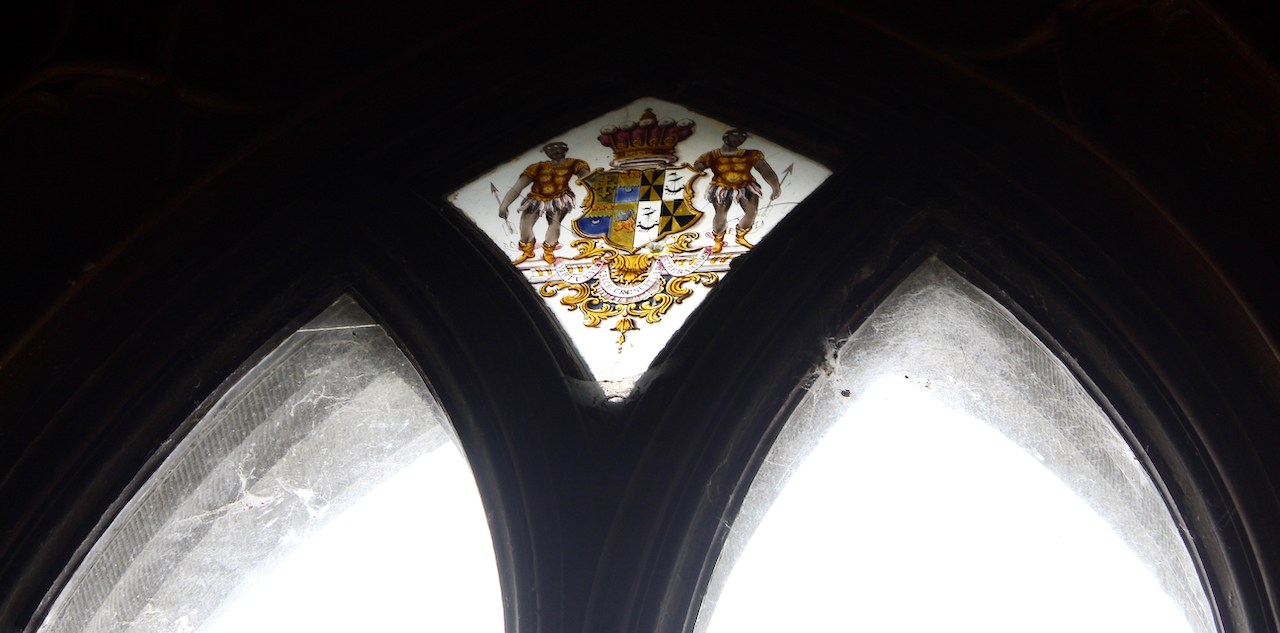
The library has stained glass Heraldic windows.
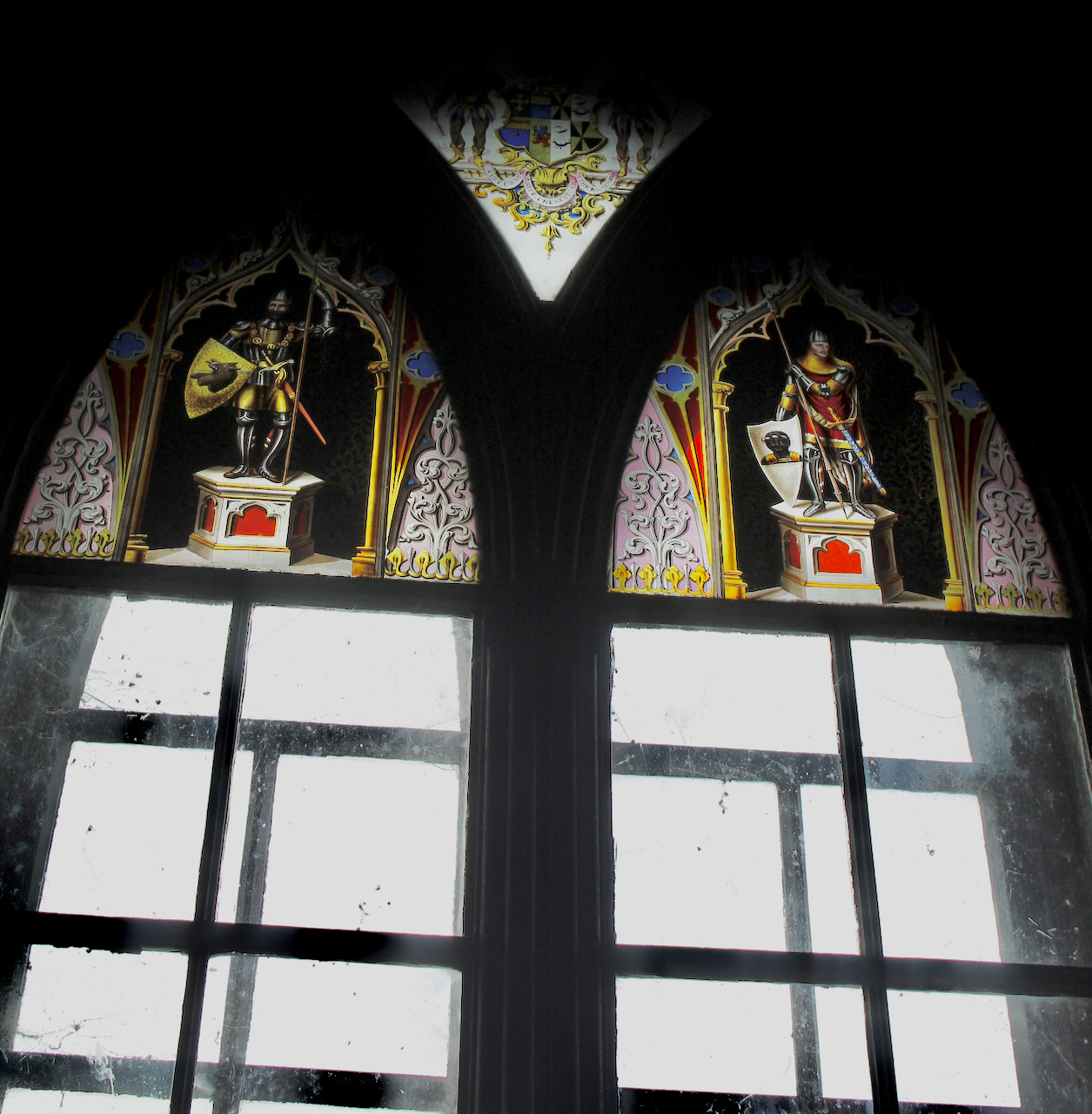
The Library. Photograph © Jennifer Winder-Baggot, www.irishhistorichouses.com

O’Reilly tells us: “Charleville Forest’s patron, Charles William Bury, from 1800 Viscount and from 1806 Earl of Charleville, was a man well versed in contemporary English taste and style. He inherited lands in Limerick, through his father’s maternal line, and in Offaly. His great wealth, lavish lifestyle and generous nature allowed him simultaneously to distribute largesse in Ireland, live grandly in London and travel widely on the continent…[p. 139] Charleville’s lack of success in his search for a sinecure proved ill for the future of the family fortunes for, continuing to live extravagantly above their means, they advanced speedily towards bankruptcy. On Charleville’s death in 1835, the estate was ‘embarrassed’ and by 1844, the Limerick estates had to be sold and the castle shut up, while his son and heir, ‘the greatest bore the world can produce’ according to one contemporary, retired to Berlin.

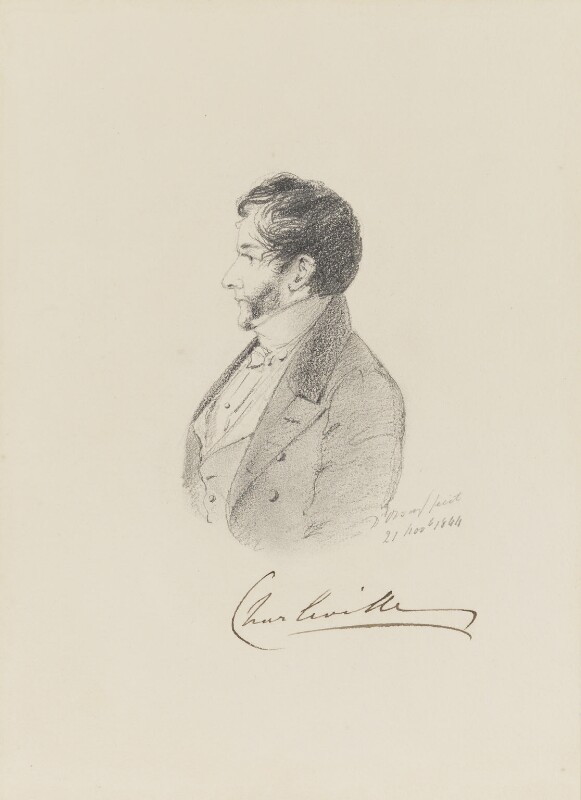
“The greatest bore the world can produce,” Charles William Bury (1801-1851), 2nd Earl of Charleville by Alfred, Count D’Orsay 1844, courtesy of National Portrait Gallery NPG 4026(12).

The 2nd Earl held the office of Representative Peer [Ireland] between 1838 and 1851.

Charles William Bury, 2nd Earl of Charleville, seated in red cloak before a curtain, portrait by Henry Pierce Bone, 1835.

The 3rd Earl, Charles William George Bury (1822-1859), returned to the house in 1851, but with a much reduced fortune. He died young, at the age of 37, and his son, also named Charles William (1852-1874), succeeded as the 4th Earl at the age of just seven years old. His mother had died two years earlier. It seems that many of the Bury family were fated to die young.

The 4th Earl died at the age of 22 in 1874, unmarried, so the property passed to his uncle, Alfred, who succeeded as 5th Earl of Charleville but died the following year in 1875, without issue. The young 4th Earl had quarrelled with his sister who was next in line, so the property passed to a younger sister Emily.

In 1881 Emily married Kenneth Howard (1845-1885), son of the 16th Earl of Suffolk and of Louisa Petty-FitzMaurice, daughter of Henry Petty-FitzMaurice, 3rd Marquess of Lansdowne. On 14 December 1881 his name was legally changed to Kenneth Howard-Bury by Royal Licence, after his wife inherited the Charleville estate. He held the office of High Sheriff of King’s County in 1884.

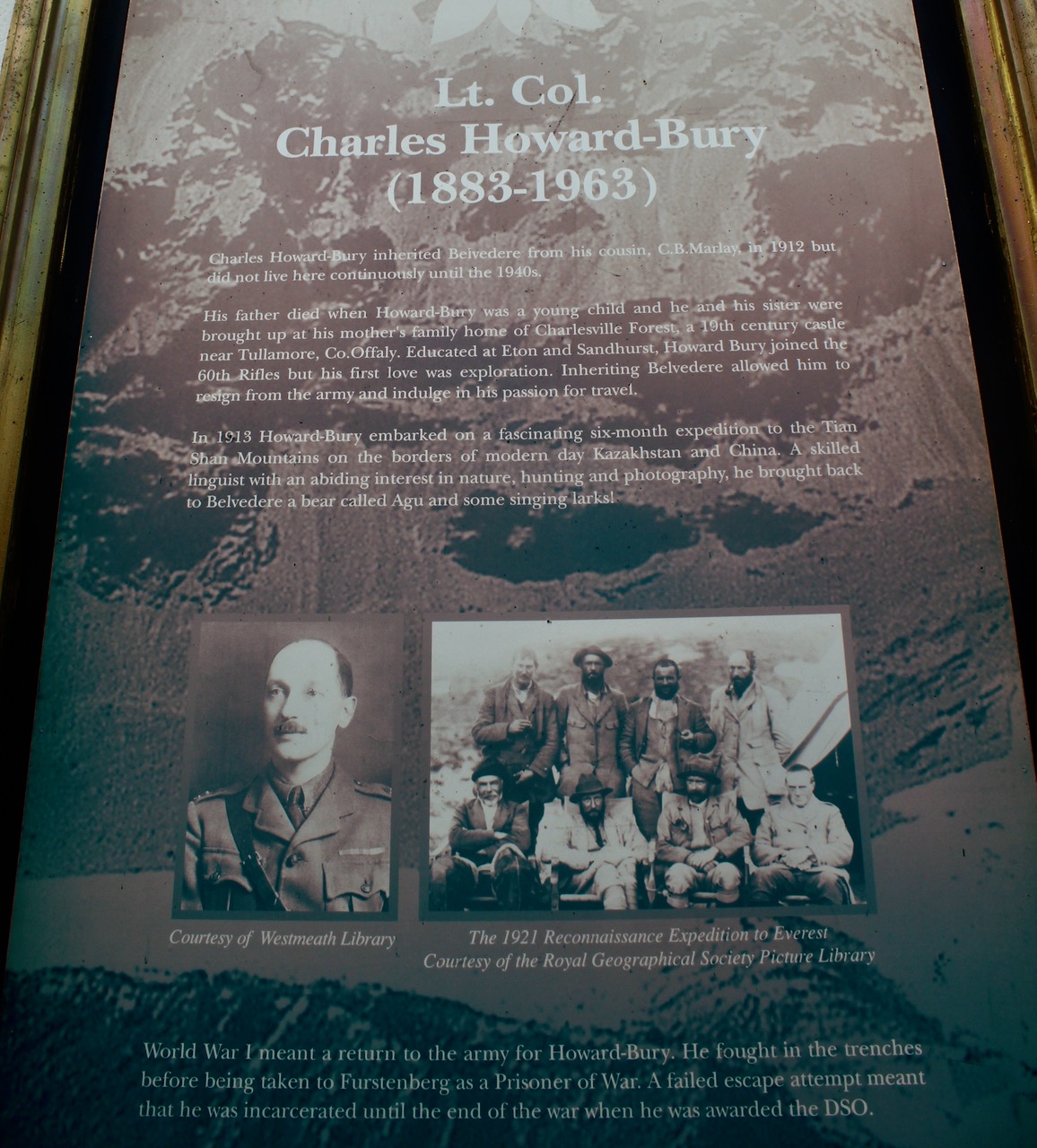
After Emily’s death in 1931 the castle remained unoccupied. Her son Charles Kenneth Howard-Bury (1883-1963) preferred to live at another property he had inherited, Belvedere in County Westmeath (see my entry), which he inherited from Charles Brinsley Marlay. He auctioned the contents in 1948.

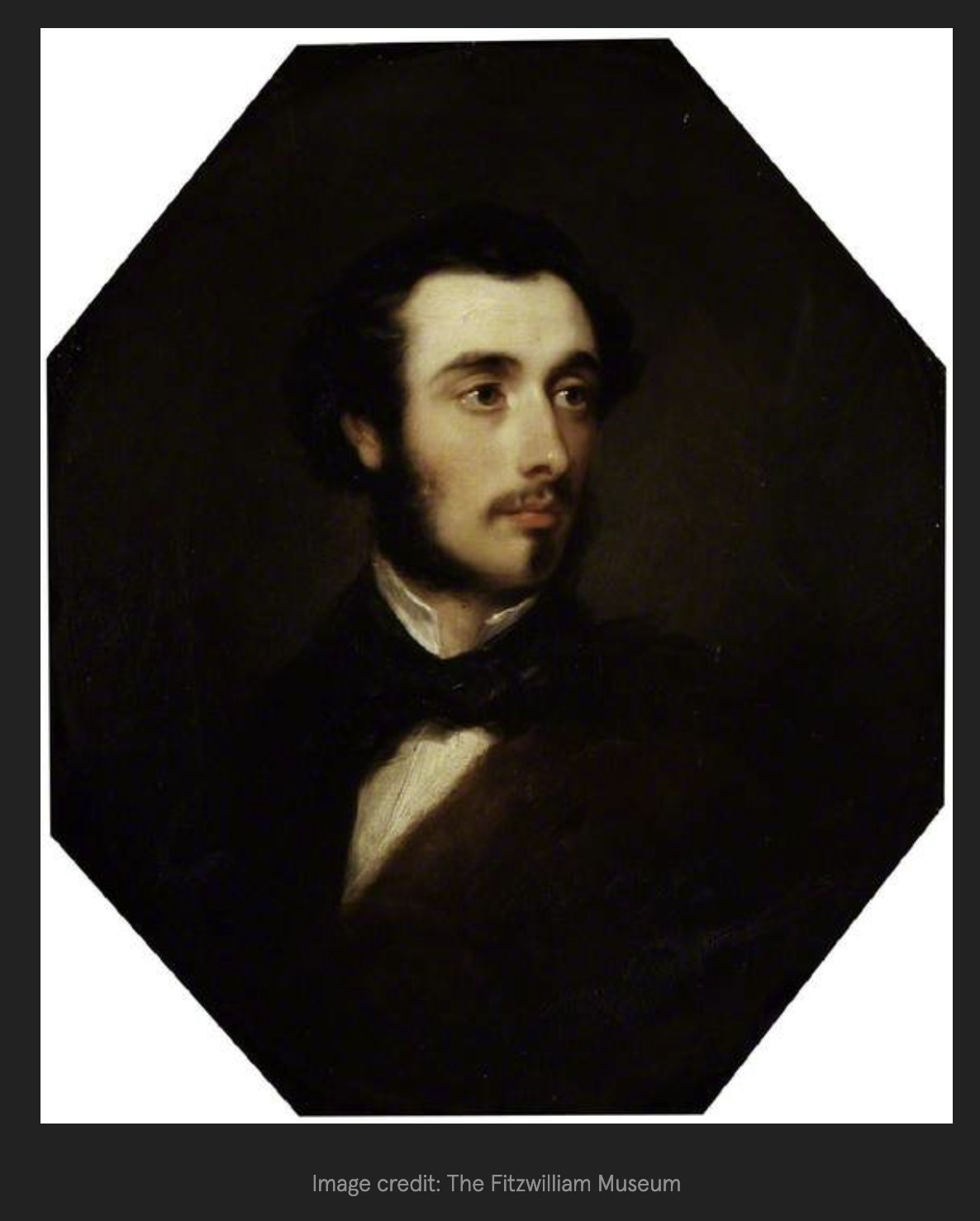
Belvedere, County Westmeath. Photograph © Jennifer Winder-Baggot, www.irishhistorichouses.com
Charles Brinsley Marlay of Belvedere House County Westmeath, courtesy of The Fitzwilliam Museum.

The house stood almost empty, with a caretaker, for years. When Charles Kenneth died in 1963, the property passed to a cousin, the grandson of the 3rd Earl’s sister with whom he had quarrelled. She had married Edmund Bacon Hutton and her grandson William Bacon Hutton legally changed his surname to Hutton-Bury when he inherited in 1964. The castle remained empty, until it was leased for 35 years to Michael McMullen in 1971. It had been badly vandalised at this stage. He immediately set to restore the castle.

More repairs were carried out by the next occupants, Bridget “Bonnie” Vance and her parents, who planned to run a B&B and wedding venue. Today the castle is run by Charleville Castle Heritage Trust.

For more information, see the website of the Irish Aesthete Robert O’Byrne, https://theirishaesthete.com/2019/10/14/charleville/

[1] Bence-Jones, Mark. A Guide to Irish Country Houses (originally published as Burke’s Guide to Country Houses volume 1 Ireland by Burke’s Peerage Ltd. 1978); Revised edition 1988 Constable and Company Ltd, London.

[2] p. 136. O’Reilly, Sean. Irish Houses and Gardens. From the Archives of Country Life. Aurum Press Ltd, London, 1998.

[3] https://offalyhistoryblog.wordpress.com/2021/09/18/catherine-maria-bury-and-the-design-of-charleville-castle-by-judith-hill/

[4] https://www.thedicamillo.com/house/charleville-castle-charleville-forest-charleville-forest-castle/

[5] https://www.archiseek.com/2010/1798-charleville-forest-tullamore-co-offaly/ 

[6] More photographs of Sopwell Hall:
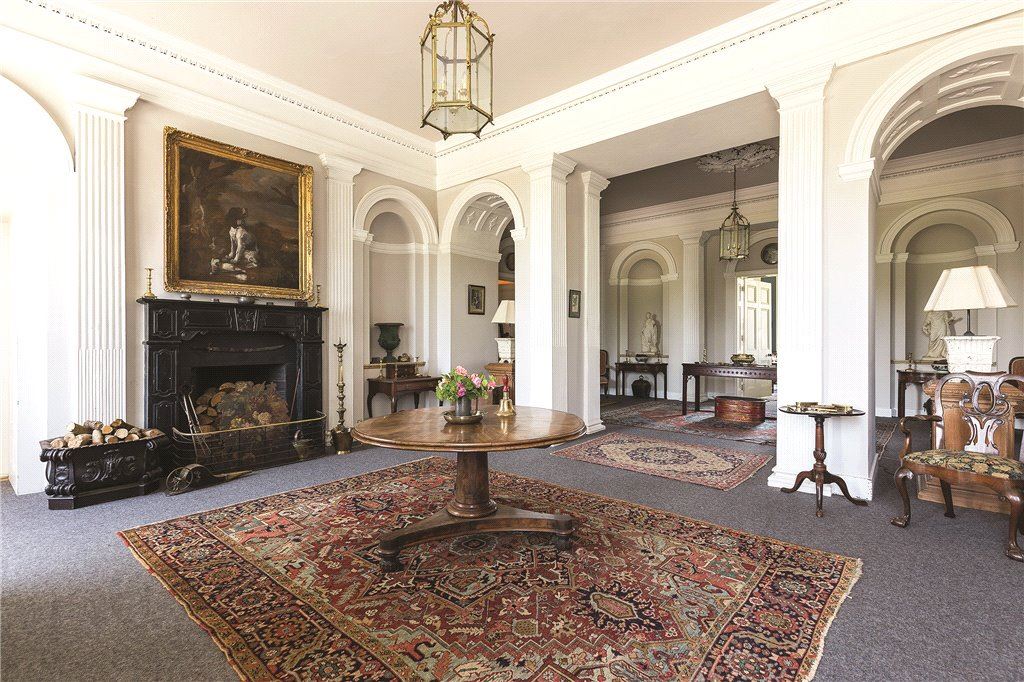
Sopwell Hall, County Tipperary, courtesy of Colliers estate agents and myhome.ie

[7] p. 232-8. Tierney, Andrew. The Buildings of Ireland: Central Leinster: Kildare, Laois and Offaly. Yale University Press, New Haven and London, 2019.

[8] https://offalyhistoryblog.com/2025/07/23/lady-beaujolois-bury-1824-1903-the-prayerful-artist-of-charleville-castle-tullamore-by-michael-byrne/

Text © Jennifer Winder-Baggot, www.irishhistorichouses.com
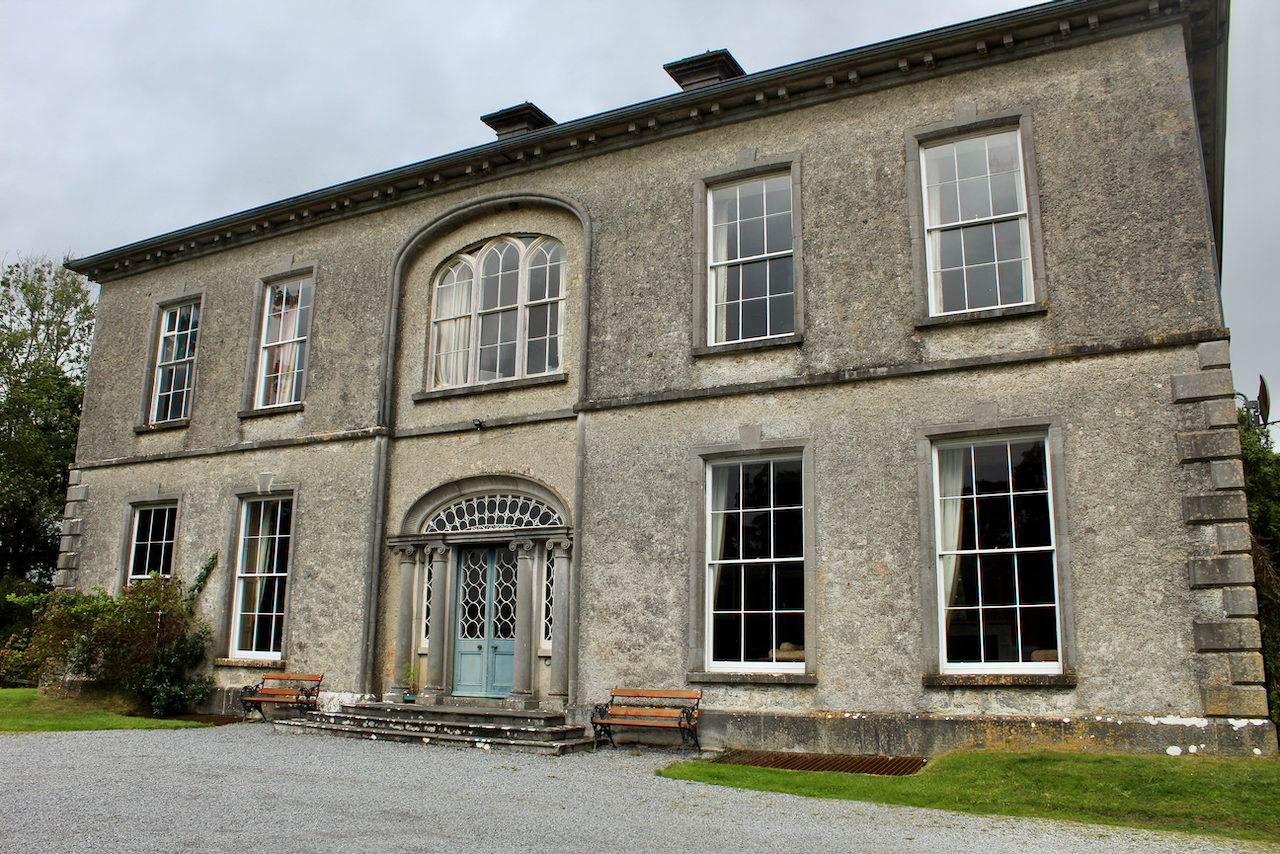
Heritage Week 2024 continued

We continued our outings for Heritage Week this week. We didn’t do our usual travel around to Section 482 properties as we were both too tired this year. As I mentioned in my last post, we went to Charleville Castle in Tullamore on Saturday, which is wonderful. Unfortunately we didn’t linger to wander in the woods as rain threatened and I wanted to visit my aunt who lives in the town.

Charleville Castle, County Offaly, August 2024. Photograph © Jennifer Winder-Baggot, www.irishhistorichouses.com

On Monday we missed our booked visit to Number 6 High Street in Tullamore, unfortunately, but went to see Tullynisk house that afternoon. We were given a wonderful tour by its resident Alicia Clements, daughter of the Earl of Rosse, who married a descendant of Nathaniel Clements who built the Áras an Uachtaráin in the Phoenix Park.

Tullynisk House, County Offaly. Photograph © Jennifer Winder-Baggot, www.irishhistorichouses.com
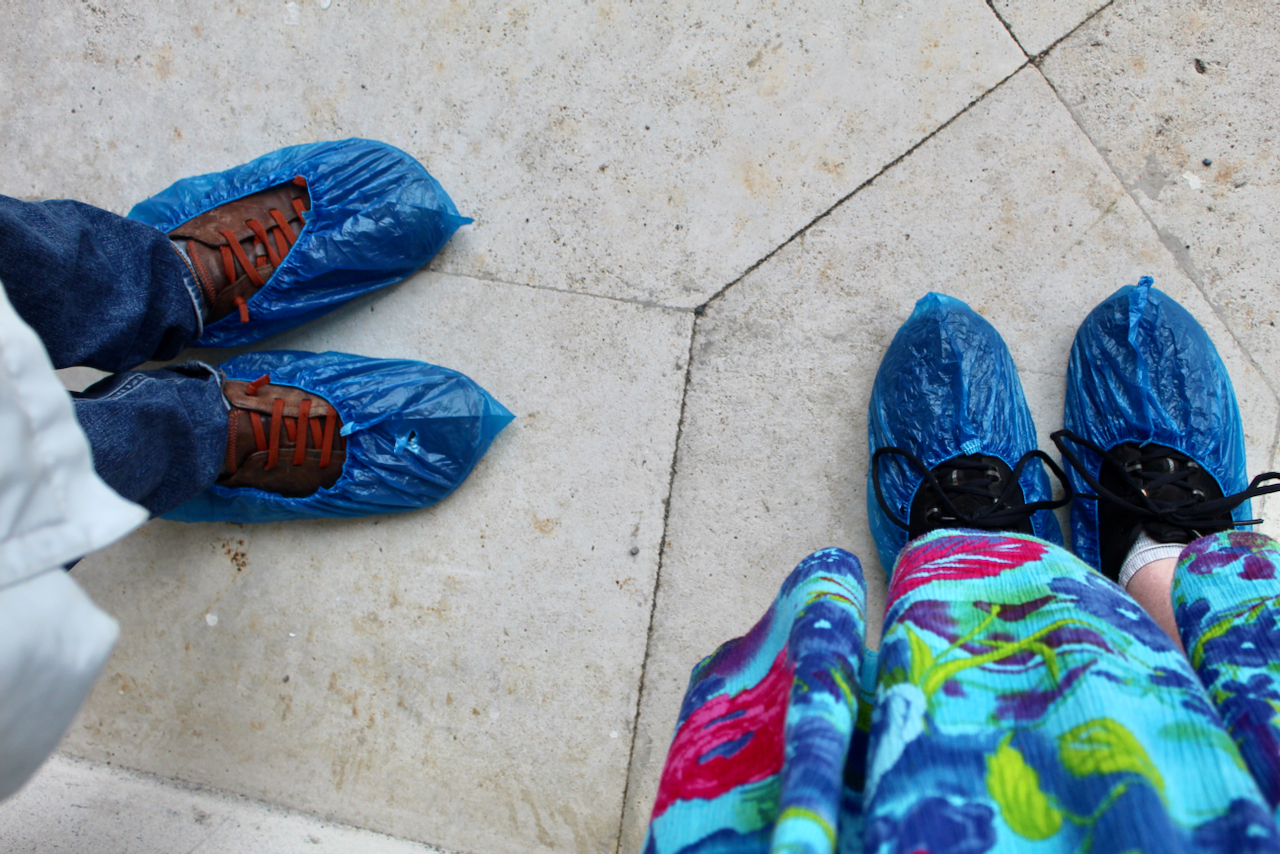
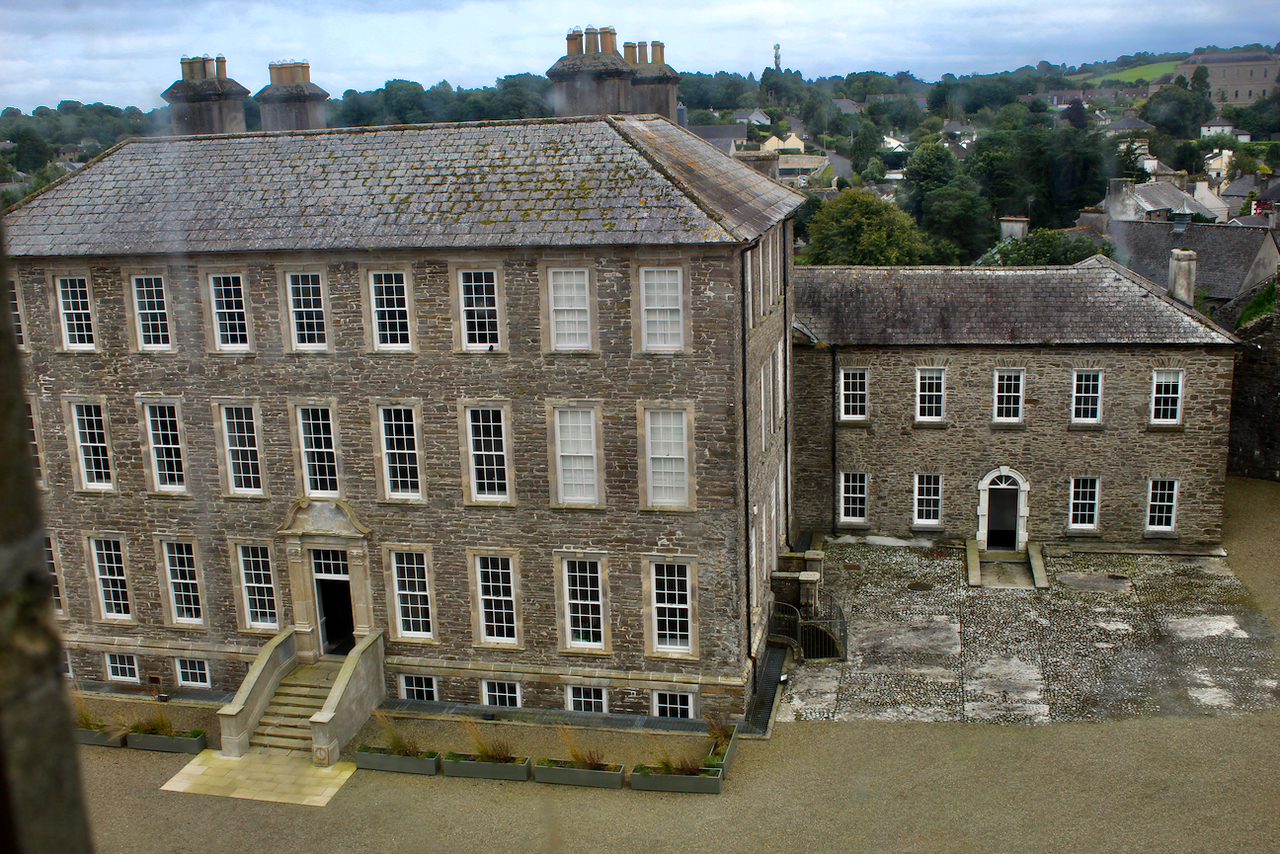
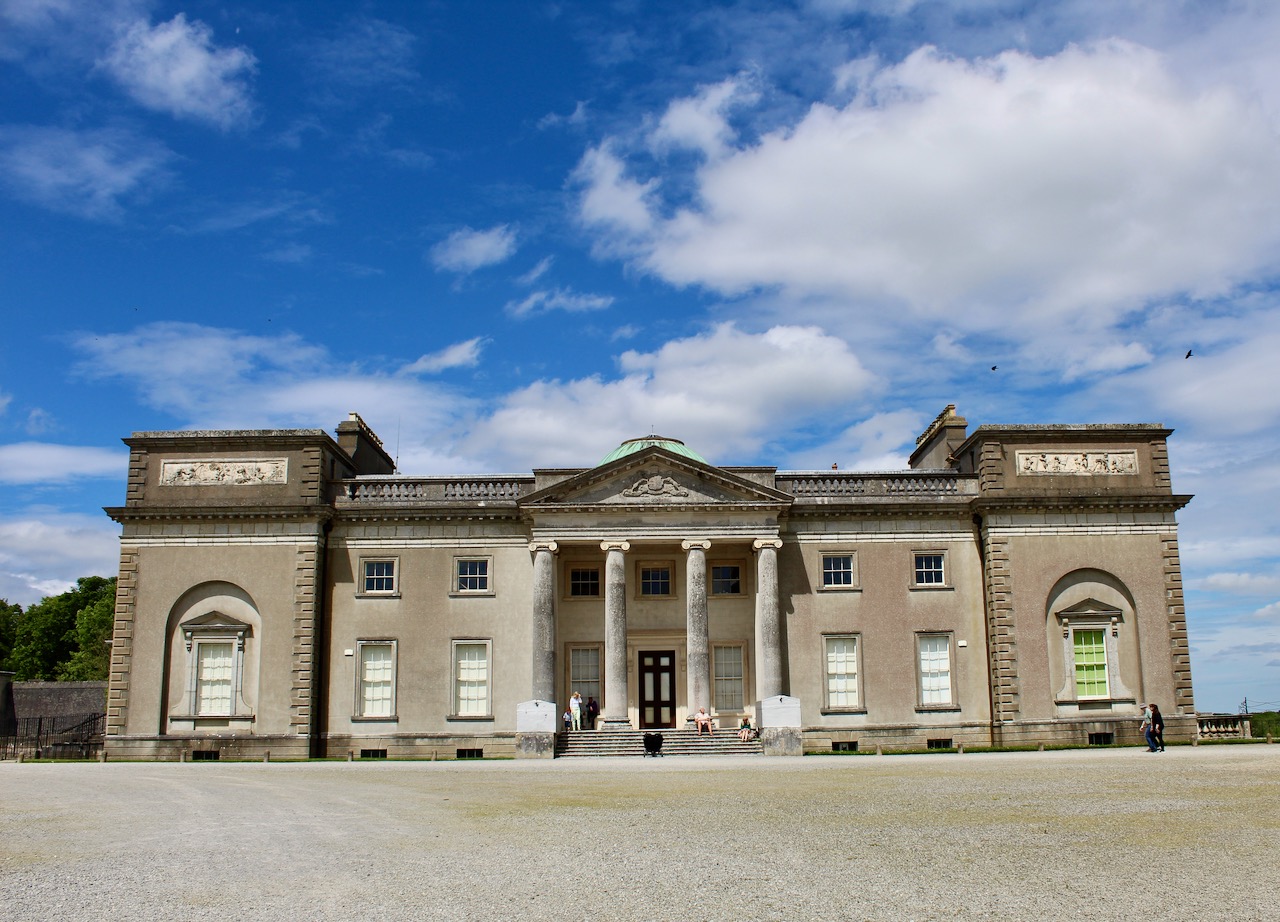
On Wednesday we went to Emo Court in Laois, an Office of Public Works property, because the OPW opened a few rooms for tours during the week and it is closing again afterwards for more repairs. It is so disappointing it has been closed since 2019. We were not allowed to take photographs inside since the work is unfinished!

Emo Park, County Laois. Photograph © Jennifer Winder-Baggot, www.irishhistorichouses.com
At Emo during this visit we had to wear these shoe covers to protect the floors. Photograph © Jennifer Winder-Baggot, www.irishhistorichouses.com
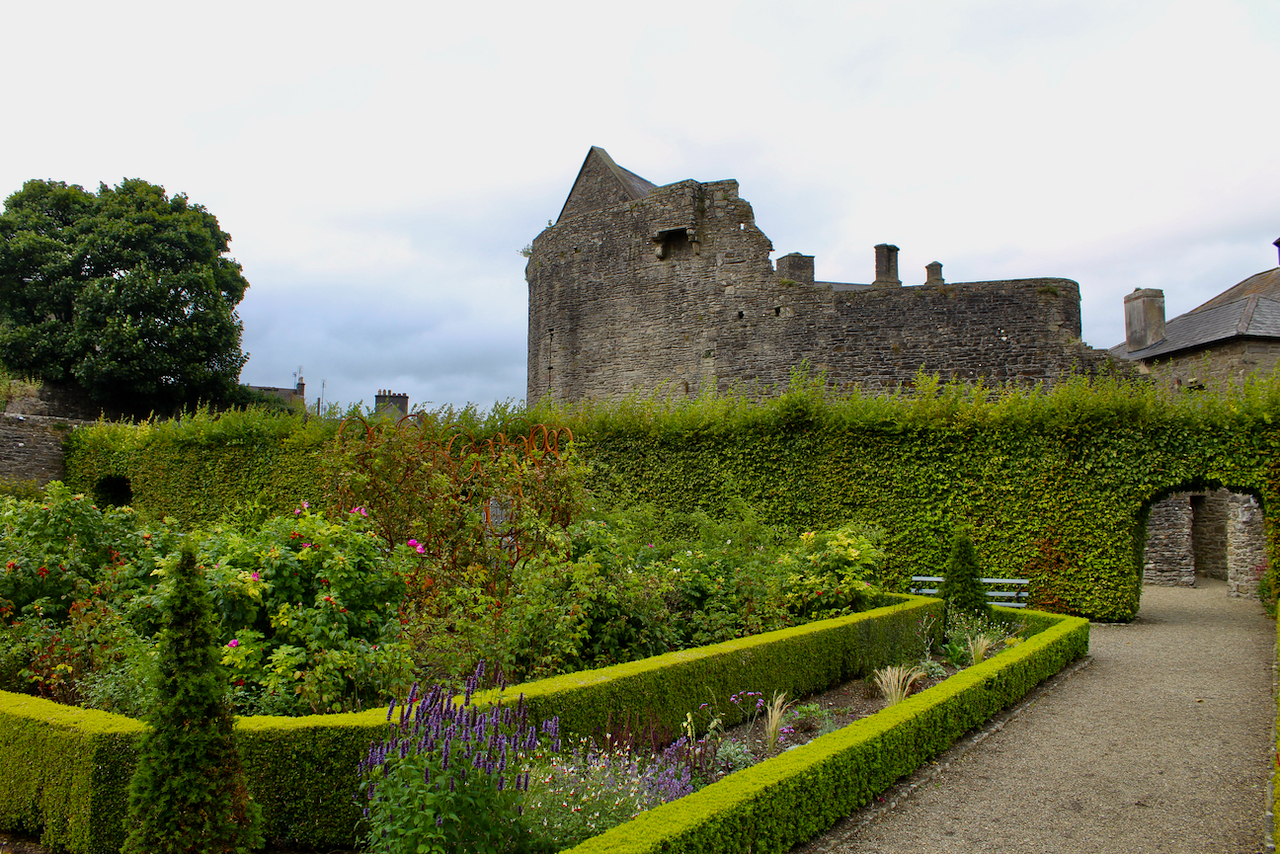
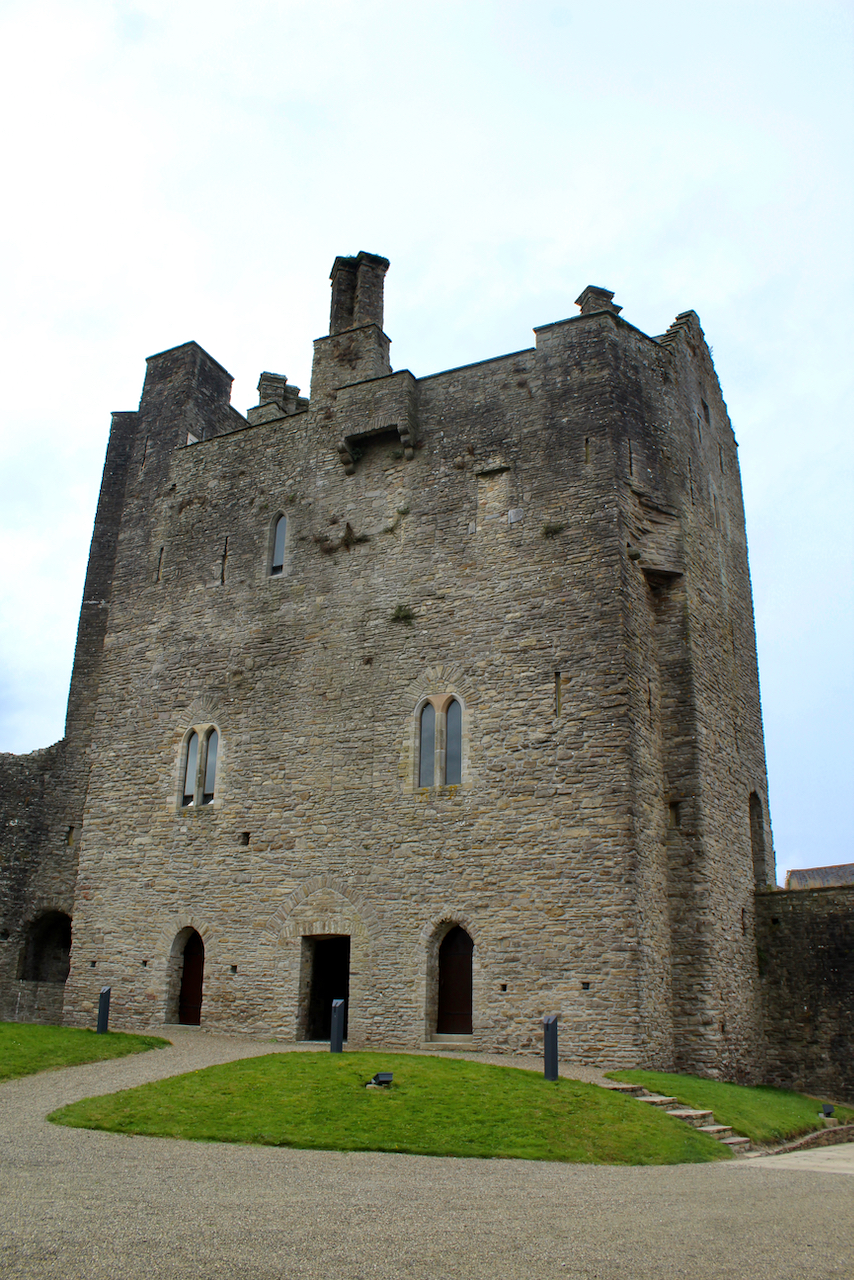
We found ourselves with spare time after Emo Park as it was too rainy to wander the lush grounds, so we headed to Roscrea for more OPW properties: Damer House and Roscrea Castle. Unfortunately we weren’t allowed to take photographs inside Damer House except in the exhibition rooms. After a tour of Damer House we went across the bawn to tour Roscrea Castle. It is a treasure for the beautiful ancient town of Roscrea. I’ll be writing more about all of these places.

Damer House, Roscrea, 21st August 2024. Photograph © Jennifer Winder-Baggot, www.irishhistorichouses.com
The gardens at Damer house and Roscrea Castle, with the castle in the background. Photograph © Jennifer Winder-Baggot, www.irishhistorichouses.com
Roscrea Castle, August 2024. Photograph © Jennifer Winder-Baggot, www.irishhistorichouses.com
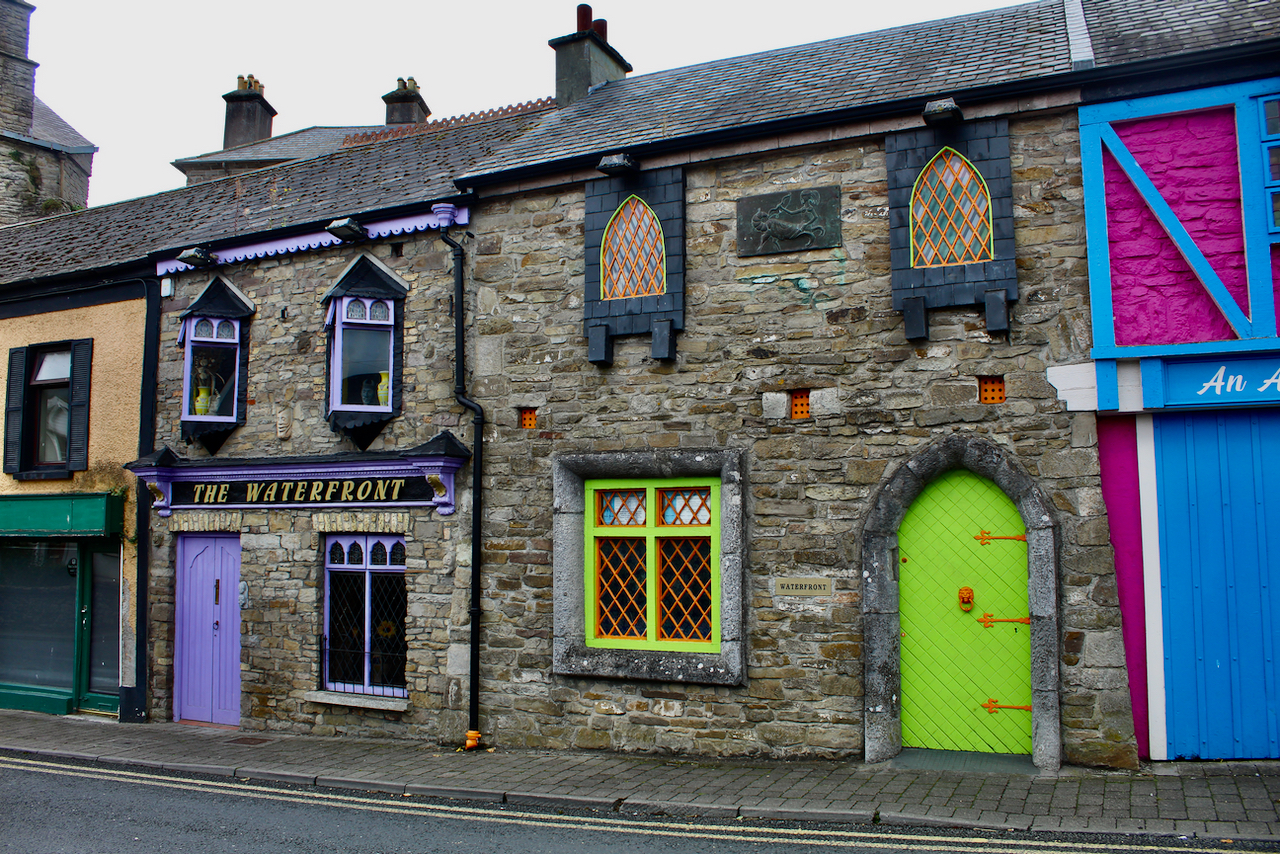
These buildings in Roscrea look impressively ancient. Photograph © Jennifer Winder-Baggot, www.irishhistorichouses.com
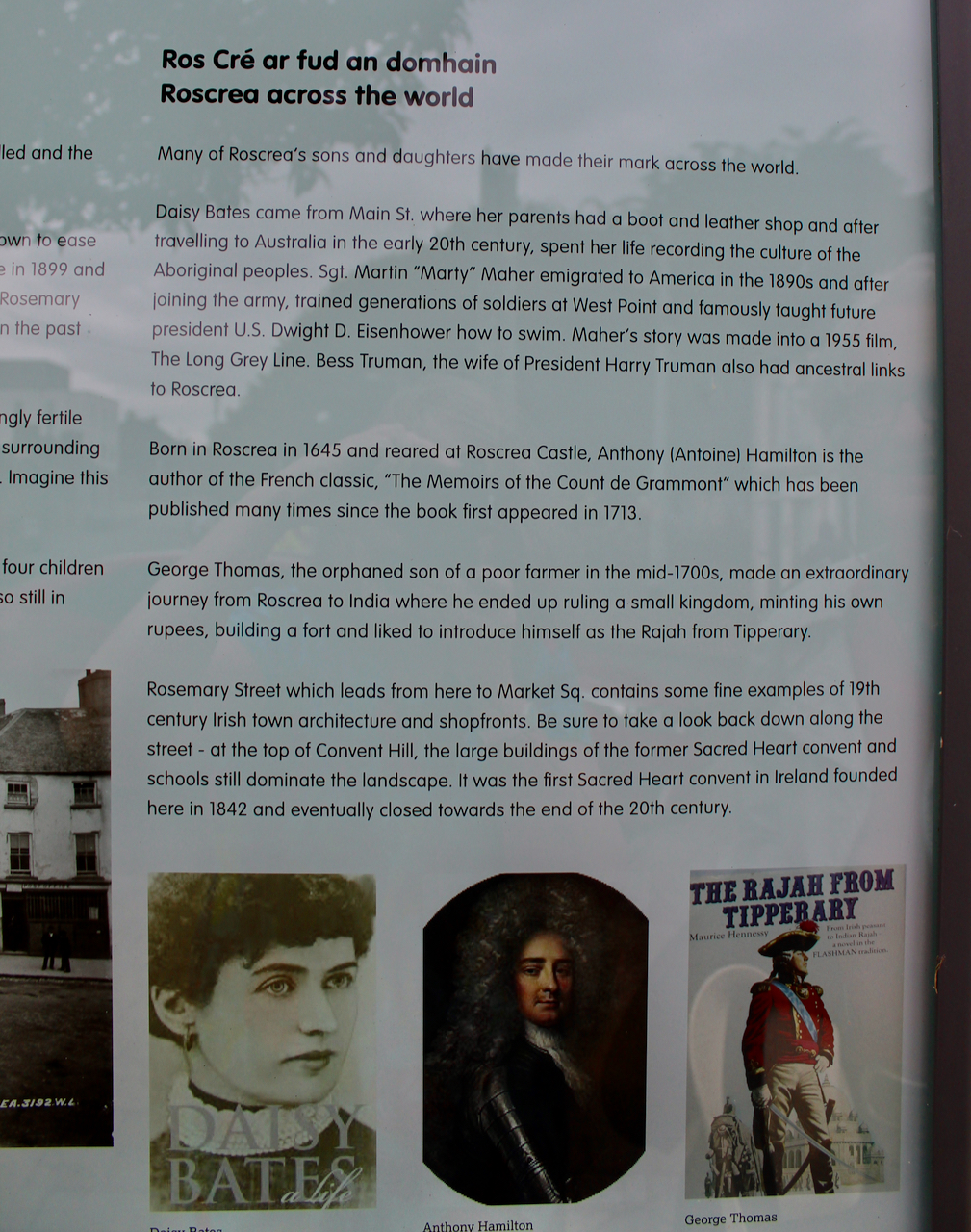
Stephen liked hearing of George Thomas, “the Rajah from Tipperary” who minted his own rupees. Photograph © Jennifer Winder-Baggot, www.irishhistorichouses.com
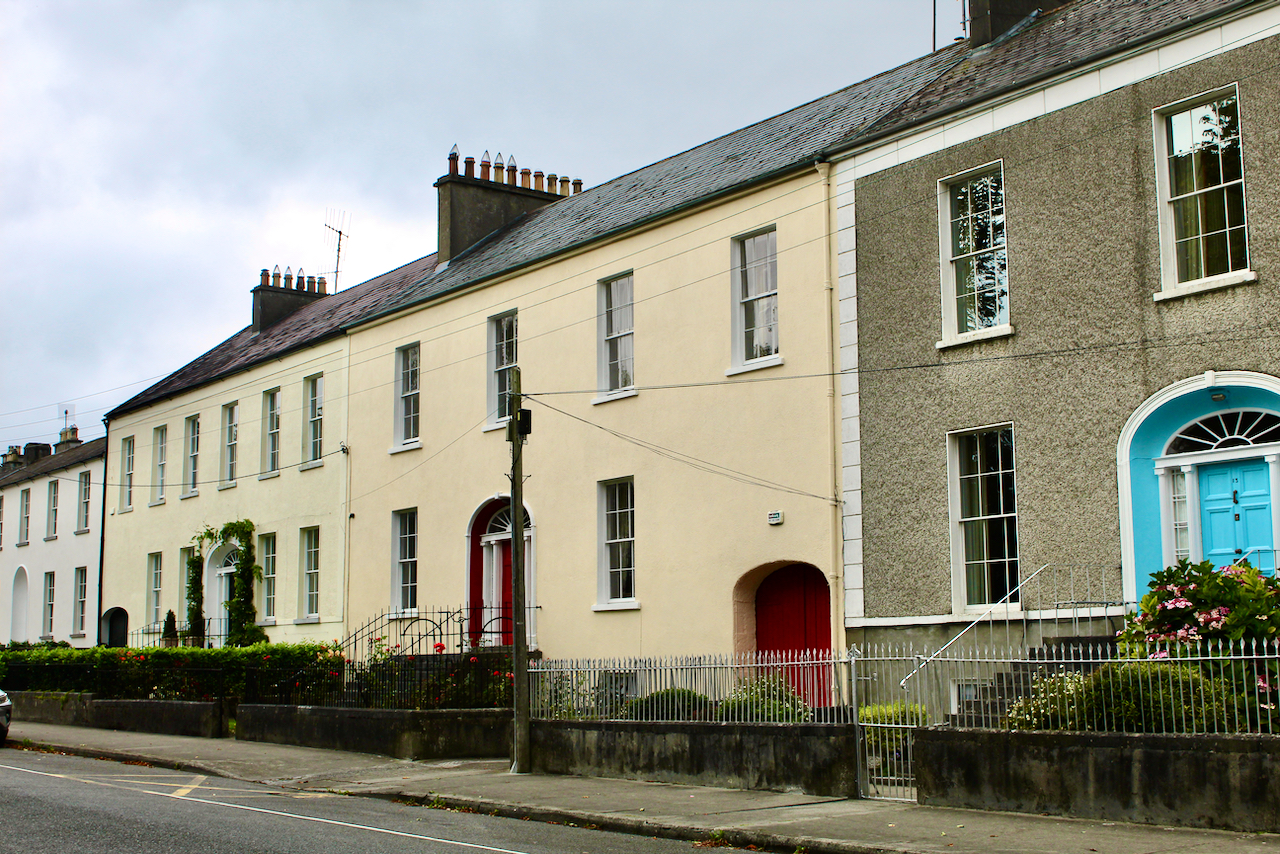
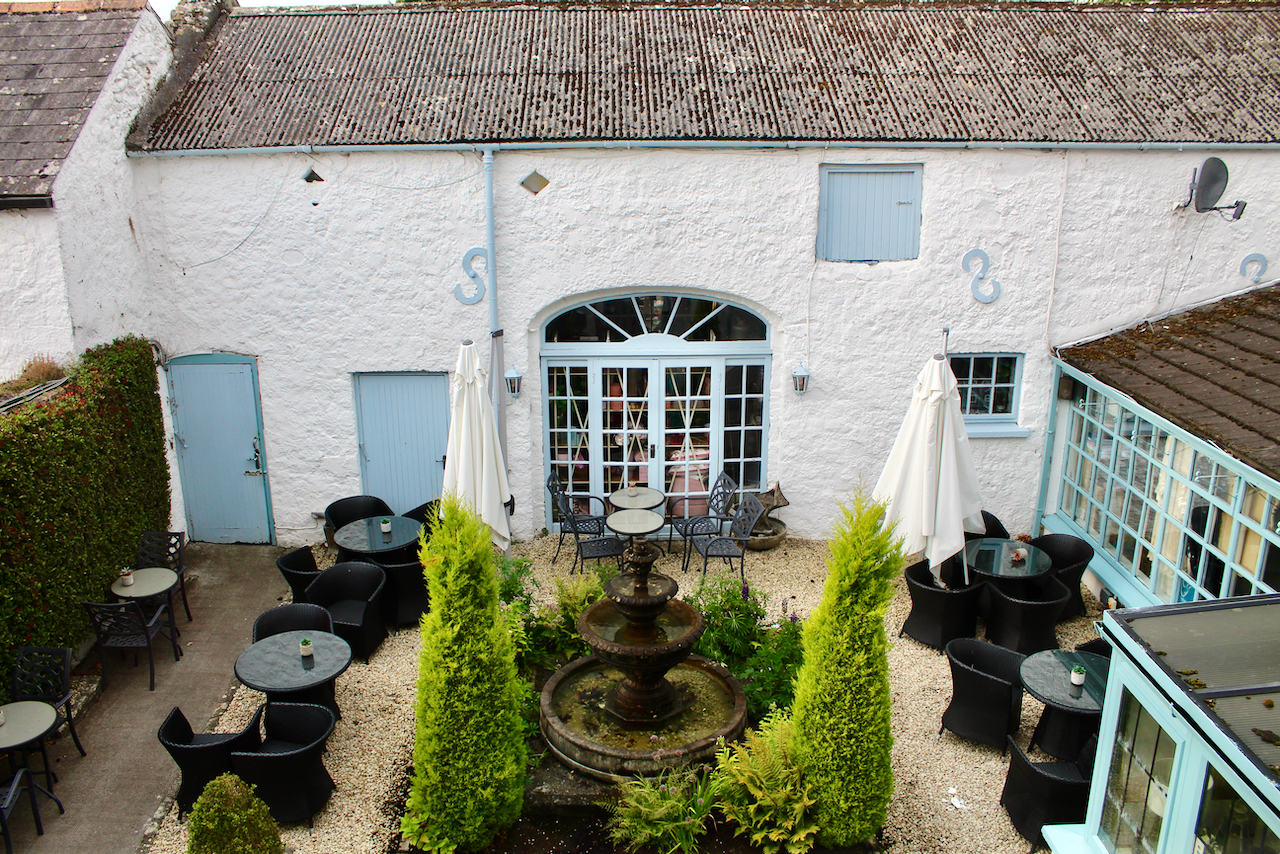
We stayed one night in Birr in the Stables townhouse. The houses along Oxmantown Mall are magnificent!

The Stables, Birr, August 2024. Photograph © Jennifer Winder-Baggot, www.irishhistorichouses.com
Oxmantown Mall, Birr, August 2024. Photograph © Jennifer Winder-Baggot, www.irishhistorichouses.com
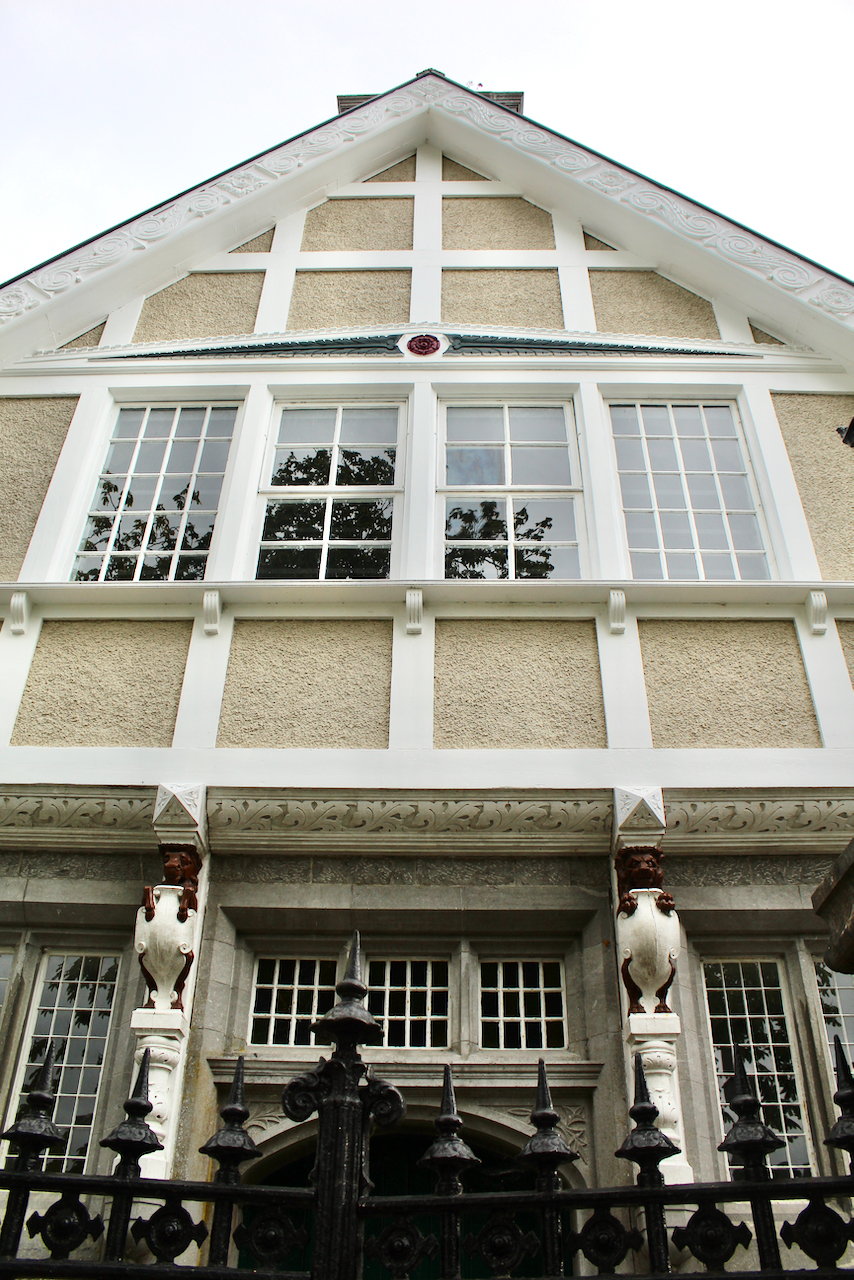
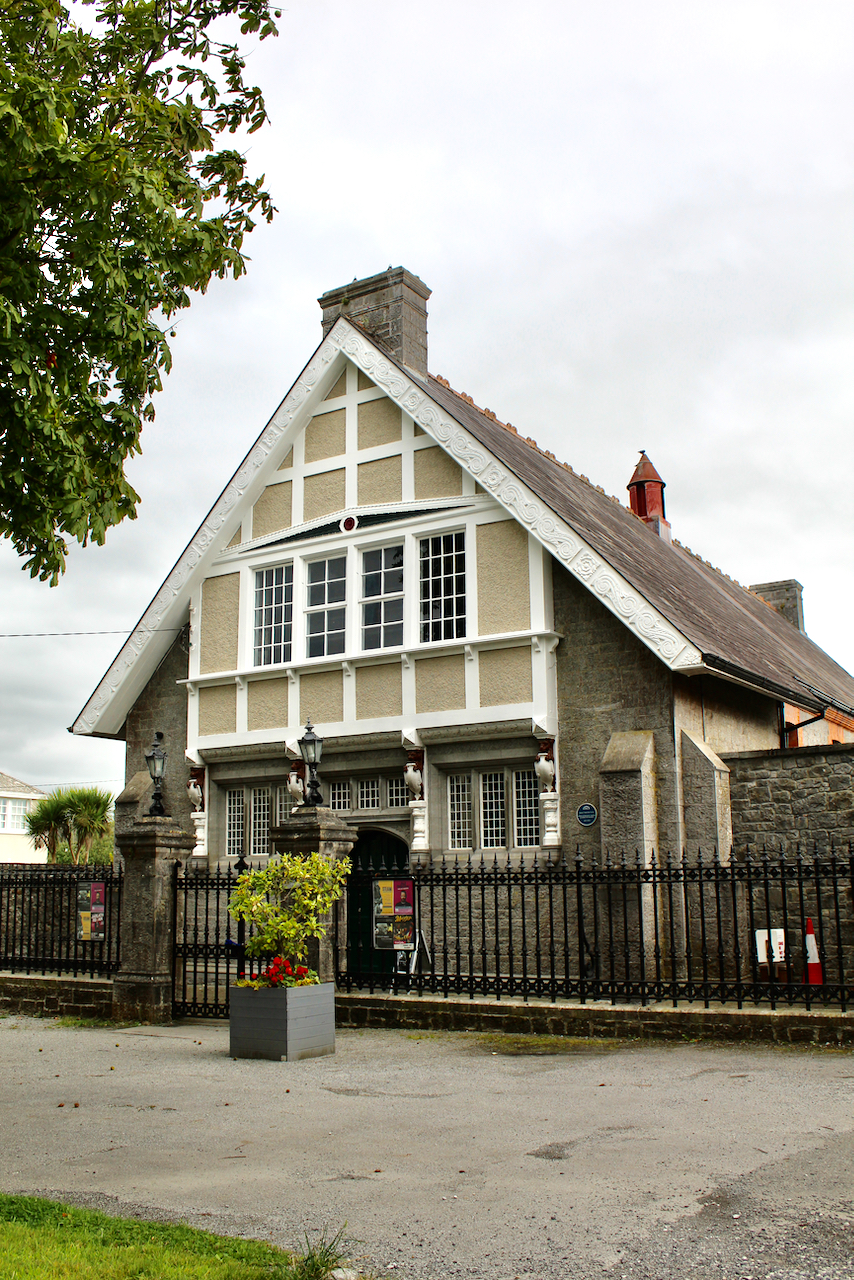
A theatre on Oxmantown Mall in Birr, designed by James Franklin Fuller. The idea of creating a theatre for the locality was formally announced on 10th September 1885, reports the Kings County Chronical. The site on Oxmantown Mall was donated by Lawrence Parsons the 4th Earl. Photograph © Jennifer Winder-Baggot, www.irishhistorichouses.com
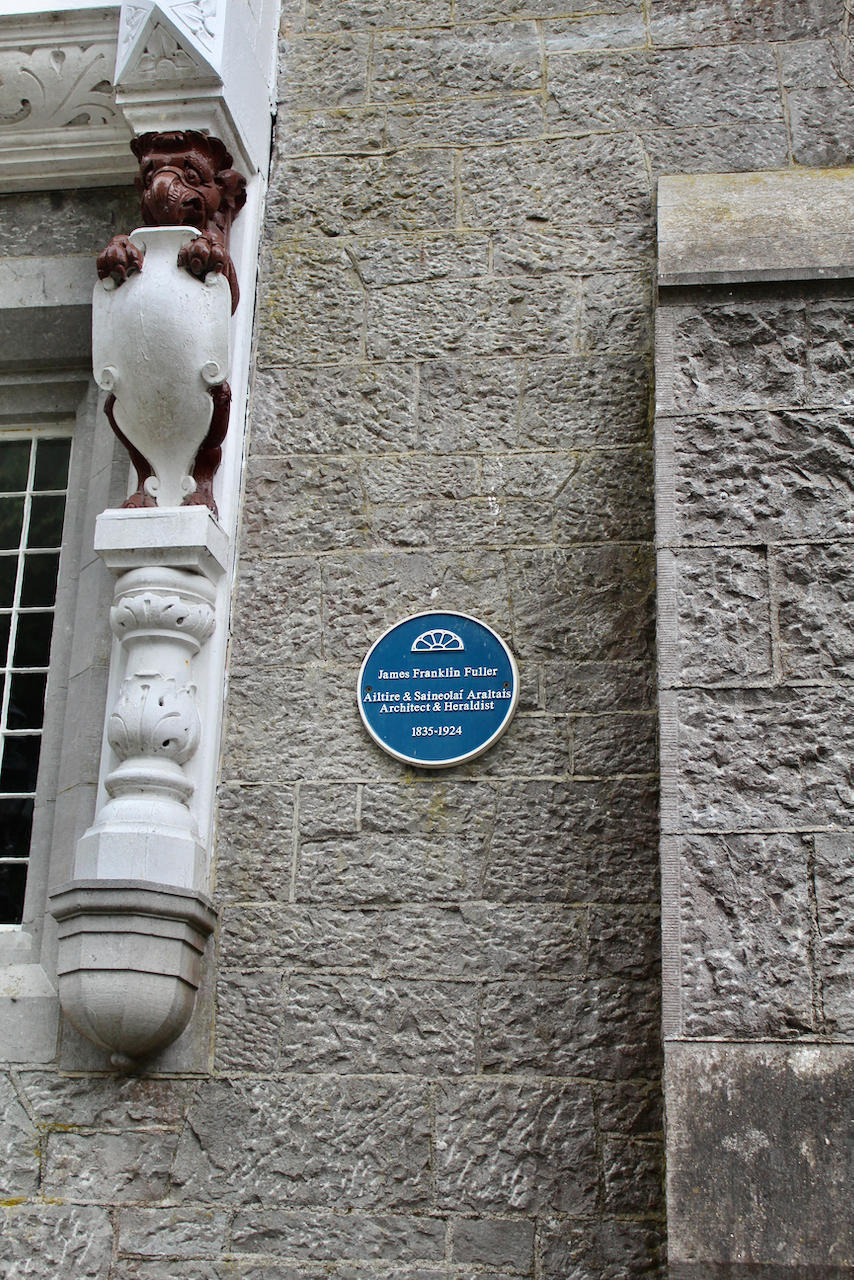
A theatre on Oxmantown Mall in Birr, designed by James Franklin Fuller. Photograph © Jennifer Winder-Baggot, www.irishhistorichouses.com
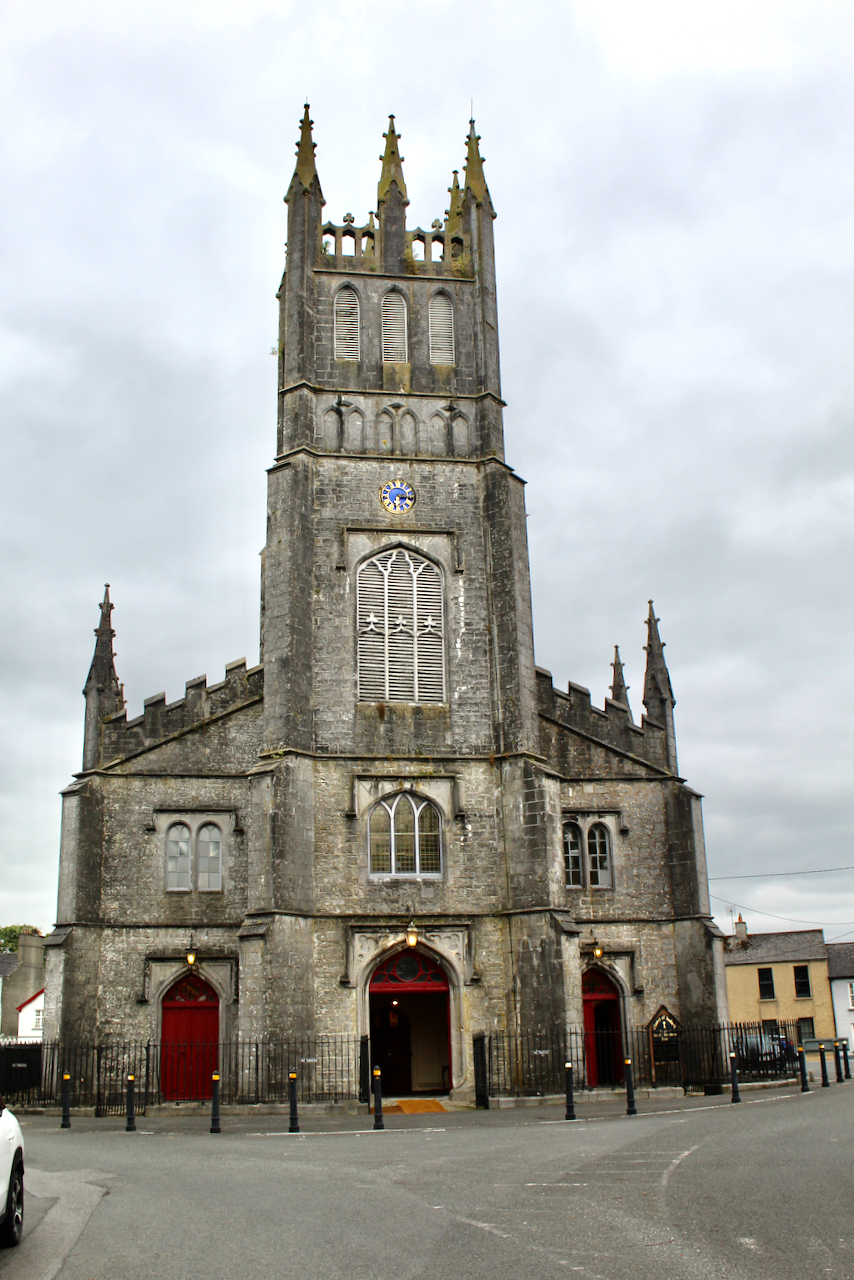
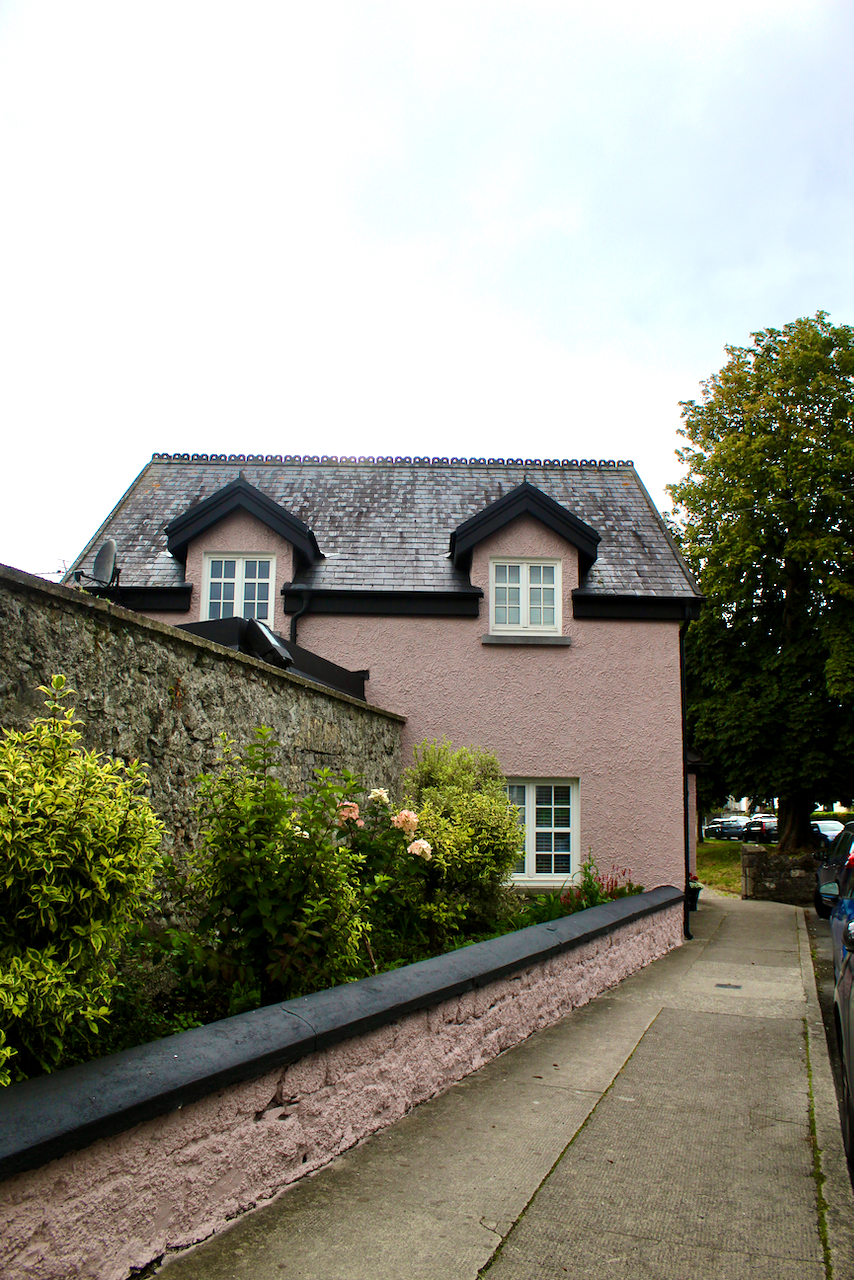
St. Brendan’s Church of Ireland, Oxmantown Mall, Birr. Built by the architect John Johnson in 1815, it was extended in 1876 by the renowned architect Sir Thomas Drew who added a new chancel. Further enhancements included the insertion of the east window, which was commissioned from Charles Kempe by the fourth Earl of Rosse in 1891. Photograph © Jennifer Winder-Baggot, www.irishhistorichouses.com
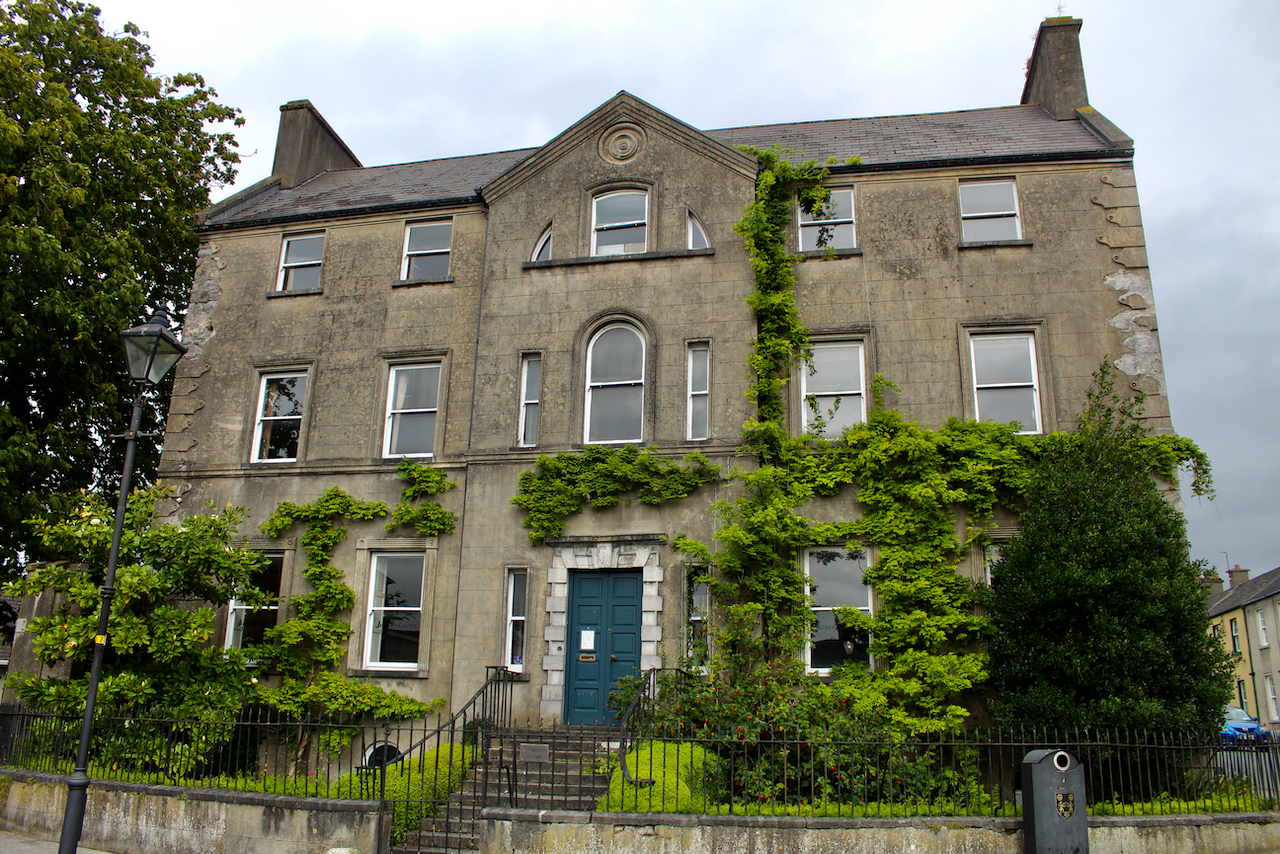
On Oxmantown Mall in Birr. Photograph © Jennifer Winder-Baggot, www.irishhistorichouses.com
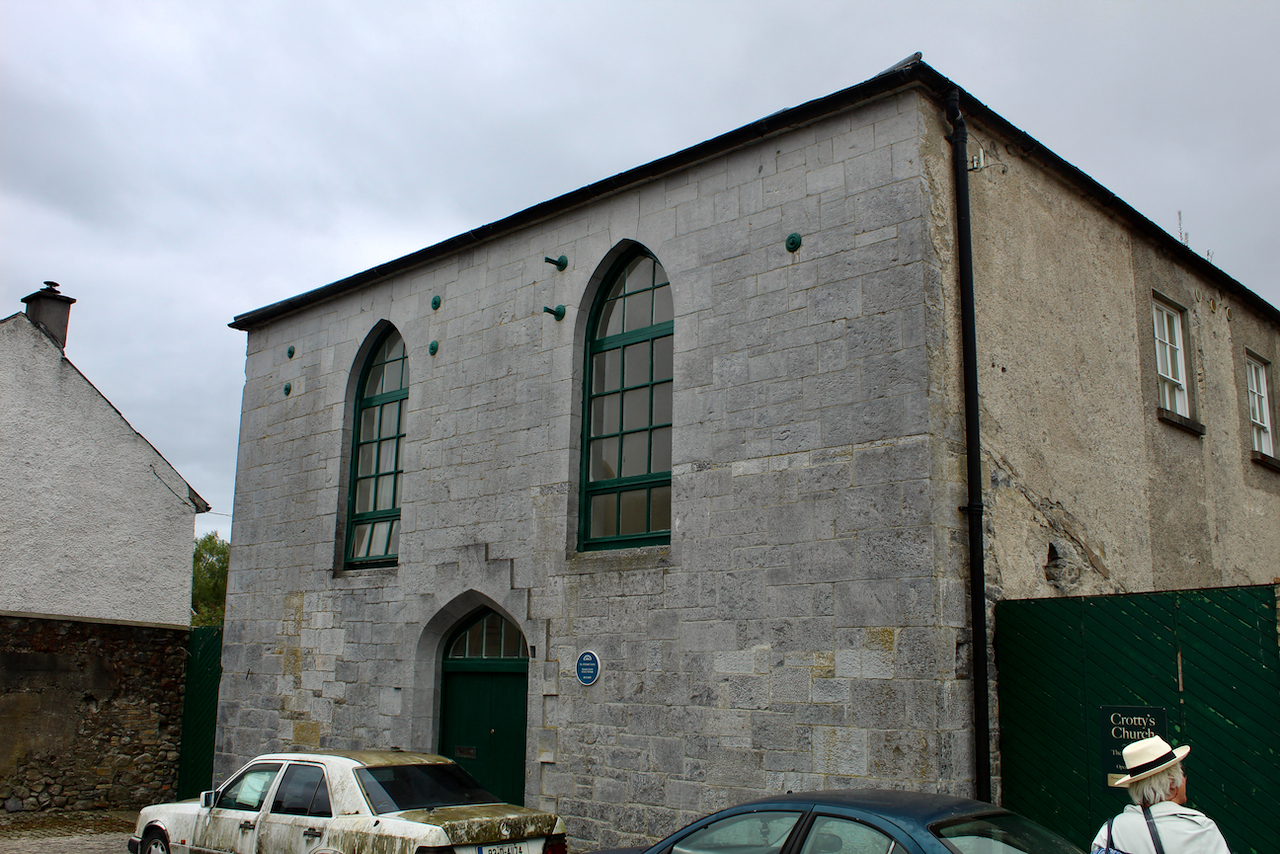
Cumberland House, Emmet Square, Birr, built around 1760, decorated with Palladian motifs including Venetian and Diocletian style windows and a surmounting oculus, and Gibbsean doorway. Photograph © Jennifer Winder-Baggot, www.irishhistorichouses.com
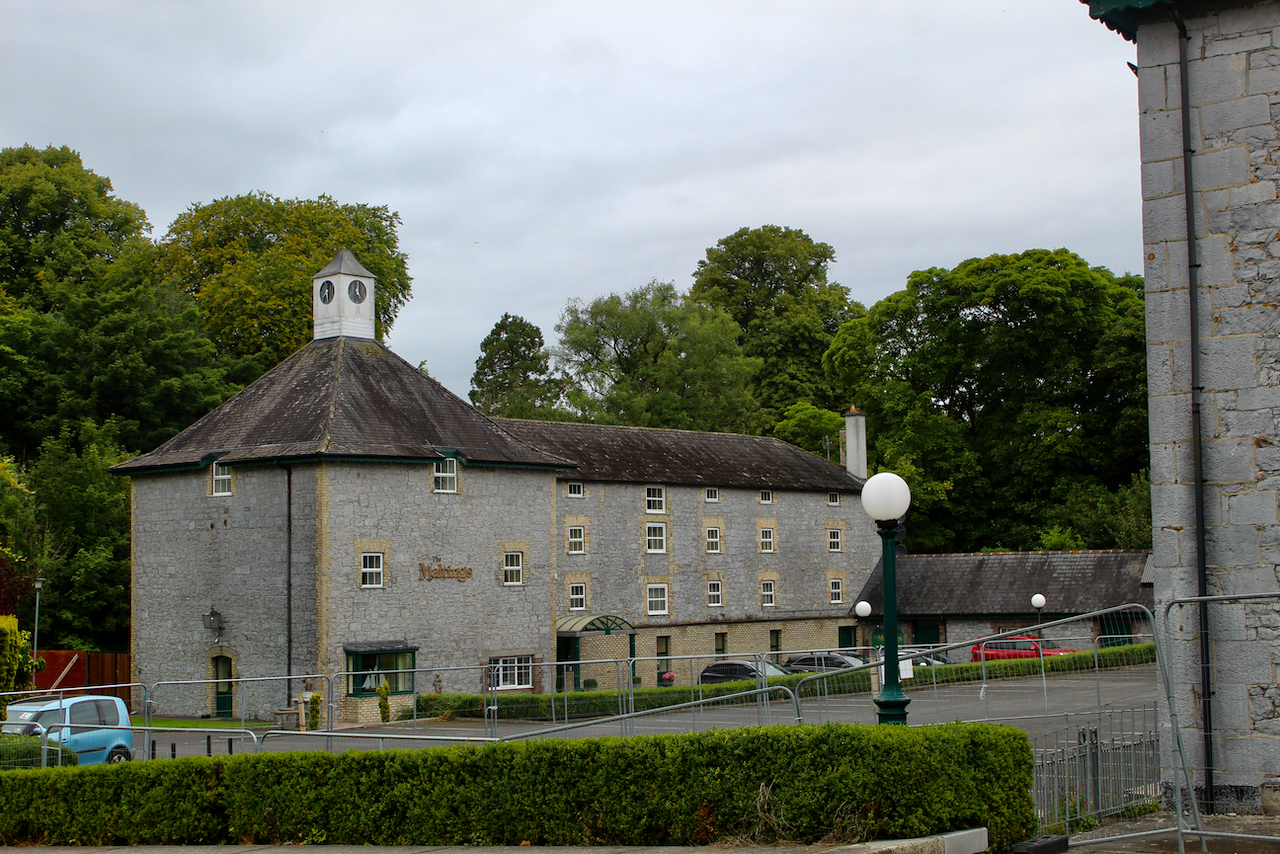
We didn’t get to visit the castle this time. Instead we were in the town to attend a talk about the Crotty Schism which took place in the Catholic church in the mid 1800s. I’ll be writing more about that soon, as the Crotty Church is a Section 482 property, although it is not open to the public! It is certainly meant to be open, and The Maltings across the road is meant to have tourist accommodation to earn its Section 482 status, but is also not open and never seems to have been since I started my blog in 2018, as I have often checked it out as a place to stay. For the talk on the Crotty Schism, we had to sit outside, despite rain threatening.

Crotty’s Church, Birr, which despite being a Section 482 property is not open to the public. Photograph © Jennifer Winder-Baggot, www.irishhistorichouses.com
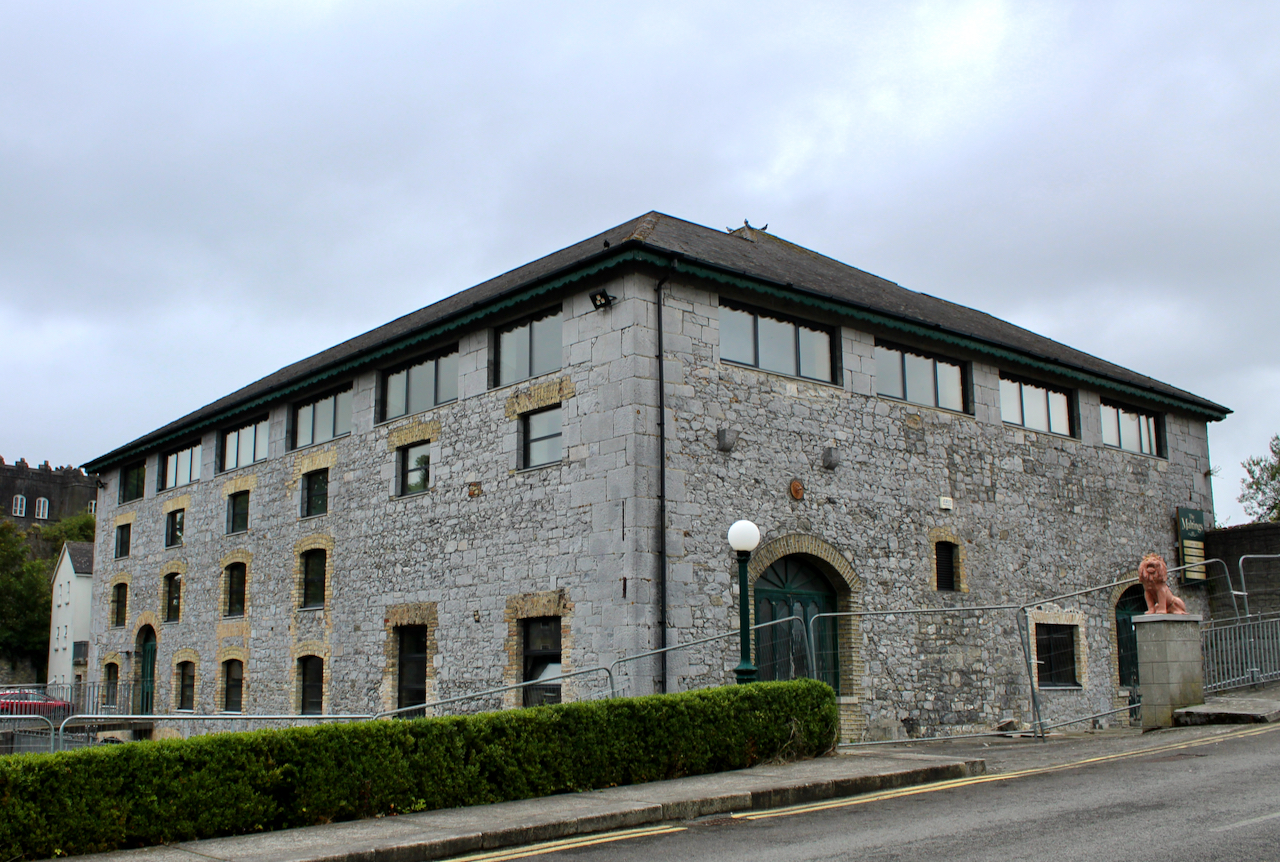
The Maltings, Birr, County Offaly. Despite trying to book several times, this is not available for accommodation, despite being listed as tourist accommodation under Revenue Section 482. Photograph © Jennifer Winder-Baggot, www.irishhistorichouses.com
The Maltings, Birr, County Offaly, Photograph © Jennifer Winder-Baggot, www.irishhistorichouses.com
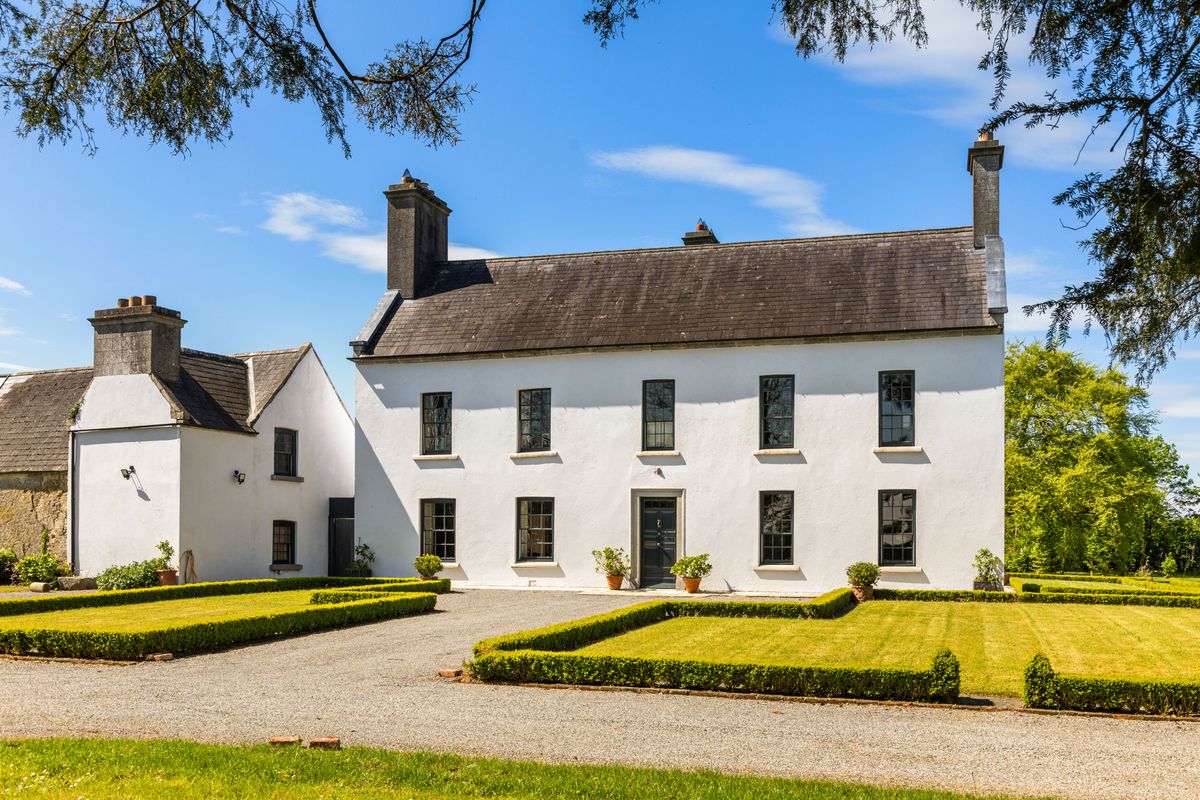
The Maltings, Birr, County Offaly, June 2023. Photograph © Jennifer Winder-Baggot, www.irishhistorichouses.com
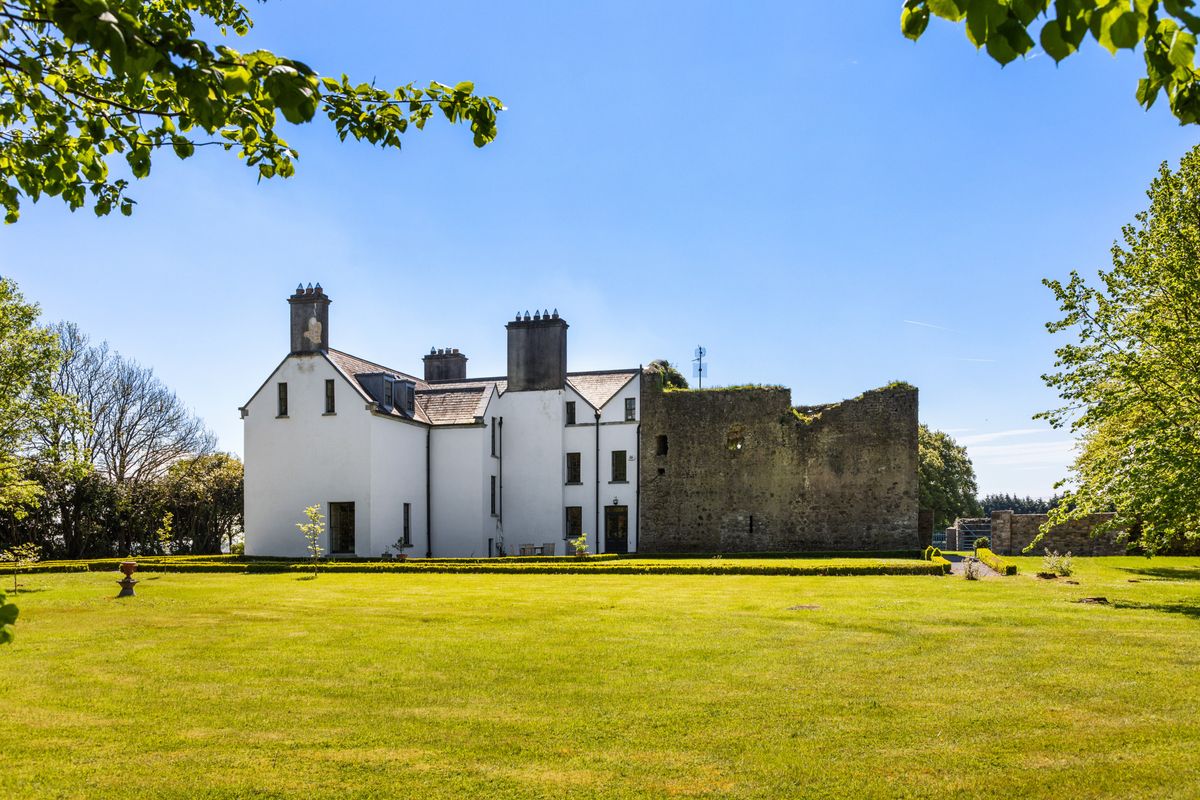
On Saturday we visited Ballybrittan Castle, which we were lucky to see before it changes hands to a new owner. Rosemarie warmly welcomed her visitors, sharing the home she lived in and loved for 27 years along with her late husband Jerry Healy, who served on the boards of the Irish Georgian Society and the Alfred Beit Foundation, which manages Russborough House, Co Wicklow.

Ballybrittan, courtesy of Sherry Fitzgerald Rose de Vere Hunt and myhome.ie

Heritage Week 2024

I have been looking forward to Heritage Week, August 17-25 2024, the time when all the Section 482 properties are open to the public. I hope that you have made your plans because you might need to book in advance! https://www.heritageweek.ie/

Yesterday we went to the wonderful Charleville Woods Castle in County Offaly (which is not Section 482). I notice that most of the Section 482 houses are not advertised on the Heritage Week website, though they all have to open this week – at least, the ones that are not specifically listed as Tourist Accommodation – so do let me know if you make any visits this week!

Charleville Castle Tullamore by Matt McKnight 2007, courtesy of flickr constant commons. Unfortunately this room was closed to the public yesterday as it is being used in filming Wednesday, the Addams family movie.

We never “rock up” unannounced, but this year, 2024, the Revenue Section 482 list does not include contact details, so one really does have to just take one’s chances and hope that the owner abides by the rules. Do let me know if you go and somewhere isn’t open. We may try a few later this week. I managed to book a few tours via the Heritage Week website.

We are going to see Ballybrittan Castle later in the week, and No. 6 High Street in Tullamore. We’re also booked to see a house that is not on the Section 482 list, Tullynisk. Emo Park has finally opened its doors, and I hope to go to see its wonderful interiors – I’m not sure if it will be open to the public after Heritage Week as it has been under renovation for years.

Emo Park, County Laois. Photograph © Jennifer Winder-Baggot, www.irishhistorichouses.com
Belvedere House, Gardens and Park, County Westmeath – open to the public

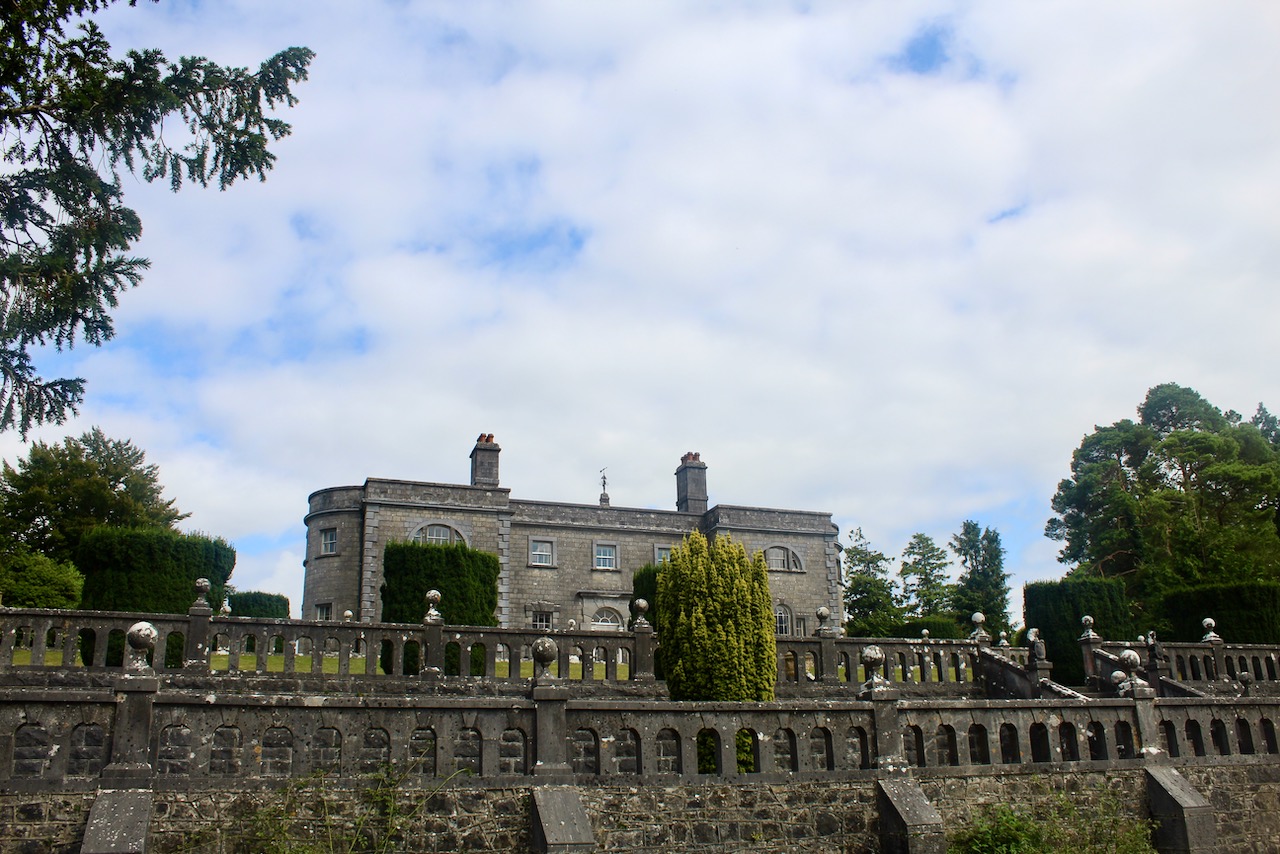
Belvedere, County Westmeath, August 2021. Photograph © Jennifer Winder-Baggot, www.irishhistorichouses.com
Belvedere House and gardens are open to the public.

http://www.belvedere-house.ie/

Mark Bence-Jones writes of Belvedere in his 1988 book:

p. 39. “(Rochfort, sub Belvedere, E/DEP Rochfort/LGI1912; Marlay/LGI1912; Howard-Bury, sub Suffolk and Berkshire, E/PB; and Bury/IFR) An exquisite villa of ca 1740 by Richard Castle, on the shores of Lough Ennell; built for Robert Rochfort, Lord Bellfield, afterwards 1st Earl of Belvedere, whose seat was at Gaulston, ca 5 miles away [Gaulston is no longer standing]. Of two storeys over basement, with a long front and curved end bows – it may well be the earliest bow-ended house in Ireland – but little more than one room deep.”

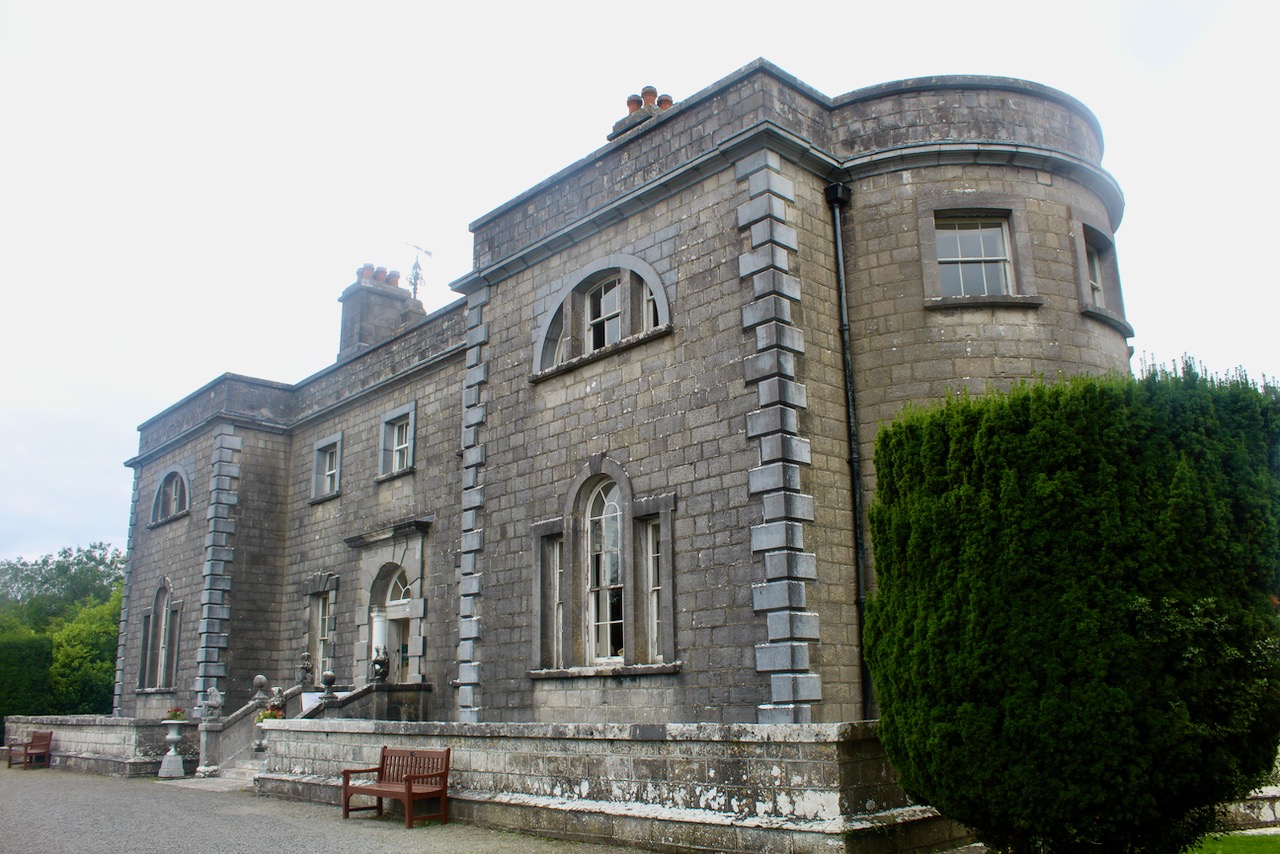
Belvedere, County Westmeath, August 2021. Photograph © Jennifer Winder-Baggot, www.irishhistorichouses.com
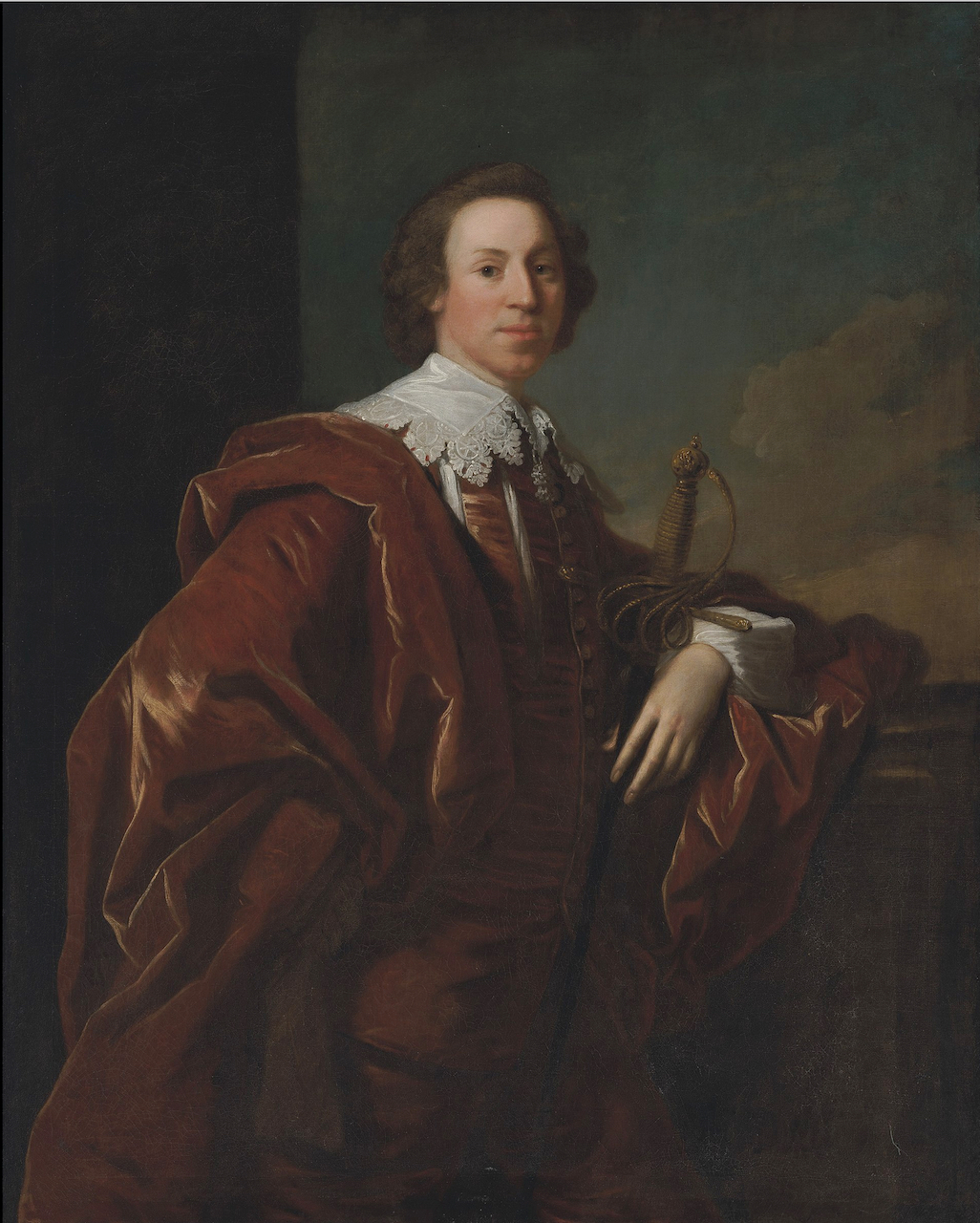
Robert Rochfort (1708-1774) 1st Earl of Belvedere in van Dyck costume, by Robert Hunter It is possible that the present portrait was executed posthumously.

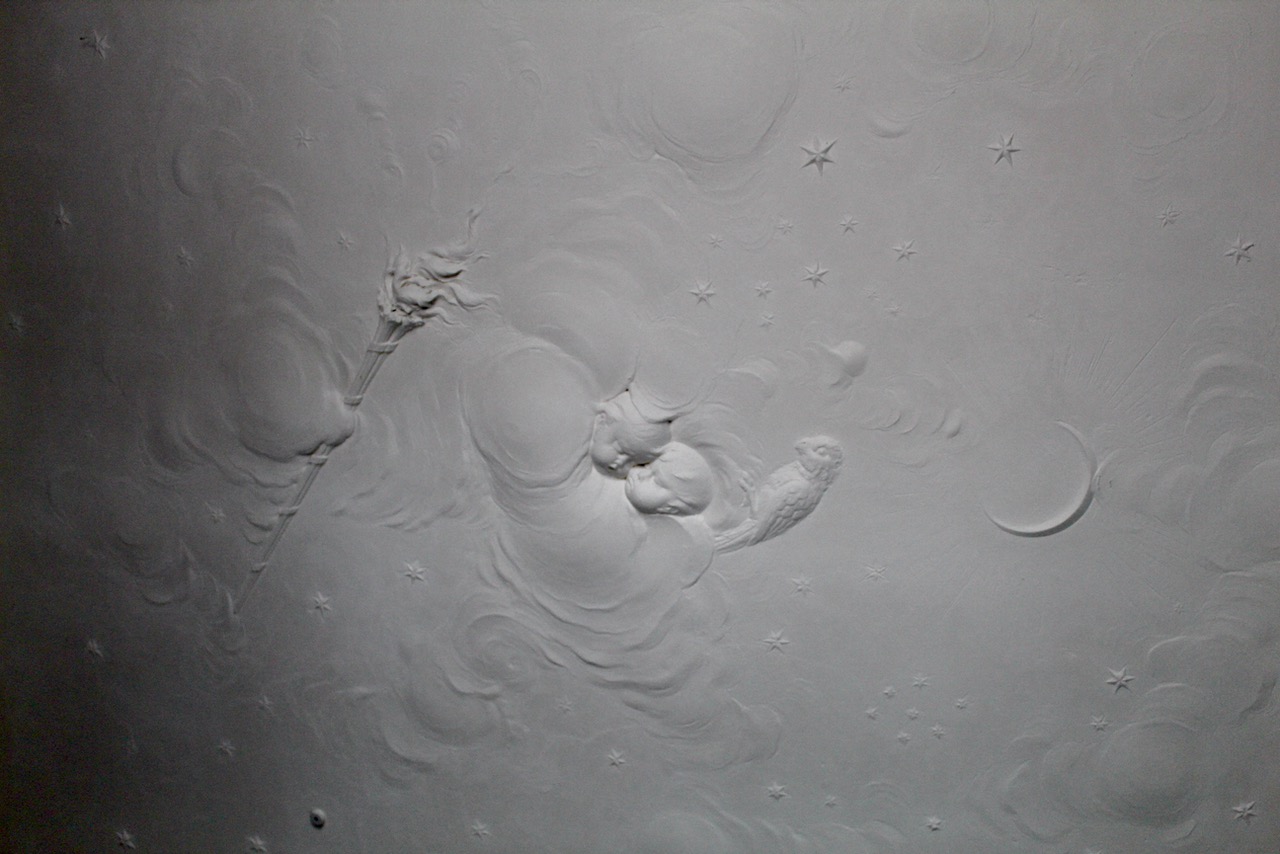
Bence-Jones continues: “The front has a three bay recessed centre between projecting end bays, each of which originally had a Venetian window below a Diocletian window. Rusticated doorcase and rusticated window surrounds on either side of it; high roof parapet. The house contains only a few rooms, but they are of fine proportions and those on the ground floor have rococo plasterwork ceilings of the greatest delicacy and gaiety, with cherubs and other figures emerging from clouds, by the same artist as the ceilings formerly are Mespil House, Dublin, one of which is now in Aras.

When Robert Rochfort decided to use Belvedere as his principal residence he employed Barthelemij Cramillion, the French Stuccadore, to execute the principal ceilings. The Rococo plasterwork ceilings were completed circa 1760.

Belvedere, County Westmeath, August 2021: “The house contains only a few rooms, but they are of fine proportions and those on the ground floor have rococo plasterwork ceilings of the greatest delicacy and gaiety, with cherubs and other figures emerging from clouds, by the same artist as the ceilings formerly are Mespil House, Dublin, one of which is now in Aras.” Photograph © Jennifer Winder-Baggot, www.irishhistorichouses.com
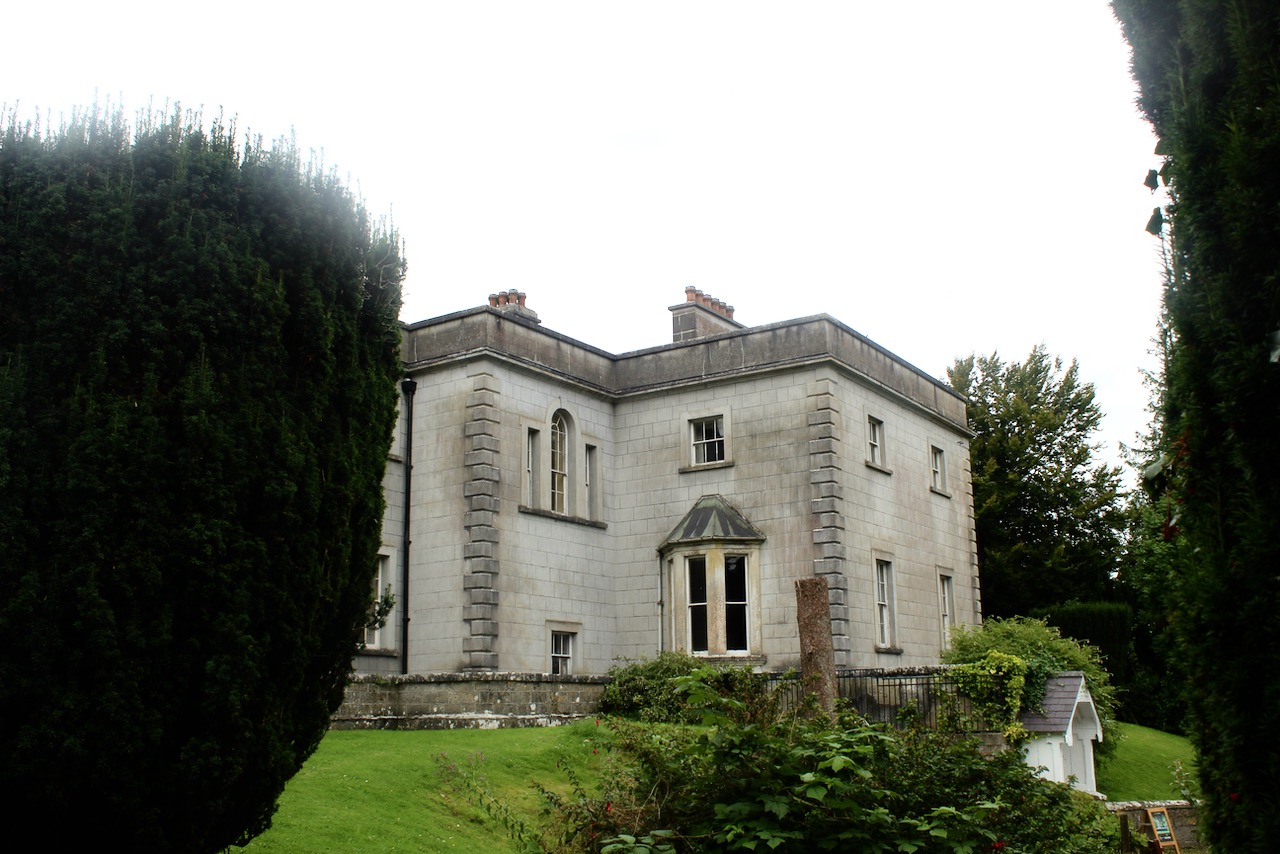
The Venetian window that lights the stairs, on the back facade of the house. The wooden porch below is an entrance into the basement of the house. Photograph © Jennifer Winder-Baggot, www.irishhistorichouses.com
Belvedere, County Westmeath. Photograph © Jennifer Winder-Baggot, www.irishhistorichouses.com
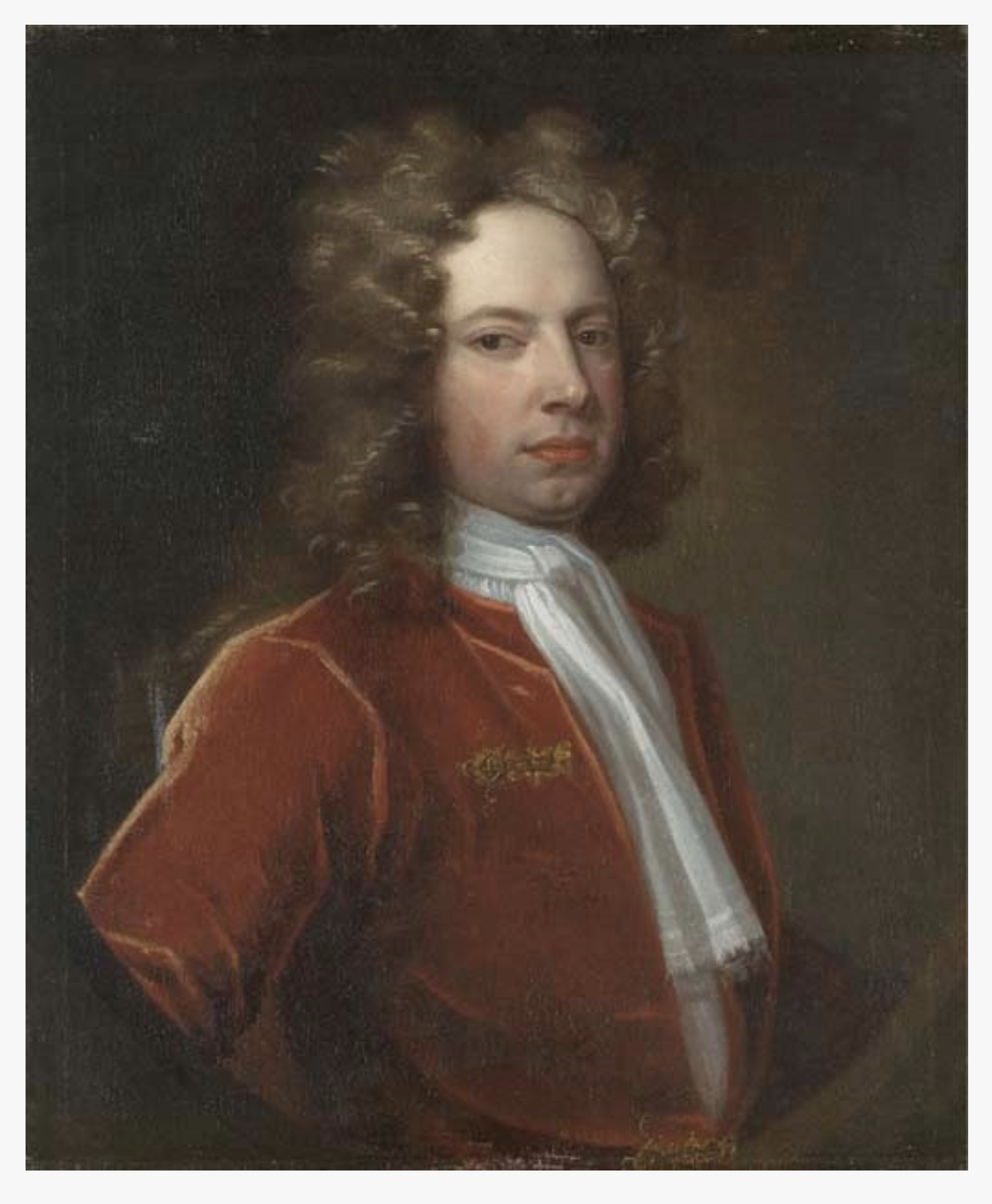
Robert Rochfort the 1st Earl of Belvedere was the son of George Rochfort (1682-1730) and Elizabeth, daughter of Henry Hamilton-Moore, 3rd Earl of Drogheda.

George Rochfort (1682-1730) of Gaulstown, Co. Westmeath, M.P. for Co. Westmeath by Charles Jervas courtesy of Christies Auction 2002.
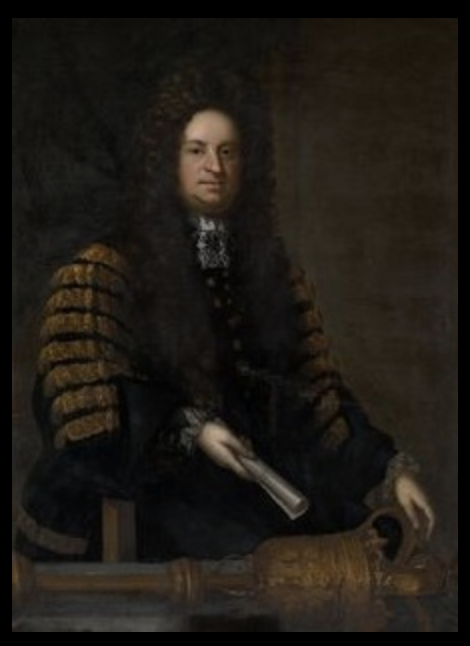
Robert Rochfort (1652-1727) as Speaker of the Irish House of Commons by an unknown artist, Photograph of a painting owned by Michael O’Reilly. He was the father of George Rochfort (1682-1730) of Gaulstown, Co. Westmeath
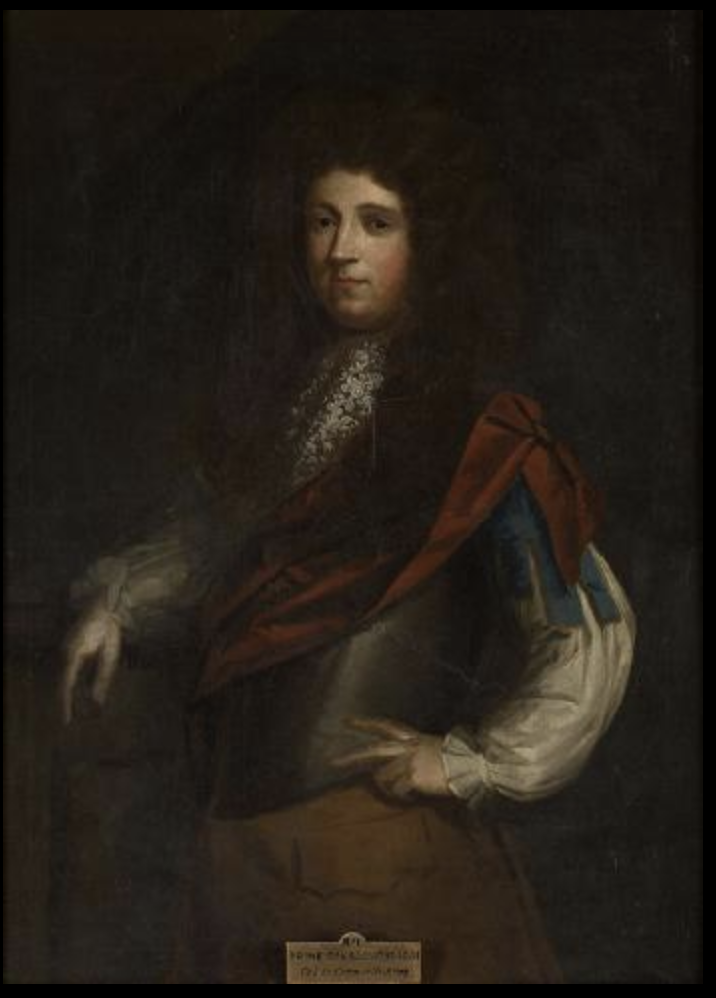
James Rochfort (executed in 1652 after killing someone in a duel) usually known by his nickname “Prime Iron,” by Garret Morphy. He was the father of Robert Rochfort (1652-1727).

Bence-Jones tells of the Rochforts: “Soon after the house was finished, Lord Bellfield’s beautiful wife [Mary Molesworth, daughter of Richard, 3rd Viscount Molesworth of Swords, Dublin] confessed to him that she had committed adultery with his brother; whereupon he incarcerated her at Gaulston, where she remained, forbidden to see anyone but servants, until his death nearly thirty years later; while he lived a bachelor’s life of great elegance and luxury at Belvedere.

Belvedere, County Westmeath.

Mary Molesworth was Robert Rochfort’s second wife. His first wife, Elizabeth Tenison, died childless in 1732, from smallpox.

Mrs. Delaney writes of Robert and his second wife “he has discovered an intrigue, and they say he has come to England in search of him [the brother who committed adultery] to kill him wherever he meets him… He is very well-bred and very well in his person and manner; his wife is locked up in one of his houses in Ireland, with a strict guard over her, and they say he is so miserable as to love her even now; she is extremely handsome and has many personal accomplishments.

It is said that Charlotte Bronte may have been inspired by Mary’s imprisonment to write the character of “the madwoman in the attic” in Jane Eyre.

Belvedere, County Westmeath.
Sarah Rochfort (nee Singleton) was the daughter of The Rev. Rowland Singleton (1696-1741) of Drogheda, later Vicar of Termonfeckin, County Louth, wife of Arthur Rochfort (1711-1774) of Bellfield House Co Westmeath, sold at Shepphards. Her husband was imprisoned when he could not pay his legal damages for adultery.

Mark Bence-Jones continues: “Another of his brothers lived close to Belvedere at Rochfort (afterwards Tudenham Park); having quarrelled with him too, Lord Belvedere, as he had now become, built the largest Gothic sham ruin in Ireland to blot out the view of his brother’s house; it is popularly known as the Jealous Wall.”

Tudenham Park was built for Robert’s brother George Rochfort (1713-1794) around 1743. He married Alice, daughter of Gustavus Hume 3rd Baronet of County Fermanagh. Tudenham Park is now a ruin and was recently sold.

Tudenham Park, County Westmeath, courtesy of Sherry FitzGerald Davitt & Davitt Mullingar.
“The Jealous Wall,” Belvedere. Photograph © Jennifer Winder-Baggot, www.irishhistorichouses.com

The jealous wall is rather disappointingly attached to the visitor centre of Belvedere at the entrance to the park. Robert went to great expense to construct the wall to resemble an artificial ruined abbey, hiring the celebrated Italian architect Barrodotte to work on the project.

Visitor centre attached to the Jealous Wall, Belvedere. Photograph © Jennifer Winder-Baggot, www.irishhistorichouses.com
Belvedere, County Westmeath. Photograph © Jennifer Winder-Baggot, www.irishhistorichouses.com
Visitor centre attached to the Jealous Wall. Photograph © Jennifer Winder-Baggot, www.irishhistorichouses.com
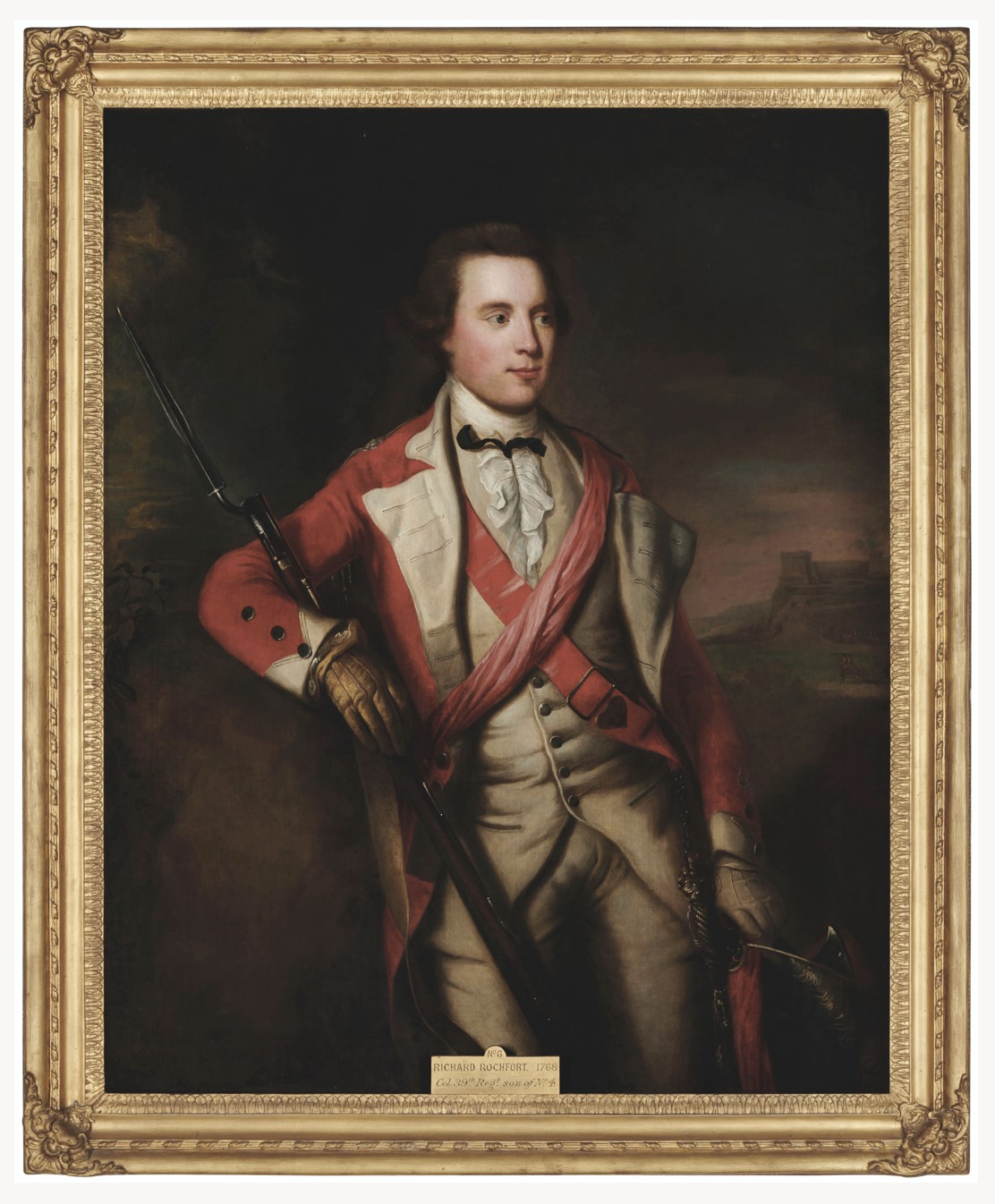
The Earl of Belvedere managed to have children despite his antipathy toward his wife. His son George Rochfort (1738-1814), 2nd Earl of Belvedere inherited Belvedere and other estates when his father died in 1774. He also inherited debts, and sold Gaulston House, the house where his mother had been imprisoned by his father. Unfortunately Gaulston House was destroyed by fire in 1920. George Rochfort built an extension onto the rear of Belvedere but spent most of his time in his townhouse, Belvedere House in Great Denmark Street, Dublin.

George Rochfort (1738-1815), later 2nd Earl of Belvedere by Robert Hunter (c. 1715/20-1801), Adams auction 18 Oct 2022.
Belvedere House, Belvedere College, Dublin.
Inside Belvedere House, plasterwork by Michael Stapleton, Belvedere College, Dublin.
Belvedere House, Belvedere College, Dublin.

Robert Rochfort 1st Earl and Mary née Molesworth had a daughter Jane whom it seems was not dissuaded from marriage despite treatment of her mother, and married Brinsley Butler, 2nd Earl of Lanesborough, MP for County Cavan.

George Rochfort (12 October 1738 – 13 May 1814), 2nd Earl of Belvedere, and his second wife Jane née Mackay, by Robert Hunter, 1804 courtesy of Christies.

The 2nd Earl of Belvedere married first Dorothea Bloomfield, and after she died, he married Jane Mackay. He had no surviving children after his death in 1814. His wife inherited his Dublin property but his sister Jane née Rochfrot inherited Belvedere. Jane married Brinsley Butler, 2nd Earl of Lanesborough. She inherited Belvedere when she was 77 years old! She had married a second time, to John King, and the income from the estate allowed herself and her second husband to live in fine style in Florence.

Jane née Rochfort Countess of Lanesborough (1737-1828) Attributed to Thomas Pope Stevens courtesy Christies Irish Sale 2002. She was the daughter of Robert Rochfort, 1st Earl of Belvedere and married Brinsley Butler, 2nd Earl of Lanesborough.

The male line of the Earls of Lanesborough died out after two more generations. Jane’s son Robert Henry Butler (1759-1806) 3rd Earl of Lanesborough married Elizabeth La Touche, daughter of David La Touche (1729-1817) and Elizabeth Marlay, whom we came across when we visited Harristown, County Kildare (see my entry) and Marlay Park in Rathfarnham, Dublin. The estate passed down to their son, Brinsley Butler, 4th Earl of Lanesborough, but he died unmarried. The estate then passed through the female line. The 3rd Earl of Lanesborough’s sister Catherine married George Marlay (1748-1829), the brother of Elizabeth who married David La Touche.

Elizabeth, Countess of Lanesborough (née La Touche), (1764-1788), wife of 3rd Earl of Lanesborough, Date 1791 Engraver Francesco Bartolozzi, Italian, 1725-1815 After Horace Hone, English, 1756-1825, photograph courtesy of National Gallery of Ireland.

Mark Bence-Jones continues: “In C19, the Diocletian windows in the front of the house were replaced with rectangular triple windows; and the slope from the front of the house down to the lough was elaborately terraced. Belvedere passed by inheritance to the Marlay family and then to late Lt-Col C.K. Howard-Bury, leader of the 1921 Mount Everest Expedition; who bequeathed it to Mr Rex Beaumont.” (see [3])

Belvedere, County Westmeath.
Photograph © Jennifer Winder-Baggot, www.irishhistorichouses.com

Catherine and George Marlay had a son, George (1791-1880), who married Catherine Tisdall, and the estate passed to his son, Charles Brinsley Marlay (1831-1912). Charles was only sixteen when he inherited Belvedere from his cousin the Earl of Lanesborough.

Charles Brinsley Marlay of Belvedere House County Westmeath, courtesy of The Fitzwilliam Museum.

It was Charles Brisley Marlay who built the terraces leading down to the lake, in the late 1880s. The twelve stone lions were added later. He spent many hours planning the 60 metre long rockery to the side of the terraces, and also built the walled garden. He was known as “the Darling Landlord” due to his kindness to tenants, and for bringing happiness and wealth back to Belvedere. He was cultured and amassed an important art collection, as well as improving the estate.

Charles Brisley Marlay built the terraces leading down to the lake, in the late 1880s. The twelve stone lions were added later. The terraces are said to have been inspired by the terraces at Haddon Hall, Derbyshire, the home of his sister. Photograph © Jennifer Winder-Baggot, www.irishhistorichouses.com
Charles Brisley Marlay built the terraces leading down to the lake, in the late 1880s. The twelve stone lions were added later. Photograph © Jennifer Winder-Baggot, www.irishhistorichouses.com
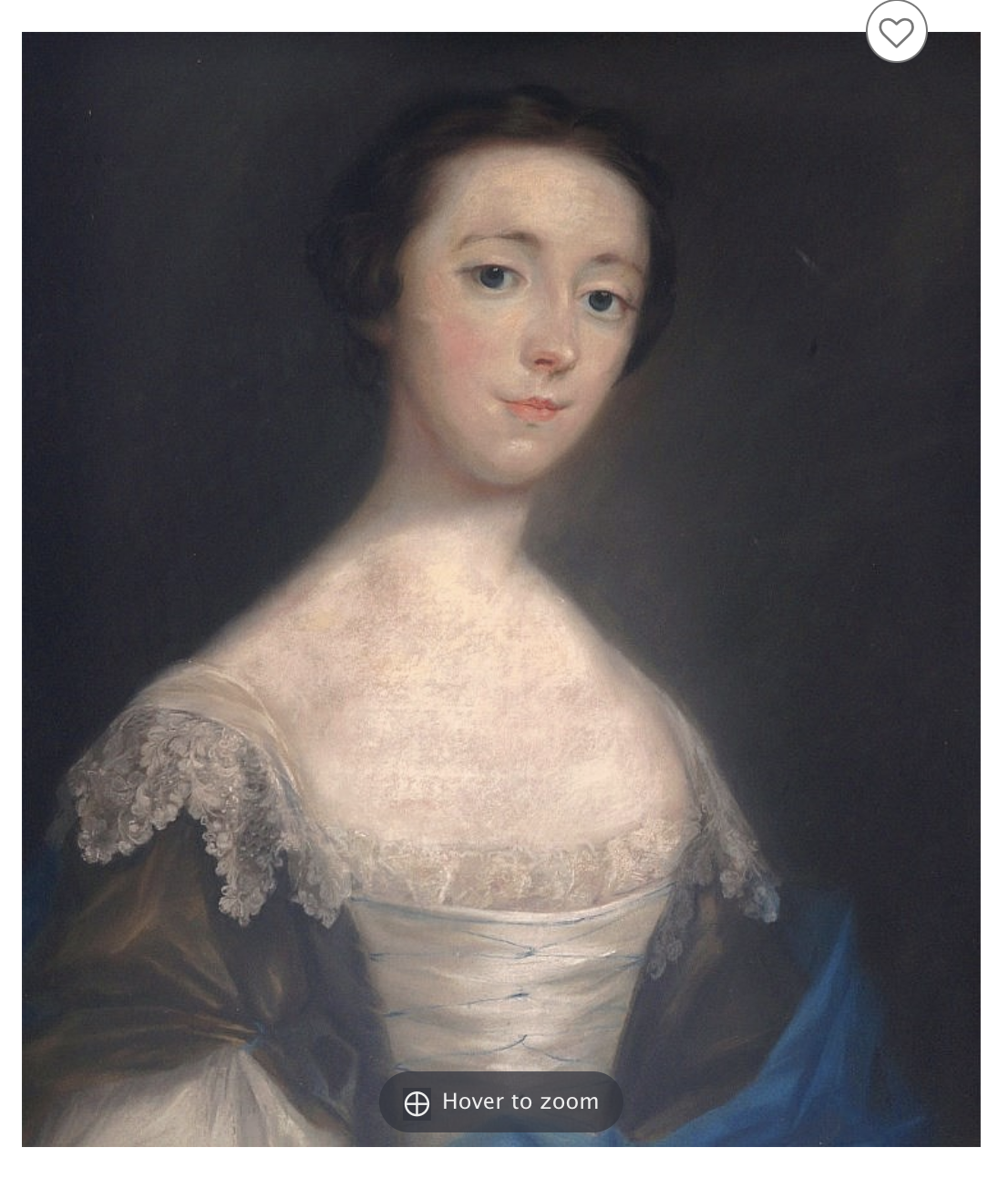
Belvedere, County Westmeath. Photograph © Jennifer Winder-Baggot, www.irishhistorichouses.com
Photograph © Jennifer Winder-Baggot, www.irishhistorichouses.com

The inheritance of Belvedere continues to be even more complicated. It passed via Catherine Tisdall’s family. Her mother Catherine Dawson (1762-1821) had married twice. Catherine’s second husband was Charles William Bury (1764-1835), the 1st Earl of Charleville. We came across him earlier, as an owner of Charleville Forest, in Tullamore, County Offaly.

Charleville Forest Castle, County Offaly.

Belvedere passed to Charles William Bury (1764-1835) the 1st Earl of Charleville’s descendant, Lt. Col Charles Howard-Bury (1883-1963). The 3rd Earl of Charleville, Charles William George Bury (1822-1859) had several children but the house passed to the fourth child, Emily Alfreda Julia Bury (1856-1931), as all others had died before Charles Brinsley Marley died. It was therefore the son of Emily Alfreda Julia Bury and her husband Kenneth Howard, who added Bury to his surname, who inherited Belvedere. Their son was Charles Kenneth Howard-Bury (1883-1963).

Charles William Bury, 2nd Earl of Charleville, seated in red cloak before a curtain, portrait by Henry Pierce Bone, 1835.
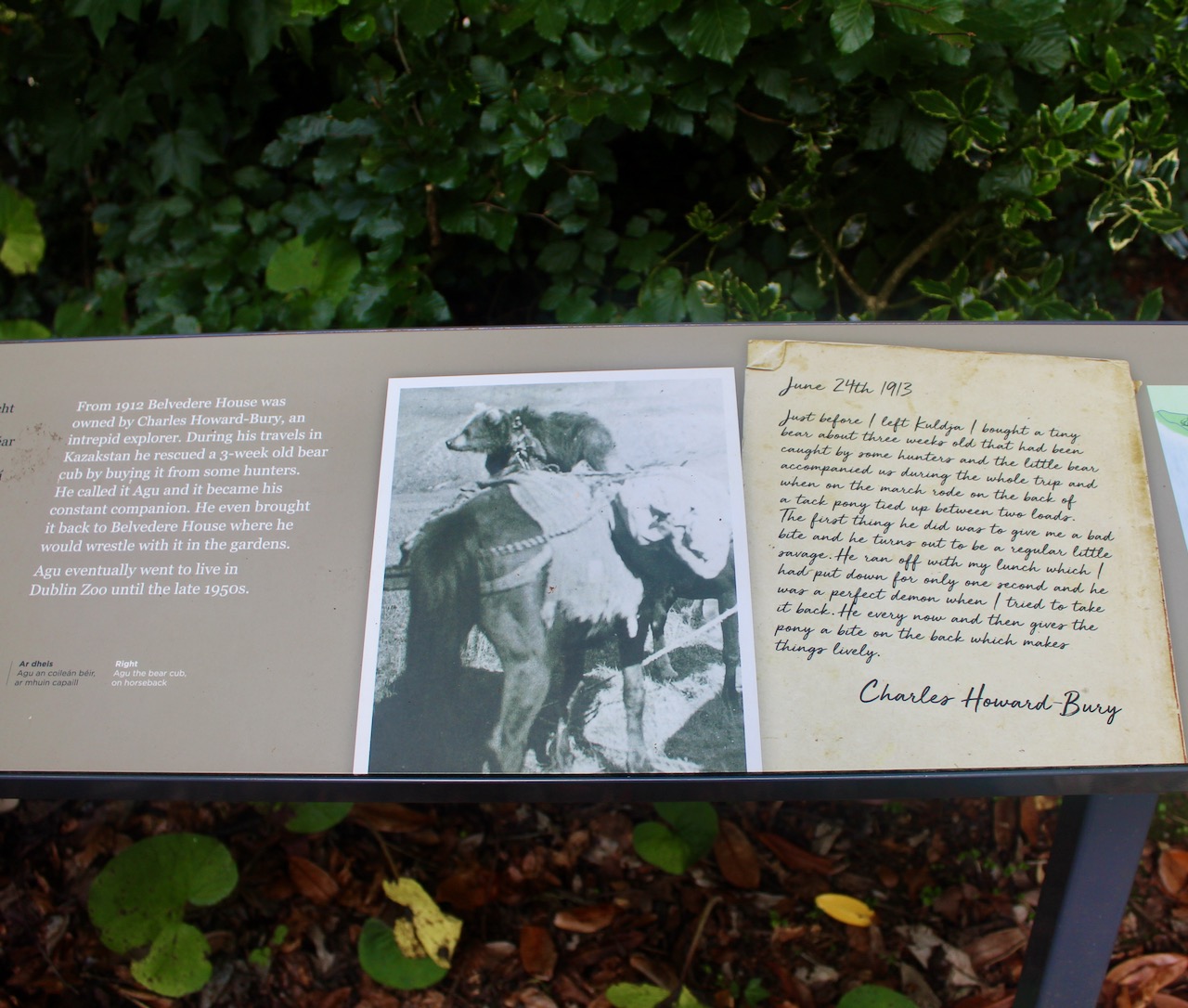
Charles Howard-Bury brought a bear back from Kazakhstan!
Photograph © Jennifer Winder-Baggot, www.irishhistorichouses.com

Charles Howard-Bury left Belvedere to his friend, Rex Beaumont. Eventally financial difficulties caused Mr Beaumont to sell the property, and it was acquired by Westmeath County Council. Two years previously, in 1980, Mr Beaumont sold the contents of the house – I wonder where those things ended up?

The estate is a wonderful amenity for County Westmeath, with large parklands to explore with several follies, as well as the walled garden.

Belvedere, County Westmeath.
Hallway, Belvedere, County Westmeath. Photograph © Jennifer Winder-Baggot, www.irishhistorichouses.com
Belvedere, County Westmeath. Photograph © Jennifer Winder-Baggot, www.irishhistorichouses.com
Belvedere, County Westmeath, August 2021: Juniper astride an eagle. Photograph © Jennifer Winder-Baggot, www.irishhistorichouses.com
The portrait is of Charles Howard-Bury, who was one of the owners of Belvedere. Photograph © Jennifer Winder-Baggot, www.irishhistorichouses.com
Belvedere, County Westmeath. Photograph © Jennifer Winder-Baggot, www.irishhistorichouses.com
The Dining Room, Belvedere, County Westmeath. The Dining Room occupies one end bow of the house, and has a Venetian window overlooking Lough Ennell. Photograph © Jennifer Winder-Baggot, www.irishhistorichouses.com

In Belvedere, dining was an opportunity to impress guests not only by the room but by the sumptuous meals, presented by immaculately dressed servants. The rococo ceiling of puffing cherubs and fruits and foliage is attributed to Barthelemji Cramillion, a French stuccodore.

The Dining Room, Belvedere, County Westmeath. Photograph © Jennifer Winder-Baggot, www.irishhistorichouses.com
The Dining Room, Belvedere, County Westmeath: The rococo ceiling of puffing cherubs and fruits and foliage is attributed to Barthelemji Cramillion, a French stuccodore. Photograph © Jennifer Winder-Baggot, www.irishhistorichouses.com
The Dining Room, Belvedere, County Westmeath. Photograph © Jennifer Winder-Baggot, www.irishhistorichouses.com

Bence-Jones continues: “The staircase, wood and partly curving, is in proportion to the back of the house.

Belvedere, County Westmeath. Photograph © Jennifer Winder-Baggot, www.irishhistorichouses.com
Drawing Room, Belvedere, County Westmeath. The drawing room occupies one of the bows of the house, and has a Venetian window overlooking the terrace and Lough Ennell. Photograph © Jennifer Winder-Baggot, www.irishhistorichouses.com

Information boards tells us that the Drawing Room was the place for afternoon tea, after-dinner drinks, music and conversation. Belvedere’s last owners, Charles Howard-Bury and Rex Beaumont would have passed many happy hours relaxing and reminiscing about their wartime experiences and travels across the world, as well as planning trips to Tunisia and Jamaica.

Belvedere, County Westmeath. Photograph © Jennifer Winder-Baggot, www.irishhistorichouses.com
Ceiling of the Drawing Room, Belvedere, County Westmeath. Photograph © Jennifer Winder-Baggot, www.irishhistorichouses.com
Belvedere, County Westmeath. Photograph © Jennifer Winder-Baggot, www.irishhistorichouses.com
The kitchen is in the vaulted basement of Belvedere and has an interesting ghostly display of servants. Photograph © Jennifer Winder-Baggot, www.irishhistorichouses.com
Photograph © Jennifer Winder-Baggot, www.irishhistorichouses.com
Belvedere, County Westmeath.
Belvedere, County Westmeath. Photograph © Jennifer Winder-Baggot, www.irishhistorichouses.com
Belvedere garden folly, the Gothic Arch, built around 1760, designed by Thomas Wright as a ‘mock entrance’ to the estate. Courtesy of Westmeath County Council (www.visitwestmeath.ie), photograph by Clare Keogh, 2019. Photograph © Jennifer Winder-Baggot, www.irishhistorichouses.com
The Octagonal Gazebo, Belvedere. It was once panelled with wood on the walls, floor and ceiling and was used for summer picnics, where guests would be waited on by servants. Photograph © Jennifer Winder-Baggot, www.irishhistorichouses.com

The Octagonal Gazebo was built around 1765 by astronomer, mathematician and architect Thomas Wright.

Lough Ennell. Photograph © Jennifer Winder-Baggot, www.irishhistorichouses.com

Text © Jennifer Winder-Baggot, www.irishhistorichouses.com

Places to visit and stay in County Offaly

On the map above:

blue: places to visit that are not section 482

purple: section 482 properties

red: accommodation

yellow: less expensive accommodation for two

orange: “whole house rental” i.e. those properties that are only for large group accommodations or weddings, e.g. 10 or more people.

green: gardens to visit

grey: ruins

Carlow, Dublin, Kildare, Kilkenny, Laois, Longford, Louth, Meath, Offaly, Westmeath, Wexford and Wicklow are the counties that make up the Leinster region.

As well as places to visit, I have listed separately places to stay, because some of them are worth visiting – you may be able to visit for afternoon tea or a meal.

For places to stay, I have made a rough estimate of prices at time of publication:

€ = up to approximately €150 per night for two people sharing (in yellow on map);

€€ – up to approx €250 per night for two;

€€€ – over €250 per night for two.

For a full listing of accommodation in big houses in Ireland, see my accommodation page: https://irishhistorichouses.com/accommodation/

donation

Help me to pay the entrance fee to one of the houses on this website. This site is created purely out of love for the subject and I receive no payment so any donation is appreciated!

€15.00

Offaly:

1. Birr Castle, Birr, Co. Offaly

[at some time, to re-open to the public, the gardens at Bellefield – see Robert O’Byrne’s blog: https://theirishaesthete.com/2022/05/02/bellefield/

2. Charleville Forest Castle, Tullamore, County Offaly – sometimes open to the public

3. Clonony Castle, County Offaly (check before visiting – I am not sure if it is still open to the public)

4. Crotty Church, Castle Street, Birr, Co. Offaly

5. Gloster House, Brosna, Birr, Co. Offaly

6. High Street House, High Street, Tullamore, Co. Offaly

7. Leap Castle, County Offaly

8. Loughton, Moneygall, Birr, Co. Offaly

9. Springfield House, Mount Lucas, Daingean, Tullamore, Co. Offaly

Places to stay, County Offaly

1. Ballynacard House, Birr, County Offaly €

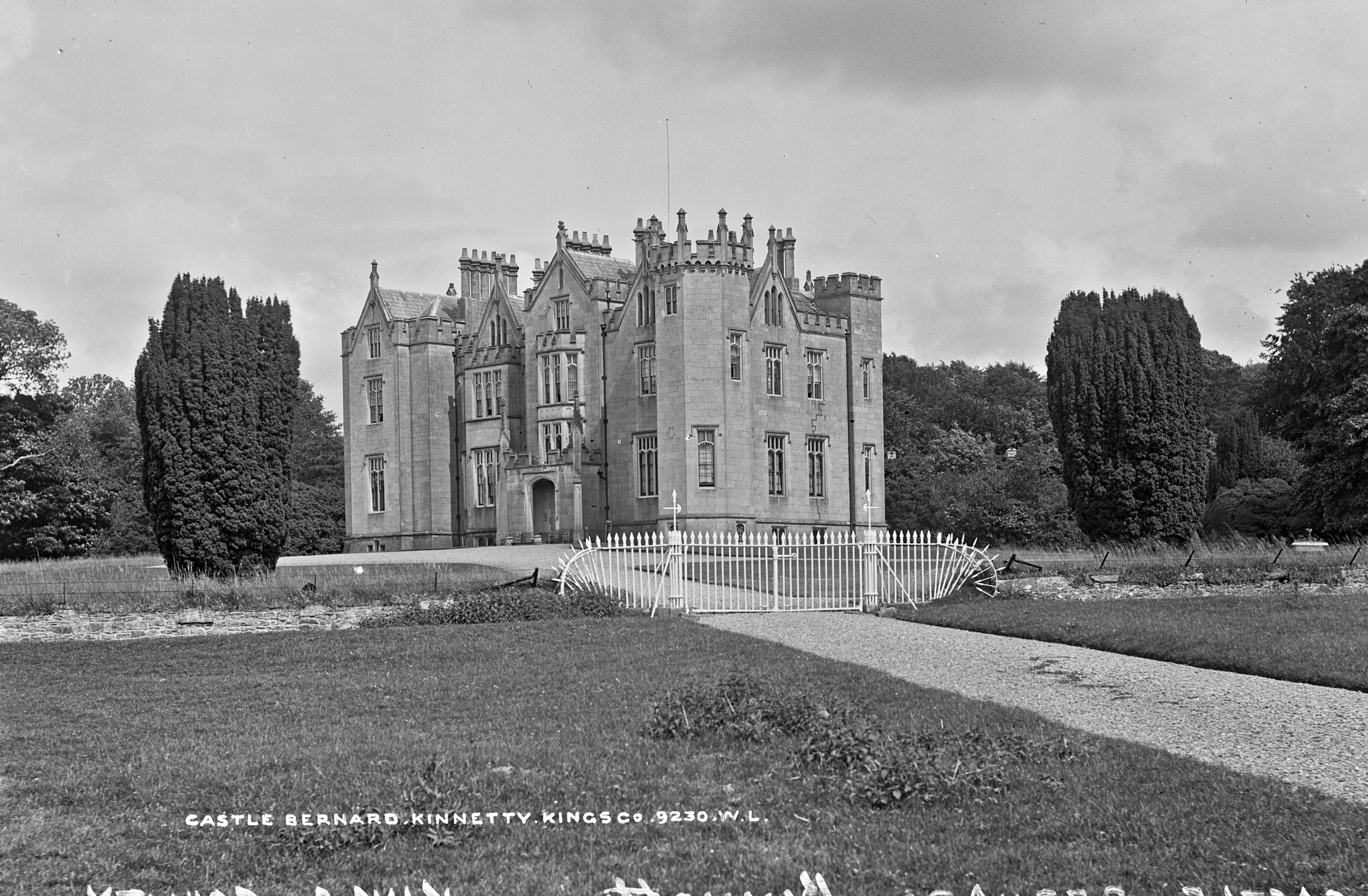
2. Kinnity Castle (formerly Castle Bernard), Kinnity, County Offaly €€

3. Loughton House, County Offaly

4. The Maltings, Castle Street, Birr, Co. Offaly

Whole house rental, County Offaly:

1. Ballycumber, County Offaly – whole house rental (13 guests)

2. Loughton House, County Offaly

Places to visit in County Offaly:

1. Birr Castle, Birr, Co. Offaly

www.birrcastle.com

Open dates in 2025: May 16-17, 19-24, 26-31, June 2-7, 9-14, 16-21, 23-28, 30, July 1-5, 7-12, 14-19, 21-26, 28-31, Aug 1-2, 4-9, 11-30, Sept 1-6, 11am-3pm

Fee: adult €12.50, OAP/student €11, child 7, family 2 adults and 2 children €34, guided castle tour €22

See my entry https://irishhistorichouses.com/2025/07/21/birr-castle-county-offaly-section-482/

Birr Castle, photograph by Chris Hill 2018, for Tourism Ireland, Ireland’s Content Pool. [1]

2. Charleville Forest Castle, Tullamore, County Offaly – sometimes open to public

Charleville Castle, August 2018. Photograph © Jennifer Winder-Baggot, www.irishhistorichouses.com
http://www.charlevillecastle.ie/

See my entry https://irishhistorichouses.com/2024/08/29/charleville-forest-castle-tullamore-county-offaly-sometimes-open-to-public-run-by-charleville-castle-heritage-trust/

Charleville Castle was built 1800-1812 for Charles William Bury (1764-1835), later 1st Earl of Charleville, and was designed by Francis Johnston.

Mark Bence-Jones writes (1988):

p. 82. “(Bury/IFR) The finest and most spectacular early C19 castle in Ireland, Francis Johnston’s Gothic masterpiece, just as Townley Hall, County Louth, is his Classical masterpiece. Built 1800-1812 for Charles William Bury, 1st Earl of Charleville, replacing a C17 house on a different site known as Redwood. A high square battlemented block with, at one corner, a heavily machicolated octagon tower, and at the other, a slender round tower rising to a height of 125 feet, which has been compared to a castellated lighthouse. From the centre of the block rises a tower-like lantern. The entrance door, and the window over it, are beneath a massive corbelled arch. The entire building is cut-stone, of beautiful quality.” [2]

Charleville Castle, County Offaly, August 2024. Photograph © Jennifer Winder-Baggot, www.irishhistorichouses.com
Mark Bence-Jones continues:

The interior is as dramatic and well-finished as the exterior. In the hall, with its plaster groined ceiling carried on graceful shafts, a straight flight of stairs rises between galleries to piano nobile level, where a great double door, carved in florid Decorated style, leads to a vast saloon or gallery running the whole length of the garden front.”

Charleville Woods Castle, Tullamore, 17 Aug 2024. Photograph © Jennifer Winder-Baggot, www.irishhistorichouses.com
Charleville Castle Tullamore by Matt McKnight 2007, courtesy of flickr constant commons.

The house stood almost empty, with a caretaker, for years. When Charles Kenneth died in 1963, the property passed to a cousin, the grandson of the 3rd Earl’s sister with whom he had quarrelled. She had married Edmund Bacon Hutton and her grandson William Bacon Hutton legally changed his surname to Hutton-Bury when he inherited in 1964. The castle remained empty, until it was leased for 35 years to Michael McMullen in 1971. It had been badly vandalised at this stage. He immediately set to restore the castle.

More repairs were carried out by the next occupants, Bridget “Bonnie” Vance and her parents, who planned to run a B&B and wedding venue. Today the castle is run by Charleville Castle Heritage Trust.

Charleville Woods Castle, Tullamore, 17 Aug 2024. Photograph © Jennifer Winder-Baggot, www.irishhistorichouses.com

3. Clonony Castle, County Offaly – for sale May 2023, I am not sure if still open to the public

Clonony Castle County Offaly, photograph by Gareth McCormack/garethmccormack.com for Tourism Ireland, 2022
Interior, Clonony Castle County Offaly, photograph by Gareth McCormack/garethmccormack.com for Tourism Ireland, 2022

https://www.visitoffaly.ie/Things-to-do/Culture-Heritage/Clonony-Castle/

The website tells us:

Clonony Castle, built in the 1490’s by the Coghlan Clan, was seized by Henry VIII during the war of dominion by England. He ceded it to Thomas Boleyn, making him the Earl of Ormond, his daughter, the ill-fated Ann, a countess and marriageable by a king. When Henry tired of Ann and the Boleyns fell from grace, two ladies, Mary and Elizabeth, were sent back to Clonony and remained for the rest of their lives. Their tombstone lays beneath a tree in the castle bawn.

Following the ladies demise, a merchant, Sir Matthew de Renzi, wrote to Queen Elizabeth of the great significance of the castle and begged to be awarded it. These DeRenzi letters have become very important as they tell us what life was like in the 16th Century in the midlands. Possessing a great facility for language, speaking and trading with many countries, he wrote the first English/Irish dictionary.

Today the castle has been sensitively restored to reflect the way of life through this historical period and now is open to the public casually from 12 to 5 on Friday, Saturday, and Sunday through summer and anytime by appointment on 0877614034. There is no fee, but donations toward the maintenance of the castle is greatly appreciated. In June, the castle will open on weekends for glamping (glamourous camping). Early booking is essential.”

4. Crotty Church, Castle Street, Birr, Co. Offaly

Open dates in 2025: Jan 1- Dec 31, Mon-Fri, excluding Bank Holidays, National Heritage Week Aug 16-24, 12 noon-5pm [caution: when we visited during Heritage Week 2024, it was not open]

Fee: Free

See my entry https://irishhistorichouses.com/2024/11/14/crotty-church-birr-county-offaly-section-482/

5. Gloster House, Brosna, Birr, Co. Offaly

Open dates in 2025: Jan 2-29, Mon-Fri, May 1-31, Aug 16-24, 9am-1pm

Fee: adult/child €10, OAP/student €8

Gloster, County Offaly, February 2023. Photograph © Jennifer Winder-Baggot, www.irishhistorichouses.com

The Historic Houses of Ireland website tells us:

Just east of the road between Birr and Roscrea, Gloster is County Offaly’s most important remaining eighteenth century house. The formal facade, overlooking the steeply terraced garden, is unusually long and low, and is very grand. Thirteen bays wide and two stories high, the house is constructed in blue-grey limestone with a wealth of early architectural details in warm contrasting sandstone. The interior is equally splendid, especially the two principal rooms; the richly decorated double-height entrance hall and the great barrel-vaulted hall, or landing, on the piano nobile.

Gloster, County Offaly, February 2023. Photograph © Jennifer Winder-Baggot, www.irishhistorichouses.com

The Lloyd’s ancestor came to Ireland from Denbighshire, to serve in the army of King Charles I, and he acquired the estate in 1639 through  marriage with an heiress, Margaret Medhop. Presumably they and their descendants lived in an earlier dwelling, of which no trace remains, until the present house was completed sometime after 1720. The architectural historian Maurice Craig, who edited the book of Pearce’s drawings, observed that, “Gloster has features which can hardly derive from anyone other than Sir Edward Lovett Pearce” (c.1699-1733). Craig also believed that, while Pearce may well have provided a design for his cousin, Trevor Lloyd, he almost certainly left the execution to others since “for all its charm, it is provincial in almost every respect”.

Pearce began work in Ireland in 1724 under Alessandro Galilea on Castletown House, in County Kildare. He later designed Parliament House in College Green in Dublin.

Trevor Lloyd and Rose Medhop had a son and named him Medhop Lloyd (c. 1670-1734). He married into the Lovett family, marrying Mary, daughter of Christopher Lovett, who at one time held the position of Lord Mayor of Dublin. 

The Gloster we see today was built by the son of Medhop and Mary, Trevor Lloyd (d. 1747). His mother Mary was the sister of Frances Lovett, who married Edward Pearce (1658-1715), and Frances and Edward were the parents of architect Edward Lovett Pearce. Therefore Lovett Pearce was a first cousin of Trevor Lloyd (d. 1747), who inherited the property. 

Trevor Lloyd, Tom Alexander had a photograph made of a print by Charles Jervas. Jervas was born nearby in County Offaly.

We visited Gloster House in County Offaly in February 2023. I was excited to see it after looking at pictures on Robert O’Byrne’s blog. Previously it had been a school, purchased by an order of nuns in 1958. The nuns ran the house as a convalescent home. To its rear they erected a chapel and school buildings to accommodate a female boarding school. Nearly all of the farm buildings were demolished to allow for these new buildings, but the original house survived conversion to an institution reasonably well apart from the destruction of a complete wing on the north-western elevation. The order of nuns left Gloster in 1990 and following two subsequent changes of owners, in 2001 it became the property of Tom and Mary Alexander, who moved from Dublin to Birr. They have been working on the restoration of Gloster ever since.

The house and gardens are available as an exclusive private venue for corporate functions, family celebrations and weddings. It is also a home to the Alexander family.

The Gloster website tells us that the present house is thought to date from between 1700 and 1720, and it is possible that a house existed on the same site at Gloster from 1639.

In Great Irish Houses (with forewards by Desmond FitzGerald and Desmond Guinness published by IMAGE Publications in 2008) we are told that King Charles I granted lands at Gloster to the Medhop family. “Gloster” is a derivative of Glasderrymore, meaning the big green wood. 

The Historic Houses of Ireland website continues: “The central breakfront is relatively plain, apart from the typically 1700s hooded door case with pilasters to either side, while two recessed bays at either end of the facade are treated as wings, with Pearcean blind niches in place of windows on the upper storeys. Meanwhile the three intervening bays to either side are further divided by vertically paired pilasters, Doric below the string course and Corinthian above, and their positions are reflected in the cornice, the parapet and in the intervals of the balustrade.

“Inside, the elaborate double-height entrance-hall has a series of bust-filled niches while there is very grand upper hall on the piano nobile. This is approached by twin staircases and overlooks the entrance-hall though a series of round-headed openings with a profusion of architectural detail.

Samuel Chearnley may have had a hand in designing the gardens, which contain a canal, a lime avenue and a pedimented arch, flanked by obelisks in the manner of Vanburgh, while a series of later terraces in front of the house descend to a small lake.

The Dictionary of Irish Architects tell us Chearnley became a protégé of Sir Lawrence Parsons of Birr, Co. Offaly, where he died in 1746, aged only 29. Between October 1745 and May 1746 he produced a manuscript set of designs for garden buildings, which he entitled ‘Miscelanea Structura Curiosa’. Most of the designs were his own, though five were conceived by Parsons and merely drawn up by him.

The view from Gloster house of the stew ponds, which contained fish, and the folly beyond. Photograph © Jennifer Winder-Baggot, www.irishhistorichouses.com
Gloster, County Offaly, February 2023. Photograph © Jennifer Winder-Baggot, www.irishhistorichouses.com

The Historic Houses of Ireland website continues: “Gloster was sold in 1958 and became a convent and nursing home, with a new school complex built on the site of the former stables. The school closed shortly after 1990 and the house fell into considerable disrepair. Happily Tom and Mary Alexander purchased the house and have carried out a thorough and sympathetic restoration.

Famous visitors to Gloster include John Wesley, who preached here in 1749, while the famous Australian “diva” Dame Nellie Melba sang from the gallery in the upper hall early in the 20th century.” [6]

The folly at Gloster, probably designed by Edward Lovett Pearce. Photograph © Jennifer Winder-Baggot, www.irishhistorichouses.com
The Gloster website tells us: “The interiors of Gloster House, some with elaborate plaster panelling to the walls and others with timber mouldings, appear to be early-to-mid-eighteenth century. However work could have been carried out to the house during the nineteenth and early-twentieth century, successively by Hardress Lloyd (d.1860), his son John Lloyd (d.1883) and his grandson Brigadier-General John Hardress Lloyd (d.1952).

John (c. 1753-1811) was a son of Trevor Lloyd and Henrietta Waller. He married Jane Le Hunt (d. 1822), daughter of Thomas Le Hunt, of Artramon, County Wexford. The website tells us that throughout the nineteenth century Lloyd successors perpetuated at Gloster, variously as MPs (Members of Parliament), JPs (Justices of the Peace) and in the military. 

John and Jane’s daughter Alice (d. 1867) married Laurence Parsons (1758-1841) 2nd Earl of Rosse of Birr Castle. Her sister Harriet married Reverend Henry King of Ballylin County Offaly (now gone but gates remain).

John and Jane’s son Hardress Lloyd (d.1860) was for some years Lieutenant-Colonel of South Down Militia and MP for King’s County (County Offaly) 1807-16. Colonel Lloyd died unmarried but had a son, John Lloyd (d. 1883). John married Susanna Frances Julia (1850-1886), second daughter of John Thomas Rossborough Colclough of Tintern Abbey, County Wexford (see my entry about OPW properties in County Wexford), in 1872, and they had many children. John was Deputy Lieutenant and High Sheriff of King’s County in 1866.

Their son Brigadier-General John Hardress Lloyd, a distinguished World War I general, married Adeline Wilson, an Australian heiress, in 1903. They met in India, where she was sent to meet a husband. The website tells us that this marriage injected substantial financial benefits into the estate which resulted in a certain degree of internal remodelling of the house and a major enhancement of the gardens. 

Adeline died in 1933, the General in 1952. As they had no children the estate devolved to their nephew Major Evan Talbot Trevor Lloyd (1919-1964). He was the son of John and Susanna Frances Julia’s son Evan Colclough Lloyd (1877-1945).

Evan Talbot Trevor Lloyd sold the house to the nuns in 1958. The Lloyds are buried at Ettagh cemetery and a fine monument stands there as a reminder of their legacy.

6. High Street House, High Street, Tullamore, Co. Offaly, R35 T189

www.no6highstreet.com

Open dates in 2025: Jan 6-31, Mon -Fri, May 2-19, Aug 16-24, Sept 1-24, 9.30am-1.30pm

Fee: adult/student €10, OAP €5, child under 12 years free

7. Leap Castle, County Offaly

https://www.visitoffaly.ie/Things-to-do/Culture-Heritage/Leap-Castle/

Sean Ryan of Leap Castle, insisted that he doesn’t fabricate when telling the story of what he and his wife see and hear at their home. Where most would refer to these apparitions as ghosts, Sean prefers to call them spirits. He describes the regular visions as people with a haze around them. Sometimes there is a lot of activity; other times less so. The sounds they hear are footsteps, doors opening and closing and crowds talking. However, on occasions that he has gone in the direction of the noise, nothing is apparent there, with the location of the spirits always out of reach. There is spirit, though, a lady, who touches off people. A lot of guests to the castle have also felt her presence. The remarkable thing Sean told us was that this experience never seems to alarm his guests, rather they always remain very calm, something that surprises them! Sean doesn’t regard his home as haunted and, as far as he is concerned, the spirits he sees and hears have as much right to live there as he does. Sean is happy to continue to live alongside them as he has done since 1994, when restoration on the castle began.

Leap Castle by Brian Morrison, 2015 for Tourism Ireland, Ireland’s Content Pool. (see [2])

The Leap Castle website gives us more information: http://leapcastle.net

Built in the early 1500’s under the supervision of the powerful and warring O’Carroll clan, Leap Castle has been the centre of much bloodshed.

Leap Castle by Brian Morrison, 2015 for Tourism Ireland, Ireland’s Content Pool. (see [2])

The O’Carrolls were a fierce and brutal clan, continually struggling for power and supremacy. They were known to be particularly violent and cunning in the attempts for domination. John O’Carroll was thought to be the first Prince of Ely who lived at Leap Castle. It is very probable that it was he who was responsible for the construction of the earliest sections of Leap Castle. John O’Carroll died at Leap Castle, suffering from the plague. John O’Carroll was succeeded by his son named Mulrony O’Carroll.
Mulrony O’Carroll was renowned for his strength, bravery and valour and was considered a great leader. The Great Mulrony as he was known died (most likely) at Leap in 1532 after a rulership of forty two years. Mulrony was succeeded by his son Fearganhainm.

The website continues with the history of one brother after another killing each other for supremacy.

The website tells us:

In 1629 John O’Carroll, nephew of Charles O’Carroll was given the official ownership of the Leap Estate. The year 1649 the property of Leap Castle was handed over to the first of the Darby line, Jonathon. He was a soldier of the Cromwellian forces and was handed the property and land in lieu of pay.

1664 saw the property handed back to John O’Carroll due to his continued loyalty to Charles the 1st. This arrangement was unfortunately reversed in 1667 due to the differing views of Charles the 2nd. The Leap Castle was once again back in the hands of the Darbys.

Leap Castle by Brian Morrison, 2015 for Tourism Ireland, Ireland’s Content Pool. (see [2])

Jonathon Darby the 2nd, a Cromwellian soldier obtained Leap Castle in 1649. This was lieu of payment for his services. Jonathon and his wife Deborah had a son also named Jonathon.

The estate was passed through a line of Jonathan Darbys.

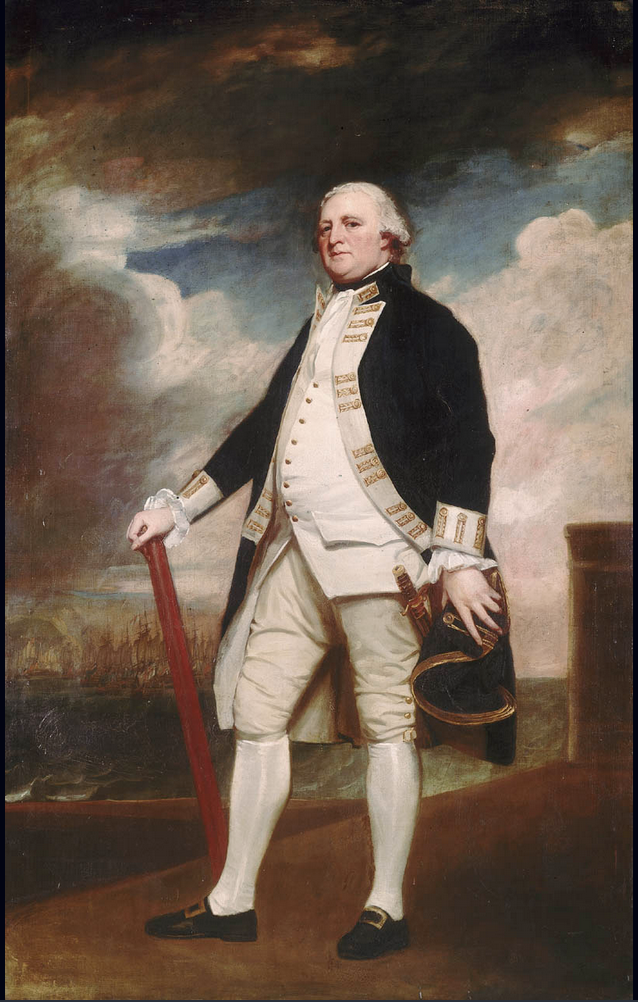
Vice-Admiral George Darby, circa 1720-90 by George Romney, courtesy of National Maritime Museum, Greenwich, London, Caird Collection. He was the second son of Jonathan Darby of Leap Castle and Anna Marie Frend.

“Jonathon Darby the 5th maintained the Leap Estate until his death in 1802. As Jonathon fathered no male children, Leap Castle was passed on to his younger brother Henry. 

Henry d’Esterre Darby, born in 1750 climbed through the Naval ranks to become Admiral Sir Henry d’Esterre Darby in 1799. Henry died in 1823 bearing no children of his own. Upon Henry’s death, the Leap Castle estate was inherited by his brother John Darby. 

John Darby married Anne Vaughan and died in 1834. He was succeeded by their sons William Henry, Christopher, George, Susan, Jonathon, Horatio d’Esterre, John Nelson and Sarah Darby.

William Henry Darby inherited Leap Castle died in 1880.  His eldest son had died in 1872 aged 45 so the Leap Estate was passed on to his grandson Jonathon Charles Darby.

Jonathon married Mildred Dill aka Mildred Darby in 1889.

Leap Castle by Brian Morrison, 2015 for Tourism Ireland, Ireland’s Content Pool. (see [2])

In the early hours of Sunday morning, 30 July 1922 a party of eleven raiders set fire to the Leap totally destroying the North and larger wing and its valuable contents. Giving evidence in the claims court Richard Dawkins said that on 30 July 1922, he was living in the Castle as caretaker with his wife and baby. They were the only persons in the castle that night. Richard Dawkins stated that at 2.20am there was a knock on the door. He opened the window, put out his head, and saw men outside who stated that they wanted a night’s lodging. They ordered him to open the door. He went down and opened the door and was subsequently held at gunpoint. The raiders then stated that they were going to burn the castle.  Dawkins asked for time to get his wife and child out and was given twenty minutes to do so. The raiders then went into the castle and poured petrol over the rooms, and set them on fire. They kept the family outside from 2.30am to 5.00am. Each of the men had a tin of petrol, and all were armed. Some had trench coats and other had bandoleers over their civilian clothes. The men broke furniture before setting the castle on fire.

In a newspaper report Jonathan Darby said that it looked as if there were explosives used in the destruction of the castle he had found some dynamite in the cellar where the raiders got so drunk they could not explode it.  He said that it was the locals who burned the castle.” 

–          Noel Guerin

Leap Castle by Brian Morrison, 2015 for Tourism Ireland, Ireland’s Content Pool. (see [2])

8. Loughton, Moneygall, Birr, Co. Offaly E53 WK16

Loughton House, County Offaly, May 2019. Photograph © Jennifer Winder-Baggot, www.irishhistorichouses.com
See my entry:

https://irishhistorichouses.com/2020/11/01/loughton-house-moneygall-county-offaly/

www.loughtonhouse.com
Open dates in 2025: May 1-3, 6-10, 13-17, 20-24, 27-31, June 3-7, 10-14, 17-21, 24-28, Aug 5-9, 12-24, 11am-3pm

Fee: adult €8, OAP €7, child/student free

9. Springfield House, Mount Lucas, Daingean, Tullamore, Co. Offaly R35 NF89

Springfield House County Offaly. Photograph © Jennifer Winder-Baggot, www.irishhistorichouses.com
www.springfieldhouse.ie

Open dates in 2025: Feb 1-3, 22-23, Mar 8-9, 15-17, Apr 5-6, May 3-5,10-11, 17-18, July 5-6, 26-30, Aug 1-24, Sept 29-30, Oct 1-5, 25-27, 2pm-6pm

Fee: Free

See my entry https://irishhistorichouses.com/2022/06/01/springfield-house-mount-lucas-daingean-tullamore-co-offaly/

Places to stay, County Offaly

1. Ballynacard House, Birr, County Offaly €

https://www.airbnb.ie/rooms/15047018?adults=1&children=0&infants=0&check_in=2022-11-13&check_out=2022-11-18&federated_search_id=55bd223e-425a-45e1-a04c-cb9351d956fe&source_impression_id=p3_1666786186_071XUwjc1PN7OXUB&modal=DESCRIPTION

The airbnb entry tells us:

We look forward to welcoming you to Ballincard House! Take a step back in time and enjoy the charm of your private apartment located on the second floor of our 19th Century Georgian home. If desired, we are delighted to guide you through the house and share with you almost 200 years of our home’s rich history. Roam freely through our 120 acres of gardens, farmland and woodlands, or enjoy a guided tour of our grounds and learn of present day efforts to transform our land into a nature reserve.

The space:

Access to the apartment is through the main house.

The apartment has a large bedroom with a king sized and single bed with an en suite bathroom

The living room has an open fire (firewood provided) which will be lit in advance of your arrival if requested. There is also a table which can be used as a dining table or desk. There is a sofa bed which sleeps 2 people.

The kitchen has all appliances and kitchenware needed to cook breakfast, lunch or dinner. Tea, coffee and some basic cooking ingredients (milk, bread, salt, pepper, spices, cooking oil) are provided

IMPORTANT: For groups staying, we’d like to note that the bathroom is an ensuite off of the bedroom in the apartment. All guests will need to pass through the bedroom to use the bathroom.

The bathroom has a shower (there is not a bath tub).”

2. Kinnitty Castle (formerly Castle Bernard), Kinnity, County Offaly

https://www.kinnittycastlehotel.com/index.html

Kinnitty Castle Hotel, 2014, photographer unknown, for Tourism Ireland, Ireland’s Content Pool. (see [2])

We treated ourselves to a stay in Kinnitty Castle in February 2023. It is now a hotel. See my entry https://irishhistorichouses.com/2025/04/13/kinnitty-castle-formerly-castle-bernard-kinnity-county-offaly-now-a-hotel/

Mark Bence-Jones writes in his 1988 book of Kinnitty Castle, formerly named Castle Bernard: p. 62. [Castle Bernard]: “[Bernard 1912; De la Poer Beresford, Decies] A Tudor-Revival castle of 1833 by James and George Pain. Impressive entrance front with gables, oriels and tracery windows and an octagonal corner tower with battlements and crockets; all in smooth ashlar. Subsequently the home of 6th Lord Decies [Arthur George Marcus Douglas De La Poer Beresford (1915-1992)], by whom it was sold ca. 1950. Now a forestry centre [at the time Mark Bence-Jones wrote this].” 

Kinnitty Castle, County Offaly, 9th February 2023. The National Inventory tells us that the oriel window over the castellated entrance porch was added at a later date. Photograph © Jennifer Winder-Baggot, www.irishhistorichouses.com
Kinnity Castle (Castle Bernard) County Offaly, photograph by Robert French, Lawrence c. 1865-1914 Photographic Collection National Library of Ireland ref L_Cab_09230.
The impressive staircase of Kinnitty Castle. Photograph © Jennifer Winder-Baggot, www.irishhistorichouses.com
I love the angels on this overhead light. Photograph © Jennifer Winder-Baggot, www.irishhistorichouses.com
Kinnitty Castle, February 2023. Photograph © Jennifer Winder-Baggot, www.irishhistorichouses.com
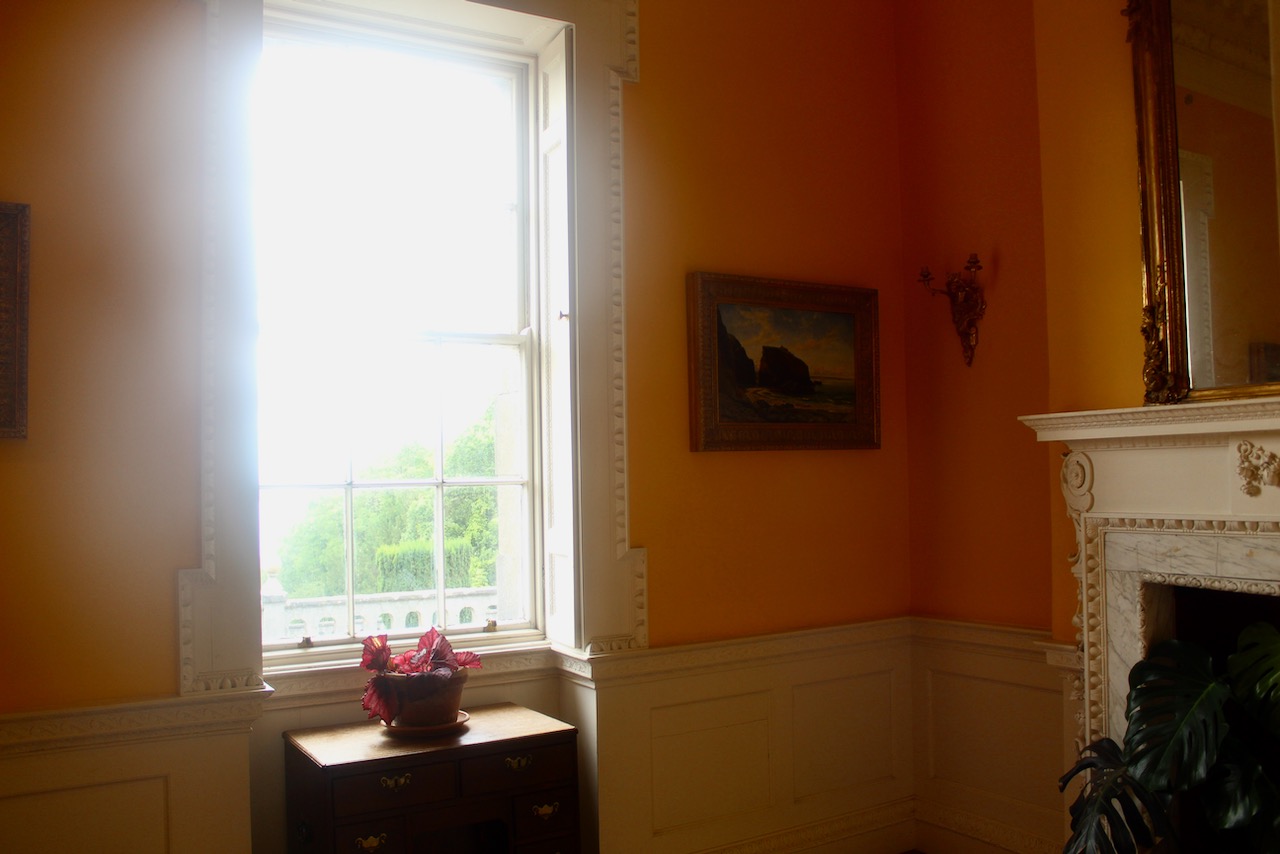
Kinnitty Castle Hotel, 2014, photographer unknown, for Tourism Ireland, Ireland’s Content Pool. (see [2])
This room is now a dining room, 2023. Photograph © Jennifer Winder-Baggot, www.irishhistorichouses.com
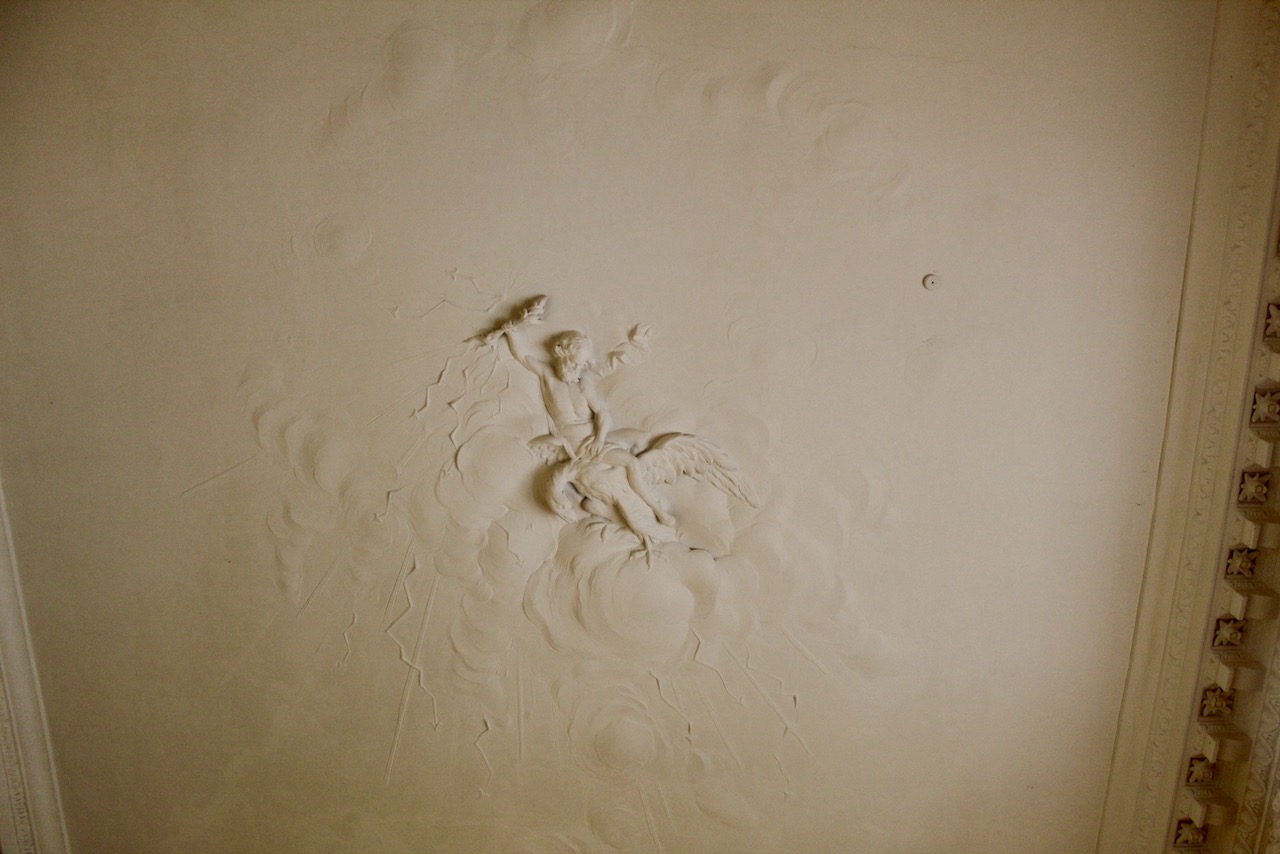
The Library Bar in Kinnitty Castle. Photograph © Jennifer Winder-Baggot, www.irishhistorichouses.com
Another hallway in Kinnitty Castle. Photograph © Jennifer Winder-Baggot, www.irishhistorichouses.com
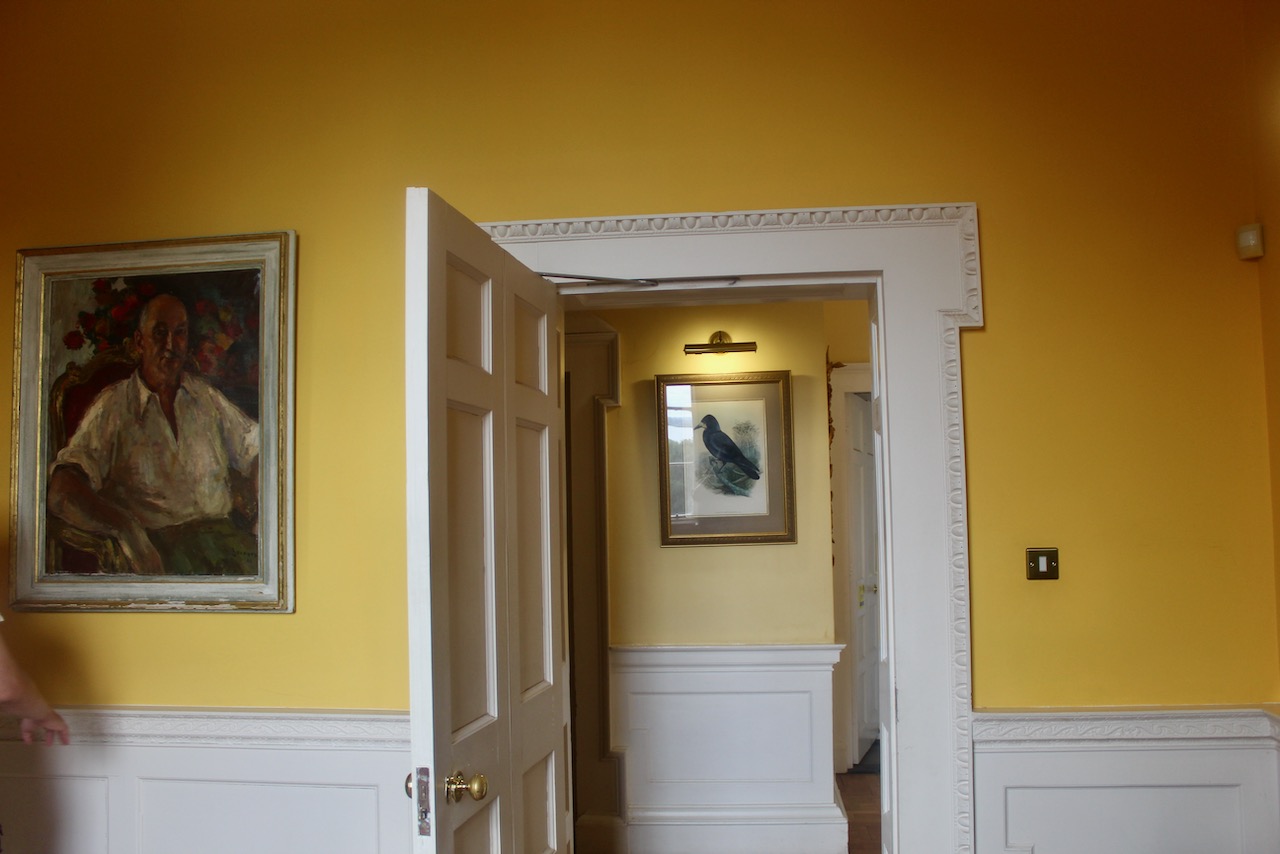
Our lovely bedroom at Kinnitty Castle. Photograph © Jennifer Winder-Baggot, www.irishhistorichouses.com
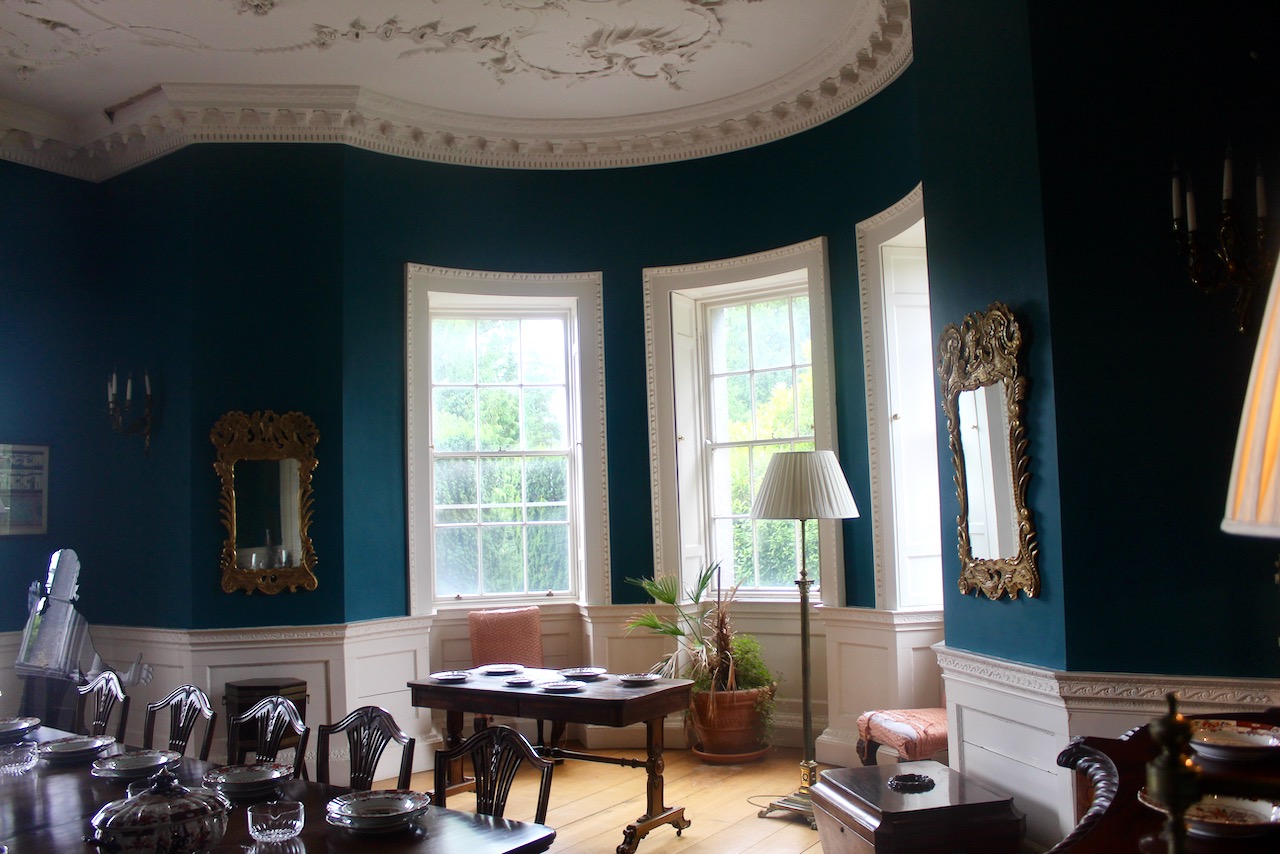
Photograph © Jennifer Winder-Baggot, www.irishhistorichouses.com

The Stable yard is in use as a banqueting hall, called the Great Hall of the O’Carrolls, and kitchens.

There’s even an arrow loop in the ruins by the stable yard. Photograph © Jennifer Winder-Baggot, www.irishhistorichouses.com
The stableyard of Kinnitty Castle. Photograph © Jennifer Winder-Baggot, www.irishhistorichouses.com
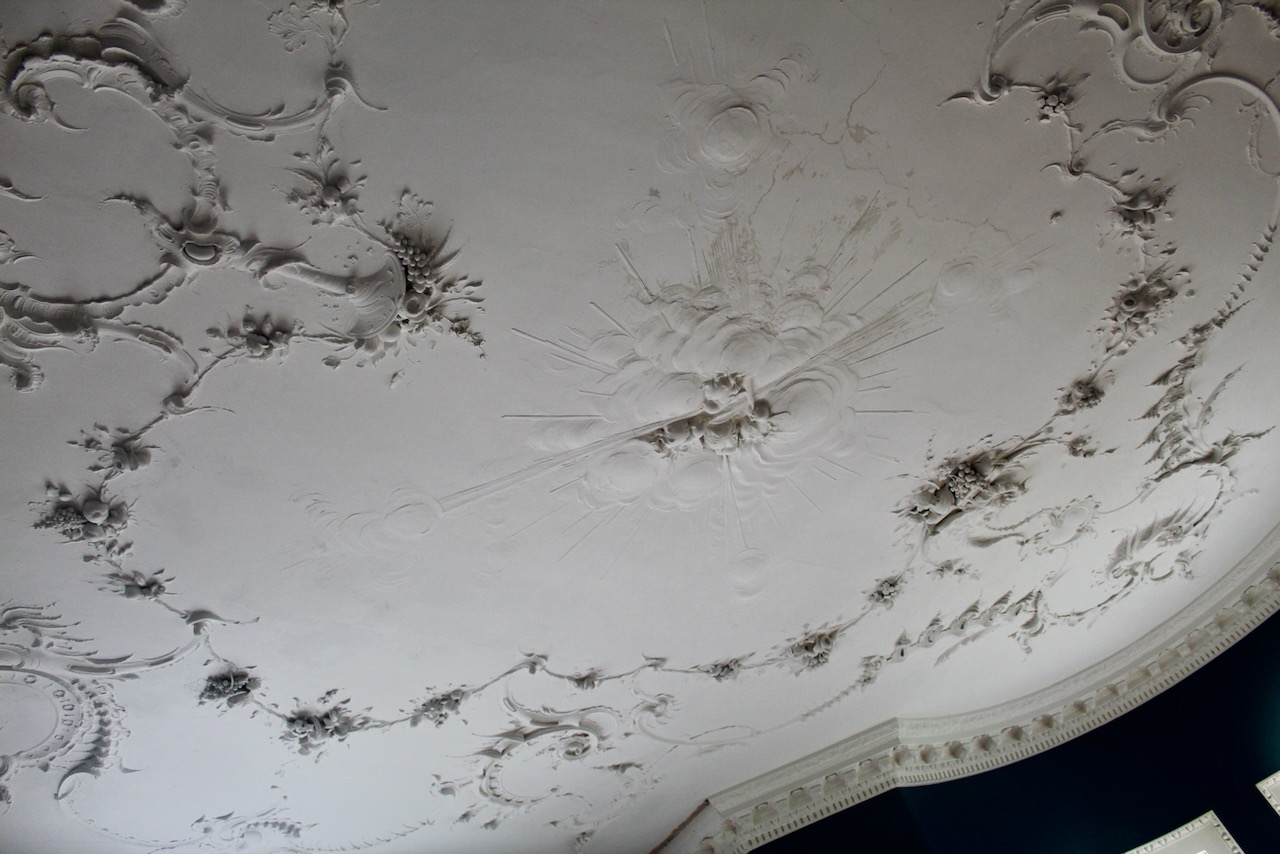
The Banqueting Hall in the stable yard of Kinnitty Castle. Photograph © Jennifer Winder-Baggot, www.irishhistorichouses.com
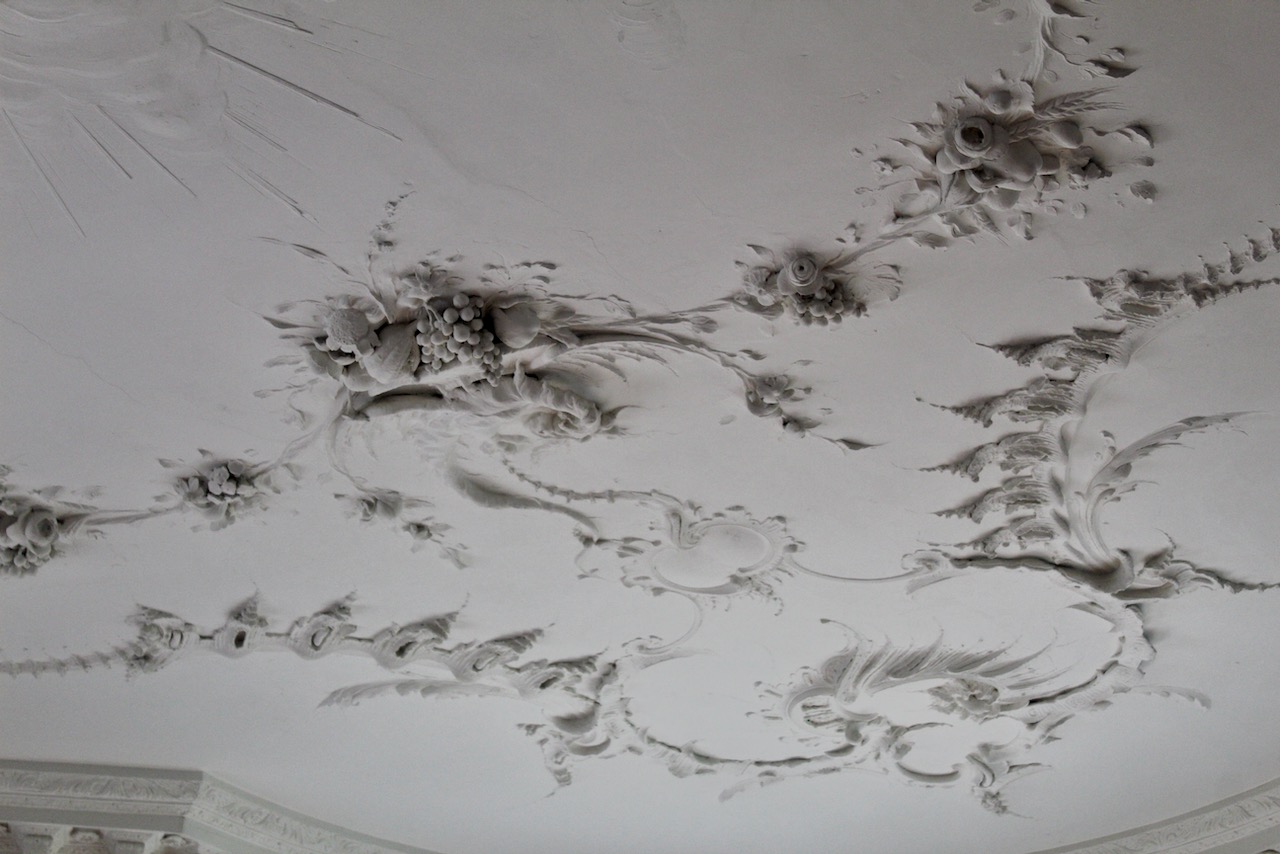
The Banqueting Hall of Kinnitty Castle has a mezzanine, or Minstrels Gallery. Photograph © Jennifer Winder-Baggot, www.irishhistorichouses.com
The Banqueting Hall of Kinnitty Castle. Photograph © Jennifer Winder-Baggot, www.irishhistorichouses.com
Photograph © Jennifer Winder-Baggot, www.irishhistorichouses.com

There’s a bar in the cellar of the hotel, called the Dungeon Bar.

The Dungeon Bar in the basement of the hotel. Photograph © Jennifer Winder-Baggot, www.irishhistorichouses.com
A snug in the Dungeon Bar. Photograph © Jennifer Winder-Baggot, www.irishhistorichouses.com
An old horse trough in the rather ecclesiastical bar looks for a moment like a coffin! Photograph © Jennifer Winder-Baggot, www.irishhistorichouses.com
The atmospheric Dungeon Bar at Kinnitty Castle. Photograph © Jennifer Winder-Baggot, www.irishhistorichouses.com

The River Camcor winds through the property.

A map of the Demesne at Kinnitty.
The River Camcor crosses the property at Kinnity Castle, and one can go for lovely walks in the grounds, along the river. Photograph © Jennifer Winder-Baggot, www.irishhistorichouses.com
The bridge has odd sunburst decorative iron circular framing at one end. Photograph © Jennifer Winder-Baggot, www.irishhistorichouses.com
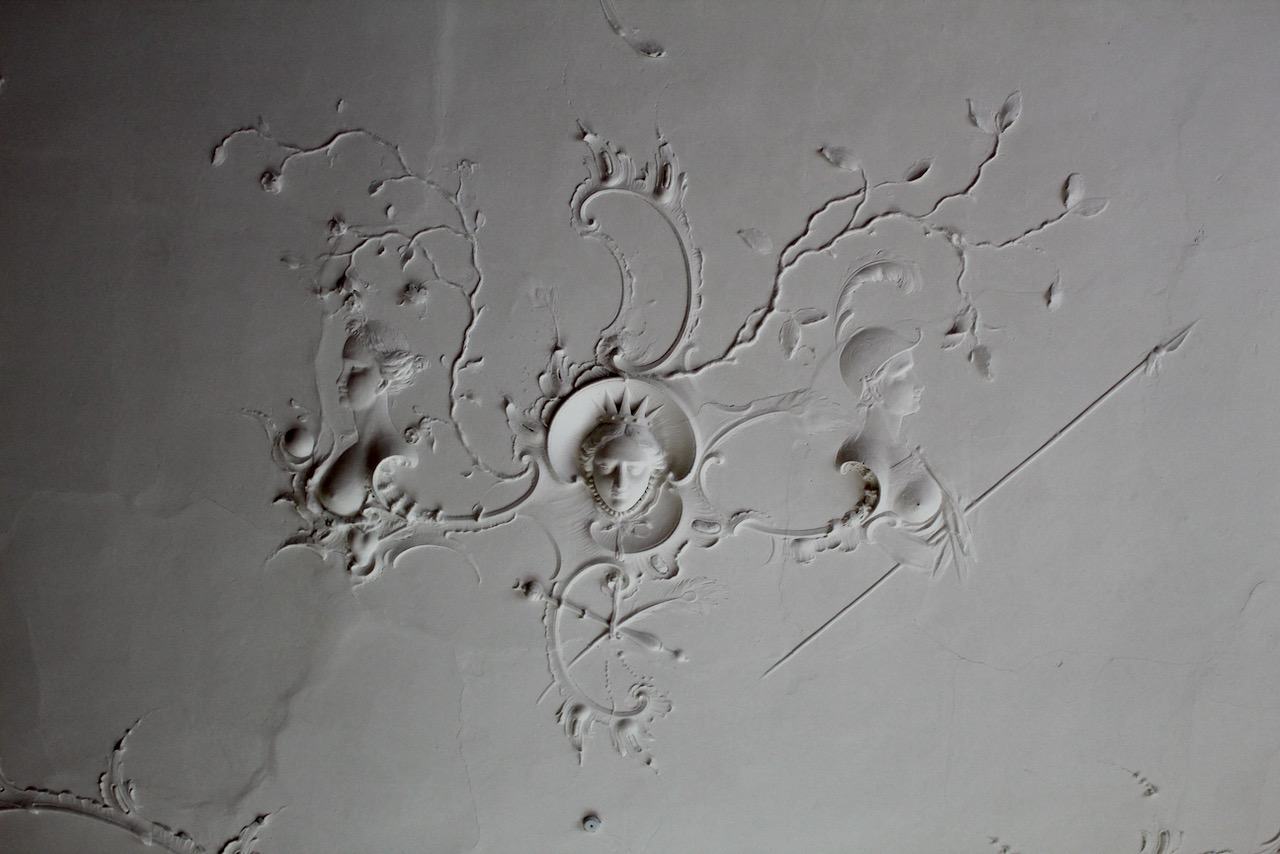
The gate lodge at Kinnity used to be the Day Spa but is was empty when we visited in February 2023, perhaps a victim of Covid. The National Inventory tells us that it was built around 1835. Photograph © Jennifer Winder-Baggot, www.irishhistorichouses.com
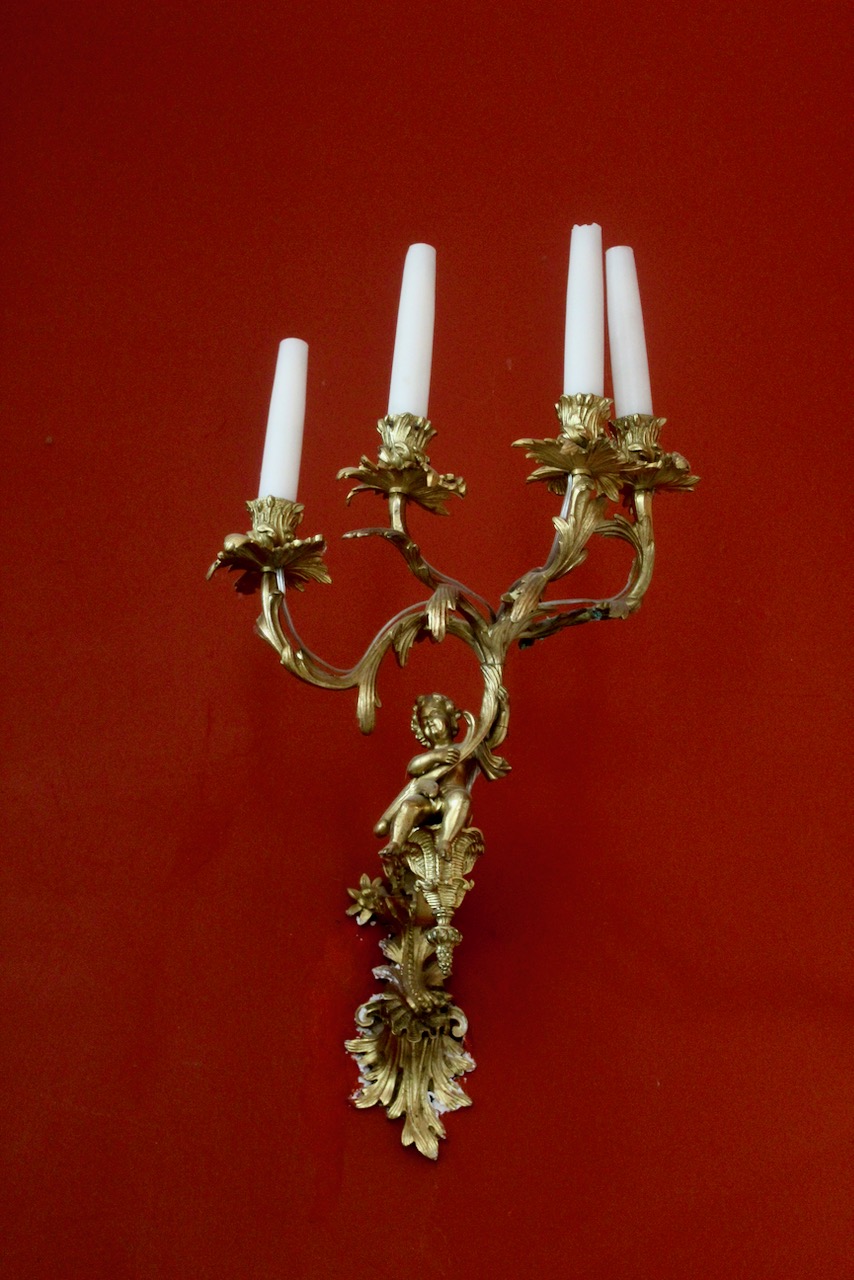
3. Loughton House, County Offaly see above

https://loughtonhouse.com

4. The Maltings, Castle Street, Birr, Co. Offaly

www.canbe.ie

(Tourist Accommodation FacilityOpen in 2025: all year

The Maltings accommodation, Birr, County Offaly. Photograph © Jennifer Winder-Baggot, www.irishhistorichouses.com
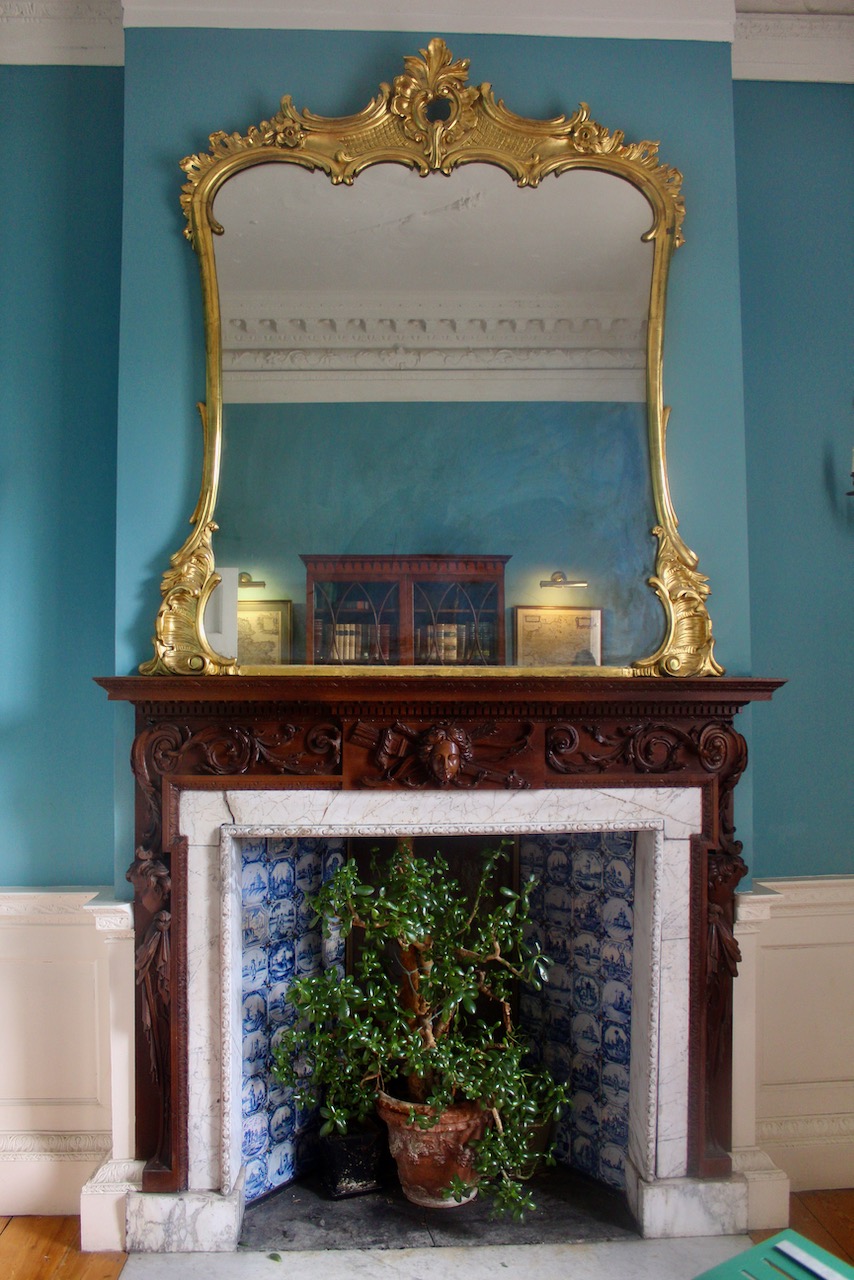
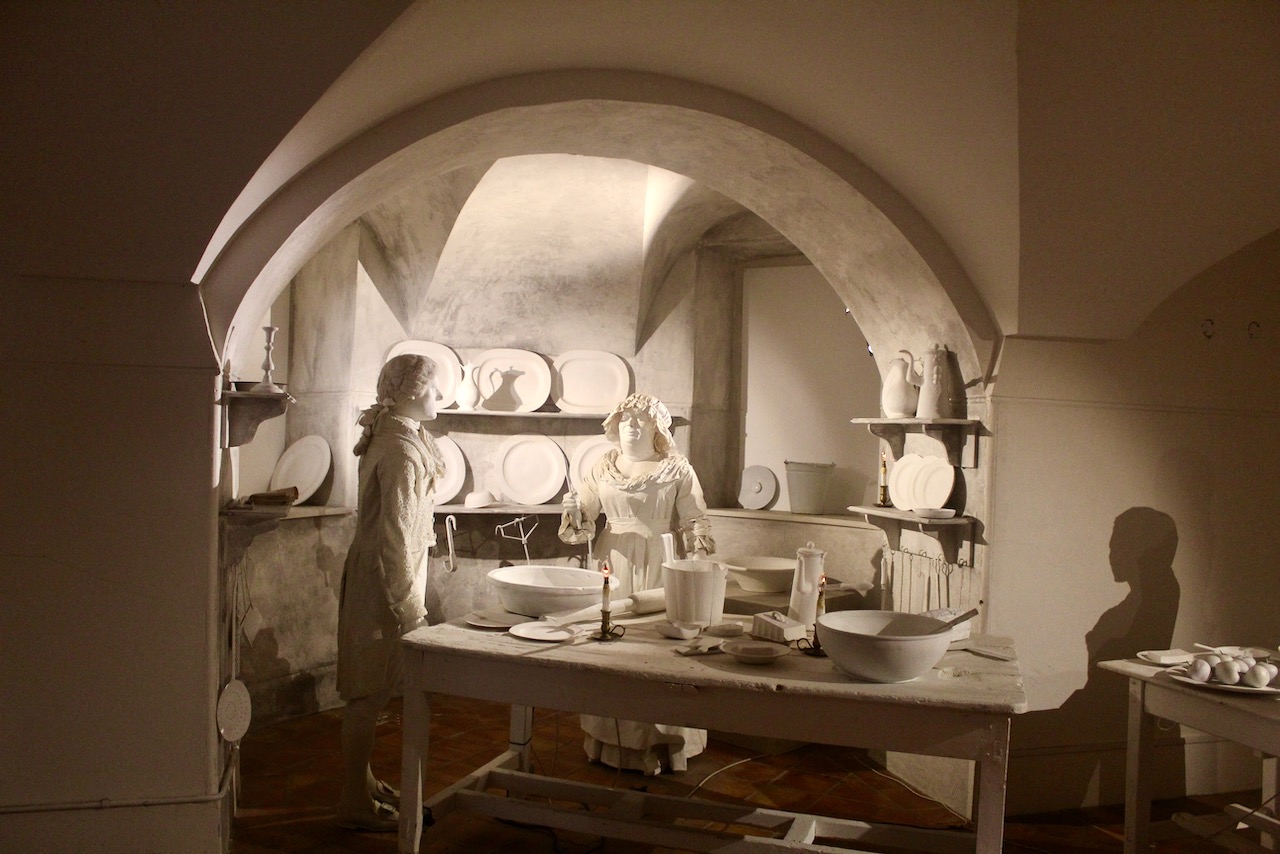
Whole house rental, County Offaly:

1. Ballycumber, County Offaly – whole house rental (13 guests)

https://www.airbnb.ie/rooms/21064152?source_impression_id=p3_1646848147_zcYarfp2zhDKFdHo

The National Inventory of Architectural Heritage tells us about Ballycumber:

Originally built as a castle in 1627 and remodelled at a later date, the regular from of this well proportioned house is enhanced by architectural detailing such as the finally executed doorcase and attractive, steeply-pitched hipped roof. The building retains many notable features and materials such as the timber sash windows with the date plaque, which adds historical interest to the site. The related outbuildings and walled garden create an interesting group of agricultural structures, while the folly and landscaped tree-lined river walk make a positive contribution to the setting of the house, reflecting the era of the large country estate.
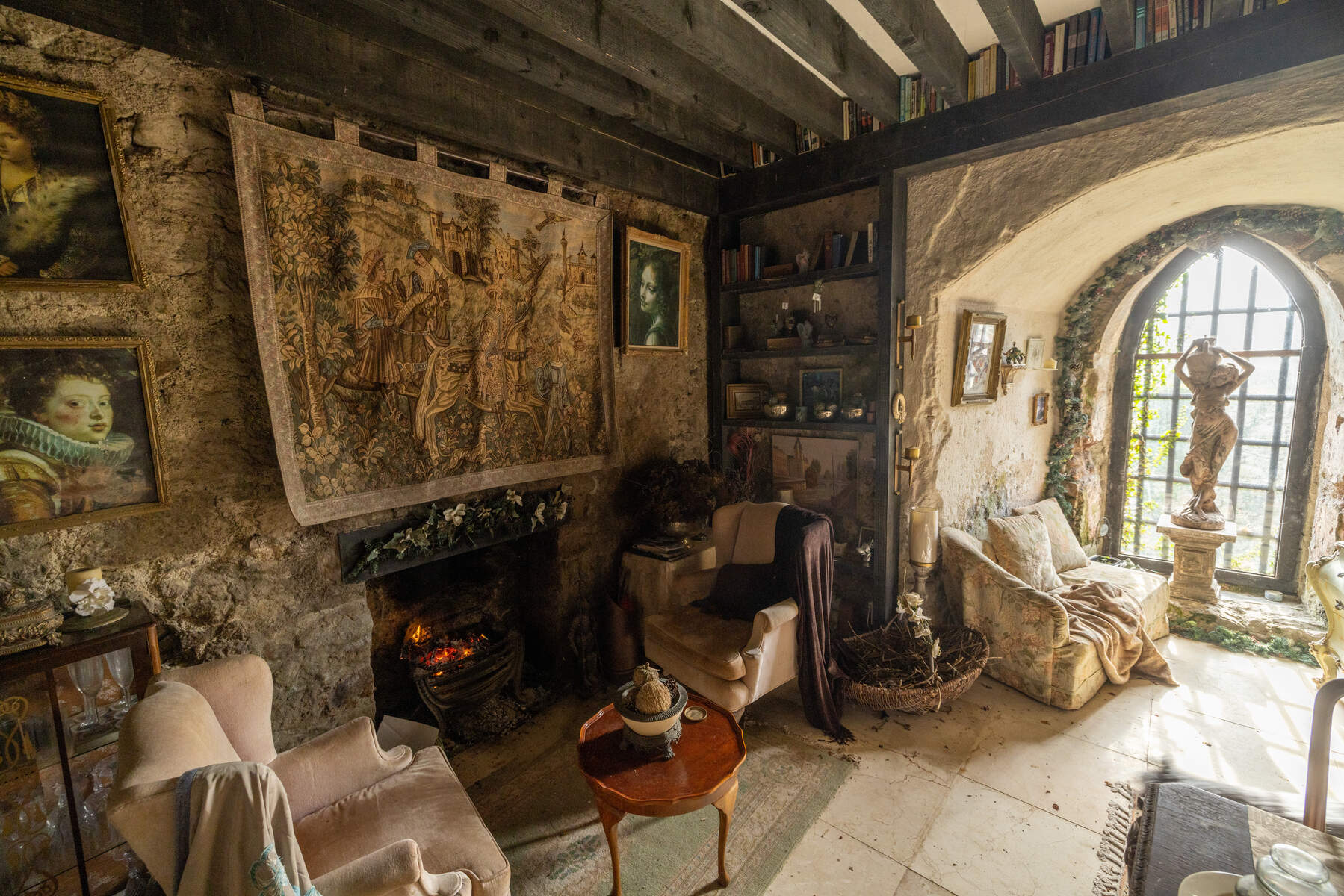
The Offaly history blog tells us more about the occupants of Ballycumber:

Ballycumber House was bought by Francis Berry Homan Mulock in 1899 from the Armstrong family who had been in possession of the estate for successive generations. Originally built as a castle in 1627 by the Coghlan family, it was extensively remodelled by the Armstrongs in the eighteenth century into a detached five-bay two storey over basement country house, much as it is today.” [7]

I would love to stay at Ballycumber because the Bagot family of County Offaly intermarried with the Armstrong family who owned Ballycumber. I’m not sure if my own Baggot family is related to the Bagots of Offaly but there is a good possibility!

2. Loughton House, County Offaly – see above

[1] https://www.irelandscontentpool.com/en

[2] Bence-Jones, Mark. A Guide to Irish Country Houses (originally published as Burke’s Guide to Country Houses volume 1 Ireland by Burke’s Peerage Ltd. 1978); Revised edition 1988 Constable and Company Ltd, London.

[4] p. 136. O’Reilly, Sean. Irish Houses and Gardens. From the Archives of Country Life. Aurum Press Ltd, London, 1998. 

[5] https://www.buildingsofireland.ie/buildings-search/building/14942001/corolanty-house-curralanty-offaly

[6] https://www.ihh.ie/index.cfm/houses/house/name/Gloster%20House

[7] https://offalyhistoryblog.wordpress.com/2018/03/31/sun-too-slow-sun-too-fast-ethel-and-enid-homan-mulock-of-ballycumber-house-by-lisa-shortall/

Text © Jennifer Winder-Baggot, www.irishhistorichouses.com