Tintern Abbey, County Wexford – an OPW property

Tintern Abbey, County Wexford
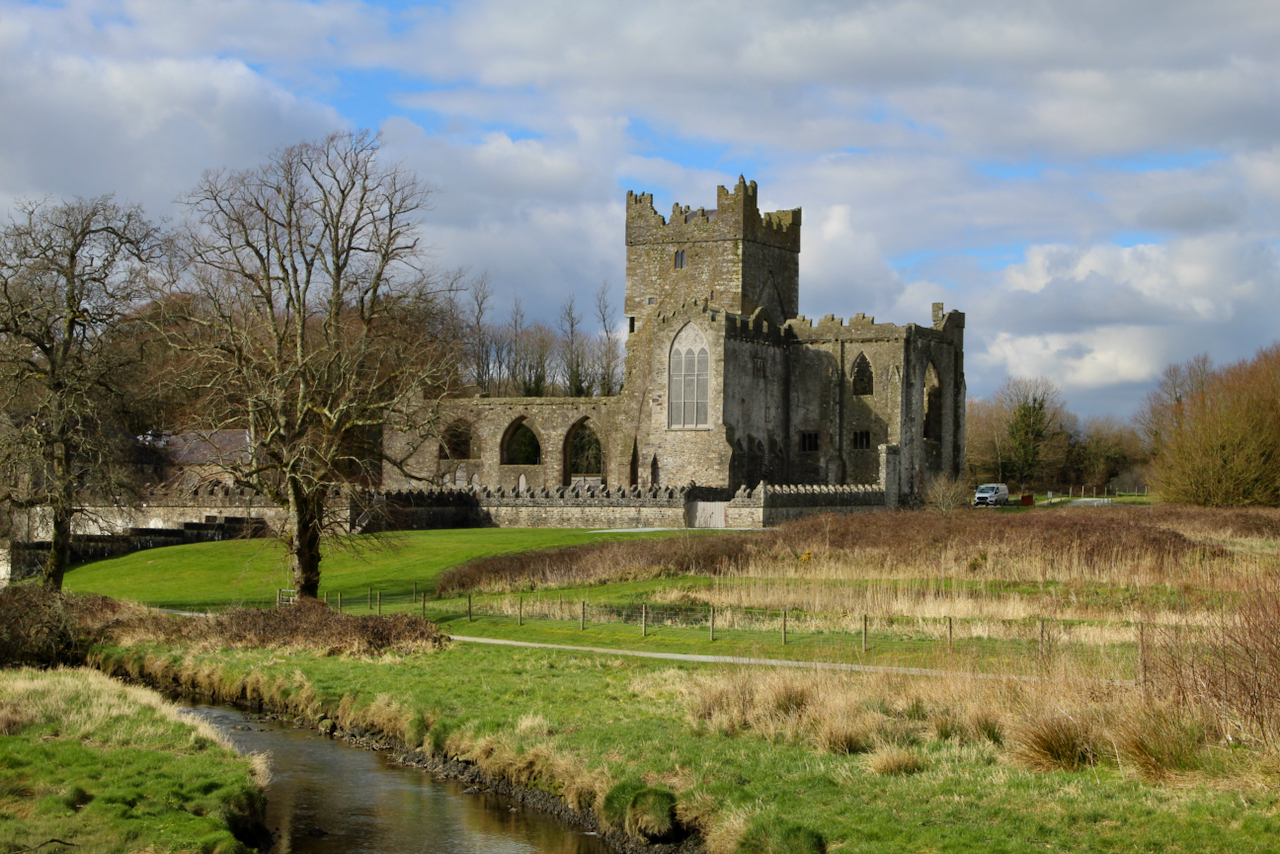
Tintern Abbey, County Wexford, 15th March 2025. Photograph © Jennifer Winder-Baggot, www.irishhistorichouses.com

General information: 051 562650, tinternabbey@opw.ie

donation

Help me to pay the entrance fee to one of the houses on this website. This site is created purely out of love for the subject and I receive no payment so any donation is appreciated!

€15.00

We visited Tintern Abbey when we were in Wexford in May 2023. We visited again recently as it had rained on our previous visit and we didn’t get to to go to Colclough walled garden, so we made a beeline for the walled garden on our second visit.

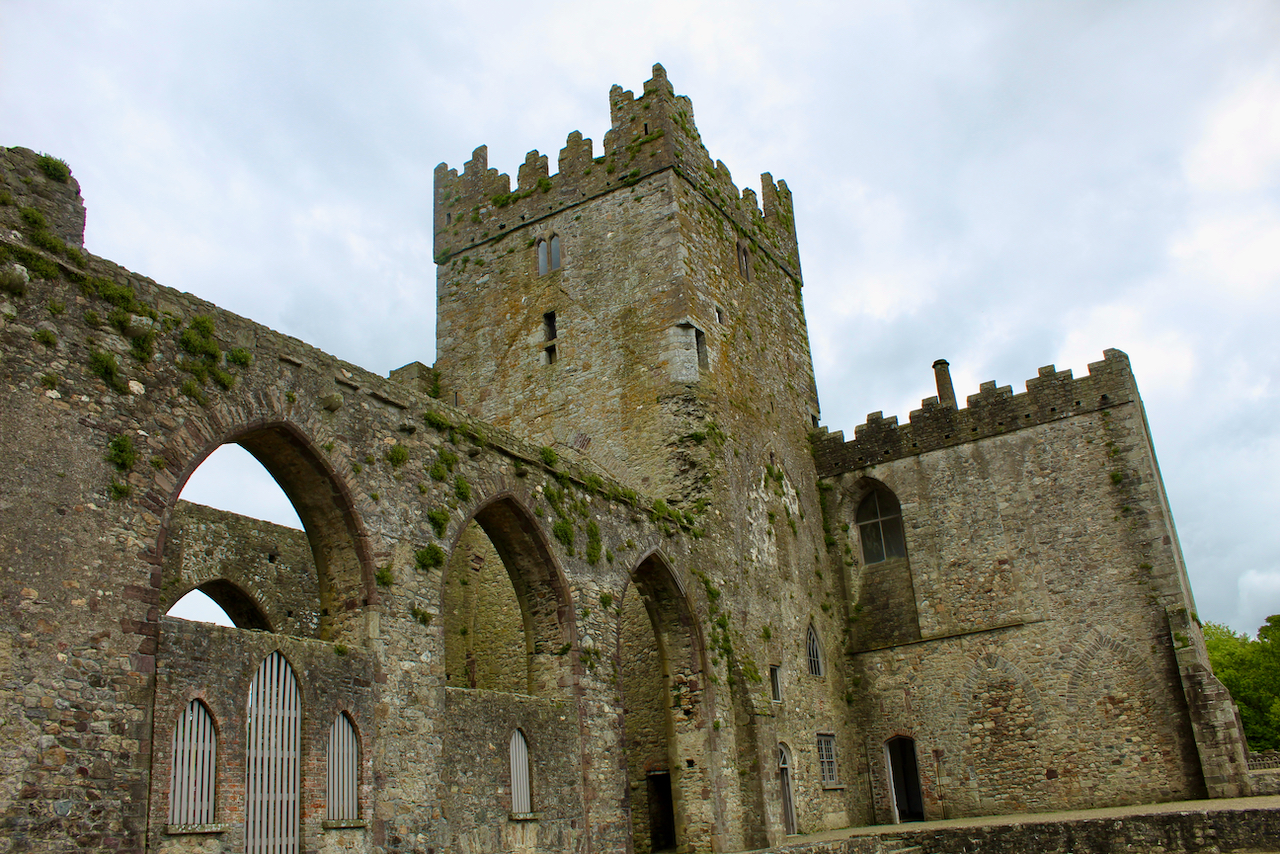
Tintern Abbey, photograph by Brian Morrison, 2017 for Tourism Ireland, Ireland’s Content Pool. [see 1]
Tintern Abbey, County Wexford, May 2023. Photograph © Jennifer Winder-Baggot, www.irishhistorichouses.com
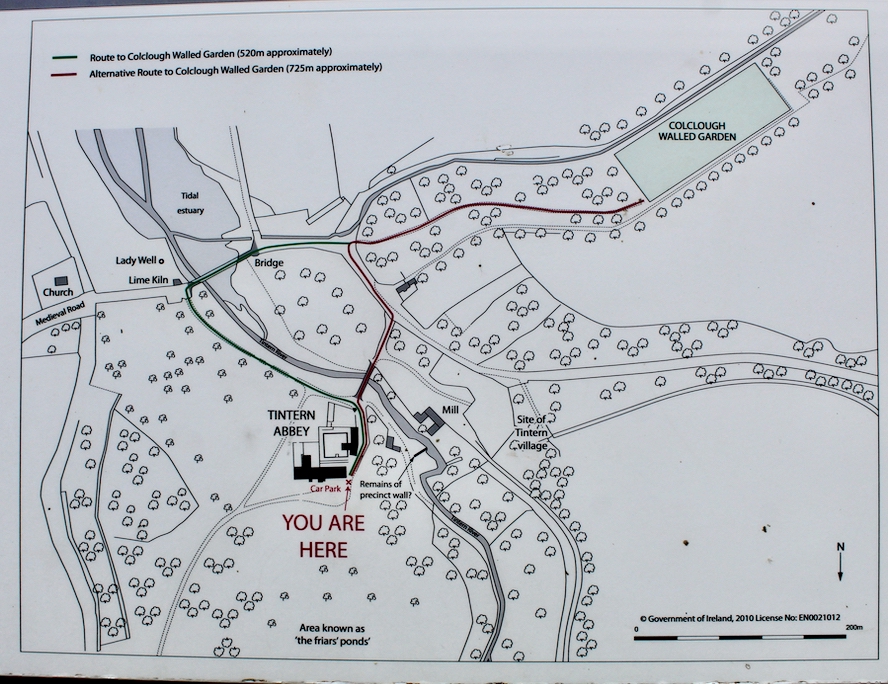
Tintern Abbey and Colclough Walled Garden.

The Abbey was converted into a residence after the Dissolution of the Monasteries in King Henry VIII’s time. When the Abbey was gifted to the state, the Irish Board of Works immediately demolished the residence, so that the building was left a ruin. It was only two decades later that the Board of Works began to conserve the property.

Tintern Abbey, County Wexford, May 2023. Photograph © Jennifer Winder-Baggot, www.irishhistorichouses.com

The OPW website https://heritageireland.ie/visit/places-to-visit/tintern-abbey/ tells us that the Abbey was founded as a Cistercian monastery around the year 1200 by William Marshall, 1st Earl of Pembroke, who became Lord of Leinster as he married Isabella de Clare, the daughter of “Strongbow,” Richard de Clare, 2nd Earl of Pembroke. Marshall vowed to create an abbey wherever he could safely land in Ireland during a storm, and he landed in Bannow Bay. Tintern Abbey is located at the head of a small inlet of the sea, next to a stream that provided fresh water. The Abbey was founded as a “daughter house” of Tintern Abbey in Wales, made famous by poet William Wordsworth. To distinguish it from the Welsh abbey, Wexford’s Abbey was also called “Tintern de Voto” meaning “of the vow.”
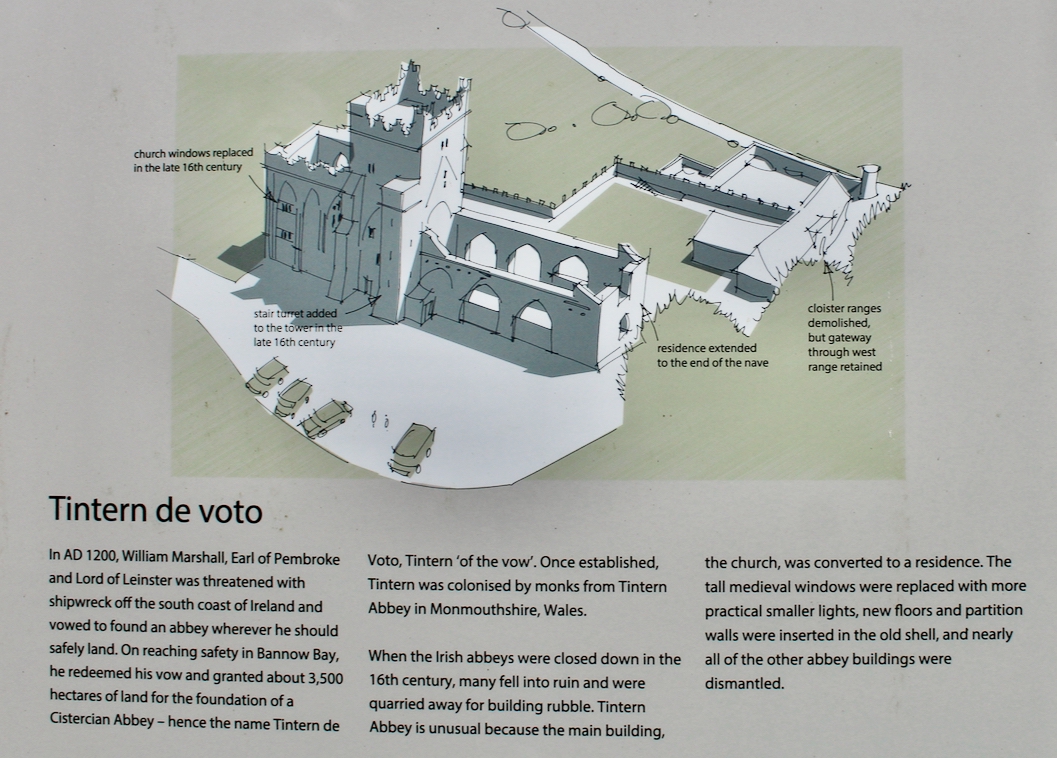
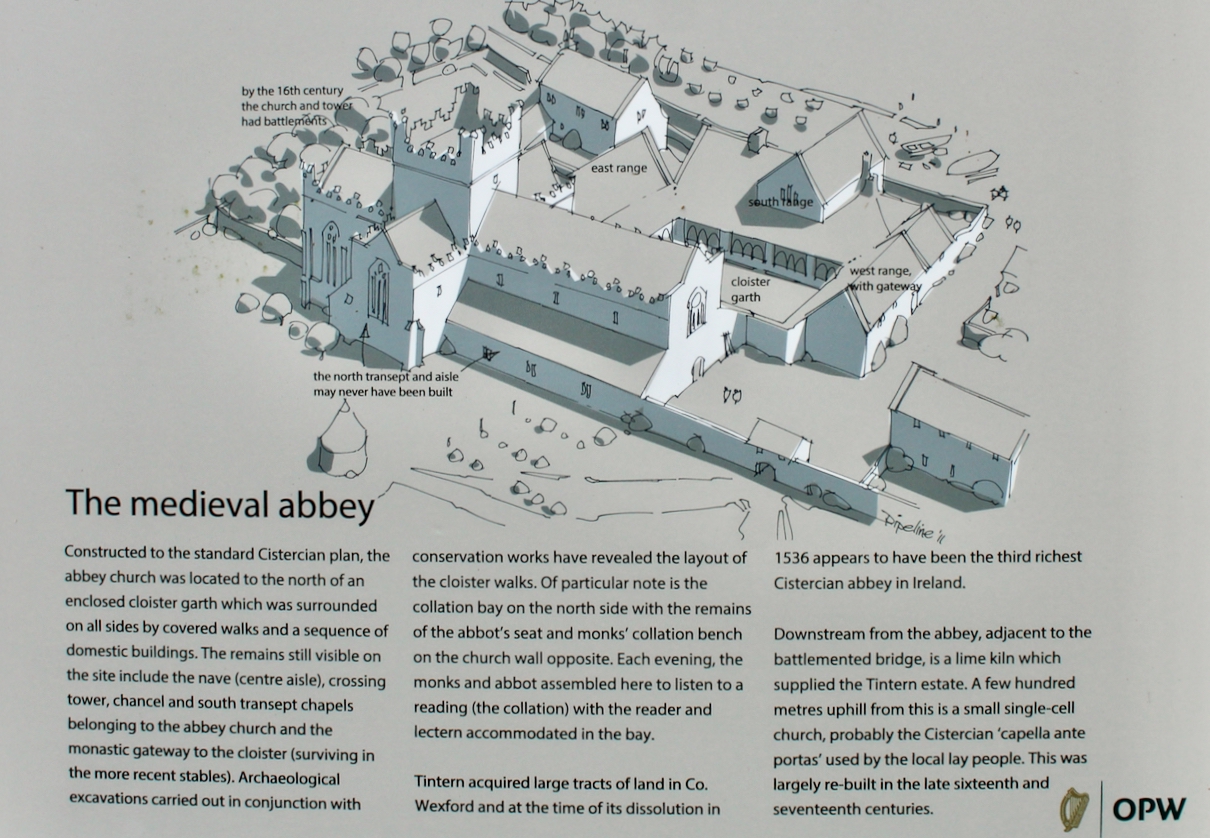
OPW notice board. Reconstruction drawings by Daniel Tietzsch-Tyler.
Tintern Abbey, County Wexford, May 2023. Photograph © Jennifer Winder-Baggot, www.irishhistorichouses.com
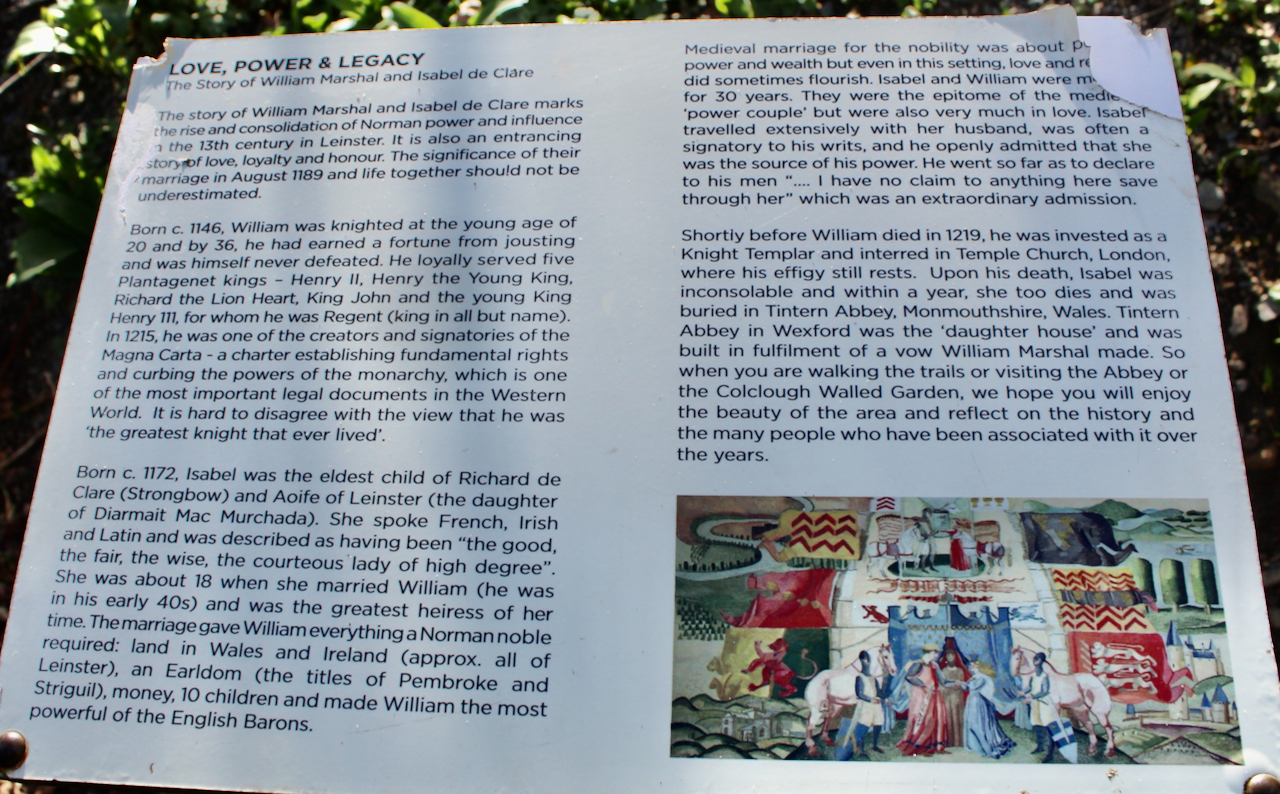
The story of the marriage of William Marshall and Isabel de Clare.

After the dissolution of the monasteries by Thomas Cromwell and King Henry VIII, Tintern Abbey was granted to a soldier, Anthony Colclough (d. 1584).

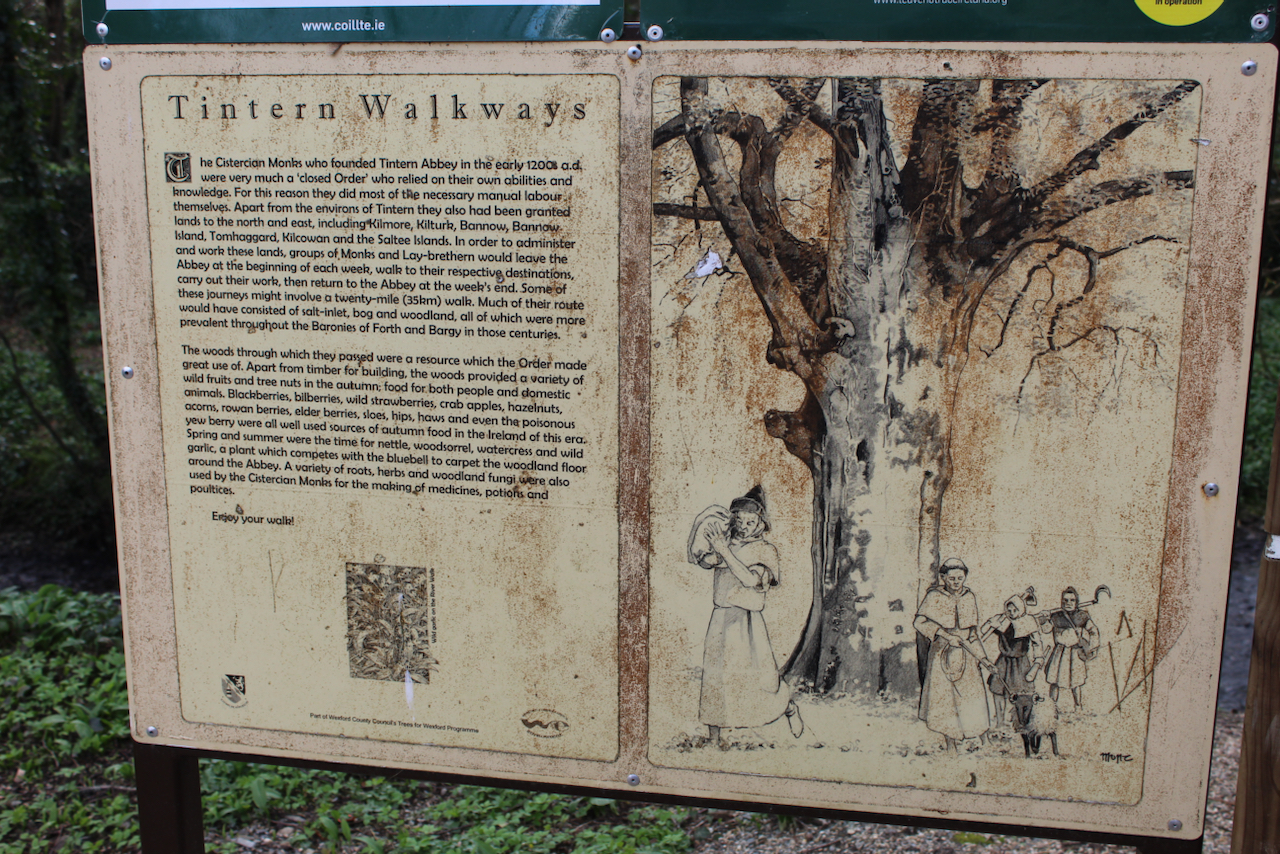
Information boards tell us about the history of the Abbey and the Cistercian Order, which was based on a strict interpretation of Benedictine rule. The monks would have lived according to a spartan routine of prayer and manual labour. Most of the difficult tasks were carried out by lay brothers. The practice of having lay brothers began because initially the monks wanted to cut themselves off from the outside world and did not allow lay people on their land. However, they needed labourers, so the lay ministry was formed. Some of these lay brothers may have lived nearby in Rathumney Hall, or Castle, now a ruin. Lay brothers often lived in out-farms or “granges,” which would have their own hall, dormitory, kitchen and chapel, and the brothers would then join the monks at the Abbey at weekends.

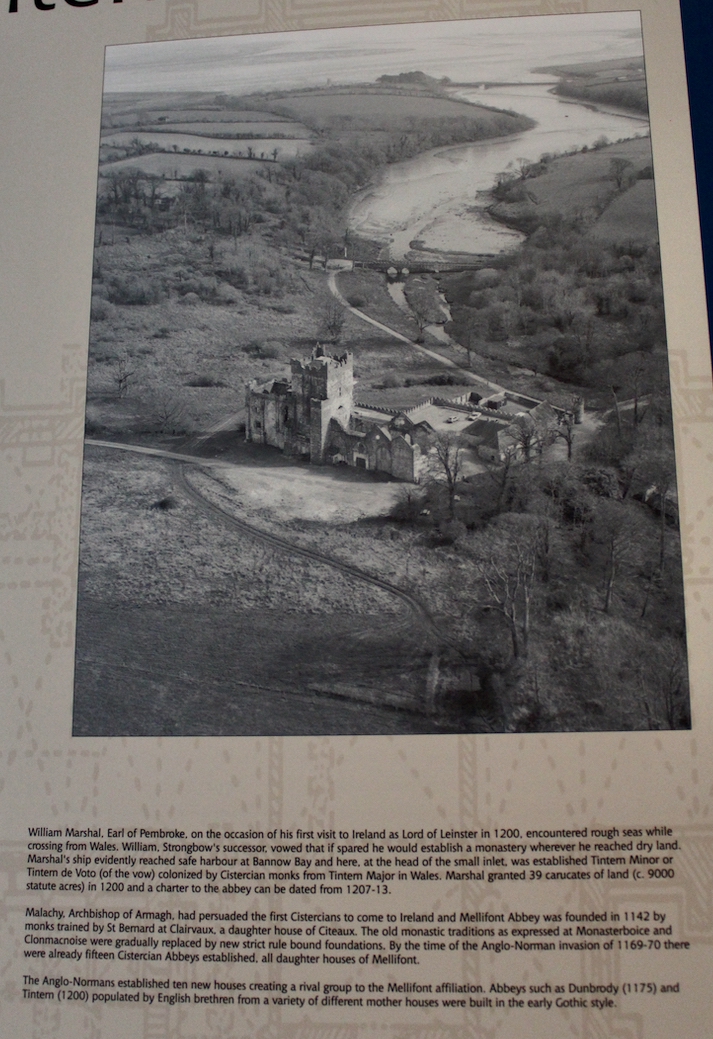
Tintern Abbey, County Wexford, May 2023.
Tintern Abbey, County Wexford, situated at the top of an inlet.
Tintern Abbey, photograph by Celtic Routes, 2019 for Tourism Ireland, Ireland’s Content Pool. [see 1]

Information boards tell us of the various phases of the Abbey. It would have been built first by lay monks, and later by the mid 1200s, by professional masons.
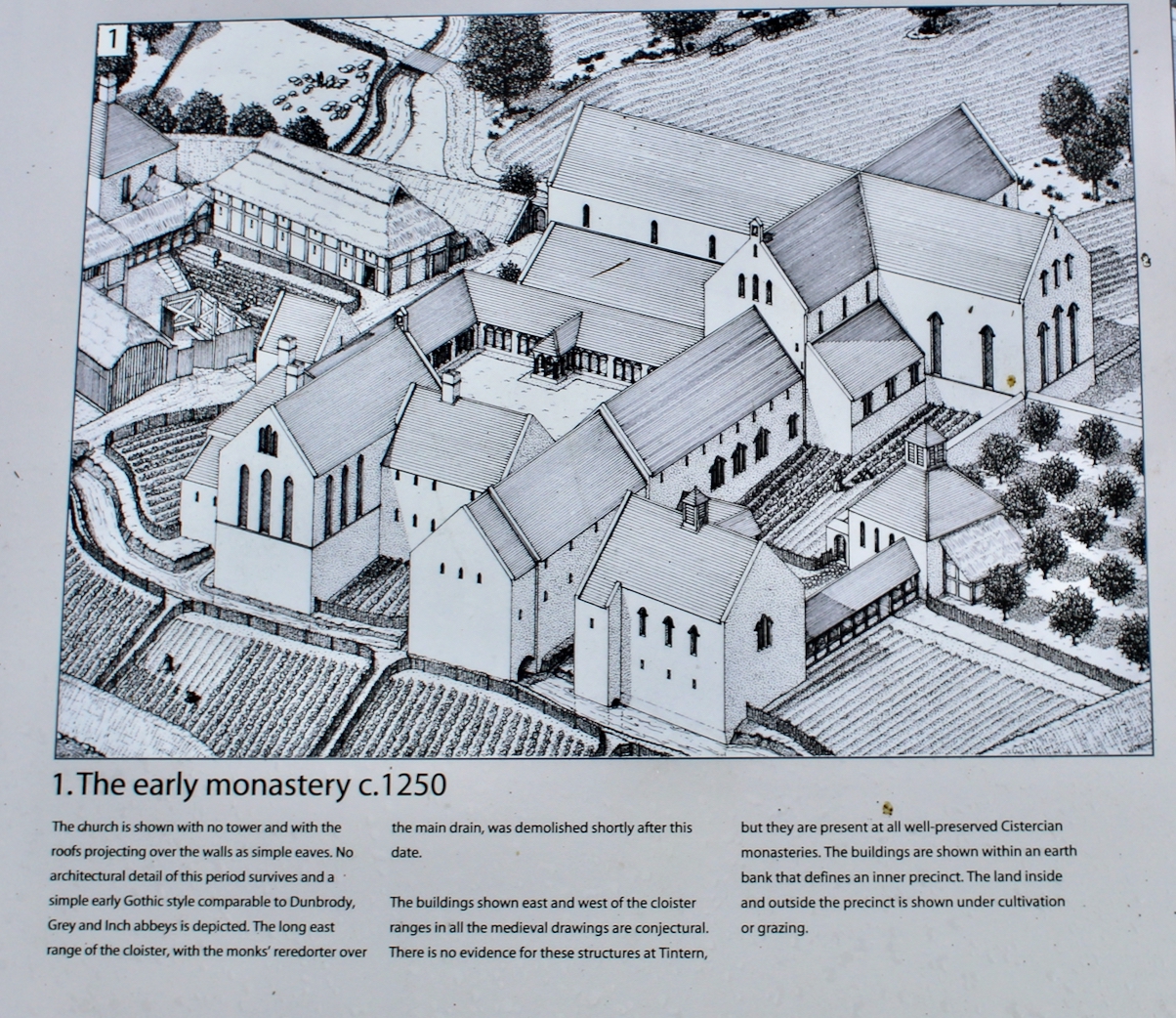
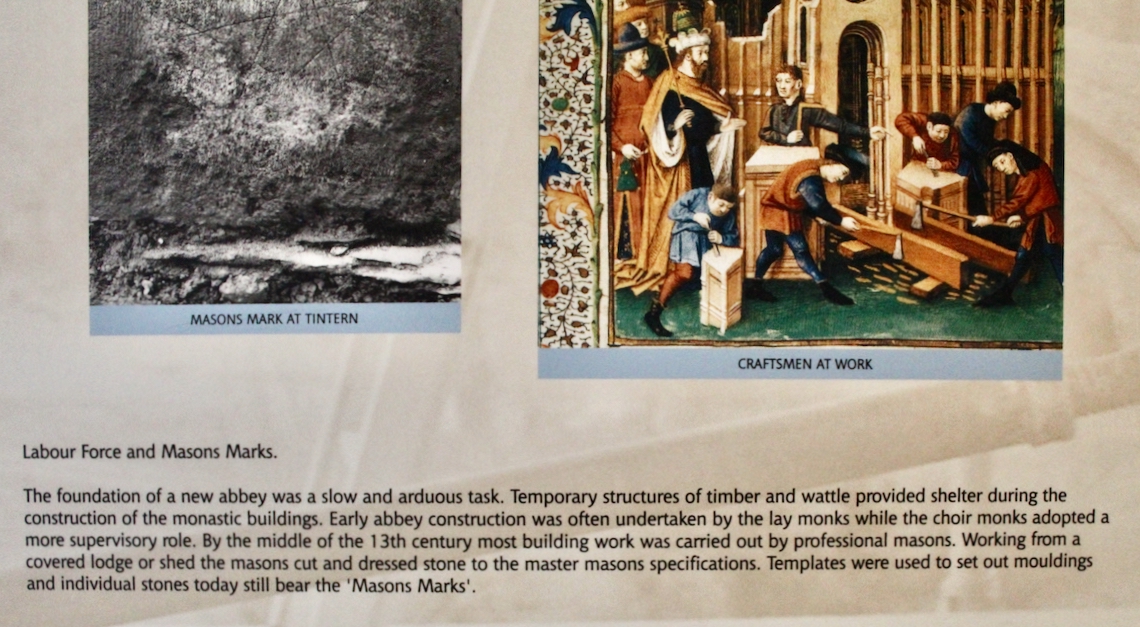
Tintern Abbey, County Wexford, May 2023. Reconstruction drawings by Daniel Tietzsch-Tyler.
Tintern Abbey, County Wexford, May 2023.
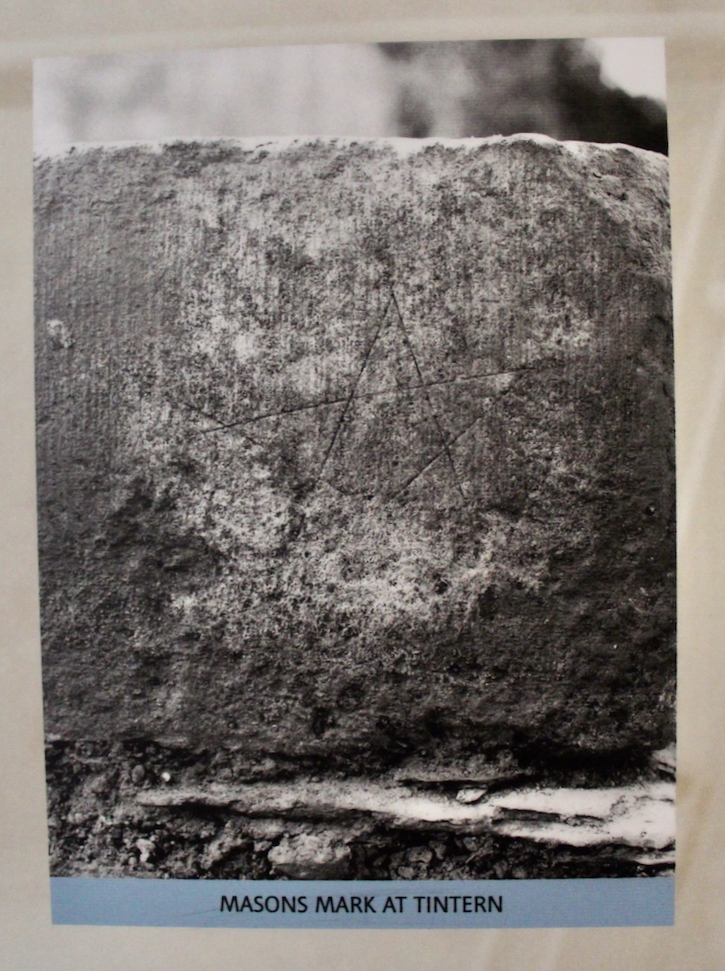
Makers Marks, from as early as the 1200s, Tintern Abbey, County Wexford, May 2023.

Cistercian simplicity was reflected in their buildings, of strong form and good building techniques. In 1140, Malachy, Bishop of Down, visited Bernard of Clairvaux. Bernard sent helped to establish the Cistercian monastery in Mellifont, County Louth, and by 1169 Ireland had fourteen Cistercian settlements. The Anglo Normans established a further ten in the fifty years after 1169, including Dunbrody Abbey, another Cistercian monastery near Tintern Abbey.

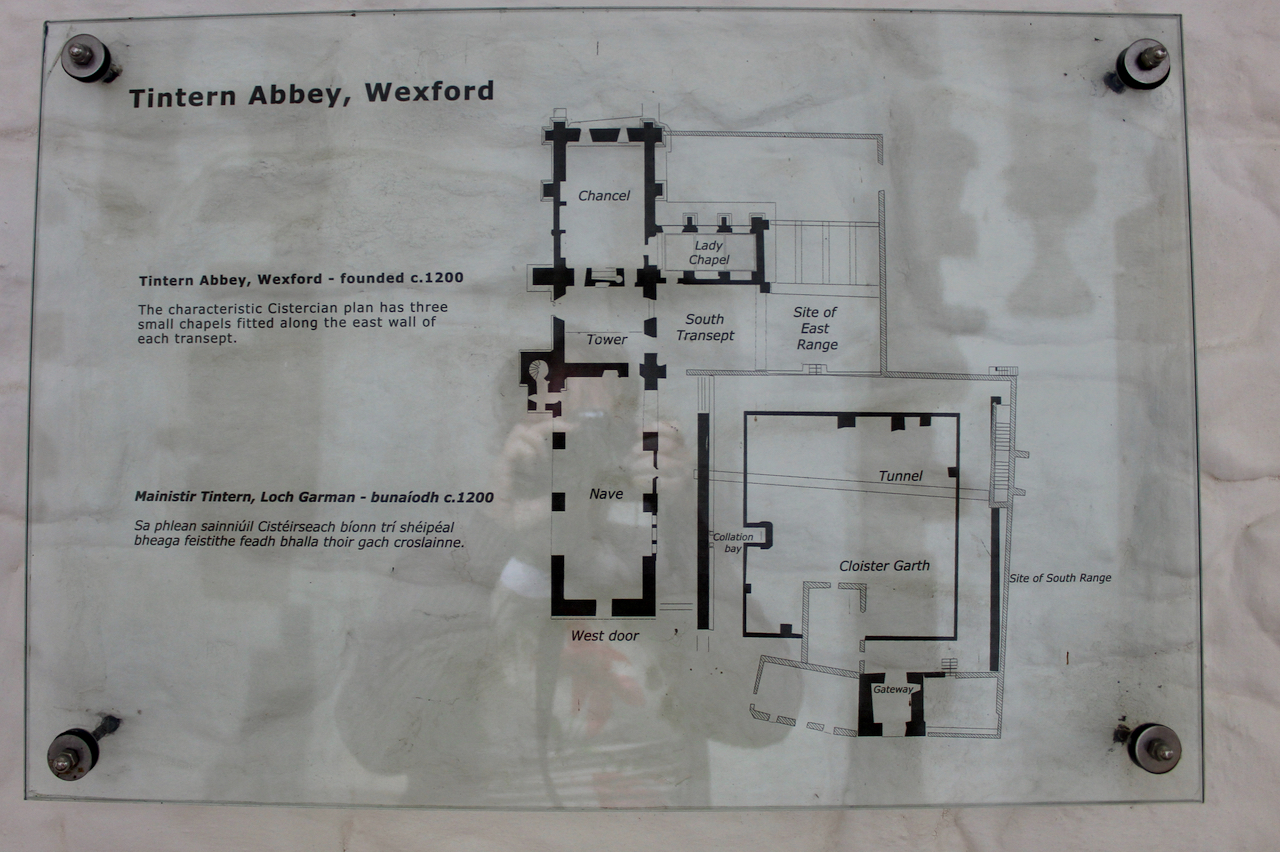
The Cistercians built according to well-established convention. The churches consisted of an aisled nave and presbytery with north and south transepts. A tower was not a usual feature. The cloister was south of the church and was surrounded by buildings such as the infirmary, dormitory, kitchen, guest house and scriptorium.
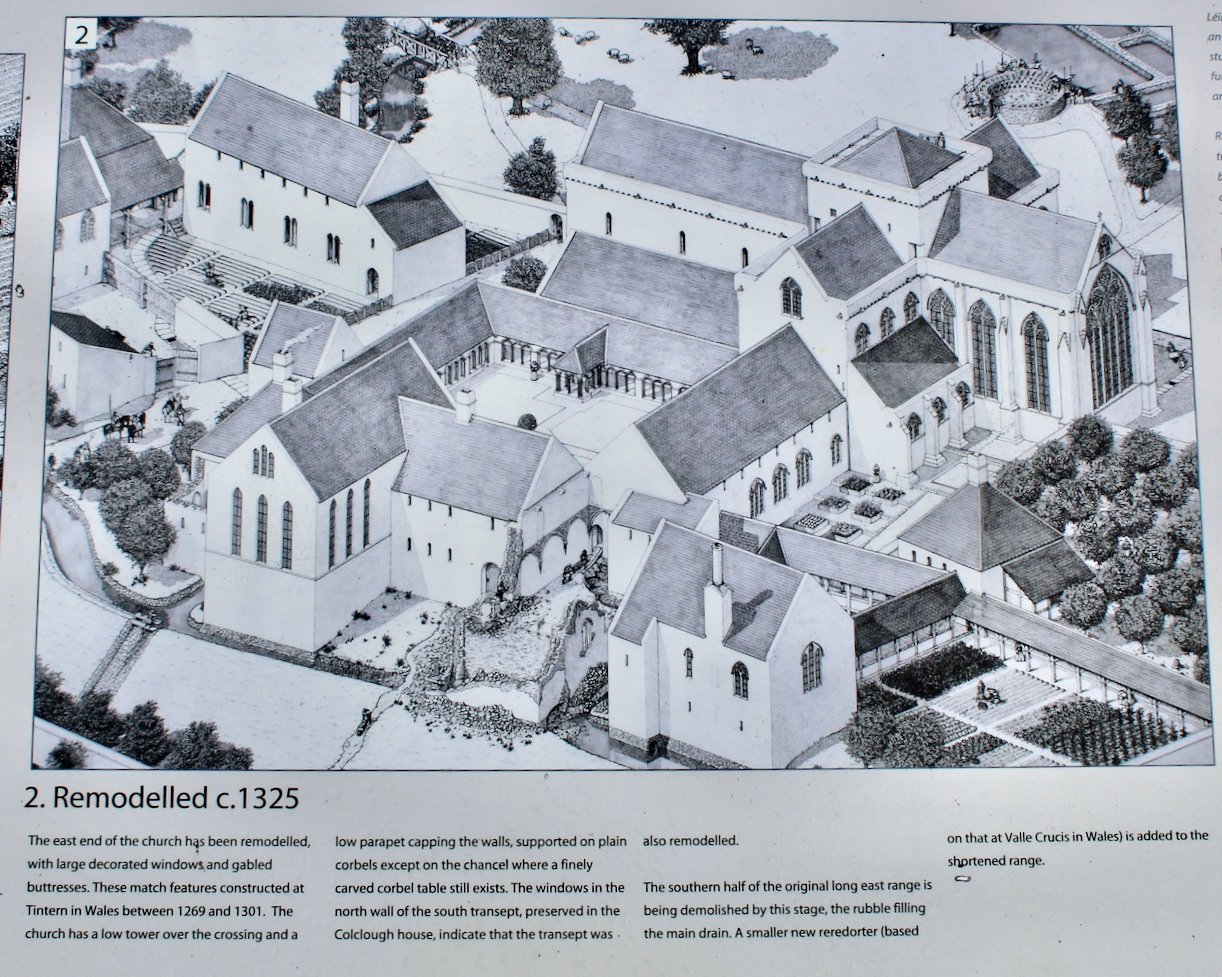
Tintern Abbey, County Wexford, May 2023. Reconstruction drawings by Daniel Tietzsch-Tyler.
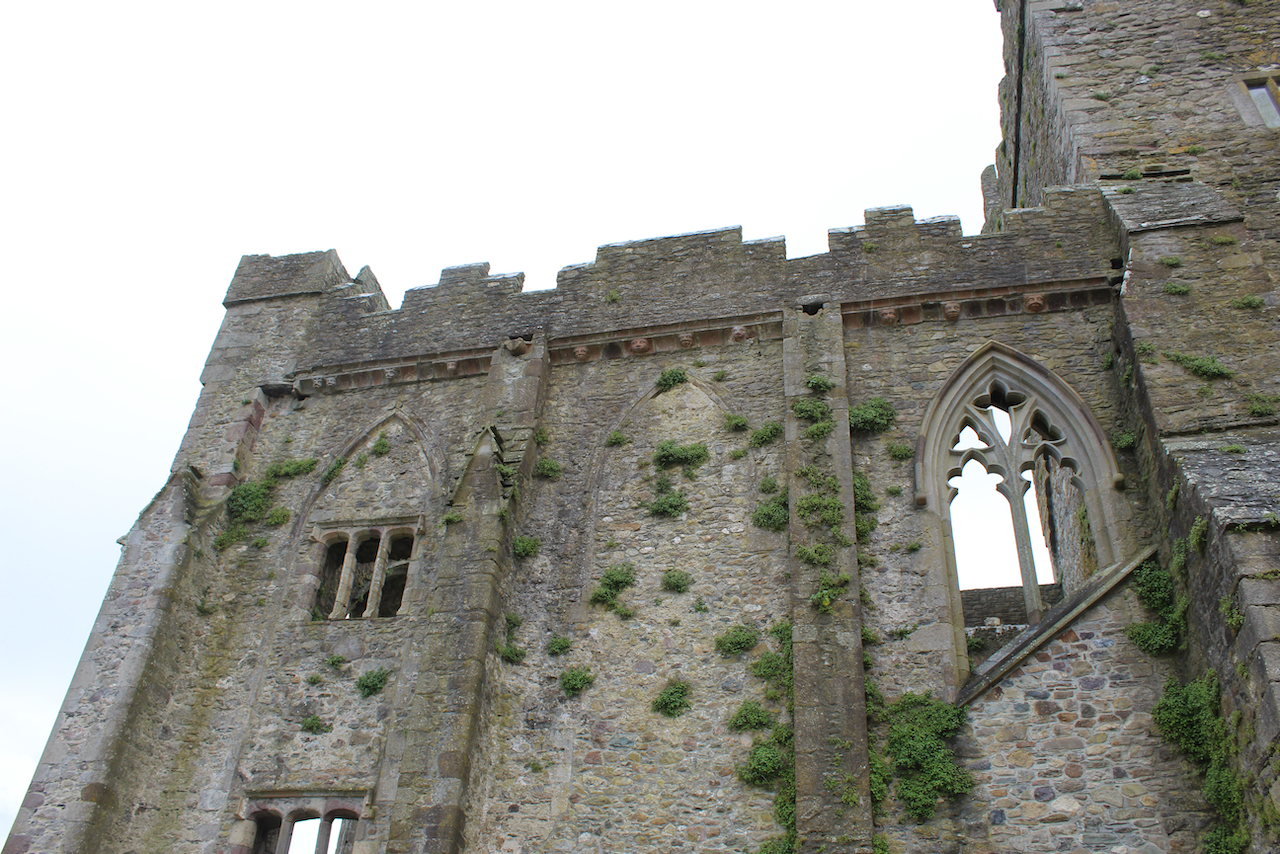
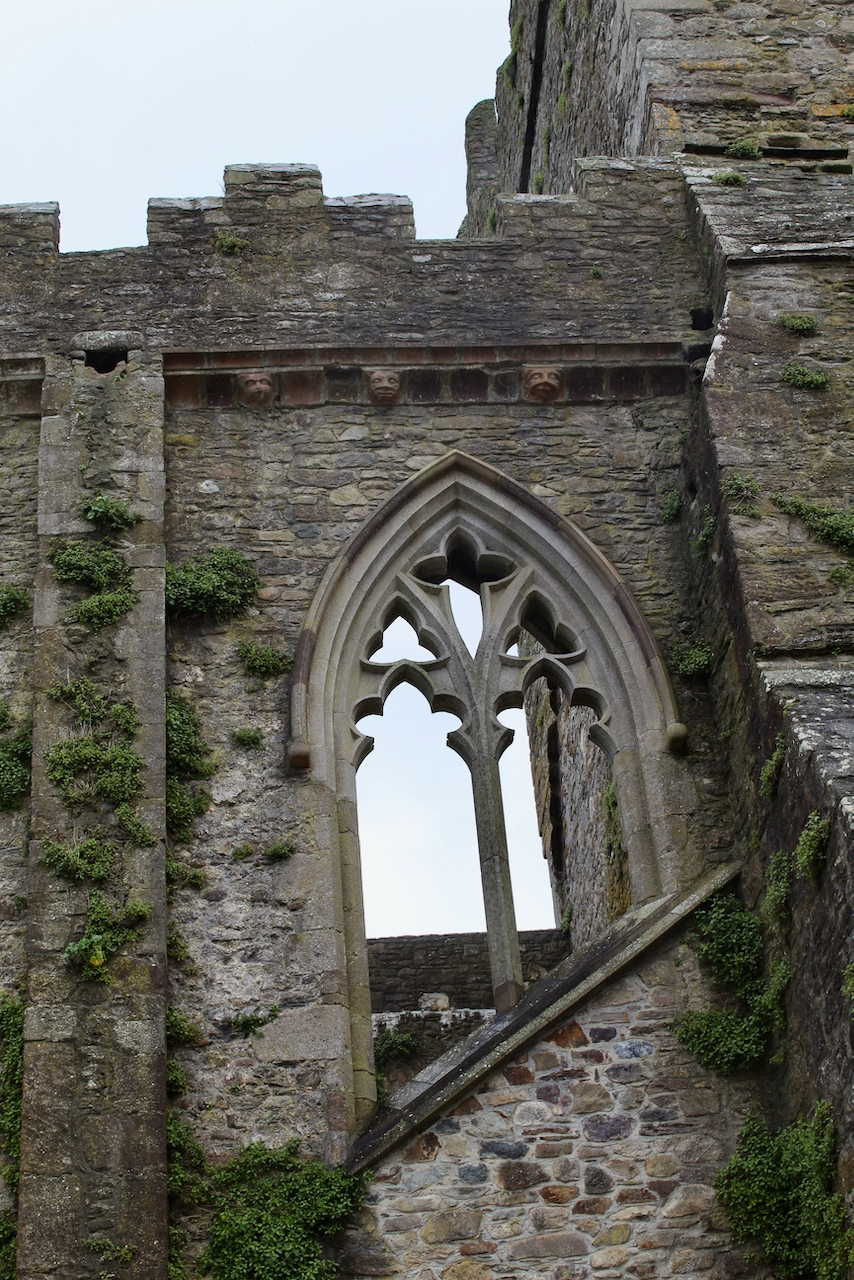
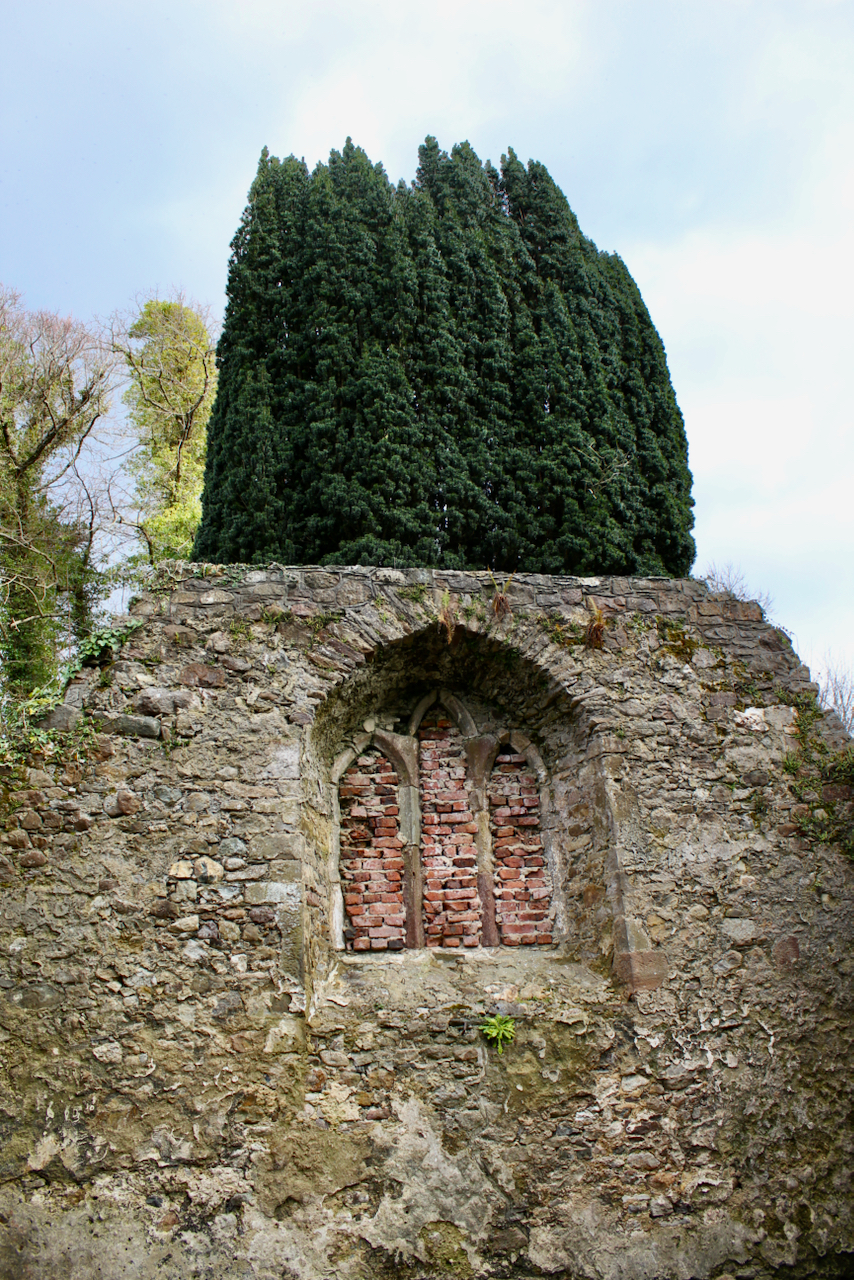
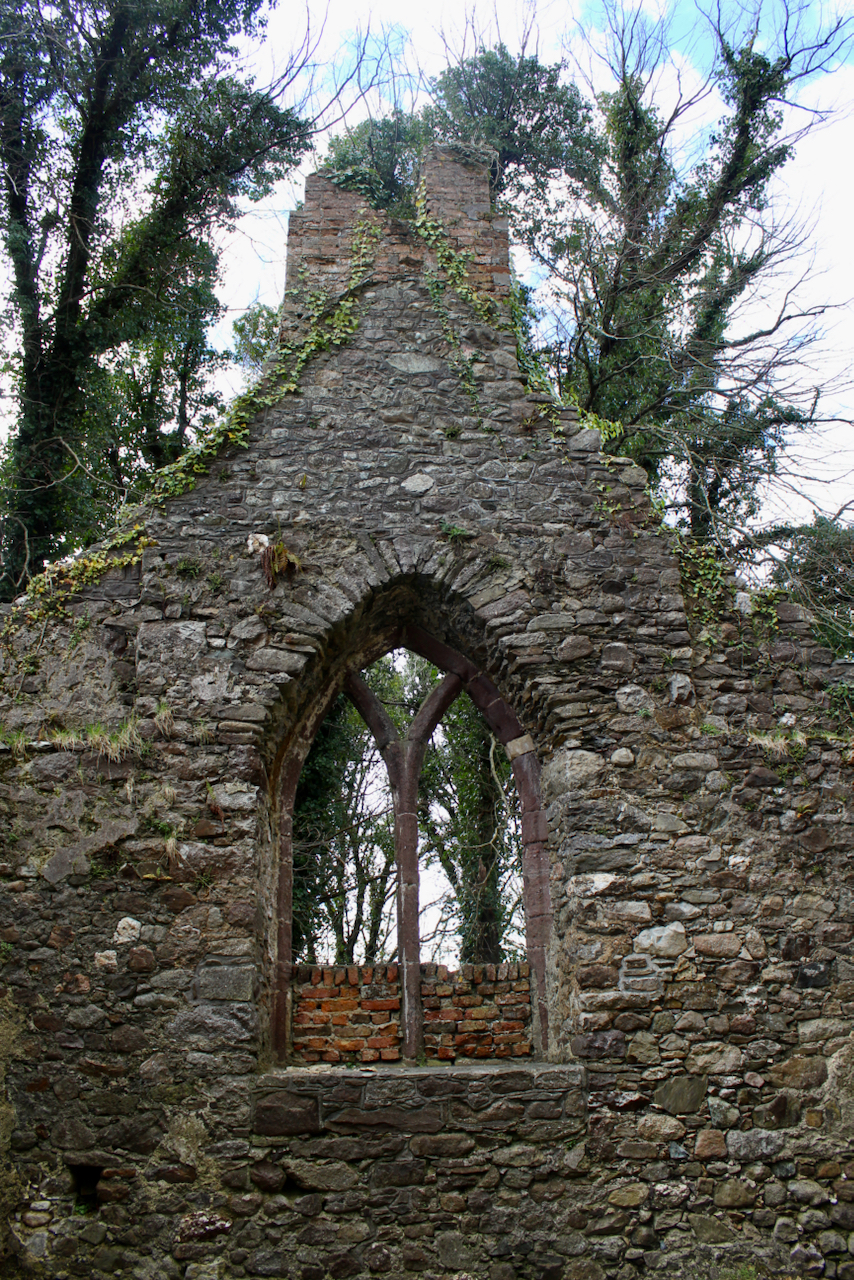
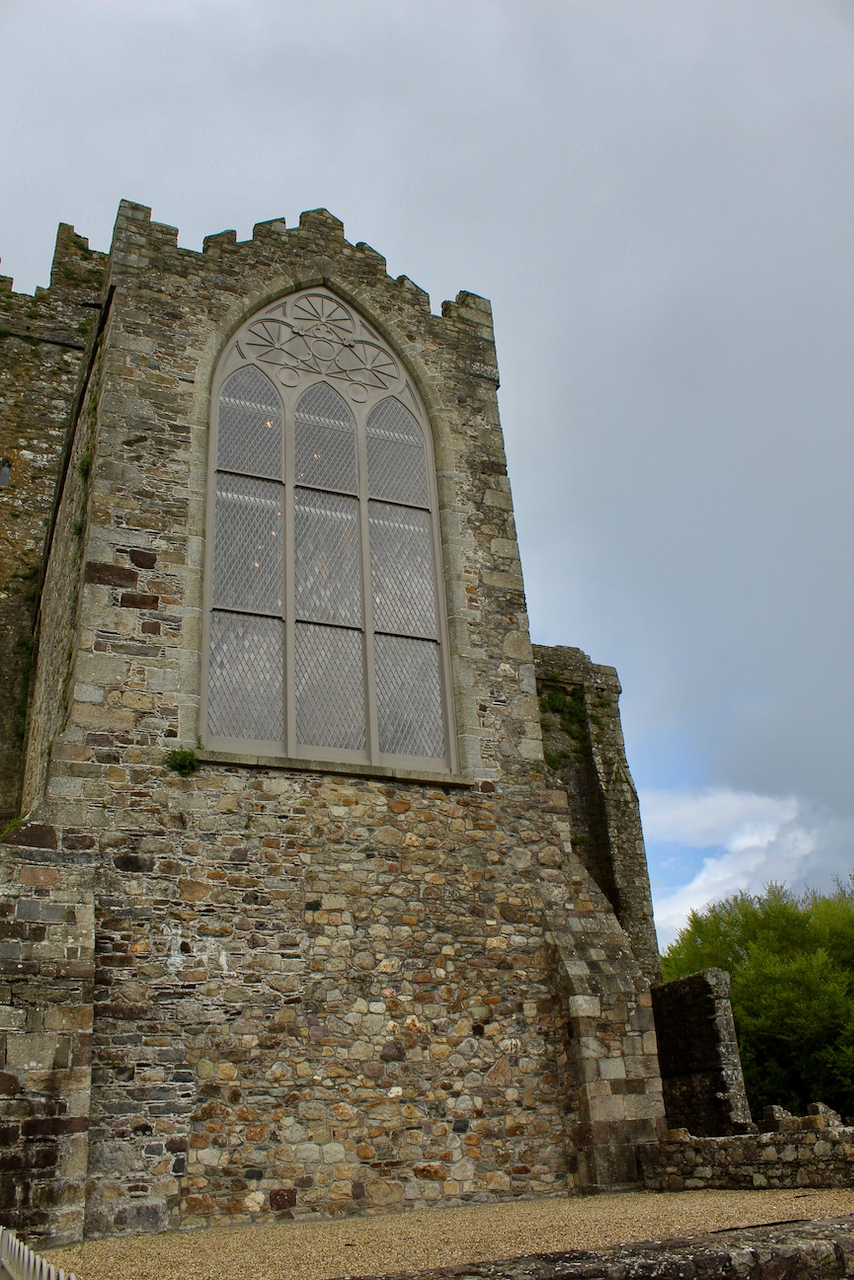
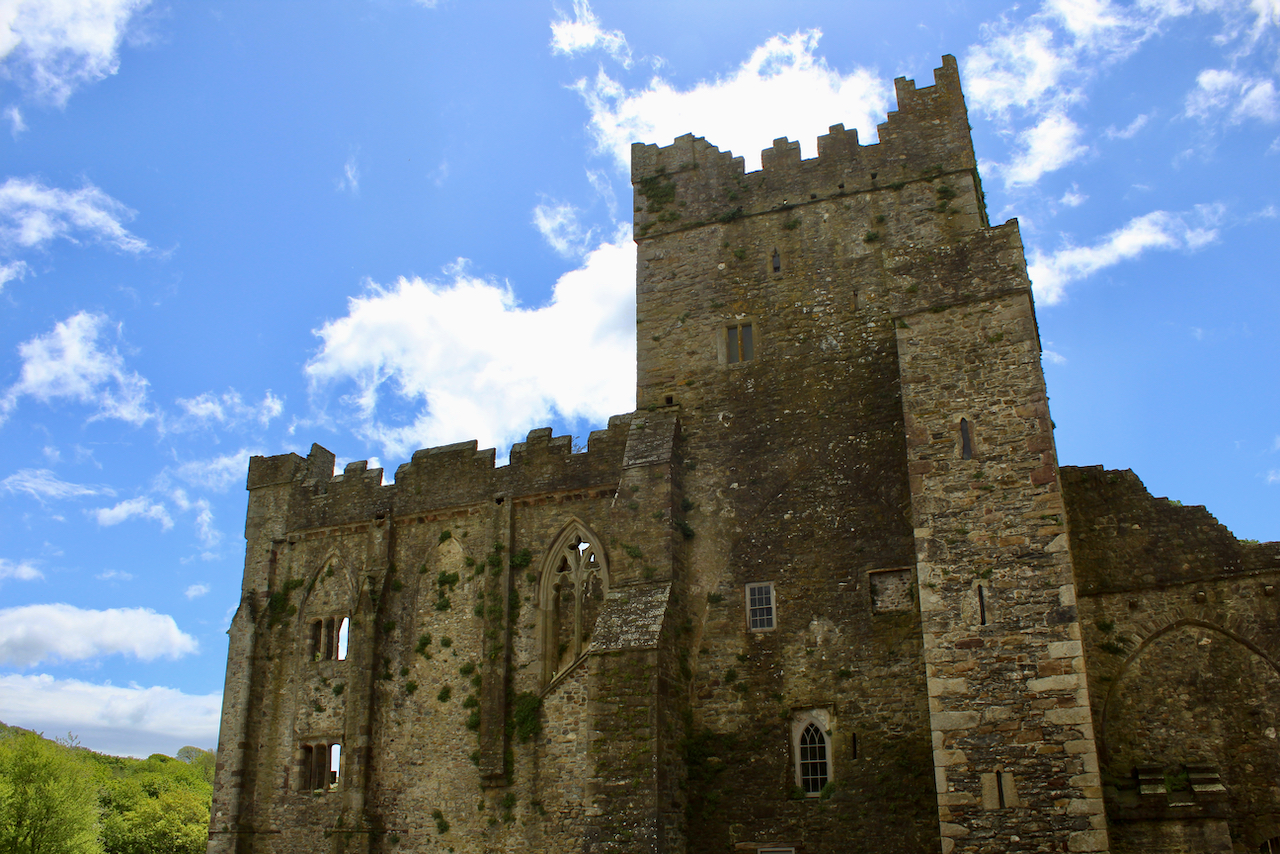
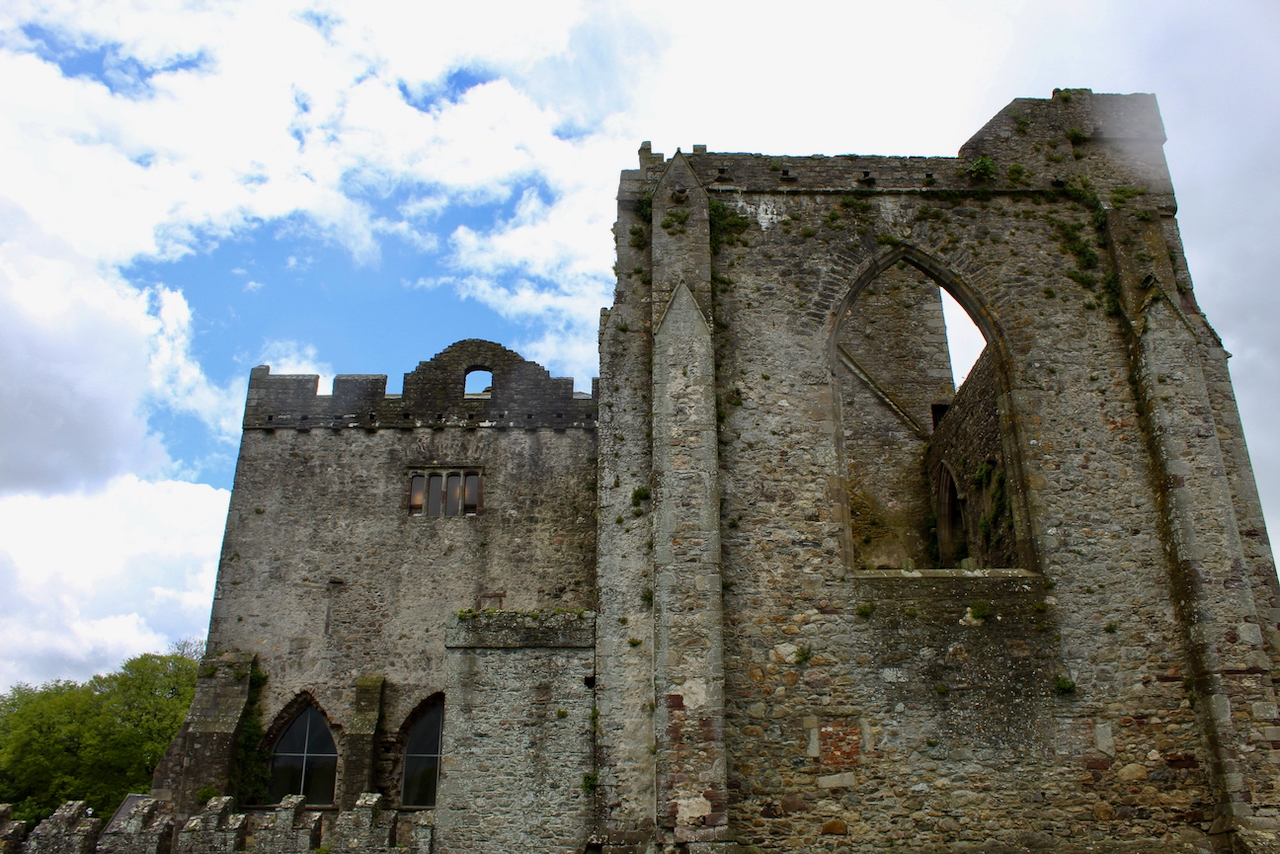
The large window at the east end of the chancel of Tintern Abbey, probably built by 1325. Photograph © Jennifer Winder-Baggot, www.irishhistorichouses.com
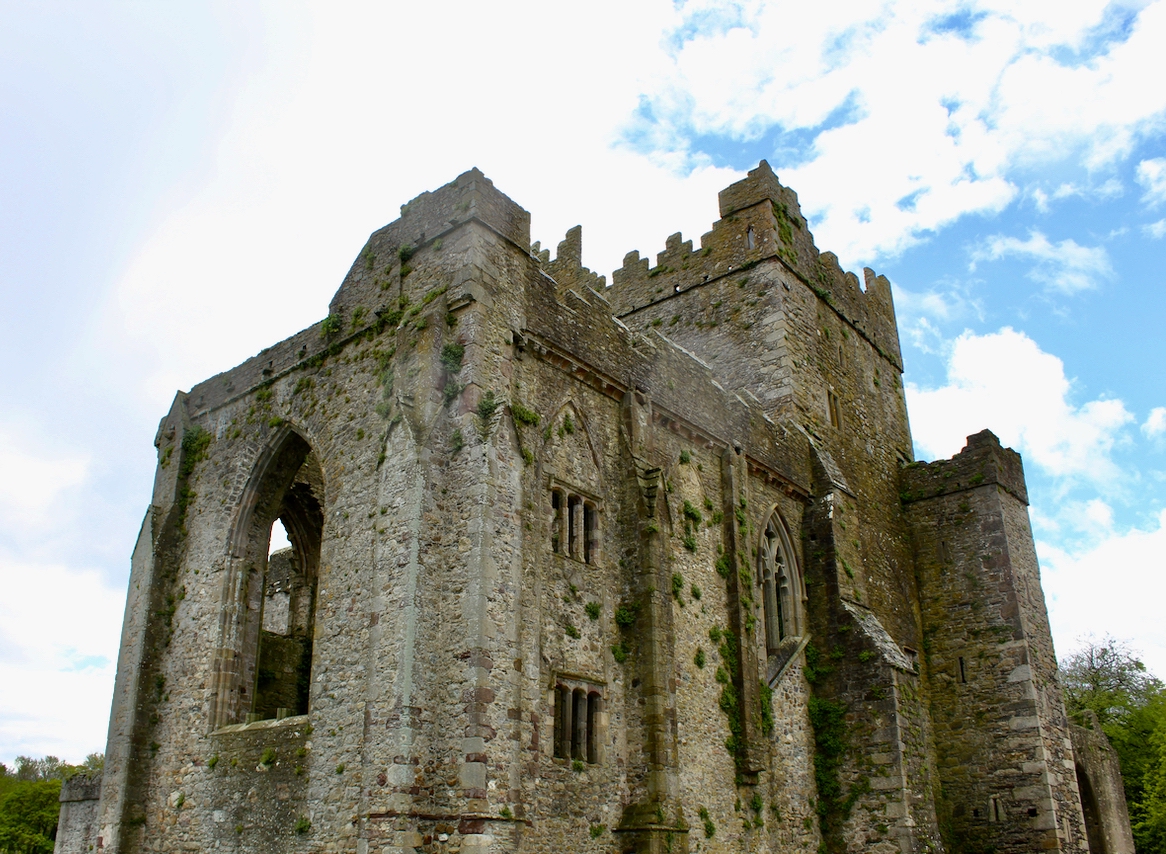
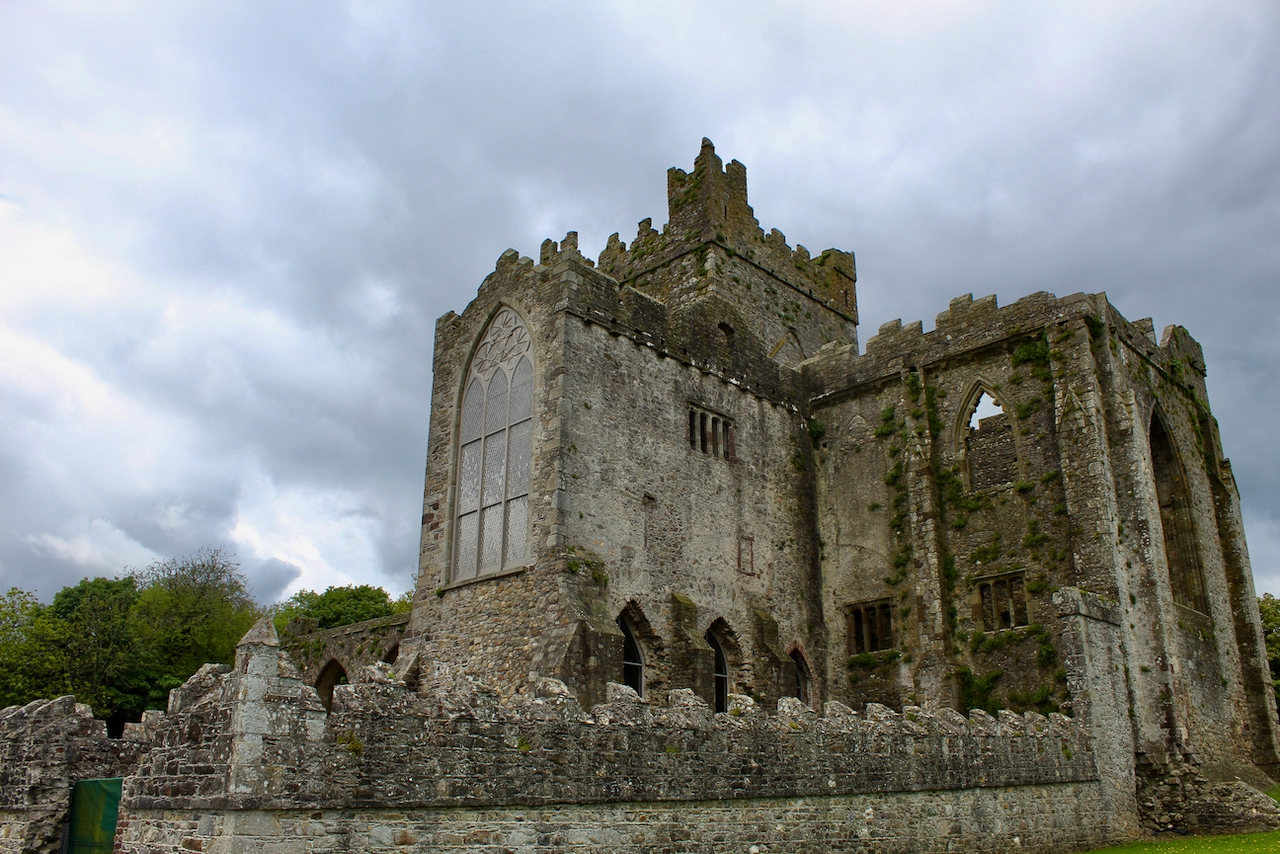
The large window at the east end of the chancel of Tintern Abbey, probably built by 1325. The sloping window cill next to the tower would have accommodated the north transept and chapel. These may never have been built, as there is no evidence. The stepped battlements were probably added at a later date. Photograph © Jennifer Winder-Baggot, www.irishhistorichouses.com
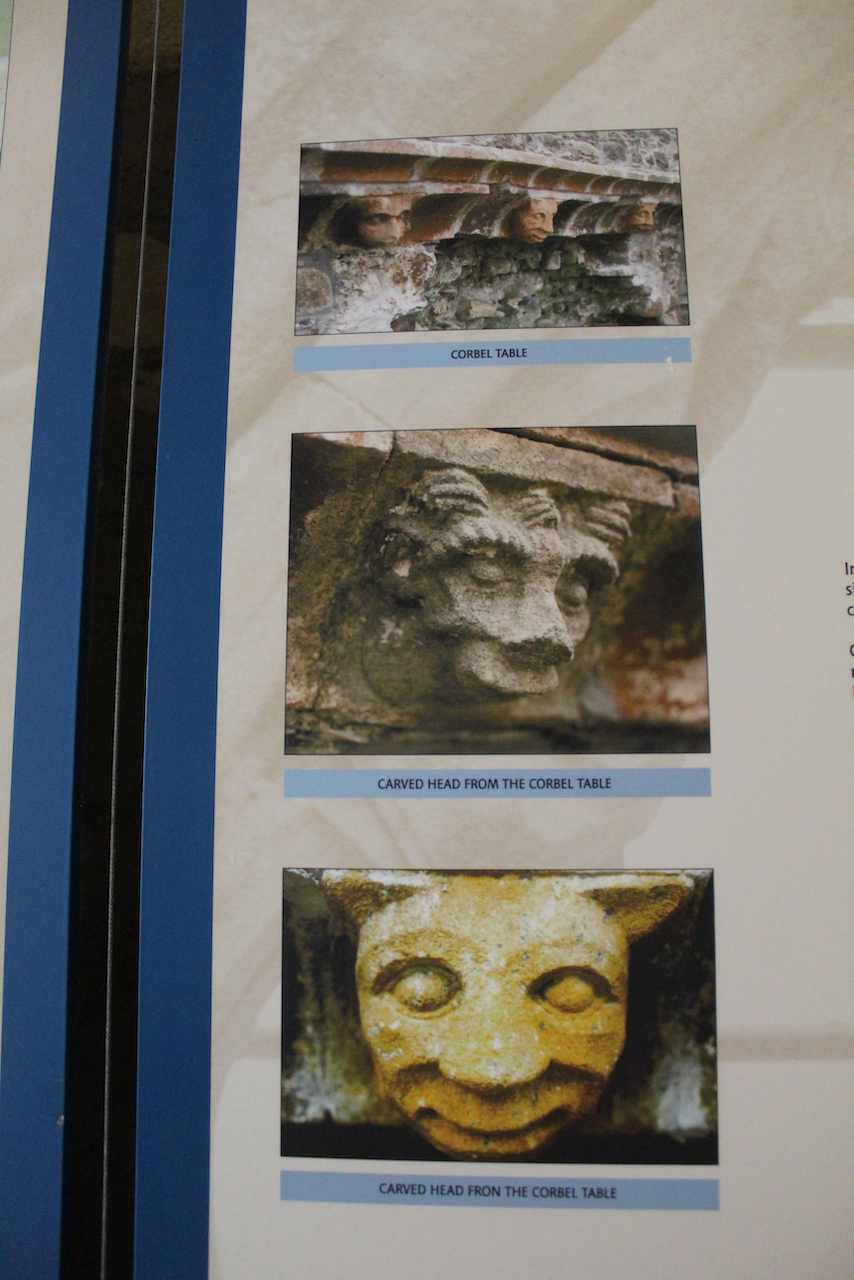
The sloping window cill next to the tower would have accommodated the north transept and chapel. Tintern Abbey, County Wexford, May 2023. Above the windows are the carved corbel tables. Photograph © Jennifer Winder-Baggot, www.irishhistorichouses.com
See the carved heads above the window. Photograph © Jennifer Winder-Baggot, www.irishhistorichouses.com
Tintern Abbey, County Wexford, May 2023.

The monks were interested in farming and adopted the latest methods.
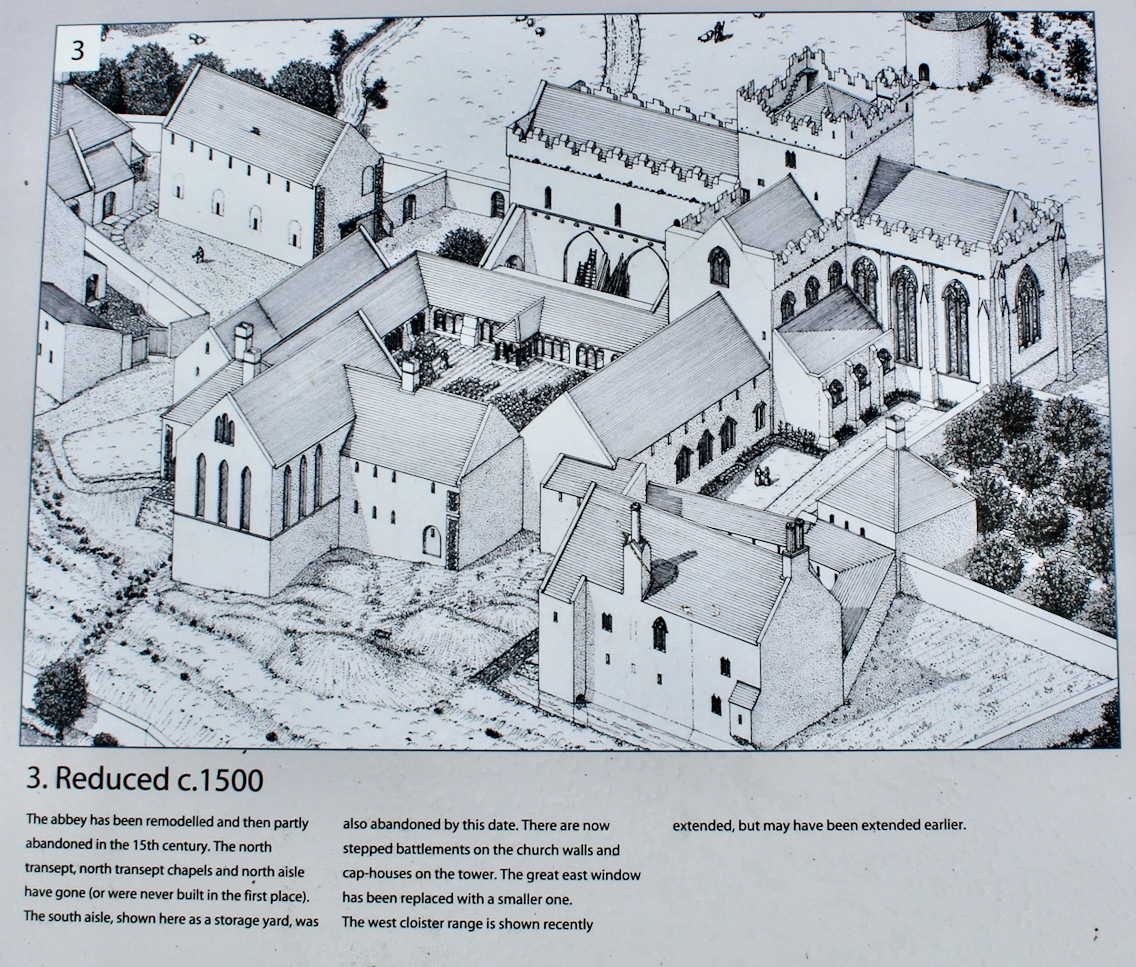
Tintern Abbey, County Wexford, May 2023. Reconstruction drawings by Daniel Tietzsch-Tyler.
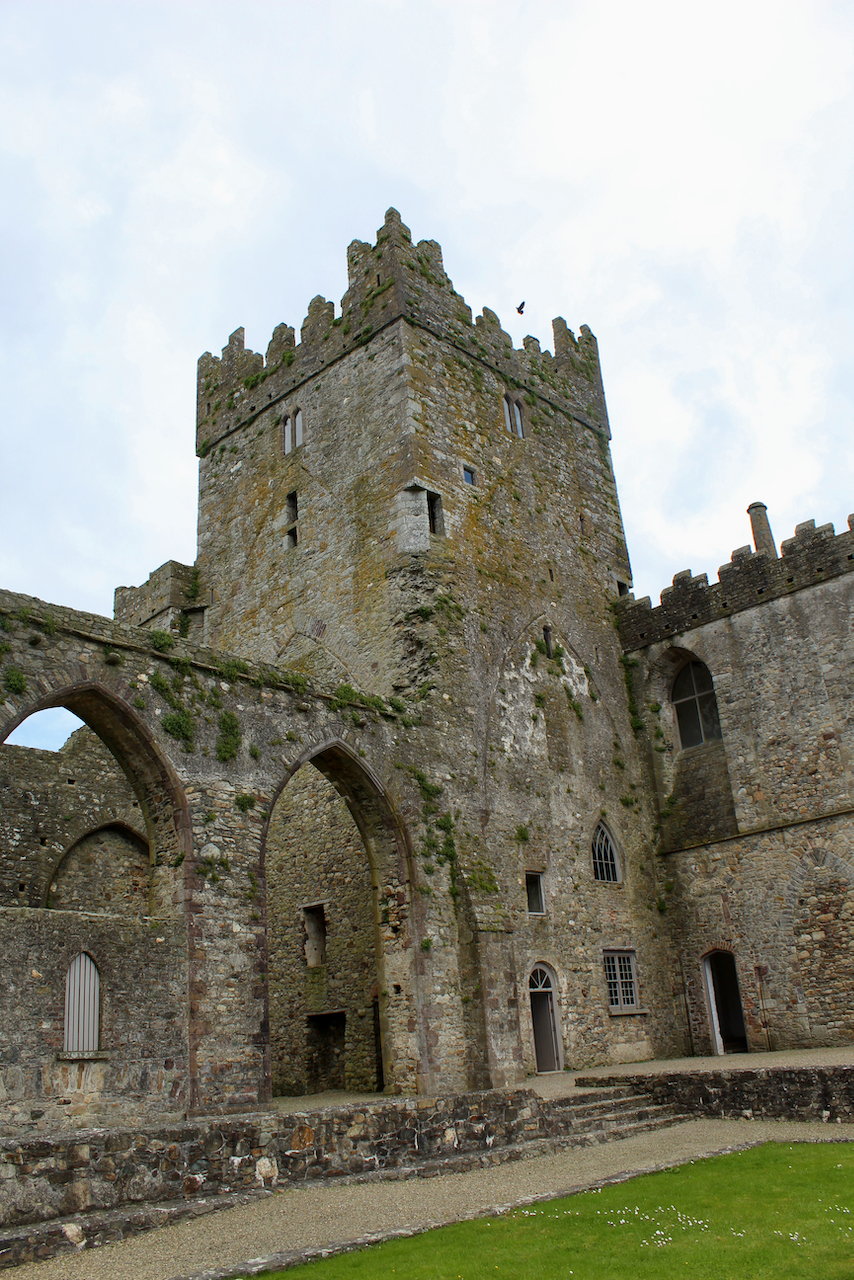
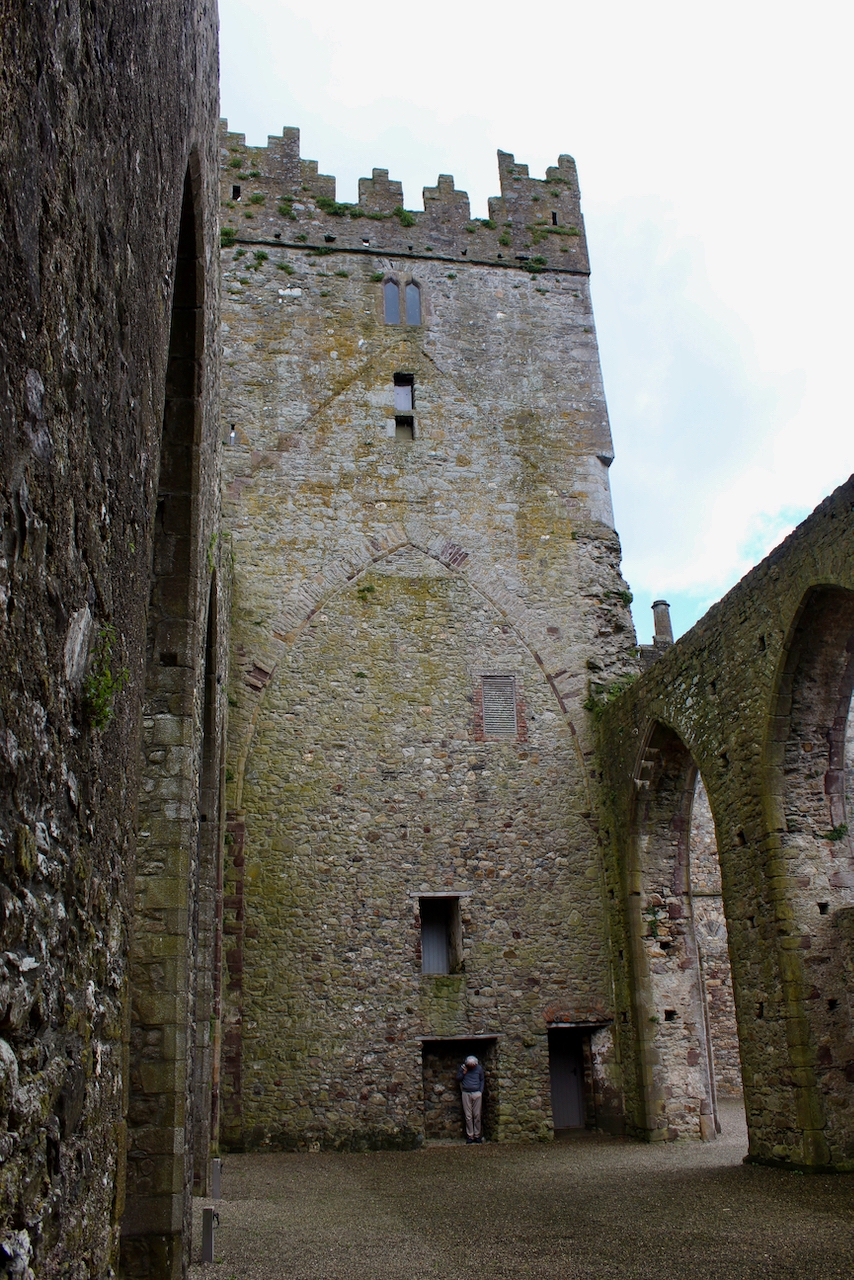
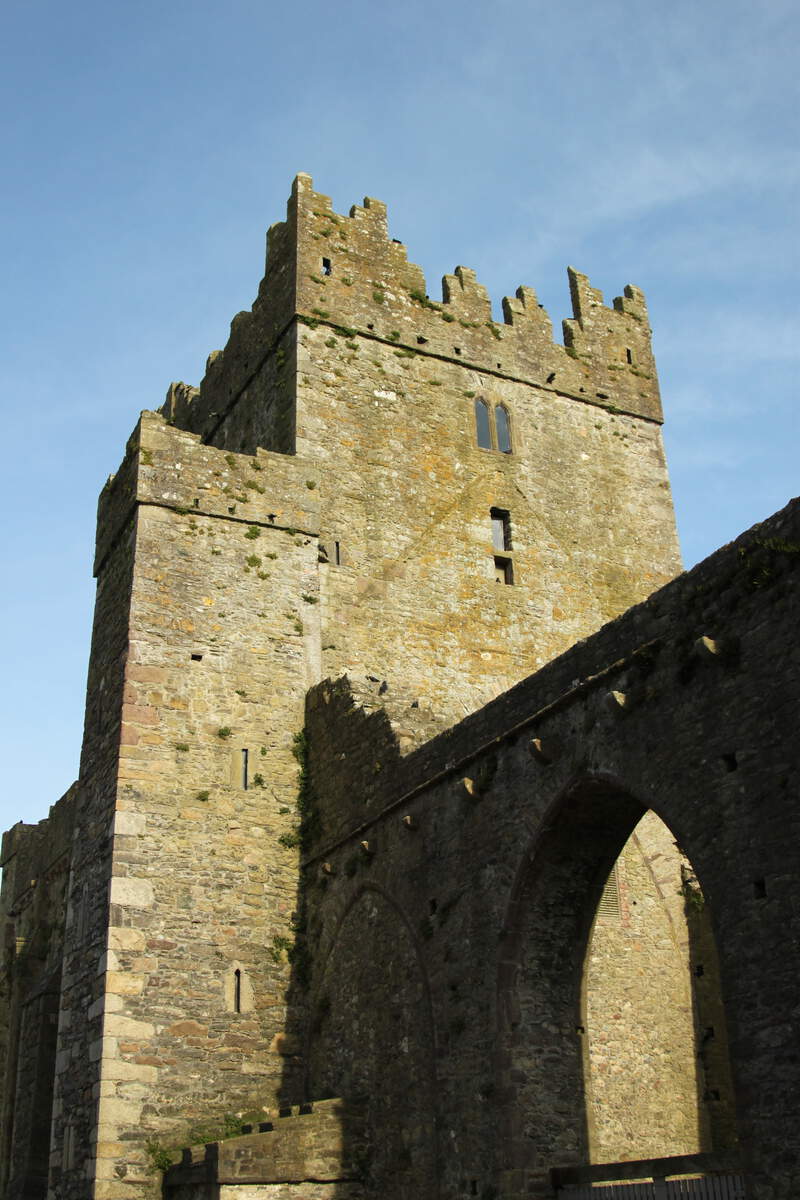
Tower, Nave and South Trancept, Tintern Abbey, County Wexford, May 2023. Photograph © Jennifer Winder-Baggot, www.irishhistorichouses.com

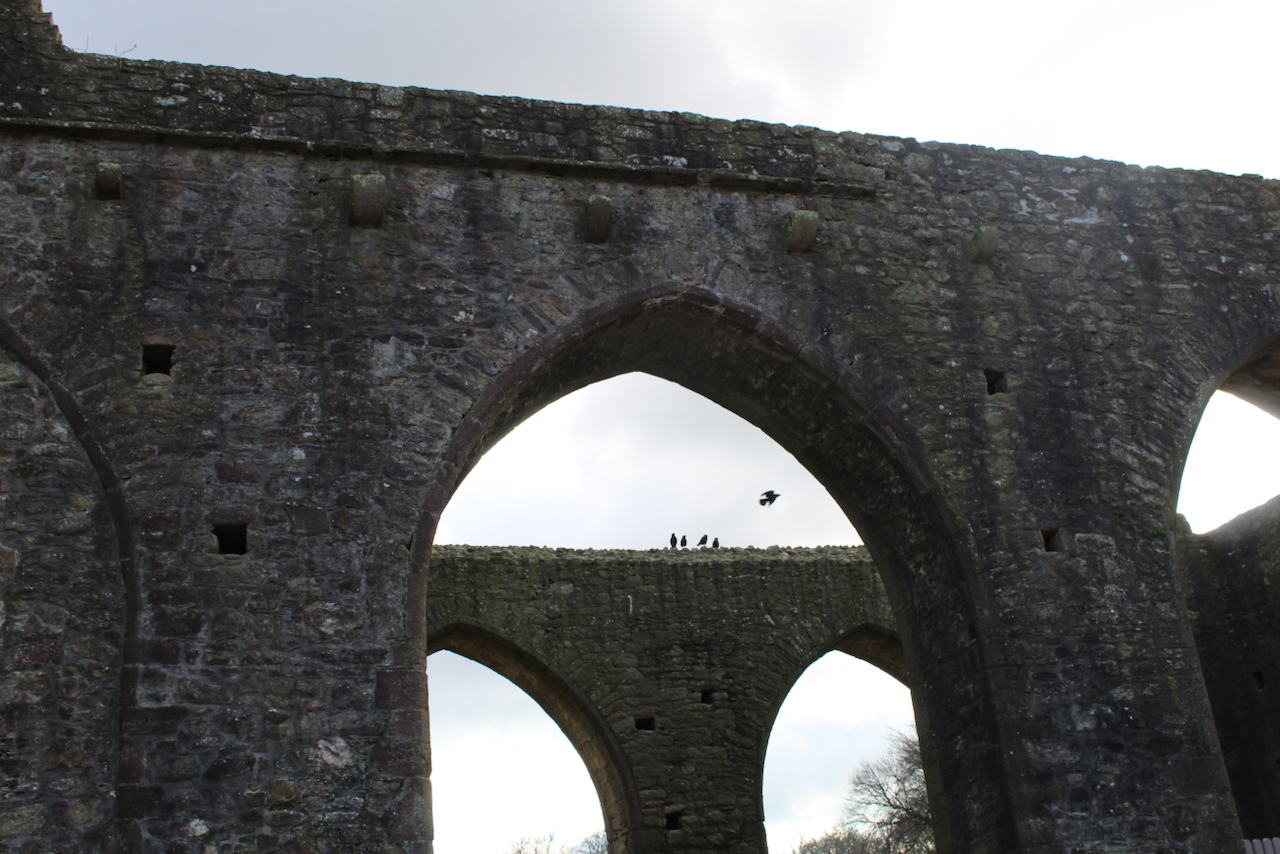
The nave, chancel, tower, chapel and cloister still stand. The nave has lost its aisles and clerestory, but still has three bays of plain arches.
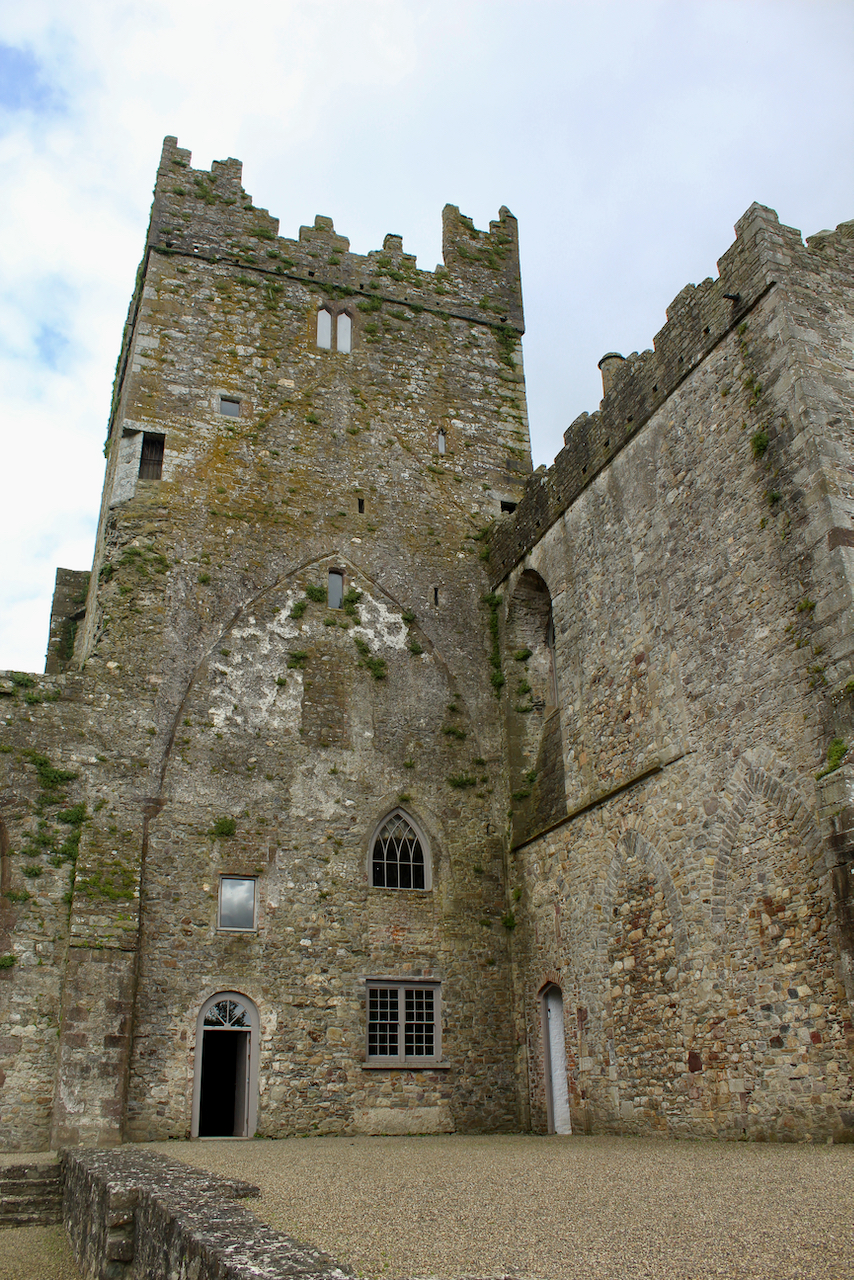
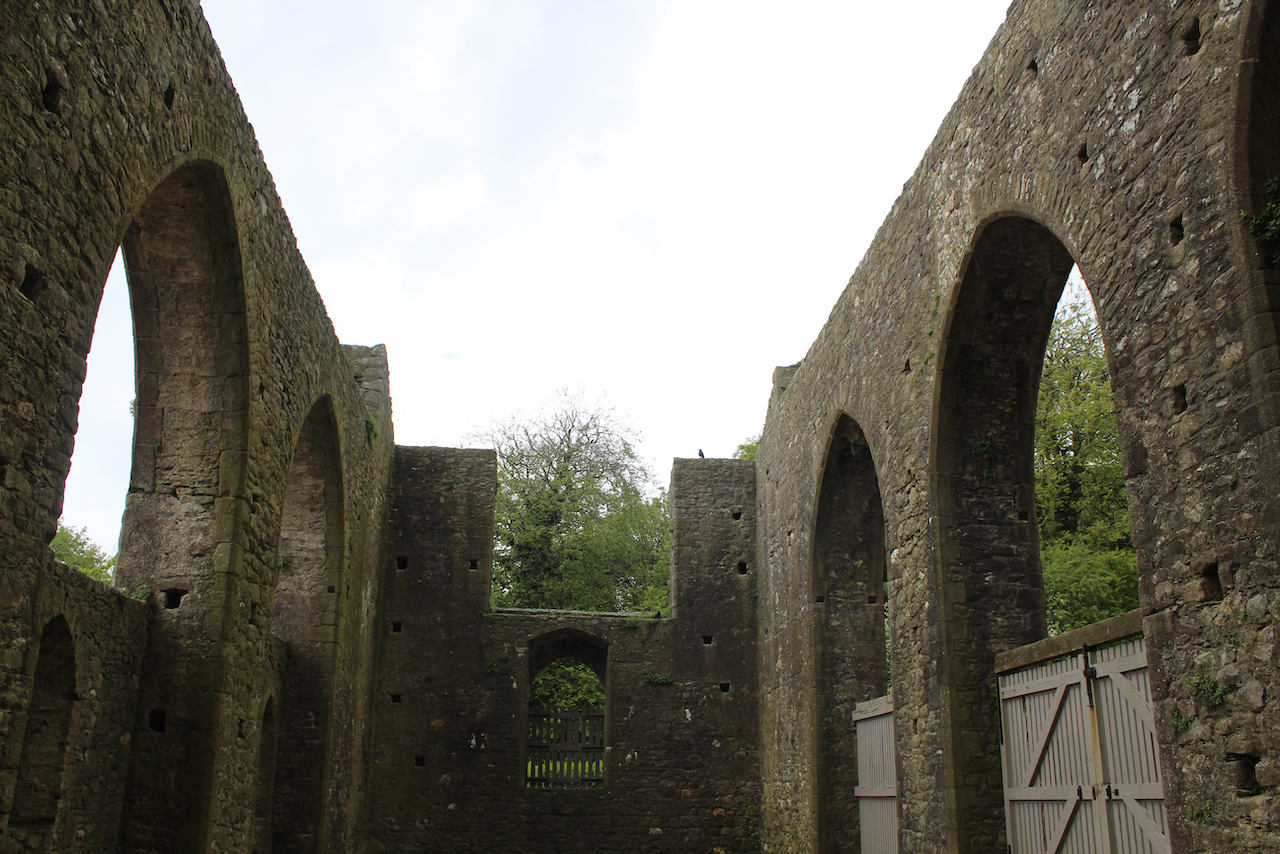
Tower and south trancept, Tintern Abbey, County Wexford, May 2023. Photograph © Jennifer Winder-Baggot, www.irishhistorichouses.com
The Nave, Tintern Abbey, County Wexford, May 2023. Photograph © Jennifer Winder-Baggot, www.irishhistorichouses.com
Facing the tower from the nave, Tintern Abbey, County Wexford, May 2023. Photograph © Jennifer Winder-Baggot, www.irishhistorichouses.com
Tower and Nave, Tintern Abbey, photograph by Brian Morrison, 2017 for Tourism Ireland, Ireland’s Content Pool. [see 1]
Tintern Abbey, County Wexford, 15th March 2025. Photograph © Jennifer Winder-Baggot, www.irishhistorichouses.com

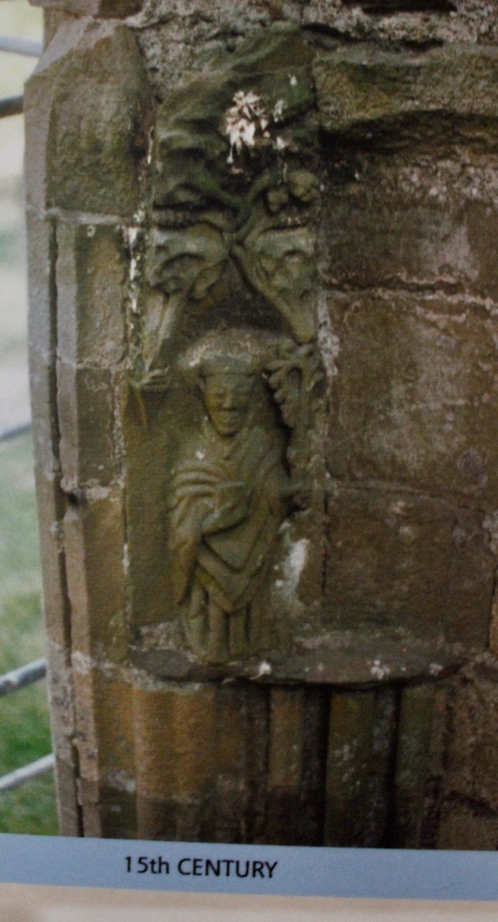
Sculpture was not encouraged in Cistercian buildings but Tintern has a few fine surviving examples. A carved corbel table remains, which contains twenty four carved heads, some human, some monstrous.
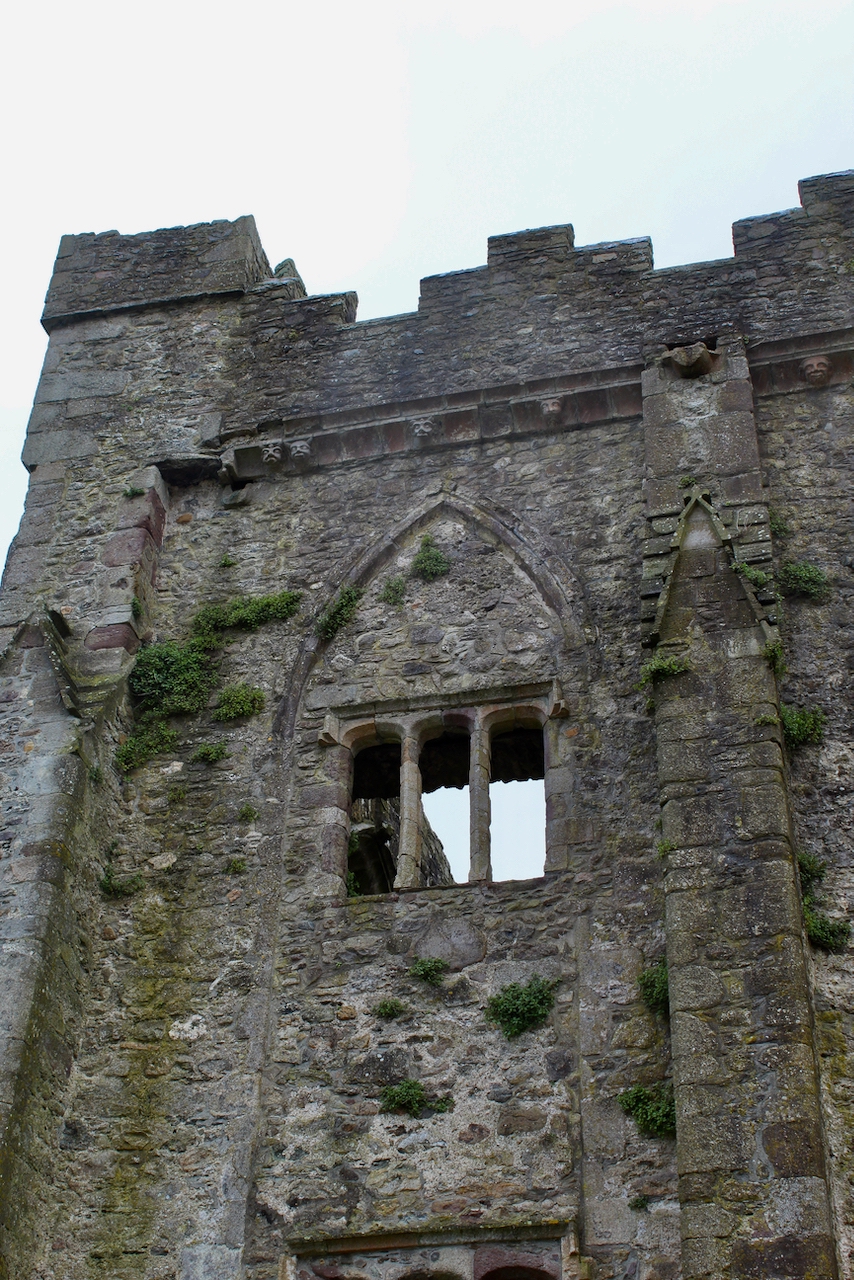
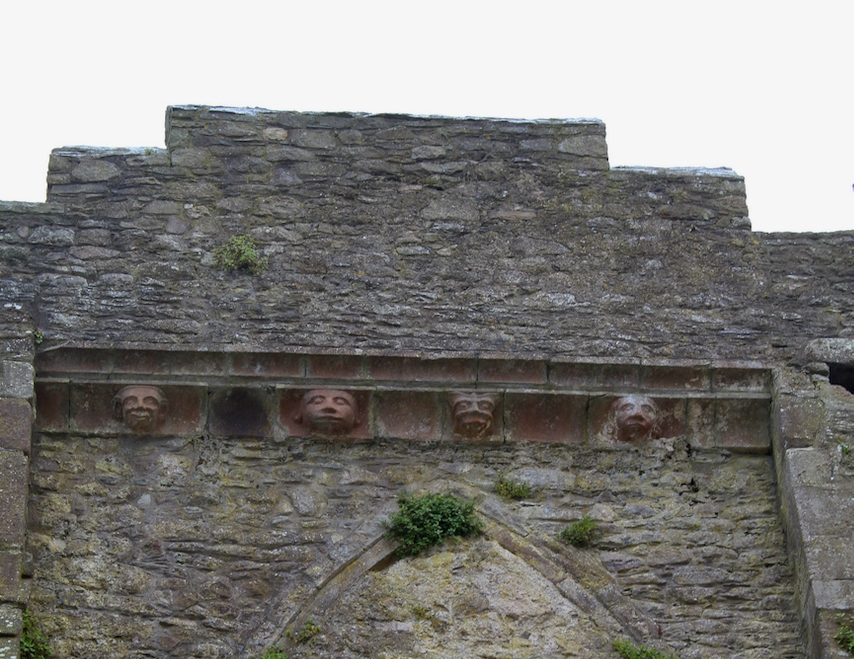
Carved heads above the window. Photograph © Jennifer Winder-Baggot, www.irishhistorichouses.com
Tintern Abbey, County Wexford, May 2023.
Picture of carving in Tintern Abbey.

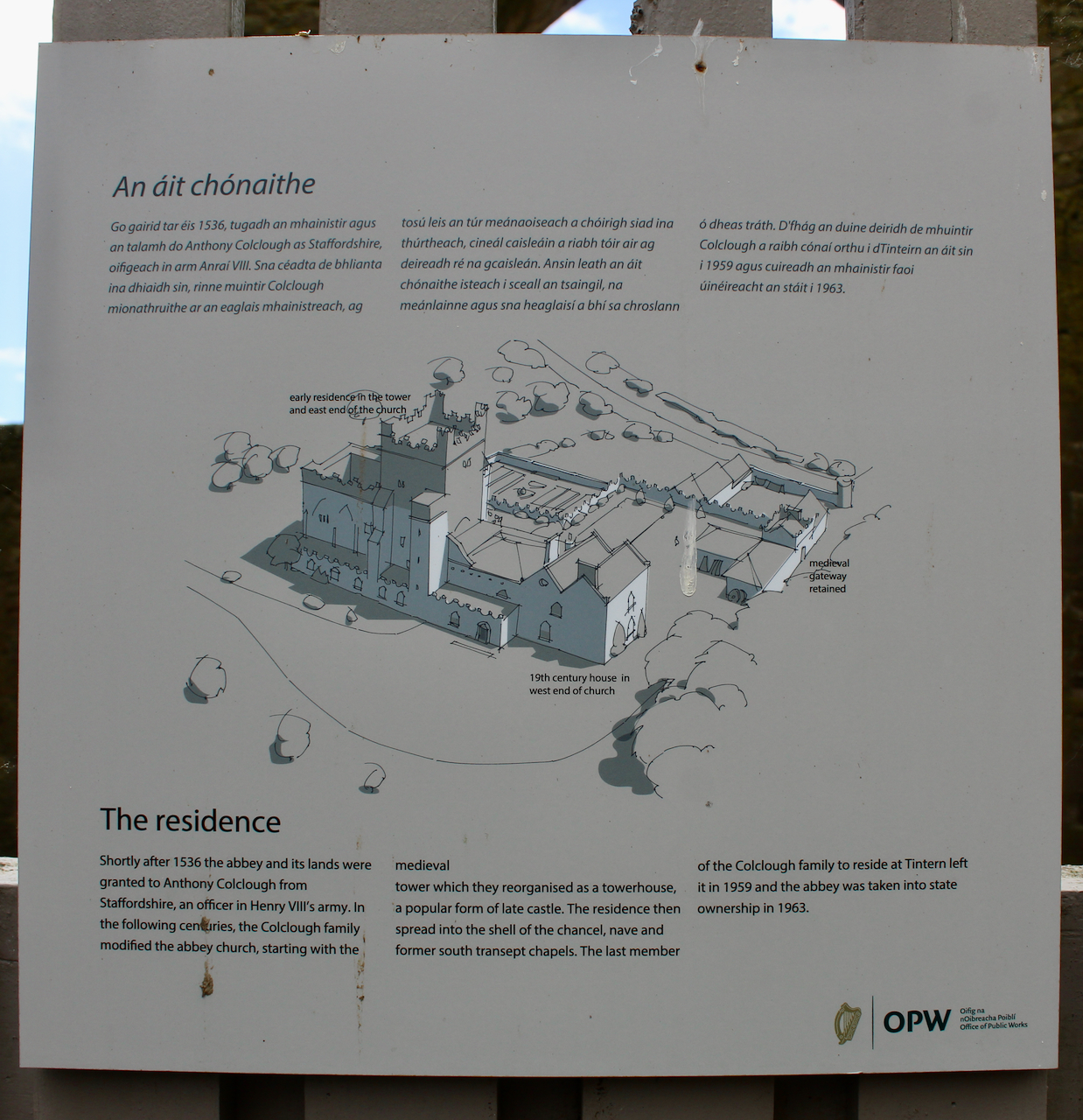
In the 16th century the old abbey was granted to the Colclough family (pronounced Coakley) and soon after the church was partly converted into living quarters and further adapted over the centuries. The Colcloughs occupied the abbey from the sixteenth century until the mid-twentieth.
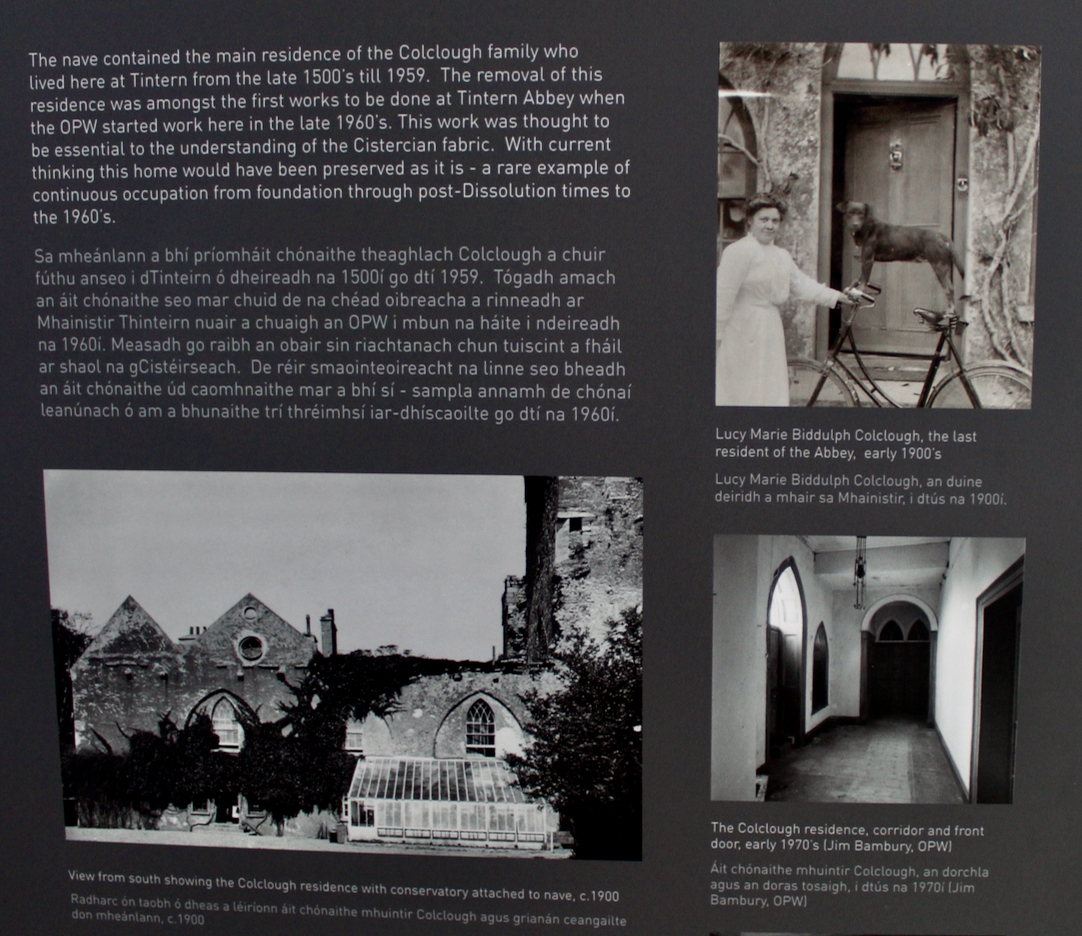
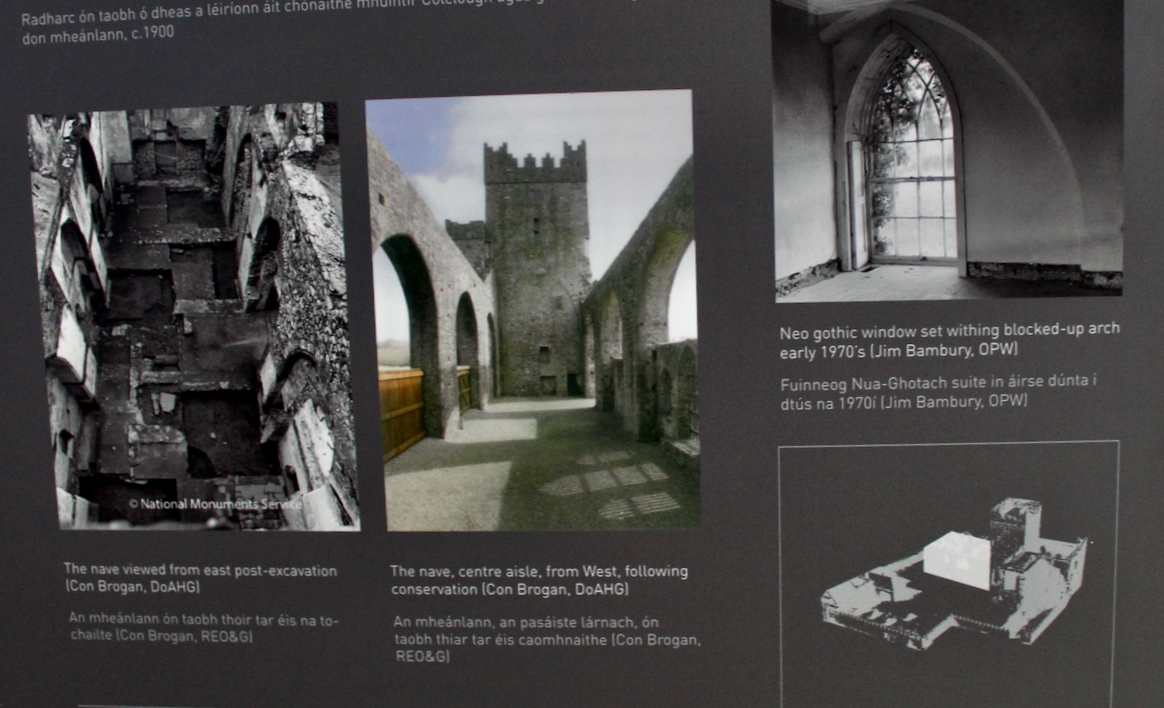
The nave contained the main residence of the Colclough family.
Renovations and excavation at Tintern Abbey.
Tintern Abbey, County Wexford, May 2023.

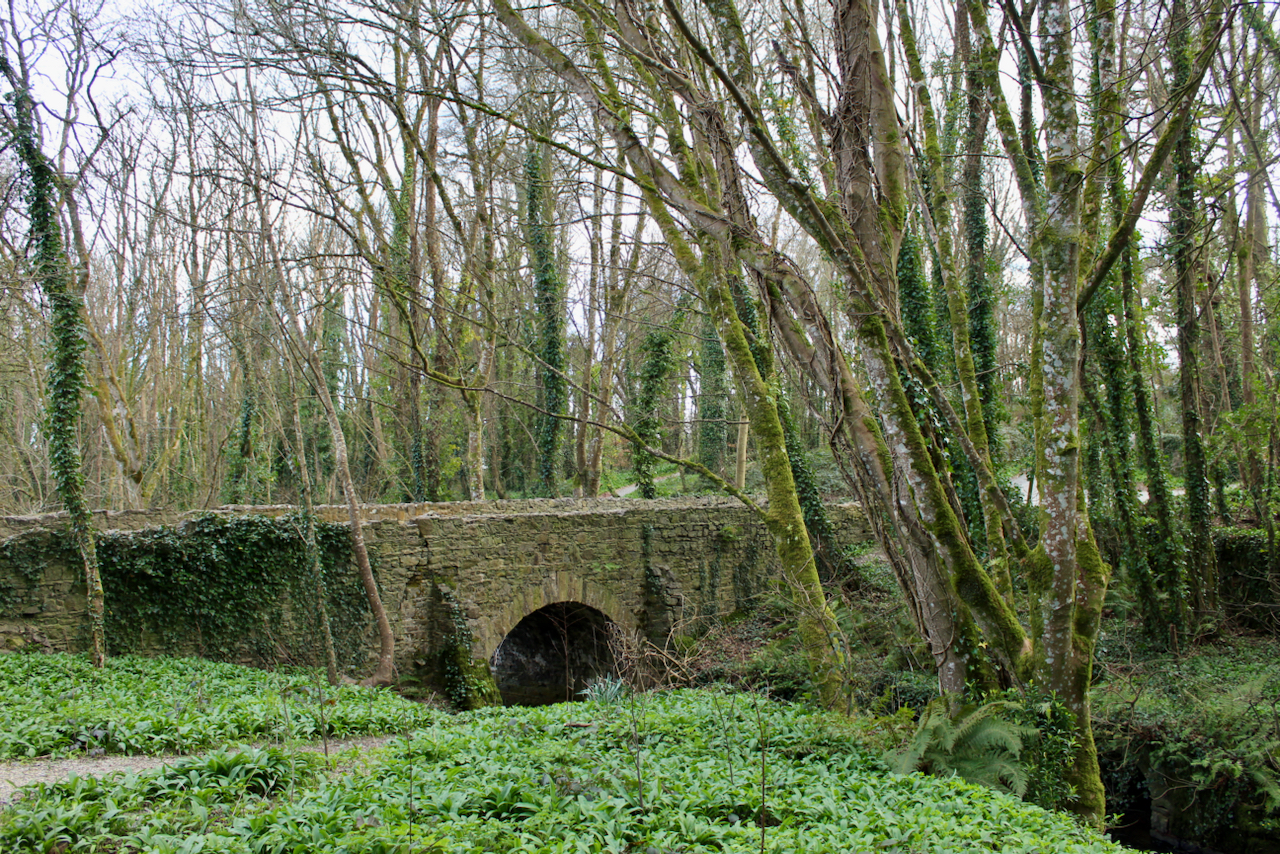
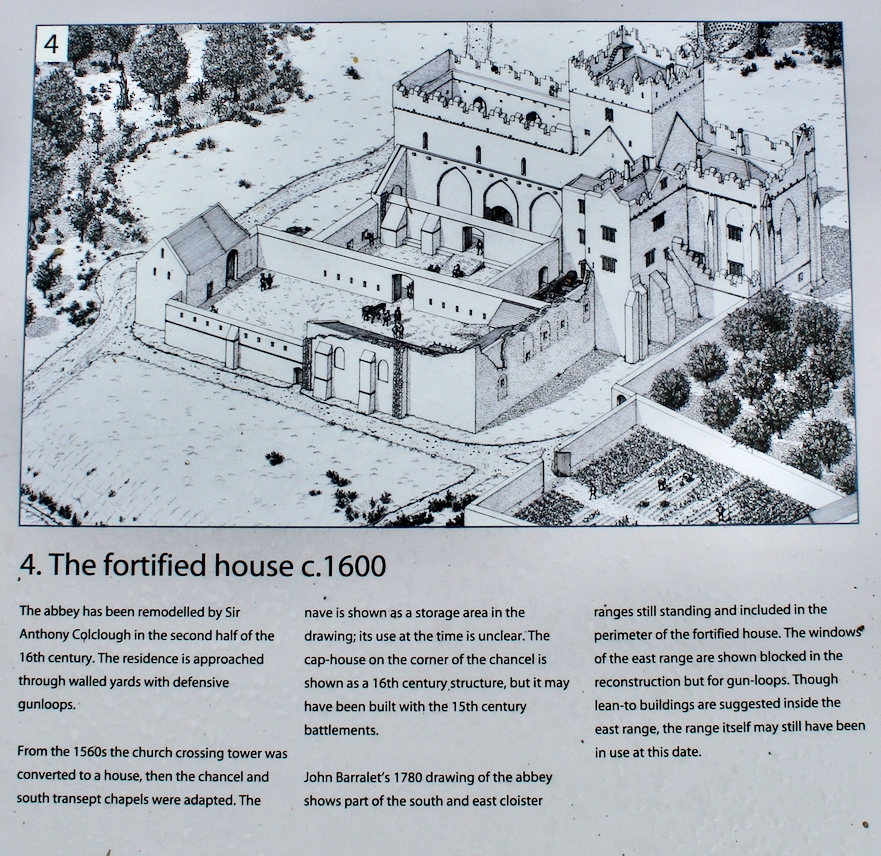
A chapter by Sean Clooney about Tintern Abbey in Tintern Abbey County Wexford, Cistercians and Colcloughs, Eight Centuries of Occupation, 1st Edition edited by Kevin Whelan, 2nd Edition edited by Anne Finn, tells us that Anthony Colclough, much like King Henry VIII, divorced his first wife! He divorced Thomasine Sutton in 1547 and married Clare Agard. He converted the tower of the abbey into a fortified tower house. A fire in 1562 had destroyed many of the other buildings. He also built the unique fortified bridge nearby.
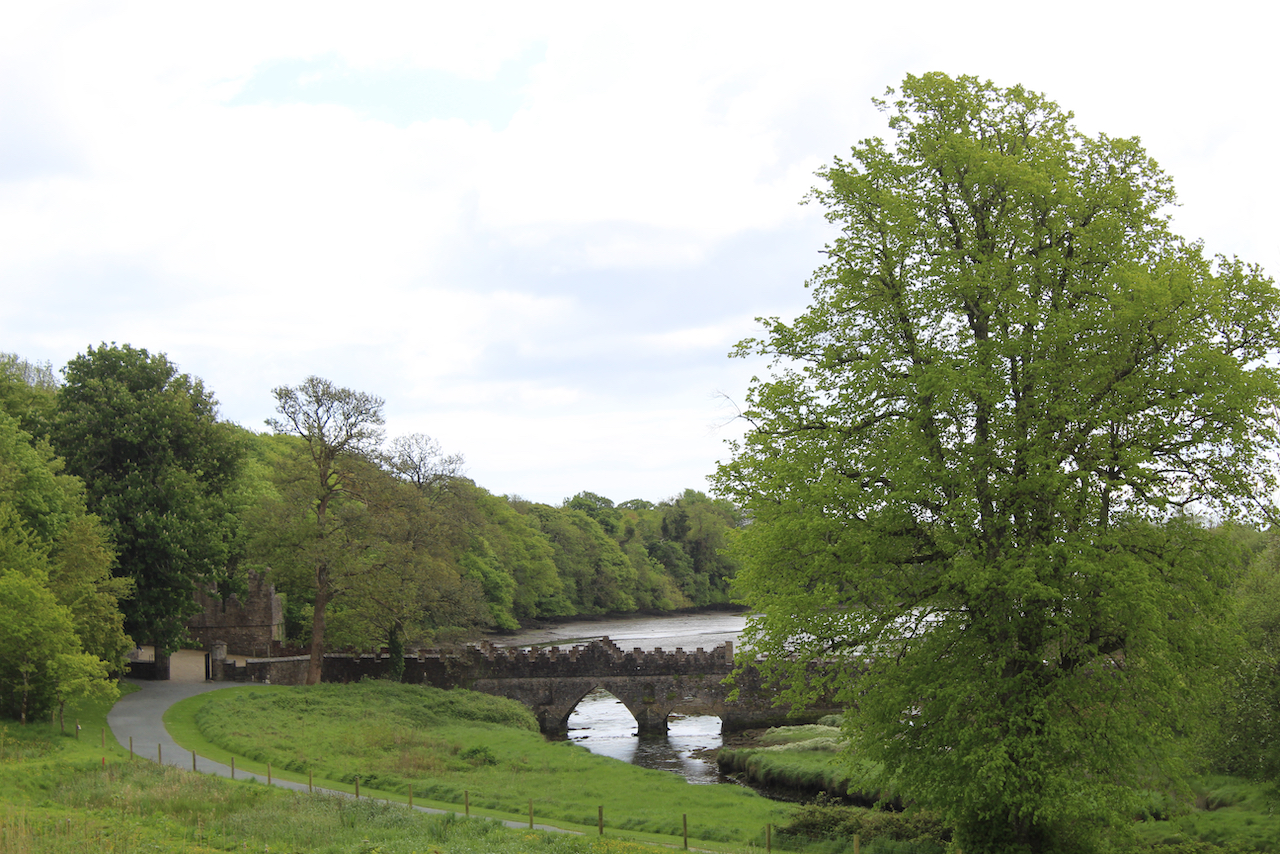
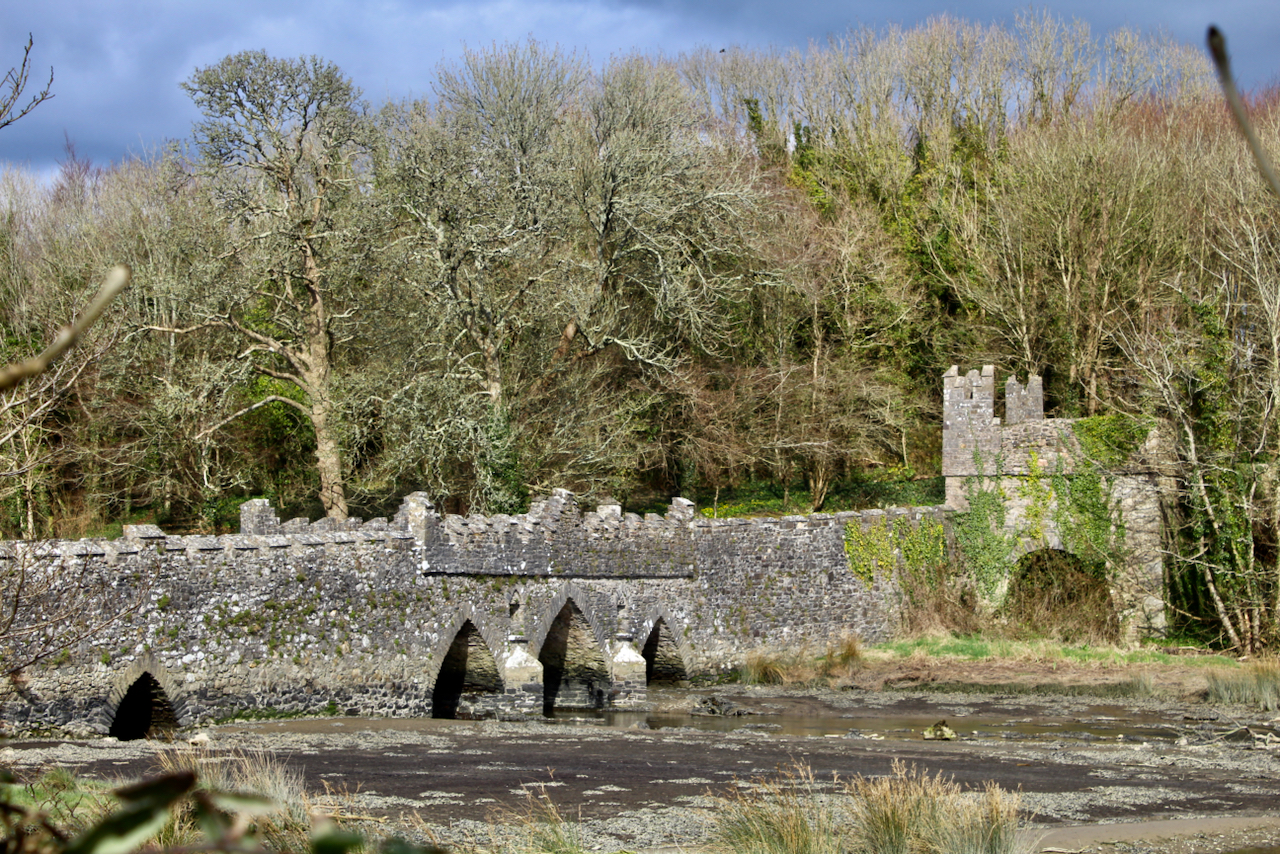
The fortified bridge built by Anthony Colclough by Tintern Abbey, County Wexford, May 2023. Photograph © Jennifer Winder-Baggot, www.irishhistorichouses.com
The fortified bridge built by Anthony Colclough by Tintern Abbey, County Wexford, March 2025. Photograph © Jennifer Winder-Baggot, www.irishhistorichouses.com
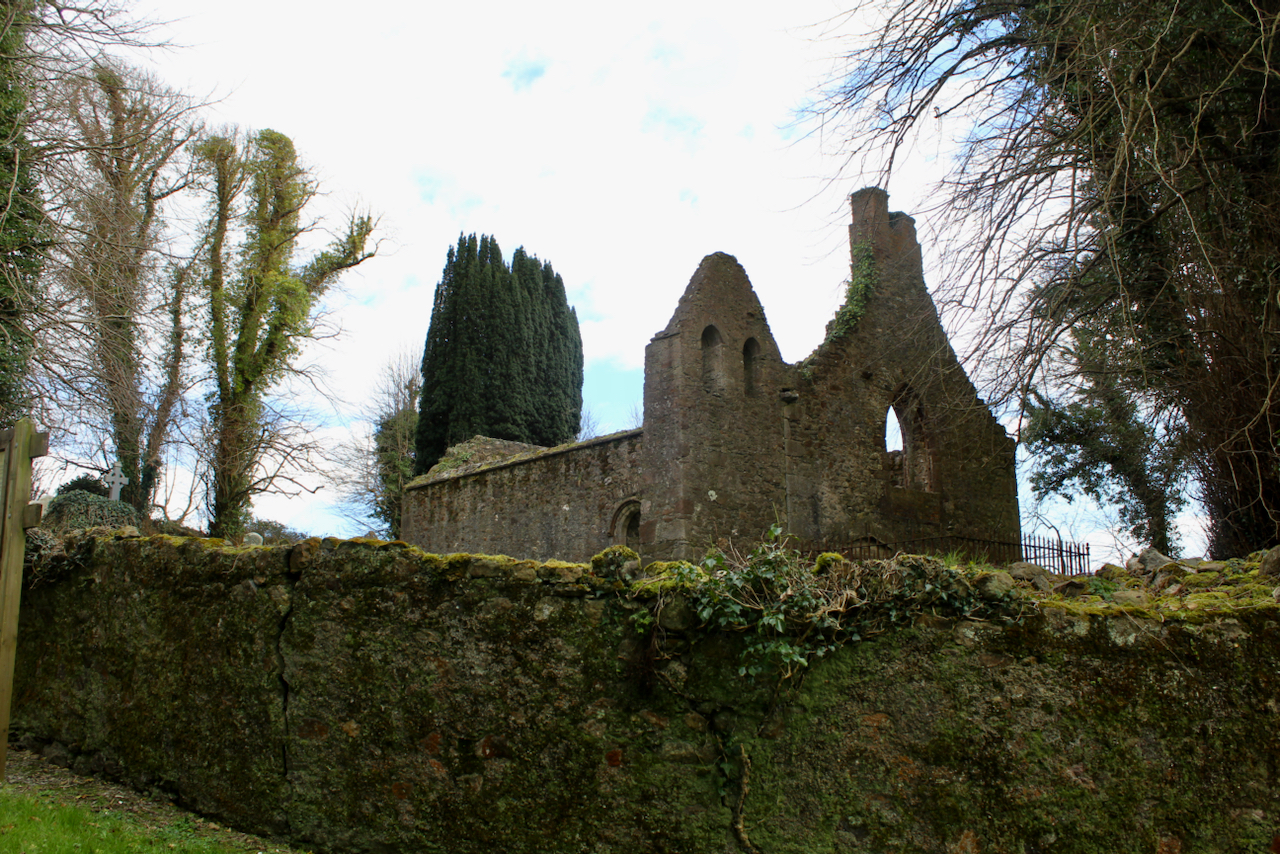
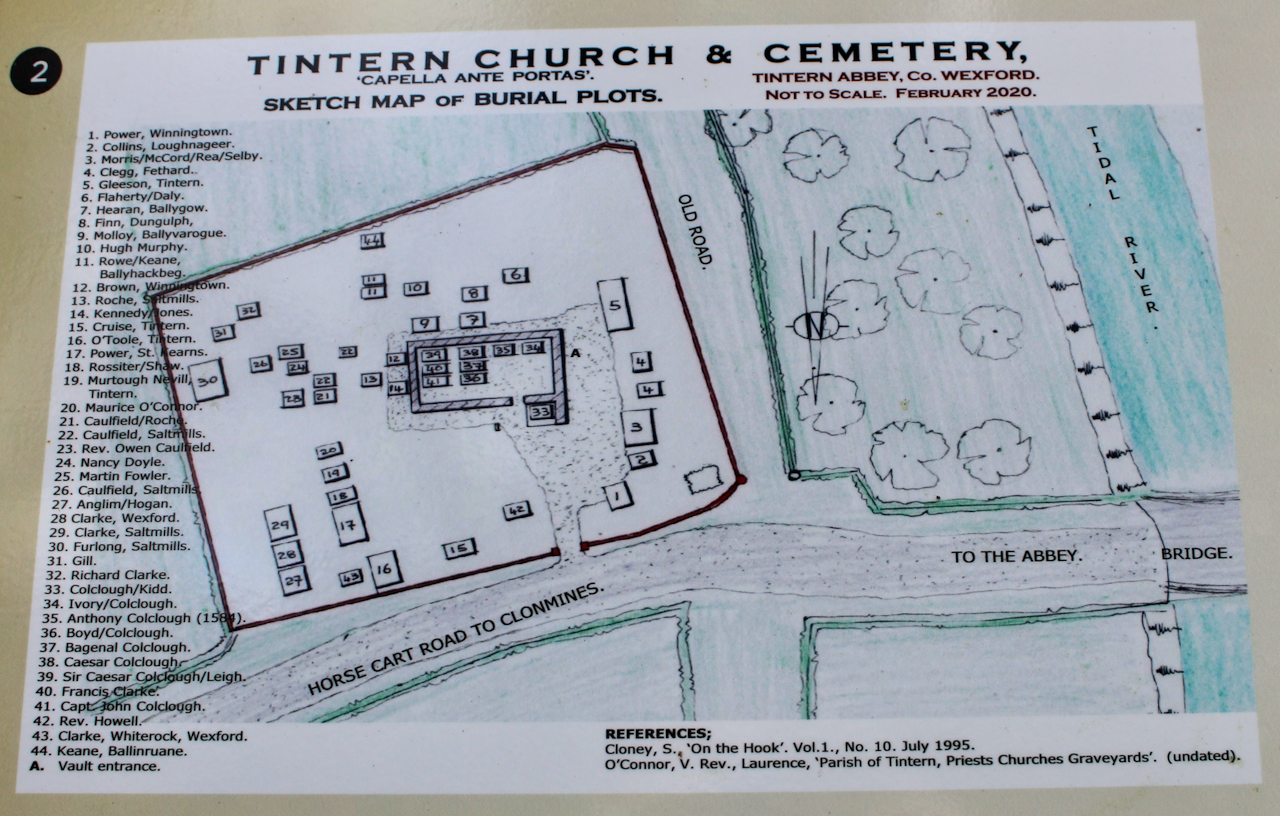
Tintern church and cemetery, which contains the Colclough vault. Photograph © Jennifer Winder-Baggot, www.irishhistorichouses.com

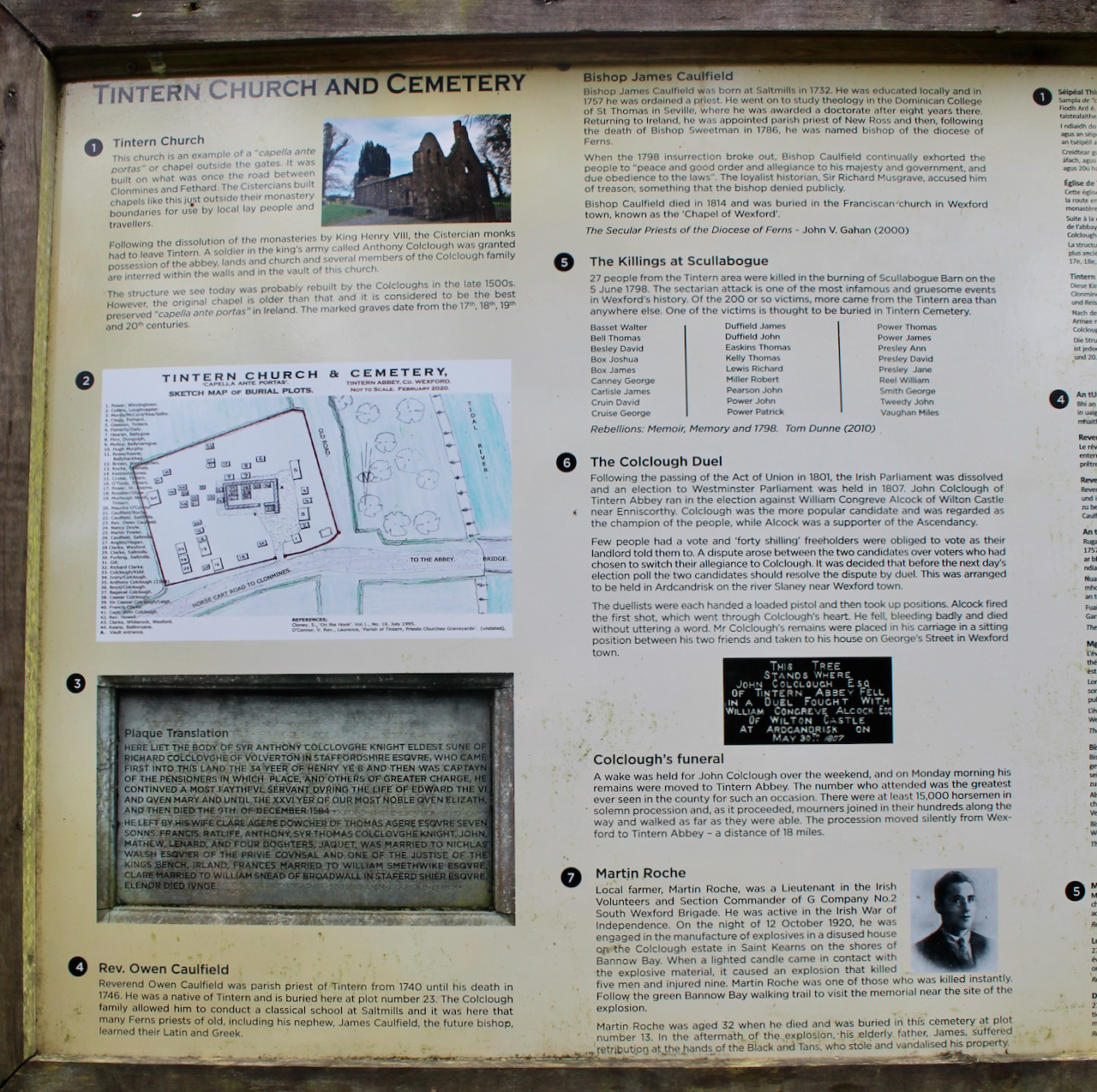
He is buried in the small ruined church a few hundred metres south east of the abbey. The plaque in this church reads:

Here lieth the body Syr Anthony Colclought Knight, eldest sune of Richard Colclought of Wolstanton in Stafordshire Esquier who came first into this land in the 34 yere of Henry the 8 and then was Captayn of the Pensioners in which place and others of greater charge he continued a most faythful serviter during the life of Edward the VI and Queen Mary and until the XXVI yer of our most noble Queen Elisabeth and then died the IX of December 1584. He left his wife, Clare Agare, daughter of Thomas Agare Esquier 7 sonns, Frances, Ratlife, Anthony, Syr Thomas Colclough, Knight, John, Matew, Lenard and 5 doghters, Jaqnet who married to Nicholas Walsh Esquier of the Priveie Counsayle and one of the Justice of the Kings Bench in Ireland; Fraunc married to William Smethwike of Smethwik in Cheshier; Clare married to William Snead of Brodwal in Stafordshire Esquier; Elinor died iunge.”
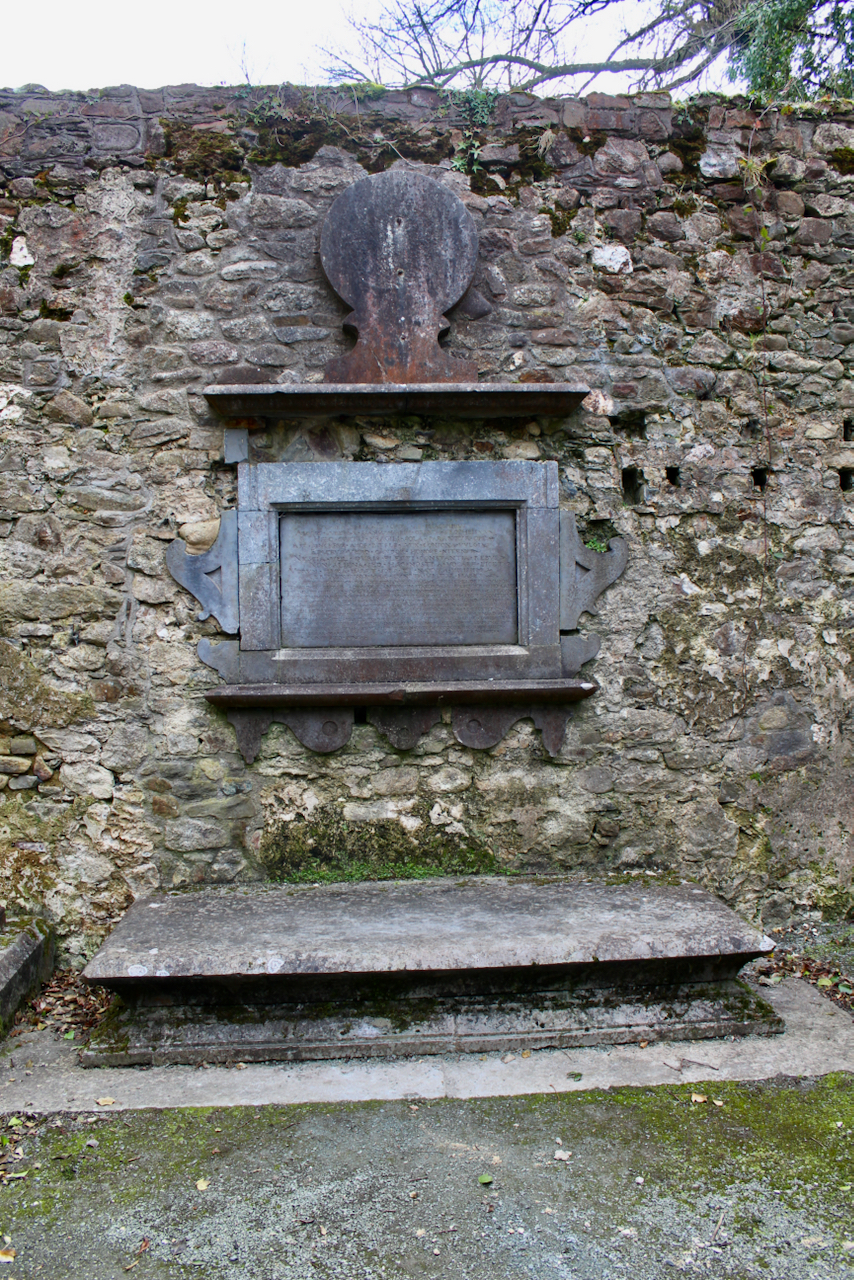
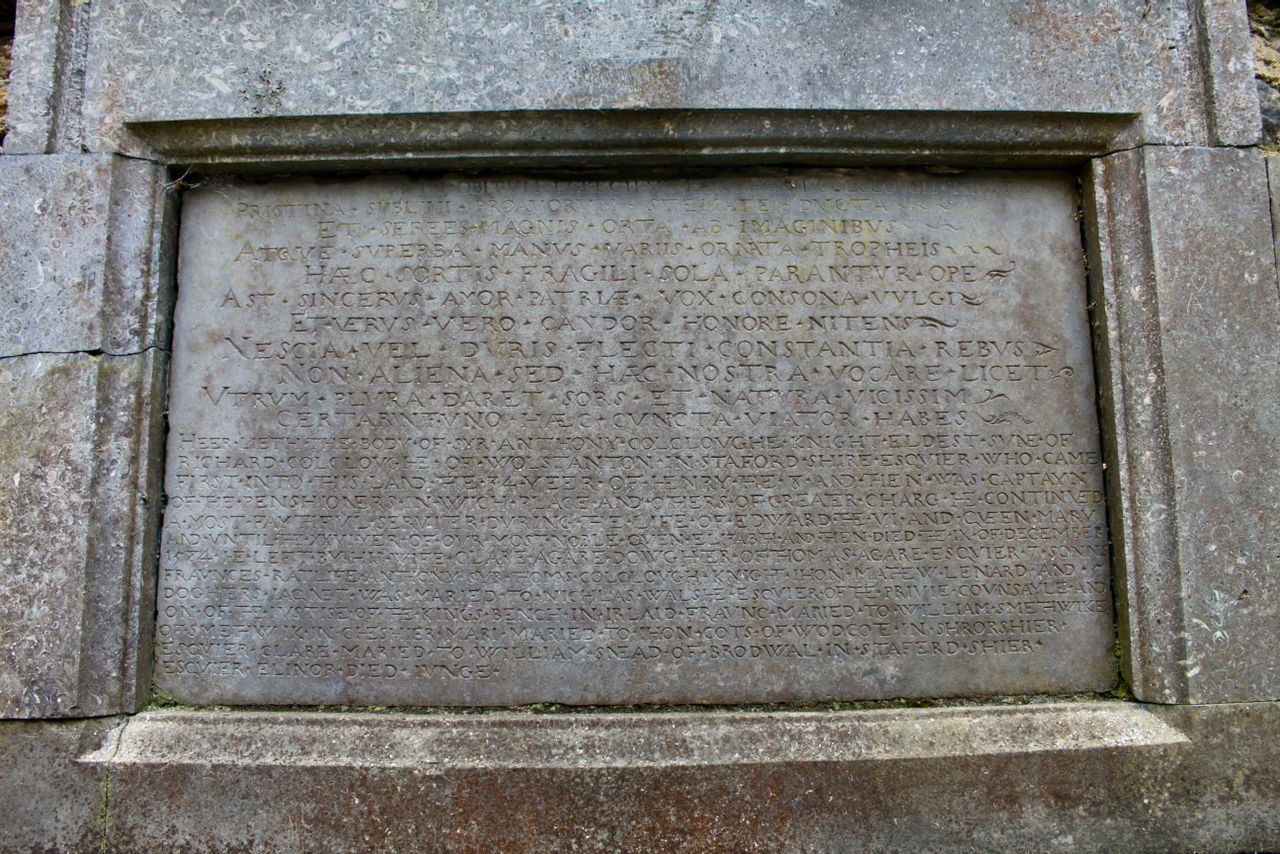
Tintern church and cemetery, which contains the Colclough vault. Photograph © Jennifer Winder-Baggot, www.irishhistorichouses.com
Photograph © Jennifer Winder-Baggot, www.irishhistorichouses.com
Tintern church and cemetery, which contains the Colclough vault. Photograph © Jennifer Winder-Baggot, www.irishhistorichouses.com

Anthony’s son Thomas continued to develop Tintern, and is said to have established oyster beds in Bannow Bay. He married, first, Martha Loftus, daughter of Adam Loftus, Protestant Archbishop of Dublin. Their son Adam was raised to the baronetcy as 1st Baronet of Tintern Abbey. Thomas’s second wife, Eleanor Bagenal, was Catholic. After her husband’s death, she married Lucas Plunkett, 1st Earl of Fingall. Thomas’s son by his second marriage inherited lands at Duffry, where Duffry Hall was built by his grandson Patrick Colclough (d. 1691).
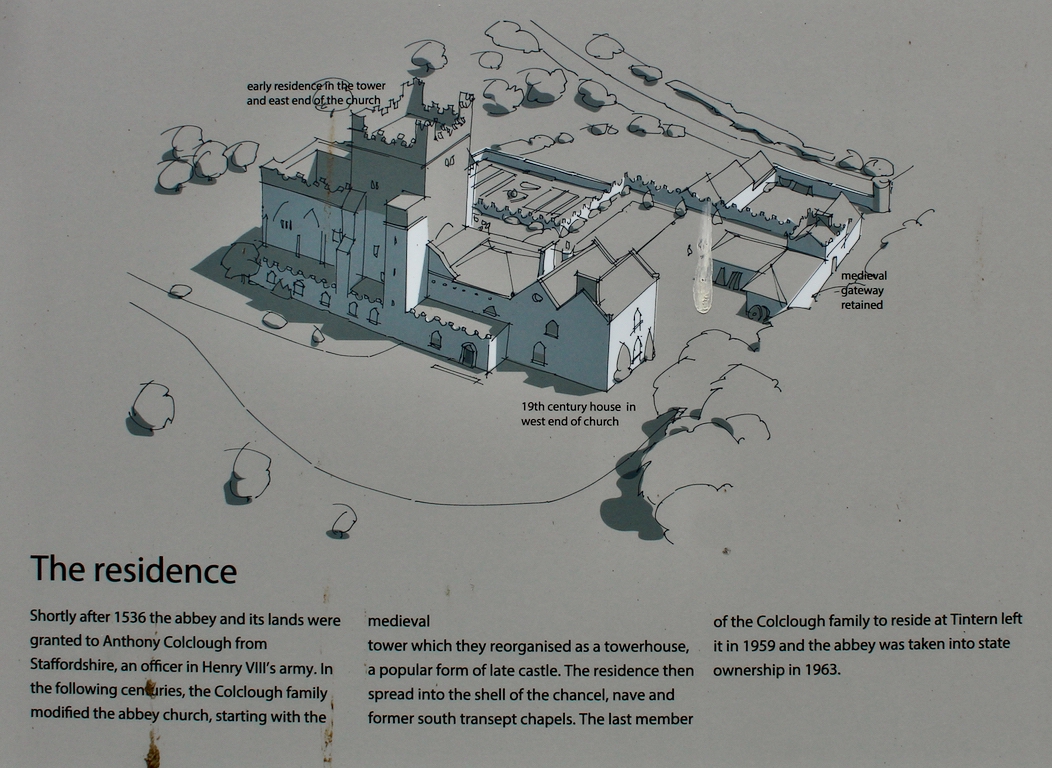
Tintern Abbey, County Wexford, May 2023.
Tintern Abbey, County Wexford, May 2023. Reconstruction drawings by Daniel Tietzsch-Tyler.
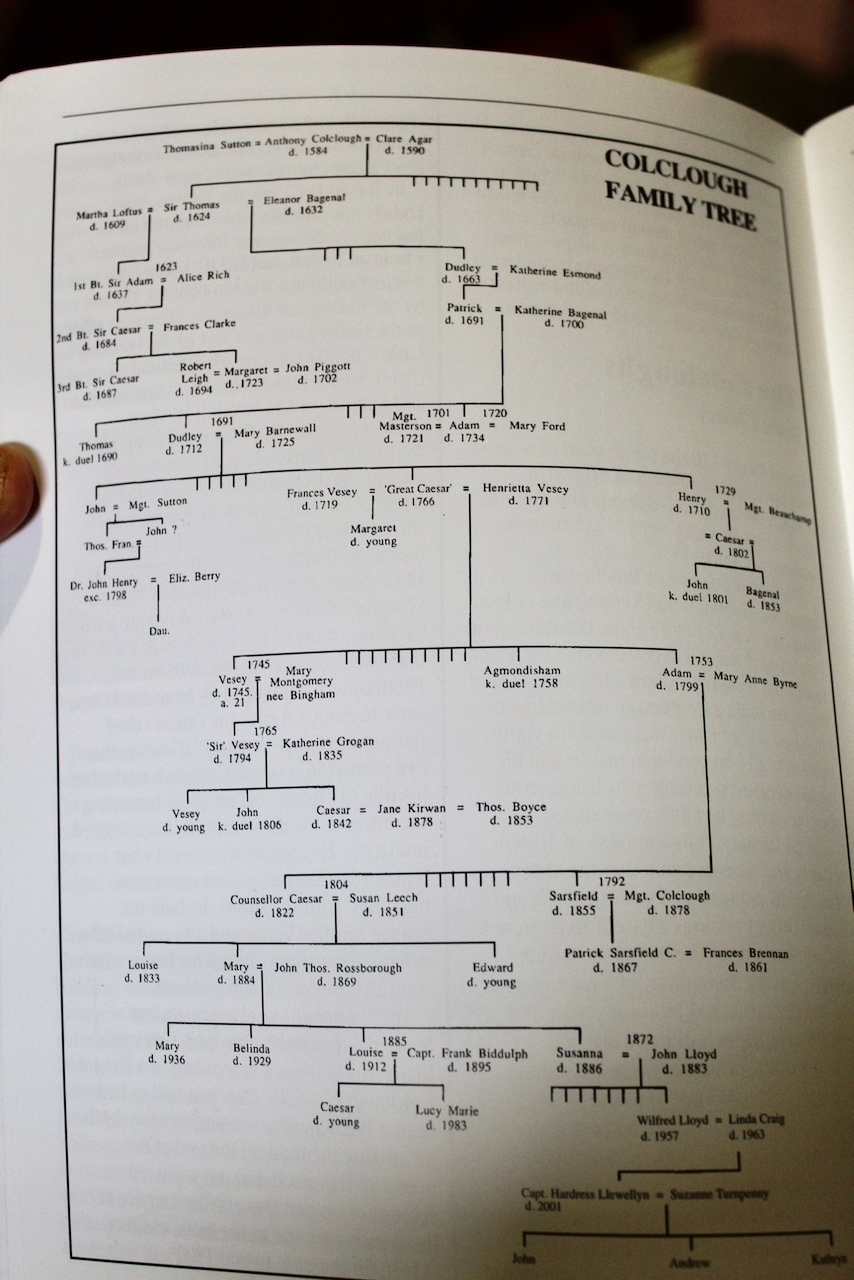
Colclough family tree, in Tintern Abbey County Wexford, Cistercians and Colcloughs, Eight Centuries of Occupation, 1st Edition edited by Kevin Whelan, 2nd Edition.

During the 1641 rebellion 200 local Protestant people took refuge in Tintern which was garrisoned by forty soldiers from Duncannon Fort situated nearby. At that time Tintern would have been inhabited by the 2nd Baronet, Caesar Colclough (d. 1684). Shortly afterwards the Catholic branch of the family laid siege to the Protestant branch who were in residence in Tintern Abbey. [2]

The Catholic branch who took control of the abbey following a two-week siege included Dudley Colclough (1613-1663), who had married Katherine Esmonde of Johnstown Castle, and his two brothers John and Anthony (who married Mary Esmonde from Johnstown Castle). Following Oliver Cromwell’s arrival in 1649 Dudley was banished to Connaught and he ultimately died in exile in France.

The 3rd Baronet of Tintern Abbey, Caesar (1650-1687) had no heir so the title expired and the lands passed to his sister Margaret. She married firstly, in 1673, Robert Leigh, of Rosegarland, who thereupon assumed the surname of Colclough; and secondly, in 1696, John Pigott, of Kilfinney, County Limerick, who also assumed the surname of Colclough.

Caesar Colclough (d. 1766), known as “Great Caesar,” great-grandson of Catholic Dudley who had rebelled in 1641, united the properties. His grandfather, Patrick Colclough of Duffry Hall, married Katherine Bagenal of Dunleckney, County Carlow. Patrick Colclough was Catholic and very active in the Jacobite cause and was attainted of High Treason and outlawed by King William III but he died in 1691, before the attainder passed into law, so his eldest son was able to inherit his estates. His son Dudley (d. 1712) was brought up in the Protestant faith. [3] He married Mary Barnewall, granddaughter of Nicholas Barnewall, 1st Viscount Barnewall of Kingsland. The Great Caesar was their son.

The “Great Caesar” was a great sportsman and generous landlord. He brought a team of men to play hurling in front of King George. The team wore a yellow sash to distinguish them from the opposition, and the king or queen called out, “Come on the yellow bellies!” and from then on, Wexford men are called “yellow bellies.”

Caesar’s second wife, Henrietta Vesey, was the great-granddaughter of King Charles II, granddaughter of Mary Walters de Crofts, illegitimate daughter of Charles II.

Upon the Great Caesar’s death in 1766, the Tintern estates passed to his grandson Vesey, and the Duffry estates passed to his younger son Adam. Vesey Colclough (1745-1794) married Catherine Grogan of Johnstown Castle in County Wexford. It was not a happy marriage and they separated, but Vesey remained in Tintern and transformed the chancel of the abbey into a residence. He was extravagant in his lifestyle, however, and his son John had to extricate himself from debt accrued.
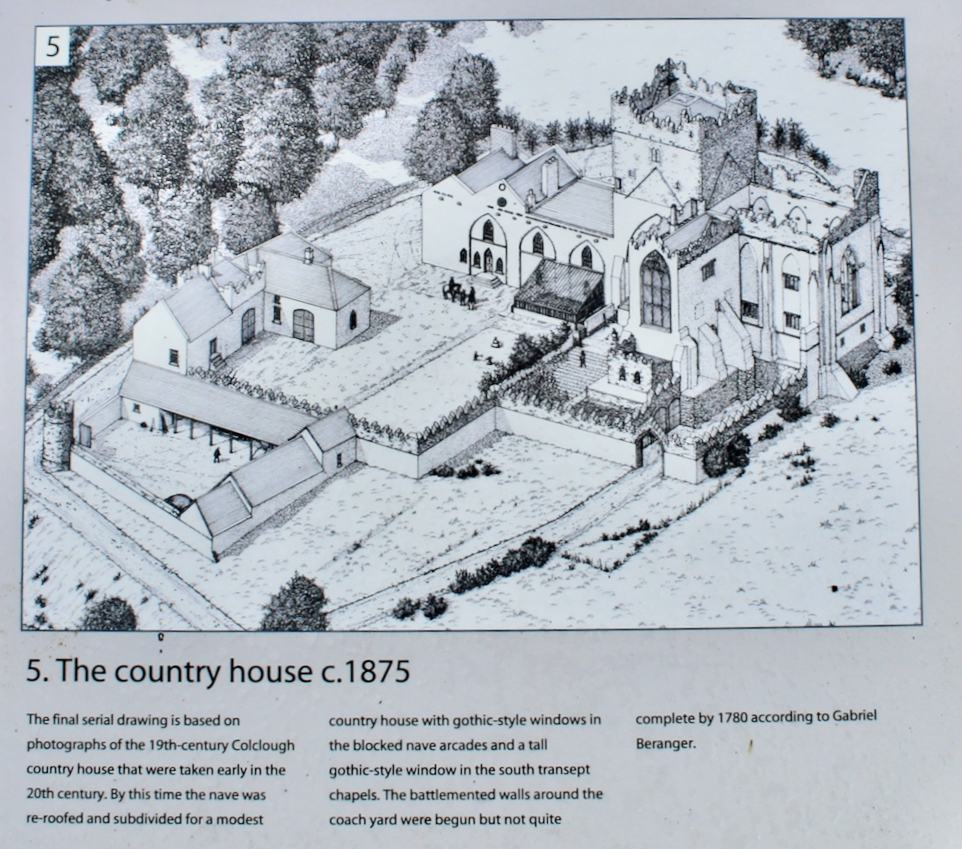
OPW notice board. Reconstruction drawings by Daniel Tietzsch-Tyler.
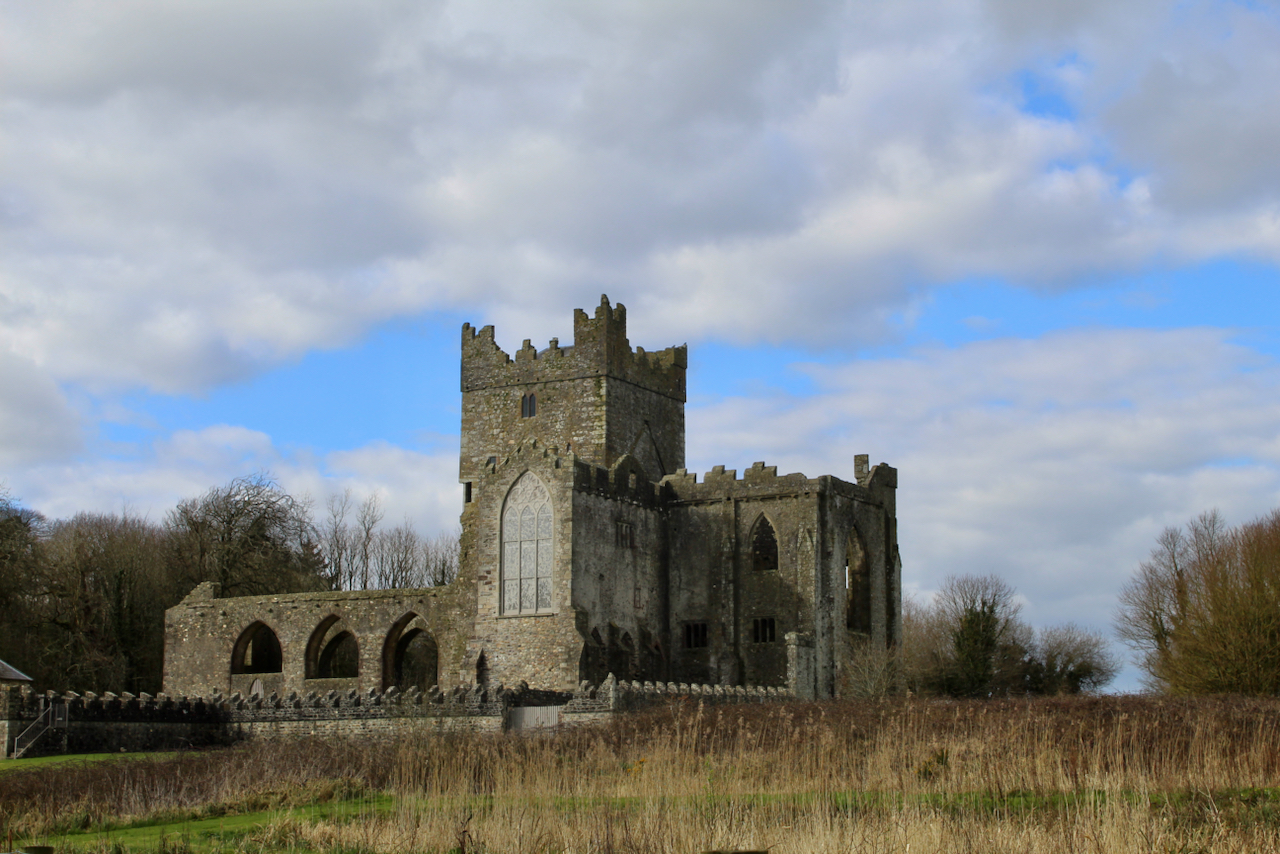
Tintern Abbey, County Wexford, 15th March 2025. Photograph © Jennifer Winder-Baggot, www.irishhistorichouses.com

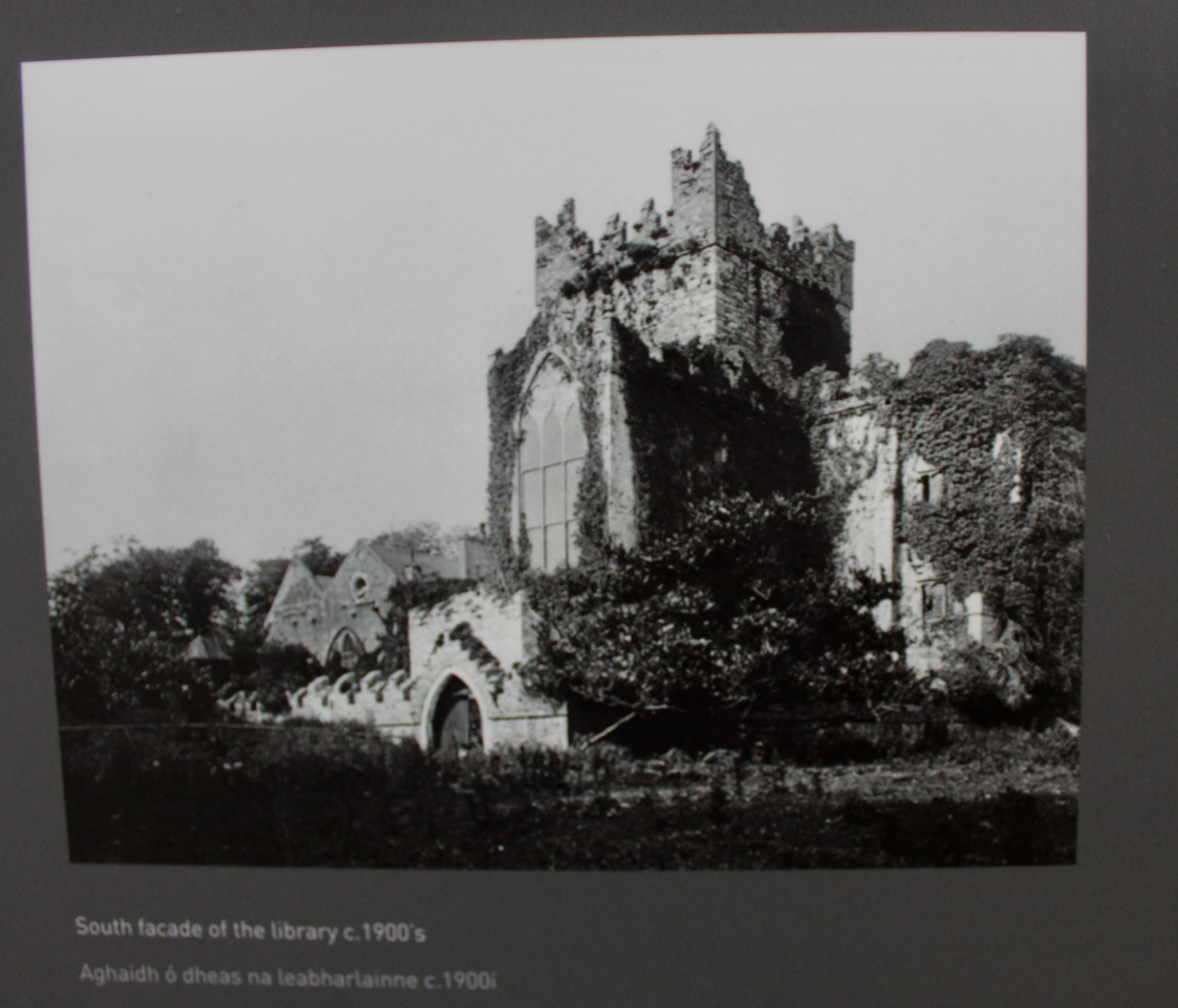
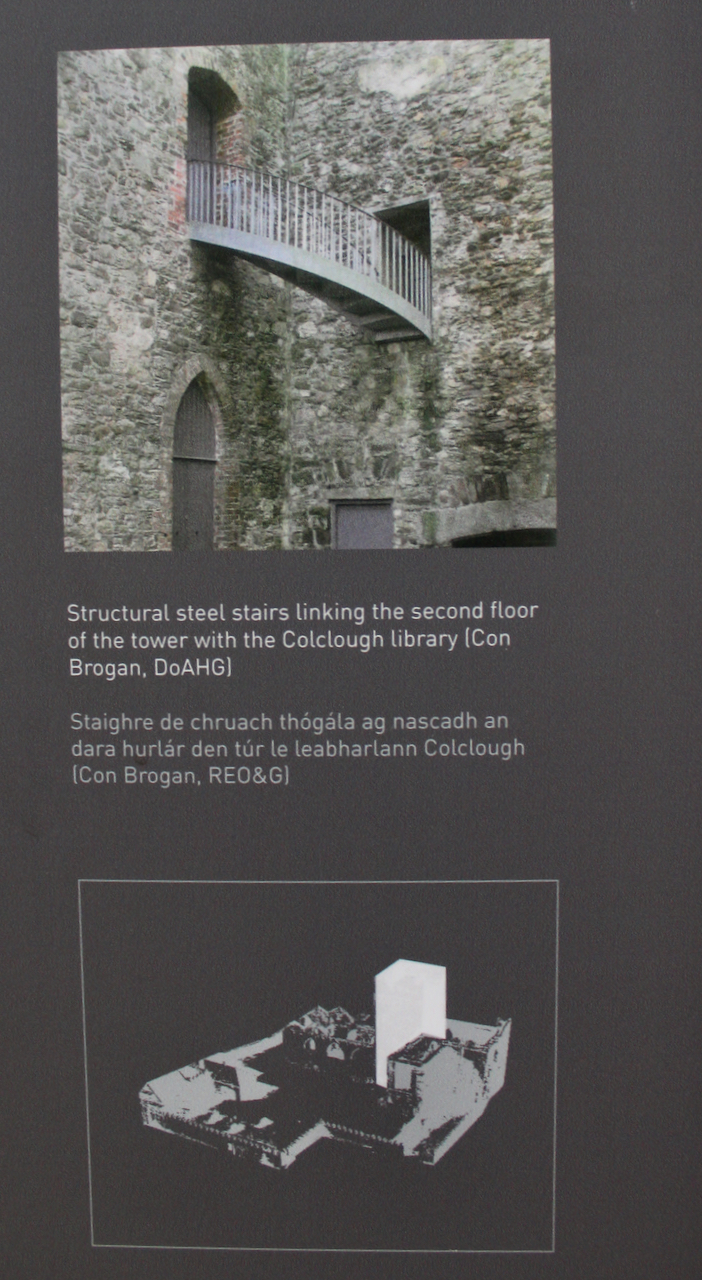
John did more renovations of the abbey, constructing a second storey over the south transept aisle, which was known as the Lady Chapel. The lower storey held a kitchen and above, a library, wiht a massive Gothic window facing the sea.
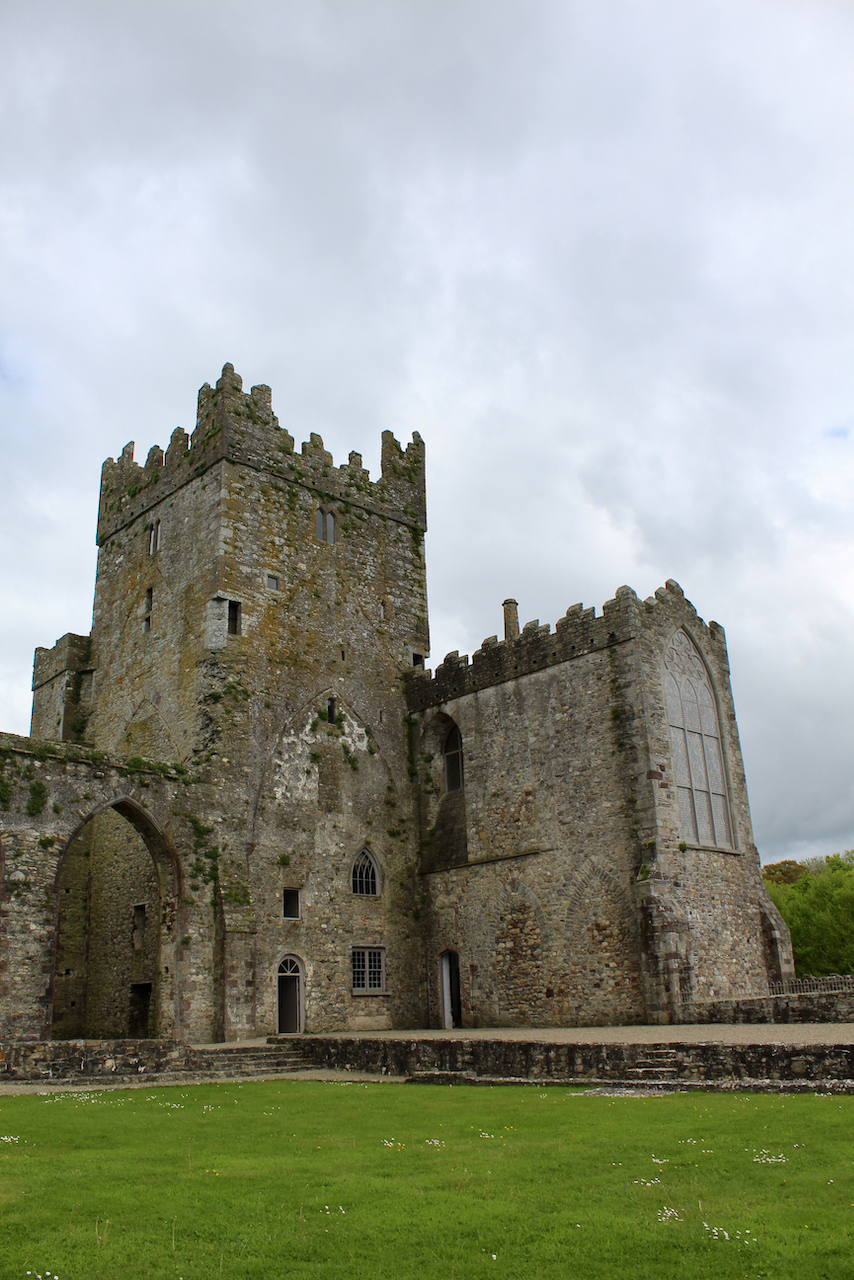
Tintern Abbey, County Wexford, May 2023. Photograph © Jennifer Winder-Baggot, www.irishhistorichouses.com
Tintern Abbey, County Wexford.
The library window, Tintern Abbey, May 2023. Photograph © Jennifer Winder-Baggot, www.irishhistorichouses.com
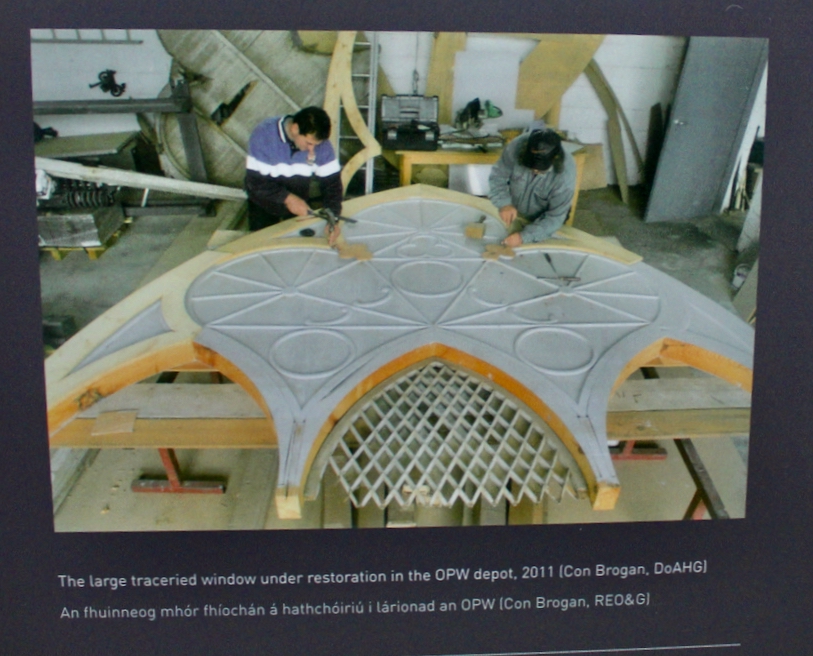
The large traceried window being restored.
The old library with its large window. Photograph © Jennifer Winder-Baggot, www.irishhistorichouses.com

However, when John was standing for election he was shot dead in a duel in 1807 by William Alcock of Wilton Castle in County Wexford, an opponent in the election. Alcock was acquitted by a jury of his peers, but his mental health deteriorated.

Four Colcloughs died in duels. Thomas of Duffrey Hall was killed in a duel in 1690. Agmondisham, son of “Great Caesar,” was killed in a duel in 1758, and John Colclough of St. Kieran’s was killed in 1801 by Henry Loftus Tottenham of Loftus Hall, far down on the Hook Peninsula (a property that is again advertised for sale).

Tintern passed to John’s brother, another Caesar Colclough (1766-1843). He and his wife Jane Kirwan had no children, and some suspected his wife of killing him. She went on to marry Thomas Boyce. Her right to the property was challenged by the Colclough family. So many court cases were instigated that it has been said that it was one of the inspirations for Dickens’ “Jarndice vs Jarndice” in Bleak House.

Adam, the son of “Great Caesar” who inherited Duffry, had a son, Caesar, who died in 1822. He was Chief Justice of Prince Edward Island in Canada. It was his daughter, Mary, who married John Thomas Rossborough, who eventually gained ownership. Her husband took the name Colclough.

The Colclough family lived there until 1958, when it was presented to the state by Lucy Biddulph-Colclough.

The Board of Works that took on care of Tintern Abbey dismantled the residential part of the building: floors, doors and windows were taken out, the roof was taken off, and materials were sold by auction. It was only twenty years later that the Board of Work returned to preserve the abbey.
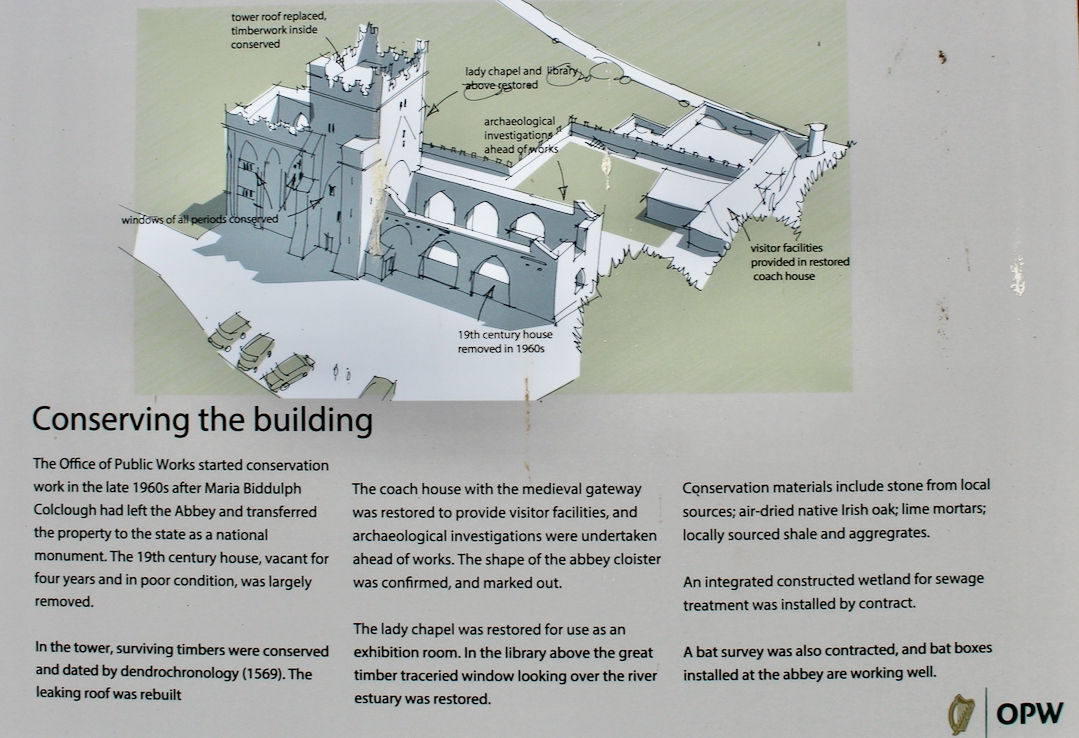
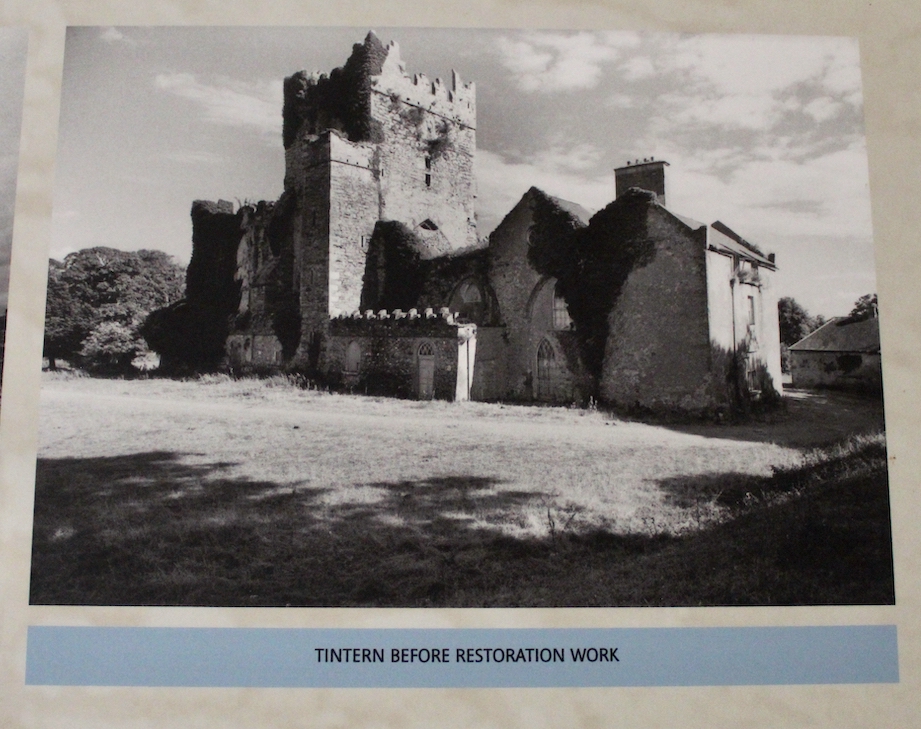
Tintern Abbey noticeboard. Reconstruction drawings by Daniel Tietzsch-Tyler.
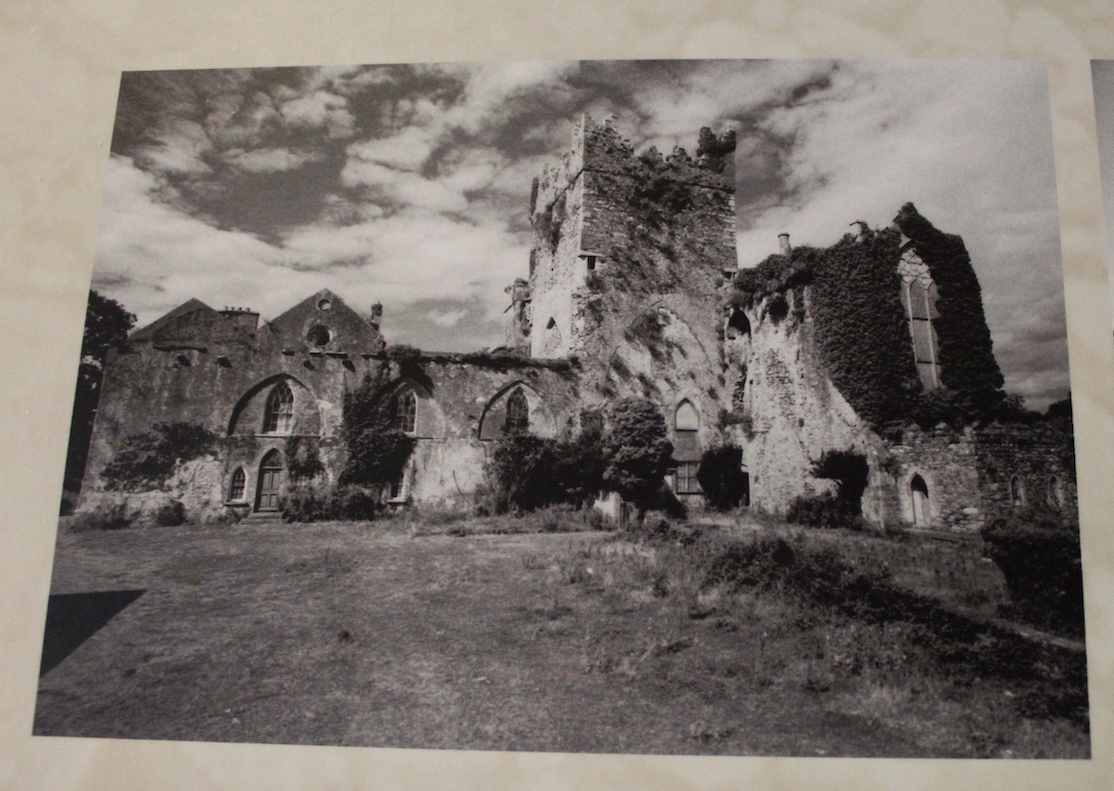
Tintern before restoration work.

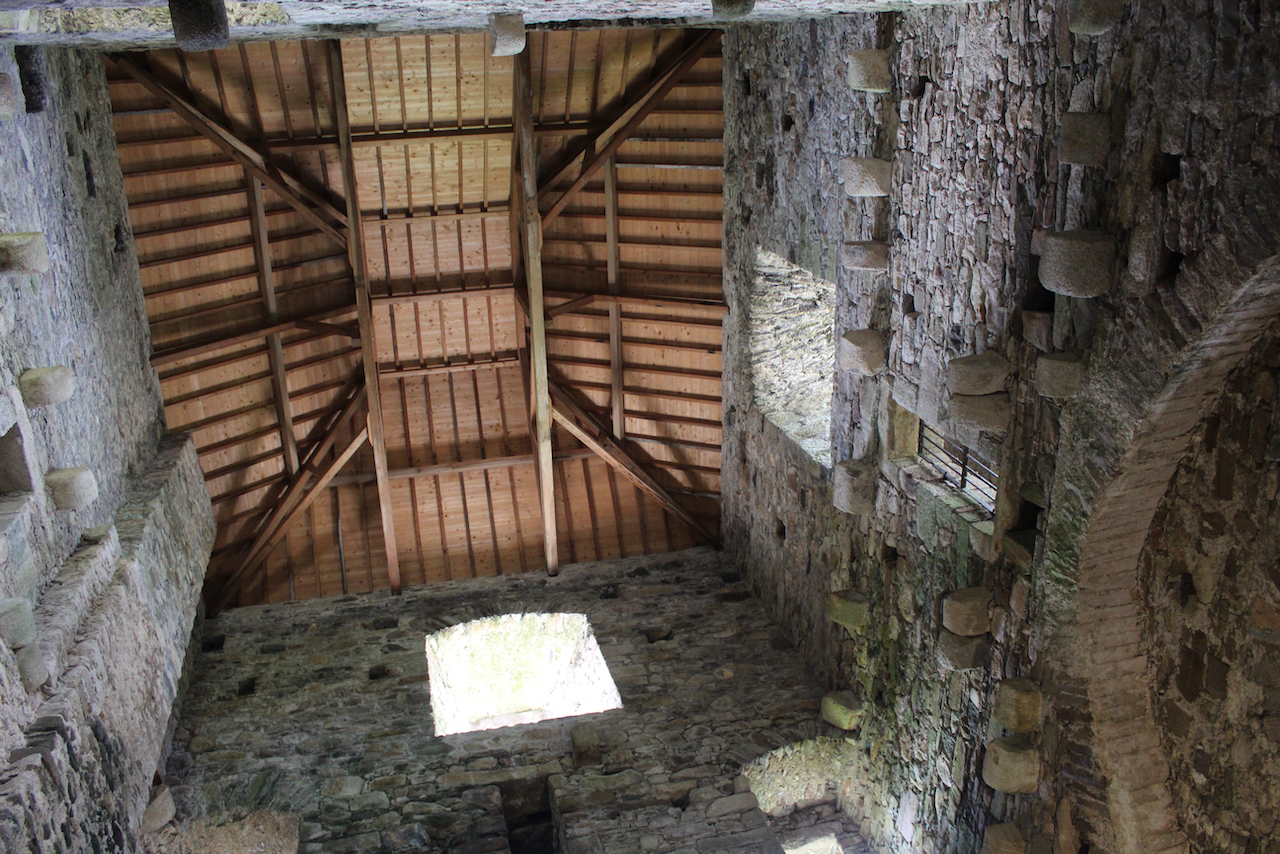
When it was being restored, the roof of the tower was rebuilt. The coach house with the medieval gateway was restored to provide visitor facilities.
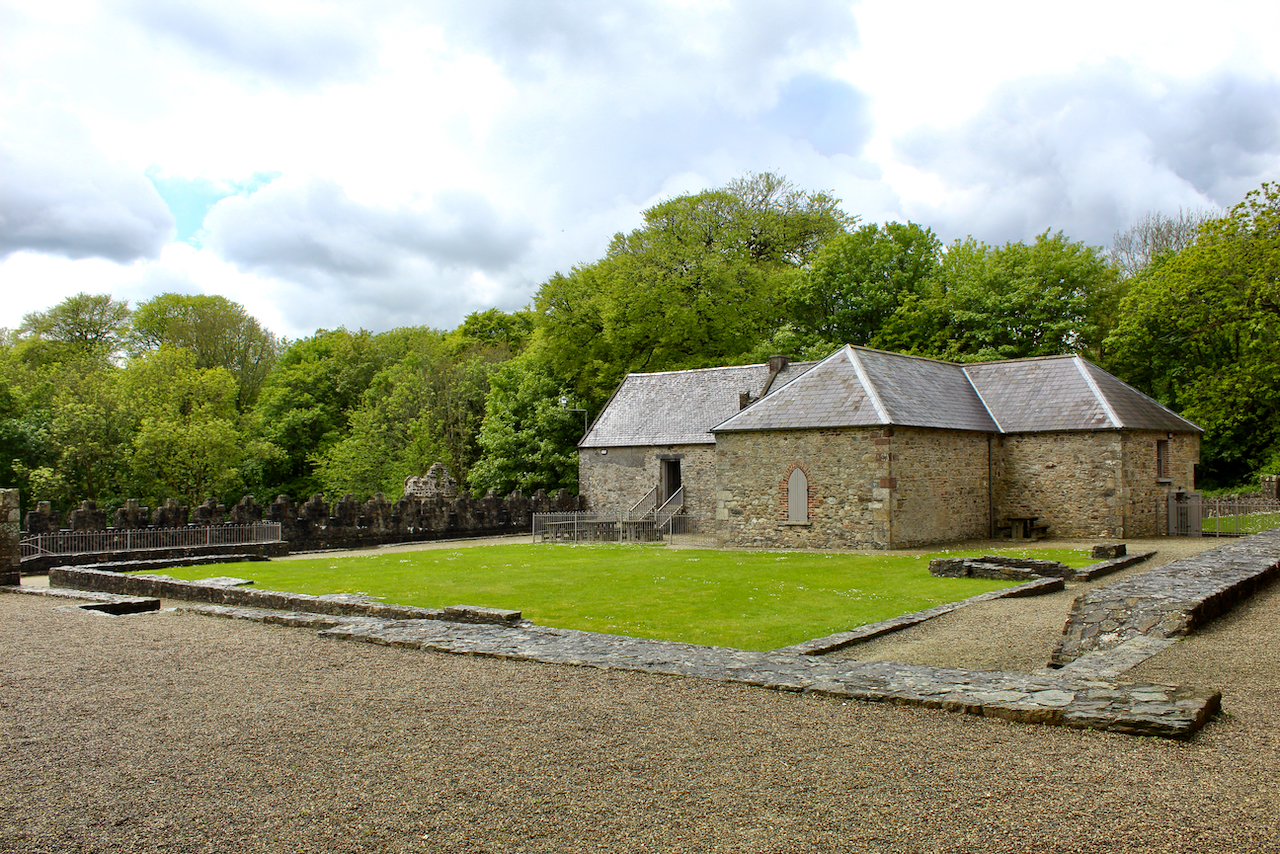
The restored coach house, in use for tourist facilities, at Tintern Abbey, County Wexford, May 2023. Photograph © Jennifer Winder-Baggot, www.irishhistorichouses.com

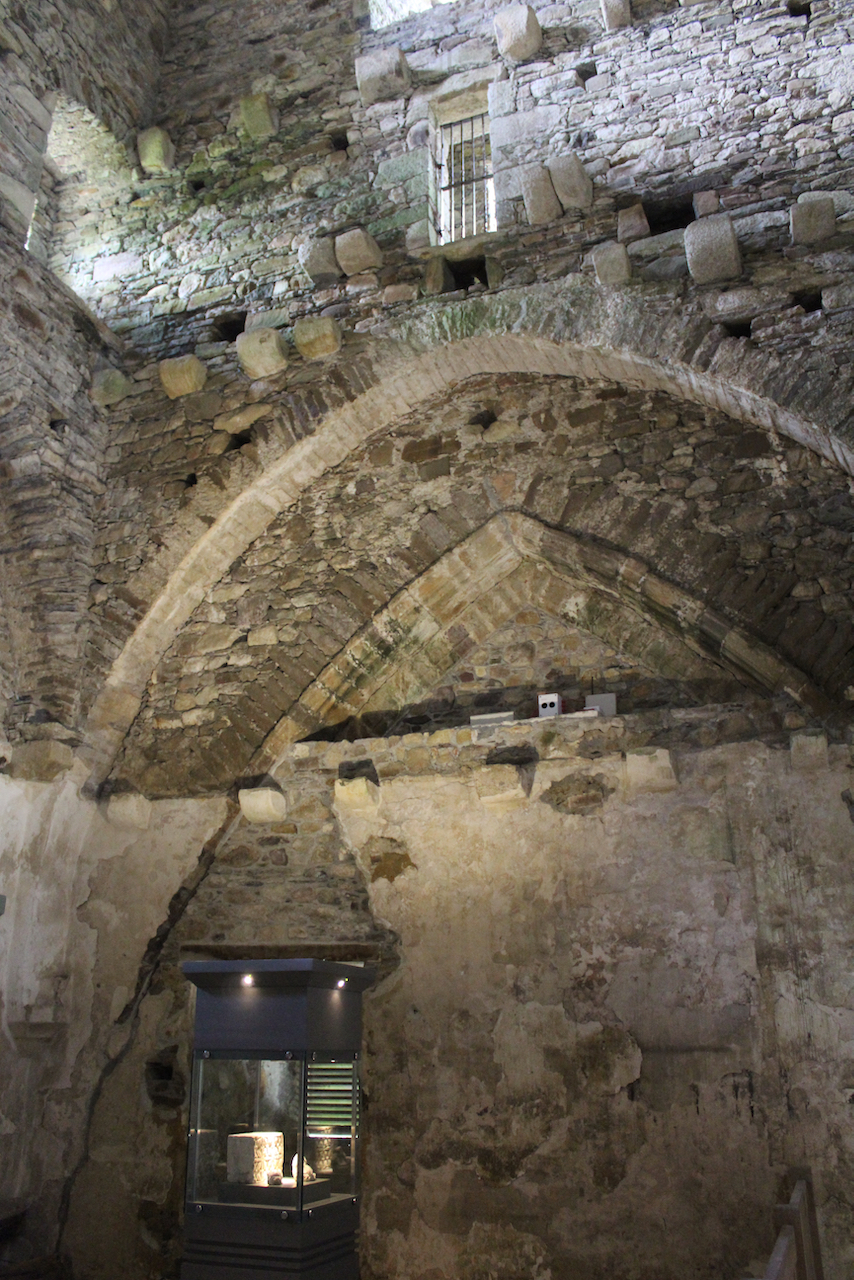
The Lady Chapel was restored for use as an exhibition room.

Stephen in the stone vaulted Lady Chapel, Tintern Abbey, County Wexford, May 2023. Photograph © Jennifer Winder-Baggot, www.irishhistorichouses.com
Tintern Abbey, County Wexford, May 2023. Photograph © Jennifer Winder-Baggot, www.irishhistorichouses.com
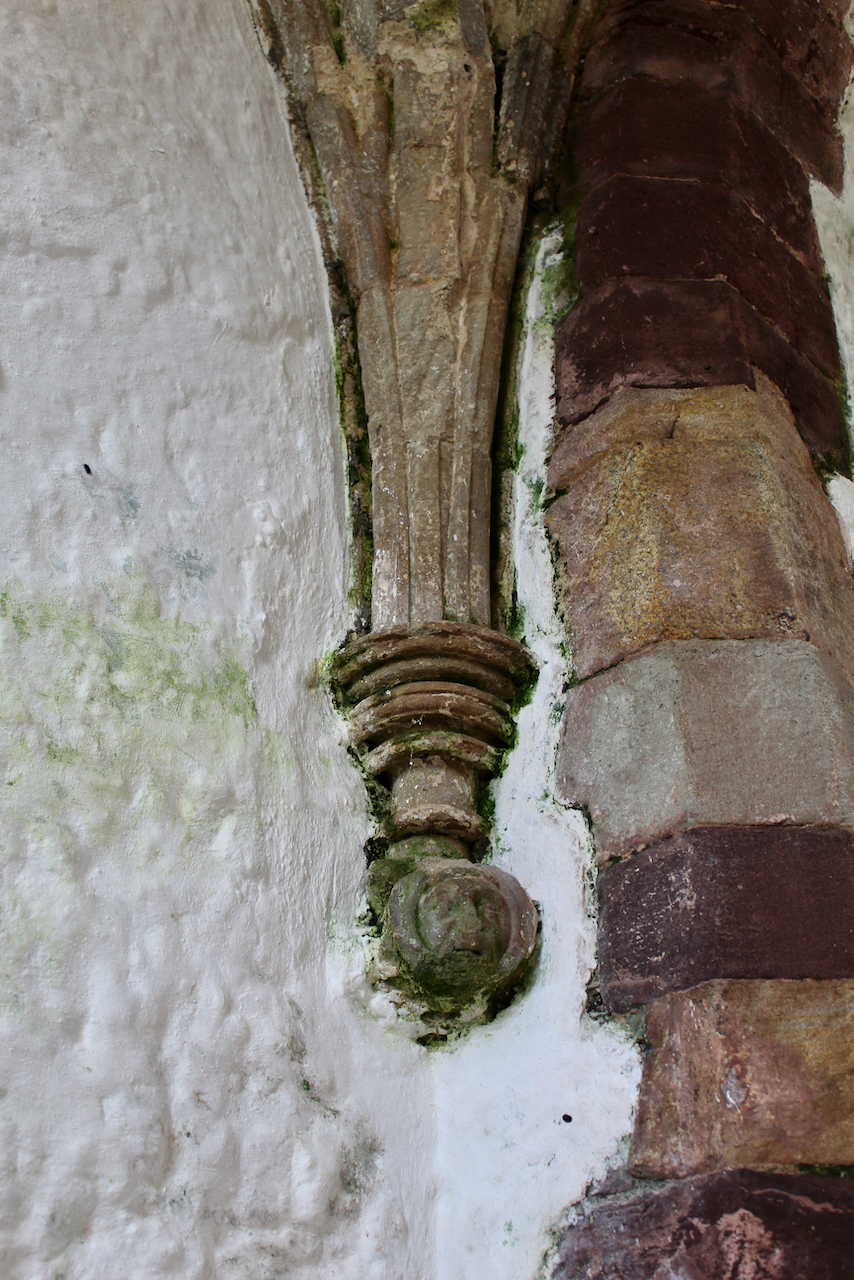
Carved boss in the Lady Chapel vaulting, Tintern Abbey, County Wexford, May 2023. Photograph © Jennifer Winder-Baggot, www.irishhistorichouses.com
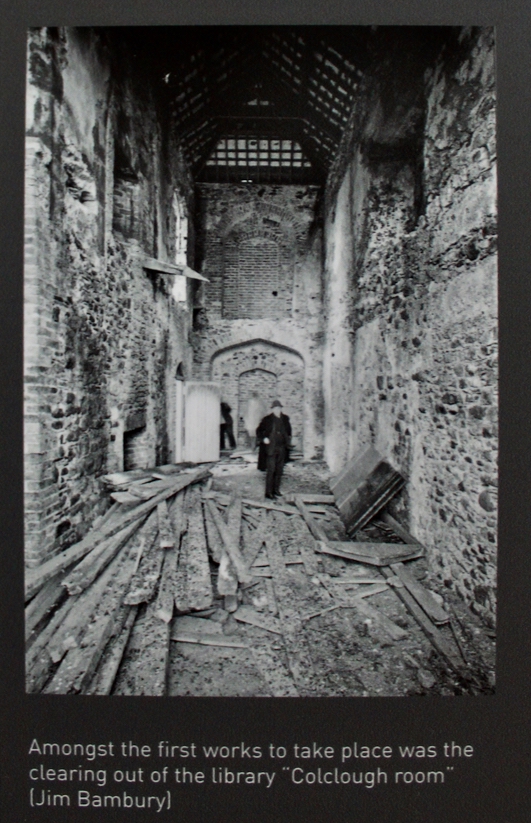
The Library was cleared out during restoration, including removing wood panelling. Wood panelling was later partly reinstated.

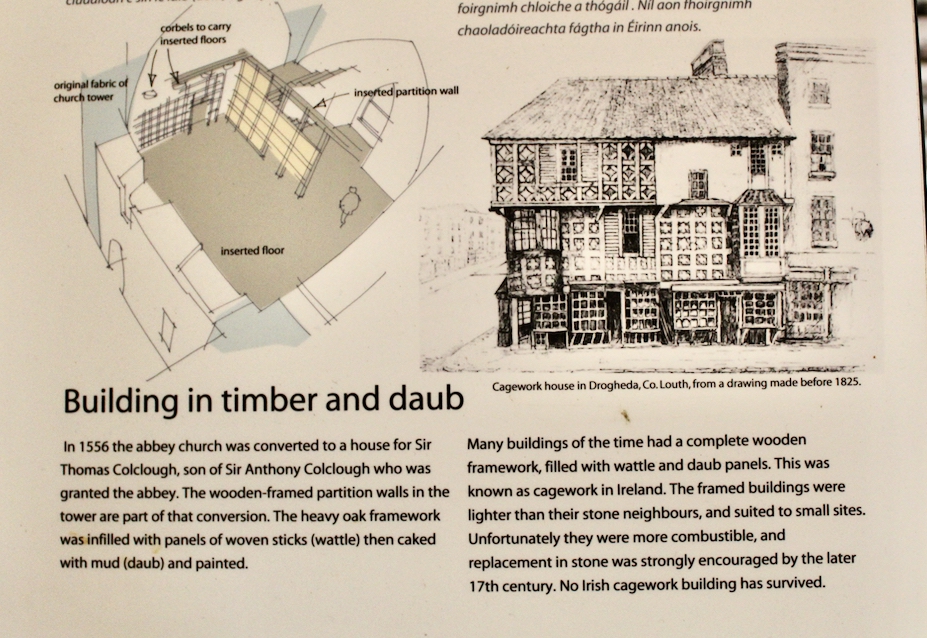
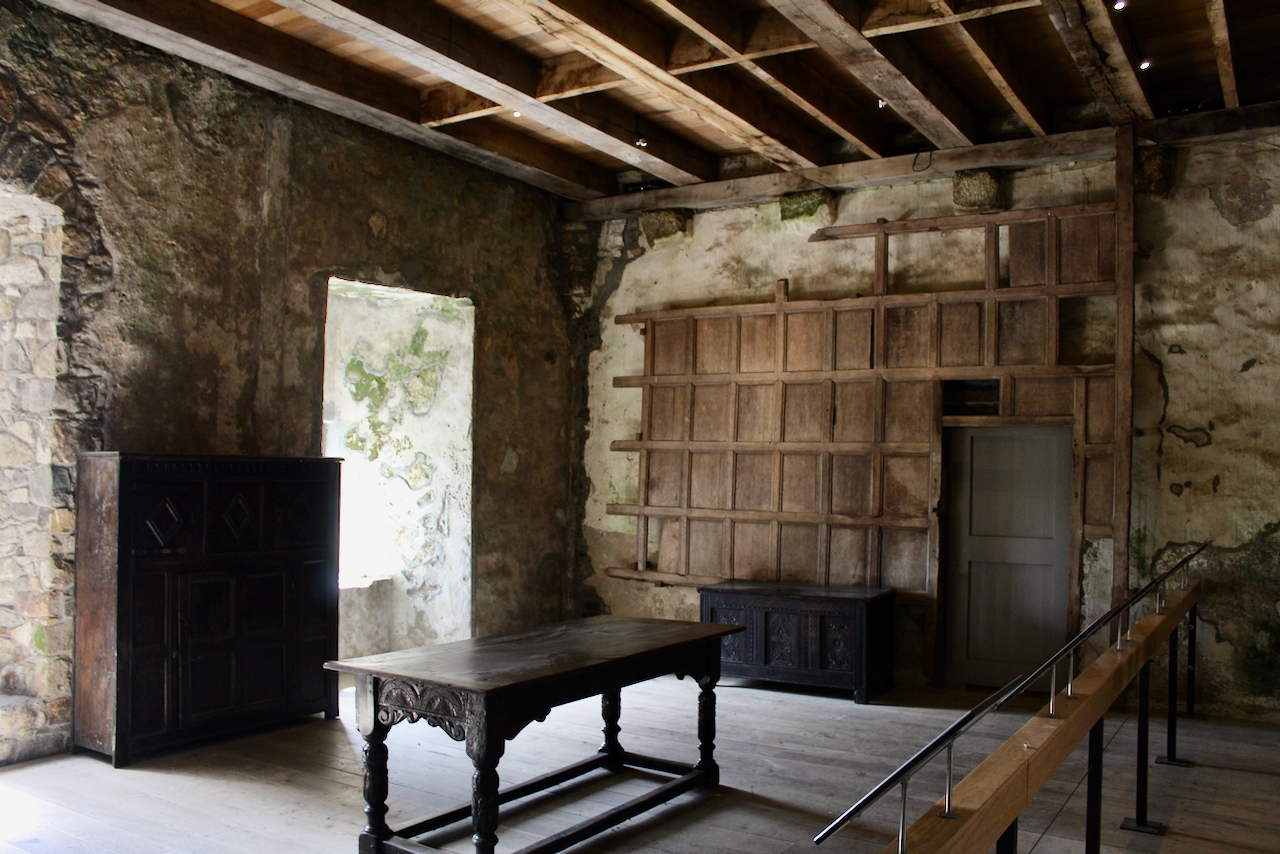
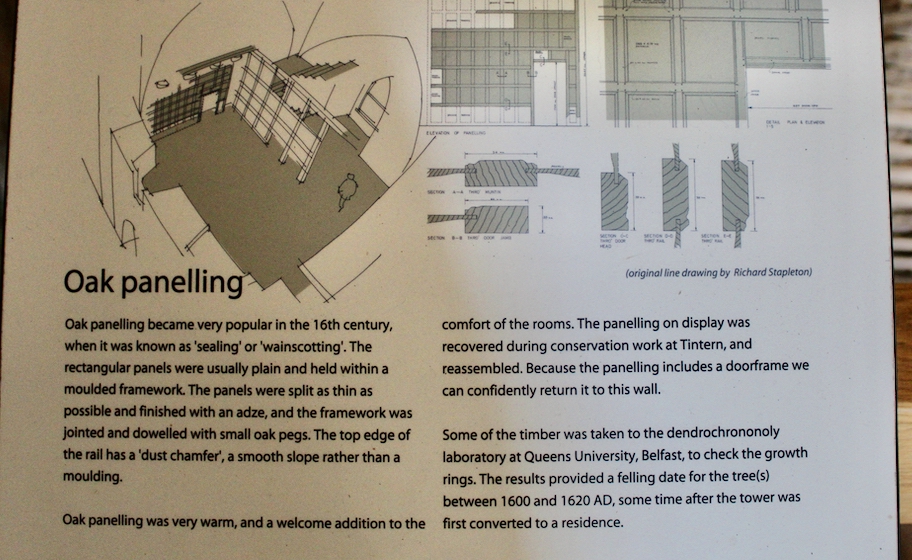
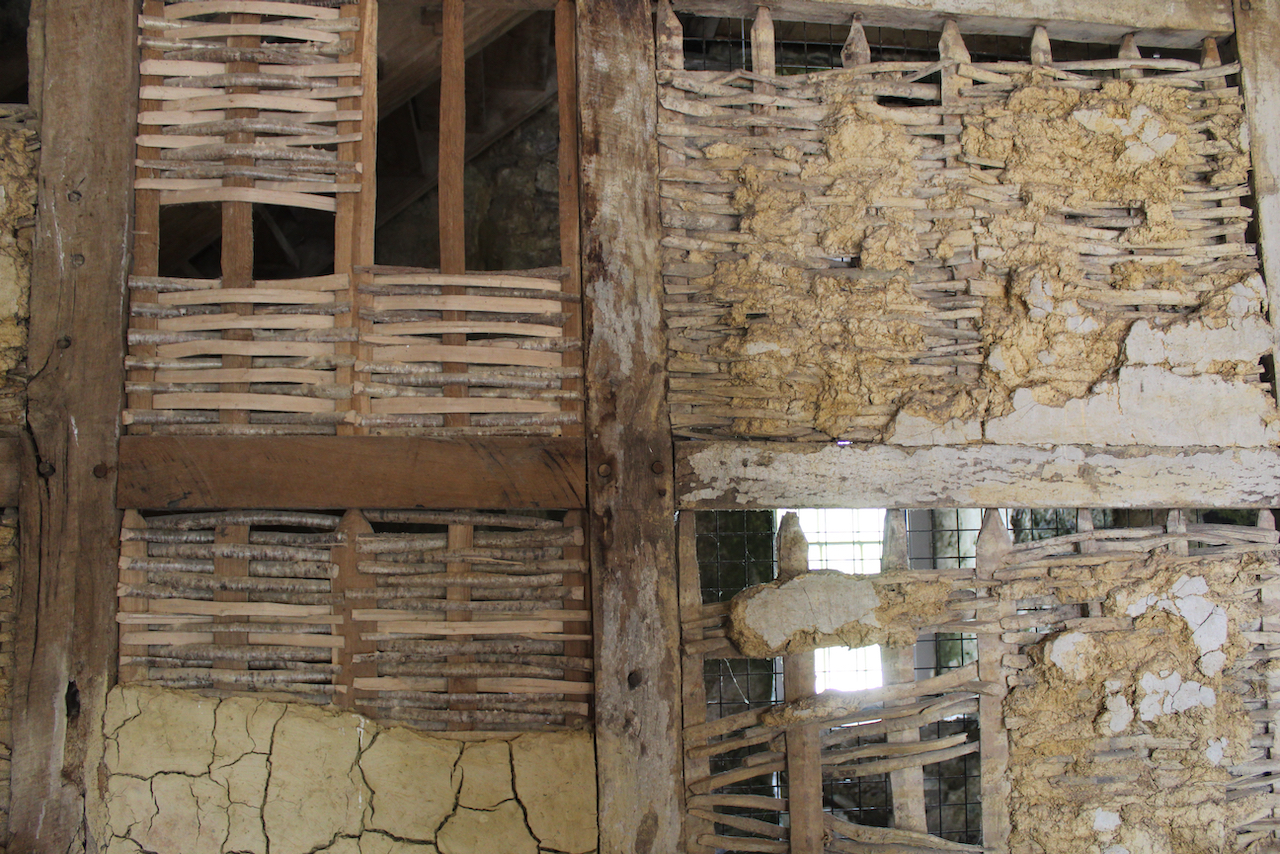
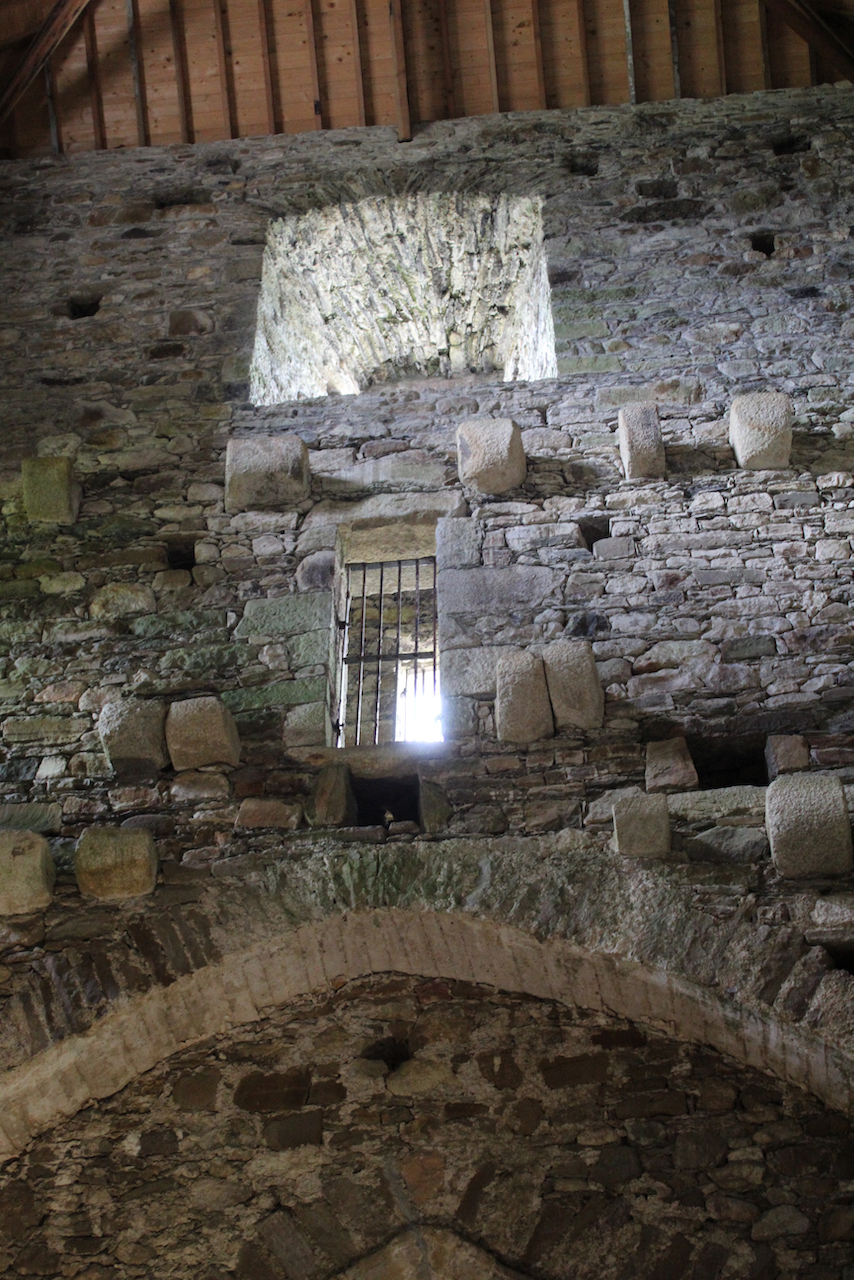
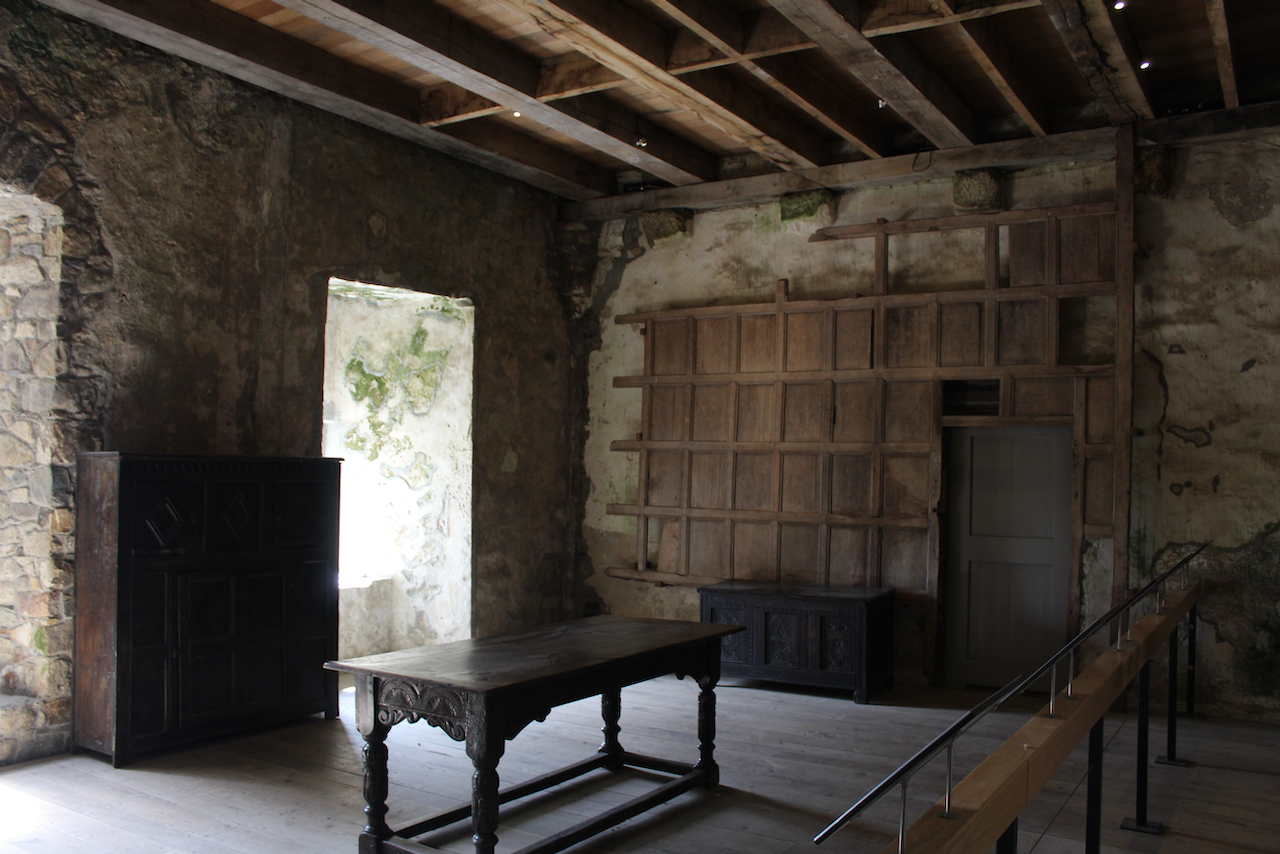
When the Abbey was converted into a residence, new flooring was added and the tower house was divided into rooms with wattle and daub timber frame screen walls and oak panelling fixed to the masonry walls. What remains of the oak panelling has been conserved and is now located on the first floor of the Crossing Tower. Dendrochronology dates the timbers to 1600-1620. It was known as “wainscotting.” It added warmth to the room.
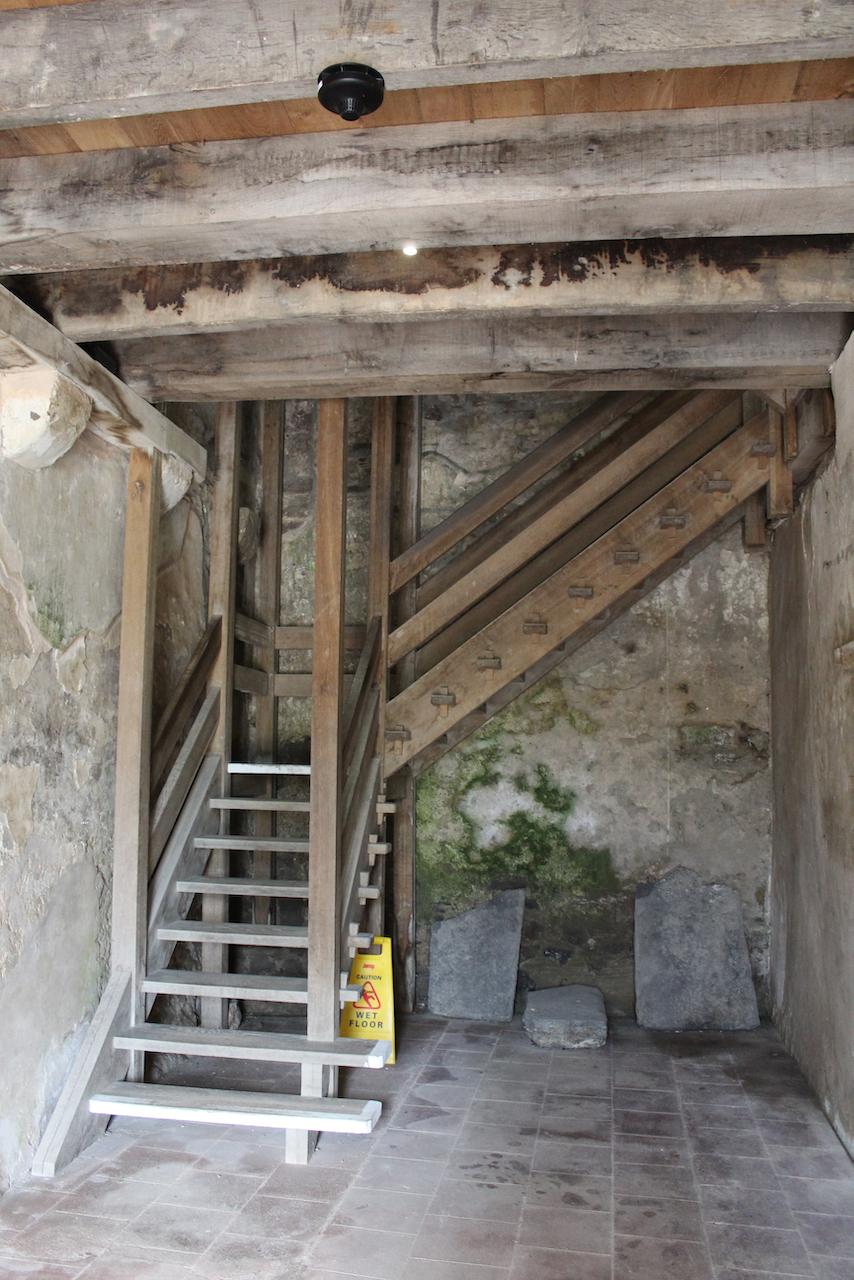
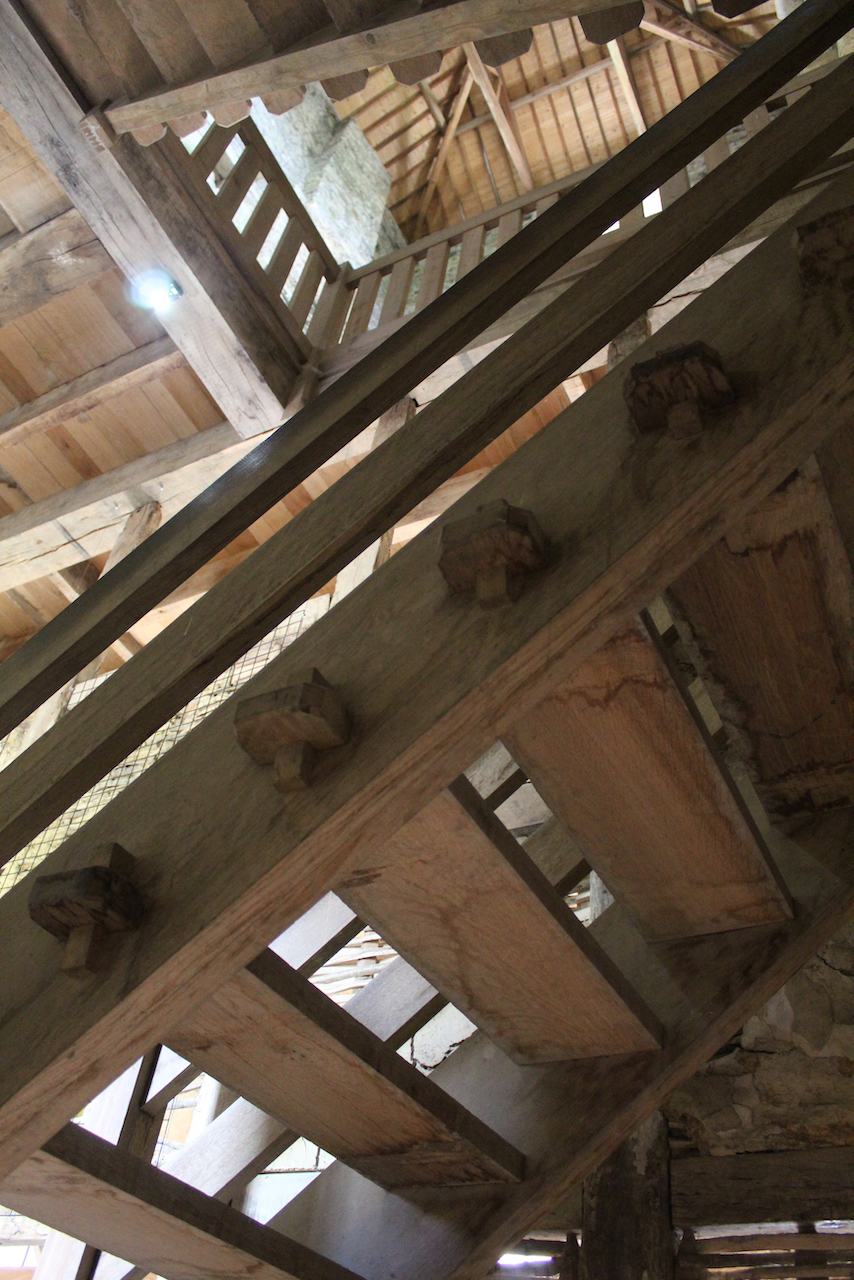
Tintern Abbey, County Wexford, May 2023. Photograph © Jennifer Winder-Baggot, www.irishhistorichouses.com
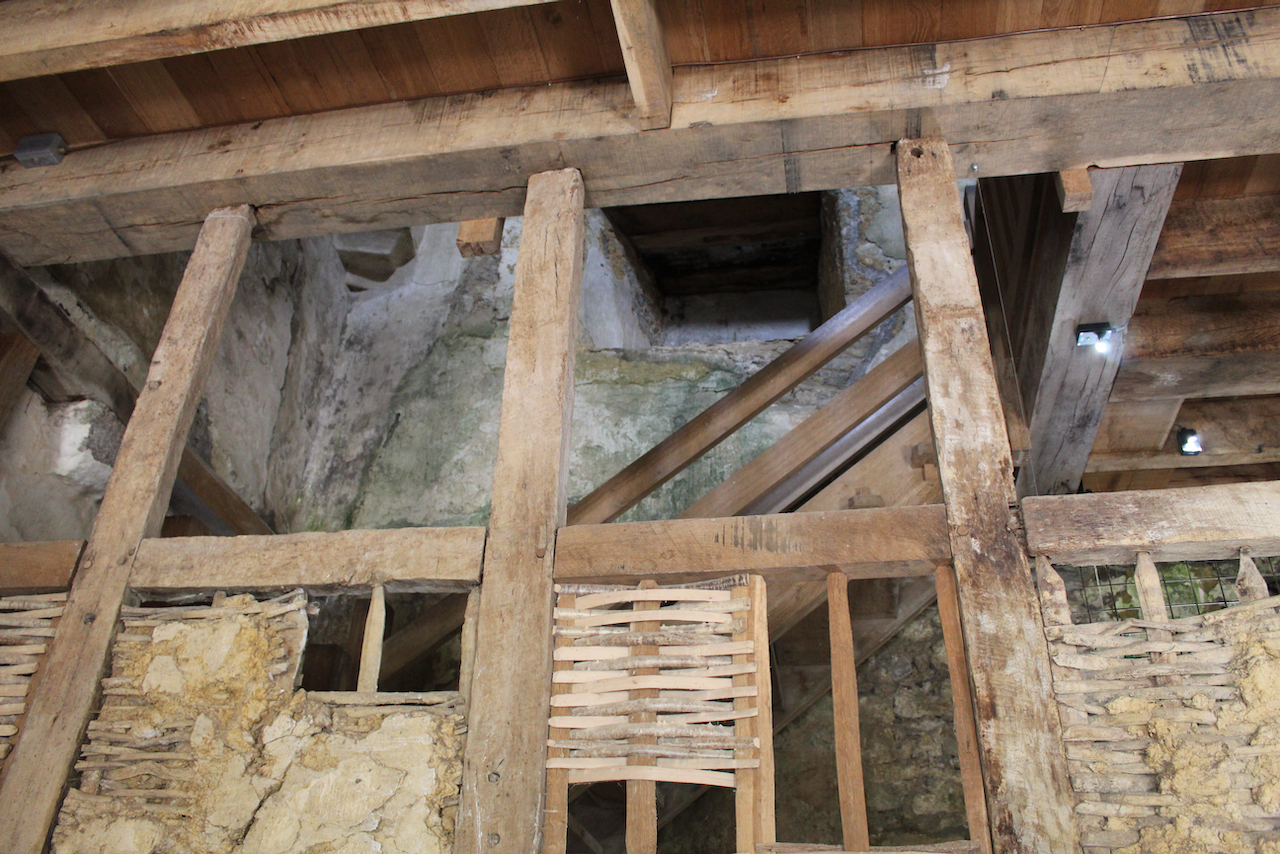
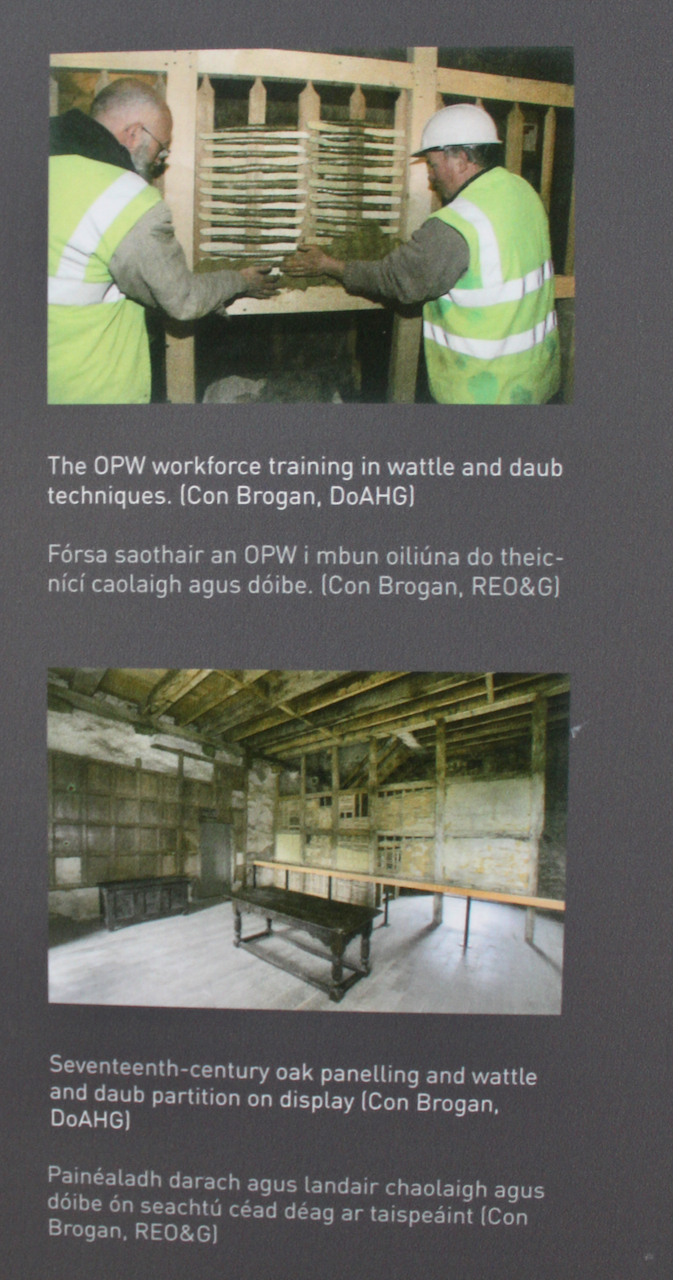
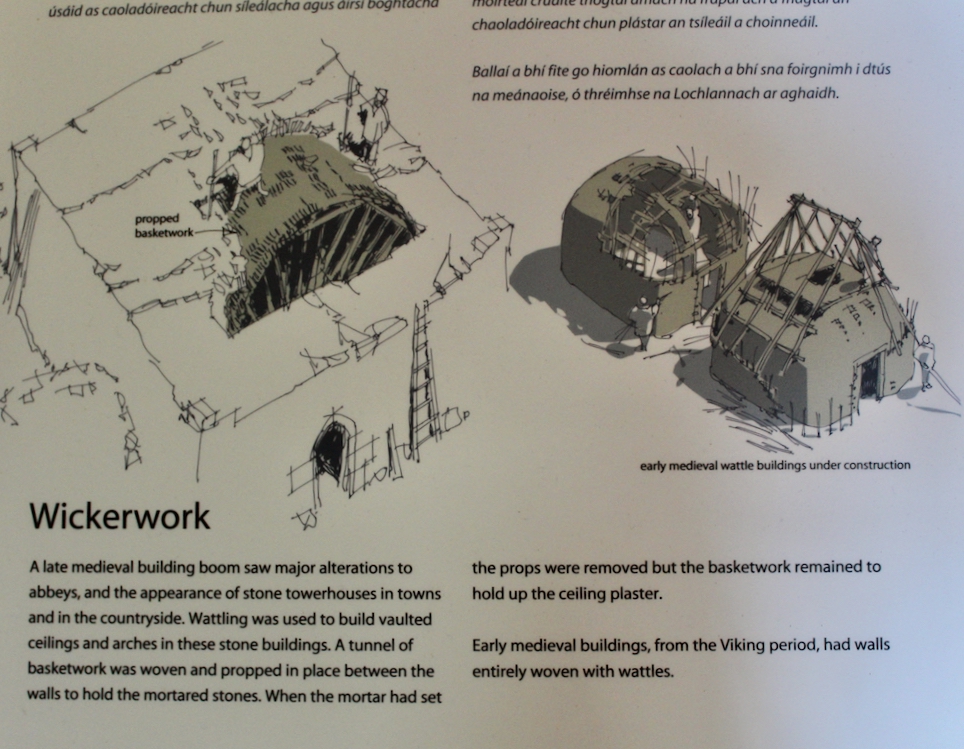
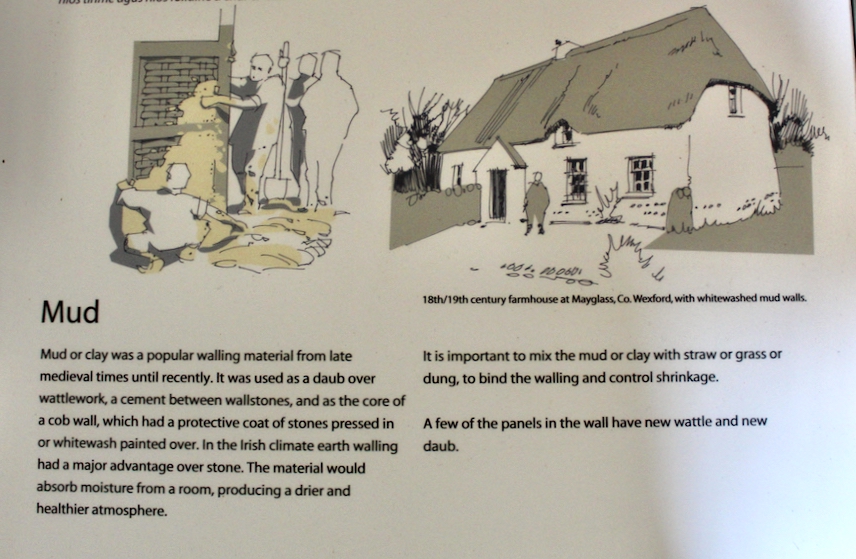
When converted to a residence, wooden-framed partition walls were added in the tower. The oak framework was infilled with panels of woven sticks “wattle” and caked with mud (“daub”) and painted.
Recovered oak panelling from 1600-1620, Tintern Abbey, County Wexford, May 2023. Photograph © Jennifer Winder-Baggot, www.irishhistorichouses.com
Tintern Abbey, County Wexford, May 2023.
Wattle and daub, Tintern Abbey, County Wexford, May 2023. Photograph © Jennifer Winder-Baggot, www.irishhistorichouses.com
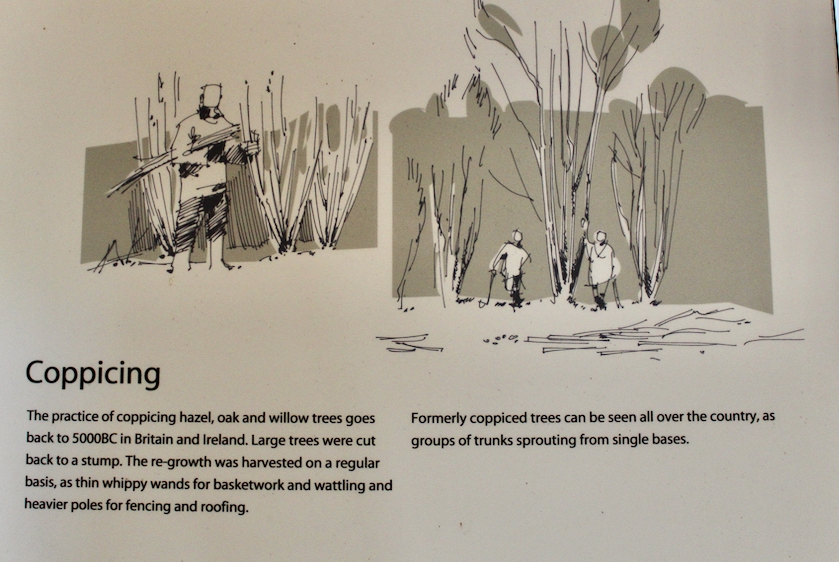
The “wattle” for building was obtained by the practice of coppicing, Tintern Abbey, County Wexford, May 2023.
Tintern Abbey, County Wexford, May 2023.
Tintern Abbey, County Wexford, May 2023. Photograph © Jennifer Winder-Baggot, www.irishhistorichouses.com
You can see how thick the walls are, Tintern Abbey, County Wexford, May 2023. Photograph © Jennifer Winder-Baggot, www.irishhistorichouses.com
Display case in Tintern Abbey. Photograph © Jennifer Winder-Baggot, www.irishhistorichouses.com
Tintern Abbey, County Wexford, May 2023.
Tintern Abbey, County Wexford, May 2023. Photograph © Jennifer Winder-Baggot, www.irishhistorichouses.com

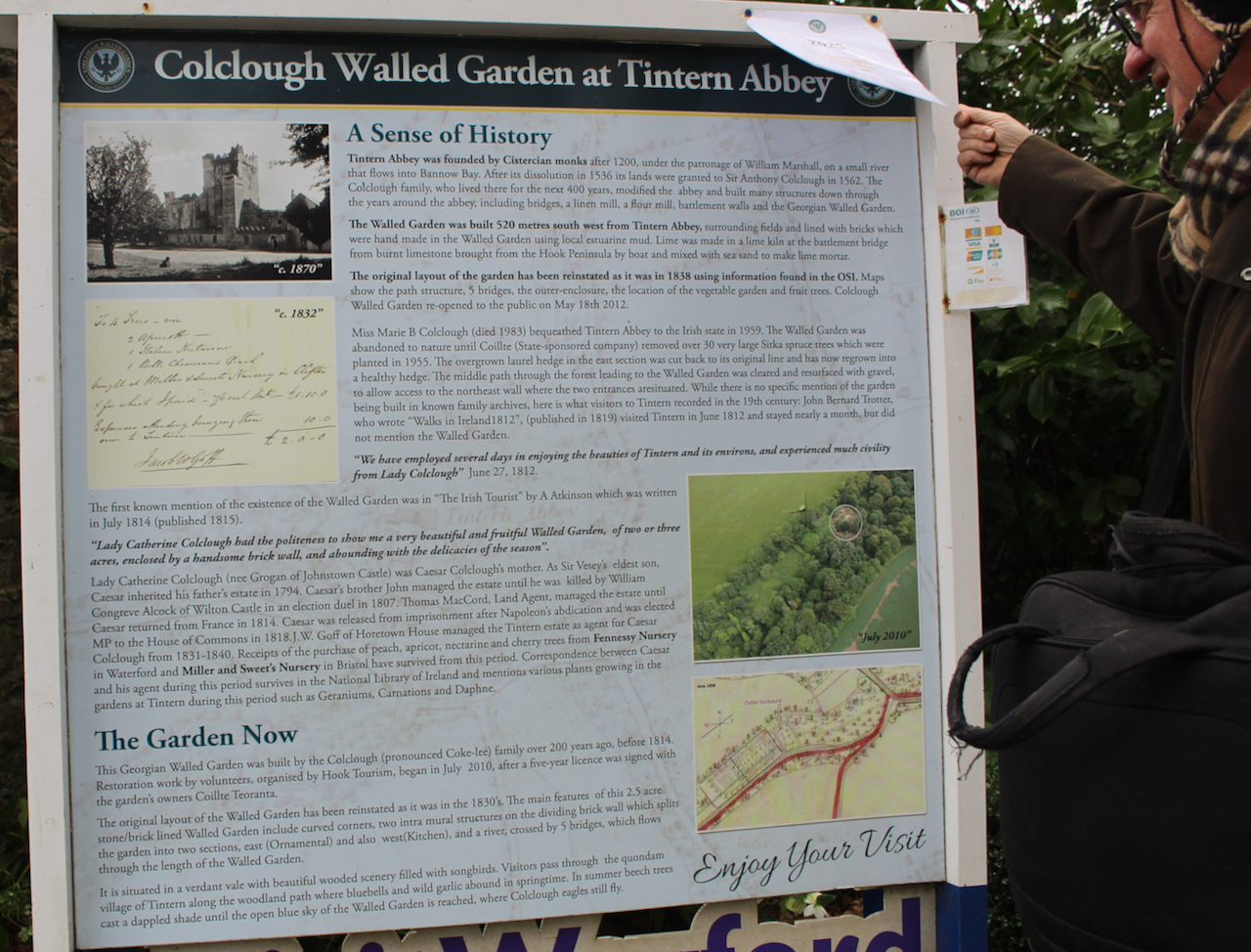
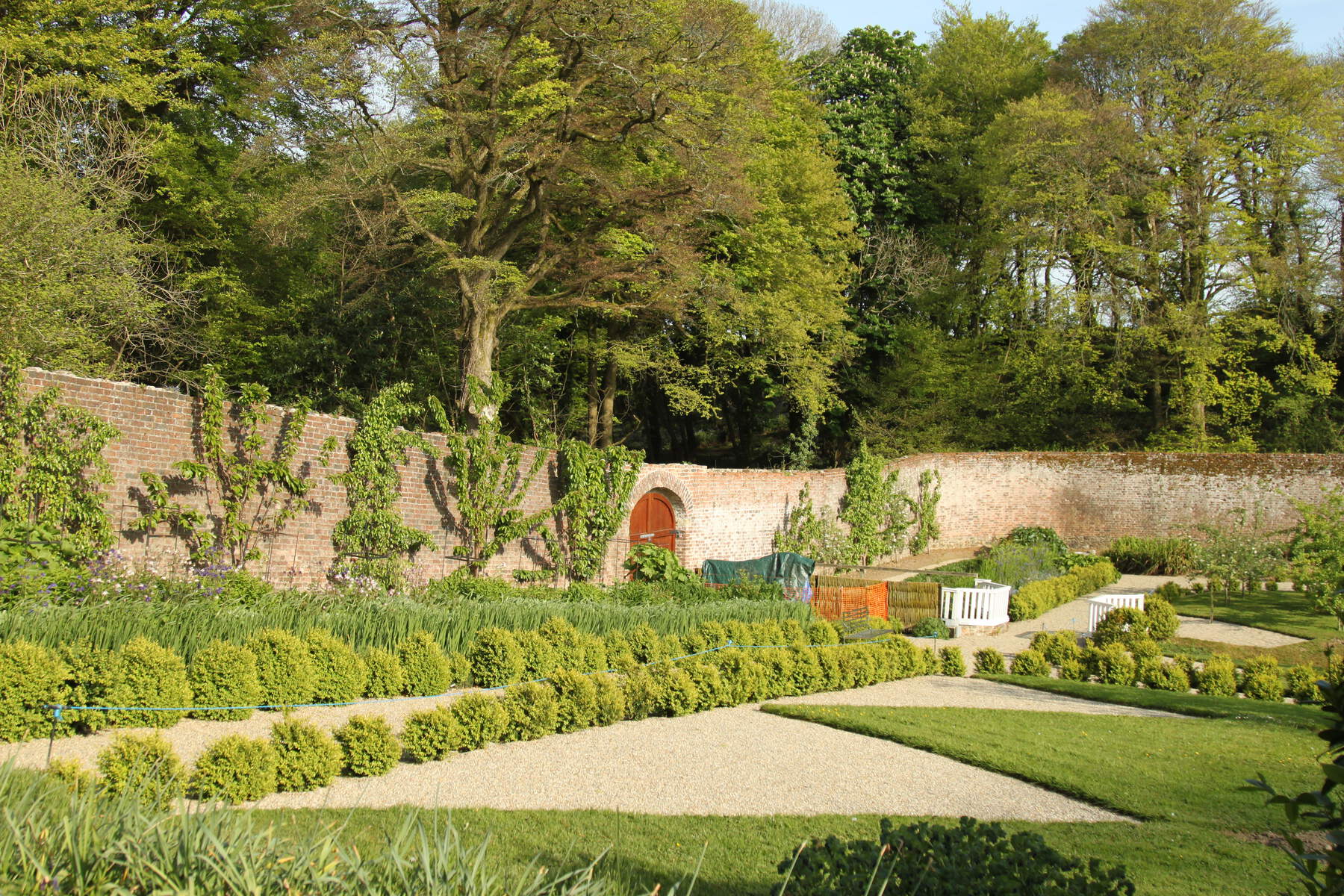
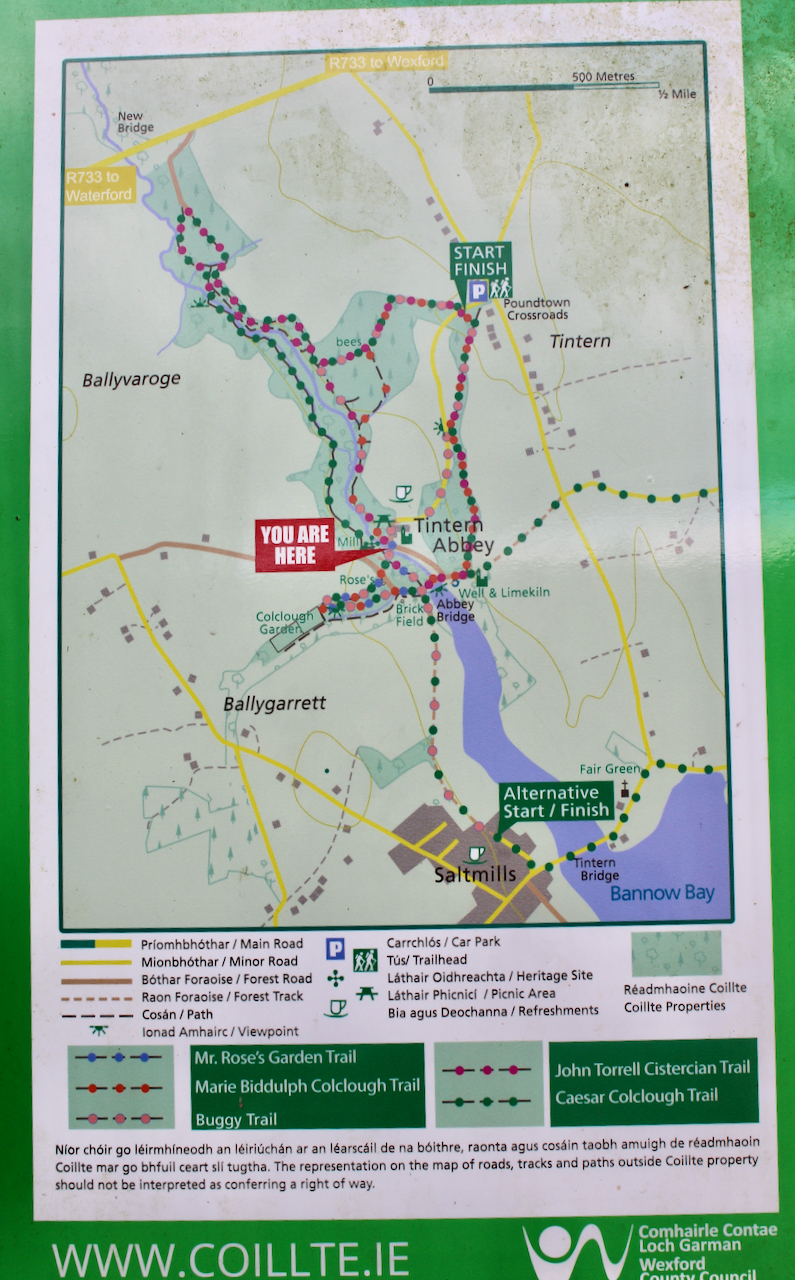
The website continues: “Conservation works have included special measures to protect the local bat colonies. The abbey is set in a special area of conservation and is surrounded by woodland within which are walking trails. Not to be missed is the restored Colclough Walled Garden situated within the old estate.

Colclough walled garden, Tintern Abbey, County Wexford. Photograph © Jennifer Winder-Baggot, www.irishhistorichouses.com
Colclough Walled garden, Tintern Abbey, photograph by Brian Morrison, 2017 for Tourism Ireland, Ireland’s Content Pool. [see 1]
Tintern Abbey, photograph by Brian Morrison, 2015 for Tourism Ireland, Ireland’s Content Pool. [see 1]

Following the donation of Tintern Abbey to the Irish State in 1959 the walled garden was abandoned to nature and became overgrown.  The gradual restoration of the walled garden by a team of volunteers began in 2010 and the 1830s layout shown on the Ordnance Survey was reinstated. The restored garden, which opened to the public in 2012, is divided into two sections: the Ornamental Garden and the Kitchen Garden. 
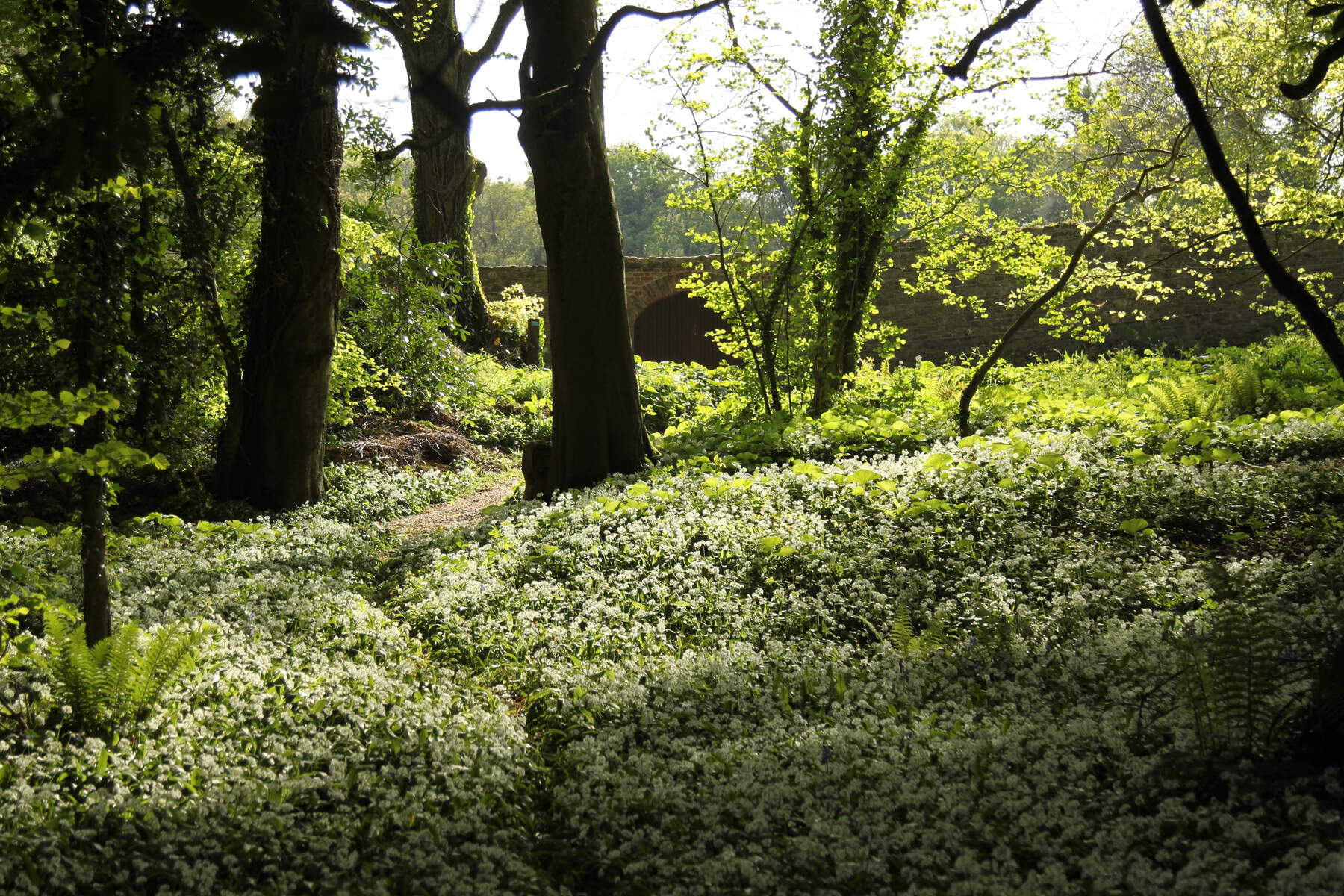
Garden at Tintern Abbey, photograph by Brian Morrison, 2017 for Tourism Ireland, Ireland’s Content Pool. [see 1]
Tintern Abbey, County Wexford, 15th March 2025. Photograph © Jennifer Winder-Baggot, www.irishhistorichouses.com

[1] https://www.irelandscontentpool.com/en/media-assets/media/81101

[2] notes from Tintern website, by Breda Lynch.

[3] https://genealogy-and-you.com/onewebmedia/Colclough.pdf
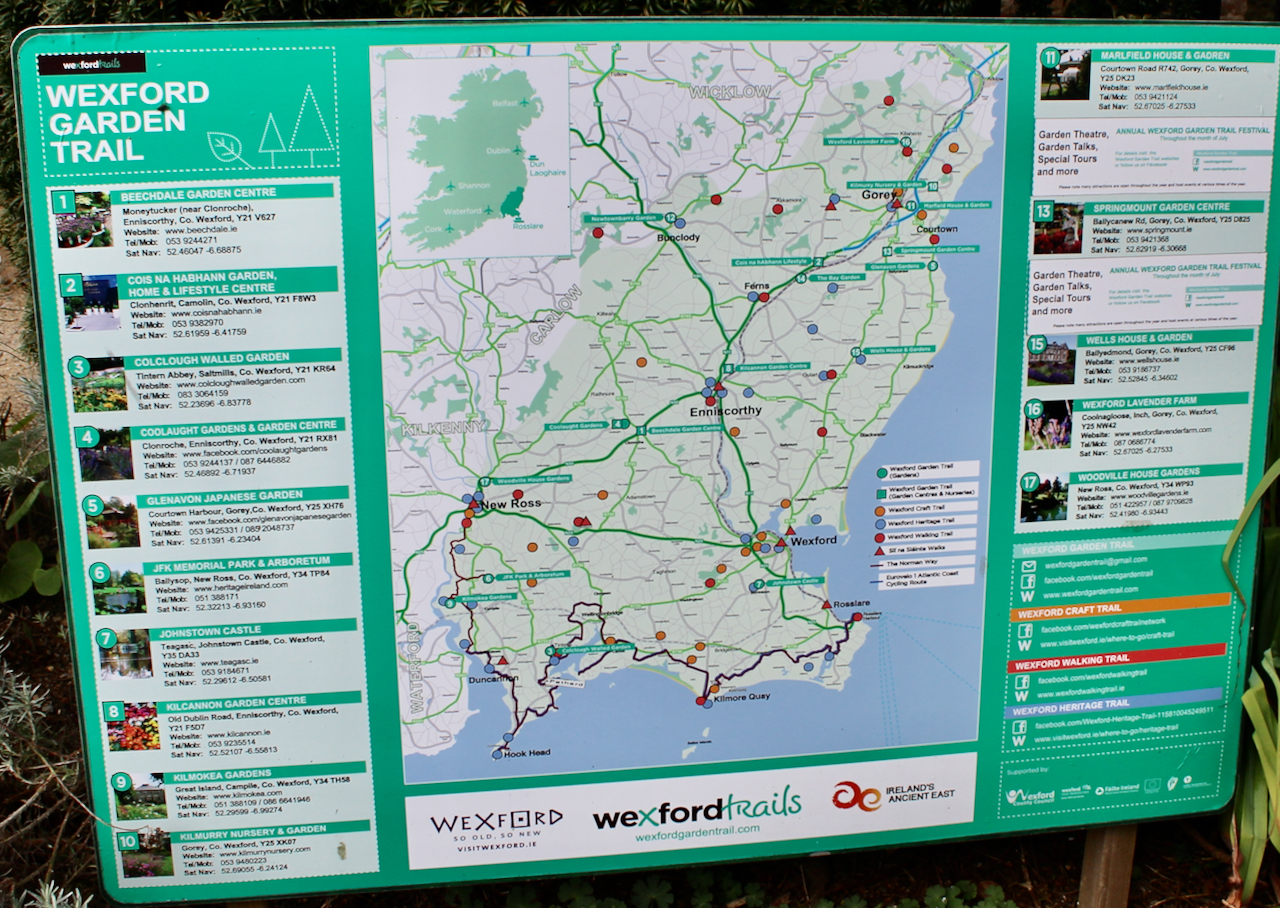
See the sale of Loftus Hall, courtesy of Colliers.
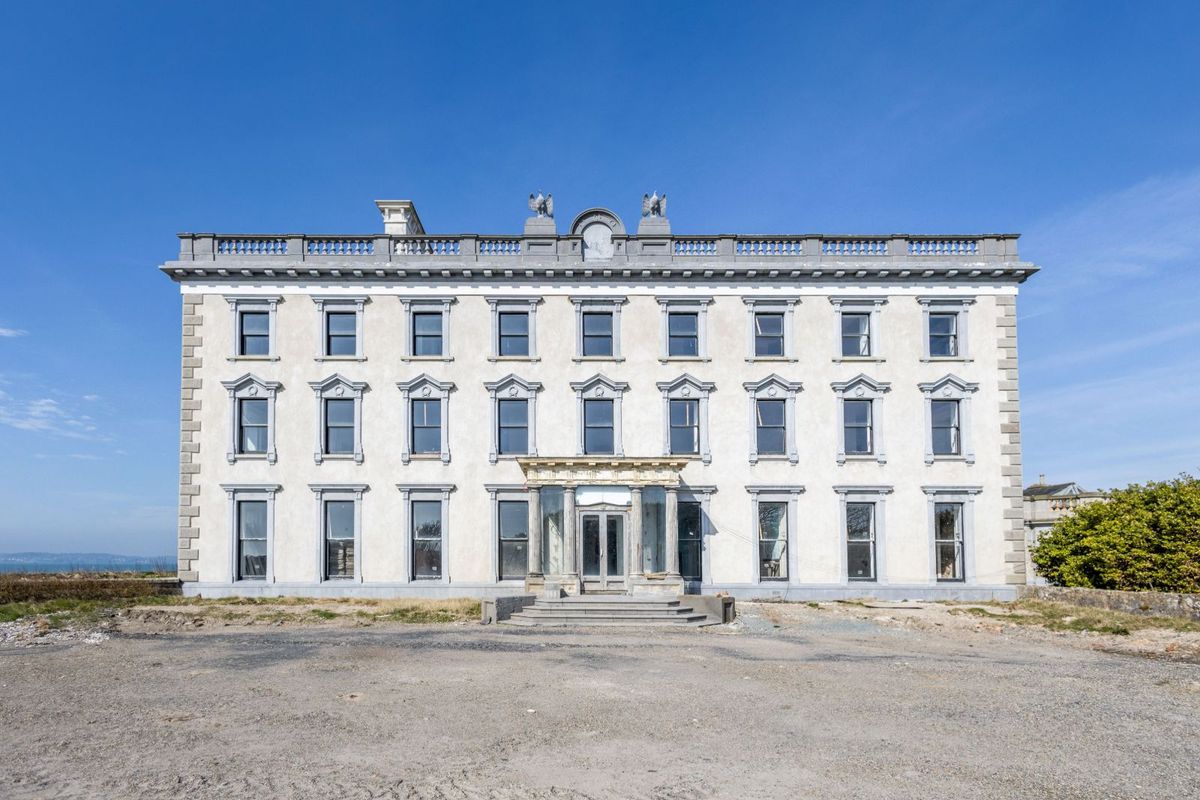
Loftus Hall, County Wexford, for sale April 2025 courtesy Colliers.

Loftus Hall is a large, partly re-furbished country house which was built on the site of the original Redmond Hall. The property boasts one of the most scenic locations in the southeast with views over Hook Peninsula and the world famous Hook Lighthouse, providing the most stunning landscape which is steeped in history and reputed by locals to have been haunted the property. The property was purchased by the Quigley family in 2011 and run as a tourist attraction with guided tours of the property and seasonal events. In 2021 the property was bought by its current owners who had a masterplan to refurbish the original building over two phases. The estate has already undergone extensive renovations, with Phase 1 nearing completion, set to transform the property into an exclusive 22-bedroom luxury hotel with high-end amenities, extensive food and beverage facilities, and beautifully landscaped gardens. The vision for Phase 2, included an additional 56 bedroom hotel block, a gym and spa, dedicated wedding facilities, 33 standalone garden cottages and 10 eco pods strategically placed along the perimeter of the property.
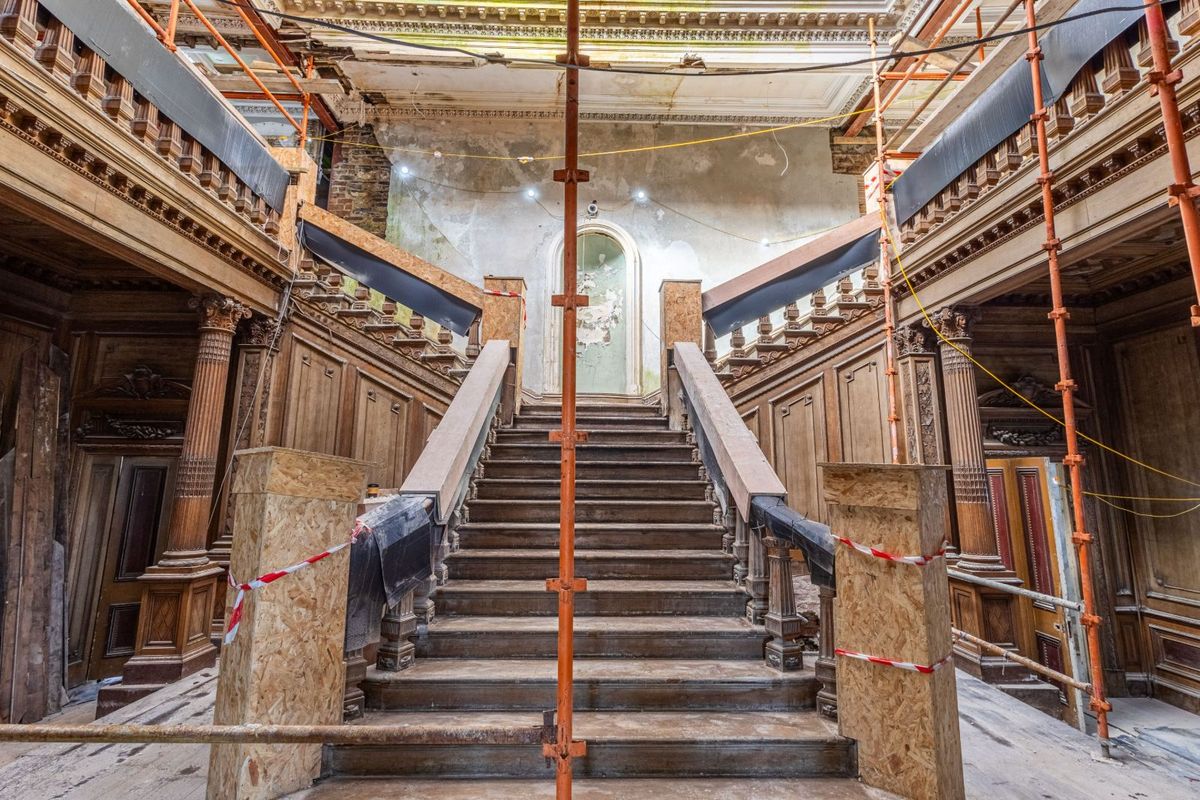
Loftus Hall, County Wexford, for sale April 2025 courtesy Colliers.

Location Loftus Hall is located on the southern tip of Hook Peninsula, close to the famous Hook Lighthouse, one of the oldest operational lighthouses in the world. Loftus Hall offers an unparalleled location for exploring the beauty and history of County Wexford. Just 4km from the iconic Hook Lighthouse, 33km from the vibrant town of New Ross, 45km from Wexford and 51km from Waterford. The property is also in close proximity to several popular tourist destinations, including Passage East (17km) and Dunmore East (30km) and the charming nearby villages such as Hookless Village, Slade, and Fethard-On-Sea, all within easy access. The location is quite picturesque, making it a popular spot for visitors interested in history, architecture, and the paranormal. Main House Built originally between 1870 and 1871 on the site of Redmond Hall, which traces its history to 1350, Loftus Hall comprises a detached nine-bay, three storey house. The estate is situated on approximately 27.68 hectares (68 acres) with the house extending to a total gross internal area (GIA) of 2,460 sq.m (26,480 sq. ft). Loftus Hall is a protected structure under RPS Ref WCC0692 and under the NIAH Ref 15705401. The estate has already undergone extensive renovations, with Phase 1 nearing completion. The ground floor of the original building has been transformed to contain a large dining room, a cigar room and a number of guest lounge areas. When completed the restaurant will seat over 100 covers which will feature visibility of the chefs working with an open pass, an outside BBQ area and fire pit adjacent to the new restaurant area with the existing bar fully refurbished. The hotel bedrooms are finished to second fix over the first and second floors and are appointed with large ensuite bathrooms and with commanding and sweeping views out to sea. The vision for Phase 2 consists of the development of a permanent marquee erected on the grounds which will cater for up to 300 seated wedding guests, a gym & spa, a new hotel bedroom block which will contain up to 56 additional bedrooms, 33 standalone garden cottages, 10 eco pods wrapped around the perimeter of the property, a children’s playground, a herb and vegetable garden, over two hundred car park spaces in total between the front and rear of the development and a walkway that will allow guests to access the beach directly from the development. The Grounds The grounds are a feature of Loftus Hall and have been maintained to the highest standards throughout the refurbishment. The gardens at Loftus Hall, particularly the walled garden, were designed to thrive in the unique climate of the Hook Peninsula. The garden’s high walls provided a sheltered environment, allowing a variety of plants to flourish. Fruit trees were a significant feature, with mulberry trees being particularly successful. The sheltered environment also supported other fruit trees like apple and pear. Additionally, the garden likely included a variety of herbs and vegetables, which were essential for the estate’s kitchen. The garden’s design and plant selection reflect the practical needs and aesthetic preferences of the time, creating a space that was both beautiful and functional.
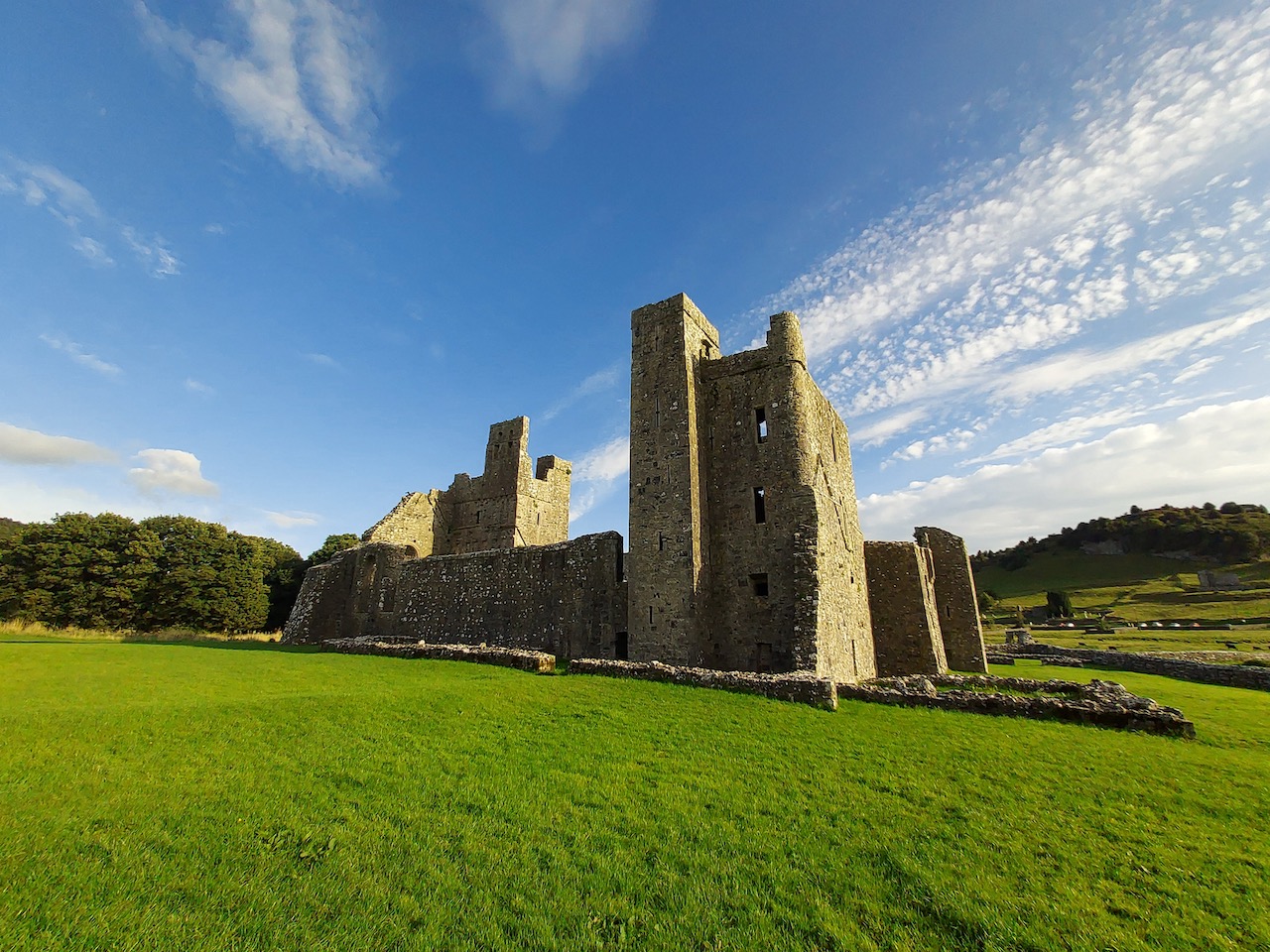
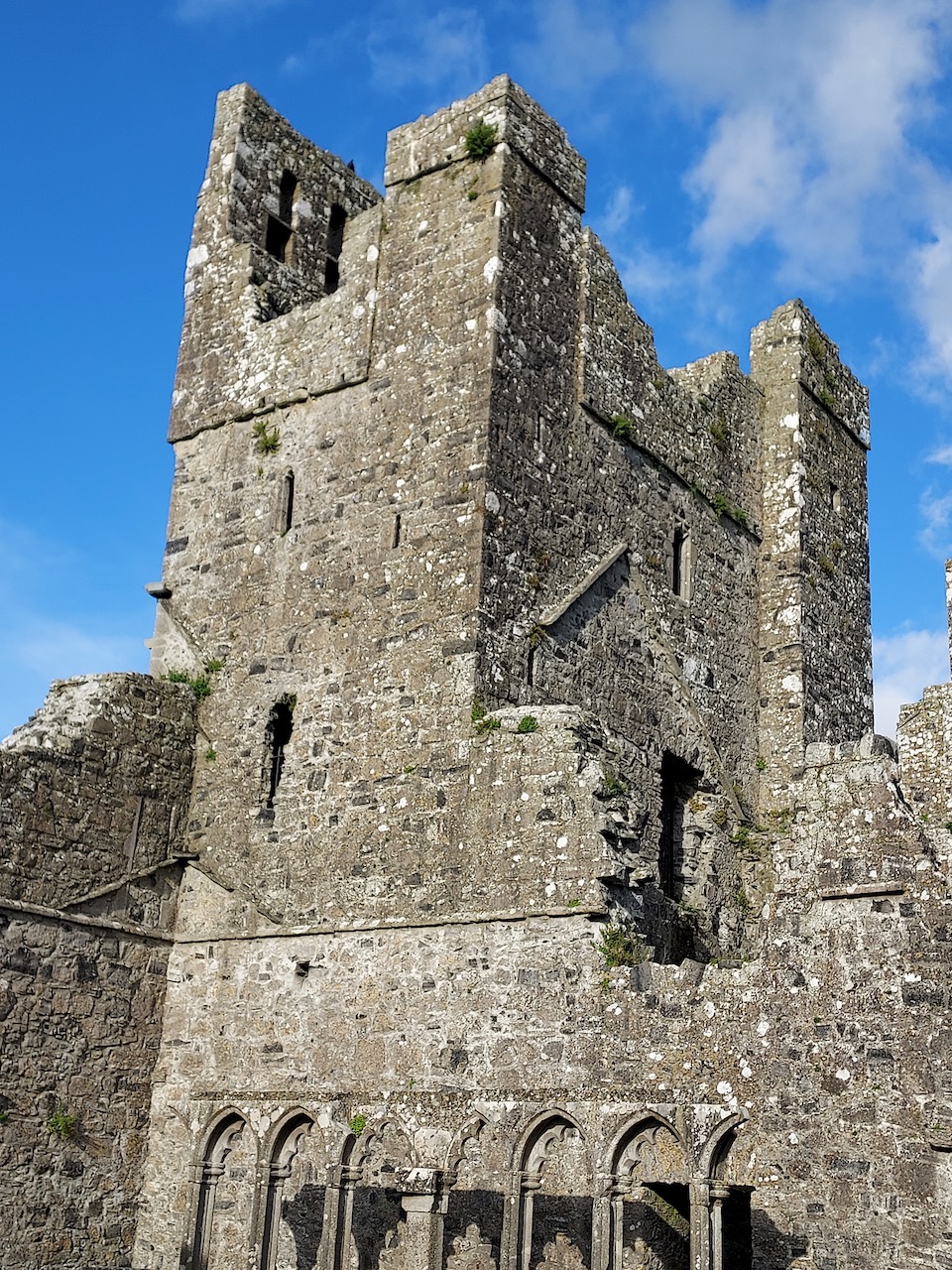
Office of Public Works properties in Leinster, Counties Westmeath, Wexford and Wicklow

Westmeath:

1. Fore Abbey in County Westmeath

Wexford:

1. Ballyhack Castle, County Wexford – closed at present

2. Ferns Castle, County Wexford – closed at present

3. John F. Kennedy Arboretum, County Wexford

4. Tintern Abbey, County Wexford

Wicklow:

1. Dwyer McAllister Cottage, County Wicklow – closed at present

2. Glendalough, County Wicklow

3. National Botanic Gardens Kilmacurragh, County Wicklow

donation

Help me to pay the entrance fee to one of the houses on this website. This site is created purely out of love for the subject and I receive no payment so any donation is appreciated!

€15.00

Westmeath:

1. Fore Abbey in County Westmeath:

Fore Abbey, County Westmeath, August 2021. Photograph © Jennifer Winder-Baggot, www.irishhistorichouses.com

“Fore” comes from the Irish “fobhar” meaning well or spring.

From the OPW website https://heritageireland.ie/visit/places-to-visit/fore-abbey/:

In a tranquil valley in the village of Fore, about a 30-minute drive from Mullingar in County Westmeath, you can visit the spot where St Feichin founded a Christian monastery in the seventh century AD.

It is believed that, before Feichin’s death, 300 monks lived in the community. Among the remains on the site is a church built around AD 900. There are also the 18 Fore crosses, which are spread out over 10 kilometres on roadways and in fields.

Seven particular features of the site – the so-called ‘Seven Wonders of Fore’ – have acquired legendary status. They include: the monastery built on a bog; the mill without a race (the saint is said to have thrust his crozier into the ground and caused water to flow); and the lintel stone raised by St Feichin’s prayers.

St Feichin’s Way, a looped walk around the site, provides an excellent base from which to explore these fabled places.

Photograph © Jennifer Winder-Baggot, www.irishhistorichouses.com

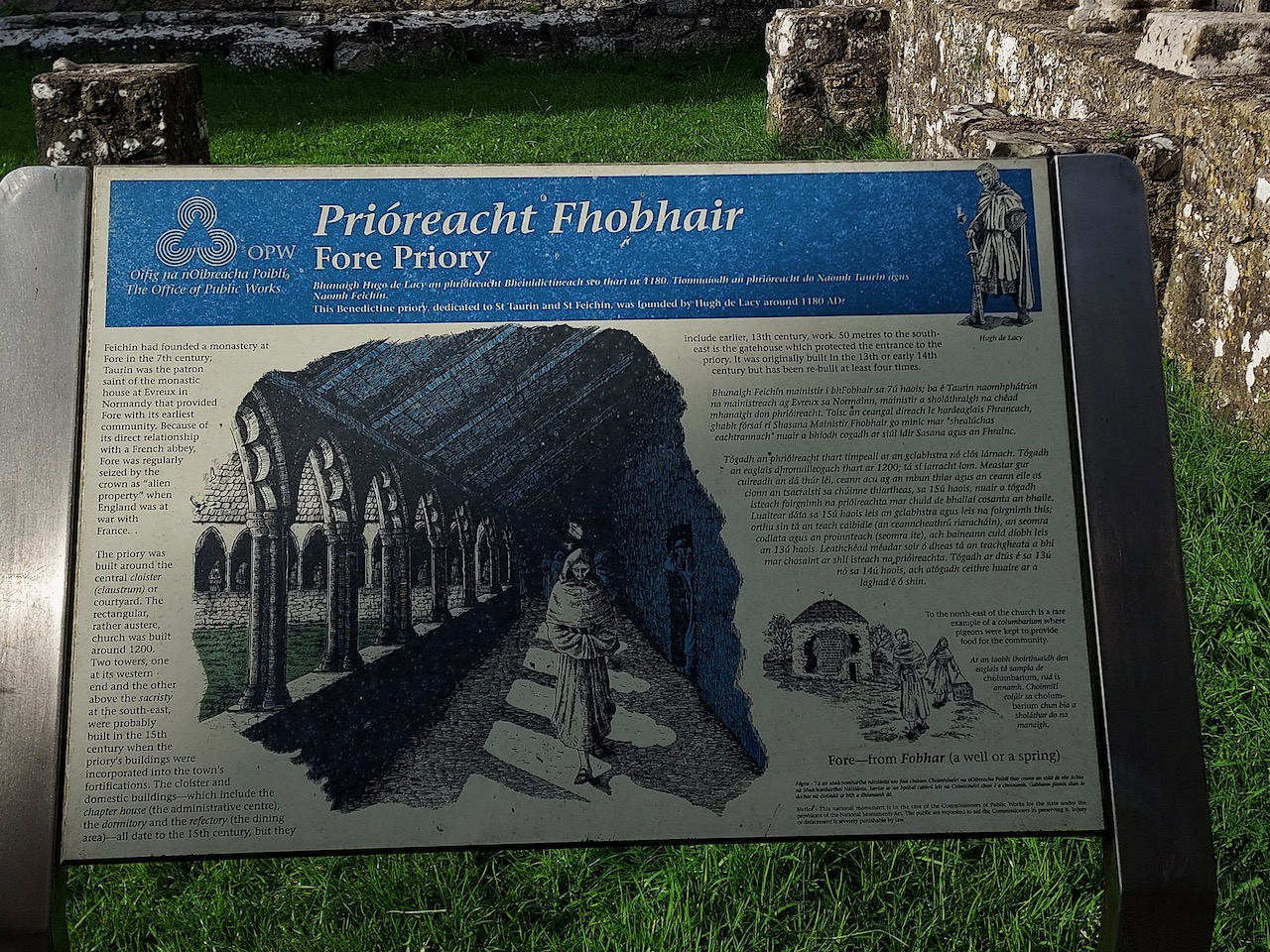
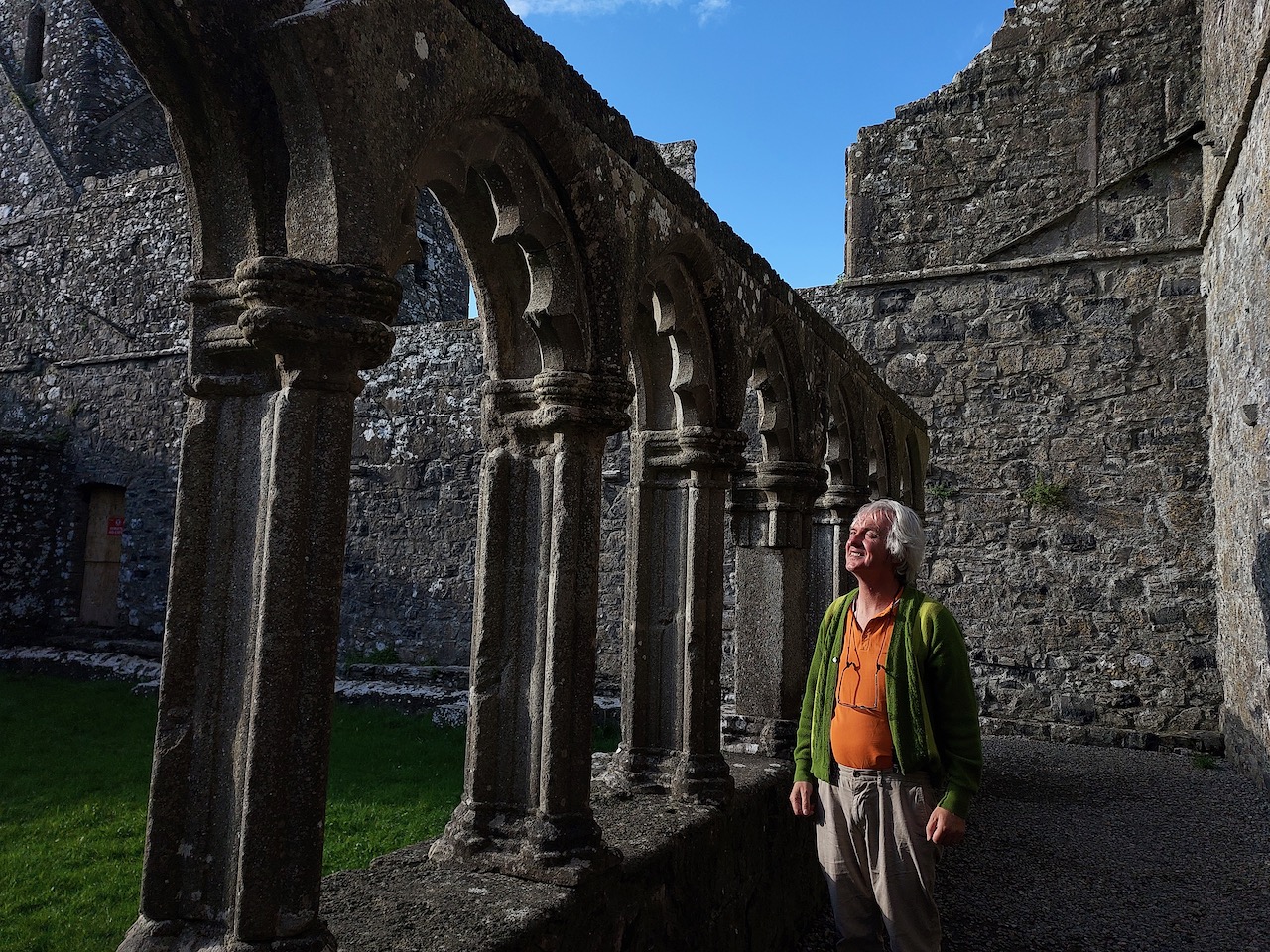
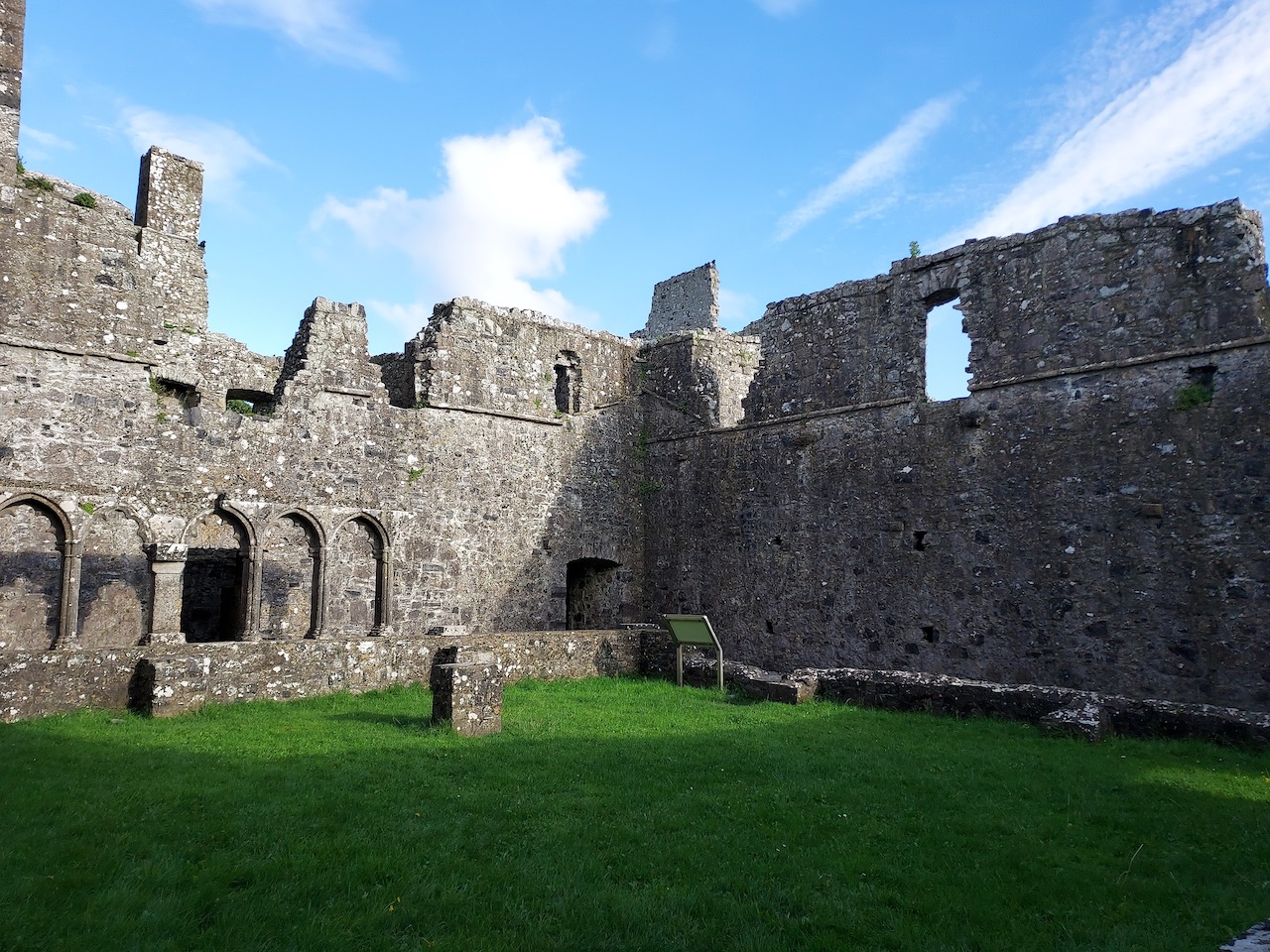
The Benedictine Priory was founded around 1180 by Hugh de Lacy, the first Viceroy of Ireland. Before this there was a monastery in Fore, founded by Feichin in the seventh century. The Benedictines had a link with France and its first monks came from France. The Priory sufffered plundering attacks so needed defensive towers and fortification. It was built around a Cloister or courtyard.

Fore Abbey, County Westmeath, August 2021.
The cloister is remarkably well-preserved. Photograph © Jennifer Winder-Baggot, www.irishhistorichouses.com
Fore Abbey, County Westmeath, August 2021. Photograph © Jennifer Winder-Baggot, www.irishhistorichouses.com

The “columbarium” mentioned in the diagram is a house for keeping pigeons – we saw one previously at Moone Abbey tower, and there is one at Fore.

The Columbarium or Pigeon house at Fore. Photograph © Jennifer Winder-Baggot, www.irishhistorichouses.com

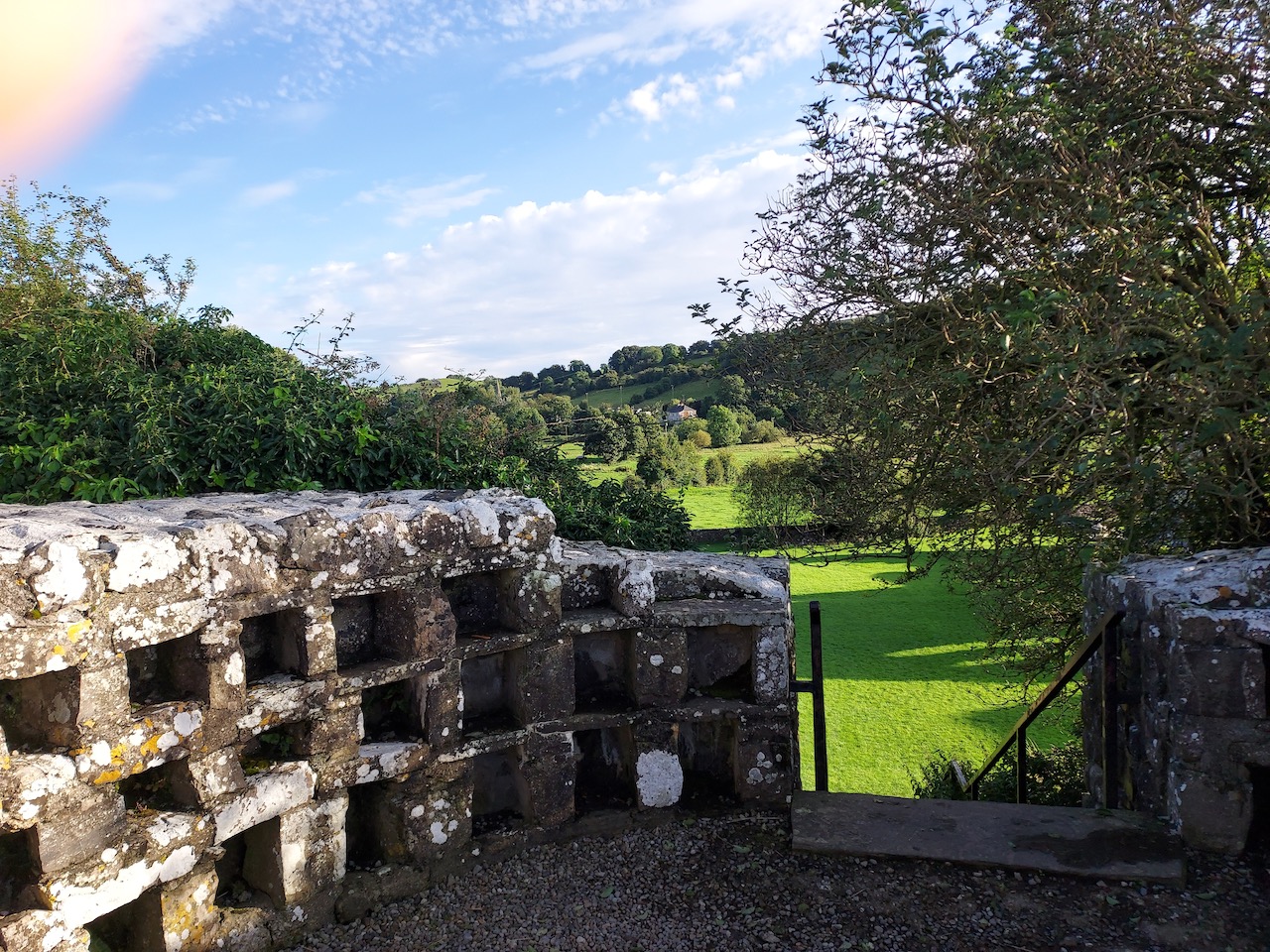
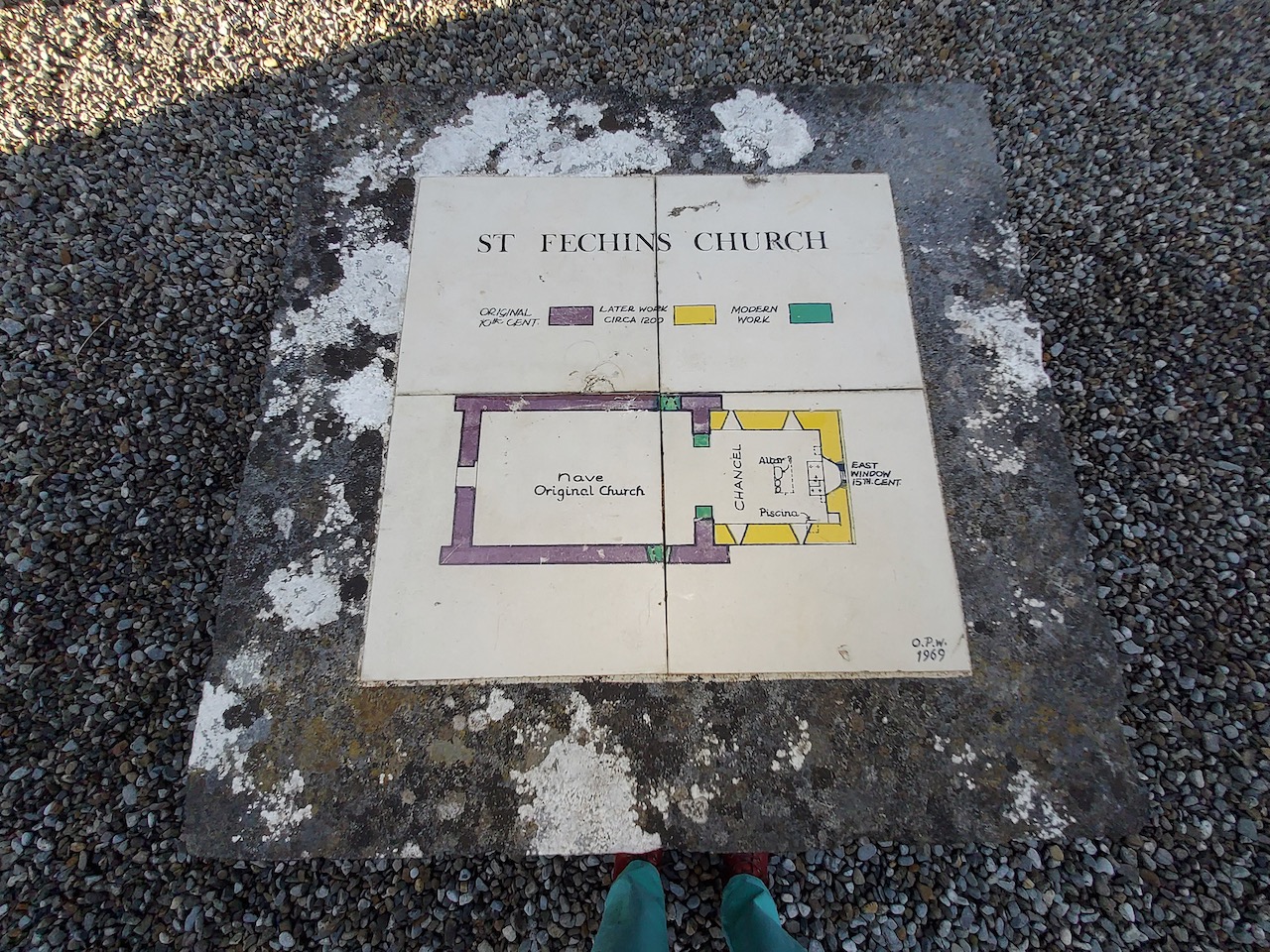
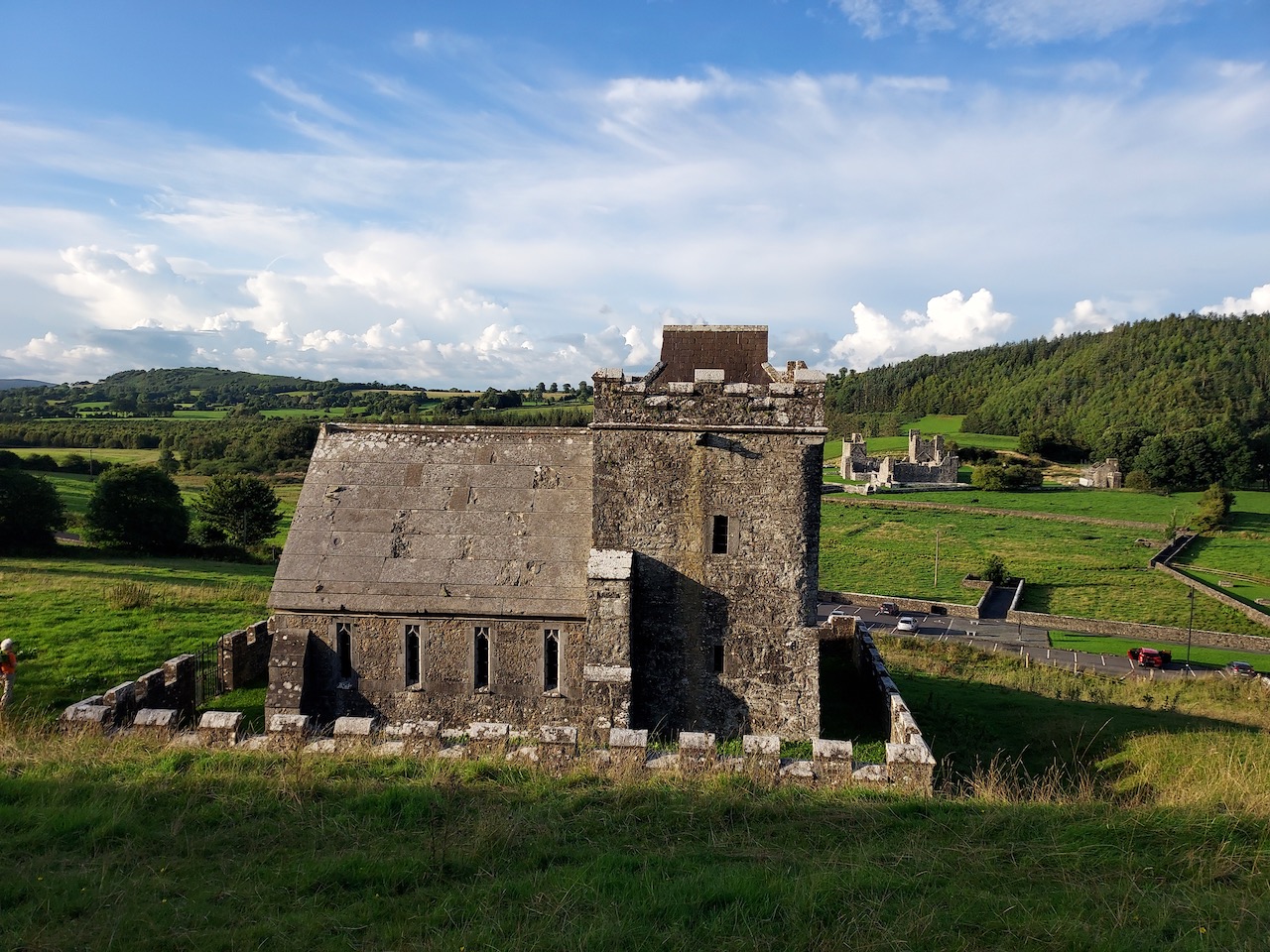
The monastery founded at Fore in the seventh century by St Feichin, a Sligo-born holy man who travelled widely in Ireland, was large and prosperous but was superceded by Fore Abbey, the nearby Benedictive abbey founded by the Norman deLacys. The remaining building of St Feichins is the church, which was built in the tenth century. A new chancel was added around 1200, and the arch leading to this was re-erected in 1934. The east window was inserted in the 15th century.

St Feichin’s Church, with Fore Abbey in background on far left. Photograph © Jennifer Winder-Baggot, www.irishhistorichouses.com
St. Feichin’s Church, built in the 10th century with later additions. Photograph © Jennifer Winder-Baggot, www.irishhistorichouses.com
St. Feichin’s church, County Westmeath, August 2021.

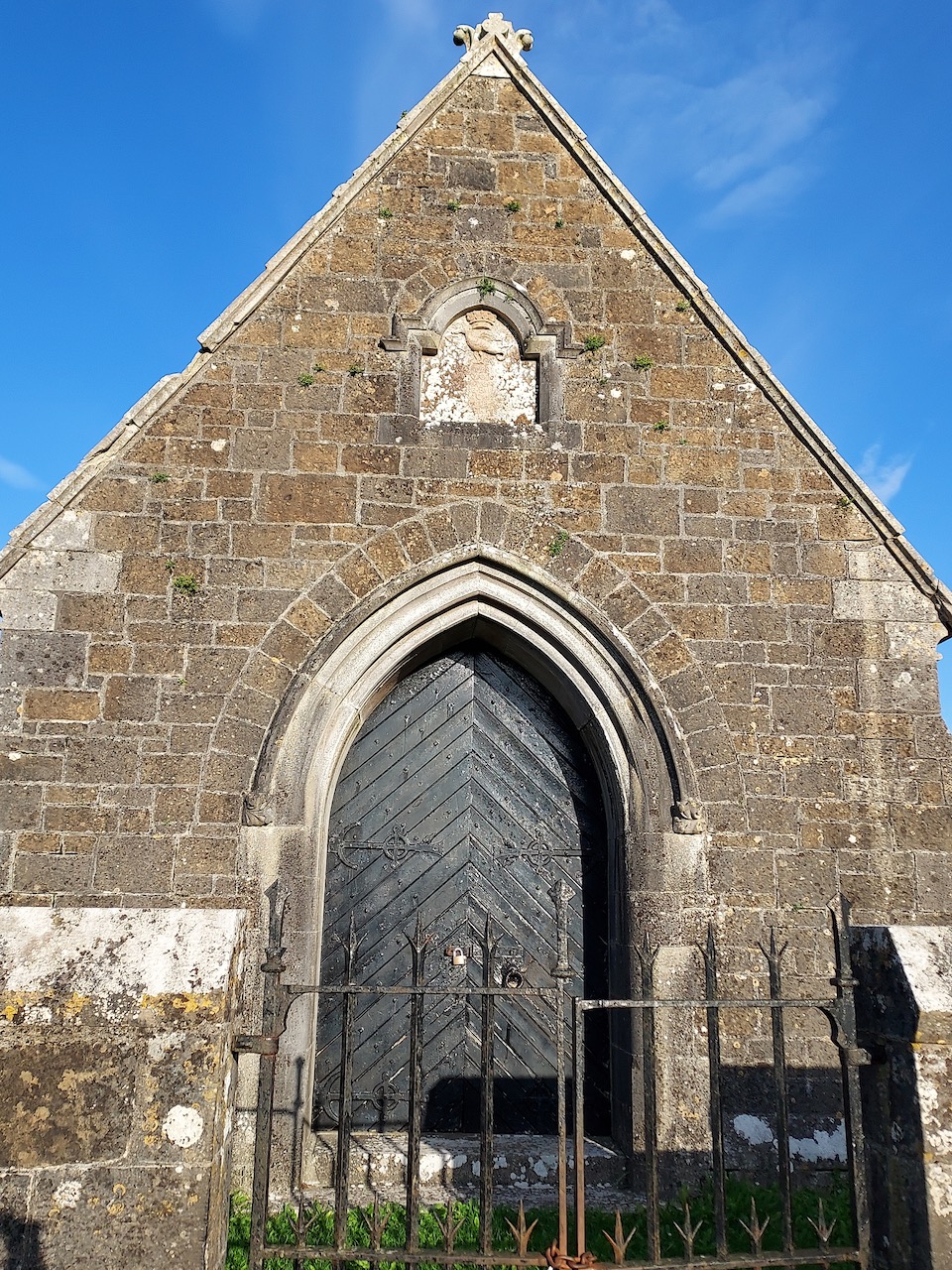
The Anchorite’s Cell is a small tower with attached chapel. The tower had two storeys and on the top floor lived a number of Anchorites, or hermits. The chapel has a vault below, the crypt of the Nugent family of nearby Castle Delvin and Clonyn Castle, Earls of Westmeath. Delvin, or Castletown-Delvin, was granted by Hugh de Lacy to his son-in-law Gilbert de Nugent. The 1st Earl of Westmeath was Richard Nugent (1583-1642). His father was Christopher Nugent, 5th Baron Delvin.

The Anchorite’s Cell. Photograph © Jennifer Winder-Baggot, www.irishhistorichouses.com
Front of the Anchorite Cell Chapel with the Nugent coat of arms. Photograph © Jennifer Winder-Baggot, www.irishhistorichouses.com

County Wexford:

1. Ballyhack Castle, Arthurstown, County Wexford

Ballyhack Castle, photograph by Brian Morrison, 2015 for Tourism Ireland, Ireland’s Content Pool. [1]

General enquiries: 051 398 468, breda.lynch@opw.ie

from the OPW website https://heritageireland.ie/visit/places-to-visit/ballyhack-castle/:

Ballyhack Castle commands an imperious position on a steep-sided valley overlooking Waterford Estuary. It is thought that the Knights Hospitallers of St John, one of the two mighty military orders founded at the time of the Crusades, built this sturdy tower house around 1450.

The tower is five stories tall and the walls survive complete to the wall walk. Built into the north-east wall of the second floor is a small chapel complete with a piscina, aumbry and altar. The entrance to the castle is protected externally by a machicolation and internally by a murder hole – that is, an opening through which defenders could throw rocks or pour boiling water, hot sand or boiling oil, on anyone foolish enough to attack.

Currently on display at Ballyhack Castle are assorted items of replica armour relating to the Crusades and the Normans –  guaranteed to ignite the imagination!

Ballyhack Castle, photograph by Brian Morrison, 2015 for Tourism Ireland, Ireland’s Content Pool. [see 1]

2. Ferns Castle, County Wexford:

Ferns Castle, photograph by Brian Morrison, 2015 for Tourism Ireland, Ireland’s Content Pool. [see 1]

General information: 053 9366411, fernscastle@opw.ie

From the OPW website https://heritageireland.ie/visit/places-to-visit/ferns-castle/:

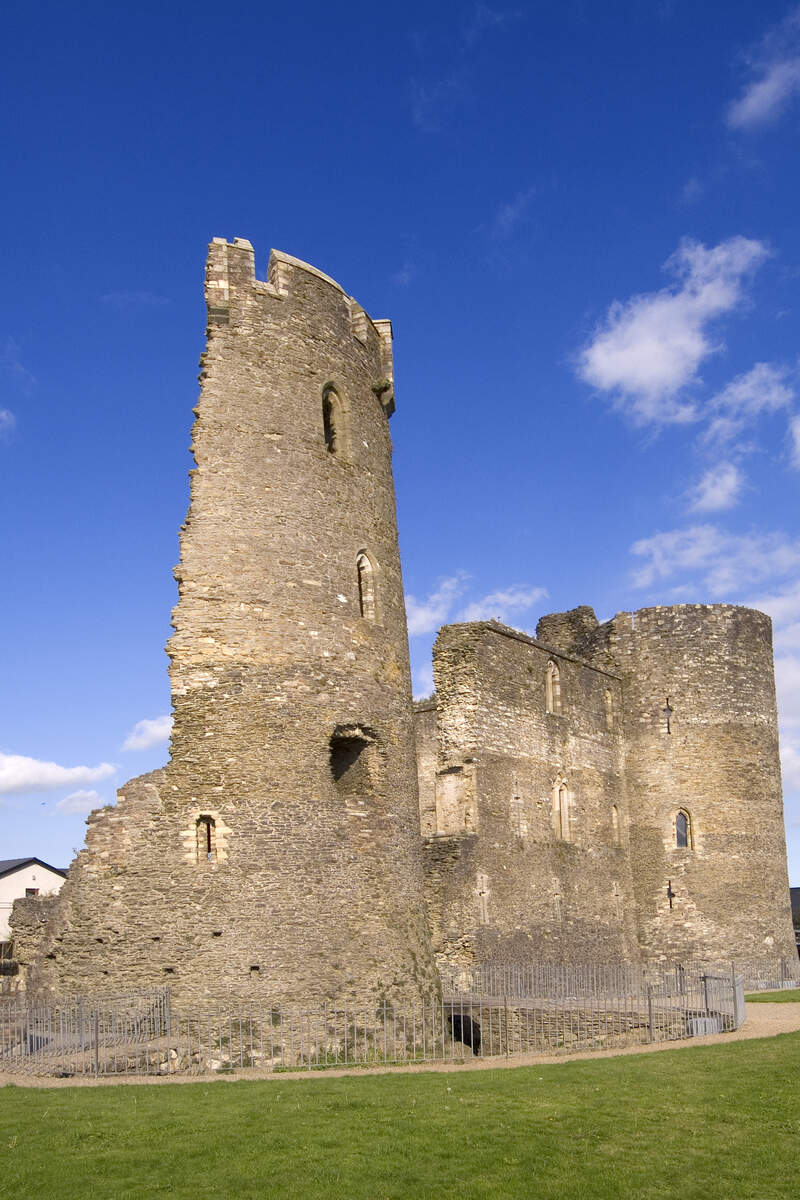
Before the coming of the Normans, Ferns was the political base of Diarmait Mac Murchada, king of Leinster. William, Earl Marshall built the castle around 1200. Since then it has had many owners, of diverse political and military colours.

Originally, the castle formed a square, with large corner towers. Only half of the castle now stands, although what remains is most impressive. The most complete tower contains a beautiful circular chapel, several original fireplaces and a vaulted basement. There is a magnificent view from the top.

There is an extraordinary artefact to be seen in the visitor centre. The Ferns Tapestry showcases the pre-Norman history of the town via the thousand-year-old art of crewel wool embroidery. Stitched by members of the local community, the 15-metre-long tapestry comprises 25 panels of remarkable accomplishment and beauty.

Ferns Castle, photograph by Chris Hill, 2014 for Tourism Ireland, Ireland’s Content Pool. [see 1]

3. John F. Kennedy Arboretum, County Wexford:

General Information: 046 9423490, jfkarboretum@opw.ie

When John F. Kennedy died, a number of Irish-American societies expressed the wish to establish a tribute to him in Ireland. The Irish government suggested a national arboretum, and secured 192 acres surrounding Ballysop House, just six kilometres from the Kennedy ancestral home at Dunganstown, County Wexford. The arborterum is planted in two interwoven botanical circuits: one of broadleaves and the other of conifers. The Arboretum was formally opened on 29th May 1968.

From the OPW website https://heritageireland.ie/visit/places-to-visit/the-john-f-kennedy-arboretum/:

Dedicated to the memory of John F. Kennedy, whose great-grandfather, Patrick, was born in the nearby village of Dunganstown, this arboretum near New Ross, County Wexford, contains a plant collection of presidential proportions.

It covers a massive 252 hectares on the summit and southern slopes of Slieve Coillte and contains 4,500 types of trees and shrubs from all temperate regions of the world. There are 200 forest plots grouped by continent. Of special note is an ericaceous garden with 500 different rhododendrons and many varieties of azalea and heather, dwarf conifers and climbing plants.

The lake is perhaps the most picturesque part of the arboretum and is a haven for waterfowl. There are amazing panoramic views from the summit of the hill, 271 metres above sea level. A visitor centre houses engaging exhibitions on JFK and on the Arboretum itself.

Along the northern perimeter of the site are some 200 forest plots. Each covers an area of one acre and comprises a single species of forestry tree. These provide information on the performance of different types of plantation species in the Irish climate.

Through the garden are a number of trails, and a miniature train runs during the summer, and there is a cafe.

4. Tintern Abbey, County Wexford:

Tintern Abbey, County Wexford, 15th March 2025. Photograph © Jennifer Winder-Baggot, www.irishhistorichouses.com

See my entry https://irishhistorichouses.com/2025/04/07/tintern-abbey-county-wexford-an-opw-property/

General information: 051 562650, tinternabbey@opw.ie

From the OPW website https://heritageireland.ie/visit/places-to-visit/tintern-abbey/:

This Cistercian monastery was founded c. 1200 by William, Earl Marshal on lands held through his marriage to the Irish heiress, Isabella de Clare [daughter of Strongbow]. This abbey, founded as a daughter-house of Tintern Major in Wales is often referred to as Tintern de Voto.

The nave, chancel, tower, chapel and cloister still stand. In the 16th century the old abbey was granted to the Colclough family [Anthony Colclough (d. 1584) was a soldier and the land was granted to him after the dissolution of the monasteries] and soon after the church was partly converted into living quarters and further adapted over the centuries. The Colcloughs occupied the abbey from the sixteenth century until the mid-twentieth.”

Tintern Abbey, County Wexford, May 2023.
Tintern Abbey, County Wexford, May 2023. Photograph © Jennifer Winder-Baggot, www.irishhistorichouses.com
Tintern Abbey, photograph by Celtic Routes, 2019 for Tourism Ireland, Ireland’s Content Pool. [see 1]

Wicklow:

1. Dwyer McAllister Cottage, County Wicklow:

From the OPW website https://heritageireland.ie/visit/places-to-visit/dwyer-mcallister-cottage/:

This thatched and whitewashed cottage nestles in the shade of Keadeen Mountain off the Donard to Rathdangan road in County Wicklow.

Today, it seems like an unlikely site of conflict. However, in the winter of 1799 it was a different story. It was from this cottage that the famed rebel Michael Dwyer fought the encircling British. One of Dwyer’s compatriots, Samuel McAllister, drew fire upon himself and was killed. This allowed Dwyer to make good his escape over the snow-covered mountains.

The cottage was later destroyed by fire and lay in ruins for almost 150 years. It was restored to its original form in the twentieth century. Now, it contains various items of the period – both those that characterised everyday life, such a roasting spit and a churn, and those that only appeared in the throes of combat, such as deadly pikes.

2. Glendalough, County Wicklow:

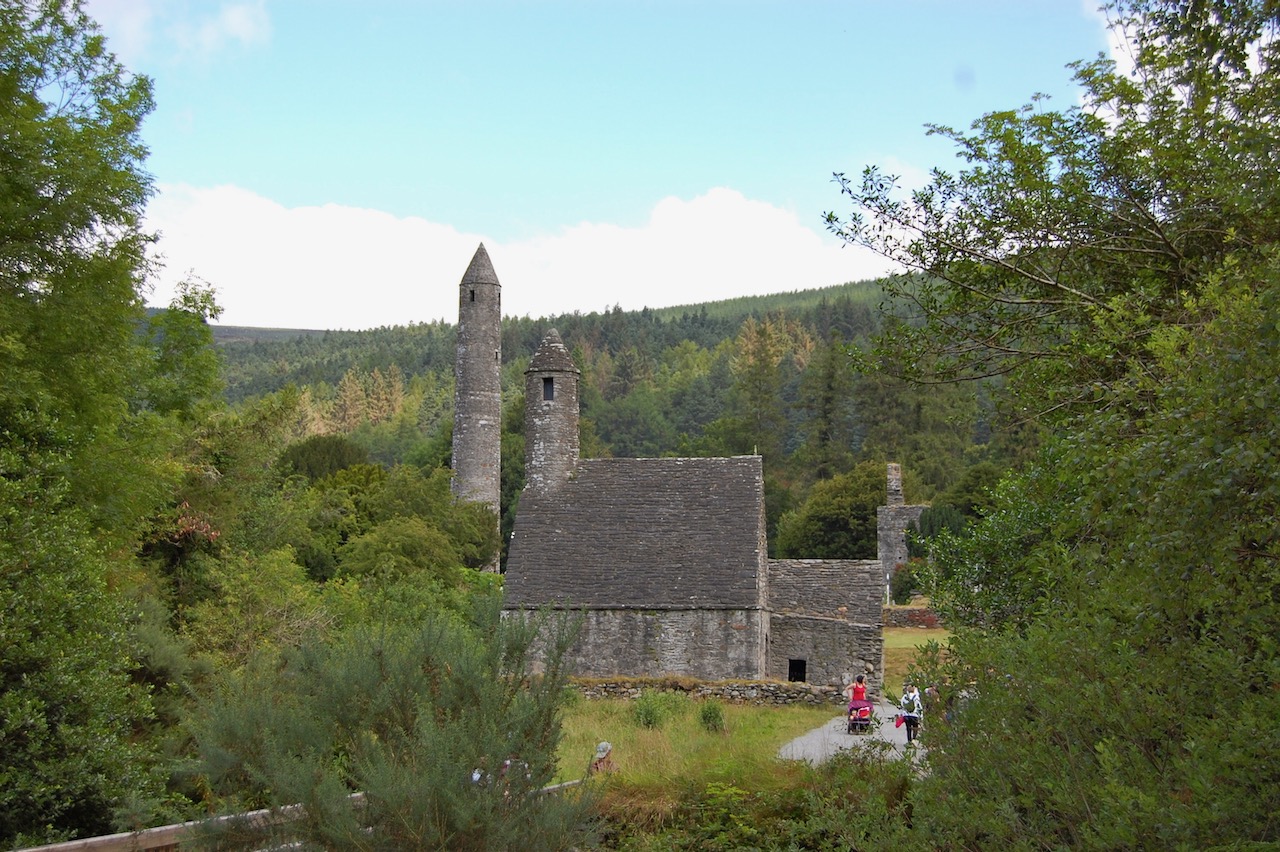
Glendalough, County Wicklow, July 2017. Photograph © Jennifer Winder-Baggot, www.irishhistorichouses.com

General information: 0404 45352, george.mcclafferty@opw.ie

From the OPW website https://heritageireland.ie/visit/places-to-visit/glendalough-visitor-centre/:

In a stunning glaciated valley in County Wicklow, in the sixth century, one of Ireland’s most revered saints founded a monastery. The foundation of St Kevin at Glendalough became one of the most famous religious centres in Europe.

The remains of this ‘Monastic City’, which are dotted across the glen, include a superb round tower, numerous medieval stone churches and some decorated crosses. Of particular note is St Kevin’s Bed, a small man-made cave in the cliff face above the Upper Lake. It is said that St Kevin lived and prayed there, but it may actually be a prehistoric burial place that far predates him.

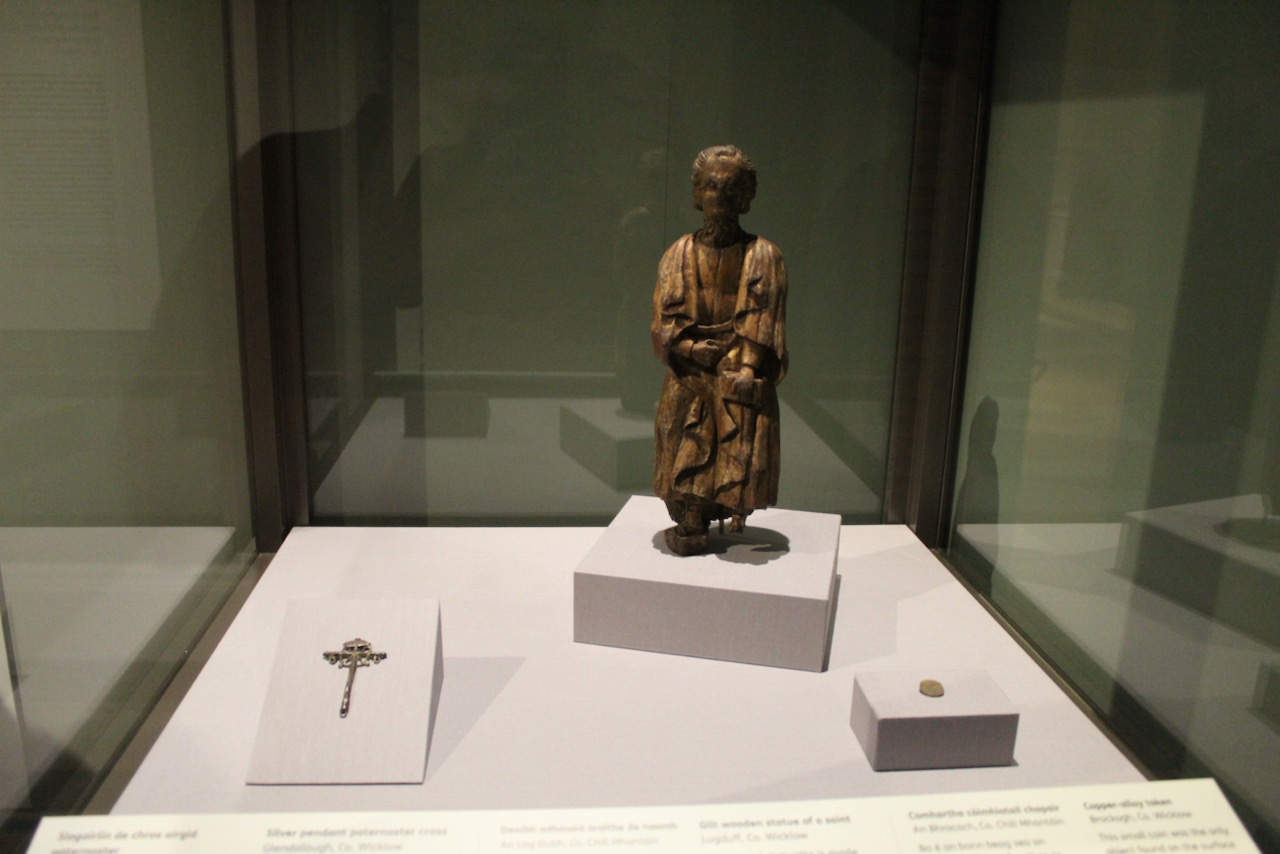
Gilt wooden statue dating from the 15th or 16th century, found at Lugduff, County Wicklow, in a ruined building near the upper lake at Glendalough. It is a carved statue of yew wood and depicts an unknown figure, probably a saint; now in the National Museum of Ireland, Kildare Street, Dublin. Photograph © Jennifer Winder-Baggot, www.irishhistorichouses.com
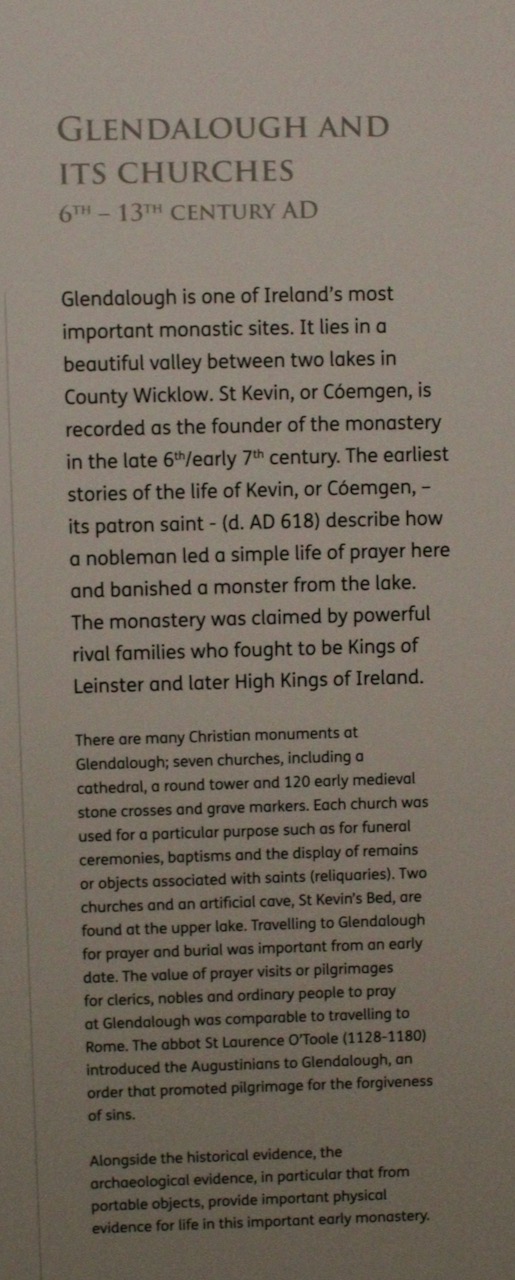
Information board from National Museum of Ireland, Kildare Street.
Silver penny of Sitric Rex Dublin, found at Sevenchurches or Camaderry, Glendalough County Wicklow. It represents the earliest Irish coinage, showing Sitric, King of Dublin, and was minted in AD995. It is now in the National Museum of Ireland, Kildare Street, Dublin. Photograph © Jennifer Winder-Baggot, www.irishhistorichouses.com
Glendalough, Co. Wicklow, photograph by Chris Hill 2018 for Tourism Ireland, Ireland’s Content Pool. [see 1]

3. National Botanic Gardens Kilmacurragh, County Wicklow:

General Information: 0404 48844, botanicgardens@opw.ie

Kilmacurragh House was home to seven generations of the Acton family. It was built in 1697 by Thomas Acton, whose father came to Ireland as part of Oliver Cromwell’s army, for which he was granted the lands surrounding the ruined abbey of St. Mochorog. The five bay Queen Anne house is thought to be the work of Sir William Robinson, who is better known today for his work at Marsh’s Library in Dublin, the Royal Hospital Kilmainham, Dublin Castle and Charles Fort, Kinsale, County Kerry. [2]

Kilmacurragh House, photograph from the National Inventory of Architectural History.

From the OPW website https://heritageireland.ie/visit/places-to-visit/national-botanic-gardens-kilmacurragh/:

There was a monastery at Kilmacurragh, in this tranquil corner of County Wicklow, in the seventh century, and a religious foundation remained right up until the dissolution of the monasteries. After Cromwell invaded the land passed to the Acton family.

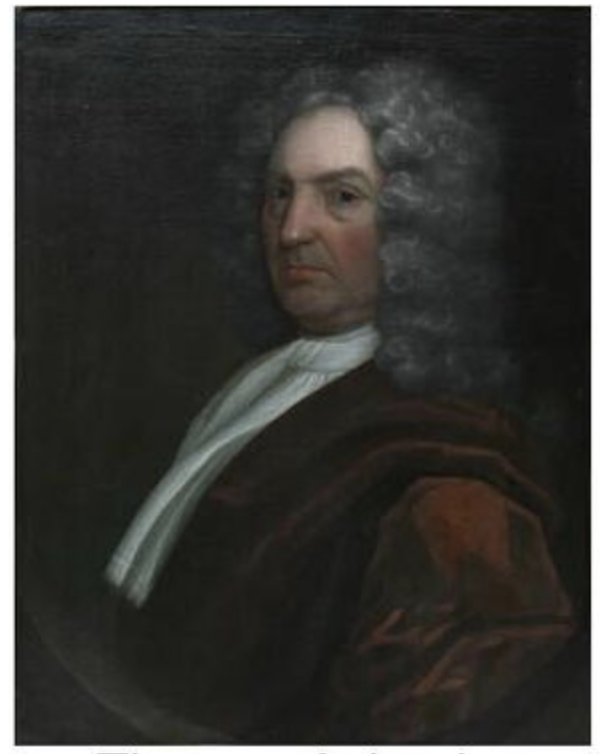
Thomas Acton (1655-1750), the first Thomas Acton who lived at Kilmacurragh, he obtained leases “for lives, renewable forever” from Richard Viscount Rosse of the lands in County Wicklow. [3] His father had come over to Ireland in Cromwell’s army. Thomas built the house at Kilmacurragh in 1697, after tearing down the abbey buildings. The house was designed by William Robinson (1643-1712), whose best-known work is the Royal Hospital Kilmainham.
Elinor née Kempston (d. 1747), wife of Thomas Acton.

By the time the estate came to Thomas Acton in 1854, an unprecedented period of botanical and geographical exploration was afoot. In collaboration with the curators of the National Botanic Gardens, Acton built a new and pioneering garden.

In 1996, a 21-hectare portion of the old demesne officially became part of the National Botanic Gardens of Ireland. The following ten years were spent giving the estate’s rare and beautiful plants a new lease of life.

Kilmacurragh is now part of the National Botanic Gardens, providing a complementary collection of plants to its parent garden at Glasnevin. Arrive in spring to witness the transformation of the walks, as fallen rhododendron blossoms form a stunning magenta carpet.

and

The Gardens lies within an estate developed extensively during the nineteeth century by Thomas Acton in conjunction with David Moore and his son Sir Frederick Moore, Curators of the National Botanic Gardens at that time. It was a period of great botanical and geographical explorations with numerous plant species from around the world being introduced to Ireland for the first time. The different soil and climatic conditions at Kilmacurragh resulted in many of these specimens succeeding there while struggling or failing at Glasnevin. Kilmacurragh is particularly famous for its conifer and rhododendron collections.” [4]

Thomas Acton’s son William (1711-1779) married Jane Parsons of Birr Castle. Their son Thomas Acton (1738-1817) inherited, then his son Lt Col William (1789-1854) and then his son Thomas (1826-1908). Along with his sister Janet, he had a passion for collecting plants. They travelled to the Americas and Asia in search of plants, and established one of the finest arboreta in Ireland, and formed a friendship with David Moore, curator of the National Botanic Gardens in Dublin. Thomas died unmarried in 1908 and Kilmacurragh was inhierted by his nephew, Captain Charles Annesley Acton, who had been born in Peshawar. However, he was killed fighting in World War I as was his brother Reginald. Thus in eight years, three consecutive owners of Kilmacurragh had died, inflicting death duties amounting to 120% of the value of the property. The Actons were forced to sell the estate. The house fell into ruin and the arboretum became overgrown. The state acquired Kilmacurragh in 1996 and have restored the arboretum, making it part of the National Botanic Gardens.

[1] https://www.irelandscontentpool.com/en/media-assets/media/81101

[2] p. 160. Living Legacies: Ireland’s National Historic Properties in the Care of the OPW. Government Publications, Dublin 2, 2018.

[3] Burke, Bernard, A genealogical and heraldic history of the landed gentry of Great Britain & Ireland, 1886 vol 1.

[4] https://botanicgardens.ie/kilmacurragh/