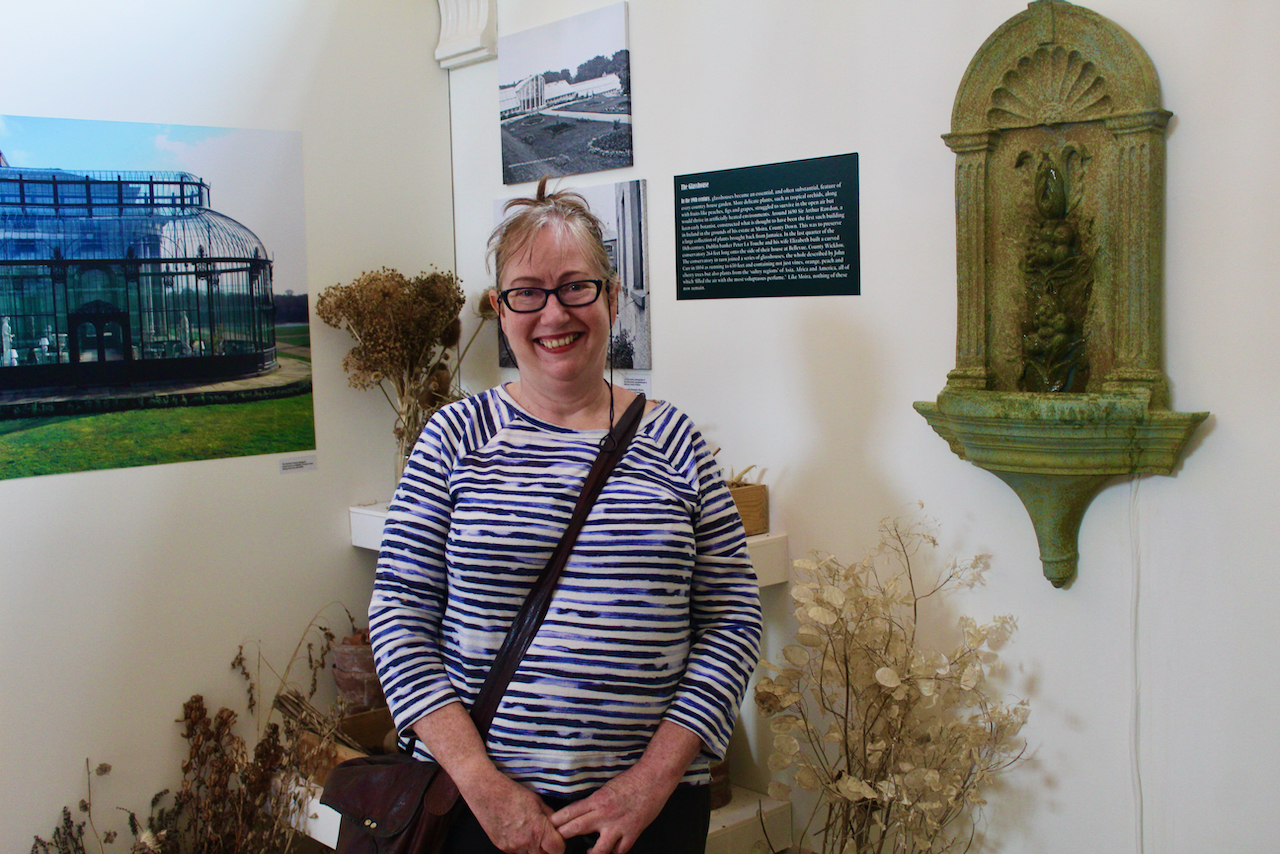
Emo Court, County Laois – Office of Public Works

Emo Court, County Laois:

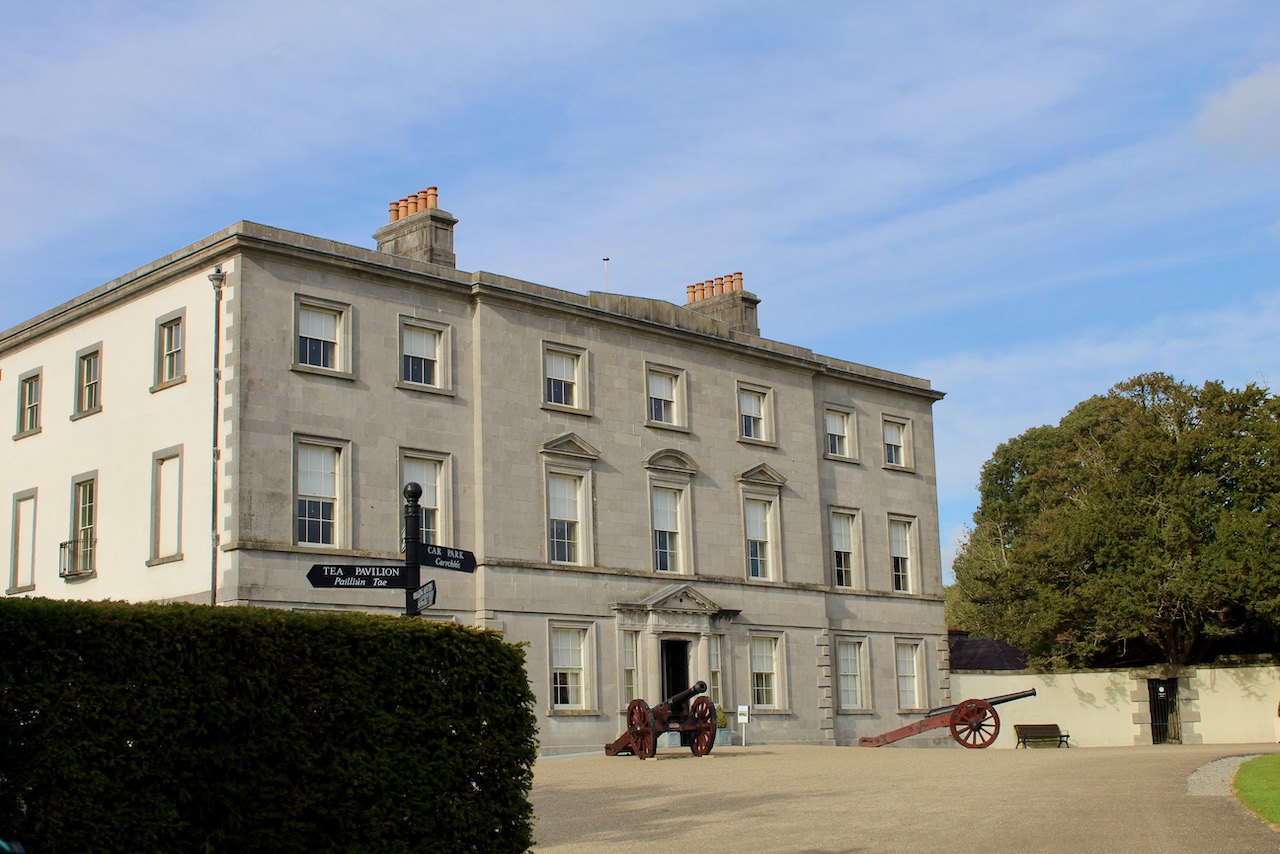
Emo, County Laois, June 2021. Unfortunately the stone lions which flank the front steps, carved by Richard Carter of Cork in 1854, were in boxes on the day we visited. [1] Photograph © Jennifer Winder-Baggot, www.irishhistorichouses.com

General enquiries: 057 862 6573, emocourt@opw.ie

From the OPW website https://heritageireland.ie/visit/places-to-visit/emo-court/:

Emo Court is a quintessential neo-classical mansion, set in the midst of the ancient Slieve Bloom Mountains. The famous architect James Gandon, fresh from his work on the Custom House and the Four Courts in Dublin, set to work on Emo Court in 1790. However, the building that stands now was not completed until some 70 years later [with work by Lewis Vulliamy, a fashionable London architect, who had worked on the Dorchester Hotel in London and Arthur & John Williamson, from Dublin, and later, William Caldbeck].

The estate was home to the earls of Portarlington until the War of Independence forced them to abandon Ireland for good. The Jesuits moved in some years later [1920] and, as the Novitiate of the Irish Province, the mansion played host to some 500 of the order’s trainees.

Major Cholmeley-Harrison took over Emo Court in the 1960s and fully restored it [to designs by Sir Albert Richardson]. He opened the beautiful gardens and parkland to the public before finally presenting the entire estate to the people of Ireland in 1994.

You can now enjoy a tour of the house before relaxing in its charming tearoom. The gardens are a model of neo-classical landscape design, with formal lawns, a lake and woodland walks just waiting to be explored.” [2]
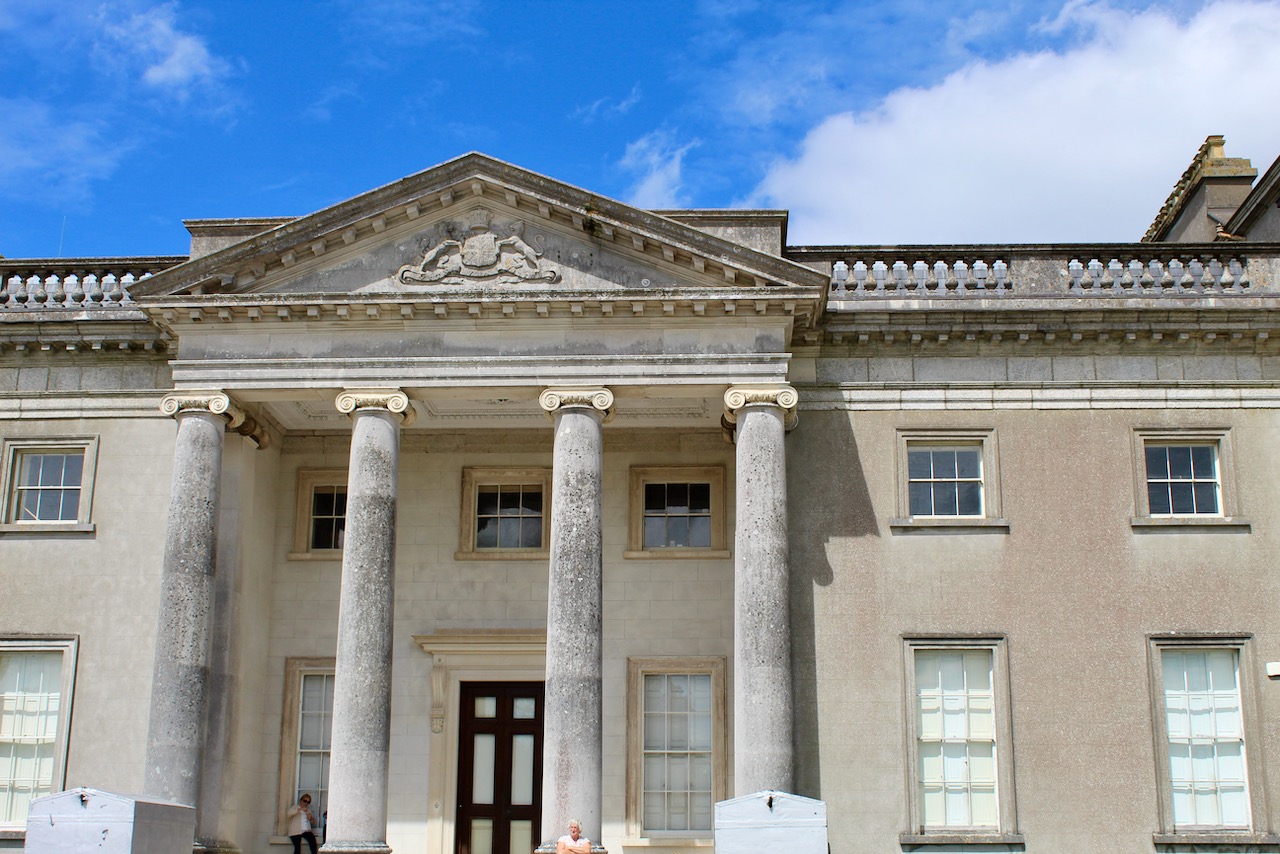
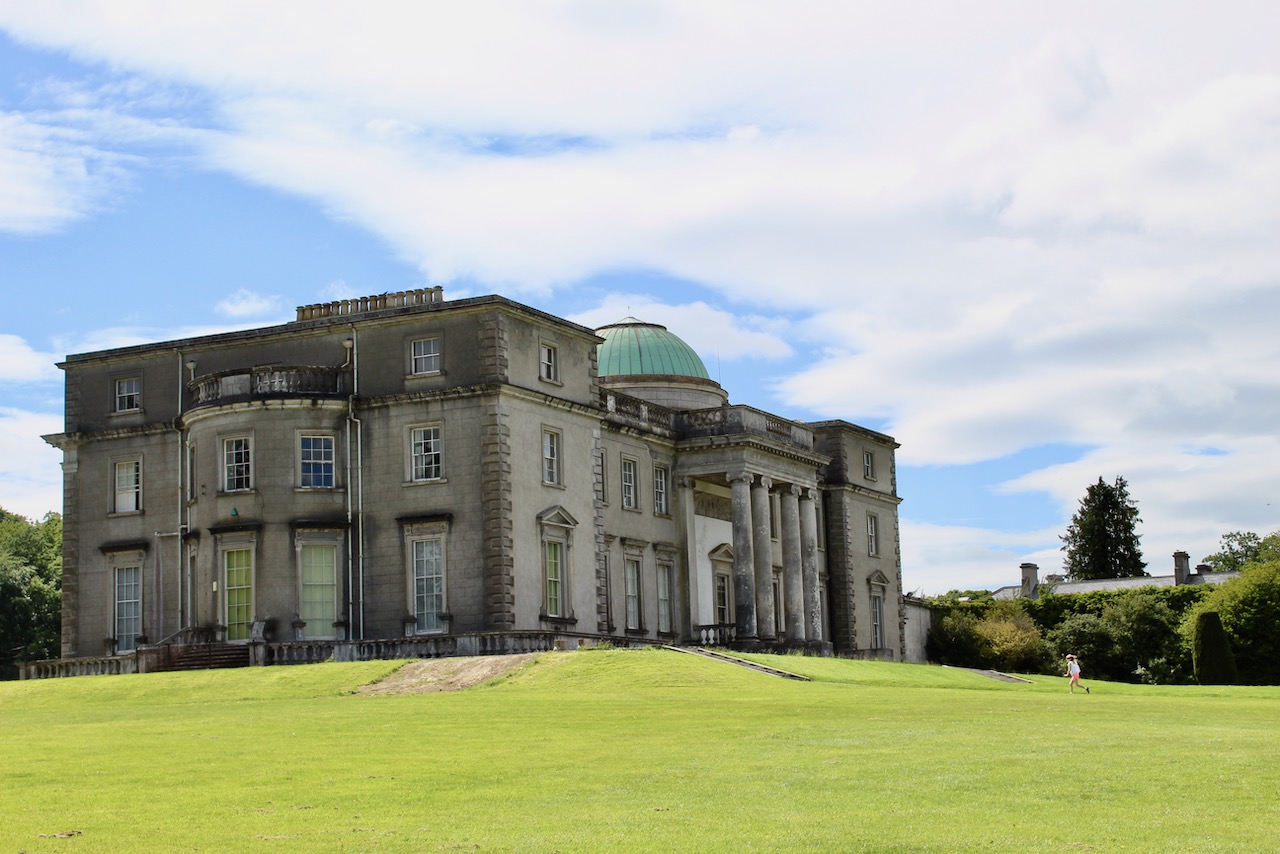
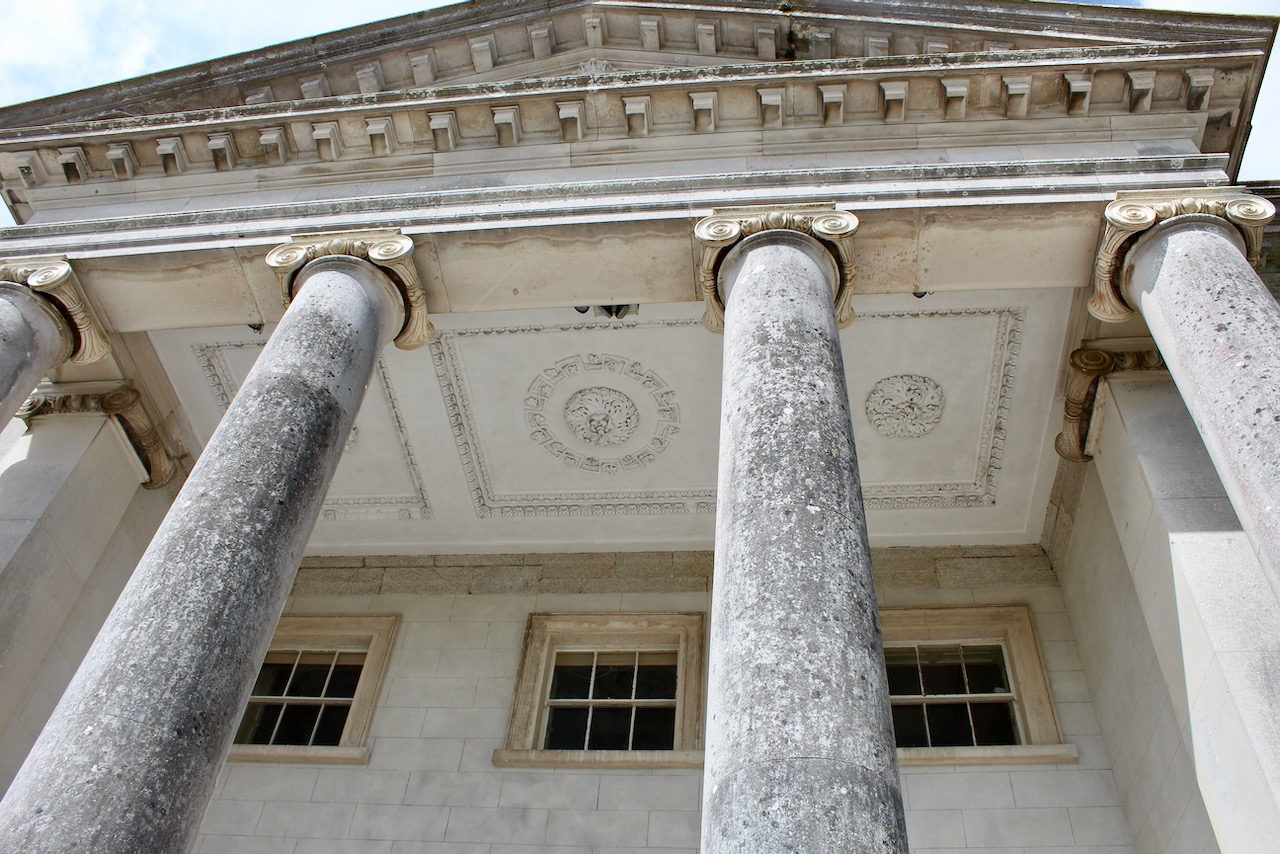
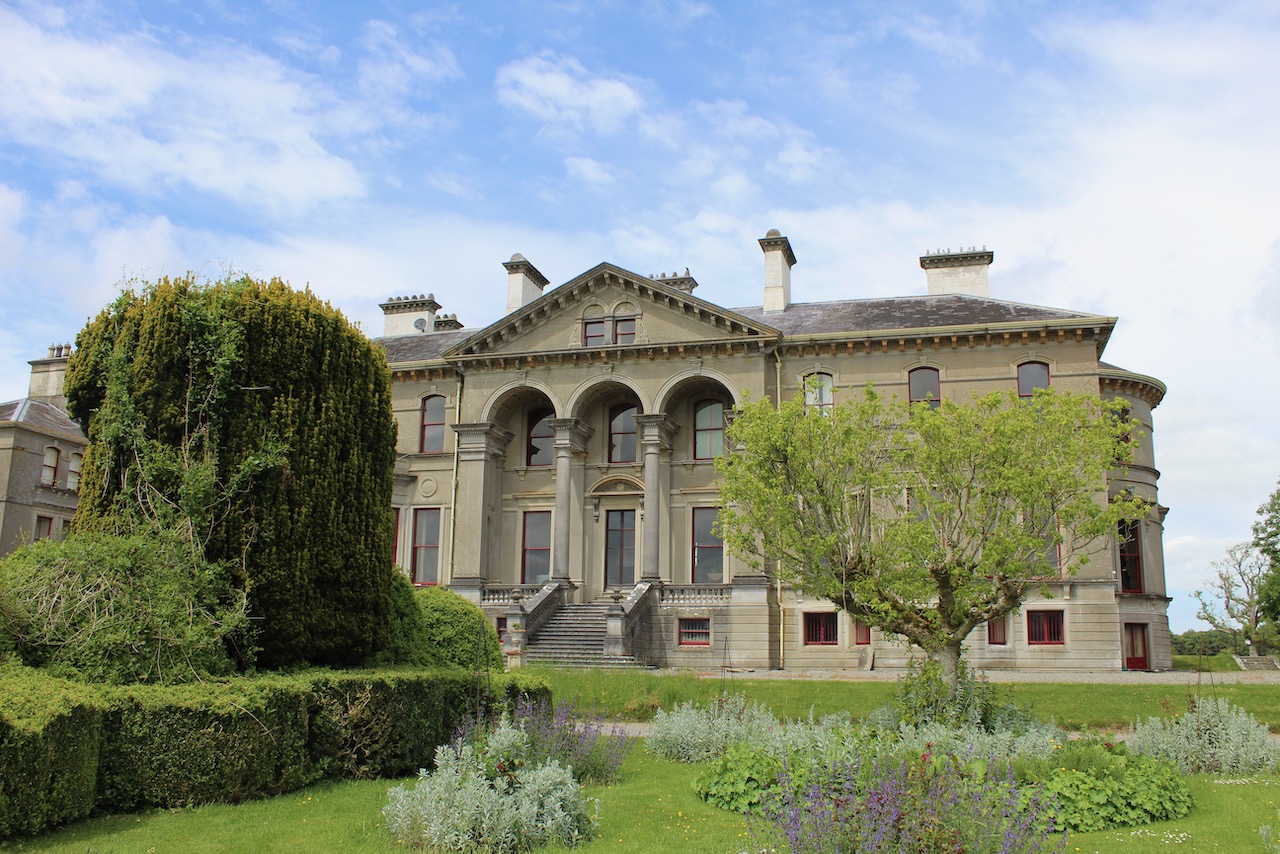
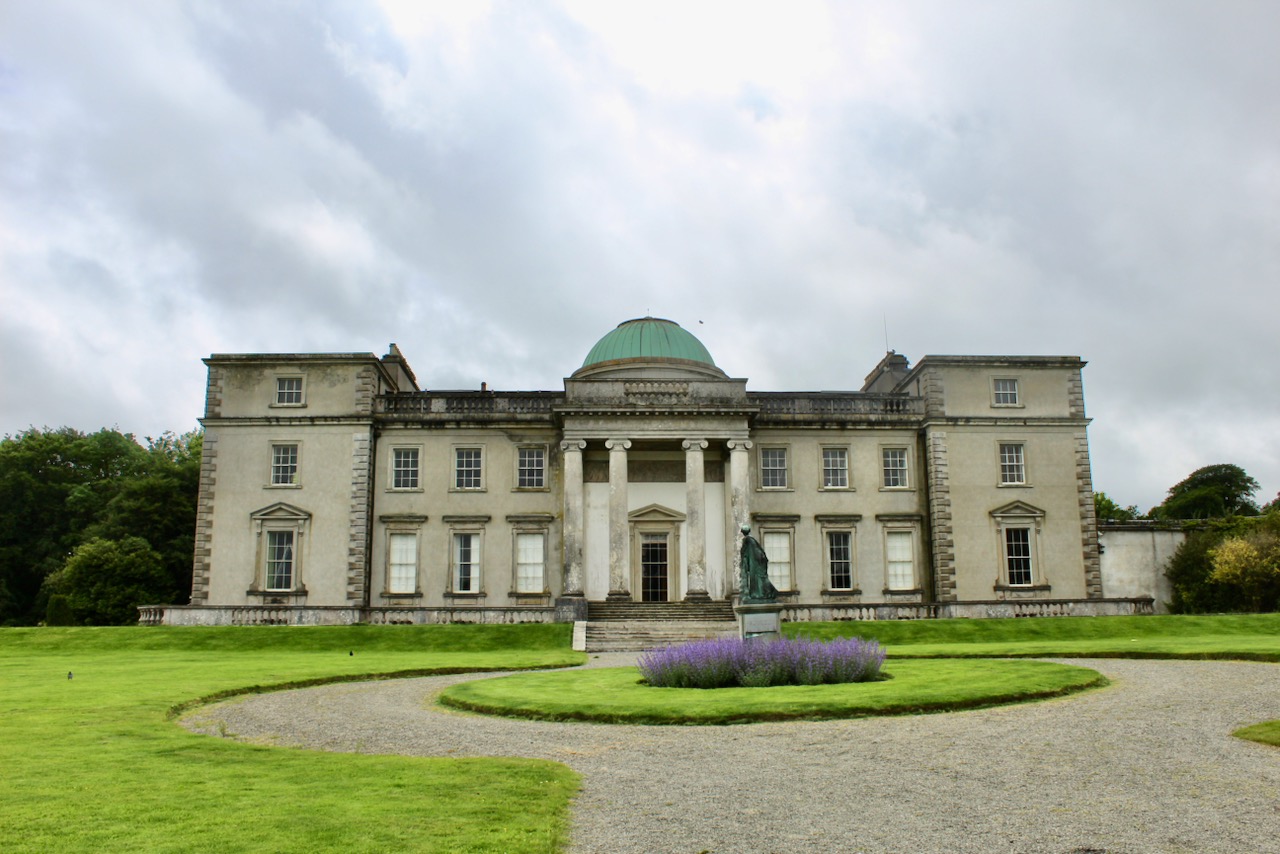
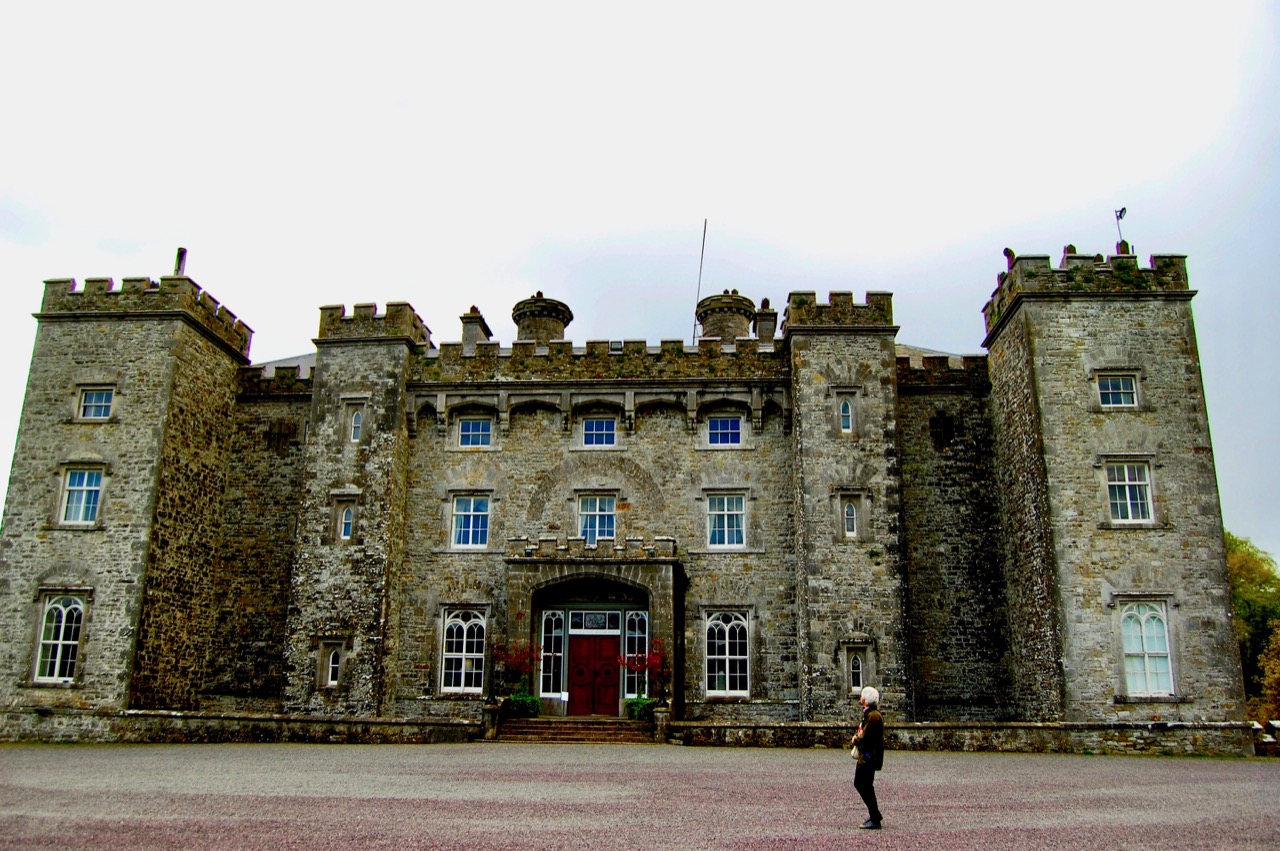
The entrance front has seven bay centre with a giant pedimented Ionic portico. Andrew Tierney tells us that the portico was changed in 1822 from Gandon’s Doric order to a pedimented tetrastyle Ionic portico by the Dublin architects Arthur and John Williamson. [see 1] Photograph © Jennifer Winder-Baggot, www.irishhistorichouses.com
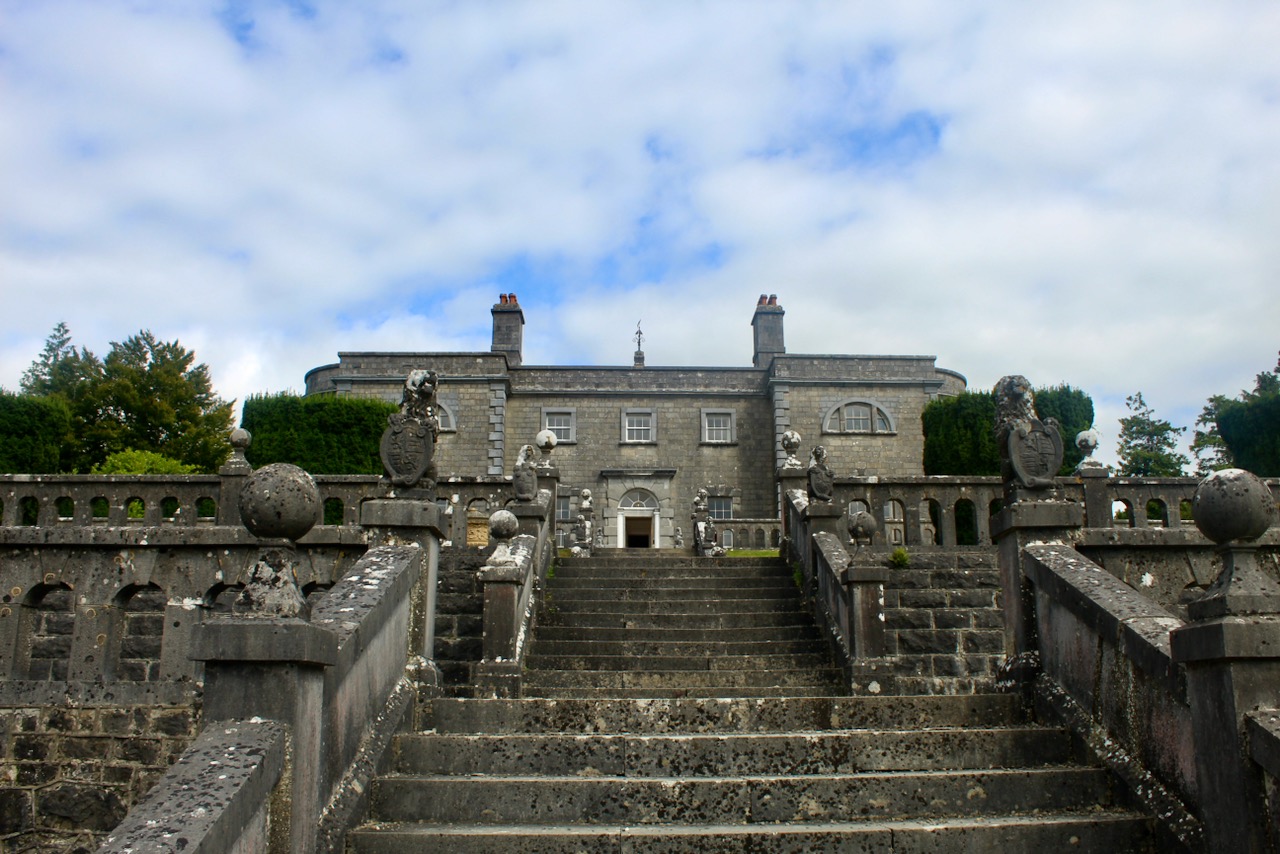
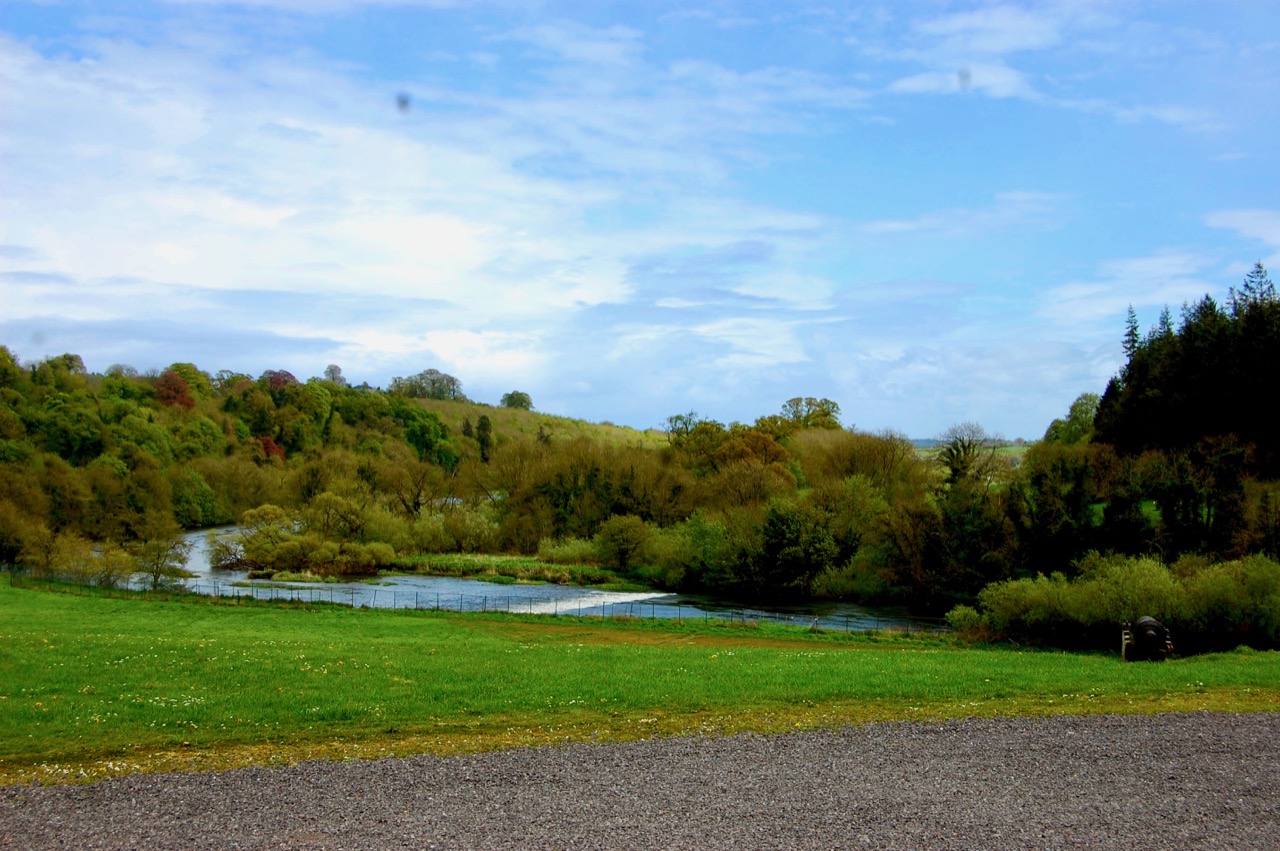
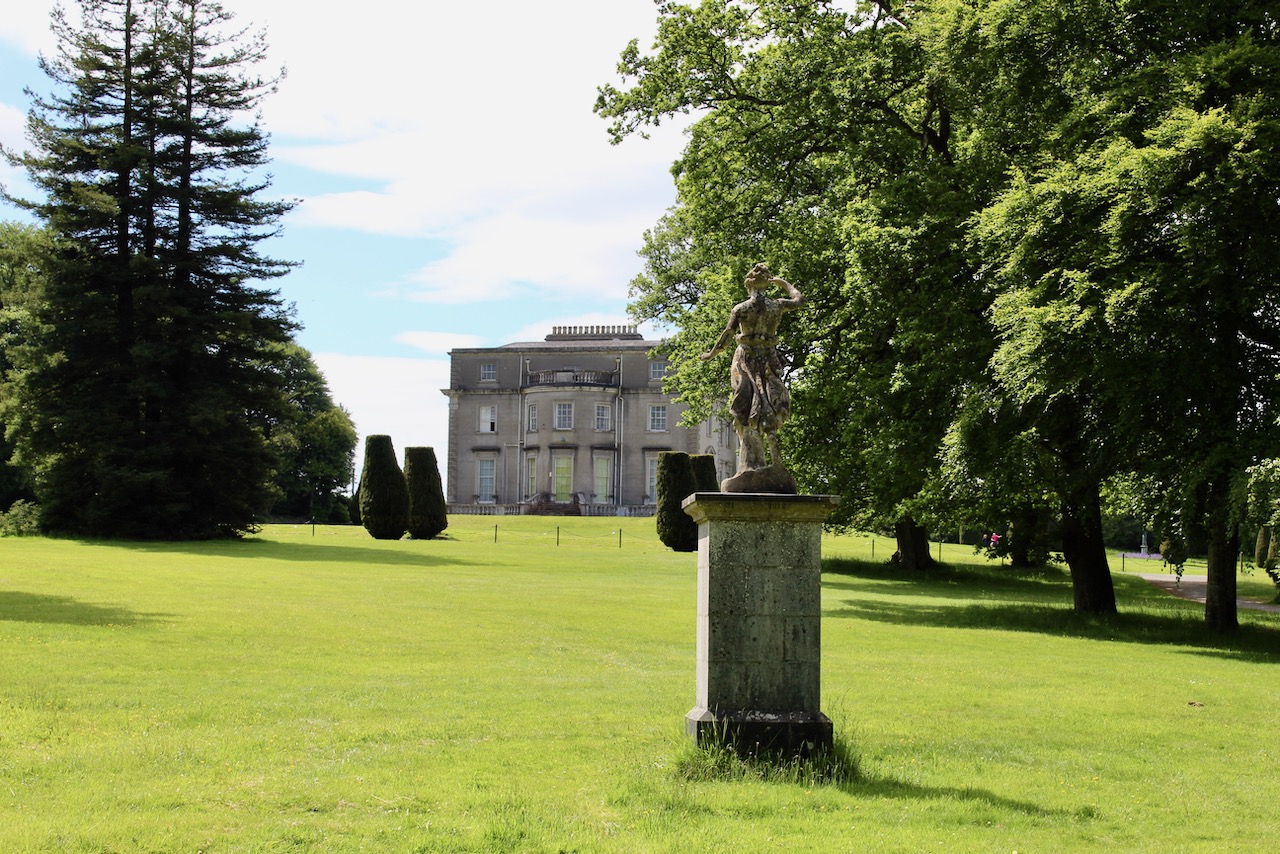
The view from the front of the house. The 3rd Earl of Portarlington planted the long avenue of Wellingtonia trees. Photograph © Jennifer Winder-Baggot, www.irishhistorichouses.com

We visited Emo during Heritage Week 2024 as some rooms were open to the public – finally! Despite the episode on television several years ago of “Great Irish Interiors” where the house was prepared to be open to the public, it is still not open to the public. And it is still not. Just a few rooms were open for Heritage Week. Major Cholmeley-Harrison will be tearing his hair out, if he has any left, in his grave – imagine giving the house to the state, and the state accepts it and then closes it for thirty years!

It was so exciting to go inside. My great uncle Father Tony Baggot was a novitiate there when the Jesuits owned the property.

Unfortunately I was not allowed to take photographs. I was not impressed by the reason given: it’s not finished yet. For goodness sake, who do the OPW think owns the house? We do! Apparently they had left it arranged as when owned Major Cholmeley-Harrison, opened it for a short while, and now they are removing traces of him from several areas. Poor Mr. Cholmeley-Harrison.
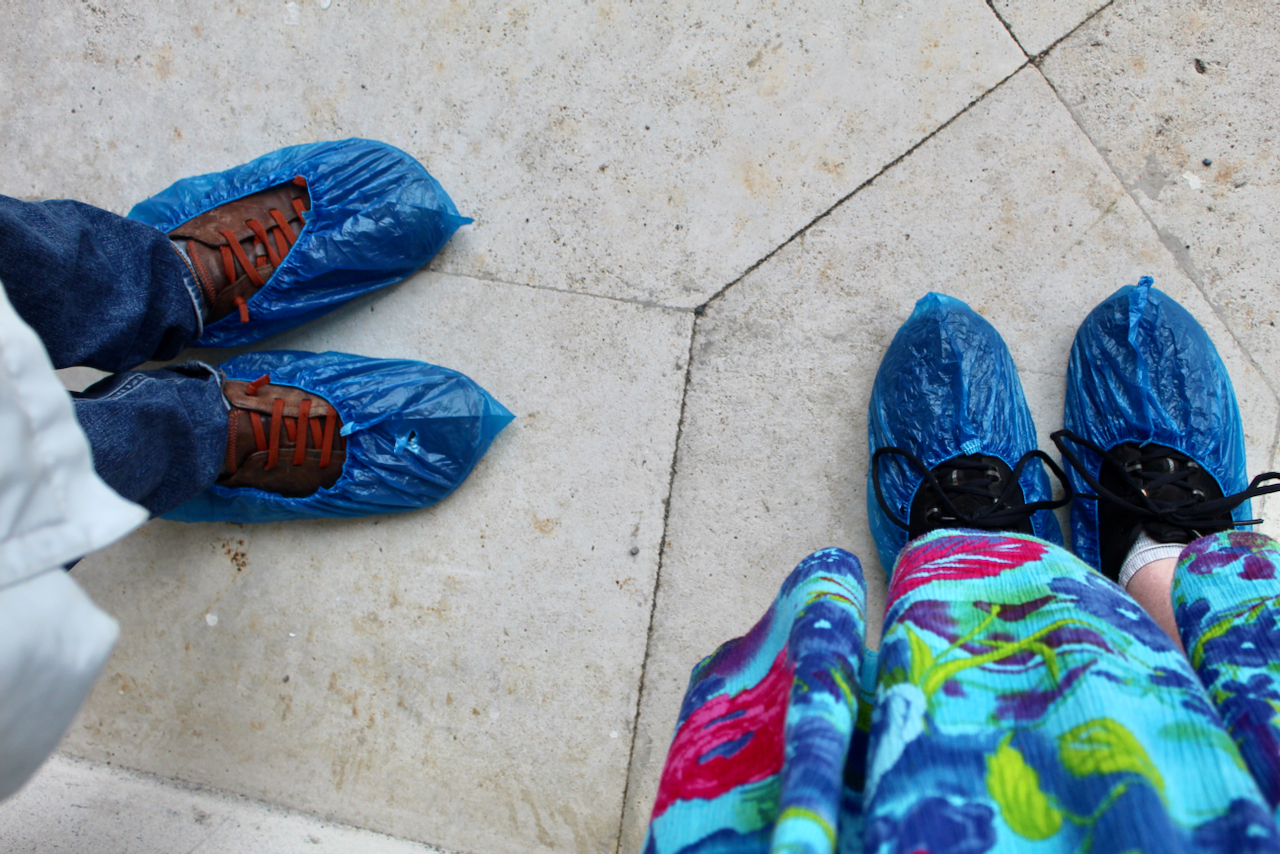
At Emo Park house, we had to wear these over our shoes, August 2024, Photograph © Jennifer Winder-Baggot, www.irishhistorichouses.com

Mark Bence-Jones tells us that the 1st Earl of Portarlington was interested in architecture and was instrumental in bringing James Gandon to Ireland, in order to build the new Custom House. The name Emo is an Italianised version of the original Irish name of the estate, Imoe. [3]

The Emo Court website tells us of the history:

John Dawson, 1st Earl of Portarlington [1744-1798] commissioned the building of Emo Court in 1790 although the house was not finally completed until 1870, eighty years later. Emo Court is one of only a few private country houses designed by the architect James Gandon. Others were Abbeyville, north Co. Dublin for Sir James Beresford [or is it John Beresford (1738-1805)? later famous for being the home of politician Charles Haughey] and Sandymount Park, Dublin for William Ashford. In addition, Gandon built himself a house at Canonbrook, Lucan, Co. Dublin.” [4]

Many of Gandon’s original drawings, plus those of his successors, are in the Irish Architectural Archive, 45 Merrion Square, Dublin. [5] The Emo Court website continues:

James Gandon was born in London of Huguenot descent. He studied classics, mathematics and drawing, attending evening classes at Shipley’s Academy in London. At the age of fifteen, James was apprenticed to the architect Sir William Chambers and about eight years later, set up in business on his own. His first connection with Ireland was in 1769 when he won the second prize of £60 in a competition to design the Royal Exchange in Dublin, now the City Hall. He was invited to build in St Petersburg, Russia, by Princess Dashkov, and offered an official post with military rank. However, he chose instead to accept an offer from Sir John Beresford and John Dawson, Lord Carlow, later 1st Earl of Portarlington, to come to Dublin to build a new Custom House. This was begun in 1781. The following year, Gandon was commissioned to make extensions to the Parliament House, originally designed by Sir Edward Lovett Pearce. Here he added a Corinthian portico as entrance to the Lords’ Chamber. After the Act of Union in 1801, the building became the Bank of Ireland. In 1785, Gandon was commissioned to design the new Four Courts. The third of his great Dublin buildings was the King’s Inns, begun in 1795. His few private houses were designed for patrons and friends.” [see 4]
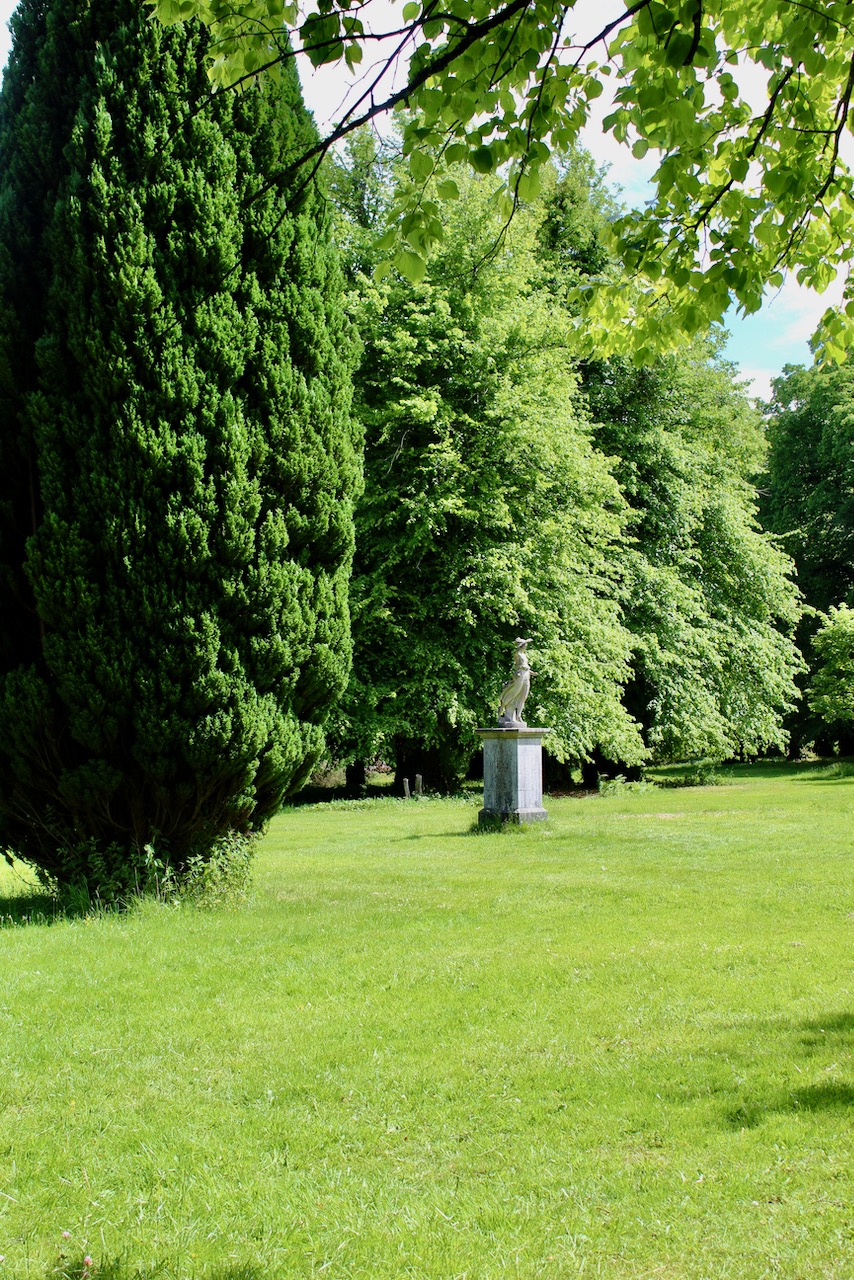
Photograph © Jennifer Winder-Baggot, www.irishhistorichouses.com

The website continues: “In the early 18th century, Ephraim Dawson [1683-1746], a wealthy banker, after whom Dawson Street in Dublin is named, purchased the land of the Emo Estate and other estates in the Queen’s County (Co. Laois). He married Anne Preston, heiress to the Emo Park Estate and fixed his residence in a house known as Dawson Court, which was in close proximity to the present Emo Court. His grandson, John Dawson, was created 1st Earl of Portarlington in 1785. Three years later, he married Lady Caroline Stuart, daughter of the [3rd] Earl of Bute, who was later Prime Minister of England. John Dawson commissioned Gandon to design Emo Court in 1790.

Stephen’s ancestor Earl George Macartney married another daughter of the 3rd Earl of Bute! Their mother was the wonderful Lady Mary Wortley-Montague whose husband was a diplomat and she wrote memoires of their travels. She even visited a harem.

Lady Mary Wortley Montagu (1718-1794), Wife of John Patrick Crichton Stuart 3rd Earl of Bute, print after Christian Friedrich Zincke, 1830s, courtesy of National Portrait Gallery of London, NPG D34619.
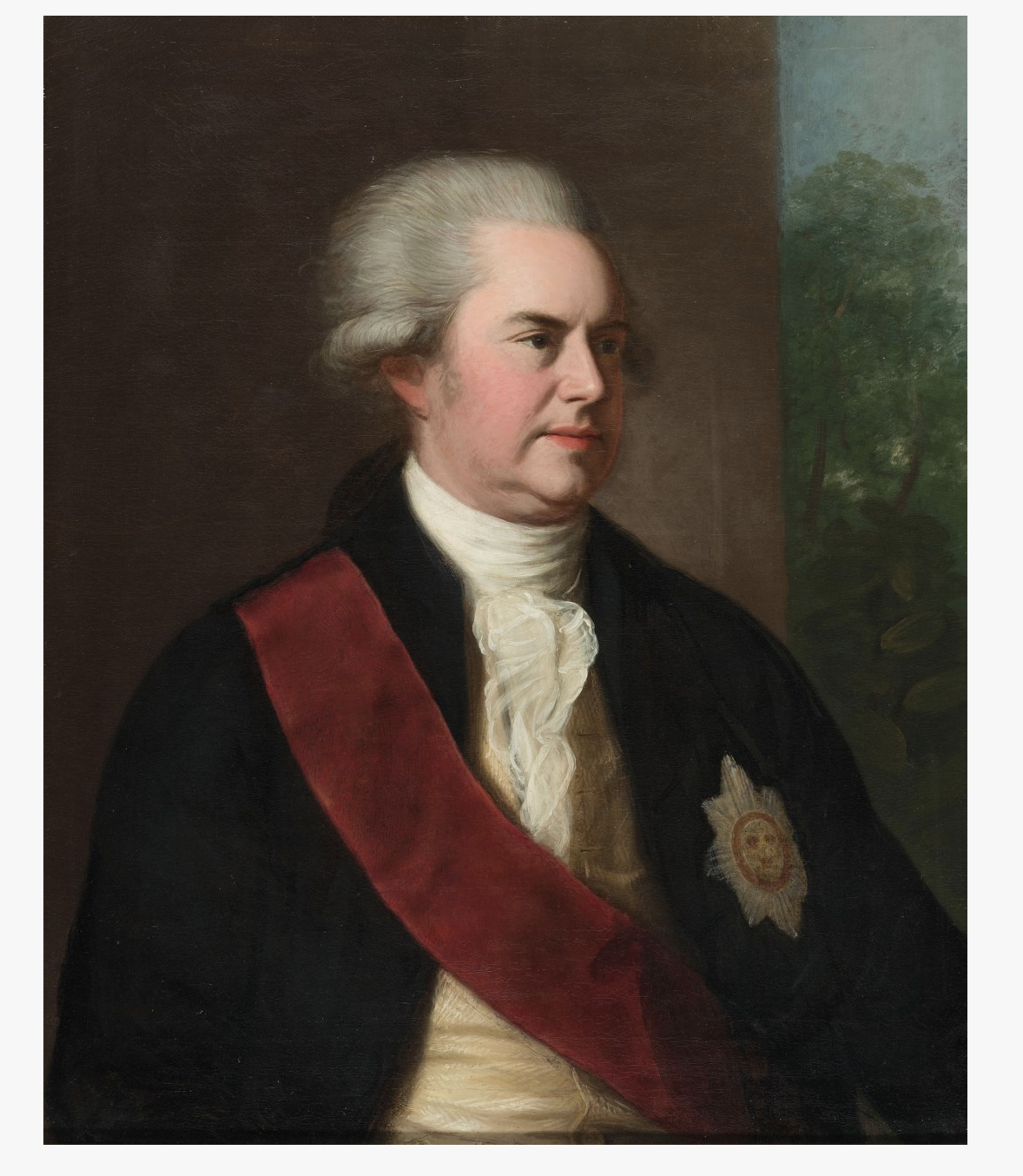
George, 1st Earl Macartney wearing the Order of the Bath by Thomas Hickey courtesy Christie’s China Trade Paintings selections from the Kelton Collection.

After Gandon died in 1823, to be buried in Drumcondra churchyard, the 2nd Earl of Portarlington, also John Dawson, engaged Lewis Vulliamy, a fashionable London architect, who had worked on the Dorchester Hotel in London and A. & J. Williamson, Dublin architects, to finish the house. In the period, 1824-36, the dining room and garden front portico with giant Ionic columns were built, but on the death of the 2nd Earl in 1845, the house still remained unfinished. It was not until 1860 that the 3rd Earl, Henry Ruben John Dawson [or Dawson-Damer, the son of the 2nd Earl’s brother Henry Dawson-Damer, who had the name Damer added to his name after the family of his grandmother, Mary Damer, who married William Henry Dawson, 1st Viscount Carlow] commissioned William Caldbeck, a Dublin architect, and Thomas Connolly, his contractor, to finish the double height rotunda, drawing room and library.” [see 4] Caldbeck also added a detached bachelor wing, joined to the main block by a curving corridor.
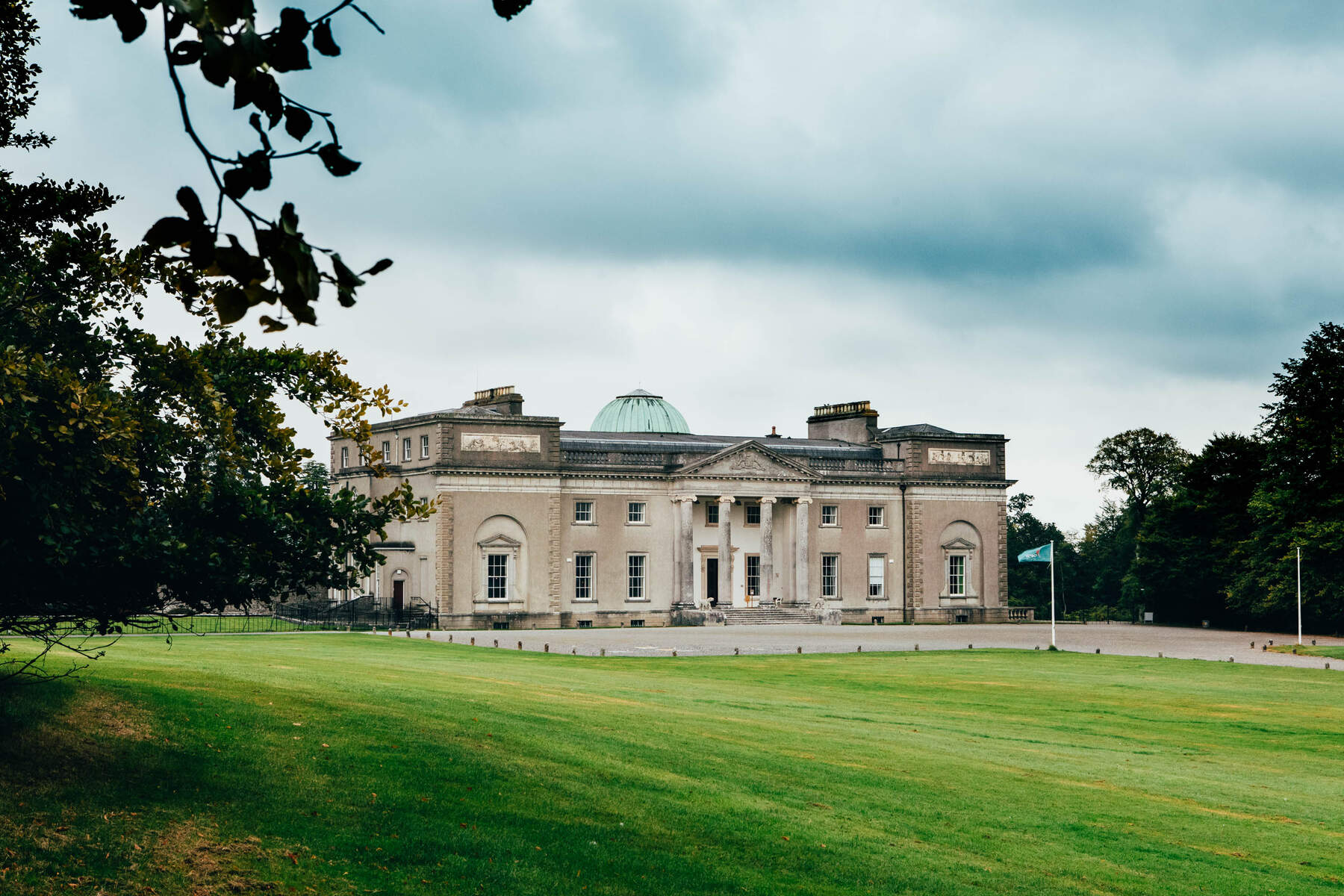
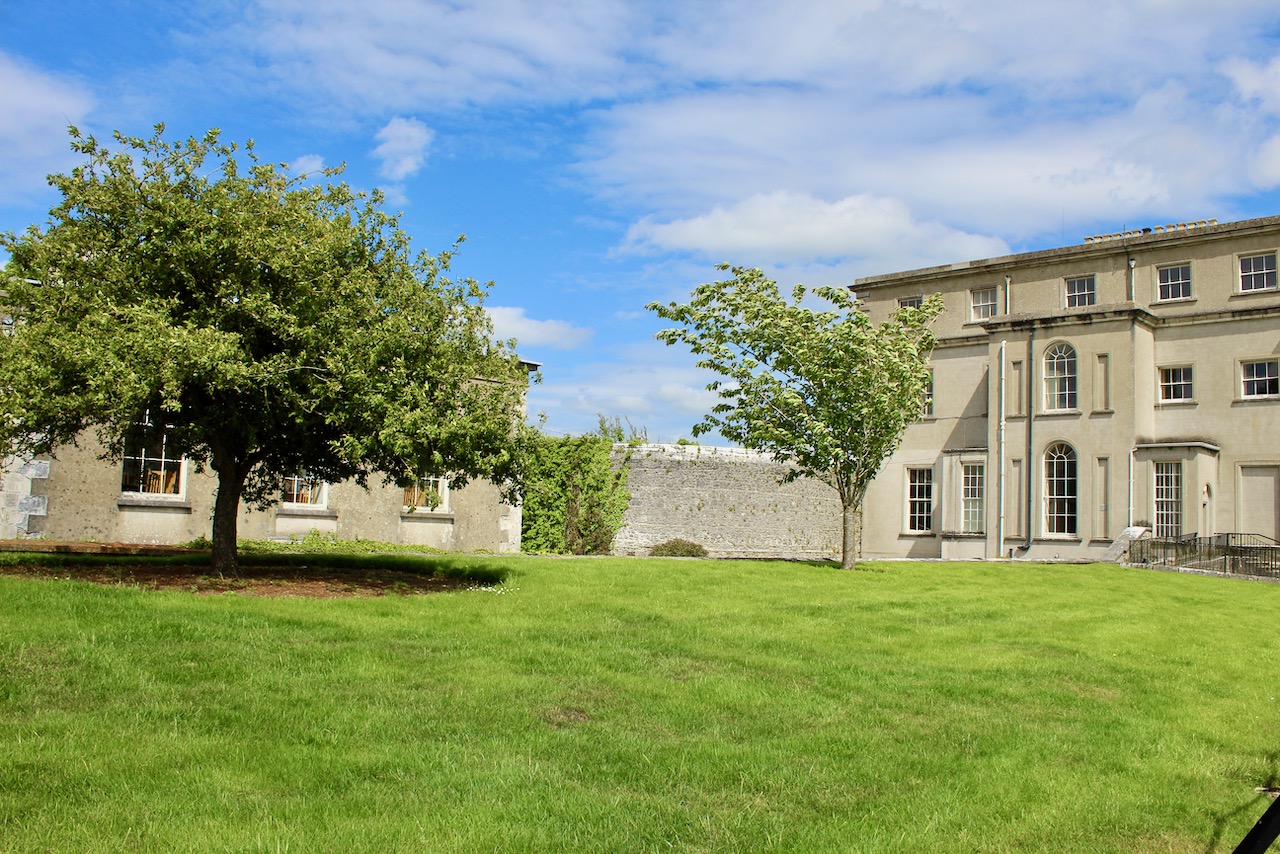
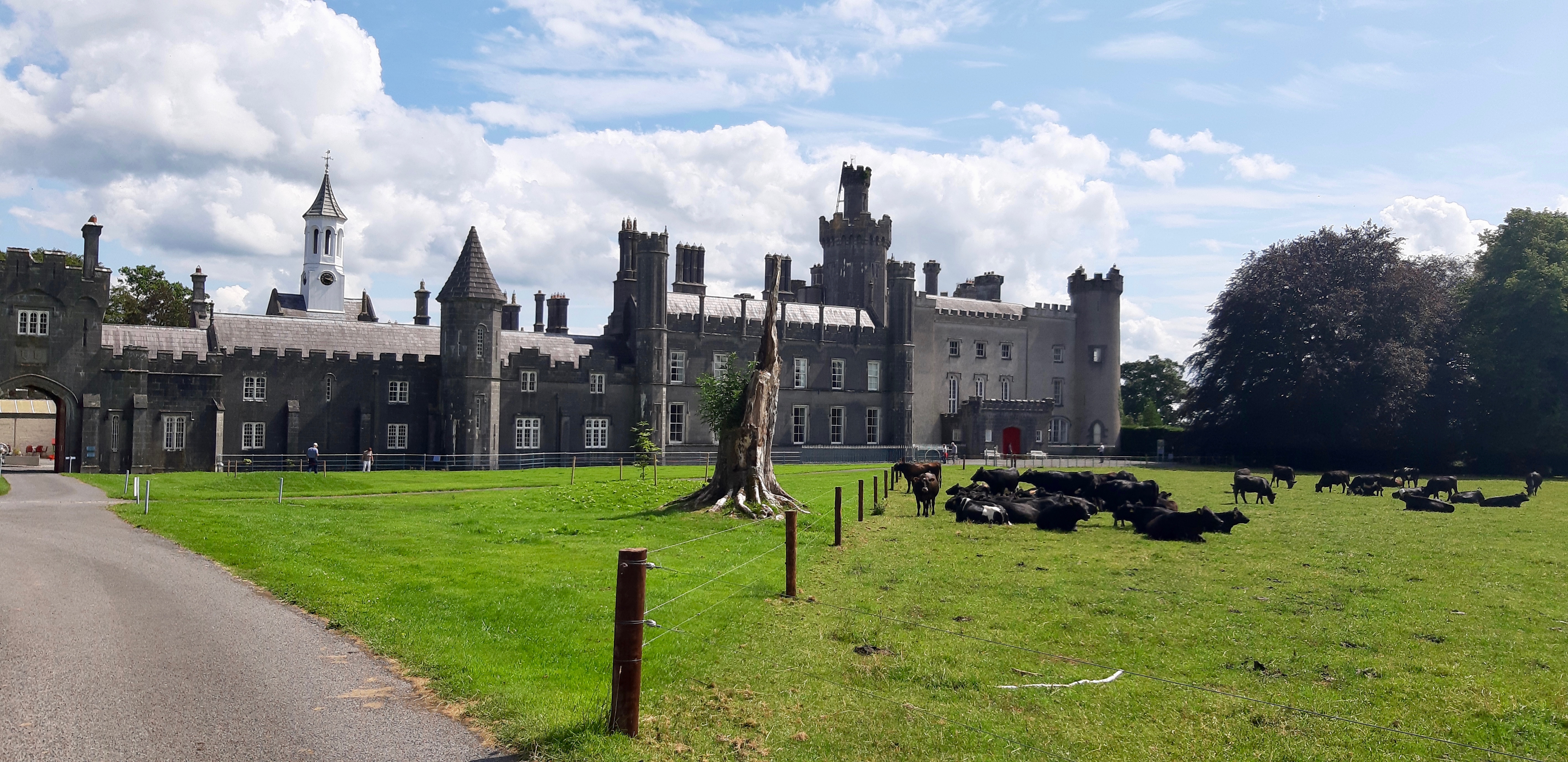
Emo Court, Photograph by Liam Murphy 2016 for Fáilte Ireland, Ireland’s Content Pool [6]. The windows in the single bay pavilions are pedimented and set in relieving arches.
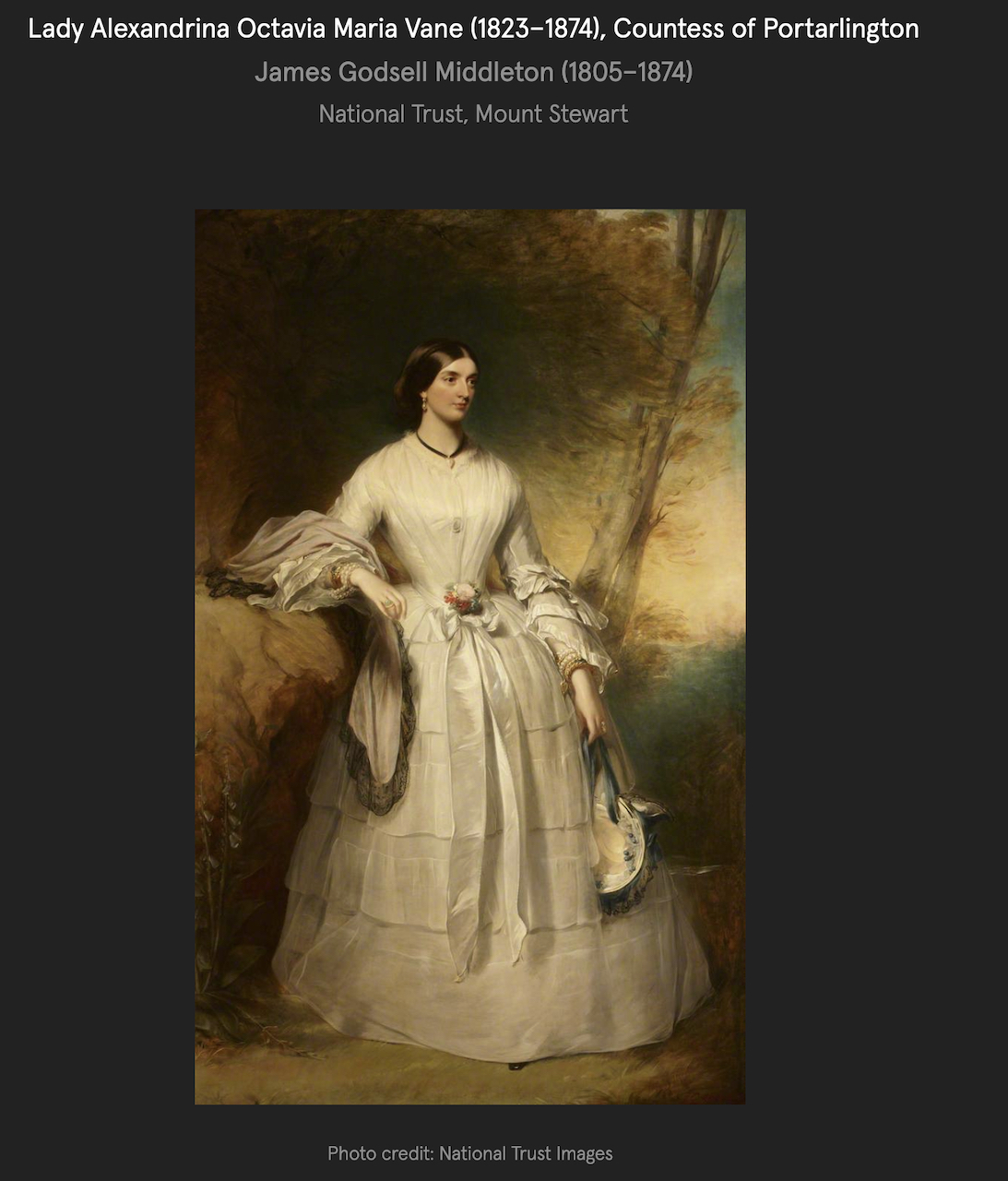
Mary Seymour, who according to Mealy’s sales catalogue married John Dawson 1st Earl of Portarlington of Emo Court, by Thomas Heaphey, courtesy of Fonsie Mealy auction; I think she married George Lionel Dawson-Damer, son of 1st Earl.

Although it was not built during Gandon’s time, most of the house is as it was designed by Gandon, wiht some additions or changes. Mark Bence-Jones describes the house:

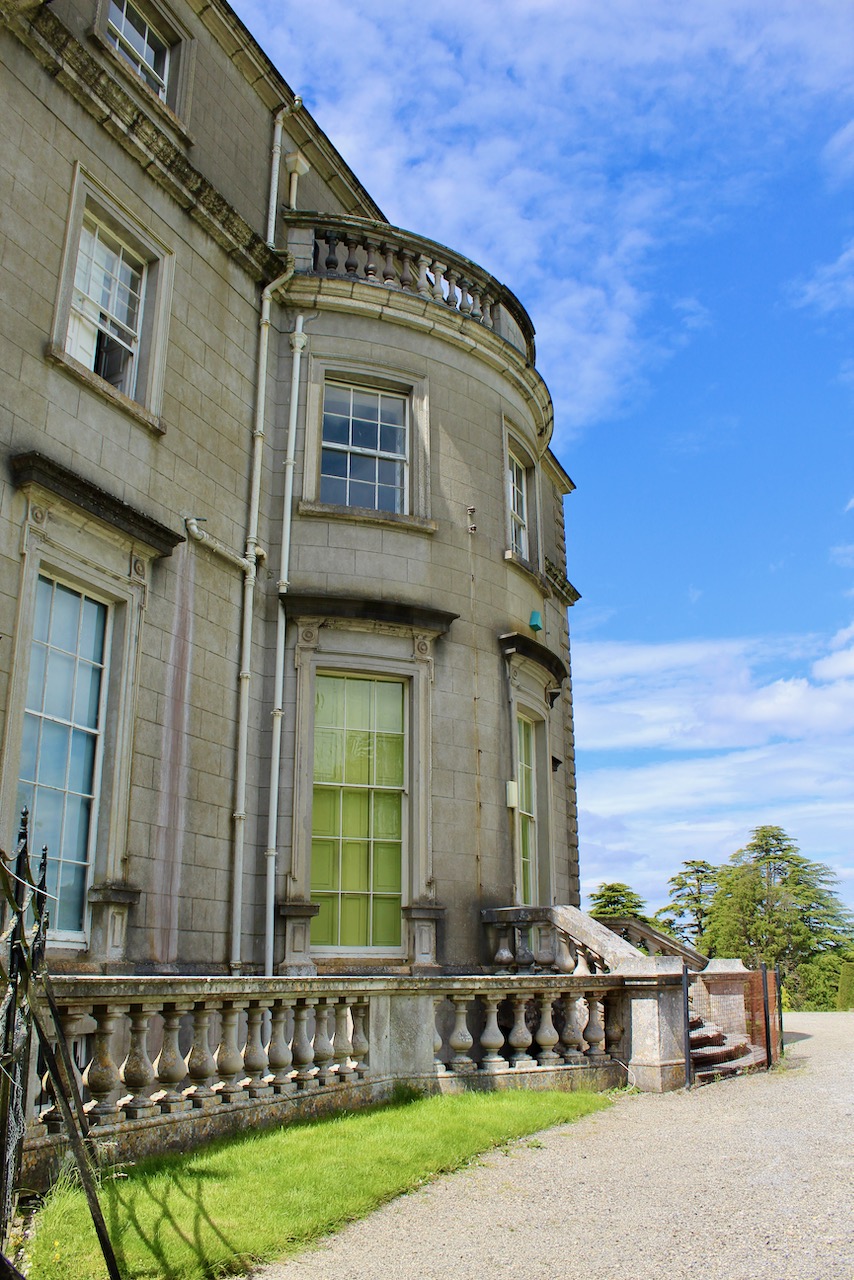
Of two storeys over a basement, the sides of the house being surmounted by attics so as to form end towers or pavilions on each of the two principal fronts. The entrance front has seven bay centre with a giant pedimented Ionic portico; the end pavilions being of a single storey, with a pedimented window in an arched recess, behind a blind attic with a panel containing a Coade stone relief of putti; on one side representing the Arts, on the other, a pastoral scene. The roof parapet in the centre, on either side of the portico, is balustraded. The side elevation, which is of three storeys including the attic, is of one bay on either side of a curved central bow.” [see 3]

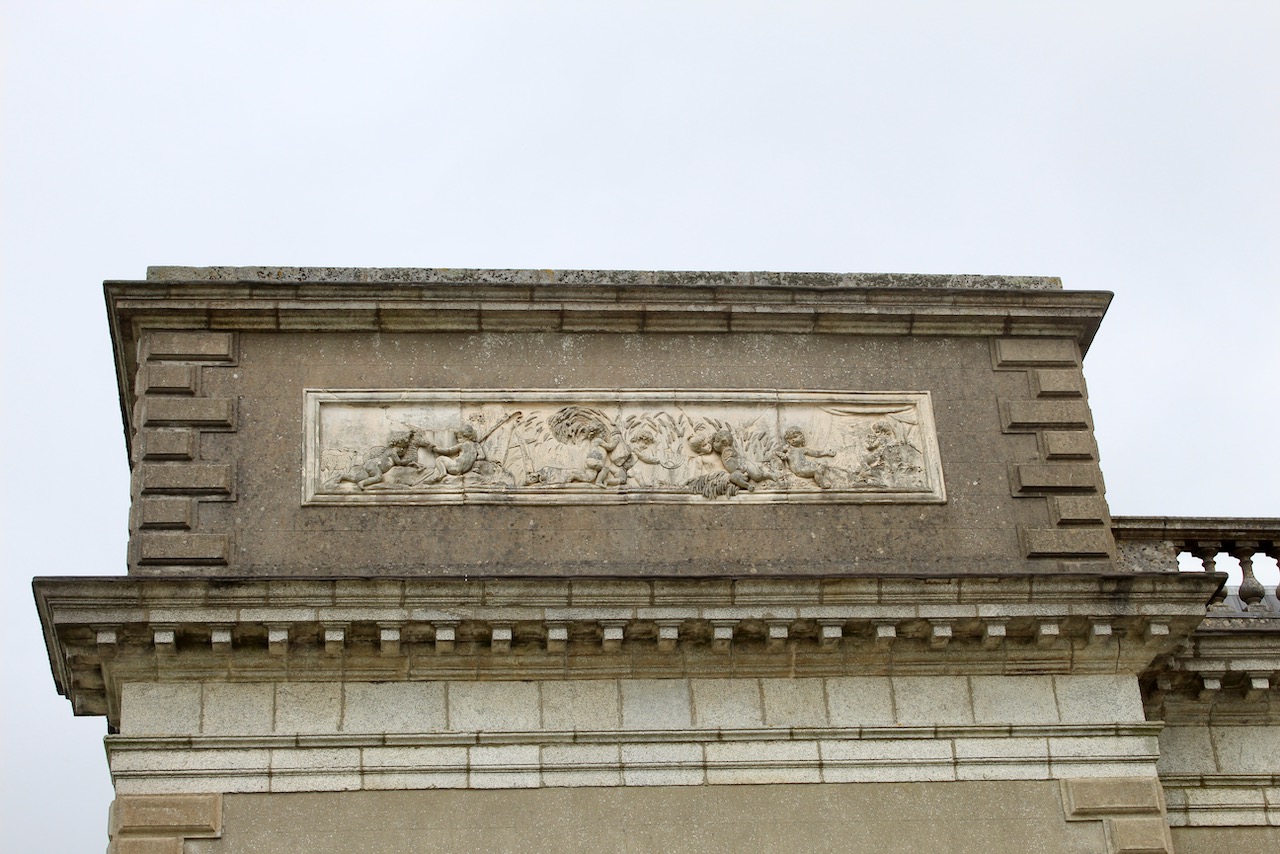
The end pavilions are a single storey with a blind attic with a panel containing a Coade stone relief of putti; on one side representing the Arts, on the other, a pastoral scene. In the photograph is the Arts side, with an Irish harp and two figures unfurling the plans for the house. [see 1] Photograph © Jennifer Winder-Baggot, www.irishhistorichouses.com
The Coade stone relief of putti in a pastoral scene, representing Agriculture. Photograph © Jennifer Winder-Baggot, www.irishhistorichouses.com
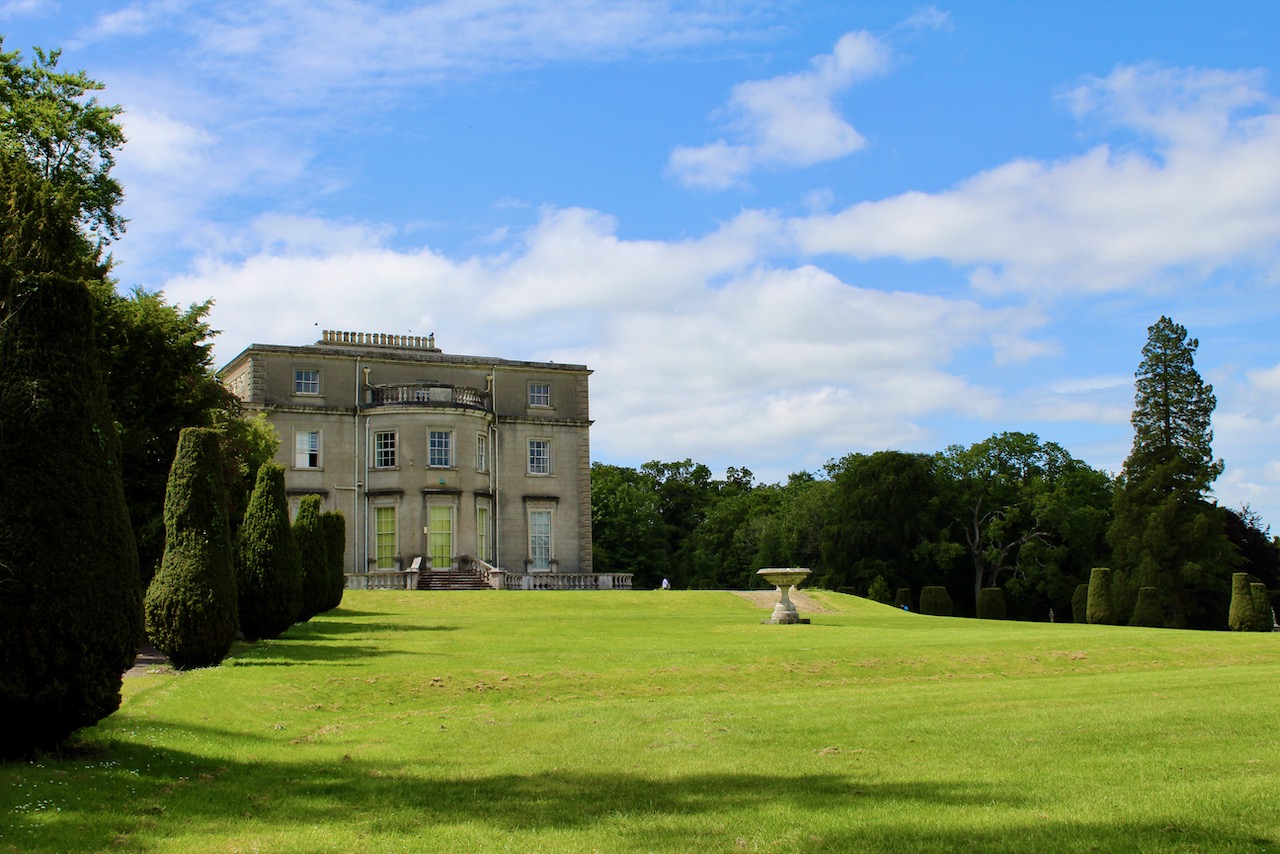
The side and garden front of the house. The side elevation, which is of three storeys including the attic, is of one bay on either side of a curved central bow. Photograph © Jennifer Winder-Baggot, www.irishhistorichouses.com
Emo, County Laois. Photograph © Jennifer Winder-Baggot, www.irishhistorichouses.com
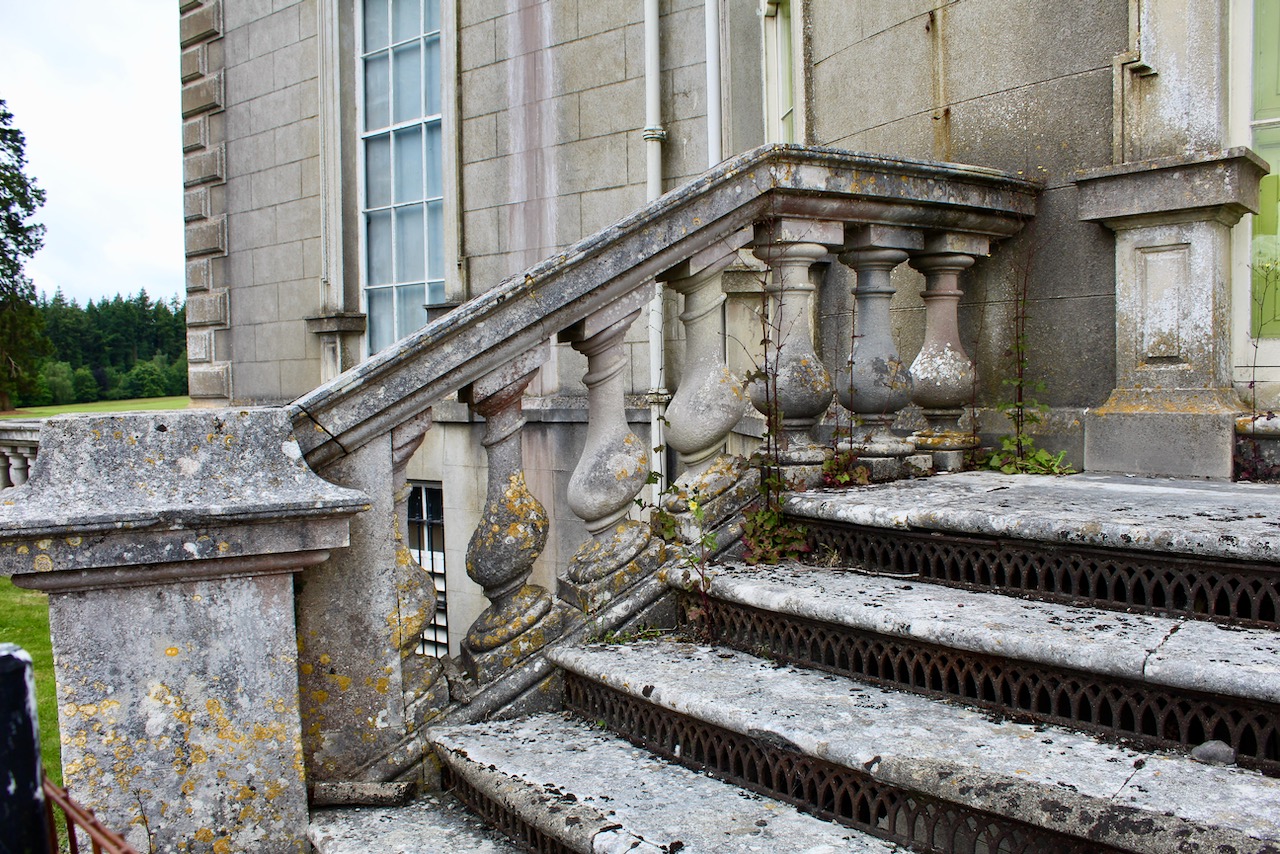
I love the way these balusters go droopy-bellied to match the angle of the stairs! Photograph © Jennifer Winder-Baggot, www.irishhistorichouses.com

Bence-Jones continues: “The house was not completed when the 1st Earl died on campaign during 1798 rebellion; 2nd Earl, who was very short of money, did not do any more to it until 1834-36, when he employed the fashionable English architect, Lewis Vulliamy; who completed the garden front, giving it its portico of four giant Ionic columns with a straight balustraded entablature, and also worked on the interior, being assisted by Dublin architects named Williamson. It was not until ca 1860, in the time of 3rd Earl – after the house had come near to being sold up by the Encumbered Estates Court – that the great rotunda, its copper dome rising from behind the garden front portico and also prominent on the entrance front, was completed; the architect this time being William Caldbeck, of Dublin, who completed the other unfinished parts of the house and added a detached bachelor wing, joined to the main block by a curving corridor.” [see 3]
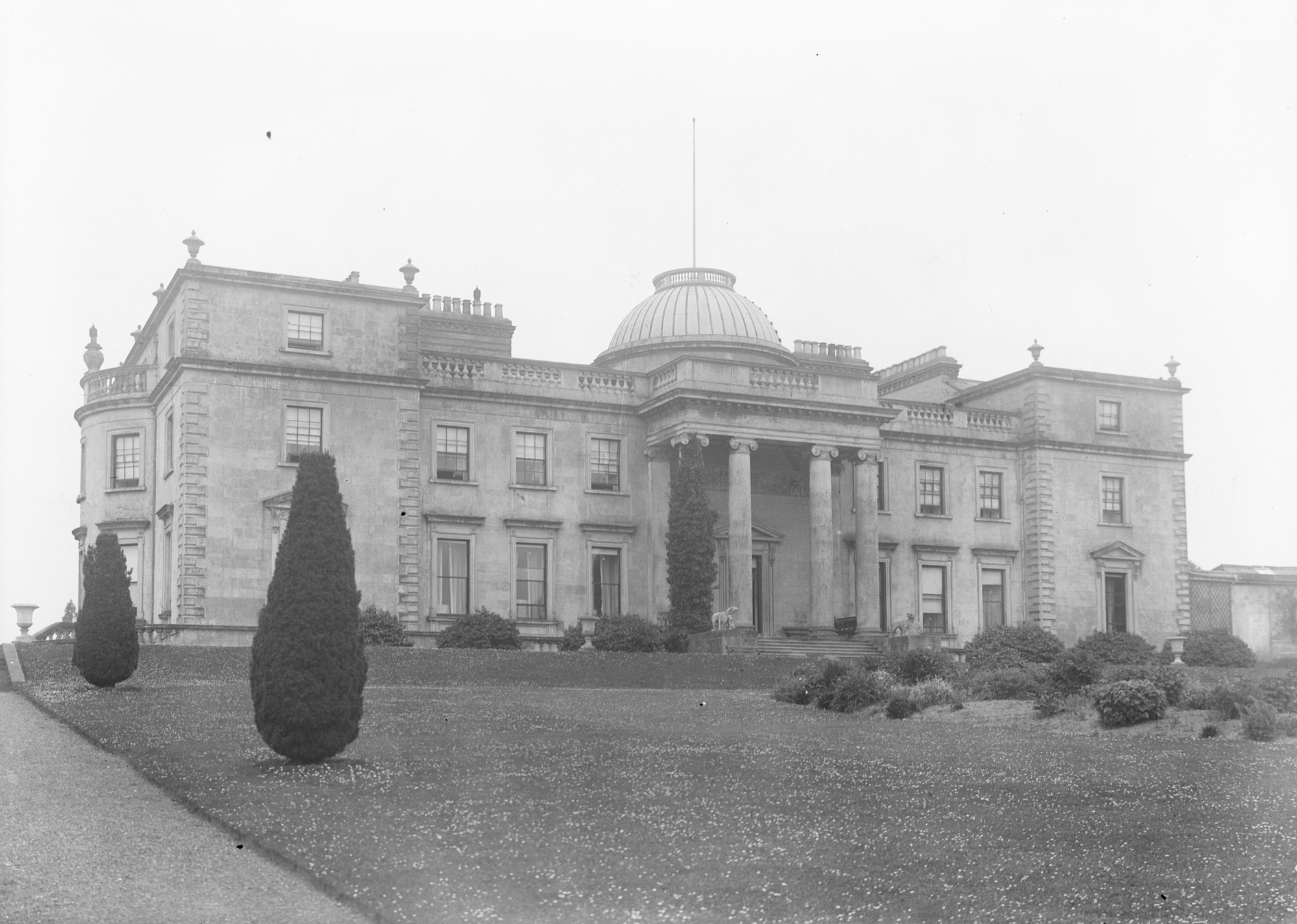
Photograph from the National Library of Ireland, around 1900-1920, showing the garden front of the house. The 2nd Earl of Portarlington engaged Lewis Vulliamy (who designed the portico) and A. & J. Williamson, Dublin architects (who did the interior), to finish the house. In the period 1824-36 the dining room and garden front portico with giant Ionic columns were built, but on the death of the 2nd Earl in 1845, the house still remained unfinished. The rotunda was only finished in 1860.
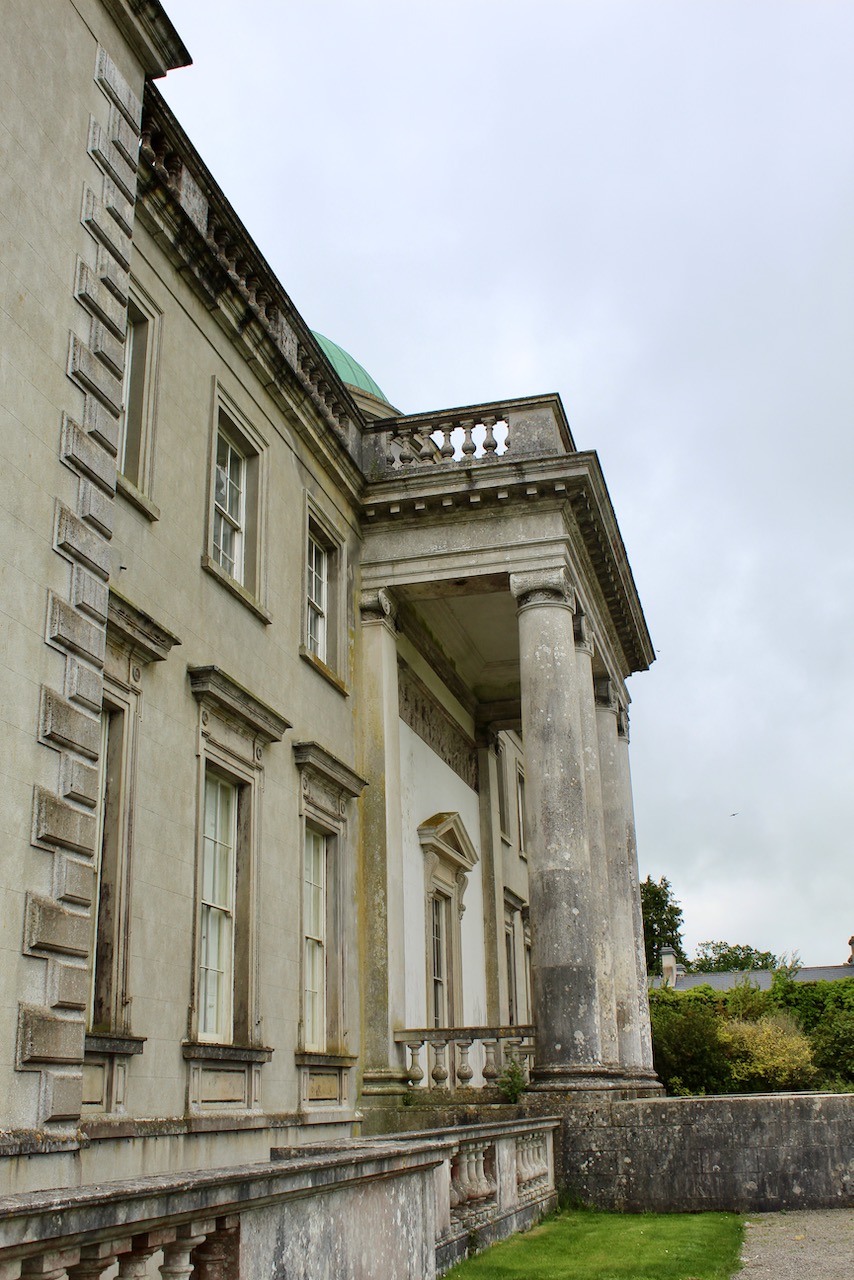
The garden front of Emo with its pillared portico by Lewis Vulliamy. Photograph © Jennifer Winder-Baggot, www.irishhistorichouses.com
Pillared portico by Lewis Vulliamy. Photograph © Jennifer Winder-Baggot, www.irishhistorichouses.com
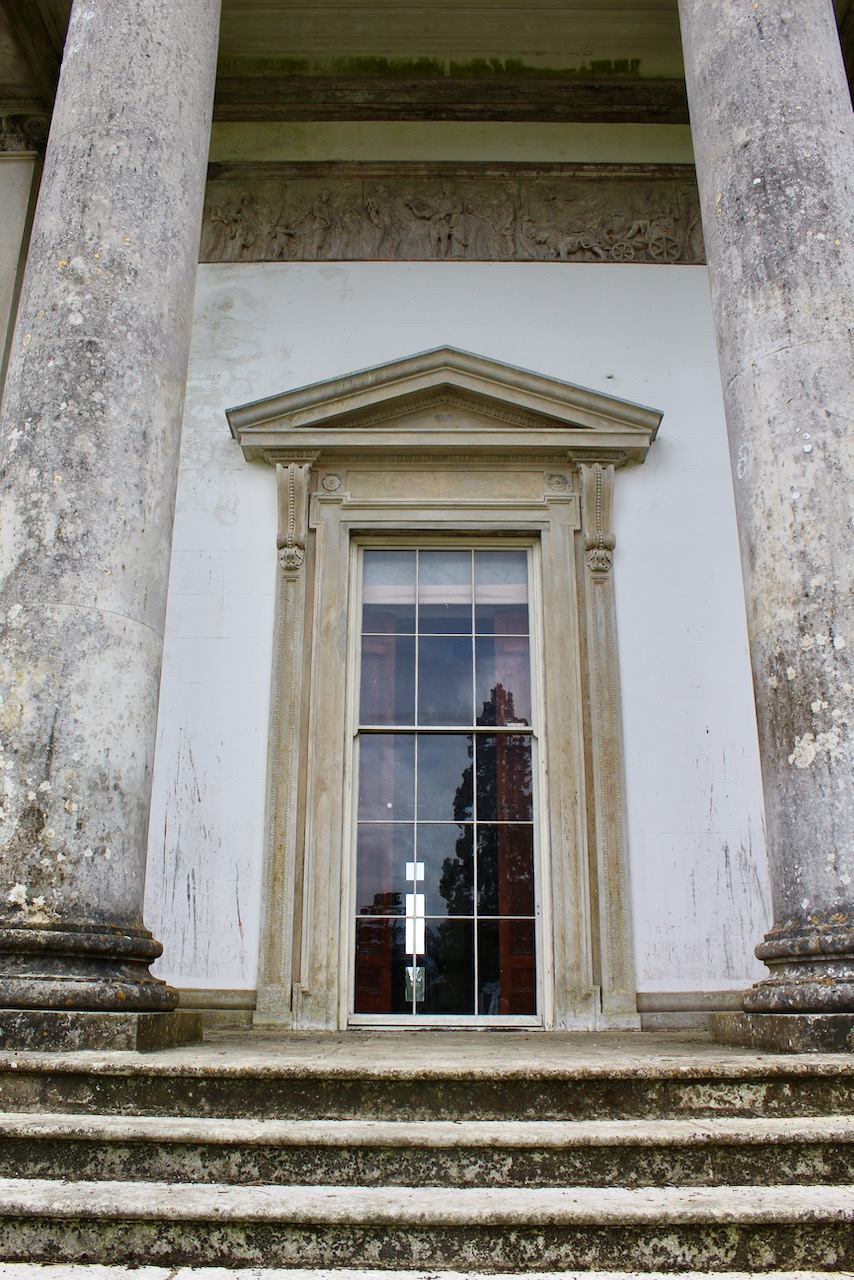
The garden front portico, probably part of the 1850s work by William Caldbeck, has portico and entablature of grey limestone and doorcase and window surrounds of yellow sandstone. This is set against a cement render. [see 1] Photograph © Jennifer Winder-Baggot, www.irishhistorichouses.com
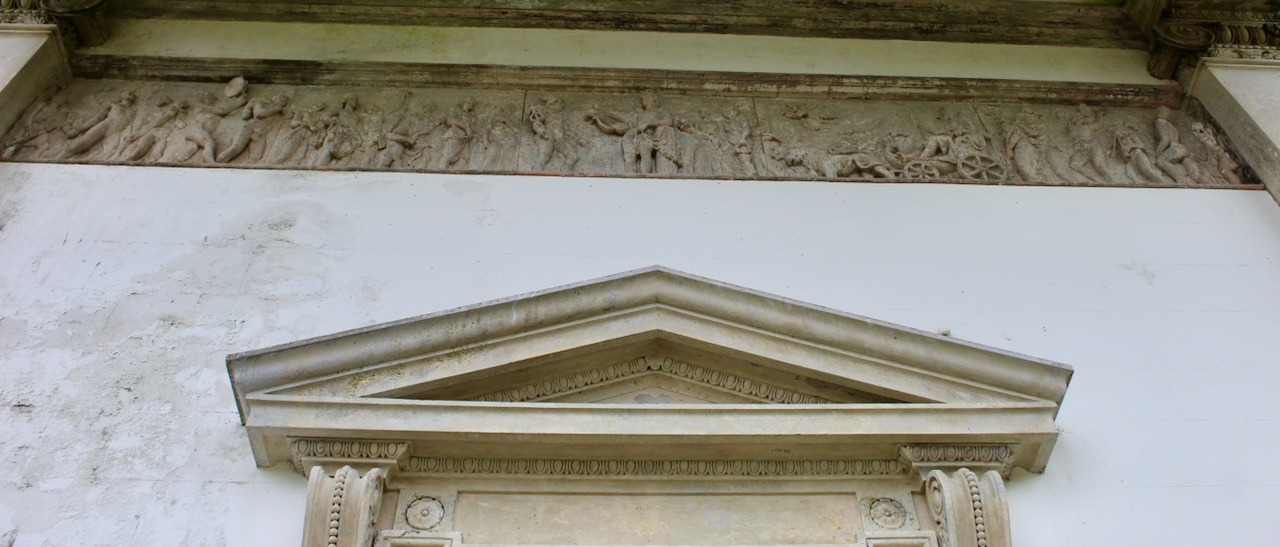
Under the portico in the garden facing facade is a Coade stone frieze of a Dionysian procession. [see 1] Photograph © Jennifer Winder-Baggot, www.irishhistorichouses.com

The website continues: “Emo court remained the seat of the Earls of Portarlington until 1920, when the house and its vast demesne of over 4500 ha, (11,150 acres), was sold to the Irish Land Commission. After the Phoenix Park in Dublin, Emo Court was the largest enclosed estate in Ireland. The house remained empty until 1930 when 150 ha., including the garden, pleasure grounds, woodland and lake were sold to the Society of Jesus for a novitiate. The Jesuits made several structural changes to the building to suit their purposes, including the conversion of the rotunda and library as a chapel. The distinguished Jesuit photographer, Fr Frank Browne lived at Emo Court from 1930-57. [7] A notable novitiate was the Irish author, Benedict Kiely.

The Jesuits remained at Emo until 1969 and the property was eventually sold to Major Cholmeley Dering Cholmeley-Harrison. He embarked upon a long and enlightened restoration, commissioning the London architectural firm of Sir Albert Richardson & Partners to effect the restoration.

In 1994, President Mary Robinson officially received Emo Court & Parklands from Major Cholmeley-Harrison on behalf of the Nation.” [see 4]
Photograph © Jennifer Winder-Baggot, www.irishhistorichouses.com

Unfortunately Emo Park house has been closed to the public for renovation for several years, and was closed on the day we visited in July 2021. I am looking forward to seeing the interior, which from photographs and descriptions I have seen, look spectacular. From the outside we gain little appreciation of the splendid copper dome.

In the meantime, you can read more about Emo and see photographs of its interiors on the wonderful blog of the Irish Aesthete Robert O’Byrne. [8]

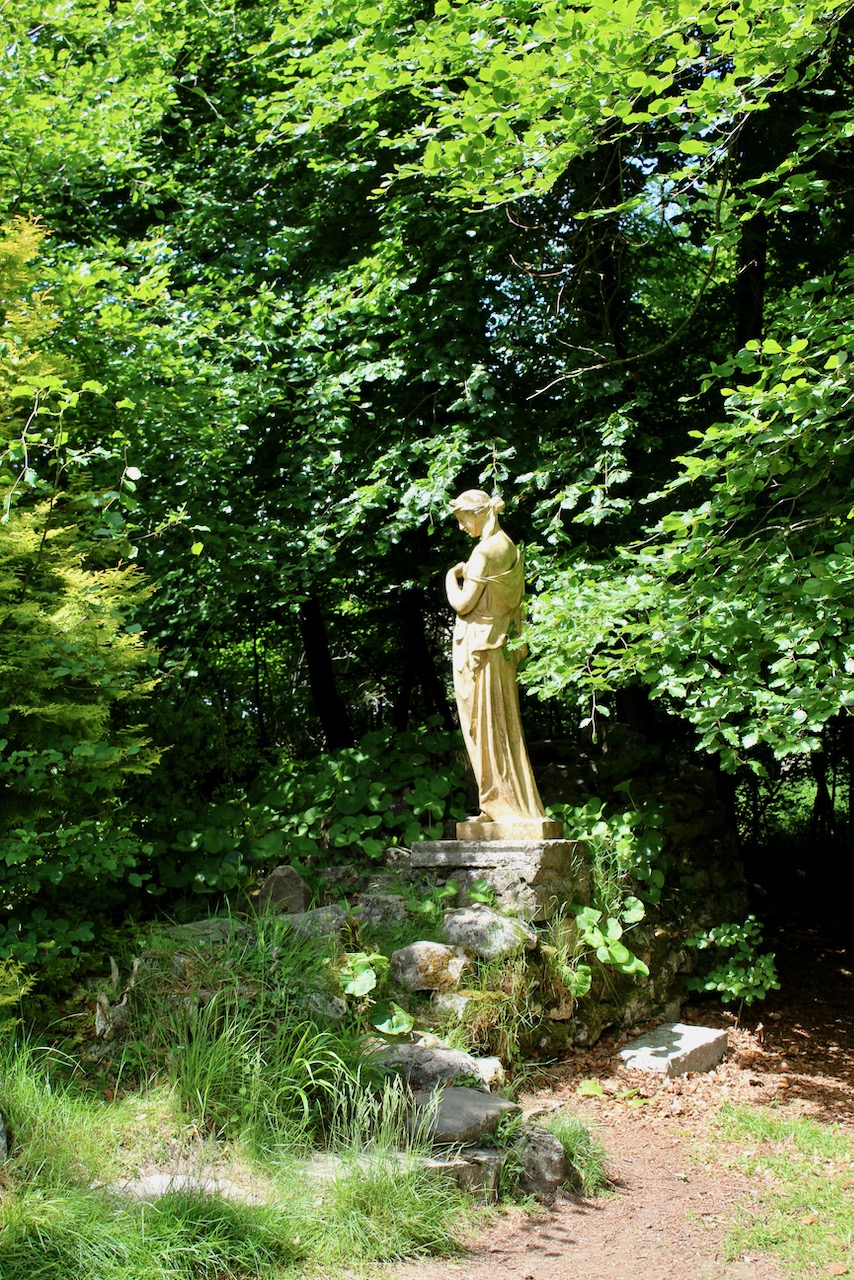
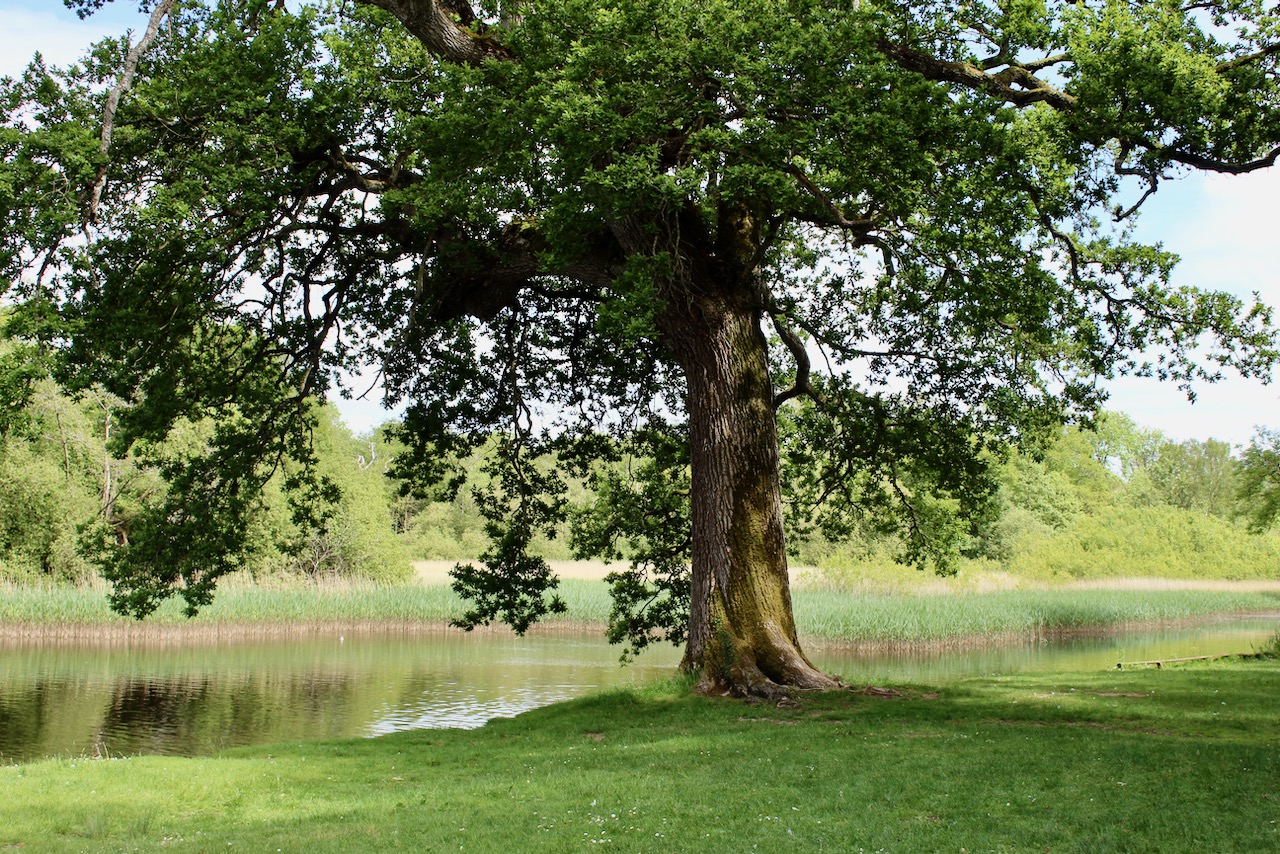
There are beautiful grounds to explore, however, on a day out at Emo, including picturesquely placed sculptures, an arboretum, lake, and walled garden. Here is a link to a beautiful short film by poet Pat Boran, about the statues at Emo Park, County Laois. https://bit.ly/35uXPO1
Emo, County Laois. Photograph © Jennifer Winder-Baggot, www.irishhistorichouses.com
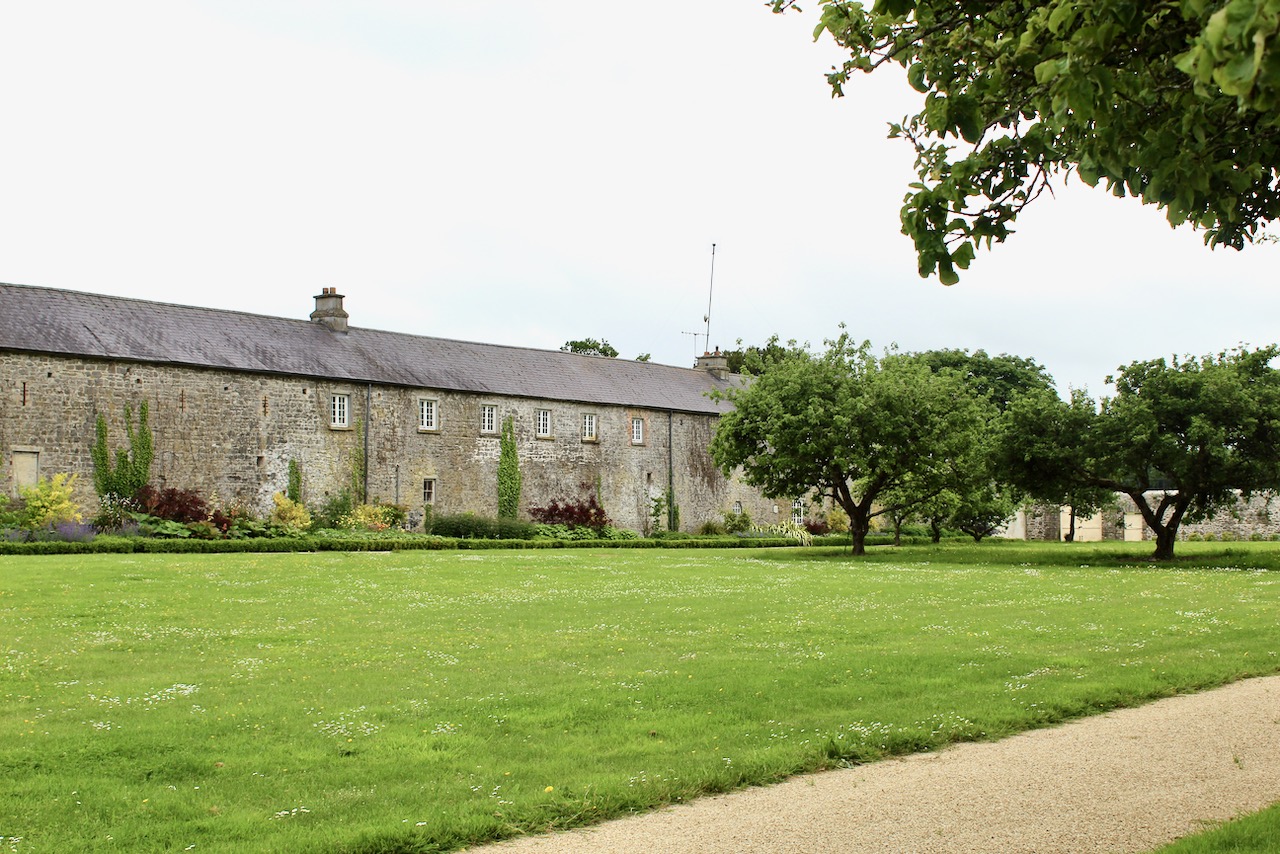
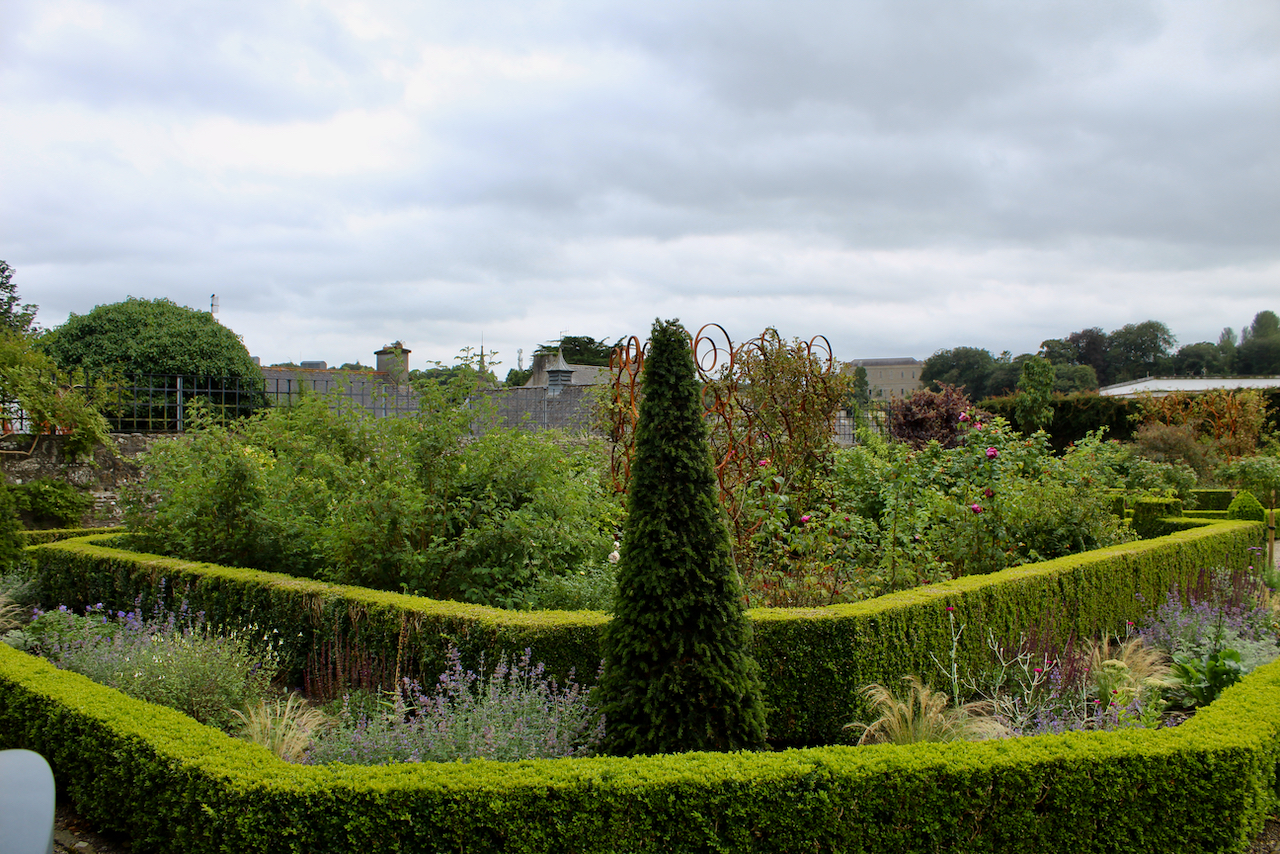
The walled garden at Emo Court. Photograph © Jennifer Winder-Baggot, www.irishhistorichouses.com
Emo, County Laois. Photograph © Jennifer Winder-Baggot, www.irishhistorichouses.com

[1] p. 336. Tierney, Andrew. The Buildings of Ireland: Central Leinster: Kildare, Laois and Offaly. Yale University Press, New Haven and London, 2019.

[2] https://heritageireland.ie/visit/places-to-visit/emo-court/

[3] p. 119. Bence-Jones, Mark. A Guide to Irish Country Houses (originally published as Burke’s Guide to Country Houses volume 1 Ireland by Burke’s Peerage Ltd. 1978); Revised edition 1988, Constable and Company Ltd, London.

[4] https://emocourt.ie/history/

For information on Gandon’s house in Lucan, see https://www.buildingsofireland.ie/buildings-search/building/11201034/canonbrook-house-lucan-newlands-road-lucan-and-pettycanon-lucan-dublin

Canonbrook, Lucan: “Detached multiple-bay two-storey over basement house, c.1800, on an L-plan. A handsome, substantial rural Georgian house which, though altered, retains its imposing form and feel, and is situated in mature grounds. Historically important as the former home of James Gandon.” Gandon is also said to have designed Primrose Hill House in Lucan, which is a section 482 property.

[5] https://theirishaesthete.com/2019/02/27/emo-court/

[6] https://www.irelandscontentpool.com/en/media-assets/media/81101

[7] http://www.fatherbrowne.com

[8] https://theirishaesthete.com/2016/03/14/of-changes-in-taste/

and https://theirishaesthete.com/2016/02/01/seen-in-the-round/

For photographs of the stuccowork, see https://theirishaesthete.com/2016/03/21/forgotten-virtuosi/

Damer House and Roscrea Castle, County Tipperary, Office of Public Works properties

General information: 0505 21850, roscreaheritage@opw.ie

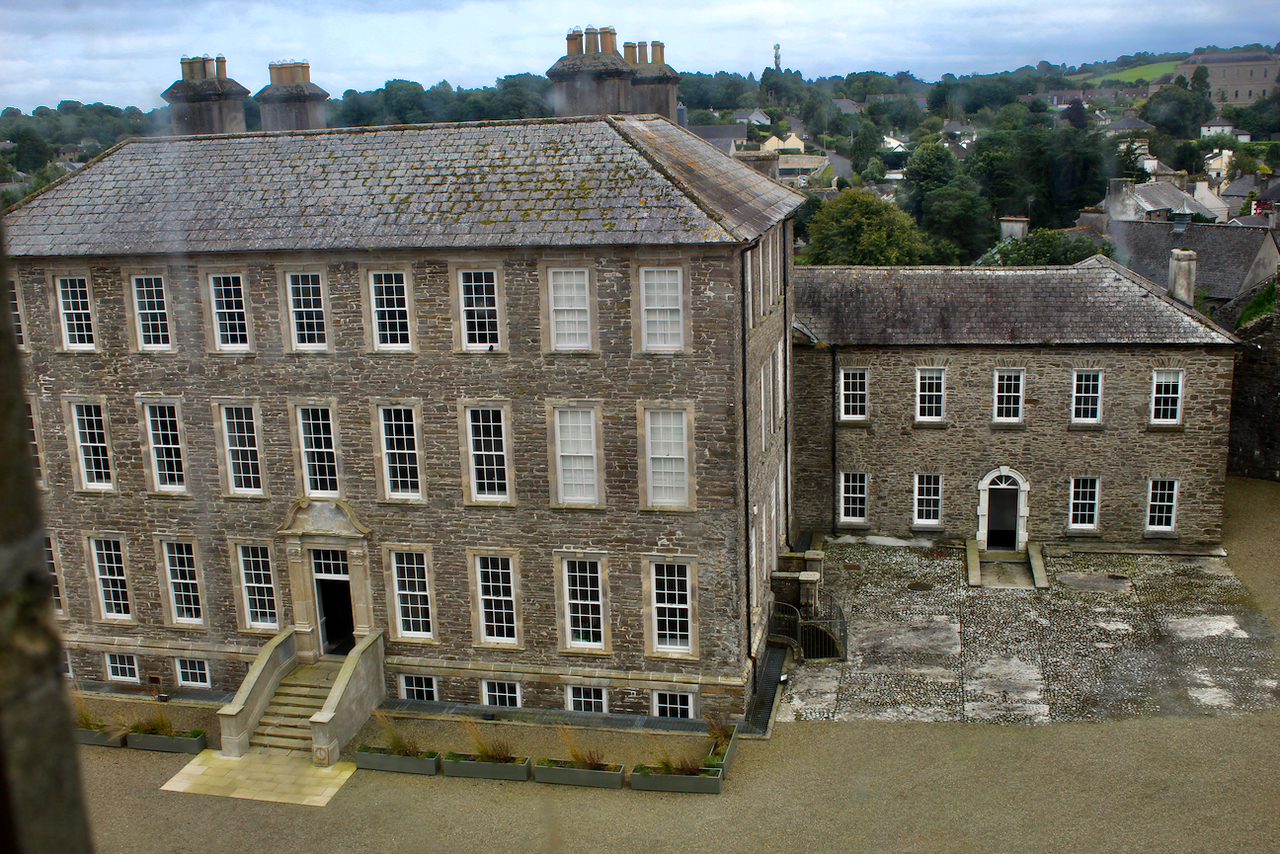
Damer House Roscrea County Tipperary, photographer creator Kerry Kissane All around Ireland 2021 courtesy Tipperary tourism, Ireland’s Content Pool [1]

Finding ourselves with some spare time this Heritage Week (2024) after visiting Emo in County Laois, we drove over to Roscrea, to visit Damer House and Roscrea Castle.

From the OPW website https://heritageireland.ie/visit/places-to-visit/roscrea-heritage-centre-roscrea-castle-and-damer-house/:

In the heart of Roscrea in County Tipperary, one of the oldest towns in Ireland, you will find a magnificent stone motte castle dating from the 1280s. It was used as a barracks from 1798, housing 350 soldiers, and later served as a school, a library and even a sanatorium. 

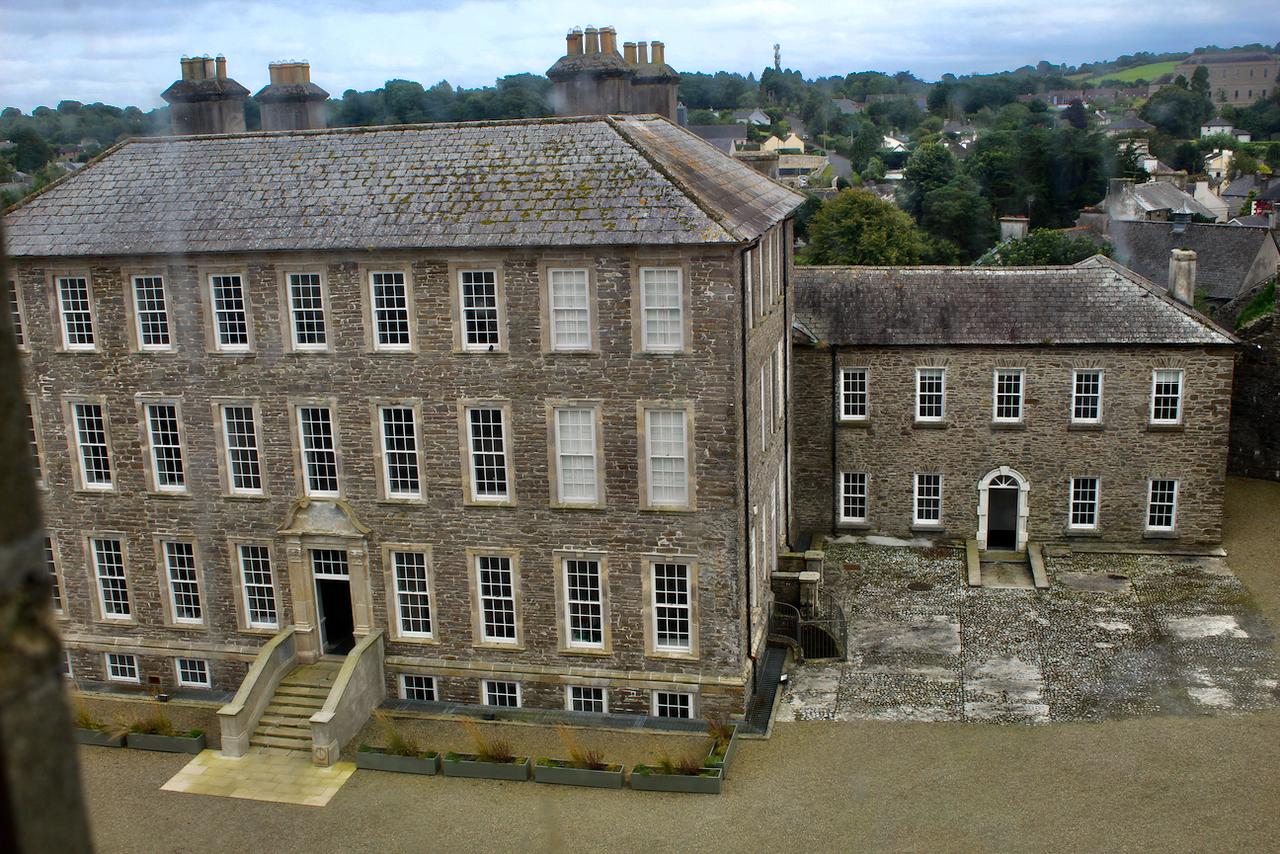
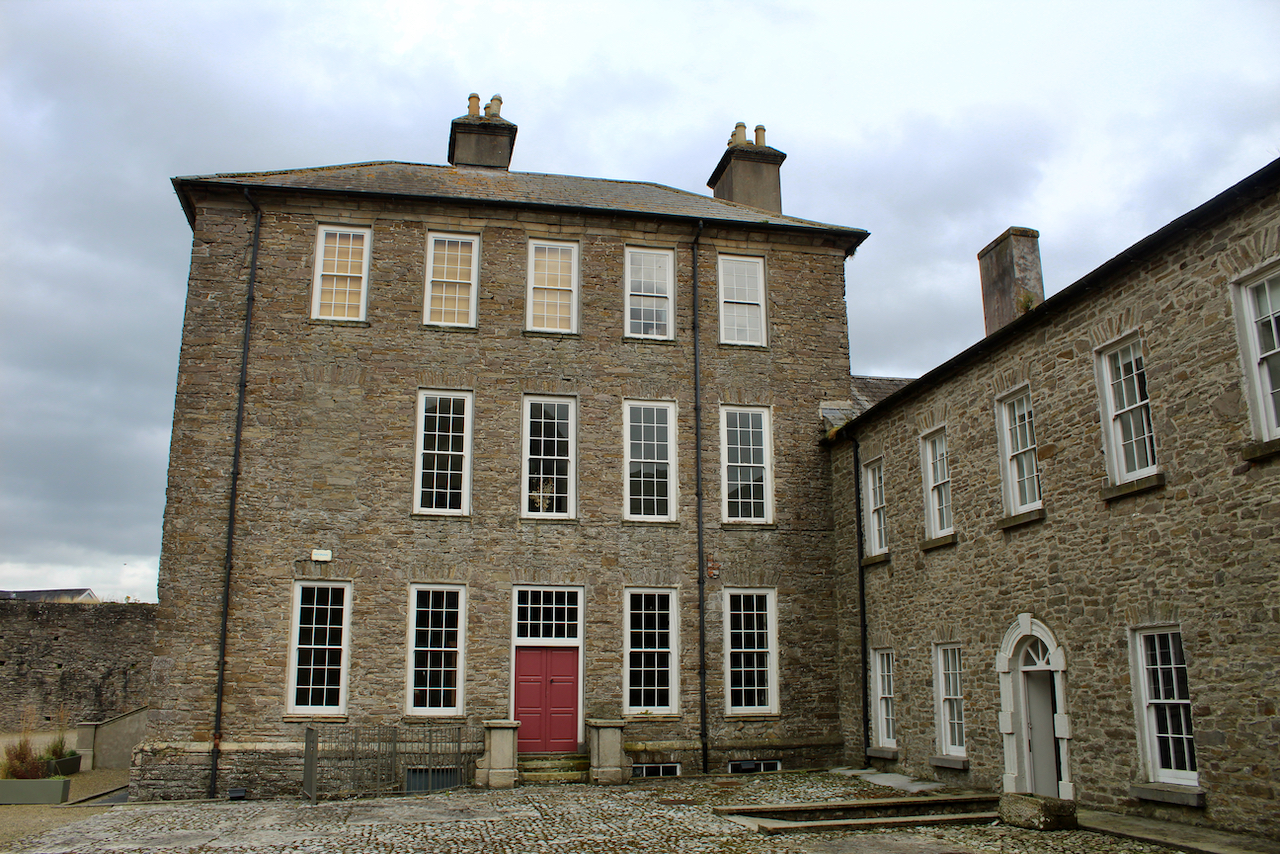
Sharing the castle grounds is Damer House, named for local merchant John Damer [d. 1768], who came into possession of the castle in the eighteenth century. The house is a handsome example of pre-Palladian architecture. It has nine beautiful bay windows. One of the rooms has been furnished in period style.

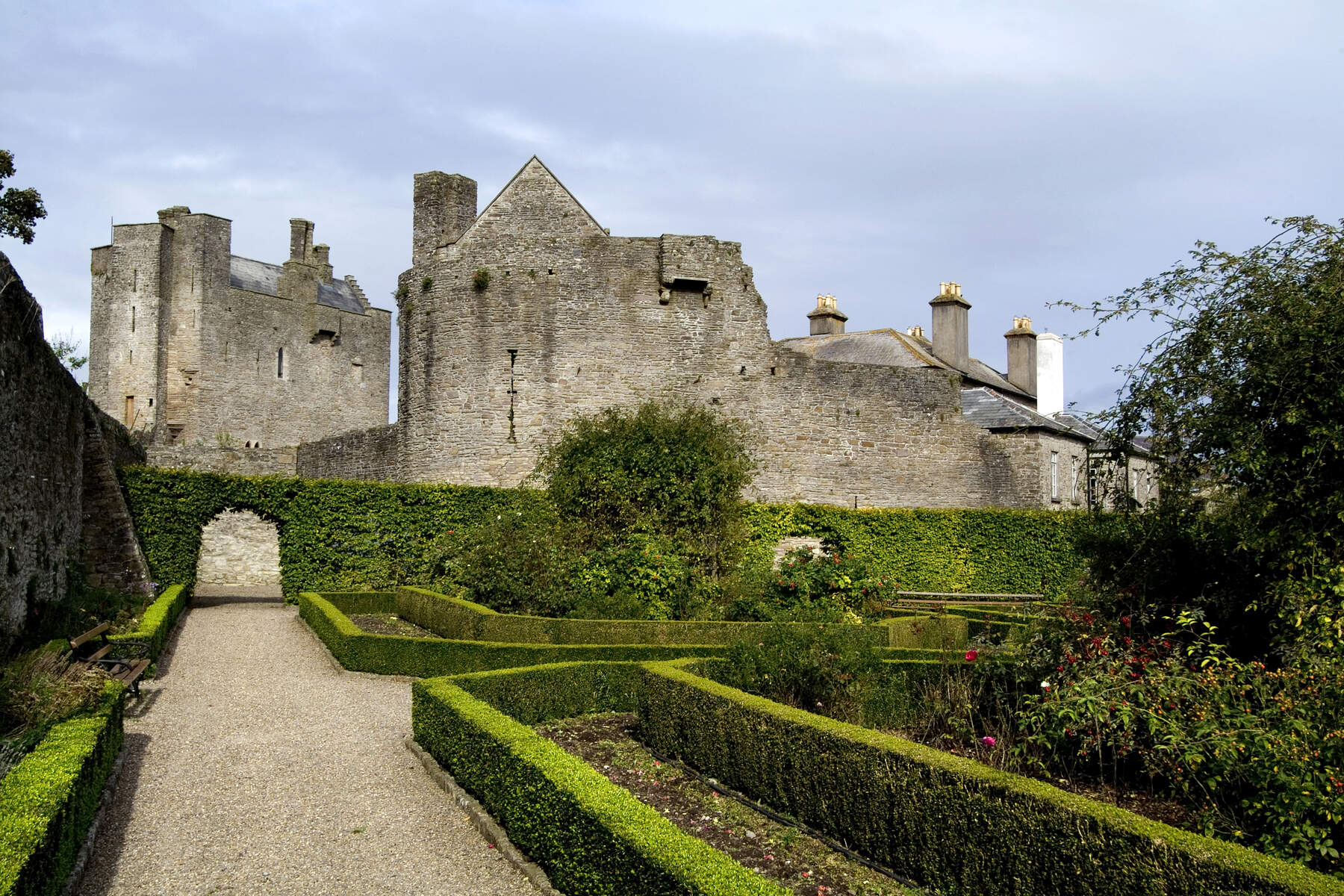
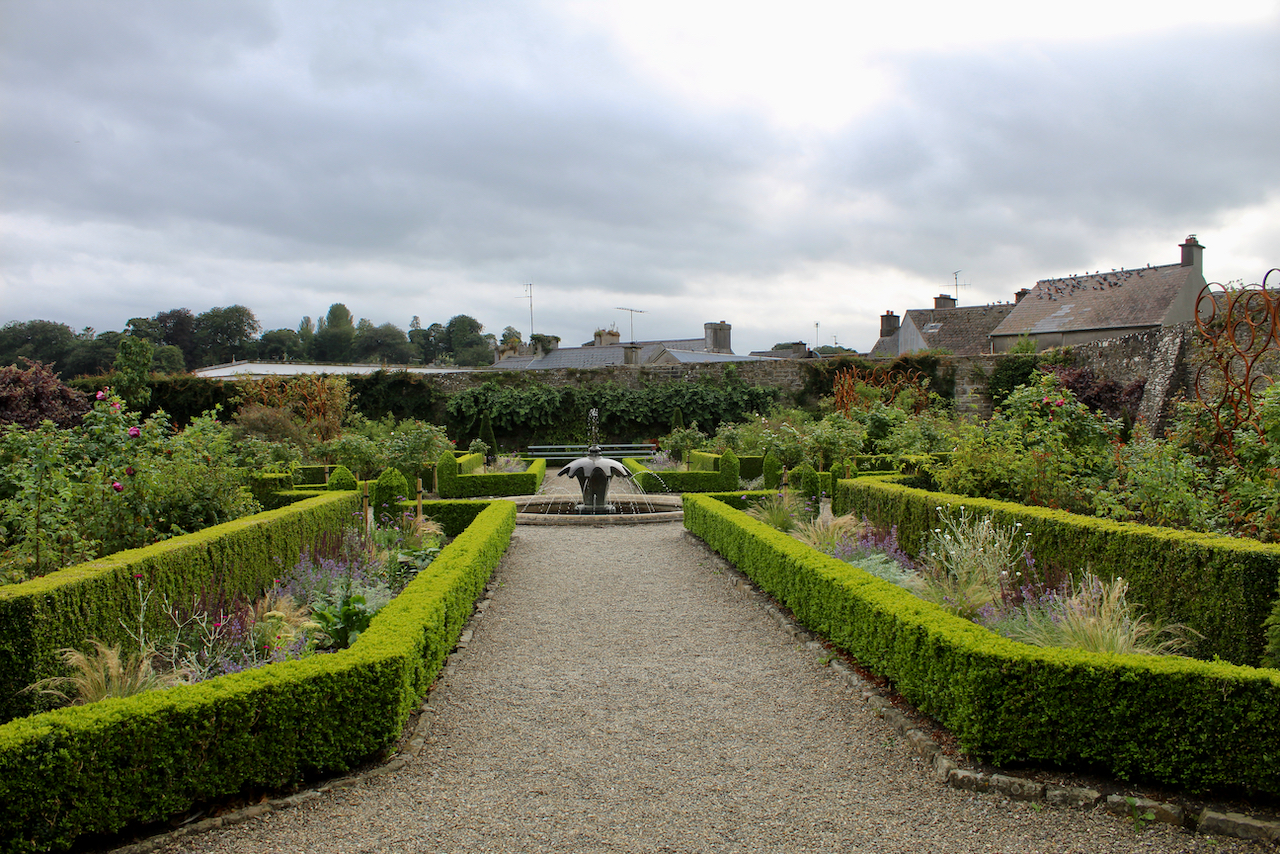
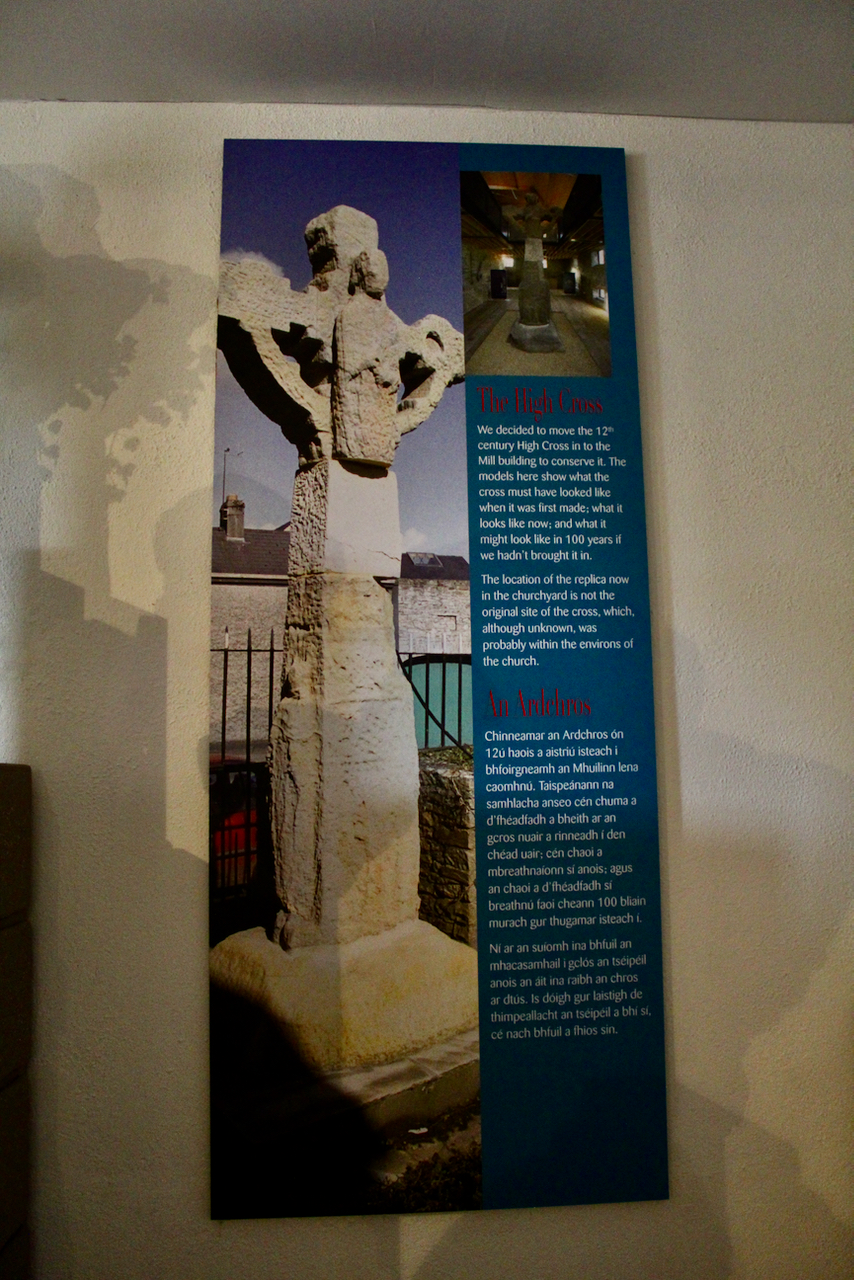
The grounds also include an impressive garden with a fountain, which makes Roscrea Castle a very pleasant destination for a day out. There is also a restored mill displaying St Crónán’s high cross and pillar stone.

Damer House, Roscrea, 21st August 2024. Photograph © Jennifer Winder-Baggot, www.irishhistorichouses.com

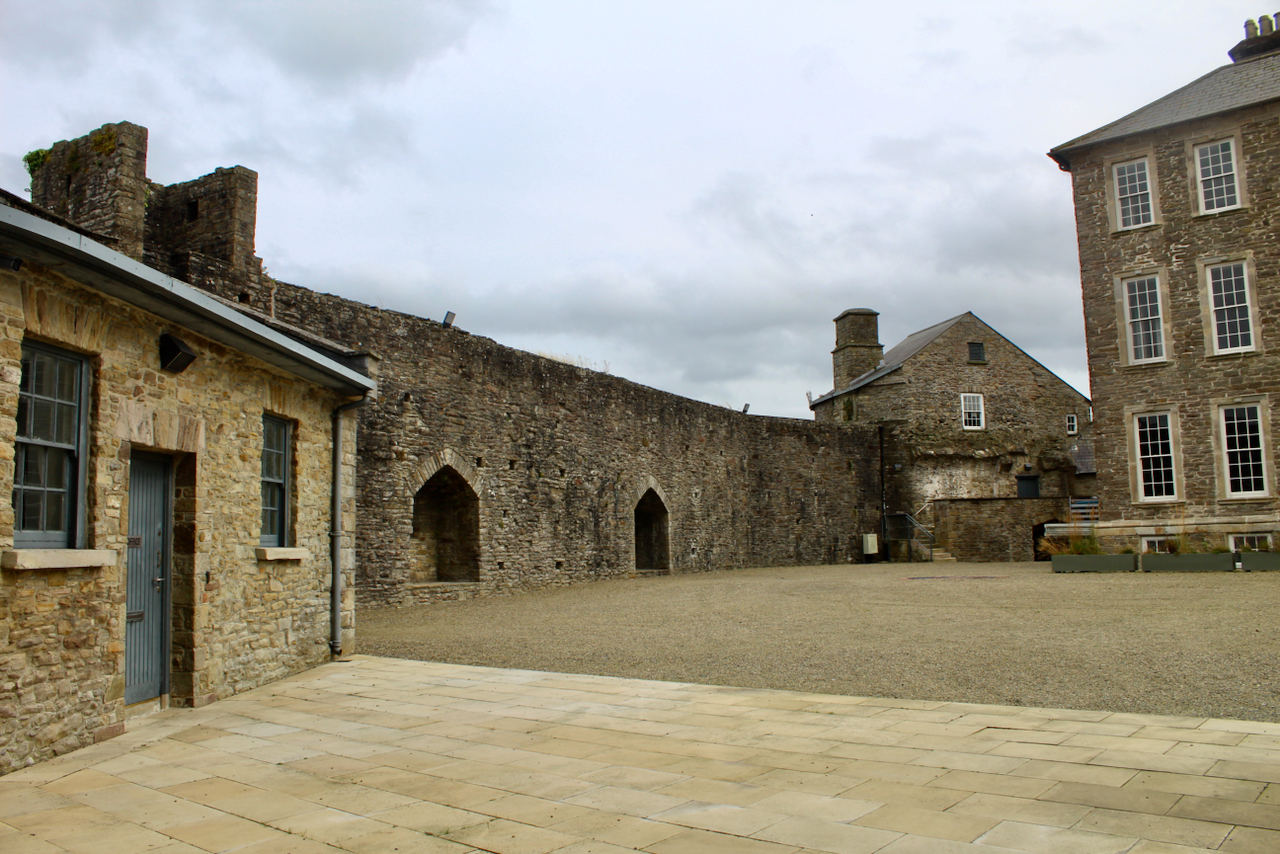
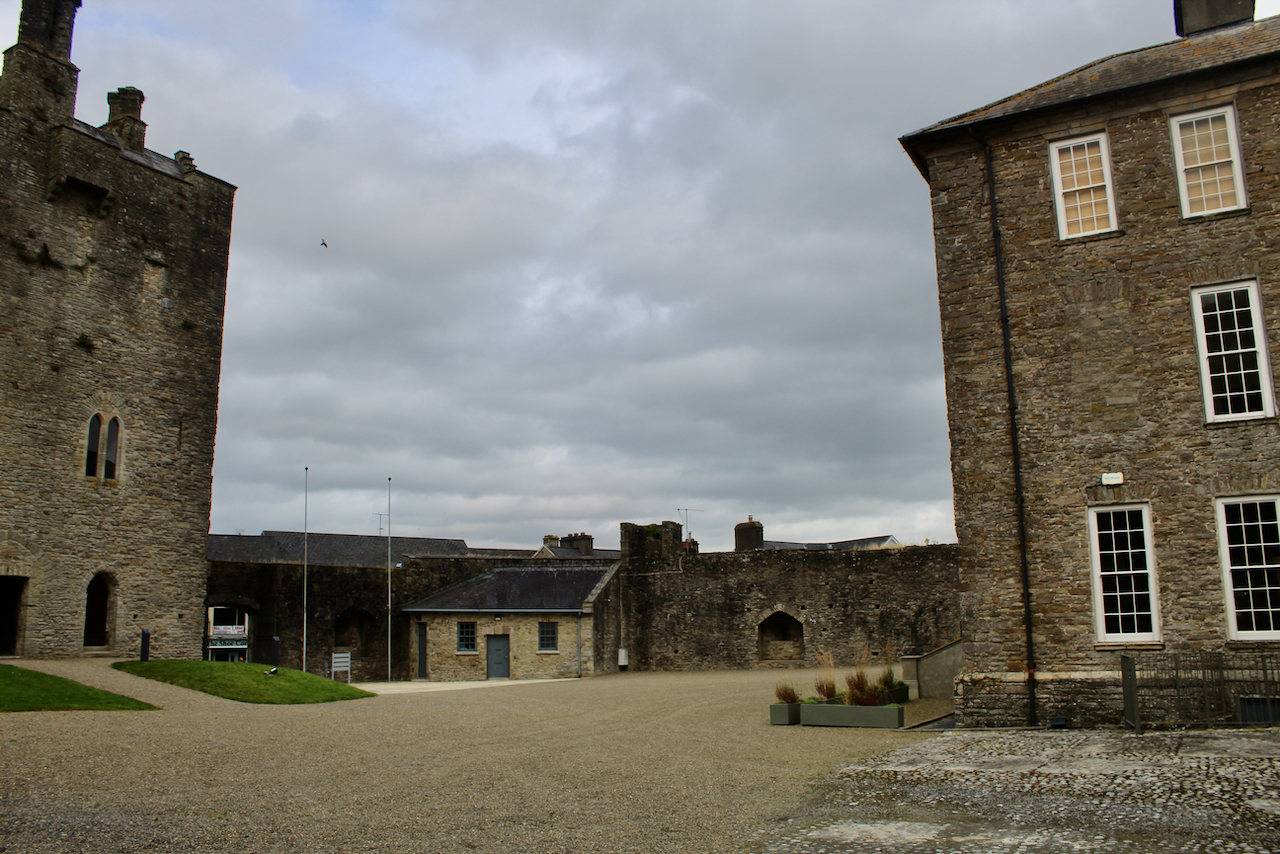
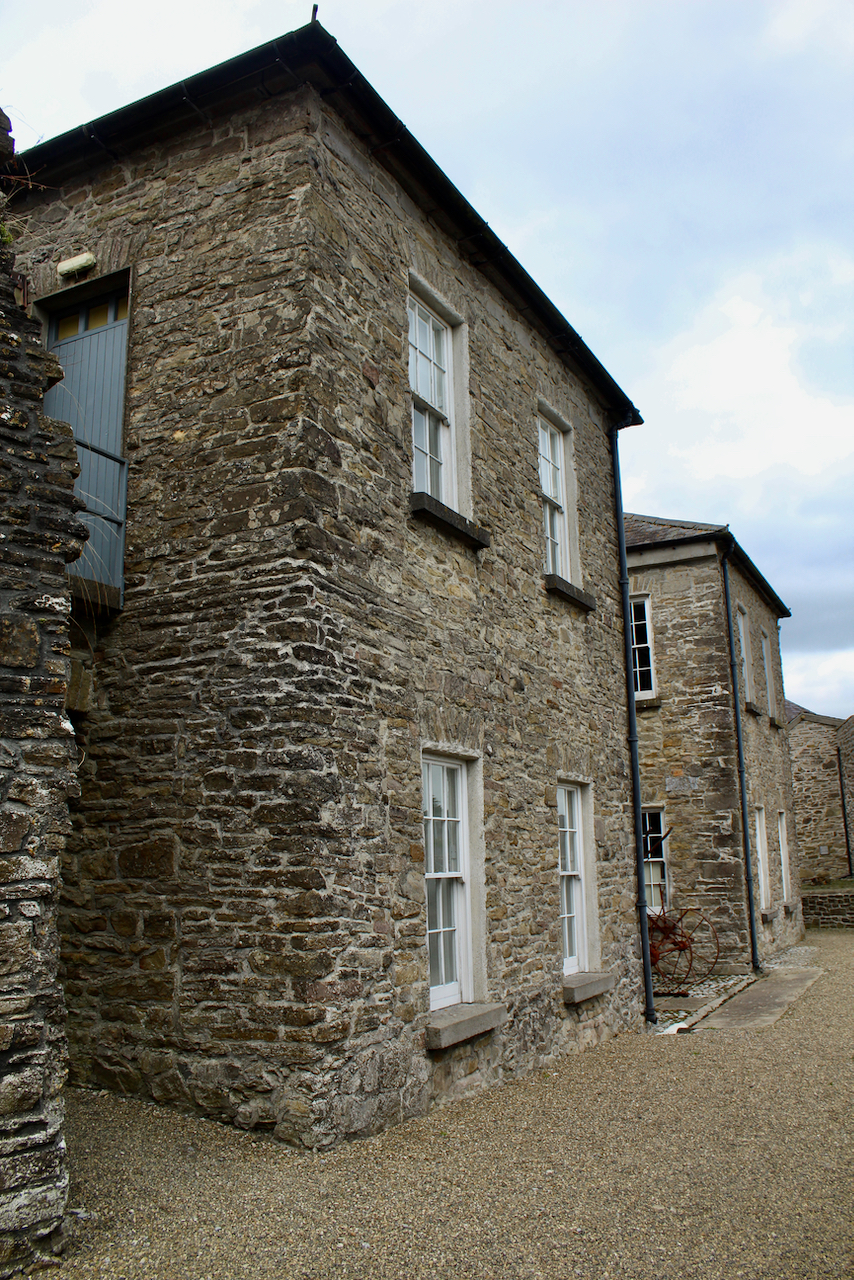
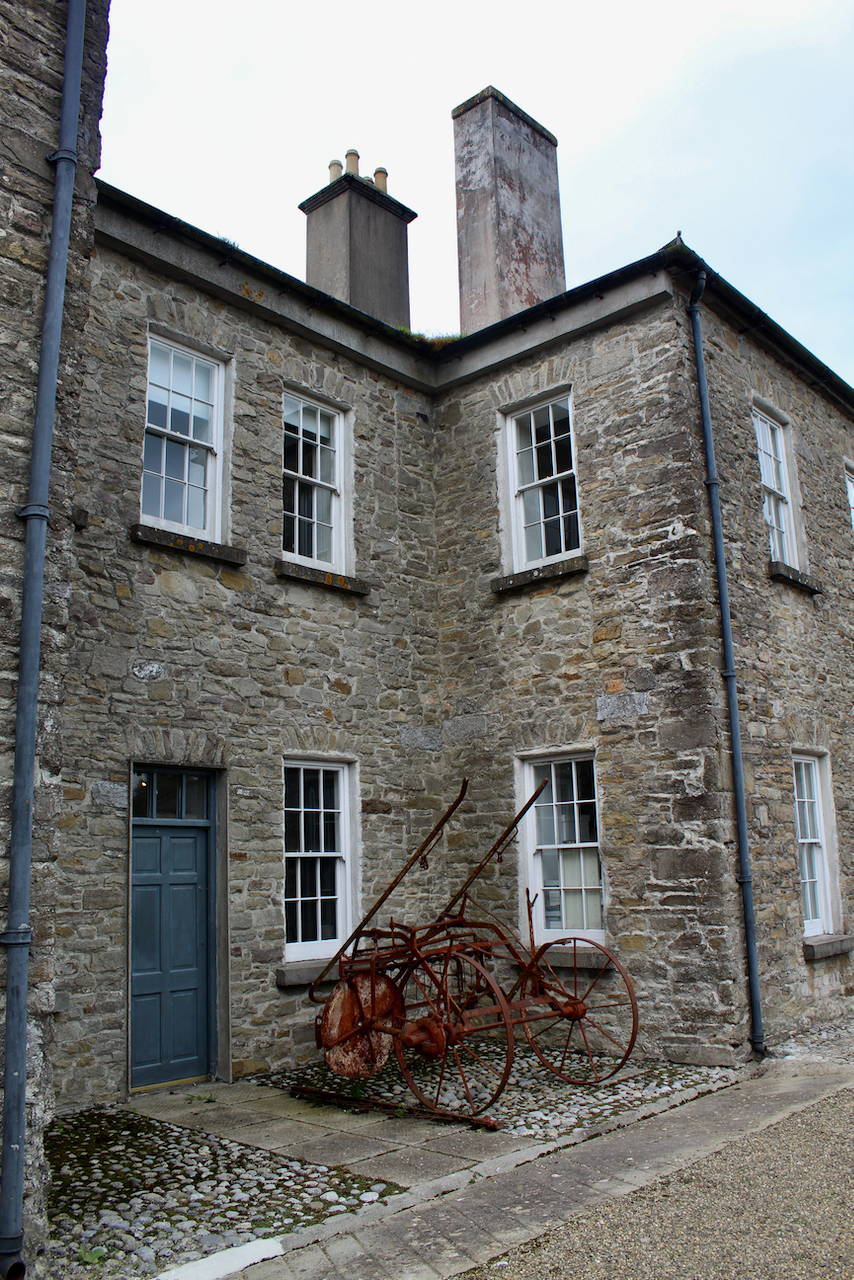
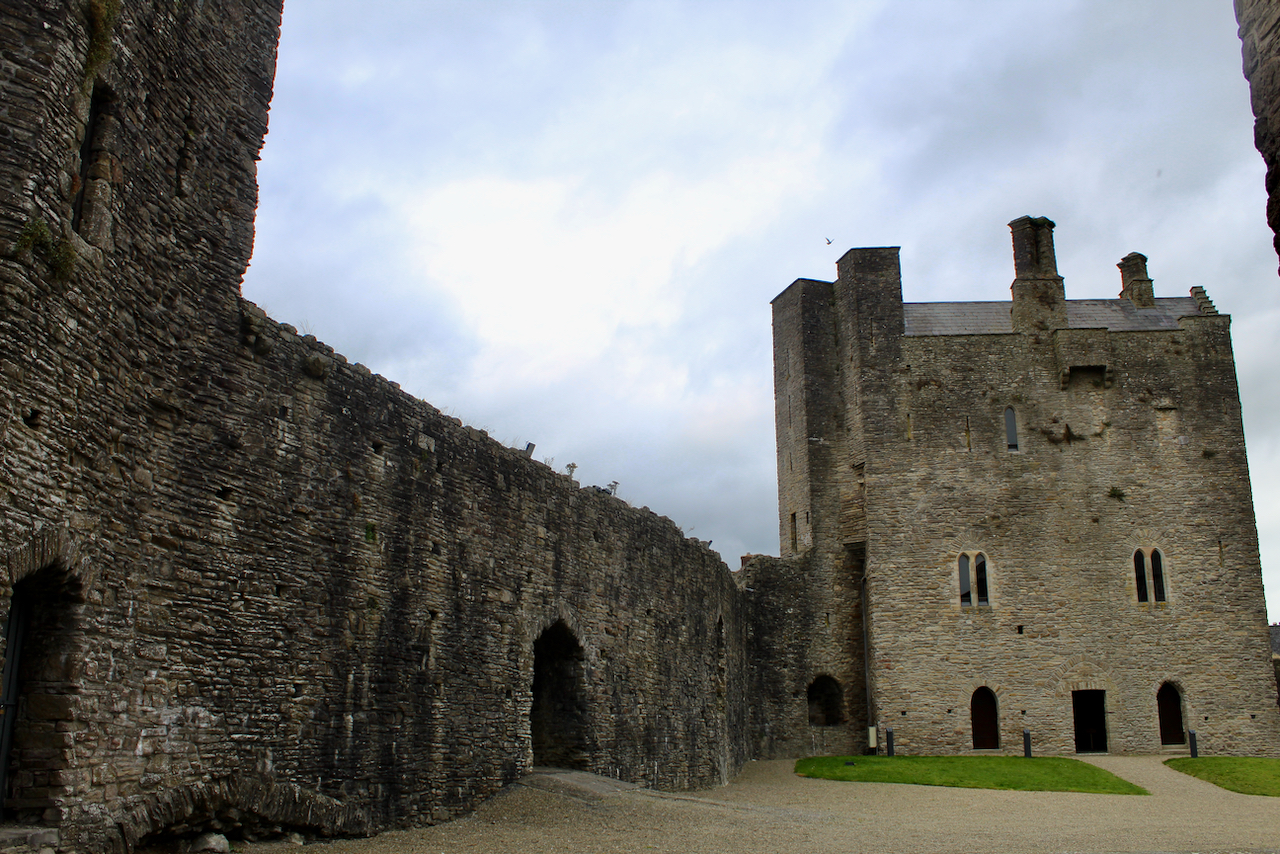
The castle and Damer house both sit inside bawn walls. Parts of the walls and outbuildings are in good condition, considering their age!

Roscrea Castle, August 2024. Photograph © Jennifer Winder-Baggot, www.irishhistorichouses.com
Damer House and Roscrea Castle sit within bawn walls, 21st August 2024. Photograph © Jennifer Winder-Baggot, www.irishhistorichouses.com
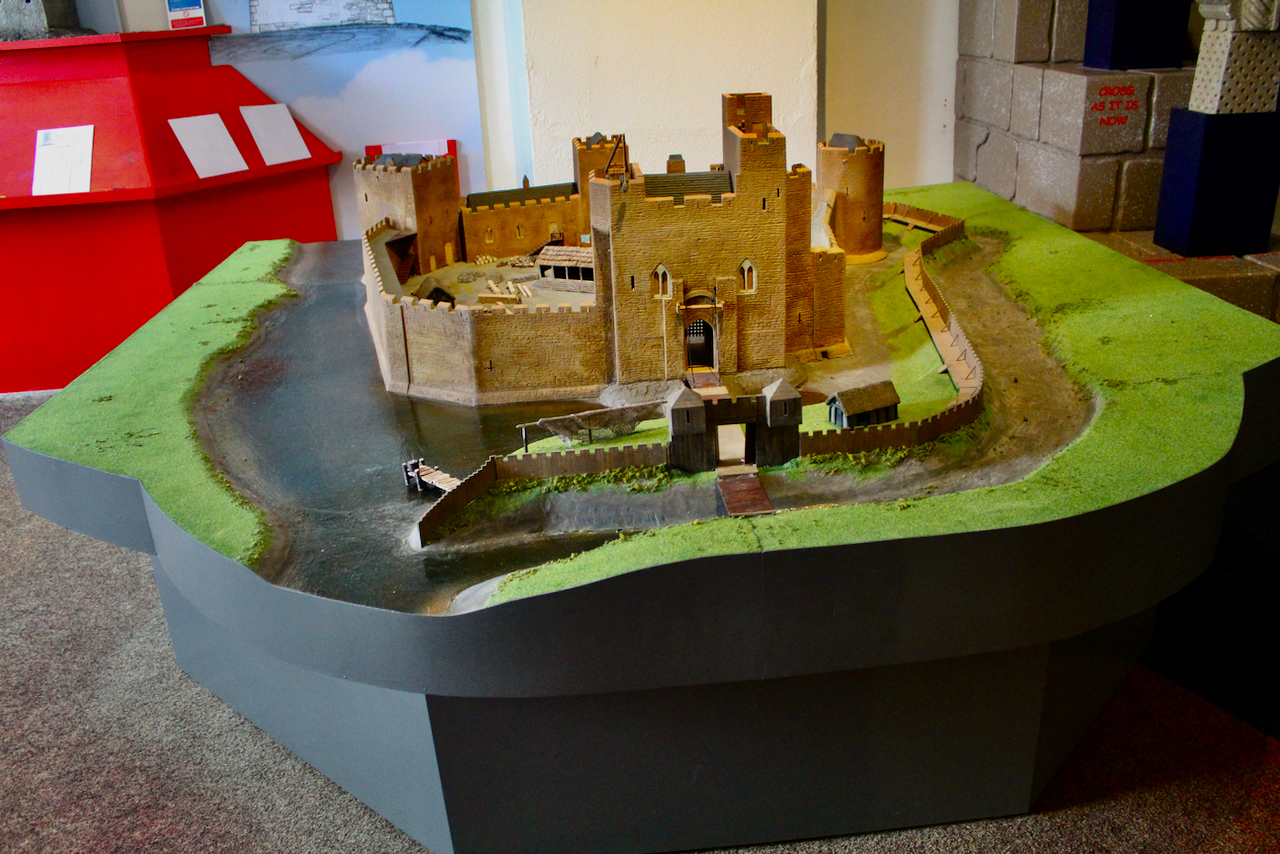
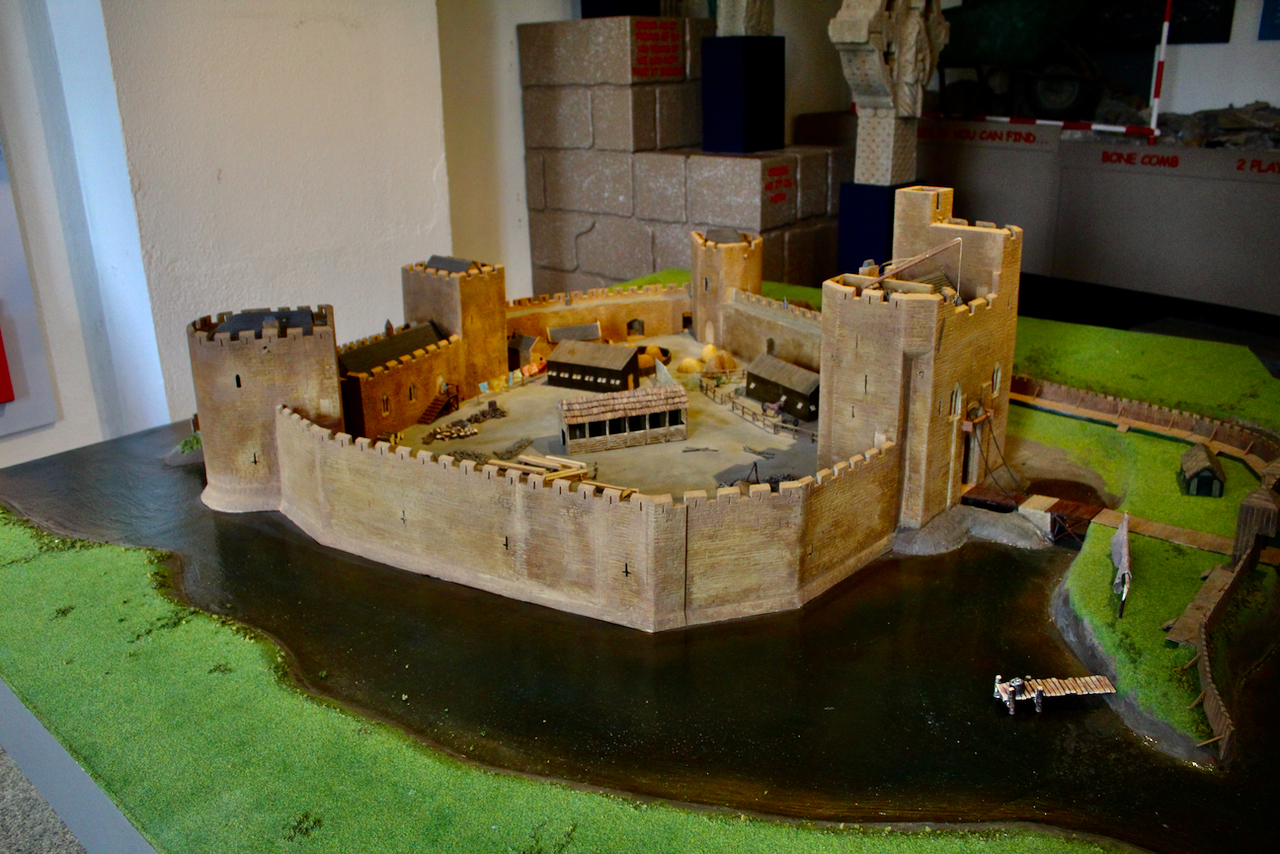
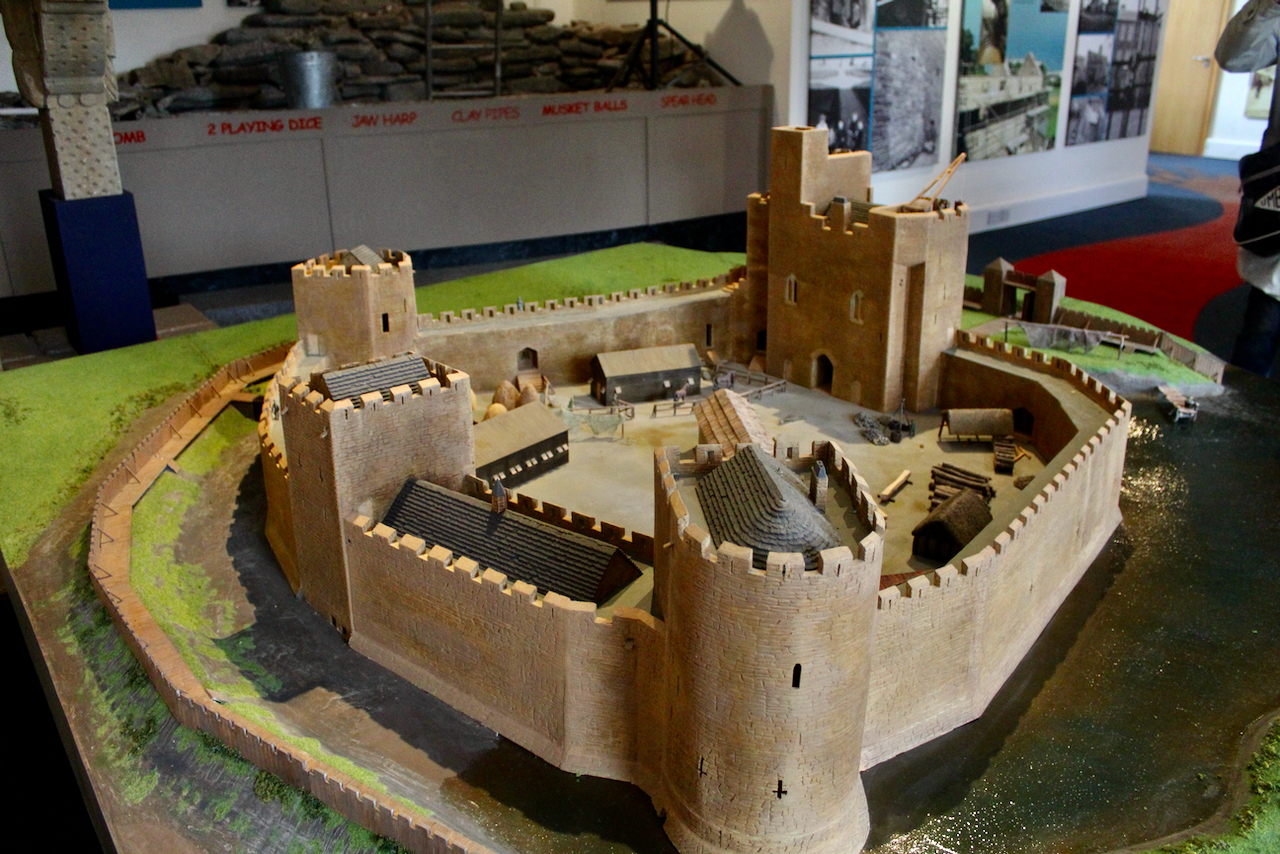
A reconstruction of what the castle would have looked like, in an exhibition in the Annex to Damer House.
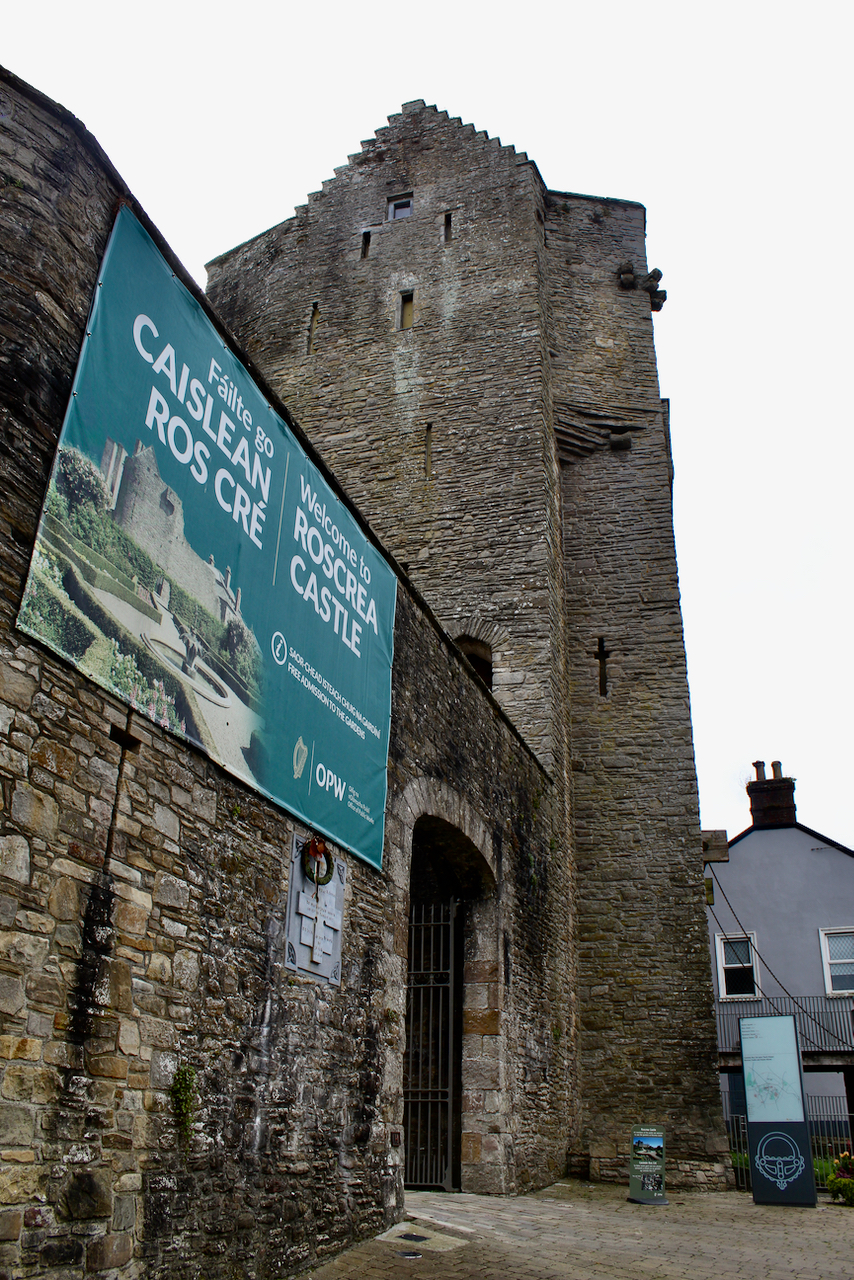
Roscrea Castle, August 2024. Photograph © Jennifer Winder-Baggot, www.irishhistorichouses.com
Parts of the walls and outbuildings at Roscrea Castle are in good condition, considering their age! 21st August 2024. Photograph © Jennifer Winder-Baggot, www.irishhistorichouses.com
The bawn of Roscrea Castle with “Ormond tower,” August 2024. Photograph © Jennifer Winder-Baggot, www.irishhistorichouses.com

This was originally the site of a motte and bailey fortification known as King John’s Castle. The original wooden castle was destroyed in the late 13th century and was replaced with a stone structure built in 1274-1295 by John de Lydyard. The castle was originally surrounded by a river to the east and a moat on the other sides. [2] It was granted to the Butlers of Ormond in 1315 who held it until the early 18th Century. The castle as we see it today was built from 1332.

Roscrea Castle, August 2024. Photograph © Jennifer Winder-Baggot, www.irishhistorichouses.com
Damer House and Roscrea Castle sit within bawn walls, 21st August 2024. Photograph © Jennifer Winder-Baggot, www.irishhistorichouses.com

Roscrea Castle was sold to the Royal Hospital, Kilmainham, by James Butler, 2nd Duke of Ormond in 1703. It was bought by the Damers, who built an elegant  three-storey nine bay pre-Palladian house in the courtyard in c. 1730.

The Dictionary of Irish Biography tells us:

The Damer of folklore tradition is a conflation of the first Joseph [c.1630–1720] with his nephew John [1674-1768]. Thus, while Damer built himself a house in County Tipperary in the seventeenth century, the traditional stories about Damer’s Court (or Damerville) relate to a house built by John after his uncle’s death. John’s brother Joseph [1676–1737] built the Damer House in Roscrea, which was saved from demolition in the 1970s and subsequently restored. The Guildhall Library, London, has Damer correspondence among its Erasmus Smith papers.” [3]

In their book The Tipperary Gentry, Hayes and Kavanagh tell us that Joseph Damer (c.1630–1720) was born in Dorset in England in 1630. [4] He came to Ireland after the restoration of Charles II when land was being sold cheaply by Cromwellian soldiers who were given land instead of pay but did not want to remain in Ireland. Joseph Damer bought land in Tipperary, settling at Shronell, and established himself as a moneylender, lending to other landowners on mortgages. He also became involved in banking in Dublin. His nephew John (1674-1768) acted as his agent in Tipperary.

Joseph had no children and left his vast fortune when he died in 1720 to his nephews John (1674-1768) and Joseph (1676–1737), sons of his brother George Damer. He was so wealthy that he entered folklore with tales of how he gained his wealth, and he was compared to King Midas, as if everything he touched turned to gold.

Jonathan Swift wrote a ditty mocking Joseph Damer’s parsimony:

He walked the streets and wore a threadbare cloak

He dined and supped at charge of other folk

And – by his look – had he held out his palms

He might be thought an object fit for alms.

The Dictionary of Irish Biography tells us:

Despite his reputation for miserliness, Damer was a benefactor of presbyterianism and, by some accounts, unitarianism. He and his nephew John (1673?–1768) were among the trustees and managers of the General Fund established in 1710 to support the protestant dissenting interest; another fund was established in 1718 to support the congregation in New Row in Dublin.” [see 3]

The nephew John had no children and his brother Joseph (1676–1737) inherited. Joseph sat in the British parliament for Dorchester (1722–27) and became MP for Tipperary in 1735. He died two years later. He married Mary Churchill, daughter of John Churchill of Henbury, Dorset.

Robert O’Byrne tells us that his son Joseph (1717-1798) inherited the house and castle was later created the Earl of Dorchester. [5] He was an absentee landlord and his brother managed his Irish properties. He built a mansion named Damerville which was very grand, but was demolished in 1775. Their sister Mary married William Henry Dawson, 1st Viscount Carlow, who lived at Emo in Laois. It was her offspring who later inherited the Damer properties.

Joseph’s son John (1744-1776) married Ann Seymour, a sculptress. He spent all of his inheritance and killed himself. Subsequently it was his younger brother George who inherited the title to become 2nd Earl of Dorchester. None of Joseph’s offspring had children, however, so the properties passed to the 2nd Earl of Portarlington, a second cousin, who assumed the name Dawson-Damer.

Mary Seymour, who according to Mealy’s sales catalogue married John Dawson 1st Earl of Portarlington of Emo Court, by Thomas Heaphey, courtesy of Fonsie Mealy auction; I think she married George Lionel Dawson-Damer, son of 1st Earl.

Mary who had married the 1st Viscount Carlow had a son John Dawson (1744-1798) who became 1st Earl of Portarlington, Queen’s County. He married Caroline Stuart, daughter of the 3rd Earl of Bute and his writer wife, Mary Wortley Montagu. He commissioned James Gandon to built Emo Court in Queen’s County (Laois). It was his son John Dawson (1781-1845), 2nd Earl of Portarlington, who inherited the Damer fortune and lands, and added Damer to his surname.

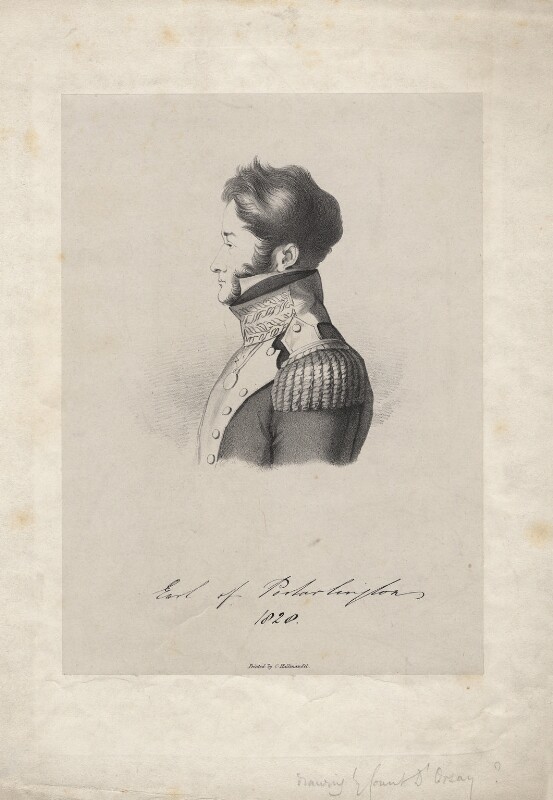
John Dawson 2nd Earl of Portarlington by Count D’Orsay courtesy of National Portrait Gallery in London NPG D5547
Lady Mary Wortley Montagu (1718-1794), Wife of John Patrick Crichton Stuart 3rd Earl of Bute, print after Christian Friedrich Zincke, 1830s, courtesy of National Portrait Gallery of London, NPG D34619.

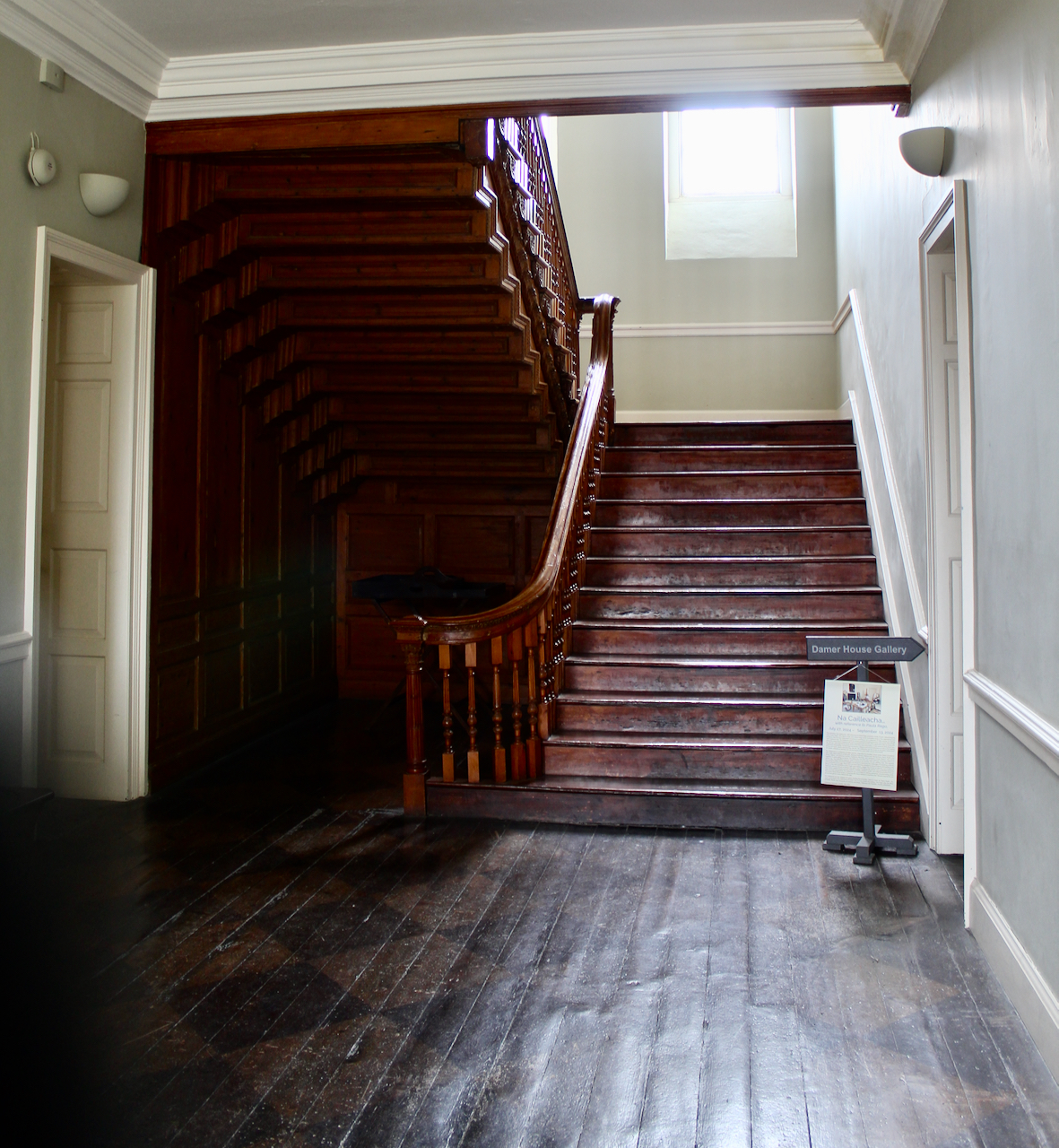
Damer House has a scroll pediment doorway and inside, a magnificent carved staircase. The Irish Georgian Society was involved in saving it from demolition in the 1960s. [for more photographs, see https://theirishaesthete.com/tag/damer-house/ ] The stairs and floor in the front hall are original to the house. The stairs are similar to ones in Cashel Palace, which was the Archbishop’s Palace, and is now an upmarket hotel. See the website of the Irish Aesthete for photographs of this staircase: https://theirishaesthete.com/tag/cashel-palace/

Unfortunately we were not allowed to take photos inside Damer House! I took this one before the tour guide told us we can’t take them – I think it’s a shame and cannot see the sense in it so am publishing this. Damer House, August 2024. Photograph © Jennifer Winder-Baggot, www.irishhistorichouses.com

The Damers didn’t live in the house and it was rented out to various tenants.

Robert O’Byrne tells us about the history of the house:

In 1798 the house was leased as a barracks and then the whole site sold to the British military in 1858. At the start of the last century the Damer House became ‘Mr. French’s Academy’, a school for boys, reverting to a barracks for the National Army during the Civil War, then being used as a sanatorium, before once again in 1932 serving as a school until 1956, then a library. By 1970 it was empty and unused, and the local authority, Tipperary County Council, announced plans to demolish the house and replace it with an amenity centre comprising a swimming pool, car park, playground and civic centre (it had been nurturing this scheme since as far back as 1957). The council’s chairman wanted the demolition to go ahead, declaring that ‘as long as it stands it reminds the Irish people of their enslavement to British rule,’ and dismissing objectors to the scheme as ‘a crowd of local cranks.’ In fact, most of the so-called ‘crowd’ were members of the Old Roscrea Society and in December 1970 this organisation was offered help by the Irish Georgian Society in the campaign to save the Damer House.

Robert O’Byrne suggests that the large annex to one side of Damer House was probably added during its time as use as a military barracks. Photograph © Jennifer Winder-Baggot, www.irishhistorichouses.com
The side of Damer House, August 2024. Photograph © Jennifer Winder-Baggot, www.irishhistorichouses.com
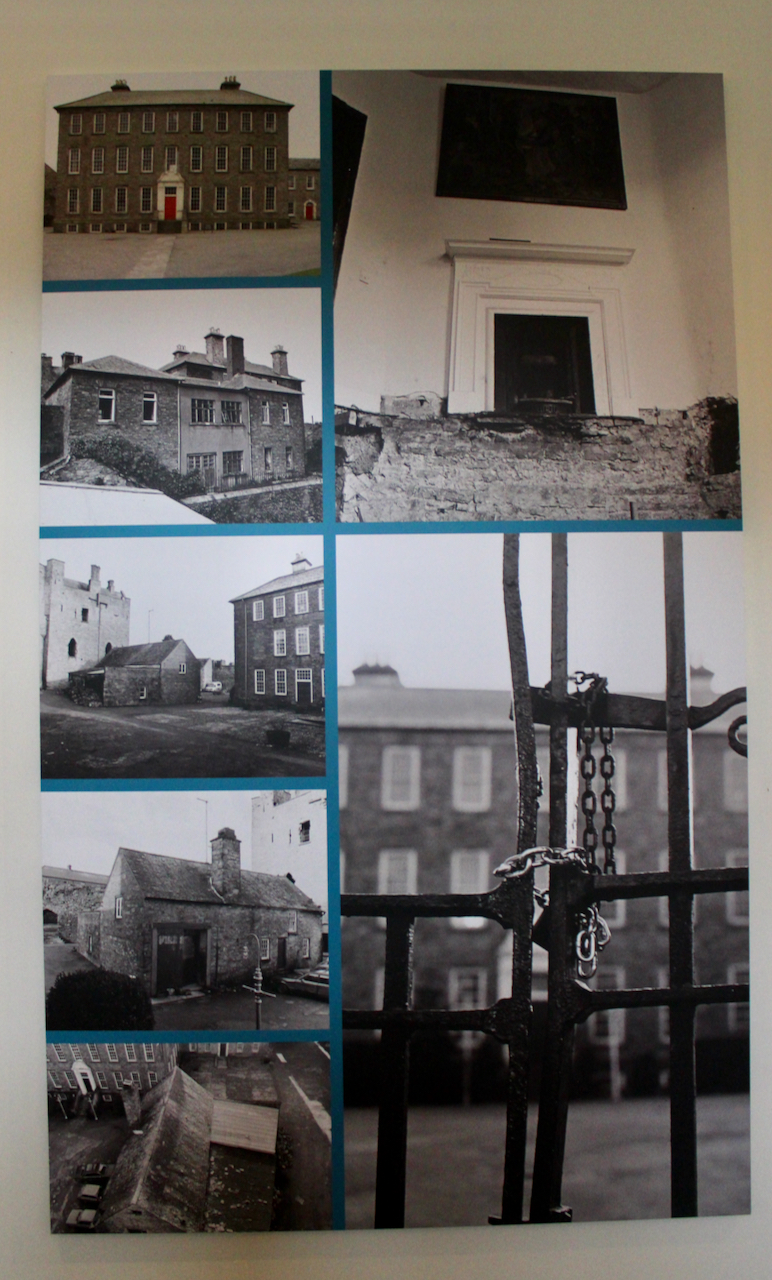
Photographs from an exhibition of the restoration of Damer House in the Annex.
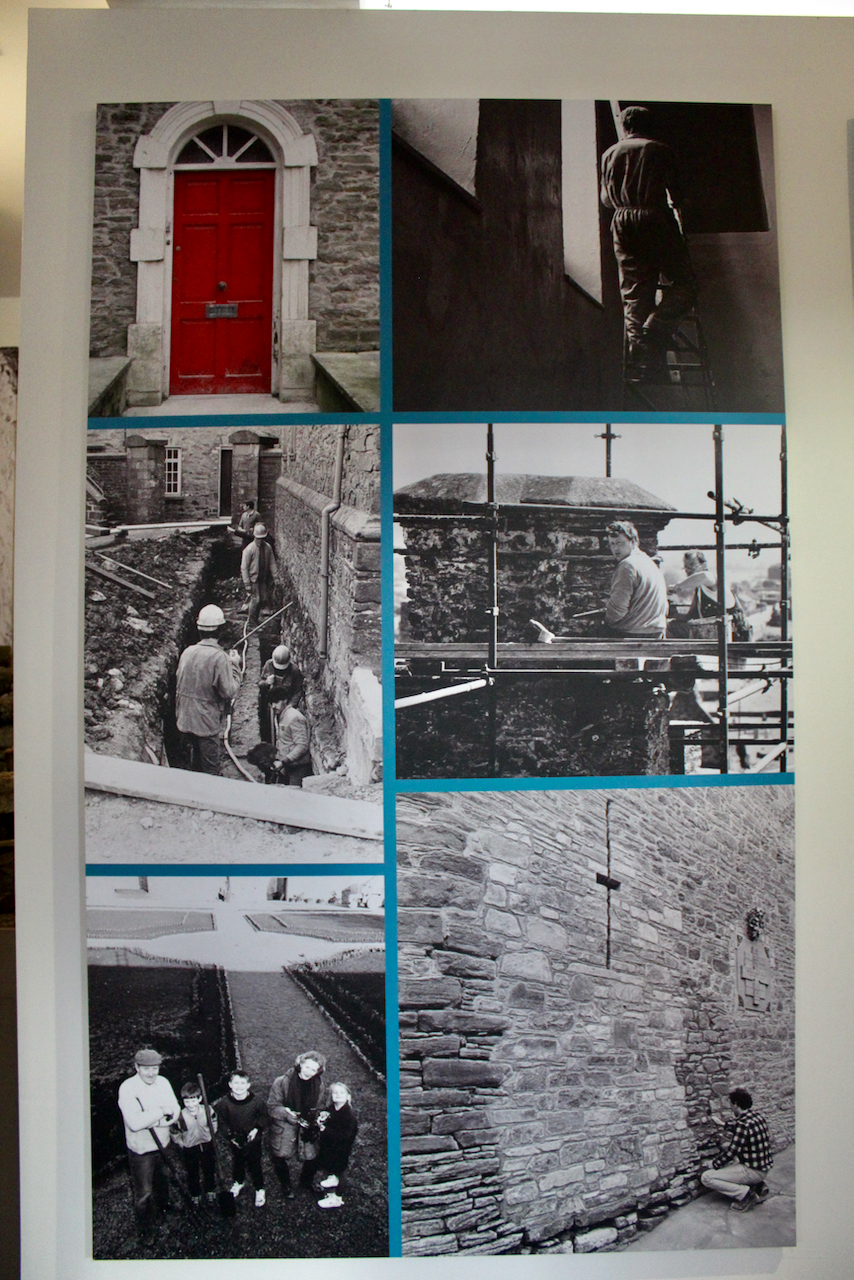
Photographs from an exhibition in the Annex.

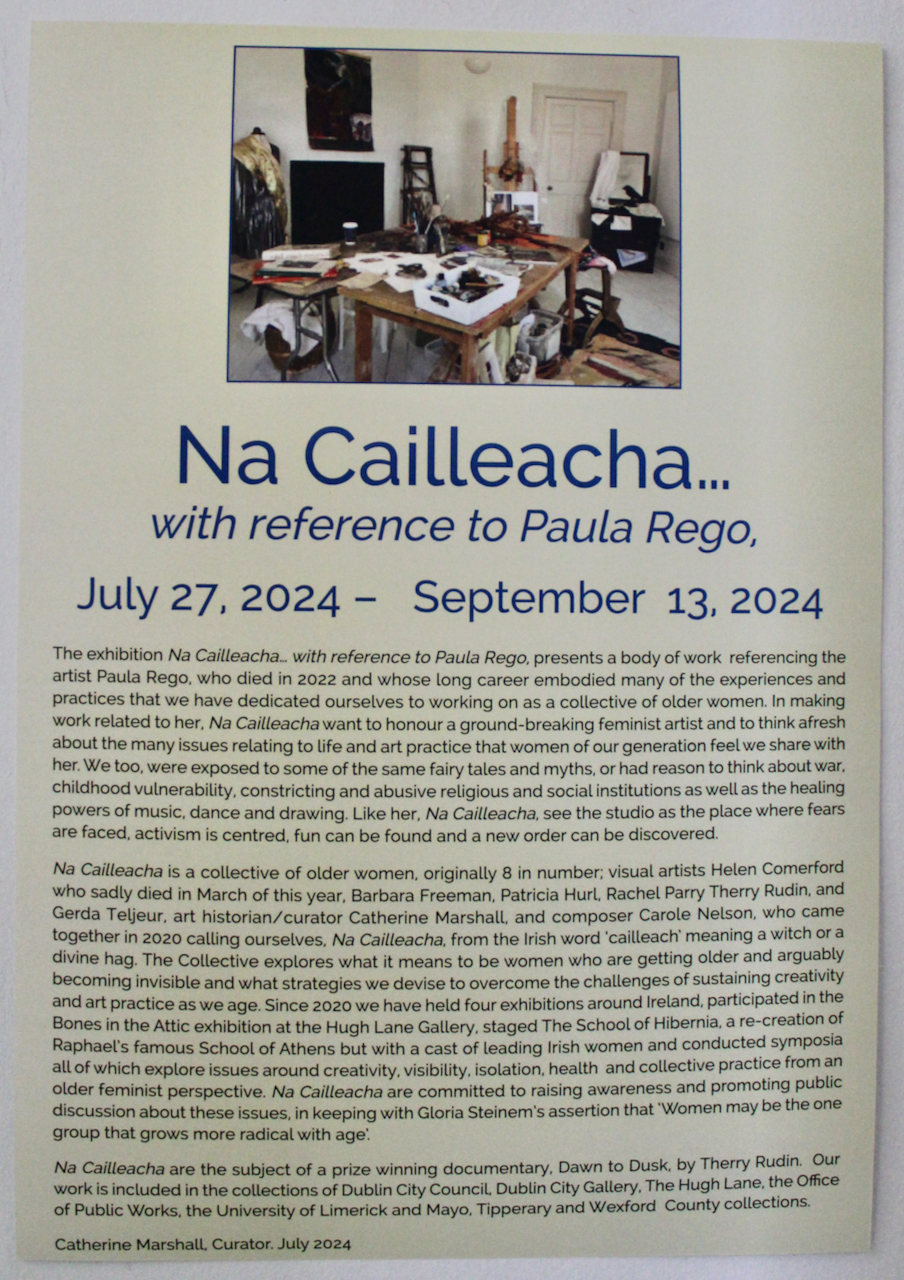
Upstairs in Damer House there’s also Exhibition space, but we did not have much time to browse.

Exhibition in Damer House.
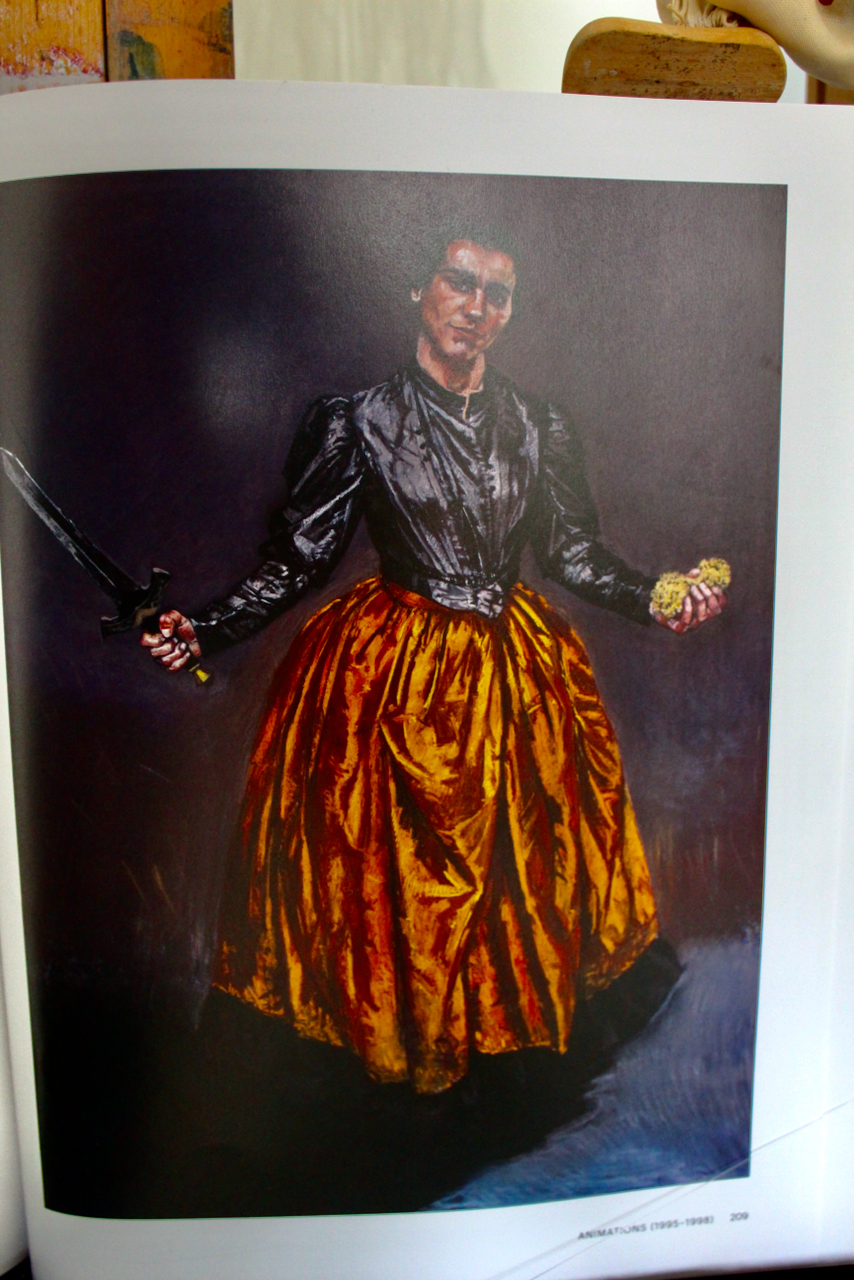
“Angel” by Paula Rego.
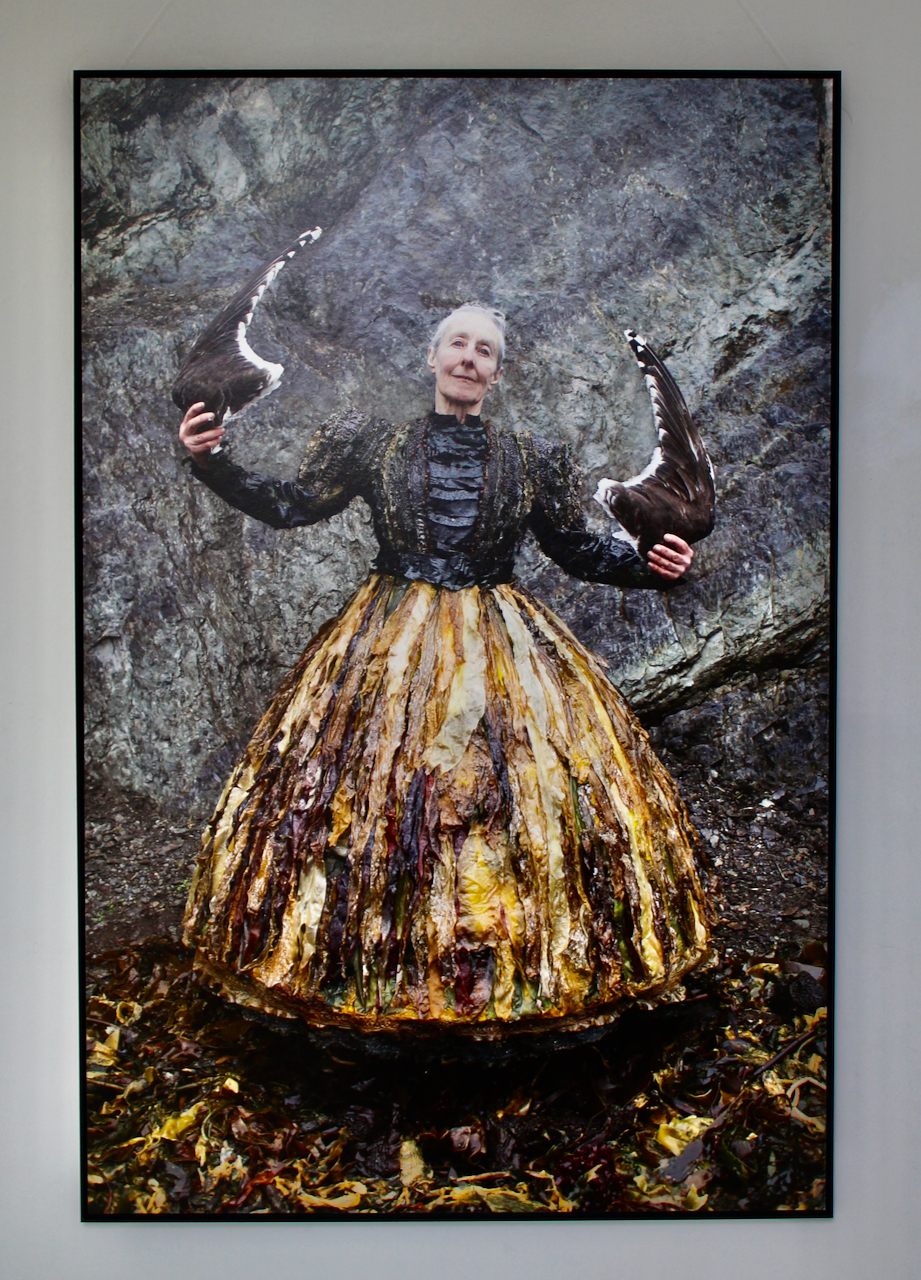
“Kelp Cailleagh” after “Angel” by Paula Rego, by Rachel Parry. Archival print of Rachel Parry in a dress made of dried seaweed, photographed in Allihies by Thomasz Madajczak.
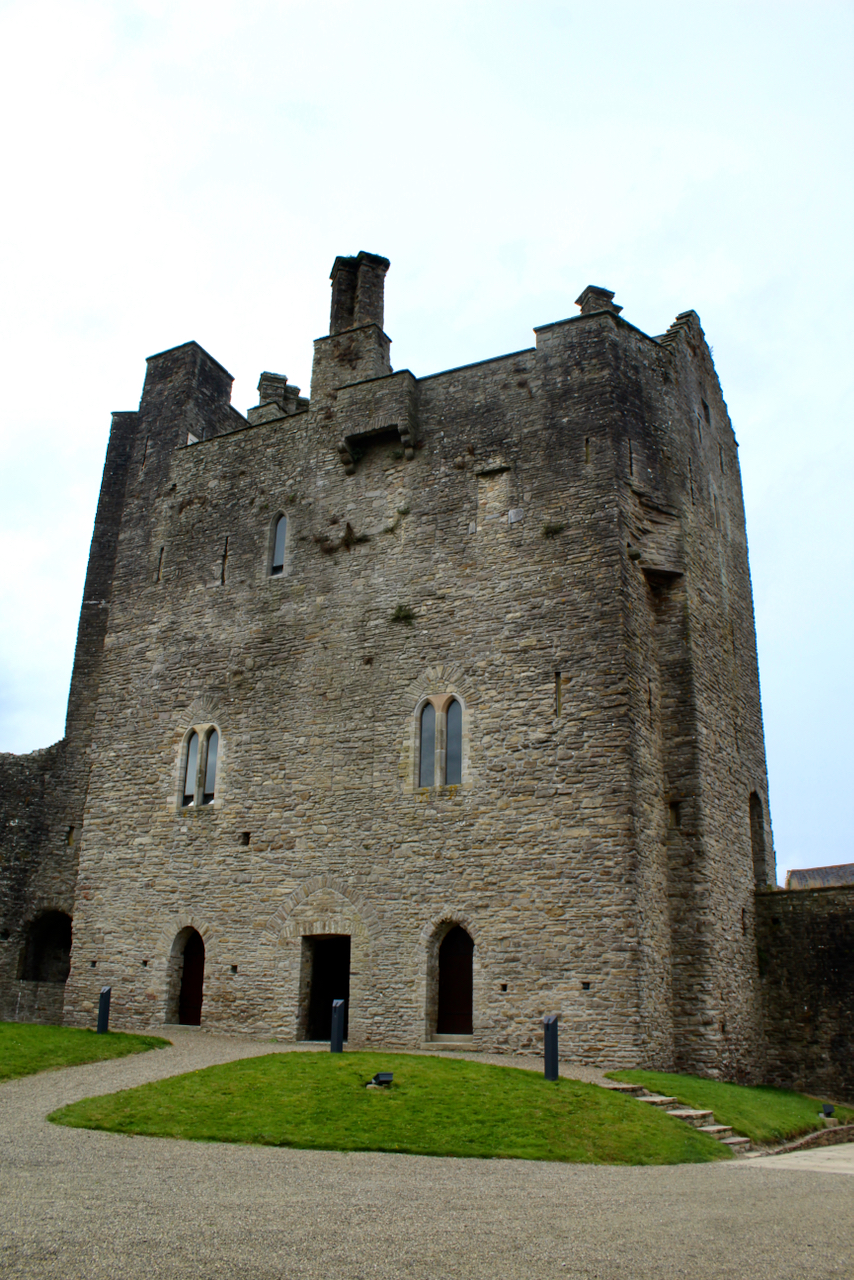
Roscrea Castle, August 2024. Photograph © Jennifer Winder-Baggot, www.irishhistorichouses.com

After our tour of Damer House we crossed the yard for a tour of the castle.

Roscrea Castle fell into disrepair in the 19th century, and when the roof collapsed extensive repairs were needed in the 1850s. It was named a national monument in 1892, and is now under the care of the OPW. 

A reconstruction of what the castle would have looked like, in an exhibition in the Annex to Damer House.
A reconstruction of what Roscrea Castle would have looked like, in an exhibition in the Annex to Damer House.
Roscrea Castle, August 2024. Photograph © Jennifer Winder-Baggot, www.irishhistorichouses.com

The original entrance to the castle is to one side of where we enter today – you can see the drawbridge in the photograph above.

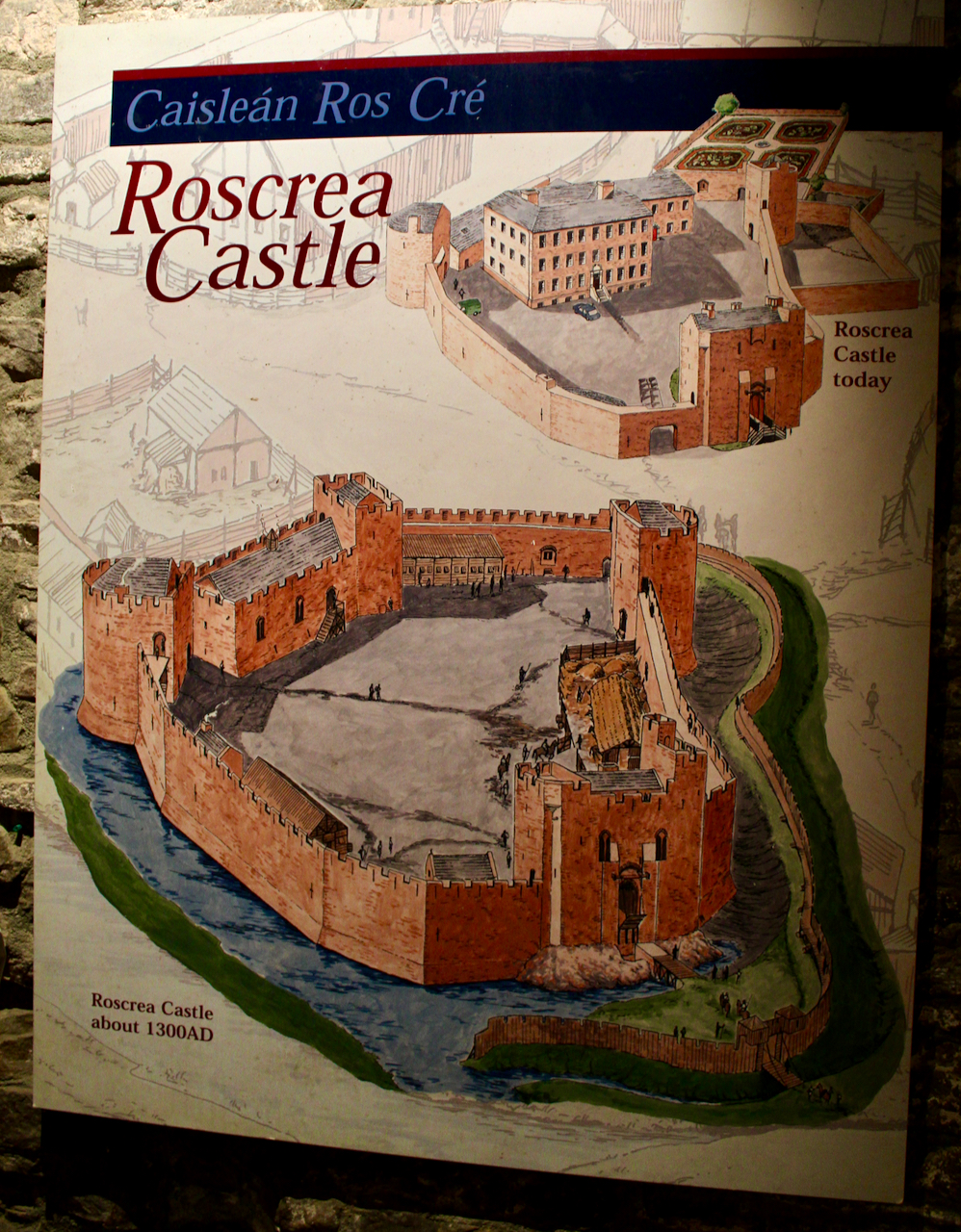
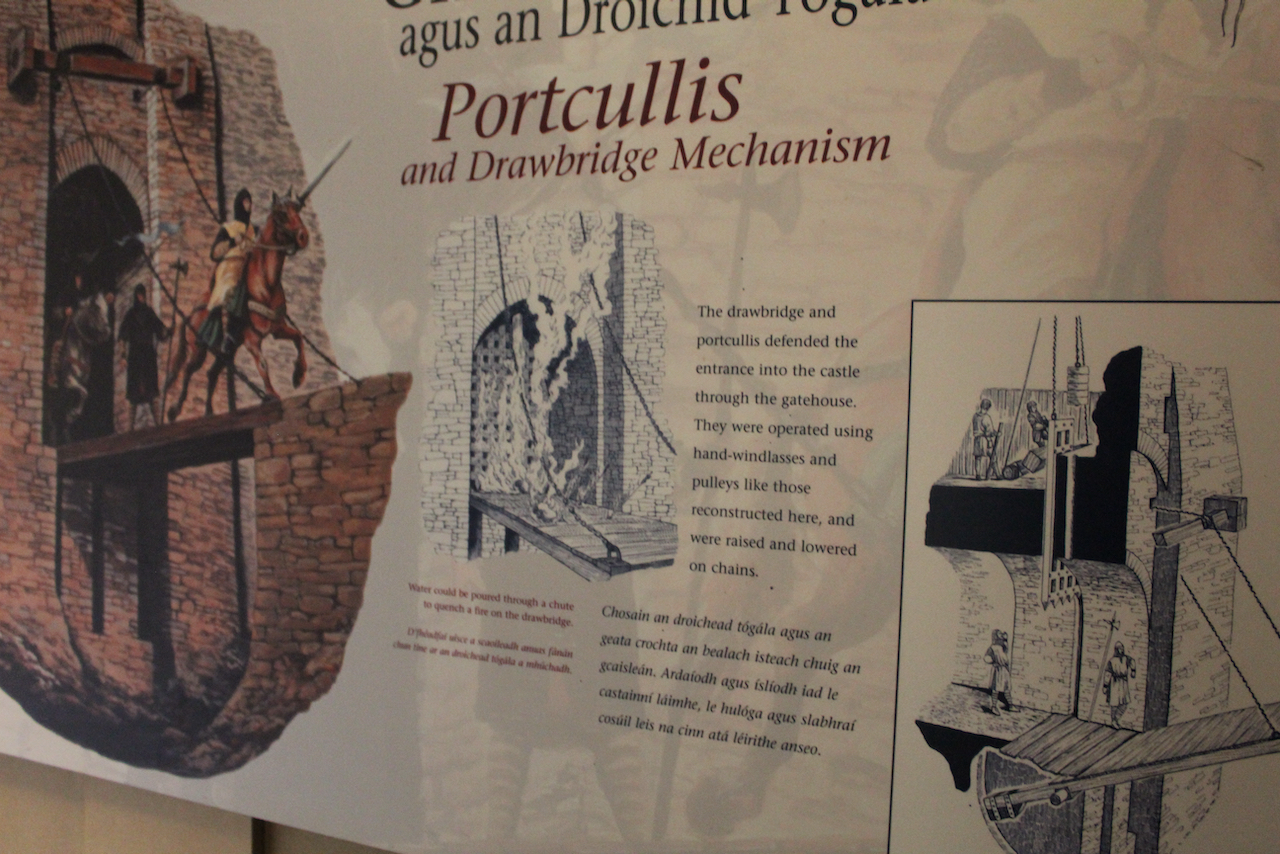
Information board inside the Roscrea Castle.
The original entrance to Roscrea Castle had a drawbridge over a moat. Photograph © Jennifer Winder-Baggot, www.irishhistorichouses.com
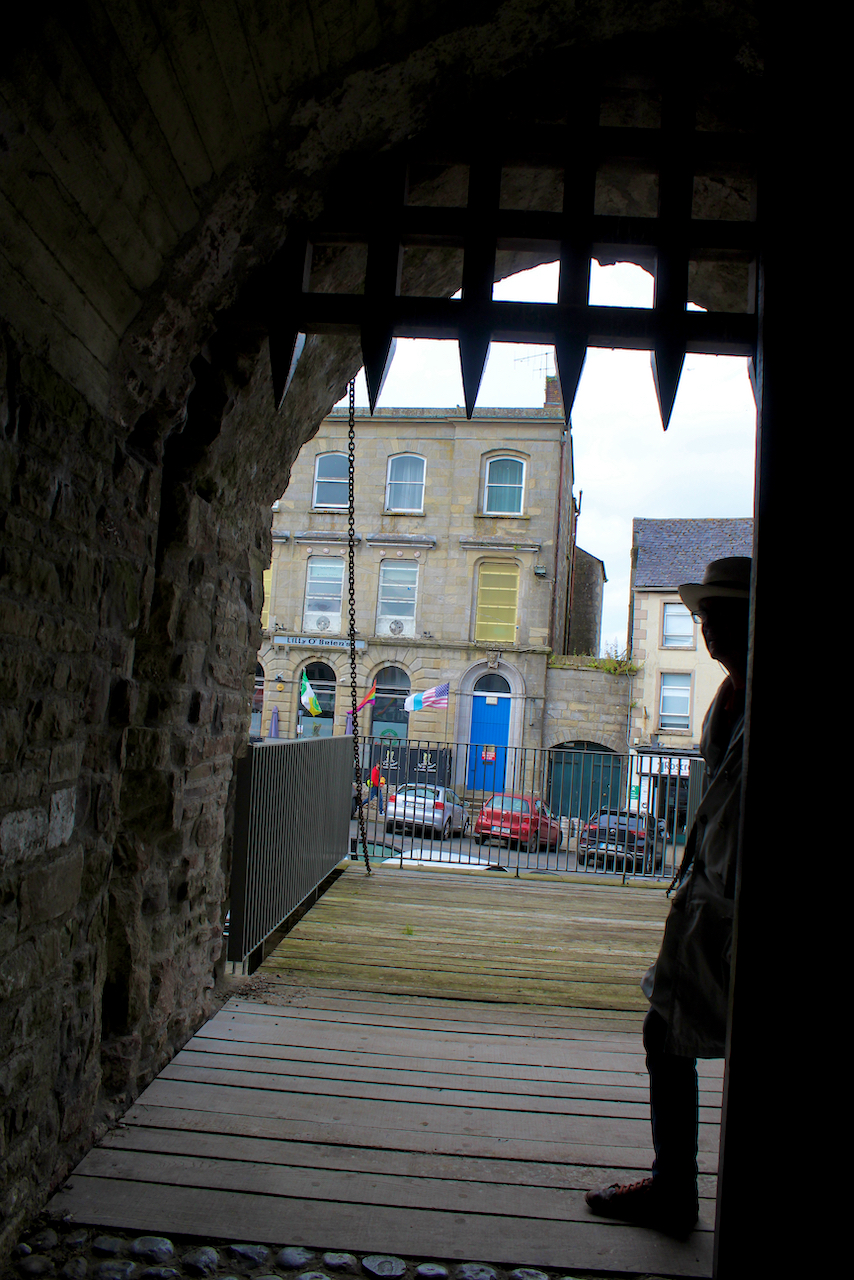
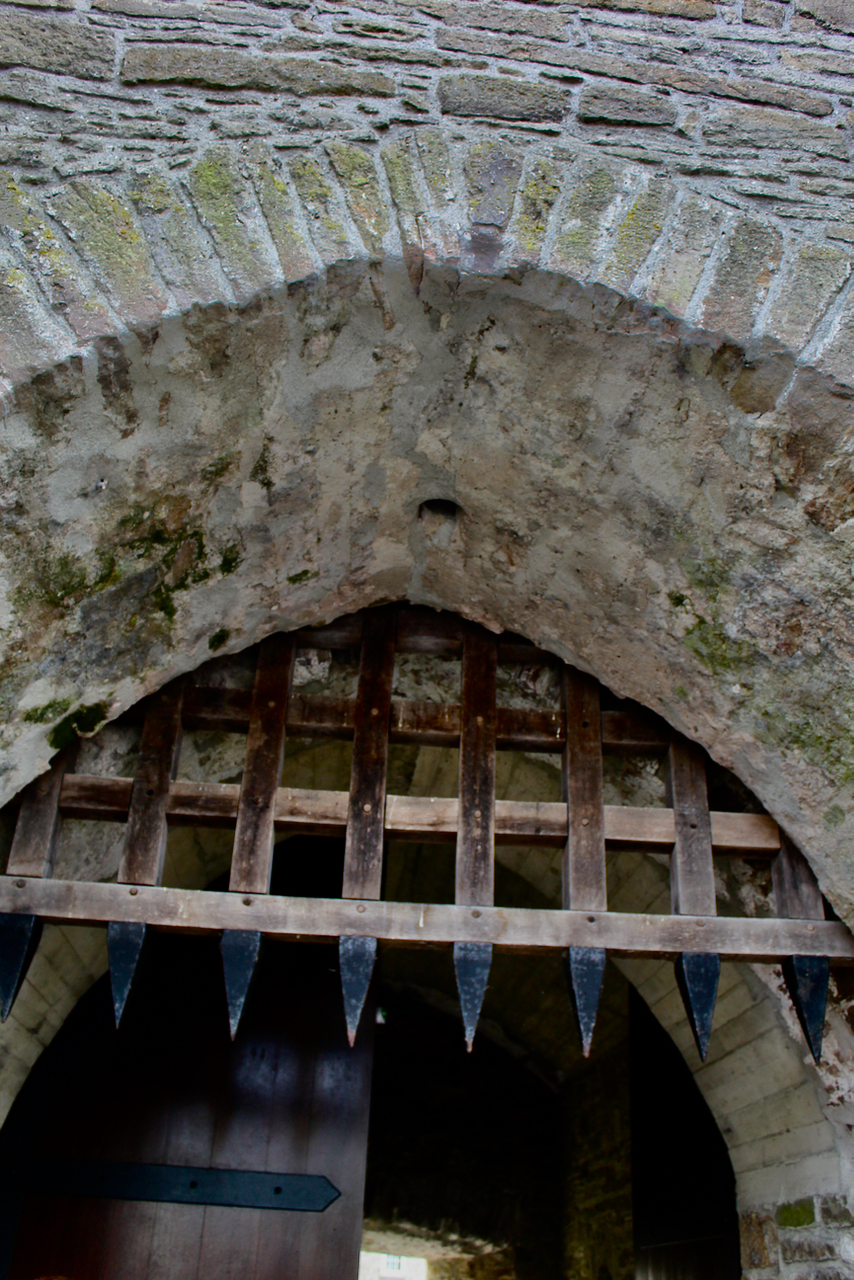
The entrance to Roscrea Castle would have had a portcullis. Photograph © Jennifer Winder-Baggot, www.irishhistorichouses.com
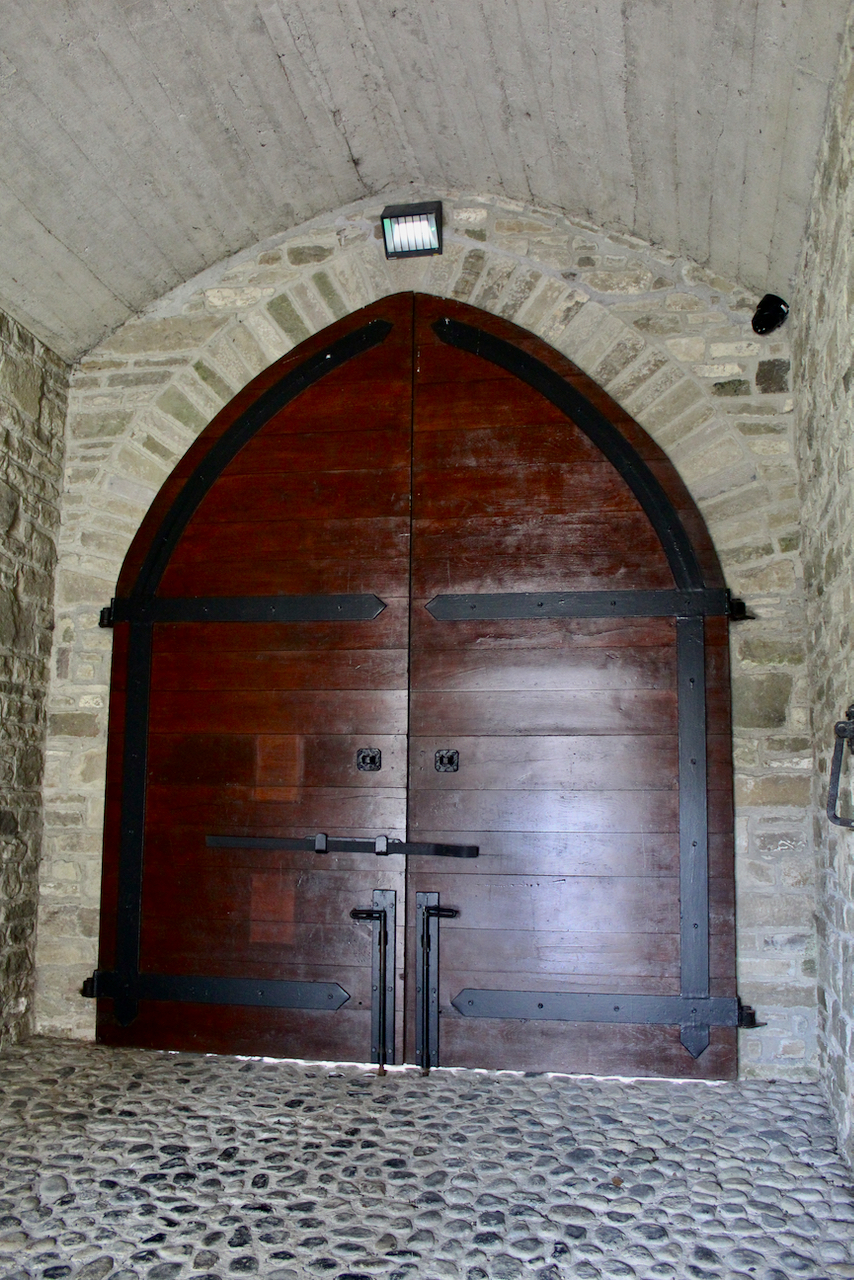
This is the door from inside Roscrea Castle, which leads to the drawbridge. Photograph © Jennifer Winder-Baggot, www.irishhistorichouses.com

The Castle was located on one of the five main roads in ancient Ireland, and it was essential for the Normans to control this route. In 1315 King Edward II handed the castle over to James Butler, 1st Earl of Ormond.

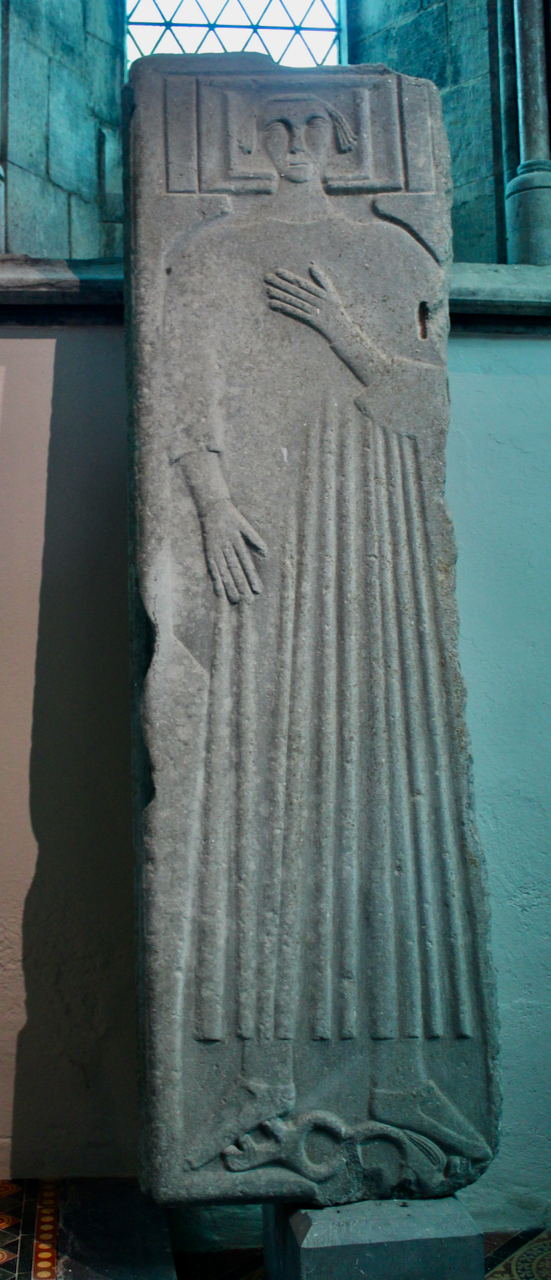
Probably James Butler (c. 1305-1337), the 1st Earl of Ormond. St. Mary’s church, Gowran, June 2023. Photograph © Jennifer Winder-Baggot, www.irishhistorichouses.com

The castle had many defensive features. The curtain wall is approximately three metres thick, which allowed for a wall-walk from which soldiers had a view of the surrounding area. The River Barrow formed a moat around the east face of the castle, and the Normans constructed a dry moat on the west side. The river was diverted in the 19th century.

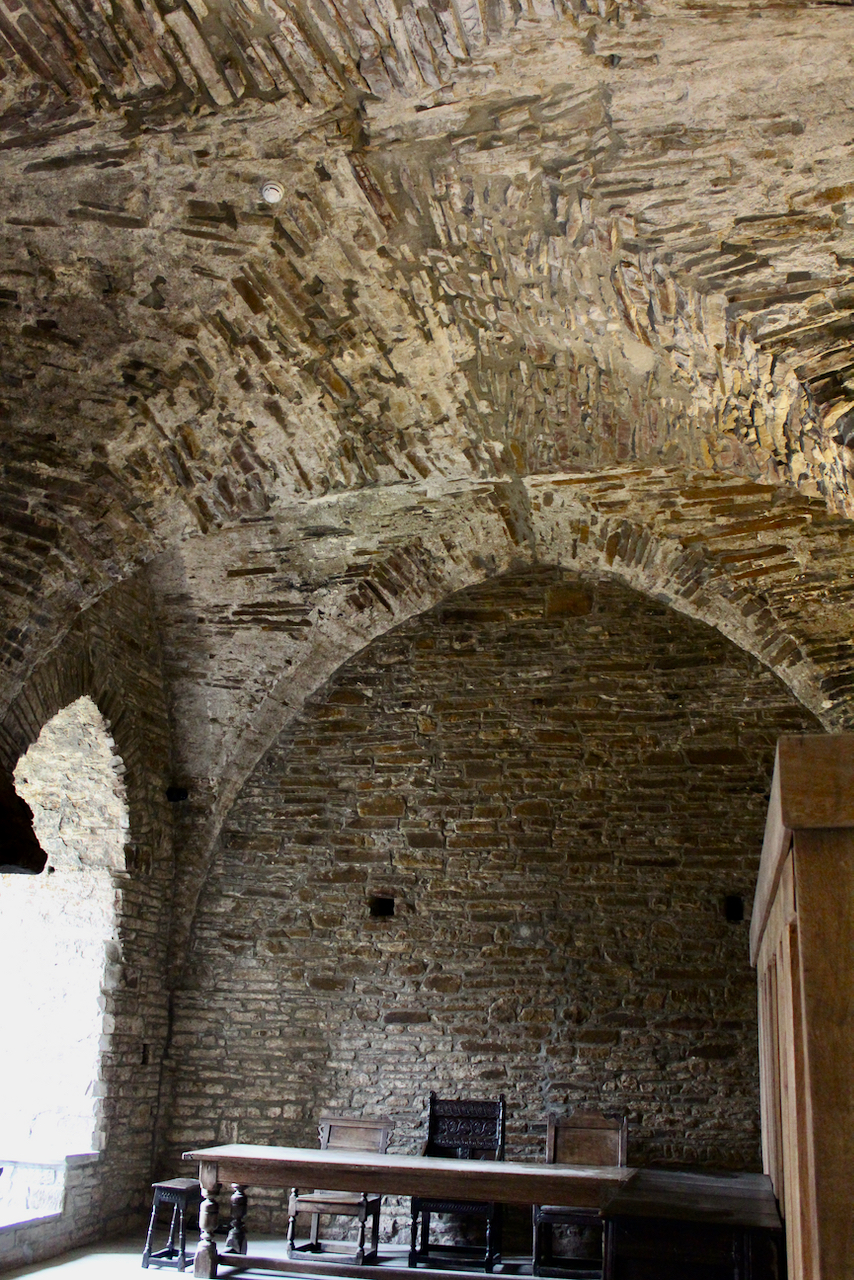
Inside the castle reception area there’s a grille on the floor, which is the “oubliette” (from the French, meaning “to forget.”). However, in this case, people were imprisoned here between court dates, the guide told us.

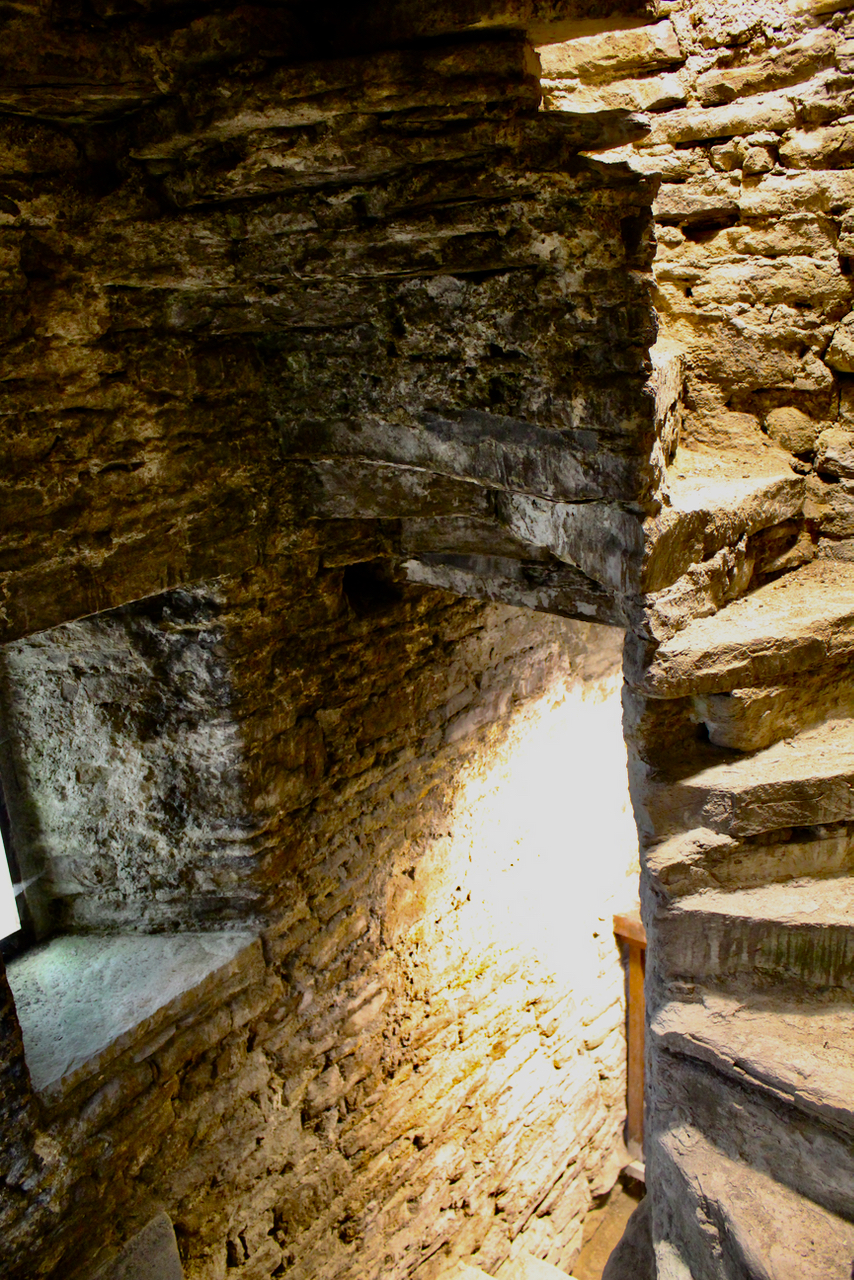
Above the drawbridge is a machicolation from which boiling substances could be dropped, and there are also arrow loop windows for defence. The stairs, called “trip steps” were deliberately built of different heights and widths to impede the intruder. The spiral clockwise to make it more difficult for the enemy to fight his way up the steps.

Silver from nearby silvermines would have been stored in the castle.

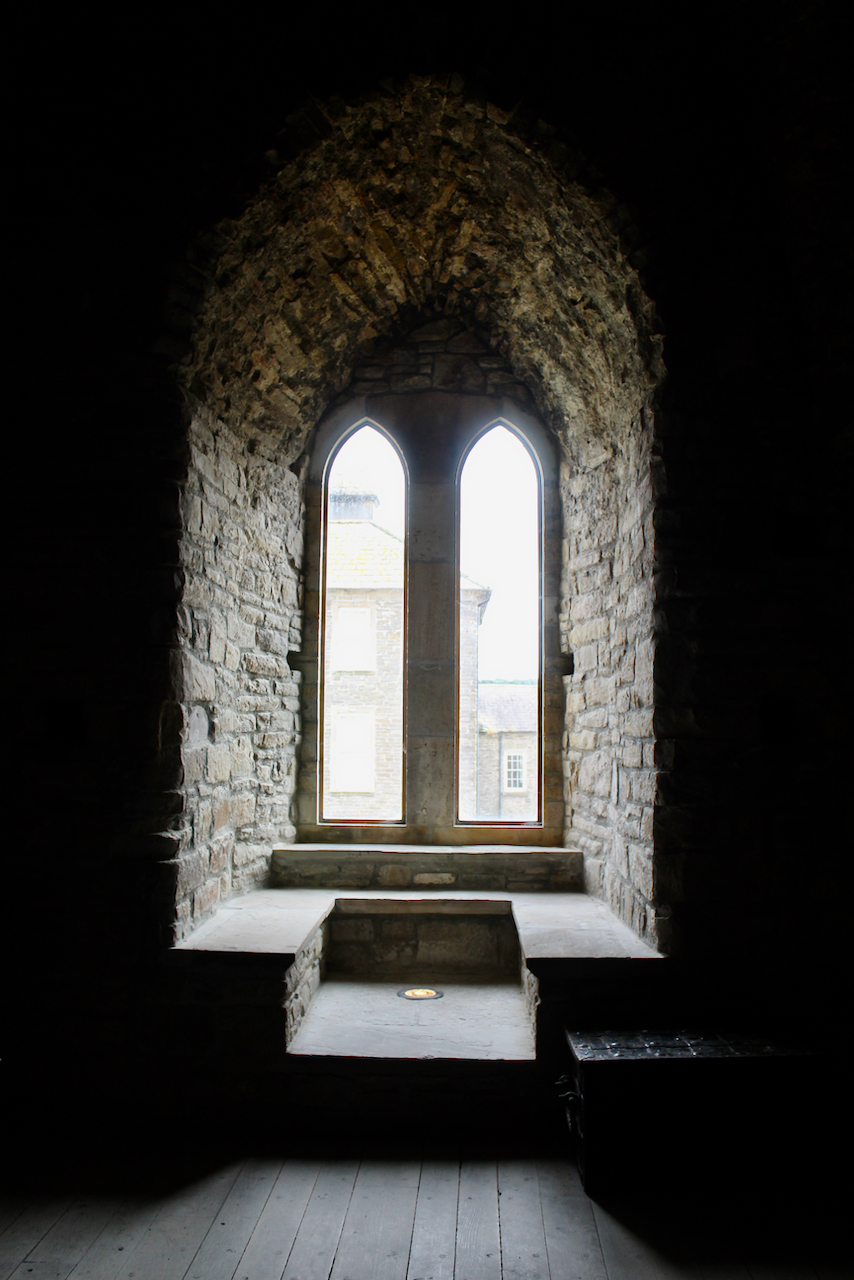
Inside Roscrea Castle, August 2024. Photograph © Jennifer Winder-Baggot, www.irishhistorichouses.com

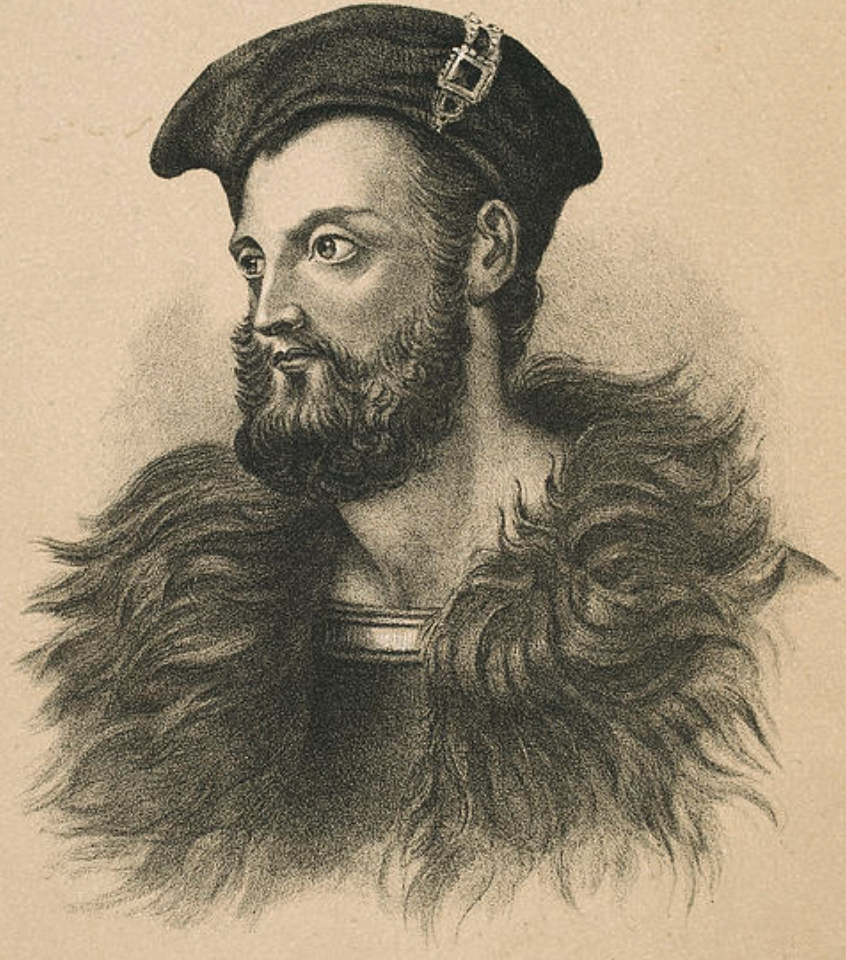
Eoin Roe O’Neill (d. 1649), at the head of 1,200 men, stormed Roscrea in 1646 and reportedly killed every man, woman and child. The only survivor was the governor’s wife, Lady Mary Hamilton (1605-1680), who was a sister to the Earl of Ormond [married to George Hamilton, 1st Baronet of Donalong County Tyrone and of Nenagh, County Tipperary]. She was again forced to play host in the castle to O’Neill three years later which again ended by the guests looting everything in sight. [7]

Owen Roe O’Neill By Unknown, Van Brugens – Ulster Journal of Archaeology Volume 4, Public Domain, https://commons.wikimedia.org/w/index.php?curid=17552770.jpg
Inside Roscrea Castle, August 2024. Photograph © Jennifer Winder-Baggot, www.irishhistorichouses.com

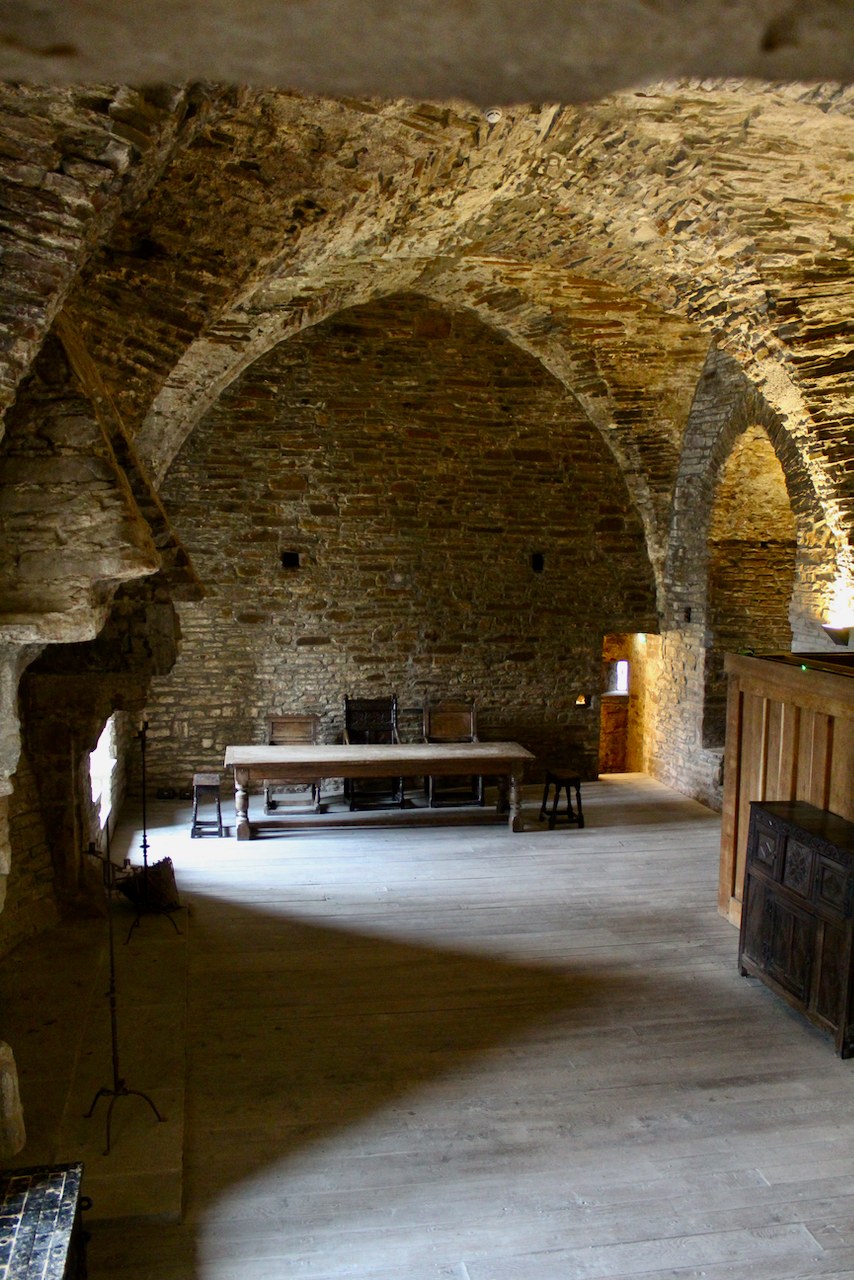
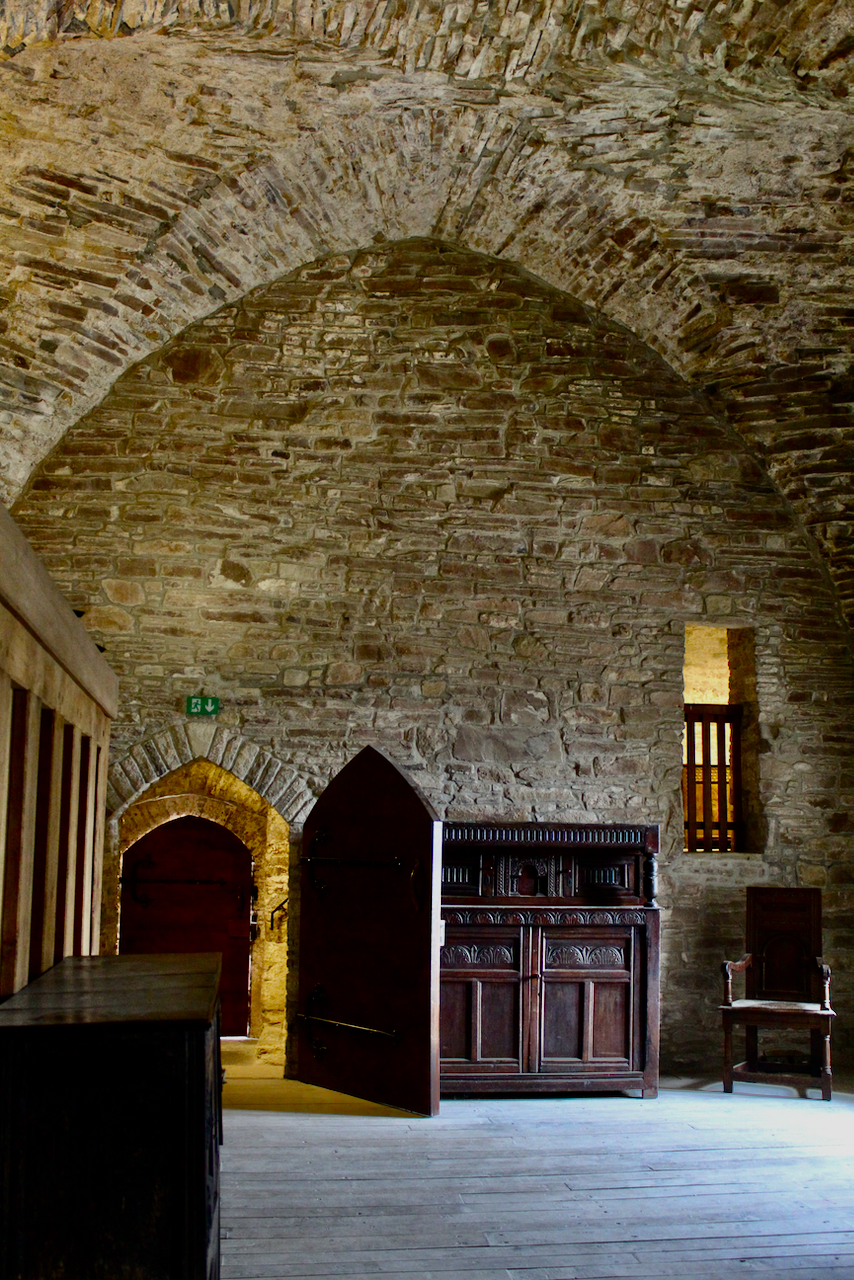
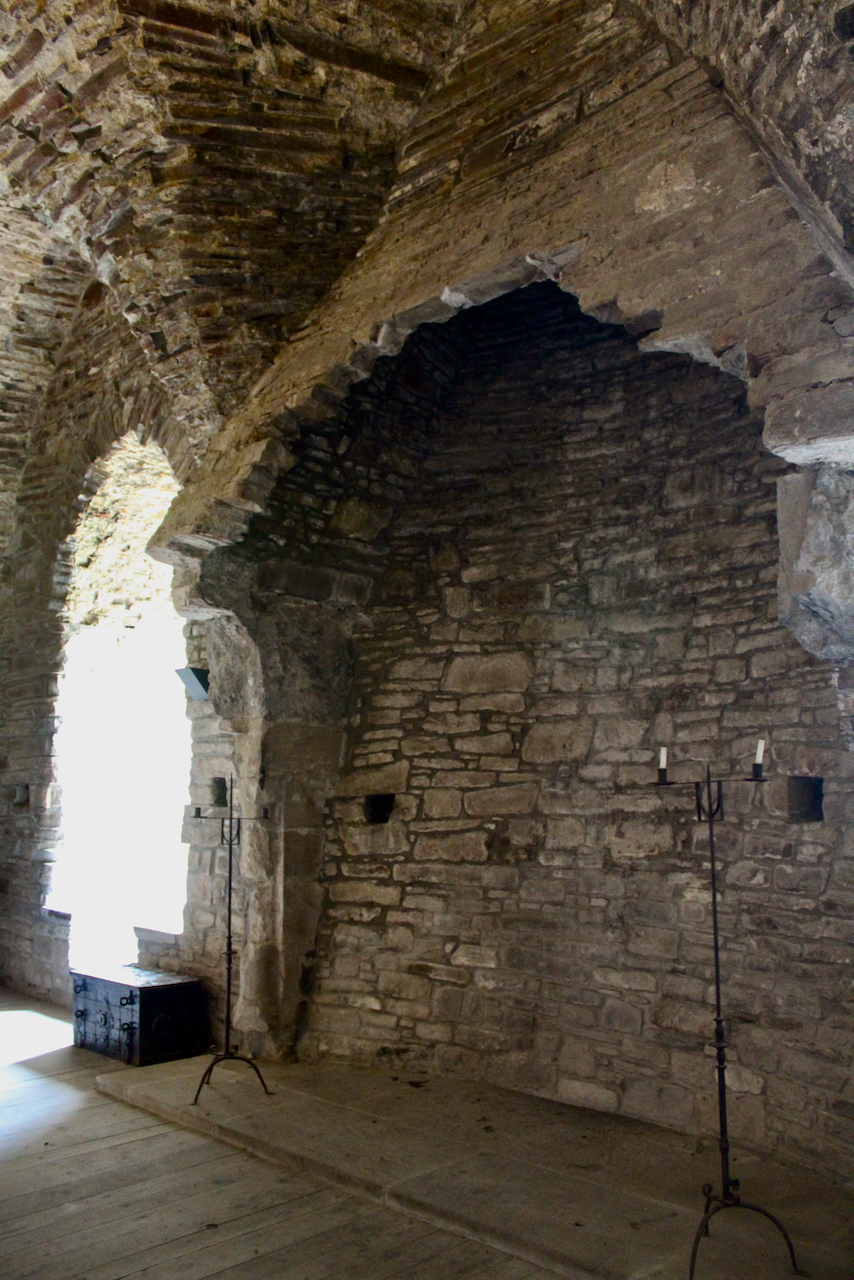
Larger windows were a later addition. Originally there would be only small loopholes. Before glass, the larger windows would be covered with skins to keep out the draught. The inside would have been limewashed, the white walls would then brighten the interior. The fireplace would also provide light.

Inside Roscrea Castle, August 2024. Photograph © Jennifer Winder-Baggot, www.irishhistorichouses.com

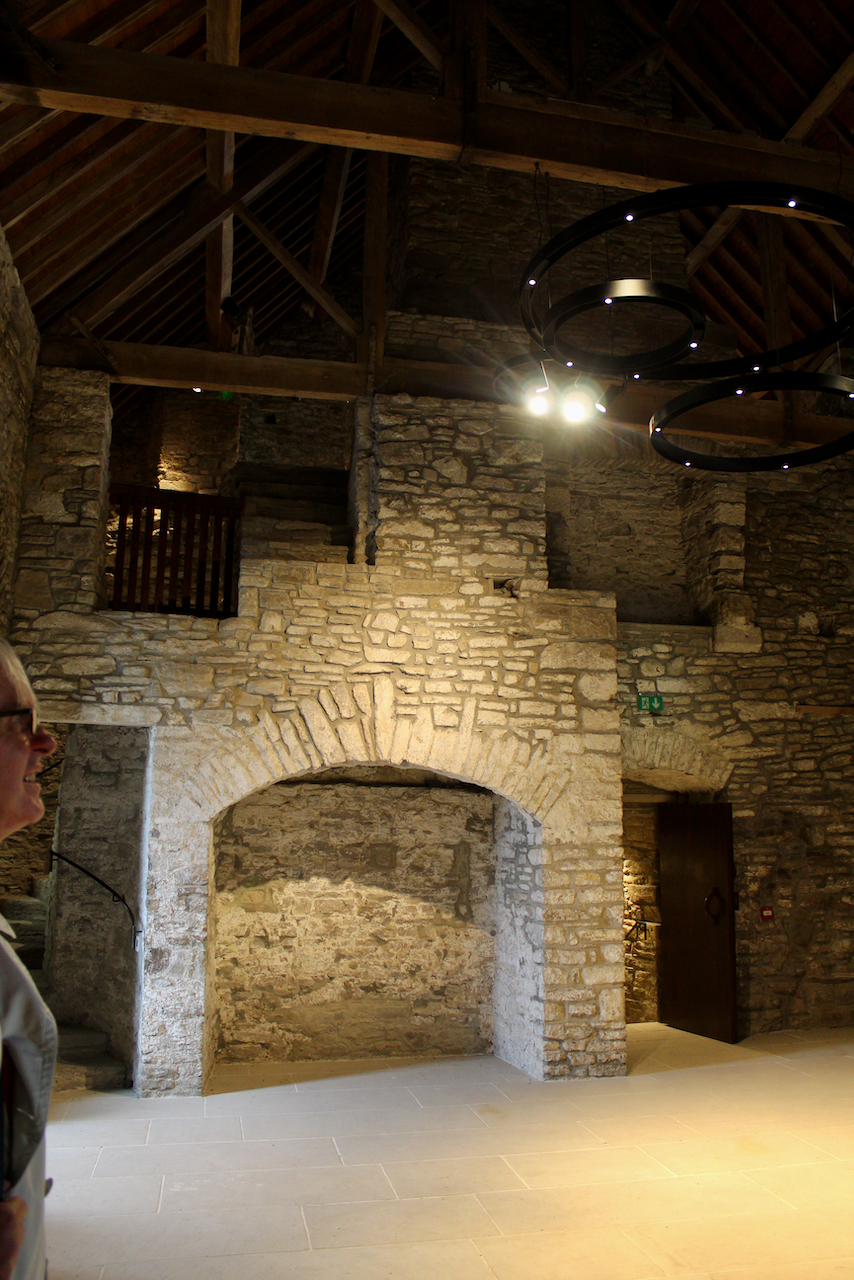
The floor above the banquet room has three fireplaces. The large room was probably partitioned.

Inside Roscrea Castle, August 2024. Photograph © Jennifer Winder-Baggot, www.irishhistorichouses.com

There’s a minstrils’ gallery. Minstrils were of the lower class and were kept away from aristocratic guests to prevent spreading any infection.

Roscrea Castle, August 2024. Photograph © Jennifer Winder-Baggot, www.irishhistorichouses.com
Exhibition panel at Damer House.
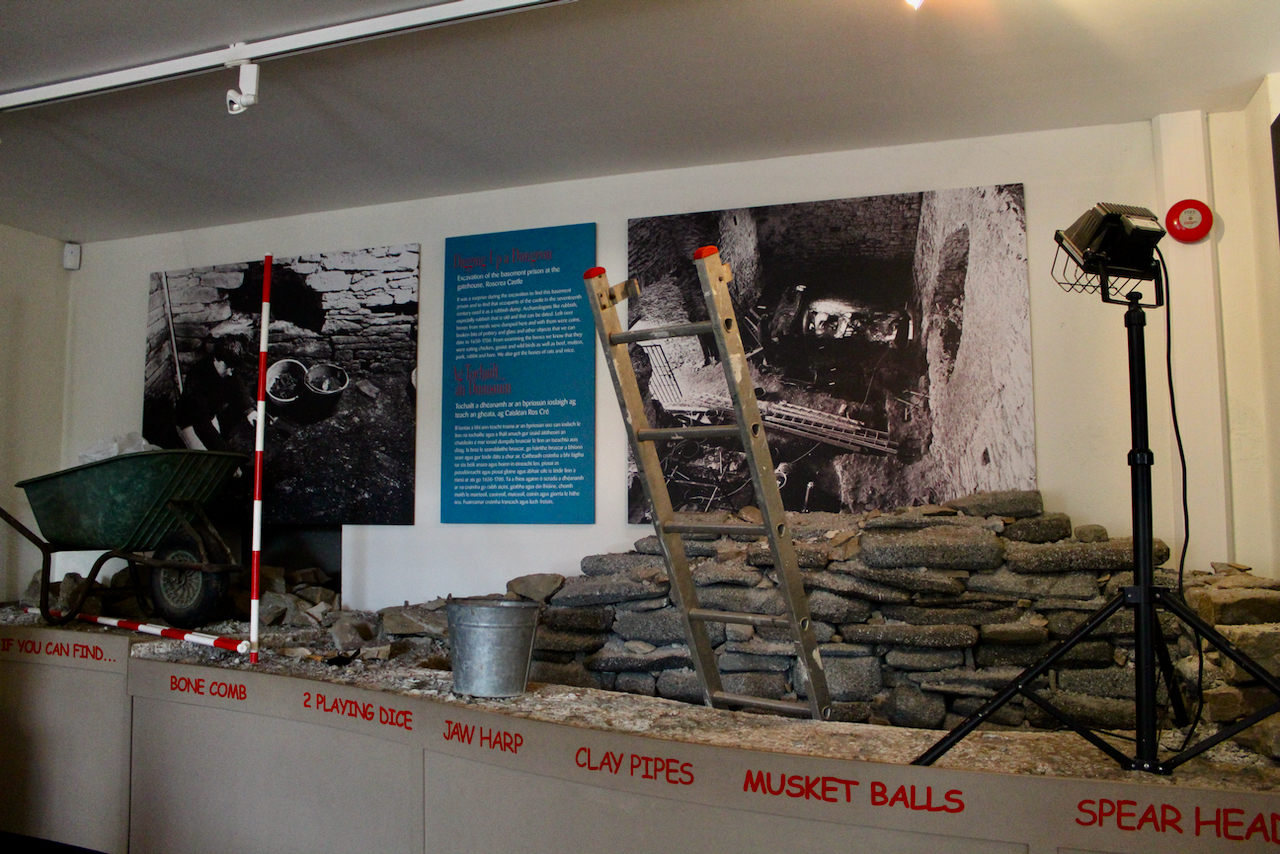
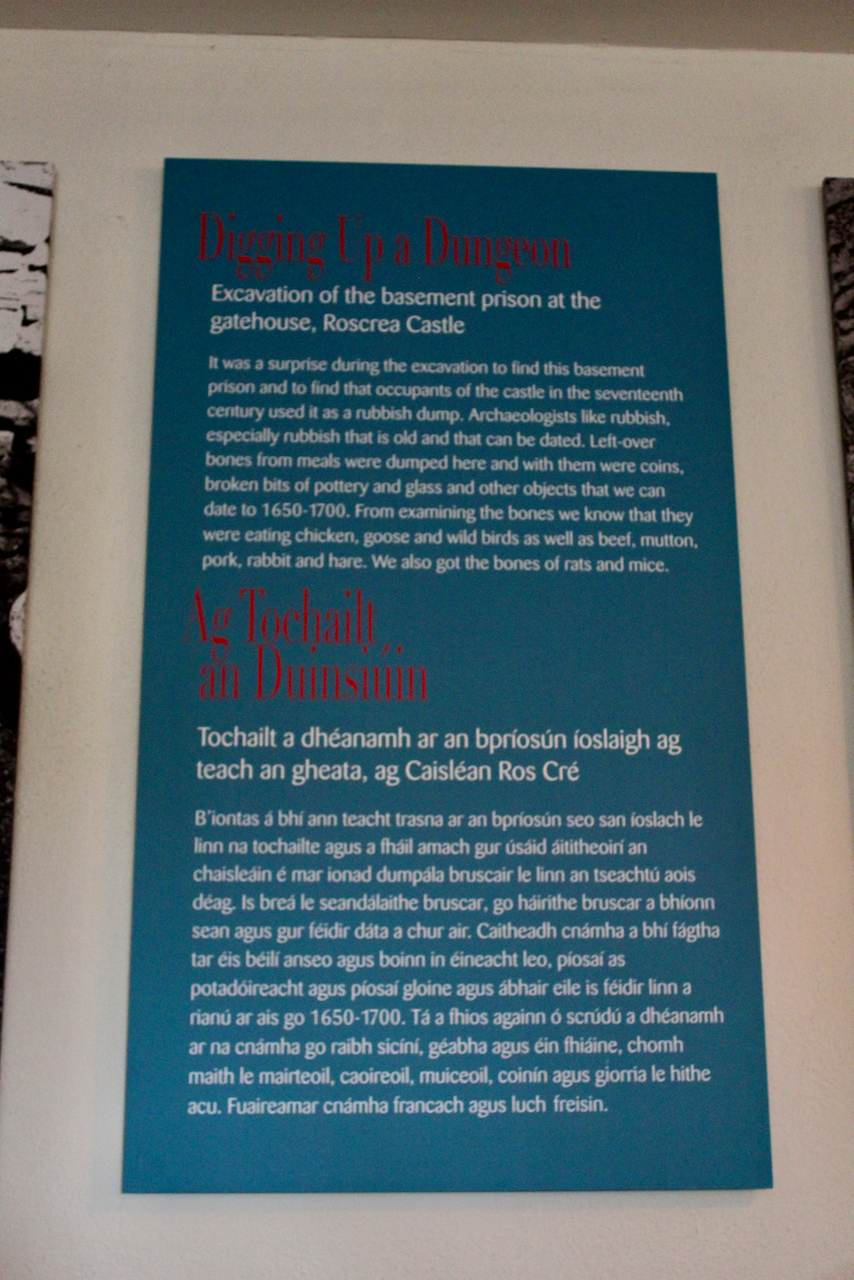
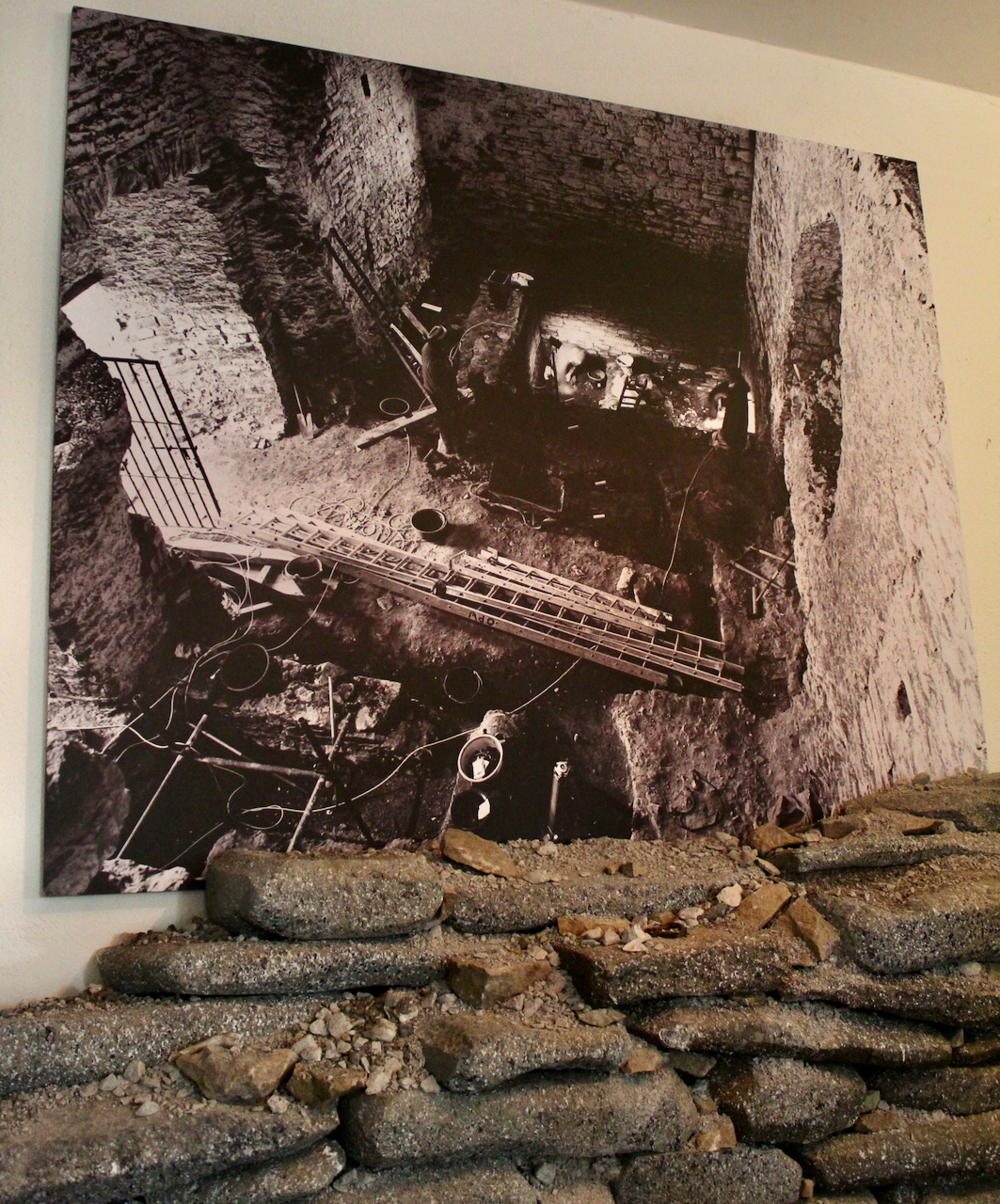
Exhibition panel at Damer House about excavation.

After our tour of the castle we had a little time to explore the gardens.

Roscrea Castle, photograph from Ireland’s Content pool, by Chris Hill 2014 for Failte Ireland.
Gardens at Roscrea Castle, August 2024. Photograph © Jennifer Winder-Baggot, www.irishhistorichouses.com
Exhibition panel at Damer House.
The back of buildings at Roscrea Castle, August 2024. Photograph © Jennifer Winder-Baggot, www.irishhistorichouses.com

[1] https://www.irelandscontentpool.com/en

[2] See the blog of Patrick Comerford, http://www.patrickcomerford.com/search/label/castles?updated-max=2019-03-03T14:30:00Z&max-results=20&start=27&by-date=false

[3] https://www.dib.ie/biography/damer-joseph-a2390

[4] Hayes, William and Art Kavanagh, The Tipperary Gentry volume 1 published by Irish Family Names, c/o Eneclann, Unit 1, The Trinity Enterprise Centre, Pearse Street, Dublin 2, 2003.

[5] https://theirishaesthete.com/2013/09/23/bon-anniversaire/ and see my write-up about Emo Court, in OPW properties in Leinster: Laois.

[6] https://theirishaesthete.com/tag/damer-house/

[7] http://www.cahirhistoricalsociety.com/articles/cahirhistory.html

Heritage Week 2024 continued

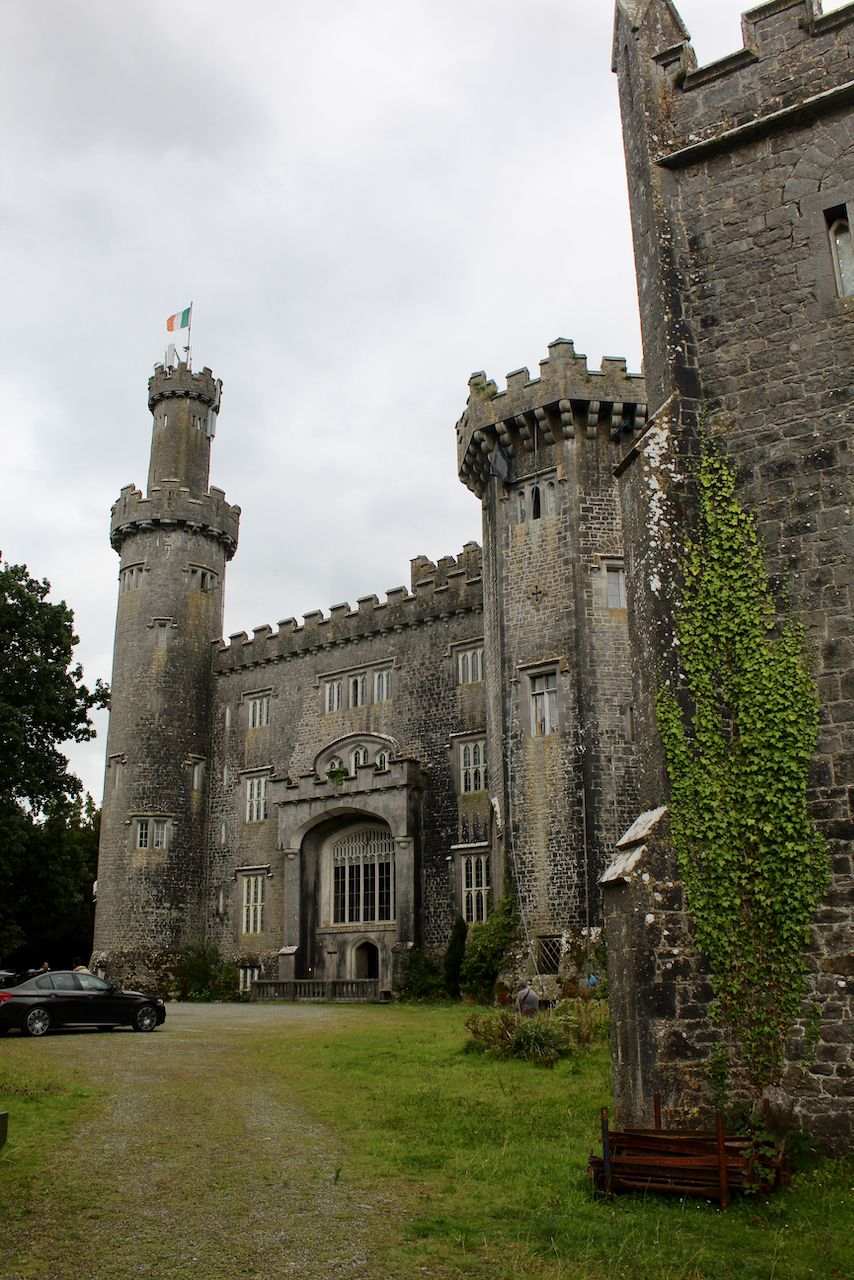
We continued our outings for Heritage Week this week. We didn’t do our usual travel around to Section 482 properties as we were both too tired this year. As I mentioned in my last post, we went to Charleville Castle in Tullamore on Saturday, which is wonderful. Unfortunately we didn’t linger to wander in the woods as rain threatened and I wanted to visit my aunt who lives in the town.

Charleville Castle, County Offaly, August 2024. Photograph © Jennifer Winder-Baggot, www.irishhistorichouses.com

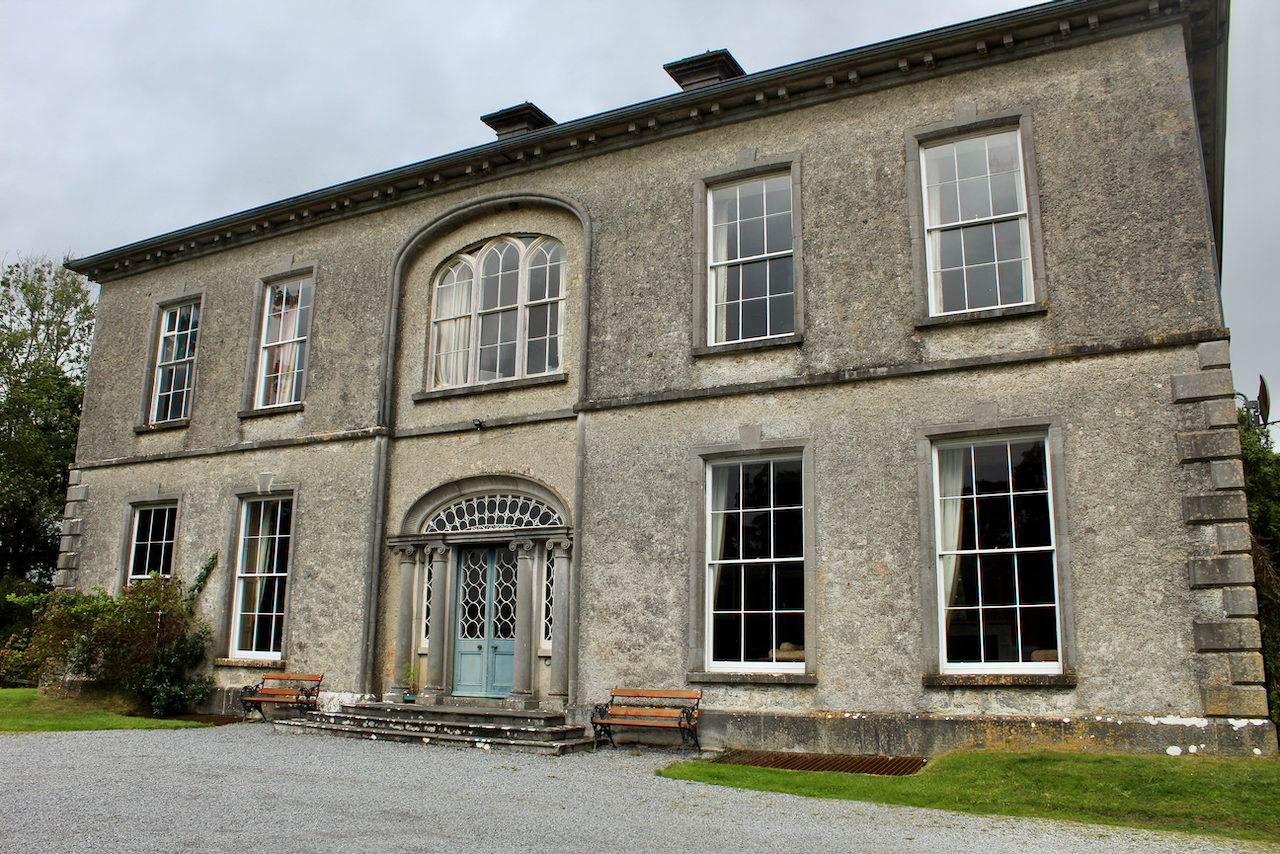
On Monday we missed our booked visit to Number 6 High Street in Tullamore, unfortunately, but went to see Tullynisk house that afternoon. We were given a wonderful tour by its resident Alicia Clements, daughter of the Earl of Rosse, who married a descendant of Nathaniel Clements who built the Áras an Uachtaráin in the Phoenix Park.

Tullynisk House, County Offaly. Photograph © Jennifer Winder-Baggot, www.irishhistorichouses.com

On Wednesday we went to Emo Court in Laois, an Office of Public Works property, because the OPW opened a few rooms for tours during the week and it is closing again afterwards for more repairs. It is so disappointing it has been closed since 2019. We were not allowed to take photographs inside since the work is unfinished!

Emo Park, County Laois. Photograph © Jennifer Winder-Baggot, www.irishhistorichouses.com
At Emo during this visit we had to wear these shoe covers to protect the floors. Photograph © Jennifer Winder-Baggot, www.irishhistorichouses.com

We found ourselves with spare time after Emo Park as it was too rainy to wander the lush grounds, so we headed to Roscrea for more OPW properties: Damer House and Roscrea Castle. Unfortunately we weren’t allowed to take photographs inside Damer House except in the exhibition rooms. After a tour of Damer House we went across the bawn to tour Roscrea Castle. It is a treasure for the beautiful ancient town of Roscrea. I’ll be writing more about all of these places.

Damer House, Roscrea, 21st August 2024. Photograph © Jennifer Winder-Baggot, www.irishhistorichouses.com
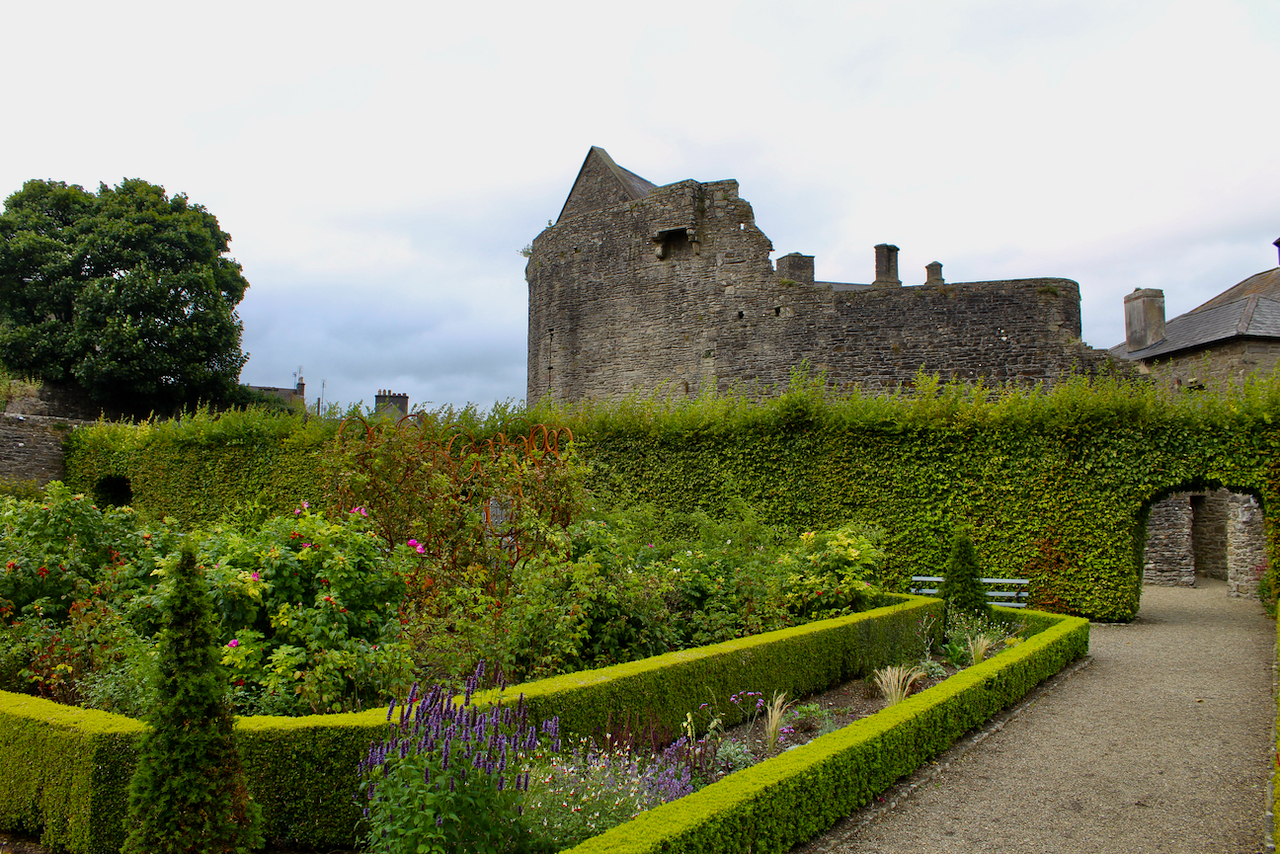
The gardens at Damer house and Roscrea Castle, with the castle in the background. Photograph © Jennifer Winder-Baggot, www.irishhistorichouses.com
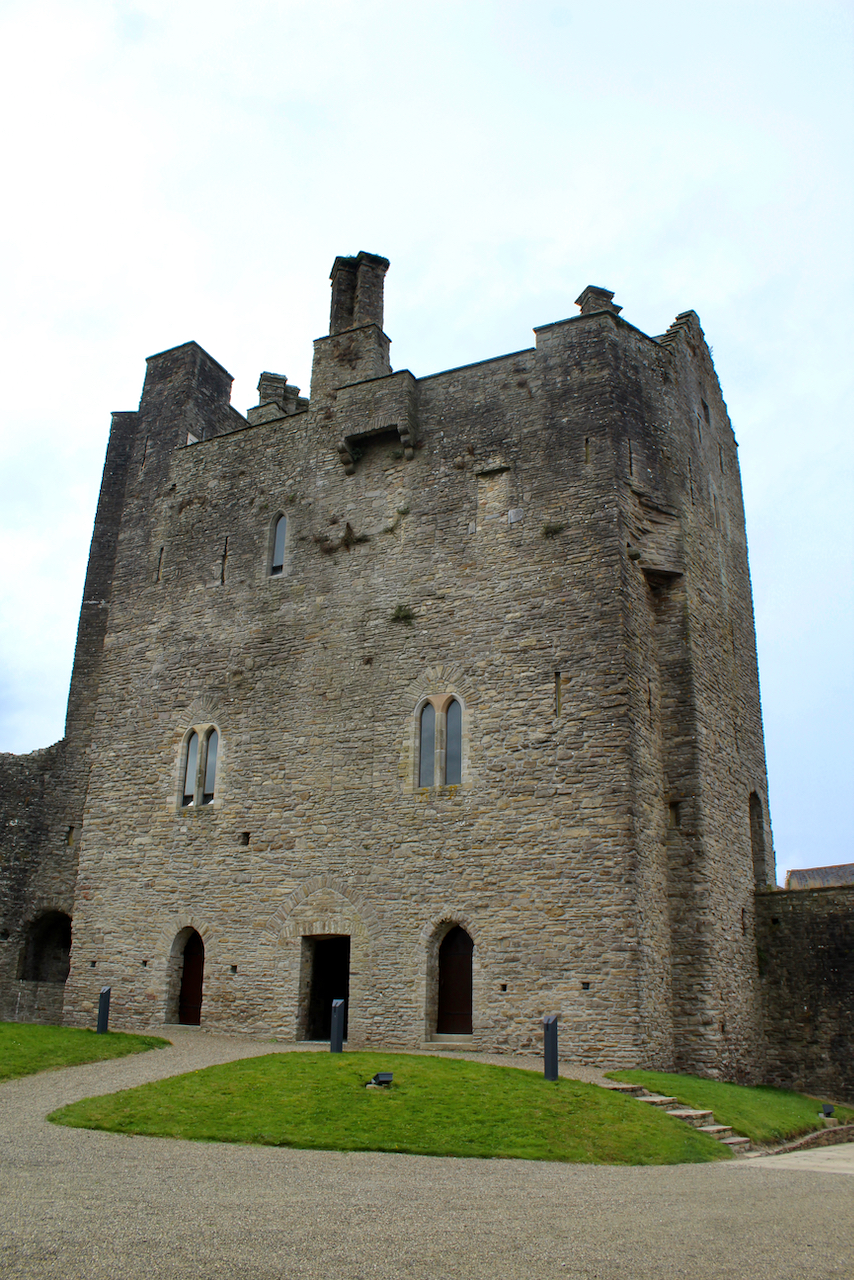
Roscrea Castle, August 2024. Photograph © Jennifer Winder-Baggot, www.irishhistorichouses.com
These buildings in Roscrea look impressively ancient. Photograph © Jennifer Winder-Baggot, www.irishhistorichouses.com
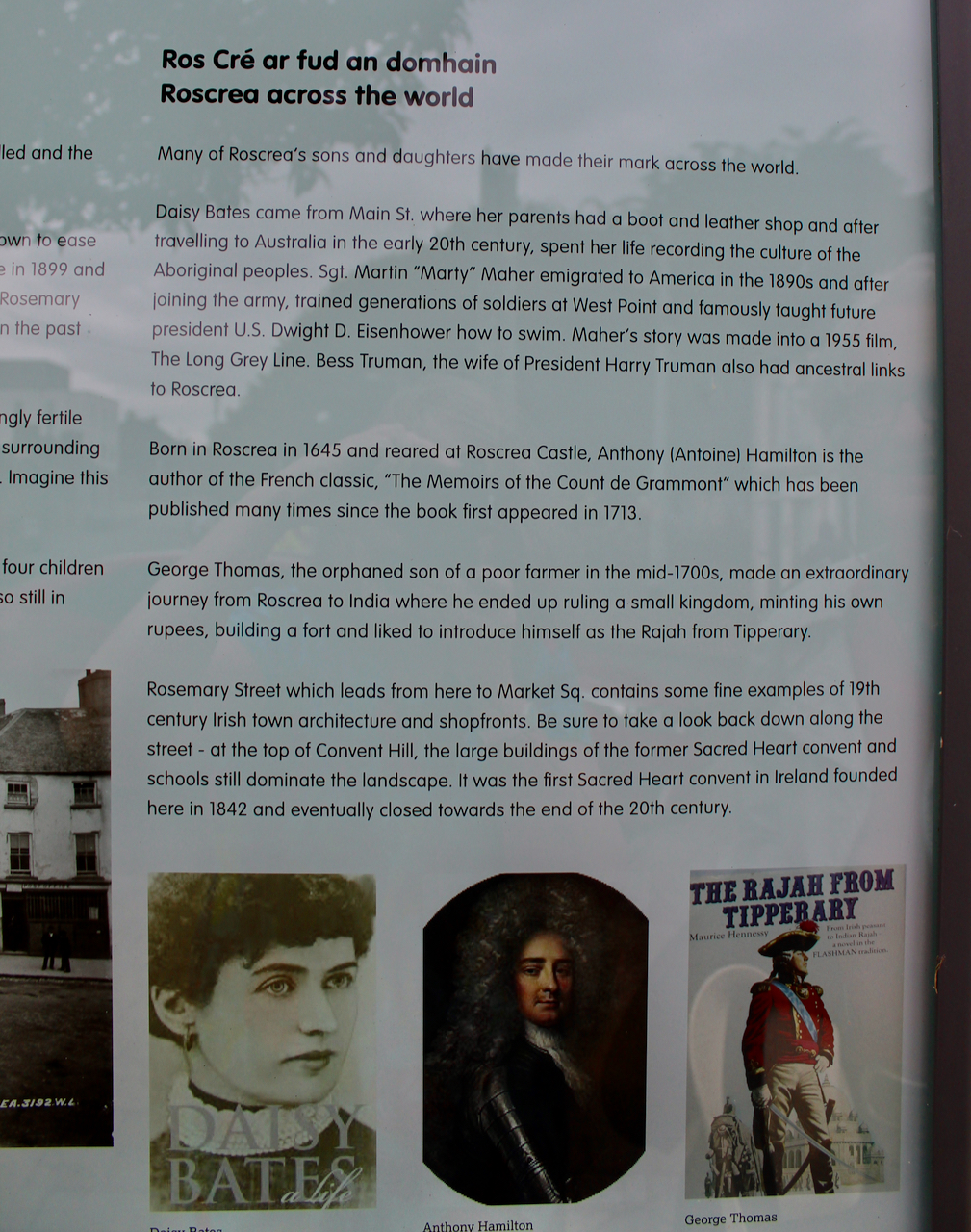
Stephen liked hearing of George Thomas, “the Rajah from Tipperary” who minted his own rupees. Photograph © Jennifer Winder-Baggot, www.irishhistorichouses.com

We stayed one night in Birr in the Stables townhouse. The houses along Oxmantown Mall are magnificent!

The Stables, Birr, August 2024. Photograph © Jennifer Winder-Baggot, www.irishhistorichouses.com
Oxmantown Mall, Birr, August 2024. Photograph © Jennifer Winder-Baggot, www.irishhistorichouses.com
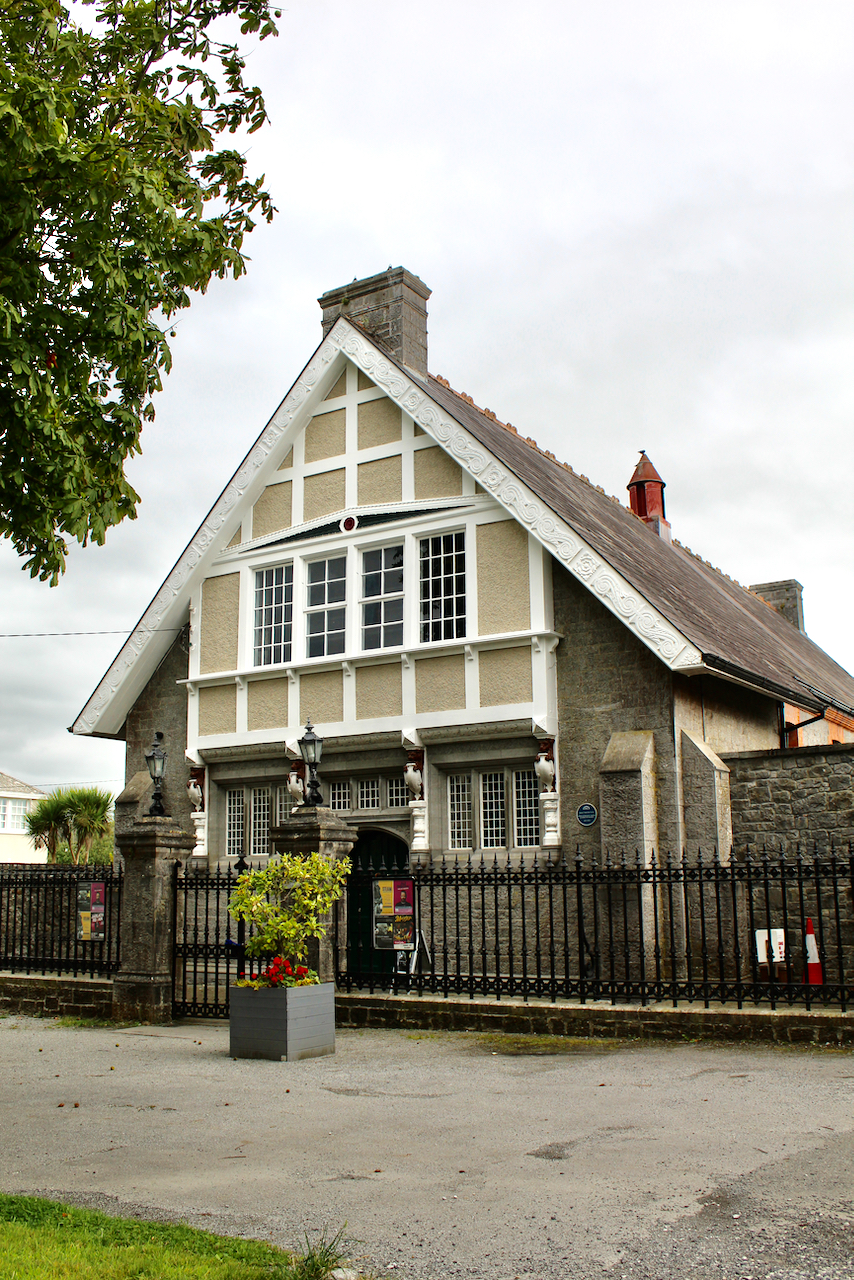
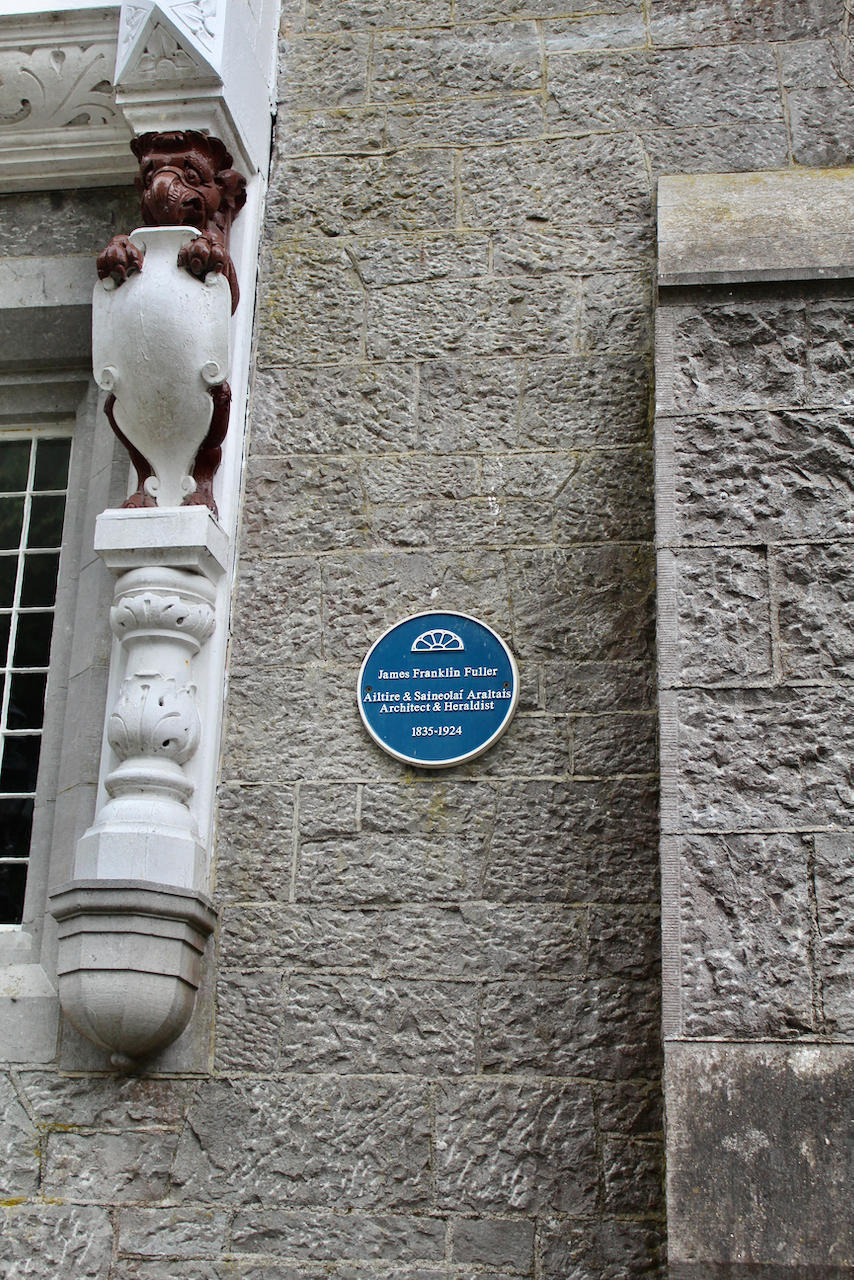
A theatre on Oxmantown Mall in Birr, designed by James Franklin Fuller. The idea of creating a theatre for the locality was formally announced on 10th September 1885, reports the Kings County Chronical. The site on Oxmantown Mall was donated by Lawrence Parsons the 4th Earl. Photograph © Jennifer Winder-Baggot, www.irishhistorichouses.com
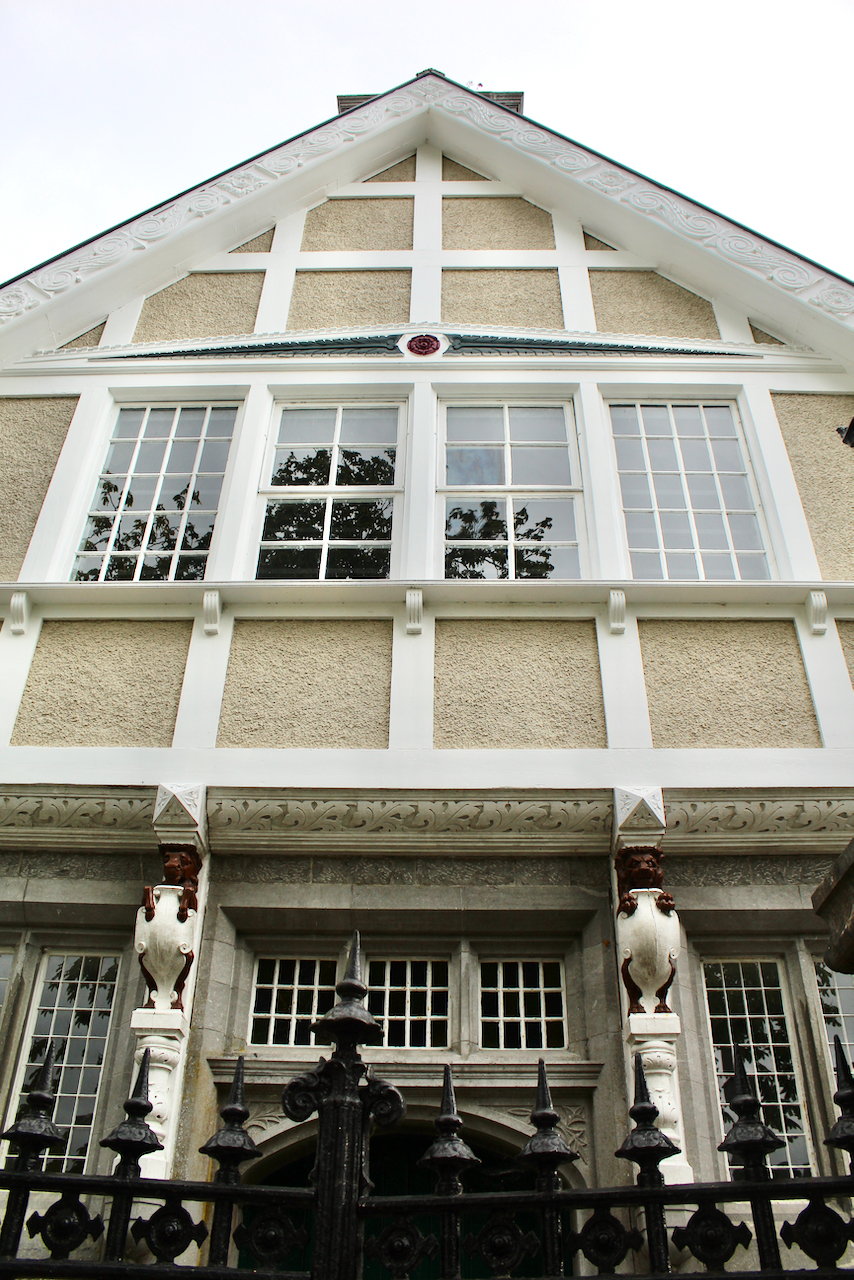
A theatre on Oxmantown Mall in Birr, designed by James Franklin Fuller. Photograph © Jennifer Winder-Baggot, www.irishhistorichouses.com
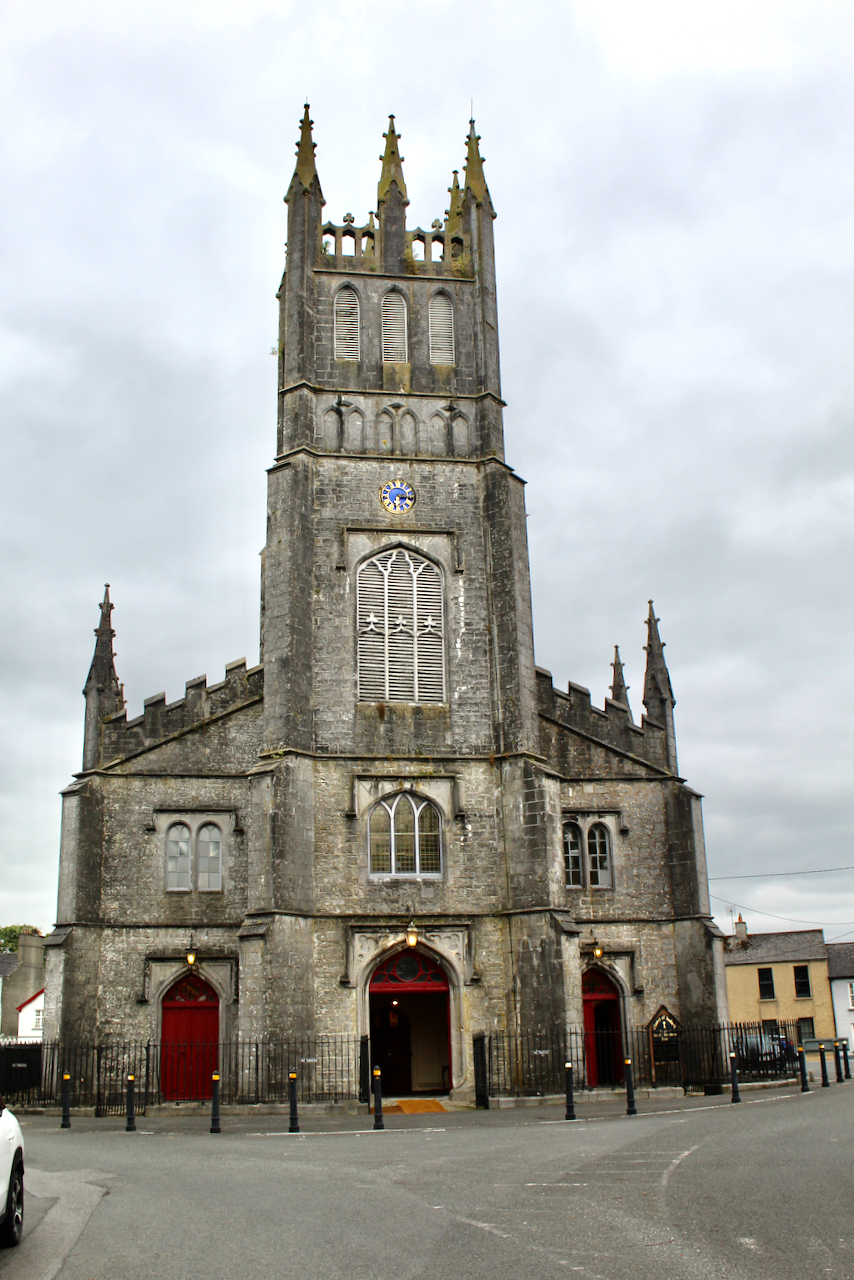
St. Brendan’s Church of Ireland, Oxmantown Mall, Birr. Built by the architect John Johnson in 1815, it was extended in 1876 by the renowned architect Sir Thomas Drew who added a new chancel. Further enhancements included the insertion of the east window, which was commissioned from Charles Kempe by the fourth Earl of Rosse in 1891. Photograph © Jennifer Winder-Baggot, www.irishhistorichouses.com
On Oxmantown Mall in Birr. Photograph © Jennifer Winder-Baggot, www.irishhistorichouses.com
Cumberland House, Emmet Square, Birr, built around 1760, decorated with Palladian motifs including Venetian and Diocletian style windows and a surmounting oculus, and Gibbsean doorway. Photograph © Jennifer Winder-Baggot, www.irishhistorichouses.com

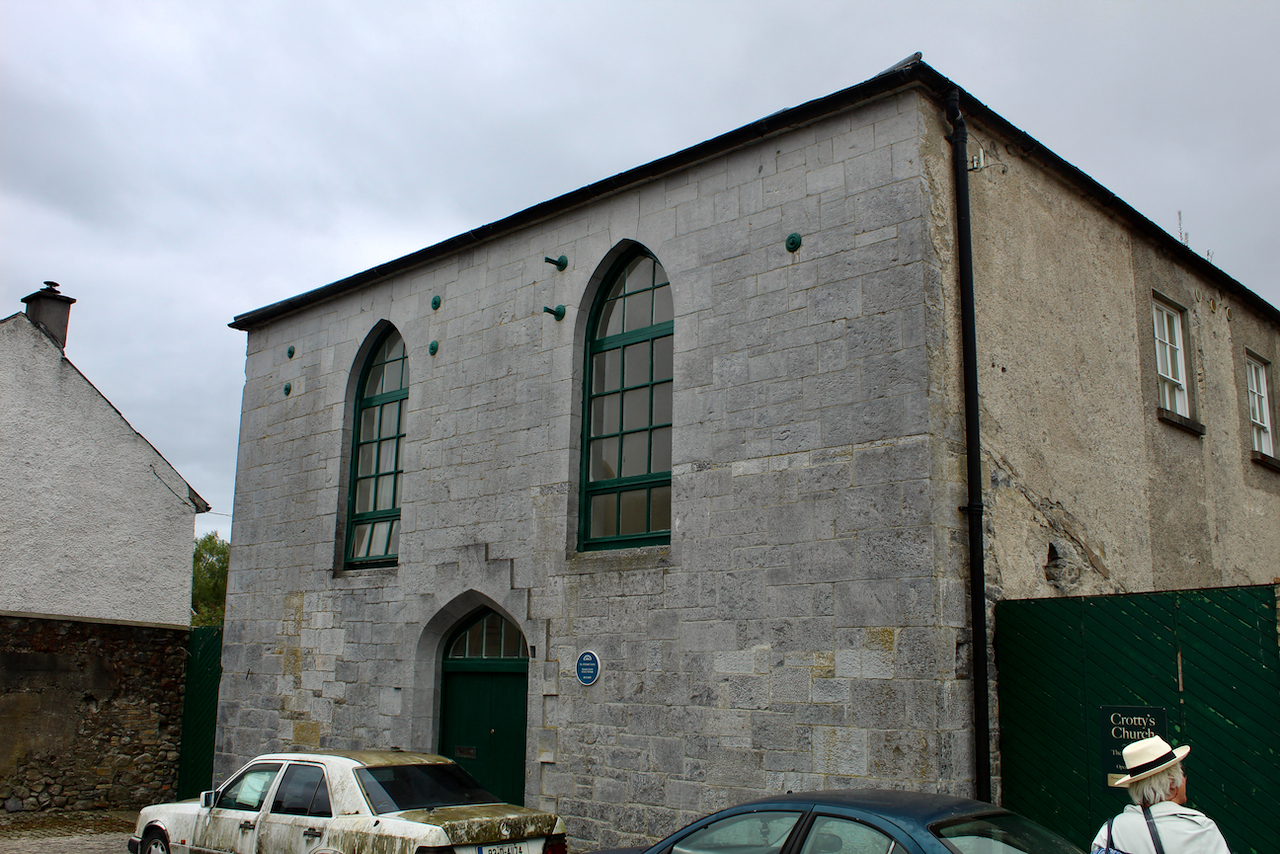
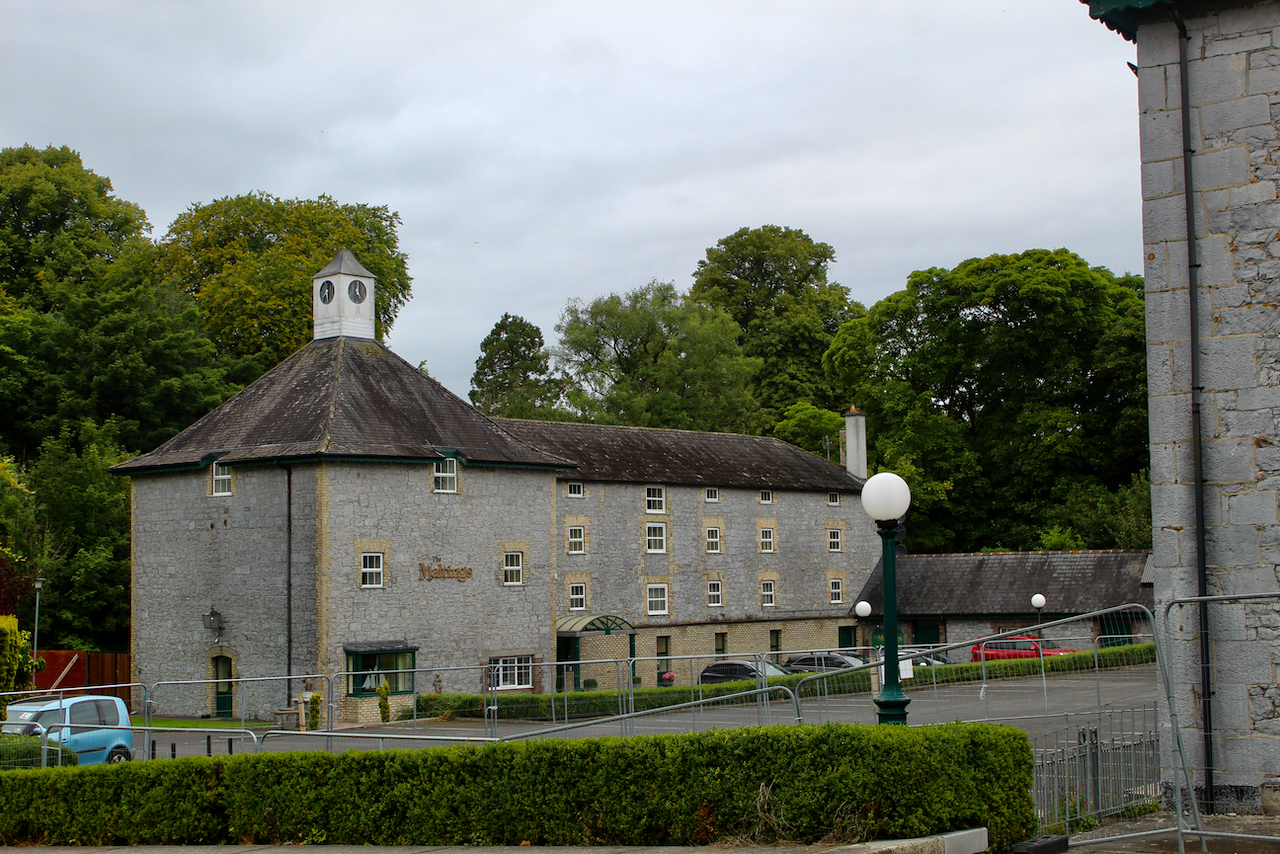
We didn’t get to visit the castle this time. Instead we were in the town to attend a talk about the Crotty Schism which took place in the Catholic church in the mid 1800s. I’ll be writing more about that soon, as the Crotty Church is a Section 482 property, although it is not open to the public! It is certainly meant to be open, and The Maltings across the road is meant to have tourist accommodation to earn its Section 482 status, but is also not open and never seems to have been since I started my blog in 2018, as I have often checked it out as a place to stay. For the talk on the Crotty Schism, we had to sit outside, despite rain threatening.

Crotty’s Church, Birr, which despite being a Section 482 property is not open to the public. Photograph © Jennifer Winder-Baggot, www.irishhistorichouses.com
The Maltings, Birr, County Offaly. Despite trying to book several times, this is not available for accommodation, despite being listed as tourist accommodation under Revenue Section 482. Photograph © Jennifer Winder-Baggot, www.irishhistorichouses.com
The Maltings, Birr, County Offaly, Photograph © Jennifer Winder-Baggot, www.irishhistorichouses.com
The Maltings, Birr, County Offaly, June 2023. Photograph © Jennifer Winder-Baggot, www.irishhistorichouses.com

On Saturday we visited Ballybrittan Castle, which we were lucky to see before it changes hands to a new owner. Rosemarie warmly welcomed her visitors, sharing the home she lived in and loved for 27 years along with her late husband Jerry Healy, who served on the boards of the Irish Georgian Society and the Alfred Beit Foundation, which manages Russborough House, Co Wicklow.

Ballybrittan, courtesy of Sherry Fitzgerald Rose de Vere Hunt and myhome.ie

Office of Public Works properties: Leinster: Laois, Longford, Louth, Meath, and Offaly

Carlow, Dublin, Kildare, Kilkenny, Laois, Longford, Louth, Meath, Offaly, Westmeath, Wexford and Wicklow are the counties that make up the Leinster region.

I have noticed that an inordinate amount of OPW sites are closed ever since Covid restrictions, if not even before that (as in Emo, which seems to be perpetually closed) [these sites are marked in orange here]. I must write to our Minister for Culture and Heritage to complain.

Laois:

1. Emo Court, County Laois – house closed at present

2. Heywood Gardens, County Laois

Longford:

3. Corlea Trackway Visitor Centre, County Longford

Louth:

4. Carlingford Castle, County Louth

5. Old Mellifont Abbey, County Louth – closed at present

Meath:

6. Battle of the Boyne site, Oldbridge House, County Meath

7. Hill of Tara, County Meath

8. Loughcrew Cairns, County Meath – guides on site from June 16th 2022

9. Newgrange, County Meath

10. Trim Castle, County Meath

Offaly:

11. Clonmacnoise, County Offaly

donation

Help me to pay the entrance fee to one of the houses on this website. This site is created purely out of love for the subject and I receive no payment so any donation is appreciated!

€15.00

Laois:

1. Emo Court, County Laois:

Emo, County Laois, June 2021. Unfortunately the stone lions which flank the front steps, carved by Richard Carter of Cork in 1854, were in boxes on the day we visited. [1] Photograph © Jennifer Winder-Baggot, www.irishhistorichouses.com

General enquiries: 057 862 6573, emocourt@opw.ie

See my entry https://irishhistorichouses.com/2024/10/22/emo-court-county-laois-office-of-public-works/

From the OPW website https://heritageireland.ie/visit/places-to-visit/emo-court/:

Emo Court is a quintessential neo-classical mansion, set in the midst of the ancient Slieve Bloom Mountains. The famous architect James Gandon, fresh from his work on the Custom House and the Four Courts in Dublin, set to work on Emo Court in 1790. However, the building that stands now was not completed until some 70 years later [with work by Lewis Vulliamy, a fashionable London architect, who had worked on the Dorchester Hotel in London and Arthur & John Williamson, from Dublin, and later, William Caldbeck].

The estate was home to the earls of Portarlington until the War of Independence forced them to abandon Ireland for good. The Jesuits moved in some years later [1920] and, as the Novitiate of the Irish Province, the mansion played host to some 500 of the order’s trainees.

Major Cholmeley-Harrison took over Emo Court in the 1960s and fully restored it [to designs by Sir Albert Richardson]. He opened the beautiful gardens and parkland to the public before finally presenting the entire estate to the people of Ireland in 1994.

You can now enjoy a tour of the house before relaxing in its charming tearoom. The gardens are a model of neo-classical landscape design, with formal lawns, a lake and woodland walks just waiting to be explored.” [2]

[1] p. 336. Tierney, Andrew. The Buildings of Ireland: Central Leinster: Kildare, Laois and Offaly. Yale University Press, New Haven and London, 2019.

[2] https://heritageireland.ie/visit/places-to-visit/emo-court/

2. Heywood Gardens, Ballinakill, County Laois:

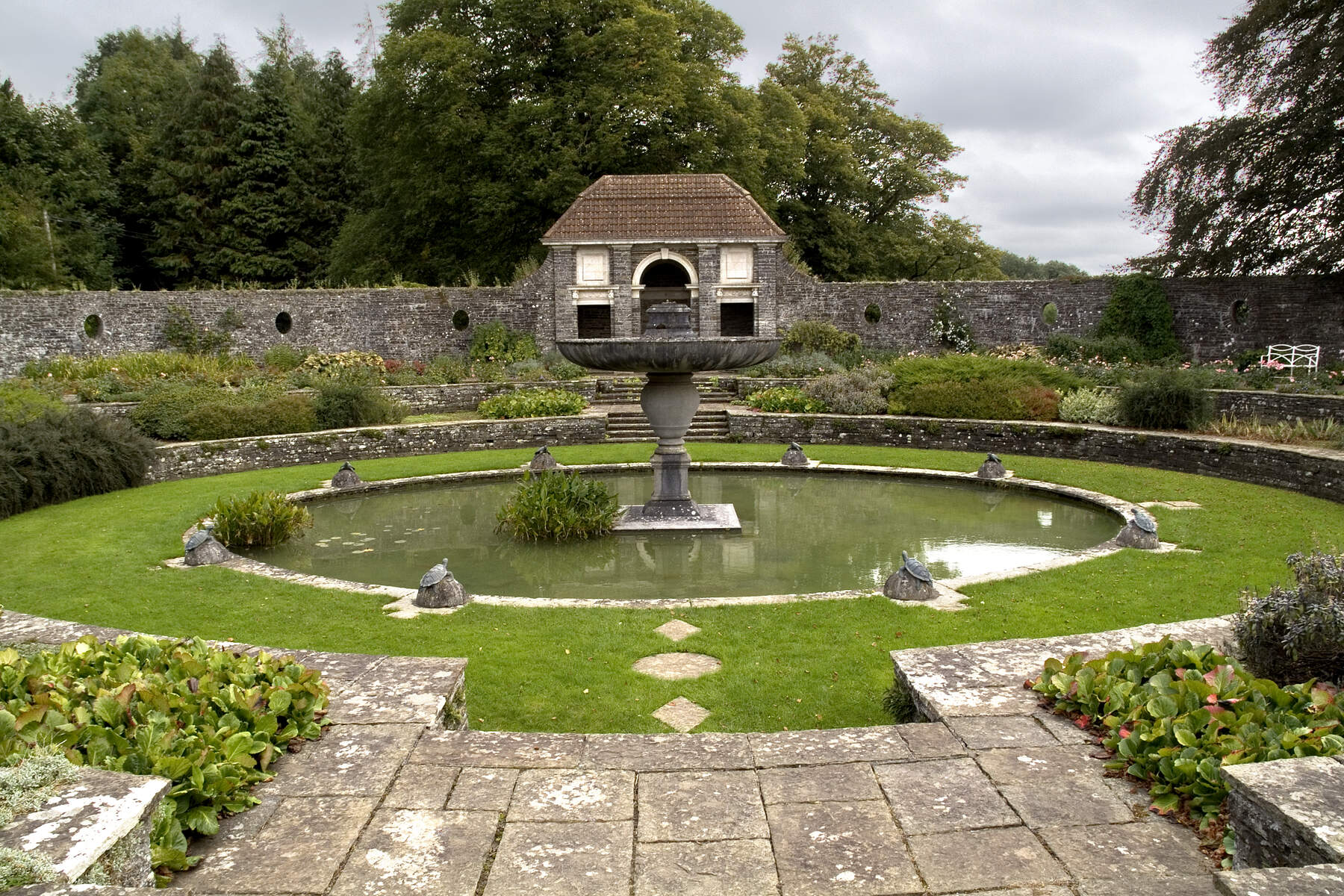
Heywood Gardens by Edwin Lutyens, photograph by Chris Hill 2014 for Tourism Ireland, Ireland’s Content Pool. [see 6]

General enquiries: 086 810 7916, emocourt@opw.ie

See my entry https://irishhistorichouses.com/2025/05/02/heywood-gardens-ballinakill-county-laois-office-of-public-works/

From the OPW website https://heritageireland.ie/visit/places-to-visit/heywood-gardens/:

The entrancing eighteenth-century landscape at Heywood Gardens, near Ballinakill, County Laois, consists of gardens, lakes, woodland and some exciting architectural features. The park is set into a sweeping hillside. The vista to the south-east takes in seven counties.

The architect Sir Edwin Lutyens designed the formal gardens [around 1906], which are the centrepiece of the property. It is likely that renowned designer Gertrude Jekyll landscaped them.

The gardens are composed of elements linked by a terrace that originally ran along the front of the house. (Sadly, the house is no more.) One of the site’s most unusual features is a sunken garden containing an elongated pool, at whose centre stands a grand fountain.

The Heywood experience starts beside the Gate Lodge. Information panels and signage will guide you around the magical Lutyens gardens and the surrounding romantic landscape.

Longford:

3. Corlea Trackway Visitor Centre, Kenagh, County Longford:

Corlea Trackway Visitor Centre, Co. Longford, photograph by Chris Hill 2018 for Tourism Ireland, Ireland’s Content Pool. [see 6]

General enquiries: 043 332 2386, corlea@opw.ie

From the OPW website https://heritageireland.ie/visit/places-to-visit/corlea-trackway-visitor-centre/:

Hidden away in the boglands of Longford, not far from Kenagh village, is an inspiring relic of prehistory: a togher – an Iron Age road – built in 148 BC. Known locally as the Danes’ Road, it is the largest of its kind to have been uncovered in Europe. 

Historians agree that it was part of a routeway of great importance. It may have been a section of a ceremonial highway connecting the Hill of Uisneach, the ritual centre of Ireland, and the royal site of Rathcroghan.

The trackway was built from heavy planks of oak, which sank into the peat after a short time. This made it unusable, of course, but also ensured it remained perfectly preserved in the bog for the next two millennia.

Inside the interpretive centre, an 18-metre stretch of the ancient wooden structure is on permanent display in a hall specially designed to preserve it. Don’t miss this amazing remnant of our ancient past.

Corlea Trackway Visitor Centre, Co. Longford, photograph by Christ Hill 2018 for Tourism Ireland, Ireland’s Content Pool. [see 6]
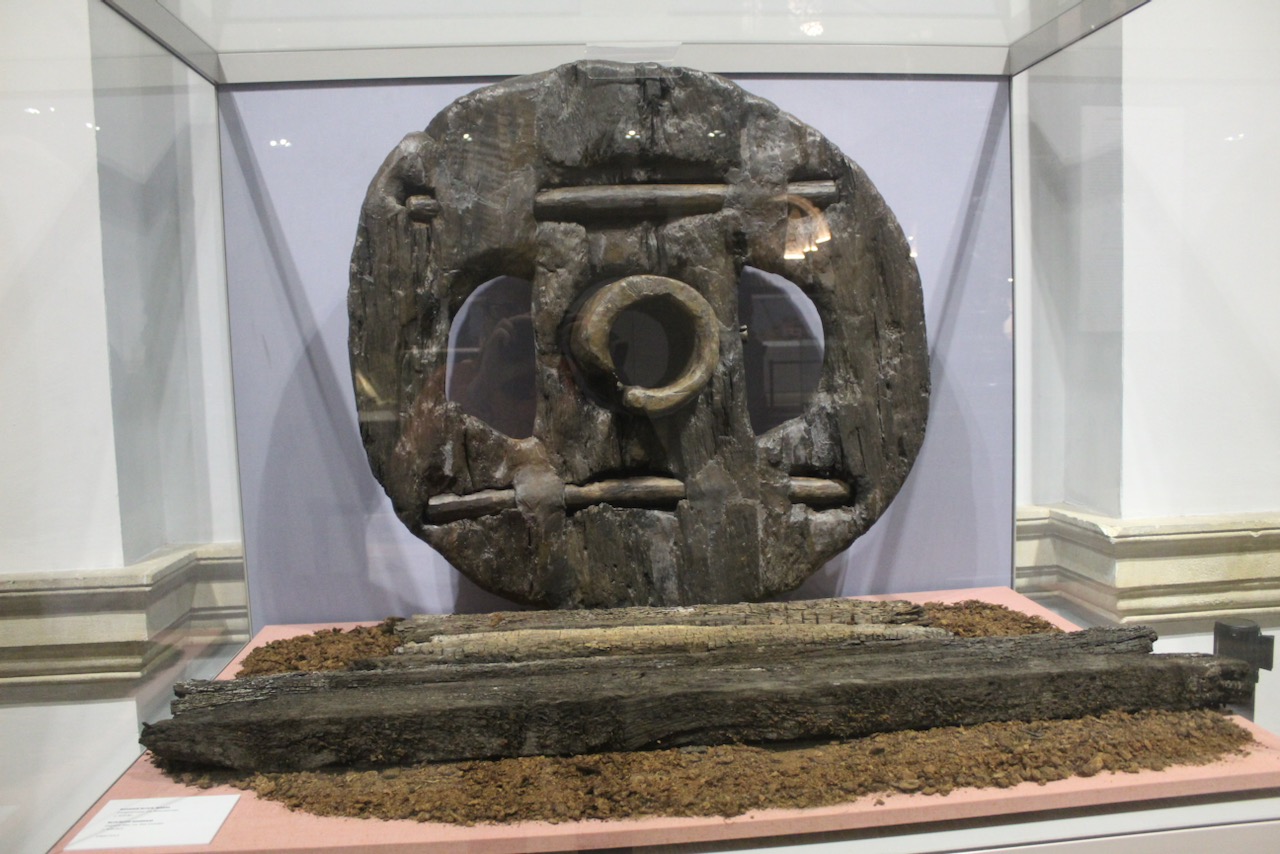
Wooden block wheel excavated in Doogarymore, County Roscommon, now in the National Museum of Ireland, Kildare Street, Dublin. From around 400BC. It may be the type of wheel that was used on the ancient roads! Photograph © Jennifer Winder-Baggot, www.irishhistorichouses.com
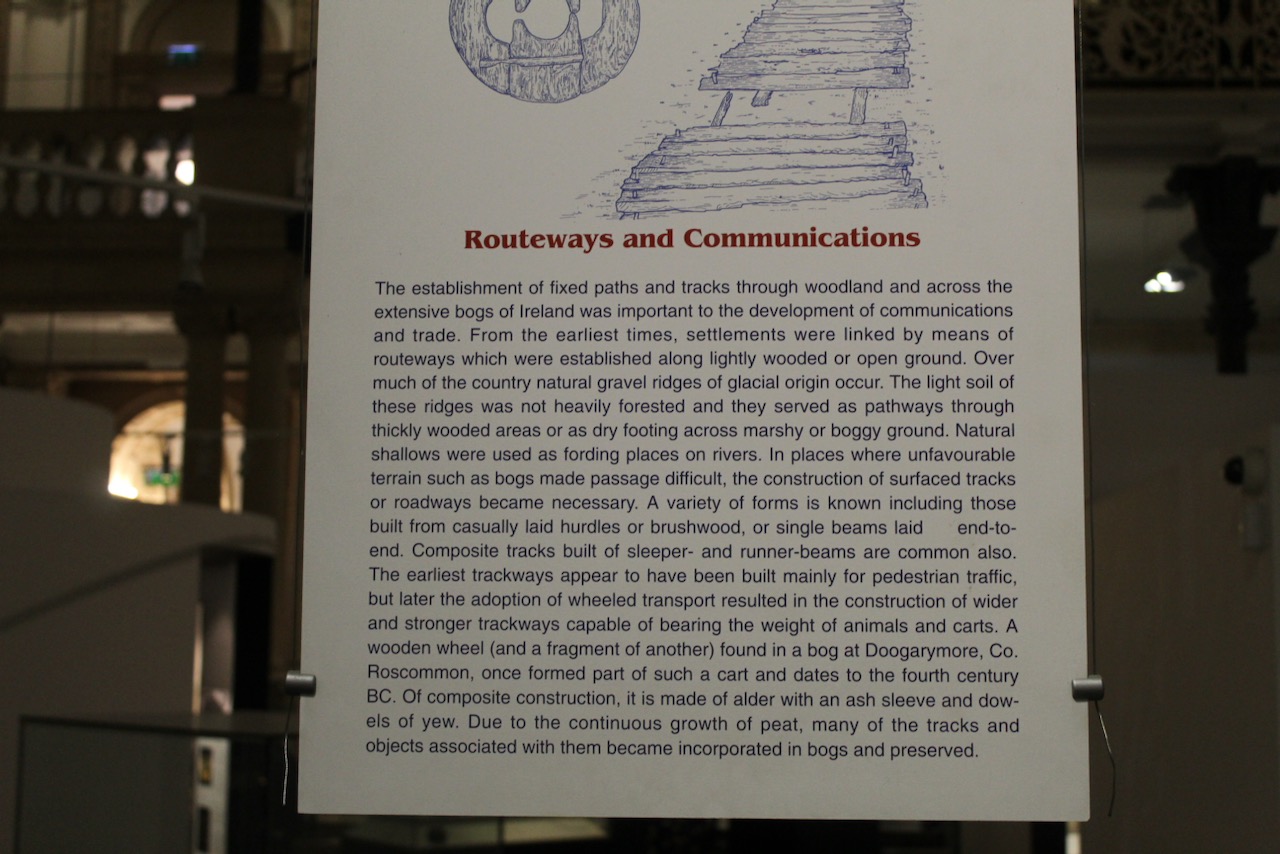
Information board from the National of Ireland Kildare Street.

Louth:

4. Carlingford Castle, County Louth:

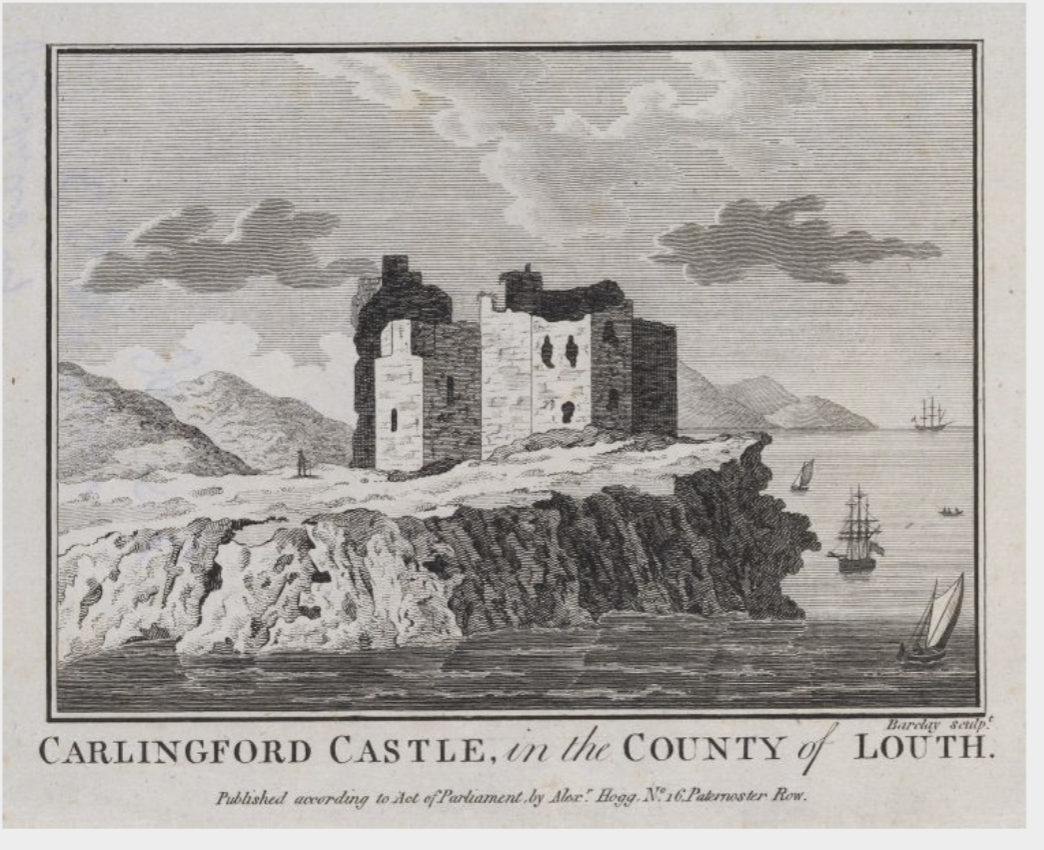
Carlingford Castle, also known as King John’s Castle (not to be confused with the one in Limerick), County Louth, photograph by Brenda Harris 2021 for Fáilte Ireland, Ireland’s Content Pool. [see 6]

From the OPW website https://heritageireland.ie/visit/places-to-visit/carlingford-castle/:

Carlingford lies in the shade of Slieve Foye, a mountain that in legend takes its form from the body of the sleeping giant Finn MacCumhaill. The castle dominates the town and overlooks the lough harbour. It was a vital point of defence for the area for centuries.

Carlingford Castle was built around 1190, most likely by the Norman baron Hugh de Lacy. By this time Hugh’s family had grown powerful enough to make King John of England uneasy. John forced them into rebellion and seized their property in 1210. He reputedly stayed in his new castle himself. It is still known as King John’s Castle.

Carlingford Castle, County Louth

The Jacobites fired on the castle in 1689; William of Orange is said to have accommodated his wounded soldiers there following the Battle of the Boyne.

Carlingford Lough Heritage Trust provides excellent guided tours of this historic Castle from March to October.

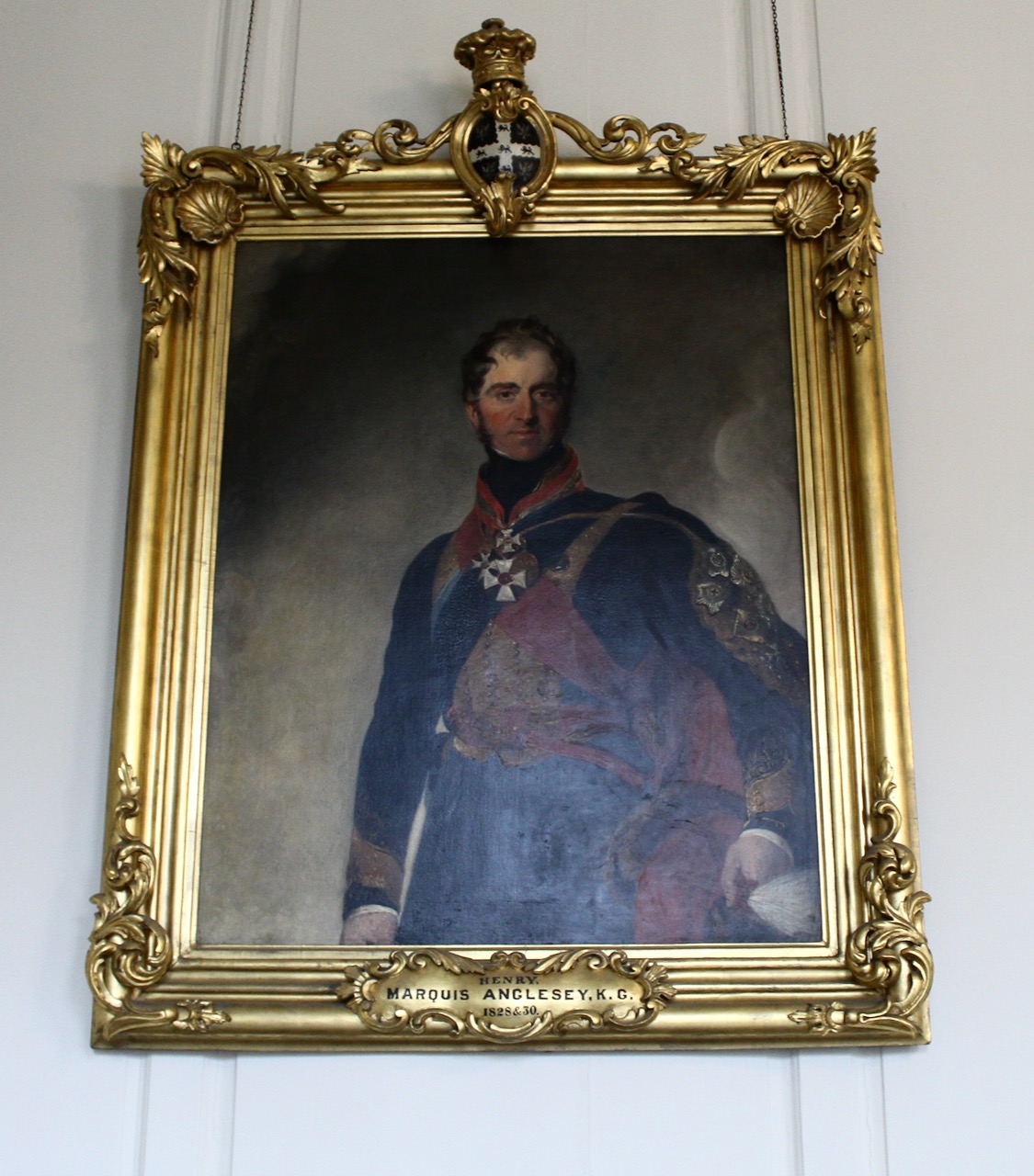
By 1778 the building was ruinous. The task of repair and preservation was begun by the Henry Paget the 1st Marquess of Anglesey in the later nineteenth century (he served as Lord Lieutenant of Ireland from 1848, and as Master General of the Ordinance), and has been continued by the OPW. [13]

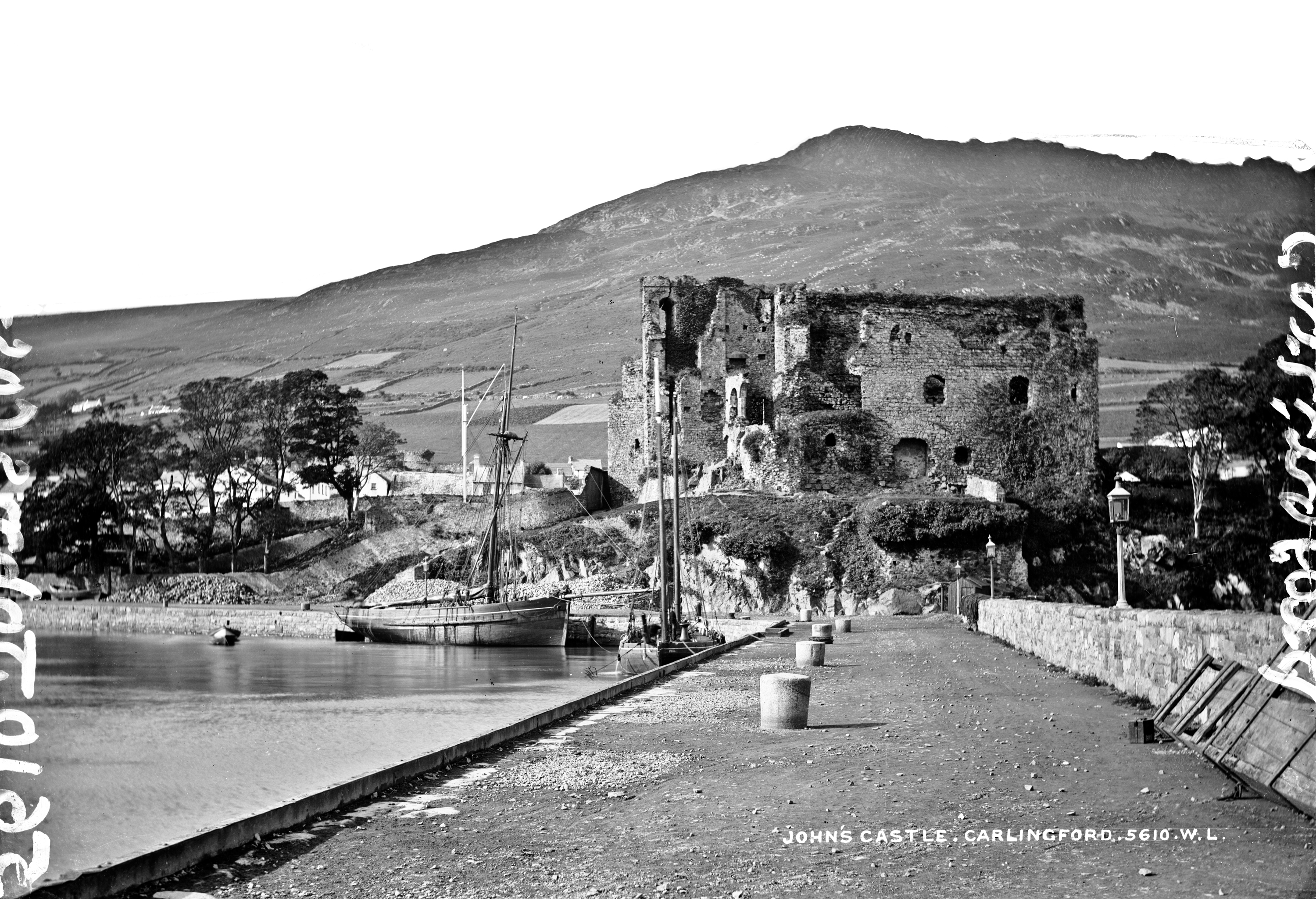
Carlingford Castle Co Louth National Library of Ireland by Robert French, Lawrence Photograph Collection.
Henry Paget, 1st Marquess of Anglesey (1768-1854), Viceroy in 1828 and 1830.

5. Old Mellifont Abbey, Tullyallen, Drogheda, County Louth:

Old Mellifont Abbey, photograph by Eilish Tierney, 2020 for Fáilte Ireland, Ireland’s Content Pool. [see 6]
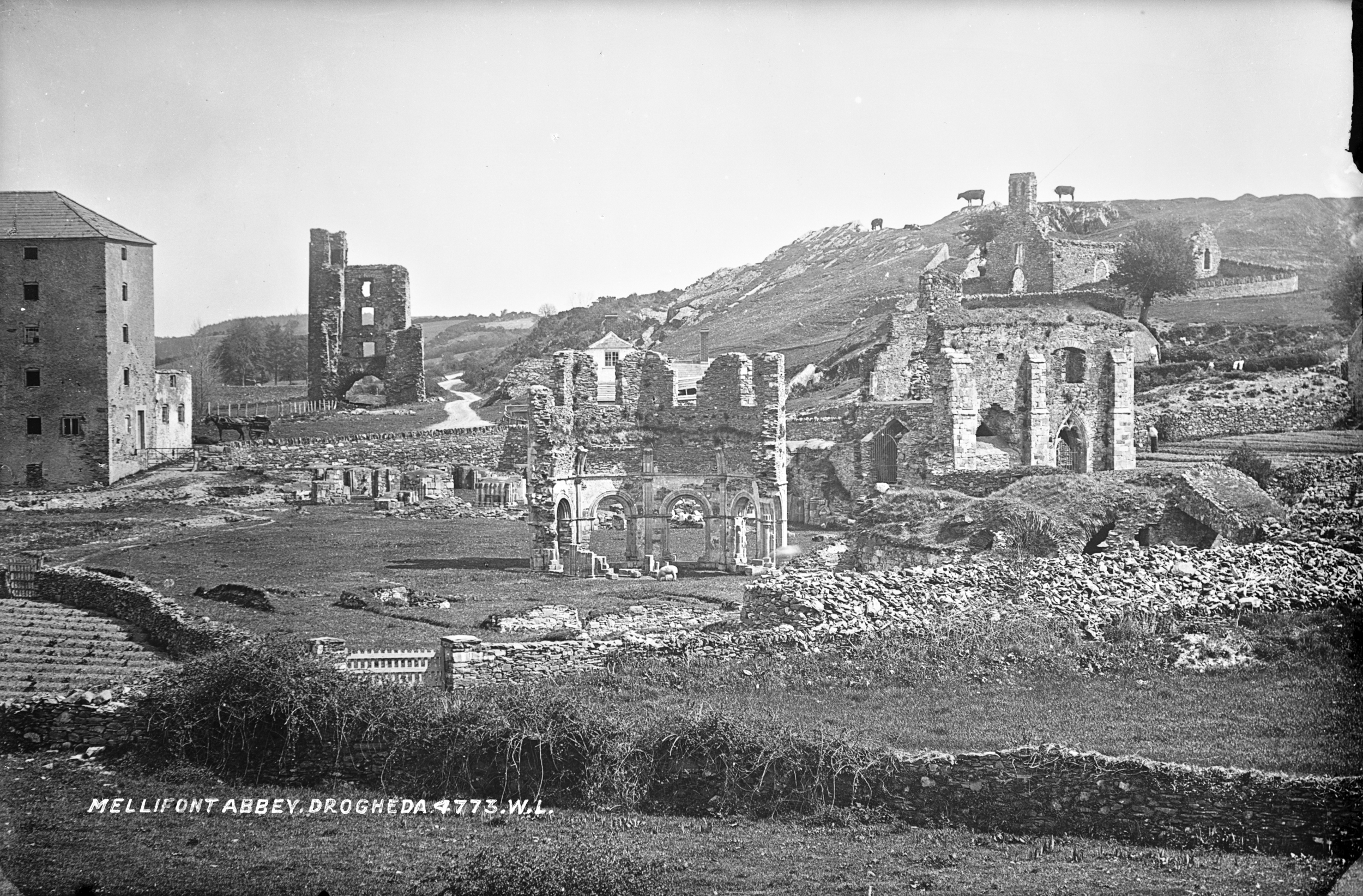
Mellifont Abbey from National Library of Ireland Lawrence photograph collection, flickr constant commons.

General enquiries: 041 982 6459, mellifontabbey@opw.ie. Mellifont means “fountain of honey.”

From the OPW website https://heritageireland.ie/visit/places-to-visit/old-mellifont-abbey/:

Mellifont Abbey was the first Cistercian monastery in Ireland. St Malachy of Armagh created it in 1142 with the help of a small number of monks sent by St Bernard from Clairvaux [and with the aid of Donough O’Carroll, King of Oriel – see 14]. The monks did not take well to Ireland and soon returned to France, but the abbey was completed anyway and duly consecrated with great pomp.

It has several extraordinary architectural features, the foremost of which is the two-storey octagonal lavabo [the monk’s washroom]

The monks at Mellifont hosted a critical synod in 1152. The abbey was central to the history of later centuries, too, even though it was in private hands by then. The Treaty of Mellifont, which ended the Nine Years War, was signed here in 1603, and William of Orange used the abbey as his headquarters during the momentous Battle of the Boyne.

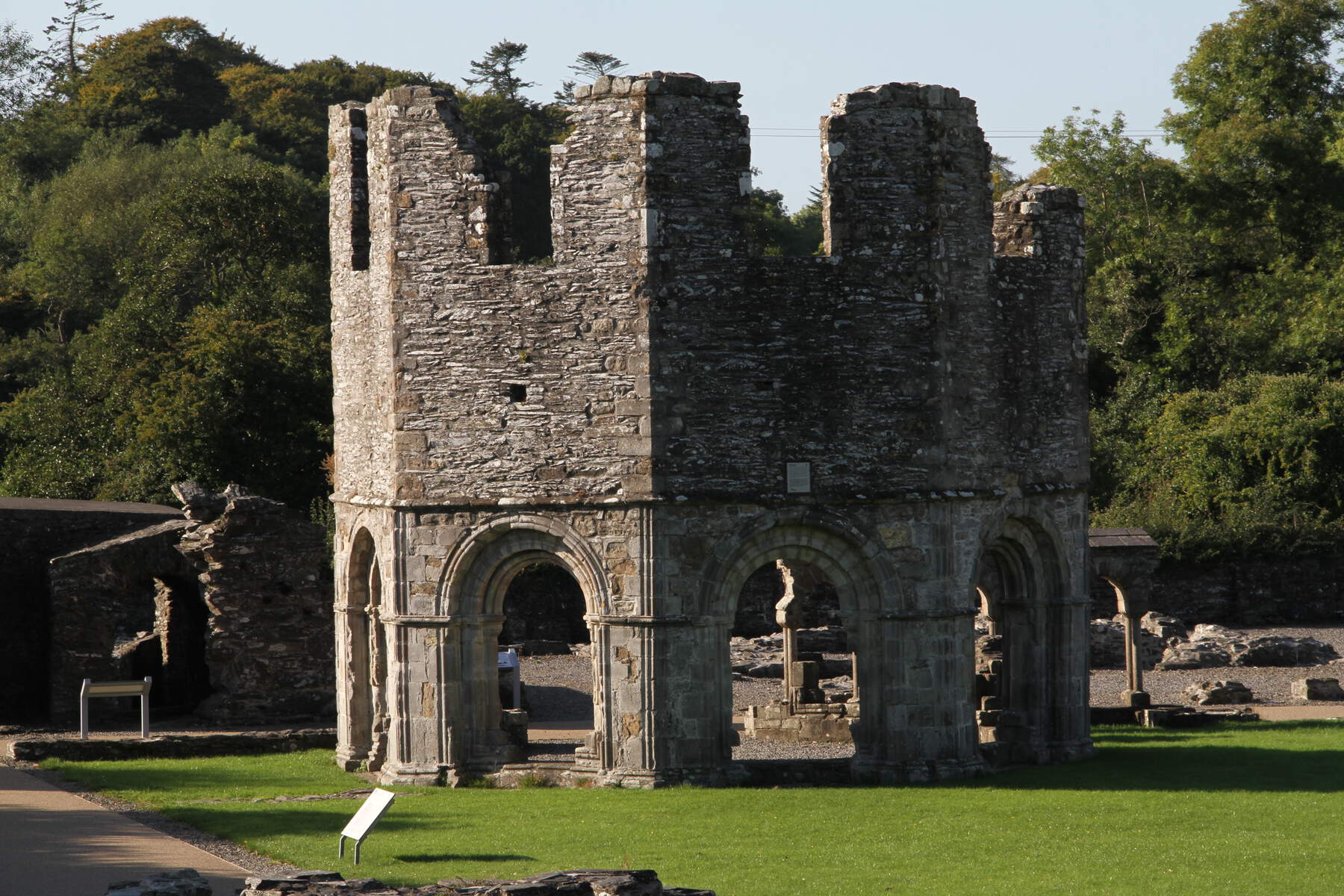
Mellifont Abbey ruins, the octagonal lavabo, built in around 1200, photograph by Brian Harte, 2015 for Tourism Ireland, Ireland’s Content Pool. [see 6]

The ruins contain the medieval gatehouse, parish church, chapter house and lavabo. The octagonal lavabo was designed as a freestanding structure of two storeys, with an octagonal cistern to supply the water located at the upper level over the wash room. Wash basins were arranged around a central pier, now gone, which supported the weight of the water above. [14] The entire monastery was surrounded by a defensive wall. After the dissolution of the monasteries, Mellifont was acquired in 1540 by William Brabazon (died 1552), Vice Treasurer of Ireland, and passed later to Edward Moore (Brabazon’s wife Elizabeth Clifford remarried three times after Brabazon’s death, and one of her husbands was Edward Moore), who established a fortified house within the ruins around 1560. His descendents (Viscounts of Drogheda) lived there until 1727 (until the time of Edward Moore, 5th Earl of Drogheda), after which the house, like the abbey, fell into disrepair.

Garret Moore, 1st Viscount of Drogheda, hosted the negotiations which led to the Treaty of Mellifont in 1603.

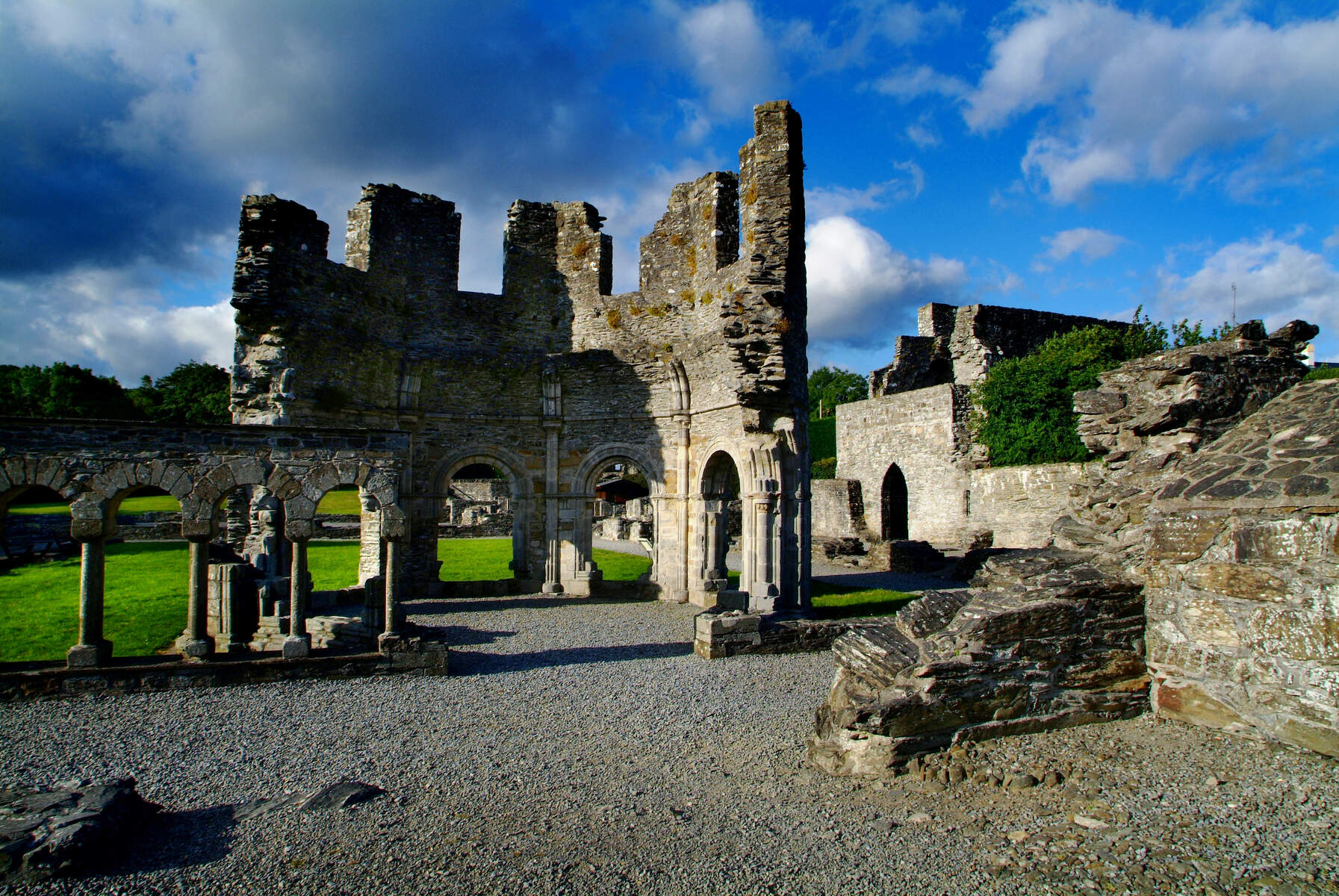
Mellifont Abbey ruins, photograph by Chris Hill, 2014 for Tourism Ireland, Ireland’s Content Pool. [see 6]

Meath:

Photograph © Jennifer Winder-Baggot, www.irishhistorichouses.com

6. Battle of the Boyne site and visitor centre, Oldbridge House, County Meath.

Oldbridge House, County Meath, October 2019. Photograph © Jennifer Winder-Baggot, www.irishhistorichouses.com

General Enquiries: 041 980 9950, battleoftheboyne@opw.ie

The Battle of the Boyne museum is housed in Oldbridge Hall, which is built on the site where the Battle of the Boyne took place. See my entry https://irishhistorichouses.com/2025/12/12/oldbridge-hall-county-meath-site-of-the-battle-of-the-boyne-visitor-centre/

7. Loughcrew Cairns, Corstown, Oldcastle, County Meath:

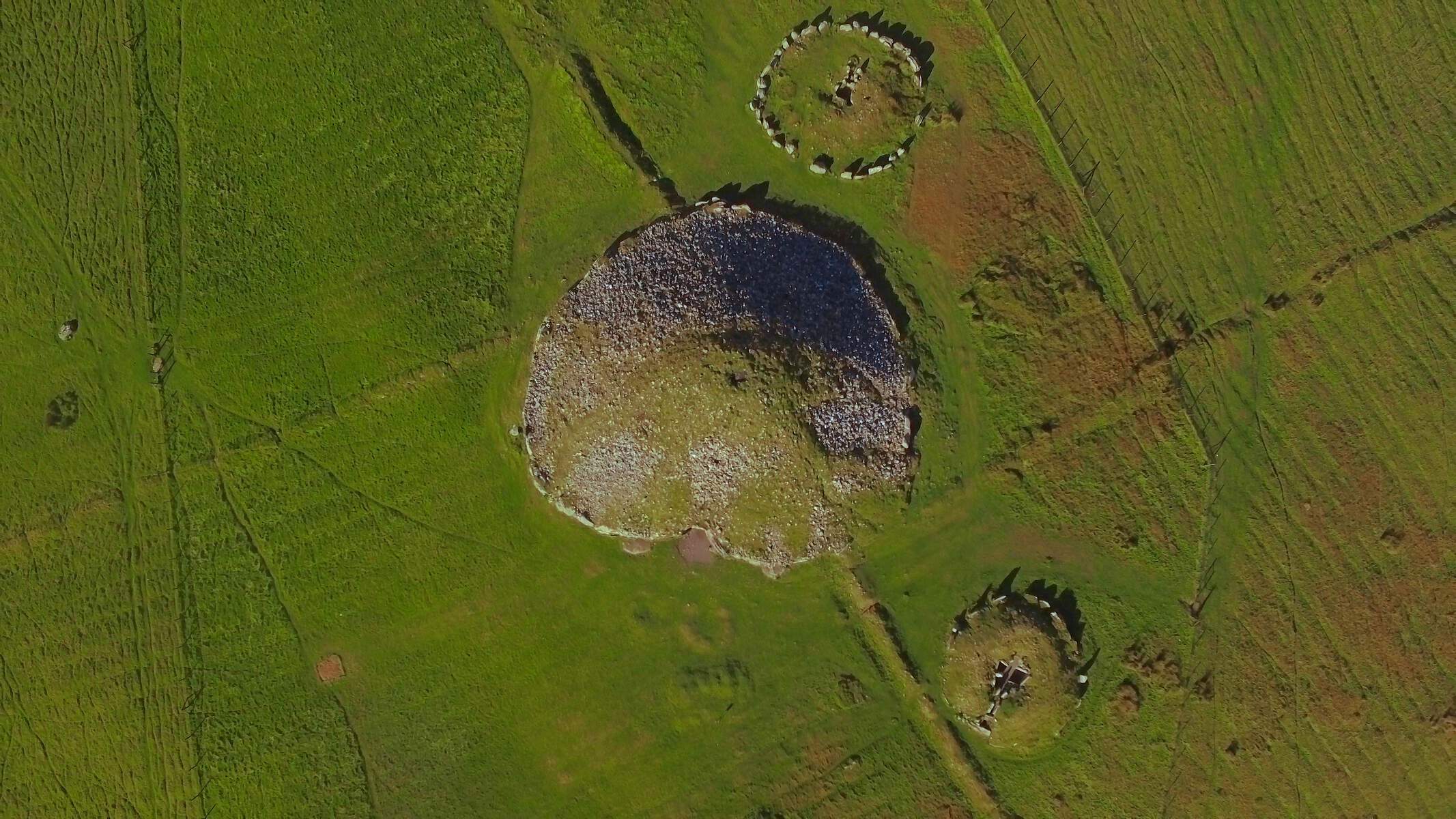
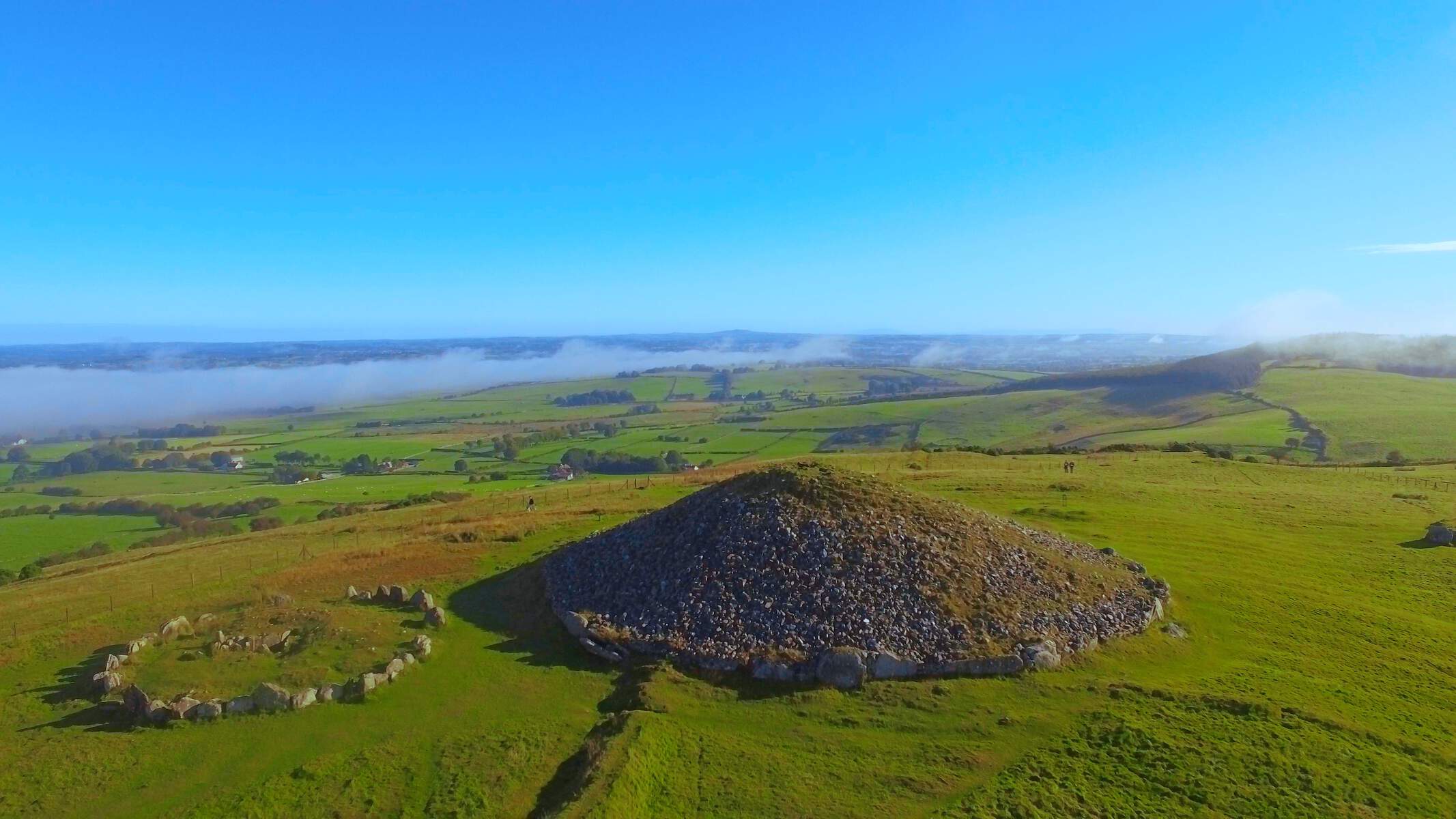
Loughcrew cairns, photograph by Macmillan media, 2015 for Tourism Ireland, Ireland’s Content Pool. [see 6]

general enquiries: 087 052 4975, info@heritageireland.ie

From the OPW website https://heritageireland.ie/visit/places-to-visit/loughcrew-cairns/:

The Loughcrew cairns, also known as the Hills of the Witch, are a group of Neolithic passage tombs near Oldcastle in County Meath. Spread over four undulating peaks, the tombs are of great antiquity, dating to 3000 BC. 

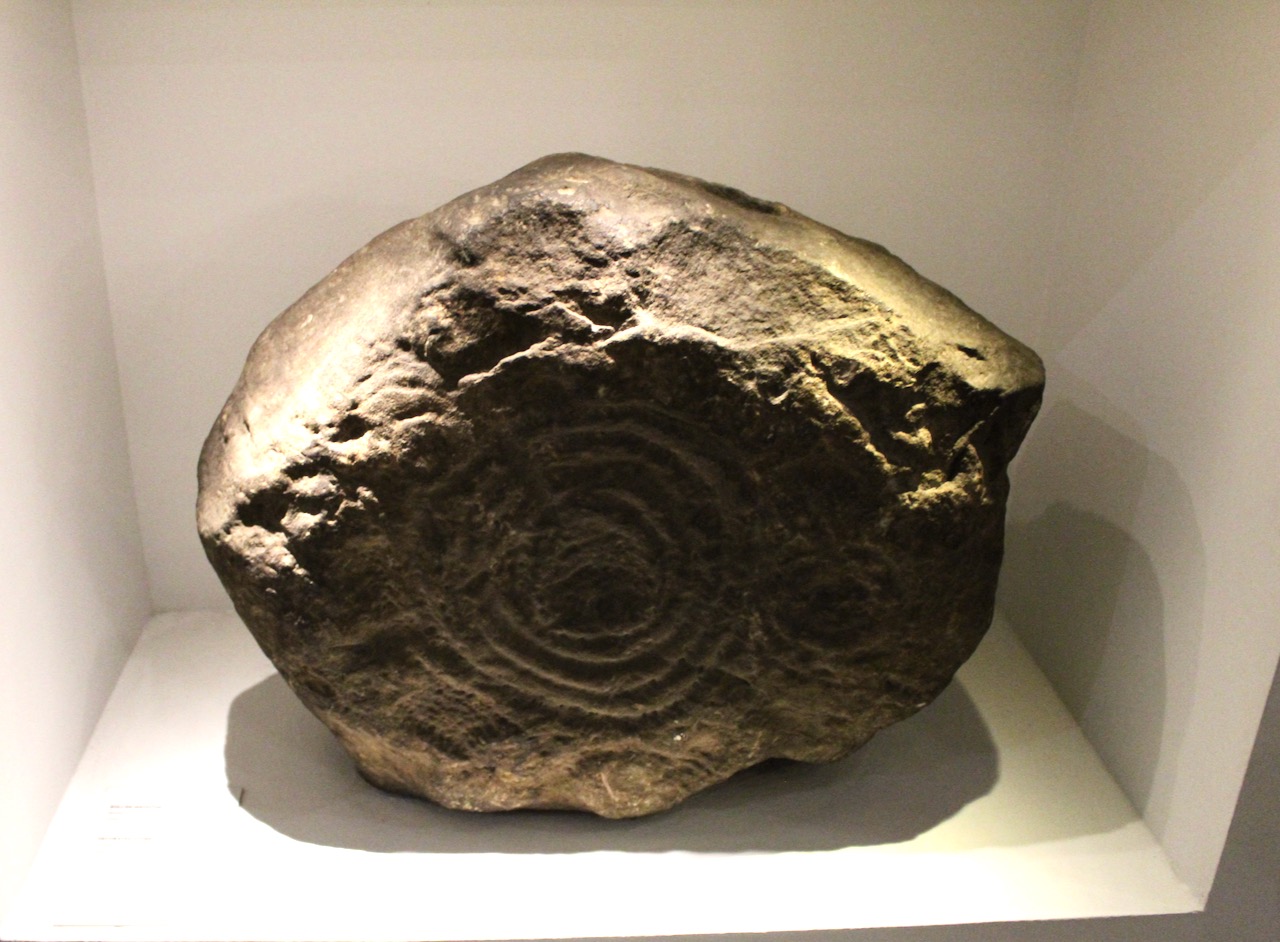
Cairn T is one of the largest tombs in the complex. Inside it lies a cruciform chamber, a corbelled roof and some of the most beautiful examples of Neolithic art in Ireland. The cairn is aligned to sunrise at the spring and autumn equinoxes and at these times people gather there to greet the first rays of the sun.

Loughcrew cairns, photograph by Macmillan media, 2015 for Tourism Ireland, Ireland’s Content Pool. [see 6]
Carved stone from Loughcrew, in the National Museum of Ireland, Kildare Street, Dublin. Photograph © Jennifer Winder-Baggot, www.irishhistorichouses.com

8. Brú na Bóinne Visitor Centre, Newgrange and Knowth, County Meath.

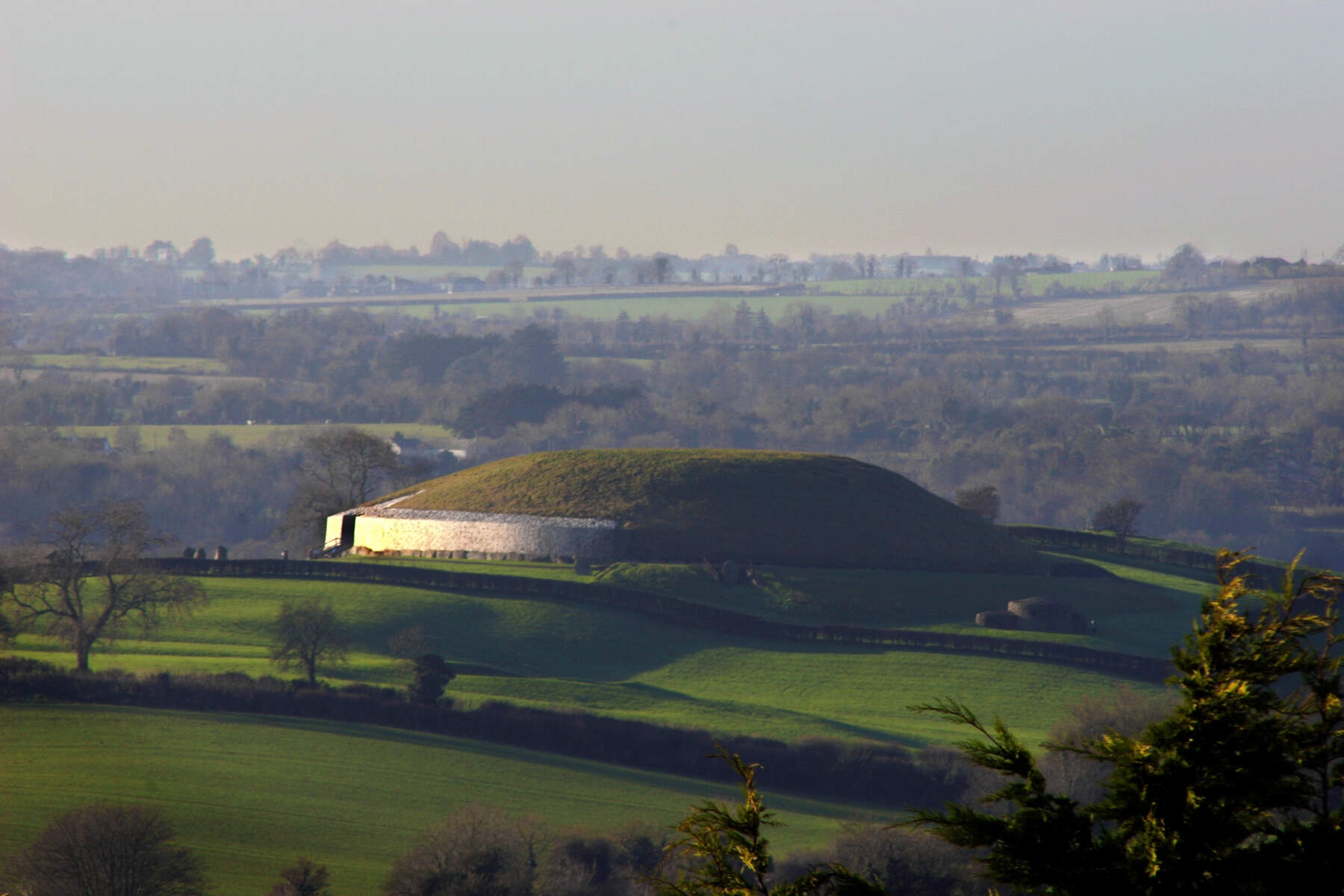
Newgrange, seen from the top of another nearby tumulus, Dowth. Newgrange is a UNESCO World Heritage Site, and dates to some 5,000 years ago…Photograph by Dave Walsh, 2004 for Tourism Ireland. [see 6]

General Information: 041 988 0300, brunaboinne@opw.ie

From the website https://heritageireland.ie/visit/places-to-visit/bru-na-boinne-visitor-centre-newgrange-and-knowth/:

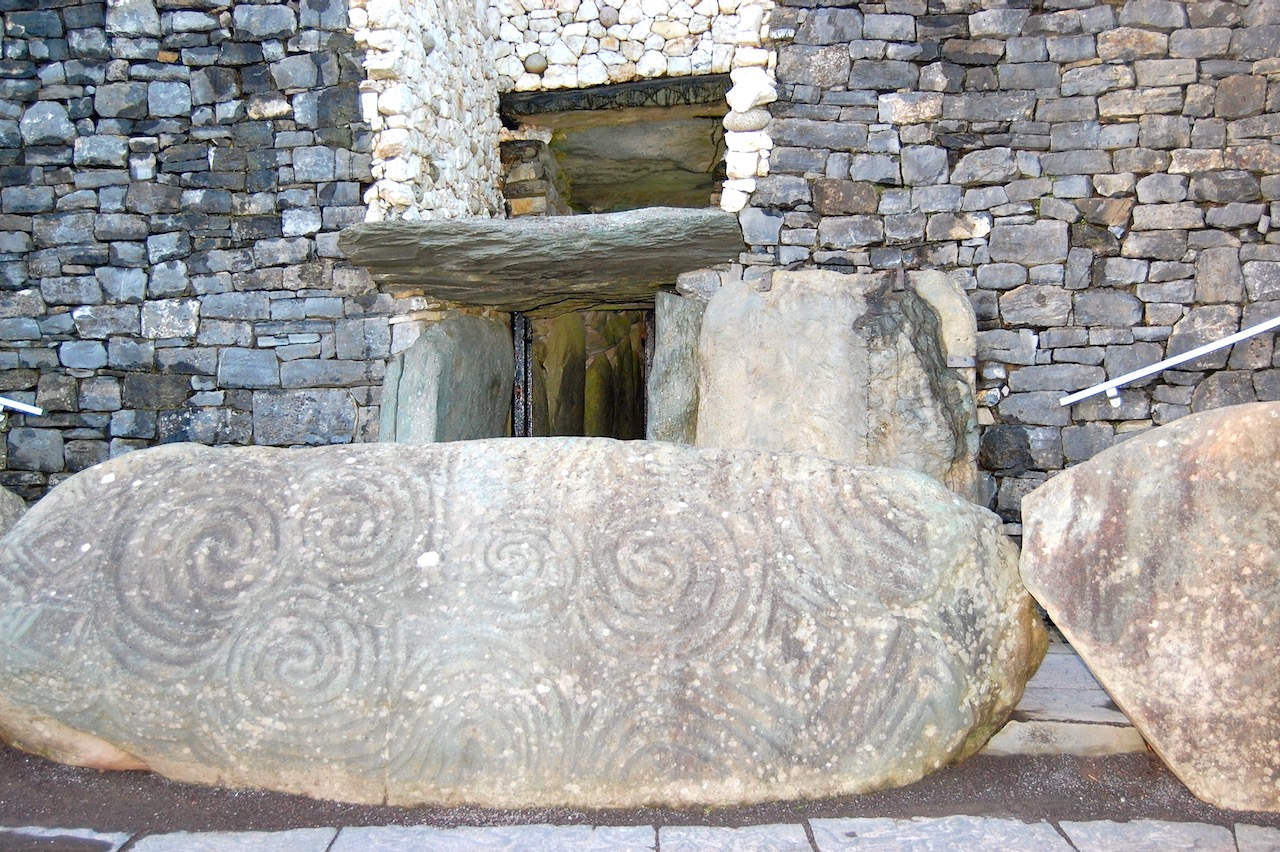
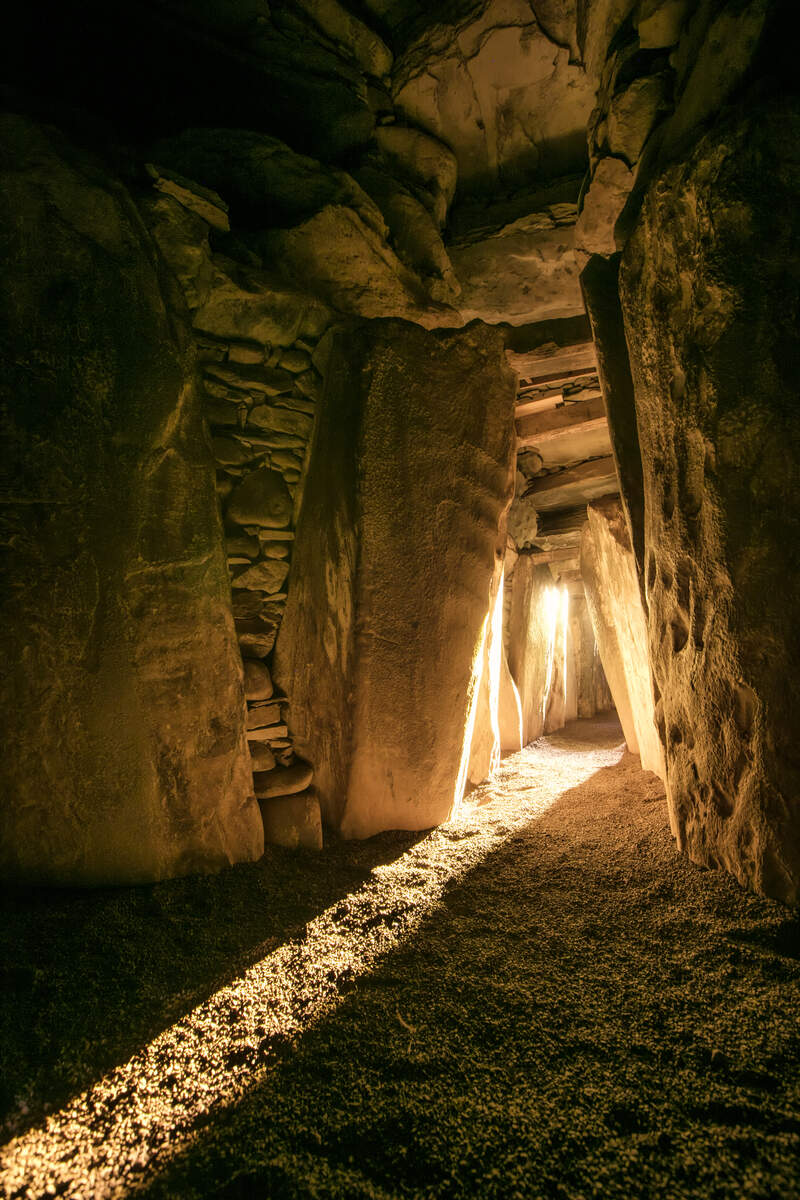
The World Heritage Site of Brú na Bóinne is Ireland’s richest archaeological landscape and is situated within a bend in the River Boyne. Brú na Bóinne is famous for the spectacular prehistoric passage tombs of Knowth, Newgrange and Dowth which were built circa 3200BC. These ceremonial structures are among the most important Neolithic sites in the world and contain the largest collection of megalithic art in Western Europe.

Newgrange, County Meath, December 2013. Photograph © Jennifer Winder-Baggot, www.irishhistorichouses.com
Newgrange, Co Meath, Ireland, photograph by Brian Morrison, 2018 for Tourism Ireland, Ireland’s Content Pool. [see 6]
Newgrange, Co Meath , Ireland, photograph by Brian Morrison, 2018 for Tourism Ireland, Ireland’s Content Pool. [see 6]
Winter Solstice, Newgrange, Co Meath , Ireland, photograph by Brian Morrison, 2018 for Tourism Ireland, Ireland’s Content Pool. [see 6]

9. Hill of Tara, Navan, County Meath:

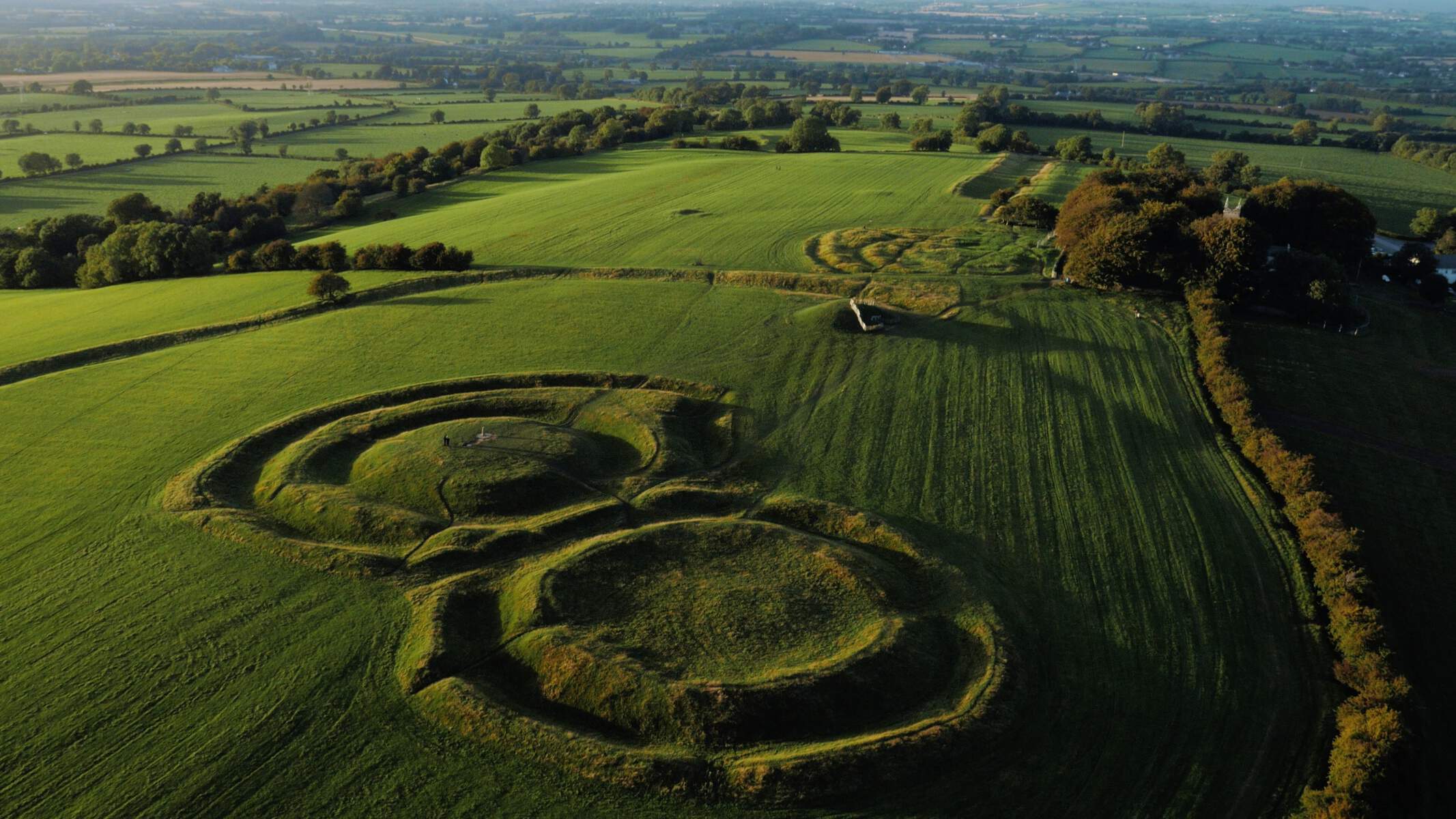
Hill of Tara, County Meath, photograph by macmillan media 2015 for Tourism Ireland, Ireland’s Content Pool. [see 6]
Diorama of Tara in the National Museum of Ireland, Kildare Street, Dublin, 2022. Key: 2. Rath/Fort of the Kings, a hilltop enclosure; 3: Royal Seat, a barrow; 4. Cormac’s House, a ringfort; 5. Stone of Destiny, Liah Fail, a standing stone; 6. Mound of the Hostages, a passage tomb; 7. Rath of the Synods, an enclosure; 8. Banqueting Hall, a linear earthwork.

General information: 046 902 5903, hilloftara@opw.ie

From the OPW website:

The Hill of Tara has been important since the late Stone Age, when a passage tomb was built there. However, the site became truly significant in the Iron Age (600 BC to 400 AD) and into the Early Christian Period when it rose to supreme prominence – as the seat of the high kings of Ireland. All old Irish roads lead to this critical site.

St Patrick himself went there in the fifth century. As Christianity achieved dominance over the following centuries, Tara’s importance became symbolic. Its halls and palaces have now disappeared and only earthworks remain. 

There are still remarkable sights to be seen, however. Just one example is the Lia Fáil – the great coronation stone and one of the four legendary treasures of the Tuatha Dé Danann – which stands proudly on the monument known as An Forradh.

Guided tours of the site will help you understand the regal history of this exceptional place and imagine its former splendour.

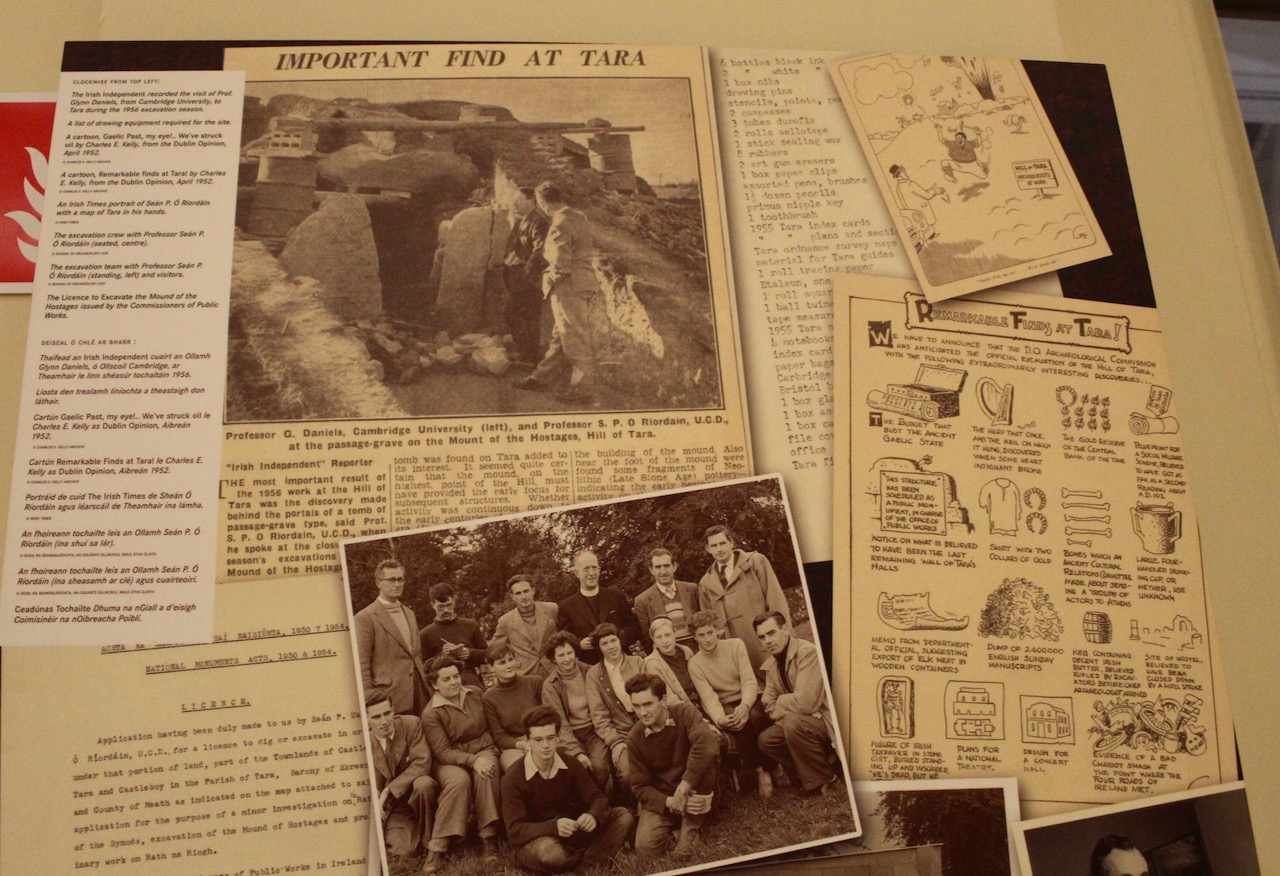
Article about the 1956 excavation of the portal tomb passage grave on the Mound of the Hostages, in the National Museum of Ireland, Kildare Street.
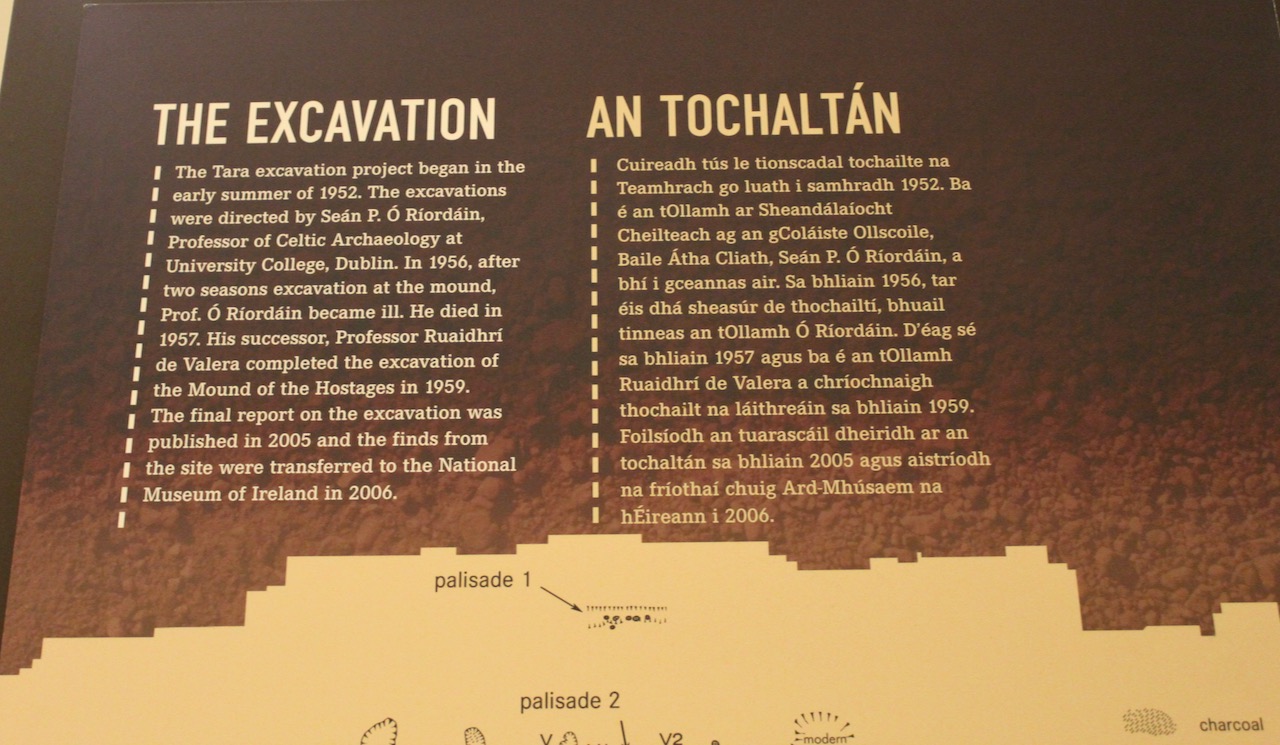
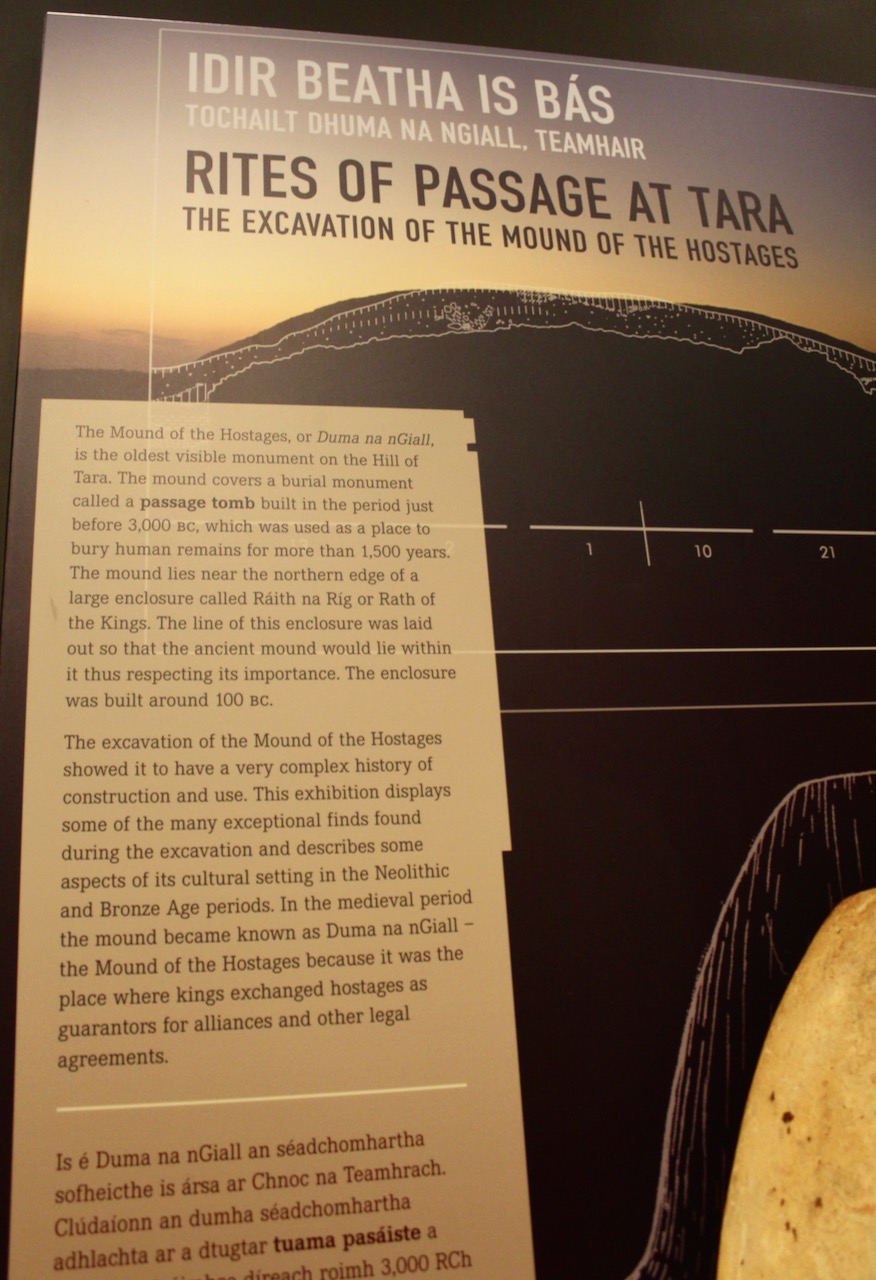
Information boards from the exhibition in the National Gallery of Ireland Kildare Street, January 2022.
Items excavated at Tara, in the National Museum of Ireland Kildare Street. Photograph © Jennifer Winder-Baggot, www.irishhistorichouses.com
Information boards from the exhibition in the National Gallery of Ireland Kildare Street, January 2022.

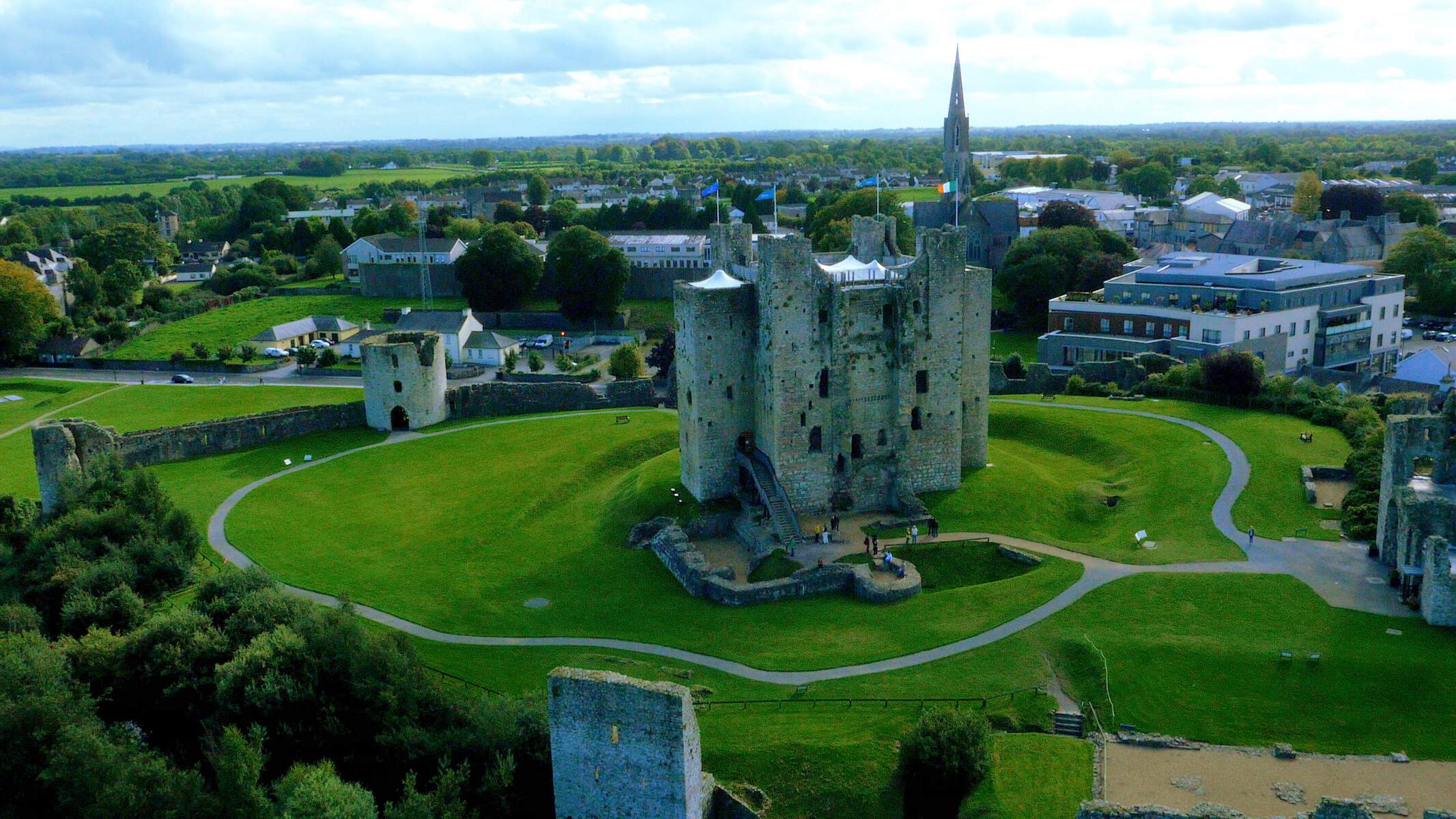
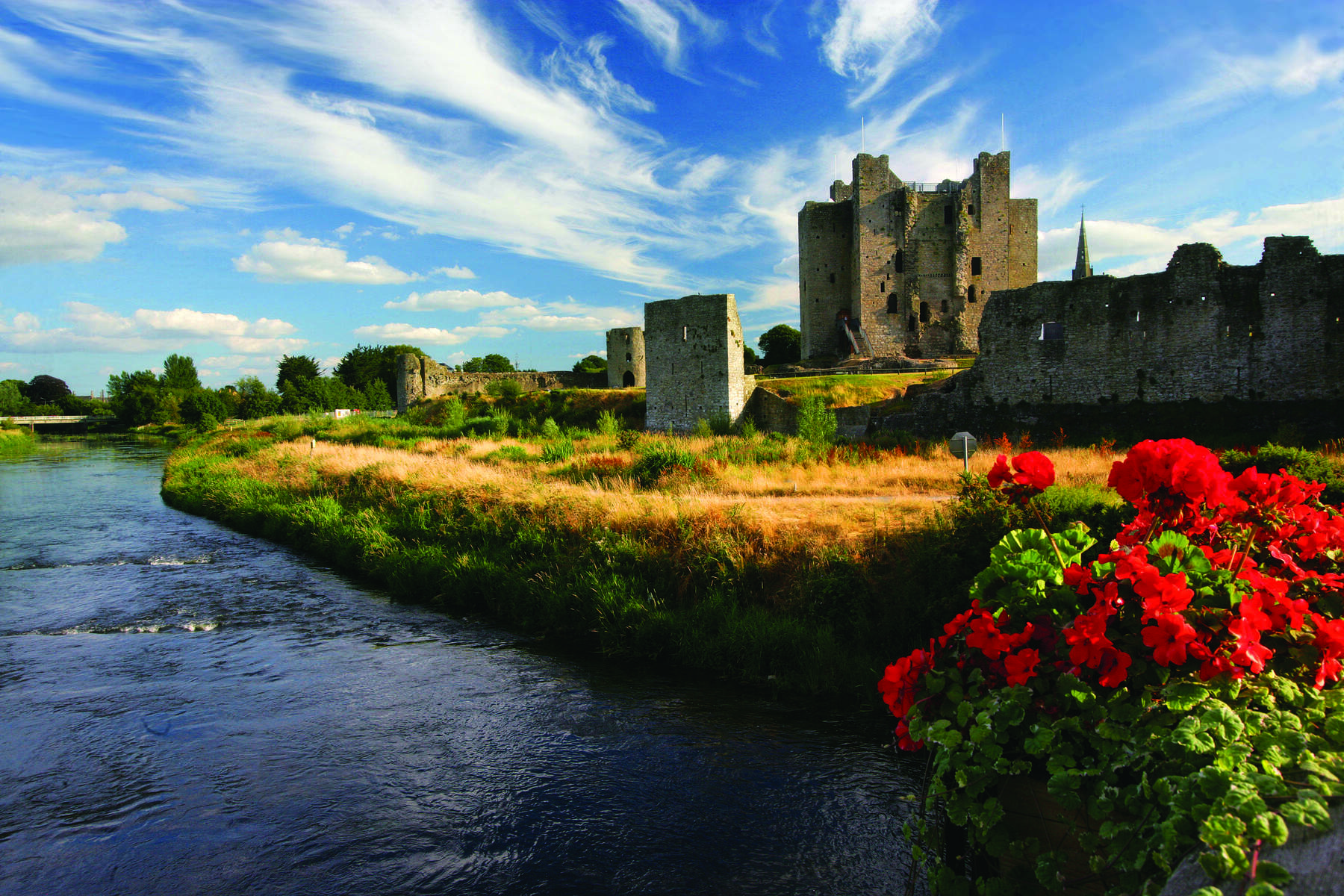
10. Trim Castle, County Meath:

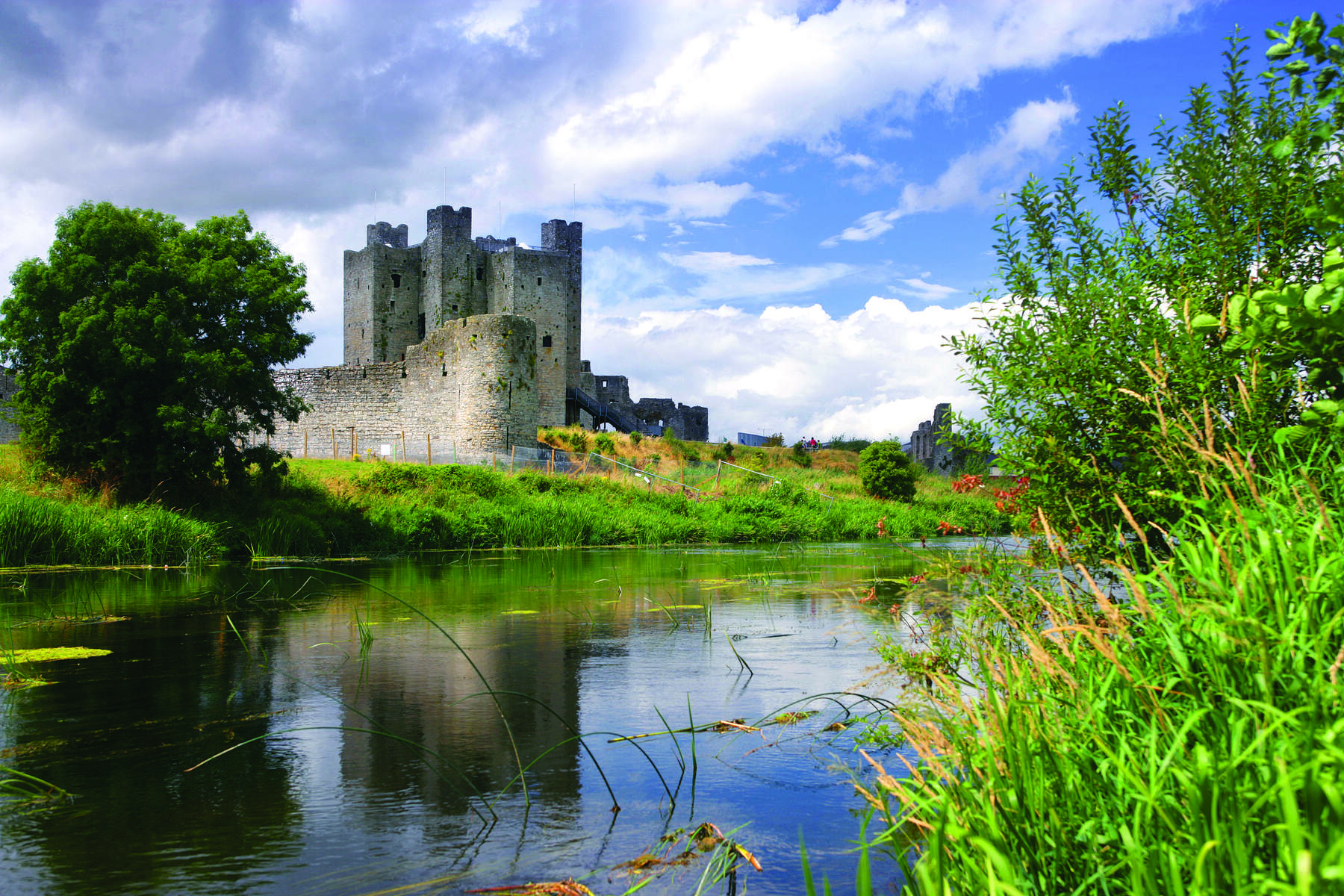
Trim Castle and the River Boyne, photograph by Brian Morrison, 2015 for Tourism Ireland, Ireland’s Content Pool. [see 6]
Trim Castle and the River Boyne, photograph by macmillan media, 2015 for Tourism Ireland, Ireland’s Content Pool. [see 6]

General information: 046 943 8619, trimcastle@opw.ie

From the OPW website https://heritageireland.ie/visit/places-to-visit/trim-castle/:

Few places in Ireland contain more medieval buildings than the heritage town of Trim. Trim Castle is foremost among those buildings.

“In fact, the castle is the largest Anglo-Norman fortification in Ireland. Hugh de Lacy and his successors took 30 years to build it.

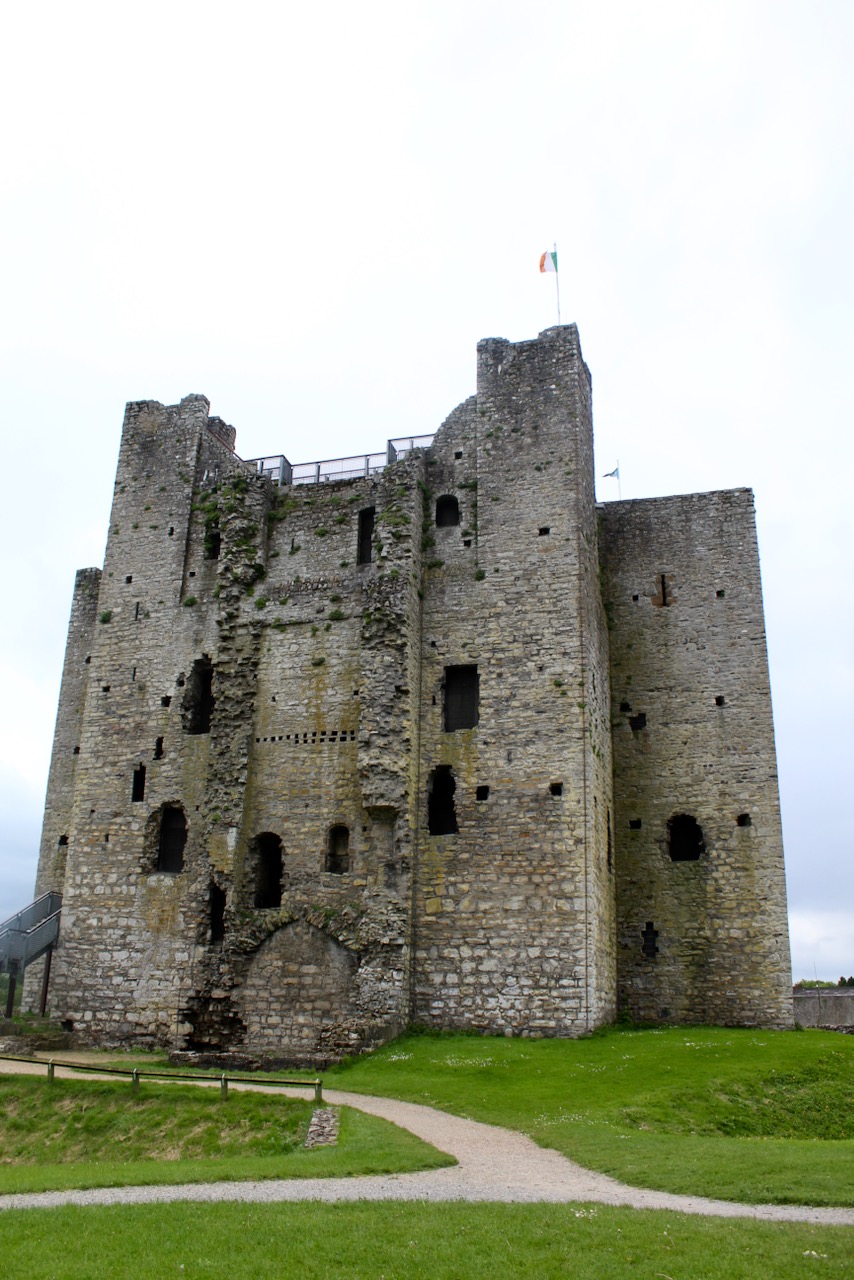
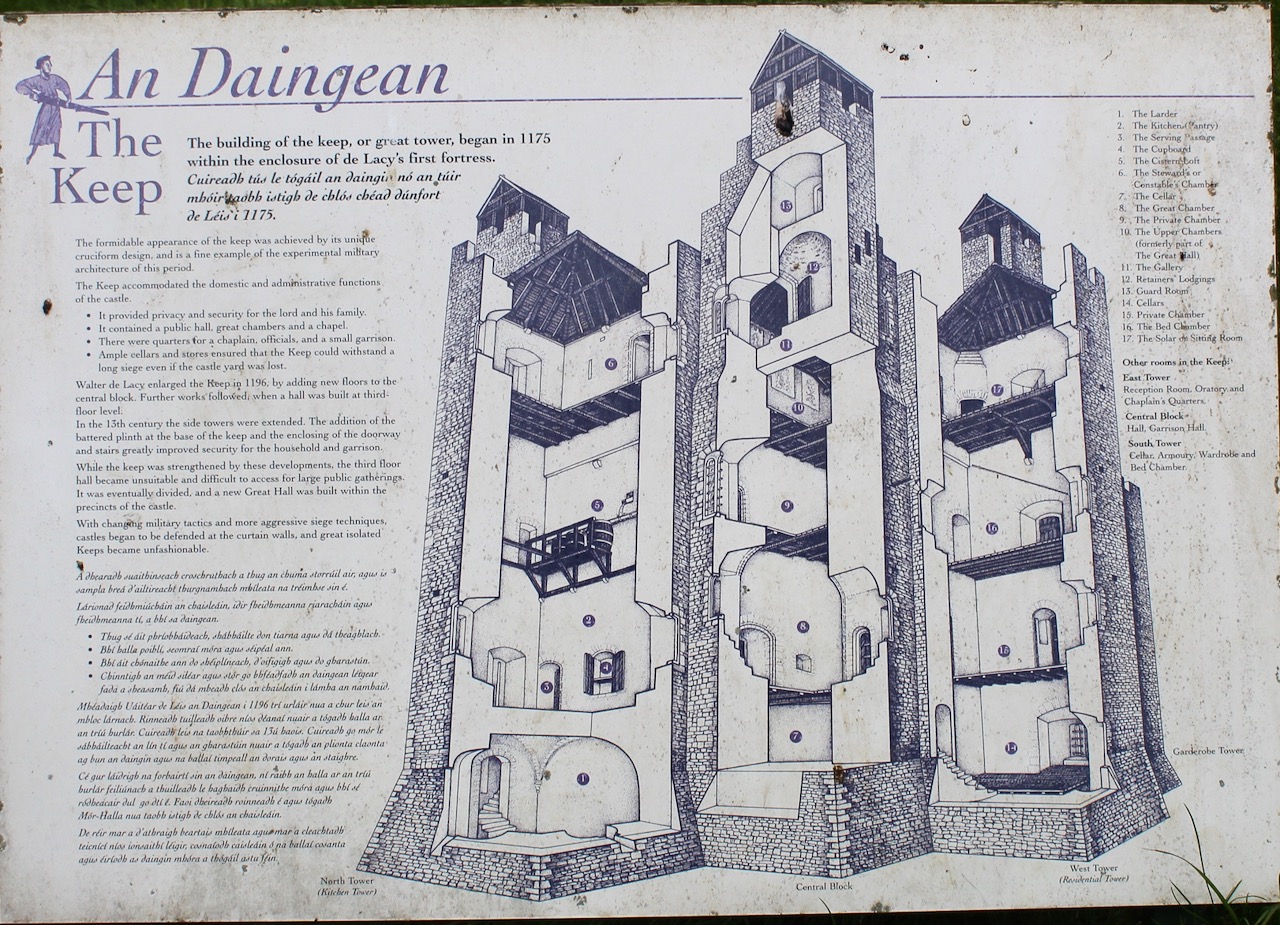
The central fortification is a monumental three-storey keep. This massive 20-sided tower, which is cruciform in shape, was all but impregnable in its day. It was protected by a ditch, curtain wall and water-filled moat.

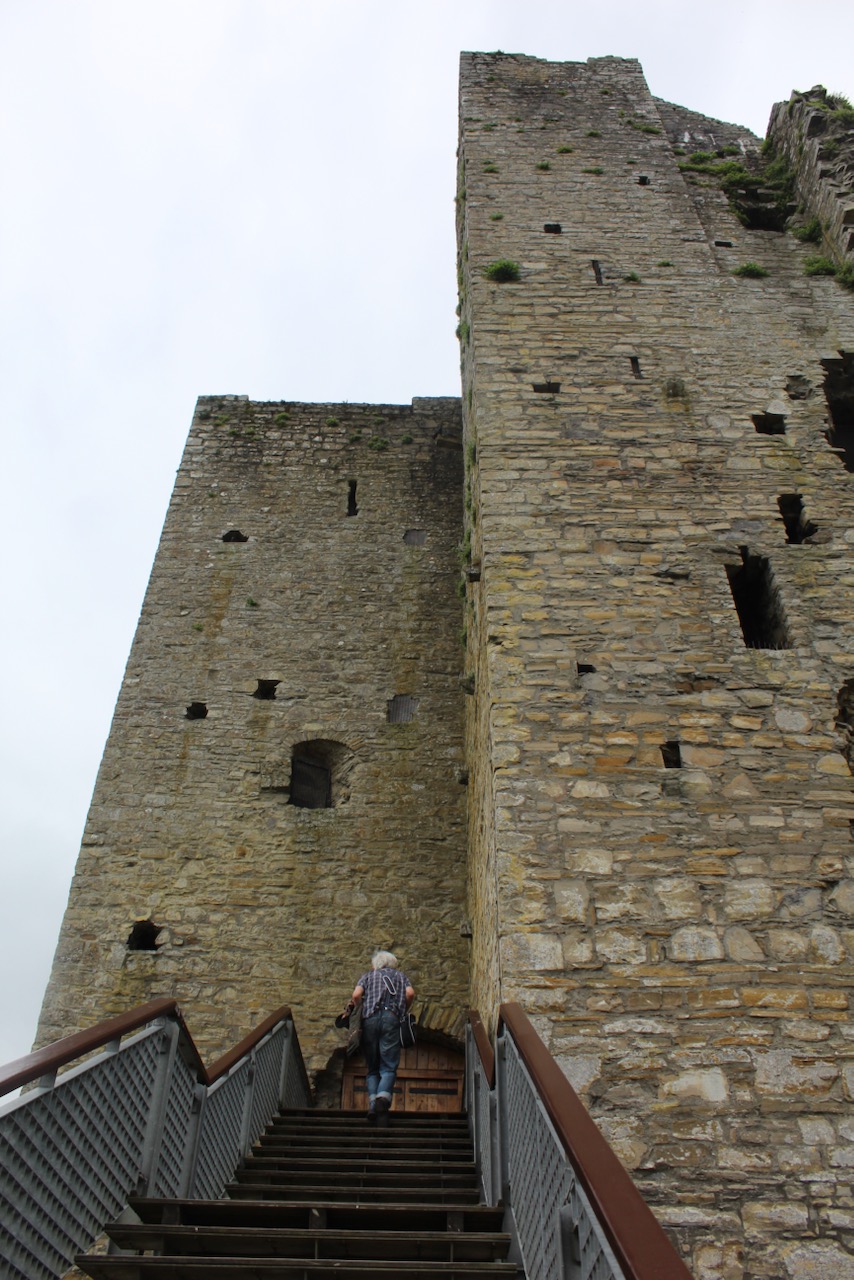
Modern walkways now allow you to look down over the interior of the keep – a chance to appreciate the sheer size and thickness of the mighty castle walls.

The castle is often called King John’s Castle although when he visited the town he preferred to stay in his tent on the other side of the river. Richard II visited Trim in 1399 and left Prince Hal later Henry V as a prisoner in the castle.” I never knew we had such a link to King Henry V and Shakespeare’s play, Henry IV!

Trim Castle and the River Boyne, photograph by Brian Morrison, 2006 for Tourism Ireland, Ireland’s Content Pool. [see 6]

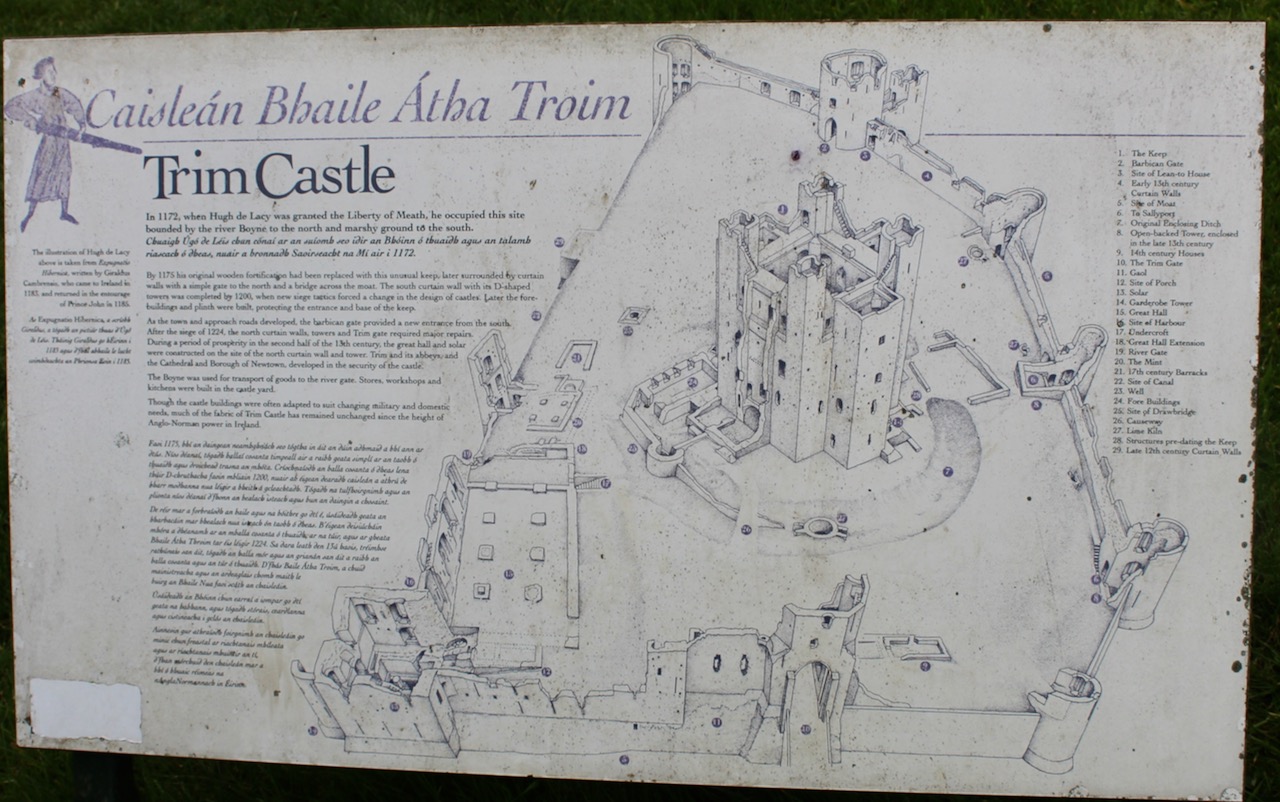
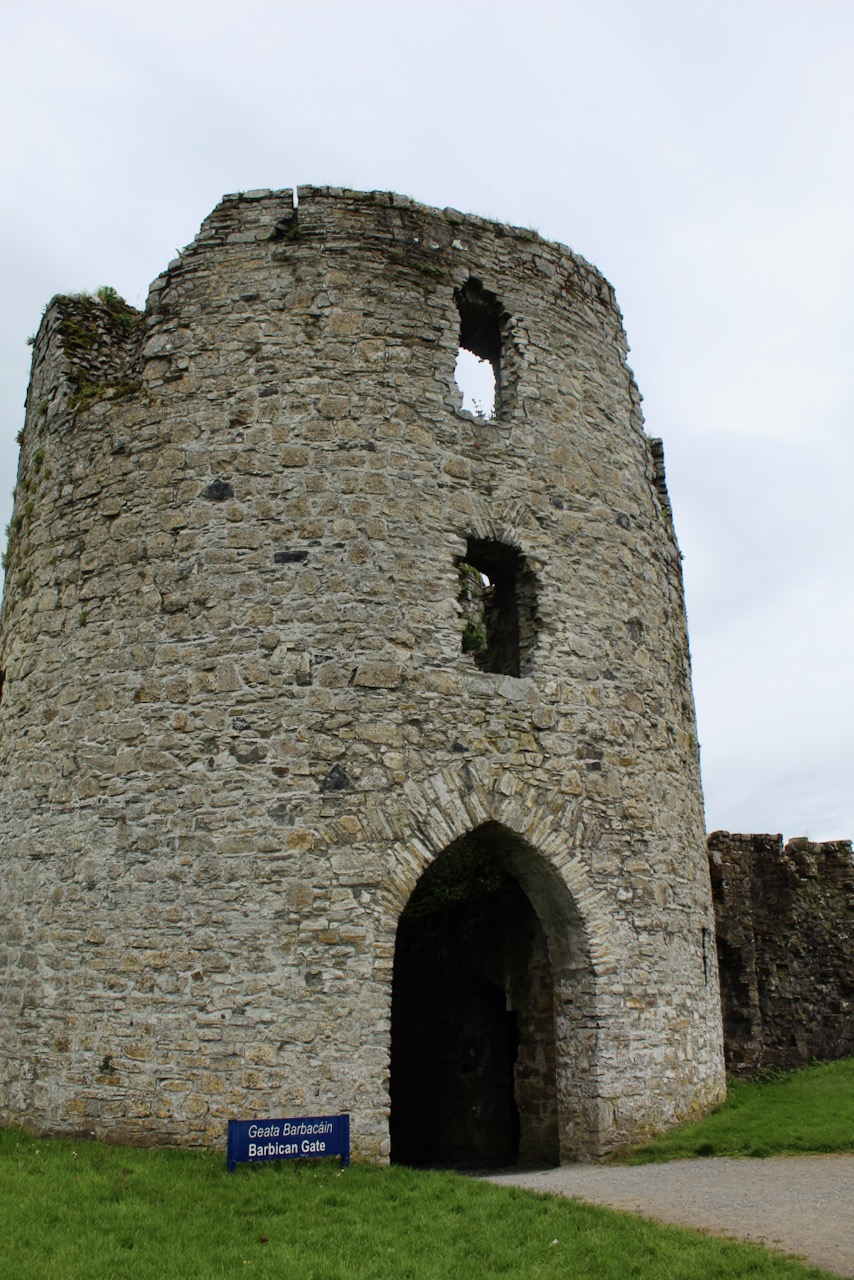
Patrick Comerford gives an excellent history of Trim Castle in his blog. [18] The castle stands within a three acre bailey, surrounded by a defensive perimeter wall. The curtain wall of the castle is fortified by a series of semicircular open-back towers. There were two entrances to Trim Castle, one, beside the car park, is flanked by a gatehouse, and the second is a barbican gate and tower. [19]

We visited in May 2022, after visiting St. Mary’s Abbey (also called Talbot’s Castle) – more on that soon. We were late entering so the entry to inside the castle was closed, unfortunately – we shall have to visit again!

Trim Castle, May 2022. Photograph © Jennifer Winder-Baggot, www.irishhistorichouses.com
The view of Trim Castle from St. Mary’s Abbey, over the Boyne River, May 2022. Photograph © Jennifer Winder-Baggot, www.irishhistorichouses.com
Trim Castle and the River Boyne, photograph by Brian Morrison, 2015 for Tourism Ireland, Ireland’s Content Pool. [see 6]
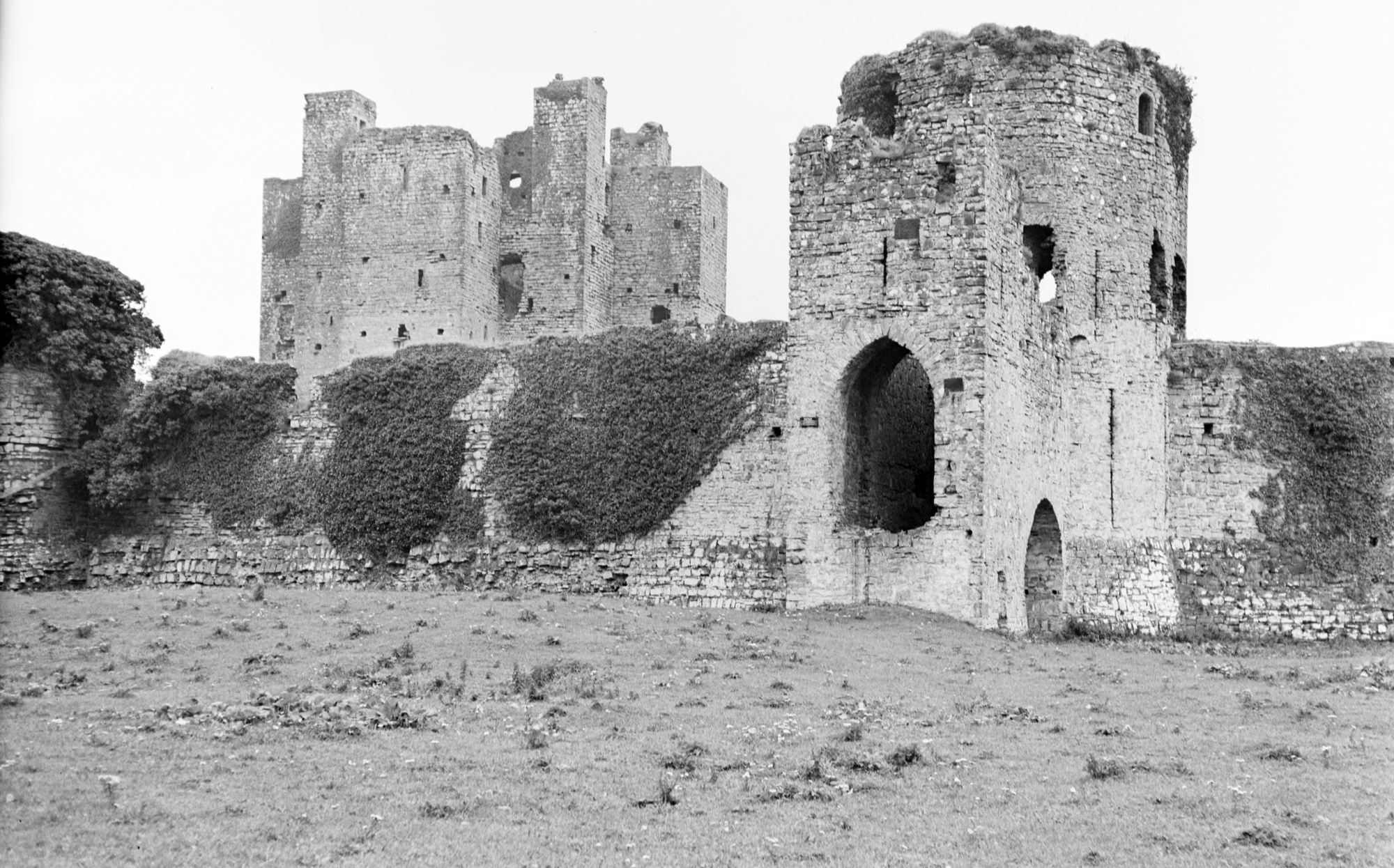
Trim Castle, Co. Meath, 1938, photograph from National Library of Ireland, flickr constant commons.
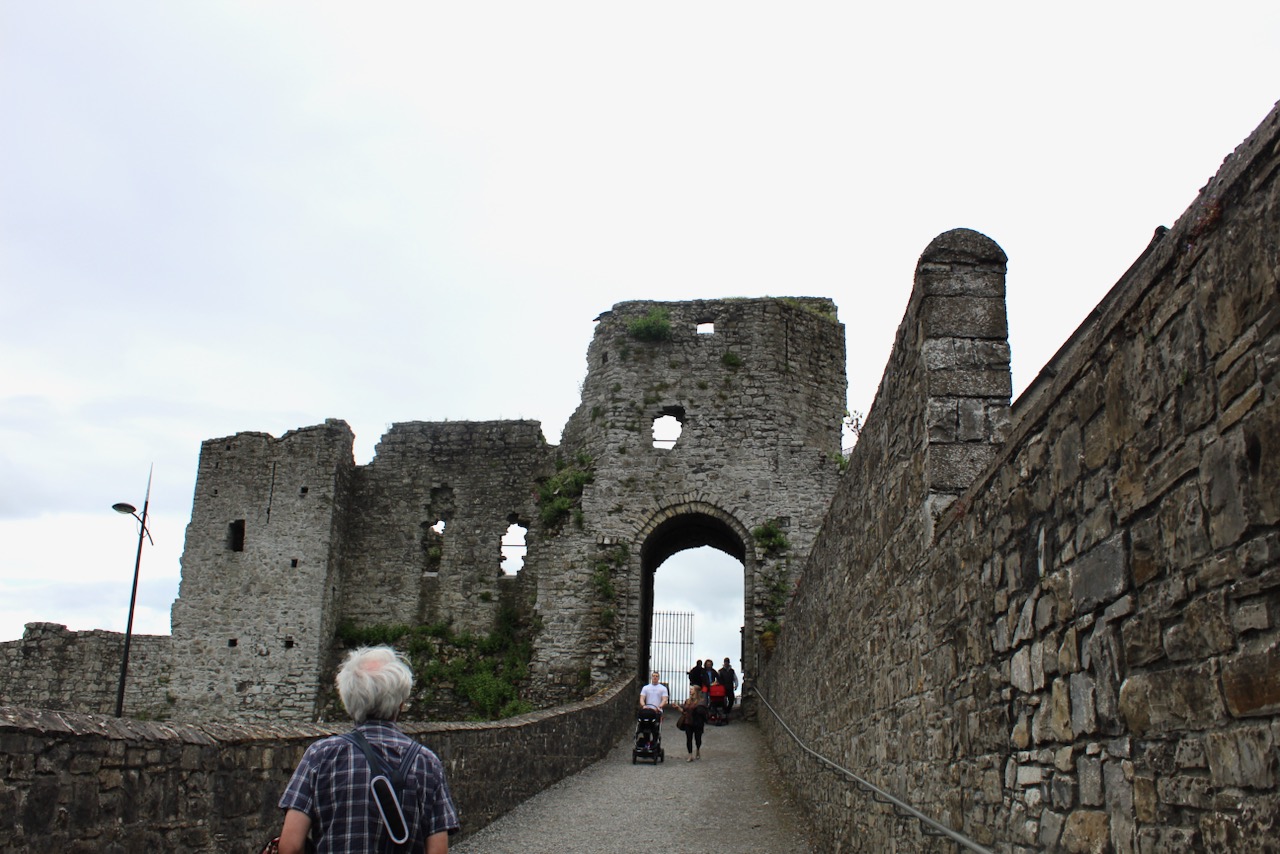
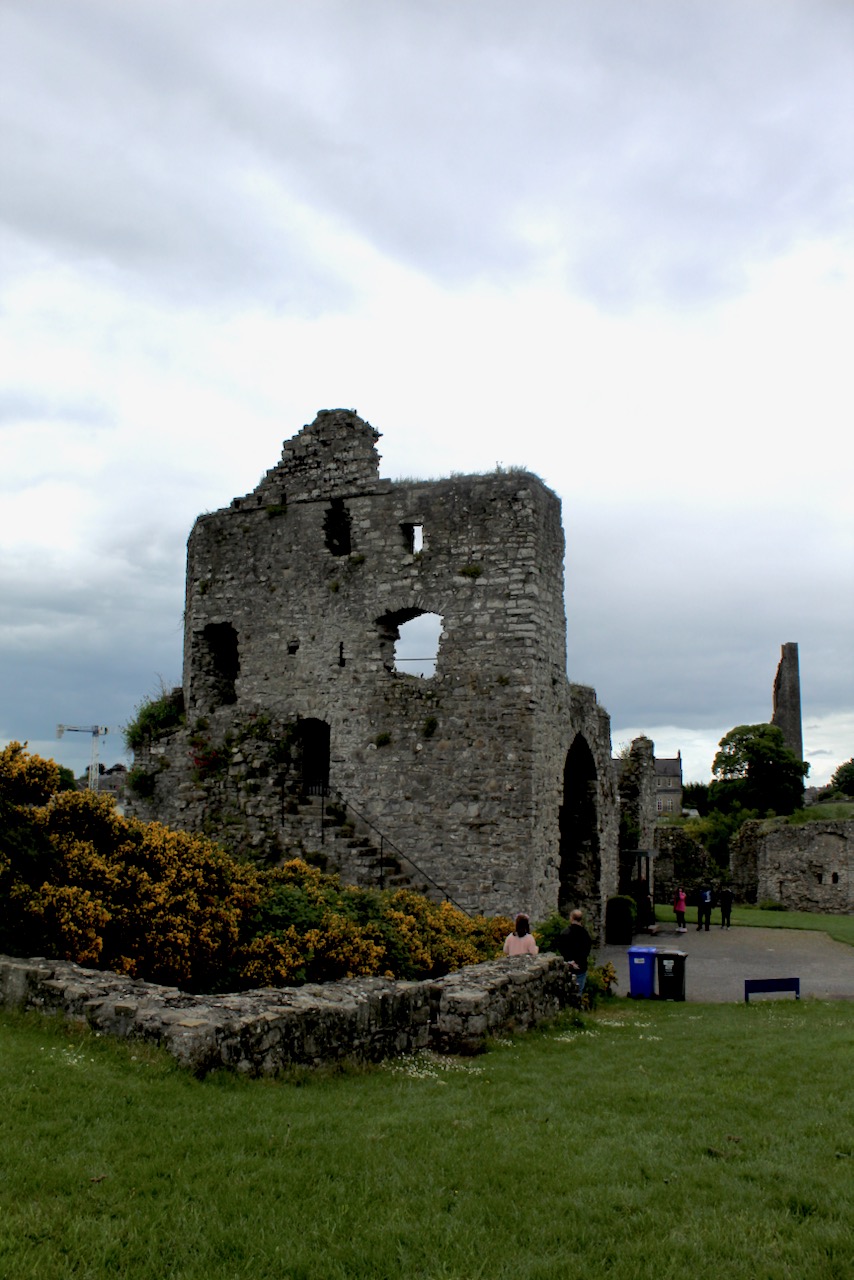
The entrance to Trim Castle, May 2022. Photograph © Jennifer Winder-Baggot, www.irishhistorichouses.com
Trim Castle, May 2022. Photograph © Jennifer Winder-Baggot, www.irishhistorichouses.com
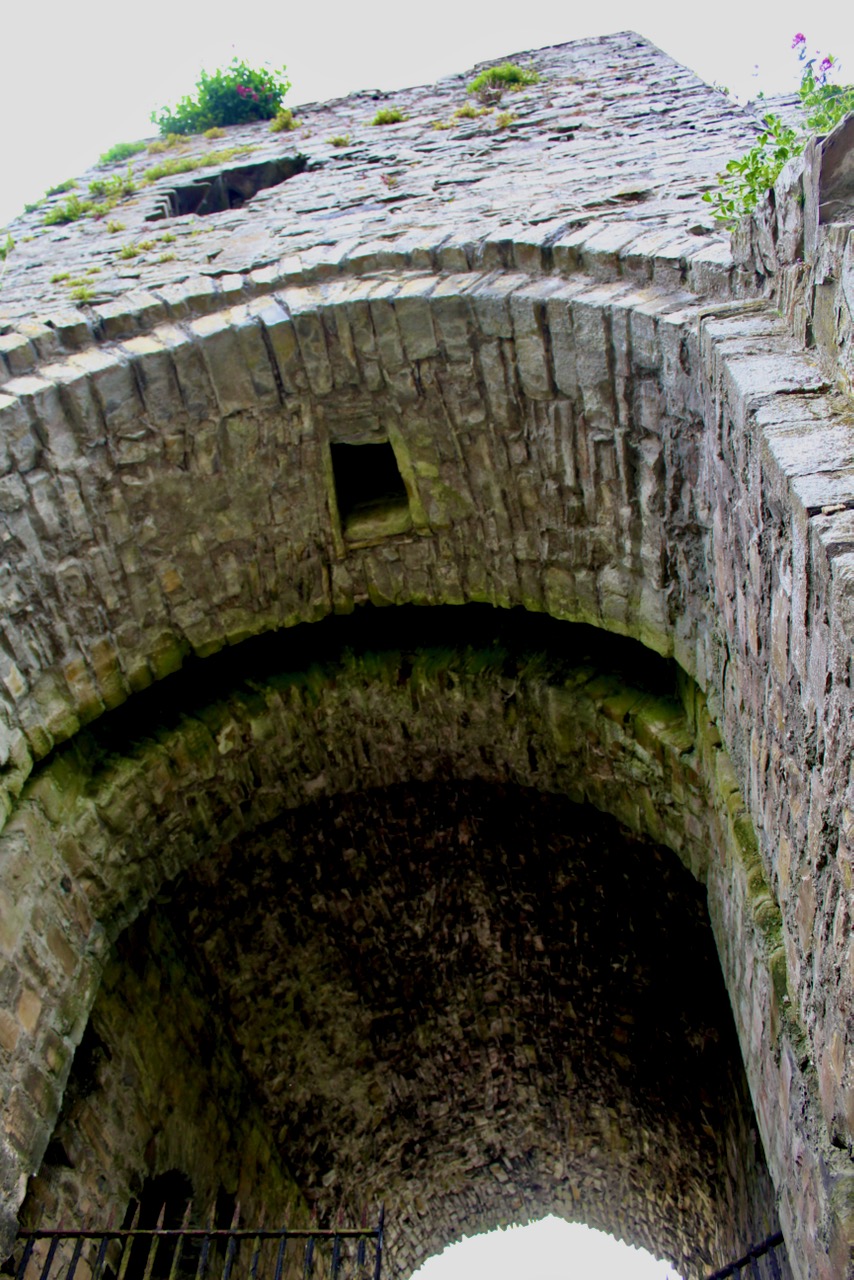
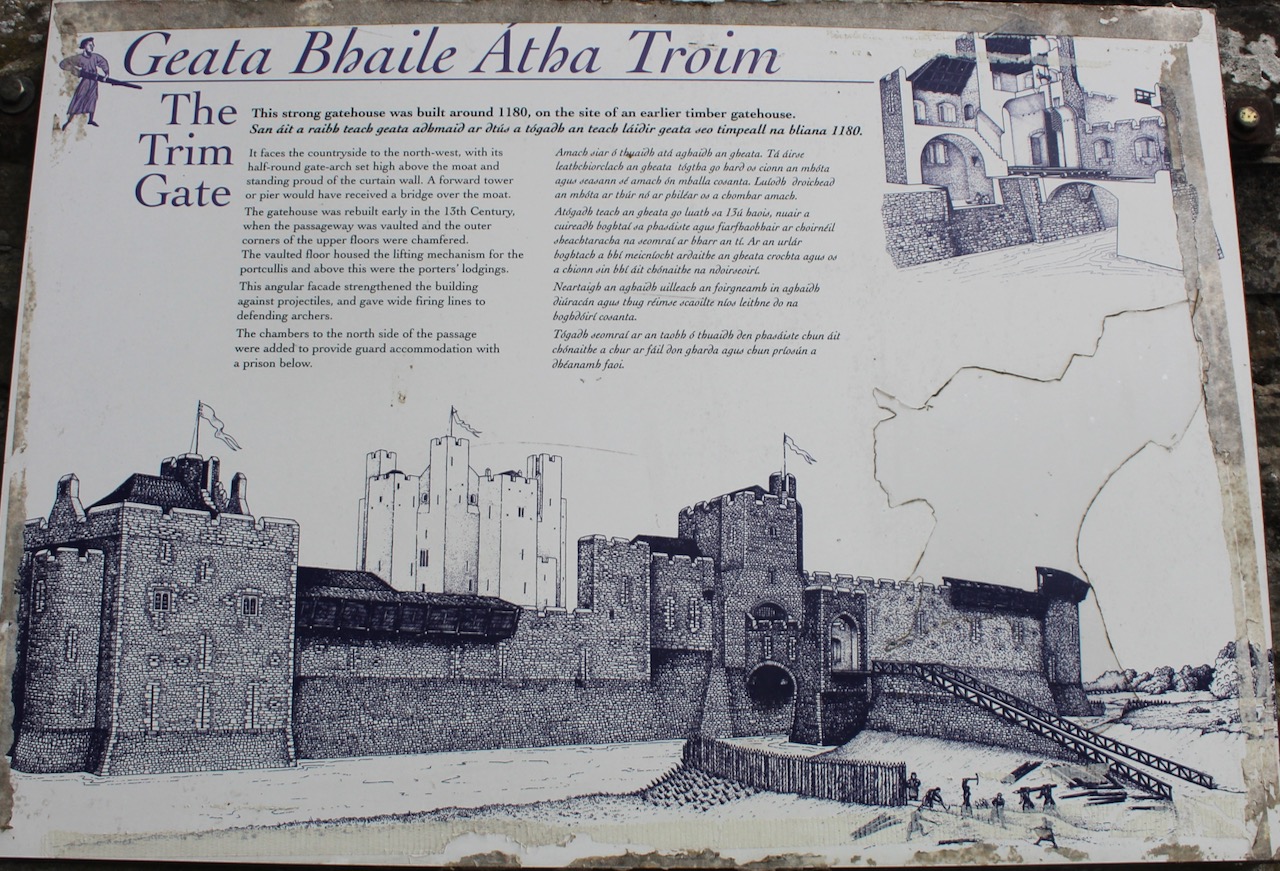
The information board tells us that the Trim Gate was built around 1180, on the site of an earlier timber gatehouse. A forward tower or pier would have received a bridge over the moat. The gatehouse was rebuilt early in the 13th century when the passageway was vaulted. The vaulted floor housed the lifting mechanism for the portcullis and above this were the porters’ lodgings. The chambers to the north side of the passage were added to provide guard accommodation with a prison below.
The other side of the gate through which we entered. Photograph © Jennifer Winder-Baggot, www.irishhistorichouses.com
The Keep, Trim Castle, May 2022. Photograph © Jennifer Winder-Baggot, www.irishhistorichouses.com
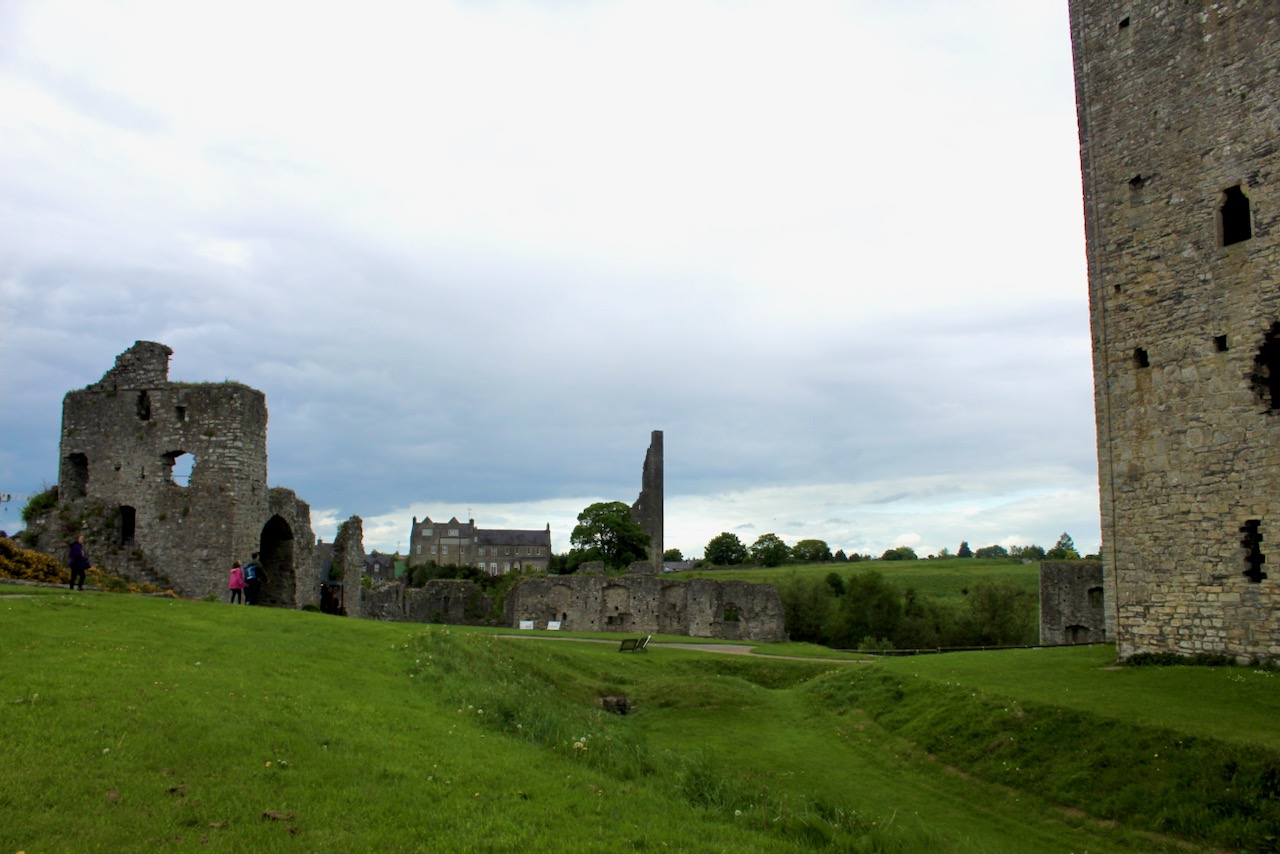
Inside the walls of Trim Castle, with a view of St. Mary’s Abbey house and the remaining tower of St. Mary’s Abbey. Photograph © Jennifer Winder-Baggot, www.irishhistorichouses.com
Trim Castle, May 2022.

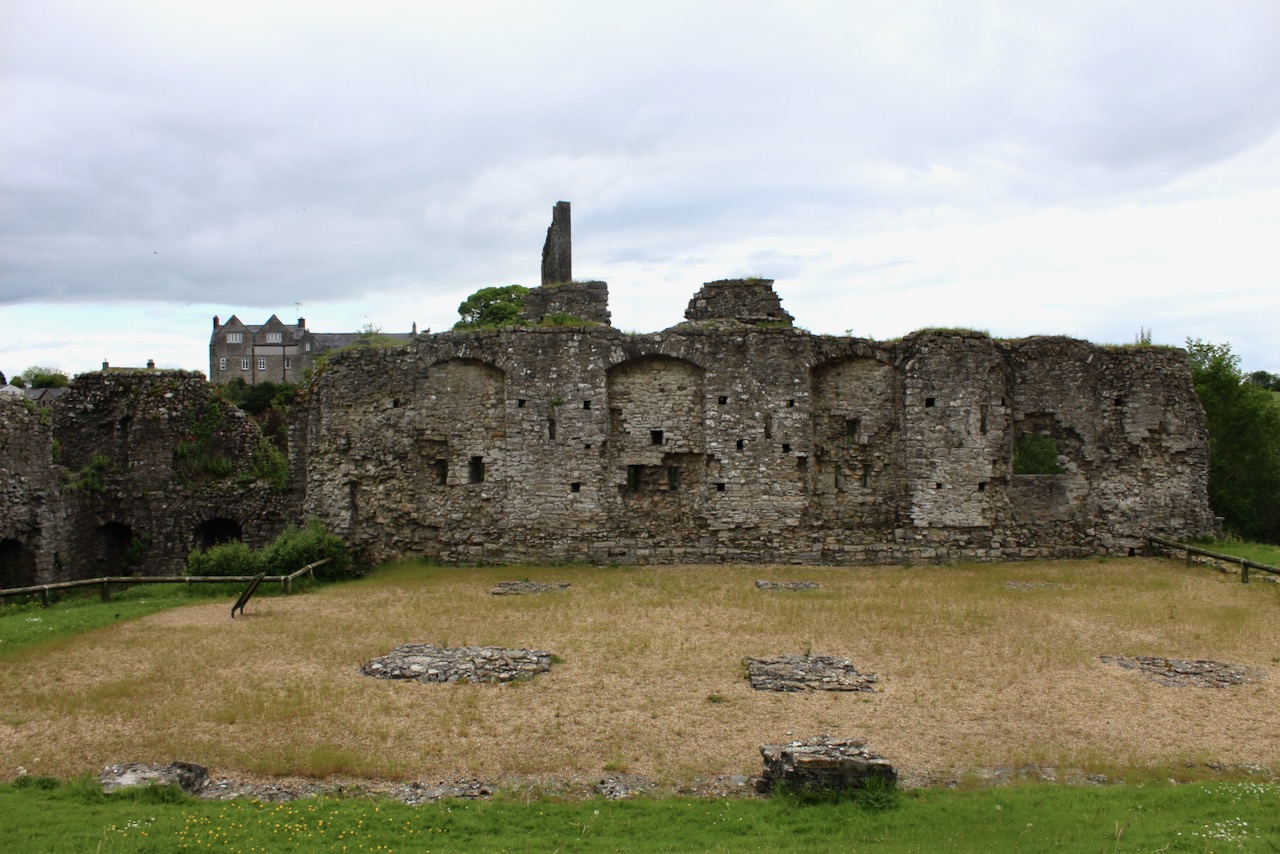
The information board tells us that in 1182 when Hugh de Lacy was granted the Liberty of Meath, he occupied this site bounded by the River Boyne to the north and marshy ground to the south. By 1175 his original wooden fortification had been replaced by this unusual keep, later surrounded by curtain walls with a simple gate to the north and a bridge across the moat. The south curtain wall with its D shaped buildings was completed by 1200, when new siege tactics forced a change in the design of castles. Later, the forebuildings and plinth were built, protecting the entrance and base of the keep.

Trim Castle, May 2022.

Sometime before 1180, Hugh de Lacy replaced the timber palisade fence enclosing the keep with a stone enclosure. The fore-court enclosed stables and stores and protected the stairway and door to the keep. The new entrance was on the north side of the enclosure and had a drawbridge over the deepened ditch.

With the development of the curtain walls, the inner enclosure became obsolete.

The ditch was filled and three defensive towers – two survive – were built on its site. The drawbridge was replaced by a stone causeway leading to an arched gate and entrance stairway. A reception hall was built to accommodate visitors before they entered the Keep.

As the town and approach roads developed, the barbican gate provided a new entrance from the south. After the siege of 1224, the north curtain walls, towers and Trim gate required major repairs. During a period of prosperity in the second half of the 13th century, the great hall and solar were constructed on the site of the north curtain wall and tower. Trim and its abbeys and the Cathedral and borough of Newtown developed in the security of the castle.

The Boyne was used for transport of goods to the river gate. Stores, workshops and kitchens were built in the castle yard.

Though the castle buildings were often adapted to suit changing military and domestic needs, much of the fabric of Trim Castle has remained unchanged since the height of Anglo-Norman power in Ireland.

The Keep, Trim Castle, May 2022. Photograph © Jennifer Winder-Baggot, www.irishhistorichouses.com
Trim Castle, May 2022.
Trim Castle, May 2022. Photograph © Jennifer Winder-Baggot, www.irishhistorichouses.com
The area that was the Great Hall, Trim Castle, May 2022. Photograph © Jennifer Winder-Baggot, www.irishhistorichouses.com
Trim Castle, May 2022.

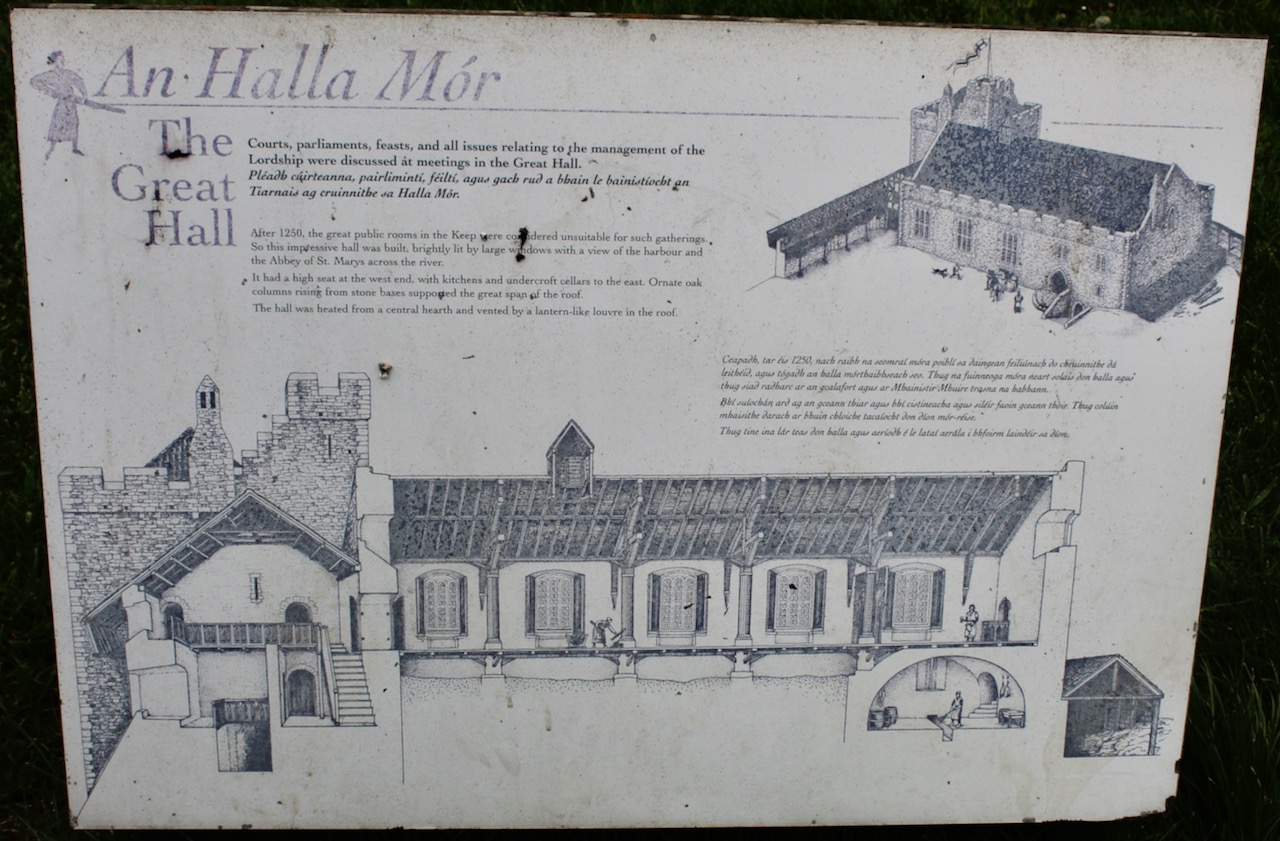
The information board tells us that courts, parliaments, feasts and all issues relating to the management of the Lordship were discussed at meetings in the Great Hall. After 1250, the great public rooms in the Keep were considered unsuitable for such gatherings, so this hall was built, lit by large windows with a view of the harbour and the Abbey of St. Mary’s across the river. The hall had a high seat at the west end, with kitchens and undercroft cellars to the east. Ornate oak columns rising from stone bases supported the great span of the roof.

The hall was heated from a central hearth and vented by a lantern-like louvre in the roof.

Trim Castle, May 2022.
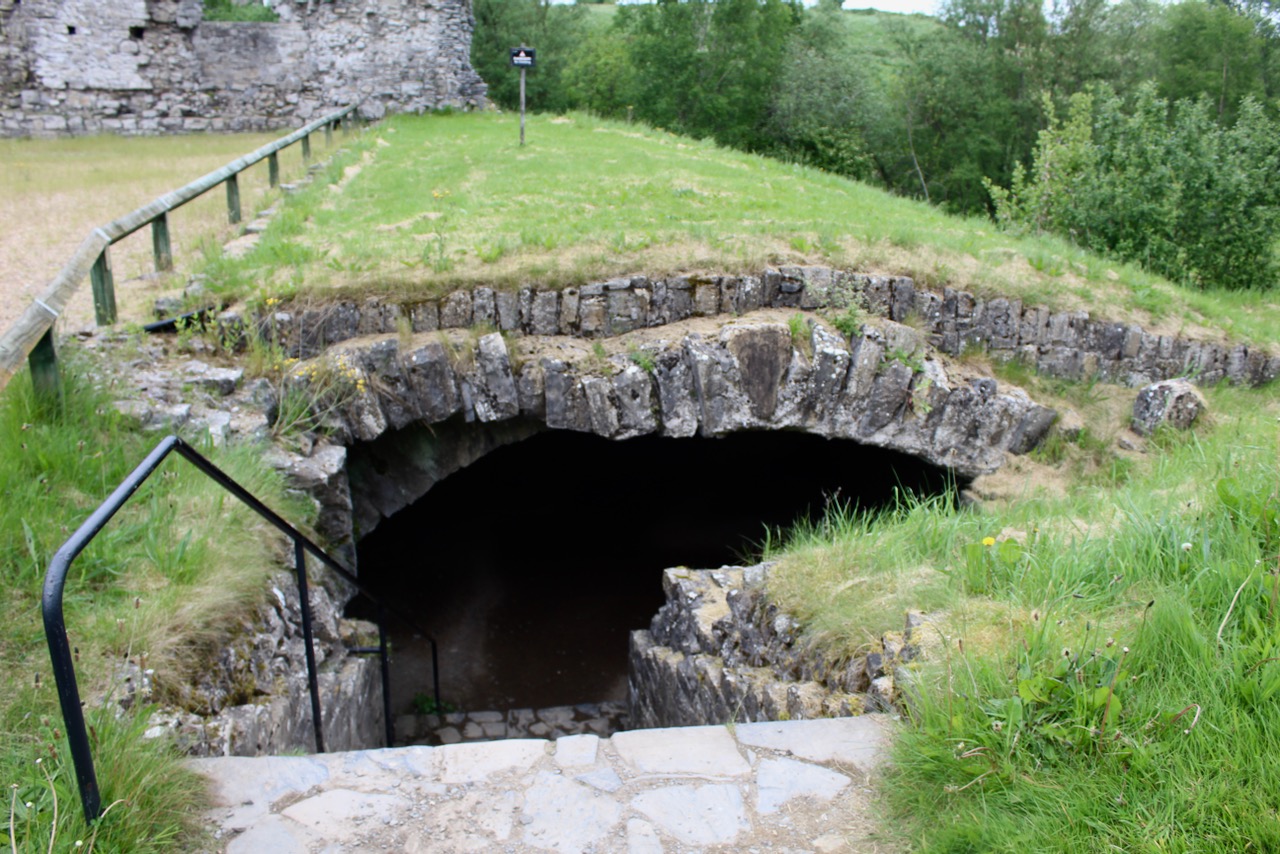
I’m not sure what this is, at Trim Castle. Photograph © Jennifer Winder-Baggot, www.irishhistorichouses.com
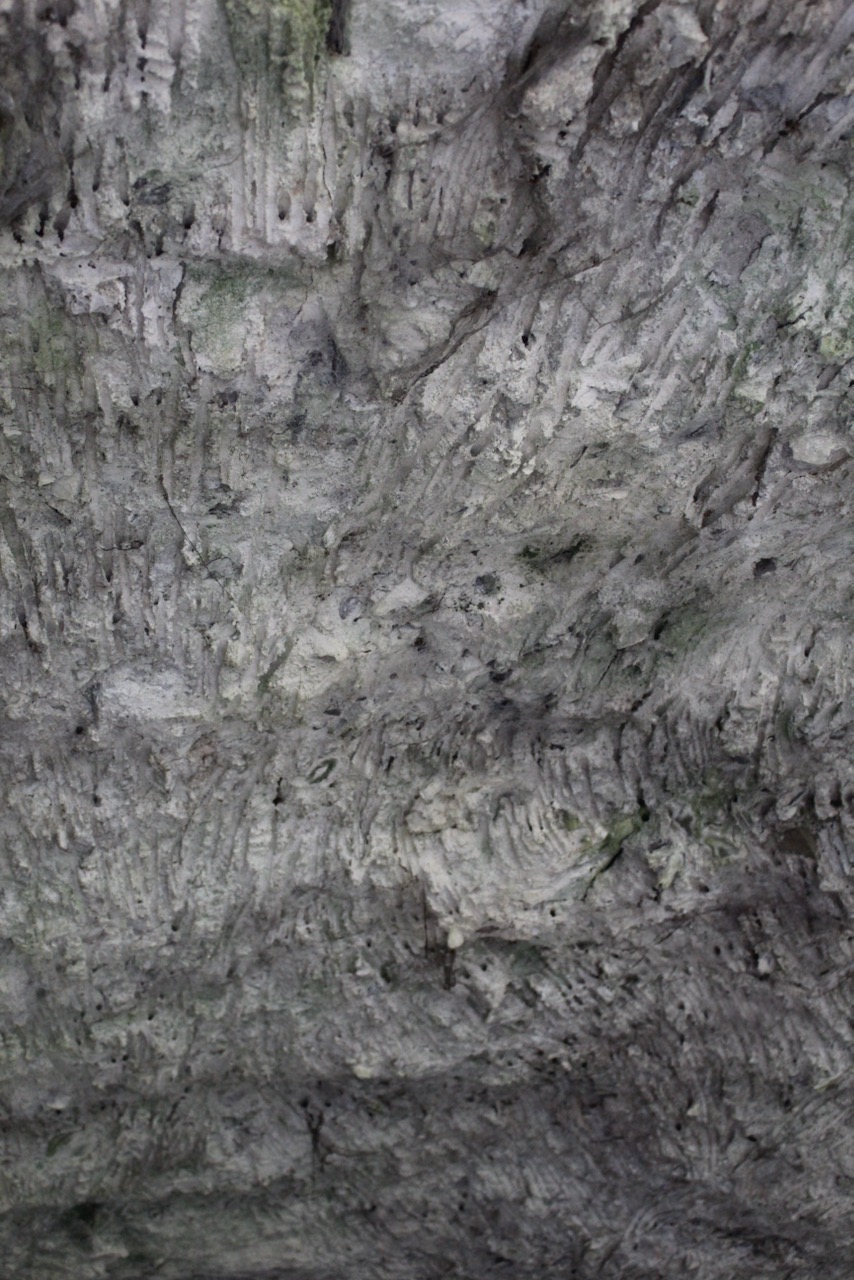
See the “scratches” or marks on the ceiling of this vaulted space – we see similar marks in the basement of St. Mary’s Abbey house. Photograph © Jennifer Winder-Baggot, www.irishhistorichouses.com
Trim Castle, May 2022. Photograph © Jennifer Winder-Baggot, www.irishhistorichouses.com
I think this is the River Gate, at Trim Castle. Photograph © Jennifer Winder-Baggot, www.irishhistorichouses.com
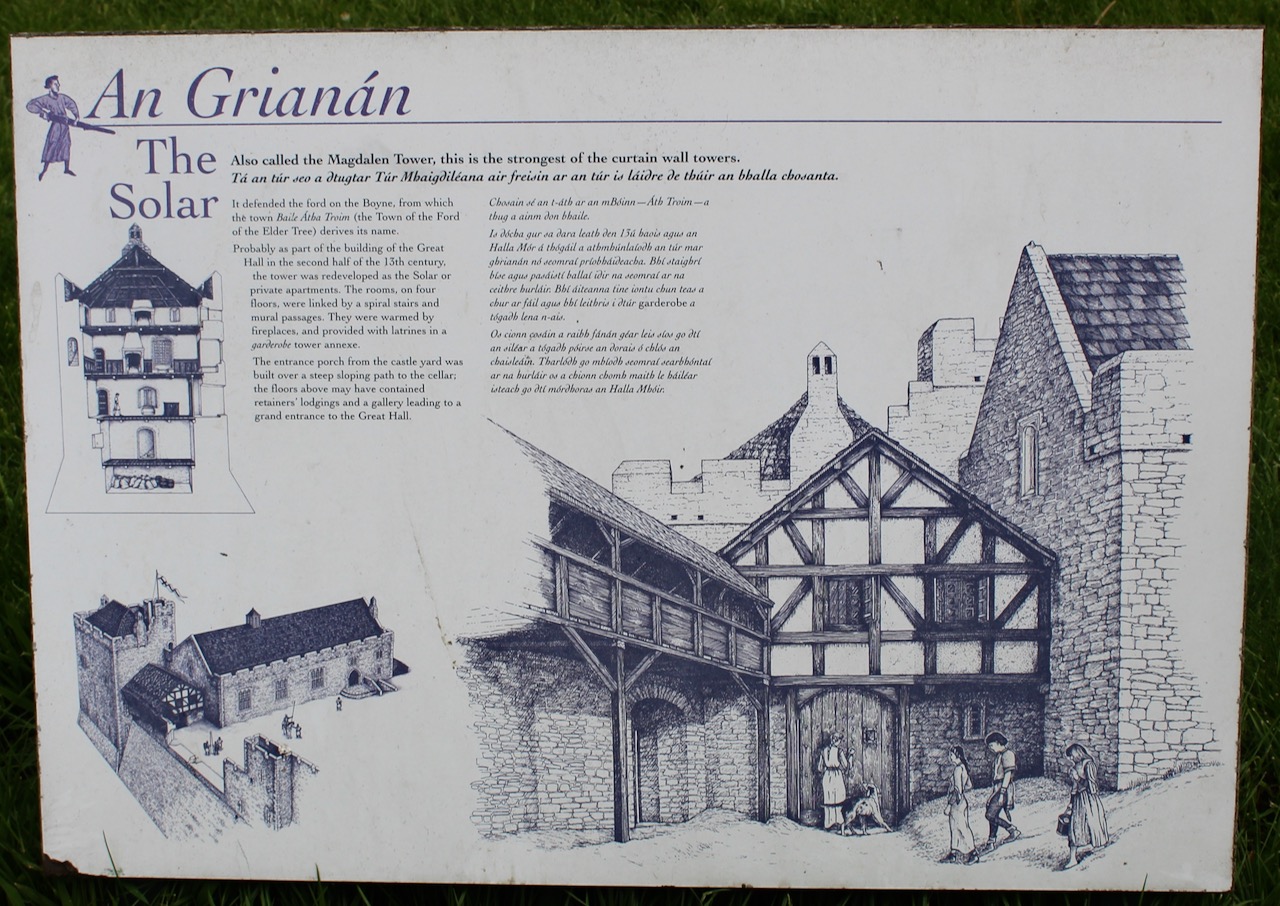
The information board tells us that the River Gate allowed for the delivery os stores from boats on the river. The gate was made in the curtain wall to the east of the Great Hall. Short stretches of canal allowed boats to bring supplies to teh castle to avoid the many weirs and protruding rocks on the river. A section of the canal was cut below the riverside curtain wall. Inside the River Gate, a passage was cut through the bedrock to the door of the cellar of the Great Hall. Boats could be moored in the wide harbour with its pier and stairway to the apartments in the Solar.
The Barbican Gate, Trim Castle. Photograph © Jennifer Winder-Baggot, www.irishhistorichouses.com
Trim Castle, May 2022. Photograph © Jennifer Winder-Baggot, www.irishhistorichouses.com
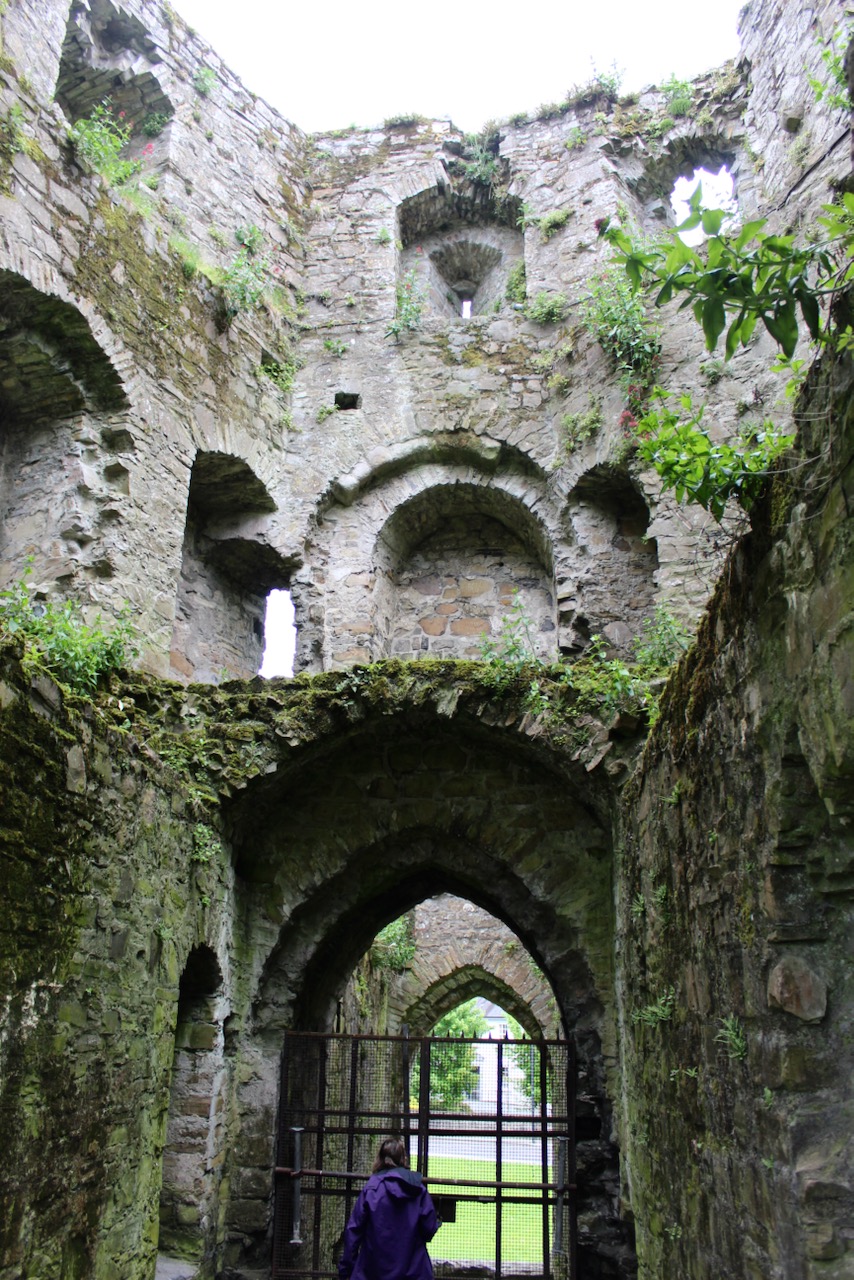
Inside the Barbican Gate, Trim Castle. Photograph © Jennifer Winder-Baggot, www.irishhistorichouses.com
Trim Castle, May 2022.

Early in the 13th century the weirs were completed on the Boyne, allowing the moat to be flooded, and the Leper River was channelled along the south curtain wall. A new gate was constructed guarding the southern approaches to the castle. This gatehouse, of a rare design, was built as a single cylindrical tower with a “barbican,” defences of a forward tower adn bridge. An elaborate system of lifting bridges, gates and overhead traps gave the garrison great control over those entering the castle. The arrangement of plunging loops demonstrates the builders’ knowledge of the military requirements of defending archers.

By the middle of the 13th century, the design of castle gates was further developed and a twin tower gatehouse with a passage between the two towers became standard.

Trim Castle, May 2022.

Offaly:

11. Clonmacnoise, County Offaly:

Clonmacnoise, May 2018. Photograph © Jennifer Winder-Baggot, www.irishhistorichouses.com

General information: 090 9674195, clonmacnoise@opw.ie

From the OPW website https://heritageireland.ie/visit/places-to-visit/clonmacnoise/:

St Ciarán founded his monastery on the banks of the River Shannon in the 6th Century. The monastery flourished and became a great seat of learning, a University of its time with students from all over Europe.

The ruins include a Cathedral, two round Towers, three high crosses, nine Churches and over 700 Early Christian graveslabs.

The original high crosses, including the magnificent 10th century Cross of the Scriptures area on display in a purpose built visitor centre adjacent the monastic enclosure.

An audiovisual presentation will give you an insight into the history of this hallowed space.

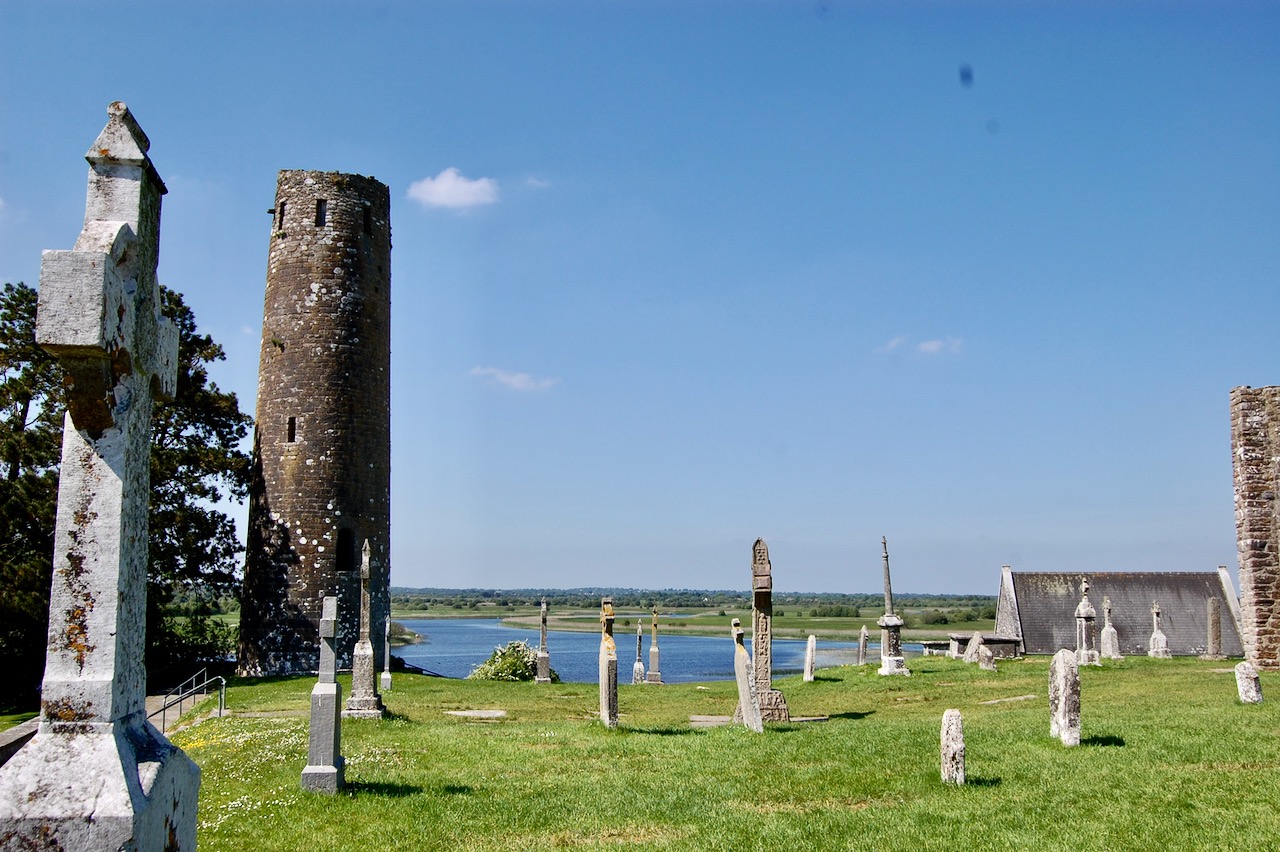
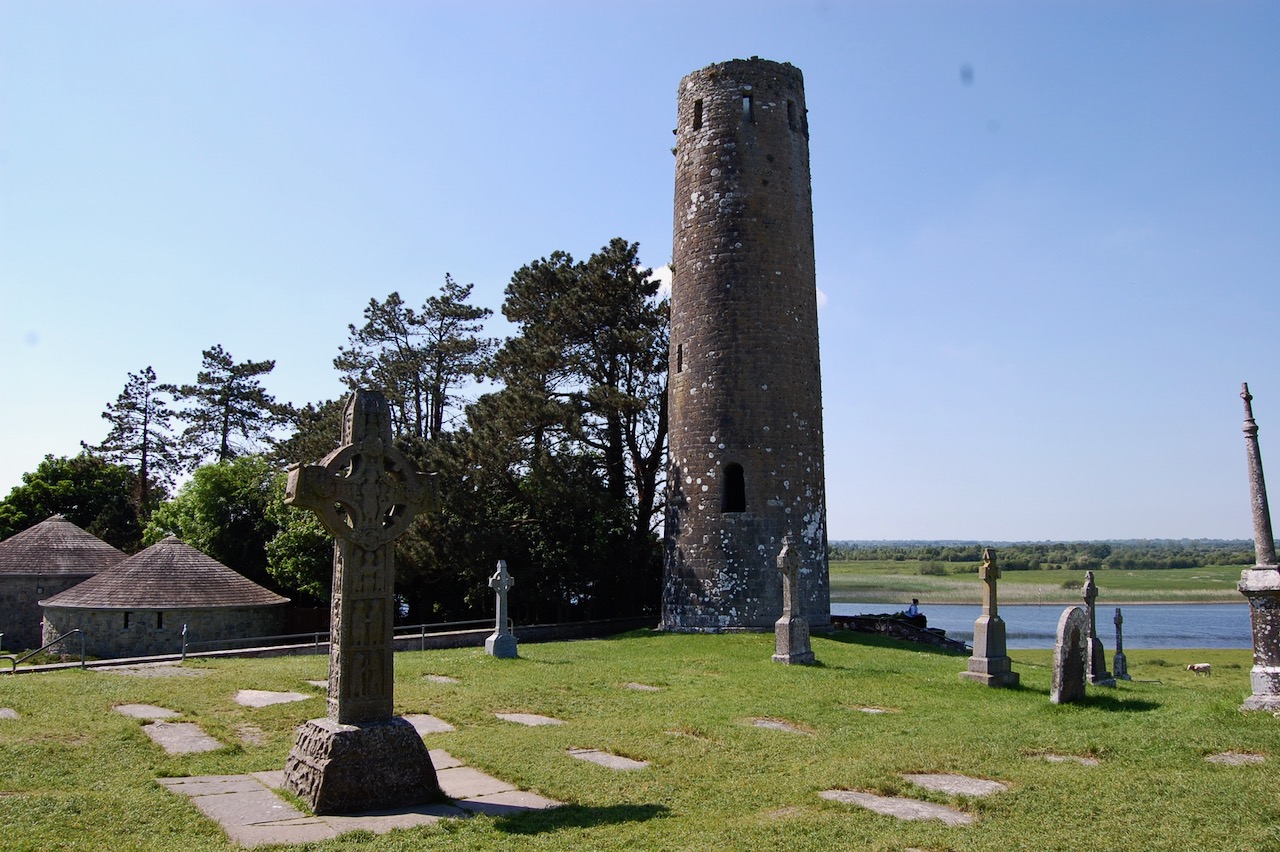
Clonmacnoise, May 2018. O’Rourke’s Tower. The Annals of the Four Masters record that it was completed in 1124 under the patronage of Toirrdelbach O Conchobhair, King of Connacht. In 1135 its top was struck off by lightning. The eight square headed windos at the top belong to a late medieval arrangement. Photograph © Jennifer Winder-Baggot, www.irishhistorichouses.com
Clonmacnoise, May 2018. Photograph © Jennifer Winder-Baggot, www.irishhistorichouses.com
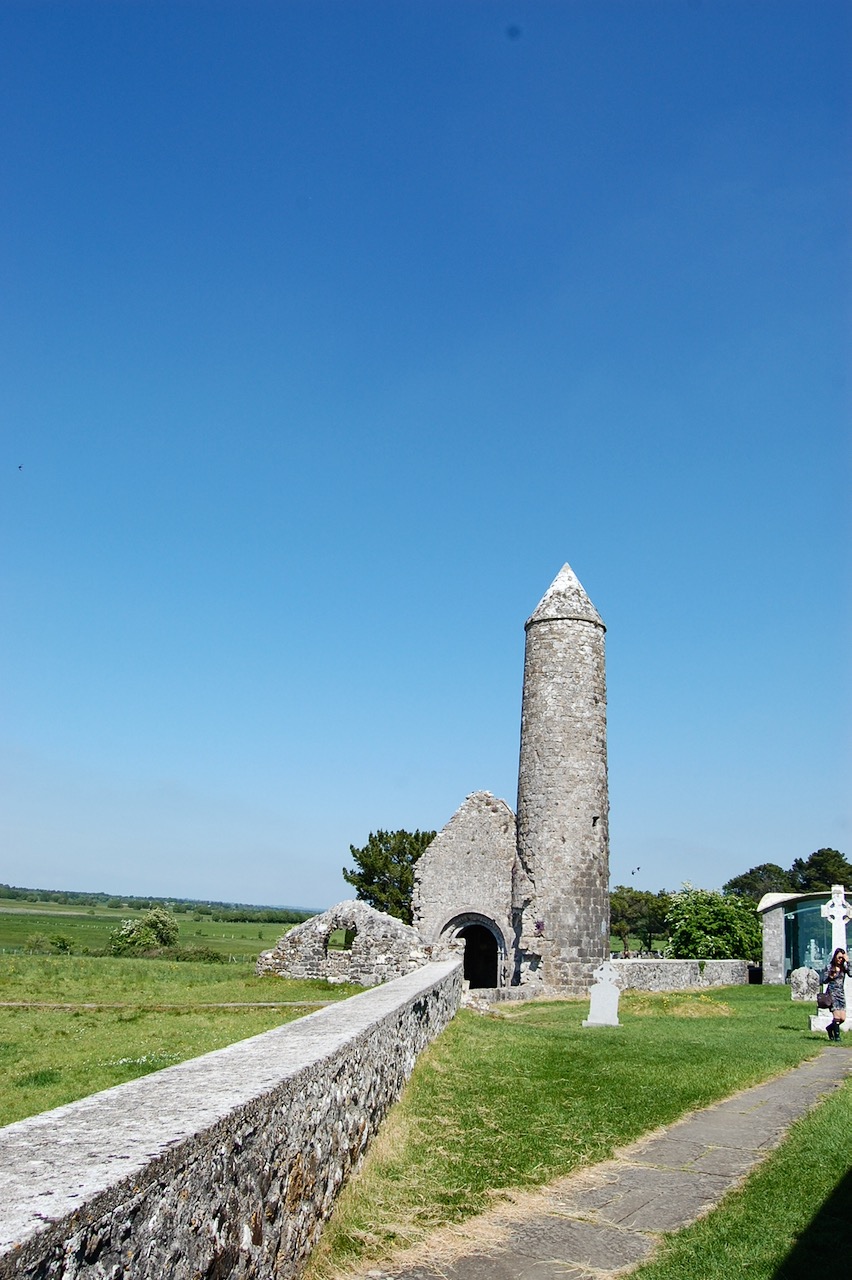
Clonmacnoise, May 2018. Temple Finghin, a twelfth century church with integrated round tower. Photograph © Jennifer Winder-Baggot, www.irishhistorichouses.com
Clonmacnoise, May 2018. Photograph © Jennifer Winder-Baggot, www.irishhistorichouses.com

[1] p. 336. Tierney, Andrew. The Buildings of Ireland: Central Leinster: Kildare, Laois and Offaly. Yale University Press, New Haven and London, 2019.

[2] https://heritageireland.ie/visit/places-to-visit/emo-court/

[3] p. 119. Bence-Jones, Mark. A Guide to Irish Country Houses (originally published as Burke’s Guide to Country Houses volume 1 Ireland by Burke’s Peerage Ltd. 1978); Revised edition 1988, Constable and Company Ltd, London.

[4] https://emocourt.ie/history/

For information on Gandon’s house in Lucan, see https://www.buildingsofireland.ie/buildings-search/building/11201034/canonbrook-house-lucan-newlands-road-lucan-and-pettycanon-lucan-dublin

Canonbrook, Lucan: “Detached multiple-bay two-storey over basement house, c.1800, on an L-plan. A handsome, substantial rural Georgian house which, though altered, retains its imposing form and feel, and is situated in mature grounds. Historically important as the former home of James Gandon.” Gandon is also said to have designed Primrose Hill House in Lucan, which is a section 482 property.

[5] https://theirishaesthete.com/2019/02/27/emo-court/

[6] https://www.irelandscontentpool.com/en/media-assets/media/81101

[7] http://www.fatherbrowne.com

[8] https://theirishaesthete.com/2016/03/14/of-changes-in-taste/

and https://theirishaesthete.com/2016/02/01/seen-in-the-round/

For photographs of the stuccowork, see https://theirishaesthete.com/2016/03/21/forgotten-virtuosi/
[9] p. 96. Sadleir, Thomas U. and Page L. Dickinson. Georgian Mansions in Ireland with some account of the evolution af Georgian Architecture and Decoration. Dublin University Press, 1915. 

[10] p. 356. Tierney, Andrew. The Buildings of Ireland: Central Leinster: Kildare, Laois and Offaly. Yale University Press, New Haven and London, 2019.

[11] p. 61. O’Reilly, Sean. Irish Houses and Gardens. From the Archives of  Country Life. Aurum Press Ltd, London, 1998. 

[12] https://theirishaesthete.com/2018/08/27/heywood/

and https://theirishaesthete.com/2014/05/12/to-smooth-the-lawn-to-decorate-the-dale/

[13] p. 175, Casey, Christine and Alistair Rowan. The Buildings of Ireland: North Leinster: the counties of Longford, Louth, Meath and Westmeath. Penguin Books, London, 1993.

[14] p. 387, Casey, Christine and Alistair Rowan. The Buildings of Ireland: North Leinster: the counties of Longford, Louth, Meath and Westmeath. Penguin Books, London, 1993.

and see also my entry on Killineer, County Louth.

[18] http://www.patrickcomerford.com/2016/10/trim-castle-is-strong-symbol-in-stone.html

[19] p. 511, Casey, Christine and Alistair Rowan. The Buildings of Ireland: North Leinster: the counties of Longford, Louth, Meath and Westmeath. Penguin Books, London, 1993.

Happy New Year!

I love starting a new year. The new listing for Section 482 properties won’t be published until February or March, so at the moment we will have to rely on 2021 listings (January listings below).

I had an amazing 2021 and visited lots of properties! As well as those I’ve written about so far, I am hoping to hear back for approval for a few more write-ups. Last year Stephen and I visited thirteen section 482 properties, thirteen OPW properties, and some other properties maintained by various groups.

The Section 482 properties we visited were Mount Usher gardens and Killruddery in County Wicklow; Killineer House and gardens in County Louth; Salthill Gardens in County Donegal; Stradbally Hall in County Laois; Enniscoe in County Mayo; Tullynally in County Westmeath; Kilfane Glen and Waterfall in County Kilkenny; Killedmond Rectory in County Carlow; Coopershill, Newpark and Markree Castle in County Sligo and Wilton Castle in County Wexford.

Mount Usher Gardens, County Wicklow (June 2021). Photograph © Jennifer Winder-Baggot, www.irishhistorichouses.com
Killruddery, County Wicklow (we visited in April 2021). Photograph © Jennifer Winder-Baggot, www.irishhistorichouses.com
Killineer House and Gardens, County Louth (visited in June 2021). Photograph © Jennifer Winder-Baggot, www.irishhistorichouses.com
Salthill Gardens, County Donegal (visited in July 2021.) Photograph © Jennifer Winder-Baggot, www.irishhistorichouses.com
Stradbally Hall, County Laois (visited in June 2021). Photograph © Jennifer Winder-Baggot, www.irishhistorichouses.com
Enniscoe, County Mayo (visited in August 2021). Photograph © Jennifer Winder-Baggot, www.irishhistorichouses.com
Tullynally, County Westmeath (visited in August 2021). Photograph © Jennifer Winder-Baggot, www.irishhistorichouses.com
Kilfane Glen and Waterfall, County Kilkenny (visited in August 2021). Photograph © Jennifer Winder-Baggot, www.irishhistorichouses.com
Gardens at Killedmond Rectory, County Carlow (visited in August 2021). Photograph © Jennifer Winder-Baggot, www.irishhistorichouses.com
Coopershill, County Sligo (visited in August 2021). Photograph © Jennifer Winder-Baggot, www.irishhistorichouses.com
Newpark House, County Sligo (visited in August 2021). Photograph © Jennifer Winder-Baggot, www.irishhistorichouses.com
Markree Castle, County Sligo (visited in August 2021). Photograph © Jennifer Winder-Baggot, www.irishhistorichouses.com
Wilton Castle, County Wexford (visited in November 2021). Photograph © Jennifer Winder-Baggot, www.irishhistorichouses.com

The OPW properties we visited were Dublin Castle, the Irish National War Memorial Gardens, National Botanic Gardens, Rathfarnham Castle, St. Stephen’s Green, Iveagh Gardens, Phoenix Park and Royal Hospital Kilmainham in Dublin; Emo Court, County Laois; Portumna Castle, County Galway; Fore Abbey in County Westmeath; Parke’s Castle, County Leitrim; and Ballymote Castle, County Sligo.

Inside Dublin Castle (visited in September 2021). Photograph © Jennifer Winder-Baggot, www.irishhistorichouses.com
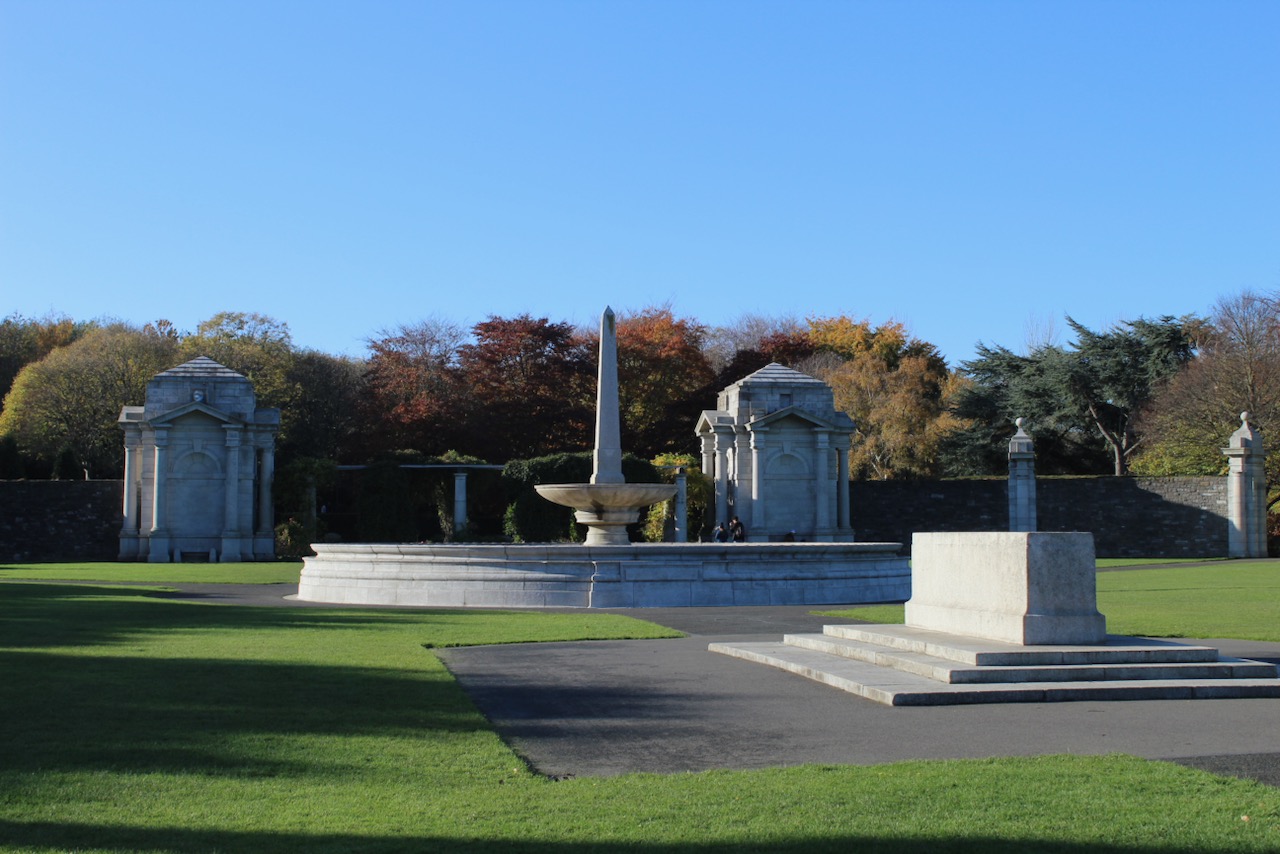
Irish National War Memorial Gardens, Dublin, designed by Lutyens (we go walking here all the time!). Photograph © Jennifer Winder-Baggot, www.irishhistorichouses.com
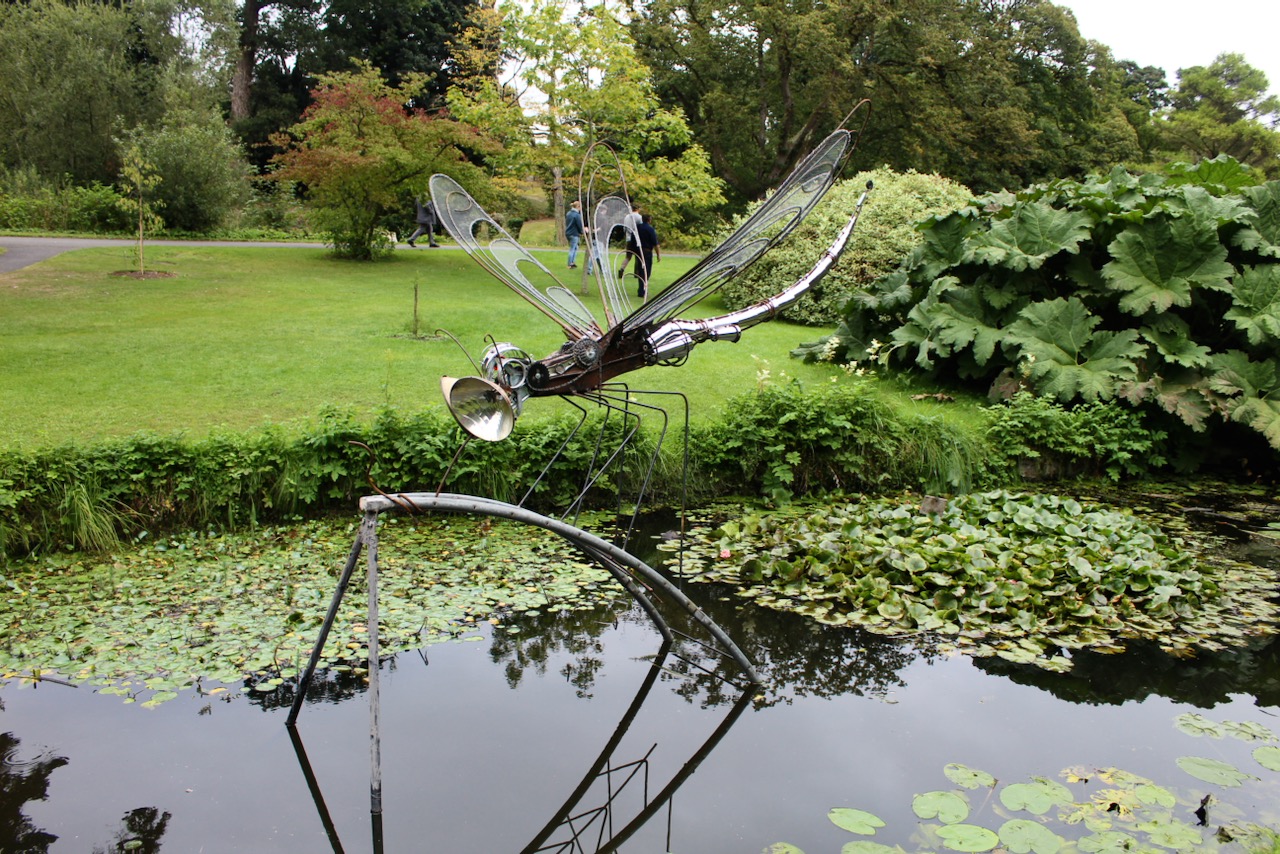
National Botanic Gardens, Dublin (visited in September 2021). Photograph © Jennifer Winder-Baggot, www.irishhistorichouses.com
Inside Rathfarnham Castle (visited in September 2021). Photograph © Jennifer Winder-Baggot, www.irishhistorichouses.com
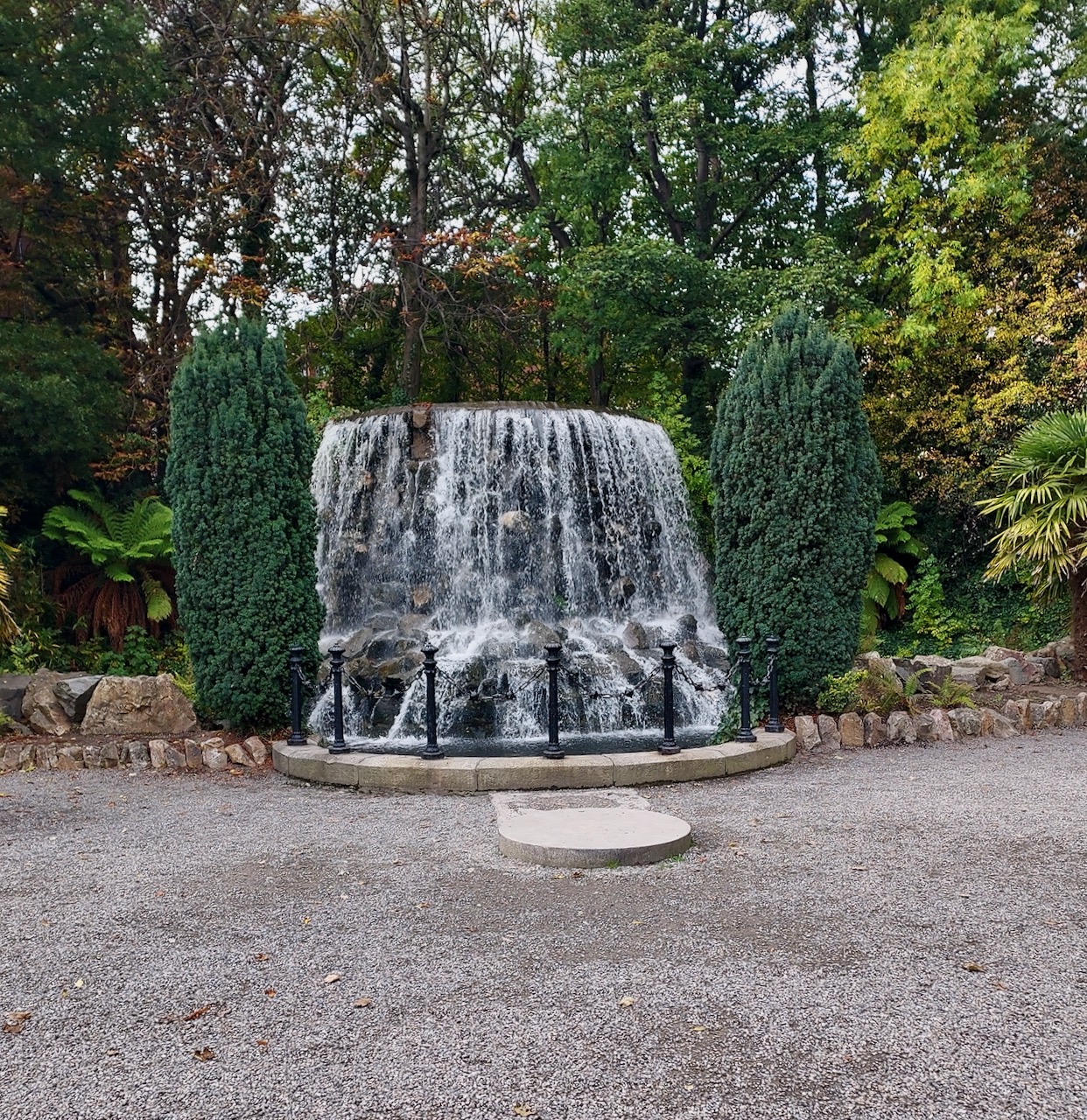
The Iveagh Gardens, Dublin (visited in October 2021). Photograph © Jennifer Winder-Baggot, www.irishhistorichouses.com
The Gardens at Royal Hospital Kilmainham (visited in January 2022). Photograph © Jennifer Winder-Baggot, www.irishhistorichouses.com
Emo Park, County Laois (visited in June 2021). Photograph © Jennifer Winder-Baggot, www.irishhistorichouses.com
Portumna Castle, Galway (visited in July 2021). Photograph © Jennifer Winder-Baggot, www.irishhistorichouses.com
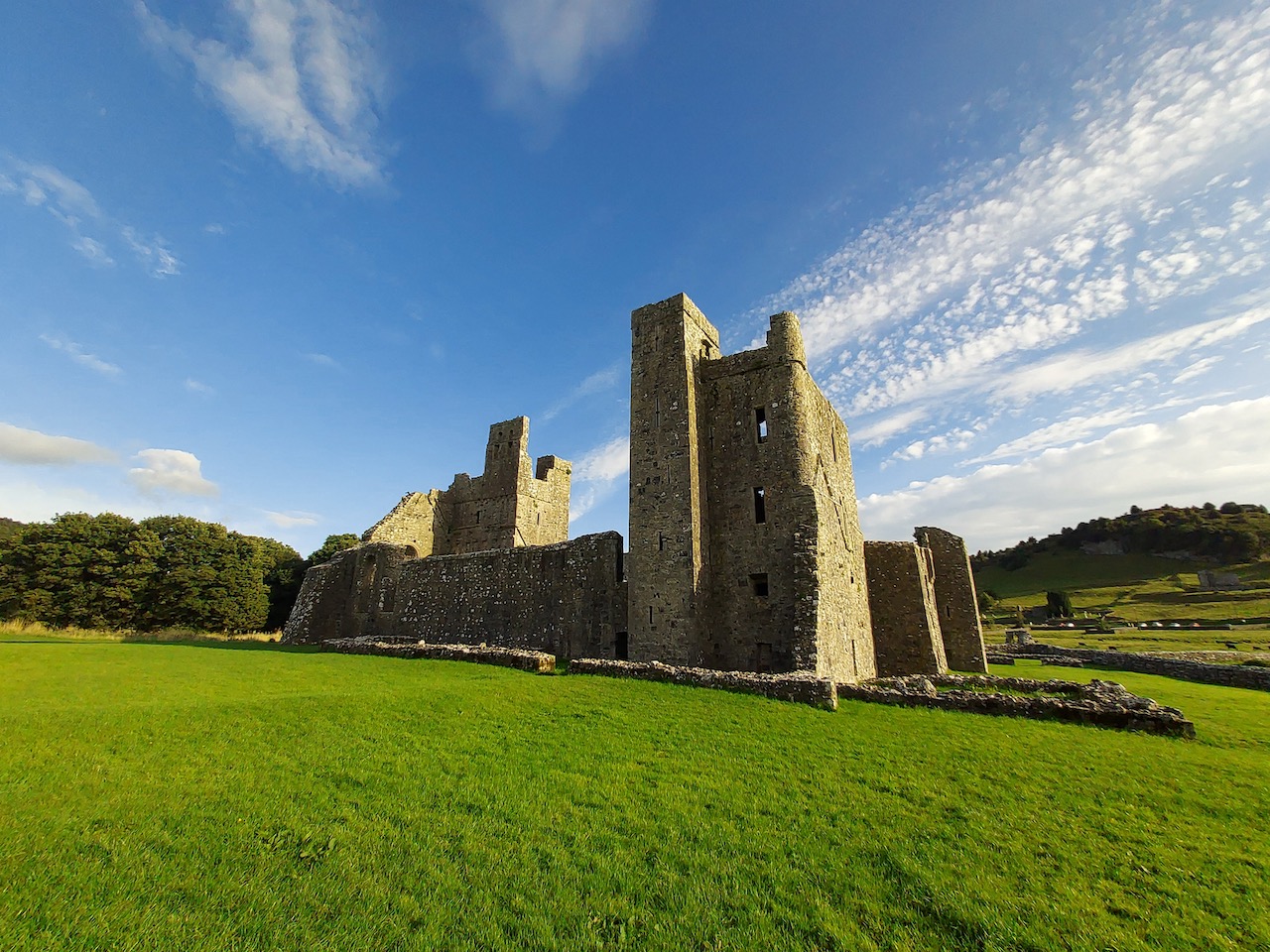
Fore Abbey, County Westmeath (visited in August 2021). Photograph © Jennifer Winder-Baggot, www.irishhistorichouses.com
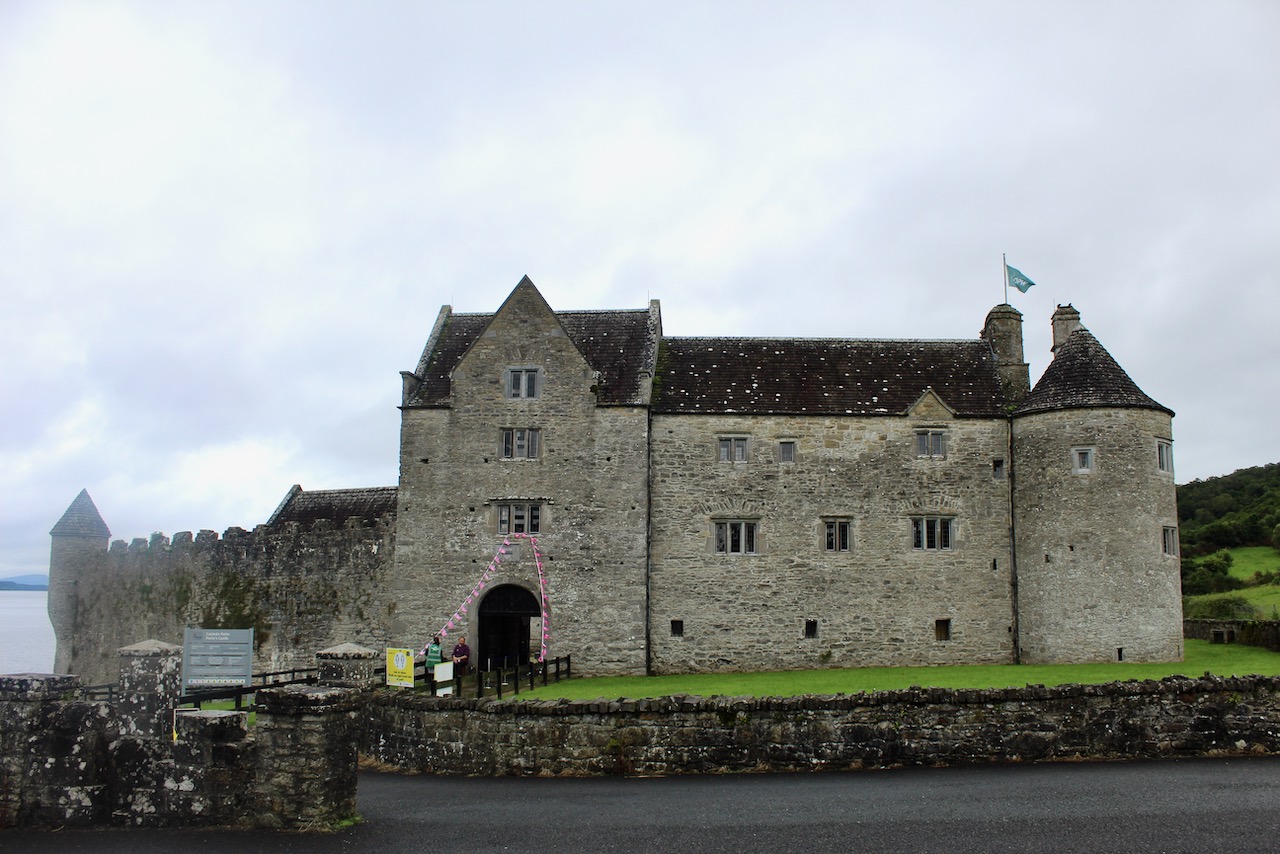
Parke’s Castle, County Leitrim, maintained by the OPW (visited in August 2021). Photograph © Jennifer Winder-Baggot, www.irishhistorichouses.com
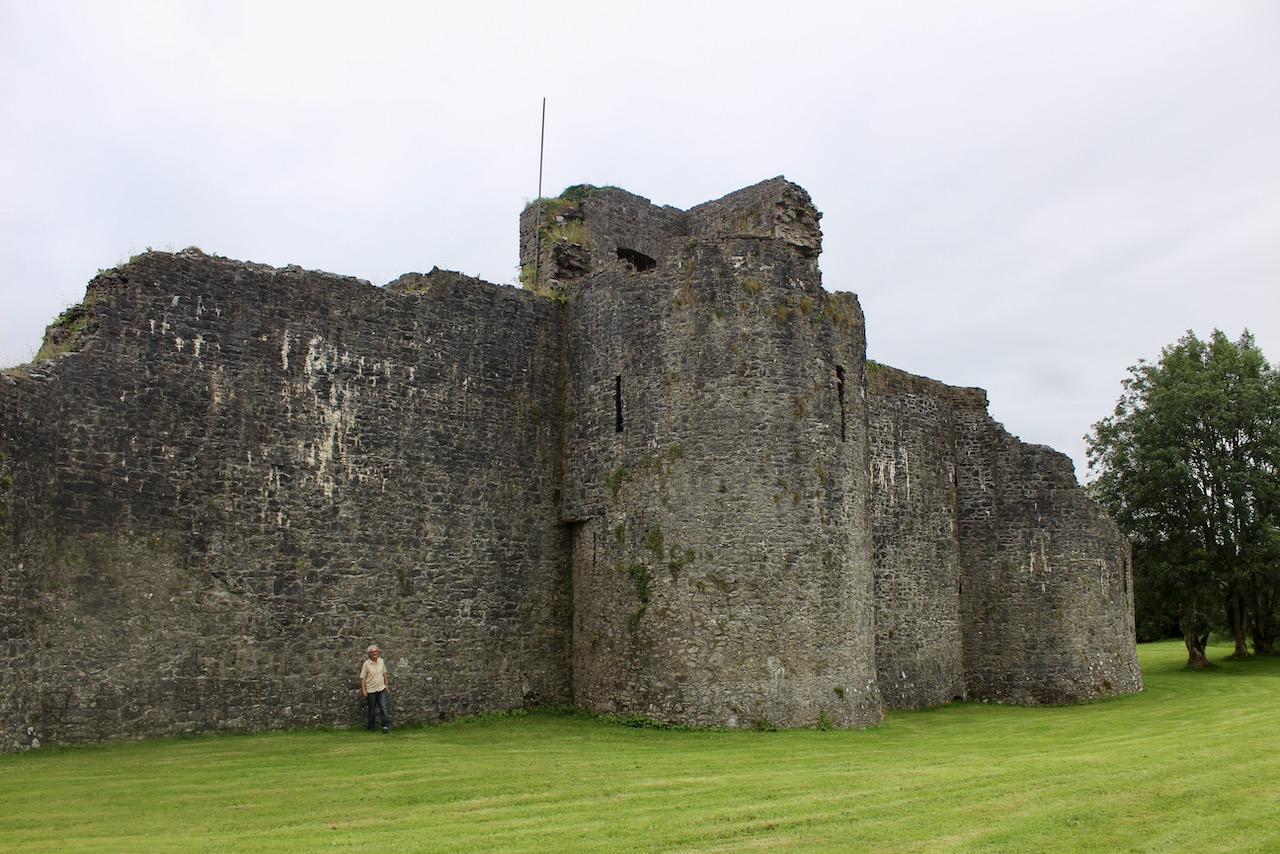
Ballymote Castle, County Sligo (visited in August 2021). Photograph © Jennifer Winder-Baggot, www.irishhistorichouses.com

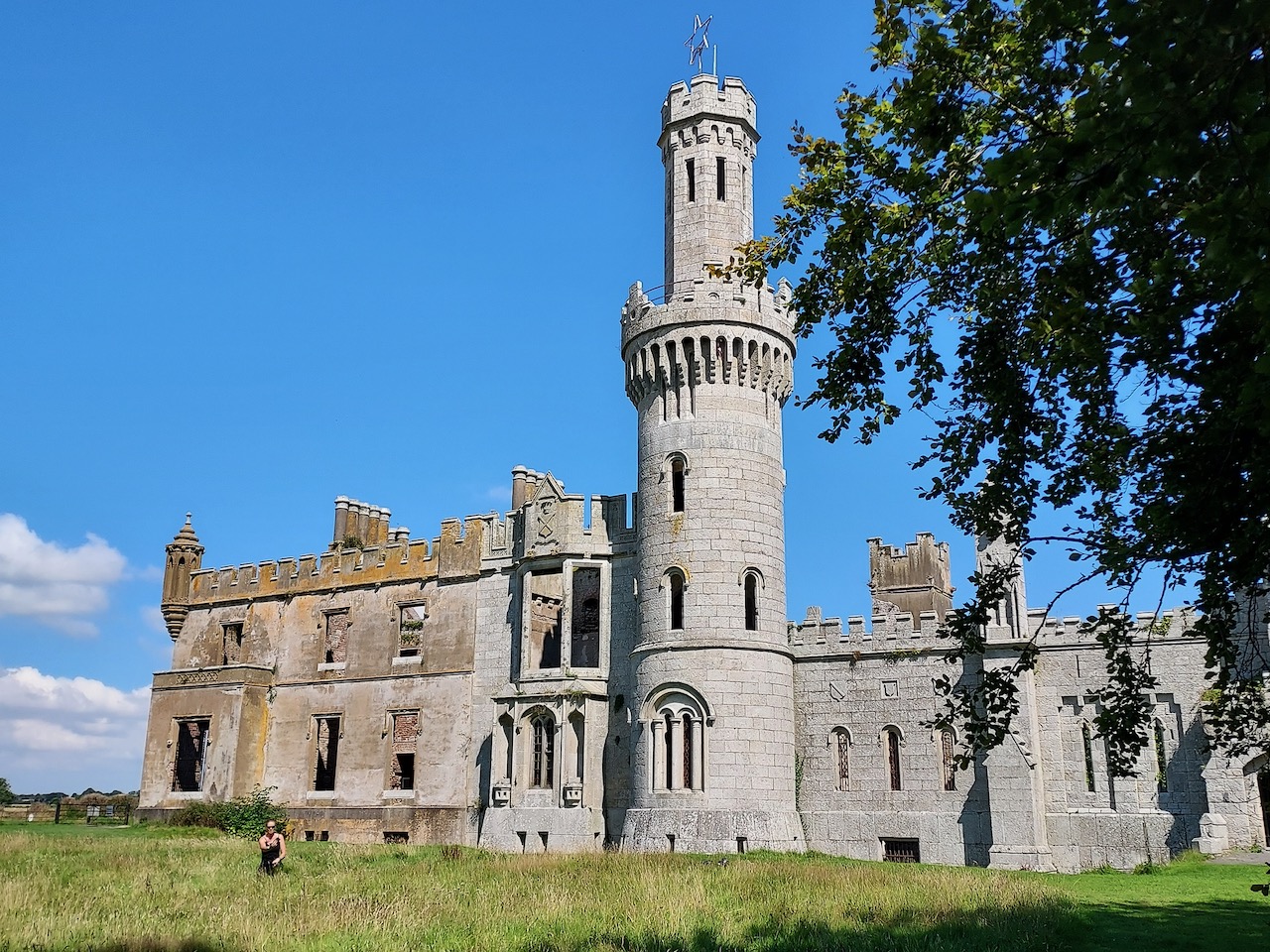
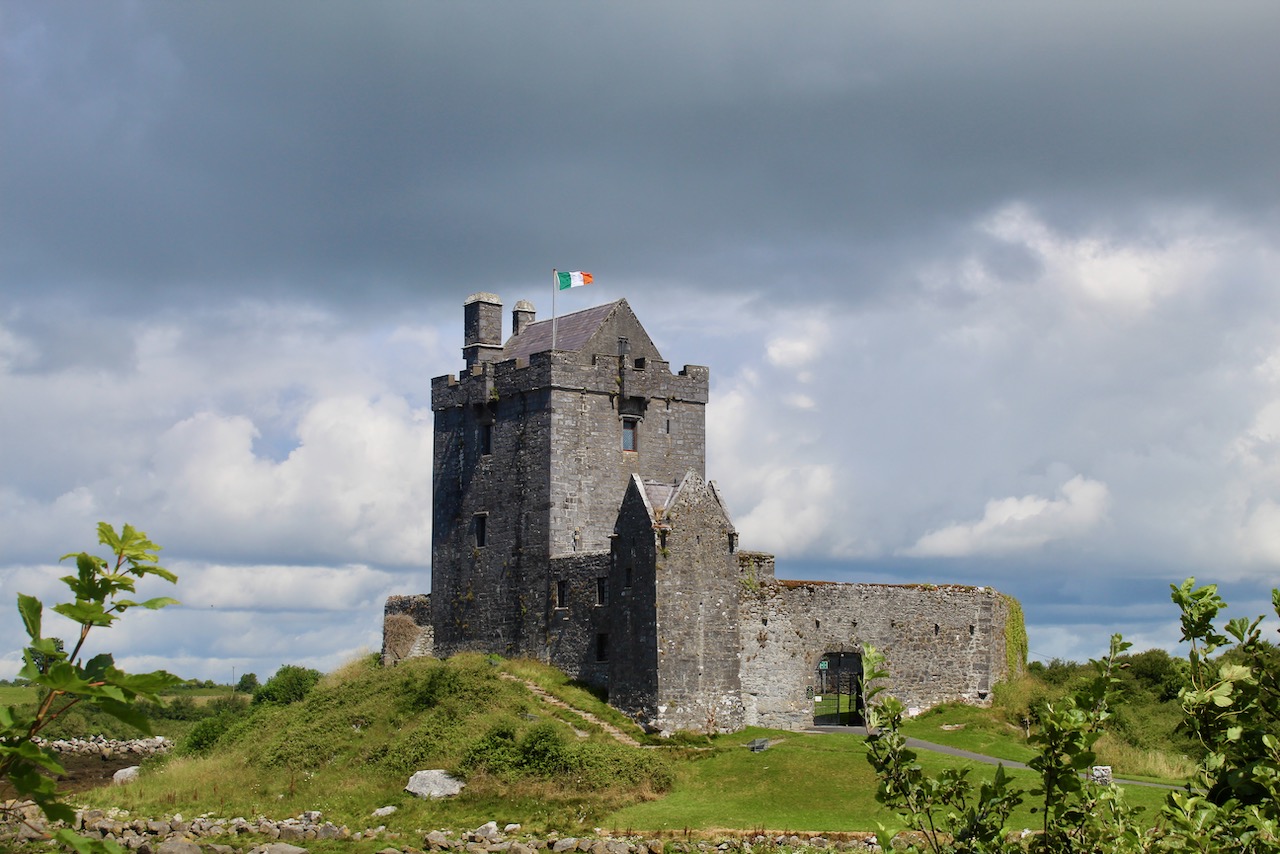
We also visited Duckett’s Grove, maintained by Carlow County Council; Woodstock Gardens and Arbortetum maintained by Kilkenny County Council; Johnstown Castle, County Wexford maintained by the Irish Heritage Trust (which also maintains Strokestown Park, which we have yet to visit – hopefully this year! it’s a Section 482 property – and Fota House, Arboretum and Gardens, which we visited in 2020); Dunguaire Castle, County Clare, which is maintained by Shannon Heritage, as well as Newbridge House, which we also visited in 2021. Shannon Heritage also maintains Bunratty Castle, Knappogue Castle and Cragganowen Castle in County Clare, King John’s Castle in Limerick, which we visited in 2019, Malahide Castle in Dublin which I visited in 2018, GPO museum, and the Casino model railway museum. We also visited Belvedere House, Gardens and Park – I’m not sure who maintains it (can’t see it on the website).

Duckett’s Grove, County Carlow (visited in August 2021). Photograph © Jennifer Winder-Baggot, www.irishhistorichouses.com
Woodstock House, County Kilkenny, maintained by Kilkenny County Council (visited in August 2021). Photograph © Jennifer Winder-Baggot, www.irishhistorichouses.com
Johnstown Castle, County Wexford, maintained by the Irish Heritage Trust (visited in November 2021). Photograph © Jennifer Winder-Baggot, www.irishhistorichouses.com
Dunguaire Castle, County Clare (visited in July 2021). Photograph © Jennifer Winder-Baggot, www.irishhistorichouses.com
Newbridge House, County Dublin (visited in June 2021). Photograph © Jennifer Winder-Baggot, www.irishhistorichouses.com
Belvedere House, County Westmeath (visited in August 2021). Photograph © Jennifer Winder-Baggot, www.irishhistorichouses.com

We were able to visit two historic properties when we went to view auction sales at Townley Hall, County Louth and Howth Castle, Dublin.

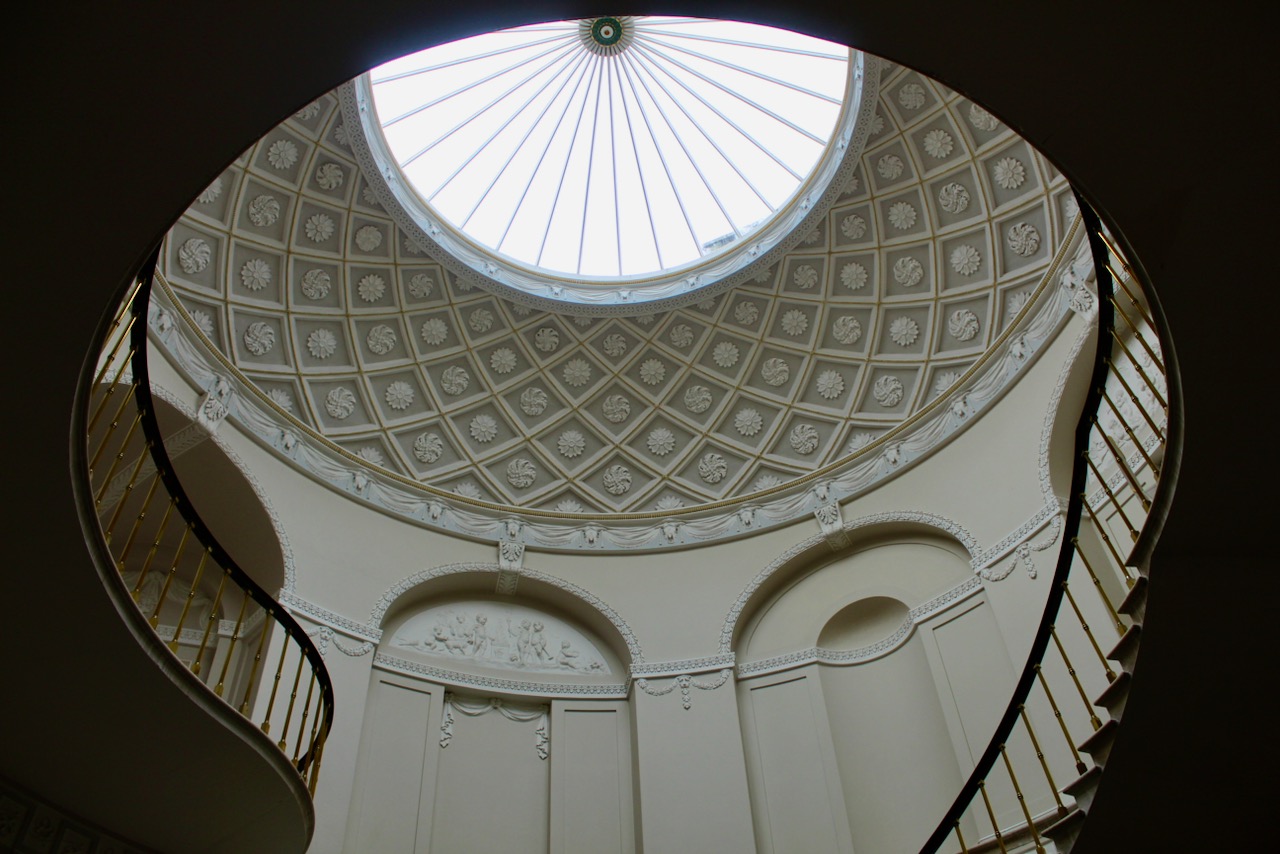
The domed rotunda in Townley Hall, County Louth (visited in October 2021). Photograph © Jennifer Winder-Baggot, www.irishhistorichouses.com
Howth Castle, County Dublin (visited in September 2021). Photograph © Jennifer Winder-Baggot, www.irishhistorichouses.com

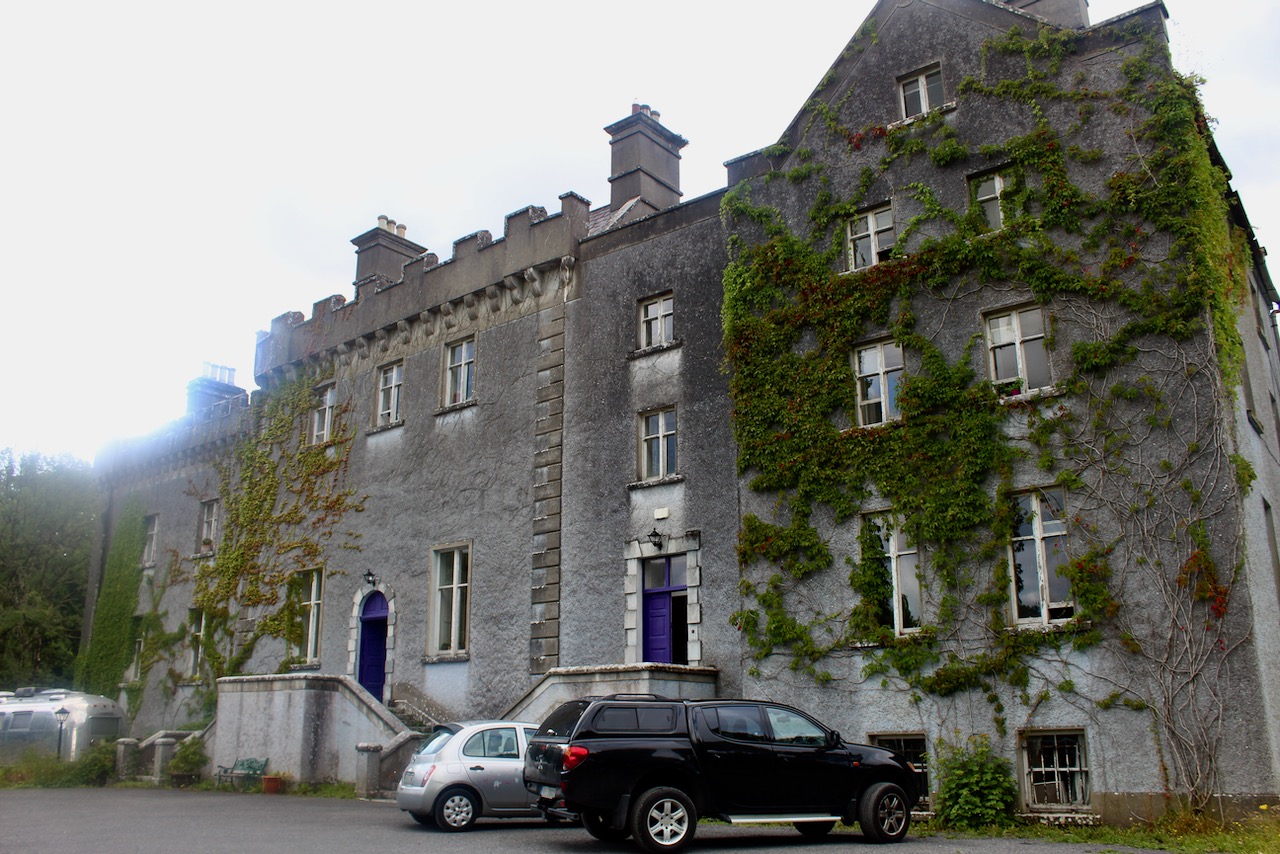
Finally some private Big Houses that we visited, staying in airbnbs, were Annaghmore in County Sligo and Cregg Castle in Galway.

Annaghmore, County Sligo, where we stayed as airbnb guests with Durcan and Nicola O’Hara (in August 2021). Photograph © Jennifer Winder-Baggot, www.irishhistorichouses.com
Cregg Castle, County Galway (in July 2021). Photograph © Jennifer Winder-Baggot, www.irishhistorichouses.com

Here are the listings for January 2021:

Cavan

Cabra Castle (Hotel)

Kingscourt, Co. Cavan

Howard Corscadden.

Tel: 042-9667030

www.cabracastle.com

Open dates in 2021: all year, except Dec 24, 25, 26, 11am-12 midnight

Fee: Free

Cabra Castle, County Cavan. Photograph © Jennifer Winder-Baggot, www.irishhistorichouses.com

Corravahan House & Gardens

Corravahan, Drung, Ballyhaise, Co. Cavan

Ian Elliott

Tel: 087-9772224

www.corravahan.com

Open dates in 2021: Jan 4-5, 11-12, 18-19, 25-26, Feb 1-2, 8-9, 15-16, 22-23, Mar 1-2, 8-9, May 4- 5, 9-12, 16-19, 23-26, 30-31, June 1-4, Aug 14-31, Sept 1-2, 9am-1pm, Sundays 2pm- 6pm
Fee: adult €10, OAP/student/child €5 

Corravahan, County Cavan. Photograph © Jennifer Winder-Baggot, www.irishhistorichouses.com

Clare

Newtown Castle

Newtown, Ballyvaughan, Co. Clare

Mary Hawkes- Greene

Tel: 065-7077200

www.newtowncastle.com , www.burrencollege.ie

Open dates in 2021: Jan 4-May 31, Mon-Fri, June 1-30 Mon-Sat, July 1-Aug 31 daily, Sept 1-Dec 17 Mon-Fri, 10am-5pm
Fee: Free 

Newtown Castle, County Clare. Photograph from National Inventory of Architectural Heritage.

Cork

Blarney Castle & Rock Close

Blarney, Co. Cork

C. Colthurst

Tel: 021-4385252

www.blarneycastle.ie

Open dates in 2021: all year except Christmas Eve & Christmas Day, Jan-Mar, Mon-Sat, 9am- sundown, Sun, 9am-6pm 

Apr-May, 9am-6pm, June-Aug, Mon-Sat, 9am-7pm, Sun, 9am-6pm, Sept, Mon-Sat, 9am-6.30pm, Sun, 9am-6pm,
Oct, Nov, Dec daily 9am-6pm,
Fee: adult €18, OAP/student €15, child €10, family and season passes 

Brideweir House

Conna, Co. Cork

Ronan Fox

Tel: 087-0523256

Open dates in 2021: Jan 1-Dec 24, 11am-4pm 

Fee: adult €10, OAP/student €5, child free

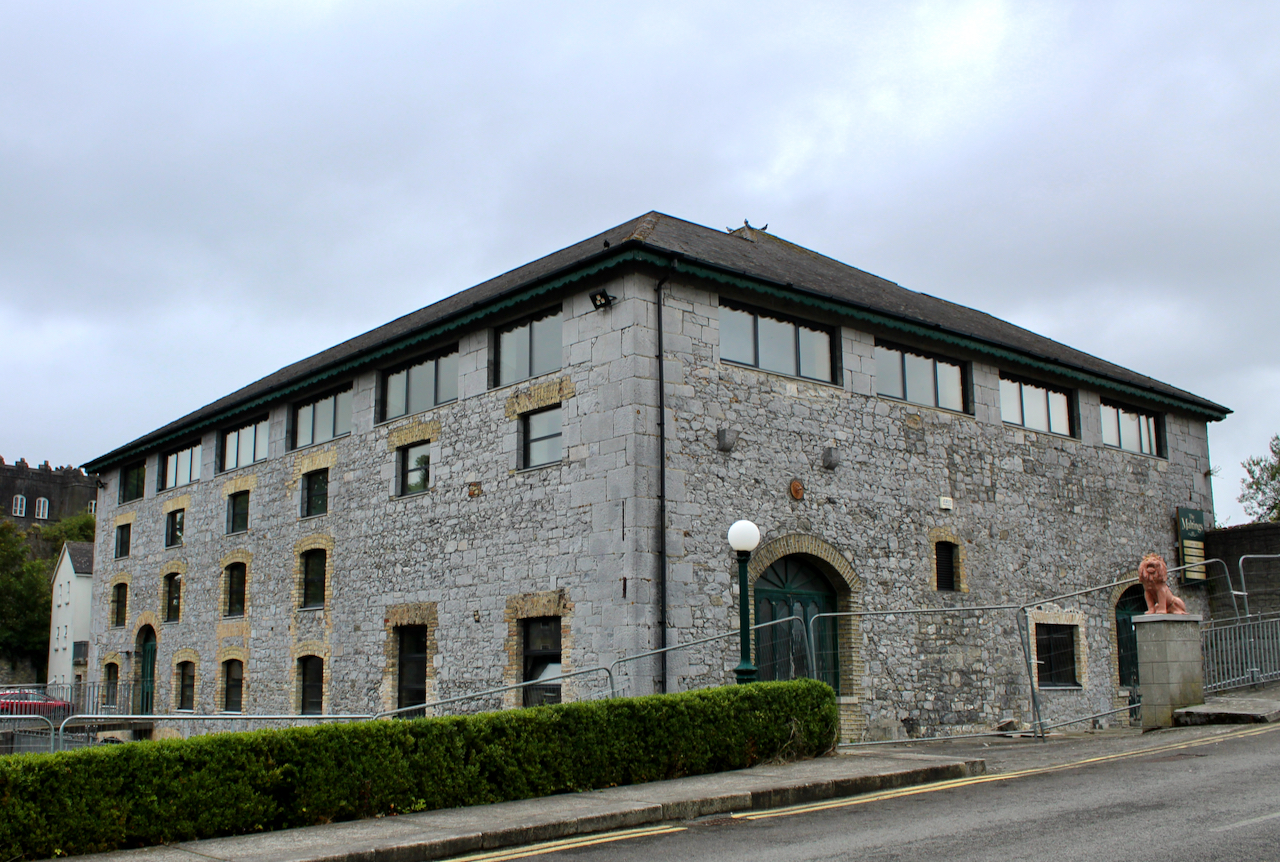
Woodford Bourne Warehouse

Sheares Street, Cork

Edward Nicholson

Tel: 021-4273000

www.woodfordbournewarehouse.com

Open dates in 2021: all year except Christmas Eve, Christmas Day, 1pm-11pm 

Fee: Free

Donegal

Portnason House 

Portnason, Ballyshannon, Co. Donegal
Madge Sharkey
Tel: 086-3846843
Open dates in 2021: Jan 18-22, 25-29, Feb 1-5, 8-12, Aug 14-30, Sept 1-17, 20-23, 27-28, Nov 15- 19, 22-26, Dec 1-3 6-10, 13-14, 9am-1pm 

Fee: adult €8, OAP/student/child €5 

Dublin City

Bewley’s 

78-79 Grafton Street/234 Johnson’s Court, Dublin 2

Peter O’ Callaghan

Tel 087-7179367

www.bewleys.com

Open dates in 2021: all year except Christmas Day, 

11am-7pm Fee: Free 

Hibernian/National Irish Bank

23-27 College Green, Dublin 2

Dan O’Sullivan 

Tel: 01-6755100

www.clarendonproperties.ie

Open dates in 2021: all year, except Dec 25, Wed-Fri 9.30am-8pm, Sun 11am-7pm, Sat, Mon, Tue, 9.30-7pm 

Fee: Free 

Powerscourt Townhouse Centre

59 South William Street, Dublin 2

Mary Larkin

Tel: 01-6717000

Open dates in 2021: All year except New Year’s Day, Easter Sunday, Easter Monday, Christmas Day, St. Stephen’s Day & Bank Holidays, Mon-Sat, 10am-6pm, Thurs, 10am-8pm, Sundays, 12 noon-6pm

Fee: Free

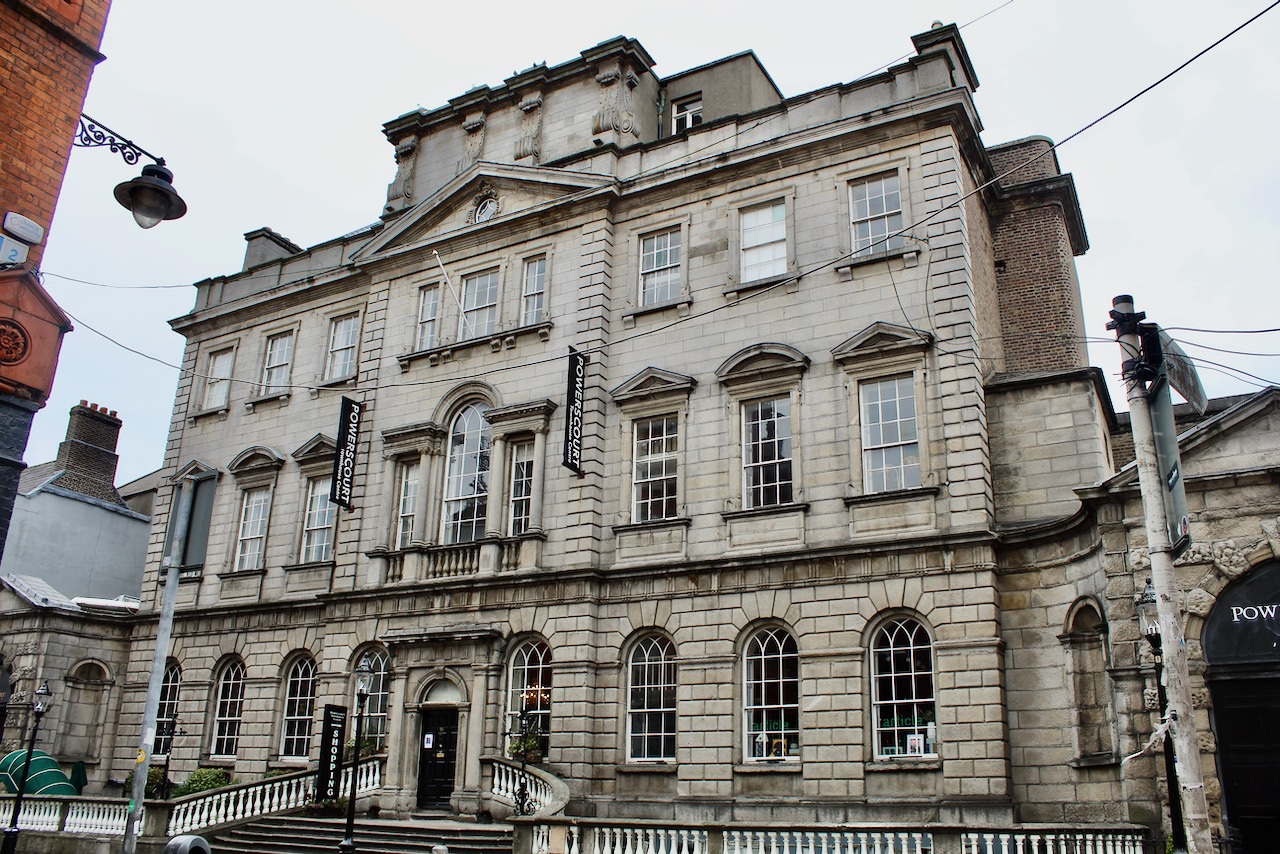
Powerscourt Townhouse, Dublin City. Photograph © Jennifer Winder-Baggot, www.irishhistorichouses.com

10 South Frederick Street

Dublin 2

Joe Hogan

Tel: 087-2430334

Open dates in 2021: Jan 1-24, May 1, 3-8, 10-15, 17-22, 24-27, Aug 14-22, 2pm-6pm 

Fee: Free 

County Dublin 

“Geragh” 

Sandycove Point, Sandycove, Co. Dublin

Gráinne Casey

Tel: 01-2804884

Open dates in 2021: Jan 28-29, Feb 1-5, 8-12, 15-22, May 4-31, Aug 14-22, Sept 1-3, 2pm-6pm Fee: adult €7, OAP €4, student €2, child free  

Meander

Westminister Road, Foxrock, Dublin 18,

Ruth O’Herlihy, 

Tel: 087-2163623

Open dates in 2021: Jan 4-8, 11-15, 18-22, 25-29, May 1, 4-8, 10-11, 17-22, June 8-12, 14-19, 21- 26, Aug 14-22, 9am-1pm 

Fee: adult €5, OAP/child/student €2 

Tibradden House

Mutton Lane, Rathfarnham, Dublin 16

Selina Guinness

Tel: 01-4957483

www.selinaguinness.com

Open dates in 2021: Jan 14-17, 23-24, 28-29, Feb 4-7, 11-12, 19-21, 26-28, May 3-13,16, 18-20, 23-27, June 2-4, 8-10, 14-16, 19-20, Aug 14-22, weekdays 2.30pm-6.30pm, weekends 10.30am-2.30pm
Fee: adult/OAP €8 student €5, child free, Members of An Taisce the The Irish Georgian Society (with membership card) €5 

Galway 

Woodville House Dovecote & Walls of Walled Garden 

Craughwell, Co. Galway
Margarita and Michael Donoghue
Tel: 087-9069191
www.woodvillewalledgarden.com
Open dates in 2021: Jan 29-31, Feb 1-28, Apr 1-13, 11am- 4.30pm, June 1, 6-8, 13-15, 21-22, 27- 29, July 10-11, 17-18, 24-25, 31, Aug 1-2, 6-8, 13-22, 27-29, Sept 4-5, 11am-5pm Fee: adult/OAP €6, child €3, student, €5, family €20, guided tours €10 

Kerry

Derreen Gardens

Lauragh, Tuosist, Kenmare, Co. Kerry

John Daly

Tel: 087-1325665

www.derreengarden.com 

Open dates in 2021: all year, 10am-6pm

Fee: adult/OAP/student €8, child €3, family ticket (2 adults and all children under 18 and 2 maps) €20 

Kildare

Farmersvale House

Badgerhill, Kill, Co. Kildare

Patricia Orr

Tel: 086-2552661

Open dates in 2021: Jan 18-31, Feb 1-6, July 23-31, Aug 1-31, 9.30am-1.30pm
Fee: adult €5, student/child/OAP €3, (Irish Georgian Society members free) 

Harristown House

Brannockstown, Co. Kildare

Hubert Beaumont
Tel: 087-2588775

www.harristownhouse.ie

Open dates in 2021: Jan 11-15, 18-22, Feb 8-12, 15-19, May 4-28, June 7-11, Aug 14-22, Sept 6-10, 9am-1pm 

Fee: adult/OAP/student €10, child €5 

Harristown House, County Kildare. Photograph © Jennifer Winder-Baggot, www.irishhistorichouses.com

Kildrought House

Celbridge Village, Co. Kildare

June Stuart

Tel: 01-6271206, 087-6168651

Open dates in 2021: Jan 1-20, May 18-26, Aug 11-31,10am-2pm
Fee: adult €6, OAP/student/child €3, child under 5 years free, school groups €2 per head 

Moyglare Glebe

Moyglare, Maynooth, Co. Kildare

Joan Hayden

Tel: 01-8722238

Open dates in 2021: Jan 4-8, 11-15, 18-22, 25-29, May 1-31, Aug 14-22, Sept 4-7, 8.30am-12.30pm Fee: adult €6, OAP/student/child €3 

Kilkenny

Kilkenny Design Centre

Castle Yard, Kilkenny

Joseph O’ Keeffe, Tel: 064-6623331

www.kilkennydesign.com

Open dates in 2021: all year,10am-7pm 

Fee: Free

Laois

Ballaghmore Castle

Borris in Ossory, Co. Laois

Grace Pym

Tel: 0505-21453

www.castleballaghmore.com

Open dates in 2021: all year, 9.30am-6pm
Fee: adult €5, child/OAP €3, student free, family of 4, €10 

Leitrim

Manorhamilton Castle (Ruin)

Castle St, Manorhamilton, Co. Leitrim

Anthony Daly

Tel: 086-2502593

Open dates in 2021: Jan 7-Dec 21, National Heritage Week, Aug 14-22, closed Sat & Sun, 10am- 5pm
Fee: adult €5, child free 

Limerick

Ash Hill 

Kilmallock, Co. Limerick

Simon and Nicole Johnson 

Tel: 063-98035

www.ashhill.com

(Tourist Accommodation Facility)

Open dates in 2021: Jan 15-Oct 31, Nov 1-29, Dec 1-15, 9am-4pm Fee: adult/student €5, child/OAP free 

Glebe House

Bruff, Co. Limerick

Colm McCarthy

Tel: 087-6487556

Open dates in 2021: Jan 4-29, May 10-28, Aug 13-22, Sept 13-24, Mon-Fri, 5.30pm-9.30pm, Sat- Sun, 8am-12 noon 

Fee: Free 

Mayo

Brookhill House

Brookhill, Claremorris, Co. Mayo

Patricia and John Noone

Tel: 094-9371348

Open dates in 2021: Jan 13-20, Apr 13-20, May 18-24, June 8-14, July 13-19, Aug 1-23, 2pm-6pm

Fee: adult €6, student €3, OAP/child/National Heritage Week free

Meath

Cillghrian Glebe now known as Boyne House Slane (or Stackallan)

Slane, Co. Meath

Alan Haugh

Tel: 041-9884444

www.boynehouseslane.ie

Open dates in 2021: all year, National Heritage Week, Aug 14-22, 9am-1pm Fee: Free 

Dardistown Castle

Dardistown, Julianstown, Co. Meath

Lizanne Allen

Tel: 086 -2774271

www.dardistowncastle.ie

Open dates in 2021: Jan 9-31, Feb 11-21, May 15-21, Aug 14-31, Sept 1-30, 10am-2pm Fee: adult €6, student/OAP €5, child free 

Dardistown Castle, County Meath. Photograph © Jennifer Winder-Baggot, www.irishhistorichouses.com

Gravelmount House 

Castletown, Kilpatrick, Navan, Co. Meath
Brian McKenna
Tel: 087-2520523
Open dates in 2021: Jan 1-13, May 10-30, June 1-20, Aug 14-22, 9am-1pm Fee: adult €6, OAP/student/child €3 

Moyglare House

Moyglare, Co. Meath

Postal address Maynooth Co. Kildare

Angela Alexander

Tel: 086-0537291

www.moyglarehouse.ie

Open dates in 2021: Jan 1, 4-8, 11-15, 18-22, 25-29, May 1-21, 24-28, 31, June 1-3, Aug 14-22, 9am-1pm
Fee: adult €7.50, OAP/student/child €5 

St. Mary’s Abbey

High Street, Trim, Co. Meath

Peter Higgins 

Tel: 087-2057176

Open dates in 2021: Jan 25-29, Feb 22-26, Mar 8-12, Apr 12-16, May 24-30, June 21-27, July 19- 25, Aug 14-22, Sept 13-17, 20-24, 2pm-6pm 

Fee: adult €5, OAP/student/child €2 

Tankardstown House 

Rathkenny, Slane, Co. Meath

Tadhg Carolan, Tel: 087-7512871

www.tankardstown.ie

Open dates in 2021: All year including National Heritage Week, 9am-1pm

Fee: Free

Tankardstown, County Meath. Photograph © Jennifer Winder-Baggot, www.irishhistorichouses.com

Monaghan

Castle Leslie

Glaslough, Co. Monaghan

Samantha Leslie 

Tel: 047-88091

www.castleleslie.com

(Tourist Accommodation Facility)

Open dates in 2021: all year, National Heritage Week, events August 14-22 Fee: Free 

Castle Leslie, County Monaghan. Photograph © Jennifer Winder-Baggot, www.irishhistorichouses.com

Offaly

Ballybrittan Castle

Ballybrittan, Edenderry, Co. Offaly

Rosemarie

Tel: 087-2469802 

Open dates in 2021: Jan 3-4, 10-11, 17-18, 23-24, 30-31, Feb 6-7, 13-14, 20-21, 27-28, Mar 6-7,13- 14, 20-21, 27-28, May 1-2, 8-9, 15-16, 22-23, June 12-13,19-20, 26-27, July 3-4,10- 11,17-18, 24-25, 31, Aug 14-22, Sept 4-14, 2pm-6pm. 

Fee: free – except in case of large groups a fee of €5 p.p. 

Corolanty House

Shinrone, Birr, Co. Offaly

Siobhan Webb

Tel: 086-1209984

Open dates in 2021: Jan, Feb, July, Aug, Sept, daily 2pm-6pm

Fee: Free

Crotty Church

Castle Street, Birr, Co. Offaly

Brendan Garry

Tel: 086-8236452

Open dates in 2021: All year, except Dec 25, 9am-5pm 

Fee: Free

High Street House

High Street, Tullamore, Co. Offaly

George Ross

Tel: 086-3832992

www.no6highstreet.com

Open dates in 2021: Jan 4-8, 11-15, 18-22, 25-29, May 1-18, Aug 14-22, Sept 1-24, 9.30am-1.30pm Fee: adult/student €5, OAP €4, child under 12 free 

Springfield House 

Mount Lucas, Daingean, Tullamore, Co. Offaly Muireann Noonan
Tel: 087-2204569
www.springfieldhouse.ie 

Open dates in 2021: Jan 1-14, 1pm-5pm, May 14-16, 24-28, July 2-4, 9-11, 16-18, Aug 7-29, 2pm- 6pm, Dec 26-31, 1pm-5pm
Fee: Free 

Roscommon

Strokestown Park House

Strokestown Park House, Strokestown, Co. Roscommon

Ciarán

Tel: 01-8748030

www.strokestownpark.ie

Open dates in 2021: Jan 2-Dec 20, Jan, Feb, Mar 1-16, Nov, Dec,10.30am-4pm, March 17-Oct 31, 10.30am-5.30pm,
Fee: adult €14, €12.50, €9.25, OAP/student €12.50, child €6, family €29, groups €11.50 

Tipperary

Beechwood House

Ballbrunoge, Cullen, Co. Tipperary

Maura & Patrick McCormack

Tel: 083-1486736

Open dates in 2021: Jan 4-8, 18-22, Feb 1-5, 8-12, May 1-3, 14-17, 21-24, June 11-14, 18-21, Aug 14-22, Sept 3-6, 10-13, 17-20, 24-27, 10.15am-2.15pm 

Fee: adult €5, OAP/student €2, child free, fees donated to charity 

Waterford 

The Presentation Convent 

Waterford Healthpark, Slievekeel Road,Waterford Michelle O’ Brien
www.rowecreavin.ie
Tel: 051-370057 

Open dates in 2021: Jan 1-Dec 31, excluding Bank Holidays and Sundays, Mon-Fri, 8am-6pm, Sat, 10am-2pm, National Heritage Week, Aug 14-22
Fee: Free 

Wexford

Clougheast Cottage

Carne, Co. Wexford

Jacinta Denieffe

Tel: 086-1234322

Open dates in 2021: Jan 11-31, May 1-31 August 14-22, 9am-1pm Fee: €5 

Wilton Castle

Bree, Enniscorthy, Co. Wexford

Sean Windsor

(Tourist Accommodation Facility)

Tel: 053-9247738 

www.wiltoncastleireland.com   

Open dates in 2021: all year

Wilton Castle, County Wexford. Photograph © Jennifer Winder-Baggot, www.irishhistorichouses.com

Wicklow

Castle Howard

Avoca, Co. Wicklow

Mark Sinnott

Tel: 087-2987601

Open dates in 2021: Jan 11-13, Feb 1-5, Mar 1-3, 22-24, June 10-12, 14-15, 19, 21-26, 28, July 5-9, 19-22, Aug 13-22, Sept 6-11, 18, 25, Oct 4-6, 11-13, 9am-1pm 

Fee: adult €8.50, OAP/student €6.50, child €5 

Castle Howard, County Wicklow. Photograph © Jennifer Winder-Baggot, www.irishhistorichouses.com

Mount Usher Gardens

Ashford, Co. Wicklow

Caitriona Mc Weeney

Tel: 0404-49672

www.mountushergardens.ie

Open dates in 2021: all year 10am-6pm

Fee: adult €8, student/OAP €7, child €4, no charge for wheelchair users

Powerscourt House & Gardens

Powerscourt Estate, Enniskerry, Co. Wicklow

Sarah Slazenger

Tel: 01-2046000

www.powerscourt.ie

Open: All year, closed Christmas day and St Stephens day, 9.30am-5.30pm, ballroom and garden rooms Sun, 9.30am-1.30pm
Fee: Mar-Oct, adult €11.50, OAP €9, student €8.50, child €5, family ticket €26, Nov- Dec, adult €8.50, OAP €7.50, student €7, child €4, family ticket 2 adults + 3 children €18, children under 5 free 

Powerscourt, County Wicklow. Photograph © Jennifer Winder-Baggot, www.irishhistorichouses.com

Slane Castle, County Meath – section 482 tourist accommodation

www.slanecastle.ie

(Tourist Accommodation Facility)

Open in 2025: January, February, May, June, July, August, (Mar-Apr, Sept-Dec, Mon-Thurs)

Fee: adult €14, OAP/student €12.50, child €8.40 under 5 years free

DSC_0503
The view of Slane Castle from just inside the gate, driving in. Photograph © Jennifer Winder-Baggot, www.irishhistorichouses.com

Today (Saturday 27th April 2019) my husband Stephen and I made our first official blog trip.  We started in the “ancient east,” going to Slane Castle in County Meath. The land around the Boyne River is beautiful, rolling and fertile. It took almost exactly one hour to drive from our home in Dublin, taking the M1 which I find easier than the M2 through the city’s north side, with which I’m less familiar. Our timing was perfect, we arrived at 2:10pm, in time for the 2:15 tour – there are tours every hour on the quarter hour. [1]

DSC_0504
Coming closer to Slane Castle. Photograph © Jennifer Winder-Baggot, www.irishhistorichouses.com

The castle is three storeys over basement, in the Gothic Revival style. There is a bow on the back side of the castle, facing the river, and the basement serves as the ground floor on this side due to the steep slope down to the River Boyne. The bow forms a round tower, but you cannot see it as you approach the castle as the river is behind.

DSC_0505
The view over the beautiful River Boyne. Photograph © Jennifer Winder-Baggot, www.irishhistorichouses.com
DSC_0507
Stephen in front of the Castle. Photograph © Jennifer Winder-Baggot, www.irishhistorichouses.com

Our guide Matthew told us that the castle was reconstructed and enlarged by William Burton Conyngham (1733-1796). It was built on the foundations of a medieval castle of the Fleming family, replacing an earlier house. William Burton Conyngham was a classicist and the front hall features Greek columns and key patterns on the walls and many marble Greek sculptures, including a sculpture of King George IV of England, donated by the king himself.

William Burton Conyngham, (1733-1796), Teller of the Irish Exchequer and Treasurer of the Royal Irish Academy Date 1780 Engraver Valentine Green, English, 1739 – 1813 After Hugh Douglas Hamilton, Irish, 1740-1808.

William Burton Conyngham argued with his architects, Matthew told us, so ended up having three architects for his castle: James Gandon, James Wyatt and Francis Johnston. According to Mark Bence-Jones in A Guide to Irish Country Houses, Francis Johnston completed the house for the the second Lord Conyngham’s son, nephew of William Burton Conyngham, Henry (1766-1832), who later became the 1st Marquess Conyngham. Other architects were consulted at various times, including James Gandon, who most famously designed the Custom House and the Four Courts in Dublin, and Emo in County Laois. Francis Johnston designed the General Post Office in Dublin, and Townley Hall, County Louth. Another architect consulted was a favourite of King George IV, the English Thomas Hopper.

In 1785 the castle was remodelled to the design of James Wyatt (1746 – 1813). Wyatt also designed another house on the section 482 list this year, Curraghmore in County Waterford, and a house not on the list, unfortunately, as I would love to see inside, Abbeyleix House (incidentally, my father grew up in Abbeyleix and we used to enjoy the gardens which used to be open and which were reknowned for the bluebells. Also, coincidentally, according to wikipedia, Wyatt spent six years in Italy, 1762–68, in company with Richard Bagot of Staffordshire, who was Secretary to the Earl of Northampton’s embassy to the Venetian Republic. My family is rumoured to be descended from the Staffordshire Bagots, although I have not found the connection!).

The Conyngham family have owned the castle since 1703.

The Flemings of Slane

The Conynghams bought the land in Slane after it was confiscated from the Flemings. In 1175, Richard Le Fleming built a castle at the western end of Slane hill and, three generations later, Simon Fleming was created Baron of Slane. [4]

The Conynghams did not acquire Slane directly after it was confiscated from the Flemings – Terry Trench of the Slane History and Archaeology Society writes that the estate changed hands, at least on paper, seven times between 1641 and 1703. The estate was taken from the Flemings in 1641, when William Fleming, the 14th Baron Slane, joined the Catholic Irish forces in rebellion against the British. He remained loyal to the king, but objected to the laws that the British parliament passed to make the Irish parliament subservient to the British parliament. The estate was restored to William’s son Randall under the Act of Settlement and Distribution of Charles II’s reign, by decree dated 27th March 1663. [5] Many estates that had been confiscated by Cromwell’s parliament were restored when Charles II was restored to the throne in 1660.

The Flemings had their land confiscated again as Christopher, 17th Baron Slane (1669-1726), backed James II in his battles against William of Orange. He served in the Irish Parliament of King James II in 1689, and as colonel in James’s army in Ireland 1689-91, fighting in both the Battle of the Boyne and in Aughrim, where he was taken prisoner by William’s forces. Released, he emigrated and fought in the French and Portuguese armies, as did many of James II’s followers who were attainted and lost their estates, as they needed to be able to earn a living. He was later reconciled with Queen Anne of England (daughter of James II) and returned to Ireland, to live in Anticur, County Antrim. In 1703, Henry Conyngham purchased the estate of Slane.

The Conynghams of Slane

The Conyngham motto, Over Fork Over, recounts the way Duncan hid from Macbeth (familiar to us from Shakespeare). Matthew told us that Duncan hid in straw in a barn, having it forked over him. After that, he managed to defeat Macbeth and to become king. So the Conynghams are descendants of a Scottish king!

DSC_0512
The Conyngham coat of arms, with its motto, Over Fork Over. Photograph © Jennifer Winder-Baggot, www.irishhistorichouses.com
At Slane, April 2019.

Alexander Conyngham moved from Scotland to Ireland when he was appointed in 1611 to be the first Protestant minister to Enver and Killymardin the diocese of Raphoe, County Donegal. [3] He was appointed dean of Raphoe in 1631.

The Bishop’s Palace at Raphoe, now a ruin. Photograph © Jennifer Winder-Baggot, www.irishhistorichouses.com

He settled at Mount Charles, County Donegal, on an estate he leased from John Murray, earl of Annandale, the owner of ‘a vast estate’ in Scotland. Conyngham subsequently acquired the Mount Charles property through his marriage to the earl’s grand-neice, Marian, daughter of John Murray of Broughton, in Scotland (see [3]).

Alexander’s son Albert lived at Mountcharles. [2] Albert had fought with William III’s troops in the Battle of the Boyne, against Fleming and James II’s troops.

Albert Cunningham (d. 1691) first colonel of the 6th (Inniskilling) Dragoons, by Willem Wissing c. 1690, courtesy of British Cavalry Regiments website and wikipedia.

Albert married Mary, daughter of the Right Reverend Robert Leslie, Bishop of Raphoe – this Bishop is the ancestor of the Leslie family of Castle Leslie in County Monaghan, another property on the Section 482 list that I will be visiting. Albert was killed by Irish Royalist rebels, and succeeded by his only surviving son, Henry (1664-1705). 

Henry, a military man who also served as MP for County Donegal, purchased the land in Slane in 1703.

He built himself a residence, which he called Conyngham Hall, on the foundations of an older castle formerly belonging to the Flemings.

DSC_0511
The intertwined “C” is the symbol of the Conyngham family. Photograph © Jennifer Winder-Baggot, www.irishhistorichouses.com
The Conyngham family tree, on the walls going to the public dining area.

Henry Conyngham (d. 1705) fought first in James II’s army, but then persuaded his regiment to transfer their loyalty to William III.

Henry’s son Henry (1705-1781) inherited the Slane estate. Henry became an Member of the Irish Parliament and was raised to the peerage in 1753 to the title of Baron Conyngham of Mount Charles, and later became Viscount and eventually, Earl. He died without a son so the Barony passed to his nephew, William Burton (his sister Mary had married Francis Burton).

William Burton (1733-1796) took the name of Conyngham upon inheriting the estate in 1781. It was he who rebuilt Slane Castle.

William Burton Conyngham (1733–1796) by Anton Raphael Mengs c. 1754-58, courtesy of wikipedia.

His brother Francis Pierpoint Burton also who then took the name of Conyngham in 1781 as he inherited the title to become 2nd Baron Conyngham of Mount Charles, Co. Donegal. He died six years later, in 1787. [see 3]. In 1750 he had married Elizabeth, the daughter of amateur architect Nathaniel Clements, whose work we will see later in other houses on the section 482 list of heritage properties. For himself, Nathaniel Clements built what is now the Áras an Uachtaráin, the residence of our President, Michael D. Higgins, in Phoenix Park in Dublin.  

The castle and estate passed to Francis 2nd Baron Conyngham’s son Henry (1766-1832). Henry succeeded as the 3rd Baron Conyngham of Mount Charles, Co. Donegal in 1787. He served as a politician and moved quickly up the ranks of the peerage and was Lord Steward of the Royal household between 1821-30. He married Elizabeth Denison in 1794.

Elizabeth née Denison, Marchioness Conyngham (1769-1861), wife of Henry 1st Marquess.

In 1821 King George IV visited Ireland, and he spent time in the Castle with his lover, Elizabeth, wife of Frances Pierpoint Burton Conyngham. “In return,” as our guide told us, the king made Conyngham a Marquess, although this isn’t quite true as he became Marquess in 1816. [6].

One of the rooms of the castle, the Smoking Room, has two cartoons from the period mocking the King and his consort Elizabeth, drawing them as overweight. In one, she aids her son when he has to move from the Castle of Windsor where he was Royal Chamberlain. It was he who announced to Victoria that she was Queen, upon death of the previous monarch. He was let go from his position when he tried to move his lover into his rooms in Windsor. His mother came to fetch him, with several wheelbarrows, the story goes, and she took all the furniture from his rooms. Somehow she brought a grand piano back from Windsor to Slane Castle where it sat in a specially made arbor for music in the Smoking room, until it was destroyed by a fire in Slane Castle in the 1990’s. One of the Punch style cartoons is of Elizabeth with a wheelbarrow fetching her son from Windsor. I can’t quite remember the other – it had King George IV and herself in a carriage. The Irish were very annoyed that when he came to Ireland he spent his entire time at Slane Castle!

Cartoons at Slane Castle Tour, Slane, Co Meath, photograph by Nomos Productions, 2022, Courtesy Failte Ireland.
At Slane, April 2019. Photograph © Jennifer Winder-Baggot, www.irishhistorichouses.com

The Irish Aesthete writes of the visit:

Neither the king nor his inamorata were in the first flush of youth, and both were equally corpulent. These circumstances however did nothing to dampen their ardour. As was written of them at the time, ‘Tis pleasant at seasons to see how they sit/ First cracking their nuts, and then cracking their wit/ Then quaffing their claret – then mingling their lips/ Or tickling the fat about each other’s hips.’ And according to one contemporary observer, Lady Conyngham ‘lived exclusively with him during the whole time he was in Ireland at the Phoenix Park. When he went to Slane, she received him dressed out as for a drawing-room; he saluted her, and they then retired alone to her apartments.’” [7]

Our tour started with a video of Charles Conyngham, now known as Lord Mount Charles, telling of his childhood in the Castle, growing up in a very old-world upper class manner.  He did not join his parents at the dining table until he was twelve years old, dining until then in the Nursery. His nurse, Margaret Browne, came to the Castle at 16 years old, and he held her in such regard that he named his bar after her.

DSC_0516
The menu in Browne’s Bar, which gives an explanation of the name, telling of the housekeeper.

Lord Mount Charles described how he started out, when he had to take over the Castle, with a restaurant, which is now the Gandon Restaurant. To further fund the Castle maintenance, Lord Mount Charles started concerts at the venue, beginning with Thin Lizzy in 1981. To seal the deal, the next show was the Rolling Stones! With such august imprimateur, the Castle’s concerts became world-famous and featured many top performers including David Bowie, Bob Dylan, Neil Young and Queen.

DSC_0514
Lovely picture of Phil Lynnott of Thin Lizzy carrying a child at Slane.

Henry 1st Marquess Conyngham’s son, Francis Nathaniel Burton Conyngham (1797-1876) inherited the property and the title, to become 2nd Marquess Conyngham. His daughter Frances Caroline Maria married Gustavus William Lambart (1814-1886), who we will come across later as the owner of Beauparc in County Meath, another Section 482 property https://irishhistorichouses.com/2022/07/22/beauparc-house-beau-parc-navan-co-meath/ . The current owner of Slane inherited Beauparc from the Lambarts.

A son, George Henry (1825-1882) became 3rd Marquess Conyngham, and his son, Henry Francis the 4th Marquess. He married the daughter of the 4th Baron Mollens of Ventry, County Kerry. Their son the 5th Marquess died unmarried, so the title passed to his brother, Frederick William Burton, 6th Marquess. The current Marquess is the 8th, who is known as Lord Henry Mount Charles, but is officially 8th Marquess Conyngham since 2009.

A disasterous fire in the castle in 1991 destroyed the roof and one third of the castle.

DSC_0525
Newspaper clippings about the fire, in the entry to pub and restaurant.
DSC_0524
At Slane, April 2019.

The magnificent library with its intricate ceiling and impressive wooden chandelier was saved by two firemen fighting the fire from within the room, battling for nine hours. The smoke was so thick that one couldn’t see the ceiling. I think they deserve a plaque in the room to recognise their effort! Meanwhile the family saved as many priceless historic paintings and antiques as they could, including a huge portrait of King George IV that is now hanging again in the library, by cutting it from its giant gilt frame then taking the frame apart into four pieces in order to get it out through the doors. Lord Mount Charles now suffers with his lungs, probably partially as a result of long exposure to the flames and smoke. It took ten years to reconstruct the castle, but it has been done excellently so traces of the fire barely remain.

Portrait of George IV which was saved from the fire, Slane Castle Tour, Slane, Co Meath, photograph by Nomos Productions, 2022, Courtesy Failte Ireland.

We weren’t allowed to take pictures inside, as usual with these properties. There is a picture of the ornate roof in the library on the wonderful blog of the Irish Aesthete [8].

Mark Bence-Jones describes the room in his 1988 book (published before the fire, but this room remained intact!), A Guide to Irish Country Houses:

“…the great circular ballroom or library which rises through two storeys of the round tower and is undoubtedly the finest Gothic Revival room in Ireland; with a ceiling of Gothic plasterwork so delicate and elaborate that it looks like filigree. Yet this, too, is basically a Classical room; the Gothic ceiling is, in fact, a dome; the deep apses on either side of the fireplace are such as one finds in many of Wyatt’s Classical interiors, except that the arches leading into them are pointed; they are decorated with plasterwork that can be recognised as a very slightly Gothicized version of the familiar Adam and Wyatt fan pattern.

Slane Castle Tour, Slane, Co Meath, photograph by Nomos Productions, 2022, Courtesy Failte Ireland.
Slane Castle, Slane, Co Meath, photograph by Nomos Productions, 2022, Courtesy Failte Ireland

Of the tales on the tour, I especially enjoyed the story of the funeral of a soldier’s leg. Apparently it was quite the custom to have funerals for body parts – his leg had to be amputated on the field of battle and the soldier brought it back to be buried with a full-scale military funeral. It must have been to do with the fact that a person’s body is to be resurrected on the Last Day, so it’s good to know where all the parts are! Cremation used to be forbidden in the Catholic church, as somehow it would be too difficult for God to put the ashes back together – never mind a disintegrated body!

We had lunch in the bar after the tour.

DSC_0509
Outer entrance to the bar and Gandon Restaurant. Photograph © Jennifer Winder-Baggot, www.irishhistorichouses.com
DSC_0523
Entrance to the bar and Gandon Restaurant. Photograph © Jennifer Winder-Baggot, www.irishhistorichouses.com
DSC_0519
Browne’s Bar. Photograph © Jennifer Winder-Baggot, www.irishhistorichouses.com
DSC_0513
Album covers of musical performers at the Castle, in the bar: Van Morrison, Santana, Bruce Springstein, Neil Young, the Rolling Stones, Chris Rea, Bob Dylan, U2 and Bon Jovi.
DSC_0515
Memorabilia from music events: I think the guitar was signed by Phil Lynott (it was signed, anyway).
DSC_0517
Slane Castle.
DSC_0518
The music theme of Browne’s Bar is reflected in the gramophone horn lampshade. Photograph © Jennifer Winder-Baggot, www.irishhistorichouses.com

There is an adjoining distillery in what used to be the stables, and a tour of that can be purchased in combination if desired. Lord Charles’s mother bred horses before the stables were converted. The stables were designed by Capability Brown.

DSC_0543
The stables, designed by Capability Brown, now a whiskey distillery. Photograph © Jennifer Winder-Baggot, www.irishhistorichouses.com

According to the Irish Aesthete:

Henry Conyngham, grandson of General Henry Conyngham who purchased the property, around 1770 invited Capability Brown around 1770 to produce a design both for the landscaping of the parkland at Slane, and also for a new stable block. In the collection of the Irish Architectural Archive in Dublin a drawing survives of Brown’s proposal for the latter. It is not unlike the finished building, but more elaborate than what we see today.” [9]

DSC_0527
I noticed this on the wall on the lower level outside the Castle – I don’t know its origin or age. Photograph © Jennifer Winder-Baggot, www.irishhistorichouses.com

I found a blog by the Irish Aesthete on a portrait now in Slane, of Lady Elizabeth wife of the first Marqess’s daughter, Lady Maria Conyngham. Reportedly Lady Elizabeth looked very like her daughter – which one would not guess from the unflattering cartoons of her! [10]

Donation

Help me to fund my creation and update of this website. It is created purely out of love for the subject and I receive no payment so any donation is appreciated! For this entry I paid for petrol and entrance fee for myself and Stephen.

€10.00

[1] https://www.slanecastle.ie/tours/castle-tours/

[2] https://www.buildingsofireland.ie/buildings-search/building/40847025/the-hall-hall-demesne-mountcharles-co-donegal

[3] http://lordbelmontinnorthernireland.blogspot.com/2017/11/slane-castle.html

[4] https://www.culturenorthernireland.org/article/1323/the-flemings-barons-of-slane

[5] http://slanehistoryandarchaeologysociety.com/index.php/famous-people/13-the-flemings-and-the-conynghams

[6] https://en.wikipedia.org/wiki/Elizabeth_Conyngham,_Marchioness_Conyngham

“She probably became his [George IV’s] lover in 1819, when he was Prince Regent, but finally supplanted her predecessor, Isabella Seymour-Conway, Marchioness of Hertford, after he became king in 1820. He became besotted with her, constantly “kissing her hand with a look of most devoted submission.” While his wife Caroline of Brunswick was on trial in 1820 as part of efforts to divorce her, the king could not be seen with Lady Conyngham and was consequently “bored and lonely.” During his coronation, George was constantly seen “nodding and winking” at her.
“Lady Conyngham’s liaison with the king benefited her family. Her husband was raised to the rank of a marquess in the Peerage of the United Kingdom and sworn to the Privy Council, in the coronation honours of 1821. He was also given several other offices, including Lord Steward of the Household and the lieutenancy of Windsor Castle. Her second son was made Master of the Robes and First Groom of the Chamber.”

[7] https://theirishaesthete.com/2015/10/12/when-royalty-comes-to-call/

[8] https://theirishaesthete.com/2015/10/24/vaulting-ambition/

[9] https://theirishaesthete.com/2014/10/27/after-the-horses-have-bolted/

[10] https://theirishaesthete.com/2015/03/21/ireland-crossroads-of-art-and-design-vi/
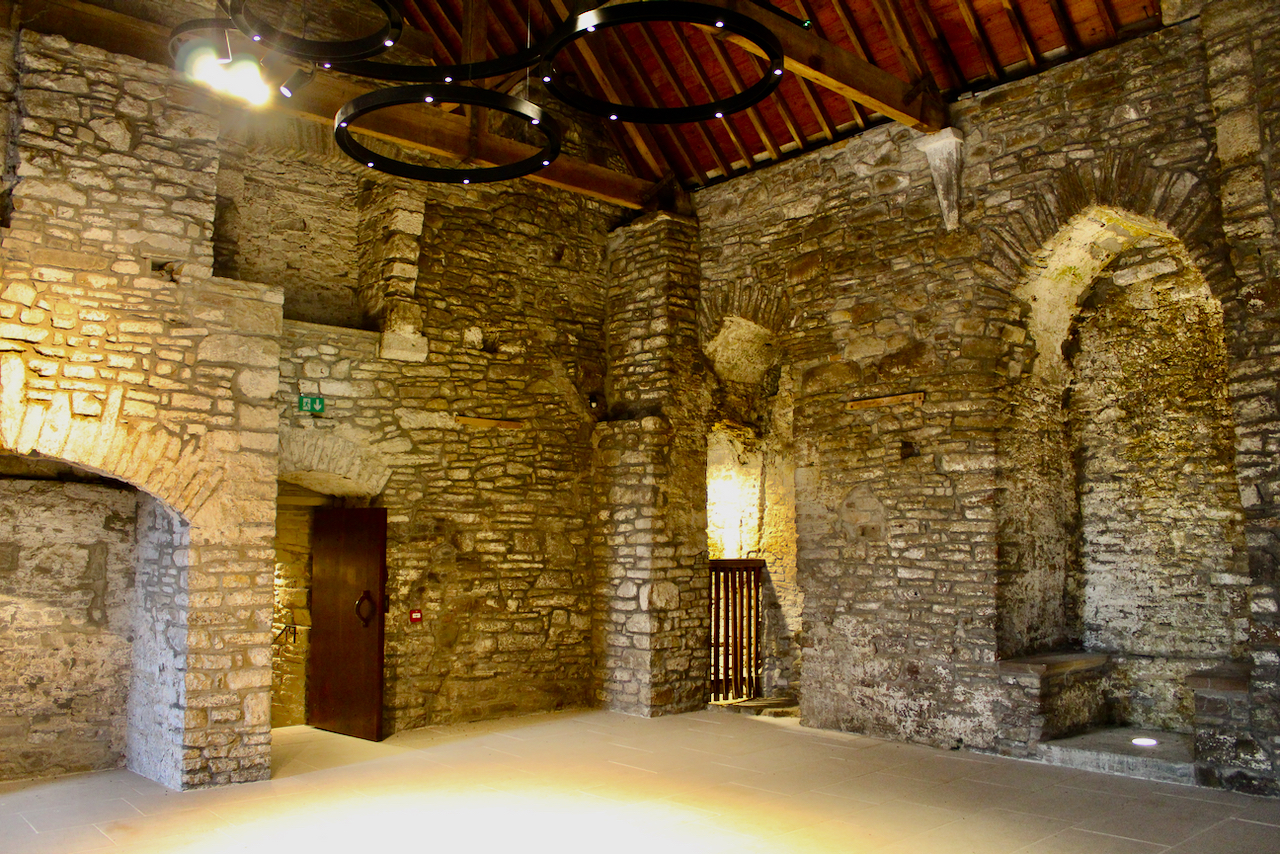
Text © Jennifer Winder-Baggot, www.irishhistorichouses.com

Irish Historic Homes