Castle Townshend, Co Cork – accommodation €

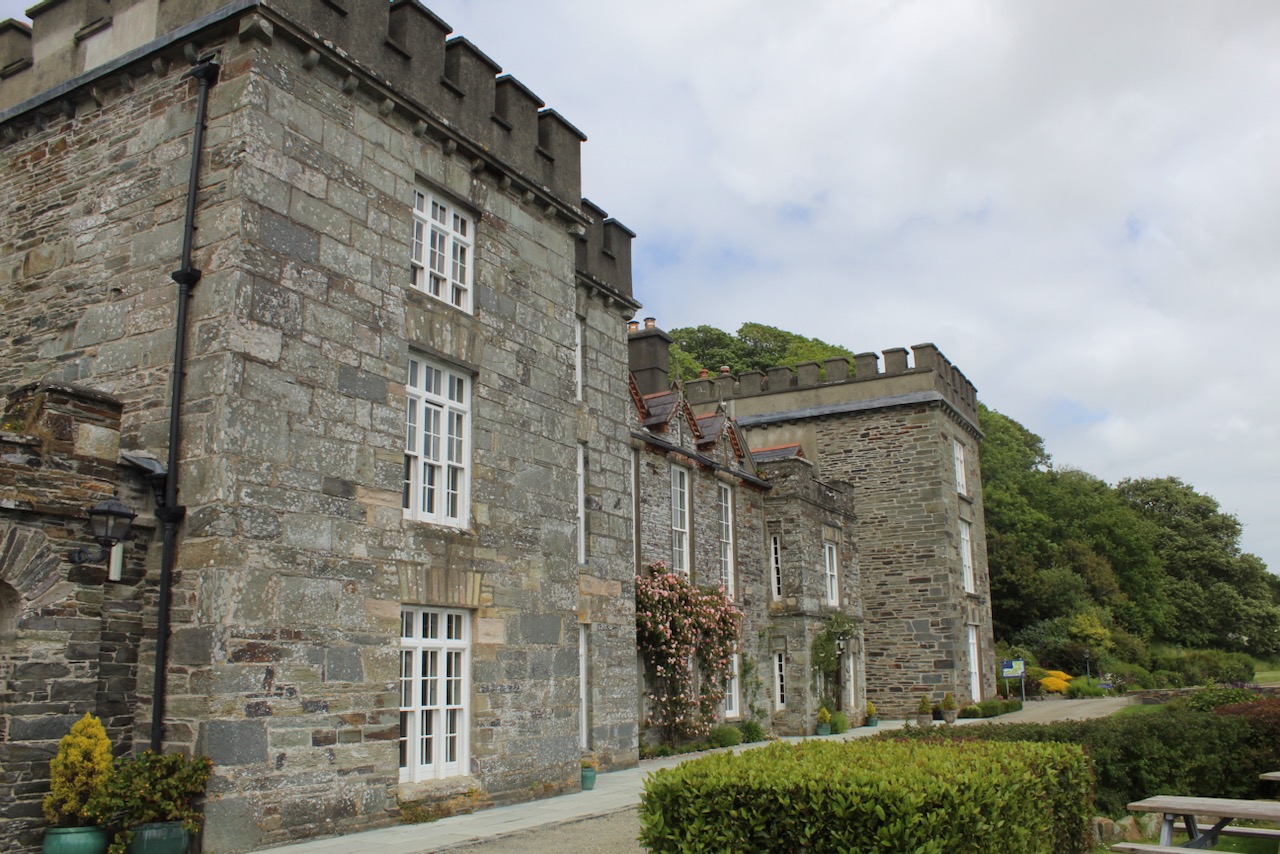
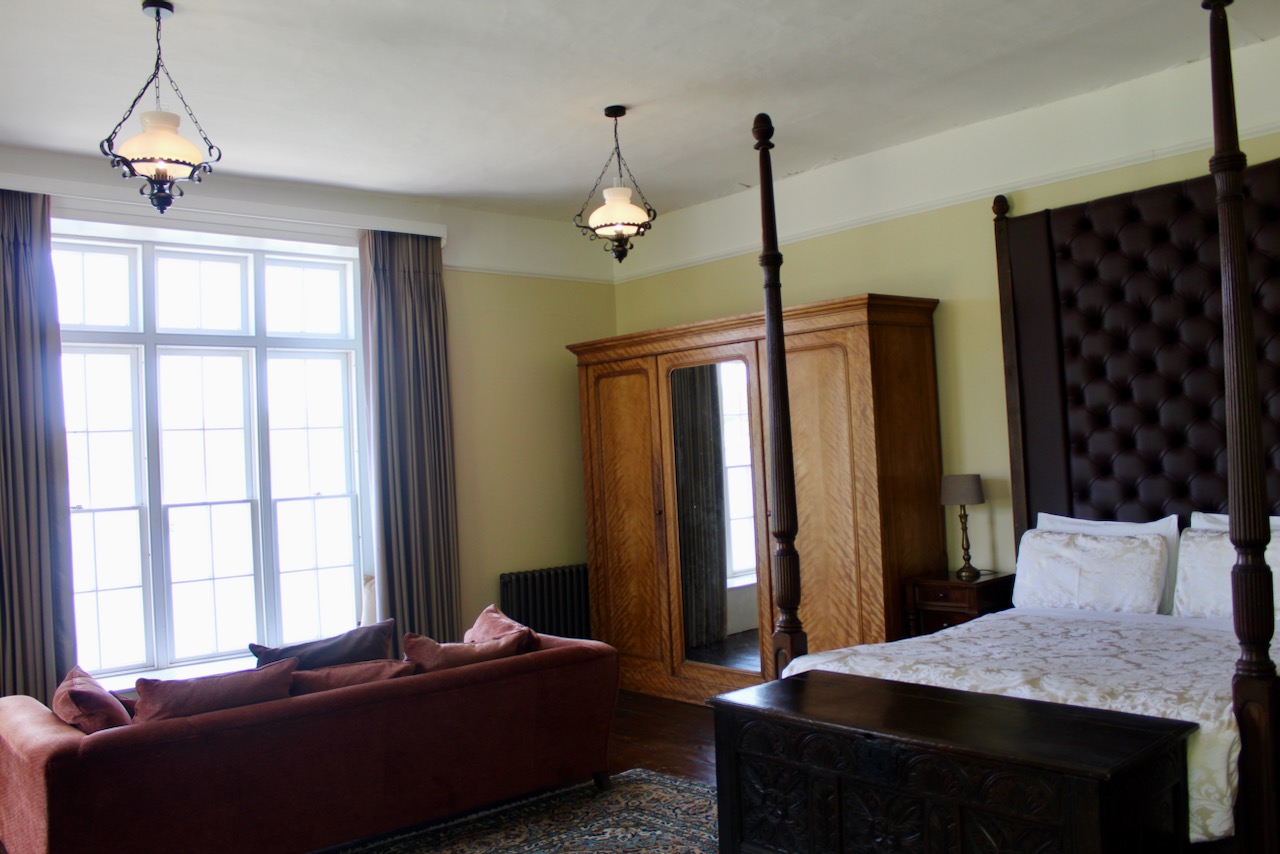
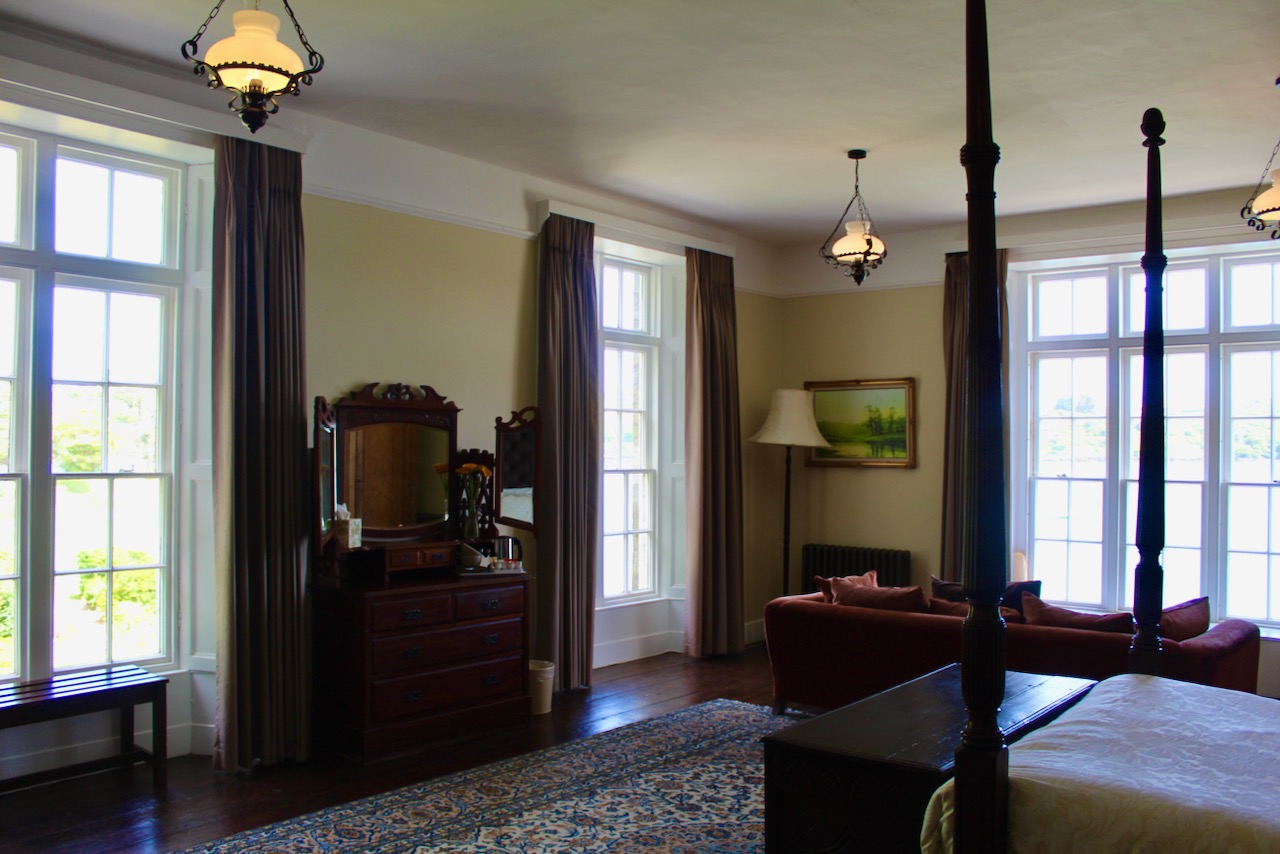
We visited the Castle of Castletownshend when on holidays in County Cork in June 2022. The Castle is a hidden gem, full of history. We definitely look forward to a return visit, to stay in the Castle, which provides B&B accommodation.
The castle remains in the ownership of the same family, the Townshends, who built it and who have lived here since the 1650s! We came upon the Townshend family of Castletownshed when we visited Drishane House. The Somervilles of Drishane intermarried with their cousins the Townshends who lived down the road. See my write-up:
https://irishhistorichouses.com/2021/03/07/drishane-house-castletownshend-co-cork/
The website tells us:
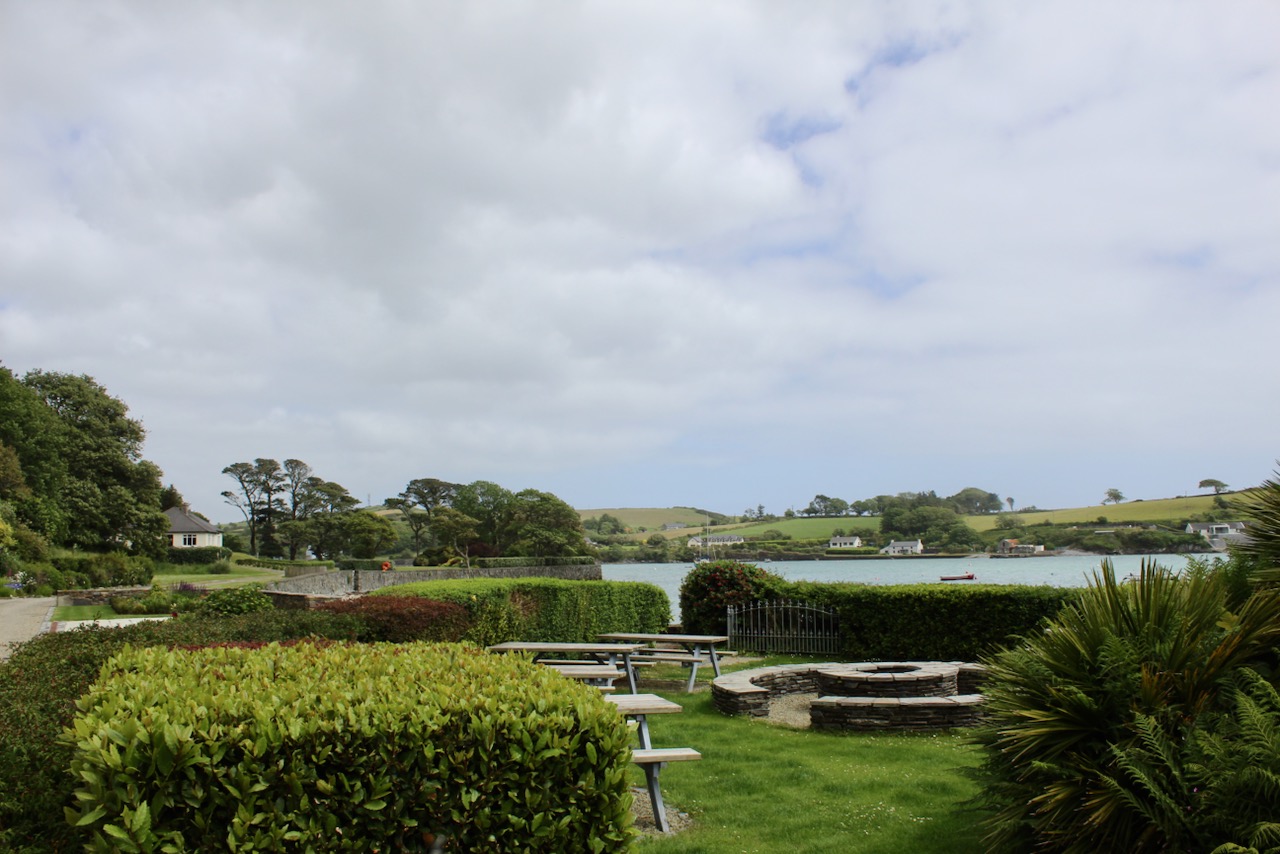
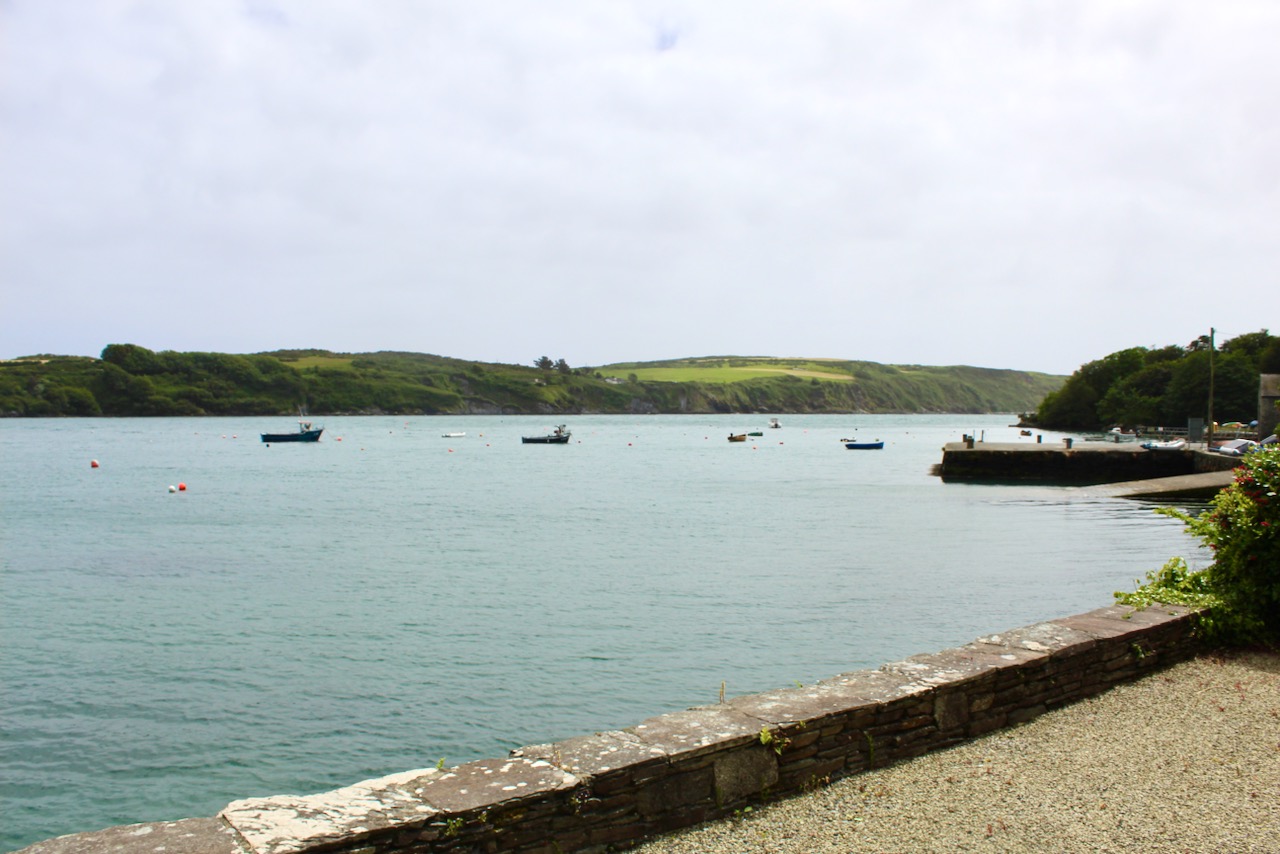
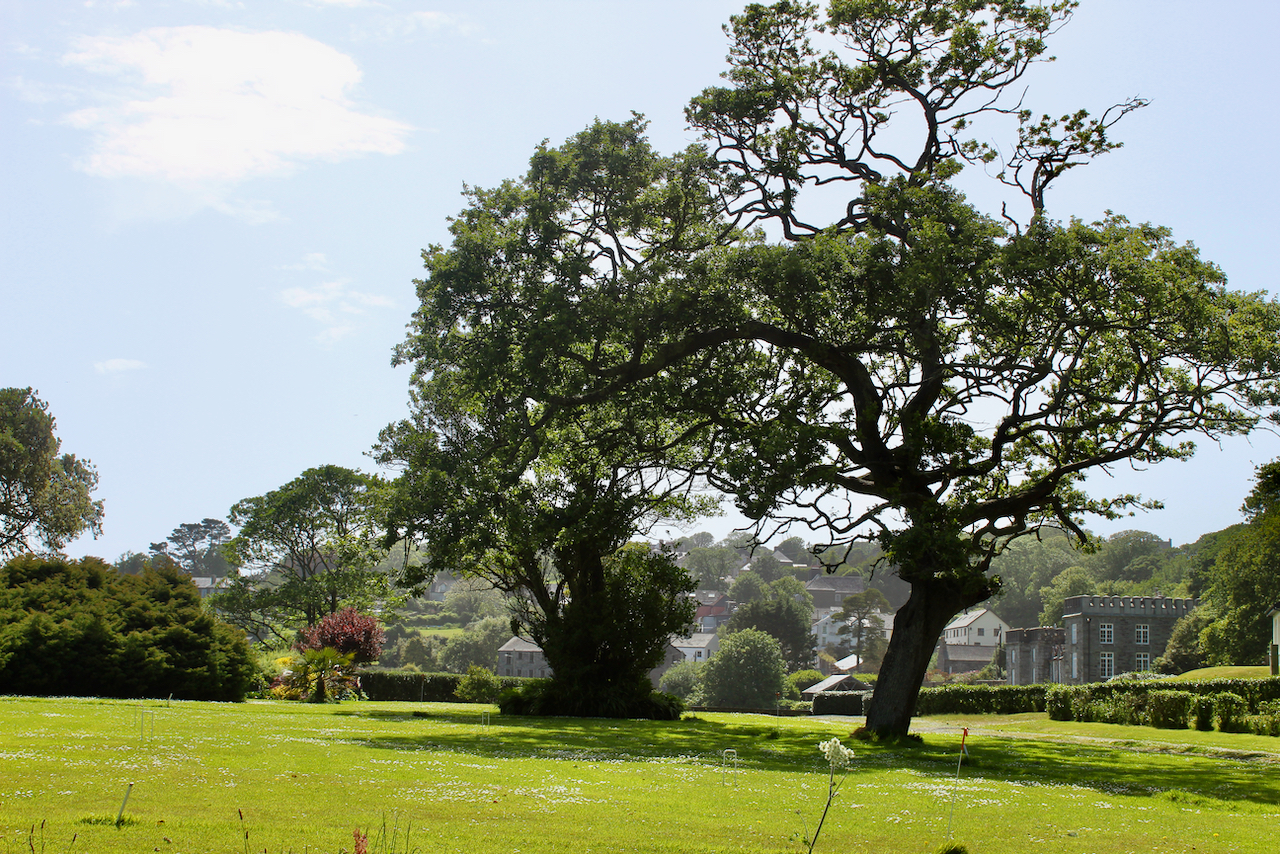
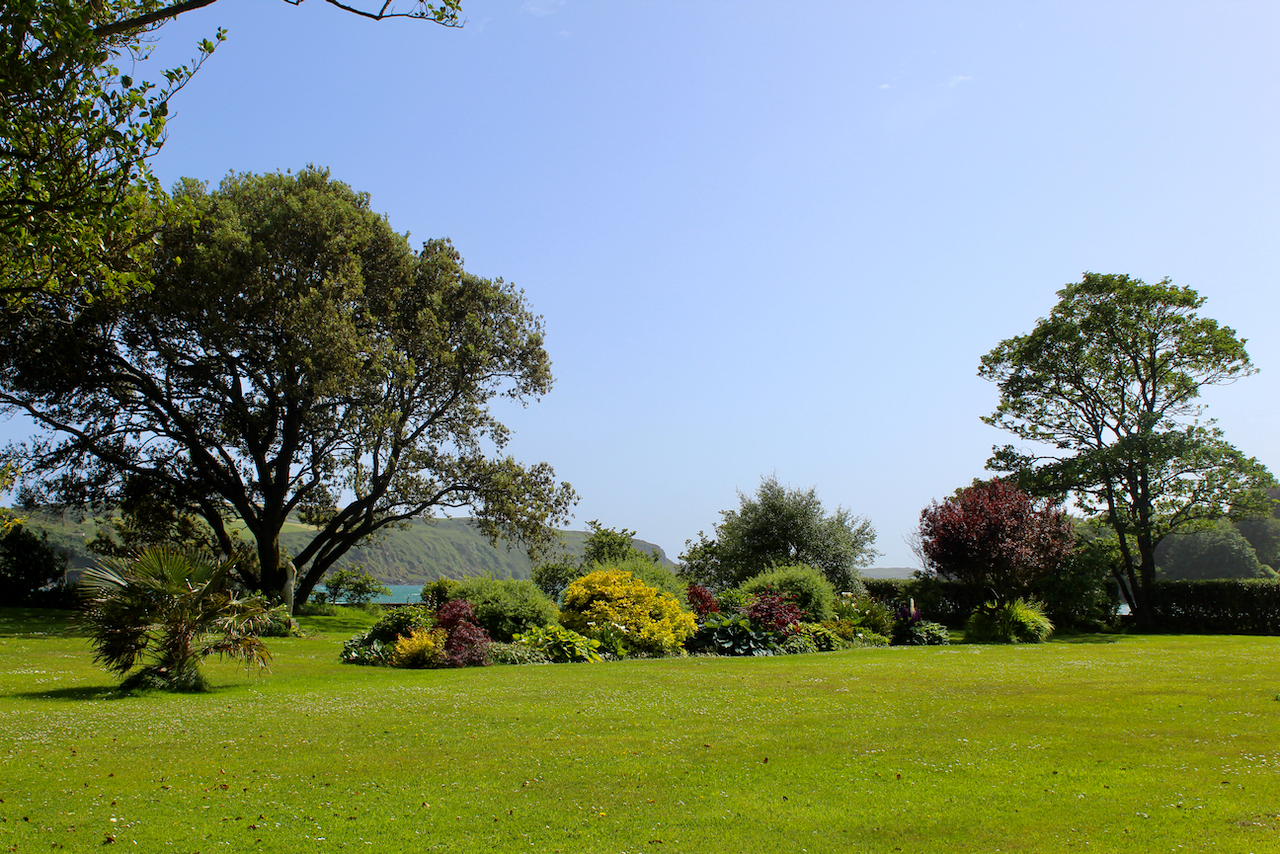
“In the picturesque village of Castletownshend, past ‘The Two Trees’ at the bottom of the hill, you’ll find our family-run boutique B&B. Nestled at the edge of a scenic harbour and natural woodlands for you to explore, The Castle is a truly unique place to stay. It has the warm, homely feel of a traditional Irish B&B, but with a few extra special touches.“
The website continues: “Steeped in history, The Castle has been home to the Townshend family since the 1650s and has been receiving guests for over 60 years. Inside the old stone walls, you’ll find welcoming faces to greet you, roaring fires to warm you, and comfy beds to sink into. Each room has its own story to tell, with the oak-panelled hall and spacious dining room retaining most of their original features, furniture, and family portraits.“
The website explains the family name: “The family name has undergone several changes over the years. The original spelling was Townesend, which later became Townsend. In 1870, the head of the family, Reverend Maurice Fitzgerald Townshend [1791-1872], consulted with the Townshends of Raynham, Norfolk. Following this, it was requested that the whole family add the ‘h’ into the name. However, some families were quite content with the current spelling and refused to adopt the new one. This resulted in various different spellings spread across the branches throughout the UK, Ireland, Australia and Canada.” [1]
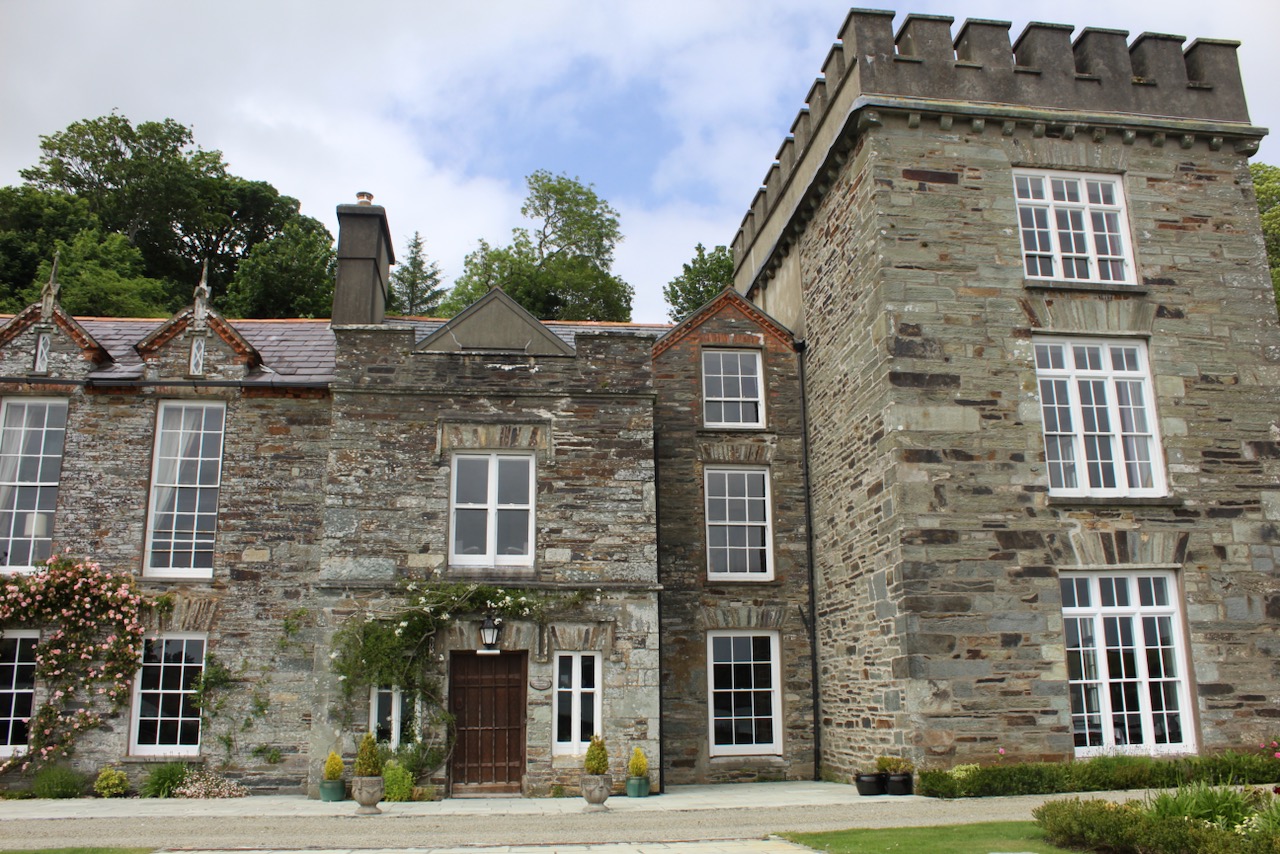
The centre of the castle is the oldest part, and the two end towers are later additions.
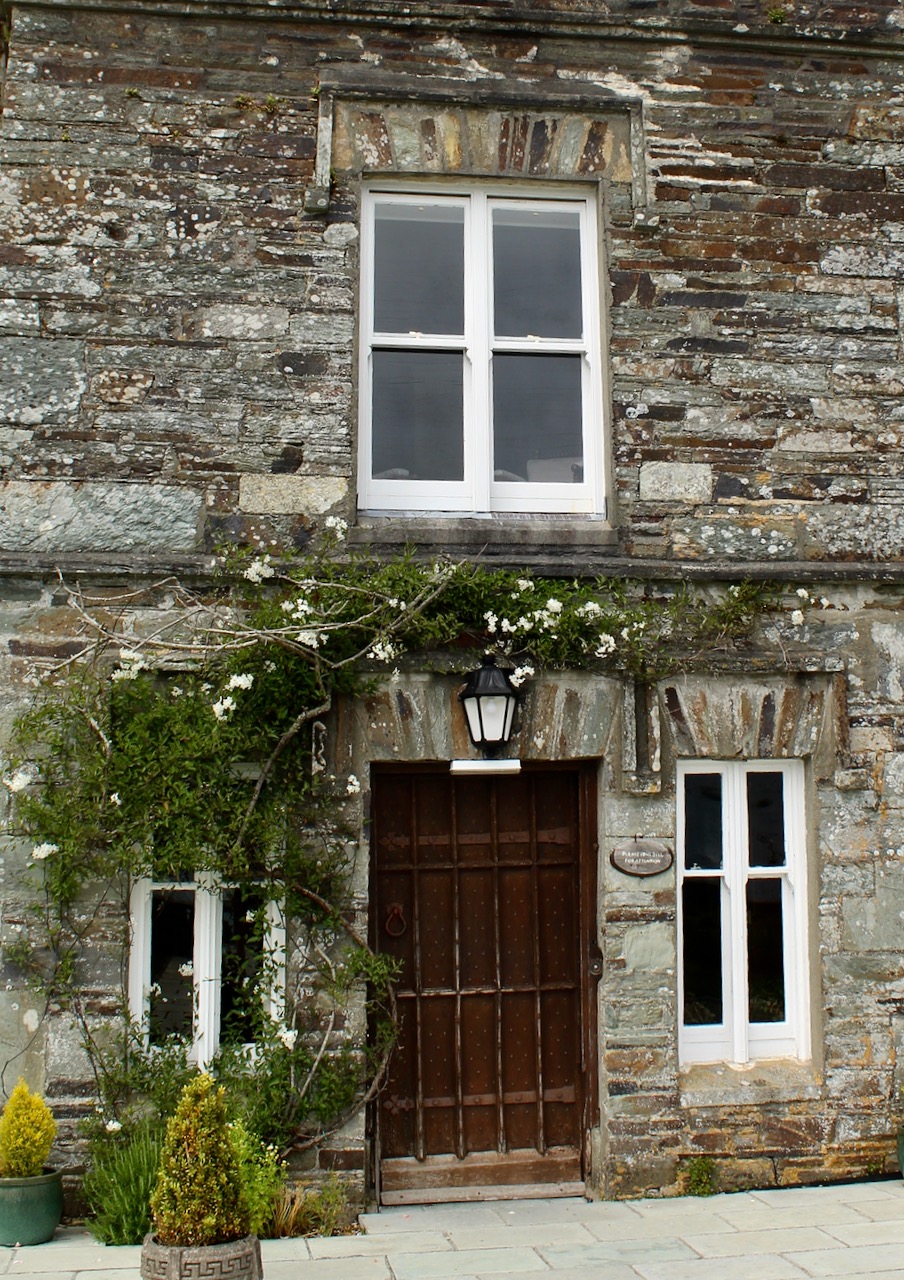
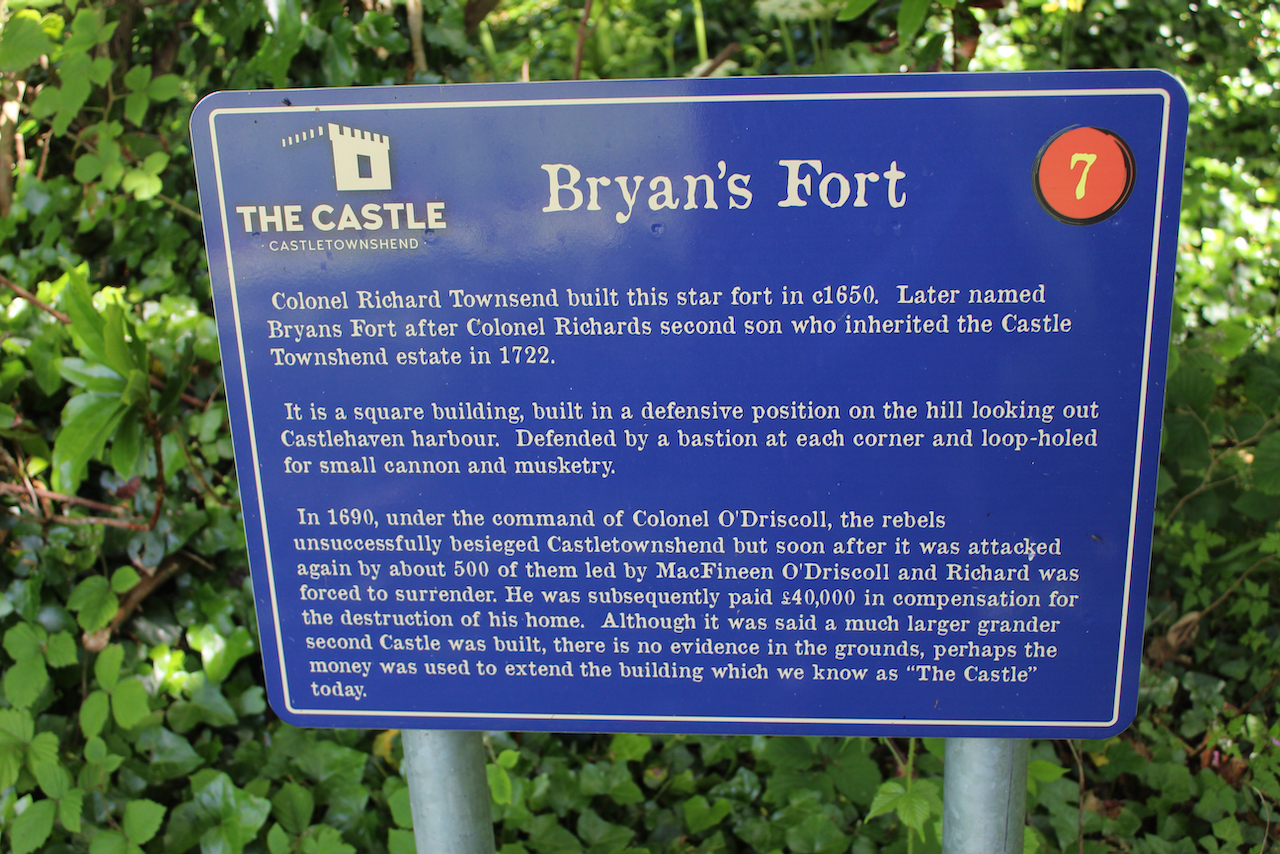
The website tells us: “The building is in fact a 17th century castellated house, not a defensive castle from earlier times. It was built by Colonel Richard Townesend [1618-1692] towards the end of the 17th century, starting off as a much smaller dwelling. The first castle, known as ‘Bryan’s Fort’ [named after his son Bryan (1648-1726)], was attacked and destroyed by the O’Driscolls in 1690, and its ruins remain in The Castle grounds to this day. Richard then built a second castle, which is thought to be where Swift’s Tower still stands.“
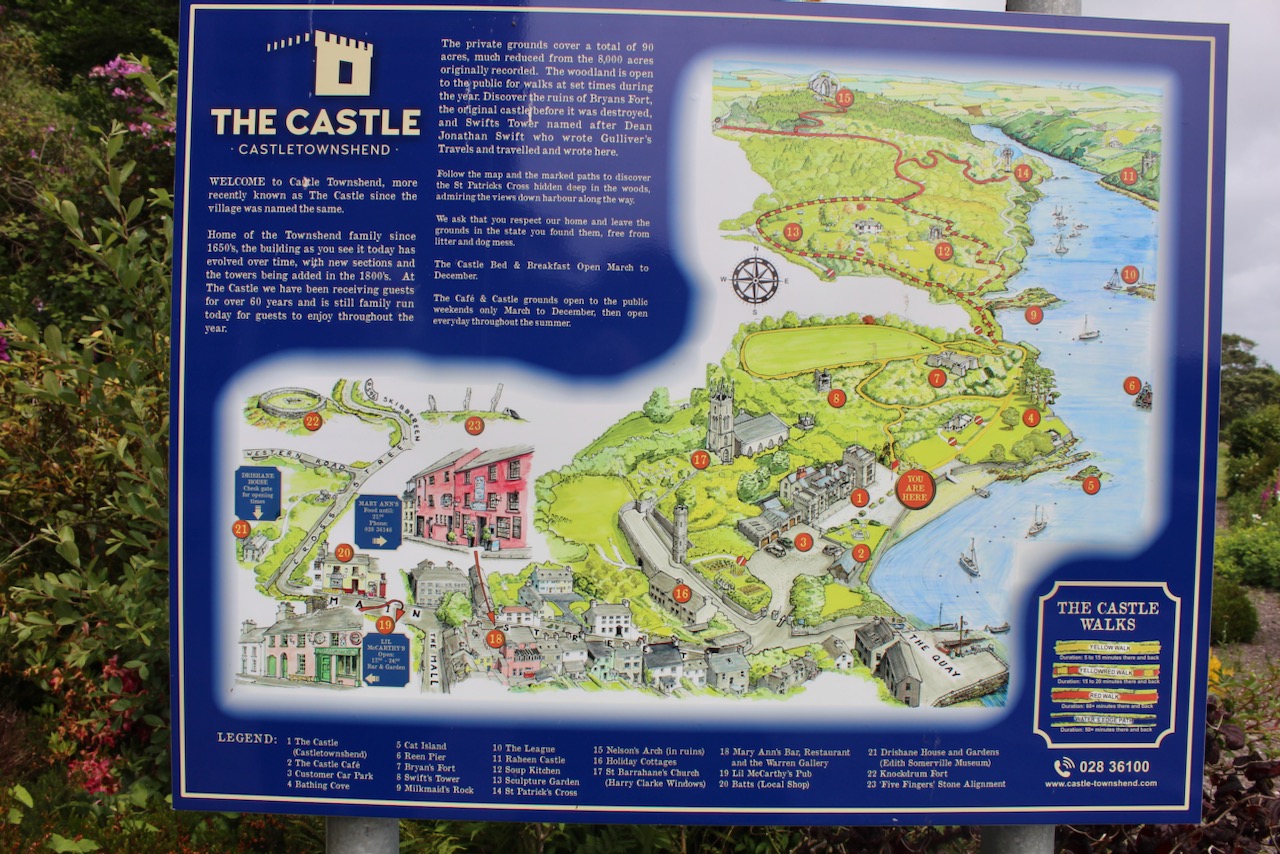


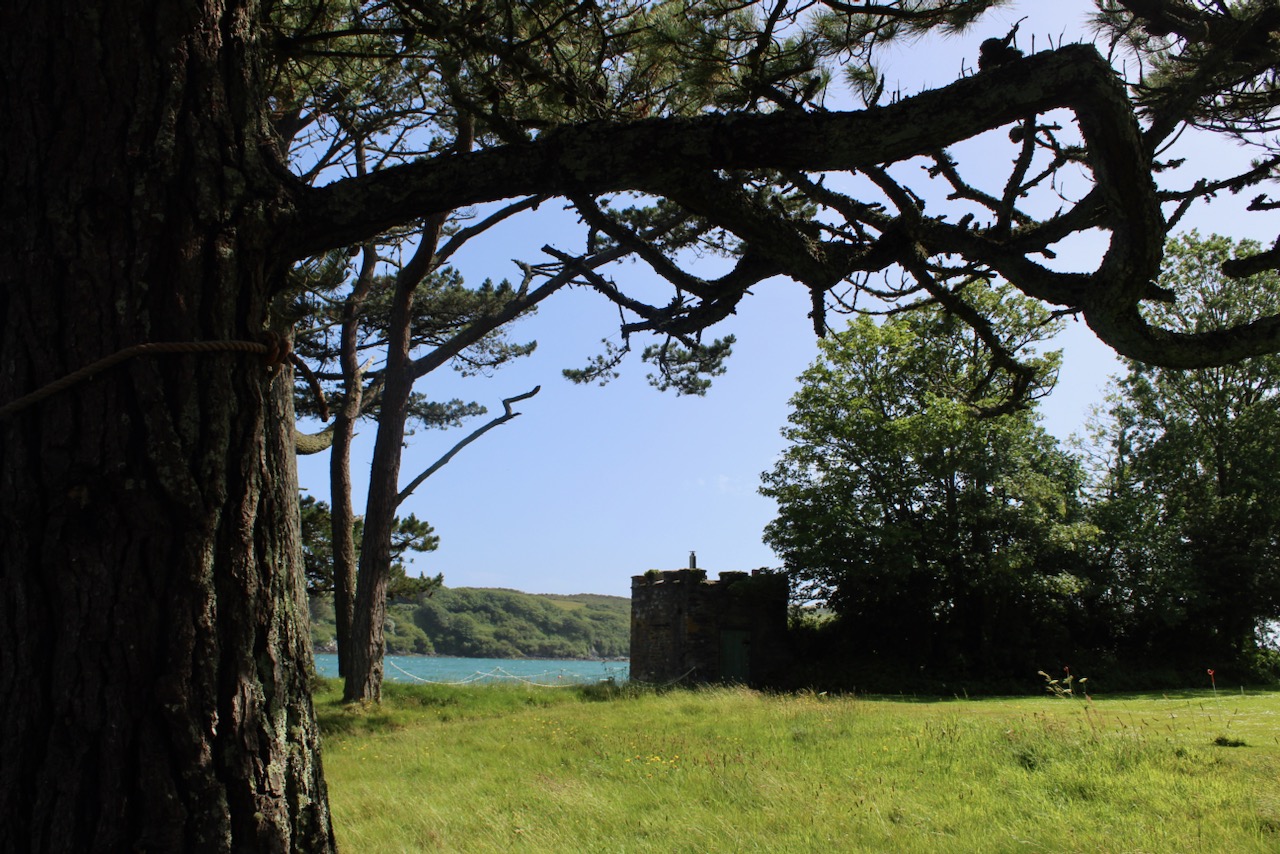
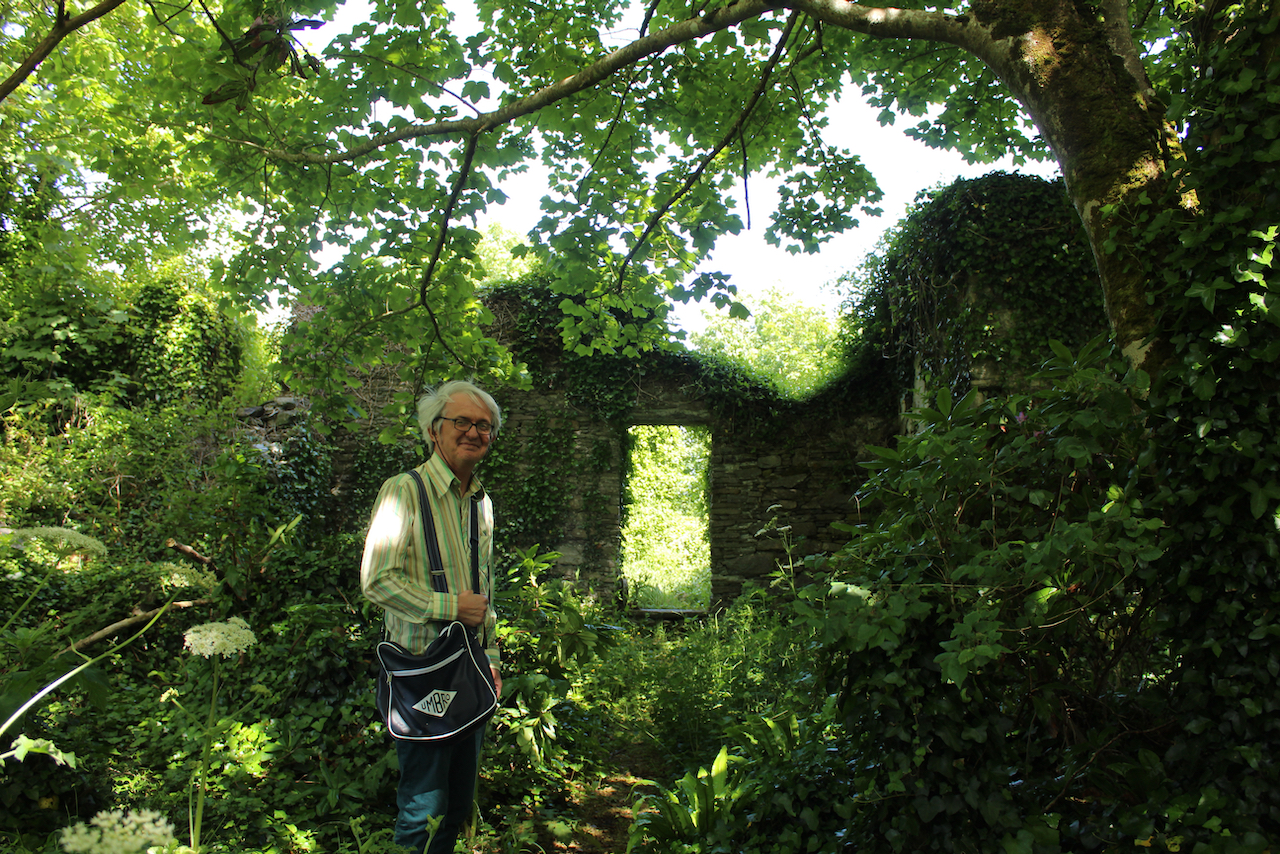
The website continues “In 1805 the floors were lowered to make the ceilings higher, a decision that left The Castle in ruins. However, instead of rebuilding it, the stone was used to add castellated wings to the dwelling on the waterfront. This became The Castle as you see it today.“

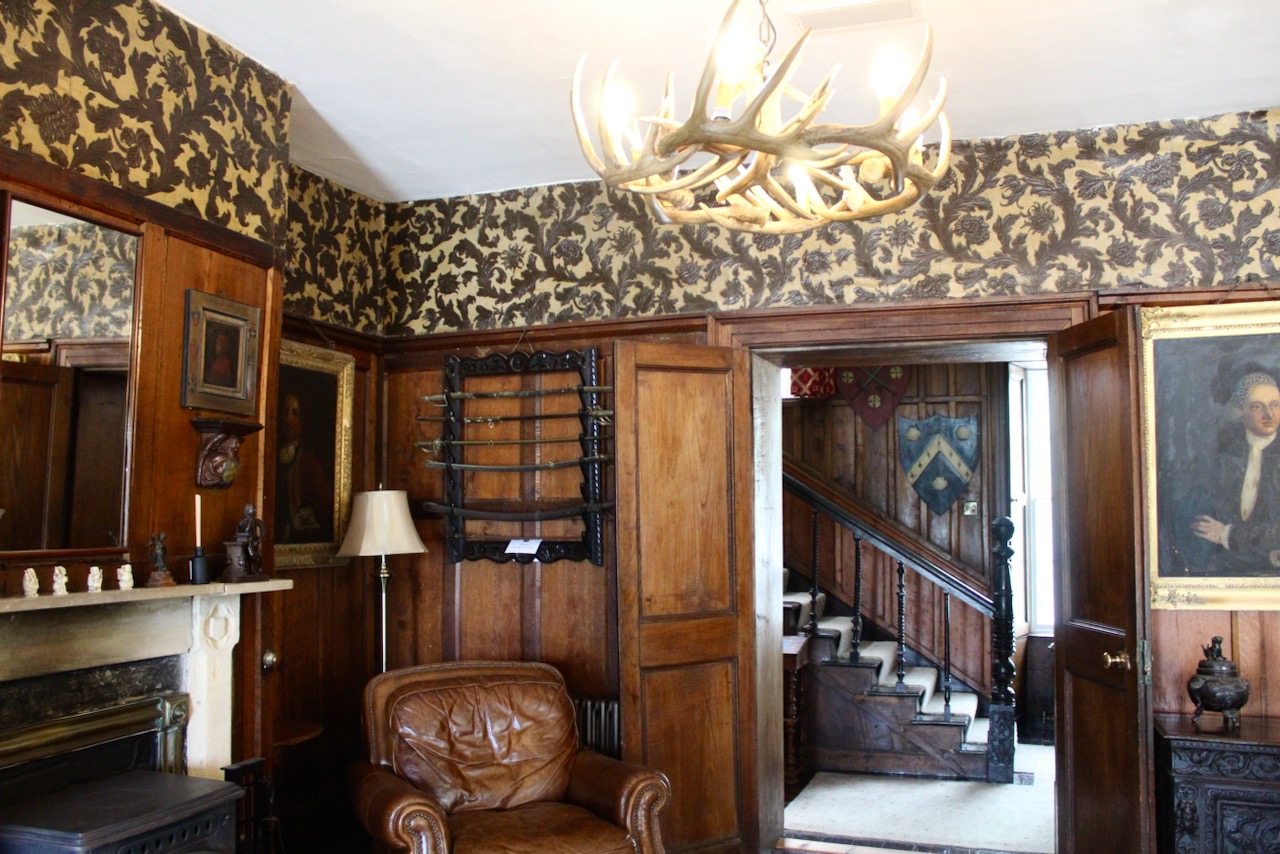
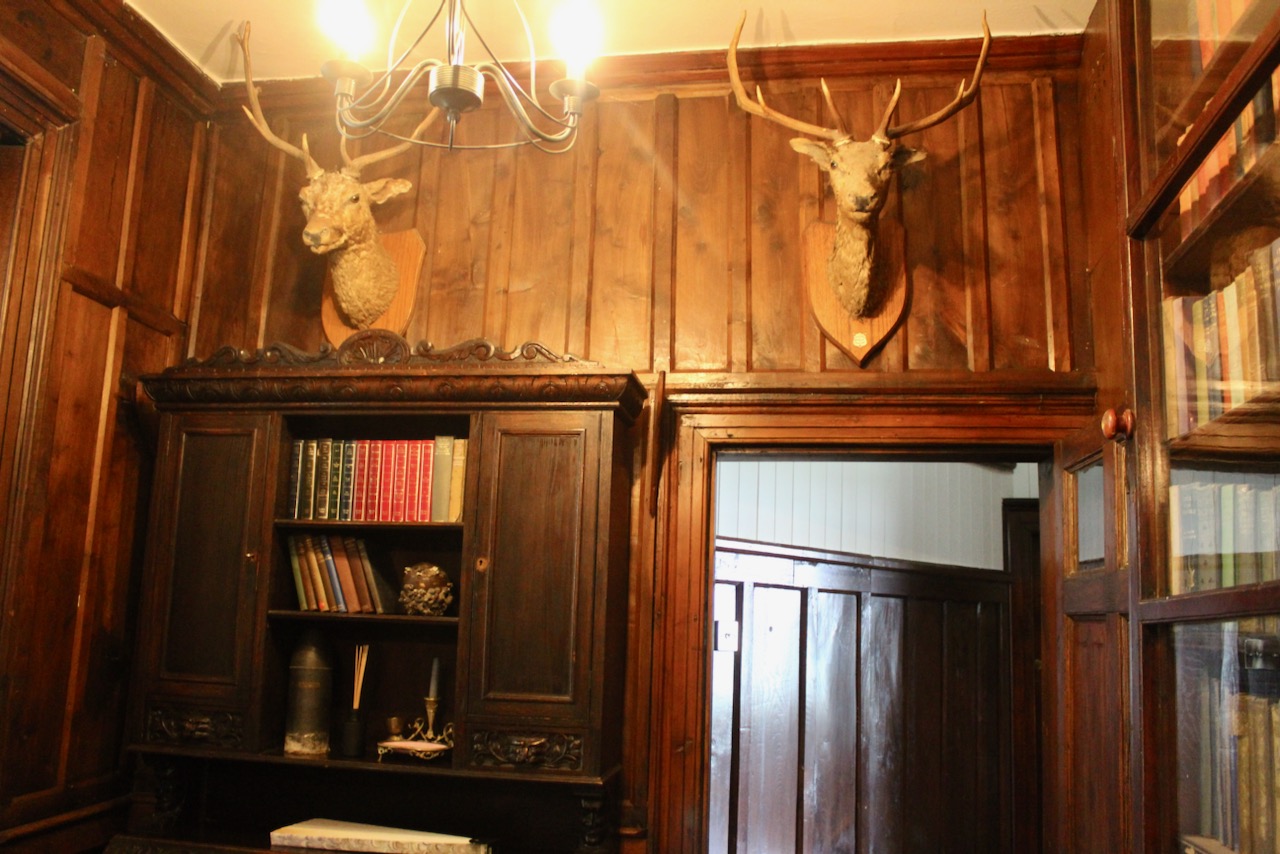
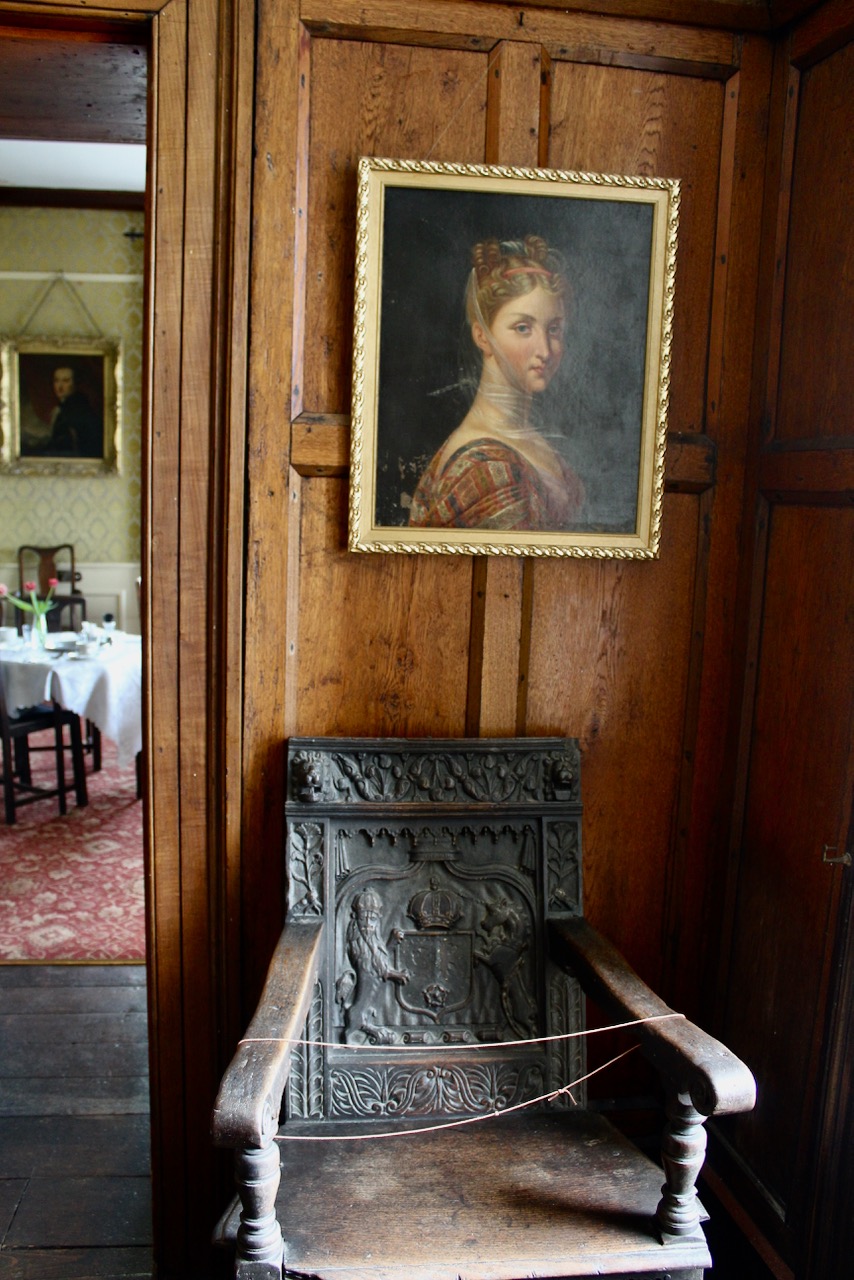
The inside is a real treat, with wonderful family portraits in the hall of oak and what looks like leather wall covering.

Colonel Richard Townesend (1618-1692), who was born in England, gained the rank of Officer in the Parliamentary Army in the British Civil War. [2] The Parliament objected to the monarchy of the Stuarts, and they charged the king, Charles I, of treason against the state and ultimately beheaded him. Oliver Cromwell brought troops to Ireland to subdue those loyal to the monarchy. The opposing force to the royalist forces was called the Parliamentary army. Townesend fought in the Battle of Knocknanauss, County Cork in April 1648, where he commanded the main body of the Army under Murrough O’Brien (1614-1674) 1st Earl of Inchiquin. They fought the Irish Confederates, who supported King Charles I in the belief that in reward for their loyalty he would grant them greater self-governance. The Confederate forces were made up of Irish Catholics and “old English” Anglo-Normans who sought to protect their land holding and to end anti-Catholic legislation. The Parliamentarians overcame the Confederates in the battle, and around 3,000 Confederates died at Knocknanauss and up to 1,000 English Parliamentarians.

Richard Townesend’s loyalty to the Parliamentarians wavered after this battle and after the death of Charles I. He returned to Ireland, and he was arrested for being involved in a plot to overcome Lord Inchiquin. However, he may have been a “plant” to undermine the opposition. A mutiny in the garrison at Cork however led to his freedom and Cromwell praised him for being an “instrument in the return of Cork and Youghal to their obedience.” He retired from the military and settled in Castletownshend before 1654. [3]
He managed to hold on to his land after the Stuart monarchy was restored to Charles II. The Dictionary of National Biography suggests that this could be due connections between his wife Hildegardis Hyde and the Lord Chancellor of England, Edward Hyde 1st Earl of Clarendon. Richard held the office of Member of Parliament in the Irish Parliament for Baltimore, County Cork in 1661. He held the office of High Sheriff of County Cork in 1671.
In 1690, after the accession of King James II to the throne, Richard’s home in Castetownshend was unsuccessfully beseiged by 500 Irishmen led by the O’Driscolls, a family who had owned the land before Townesend [for more on the O’Driscolls, see my entry on Baltimore Castle, https://irishhistorichouses.com/2023/12/28/dun-na-sead-castle-baltimore-co-cork-981-x968/ ]Townesend died in 1692, leaving seven sons and four daughters. [see 3]
Jane O’Hea O’Keeffe tells us of the Castle’s builder, in her Voices from the Great Houses: Cork and Kerry (Mercier Press, Cork, 2013): p. 83. “In the late 1600s Richard Townsend, an officer in the Cromwellian army, acquired lands at Castlehaven in west Cork originally owned by the O’Driscoll clan. Richard Townsend also owned other lands in County Cork totalling over 6,540 acres. It was he who built the castle at Castletownshend, the centre portion of which still remains. The two towers at each corner of the castle today were added in the eighteenth century.” [4]
Although she identifies the centre of the castle to be built by Richard in the 1600s, Frank Keohane describes Castle Townshend in his Buildings of Ireland: Cork City and County and suggests that this part was built in 1780. The castle Richard built is probably the ruin nearby. In fact, An Officer of the Long Parliament (1892) we are told that he lived for some time in Kilbrittan Castle nearby, “a splendid very pile overlooking Courtmacsherry Bay, which had been forfeited by the head of the McCarthies for his participation in the Rebellion of 1641.“
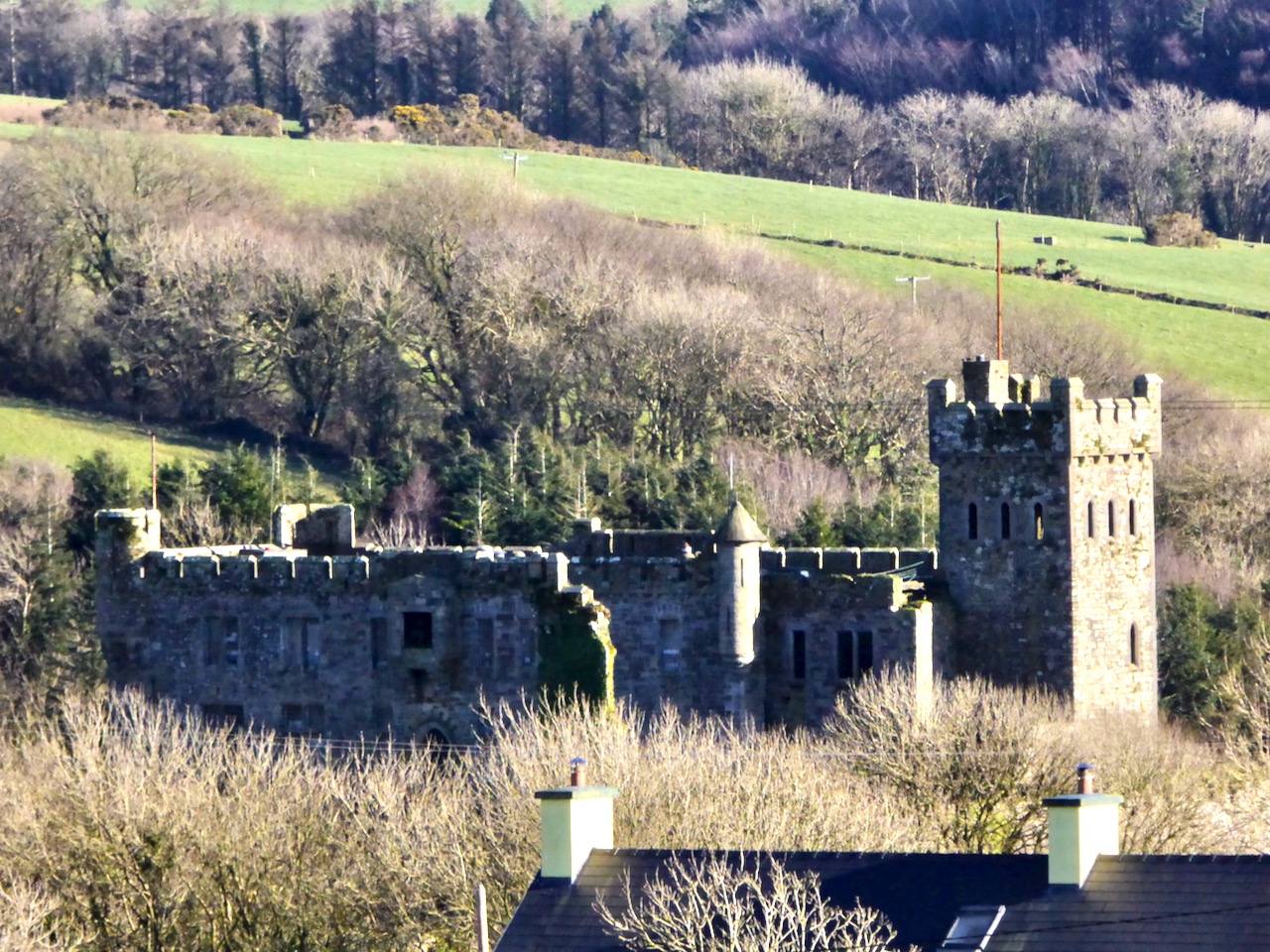
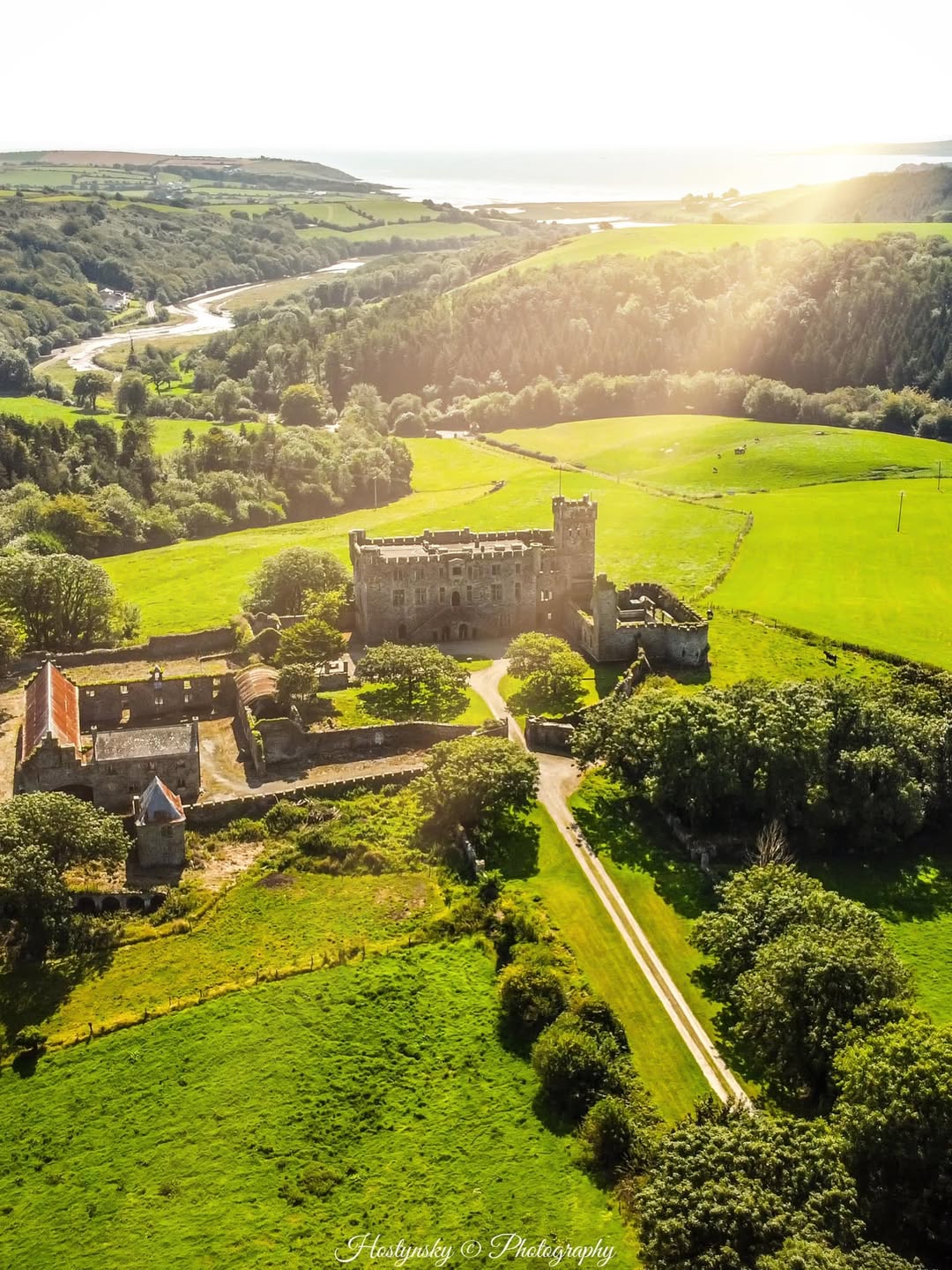
Richard Townesend’s early house at Castletownshend is described in An Officer of the Long Parliament (1892):
p. 107-08. “It seems to have consisted of a dwelling – house and small courtyard all comprised in a square enclosure with a bastion at each angle, pierced with loopholes for musketry and some embrasures for small cannon. It was built on a well- chosen site of some strength. The dwelling-house consisted of two stories, the upper one overlooking the harbour. The lower one must have been lighted from the court, on the outer side of which was a parapet for defending the wall. It seems to have been hastily built, as the stones are small and not well put together….A larger mansion appears to have been built before long, which was valued at £ 40,000 , when destroyed in the troubles of 1690.”
Richard Townesend’s son Horatio was in the navy and in 1690 carried the Duke of Schomberg, who fought in King William’s army, to Ireland on board his sloop. He married Elizabeth, daughter of the MP for Baltimore, Thomas Becher.

Another son, John, married Catherine Barry, daughter of Richard, 2nd Earl of Barrymore. Son Philip (1664-1735), became a Protestant clergyman and married Helen Galwey of Lota Lodge, Cork.
Colonel Richard Townsend’s son Bryan (1648-1726) was a Commander in the British navy and MP for Clonakilty. He married Mary Synge, daughter of Edward, Bishop of Cork, Cloyne and Ross in 1663 and they had many children. In The Long Parliament, we are told of a portrait of Bryan: “If the very handsome picture at Castletownshend which has always borne his name is truly the portrait of Bryan, it most probably was painted while he was a naval officer, as he wears his own hair and not the voluminous wig in which gentlemen on land used to enshroud themselves.” I must look for this portrait next time we visit! Although it may have been destroyed, along with many papers and letters described in The Long Parliament, by fires in the castle.
Bryan was well-regarded by his neighbours:
“The laws made it almost impossible for any but a Protestant to hold land, so many of the Carbery Romanists, especially the O’Heas and O’Donovans, trusting in Bryan’s high character for integrity, gave their properties entirely into his hands, being obliged to do so without any written guarantee 1. At one time he had under his care upwards of £ 80,000 worth of property which he defended at considerable cost to himself, and when it was safe to restore it to the real owners he did so with all the arrears that had accrued while he held it. This fact was ascertained by the research of the late John Sealy Townshend .” [see 1]
Bryan and Mary’s son Richard (1684-1742) inherited Castletownshend , and was a Justice of the peace and high sheriff for County Cork. He married twice, first to another Mary Synge, daughter of Reverend Samuel, Dean of Kildare. His second wife was Elizabeth Becher from Skibbereen, County Cork.
The Townshends tell us in The Long Parliament about Jonathan Swift’s visit:
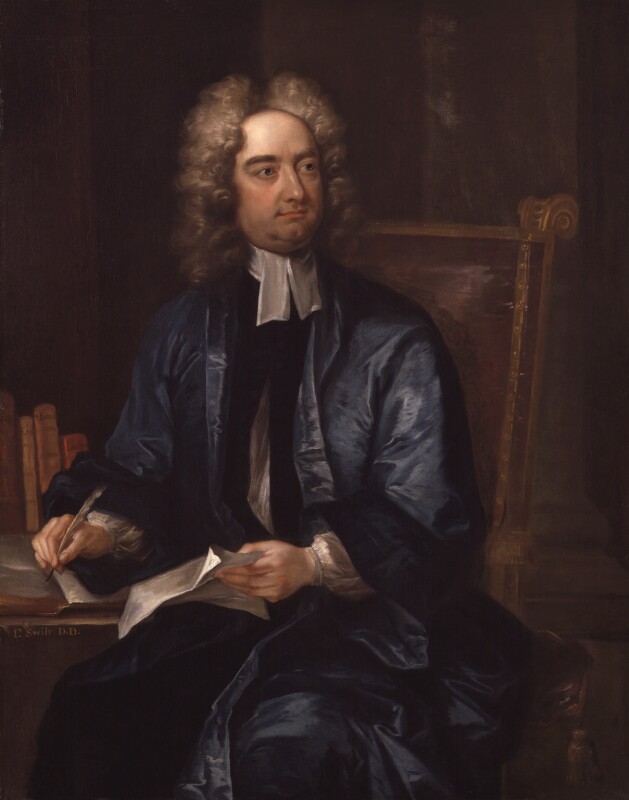
“Richard Townshend, of Castle Townshend, was born July 15, 1684, and succeeded to the estates on the death of his father Bryan, 1727 . It was at this period (*1) that Dean Swift spent some time in West Carbery . He stayed at Myros , but is said to have written his poem Carberiae Rupes in a ruined tower at Castle Townshend , still known as Swift’s Tower . It is also said that letters from the great Dean are still preserved at Castle Townshend , and that he named one of the houses in the village Laputa.” (*2)
The footnotes refer to *1: G. Digby Daunt and *2: Now Glen Barrahane, the seat of Sir J. J. Coghill , Bart .
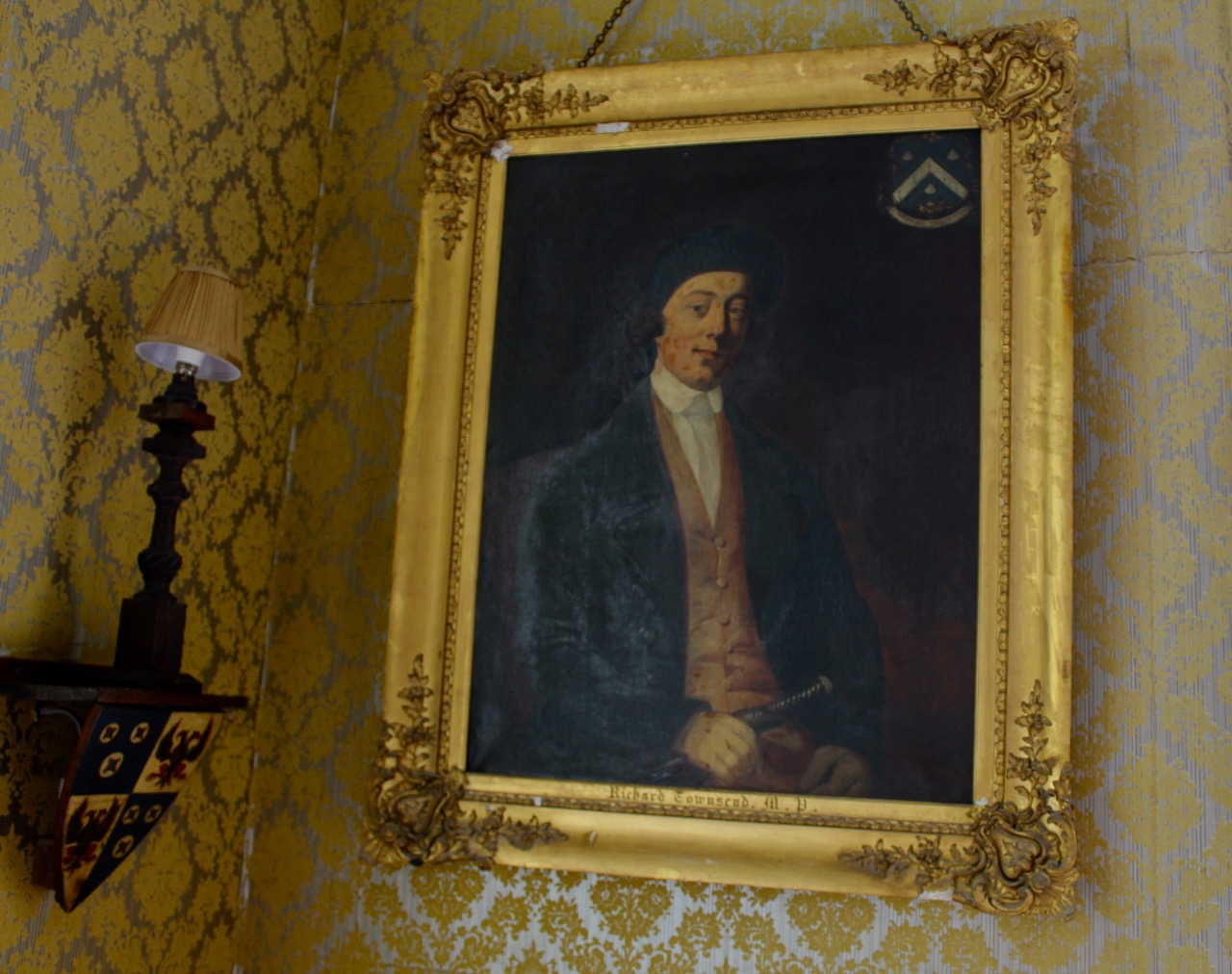
Richard (1684-1742) and Elizabeth Becher’s son Richard (1725-1783) also served as MP and high sheriff. He married Elizabeth Fitzgerald, daughter of John Fitzgerald, the 15th Knight of Kerry (d. 1741). His father was Maurice Fitzgerald, the 14th Knight of Kerry, and Elizabeth’s brother was Maurice the 16th Knight of Kerry – there is a portrait of a Maurice Fitzgerald, Knight of Kerry, in the front hall, but I’m not sure which one is it. Richard’s portrait is in the dining room.

Next to the Knight of Kerry in the hall there is also a portrait of the Countess of Desmond, Katherine Fitzgerald (abt. 1504-1604), who lived to be over one hundred years old (some say she lived to be 140) and went through three sets of teeth. We came across her also in Dromana in County Waterford.
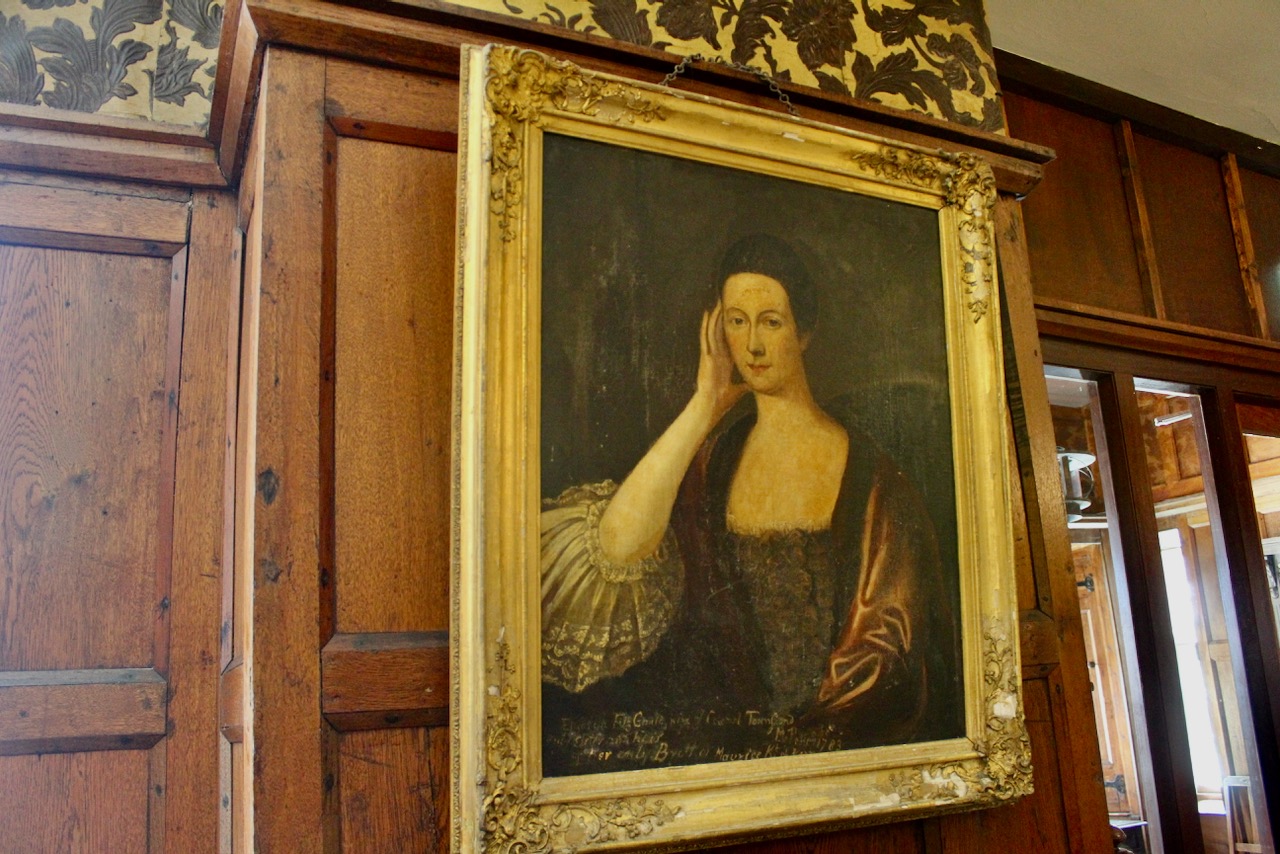
The Long Parliament describes:
“Richard Townshend married in 1752 Elizabeth , only daughter and heiress by survival of John FitzGerald, 15th Knight of Kerry, by whom he had one son and one daughter. Elizabeth FitzGerald’s only brother Maurice, 16th Knight of Kerry, had married his cousin Lady Anne Fitzmaurice, and died leaving no children, but even now he is remembered as ‘ the good Knight.’ He left all the Desmond estates in Kerry to the son of his sister Elizabeth Townshend.”
It may have been Richard Townsend (1725-1783) and his wife, the daughter of the 15th Knight of Kerry, who started to build the castle we see today. Keohane writes of the current castle at Castletownshend:
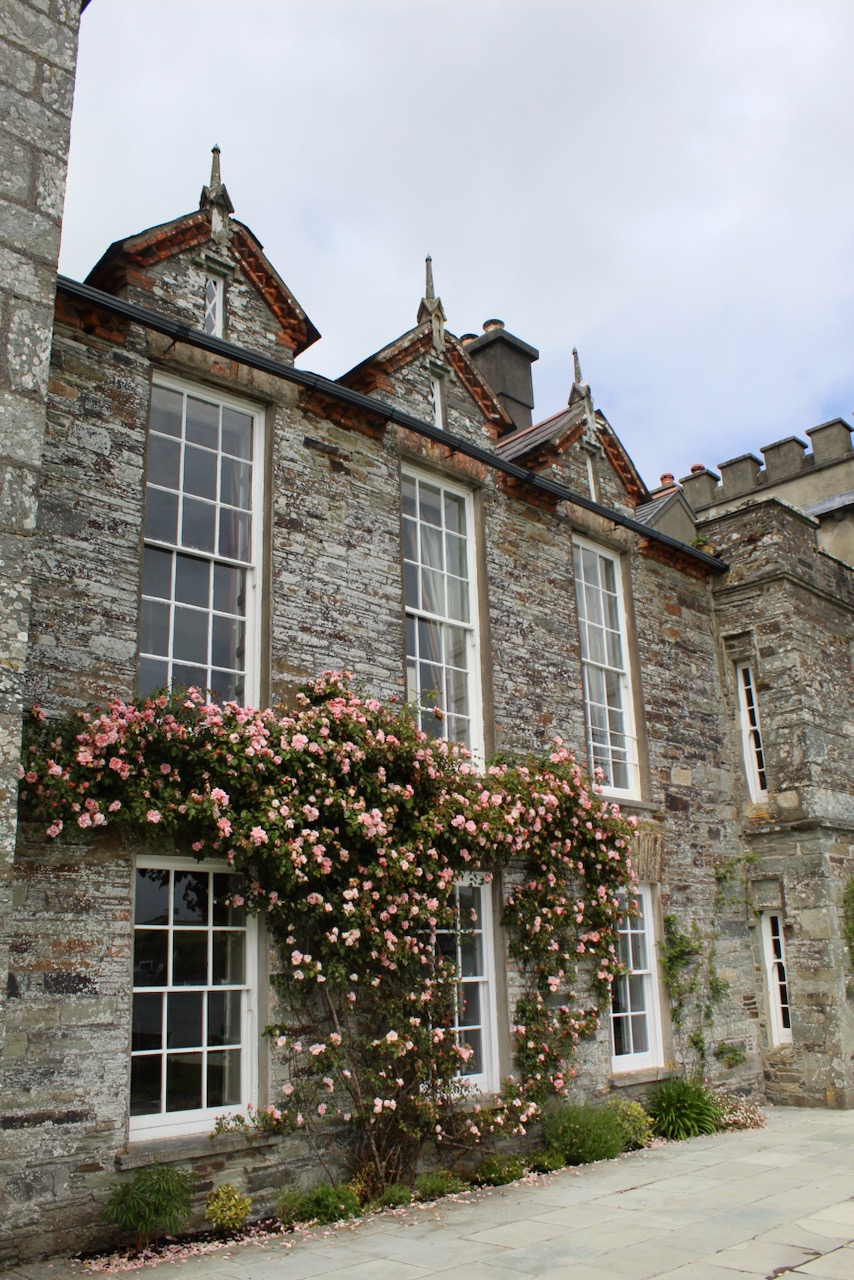
p. 314. “The Castle. A house of several parts, the seat of the Townshends. The earliest, described as ‘newly built’ in 1780 by the Complete Irish Traveller, is presumably the two-storey, five-bay rubble-stone centre block, with dormers over the upper windows and a two-storey rectilinear porch. Taller three-storey wings with battlements carried on corbelled cornices and twin- and triple-light timber-mullioned windows. The E. wing was perhaps built in the late 1820s; the W wing was added after a fire in 1852. Modest interior. Large low central hall with a beamed ceiling and walls lined with oak panelling and gilded embossed wallpaper. Taller dining room to the r., with a compartmented ceiling; a Neoclassical inlaid fireplace in the manner of Bossi, and a large Jacobean sideboard. C19 staircase with barley-twist type balusters.
Octagonal three-stage battlemented tower, 60 m west of the castle.” [5]


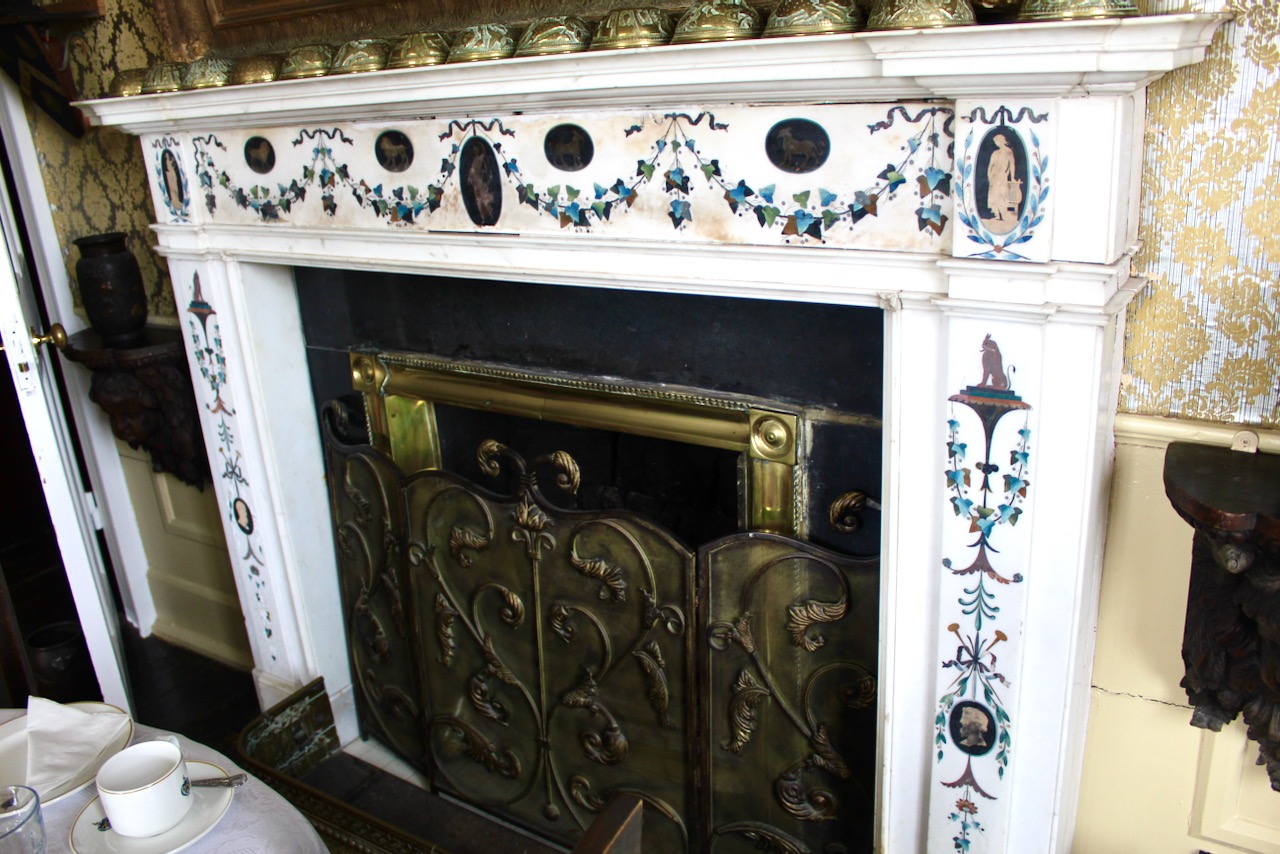
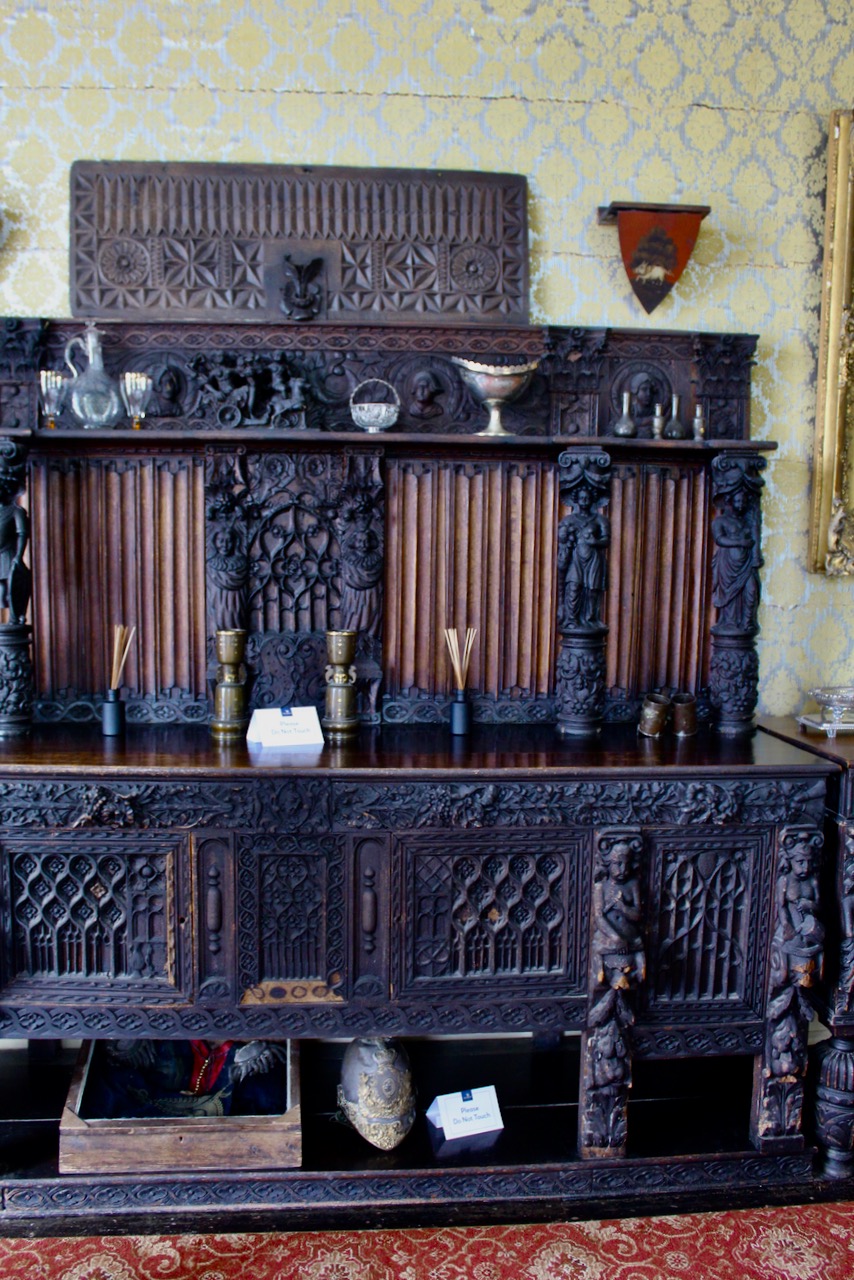

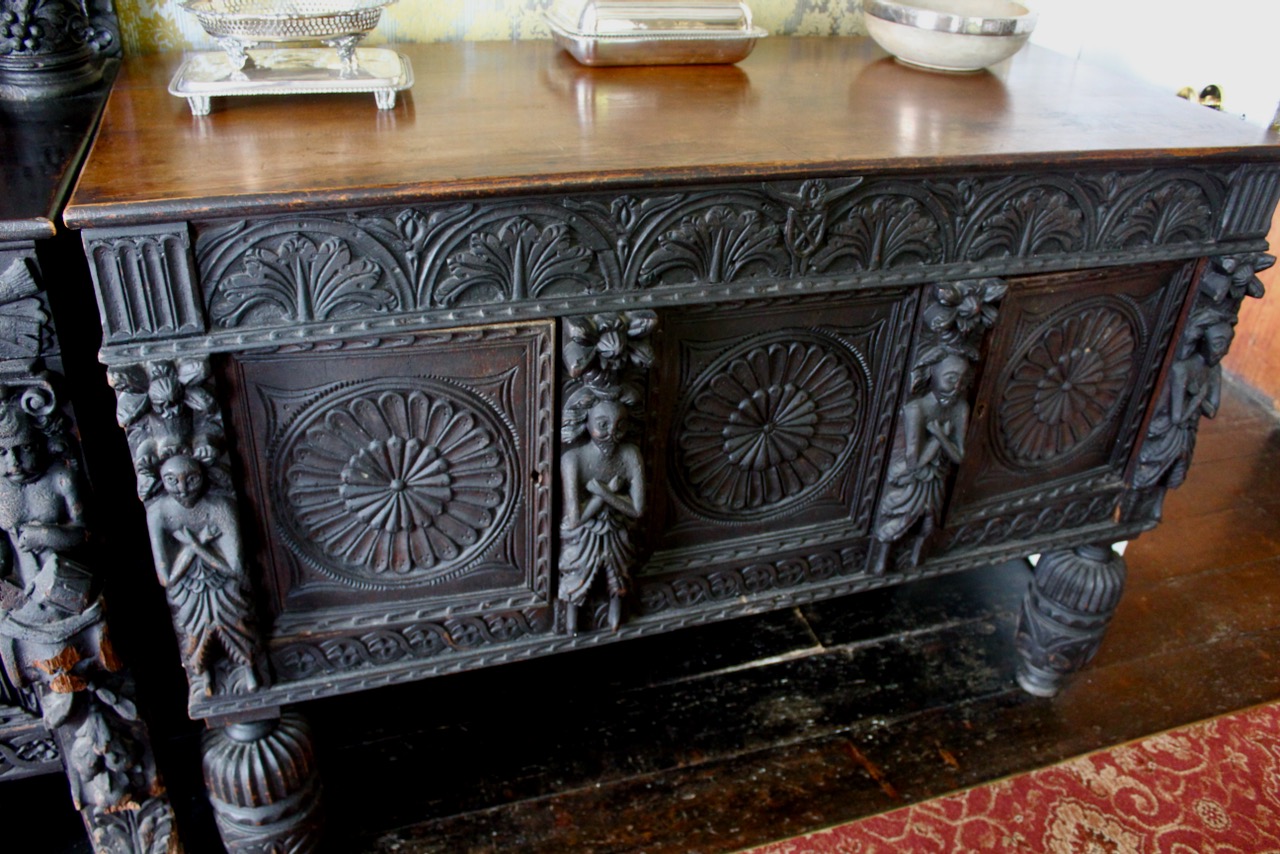
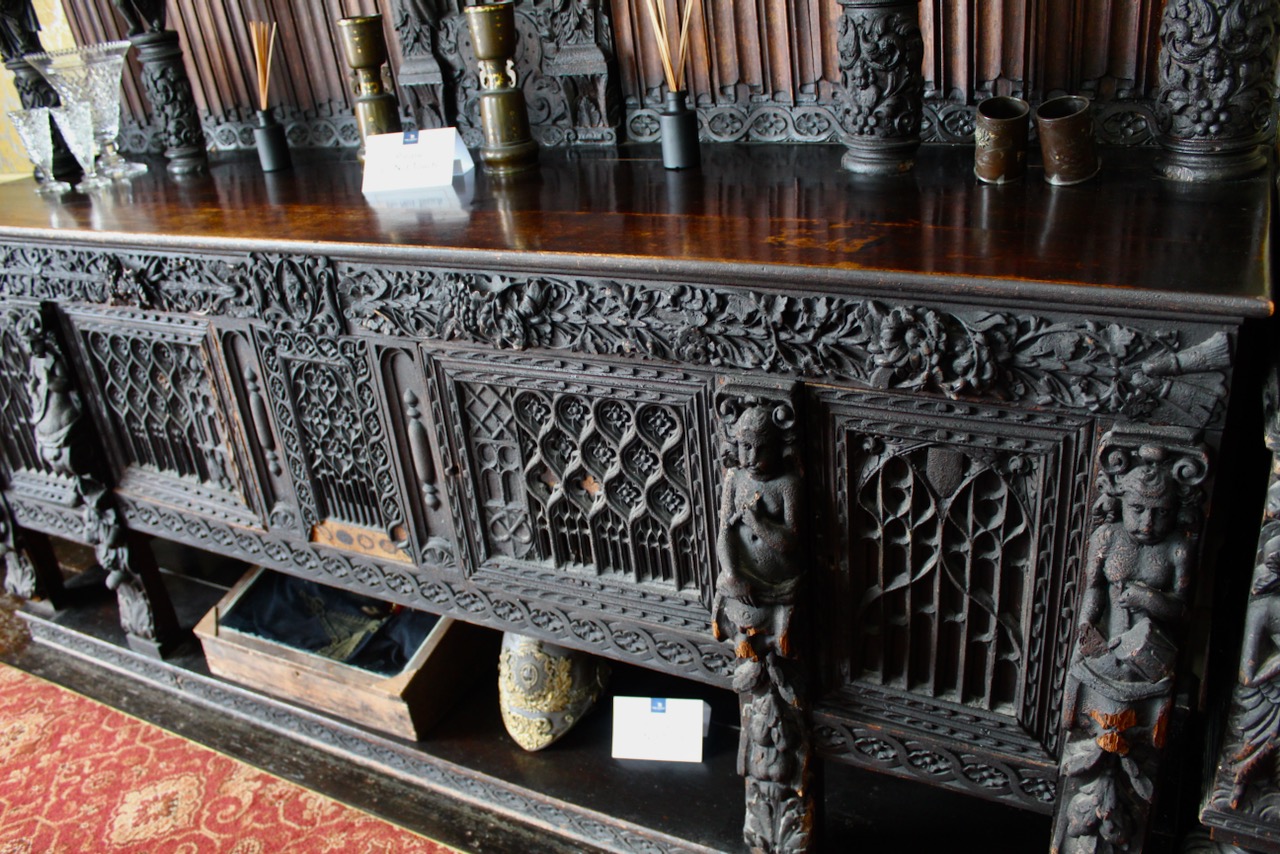
Jane O’Hea O’Keeffe continues: “Over the following centuries, members of the Townsend family served as high sheriffs of County Cork. In 1753 Richard Townsend was the office-holder and in 1785 Richard Boyle Townsend [1756-1826] was appointed to the position. In the 1870s Richard M.F. Townsend owned over 7,000 acres near Dingle in County Kerry, inherited from the FitzGerald family, Knights of Kerry. At that time, the estate of the late Rev. Maurice Townshend extended to over 8,000 acres in County Cork...” [4]
Richard Townsend and Elizabeth Fitzgerald’s son Richard Boyle Townsend (1753-1826) inherited Castletownshend. He was educated at Eton and Oxford. He married Henrietta Newenham. There is a fine portrait of their son Lieutenant-Colonel John Townsend, of the 14th Light Dragoons, who held the office of Aide-de-Camp to Queen Victoria.
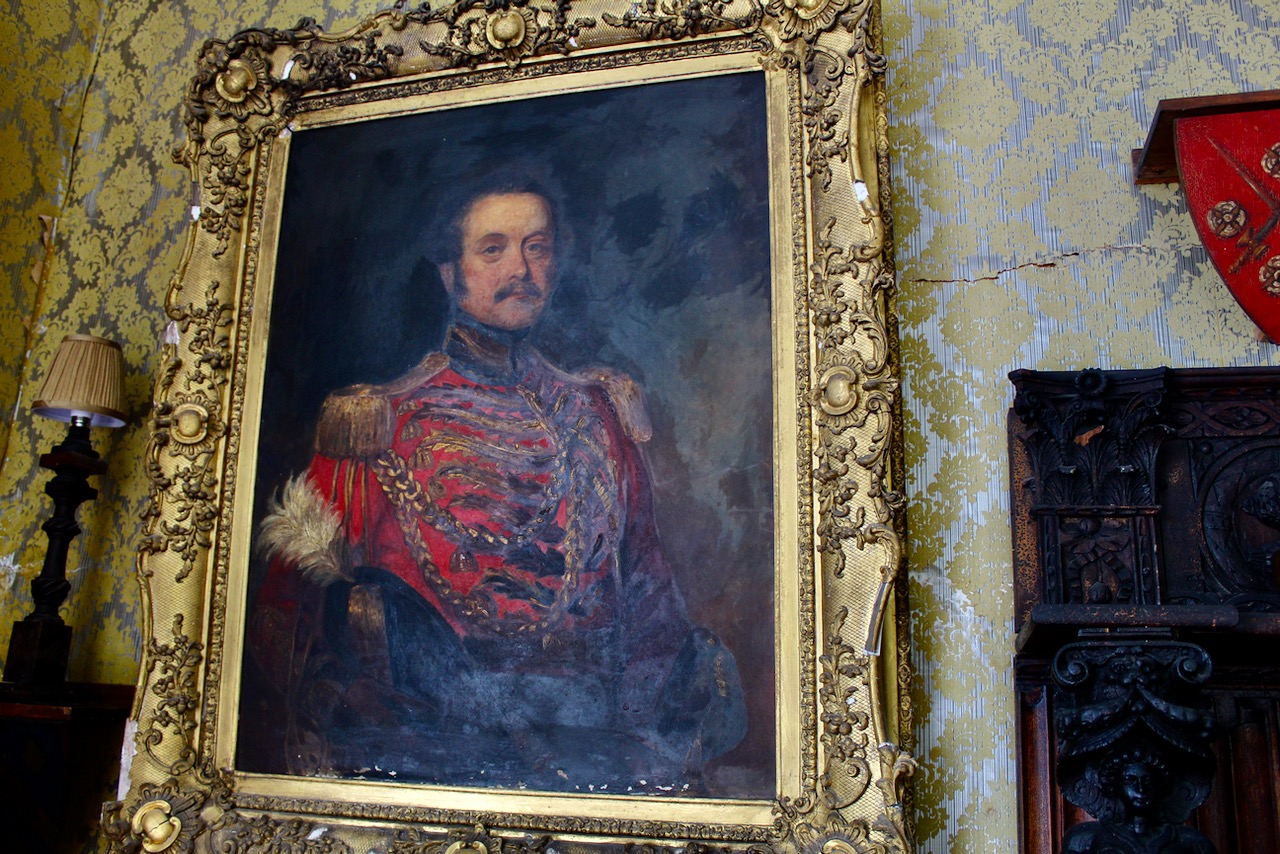
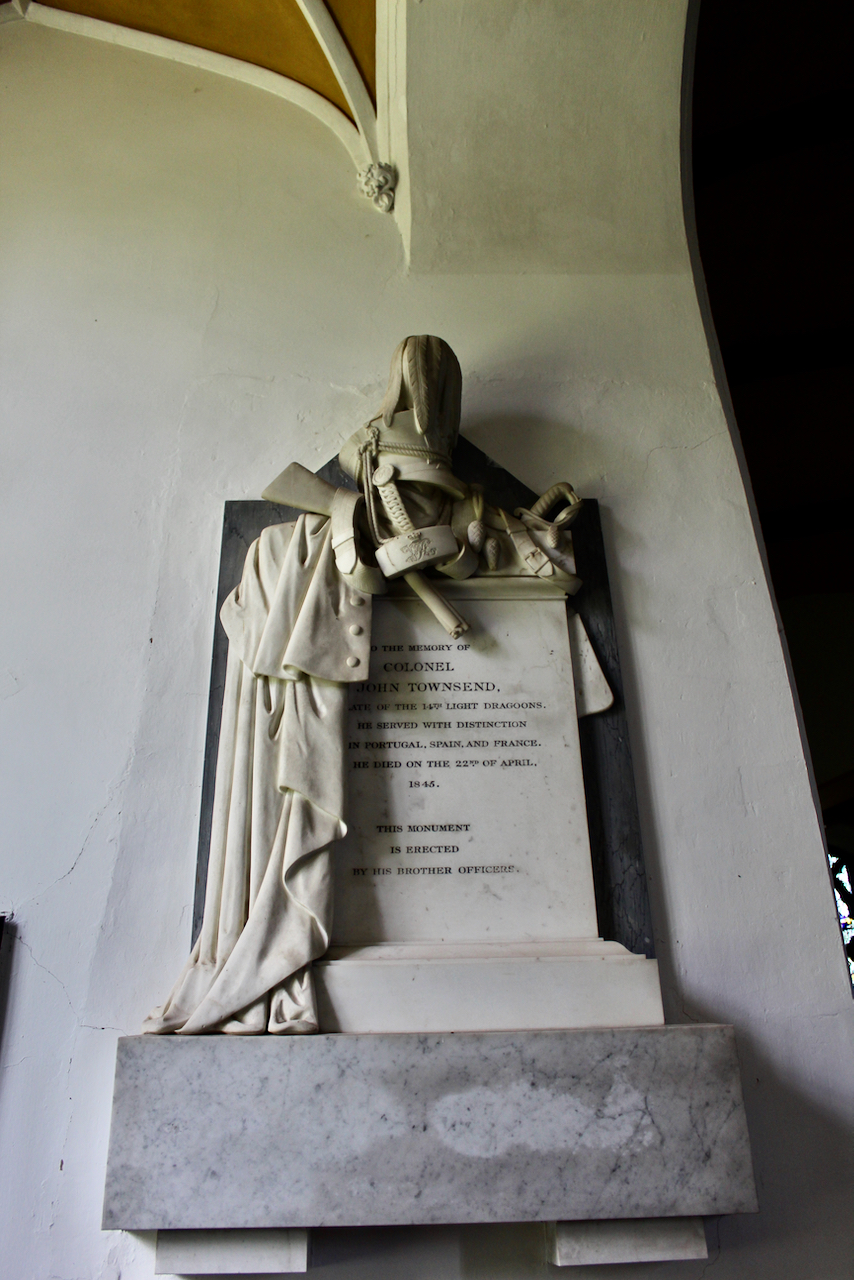
Lt-Col John Townsend died in 1845, and the property passed to his brother, Reverend Maurice Townsend (d. 1872). Maurice married Alice Elizabeth Shute, heiress to Chevanage estate in Gloucestershire. Alice Elizabeth Shute was heiress by survival in her uncle Henry Stephens, and assumed his name. Maurice changed his name in 1870 to Maurice FitzGerald Stephens-Townshend (he was the one who added the ‘h’ in the name). She died at Castle Townshend aged only twenty-eight.
They had a son John Henry Townshend (1827-1869), who gained the rank of officer in the 2nd Life Guards. A fire occurred in 1852, during Reverend Maurice’s time in Castletownshend.

The website tells us about the fire: “Disaster struck again in 1852 when the newly built East Wing went up in flames. The blaze was so fierce that the large quantity of silver stored at the top of the wing ran down in molten streams. The family sent a Bristol silversmith to search the ruins and value the silver by the pound, which he did and promptly disappeared to America with a large part of it! The family still have some of that silver, all misshapen from the fire. The East Wing was rebuilt soon after the fire and The Castle has remained unchanged in appearance ever since.“
Reverend Maurice’s son predeceased him so Reverend Maurice’s grandson, Maurice Fitzgerald Stephens-Townshend (1865 – 1948) inherited Castletownshend in 1872 when he was still a minor. In the 1890s, the time of the Wyndham Act, 10,000 acres were put up for auction. The current owners still have the auction books. It was purchased by Charles Loftus Townsend (1861-1931).
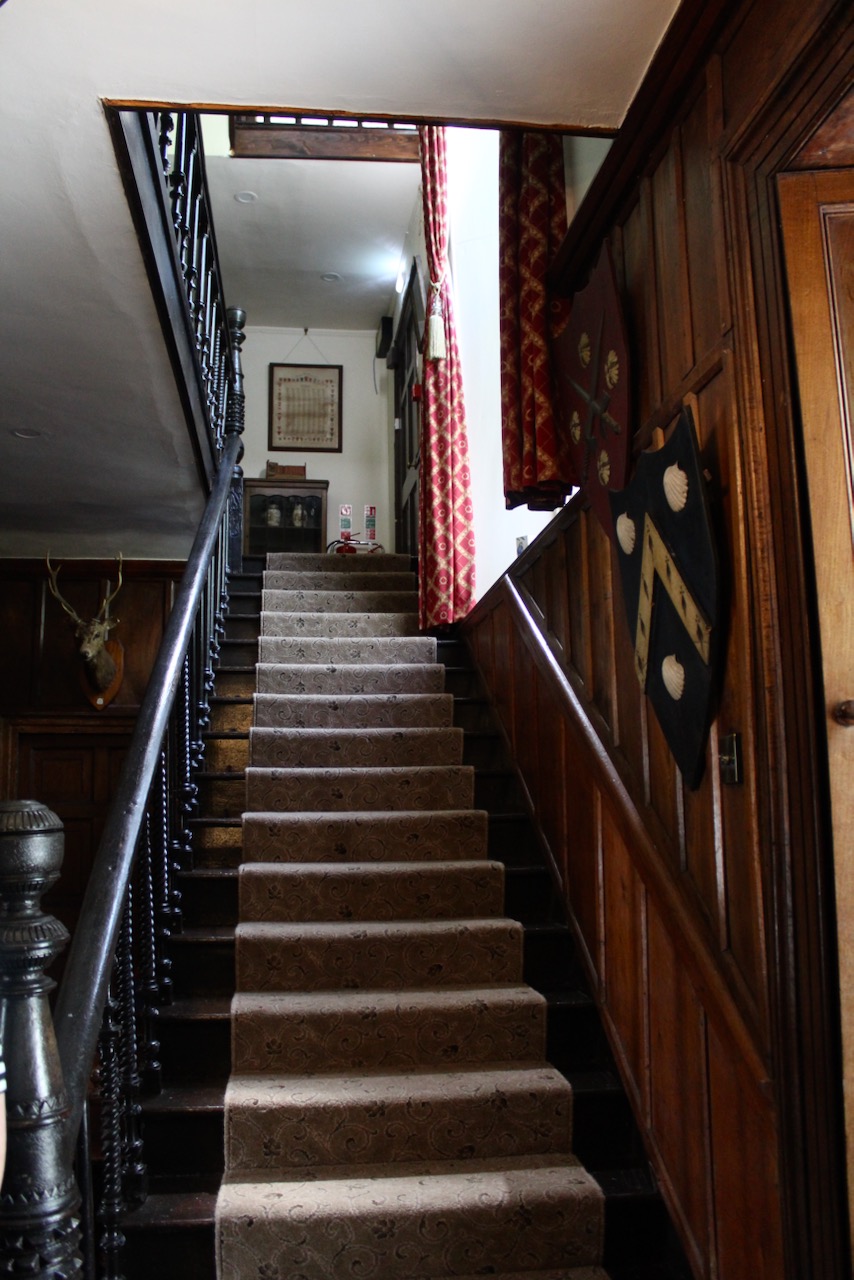
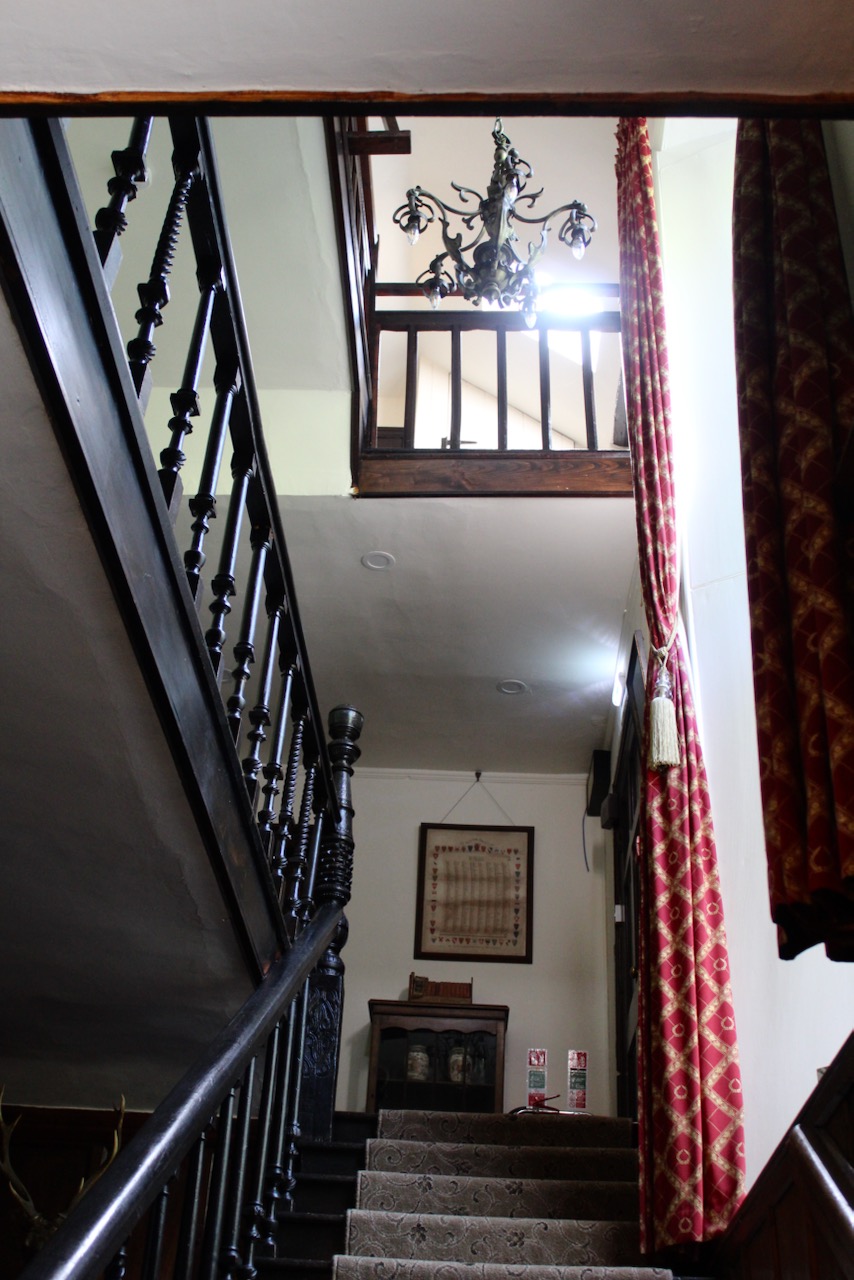
Young Maurice married Blanche Lillie Ffolliot. She was an only child and brought money with her marriage, and Maurice was able to buy back the castle. The castle passed to their daughter, Rosemarie Salter-Townshend. She began to rent out holiday homes in Castletownshend. Her husband, William Robert Salter, added Townshend to his surname. It was their daughter Anne who modernised the castle, putting in central heating etc.
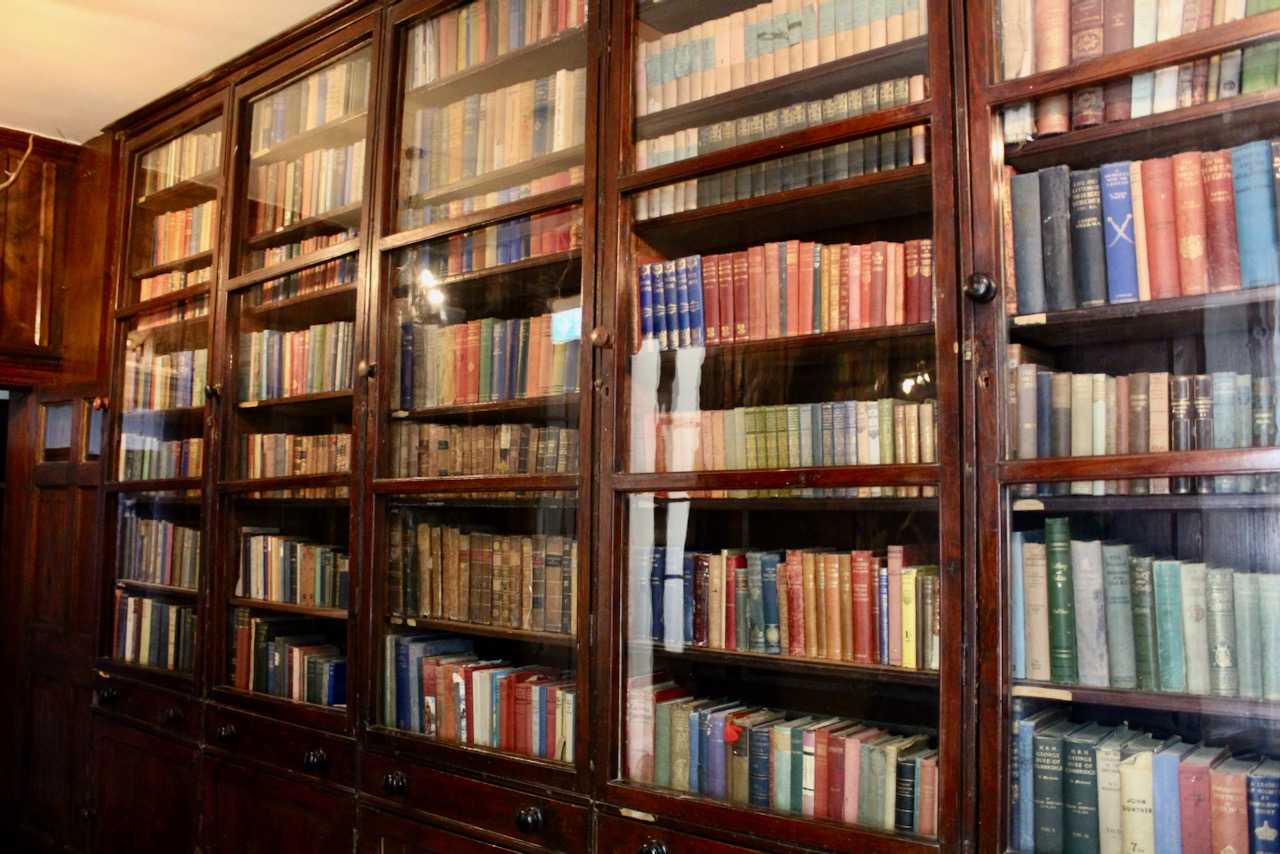
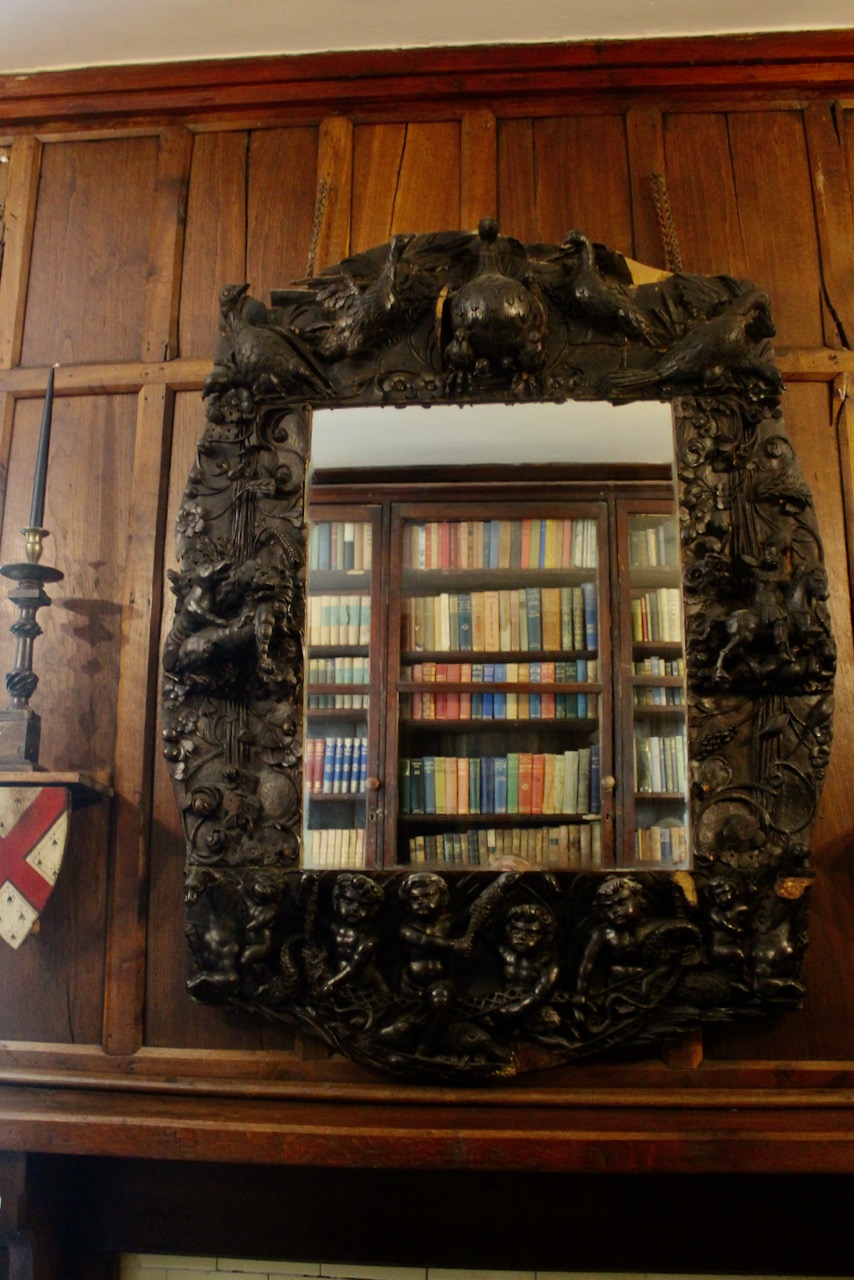
The website continues: “Full of character and old-world charm, The Castle offers a welcoming retreat from everyday life. There are lots of things to do in the local area, like whale-watching and kayaking. Or, you can simply rest and recharge your batteries in the unique surroundings. After enjoying a complimentary breakfast, stroll through the winding pathways of our historic grounds, discovering ivy-covered ruins and their stories along the way. Then, as the sun sets, sit out the front with a drink in your hand, watching the boats in the harbour sway gently back and forth.
While you are a guest in our family’s home, the only thing on your To Do list is to relax. We will look after the rest.“
[1] The website adds that much has been written about the Townshend family and The Castle over the years, and this rich history is documented in great detail. An Officer of the Long Parliament, edited by Richard and Dorothea Townsend (London Henry Frowde, Oxford University Press Warehouse, Amen Corner, E.C.,1892) is an account of the life and times of Colonel Richard Townesend and a chronicle of his descendants.
[2] see Montgomery-Massingberd, Hugh. Burke’s Irish Family Records. London, U.K.: Burkes Peerage Ltd, 1976.
[3] p. 1035, volume 19, Stephen, Sir Leslie, ed. Dictionary of National Biography, 1921–1922. Volumes 1–22. London, England: Oxford University Press.
[4] O’Hea O’Keeffe, Jane. Voices from the Great Houses: Cork and Kerry (Mercier Press, Cork, 2013).
[5] Keohane, Frank. The Buildings of Ireland: Cork City and County. Yale University Press: New Haven and London, 2020.

We came upon the Townshend family when we visited Drishane, as the Somervilles nearby intermarried with their cousins the Townshends. See my write-up:
https://irishhistorichouses.com/2021/03/07/drishane-house-castletownshend-co-cork/
We visited the Castle of Castletownshend when on holidays in County Cork in June 2022. The Castle is a hidden gem, full of history. We definitely look forward to a return visit, to stay in the Castle.


The website tells us:
“In the picturesque village of Castletownshend, past ‘The Two Trees’ at the bottom of the hill, you’ll find our family-run boutique B&B. Nestled at the edge of a scenic harbour and natural woodlands for you to explore, The Castle is a truly unique place to stay. It has the warm, homely feel of a traditional Irish B&B, but with a few extra special touches.


The website continues: “Steeped in history, The Castle has been home to the Townshend family since the 1650s and has been receiving guests for over 60 years. Inside the old stone walls, you’ll find welcoming faces to greet you, roaring fires to warm you, and comfy beds to sink into. Each room has its own story to tell, with the oak-panelled hall and spacious dining room retaining most of their original features, furniture, and family portraits.“
The website also explains the family name: “The family name has undergone several changes over the years. The original spelling was Townesend, which later became Townsend. In 1870, the head of the family, Reverend Maurice Fitzgerald Townshend [1791-1872], consulted with the Townshends of Raynham, Norfolk. Following this, it was requested that the whole family add the ‘h’ into the name. However, some families were quite content with the current spelling and refused to adopt the new one. This resulted in various different spellings spread across the branches throughout the UK, Ireland, Australia and Canada.
Much has been written about the Townshend family and The Castle over the years, and this rich history is documented in great detail . You can also read the book ‘An Officer of the Long Parliament’, which is an account of the life and times of Colonel Richard Townesend and a chronicle of his descendants.“


The website tells us: “The building is in fact a 17th century castellated house, not a defensive castle from earlier times. It was built by Colonel Richard Townesend [1618-1692] towards the end of the 17th century, starting off as a much smaller dwelling. The first castle, known as ‘Bryan’s Fort’ [named after his son Bryan (1648-1726)], was attacked and destroyed by the O’Driscolls in 1690, and its ruins remain in The Castle grounds to this day. Richard then built a second castle, which is thought to be where Swift’s Tower still stands.
In 1805 the floors were lowered to make the ceilings higher, a decision that left The Castle in ruins. However, instead of rebuilding it, the stone was used to add castellated wings to the dwelling on the waterfront. This became The Castle as you see it today.“
Colonel Richard Townesend (1618-1692) gained the rank of Officer in the Parliamentary Army in the Civil War. [see Montgomery-Massingberd, Hugh. Burke’s Irish Family Records. London, U.K.: Burkes Peerage Ltd, 1976.] He fought in the Battle of Knocknoness, County Cork on 3 April 1648, where he commanded the main body of the Army under Lord Inchiquin. He handed the keys of Cork to Oliver Cromwell at Dungarvan after the Commonwealth was proclaimed. He held the office of Member of Parliament for Baltimore, County Cork, in 1661. In 1666 he acquired Castle Townsend. He held the office of High Sheriff of County Cork in 1671.
Jane O’Hea O’Keeffe tells us of the Castle’s builder, in her Voices from the Great Houses: Cork and Kerry (Mercier Press, Cork, 2013): p. 83. “In the late 1600s Richard Townsend, an officer in the Cromwellian army, acquired lands at Castlehaven in west Cork originally owned by the O’Driscoll clan. Richard Townsend also owned other lands in County Cork totalling over 6,540 acres. It was he who built the castle at Castletownshend, the centre portion of which still remains. The two towers at each corner of the castle today were added in the eighteenth century.”
His son Horatio was in the navy and carried the Duke of Schomberg in 1690 to Ireland on board his sloop, who fought in King William’s army. Another son, Philip (1664-1735), became a Protestant clergyman and married Helen Galwey of Lota Lodge, Cork. It was his son Bryan (1648-1726) who was the successor to Castletownsend.
Jane O’Hea O’Keeffe continues: “Over the following centuries, members of the Townsend family served as high sheriffs of County Cork. In 1753 Richard Townsend was the office-holder and in 1785 Richard Boyle Townsend [1756-1826] was appointed to the position. In the 1870s Richard M.F. Townsend owned over 7,000 acres near Dingle in County Kerry, inherited from the FitzGerald family, Knights of Kerry. At that time, the estate of the late Rev. Maurice Townshend extended to over 8,000 acres in County Cork...” [10]
Colonel Richard Townsend’s son Bryan (1648-1726) was a Commander in the British navy and MP for Clonakilty. He married Mary Synge, daughter of Edward, Bishop of Cork, Cloyne and Ross in 1663 and they had many children.
Bryan and Mary’s son Richard (1684-1742) inherited Castletownshend , and was a Justice of the peace and high sheriff for County Cork. He married twice, first to another Mary Synge, daughter of Reverend Samuel, Dean of Kildare. His second wife was Elizabeth Becher from Skibbereen, County Cork.
Richard (1684-1742) and Elizabeth Becher’s son Richard also served as MP and high sheriff. He married Elizabeth Fitzgerald, daughter of John Fitzgerald, the 15th Knight of Kerry (d. 1741). His father was Maurice Fitzgerald, the 14th Knight of Kerry, and Elizabeth’s brother was Maurice the 16th Knight of Kerry – there is a portrait of a Maurice Fitzgerald, Knight of Kerry, in the front hall, but I’m not sure which one is it. There is also a portrait of the Countess of Desmond, Katherine Fitzgerald (abt. 1504-1604), who lived to be over one hundred years old (some say she lived to be 140) and went through three sets of teeth. We came across her also in Dromana in County Waterford.


Richard Townsend and Elizabeth Fitzgerald had a son, Richard Boyle Townsend (1756-1826), who inherited Castletownshend. He married Henrietta Newenham. There is a fine portrait of their son Lieutenant-Colonel John Townsend, of the 14th Light Dragoons, who held the office of Aide-de-Camp to Queen Victoria.


Lt-Col John Townsend died in 1845, and the property passed to his brother, Reverend Maurice Townsend (d. 1872). Maurice married Alice Elizabeth Shute, heiress to Chevanage estate in Gloucestershire. I think it must have been due to her inheritance that Maurice changed his name in 1870 to Maurice FitzGerald Stephens-Townshend (he was the one who added the ‘h’ in the name).
They had a son John Henry Townshend (1827-1869), who gained the rank of officer in the 2nd Life Guards. A fire occurred in 1852, during Reverend Maurice’s time in Castletownshend.

Frank Keohane describes Castle Townshend in his Buildings of Ireland: Cork City and County:
p. 314. “The Castle. A house of several parts, the seat of the Townshends. The earliest, described as ‘newly built’ in 1780 by the Complete Irish Traveller, is presumably the two-storey, five-bay rubble-stone centre block, with dormers over the upper windows and a two-storey rectilinear porch. Taller three-storey wings with battlements carried on corbelled cornices and twin- and triple-light timber-mullioned windows. The E. wing was perhaps built in the late 1820s; the W wing was added after a fire in 1852. Modest interior. Large low central hall with a beamed ceiling and walls lined with oak panelling and gilded embossed wallpaper. Taller dining room to the r., with a compartmented ceiling; a Neoclassical inlaid fireplace in the manner of Bossi, and a large Jacobean sideboard. C19 staircase with barley-twist type balusters.
Octagonal three-stage battlemented tower, 60 m west of the castle.” [11]


The website tells us about the fire: “Disaster struck again in 1852 when the newly built East Wing went up in flames. The blaze was so fierce that the large quantity of silver stored at the top of the wing ran down in molten streams. The family sent a Bristol silversmith to search the ruins and value the silver by the pound, which he did and promptly disappeared to America with a large part of it! The family still have some of that silver, all misshapen from the fire. The East Wing was rebuilt soon after the fire and The Castle has remained unchanged in appearance ever since.“
Reverend Maurice’s son predeceased him so Reverend Maurice’s grandson, Maurice Fitzgerald Stephens-Townshend (1865 – 1948) inherited Castletownshend in 1872 when he was still a minor. In the 1890s, the time of the Wyndham Act, 10,000 acres were put up for auction. The current owners still have the auction books. It was purchased by Charles Loftus Townsend (1861-1931).
Young Maurice married Blanche Lillie Ffolliot. She was an only child and brought money with her marriage, and Maurice was able to buy back the castle. The castle passed to their daughter, Rosemarie Salter-Townshend. Her She began to rent out holiday homes in Castletownshend. Her husband, William Robert Salter, added Townshend to his surname. It was their daughter Anne who modernised the castle, putting in central heating etc.


The website continues: “Full of character and old-world charm, The Castle offers a welcoming retreat from everyday life. There are lots of things to do in the local area, like whale-watching and kayaking. Or, you can simply rest and recharge your batteries in the unique surroundings. After enjoying a complimentary breakfast, stroll through the winding pathways of our historic grounds, discovering ivy-covered ruins and their stories along the way. Then, as the sun sets, sit out the front with a drink in your hand, watching the boats in the harbour sway gently back and forth.
While you are a guest in our family’s home, the only thing on your To Do list is to relax. We will look after the rest.“


Mark Bence-Jones. A Guide to Irish Country Houses.[originally published as Burke’s Guide to Country Houses volume 1 Ireland by Burke’s Peerage Ltd. 1978; Revised edition 1988 Constable and Company Ltd, London.]
p. 78. “[Townshend/IFR) A castellated house, consisting of two battlemented towers joined by a range with dormer gables. Panelled hall. The tower of the parish church rises picturesquely from among the trees immediately above the house, which stands on the shore of Castle Haven.”
The Buildings of Ireland. Cork City and County. Frank Keohane. Yale University Press: New Haven and London. 2020.
p. 314. The Castle. A house of several parts, the seat of the Townshends. The earliest, described as ‘newly built’ in 1780 by the Complete Irish Traveller, is presumably the two-storey, five-bay rubble-stone centre block, with dormers over the upper windows and a two-storey rectilinear porch. Taller three-storey wings with battlements carried on corbelled cornices and twin- and triple-light timber-mullioned windows. The E. wing was perhaps built in the late 1820s; the W wing was added after a fire in 1852. Modest interior. Large low central hall with a beamed ceiling and walls lined with oak panelling and gilded embossed wallpaper. Taller dining room to the r., with a compartmented ceiling; a Neoclassical inlaid fireplace in the manner of Bossi, and a large Jacobean sideboard. C19 staircase with barley-twist type balusters.
Octagonal three-stage battlemented tower, 60 m west of the castle.”
http://landedestates.nuigalway.ie/LandedEstates/jsp/property-list.jsp?letter=C
Rev. Maurice Townsend held this property in fee at the time of Griffith’s Valuation, when it was valued at £37. Lewis recorded it as the residence of Col. Townsend in 1837. In the later 1770s it was also the seat of the Townsend family. Wilson, writing in 1786, refers to Castle Townsend as the seat of Richard Townsend, “beautifully situated by Glandore Harbour”. In 1906 it was owned by Charles L. Townsend and valued at £53. In 1945 the Irish Tourist Association Survey dated the present structure to 1860 noting that the previous house had been badly damaged by fire in 1858. It is still held by the family and accommodation is offered in part of the property. See http://www.castle-townshend.com.
or this?
Sir Jocelyn Coghill was leasing this property from Rev. M. Townsend at the time of Griffith’s Valuation, when it was valued at £22 10s
or this?
Mary Herbert was leasing this property from Rev. M. Townsend at the time of Griffith’s Valuation, when it was valued at £25. There were a number of marriages between members of the Townsend family and the Herberts of Muckross, Killarney.
Detached country house comprising five-bay two- and three-storey central block with projecting two-storey porch, built c.1650, flanked by two-bay three-storey crenulated tower to south-west with single-storey lean-to to rear and by single-bay three-storey crenulated tower to north-east, added c.1860. Pitched slate roofs having terracotta ridge tiles, rendered chimneystack and replacement cast-iron rainwater goods to central block, with decorative brick course and carved limestone finials to dormers. Rendered crenulated parapets to towers having limestone coping and bracketed eaves course. Crenellated parapet to porch. Red brick chimneystacks to rear block. Exposed rubble stone walls having red brick eaves course to central block. Rendered walls to rear of main block with remains of slate hanging to first floor. Square-headed window openings of varying size with stone sills throughout building. Six-over-six timber sliding sash windows with stone voussoirs to ground floor and north-east end of first floor, central block. Nine-over-nine timber sliding sash windows to first floor south-west end and three-over-six timber sliding sash window to dormer windows, having red brick flat arches to remain front elevation openings. Quarry glazed lancets to three dormers. Square-headed openings to porch, having stone sills, voussoirs and label moulding with paired one-over-one timber sliding sash windows. Paired and tripled timber sliding sash windows to towers, having stone voussoirs and overlights, with four-over-four pane to ground and first floors, and four-over-two pane to second floor. Four-over-four, two-over-two and twenty-over-twenty timber sliding sash windows to rear. Round-headed opening with timber sliding sash window to rear. Some recent uPVC windows to rear. Square-headed door opening to porch with stone voussoirs, label moulding and timber door with cast-iron studs, strap hinges and door furniture. Camber-headed door openings to former stable block with stone voussoirs and replacement timber battened and timber glazed single and double-leaf doors. Retaining interior features. Flat-roofed five-bay single-storey block to south-west with crenulated parapet, camber-headed openings and recent opening fittings. Ruinous remains of a star shaped fort and tower to north-east. Stone quay wall to sea front. Rubble stone enclosing walls to west and south-west.
This fine building, located over looking the harbour, was once the focus of the surrounding area. The village developed around the castle, which was built and is still occupied by the Townsend family. The current building comprises several stages of construction with the central two-storey block forming its historic core, while the towers were added later, using stones from the ruins of an earlier castle. The ruinous remains of Swift’s tower and a star-shaped fort, both located to the north-east, contribute to its setting and context.
http://www.astro.wisc.edu/~townsend/tree/home.php
Owners
- Colonel Richard Townesend [100] 1618(?) – 1692
- Colonel Bryan Townsend [200] 1648 – 1726
- Richard Townsend [201] 1684 – 1742
- Colonel Richard Townsend [213] 1730 – 1783
- Richard Boyle Townsend [219] 1756 – 1826
- Colonel John Townsend [230] 1789 – 1845
- Reverend Maurice FitzGerald Stephens-Townshend [231] 1791 – 1872
- (Geraldine Henrietta Townsend [252] 1829 – 1911)
- (Charles Loftus Uniacke Townshend [5C01] 1861 – 1931)
- Maurice FitzGerald Townshend [263] 1865 – 1948
- Rose Marie Salter-Townshend [269] 1917 – 2003
- Anne Marie Cochrane-Townshend [273] 1944
Castletownshend is situated at the head of the sheltered anchorage of Castlehaven 6km to the southwest of Skibbereen (Sheet 89 map reference W183314).
Whilst living at Kilbrittain Castle, near Courtmacsherry, Colonel Richard Townesend built extensively in Castletown, which subsequently became Castle Townsend and later Castletownshend. Firstly he built the Star Fort, later called Bryan’s Fort, in about 1650. The fort stood on a hill overlooking the anchorage in the sheltered part of Castlehaven harbour and was built for security rather than comfort; it was a square building, defended by a bastion at each angle, loop-holed for small cannon and musketry.

Bryan’s Fort
Photograph Copied from ‘An Officer of the Long Parliament‘ facing page 91
Following this Colonel Richard built a Castle below the fort and a Dower House close-by, both of which were situated near the shoreline. Moving to Castletown in about 1665 and faced with unsettled times, he was frequently engaged in various armed skirmishes with Irish rebels. In 1690, under command of Colonel O’Driscoll, the rebels unsuccessfully besieged The Castle. Soon after, it was attacked again by about 500 of them led by MacFineen O’Driscoll and Richard was forced to surrender. He was subsequently paid £40,000 in compensation for the destruction of his home. The Castle that was built in place of the one destroyed was situated some 50 metres to the west of Bryan’s Fort.

The Castle built to replace the one destroyed in 1690
Artist’s Impression from ‘An Officer of the Long Parliament‘ facing page 108
Colonel Richard’s eldest son John pre-deceased his father, thus when Colonel Richard died in September 1692 he left the majority of the Castletownshend estate to his grandson Richard FitzJohn Townsend [113]. When he died unmarried in 1722 his inheritance passed to his uncle, Colonel Bryan Townsend [200], by then an old man who died four years later. Probate on Colonel Bryan’s will was granted in 1727 and the estate passed to his eldest son, Richard Townsend [201], about whom nothing is known other than he was appointed a Justice of the Peace in 1715 and was High Sheriff for the County of Cork in 1726.
Richard died in November 1742 and, when his wife Elizabeth died a year later, their children were left in the care of their Uncles Samuel Townsend [400], Philip Townsend [500] and Horatio Townsend [600]. The eldest son, Richard Townsend [213], inherited the Castletownshend estate when he came of age in 1751 and he did much to improve the village during his lifetime. In his book ‘Statistical Survey of the County of Cork’ (published in 1810) Horatio Townsend [5D00] wrote — “Castle-Townsend, the first and principal seat of the family, whose name it bears, was nothing more than a neat and well built village adjoining the mansion-house, on the west side, until improved and extended by its late possessor, Richard Townsend, Esq. a commissioner of the revenue, and many years a representative of this county in parliament“. Richard was High Sheriff for the County of Cork in 1753, a Justice of the Peace, Colonel of the County Cork Militia Dragoons, MP for County Cork and a Commissioner of Revenue.
Richard’s eldest son, Richard Boyle Townsend [219] inherited the Castletownshend estate in 1783, the same year that he was elected MP for Dingle. Appointed a Justice of the Peace some ten years earlier and admitted a Freeman of the City of Cork in 1777, he was High Sheriff for the County of Cork in 1785 and was made a Freeman of Limerick in April that same year. In 1796 under threat of a French invasion Richard went to great expense to fortify Castletownshend and equip a flotilla to protect it. However foggy weather veiled the entrance to the harbour and the French fleet passed on to Bantry Bay.
Some nine years later when their eldest son, Richard Townsend [229], died suddenly aged nineteen in 1805, Richard’s wife, Henrietta, felt that The Castle was not healthy – the ceilings were not high enough and it was decided to lower the floors. This done, the foundations could not take the strain and the house was a ruin. However, rather than re-build The Castle, the stones from the ruin were used to build castellated wings on the Dower House which then became The Castle and the family’s main residence; though Richard and Henrietta thereafter lived mainly at 8 Montague Square in London or at their house in Wiltshire.
When Richard Boyle died in Dublin in 1826, the Castletownshend estate passed to his eldest surviving son, Colonel John Townsend [230], who left the management of it to his mother as he was away soldiering with his Regiment. Eighteen years later, whilst in command of the 14th Light Dragoons in India, he contracted ‘Indian ague’ and embarked for England in November 1844 in order to recover his health. Landing in January 1845, he died unmarried three months later at Castletownshend and the property thus passed to his brother, Maurice FitzGerald Stephens Townshend [231], who at the time was Vicar of St Mary’s Parish Church, Thornbury, Gloucestershire.
Disaster struck again in 1852 when the newly built East Wing of the Dower House caught fire and the blaze was so fierce that the large quantity of silver stored at the top of the wing ran down in molten streams. Maurice sent a Bristol silversmith to search the ruins to value the silver by the pound, which he did and promptly disappeared to America with a large part of it! The family still have some of that silver, all misshapen from the fire. The East Wing was re-built soon after the fire and The Castle has remained unchanged in appearance ever since.
The Dower House with castellated wings — now the present day Castle.
‘An Officer of the Long Parliament‘ records that Maurice was “a ripe classical scholar of original wit and retentive memory” as well as being a benevolent landlord who did much to alleviate the suffering of his tenants during the years of famine. Whilst he took a great interest in the Castletownshend estate, his parish in Thornbury must have been his principle concern forcing him to leave the daily affairs of Castletownshend to an agent. His son, Henry John Townshend [251], who relinquished his commission in the 2nd Life Guards in 1857 might well have acted as his father’s agent. However he died in 1869, pre-deceasing his father, so when Maurice died in 1872 Henry John’s two sisters, Geraldine Townshend [252] and Alice Townshend [253], were left in equal share a ‘life interest successively’ in the Castletownshend estate which was entailed1 to Henry John’s eldest son Maurice FitzGerald Townshend [263], aged seven at the time. Geraldine, looked after the estate with help from her nephew Hubert de Burgh Townshend [264], who acted as her agent between 1891 and 1897.
In 1894 a substantial mortgage, raised some years previously on the estate by her father, was ‘called in’ and Geraldine was unable to find the capital to pay it off, despite seeking assistance from other members of the family. Consequently, The Castle and estate were put up for auction on 25 June 1897 and most of the estate was sold, whilst The Castle itself and surrounding land was bought by Charles Loftus Townshend [5C01] for a reputed sum of £14,000. The houses in the village on the north side of the road leading up the hill from The Castle were retained by the family, which they continue to own and use to this day. Because of the entailment, ownership of The Castle had to revert to the younger Maurice FitzGerald Townshend, on repayment of the loan, and in the early 1900’s he regained possession of it, having repaid Charles Loftus.
During the early years of the new century The Castle was left empty or let and Maurice himself lived variously in Schull, Castletownshend and Glandore before moving into Shepperton (see below) when he married in 1913. The 1901 Irish Census shows Sir John Coghill, a widower aged 75, was renting The Castle, living there with his son and daughter-in-law, his daughter, two grandsons, a nephew, a nurse and six household staff. Ten years later the April 1911 Census shows Sir John’s Coghill’s son, Egerton, had succeeded to the baronetcy and was living in The Castle with his family, a nurse, a governess and five domestic staff. Both the 1901 Census and the 1911 Census show that Henry FitzJohn Townshend [260] was the only member of the family living in Castletownshend at that time; he lived at Seafield. Seafield was previously owned by Henry FitzJohn’s father, John FitzHenry Townshend [250], Judge of the High Court of the Admiralty, Ireland and the principal contributor to ‘An Officer of the Long Parliament‘.
Maurice remained at Shepperton until he was forced to move out during the Civil War (1922–23) for fear of his life. He and his wife went to England and in August 1925 were living at Freshford Lodge, Freshford, Somerset. When they returned later that year they found that Shepperton had been occupied by another family and so they moved into The Castle which by then had lain empty for many years.
On the death of Maurice in 1948 The Castle passed to his only child, Rose-Marie Townshend [269], who in turn left it to her daughter Anne-Marie Cochrane Townshend [273].
Save for a few years at the end of the 19th century and despite many vicissitudes The Castle has remained as the principal family seat since about 1660. All four ‘sites’ of The Castle – namely Bryan’s Fort, now a ruin, the original Castle of which only the foundations remain, its replacement, of which nothing remains, and the Dower House (present day Castle) are situated within 100 metres of each other on four separate sites.
1 The purpose of an entail was to keep the property and land of a family intact in the main line of succession. The heir to an entailed estate could not sell the house or land, nor bequeath it to anyone outside the family.
In O’Hea O’Keeffe, Jane. Voices from the Great Houses: Cork and Kerry. Mercier Press, Cork, 2013.
p. 83. In the late 1600s Richard Townsend, an officer in the Cromwellian army, acquired lands at Castlehaven in west Cork originally owned by the O’Driscoll clan. Richard Townsend also owned other lands in County Cork totalling over 6,540 acres. It was he who built the castle at Castletownshend, the centre portion of which still remains. The two towers at each corner of the castle today were added in the eighteenth century. He also built a church and the remains of its eastern gable may still be seen in the old graveyard at Castlehaven. The parish of Castlehaven lies in the East Division of the Barony of West Carberty. The place name is translated from the Irish Cuan an Chaislein, according to the Annals of the Four Masters.
Over the following centuries, members of the Townsend family served as high sheriffs of County Cork. In 1753 Richard Townsend was the office-holder and in 1785 Richard Boyle Townsend was appointed to the position. In the 1870s Richard M.F. Townsend owned over 7,000 acres near Dingle in County Kerry, inherited from the FitzGerald family, Knights of Kerry. At that time, the estate of the late Rev. Maurice Townshend extended to over 8,000 acres in County Cork.
From the late 1600s until the late 1800s, the Townsend family farmed or leased their lands in west Cork. Once the castle and the church had been built by Richard Townsend in the 1600s, houses began to spring up around them, and people moved to Castletownshend from Glenbarrahane, the original village at the mouth of [p. 84] Castlehaven Harbour, named for St. Barrahane. Traces are all that now remain of Glenbarrahane.
According to Griffith’s Valuation (1848-64), Rev. Maurice Townshend owned property at Castletownshend, Myross, Castlehaven and Creagh. The Register of Landowners in County Cork 1876 records 8,665 acres in the ownership of Rev Townshend. Six years before, Rev Townshend had altered the spelling of his surname (adding an h) and requested that all his relatives do the same. Some did not comply.
John Sealy Townshend, a descendant of the Castletownshend family, was one of the principal landowners in the barony of East Carbery at this time. In Samuel Lewis’s Topographical Dictionary of Ireland it is written that Castletownshend was the residence of Colonel John Townsend in 1837. In 1874 over 100 acres of Samel Nugent Townshend’s estate in West Carbery were offered for sale in the Landed Estates Court, which allowed creditors of bankrupt estates to have properties sold to secure payment. In 1906 the property at Castletownshend was owned by Charles Loftus Townshend, from whom it was inherited by Maurice Townshend.
We now move forward through the centuries to a bright spring day in April 1922, when William Salter, an industrious and prosperous Protestant farmer, was ploughing his fields at Kilronane near Dunmanway in west Cork. He was approached by members of the IRA and told that unless he left the area immediately, he would be shot. Before leaving, he asked that he might be allowed to see his wife and young son William in the farmhouse. His request was refused, so he untied his horse form the plough, secured him to a fence, and started alone on the long walk towards Cork.
That cruel month of April 1922 had witnessed the killing of thirteen unionist Protestant civilians in the Bandon valley, and the abduction and disappearance of three British intelligence officers and their drivers in Macroom. There is an ongoing debate amongst interested parties on whether or not there was a sectarian element to those killings, two months before the outbreak of the Civil War. The first three people to be killed were widely believed to have been responsible for the shooting dead of an IRA officer, but as mystery surrounds the identity of the remaining perpetrators, their motives must remain a matter of debate. Questions remain in relation to the motives for these deaths over ninety years ago in west Cork.
[The family moved to England, and remained, farming in Cornwell, for two years. They sold the farm they had, but moved back and bought Castle Farm in Castletownshend from Edith Somerville and her sister Lady Coghill, in 1924.]
p. 86. William Salter Townshend, of the family that moved to England, fell in love with Rose Marie Townshend, who lived in the castle. He was farming Castle Farm, his family was living in a house in The Mall in the village that belonged to Edith Somerville. Rose Marie’s parents did not think William was of the correct social class. So in 1938 they moved to England to marry.
They returned home after her mother died in 1939. Her father, Maurice Townshend, was living in the castle. From 1929 the castle took paying guests. P. 87. By March 1946 Maurice was no longer able to run the business so he asked his daughter Rose Marie and her husband to move in to the castle and to take over.
On her marriage in 1938, Rose Marie Townshend had become Mrs Salter. Before Maurice Townshend’s death in 1948, he had asked William Salter if Rose Marie could once again use her family name, to keep it in the castle. She was an only child and the family name would otherwise cease to exist. The young couple agreed, and from then on the family name became Salter Townshend.
p. 88. William Salter Townshend was a very successful farmer.
p. 90. William and Rose Marie raised five children. Their daughter, Anne Cochrane-Townshend, operates the successful hospitality business at the castle with her husband Malcolm Cochrane. Her brother, Robert Salter Townshend, also lives in Castletownshend and he explains that his house in the village appears on an Ordnance Survey map of 1750, marked as “the cottage.” It was one of the original cottages in the village and it, along with several others, were restored by Robert’s father William in his younger days.
p. 91. Robert says, of Maurice, “My Grandfather Townshend, who lived at the castle, was a lovely man who got on very well wiht my father… He was very well liked locally and he considered himself one hundred percent Irish. He could speak Irish and was a good set-dancer. In the afternoons after school, I’d play around the castle with other local children.
In my Townshend great-grandfather’s day, the family never worked much and my grandfather never worked at all. It’s impossible to live that way indefinitely, and in the late 1800s a lot of Townshend property was sold off. The properties the family now own are on one side of the village.
Robert joined the Royal Navy…and later, when his mother was unwell, [p. 92] he worked alongside her at the castle, helping to run the business there. Later still, he set up his own tyre import and distribution business.”
http://www.astro.wisc.edu/~townsend/tree/overview.php
Overview of the Townsend Family 1650 – 1900
Introduction
It is 365 years since Colonel Richard Townesend arrived in Ireland with his Regiment in 1647 and 120 years since An Officer of the Long Parliament was published in 1892. As explained on the Home Page, this book is an account of the life and times of Colonel Richard and a chronicle of his family. Since publication, several generations of the family have entered the world and much new information has come to light that was not available to the editors of the book. There are now (2012) over one thousand individual entries on the Townsend Family website and, without reading them all, it is impossible to get a comprehensive overview of the family. This page of the website seeks to redress this by describing the fortunes of the family in Ireland between 1650 and 1900. Full details about any particular event or individual can be accessed in personal records.
Settling down — Colonel Richard Townesend and his children
Following settlement of the Catholic revolt in Ireland in 1652, Colonel Richard Townesend [100] retired from the Army sometime before 1654 and made extensive purchases of land; in all about 8,000 acres. On the restoration of Charles II in 1660 he was pardoned for his allegiance to Oliver Cromwell and escaped the forfeitures placed on many Cromwellian soldiers; his purchases of land were subsequently confirmed by royal patents in 1666, 1668 and 1680. Living for a time at Kilbrittan Castle, near Courtmacsherry, Richard finally settled at Castletownshend in about 1665. Appointed High Sheriff of Cork in 1661, he was elected MP for Baltimore in the Irish Parliament that same year but his appearances were infrequent and he was fined for non-attendance.
From the time that he settled in Castletownshend until his death, Richard sought to consolidate his estates in County Cork and to lead the settled life of a landowner. However, those were troubled times, particularly after the accession of James II in 1685, and Richard was frequently engaged in armed skirmishes with Irish rebels. In 1690 they unsuccessfully besieged Castletownshend, but when they attacked again shortly afterwards Richard was forced to surrender. He was subsequently paid £40,000 in compensation for the destruction of his home as described in the page Family Houses.
Colonel Richard’s eldest son, John Townsend [101], pre-deceased him so when Richard died in 1692 his estate passed to his grandson Richard FitzJohn Townsend [113]. Sadly, Richard FitzJohn died unmarried in 1722 and the estate passed to Colonel Richard’s second son, Colonel Bryan Townsend [200], who was born in 1648. Newly appointed a Colonel of Militia, Bryan had been proscribed as a traitor under the Act of Attainder in 1689 and forced to flee the country, along with his brothers, Francis Townsend [102] and Kingston Townsend [105]. However, he and Francis returned shortly afterwards but Kingston never did so, having fled to Barbados where he married and died in 1746.
In 1690, after his brother Captain Horatio Townsend [104] brought the Duke of Schomberg to Ireland in the sloop Lynn, Colonel Bryan was at the Duke’s headquarters in Belfast, three weeks before William III landed in the province and six weeks before the Battle of the Boyne. In the years that followed this Bryan became involved in local governance; elected Sovereign of Clonakilty in 1693 and again in 1697, he was also elected MP for the Borough of Clonakilty in the Irish Parliament in Dublin in 1695. Aged 69, he last attended a meeting of the Clonakilty Borough Council in 1717 when his sons, Samuel Townsend [400] and Philip Townsend [500], were elected Freemen of the Borough.
When Bryan died in 1726 he left the Castletownshend estate to his eldest son, Richard Townsend [201], having made ample provision in his will for his younger sons, all of whom settled in County Cork – John Townsend [300] at Skirtagh, Samuel Townsend [400] at Whitehall, Philip Townsend [500] at Derry and Horatio Townsend [600] at Donoughmore and it is from these sons that the five branches of the Townsend family derive. By this time the family was firmly established in County Cork and developments over the subsequent 200 years are typical of many other Protestant families who settled in Ireland in the latter half of the 17th century.
Marriage and Kinship
Between 1700 and 1900, 213 males and 237 females in the 3rd to 8th generations of the family reached adulthood and of these 163 males and 149 females married — 77% and 63% respectively. Living mostly in County Cork during these years, it was in these generations of the family that there was a high proportion of intermarriage with other Anglo-Irish protestant families. Whilst not unique during the 18th and 19th centuries in Ireland, of the adults who married in these generations, 37% of these marriages took place with just thirty-five other Anglo-Irish protestant families. In particular, there were eight marriages with the Somerville family, seven with the Becher family and at least three other marriages each with ten other families: notably Baldwin, Beamish, Daunt, Fleming, Hungerford, Meade, Morris, Newman, Robinson and Warren. In addition, during the same period, there were thirteen other marriages with cousins from ten other families and fifteen Townsend/Townsend cousin marriages. A separate page — Intermarriage and Other Families — shows just how interwoven all these families were.
This intermarriage within the family and within the Anglo-Irish protestant community created a tightly associated but rather insular society. The diary of Agnes Somerville, wife of the Reverend Horatio Townsend [334], covers the forty-six years between 1845 and 1904 and reflects this social milieu. It contains well over one hundred entries about ninety-one members of the family from all five branches, along with notes about other Anglo-Irish families with whom they had close ties. This close association is reflected in family correspondence and shows that throughout and within all branches of the family in Ireland there existed a network of godparents, shared schooling, business associations, family networking, common interests and membership of various societies and clubs. The records of the Royal Cork Yacht Club afford an excellent example of this. Seventeen members of the family were members – where known, the names of their yachts are shown in italics
- Hon John FitzHenry Townsend [250] Growler
- Lt Col Henry FitzJohn Townsend [260] Alyn 9 tons
- Maurice FitzGerald Townsend [263]
- Capt Hubert de Burgh Townsend [264]
- Cdr Thomas Townsend [319]
- Edward Townsend [411] Blonde 29 tons
- Samuel Nugent Townsend [432] Caterina 56 tons (sank 1892)
- John Hancock Townsend [523] L’Eclair 32 tons
- William Tower Townsend [535] Linda 12 tons*
- Dr Richard Hungerford Townsend [5A02] Linda 12 tons
- Charles Uniacke Townsend [5C01] Bat 1 ton
- Horace Payne Townsend [5D12]
- George Chambre Townsend [5D33]
- Horatio Townsend [6B01] Pearl 14 tons
- Rev Thomas Townsend [6B03]
- Horatio Hamilton Townsend [6B05]
- Vice Adm Sir Samuel Philip Townsend [6C01]
* Purchased from Dr Richard Hungerford Townsend
If further evidence was needed to illustrate the closeness of the family, it can be found in the unpublished autobiography of the Reverend Edward Mansel Townsend [630] (1860–1947) entitled A Protestant Auto-Biography. His parentage is indicative of his extensive family contacts, as his mother, Marianne Oliver Townsend [5D16], came from the Derry branch of the family and his grandmother, Elizabeth Trelawney Townsend [410], came from the Whitehall branch. Space does not permit a detailed account of his visits to Ireland in 1882 and 1890; suffice to say, however, he visited Castletownshend, Myross Wood, Derry and Whitehall, calling on many members of the family who lived in County Cork in the twilight years of the 19th century, as well as several associated families. The overriding impression from the account of his travels is of a very close-knit family bonded by a common heritage. Sadly, since then, this close family association has largely dissipated through emigration.
The inability to widen the marriage pool on social or religious grounds and the inability to provide a suitable dowry probably accounts for the consistently high number in each generation of those in the family who never married. Of those born in Ireland during this period on average 23% of men and 37% of women of never married.
Politics, Local Government and Civic Appointments
Throughout the first eight generations of the family many were involved in national and local politics as well as undertaking various civic duties. As touched on above, Colonel Richard and Colonel Bryan were the first two members of the family to be elected to the Irish parliament in Dublin. Sixty years after Colonel Bryan was elected, his grandson Colonel Richard Townsend [213] was elected MP for the County of Cork in 1759, 1761 and 1768. His son, Richard Boyle Townsend [219], was elected MP for Dingle in 1783 and 1790 whilst his brother, John Townsend [214] was also elected MP for Dingle in 1790 and MP for Castlemartyr in 1797. Like his father, Richard Boyle was a staunch Tory who refused to vote for measures which he felt were not in the best interests of Ireland. Not even the offer of an English peerage could bribe him into supporting Union with England, with the result that he lost the favour of his party and the Borough of Dingle was disenfranchised. He was, nevertheless, paid £1,500 in compensation.
Between 1700 and 1900 forty-seven members of the family were appointed magistrates; thirty-three were elected Freemen of the City of Cork; sixteen were Poor Law Guardians and seven were appointed High Sheriff for the County of Cork. At a local level, several in the family became involved in the civic affairs of the Borough of Clonakilty. The oldest entry in the Council Book records the appointment of John Townsend [101] as Sovereign in 1675 and this was witnessed by his brother, Cornelius Townsend [108], who was a Freeman of the Borough.
Trinity College, Dublin
Special mention must be made about the family association with Trinity College, Dublin (TCD). The Reverend Philip Townsend [106] was the first member of the family to attend TCD and he graduated in 1689. Since then, a further sixty-three Townsends have studied there and several of them from various branches of the family were students concurrently. Between 1800 and 1900 there were only six years when a Townsend was not present at TCD and in sixty-two years of the century there were more than two members of the family ‘up’ at the same time. The most in attendance at the university at any one time was five in 1832 and in 1816 three of the four Townsends at TCD were named Richard! Between 1750 and 1900 there were only 19 years when the family was not represented at the university, whilst between 1813 and 1890 there was a Townsend represented there every year.
Livelihood
The Land
Of the 213 adult males born in Ireland between 1700 and 1900 11% derived their livelihood from the land; for some it was a principal source of income supplemented elsewhere whilst for others the reverse applied. Richard Townsend [201], Samuel Townsend [400] and Philip Townsend [500] all inherited land when Colonel Bryan Townsend died and in subsequent generations these inherited estates were enlarged, either by purchase or marriage. Several deeds show that Philip Townsend bought land in the first half of the 18th century, but letters of his written in 1758 show that this expenditure put him into debt. Philip’s nephew, Richard Townsend [213], fared rather better, for when he married Elizabeth FitzGerald in 1752 she inherited her brother’s substantial Kerry estate. Richard’s great nephew, Richard Townsend [236], fared even better; when he married Elizabeth Mellifont in 1819, her dowry was £4,000 and she later brought to the marriage a total of £7,000 and estates in King’s County and Queen’s County on the death of her cousin John Sabatier in 1859.
Others in the family purchased estates in their own right; John Sealy Townsend [507] bought the Myross Wood estate from Lord Kingston in about 1820, whilst Richard Townsend [6A00], Samuel Philip Townsend [6B00] and their descendants acquired considerable holdings of land in County Cork at Pallastown, Firmount and Garrycloyne. In addition to these estates many of the junior sons in each generation owned smaller parcels of land from which it was only possible to derive a small supplement to their income.
The fortunes of those seeking to derive a living from the land were varied and are well illustrated by extracts from the book Statistical Survey of Cork by the Reverend Horatio Townsend [5D00], which was first published in 1810. Discussing horticulture, he wrote that Edward Mansel Townsend [401], the eldest son of Samuel Townsend of Whitehall,
“is greatly proficient in this style of gardening. When hounds became a subject of heavy taxation, he wisely exchanged the pleasures of the chase for those of the garden. This he superintends himself with care as well as ‘con amore’, and for, I believe, a smaller expense than that of dogs, hunters, and their appendages.”
Writing of Samuel Townsend [6B00] of Firmount, Horatio commented —
“Agriculture was among his favourite pursuits, and, as few understood it better, I may perhaps have additional cause of regret in the loss of that friendly assistance so often heretofore experienced.”
However, not all prospered; Cornelius Townsend [139] of Bridgemount tried to improve his land by introducing farming methods he had observed in Sussex and Horatio referred to this as —
“an instance of the unfortunate result of injudicious enterprise…..the result was what might have been expected – ruin to the farmers, and very serious injury to the landlord.”
By the latter end of the 19th century the family as a whole owned about 36,600 acres of land in County Cork; the principal owners were Jane, wife of Jonas Morris Townsend [222] 1,500 acres, Geraldine Townshend [252] 8,600 acres, Richard Mellifont Townsend [236] 5,900 acres, John Hancock Townshend [523] 6,000 acres, Horace Payne Townshend [5D12] 1,400 acres, Richard Horatio Townsend [6A10] 3,900 acres and John Crewe Townsend [6B04] 1,200 acres.
Poor markets and other factors meant that deriving an income from land became increasingly difficult over the years, particularly after introduction of the Land Acts in the closing decades of the 19th century. Letters written by Commander John Townsend [622] and his wife Marianne Townsend [5D16] typify the situation faced by many in the family. The letters contain much detail about the financial problems they experienced on account of falling rents from their Irish properties as a result of the rulings by the Land Commissioners.
The Land Acts and the activities of the Irish Land League led to both voluntary and compulsory sale of most of the land owned by the family at the end of the 19th century; part of Derry estate was sold in 1885 and most of the Castletownshend estate in 1897. The remainder of the Derry estate and the Whitehall estate were sold in the early years of the 20th century and the Myross Wood and Garrycloyne estates were sold in 1940.
For those who could not derive an income from land, the options for making a living were limited to the armed forces, the church and the professions. Of the adult sons, about whom something is known, thirty-five joined the Royal Navy or the army, thirty were ordained, seventeen qualified as doctors, thirteen practiced law, eleven were land agents, four were university academics, forty-five emigrated and a very few fell on hard times, such as Bryan Townsend [323] of Crookhaven and his sister Anne Townsend [324] who lived in poverty but were helped out on a regular basis by other members of the family.
The Armed Forces
Of the thirty-five who joined the armed forces, many saw active service between 1750 and 1900 in various wars. During the Seven Years War Lieutenant General Samuel Townsend [403], the second son of Samuel Townsend of Whitehall, served with the Grenadier Company of the 19th Regiment of Foot at the Siege of Belle Isle in 1761; later, he was appointed Inspector General of Recruiting in 1776 and ADC to King George III in 1778. Captain Philip Townsend of Derry, of whom mention is made above, served with the 22nd Regiment of Foot at Louisburg and other battles in North America between 1757 and 1759, and many of his letters from this period are to be found in Chapter XI of An Officer of the Long Parliament.
Commander John Townsend [316] saw action with the Royal Navy during the American War of Independence and was a member of the boarding party that captured the French flagship Ville de Paris at the Battle of the Saintes in 1782. He retired from the navy around 1800 and was appointed Recorder of the Borough of Clonakilty where his kinsman the Rev Horatio Townsend [5D00] was Sovereign at the time.
Aged sixteen, Colonel John Townsend [230] took a commission in the 14th Light Dragoons in 1805 and fought in virtually every action with the regiment during the Peninsular War (1808–1814). He later commanded the regiment in England and India and was appointed ADC to Queen Victoria in 1841.
Three members of the family saw action during the Crimean War. Commander John Townsend [622] was the First Lieutenant on HMS Himalaya escorting reinforcements from England to Sebastopol; shortly afterwards he left the Royal Navy and was appointed Commissioner of Public Works in Weston-Super-Mare. Major Samuel Philip Townsend [6B09] Royal Artillery, commanding a battery of nine-pounder guns attached to the 4th Division under Major General Sir George Cathcart, was killed at the Battle of Inkerman in 1854 and was Mentioned in Despatches posthumously by Lord Raglan. Vice Admiral Sir Samuel Philip Townsend [6C01], then Captain of the gunboat HMS Boxer, was twice Mentioned in Despatches for the part he played in raids at Gheisk and Glorifa. He later served as First Lieutenant on the royal yacht Victoria and Albert and completed his career as Flag Captain to HRH the Duke of Edinburgh on HMS Warrior.
In the closing years of the 19th century Colonel Frederick Trench Townsend [524] 2nd Life Guards was wounded during the ‘Moonlight Charge’ by the Household Cavalry Regiment at Kassassin during the Egyptian Campaign of 1882 and was awarded the Khedive Star and Order of Osmania. Earlier in his career he travelled widely and wrote a number of books about his experiences in the Eastern Mediterranean, Florida and the mid-west of the United States of America, where he hunted bison.
Major Ernest Townsend [536] Royal Engineers was Mentioned in Despatches during the Ashanti Wars 1894–1896 and six members of the family saw action during the Second Boer War 1899–1902. Of these, Captain Arthur FitzHenry Townsend [267] 4th Bn The Cameronians was Mentioned in Despatches and Captain William Pearson [5D35] was awarded the Royal Humane Society Bronze Medal for trying to rescue a soldier who fell overboard in Capetown in 1900.
Whilst not strictly within the scope of this review of the family, mention must be made of the twenty-four who fought in the Great War 1914–1918. The Reverend Horace Crawford Townsend [643] Chaplain 4th Class and Captain Francis Horatio Townsend [6A26] Royal Engineers were both awarded the MC; Francis was also awarded the Croix de Chevalier and was twice Mentioned in Despatches. Major Edward Neville Townsend [6C19], The Duke of Wellington’s Regiment, was awarded the DSO and Captain Cyril Samuel Townsend [6C14] RN was twice Mentioned in Despatches. In his capacity as Chaplain of Christ Church, Brussels, the Reverend Horace Sterling Gahan, son of Frederick Beresford Gahan and Katherine Jane Townsend [638], administered the last rites to Edith Cavell the day before the Germans shot her in October 1915.
Seven members of the family were killed in action during the Great War:
- Lieutenant Colonel Arthur FitzHenry Townsend [267]. Commanding Officer Royal West Kent Regiment. Battle of Flers-Courcelette 1916.
- Captain Samuel Edward Townsend [441] 16th Bn Australian Infantry. Gallipoli 1915.
- Commander Richard Townsend [5A11] RN. First Lieutenant HMS Invincible. Battle of Jutland 1916.
- Lieutenant Ian Vesey Townsend [5B32]
- Captain Dudley Ryder Townsend [5D36] 1st Bn Lancashire Fusiliers. Gallipoli 1915.
- Lieutenant Francis Townsend [6C33] Durham Light Infantry. Abbeyville 1916.
- Lieutenant Arthur Eric Townsend [6C34] Royal Flying Corps. 1916.
The Church
Most of those in the family who were ordained served in parishes in County Cork, where the Protestant Church was divided into three diocese — Cork, Cloyne and Ross. Many held the living of several parishes concurrently and the number of communicants in each was frequently less than ten.
The Reverend Philip Townsend [106] was the first in the family to take Holy Orders and was the first member of the family to graduate from Trinity College, Dublin, as noted above. Following a short spell in the army as a Captain of Horse, he was ordained in 1706 and appointed Vicar of Holy Trinity in Cork in 1707, on the resignation of the Right Reverend Edward Synge, whose daughter, Mary, married Philip’s brother, Colonel Bryan Townsend. Philip’s nephew, Horatio Townsend [600] was the second member of the family to be ordained and he served his ministry as Rector of Donoughmore from 1737 until his death in 1772. His eldest son, the Reverend Edward Synge Townsend [601], who served in eight parishes in north County Cork between 1765 and his death in 1819, was the first of eleven of Horatio’s descendants to be ordained. This is closely matched by eight of John Townsend’s [300] descendants who took Holy Orders.
There were several parishes where the family was represented for many years, the most notable of which was Abbeystrewry, near Skibbereen in the Diocese of Ross, where John Sealy Townsend [507] held the patronage of the living for many years. The Reverend Horatio Townsend [5D00] was Curate from 1770 till 1780 and was succeeded by the Reverend William Robinson who married Mary Townsend [314], the daughter of Horatio’s nephew, John Townsend [303]. William, later appointed Vicar of the parish, died in 1819 and the Reverend Richard Boyle Townsend [332] was appointed to the living in his place. Richard died of typhus in 1850 and was succeeded by his brother, the Reverend Horatio Thomas Townsend [334], who remained in the parish until he resigned in 1867 in favour of the parish of Kilcoe & Clear. Following a gap of twenty-nine years without family representation, the Reverend Horace Webb Townsend [634] was appointed Vicar in 1896 and remained in the parish until 1915.
The parish of Aghada, near Cloyne, nearly matches this spell of ninety-seven years continuous family representation in one parish. The Reverend Doctor William Robinson Townsend [6B02] was appointed Rector in 1837 and, when he died in 1866, he was replaced by his nephew, the Reverend Thomas Townsend [6B19], who remained in the parish until 1903.
The Reverend Horatio Townsend [5D00] (mentioned above) is perhaps the most notable of all those in the family who took Holy Orders, for, in addition to his clerical duties and his writing, he was tutor and agent to Richard Boyle second Earl of Shannon, who was the MP for Clonakilty and County Cork. Horatio inherited the Derry estate, built the fine house that still stands there today and had much local influence, which he employed with such benevolence that he was known as ‘The Friend of the Poor’. He exercised great authority in Clonakilty, where he was Sovereign for many years, and this helped to save lives during the Great Rebellion in 1798.
Several of those ordained are notable for the good work that they undertook during the course of their ministry, particularly during the terrible potato famine of 1846–1851. Horatio’s son, the Reverend Chambre Corker Townsend [5D01], the Reverend Richard Boyle Townsend (mentioned above) and the Reverend William Robinson Townsend (also mentioned above) were all much involved in relieving the suffering of the poor. The Reverend Richard gave evidence before Parliament on the causes of the distress and toured England collecting money for those suffering. He founded a temporary hospital in Skibbereen and spent much of his time personally caring for those with typhus, only to die of that disease in 1850. The Reverend Chambre contracted scarlet fever in 1851 during his ministration and died in his lodgings in Cork, attended by his kinsman Dr Edward Townsend [6C00], whilst the Reverend William, averse to the giving of alms, promoted a range of schemes from drainage of marshland to the making of clogs and clothing in order to give people work.
The Medical Profession
Following graduation from Trinity College, Dublin, Doctor Richard Townsend [501] was the first member of the family to practice medicine. Starting in Cork, where he was also Surgeon to the Cork Union of the Protestant Militia Volunteers in 1778, he later moved to Dublin where he died in 1817. Qualifying at Trinity College in 1822, Doctor Richard’s grandson, Doctor Richard Uniacke Townsend [517], followed in his footsteps and established his practice in Cork before moving to Betsborough, near Mallow in 1839, where he died aged forty-three in 1843. In his day he was one of the leading authorities on chest diseases and was described by Robert Graham in his book A Scottish Whig in Ireland 1835–1838 as:
“a very clever and scientific man and in great practice at Cove … Dr Townsend is very keenly engaged in preparations for the scientific meeting in Dublin, being one of the committee. He was in Scotland and Edinburgh several years ago and assisted Sir William Jackson Hooker in discovering a new moss somewhere in the highlands.”
His son, Doctor Richard Newman Townsend [530], rowed in the University Boat Race in 1856 and graduated from Pembroke College, Oxford, in 1857. He was the Dispensary Medical Officer of Health in Cobh, Physician to Cobh Hospital, Surgeon Major to the Royal Cork Artillery and died of typhus in 1877, aged forty-two. Richard Newman’s first cousin, Doctor Richard Hungerford Townsend [5A02], qualified at Trinity College in 1869 and spent his whole life practicing in Cobh. He was a visiting surgeon at the General Hospital & Dispensary at Spy Hill and Port Officer of Health. In this latter capacity he ‘cleared’ the Titanic when she called at Cobh on her fateful maiden voyage in 1912. Richard Hungerford’s son, Doctor Thomas Henry Denny Townsend [5A10], qualified as an eye surgeon in 1899 and practiced in Cork until his death in 1957.
This strong ‘Derry’ group of doctors in Cork was matched by another group of doctors from the junior branch of the family — descendants of the Reverend Horatio Townsend [600] of Donoughmore. Aged twenty-five, Doctor Edward Richard Townsend [6C00], the youngest son of Samuel Philip Townsend [6B00], planned to go to India on the East Indiaman Kentin 1825 but nearly lost his life when the ship caught fire and sank in the Bay of Biscay. Instead, he returned to Ireland and qualified at what is now the Royal College of Physicians Ireland in about 1830, after which he established his practice at 13 Morrison’s Quay, Cork and spent his whole life there. In addition to his practice he was Surgeon to the County Gaol, President of the Cork Library and President of the Cork Medico-Chirurgical and Pathological Society. His son, Doctor Edward Richard Townsend [6C04], qualified at Trinity College in 1857 and started practicing in Dublin before taking over his father’s practice in about 1871. He held several other appointments including that of Professor of Medicine at Queen’s College, Cork.
Three of Edward’s seven sons qualified as doctors, but of these only Doctor Norman Ian Townsend [6C18] practiced in Cork, where he remained until 1921 when he emigrated to Shaftesbury, Dorset, on account of the ‘troubles’. Norman’s brother, Evelyn Richard Townsend [6C22] served two tours as a civilian surgeon with the army during the Second Boer War in South Africa 1899–1900.
The Law
John Townsend [300] of Skirtagh was the first member of the family to qualify in law in about 1720, but it is thought that he never practiced. His nephew and namesake, John Townsend [214], graduated from Trinity College in 1758 and qualified as a barrister. He was elected MP for Dingle in 1783 and MP for Castlemartyr in 1798, the same year that he was appointed ‘Commissioner and Overseer of the Barracks in this Kingdom’. A year later he was appointed a Chief Commissioner of ‘His Majesty’s Revenues of Excise and Customs in Ireland’.
John’s grandson, the Honourable John FitzHenry Townsend [250], graduated from Trinity College in 1829, following which he studied at King’s Inn, Dublin, and qualified as a barrister in 1834. Appointed QC in 1865, Judge of the High Court of The Admiralty in Ireland in 1867 and a Bencher in 1877, John enjoyed a very successful career. In addition, he was the most prolific of all the contributors to An Officer of the Long Parliament. Almost his exact contemporary, John Sealy Townsend [333] qualified as a barrister in the same year as John FitzHenry and was also a major contributor to An Officer of the Long Parliament. At the time that these two ‘Johns’ qualified as barristers their kinsman John Sealy Townsend [507] was at the pinnacle of his career. Having gained a scholarship, he entered Trinity College in 1782 and was called to the Irish Bar in 1787. Appointed QC in 1819 and a Bencher in 1824, John was appointed a Master of the Irish Court of Chancery in 1826. As noted above, he acquired the Myross Estate from Lord Kingston in 1820.
Little is known about the other members of the family who qualified in law but mention must be made of Horatio Townsend [623] and William Richard Townsend [6B31]. Horatio graduated from Trinity College in 1824, practiced in Dublin and was a great authority on the works of George Frederick Handel. William, following graduation from Trinity College in 1893, joined the Colonial Service and enjoyed a successful career in various legal appointments in West Africa. He was Attorney General of the Gold Coast (now Ghana) when he was drowned in 1917 after the Germans torpedoed the ship on which he was travelling in the Irish Sea.
Land Agency
During the second half of the 19th century of the eleven members of the family who were Land Agents, eight were from the ‘Derry’ branch. Charles Uniacke Townsend [5C00] established a Land Agency business in Dublin that by 1880 was managing substantial estates throughout Ireland. Secretary to the Royal Dublin Society 1887-93 and Vice-President 1893–1907, he was joined by his sons, Charles Loftus Townsend [5C01] and Thomas Loftus Townsend [5C02], who continued to run the business after he retired. Other members of the Derry branch who were Land Agents include —
- William Tower Townsend [535] of Myross Wood managed the Derry estate and was High Sheriff of County Cork in 1913.
- Robert Uniacke FitzGerald Townsend [531] who established his business in Cork with Samuel Hussey.
- William Uniacke Townsend [5B01] and his son Charles Eyre Townsend [5B14]; both were agents for the Mount Coote estate in County Limerick;
- Thomas Courtenay Townsend [5B02] and his brother William Charles Townsend [5B05] who established their own Land Agency in Dublin.
Academia
After attending local schools in Castletownshend and Skibbereen, the Reverend Richard Townsend [337], studied at Trinity College, Dublin and was the first member of the family to become an academic. He graduated in 1742 and spent his whole life teaching at the university: Junior Fellow 1845; Tutor 1847; Professor of Natural Philosophy 1870; Examiner in Mathematics and Mathematical Physics and Senior Fellow 1883. Ordained in 1860, he was admitted as a Fellow of the Royal Society in 1866. A year after his death in 1885 an exhibition called the ‘Townsend Memorial Prize’ was established in memory of Richard as an outstanding mathematician and is still extant.
Shortly after Richard was appointed Tutor in 1847, Edward Townsend [6B20] was admitted to Trinity College to study civil engineering. Following his graduation in 1853 and his Masters in Science in 1856, he was appointed Professor of Civil Engineering at Queen’s College, Galway. His major legacy is that, in conjunction with John Henry Ryan, he designed the Galway-Clifden Railway.
Edward’s son, Sir John Sealy Townsend [6B30], graduated from Trinity College, Dublin, in 1890 with First Class Honours. Disappointed at failing to gain a fellowship at the university, he entered Trinity College, Cambridge in 1895 as a pensioner. Under the guidance of Sir John Joseph Thomson he took up research on gaseous ions and in 1897 he became the first person to measure elementary ionic charge. Assistant Demonstrator at the Cavendish Laboratory at Cambridge in early 1900, he was appointed Fellow and Wykeham Professor of Experimental Physics, New College, Oxford later that same year. He was admitted to the Royal Society in 1903, appointed a Chevalier de La Legion d’Honneur in 1919 and knighted in 1941.
On John’s arrival at New College, Oxford he was no doubt greeted by Richard Baxter Townsend [5D15] who had been appointed Tutor there in 1891. Richard, best known for his editorship of An Officer of the Long Parliament, had a most colourful career prior to his appointment at New College. In 1869, aged twenty-three and knowing that his inheritance would be small, he went to the USA to seek his fortune. He spent the next ten years in Colorado, Texas and New Mexico trying his hand as a cattle rancher, trader and gold prospector; on one occasion he was waylaid by Billy the Kid, but escaped unharmed. He returned to England in 1879 having made some money and, shortly afterwards, met Edward Elgar who, fascinated by the tales that Richard had to tell of his experiences in the West, dedicated the third variation of the ‘Enigma Variations’ to “RBT”.
Others
Too many to cover in detail the fortunes of some other members of the family are summarized below:
- Henry Owen Becher Townsend [223] 1780–1847. Landwaiter (Customs Officer) 1810. Secretary to the Commissioners of the Irish Fisheries 1820.
- Edward Henry Townsend [411] 1798–1857. Designer and builder of racing yachts.
- Henry Townsend [413] 1801–1872. Inspector of Constabulary 1st Class RIC.
- Walter Townsend [414] 1803–1869. Chief Inspector Coast Guard Service, Bantry.
- Samuel Nugent Townsend [432] 1844–1910. Traveller, writer and entrepreneur.
- Norman Townsend [5A03] 1846–1911. RIC and Resident Magistrate in Armagh.
- Richard William Townsend [5D03] 1811–1855. Civil engineer.
- Horatio Uniacke Townsend [5B00] 1816–1897. County Surveyor County. Laois.
- Geraldine Audrey Townsend [5C12] 1880–1950. One of the first women to study at Newnham College, Cambridge. Married the poet William Gibson.
- Henrietta Townsend [5D10] 1806–1877. Philanthropist.
- Isabella Frances Townsend [5D22] 1847–1882. One of the first women to attend Girton College, Cambridge. Died unmarried.
- Charlotte Frances Townsend [5D27] 1857–1943. Married George Bernard Shaw. Member of the Fabian Society and patron of the London School of Economics.
- Caroline Charlotte Townsend [5D31] Acclaimed stained glass artist.
- Edward Hume Townsend [626] 1803–1880. Indian Civil Service. Secretary to the Bombay Government and Revenue Commissioner to The Presidency of Bombay.
Emigration
From about 1835, many of the married younger sons in the 6th, 7th, 8th and 9th generations of the family found making any sort of a living in Ireland impossible and either emigrated overseas or moved to England (shown in red) as this chart clearly shows. The large increase in the number born outside Ireland (shown in green) in the 8th and 9th generations is mirrored by the decrease of those born in Ireland (shown in blue).

The first to emigrate was Jonas Morris Townsend [237] who went to Australia in 1828 with his wife Mary Somerville, his brother John Henry Townsend [238] and assets totalling over £2,000. Their experiences are typical of many others who emigrated; granted 2,000 acres of land in New South Wales and some convicts to help them work it, Jonas and Henry raised cattle and cultivated wheat, maize and tobacco. After Henry sold his share in 1836 and moved to New Zealand, Jonas continued to farm until severe drought struck in 1847. Declared insolvent the following year, he was forced to sell and moved to Laguna where he turned to teaching and journalism.
Over the next seventy years, forty-five other Townsend sons followed the example of Jonas and Henry; twelve emigrated to Australia, five to America/Canada, four to Rhodesia (as it then was) and the balance to England. In addition to the descendants of Jonas, a large number of those living in Australia today derive from Thomas Townsend [339] who emigrated in 1838 and farmed in Tasmania and Victoria for many years before finally settling in Corowa, New South Wales, where his brother Edward James Townsend [340], had settled in 1861. Edward Townsend [445] emigrated about 1850 and settled in New Brighton, near Melbourne, but it is not known what he did. Edward Carr Townsend [5A01] emigrated in 1867 and, after a colourful career with the mounted police in Victoria, finally settled in Sydney.
Most of those in Canada and some in the USA trace themselves to Richard Townsend [335] and his wife Maria who emigrated in 1847 during the famine, having arranged to rent land at a township, near Stratford, Ontario. Richard and Maria were very poor and it was only through the good offices of Commander John Townsend [622] that they were able to pay for their passage. Sadly, they died from typhoid fever shortly after landing in Canada and their eight surviving children were taken into care. Their descendants in Canada derive from their son Henry Edward Townsend [3B05] and those in the USA from their son Thomas [3B09].
By 1901 the number of those in the family in Ireland was much reduced and the Irish Census for that year records only 80 adult Townsends living in the country as a whole, with just thirty-one living in County Cork. The Census of 1911 records only fifty-six living in all of Ireland as a whole, with twenty-one in County Cork. Today in 2012, spread across the world, there are about 115 descendants of Colonel Richard traceable through the male line; twenty live in Ireland and the remainder are spread between the United Kingdom (22), Australia (34) and Canada/USA (39). Sadly it is impossible to trace accurately descent from Colonel Richard through the female line. However, a reasonable assessment can be made from the 9th generation onwards and this effectively doubles the number of his descendants living today.
Trouble and Strife
From the time that Castletownshend was sacked in 1690 until the establishment of the Irish Free State in 1922, internal disturbance and rebellion were never far from the surface in Ireland. The driving force was Home Rule and freedom from the English yoke and, though this has been largely covered in the page Background History, some repetition is appropriate in order to put this page into context.
After many years of rising unemployment, evictions, deprivation and rack-rents there was an agrarian backlash by the Catholic Irish poor in the second half of the 18th century. The first outbreak occurred in County Limerick in 1761 and escalated over the following years — men wearing white smocks, known as ‘Whiteboys’, attacked property and cattle by night. Appointed Colonel of County Cork Militia Dragoons in 1756, Richard Townsend [213] and his brother, John Townsend [214], were much involved in suppressing ‘Whiteboy’ disturbances. A typical incident in 1777 is described in Francis Tucky’s The City and County of Cork Remembered:
“Richard Townsend, John Townsend, Samuel Jervois and Daniel Callaghan, magistrates, with several gentlemen of the county and their servants, well mounted and armed, set out at two o clock in the morning to the mountains above Bantry, in the neighbourhood of Murdering Glin and Glanunbannoul, where they apprehended several persons, charged with cutting off the ears of a horse.”
When the French entered the war on the American side during the American War of Independence 1775–1783 British forces in Ireland were much depleted and this left the country open to attack from the French and vulnerable to disturbances from within. Fearful of this, the Anglo-Irish Protestants raised volunteer militias and six members of the family enrolled:
The ‘Whiteboy’ violence came to a head in the Great Rebellion of 1798. Samuel Townsend [405] was High Sheriff of County Cork at the time and a large number of troops and Militia Dragoons were placed at his disposal to maintain order in West Carbery. In his own parish of Aughadown he managed to do this in co-operation with the local Catholic clergy in order to avoid the depredations perpetrated by the militia elsewhere in Munster. Meanwhile, Samuel’s cousin, the Reverend Horatio Townsend [5D00] managed to avert an uprising in the Clonakilty area through his influence with the native Irish. His brother, William Townsend [504], was a Captain of Yeomanry and acted as a guide to Major General John Moore (later Lieutenant General Sir John Moore of Corunna fame), commander of the British forces in the Clonakilty area.
Further disturbances broke out in West Carbery during the early years of the 19th century and Samuel, no longer High Sheriff, was instructed to raise a small force of Yeomanry and was appointed Captain Commandant with his second son, Samuel Townsend [412], as his Adjutant. Having pacified the area, the Yeomanry was disbanded and their arms were stored at Whitehall. Fearing that this cache of weapons was an attractive target for would-be rebels, Samuel suggested to the authorities that his eldest son, Edward Townsend [411] should transport the arms to Cobh in his yacht Blonde. He was told that it was prohibited to do this except in a ship of the Royal Navy and that the Blonde would be confiscated if the arms were transported in her. On hearing this, Edward took the arms from Whitehall and dumped them in the sea; nothing was ever asked by the authorities about their whereabouts.
Disturbances during the Land War in the latter years of the 19th century and the ‘Troubles’ of 1919 – 1921 forced some in the family to leave their homes, whilst others decided to leave Ireland and settle in England. It was a difficult time for everyone and memories are long; perhaps the following account of an incident at Myross Wood is a suitable note on which to conclude:
“During the troubles in Ireland, my mother, her sisters and a governess were alone in the house. Sinn Fein were intent on destroying landlords’ houses round about, but spared Myross Wood because of their respect for my grandfather as a good landlord, and confined themselves to burning the stables, having first carefully removed the horses and the car.”
http://www.astro.wisc.edu/~townsend/tree/intermarriage.pdf
The Baldwin family in Co Cork traces its origins to William Baldwin who was a ranger in the royal forests in Shropshire. He married Elinor, daughter of Sir Edward Herbert of Powys and went to Ireland in the late 16th century. His two sons settled in the Bandon area; the eldest brother, Walter, acquired land at Curravordy (Mount Pleasant) and Garrancoonig (Mossgrove) and the youngest, Thomas, purchased land at Lisnagat (Lissarda) adjacent to Curravordy. Walter’s son, also called Walter, was a Cromwellian soldier and it is through his son Herbert that the Baldwin family in Co Cork derives.
The Barry family trace their origins to Sir Robert de Barri of Lismore who died in 1185. David Barry, 1st Earl of Barrymore and a direct descendant, married Lady Alice Boyle, daughter of Richard Boyle, 1st Earl of Cork in 1621 and left one son, Richard Barry, 2nd Earl of Barrymore whose second daughter, Lady Katherine Barry, married John Townsend, the eldest son of Colonel Richard Townsend.
Amongst the list of English settlers in Ireland about the time of Queen Elizabeth I, appear the name of Beamish or Beamis. The lands granted to members of the family in Co Cork were confirmed to three brothers under an Act of Settlement by Patent in 1688. The Beamish family in Ireland derives from the second brother, Francis of Kilmaloda, an officer of the Bandon Militia in 1641, who married Katherine Bernard daughter of Francis Bernard of Castle Mahon in 1679. In the 1870s the Beamish estates in county Cork amounted to over 12,000 acres.
Richard Beamish of Mount Beamish married Mary Townsend [111] in 1695. Francis Beamish of Kilmaloda married Mary Townsend [138] in 1784. John Beamish married Elizabeth daughter of Dr James Edward Somerville, grandson of Mary Townsend [506] in 1871. William Delacour Beamish married Gertrude Mary Fitzgerald Townsend [555] in 1902.
Fane Becher, the third son of Henry Becher, Sheriff and Haberdasher of London, was granted over 12,000 acres in Co Cork during the reign of Elizabeth I. Fane’s grandson, Major Henry Becher, married Elizabeth Notte of Aughadown in 1636 and by her had a son, Colonel Thomas Becher of Sherkin Island and Aughadown, from whom the Becher family in Co Cork derives. He was an active, powerful man and his name features much in county Cork records. One of the richest men in the county with estates valued at £898 a year, he was aide-de- camp to King William III at the battle of the Boyne on 1st July 1690.
Thomas Daunt of Owlpen Manor in Gloucestershire went to Ireland in about 1585 and took up residence at Britfieldstown House, near Robert’s Cove in Co Cork. In 1588 he leased Tracton Abbey, Co Cork from Sir Warham St Leger and the following year purchased the Gortigrenane Estate from him. It is from his son, Thomas Daunt of Gortigrenane, that the Daunt family in Co Cork derives. Several members of the family owned property in the Kinsale area in the 1870s. These included the representatives of Achilles Daunt with 2000 acres, George Daunt with 1000 acres and William Henry Daunt of Fahalea, with 1,372 acres.
The Fleming family in Co Cork is of Scottish origin and there are many Fleming monuments in Glasgow Cathedral; the crest and motto borne by the Flemings of New Court, Skibbereen are included in the East window. According to the book ‘Pooles of Mayfield’ the Fleming family in Ireland derives from Tom and Lionel Fleming who arrived in Youghal in Co Cork in the early 17th century. Lionel reputedly was a friend of William Wrixon with whom he went to Skibbereen where he settled and acted as land agent to the Becher family. The ‘Newcourt’ Flemings derive from his son, Stephen, who married in 1675 Mary Becher, sister of Colonel Thomas Becher of Baltimore (see Becher above). By 1870 the Fleming estate in Co Cork amounted to over 3000 acres, principally in the parishes of Aghadown and Kilmoe, West Carbery.
The Hungerford family traditionally claims descent from the Hungerfords of Farley in Somerset through Captain Thomas Hungerford. Thomas accompanied his relative, Colonel Sir
Edward Hungerford of Farley Castle, on his expedition against Ireland in 1647 and subsequently purchased a number of estates. In 1674 he bought Rathbarry Castle from Edward Williams of Brechrock and the family remained there until Thomas’ son, Colonel Richard Hungerford, built a house at Inchydoney (The Island), near Clonakilty, which became the seat of his descendants. The Hungerfords married into many other influential families in the area including the Bechers, Jones’s and Daunts. Between 1852 and 1859 over 1600 acres of Hungerford land in East Carberry was offered for sale in Encumbered Estates Court/Landed Estates Court.
The Meade family can trace its origins to Adam Meade who owned land in the area of Buttevant, Co Cork, in the early 14th century. Over the following three centuries several members of the family held notable positions in Co Cork, be it Mayor, Recorder, magistrate and latterly, Member of Parliament. In 1623 John Meade of Ballintober was knighted and it is from him that all subsequent generations of the family in Co Cork derive. He was succeeded by Lieutenant Colonel William Meade whose eldest son, John, was created a Baronet and was the ancestor of the Earls of Clanwilliam. In 1787 the Reverend John Meade, Rector of Ballymartle, near Kinsale, Co Cork, bought the estates of Ballymartle and Ballintober from his cousin John, 1st Earl of Clanwilliam. The family was the principal lessor in the parish of Ballymartle in the late 19th century owning over 2000 acres.
The Morris family in Co Cork originates from Leebotwood in the Parish of Condover, Shropshire. It appears that the founders of the Irish branch of the family were two brothers, Captain William Morris and Jonas Morris, sons of Abraham Morris and his wife, Elizabeth. Captain William Morris of Benduff (Castle Salem) was granted almost 976 acres in the barony of East and West Carbery in 1666 and a further 234 acres were granted in 1669. Benduff was a Norman fortress, with walls eleven feet thick, situated in a secluded valley about a mile from Rosscarbery that formerly belonged to Florence McCarthy; a Roman Catholic rebel whose estates were seized by Cromwell. William’s great grandson, Abraham Morris of Dunkettle, was a successful Cork Merchant who purchased a considerable amount of land from the trustees of forfeited estates in the baronies of Barrymore, Duhallow and Muskerry. In the 1790s he was elected Member of Parliament for county Cork in a controversial election by which time he was well established at Dunkettle near Cork. In the latter half of the 19th century the Morris family owned 6,494 acres in Co Cork.
Nothing is known about the origins of the Robinson family in Co Cork though, according to ‘An Officer of the Long Parliament’, they might be related to the Robinsons of Armagh. The earliest mention is that of the Rev William Robinson who was Vicar of Abbeystrewry, near Skibbereen, in 1781. His father, Rev Thomas Robinson, lived at Coronea near Skibbereen. George Robinson of Coronea, grandson of the Reverend William, owned almost 1000 acres in Co Cork in the 1870s.
The Rev William Somerville, with his family, fled to Ireland in an open boat in 1692 to escape the persecution that was then being inflicted on the Episcopal Clergy in Scotland. The Somerville family of Co Cork are descended from William’s second son, Thomas, who was educated in Dublin and ordained. Following his curacy at Christchurch, Cork he was appointed to the livings of Myross, Brade and Castlehaven. The Somerville family lived at Castlehaven and in the late 18th century built a house on the present site of Drishane in Castletownshend. Colonel Thomas Somerville of Drishane owned over 450 acres in county Cork in the 1870s.
The Trench family of Woodlawn, Galway is descended from Frederick Trench who came to Ireland early in the 1600s. Strategic marriages into the Warburton and Power families led to the acquisition of more lands in East Galway. Much of the Woodlawn estate was originally Martin and Barnewall lands which the Trench family purchased in the early eighteenth century. Five generations later, his descendant Frederick Trench was created Baron Ashtown in 1800 and by the end of the 19th century the family owned over 8000 acres in county Galway as well as land in seven other counties.
Richard Townsend [513] married Helena Trench in 1827. She was the youngest daughter of The Hon and Very Rev Thomas Trench of Clenmalyre, Ballybrittas, Queen’s Co (Offaly), Dean of Kildare and younger brother of Frederick Trench 1st Baron Ashtown. Richard’s sister, Elizabeth Townsend [514], married Helena Trench’s brother, Richard Trench.
Robert Warren, an officer of Cromwell’s Irish army, established himself in the East Carbery area of county Cork in the mid 17th century. In 1703 his son Wallis Warren bought Kilbarry, part of the confiscated estate of the Earl of Clancarty, and now known as Warren’s Court, Co Cork. His grandson Robert Warren of Warren’s Court was created a baronet in 1784 and his younger sons acquired 1700 acres of land from the Orpen family in the early part of the nineteenth century. Sir Augustus Warren’s estate in Co Kerry in the 1870s amounted to over 8700 acres and his estate in Co Cork amounted to 7,787 acres at the same time. His brothers owned a further 2,000 acres.
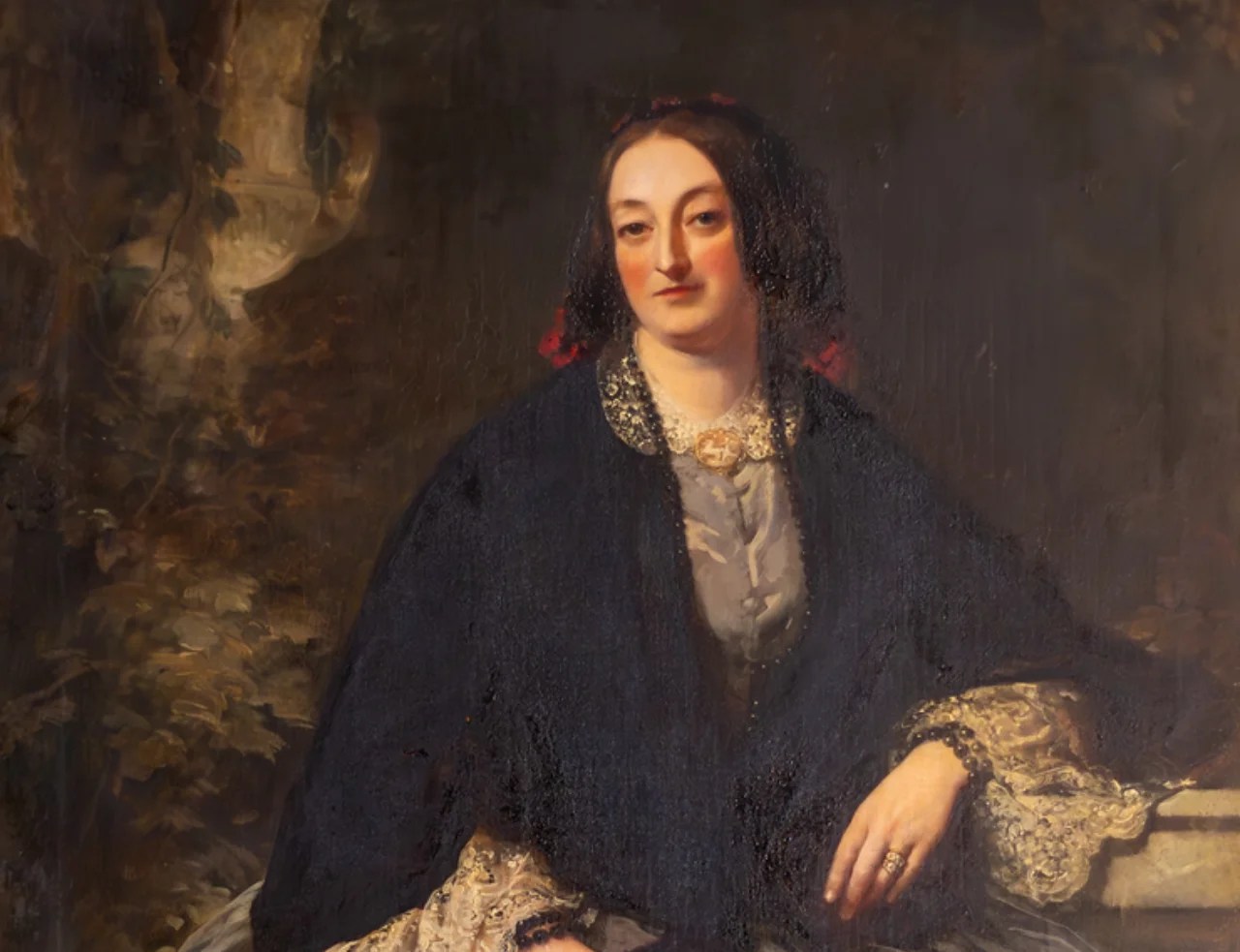
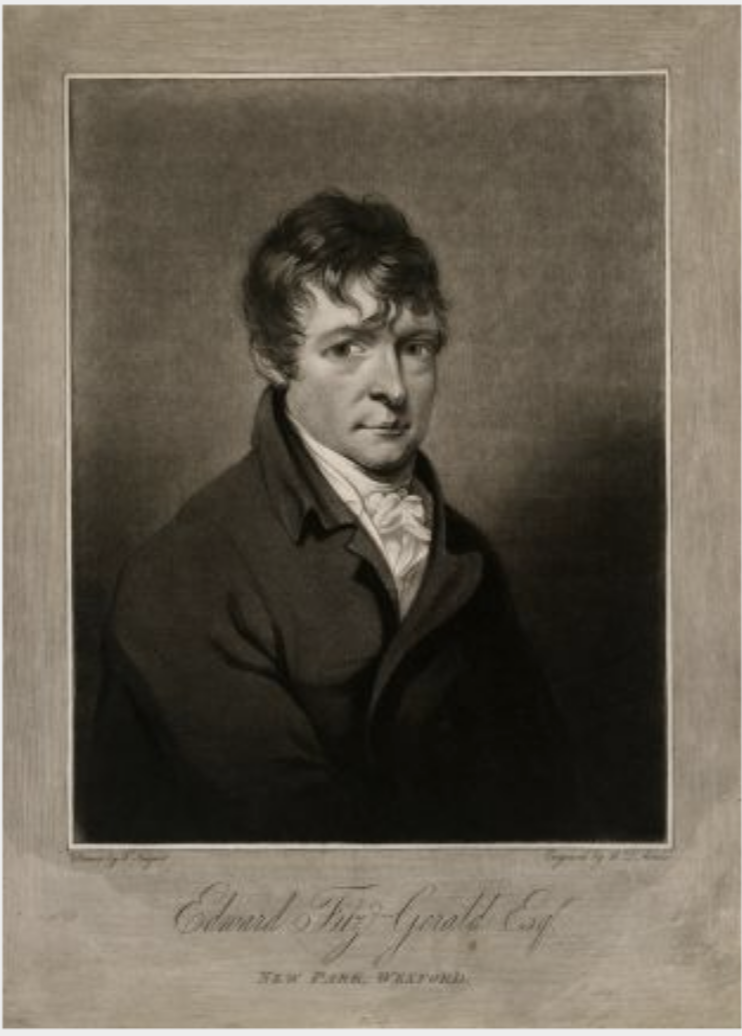

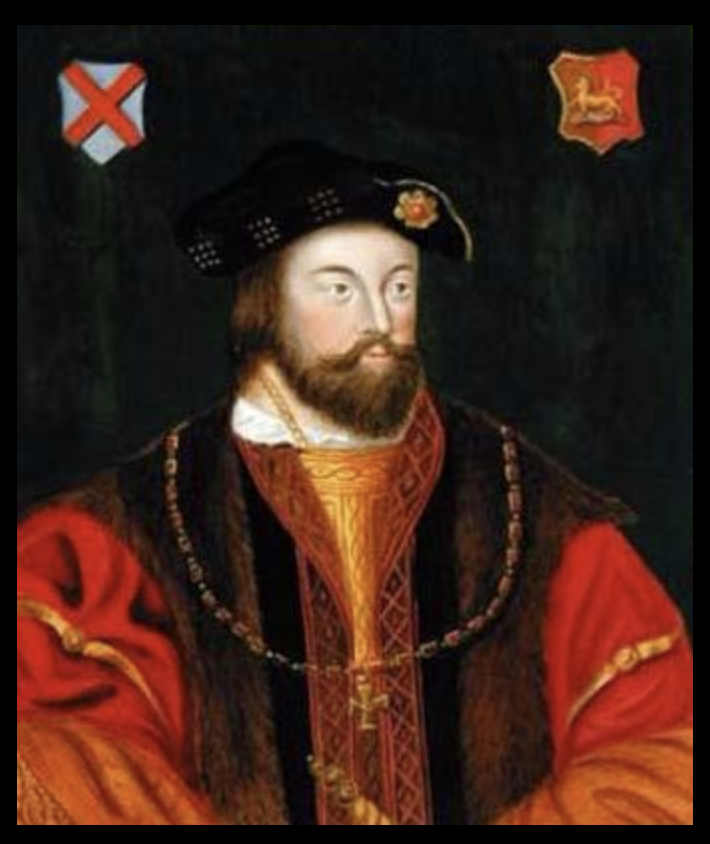
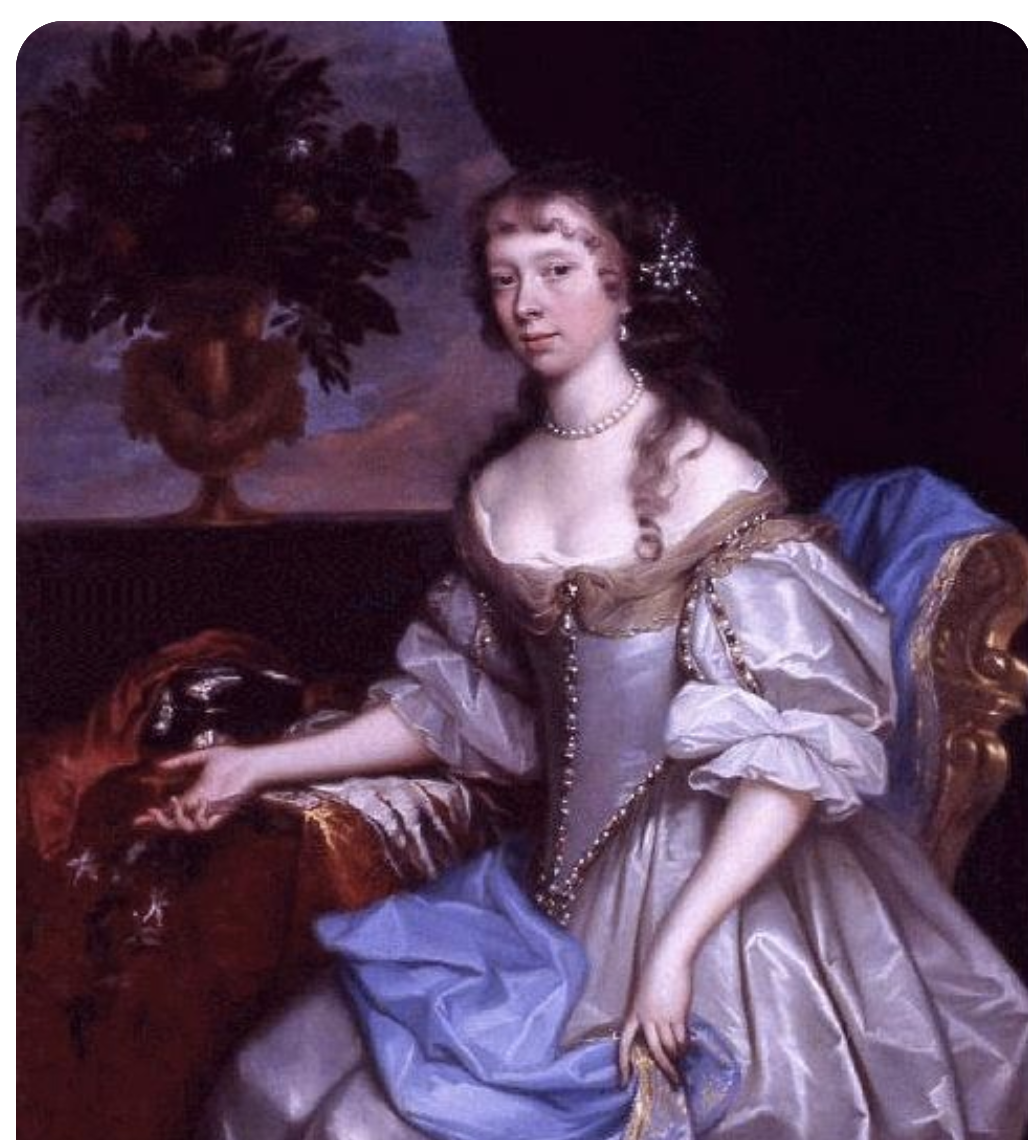
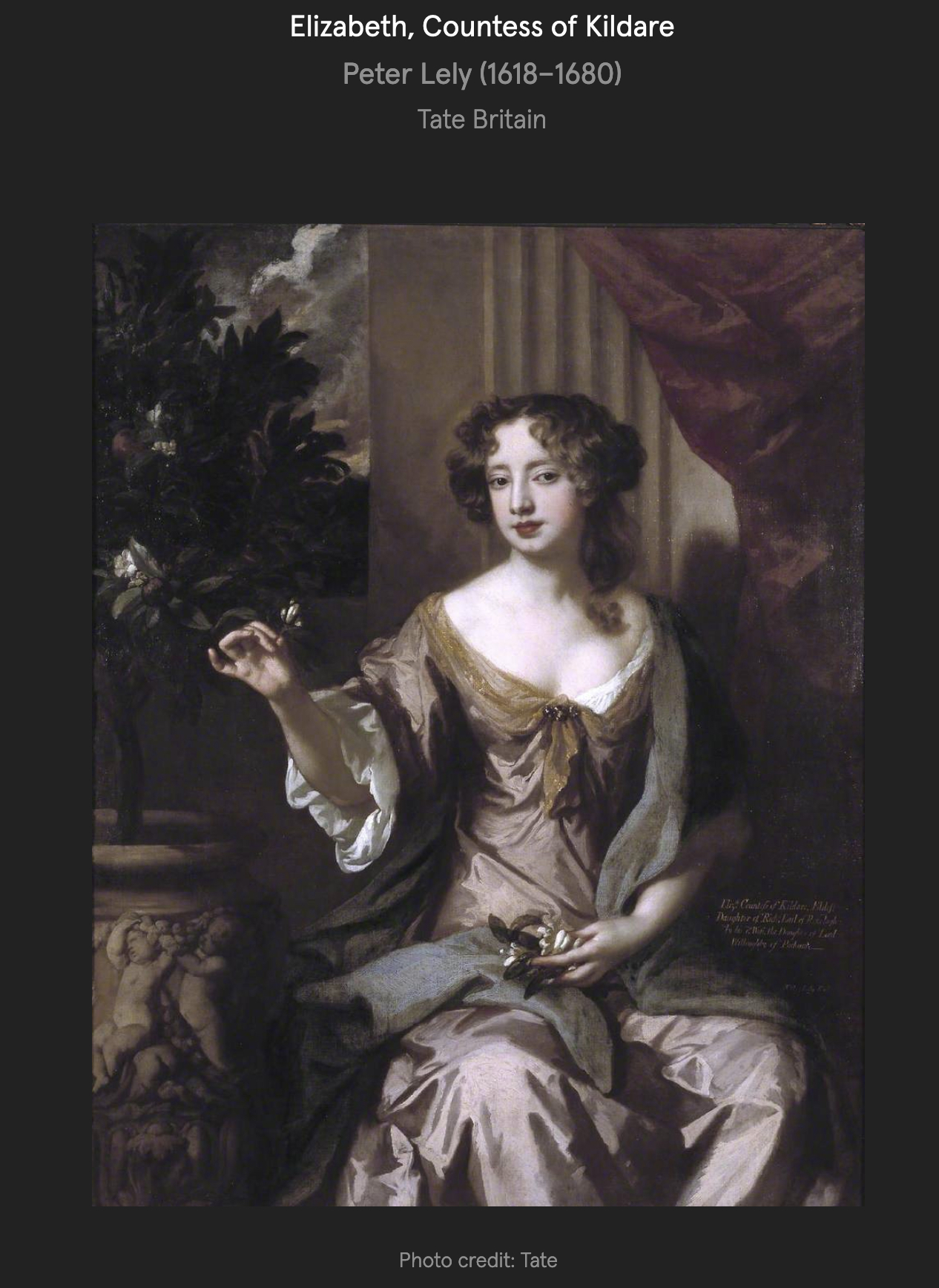
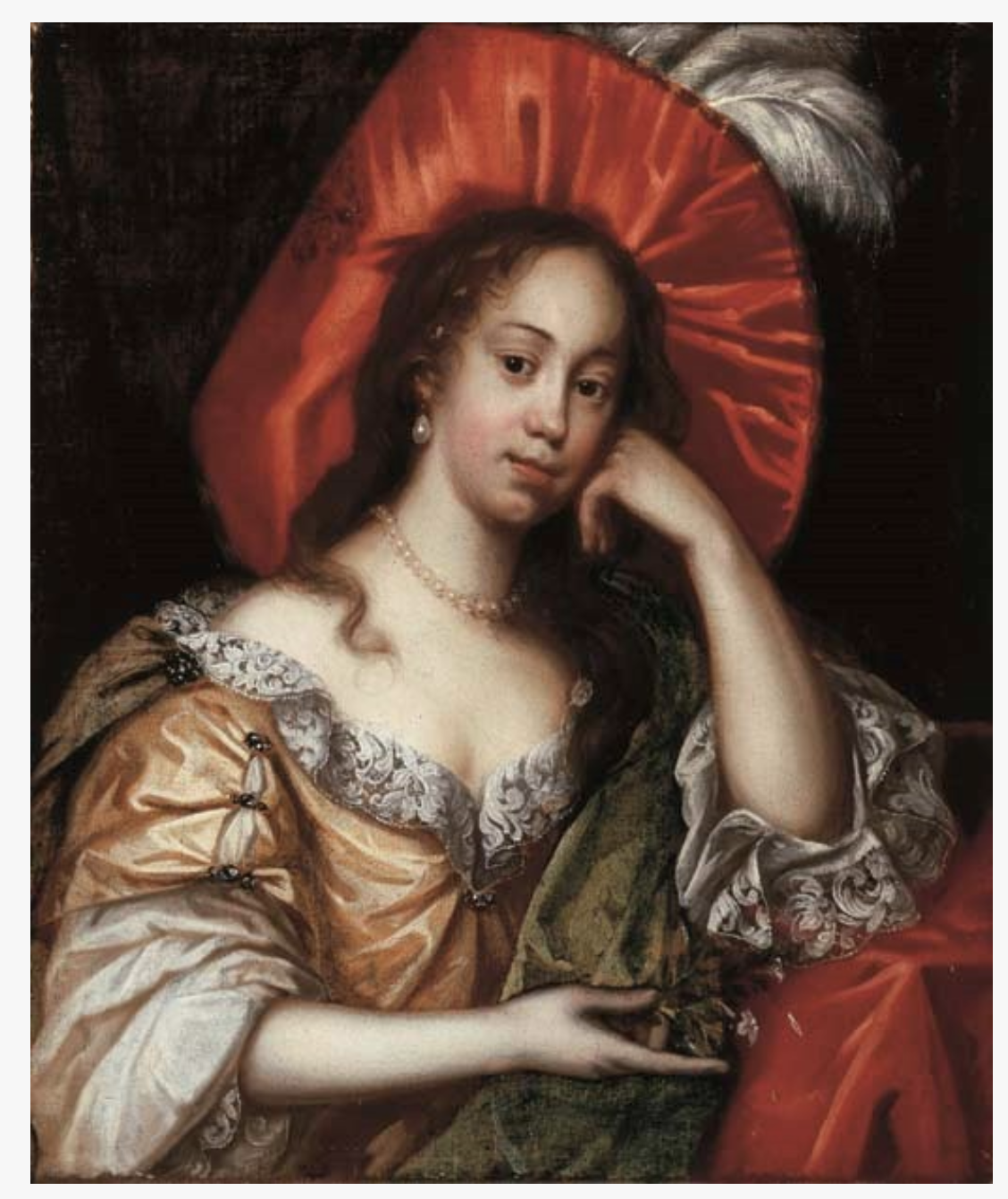


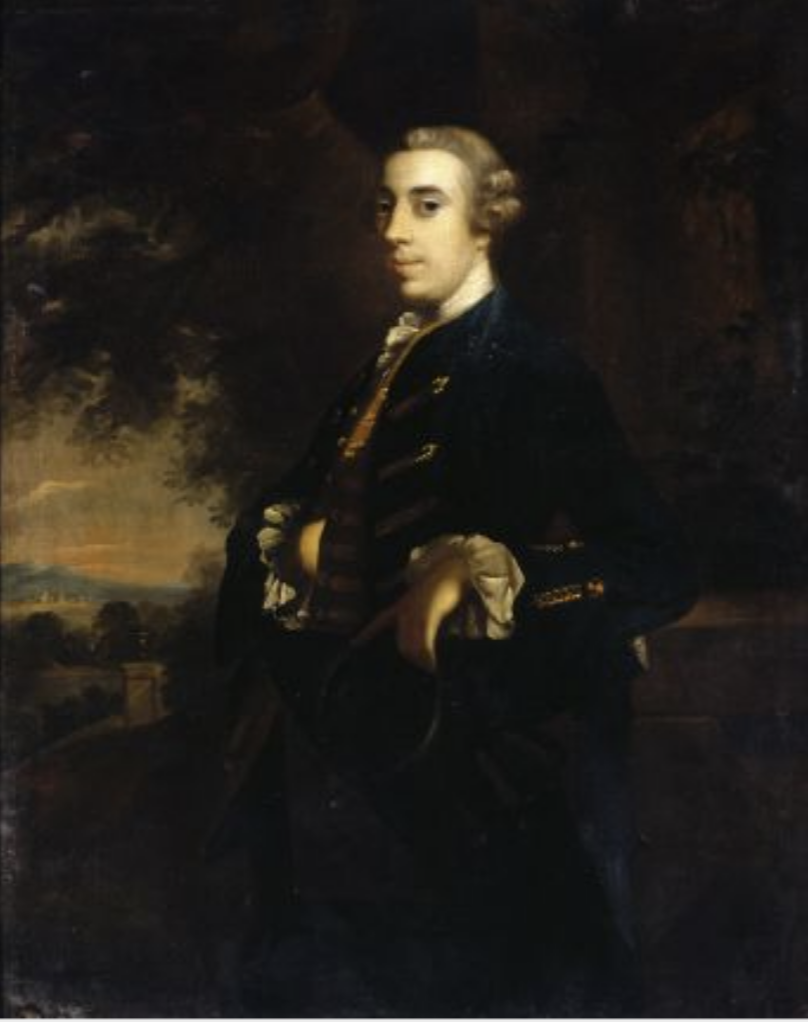
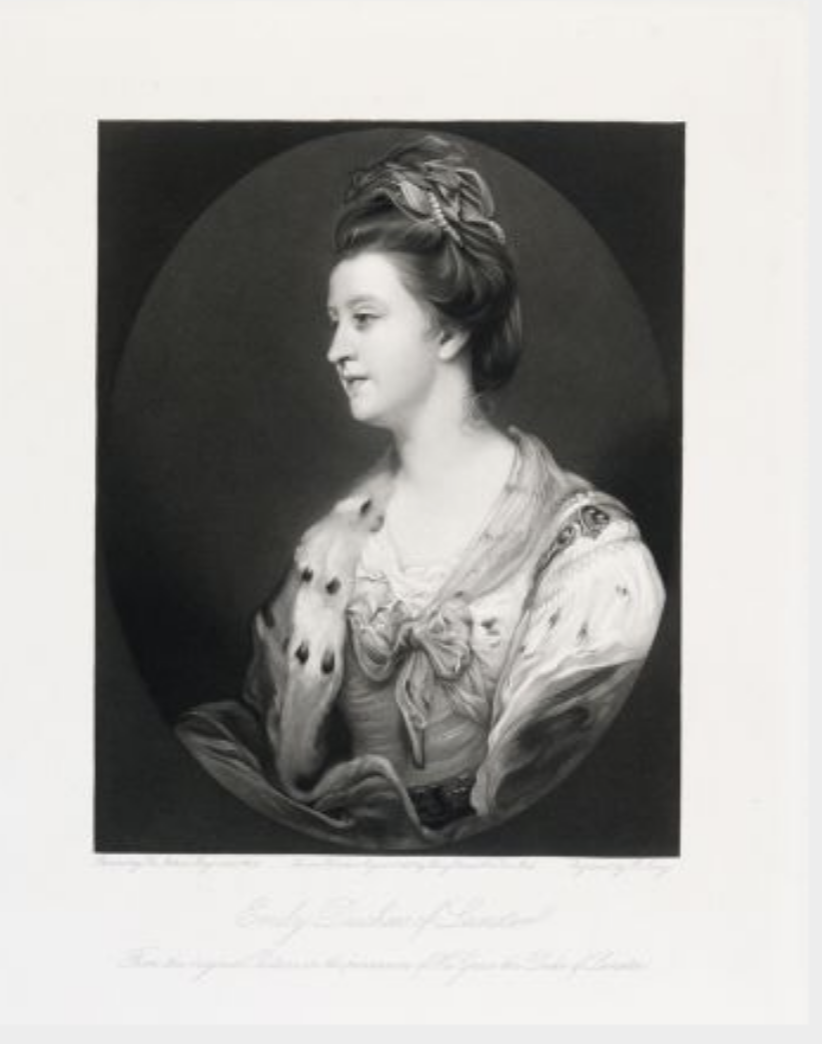

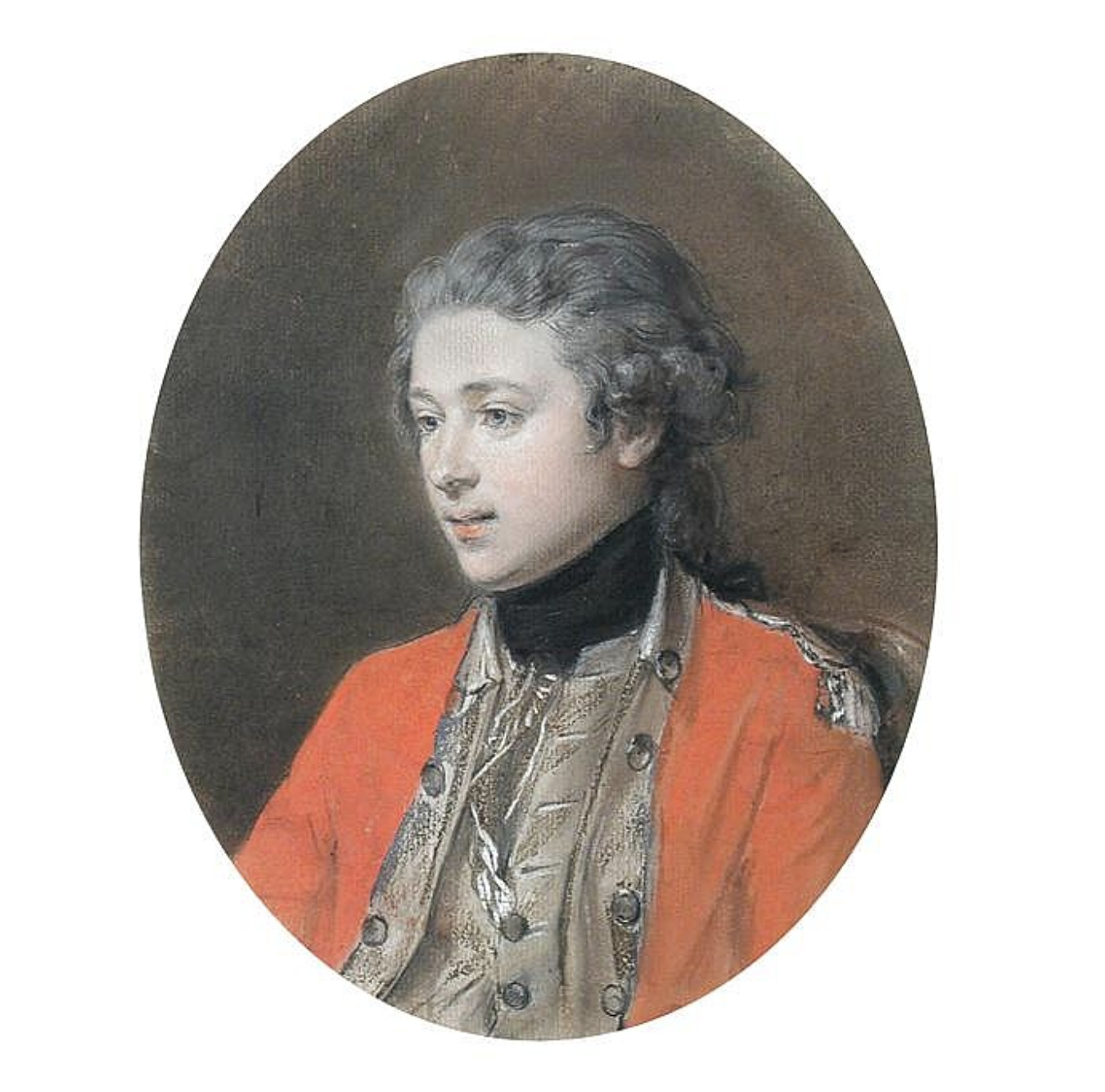
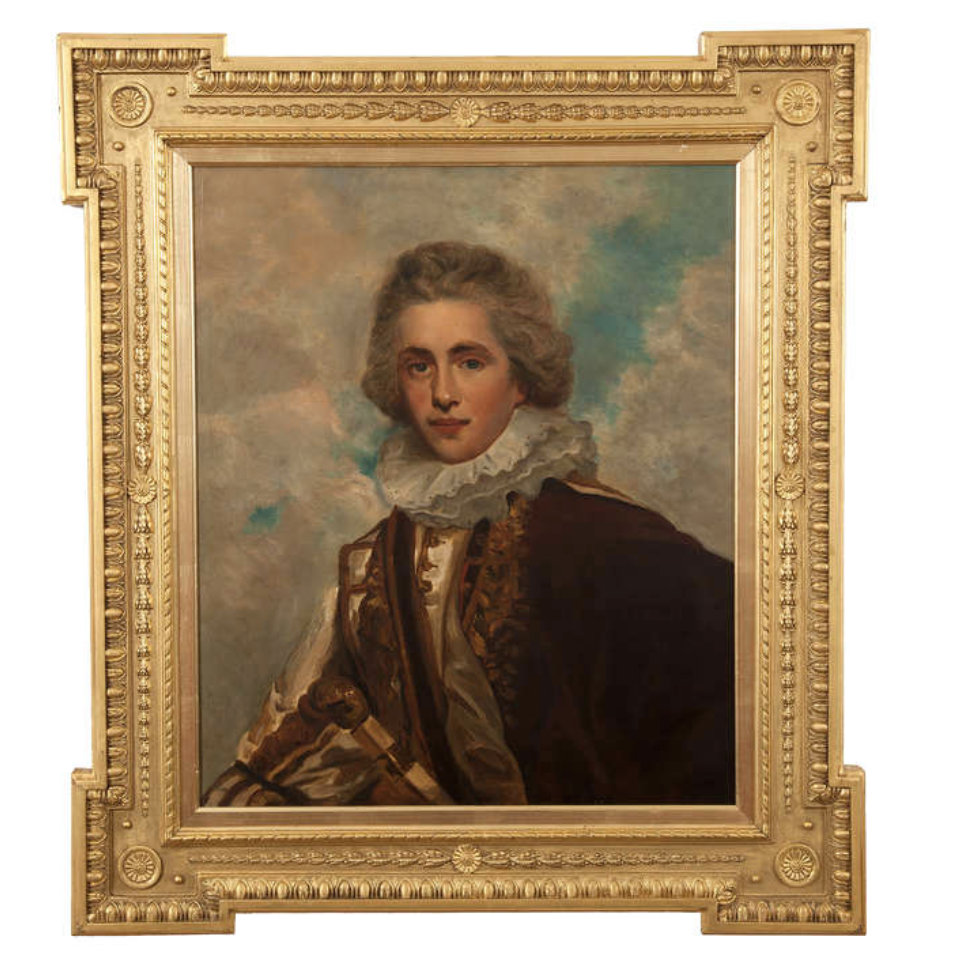
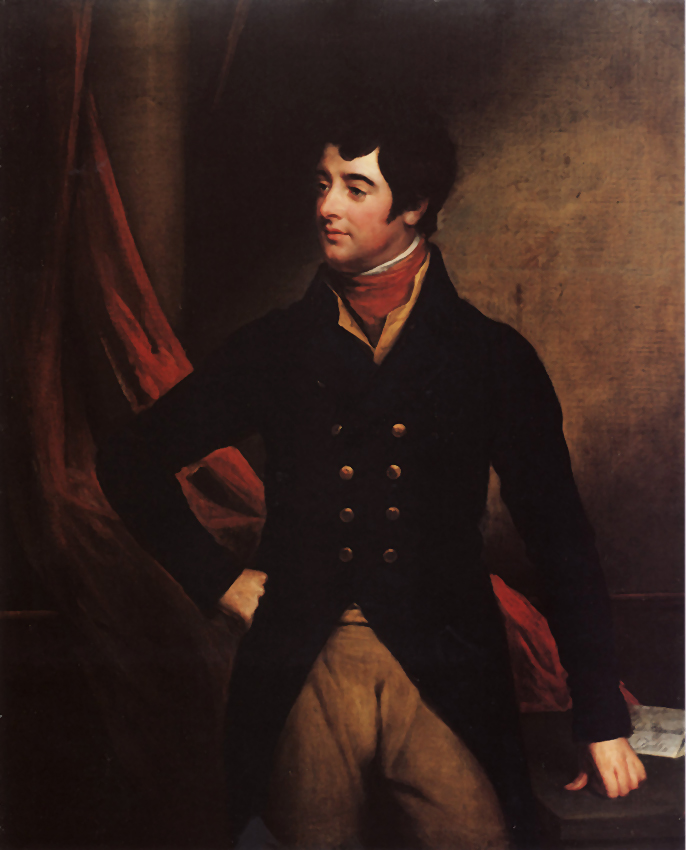
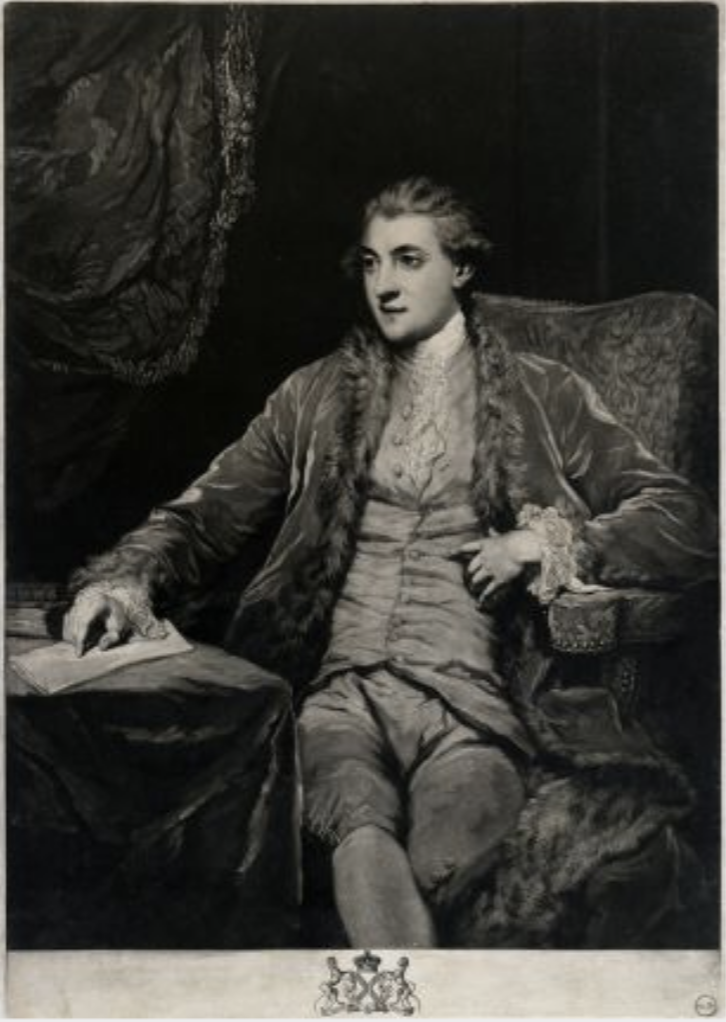
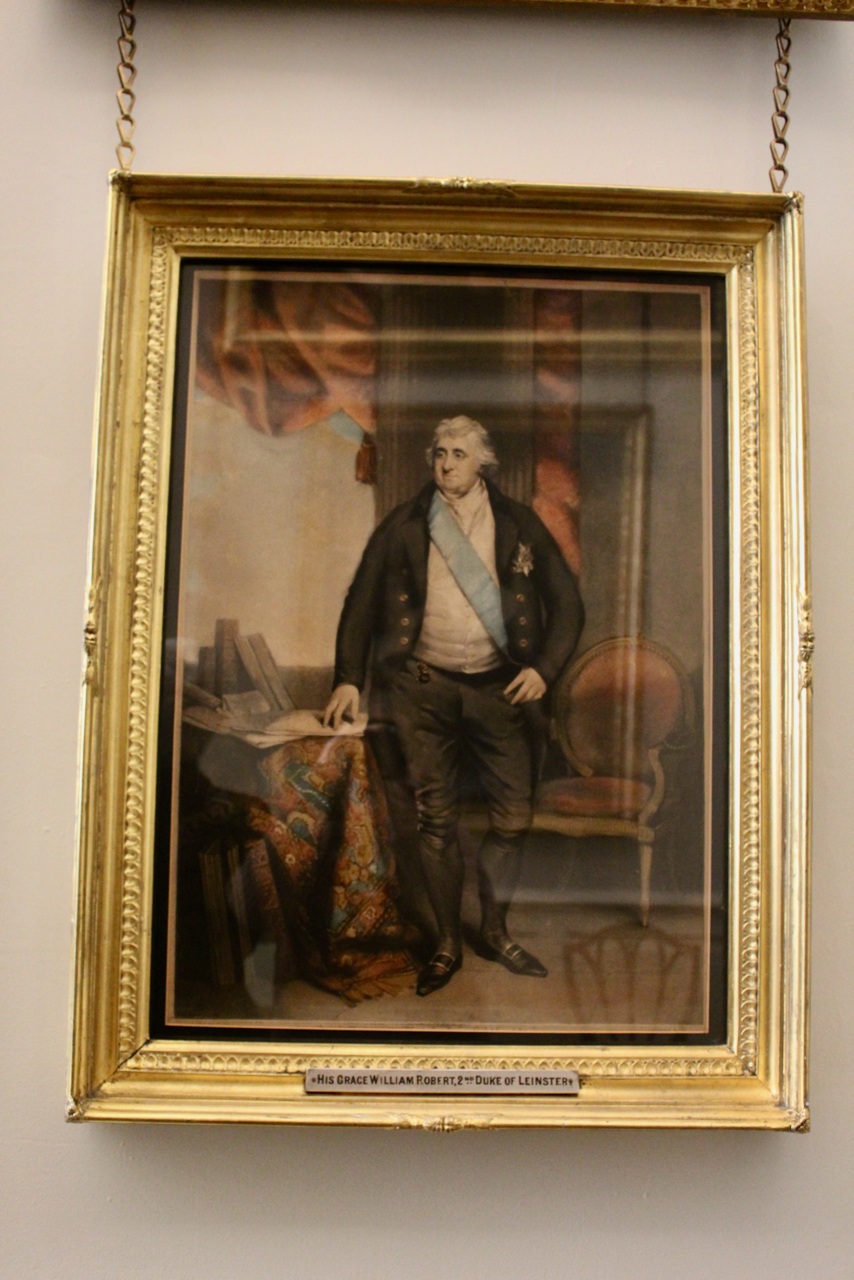
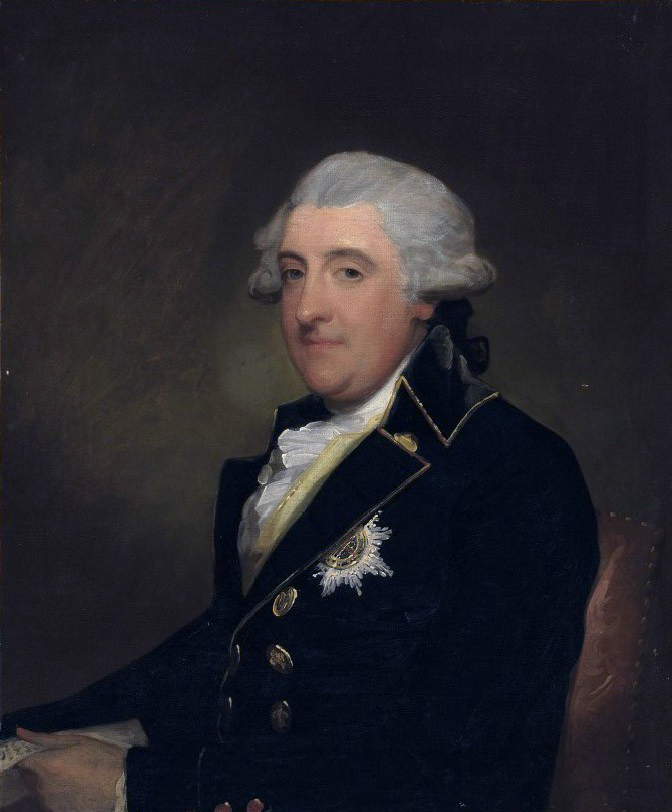
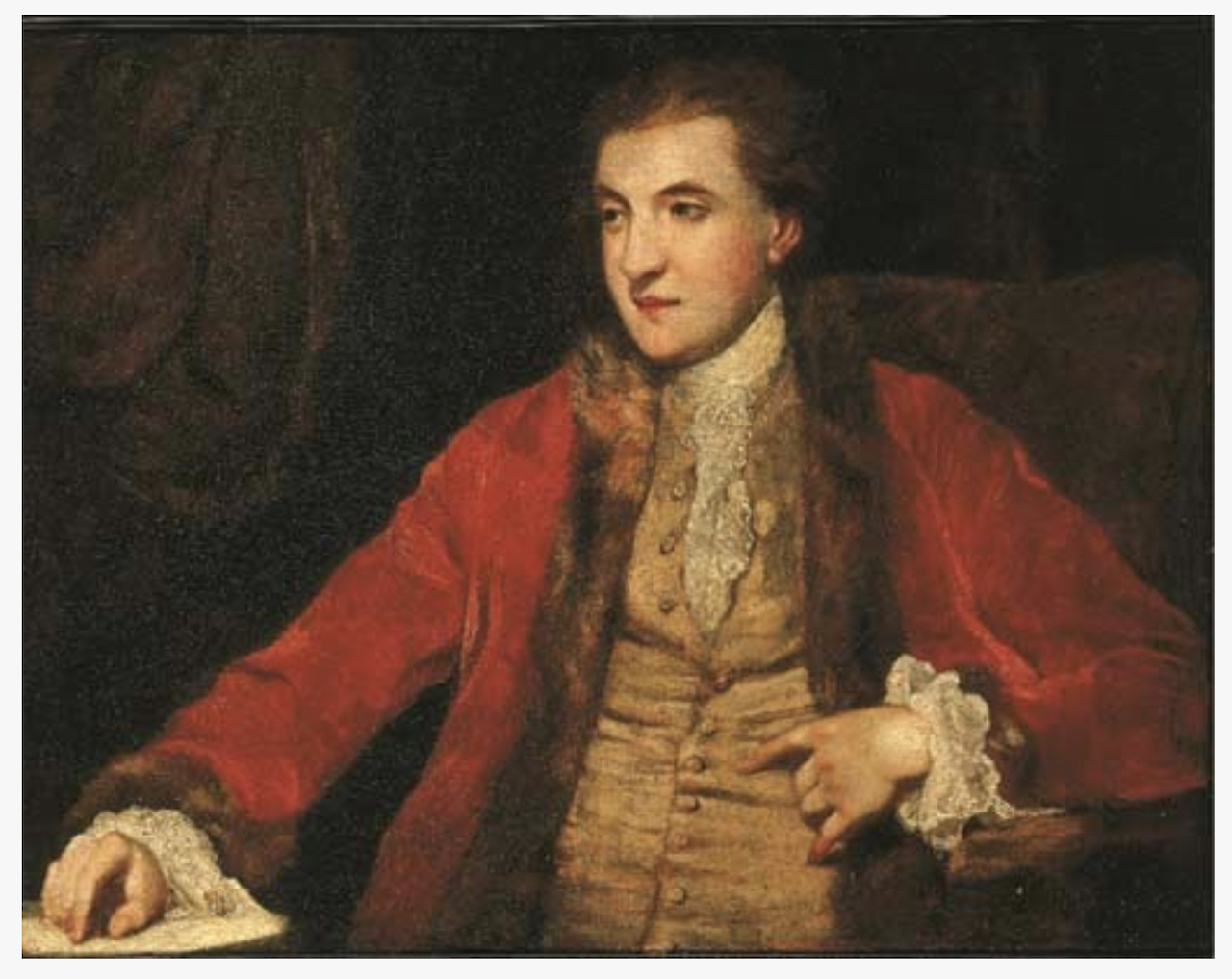
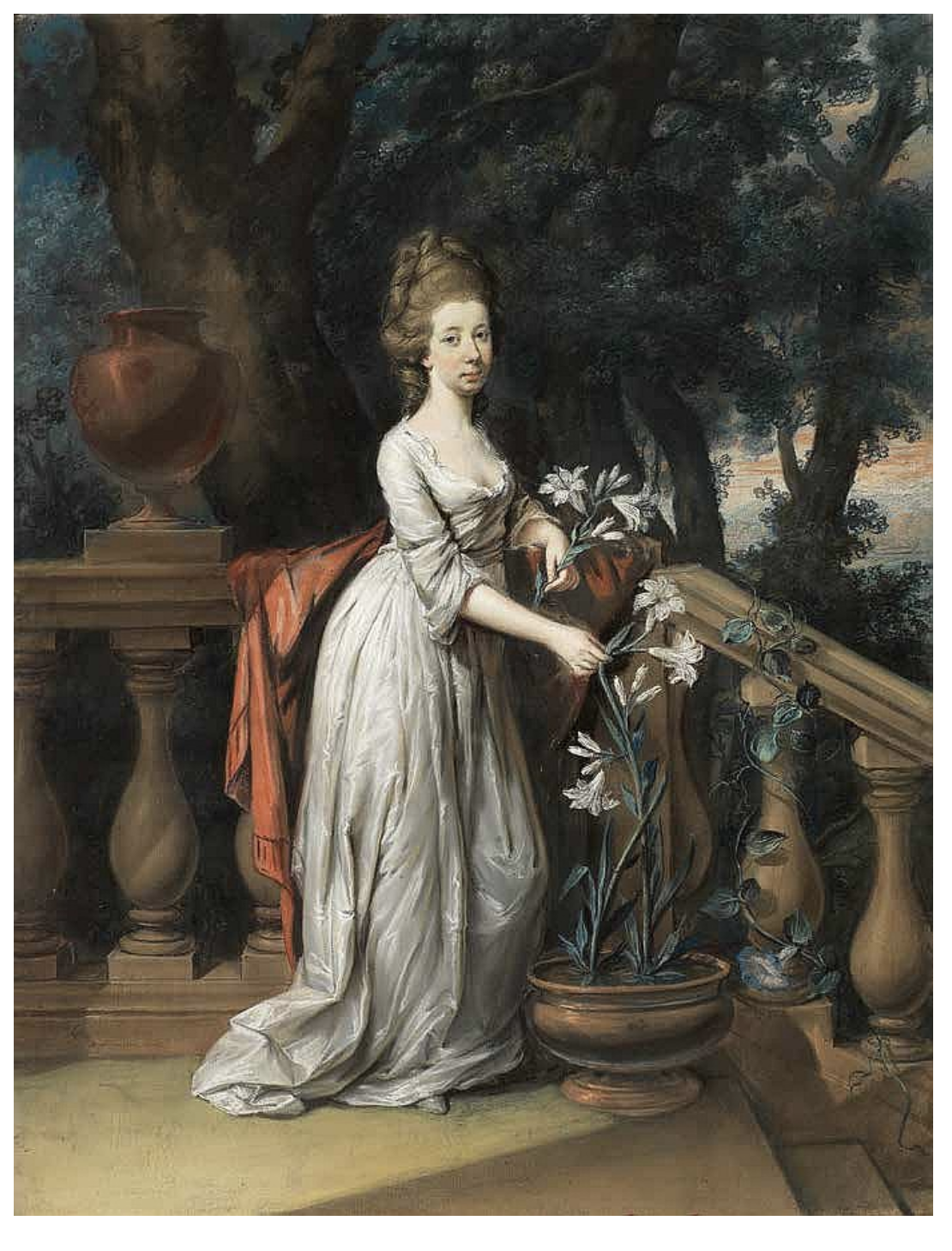
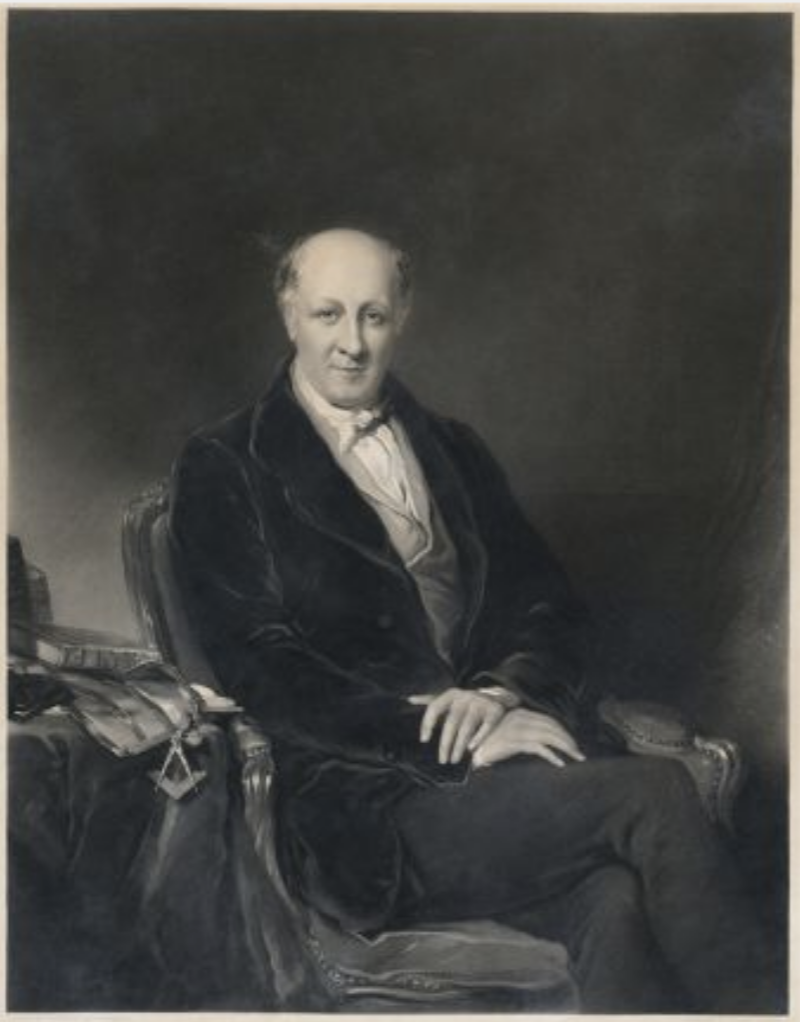
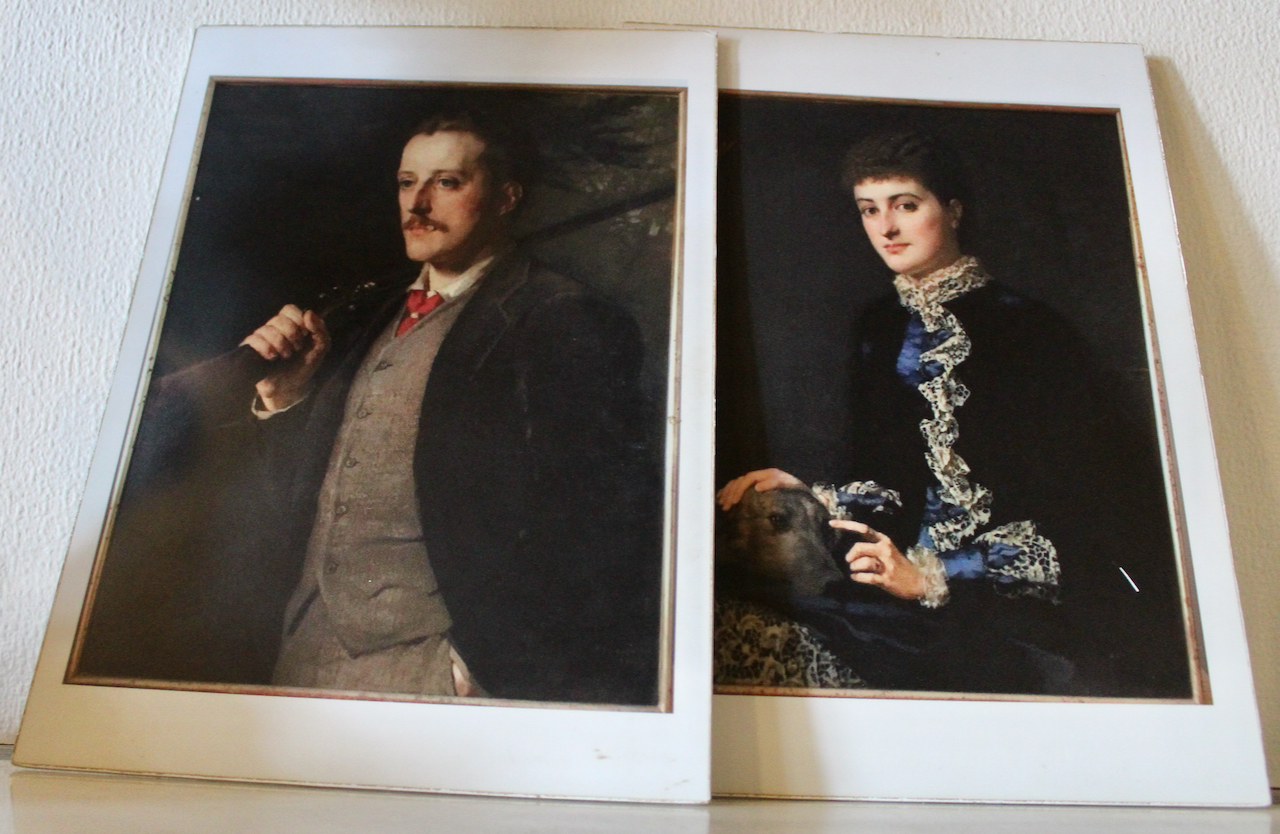
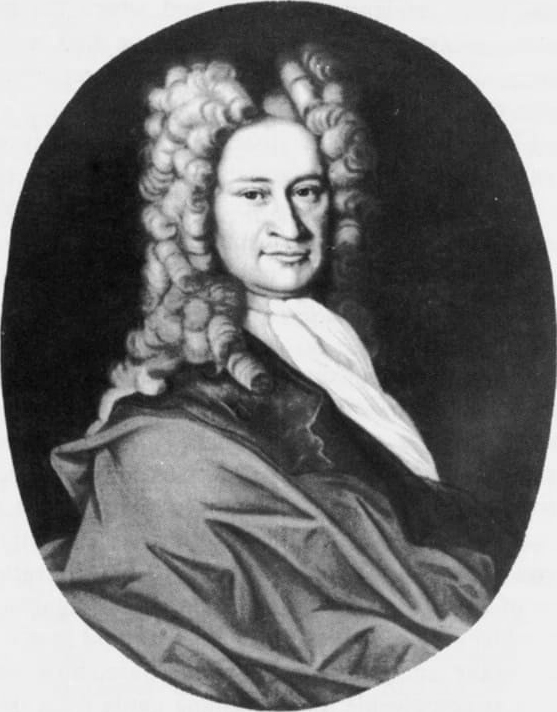


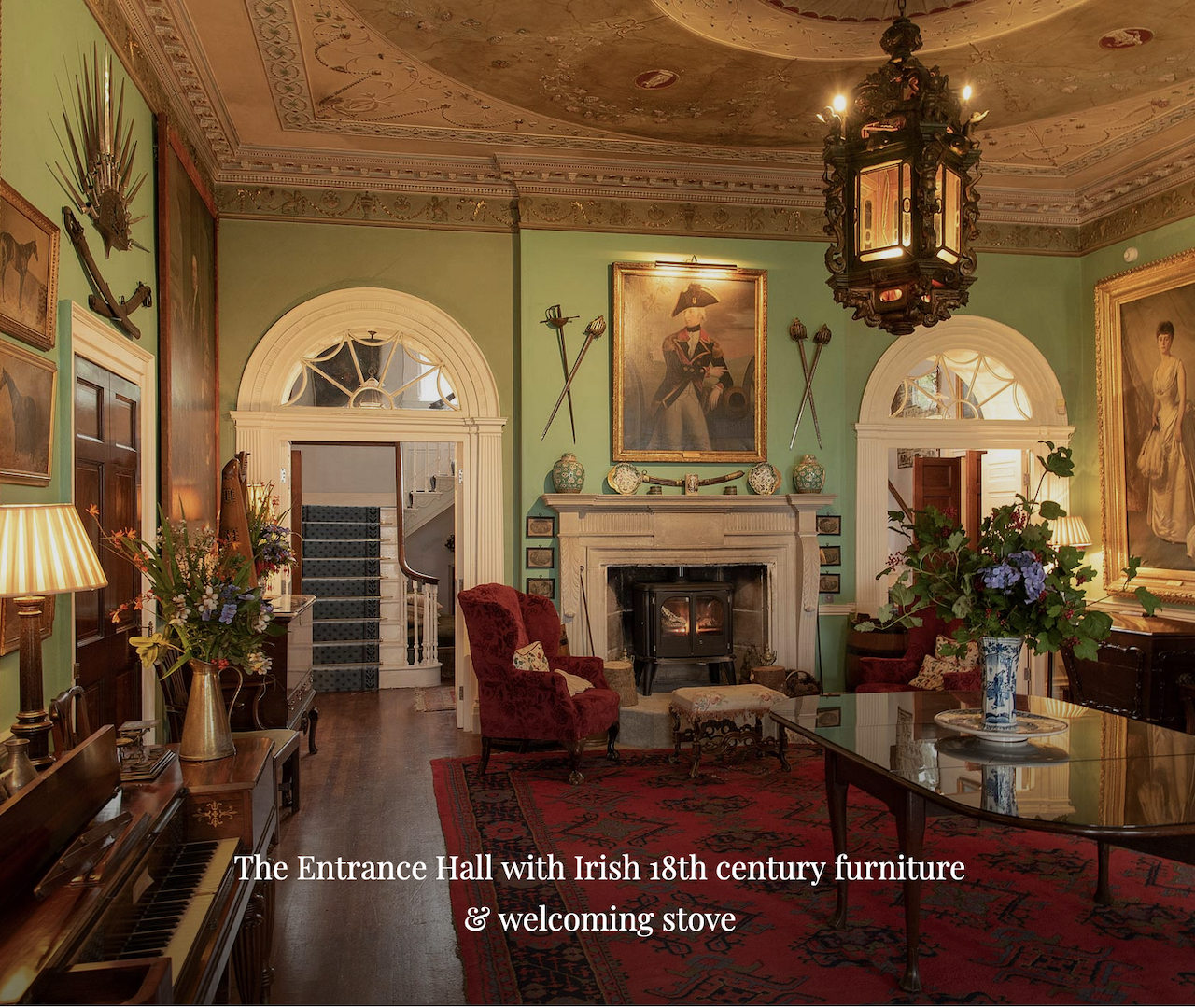
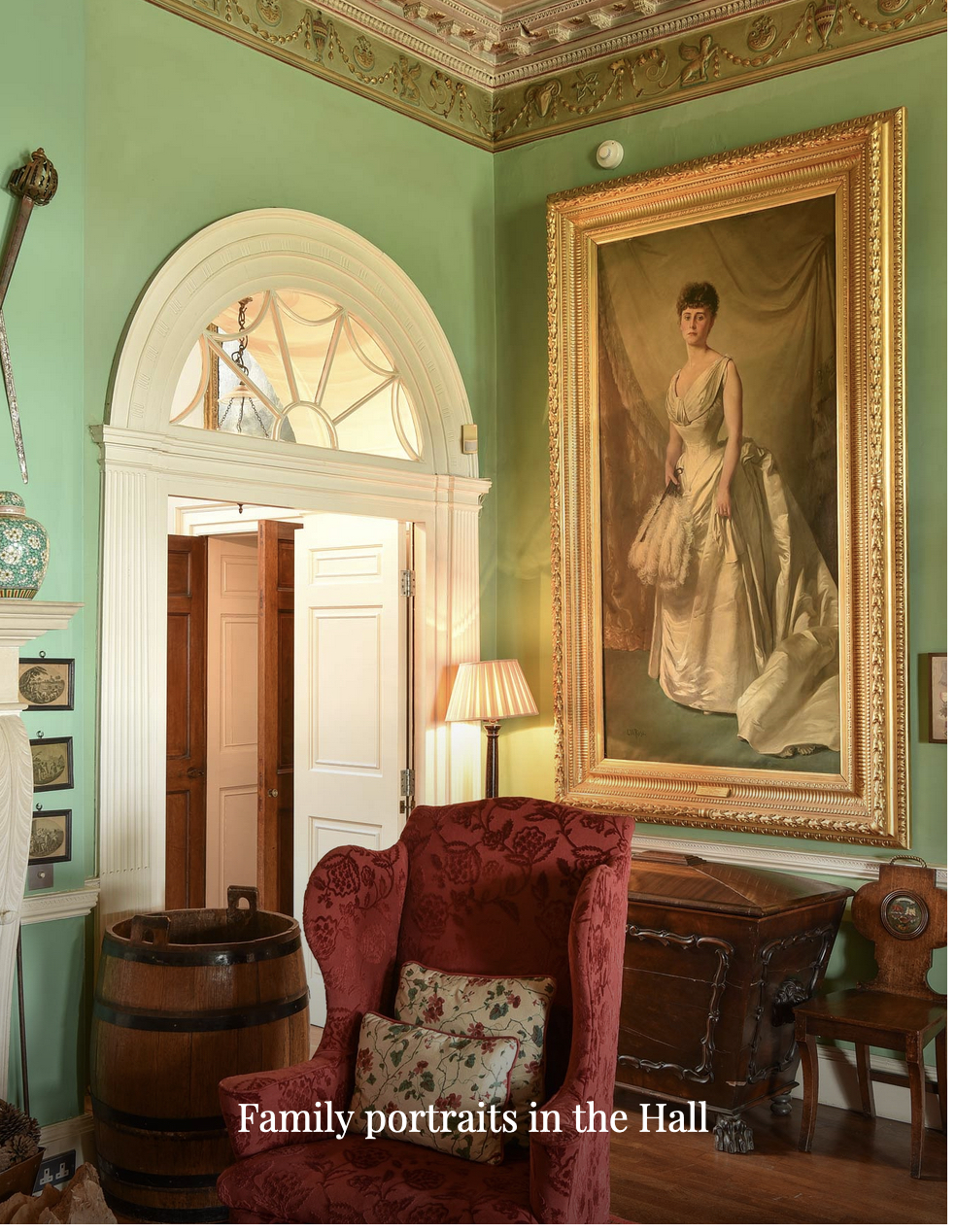


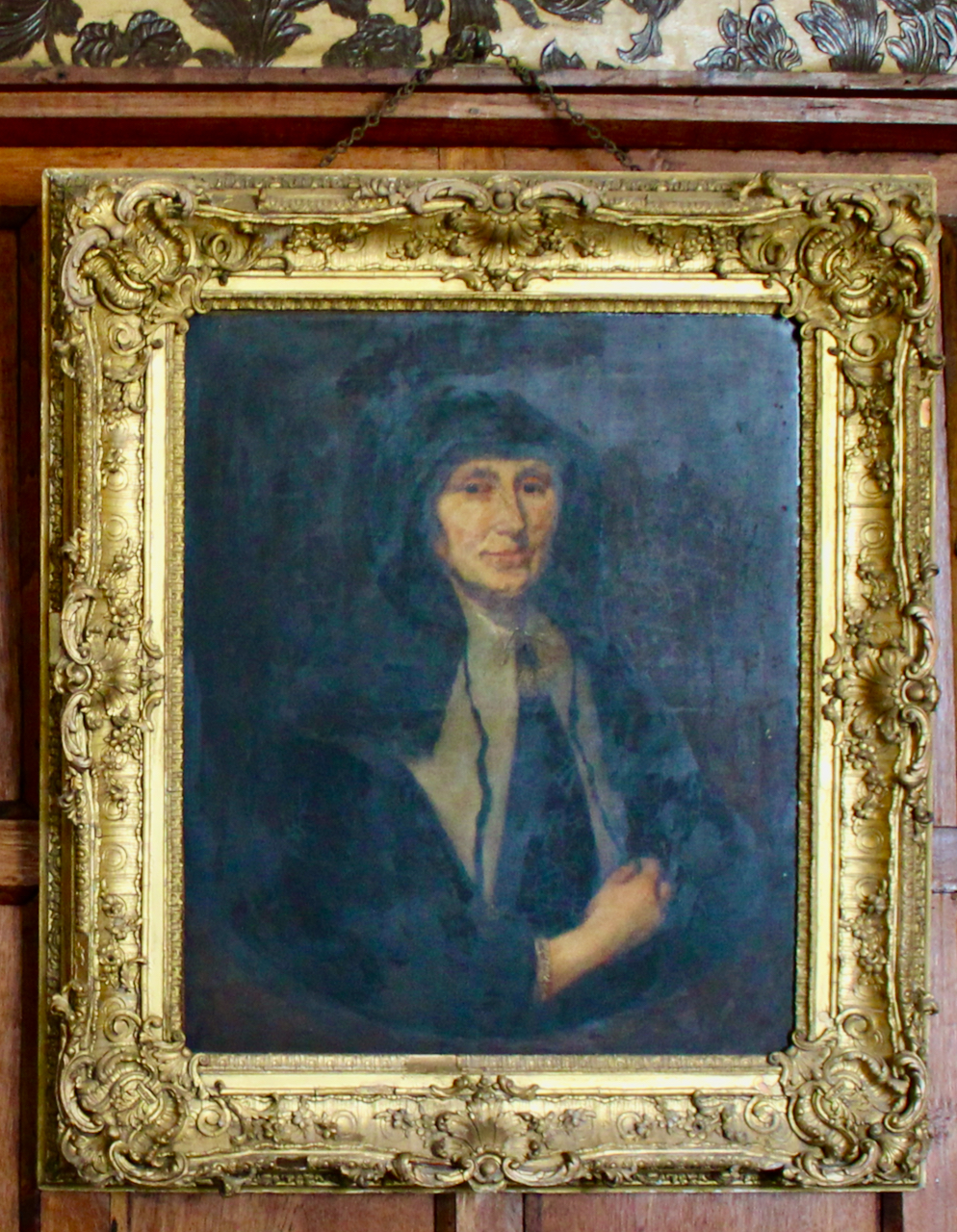
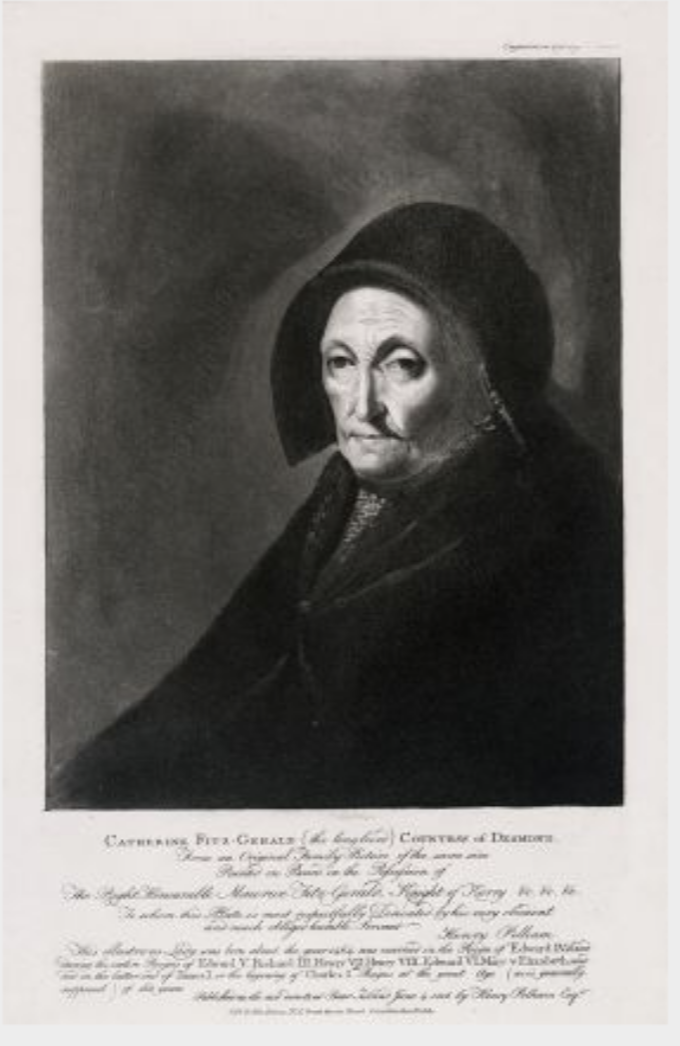

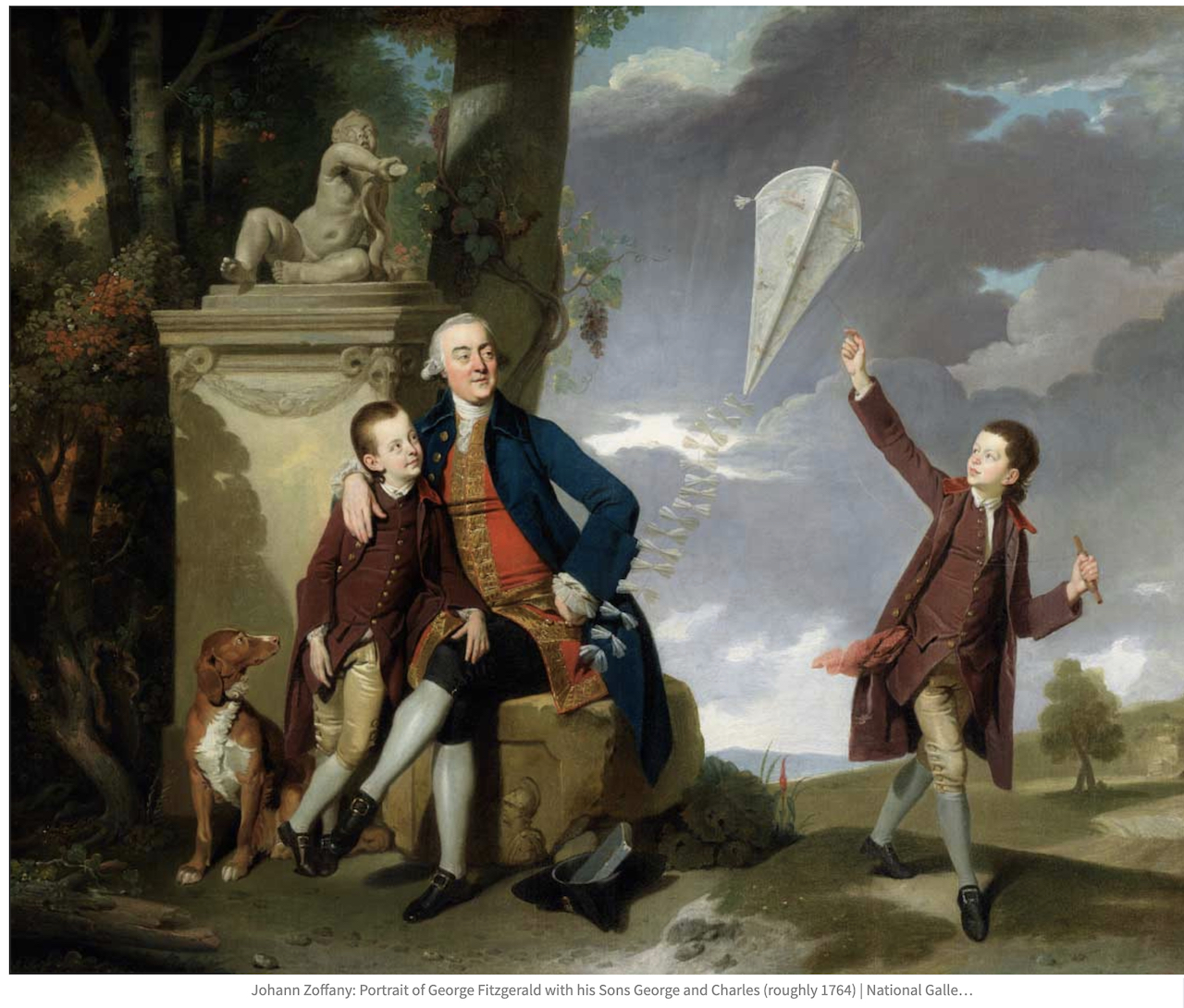
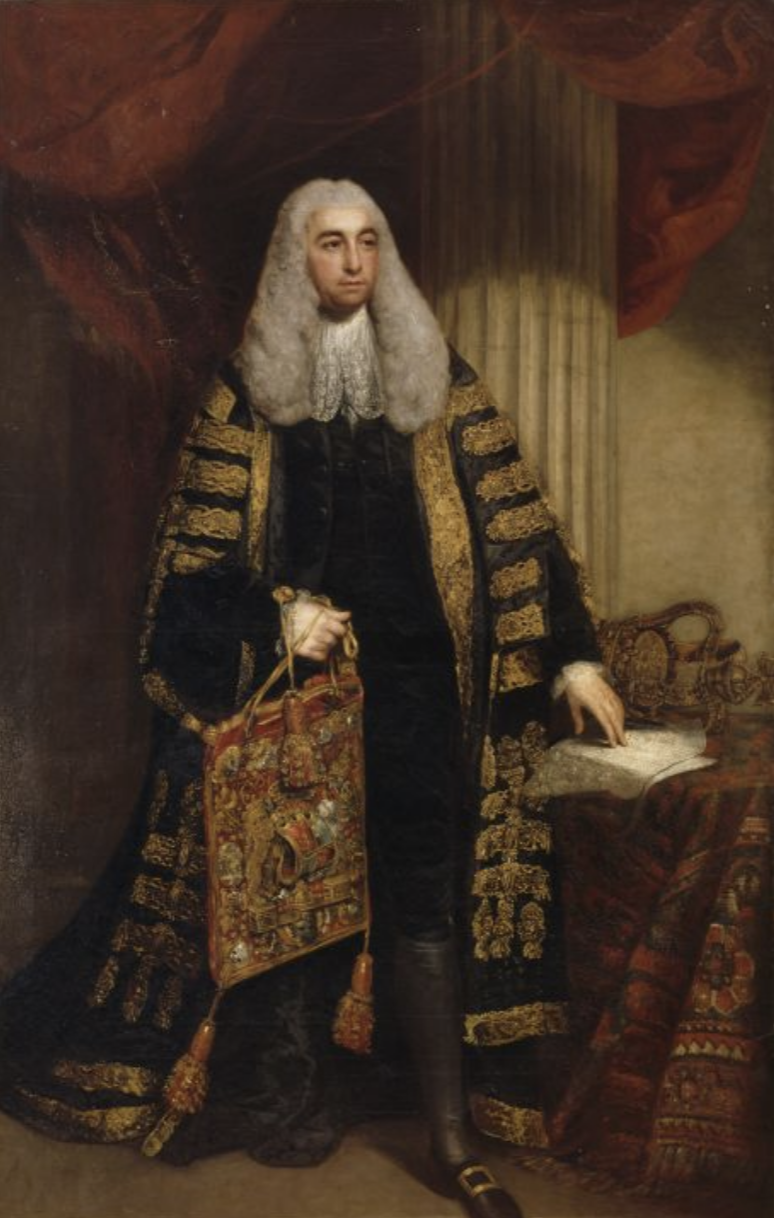
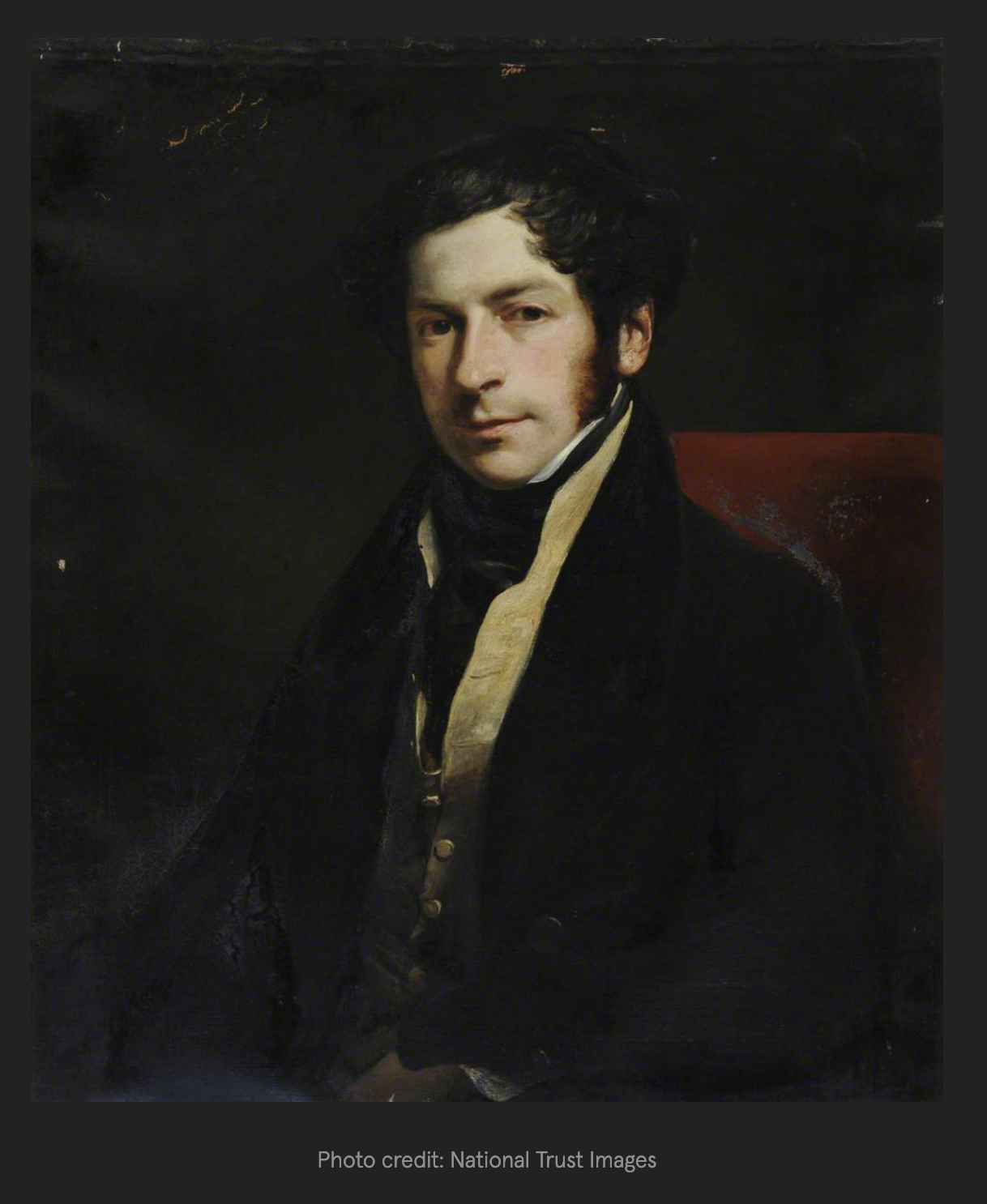

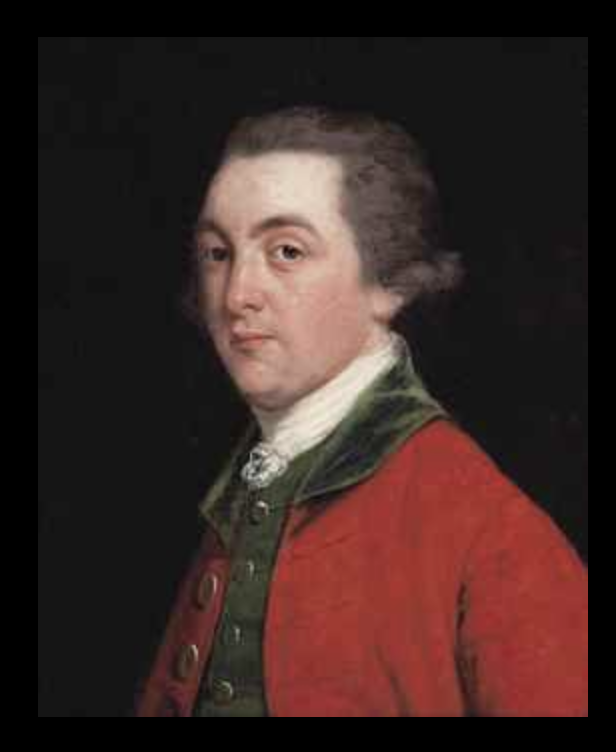
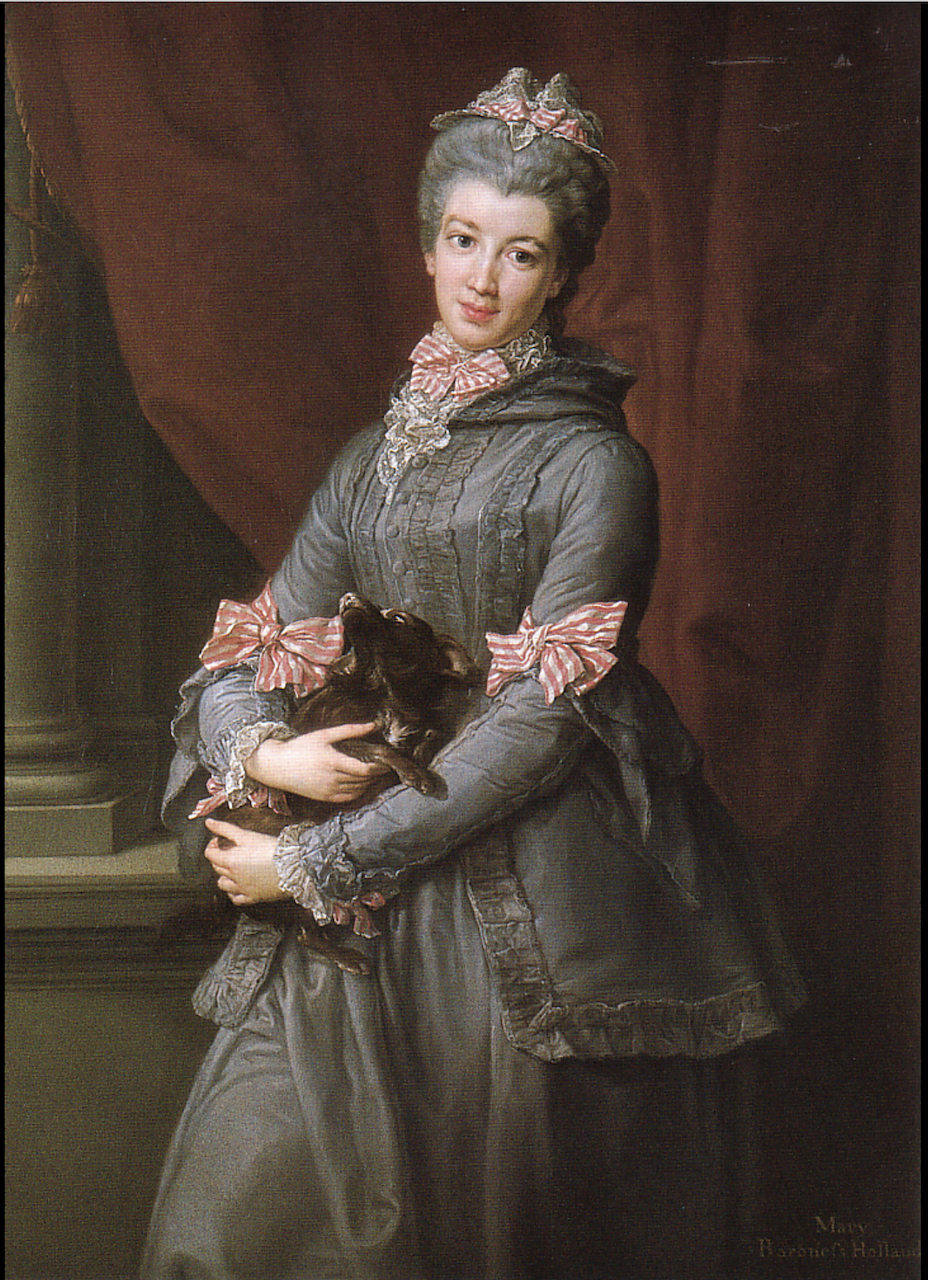


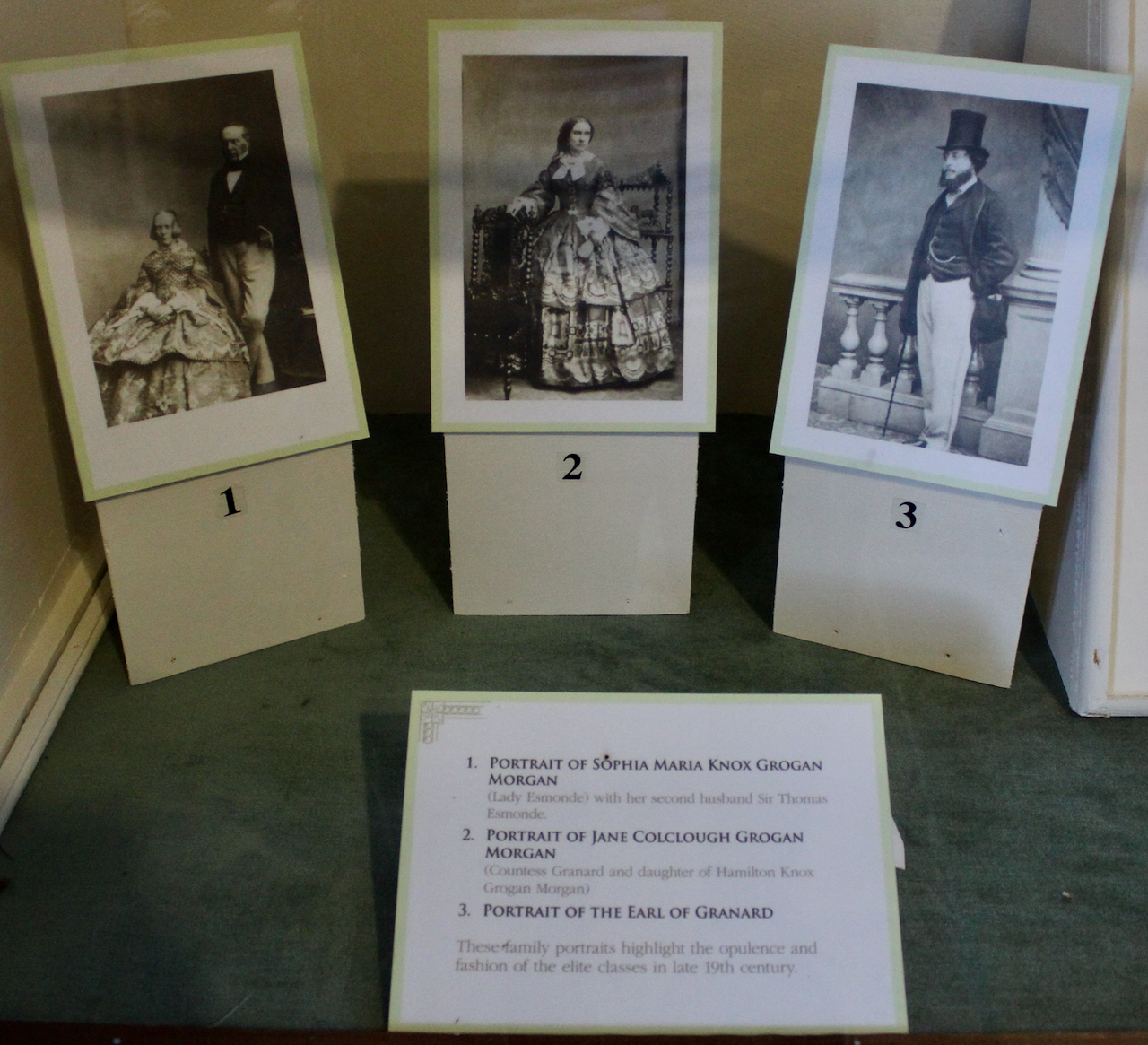
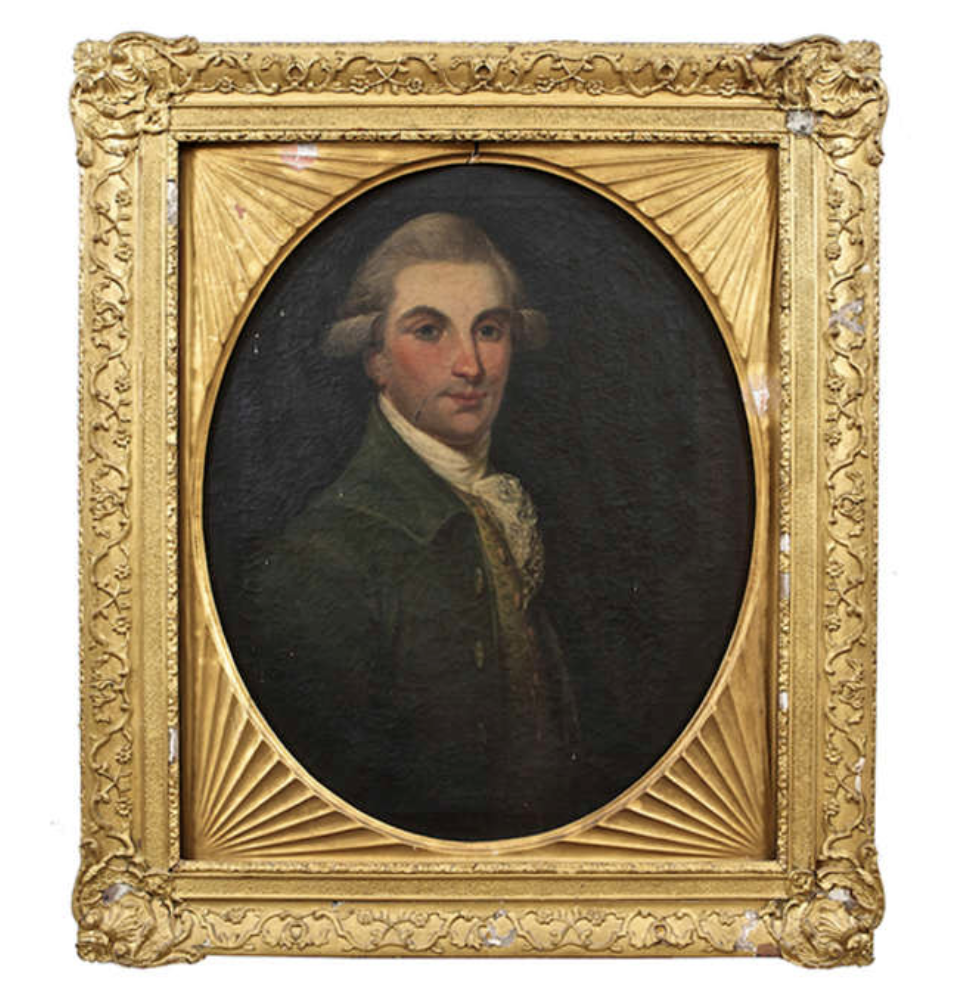
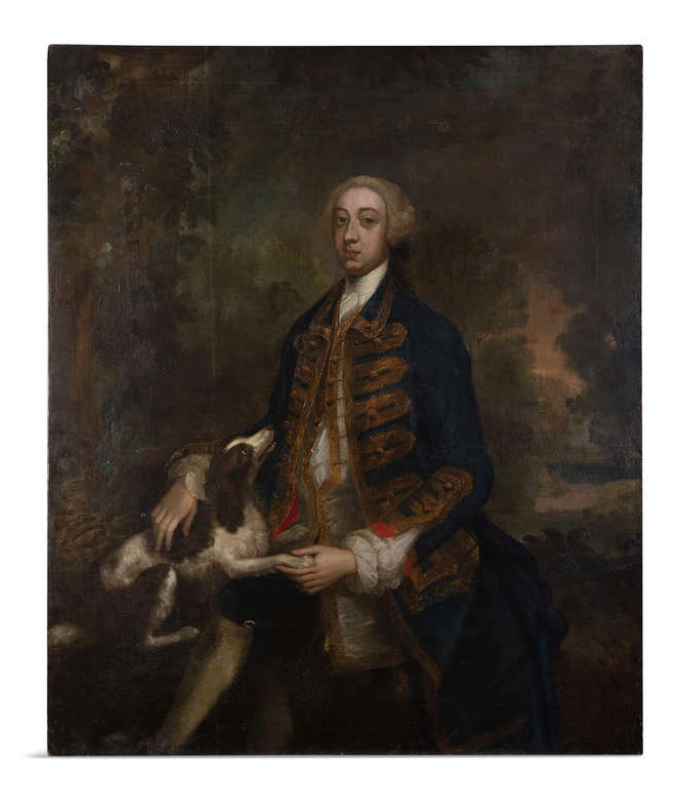


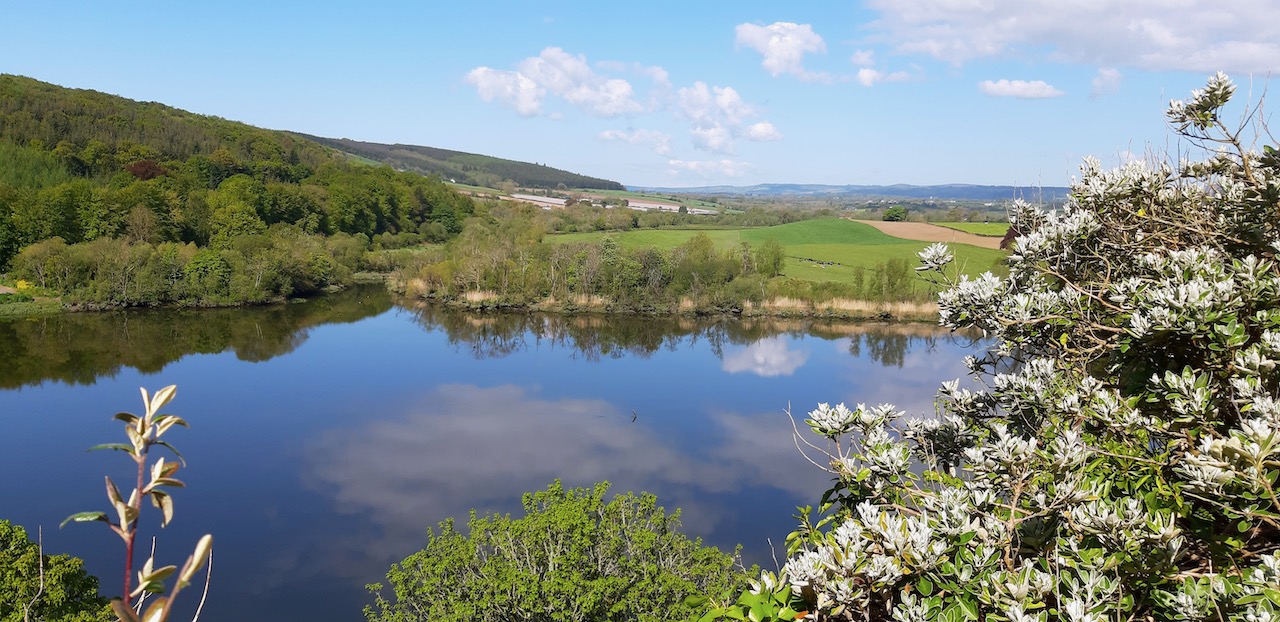
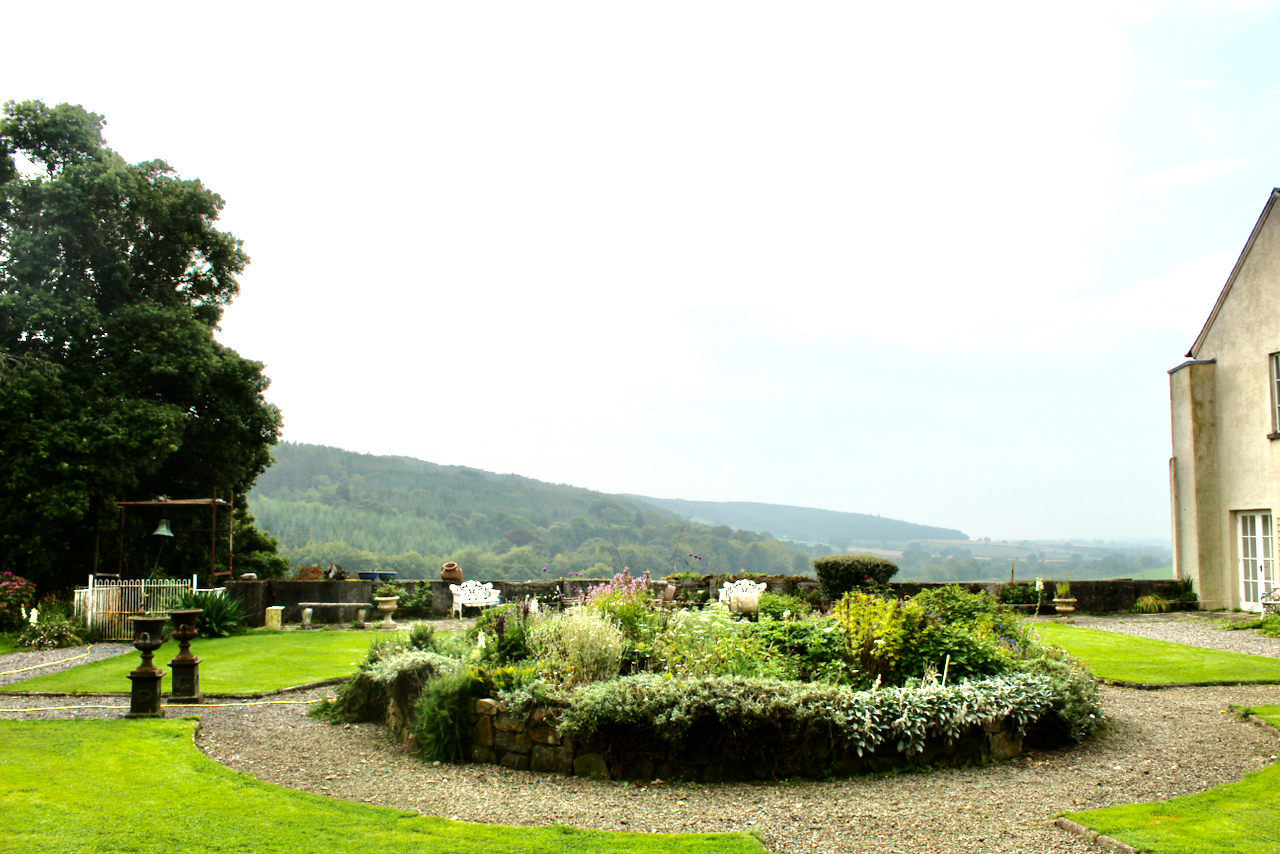


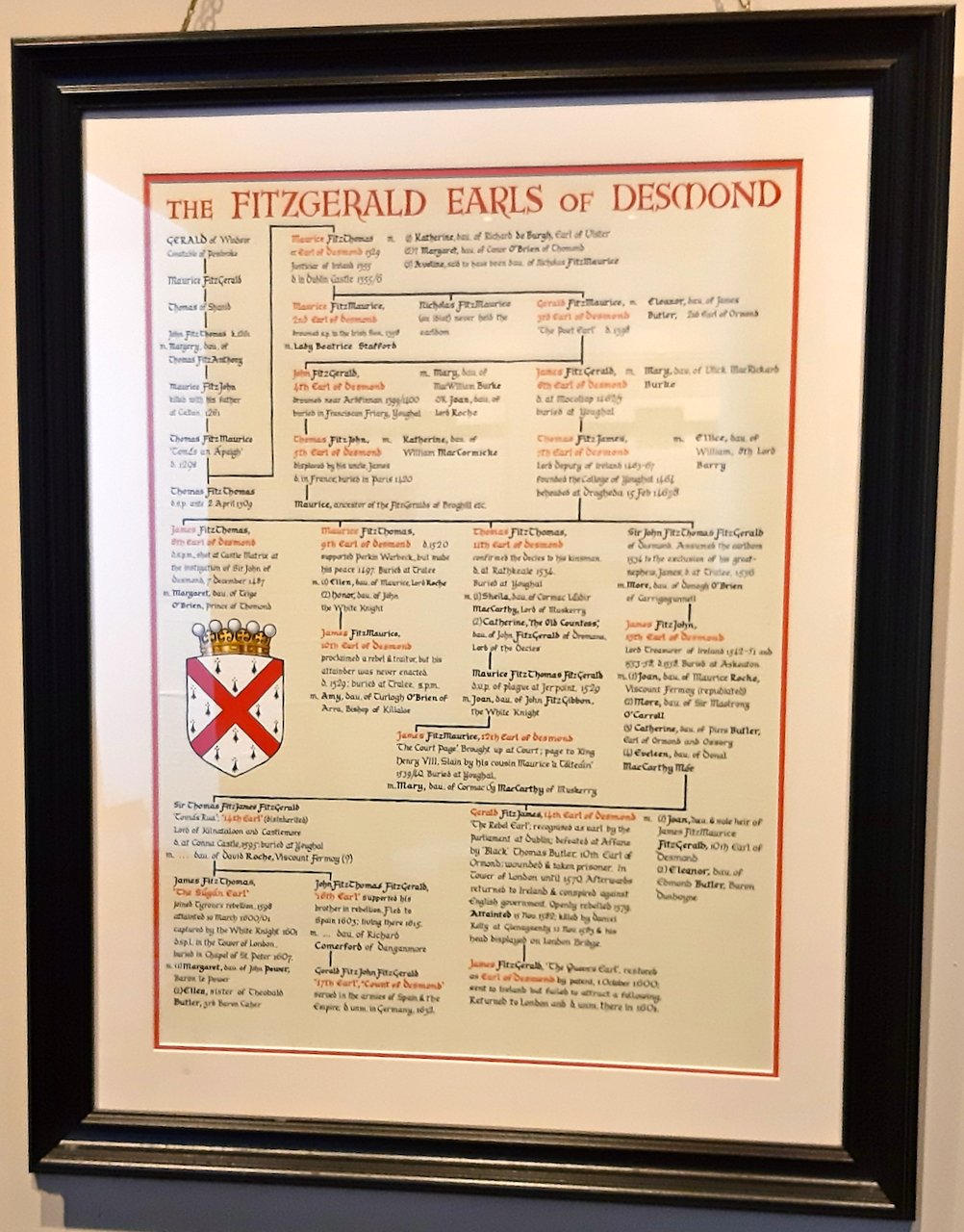
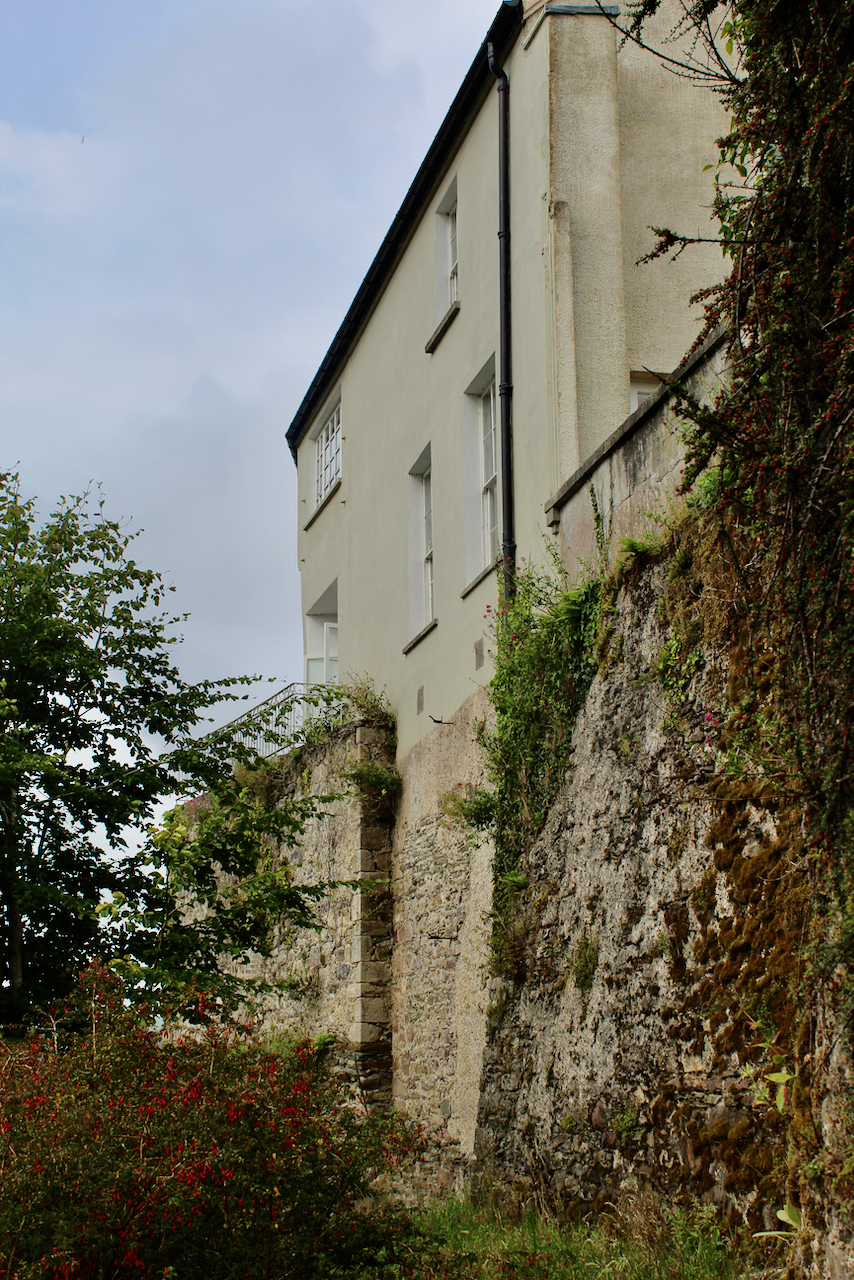

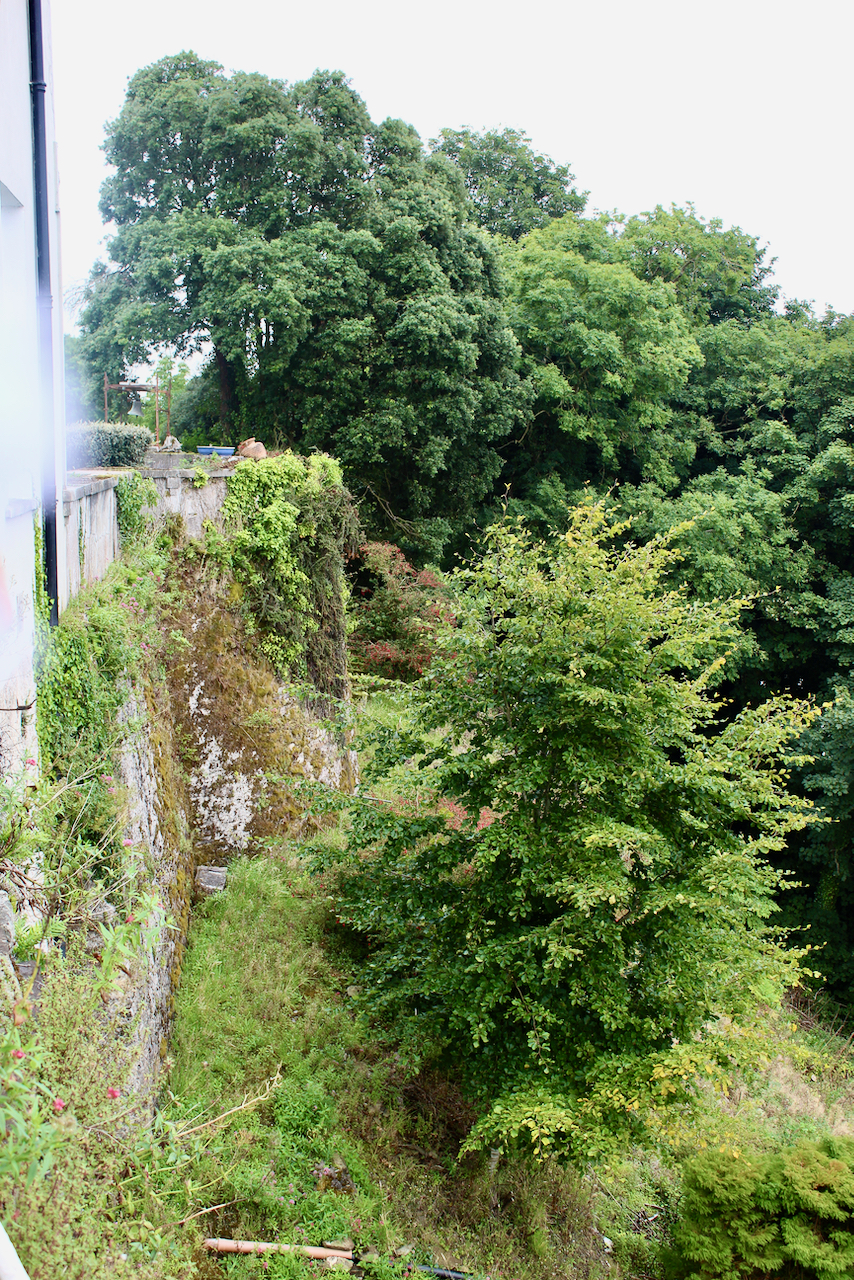
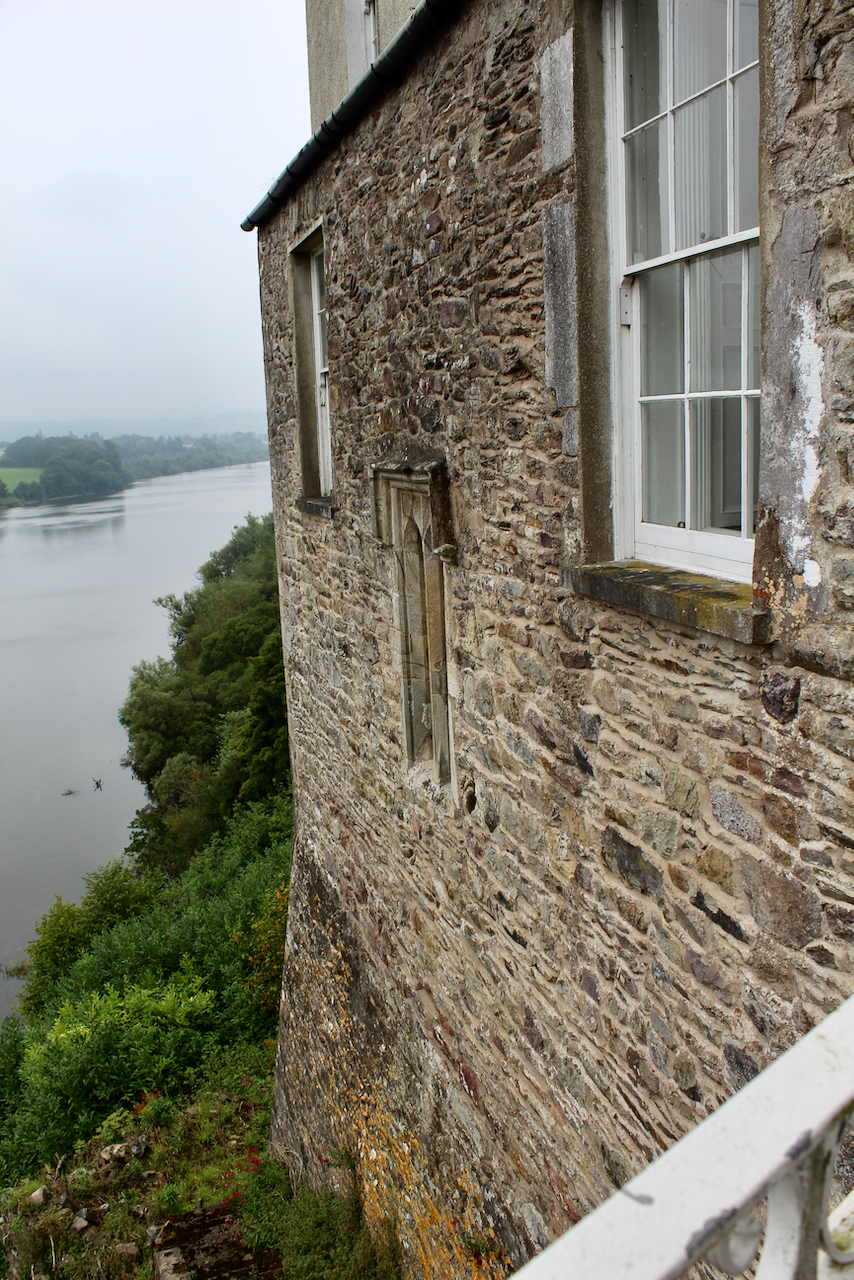

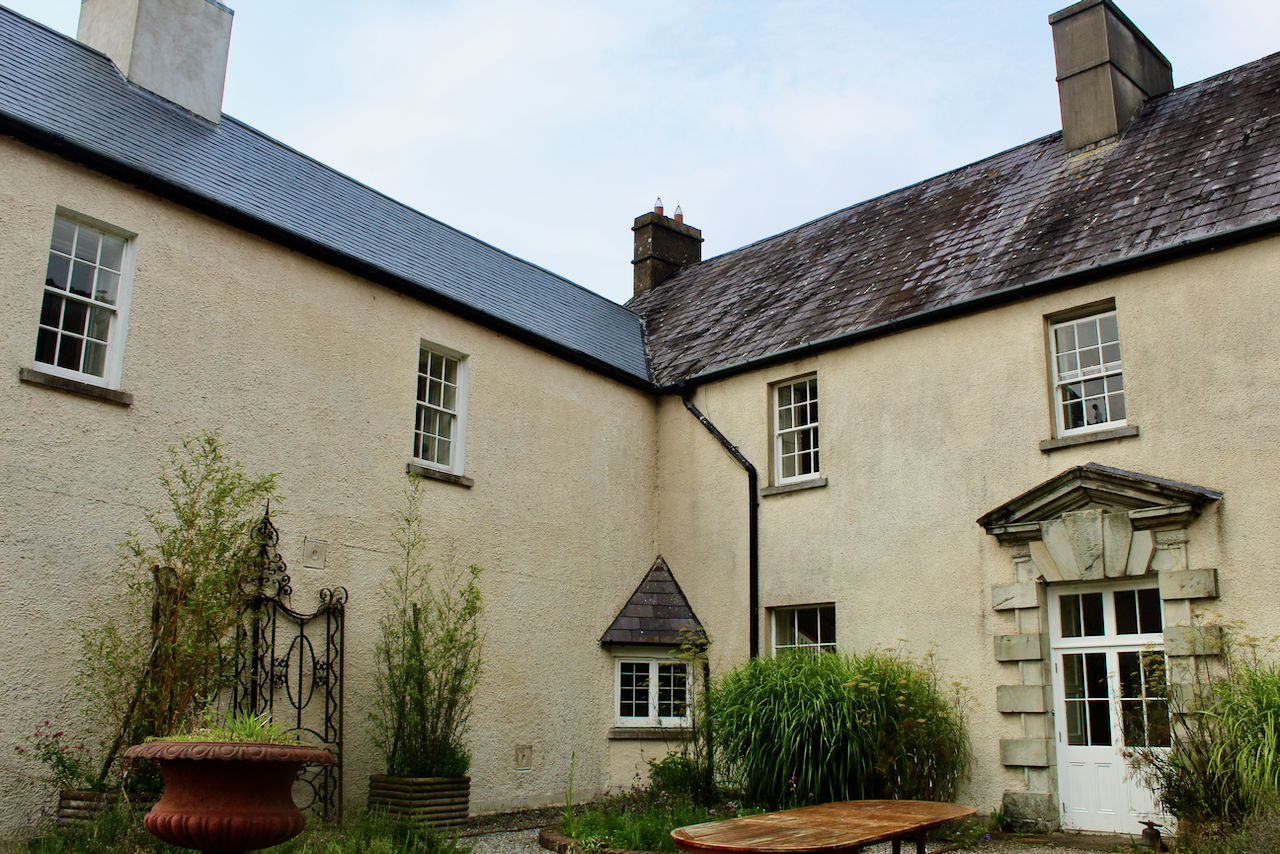
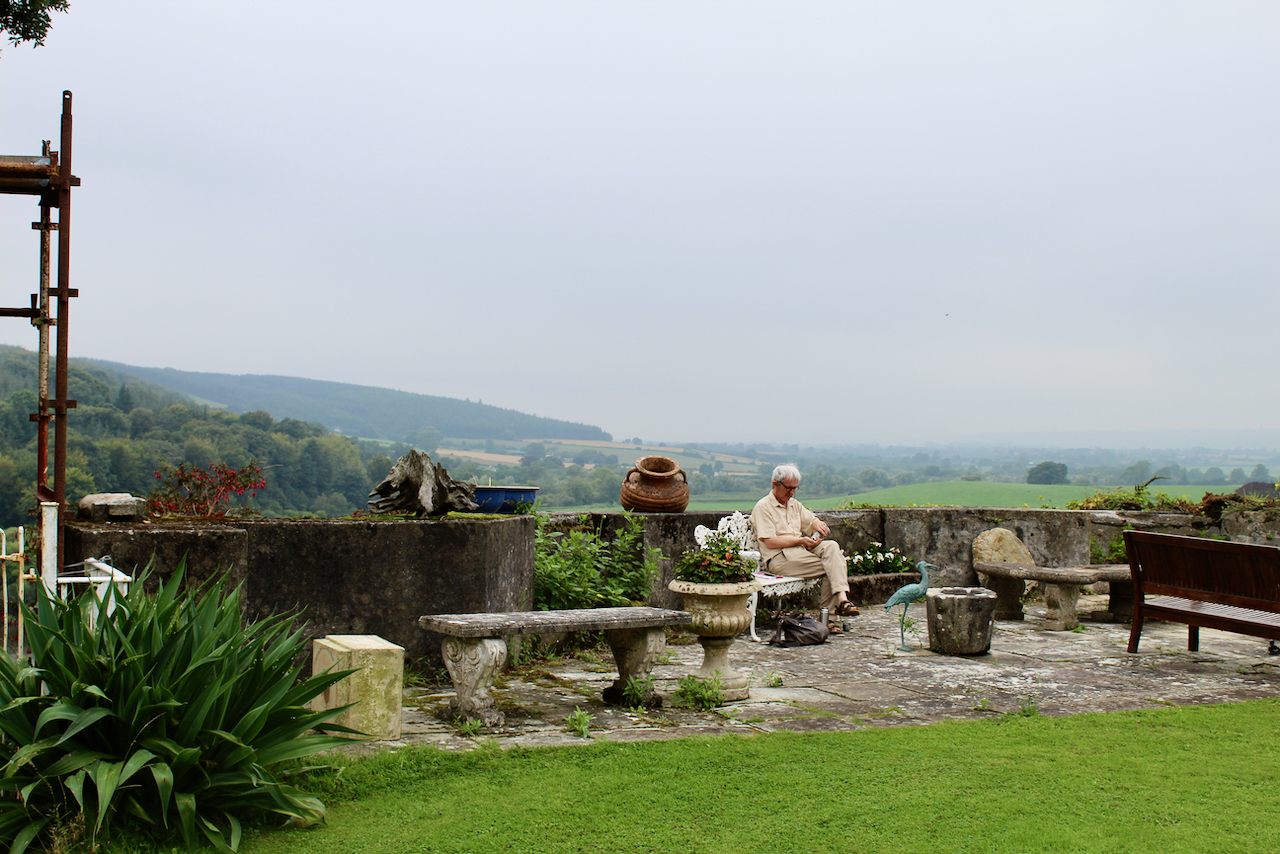
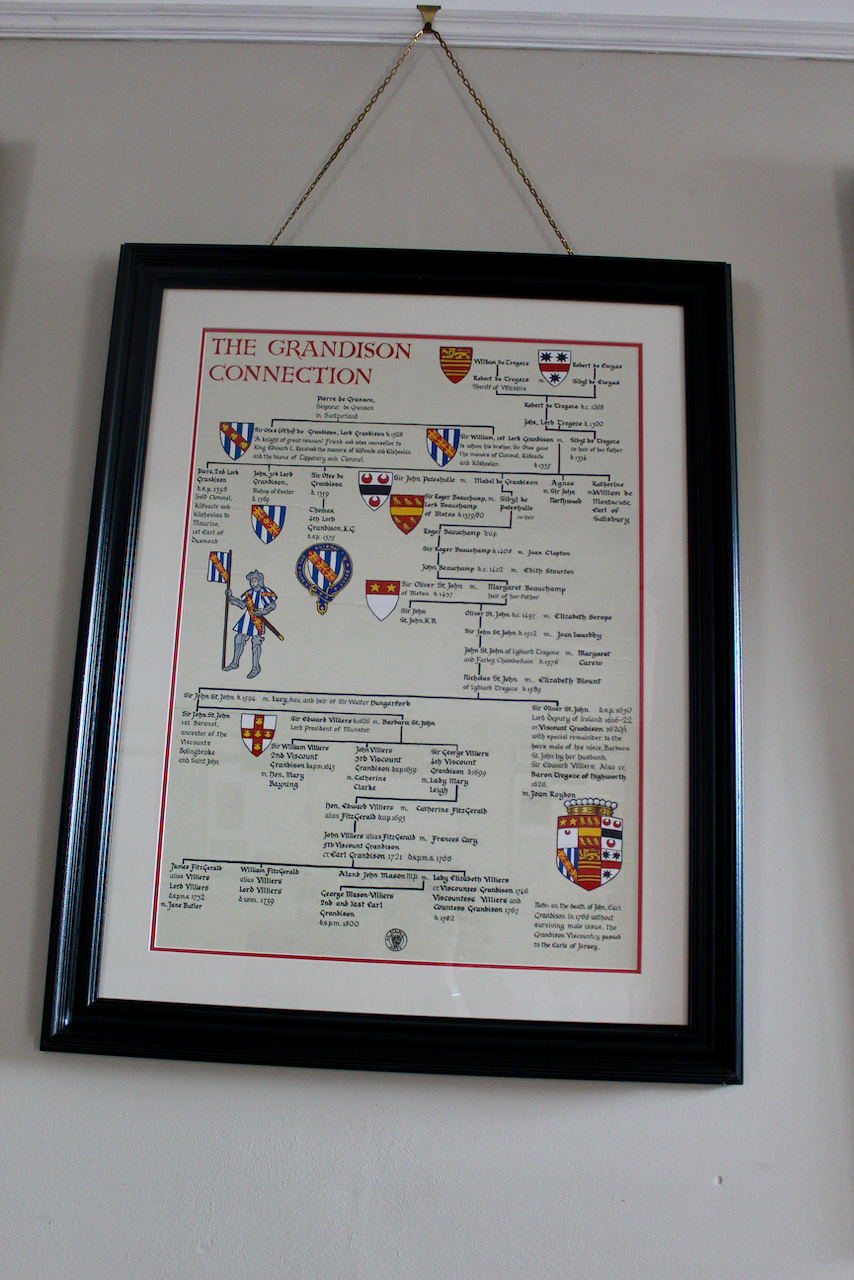
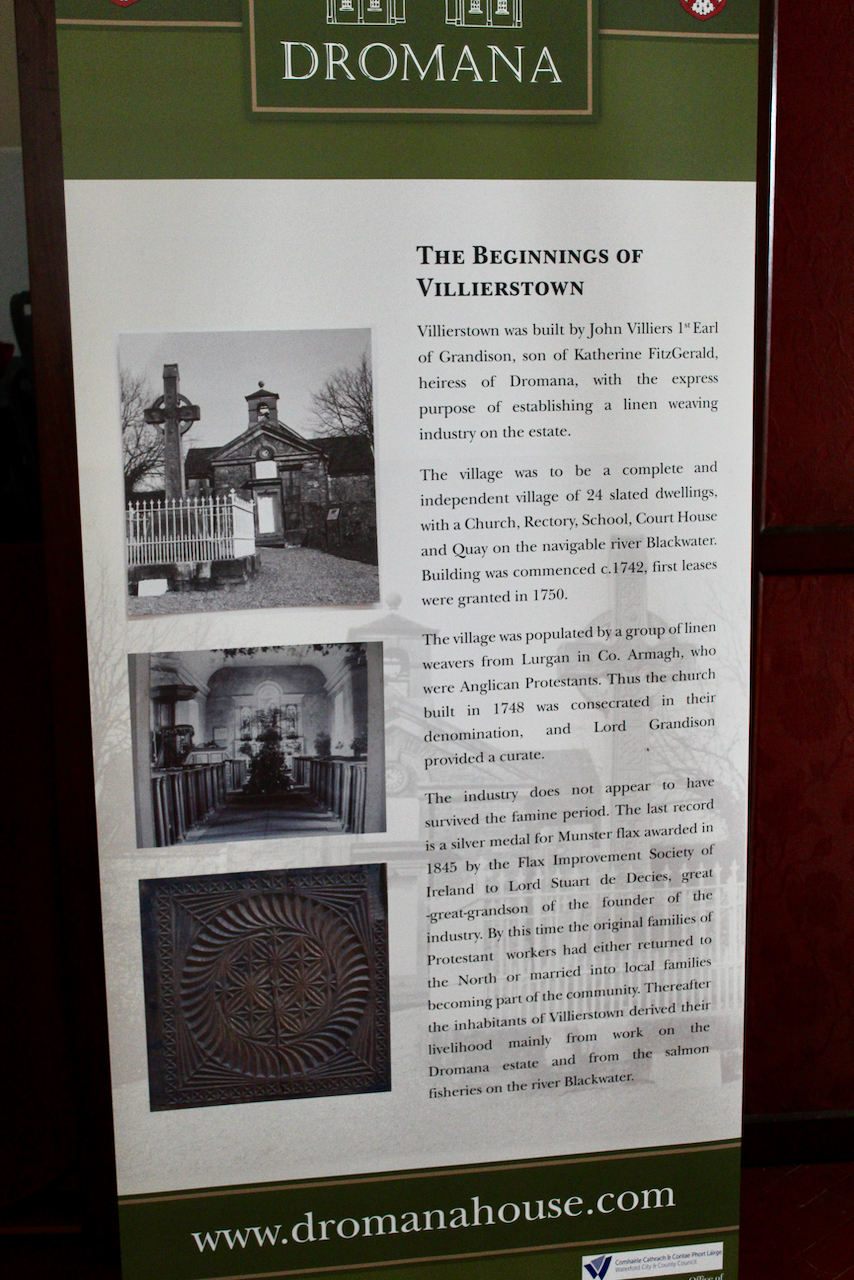
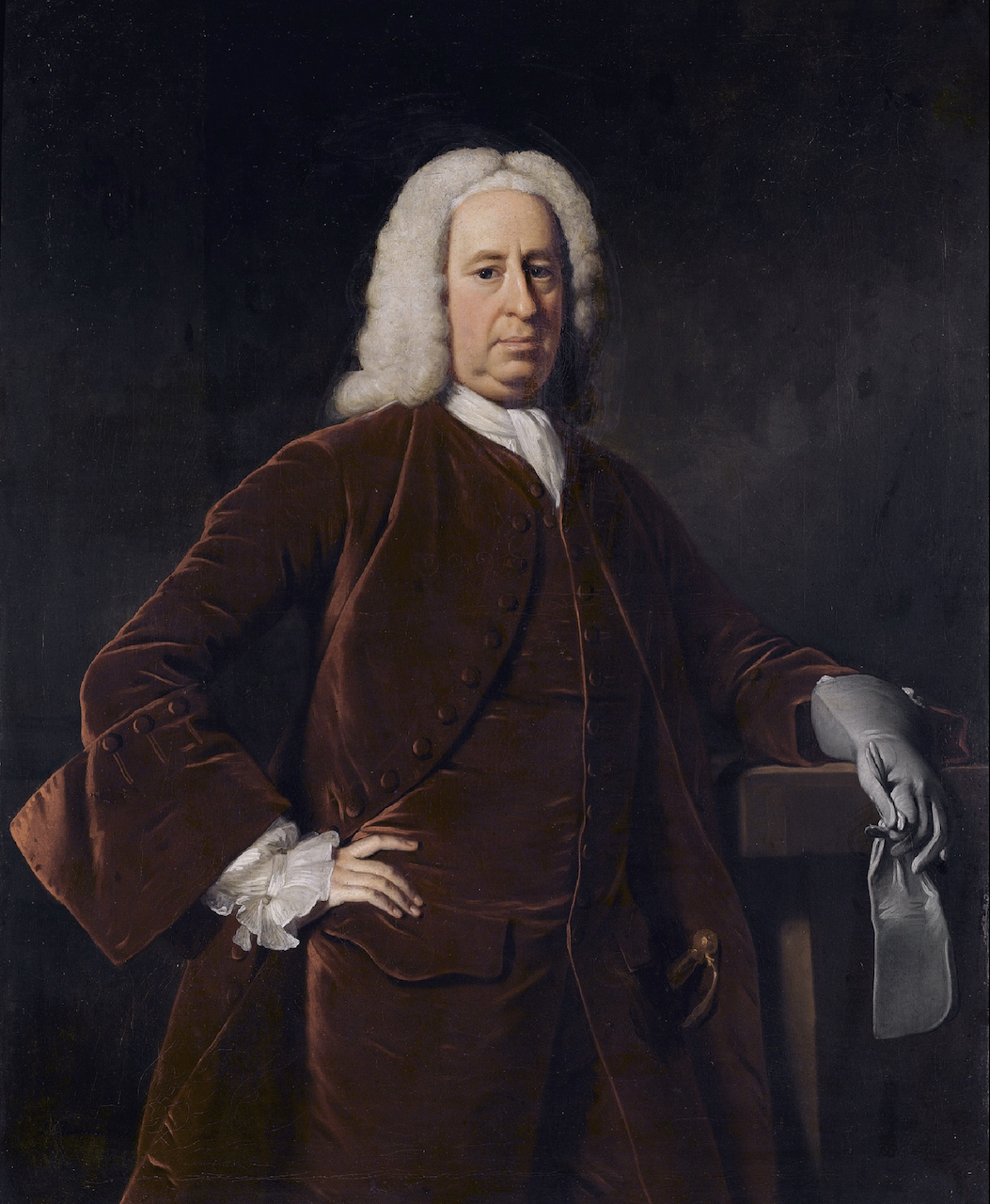
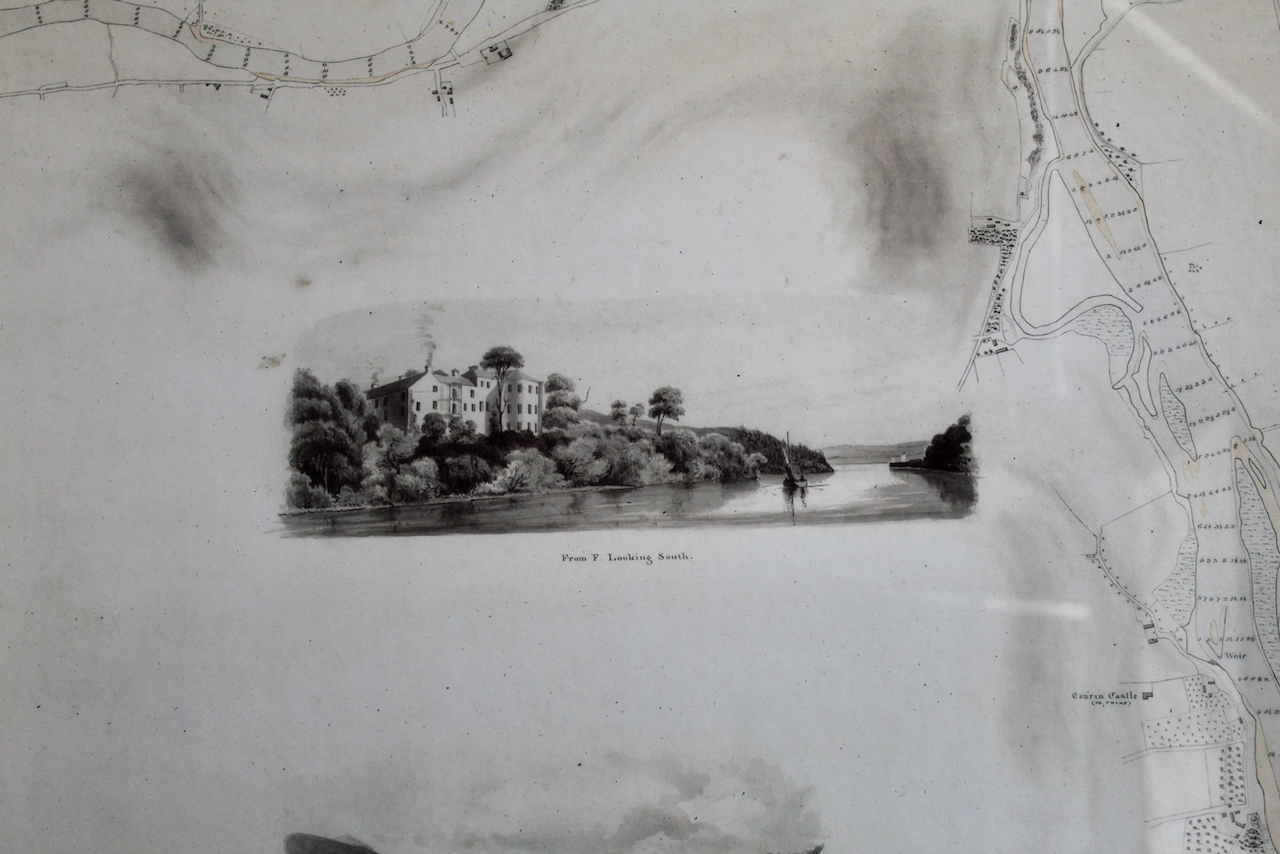

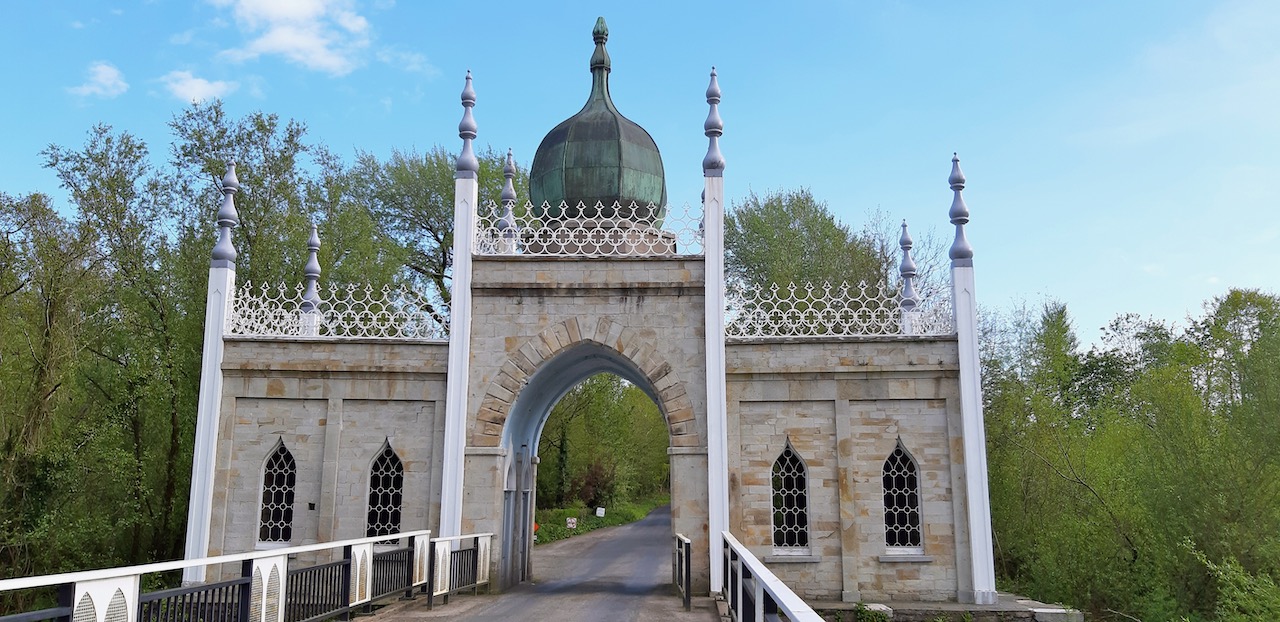
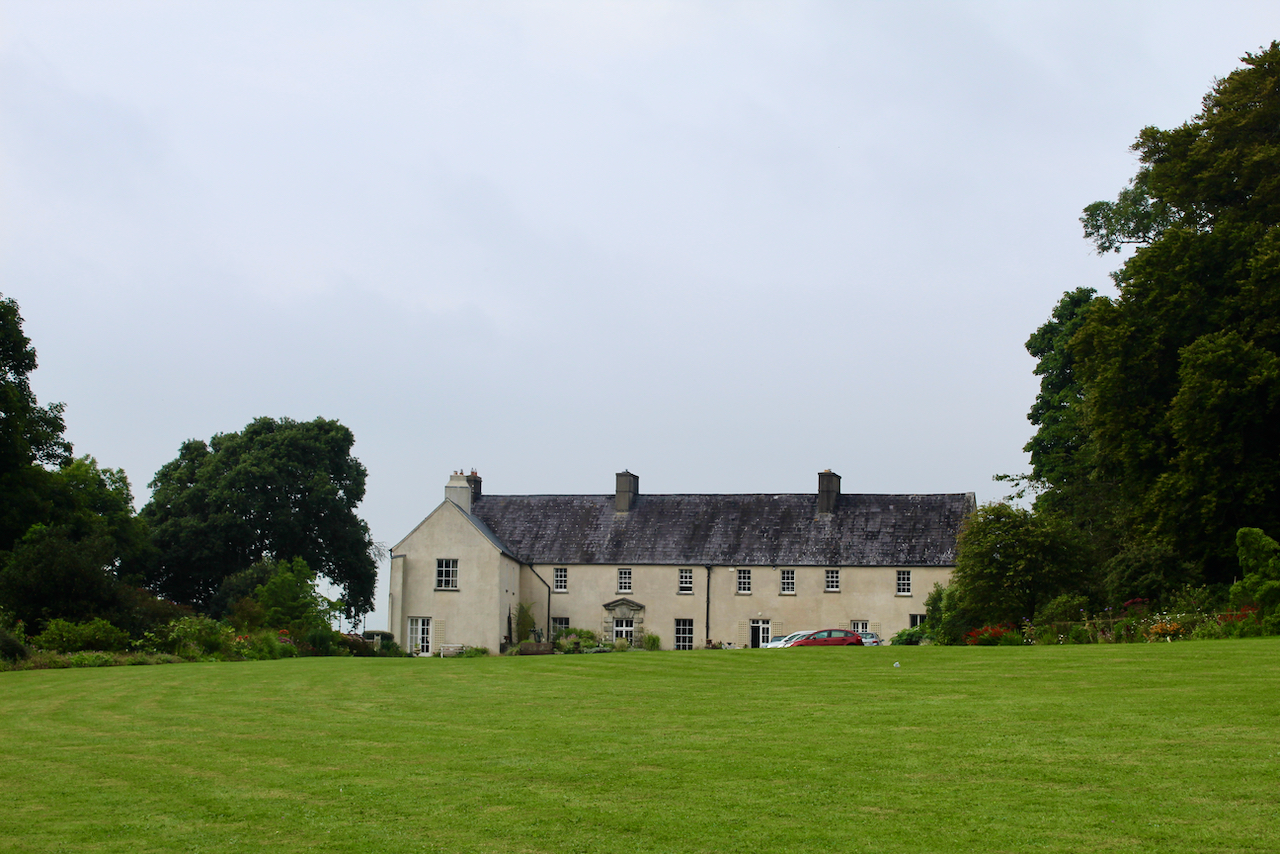

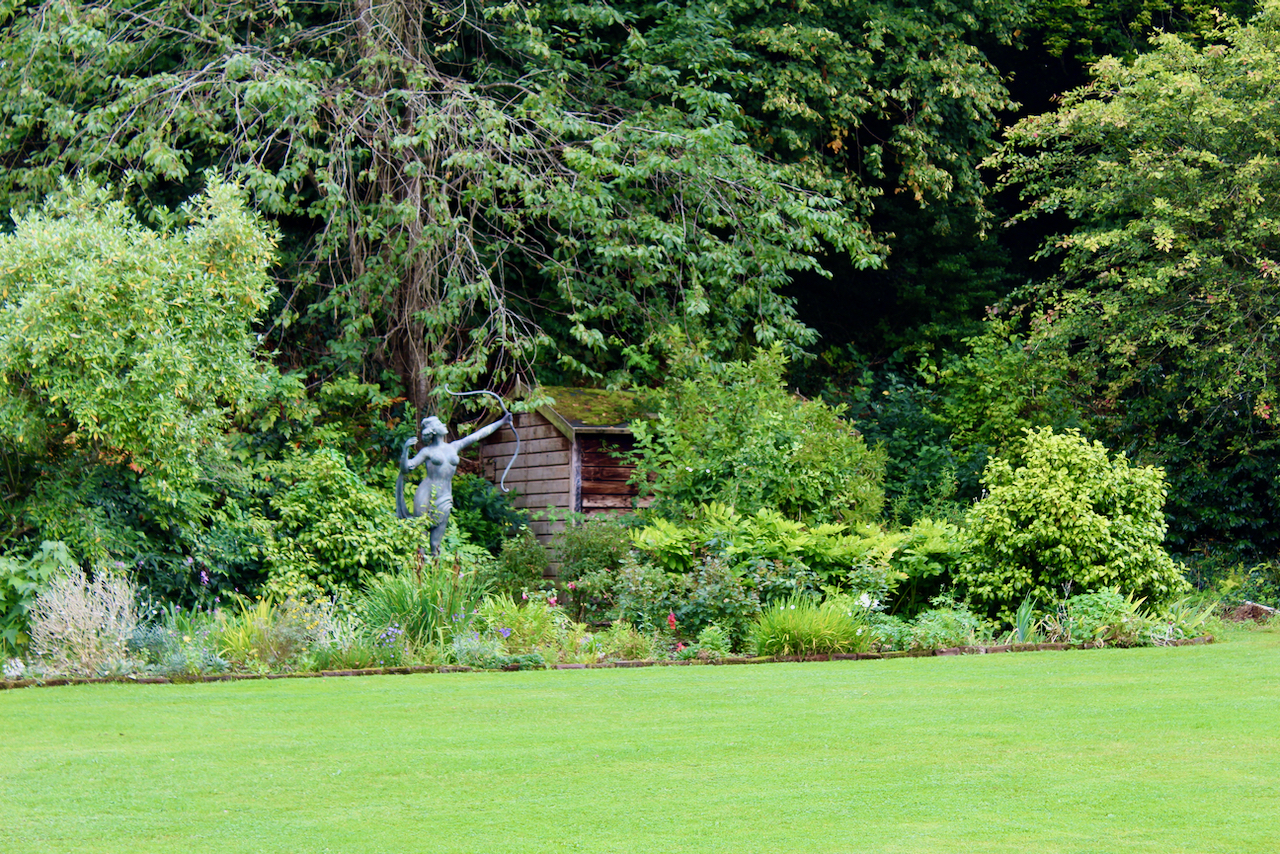
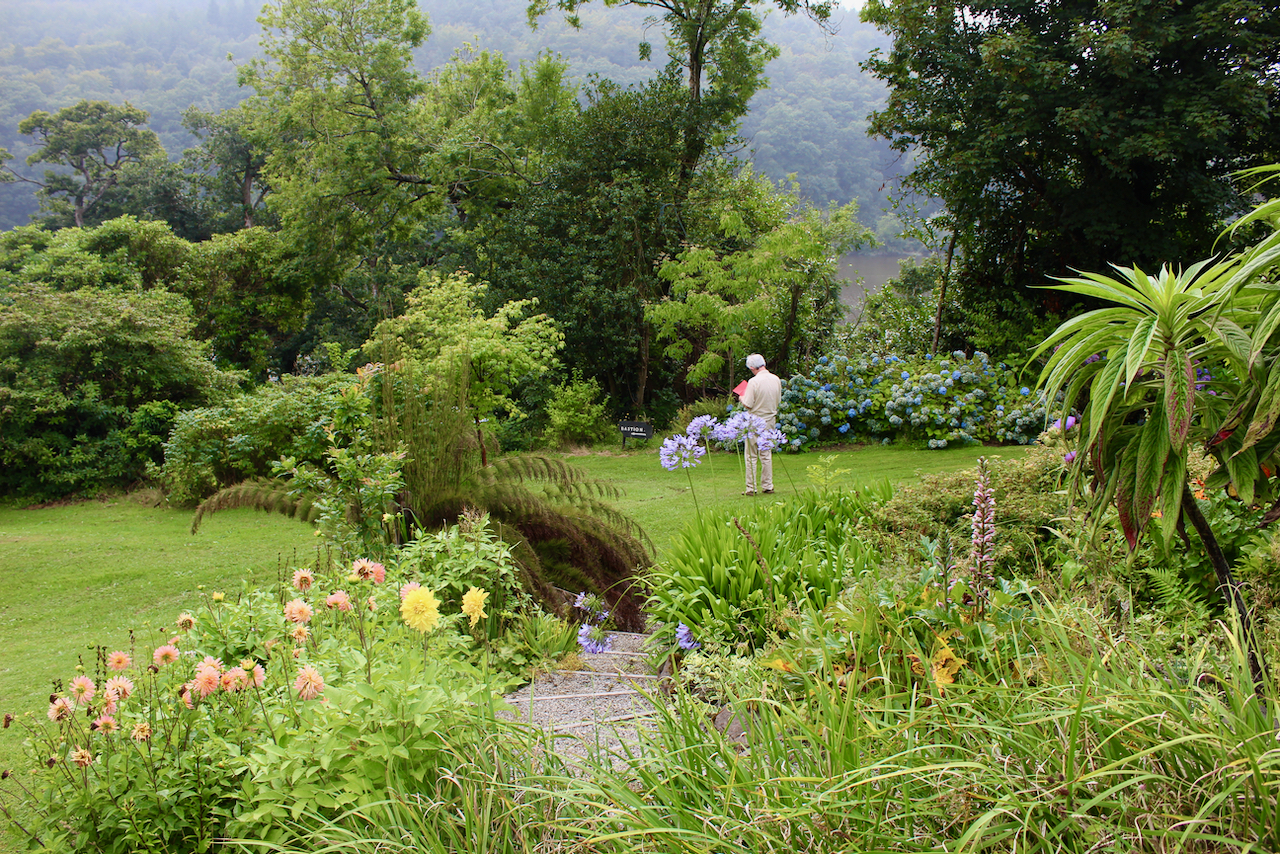
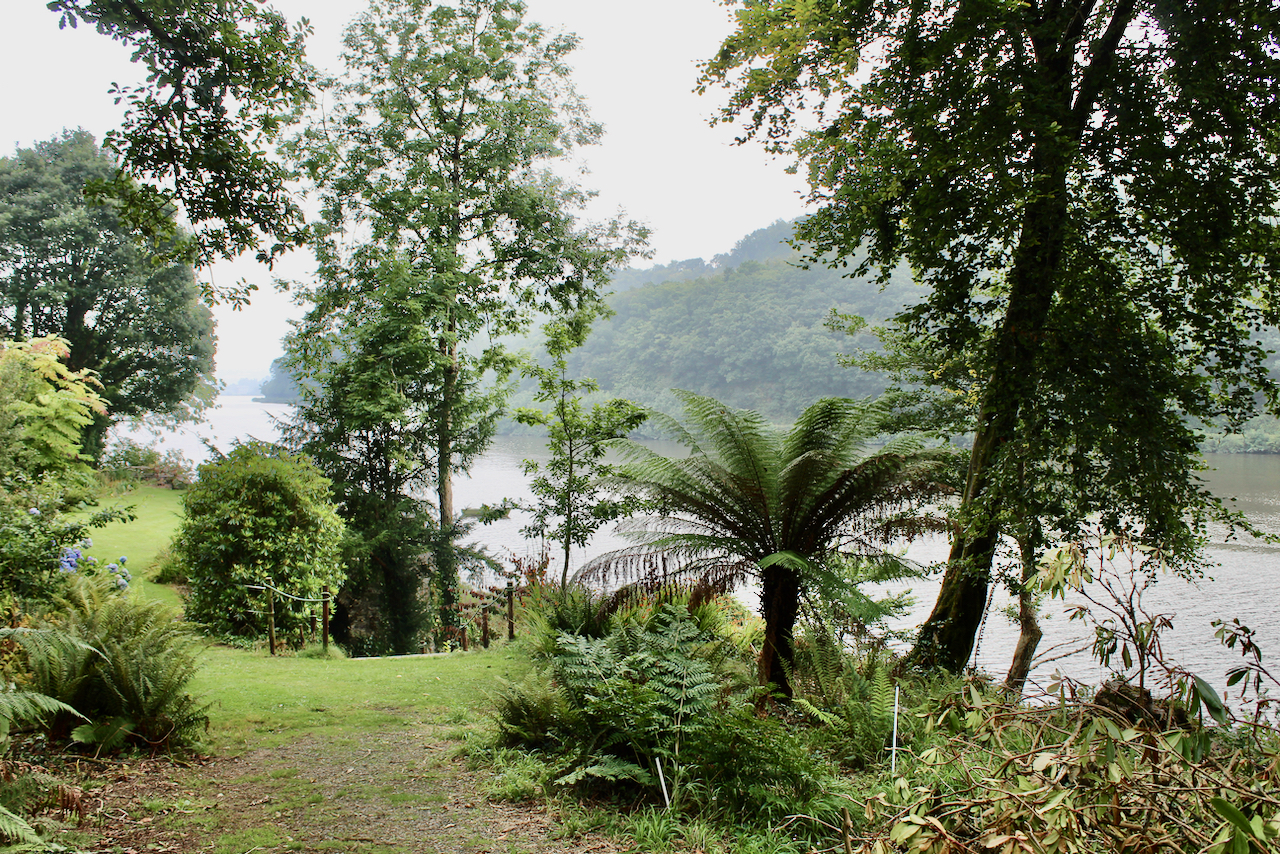
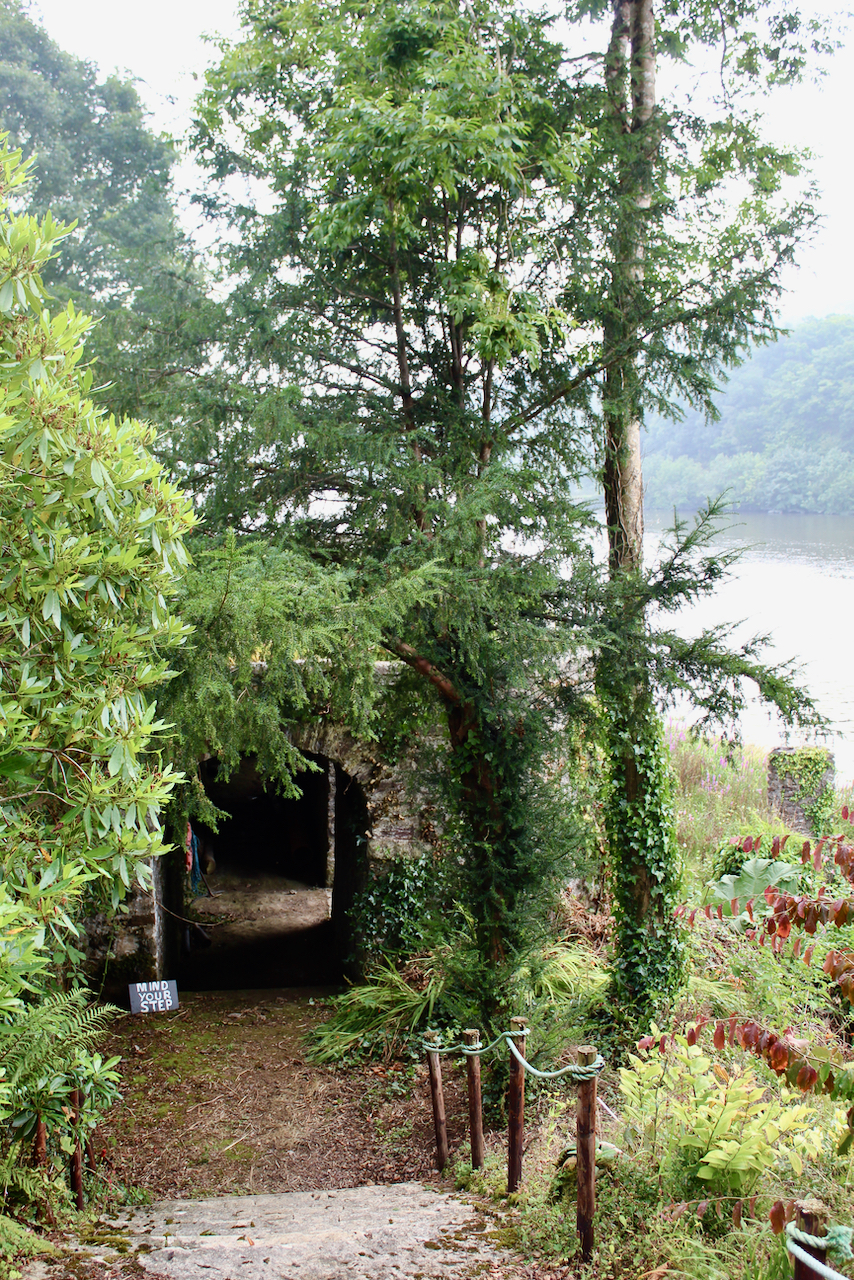
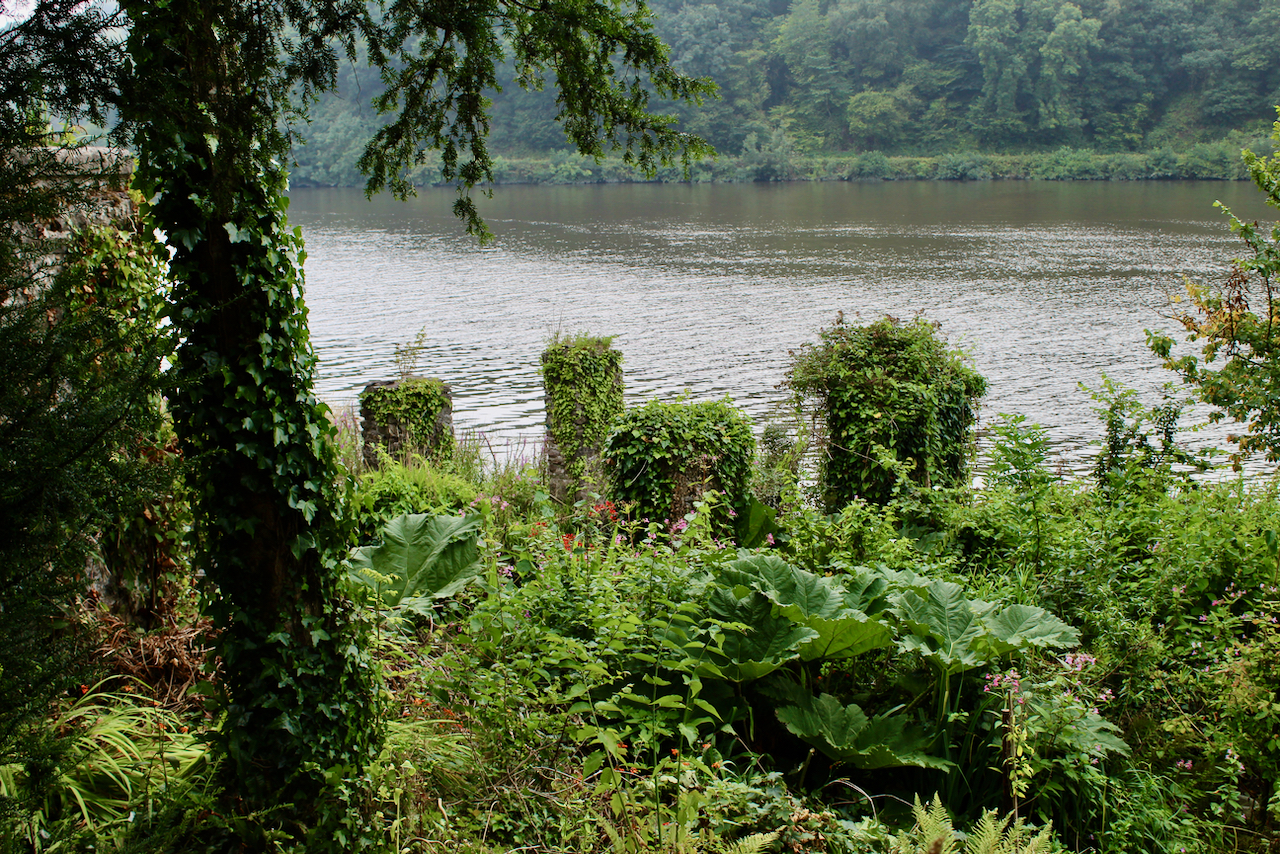
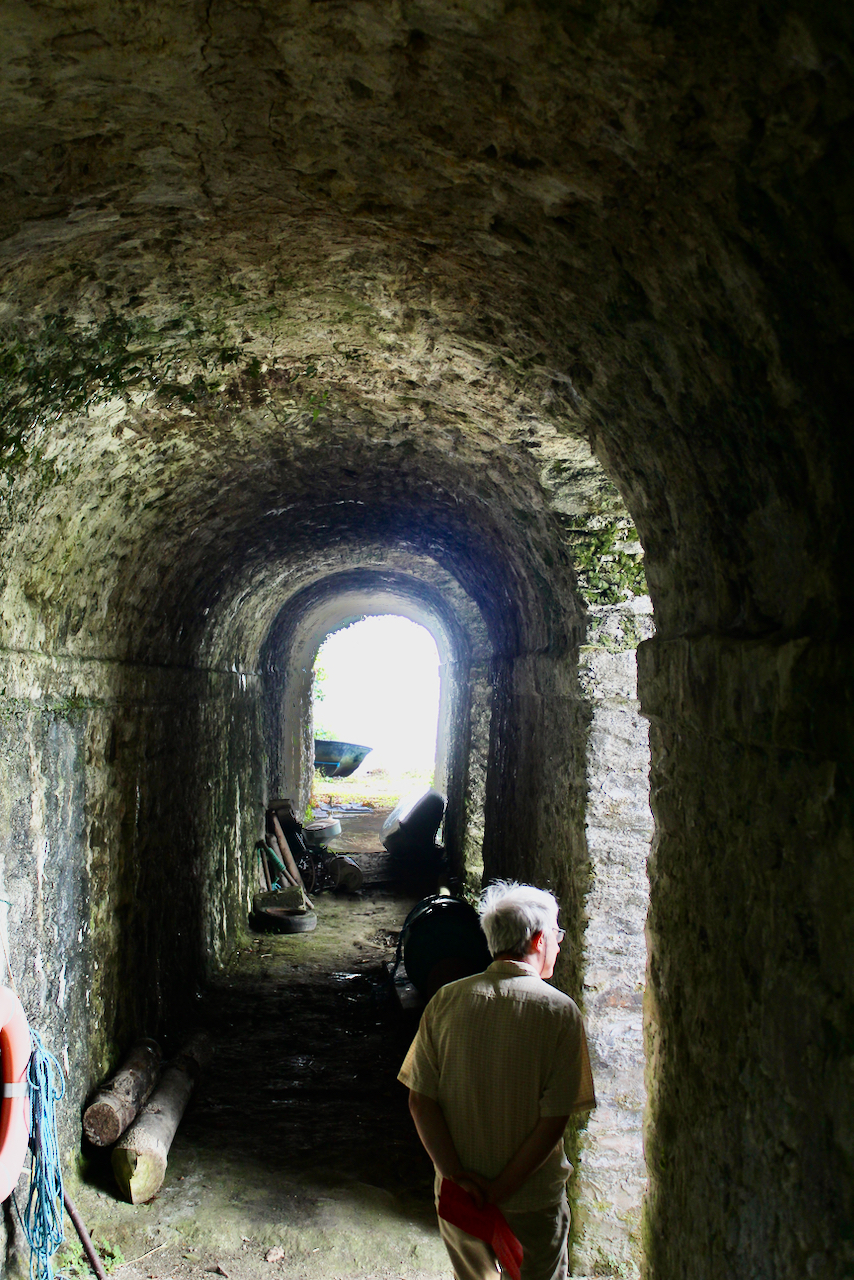
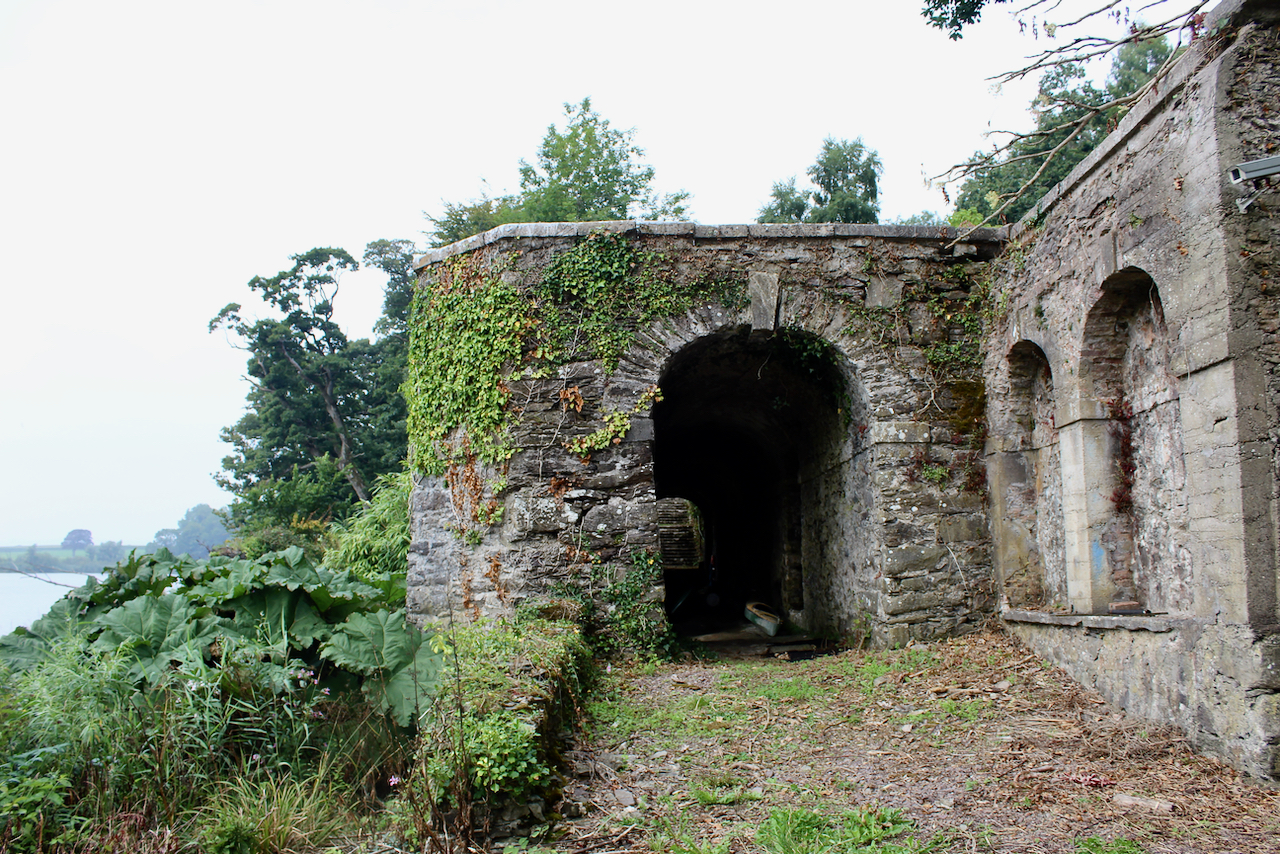
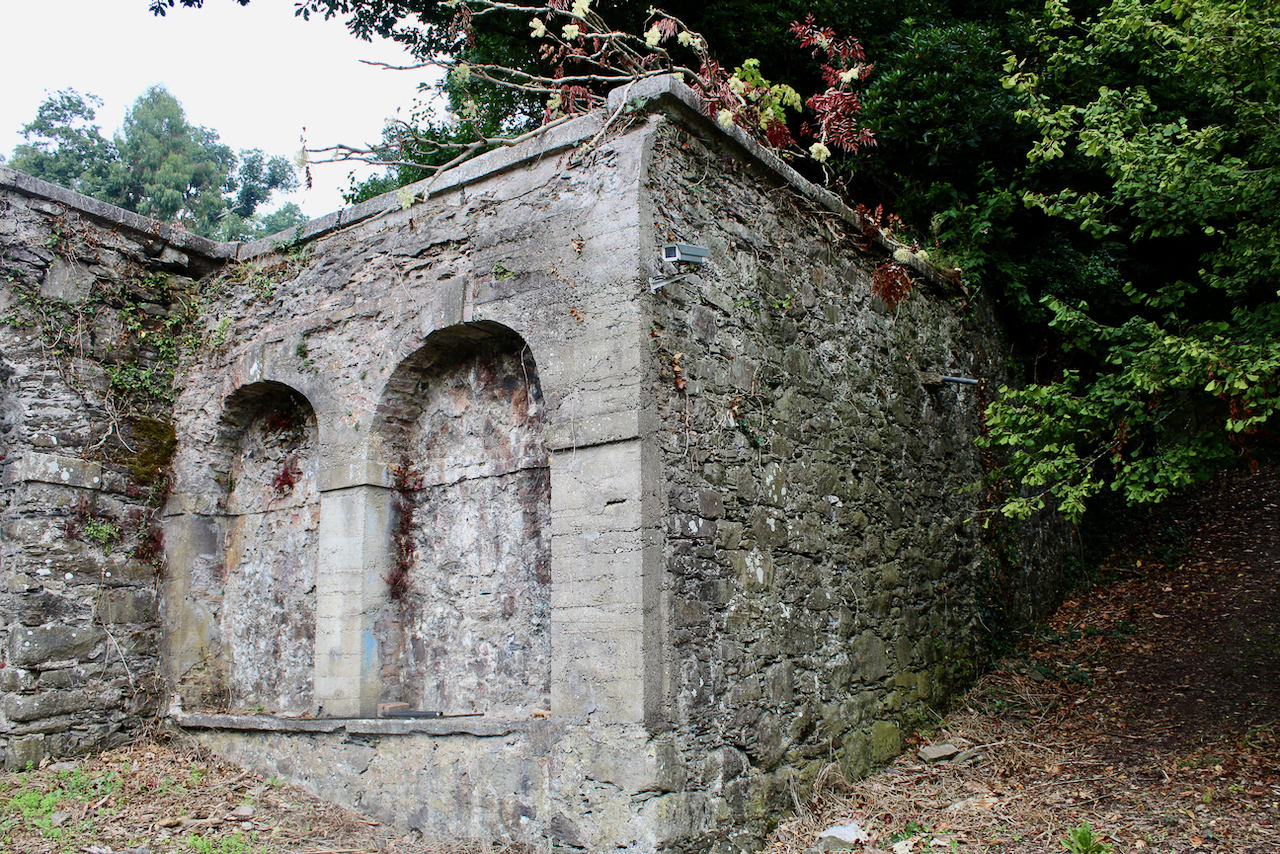
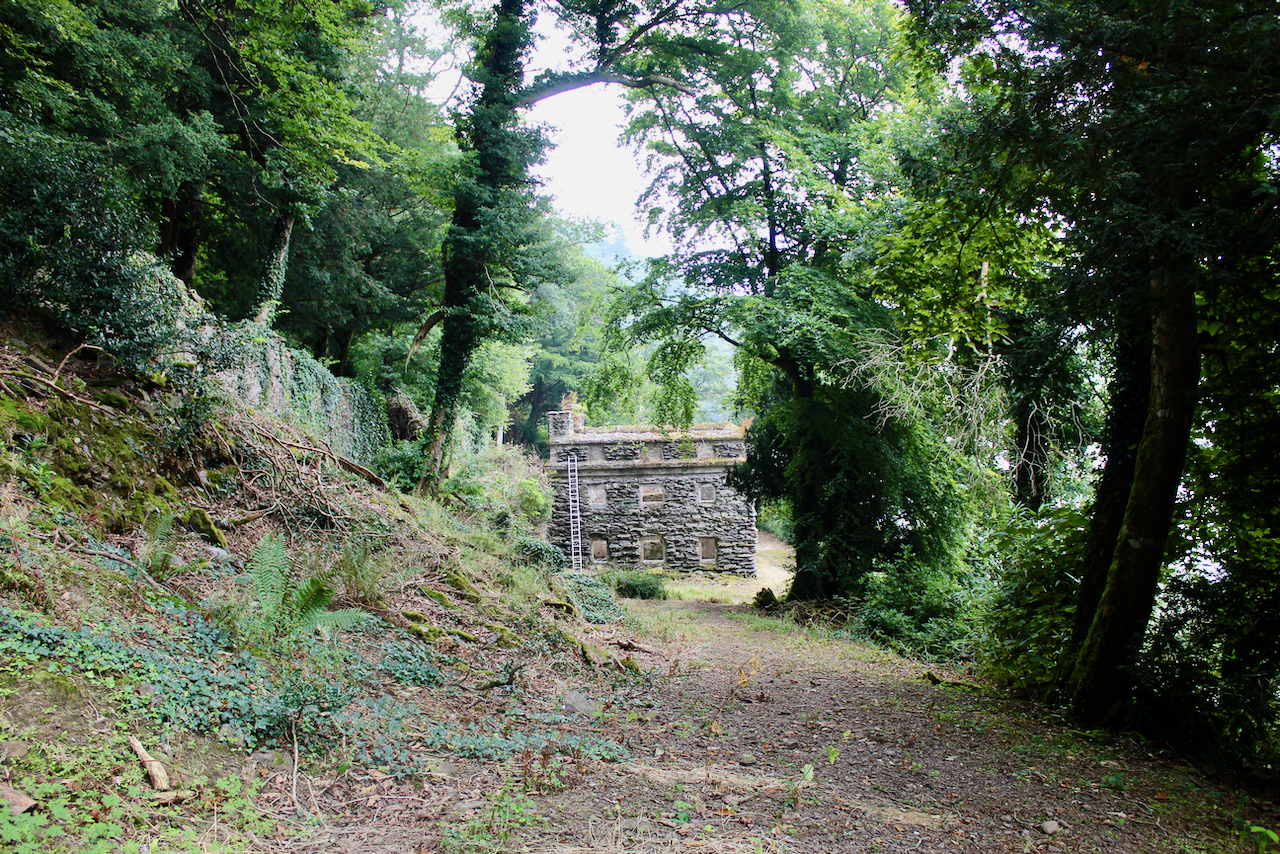

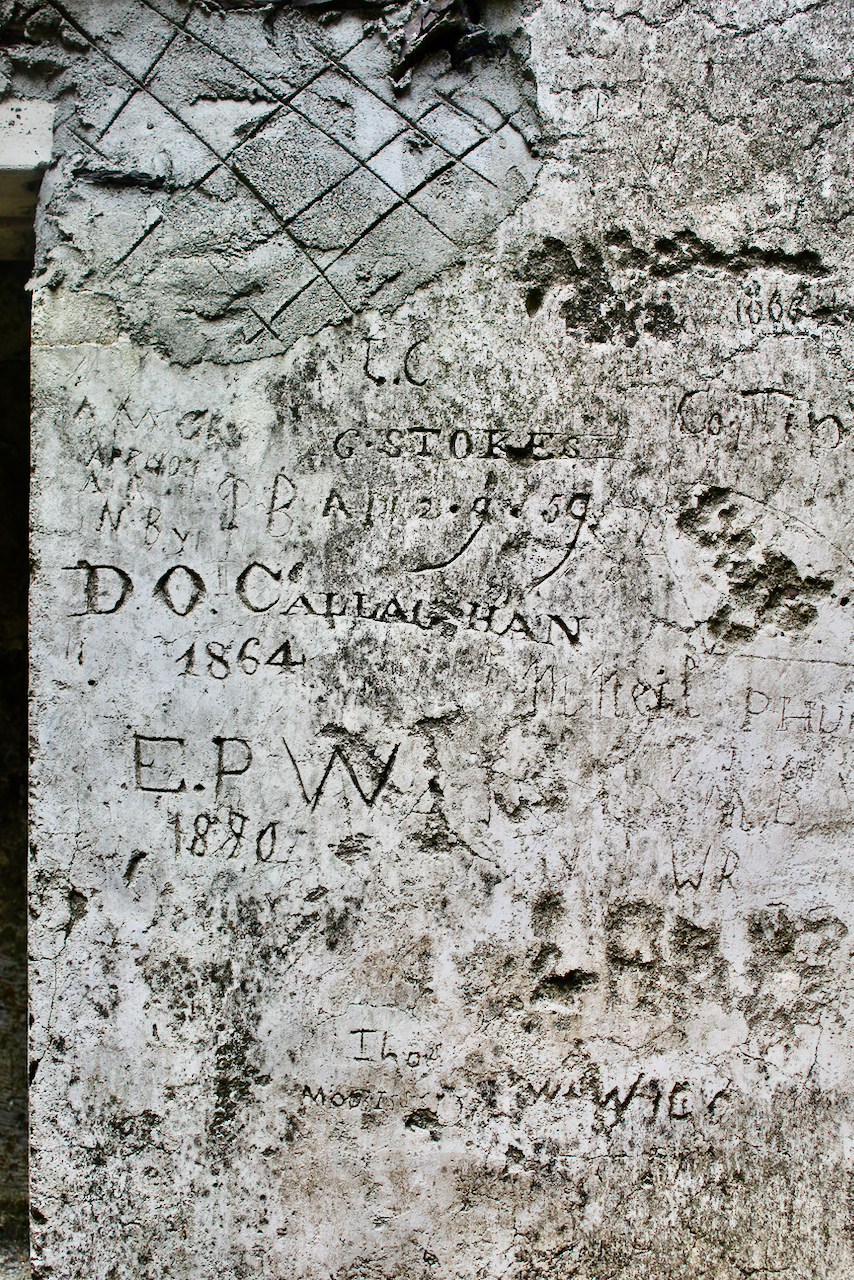

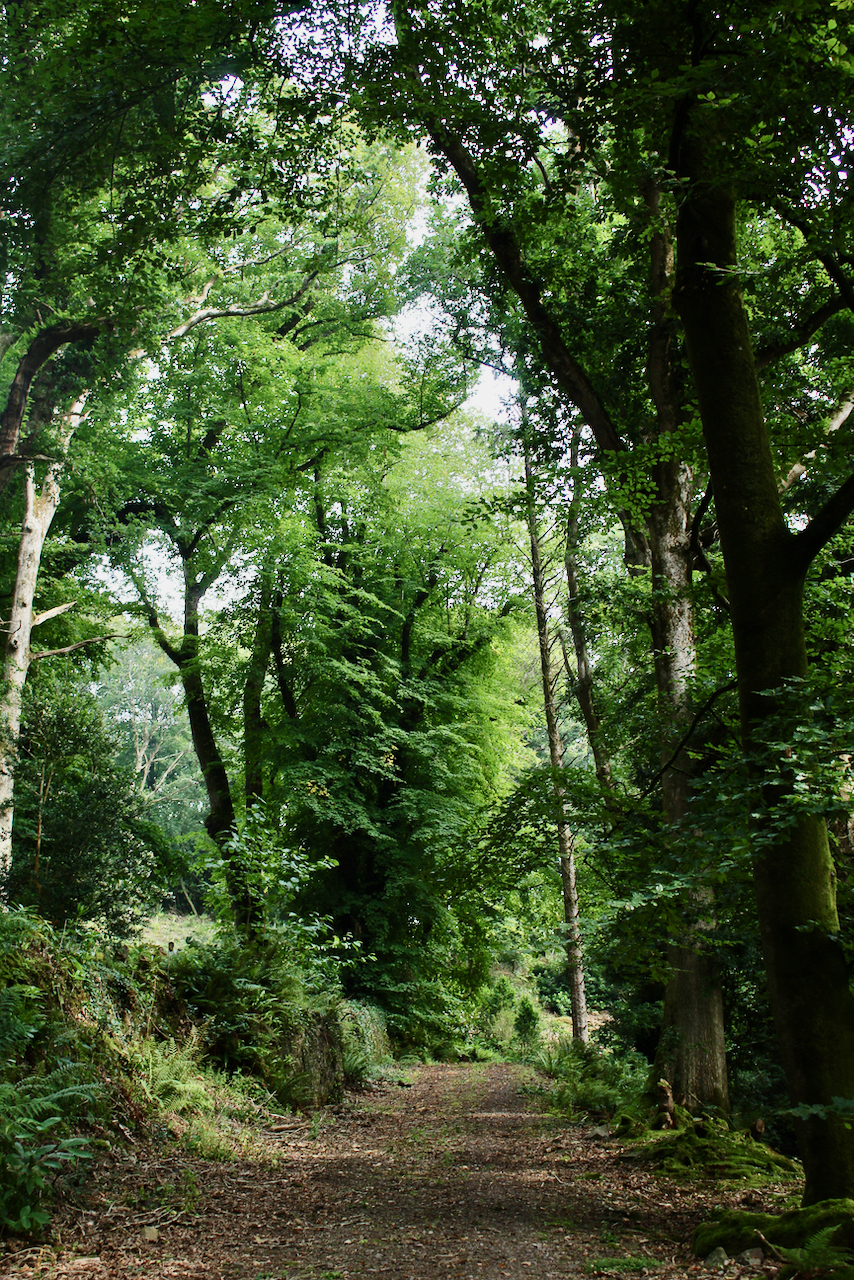
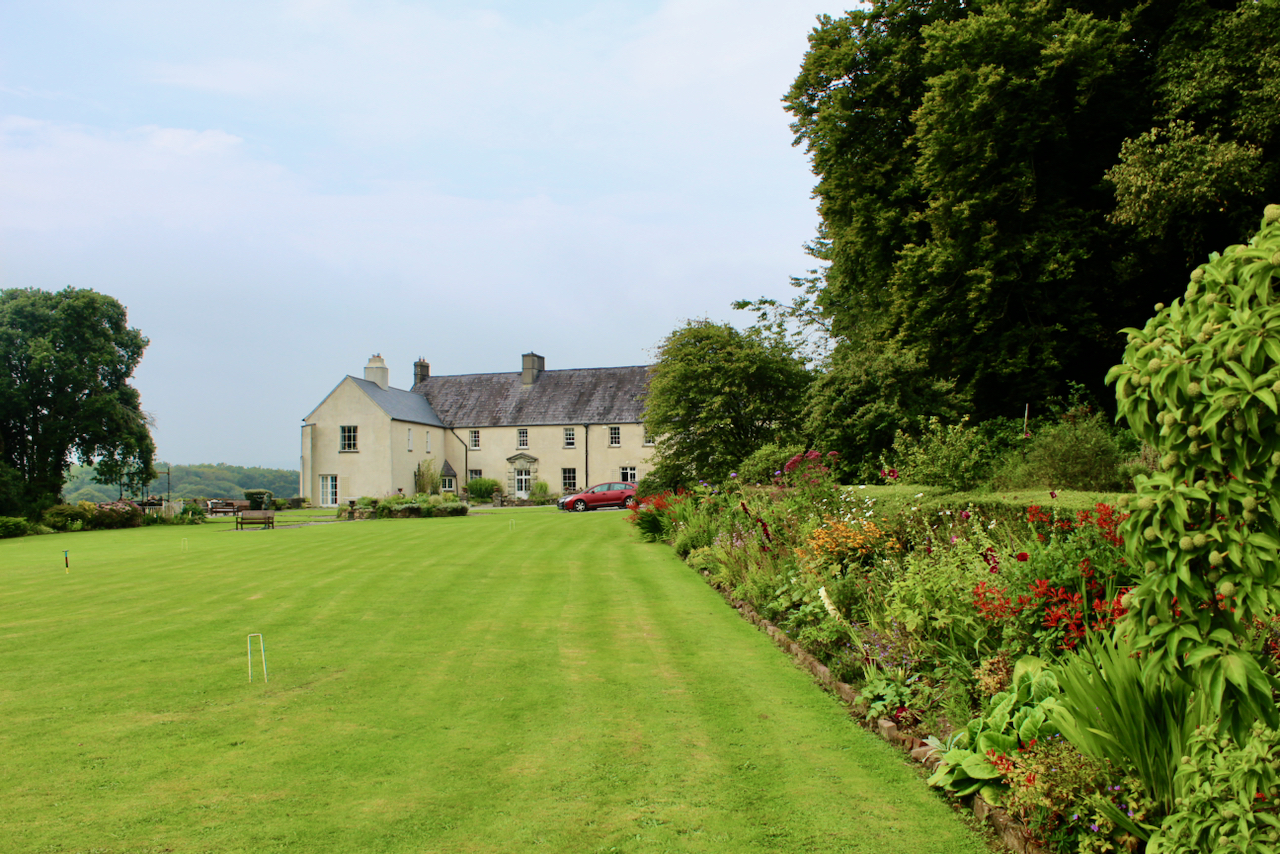
 Irish Historic Houses