Places to visit and stay in County Longford, Leinster

On the map above:

blue: places to visit that are not section 482

purple: section 482 properties

red: accommodation

yellow: less expensive accommodation for two

orange: “whole house rental” i.e. those properties that are only for large group accommodations or weddings, e.g. 10 or more people.

green: gardens to visit

grey: ruins

As well as places to visit, I have listed separately places to stay, because some of them are worth visiting – you may be able to visit for afternoon tea or a meal.

For places to stay, I have made a rough estimate of prices at time of original publication:

€ = up to approximately €150 per night for two people sharing (in yellow on map);

€€ – up to approx €250 per night for two;

€€€ – over €250 per night for two.

Places to visit in County Longford:

1. Castlecor House, County Longford, open by previous arrangement.

2. Maria Edgeworth Visitor Centre, Longford, County Longford.

3. Moorhill House, Castlenugent, Lisryan, Co. Longford – section 482

Places to stay, County Longford:

1. Castlecor House, County Longford

2. Newcastle House Hotel, Ballymahon, County Longford.

3. Viewmount House, Longford

donation

Help me to pay the entrance fee to one of the houses on this website. This site is created purely out of love for the subject and I receive no payment so any donation is appreciated!

€15.00

Places to visit in County Longford:

1. Castlecor House, County Longford, open by previous arrangement:
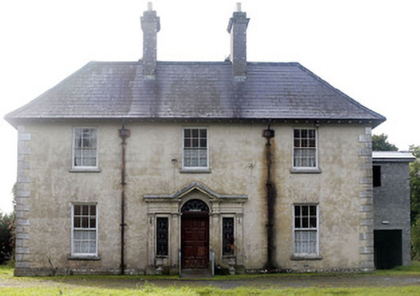
https://castlecorhouse.com/

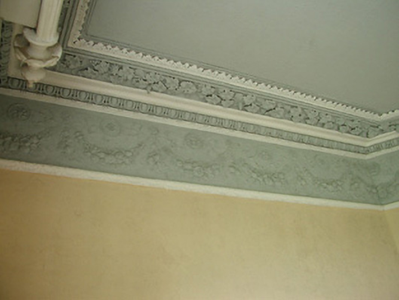
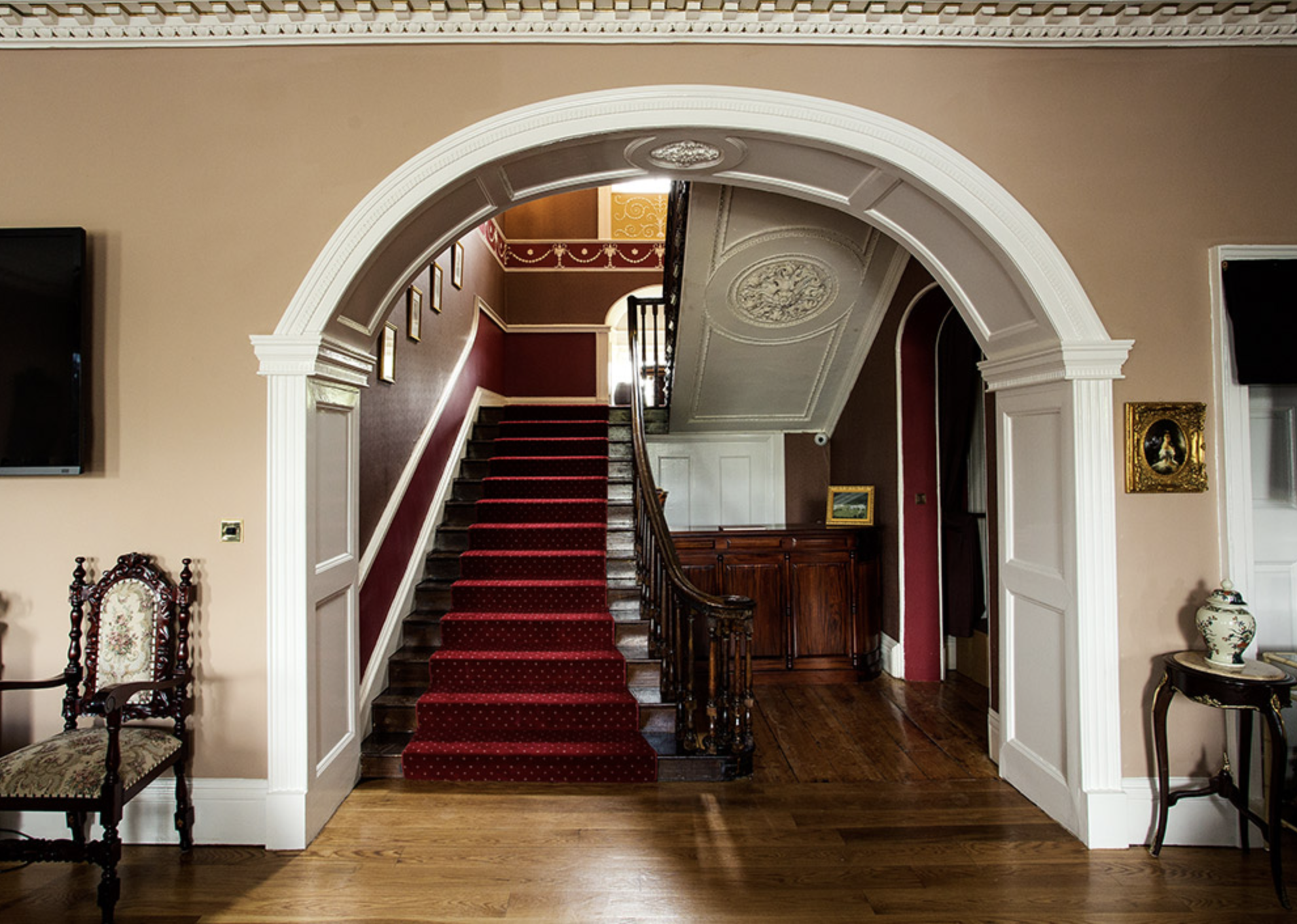
Castlecor House, County Longford, photograph from the National Inventory of Architectural Heritage [1]

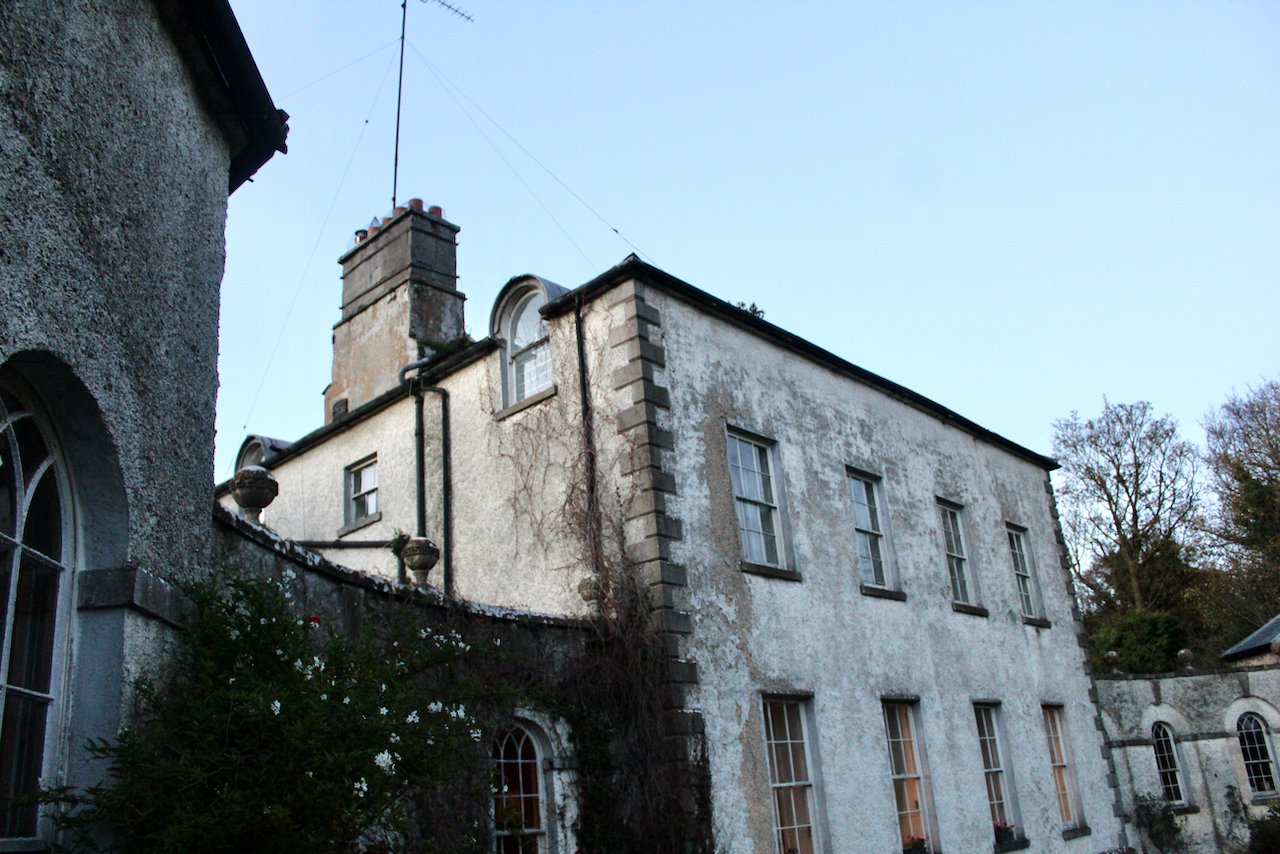
I’ve been looking forward to staying in Castlecor house, after seeing a photograph of its incredible octagonal room.
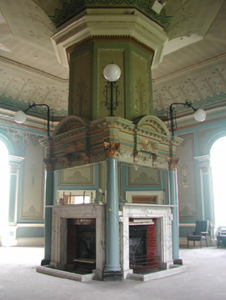
Castlecor House, County Longford, photograph from the National Inventory of Architectural Heritage [1]

The website tells us:

The construction of this magnificent residence, as it stands today, spanned 300 years, originally built in the mid 1700’s as a Hunting Lodge with additions in the 19th & 20th century.

The website continues: “It was built by the Very Revd. Cutts Harman (1706 – 1784), son of the important Harman family of nearby Newcastle House [which offers accommodation]. He was Dean of Waterford cathedral from 1759 and was married to Bridget Gore (1723-1762) from Tashinny [Tennalick, now a ruin, which passed from the Sankey family to the Gore family by the marriage of Bridget’s mother Bridget Sankey to George Gore, son of Sir Arthur Gore, 1st Baronet of Newtown Gore, County Mayo] in c. 1740.

The National Inventory of Architectural Heritage (www.buildingsofIreland.ie) gives the building an unusually long appraisal which explains the unusual building:

It was originally built as a symmetrical two-storey block on octagonal-plan with short (single-room) projecting wings to four sides (in cross pattern on alternating sides), and with tall round-headed window openings between to the remaining four walls. The single wide room to the octagon at first floor level has an extraordinary central chimneypiece (on square-plan) with marble fireplaces to its four faces; which are framed by Corinthian columns that support richly-detailed marble entablatures over. The marble fireplaces themselves are delicately detailed with egg-and-dart mouldings and are probably original. This room must rank as one of the most unusual and interesting rooms built anywhere in Ireland during the eighteenth-century.

Castlecor House, County Longford, photograph from the National Inventory of Architectural Heritage: “The single wide room to the octagon at first floor level has an extraordinary central chimneypiece (on square-plan) with marble fireplaces to its four faces; which are framed by Corinthian columns that support richly-detailed marble entablatures over. The marble fireplaces themselves are delicately detailed with egg-and-dart mouldings and are probably original.” [1]
Castlecor House, County Longford, photograph from the National Inventory of Architectural Heritage: “The walls of the octagonal room are decorated with Neo-Egyptian artwork.” [1]
Castlecor House, County Longford, photograph from the National Inventory of Architectural Heritage [1]

The National Inventory continues: “The walls of the octagonal room are decorated with Neo-Egyptian artwork, which may have been inspired by illustrations in Owen Jones’ book ‘Decoration’, published in 1856. The inspiration for this distinctive octagonal block is not known. Some sources suggest an Italian inspiration, such as the pattern books of the noted architect Sebastiano Serlio (1475 – 1554) [Mark Bence-Jones suggests this [2]], or that it was based on the designs of the much larger hunting lodge (Palazzina di caccia of Stupinigi) that was built for the Duke of Savoy, near Turin, between 1729 and c. 1731 (The later seems a highly fanciful idea but there are some similarities in plan, albeit on a much larger scale at Stupinigi); while Craig (1977, 15) suggests that the ‘inspiration is clearly the hunting lodge at Clemenswerth in Lower Saxony, Germany’, which was constructed between 1737 – 1747 to designs by Johann Conrad Schlaun for Prince Clemens August, a structure that Castlecor resembles in terms of scale and plan. However, it may be that the plan of this building was inspired by William Halfpenny (died 1755), an English Palladian architect who created a number of unexecuted designs for Waterford Church of Ireland cathedral and for an associated bishop’s palace from c. 1739. Interestingly, a number of these unexecuted plans for the bishop’s palace included a central octagonal block with projecting wings, while a number of the church plans included an unusual separate baptismal building attached to the nave, which is also on an octagonal-plan. The Very Revd. Cutts Harman may well have been aware of Halfpenny’s unexecuted designs, being Dean of the cathedral from 1759 and was probably associated with the diocese from an earlier date, and perhaps he used these as his inspiration for the designs of Castlecor. The central four-sided chimneypiece is reminiscent of the centerpiece of the Rotunda of Ranelagh Gardens, London, (built to designs by William Jones 1741 – 2; demolished c. 1803) albeit on a much reduced scale at Castlecor. The plan of Castlecor is also similar to a number of buildings (some not executed) in Scotland, including Hamilton Parish Church (built c. 1733 to designs by William Adam (1698 – 1748) and the designs for a small Neoclassical villa prepared by James Adam (1732 – 92), c. 1765, for Sir Thomas Kennedy. The exact construction date of Castlecor is not known, however the traditional building date is usual given as c. 1765. The architectural detailing to the interior of the original block, and perhaps the personal life of Very Revd. Cutts Harman (married in 1751 to a daughter of Lord Annaly of Tennalick 13402348; his duties at Waterford cathedral from 1759; Cutts Harmon leased out a number of plots of land in Longford from c. 1768) would suggest an earlier date of, perhaps, the 1740s. The architect is also unknown although it is possible that Harman designed the house himself (perhaps inspired by a pattern book or by Halfpenny’s unexecuted designs); while Craig (1977) suggest that the architect may have been Davis Ducart (Daviso de Arcort; died 1780/1), an Italian or French architect and engineer who worked extensively in Ireland (particularly the southern half of the island) during the 1760s and 1770s.” We saw Ducart’s work at Kilshannig in County Cork, another section 482 property, see my entry [3].
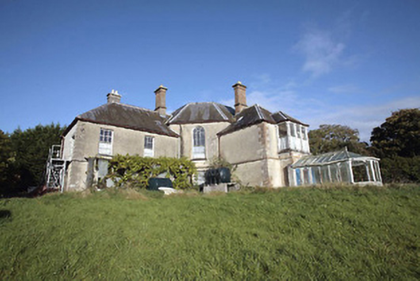
Castlecor House, County Longford, see the octagonal Great Hall in the centre of the house. photograph from the National Inventory of Architectural Heritage [1].
Castlecor House, County Longford, photograph from the National Inventory of Architectural Heritage [1]

The website tells us:”The Rev. Cutts Harman who had Castlecor built died without issue, it was inherited by his niece’s son [or was it his sister Anne’s son? If so, it was her son Lawrence Harman Parsons (1749-1807); she married Laurence Parsons, 3rd Baronet of Birr Castle. Her son added Harman to his surname when he inherited Castlecor from his uncle], Laurence Harman- Harman, later Lord Oxmantown, and finally Earl of Rosse. Peyton Johnston, the Earl’s nephew, rented the house during this time. Captain Thomas Hussey, Royal Marines; purchased Castlecor in c.I820. There is very little documentary evidence relative to Captain Hussey’s occupancy. He resided there from 1832/3 to 1856 and was High Sheriff of Longford.

Mark Bence-Jones adds: “To make the house more habitable, a conventional two storey front was built onto it early in C19, either by Peyton Johnston, who rented the house after it had been inherited by the Earl of Rosse, or by Thomas Hussey, the subsequent tenant who bought the property ante 1825. This front joins two of the wings so that its ends and theirs form obtuse angles. In the space between it and the octagon is a top-lit stair. Early in the present century, a wider front of two storeys and three bays in C18 manner, with a tripartite pedimented doorway, was built onto the front of the early C19 front. Castlecor subsequently passed to a branch of the Bonds, and was eventually inherited by Mrs C. J. Clerk (nee Bond).”
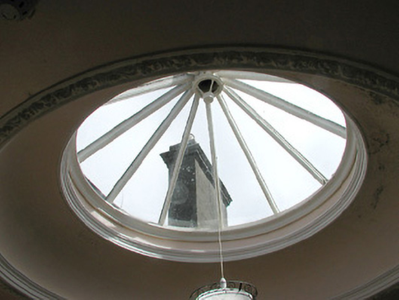
Castlecor House, County Longford, photograph from the National Inventory of Architectural Heritage [1]

The National Inventory continues to tell us the history of the house: “The building was extended c. 1850 (the house appears on its original plan on the Ordnance Survey first edition six-inch map 1838) by the construction of a two-storey block to the northeast corner of the house, between two of the wings of the original structure. The earlier wing to the west may have been extended at this time also. The lion’s head motifs to the rainwater goods throughout the building (built around and before c. 1850) are very similar to those found at the gate lodge serving Castlecor to the northwest, built c. 1855, suggesting that the house was altered at this time, possibly as part of wider program of works at the estate.”
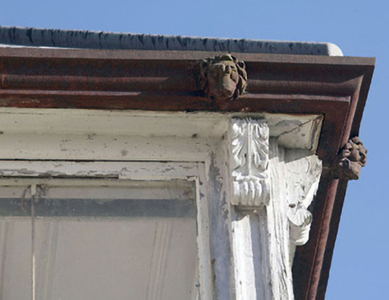
The lion’s head motifs to the rainwater goods throughout the building: Castlecor House, County Longford, photograph from the National Inventory of Architectural Heritage [1]

The National Inventory continues: “The projection to the south wing having the box bay window also looks of mid-to-late nineteenth century date and may also have been added at this time. The Castlecor estate was bought by the Hussey family during the late-eighteenth century following the death of Cutts Harman, and the first series of works may have been carried out when Capt. Thomas Hussey (1777 – 1866), High Sheriff of Longford from 1840 – 44, was in residence. However, the Castlecor estate was offered for sale by Commissioners of Incumbered Estates in 1855 when it was bought by a branch of the Bond family and, perhaps, the house was extended just after this date by the new owners. The Bonds were an important landed family in Longford at the time, and owned a number of estates to the centre of the county, to the north of Castlecor, and a branch also lived at adjacent Moygh/Moigh House (13402606) [still standing and in private hands] during the second half of the nineteenth century. Thomas Bond (1786 – 1869) [of Edgeworthstown] was probably the first Bond in residence at Castlecor. A John Bond, later of Castlecor, was High Sheriff of Longford in 1856. The last Bond owner/resident was probably a Mrs Clerk (nee Bond) [Emily Constance Smyth Bond] who was in residence in 1920. She married a Charles James Clerk (J.P. and High Sheriff of Longford in 1906) in 1901/2, and he was responsible for the three-bay two-storey block that now forms the main entrance, built c. 1913. This block was built to designs by A. G. C. Millar, an architect based on Kildare Street, Dublin. This block is built in a style that is reminiscent of a mid-eighteenth century house, having a central pedimented tripartite doorcase and a rigid symmetry to the front elevation. The house became a convent (Ladies of Mary) sometime after 1925 until c. 1980, and was later in use as a nursing home until c. 2007. This building, particularly the original block, is one of the more eccentric and interesting elements of the built heritage of Longford, and forms the centrepiece of a group of related structures.” [1]

The website tells us that the four wings adjoining the original octagonal hunting lodge align with the four cardinal compass points.

In 2009, the current owners Loretta Grogan and Brian Ginty set about purchasing the house, with the aspiration to restore Castlecor House, its grounds, native woodland and walled garden with pond and orchard to its former glory, opening it to the public by appointment and also welcoming guests.

2. Maria Edgeworth Visitor Centre, Longford, County Longford.

https://www.discoverireland.ie/longford/the-maria-edgeworth-visitor-centre
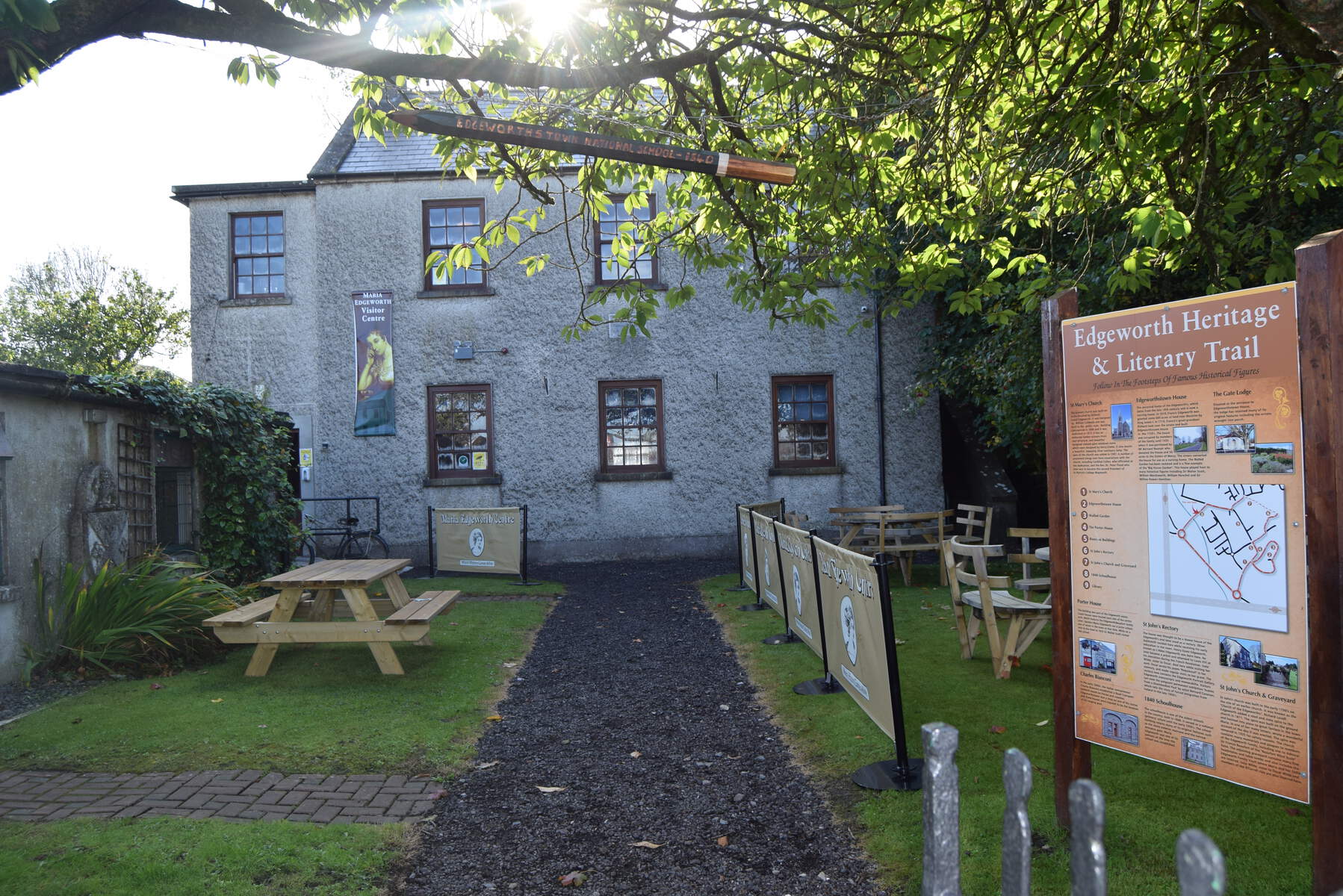
Maria Edgeworth Visitors Centre, Edgeworthstown, Co Longford, photo by Dympna Reilly 2020 ©Longford County Council, Ireland’s Content Pool (see [15])

The Maria Edgeworth Centre, in County Longford, is located in one of Ireland’s oldest school buildings that opened in 1841. Using a combination of audio, imagery and interactive displays, the centre tells the story of the Edgeworth family and the origins of the National School system. You will also learn about the role the family played in the educational, scientific, political and cultural life in Ireland. Maria Edgeworth was a notable pioneer of literature and education, a feminist and a social commentator of her time. Audios and displays are available in seven languages.”

3. Moorhill House, Castlenugent, Lisryan, Co. Longford – section 482

Open dates in 2025: Aug 1-31, Sept 1-29, 9.30am-1.30pm
Fee: adult/OAP/student/child €8

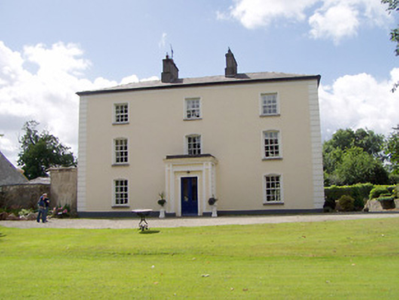
Moorhill House, photograph from the National Inventory of Architectural Heritage.[4]

The National Inventory describes it:

Detached three-bay two-storey over basement house on L-shaped plan, built c. 1815, having two-storey-storey return to rear (northwest) with pitched slate roof. Two-storey extension attached to the northwest end of rear return. Recently renovated. Possibly incorporating fabric of earlier building/structure. …This appealing and well-proportioned middle-sized house, of early nineteenth-century appearance, retains its early form, character and fabric. Its form is typical of houses of its type and date in rural Ireland, with a three-bay two-storey main elevation, hipped natural slate roof with a pair of centralised chimneystacks, and central round-headed door opening with fanlight. The influence of classicism can be seen in the tall ground floor window openings and the rigid symmetry to the front facade. The simple doorcase with the delicate petal fanlight over provides a central focus and enlivens the plain front elevation. The return to the rear has unusually thick walls and a relative dearth of openings, possibly indicating that it contains earlier fabric. This house forms an interesting group with the entrance gates to the southeast, the outbuildings (13401509) and walled garden to the rear, and the highly ornate railings to the southwest side featuring a sinuous vine leaf motif. The quality of these railings is such that their appearance is equally fine from both sides, the vine leaves being cast in three dimensions. They are notable examples of their type and date, and add substantial to the setting of this fine composition, which is an important element of the built heritage of the local area. Moorhill was the home of a R. (Robert or Richard) Blackall, Esq. in 1837 (Lewis). The Blackalls were an important family in the locality and built nearby Coolamber Manor c. 1837 [built for Major Samuel Wesley Blackhall (1809 – 1871)…to designs by the eminent architect John Hargrave (c. 1788 – 1833). Hargrave worked extensively in County Longford during the 1820s and was responsible for the designs for the governor’s house at Longford Town Jail in 1824; works at Ardagh House in 1826; the rebuilding of St. Paul’s Church of Ireland church at Newtown-Forbes; the remodelling of Castle Forbes, nearby Farragh/Farraghroe House (demolished); Doory Hall now ruinous; St. Paul’s Church of Ireland church, Ballinalee; and possibly for the designs of St. Catherine’s Church of Ireland church at nearby Killoe. …and [Coolamber Manor] may have replaced an earlier house associated with the Blackall family at Coolamber (a Robert Blackall (1764 – 1855), father of the above, lived in Longford in the late-eighteenth century)].

Moorhill House “was possibly the home of Robert Blackall, the father of Samuel Wensley, who was responsible for the construction of Coolamber Manor and later served as M.P. (1847 – 51) for the county before serving as Governor of Queensland, Australia from 1868 until his death in 1871. Moorhill may have been the residence of a Francis Taylor in 1894 (Slater’s Directory).”

Places to stay, County Longford:

1. Castlecor House, County Longford – see above

https://castlecorhouse.com/

2. Newcastle House Hotel, Ballymahon, County Longford

https://www.newcastlehousehotel.ie

Newcastle House (now a hotel), County Longford, photograph from Newcastlehousehotel.ie
photograph from the Newcastlehousehotel.ie

Newcastle House is a 300-year-old manor house, set on the banks of the River Inny near Ballymahon, in Co. Longford.

The website tells us; “Standing on 44 acres of mature parkland and surrounded by 900 acres of forest, Newcastle House is only one and half hour’s drive from Dublin, making it an excellent base to see, explore and enjoy the natural wonders of Ireland. So whether you are looking for a peaceful place to stay (to get away from it all) or perhaps need a location to hold an event, or that most important wedding, give us a call.”

Newcastle House (now a hotel), County Longford, photograph from the National Inventory of Architectural Heritage. [5]

The website previously included a brief history of the inhabitants of Newcastle:

Newcastle Wood was once part of Newcastle Demesne, an estate of some 11,000 hectares run by the King- Harman family in the 1800’s. The beautiful, historic nearby Newcastle House was where the King- Harmans lived and there are many features and place names in the woodland which refer back to that time.

We came across Lawrence Harman Parsons (1749-1807) who became the 1st Earl of Rosse, and who added Harman to his surname to become Lawrence Harman Parsons Harman, when he inherited Castlecor in County Longford. He married Jane King, daughter of Edward Thomas King, 1st Earl of Kingston, from Boyle, County Roscommon. They had a daughter, Frances Parsons-Harmon, who married Robert Edward King (1773-1854), 1st Viscount Lorton of Boyle, County Roscommon. Their second son, Lawrence Harman King assumed the additional name of Harman to become Lawrence Harman King-Harman (1816-1875). It was his family who lived at Newcastle Wood.

The old website continued: “The King- Harmans were generally regarded as good landlords by the local populace. They employed many local people in all sorts of trades. The last of the King- Harmans died in 1949. King- Harman sold lands to the Forestry Department in 1934 and over the following two years it was planted with a mixture of coniferous and broadleaf trees.

Then National Inventory describes the house:

Detached double-pile seven-bay three-storey over basement former country house, built c. 1730 and altered and extended at various dates throughout the eighteenth and nineteenth century, having curvilinear Dutch-type gable to the central bay and later gable-fronted single-bay single-storey entrance porch with matching curvilinear Dutch-type gable to the centre of the main block (southeast elevation), built c. 1820. Advanced three-bay single-storey over basement wing flanking main block to northeast, and advanced four-bay two-storey over basement wing flanking main block to southwest, both built c. 1785. Recessed single-bay single-storey over basement Tudor Gothic style addition attached to northeast elevation having gable-fronted rear elevation and chamfered corners at ground floor level having dressed ashlar limestone masonry , built c. 1850, and two-storey extension to southwest, built c. 1880. Possibly incorporating the fabric of earlier house(s) to site c. 1660. Later in use as a convent and now in use as a hotel…Round-headed door opening to front face of porch (southeast) having carved limestone surround with architrave, square-headed timber battened door with decorative cast-iron hinge motifs, wrought-iron overlight, and having moulded render label moulding over.Painted stuccoed ceilings and ceiling cornices, some with a neoclassical character, a number of early panelled timber doors and marble fireplaces survive to interior...” [5]

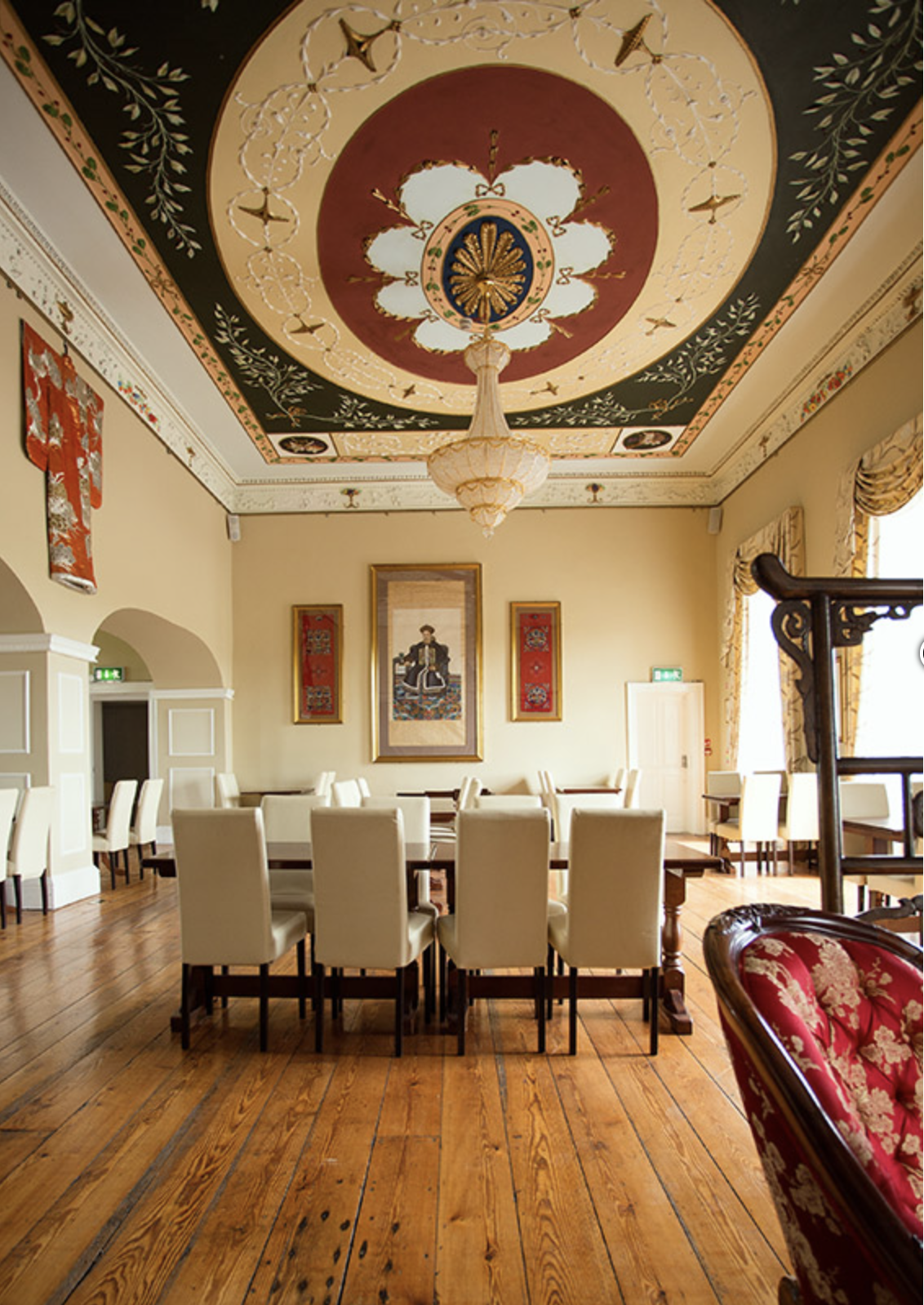
Newcastle House, photograph from National Inventory of Architectural Heritage: “Round-headed door opening to front face of porch (southeast) having carved limestone surround with architrave, square-headed timber battened door with decorative cast-iron hinge motifs, wrought-iron overlight, and having moulded render label moulding over.” The Inventory tells us that the carved coat of arms is probably of the King family. [5]
Newcastle House, photograph from Newcastlehousehotel.ie: “Painted stuccoed ceilings and ceiling cornices, some with a neoclassical character.” [5]
photograph from the Newcastlehousehotel.ie

Before belonging to the King-Harman family, Newcastle belonged to the Sheppard family. It came to the King-Harman family through the marriage of Frances Sheppard (d. 1766) daughter of Anthony Sheppard of Newcastle to Wentworth Harman (d. 1714) of Moyle, County Longford.

The National Inventory adds:

The lands and house at Newcastle were successively in the possession of the Chappoyne/Chappayne/Choppin, the Sheppard, the Harman and the King-Harman families. The earliest mention of the estate is references to an Anthony Chappoyne at Newcastle in 1660, although this may have been the site of an earlier ‘castle’ from as early as the fourteenth century (as the placename suggests). In 1680 a Robert Choppayne appears to have purchased/consolidated the lands of Newcastle from Gerald Fitzgerald, 17th Earl of Kildare. Dowdall (1682) describes the site as ‘..on the southside of the river is Newcastle, the antient Estate of the Earl of Kildare now the estate and habitation of Robert Choppin Esqr where he hath lately built a fair house and a wooden bridge over said river’. The estate passed into the ownership of Anthony Sheppard (born 1668 – 1738), heir (son?) of Robert Chappoyne, c. 1693, who served as High Sheriff of County Longford in 1698. His son, also Anthony, was M.P. for Longford in 1727. The estate later passed by marriage into the ownership into the Harman family at the very end of the seventeenth century. Robert Harman (1699 – 1765; M.P. for Longford c. 1760 -5) [son of Wentworth Harman and Frances Sheppard] was in possession of the estate of much of the middle of the eighteenth century and it is likely that he was responsible for much of the early work on the house. The Very Revd. Cutts Harman, who built the quirky hunting/fishing lodge at nearby Castlecor, inherited the house c. 1765 following the death of his brother Robert. The estate later passed into the ownership of Lawrence Parsons-Harman (1749 – 1807) in 1784 (M.P. for Longford 1776 – 1792; Baron Oxmantown in 1792; Viscount Oxmantown in 1795; Earl of Rosse 1806; sat was one of the original Irish Representative Peers in the British House of Lords) and he greatly increased the Newcastle estate, and by his death (1807) its size had doubled to approximately 31,000 acres in size. It is likely that he was responsible for the construction of the side wings to the main block and general improvements to the house from 1784. The estate passed into the ownership of his wife Jane, Countess of Rosse (who partially funded the construction of a number of Church of Ireland churches and funded a number of schools in County Longford during the first half of the nineteenth century), who left the estate to her grandson Laurence King-Harman (1816 – 1878) after falling out with her son. Laurence King-Harman has probably responsible for the vaguely Tudor Gothic extension to the northeast elevation. The brick chimneystacks also look of mid-nineteenth century date and may have been added around the same time this wing was constructed. The King family had extensive estates in Ireland during the nineteenth century, owning the magnificent Rockingham House (demolished) and King House [also a Section 482 property which I hope to visit later this year], Boyle, both in County Roscommon; as well as Mitchelstown Castle in County Cork, burnt in 1922 (memorial plaques and carved stone heads from Mitchelstown Castle were built into the northeast elevation of Newcastle House c. 1925, but have been removed and returned to Cork in recent years). The estate reached its largest extent in 1888, some 38,616 acres in size, when Wentworth Henry King-Harman was in residence. The estate was described in 1900 as ‘a master-piece of smooth and intricate organisation, with walled gardens and glasshouses, its diary, its laundry, its carpenters, masons and handymen of all estate crafts, the home farm, the gamekeepers and retrievers kennels, its saw-mill and paint shop and deer park for the provision of venison. The place is self supporting to a much greater degree than most country houses in England’. The estate went in to decline during the first decades of the twentieth century, and with dwindled in size to 800 acres by 1911. The house and estate remained in the ownership of the King-Harman family until c. 1951, when Capt. Robert Douglas King-Harman sold the house to an order of African Missionary nuns (house and contents sold for £11,000). It was later in use as a hotel from c. 1980.” [5]

photograph from the Newcastlehousehotel.ie

3. Viewmount House, Longford

http://www.viewmounthouse.com

Viewmount House, photograph from National Inventory of Architectural Heritage. [6]

The website tells us:

Discover this boutique gem, a secret tucked away in the heart of Ireland. This magnificent 17th century manor is complemented by its incredible countryside surroundings, and by the four acres of meticulously-maintained garden that surround it. Within the manor you’ll find a place of character, with open fires, beautiful furniture, fresh flowers and Irish literature. The manor retains its stately, historic charm, and blends it with thoughtful renovation that incorporates modern comfort.

Here, you will unwind into the exceptionally relaxing atmosphere, a restful world where all you hear is peace, quiet and birdsong.

This house was advertised for sale in recent years. The National Inventory describes it:

Detached three-bay three-storey house, built c. 1750 and remodeled c. 1860, having single-bay single-storey porch with flat roof to the centre of the front elevation (north). Renovated c. 1994. Formerly in use as a Church of Ireland charter school (c. 1753 – 1826)…This elegant mid-sized Georgian house is a fine example of the language of classical architecture reduced to its essential elements. It retains its early character and form despite recent alterations….Set in extensive mature grounds, this fine structure is a worthy addition to the architectural heritage of County Longford….This house was the home of the Cuffe family during the first half of the eighteenth century. It was later inherited by Thomas Pakenham (later [1st] Baron Longford [of Pakenham Hall, or Tullynally, County Westmeath, another section 482 property, see my entry]) following his marriage to Elizabeth Cuffe (1714-94) in 1739 or 1740. It is possible that Viewmount House was constructed shortly after this date and it may have replaced an earlier Cuffe family house on or close to the present site. The house was never lived in by the Pakenham family but it was used by their agent to administer the Longford estate, c. 1860. It was apparently in use as a charter school from 1753 until 1826, originally founded under the patronage of Thomas Pakenham. There is a ‘charter school’ indicated here (or close to here) on the Taylor and Skinner map (from Maps of the Roads of Ireland) of the area, dated between 1777 – 1783. A ‘free charter school’ at Knockahaw, Longford Town, with 32 boys, is mentioned in an Irish Education Board Report, dated 1826 – 7 (Ir. Educ. Rept 2, 692 – 3).” [6]

[1] https://www.buildingsofireland.ie/buildings-search/building/13402608/castlecor-house-castlecore-longford

[2] p. 66. Bence-Jones, Mark. A Guide to Irish Country Houses (originally published as Burke’s Guide to Country Houses volume 1 Ireland by Burke’s Peerage Ltd. 1978); Revised edition 1988 Constable and Company Ltd, London.

[3] www.irishhistorichouses.com/2020/12/10/kilshannig-house-rathcormac-county-cork/
[4] https://www.buildingsofireland.ie/buildings-search/building/13401508/moorhill-house-castlenugent-longford

[5] https://www.buildingsofireland.ie/buildings-search/building/13402709/newcastle-house-newcastle-newcastle-demesne-longford

[6] https://www.buildingsofireland.ie/buildings-search/building/13007038/viewmount-house-knockahaw-longford

Portraits H

H

The excellent site of Timothy William Ferres tells us of the Hamiltons, of Stackallen in County Meath:

GUSTAVUS HAMILTON (1642-1723), having abandoned the fortunes of JAMES II, to whom he was a privy counsellor, and distinguished himself as a military officer in the service of WILLIAM III, particularly at the battle of the Boyne, and the siege of Derry, was sworn of the Privy Council of the latter monarch, appointed Brigadier-General of his armies, and further rewarded with a grant of forfeited lands. General Hamilton was MP for County Donegal, 1692-1713, and for Strabane, 1713-15. He was elevated to the peerage, 1715, in the dignity of Baron Hamilton of Stackallan, County Meath. His lordship was advanced to a viscountcy, in 1717, as VISCOUNT BOYNE.

Gustavus Hamilton (1642-1723) 1st Viscount Boyne, c. 1680 unknown artist.

He married Elizabeth, second daughter of SIR HENRY BROOKE, Knight, of Brookeborough, County Fermanagh. They had issue:

FREDERICK (c. 1663-1715), father of GUSTAVUS, 2nd Viscount;
Gustavus, father of 3rd and 4th Viscounts;
Henry, MP for Donegal, 1725-43;
Elizabeth.

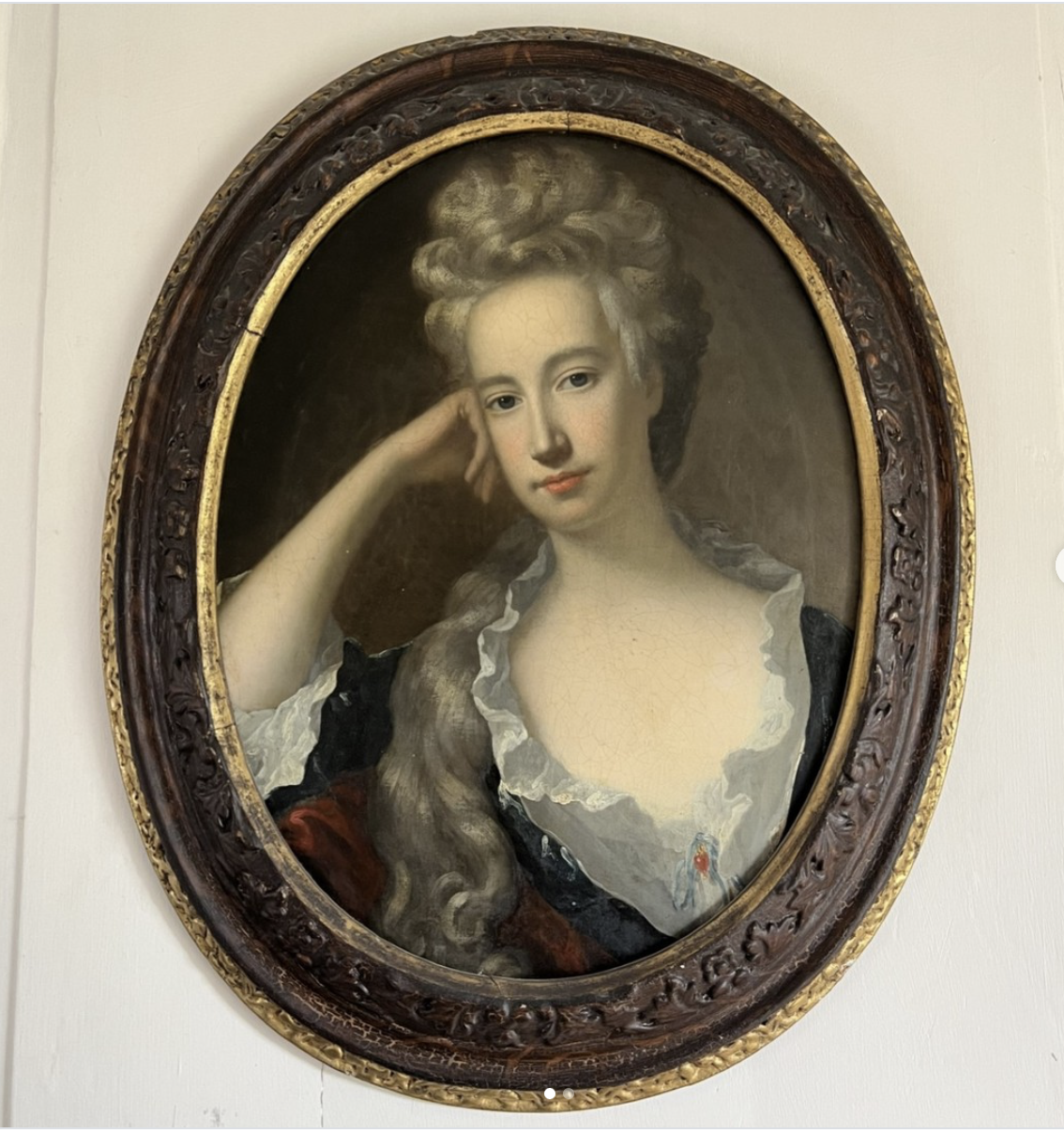
Mary Preston youngest daughter of the Hon. Henry Hamilton, MP for Donegal, 1725-43, by Hugh Douglas Hamilton, courtesy of Adam’s auction 20 Sept 2015. Mary Hamilton married in 1764 (as his second wife) the second Nathaniel Preston (1724-1796), Reverend, of Swainstown, Co. Meath. Her father was a younger son of Gustavus Hamilton 1st Viscount Boyne of Stackallan, Co. Meath and her parents were intimate with Mrs Delaney who of them said – “I never saw a couple better suited than Mr Hamilton and his wife, their house like themselves looks cheerful and neat…., they have four children, whose behaviour shows the sense of their parents”. Mary’s brother, Sackville Hamilton became a competent and respected Civil Servant.

The 1st Viscount was succeeded by his grandson, GUSTAVUS, 2nd Viscount (1710-46).

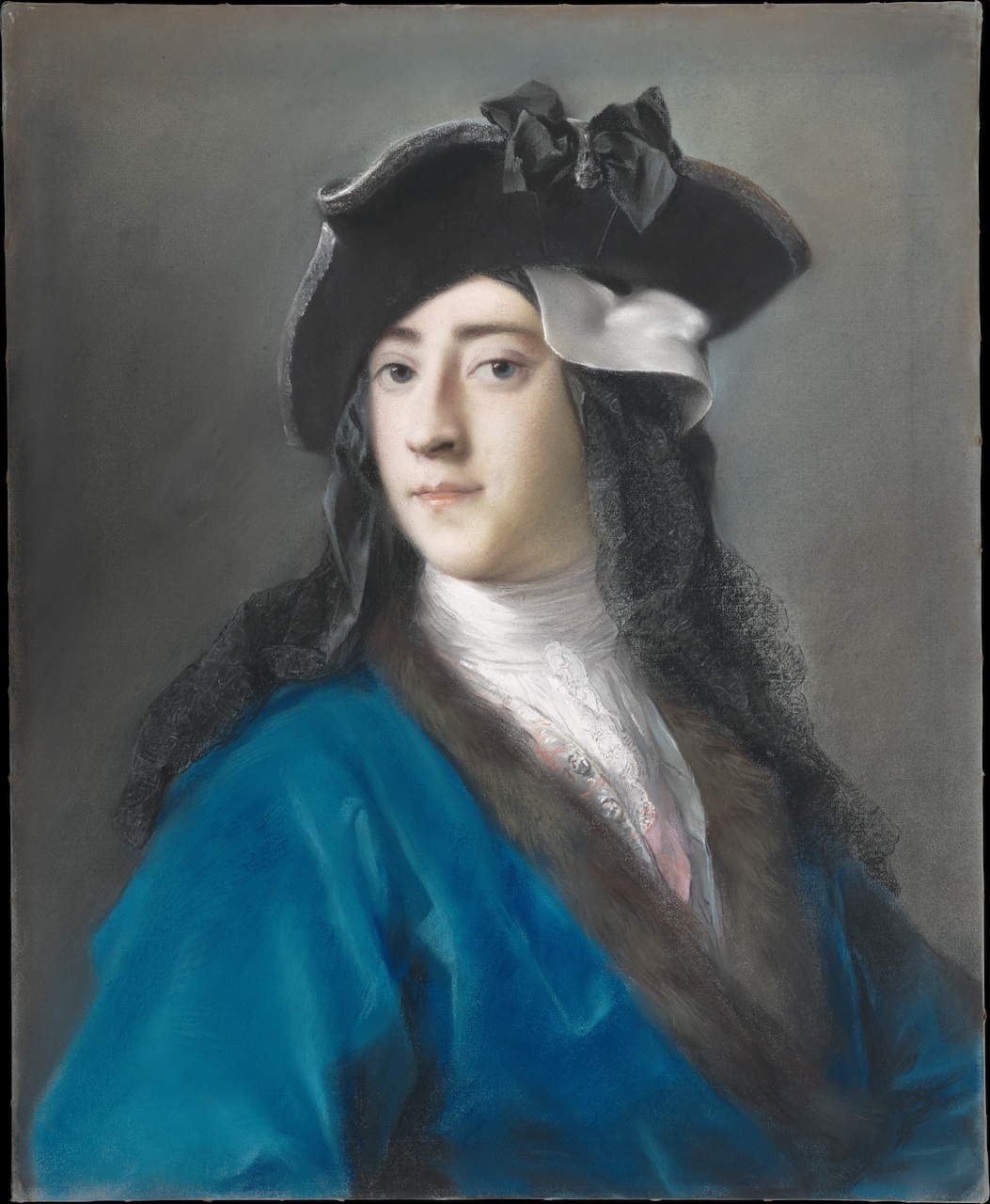
Gustavus Hamilton (1710-46) 2nd Viscount Boyne with a “bauta masque” i.e. the Venetian type supposedly worn by Cassanova, on his ear, by Rosalba Carriera around 1730. He was a founder member of The Society of Dilettanti (founded 1734), a British society of noblemen and scholars that sponsored the study of ancient Greek and Roman art, and the creation of new work in the style.
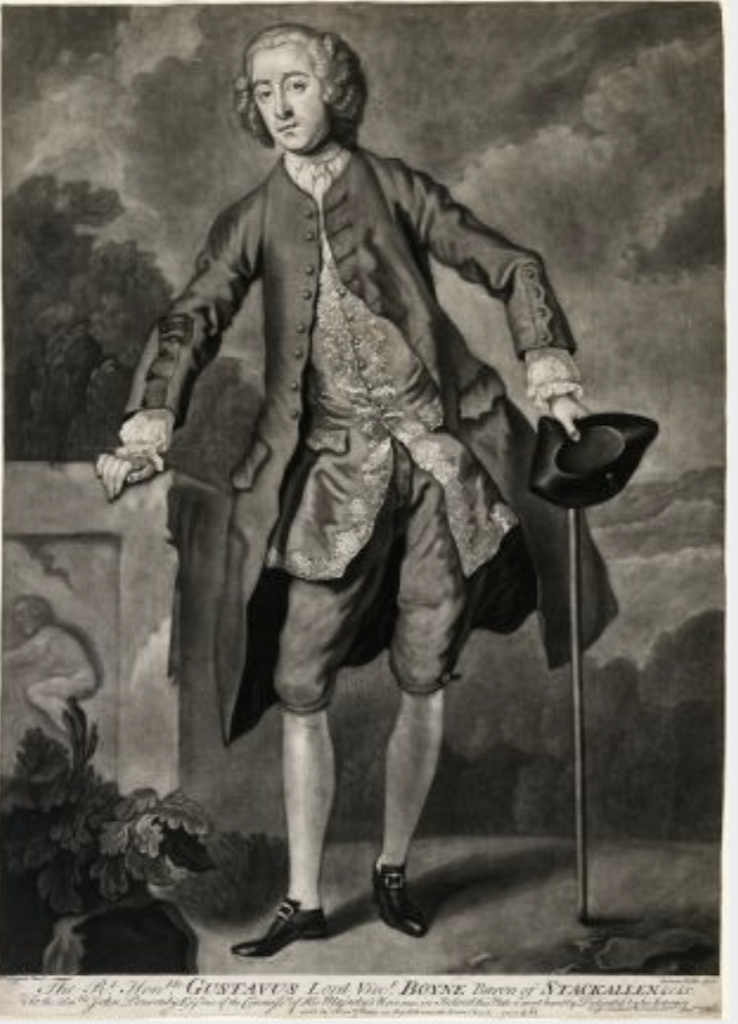
Gustavus Hamilton, 2nd Viscount Boyne, (1710-1746) Engraver Andrew Miller, English, fl.1737-1763 After William Hogarth, English, 1697-1764, courtesy of National Gallery of Ireland.
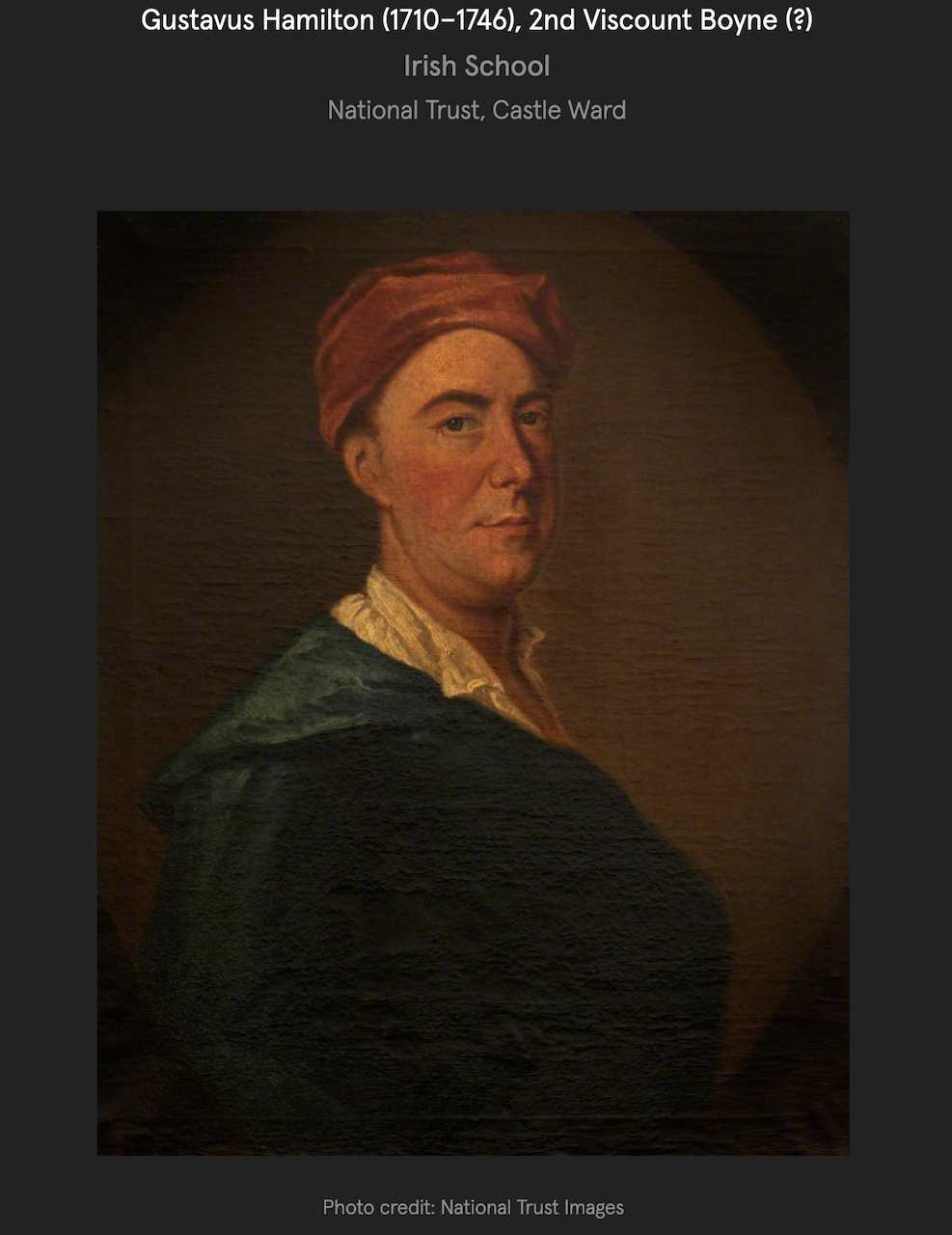
Gustavus Hamilton, 2nd Viscount Boyne, (1710-1746) courtesy of National Trust Castle Ward.

Gustavus 2nd Viscount died unmarried, and the honours devolved upon his cousin, Frederick, 3rd Viscount (1718-72).

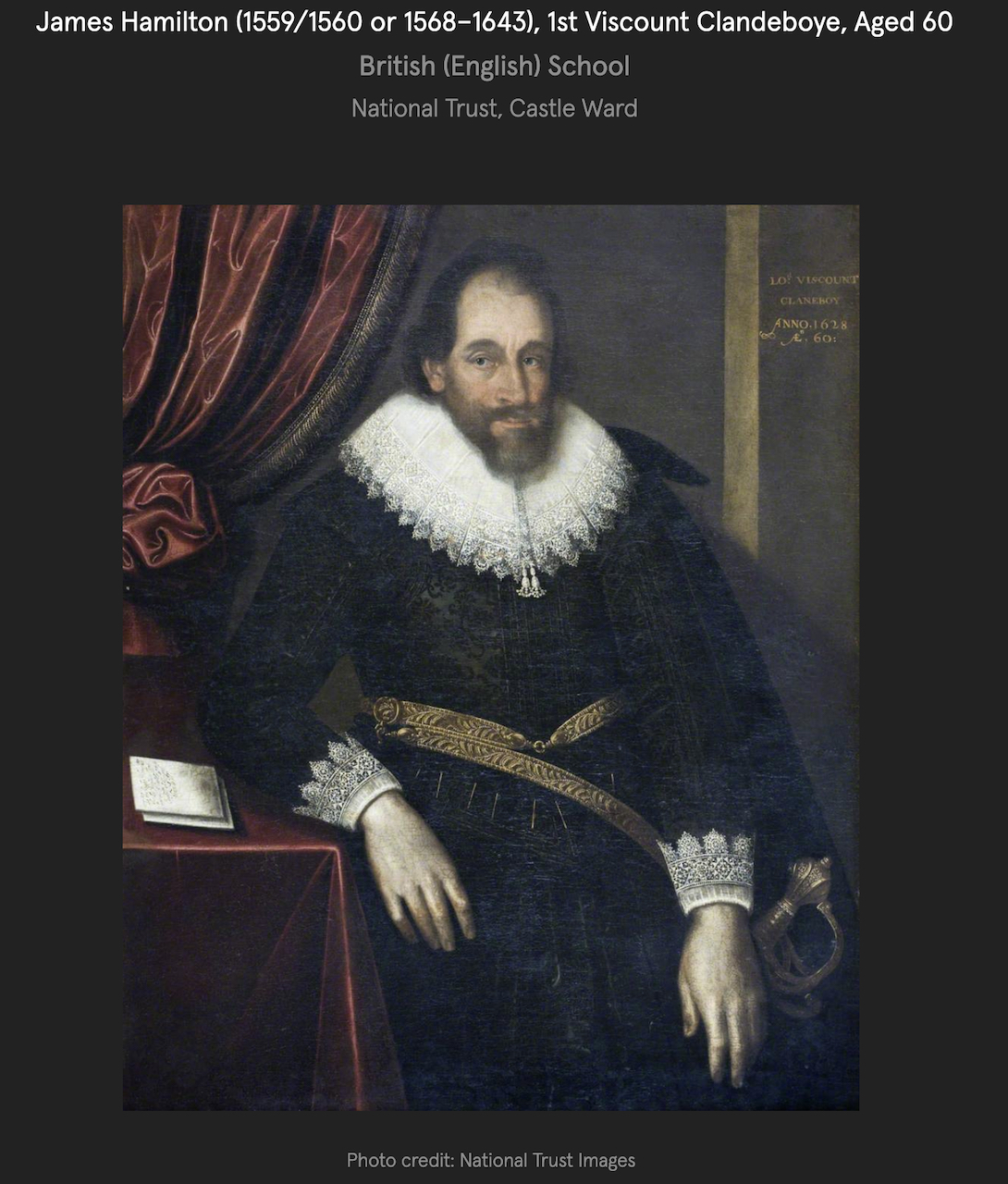
James Hamilton (1559/1560 or 1568-1643) 1st Viscount Clandeboye, courtesy of National Trust Castle Ward.

James Hamilton (1559/1560 or 1568-1643) 1st Viscount Clandeboye married Ursula, daughter of Edward Brabazon, 1st Lord Brabazon, Baron of Ardee. They had no children and after her death he married Jane Philipps, who gave birth to their heir James Hamilton (1617/18-1643) 1st Earl of Clanbrassil, County Armagh.

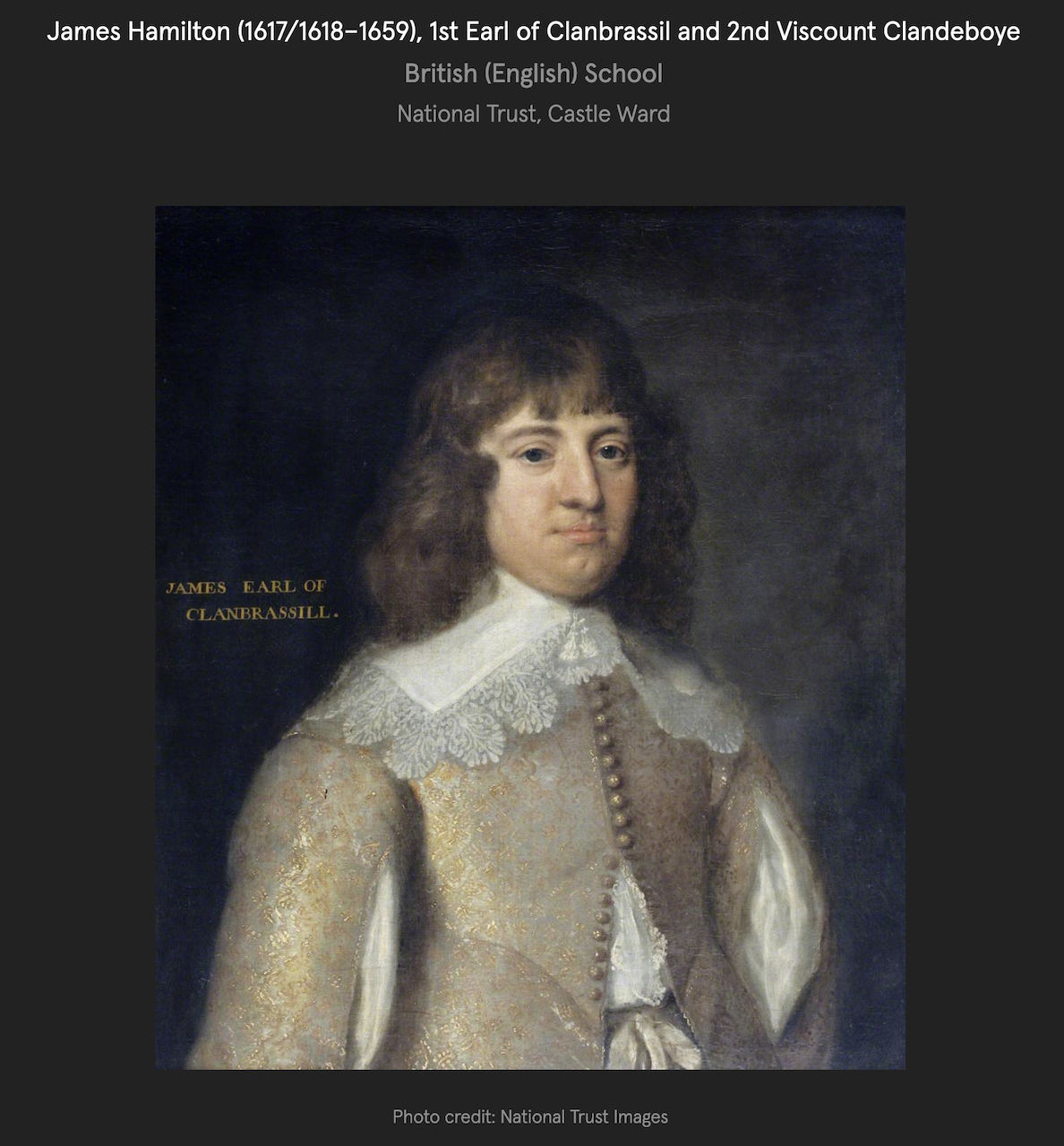
James Hamilton (1617/1618-1659) 1st Earl of Clanbrassil and 2nd Viscount Clandeboye, courtesy of National Trust Castle Ward.

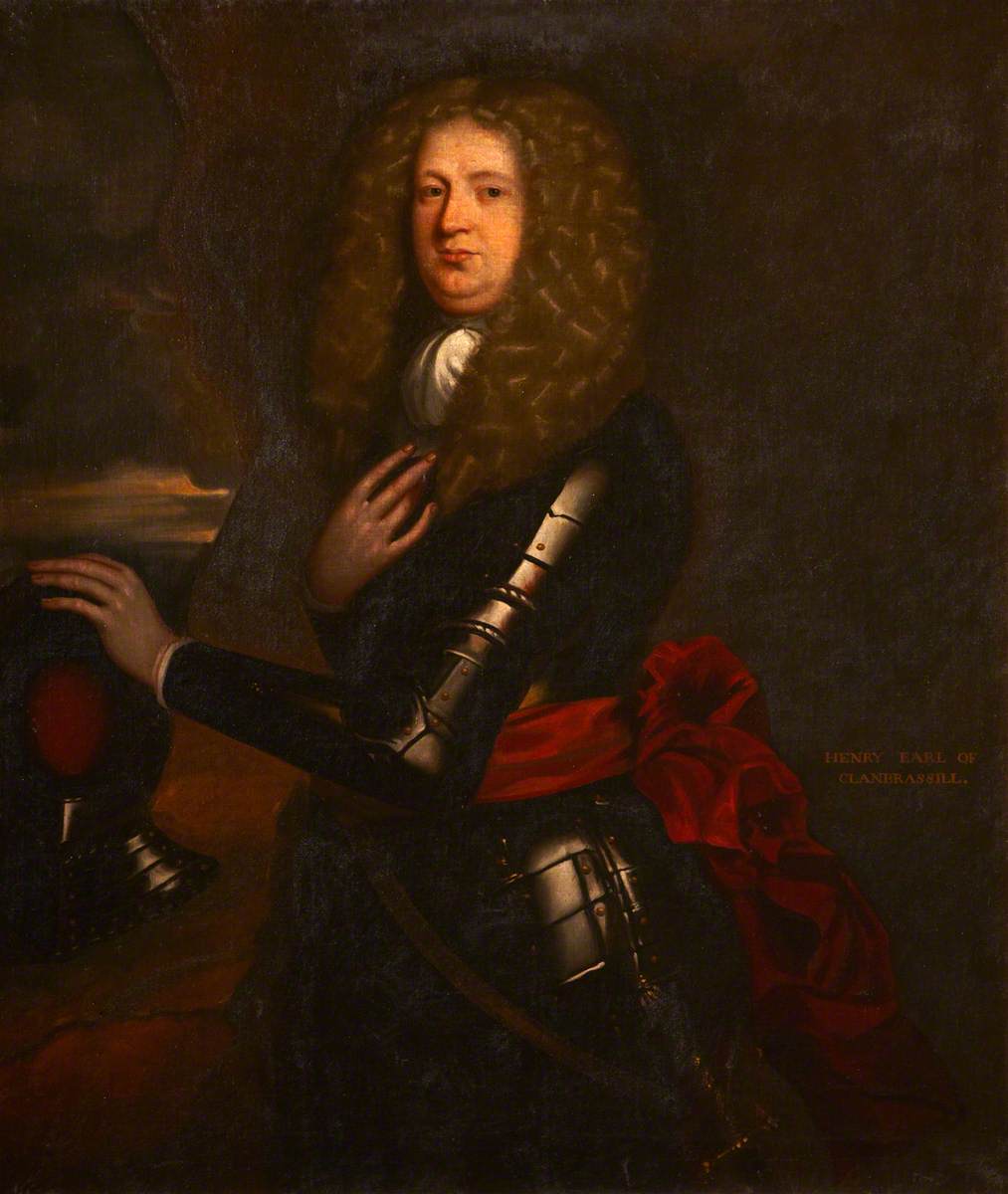
James Hamilton (1617/18-1643) 1st Earl of Clanbrassil married Anne Carey (d. 1688/89), who gave birth to their heir Henry Hamilton (1647-1675), 2nd Earl of Clanbrassil. They had no children and after his death the title became extinct. The name Claneboye was revived in a title in 1800 when his great-great-grandniece Dorcas Blackwood was made 1st Baroness Dufferin and Claneboye.

Van Dyck – Lady Anne Carey, Later Viscountess Claneboye and Countess of Clanbrassil, ca. 1636 ©The Frick Collection Photo Credit Michael Bodycomb. She married James Hamilton 1st Earl of Clanbrassil, Co Armagh.
Dorcas Blackwood née Stevenson (1730-1808), Baroness, by Gilbert Stuart 22.737 Museum of Fine Arts https://www.mfa.org/collections/object/dorcas-lady-blackwood-dorcas-stevenson-baroness-31992 She married John Blackwood 2nd Baronet of Ballyleidy, County Down.
Henry Hamilton (1647-1675), 2nd Earl of Clanbrassil; National Trust, Castle Ward, attributed to Jacob Huysmans 1650; http://www.artuk.org/artworks/henry-hamilton-16471675-2nd-earl-of-clanbrassil-132220 His family alleged that he was murdered by his wife, Lady Alice Moore (Lady Clanbrassil), so that she could inherit his estate.

There were lots of creations of Earls of Clanbrassil! There was James Hamilton (1697-1758) 1st Earl of Clanbrassill, Co. Armagh. He was the son of James Hamilton (d. 1693) and Anne Mordaunt.

Anne Hamilton née Mordaunt (b. 1666) later Mrs James Hamilton (d. 1693) of Tollymore, attributed to Mary Beale, courtesy of National Trust Castle Ward. She was the sister of Sophia Mordaunt who married James Hamilton of Bangor (1640-1707).
Sophia Hamilton née Mordaunt, wife of James Hamilton (1640-1707) of Bangor, in style of Charles Jervas, courtesy of National Trust Castle Ward.
Lord Clanbrassil (probably James Hamilton (1729-1798) 2nd Earl of Clanbrassil of second creation) by Thomas Hickey (Irish 1741-1824) courtesy of Wooley and Wallis sale 2010.
Anne Chichester née Hamilton, Countess of Donegall (1731-1780), who married Arthur Chichester 5th Earl of Donegall. She was the daughter of James Brandon Douglas Hamilton 5th Duke of Hamilton, Scotland. Photograph © Jennifer Winder-Baggot, www.irishhistorichouses.com
William Rowan Hamilton (1805-1865), Astronomer Royal and President of the Royal Irish Academy for Dublin University Magazine vol. xix January 1842, engraver John Kirkwood after Charles Grey, courtesy of National Gallery of Ireland.
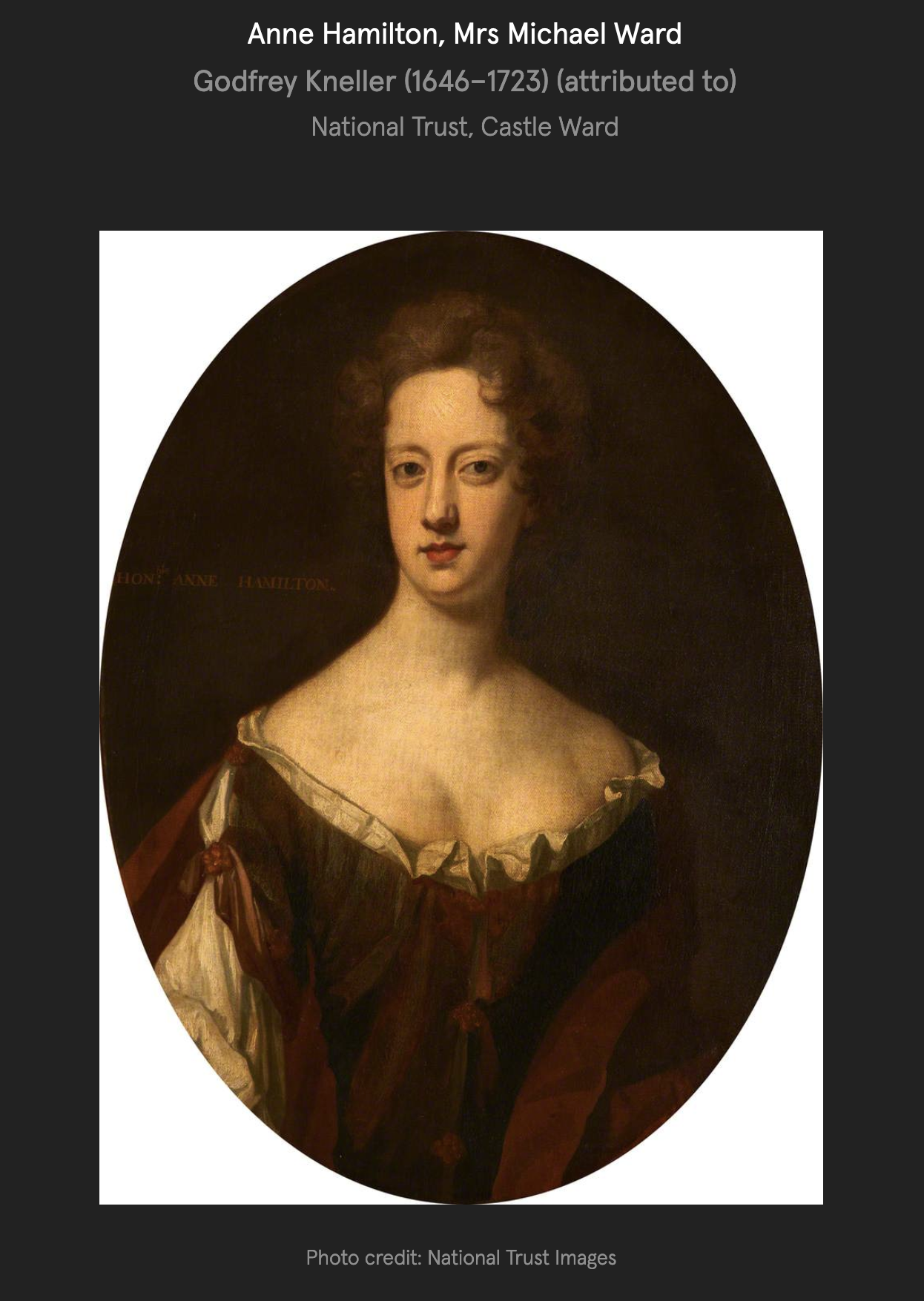
Anne Hamilton (1692-1760) who married Michael Ward (1683-1759), by Godrey Kneller, courtesy of National Trust, Castle Ward. She was the daughter of James Hamilton (1640-1707) of Bangor and Sophia née Mordaunt.
Anne Hamilton (1692-1760) who married Michael Ward (1683-1759) by Charles Jervas, courtesy of National Trust, Castle Ward. She was the daughter of James Hamilton (1640-1707) of Bangor and Sophia née Mordaunt.

James Hamilton (1575-1618) 1st Earl of Abercorn, Co. Linlithgow [Scotland] was Member of the Council of the province of Munster on 20 May 1615. His son Claud Hamilton (d. 1638) was created 2nd Lord Hamilton, Baron of Strabane, County Tyrone. Another son was the heir, James Hamilton, 2nd Earl of Abercorn. The 2nd Earl had a son, George Hamilton who became 3rd Earl of Abercorn but had no children.

Claud Hamilton (d. 1638) 2nd Lord Hamilton, Baron of Strabane, County Tyrone was succeeded by his son James Hamilton (1633-1655) 3rd Lord Hamilton, Baron of Strabane but he died without issue and was succeeded by his brother, George Hamilton (d. 1668) 4th Lord Hamilton, Baron of Strabane.

George’s son Claud Hamilton (1659-1691) succeeded as 5th Lord Hamilton, Baron of Strabane, Co. Tyrone and 4th Earl of Abercorn. He held the office of Lord of the Bedchamber to King James II. He fought in the Battle of the Boyne on 1 July 1690. On 11 May 1691 he was outlawed in Ireland, and his Irish titles were forfeited. He fought in the Battle of Aughrim on 12 July 1691, where he commanded a regiment of horse. [1]

Claud Hamilton (1659–1691) 4th Earl of Abercorn courtesy of http://www.thepeerage.com

Claud Hamilton (1659–1691) 4th Earl of Abercorn didn’t have offspring and was succeeded by his brother, Charles (d. 1701) who became 5th Earl of Abercorn. His brother John (1713/4-1755) had a son, John James Hamilton, who succeeded as 5th Baronet Hamilton, of Donalong, Co. Tyrone and of Nenagh, Co. Tipperary, 9th Earl of Abercorn, and was later created 1st Marquess of Abercorn.

With his death, the senior line of the Abercorns and the Strabanes failed as he had no surviving offspring. With regard to the Abercorns, the succession reverted to the next of the cadet branches descending from the five sons of the 1st Earl of Abercorn as it already had done in about 1650 when George, the 3rd Earl, died unmarried in Padua. As the 1st Earl’s third son, William, 1st Baronet of Westport, had no children, the succession passed to the descendants of the fourth son, Sir George Hamilton (d. 1679) 1st Baronet, of Donalong, County Tyrone and his wife Mary Butler (d. 1680) daughter of Thomas Butler Viscount Thurles. The 5th Earl was therefore succeeded as Earl of Abercorn by his second cousin, James Hamilton (d. 1734) the grandson of Sir George. James Hamilton would thus become the 6th Earl of Abercorn.

James Hamilton, 6th Earl of Abercorn, also 2nd Baronet Hamilton, of Donalong, Co. Tyrone and of Nenagh, Co. Tipperary and 1st Baron Mountcastle, Co. Tyrone was succeeded by his son, James Hamilton, (1685/6-1743/4) 7th Earl of Abercorn, who was succeeded by his son, James Hamilton (1712-1789) 8th Earl of Abercorn, who died unmarried.

James Hamilton, 8th Earl of Abercorn (1712-1789) Engraver John Dean, British, c.1750-1798 After Thomas Gainsborough, English, 1727-1788, courtesy of National Gallery of Ireland.

The next in line was John James Hamilton (1756-1818) who succeed as 5th Baronet Hamilton, of Donalong, Co. Tyrone and of Nenagh, Co. Tipperary, 9th Earl of Abercorn and was later created 1st Marquess of Abercorn. He was the posthumous son of Captain Hon. John Hamilton and his wife Harriet, and grandson of James Hamilton, 7th Earl of Abercorn

Lawrence, Thomas; John James Hamilton (1756-1818) 1st Marquess of Abercorn; The National Trust for Scotland, Haddo House; http://www.artuk.org/artworks/john-james-hamilton-1st-marquess-of-abercorn-196780

John James Hamilton (1756-1818) 1st Marquess of Abercorn married first Catherine Copley and they had several children including a son James (1786-1814), called Viscount Hamilton. He married Harriet Douglas who gave birth to their heir James Hamilton (1811-1885), who was to become 1st Duke of Abercorn.

Cecil Frances Howard née Hamilton, Countess of Wicklow (1795-1860), Wife of William Howard (1788-1869) 4th Earl of Wicklow; After George Henry Harlow, British, 1787-1819, courtesy of National Gallery of Ireland. She was the daughter of John James Hamilton 1st Marquess and 9th Earl of Abercorn.
James Hamilton (1811-1885) 1st Duke of Abercorn, Landowner and politician; Lord Lieutenant of Ireland, possibly by John Watkins 1860s courtesy of National Portrait Gallery NPG Ax21858.

John James Hamilton (1756-1818) 1st Marquess of Abercorn married secondly a cousin, Cecil Hamilton, but they later divorced. He then married Anne Jane Gore, daughter of Arthur Saunders Gore, 2nd Earl of Arran of the Arran Islands.

Anne Jane née Gore daughter of Arthur Saunders Gore, 2nd Earl of Arran of the Arran Islands who married Henry Hatton of Great Clonard in County Wexford and secondly, John James Hamilton, 1st Marquess of Abercorn. Painting by John Opie.
Alexander Hamilton 1690-1768, of Hamwood House, County Meath, photograph courtesy of Hamwood house website.
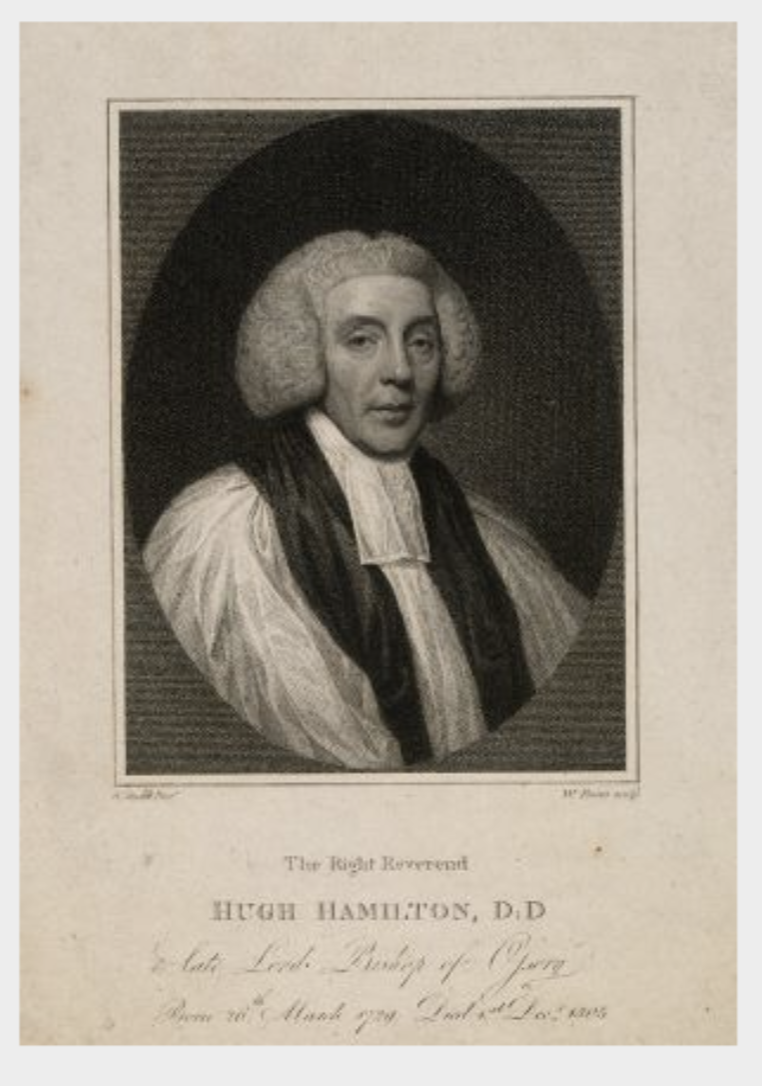
Hugh Hamilton (1729-1805), Protestant Bishop of Ossory, by engraver William Evans, after artist Gilbert Stewart, courtesy of National Gallery of Ireland, NGI.10622. He was a son of Alexander Hamilton 1690-1768.
Charles Hamilton (1772-1857), of Hamwood House, County Meath, photograph courtesy of Hamwood house website.
Marianne Caroline Hamilton née Tighe (1777-1861), photograph courtesy of Hamwood house website. Wife of Charles Hamilton (1772-1857), daughter of William Tighe (1738-1782) of Rossana, County Wicklow.
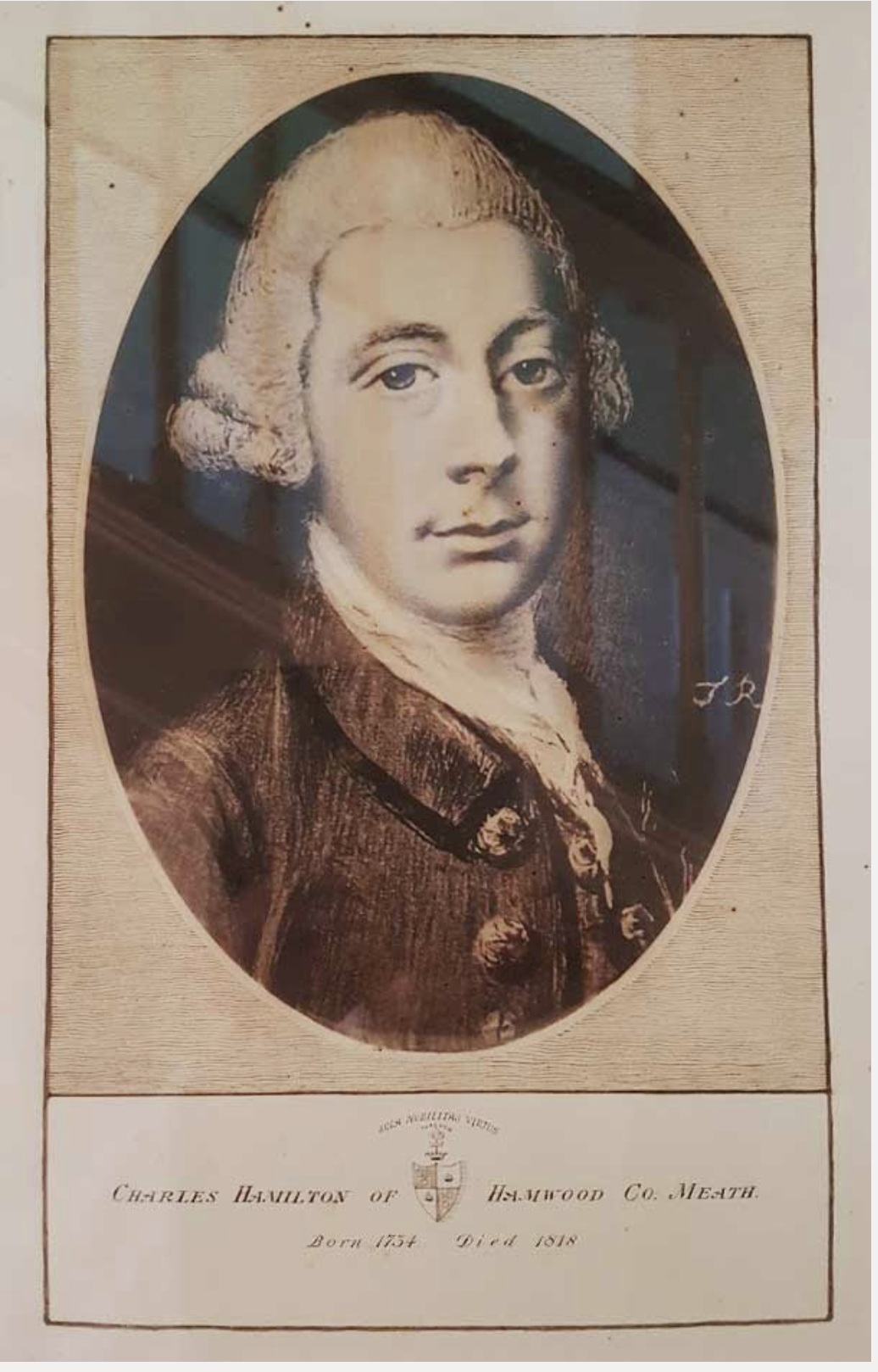
Charles Hamilton (1738-1818) who built Hamwood, photograph courtesy of Hamwood House website.
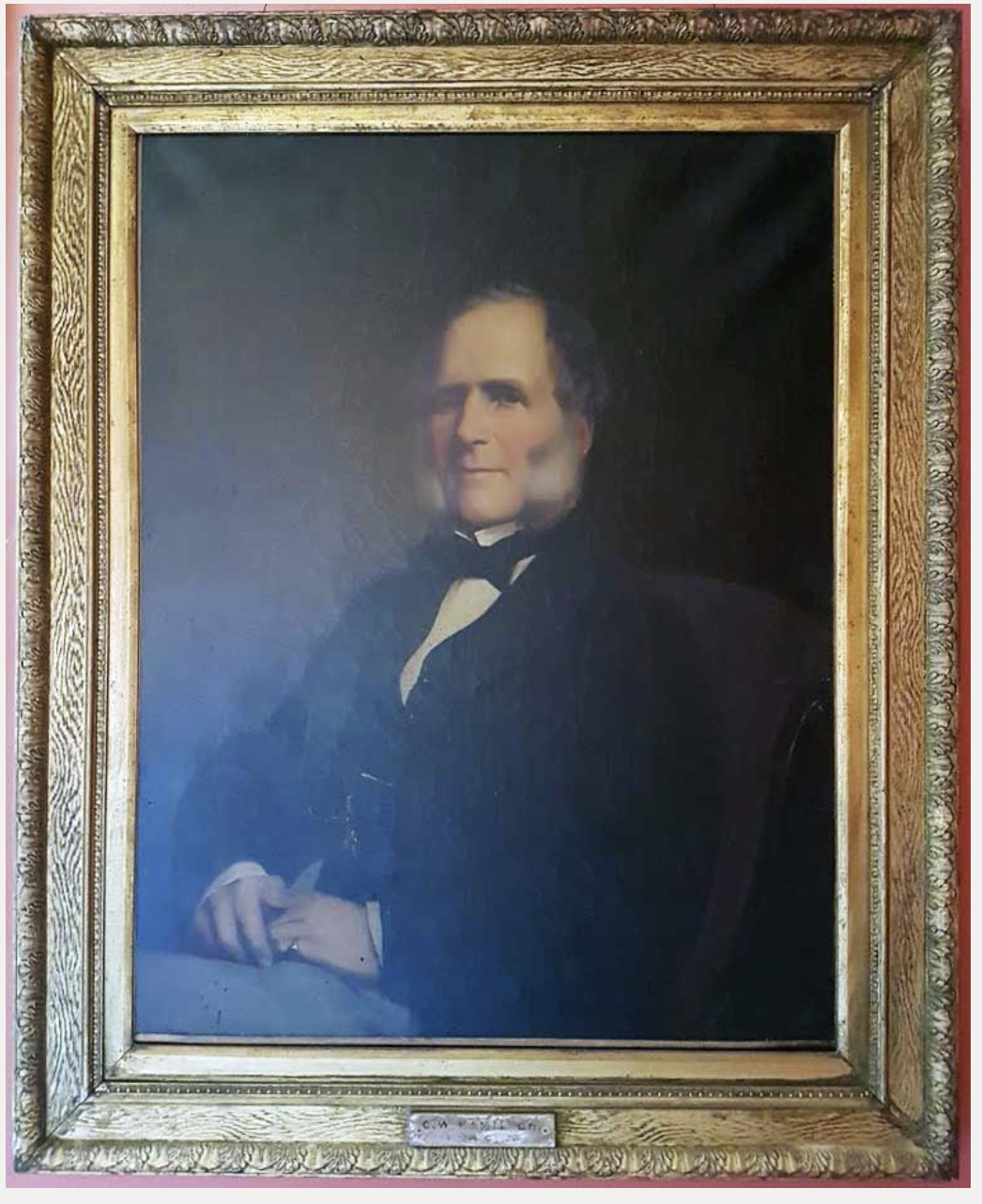
Charles William Hamilton (1802-1880), photograph courtesy of Hamwood house website.
Charles Robert Hamilton (1846-1913), photograph courtesy of Hamwood house website. He is probably seated with his wife Louisa Caroline Elizabeth née Brooke (1850-1922).
Self Portrait, c.1906 by Eva Henrietta Hamilton (1876-1960), courtesy of Whyte’s auction Sept 2009.
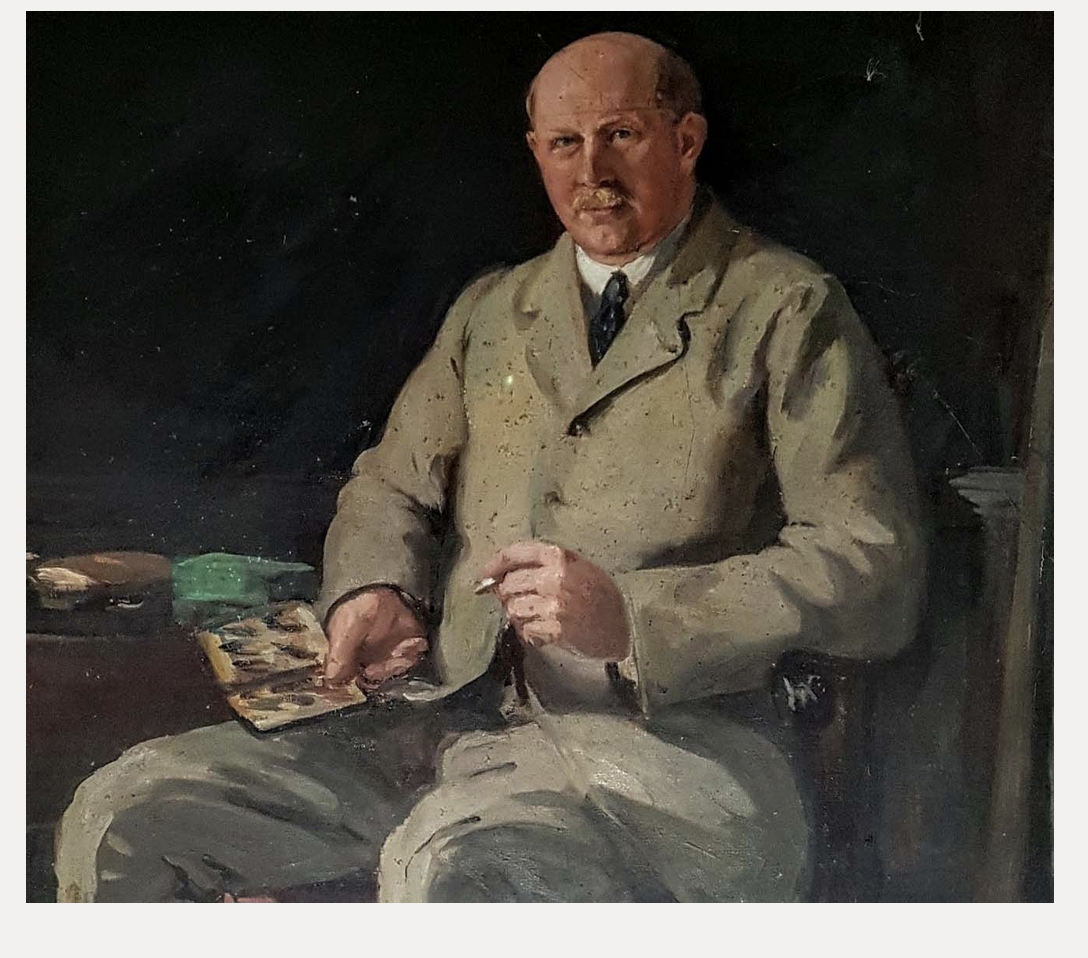
Francis Charles Hamilton (1877-1961), photograph courtesy of Hamwood house website.
Charles Hamilton (1918-2005) was called “The Major,” photograph courtesy of Hamwood house website.
Simon Harcourt, 1st Earl Harcourt, (1714-1777), holding a plan of Nuneham, Oxfordshire, (later Lord Lieutenant of Ireland) Engraver James McArdell, Irish, c.1729-1765 After Benjamin Wilson, English, 1721-1788, courtesy of National Gallery of Ireland.
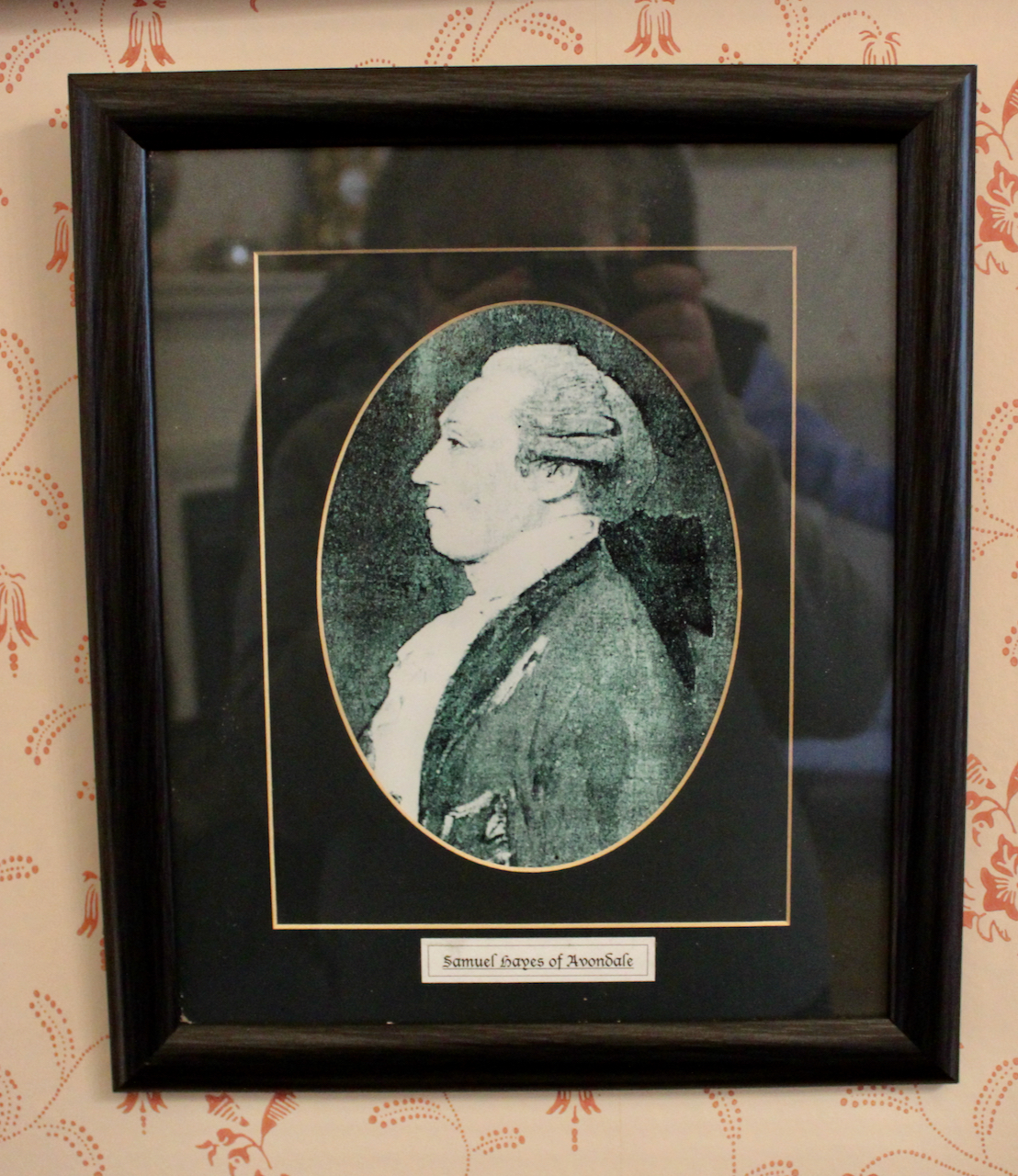
Samuel Hayes (1743-1795), who built Avondale House. Photograph © Jennifer Winder-Baggot, www.irishhistorichouses.com
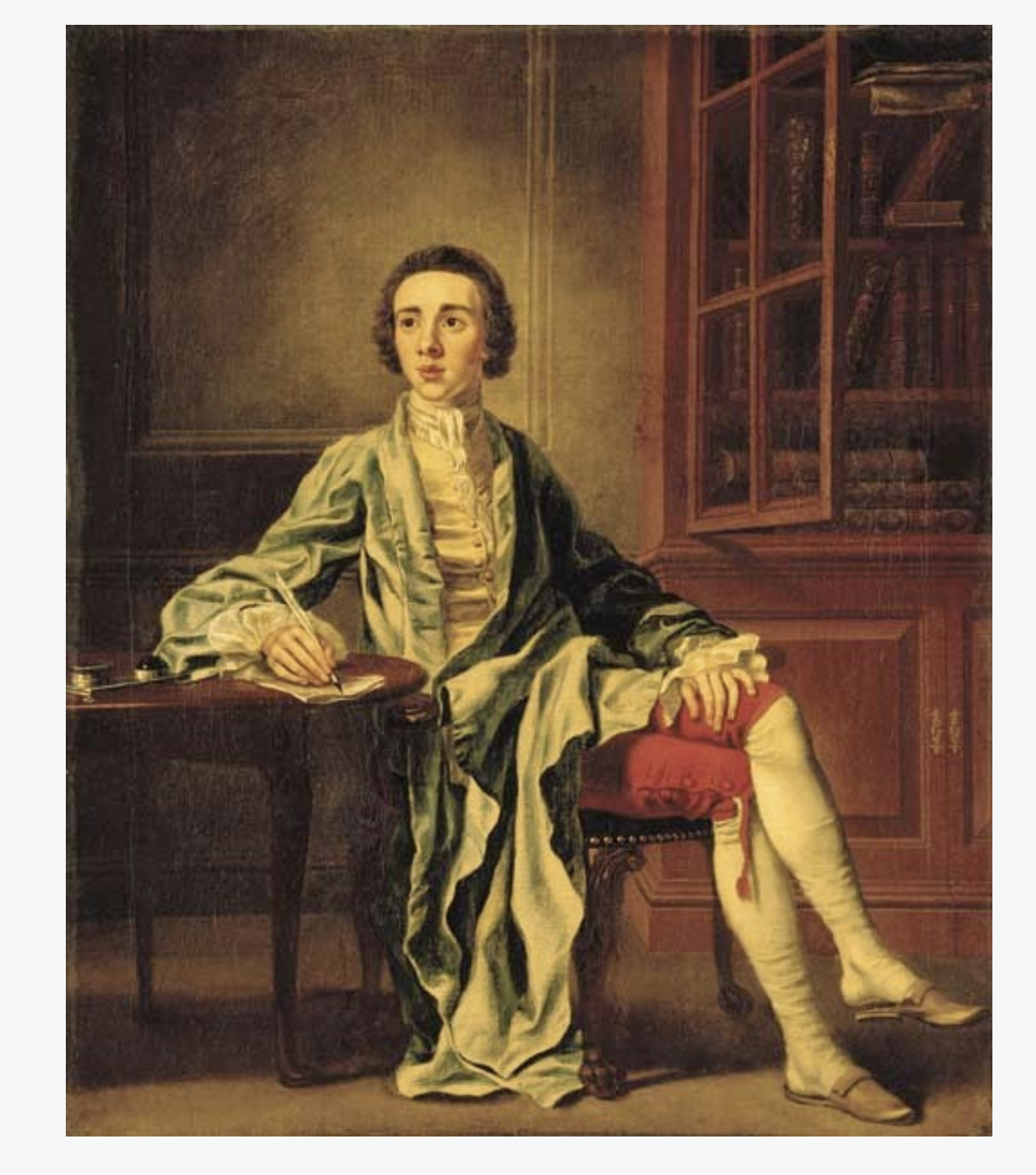
Joseph Henry of Straffan, Co. Kildare by Francis Hayman, R.A. (c. 1708-1776) courtesy of Christies Irish Sale 2001.
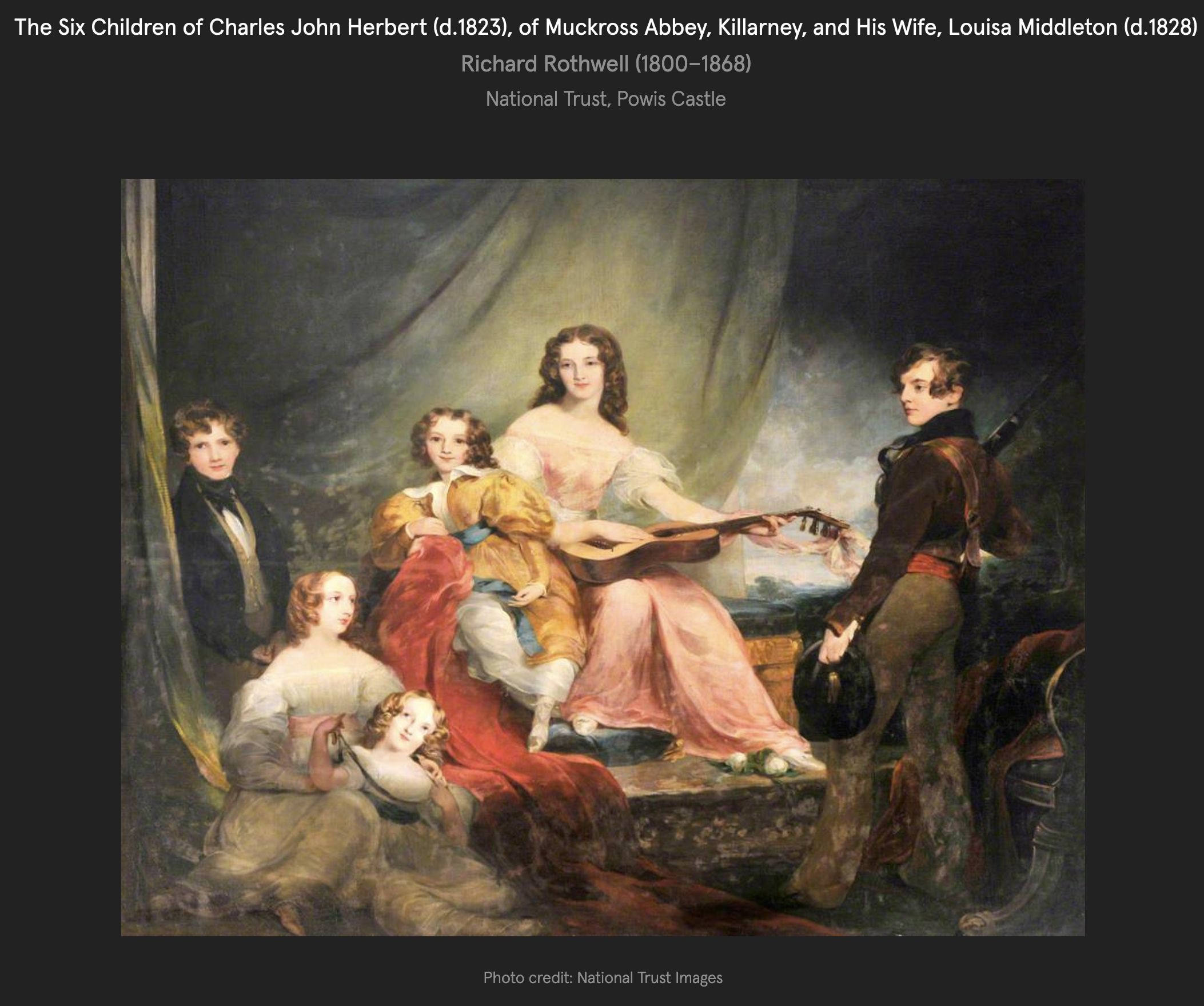
The children of Charles John Herbert (d. 1823) of Muckross, County Kerry, and his wife Louisa Middleton, by Richard Rothwell, courtesy of National Trust Powis Castle.
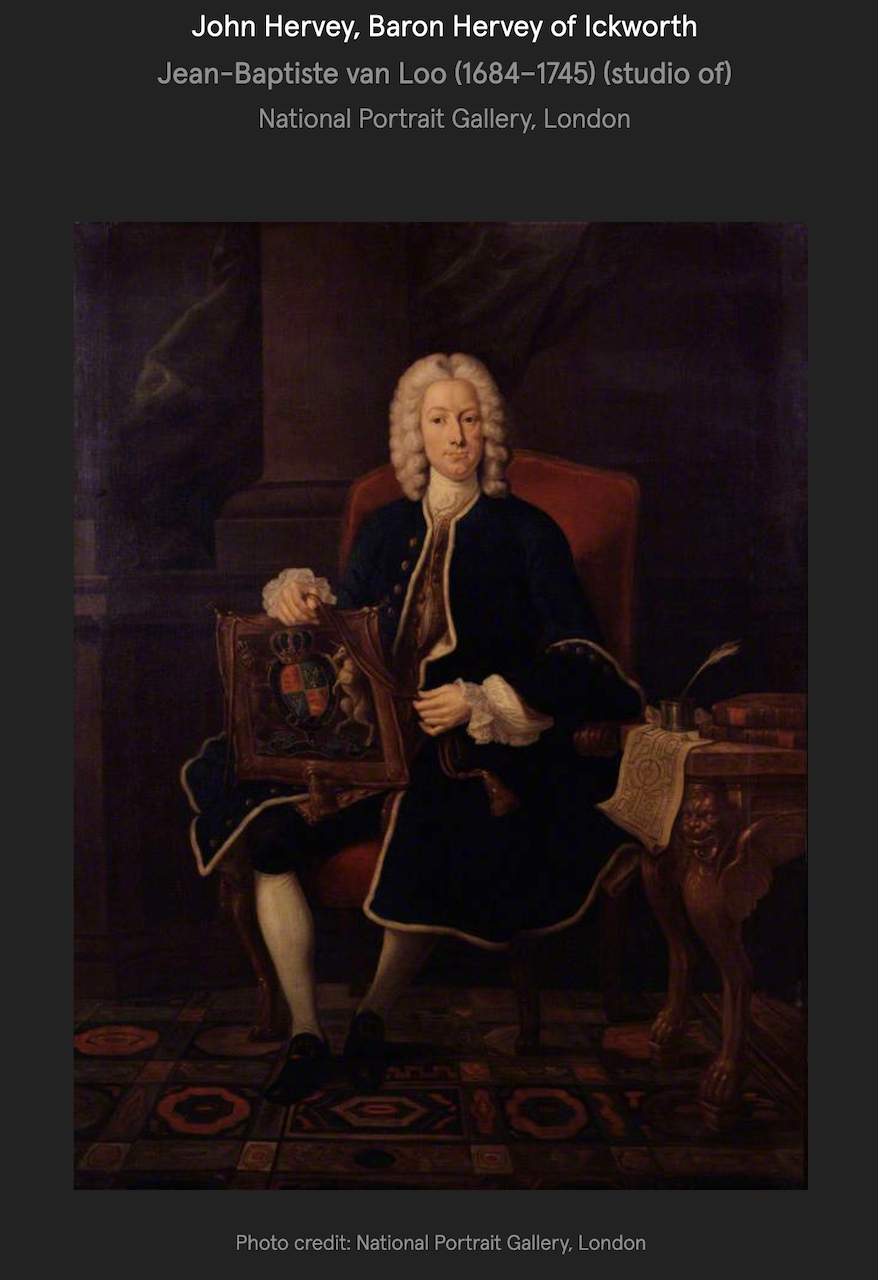
Hervey, John, Baron Hervey of Ickworth by Jean-Baptiste van Loo (studio of) courtesy of National Portrait Gallery London.
John Hervey (1665-1751) 1st Earl of Bristol by John Fayram, courtesy of West Suffolk Heritage Service.
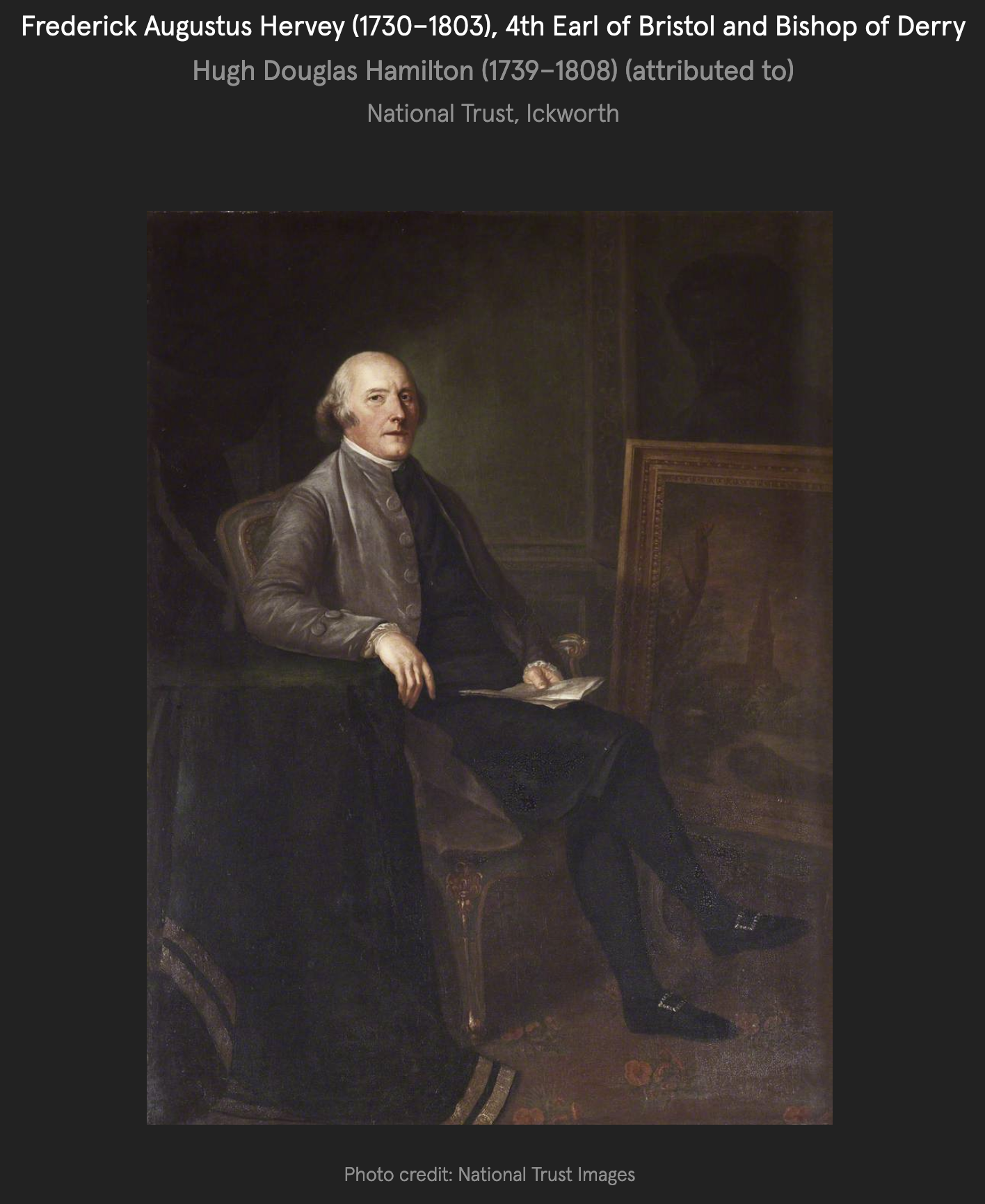
Frederick Augustus Hervey (1730-1803) 4th Earl of Bristol and Bishop of Derry, of Downhill Demesne, County Derry, by Hugh Douglas Hamilton, courtesy of National Trust, Ickworth.
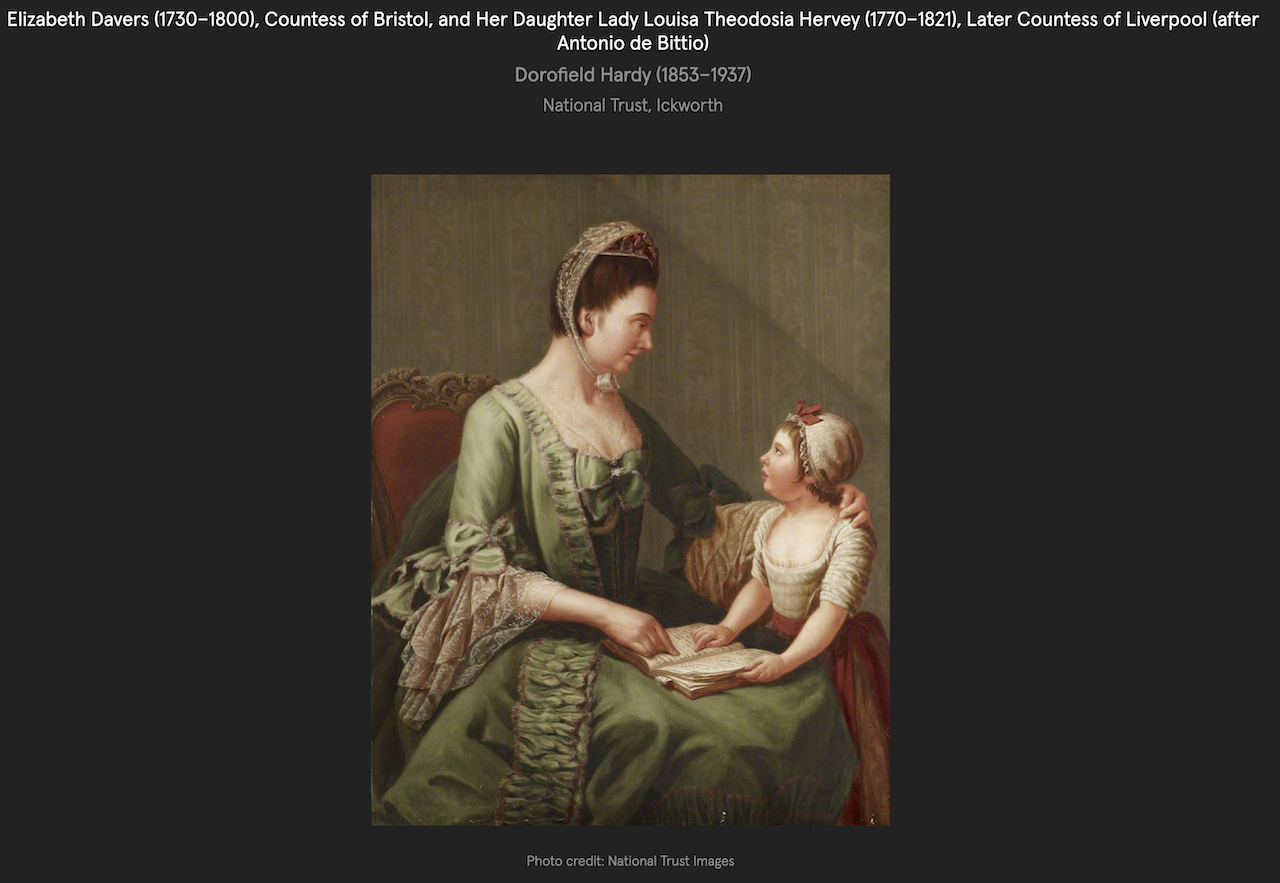
Elizabeth Hervey née Davers (1730-1800) Countess of Bristol with her daughter Lady Louisa Theodosia Hervey (1770-1821) later Countess of Liverpool after Antonio de Bittio by Dorofield Hardy courtesy of National Trust Ickworth. She was wife of Frederick Augustus Hervey 4th Earl of Bristol, Bishop of Derry who built Downhill, Co Derry.
Mary née Hervey was George “Fighting Fitzgerald”s mother, of Turlough Park, County Mayo. She was the granddaughter of John Hervey 1st Earl of Bristol, sister of Frederick Augustus Hervey 4th Earl of Bristol, Bishop of Derry who built Downhill, Co Derry. She married George Fitzgerald (c. 1712-1782) of Turlough Park, County Mayo.
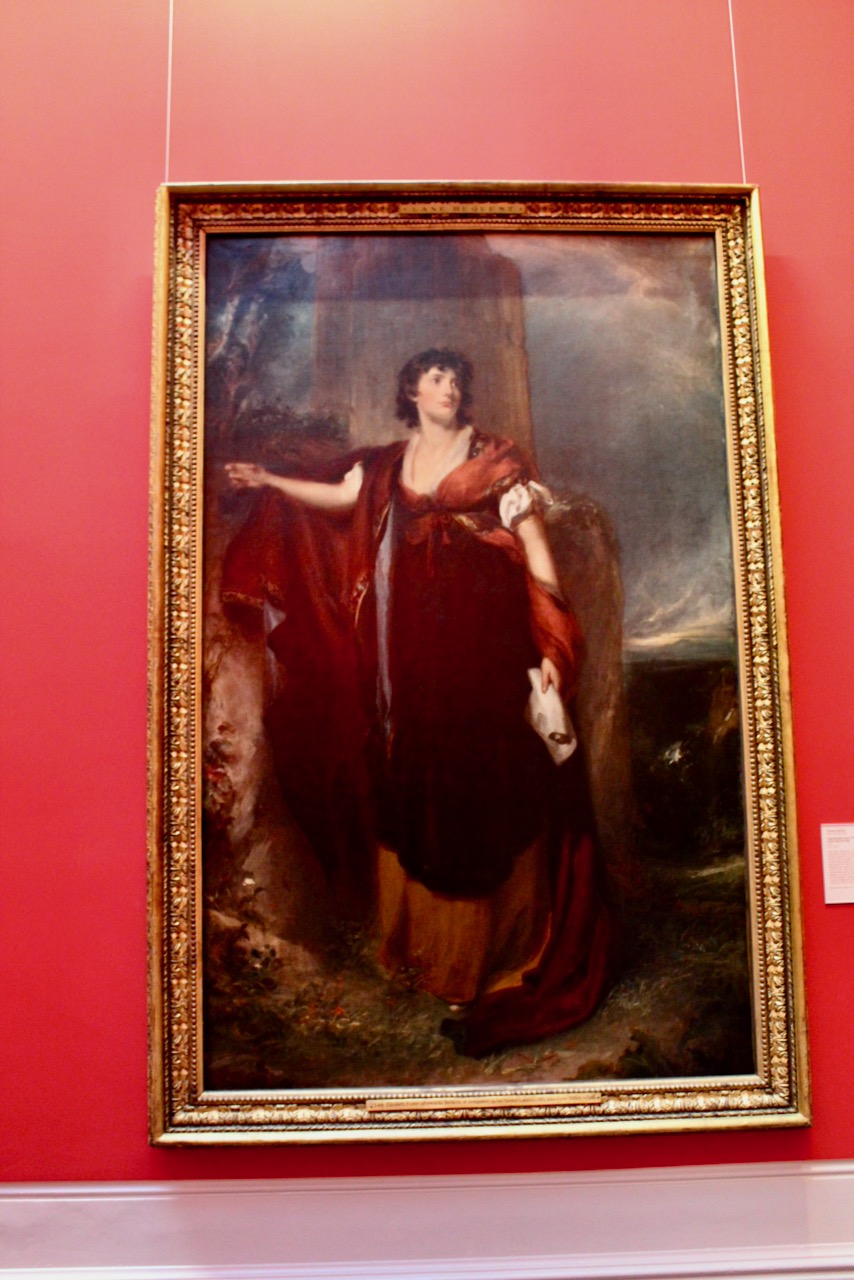
Lady Elizabeth Foster (1759-1824) née Hervey, as the Tiburtine Sibyl c. 1805 by Thomas Lawrence, National Gallery of Ireland NGI788. She was the daughter of Frederick Augustus Hervey 4th Earl of Bristol, Bishop of Derry who built Downhill, Co Derry. She married John Thomas Foster MP (1747-1796) and later, William Boyle Cavendish 5th Duke of Devonshire. Last, she married Valentine Richard Quin 1st Earl of Dunraven and Mount Earl. Photograph © Jennifer Winder-Baggot, www.irishhistorichouses.com
Elizabeth Foster née Hervey (1759-1824), later Duchess of Devonshire, c. 1805 by Thomas Lawrence, photograph courtesy of National Gallery of Ireland. She was the daughter of Frederick Augustus Hervey 4th Earl of Bristol, Bishop of Derry who built Downhill, Co Derry. She married John Thomas Foster MP (1747-1796) and later, William Boyle Cavendish 5th Duke of Devonshire. Last, she married Valentine Richard Quin 1st Earl of Dunraven and Mount Earl.
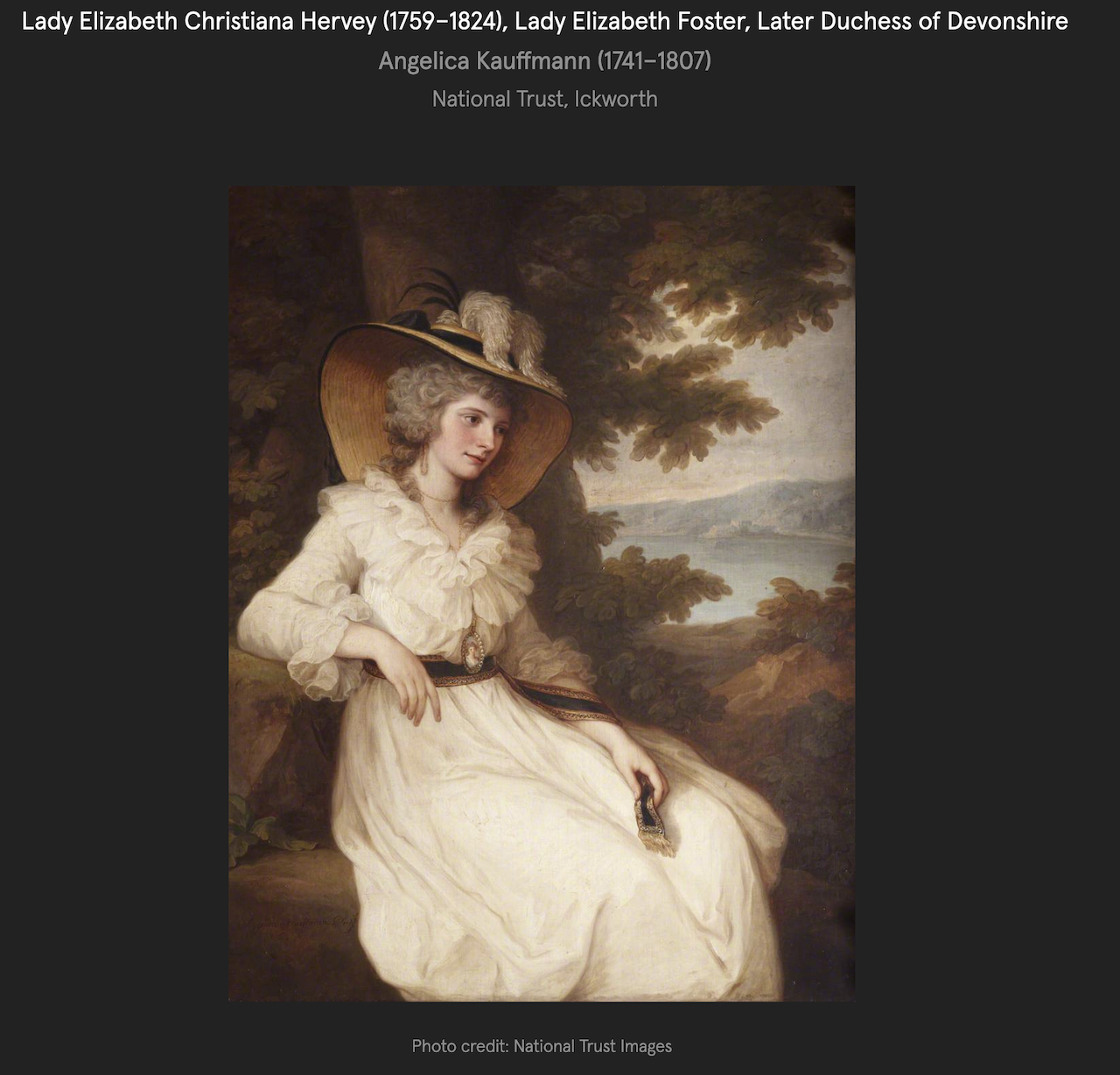
Elizabeth Christina Foster née Hervey (1759-1824) later Duchess of Devonshire by Angelica Kauffmann courtesy of National Trust Ickworth. She was the daughter of Frederick Augustus Hervey 4th Earl of Bristol, Bishop of Derry who built Downhill, Co Derry. She married John Thomas Foster MP (1747-1796) and later, William Boyle Cavendish 5th Duke of Devonshire. Last, she married Valentine Richard Quin 1st Earl of Dunraven and Mount Earl.
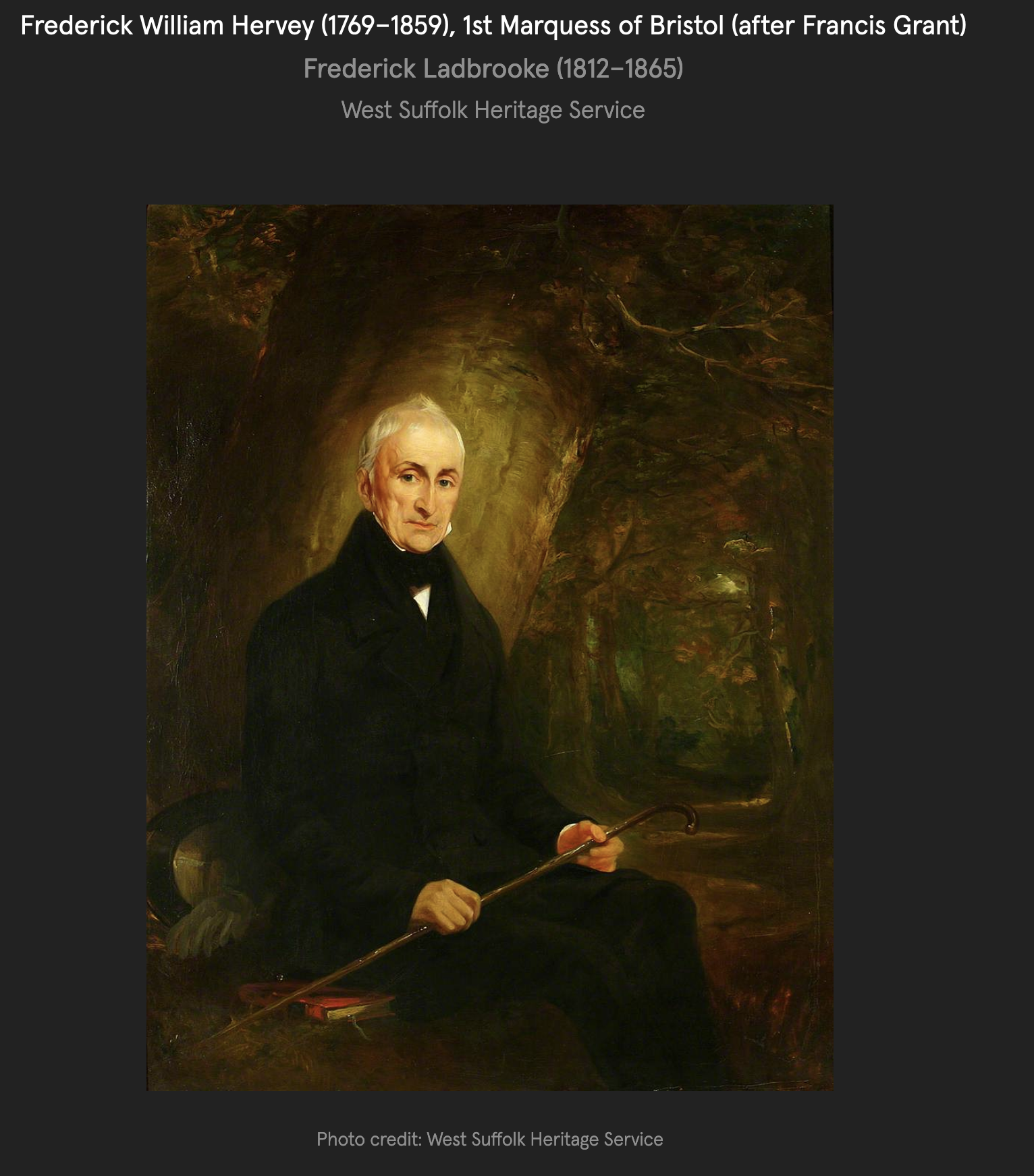
Frederick William Hervey (1769-1859) 1st Marquess of Bristol, courtesy of West Suffolk Heritage Service.
Wills Hill (1718-1793) 1st Earl of Hillsborough later 1st Marquess of Downshire, courtesy of National Gallery of Ireland.
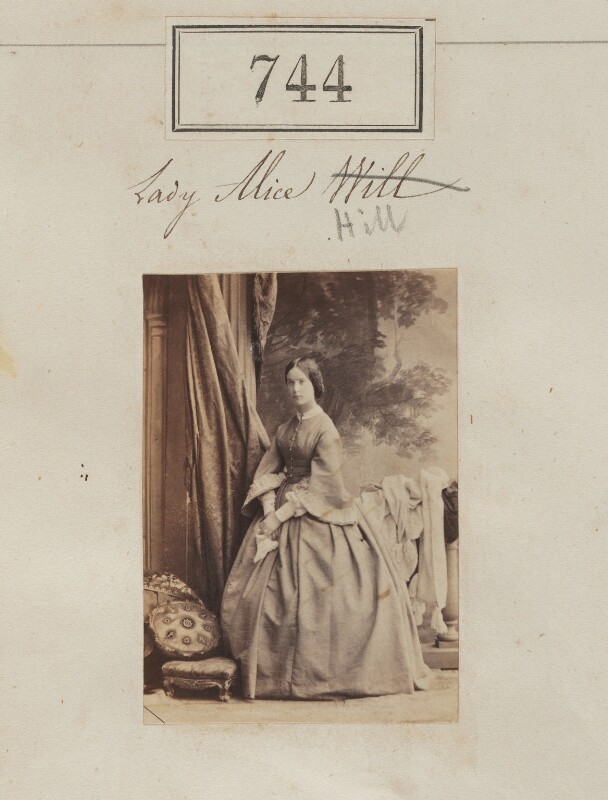
Alice Maria Taylour née Hill (1842-1928), Countess of Bective, by Camille Silvy 1860, courtesy of National Portrait Gallery NPG Ax50375. She was from England and married Thomas Taylour Earl of Bective.
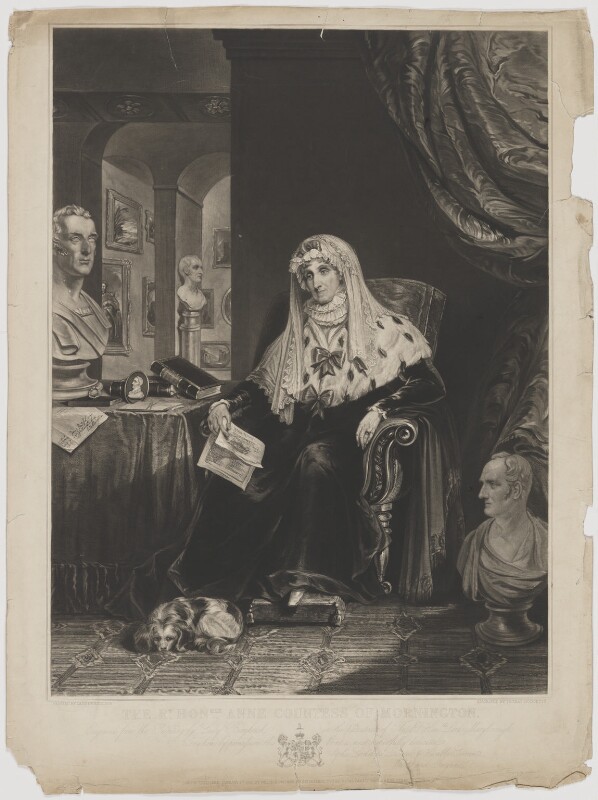
Anne Wellesley née Hill (1742-1831), Countess of Mornington, by Thomas Hodgetts, published by Welch & Gwynne, after Priscilla Anne Fane (née Wellesley-Pole) 1839, Countess of Westmorland, Courtesy of National Portrait Gallery NPG D39043. She was the daughter of Arthur Hill Trevor 1st Viscount Dungannon, and married Garret Wellesley or Wesley, 1st Earl of Mornington.
Georgina, Lady Gore-Booth, née Hill (1846-1927), by Sarah Purser. Photograph © Jennifer Winder-Baggot, www.irishhistorichouses.com
James Hoban (1755-1831), from information board in exhibition in Irish Architecture Foundation, Leinster House, a house with three lives.
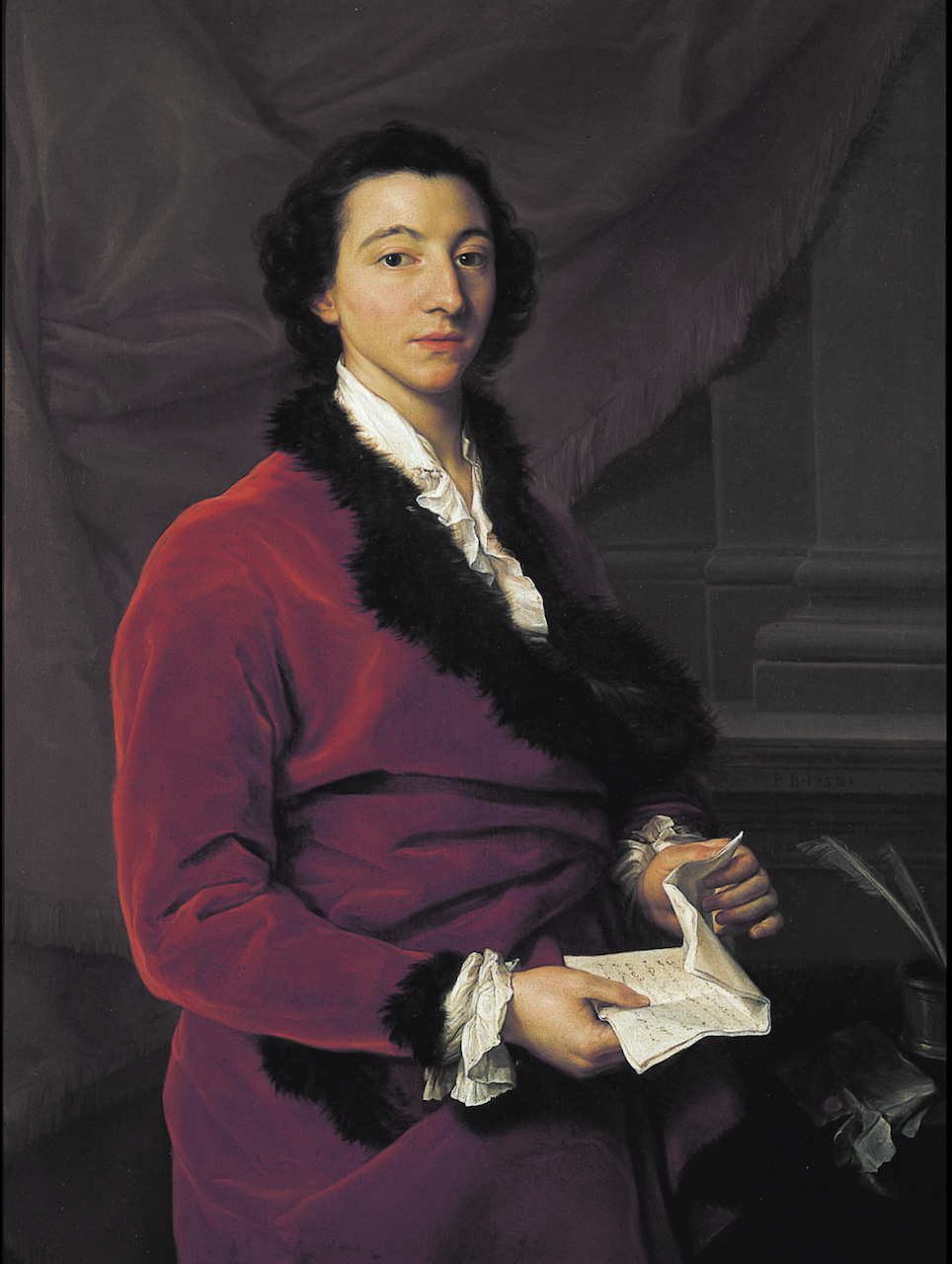
Ralph Howard, later 1st Viscount Wicklow (1726-1786) by Pompeo Batoni, courtesy of Speed Art Museum.
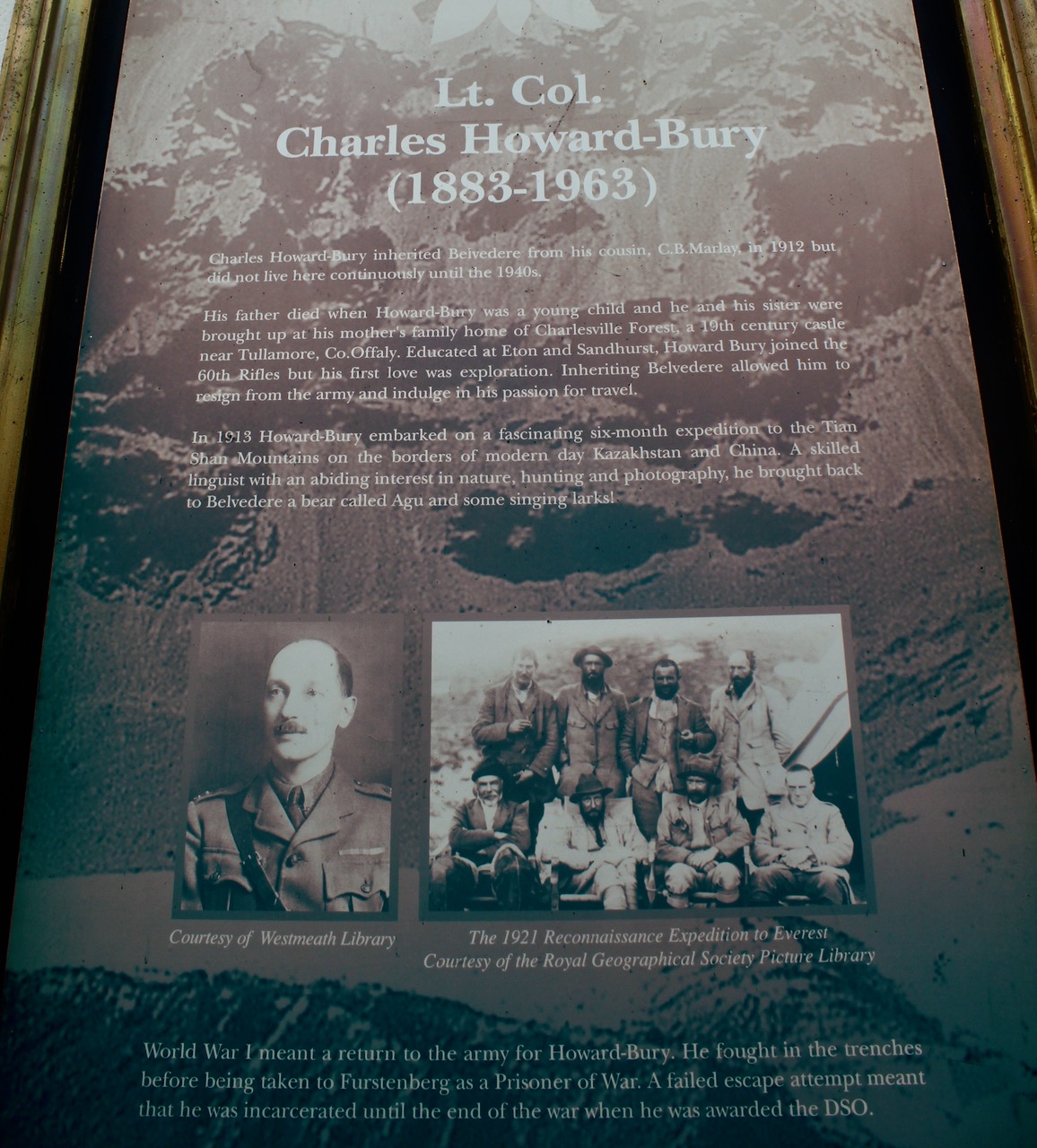
Lt. Col. Charles Howard-Bury (1883-1963), of Belvedere, County Westmeath.
William Hoare Hume, of Humewood by ROBERT LUCIUS WEST (C.1774 – 1850) courtesy of Adam’s auction 10th Oct 2023.
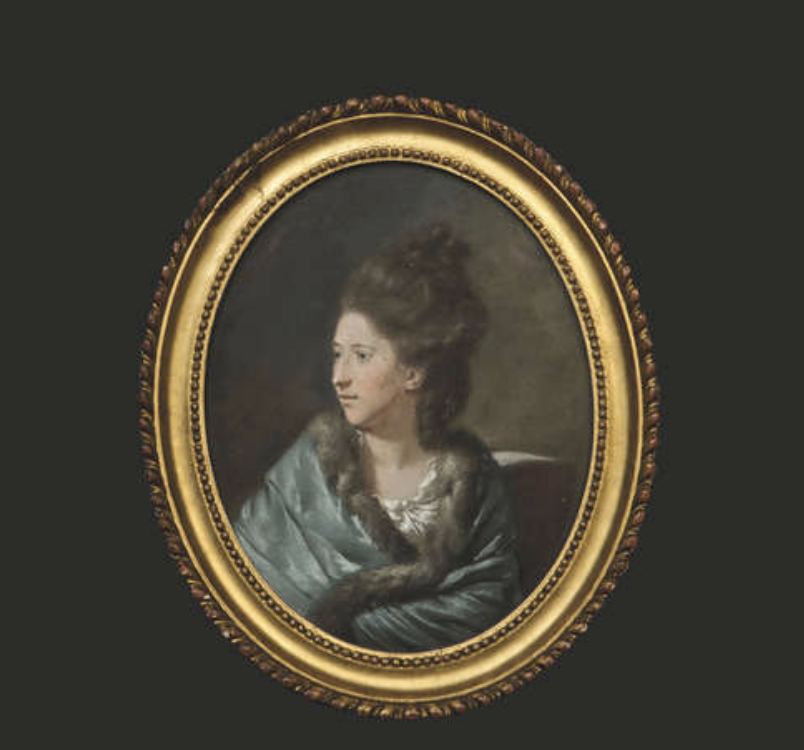
Anne Hunt, daughter of John Hunt of Glangoole, Tipperary and Curragh Chase. She married William Odell (d. 1722) in 1712. By a follower of Godfrey Kneller, Provenance Castletown Cox, Co. Killkenny, courtesy of Adam’s auction 12 Oct 2014.
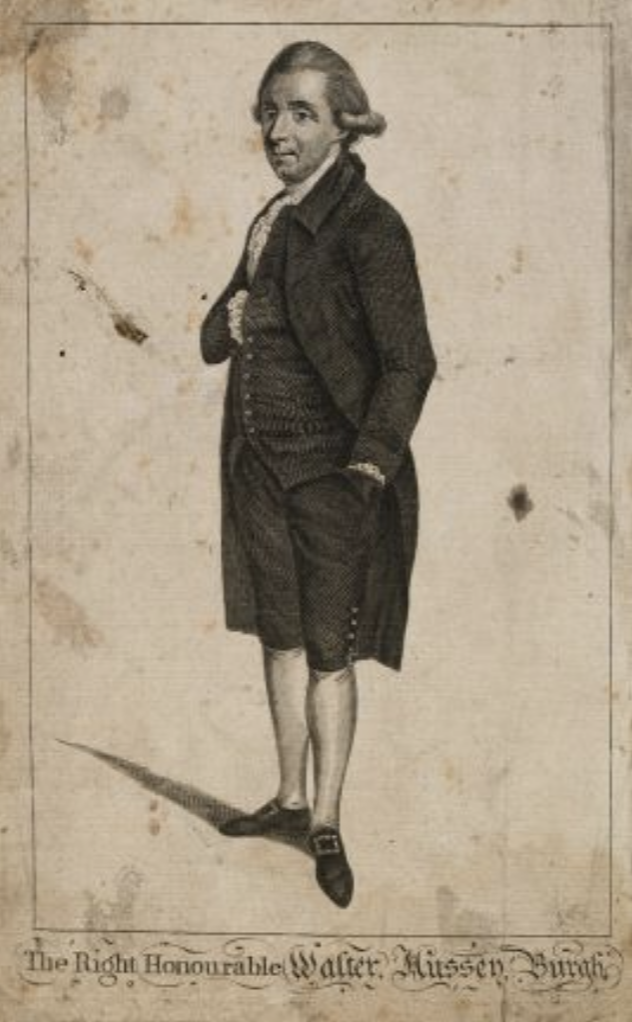
Walter Hussey Burgh, (1742-1783), Chief Baron of Exchequer in Ireland Date c.1779; Engraving Date 1779, courtesy of National Gallery of Ireland.
Henry Hyde (1638-1709 (?)) 2nd Earl of Clarendon, as Lord Privy Seal and Lord Lieutenant of Ireland, Irish school courtesy of National Trust Castle Ward.
Jane Hyde Daughter of Henry Hyde, Earl of Clarendon courtesy of Adam’s 14 Sept 2005. This is probably Jane (1694-1723/4) daughter of the 4th Earl, who married William Capell, 3rd Earl of Essex.

[1] G.E. Cokayne; with Vicary Gibbs, H.A. Doubleday, Geoffrey H. White, Duncan Warrand and Lord Howard de Walden, editors, The Complete Peerage of England, Scotland, Ireland, Great Britain and the United Kingdom, Extant, Extinct or Dormant, new ed., 13 volumes in 14 (1910-1959; reprint in 6 volumes, Gloucester, U.K.: Alan Sutton Publishing, 2000), volume I, page 4. Hereinafter cited as The Complete Peerage.

Hamwood House, Dunboyne, Co. Meath – section 482

www.hamwood.ie

Open dates in 2025: Feb 5-9, 12-16, 19-23, 26-28, Mar 1, May 8-11, 15-18, June 5-8, 11-13, 19-20, July 1-3, 9-11, 16-18, August 6-8, 12-14, 16-24, 11am-1pm, 3pm-5pm

Fee: adult/OAP/student €20, child under 10 years free

2025 Diary of Irish Historic Houses (section 482 properties)

To purchase an A5 size 2025 Diary of Historic Houses (opening times and days are not listed so the calendar is for use for recording appointments and not as a reference for opening times) send your postal address to jennifer.baggot@gmail.com along with €20 via this payment button. The calendar of 84 pages includes space for writing your appointments as well as photographs of the historic houses. The price includes postage within Ireland. Postage to U.S. is a further €10 for the A5 size calendar, so I would appreciate a donation toward the postage – you can click on the donation link.

€20.00

donation

Help me to pay the entrance fee to one of the houses on this website. This site is created purely out of love for the subject and I receive no payment so any donation is appreciated!

€15.00

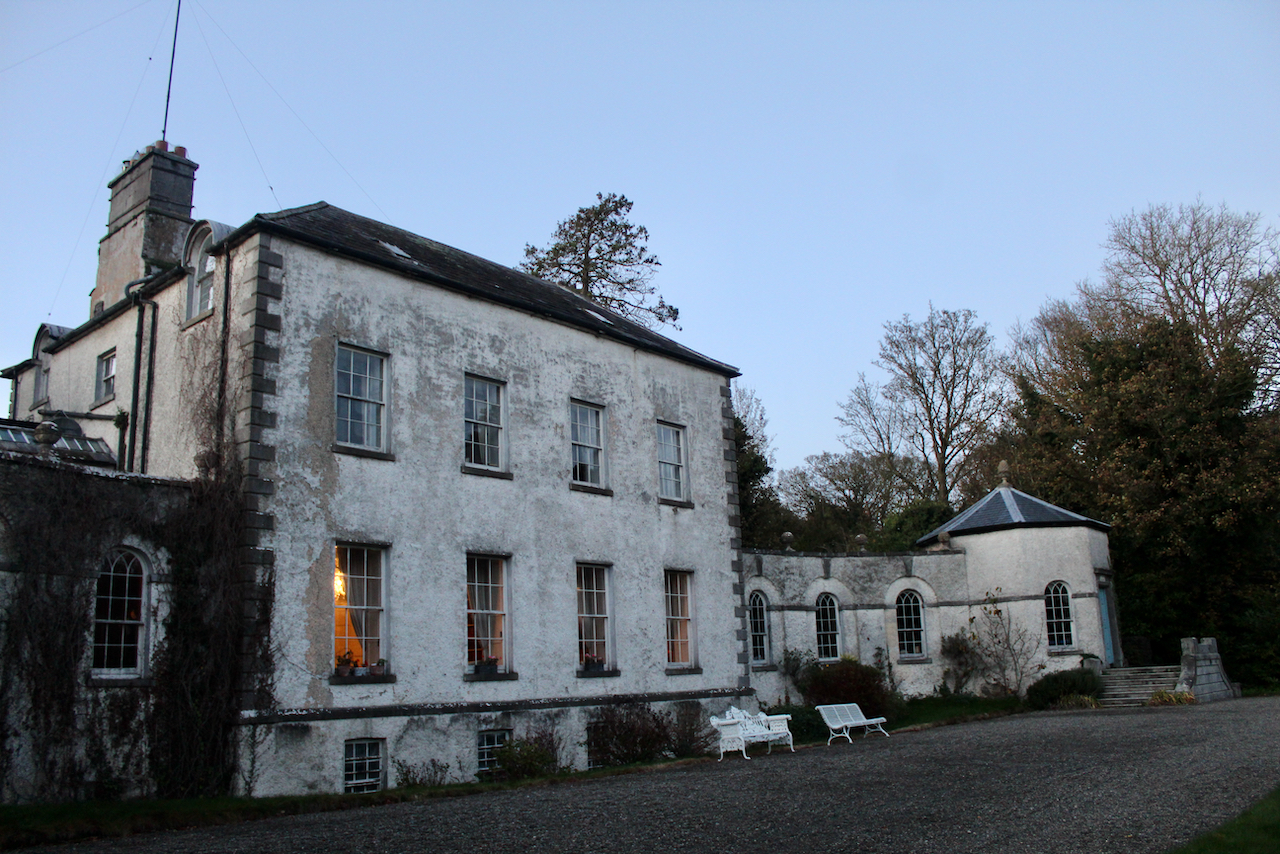
Hamwood, November 2022. Photograph © Jennifer Winder-Baggot, www.irishhistorichouses.com

Hamwood is a small Palladian style house built in around 1770. We visited in November 2022 and the owner Charles Hamilton, a descendant of the original owner, gave us a tour of the house. It is two storey over basement with single storey octagonal “pepperpot” wings joined to the central block by curved hallways.

In a chapter in Great Irish Houses (Forewards by Desmond FitzGerald and Desmond Guinness) published by IMAGE Publications in 2008, we are told that it was built by Joseph O’Brien from Dublin. An original Joseph O’Brien drawing of Hamwood, dated 1789, exists. [1]

We passed a lovely gate lodge on the way in to the property, which has the date 1783 on its side, which is the year it must have been built.

Hamwood, November 2022. Photograph © Jennifer Winder-Baggot, www.irishhistorichouses.com

We drove in to the farmyard area as directed by signs and we had to wander around a little to find the house. The gardens are also open to the public and we walked through the walled garden.

The house was built for Charles Hamilton (1738-1818) and his wife Elizabeth Chetwood (or Chetwode), and the name “Hamwood” is formed by joining their two names.

Charles Hamilton (1738-1818) who built Hamwood, photograph courtesy of Hamwood House website.

Charles was the son of Alexander Hamilton (1690-1768), MP for Killyleagh in County Down (now in Northern Ireland), who settled in Knock, a townland in Balbriggan, County Dublin. The family of Alexander, despite being MP for Killyleagh, seem to be a different family of Hamiltons from those of Killyleagh Castle, as the Hamwood website will tell us. Hamiltons still live in Killyleagh Castle, parts of which date back to 1180. It came into the Hamilton family in the time of James Hamilton (1559-1643), 1st Viscount Claneboy, County Down. Alexander’s ancestor Hugh Hamilton (1572-1655) came to Ireland from Scotland. The 1st Viscount Claneboy also moved to Ireland from Scotland. Alexander’s brother George built a house at Tyrella in County Down.

Alexander Hamilton 1690-1768, MP for Killyleagh in County Down, who settled in Knock, a townland in Balbriggan, County Dublin. Photograph courtesy of Hamwood house website.
Killyleagh Castle, County Down, photograph courtesy of Hamwood house website.

Alexander was a wealthy landowner, owning town lands worth £50,000. He married Isabella Maxwell of Finnebrogue, County Down. The Hamwood website tells us that his son Hugh (1729-1805) became Dean of Armagh and Bishop of Ossory and a professor of Mathematics at Trinity College Dublin.

Hugh Hamilton (1729-1805), Protestant Bishop of Ossory, by engraver William Evans, after artist Gilbert Stewart, courtesy of National Gallery of Ireland, NGI.10622.

Another son, George (1738-1793), was MP for Belfast in 1769-1776 and settled at Hampton Hall, Balbriggan (which burned down in 1901 but has been rebuilt). George developed the fishing village into a flourishing town with cotton mills and a trading port with a lighthouse. I came across a newspaper article about a book published in 2004 about the Hamiltons of Balbriggan, written by Stephanie Bourke in conjunction with the Balbriggan and District Historical Society, The Hamilton Family and the making of Balbriggan.

A daughter, Anne, married Colonel Henry Caldwell, who fought in Canada under General James Wolfe (1727-1759) in the battle between France and England for control of Quebec. Wolfe died of his wounds, and as Wolfe’s Aide De Campe, Caldwell was sent to England to announce news of the victory over the French. Anne and Colonel Caldwell subsequently settled near Quebec. Later Hamiltons also travelled to live in Canada, which we will see in the house. Henry Caldwell was the son of John, 3rd Baronet Caldwell, of Wellsburrow, Co. Fermanagh.

Alexander’s son Charles, the website tells us, started working life as apprentice to a wine merchant in Portstewart in County Derry. He subsequently started his own business and moved to Mount Venus in Rathfarnham, County Dublin. He married Elizabeth Chetwood. The Chetwoods were from Woodbrook House in County Laois, a fine house which sold recently. Another brother of Charles, Robert, married her sister Hester. 

Woodbrook, County Laois, the house where Elizabeth Chetwood grew up, recently for sale, photograph from myhome.ie.

Charles was left a townland in the North of Ireland which he sold for £7,000 and bought land which had been part of the estate of Ballymacoll, County Meath (now an Equestrian stud farm) from James Hamilton. The website tells us that these Hamiltons are not related. James Hamilton was from a family who lived in Sheephill Park in County Dublin, which later became Abbotstown and housed part of the veterinary school of Dublin (and was the reason I lived in Blanchardstown when I was born), and is now a sports centre. This Hamilton family also traces back to Killyleagh, to a younger brother of James Hamilton 1st Viscount Claneboy.

Hamwood House, County Meath, photograph from Hamwood house website. This is better than my photographs since it was November when we visited and the light was fading.

Charles became the land agent for the Archbishop of Dublin and for Lord Lansdowne (William Petty-Fitzmaurice, 1st Marquess of Lansdowne). I’m not sure what dates he worked for the Archbishop of Dublin so don’t know which one it was but it could have been Charles Cobbe who was Archbishop of Dublin from 1743 to 1765, who built Newbridge House in Donabate, not too far from Balbriggan, between 1747 and 1752. The next Archbishop of Dublin (I am assuming it was a Church of Ireland archbishop since Catholic ones would not have a land agent) was only in place for the year of 1765 as he died in office, William Carmichael. The next Archbishop was Arthur Smyth who served for five years until 1771. The next archbishops were John Cradock (served 1772-1778) then Robert Fowler (1779-1801).

Art Kavanagh tells us in his The Landed Gentry and Aristocracy, Meath (published 2005) that Land agents were not paid a salary but were paid between four and five percent of the amount of rentals they collected. On some estates with large rentals this could amount to quite a substantial sum. In addition many agents became middlemen themselves and so made even more profits.

At the time Charles and his family mainly used Hamwood as a summer retreat as he lived in the city of Dublin in 40 Dominick Street. Art Kavanagh tells us that Charles had business interests in Dublin and was the owner of land in Ringsend. He was also involved with Arthur Pomeroy, Viscount Harberton (later of Carberry, Co Kildare), who appeared to be his partner in some land dealings in the Fitzwilliam Square area of Dublin. [2]

The Hamwood website tells us that in 1798 some rebels captured Charles along with the agent to William Robert Fitzgerald (1749-1804), 2nd Duke of Leinster. The Duke’s agent was killed but a local man named O’Reilly, whose family still practice as blacksmiths in the area, recognised Charles Hamilton and asked that Mr Hamilton be spared as “he was more useful (to them) alive than dead.” It was said that this was probably in recognition of his moral, learned and industrious character. As well as being a Land Agent, he farmed his own land.

William Robert Fitzgerald, 2nd Duke of Leinster, (1749-1804) Date 1775 by Engraver John Dixon, Irish, After Joshua Reynolds, courtesy of National Gallery of Ireland.

Charles Hamilton suggested to the Duke of Leinster that he fill the now vacant position as his land agent. The Duke owned and lived in Leinster House in Dublin (now the government buildings) and had Carton in County Kildare as his country residence (now a hotel – see my entry Places to visit and stay in County Kildare). This role passed through later generations of Hamiltons until as late as the current owner’s father. The Duke of Leinster donated the granite steps at Hamwood, as well as several trees. The website explains that the site is exposed to strong winds and the wooded surroundings helped to create shelter.

Charles became a member of the notorious “Hellfire Club” which met in the Wicklow hills for drinking, gambling and carousing. He became “toastmaster” of the club and the family still have the gavel which he used to bring the members to order.

Henry Clements (1698-1745), Col Henry Ponsonby (1685-1745), Richard St George (d. 1775), Simon Luttrell, Henry Barry 3rd Baron Santry (1680-1735), members of the Hellfire Club, painted by another member, and co-founder, James Worsdale, photograph of portrait in the National Gallery of Ireland.

Charles and his wife had fifteen children but not all survived to adulthood.

Charles’s son, also named Charles (II, 1772-1857) added the wings to the house and moved the entrance door to the unusual position in one of the pepperpot additions. His wife persuaded him to do this to keep draughts from the house. At some stage, the back of the house became the front, Charles told us.

Charles [II] Hamilton (1772-1857), photograph courtesy of Hamwood house website.
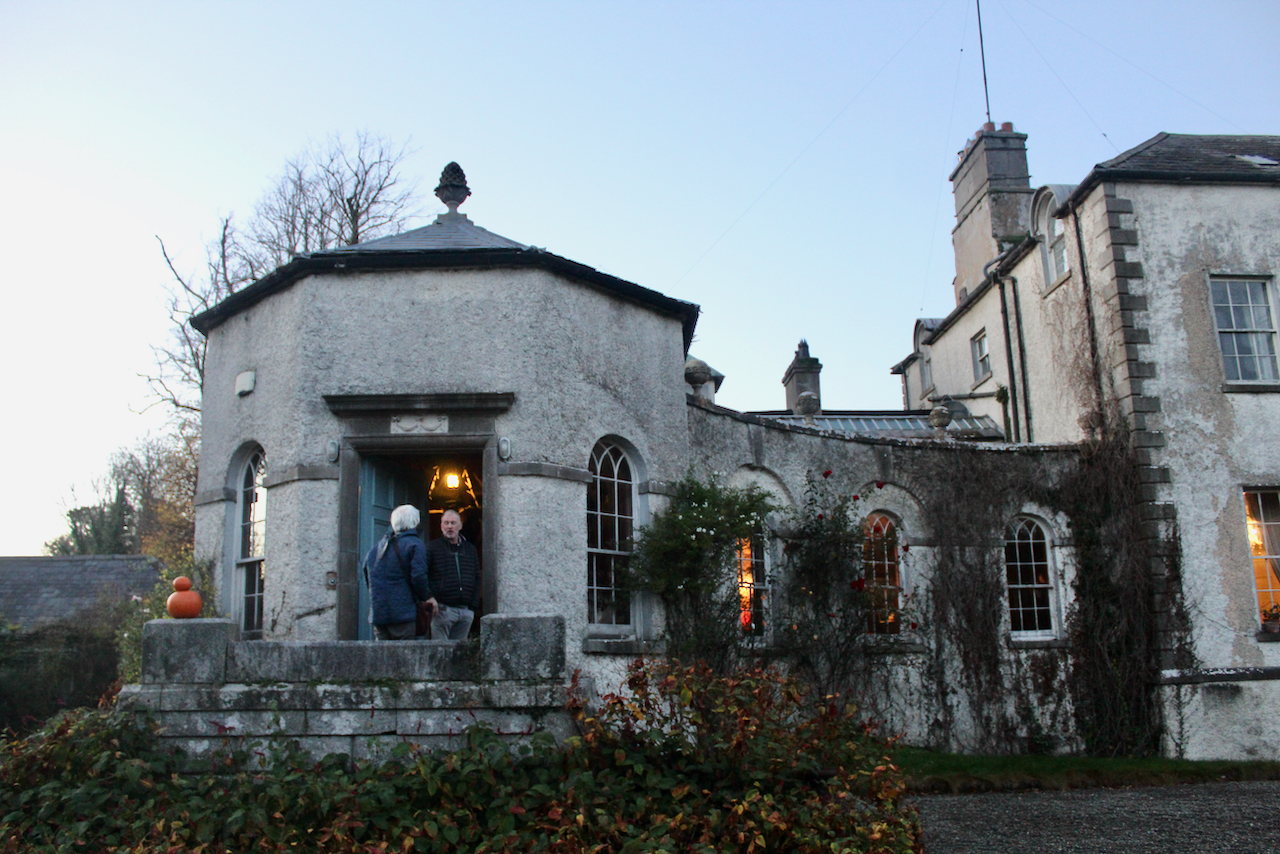
Charles’s son added the wings to the house in 1783 and moved the entrance door to the unusual position in one of the pepperpot additions. The further wing is known as “the schoolroom.” Photograph © Jennifer Winder-Baggot, www.irishhistorichouses.com
The entrance door, in one of the wings. The wings are topped with pineapple decorations, which are a sign of welcome, and of the wealth one would have needed to own hothouses to grow pineapples. Photograph © Jennifer Winder-Baggot, www.irishhistorichouses.com
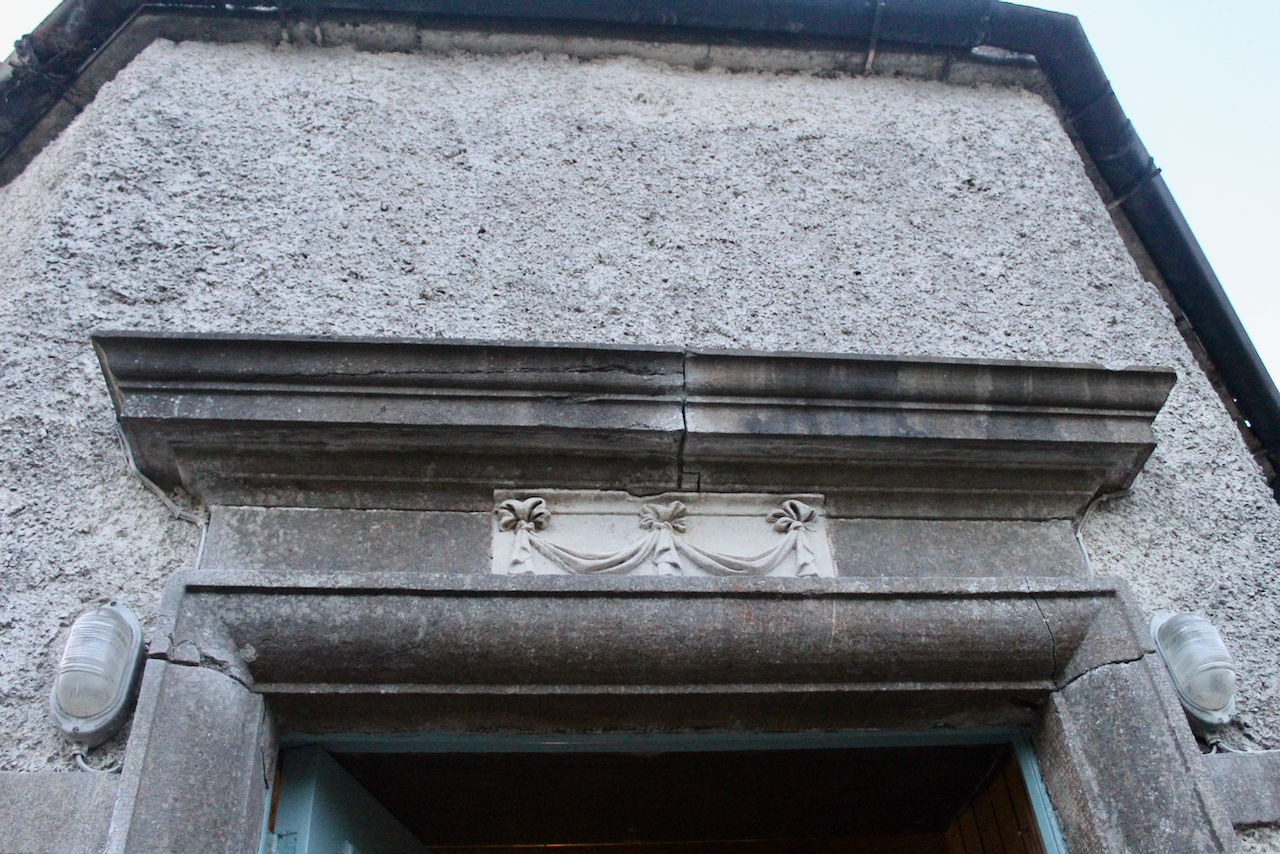
The door has drapery decoration above. Photograph © Jennifer Winder-Baggot, www.irishhistorichouses.com
I liked the arched window breaking the roof parapet. Photograph © Jennifer Winder-Baggot, www.irishhistorichouses.com

Charles II was a classics scholar and completed his education at Trinity College Dublin before being called to the Bar in 1792. He spent some years in London while practicing as a lawyer before returning to Ireland. In 1801 he married Marianne Caroline Tighe (1777-1861) of Rosanna, Co Wicklow, daughter of William, MP for Athboy and Sarah Fownes, who inherited Woodstock in County Kilkenny. She was the cousin of the poet Mary Tighe, whom we came across when we visited Altidore in County Wicklow.

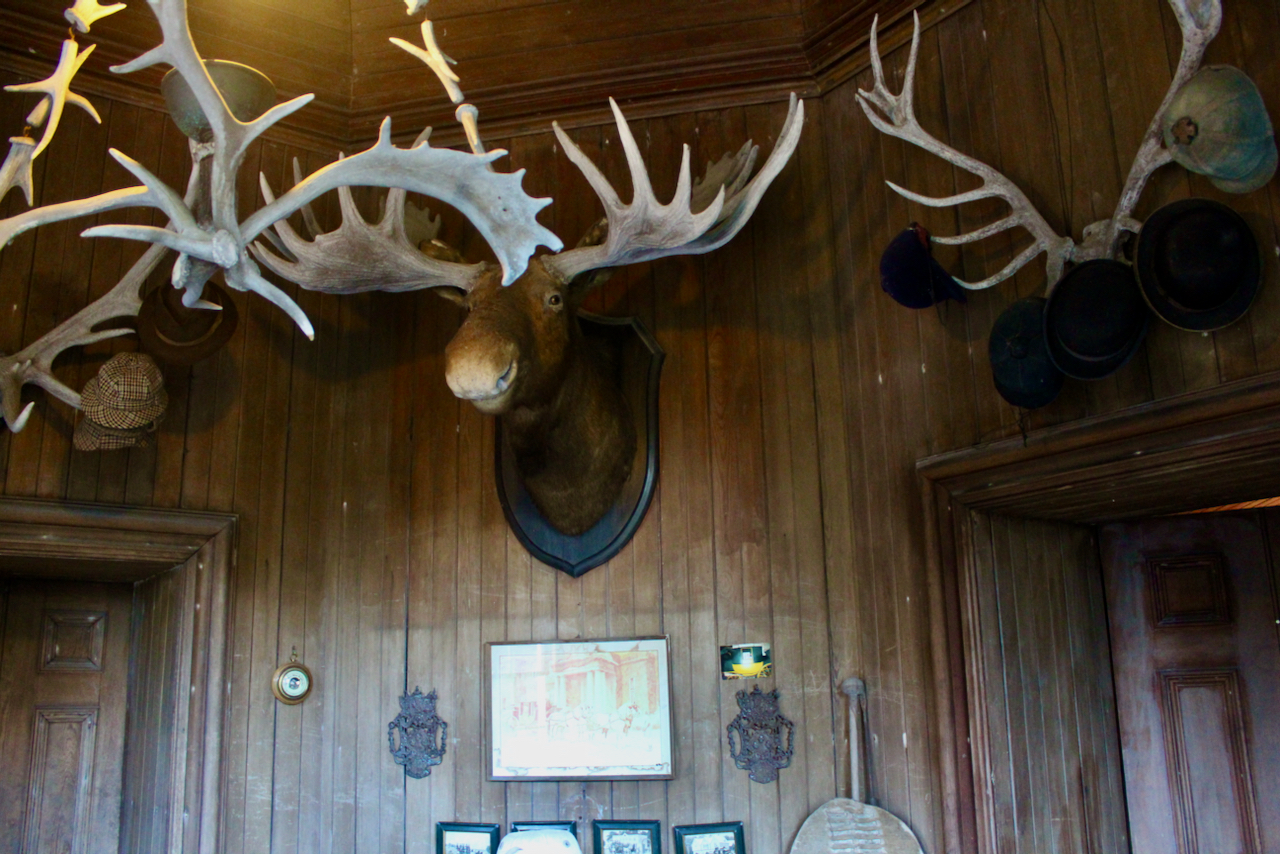
Another son of Charles I and Elizabeth Chetwood was George (d. 7 January 1839), who emigrated to Canada and was founder of Hawkesbury Lumber Mills. The moose heads in the front hall in the pepperpot entrance come from Canada.

Another son, William Henry, moved to Quebec in Canada also. Sons Robert and John became merchants in Liverpool.

The wood in the front hall in the pepperpot entrance comes from Russia. The moose heads are from visits to relatives in Canada. A picture shows the funeral cortege of the Duke of Wellington – Charles told us that the wheels fell off his hearse! Photograph © Jennifer Winder-Baggot, www.irishhistorichouses.com
Ceiling of the pepperpot addition which contains the front door. Photograph © Jennifer Winder-Baggot, www.irishhistorichouses.com
The curved corridor between the entrance hall and the rest of the house. Photograph © Jennifer Winder-Baggot, www.irishhistorichouses.com
Hamwood, November 2022. Photograph © Jennifer Winder-Baggot, www.irishhistorichouses.com

The website tells us that Charles II and Marianne Caroline, who went by Caroline, set about making major improvements to Hamwood, extending the existing house and adding the wings, and also the interior adding ornate furniture wall coverings etc. Much of the furniture was procured for the house, some of it specially designed and fitted. 

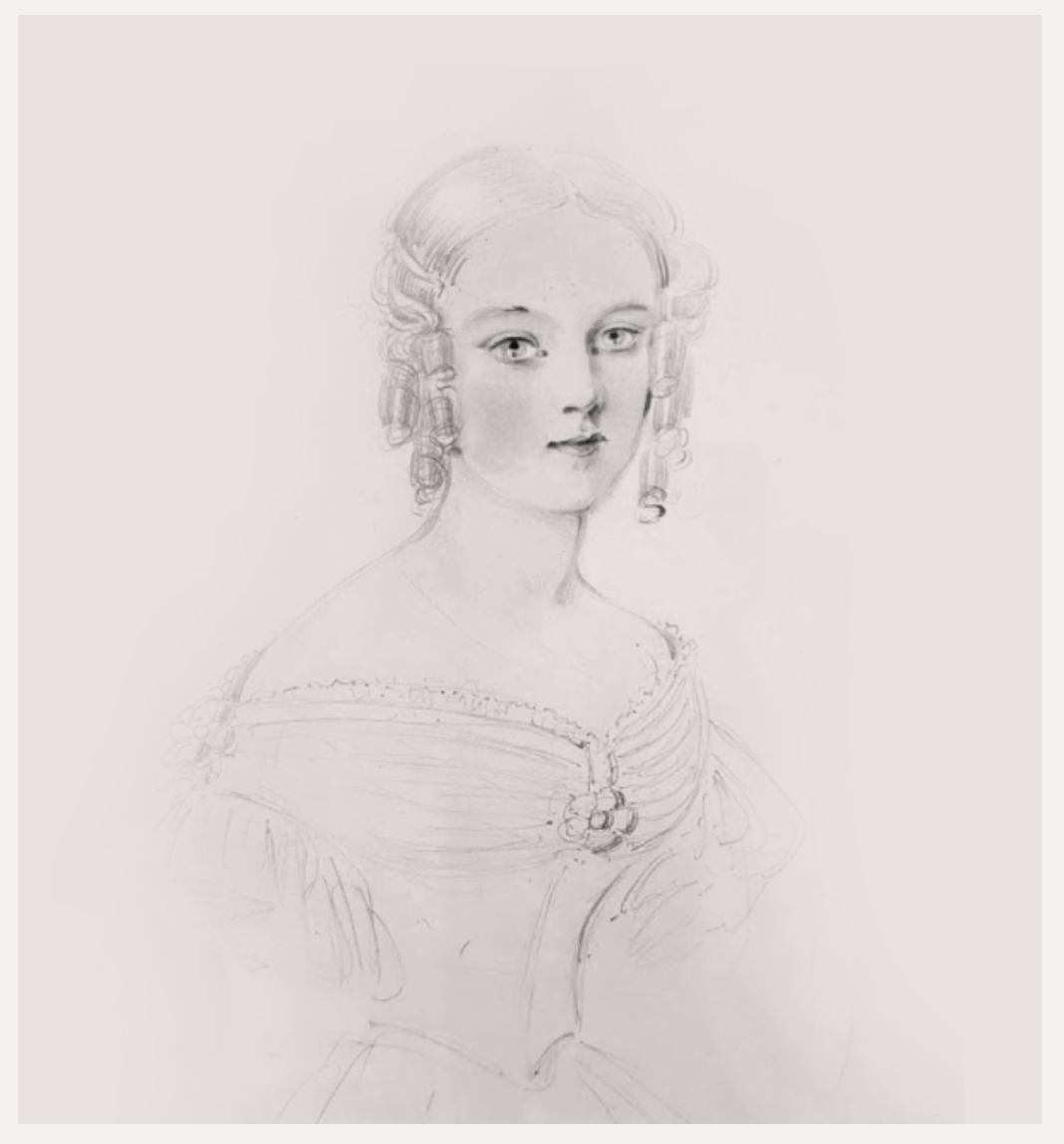
Caroline Hamilton (1777-1861), photograph courtesy of Hamwood house website.

Charles II was responsible for laying the foundations of the Gardens, and from her diaries, we know his wife Caroline was also very involved. The website tells us about the walled garden, which was not at its best when we visited since it was November:

The walled garden began in 1777 when Charles Hamilton I built its walls. Part of the wall existed as stone, but this was later added to in brick. To make it look like a seamless brick wall, the stone walls were rendered and the brickwork painted on. At the time, the walled garden was mainly used to grow fruit, vegetables and flowers for the household. Charles II created the rock garden and with his wife Caroline, they designed the triangular shaped Knot garden. Charles III, otherwise known as Charles William, was an amateur artist as was his wife Letitia Armstrong and created to the front and rear of the house a parterre – an intricate design of flowers in beds which would resemble a cluster of fine jewels at a distance.

The walled garden was not looking its best as it was November when we visited. Photograph © Jennifer Winder-Baggot, www.irishhistorichouses.com

Caroline was an artist who became especially well-known for her satirical sketches. The website tells us about her:

Caroline spent much of her younger years in London and took lessons in art from the notable printmaker and portrait painter John Spilsbury (1737-1812) who had taught at Harrow where her brother was at school, and later Maria Spilsbury  (1776-1820), his daughter. She became a skilled artist, especially in creating pen and ink drawings of Irish society of the day, using a satirist angle on  such subjects as religion, education and the ruling classes.  

A sketch attributed to Caroline Hamilton, belonging to the National Gallery of Ireland.

The website continues: “After rearing and educating her six children, Caroline dedicated her time to the improvement and development of Hamwood House and its gardens, her art and, in particular, her writing. Her Memoirs are one of the most significant records of Irish life of the time, and in addition, she became heir to the diaries of the Ladies of Llangollen, which are now in the collection of the Hamwood papers held in the National Library, Dublin. Caroline’s cousin, Mary Tighe (1772-1810), was an accomplished poet best known for her poem, Psyche. Her artistic talent and to some extent, that of her husband, Charles III, passed down to her great-grandchildren, Eva and Letitia.

The Ladies of Llangollen, Sarah Ponsonby and Charlotte Eleanor Butler, by Richard James Lane, printed by Jérémie Graf, after Lady Mary Leighton (née Parker) courtesy of National Portrait Gallery NPG D32504.

The “ladies of Llangollen” were Eleanor Butler (1739–1829) and Sarah Ponsonby (1755–1831) – Sarah grew up in Woodstock in County Kilkenny, with her cousins, which was the house inherited by Caroline’s mother – it is now a ruin but has wonderful gardens, see my entry for Places to visit and stay in County Kilkenny. The two friends ran away together and set up house in Llangollen, Wales, and became famous for their audacity, and were visited by many people including Percy Bysshe Shelley, William Wordsworth and the Duke of Wellington.

Mary Tighe née Blachford (1747-1791), courtesy of National Gallery of Ireland.

Caroline wrote a history of her family, detailing the lives of Theodosia and Mary Blachford and Sarah Ponsonby. Her memoir was published in 2010 as the edited volume Reminiscences of Marianne-Caroline Hamilton (1777–1861).

Caroline wrote and drew in a satirical style, providing a critical depiction of the Anglo-Irish ascendancy from that period. Her best known works include Domestic happiness as acted in the city: a tragic comic farceThe Kingston to Holyhead packet, and Society.

Charles II continued as Agent for the Earls of Leinster. The 2nd Earl died in 1804. The next, 3rd Duke, was Augustus Frederick FitzGerald (1791-1874).

Augustus Frederick FitzGerald, 3rd Duke of Leinster, (1791-1874) Engraver George Sanders, After Stephen Catterson Smith, photograph courtesy of National Gallery of Ireland.

Moving the front door to one of the wings created a double drawing room that runs along the entire length of the facade. [3] The double drawing room is separated into two by an arch, an alteration possibly made by Caroline Hamilton in the 19th century. [see 1] It is a large comfortable room, not overly formal.

Hamwood, November 2022.

David Skinner of Skinner and Sons, specialists in wallpaper design and conservation, advised on the decoration of the dining room where a rustic red wallpaper has replaced a cream colour. [see 1]

One of the rooms of Hamwood. Moving the front door to one of the wings created a double drawing room that runs along the entire length of the facade. Photograph © Jennifer Winder-Baggot, www.irishhistorichouses.com
Hamwood, November 2022. Photograph © Jennifer Winder-Baggot, www.irishhistorichouses.com

Charles and Caroline’s daughter Sarah married Reverend Francis Howard, son of the 3rd Earl of Wicklow. Sarah was his second wife, as he had been previously married to Frances Beresford, who died in 1833. Sarah’s sons became the 5th and 6th Earls of Wicklow, who would have inherited the marvellous Shelton Abbey, which was gothicized by Richard Morrison.

Shelton Abbey, courtesy of National Library of Ireland, now an open prison.

Their daughter Caroline married twice but had no children and another daughter, Mary, remained unmarried.

Of their sons, Charles William (1802-1880) inherited the property when his father died in 1857. He continued his father’s position as the land agent for the 3rd Duke of Leinster. He married Letitia Charlotte Armstrong of Mount Heaton, County Offaly (now known as Mount St. Joseph’s) in 1841. The website tells us of Charles III:

He had a keen interest in Agriculture and was deeply involved in the Royal Dublin Society. He was particularly concerned about the state of Agriculture in the country prior to the Famine of 1845 and he urged the Repeal MP William Smith O’Brien to set up agricultural societies and colleges throughout Ireland to instruct farmers in modern methods. He corresponded frequently with Prime Minister William Gladstone about the terrible conditions caused by the potato blight and deplored the lack of assistance given. Although the effects were not nearly so bad in Leinster, soup kitchens were available to those who needed it, one being at Hamwood. 

One of Charles William’s passions was painting and he toured extensively, visiting Scotland and France, where he was arrested by the French whilst painting a warship in Antibes harbour. Presumably he convinced them he was simply an artist and no spy and was released! 

At Hamwood he planted the Pine Walk ca 1860, at a time when trees were becoming available from across the globe particularly from North America and the Himalayas. A Monterey Pine still stands among various Cedars, Sequoia and large Pines lining this Walk.

Charles [III] William Hamilton (1802-1880), photograph courtesy of Hamwood house website.

The 3rd Duke of Leinster died in 1874 and then Charles William continued as Agent for Charles William FitzGerald (1819-1887) 4th Duke of Leinster. and then for Gerald FitzGerald (1851-1893) the 5th Duke. Charles told us that the wife of this Duke, Hermione, daughter of William Ernest Duncombe, 1st Earl Feversham of Ryedale, County York in England, was rather wild!

The lives of the Hamiltons of Hamwood were closely tied to the Fitzgeralds of Carton. Charles told us of the next generation of Fitzgeralds: the first son was mentally unstable and unable to manage the property, the second son died in the first world war, so the third son, Edward FitzGerald (1892-1976), 7th Duke of Leinster, inherited when his brother died in 1916. The oldest son, the unstable 6th Earl, died in 1922.

Charles and Letitia had several children and the artistic bent passed to their grandchildren. Their heir was another Charles, Charles Robert (1846-1913). He married Louisa Caroline Elizabeth Brooke, daughter of Francis Richard Brooke and Henrietta Monck. The Hamwood website tells us Charles:

“… married Louise Brooke in 1874 who had 10 children, of whom 2 boys died in infancy, one being the first born and heir. The two chestnut trees in the Lawn field seen from the Trail were planted in their memory. There were 6 daughters among whom were the exceptional artists Letitia and Eva, and of the boys, Gerald Charles the future heir, and Freddie.

Charles Robert IV 1846-1913, photograph courtesy of Hamwood house website. He is probably seated with his wife Louisa Caroline Elizabeth née Brooke.

The website tells us of Charles Robert’s development of the garden:

Charles Robert was educated at home by a governess and at the age of 17 he went to Trinity to study law. He was a member of the Kildare Street Club and was passionate about the garden at Hamwood, where he transformed the Walled Garden, and in order to create an impact he employed a head gardener from Kew Gardens in London. He gained a great deal of help from his large family, particularly Connie (Constance) [b. 1883 and did not marry], who took up landscaping professionally.

Charles Robert travelled with his wife to the continent frequently and at times further afield to visit relations in Canada near Montreal. He corresponded with Kew Gardens in London and in particular with Sir Frederick Moore at The Royal Botanical Gardens Glasnevin. Sir Frederick was a Keeper of Glasnevin from 1879-1922. Charles IV and F.W. Moore became well known to each other and traded extensively in exotic and rare plants and trees discovered by the ‘Plant hunters’ of the day.

The Hamwood website has great entries about the daughters Eva and Letitia:

Eva Henrietta Hamilton (1876-1960) was born and reared at Hamwood, as was her sister, Letitia. One of five sisters and two brothers, only one sister, Lily, got married, with Eva and Letitia becoming established artists. Both fought for recognition in a society where art was considered as a male preserve and women artists were not treated as equals. Eva was an exceptional portrait artist having studied under Sir William Orpen ( 1878-1931) at the Dublin Metropolitan School of Art (DMSA) which she entered in 1907 at the age of 31 and later, under Henry Tonks, at the Slade in London. Many of her portraits were commissioned by members of her extended family and their social circle. Normally painted against a simple background, Eva’s skill was in reading the character of her sitters and transferring that on to her canvas. With the coming of independence in Ireland in 1922, the market for these type of portraits was much reduced and Eva switched her attention to landscapes which, although not particularly innovative in their production, were attractive and well observed.

Self Portrait, c.1906 by Eva Henrietta Hamilton (1876-1960), courtesy of Whyte’s auction Sept 2009.
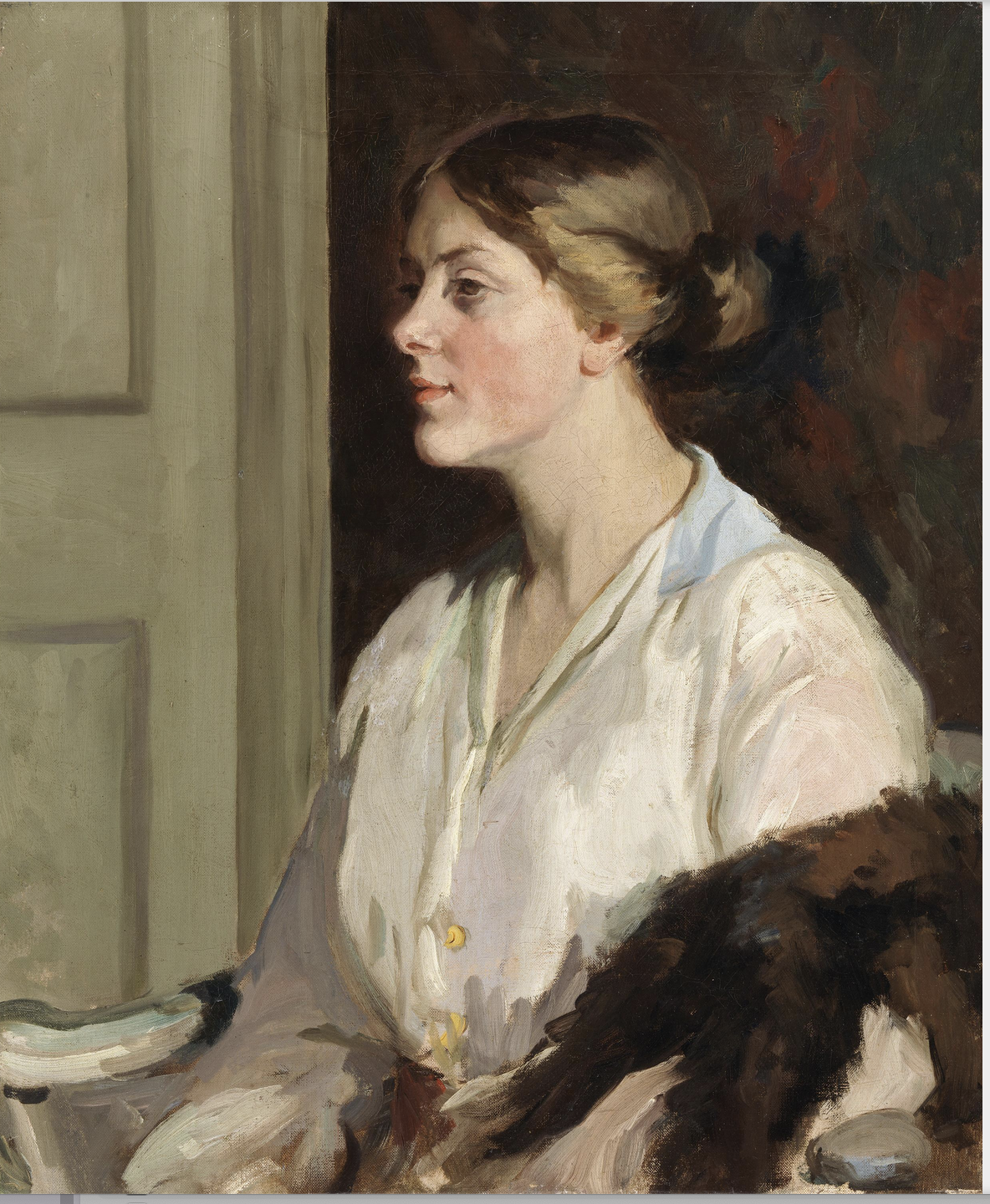
Portrait of Rose Dorothy Brooke, Cousin of the Artist 1913 by Eva Henrietta Hamilton, photograph courtesy of National Gallery of Ireland.

The website continues:

Eva was the first of the sisters to exhibit her work, showing a portrait and a figure subject in 1898 at the annual exhibition of the Water Colour Society of Ireland (WCSI). Watercolours were then seen as an acceptable medium for women artists. Her works were shown in London, Paris and Brussels as well as the Irish International Exhibition in Dublin in 1907. She first exhibited at the Royal Hibernian Academy (RHA) in Dublin in 1904 where she continued to exhibit until 1945.

With the death of their mother in 1922, Eva assumed much of the housekeeping role and had less time to devote to her painting. The sisters lived together for most of their lives, in their later years in a series of large rented houses. Among these was Fonthill in Palmerstown, now the offices of the Ballymore construction company. In 1946, they made their final move to Woodville in Lucan, an eighteenth century house designed by the architect, Richard Castle (1690-1751). Fondly known as ‘the Aunts’ nest’ they continued to give memorable parties in their rather eccentric lifestyles. A tree with many sweeping branches stood in the garden from where old umbrellas hung, and in a rather artistic way resembled a tree with huge drooping fruit!

I found a painting of the house online from a sales catalogue of DeVeres auctioneers, by Letitia.

The Hamilton Family at Woodville House, Lucan County Dublin by Letitia Hamilton.

The website also has an entry about Letitia:

Letitia Marion Hamilton (1878-1964) was a talented and prolific landscape artist who, like her sister, studied under Orpen in the DMSA. Compared to Eva, she remained less influenced by him and more by the works of European artists that she saw during her time abroad. An inveterate traveller, she made trips to France, Belgium and Holland before the war in Europe curtailed these visits... With the cessation of hostilities, Letitia’s travels recommenced with trips abroad, often accompanied by Eva. During the 1920s, she travelled widely in France, Italy and Yugoslavia. She visited Venice for the first time in the autumn of 1923 and during the 1930s made regular visits to the city and northern Italian lakes.

“…they both blazed a trail for women artists in Ireland at a time when it was dominated by their male counterparts such as Sean Keating, Paul Henry and Jack Yeats. Eva and Letitia’s images of pre-war Europe and scenes from Irish towns and villages preserve a way of life that has now vanished for ever.

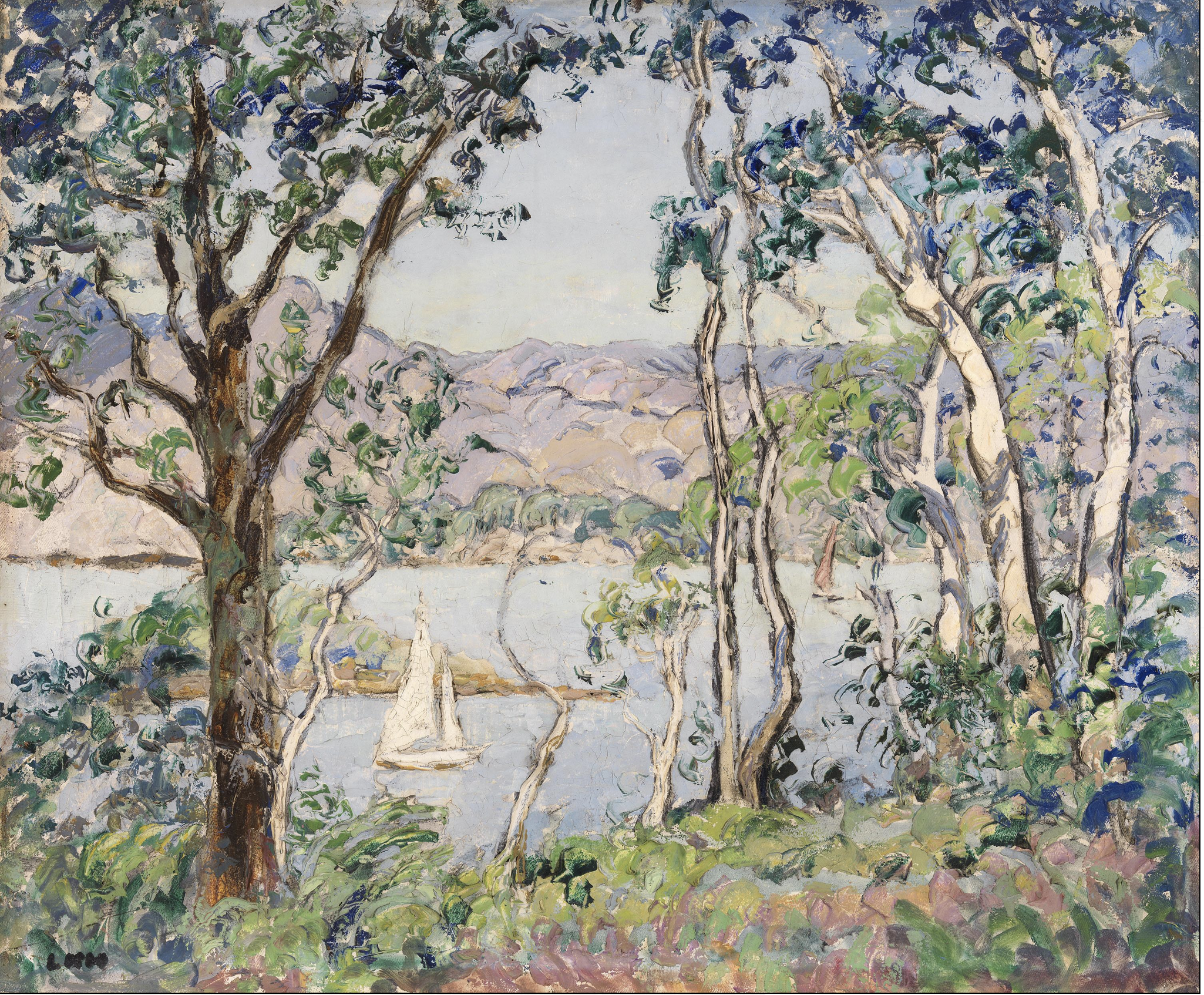
Bantry Bay with a Sailing Boat Seen Through Woodland c. 1940s by Letitia Marion Hamilton (1878-1964), photograph courtesy of National Gallery of Ireland.

Letitia won an Olympic medal in the 1948 Olympics, the only Irish medal winner that year, for Art featuring sport! Unfortunately that’s no longer an Olympic “sport.”

Their brother Francis Charles (1877-1961) was heir to Hamwood. He studied agriculture in England and acted as Land Agent for some estates in England before returning to Hamwood after the death of his father in 1913. There he continued in the position of Land Agent to the Duke of Leinster: from 1916 he would have been Agent for Edward FitzGerald (1892-1976), 7th Duke of Leinster. Mark Bence-Jones tells us that

“[The] 7th Duke was unable to live here having, as a young man, signed away his expectations to the “50 Shilling Tailor” Sir Henry Mallaby-Deeley, in return for ready money and an annuity. As a result of this unhappy transaction, Carton had eventually to be sold. It was bought 1949 by 2nd Lord Brocket…” [4]

Francis Charles [V] Hamilton (1877-1961), photograph courtesy of Hamwood house website.

A distant cousin from the family who moved to Hawkesbury in Canada, Violet Travers Hamilton, travelled to England to “do the season,” and Francis Charles was instructed to escort her. He fell in love and they married.

The Hamwood website tells us that:

Violet died prematurely in 1947. A few years later Francis Charles married Rosamund Bauer who built up Hamwood’s dairy herd and helped see the estate through some difficult times during post war depression... Francis Charles died in 1961 and left the estate to his son Charles.

Charles (1918-2005) was called “The Major” due to his time in the Indian army, and he served in World War II. Like his father, he also acted as Land Agent to some properties in England before returning to Hamwood. He returned to Ireland and lived in Galway where he was agent for Clonbrock, before returning to Hamwood in 1963, following the death of his father. He also acted as Land Agent for the Conynghams of Slane for a period. Although Carton was sold by the 7th Earl he continued to work as Agent. He may have met my grandfather, as my Grandfather John Baggot of Aghaboe and Abbeyleix in County Laois kept cattle there at some point!

Charles [VI] Hamilton (1918-2005) was called “The Major,” photograph courtesy of Hamwood house website.

In 1958 Charles married Anne Spicer from Carnew Castle, County Wicklow, where her family moved from England after the second world war. Her family had ties to Ireland, where they holidayed when she was a child, and William Wellesley-Pole (1763-1845) 3rd Earl of Mornington, of Dangan Castle in County Meath (now a ruin), the older brother of the Duke of Wellington, was an ancestor.

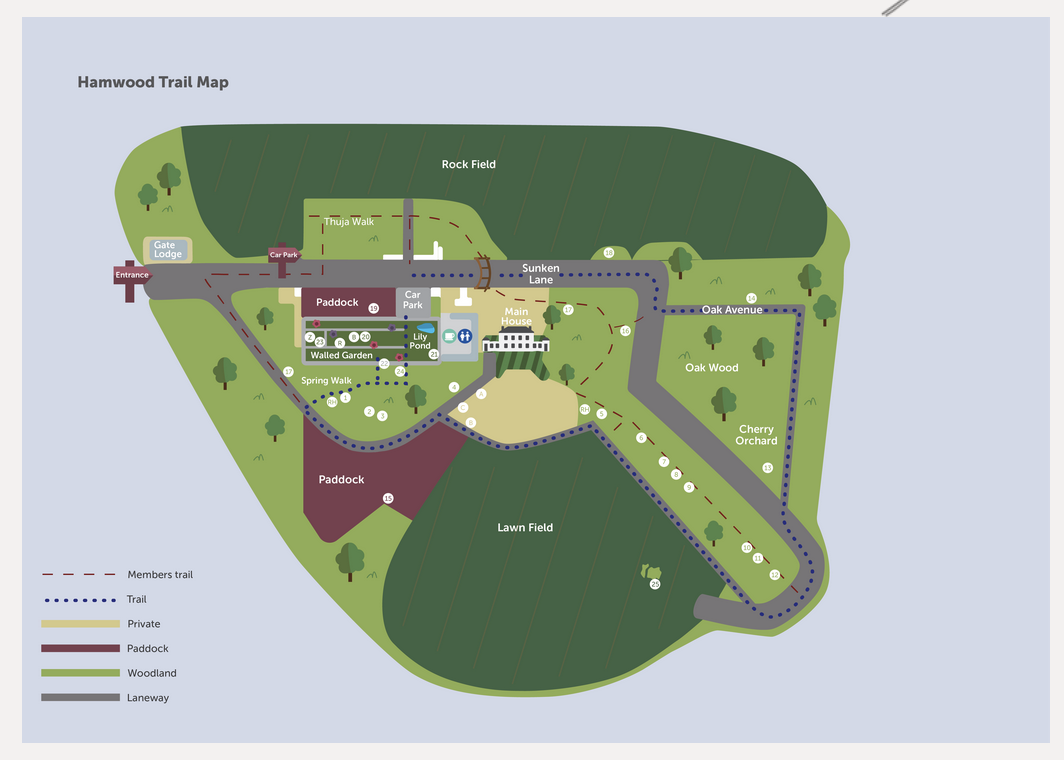
Charles took an interest in the garden and added to the plant collection and he ran the farm and bred cattle. Charles, who now lives in the house and showed us around, is their son. He continues the upkeep of the house, gardens and farm. He has created a woodland trail for visitors, and runs a seasonal courtyard café, Café des artistes. The family host events and have opened allotments. One can buy membership to have regular access to the gardens and café.

Map courtesy of Hamwood house website.
Hamwood, November 2022. Photograph © Jennifer Winder-Baggot, www.irishhistorichouses.com

[1] Great Irish Houses (Forewards by Desmond FitzGerald and Desmond Guinness) published by IMAGE Publications in 2008

[2] p. 117, Kavanagh, Art. The Landed Gentry and Aristocracy, Meath, 2005, published by Irish Family Names, Dublin 4.

[3] http://www.ihh.ie/index.cfm/houses/house/name/Hamwood

[4] Bence-Jones, Mark. A Guide to Irish Country Houses (originally published as Burke’s Guide to Country Houses volume 1 Ireland by Burke’s Peerage Ltd. 1978); Revised edition 1988 Constable and Company Ltd, London.

Text © Jennifer Winder-Baggot, www.irishhistorichouses.com