A place providing group accommodation let me know that my “places to visit and stay” pages for each county can cause confusion, since places of accommodation are not necessarily ones you can visit. Therefore I am separating into pages of places to visit, and places to stay. I will be republishing these over the next few weeks.
On the map above:
blue: places to visit that are not section 482
purple: section 482 properties
red: accommodation
yellow: less expensive accommodation for two
orange: “whole house rental” i.e. those properties that are only for large group accommodations or weddings, e.g. 10 or more people.
green: gardens to visit
grey: ruins

donation
Help me to pay the entrance fee to one of the houses on this website. This site is created purely out of love for the subject and I receive no payment so any donation is appreciated!
€15.00
1. Annes Grove (formerly Ballyhemock or Ballyhimmock), Castletownroche, Co Cork – gate lodge accommodation
2. Aspen House, Dromgarriff Estate, Glengarriff, Cork, Ireland (sleeps 6)
3. Ballea Castle, County Cork – ground floor airbnb suite
4. Ballinacurra House, County Cork – coach house, estate cottages, and whole house rental
5. Ballinterry House, Rathcormac, Co Cork – accommodation
6. Ballymacmoy, Killavullen, Co Cork – coach house airbnb
7. Ballymaloe, Cloyne, Co Cork – – restaurant, gardens and accommodation
8. Ballyvolane, Castlelyons, Co Cork – Section 482 accommodation
9. Bantry House & Garden, Bantry, Co. Cork – B&B accommodation
10. Blairscove House, County Cork – whole house accommodation
11. Castlemartyr, Co Cork – hotel
12. Castle Townshend, Co Cork – accommodation
13. Clifford House, Clifford, Co Cork – airbnb
14. Drishane House, County Cork whole house rental and holiday cottages
15. Eccles Hotel, Glengarriff, Co Cork
16. Elizabeth Fort Parade Houses, County Cork
17. Farran House, County Cork, whole house rental up to 8 guests
18. Galley Head Lighthouse Keepers House, County Cork
19. Coach House Apartments, Glebe Country House, Ballinadee Bandon County Cork
20. Glenlohane cottage, Kanturk, Cork – accommodation in house or Pink Cottage
21. Glenville Park, Glenville, County Cork (previously known as The Manor and as Mount Pleasant) – self-catering accommodation
22. Inis Beg estate, Baltimore, County Cork
23. Killee Cottage, Mitchelstown, County Cork
24. Kilmahon House, County Cork
25. Kilshannig, County Cork holiday accommodation
26. Liss Ard Estate, County Cork
27. Longueville, Mallow, Co Cork – Blue Book accommodation (2-29 people)
28. Lough Ine House and Lodge, Skibbereen, County Cork – whole house or gate lodge
29. The Courtyard, Mallow, County Cork
30. Maryborough hotel, Douglas, County Cork
31. Old Bank Townhouse, Kinsale, County Cork
32. Orchard Cottage, Dunowen House, Co Cork (sleeps 5)
33. Perryville, Kinsale, Co Cork – hotel
34. Rincolisky Castle, Whitehall, Co Cork – whole house accommodation
35. Seaview House Hotel (formerly Ballylickey House), County Cork
36. Southernmost House, Cape Clear Island, County Cork
37. Springfort Hall, Mallow, Co cork – hotel
38. Vienna Woods Hotel (formerly Lota Lodge), Glanmire, Co Cork
39. Willowhill, Carrigaline, County Cork – airbnb
Whole House Accommodation, County Cork
1. Ballinacurra House, County Cork – coach house, estate cottages, and whole house rental
2. Barnabrow, Cloyne, Co Cork – accommodation, whole house (22 bedrooms)
3. Blackwater Castle (Castle Widenham, or Blackwater Valley Castle) Castletownroache, Co Cork – whole house
4. Blairscove House, County Cork – weddings
5. Careysville (Ballymacpatrick Castle), Clondulane, Fermoy, Co.Cork, P61 VF53 – accommodation (whole house accommodation 11 guests)
6. Crosshaven House, Crosshaven, Co. Cork – whole house rental
7. Drishane House whole house rental and holiday cottages – see above
8. Dunowen House, Co Cork – Blue Book Accommodation, whole house
9. Longueville, Mallow, Co Cork – Blue Book accommodation, whole house
Cork:
1. Annes Grove (formerly Ballyhemock or Ballyhimmock), Castletownroche, Co Cork – OPW with gate lodge accommodation
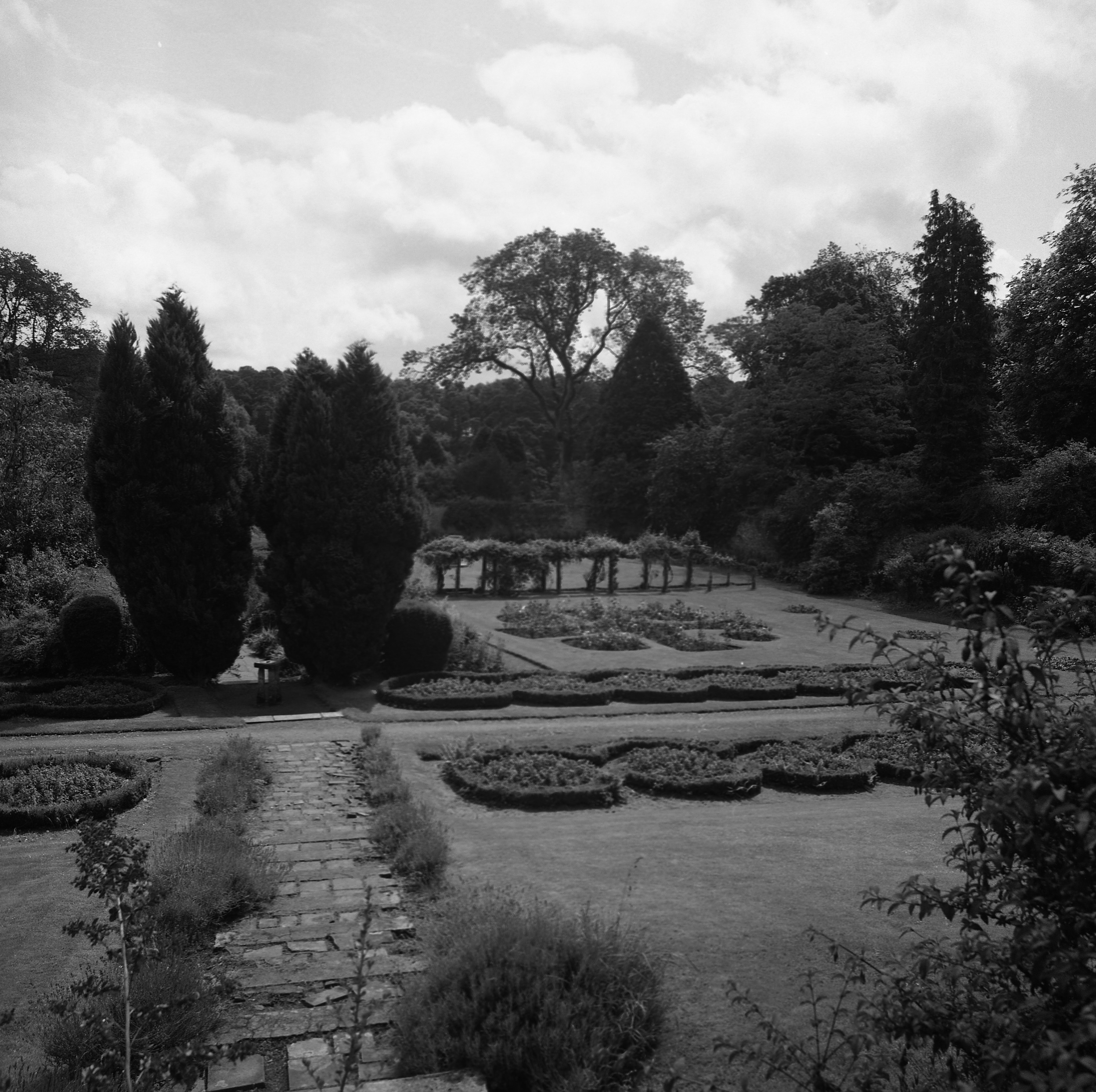
See my OPW write-up. https://irishhistorichouses.com/2022/01/19/office-of-public-works-properties-munster/
https://www.irishlandmark.com/property/annes-grove-miniature-castle/
A miniature medieval castle, Annes Grove Gatelodge was designed in 1853 to impress visitors to the main house – Annesgrove House and Gardens.
2. Aspen House, Dromgarriff Estate, Glengarriff, Cork, Whole House Rental (sleeps 6)
https://cashelfean.ie/aspen-house/
3. Ballea Castle, County Cork – ground floor airbnb suite
“Take a step back in time and visit Ireland’s oldest inhabited castle. A cherished heritage of Ireland and home to the Garcin-O’Mahony family. Lovingly restored to charm, impress and enjoy. As you approach the Castle entering through the ornate white gates, passing by the White Horse of Ballea, the legacy comes alive. The peaceful surrounding gardens and farm invites you to meet the resident household animals. A hundred thousand awaits, we hope you enjoy your regal stay.
“The space
Ballea Castle has a reputation for having welcomed the most notable of guests throughout its history, and has named its top suites after some of these personalities.
The large bedrooms, with independent dressing areas, are accompanied by luxurious marble bathrooms fitted with vanity units and walk-in showers.
“Our Ground Floor Suite is sophisticated and the ultimate home away from home. Furnished with a King Bed with reading lights, 2 chairs to relax in after a long day of business or leisure, along with a kitchenette providing a very personal space and privacy expected by the modern luxury traveller. A flat screen TV with Netflix, Amazon Prime and lots of other channels to choose from. Swags and Tails dress the windows, we hope you enjoy your time here.”
4. Ballinacurra House, County Cork – whole house rental, and cottages
https://hiddenireland.com/house-pages/ballinacurrahouse/
and https://www.ballinacurra.com/the-coach-house/
The website tells us: “Ballinacurra House is an elegant Georgian Mansion built c.1770 which has been fully renovated and upgraded over the past 20 years. The Estate consists of the main Manor House, Stone Cottage and Coach House – set behind 10 foot high stone walls with lawns, fields, river jetty and forest – and only 5 minutes’ drive from Ireland’s premier tourist town of Kinsale. Whether it’s for a holiday or some type of event … we’ve got you covered. The Owners’ 30 years of experience in event management is one of the reasons that Ballinacurra House is known as Ireland’s Premier Events House with a guarantee of privacy, discretion and style. And is the ideal venue for corporate retreats, client hosting, birthday parties, team-building events, golf groups, family reunions, private parties, friend gatherings and … weddings with a difference.
“For the first time we are now opening up the property to give groups of various sizes the opportunity to enjoy the uniqueness of the property! So depending on the size of your family or group, we have developed a range of options for self-catering (minimum 3 days) and our fully staffed and catered premium product for Private Groups (price on request). So now you can choose from:
- Estate Cottage 1 – The Coach House – up to 7 people – Self Catering – from €1,200 A 3 bedroom/4 bathroom separate 1,200 square foot home with a private outdoor dining terrace. This building has been renovated from the original coach house for the main manor house – and perfect for up to 7 people.
- Estate Cottage 2 – The Stone Cottage – up to 10 people – Self Catering – from €2,200 A stand-alone 1,800 square foot home with 4 bedrooms/4.5 bathrooms with its own private garden. This building was the original gardener’s cottage for the main manor house – now fully renovated that will sleep up to 10 people comfortably.
- Manor House (Partial) – up to 20 people – Self Catering – from €8,800 You will enjoy private use of Two Wings of the Manor House including 8 ensuite bedrooms and a range of living rooms, dining rooms, country style kitchen and outdoor dining options (can be catered or staffed by request).
- Manor House (Whole) – from 28 to 36 people – Full Catered & Staffed Only – on request There are 14 Bedrooms in the Manor House that can accommodate up to 36 adults + 3 children sharing and a whole range of living and entertainment spaces. Due to the numbers, this is only available on a fully catered and staffed basis.
- Whole Estate – from 44 to 54 people – Fully Catered & Staffed Only – on request The entire Estate consisting of the Manor House, Stone Cottage and Coach House for your private and exclusive use. A total of 22 ensuite bedrooms which is fully staffed and catered. This can cater for up to 54 adults + 4 children sharing.”
5. Ballinterry House, Rathcormac, Co Cork – accommodation
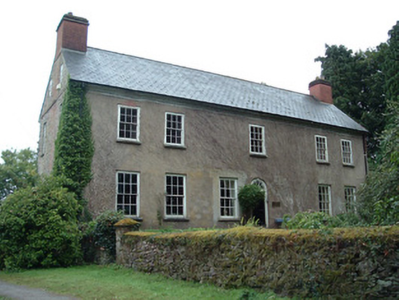

https://www.facebook.com/BallinterryH/
https://castlelyonsparish.com/who-i-am/accommodation/accommodation-2/
Ballinterry House Accommodation
P: +353 (0)25 87835 or +353 (0)87-6508555
E: ballinterryhouse@yahoo.co.uk
Frank Keohane writes in his Buildings of Ireland: Cork City and County that:
p. 21. “After the Williamite wars, landowners had the confidence to invest in their property and improve their estates, building new houses and offices, and creating enclosed landscaped demesnes. Of the minor gentry, most aspired to nothing more than a house that was solidly built, symmetrical and convenient. At first, middling houses were unsophisticated in their form and planning, often only one room deep but sometimes having a return containing a staircase or service rooms, thus forming an L-plan or T-plan. Steep gable-ended roofs were almost universal, hipped roofs and the use of parapets the exception. This arrangement continued throughout the 18th century for gentry houses, and well into the C19 for larger farmhouses. Early examples include Ballinterry (Rathcormac), Velvetstown (Buttevant), Rosehill at Ballynacorra (Midleton) and Aghadoe at Killeagh.” [9]
Mark Bence-Jones writes of Ballinterry House in A Guide to Irish Country Houses (1988):
p. 290. “(Barry/IFR) An early C18 house built on the site of a castle which in 1699 belonged to Andrew Morrough or Murragh, an attainted Jacobite; the house was until comparatively recently surrounded by old fortifications including four round towers, of which one and the fragments of another survive. Gable ended main block of two storeys with attic lit by windows in gable-ends; five bay front, originally seven bay, the windows on either side of the centre having been blocked up; presumably in the late Georgian period, when the other windows of the front appear to have been reduced in size and the interior walls rearranged. Simple fanlighted doorway. Original grass terrace with flagged pavement along front. Two storey return wing; central projection at rear of main block containing late-Georgian stairs with balustrade of plain sturdy wooden uprights. Stairs now open to hall; formerly separated from it by screen of C18 panelling with Gothic fanlight, now removed to first floor lobby of wing. Bought 1703 by the 4th Earl of Barrymore [James Barry (1667-1747)]; afterwards passed to the Ross family and then by marriage and descent to the Ryders and Henleys successively. From 1821 to 1862 the home of Archdeacon (“Black Billy”) Ryder, remembered for his part in the “Gortroe Massacre” in 1834, a tragic episode of the Tithe War. Ballinterry is now the home of Mr Hurd Maguire Hatfield, the stage and screen actor, who has carried out a sympathetic restoration of the house [who sold it to the current owners, Michael and Anne in 2007].”

The interior extensively damaged by a fire in 1991. Michael and Anne bought the period propety as a restoration project and realised it would be suitable for taking guests. An article in the Irish Times on Oct 3 2013 by Ellen Lynch tells us about the renovation:
“Michael and Ann spent three years taking up rotting floors, dismantling partitions, uncovering windows and other original features, and taking the house “back to the future” by renovating and modernising it in a way which was wholly sympathetic to its origins.
“In December 2007, without power and with no floorboards, the couple had no choice but to decamp with their young children to a cottage in outbuildings on the property. They moved back in during the spring of 2009.
“They managed to complete the work with the help of a conservation architect and the encouragement and blessing of Cork County Council’s conservation officer, Mona Hallinan. The Georgian Society declared it one of the most sympathetic restorations they’ve seen.
“Ann credits Michael’s unerring eye for detail and his capacity for hard work in bringing everything together to make Ballinterry House what it is today – a splendid country house with a truly authentic feel. “
6. Ballymacmoy, Killavullen, Co Cork – coach house airbnb
https://thecoachhouseatballymacmoy.weebly.com/ballymacmoy-house.html
The website tells us: “Ballymacmoy is the estate of origin of the wild geese family, the Hennessy’s of Cognac and is still owned and inhabited by their descendants. 40 kilometres from Cork International Airport, Ballymacmoy is a 23 acre estate located at the edge of the little village of Killavullen (200 inhabitants). It is made up of grasslands and wooded areas with 3.5 miles of exclusive fishing rights along the Blackwater river, it includes a 1 acre walled garden and a unique prehistoric private cave reserved for guests.”
Mark Bence-Jones writes of Ballymacmoy in A Guide to Irish Country Houses (1988):
p. 24. “[Hennessy/IFR] A two storey late-Georgian house on a rock overhanging the River Blackwater. Entrance front of three bays and curved bow; Wyatt windows, subsequently reglazed with central mullions; fanlighted doorway now obscured by plain porch. Simple battlemented arch at opposite end of house. Hall with elaborate early to mid-C19 plasterwork; reeded cornice with rosettes, central oval of acanthus. Partly curving stair with slender wooden balusters at inner end of hall beyond arch with rope ornament. Fine doorcases with Doric entablatures and rope ornament on architraves. Cornices of oakleaves in drawing room and ante room. Bow-ended ballroom with higher ceiling than the other principal rooms and simpler and presumably earlier C19 plasterwork; oval moulding in centre of ceiling, with flat pan pendentives at corners. Fluted pilasters on walls. Oak chimneypiece in the “Arts and Crafts” style, with overmantel incorporating needlework panel, carved in 1905 by Harriette, widow of J.W. Hennessy. There is a similar oak fireplace in the dining-room, which has been entirely done over in Edwardian Tudor; with a beamed ceiling, timber-studded walls and painted coat-of-arms. Sold 1932 by Mr. C.J. Hennessy to his kinsman, the late Monsieur J.R. Hennessy, of La Billarderie, Cognac. Recently tenanted by Mr. Ian Sherriff, who ran it as a guest house.”
7. Ballymaloe, Cloyne, Co Cork – restaurant, garden and accommodation

The website tells us:
“Ballymaloe House is a family run Country House Hotel and restaurant on 300 acres of farmland located in beautiful East Cork countryside. Internationally recognised as the birthplace of Modern Irish Cuisine, Ballymaloe House offers you the very best of Irish hospitality and seasonal locally sourced or homegrown food.
A unique Irish Country House experience.”

Mark Bence-Jones writes in A Guide to Irish Country Houses (1988):
p. 24. “[Boyle, Cork and Orrery, E/PB; Corker sub. Corcor/LGI1912] A castle built towards the end of C16 by the FitzGeralds of Imokilly, enlarged 1602 by Sir John FitzEdmund FitzGerald [b. 1555]; confiscated by Cromwell; occupied for a period after the Restoration by William Penn [1644-1718], of Pennsylvania, when he was managing his father’s estate at Shanagarry, nearby; subsequently occupied by 1st Earl of Orrery [Roger Boyle (1621-1679)], presumably while he was repairing and improving his nearby seat of Castle Martyr; acquired towards end of C17 by Lt-Col Edward Corker; sold by him ante his death 1734 to Hugh Lumley, who added some new buildings to the castle some time ante 1750. As a result of Lumley’s additions, Ballymaloe is now predominantly early C18 in character; consisting of a plain two storey six bay range with an old tower built into one end of it, and a three storey gable-ended range at right angles to the two storey range, and joined to it by a return; forming a house on a “L”- plan. Some of the windows have thick early C18 glazing-bars. A staircase with thin turned balusters rises from the inner end of the hall, which has a ceiling with simple Adamesque decoration. The large room to the right of the hall has simple Adamesque frieze. Ca 1800, Ballymaloe was the residence of the Penn Gaskell family, who were descended from William Penn. In 1814, it was the residence of William Abbott. In 1837, it was owned by a Mr Forster; in 1908, it was occupied by William Litchfield. Until ca 1947, it was the home of Mr and Mrs J.M. Simpson; since then, it has been the home of Mr and Mrs Ivan Allen.” [6]
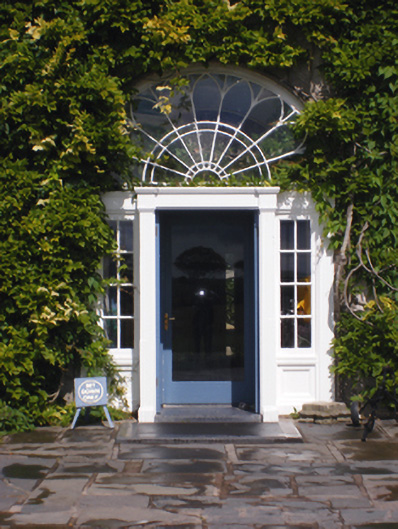
The Ballymaloe website elaborates the history:
“Ballymaloe was a castle of the Imokilly Geraldines. Richard FitzMaurice FitzGerald was a son of the Knight of Kerry, who was appointed as Seneschal, or governor, of the area by the Earl of Desmond in 1440. The original castle was probably built by him shortly after that time. By the time of the Desmond rebellion, the occupant was John FitzEdmund FitzGerald who was known as ‘the Queen’s John FitzEdmond’ to distinguish him from the Seneschal of the same name who was a leader of the Insurrection and owned nearby Castlemartyr.“
“John FitzEdmund of Ballymaloe castle was an illegitimate son of Edmund by Honor Ni Donagh, ‘a woman of Muskerry’ and was well up in the list of efficient contrivers and gatherers of land of his time. John FitzEdmund appointed himself Sheriff of Cork in 1570 and during the Desmond rising he ‘dyd hang his (legitimate) brother James FitzEdmund’ in 1582. John refused to join O’Neill in 1599 and his lands were devastated, but he survived to be knighted by Mountjoy at Cloyne for his faithfulness in 1602.“
“Despite their differences, the close ties to the Geraldines were apparent when John FitzEdmund’s son, Edmund, was married to Honora, widow of his namesake, the late Seneschal. In 1611 this Edmund died and she was a widow again so old Sir John leased her the lands at a nominal rent before he died the following year aged 85.
“A daughter of her rebellious father, she housed the homeless friars at Ballymaloe. Her son John moved to Ballymaloe where he died in 1640.
“By the time of the Confederate War in 1641, the owner was her grandson, another Edmund and he lost the lands for taking the ‘rebel’ side. They passed to Broghill, (Roger Boyle, son of the Earl of Cork; newly-created Earl of Orrery, but living on a narrow edge of survival since he had escaped a charge of treason in London. Broghill lived at Ballymaloe after his enforced retirement as President of the court of Munster in 1672 before making his last home at Castlemartyr.“
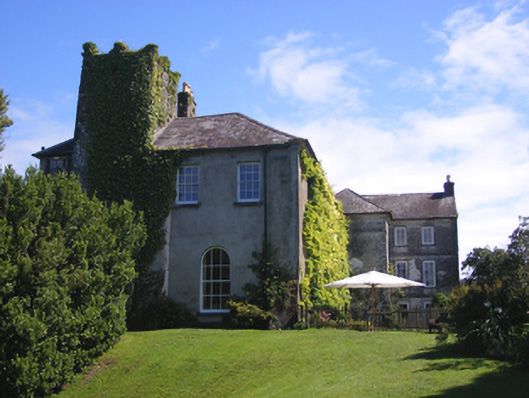
“By the middle of the 18th Century, the occupier was Abraham Forster, and early in the 19th century, his grandson demolished parts of the old castle. It was he who largely build the house into its present form. Sometime later it passed to the Litchfield’s, and in 1924 Simpson, a nephew of the latter family came into possession. Mr. Simpson sold the house and farm to Myrtle and Ivan Allen in 1948 and it remains owned by the Allen family to this day.“
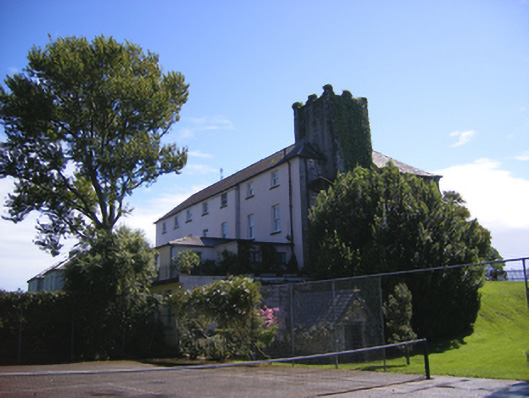
“Myrtle and Ivan Allen bought Ballymaloe in 1948 from the Simpson family. The Simpsons were known in the area for their parties and Myrtle and Ivan had, in fact, met at Ballycotton Lifeboat fundraising dinner at Ballymaloe a few years previously. Ivan had wide farming interests, growing tomatoes and cucumbers in glasshouses and mushrooms in dark wooden sheds at nearby Kinoith as well as managing the orchards there.
“However, Ivan longed for a mixed farm and when Ballymaloe came up for sale he decided to buy it. Myrtle and Ivan spent the next sixteen years farming and bringing up their children. The farm was a success producing milk, butter, cream, eggs, home raised pork and veal as well as fruit and vegetables. Myrtle became highly knowledgeable about cooking their produce and began writing a cookery column in the Irish Farmers Journal.“
“In 1964, Myrtle, encouraged by Ivan, decided to open Ballymaloe as a restaurant. The children were growing up and she could see a different future ahead of her:
“On a winter’s day I sat by the fire alone and wondered what I would do in this big house when they were all grown up – Then I thought about a restaurant.”
“Her aim was to emulate the best Irish Country House cookery. Myrtle and Ivan then placed an advert in the Cork Examiner: Dine in a Historic Country House. Open Tuesday to Saturday. Booking essential. Phone Cloyne 16.
“So Myrtle scrubbed down the kitchen table, and with the help of two local women she began. They cooked on an Aga at first and she was helped front of house by Ivan and their daughter Wendy. Their shepherd Joe Cronin ran the bar.
“The food was good and the restaurant flourished. They cooked using their own produce- unpasteurised milk and cream, veal, pork, homemade sausages and black puddings, herbs, fruit and vegetables. Ivan went to Ballycotton every day for the fresh catch. Local beef and lamb came from Mr.Cuddigan, the butcher in Cloyne. Myrtle also encouraged local farmers’ wives to bring in their surplus produce and blackberries, elderflowers and watercress were brought in by children for pocket money.
“Although times have changed at Ballymaloe, the essential spirit of the place is rooted in these improvised beginnings and in the relationship of the farm to the table which underlies the elegance of Irish Country House cooking.“
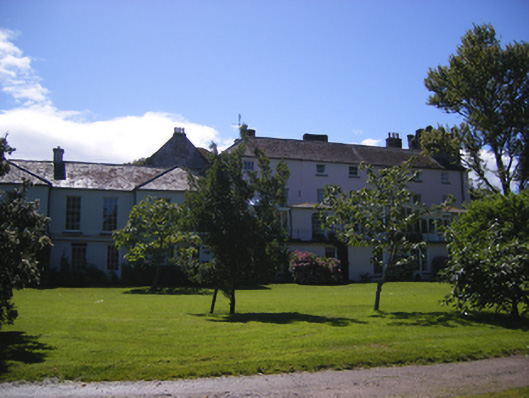
The National Inventory describes it: “Detached six-bay two-storey country house, built c. 1780, with four stories to rear (north) elevation, three bays to rear forming central projection and having single-storey additions to rear. Tower house, c.1450, incorporated into west elevation and taller L-plan three-storey house c. 1730 to east, five-bay two-storey hipped-roofed block with slightly projecting east bay to north-east corner…The fascinating multiphase construction is evident in the variety of styles and blocks which form the house. Formerly the seat of the FitzGeralds of Imokilly, it was enlarged by Sir John FitzEdmund FitzGerald. It was occupied at one time by William Penn of Pennsylvania and by First Earl of Ornery. Its impressive size is enhanced by fine proportions and by the retention of various timber sliding sash windows. The central doorcase and large petal fanlight form the main artistic focus and enhance the impressive and symmetrical façade. The other blocks add tremendous context. The tower house incorporated into the main house is a very notable archaeological feature. The house retains much early fabric and forms a group with related outbuildings and gate lodge.” (see [5])
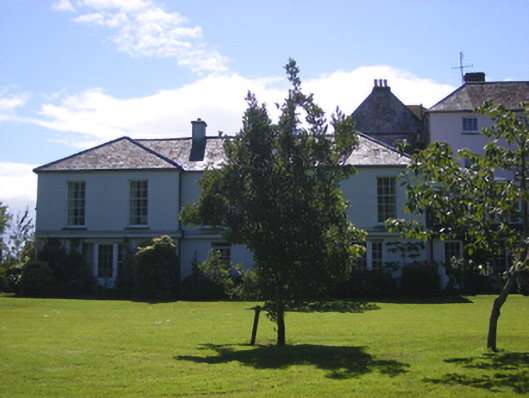


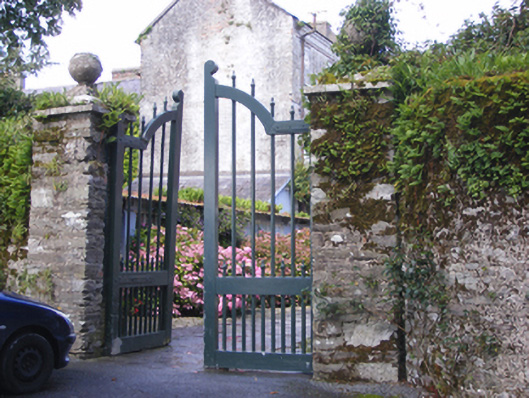

8. Ballyvolane House, Castlelyons, Co. Cork –section 482 accommodation
Tourist Accommodation Facility
Open dates in 2025: April 1-Sept 30, Jan, Feb Mar, Nov, Dec 3-20 Wed-Sat, Oct Tue-Sat
Fee: adult €7, family €18-2 adults and 3 children
Although listed under Accommodation Facility they have a fee on this listing so if you contact them in advance perhaps they will give you a tour.
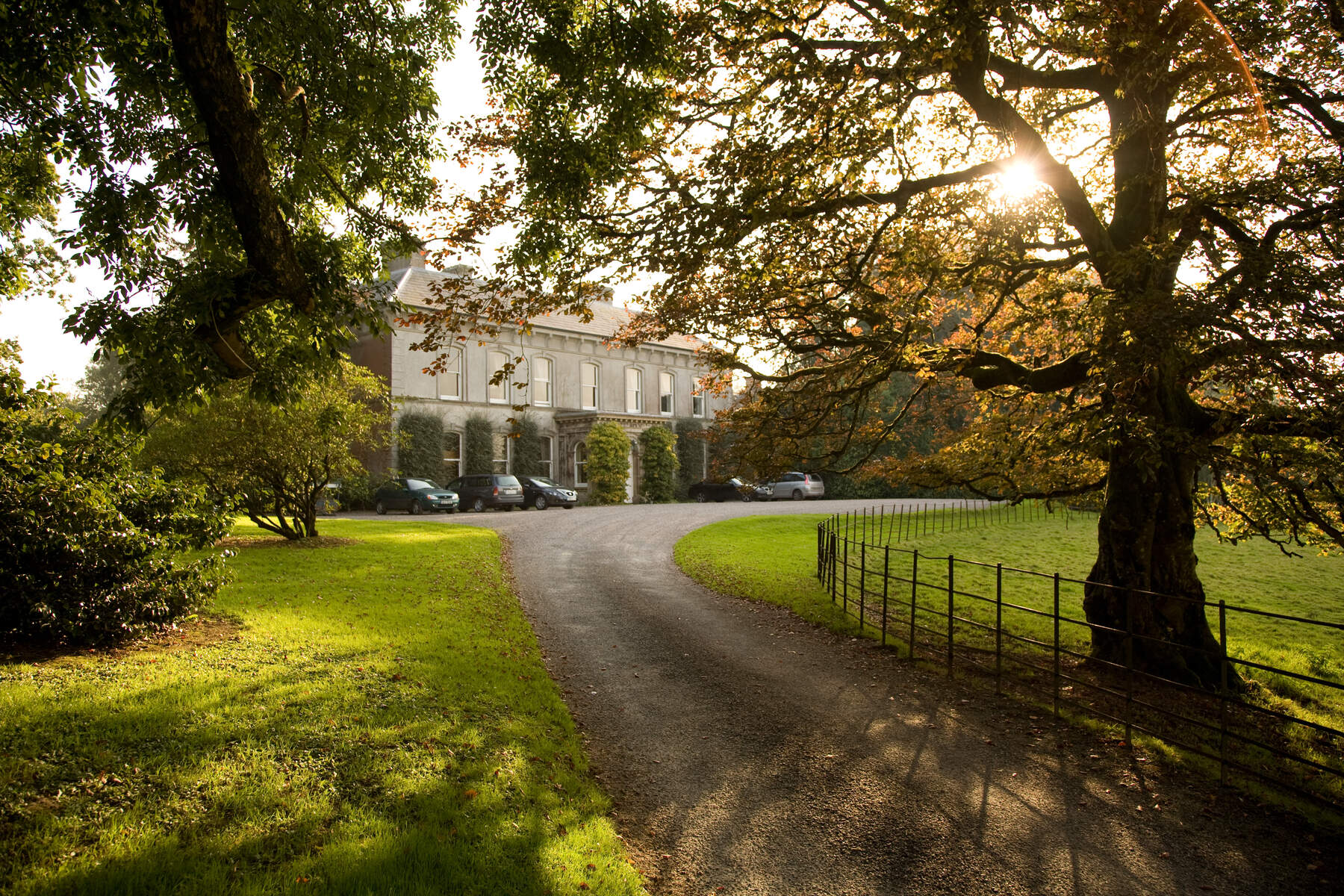
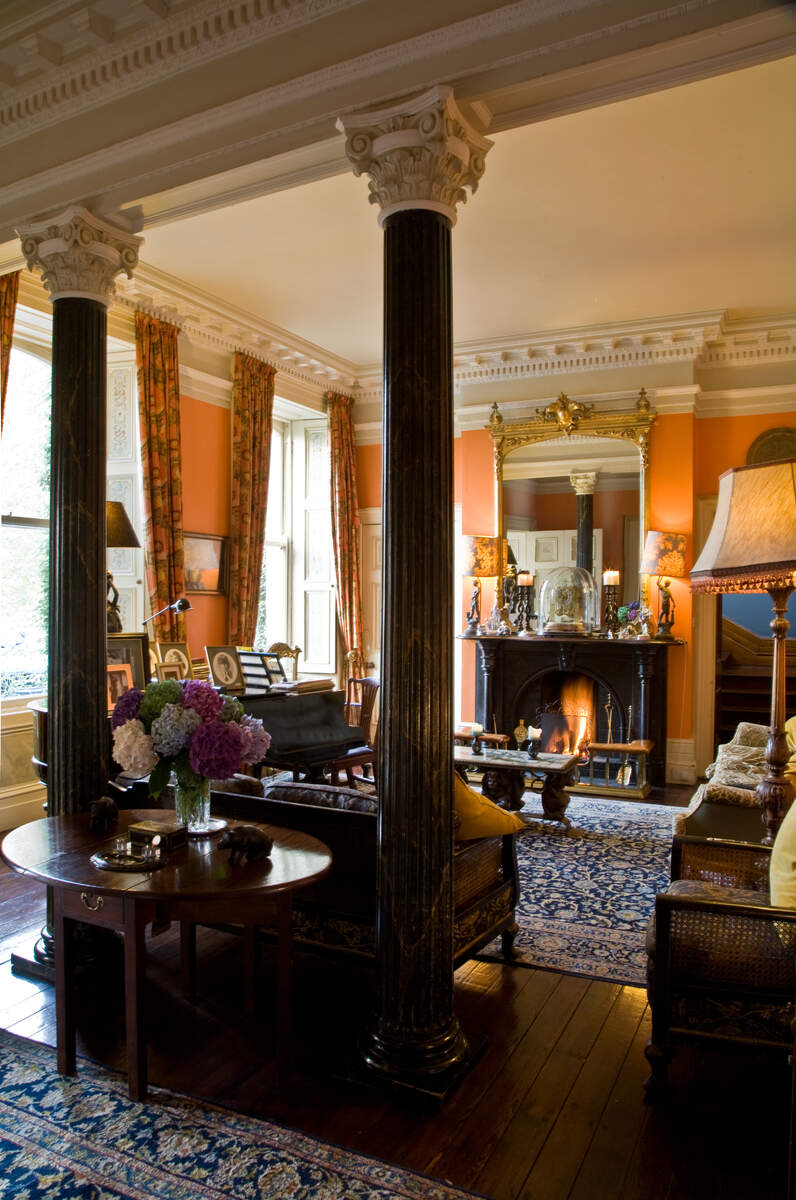
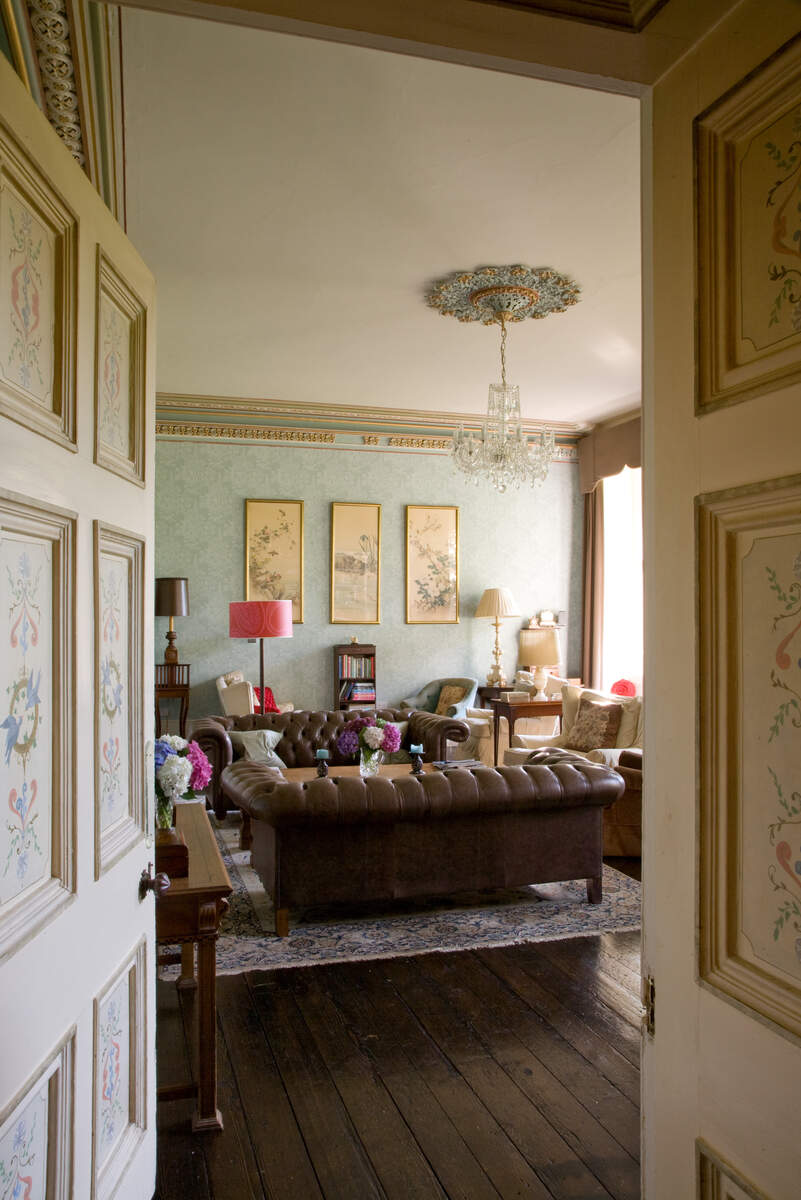
The website tells us: “Welcome to Ballyvolane House, a historic Irish country house of extraordinary warmth, style and comfort that provides luxury manor house accommodation, bespoke intimate weddings, glamping and private house parties/exclusive house rentals, located in the beautiful North Cork countryside of southern Ireland. Ballyvolane House is also home to Bertha’s Revenge Gin.“


The National Inventory describes the house: “Ballyvolane House is a fine example of the Victorian Italianate domestic architecture, in this case being applied to a house which was originally a three-storey early eighteenth-century structure. The top storey was removed when the house was remodelled in 1847. The classically proportioned façade is enlivened by the decorative render dressings including oak-leaf brackets to the eaves, window surrounds and heavy continuous sill course. The porch constitutes the decorative focus of the house and is articulated by pilasters. The doorway is flanked by skillfully carved marble engaged columns with ornate foliate capitals which add further artistic interest to the façade. The block to the west was built to house the servants and is of a simpler design and treatment. This building, together with extensive outbuildings and walled gardens, adds valuable context to the site.“

The website tells us about the history:
“There is an inescapable air of frivolity at Ballyvolane – the name itself means ‘the place of springing heifers’ and is testament to the fertility, richness and natural diversity of the land on which the estate lies.
“Originally built in 1728 by Sir Richard Pyne, a retired Lord Chief Justice of Ireland, Ballyvolane was designed in the classic Georgian country house style with three storeys… An amorous descendent, Arthur Pyne, acquired sufficient capital from his marriage to three wealthy women to have the house considerably enlarged in the early 19th century.
“The three-storey house was again modified in 1872 by George Pyne. He had the building pulled apart and then, by removing the top storey, recreated a two-storey house rendered in Italianate style, with an extensive west end wing.“

The website continues: “Recent research carried out Terence Reeves-Smyth unearthed tender documents for the remodelling of Ballyvolane from this time – the architect was Richard Rolt Brash (1817-1876), a Cork architect, whose father and brother were well known builders in the city. RB Brash is better known as a very active antiquarian and friend of John Windele – he was especially interested in round towers.
“The rebuilding/remodelling in the early 1870s followed the re-acquisition of the house and demesne by the Pyne family in 1869. Arthur Pyne (1747-1839) who probably built the present house around c1800 and laid out the present parkland (which looks Regency in date), was succeeded by his eldest son Jasper Pyne. Unfortunately, when Jasper died in 1860-1 he left no male heirs and as a result his wife and daughters did not inherit the property (the estate had been left by his father Arthur entailed for a life and could only be inherited by male issue). Consequently, following a big court case in May 1861 the property passed to Jasper’s younger brother, the Rev. William Masters Pyne, Rector of Oxted in Surrey. In March 1864 the Rev Pyne put the place on the market through the Encumbered Estates Courts. It remained on the market until bought by another member of the Pyne family in January 1869.
“It appears that Ballyvolane was originally purchased by Sir Richard Pyne in 1702-3 for £696; prior to this it had been the property of Sir Richard Nagle and Edmond Barry, but had been granted (forfeited lands) to Viscount Sidney. At the same time Sir Richard Pyne also purchased three other Co Cork properties from the Commissioners for Sale of Forfeited Estates; one was Blarney, the others were the estates of Ballinaneala and Ardra. He also in England bought Great Codham Hall in Essex, where the family continued to live well into the 19th century.“
“The Pynes built the present house and lived here until 1953, when it was bought by the late Cyril Hall Green (known as Squirrel Green) and his wife Joyce (née Blake), on their return from Malaya, where Squirrel had managed rubber plantations since the 1920’s. Ballyvolane was passed on to Squirrel’s son, Jeremy, who ran it as a mixed tillage and dairy farm until the mid 1980’s when it became one the founding members of the Hidden Ireland group, an association of town and country houses offering a unique and exclusive style of accommodation and chosen for their architectural merit and interesting characteristics.
“Ballyvolane was managed as a successful country house bed and breakfast by Jeremy and his wife, Merrie until January 2004, when the reins were handed to his son Justin and his wife, Jenny. Justin and Jenny are experienced hoteliers having gained international management experience in some of the best hotels in the world namely Mandarin Oriental in Hong Kong, The Legian in Bali, Jumeirah Beach Hotel in Dubai and prior to moving home, Justin was GM of Babington House (part of Soho House) in Somerset. Three generations of the Green Family now live at Ballyvolane.“



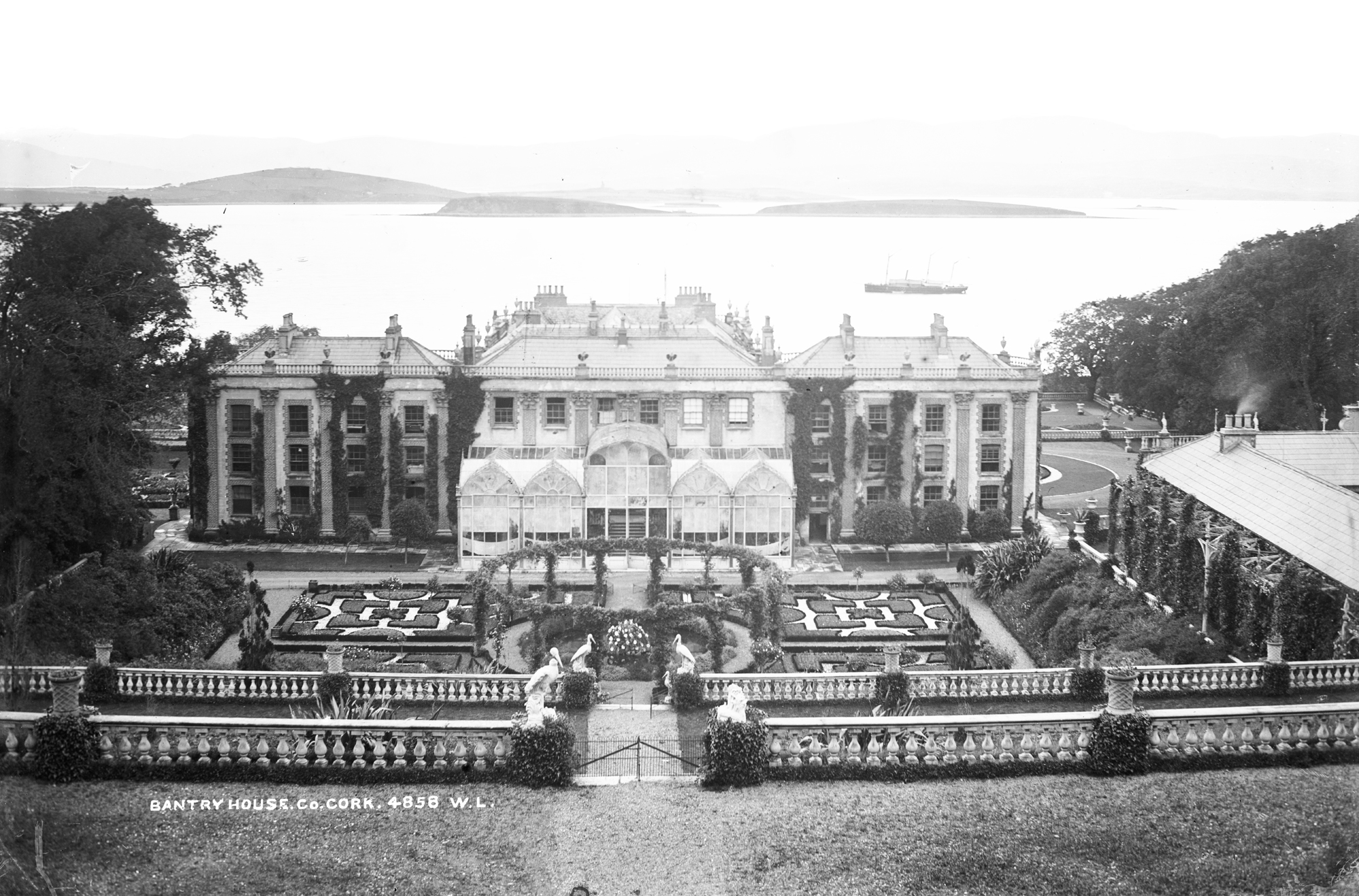
9. Bantry House & Garden,Bantry, Co. Cork 975 T293 – section 482 and accommodation
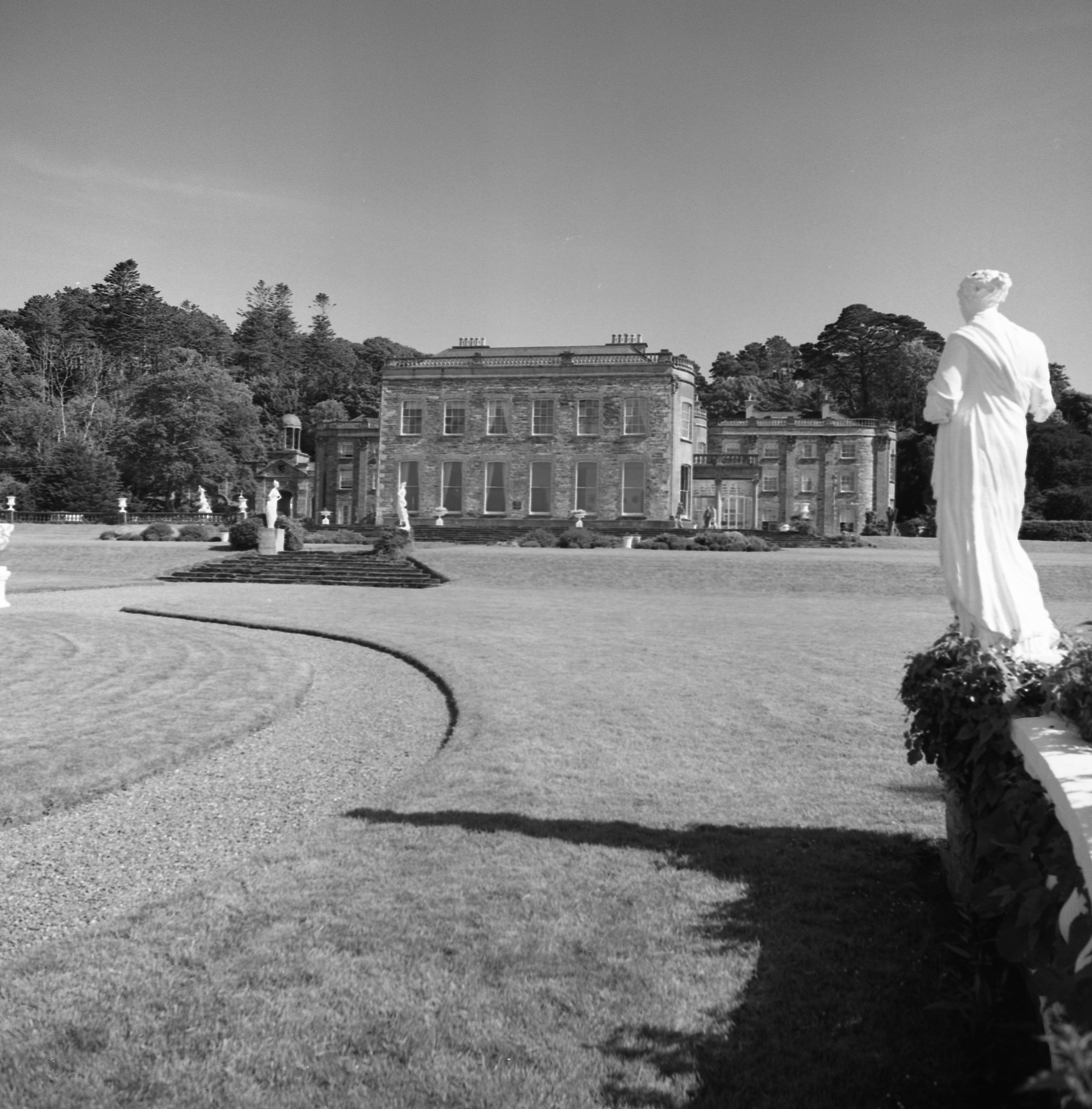
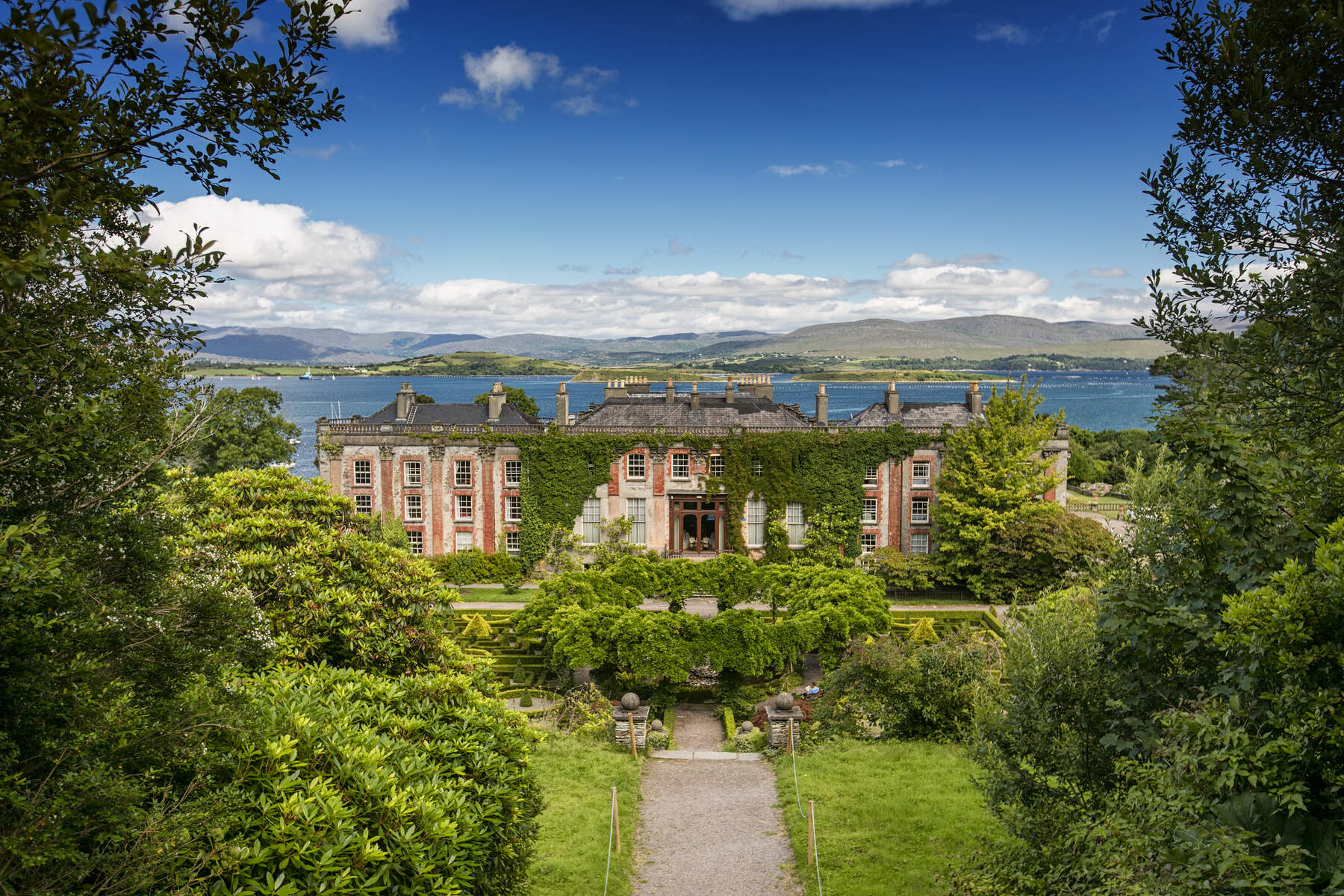
Open dates in 2026: Check website in advance. Mar 30-31, Apr 1-Oct 31, Mon-Sun 10am-5pm
Fee: adult €14, OAP/student €11.50, child €5, groups 8-20 people €10p.p. and groups
of 21 or more people €9p.p.
See my entry https://irishhistorichouses.com/2022/12/01/bantry-house-garden-bantry-co-cork/
10. Blairscove House, County Cork: accommodation in the Piggery, Smoke House and Loft. Also weddings
The website tells us:
“Blairscove House is situated on the picturesque inlet of Dunmanus Bay in West Cork on the Wild Atlantic Way. Not touched by mass tourism, it appeals to visitors who want to get away ‘far from the madding crowd,’ yet desire premium facilities in terms of service and food, with home from home comforts in terms of welcome and accommodation.
“Around the courtyard of a Georgian House, beautifully restored with cobbled paths, shrubs and flowers, are the restaurant and four stylish suites or small apartments which can be rented on a bed and breakfast or self-catering basis. Formerly a piggery, coach house and servants’ quarters, each suite is individually and very lovingly decorated with a quirky mix of contemporary and antique furnishings.
“We also have another holiday cottage on Dunmanus Pier in West Cork, just 12km from Blairscove, in the direction of Mizen Head, again on the Wild Atlantic Way driving route.“
11. Castlemartyr, County Cork – hotel
and Castle Martyr Lodges
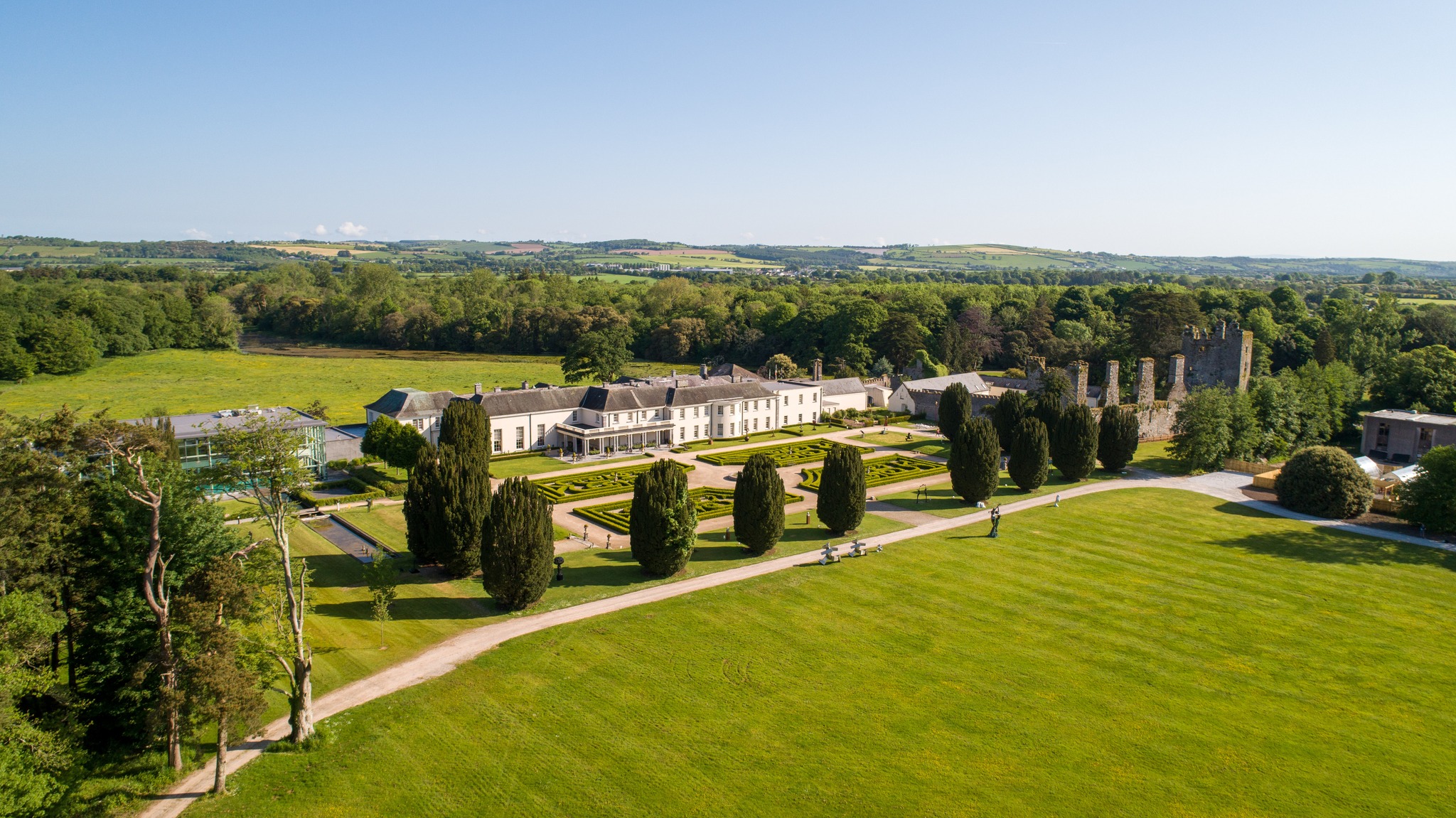
https://www.castlemartyrresort.ie
Mark Bence-Jones writes in 1988 of Castle Martyr in A Guide to Irish Country Houses:
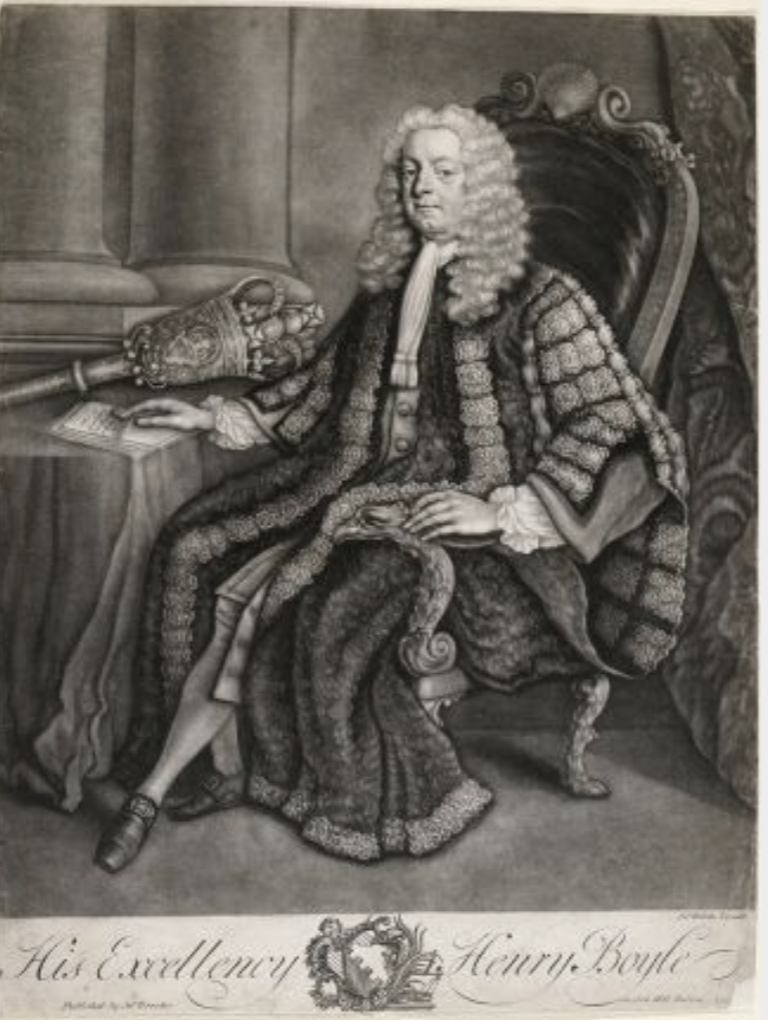
p. 72. “(Boyle, Cork and Orrery, E/PB; Boyle, Shannon, E/PB; Arnott, Bt/PB) Originally an old castle of the FitzGeralds, Seneschals of Imokilly, to which an early C17 domestic range was added by Richard Boyle, the “Great” Earl of Cork, who bought it from Sir Walter Raleigh, to whom it had been granted, along with other confiscated Geraldine estates. Having been damaged during the Civil Wards, it was repaired and made “English like” by Lord Cork’s third son, 1st Earl of Orrery, to whom it had passed; only to suffer worse damage in the Williamiate War, after which it was left a ruin, and a new house built alongside it early in C18 by Henry Boyle, who became Speaker of the Irish House of Commons and eventually 1st Earl of Shannon.”

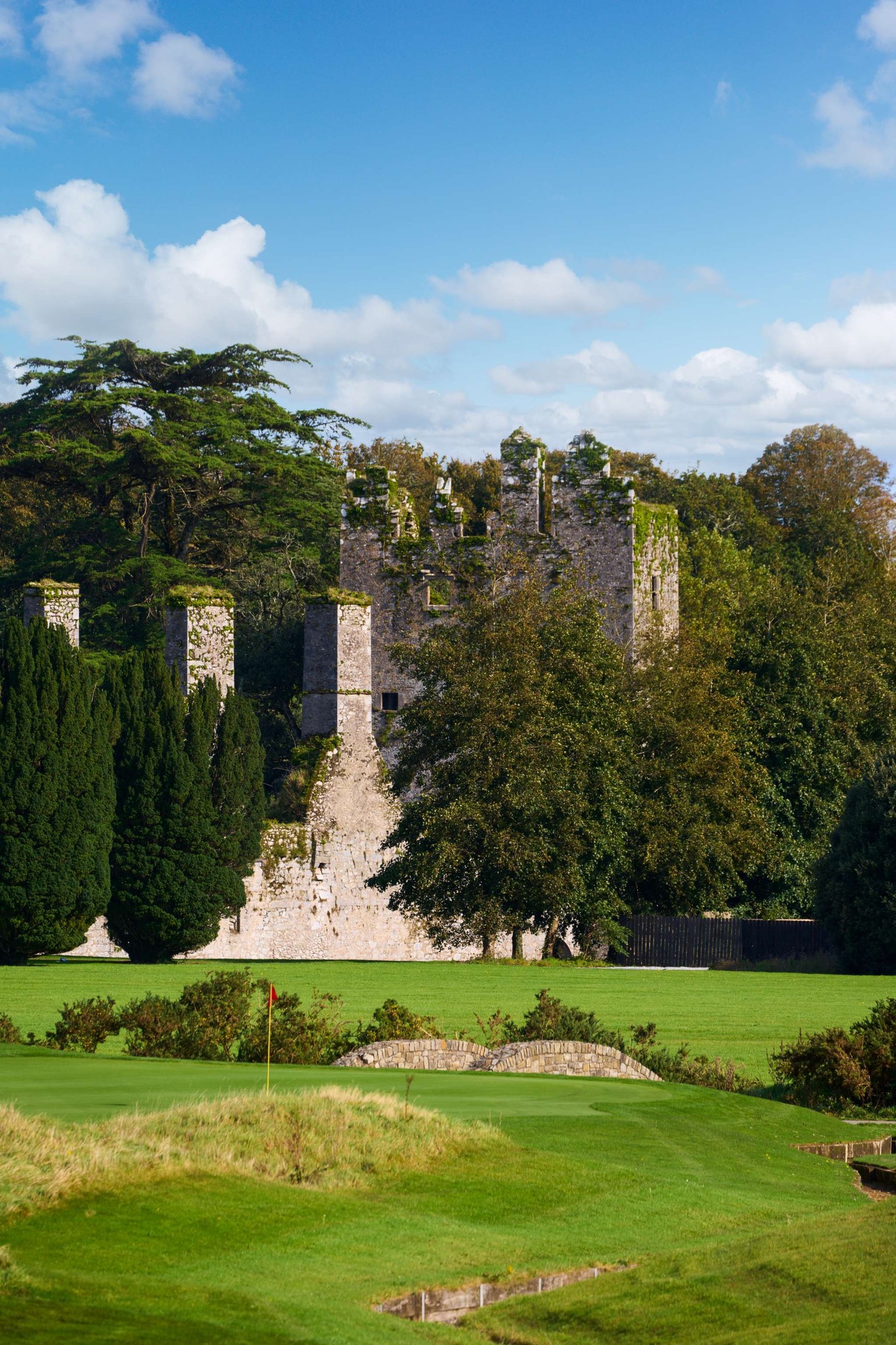
Roger Boyle (1621-1679) 1st Earl of Orrery’s son Roger (1646-1682) succeeded as 2nd Earl of Orrery. Another son, Henry (1646-1693), gave rise to the Earls of Shannon. His son Henry (1682-1764) was created 1st Earl of Shannon. Henry 1st Earl of Shannon married Henrietta, daughter of Charles Boyle, 2nd Earl of Burlington and 3rd Earl of Cork.
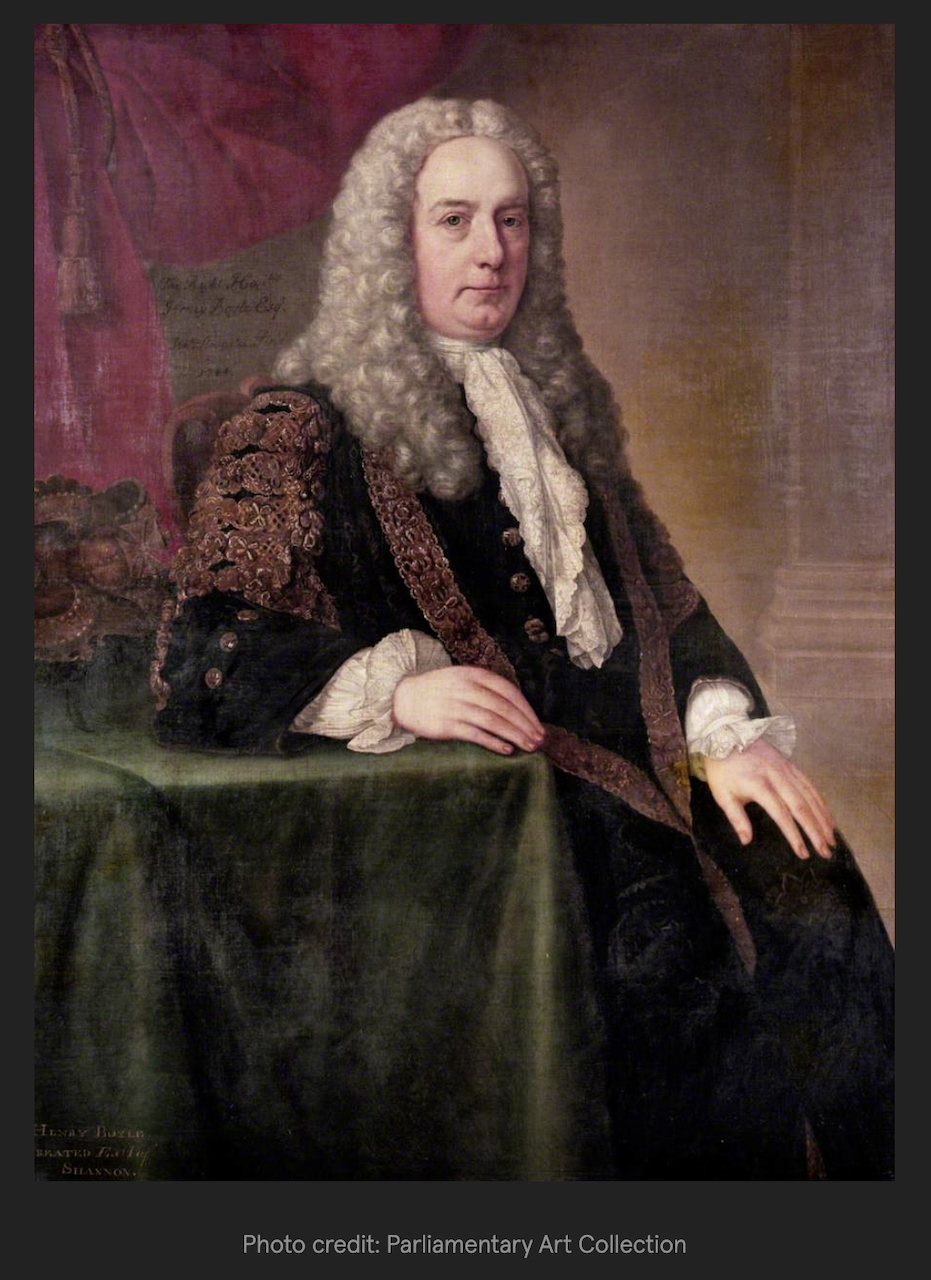
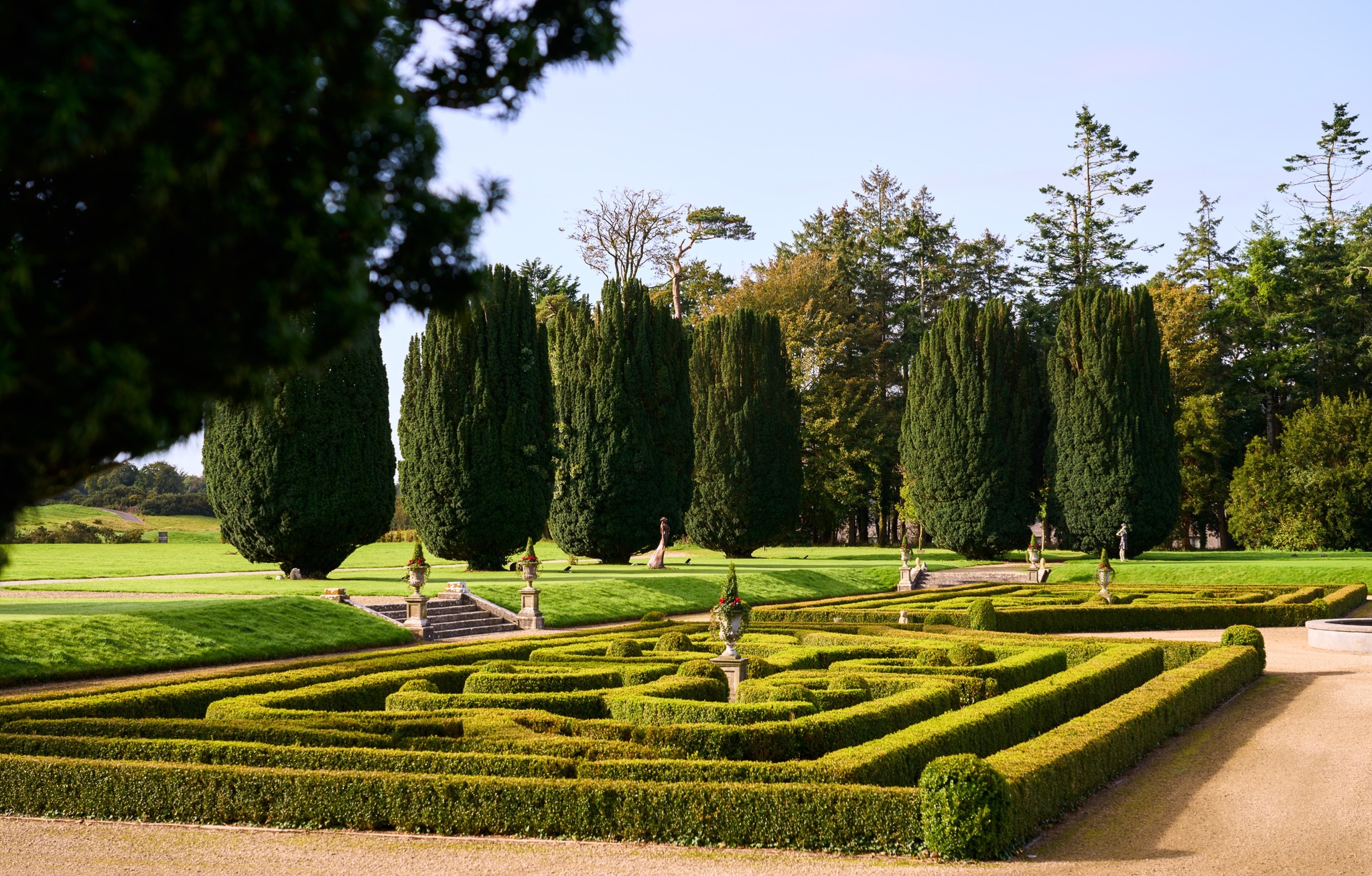

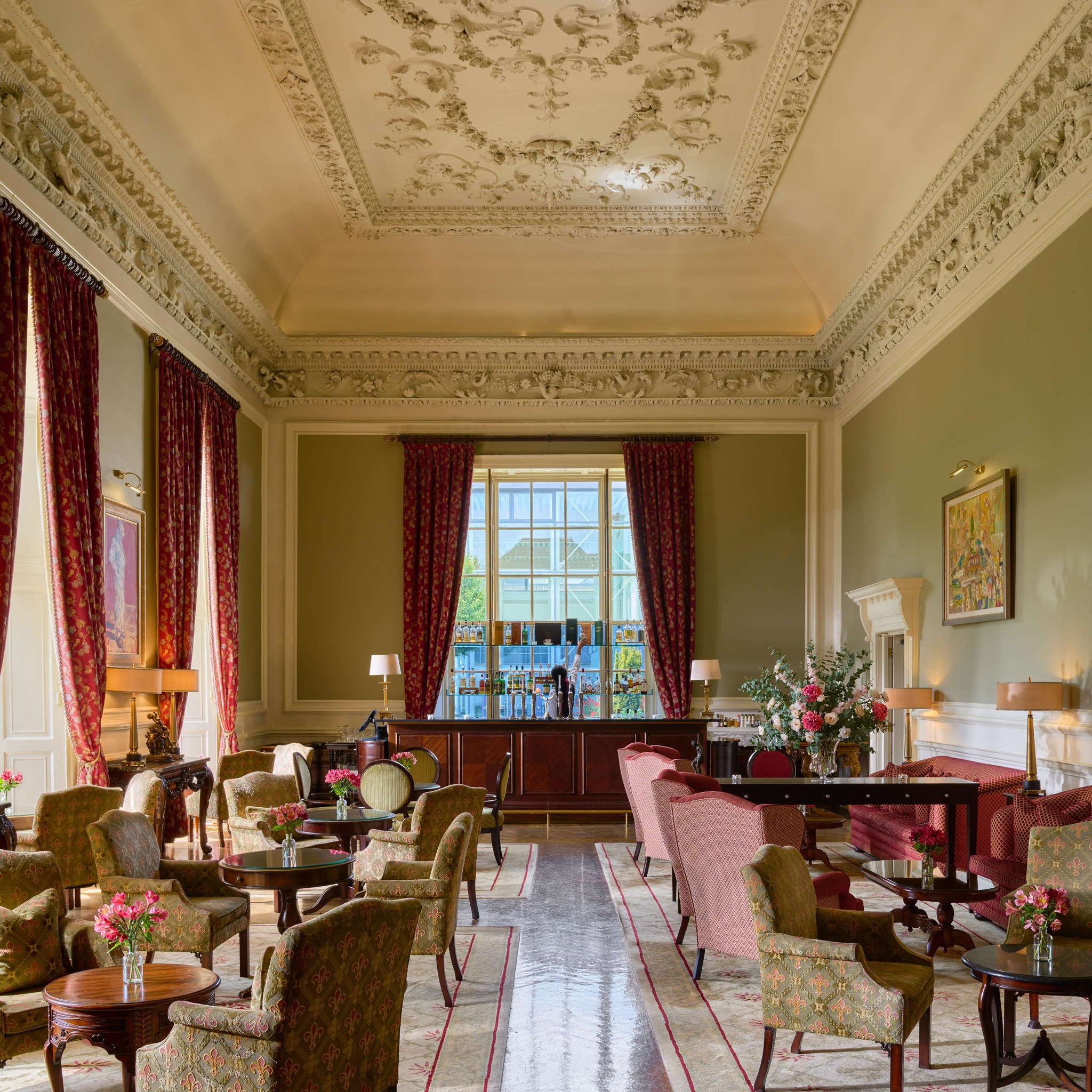
Bence-Jones continues: “The house was greatly enlarged by 2nd Earl between 1764/71, and further remodelled in late-Georgian period. While giving it an abnormally long facade, the subsequent additions did not take away from the house’s early C18 character, beign on the same scale and in the same style as the original building. Entrance front of two storeys and 17 bays, consisting of a five bay recessed centre with a giant pedimented portico between projecint wings, the forward-facing one bay ends of which are prolonged by a further five bays on either side. The ends of the projecting wings on either side of the centre are framed by rusticated pilasters, and formerly had Venetian windows in their lower storey, which have now been made into ordinary triple windows; there is also a rusticated pilaster at either end of the facade. The front is unusual in having three entrance doorways, of similar size, one under the portico and one in the centre of the five outer bays on either side; originally these doorways had plain architraves, but they were replaced by rusticated doorcases early this century. High-pitched, slightly sprocketed roofs. Irregular garden front; range of three bays on either side of a curved central bow, then a four bay range set slightly back with a balustraded colonnade of coupled Doric columns along its lower storey, then a range set further back again, of the same height as the rest of the facade but of one storey only, with three tall windows. Long, narrow and low-ceilinged hall with bifurcating wooden staircase at one end; late-Georgian frieze. A wide pilastered corridor runs from the staircase end of the hall, opening into a series of reception rooms along the garden front’ they are of modest size, low-ceilinged and simply decorated. In contrast to them is the magnificent double cube saloon or ballroom at the opposite end of the hall., which rises the full height of the house and is lit by the three tall windows in the single-storey part of the garden front. It has a coved ceiling with splendid rococo plasterwork in the manner of Robert West – birds, swags, flowers, foliage and cornucopiae in high relief – and a doorcase with fluted Ionic columns and a broken pediment. This room was one of 2nd Earl’s additions; it was finished by 1771, when it was seen by Arthur Young, who considered it to be the best room he had seen in Ireland. It certainly rates among the dozen or so finest Irish country house interiors; or anyhow whould have done when it had its chimneypiece and its original pictures and furnishings. The entrance front of the house overlooks a sheet of water which is part of the remarkable artificial river made ante 1750 by 1st Earl; it winds its way between wooded banks through the demesne and round the neighbouring town of Castlemartyr; broad and deep enough to be navigable by what was described in C18 as “an handsome boat.” The entrance gates from the town are flanked by tall battlemented walls shaped to look like Gothic towers; from the side they reveal themselves to be no more than stage scenery. Castle Martyr was sold early in the present century to the Arnott family; it was subsequently re-sold and is now a Carmelite College.”
Note that Henry Boyle (1682-1764), 1st Earl of Shannon, who owned Castlemartyr, also owned a townouse at 11 Henrietta Street in Dublin. See Melanie Hayes’s wonderful book The Best Address in Town: Henrietta Street, Dublin and its First Residents, 1720-80 published by Four Courts Press, Dublin 8, in 2020.
12. Castle Townshend, Co Cork – accommodation

See my entry https://irishhistorichouses.com/2025/04/25/the-castle-castletownshend-co-cork-accommodation/
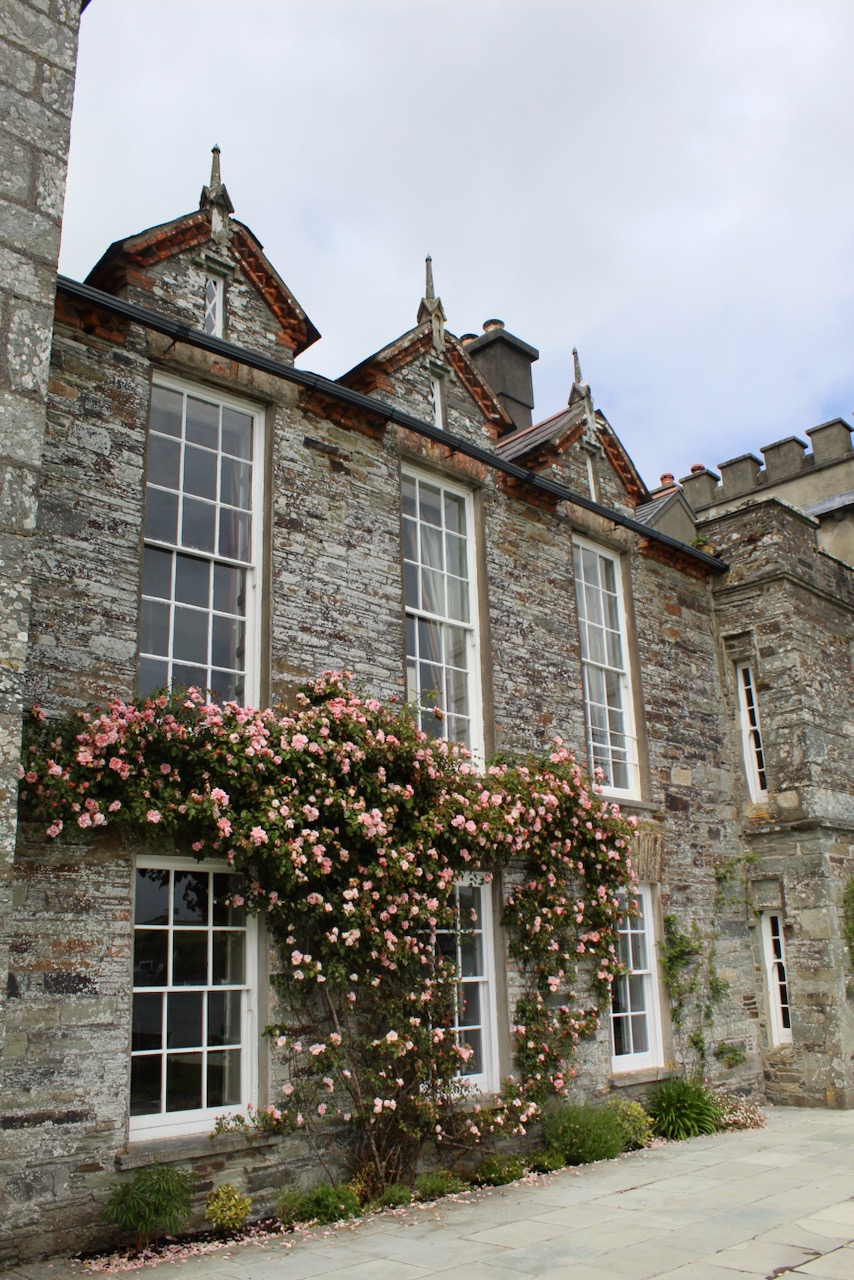
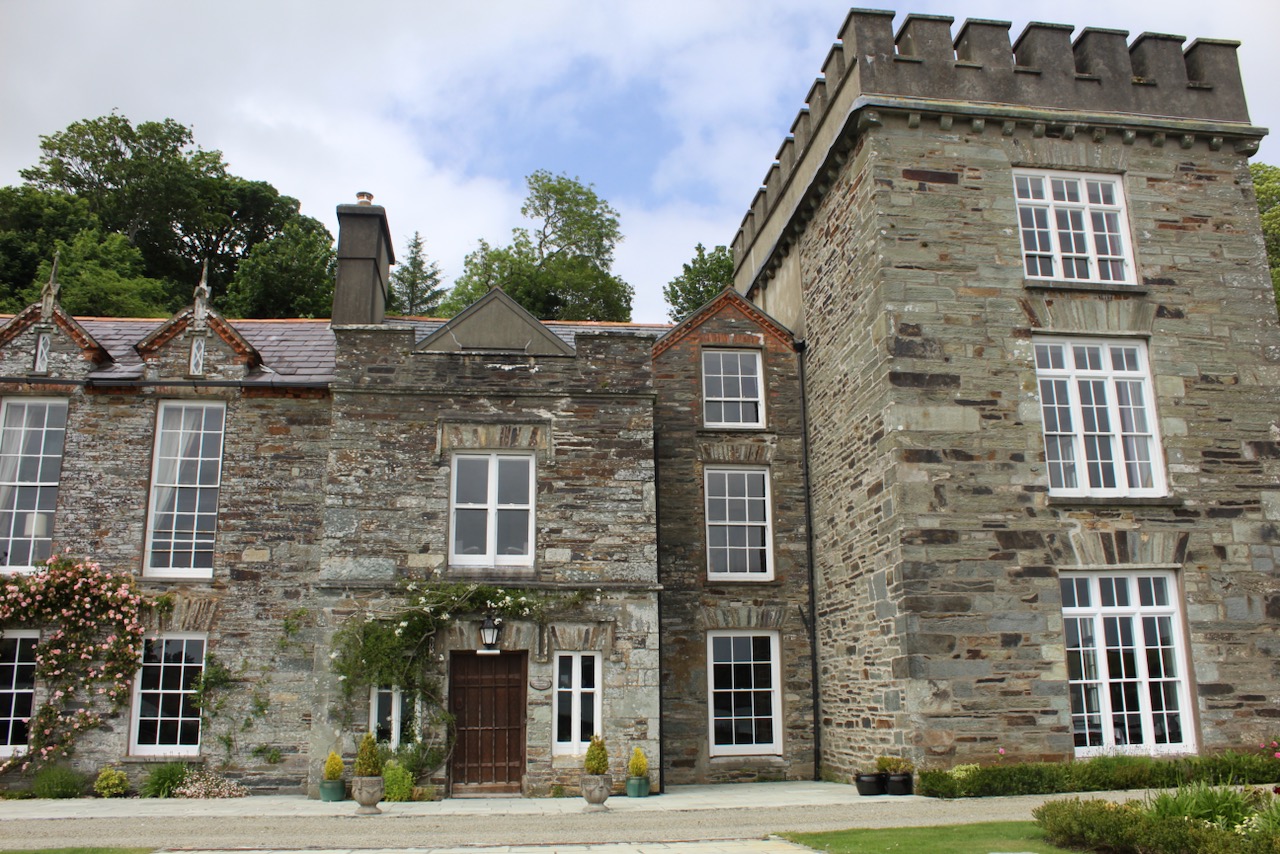
We visited the Castle of Castletownshend when on holidays in County Cork in June 2022. The Castle is a hidden gem, full of history. We definitely look forward to a return visit, to stay in the Castle.
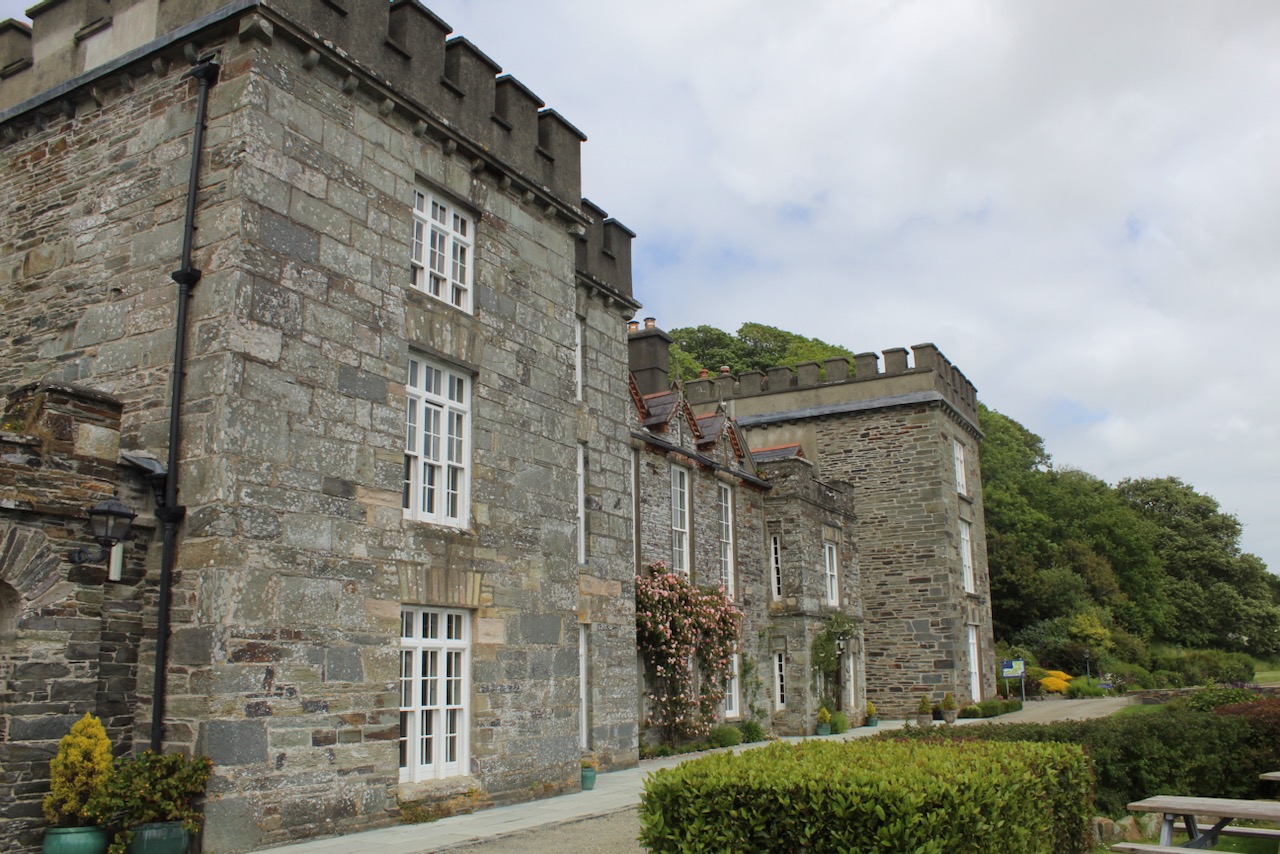
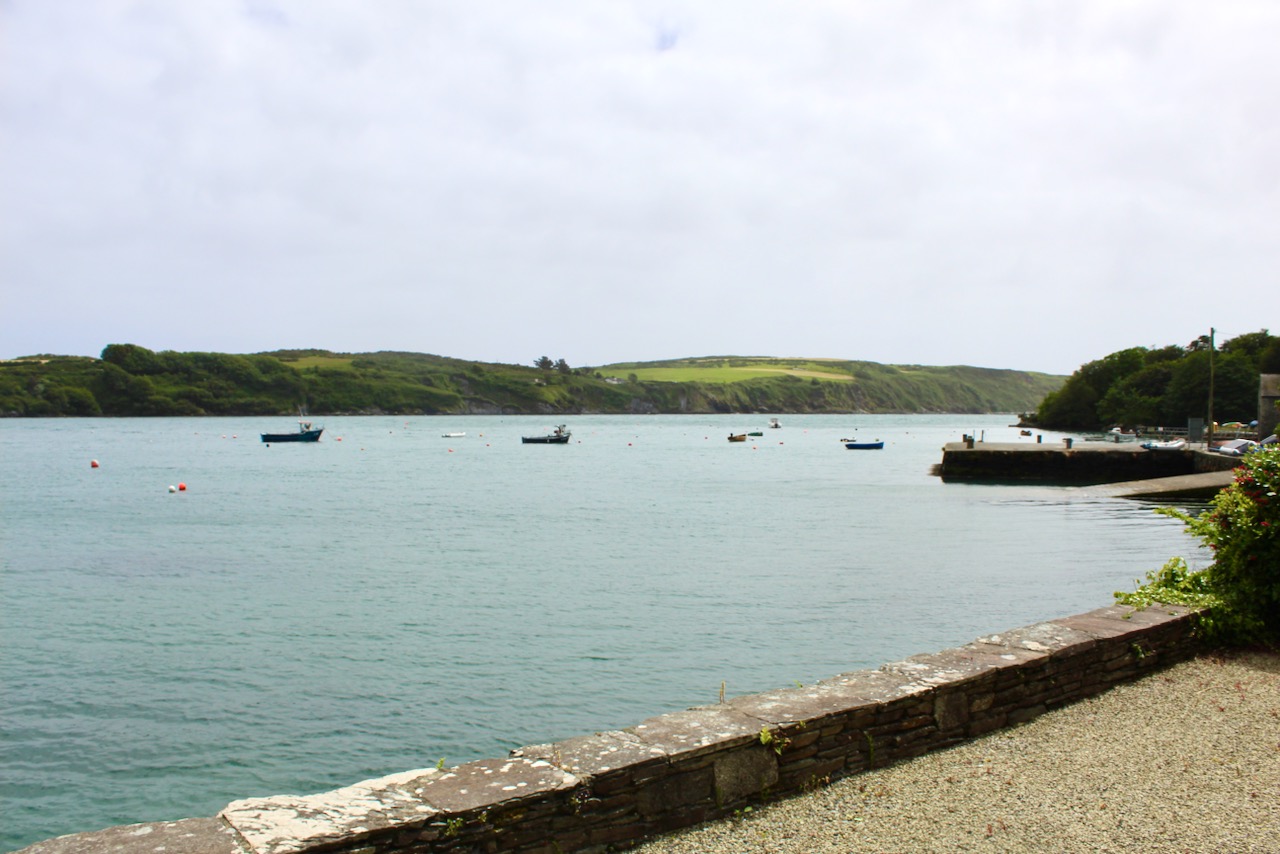
The website tells us:
“In the picturesque village of Castletownshend, past ‘The Two Trees’ at the bottom of the hill, you’ll find our family-run boutique B&B. Nestled at the edge of a scenic harbour and natural woodlands for you to explore, The Castle is a truly unique place to stay. It has the warm, homely feel of a traditional Irish B&B, but with a few extra special touches.

13. Clifford House, Clifford, County Cork – airbnb
The airbnb posting tells us you can rent a room in the house:
“A beautiful Georgian house set in wonderful countryside, amongst old and established trees with lawns and a walled vegetable garden with exceptional views overlooking the Nagle Mountains and the Blackwater River running below.
“Situated between Mallow and Fermoy approx 12 miles from either with three local villages Killavullen, Castletownroche and Ballyhooly each a 2.5 miles away. Cork city is 45 minutes drive.
The space
“This is the perfect place to relax, unwind or position yourselves for a weekend of fishing and relaxation. You are welcome to walk around the grounds, relax in the sitting room in front of the fire read or watch TV.
Guest access
“The double bedroom is comfortable and spacious with a king size bed with en suite bathroom which has been recently upgraded.“
The National Inventory of Architectural Heritage tells us: “This solid and handsome country house was built by Richard Martin on a prominent position overlooking the River Blackwater. It developed over the centuries, as evidenced by the various additions. The house is notable for the quantity and quality of historic fabric retained such as the varied small-paned sash windows and slate roof, helping to maintain the integrity of the composition. The cut limestone piers with pineapple caps are a most decorative feature.”
14. Drishane House, Castletownshend, County Cork – section 482 and whole house rental and holiday cottages accommodation
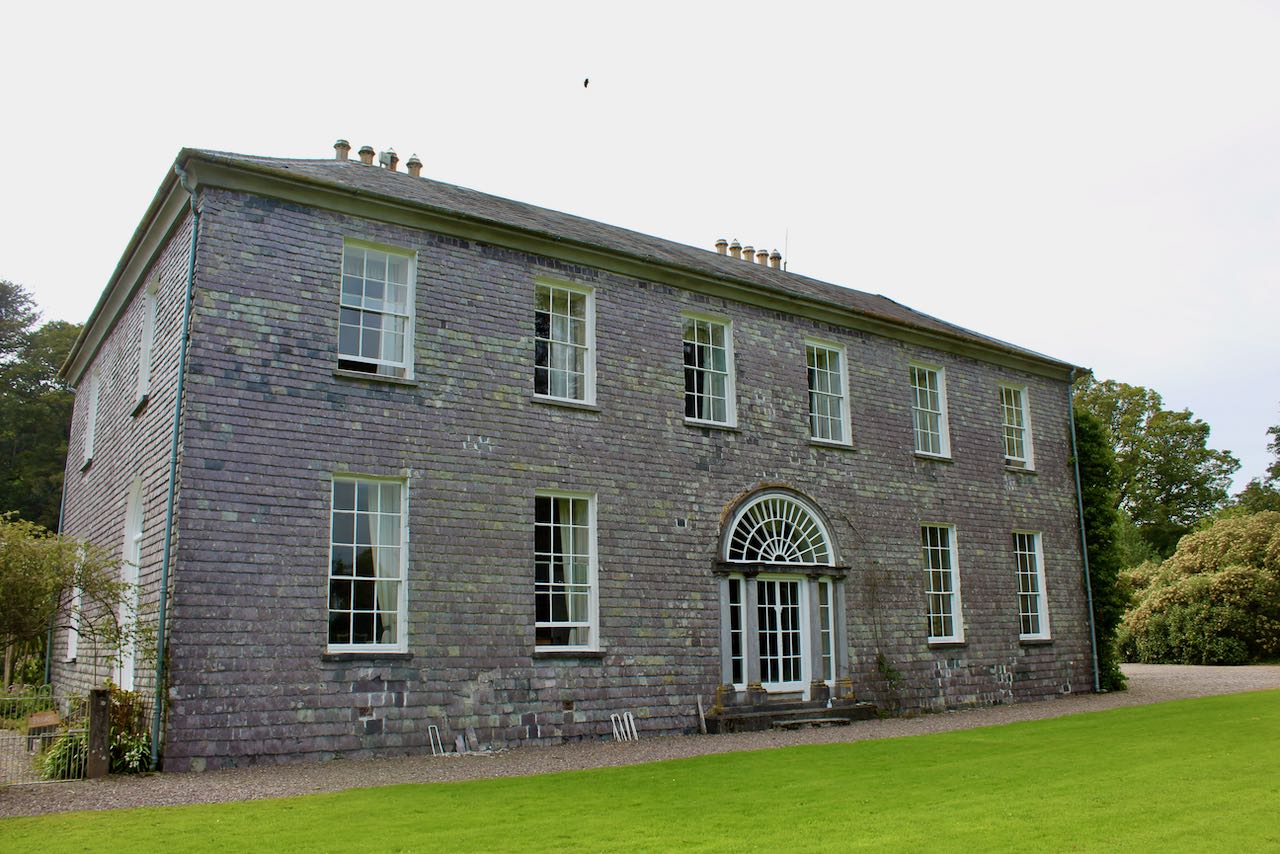
See my write-up:
https://irishhistorichouses.com/2021/03/07/drishane-house-castletownshend-co-cork/
www.drishane.com
Open dates in 2026: May 1-31, Aug 15-23, Oct 3-22, 11am-3pm
Fee: adult €12, OAP €10, student/child €8, child under 6 years free
15. Eccles Hotel, Glengarriff, Co Cork
Email: reservations@eccleshotel.com
Tel: +353 – 27 – 63003
www.eccleshotel.com
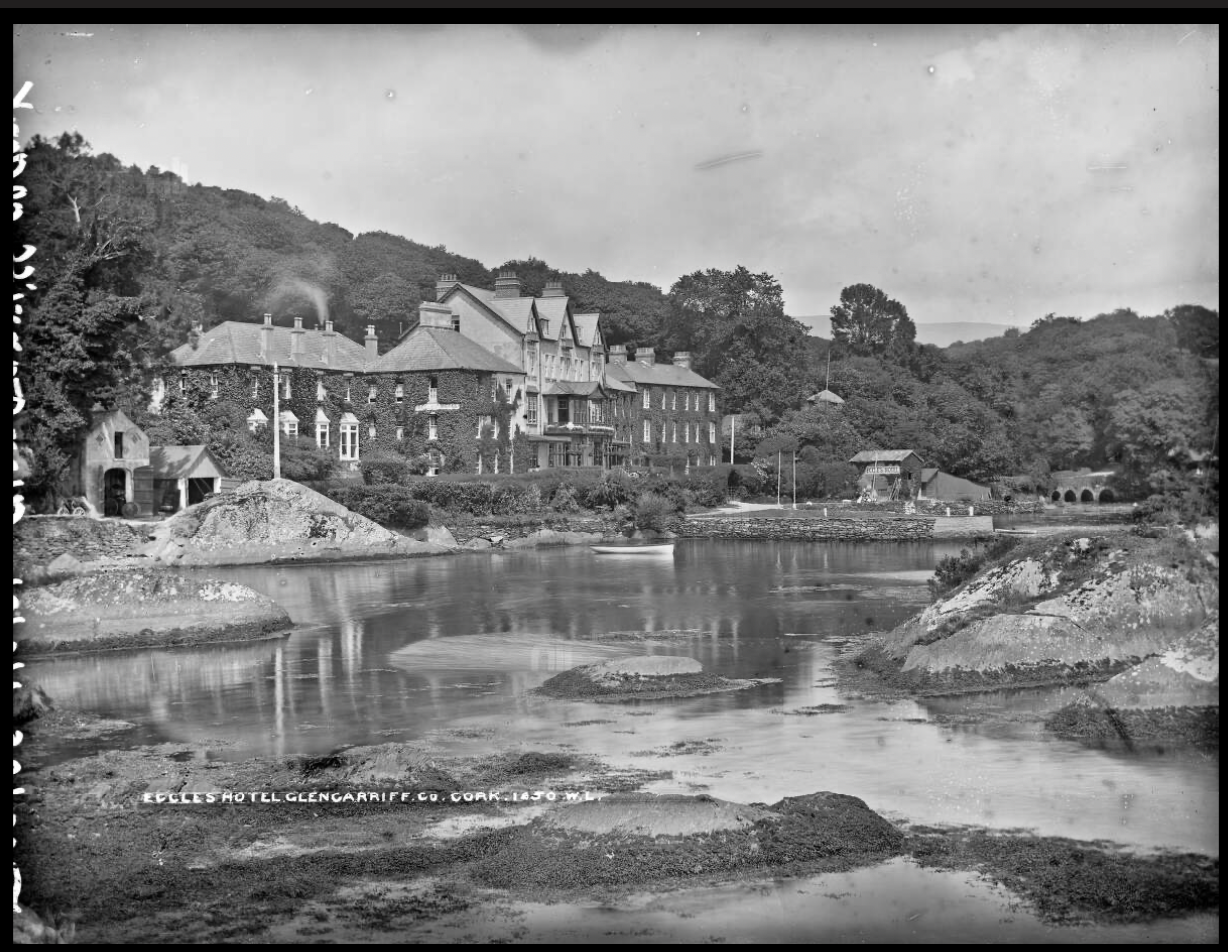
16. Elizabeth Fort Parade Houses, County Cork – Irish Landmark accommodation
https://www.irishlandmark.com/properties/
17. Farran House, County Cork, whole house rental
https://hiddenireland.com/house-pages/farran-house/
The Hidden Ireland website tells us: “An elegant Italiante style Manor house in mature beech woodland and gardens close to Cork City (15km).
“The house is spacious and bright and beautifully decorated and it is set in 12 acres of mature beech woodland and landscaped gardens. Accommodation is exceptionally generous and gracious with antique furnishings, a grand piano and full-sized billiard table.
“Situated 9 miles from Blarney, 38 miles from Killarney and 10 miles from Cork city and airpor, this is an ideal location for touring both Cork and Kerry and perfect for family reunions / anniversaries. It is available for self catering and catered rental, with accommodation for up to 16 people. Perfect for vacation rentals.Ten 18-hole golf courses are within 25km. Children welcome.“
18. Galley Head Lighthouse Keepers House, County Cork – Irish Landmark accommodation
https://www.irishlandmark.com/properties/
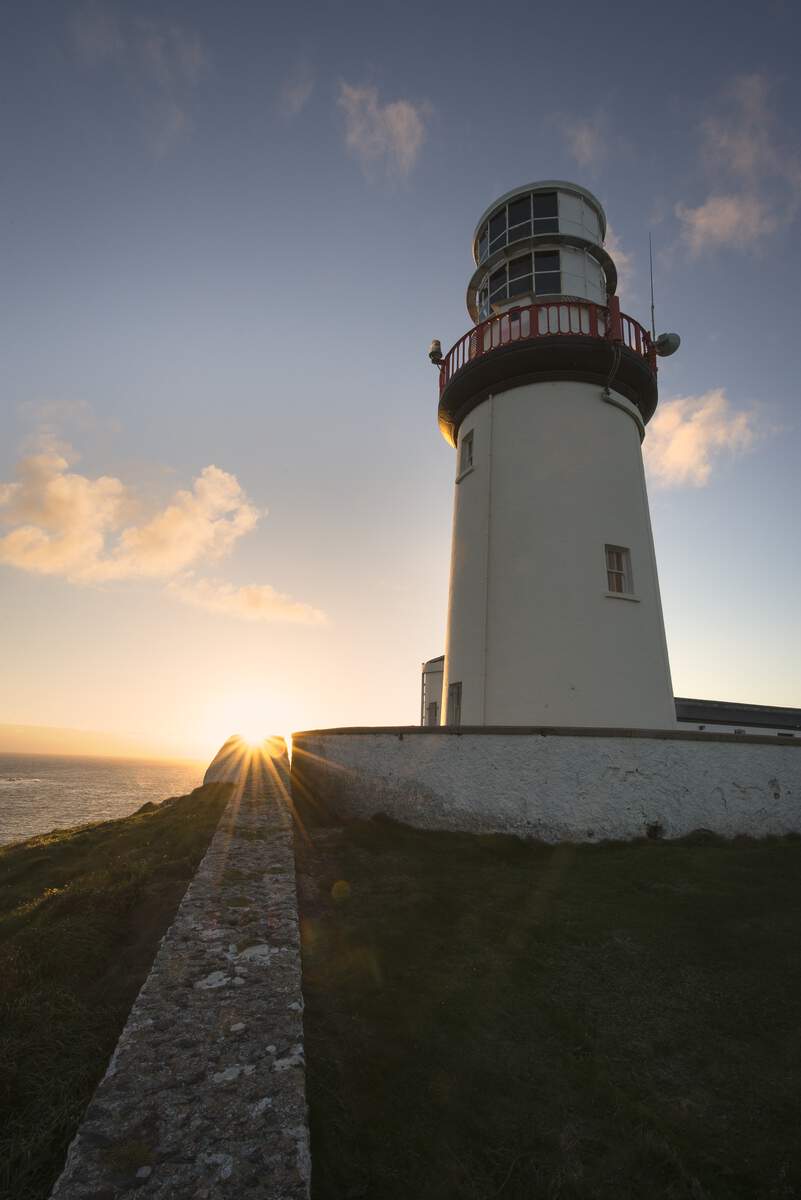
19. Coach House Apartments, Glebe Country House, Ballinadee, Bandon, County Cork – accommodation
“A fantastic option for travellers looking for a quiet stay, in a strategic location, to explore Kinsale, West Cork and beyond. We offer Warm hospitality with a romantic and relaxed atmosphere.
“Our facilities are fully equipped with all the comforts you need, as well as beautiful formal gardens with a Lavender walk, Partier and Rose Garden. We have areas for walks, an enclosed garden for our dog guests, and easy access to the main tourist attractions of Blarney, Kinsale and West Cork.
“Under the hospitable ownership of Gill and Caroline, this classically proportioned Georgian Rectory has been providing a restful retreat for guests since 1989, and everybody loves it for its genuine country house feeling and friendliness.
“Spacious reception rooms have the feeling of a large family home, and generous, stylishly decorated bedrooms have good bathrooms, fast Internet connection, and tea/coffee making facilities. The Rose Room, on the ground floor, has French doors to the garden.
“Set in two acres of beautiful, well-tended gardens (including a productive kitchen garden), this charming old rectory near Kinsale has a lovely wisteria over the front door and it is a place full of interest.
“Check in is between 4.00pm and 6.00pm when Complimentary Afternoon Tea is served. Please let us know if you require check in at a different time and we can arrange it.”
20. Glenlohane, Kanturk, Cork – B&B accommodation and self-catering cottage
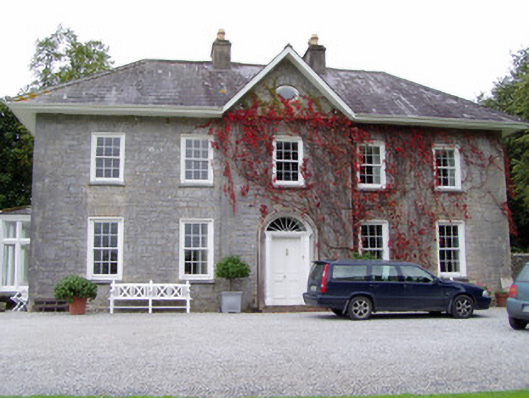
The website tells us: “Desmond, Melanie and their son, Gordon, run Glenlohane as an extremely private house with an air of friendly informality so unique to Irish Country House Bed and Breakfasts. Certainly not considered a ‘room for the night’ type of B&B, there are no public signs at the roadside to draw the attention of casual visitors. Guests are welcomed on a pre-arranged basis and know where they are going by the detailed directions in this web site. There are no public and private quarters as in a professional place and guests may use facilities of the entire house as if staying with friends.
“There are family dogs and a cat in the background and animals play a large part of life at Glenlohane. Less than a quarter of a mile away, and still on the farm, is a Self Catering Cottage that can be rented on a weekly basis. Apart from farm animals, there are also horses, ponies, fantail pigeons and bantam hens in the traditional stable yard.
“Whether it be at Glenlohane for B&B or Glenlohane Cottage for self catering, staying is for the discerning visitor who wishes to learn more about Ireland’s history and culture through personal contact with the owners. One is also well positioned for sightseeing throughout the Scenic Southwest of the country.“
and Cottages on https://hiddenireland.com/house-pages/glenlohane-cottage/
“Glenlohane Cottage has been part of the Sharp Bolster family who are celebrating 275 years in Glenlohane House in 2016. It is an exceptional period cottage built in the 1600’s and added onto over the centuries. Centered in the Glenlohane farm estate, this geographic location is one of the very best locations for touring the Scenic Southwest of Ireland. The Wild Atlantic Way, the Burren, Cliffs of Moher, Dingle, Rock of Cashel, Cork City, Blarney, Ring of Kerry, Killarney, Kinsale, Bantry & the Beara, and even Schull are all easy day trips.“
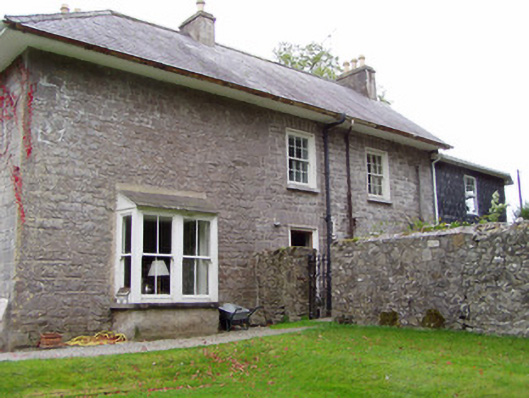
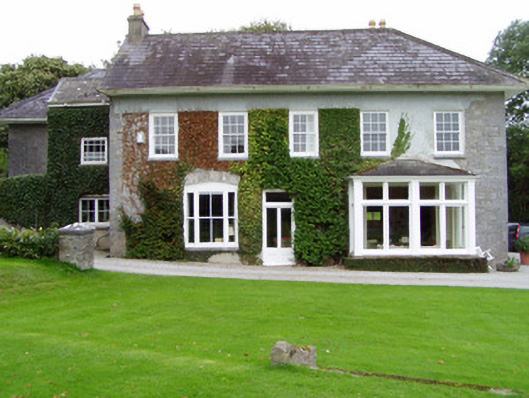
The Glenlohane website gives us a history of the house:
“Glenlohane Country House was built by Desmond’s antecedents in 1741. Your hosts, Desmond, Melanie and their son Gordon represent the 9th and 10th generations of the same family living at Glenlohane since its inception. Surrounded by terraced lawns overlooking a park like setting, the house was built by John Sharp, of Mount Conway, near Cork City in 1741. Mount Conway still stands.
“Early records show the Sharp family in the parish of St. Katherine, Dublin in 1535. As a prominent Quaker family that became eminently successful in the woolen industry in the mid 1600’s, they also built Roundwood House in Co Laois at the same time that Glenlohane was being built in Co Cork. Anthony Sharp was reputed to employ 500 people at the time, which would have made him one of Ireland’s largest employers. For Dublin, that is a sizeable concern even by today’s standards! As sizeable land owners, the Bolsters have been within 5-6 miles of Glenlohane since Elizabethan times and John Hawkes Bolster of Egmont House, Churchtown, Co Cork married Sarah Sharp of Glenlohane in the early 1800’s. The house was extended to its present size shortly thereafter. We now have the opportunity to share our family’s heritage by offering guests Irish Country House Accommodation in the heart of the Co Cork countryside.“
21. Glenville Park, Glenville, County Cork (previously known as The Manor and as Mount Pleasant) – private house with self-catering accommodation

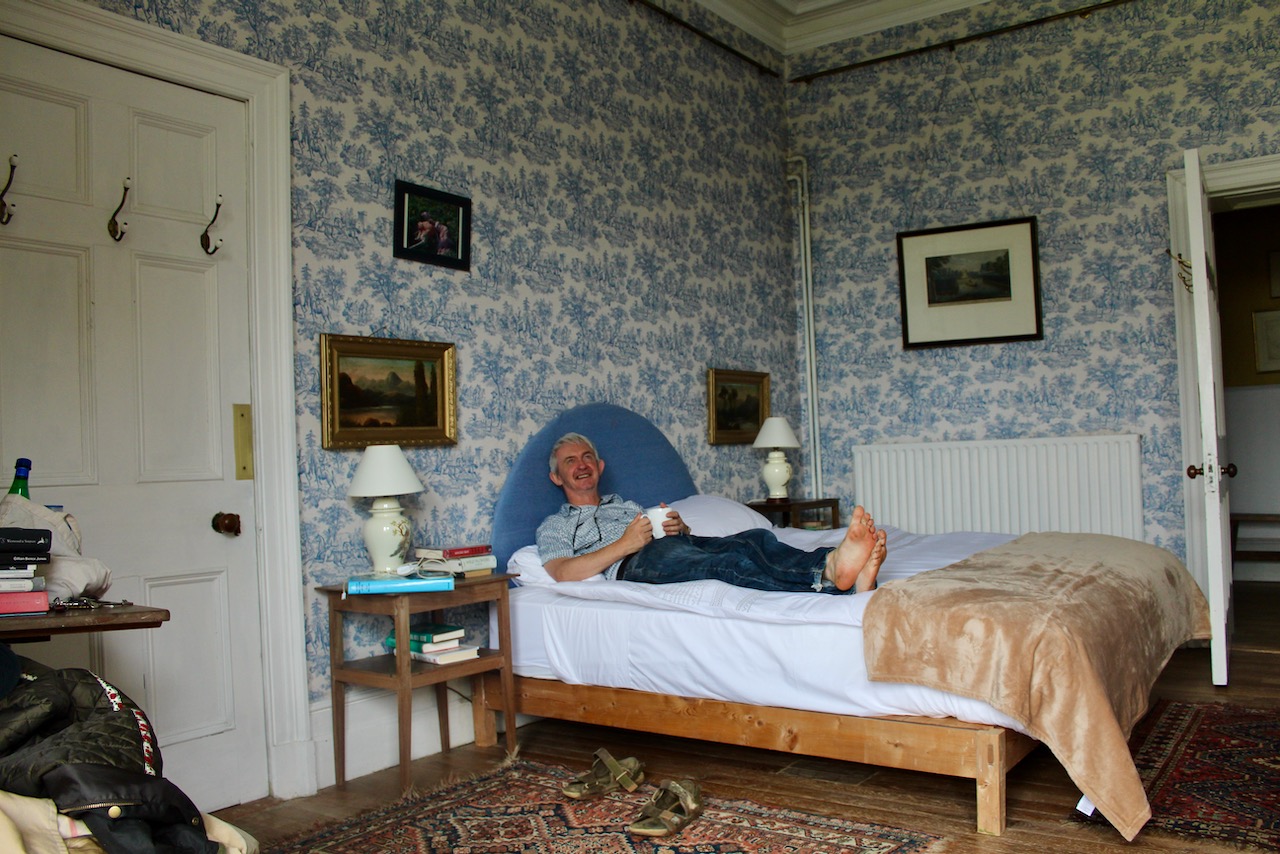
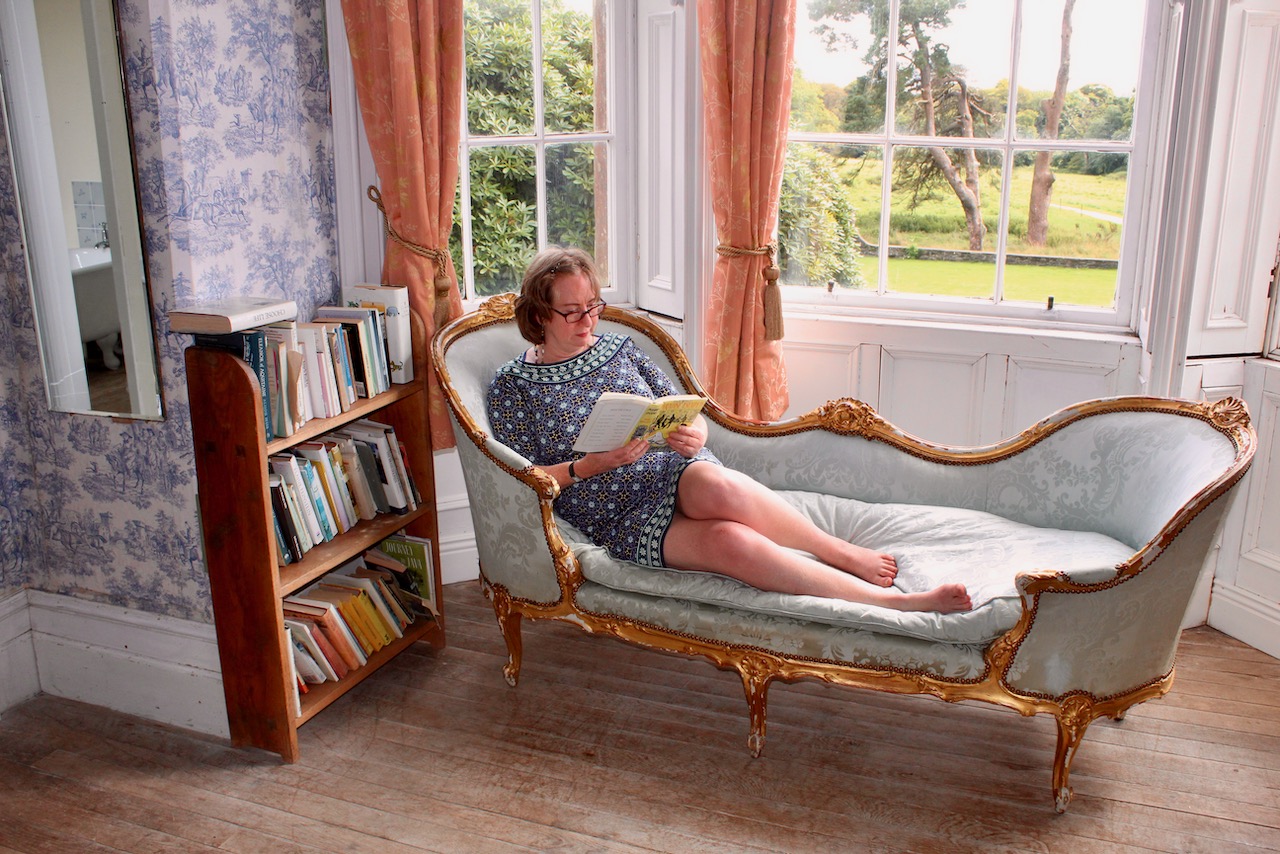
This is the home of the late Mark Bence-Jones, whom I refer to so much on this website! Stephen and I were very excited to discover that his daughter rents rooms in the house for visitor accommodation.
Mark Bence-Jones tells us:
p. 139. (Hudson-Kinahan, sub Kinahan/IFR; Bence-Jones/IFR) Originally a two storey five bay C18 house, of rendered rubble with block window surrounds of cut stone; it was fronted by a semi-circular forecourt or enclosure, with a gate at either end. The seat of a branch of the Coppinger or Copinger family, the estate having originally belonged to the O’Keefes. Bought between 1776-1788 by Dr Edward Hudson, who built a new house a short distance from the old one, and at right angles to it; consisting of three storey three bay gable-ended centre, with a fanlighted doorway, and two storey one bay gable-ended wings. This house was the home of Dr Edward Hudson’s son, William Elliot Hudson [1796-1853], composer, collector of ancient Irish music and Irish patriot [his Dublin home was St. Enda’s in Rathfarnham, previously called The Hermitage and Fields of Odin]. The estate eventually passed to Wm Elliot Hudson’s nephew, Sir Edward Hudson-Kinahan, 1st Bt [the son of William Elliot’s sister Charlotte, who married Robert Henry Kinahan], who enlarged and remodelled the house to the design of Sandham Symes 1887. A new two storey front was built onto the house, making it twice as deep, other additions were built at the back, and the original part of the house was reconstructed with two storeys instead of the original three, so as to make the rooms as high as those in the new additions. The new front is in the Victorian-Georgian style, faced in grey cement and of considerable length; it has a small pedimented breakfront with a pair of round-headed windows above a balustraded and fanlighted porch. On either side of the centre is a three sided bow between two bays; the façade being prolonged at one end by an additional bay, beyond which is a three storey one bay wing set back.“
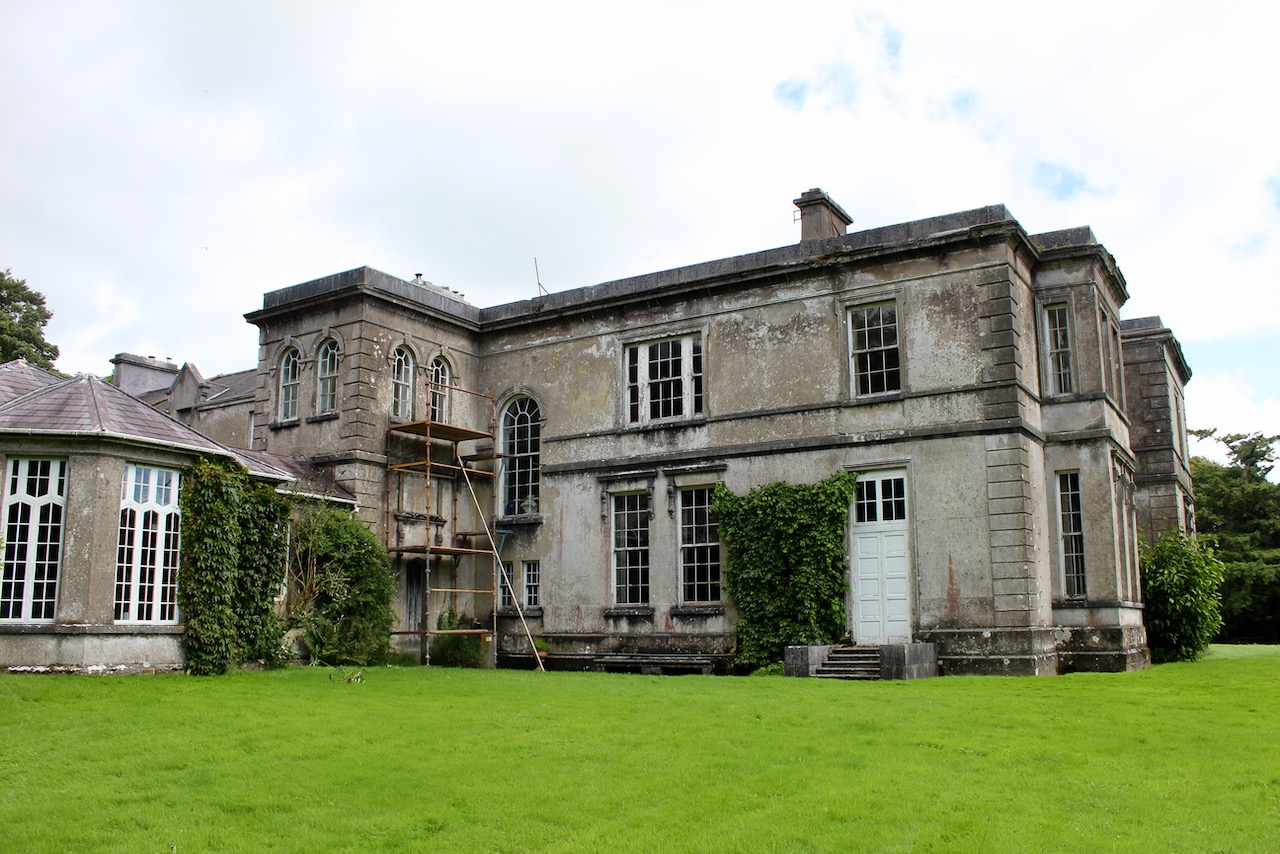
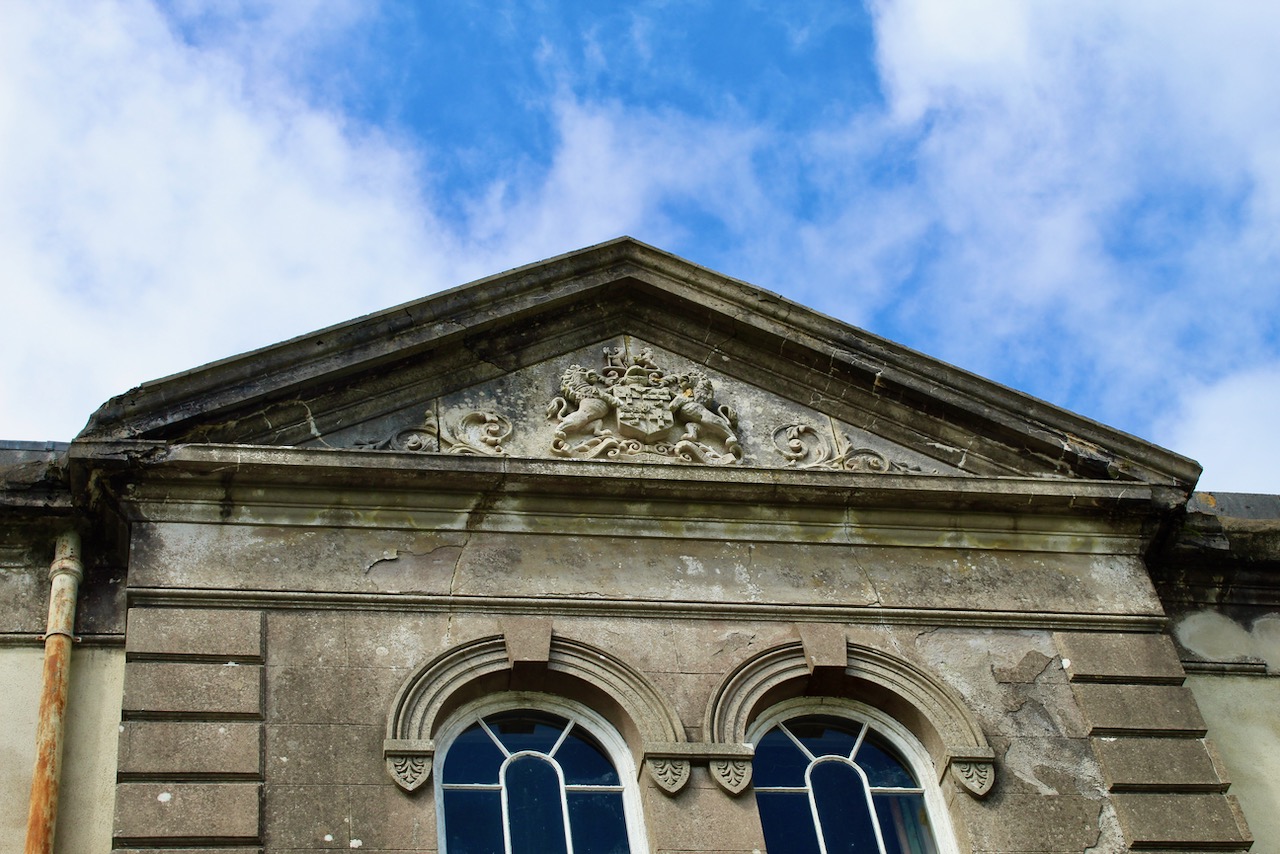
Mark Bence-Jones continues: “Entablatures on console brackets above ground floor windows, shouldered window surrounds in upper storey, parapeted roof. At the back of the house is a bow fronted pavilion like wing, containing a single large room, joined to the main building by a corridor. Long hall running the full depth of the house, with staircase at its inner end, behind an arch with plasterwork mouldings; modillion cornice. Doorcases with segmental pediments in the hall and principal receptions rooms, which have Victorian plasterwork cornices of flowers and foliage; the drawing room has an original C19 wallpaper in faded lemon and grey. Spacious landing or upper hall at head of stairs.”
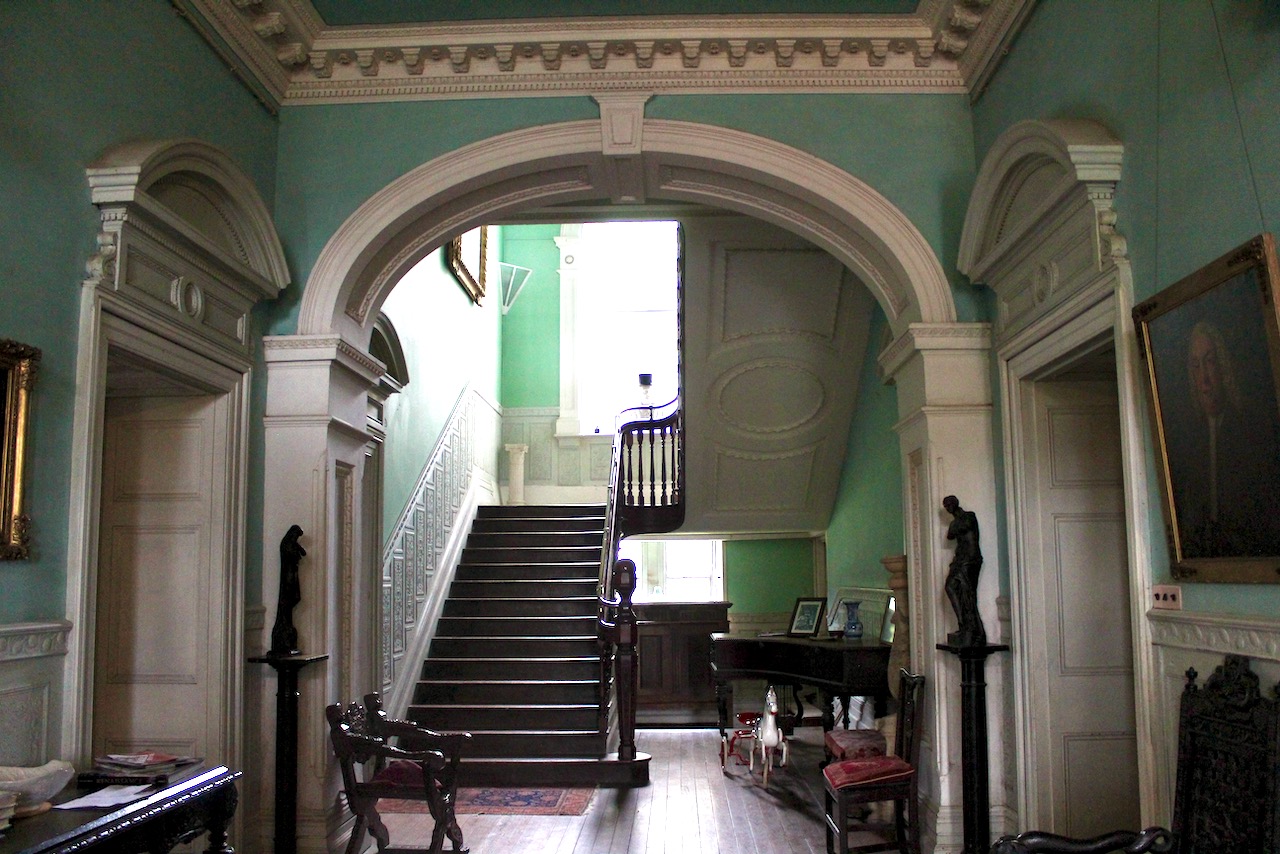

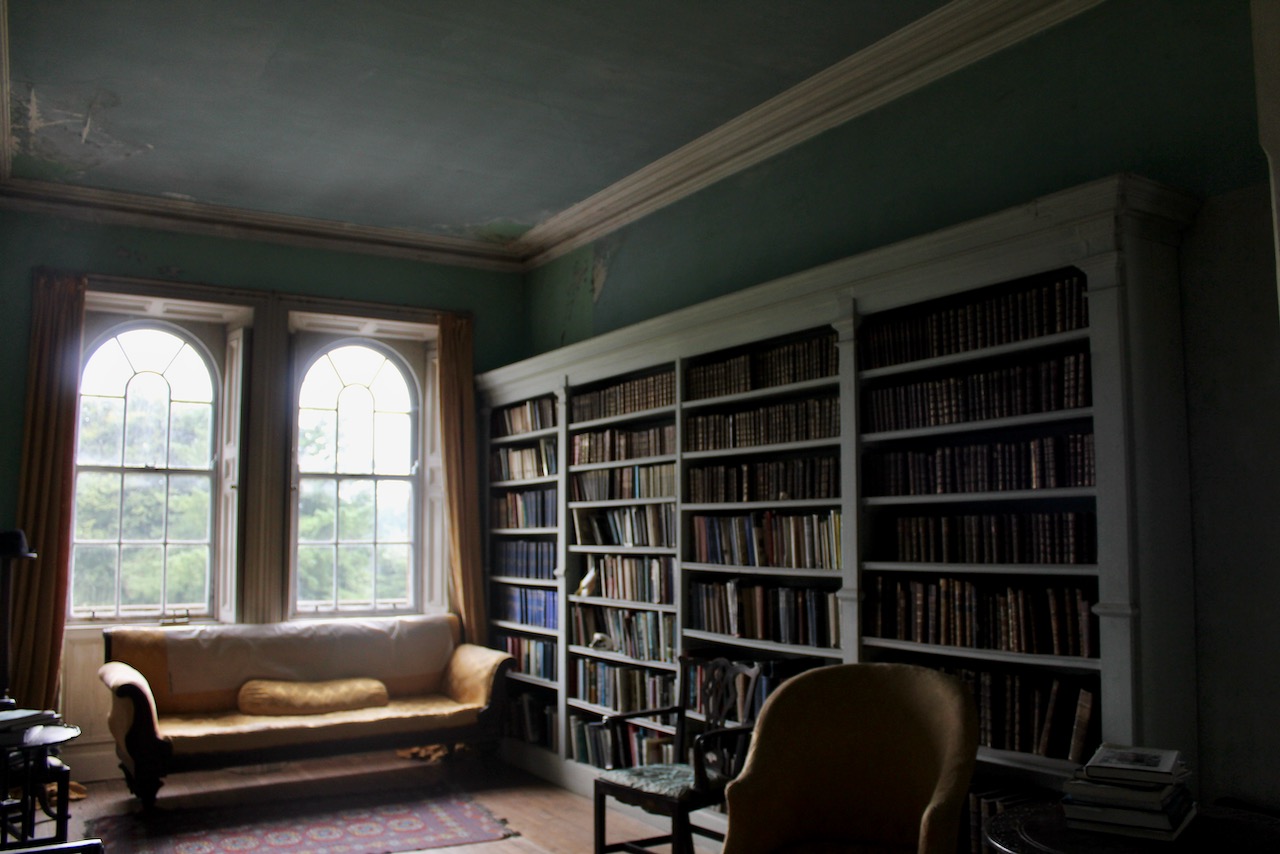
The Historic Houses of Ireland website tells us: “The Hudson-Kinahan family died out with the third baronet, Sir Robert, and the house became the home of Colonel Philip Bence-Jones and his wife, who purchased Glenville from the trustees in 1949. The Bence-Jones family, who originally came from Lisselane, near Clonakilty in West Cork, were looking for a new home after their house, Annemount on Cork Harbour, had been destroyed by fire.” [12]
Mark Bence-Jones continues his description: “Walled garden with old beech hedges and walls of faded pink brick; the back of the Coppinger house being at one side of it. Glen garden containing a noteable collection of rhododendrons and other shrubs and trees; long flight of steps down hillside to formal pool. Bought 1949 from the trustees of Sir Robert Hudson-Kinahan, 3rd Bt, by Col Philip Bence-Jones, who carried out various alterations to the house and threw three small rooms together to make a chapel, which has stained glass windows by Mr Stanley Tomlin and Mr Patckick Pollen, and a stone altar by the late Seamus Murphy, above which is a statue of the Madonna which survived the fire at Annemount.”
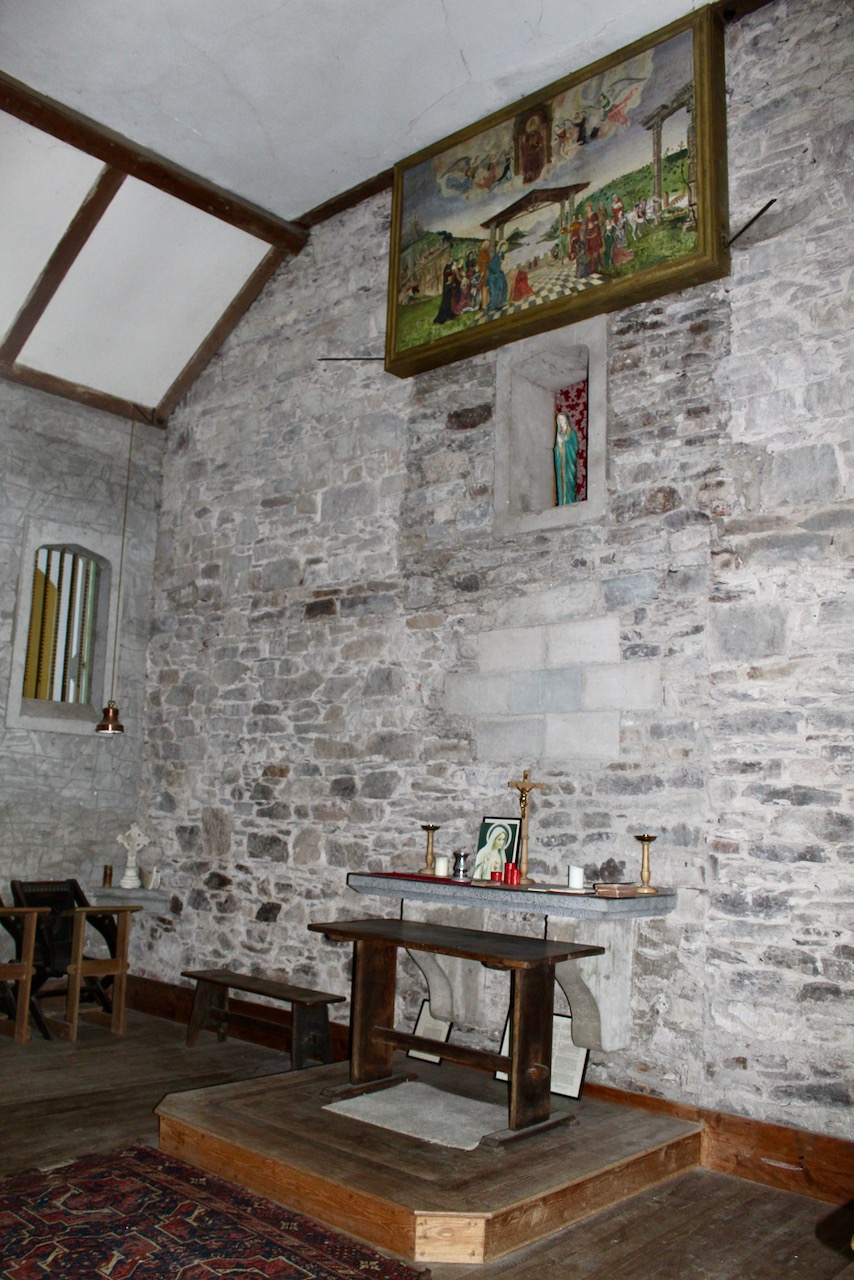
We spent a heavenly week at Glenville Park during Heritage Week of 2020, when we used it as a base to visit several Section 482 and OPW properties.
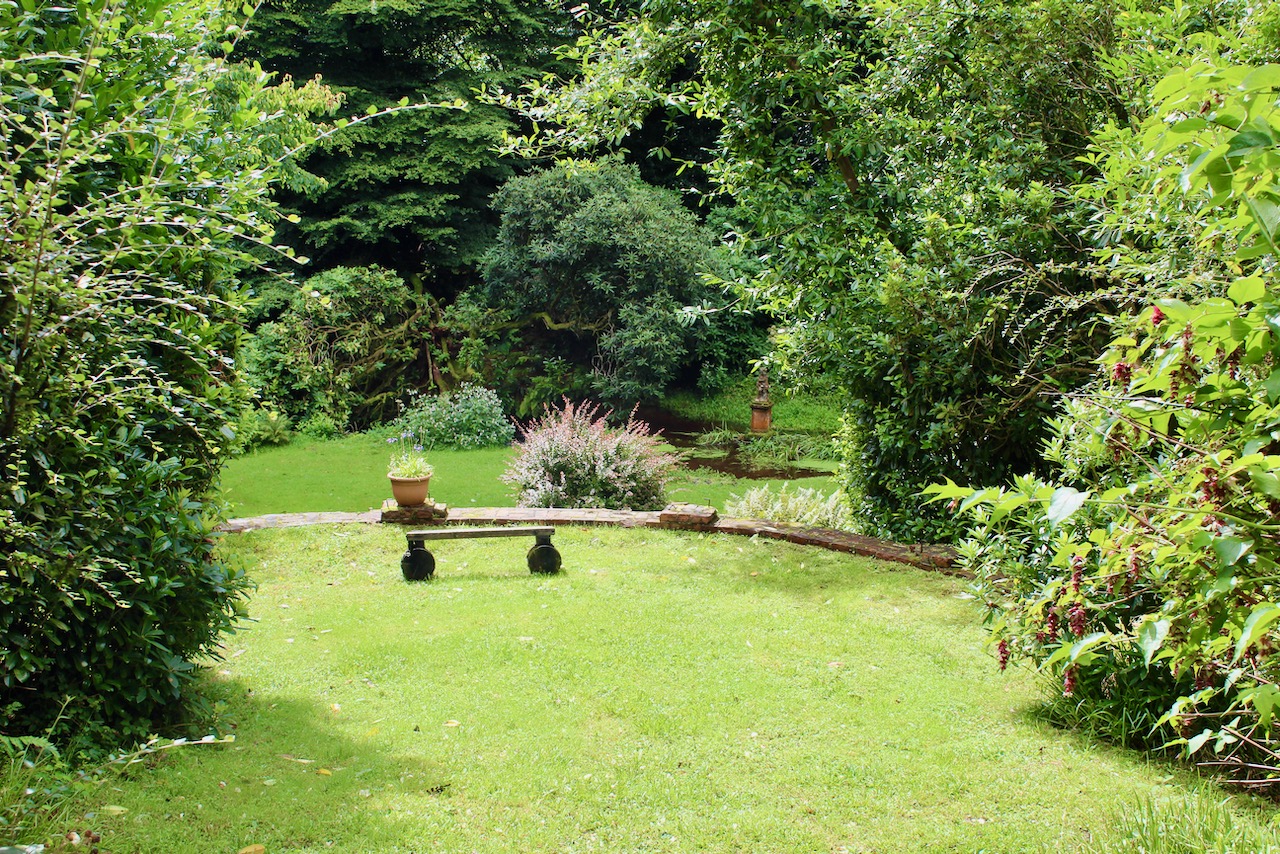


22. Inis Beg estate, Baltimore, County Cork – gardens with self-catering and weddings
https://www.inishbeg.com/homepage/
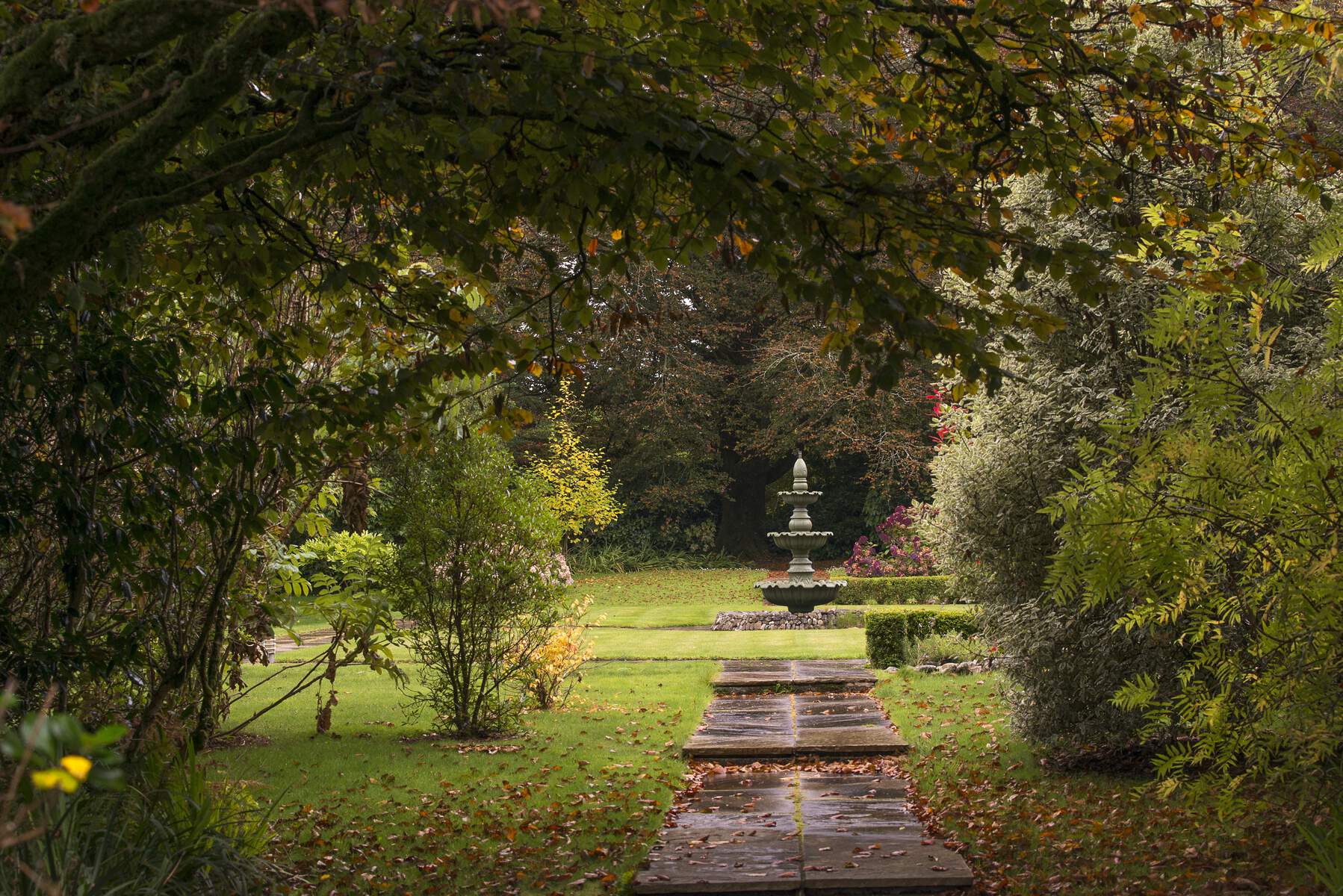
The website tells us:
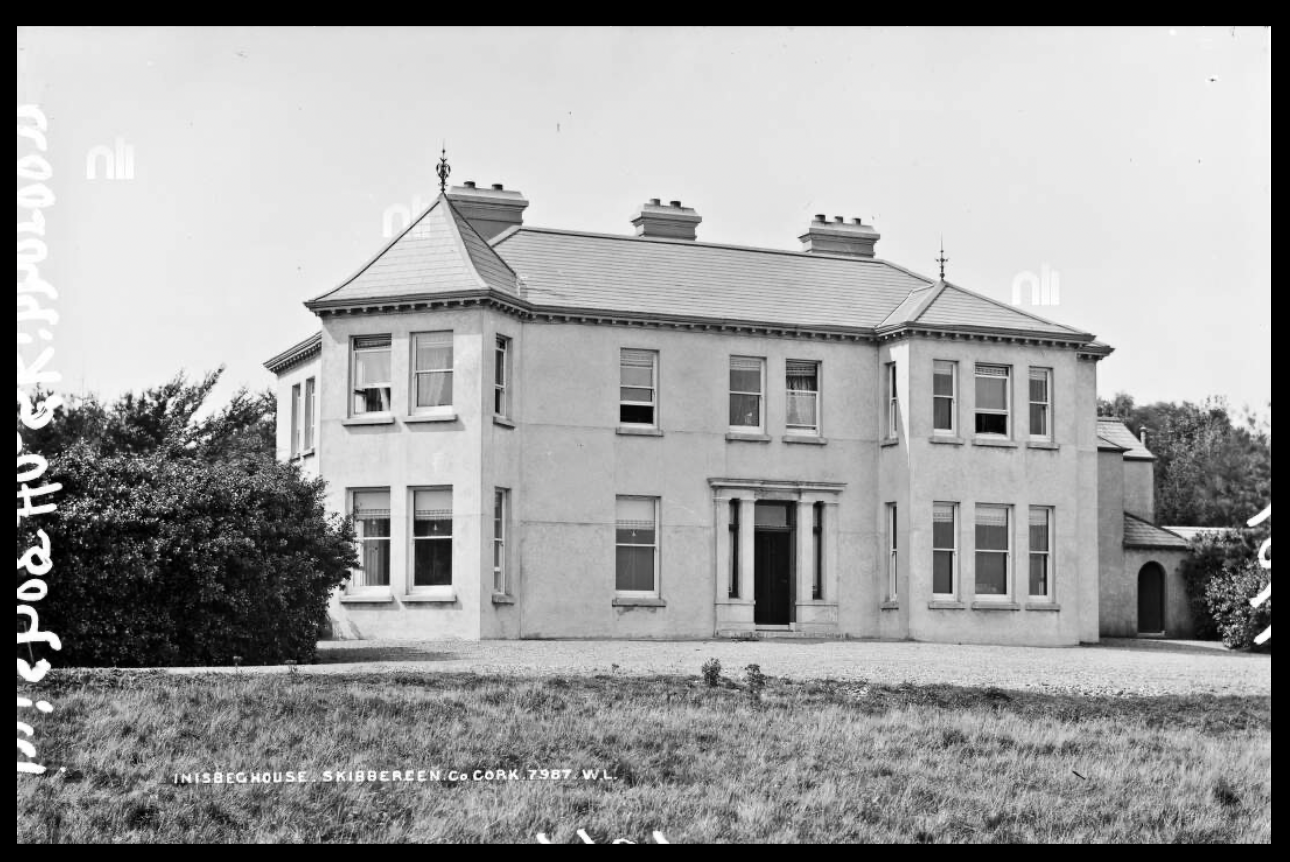
“Inish Beg, Irish for “small island”, is the most northerly of the Carbery Hundred Islands of County Cork Ireland and lies in the unspoilt tidal estuary of the Ilen River. There is a bronze age Cromlech (boulder burial) within the grounds, as well as a tree covered Lissaghaun (little fort or fairy mound) in front of the main house.The local saint, St. Fachtna is recorded as having been given the “Book of Dues” on the island in the 6th century.The island belonged to a Richard White in the 17th Century and was acquired by the MacCarthy Morrough family in 1830. Initially used as a sporting estate, the main house was finally finished in 1899.The population of the island followed a familiar pattern to that of much of the rural west of Ireland. Lewis quotes 109 inhabitants in 1837, but the numbers then declined to 11 by 1901 following the famine years of the mid nineteenth century and the agricultural depression of the 1880’s.
“In 1908 Kay Summersby was born at Inish Beg House. She came to notoriety as a close companion of Dwight D. Eisenhower.“

Inish Beg Estate comprises 97 acres;
- 42 of these are birdsong-filled woodlands which are sympathetically managed and include exceptional tree ferns, bamboo, several ponds, bird hides and carriage drives,
- 42 acres are green fields sweeping down to the Ilen Estuary where sheep and ponies graze, for this is a working farm run on organic principles.
- the remaining 13 acres is taken up with buildings, a walled garden with glass house and fruit cages, a sunken garden with fountain, a cherry drive, an orchard, a daffodil lined avenue and two woodland gardens.
- see also https://westcorkgardentrail.com
23. Killee Cottage, Mitchelstown, County Cork – Irish Landmark Trust accommodation
https://www.irishlandmark.com/properties/
Once one of a number of bothies stretching along this quiet country lane, Killee Cottage and its neighbour are now the only two thatched cottages remaining.
24. Kilmahon House, County Cork – accommodation
https://hiddenireland.com/house-pages/kilmahon-house/
The Hidden Ireland website tells us:
“The beautiful Kilmahon House, built in 1780, is a fully restored Georgian Country House offering elegant Bed & Breakfast accommodation. The house is also available for smaller events on special request. Just 30 minutes from Cork airport and the Historic city of Cork, Kilmahon is situated in the East Cork Village of Shanagarry. It is only a short walk to Ballymaloe Cookery School and the blueflag beaches along Ballycotton Bay.
“Kilmahon is an impressive listed Glebe Heritage House of Ireland and has been lovingly restored over a number of years. The result is a seamless blend of original period features and modern facilities, set within the idyllic coastal surroundings of County Cork’s nature.
“Spending a few days in this secluded ancient environment offers a chance to rejuvenate in comfort and peace. Weather with a good book in front of a warm fire or a stroll through the old gardens, you will find yourself uplifted and reset from the stresses of everyday life.
THE GROUNDS
“While the house was restored so too were the gardens surrounding it. The walled rose garden has been brought back to life and is a feast of colour through the summer months; a perfect and private space for guests to relax in. An expansive lawn to the front provides a large open space and stunning views over fields toward the ocean, while old stone walls and mature trees in abundance maintain the sense of privacy at Kilmahon.
THE RECEPTION ROOMS
“Period fireplaces with log fires set a welcoming tone in each of the elegant reception rooms in Kilmahon House. Rooms are tastefully furnished with antiques and original art work effortlessly combining style and comfort. Large Georgian windows provide idyllic views onto the formal gardens below and Ballycotton Bay beyond.
THE BEDROOMS
“A wonderful nights rest in one of the six individually designed en-suite bedrooms awaits guests at Kilmahon House. Recent restorations allow for the inclusion of modern power showers and super-king beds whilst still enjoying the ambience of antique furniture, sumptuous furnishings and spectacular scenic views.
BOOKING YOUR STAY
“Kilmahon offers guests luxury Bed & Breakfast accommodation or the house also can be taken for exclusive rental where guests can enjoy staying in this outstanding Georgian house and its beautiful surroundings. Julia will be happy to organise with you any catering requirements you have. Kilmahon House is an ideal setting for family breaks. Contact the house directly to check availability.“
25. Kilshannig, County Cork, P61 AW77 – section 482 with courtyard accommodation
See my entry: https://irishhistorichouses.com/2020/12/10/kilshannig-house-rathcormac-county-cork/
Open dates in 2026: March 18-19, 21, 24, 26-27, April2, 4-7, 9, 11-12,15, 21, 23, 25, May 12, 14, 16-17, 19, 21, 23-26, 28, 30, June 2, 4, 6-9, 11, 13, 16, 25, 27-29, July 2, 4-7, 14, 16, 18-20, 28, 30, Aug 1- 4, 6, 8, 11, 13, 15-25, Sept 18, 20, 22-25, 27, 29, 8.30am-3pm,
Fee: adult €14, OAP €12, student €10, child €8
26. Liss Ard Estate, County Cork, now a hotel

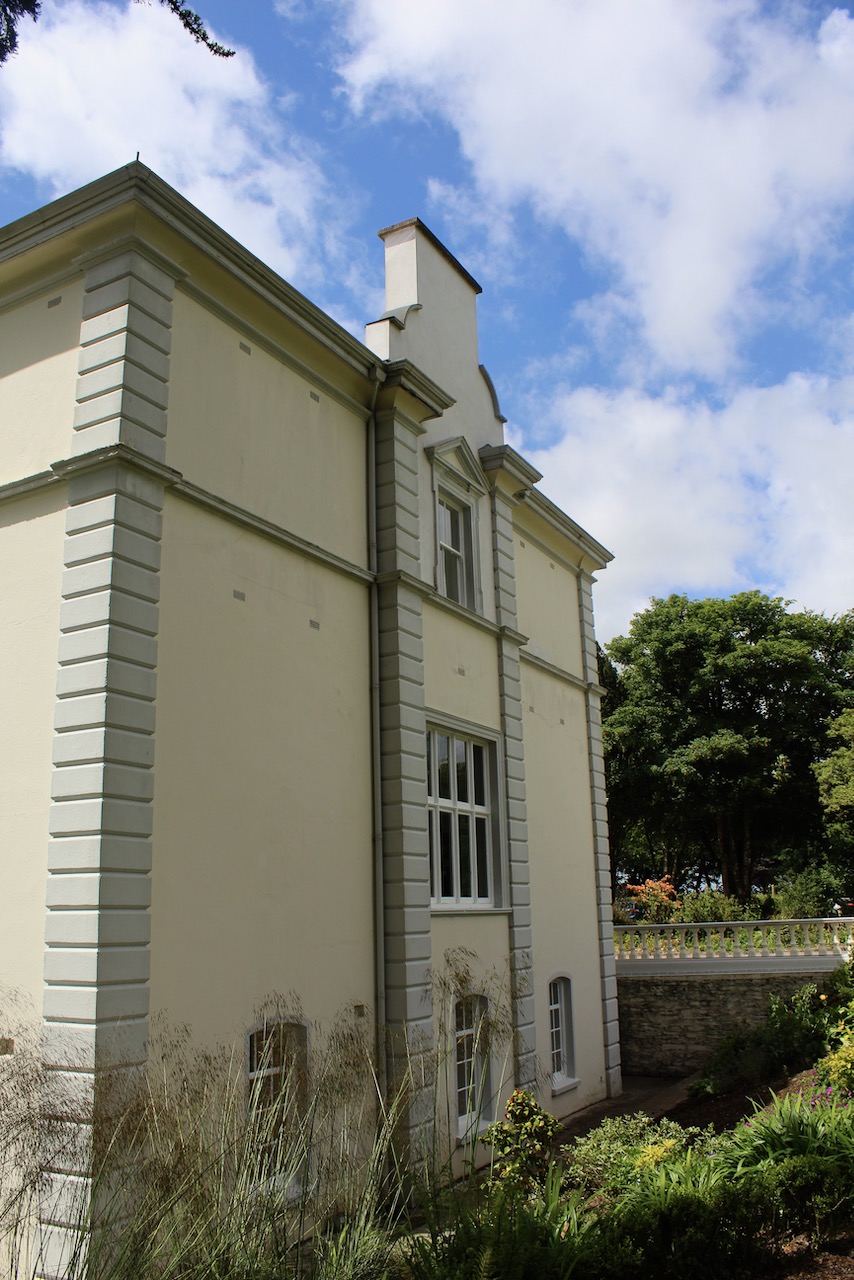
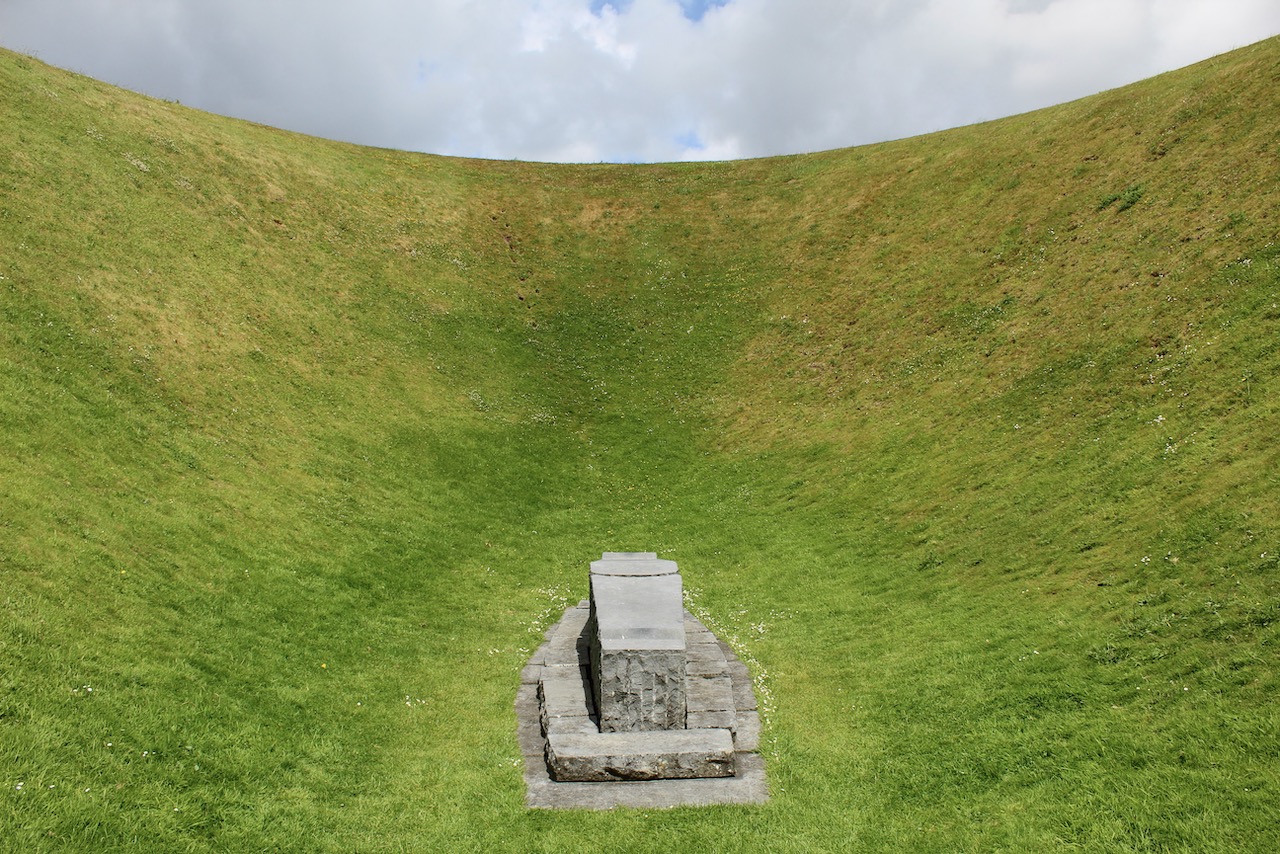
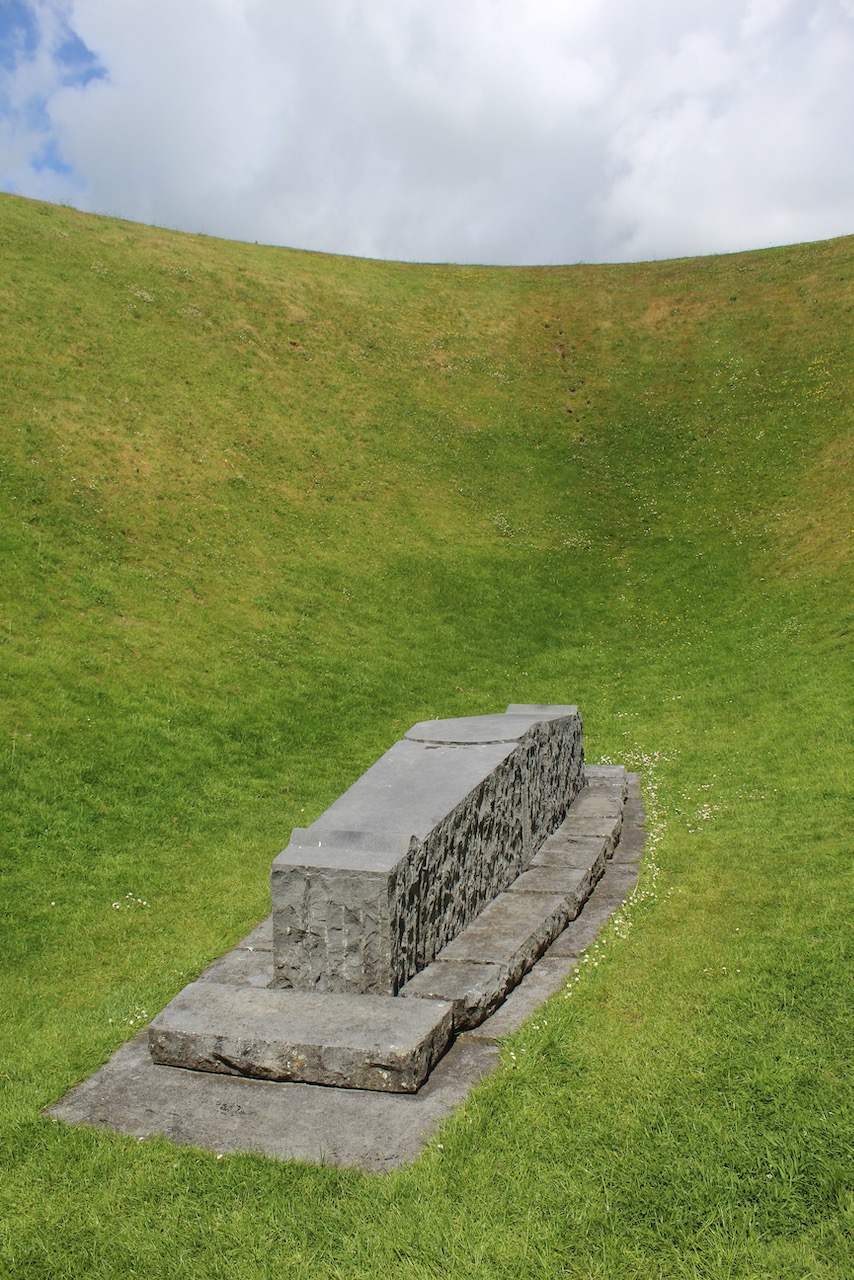
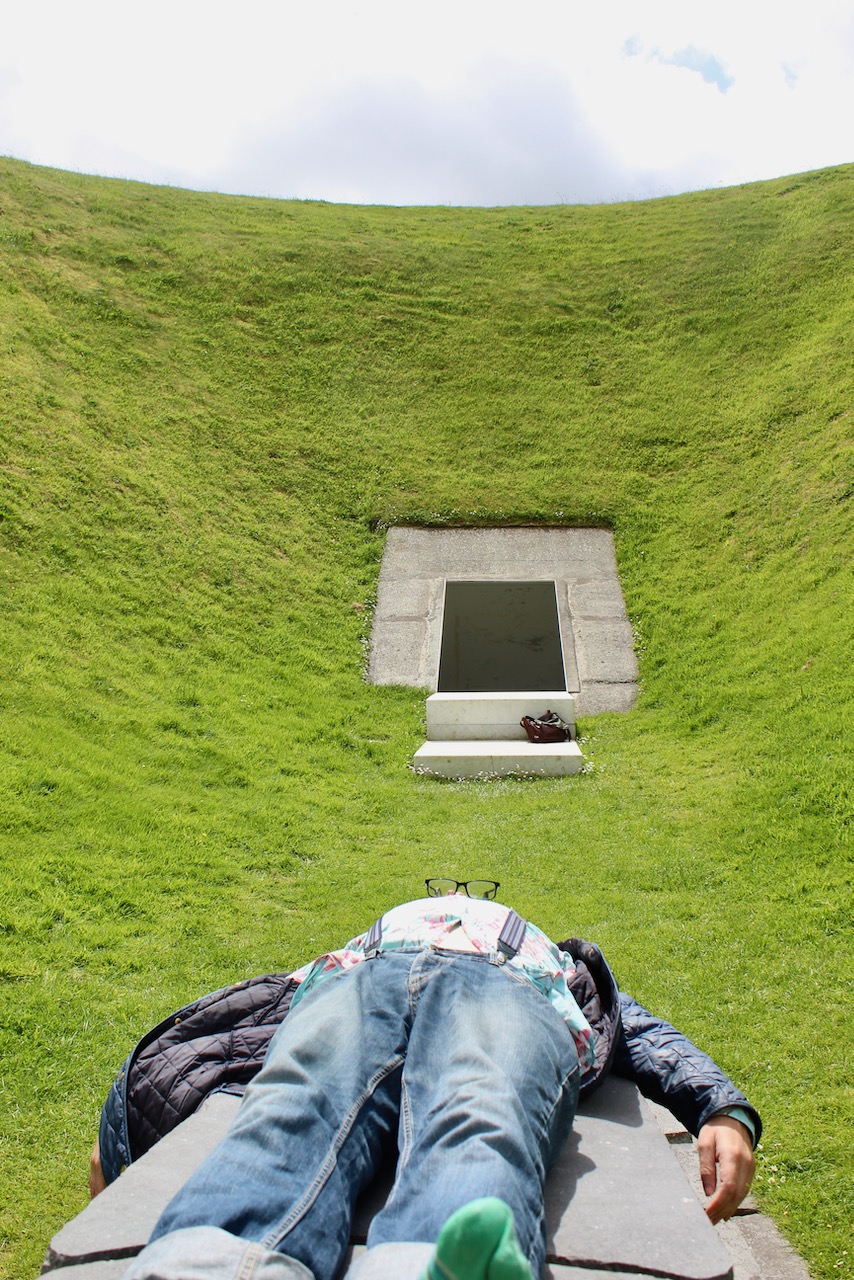
We visited Liss Ard in June 2022, in order to see the Sky Garden by James Turrell. James Turrell is a “light artist” and a Quaker, and his works aim to cause contemplation. I was excited to see his work, and to see Liss Ard. The house has been converted to a hotel but still has the feel of a historic house, while at the same time being modern, stylish and spacious.
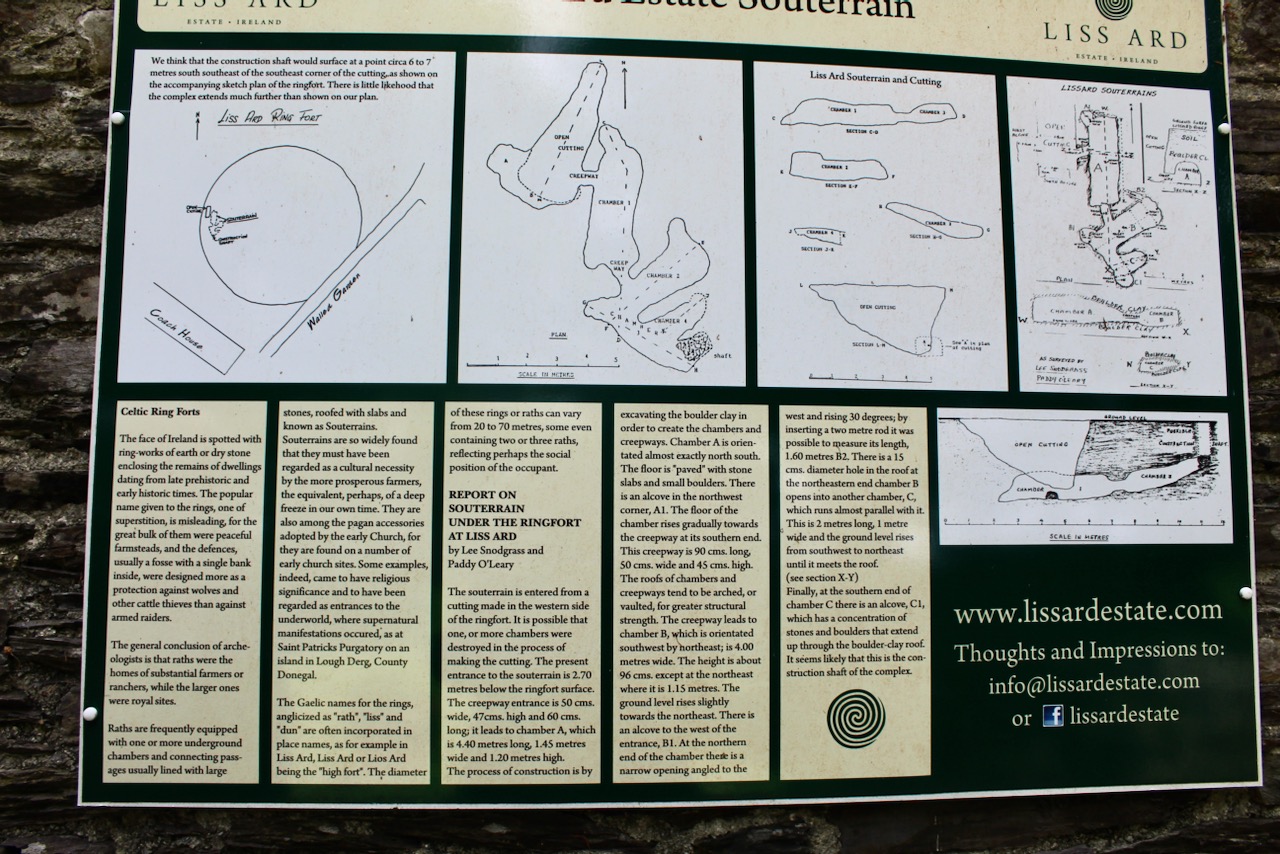
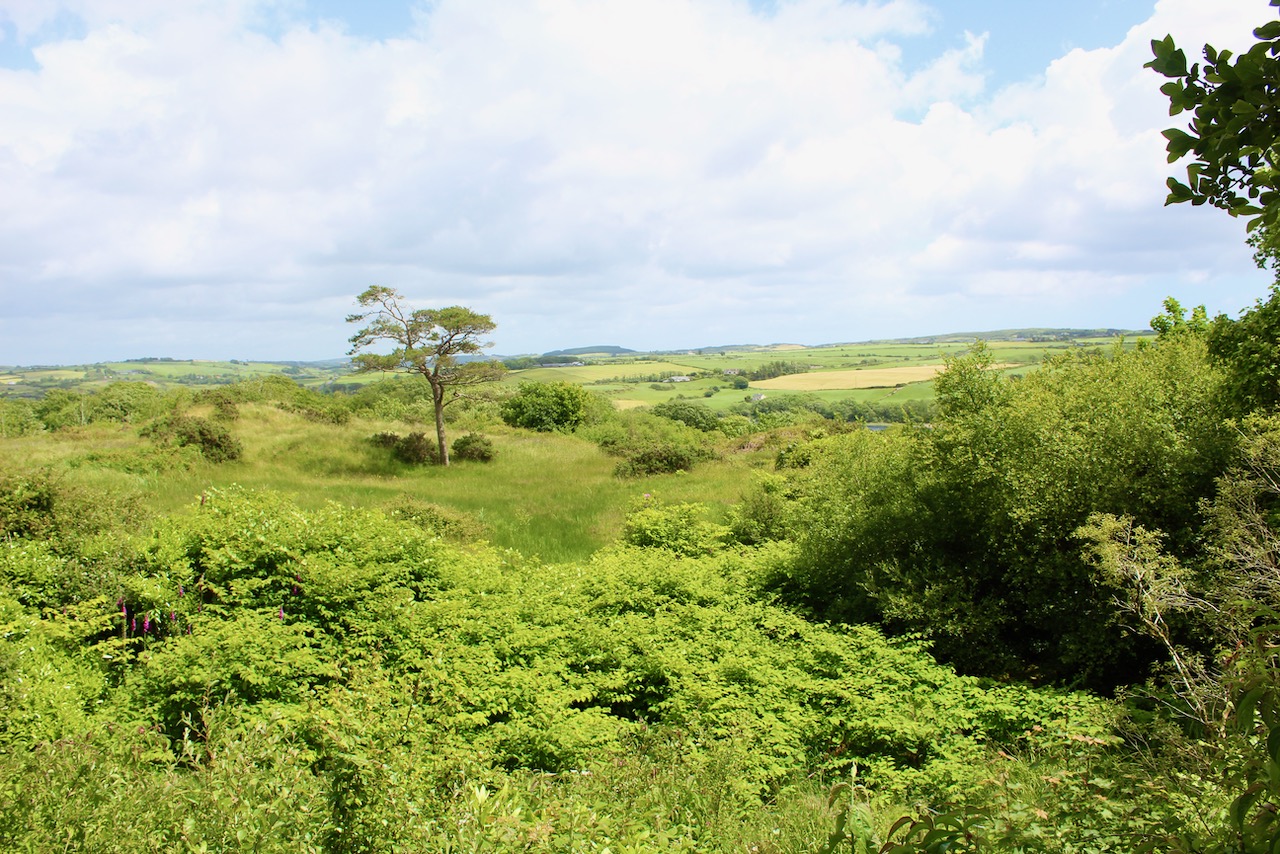
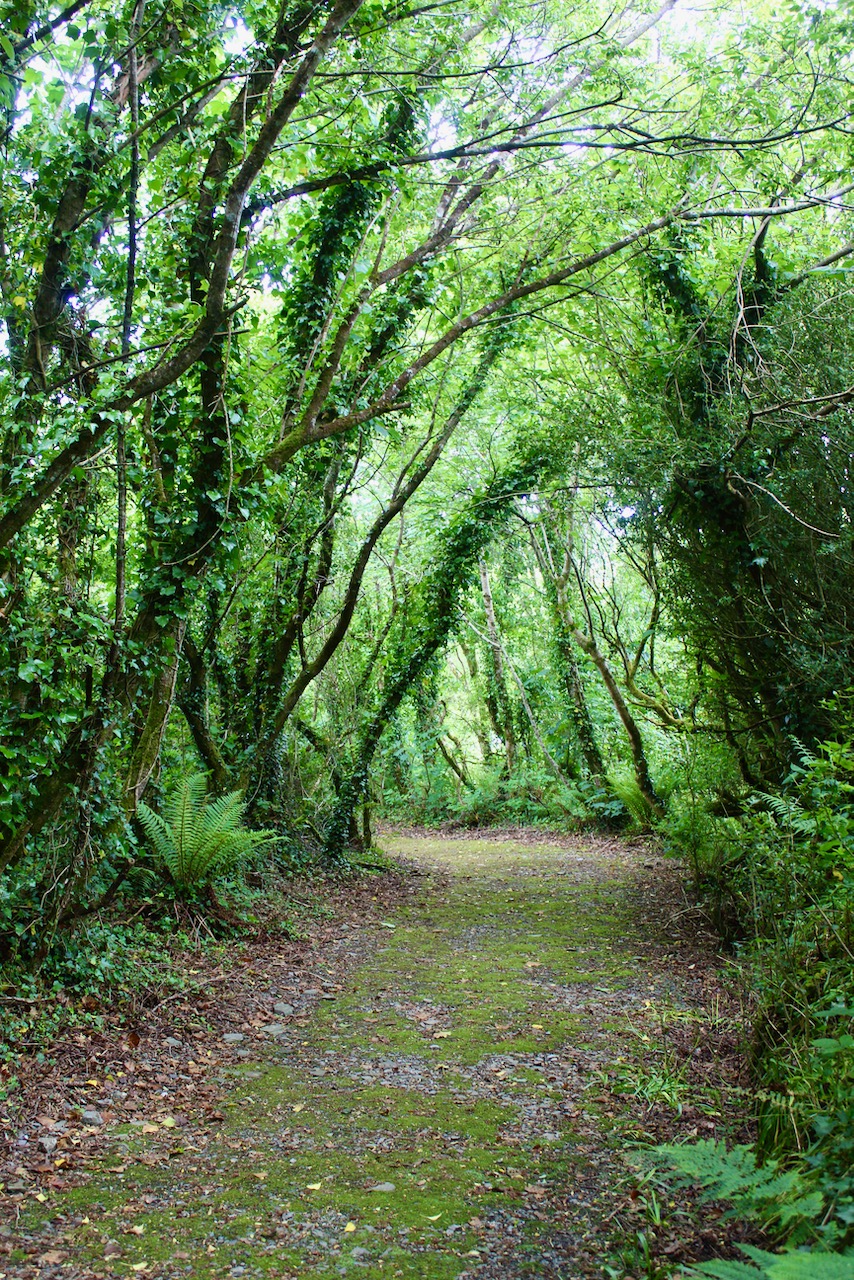
Upon our visit I learned that there is more to the gardens than the Sky Garden. The hotel is surrounded by miles of trails, which weave whimsically and which reveal magical settings with artfully placed walls and steps. It is also the site of a ring fort: the Irish “Lios Aird” means high fort.
The website invites us to “Escape to 163 acres of pristine nature with manicured gardens, a 40 acre private lake and James Turrell’s renowned Irish Sky Garden. The Estate features 26 unique guest rooms in the heart of West Cork, the culinary capital of Ireland.” For more about the Sky Garden and the garden trails, see my entry above, in Places to Visit.
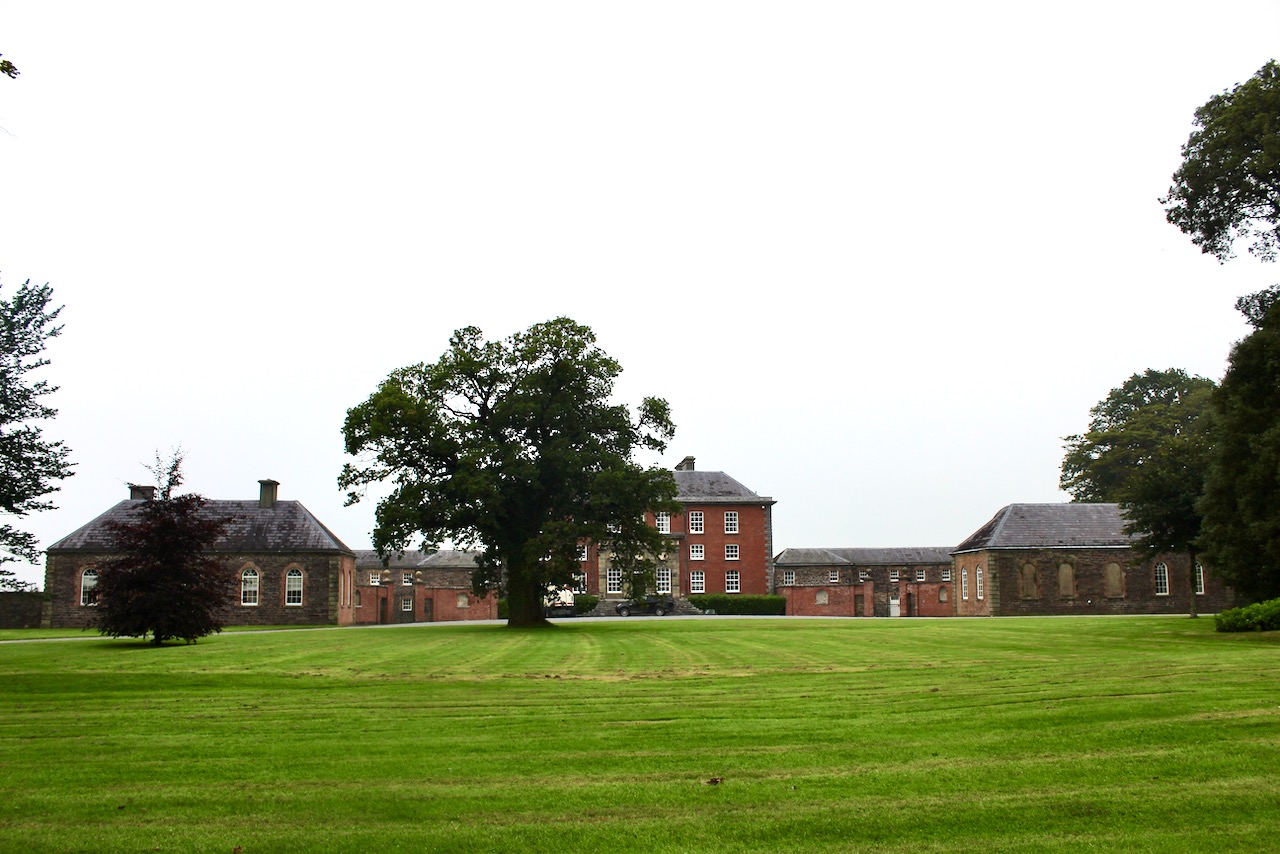
We booked in for lunch, in order to make a booking to spend time in the Sky Garden. The house is two storey over basement, built in 1853. The National Inventory describes it as a fine early Victorian country house built by H.W. O’Donovan, who succeeded his brother as “The O’Donovan” in 1870. The Victorian Lake House, also available to guests, was built in 1870.
The garden front has a central canted bay. The inventory suggests that the house was reoriented and extended in the nineteenth century.


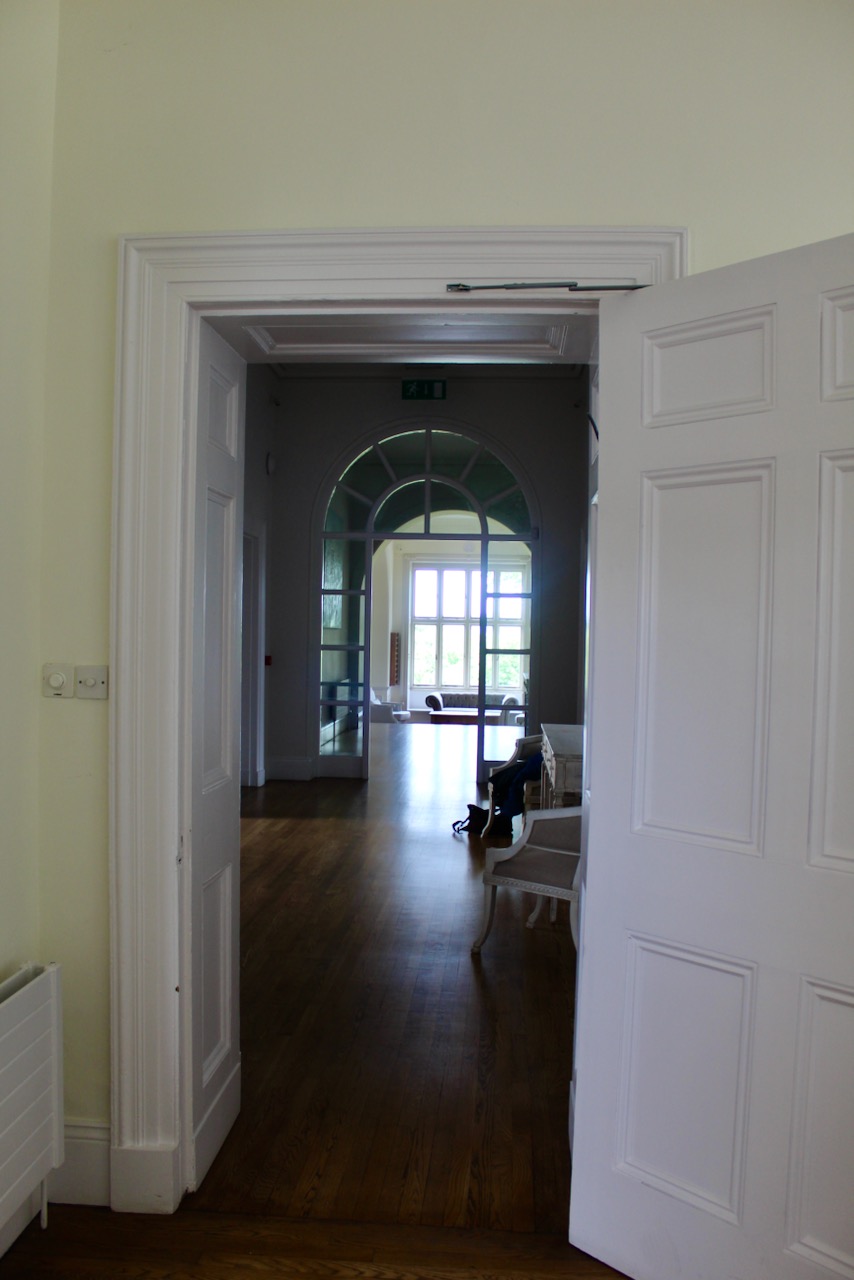


Two windows light the staircase – a large round one and an arched one and the upper hall has top-lit lantern ceiling.

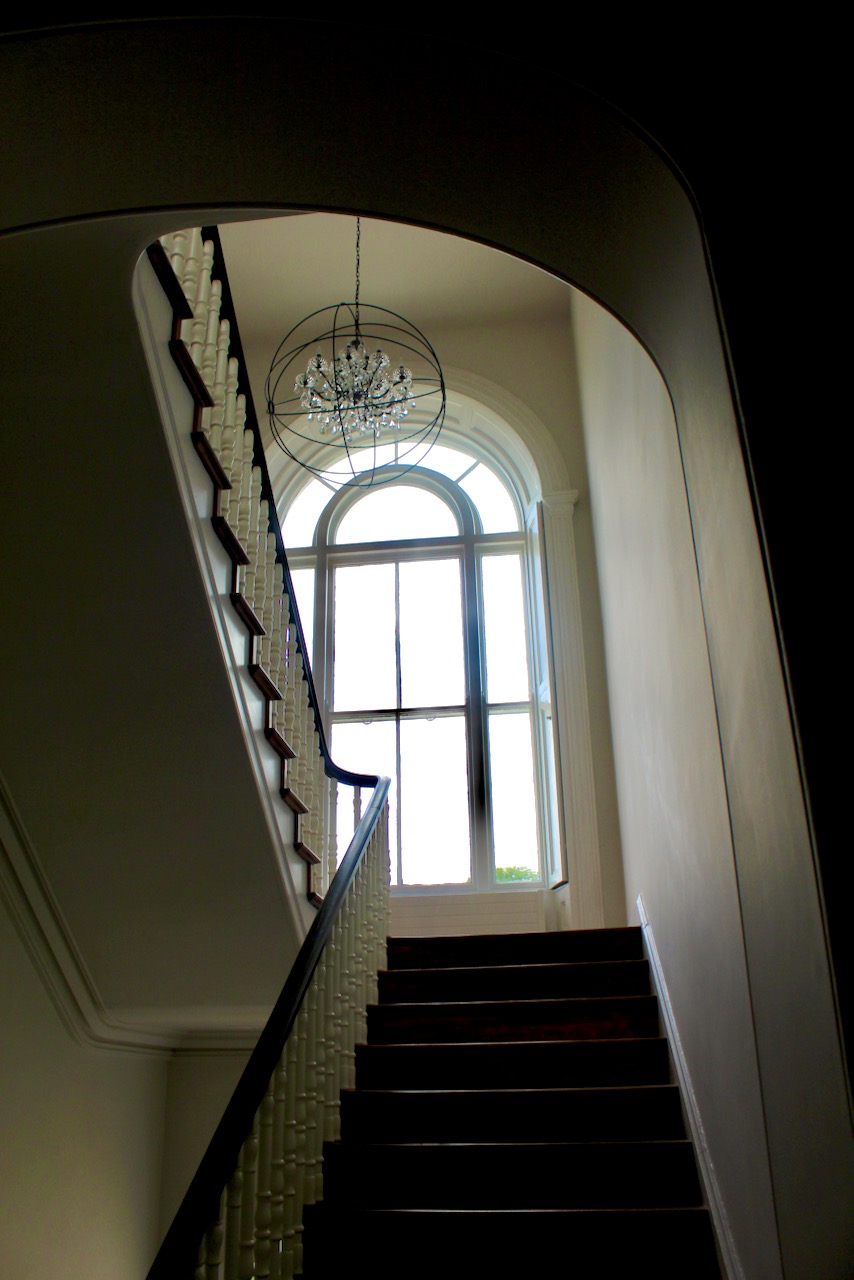
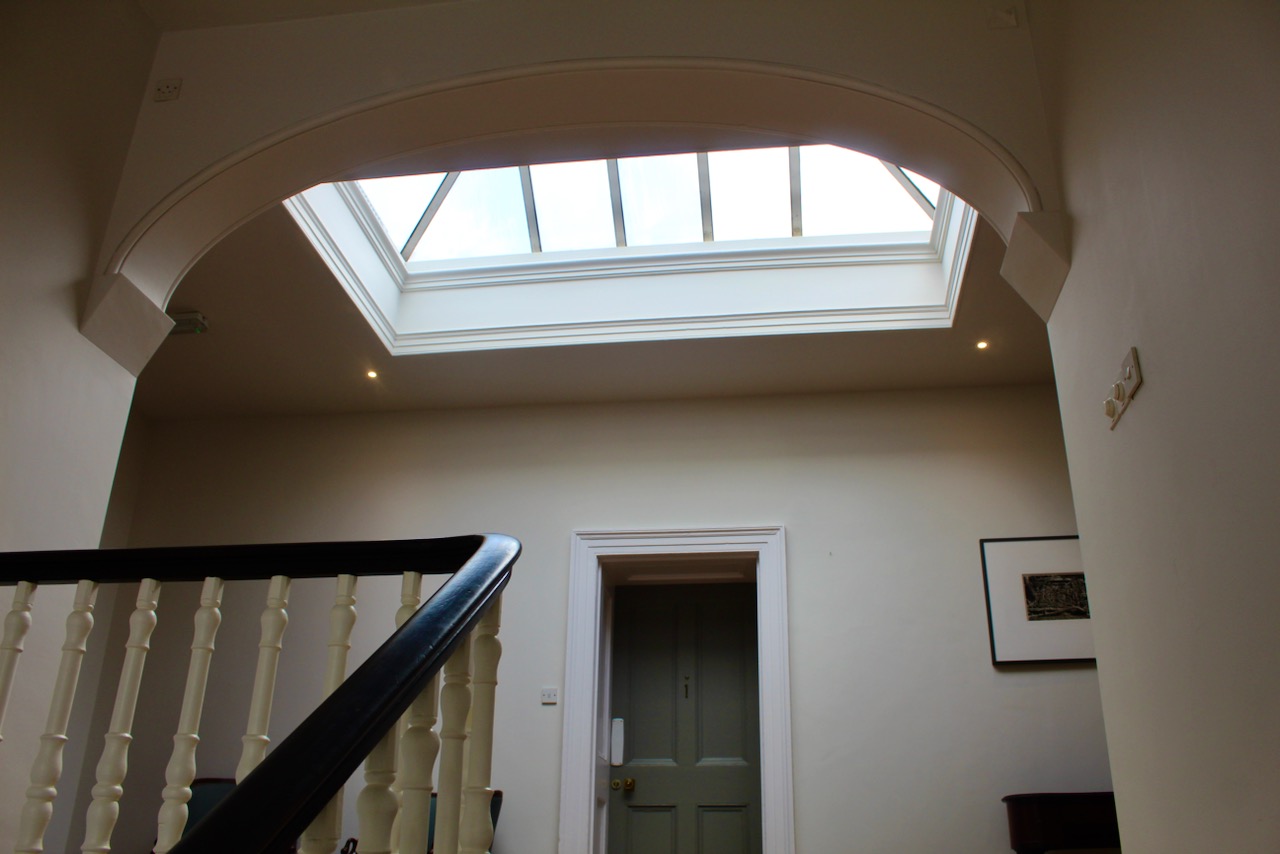
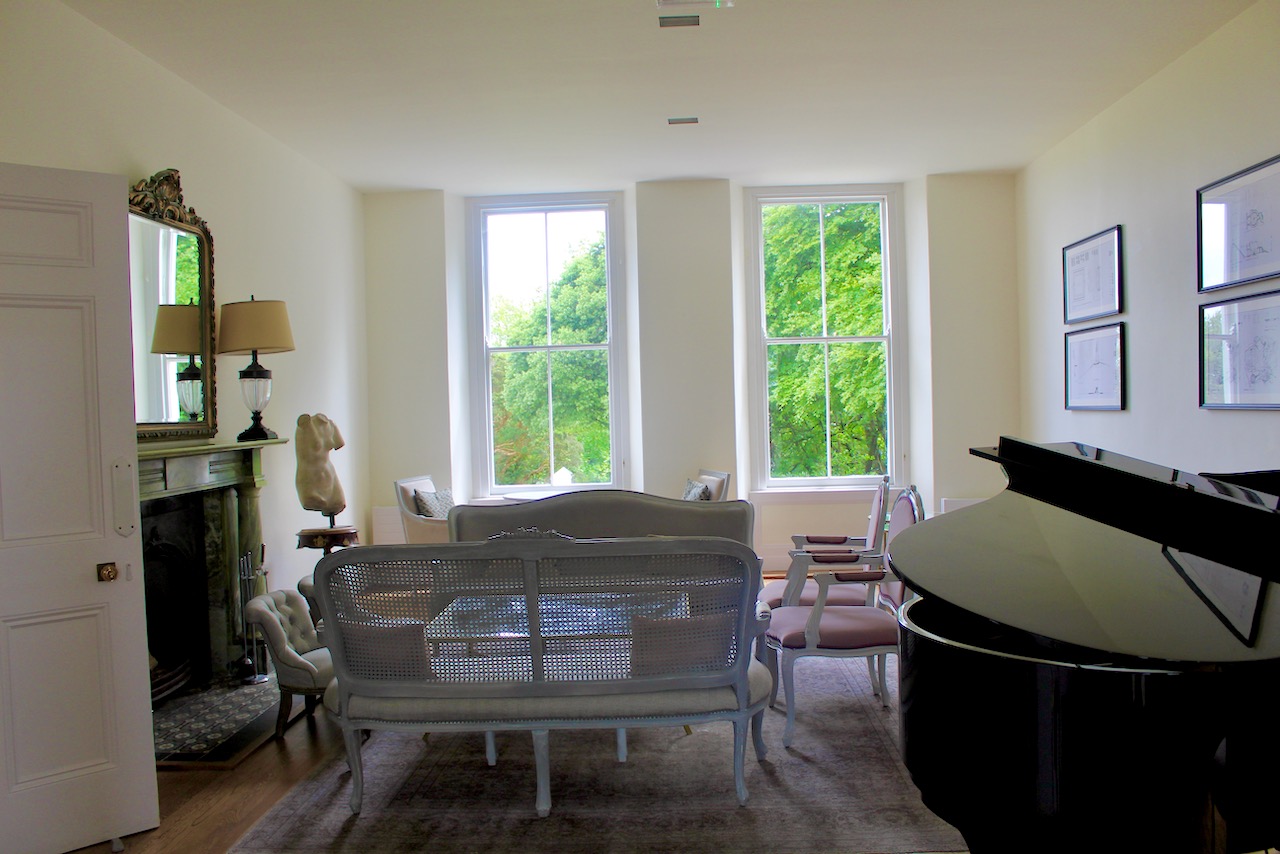
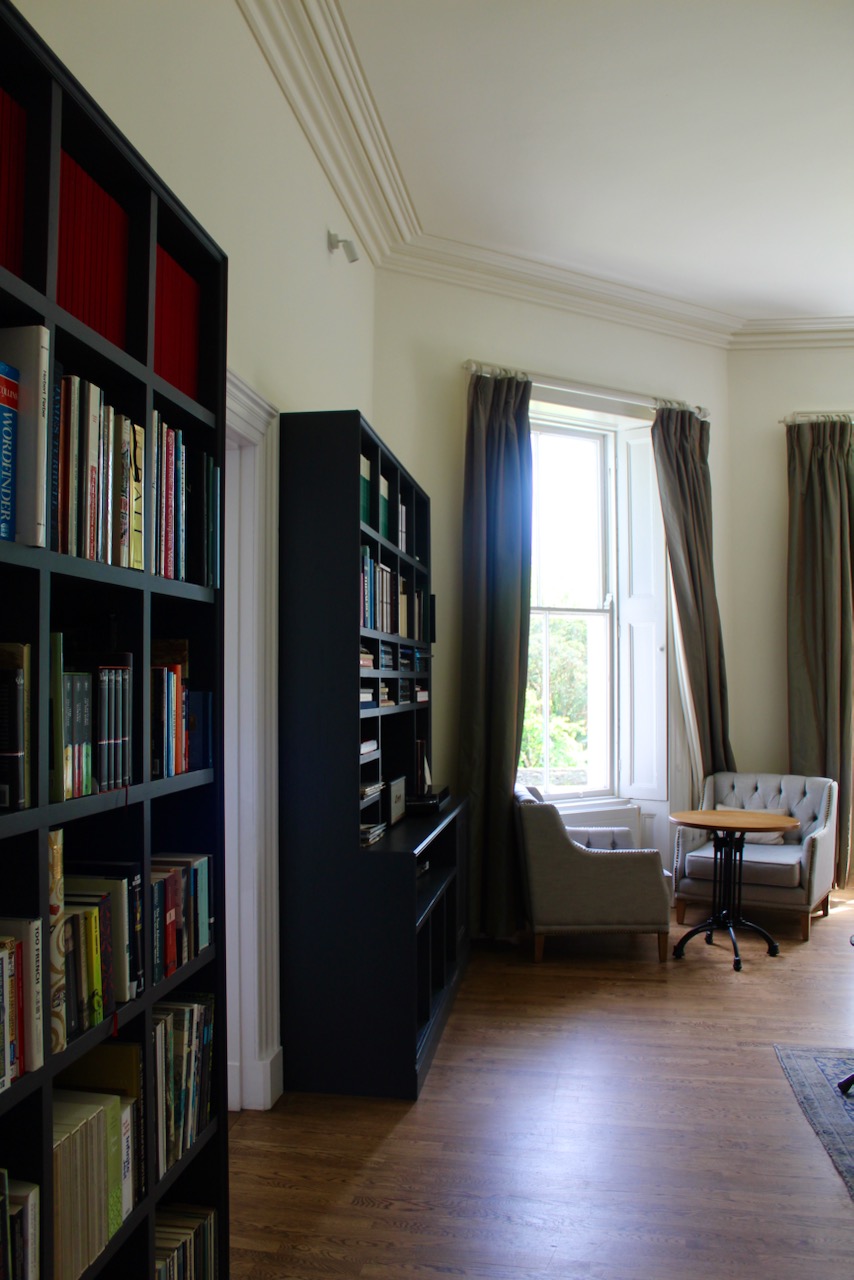
There is also a library for guests.
I did not take a picture of the restaurant as it is in the basement and is more modern. Despite being in the basement it is full of light.
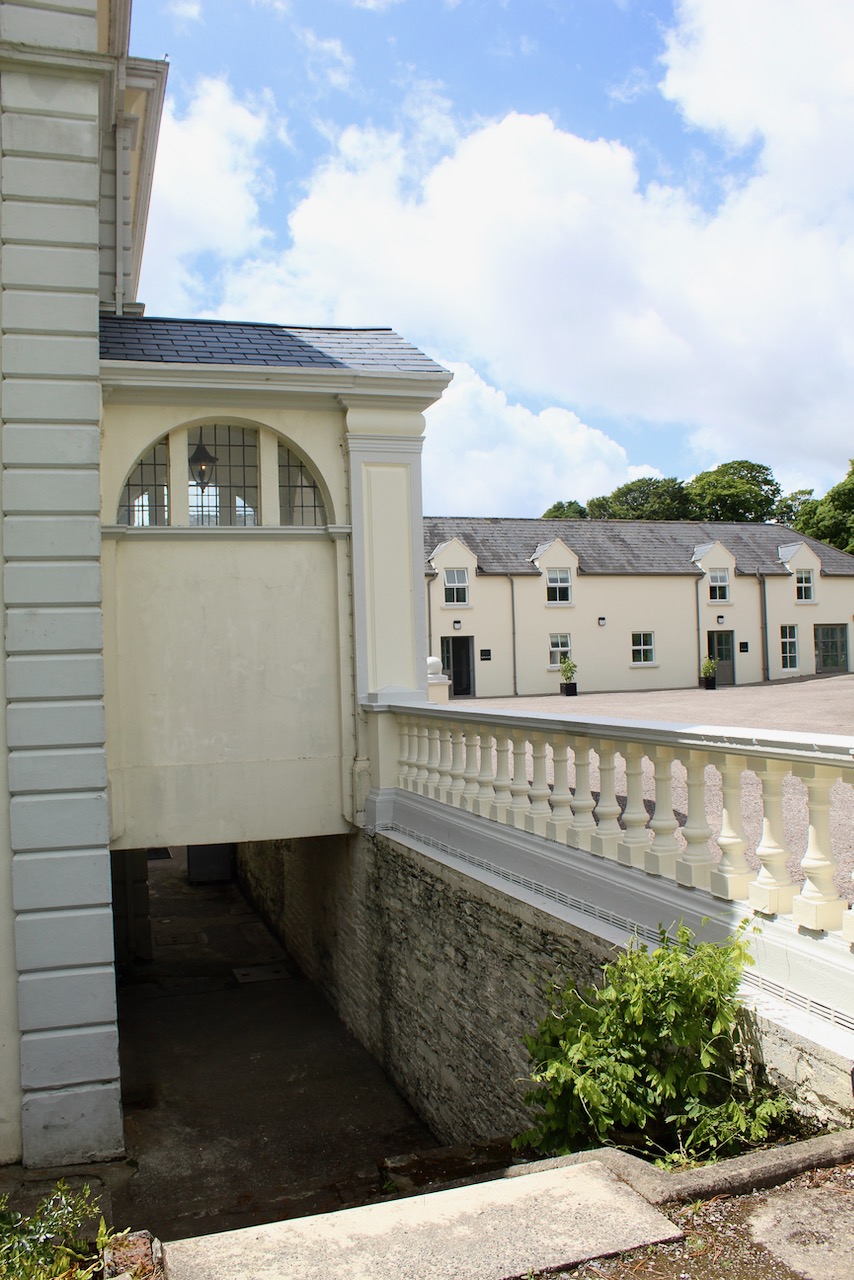

Liss Ard Sky Garden, County Cork
Liss Ard estate is now a hotel, but you can book lunch and a visit to the Sky Garden, and wander around the gardens of the estate. The hotel is surrounded by miles of trails, which weave whimsically and which reveal magical settings with artfully placed walls and steps. It is also the site of a ring fort: the Irish “Lios Aird” means high fort. For more about the hotel, see the accommodation section below.
The art dealers/collectors Claudia and Veith Turske purchased Liss Ard estate and in the 1990s and created public gardens with waterfalls, an arboretum with 10,000 newly-planted trees and had plans to create further land artworks after James Turrell’s installation, which was created in 1992. The property has since changed hands. It first came to my attention when a music festival was held in its grounds.
The website describes James Turrell’s The Irish Sky Garden
“For over half a century, the internationally renowned landscape artist James Turrell has worked directly with light and space to create artworks that engage viewers with the limits and wonder of human perception. New Yorker critic Calvin Tompkins writes, “His work is not about light, or a record of light; it is light — the physical presence of light made manifest in sensory form.” ”
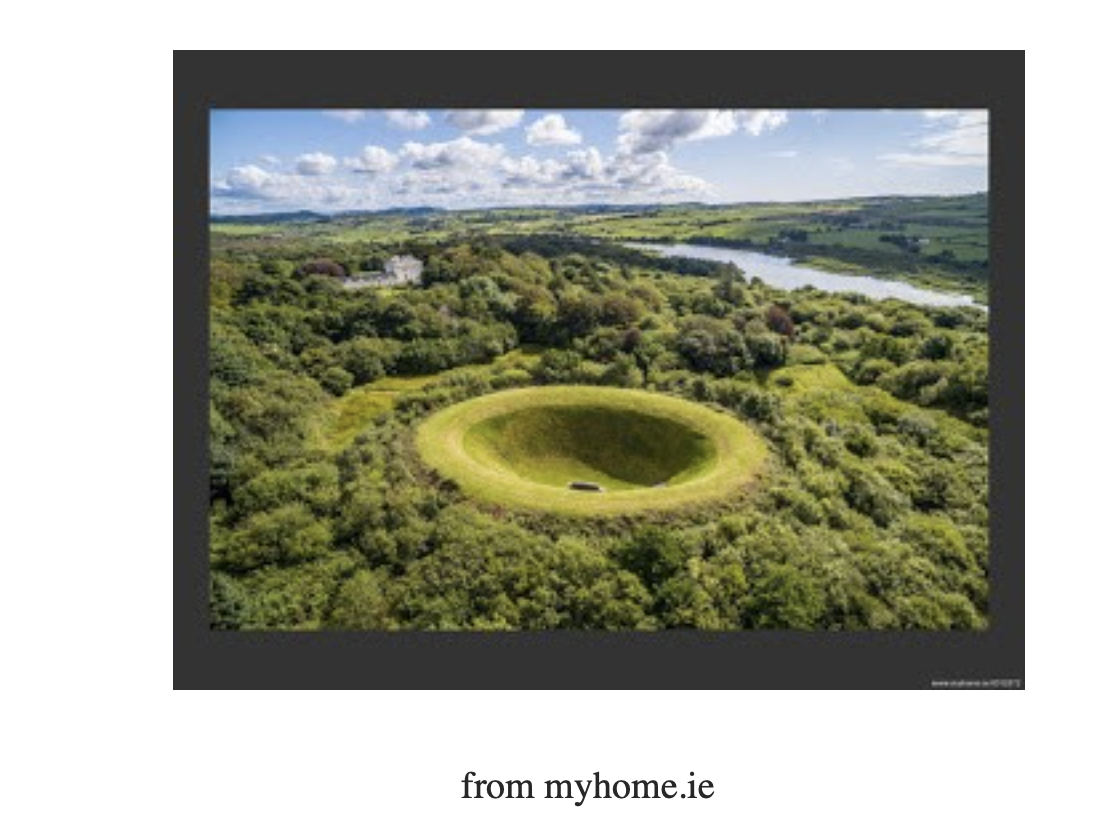
The Irish Public Art directory describes the Sky Garden:
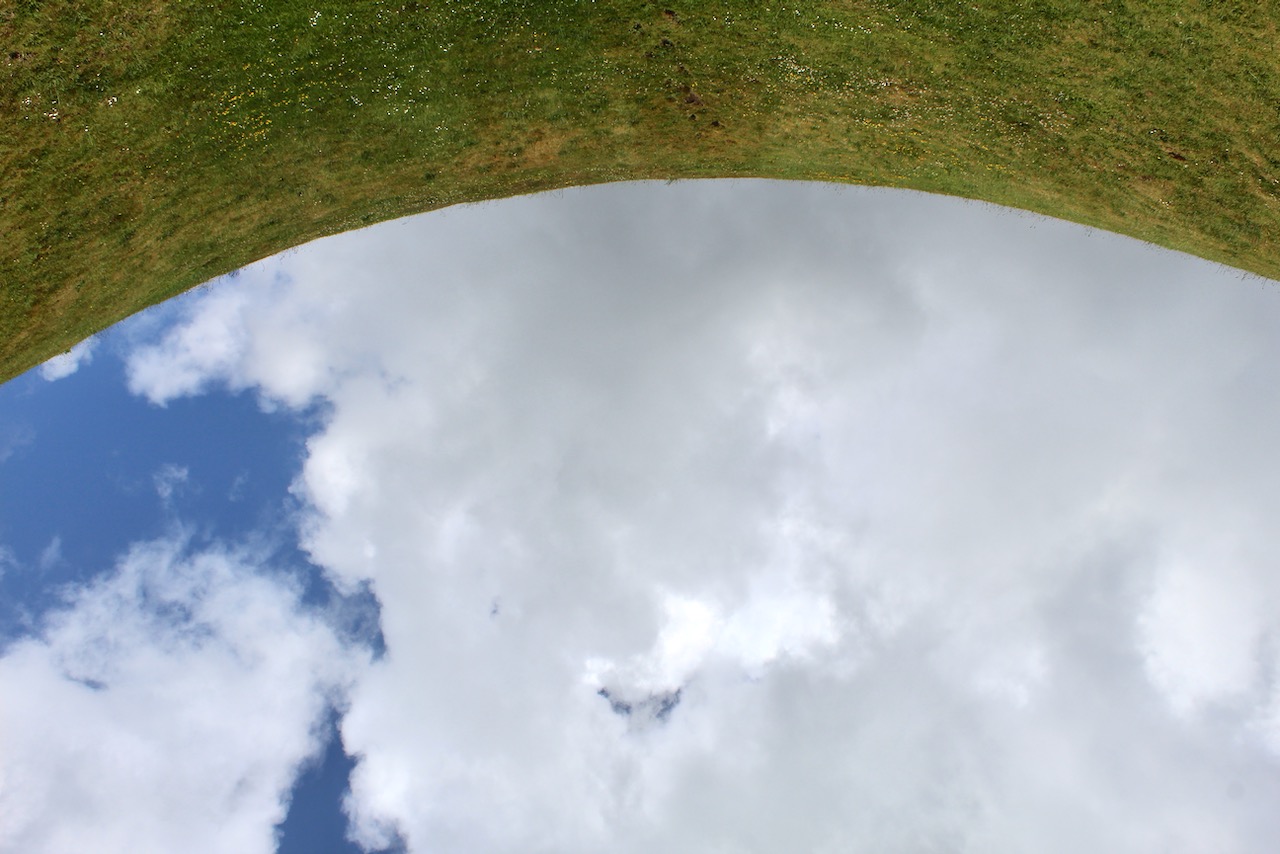
“The ‘Irish Sky Garden’ is a giant earth and stone crater embedded into the landscape of the Liss Ard Estate gardens. The artwork consists of an archway, a long megalithic-like passage, and stairs leading to an oval shaped, grass-lined crater, which measures 50 x 25 metres. In the centre of the crater’s ‘bowl’ is a large stone ‘vault purchase’ or plinth (not unlike an Egyptian sarcophagus). This is where the visitor should lie back and look at the sky, which is framed by the edges of the elliptical crater.
”The most important thing is that inside turns into outside and the other way around, in the sense that relationships between the Irish landscape and the Irish sky changes” (James Turrell).”


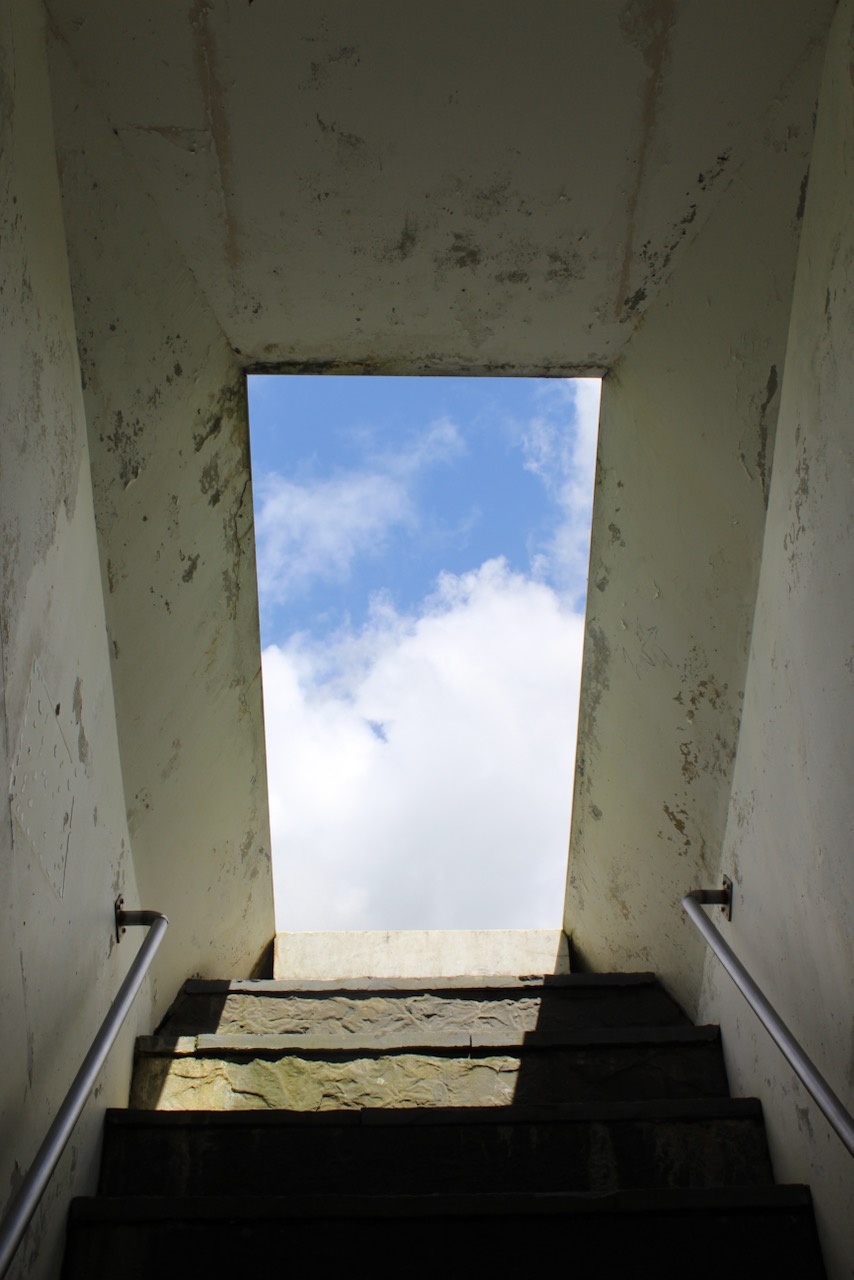
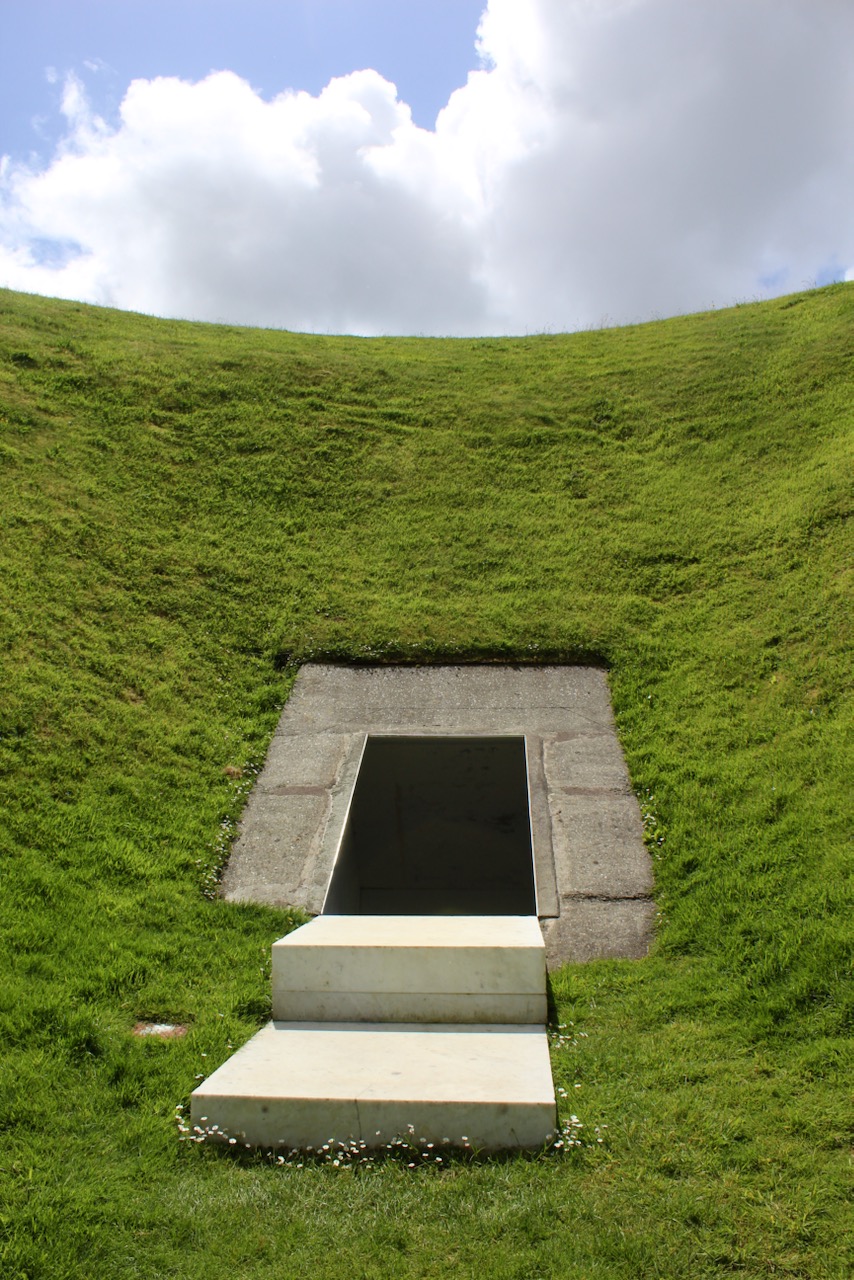
It is impossible to capture the feel of the earth work creation in a photograph although the aerial view from the ‘myhome’ website gives us an idea.
27. Longueville, Mallow, Co Cork – Blue Book accommodation (2-29 people)
https://www.longuevillehouse.ie/
The website tells us:
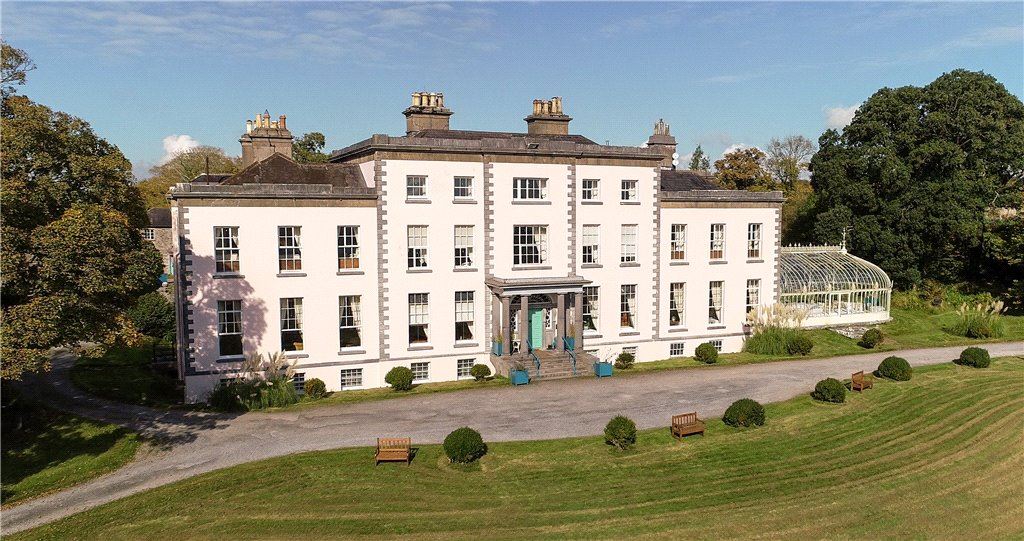
“Longueville House is a stunning 302 year old listed Georgian Country House hidden in the heart of a 400-acre wooded estate overlooking The Blackwater Valley, County Cork – the scenic gateway to the Southwest of Ireland.
“Steeped in history and packed with character, this owner-occupied 4-star Country House Hotel operates in two distinctly different ways.
“Firstly Longueville House warmly welcomes overnight guests for weekend and midweek stays with various themed and seasonal breaks to experience.
“Secondly, Longueville House may be booked privately for Small themed groups, multigenerational families and Corporate delegates who prefer the privacy and pace of an Exclusive Hire Venue. Longueville House sleeps 2 – 29 guests at full capacity.
“Longueville is a family story where for generations The O’Callaghans have preserved and merged their passion for the house, the land, food and entertaining, with the kitchen garden being at the heart of it all.
“Maintaining and modernising the house and grounds has been a labour of love for William and Aisling your hosts. A home-from-home, classic but informal, where open log fires crackle in vintage hearths and intriguing heirlooms jostle with fresh flowers from the garden.
“For years The O’Callaghans have made an ongoing commitment to only using home grown and local produce, celebrating the seasons, incorporating the most authentic and freshest of ingredients, thus enabling William to create menus bursting with flavour. What’s not grown or reared in Longueville is sourced from local farms and artisan suppliers.
“Our ethos is simple, our style is unstuffy, less formal. Conserving the beauty of Longueville through generations of love, to be shared with future generations to come.”

Mark Bence-Jones tells us of Longueville:
p. 191. “(Longfield/IFR) A three storey five bay C18 block, enlarged by the addition of two storey three bay wings in the late Georgian period, probably between 1800-5 by John Longfield, MP; the centre being refaced and some of its windows altered at the same time so as to make the front uniform. One bay central breakfront, Wyatt windows in two upper storeys above a fanlighted doorway beneath a single-storey portico. One of the wings was extended at right angles to the front ca 1866, and a charming Victorian conservatory of curved ironwork was added, probably at the same time. The principal reception rooms, which have simple early C19 plasterwork and doors of inlaid mahogany, extend on either side of the entrance hall, which has a floor of Portland stone. Behind is the staircase hall, with bifurcating staircase which is most unusual in rising to the top of the house; the central ramp and two returns being repeated in the storey above. Longueville was sold by the Longfields to the late Senator William O’Callaghan, whose son and daughter-in-law have opened it as an hotel.”
The National Inventory tells us of the Turner conservatory:
“Constructed in 1862, this glasshouse was the last designed by Richard Turner, whose portfolio includes the conservatory at the famous Kew Gardens in London. The cast-iron framework and attractively flawed glass are of considerable technical interest and create a focal point for Longueville House, to which it is attached.“
28. Lough Ine House and Lodge, Skibereen, County Cork – whole house or gate lodge accommodation
The website tells us:
“This beautiful holiday house and cottage are set on stunning Lough Ine sometimes spelt Lough Hyne – which is well known as one of the most romantic spots in West Cork.
“Just 85km from Cork airport, Lough Ine is easily accessible but also far enough off the beaten track to be the perfect place to get away for either a romantic break or a fabulous family holiday.“
The House: “This elegant Regency house was built in 1830 as a hunting lodge for Lord Carbery and maintains several original features to this day. It is surrounded by its own 15 acre estate on the edge of Lough Ine and includes a patio garden, beautiful walkways through the woods and gardens and a private shingle beach. The Lough is a famous beauty spot 5km from Skibbereen and 4km from Baltimore in West Cork, Ireland. The estate is located in a conservation area of outstanding natural beauty.
“Elegantly furnished for comfortable country life, polished oak floors and period furniture add to the unique charm of this house. The unique vine-filled conservatory has a large breakfast area and elegant seating area with rattan furniture. Sun pours through the French windows in the interconnecting reception rooms, offering spectacular views of the garden, lough and surrounding hills.
“From the elegant panelled hall, a striking curved staircase leads you to the first floor where you will find 3 double bedrooms and a large bathroom. The two front bedrooms overlook the sea and are elegantly decorated with material on the walls and fine furniture. One has an eighteenth century four-poster bed, the others have twin beds. The charming third room overlooks the gardens. The bathroom is worth noting for its historic bathtub, which used to belong to Winston Churchill!
“On the ground floor there are two further wood panelled twin bedrooms each with their own bathroom containing bathtub and shower. The rowing boat is at your disposal to explore the island where you can see the remains of an O’Driscoll castle and picnic on the beach, or visit the shoreline and rapids that lead out to the sea.“
The Gate Lodge: “The gate lodge is an 18th Century, small cosy house at the entrance of the property on the edge of the lough, with wonderful view of the sea, the island and the fields.
“The ground floor is an open plan living room with a large fireplace, a dining area, a kitchenette and a spiral staircase leading to a twin bedroom overlooking the lough, a single bedroom and a bathroom with basin, W.C, bath and shower.“
29. The Courtyard, Mallow, County Cork – accommodation
https://hiddenireland.com/house-pages/the-courtyard-mallow/
“The Courtyard, Mallow has been lovingly renovated and is at the rear of the main Georgian house which was built in 1780 and was the original home of the Carpenter family. The Courtyard, Mallow is situated on a working farm and equestrian centre.
“Comprising of two 2-bedroomed self-catering apartments, and one 1-bedroomed self-catering apartment we can provide for couples and friend/family groups alike. Your home-from-home, each apartment at The Courtyard is equipped with all cooking facilities that you need, WiFi, and television sets with endless channels and movies to choose from. Catering and shopping is available upon prior request and subject to availability.“
All three apartments have been recently refurbished and each apartment is elegantly decorated with its own unique style and story. We have scoured vintage and antique shops around the country to add that extra flare and individuality to the living spaces of The Courtyard apartments. We use White & Green luxury organic cotton bed linen on all beds and Dalkey liquid handmade soap to ensure our guests can fully unwind during their stay. All bedrooms are ensuite for your comfort and privacy.
30. Maryborough, Douglas, Co Cork – Maryborough Hotel
The website tells us:
“Located in the leafy suburbs of Douglas, yet minutes from Cork City Centre, The Maryborough has a character and style all of its own. Set in 18 acres of 300-year-old listed gardens and woodland, our family-owned boutique hotel affords guests an experience in luxury itself and is among the top hotels in Cork. The Maryborough Hotel is unique with its charming 18th Century Mansion accompanied by the creatively designed contemporary extension. All of this combined makes The Maryborough the perfect destination.
“The hotel delivers a unique experience in an exceptional atmosphere. From the moment you enter, we will guarantee you a level of personal service and care designed to match the exquisite surroundings of our 300-year-old listed gardens. Guests can enjoy an award-winning restaurant in Cork, state of the art Leisure Club and luxurious ESPA spa.
Our History
“The Maryborough Hotel & Spa is one of the most renowned 4 star hotels in Cork today. The Maryborough’s Georgian Manor House was built in 1710 by Mr Richard Newenham [note that a Richard Newenham of Maryborough married Sarah Devonsher, niece of Abraham Devonsher of Kilshannig]. Descendants of the Newenhams as well as other families lived there up until the 1990s when it was purchased by the O’Sullivan family. In 1997 the family opened what is now The Maryborough Hotel, a 4 star luxury hotel in Cork with 93 bedrooms.
“Since becoming a hotel, the Mansion House has fortunately retained its striking original architectural features. Some of the rooms at The Maryborough still showcase Adam style decoration – notably the entrance hall and some mantelpieces. This adds to the historical relevance of the manor house and contributes to the decadence and luxury of this boutique hotel in Cork.
“The former eighteenth-century stately home is set amid acres of woods and beautiful gardens, just south of Cork’s historical city centre in Douglas. John Newenham, a younger brother of the last Newenham owner of The Maryborough was a great gardener and collector of trees. Thanks to his inspired work the gardens at The Maryborough still host quite a collection, in particular of rhododendrons, making it one of the reasons for The Maryborough being one of the best hotels in Cork.
“The Maryborough works to continually develop a deluxe guest experience merging the hotels history with beautifully appointed accommodations. In order to incorporate the elegant grandeur of the old house into the hotel, several splendid suites were built on the upper floors of the Mansion House. Read more about our luxury suites in Cork.
“To compliment the opulent charm of the old house, the hotel’s contemporary extension was built. It is here you will find our Deluxe, Executive and Family Rooms. Spectacular architecture blended with effortless service and genuine hospitality makes the Maryborough one of the top hotels in Cork.“
31. Old Bank Townhouse, Kinsale, County Cork – accommodation
https://www.oldbankhousekinsale.com
The website tells us:
“Take an elegant townhouse in a spectacular location, add a gourmet cafe with a mouth watering array of local produce, mix well with the locals who love the atmosphere here, bring it all together with a very warm welcome and a pinch of kinsale humour… and you’ll have the Old Bank Townhouse.
“Set in the heart of Kinsale, this beautifully renovated Bank House is both elegant and welcoming. Just a short walk from the of world renowned restaurants, inviting bars and interesting boutiques of Kinsale… yet only 25 minutes from cork city, the Old Bank Townhouse is popular with golfers and those with a passion for food.
“Steeped in history, this Kinsale accommodation was originally the Munster & Leinster Bank.The beautiful Georgian facade with impressive sash windows used to front a waterway for passing ships that berthed in the quays running from the site of on old mill.“
32. Orchard Cottage, Dunowen House, Co Cork (sleeps 5) accommodation
The website tells us:
“Orchard Cottage is a beautifully refurbished three bedroom house nestled within the peaceful one acre walled garden of Dunowen House.
“This characterful old building, dating back to the 1800’s, has been sympathetically restored to a very high standard. It has three cosy bedrooms, two bathrooms, a wood burning stove and an open plan kitchen living area, offering accommodation for up to five guests. The cottage is suitable for up to three children within that number.
“Orchard Cottage is available to rent with Dunowen House or on its own as a cute tranquil hideaway for short-breaks or longer holidays.“
33. Perryville, Kinsale, Co Cork – hotel
https://www.perryvillehouse.com
The website tells us:
“Perryville House is an elegant and distinctive period townhouse overlooking Kinsale Harbour, County Cork in the south of Ireland. Originally built in 1820 and lovingly restored by us, Perryville House is now a warm, gracious and light-filled boutique guesthouse.
“True to its original role as a private residence, Perryville House welcomes guests from all over the world to share and enjoy the finest Irish hospitality and luxury accommodation in Kinsale — your first stop on the Wild Atlantic Way. We invite you to savour a one-of-a-kind, historic hotel experience.
“A masterpiece of Georgian architecture with later Victorian embellishment, Perryville House was built in 1820 by Captain Adam Warren Perry for his family whose ancestors continued to reside here until the late 1950s. It had various owners from then until 1997 when fired by the beauty, character and history of this lovely house, Andrew & Laura Corcoran undertook the mammoth task of refurbishing and bringing it back to its former glory. Situated in the heart of Kinsale, overlooking the harbour, Perryville House welcomes guests from April to October each year.“
34. Rincolisky Castle, Whitehall, Co Cork – whole house accommodation
https://www.airbnb.ie/rooms/20771431?source_impression_id=p3_1646737924_o%2BwxYCDhpDgJDHfX
“Rincolisky Castle, sometimes also called Whitehall Castle, lies on a hill on the southern shore or Roaringwater Bay, in County Cork in Ireland.
“Rincolisky Castle, originally a 5 storey high, square tower house was built in 1495 by the powerful local O’Driscoll clan.
“In 1602, after the Battle of Kinsale, the castle was easily taken by English forces. It was then given to Sir Walter Coppinger. He changed the name of the castle into Whitehall, after the townland in which it is situated. The Coppingers lost their possessions in 1690 for supporting James II.
“It was then given to Samuel Townsend. The Townsends built a new mansion nearby; Whitehall House. They removed the 3 upper floors of Rincolisky Castle to provide building material for their new mansion. From then on the truncated 2 storeys high remnant of Rincolisky Castle fell to ruin. It is said that there is a tunnel leading from the castle to the mansion. One of the Townsends sent his little page boy down the passage to see if it was clear. The boy was never seen again.
“In 2000, the ivy covered ruin of Rincolisky Castle was restored and made habitable again.” [13]
35. Seaview House Hotel (formerly Ballylickey House), Bantry, Co Cork – hotel
https://www.seaviewhousehotel.com/
The website tells us:
“Welcome to Seaview House Hotel, a delightful 4 star country house hotel full of character, set in private and well tended grounds in the quiet village of Ballylickey beside Bantry in the heart of West Cork.
“Offering award-winning cuisine, luxurious B&B and a modern Spa & Bath House.“
Mark Bence-Jones writes of Ballylickey House in A Guide to Irish Country Houses (1988):
p. 290. “(Petty-Fitzmaurice, Lansdowne, M/PB) A two storey house of mid C19 appearance; pillared porch between two three sided bows, the front being prolonged on one side by a similar bow, and on the other by a lower service wing ending in a gable. Orignally a shooting box of the Marquesses of Lansdowne (see Derreen); acquired by the Graves family who made a noteable garden here and added an extra storey to the house ca 1950 when they turned it into a hotel. After a serious fire 1984, the house was rebuilt without the additional storey, regaining its original C19 character.”
36. Southernmost House, Cape Clear Island, County Cork – accommodation
https://hiddenireland.com/stay/self-catering-holiday-rentals/
The website tells us:
“A unique Irish cottage for two overlooking the beautiful seascapes and landscape of Cape Clear Island. Cape Clear Island is located off the coast of West Cork on the Wild Atlantic Way. The Island could be considered as part of the Hidden Ireland that is rarely encountered by visitors to the West of Ireland. The house is situated in a secluded location overlooking the Atlantic Ocean, Mizen Head, Roaring Water Bay and the South Harbour of Cape Clear.
“Built pre-famine in approximately 1830 and occupied until 1890-1894. It was subsequently used as a cow house for many years before being restored in the mid 1990’s. There are no other houses between Southernmost House and the Atlantic Ocean, which suggests that the house is the most Southerly house in Ireland.
“Beautiful sunrises to the East and unsurpassed sunsets to the West are daily occurrences at Southernmost House. The natural night time light and early morning light give another dimension to the magnificent views from each window. The landscape and seascapes never fail to captivate during all seasons of the year. There is always a magical aura to the regular cloudless starry nights. Southernmost House is a unique haven, offering guests among other things an opportunity to regain and engage in the quiet and simple enrichment of body and soul.
“Southernmost House has been prepared specifically for the enjoyment and pleasure of one or two people. The house comprises a large sitting area with an open turf fire and large sun receiving windows. A dining area with panoramic views and a loft over in the traditional Irish style. A study for scripting reflective thoughts. A meditation room, to embrace calmness and serenity. Kitchen with all necessary cooking and storage facilities. Bathroom with bath and power shower. One double bedroom with traditional style super king bed and high quality bed linen. The house is presented and furnished in an authentic manner to reflect the resources available locally and with an aesthetic sympathic to the simple origins of the house.
“There is no television in Southernmost House. There is a mobile internet ‘dongle’ available if required and a music unit with radio and c d player. A cross section of c d’s are on hand as well as selection of board and card games. Also a selection of Irish and classic books. There are two restaurants and two pubs on the Island. Costs include linen, heating, gas, turf and kindling etc for the open fire. We will be on hand to render assistance at any stage. A few non perishable cupboard basics are provided. Unfortunately, we cannot accommodate children or pets. The house is strictly ‘no smoking’. A full list of terms and conditions will be available before confirmation of booking.“
37. Springfort Hall, Mallow, Co Cork – hotel
https://www.springfort-hall.com
The website tells us:
“Tucked away amid tranquil woodlands , Springfort Hall Country House Hotel is a hotel for all seasons . The gardens and lawns at this 4 Star Hotel are a delight during the Summer , while in the Winter months, there’s no better place to relax with a glass of red wine than in The Baltydaniel Bar. Add to this , impeccably maintained 4 Star Accommodation and Sumptuous dining in The Limetree Restaurant and you will discover a wonderful 18th Century Country House Hotel Countryside. Explore one of the finest 4 Star Springfort Hall Country House Hotel.“
Mark Bence-Jones tells us Springfort is (1988):
“(Foott/LGI1912; Grove-White/IFR; Clarke/IFR) A two storey early C19 house with two deep curved bows on each side of its two principal fronts. Open porch with square piers on entrance front, between the two bows and below a central Wyatt window; large triple windows in lower storey of bows. Service wing at side. Spacious bow-eded reception rooms; ceilings and surrounds of early C19 plasterwork. Plaster Gothic vaulting in staircase hall.”
38. Vienna Woods Hotel (formerly Lota Lodge), Glanmire, Co Cork
https://www.viennawoodshotel.com/
Mark Bence-Jones writes of Lota Lodge (1988): p. 191. “(Sharman-Crawford/LGI1912) A two storey Regency house with circular projections and iron veranda. Eaved roof. Partly destroyed by fire 1902, rebuilt 1903.”
The website tells us:
“Cork’s Vienna Woods Country House Hotel has a history as dramatic as the rich mustard tone that sets the building apart from the surrounding woodlands on the peaks of Glanmire, Co. Cork.
“The building, perched on a height overlooking the Glashaboy River, has stood proudly since 1756. Built by Davis Ducart as a summer leisure lodge for Lord Barrymore, the building was designed in the Regency Style, a style that was very popular in the latter part of the 18th century.
“Characteristic traits of the Regency Style include an emphasis on the classical form, and the forging of a close relationship between structure and the landscape, evident in The Vienna Woods Country House Hotel, which nestles in to the surrounding mountainous woodlands.
“Vienna Woods, or Lota Lodge as it was originally titled, forms part of a collection of grand country houses in the Glanmire area of Cork, like; Dunkathel House, Glenkeen, Glyntown House, Lauriston House and Brooklodge House.
“The house was home to AF Sharman Crawford and his family from 1875-1946, who was thankfully here to restore the house to its original glory after a fire in the early 1900s destroyed some of the original building. Crawford was a managing director of the Beamish and Crawford Brewery, (which was founded by his uncle, William Crawford II), and the city of Cork benefited from his philanthropic disposition, particularly in the arts; in fact the Crawford family funded the establishment of the Crawford Art Gallery and the Crawford School of Art.
“As with so many other grand houses in 20th century Ireland, the building was purchased by a religious order in 1951, and was used as a seminary for 13 years, until it was converted into a hotel in 1964 by Joan Shubuek renamed the building ‘Vienna Woods’, because of the parallels she drew between the area, and the Austrian capital city where she had lived for a number of years.
“The Fitzgerald family along with Michael Magner, bought the hotel in 2006 and renamed it ‘The Vienna Woods Country House Hotel’. Michael Magner, one of the co-owners, is also the General Manager of the hotel, and this close level of personal care and involvement is most evident in the building’s most dramatic makeover to date, which has taken almost fifteen years to complete. The Fitzgeralds/Magners have lovingly and painstakingly restored much of the original protected features of the building.“
39. Willowhill, Carrigaline, County Cork – airbnb
“Our home Willowhill House is nestled in the Cork countryside, surrounded with beautiful rolling green fields and farmland. We are only 20 mins from Cork Airport, and 10 minutes from stunning coastline. We welcome you to come and stay with us and enjoy our home.
“Willowhill House is an old country residence., dating back to 1791. We have 4 rooms available to rent, all are double rooms, So we can accommodate up to 8 people. All of our rooms are en suite. We have baths and showers in three of these, and one without a shower and bath only .
“We have a sunroom which is beautiful in the summer, a drawing room to relax and read by the fire and a dining room where we will serve you a light breakfast in the morning. We also have beautiful gardens and an old wall garden that you are welcome to wander around.“
Whole House Rental County Cork:
1. Ballincurra House, County Cork – coach house, estate cottages, and whole house rental
2. Barnabrow, Cloyne, Co Cork – whole house accommodation (22 bedrooms)
https://www.barnabrowhouse.ie/
The website tells us: “Barnabrow Country House: in idyllic East Cork is discreet – it is like a secret garden that beckons. Visitors may happen upon it nestled in the rolling hills of East Cork with distant but tantalising glimpses of Ballycotton Bay. At first glance it appears contained – its banqueting hall, high on the hill, is not obvious, the twenty-two bedrooms are tucked away in various courtyards and the cottages are not apparent.
“The meandering passages entice the curious to explore, its various decks with their pleasing views invite others to relax while the menagerie of animals offers solace. Combined, these elements make Barnbrow Country House an atmospheric, intimate setting where memories, that last a lifetime, are created.
“Barnabrow Country House in East Cork is one of the most idyllic locations for romantic weddings, corporate events, special celebrations and group gatherings.
“The family and staff at Barnabrow are proud to act as caretaker of this lovingly-restored manor house and 30-acre estate which dates back to the 17th century. A recurrent comment of our guests is an appreciation of the relaxed and warm atmosphere here. Primarily we wish to share this great house with you.
“For the past four years, Head Chef, Stuart Bowes, who is Michelin Star-trained, has ensured a new level of excellence in our food: jus is prepared over three days, handmade sweets are on the pillows, herbal aromas pervade the air.
“Mary Russell’s discerning eye adds an artistic dab here and there to enhance the visual feast that Barnabrow has gradually become. Liam Irwan, our steadfast gardener, preserves its organic nature and tends to the donkeys, goats and fowl that so add to its ambiance.“
Cloyne, Midleton, East Cork, Ireland.
info@barnabrowhouse.ie
+353 21 4652534
Mark Bence-Jones writes in A Guide to Irish Country Houses (1988):
p. 32. “A three storey 3 bay double gable-ended C18 house with single-storey 2 bay C19 wings. Wyatt windows in 2 lower storeys of C18 block. In 1814 the residence of Timothy Lane; in 1837, of J.R. Wilkinson; in recent years, of Lt-Cmdr and Mrs Whitehouse.”
3. Blackwater Castle (Castle Widenham, or Blackwater Valley Castle) Castletownroache, Co Cork – Whole House Rental
https://www.blackwatercastle.com/
The website tells us:
“A medieval Castle for rent in Ireland, the spectacular home of the former Viscount of Fermoy and Lords of the Barony of Fermoy, is a truly unique heritage site of international significance. Blackwater Castle, with a history extending back some 10,000 years to the Mesolithic period, is available to hire as a private Castle experience for exclusive Castle weddings, private parties, and family gatherings.
“The Castle was first erected in the twelfth century on the site of the Bronze Age fortress of Dún Cruadha, an inland promontory fort which was established some 2,500 years ago or more on a rocky outcrop on the banks of the River Awbeg. Beautifully appointed suites, welcoming reception rooms, historical tours, and extensive activities from zip-lining to fly fishing are all on offer at one of Ireland’s more interesting and best preserved castles set on a 50 acre estate of mature native Irish trees with a private stretch of the River Awbeg.
“Visitors gracing the Castle down through the centuries include Early Mesolithic hunter-gatherers, Druids and Chieftains, Strongbow’s Men at Arms, Sir Walter Raleigh, and Michael Jackson while Oliver Cromwell and his army also laid siege to the Castle. More recently we have received the President of Ireland Uachtarán Michael D. Higgins who described the Castle as a “beautiful place” and set in “a majestic and pastoral environment”. This exquisite Castle is available for private exclusive hire as the perfect venue for castle weddings, private parties and self catering holiday vacation rentals. Guesthouse options are also available for group bookings.
“The Castle is a highly recommended venue with a coveted 5 star rating on Tripadvisor where we rank as the Best Speciality Accommodation in Cork. We were winners of the Best Hospitality, Tourism and Food Venue in the North Cork Business Awards 2017 while we have been selected for five consecutive years by One Fab Day as one of the best wedding venues in Ireland. in October 2015 The Irish Times listed us among the top ten Castles in Ireland while The Irish Examiner declared on 6 May 2015 that Blackwater Castle was one of only six Irish wedding venues you ever need in your “wedding venue little black book”.
“Blackwater Castle is the original seat of the FitzHugh/Roche Family who travelled to Ireland with Strongbow in the late twelfth century. The Castle is located on an elevated site (and former inland promontory fort) above the River Awbeg with magnificent views of the surrounding countryside from the Norman Tower which is reputed to be one of the best preserved medieval keeps in Ireland. Blackwater Castle is blessed with a rich historical legacy the traces of which, dating from the early Mesolithic period or some 10,000 years ago, are visible today and are entertainingly and enthusiastically revealed and interpreted via guided tour with the owner Patrick Nordstrom.“
Mark Bence-Jones also tells us of the castle (1988):
p. 79. Castle Widenham: “(Roche of Fermoy, V/DEP; Brasier-Creagh/IFR; Smyth/IFR; Cotter, Bt/PB)
The old castle of the Viscounts Roche of Fermoy, on a rock high above the Awbeg River; consisting of a tall keep and a baily enclosed by a curtain wall with bastions and other fortifications. During the Civil War the castle was heroically defended against the Cromwellian forces by the Lady Roche of the time but she was eventually obliged to surrender. The estate was confiscated and granted to the Widenham family [to Colonel John Widenham in 1666, when it became known as Castle Widenham]; Lord Roche failed to recover it after the Restoration and was reduced to dire poverty. Later, in C17 or early C18 a house of two storeys and an attic was built onto the keep, incorporating some of the walls of the old castle; it stood within the bailey, the wall of which was still intact 1790s. Ca 1820s, Henry Mitchell Smyth [1795-1870, from Ballynatray, the gardens of which are on the Section 482 listing], whose wife Patricia (nee Brasier-Creagh) [1802-1837]was the eventual heiress of the Widenhams [via her mother, Elizabeth Widenham], castellated the house and extended it at the opposite end to the old keep; giving it a skyline of battlements and machiolations and a turreted porch on its entrance front. Probably at the same time, the bailey wall was largely demolished; though parts of it still survive, together with some of the outworks and a detached building which is thought to have been a chapel. A terrace ws built along the garden front later in C19 by H.J. Smyth. The rooms of the house have plain cornices and charming Georgian-Gothic shutters in the deep window recesses; the drawing room has segmental pointed doorways with rope ornament. The principal staircase has slender turned balusters, there is also a delightful little spiral staircase of wood, rather similar to that at Dunsany Castle, which goes up to the attic storey, whence a door leads into an upper room of the keep. From ca 1963-76, Castle Widenham was the home of Sir Delaval Cotter, 6th and present Bt [6th Baronet Cotter, of Rockforest, co. Cork] – whose old family seat, Rockforest, was nearby. Sir Deleval and Lady Cotter carried out an admirable restoration of the castle, which was in poor condition when they bought it; the rooms, as redecorated by them, were greatly improved and gained much from their fine furniture and the Cotter family portraits. They also made a garden in the outworks of the castle and opened up the views down to the river, which had become completely overgrown. Unfortunately, in 1976, circumstances oblighed them to sell it and move to England.”
4. Blairscove House, County Cork: accommodation in the Piggery, Smoke House and Loft. Also weddings.
The website tells us:
“Blairscove House is situated on the picturesque inlet of Dunmanus Bay in West Cork on the Wild Atlantic Way. Not touched by mass tourism, it appeals to visitors who want to get away ‘far from the madding crowd,’ yet desire premium facilities in terms of service and food, with home from home comforts in terms of welcome and accommodation.
“Around the courtyard of a Georgian House, beautifully restored with cobbled paths, shrubs and flowers, are the restaurant and four stylish suites or small apartments which can be rented on a bed and breakfast or self-catering basis. Formerly a piggery, coach house and servants’ quarters, each suite is individually and very lovingly decorated with a quirky mix of contemporary and antique furnishings.
“We also have another holiday cottage on Dunmanus Pier in West Cork, just 12km from Blairscove, in the direction of Mizen Head, again on the Wild Atlantic Way driving route.“
5. Careysville (Ballymacpatrick Castle), Clondulane, Fermoy, County Cork, P61 VF53 – accommodation for 11 guests
“Careysville House sits on an escarpment overlooking the fishery, with stunning views of the Blackwater valley. Guests can look out of their bedroom window and see one of the most stunning stretches of salmon fishing in Ireland, not to mention watch the salmon jumping in the pools below. It was built in 1812 in the Georgian style, on the site of the old ruined Ballymacpatrick Castle.“
Mark Bence-Jones writes in A Guide to Irish Country Houses (1988):
p. 56. “[Montgomery of Killee; Cavendish, Devonshire] “A C18 house of 2 storeys over a high basement and 5 bays, above the River Blackwater. Subtly spaced windows. The seat of the Carey family; passed by inheritance to the Montgomery family, from whom it was bought by the Duke of Devonshire, whose Irish seat, Lismore Castle, is a few miles further down the river.”
The National Inventory tells us: “Built on the site of Ballypatrick Castle, this house has been used as a fishing lodge by the Duke of Devonshire for many years. It is a substantial house with elegant proportions and articulated by its cut limestone plinth course. The building retains many notable features and materials such as the varied timber sash windows and slate roof. The classically inspired porch retains its timber panelled doors and flanking pilasters. The different window treatments to the side and rear provide further interest to the house. The site retains associated structures such as the solidly constructed outbuildings, which provide valuable context to the side. The piers are finely crafted and indicative of the quality of late eighteenth and early nineteenth-century craftsmanship.”
6. Crosshaven House, Crosshaven, Co. Cork – whole house rental
https://www.crosshavenhouse.ie/
“Crosshaven House is an elegant eighteenth century country house set in the picturesque village of Crosshaven, overlooking Currabinny Wood and Cork Harbour. It is where the spaci
“Crosshaven House, sited in Knocknagore townland, was in the ownership of the Hayes family since the lands were first purchased by Richard Hayes of Cork City in 1656 from Peyton Le Hunte, a Cromwellian grantee. The land was bought for a sum of £247 and 10 shillings. Richard Hayes built a residence, which stood from 1656 until 1769, when a descendant in line, William Hayes II, decided to demolish this old mansion, and construct a new one a short distance away. This became known as Crosshaven House.
“Crosshaven House was built by the Sardinian architect Daviso de Arcort, who was better known as Davis Ducart. Well known in Ireland for his work in smaller country houses, large houses and civic buildings around Ireland, prior to designing aesthetically pleasing grand buildings, Ducart was involved in industrial construction, most notably the Newry Canal completed in 1741, the first inland waterway to be constructed on the British Isles. Ducart was responsible for the design of the Limerick Custom House in 1765; Castletown Cox, Co Kilkenny built in the 1760s for Michael Cox, Archbishop of Cashel; Kilshannig, Co. Cork, commenced in 1756; the Mansion House, Cork, was commissioned by the City Corporation in 1765; and Lota House, Cork in 1765.
“Although built in 1769, as indicated on the datestone inscribed “W. Hayes 1769” which is fixed to the wall surface of the attic with iron pegs, the interior of Crosshaven House was left unfinished until 1810. A study of the Hayes family-tree offers a possible explanation for the difference in date of the basic structure and the interior of Crosshaven House. The original owner of Crosshaven House, William Hayes II, died unmarried in 1770, just one year after its construction. His new mansion and estate of 1,571 acres passed to his brother Richard who was established in business in Cork City and did not marry until 1776.
“Upon his death, Richard’s youngest son Thomas inherited the House, married in 1807 and died in 1817.
“This fact conforms to the stylistic evidence which suggests the House was not finished until the time of his marriage in 1807 or soon after. In the past, access from the main part of the house was available to the two stable wings through a tunnel. Since there was no service yard around the north of the main block, the tunnel was used to bring in supplies. There was evidence that another tunnel was used in the original house in 1659 for smuggling purposes, but no evidence for this remains today.
“Most of the decorative interior details of Crosshaven House, such as the ceiling plasterwork and cornicing, the joinery and ironmongery date from circa 1810. Expert Italian craftsmen carried out the plasterwork at the beginning of the nineteenth Century, and this was carefully conserved and restored in 2006. The last member of the Hayes family to have possession of Crosshaven House was Colonel Hayes, until he sold it in 1973 to Mr Graham Flint of Florida. In recent years the house was meticulously restored to its former glory while enjoying the comforts of contemporary living.”
7. Drishane House whole house rental and holiday cottages – see above
8. Dunowen House, Co Cork, and Orchard Cottage – Blue Book Accommodation, Whole House Rental (sleeps 16)
The website tells us:
“Dunowen House is a luxury 18th Century Private Rental Property, situated in a stunning coastal location ten minutes from vibrant Clonakilty town. Surrounded by private coves and sandy beaches, it offers guests the chance to totally escape and experience West Cork life.
“When you book Dunowen House it is yours exclusively making it perfect for extended families, groups of friends, bespoke celebrations and intimate weddings.
“It offers the comforts of a luxury small hotel with the privacy of an historic country estate – all to yourself.”
“Orchard Cottage is a beautifully refurbished three bedroom house nestled within the peaceful one acre walled garden of Dunowen House.
“This characterful old building, dating back to the 1800’s, has been sympathetically restored to a very high standard. It has three cosy bedrooms, two bathrooms, a wood burning stove and an open plan kitchen living area, offering accommodation for up to five guests. The cottage is suitable for up to three children within that number.
“Orchard Cottage is available to rent with Dunowen House or on its own as a cute tranquil hideaway for short-breaks or longer holidays.“
8. Longueville, Mallow, Co Cork – Blue Book accommodation (2-29 people)
https://www.irelands-blue-book.ie/houses.html?country=Cork
See above for more details.
[1] https://repository.dri.ie/catalog
[4] https://www.irelandscontentpool.com/en
[6] Bence-Jones, Mark. A Guide to Irish Country Houses (originally published as Burke’s Guide to Country Houses volume 1 Ireland by Burke’s Peerage Ltd. 1978); Revised edition 1988 Constable and Company Ltd, London.
[9] Keohane, Frank. The Buildings of Ireland: Cork City and County. Yale University Press: New Haven and London, 2020.
[12] https://www.ihh.ie/index.cfm/houses/house/name/Glenville%20Park
[13] https://www.castles.nl/rincolisky-castle
Text © Jennifer Winder-Baggot, www.irishhistorichouses.com


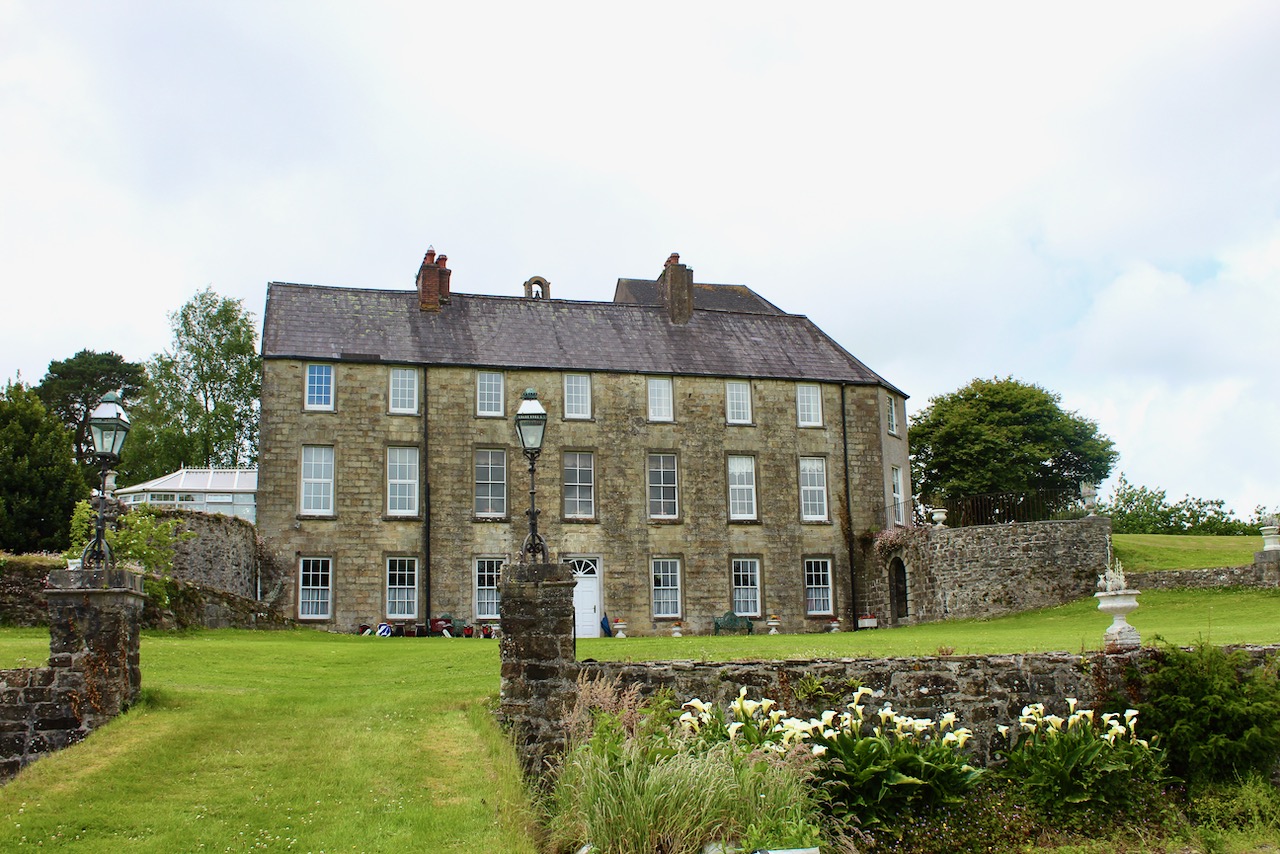
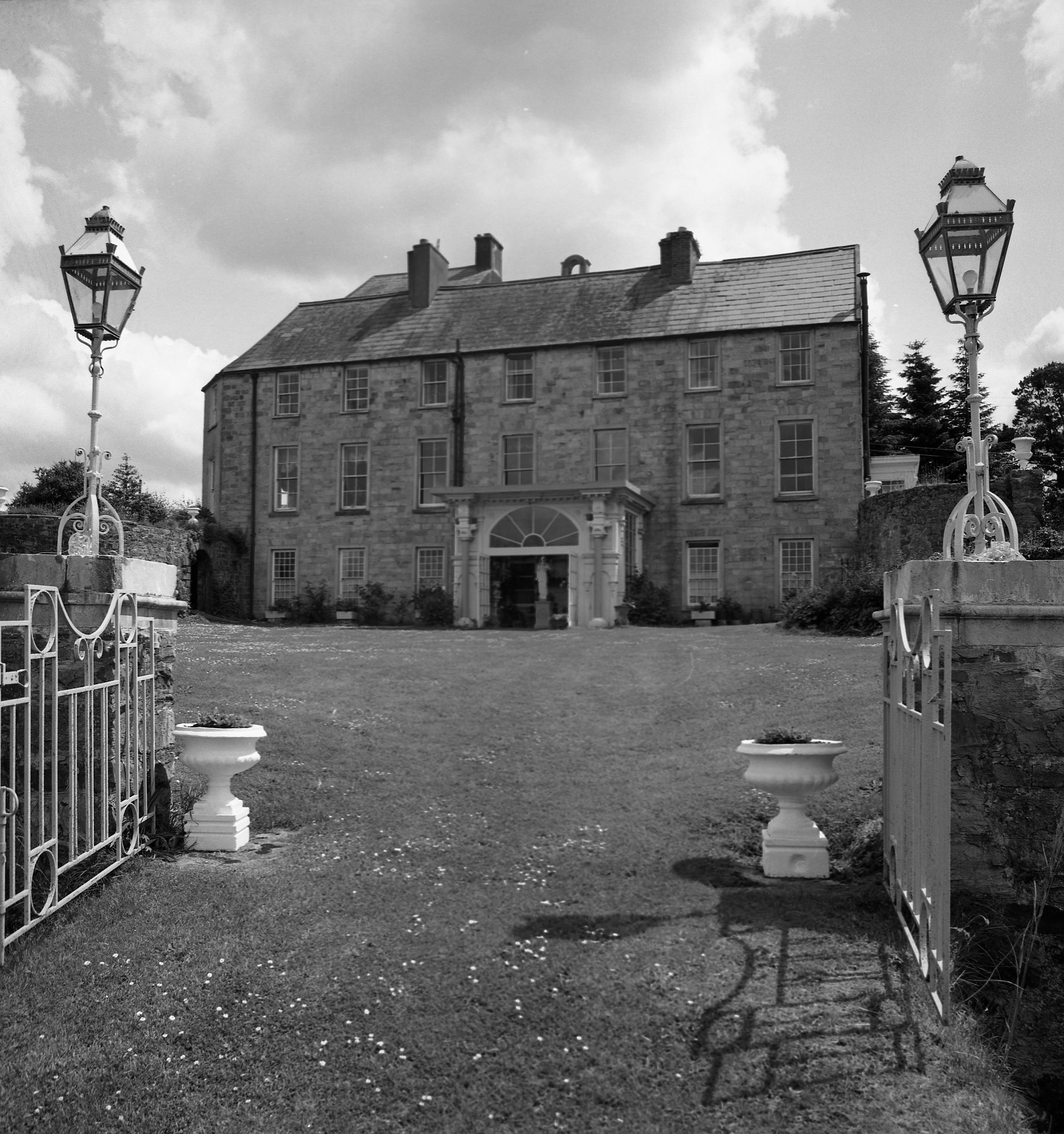
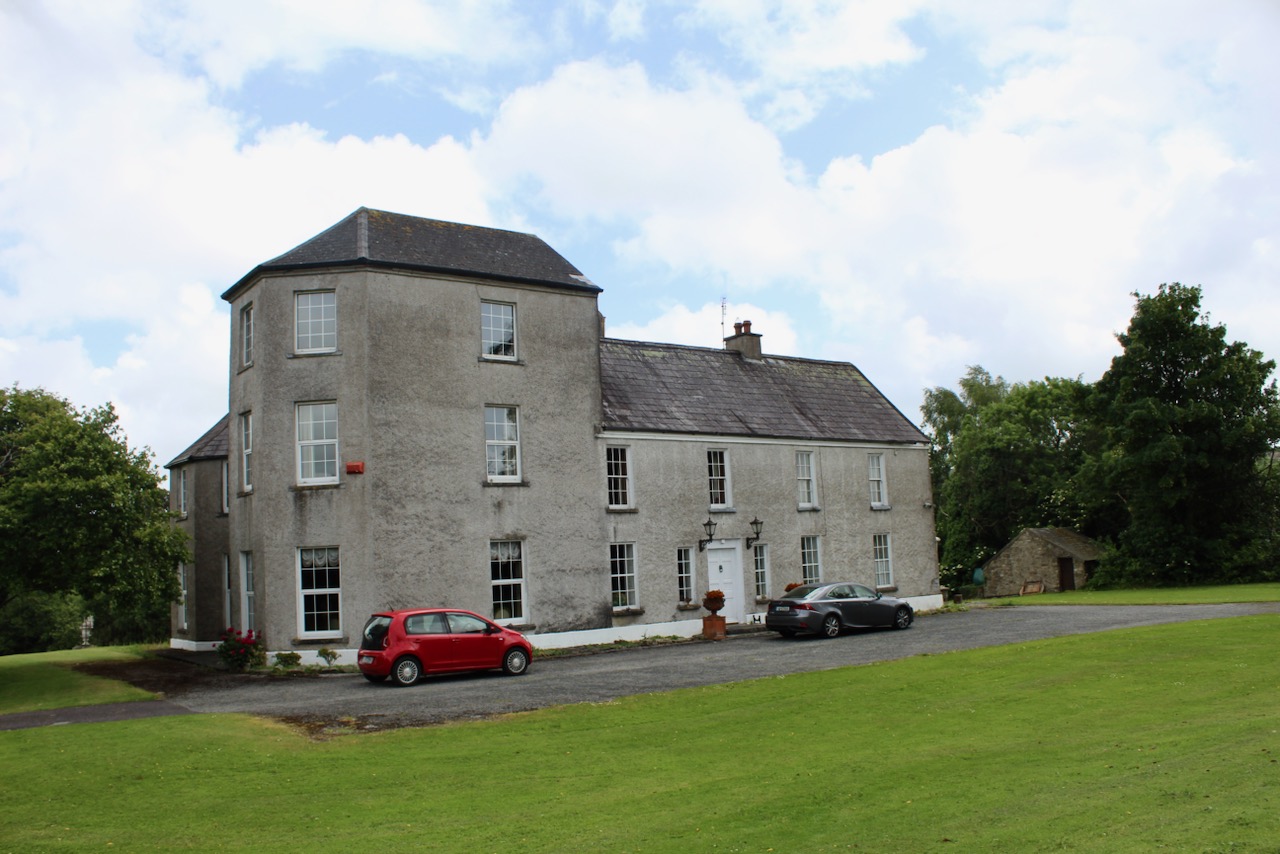
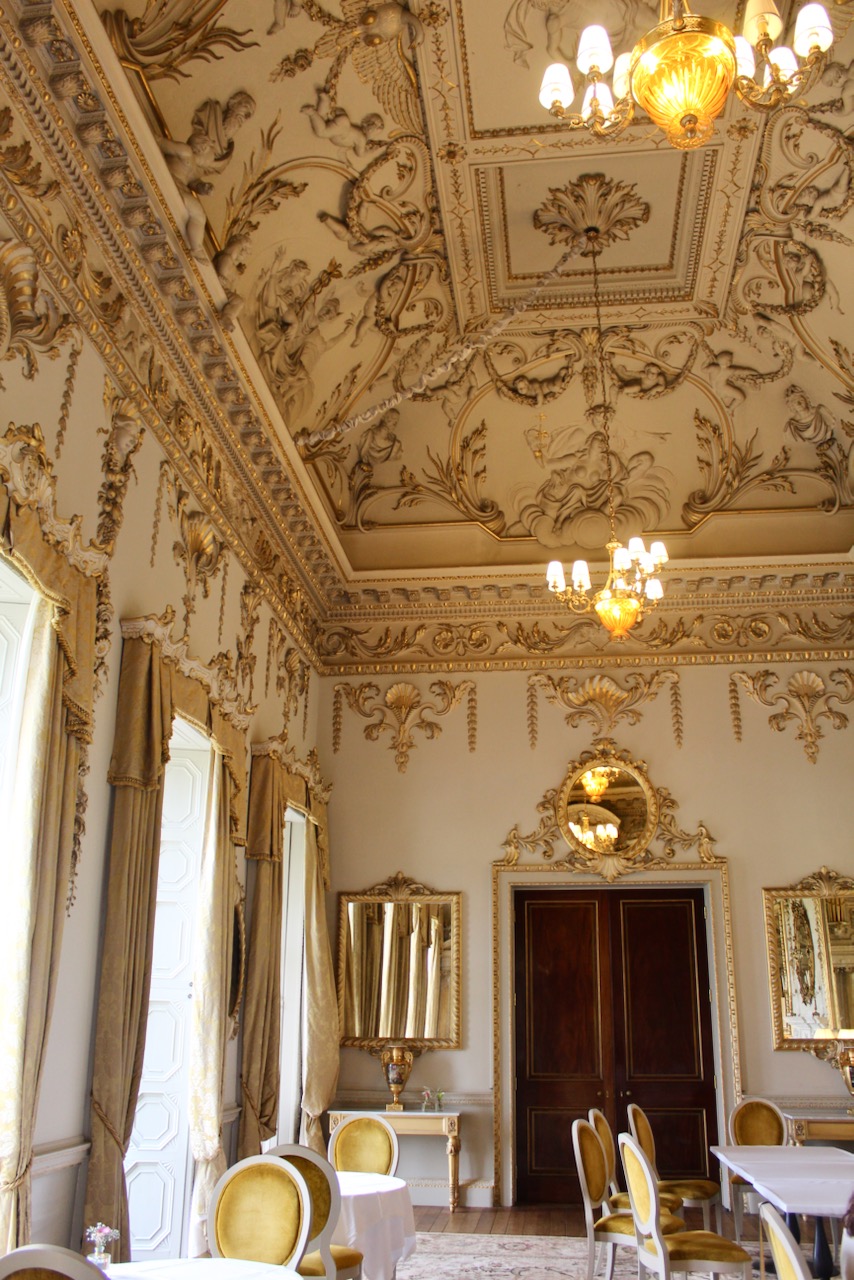

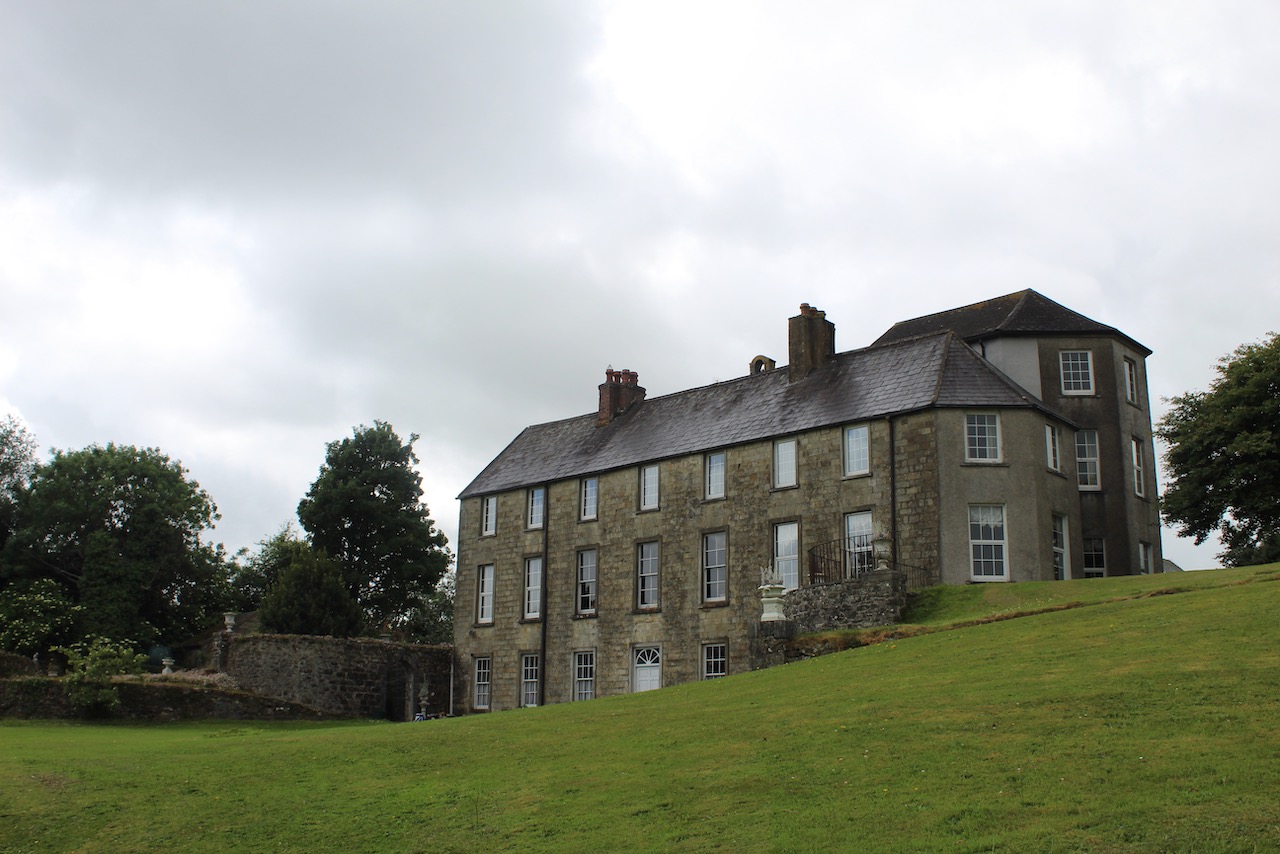
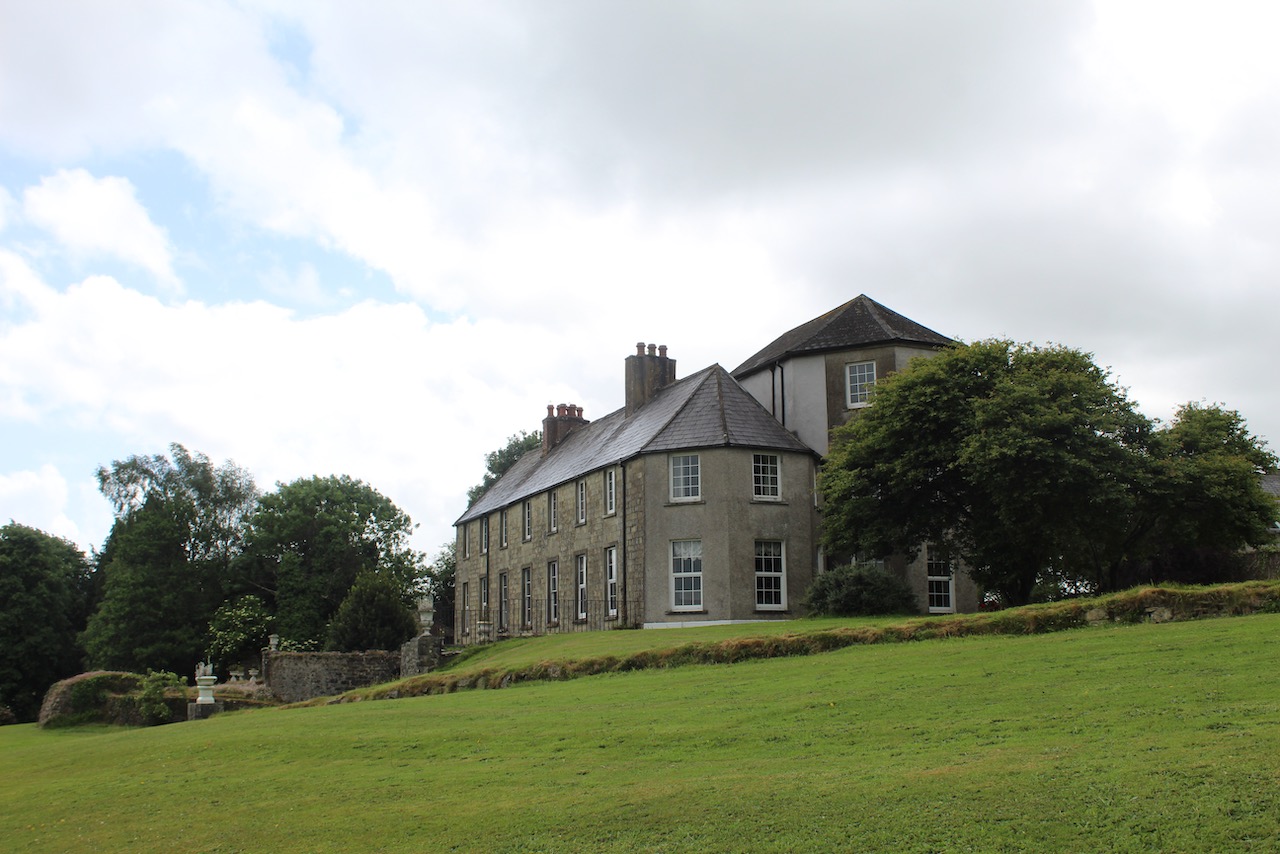
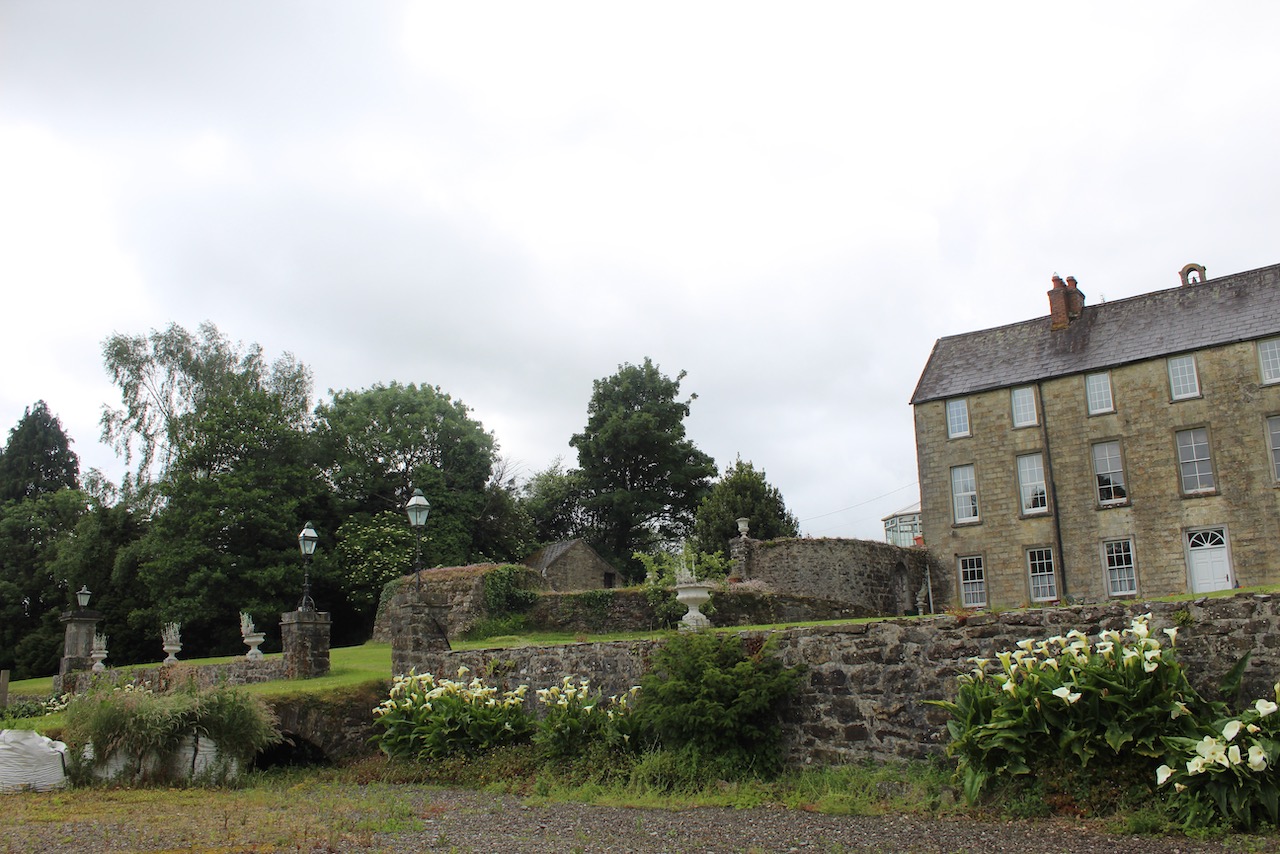
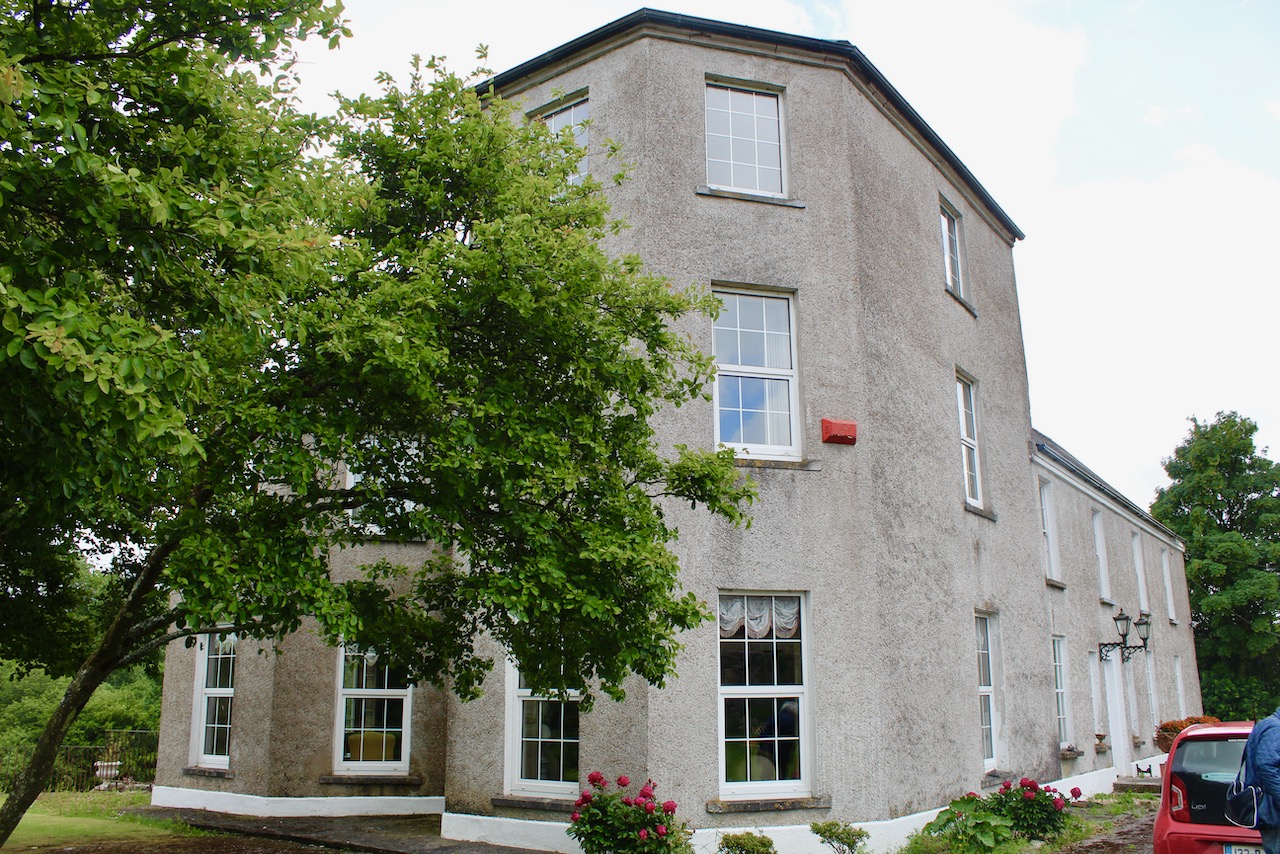

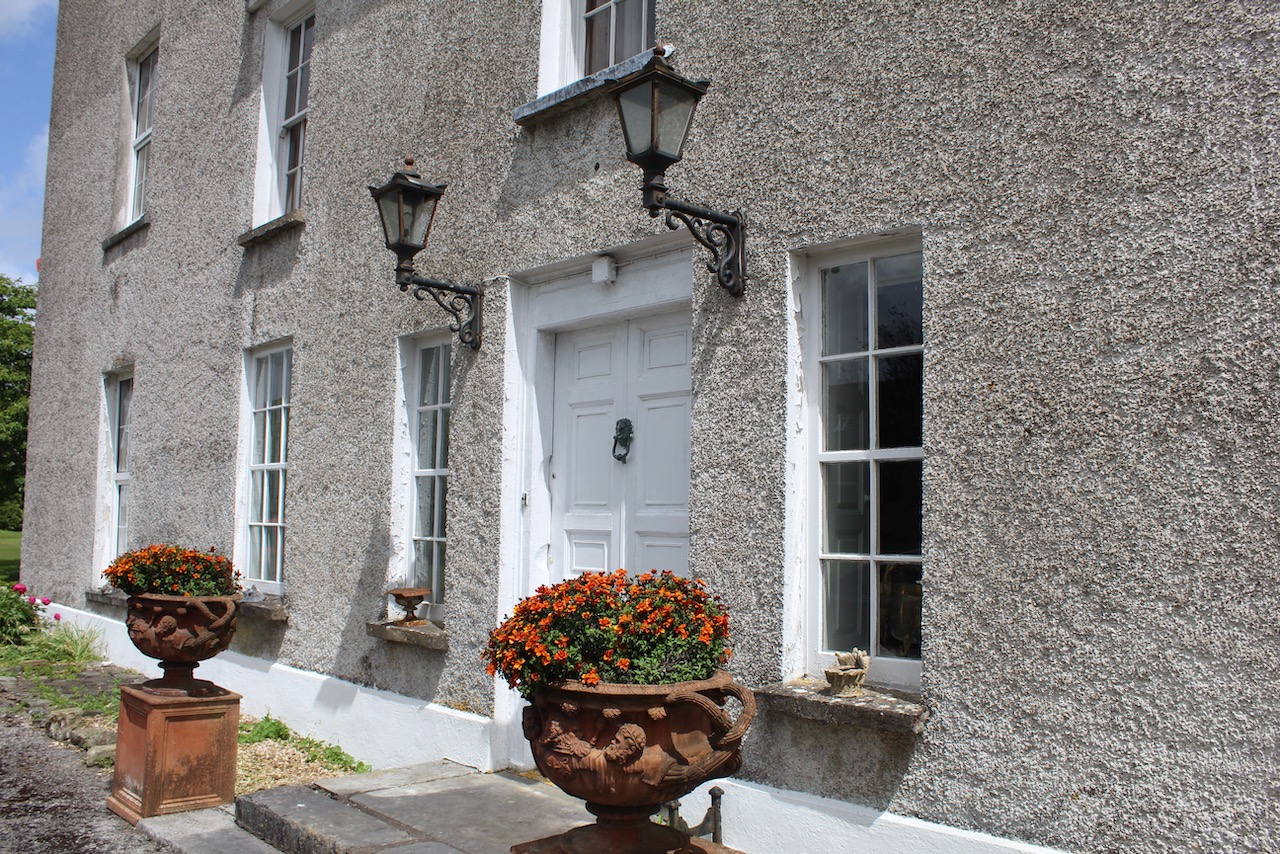


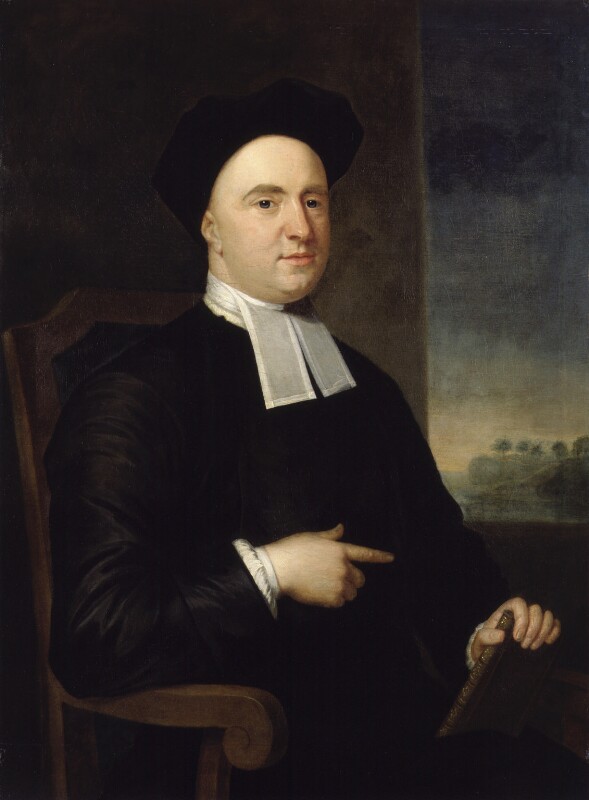
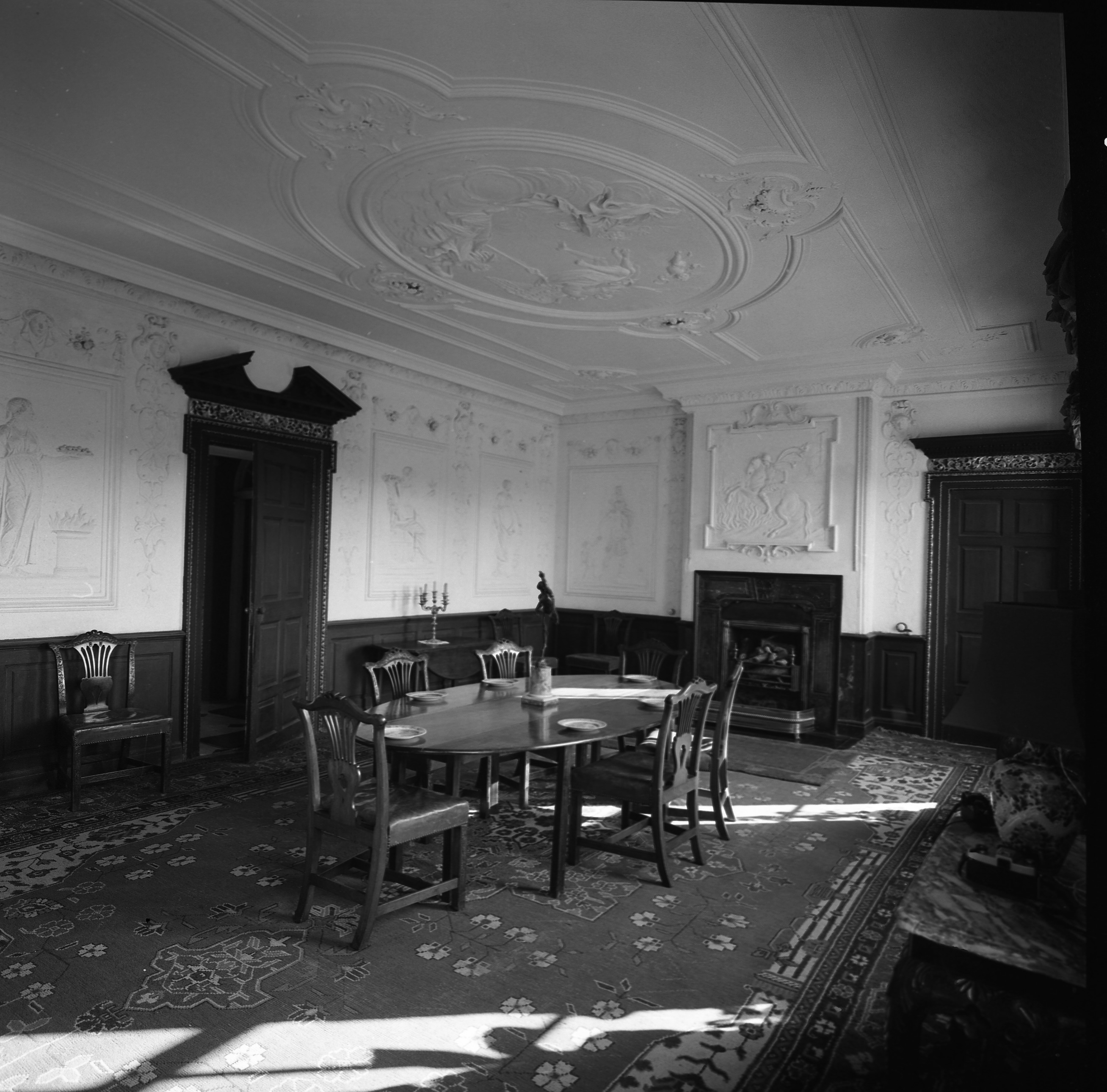
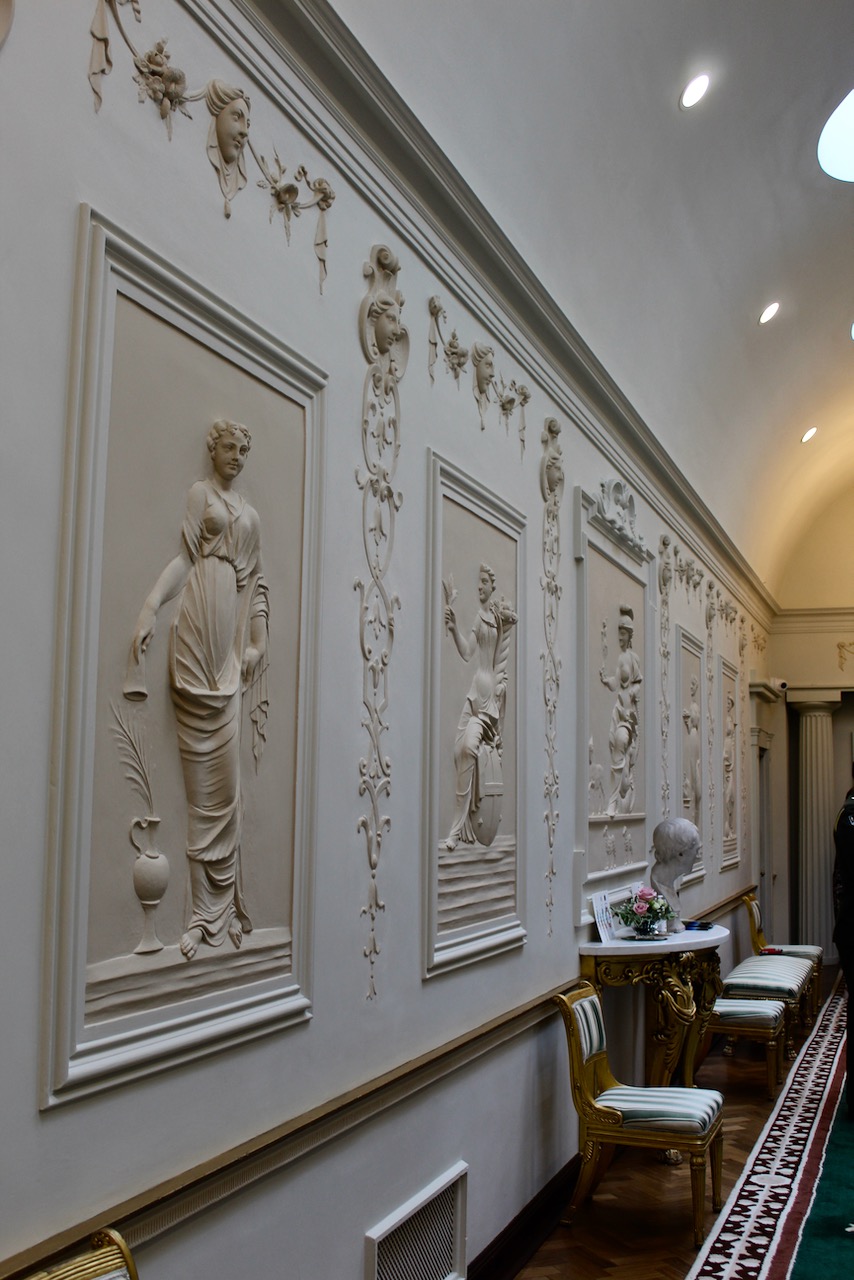

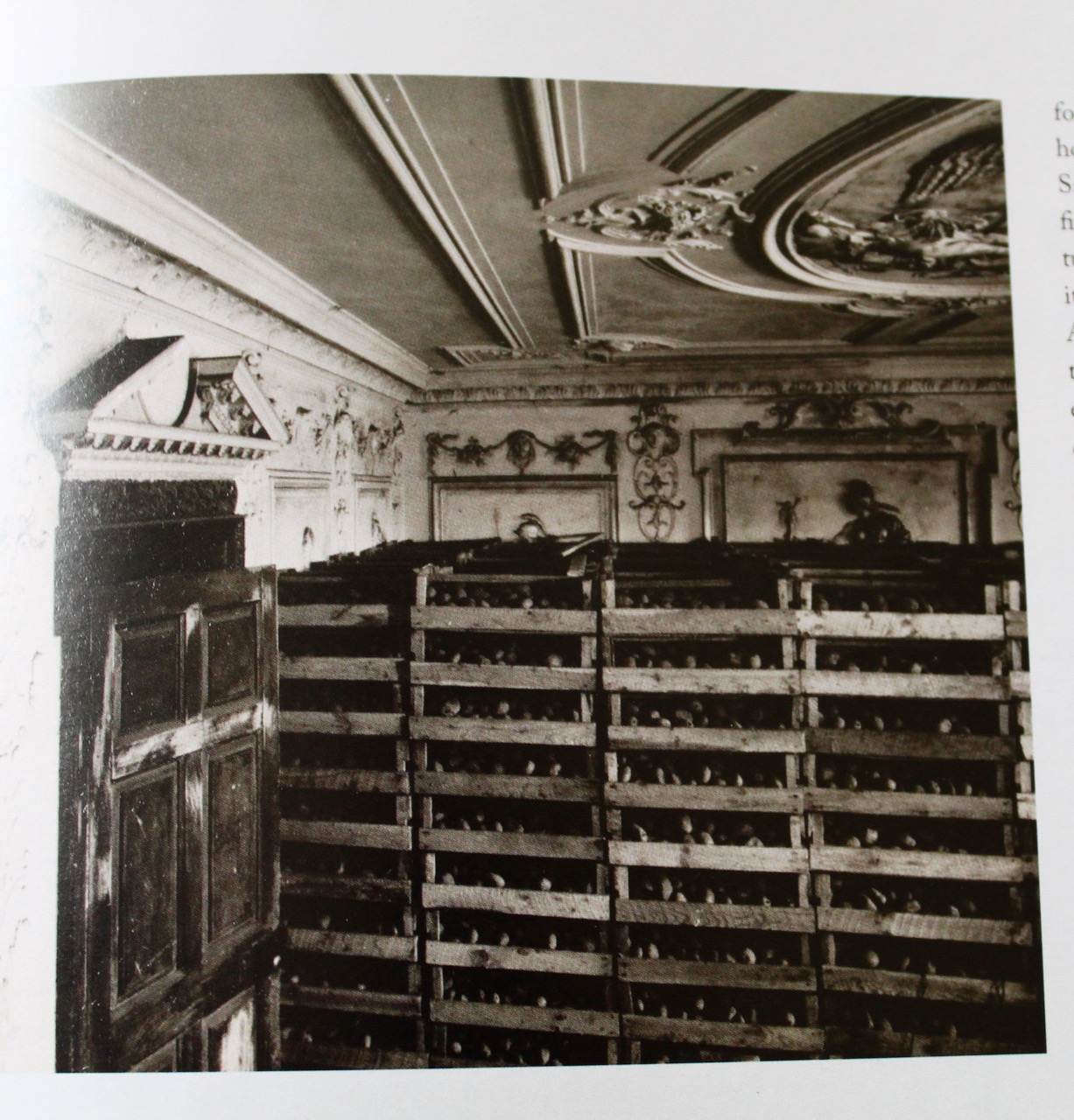
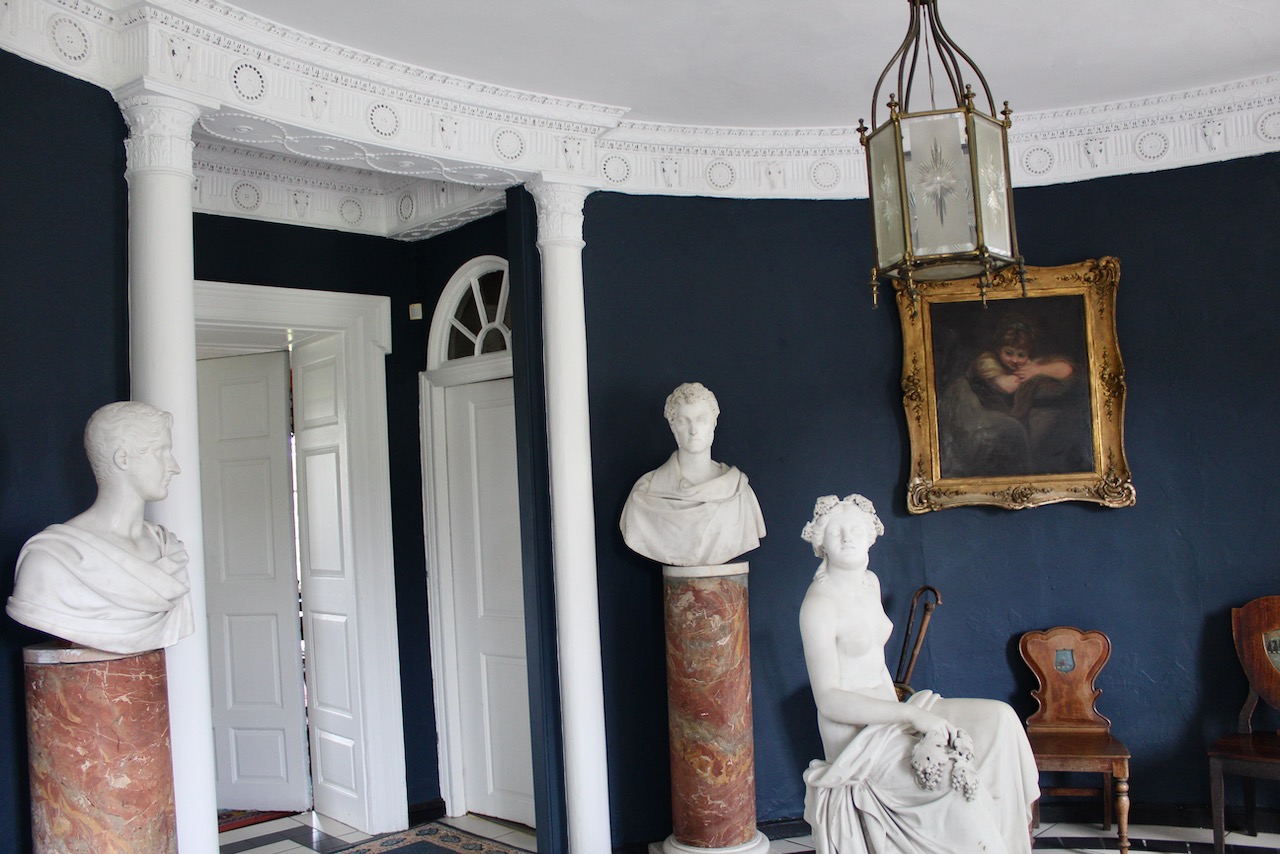


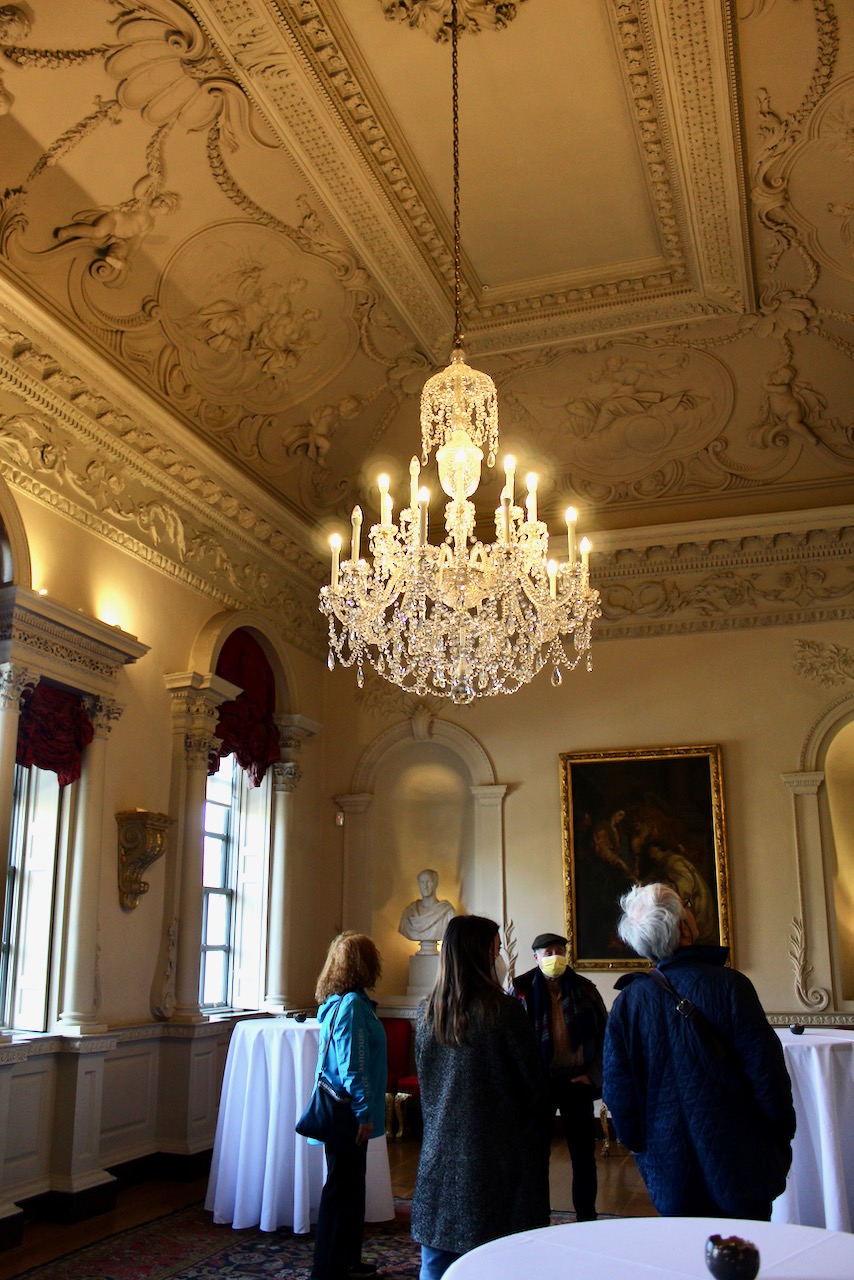
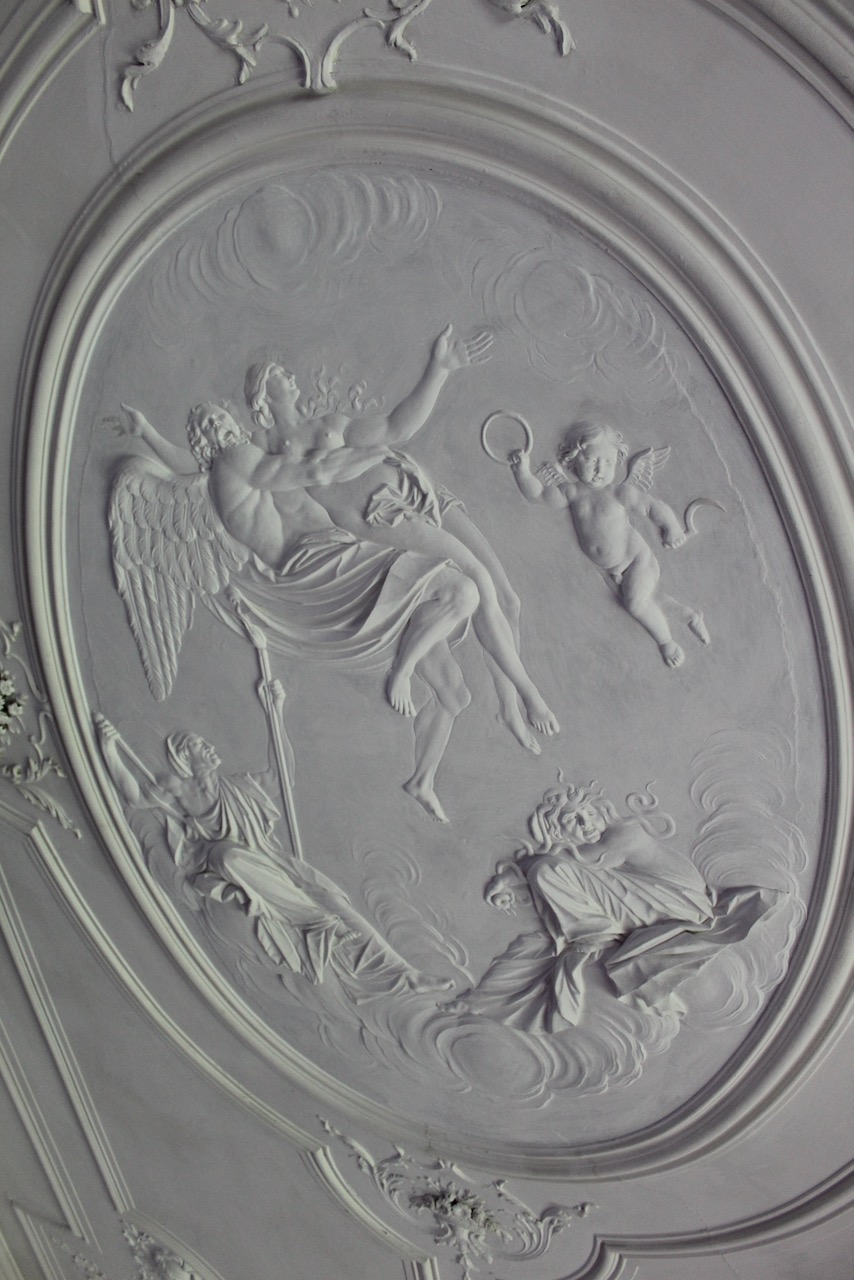

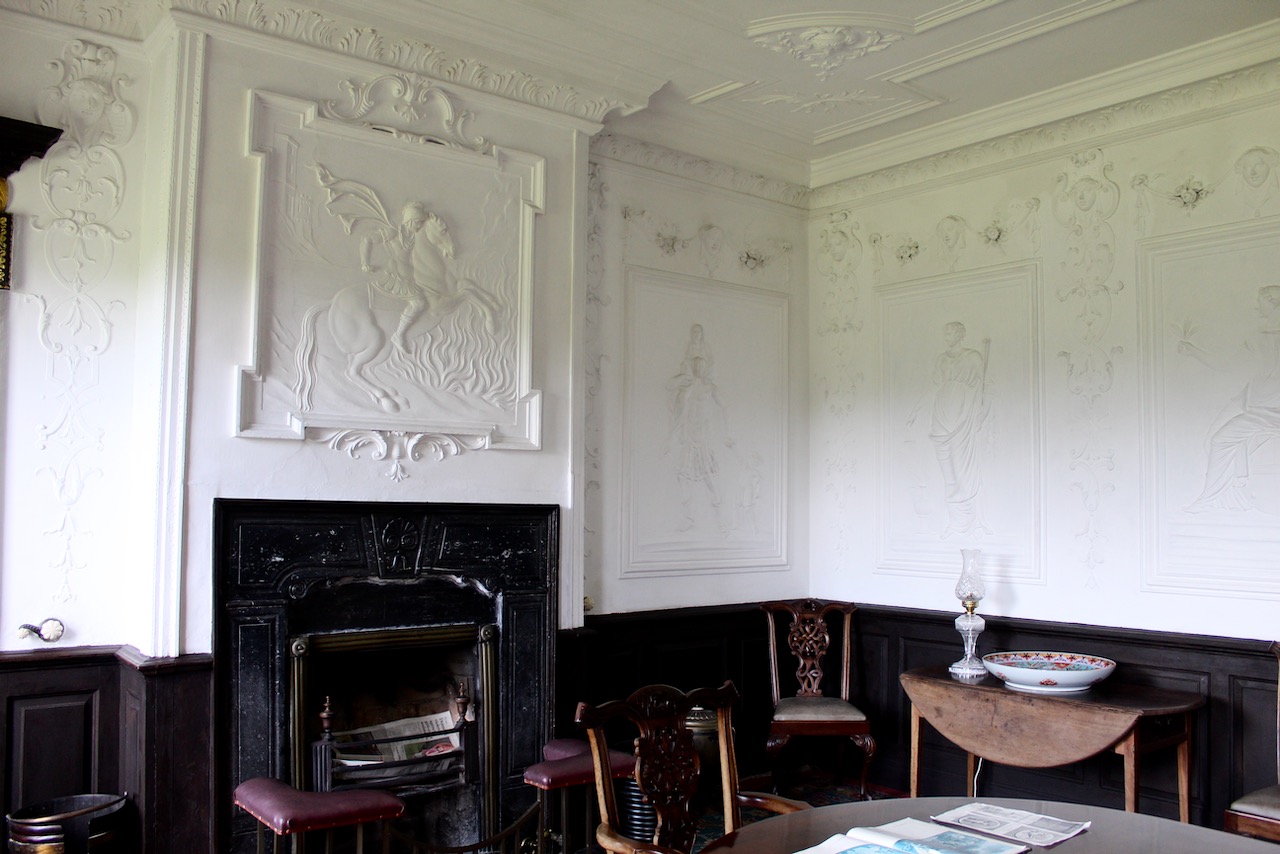

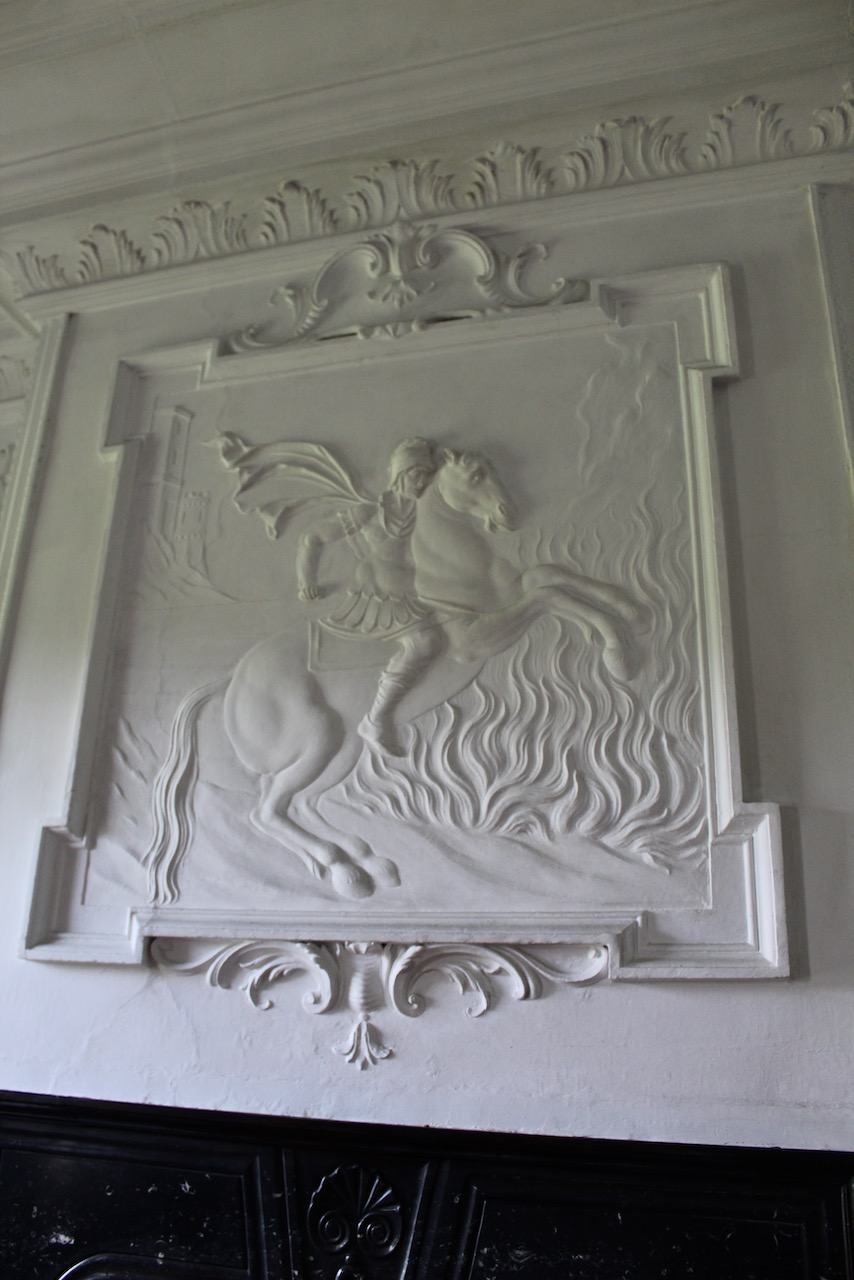
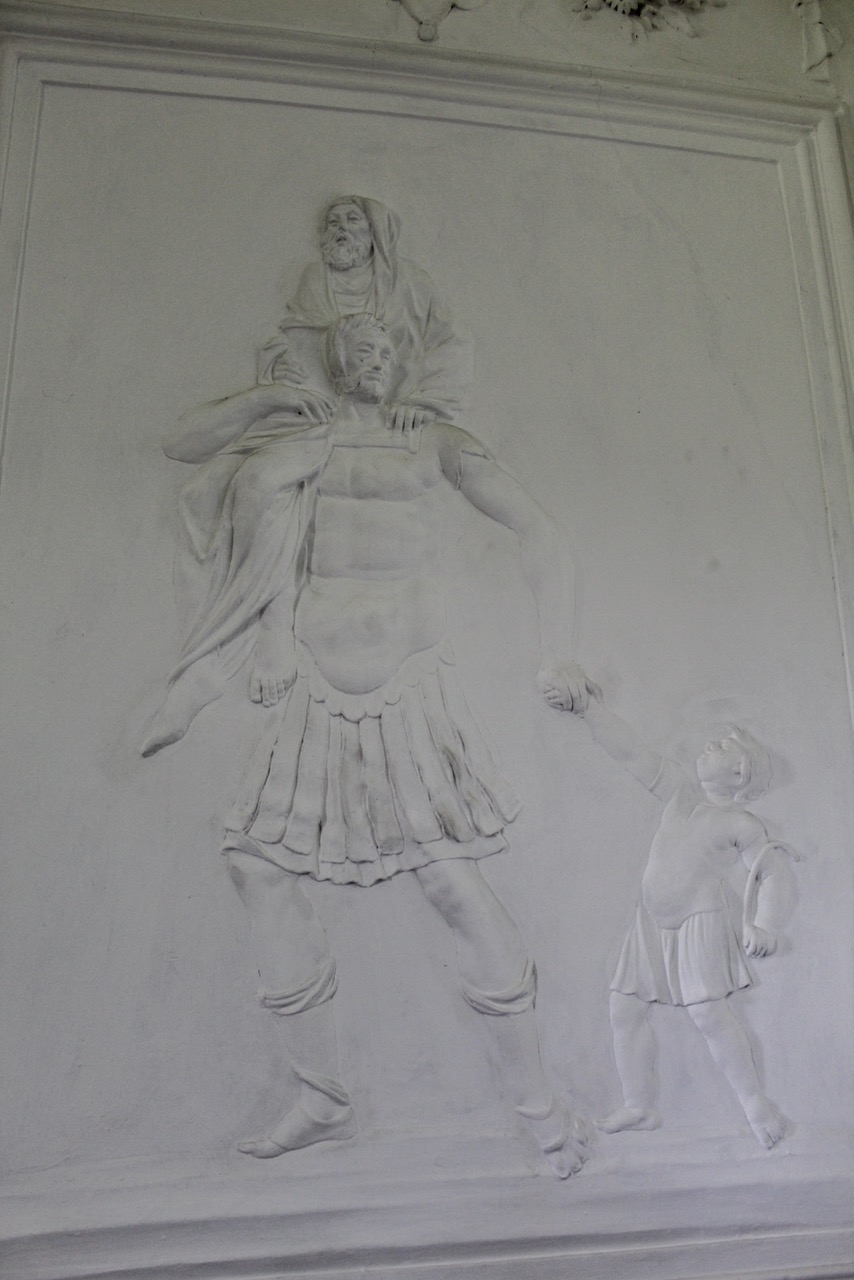

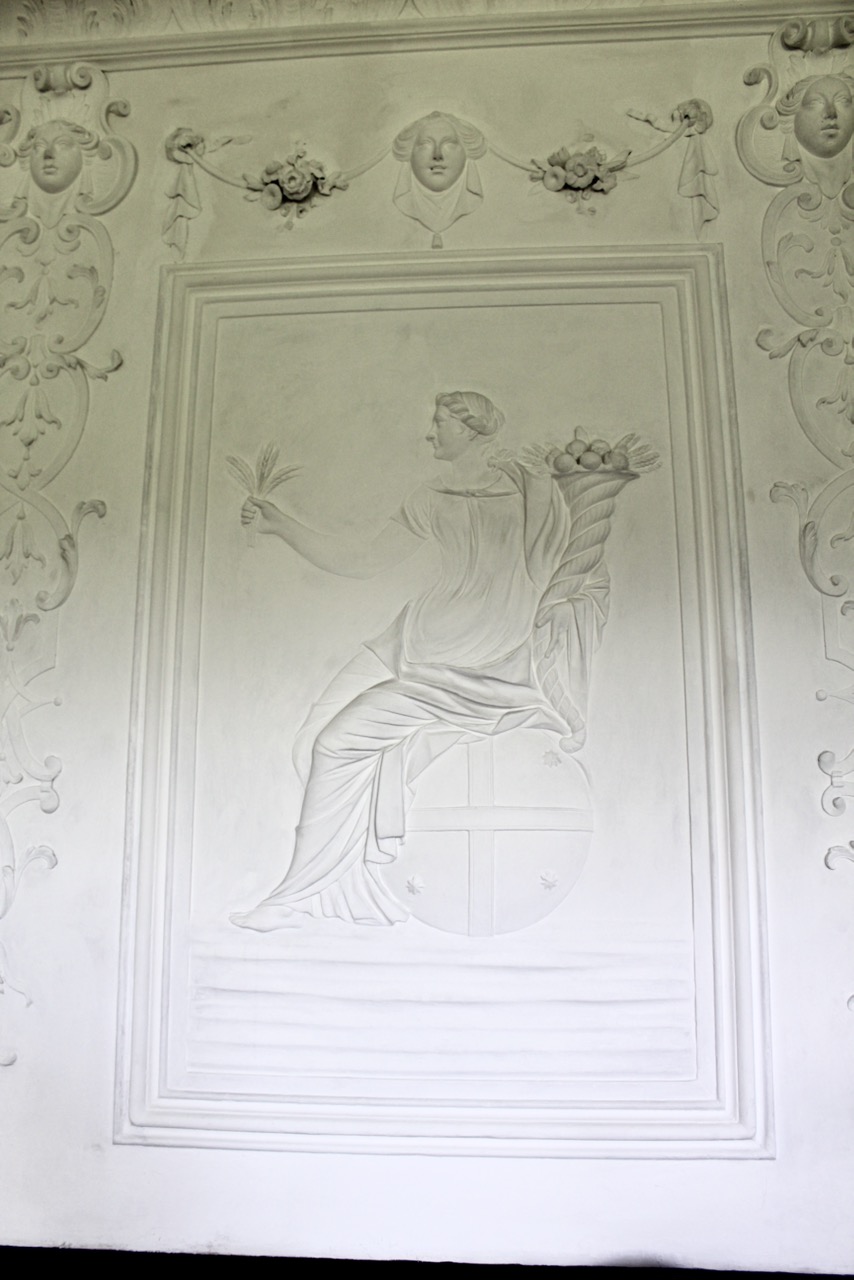
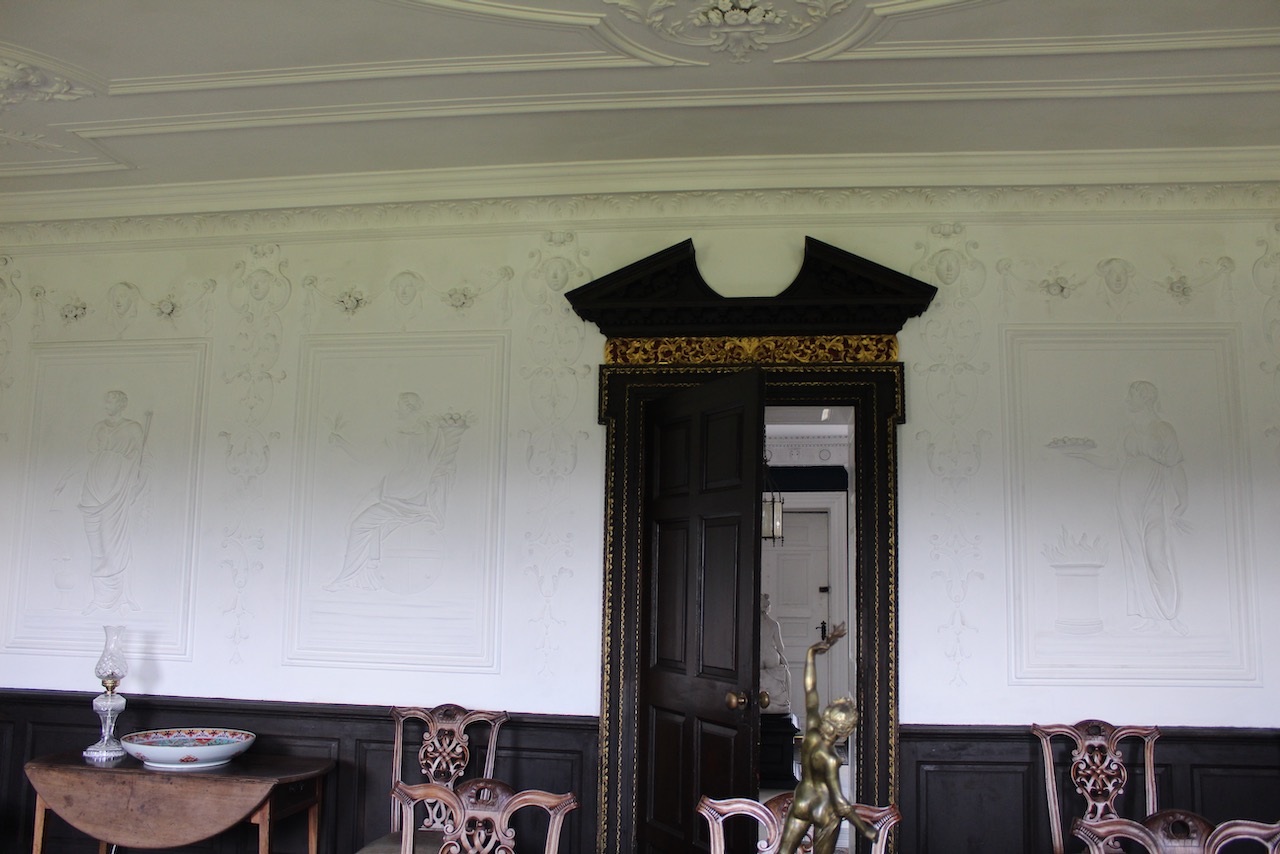
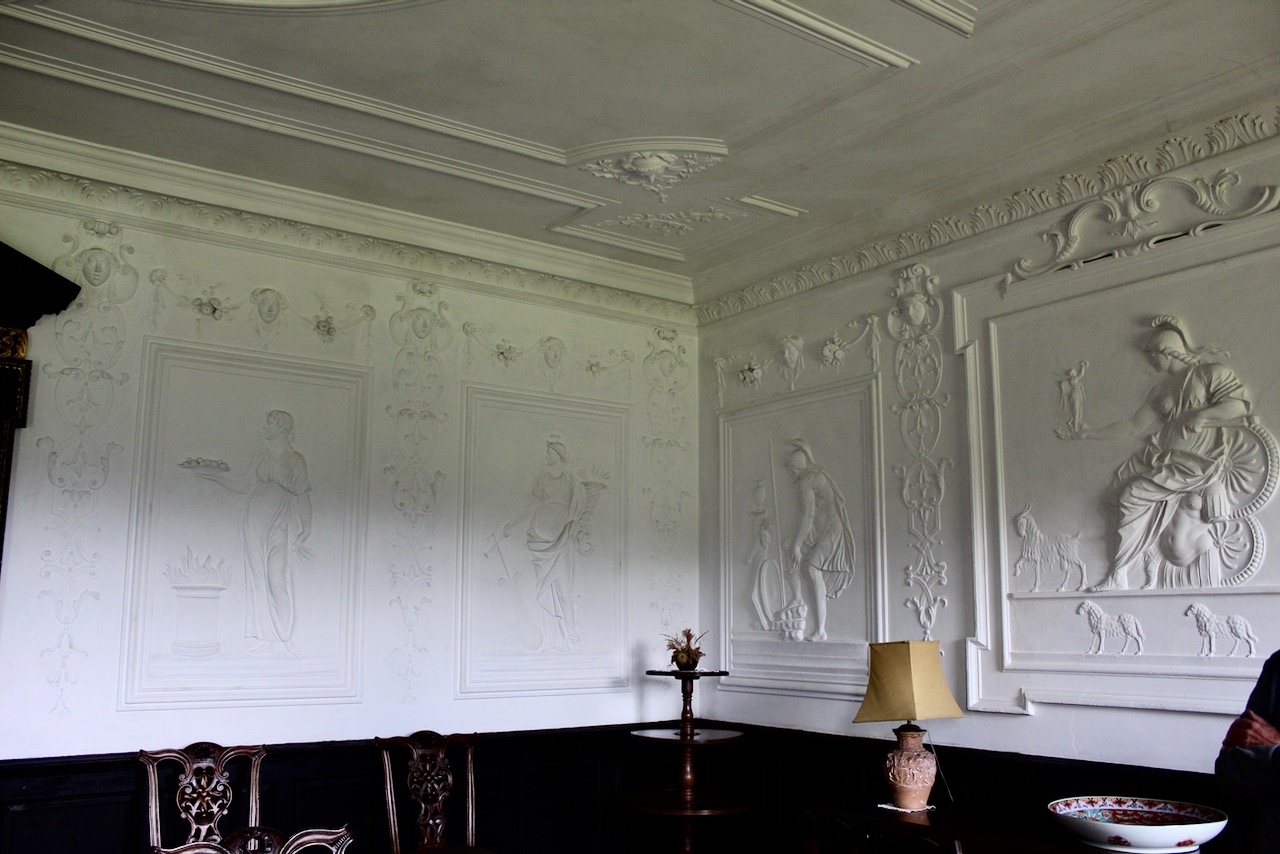
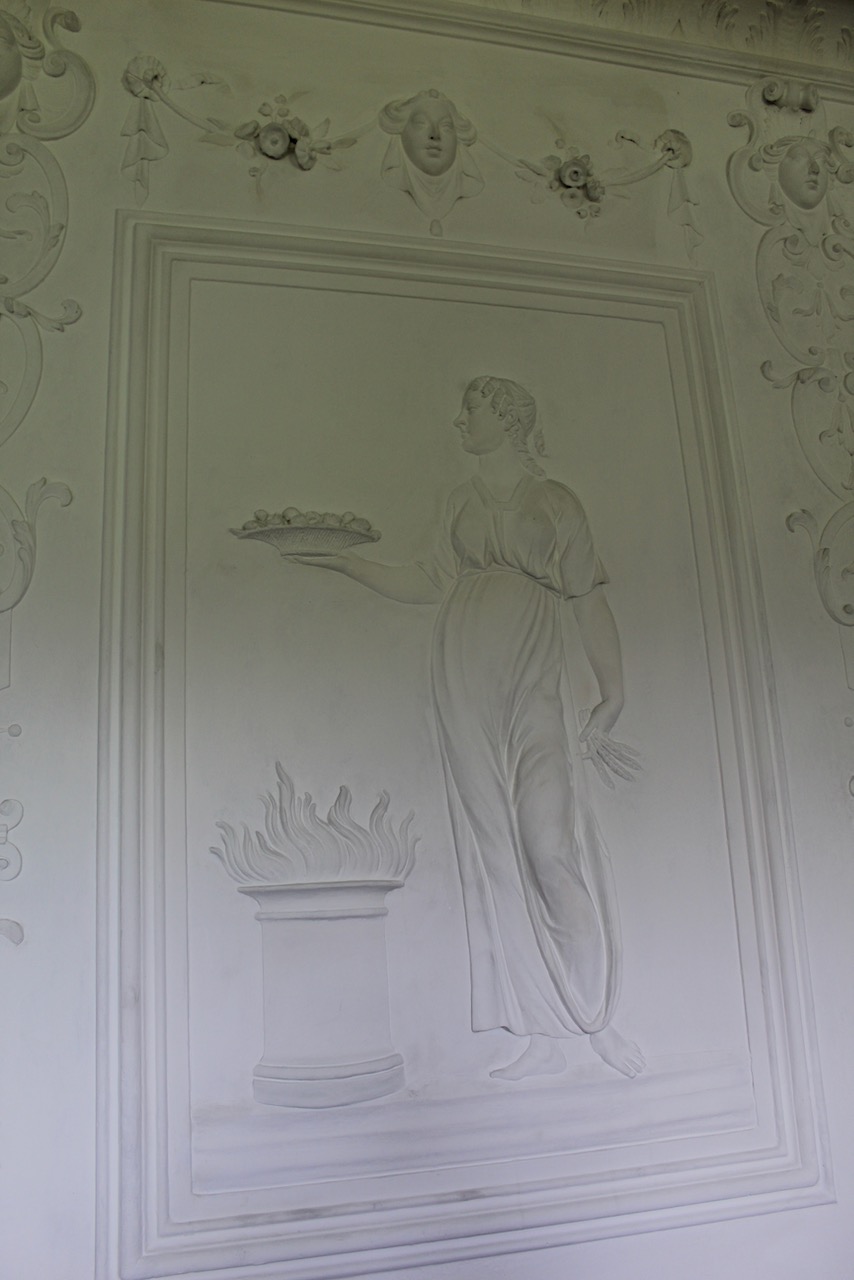
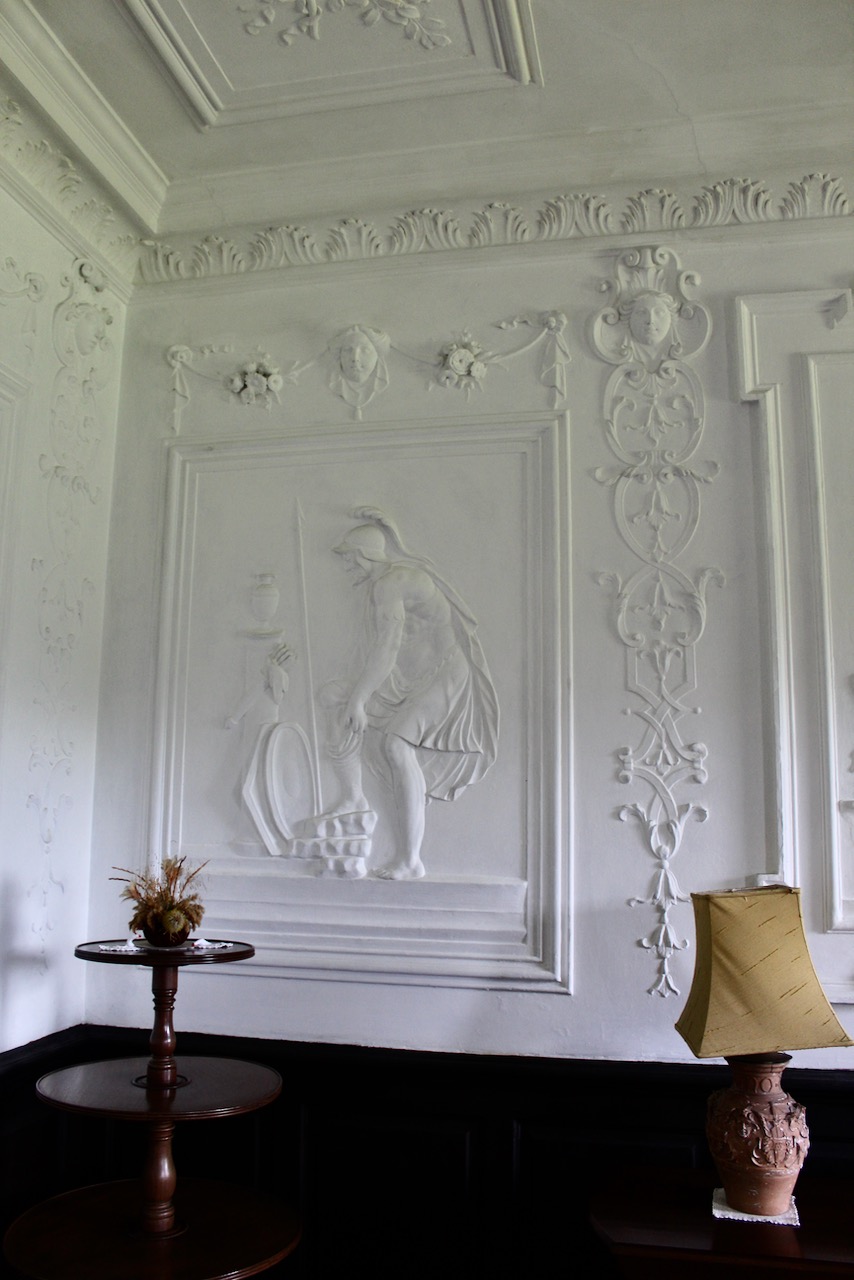
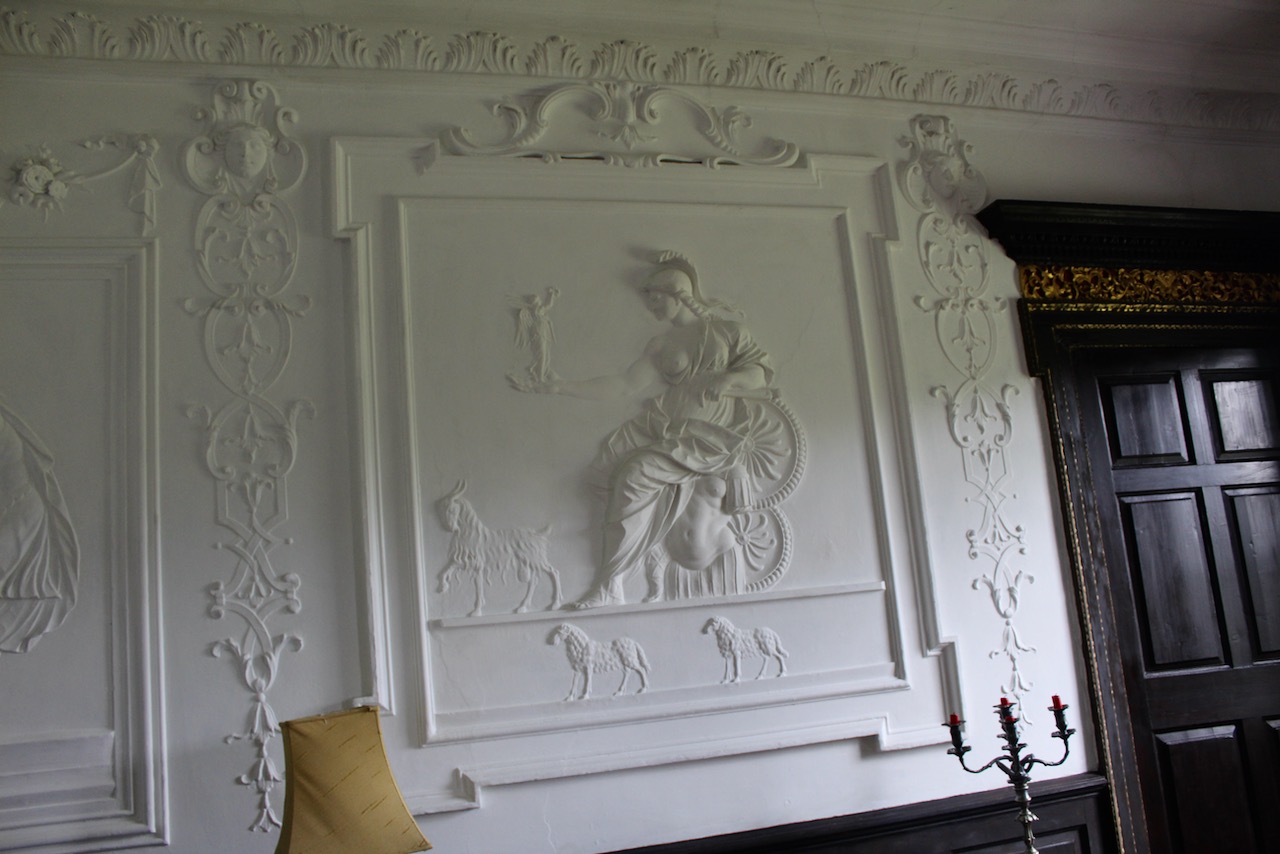
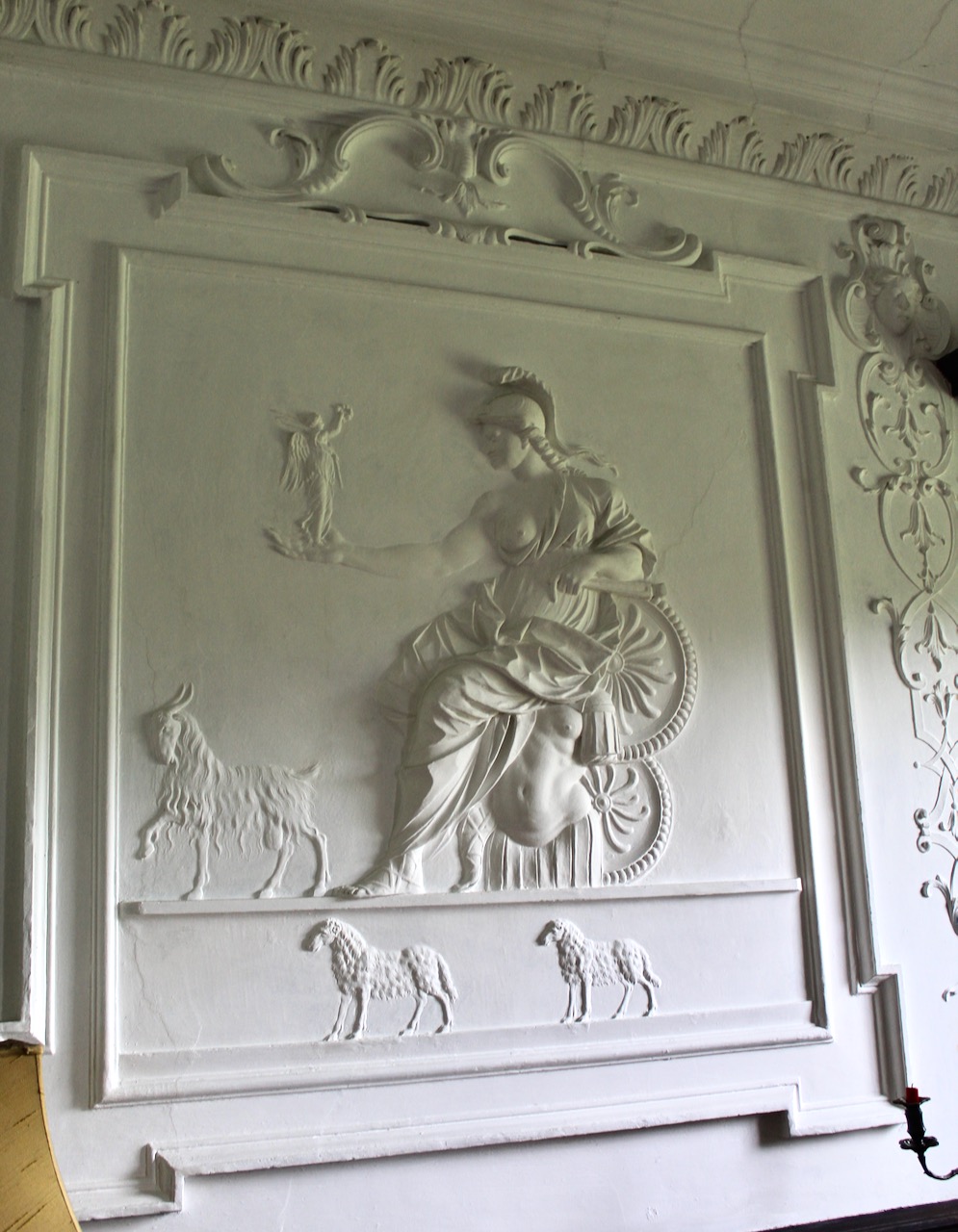



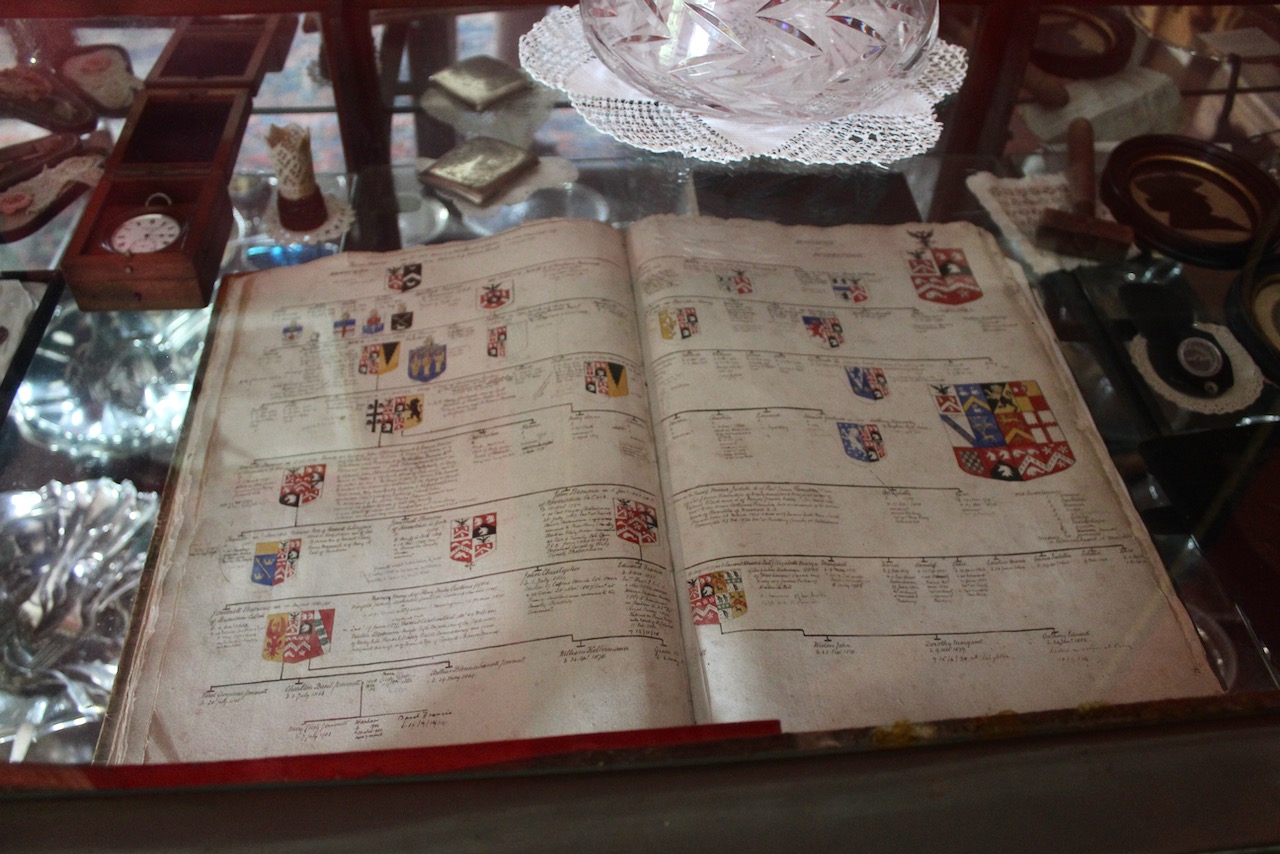

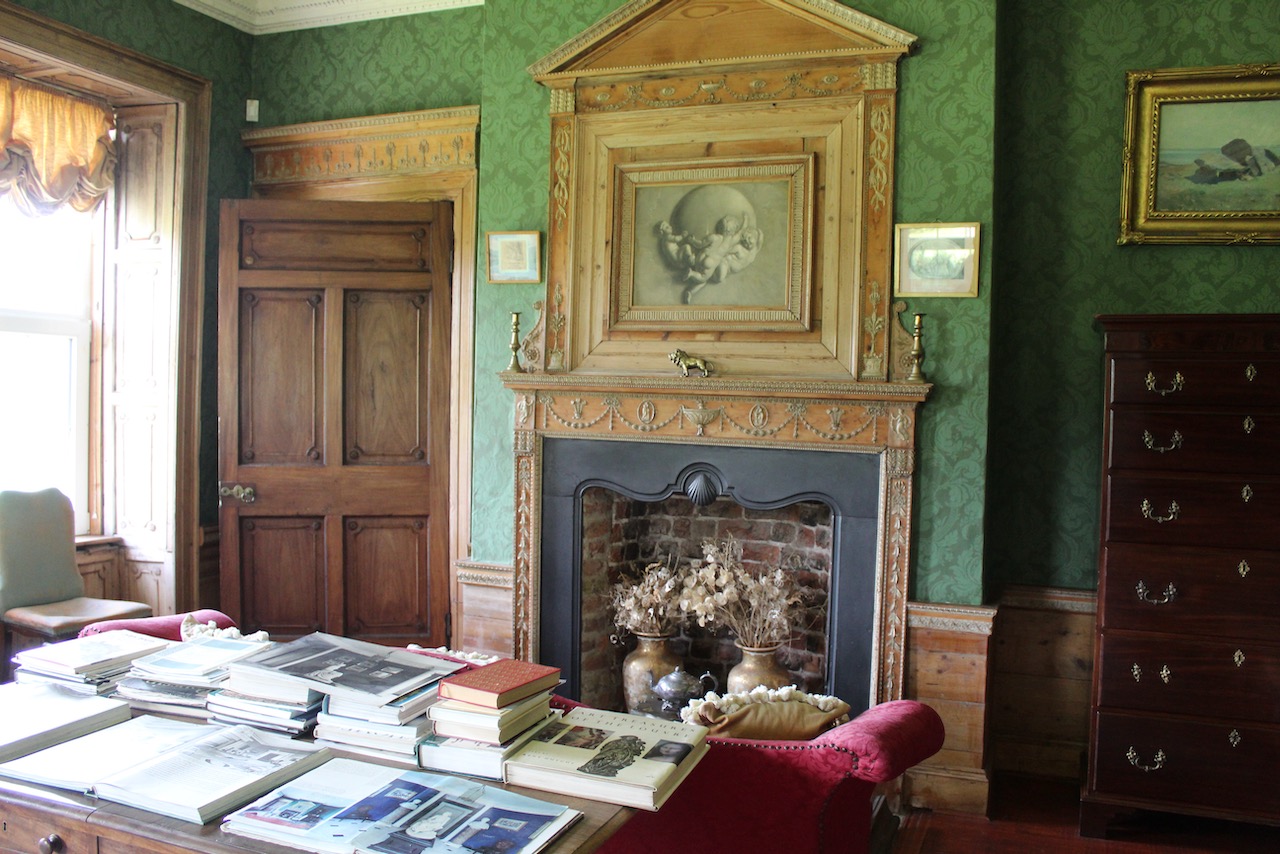
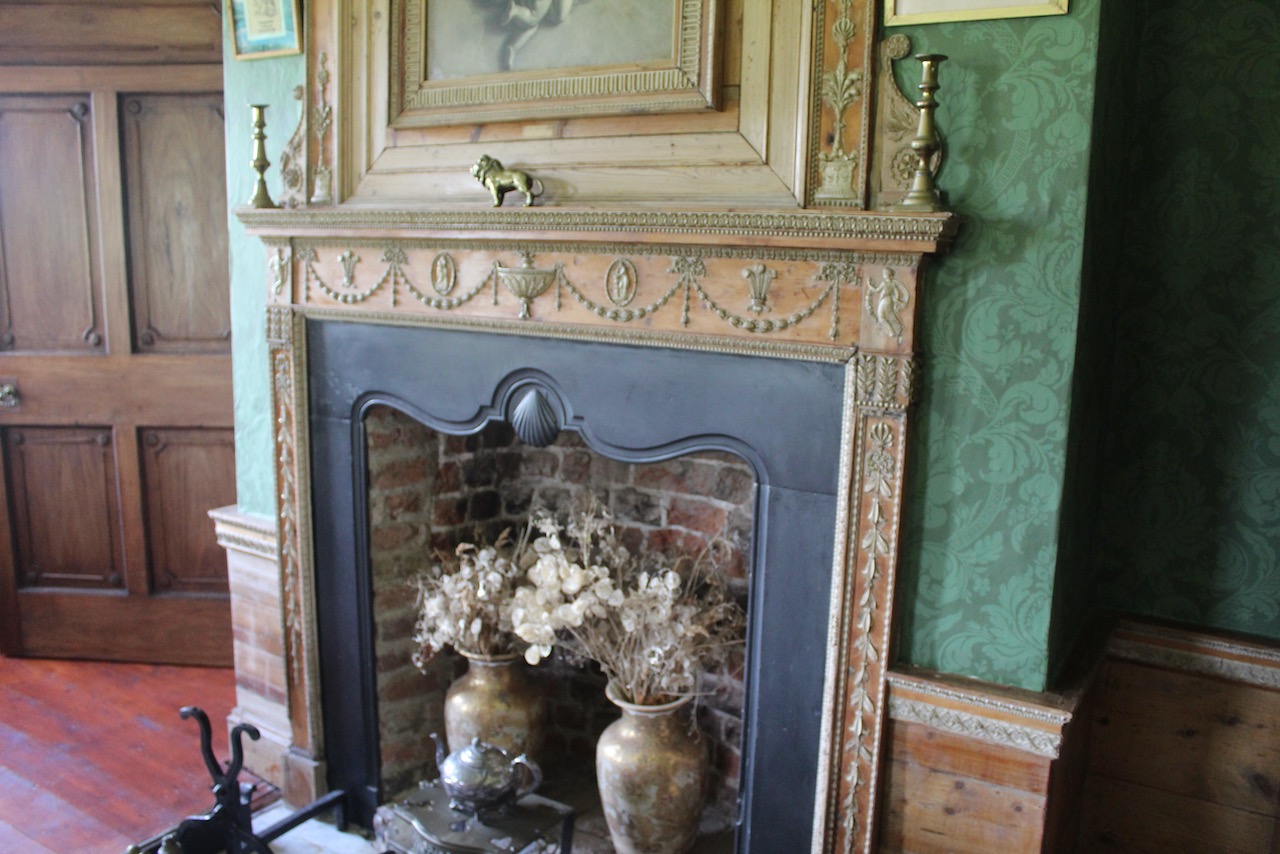
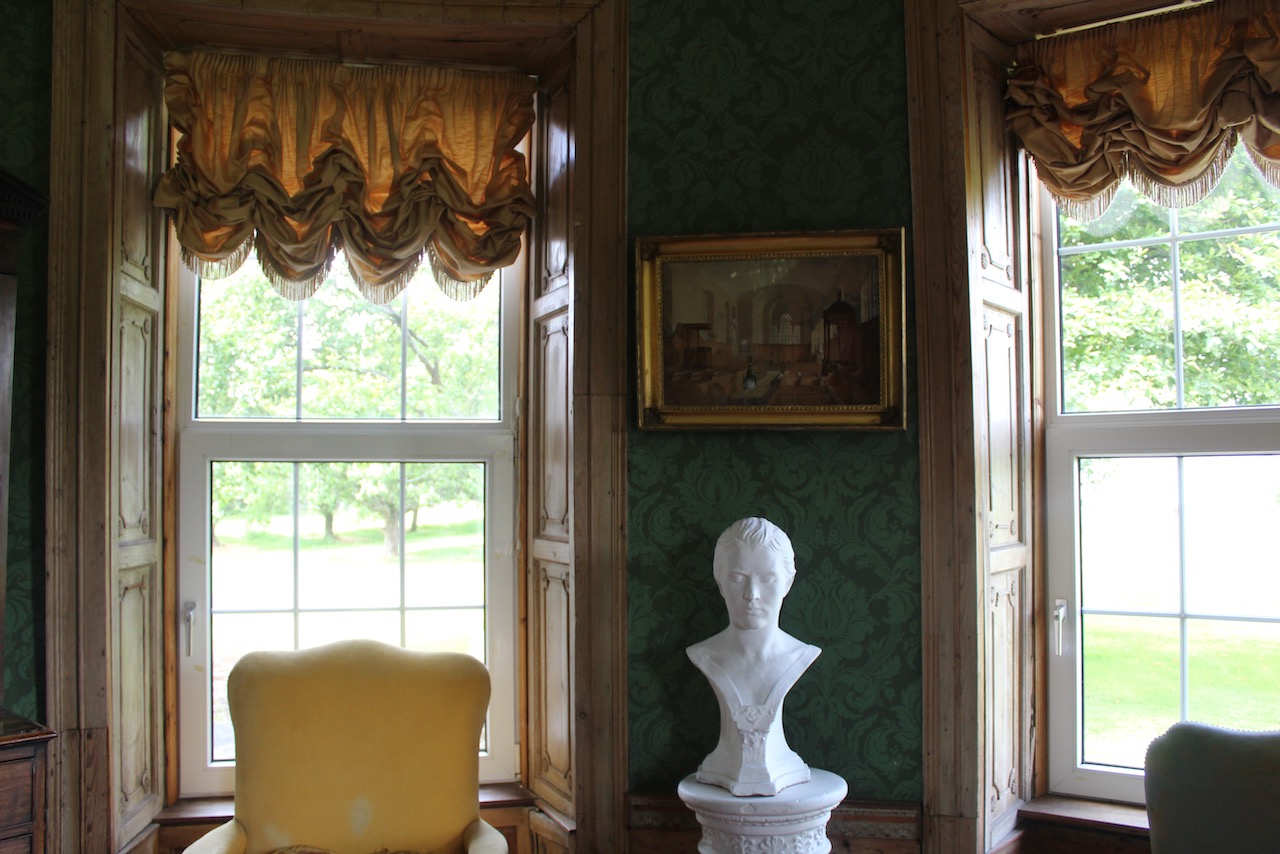
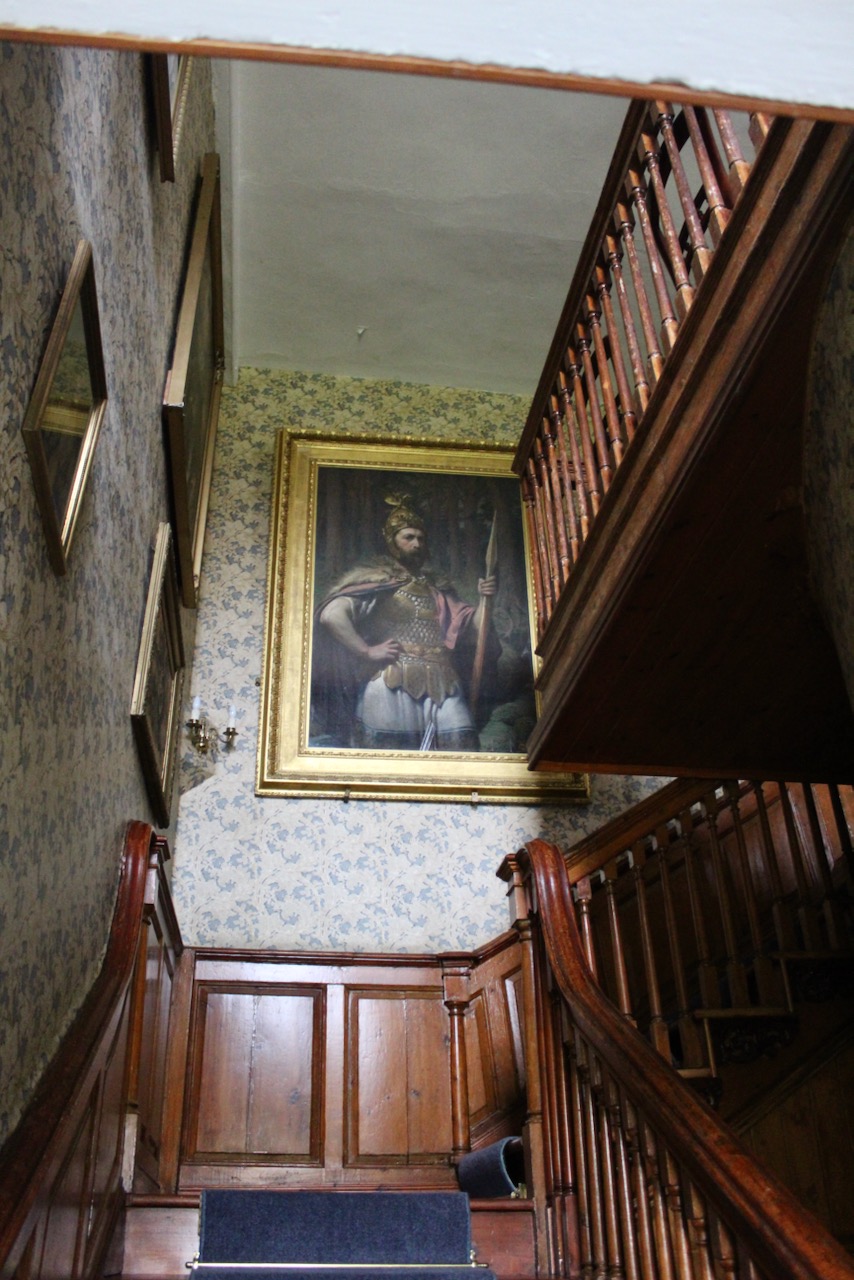

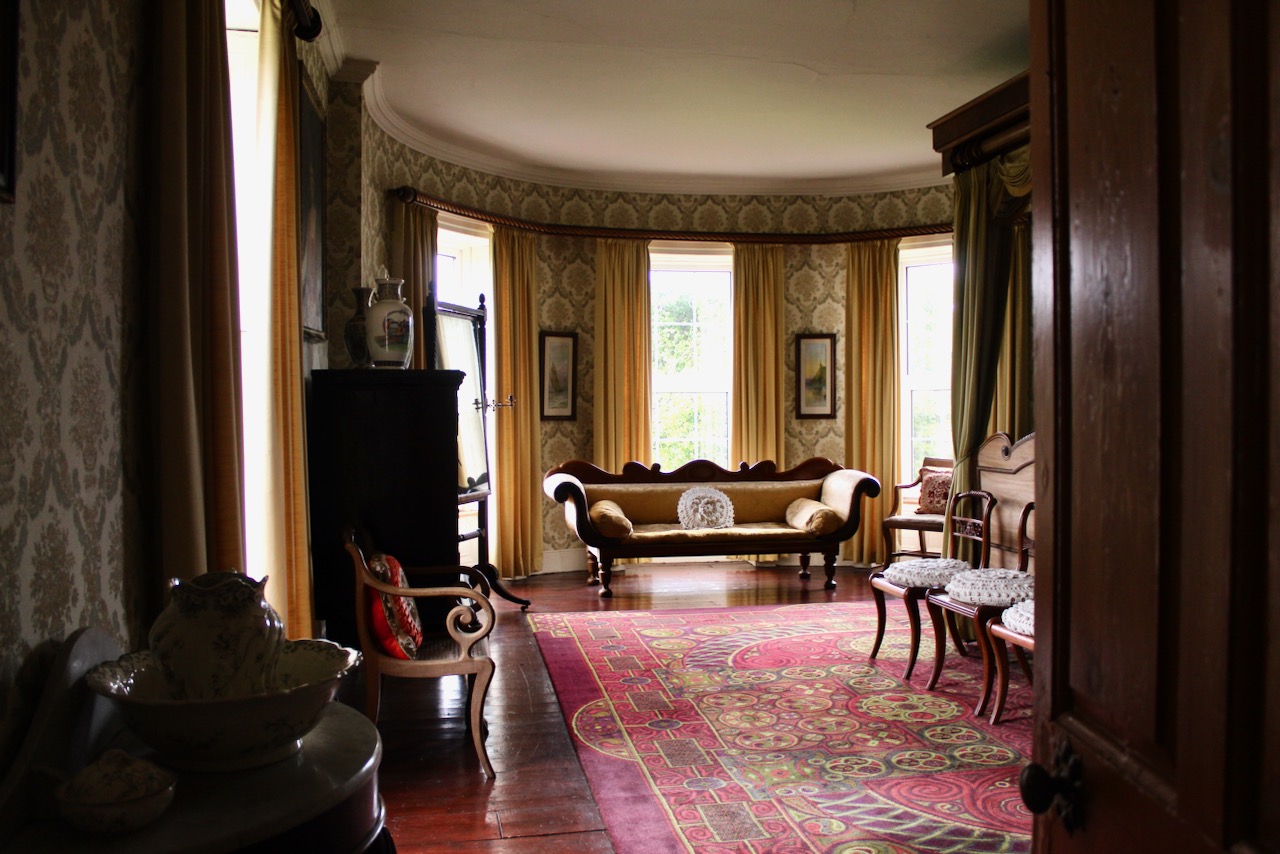

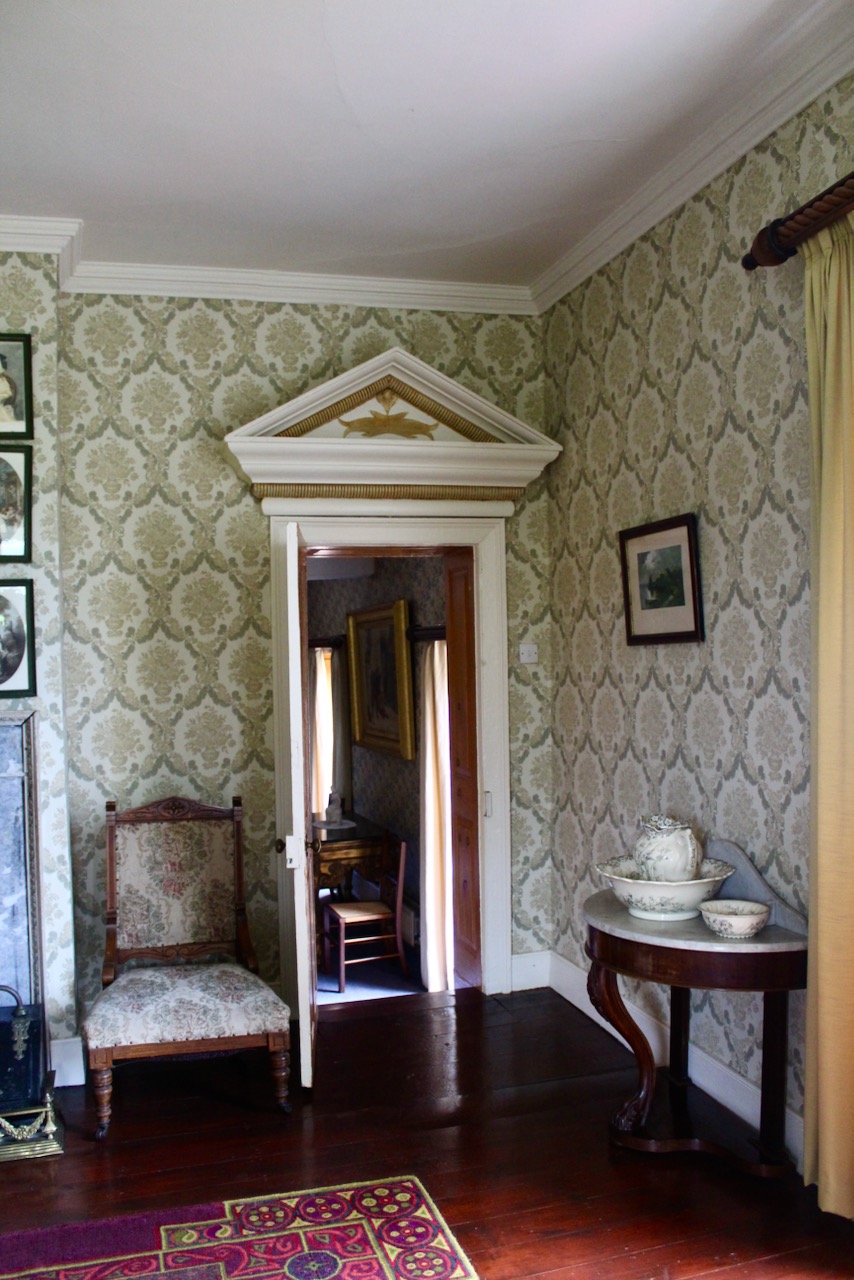


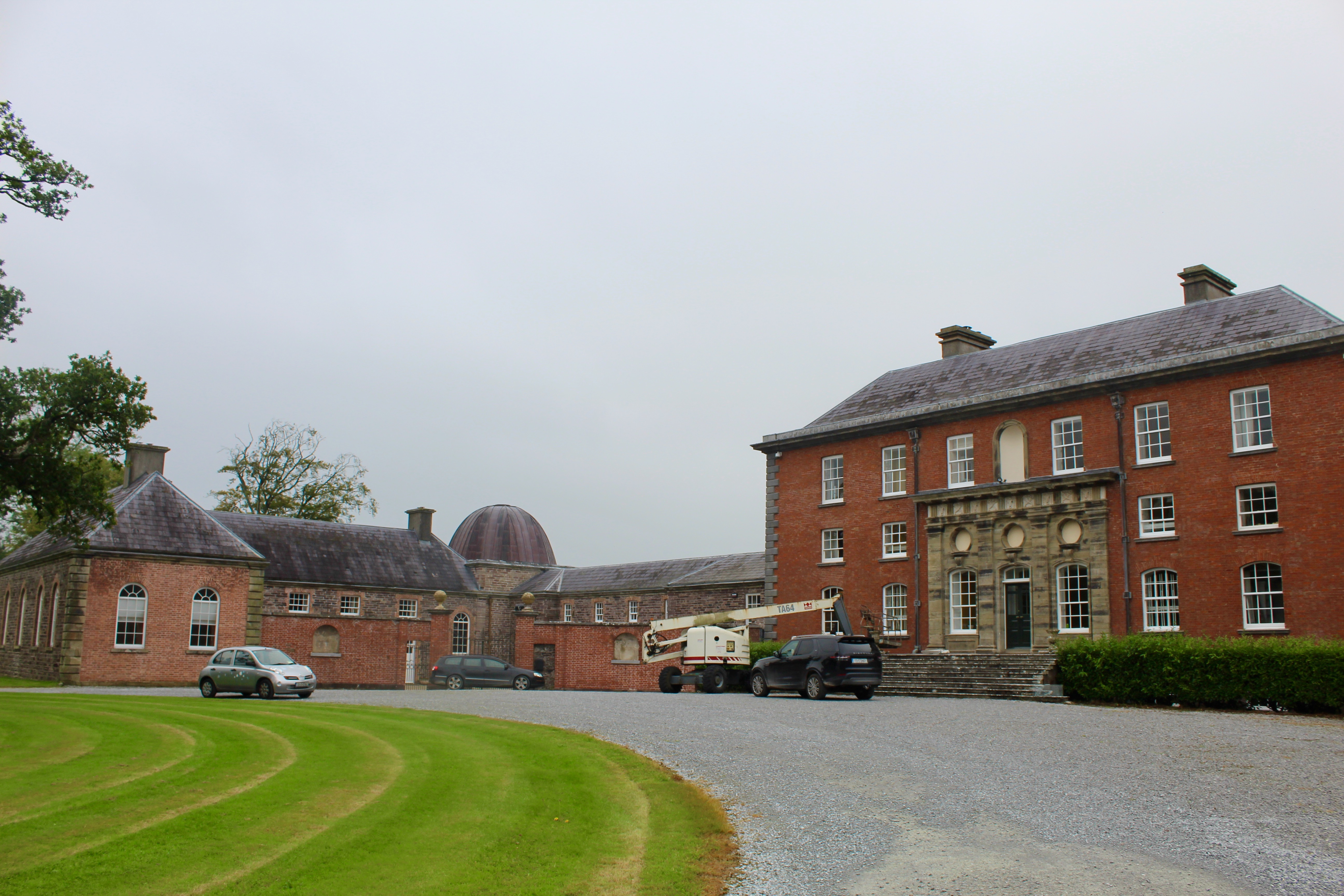

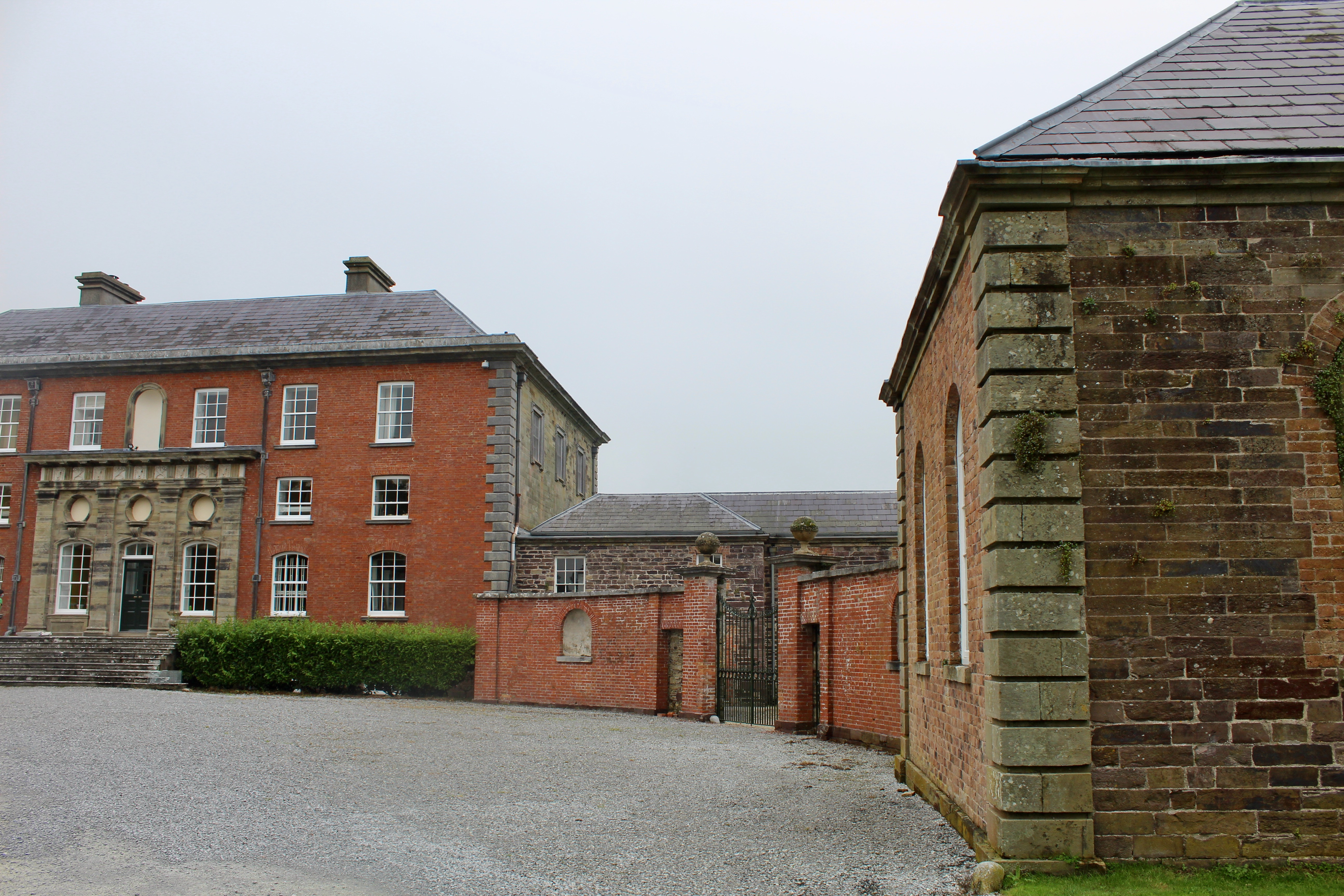
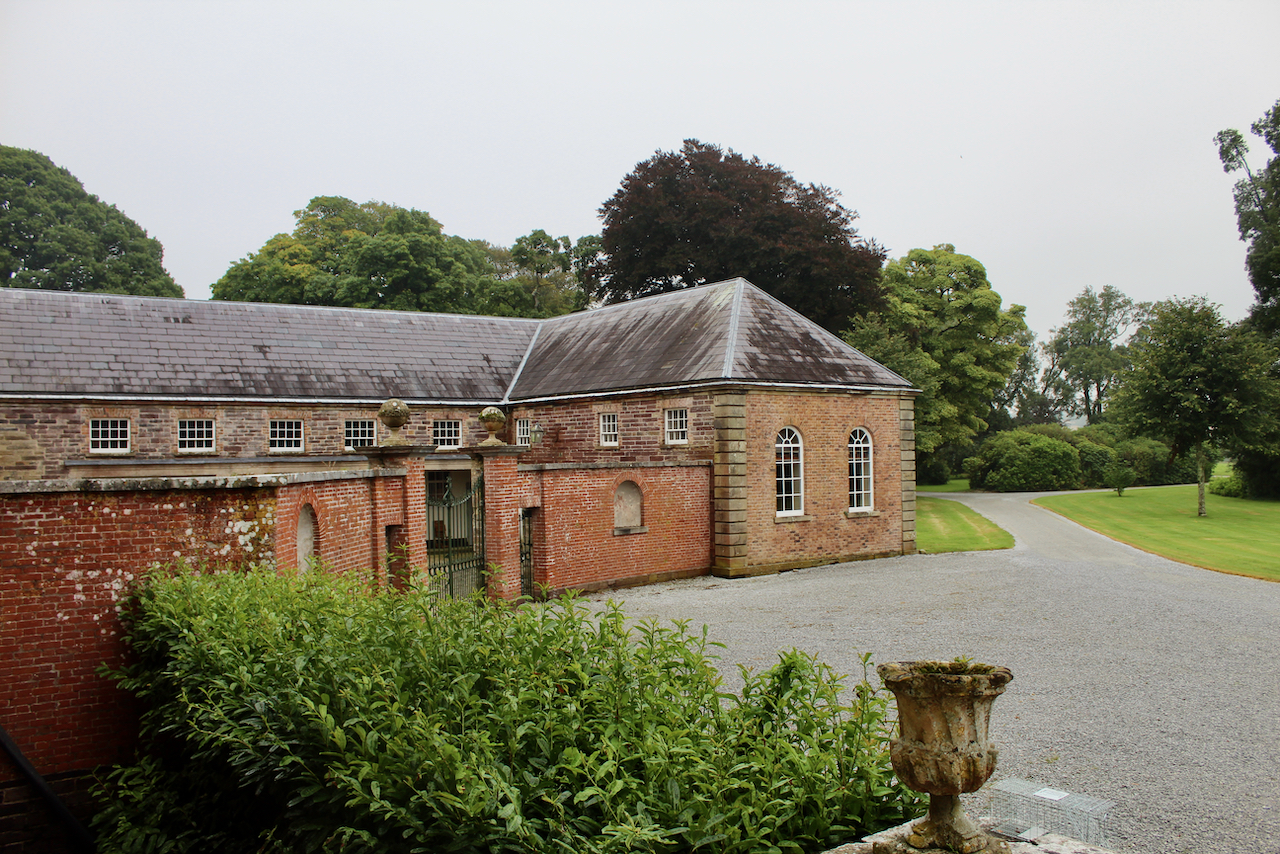
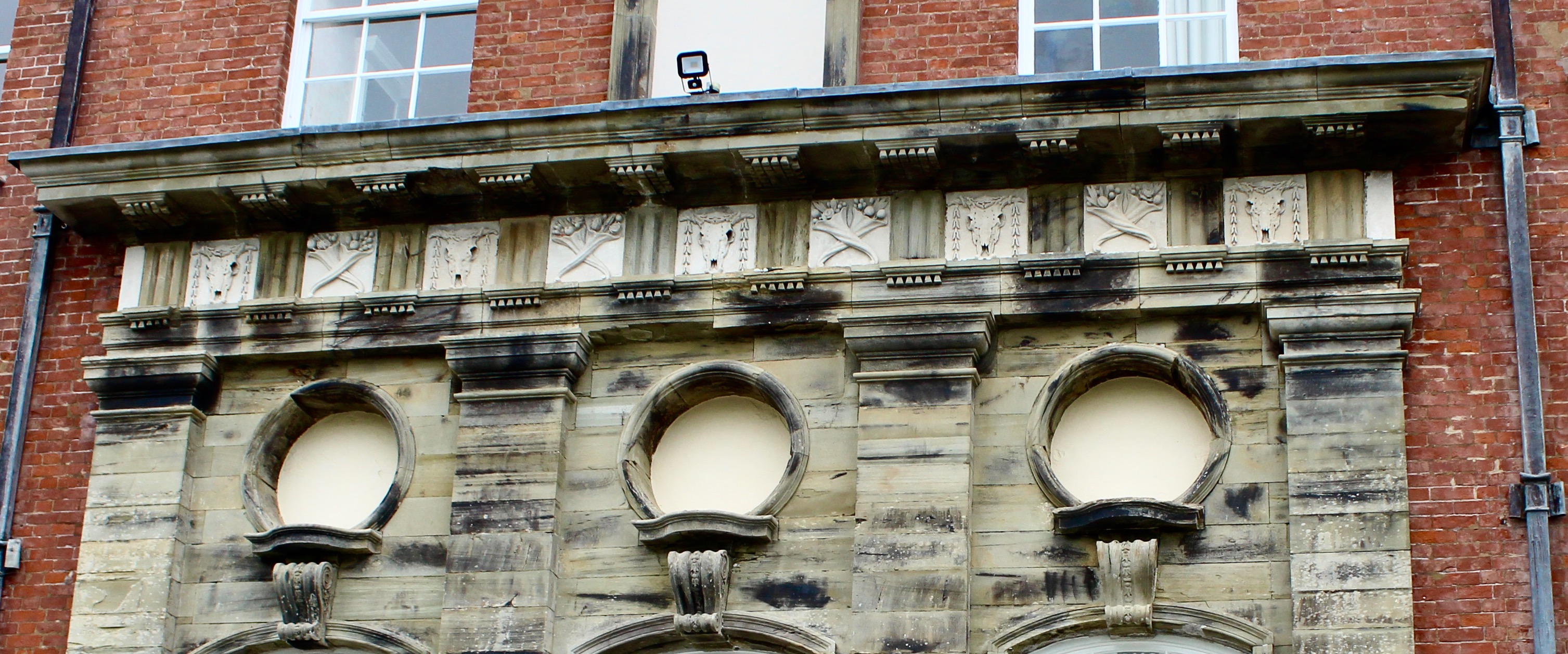
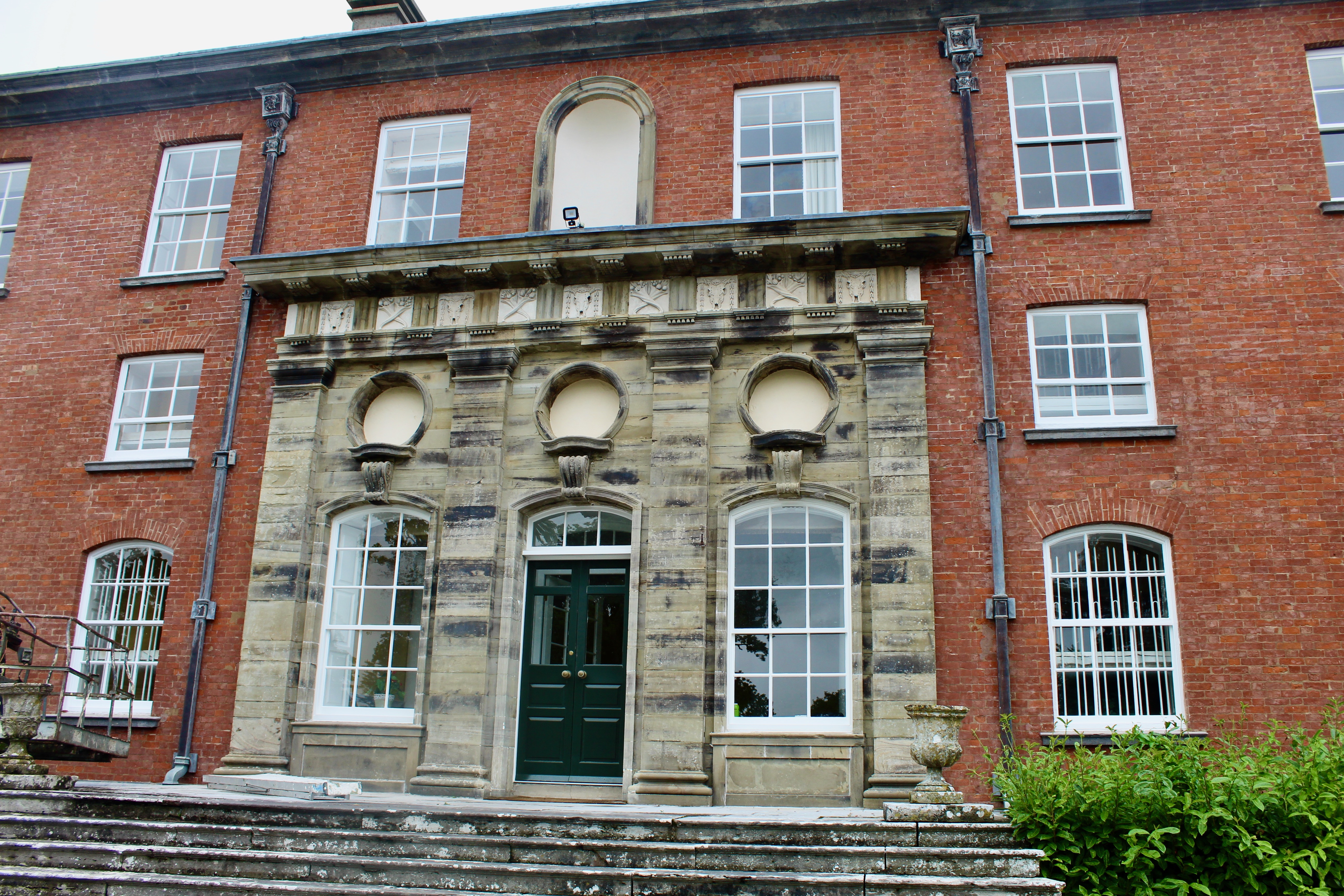

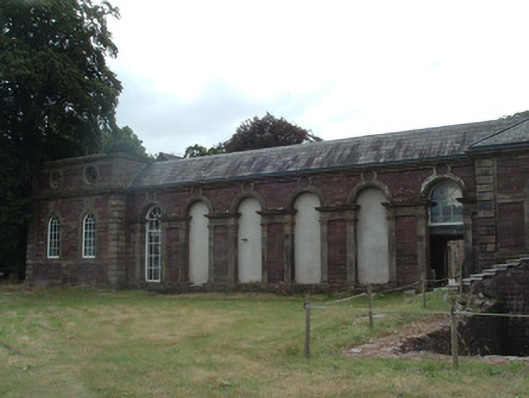
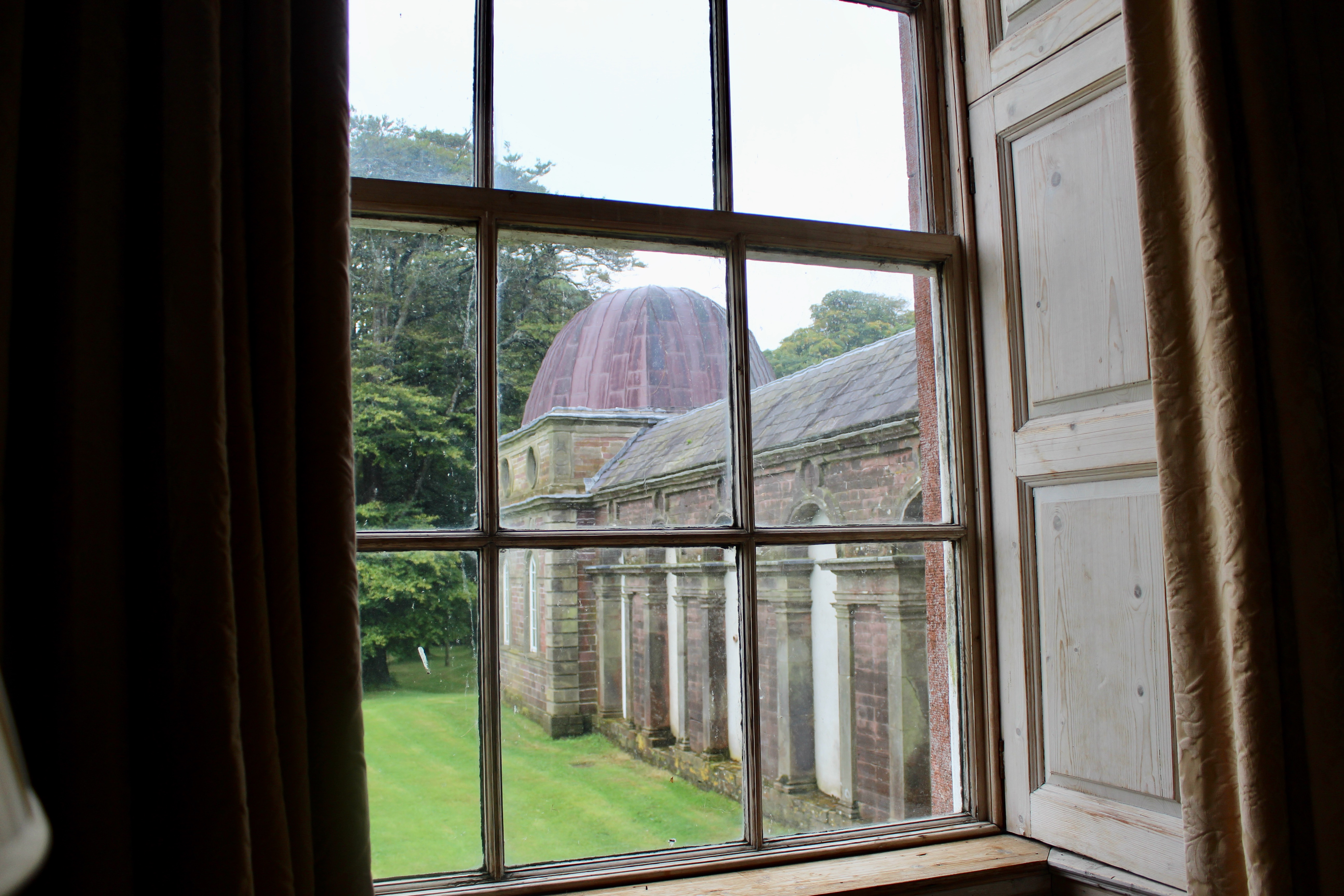
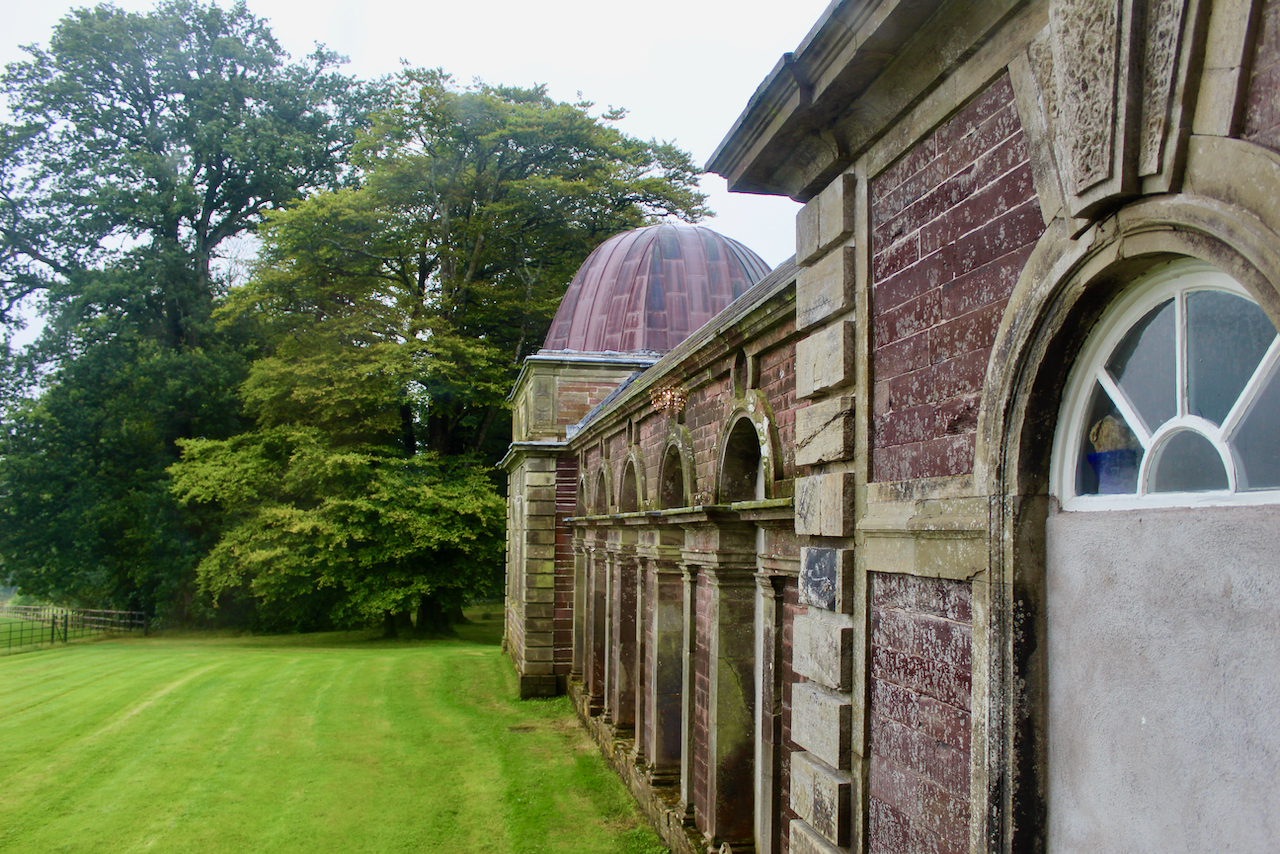
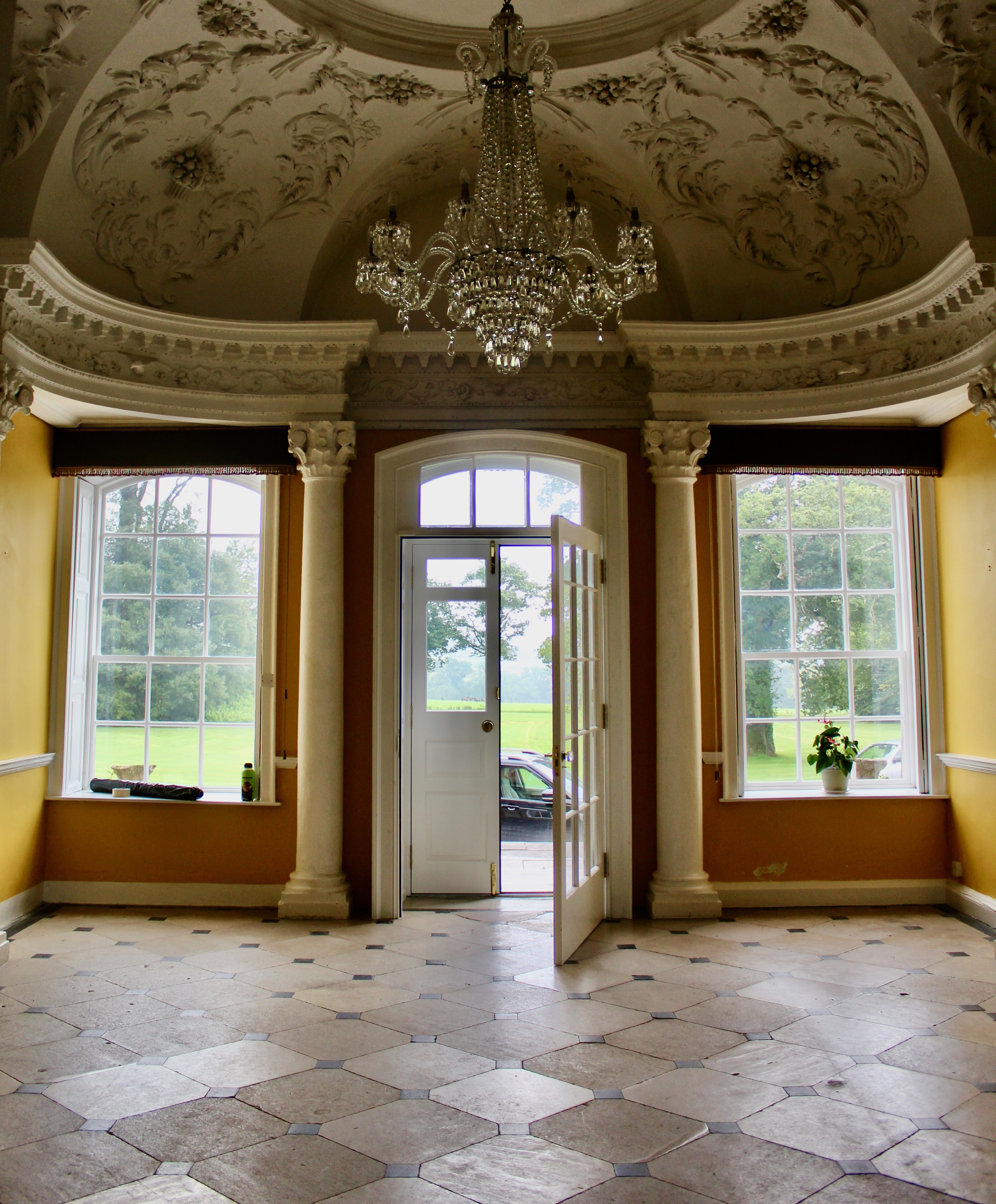

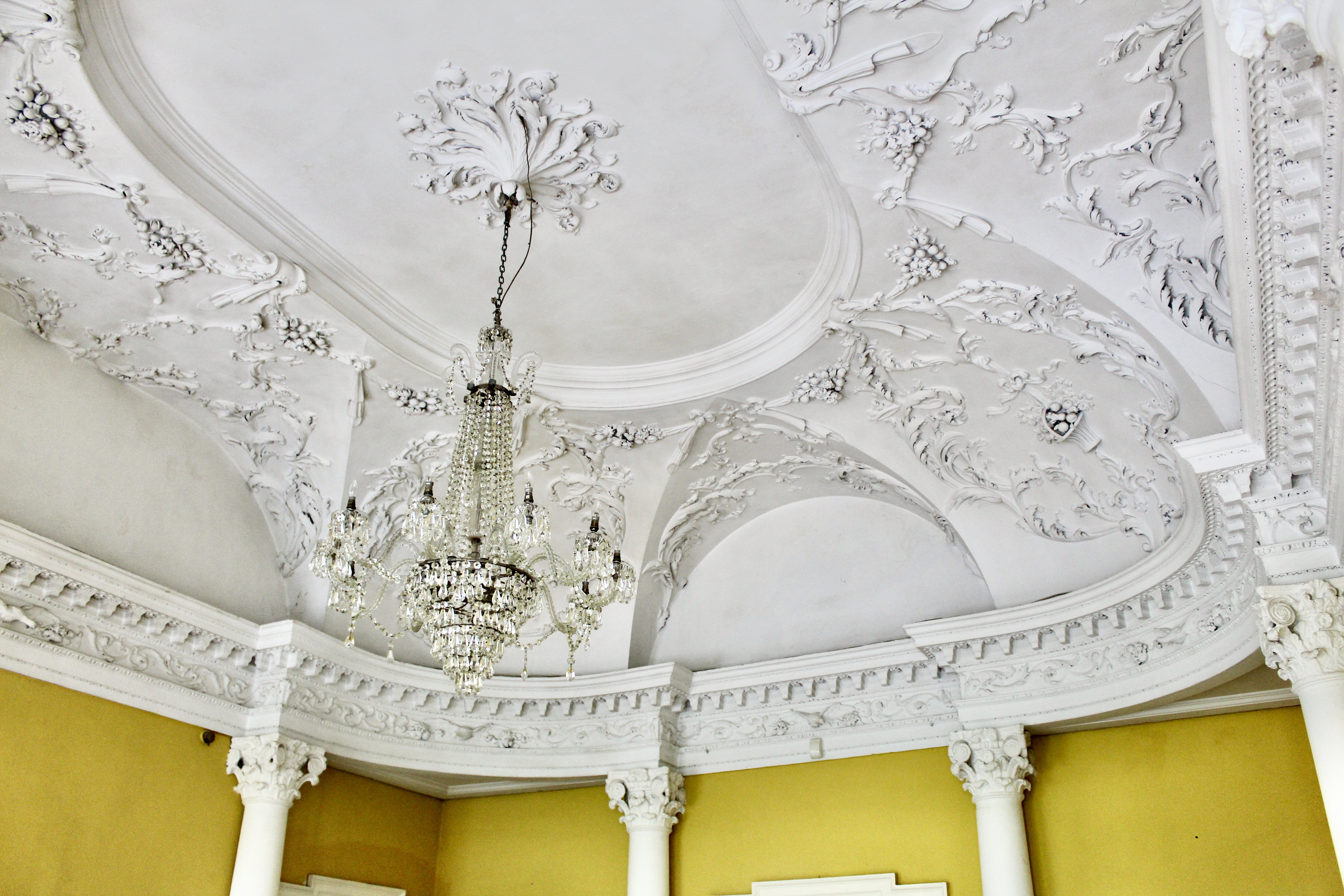
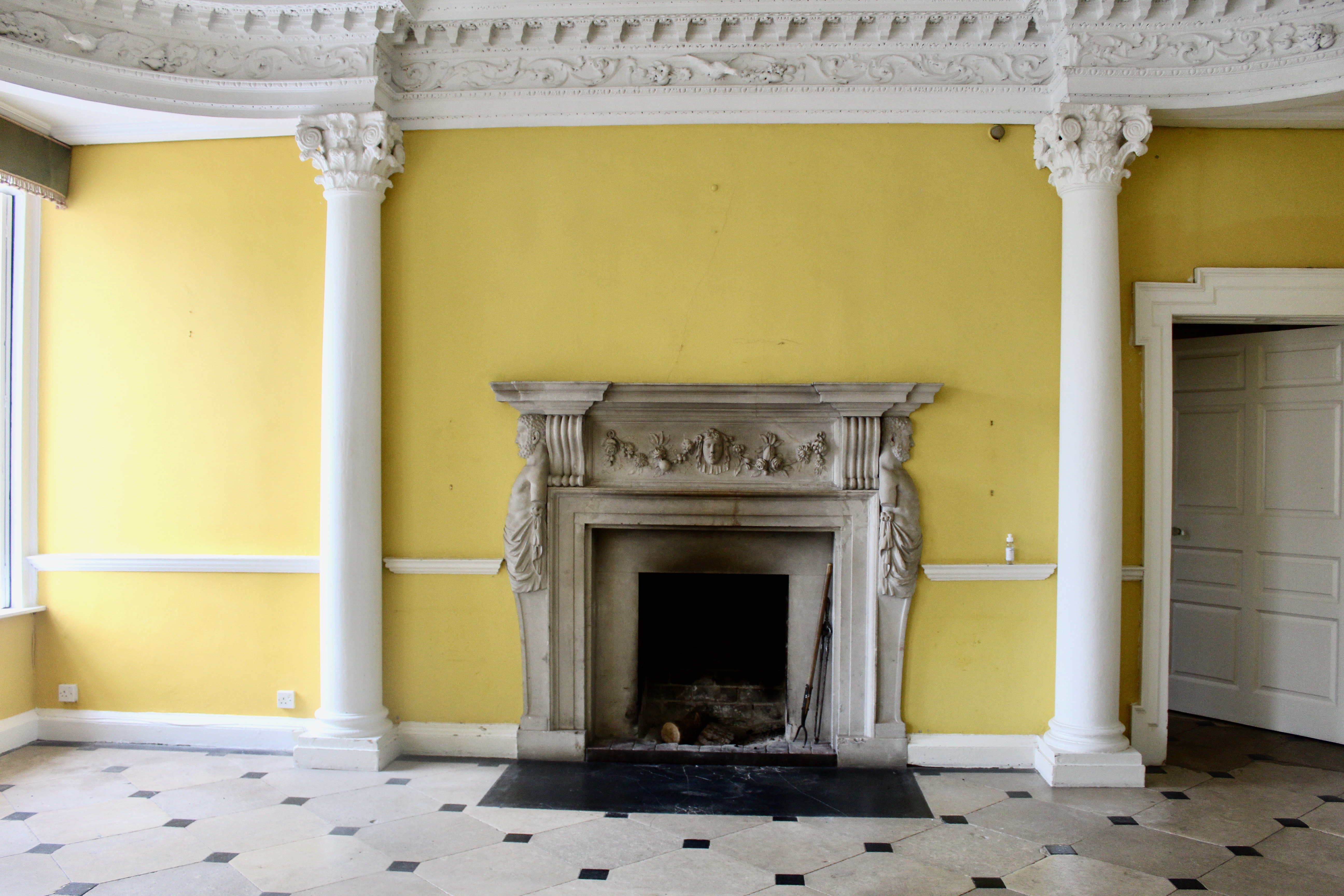

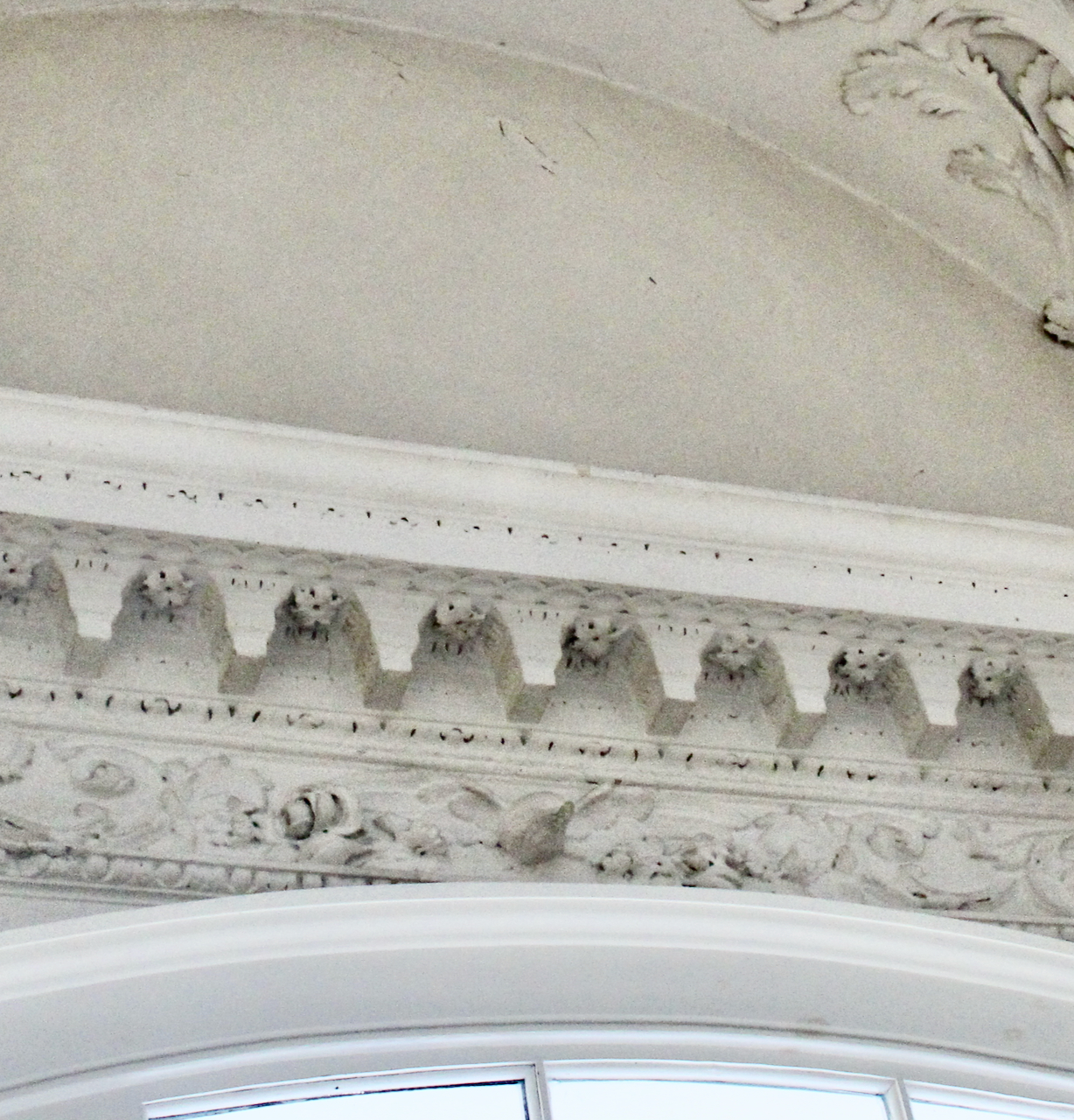


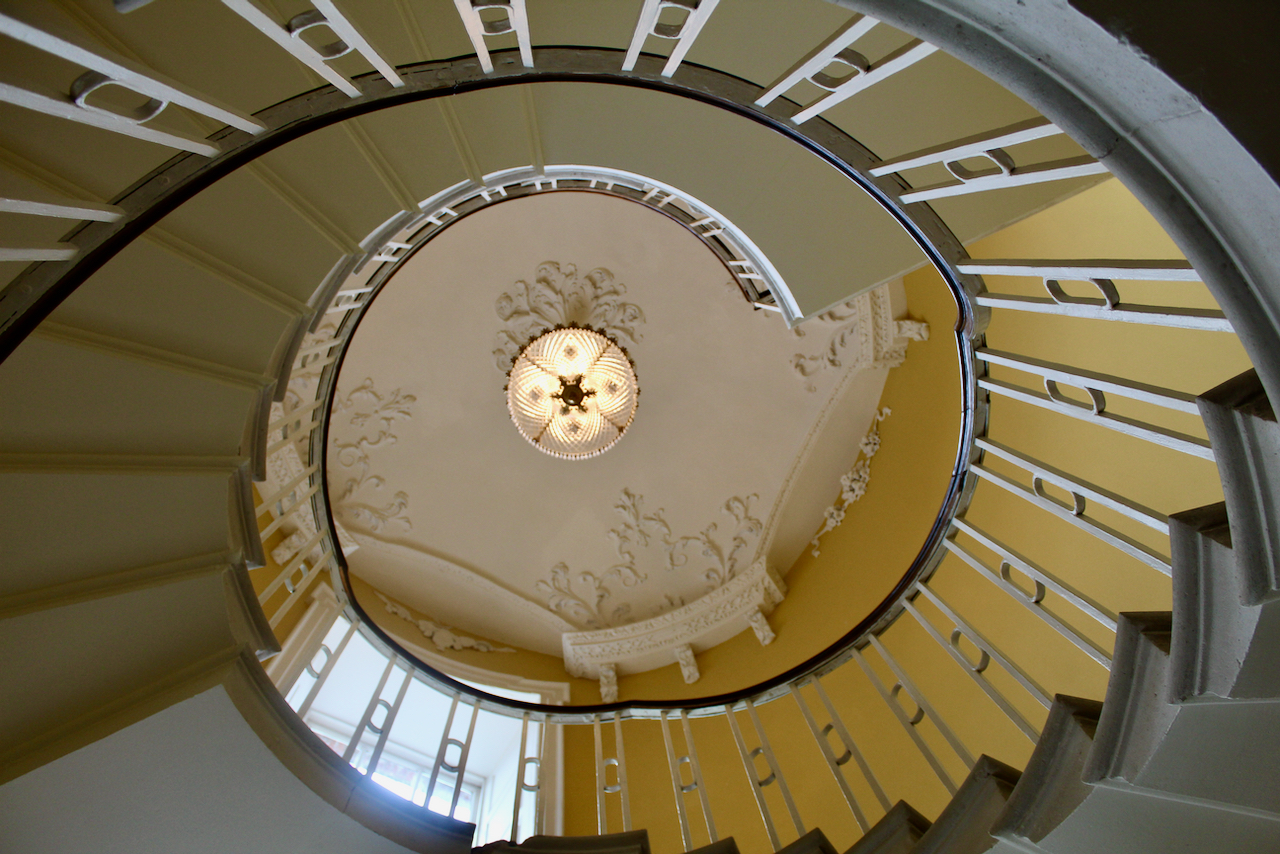
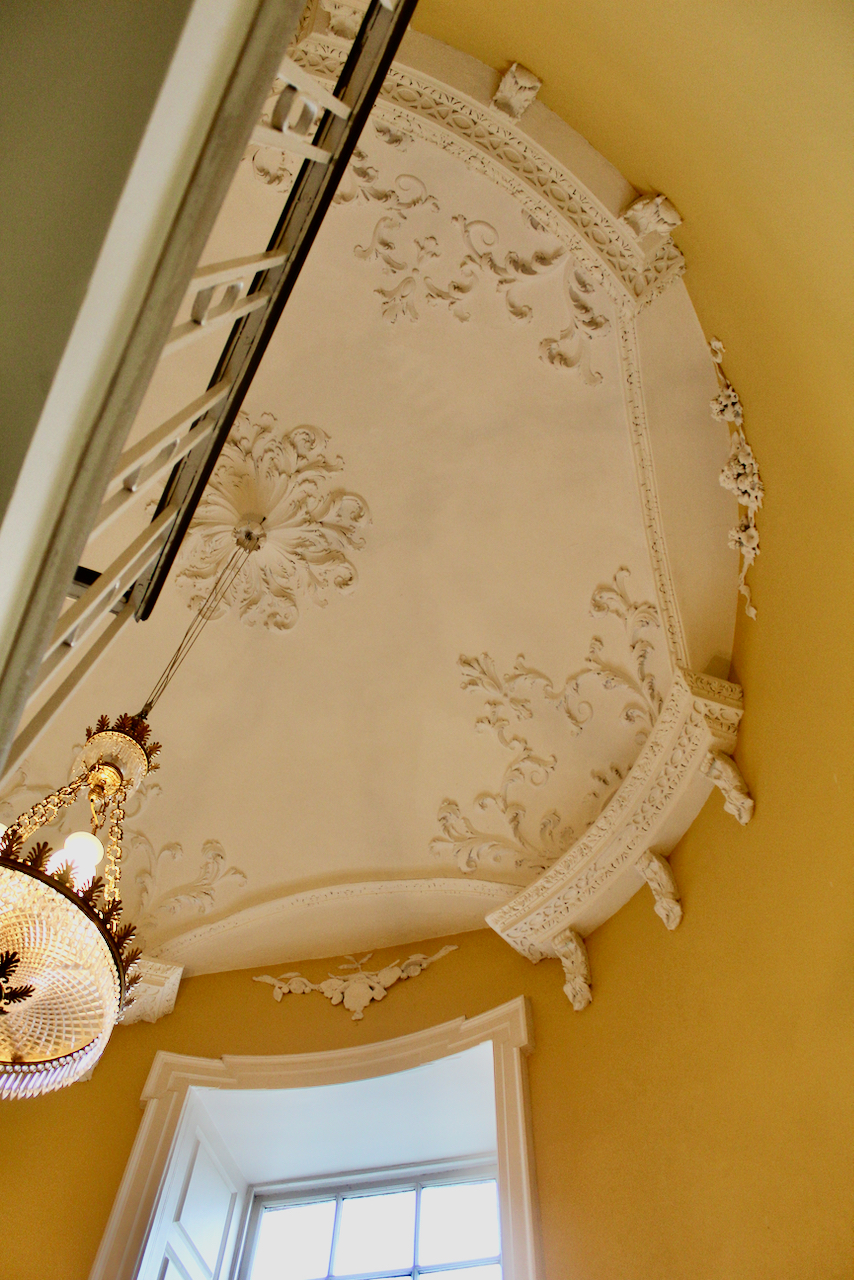
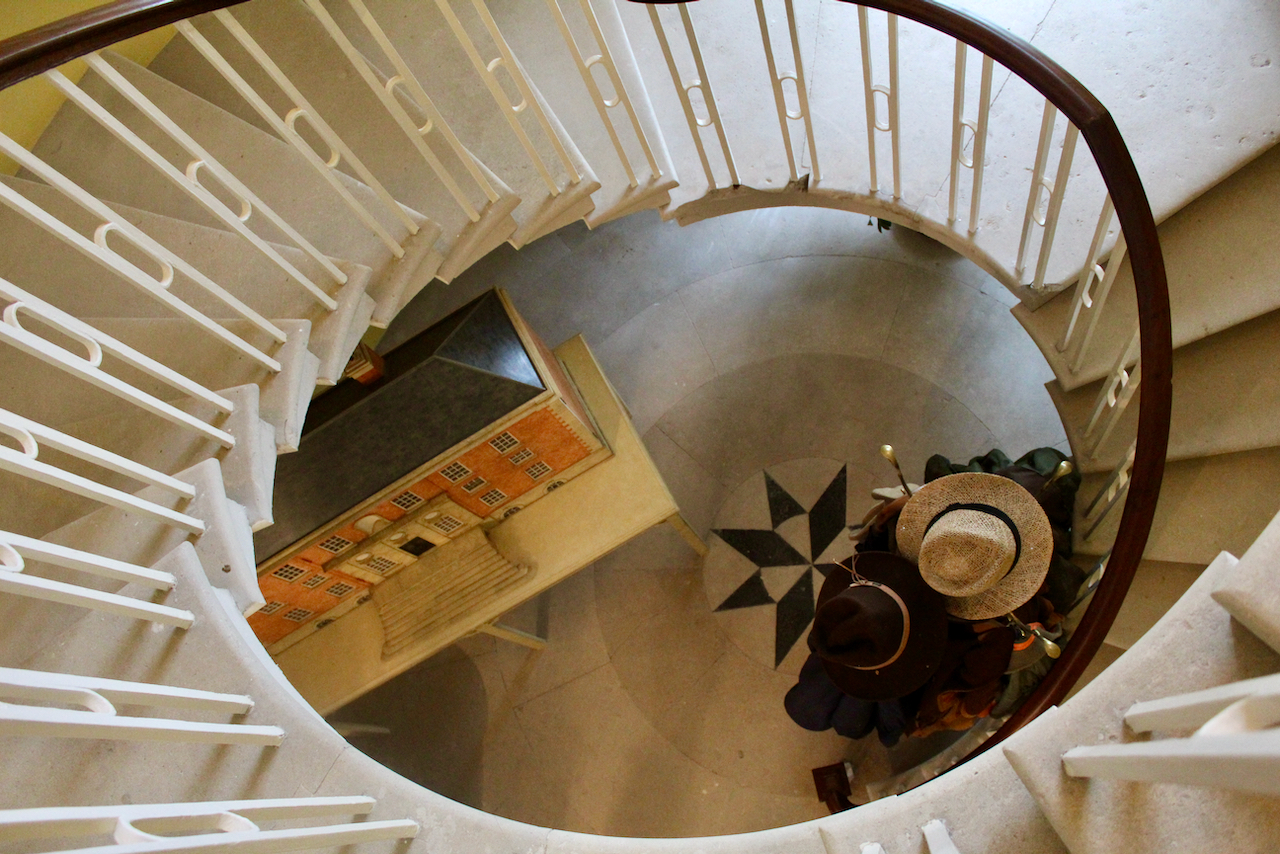
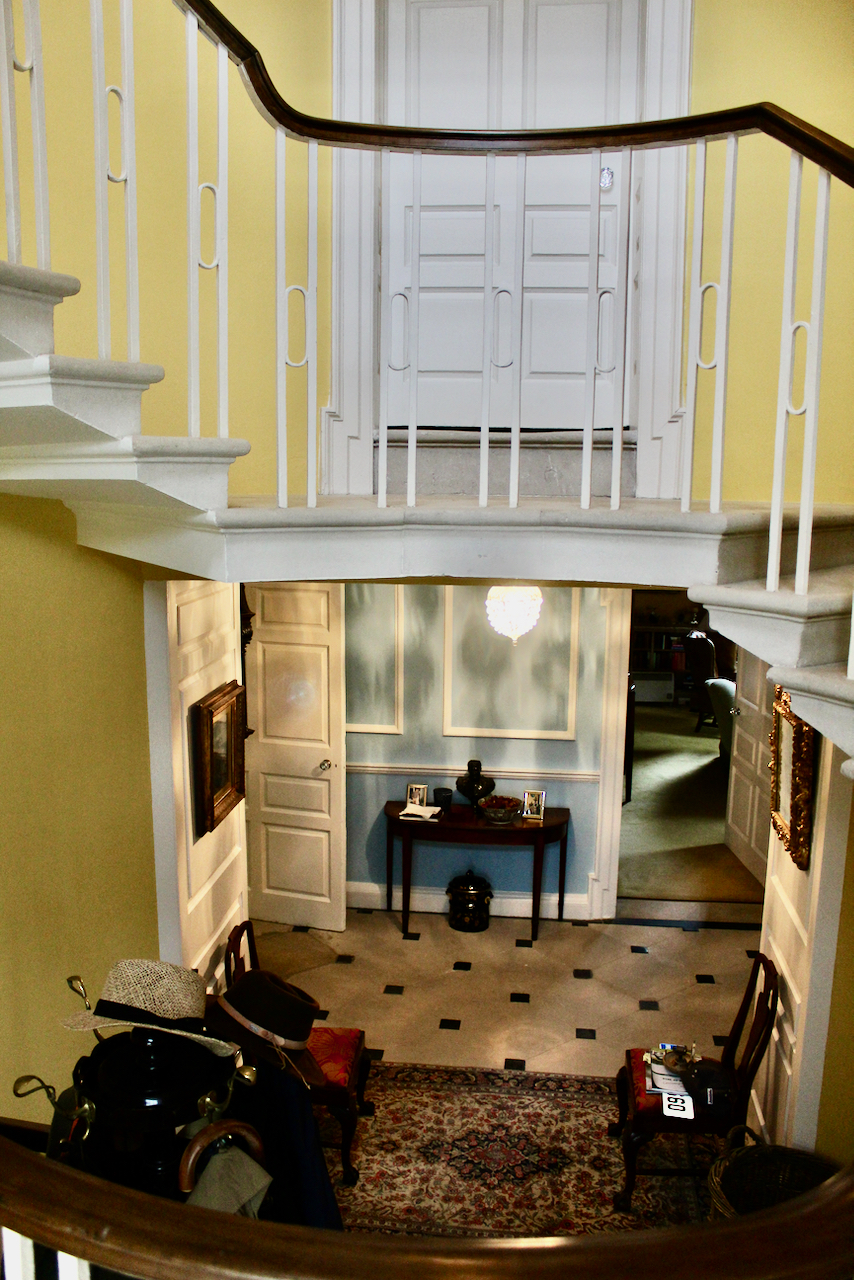
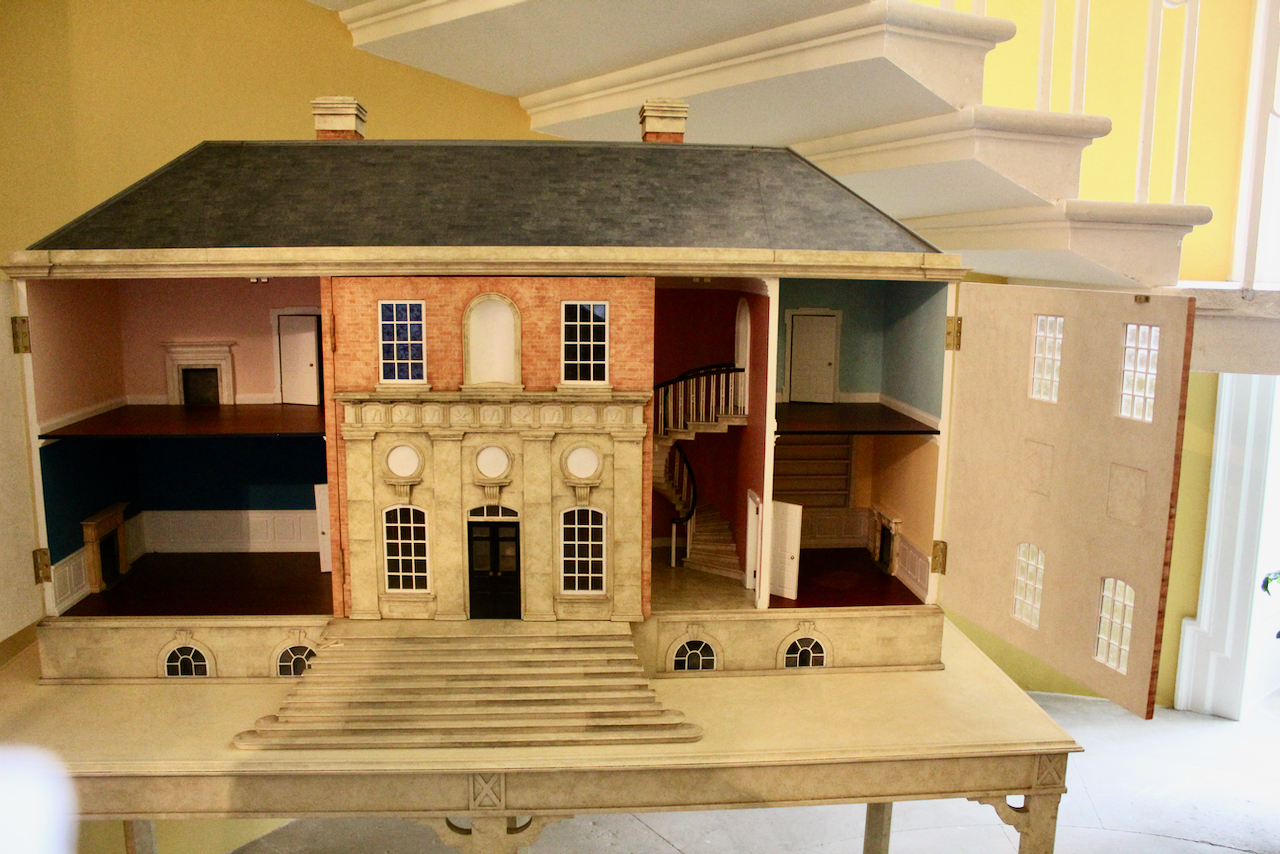
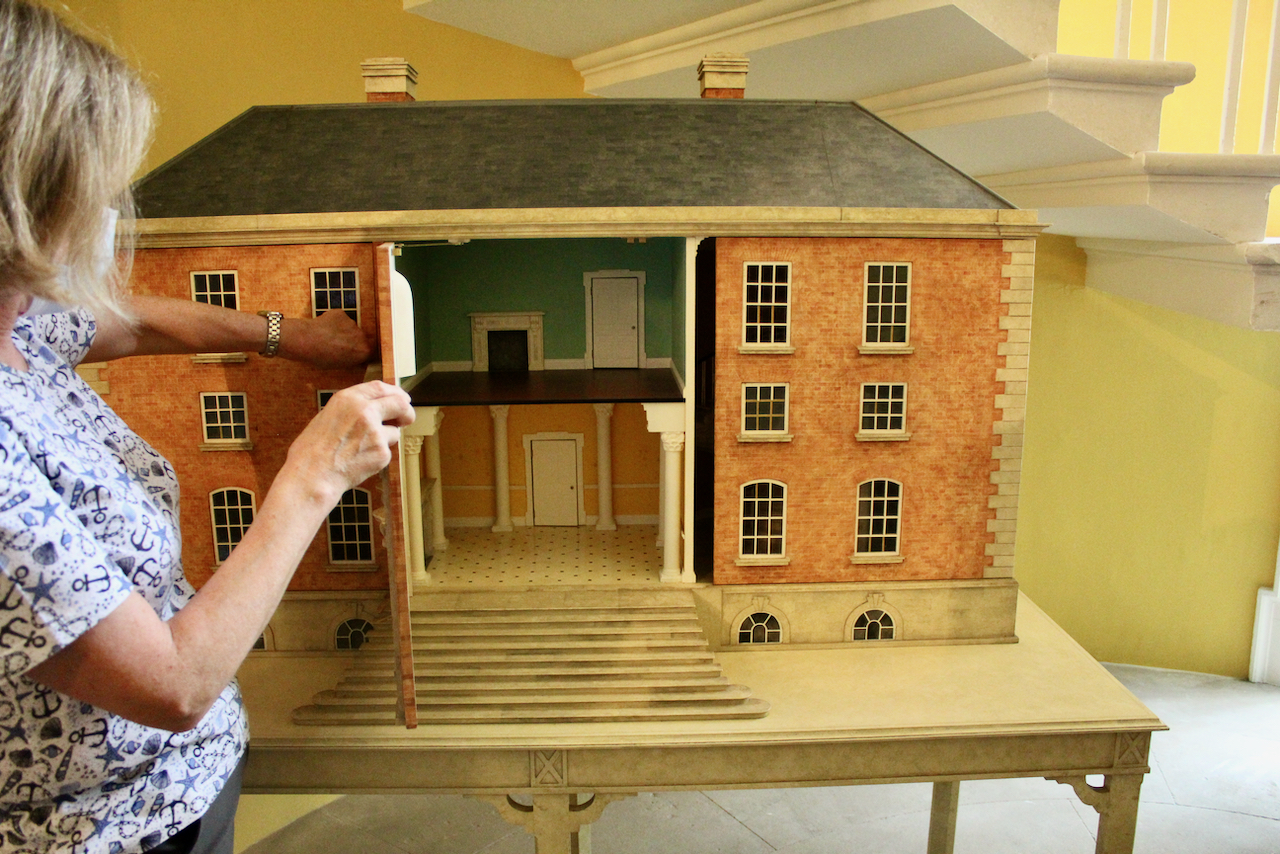
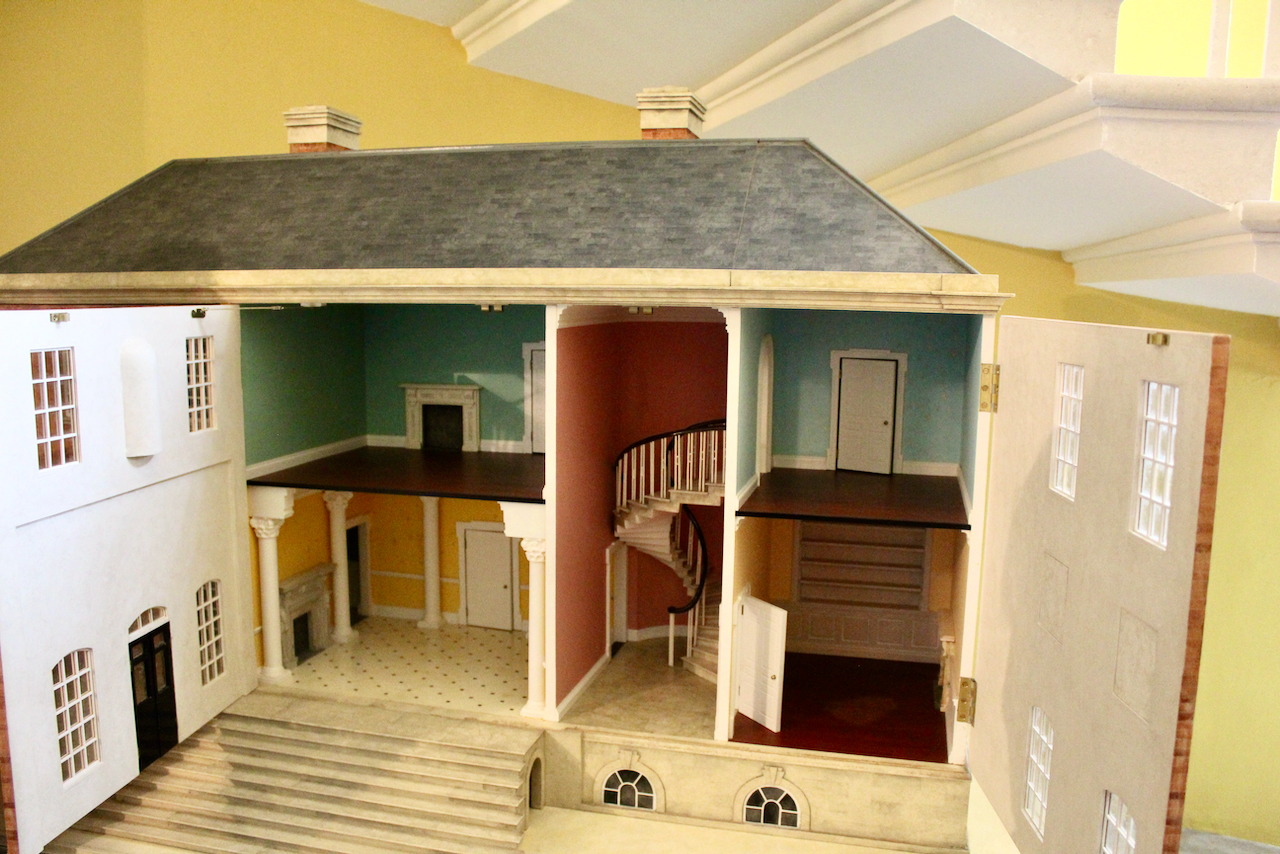
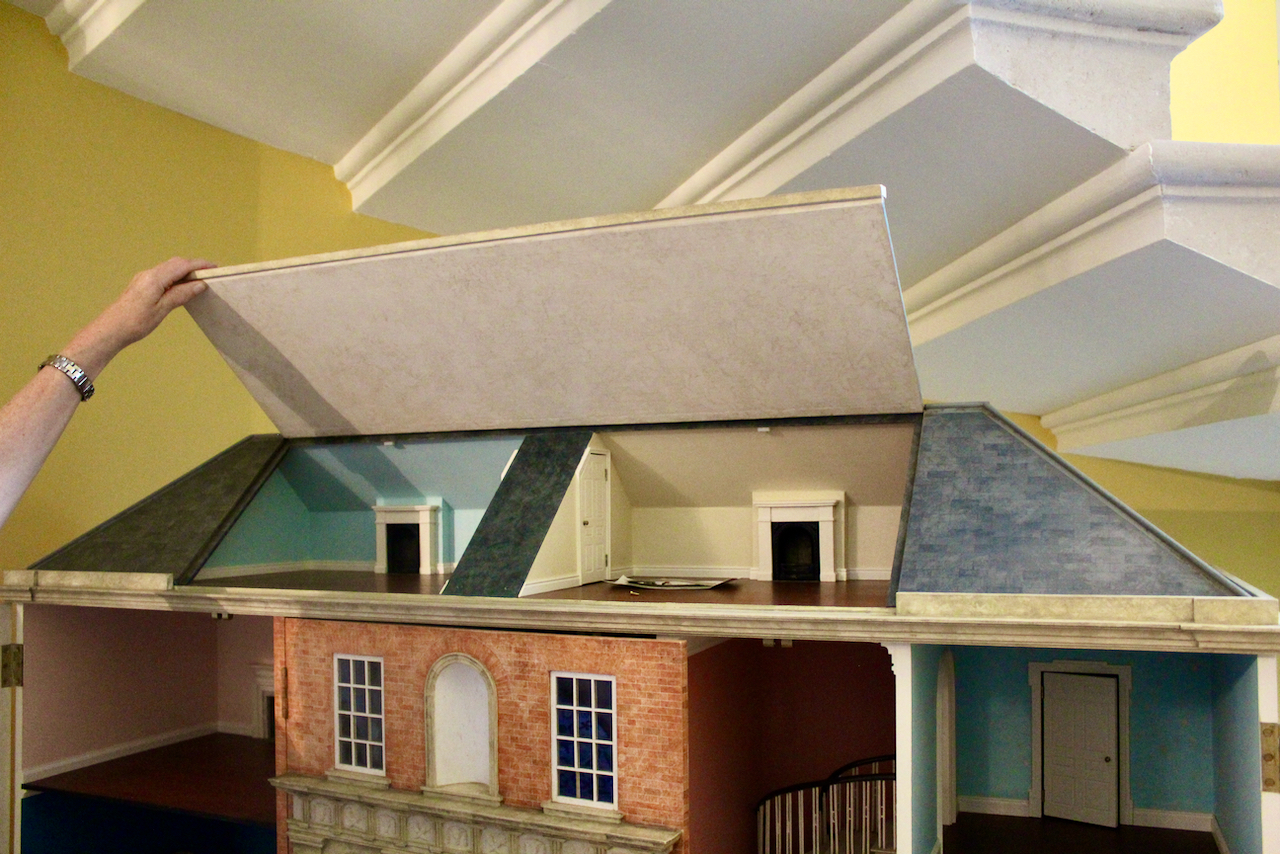

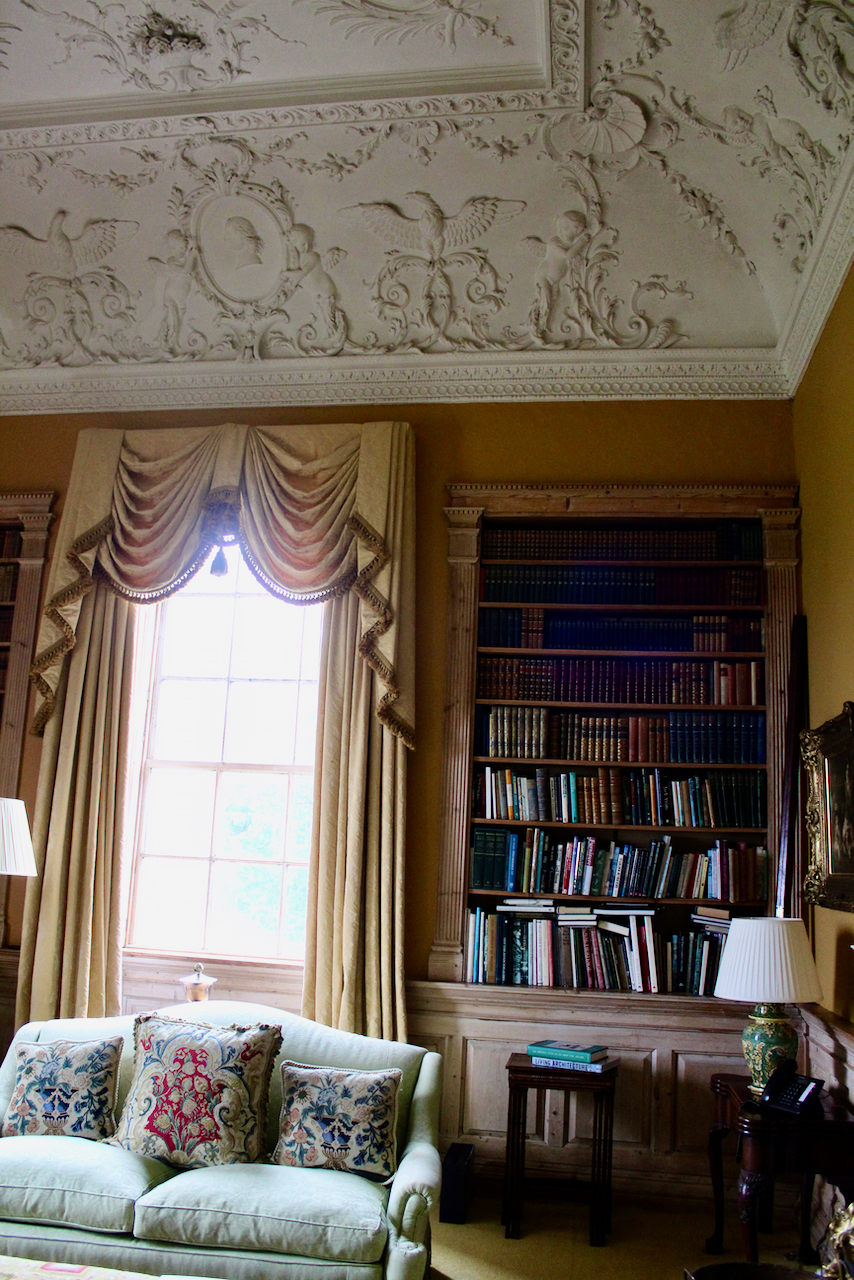


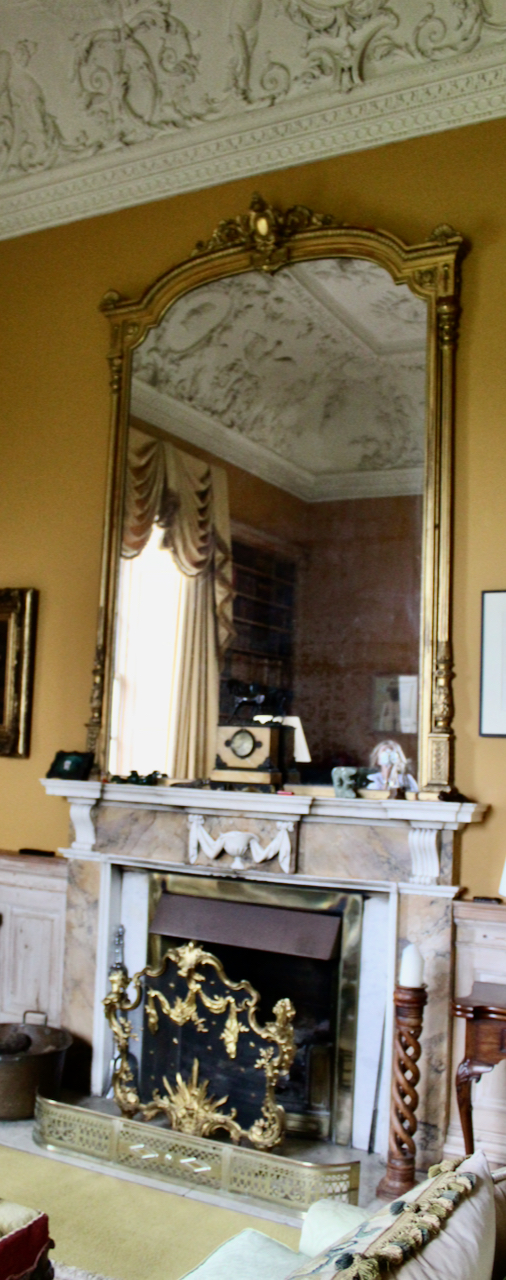

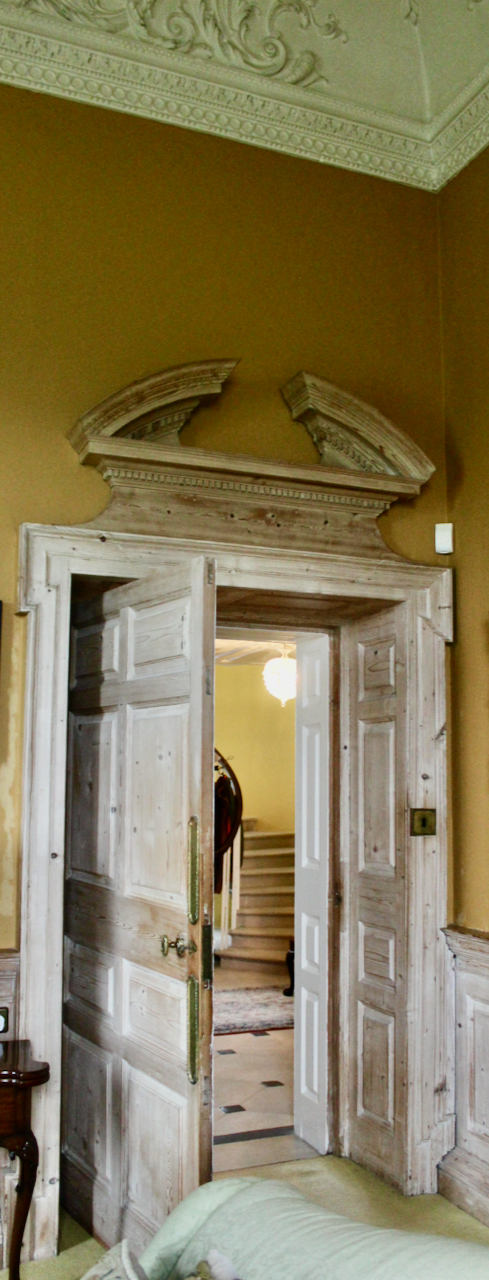
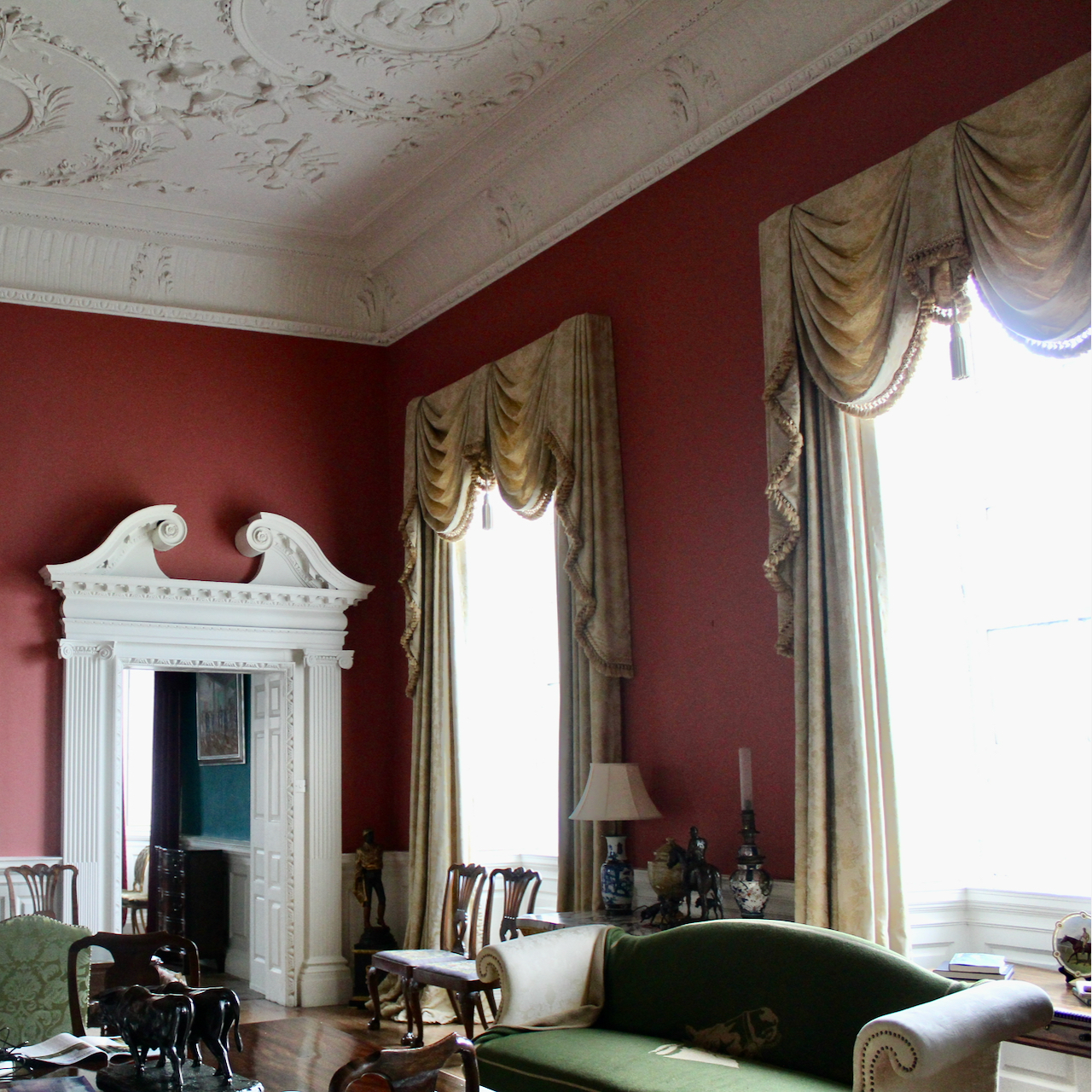

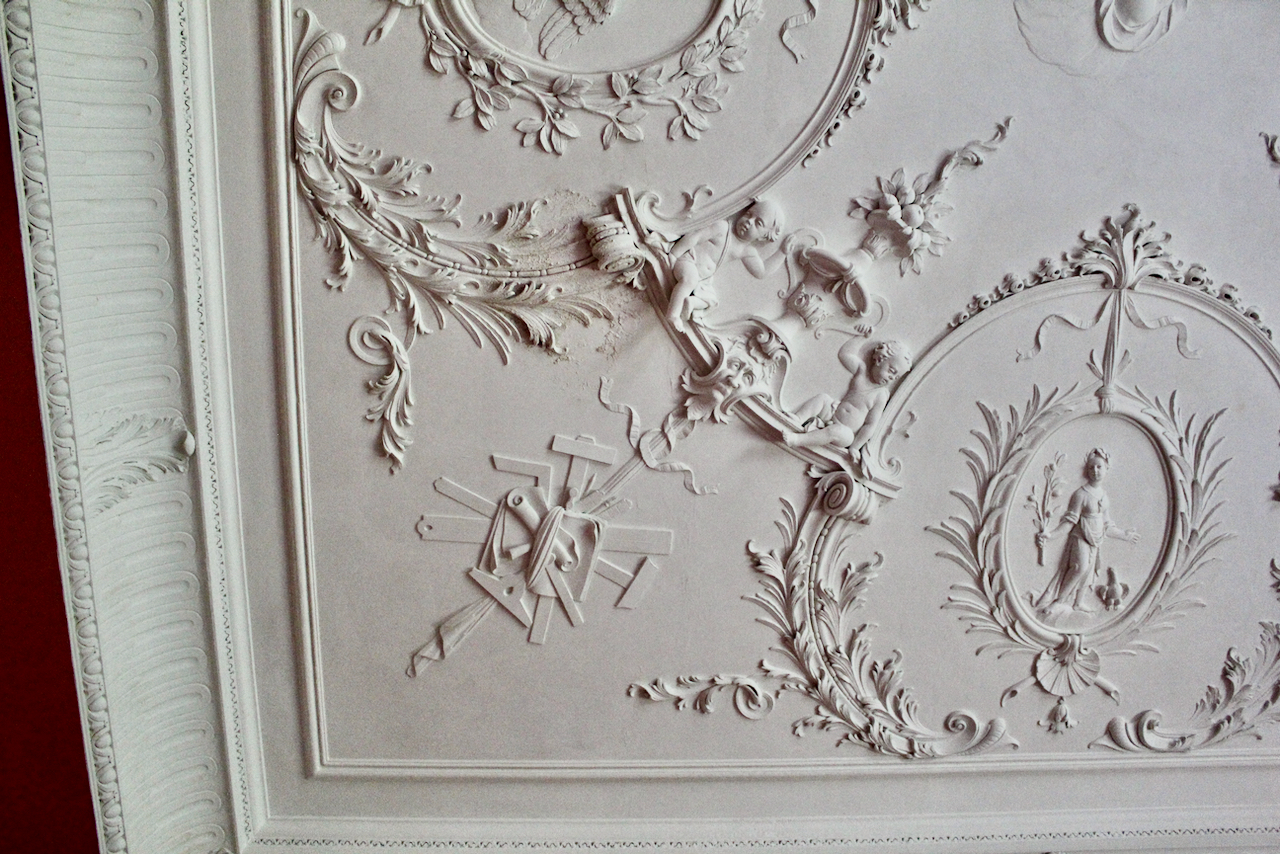
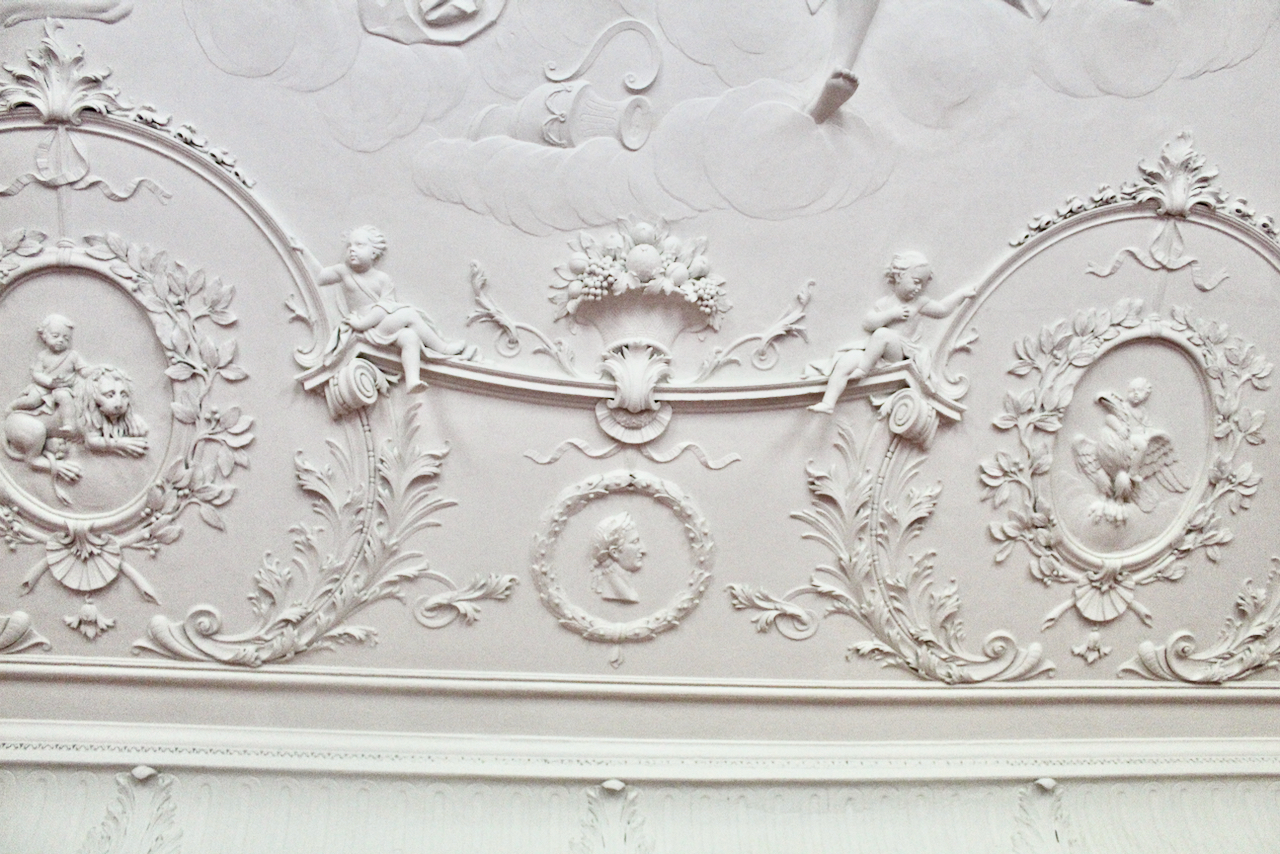


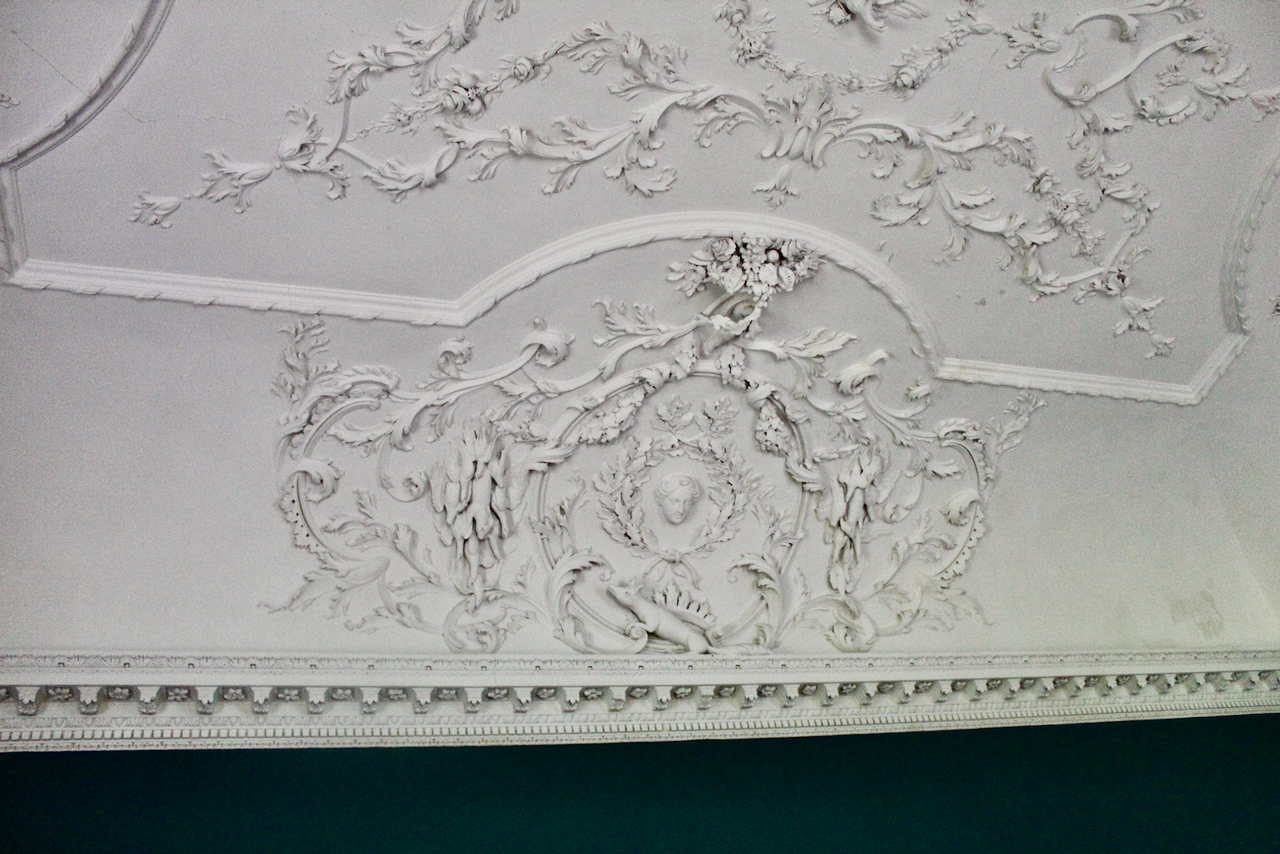
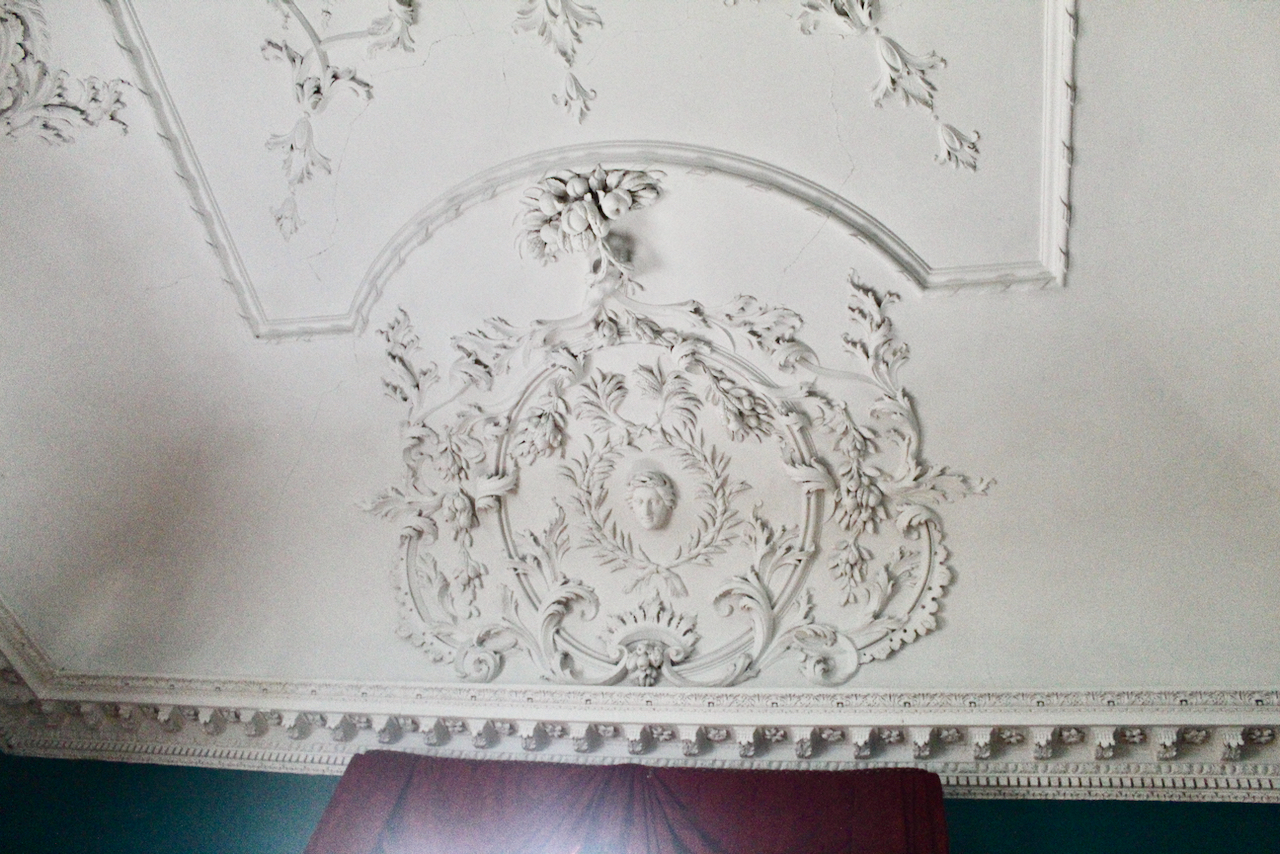
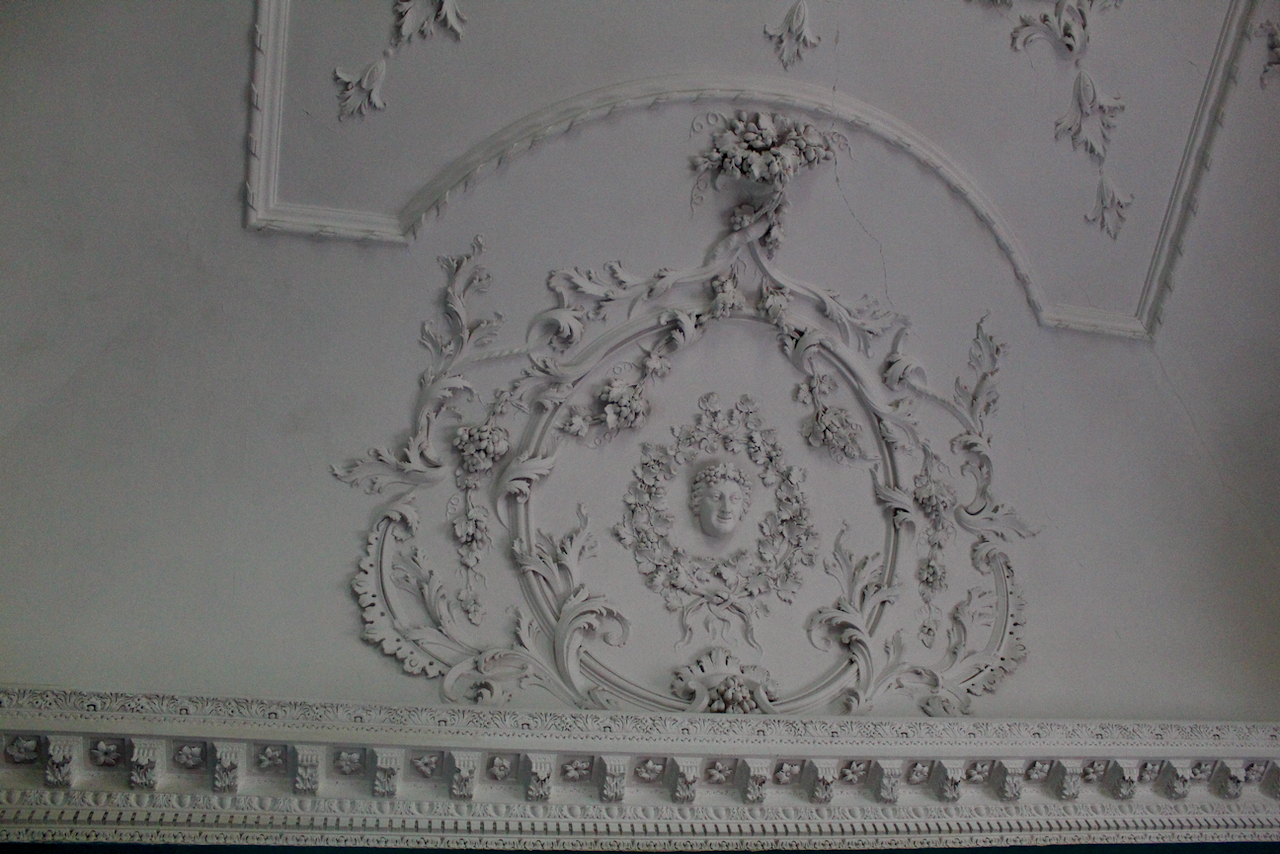

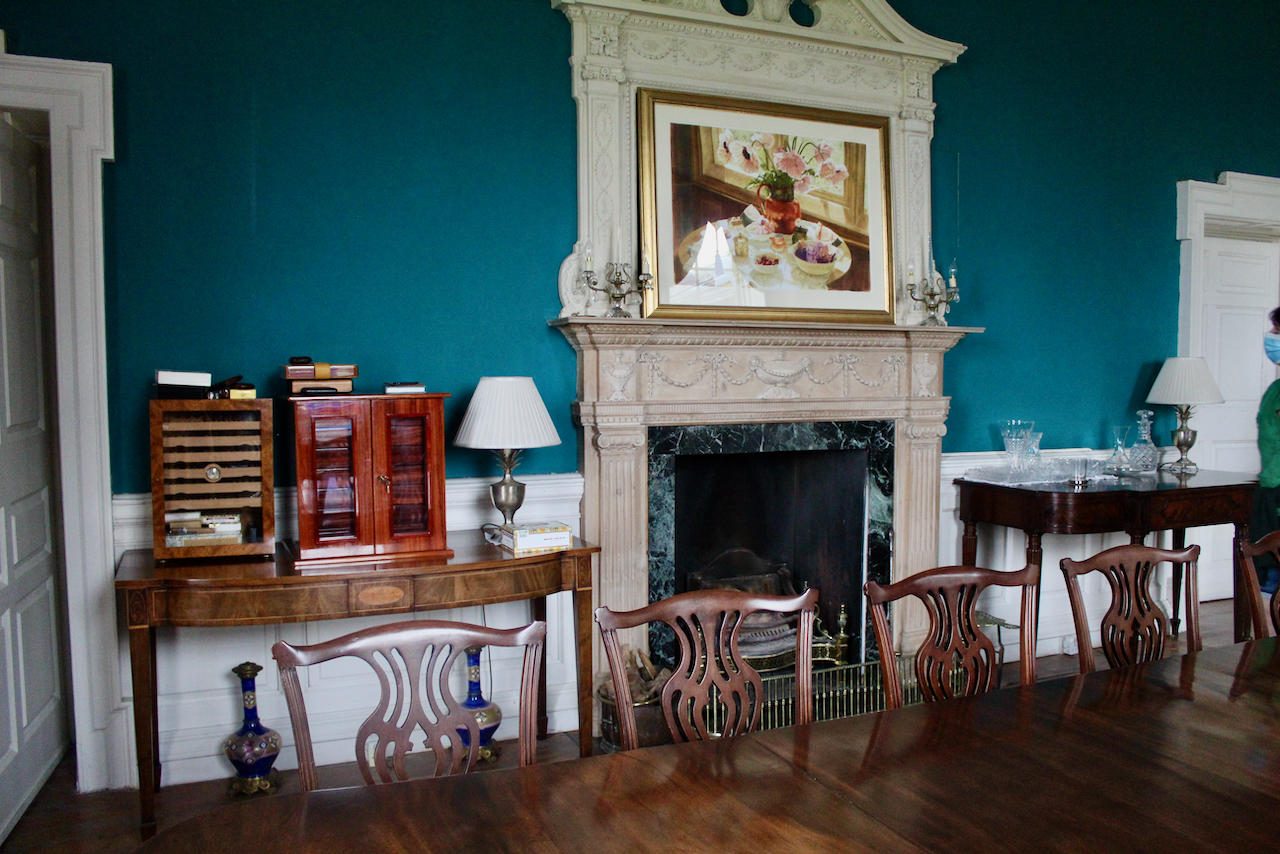
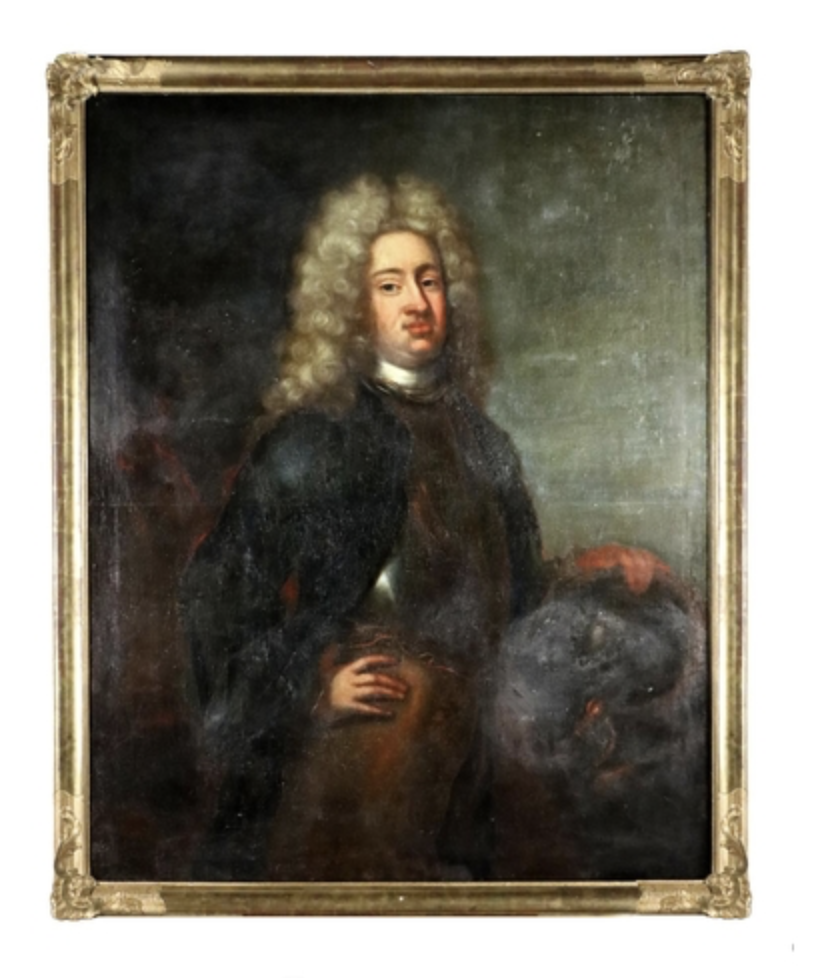
 Irish Historic Houses