Places to visit and stay in Ulster: Counties Fermanagh, Monaghan and Tyrone

On the map above:

blue: places to visit that are not section 482

purple: section 482 properties

red: accommodation

yellow: less expensive accommodation for two

orange: “whole house rental” i.e. those properties that are only for large group accommodations or weddings, e.g. 10 or more people.

green: gardens to visit

grey: ruins

The province of Ulster contains counties Antrim, Armagh, Cavan, Derry, Donegal, Down, Fermanagh, Monaghan and Tyrone.

For places to stay, I have made a rough estimate of prices at time of publication:

€ = up to approximately €150 per night for two people sharing (in yellow on map);

€€ – up to approx €250 per night for two;

€€€ – over €250 per night for two.

For a full listing of accommodation in big houses in Ireland, see my accommodation page: https://irishhistorichouses.com/accommodation/

Fermanagh:

1. Castle Archdale Countryside Centre & War Museum – demolished in 1970 but the stables remain intact.

2. Castle Balfour (ruin), County Fermanagh

3. Castle Coole, County Fermanagh

4. Crom Estate, County Fermanagh

5. Enniskillen Castle, County Fermanagh

6. Florence Court, County Fermanagh

Places to stay, County Fermanagh

1. Belle Isle Courtyard cottages and castle accommodation, Lisbellaw, Enniskillen, County Fermanagh Northern Ireland self catering €

3. Colebrooke gate lodge, Colebrooke Park, County Fermanagh and Triumphal Arch Lodge, Colebrook, County Fermanagh and Colebrook Cottages € for 4

4. West Wing and holiday cottages, Crom Castle, County Fermanagh

Adler’s cottage € and Bluebell Cottage € and Aspen Cottage €

5. Erne View Cottage, Enniskillen, County Fermanagh €

6. Florence Court, County Fermanagh – Butler’s Apartment

7. Manor House Hotel (formerly Killadeas Manor and before that, Rockfield), County Fermanagh

Whole House Rental, County Fermanagh:

1. Ashbrooke House, Brookeborough, Enniskillen Co Fermanagh BT94 4GX – whole house rental

2. Belle Isle Courtyard cottages and castle accommodation, Lisbellaw, Enniskillen, County Fermanagh Northern Ireland

3. Colebrook Park, County Fermanagh

County Monaghan:

1. Castle Leslie, Glaslough, Co. Monaghan – section 482

2. Hilton Park House, Clones, Co. Monaghan – section 482

3. Mullan Village and Mill, Mullan, Emyvale, Co. Monaghan – section 482

Places to stay, County Monaghan

1. Castle Leslie, Glaslough, Co. Monaghan – section 482

2. Hilton Park House, Clones, Co. Monaghan, and cottage – section 482, see above

Tyrone:

1. Ashfield Park, County Tyrone – gardens open to visitors 

2. Blessingbourne, Fivemiletown, County Tyrone – open for tours, self catering accommodation on the grounds 

3. Hill of The O’Neill and Ranfurly House Arts & Visitor Centre, County Tyrone

4. Killymoon Castle, County Tyrone

5. Lissan House, Drumgrass Road, Cookstown, County Tyrone, BT80 9SW.

6. Prehen, County Tyrone

Places to stay County Tyrone

1. An Creagan, Omagh, County Tyrone € for 4 or more nights, €€ for 2 nights

2. Ashbrook House, Aucnacloy, County Tyrone

3. Baronscourt Estate, Newtownstewart, Omagh, County Tyrone € for one week

4. Blessingbourne, County Tyrone €€

5. Cobblers Cottage Omagh, County Tyrone

6. Corick House Hotel, Clogher, County Tyrone €€

7. Kilcootry Barn, Fintona, County Tyrone

8. Killymoon Castle Lodge, 302 Killymoon Road, BT80 8ZA

9. The Lower House Rooms, Donaghmore, Dungannon, Co. Tyrone, BT70 3EZ

10. Spice Cottages, Dungannon, County Tyrone €€

donation

Help me to pay the entrance fee to one of the houses on this website. This site is created purely out of love for the subject and I receive no payment so any donation is appreciated!

€15.00

Fermanagh:

1. Castle Archdale Countryside Centre & War Museum – demolished in 1970 but the stables remain intact.

https://discovernorthernireland.com/things-to-do/castle-archdale-countryside-centre-and-war-museum-p675541

Mark Bence-Jones writes in his A Guide to Irish Country Houses (1988):

p. 61. (Archdale/IFR) “A noble house of 1773 on the shores of Lough Erne, built by Colonel Mervyn Archdall in 1773 to replace a “Plantation castle”  originally built by John Archdale 1615. 
 
Three storeys over a basement; a six bay entrance front with a two bay breakfront centre; and a tripartite doorway with Ionic pilasters, entablature and pediment, the latter breaking forwards on two Ionic columns to form a porch, which appears to have been a subsequent alteration. 
 

The side elevation was of three bays, the bottom storey having Venetian windows with Gothic astragals in its outer baysThe quoins were rusticated and bold; with a solid roof parapet. Derelict since 1959 and now ruinous.” [1]

Castle Archdale, County Fermanagh, from Discover Northern Ireland website.

2. Castle Balfour (ruin), County Fermanagh

https://discovernorthernireland.com/things-to-do/castle-balfour-p675501

Built in about 1618 by Sir James Balfour, a Scottish planter, the castle was in continuous occupation until the early 19th century. Open all year.

Timothy William Ferres tells us: “CASTLE BALFOUR formed the nucleus of the town [Lisnaskea]. It stands beside the parish church, in the graveyard. The Castle was built with local stone ca 1618 by Sir James Balfour. Sandstone was used for the quoins and dressings. The main block consists of a rectangular block, 78 feet by 24 feet, with a large wing projecting to the east and west, comprising two L-shaped units. The northern block has three storeys with attics. The kitchen is vaulted, with a fireplace and oven. Corbelled turrets and gun-slits are a feature
 
During the Irish Rebellion of 1641, Castle Balfour and the village were burnt but later reoccupied. In 1689, the Castle was again badly damaged by the Jacobite armies but was repaired after the Williamite victory at Limerick. About 1780, Castle Balfour was sold to the 1st Earl of Erne, and the Balfours subsequently left County Fermanagh. 
 
The last person to inhabit the Castle was James Haire (1737-1833), of Nutfield, who leased the Castle from Lord Erne. James Haire and his family ceased to occupy the castle after it was destroyed by an arson-based fire in 1803 (his mother, Phoebe, was killed in the rubble caused by the fire). 
 
Thereafter the Castle remained ruinous, until it was placed in state care by the 6th Earl of Erne in 1960. 
 
Major conservation work was carried out between 1966-68 and again during the late 1990s.” [2]

3. Castle Coole, County Fermanagh

https://www.nationaltrust.org.uk/castle-coole
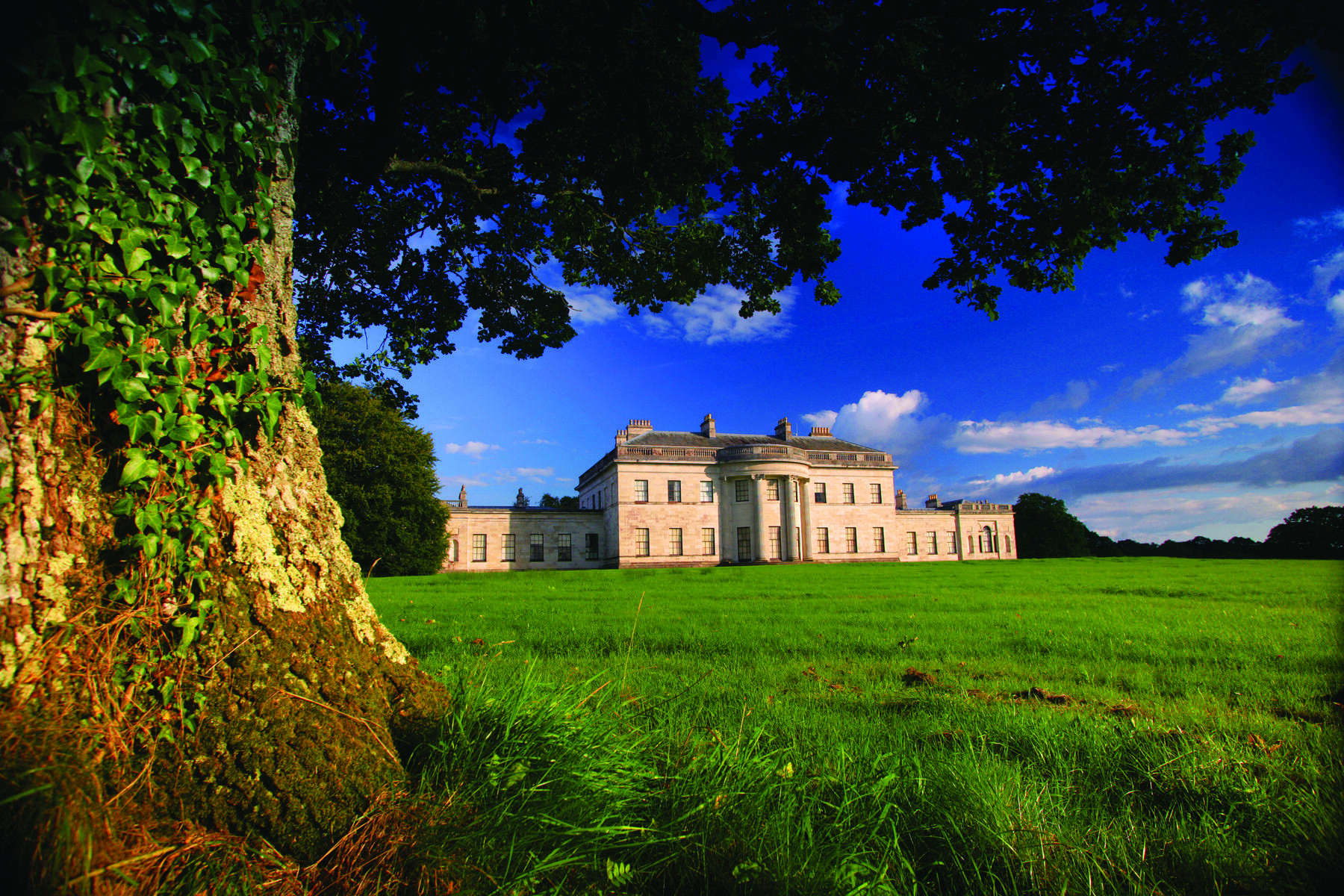
Castle Coole (pronounced cool) is a late-eighteenth-century neo-classical mansion situated in Enniskillen, County Fermanagh, Northern Ireland. Set in a 1200 acre (5 km²) wooded estate, Castle Coole was constructed between 1789 and 1798 as the summer retreat of Armar Lowry-Corry, the 1st Earl of Belmore. photo by Brian Morrison, Tourism Northern Ireland 2008. [3]
Castle Coole, County Fermanagh, March 2022, built to impress by the first Earl of Belmore by Amar Lowry-Corry, 1st Earl Belmore (1740-1802) and furnished largely by Somerset Lowry Corry, 2nd Earl (1774-1841).  Photograph © Jennifer Winder-Baggot, www.irishhistorichouses.com

The website tells us:

Castle Coole is one of the greatest neo-classical country houses in Ireland. Home to the Earls of Belmore, it was commissioned and built to impress by the first Earl of Belmore by Amar Lowry Corry, 1st Earl Belmore (1740-1802) and furnished largely by Somerset Lowry Corry, 2nd Earl (1774-1841).” 

See my entry https://irishhistorichouses.com/2024/03/21/castle-coole-county-fermanagh-a-national-trust-property/

4. Crom Estate, County Fermanagh
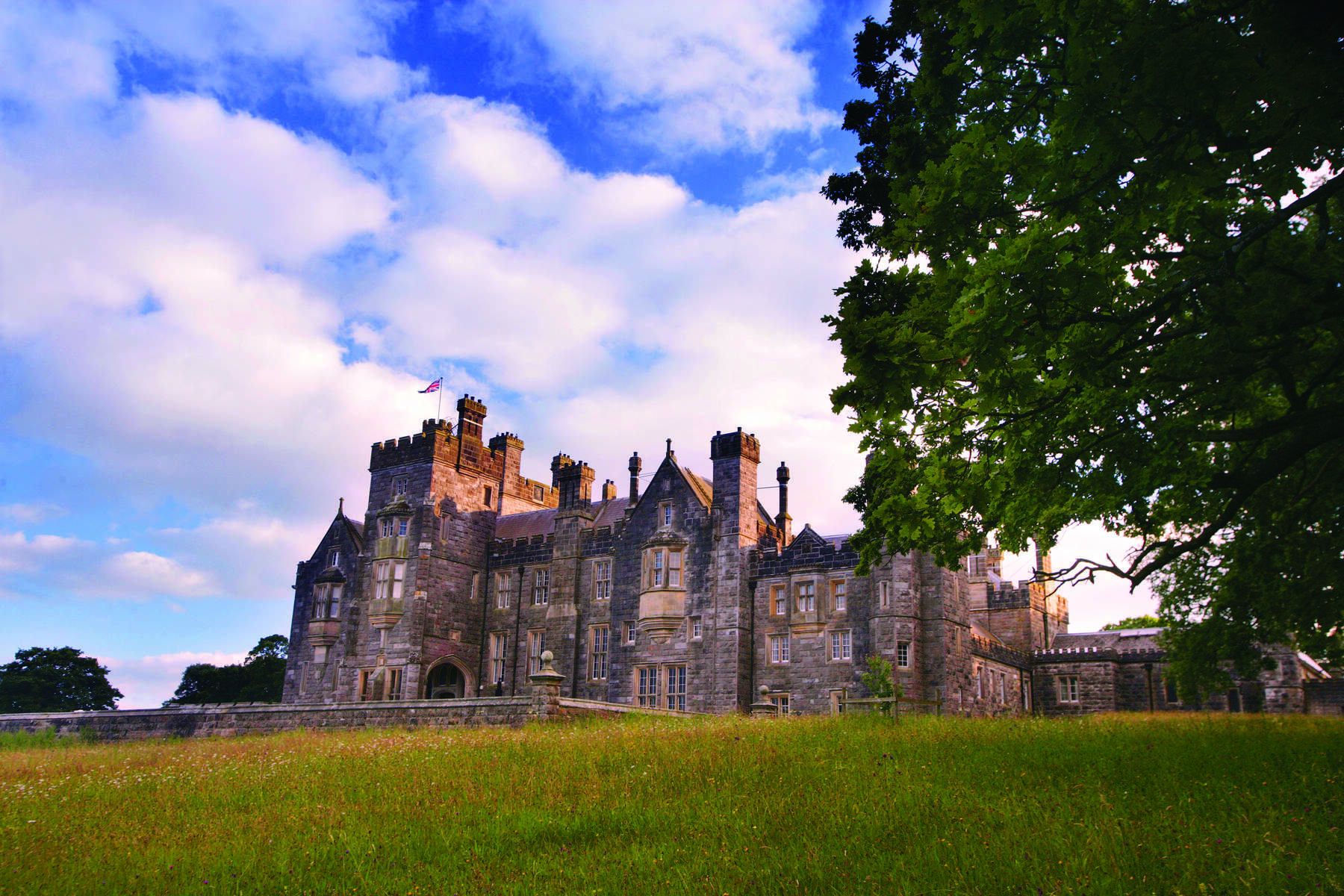
Crom Castle, Fermanagh Courtesy of Tourism Northern Ireland, by Brian Morrison, 2008 (see [3])

https://discovernorthernireland.com/things-to-do/crom-estate-p675551 and https://cromcastle.com

The castle is still in private hands but the grounds are open to the public.

Mark Bence-Jones writes in his A Guide to Irish Country Houses (1988):

p. 95. “(Crichton, Erne, E/PB) A large castellated mansion combining Baronial and Tudor-Revival elements, by the side of one of the many inlets of Upper Lough Erne, built 1829 to the design of Edward Blore. The entrance front has a gabled projection with a corbelled oriel at each end, but they are not entirely similar; while the tall, battlemented entrance tower, which incorporates a porte-cochere, is not central but to one side, against the left hand gable. The adjoining garden front is symmetrical, dominated by a very tall central tower with slender octagonal turrets, inspired by various Tudor gatehouse towers in England, but without a doorway. On either side of it is a gable and oriel. In the park are the ruins of the earlier Crom Castle, a Plantation castle of 1611, destroyed by fire in 1764.” 

5. Enniskillen Castle, County Fermanagh

https://discovernorthernireland.com/things-to-do/enniskillen-castle-p742361
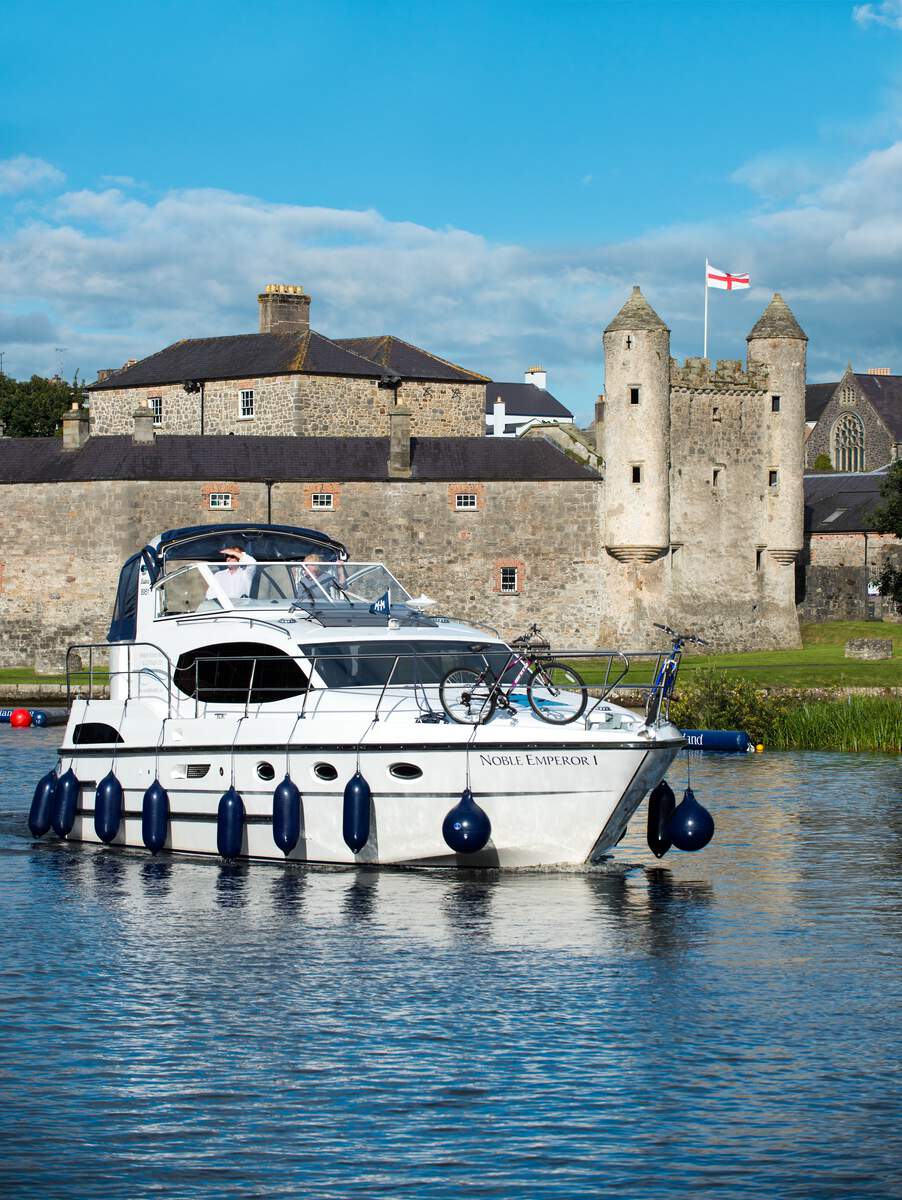
Enniskillen Castle by Gardiner Mitchell 2015 for Tourism Ireland, Ireland’s Content Pool (see [3]).

The website tells us: “Enniskillen Castle, situated beside the River Erne in County Fermanagh, was built almost 600 years ago by Gaelic Maguires.

Guarding one of the few passes into Ulster, it was strategically important throughout its history. In the 17th century it became an English garrison fort and later served as part of a military barracks. This historic site houses two museums, Fermanagh County Museum and The Inniskillings Museum.

Mark Bence-Jones writes in his A Guide to Irish Country Houses (1988):

p. 121. (Cole, Enniskillen, E/PB) A large and impressive fortress at one side of the island in the River Erne on which the town of Enniskillen is built; with walls enclosing a ward of courtyard, an inner keep and a tall and frowning water gate with two conical-roofed bartizans. Until C18 the castle stood on a small island of its own, separated from the rest of the island by a ditch of water crossed by a draw-bridge. The castle was originally built C15 by the Maguires; it was granted 1607 to Captain William Cole, who rebuilt the keep as a house for himself, and renovated all the fortifications; the water gate probably dates from his time. The Coles continued to live on and off at the castle until 1739; afterwards, they established themselves permanently at Florence Court. The castle then became barracks, and the keep was rebuilt once again. The buildings remain in good repair.” 

Enniskillen Castle by Chris Hill 2018 for Tourism Ireland, Ireland’s Content Pool (see [3]).

6. Florence Court, County Fermanagh

Florence Court, formerly the home of the Cole family, Earls of Enniskillen, is surrounded by a large area of parkland, garden and woodland, with beautiful views to Benaughlin and the Cuilcagh Mountains. photo Courtesy of Tourism Northern Ireland by Brian Morrison 2008 (see [3]).

https://www.nationaltrust.org.uk/florence-court

The website tells us:

Florence Court, March 2022. Photograph © Jennifer Winder-Baggot, www.irishhistorichouses.com

See my entry https://irishhistorichouses.com/2024/05/16/florence-court-county-fermanagh-a-national-trust-property/

Places to stay, County Fermanagh

1. Belle Isle Courtyard cottages and castle accommodation, Lisbellaw, Enniskillen, County Fermanagh Northern Ireland (self-catering)

Nestling close to the water’s edge and set within a landscape of lakes and islands of gently rolling hills and fragrantwoods, Belle Isle Castle provides self-catering or fully catered accommodation. Situated at the heart of Belle Isle Estate and dating from the early 17th century the castle has been extensively yet sensitively refurbished, ensuring that a full range of modern facilities blends seamlessly with original period grandeur. Photo for Tourism Ireland, 2008. (see [3])

https://belle-isle.com

The website tells us:

Belle Isle provides an outstanding mix of natural beauty and authentic heritage on a private 400 acre estate designated a Special Area of Conservation with a range of accommodation options including castle rental, luxury cottages and self-catering apartments. Whether you are looking to host your wedding, enjoy a private event with friends and family or just have a relaxing weekend with your pets, we have something for everyone. Enjoy a Summer Getaway to the Belle Isle Estate with one of our great special offers.

Belle Isle has a rich history dating back to before the 15th century as the place where the Annals of Ulster were written. Belle Isle Castle was built in the early 17th century as the home to many generations of nobles and has been hosting events since as early as 1760. In 1991, the castle was fully refurbished to open its doors to more visitors. Belle Isle Estate stretches over 470-acres across Lisbellaw, County Fermanagh, Northern Ireland. It is a private estate with access to its estate grounds and trails open solely its visitors. If you are looking for the ultimate experience in luxury, Belle Isle Estate is one of the best hotels Fermanagh can offer.

Mark Bence-Jones writes in his A Guide to Irish Country Houses (1988):

p. 38. “(Gore, Bt/PB; Porter, sub Baird/IFR) A house beautifully situated on an island in Upper Lough Erne; the seat of a distinguished C18 soldier, Sir Ralph Gore, 6th Bt, 1st and last Earl of Ross and Viscount Bellisle, who was C-in-C in Ireland 1788. Bought early in C19 by Rev. J.G. Porter.

Ralph Gore (1725–1802), 6th Bt, Later 1st Earl of Rosse, on His Bay Hunt, attriibuted to Thomas Spencer, courtesy of National Trust.

The present house appears to incorporate a two storey C18 range with a three sided bow at one end, to which a range of 1820-30 was added at right angles, with a staircase hall, top-lit by an octangular lantern, in the re-entrant. The house was re-modelled post 1880 in the plain English Tudor manor house style made popular by Norman Shaw and his disciples; producing a gable entrance front with mullioned windows, a projecting porch and a tall, church-like battlemented tower at the corner of th 1820-30 range. The latter range, which is the garden front facing the lough, remains unaltered apart from having Victorian plate-glass windows; at one end is the end bow of C18 range, with Georgian astragals. Inside the house, arches were opened up between the staircase hall and the rooms at either end of it, to make a much larger hall; the staircase hall was also widened at the expense of the rooms in 1820-30 range, the old wall being replaced by a massive oak beam. An oak staircase with barleysugar balusters replaced the original stairs; the walls were panelled in oak, or decorated with half-timbering. The octangular ceiling lantern, however, was left undisturbed. The drawing room, in 1820-30 range, was redecorated, having been reduced in width, and given a chimneypiece of old oak carving, possibly of more than one period and nationality. The room extending into the bow of C18 range, which is now the drawing room, was given a stone Tudor fireplace; but it still keeps its original doors with shouldered C18 architraves. In 1907 the entrance front was prolonged by a wing in Tudor style containing a long and lofty gallery, with a timbered roof, an elaborate Tudor fireplace and overmantel and a minstrels’ gallery, the balustrade of which has slender turned uprights and would appear to be late C17 or early C18 woodwork brought from elsewhere. At this end of the entrance front stands a pedimented and gable-ended office wing which would appear to date from quite early C18. After the death of N.H.A. Porter 1973, Belle Isle was inherited by his niece, Miss Olivia Baird.” 
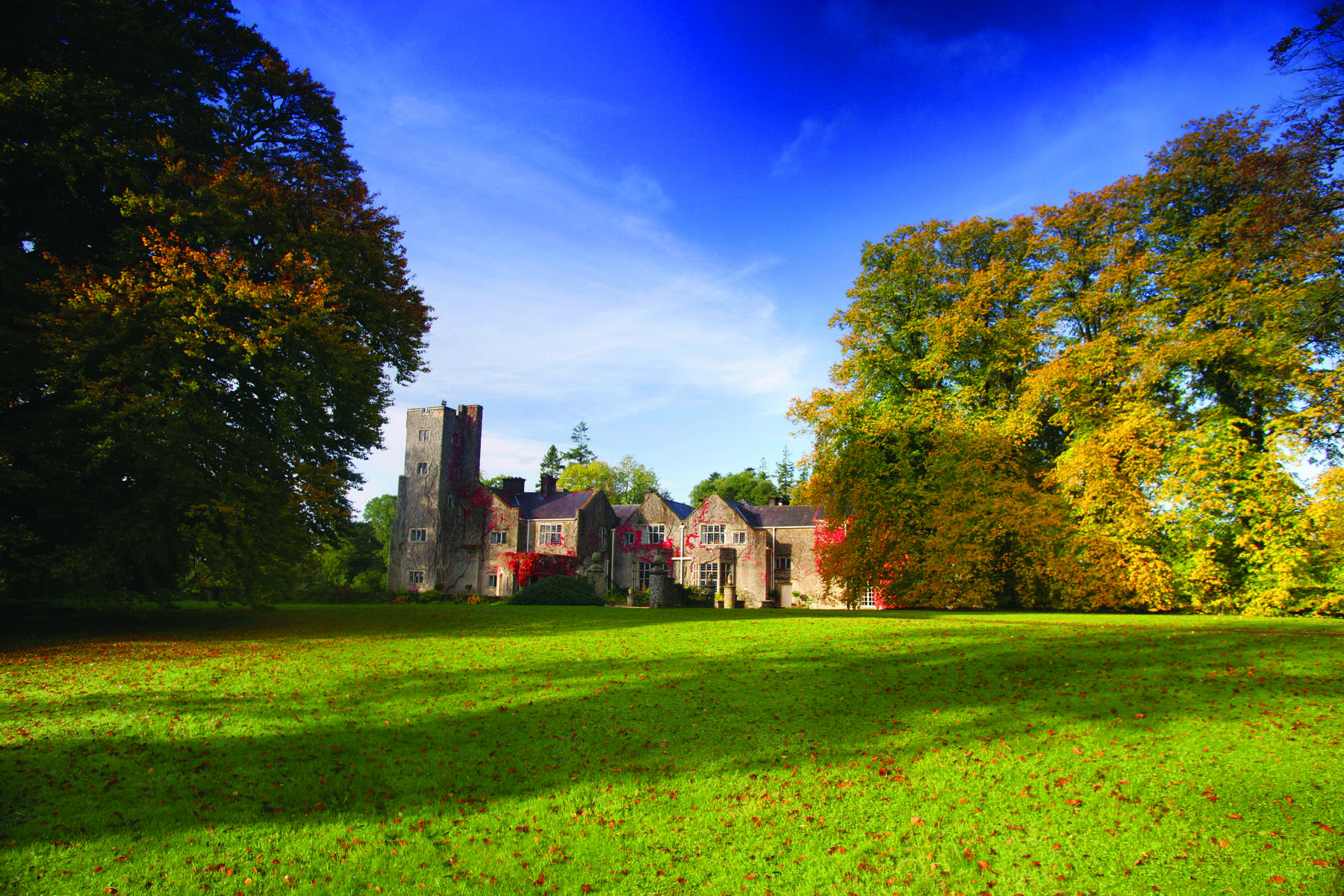
Belle Isle Estate, photo by Brian Morrison 2008 for Tourism Ireland. (see [3])

The website tells us:

Castle Irvine, also known as Necarne Castle, lies south of the town of Irvinestown, in County Fermanagh, in Northern Ireland.

The core of Necarne Castle is a castle which was built in the 17th century by Gerard Lowther as part of the plantation of Ulster. In 1629, the lands were leased to Christopher Irvine and the Irvines remained there until 1922.

In the 1830’s the castle and park were rebuild and a Victorian style wing was built against its south west facade amongst other things.

In 1925, Captain Richard Outram Hermon, from Sussex, bought the castle. In 1927 an extensive restoration of the castle and its gardens was started while Captain Hermon and his new wife went off on a world cruise. The estate was turned into a haven for shooting parties and Lord Mountbatten and Prince Bernhard of the Netherlands were once guests at Necarne Castle.

In 1941 Necarne Castle was requisitioned by the United States Navy. It originally had 200 beds but was soon enlarged to a 500 bed institution and released to the American Army. The castle, then the 28th Station Hospital, cared for recuperating American soldiers and RAF personnel. After the war the castle was never inhabited again and fell to ruin.

Fermanagh District Council bought the Necarne Castle estate in 1981; and in 1988 The NI Department of Agriculture leased the estate on a 25-year basis from them. In the last decades the outbuildings of the castle have been used as a student facility for the Enniskillen Agricultural College as the Necarne Castle Equine College. 

Fermangh & Omagh District Council began the search for a new operator for the estate in 2014 following the Agricultural College relocating their Equine Courses to Enniskillen.

Gardrum Holdings Ltd agreed a lease of the estate from 2020.

The park around Necarne Castle can freely be visited during daytime. The ruin of the castle itself is boarded up, so its interior can not be visited.”

2. Colebrooke gate lodge, Colebrooke Park, County Fermanagh € for 4

https://www.irishlandmark.com/propertytag/cottages-and-houses/?gclid=Cj0KCQiApL2QBhC8ARIsAGMm-KFInICcRSxwLSiDxfFNk5WFytNcVrLvOQYhzJbIBes4V-M65iXz0gYaAln_EALw_wcB

see also https://colebrooke.info

and Triumphal Arch Lodge, Colebrook, County Fermanagh https://colebrooke.info/cottages/triumphal-arch-lodge/

Colebrook Cottages: https://colebrookecottages.com

Colebrooke Estate in Co. Fermanagh, N.Ireland offers guests a haven of peace and privacy with over 1000 acres to play in. The 5 star Whitehill Cottage and 5 star Woodcock Corner Cottage are sensitively restored original Estate workers cottages. Rossbeg Cottage is located in a stunning part of Co. Donegal, overlooking the Atlantic Ocean. We are proud of all the properties, which offer high standards of comfort, with all the modern conveniences you would expect to find in quality accommodation.

See photographs on the recently published mention on Robert O’Byrne’s website, https://theirishaesthete.com/2022/08/03/triumphant/

Also Woodcock Corner and Whitehill Cottage, listed on the Colebrook website:https://colebrooke.info/cottages/
3. West Wing, Crom Castle, County Fermanagh

https://cromcastle.com

Holiday cottages at Crom:

https://www.nationaltrust.org.uk/crom/features/holiday-cottages-at-crom

Adler’s cottage € and Bluebell Cottage € and Aspen Cottage €

4. Erne View Cottage, Enniskillen, County Fermanagh €

https://www.nationaltrust.org.uk/holidays/erne-view-northern-ireland

A converted farm building with a spacious living area and views of the Lough Erne.

Erne View is the largest in a row of holiday cottages on the shores of Lough Erne. The cottage boasts stunning views, an open fire and a wet room on the ground floor.

Enjoy a coffee whilst taking in the view over to the Island of Inishfendra before heading down to the nearby jetty for a stroll along the shoreline.  

Adventurers might want to take advantage of the Lough Erne Canoe Trail which offers guided trips and canoe hire. Further afield, the pretty town of Enniskillen, with its historic castle, is just 20 miles away.

5. Florence Court, County Fermanagh – Butler’s Apartment

https://www.nationaltrust.org.uk/holidays/butlers-apartment-northern-ireland

Butler’s Apartment served as living quarters for the male servants at Florence Court, the 18th-century mansion next door to the holiday home. This atmospheric first floor apartment overlooks the laundry courtyard and adjoining woodland garden. Inside, you’ll find many historical quirks such as the period fireplaces, large sash windows and wooden floorboards.

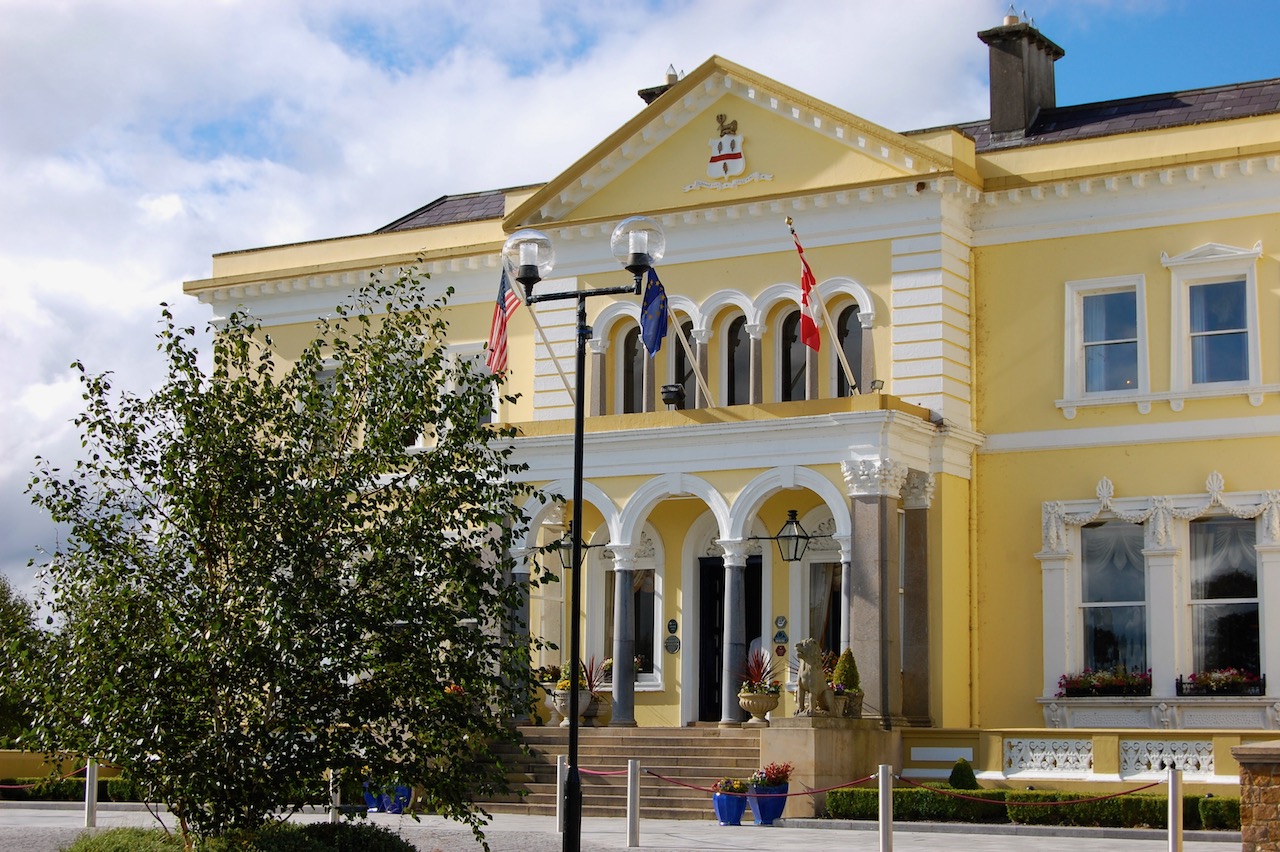
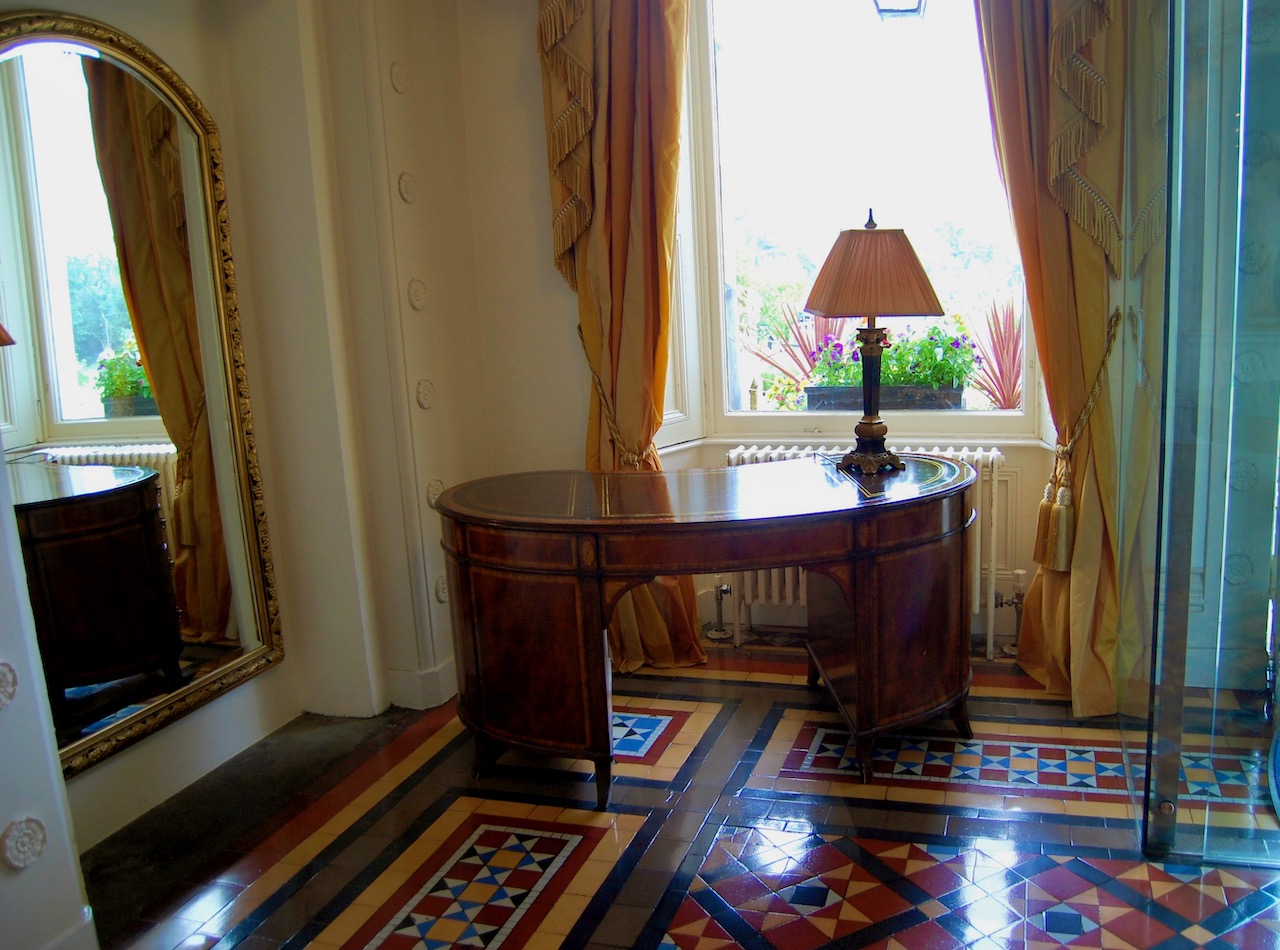
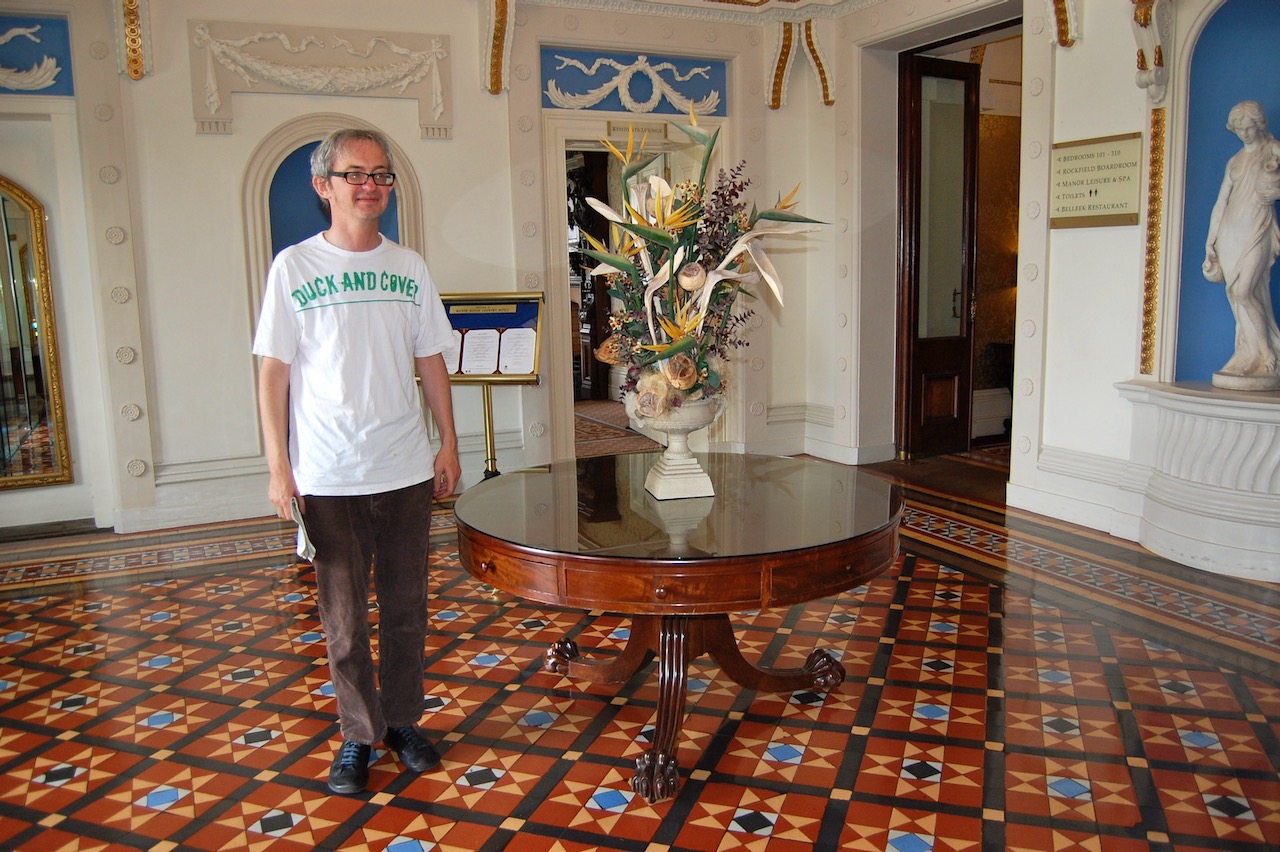
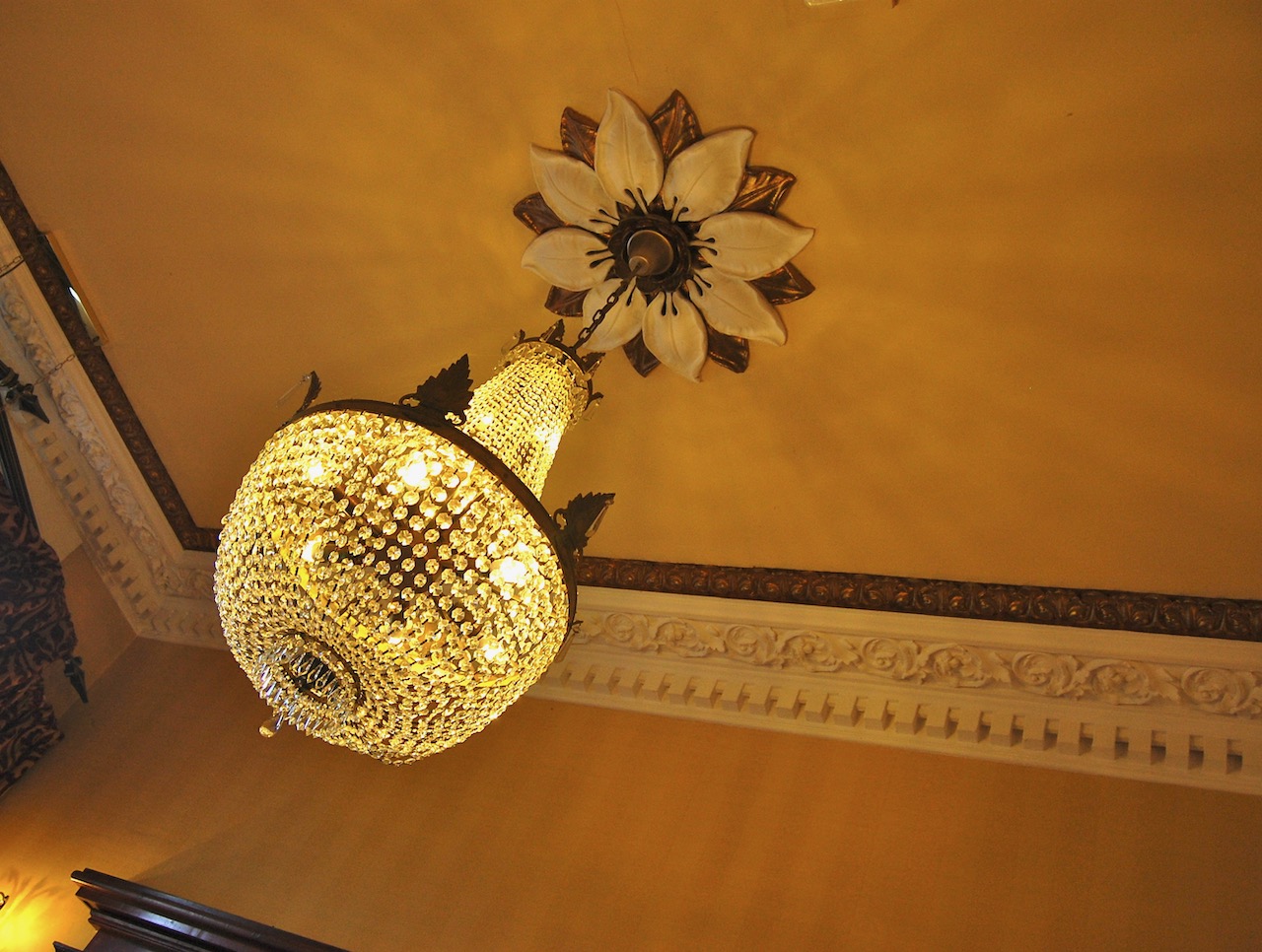
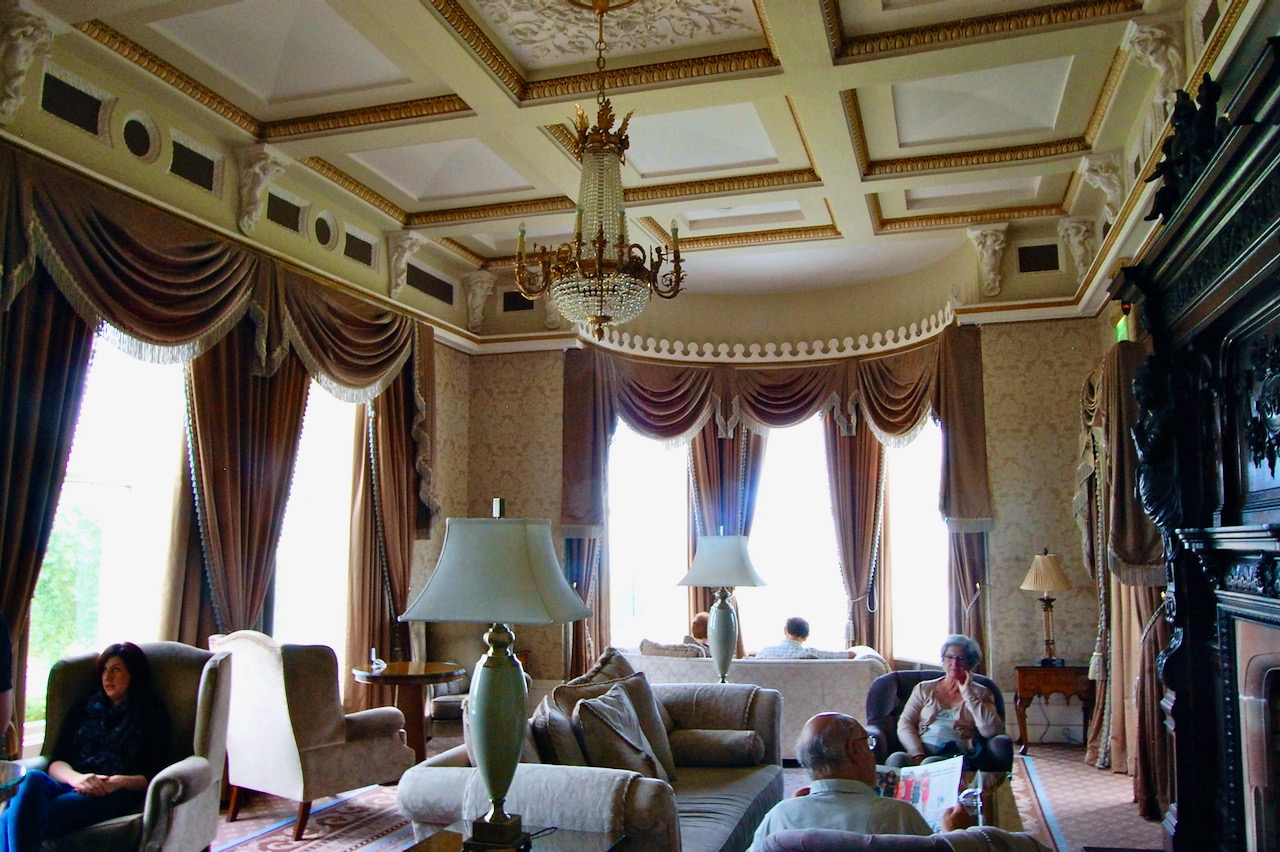
6. Manor House Hotel (formerly Killadeas Manor and before that, Rockfield), County Fermanagh

https://www.manorhousecountryhotel.com
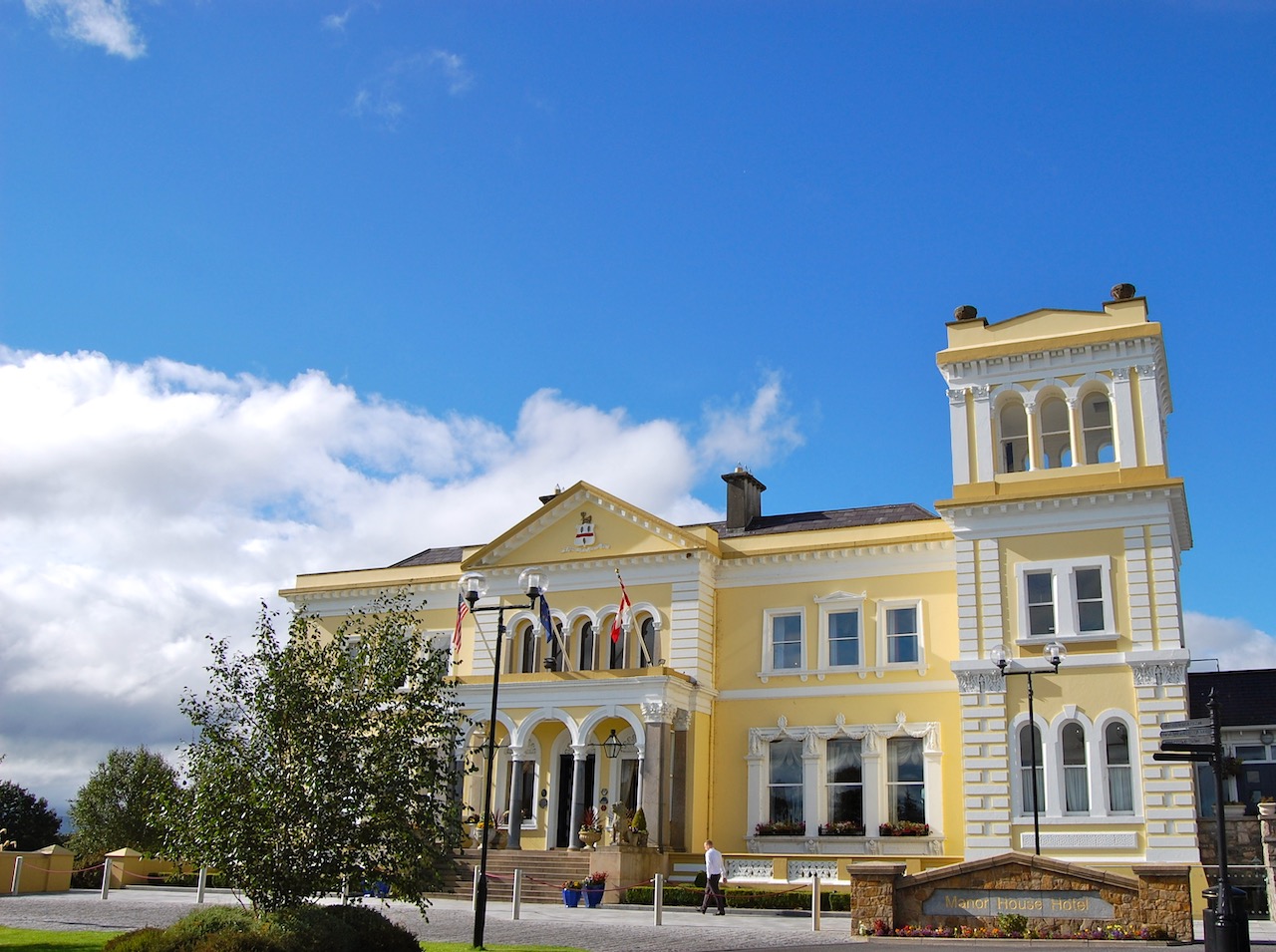
Country Manor Hotel, Fermanagh, 28 August 2013. Photograph © Jennifer Winder-Baggot, www.irishhistorichouses.com

We often stay here on our way to Donegal!

Mark Bence-Jones writes in his A Guide to Irish Country Houses (1988):

p. 168. “(Irvine/LGI1912) A two storey Victorian Italianate house, in a splendid position on the shores of Lough Erne. Entrance front with pediment and porch in the form of a three arched loggia, flanked by a square tower with glazed belvedere and urns on its parapet. Now a hotel.” 

Grounds of Country Manor Hotel, Fermanagh, 28 August 2013. Photograph © Jennifer Winder-Baggot, www.irishhistorichouses.com
Country Manor Hotel, Fermanagh, 28 August 2013. Photograph © Jennifer Winder-Baggot, www.irishhistorichouses.com

A younger son of the Irvines of Castle Irvine [now dilapidated but you can visit the grounds], John Irvine, acquired the estate in 1660. It was known as Rockfield. The website tells us it remained as Rockfield until it was rebuilt in 1860 by Colonel John Gerard Irvine (1823-1902), who brought workmen from Italy to do the interior decoration which exists to this day.

The name of Rockfield was changed to Killadeas Manor House by Major John Irvine who succeeded to Killadeas in 1835 and died in 1860. It was his son, Colonel John Gerard Irvine, who rebuilt Killadeas, incorporated some parts of the old house into the new mansion.

The website adds that in a directory of Fermanagh, published in 1879, the author states that Rockfield was built in 1710, and greatly altered and added to in 1868 by Colonel Irvine under the direction of that able and artistic architect, Mr Armstrong of Belleek. There are some obvious similarities between the architecture of the Belleek Pottery and The Manor House not least the unusual narrow, arched windows.

During the 1939-45 war it was requisitioned by the Government and was for a time used by the American Forces. The house itself was used as an Officers’ Mess and Headquarters for the Seaplane base of Killadeas. It was a plane from this base which sighted the ‘Bismarck’ and consequently resulted in the destruction of this mighty battleship. The Manor House remained in the Irvine family until 1957 when it was acquired for a Hotel.

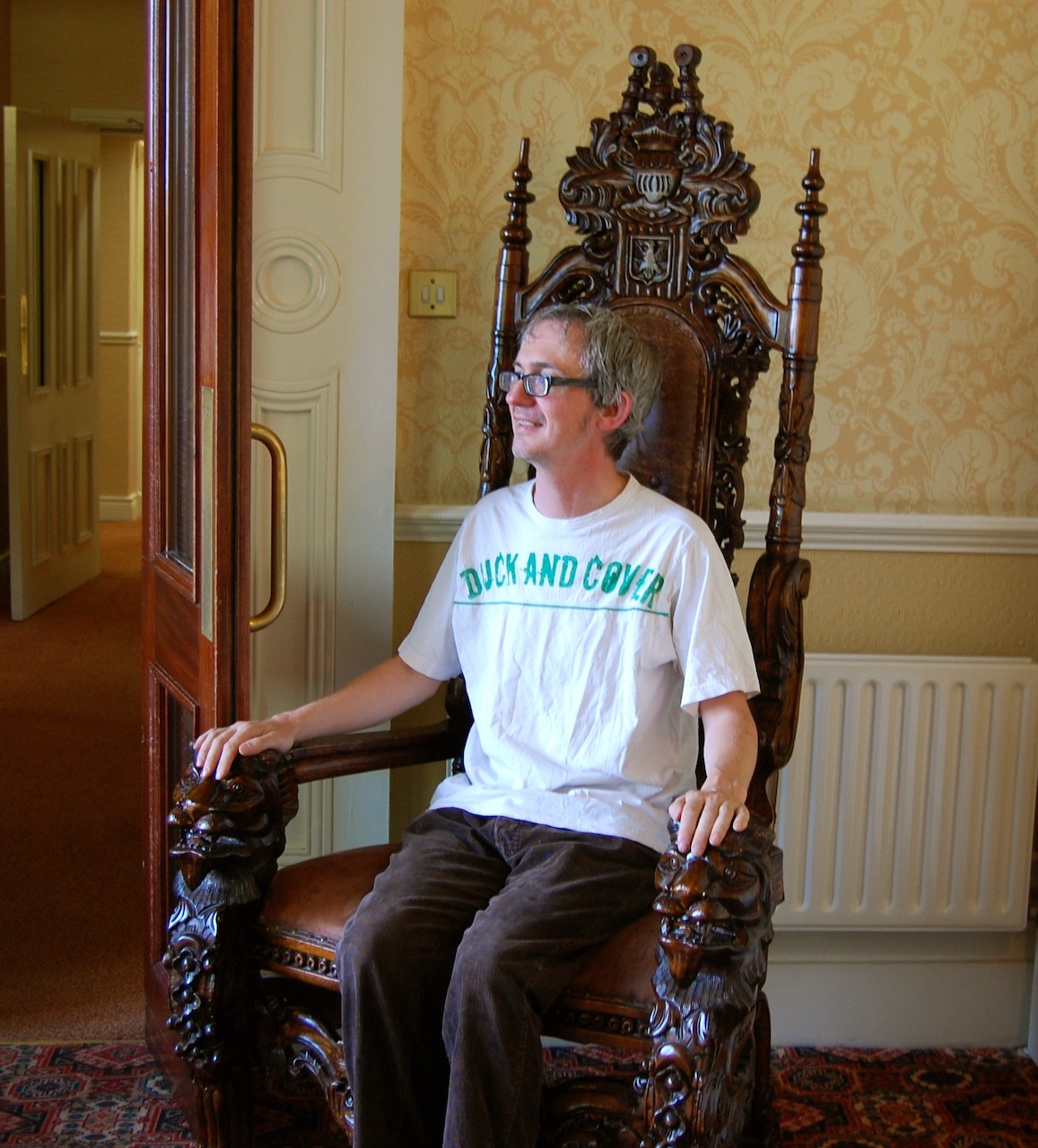
Country Manor Hotel front hall, Fermanagh, 28 August 2013. Photograph © Jennifer Winder-Baggot, www.irishhistorichouses.com
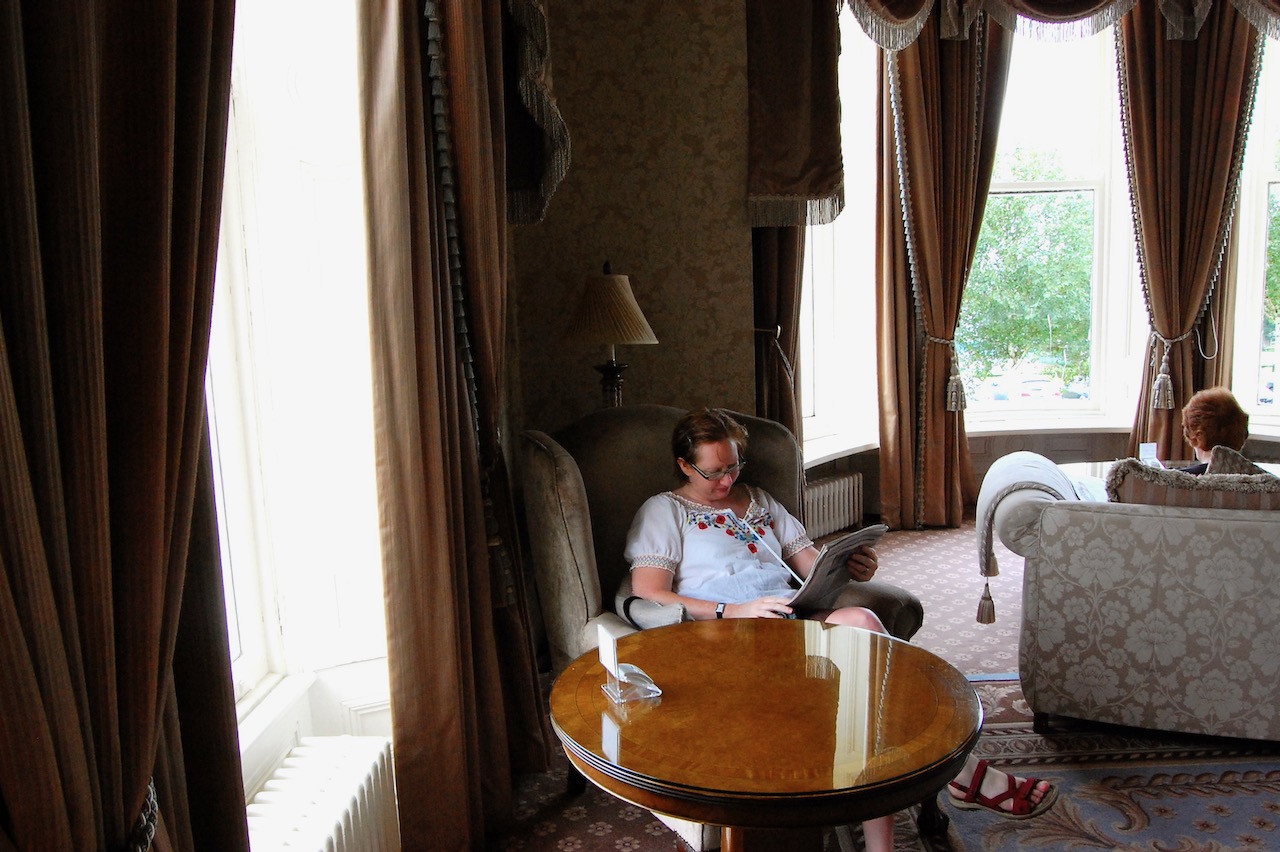
Country Manor Hotel, Fermanagh, 28 August 2013. Photograph © Jennifer Winder-Baggot, www.irishhistorichouses.com
Country Manor Hotel Drawing Room, Fermanagh, 28 August 2013. Photograph © Jennifer Winder-Baggot, www.irishhistorichouses.com
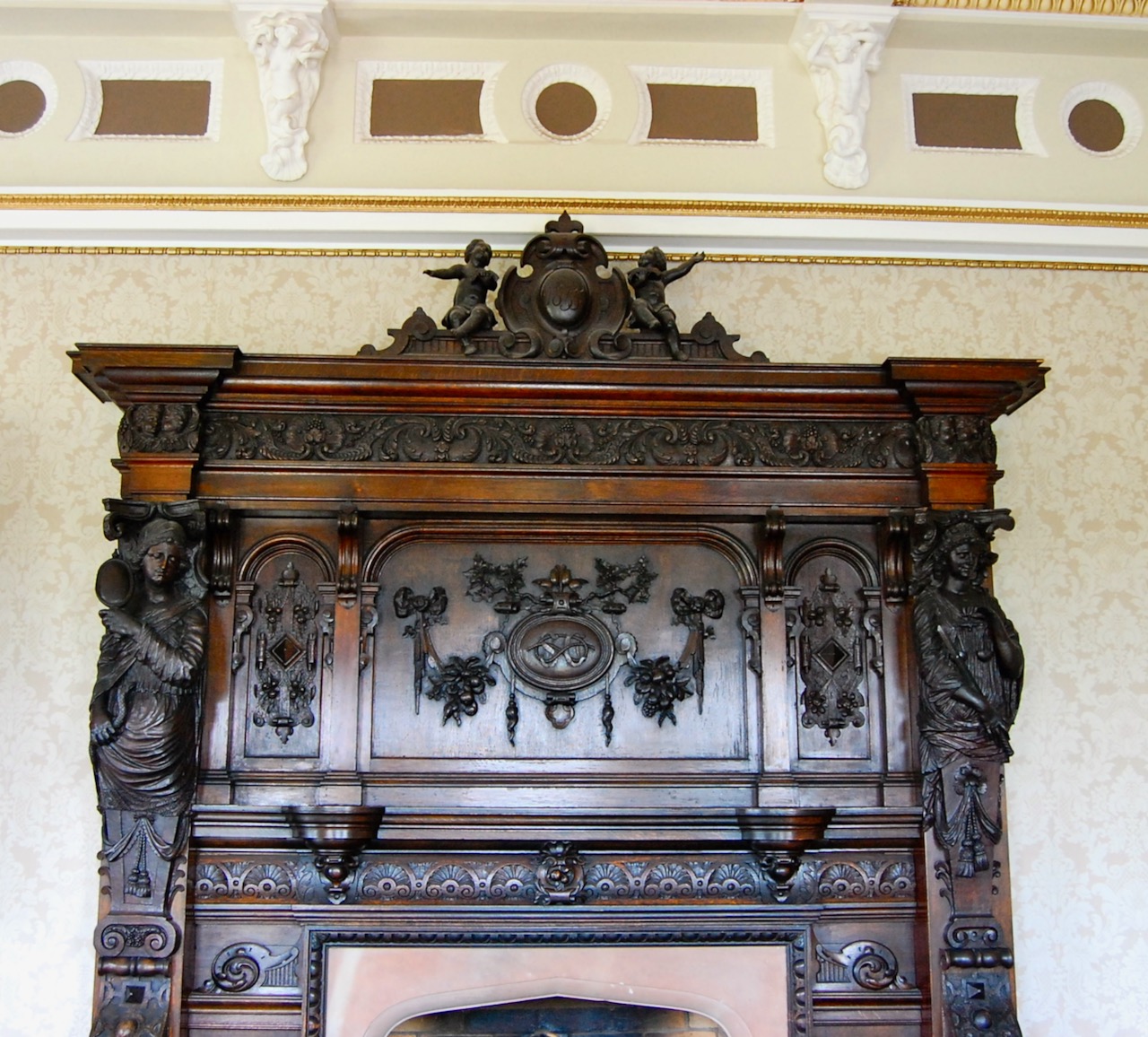
Country Manor Hotel Drawing Room fireplace, Fermanagh, 28 August 2013
Country Manor Hotel Drawing Room, Fermanagh, 28 August 2013. Photograph © Jennifer Winder-Baggot, www.irishhistorichouses.com
Country Manor Hotel, Fermanagh, 28 August 2013. Photograph © Jennifer Winder-Baggot, www.irishhistorichouses.com
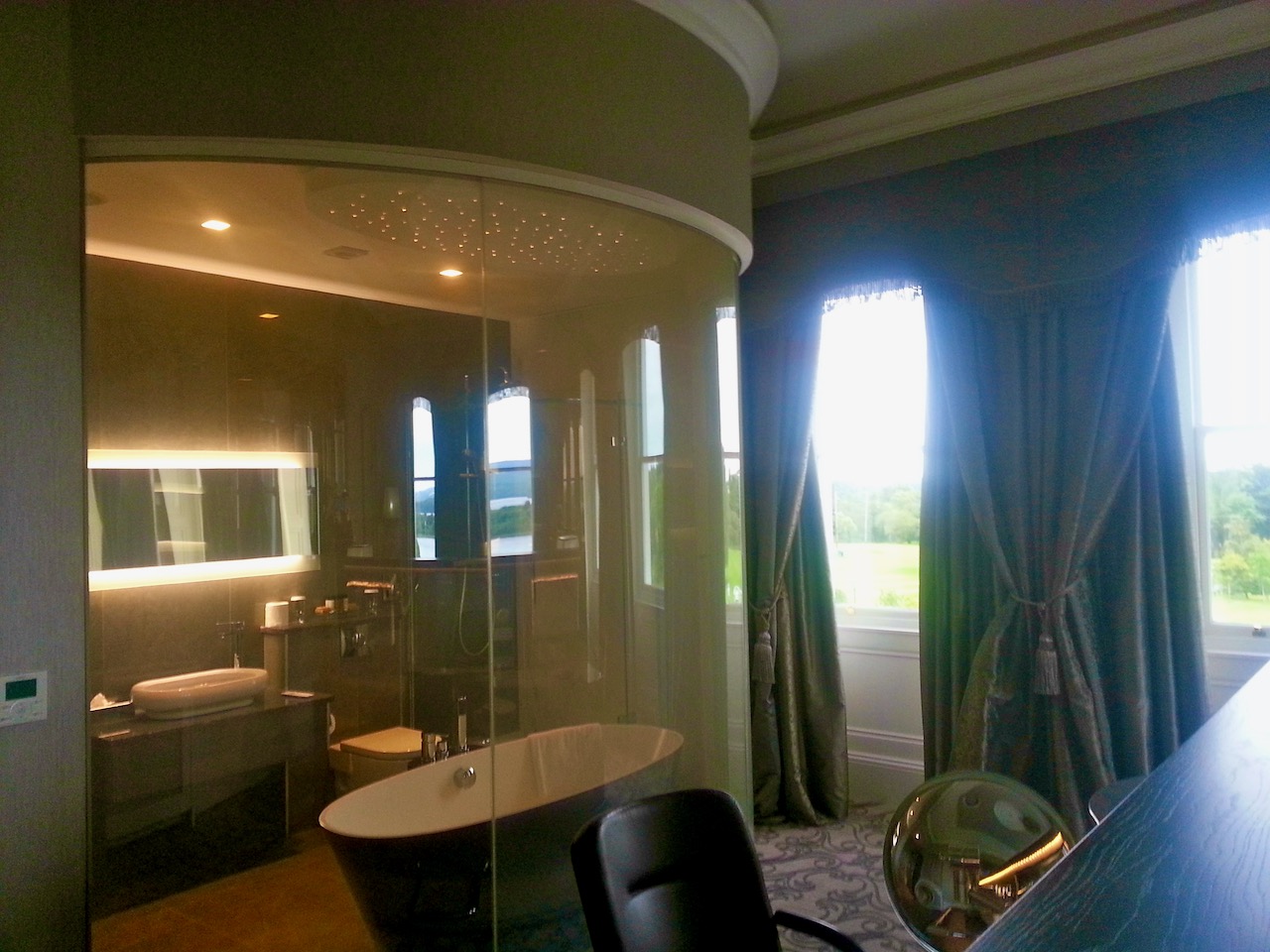
The honeymoon suite in Country Manor Hotel, Kildeas, County Fermanagh, Aug 27th 2014. Photograph © Jennifer Winder-Baggot, www.irishhistorichouses.com
Honeymoon Suite Country Manor Hotel, Fermanagh, 2014. Photograph © Jennifer Winder-Baggot, www.irishhistorichouses.com
Country Manor Hotel honeymoon suite, Fermanagh. The bathroom walls can mist up to create privacy at the push of a button! Photograph © Jennifer Winder-Baggot, www.irishhistorichouses.com

Whole House Rental, County Fermanagh:

1. Ashbrooke House, Brookeborough, Enniskillen Co Fermanagh BT94 4GX – whole house rental https://www.ashbrookehouse.com

Ashbrooke is the Dower House for the Colebrooke Estate it has been in the Brooke family for over 200 years. Formerly the home of Viscount and Viscountess Brookeborough the house has recently been fully restored and renovated to provide luxurious accommodation.

Mark Bence-Jones writes of Colebrook Park in his A Guide to Irish Country Houses (1988):

p. 89. “(Brooke, Brookeborough, V.PB) An austere Classical house of 1825 by William Farrell; built for Sir Henry Brooke [1770-1834], 1st Bt of 2nd creation. Two storey nine bay front, with a pedimented portico of four giant Ionic columns; three storey irregular side; eaved roof. Of cut-stone, with a sprinking of red sandstone ashlars which gives the elevation a pleasant reddish tinge. Large entrance hall; double staircase in back hall. Drawing room with original white and gold damask wallpaper. Sitting room with C19 arabesques. Large dining room, which Lord Craigavon, 1st Prime Minister of Northern Ireland, christened “Golgotha” on account of the numerous deer skulls covering the walls. The home of Sir Basil Brooke, 5th Bt and 1st Viscount Brookeborough, Prime Minister of Northern Ireland 1943-63; he and the late Lady Brookeborough made an attractive sunken garden at one end of the house. The house stood empty for some years after the death of 1st Viscount, 2nd Viscount living in Ashbrooke, a smaller house on the estate. But the present Lord and Lady Brookeborough have moved back into Colebrook.” 

2. Belle Isle Courtyard cottages and castle accommodation, Lisbellaw, Enniskillen, County Fermanagh Northern Ireland – see above

3. Colebrook Park, County Fermanagh

https://colebrooke.info/cole-accommodation/

The website tells us:

Colebrooke Park in County Fermanagh, Northern Ireland is first and foremost a family home, the seat of Viscount & Viscountess Brookeborough and one of region’s most important and historic stately homes. It is exclusive, discreet and offers a taste of a unique lifestyle which guests may experience whilst staying in an Irish Stately Home.  Set in a lush 1,000 acre working estate, Colebrooke Park is only 90 minutes from Belfast, 40 minutes from the West Coast of Ireland and a short distance from the tranquility of beautiful Lough Erne.

Lady Brookeborough has skilfully recreated the style and grandeur of the past with family portraits, original Victorian wallpaper, 18th Century porcelain and fine furniture used to decorate the grand rooms.  Modern additions such as en-suite bathrooms, central heating, a Business Conference Unit and Day Spa makes Colebrooke a discerning choice of venue for business away days and conferences.

Standing on the banks of the Colebrooke River, fishing, clay pigeon shooting, archery and other outdoor activities are available for guests’ enjoyment. For those who may wish to enjoy a less energetic stay there are long riverside and shrub garden walks and there are purpose built ‘hides’ for watching the abundant wildlife in this remarkable haven. These include deer, otters, mink, buzzards, kingfishers and many others.

The combination of historic grandeur, modern business facilities, outdoor pursuits and the renowned hospitality of the Brooke family means Colebrooke Park is a truly unique location for special events.

Colebrooke Park is a brilliant example of how comfortable an historic Irish Stately home can become in the 21st Century; the ultimate in luxury. Above all it is a place where guests can stay in complete privacy. The estate is ideal for weddings, house party breaks, family gatherings and as a corporate venue with a difference, all in the heart of Northern Ireland’s lush countryside.Having approached the house along the sweeping avenue, guests enter through the grand entrance beneath the portico into a large hall overlooked by the impressive main staircase.

Then guests can make their way to the Library or the Drawing Room and relax in great comfort in magnificent surroundings. In addition to these large reception rooms, there is a large billiard room. The Dining Room seats up to 30 guests at one large table and more in other formats – making it particularly well suited for corporate entertaining, private dinner parties and weddings.

Within the house, located towards the rear, is the fully equipped Conference Suite. Accommodating up to 70, the suite provides all necessary facilities for business users including overhead projector and screen.Colebrooke Park can accommodate up to 300 guests for receptions with a great deal of flexibility and with that all important personal touch that is so often missing in large hotels. There are 12 comfortable double bedrooms with private bathrooms, all of which have been individually and tastefully decorated by Lady Brookeborough.

The landscaped gardens, parkland and ancient woodland with 3 miles of the Colebrooke river meandering through it, form this stunning 1000 acre estate which is a haven of tranquility. There is also a dry grassed lawn at the side of the house suitable for a large marquee, demonstrations and exhibits or as a pleasant area to congregate on sunny days.

The website also tells us of the history, quoting an article in Country Life magazine:

A sprawling barracks* of a country house, in the heart of terrorist-torn Northern Ireland, encumbered with death duties and overdraft, is an unenviable inheritance. Particularly when, abandoned to patching, the fabric has begun to rot; the extensive stables and outbuildings are in ruins; the Victorian wallpaper is peeling from the walls of rooms empty from a house sale seven years earlier. Income from the beautiful – but agriculturally poor – 1,100 acre estate cannot conceivably support the maintenance, let alone restoration, of the house.
[* Someone else’s description – not ours!]This was the situation that confronted Lord Brookeborough and his wife in 1980. The Brookes are a fairly typical Anglo-Irish ‘plantation’ family. They arrived in the 1590’s and were granted a large portion of confiscated lands at Brookeborough as reward for services during the 1641 Rebellion (the name Colebrooke derives from the 17th century marriage of Maj Thomas Brooke to Catharine Cole). Thereafter they displayed a record of competent – often enlightened – land-holding, combined with remarkable honours for military and public service (the family includes both Field Marsh Viscount Alanbrooke and a Prime Minister of Northern Ireland).

The present house was built in 1820 by Henry Brooke (1770 – 1834), created baronet (2nd creation) in 1822, as the culmination of some three decades of frugal living aimed at restoring the fortunes of the estate after the excesses of his uncle. In common with Irish building tradition, the new house, a severe neo-Classical block, subsumed an earlier building of unknown appearance. In his ‘Specification of works’ of 1820, William Farrell – a Dublin architect who practised mainly in Ulster – wrote ‘All the old house except the present Drawing Room and Dining Parlour (the present south range) to be taken down.’ In its place, Farrell attached two ranges of red sandstone (quarried at Alterbrock on the estate and by 1835 covered with Roman cement) containing a palatial entrance hall, stone staircase, reception rooms and bedrooms. This switched the main front from south to east, leaving an untidy arrangement of windows on the south-east corner where the new two-storey building met, under the same roof, the three storeys of what remained of the old. The only ornament to this austere addition was an ashlar cornice and a free-standing giant Greek-Ionic pedimented portico, on a base of two steps, in front of the central three bays. The cost was £10,381.

Despite the sandstone in place of Portland stone, the shallow, eaved roof and lack of balustrade, the resemblance of the main front to neighbouring Castlecoole, Wyatt’s neo-Classical masterpiece is striking. This is no accident. A drawing in the Brookeborough papers held by the Public Record Office of Northern Ireland, reveals that Farrell discarded a more modest, and in many ways more appropriate design – the central three bays broken forward with an attached Ionic porch – for a direct quote of the Castlecoole portico. In a note to Henry Brooke of May 23, 1821, he approves an increase in the dimensions of the house, apparently with the sole purpose of eclipsing those of its illustrious neighbour, commenting that these changes would make the new ensemble ‘far superior to any in Castle Cool House’.

Other notes reveal ideas of increasing grandeur through the summer. First, the dining parlour was extended from the original measurements; then in September, the rooms to the left of the hall were altered ‘by taking down the partition wall and the floor over it to form a Room for a library of 36ft by 18ft …’ (In earlier plans and elevations the library is a modest, two-bay room between the drawing room and the dining parlour in the north range; this now became a breakfast room – currently the billiard room.) In 1823 additional offices were also agreed.

For the next 50 years, alterations and additions continued in a steady stream – the dower house, Ashbrooke (a plaque in the stableyard is dated 1830); lodges (a plan is dated 1833); a triumphal arch gate. These became most significant with the succession of Sir Victor (1843-91), 3rd Bt, in 1864. ‘Few houses in Britain showed more distinctly their owner’s proclivities,’ wrote Oscar Stephen in Sir Victor Brooke, Sportsman and Naturalist (1894). ‘From floor to ceiling, heads of every variety were to be seen; … bison, wild boar, moufflon, Neilgherry ibex, Pyrenean bouquetin … every known variety of red deer … markor, brahsing, ovis ammon, burrel … a grand series of roe’s heads … over the chimney piece in the hall the huge horns of an Irish elk and two enormous German red deer … two of the tigers he had killed in India … the famous black panther, and, most valued of all, the monster tusk of the great elephant, whose mighty bones … lay in mighty massiveness round the foot of the billiard table.’ It was a taste in interior decoration which prompted Lord Craigavon, first Prime Minister of Northern Ireland, to christen the dining room ‘Golgotha’.

Given that he occupied Colebrooke permanently for only seven years – thereafter paying visits only in the summer and autumn, after the delicate health of his wife prompted a move to Pau in the south of France – Sir Victor’s legacy was considerable. He introduced sika deer into the park and built the splendid ‘Conservatory with the curved projection’, mentioned in an account of October 1864 from the celebrated William Turner of Dublin. Presumably it was Sir Victor, also, who commissioned the unexecuted colour-washed designs (signed C.W.W.), for panelling the library and dining room, which have Classical and hunting themes and the Classical stained-glass window over the stone stairs.

By the 1876 return of Landowners in Ireland, the estate was almost 28,000 acres, the third largest in the county – only slightly smaller than Crom or Florence Court. However, there was a sharp change in fortunes when all but 1,300 acres were sold under the Ashbourne and subsequent Land Acts, leaving, as with so many Irish houses, a ‘demesne’ scarcely able to support a large country house. This development, combined with the agricultural depression of the 1880s which left most of the gentry even worse off than they had been in the years following the Famine, suggests that when the 4thBt, Sir Douglas Brooke, had the ‘house and demesne’ valued in 1893 (for £22.035 6s 3d) it was with a view to selling the whole property.

By 1910 Sir Basil Brooke (1888 – 1973), 5th Bt, (Prime Minister of Northern Ireland 1943 – 63), who from childhood had nursed a powerful affection for the house – as a pupil at Winchester he wrote of it as ‘always tugging at my heart’ – was writing of his desire ‘to get it on its legs’. By the time of his return after the war, high taxation had eaten into the depleted income of the neglected property. Farm profits were low and the long-term trend of food prices was down. However, by reclamation and innovation over the decades the estate became a model of efficient farming. Changes to the house included repainting, removing the cement render, demolishing the conservatory and creating a sunken formal garden on the south front.

In the early 1930’s a Minister of Agriculture official described the house as ‘comfortable but with many rooms unused’. By December 1939, Sir Basil’s letters reveal the felling of trees as ‘the only way to save Colebrooke’ and clear the overdraft. All might have been well, however, had some tax planning been made before Lord Brookeborough (as he was from 1952) died in 1973. As it was there was no alternative but to sell up, leaving the house in the condition in which the present Lord Brookeborough found it in 1980.

The question was whether a house in such a state could ever again be made to support itself, let alone remain a home. The London-based architect Paul Hyett was called in to help arrange a feasibility study and devise ways of raising capital. For a time, conversion to a golf club looked the only possibility, although it was realised that the character of the house and its setting would be unlikely to survive such a change.

Fortunately, by 1985 Lord Brookeborough’s business idea had begun to take off. The Colebrooke estate offers one of the best driven snipe-shooting anywhere, excellent stalking of sika, fallow and red deer over 10,000 acres and pheasant shooting and fishing, all of which had the potential to be developed along the one guiding principal; that all these activities must bring paying guests into the house. As the idea developed, hope returned, especially when the Northern Ireland Tourist Board agreed to provide up to 50% of the necessary capital.

Problems, however, were not long in surfacing. Government grants, geared to the provision of commercial accommodation, tended to insist on features hardly compatible with the preservation of the fragile character of a historic house; from en suite facilities to numbers on bedroom doors. Planning permission for such a change of use also triggered an avalanche of fire provisions. Although at times the differences between the parties seemed irreconcilable a spirit of compromise won through. Bedrooms were permitted with designated rather than en suite bathrooms with the ample recompense to visitors today of splendid airy proportions and traditional full-length, cast-iron baths with ball plugs. Fire signs were accepted. Numbers on doors were not.

Having addressed the major structural problems, and prepared four new bedrooms and bathrooms in the south wing, in addition to the principal bedrooms in the main front, Lord Brookeborough, guided by the conviction that just three ingredients are critical to happy apres-hunting: food, comfortable beds and never ending supplies of hot water, put this equation to work. For the rest, the main difficulty was refurbishing – on a shoestring – the vast, bare reception rooms. A friend who had bought one of the original gilt drawing room looking-glasses donated it. Marble busts of Sir Victor Brooke and his wife, by a local artist, Joseph Watkins, were retrieved from a Dublin antique shop.

Monaghan:

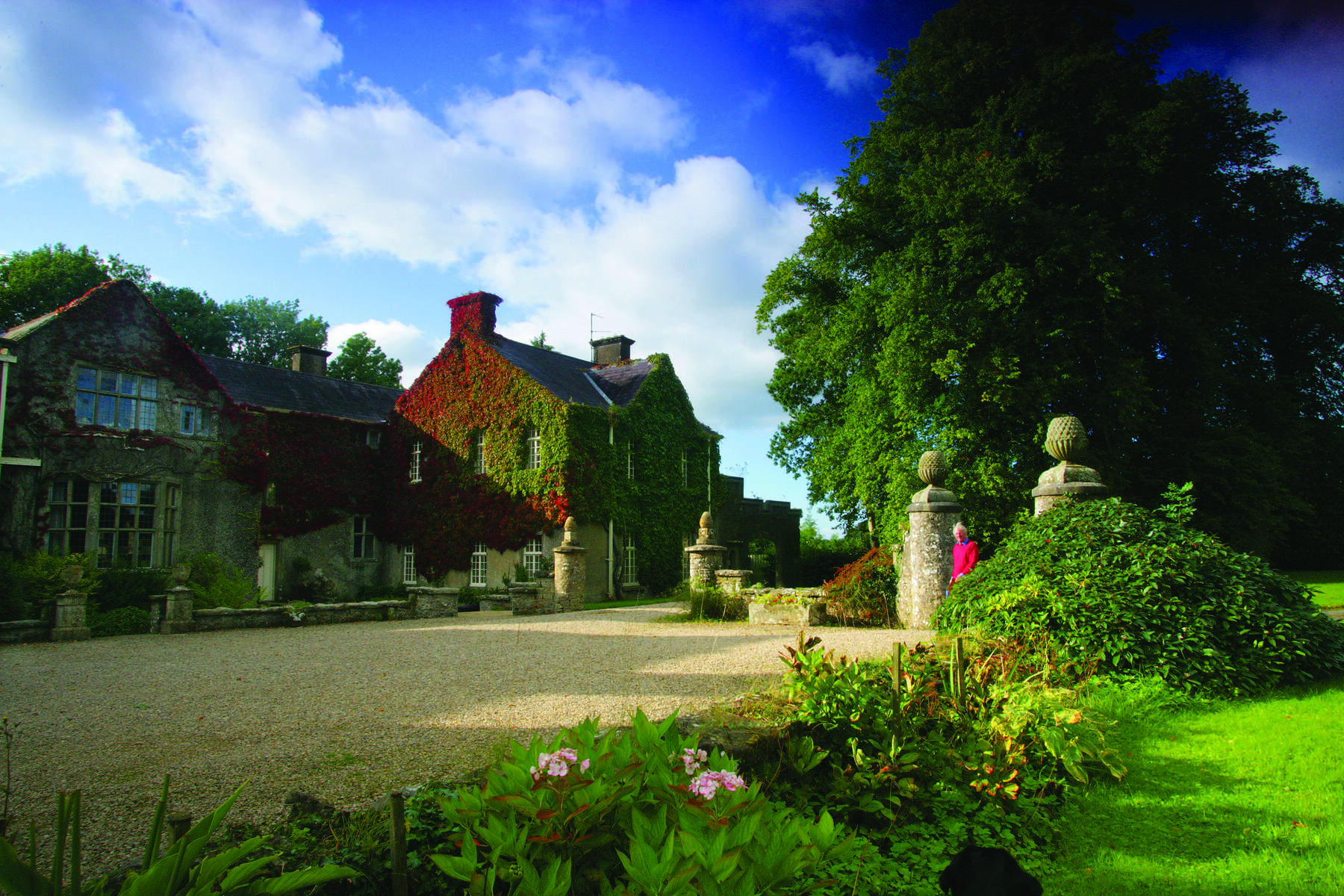
1. Castle Leslie, Glaslough, Co. Monaghan (hotel)

www.castleleslie.com
Tourist Accommodation Facility – since it is listed under Revenue Section 482 as Tourist Accommodation Facility, it does not have to open to the public. It may have events during Heritage Week – see the hotel website.

Open for accommodation: all year.

See mywrite-up: https://irishhistorichouses.com/2020/08/07/castle-leslie-glaslough-county-monaghan/

2. Hilton Park House, Clones, Co. Monaghan – section 482

www.hiltonpark.ie
Tourist Accommodation Facility – since it is listed under Revenue Section 482 as Tourist Accommodation Facility, it does not have to open to the public. However, check the website as it is open to visitors on some dates.

Hilton Park, Monaghan, photograph taken 2018 for Tourism Ireland. (see [3])

We visited during Heritage week in 2022 – https://irishhistorichouses.com/2023/06/29/hilton-park-house-clones-co-monaghan/

Hilton Park, County Monaghan. Photograph © Jennifer Winder-Baggot, www.irishhistorichouses.com

3. Mullan Village and Mill, Mullan, Emyvale, Co. Monaghan – section 482

www.mullanvillage.com
Open dates in 2025: Aug 1-31, Sept 1-30, 2pm-6.30pm

Fee: €6

Places to stay, County Monaghan

1. Castle Leslie, Glaslough, Co. Monaghan – section 482

https://irishhistorichouses.com/2020/08/07/castle-leslie-glaslough-county-monaghan/

www.castleleslie.com
(Tourist Accommodation Facility)
Open: all year

Castle Leslie, County Monaghan Photograph © Jennifer Winder-Baggot, www.irishhistorichouses.com

2. Hilton Park House, Clones, Co. Monaghan – section 482, see above

www.hiltonpark.ie
(Tourist Accommodation Facility)

There is also a cottage: https://www.airbnb.ie/rooms/52624113?guests=1&adults=1&s=67&unique_share_id=7b807434-ea7d-4b61-a8a9-977ac73725fa&source_impression_id=p3_1648836274_6bBQXGdvQuronwMs

Tyrone:

1. Ashfield Park, County Tyrone – gardens open to visitors 

http://www.ni-environment.gov.uk/index.htm 

and

Telephone 

028 9056 9615 

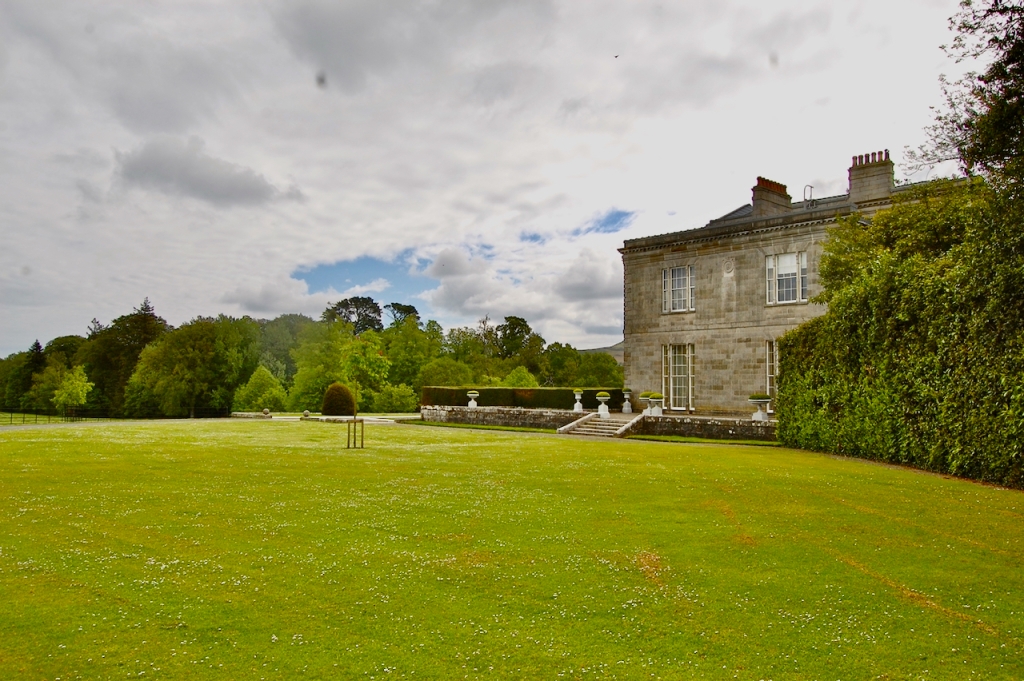
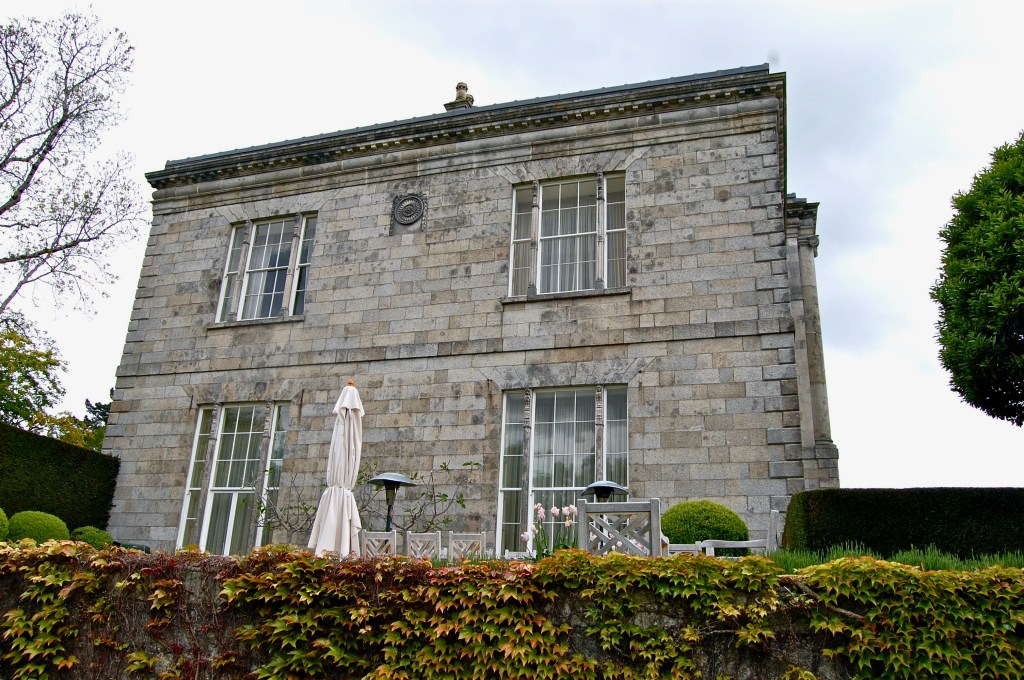
2. Blessingbourne, Fivemiletown, County Tyrone – open for tours, self catering accommodation on the grounds 

https://www.blessingbourne.com
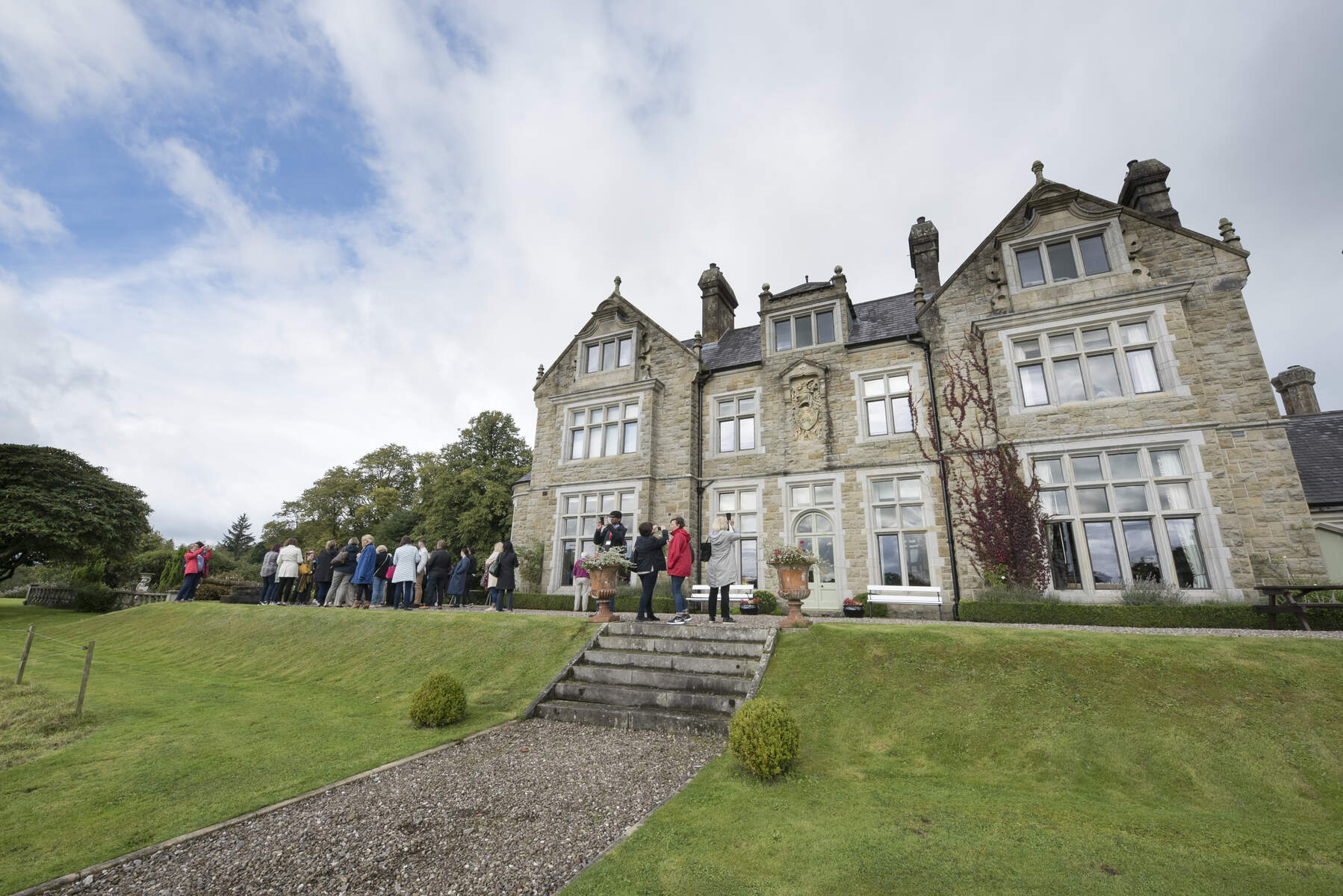
Blessingbourne, County Tyrone, photograph courtesy of Tourism Northern Ireland, 2019. (see [3])

The website tells us:

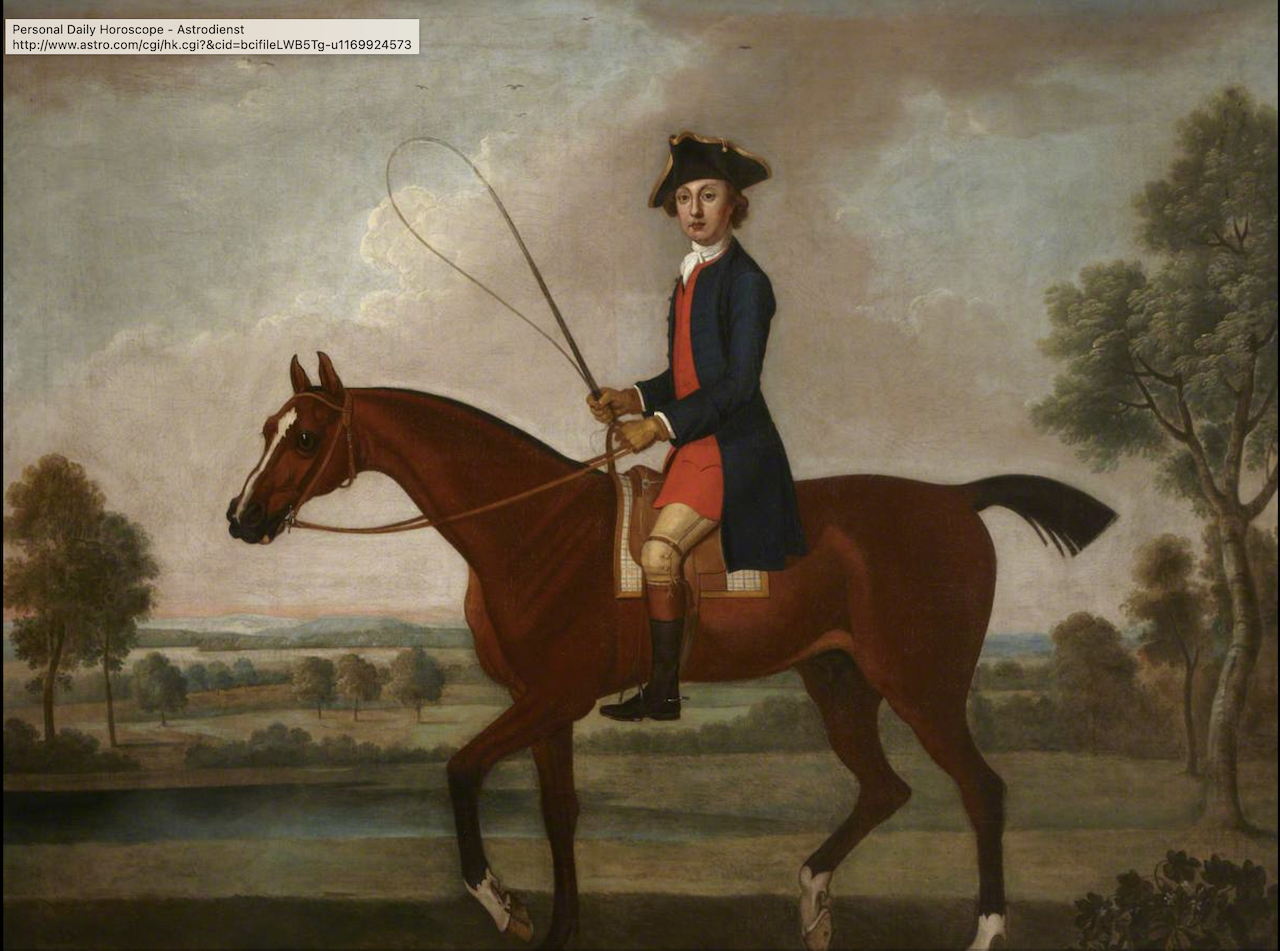
Blessingbourne Estate came into the Montgomery family by marriage to the Armar family in the early 18th century.  The builder of Blessingbourne was a man of taste; Hugh De Fellenberg known as “Colonel Eclipse”, Montgomery, grandfather of Captain Peter Montgomery.

Blessingbourne originally belonged to the Armars. The Estate came to the Montgomerys in the eighteenth century when Elizabeth Armar married Hugh Montgomery [b. 1692], of Derrygonnelly Castle in Fermanagh.

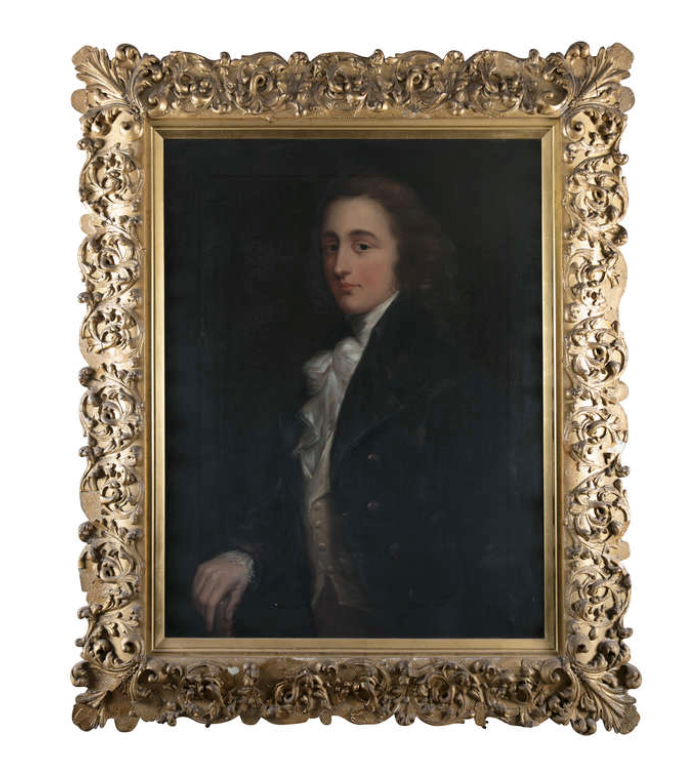
The first Montgomery to live at Blessingbourne was another Hugh. Hugh was born in 1779 and known for some reason as “Colonel Eclipse”. His portrait, which he gave to his old school, Eton, shows him to have been very handsome. However, he was unlucky in love.

He vowed he would never marry and built himself a bachelor retreat at Blessingbourne, a romantic thatched cottage. He also built the charming little Gate Lodge (transformed to the present day 5 star Gate Lodge)

But his bachelorhood ended after a few years, for he married a Spanish girl and had a son. His son’s godmother was Lady Byron, who remained a close friend and was greatly attached to his sister Mary, a key figure in the development of Blessingbourne.

It descended in the family to Peter Montgomery, Vice-Lord Lieutenant of Tyrone, who died childless, after which it passed to a cousin. The property was ultimately the inheritance of Captain Robert Lowry, a direct descendant of Colonel Eclipse, and now belongs to Colleen and Nicholas Lowry.

The Classic Tour encompasses everything well loved about the Estate. Current estate owners Nicholas and Colleen Lowry host all Tours personally. This tour includes a walk through the Victorian gardens, with their majestic setting overlooking the beautiful Lough Fadda. As well as, a private tour of main ground floor rooms of the impressive Manor House. The Manor House was built in 1871-74 and designed by Pepy’s Cockerall a close friend of William Morris. After that, enjoy a guided stroll around the extensive Coach , Carriage and Costume Collections from yesteryear.

Mark Bence-Jones writes in his A Guide to Irish Country Houses (1988):

p. 44. “(Montgomery/IFR) There was originally no house at Blessingbourne, an estate which came to the Montgomerys through marriage early in C18; the family seat being Derrygonnelly Castle in County Fermanagh, which was burnt later in C18 and not rebuilt. The family lived for some years at Castle Hume, which they rented; then, at the beginning of C19, a romantic thatched cottage was built by the side of the lough at Blessingbourne by Hugh Montgomery (known as Colonel Eclipse) as a bachelor retreat for himself after he had been crossed in love. His bachelorhood ended in 1821, when he married a Spanish girl; but during the next 50 years the family lived mainly abroad, so that his cottage was all they needed for their occasional visits to County Tyrone. The present Victorian Elizabethan house was built by his grandson, Hugh de Fellenberg Montgomery, between 1870 and 1874, to the design of F. Pepys Cockerell. Pepys Cockerell, son of the better-known C.R. Cockerell, as an artist as much as an architect; his patron and his patron’s wife were also people of tate; so that Blessingbourne is an unusually attractive and successful example of it style and period. The grey stone elevations are not overloaded with ornament; such as there is had restraint: caps on the chimneys, small finials on the gables, curved and scrolled pediments over some of the mullioned windows. The interior of the house is comfortable, with great character. The hall has a staircase incorporated in a screen of tapering wooden piers. Through glazed arches one looks across an inner hall to the lough and mountains. The principal rooms have chimneypieces of carved sone in a Tudor design, flanked by niches for logs: some of them being decorated with William de Morgan tiles. The dining room still keeps its original William Morris wallpaper of blue and green grapes and foliage; while there is another original Morris paper in the library. The late owner, Capt P. S. Montgomery, former President of th Northern Ireland Arts Council, stylishly redecorated much of the interior, which houses his collection of modern Irish art. Blessingbourne has passed to his nephew, Captain R.H.Lowry.” 

3. Hill of The O’Neill and Ranfurly House Arts & Visitor Centre, County Tyrone https://www.hilloftheoneill.com

Hill of The O’Neill and Ranfurly House Arts Visitor Centre, Tyrone, by Brian Morrison 2014, for Tourism Northern Ireland (see [3]).

The website tells us:

The O’Neills were perhaps the greatest of the Irish clans, whose origins date back as far as the 10th century and whose lineage includes two High Kings of Ireland.

Hugh O’Neill became leader of the clan in 1595 and as such was known as The O’Neill. A charismatic, even romantic figure, he had a long, tempestuous and complicated relationship with the English Crown, a relationship largely of convenience – for both parties. It was characterised by double-crossing by each side, building and abandoning strategic alliances. And ultimately, by all-out war.

In this story Hugh O’Neill, Earl of Tyrone and the last inaugurated chief of the O’Neills, plays the central role. Dungannon was at the eye of an international political storm from 1594 to 1603, during which time The O’Neill would lead mighty armies, would win and lose battles, and create problems for at least four monarchs.

And the repercussions were serious. Some might say that the consequences are still being felt today. When Hugh O’Neill was ultimately outmanoeuvred, his defeat paved the way for two connected seismic events that would forever transform his kingdom.

The O’Neill was a military genius who repeatedly got the better of the Crown’s generals in Ulster. However, after a bitter defeat at the Battle of Kinsale, he was driven to bid farewell to the Hill of the O’Neill and the lands he ruled over.

O’Neill’s departure for Spain, with the Earl of Tyrconnell and 90 followers, became known as the Flight of the Earls. It was a pivotal event in Irish history, effectively marking the end of the Gaelic way of life.

With The O’Neill and his followers effectively gone into exile, the way was clear for the organised colonisation of their lands by wealthy settlers, largely from Scotland and England under King James I. This was known as the Plantation, a plan conceived to subdue, control and ‘civilise’ the wayward Irish. Instrumental in managing the process and distributing the lands was the Lord Deputy of Ireland – Arthur Chichester, who had defeated Hugh O’Neill in the Nine Years War. (Chichester would go on to become a major figure in the founding of Belfast.)

The Plantation is the point that marks the shift in Ulster from an ancient Gaelic tradition to a new Anglo-Scottish ethos.  It is in effect, the beginning of another age in the history of Ireland, Ulster, Dungannon and, of course, of the Hill.

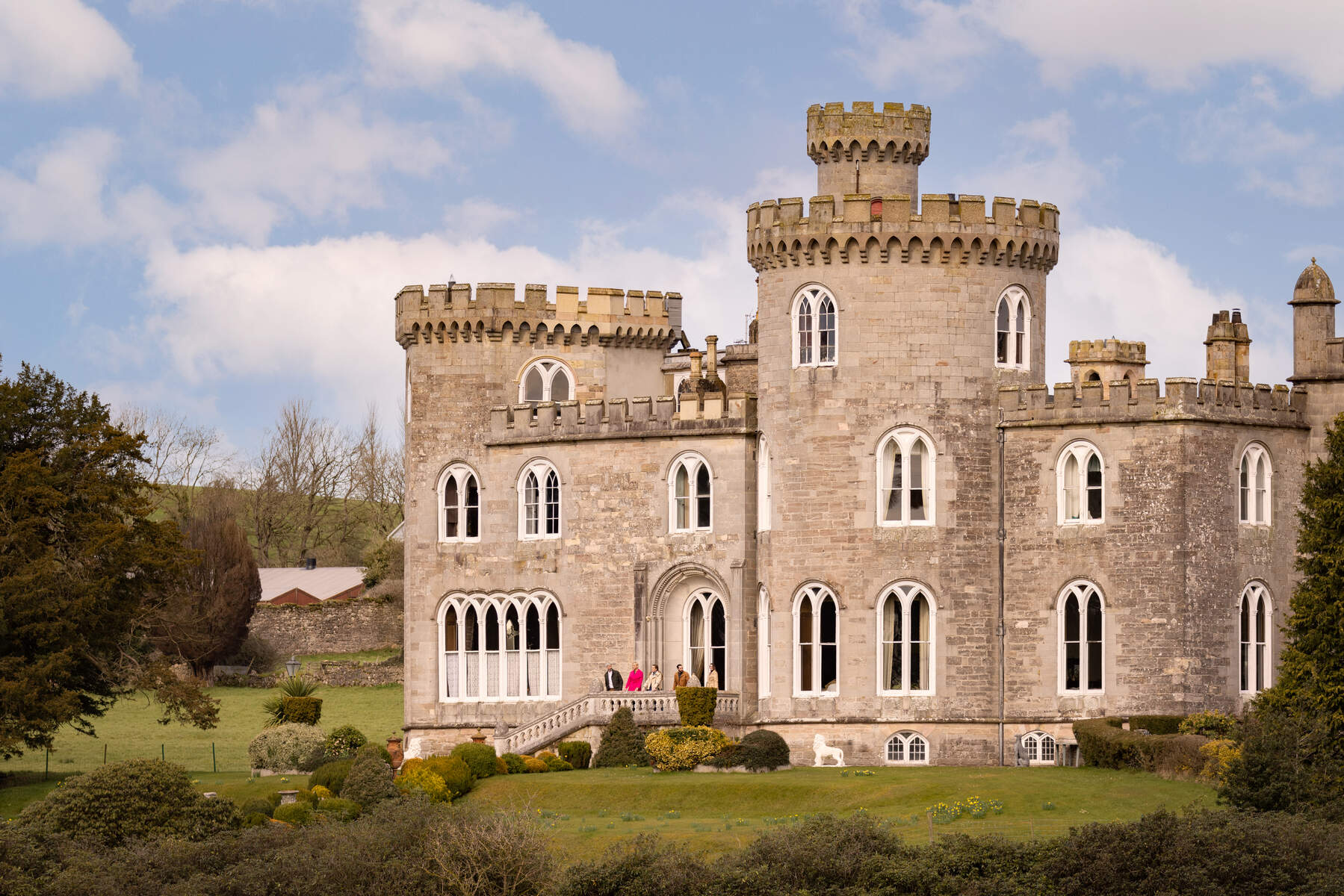
4. Killymoon Castle, County Tyrone

https://killymooncastle.com

Killymoon Castle, County Tyrone, photograph @ChristopherHeaney for Tourism Ireland 2022, Ireland’s Content Pool. (see [3])

The website tells us:

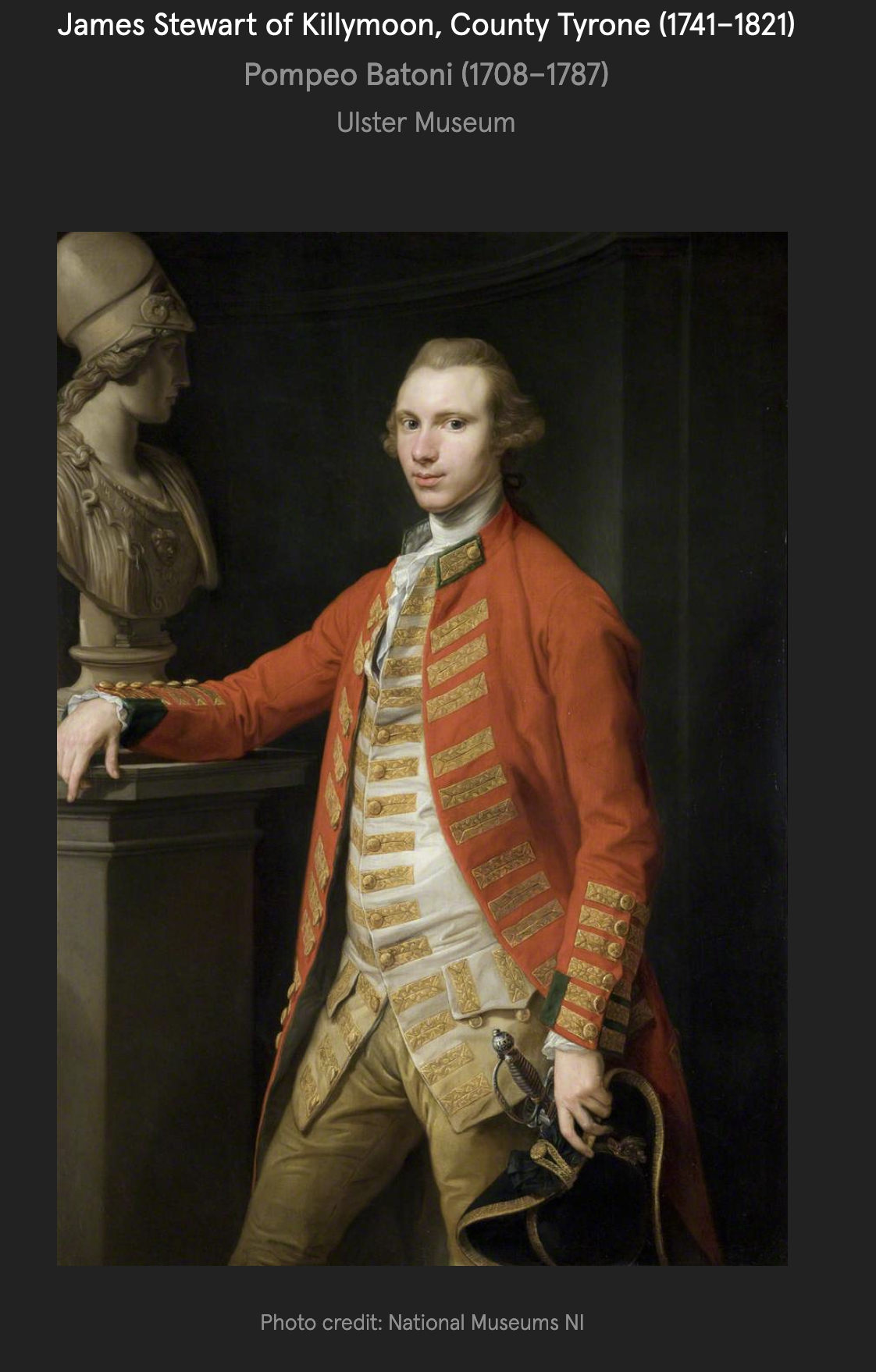
Killymoon castle sits in picturesque surroundings overlooking the Ballinderry River on the outskirts of Cookstown just 50 miles from Belfast by car. The castle is a grade A listed building designed by the famous John Nash who also designed the Regent Street area of London and its most famous landmark Buckingham Palace. The castle was originally built in 1600 for James Stewart, six generations of the Stewarts lived in the castle until 1852. It was described in the Irish Penny Journal of 1841 ‘as one of the most aristocratic residences in the province of Ulster’.”

The original castle, built in 1671 by James Stewart on the substantial demesne had been granted to him under the Plantation Settlement. Stewarts ancestors had come from Scotland during the plantation to settle in Cookstown, and in 1666 James bought the land lease for the castle site from Alan Cooke – the founder of Cookstown. The castle was destroyed by fire in 1801 and in 1802, Colonel William Stewart had a new, more imposing castle built, designed by John Nash, the famous London Architect.

James Stewart (1741-1821) of Killymoon, County Tyrone, by Pompeo Batoni, Ulster Museum, National Museum of Northern Ireland.

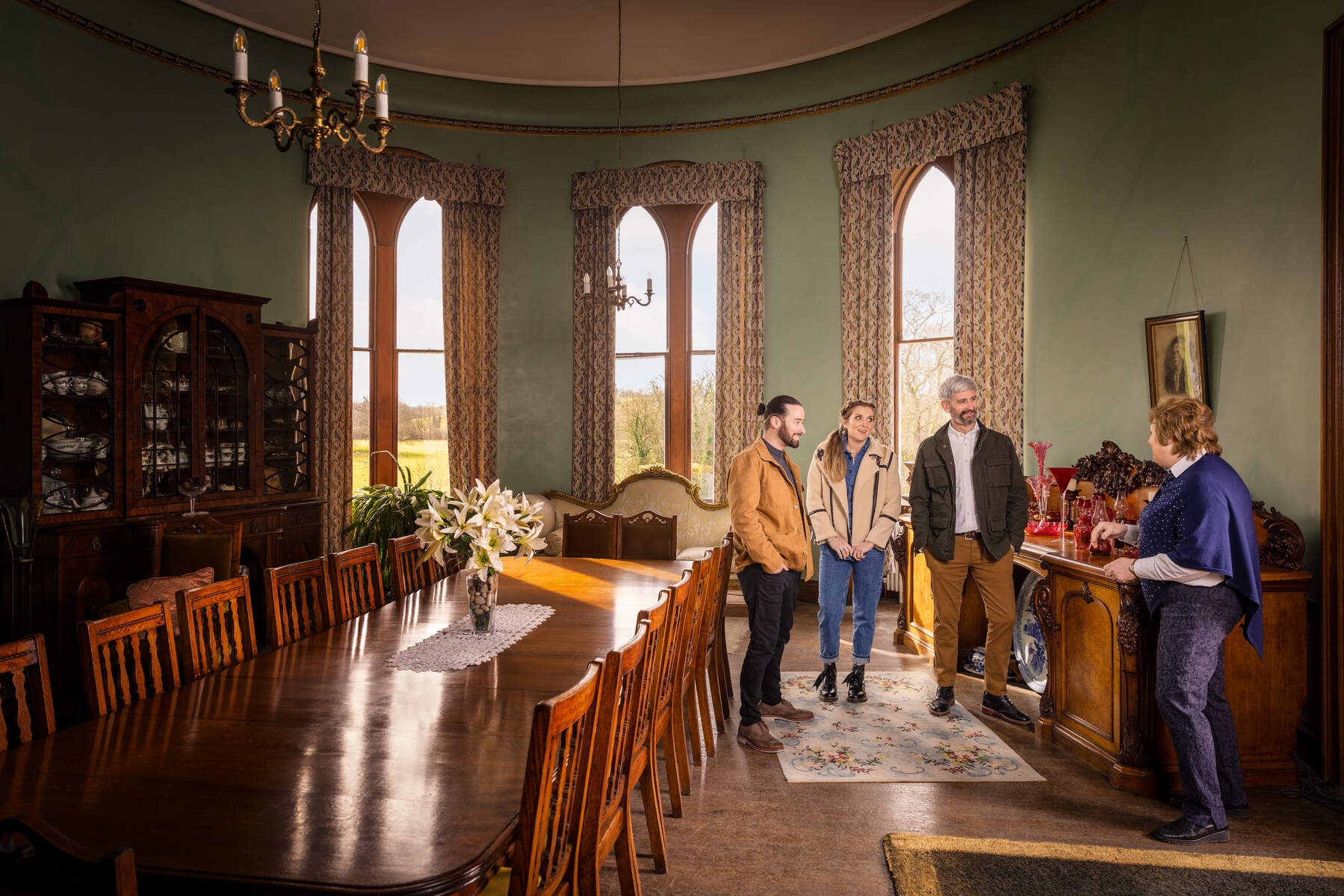
Killymoon was Nash’s first castle in Ireland, and reputedly cost £80,000 to build (about £7.4 million today).  It was described in the Irish Penny Journal of 1841 as “one of the most aristocratic residences in the province of Ulster, with state apartments consisting of “a breakfast-parlour, dining room, ante-room and drawing-room, all of which are of noble proportions and their woodwork of polished oak”.

The Killymoon estate remained the property of the Stewart family for six generations; however, their extravagant lifestyle caused the Stewart family to fall on hard times, especially during the years of the Irish famine.  The estate was sold in 1852 for £100,000.  In 1857, the castle had again been sold to the Cooper family; and, in 1865, Colonel Bolton, an English gentleman, purchased the castle.

A mere ten years later, Mervyn Stuart Thomas Moutray JP,  became the owner of Killymoon Castle until 1916, when Gerald Macura bought the castle and town of Cookstown for almost £100,000.  By 1918, Macura was also in financial difficulties and was compelled to sell off his assets. John Coulter bought the castle and grounds in 1922 and it remains the home of the Coulter family to this day.

Killymoon Castle, County Tyrone, photograph @ChristopherHeaney for Tourism Ireland 2022, Ireland’s Content Pool. (see [3])

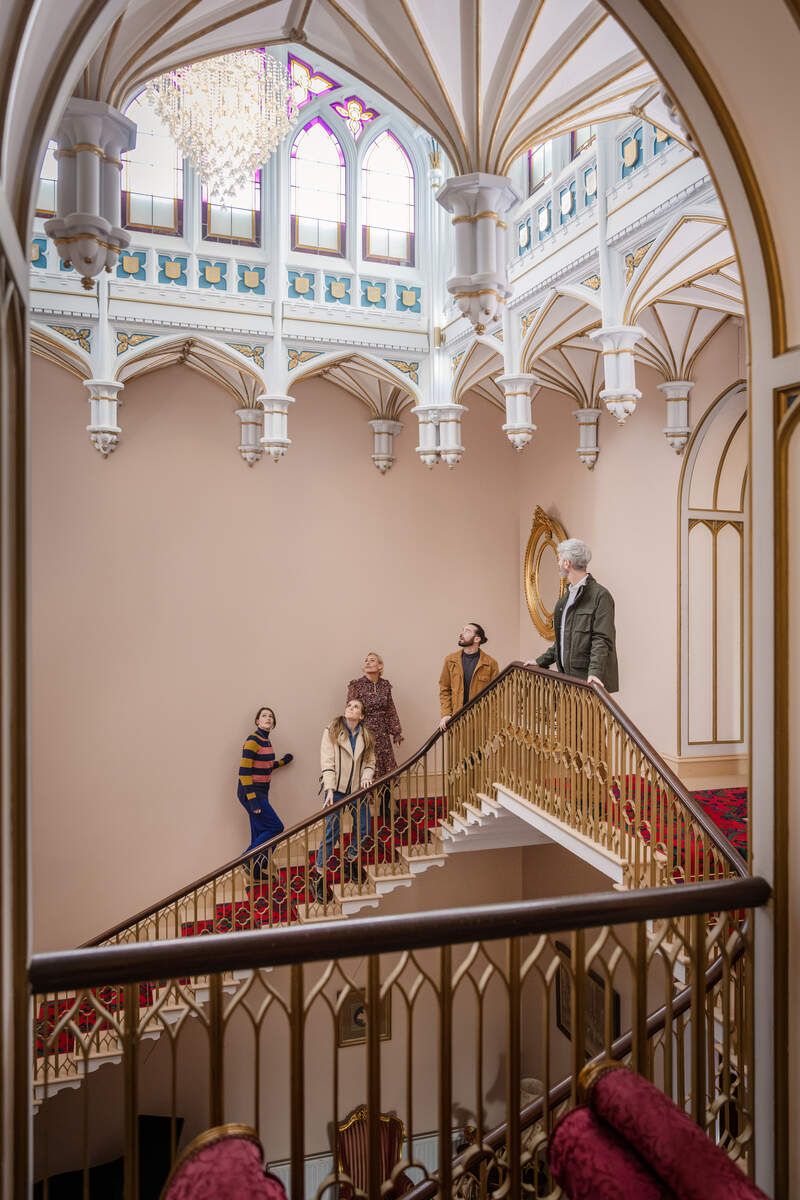
Take a tour of Killymoon Castle and step back in time. Visit Lady Molesworth’s morning room, the oval dining room whose restrained plasterwork and marble fireplace show the dignity of their Georgian origin. Ascend the magnificent cantilever style staircase and admire the fragile plasterwork like sugar spires on an inverted wedding cake .

Colonel Stewart was only 27 when this castle was built and it must have been a truly wonderful fairy tale to bring his beautiful bride to  this romantic spot.

Fortunes and families rise and fall and this fabulous fairy dwelling which cost £80.000 to build in 1807, was gambled in a game of poker and sold for an unbelieveable sum in the 1920’s 

Group tours can be arranged  by clicking the button below and filling out a request form. Private tours also available.

Killymoon Castle, County Tyrone, photograph @ChristopherHeaney for Tourism Ireland 2022, Ireland’s Content Pool. (see [3])

Mark Bence-Jones writes in his A Guide to Irish Country Houses (1988):

p. 173. “(Stewart/LGI1912; Moutray/LGI1912) One of John Nash’s earliest castles, built ca 1803 for William Stewart, MP, incorporating part of the previous house which was burnt ca 1800. A building with a romantic silhouette in a glorious position above the Ballinderry river with a backdrop of sweeping woods and parkland. The principal front dominated by an almost central battlemented and machicolated round tower and turret; at one end, an octagonal battlemented and machicolated tower; at the other, the profile of the square tower in the adjoining front, the base of which is arched to form a porte-cochere. The latter tower has slender octagonal corner turrets, with cupolas. Pointed windows grouped together under segmental hood-mouldings, which were regarded by Nash and his contemporaries as Saxon. Good interior planning with square, circular and octagonal rooms fitted together. Hall with double staircase, lit by Gothic lantern on plaster fan-vaulted ceiling. Drawing room with plain gilt plasterwork cornice of wreath and honeysuckle design. Library in form of Gothic chapel, with stained glass windows. Sold after William Stewart’s death 1850. Subsequently the seat of the Moutray family.” 

Killymoon Castle, County Tyrone, photograph @ChristopherHeaney for Tourism Ireland 2022, Ireland’s Content Pool. (see [3])

5. Lissan House, Drumgrass Road, Cookstown, County Tyrone, BT80 9SW. https://www.lissanhouse.com/

The house is open from Easter to mid September on Saturdays and Sundays, and during July and August it is open Thursday to Sunday. Opening hours are from 12:00 – 17:00.
3 guided tours per day at 12:30, 14:00 and 15:30.

Lissan House is an enchanting country residence set within a 260 acre demesne of ancient woodland and forestry. 

The estate was created in the 17th century and remained the home of the Staples family for nearly 400 years. Lissan came to prominence in 2003 when its popularity helped it reach the final of the BBC Restoration programme. 

Following extensive redevelopment, the house opened its doors in spring 2012 to reveal modern interactive exhibits and original family furnishings which take you on a unique journey through the history of the estate and the family characters that have shaped it. Children will be kept entertained in the house with the teddy bear treasure hunt. The demesne also features a challenging adventure playground for children, a wooded picnic area, walled garden.

Lissan House and estate is now run and managed by a charitable board, who help secure the future of the property for the benefit of the community.

Robert Staples (1772-1832) 8th Baronet, courtesy of National Trust Springhill.

Mark Bence-Jones writes in his A Guide to Irish Country Houses (1988):

p. 188. “(Staples, Bt/PB) A plain three storey 9 bay Georgian house with later additions. At one end, a single-storey wing with a three-sided mullioned bow. At the other, a gable-ended office range. And in the middle of the entrance front, a single-storey protuberance of unusual depth, embodying a porch and a bow-fronted porte-cochere with windows. Some time post mid-C18, a garden was laid out here by the architect, Davis Duckart; with an “artificial sheet of water with cascades, and a picturesque bridge.” 

6. Prehen, County Tyrone

http://prehenhouse.com/?msclkid=cbb767dba6a711ec8a9ab161a56f043c

Places to stay County Tyrone

1. An Creagan,Omagh, County Tyrone € for 4 or more nights, €€ for 2 nights

www.ancreagan.com

2. Ashbrook House, Aucnacloy, County Tyrone

www.ashbrook-house.co.uk

3. Baronscourt Estate, Newtownstewart, Omagh, County Tyrone € for one week

https://barons-court.com

4. Blessingbourne, County Tyrone €€

https://www.blessingbourne.com/self-catering-accommodation/ 

Nestled in the heart of the estate’s historic courtyard the collection of 5 award-winning self-catering apartments are ideal for family breaks, romantic breaks and groups. Guests can enjoy a relaxing country estate experience.

Guests can choose from 1 bedroom or 2 bedroom self-catering accommodation, all of which are pet friendly. Experience a home from home environment with the apartment’s warm and inviting décor. All apartments feature open plan Living, Dining and Kitchen areas. On-site laundry facilities are available.

5. Cobblers Cottage Omagh, County Tyrone (sleeps 5)

http://www.cobblerscottagecreggan.com

The lovingly renovated Cobblers Cottage has a cosy living/kitchen/dining area, 2 spacious bedrooms (sleeps 5) &  a bathroom.

Enjoy the simplicity of this recently renovated 200 year old traditional Irish cottage in peaceful surroundings of Tyrone at the foot of the Sperrin Mountains between Omagh and Cookstown, in the area of Creggan. 

6. Corick House Hotel, Clogher, County Tyrone €€

https://www.corickcountryhouse.com

7. Kilcootry Barn, Fintona, County Tyrone

www.kilcootrybarn.com

Kilcootry Barn is a 150 year old stone barn which is set on a 6 acre retreat in a private, rural setting.

This beautifully furnished and fully equipped property offers luxurious self catering accommodation for the discerning visitor.

8. Killymoon Castle Lodge, 302 Killymoon Road, BT80 8ZA, see above

https://killymooncastle.com

Stay with us in our Castle Lodge, located in the grounds of Killymoon Castle on the banks of the Ballinderry River, offers the most tranquil of breaks. Only a short distance from Cookstown town centre and a one hour drive to the north coast, Donegal or Belfast. With Killymoon golf club and the Ballinderry River on your doorstep what better way to relax.

9. The Lower House Rooms, Donaghmore, Dungannon, Co. Tyrone, BT70 3EZ

https://thelowerhouserooms.com/rooms/

Located in Donaghmore in the heart of Mid-Ulster, the conversion of The Lower House into 7 rooms of accomodation has been our pride and joy. Renovated with the finest fixtures, fittings and decoration, a stay at The Lower House rooms is an experience full of character and luxury.

10. Spice Cottages, Dungannon, County Tyrone €€

https://www.spicecottages.com/cottages/ginger-cottage-dungannon

4 Stunning self catering family cottages situated in the Dungannon countryside, Co. Tyrone, Northern Ireland

[1] Bence-Jones, Mark. A Guide to Irish Country Houses (originally published as Burke’s Guide to Country Houses volume 1 Ireland by Burke’s Peerage Ltd. 1978); Revised edition 1988 Constable and Company Ltd, London.

[2] http://lordbelmontinnorthernireland.blogspot.com

[3] Ireland’s Content Pool, https://www.irelandscontentpool.com/en

Text © Jennifer Winder-Baggot, www.irishhistorichouses.com
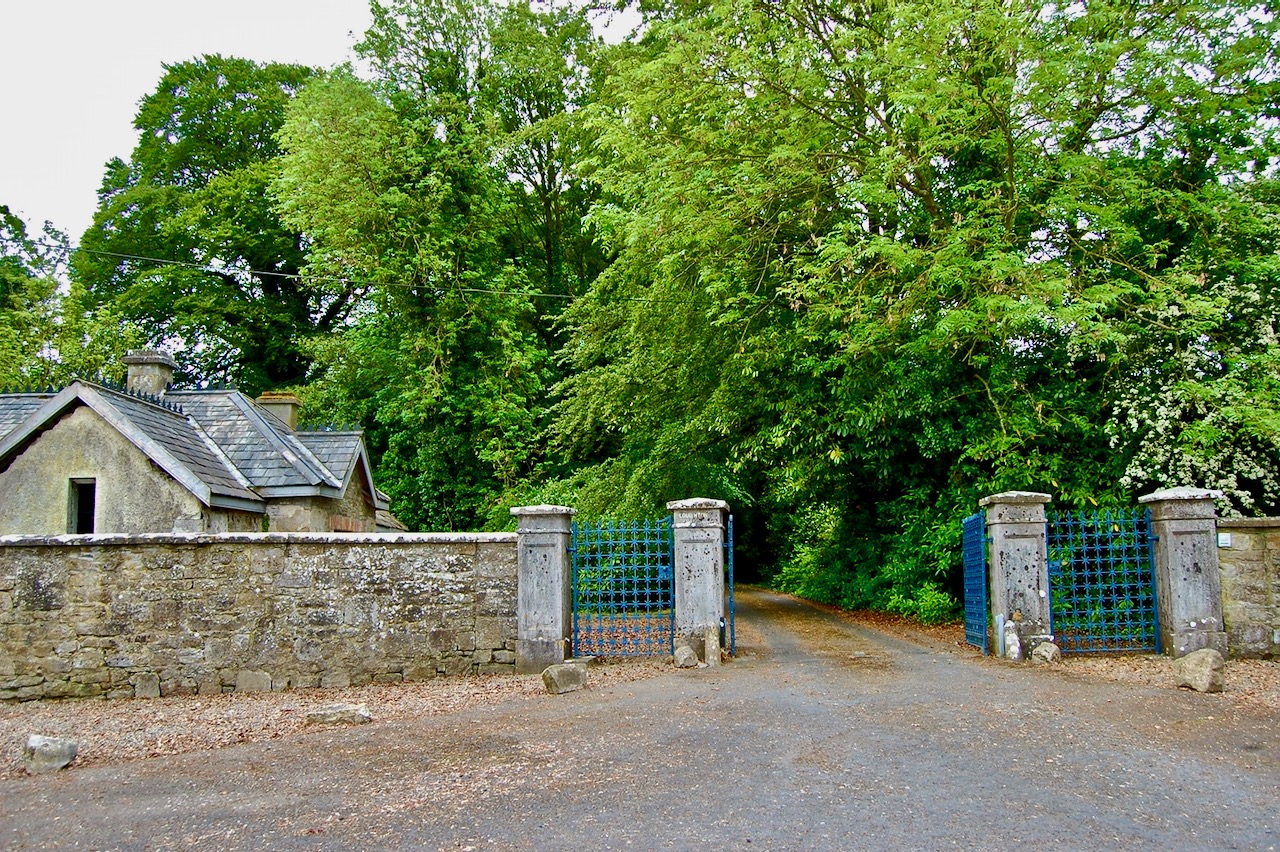
Loughton House, Moneygall, County Offaly E53 WK16 – section 482

www.loughtonhouse.com
Open dates in 2025: May 1-3, 6-10, 13-17, 20-24, 27-31, June 3-7, 10-14, 17-21, 24-28, Aug 5-9, 12-24, 11am-3pm

Fee: adult €8, OAP €7, child/student free

donation

Help me to pay the entrance fee to one of the houses on this website. This site is created purely out of love for the subject and I receive no payment so any donation is appreciated!

€15.00

Loughton, May 2019. Photograph © Jennifer Winder-Baggot, www.irishhistorichouses.com
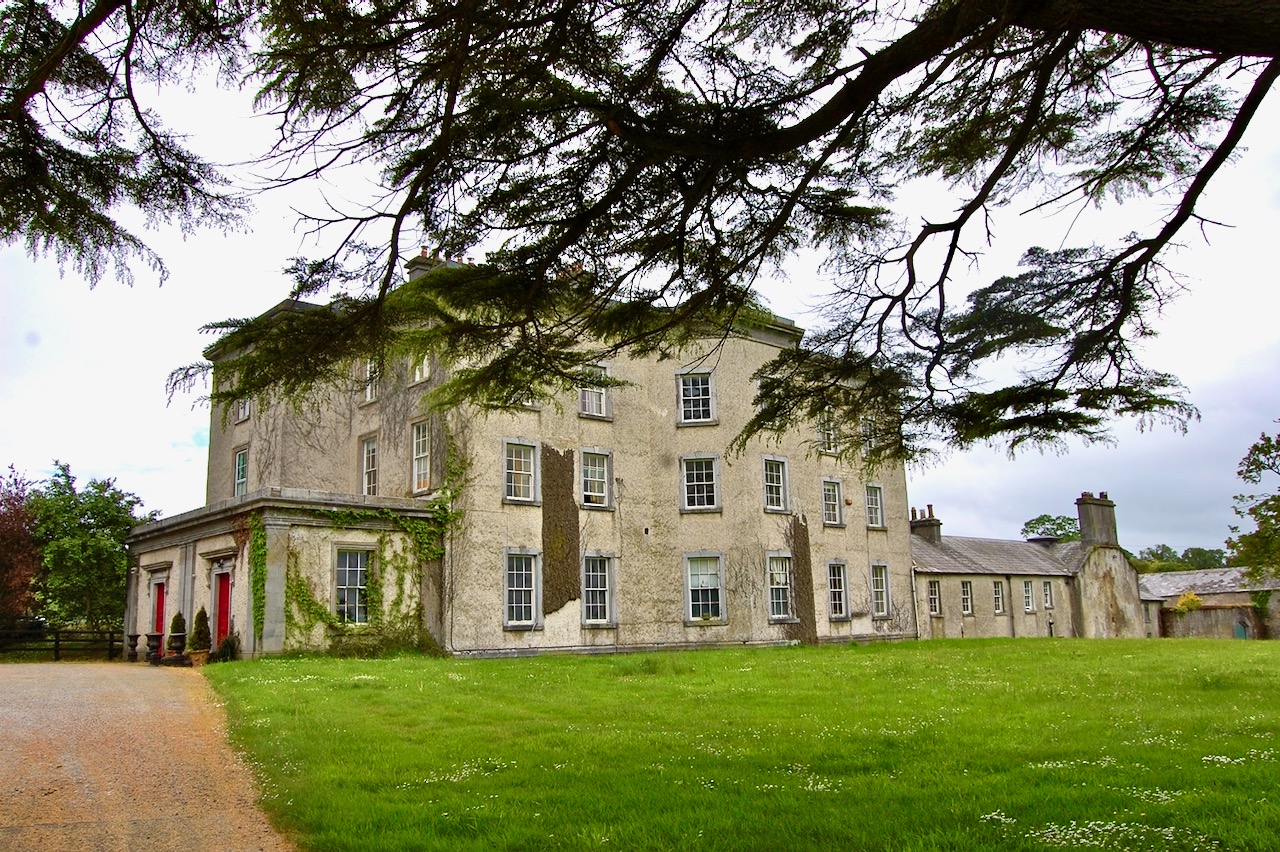
We drove up a long tree-lined avenue to Loughton House. Stephen rang from the car on our way and spoke to Michael Lyons, who was out chopping wood, so told us that Andrew would be at the house to meet us.

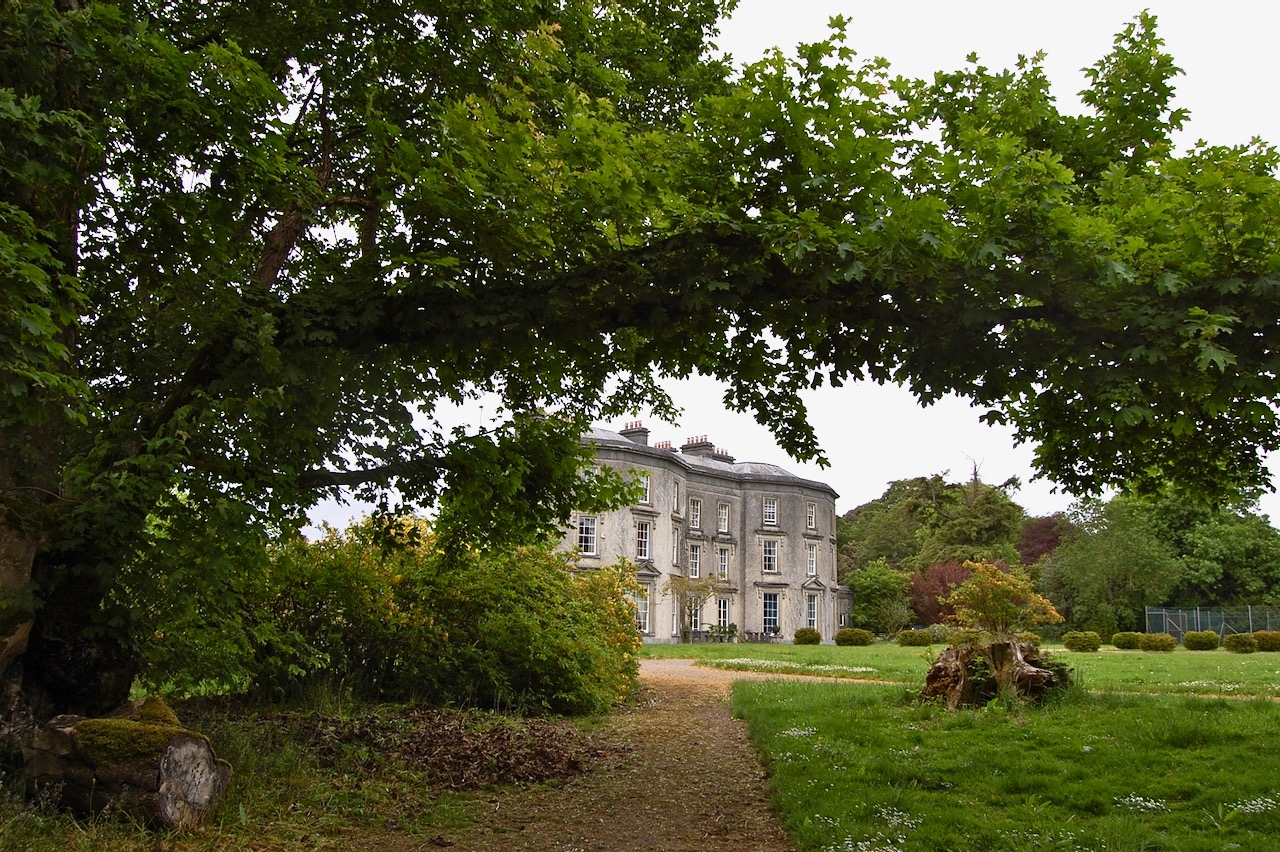
This would have been the front of the house in 1777, as it has the bow in the centre. This is the side which we saw first as we drove up, the North facing side. Photograph © Jennifer Winder-Baggot, www.irishhistorichouses.com
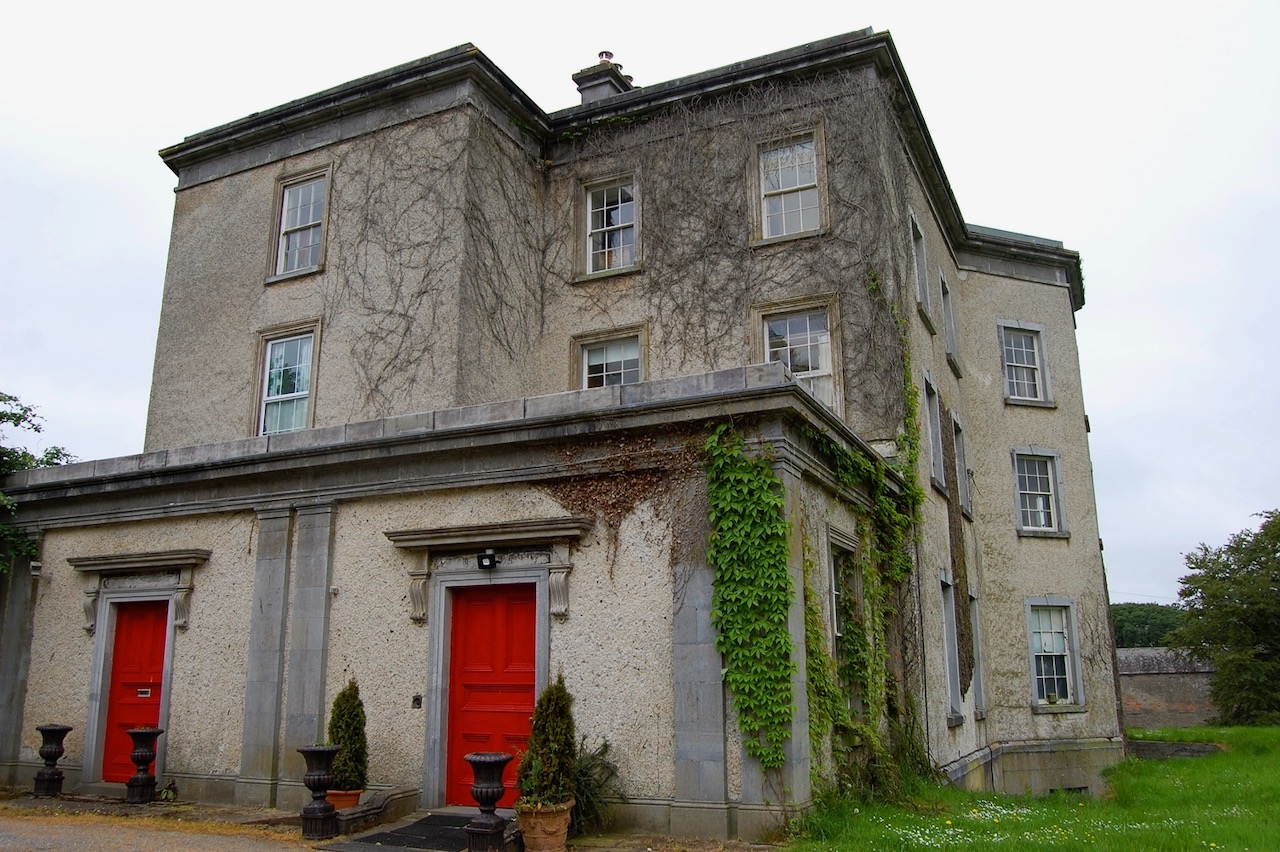
Loughton House was built on the site of a previous house, in 1777. When we arrived, we wondered why there were two front doors. I think Andrew Vance, who greeted us, explained, but we were so busy introducing ourselves and immediately got along so well, that I forget what he told me about the two doors. That’s a question for next time!

Single storey addition with crisp limestone pilasters, and pediments on console brackets over the doors. Photograph © Jennifer Winder-Baggot, www.irishhistorichouses.com
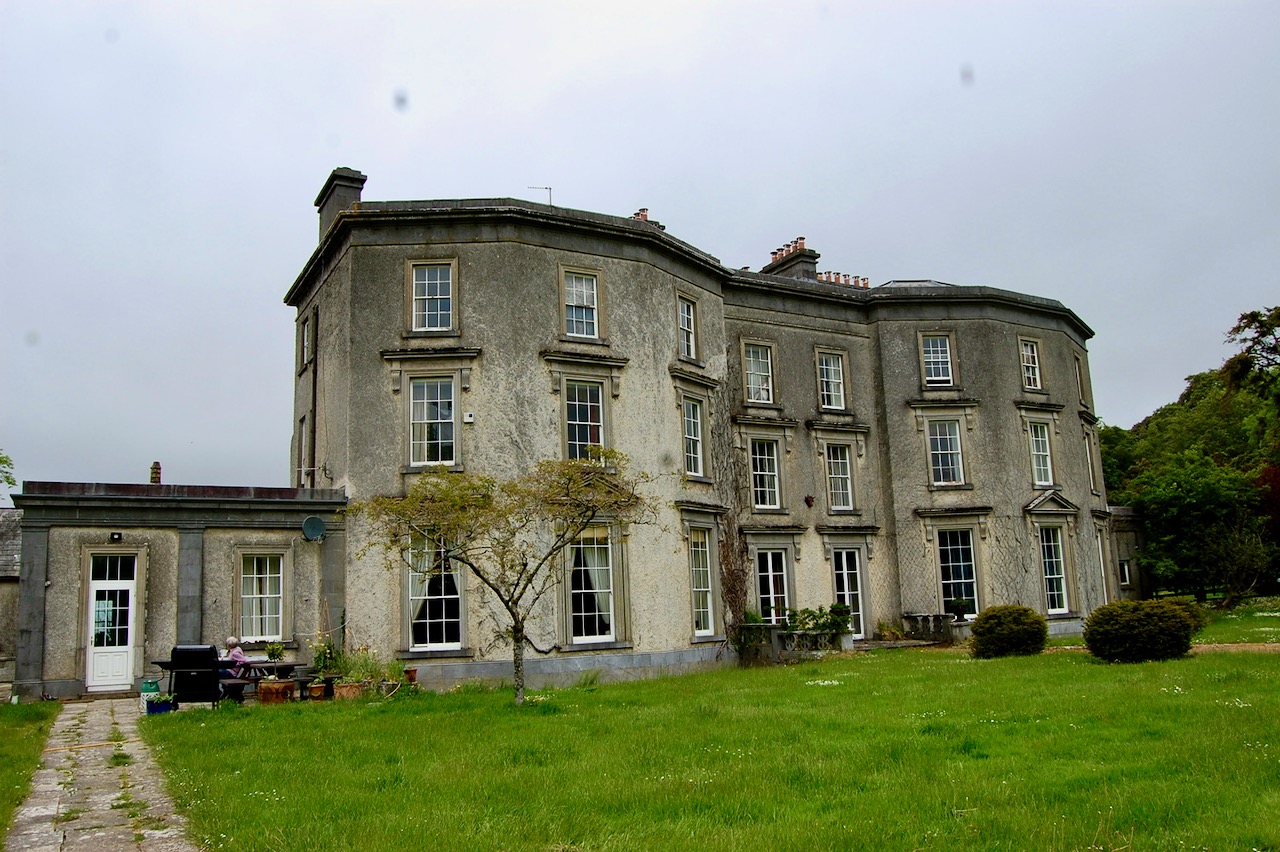
According to the website, alterations were made to the house in 1835 by James and George Pain. I don’t know who the architect of the 1777 house is, but originally the house faced north, with a shallow full-height half hexagon bow in the centre.

I would consider this to be the back of the house since we went out of the door in the single-storey addition, above, after our tour, to see the garden, but is officially the front, the South facing side. The windows have pediments with console brackets on the ground and first floors. The three storeys are over a concealed basement. Photograph © Jennifer Winder-Baggot, www.irishhistorichouses.com

Mark Bence-Jones describes the house in his A Guide to Irish Country Houses:

“Of elegant and restrained late-Georgian character, the main front consisting of two wide and shallow three sided bows of three bays each, with a two bay centre between them. Single storey wing of two bays, adorned with pilasters. Pediments and entablatures on console brackets over ground floor and first floor windows. Parapeted roof. Very handsome Georgian stables.” [1]

The 1777 house was built for Major Thomas Pepper. Thomas, born around 1735, of Ballygarth, Julianstown, Co Meath, son of Lambert Pepper and Jane Otway, was Major in the 14th Light Dragoons. The Peppers acquired Ballygarth Castle (now a ruin) and lands in County Meath after the Restoration of Charles II to the British throne in 1660, for their loyalty to the Stuart monarchy. [2] Thomas Pepper married Mary Ryder, daughter of John Ryder, the Archbishop of Tuam, County Roscommon. The 14th Light Dragoons was originally called James Dormer’s Dragoons, and were raised in the south of England in 1715 in response to the Jacobite Rebellion. They were sent to Ireland in 1717. In 1747 they were renamed the 14th Regiment of Dragoons, and became the Light Dragoons in 1776 [3]. Loughton House passed to their son Thomas Ryder Pepper (1760-1828), who in 1792 married Anne Bloomfield, daughter of John Benjamin Bloomfield and Charlotte Anne Waller, of Newport, County Tipperary. The Bloomfield family had originally settled at Eyrecourt, County Galway.

Thomas Ryder Pepper (1760-1828) with The Old Castle, Loughton in the background from Loughton house auction, 2016, Shepphards.

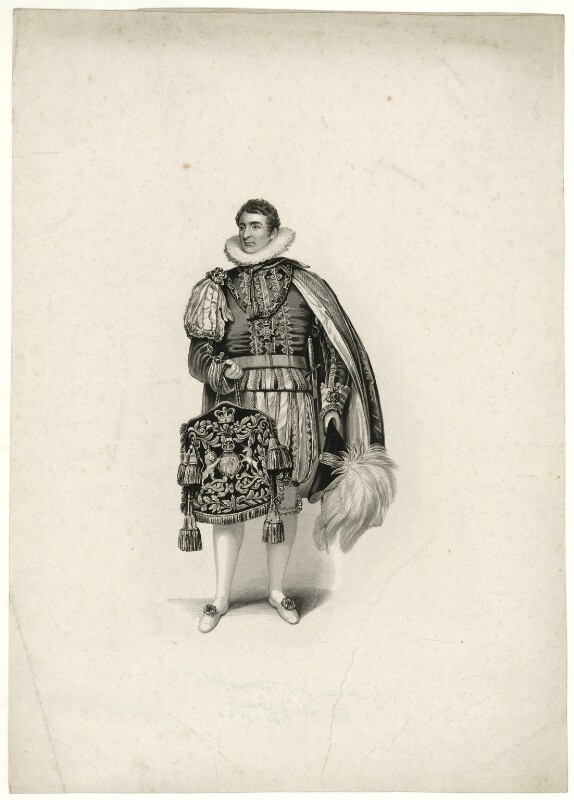
When Thomas Ryder Pepper died, the house passed to his brother-in-law, Benjamin Bloomfield, 1st Baron Bloomfield (1815) of Oakhampton and Redwood (1768-1846). Redwood House in County Tipperary no longer exists. Oakhampton, also in Tipperary, still stands. He was Lieutenant General in the British Army and fought the rebels in 1798 at Vinegar Hill, County Wexford. He rose in the ranks to become Keeper of the Privy Purse for King George IV. This was a particularly difficult job – we came across King George IV before at several houses listed in the Revenue Section 482 Property list. The king enjoyed a romance with Elizabeth Conyngham of Slane Castle, and relished the good life: food, drink and beauty in the form not only of women but in architecture, with the help of John Nash. He was therefore rather a Big Spender. Naturally, therefore, he came to resent Benjamin Bloomfield and his efforts to tighten the purse strings.

Benjamin Bloomfield (1768-1846) 1st Baron Bloomfield as Keeper of His Majestys Privy Purse at the Coronation of George IV, by Henry Meyer, after Philip Francis Stephanoff 1826, NPG D31893.
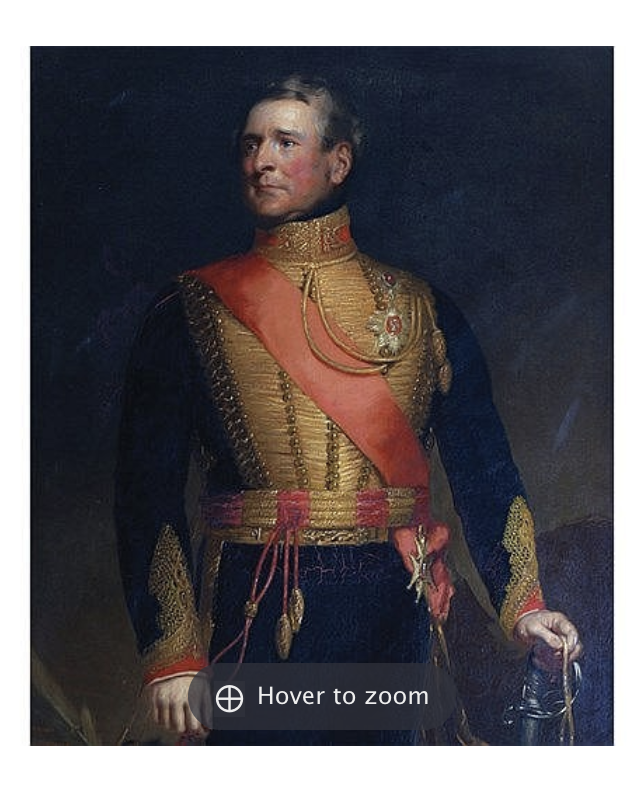
1st Lord Bloomfield, 1768-1846, by John Lilley, from Loughton house auction catalogue, 2016, Shepphards
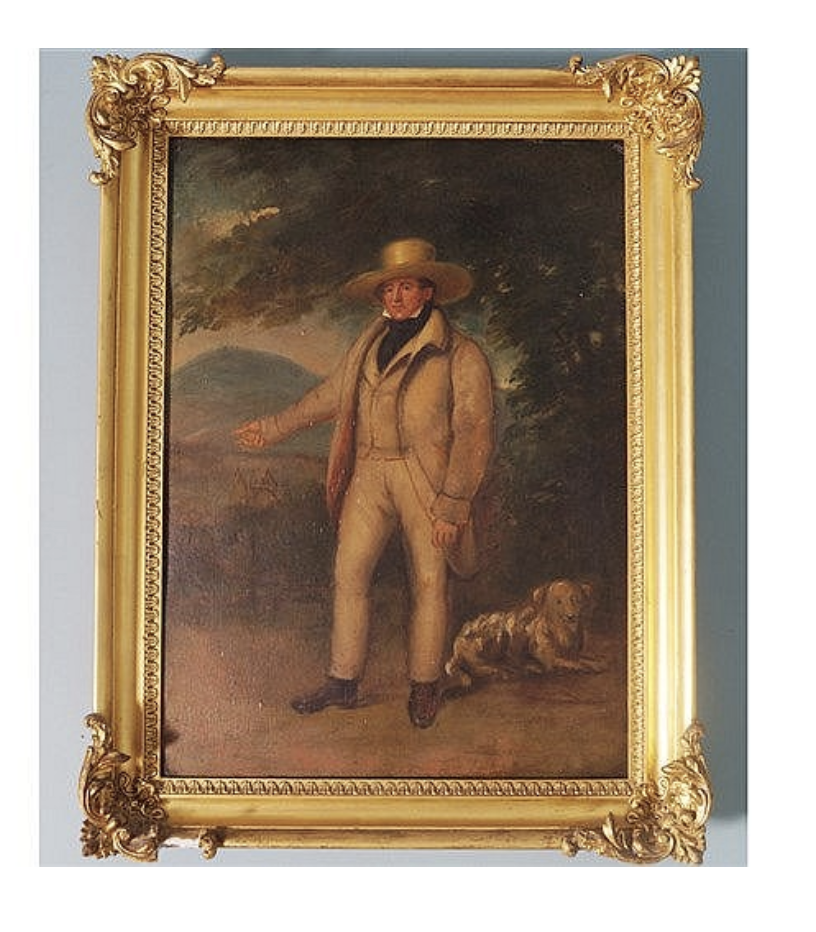
Benjamin, Ist Lord Bloomfield (1768-1846), Irish school, 19th c, from Loughton house sale, 2016, Shepphards.
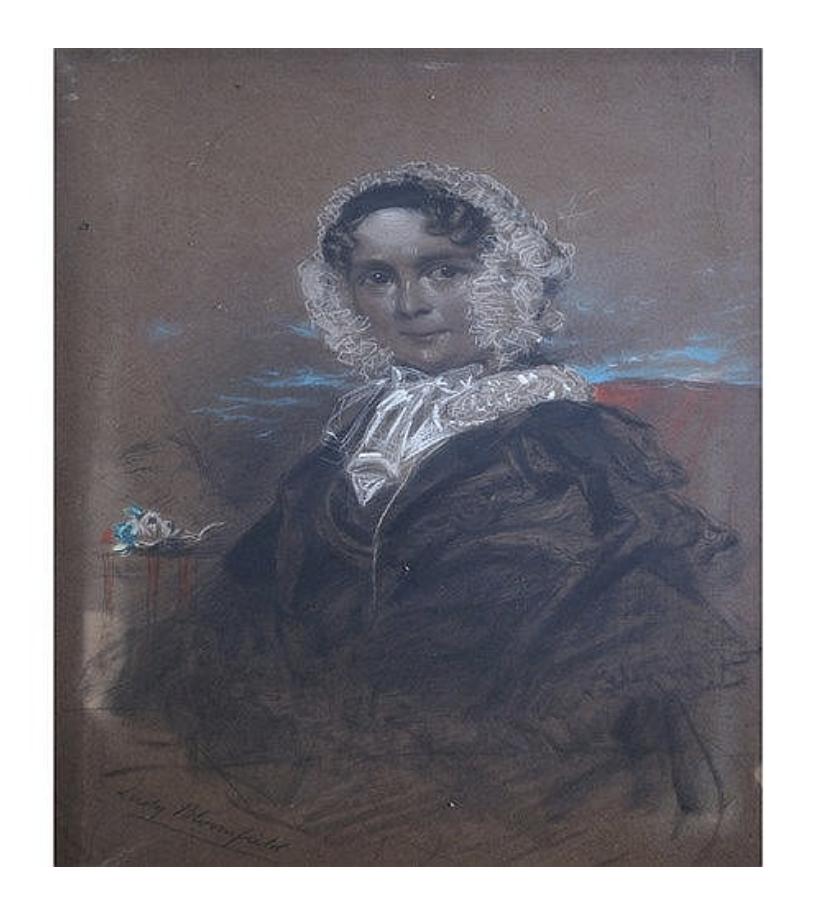
Portrait of Lady Bloomfield, from Loughton house sale, 2016, Shepphards

We have already seen that several houses underwent alterations in expectation of a visit from King George IV in 1821. In Charleville, County Wicklow, a new floor was installed at great expense. Here in Loughton, a bedroom was done up for the King. Unfortunately, the King never made it to Loughton.

It was later that Bloomfield hired James and George Richard Pain to renovate Loughton House, in 1835.

Loughton, May 2019. Photograph © Jennifer Winder-Baggot, www.irishhistorichouses.com
James and George were sons of James Pain, an English builder and surveyor. Their Grandfather William Pain was the author of a series of builder’s pattern books, so they had architecture in the blood. According to the Dictionary of Irish Architects, James and his younger brother George Richard were both pupils of John Nash, one of the foremost British architects of his day responsible for the design of many important areas of London including Marble Arch, Regent Street and Buckingham Palace. He was architect to the prolific lover of architecture the Prince Regent, later King George IV. When Nash designed Lough Cutra Castle in County Galway for Charles Vereker in 1811, he recommended that the two brothers should be placed in charge of the work, so it was at this time that they came to Ireland. Lough Cutra is an amazing looking castle privately owned which is available for self-catering rental. [4] James Pain settled in Limerick and George in Cork, but they worked together on a large number of buildings – churches (both Catholic and Protestant), country houses, court houses, gaols and bridges – almost all of them in the south and west of Ireland. [5] In 1823 James Pain was appointed architect to the Board of First Fruits for Munster, responsible for all the churches and glebe houses in the province.

The Pains Gothicized and castellated Dromoland Castle in County Clare at some time from 1819-1838, now a luxury hotel. [6] They took their Gothicizing skills then to Mitchelstown Castle in 1823-25, but that is now a ruin. In 1825 they also worked on Convamore (Ballyhooly) Castle but that too is now a ruin. They also probably worked on Quinville in County Clare and also Curragh Chase in County Limerick (now derelict after a fire in 1941), Blackrock Castle in County Cork (now a science centre, museum and observatory which you can visit [7]), they did some work for Adare Manor in County Limerick (also now a luxury hotel), Clarina Park in Limerick (also, unfortunately, demolished, but you can get a taste of what it must have been like from its gate lodge), Fort William in County Waterford, probably they designed the Gothicization and castellation of Ash Hill Towers in County Limerick (also a section 482 property!), alterations and castellation of Knoppogue Castle, County Clare (you can also visit and stay, or attend a medieval style banquet), Aughrane Castle mansion in County Galway (demolished – Bagots used to own it, I don’t know if we are related!), a castellated tower on Glenwilliam Castle, County Limerick and more.

The Pain brothers reoriented Loughton House to face south, and the main doorcase was put to the east end, the Loughton House website tells us. In his Buildings of Ireland: Central Leinster. Counties of Kildare, Laois and Offaly, Andrew Tierney tells us that this oblique approach of typical of James Pain. [8]

Loughton, County Offaly. Photograph © Jennifer Winder-Baggot, www.irishhistorichouses.com
Loughton, May 2019. Photograph © Jennifer Winder-Baggot, www.irishhistorichouses.com
The National Inventory of Architectural Heritage claims that Loughton House is probably the Pain’s finest Classical work [9]. The exterior is relatively plain, with limestone window dressings with keystones. The north facing side is the original house, whereas the south facing side, of eight bays instead of the seven in the north side, is by the Pain brothers. The windows on this side have moulded cement detailing: architrave, cornice and consoles, and pediments. We saw more of the Pains’ work inside, in the Drawing and Dining Rooms which date from their renovation, and the wonderful curved stone cantilevered staircase.

The current owners, who acquired the house in 2016, are both medical doctors, as was the previous owner, Dr. James Reilly, who was also a former Minister for Health in the Irish government. When we visited, the house exuded a comfortable quirky chic, with marble busts on pillars in the front hall and a touch of whimsy, with a stag’s head draped in a fur at the bottom of the sweeping cantilevered staircase. 

The Loughton House website tells us:

“The house has very fine detailing – traces of the late eighteenth-century decoration can be seen in the house as well as early nineteenth-century changes in internal layout.

“The ground floor is laid out with bright and generously proportioned formal reception rooms with magnificent decorative cornicing and ceilings, ornate plaster work and large original period fireplaces. The original wood floors remain throughout and the grand sash bay windows permit torrents of light into the house. Most notable are the wood-carved shutters and door panels in the original Billiard room.” [10]

Loughton passed to Bloomfield’s son, John Arthur Douglas Bloomfield (1802-1879). He succeeded as 2nd Baron Bloomfield on his father’s death. He was a diplomat and travelled widely, was envoy to St. Petersburg and Ambassador to Austria. He was appointed Privy Counsellor on 17 December 1860. He was created 1st Baron Bloomfield of Ciamhaltha, Co. Tipperary on 7 August 1871. In 1834 his father had a hunting lodge built, Ciamhaltha House, County Tipperary, so the new title referred to this house [11]. He and his wife Georgiana Liddell had no son and the titles ended with his death. Georgina served as a Maid of Honour to Queen Victoria between 1841-45. Upon Georgiana’s marriage to Baron Bloomfield in 1845, when Georgiana left her position in the house of the Queen, Victoria gave her a cutting from a vine, which still grows at Loughton House today. Georgiana wrote the book Reminiscences of Court and Diplomatic Life, published 1883. It sounds fascinating!

2nd Lord Bloomfield, 1802-1879 wearing a burgundy red jacket and fur collar, Painting After Sir Thomas Lawrence, from Loughton house auction catalogue, 2016, Shepphards
Georgiana Bloomfield née Liddell, Lady Bloomfield from Loughton house auction catalogue, 2016, Shepphards.

The house passed to the Baron’s sister, Georgiana, and her husband, Henry Trench, of Cangort Park, County Offaly (still standing, privately owned). The Landed Estates website tells us that in the 1870s, Henry Trench owned 4,707 acres in county Tipperary, 2,113 acres in county Offaly, 1,926 acres in county Limerick, 1,581 acres in county Galway, 704 acres in county Clare and 432 acres in county Roscommon. [12]

Frederick Trench (1755-1840) 1st Baron Ashtown from Loughton sale Sept 2016 by Shepphards. He was an uncle of Henry Trench who married Georgiana Bloomfield.
A portrait of Blanche Trench (1852-1937), from Loughton house sale, 2016, Shepphards. She was a daughter of Henry Trench and Georgiana née Bloomfield.

When James Reilly sold Loughton House, he unfortunately sold its contents, including an archive of family papers. Michael Parsons of The Irish Times wrote of the auction:

Lot 2066, The Loughton Papers circa 1749-1960 – an archive of documents including correspondence, diaries, journals, sketch books and recipe books created by the various families who had lived at Loughton House – sold for €12,000 (above the estimate of €5,000-€8,000).

Sheppard’s said the buyer was Galway businessman Pat McDonagh, founder and managing director of the Supermac’s fast-food chain and owner of the Barack Obama Plaza – a services area on the M8 motorway just outside the village of Moneygall built following the visit of the US president.”

Fortunately, the article continues to reassure the readers that the documents will be properly preserved and accessible:

“In a statement issued via the auction house, Mr McDonagh described the archive “part of a tapestry of history” and that his “first priority” was its “preservation for historians, the community and the country”.

“The statement said: “Mr McDonagh commended Offaly County Council for their interest in working with Supermac’s for the preservation of the papers” which will be digitised, and that “historians owe a debt of gratitude to the owners of Loughton House, Dr James Reilly and his wife Dorothy”.

“Mr McDonagh “confirmed also that the visitor centre at the Barack Obama Plaza will host a Loughton House section, where extracts from the archive will be displayed on a rolling basis.” He said the plaza would work to ensure that the heritage of the house was not lost to the community, adding that he would encourage local and expert input to ensuring that the archive would be educational, appropriate and accessible.” [13]

A portrait of Dora Agnes Caroline Trench (1858-1899) née Turnor, wife of Benjamin Bloomfield Trench, from Loughton house sale, 2016, Shepphards.
A portrait of Mr Trench, dated 1920, from Loughton house sale, 2016, Shepphards.

The wood carved panels shutters and door panels in the billiards room, now a dining room, were decorated by one of the Trenches, Dora. The form of decoration, with details rendered by a hot poker, is exquisitely done. The portrait of the artist, Dora, hangs next to the doors. Dora was Henry Trench’s son Benjamin Bloomfield Trench’s wife, Dora Agnes Caroline Turnor. Dora Trench died in 1899, after a brief illness. Benjamin and Dora had two daughters, Sheelagh Georgiana Bertha and Theodora Caroline. [14]

Loughton, May 2019. Photograph © Jennifer Winder-Baggot, www.irishhistorichouses.com
Dora illustrated the doors with crests and intricate patterns, and all of the doors from the room are decorated, along with the shutters. I was delighted when Stephen asked if I could take a photograph of the door – I didn’t like to ask, knowing that most section 482 houses forbid indoor photography. Andrew’s assent typified his warm welcome. You can see photographs of the room, called Dora’s Room, on the Loughton website, along with photographs of the other reception rooms, the Library, Dining and Drawing Rooms. “Dora’s Room” contains a long table and chairs, and an intricately carved fireplace.

The fireplace in Dora’s Room can be seen on the Loughton website. It is, Andrew Tierney tells us in his Buildings of Ireland: Central Leinster, it is Tudor Revival, of 1862. The male caryatid figure on the right is the original, Andrew thinks, whereas the figure on the left is a copy. It’s strange how such fireplaces are carved in wood and manage to survive the fire they contain. Andrew said it throws out great heat. It has a second flue behind, from which the fire can draw its oxygen, rather than drawing from the warmed air inside the room.

The Loughton website tells us that the Trenches remained in residence until 1973 when the property was passed to the Atkinson family.

Major Anthony Guy Atkinson (b. 1909) inherited Loughton in 1970 from his cousins Thora and Sheelah Trench (Dora’s daughters). Henry Trench, Georgina Bloomfield’s husband, had a sister, Anne Margaret Trench. She married Guy Caddell Atkinson. They inherited Cangort Park in County Tipperary and Major Anthony Guy Atkinson was a descendant of Anne Margaret Trench. [15] He made Loughton over to his son, Guy Nevill Atkinson (b. 1950), who sold it in 2001.

From Dora’s Room we came upon the hallway with the sweeping floating stone cantilever staircase. This was originally the entrance hall, before James Pain added the staircase and moved the entrance to the east end.

Andrew drew our attention to an old tall clock with barometer. It was from Lissadell House, and, appropriately, was made by a man named Yates – not the poet Yeats who frequented the house, note the different spelling, but in a nice touch, the picture hanging beside it was of the poet. Incidentally, one of the Trench family, a sister of Benjamin Bloomfield Trench who inherited Loughton, Louisa Charlotte, married Colonel James Gore-Booth, of the Lissadell family. The owners have taken their time to populate the house appropriately, with respect for its history and a dash of humour.

I was most enamoured with the next room, the library, with its floor to ceiling built in bookshelves. It retains original wallpaper, worn but still in situ.

“This is where we sit in the evenings, with a glass of wine,” Andrew told us. I could just see myself there too, in the well-worn couches, facing the fireplace. You can also see this room on the website, with its comfy leather armchairs. The Equine pictures are appropriate as Andrew is Master of the local Hunt!

In the Drawing Room, a formal room with sofas, carpets and lovely salmon pink walls, gorgeous cabinets, piano and ornate gilt overmantel mirror, Andrew pointed out another treasure: the fire insurance plaque from a building. The various insurance companies had their own firetrucks and teams, and they only put out fires of the buildings insured by them. Unfortunate neighbours burned down. I was excited to see the plaque as I had seen one on the Patriot Inn in Kilmainham, one of the few remaining, and learned about them in a lecture in Warrenmount in Dublin.

Loughton, May 2019.

We then entered the second dining room (if we consider Dora’s Room, the former Billiards room, to be a dining room also, as it is currently furnished), a larger room than the first. This dining room also has a clever fireplace, this one of steel, with secret cabinets at the sides to keep the plates and dishes hot. It also had vents, and further vents built into the walls of the room, to control temperature and air flow.

Loughton, May 2019. Photograph © Jennifer Winder-Baggot, www.irishhistorichouses.com
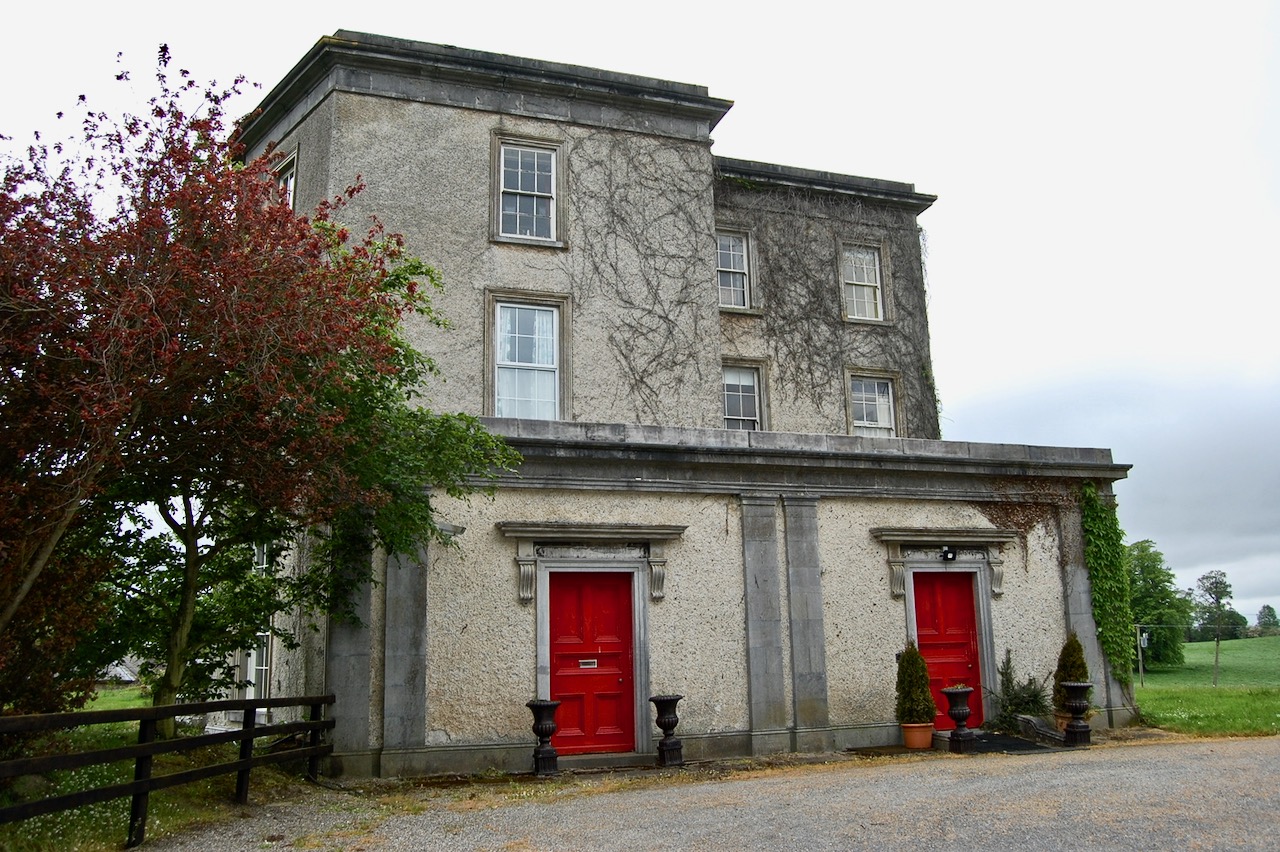
A painting above the door is by Sarah, Lady Langham, an artist, who has also applied her creative skills to the house, and who manages the day-to-day operation of the house. She has made curtains and even the wallpaper of The King’s Bedroom. On our way to the back staircase we ran into Sarah herself, as I was photographing the chain that was used to pull the coal to the upper floors.

Loughton, May 2019. Photograph © Jennifer Winder-Baggot, www.irishhistorichouses.com
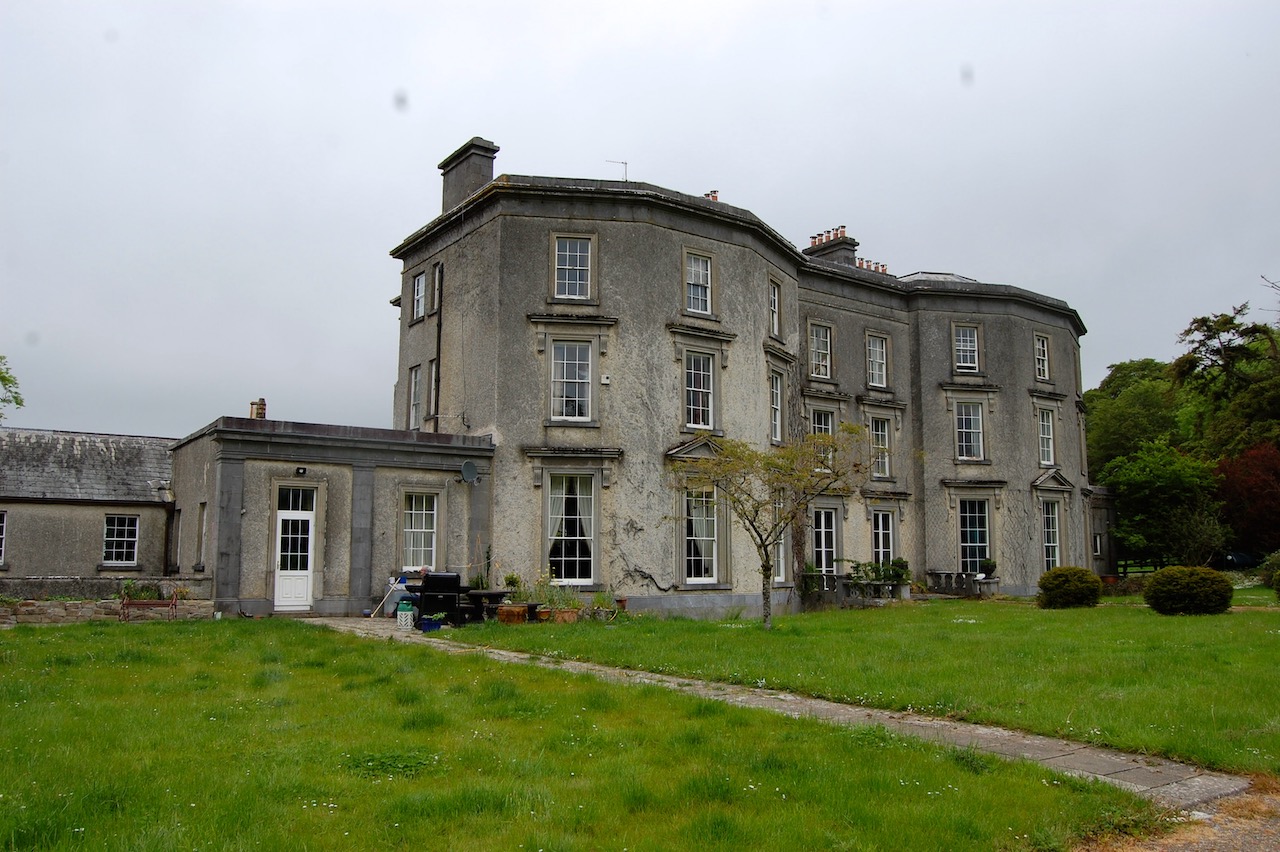
The final rooms we viewed are Sarah’s piece de resistance, “the King’s Suite,” which comprises two rooms – the room where George IV was meant to sleep, and a room next to it also furnished with a bed, which might have been his dressing room or a parlour.

Loughton, May 2019. Photograph © Jennifer Winder-Baggot, www.irishhistorichouses.com
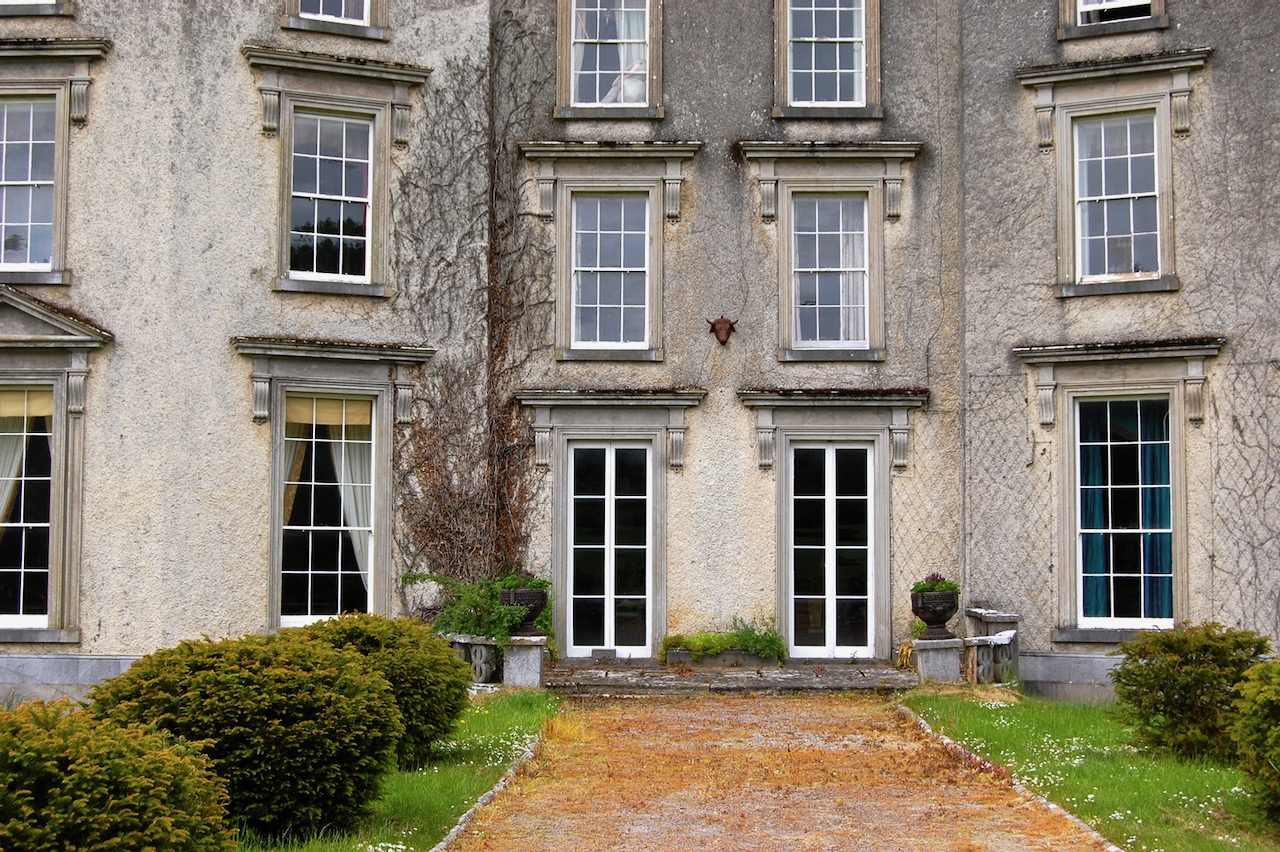
Sarah created the wallpaper. It features a crest of a unicorn and a lion around the top – and a stag that is pictured in the recurring motifs below. She also made the magnificant curtains and pelmet.

The fireplace is interesting. It is made of limestone, which contains fossils of tubular sea creatures:

Loughton, May 2019. Photograph © Jennifer Winder-Baggot, www.irishhistorichouses.com
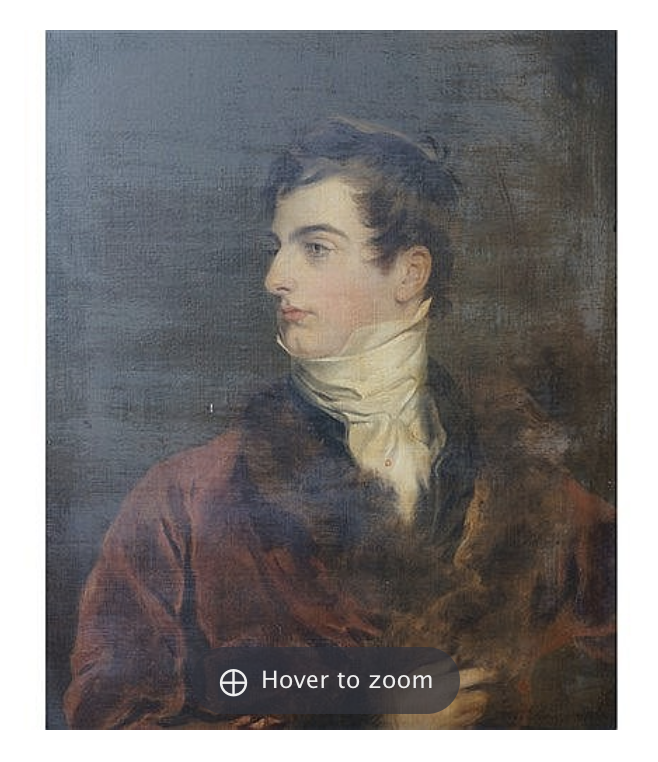
This, along with other rooms, is available for guest accommodation.

There is a stable complex to one side of the house. Andrew brought us out to show us the function room, which was originally a coal shed. It’s huge, and would be wonderful for parties, and is available for hire. The garden outside it, which would also be available for the functions, is romantic and beautiful, with a pond and stone walls.

Loughton, County Offaly. Photograph © Jennifer Winder-Baggot, www.irishhistorichouses.com
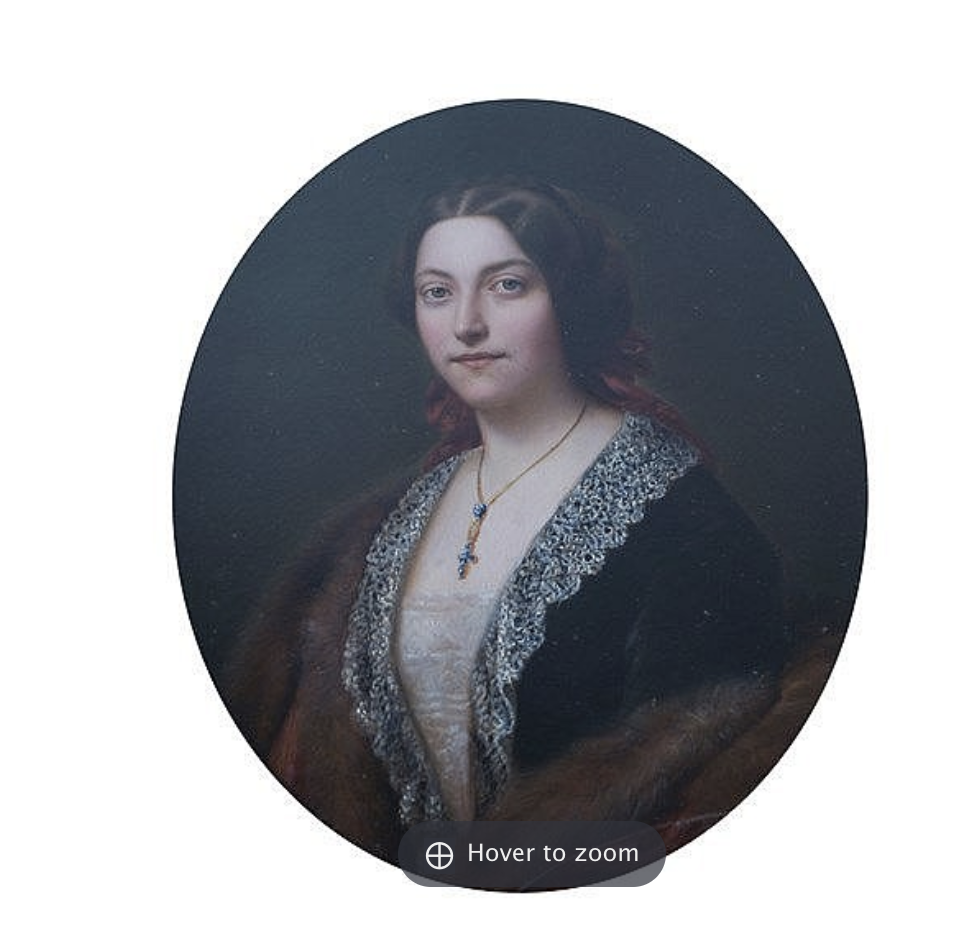
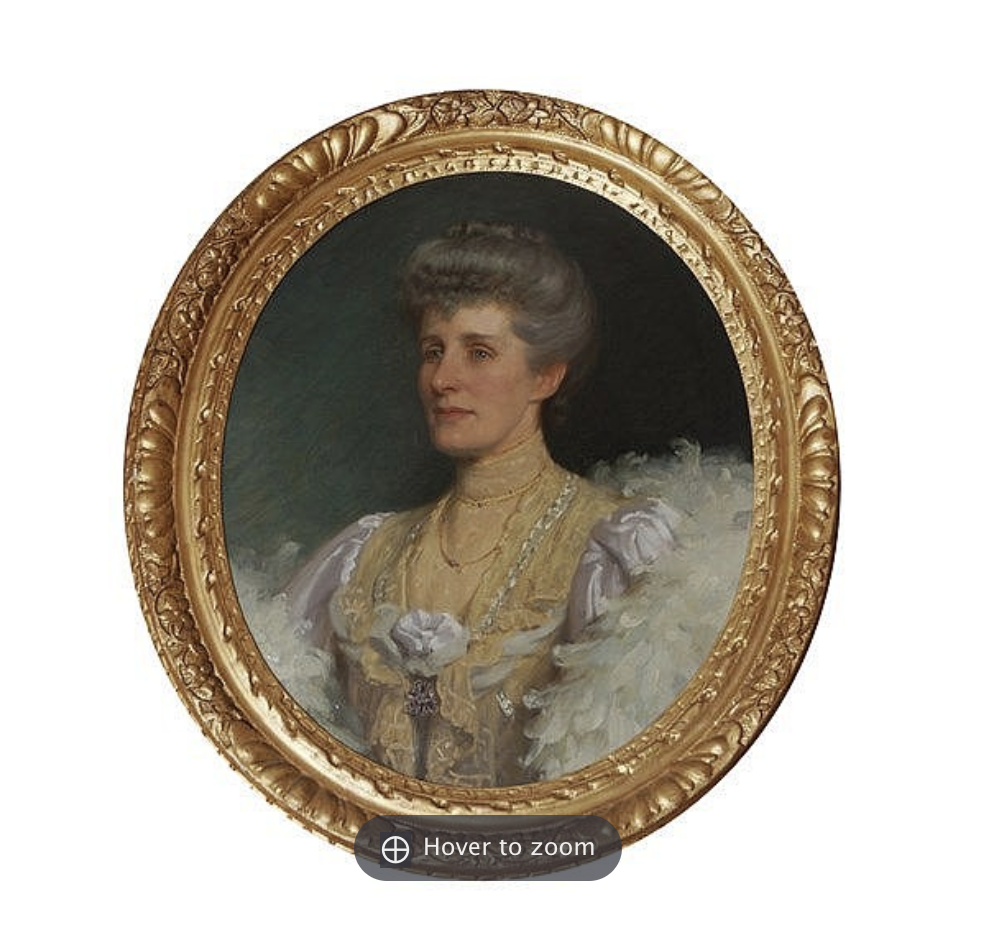
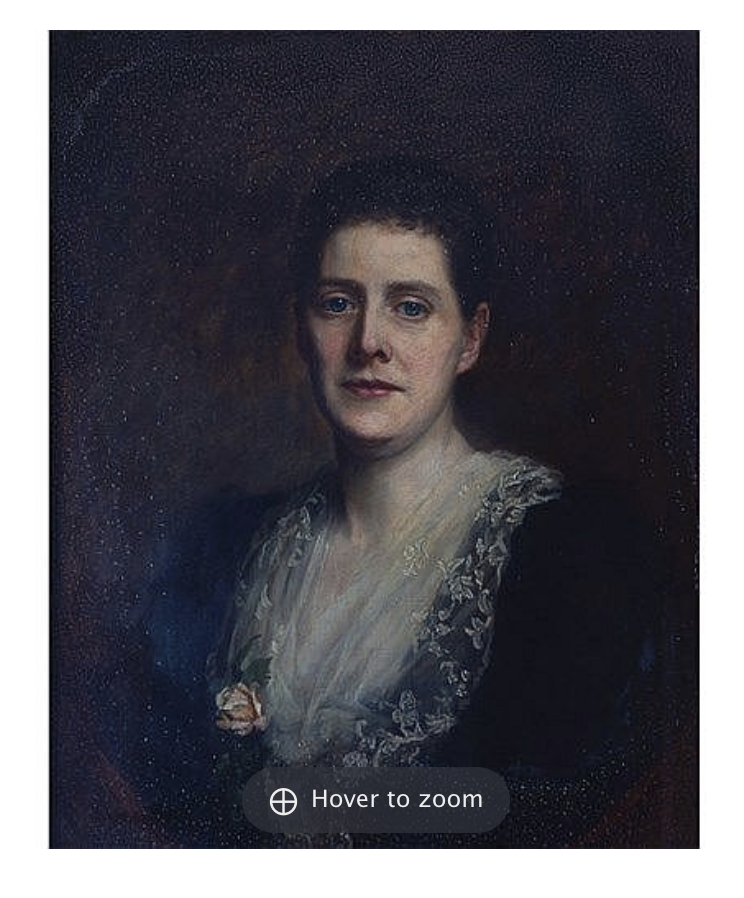
Loughton, May 2019. Photograph © Jennifer Winder-Baggot, www.irishhistorichouses.com
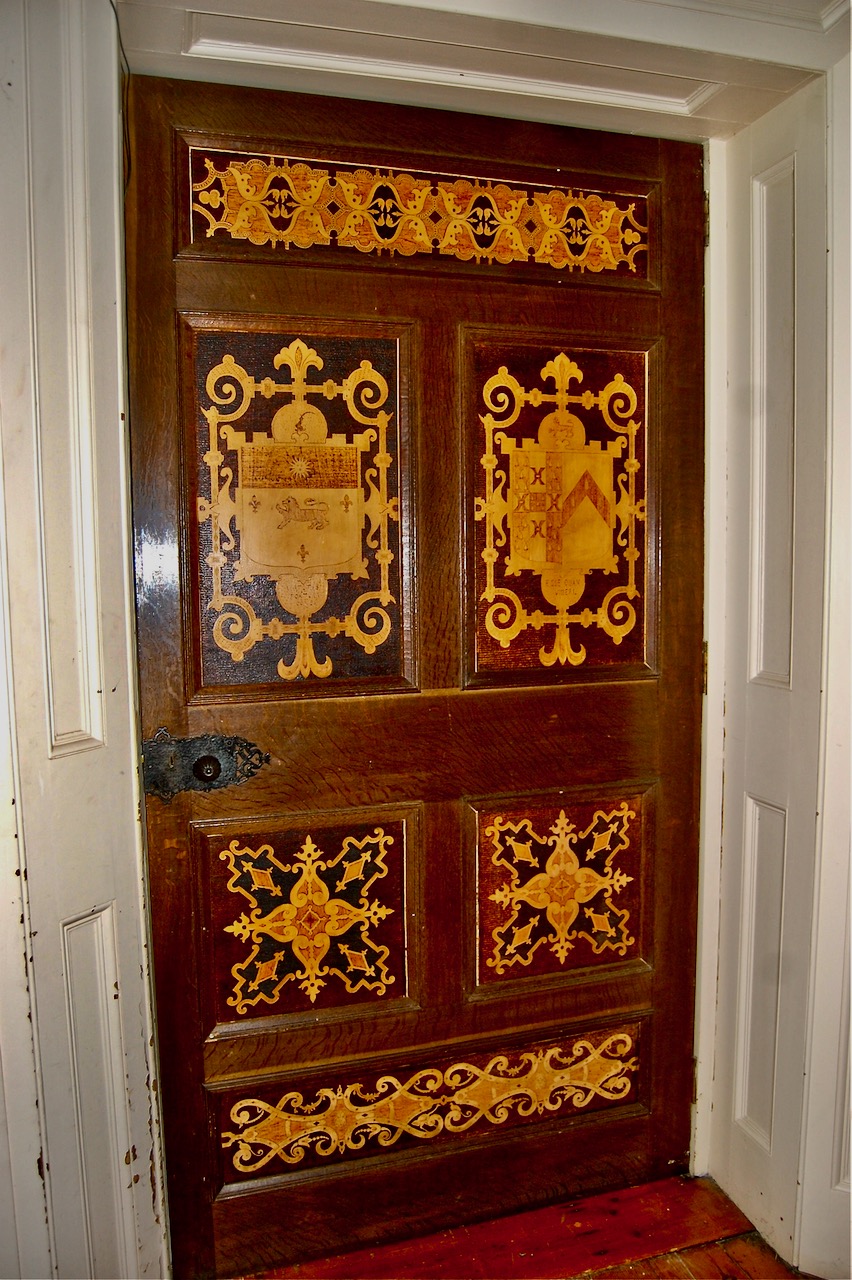
Then we sat at a table outside and Andrew brought us coffees – such a lovely touch!

Loughton, County Offaly. Photograph © Jennifer Winder-Baggot, www.irishhistorichouses.com
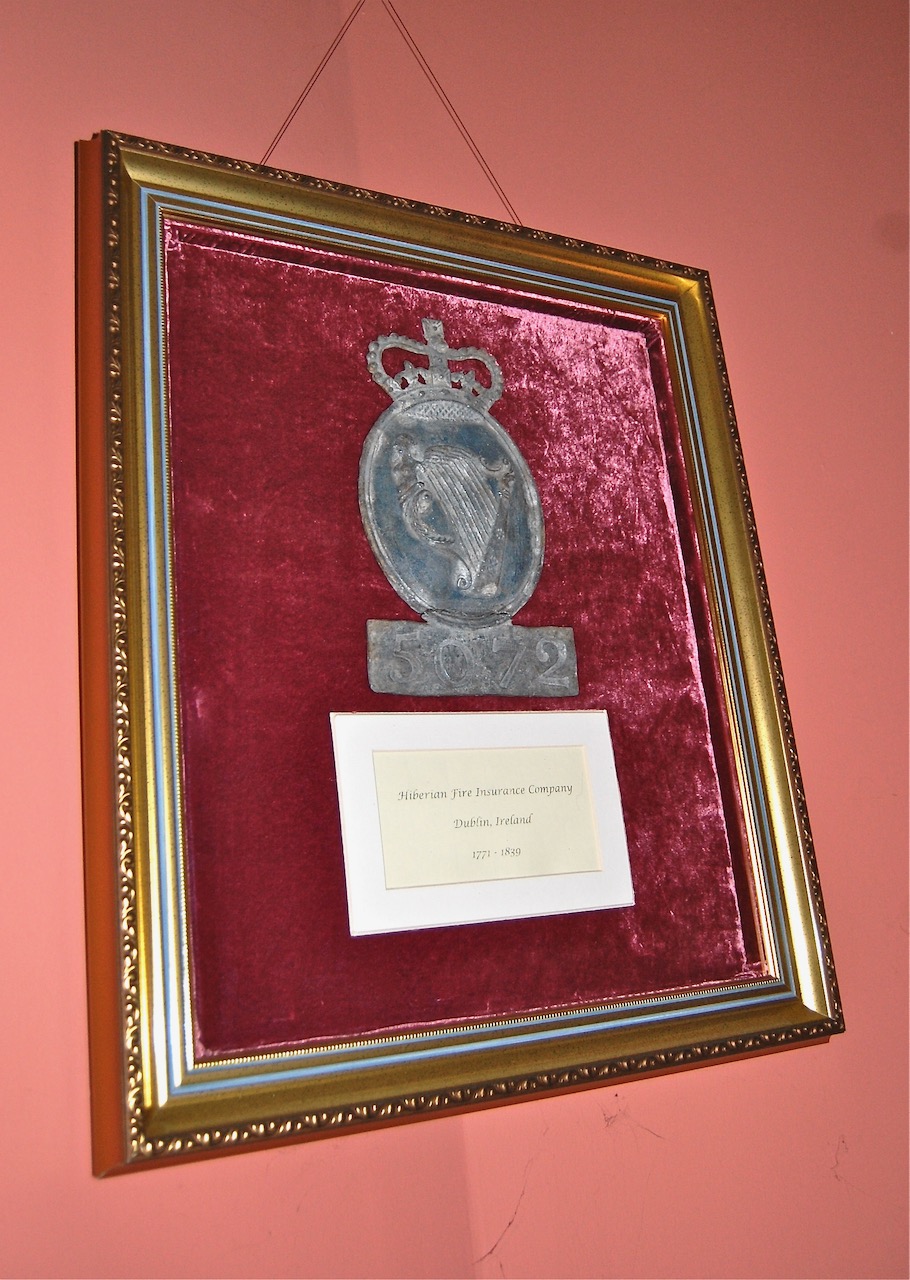
Loughton, May 2019. Photograph © Jennifer Winder-Baggot, www.irishhistorichouses.com
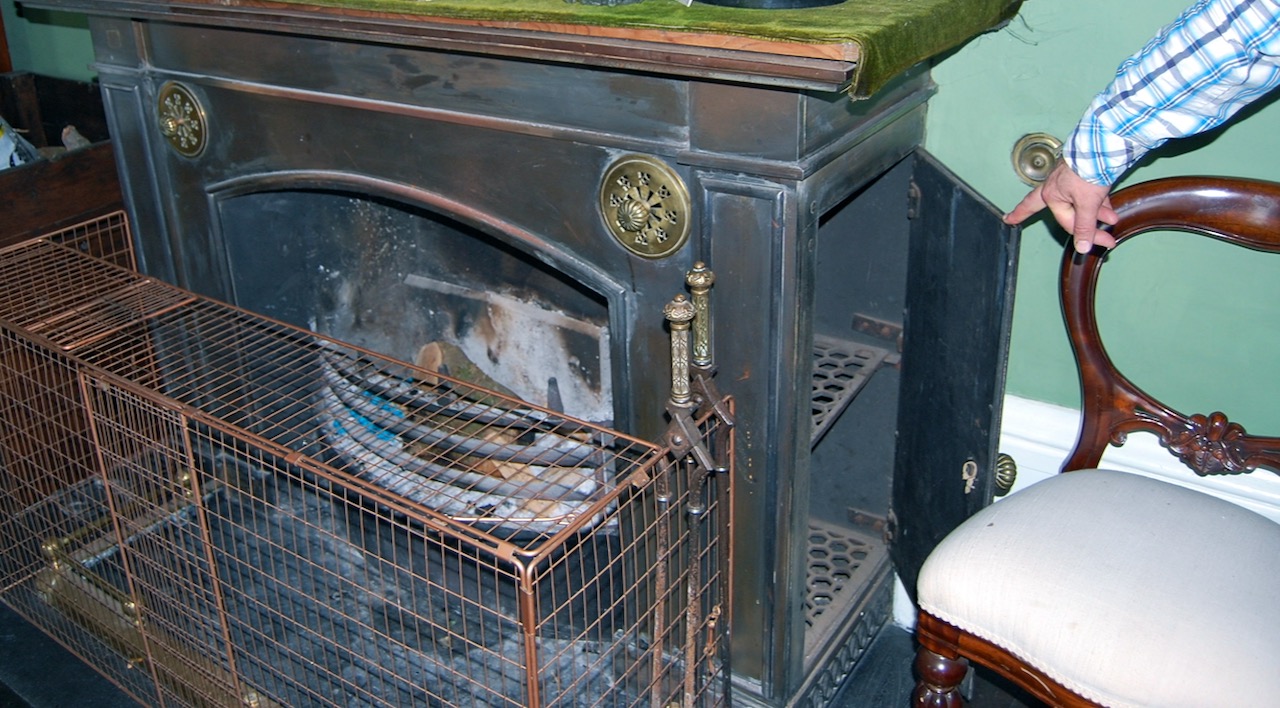
Michael joined us briefly and shared with us a photograph he had found in the national archives in England, of a group gathered at what is now the back of the house.

Andrew then urged us to wander in the gardens. We walked over to what looks like a Norman keep. It is Ballinlough Castle (not to be confused with Ballinlough Castle of County Westmeath), which dates back to the early seventeeth century, and belonged to the O’Carroll family. I climbed nearly all the way to the top (at my own peril!)!

Loughton, County Offaly. Photograph © Jennifer Winder-Baggot, www.irishhistorichouses.com
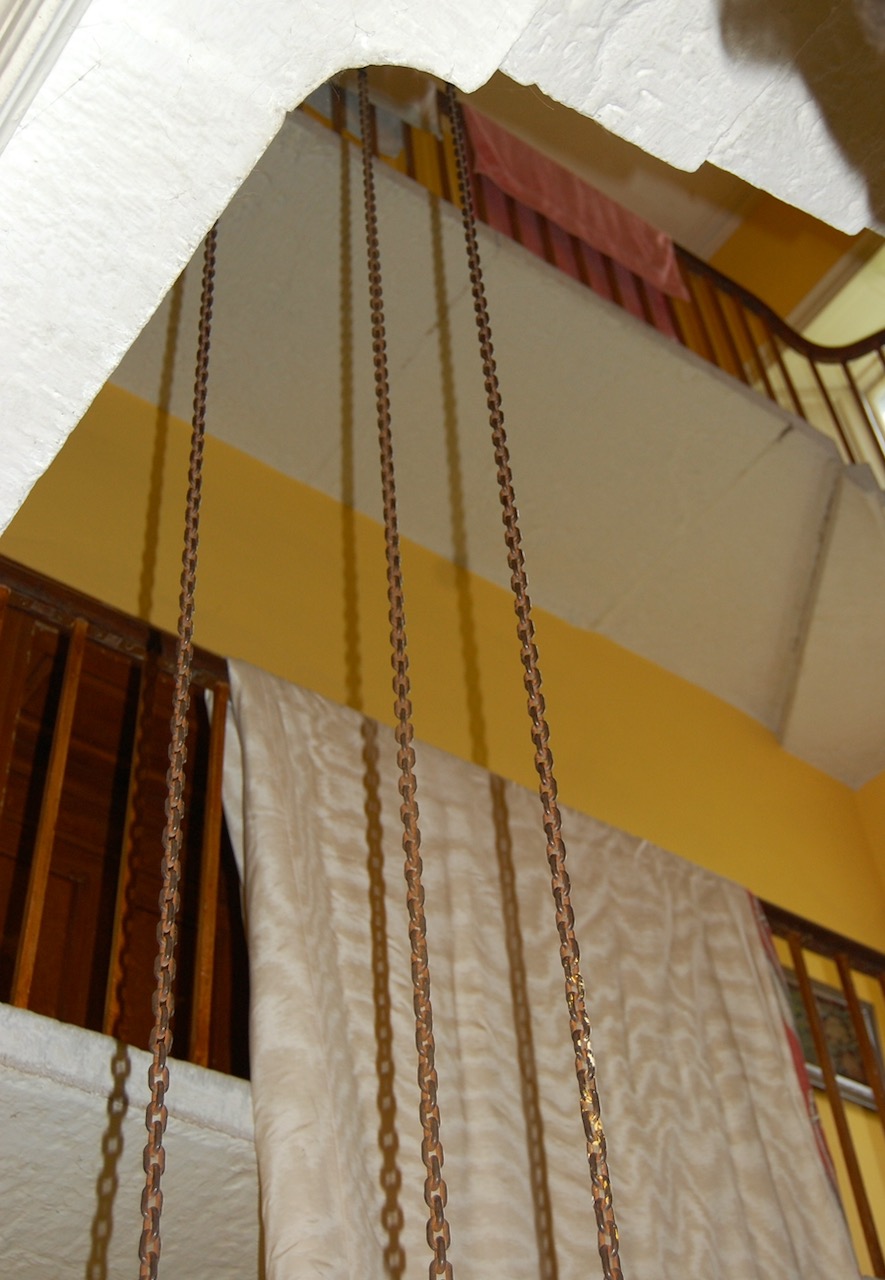
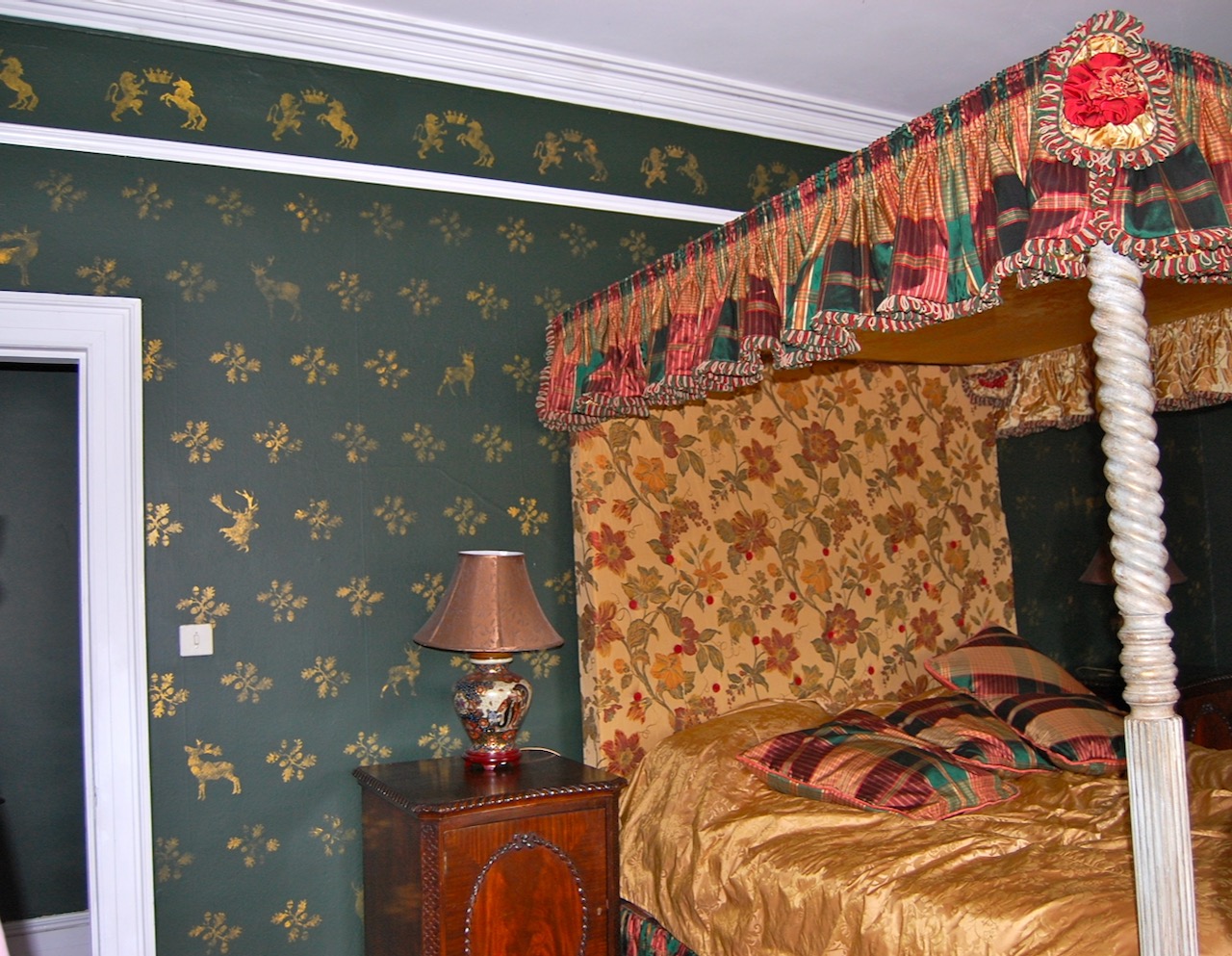
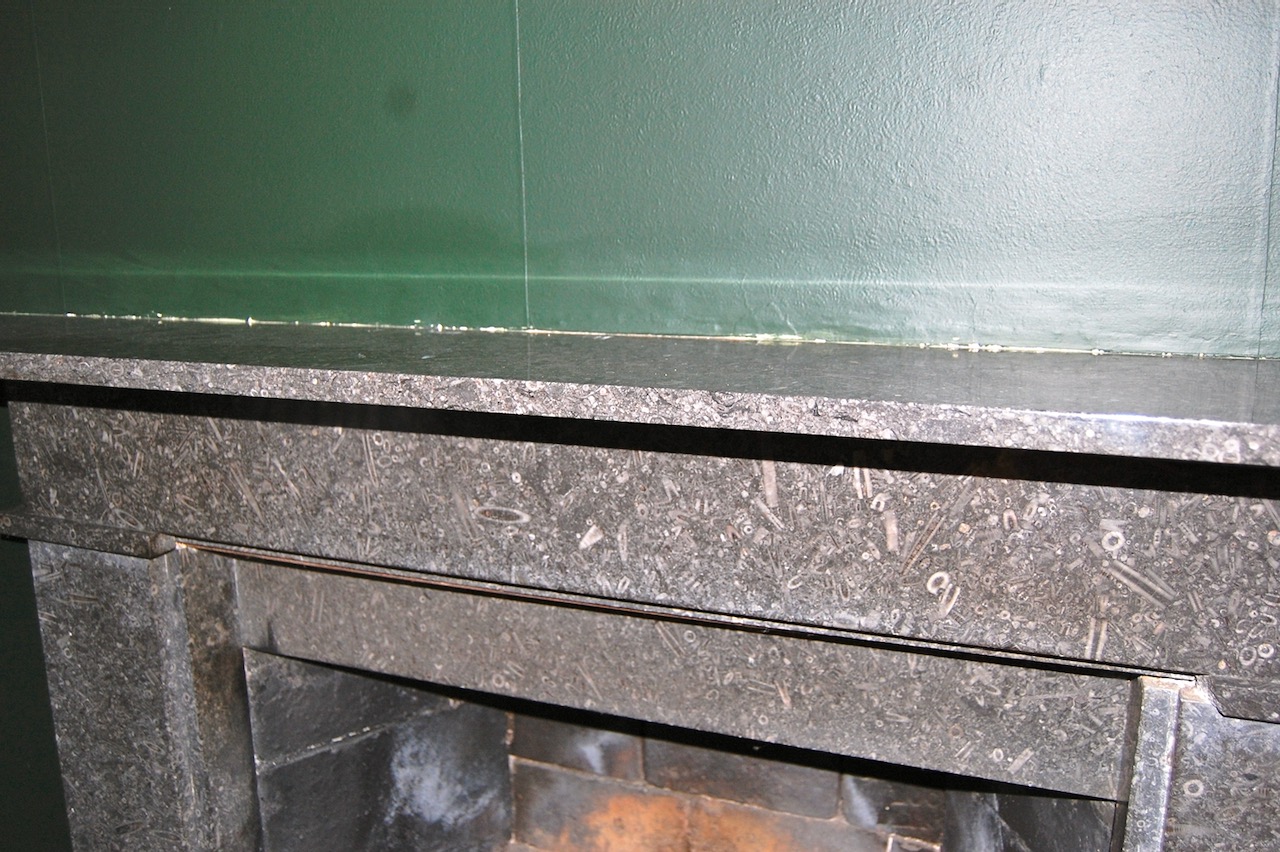
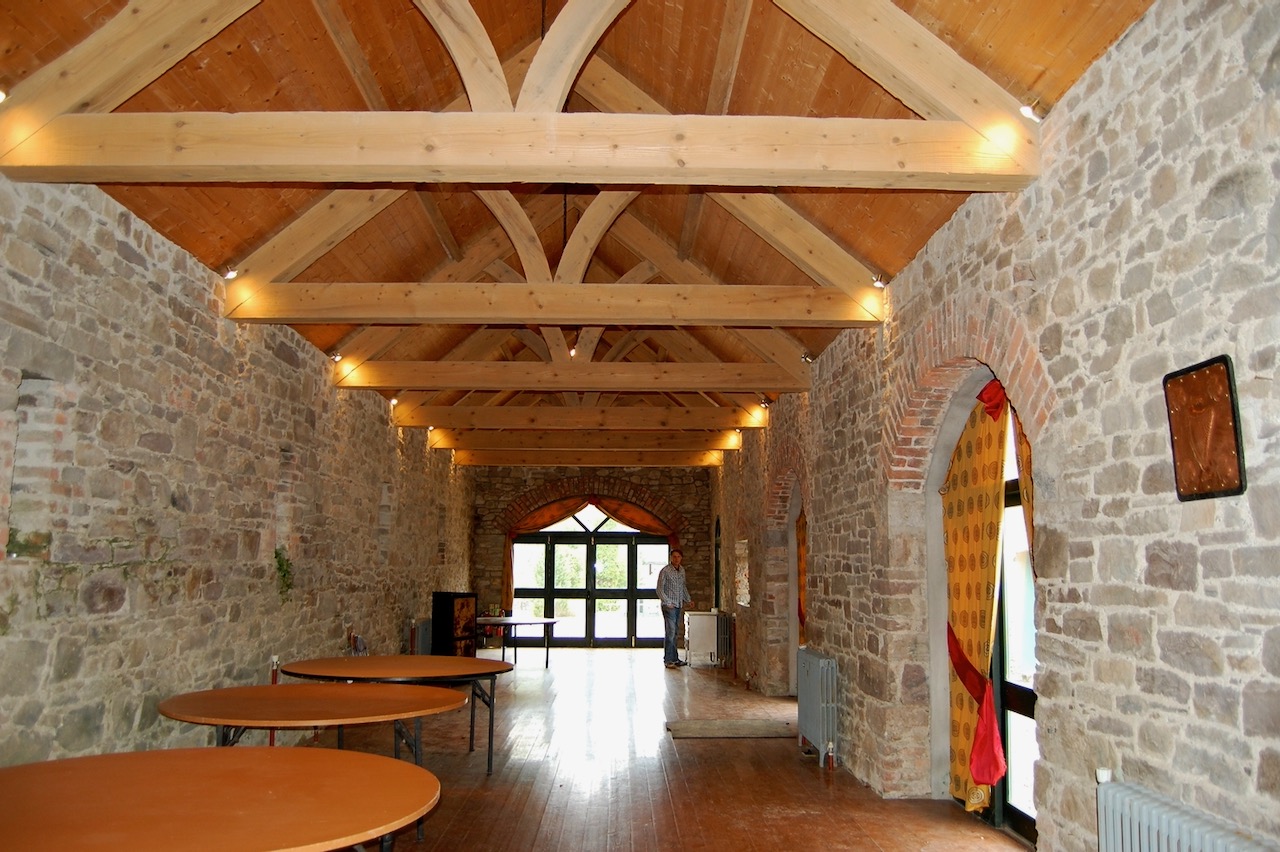
Loughton, May 2019. Photograph © Jennifer Winder-Baggot, www.irishhistorichouses.com
We then found our way to the walled garden. Michael told us he hopes to restore the glasshouse.

Loughton, County Offaly. Photograph © Jennifer Winder-Baggot, www.irishhistorichouses.com
Loughton, May 2019. Photograph © Jennifer Winder-Baggot, www.irishhistorichouses.com
I’d love such a large growing space, with space for fruit trees and sheltering walls. I have had my own allotment for seven years!

Loughton, County Offaly. Photograph © Jennifer Winder-Baggot, www.irishhistorichouses.com
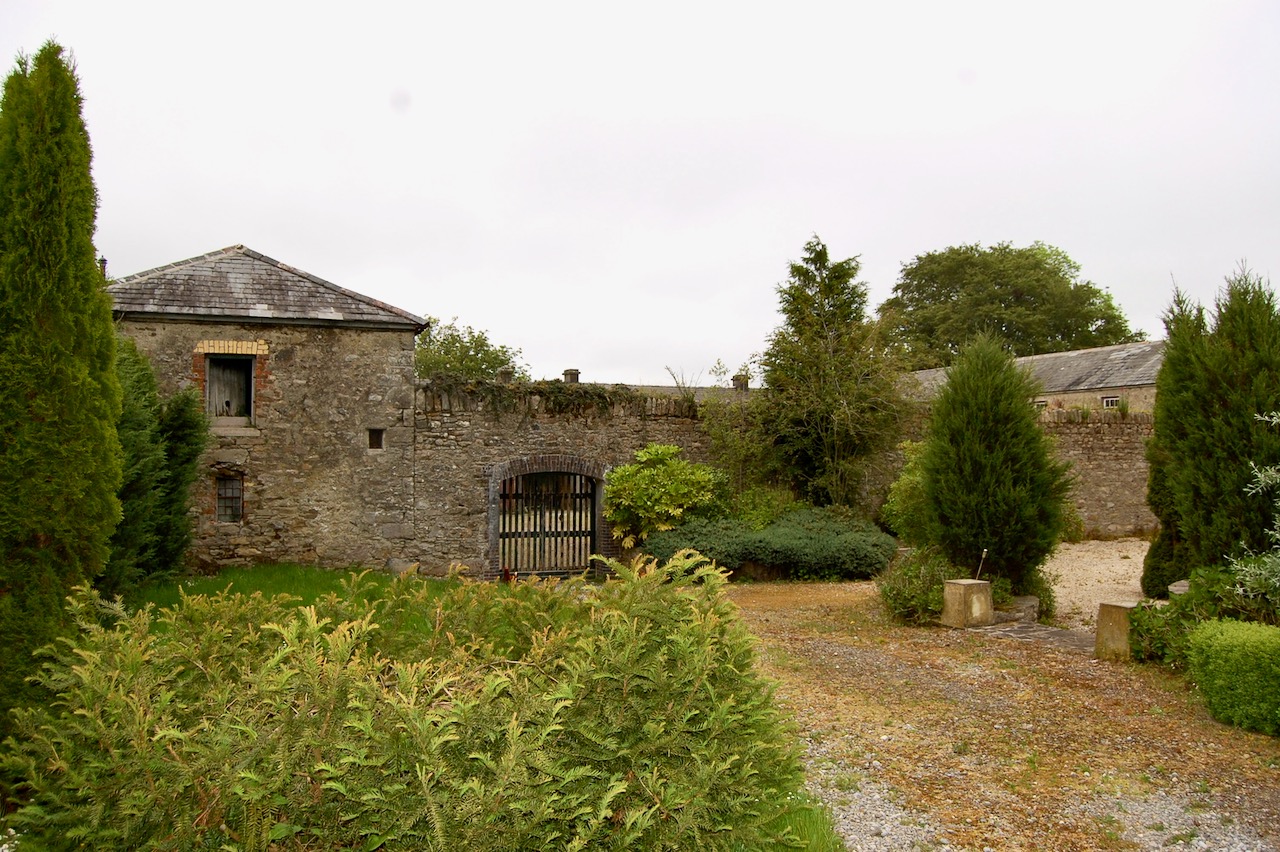
The vine, above, which was taken from a cutting from a vine belonging to Queen Victoria and given to her lady-in-waiting, Georgiana Liddell, when she married Baron Bloomfield. Photograph © Jennifer Winder-Baggot, www.irishhistorichouses.com
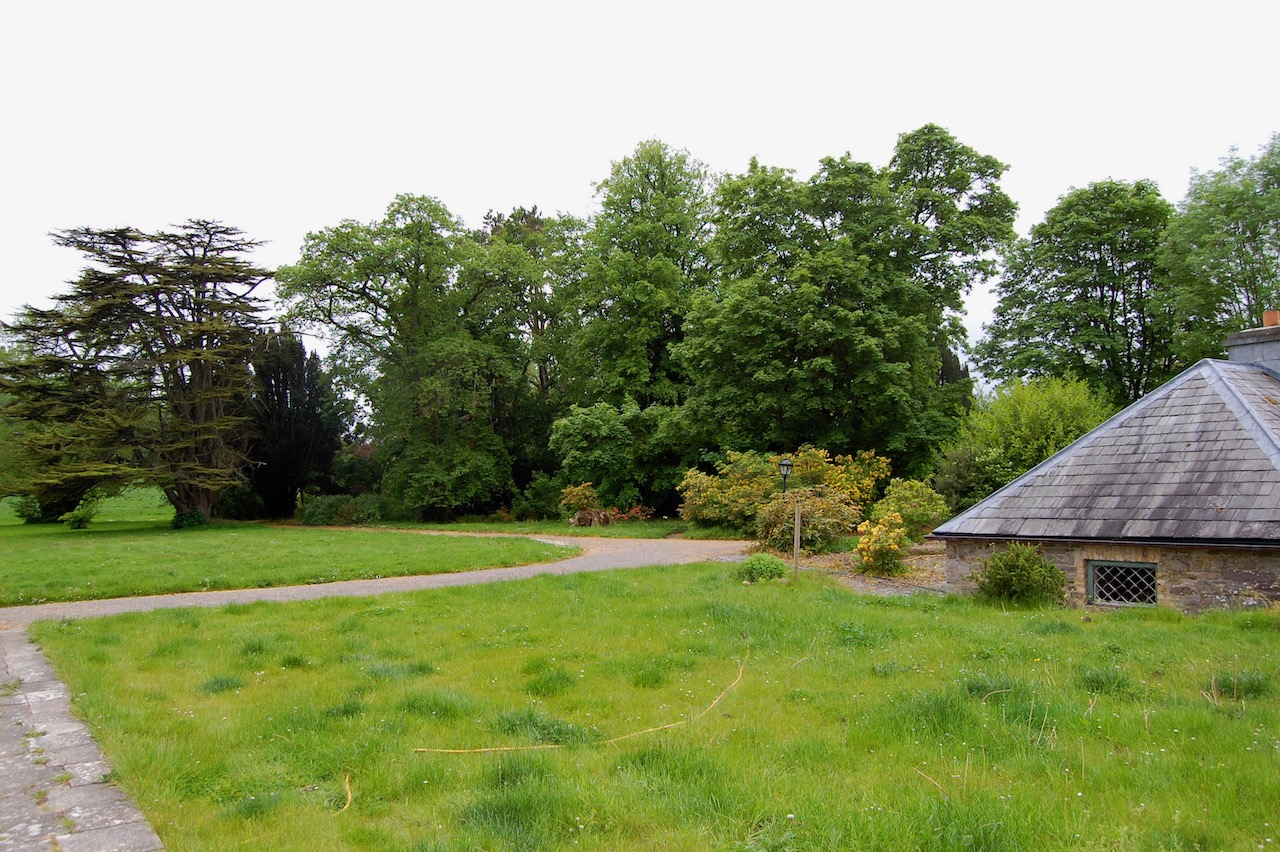
Loughton, May 2019. Photograph © Jennifer Winder-Baggot, www.irishhistorichouses.com
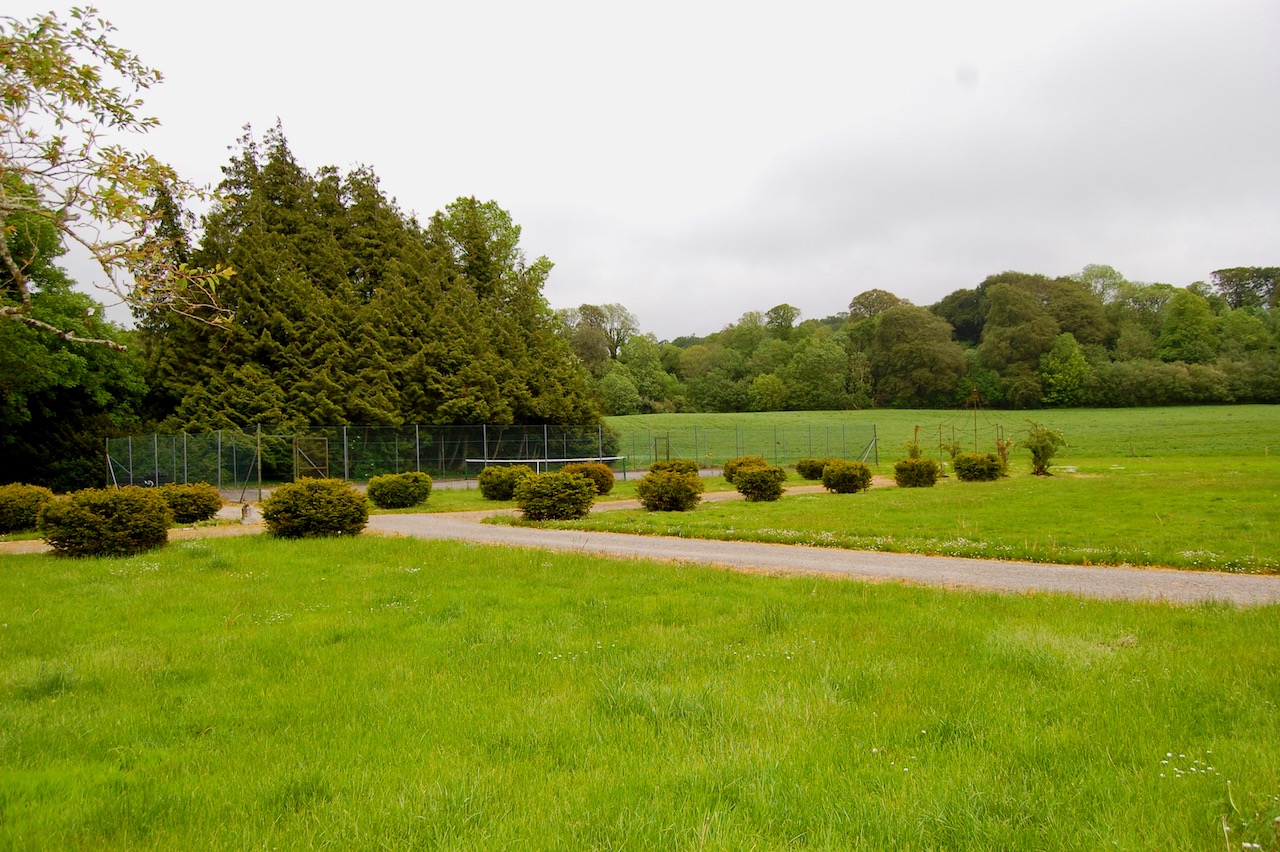
I’d love to stay in the cottage, which is also available to rent.

Loughton, County Offaly. Photograph © Jennifer Winder-Baggot, www.irishhistorichouses.com
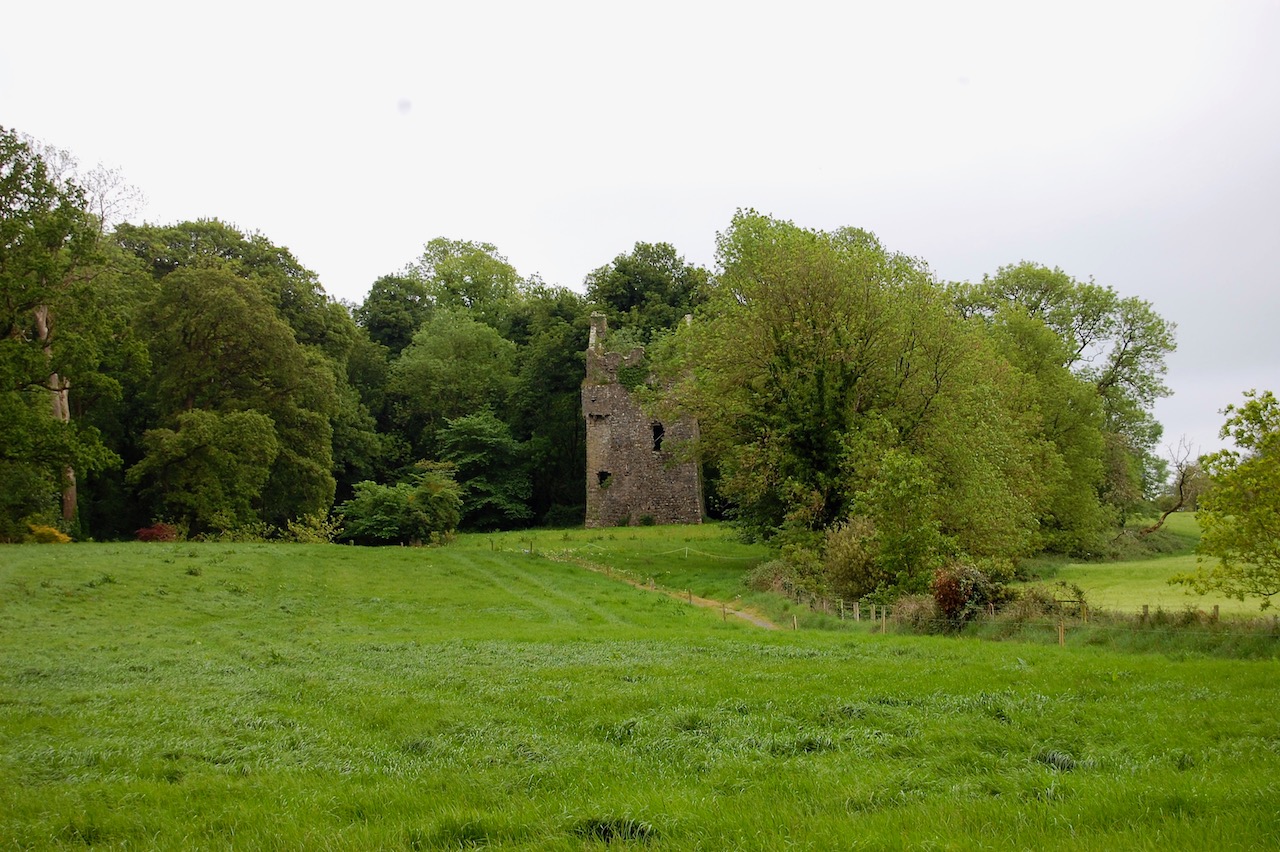
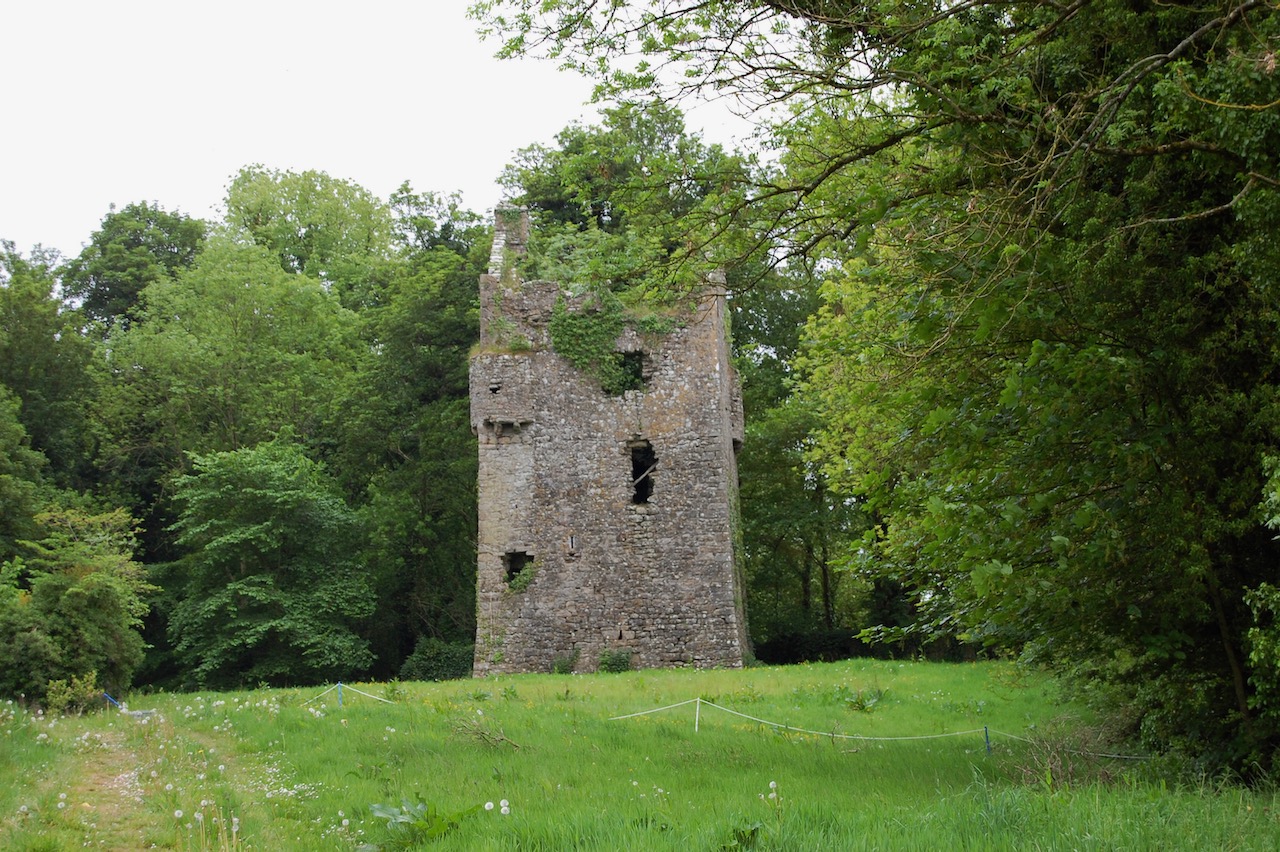
Loughton, May 2019. Photograph © Jennifer Winder-Baggot, www.irishhistorichouses.com
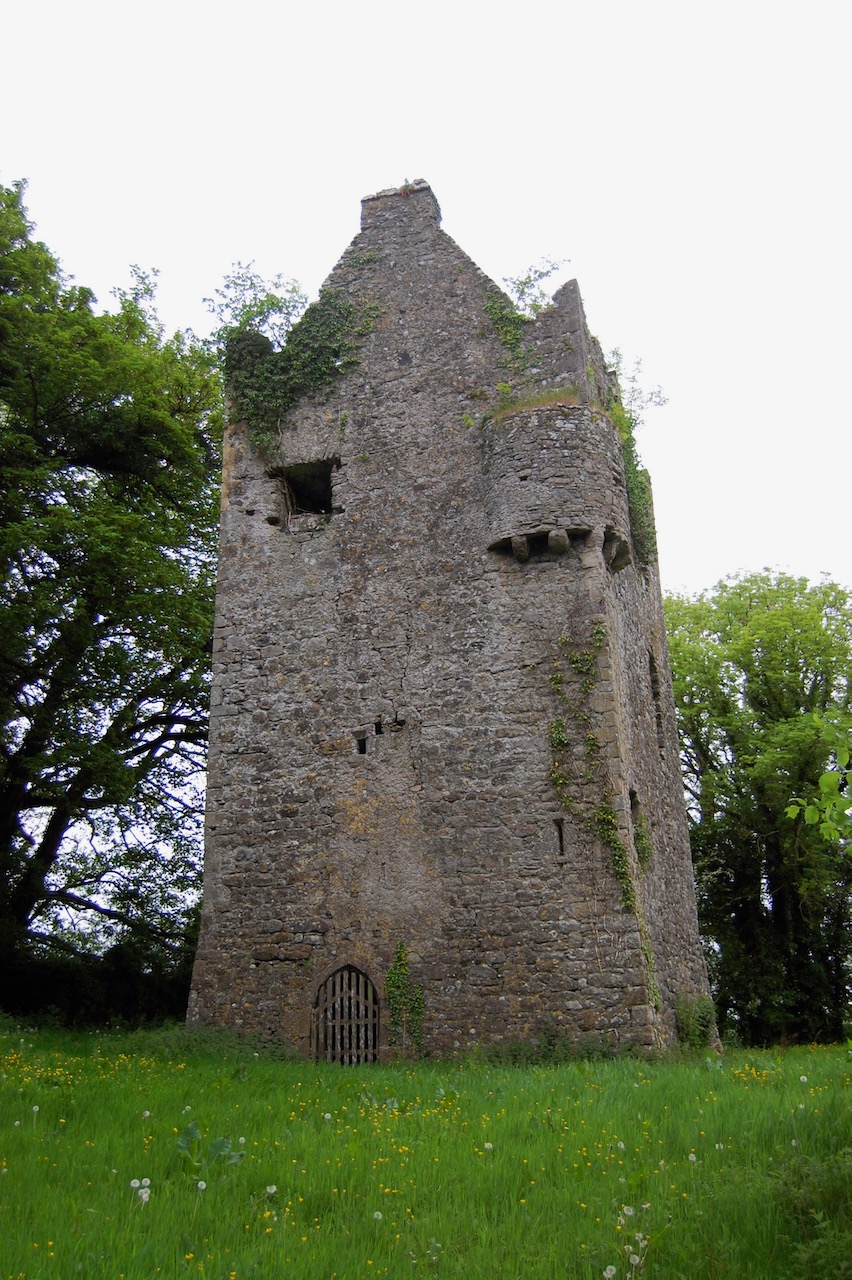
[1] Mark Bence-Jones. A Guide to Irish Country Houses. (originally published as Burke’s Guide to Country Houses volume 1 Ireland by Burke’s Peerage Ltd. 1978); Revised edition 1988 Constable and Company Ltd, London.

[2] http://www.patrickcomerford.com/search/label/castles?updated-max=2017-03-10T11:30:00Z&max-results=20&start=79&by-date=false

[3] https://en.wikipedia.org/wiki/14th_King%27s_Hussars

[4] http://www.loughcutra.com/

[5] https://www.dia.ie/architects/view/2640/PAIN-JAMES

[6] https://www.dromoland.ie/

[7] https://www.bco.ie

[8] p. 472. Tierney, Andrew. Buildings of Ireland: Central Leinster. The Counties of Kildare, Laois and Offaly. Yale University Press, New Haven and London, 2019.

[9] https://www.buildingsofireland.ie/buildings-search/building/14946003/laughton-house-ballinlough-cl-by-cullenwaine-ed-moneygall-co-offaly

[10] https://loughtonhouse.com/

[11] https://www.buildingsofireland.ie/buildings-search/building/22403202/ciamaltha-house-garraunbeg-tipperary-north

[12] http://landedestates.nuigalway.ie/LandedEstates/jsp/estate-show.jsp?id=2352

Redwood was inherited by Henry Trench’s son William Thomas Trench (1843-1911).

[13] https://www.irishtimes.com/life-and-style/homes-and-property/fine-art-antiques/owner-of-supermac-s-buys-loughton-house-archive-1.2818308

[14] http://www.thepeerage.com
[15] https://landedfamilies.blogspot.com/search/label/Ireland?updated-max=2017-02-19T16:18:00Z&max-results=20&start=23&by-date=false Atkinson of Cangort and Ashley Park

Text © Jennifer Winder-Baggot, www.irishhistorichouses.com
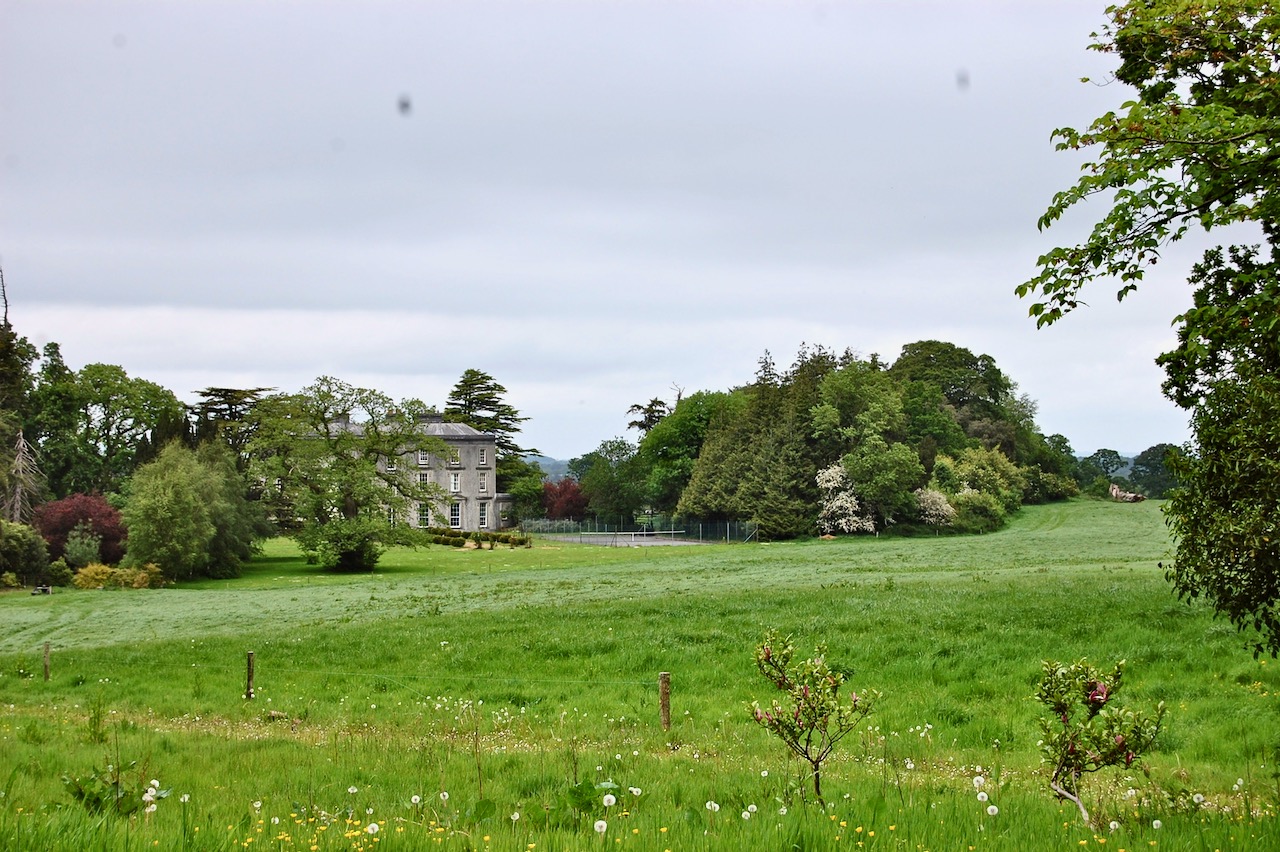
Charleville, County Wicklow A98 V293 – section 482

Open dates in 2025: Feb 4-7, 10-14, 17-21, 24-28, May 1-2, 6-30, June 3-6, 9, Aug 16-24, Mon-Fri, 1pm-5pm, May and Aug, Sat-Sun, 9am-1pm
Fee: house €10, gardens €6

donation

Help me to pay the entrance fee to one of the houses on this website. This site is created purely out of love for the subject and I receive no payment so any donation is appreciated!

€15.00

DSC_0654
Charleville, made of Wicklow granite, faced in ashlar. A stone string-course divides upper from lower windows. Photograph © Jennifer Winder-Baggot, www.irishhistorichouses.com

This was the least personal of our tours to date, when we went on Saturday May 18th 2019, as there was no sign of the owners, the Rohan family, living in the grand reception rooms, although it is their family home. Ken and Brenda Rohan purchased the house in 1981. A visit to a house that is no longer owned by descendants of the early occupiers resonates less history, although in this case one must admit the current owners are probably no less invested than if their ancestors had occupied it for centuries, as they have maintained it to a high standard, and have carried out sensitive restoration to both house and garden. Dublin architect John O’Connell oversaw work on the interiors.

We are told in Great Irish Houses that the demesne is intact, with the original estate walls and entrance gates surviving. [1]

The National Inventory of Architectural Heritage website tells us that Charleville is a detached nine bay two storey Palladian style mansion, built in 1797 to designs by Whitmore Davis, an architect originally from County Antrim, who was then based in Dublin [2]. He also built another Section 482 house, Harristown House in County Kildare [3].

The house has a three-storey pedimented breakfront, the pediment is carried on four Ionic columns at the second and third storey level of the house, the ground floor level of the breakfront being “rusticated” as if it were a basement. [4] The windows on the ground floor level in the breakfront are arched. The Buildings of Ireland website claims that the breakfront facade is inspired by Lucan House in County Dublin, which is indeed very similar. Lucan House was designed by its owner, Agmondisham Vesey, consulting with architect William Chambers, a British architect who also designed the wonderful Casino at Marino in Dublin, as well as Charlemont House in Dublin (now the Hugh Lane Municipal Art Gallery) and the Examination Hall and Chapel in Trinity College Dublin.

Lucan House, County Dublin, photograph from National Inventory of Architectural Heritage.
Casino at Marino in Dublin, designed by William Chambers who helped to design Lucan House, which has similar breakfront to that of Charleville. Photograph © Jennifer Winder-Baggot, www.irishhistorichouses.com

It was hard to find, as we were directed to the back entrance, and the gps gave us directions to a different entrance. However the person to whom I’d spoken, from Rohan Holdings, specified where to go. We found someone waiting to let us in. He was very friendly and when I stated my name, for him to write down along with licence plate of car, for security, he asked was I related to the Baggots of Abbeyleix! Indeed, I am the daughter of a Baggot of Abbeyleix! And are they related to the Clara Baggots, he asked? Yes indeed, they are my cousins! So that was a great welcome! He opened the gates for us and said he would see us on the way out, and he directed us down the driveway, toward visitor parking.

Charleville, County Wicklow. Photograph © Jennifer Winder-Baggot, www.irishhistorichouses.com
The side with its Wyatt window in the Morning Room overlooking the stretch of lawn. Photograph © Jennifer Winder-Baggot, www.irishhistorichouses.com

Our tour guide came outside to meet us and invited us into the house. We entered a large impressive entry room. The guide told us that George IV was due to visit the house, but never came, as he was “inebriated.” After visiting Slane Castle, we knew all about George IV’s visit, and why he did not get to Charleville – he was too busy with his mistress in Slane Castle! The marquentry wooden flooring (applying pieces of veneer to a structure to form decorative patterns, designs or pictures) in the front hall was installed at great expense in preparation for his visit to the house. It’s still in excellent condition.

The well-informed guide told us about the previous owners and shared details about the furniture and paintings. The house is perfectly suitably decorated, sumptuous and beautiful. The main reception rooms lead off the entrance hall and run the length of the facade. The house was built for Charles Stanley Monck (1754-1802), 1st Viscount Monck of Ballytrammon, County Wexford, after his former house on the property was destroyed by fire in 1792.

Charles Stanley Monck succeeded his uncle Henry Monck to the estate when his uncle died in 1787. Henry Monck had inherited from his father, Charles Monck (1678-1752). Charles Monck, a barrister who lived on St. Stephen’s Green in Dublin, came into the property of Charleville through his marriage in 1705 to Agneta Hitchcock, the daughter and heiress of Major Walter Hitchcock. [5]

Although Henry Monck had no son to inherit his estate, he had a daughter, Elizabeth, who married George de la Poer Beresford (January 1734/35-1800), 1st Marquess of Waterford, of Curraghmore.

The Honourable George de la Poer Beresford (1735–1800), 2nd Earl of Tyrone, Later 1st Marquis of Waterford by Johann Zoffany, courtesy of National Trust Images.

Charles Stanley Monck was the son of Henry’s brother Thomas Monck (1723-1772) and Judith Mason (1733-1814) from Masonbrook, County Galway. Thomas Monck was a barrister, and served as MP for Old Leighlin in County Carlow.

Charles Stanley Monck married Anne Quin in 1784, daughter of Dr. Henry Quin and Anne Monck (she was a daughter of Charles Monck and Agneta Hitchcock so was a first cousin). He rebuilt the house in the same year that he was raised to the peerage as Baron Monck of Ballytrammon, County Wexford. He served as MP for Gorey, County Wexford from 1790 to 1798. In 1801, as a reward for voting for the Union of Britain and Ireland, he was awarded a Viscountcy.

As well as having Charleville rebuilt, he had a terrace of houses built in Upper Merrion Street in Dublin. Number 22 of this terrace was known as “Monck House,” and number 24 was Mornington House (where some say the Duke of Wellington was born) – the terrace is better known today for housing the Merrion Hotel.

The Merrion Hotel, photograph by Jeremy Hylton: Charles Stanley Monck had this row of terraced houses built in Dublin.
Side view of Charleville. Photograph © Jennifer Winder-Baggot, www.irishhistorichouses.com

The large entry hall has fluted Ionic columns, a ceiling with coving and central rosette plasterwork, an impressive fireplace and several doors. It is full of portraits, including, over the fireplace, a painting of the family of the Verekers, Viscount Gort. The double-door leading to the staircase hall is topped with a decorative archway, and the passageway between the front hall and the staircase hall is vaulted.

Leading off the hallway were large double doors, “elevator style” (see Salterbridge), the guide pointed out that they are not hinged, and are held in place by the top and bottom instead, swinging on a small bolt from frame into door on top and bottom. They are extremely sturdy, smooth and effective.

The tour is limited to the outer and inner entrance halls, the morning, drawing and dining rooms.

Charles Stanley did not have long to enjoy his house as he died just a few years later in 1802. He was succeeded by his son Henry Stanley Monck (1785-1848), 2nd Viscount, who was also given the title the Earl of Rathdowne. It was this Henry who made the alterations to the house in preparation for the visit of George IV in 1821.

The Earl of Rathdowne married Frances Mary Trench, daughter of William Power Keating Trench, 1st Earl of Clancarty.

William Power Keating Trench (1741-1805) (later first Earl of Clancarty) by Hugh Douglas Hamilton (1739-1808), courtesy Adam’s 28 March 2012. He was the father of Frances Mary, who married Henry Stanley Monck, 2nd Viscount of Ballytrammon, County Wexford and 1st Earl of Rathdowne.

Mark Bence-Jones in his A Guide to Irish Country Houses tells us that the Grecian Revival plasterwork is probably designed by Richard Morrison. There are also floor length Wyatt windows to the side of the house, similar to ones added to Carton in Kildare in 1817 by Richard Morrison.

The staircase hall contains a cantilevered Portland stone staircase and a balustrade of brass banisters. Hanging prominently over the stairs is a huge portrait of George IV’s visit to Ireland, picturing the people saying goodbye to him at the quay of Dun Laoghaire. He stands tall and slim in the middle. The painter flatters the King who in reality was overweight. The other faces were all painted by the artist from life, as each went to pose for him in his studio. The scene never took place, our guide told us, as George IV was too drunk to stand on the quays as pictured!

The sitting room has a barrel-vaulted ceiling and the decorative plasterwork features musical instruments, gardening implements and sheaves of corn. Desmond Guinness pointed out that the plasterwork installed at Powerscourt for the royal visit is similar to decoration found at Charleville. [6] The dining room’s centrepiece of shamrock and foliage is probably earlier than 1820 but the acanthus frieze may have been added. The impressive gilt pelmets were purchased in the sale of the contents after fire destroyed the house at neighbouring Powerscourt. The drawing room also has impressive ceilings. It is furnished beautifully and has magnificent curtains framing views. The trellis-pattern rose-pink and red carpet was woven specially for the room, and the wallpaper replicates a found fragment. In their attention to detail, the Rohans had the wallpaper replicated by Cowtan of London.

The Library and Morning Room sit behind the front reception rooms. The regency plasterwork in Greek-Revival style contains laurel and vine leaves.

An Irish Times article sums up the continuation of the Monck family in Charleville:

“As Henry had no living sons (but 11 daughters), when he died in 1848, the Earldom went with him. His brother became 3rd Viscount for a year until his own death in 1849, and his son, Charles, became 4th Viscount for almost the remainder of the century, until 1894. Charles married his cousin—one of Henry’s 11 daughters who had lost out on their inheritance because of their gender. He was Governor General of Canada from 1861 – 1868. The last Monck to live at Charleville was Charles’ son, Henry, 5th Viscount who died in 1927. As he was pre-deceased by his two sons and his only brother, he was the last Viscount Monck. There are extensive files in the National Library for the Monck family.” [7]

Charles the 4th Viscount entertained Prime Minister Gladstone at some point in Charleville and Gladstone planted a tree near the house to mark the occasion. Later Charles fell out with Gladstone over Home Rule in 1886 as Charles maintained the strongly Unionist views of his family. He married Elizabeth Louise Mary Monck (d. 1892). Charles Monck (1819-1894) 4th Viscount served as Lord-Lieutenant of County Dublin between 1874 and 1892.

DSC_0655
I didn’t note which tree Gladstone planted – perhaps it is one of these near the ostrich! Photograph © Jennifer Winder-Baggot, www.irishhistorichouses.com

Henry Power Charles Stanley Monck, 5th Viscount Monck of Ballytrammon (1849-1927) gained the rank of Captain in the Coldstream Guards. He held the office of Vice-Lord-Lieutenant of County Wicklow, High Sheriff of County Wicklow and Justice of the Peace for County Dublin. He married Edith Caroline Sophia Scott, daughter of John Henry Scott, 3rd Earl of Clonmell.

Henry the 5th Viscount’s widow Edith continued to live in Charleville after his death. She died in 1929. Their daughter married Arthur William de Brito Savile Foljambe, 2nd Earl of Liverpool and lived in England. Their son the 6th Viscount married but predeceased his father, and his children moved away. The house was then purchased by Donald Davies. He established one of his “shirt dress” manufacturing bases in the stables.

Charleville, County Wicklow. Photograph © Jennifer Winder-Baggot, www.irishhistorichouses.com
Charleville, County Wicklow, May 2018. Photograph © Jennifer Winder-Baggot, www.irishhistorichouses.com

Davies and his family lived in the house for forty years. His only daughter, Lucy, married first, Michael Edward Lindsay-Hogg, 5th Baronet of Rotherfield Hall, Rotherfield, County Sussex, but they divorced in 1971 and she married Antony Charles Robert Armstrong-Jones, 1st Earl of Snowdon, the photographer son of Anne née Messel, Countess of Rosse of Birr Castle. He had been previously married to Princess Margaret, Queen Elizabeth II’s sister. He and Lucy later divorced, but had a daughter together.

According to the article in the Irish Times:

“before the Rohan family became owners, the place was popular for film settings. An American couple called Hawthorne were the previous owners, and filled it in summertime with orphaned children. Before the Hawthornes, it was owned by Donald Davies, famous for his handwoven, fine wool clothes, who had his workshops in the courtyard to the back of the house.”

The gardens are also beautiful. I believe they are open to the public at certain times of the year. [8]

The article goes on to mention the gardens:

“And then there are the gardens….It was wet and lovely, along the hedged walks and bowers, by the Latinate barbeque terrace where a lime tree was in fruit, in the rose garden, and orchard. Old flowers clustered in bursts of colour – lupins and peony roses, forget-me-not and hydrangea, wisteria covering a wall.

We were lucky to visit when the wisteria was in bloom. Photograph © Jennifer Winder-Baggot, www.irishhistorichouses.com

One steps out of the house and goes around one side, by the courtyard and stables, through that courtyard to the tennis courts. One passes along the tennis court to reach the central part of the garden.

DSC_0657
The exit at the side of the house. Photograph © Jennifer Winder-Baggot, www.irishhistorichouses.com
We passed this beautiful house – I am not sure when it was built, maybe at the time of the conversion of the stables by Donald Davis – on the way to the courtyard. Photograph © Jennifer Winder-Baggot, www.irishhistorichouses.com
DSC_0662
Walking by the tennis courts, by the beautiful topiary. Photograph © Jennifer Winder-Baggot, www.irishhistorichouses.com
DSC_0663
The central lawn, with a pond that forms the centre of the Radial Garden. Photograph © Jennifer Winder-Baggot, www.irishhistorichouses.com

Many elements of the original garden have been conserved, including the fan-shaped walled garden and the walk of yews.

DSC_0665
Heading in to the conservatory there are plaques commemorating previous gardeners.
DSC_0666
The conservatory, which is in the form of a temple, looking out at the rows of milk-bottle shaped yews. Photograph © Jennifer Winder-Baggot, www.irishhistorichouses.com
DSC_0667
Stephen ate a quick lunch in the central garden. Photograph © Jennifer Winder-Baggot, www.irishhistorichouses.com
DSC_0668
Walking around the Radial Garden. Photograph © Jennifer Winder-Baggot, www.irishhistorichouses.com
DSC_0669
Charleville, County Wicklow. Photograph © Jennifer Winder-Baggot, www.irishhistorichouses.com
DSC_0670
A fountain and pond hidden delightfully amongst the beech hedges in the Radial Garden. Photograph © Jennifer Winder-Baggot, www.irishhistorichouses.com
DSC_0671
Charleville, County Wicklow. Photograph © Jennifer Winder-Baggot, www.irishhistorichouses.com
DSC_0672
In the radial garden. Photograph © Jennifer Winder-Baggot, www.irishhistorichouses.com
DSC_0673
The milk-bottle shaped Irish yews, in the Yew Walk. Photograph © Jennifer Winder-Baggot, www.irishhistorichouses.com
DSC_0674
Charleville, County Wicklow. Photograph © Jennifer Winder-Baggot, www.irishhistorichouses.com
DSC_0679
Nobody mentioned the ostrich! (statue). Photograph © Jennifer Winder-Baggot, www.irishhistorichouses.com

Beyond the formal gardens is the aboretum with a comprehensive collection of trees.

DSC_0681
Charleville, County Wicklow. Photograph © Jennifer Winder-Baggot, www.irishhistorichouses.com
DSC_0682
Charleville, County Wicklow. Photograph © Jennifer Winder-Baggot, www.irishhistorichouses.com
DSC_0688
Charleville, County Wicklow. Photograph © Jennifer Winder-Baggot, www.irishhistorichouses.com
DSC_0690
I like the way the vine trails along the chain. Photograph © Jennifer Winder-Baggot, www.irishhistorichouses.com
DSC_0694
Charleville, County Wicklow. Photograph © Jennifer Winder-Baggot, www.irishhistorichouses.com
DSC_0695
Charleville, County Wicklow, May 2018. Photograph © Jennifer Winder-Baggot, www.irishhistorichouses.com

We liked the sundial especially, which in itself as a pillar was the dial in a way, though there was a proper sundial on the top also, on the sides of the pillar, on two sides.

DSC_0676
Is that the time? Photograph © Jennifer Winder-Baggot, www.irishhistorichouses.com
DSC_0675
Photograph © Jennifer Winder-Baggot, www.irishhistorichouses.com

We also loved the beech walk, with its twisting intertwined branches, some held up by strings or rods to maintain a walkway below.

DSC_0692
Charleville, County Wicklow. Photograph © Jennifer Winder-Baggot, www.irishhistorichouses.com
DSC_0691
Charleville, County Wicklow, May 2018. Photograph © Jennifer Winder-Baggot, www.irishhistorichouses.com

[1] Great Irish Houses. Forwards by Desmond FitzGerald, Knight of Glin; The Hon Desmond Guinness; photography by Trevor Hart. Image Publications Ltd, Dublin, 2008.

[2] http://buildingsofireland.ie/niah/search.jsp?type=record&county=WI&regno=16400713

[3] https://www.dia.ie/architects/view/1412#tab_biography

[4] see Achitectural definitions

[5] Charles Monck married and came into Charleville. Charles’s sister Rebecca married John Foster and had a daugther who married Bishop George Berkeley, the famous philosopher! My husband Stephen is also distantly related to the Monck family as his third great aunt, Jane Alicia Winder, married William Charles Monck Mason.

Jane Winder

Charles’s older brother, George (1675-1752) married Mary Molesworth and had a daughter, Sarah, who married Robert Mason, and they were parents of Henry Monck Mason who was the father of William Charles Monck Mason.

[6] p. 257. Montgomery-Massingberd, Hugh and Christopher Simon Sykes. Great Houses of Ireland. Laurence King Publishing, London, 1999.

[7] https://www.irishtimes.com/life-and-style/homes-and-property/charleville-estate-is-a-place-apart-1.309616

[8] https://visitwicklow.ie/private-gardens/#

Text © Jennifer Winder-Baggot, www.irishhistorichouses.com
Slane Castle, County Meath – section 482 tourist accommodation

www.slanecastle.ie

(Tourist Accommodation Facility)

Open in 2025: January, February, May, June, July, August, (Mar-Apr, Sept-Dec, Mon-Thurs)

Fee: adult €14, OAP/student €12.50, child €8.40 under 5 years free

DSC_0503
The view of Slane Castle from just inside the gate, driving in. Photograph © Jennifer Winder-Baggot, www.irishhistorichouses.com

Today (Saturday 27th April 2019) my husband Stephen and I made our first official blog trip.  We started in the “ancient east,” going to Slane Castle in County Meath. The land around the Boyne River is beautiful, rolling and fertile. It took almost exactly one hour to drive from our home in Dublin, taking the M1 which I find easier than the M2 through the city’s north side, with which I’m less familiar. Our timing was perfect, we arrived at 2:10pm, in time for the 2:15 tour – there are tours every hour on the quarter hour. [1]

DSC_0504
Coming closer to Slane Castle. Photograph © Jennifer Winder-Baggot, www.irishhistorichouses.com

The castle is three storeys over basement, in the Gothic Revival style. There is a bow on the back side of the castle, facing the river, and the basement serves as the ground floor on this side due to the steep slope down to the River Boyne. The bow forms a round tower, but you cannot see it as you approach the castle as the river is behind.

DSC_0505
The view over the beautiful River Boyne. Photograph © Jennifer Winder-Baggot, www.irishhistorichouses.com
DSC_0507
Stephen in front of the Castle. Photograph © Jennifer Winder-Baggot, www.irishhistorichouses.com

Our guide Matthew told us that the castle was reconstructed and enlarged by William Burton Conyngham (1733-1796). It was built on the foundations of a medieval castle of the Fleming family, replacing an earlier house. William Burton Conyngham was a classicist and the front hall features Greek columns and key patterns on the walls and many marble Greek sculptures, including a sculpture of King George IV of England, donated by the king himself.

William Burton Conyngham, (1733-1796), Teller of the Irish Exchequer and Treasurer of the Royal Irish Academy Date 1780 Engraver Valentine Green, English, 1739 – 1813 After Hugh Douglas Hamilton, Irish, 1740-1808.

William Burton Conyngham argued with his architects, Matthew told us, so ended up having three architects for his castle: James Gandon, James Wyatt and Francis Johnston. According to Mark Bence-Jones in A Guide to Irish Country Houses, Francis Johnston completed the house for the the second Lord Conyngham’s son, nephew of William Burton Conyngham, Henry (1766-1832), who later became the 1st Marquess Conyngham. Other architects were consulted at various times, including James Gandon, who most famously designed the Custom House and the Four Courts in Dublin, and Emo in County Laois. Francis Johnston designed the General Post Office in Dublin, and Townley Hall, County Louth. Another architect consulted was a favourite of King George IV, the English Thomas Hopper.

In 1785 the castle was remodelled to the design of James Wyatt (1746 – 1813). Wyatt also designed another house on the section 482 list this year, Curraghmore in County Waterford, and a house not on the list, unfortunately, as I would love to see inside, Abbeyleix House (incidentally, my father grew up in Abbeyleix and we used to enjoy the gardens which used to be open and which were reknowned for the bluebells. Also, coincidentally, according to wikipedia, Wyatt spent six years in Italy, 1762–68, in company with Richard Bagot of Staffordshire, who was Secretary to the Earl of Northampton’s embassy to the Venetian Republic. My family is rumoured to be descended from the Staffordshire Bagots, although I have not found the connection!).

The Conyngham family have owned the castle since 1703.

The Flemings of Slane

The Conynghams bought the land in Slane after it was confiscated from the Flemings. In 1175, Richard Le Fleming built a castle at the western end of Slane hill and, three generations later, Simon Fleming was created Baron of Slane. [4]

The Conynghams did not acquire Slane directly after it was confiscated from the Flemings – Terry Trench of the Slane History and Archaeology Society writes that the estate changed hands, at least on paper, seven times between 1641 and 1703. The estate was taken from the Flemings in 1641, when William Fleming, the 14th Baron Slane, joined the Catholic Irish forces in rebellion against the British. He remained loyal to the king, but objected to the laws that the British parliament passed to make the Irish parliament subservient to the British parliament. The estate was restored to William’s son Randall under the Act of Settlement and Distribution of Charles II’s reign, by decree dated 27th March 1663. [5] Many estates that had been confiscated by Cromwell’s parliament were restored when Charles II was restored to the throne in 1660.

The Flemings had their land confiscated again as Christopher, 17th Baron Slane (1669-1726), backed James II in his battles against William of Orange. He served in the Irish Parliament of King James II in 1689, and as colonel in James’s army in Ireland 1689-91, fighting in both the Battle of the Boyne and in Aughrim, where he was taken prisoner by William’s forces. Released, he emigrated and fought in the French and Portuguese armies, as did many of James II’s followers who were attainted and lost their estates, as they needed to be able to earn a living. He was later reconciled with Queen Anne of England (daughter of James II) and returned to Ireland, to live in Anticur, County Antrim. In 1703, Henry Conyngham purchased the estate of Slane.

The Conynghams of Slane

The Conyngham motto, Over Fork Over, recounts the way Duncan hid from Macbeth (familiar to us from Shakespeare). Matthew told us that Duncan hid in straw in a barn, having it forked over him. After that, he managed to defeat Macbeth and to become king. So the Conynghams are descendants of a Scottish king!

DSC_0512
The Conyngham coat of arms, with its motto, Over Fork Over. Photograph © Jennifer Winder-Baggot, www.irishhistorichouses.com
At Slane, April 2019.

Alexander Conyngham moved from Scotland to Ireland when he was appointed in 1611 to be the first Protestant minister to Enver and Killymardin the diocese of Raphoe, County Donegal. [3] He was appointed dean of Raphoe in 1631.

The Bishop’s Palace at Raphoe, now a ruin. Photograph © Jennifer Winder-Baggot, www.irishhistorichouses.com

He settled at Mount Charles, County Donegal, on an estate he leased from John Murray, earl of Annandale, the owner of ‘a vast estate’ in Scotland. Conyngham subsequently acquired the Mount Charles property through his marriage to the earl’s grand-neice, Marian, daughter of John Murray of Broughton, in Scotland (see [3]).

Alexander’s son Albert lived at Mountcharles. [2] Albert had fought with William III’s troops in the Battle of the Boyne, against Fleming and James II’s troops.

Albert Cunningham (d. 1691) first colonel of the 6th (Inniskilling) Dragoons, by Willem Wissing c. 1690, courtesy of British Cavalry Regiments website and wikipedia.

Albert married Mary, daughter of the Right Reverend Robert Leslie, Bishop of Raphoe – this Bishop is the ancestor of the Leslie family of Castle Leslie in County Monaghan, another property on the Section 482 list that I will be visiting. Albert was killed by Irish Royalist rebels, and succeeded by his only surviving son, Henry (1664-1705). 

Henry, a military man who also served as MP for County Donegal, purchased the land in Slane in 1703.

He built himself a residence, which he called Conyngham Hall, on the foundations of an older castle formerly belonging to the Flemings.

DSC_0511
The intertwined “C” is the symbol of the Conyngham family. Photograph © Jennifer Winder-Baggot, www.irishhistorichouses.com
The Conyngham family tree, on the walls going to the public dining area.

Henry Conyngham (d. 1705) fought first in James II’s army, but then persuaded his regiment to transfer their loyalty to William III.

Henry’s son Henry (1705-1781) inherited the Slane estate. Henry became an Member of the Irish Parliament and was raised to the peerage in 1753 to the title of Baron Conyngham of Mount Charles, and later became Viscount and eventually, Earl. He died without a son so the Barony passed to his nephew, William Burton (his sister Mary had married Francis Burton).

William Burton (1733-1796) took the name of Conyngham upon inheriting the estate in 1781. It was he who rebuilt Slane Castle.

William Burton Conyngham (1733–1796) by Anton Raphael Mengs c. 1754-58, courtesy of wikipedia.

His brother Francis Pierpoint Burton also who then took the name of Conyngham in 1781 as he inherited the title to become 2nd Baron Conyngham of Mount Charles, Co. Donegal. He died six years later, in 1787. [see 3]. In 1750 he had married Elizabeth, the daughter of amateur architect Nathaniel Clements, whose work we will see later in other houses on the section 482 list of heritage properties. For himself, Nathaniel Clements built what is now the Áras an Uachtaráin, the residence of our President, Michael D. Higgins, in Phoenix Park in Dublin.  

The castle and estate passed to Francis 2nd Baron Conyngham’s son Henry (1766-1832). Henry succeeded as the 3rd Baron Conyngham of Mount Charles, Co. Donegal in 1787. He served as a politician and moved quickly up the ranks of the peerage and was Lord Steward of the Royal household between 1821-30. He married Elizabeth Denison in 1794.

Elizabeth née Denison, Marchioness Conyngham (1769-1861), wife of Henry 1st Marquess.

In 1821 King George IV visited Ireland, and he spent time in the Castle with his lover, Elizabeth, wife of Frances Pierpoint Burton Conyngham. “In return,” as our guide told us, the king made Conyngham a Marquess, although this isn’t quite true as he became Marquess in 1816. [6].

One of the rooms of the castle, the Smoking Room, has two cartoons from the period mocking the King and his consort Elizabeth, drawing them as overweight. In one, she aids her son when he has to move from the Castle of Windsor where he was Royal Chamberlain. It was he who announced to Victoria that she was Queen, upon death of the previous monarch. He was let go from his position when he tried to move his lover into his rooms in Windsor. His mother came to fetch him, with several wheelbarrows, the story goes, and she took all the furniture from his rooms. Somehow she brought a grand piano back from Windsor to Slane Castle where it sat in a specially made arbor for music in the Smoking room, until it was destroyed by a fire in Slane Castle in the 1990’s. One of the Punch style cartoons is of Elizabeth with a wheelbarrow fetching her son from Windsor. I can’t quite remember the other – it had King George IV and herself in a carriage. The Irish were very annoyed that when he came to Ireland he spent his entire time at Slane Castle!

Cartoons at Slane Castle Tour, Slane, Co Meath, photograph by Nomos Productions, 2022, Courtesy Failte Ireland.
At Slane, April 2019. Photograph © Jennifer Winder-Baggot, www.irishhistorichouses.com

The Irish Aesthete writes of the visit:

Neither the king nor his inamorata were in the first flush of youth, and both were equally corpulent. These circumstances however did nothing to dampen their ardour. As was written of them at the time, ‘Tis pleasant at seasons to see how they sit/ First cracking their nuts, and then cracking their wit/ Then quaffing their claret – then mingling their lips/ Or tickling the fat about each other’s hips.’ And according to one contemporary observer, Lady Conyngham ‘lived exclusively with him during the whole time he was in Ireland at the Phoenix Park. When he went to Slane, she received him dressed out as for a drawing-room; he saluted her, and they then retired alone to her apartments.’” [7]

Our tour started with a video of Charles Conyngham, now known as Lord Mount Charles, telling of his childhood in the Castle, growing up in a very old-world upper class manner.  He did not join his parents at the dining table until he was twelve years old, dining until then in the Nursery. His nurse, Margaret Browne, came to the Castle at 16 years old, and he held her in such regard that he named his bar after her.

DSC_0516
The menu in Browne’s Bar, which gives an explanation of the name, telling of the housekeeper.

Lord Mount Charles described how he started out, when he had to take over the Castle, with a restaurant, which is now the Gandon Restaurant. To further fund the Castle maintenance, Lord Mount Charles started concerts at the venue, beginning with Thin Lizzy in 1981. To seal the deal, the next show was the Rolling Stones! With such august imprimateur, the Castle’s concerts became world-famous and featured many top performers including David Bowie, Bob Dylan, Neil Young and Queen.

DSC_0514
Lovely picture of Phil Lynnott of Thin Lizzy carrying a child at Slane.

Henry 1st Marquess Conyngham’s son, Francis Nathaniel Burton Conyngham (1797-1876) inherited the property and the title, to become 2nd Marquess Conyngham. His daughter Frances Caroline Maria married Gustavus William Lambart (1814-1886), who we will come across later as the owner of Beauparc in County Meath, another Section 482 property https://irishhistorichouses.com/2022/07/22/beauparc-house-beau-parc-navan-co-meath/ . The current owner of Slane inherited Beauparc from the Lambarts.

A son, George Henry (1825-1882) became 3rd Marquess Conyngham, and his son, Henry Francis the 4th Marquess. He married the daughter of the 4th Baron Mollens of Ventry, County Kerry. Their son the 5th Marquess died unmarried, so the title passed to his brother, Frederick William Burton, 6th Marquess. The current Marquess is the 8th, who is known as Lord Henry Mount Charles, but is officially 8th Marquess Conyngham since 2009.

A disasterous fire in the castle in 1991 destroyed the roof and one third of the castle.

DSC_0525
Newspaper clippings about the fire, in the entry to pub and restaurant.
DSC_0524
At Slane, April 2019.

The magnificent library with its intricate ceiling and impressive wooden chandelier was saved by two firemen fighting the fire from within the room, battling for nine hours. The smoke was so thick that one couldn’t see the ceiling. I think they deserve a plaque in the room to recognise their effort! Meanwhile the family saved as many priceless historic paintings and antiques as they could, including a huge portrait of King George IV that is now hanging again in the library, by cutting it from its giant gilt frame then taking the frame apart into four pieces in order to get it out through the doors. Lord Mount Charles now suffers with his lungs, probably partially as a result of long exposure to the flames and smoke. It took ten years to reconstruct the castle, but it has been done excellently so traces of the fire barely remain.

Portrait of George IV which was saved from the fire, Slane Castle Tour, Slane, Co Meath, photograph by Nomos Productions, 2022, Courtesy Failte Ireland.

We weren’t allowed to take pictures inside, as usual with these properties. There is a picture of the ornate roof in the library on the wonderful blog of the Irish Aesthete [8].

Mark Bence-Jones describes the room in his 1988 book (published before the fire, but this room remained intact!), A Guide to Irish Country Houses:

“…the great circular ballroom or library which rises through two storeys of the round tower and is undoubtedly the finest Gothic Revival room in Ireland; with a ceiling of Gothic plasterwork so delicate and elaborate that it looks like filigree. Yet this, too, is basically a Classical room; the Gothic ceiling is, in fact, a dome; the deep apses on either side of the fireplace are such as one finds in many of Wyatt’s Classical interiors, except that the arches leading into them are pointed; they are decorated with plasterwork that can be recognised as a very slightly Gothicized version of the familiar Adam and Wyatt fan pattern.

Slane Castle Tour, Slane, Co Meath, photograph by Nomos Productions, 2022, Courtesy Failte Ireland.
Slane Castle, Slane, Co Meath, photograph by Nomos Productions, 2022, Courtesy Failte Ireland

Of the tales on the tour, I especially enjoyed the story of the funeral of a soldier’s leg. Apparently it was quite the custom to have funerals for body parts – his leg had to be amputated on the field of battle and the soldier brought it back to be buried with a full-scale military funeral. It must have been to do with the fact that a person’s body is to be resurrected on the Last Day, so it’s good to know where all the parts are! Cremation used to be forbidden in the Catholic church, as somehow it would be too difficult for God to put the ashes back together – never mind a disintegrated body!

We had lunch in the bar after the tour.

DSC_0509
Outer entrance to the bar and Gandon Restaurant. Photograph © Jennifer Winder-Baggot, www.irishhistorichouses.com
DSC_0523
Entrance to the bar and Gandon Restaurant. Photograph © Jennifer Winder-Baggot, www.irishhistorichouses.com
DSC_0519
Browne’s Bar. Photograph © Jennifer Winder-Baggot, www.irishhistorichouses.com
DSC_0513
Album covers of musical performers at the Castle, in the bar: Van Morrison, Santana, Bruce Springstein, Neil Young, the Rolling Stones, Chris Rea, Bob Dylan, U2 and Bon Jovi.
DSC_0515
Memorabilia from music events: I think the guitar was signed by Phil Lynott (it was signed, anyway).
DSC_0517
Slane Castle.
DSC_0518
The music theme of Browne’s Bar is reflected in the gramophone horn lampshade. Photograph © Jennifer Winder-Baggot, www.irishhistorichouses.com

There is an adjoining distillery in what used to be the stables, and a tour of that can be purchased in combination if desired. Lord Charles’s mother bred horses before the stables were converted. The stables were designed by Capability Brown.

DSC_0543
The stables, designed by Capability Brown, now a whiskey distillery. Photograph © Jennifer Winder-Baggot, www.irishhistorichouses.com

According to the Irish Aesthete:

Henry Conyngham, grandson of General Henry Conyngham who purchased the property, around 1770 invited Capability Brown around 1770 to produce a design both for the landscaping of the parkland at Slane, and also for a new stable block. In the collection of the Irish Architectural Archive in Dublin a drawing survives of Brown’s proposal for the latter. It is not unlike the finished building, but more elaborate than what we see today.” [9]

DSC_0527
I noticed this on the wall on the lower level outside the Castle – I don’t know its origin or age. Photograph © Jennifer Winder-Baggot, www.irishhistorichouses.com

I found a blog by the Irish Aesthete on a portrait now in Slane, of Lady Elizabeth wife of the first Marqess’s daughter, Lady Maria Conyngham. Reportedly Lady Elizabeth looked very like her daughter – which one would not guess from the unflattering cartoons of her! [10]

Donation

Help me to fund my creation and update of this website. It is created purely out of love for the subject and I receive no payment so any donation is appreciated! For this entry I paid for petrol and entrance fee for myself and Stephen.

€10.00

[1] https://www.slanecastle.ie/tours/castle-tours/

[2] https://www.buildingsofireland.ie/buildings-search/building/40847025/the-hall-hall-demesne-mountcharles-co-donegal

[3] http://lordbelmontinnorthernireland.blogspot.com/2017/11/slane-castle.html

[4] https://www.culturenorthernireland.org/article/1323/the-flemings-barons-of-slane

[5] http://slanehistoryandarchaeologysociety.com/index.php/famous-people/13-the-flemings-and-the-conynghams

[6] https://en.wikipedia.org/wiki/Elizabeth_Conyngham,_Marchioness_Conyngham

“She probably became his [George IV’s] lover in 1819, when he was Prince Regent, but finally supplanted her predecessor, Isabella Seymour-Conway, Marchioness of Hertford, after he became king in 1820. He became besotted with her, constantly “kissing her hand with a look of most devoted submission.” While his wife Caroline of Brunswick was on trial in 1820 as part of efforts to divorce her, the king could not be seen with Lady Conyngham and was consequently “bored and lonely.” During his coronation, George was constantly seen “nodding and winking” at her.
“Lady Conyngham’s liaison with the king benefited her family. Her husband was raised to the rank of a marquess in the Peerage of the United Kingdom and sworn to the Privy Council, in the coronation honours of 1821. He was also given several other offices, including Lord Steward of the Household and the lieutenancy of Windsor Castle. Her second son was made Master of the Robes and First Groom of the Chamber.”

[7] https://theirishaesthete.com/2015/10/12/when-royalty-comes-to-call/

[8] https://theirishaesthete.com/2015/10/24/vaulting-ambition/

[9] https://theirishaesthete.com/2014/10/27/after-the-horses-have-bolted/

[10] https://theirishaesthete.com/2015/03/21/ireland-crossroads-of-art-and-design-vi/

Text © Jennifer Winder-Baggot, www.irishhistorichouses.com
Irish Historic Homes