Ballysteen House, Ballysteen, Askeaton, Co. Limerick for sale in June 2025 courtesy Lisney Sotheby’s International Realty
€1,300,000V94 T62T 6 beds2 baths673 m2
An extremely pleasant and attractive late Georgian historic country house, built circa 1780 on the site of the earlier Ballysteen Castle within an extremely quiet and private estate extending to nearly 100-acres. Accommodation extends to some 7244 square feet or 673 square metres and includes 6 principal bedrooms. Home to the Westropp family since 1703 the estate is an extremely rare and unique example of quintessential gentry charm, with the features of the core-estate and late Georgian house largely intact and of considerable merit. A long circa .4 mile (.7 km) gravelled drive leads through well-timbered parkland to open onto a parking forecourt in front of Ballysteen House, or branching off into the stable and garaging courtyard. Architecturally the house is magnificent and retains the majority of the original features. Nearby Ballysteen village is a 2-minute drive, Askeaton town just an 8-minute drive and Limerick city a 30-minute drive. The large solid timber front door, set between carved timber pilasters below an overhead arched fanlight window, opens into a large reception hall with decorative ceiling cornices and a central rose and a marble chimneypiece. It links to the stair hall, dining room, drawing room and family room. The dining room has matching alcoves to each end, a marble chimneypiece with a wood stove insert and two large west facing windows. For dining it can seat 12 comfortably. The drawing room again has two large west facing windows and has a marble chimneypiece. The family room, originally likely a library, also faces west with two large windows and a marble chimneypiece. The principal receptions rooms are each grand with generous proportions, high ceilings (circa 14 feet) fine chimneypieces and ornate ceiling plasterwork combined create to allow for opulent entertaining but are contained enough to be extremely comfortable for private or family use. The family room has a lower ceiling height, circa 10.5 feet, giving it a snug feel and especially in winter with a lighting open fire. The stair hall connects to the dining room, reception hall and an inner hall, itself linking to the kitchen, pantries and sculleries and a link hall to an annexe apartment. Internally, the house benefits from little change since being first completed (circa 1809) so that the majority of the original features remain intact. Including, original timber sash windows (front façade), window shutters, ceiling cornices and decorative plasterwork, picture rails, timber flooring boards, timber doors and architraves, a fine dog-leg carved timber staircase and some original chimney pieces. Restoration is required, although structurally the main house seems in commendable condition. The original layout configuration of the principal reception rooms works well for contemporary living, aside from the kitchen that is largely original. Upstairs the larger principal rooms are paired with adjacent interconnecting small bedrooms or dressing rooms and creating bedrooms suites with integral bathrooms seems highly possible. The current configuration provides 6 bedrooms and a playroom on the first floor. The bathroom accessed on the mezzanine floor, off the staircase return. Two old staff bedrooms are accessed from the first floor or a secondary staircase in the kitchen. The adjacent and linked annexe apartment requires complete restoration. A gate lodge is now derelict but could provide further accommodation. The west façade or the back of the house has a pleasant enclosed formal garden space and includes a marvellous dovecote tower folly. An internal farm lane is sucken to ensure an unobstructed view. Similarly, at the front of the house, the telegraph lines have been placed underground. The adjacent courtyard has a coach house, stable block and a large barn and leads to an outer enclosed yard and orchard garden. Again much original integrity survives but restoration is required. For equestrians the layout is ideal with linked grazing. For boating enthusiasts Ballysteen Quay, accessing the Shannon Estuary is just a 5-minute drive. Limerick city is a 30 minute drive, Cork city a 1 hr 30 minute drive and Dublin city is a 2 hr 30 minute drive. Shannon International Airport 42 minutes driving (short flight path by helicopter), Cork International Airport 1 hr 45 minutes driving, Dublin International Airport 2 hr 20 minutes driving. For further information contact Selling Agents Eileen Neville and David Ashmore.
Detached five-bay two-storey county house, built c. 1780, with additions to north and south. Square-headed window openings with six-over-six timber sash windows and stone sills. Blind six-over-six timber sash window to ground floor. Round-headed door opening with timber panelled door and fanlight with engaged Tuscan columns. Hipped slate roof. Two-bay two-storey addition to south with timber sash window and square-headed door opening with timber door and margin lights. Two-bay two-storey addition to north with pitched slate roof. Rear with six-over-six timber sash and two-over-two timber sash windows. Outbuildings to rear.
Appraisal
Ballysteen House is of considerable architectural importance within the history of County Limerick. A significant number of features remain intact which adds to the house’s architectural wealth. A curious feature which remains which adds to the house’s history is the blind window on the ground floor. The retetion of timber panelled door and the columns adds further to the merit of this outstanding house.
Originally from Yorkshire, in 1657 Montifort Westropp settled in Limerick city and three years later was comptroller of the port there. Subsequently he purchased various parcels of land in Co. Clare where he held the office of High Sheriff in 1674 and 1690, as well as being appointed a Commissioner for the county by an Act of Irish Parliament in 1697. Following his death the following year, several of his sons continued to prosper: one son, also called Montifort – a forebear of the antiquarian Thomas Johnson Westropp – purchased the Attyflin estate near Patrickswell, County Limerick from the Chichester House Commissioners in 1703, and the same year, another son, Thomas Westropp bought an estate in the same county at Ballysteen. Some kind of castle or tower house evidently stood here, but it was replaced by the present building in the last quarter of the 18th century, perhaps by the original Thomas’s grandson (also called Thomas) who died in 1789.
Following Thomas Westropp’s death in 1789, the Ballysteen estate was inherited by his only surviving son, General John Westropp. However, when he died in 1825 without issue, Ballysteen reverted to one of the children of his sister Sara who in 1775 had married Colonel Thomas Odell of Ballingarry, County Limerick. The couple’s third son, Edmond, duly inherited his uncle’s estate and changed his name to Westropp. His grandson Edward also had no son but two daughters, one of whom, Elizabeth, in 1942 married Maurice Talbot, son of the Dean of Cashel and himself, from 1954, Dean of Limerick. Ballysteen was in due course inherited by the present generation of the family who have, for the first time in its history, offered the property for sale.
As seen today, Ballysteen is a two-storey, five-bay house, with east-facing rendered facade and a west-facing, four-bay garden front, as well as lower two-storey wings on either side of the main block. Internally, the house appears to have been last undergone alterations around 1820, or perhaps soon after 1825 when it was inherited by Edmond Odell Westropp. To the front, much of the space is taken up by a substantial, three-bay entrance hall, with the staircase in an adjacent area to the immediate north. Behind the entrance are the two principal reception rooms, drawing and dining, and all three have white marble chimneypieces typical of the late-18th/early 19th century. They also retain some mahogany furniture from the same period: the dining room, for example, has a pair of arched niches each of which holds an identical buffet with slender spiral twist legs, while the entrance hall has a pair of bookcases with similar decorative detail, suggesting they all came from the same workshop at the same time. A sitting room/library is accommodated in the south wing while the kitchen, pantry, scullery and so forth, together with the service staircase, can be found in its northern equivalent. Upstairs are six bedrooms, some with dressing rooms. Thanks to being left unaltered for so long, Ballysteen retains the appearance and character of an Irish country house once widespread but today something of a rarity. One must hope that whoever is fortunate to acquire the property, while updating some of the facilities, retains that wonderful character. It is too precious to lose.
Mark Bence-Jones. A Guide to Irish Country Houses (originally published as Burke’s Guide to Country Houses volume 1 Ireland by Burke’s Peerage Ltd. 1978); Revised edition 1988 Constable and Company Ltd, London.
“Somerville, Bt/PB; Agnew-Somerville, sub Agnew, Bt, of Clendry/PB) A Georgian house altered and greatly embellished in a later period, probably ca 1830. The alterations included moving the entrance to hat had been the back of the house, which became the new entrance front; of three storeys and five bays, with a single-storey Ionic portico. The former entrance became the garden front; though it is the same height as the rest of the house, it only has two storeys, so that the rooms on this side are much higher. It is of five bays with a central pedimented breakfront and a single-storey curved bow which is balustraded, like the main roof parapet. The principal reception rooms, with their high coved ceilings, have a palatial air; the ceiling plasterwork in the saloon and library is in the manner of Michael Stapleton and could be taken for late C18; but is more likely C19,. The drawing room has a domed ceiling rather in the manner of Sir Richard or William Vitruvius Morrison. Impressive stable yard, with battlemented octagon tower above pedimented archway. Someville was inherited by Quentin Agnew, nephew by marriage of Sir James Somerville, 6th Bt and 2nd (and last) Lord Athlumney. He consequently assumed the additional surname of Somerville; but has since sold the Somerville Estate.”
Somerville House (Summerville), County Meath courtesy Mark Bence-Jones.
A coved ceiling at Somerville, County Meath. As has already been mentioned (see Rise Above It All, April 19th), the house dates from c.1730 but underwent considerable alteration about 100 years later when the entrance was moved from south to north front and a new hall created. Although the room containing this ceiling is now classified as the dining room, an examination of its decoration, which certainly looks to be pre-19th century, reveals clusters of musical instruments in each of the four corners. Might it therefore originally have been intended to serve as a ballroom?
Part of the coved ceiling in the drawing room of Somerville, County Meath. The house dates from c.1730 when it was built for Sir James Somerville, Lord Mayor of Dublin in 1736 and also sometime M.P. for the city. Towards the end of the century, further work was carried out by Sir James’ grandson and it appears the neo-classical plasterwork was added at that time into a space then serving as entrance hall (the entire building was subsequently turned back to front, thereby making this the drawing room). The result is an extravagance of floral garlands and arabesques, ostrich plumes and decorative flourishes together with the family coat of arms, all set inside a sequence of panels. The exceptional quality of the workmanship has led to suggestions the ceiling may have been executed by Dublin stuccodore Michael Stapleton (1747-1801).
A coved ceiling at Somerville, County Meath. As has already been mentioned (see Rise Above It All, April 19th), the house dates from c.1730 but underwent considerable alteration about 100 years later when the entrance was moved from south to north front and a new hall created. Although the room containing this ceiling is now classified as the dining room, an examination of its decoration, which certainly looks to be pre-19th century, reveals clusters of musical instruments in each of the four corners. Might it therefore originally have been intended to serve as a ballroom?
THE BARONS ATHLUMNEY WERE MAJOR LANDOWNERS IN COUNTY MEATH, WITH 10,213 ACRES
This is a branch of the very eminent Scottish family of SOMERVILLE.
The first of the family that settled in Ireland was
JAMES SOMERVILLE, of Tullykelter, County Fermanagh, who died in 1642.
His grandson,
THOMAS SOMERVILLE, a merchant of Dublin, married Sarah, sister of Alderman Robert King, of that city; and dying in 1718, left an only son,
SIR JAMES SOMERVILLE (c1698-1748), Knight, Alderman and Lord Mayor of Dublin, who was created a baronet in 1748, designated of Somerville, County Meath.
He wedded Elizabeth, daughter of Alderman William Quayle, of the same city, and was succeeded by his eldest son,
SIR QUAILE SOMERVILLE, 2nd Baronet (1714-72), of Brownstown, County Meath, who espoused firstly, Mary, only daughter and heiress of George Warburton, by whom he had three sons.
He married a second time, and had an only daughter, Martha, who wedded Gustavus, 5th Viscount Boyne.
Sir Quaile was succeeded by his eldest son,
SIR JAMES QUAILE SOMERVILLE, 3rd Baronet (c1742-c1802), of Somerville House, County Meath, who married, in 1771, Catherine, daughter of Sir Marcus Lowther-Crofton Bt, of The Moat, County Roscommon, by whom he had two sons, Marcus and James.
Sir James was succeeded by his eldest son,
SIR MARCUS SOMERVILLE, 4th Baronet (1772-1831), MP for County Meath, 1800, who married Mary Anne, daughter of Sir Richard Gorges-Meredyth Bt, and had issue,
WILLIAM MEREDYTH, his successor;
James Richard, lieutenant, Scots Greys.
Sir Marcus’s elder son,
THE RT HON SIR WILLIAM MEREDYTH SOMERVILLE, 5th Baronet (1802-73, was elevated to the peerage, in 1863, in the dignity of BARON ATHLUMNEY, of Somerville and Dollarstown, County Meath.
He married firstly, in 1832, the Lady Maria Harriet Conyngham, second daughter of Henry, 1st Marquess Conyngham, and had issue,
William Henry Marcus, died in infancy; Elizabeth Jane.
His lordship wedded secondly, in 1860, Maria Georgiana Elizabeth, only daughter of Herbert George Jones, and had further numerous issue, including
JAMES HERBERT GUSTAVUS MEREDYTH, his successor; Marcus Edward Francis Meredyth (1867-71).
His lordship was succeeded by his eldest surviving son,
JAMES HERBERT GUSTAVUS MEREDYTH, 2nd Baron (1865-1929), who married, in 1919, Margery, daughter of Henry Boan, of Australia, though the marriage was without issue, and the titles expired.
Somerville House at Balrath, near Kentstown, was erected for Sir James Somerville in the early eighteenth century. Only the basement from that house survives today as the house was re-modelled at the end of the eighteenth century when the rooms on the south side were re-modelled. The house was re-orientated from back to front about 1831 to the design of Sir Richard Morrison. Rooms on the garden front are much higher than the entrance front as the garden front is two storey while the entrance front is three storey. The ceiling plasterwork in the salon and library is in the manner of Michael Stapleton and could be taken for late 18th century but is more likely to be early 19th century. The dining room has a domed ceiling. The main entrance to the house is through a grand stone archway named, Ivy Lodge. There is an impressive stable yard with a battlemented octagonal tower. There is a walled garden and there was a rose garden, pigeon house, ice house and bathing house. In front of the house the Nanny river was dammed to create a feature but also to provide a bathing place.
The Somervilles originally settled in Fermanagh at the time of the Ulster Plantation. Thomas Somerville purchased 1066 acres in Meath from the Forfeited Estates Court after the Battle of the Boyne.
In 1729 James Somerville became M.P. for Dublin City, a position he held until his death in 1748. In 1736 he was appointed Lord Mayor of Dublin. Shortly before his death James Somerville was made Baron of Somerville, Co. Meath in 1748. Sir James Somerville, 1st Baronet married Elizabeth Quaile in 1713. He died in 1748 and was succeeded by his eldest son, Sir Quaile Somerville, 2nd Baronet. Born in 1714 and dying in 1772 Sir Quaile married Sarah Towers and was succeeded by his eldest son, Sir James Quaile Somerville, 3rd Baronet. Sir James Quaile Somerville, 3rd Bart was born about 1742. He married Catherine Crofton in 1770. Sir James erected the Church Tower and planted the avenue of lime trees. He was succeeded by his son, Sir Marcus Somerville, 4th Baronet. Sir Marcus was born about 1772 and died in 1831. Sir Marcus married Mary Anne Meredyth, daughter and heiress of Sir Richard Gorges Meredyth, Baronet in 1801. He married Elizabeth Geale as his second wife in 1825. Sir Marcus was M.P. for Co. Meath in Irish Parliament in 1800 and in London Parliament 1801-31. From his election of 1826 there is an itemised bill for the entertainment of voters at a Trim inn. Sir Marcus provided room and board for the voters at the Trim inn and provided raw whiskey, punch, a free shave and haircut. He had trouble keeping the piper sober to play for his voters.
His son, William Meredyth Somerville, born about 1802 became 1st Baron Athlumney. In 1832 William married Lady Maria Henrietta Conyngham, daughter of Henry Conyngham, 1st Marquess of Conyngham and his wife Elizabeth, who had been mistress to George IV. William served as Paid Attaché at Berlin, 1829-32. In 1837 Somerville House was described as the seat of Sir William Meredyth Somerville Bart. A fine mansion in an extensive demesne, it had been recently enlarged and improved, and a handsome entrance lodge erected, the grounds were embellished with an expansion of the Nanny water. He married secondly in 1860. Educated at Oxford, Sir William was returned to Parliament for Drogheda in 1837, a seat he held until 1852, and served under the Liberal Prime Minister, Lord John Russell, as Chief Secretary of Ireland from 1847 to 1852, during the worst of the Famine. He became M.P. for Canterbury in 1854 and continued as its M.P. until 1865. In 1863 he was raised to the peerage as Baron Athlumney of Somerville and Dollardstown and in 1866 he was created Baron Meredyth of Dollardstown. The Somerville family held part of the townland of Athlumney which gave them their title. The water spout with the lion’s head was erected by Sir William Somerville. The water supply is said to come from Trinity Well in the nearby woods. He had only one surviving son, James Herbert Gustavus Meredyth Somerville, born March 1865. He died at Dover in 1873 and was buried in Kentstown churchyard. In 1876 Lord Athlumney of Somerville held 10,213 acres in County Meath and 274 acres in County Dublin. James served in the Coldstream Guards and was with Kitchener in Egypt. When James was 53 he married a young Australian, Margery Honor Boan, but died without children ten years later, 1929. He was buried in Kentstown Churchyard and with him died the titles Baron Somerville and Baron Athlumney. Lady Athlumney never re-married and died in a swimming accident in the river Nanny in the grounds of Somerville House in July 1946 aged 45.
Somerville was inherited by Mr. Quentin Agnew, nephew by marriage to Sir James Somerville, 6th baronet and second and final Lord Athlumney. He took the name Somerville in 1950 but later sold the estate. The estate was broken up in the 1950s into six farms.A former Naval officer Sir Quentin pursued a career as an insurance consultant. His daughter Geraldine Somerville, who was born in Co. Meath, is an actress and has starred in the Harry Potter movies as Lily, Harry’s mother.
I was at the auction of the contents of the house and was particularly struck by the number of bells in the servant’s hallway. There was a bell for each room.
Saunderscourt House, Crossabeg, Co. Wexford for sale June 2025 courtesyBelgravia Estate Agents.Saunderscourt House, Crossabeg, Co. Wexford for sale June 2025 courtesyBelgravia Estate Agents.
‘From Artramont, I proceeded to the castle of Carrick, by Edmond, the seat of Mr. Bell, Mount Anna, that of Colonel Hudson, and Sanders’-court, the once respectable residence of the late Earl of Arran. When I arrived within view of the splendid arch and lodges, which, on an elevated position above the public road, form a grand outpost to this concern, and through which, though never carried into effect, an approach was meditated by the late Earl, my mind became unexpectedly introduced into a train of reflection on the ruinous consequences to this country, of that absentee system, which since our union with England has become so much the fashion. This splendid portal, with the degraded state of the mansion-house and offices, (now wholly deserted by the proprietor and his family,) and which form a striking contrast to each other, were well calculated to impress this subject upon the mind…I felt my heart impelled by a sentiment of sympathy; a feeling not likely to be obliterated, by the neglected and ruinous aspect of Sanders’-court, no longer the seat of nobility, nor of that munificence and national hospitality of which it was so eminently remarkable.’ From A. Atkinson’s The Irish Tourist (1815).
Saunderscourt, County Wexford derives its name from Colonel Robert Saunders who came to Ireland with Oliver Cromwell and was apppointed Governor of Kinsale, County Cork. However, he is said to have quarreled with Cromwell and having supported the restoration of Charles II was allowed to keep his grant of 3,700 acres in Wexford. In 1730 the Colonel’s great-granddaughter Jane Saunders, an only child, married Arthur Gore, later first Earl of Arran and thus Saunderscourt passed into the ownership of this family. It was the couple’s son, the second Earl of Arran whose decease (in 1809) was lamented by Atkinson since his heir abandoned the place which soon fell into ruin, as described above. Interest in the estate revived following the succession of the fourth earl in 1837, after which work was undertaken on the demesne by noted landscape gardener James Fraser. However, eventually Saunderscourt was sold c.1860 to an Arthur Giles who undertook restoration work on the main house. Believed to date from the second half of the 18th century, this was a two-storey, seven-bay property described following its refurbishment as being ‘a fine courtly building of considerable extent that displays its rich and handsome façade consisting of a centre and characteristic wings to the south-west.’ Saunderscourt changed hands again before the end of the 19th century and the main house was soon after demolished so that no trace of it remains today.
What survives at Saunderscourt is the ‘splendid arch’ and adjacent lodges that so moved Atkinson to eloquent reflection in 1815. Tucked down a quiet country road, this building appears to have been constructed during the time of the second Earl of Arran and, as is mentioned, was intended to be the start of a new approach to the house but this never happened. Thus it would seem always to have stood in glorious isolation, a monument to unrealised ambition. Attributed recently to Waterford architect John Roberts (who certainly worked in the area on a number of properties), the entrance, as can be seen, consists of a towering triumphal arch with the same treatment to both front and rear: engaged Tuscan columns support a triangular pediment, while a semicircular arch with moulded architrave is supported on Tuscan piers. This all executed in limestone although the greater part of the structure is of brick. The same material is also used for the single-storey quadrants and lodges. The former, which each have a pair of round-headed niches, are interesting because – like the arch itself – they are identical on either side. The effect is to create concave spaces which acted as yards for the lodges, with their Gibbsian door- and windowcases in limestone. The whole effect is tremendously grand, although somewhat incongruous in its present setting, shared with a series of cow sheds. The Saunderscourt arch has of late benefitted from attention paid to its welfare by the Irish Landmark Trust but that organisation’s limited resources have meant work has not progressed beyond stabilization and certain key repairs, particularly to roofs and drainage. Provided the necessary funds are forthcoming, no doubt further remediation will be undertaken and the property fully restored so that it can begin generating an income (and thereby better secure its future).
Saunderscourt House, Crossabeg, Co. Wexford for sale June 2025 courtesyBelgravia Estate Agents.Saunderscourt House, Crossabeg, Co. Wexford for sale June 2025 courtesyBelgravia Estate Agents.
Remains of country house, vacant 1815; undergoing renovation 1844; occupied 1852; sold 1855; occupied 1863; sold 1889; demolished 1891, including: Detached three-bay two-storey wing on a rectangular plan with single-bay two-storey gabled flush end bay. Renovated, —-. Pitched (gabled) and hipped slate roof with ridge tiles, rendered chimney stacks having “Cavetto”-detailed capping supporting terracotta pots, and cast-iron rainwater goods on rendered eaves retaining cast-iron downpipes. Rendered walls with rusticated quoins to corners. Segmental-headed central door opening with rendered “bas-relief” surround having splayed reveals framing timber panelled door having fanlight. Square-headed window openings with cut-granite sills, and rendered “bas-relief” surrounds framing replacement casement windows replacing six-over-six timber sash windows. Set in shared grounds.
Appraisal
A wing surviving as an interesting relic of a country house described as ‘[a] very extensive [and] fine courtly building so complex in its general character as to render it very difficult to be accurately described’ (Lacy 1852, 16; cf. 15703765).
Saunderscourt House, Crossabeg, Co. Wexford for sale April 2022 courtesy Keane Auctioneers €1,100,000 and June 2025, Belgravia Estate Agents
Y35AE04
2022 advertisement, courtesy Keane Auctioneers.
Saunderscourt House is a truly magnificent period residence extending to c. 203.sqm resting on c. 1.78 acre site in a prime location, approached via impressive gated entrance, driveway sweeping to beautifully mature, landscaped lawns with a charming courtyard and panoramic views over the River Slaney and surrounding countryside. Keane Auctioneers are proud to present this elite home, one of the most exclusive residential properties to hit the market in Wexford in recent times. This absolutely exquisite residence oozes elegance, style, classic features are simply breath taking from the moment you enter the original front door. Its lavish charm and retained olde worlde characteristics will impress from start to finish. The extensive and versatile accommodation is laid out over two floors, around a superior hallway with classic tiled floors & featuring a beautiful stove with fireplace. The spacious rooms boast large feature windows allowing lots of natural light through, with high ceilings, sophisticated interior complimenting each room and numerous bespoke finishings. The property has been lovingly retained and cared for over the years whilst carefully maintaining its original presence. Accommodation is bright, very well proportioned offering 4 double bedrooms, one en suite, formal living room, family bathroom, a most impressive master bedroom and enjoys a magnificent open plan kitchen /diner/lounge over looking the courtyard & grounds. The kitchen/diner/lounge is the focal point of the home which effortlessly flows into the main living providing a tranquil space to relax and unwind, it’s the heart of the home and it enjoys views over the grounds and courtyard. Offering access to the pretty exterior, the open plan lounge / dining area area provides functionality and comfort through tasteful and cutting edge interior design. The courtyard with stone buildings to the rear currently used as studio’s offer additional space to enjoy offering excellent potential. The gardens offers a very peaceful relaxing atmosphere and are full of olde worlde charm with mature shrubbery etc. the perfect place to spend many hours relaxing/gardening. The stunning setting capturing in breath taking views over the River Slaney is one of the key features and the house itself boasts a very homely and pleasant atmosphere throughout. It’s luxurious and glamorous decorative feel, together with large feature windows & shutters and high ceilings allow sunlight to pour into the property giving an overwhelming sense of space. Filled with character this home is steeped in history originally built in 1690, brief details of history on http://www.saunderscourthouse.com. Location It is situated in a premium and highly desired residential location, on the outskirts of Crossabeg village just a short distance from the N25, N11/M11. It is close to local facilities shops, schools, etc. at Crossabeg, Castlebridge and Wexford town centre is approx.. 10 minutes driving distance. All local facilities, i.e. shops, schools, Montessori, etc. are within immediate reach. Dublin City & airport is easily accessible via the new & ever improving N/M11 and the ferries at Rosslare Europort are less than 25 minutes. There are a variety of long sandy beaches nearby at the renowned Curracloe & Raven Forest, Rosslare, Blackwater, Kilmore Quay and many more. Wexford’s (wildfowl reserve etc.), Eden Vale and the Heritage Park to name a few are a short driving distance as are a wide range of golf courses. Grounds Well appointed on a mature c. 1.78 acres of mature grounds with spectacular views. Gated entrance with tree lined driveway, generous car parking . Situated to the rear of the house is the original stone courtyard of outbuildings which have been masterfully restored and converted by the current owners, providing extra accommodation ideal for home office studio / gym.
Accommodation
Entrance Hallway – (5.3m x 3.5m), Tiled flooring, coving, granite fireplace with Charmwood stove, chandelier, dual aspect. Drawing Room – (5.3m x 5.4m), Solid wood flooring, feature open fireplace, dual aspect, TV point, coving. Living Room – (5.3m x 3.5m), Solid wood flooring, coving, uplit alcoves, Cotswold stone fireplace with Nelson Martin stove, wooden beams, paneling on ceiling. Kitchen / Diner – (5.3m x 3.2m), Solid wood flooring, wooden beams, dual aspect with large bay window, tiled splash-back, decorative fireplace with AGA style stove, granite worktops, units at eye & waist level. Utility – (2.7m x 4.6m), Tiled flooring & splash-back, solid wood units at waist level, storage at eye level, sink, plumbed for washing machine. Guest WC – (1.4m x 1.1m), Tiled flooring, WC. Upstairs Landing – (1.7m x 1.8m), Large window, dado rail detail on staircase. Bathroom – (1.9m x 3.4m), Tiled flooring & part-tiled walls, WC, WHB, bath, shower, feature heated towel rail. Bedroom No. 1 – (3.4m x 4.4m), Large, bright room with bay window. Bedroom No. 2 – (4.1m x 4.3m), Spacious double room, hot-press off. Bedroom No. 3 – (4.1m x 3.6m), Bright, spacious room, bay window. Master Bedroom 4 – (5.2m x 3.4m), Large, dual aspect room, entrance to; Dressing Room – (2.7m x 2.8m) Built-in treble wardrobe. En Suite – (2.7m x 1.7m), Tiled floor & part-tiled walls, WC, WHB, shower.
Features
c. 203.sqm / 2228.14sqft Courtyards with stone outbuildings Gated entrance. Spectacular views 4 Bedrooms Premium location
BER Details
BER: Exempt
Directions
Outside: Courtyard to rear with separate room suitable for sun-room, studio, home office, large gardens to front and side, utility & recycling sheds, gated driveway, views over the River Slaney & Wexford Town. Services: ESB, private sewage, mains water, dual & oil fired central heating, solar panels. Apply: Keane Auctioneers (053) 9123072. BER: Exempt. Viewings: Strictly by appointment with the sole selling agent. Eircode: Y35 AE04
Belgravia advertisement:
€1,250,000
4 Bed3 Bath
Saunderscourt House, Crossabeg, Co. Wexford for sale June 2025 courtesyBelgravia Estate Agents.
Nestled towards the end of a private lane, this exclusive period property is a true gem, offering a rare combination of historic elegance and modern comfort in a highly sought-after private residential location. Set on circa 1.78 acres of mature, landscaped grounds, the home is approached via a gated sweeping gravel driveway, creating an immediate sense of grandeur and privacy. Steeped in character, the residence showcases beautiful classic features throughout, coupled with modern sympathetic energy upgrades such as oil central heating and solar panels. Upon entry you are greeted by an inviting foyer with open fireplace with the dual aspect formal living room to the left. With stripped wooden flooring and a stove. To the right of the hallway enter into another dual aspect cozy lounge with a further stove. This room leads through to the naturally illuminated open plan, spacious kitchen dining area. Located off the dining area is the fitted utility room and a further downstairs WC. Located on the first floor there are 4 spacious and light filled double bedrooms with the master bedroom benefiting from a walking in wardrobe/dressing room and an ensuite shower. The main bathroom is also located on the first floor with a separate bath and a separate shower. To the rear of this home there is an enclosed courtyard which adds to the charm of the property, featuring a brick and glazed outbuilding that offers endless possibilities ideal for a creative studio, home office. Positioned to take full advantage of its panoramic views of the majestic River Slaney and the picturesque landscape of Ferrybank in Wexford Town. This prestigious location offers a perfect balance of tranquillity and convenience, with all amenities within easy reach. A truly remarkable home, blending timeless period elegance with the potential for contemporary luxury this is a rare opportunity to acquire a piece of Wexford’s rich architectural heritage.
Saunderscourt House, Crossabeg, Co. Wexford for sale April 2022 courtesy Keane Auctioneers.Saunderscourt House, Crossabeg, Co. Wexford for sale April 2022 courtesy Keane Auctioneers.Saunderscourt House, Crossabeg, Co. Wexford for sale April 2022 courtesy Keane Auctioneers.Saunderscourt House, Crossabeg, Co. Wexford for sale April 2022 courtesy Keane Auctioneers.Saunderscourt House, Crossabeg, Co. Wexford for sale April 2022 courtesy Keane Auctioneers.Saunderscourt House, Crossabeg, Co. Wexford for sale April 2022 courtesy Keane Auctioneers.Saunderscourt House, Crossabeg, Co. Wexford for sale April 2022 courtesy Keane Auctioneers.Saunderscourt House, Crossabeg, Co. Wexford for sale April 2022 courtesy Keane Auctioneers.Saunderscourt House, Crossabeg, Co. Wexford for sale June 2025 courtesyBelgravia Estate Agents.Saunderscourt House, Crossabeg, Co. Wexford for sale April 2022 courtesy Keane Auctioneers.Saunderscourt House, Crossabeg, Co. Wexford for sale June 2025 courtesyBelgravia Estate Agents.Saunderscourt House, Crossabeg, Co. Wexford for sale April 2022 courtesy Keane Auctioneers.Saunderscourt House, Crossabeg, Co. Wexford for sale April 2022 courtesy Keane Auctioneers.Saunderscourt House, Crossabeg, Co. Wexford for sale June 2025 courtesyBelgravia Estate Agents.Saunderscourt House, Crossabeg, Co. Wexford for sale April 2022 courtesy Keane Auctioneers.Saunderscourt House, Crossabeg, Co. Wexford for sale April 2022 courtesy Keane Auctioneers.Saunderscourt House, Crossabeg, Co. Wexford for sale April 2022 courtesy Keane Auctioneers.Saunderscourt House, Crossabeg, Co. Wexford for sale April 2022 courtesy Keane Auctioneers.Saunderscourt House, Crossabeg, Co. Wexford for sale June 2025 courtesyBelgravia Estate Agents.Saunderscourt House, Crossabeg, Co. Wexford for sale June 2025 courtesyBelgravia Estate Agents.Saunderscourt House, Crossabeg, Co. Wexford for sale June 2025 courtesyBelgravia Estate Agents.Saunderscourt House, Crossabeg, Co. Wexford for sale April 2022 courtesy Keane Auctioneers.Saunderscourt House, Crossabeg, Co. Wexford for sale April 2022 courtesy Keane Auctioneers.Saunderscourt House, Crossabeg, Co. Wexford for sale April 2022 courtesy Keane Auctioneers.Saunderscourt House, Crossabeg, Co. Wexford for sale April 2022 courtesy Keane Auctioneers.Saunderscourt House, Crossabeg, Co. Wexford for sale June 2025 courtesyBelgravia Estate Agents.Saunderscourt House, Crossabeg, Co. Wexford for sale April 2022 courtesy Keane Auctioneers.Saunderscourt House, Crossabeg, Co. Wexford for sale June 2025 courtesyBelgravia Estate Agents.Saunderscourt House, Crossabeg, Co. Wexford for sale April 2022 courtesy Keane Auctioneers.Saunderscourt House, Crossabeg, Co. Wexford for sale April 2022 courtesy Keane Auctioneers.Saunderscourt House, Crossabeg, Co. Wexford for sale June 2025 courtesyBelgravia Estate Agents.Saunderscourt House, Crossabeg, Co. Wexford for sale April 2022 courtesy Keane Auctioneers.Saunderscourt House, Crossabeg, Co. Wexford for sale April 2022 courtesy Keane Auctioneers.Saunderscourt House, Crossabeg, Co. Wexford for sale April 2022 courtesySaunderscourt House, Crossabeg, Co. Wexford for sale April 2022 courtesy Keane Auctioneers.Saunderscourt House, Crossabeg, Co. Wexford for sale April 2022 courtesySaunderscourt House, Crossabeg, Co. Wexford for sale April 2022 courtesy Keane Auctioneers.Saunderscourt House, Crossabeg, Co. Wexford for sale April 2022 courtesySaunderscourt House, Crossabeg, Co. Wexford for sale April 2022 courtesySaunderscourt House, Crossabeg, Co. Wexford for sale April 2022 courtesy Keane Auctioneers.Saunderscourt House, Crossabeg, Co. Wexford for sale April 2022 courtesy Keane Auctioneers.Saunderscourt House, Crossabeg, Co. Wexford for sale April 2022 courtesySaunderscourt House, Crossabeg, Co. Wexford for sale April 2022 courtesySaunderscourt House, Crossabeg, Co. Wexford for sale June 2025 courtesyBelgravia Estate Agents.
Mountainstown House, County Meath, courtesy Raymond Potterton, for sale May 2025.
Mark Bence-Jones. A Guide to Irish Country Houses (originally published as Burke’s Guide to Country Houses volume 1 Ireland by Burke’s Peerage Ltd. 1978); Revised edition 1988 Constable and Company Ltd, London.
“(Pollock/LGI1958) An early C18 house of two storyes over high plinth, with a charming air of bucolic Baroque. The six bay front is adorned with giant Ionic pilasters, two supporting the pediment and one at either side; but they have neither architrave nor frieze. The Venetian entrance doorway is enriched with Ionic pilasters, urns on entablatures, a keystone and a finial which breaks through the string-course above. In front it is is a great if somewhat rustic perron with a central balustrade and ironwork railings to the flights of steps. In the centre of the four bay side elevation is a little floating pediment. This side of the house is prolonged by a three sided projection, with timber-mullioned windows in C17 style. There is a dormered attic in the high roof, which is also lit by a lunette window in the main pediment.”
Six-bay, two-storey over basement house, with two-bay breakfront and pediment, c.1720 by Richard Gibbons, sold to John Pollock in 1780, sw wing added 1813 and single storey kitchen wing. Stableyards.
Mountainstown (House) - located outside Navan in the townland of Castletown Kilpatrick, built around 1720 for Richard Gibbons whose father Samuel acquired the estate in the late 17th century: in the same year he made a visitation of his dioceses, Bishop Anthony Dopping of Meath recorded ‘Mr Gibbons and his wife came here in xmas 1693.’ Mr Gibbons’ son Richard is likewise recorded as being at Mountainstown in Faulkiner’s Dublin Journal in 1745, by which time the house would have been well finished. Over the door is a stone cartouche featuring the arms of the Pollocks, the family that followed the Gibbonses at Mountainstown. The latter remained in possession of the estate until 1796 when it was sold to the John Pollock by a daughter of Samuel Gibbons. He had already been renting for some time. The first John Pollock moved from Scotland to Ireland in 1732 and settled in Newry where he became involved in the linen trade. His son continued in the same business and was commemorated by a tombstone in St Mary’s, Newry declaring he and his wife Elizabeth had been ‘parents of eleven children all of whom they lived to see established in the world.’ One of those children, another John, became a successful solicitor in Dublin and was appointed Transscriptor of the Court of the Exchequer. He first rented and then bought Mountainstown although he retained a townhouse in Dublin’s Mountjoy Square so that his business could continue. Married to the daughter of a London banker, around 1811 he extended Mountainstown by adding a two-storey wing to the south-west of the older building. The ground floor of this new section contains a large drawing room with canted bay window and beyond it an equally substantial dining room. A substantial stable yard was added by the next generation. In the mid-1820s Mountainstown was inherited by Arthur Hill Cornwallis Pollock, named after his father’s patron, Arthur Hill, second Marquess of Downshire. The present generation has decided to put the property on the market (March 2015) for €4.15 million.
It has long been commented that Mountainstown, County Meath is mis-named since its location in the midst of flat countryside is near neither a mountain nor a town. One ill-tempered Englishwoman in the 1840s wrote ‘At the beginning of this month we came to a place called Mountainstown, which name it must have been received from the inveterately stupid and perverse disposition of the Natives, because the place is situated in a low and flat Country, and there is not a Mountain to be seen within the Horizon.’ In fact the denomination most likely derives from an Anglicisation of the Irish for ‘Beside a Bog.’ It has borne the name for hundreds of years since the house here, soon due to celebrate the tercentenary of its construction, has always been known as Mountainstown. It is believed to have erected around 1720 for Richard Gibbons whose father Samuel acquired the estate in the late 17th century: in the same year he made a visitation of his diocses, Bishop Anthony Dopping of Meath recorded ‘Mr Gibbons and his wife came here in xmas 1693.’ Mr Gibbons’ son Richard is likewise recorded as being at Mountainstown in Faulkiner’s Dublin Journal in 1745, by which time the house would have been well finished.
The oldest part of Mountainstown is a stocky rectangular block with six bay front, of two main storeys with dormer attic above and basement below. Kevin Mulligan has described the building as occupying ‘the middle ground between farmhouse and mansion’ and like others employed the terms bucolic and naive when speaking of its design. Mountainstown’s facade is its most immediately striking feature, a determined effort on the part of Richard Gibbons to display awareness of current architectural trends even if these were employed in a somewhat unsophisticated manner. Four slender Ionic pilasters ascend to the top of the building but without the intervention of an entablature and frieze; instead they meet the roofline via a narrow moulded cornice. The two central pilasters support a pediment but again appear too slight for the task. The raised entrance is reached by flights of stone steps with iron work railings on either side, the Venetian doorcase once more being flanked by pairs of pilasters with sidelights above which sit half-urns while over the door itself is a stone cartouche featuring the arms of the Pollocks, the family that followed the Gibbonses at Mountainstown. The latter remained in possession of the estate until 1796 when it was sold to the John Pollock who had already been renting for some time.
The history of Mountainstown’s next owners represents a familiar trajectory from merchant class to gentry, a route to which many families formerly aspired. The first John Pollock moved from Scotland to Ireland in 1732 and settled in Newry where he became involved in the burgeoning linen trade. His son continued in the same business and was commemorated by a tombstone in St Mary’s, Newry declaring he and his wife Elizabeth had been ‘parents of eleven children all of whom they lived to see established in the world.’ One of those children, another John, became a successful solicitor in Dublin and was appointed Transscriptor of the Court of the Exchequer. He also acted as agent for the Hills, Marquesses of Downshire, among the country’s largest landowners: at one time they had 115,000 acres, mostly but not exclusively in County Down. Hence being their agent was a profitable occupation and allowed John Pollock first to rent and then to buy Mountainstown although he retained a townhouse in Dublin’s Mountjoy Square so that his business could continue. Married to the daughter of a London banker, around 1811 he extended Mountainstown by adding a two-storey wing to the south-west of the older building. The ground floor of this new section contains a large drawing room with canted bay window and beyond it an equally substantial dining room. To the immediate right of the facade is a long kitchen wing and behind this lies a very substantial stable yard added by the next generation.
Mountainstown is thus of two periods and two parts, each complementing the other. While the later portion of the house is relatively plain and very much in the Regency taste with deep tripartite windows, high ceilings and understated plasterwork, the earlier reflects the more ostentatious taste of the period in which it was built. The entrance hall, stairs and first floor landing retain their original decoration, moulded plaster panels with lugged heads forming tabernacle frames beneath a dentil cornice. The handsome stairs are wide and shallow, Doric balusters supporting the handrail and the side of each tread adorned with carved curls of foliage. As with the facade, this decoration represents the original builder’s interest in showing he was au courant with the latest fashions. The most unexpected feature can be found almost immediately inside the front door: what looks to be a death mask set into the ceiling. It is commonly believed that the man shown is Samuel Gibbons, perhaps placed here as an act of filial piety on the part of his son Richard. The rooms in the front portion of the house are noticeably smaller than those added in the 19th century, and some have angled corner chimneypieces: a marble panel on that in the former morning room featuring a knight in armour.
In the mid-1820s Mountainstown was inherited by Arthur Hill Cornwallis Pollock, named after his father’s patron, Arthur Hill, second Marquess of Downshire. Almost twenty years before he had been sent on a tour of Europe by his parents, presumably keen that their heir have the upbringing of a gentleman. Having visited France and Italy, he travelled as far as Russia, spending time at the Imperial court in St Petersburg with his friends Lords Royston and Somerton, before finally returning home in the second half of 1807. Four years later he married a cousin and devoted the rest of his life to agriculture and country pursuits. It was Arthur who created the spacious yard immediately to the north of the main house as he often won medals for his animals at agricultural shows. The Pollocks were always keen on hunting and Arthur had his own pack of hounds at Mountainstown as did many of his neighbours: eventually these were amalgamated into the Clonghill Hunt which later became the Meath. And so it has gone on until now, when the present generation has decided the moment is right to pass Mountainstown on to another family, perhaps one that will remain in the house for as long as have the Pollocks. It is always sad to see an historic property come on the market, especially in Ireland where relatively few families have stayed in the same place for so long. However, one should remember the words of Disraeli who in 1867 observed, ‘Change is inevitable in a progressive country. Change is constant.’ Whatever one’s personal feelings, the proposed departure of the Pollocks from Mountainstown, like that of the Gibbonses before them, is a reflection of that necessary change.
For sale 4/11/2019
courtesy Savills (Country)
Tel: 01 663 4350
PSRA Licence No. 002223
Mountainstown Estate, Navan, Co. Meath, C15 C938
9 bed, 1103.9sq m
€2,750,000
A most impressive 18th Century Georgian mansion, of immense charm and character, nestled in the heart of rural Meath and surrounded by 120 acres of parkland, paddocks and mature woodland. Mountainstown comprises a most impressive, but charming Georgian House surrounded by 120 acres of parkland, paddocks, mature woodland and newly planted hardwood. Nestled in the heart of unspoilt rural Meath, a county renowned for its rich heritage and excellent lands.
The house is approached by two sweeping avenues both of which travel through the parkland before the first glimpse of the house and eventually arriving at the broad gravel forecourt. While the house does impress by its grandeur and scale, it exudes character and style, which has made it a fabulous family home. In all, Mountainstown encompasses all the attributes one seeks when acquiring a fine country residence; from the sizable, well maintained house, extraordinary stable yard, gardens and auxiliary courtyards, walled garden and mature parkland. The residence stands three floors over basement with a good layout and an easy flow due to the two separate staircases. It is approached by a double set of balustraded stone steps into the main hall which has a fine staircase with turned Doric bannisters and walls decorated with handsome plaster panels.
This hall ceiling features the mould of Samuel Gibbon`s face, set within a graceful cartouche. To the left of the hall there are four interconnecting reception rooms, namely the library, small dining room (or breakfast room) drawing room and dining room. This enfilade of south -facing spaces blend and flow beautifully to make for superb entertaining.
The library features gilded carvings of the Pollock family crest; the boar pierced by an arrow, atop the pelmets, which also support the original tassel fringes. This fascinating library also has its original leather wall covering, in a wonderful ox-blood colour.
The drawing room and the dining room stand out as exceptionally graceful rooms due to their light-filled proportions and decorative features. The drawing room boasts a large 3 bay window which leads directly into the garden via a flight of wide stone steps. To the right of the hall are found the study, play room and the fantastic modern Scavolini kitchen which is bright and spacious, with 4 windows facing due West and East with cushioned window seats.
Upstairs there are generous bedroom suites all with fine views either overlooking the gardens or with panoramic vistas over the surrounding countryside. The whole basement houses useful rooms such as the party room (formerly the Servant`s Hall), gym, billiard room, a garden sitting room which leads onto the sunken garden, a music room and a kitchen.
When the current Arthur Pollock took over the property himself and his wife Atalanta meticulously continued the restoration of the house and planted two gardens, whilst always being mindful to maintain the integrity of all the original features. Their main object has been to use all of the house and make it family orientated and up-dated to reflect a modern family`s needs. Over recent years the house has been re-wired, re-plumbed and re-roofed.
Their efforts also extended to the garden where they have laid out a mix of formal and informal gardens and cleverly created a sunken patio garden which is to the rear of the house and accessed via the garden room and from the formal garden.
Ground Floor The interior is approached up a gracious flight of stone steps to the grand reception hall which is a beautiful space with ornate plaster cornicing. The entrance hall and the fine staircase are two of Mountainstown’s most impressive and distinguishing features. The wide staircase, with twisted balusters and carved brackets, leads up to a classic Georgian galleried landing. There are panoramic views over the rolling Meath countryside from every window .
Leading off the main hall is the Library, which has large East and South-facing windows, original mid 18 th C leather wall-covering and a grey carved marble fireplace with brass inserts and a carpeted floor.
The small Dining room boasts a white marble fireplace with brass inserts,large South-facing window and a timber floor.
The Drawing Room has carpeted floors, magnificent gilded decorative plasterwork on the ceiling,a marble fireplace and a spectacular 3 bay window with double French doors out to steps leading down to the formal garden.
The Dining Room features an impressive corniced ceiling, two large South-facing Wyatt windows,a black Kilkenny marble fireplace,a recessed arch and magnificent mahogany carved doors.
To the right of the main hall is the study with corniced ceiling, carpeted floor and a marble fireplace. The back hall has hardwood timber floors and a back staircase to first floor level. Off this hall is the laundry room, linen room and butler`s pantry with built in shelving. Off the main Hall is the play room, which has timber floors, a marble fireplace and a large West -facing window and the large, bright, modern kitchen.Truly ergonomic and stylish,it is fully fitted with Scavolini units, a central island and polished granite worktops. A vintage 4 door Aga, integrated Neff appliances, window seats in the four kitchen windows and a large skylight. Off the Kitchen is the Pantry with storage and shelving and a cloakroom. First Floor Return The first floor return has 3 spacious bedrooms off a large, elegant landing with two windows facing the rolling parkland to the front of the house. Bedroom 1 has a grey marble fireplace and two South-facing windows over-looking the formal garden. Bedroom 2 has a grey marble fireplace and two windows facing East and South.Bedroom 3 has a large West -facing window and has an en-suite bathroom that can also be accessed from the hall. The large family bathroom has an elevated roll-top bath of huge proportions,a marble fire place and large East -facing window. First Floor wing At first floor level there are 4 bedrooms and 3 bathrooms, which are all en-suite.The Master bedroom is above the drawing room and has huge South-facing bay windows over-looking the formal garden and large fitted cupboards.The en-suite bathroom houses a Siena marble surrounded jacuzzi bath. Attic – 2nd floor The 2nd floor houses three further bedrooms,a large sitting room , a panelled bathroom with roll-top bath and another separate wc. Each bedroom has grated fireplaces and the entire attic has carpeted floors. Basement level At basement level there are a number of large and useful rooms. These include a full-size billiard room,which was the original kitchen with Georgian cooking range and bread oven, a vaulted Servant`s hall complete with original servant`s bells, a music room, a West -facing Sitting room which leads through a French window onto the Sunken garden,a fully fitted kitchen,cloakroom, 2 wine cellars, two store rooms, a mirrored gym, boot room and cloakroom. The gardens Mountainstown has a wonderfully laid out formal garden with box hedging and gravel paths,centred by a sundial commissioned by John Pollock. To the rear of the house is a sunken patio garden with four raised beds and a rectangular pool.With the expanse of lawns dotted with mature trees,the whole effect is graceful and restrained,with low maintenance in mind.There is a vegetable bed and a glass-house. A Georgian Gothic cottage sits at the end of the lawn and was lived in by the Head Gardener and his family for a number of generations.This charming two storey house has recently been re -roofed and re-windowed and would be ideal for a number of uses. Formally the Pleasure gardens extended beyond the garden house and encompassed the area surrounding a huge walled garden. Today this section and the walled garden are overgrown but it is clear that there remain magnificent specimen trees and shrubs and the makings of a rewarding garden project.
The Estate Farm and Yards The estates boasts three separate yards, namely the stunning stable yard, the 19th century farm buildings and the farm yard. The stable yard has a range of 25 stables,an almost unique ,cobbled Carriage wash for cleaning horses legs and the wheels of carriages after a journey, coach houses,forge, tack rooms, large open span stone built barn and further potential for additional accommodation.The water source for the entire property is Spring -fed, with strikingly pure water which was until quite recently, successfully bottled commercially .and there remain,in working order,a Georgian double hexagonal stone well,with three steps down from which to draw the water in days gone by. Beyond the stable yard is an old stone yard with a cobbled barn,also the original kennels which housed the Clongill,then the Meath Fox Hounds. Beyond this is the farm yard with slatted sheds and barns. There is a traditional L-shaped stone farm yard which is a mix of two storey and single storey buildings all in need of restoration. The Lands The lands are a mix of mature woodland,young woodland and pasture,some of which is used to house the family`s horses in paddocks, it is high quality old permanent pasture. Services Private spring fed well; phone line; ESB; alarm system; security lights; broadband and a private sewage system Mountainstown House is located in the heart of ‘Royal Meath’, near the charming village of Castletown-Kilpatrick and just ten minutes from the bustling market town of Navan. Castletown-Kilpatrick is set in lush, green countryside and surrounded by rich farmland. County Meath is home to attractions such as Killeen Castle and the Hill of Tara which is the ancient home of the High kings of Ireland, and the world-famous megalithic burial tombs of Newgrange. For sporting and recreational enthusiasts the opportunities are marvellous. County Meath has a proud sporting history and can offer a huge array of quality sporting and recreational activities for even the most active of lifestyles. Golf The golf enthusiast is well catered for in the surrounding area with quality golf courses within the surrounding areas. The nearby golf courses are Royal Tara Golf Club, The famous Jack Nicklaus designed golf course at Killeen Castle, Headford Golf Club, Black Bush Golf Club near Fairyhouse and Carton House, home to the 2013 Irish Open. Racing Race-goers are well catered for with Navan Racecourse and Fairyhouse Race Course nearby. Both of these courses are very well renowned and host a multitude of events and point-to-points throughout the year. There is also the all-weather track at Dundalk which hosts a packed calendar of races all year round. Hunting There is excellent hunting in the area with a number of local packs including The Tara Harriers, The Meath Foxhounds, The Ward Union, The Louth Foxhounds and The Ballymacad Hunt. Shooting Meath plays host to many excellent high bird shoots and there are a number of private syndicates in the surrounding area. The adjoining lands to Mountainstown host a well renowned private shoot. Fishing The River Boyne and its tributaries hold extensive stocks of wild brown and rainbow trout, eel and salmon. There is also well managed trout fishing available on the lakes near Collinstown and Fore. Schools There are a variety of exceptional private and public schools in the area including Headfort Prep School, Castleknock College and Mount Sackville. Shopping Navan is only 13km from Mountainstown House and provides an extensive range of shops, restaurants and supermarkets. Dublin city is only 58 km away. Travel As well as offering all the joys of true country living, Mountainstown House is just 13 km from Navan, 58 km from Dublin City Centre and 55 km from Dublin Airport.
Features
Historic estate in the heart of Co. Meath
6 reception rooms, 9 bedrooms, 6 bath
Superb courtyard and stable yard, farm buildings
Presented in wonderful condition
Further leisure rooms including playroom, music room, billiards room
All surrounded by parkland, paddocks, mature woodland, formal gardens
Garden cottage, keepers cottage
Navan 13 km, Dublin city 55 km, Dublin Airport 58 km
Mountainstown House, located north of Navan at Castletown is a wonderful Queen Anne house with a well maintained courtyard and estate. Home to the Pollock family,
Mountainstown House is not near any mountain or town and probably derives its name from a mounting post or halt, according to Rowan and Casey. Maurice Craig described Mountainstown as a somewhat naïve but charming building.
Samuel Gibbons lived at Mountainstown in the early eighteenth century. It appears that the house was originally built for Richard Gibbons about 1720. In the late eighteenth century his only surviving child, Anne Gibbons, sold it to John Pollock, whose family had been renting the estate for some time.
John Pollock was the third son of John Pollock, a Newry linen merchant. Pollock became a solicitor in Dublin and agent for the Duke of Devonshire, one of the largest landowners in Ireland and was a Dublin based solicitor. In 1813 the main block of the house was extended by a long two-storey gabled wing built on to the southwest corner and converting the house to an L-shaped plan. The Venetian doorcase bears the Pollock coat of arms.
Today the derelict remains of Kilshine church is situated opposite the main gates of Mountainstown House. John Pollock rebuilt the church in 1815 and presented the parish with a silver chalice. Kilshine Church was closed in 1958 and was de-consecrated and the furnishings removed. The Pollock memorial tablets were erected in Donaghpatrick Church.
The 1798 rebels passed through the Mountainstown and Georges Cross area. There are a great number of Croppie graves in Mountianstown estate. In 1998 a multi-denominational service was held to commemorate the hundreds of United Irishmen from Wexford who fought at the battle of Knightstown Bog on 14th July 1798. A stone plaque was erected to commemorate those who died. The Pollocks of Mountainstown took an active part in the commemoration ceremonies.
John Pollock died in December 1826 leaving an only son, Arthur, born 1785. Arthur Hill Cornwallis Pollock spent much of his early years travelling Europe. Arthur was High Sheriff of Meath in 1809 and died in 1846.
In 1835 Mountainstown House, the seat of Mr. A.H.C. Pollock was described as being surrounded by beautiful planting and ornament ground. North of the house was a small fishpond for ornament. In the farmyard there was a small pond and two fine spring wells. Situated in the northwest of the townland was a beautiful decoy, in which ducks, teel and widgeon were caught.
Arthur was succeeded by his son, John Osborne George Pollock, who was born in 1812. He was a justice of the peace and a deputy lieutenant of the county. He served as High Sheriff for the county in 1854. John died in 1871 and was succeeded by his sons, Arthur Henry Taylor and John Naper George. In 1876 Arthur Pollock held 848 acres in county Meath and Maria Pollock of Mountainstown held 1174 acres in county Meath.
John Naper George married Anna Josephine Barrington of Limerick. Dying in 1905 John was succeeded by his eldest son, also named John, born 1896. Anna Josephine lived on until 1947, surviving her husband by forty years. John Pollock served during World War I in the North Irish Horse and died in 1966.
There was also a large amount of material on the Irish Pollock families showing their descent from the main family, including written histories on the Pollocks of Newry, Balleyedmond, Balleymagregrechan and Mountainstown, and showing the descent of James Knox Polk, the 11th President of the United States of America from the Irish Pollocks. A house in Scotland, called Mountainstown, is home of a Pollock family but there is no clear relationship with the Meath Pollocks. President Polk may be related to the Pollocks of Scotland according to one source.
Mark Bence-Jones. A Guide to Irish Country Houses (originally published as Burke’s Guide to Country Houses volume 1 Ireland by Burke’s Peerage Ltd. 1978); Revised edition 1988 Constable and Company Ltd, London.
“(Mathews/LGI1937 supp) A three storey house probably dating from the first half of C18. Windows with thick glazing bars; fanlighted doorway at the end of a flight of steps with railings of particularly good ironwork. Sold recently by Mathews family.”
Not in national inventory
Casey, Christine and Alistair Rowan. The Buildings of Ireland: North Leinster. Penguin Books, London, 1993.
Mount Hanover, County Meath is believed to date from the start of the 18th century: its name suggests some time around the accession of George I in 1714. Of three storeys over basement, this tall and slender house has a handsome but relatively modest appearance until one steps into the dining room where the ceiling displays an unexpected riot of rococo plasterwork. Scrolls and curlicues abound and in the area occupied by a canted bay are clusters of flowers and fruit, and swooping birds. Although stylistically it shows a lighter touch, given the house’s location not many miles from Drogheda, might this be another example of the handiwork of the stuccodore of St Peter’s, or at least of someone working with him?
Presented in wonderful condition and boasting 109 acres of prime agricultural lands. Positioned in a peaceful country setting yet within 25 minutes of Dublin Airport and 40 minutes of Dublin City.
Further Information Mount Hanover House dates back to the Battle of the Boyne era when building commenced in 1690 and it is believed was probably completed in 1710.
It was the home to the Mathews family for over 150 years until the mid-1980’s when the current owners purchased the property.
They immediately set about a restoration project, investing considerable time and expenditure meticulously restoring the house to its former glory.
Their efforts went far beyond the residence and the house is now surrounded by wonderful formal gardens, while the lands also benefited from drainage and continued maintenance.
Today they present as top quality agricultural lands suitable for any farming enterprise, including stud farming.
Presented in excellent condition the house makes a superb family home, conveniently laid out and although it impresses by its grandeur, it very much feels like a home.
The rooms are bright, well-proportioned and are a showcase of early Georgian architecture.
Throughout the house there are exquisite features, such as ornate cornicing and decorative ceiling plaster work, grand antique marble chimney pieces, Doric columns in the hall, sash windows with shutters, large bay windows throwing light into the rooms.
A major feature of the house is the wonderful views with many different aspects such as the rolling fertile farmland, Bellewstown Hill, the gardens and woodland.
Mount Hanover is located between Julianstown and Duleek, near Kilsharvan. Maurice Craig said the Mount Hanover was an early 18th century house, noted for its fine ironwork. Craig said it probably dated to the first half of the eighteenth century. Casey and Rowan described Mount Hanover as a very tall gabled Georgian house with long fifteen pane sash windows with thick glazing bars. Mulligan dated the house to the early part of the eighteenth century possibly 1720. The ground floor rooms have plasterworks representing birds, fruit and foliage.
John Curtis of Mount Hanover married Martha Towers in 1744. He died in 1775. His second son, Richard, succeeded him at Mount Hanover. John’s daughter Sophia married John Forbes of Newstone, Drumconrath. John Forbes was M.P. for Drogheda and Lord Mayor of Dublin. He later served as governor of the Bahamas. He died in 1797. Rev. Richard Curtis lived at Mount Hanover. In 1786 Arthur Forbes was resident at Mount Hanover.
In 1801 George Ball was noted as resident. Mount Hanover was occupied by Gustavus Hamilton in 1814. The house then passed to the Matthews family.
In 1835 Mount Hanover was the residence of James Mathews and was a good house with offices. In 1837 James Mathews was one of the shareholder sin the Drogheda and Kells Railway company. The Mathews family were involved in the formation of the Drogheda Steampacket Company (1826-1902). In 1854 James Mathews held Mount Hanover.
Fr. Matthews from Mount Hanover was parish priest of St. Mary’s Drogheda. Fr. Mathews had been suspended for seven years for supporting his niece in a case against her superiors in a convent in England. His niece was Susan Saurin of Garballagh House, Duleek. In 1876 James Mathews of Mount Hanover House held 968 acres in County Meath. At Christmas the Matthews family put on a pantomime and tea party for the children of Mount Hanover School. Patrick, son of James Mathews died in 1895. In 1901 Elizabeth Mathews, widow, aged 41 was living at Mount Hanover. The house had twenty rooms, seventeen windows to the front and seventeen outbuildings. James Stanley Mathews, elder son of Patrick and Elizabeth Mathews of Mount Hanover, was educated at Oxford College and was called to the Irish Bar in 1911. He married Phillis Mary Lentaigne in 1914. He served with the South Irish Horse from 1915 to 1919.
According to ‘The parish of Duleek and over the ditches’ one of the Matthews family was caught in the 1916 ambush at Ashbourne. The car in which they were driving, a Rover, received a few bullet holes. There was a cricket club at Mount Hanover between 1949 and 1956. The house was sold in 1985.
Dowth Hall, County Meath, courtesy Sherry Fitzgerald.Dowth Hall, County Meath, courtesy National Inventory.
Mark Bence-Jones. A Guide to Irish Country Houses (originally published as Burke’s Guide to Country Houses volume 1 Ireland by Burke’s Peerage Ltd. 1978); Revised edition 1988 Constable and Company Ltd, London.
p. 107. “Netterville, V/DEP; Gradwell/LGI1958) A small and extremely elegant mid-C18 house, built for 6th Viscount Netterville; with a two storey front, but with an extra storey fitted in as a mezzanine at the back. The front, of ashlar, is five bay; the lower storey is rusticated; the windows in the upper storey are higher than those below, and have alternate triangular and segmental pediments over them. Urns on roofline; pedimented doorway with Doric columns and frieze. Splendid interior plasterwork, possibly by Robert West, who may in fact have been the architect. Doric frieze in hall. Beautiful rococo decoration on walls and ceiling of drawing room. Dining room ceiling with birds and clouds. Library with simple rococo ceiling and swags on walls. A little way from the hosue is a famous prehistoric burial mound, one of several in the neighbourhood. 6th Viscount Netterville, who was a somewhat eccentric character, used to sit on top of it and “attend” mass by training a telescope on a distant chapel. Dowth Hall was acquired mid-19C by the Gradwell family, who sold it ca 1951. It subsequently became the home of Mr Clifford Cameron.”
Detached five-bay two-storey over basement country house, built c.1760, with additional mezzanine to the rear. Hipped slate roof with rendered chimneystacks and ashlar limestone parapets. Ashlar limestone walls with string courses having channelled ashlar to the entrance level. Timber sash windows, with alternating pediments to upper floor. Paired timber panelled doors. Carved limestone porch, comprising columns supporting entablature and pediment, approached by flight of limestone steps. Conservatory, c.1900, attached to south elevation. Outbuildings to north elevation.
Appraisal
This house was built by the sixth Viscount Netterville, and is a well designed building, which is representative of mid eighteenth-century architecture in Ireland. The building is articulated with ashlar limestone dressings, with channelling to the entrance level, string courses and alternating pediments to upper floor. The building retains many interesting features and materials, such as the slate roof, timber sash windows and timber conservatory. The building retains fine interior features, which have been attributed to Robert West.
Dowth Hall, County Meath, courtesy National Inventory.Dowth Hall, County Meath, courtesy National Inventory.Dowth Hall, County Meath, courtesy National Inventory.
Record of Protected Structures:
Dowth Hall, townland: Dowth.
Detached five-bay two-storey over basement country house, built c.1730. Conservatory, c.1900, attached to south elevation. Outbuildings to north elevation. Incl Stables and Gate lodge
Dowth Hall dates from c.1760 and was built for John, Viscount Netterville (1744-1826), and probably designed by George Darley. According to theirishaesthete.com: “The real delight of Dowth lies in its extravagantly decorated interiors, where a master stuccadore has been allowed free hand. The drawing room (originally dining room) is especially fanciful with rococo scrolls and tendrils covering wall panels and the ceiling’s central light fitting suspended from the claws of an eagle around which flutter other birds. None of the other ground floor rooms quite match this boldness but they all contain superlative plaster ornamentation, with looped garlands being a notable feature of the library. Again, the person responsible for this work is unknown, but on the basis of comparative similarities with contemporary stuccowork at 86 St Stephen’s Green in Dublin (on which George Darley is supposed to have worked) Dowth Hall’s decoration is usually attributed to Robert West (died 1790).”
featured in Georgian Mansions in Ireland with some account of the evolution af Georgian Architecture and Decoration by Thomas U. Sadleir and Page L. Dickinson. Dublin University Press, 1915. P. 61
“This is a plain, square mansion, with cut stone front, situated in County Meath, some four miles to the west of Drogheda, on the southern bank of the River Boyne. The hall is large, with grand stairs in three flights, ending on the first floor. The ceiling is without ornament, with Doric frieze, and all the doors have broken architraves, in which the principal feature is the cast iron stove, a nice specimen of Georgian workmanship, bearing what appears to be intended for the arms of the fifth Viscount Netterville and his wife, though, being of Continental manufacture, the heraldry is wrong and exhibits unmistakenly foreign characteristics. The door on the extreme right admits to the dining-room, which has a carved wood mantel, the ceiling being in free rococo, with a cornice of five enrichments.
“a remarkable display of rococo plaster is to be found in the drawing room, also on this floor, both walls and ceiling being quite covered with graceful scrolls and swags. ..There is a siena and white marble mantel, which, like the joinery, would appear to be original. To the left is the library, a small room, with rococo frieze, carved wood mantel, and mural decoration in festoons.
As regards the upstairs portion of the house, two of the bedrooms have ceilings slightly decorated in heavy relief, while one has the Bossi mantel and the original brass grate, set in white marble…
“Dowth is the ancient home of the Anglo-Norman family of Netterville, the estate, according to Burke’s “Visitation of Seats and Arms” being granted to them by Hugh de Lacy, Lord Justice of Ireland. [p. 62] Sir John Netterville was resident here in the thirteenth century, and from his descended a long line of owners. Several of the family were distinguished as lawyers, John Netterville of Dowth being a Justice of the King’s Bench, as was also his youngest son, Thomas, while Lucas Netterville was appointed second Justice of the Queen’s Bench in 1559.
“On 3rd April 1622 Nicholas Netterville, the then head of this ancient house,… was raised to the peerage of Ireland as Viscount Netterville of Dowth. In 1641, on the breaking out of the rebellion, he made protestations to the Crown, and expressed his readiness to assist in suppressing it; but, his offers of service being rejected, he took offence, and soon after joined the Confederates. As a result of this action he was deprived of his estates, and on 17 Nov 1642, declared an outlaw. Ten years later he was excepted from pardon by Cromwell’s Government.
“Sir John Netterville, Knight, who succeeded as second Viscount on his father’s decease in 1655, was for some time a prisoner in Dublin Castle, charged with treason, but obtained his liberty by sending a petition to the king. In this he stated that he had been living at Dowth when the insurrection broke out, and that during the siege of Drogheda by the rebels large parties of them more than once forced their way into his dwelling, and resided there against his will, so that he had been unjustly condemned for harbouring rebels in his house, since he had been unable to keep them out. He married, in 1623, Lady Elizabeth Weston, eldest daughter of Richard, Earl of Portland, who, being an Englishwoman, obtained an order under the Commonwealth to enjoy a fifth part of the revenues of her husband’s forfeited estates, and having no other place of residence, was permitted to remain in possession of Dowth. Lord Netterville [p. 63] died in Sept 1659, and was succeeded by his eldest son, Nicholas, the third Viscount, who, failing to obtain restitution of his estates at the Restoration, went to England and laid his case before the King, who was pleased to have it enacted by the Act of Explanation that he should be reinstated in all the lands and property, spiritual livings, tithes, rectories, and parsonages excepted, which had been enjoyed by the late lord or his father on the outbreak of the rebellion, to hold the same as if he had been adjudged innocent, and that he should be restored in blood to all intents and purposes. Notwithstanding, he was only able to regain possession of the fifth part previously held by his mother, for which he passed patent on 18 June 1666. Charles II also granted him a pension, which he retained under his successor, James II, who was pleased to appoint him a Privy Councillor in Ireland. He served in the Jacobite army at the siege of Derry, where he had the misfortune to be taken prisoner on 8th May 1689, and died soon afterwards… Some month later, however, he was found guilty of high treason before the Grand Jury of County Westmeath, and in consequence declared an outlaw; but, on a petition lodged by his children showing that he had in fact died before the indictment, his attainder was annulled.
“John, fourth Lord Netterville, who was a minor and at school on the Continent at the time of his father’s death, returned to Ireland, while still under age, in 1692. On 19 Jan 1715, he took the Oath of Allegiance in the Irish House of Lords, but declined to make the Declaration, and was accordingly debarred from taking his seat, and ordered to withdraw. On 30 May 1704, he married the Hon. Frances Parsons, eldest daughter of Richard, Viscount Rosse, by whom he had an only son.
Lord Netterville died of fever at Liege, in Flanders, on 12 Dec 1727, aged 54, and was buried in the Convent of Nuns there.
Nicholas, the fifth Viscount, who then succeeded his father in the title and at Dowth, spent two years at the university of Utrecht, returning to Ireland in Aug 1728, and, having conformed to the Established Church, took his seat in the Houes of Lords the following year. He married on 25 Feb 1731, Catherine, only daughter of Samuel Burton, of Burton Hall, Co Carlow, being described at the time as “a fool and a fop, but a lord with a tolerable estate.” [Autobiography and Correspondence of Mary Granville, Mrs Delany, vol. 1, p. 338]. On 1 Aug 1743, he was indicted for the murder of Michael Walsh, but after a trial, lasting fifteen hours, in the following February he was honourably acquitted by his peers. He died on 19 March 1750, aged 42, and was buried at Dowth. He is stated to have left £1000 per annum [p.64] and £5000 personalty, so that his only son John, sixth Viscount Netterville, who did not attain his majority till 1765, found himself in a more affluent position than most of his predecessors. He was some time an Ensign in the 122nd Regiment of Foot. On leaving the service, he settled at Dowth, where about 1780 he erected the present mansion. He appears, however, to have only resided there for a short period, and in or before 1812 he let the house and demesne to Roger Hamill, of Drogheda, for a term of 31 years, at £300 per annum.
“Lord Netterville never married, and on his death, 15 March 1826, the Viscountcy became dormant. By his will the old castle at Dowth, which in 1812, though somewhat ruinous, was still habitable, was fitted up as an Alms House for six aged women and six orphan boys, and for their support and the maintenance of a school he devised 60 acres of land. He also left his house in Blackhall Street, Dublin, which he had purchased in 1795 on disposing of his father’s residence in Sackville St, as a dispensary for the benefit of the poor. From 1826, and until he was dispossessed under a decree in Chancery, dated 19 June 1835, Dowth was occupied by John Netterville Blake, grandson of the last Lord’s only sister.
“His kinsman, James Netterville, succeeded as seventh Viscount by a decision of the House of Lords on 14 Aug 1834, but, although he obtained possession of the estates settled by his predecessor, he had lost so much money in establishing his claim to the peerage that the property became heavily mortgaged. It was finally sold in 1845 by the Court of Chancery, the purchaser being Richard Gradwell, a Lancashire gentleman, father of Robert B.G.A. Gradwell, Esq, the present proprietor.”
Dowth Hall, County Meath, courtesyof Georgian Mansions in Ireland with some account of the evolution af Georgian Architecture and Decoration by Thomas U. Sadleir and Page L. Dickinson. Dublin University Press, 1915.Dowth Hall, County Meath, courtesyof Georgian Mansions in Ireland with some account of the evolution af Georgian Architecture and Decoration by Thomas U. Sadleir and Page L. Dickinson. Dublin University Press, 1915.Dowth Hall, County Meath, courtesy Sherry Fitzgerald.Dowth Hall, County Meath, courtesy Sherry Fitzgerald.Dowth Hall, County Meath, courtesyof Georgian Mansions in Ireland with some account of the evolution af Georgian Architecture and Decoration by Thomas U. Sadleir and Page L. Dickinson. Dublin University Press, 1915.Dowth Hall, County Meath, courtesyof Georgian Mansions in Ireland with some account of the evolution af Georgian Architecture and Decoration by Thomas U. Sadleir and Page L. Dickinson. Dublin University Press, 1915.Dowth Hall, County Meath, courtesy Sherry Fitzgerald.Dowth Hall, County Meath, courtesyof Georgian Mansions in Ireland with some account of the evolution af Georgian Architecture and Decoration by Thomas U. Sadleir and Page L. Dickinson. Dublin University Press, 1915.Dowth Hall, County Meath, courtesy Sherry Fitzgerald.Dowth Hall, County Meath, courtesy Sherry Fitzgerald.Dowth Hall, County Meath, courtesy Sherry Fitzgerald.Dowth Hall, County Meath, courtesy Sherry Fitzgerald.
Located midway between Slane and Drogheda, and immediately north of the river Boyne Dowth is today known as the site of one of a number of important Neolithic passage tombs in County Meath, others in its immediate vicinity including Newgrange and Knowth. But Dowth deserves to be renowned also for an important mid-18th century house which is due to be auctioned at the end of January. Dowth Hall dates from c.1760 and was built for John, Viscount Netterville (1744-1826). His family, of Anglo-Norman origin, had been settled in the area since at least the 12th century: in 1217 Luke Netterville was selected to be Archbishop of Armagh and Primate of All Ireland. That religious streak remained with them and come the 16th century Reformation the Nettervilles remained determinedly Roman Catholic. For this adherence some of them suffered greatly; when Drogheda fell to Oliver Cromwell in September 1649 the Jesuit priest Robert Netterville was captured and tortured, subsequently dying of the injuries sustained. Nevertheless, the Nettervilles survived, and even acquired a viscouncy. They also held onto their estates, one of a number of families – the Plunketts of Killeen Castle and the Prestons of Gormanston spring to mind – who retained both their religious faith and their lands, thereby disproving the idea that Catholics automatically suffered displacement during the Penal era.
The sixth Viscount was only aged six on the death of his father, the latter dismissed by Mrs Delaney as ‘A fop and a fool, but a lord with a tolerable estate, who always wears fine clothes’ and otherwise only notable for having been indicted the year before his son’s birth for the murder of a valet (he was afterwards honourably acquitted by the House of Lords). The young Lord Netterville was raised by his widowed mother and spent much time in Dublin where the family owned a fine house at 29 Upper Sackville (now O’Connell) Street. The old castle in Dowth seems to have fallen into ruin and so a few years after coming of age Viscount Netterville undertook to construct a new house on his Meath estate. As is so often the case, information about the architect responsible for Dowth Hall is scanty. The common supposition is that the building was designed by George Darley (1730-1817), who had been employed for this purpose by Lord Netterville in Dublin where he was also the architect of a number of other houses. And indeed from the exterior Dowth Hall, rusticated limestone ground floor and tall ashlar first floor with windows alternately topped by triangular and segmental pediments, looks like an Italianate town palazzo transported into the Irish countryside; not least thanks to its plain sides, the house seems more attuned to the streets of Milan than the rich pasturelands of Meath.
The real delight of Dowth lies in its extravagantly decorated interiors, where a master stuccadore has been allowed free hand. The drawing room (originally dining room) is especially fanciful with rococo scrolls and tendrils covering wall panels and the ceiling’s central light fitting suspended from the claws of an eagle around which flutter other birds. None of the other ground floor rooms quite match this boldness but they all contain superlative plaster ornamentation, with looped garlands being a notable feature of the library. Again, the person responsible for this work is unknown, but on the basis of comparative similarities with contemporary stuccowork at 86 St Stephen’s Green in Dublin (on which George Darley is supposed to have worked) Dowth Hall’s decoration is usually attributed to Robert West (died 1790). Although not as extensive, there is even a certain amount of plasterwork decoration in the main bedrooms on the first floor, which is most unusual. And the house still retains its original chimneypieces (that in the entrance hall even has its Georgian basket grate), along with fine panelled doors and other elements from the property’s original construction. This makes it of enormous importance, since many other similar buildings underwent refurbishment and modernisation in the 19th century during which they lost older features.
There are reasons why Dowth Hall has survived almost unaltered since first built 250 years ago. The sixth Viscount Netterville, somewhat eccentric, fell into dispute with the local priest and was banned from the chapel on his own land; in retaliation, he built a ‘tea house’ on top of the Neolithic tomb from which he claimed to follow religious services through a telescope. But then he seems to have given up living at Dowth and moved back to Dublin. He never married and on dying at the age of 82 left a will with no less than nine codicils. One of these insisted that the Dowth estate go to whoever inherited the title, but it took eight years and a lot of litigation for the rightful heir, a distant cousin, to establish his claim. He did so at considerable cost and so, despite marrying an heiress, was obliged to offer Dowth for sale; the last Lord Netterville, another remote cousin, died also without heirs in 1882 and the title became extinct. Meanwhile Dowth was finally bought from the Chancery Court in 1850 by Richard Gradwell, younger son of a wealthy Catholic family from Lancashire. His heirs continued to live in the house for a century, but then sold up in the early 1950s when the place changed hands again. It did so one more time around twenty years later when acquired by two local bachelor farmers who moved into Dowth Hall. Following their respective deaths (the second at the start of last year), a local newspaper reported that the siblings had gone ‘to Drogheda every Saturday night, would attend the Fatima novena at 7.30pm then would walk over West Street to see what was going on, although they never took a drink or went to pubs.’ Now Dowth Hall is for sale, and there must be concern that it finds a sympathetic new owner because the house is in need of serious attention. It comes with some 420 acres of agricultural land, which means a sale is assured but that could be to the building’s disadvantage: it might fall into further desuetude if the farm alone was of interest to a purchaser. Too many instances of this have occurred in the past and it must not be allowed to happen here. One feels there ought to be some kind of vetting process to ensure prospective buyers demonstrate sufficient appreciation of the house. Only somebody with the same vision and flair as the sixth Lord Netterville should be permitted to acquire Dowth Hall. This last image is taken from Georgian Mansions in Ireland by Thomas Sadleir and Page Dickinson published in 1915.
Detached five-bay two-storey over basement country house, built c.1760, with additional mezzanine to the rear. Hipped slate roof with rendered chimneystacks and ashlar limestone parapets. Ashlar limestone walls with string courses having channelled ashlar to the entrance level. Timber sash windows, with alternating pediments to upper floor. Paired timber panelled doors. Carved limestone porch, comprising columns supporting entablature and pediment, approached by flight of limestone steps. Conservatory, c.1900, attached to south elevation. Outbuildings to north elevation
Appraisal
This house was built by the sixth Viscount Netterville, and is a well designed building, which is representative of mid eighteenth-century architecture in Ireland. The building is articulated with ashlar limestone dressings, with channelling to the entrance level, string courses and alternating pediments to upper floor. The building retains many interesting features and materials, such as the slate roof, timber sash windows and timber conservatory. The building retains fine interior features, which have been attributed to Robert West.
My novel is called December Girl and is set in Dowth, Drogheda and London. It’s inspired by the true story of an eviction that took place at Dowth in 1880 – and follows the life of fictional character Molly Thomas, who sees herself caught up in a web of murder, prostitution and the loss of her child, in her quest to come home.
Located midway between Slane and Drogheda, and immediately north of the river Boyne Dowth is today known as the site of one of a number of important Neolithic passage tombs in County Meath, others in its immediate vicinity including Newgrange and Knowth. But Dowth deserves to be renowned also for an important mid-18th century house which is due to be auctioned at the end of January. Dowth Hall dates from c.1760 and was built for John, Viscount Netterville (1744-1826). His family, of Anglo-Norman origin, had been settled in the area since at least the 12th century: in 1217 Luke Netterville was selected to be Archbishop of Armagh and Primate of All Ireland. That religious streak remained with them and come the 16th century Reformation the Nettervilles remained determinedly Roman Catholic. For this adherence some of them suffered greatly; when Drogheda fell to Oliver Cromwell in September 1649 the Jesuit priest Robert Netterville was captured and tortured, subsequently dying of the injuries sustained. Nevertheless, the Nettervilles survived, and even acquired a viscouncy. They also held onto their estates, one of a number of families – the Plunketts of Killeen Castle and the Prestons of Gormanston spring to mind – who retained both their religious faith and their lands, thereby disproving the idea that Catholics automatically suffered displacement during the Penal era.
The sixth Viscount was only aged six on the death of his father, the latter dismissed by Mrs Delaney as ‘A fop and a fool, but a lord with a tolerable estate, who always wears fine clothes’ and otherwise only notable for having been indicted the year before his son’s birth for the murder of a valet (he was afterwards honourably acquitted by the House of Lords). The young Lord Netterville was raised by his widowed mother and spent much time in Dublin where the family owned a fine house at 29 Upper Sackville (now O’Connell) Street. The old castle in Dowth seems to have fallen into ruin and so a few years after coming of age Viscount Netterville undertook to construct a new house on his Meath estate. As is so often the case, information about the architect responsible for Dowth Hall is scanty. The common supposition is that the building was designed by George Darley (1730-1817), who had been employed for this purpose by Lord Netterville in Dublin where he was also the architect of a number of other houses. And indeed from the exterior Dowth Hall, rusticated limestone ground floor and tall ashlar first floor with windows alternately topped by triangular and segmental pediments, looks like an Italianate town palazzo transported into the Irish countryside; not least thanks to its plain sides, the house seems more attuned to the streets of Milan than the rich pasturelands of Meath.
The real delight of Dowth lies in its extravagantly decorated interiors, where a master stuccadore has been allowed free hand. The drawing room (originally dining room) is especially fanciful with rococo scrolls and tendrils covering wall panels and the ceiling’s central light fitting suspended from the claws of an eagle around which flutter other birds. None of the other ground floor rooms quite match this boldness but they all contain superlative plaster ornamentation, with looped garlands being a notable feature of the library. Again, the person responsible for this work is unknown, but on the basis of comparative similarities with contemporary stuccowork at 86 St Stephen’s Green in Dublin (on which George Darley is supposed to have worked) Dowth Hall’s decoration is usually attributed to Robert West (died 1790). Although not as extensive, there is even a certain amount of plasterwork decoration in the main bedrooms on the first floor, which is most unusual. And the house still retains its original chimneypieces (that in the entrance hall even has its Georgian basket grate), along with fine panelled doors and other elements from the property’s original construction. This makes it of enormous importance, since many other similar buildings underwent refurbishment and modernisation in the 19th century during which they lost older features.
There are reasons why Dowth Hall has survived almost unaltered since first built 250 years ago. The sixth Viscount Netterville, somewhat eccentric, fell into dispute with the local priest and was banned from the chapel on his own land; in retaliation, he built a ‘tea house’ on top of the Neolithic tomb from which he claimed to follow religious services through a telescope. But then he seems to have given up living at Dowth and moved back to Dublin. He never married and on dying at the age of 82 left a will with no less than nine codicils. One of these insisted that the Dowth estate go to whoever inherited the title, but it took eight years and a lot of litigation for the rightful heir, a distant cousin, to establish his claim. He did so at considerable cost and so, despite marrying an heiress, was obliged to offer Dowth for sale; the last Lord Netterville, another remote cousin, died also without heirs in 1882 and the title became extinct. Meanwhile Dowth was finally bought from the Chancery Court in 1850 by Richard Gradwell, younger son of a wealthy Catholic family from Lancashire. His heirs continued to live in the house for a century, but then sold up in the early 1950s when the place changed hands again. It did so one more time around twenty years later when acquired by two local bachelor farmers who moved into Dowth Hall. Following their respective deaths (the second at the start of last year), a local newspaper reported that the siblings had gone ‘to Drogheda every Saturday night, would attend the Fatima novena at 7.30pm then would walk over West Street to see what was going on, although they never took a drink or went to pubs.’ Now Dowth Hall is for sale, and there must be concern that it finds a sympathetic new owner because the house is in need of serious attention. It comes with some 420 acres of agricultural land, which means a sale is assured but that could be to the building’s disadvantage: it might fall into further desuetude if the farm alone was of interest to a purchaser. Too many instances of this have occurred in the past and it must not be allowed to happen here. One feels there ought to be some kind of vetting process to ensure prospective buyers demonstrate sufficient appreciation of the house. Only somebody with the same vision and flair as the sixth Lord Netterville should be permitted to acquire Dowth Hall. This last image is taken from Georgian Mansions in Ireland by Thomas Sadleir and Page Dickinson published in 1915.
For those of you who have been concerned about the future of Dowth Hall (see my piece Netterville! Netterville! Where Have You Been? on December 24th last), the estate was sold at auction yesterday. Seemingly there were three interested bidders, the buyer is Irish and paid €5 million for Dowth and surrounding 420 acres (a considerably higher figure than the €3.75m guide price). A lot more will need to be spent if the house, with its ravishing rococo plasterwork, is to be brought back to good condition. Let us hope the new owner is prepared to undertake this task… *On Thursday February 7th The Irish Times reported that Dowth’s new owner is a County Meath resident, Owen Brennan, who owns a successful agri-technology business.
Dowth Hall is located to the east of Slane, near Dowth passage grave. Dowth Hall may have been designed by Robert West or George Darley. The plasterwork is similar to that of Newman House in St. Stephen’s Green, Dublin. The drawing room has a remarkable display of plasterwork. The entrance hall is large with a grand staircase. The joinery is similar to Dunboyne Castle. Bence–Jones described Dowth Hall as ‘a small and extremely elegant mid-eighteenth century house.’ The splendid interior plasterwork was possibly by Robert West who may also have been the architect according to Bence-Jones. Mulligan also suggested West for the plasterwork but says that George Darley is more likely as architect.
A conservatory with views to the west was added to the two-storey over basement house. A range of stables, set out around a central courtyard, date to 1760. The gate lodge dates to about 1830.
An ornamental temple erected on top of Dowth mound allowed Lord Netterville to attend Mass at the nearby chapel without actually being in the building. He could not then be accused of being a Catholic and having his lands confiscated.
The Nettervilles were the lords of Dowth from the fourteenth century and lived at Dowth Castle to the west of the present house. Nicholas Netterville was created Viscount Netterville of dowth in 1622 by James I. Nicholas Netterville, the fifth viscount, succeeded to the title following the death of his Catholic father in 1727. He conformed to the State religion and took his seat in the House of Lords in 1729. In 1731 Nicholas married Catherine Burton of Burton Hall, Carlow. He was described at the time as a ‘fool and a fop, but a lord with a tolerable estate.’ In 1743 he was indicted for murder but acquitted the following year. The mansion was erected before 1731 and the demesne was created over the following twenty years. The new house was partitioned from the old castle, church and tumulus by a plantation of trees. To the east of the house stands a large embanked enclosure. So much funds were expended on the house and demesne that the Nettervilles had to sell off some of their lands in Westmeath and put some of the Dowth lands into trusteeship. It would appear that this house lasted for about fifty years with a new house or a complete renovation taking place fifty years later about 1780.
Dowth House was erected about 1780 by John 6th Viscount Netterville. His father had been tried by the Irish House of Lords for murder and found innocent. He settled at Dowth after leaving the army. George Darley is believed to be the architect as he designed the Netterville townhouse in Dublin in 1767. In 1812 he let the house and demesne to Roger Hamill for a term of 31 years. In the same year he made his will leaving Dowth to a charity for six poor widows and six poor orphan boys. He died unmarried in 1826. His successor, a distant cousin, James had to take a case to the House of Lords to secure the title. As a result of the cost of court cases in order to secure the title Netterville was forced to sell Dowth in 1845.
In 1835 Dowth was occupied by Mr. Blake. A racecourse was developed at the east end of the demesne but it was dangerous as there was a sheer drop into a limestone quarry. The house was described as a modern three-storey slated house with a demesne of 259 acres. The house and demesne were not in a good state as a result of the ongoing legal dispute. In the south end of the demesne was a deerpark. The demesne also included the Neolithic tomb of Dowth.
Richard Gradwell purchased the house in 1845. The Gradwells originally came from Preston but also held lands at Carlanstown, Co. Westmeath. The family also held Mullaghmean, now a forestry plantation on the borders of Meath and Westmeath. His older brother, John Joseph Gradwell, purchased nearby Platten Hall about 1870.
Richard married Maria Theresa, eldest daughter of James McEvoy of Tobertynan House in 1852. In 1876 Richard Gradwell of Dowth Hall held 845 acres in County Meath and 3169 acres in Westmeath. Richard Gradwell died 1884 aged 60 years and was buried in the vault in St. Andrew’s Church, Westland row, Dublin. Maria Gradwell of Dowth Hall died in 1914 aged 88 and she too was buried in the vault in St. Andrew’s Church, Westland row, Dublin. Richard was succeeded by his son, Robert, who was appointed High Sheriff of Meath in 1892. Robert married Lady Henrietta Plunkett, daughter of the Earl of Fingal in 1884.
Robert died without an heir in 1935 and the property went to his cousin, Francis Gradwell of Beltichburn House, Drogheda, who was living in the house in 1941.
The house was sold about 1951 to Clifford Cameron family and then the Pidgeon family purchased the property.
For sale April 2023 A92 T2T7
Dowth Hall & Farm On C. 368 Acres, Dowth, Co. Meath
Dowth Hall, County Meath, courtesy Sherry Fitzgerald.Dowth Hall, County Meath, courtesy Sherry Fitzgerald.Dowth Hall, County Meath, courtesy Sherry Fitzgerald.Dowth Hall, County Meath, courtesy Sherry Fitzgerald.
With 6000 years of documented history and now home to ground-breaking food production research, Dowth Hall is a significant approx. 148 Hectares (368 Acre) Estate with the option of purchasing Netterville Manor and up to a further approx. 74 Hectares (184 Acres) of rolling lands and lush woodland with a breath-taking backdrop of the Boyne River and Valley in the heart of County Meath and within easy commute of Dublin City Centre. SPECIAL FEATURES • Approx. 148 Hectares (368 Acre) Estate with the option of purchasing Netterville Manor and up to a further approx. 74 Hectares (184 Acres) of rolling lands and lush woodland. • 2.59km of frontage onto the River Boyne, with private access and fishing rights to the river. • Historic 18th Century Georgian Country residence at the focal point of the Estate. • 7 bedrooms and 5 reception rooms extending to approx. 970 sq.m (10,440 sq.ft) • 1 of 12 exemplary sustainable farms worldwide, the Global Network of Lighthouse Farms • Productive lands suitable for several uses such as grazing or tillage. • Beautiful old walled garden, stables and 5 additional houses surrounding the main house. • Located just outside the historic town of Drogheda and village of Slane in the heart of County Meath • Approx. 47km from Dublin International Airport • Excellent road network throughout the lands • Lands very well laid out with the majority newly fenced and secure • Spectacular views over Newgrange Stone Age Passage Tomb • Full planning permission for the restoration of the Main Residence • Private grass airstrip on land directly adjacent to estate DESCRIPTION ONE OF THE OLDEST FARMS IN THE WORLD Ancient farming and civilisation at its genesis can be found at Dowth, dating back 6000 years ago. The 368 acres of roaming pasturelands and mystifying woodland are bounded by the River Boyne, with Dowth Hall at the focal point of the estate. Situated less than fifty-five kilometres from Dublin, Dowth is a rare architectural example of excellence in prehistoric architectural preservation with a stunning backdrop of the Boyne Valley and surrounding countryside a rare commodity on the market these days. The transformation from the Mesolithic period, characterised by hunter gatherers, to Neolithic farmers happened around 6,000 years ago in Ireland. For the first time settlements remained in permanent locations formed by farming communities. The three principal megalithic passage tombs of Newgrange, Knowth and Dowth dating from 5,500 years ago, that together form the world-renowned Brú na Bóinne UNESCO World Heritage Site, are a testament to the success of these first Irish farmers and the fertility of the rich Boyne Valley soil. Dowth Hall sits regally on the highest point on the estate, looking out over the spectacular Boyne Valley, a rich and royal landscape. Built in 1745, this 18th century country pile is the perfect example of a Georgian Country house. Whilst the historic finds around the house have been the centre of attention at Dowth, this period residence tells a story in itself and the owners have lovingly preserved and readied the structure for a full restoration. LOCATION Dowth is located between the townlands of Slane and Drogheda in County Meath which is named ‘The Royal County’ due to its history as the seat of the High King of Ireland. Meath was formed from the eastern part of the former Kingdom of Mide but now forms part of the province of Leinster. The seat of the High King of Ireland was located at Tara Hill which, is only some 10 km / 6 miles from Navan. Slane is a beautiful village and rich in history and is very well known throughout the world for the renowned concerts that Slane Castle holds regularly and now is also known for Slane Castle Whiskey. The Castle is the focal point of the village and attracts many tourists into the area creating a vibrant atmosphere all year round. The Conyngham Arms Hotel, Inside Out Restaurant and Village Inn are great spots for a bite to eat and the local bakery, Georges Patisserie is a popular spot for breakfast. Slane village stands on a steep hillside on the left bank of the River Boyne at the intersection of the N2 (Dublin to Monaghan Road) and the N51 (Drogheda to Navan road). Coming into the village from Dublin you pass over a beautiful stone bridge that goes over the River Boyne with the Old Mill to the right making it one of the most picturesque settings for entering a village in Ireland. The village centre dates from the 18th century. The village and surrounding area contain many historic sites dating back over 5,000 years. Drogheda is approx. a 10-minute drive and is known for its heritage, an active arts and culture scene and for shopping with both an attractive main street and two retail parks on its outskirts. County Meath is home to Fairyhouse Racecourse, Navan Racecourse, Bellewstown Racecourse and of course, Tattersalls Ireland. Nearby, for almost over one hundred and fifty years, the annual races are held on the strand at Laytown. County Meath is proud of it’s Horse Racing heritage and is the only county in Ireland with 4 racetracks. There are several excellent golf courses in Co. Meath. Killeen Castle, only a 35-minute drive, with its highly regarded Jack Nicklaus Signature Design 18 hole Championship golf course that hosted the 2011 Solheim Cup as well as the Ladies Irish Open from 2010 until 2012. Baltray Golf Course is a mere 25-minute drive from Dowth, famous for hosting the Irish Open in 2004 and 2009. With central Dublin only 55km away, the M1 and M2 (N2) offer a convenient route to the city. Dublin airport is a 35-minute drive. Access by helicopter is possible, co-ordinates available upon request • 8.5 km to the Slane • 9 km to Drogheda • 13.5 km to Duleek • 23 km to Navan • 38 km to Dundalk • 54 km to Dublin • 47 km to Dublin Airport
BRÚ NA BÓINNE Bounded on the south by a bend in the River Boyne, the prehistoric site of Brú na Bóinne is dominated by the three great burial mounds of Knowth, Newgrange and Dowth. Surrounded by around forty satellite passage tombs, they form a burial landscape recognized for its high ceremonial value, drawing later monuments from the Iron Age, early Christian, and medieval eras. The site is some 55 kilometres from Dublin, on a hill between the rivers Boyne and Mattock, and is surrounded by other prehistoric mounds. It is part of a region rich in tales about Ireland’s ancient history. The region, which is primarily agricultural at the moment, has been intensively examined by archaeologists and historians for more than a century, with excavation revealng several peculiarities and features. To give a brief history, the Knowth group, whose earliest features date from the Neolithic period and the most recent from the Anglo-Norman period, has produced thirty monuments and sites that are included in the official inventory, including petroglyph-adorned passage graves, enclosures, occupation sites, and field systems. With a ringfort, cursus, passage burials, and a now infamous henge, the Newgrange complex is entirely prehistoric. The Dowth group is comparable to Newgrange, but also has medieval remains in the shape of a church and a fortress. Dowth Hall is the largest land holding within the core area of the Unesco World Heritage site that is Brú Na Bóinne
DOWTH HALL Dowth Hall Estate is a significant country estate steeped in history through the centuries. At it’s heart is Dowth Hall – a true 4 bay, 3 storey over basement Georgian country house. Dating from 1745, this regal home was built by the 6th Viscount of Netterville. Thanks to the present owners, the home is in fine shape for a thorough restoration and will soon be restored to its former splendour. The main house is a substantial structure, a magnificent example of its era. Common belief holds that Lord Netterville employed the most renowned architect at the time, George Darley to design this country pile. Darley’s designs are also characteristically linked to the Tholsel building in Drogheda and to Dunboyne Castle, a mere 50 kilometres away. The formal front façade is treated with dressed Ardbraccan limestone, similar to Leinster House, the 1921 Custom House restoration and of course Ardbraccan House. The rest of the building is built in brick and treated minimally. Through the front door, the entrance hall features an ornate fireplace and a majestic staircase with further draws your eye to the striking coving designs. The principal reception rooms comprise of a drawing room, dining room and library, all light filled rooms with high ceilings. The drawing room in particular features special rococo stuccowork covering the wall panels. The ceiling boasts a light fitting suspended from the claws of an eagle, surrounded by smaller birds. The remaining rooms on the ground floor also boasts ornate plasterwork. The stuccodore attributed to this work in Dowth Hall is not confirmed, but rather speculated to be Robert West. The similarity in contemporary stuccowork at the Newman House, 86 St. Stephens Green is striking, on which George Darley supposedly worked on. George Darley’s designs were frequently complemented by Robert West’s work and not to mention, Robert West’s designs were flamboyant in design and frequently featured birds thanks to his passion for ornithology, all of which are characteristically present at Dowth Hall. The first floor with the higher elevation offering magnificent vantage points of the surrounding royal countryside in all its wonder. There are three principal bedrooms on the first floor, one of which is to the front of the house and two are to the rear. The layout could lend itself to allow for a larger master bedroom suite with living area, bathroom and a guest bedroom suite with bathrooms. The remaining four bedrooms are on the second floor. The basement features high ceilings, not a common occurrence in Georgian style abodes. Thus, the basement is bright in areas and provides an opportunity for additional living space on this floor. Two private drives lead to Dowth Hall the shorter North drive bringing you to the north side where a quaint courtyard lies to the side of the Hall. The longer, formal carriage drive takes you firstly through a restored Lime Tree quadrant in the racecourse field and further through the estate to the Georgian front facing east. The Courtyard cottage and stables have planning permission for renovations. The East gate lodge, West gate lodge, Redbrick Cottage, and Chapel House have potential to be renovated to provide further accommodation, subject to full planning permission from the local county council. The walled garden is vast in size and is ready to be planted, rejuvenated and reinstated to its former glory. LANDS AT DOWTH County Meath is dominated and characterised by both the quality of its agricultural land and its status as the heart of historical importance in Ireland. The ancient site of Newgrange is in sight, with Knowth and the Hilof Tara also in close proximity. The gardens and grounds at Dowth hold as much historic interest as the house and have a rich botanical and architectural story to tell. Home to Irelands first farmers some 6000 years ago, the Lands at Dowth have been exemplary to the farming industry in recent years thanks to Devenish Nutrition who are helping to shape sustainable farming and food production for the future. Devenish Nutrition have been operating at ‘Lands at Dowth’ Global Lighthouse Farm, striving to produce zercarbon beef and lamb by developing a dynamic and healthy ecosystem. The Devenish strategy ‘One Health,from Soil to Society’ emphasises the importance of maximising nutrient uptake in soil, plants, animals and the environment as key and interconnected components of the value foodchain. Their HeartLand project in particular has caught the attention of many. This project has been developed to create economically and environmentalsustainable livestock products of enhanced nutritional value through pasture-based production systems. Theused 36 hectares of land (86 Acres) in Dowth, splitting the lands into pastures with different grazing swards TECHNICAL INFORMAT IONServices and Features | The property is serviced by mains electricity, well water and drainage is to septic tanks within the grounds.Tenure and Possession | The property is offered for sale freehold by private treaty with vacant possession being given at the closing of the sale.Local Authority & Protected Status | Record of Protected Structures within World Heritage site Meath County Council AreaMH020-107 – Dowth Hall, Dowth – Detached five-bay two-storey over basement country house, built c.1765. Conservatory, c.1900. Outbuildings to north elevation. Incl Stables and Gate lodgeMapping And Rights Of Way | The property is offered for sale subject to and with the benefit of all matters and rights of way contained in or referred to in the Deeds.Building Energy Rating (BER) | • East Gate Lodge Exempt• West Gate Lodge Exempt• Redbrick Cottage Exempt• Courtyard Cottage Exempt• Chapel House – ExemptViewing Strictly By Appointment Only
Accommodation
BER Details
Exempt
Negotiator
Philip Guckian
Dowth Hall, County Meath, courtesy Sherry Fitzgerald.Dowth Hall, County Meath, courtesy Sherry Fitzgerald.Dowth Hall, County Meath, courtesy Sherry Fitzgerald.Dowth Hall, County Meath, courtesy Sherry Fitzgerald.Dowth Hall, County Meath, courtesy Sherry Fitzgerald.Dowth Hall, County Meath, courtesy Sherry Fitzgerald.Dowth Hall, County Meath, courtesy Sherry Fitzgerald.Dowth Hall, County Meath, courtesy Sherry Fitzgerald.Dowth Hall, County Meath, courtesy Sherry Fitzgerald.Dowth Hall, County Meath, courtesy Sherry Fitzgerald.Dowth Hall, County Meath, courtesy Sherry Fitzgerald.Dowth Hall, County Meath, courtesy Sherry Fitzgerald.Dowth Hall, County Meath, courtesy Sherry Fitzgerald.Dowth Hall, County Meath, courtesy Sherry Fitzgerald.
Dowth Hall, County Meath was first discussed here in December 2012, when the house and surrounding land were offered for sale. Now, more than a decade later, the place has come back on the market. Below is the original text, along with fresh photographs of Dowth Hall taken in recent weeks.
Located midway between Slane and Drogheda, and immediately north of the river Boyne, Dowth is today known as the site of one of a number of important Neolithic passage tombs in County Meath, others in its immediate vicinity including Newgrange and Knowth. But Dowth deserves to be renowned also for an important mid-18th century house. Dowth Hall dates from c.1760 and was built for John, Viscount Netterville (1744-1826). His family, of Anglo-Norman origin, had been settled in the area since at least the 12th century: in 1217 Luke Netterville was selected to be Archbishop of Armagh and Primate of All Ireland. That religious streak remained with them and come the 16th century Reformation, the Nettervilles remained determinedly Roman Catholic. For this adherence some of them suffered greatly; when Drogheda fell to Oliver Cromwell in September 1649 the Jesuit priest Robert Netterville was captured and tortured, subsequently dying of the injuries sustained. Nevertheless, the Nettervilles survived, and even acquired a viscountcy. They also held onto their estates, one of a number of families – the Plunketts of Killeen Castle and the Prestons of Gormanston spring to mind – who retained both their religious faith and their lands, thereby disproving the idea that all Catholics automatically suffered displacement during the Penal era.
The sixth Viscount was only aged six on the death of his father, the latter dismissed by Mrs Delaney as ‘A fop and a fool, but a lord with a tolerable estate, who always wears fine clothes’ and otherwise only notable for having been indicted the year before his son’s birth for the murder of a valet (he was afterwards honourably acquitted by the House of Lords). The young Lord Netterville was raised by his widowed mother and spent much time in Dublin where the family owned a fine house at 29 Upper Sackville (now O’Connell) Street. The old castle in Dowth seems to have fallen into ruin and so, a few years after coming of age, Viscount Netterville undertook to construct a new house on his Meath estate. As is so often the case, information about the architect responsible for Dowth Hall is scanty. The common supposition is that the building was designed by George Darley (1730-1817), who had been employed for this purpose by Lord Netterville in Dublin where he was also the architect of a number of other houses. And indeed, from the exterior Dowth Hall, rusticated limestone ground floor and tall ashlar first floor with windows alternately topped by triangular and segmental pediments, looks like an Italianate town palazzo transported into the Irish countryside; not least thanks to its plain sides, the house seems more attuned to the streets of Milan than to the rich pasturelands of Meath.
The real delight of Dowth lies in its extravagantly decorated interiors, where a master stuccadore has been allowed free hand. The drawing room (originally dining room) is especially fanciful with rococo scrolls and tendrils covering wall panels and the ceiling’s central light fitting suspended from the claws of an eagle around which flutter smaller birds. None of the other ground floor rooms quite match this boldness but they all contain superlative plaster ornamentation, with looped garlands being a notable feature of the library. Again, the person responsible for this work is unknown, but on the basis of comparative similarities with contemporary stuccowork at 86 St Stephen’s Green in Dublin (on which George Darley is supposed to have worked) Dowth Hall’s decoration is usually attributed to Robert West (died 1790). Although not as extensive, there is even a certain amount of plasterwork decoration in the main bedrooms on the first floor, which is most unusual. And the house still retains its original chimneypieces (that in the entrance hall even has its Georgian basket grate), along with fine panelled doors and other elements from the property’s original construction. This makes it of enormous importance, since many other similar buildings underwent refurbishment and modernisation in the 19th century during which they lost older features.
There are reasons why Dowth Hall has survived almost unaltered since first built 250 years ago. The sixth Viscount Netterville, somewhat eccentric, fell into dispute with the local priest and was banned from the chapel on his own land; in retaliation, he built a ‘tea house’ on top of the Neolithic tomb from which he claimed to follow religious services through a telescope. But then he seems to have given up living at Dowth and moved back to Dublin. He never married and on dying at the age of 82 left a will with no less than nine codicils. One of these insisted that the Dowth estate go to whoever inherited the title, but it took eight years and a lot of litigation for the rightful heir, a distant cousin, to establish his claim. He did so at considerable cost and so, despite marrying an heiress, was obliged to offer Dowth for sale; the last Lord Netterville, another remote cousin, again died without heirs in 1882 and the title became extinct. Meanwhile Dowth was finally bought from the Chancery Court in 1850 by Richard Gradwell, younger son of a wealthy Catholic family from Lancashire. His heirs continued to live in the house for a century, but then sold up in the early 1950s when the place again changed hands. It did so one more time around twenty years later when acquired by two local bachelor farmers who moved into Dowth Hall. Following their respective deaths (the second at the start of last year), a local newspaper reported that the siblings had gone to Drogheda ‘every Saturday night, would attend the Fatima novena at 7.30pm then would walk over West Street to see what was going on, although they never took a drink or went to pubs.’ Now Dowth Hall is for sale, and there must be concern that it finds a sympathetic new owner because the house is in need of serious attention. It comes with some 420 acres of agricultural land, which means a sale is assured but that could be to the building’s disadvantage: it might fall into further desuetude if the farm alone was of interest to a purchaser. Too many instances of this have occurred in the past and it must not be allowed to happen here. One feels there ought to be some kind of vetting process to ensure prospective buyers demonstrate sufficient appreciation of the house. Only somebody with the same vision and flair as the sixth Lord Netterville should be permitted to acquire Dowth Hall.
Dowth Hall, along with 420 acres, was sold in January for €5 million. Now with 552 acres, the house is back on the market for €10 million.
Cranmore, County Mayo, photograph by Robert French, (between ca. 1865-1914), Lawrence Photograph Collection, National Library of Ireland.
Mark Bence-Jones. A Guide to Irish Country Houses (originally published as Burke’s Guide to Country Houses volume 1 Ireland by Burke’s Peerage Ltd. 1978); Revised edition 1988 Constable and Company Ltd, London.
p. 294. “(Knox, of Creagh/LGI1912) A symmetrical Italianate house built 1832 by Col Charles Knox; two storey five bay, 1 bay pedimented breakfront, triple window over balustraded Doric portico. Eaved roof on bracket cornice. Bought early C20 by a branch of the Dalys of Daly’s Grove, who later owned Renville Hall and Roseville. Demolished ca 1945.”
Built in 1838 by Alexander Glendenning Lambert, who was an agent for the Knox family, and had connections with the Glendenning Banking Family. The roof was removed in the 1950s to avoid taxes since when it has fallen into disrepair. It is now a ruin.
In Blake, Tarquin. Abandoned Mansions of Ireland II: More Portraits of Forgotten Stately Homes. Collins Press, Cork, 2012.
On the gates of Cranmore House in Ballinrobe, County Mayo hangs a planning application notice which proposes the construction here of a three-storey retail and residential block, a second three-storey block to be used as an old persons’ home, seven houses, a terrace featuring that strange new form of accommodation, the ‘townhouse’ and, adjacent to the existing structure, a new 46-bedroom hotel with the inevitable function rooms, bars, gym and swimming pool. Cranmore House was built in 1838 by Alexander Clendenning Lambert, agent for the Knox family to whom the property subsequently reverted. They remained in occupation until the 1920s after which the house passed through a couple of hands before being unroofed in the 1950s, in which condition it remains to the present. The predominantly greenfield nature of site makes it attractive to developers, although the proposal seems both unfortunate and unnecessary when so much of Ballinrobe immediately outside the gates could do with refurbishment, including many existing ‘townhouses.’
Help me to fund my creation and update of this website. It is my “full time job” and created purely out of love for the subject and I receive no payment so any donation is appreciated! My costs include travelling to our destinations from Dublin, accommodation if we need to stay somewhere nearby, and entrance fees. Your donation could also help with the cost of the occasional book I buy for research (though I mostly use the library – thank you Kevin Street library!). Your donation could also help with my Irish Georgian Society membership or attendance for talks and lectures, or the Historic Houses of Ireland annual conference in Maynooth.
Heywood House in County Laois burned in an accidental fire in 1950, but the demesne is maintained and open to the public. My father, who grew up in nearby Abbeyleix, was at a musical concert with his mother the night of the fire and saw the house burning! At the time, the house was owned by the Salesian order of priests.
The house was designed by its owner Michael Frederick Trench (1746-1836) in 1770s, with the help of his friend James Gandon who designed, among other buildings, Dublin Custom House. Trench was an amateur architect, and designed the parish church of Swords, as well as an addition to the Rotunda in Dublin. [1]
Michael Frederick Trench (1746-1836) by Hugh Douglas Hamilton, picture courtesy of National Gallery of Ireland, NGI.7773James Gandon (1743-1823), courtesy of National Gallery of Ireland.
Robert O’Byrne tells us in his blog The Irish Aesthete that: “In the early 18th century, a younger son William Trench settled in Laois and acquired land there which was initially developed by his heir, the Rev. Frederick. The English antiquary Owen Brereton wrote of the property in 1763, describing it as ‘a sweet Habitation’ with ’24 Acres Walld round 10 feet high. The ground naturally in fine Slopes and Rising, large trees properly disperst, a River of very clear Water running through it. Pouring Cascades, upon which I counted near 100 Couple of rabbits & 100 of Brace of Hares which are in this Grounds…very extensive Views.’ Both the habitation and the grounds were enlarged by the Rev. Trench’s son Michael Frederick Trench…” [2]
The house was named after Trench’s mother-in-law, Mary Heywood (daughter of a Drogheda merchant). Michael Frederick Trench married Anna Helena Stewart who was the only daughter of Patrick Stewart and Mary Heywood of Killymoon in Co. Tyrone.
Mark Bence-Jones describes the house in his Irish Country Houses (1988):
“A house consisting of three storey four bay late C18 centre, with mansard roofed Victorian wings of the same height but in a totally different style. The C18 centre built 1773 by M.F. Trench, who is said to have been the only man who ever called a house after his mother-in-law…The dining room was one of the most accomplished interiors of the Adam period in Ireland, with delicate plasterwork on the ceiling and in panels on the walls.“
Information board at Heywood, County Laois.Heywood, County Laois, photograph by A.E. Henson, from Country Life, volume XLV, 1919.The dining room at Heywood House,ceiling probably by Michael Stapleton, photograph by A.E. Henson, from Country Life, volume XLV, 1919.Heywood, County Laois, photograph by A.E. Henson, from Country Life, volume XLV, 1919.Heywood, County Laois, photograph by A.E. Henson, from Country Life, volume XLV, 1919.Heywood, County Laois, photograph by A.E. Henson, from Country Life, volume XLV, 1919.Heywood, County Laois, photograph by A.E. Henson, from Country Life, volume XLV, 1919.Heywood, County Laois, photograph by A.E. Henson, from Country Life, volume XLV, 1919.Heywood, County Laois, photograph by A.E. Henson, from Country Life, volume XLV, 1919.
After Michael Frederick Trench built the house, he landscaped the area between his house and the village of Ballinakill, apparently moving hills, digging lakes (he made three artificial lakes), planting trees and placing follies. He created a picturesque garden. The idea of the picturesque first emerges as an idea in late Renaissance in Italy where the term pittoresco began to be used in writing about art. It means that the subject, in this case, the landscape, is “like a traditional picture”. In Holland in the early 17th century a new genre of landscape painting was often referred to as “painter-like” (schilder-achtig). [3] At roughly the same time, French artists Claude Lorraine and Nicholas Poussin painted Arcadian landscapes with classical elements such as ruined temples and mythological figures. These paintings inspired William Kent (c. 1685 – 12 April 1748), an architect, landscape architect and painter. Kent began a style of “natural” gardening that revolutionised the laying out of gardens and estates.
There’s a seat in the gardens called “Claud’s Seat” that may be a tribute to Claude Lorraine.
The landscape gardens designed by Lancelot ‘Capability’ Brown (c. 1716-1783) and his followers were considered to be quintessentially picturesque.
“Capability” Launcelot Brown (1716-1783), Landscape gardener, painting by Nathaniel Dance (later Sir Nathaniel Holland, Bt), c. 1773, courtesy of National Portrait Gallery NPG 6049
The demesne includes parkland, woodland, a lake, some architectural features and a formal garden by Edwin Lutyens with a beautiful vista, which takes in seven counties!
The garden, set within a 250 acre demesne, is, Andrew Tierney claims, the best of its kind in Ireland: a blend of the Arcadian and the Picturesque, above which Edwin Lutyens later erected his walled terraces and enclosures. [4] One of the follies built by the Trenches may contain windows from nearby Aghaboe Abbey. My grandfather purchased property (house and farm) at Aghaboe but the family lost the property when the land was bought by compulsory purchase by the Land Commission in 1977, after my grandfather John Baggot died. I always thought we actually owned the Abbey but that may have been wishful thinking on my Dad’s part.
Michael Frederick’s daughter Helena married Compton Pocklington Domvile, 1st Baronet Domvile, of Templeogue and Santry, Dublin. They had several children, but the house was passed down via their daughter Mary Adelaide, who married Lt-Col William Hutcheson Poë (1848-1934) 1st Baronet.
A son of Michael Frederick Trench, this is Frederick Trench (1775-1859). Inscribed on a label on the back: General Sir Frederick Trench/late of Heywood/A prominent promoter of/The Thames Embankment/& other improvements in London. By Unknown artist circa 1827, courtesy National Portrait Gallery 5505. The panorama of the Thames Quay cascading from Trench’s desk appears to stop at St Paul’s and is therefore intended to represent his A Collection of Papers relating to the Thames Quay, with Hints for some further Improvements, illustrated with lithographs by C. M. Baynes and published in 1825, re-issued in 1827. This followed an unsuccessful Bill in Parliament introduced to obtain Treasury support for the project, but in spite of influential backing the plans were dropped and the Embankment was not begun until five years after Trench’s death, with his elegant colonnades omitted. The furnishing of his room includes on a bracket the marble bust by Matthew Wyatt (1826) of Trench’s patron, the Duchess of Rutland, now at Castle Howard. Manuscripts and a William Kent table point to his various antiquarian interests.
Heywood House was enlarged by Lt-Col William Hutchison-Poë in 1875. Around 1906, William Hutchison-Poë hired Edwin Lutyens to create a garden for Heywood.
Information board aboutHeywood, County Laois.
The website tell us that “The architect Sir Edwin Lutyens designed the formal gardens, which are the centrepiece of the property. It is likely that renowned designer Gertrude Jekyll landscaped them.
“The gardens are composed of elements linked by a terrace that originally ran along the front of the house. (Sadly, the house is no more.) One of the site’s most unusual features is a sunken garden containing an elongated pool, at whose centre stands a grand fountain.“
Heywood was bought by the Salesian Fathers in 1923, and it was during their time that the fire occurred. It was transferred to State ownership from the Salesian Fathers in November 1993 .
The OPW website tells us “The Heywood experience starts beside the Gate Lodge. Information panels and signage will guide you around the magical Lutyens gardens and the surrounding romantic landscape.“
Tierney describes the garden: “The gardens stretch from the principal gates for almost a kilometer and a half, incorporating a sequence of three adjoining lakes and a fourth, further east, and areas of rolling parkland skirted by woodlands. Trench named each part of his garden after Alpine scenery. Trench’s Gothic follies include the Abbeyleix gate, an arrangement of octagonal towers joined by a Tudor-arched gateway. The Trench coat of arms is visible to the right of the gateway arch. From this gate the winding drive opens to Trench’s valley. Nearby, marking a split in the road, is the Spire, a shaft raised in memory of Trench’s friend Andrew Caldwell. Further along is a sham castle. High up behind that is a bridge, and a ruin, on the other side, with the Aghaboe windows. Up the pathway is the Gothic Greenhouse, a brick construction with five lancets with hood mouldings. On the east side of the lake is a grotto or bath house. On the east side of the demesne is the Trench mausoleum.”. [see 4]
Heading toward the Lutyens sunken garden from the Orangerie displays the stunning view, over a lawn of perfect grass. Below the lawn, toward the river, is a trellised walkway, by Lutyens. The house was above. To the east of the house was an alley of “pleached” limes: pleaching means bending and weaving the branches of a row of trees to form a living wall.
Sean O’Reilly describes the Lutyens garden addition:
“Lutyens worked on the gardens from about 1906. He complemented the strong architectural framework with an informal planting style, following the same combination of structure and nature developed at Lambay and made popular with his associate – and Country Life author – Gertrude Jekyll. Laying out the garden in a series of terraces and stepped passageways exploding east and west from the falling southern terraces of the house itself, the architect shaped these spaces with a bewildering variety of retaining walls – vertical and battered, stepped and sheer – screen walls – straight and curved, large and dwarf – columns, steps and architectural artifacts.” [5]
The Tuatha website tells us that, sadly, in 1920, Poe’s car was set alight by Republicans when he was returning from a dinner party in Ballyroan. Poe left Heywood a month later, never to return. [6] Perhaps the website is incorrect and it was slightly later, which would make sense, as Poe served as a Senator in the Irish Free State from 1922 to 1925. Many senators had their houses burned by anti-Treaty forces, so burning his car may have occurred for that reason.
In 1941, the house and gardens at Heywood were broken up, and the Salesian Brothers purchased the property. The Salesians are a religious institute founded in the late-19th century by Italian priest, Saint Don Bosco, in order to help children suffering from poverty during the industrial revolution. The Salesians set up a novitiate at Heywood to a train aspirants to the priesthood. They utilised the glasshouses created by Poe to grow fruit and vegetables, with tomatoes, nectarines, peach trees and grape vines.
On the east side of the pond Luytens created a Pavilion with Portland stone dressings, terracotta tiled roof and saucer-domed interior, containing two Corinthian capitals rescued by Trench from the Parliament House in Dublin, which he was involved in remodelling. The north wall had busts of philosphers in oval niches, now replaced by urns.
Heywood, County Laois, photograph by A.E. Henson, from Country Life, volume XLV, 1919.
Behind and above the Sunken Garden are a series of “rooms” created by tall hedges and floral planting, stone structures and a suntrap of a seating area.
[1] p. 96. Sadleir, Thomas U. and Page L. Dickinson. Georgian Mansions in Ireland with some account of the evolution af Georgian Architecture and Decoration. Dublin University Press, 1915.
Hunt Museum, Limerick, County Limerick, courtesy Irish Aesthete.
Limerick’s former Custom House, today the Hunt Museum, dates from the second half of the 1760s when designed by architect Davis Ducart. His origins were uncertain: in 1768, William Brownlow wrote that he had ‘dropped into this Kingdom from the clouds, no one knows how, or what brought him to it’ although it has been proposed that Ducart – his original name Daviso de Arcort – may have been Sardinian or Piedmontese. Whatever his background, Ducart enjoyed a successful career in Ireland, including the commission to design this custom house. Here is a splendid Venetian window on the northern wall of what is now called the Captain’s Room, seemingly where ships’ captains were received while their vessels were moored on the quay outside. It rises high to a coved ceiling, at the centre of which is a plaster rose. Simple, dignified, flawless.
Hunt Museum, Limerick, County Limerick, courtesy Irish Aesthete.
Like many 18th century residential buildings in central Dublin, the facade of Ely House is extremely plain, of red brick with only the pedimented stone fan- and side-lit doorcase offering some interest. Of four storeys-over-basement, the building had been bought in 1770 by Henry Loftus from Dublin physician and property developer Gustavus Hume. The previous year, following the death of his unmarried nephew, the hitherto somewhat impoverished Loftus had inherited a substantial estate and the title Viscount Loftus: the following year he would be created Earl of Ely. Known for his social pretensions, he would be mocked as ‘Count Loftonzo’ in the satirical History of Barataria published in the Freeman’s Journal in Spring 1771. The work he commissioned at Rathfarnham Castle, County Dublin has already been discussed here (see A Whiter Shade of Pale « The Irish Aesthete and Flying High « The Irish Aesthete). Although Loftus already owned a house in the capital on Cavendish Row, following his inheritance evidently he felt the need to cross the river Liffey and occupy a new property, hence the purchase of Ely House. Unusual because of its size, the building was originally of six bays, a seventh being acquired on the left-hand (north) side in the 19th century around the time the house was divided into two properties: today it is near-impossible to photograph the entire exterior of the house without being assaulted by traffic: hence the somewhat truncated image here. When first occupied, the attic floor seemingly contained a private, sixty-seat theatre with space for an orchestra. The Freeman’s Journal of 19th April 1785 reports on the performance of both a tragedy (‘The Distressed Mother’) and a comedy (‘All the World’s a Stage’), both acted by friends of the earl’s second and much-younger wife, Anne Bonfoy. Sadly, nothing of this theatre now survives. But other parts of the remarkable interior remain to be explored.
The rear of Ely House’s groundfloor is given over to the double-height stair hall, the steps of which are of Portland Stone, while the panelled balustrade is made of wrought iron and carved gilt-wood. At the base can be seen a life-size figure of Hercules, resting from his Labours. The latter are then depicted as one ascends the staircase, although not in the correct narrative order: shown here is the eagle killed with an arrow by the mythical hero. The inspiration for this work is believed to have been a substantially larger staircase in the Palace of Charles of Lorraine in Brussels – now a museum – created by the Flemish sculptor Laurent Delvaux in 1769. The stuccodore Barthelemy Cremillion, who had been employed in Ireland in the second half of the 1750s, was responsible for the Brussels palace plasterwork and is therefore thought to have been behind the similar scheme in Ely House since by this date he had returned to Dublin. On the other hand, Professor Christine Casey has pointed out that the stoneyard of sculptor John van Nost adjoined Lord Ely’s property and that both he and Cremillion had worked at the same time on the decoration of the city’s Lying-in Hospital (otherwise known as the Rotunda Hospital), so he may also have been involved here.
Many of the reception rooms in Ely House, Dublin, are rather plain, although it retains some splendid chimneypieces again thought to have been the work of John van Nost. One of the ground floor reception rooms features a series of figurative ovals and roundels depicting a variety of scenes and surrounded by pendants and swirls that look like strings of pearls. It used to be judged that this plasterwork was part of the house’s 18th century decoration but more recently the scheme is considered to date from the late 19th/early 20th century when the building was occupied by the wealthy surgeon and collector Sir Thornley Stoker (incidentally, the elder brother of Bram Stoker, author of Dracula): he lived here from 1890 to 1911 and filled the building with his valuable collection of art and furniture, alas all auctioned before his death in 1912. The room directly above certainly suggests a relatively recent vintage, the figures here looking as though they had stepped out of the work of an Edwardian illustrator like Kate Greenaway. Since 1923, Ely House has been owned by the Knights of St Columbanus, an Irish Roman Catholic society which uses the building as its national headquarters.
Dublin’s Ely House was supposedly built as a townhouse in 1771 by Henry Loftus, 3rd Earl of Ely, though recent research suggests he may have bought it from developer, Gustavus Hume. It was originally built with six bays. In 1811 Nathaniel Callwell added the left entrance door to create two houses and the central entrance hall was re-planned. The house remained in private ownership until Lady Aberdeen secured the lease for use as the Women’s National Health Association headquarters circa 1908. In 1923 the present owners, the Knights of St. Columbanus, acquired the building. The Knights applied to the Irish Georgian Society in 2003 for funds to restore the Palladian window in the stairwell as part of a larger conservation programme. Inappropriate repairs, damaged flashings, and water ingress had left the window in poor condition. The Society, recognising the importance of this project, provided over sixty percent of the window project funds.
Brief description of project: The repair of the Palladian window entailed cleaning the granite stone, removing cement repairs and corroded iron bars, re-fixing the stone arch with stainless steel rods, fitting matching stone grafts with stainless steel pins, and providing new lead flashings.
The majestic building, now restored, continues to serve the Knights of St. Columbanus and stands as an important example of Dublin’s rich Georgian architectural and cultural history.
Architectural description: The house is a brick terraced house of seven bays and four storeys with a pitched roof and brick chimneystacks. Sash windows of nine-over-nine exist on the ground and first floors, while windows of six-over-six and three-over-three configuration are to the second floor and third floors, respectively. The left entry door added in 1811 is graced with Ionic columns and is topped by a fanlight. Each window on the first floor also maintains an early-nineteenth century cast iron balcony. The interior is ornate and boasts impressive Neoclassical detail, the most significant feature being the grand, Portland stone staircase. It features an extravagant, wrought iron and panelled balustrade with carved gilt-wood which portrays the Labours of Hercules. At its base is a statue of Hercules which is joined to the handrail. The rest of the stairhall displays intricate plasterwork complete with festoons, masks, and flower-baskets.
Attached seven-bay four-storey over basement former mansion, built c. 1770, with additions 1956 and c. 1975 to rear (east). Now in commercial office use. M-profile slate roof, hipped to north end with pitched roof over central rear (east) bay, running perpendicular to street and hipped to east end, concealed behind brick parapet with lead flashing over. Multiple chimneystacks with lipped yellow clay pots including shouldered rendered chimneystack to south party wall, buff brick chimneystack to centre, and red brick chimneystack to north party wall. Concealed gutters with uPVC hopper and downpipe breaking through to north end and rear (east). Red brick walling laid in Flemish bond, refaced in English garden wall bond to third floor, over ruled-and-lined rendered walling to basement with granite stringcourse over. Ruled-and-lined rendered walling to rear elevation (east). Square-headed window openings with projecting granite sills, patent reveals and brick voussoirs with ornate cast-iron balconettes affixed to first floor openings. Plain surrounds to basement and rear (east) openings. Largely nine-over-six timber sliding sash windows, six-over-six to second floor and basement, three-over-three to third floor; some upper floor windows having convex or profiled horns. Round-headed door opening to central bay, flanked by three-light sidelights and framed by a carved stone doorcase comprising; engaged Doric columns on plinth stops rising to triglyphed frieze and lead-lined cornice with projecting open-base pediment over simplified spoked fanlight and raised-and-field timber panelled door with brass furniture. Granite entrance platform with single step to street flanked by cast-iron lamp standards and cast-iron railings with decorative corner posts on granite plinth enclosing basement wells to north and south. Round-headed door opening to northern bay with moulded reveals and sandstone doorcase comprising stylised Ionic columns on plinth stops rising to fluted frieze with moulded cornice and spoked fanlight over panelled timber door, opening onto ramped granite entrance platform with single step to street. Square-headed door opening located beneath south-end entrance platform with rendered doorcase flanked by stepped piers rising to open-base pediment, with wired glass overlight and timber panelled door. Basement well to south accessed by recent concrete steps with steel handrail from street level. Plainly detailed square-headed door opening to south end of basement level with recent four-panelled timber door. Basement well to north accessed by recent steel steps from street level. Street fronted onto the west side of Ely Place facing the junction with Hume Street to the west. A plaque on the principal façade indicates that theoretical physicist George Francis Fitzgerald lived here from 1851 to 1901.
Appraisal
Originally named Hume Row, Ely Place was laid out in 1768, and was named after the surgeon Gustavus Hume who built his house at No. 1 Hume Street (now demolished). Following the construction of this large townhouse in 1770, Ely Place (originally Hume Row) developed as a desirable residential street throughout the late-eighteenth and early-nineteenth centuries. The house was originally thought to have been constructed by Henry Loftus, third Earl of Ely after whom the street and house are named, but Casey (2005) notes that a recent re-examination of the title deeds suggests that it may have been purchased from Hume. The house became famous in the late eighteenth-century for the lavish entertainments hosted by the Countess of Ely including a unique sixty seat theatre in the attic, nothing of which survives but which was reputed to have been the first of its kind in Ireland. The northern bay was added at some point during the nineteenth-century, when the building was subdivided and a three-bay house (No. 7)created at the northern end, indicated by the separate doorcase to the northern bay. Ely House is a focal point within the streetscape, successfully terminating the vista along Hume Street from St. Stephen’s Green, the grand façade is characterised by balanced proportions and restrained detailing which is enriched by two neo-classical doorcases and cast-iron balconettes. Despite the insertion of some replacement fabric and having been extensively altered to the rear during the mid-twentieth century, the former mansion is well preserved example of the Dublin Georgian idiom on a grand scale, which makes a vital contribution to the architectural continuity of this important streetscape. Additionally, the remaining interior features of note include a finely carved Portland stone staircase with relief profiles depicting the Labours of Hercules, and fine stuccowork, both thought to have been executed by Flemish sculptor Bartholomew Cramillion. The remaining interior is largely neo-classical in style, with finely stuccoed ceilings, ornate marble chimneypieces and rare paktong doorknobs and escutcheons. No. 7 was the residence of the theoretical physicist George Francis Fitzgerald in the latter part of the nineteenth century.
References to IGS Bulletins and Journals:
‘Private theatricals in Irish houses, 1730-1815’
Author: Patricia McCarthy
Irish Architectural and Decorative Studies Vol XVI — 2013


 Mount Hanover


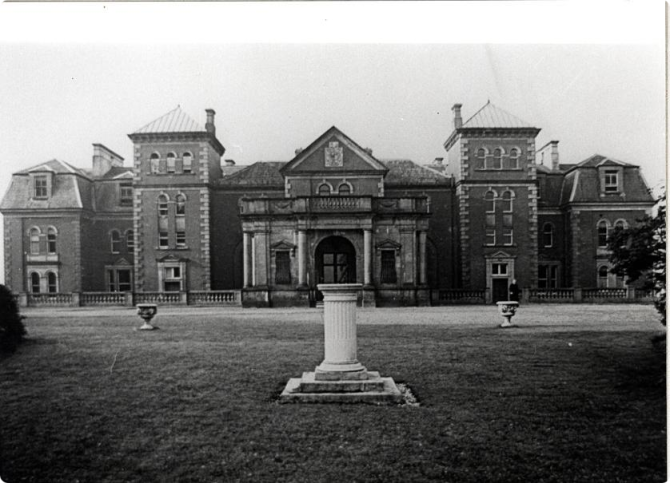


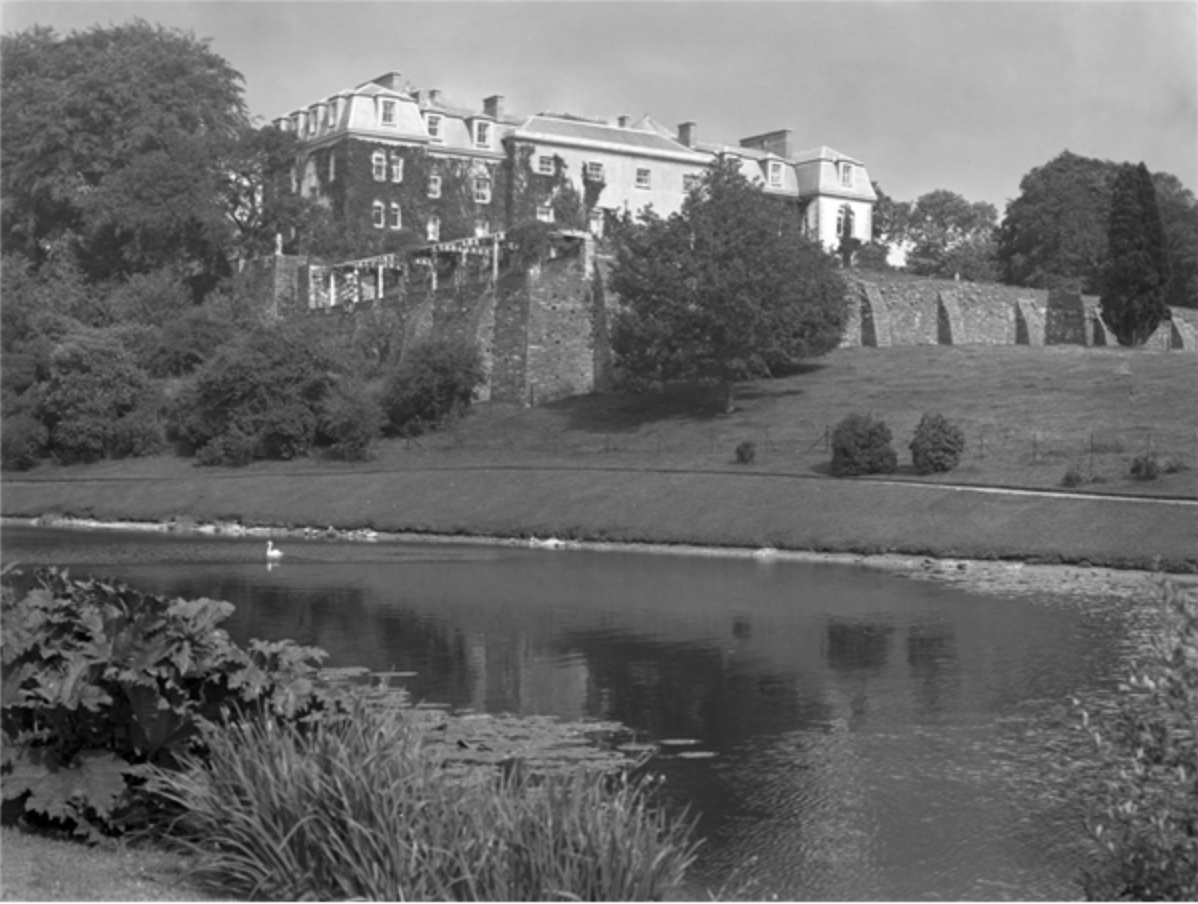

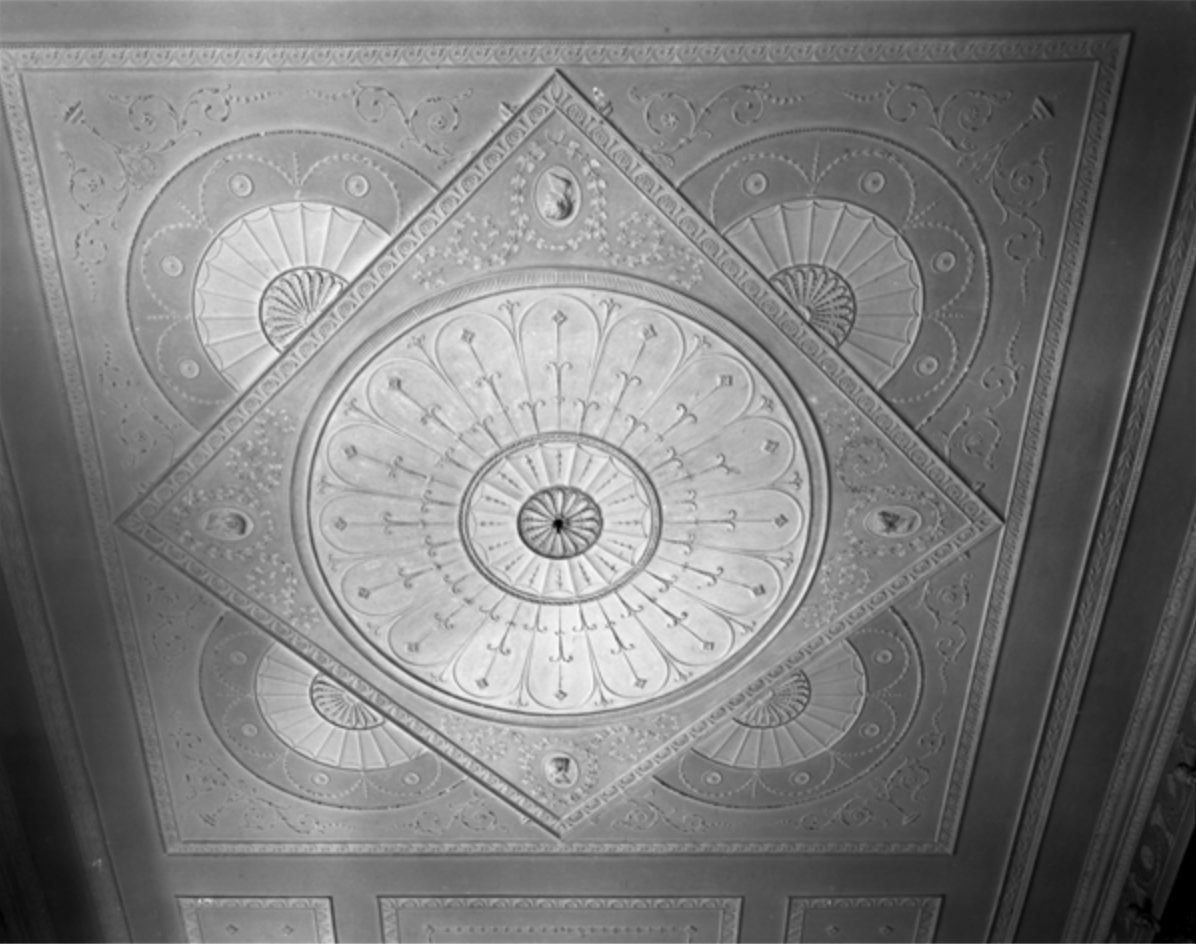
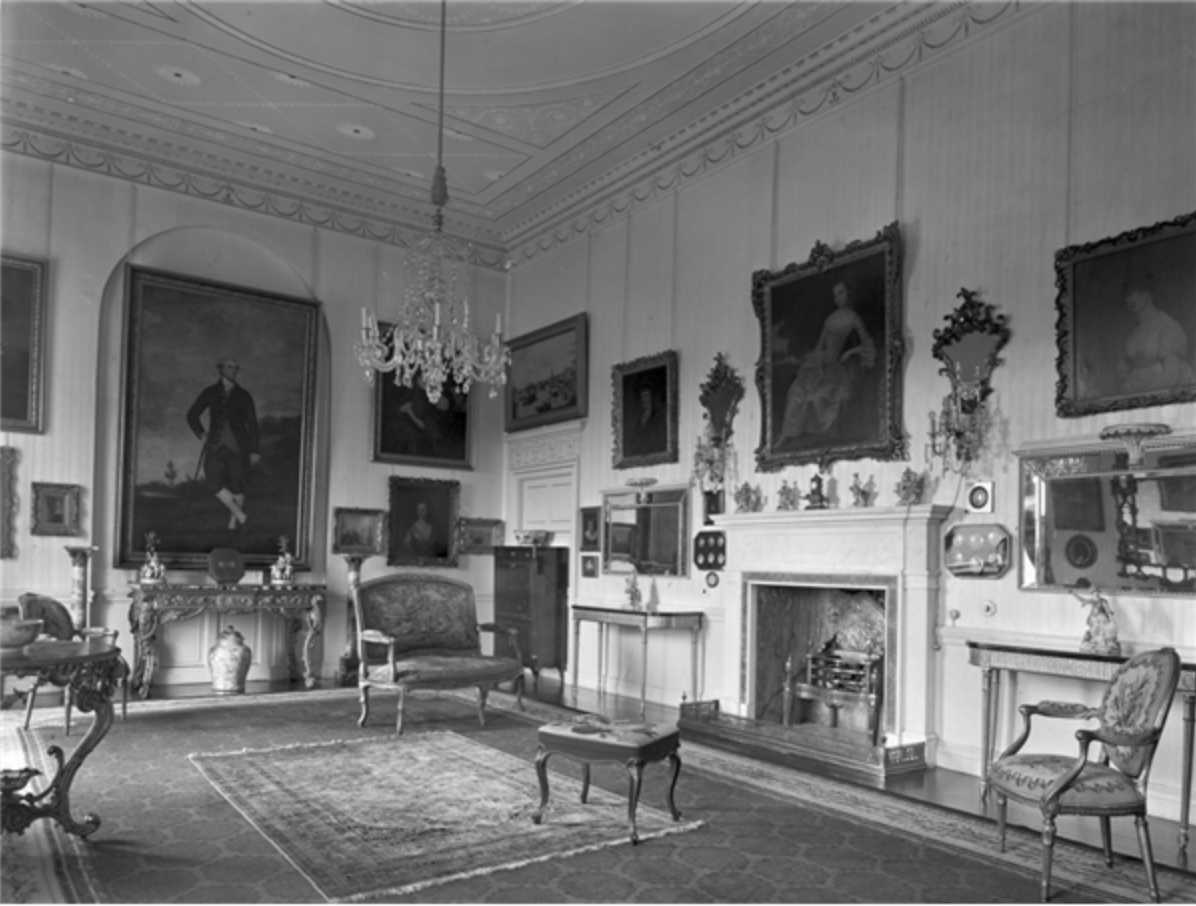
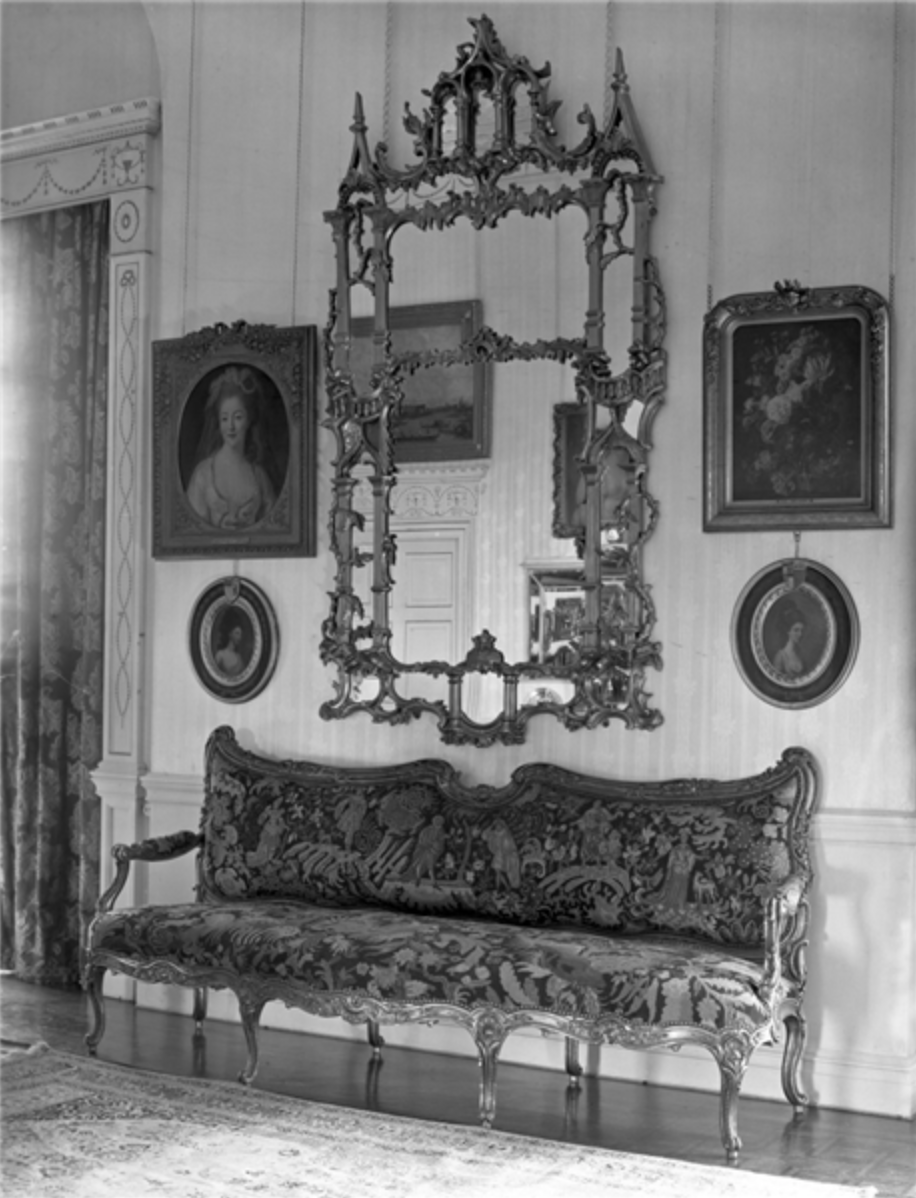
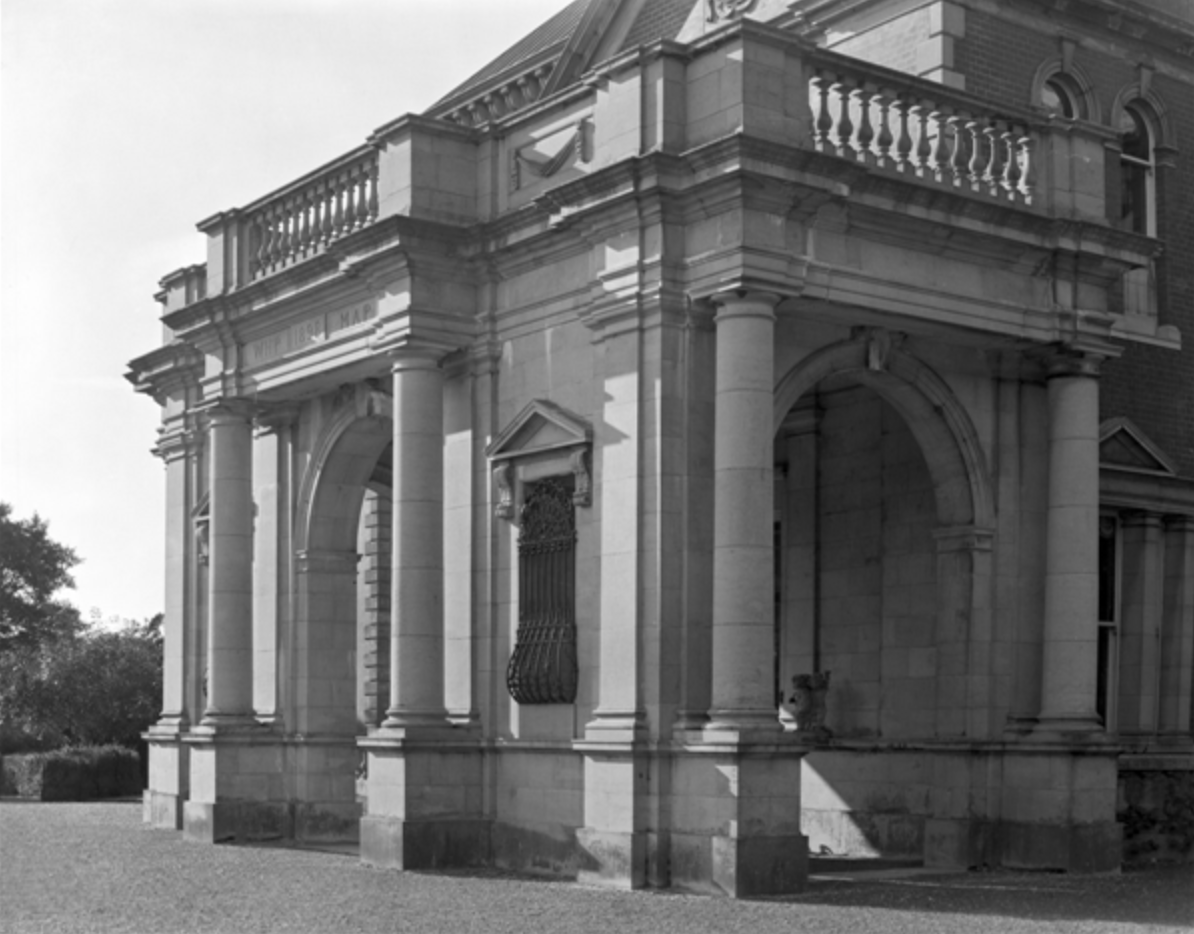
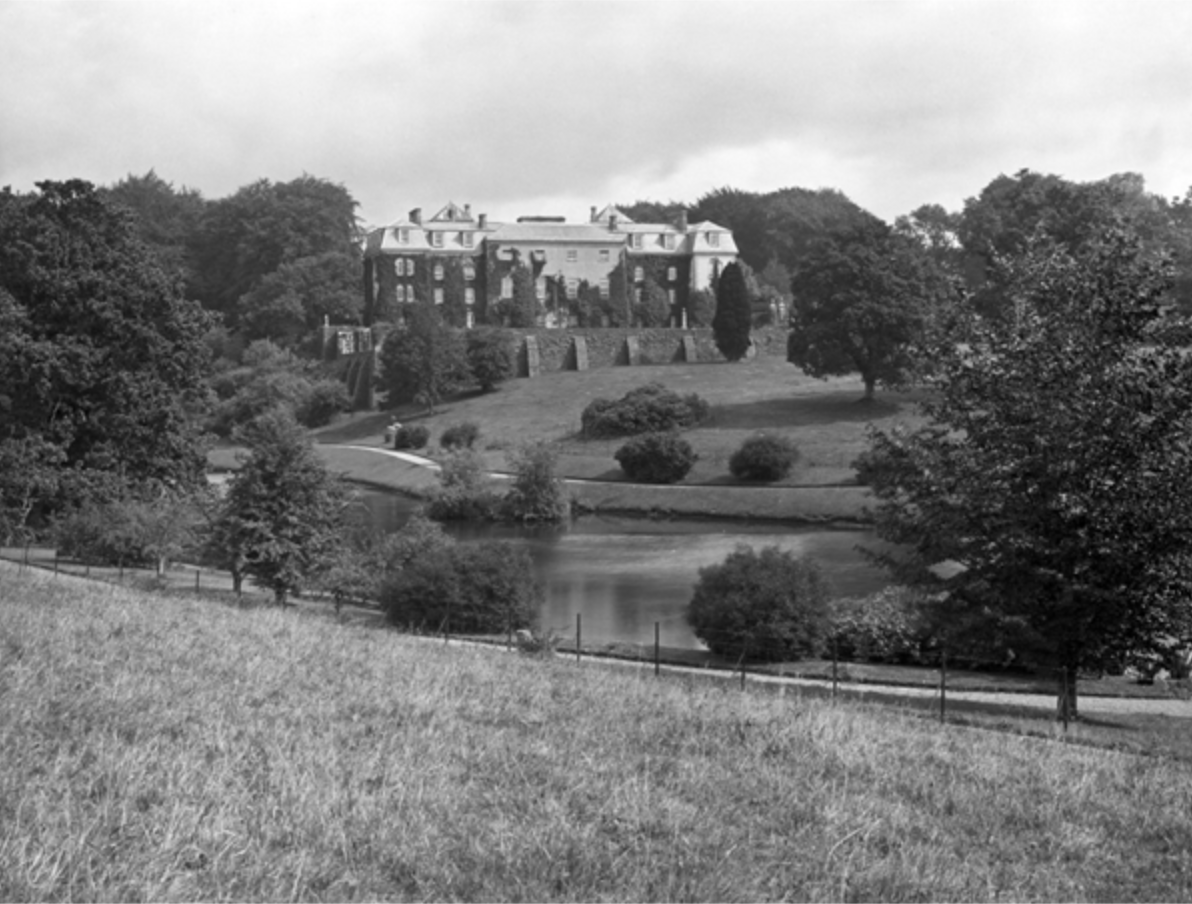
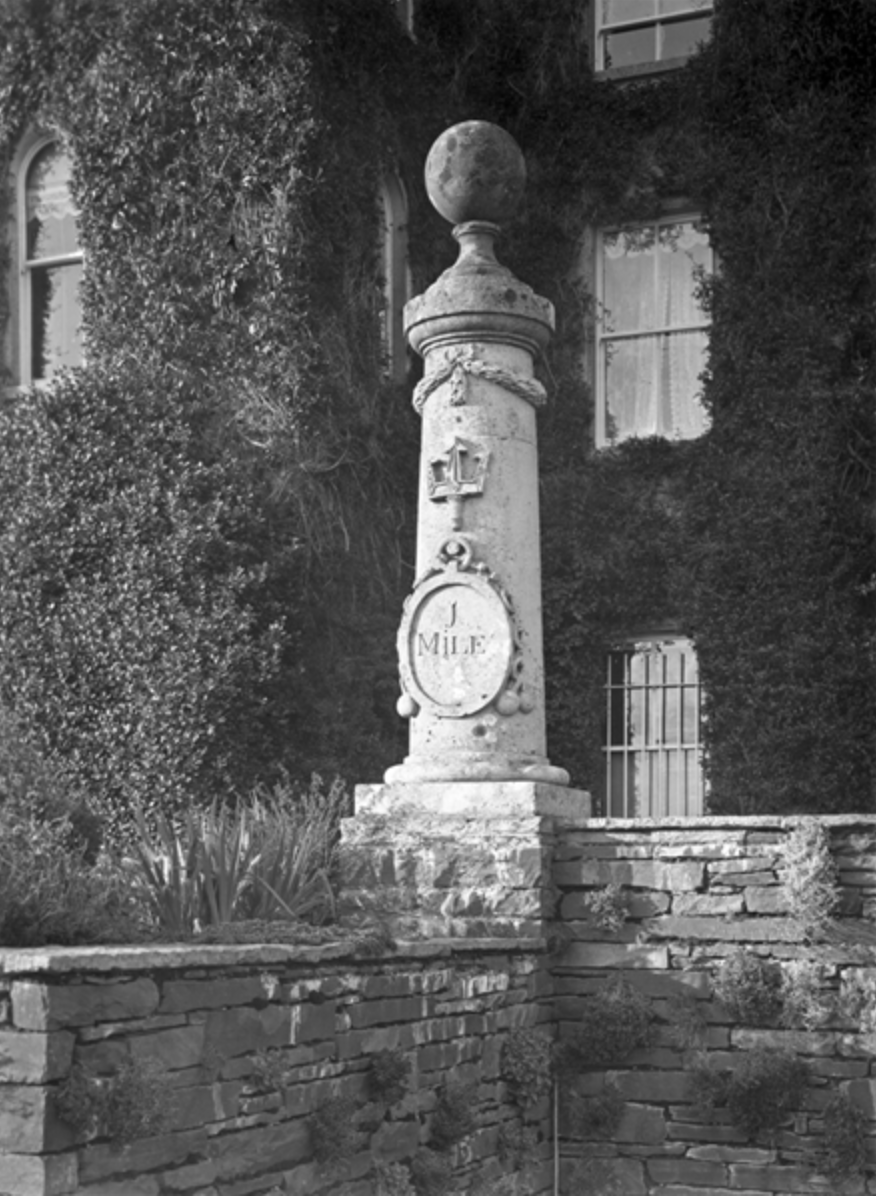


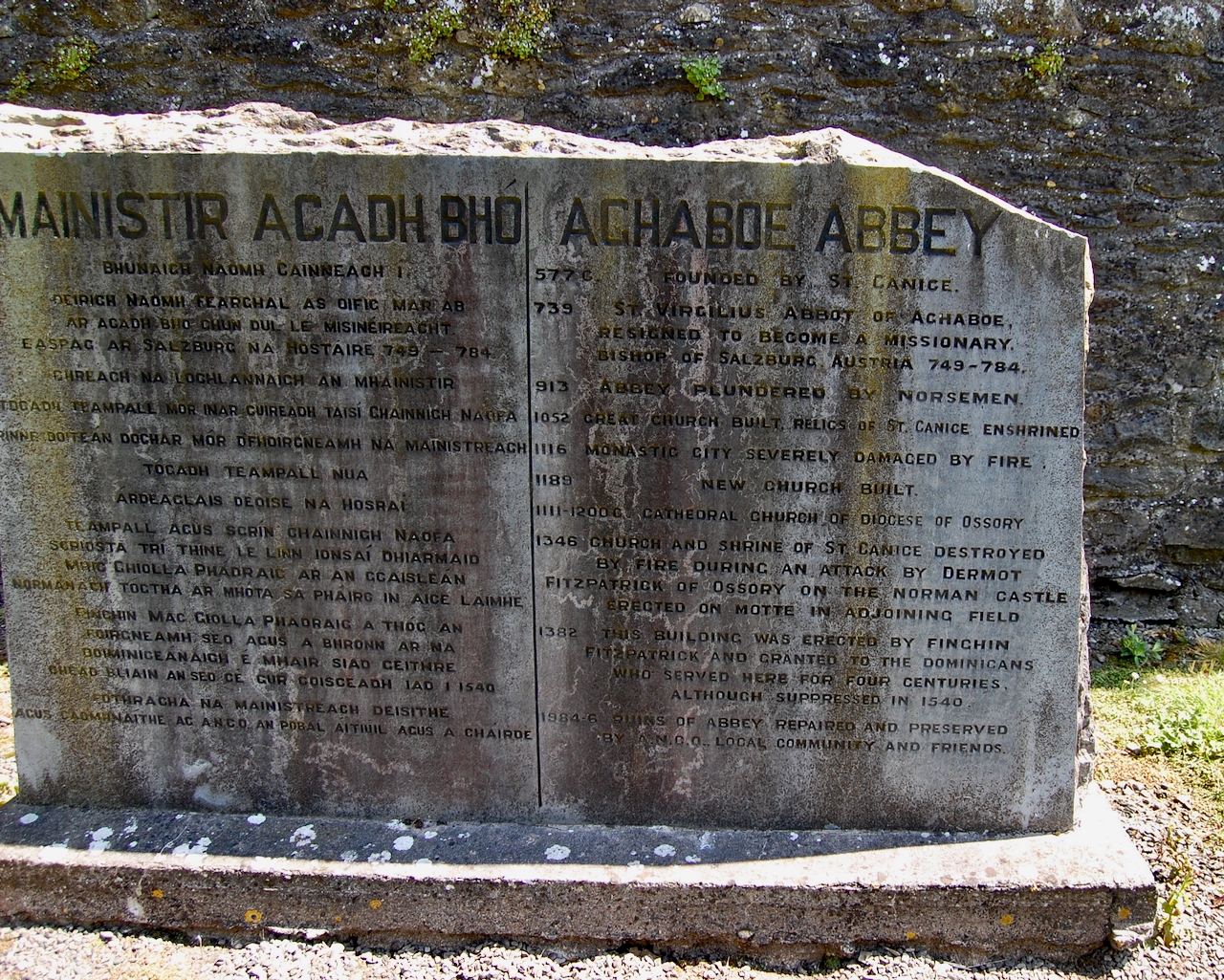
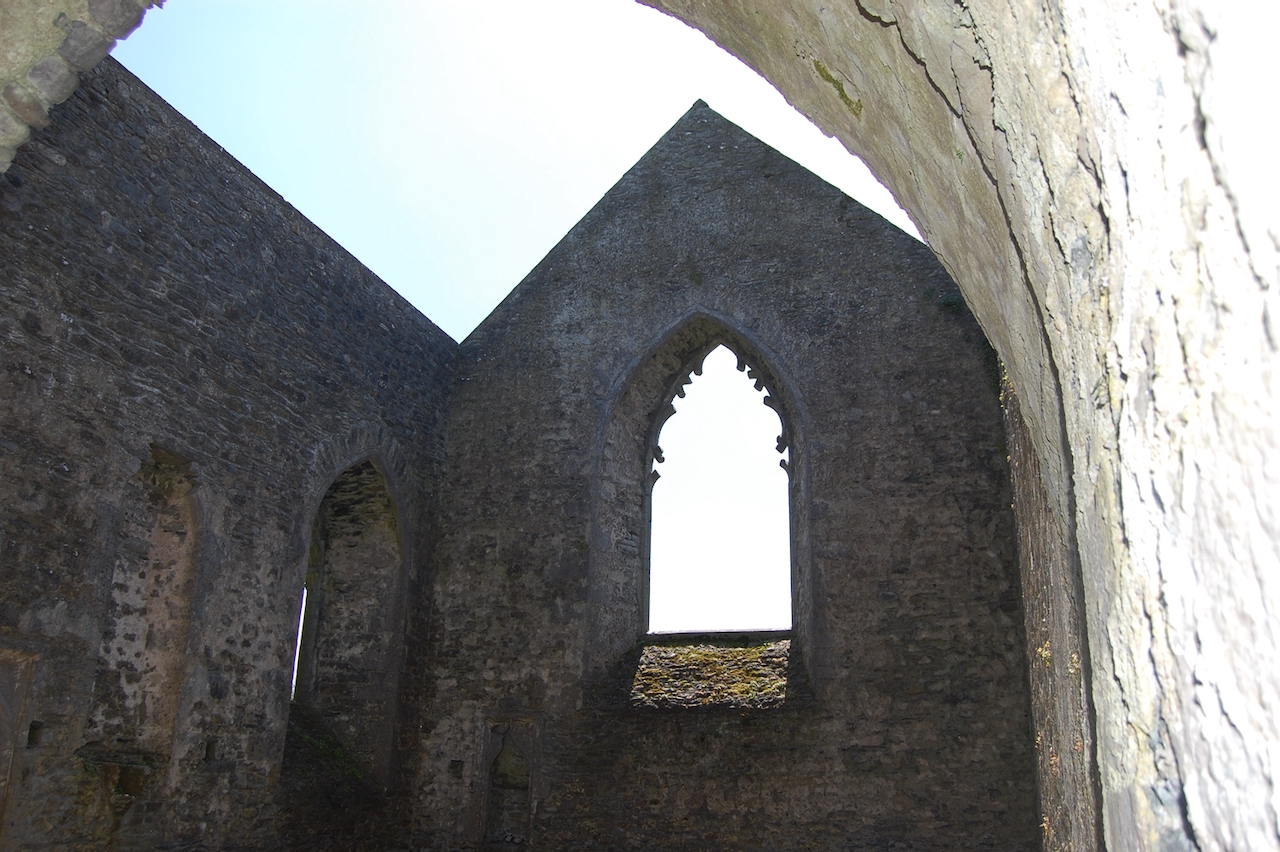
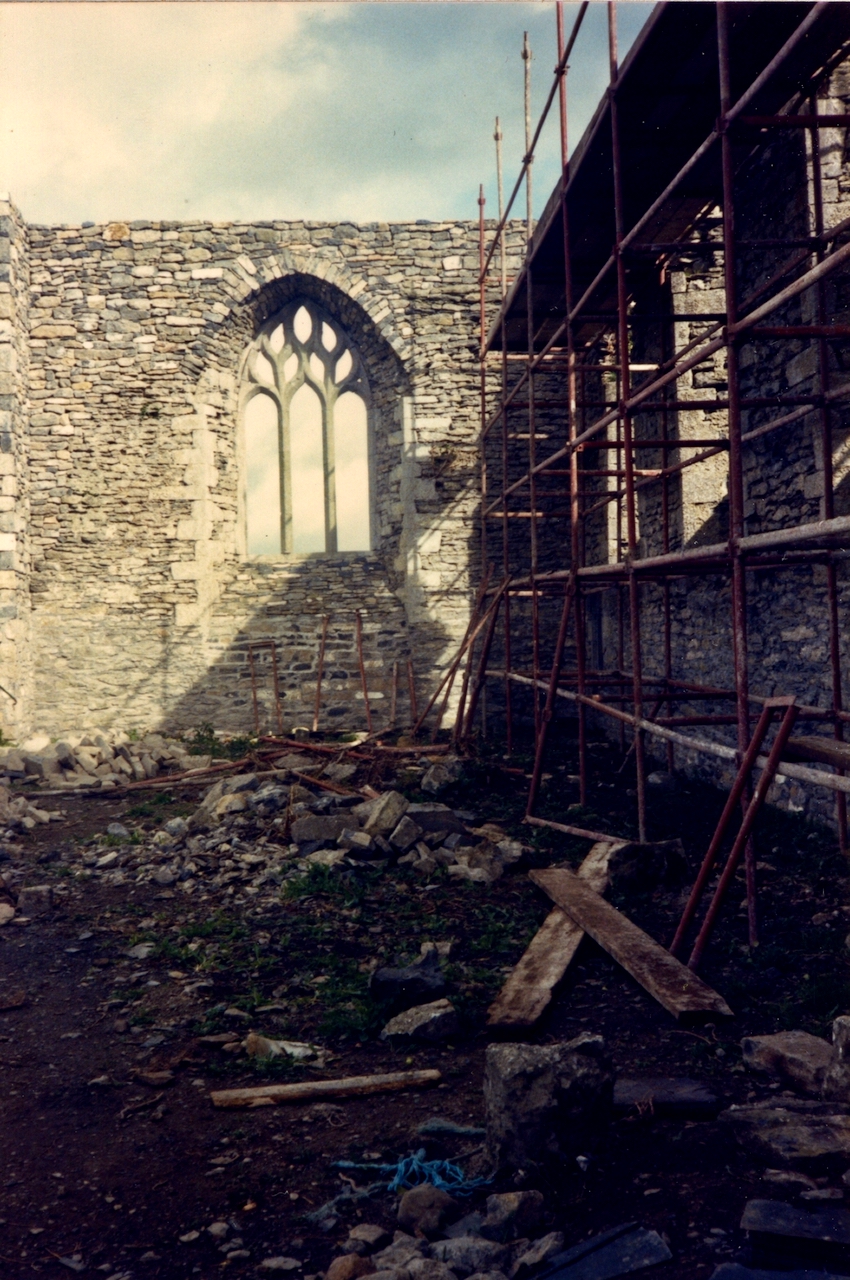
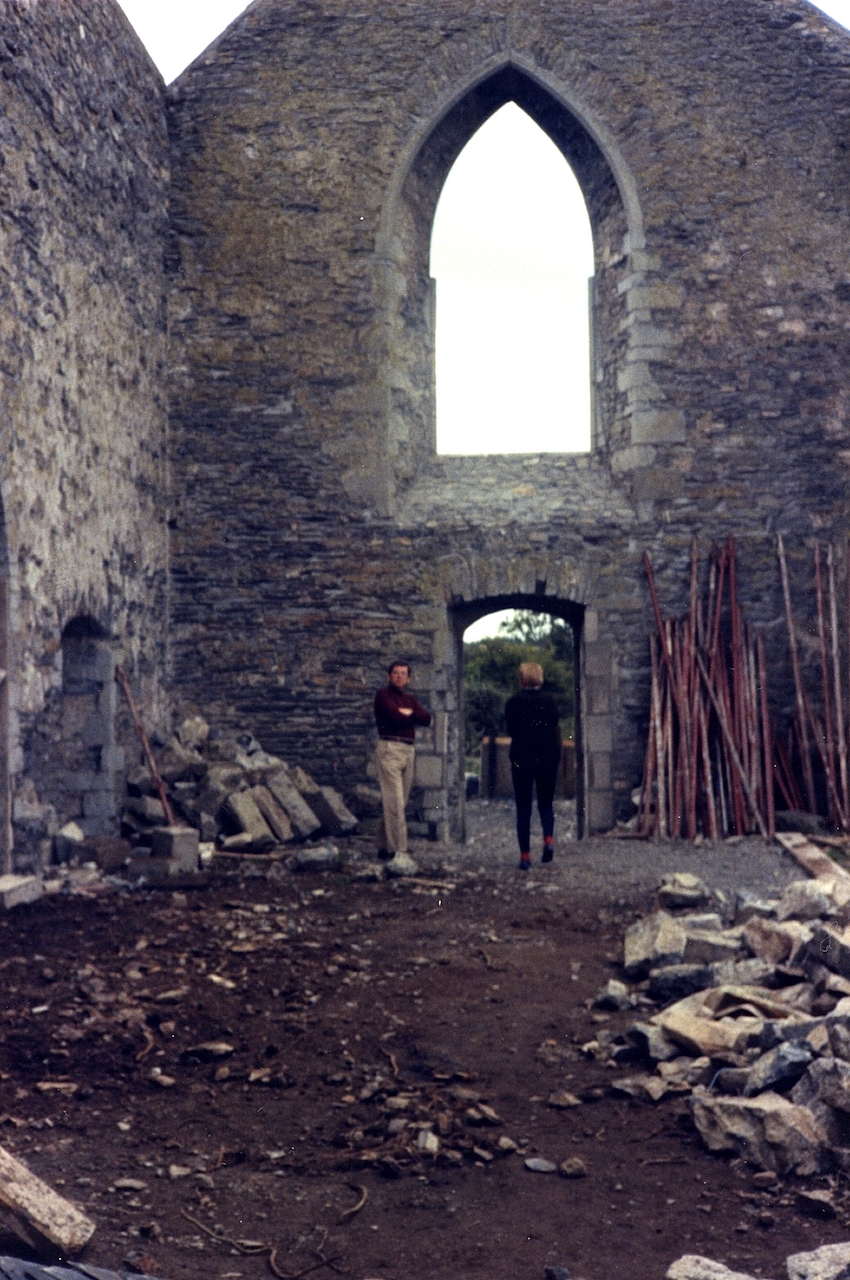
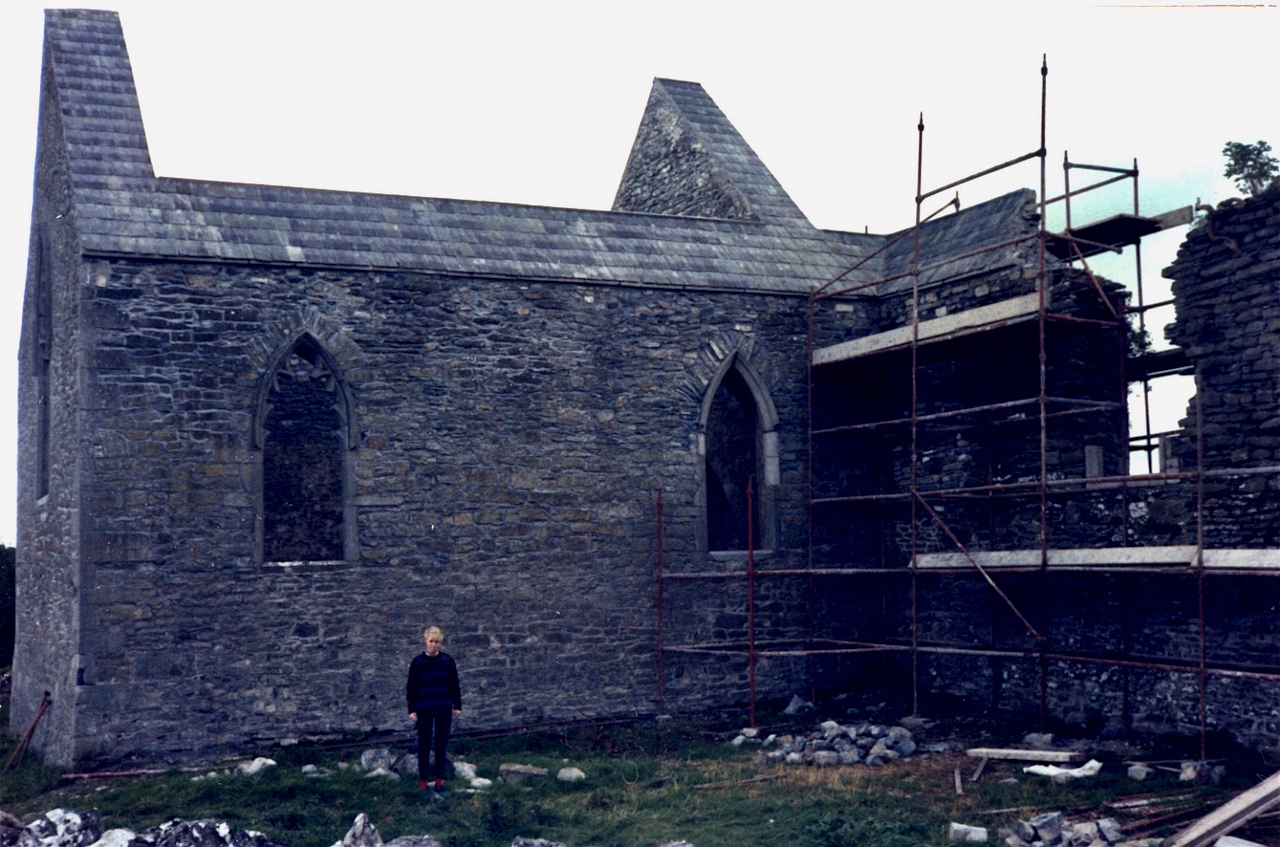


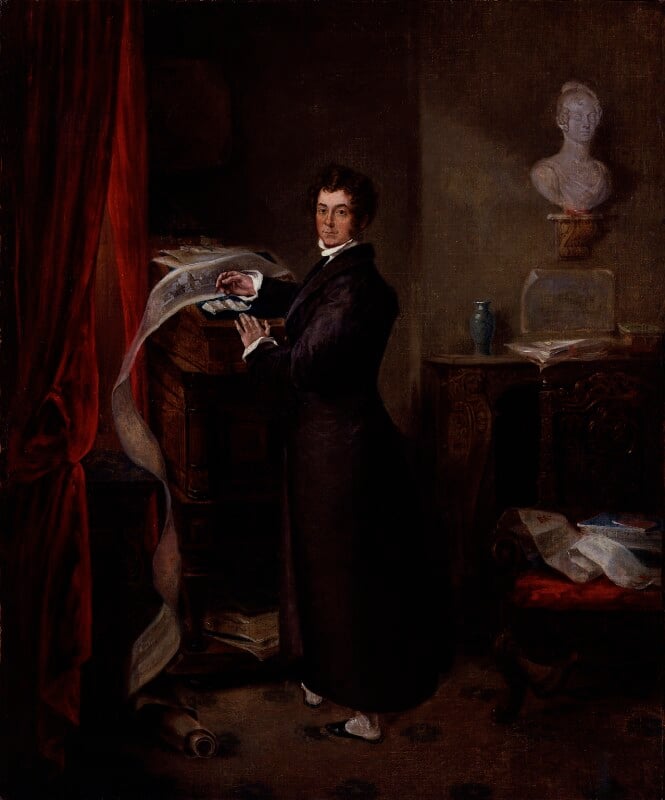


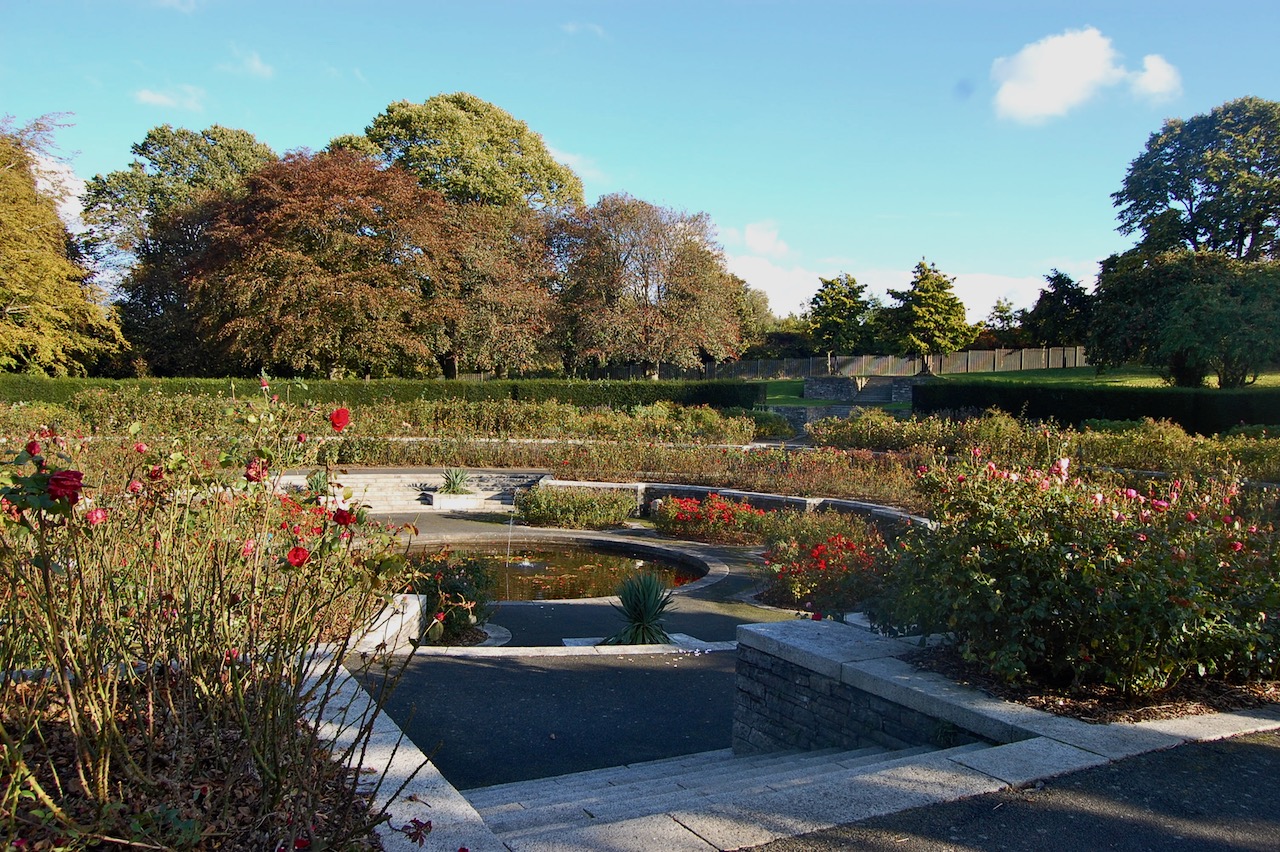
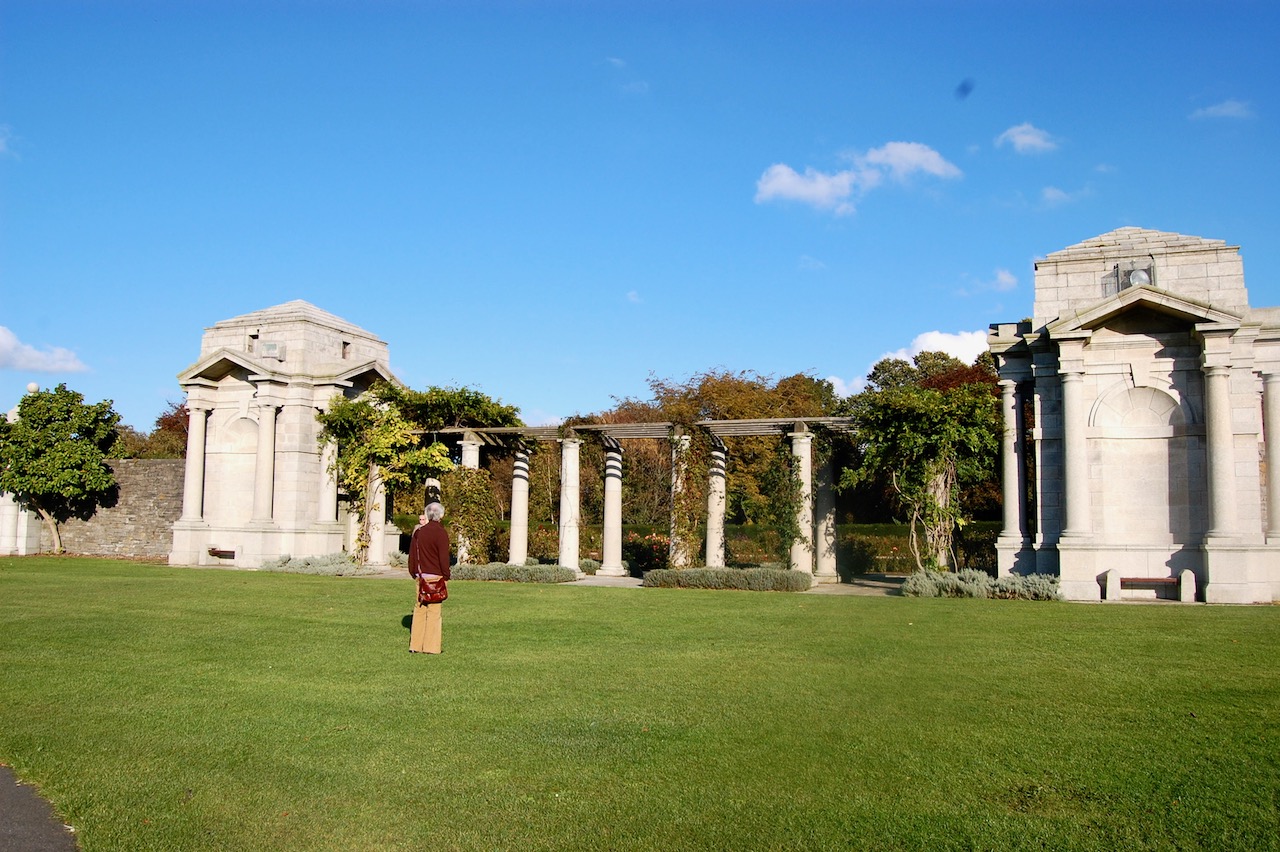


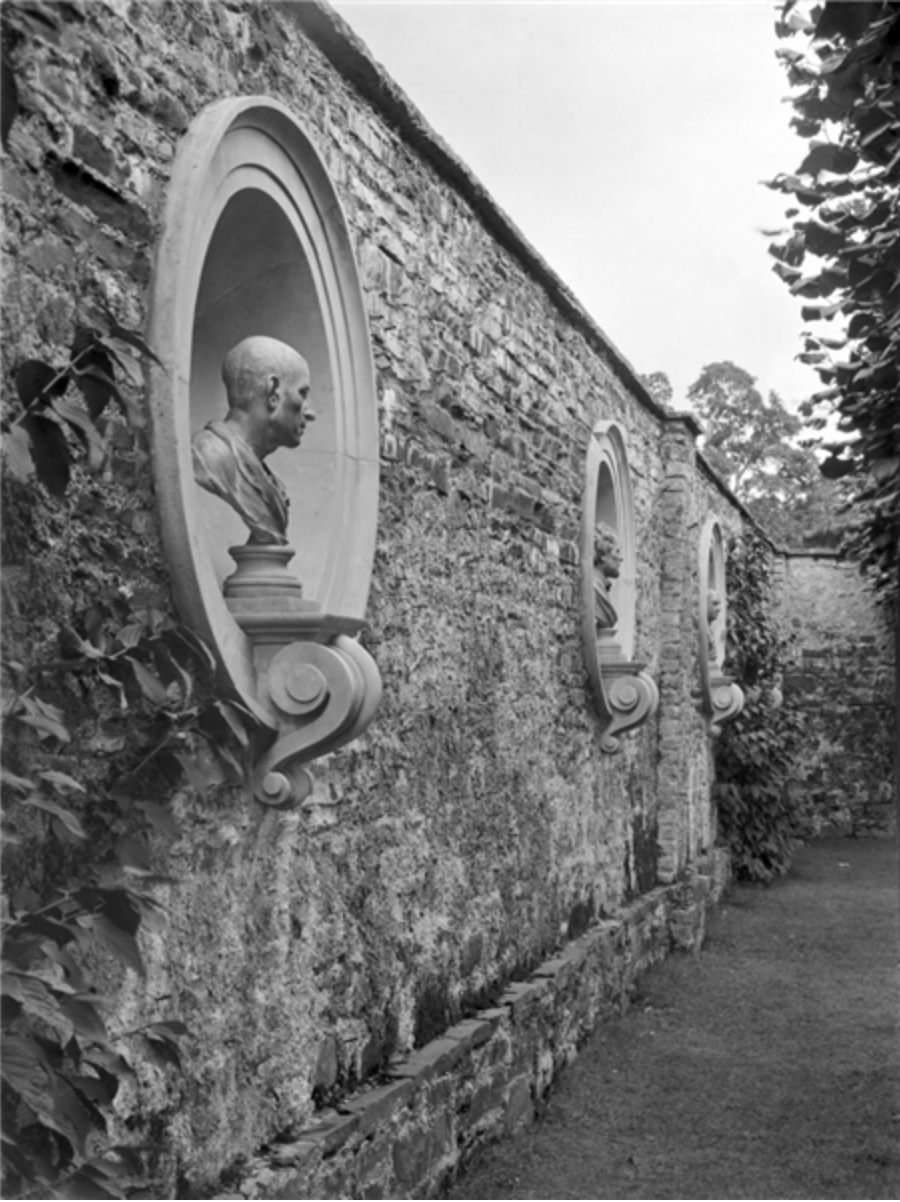


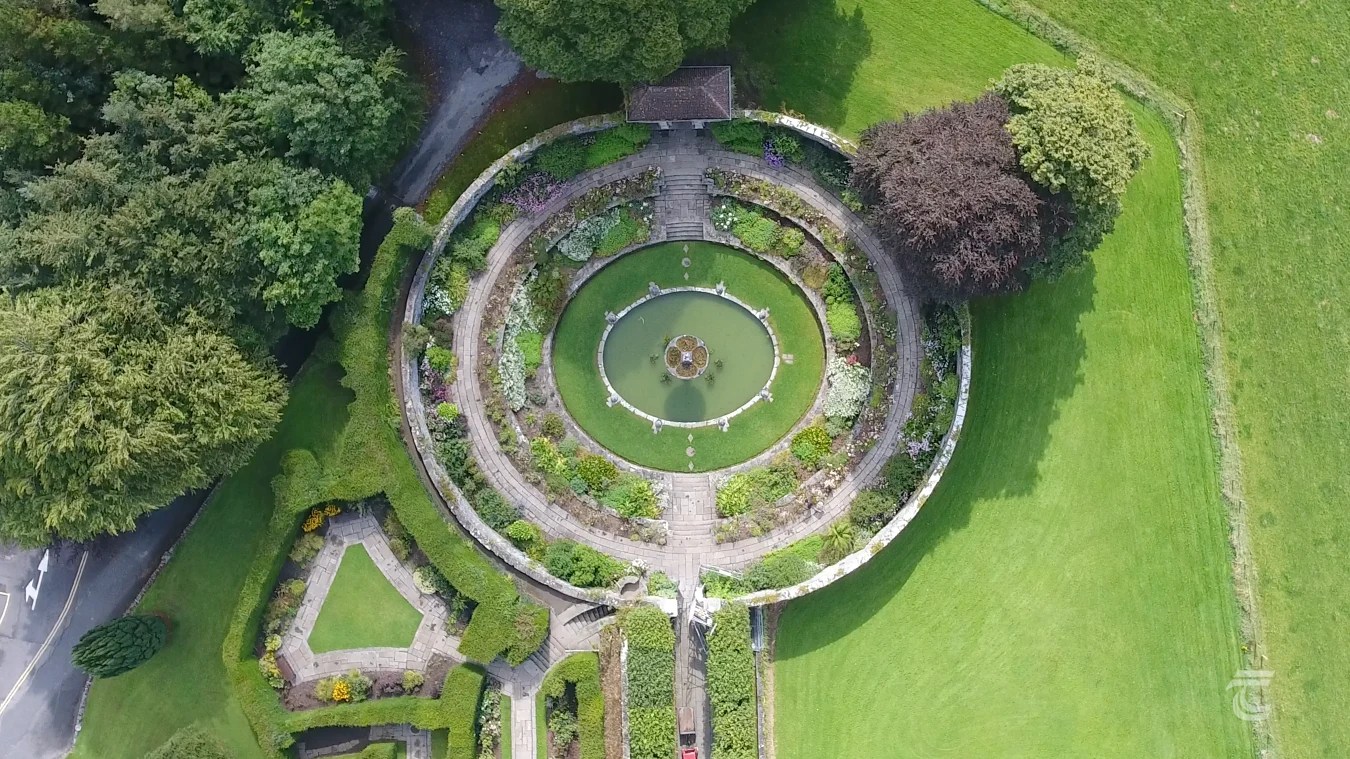

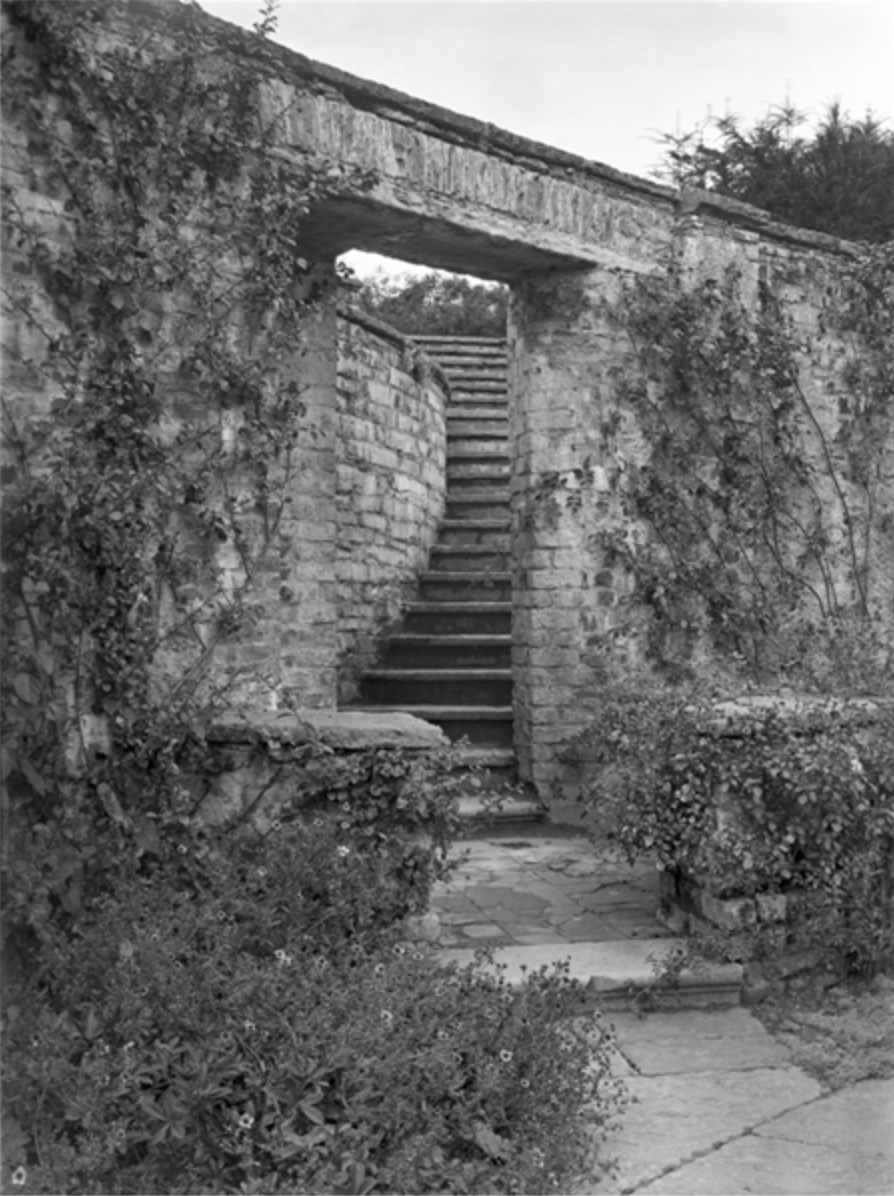


 Irish Historic Houses
