Birr Castle, County Offaly – section 482

Donation

Help me to fund my creation and update of this website. It is created purely out of love for the subject and I receive no payment so any donation is appreciated! My website costs €300 per year on WordPress.

€15.00

Open dates in 2025: May 16-17, 19-24, 26-31, June 2-7, 9-14, 16-21, 23-28, 30, July 1-5, 7-12, 14-19, 21-26, 28-31, Aug 1-2, 4-9, 11-30, Sept 1-6, 11am-3pm

Fee: adult €12.50, OAP/student €11, child 7, family 2 adults and 2 children €34, guided castle tour €22

www.birrcastle.com

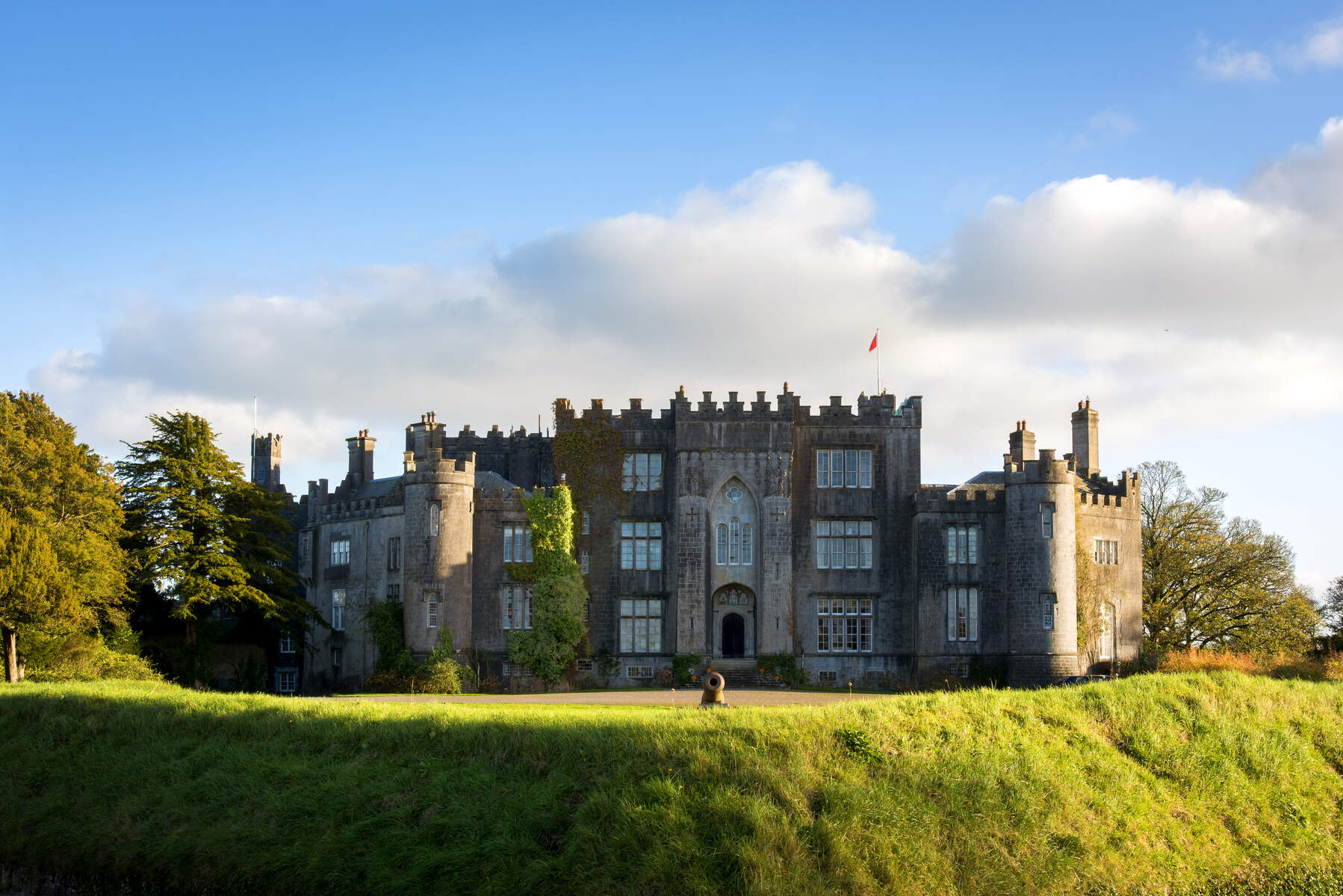
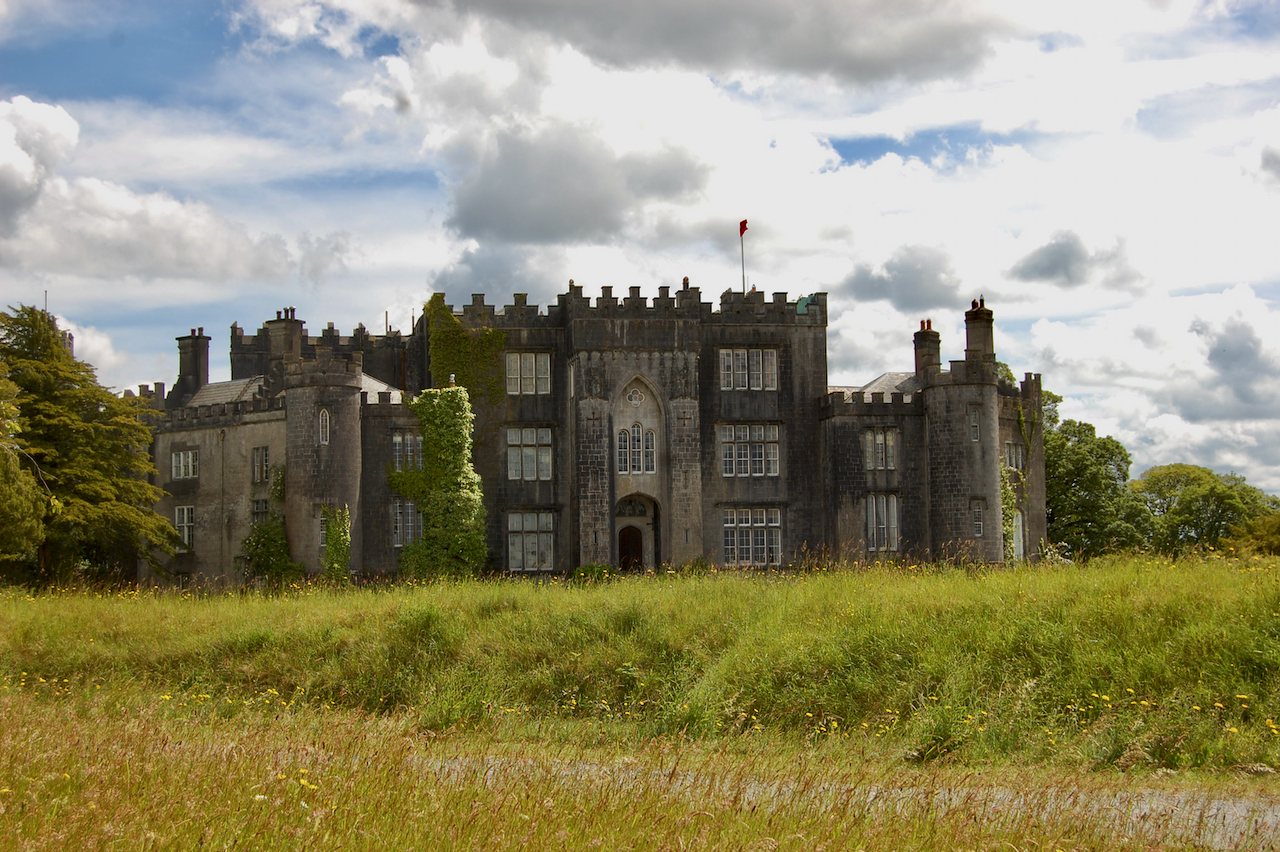
Birr Castle, photograph by Chris Hill 2018, for Tourism Ireland, Ireland’s Content Pool. [1]

We visited Birr Castle in June 2019. I am dying to visit again!

The castle has been in the one family since 1620. A castle existed on the site before then, but little remains of the original, as the old O’Carroll keep and the early C17 office ranges were swept away around 1778. However, parts of the auxiliary buildings of the original are incorporated into today’s castle, which was made from the gate tower which led into the castle bawn. The front hall of the original gatehouse is now at basement level. The rest of the castle has been built around this, at various times.

The castle formed part of a chain of fortresses built by the powerful O’Carroll family of Ely, on the borders of Leinster and Munster. In the 1580s the castle was sold to the Ormond Butlers. By 1620 the castle was a ruin, and King James I granted it to Laurence Parsons (d. 1628). [2] It was Laurence who made the current castle originating from the gate tower.

Although still a private residence, it is well set up for tours of the castle, and the demesne is wonderful for walks. The current owner is William Parsons, 7th Earl of Rosse.

The Parsons still live in the castle today and maintain the archives. According to the website: 

The Rosse papers are one of the most important collections of manuscripts in private ownership in Ireland. Extending from the early seventeenth century, when members of the family first established roots in the country, to the present, the core of the family archive is provided by the papers of successive members of the Parsons family. This calendar is essential reading for anyone interested in the history of: seventeenth and eighteenth-century Ireland; science in the nineteenth century; the British navy in the eighteenth century; the evolving story of the surviving families of the Irish landed elite in the nineteenth and twentieth centuries, and in the influence of a particular family that contrived over a number of centuries not only to transform Birr into one of the country’s most elegant small towns, but also to construct and sustain one of the finest country houses and its gardens.Access to the archives is by appointment.” [3]

In Crowned Harp, Memories of the Last Years of the Crown in Ireland, Nora Robertson writes about her ancestor Laurence Parsons:

With the further connivance of his even less admirable brother [less admirable, that is, than Laurence Parson’s kinsman Richard Boyle], Lord Justice William Parsons, Laurence acquired the forfeited estates of the Ely O’Carrolls in Offaly, whither he moved and erected Birr Castle...” [4]

The family history section of the Birr Castle website explains that there were four Parson brothers living in Ireland in the 1620s. They came to Ireland around 1590, and were nephews of Sir Geoffrey Fenton, Secretary of State in Ireland to Queen Elizabeth I. [5] Laurence’s brother William (1570-1649/1650) became Surveyor General of Ireland, 1st Baronet, and founded the elder branch of the Parson family in Bellamont, Dublin. This branch died out at the end of the eighteenth century.

Sir William Parsons (d. 1650), Surveyor-General and Lord Justice of Ireland Date: 1777, Engraver Samuel De Wilde, after unknown artist.

William was known as a “land-hunter”, expropriating land from owners whose titles were deemed defective. William was the progenitor of the first generation of the title of Earl of Rosse. When the last male to hold that title died without heirs, after a time the title passed to the descendants of the first baronet Bellamont’s younger brother, Laurence Parsons of Birr Castle.

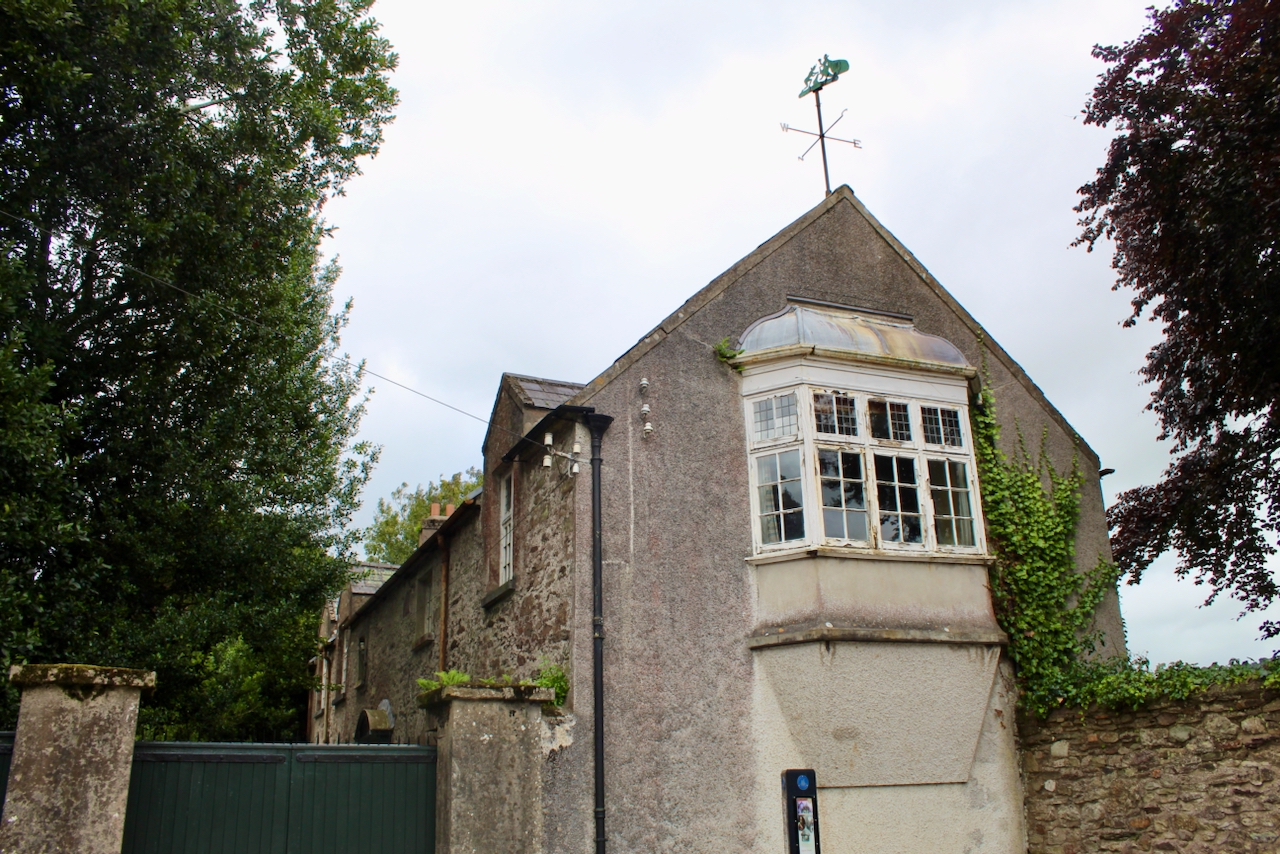
Before obtaining land in Offaly, through his connection with Richard Boyle later 1st Earl of Cork (Richard married Catherine Fenton, daughter of Geoffrey Fenton, Secretary of State in Ireland to Queen Elizabeth I), Laurence Parsons acquired Myrtle Grove in Youghal, Co. Cork, previously owned by Walter Raleigh, and succeeded Raleigh as Mayor of Youghal. 

Raleigh, who introduced tobacco to Europe after discovering it on his travels, had a bucket of water thrown over him by a housemaid when he was smoking, as she thought he was on fire! Raleigh is also said to have planted the first potato in Ireland.
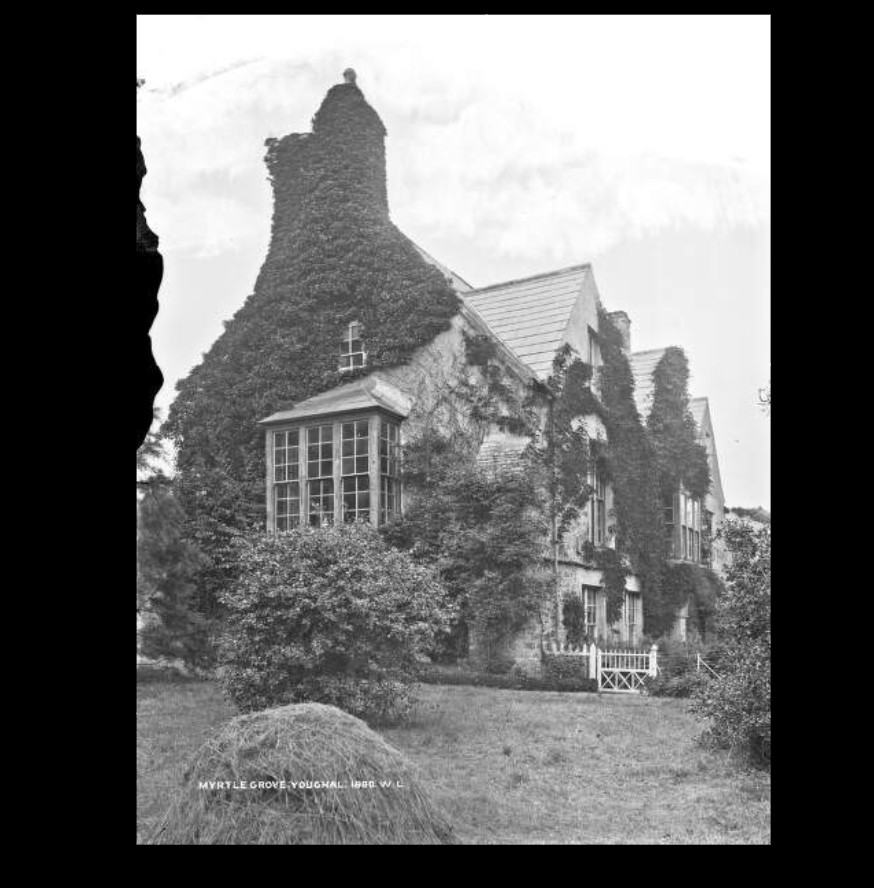
Myrtle Grove, Youghal, County Cork, photograph courtesy of Lawrennce Photographic Collecition National Library of Ireland, photographer: Robert French, 1841-1917.
Myrtle Grove, Youghal, County Cork, August 2020. Photograph © Jennifer Winder-Baggot, www.irishhistorichouses.com

Laurence Parsons served as Attorney General of Munster and later, Baron of the Exchequer, and was knighted in 1620. That same year, he ‘swapped’ his interest in a property near Cadamstown in County Wexford with Sir Robert Meredith, who served as Chancellor of the Exchequer in Ireland, for the latter’s 1,000 acres at Birr, Kings County. Parsons was granted letters patent to ‘the Castle, fort and Lands of Birr.’ [see 5]

The castle website states that:

“rather than occupy the tower house of the O’Carrolls, the Parsons decided to turn the Norman gate tower into their ‘English House,’ building on either side and incorporating two flanking towers. Sir Laurence Parsons did a large amount of building and remodelling including the building of the two flanking towers, before his death in 1628. This is all accounted for in our archives.” [6]

Suitably, a room which is now the castle’s Muniments room, which holds the archives, is located inside one of the flanking towers and retains a frieze of early 17thcentury plasterwork.
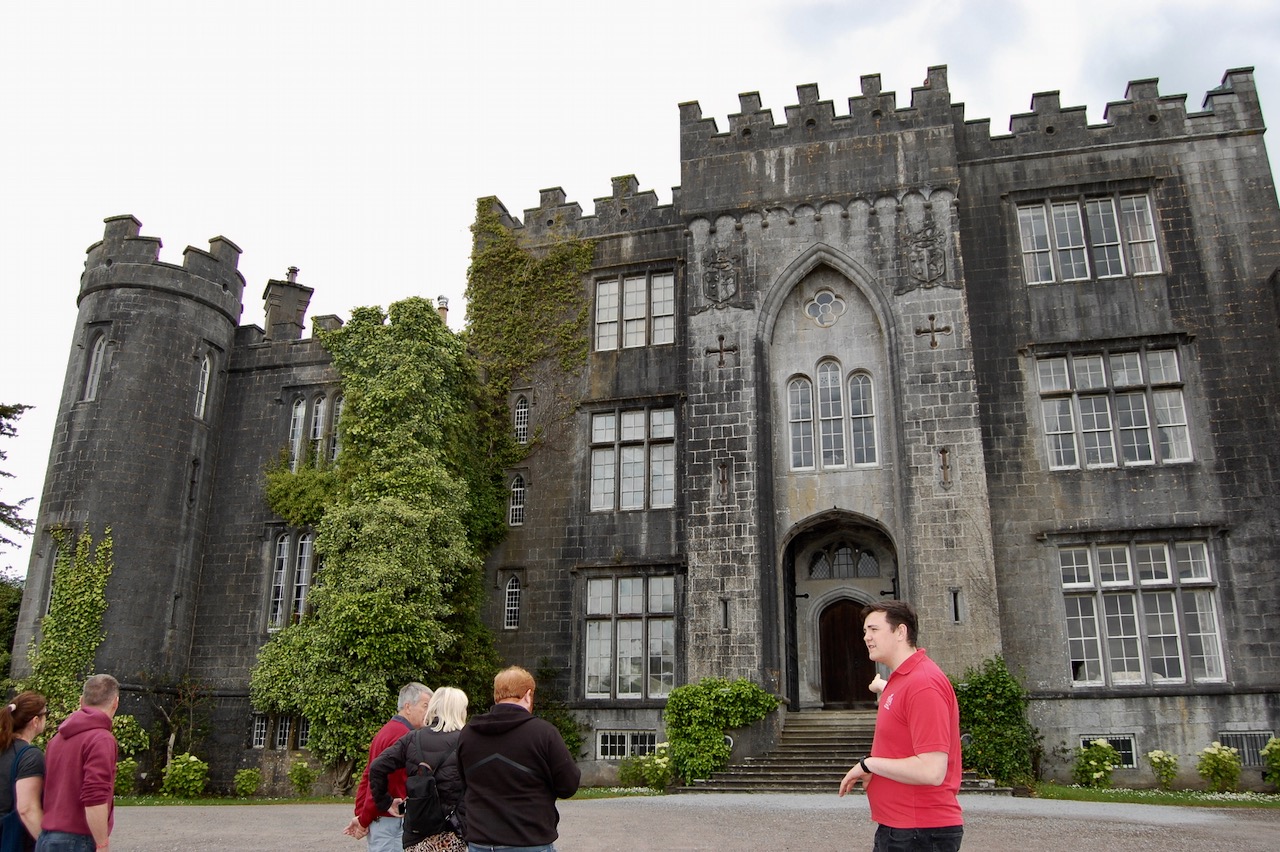
The group being led by our tour guide, Birr Castle, County Offaly. The entrance is approached by a tall flight of wide steps overshadowed by a massive arch, which gives the impression of passing beneath a medieval portcullis. Photograph © Jennifer Winder-Baggot, www.irishhistorichouses.com

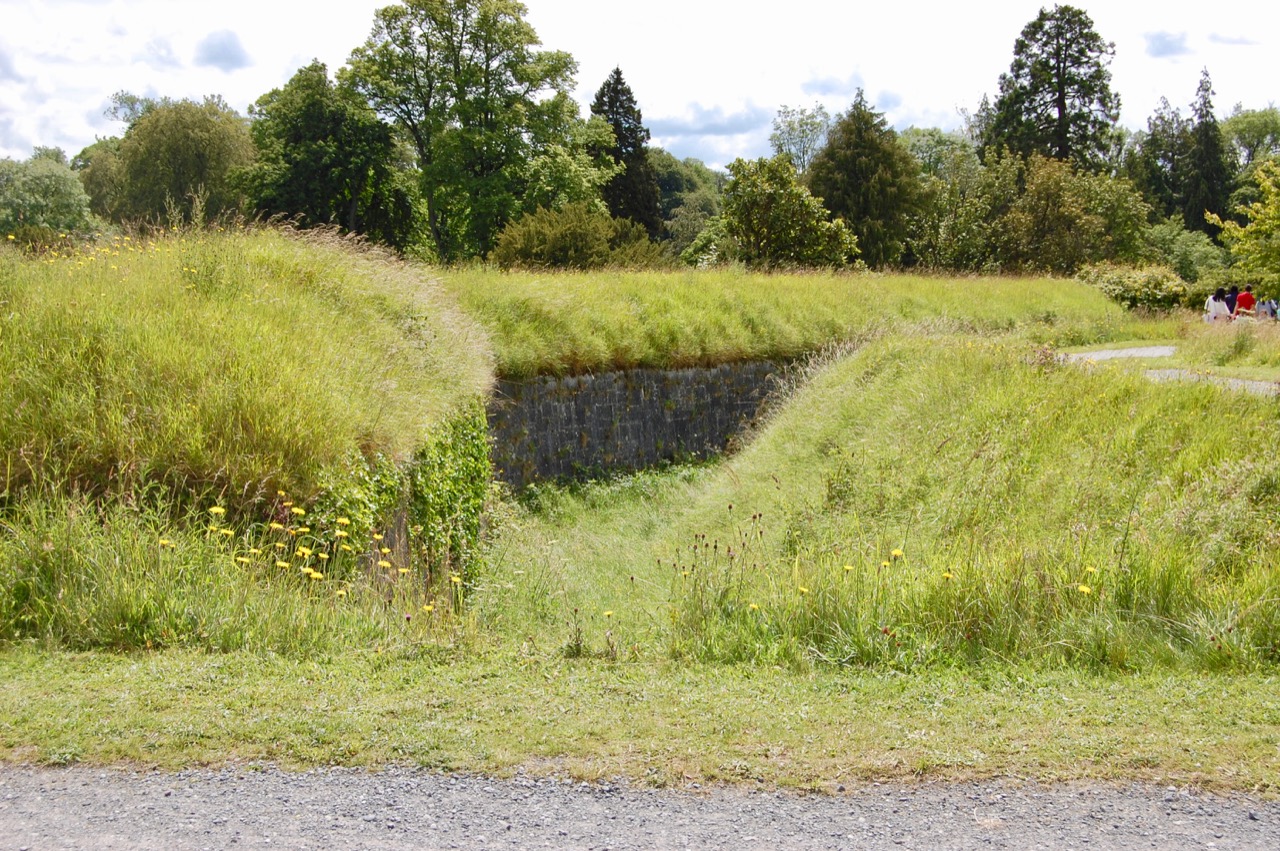
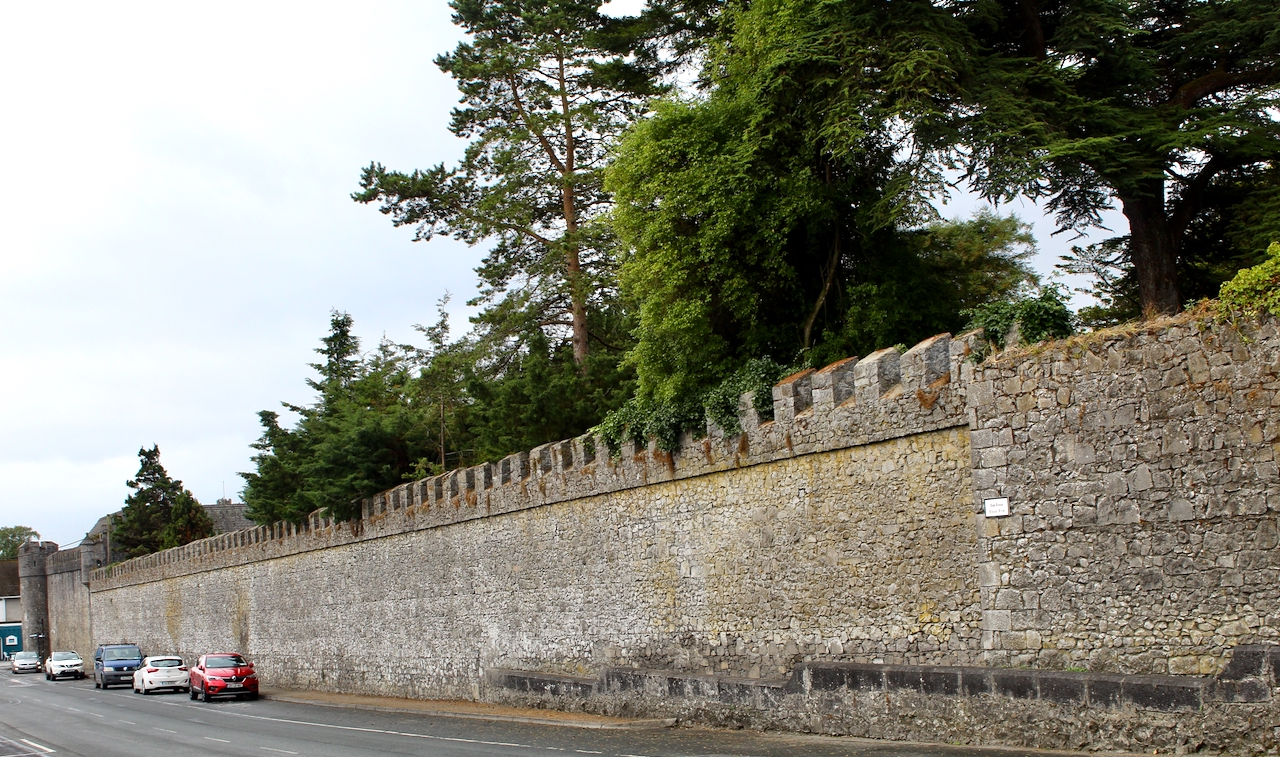
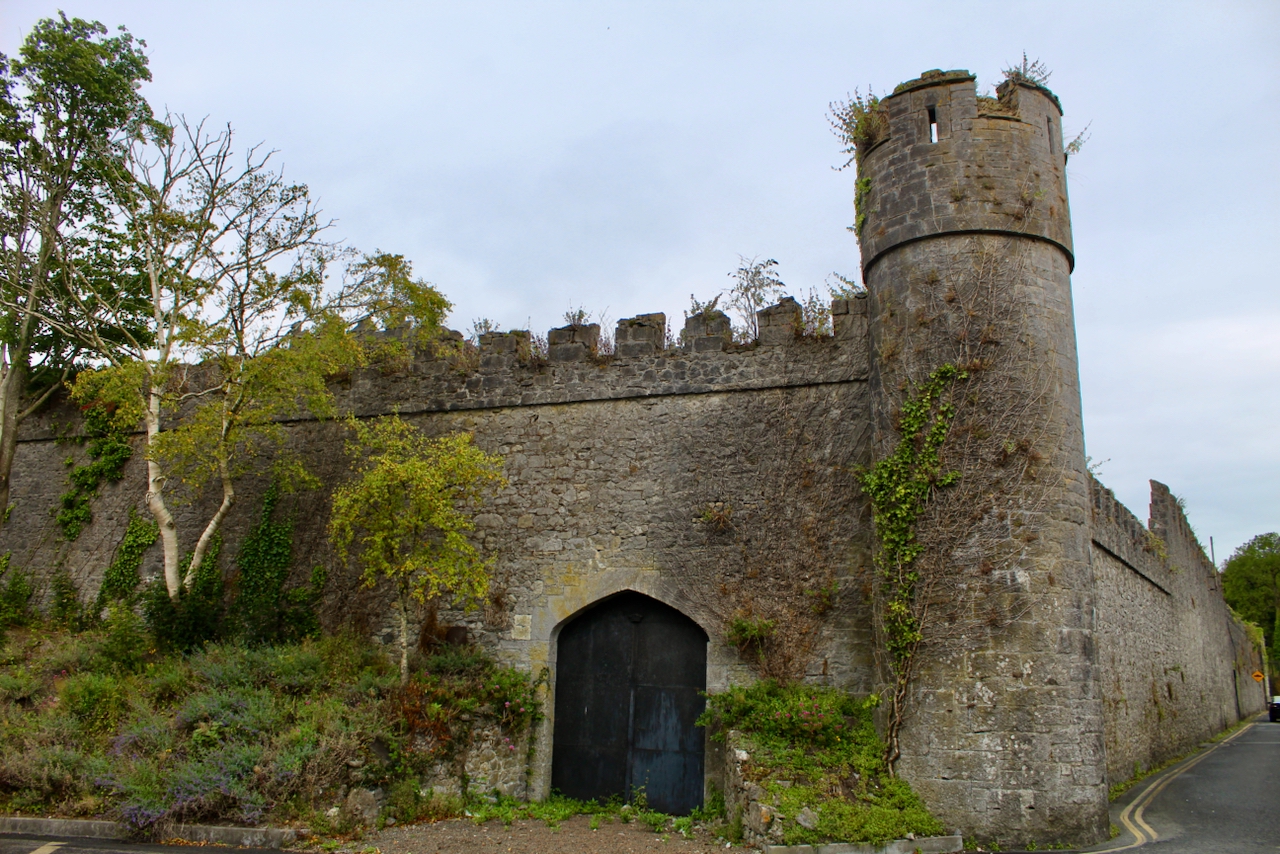
Our guide walked a group of us over to the castle, across the moat, which he told us had been created in 1847 when the owners of Birr Castle provided employment to help to stave off the hunger of the famine, along with the enormous walls surrounding the castle demesne as well as the stone stable buildings, which are now the reception courtyard, museum and cafe. 
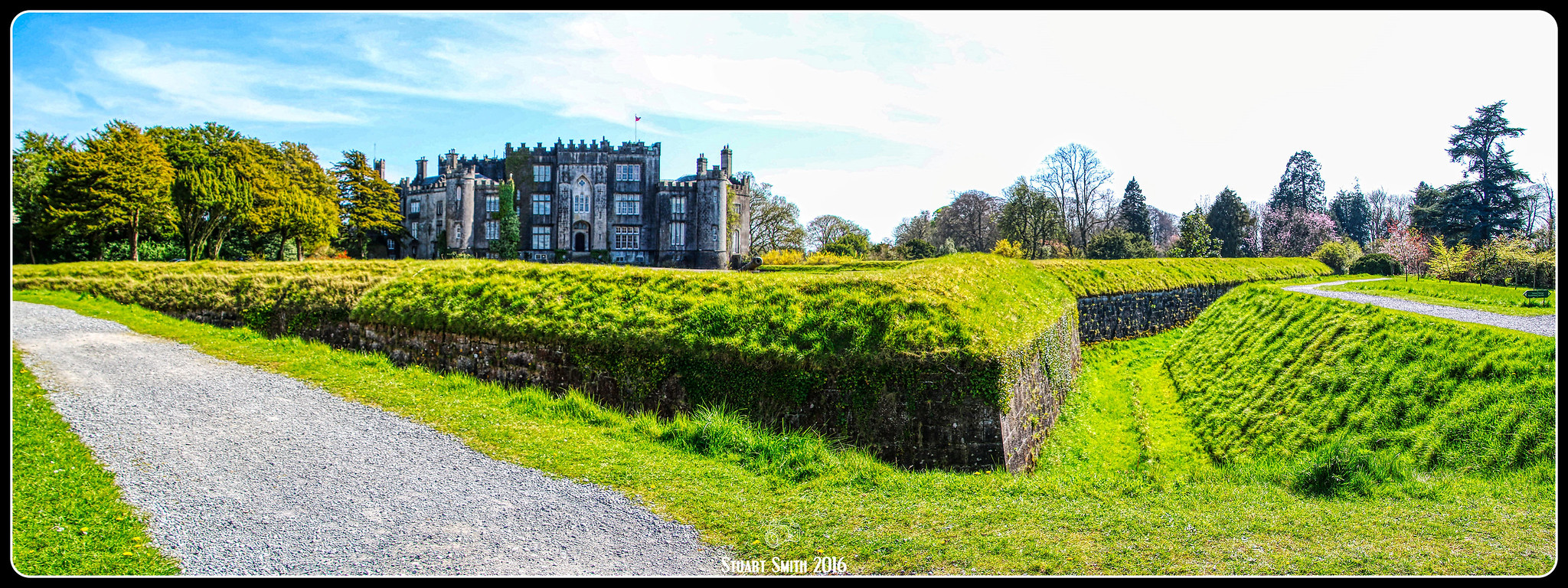
Birr Castle, County Offaly, photograph by Stuart Smith 2016 on flickr commons.
A photograph of the moat which our guide told us had been created as a famine project in order to pay the workers. Photograph © Jennifer Winder-Baggot, www.irishhistorichouses.com
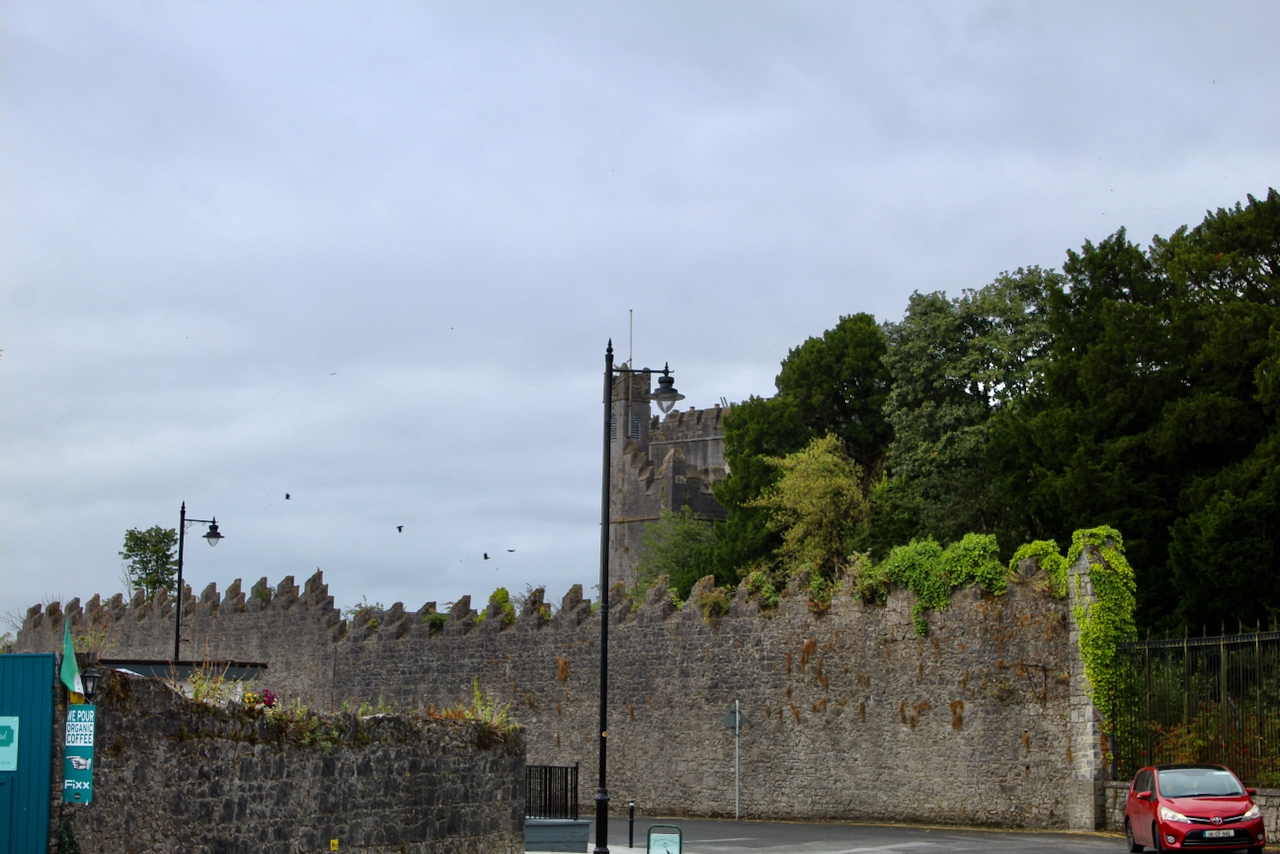
The walls around the demesne were created in 1847 when the owners of Birr Castle provided employment to help to stave off the hunger of the famine. Photograph © Jennifer Winder-Baggot, www.irishhistorichouses.com
Birr Castle walls. Photograph © Jennifer Winder-Baggot, www.irishhistorichouses.com
The walls around the demesne were created in 1847 when the owners of Birr Castle provided employment to help to stave off the hunger of the famine. Photograph © Jennifer Winder-Baggot, www.irishhistorichouses.com
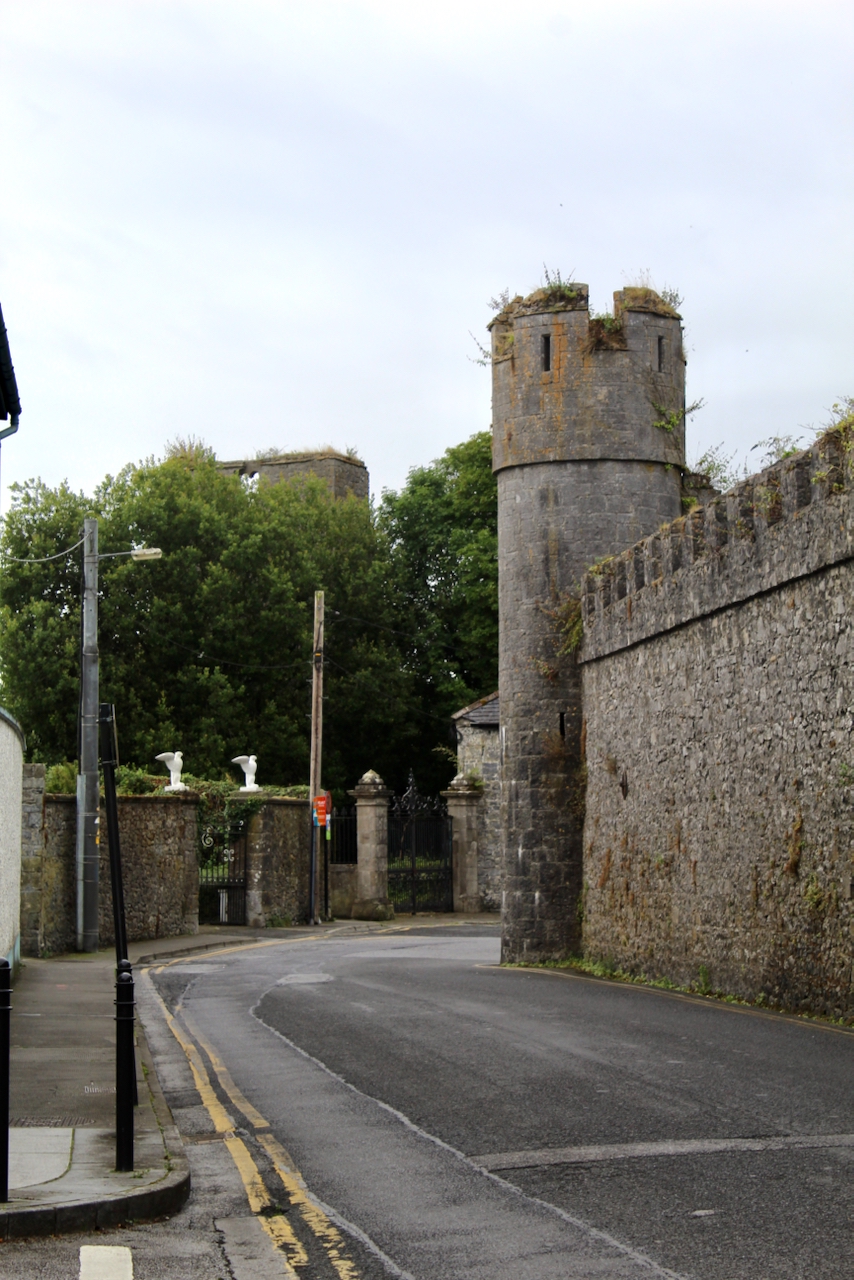
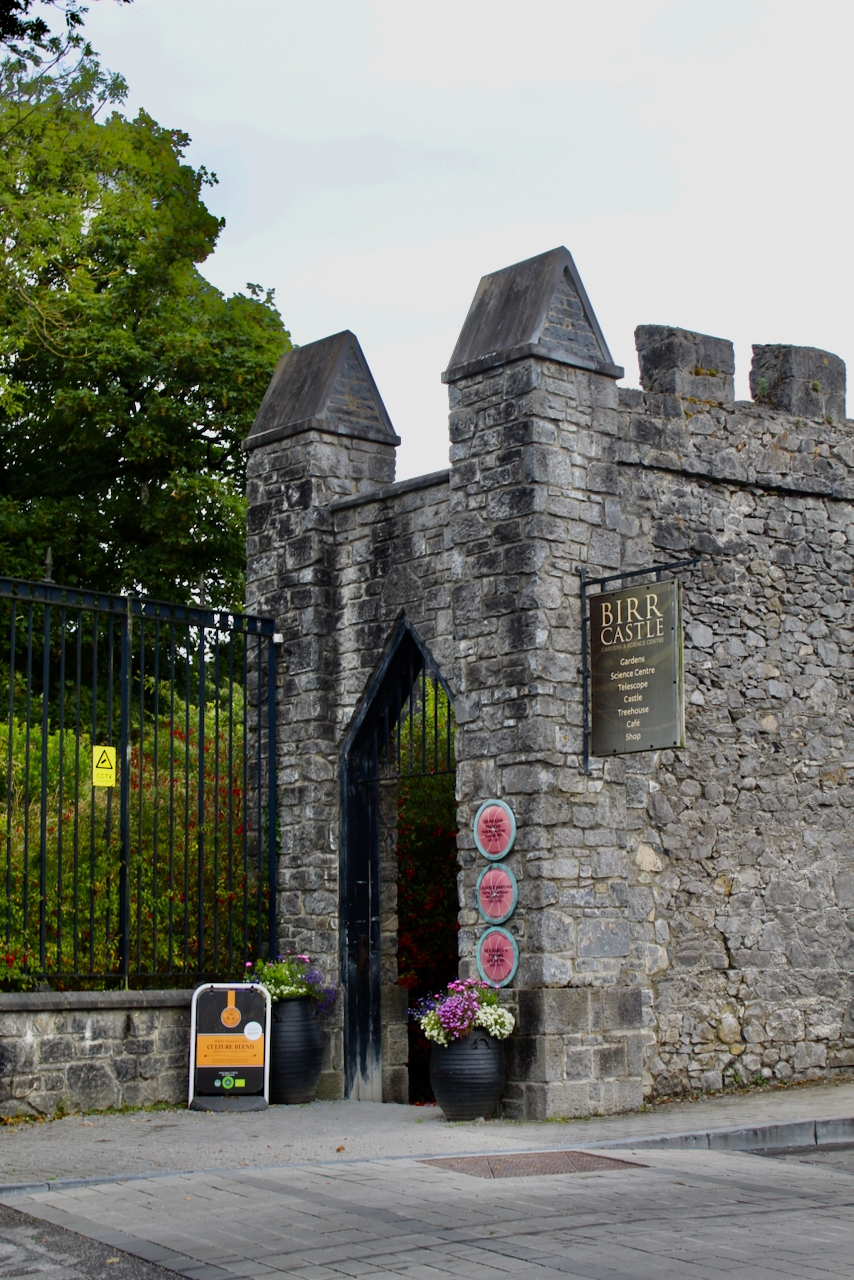
Birr Castle entrance, Photograph © Jennifer Winder-Baggot, www.irishhistorichouses.com

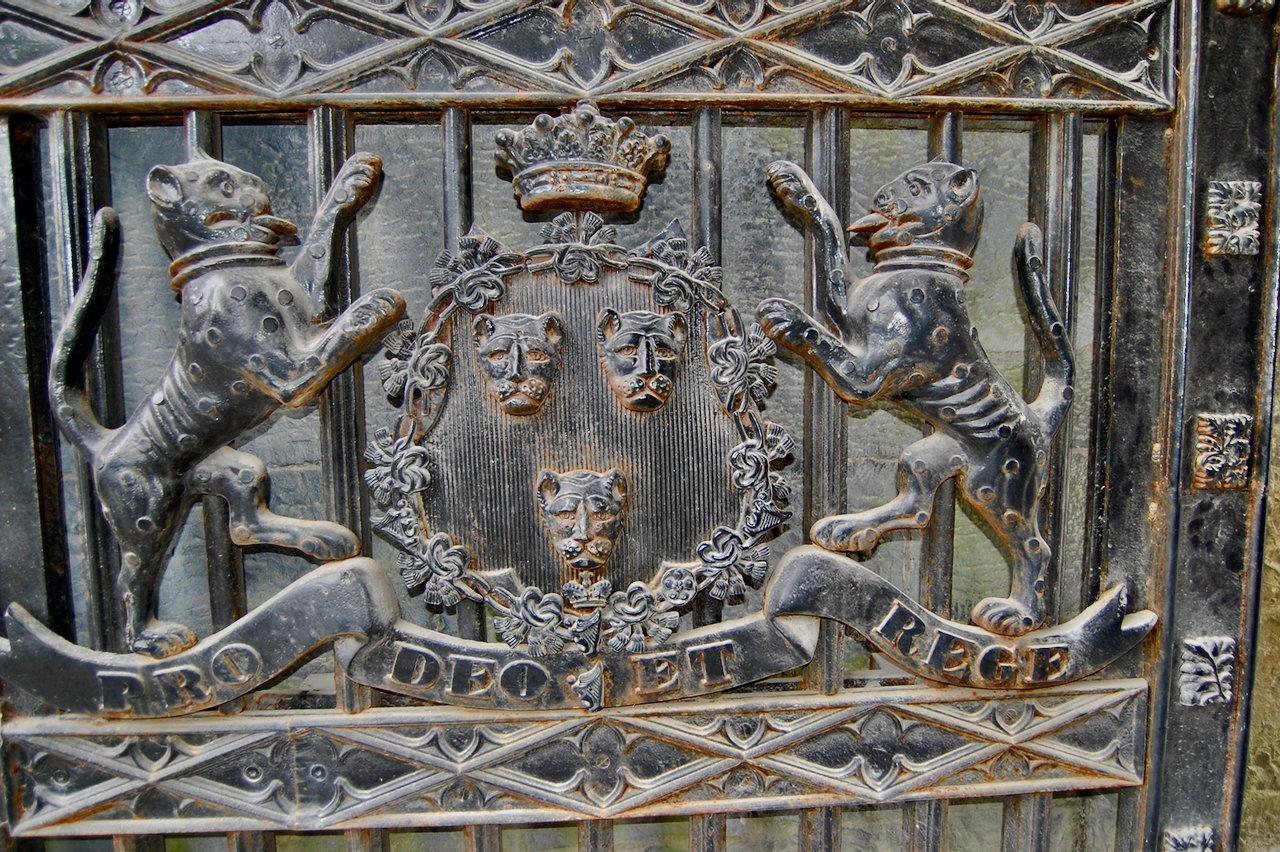
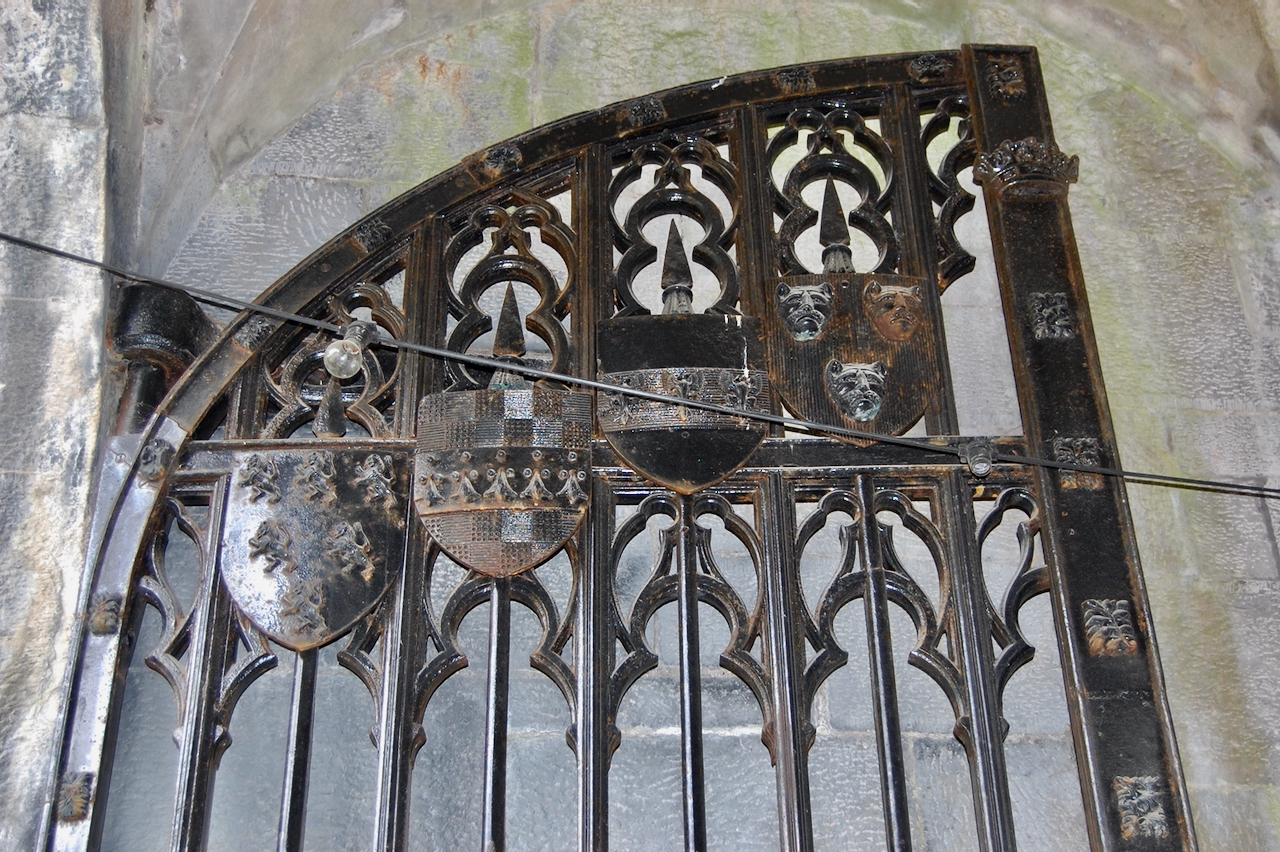
I was intrigued to hear that the gates had been made by one of the residents of the castle, Lady Mary Field, wife of William Parsons, the third Earl of Rosse. She was an accomplished ironworker! She was also a photographer. She brought a fortune with her to the castle when she married the Earl of Rosse, which enabled him to build his telescope, for which the estate is famous. But more on that later. 
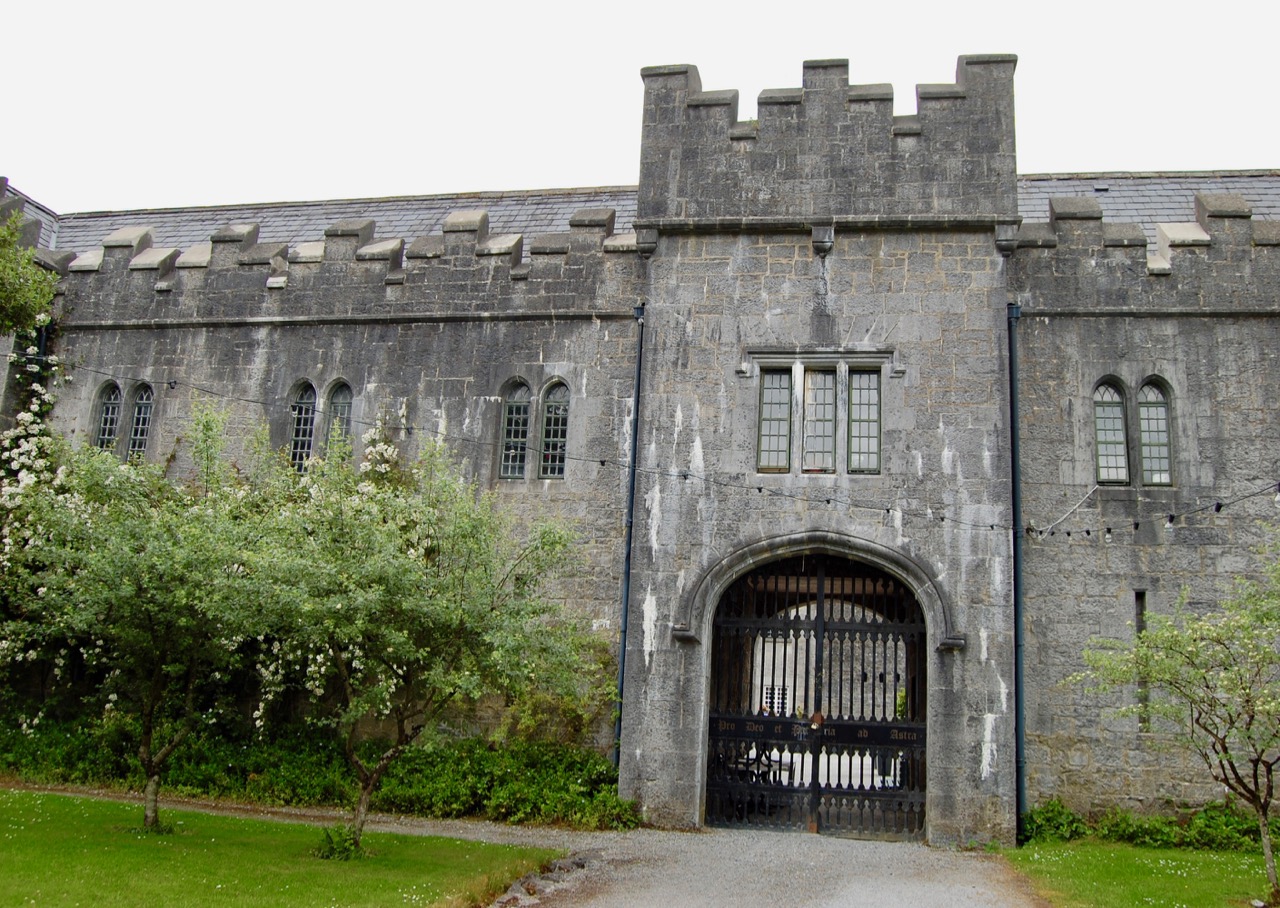
Gates on courtyard entrance made by Lady Rosse, Mary Field (1813-1885), wife of the third Earl of Rosse, with the family motto, “For God and the Land to the Stars.” The motto was originally “For God and King” but, unhappy with the monarch’s response to the famine, the family changed their motto. Photograph © Jennifer Winder-Baggot, www.irishhistorichouses.com
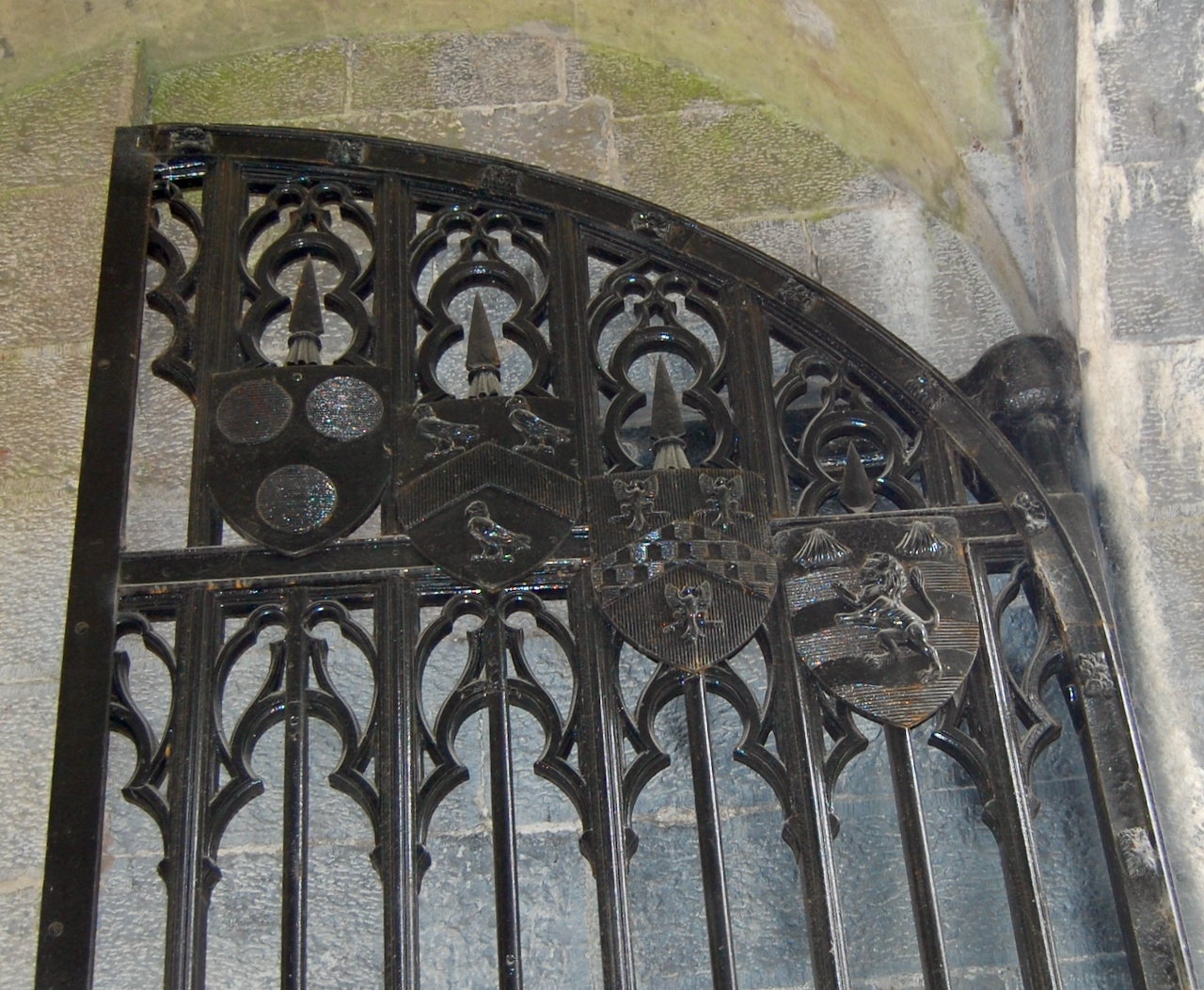
Detail of a gate by Mary Field. This is the Parsons crest, the three leopard heads. Photograph © Jennifer Winder-Baggot, www.irishhistorichouses.com
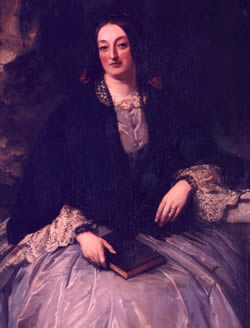
Mary Rosse, Countess of Rosse (née Mary Field) (1813-1885), painter unknown, photograph from Birr Archives, courtesy wikimedia commons.

Family crests from families who intermarried with the Parsons of Birr are also worked into the gate. There are similar crests on the ceiling of the front hallway of the castle. 
Birr Castle, County Offaly. Photograph © Jennifer Winder-Baggot, www.irishhistorichouses.com

We were not allowed to take photos inside the castle, unfortunately. On the other hand it’s always a relief when I am told I cannot take photos, for it means I can relax and really look, and listen to the tour guide.

With the help of portraits, our guide described the Parson family’s ancestors. The entrance hall, the room over the arch in the original gatehouse, has some portraits and a collection of arms.
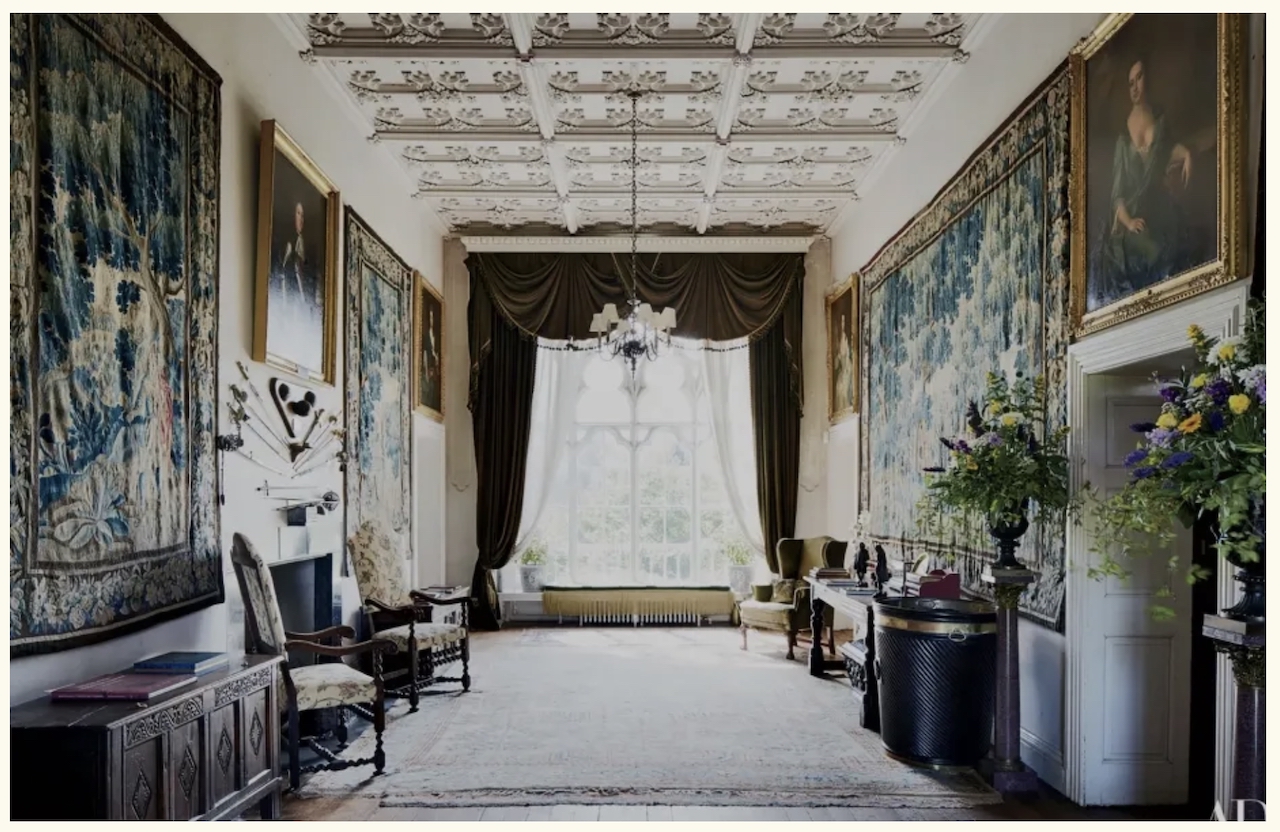
Birr Castle, photograph courtesy of Birr Castle website.

The principal staircase is from the 17th century house, and is built of native yew. It was described in 1681 by Thomas Dinely as “the fairest in all Ireland.” It rises through three storeys, and is heavy, with thick turned balusters and a curving carved handrail. The ceiling above the stairs has plaster Gothic vaulting and dates from the reconstruction after a fire in 1832.
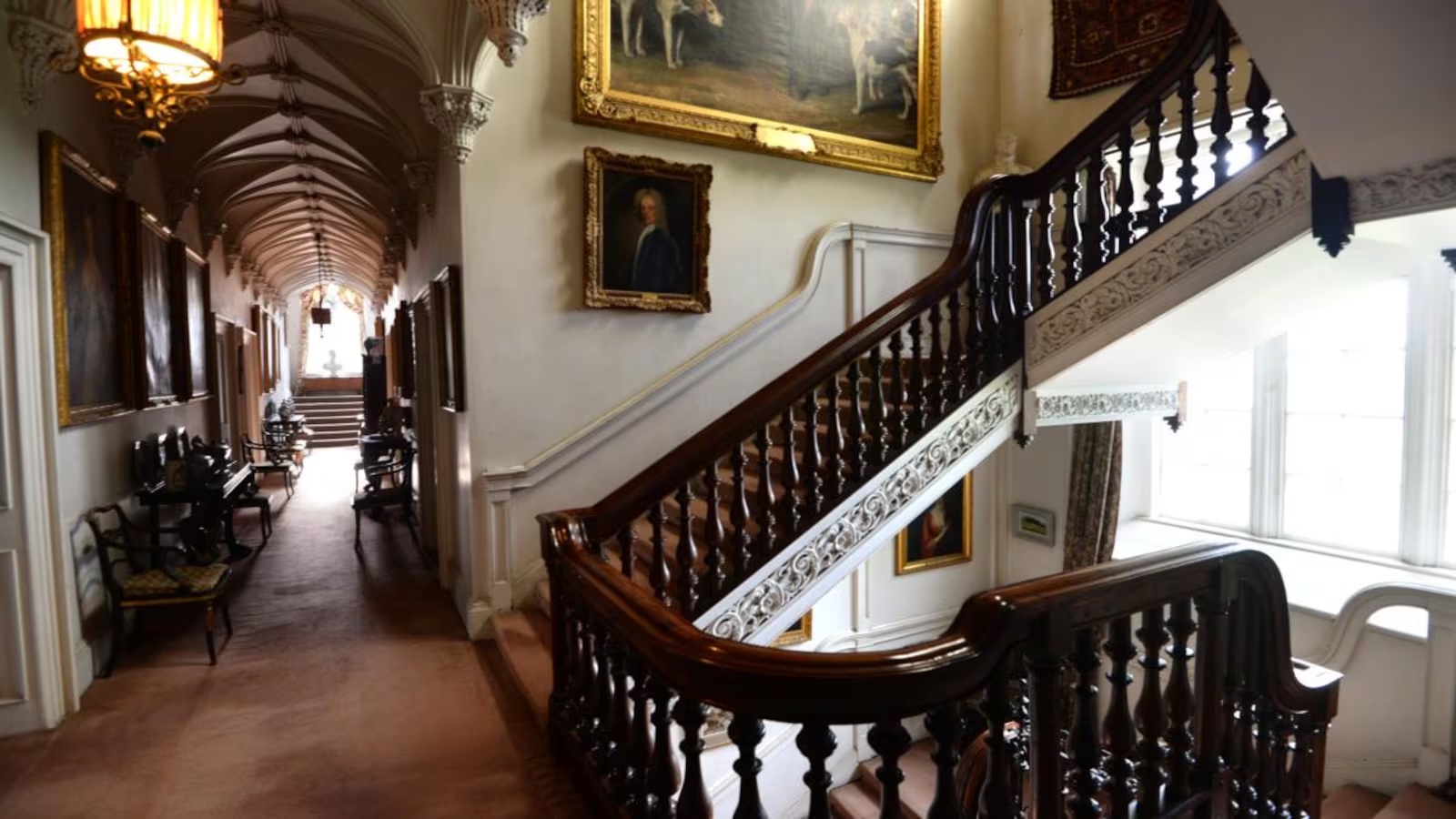
The massive seventeenth century yew staircase, photograph from an article in the Irish Times, photographer Laura Slattery.

Sir Laurence’s son Richard succeeded his father in 1628. Richard died in 1634 without an heir so Birr Castle passed to Richard’s brother William (d. 1653). During his time in Birr Castle, William protected the castle from a siege in 1641 during the Catholic uprising. He fought off the forces for fourteen or fifteen months but eventually surrendered in January 1642/43. [Burke’s Peerage and Baronetage p. 1721] The family moved to London, returning at the end of the Cromwellian period.

In his will, William specified that when the Birr estate is worth £1000 per year, his heir should build an alsmhouse in Birr for four aged Protestants, each with a garden and orchard and enough grass for the grazing of two cows. The beneficiaries would be given 12 pence every Sunday, freedom to cut turf for fire, and a red gown with a badge once every two years, which was to be presented by the heir.

William’s heir was his son, Laurence Parsons (d. 1698), who married Lady Frances, youngest daughter and co-heir of William Savage Esquire of Rheban, County Kildare.

This Laurence Parsons has a substantial entry in The Dictionary of Irish Biography. He was created Baronet of Birr Castle in 1677. Under the lord deputyship of Tyrconnell, Irish protestant grew nervous about another Catholic uprising, and Parsons moved his family to England in 1687. He left a tenant and servant of long standing, Heward Oxburgh, in charge of his estate, with instructions to use his rentals to pay certain debts, and to remit payments to him in England.

Oxburgh was a Catholic who had lost land and been transplanted to Connaught, but was a tenant and servant of the Parsons for thirty years by 1692.

When the rental money did not materialise, Parsons returned to Ireland. He found his agent “highly advanced to the dignity of sheriff of the county, who lorded it over his neighbours at a great rate, and was grown and swollen to such a height of pride he scarce owned his master.” (Birr Castle MSS, A/24, ff 1–2). Furthermore, Oxburgh had used the estate’s rental income to raise a regiment of foot soldiers for King James II.

Parsons reoccupied his castle, which was then besieged by Oxburgh’s forces. Under duress he signed articles, only to find himself tried for treason against William III, and sentenced to death. Imprisoned in his castle, he was reprieved from execution several times, and eventually in April 1690 he was moved to Dublin, and was released shortly after the battle of the Boyne.

Oxburgh sat for King’s County in the Irish parliament summoned by James II in 1689, while his son Heward was returned for Philipstown. He died in the Battle of Aughrim in 1691.

Parsons was again appointed high sheriff of King’s County, and returned to Birr to secure the area against Jacobites and tories. He was involved in one notable skirmish on 11 August, before returning to Dublin to meet his wife and children who had travelled from England. Birr was subsequently occupied by Williamite forces.

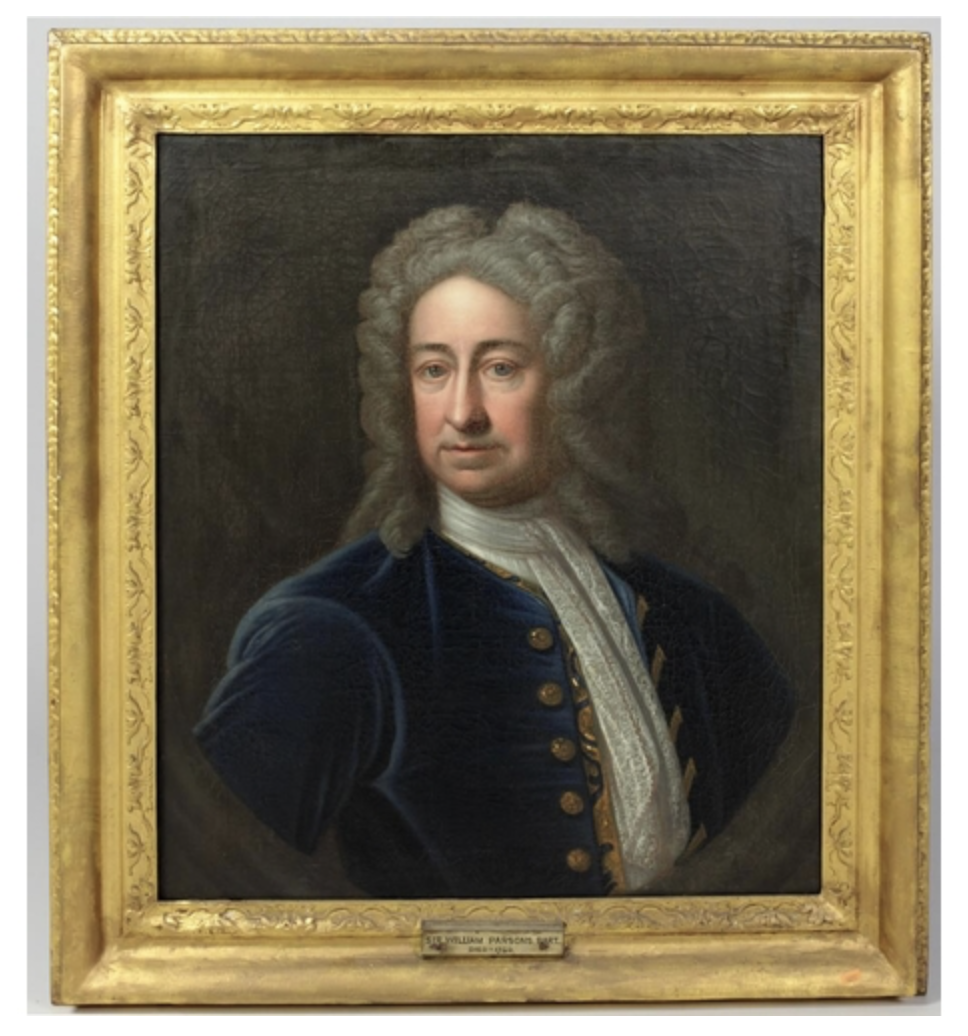
Laurence Parsons died in 1698 and was succeeded in the baronetcy by his son, William Parsons (d. 1740) 2nd Baronet. William served in the Williamite forces, and was MP for King’s Co. (1692–1741). He married firstly Elizabeth, daughter of a Scottish Baronet, and they had one son. This son William Parsons married Martha Pigott and they had a son, Laurence (1707-1756). William Parsons 2nd Baronet died in 1740 and his grandson Laurence Parsons (1707-1756) succeeded as 3rd Baronet of Birr Castle.

his conduct as supervisor of various plantations outraged the numerous native landowners who were dispossessed by his highly questionable legal machinations: local juries were intimidated into invalidating titles to property, while those dispossessed who sought legal recourse were ruined by expensive and time-consuming counter-suits. From 1611 to 1628 he was heavily involved in the increasingly crude efforts by the government to wrest land in Cosha and Ranelagh, Co. Wicklow, from Phelim McFeagh O’Byrne, which culminated in a failed attempt to frame O’Byrne for murder by torturing witnesses. He also encountered criticism for the manner in which he exercised his office as surveyor of plantation land by deliberately underestimating the extent of plantation land in order to defraud the crown and the church of their revenues. At least twice he had to procure royal pardons for corrupt activities.

By these means, he furthered the crown’s policy of supplanting catholic landowners with more politically reliable protestant ones while personally acquiring prime plantation land in Co. Wexford, Co. Tyrone, and Co. Longford, and in King’s Co. (Offaly) and Queen’s Co. (Laois). Although his grasping nature was widely advertised in Ireland, he escaped royal censure due to his political clout, being a key member of a powerful and tightly knit group of Dublin-based government officials who enriched themselves by obstructing and redirecting royal grants of Irish lands intended for courtiers in London. Reflecting his political influence and widening property interests, he sat as MP for Newcastle Lyons (1613–15), Armagh Co. (1634–5) and Wicklow Co. (1640–41).

Parsons’s fortunes changed when Thomas Wentworth came as Lord Deputy to Ireland. Wentworth believed that the protestant establishment was hopelessly corrupt and had failed in its civilising mission in Ireland. He instigated legal proceedings – designed to recover property for the crown – against a number of prominent protestant landowners.
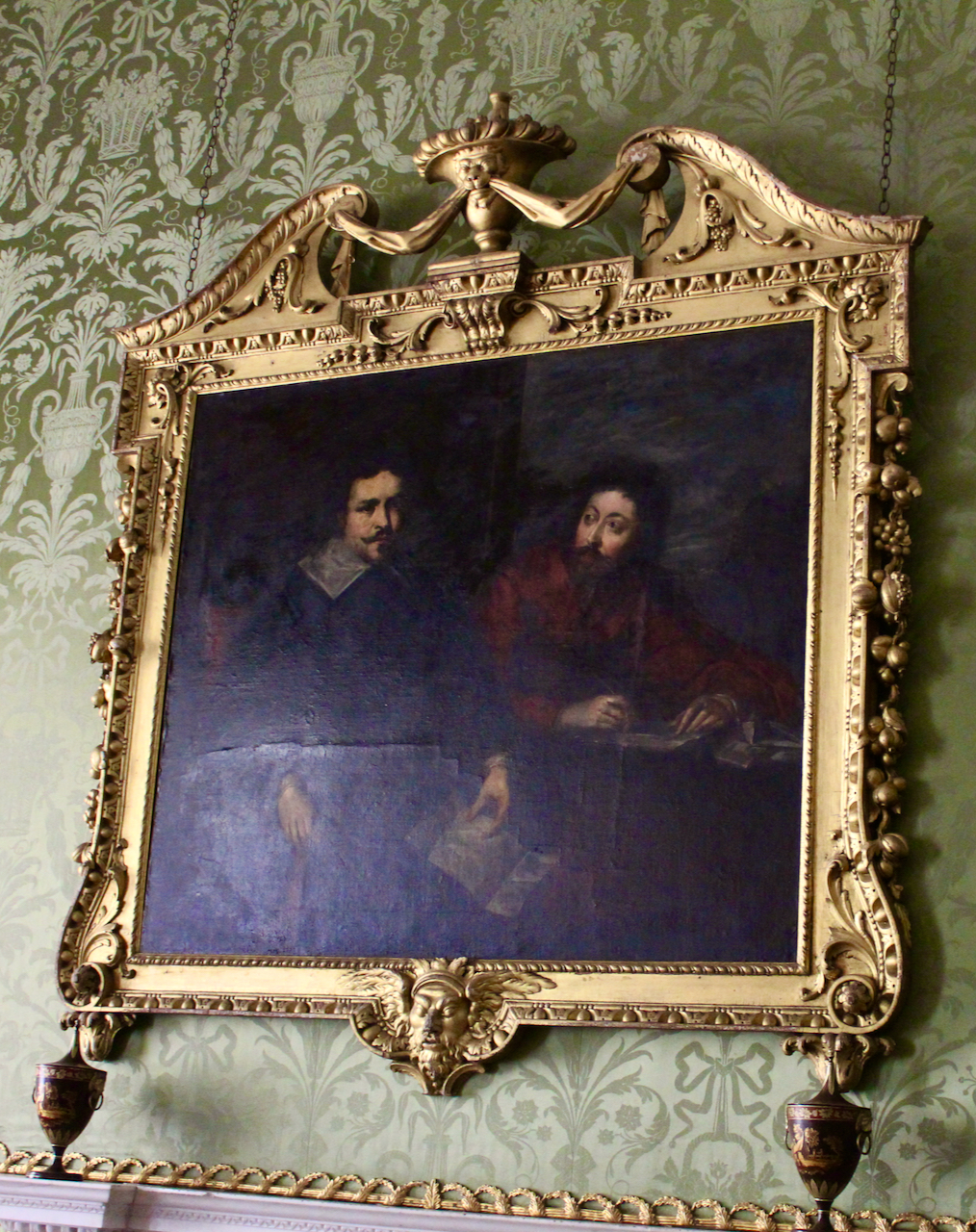
Thomas Wentworth 1st Earl of Strafford (1593-1641), Lord Deputy of Ireland 1632-1640 for King Charles I.

Parsons managed to keep in favour to an extent with Wentworth, although they did not trust each other, and when Wentworth was subsequently accused in 1640 of corruption and treason, Parsons was appointed Lord Justice of Ireland. Parsons knew he stood on shakey ground, however, due to his complicity with Wentworth.

Parsons’s position deteriorated when the king agreed to make a number of wide-ranging concessions, including a promise to halt the plantation of Connacht. Parsons succeeded in delaying the passage of the king’s concessions into law by pleading with the king not to give so much away without extracting money from parliament. Many then and since believed that, but for Parsons’s delaying tactics, the king’s concessions would have been passed by the Irish parliament, the catholics would have felt more secure, and the subsequent disaster of 1641 would have been averted. 

In February 1642 a royal proclamation arrived in Dublin calling on the rebels to surrender and promising them lenient treatment, after which a number of catholic landowners surrendered voluntarily to the government. Parsons disliked this, and to discourage further submissions, he imprisoned and tortured those who had surrendered and even executed a catholic priest who had saved thirty protestants from being murdered in Athy, Co. Kildare. Similarly, in May he condemned the terms by which the city of Galway had submitted to the government as being too lenient. His actions quickly stemmed the flow of submissions that could have brought a peaceful end to the rising. In the meantime the English Parliament was gaining in power over King Charles I.

The Dictionary of Irish Biography continues:

Parsons declared an official policy of neutrality while privately favouring parliament in every matter. From October 1642 he allowed two parliamentarian representatives to sit at the meetings of the Irish privy council. However, the royalist Ormond had his supporters in the Irish council. The growing factionalism that pervaded the Dublin administration reflected the mistrust between the royalists and parliamentarians in Ireland.

Meanwhile in Ireland the catholics organised their own system of government, the ‘catholic confederation’, and were bolstered militarily by the arrival of experienced officers from the Irish regiments serving in the Spanish Netherlands. The protestant forces, starved of pay and munitions, were pushed back once more. The royalists led by Ormond began courting the disgruntled protestant troops in Ireland. In December army officers presented Parsons and his council with a petition outlining their unhappiness at their lack of pay. Although Parsons maintained his grip on the civil administration, the army increasingly looked to Ormond.” This led to his dismissal from the Irish privy council in July and his arrest in August 1643.

Parsons remained a prisoner in Dublin until autumn 1646. By then parliament had won the English civil war and Parsons was released. He died in 1650.

Richard Parsons, 1st Viscount Rosse married three times. He married, firstly, Anne Walsingham, daughter of Thomas Walsingham, on 27 February 1676/77. He was created 1st Viscount Rosse, Co. Wexford [Ireland] on 2 July 1681. He married, secondly, Catherine Brydges, daughter of George Brydges, 6th Baron Chandos of Sudeley on 14 October 1681.

He married his third wife, Elizabeth Hamilton, daughter of Sir George Hamilton, Comte Hamilton in December 1695, after he’d been imprisoned in the Tower of London in February for high treason, according to Burke’s Peerage, Baronetage & Knightage. I can’t find much information about this.

Viscount Rosse’s father-in-law George Hamilton, Comte Hamilton, was the grandson of the 1st Earl of Abercorn, son of 1st Baronet Hamilton, of Donalong, Co. Tyrone and of Nenagh, Co. Tipperary. George Hamilton travelled to France to fight in the Catholic French army, where he was given the title of Comte, fighting against the British. He married Frances Jenyns, who gave birth to his daughter Elizabeth who married Richard Parsons 1st Viscount Rosse. Frances Jenyns, or Jennings, married a second time, to Richard Talbot, the Duke of Tyrconnell. So we can see the circles in which Richard Parsons mixed, and why it was that he could have been imprisoned for treason.
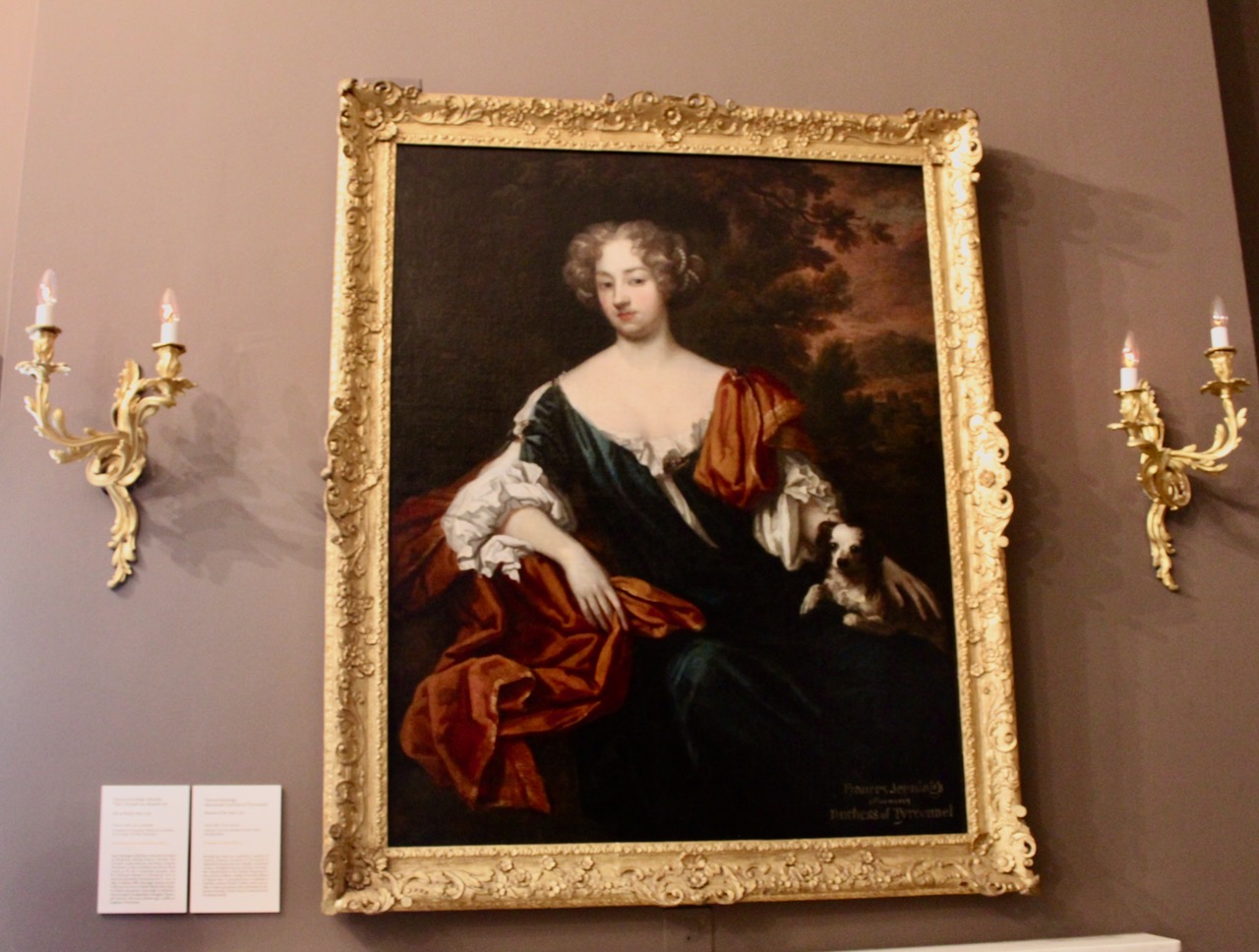
Frances Jennings, Vicereine of Ireland 1687-89, Duchess of Tyrconnell. She was married to Richard Talbot, 1st Duke of Tyrconnell (1630-1691).

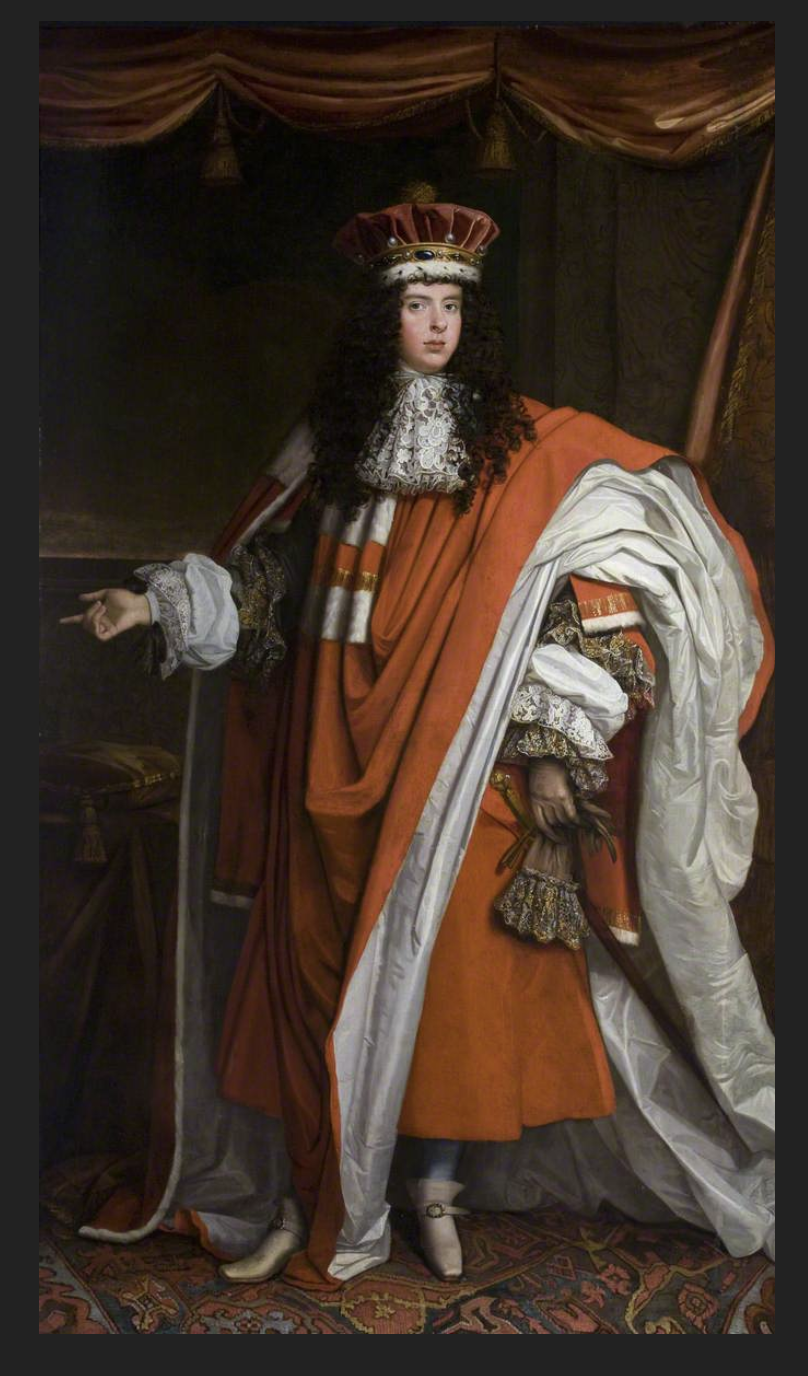
The Viscount must have changed his loyalties, to support William III. The Viscount Rosse’s son by Elizabeth Hamilton, Richard (d. 1741), succeeded as 2nd Viscount Rosse upon his father’s death in 1703. He was raised to the peerage as 1st Earl of Rosse in 1718. He became the Grand Master of the Freemasons and was a founder member of the Hellfire Club which met at Montpelier Hill in a former shooting lodge of William Conolly. The Earl of Rosse’s townhouse on Molesworth Street later became the site of the Masonic Grand Hall. One sees no trace of his supposed Satanic leanings in his portrait in Birr Castle, in which he looks the picture of innocence!
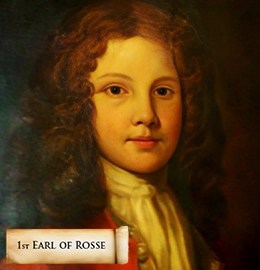
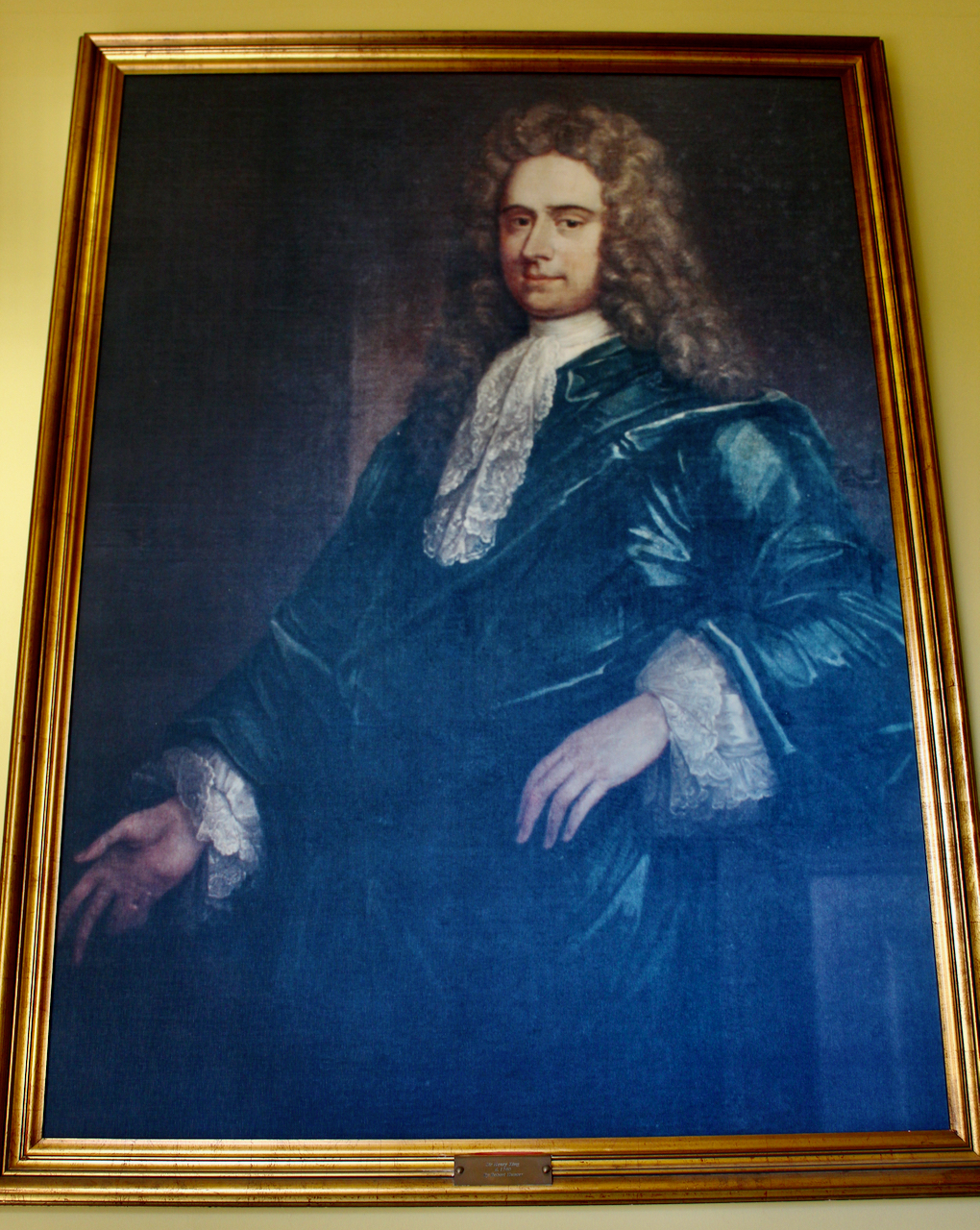
The innocent looking Richard Parsons (d. 1741) 1st Earl of Rosse, one of the founders of the Hellfire Club. Photograph of the portrait courtesy of Birr Castle’s website. Painting by William Gandy.
Henry Clements (1698-1745), Col Henry Ponsonby (1685-1745), Richard St George (d. 1775), Simon Luttrell, Henry Barry 3rd Baron Santry (1680-1735), members of the Hellfire Club, painted by another member, and co-founder, James Worsdale, photograph of portrait in the National Gallery of Ireland.

Richard’s son, also named Richard, succeeded as the 2nd Earl but died childless and the title became extinct. It was then created for a second time for the descendants of Lawrence Parsons of Birr Castle.

Let us go back now to the Parson Baronets of Birr Castle. As I mentioned, Laurence Parsons 3rd Baronet of Birr Castle had a son by his first marriage, William (1731–1791). When Laurence died in 1749, William succeeded as 4th Baronet of Birr Castle.

Laurence’s son by his second marriage, Laurence (1749-1807), who inherited his uncle Cutts Harman’s estate County Longford with the proviso that he take the name Harman, became Laurence Harman Parsons. In 1792 he was raised to the Peerage of Ireland as Baron of Oxmantown, in the County of Dublin and in 1795, Viscount Oxmantown. In 1806 when he was created Earl of Rosse in the Irish peerage, of the second creation.

William Parsons (1731-1791) the 4th Baronet served as M.P. and High Sheriff for County Offaly. William in turn was succeeded in the baronetcy by his son Laurence Parsons (1758-1841). When Laurence the 5th Baronet of Birr Castle’s uncle the 1st Earl of Rosse of the second creation died without a male heir, Laurence became the 2nd Earl of Rosse. He married Alice, daughter of John Lloyd Esquire of Gloster, King’s County.
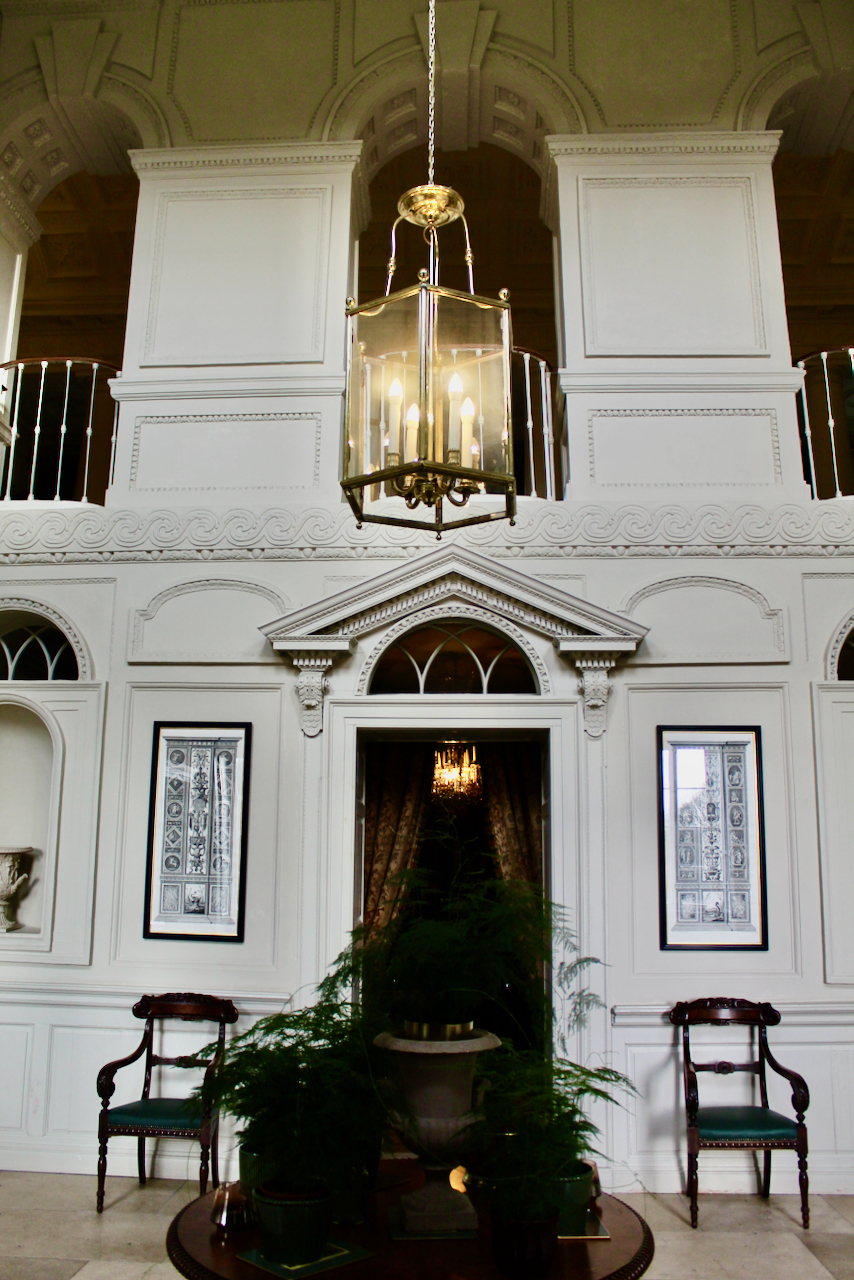
Gloster, County Offaly, February 2023. Photograph © Jennifer Winder-Baggot, www.irishhistorichouses.com.

During Heritage Week in 2024, Stephen and I visited Tullynisk house in County Offaly, where Alicia Clement, daughter of the Earl of Rosse, who grew up in Birr Castle, gave a tour of her home. She told us that the Parsons were not as illustrious as the Lloyds, and that Alice Lloyd was considered to be a good catch!
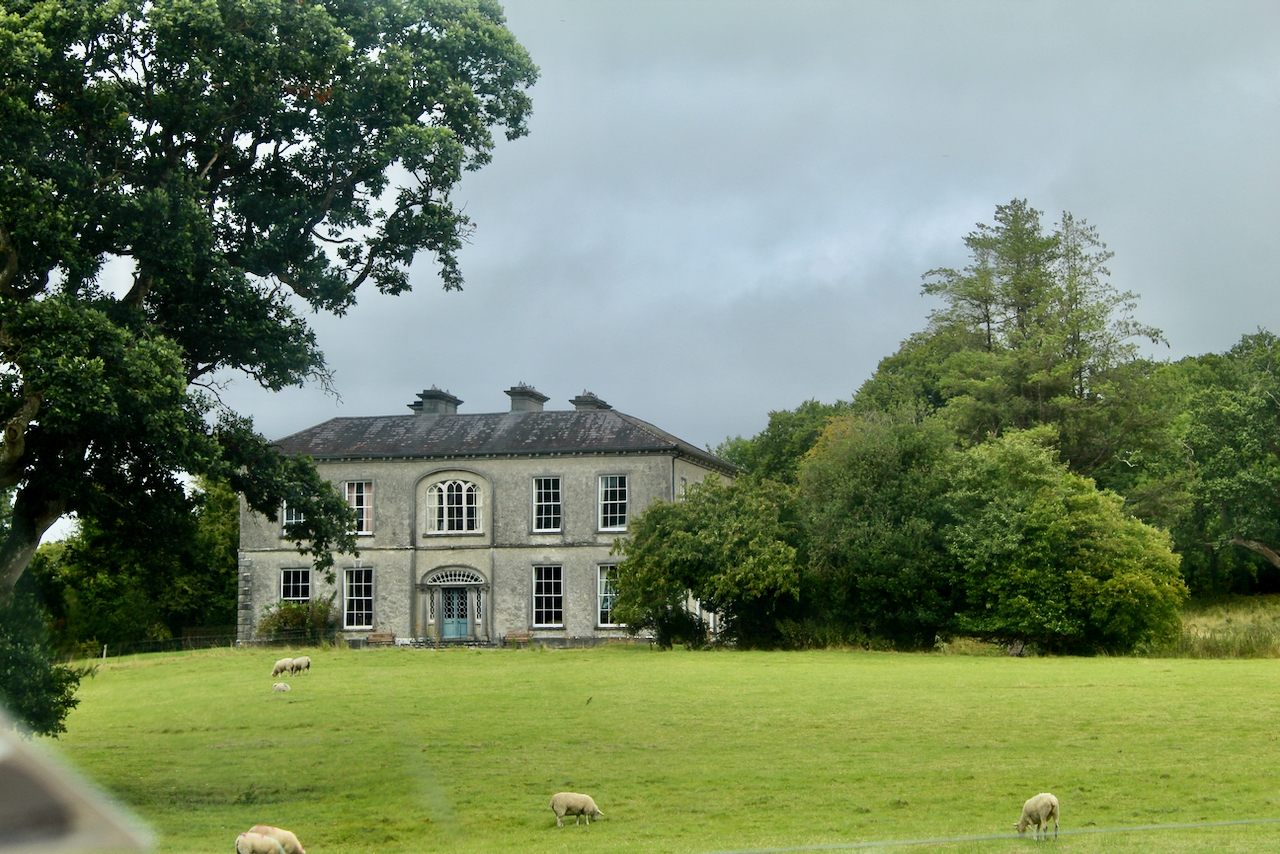
Tullynisk, County Offaly, built for two brothers of the Earl of Rosse. Photograph © Jennifer Winder-Baggot, www.irishhistorichouses.com.

Laurence Parsons (1758-1841) 2nd Earl of Rosse served as M.P. and opposed the Union and the abolishment of the Irish Parliament. He was a friend of Henry Grattan. He was described by Wolfe Tone in his days as an MP as “one of the very few honest men in the Irish House of Commons.” [7]

The 2nd Earl of Rosse made further alterations to the castle, shortly after 1800. He worked with a little known architect, John Johnson, and they gave the castle its Georgian Gothic style.

The website explains the additions to the castle:

“The castle survived two sieges in the 17th century, leaving the family impoverished at the beginning of the 18th century and little was done to the 17th century house. However, at some time towards the end of that century or at the beginning of the 19th century, the house which had always faced the town, was given a new gothic facade, which now faces the park. The ancient towers and walls on this, now the park side of the castle, were swept away, including the Black Tower (the tower house) of the O’Carrolls, which had stood on the motte. Around 1820 the octagonal Gothic Saloon overlooking the river was cleverly added into the space between the central block and the west flanking tower.”

Birr Castle, photograph by Liam Murphy, 2015, for Tourism Ireland, Ireland’s Content Pool. (see [1])

The entrance we see was previously the back of the house, and most of this facade was added in the additions by the 2nd Earl from 1801 onward. First the two storey porch in the centre of the front, with the giant pointed arch over the entrance door was added and the entire facade faced with ashlar. The third storey which we see was added later, after 1832. The battlements were added as the castle was given a Gothic appearance.
Mark Bence-Jones describes the Castle in his Guide to Irish Country Houses:

“…during the course of C17, the gatehouse was transformed into a dwelling-house, being joined to the two flanking towers, which were originally free-standing, by canted wings; so that it assumed its present shape of a long, narrow building with embracing arms on its principal front, which faces the demesne; its back being turned to the town of Birr and its end rising above the River Camcor. Not much seems to have been done to it during C18, apart from the decoration of some of the rooms and the laying out of the great lawn in front of it, after the old O’Carroll keep and the early C17 office ranges, which formerly stood here, had been swept away ca. 1778. From ca 1801 onwards, Sir Laurence Parsons [1758-1841] (afterwards the 2nd Earl of Rosse), enlarged and remodelled the castle in Gothic, as well as building an impressive Gothic entrance to the demesne. His work on the castle was conservative; being largely limited to facing it in ashlar and giving a unity to its facade which before was doubtless lacking; it kept its original high-pitched roof containing an attic and two C17 towers at either end of the front were not dwarfed by any new towers or turrets; the only new dominant feature being a two storey porch in the centre of the front, with a giant pointed arch over the entrance door. At the end of the castle above the river, 2nd Earl built a single-storey addition on an undercroft, containing a large saloon. He appears to have been largely his own architect in these additions and alterations, helped by a professional named John Johnston (no relation of Francis Johnston). In 1832, after a fire had destroyed the original roof, 2nd Earl added a third storey, with battlements.” [8]
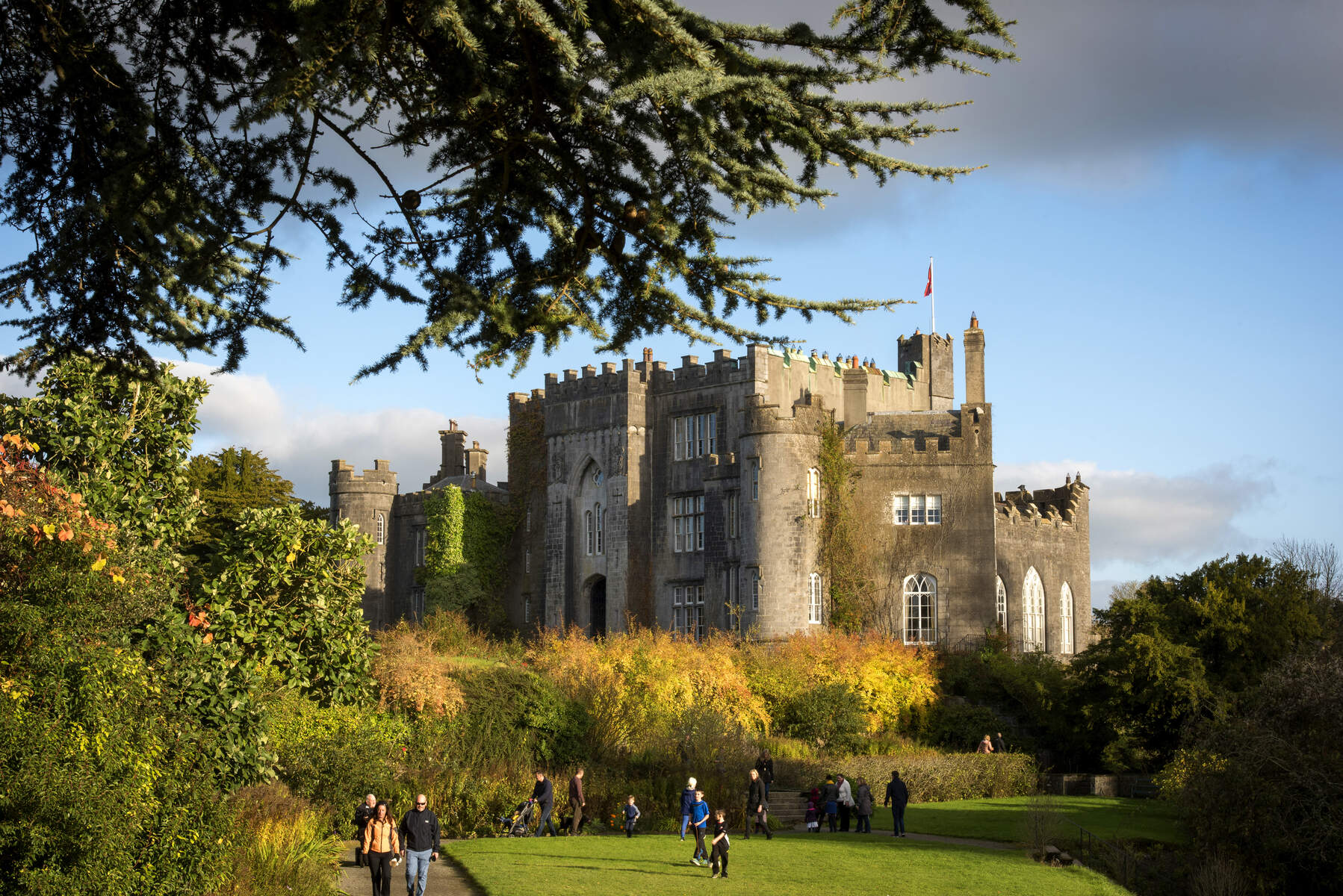
…the only new dominant feature being a two storey porch in the centre of the front, with a giant pointed arch over the entrance door.Birr Castle, photograph by Chris Hill 2018, for Tourism Ireland, Ireland’s Content Pool. (see [1])
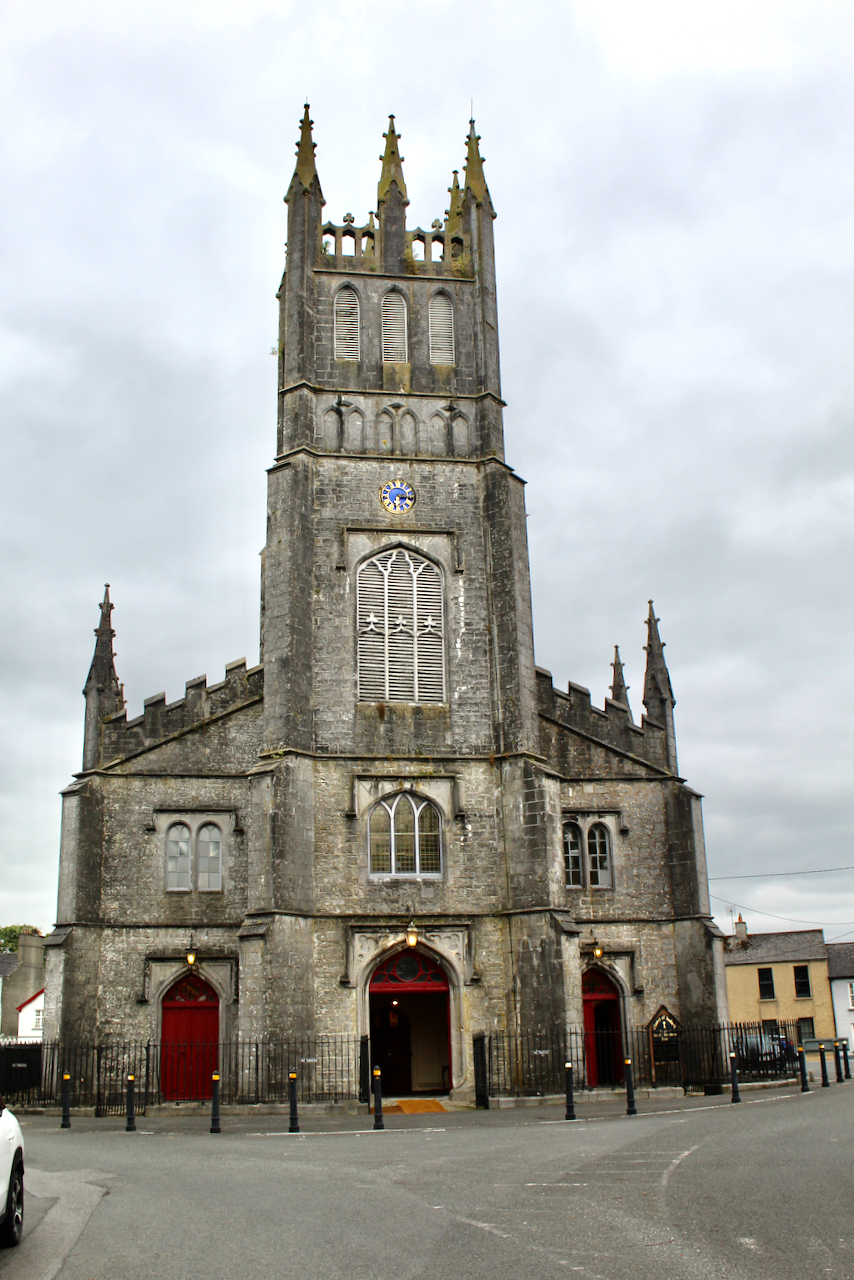
St. Brendan’s Church of Ireland, Oxmantown Mall, Birr. Built by the architect John Johnson in 1815, who worked with the 2nd Earl on Birr Castle. The church was extended in 1876 by the architect Thomas Drew, who added a new chancel. Further enhancements included the insertion of the east window, which was commissioned from Charles Kempe by the fourth Earl of Rosse in 1891. Photograph © Jennifer Winder-Baggot, http://www.irishhistorichouses.com

Besides enlarging and remodelling the castle in the Gothic style, the 2nd Earl also built the impressive Gothic entrance to the demesne. [8]
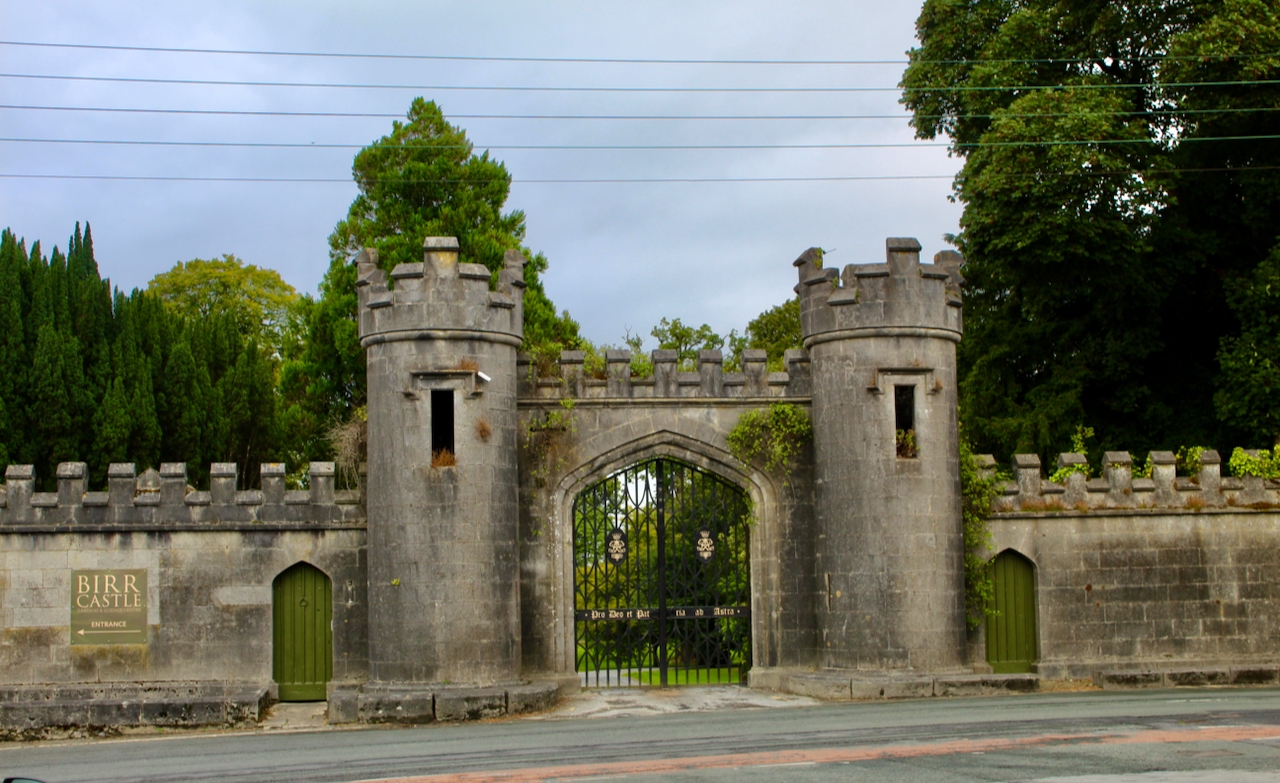
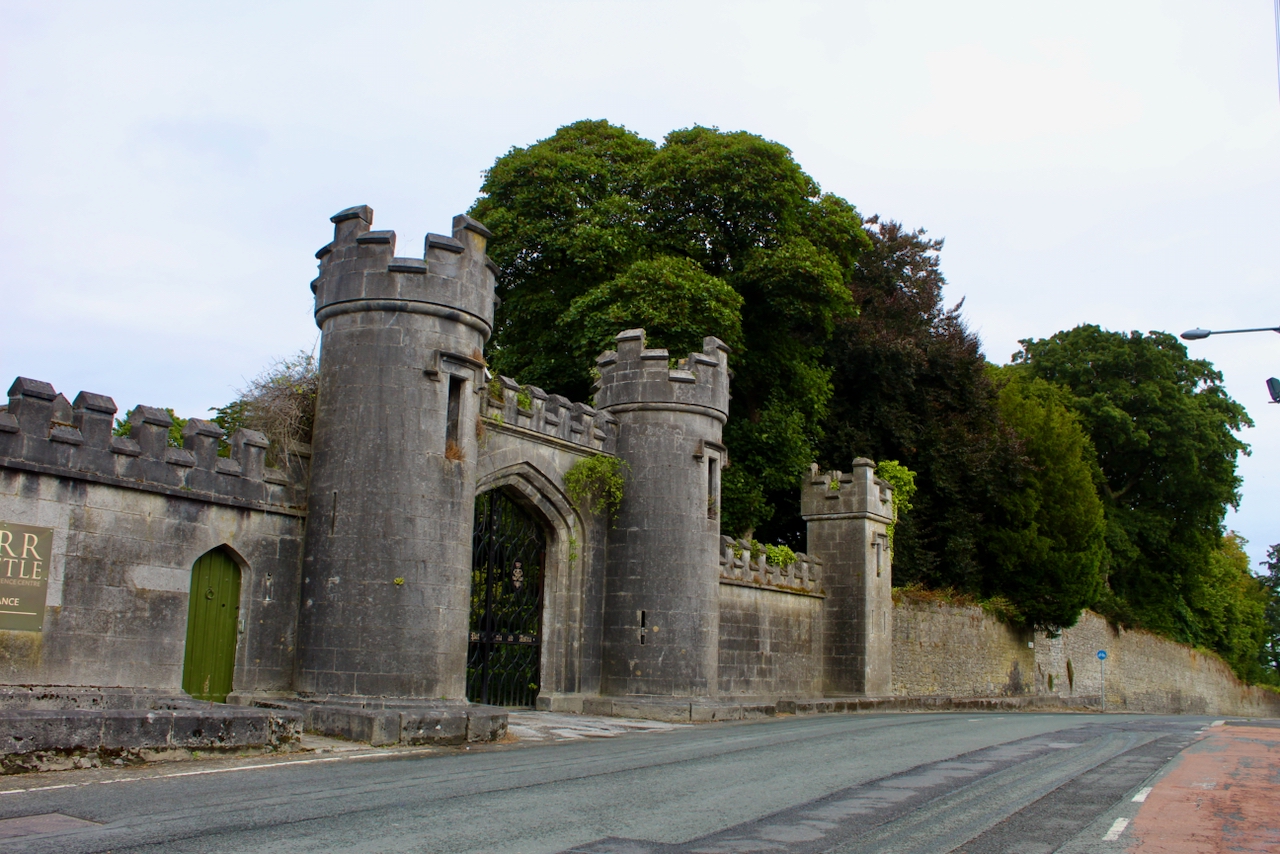
Gothic Entrance gates to Birr Castle. From ca 1801 onwards, Sir Laurence Parsons [1758-1841] (afterwards the 2nd Earl of Rosse), enlarged and remodelled the castle in Gothic, as well as building an impressive Gothic entrance to the demesne. Photograph © Jennifer Winder-Baggot, www.irishhistorichouses.com
Gothic Entrance gates to Birr Castle. Photograph © Jennifer Winder-Baggot, www.irishhistorichouses.com

In the book Irish Houses and Gardens, from the archives of Country Life by Sean O’Reilly, the plaster-vaulted saloon which the 2nd Earl added is described: “With the slim lines of its wall shafts and ribs, the free flow of the window tracery and the curious irregular octagon of its plan, the room possesses all the light, airy mood of the best of later Georgian Gothic, and remains one of Birr’s finest interiors.” [9]
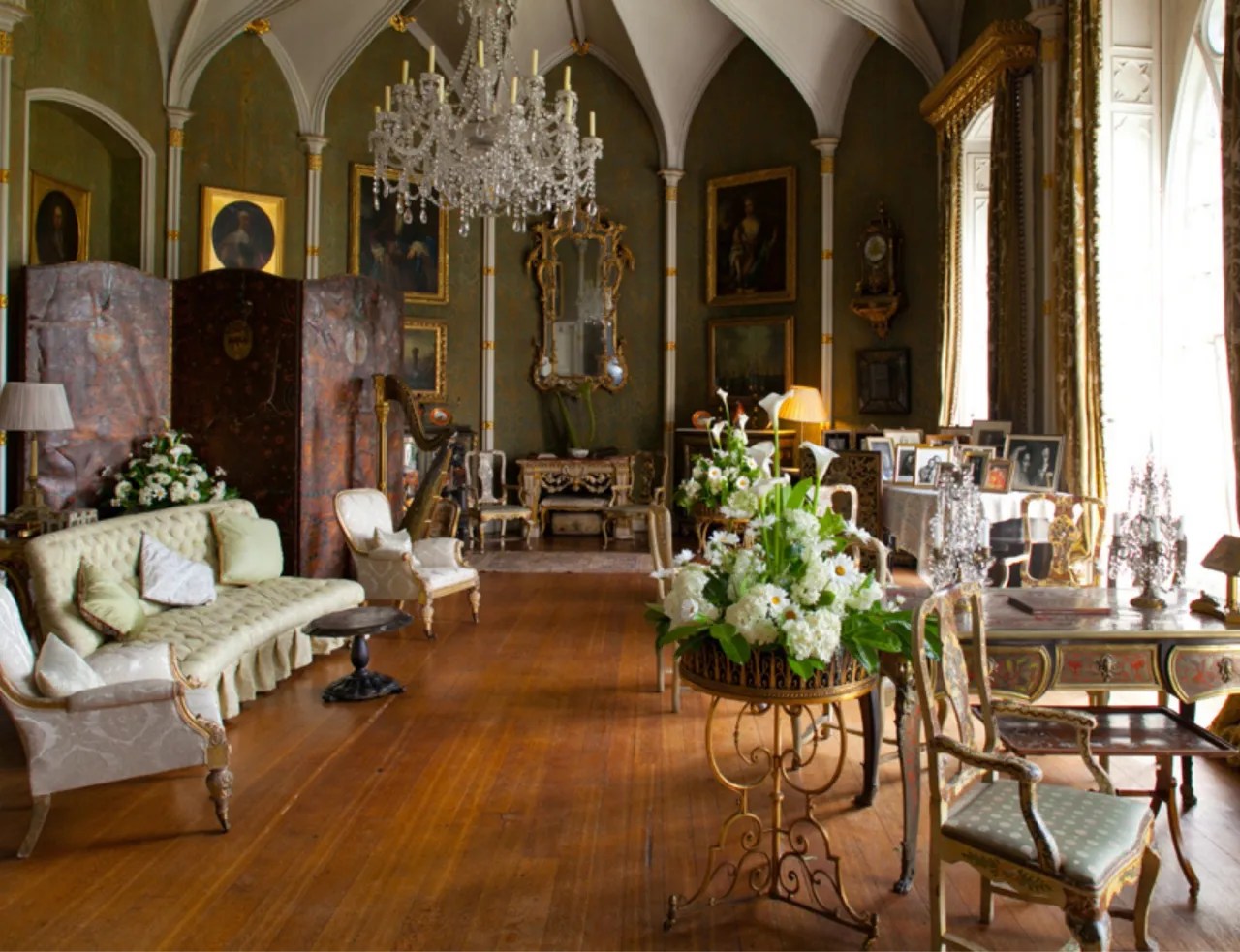
The Saloon, or Music Room, Birr Castle, photograph courtesy of Birr Castle website.

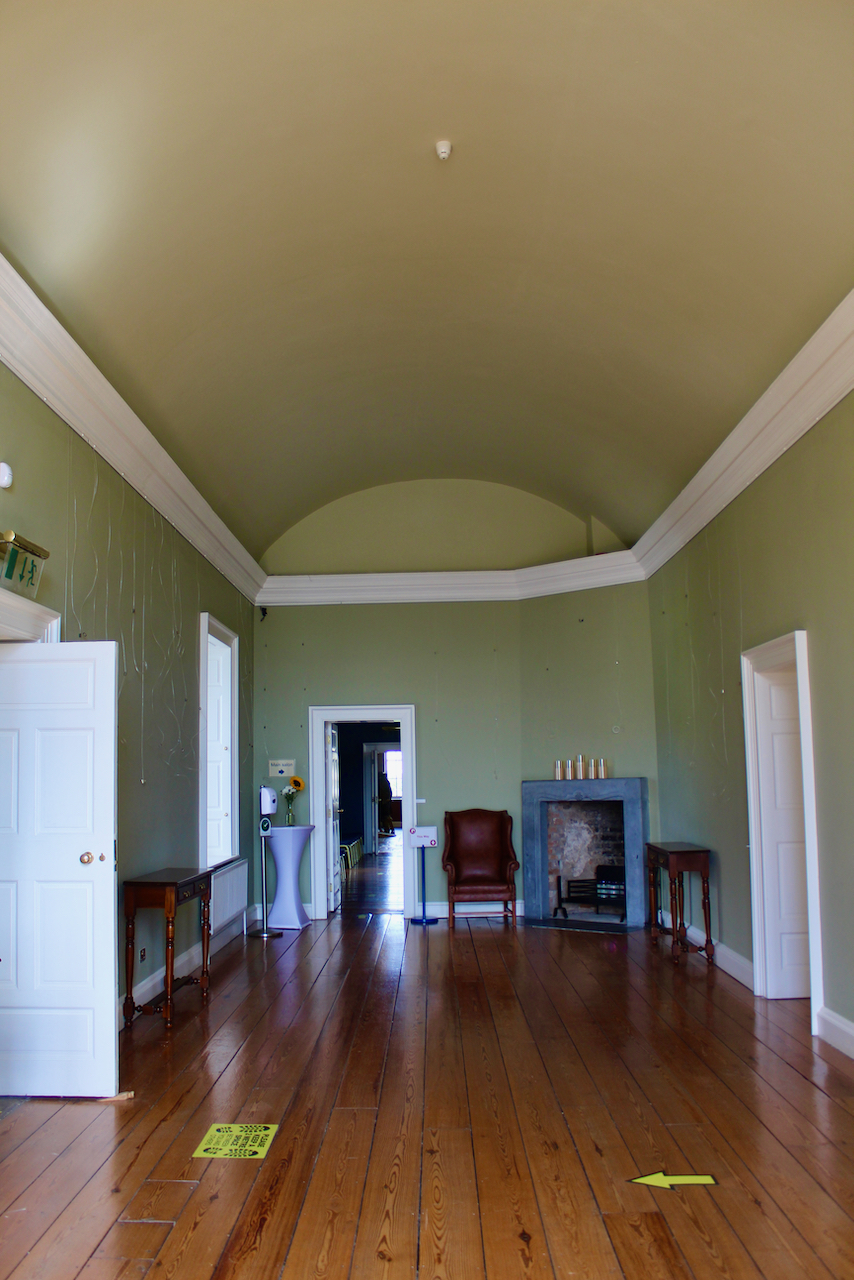
Vaulting fills the castle, even in small hallways.

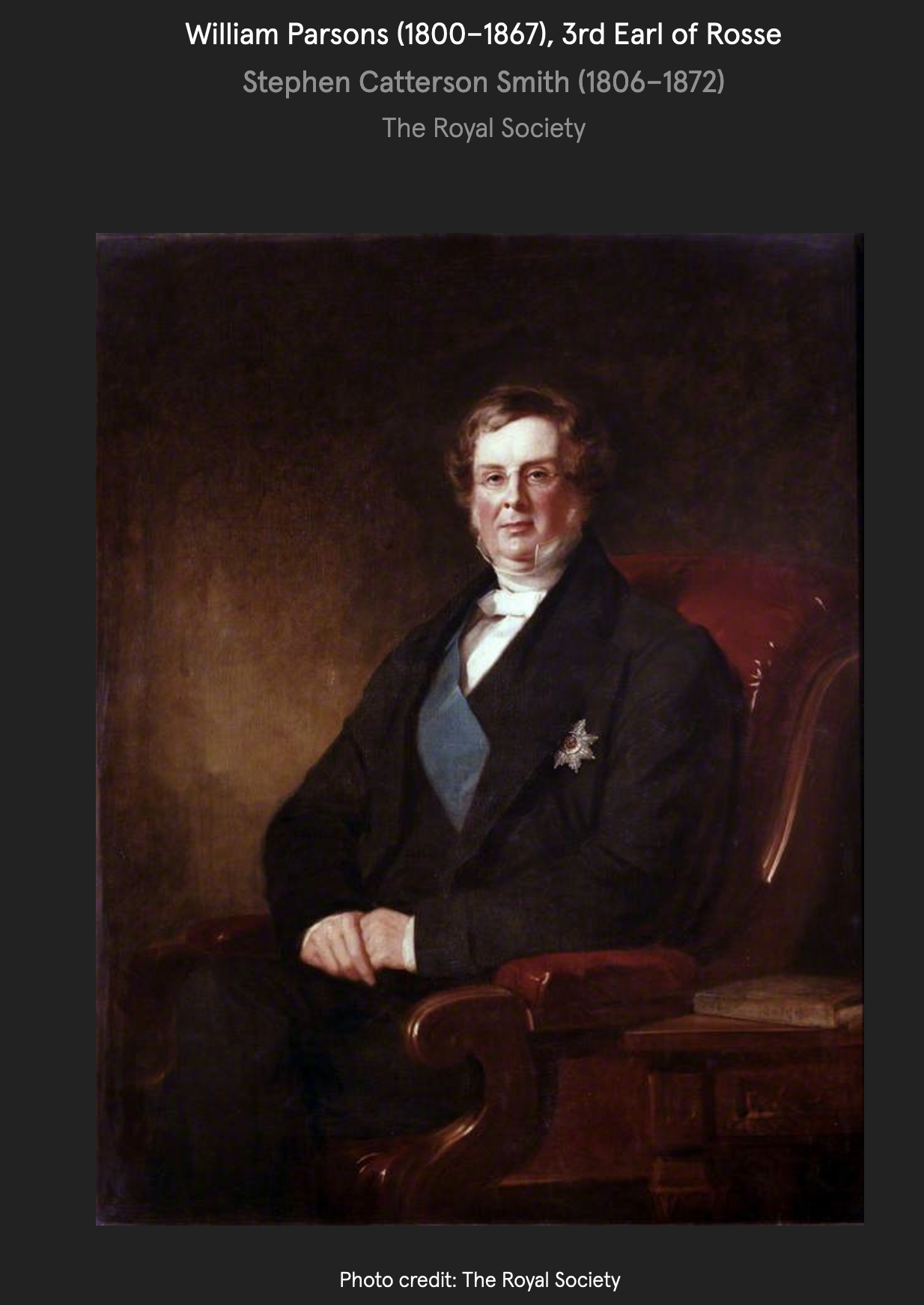
Laurence Parsons (1758-1841) 2nd Earl of Rosse was succeeded by his son William Parsons (1800-1867), the 6th Baronet and 3rd Earl of Rosse. In 1836 he married Lady Mary, eldest daughter and co-heir of John Wilmer Field Esquire of Heaton Hall, County York. It was this Mary who created the gates which we admired on the way to the Castle.
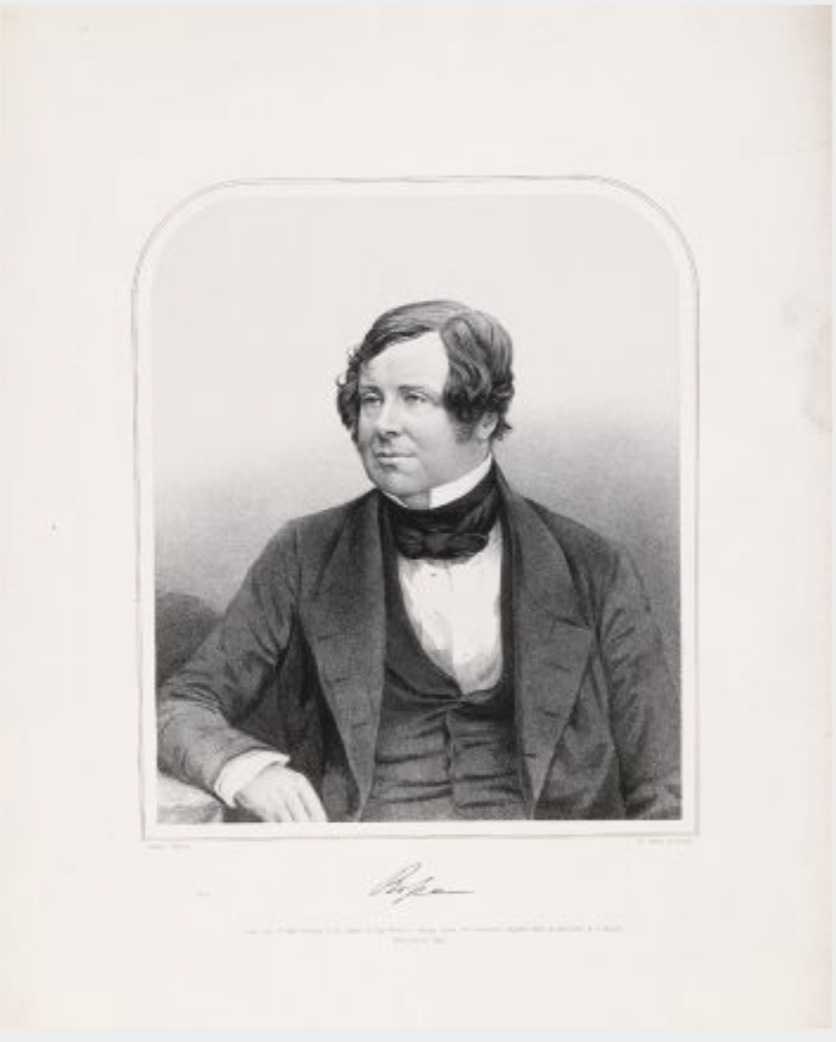
Portrait of William Parsons, 3rd Earl of Rosse, (1800-1867), photograph courtesy of National Gallery of Ireland.

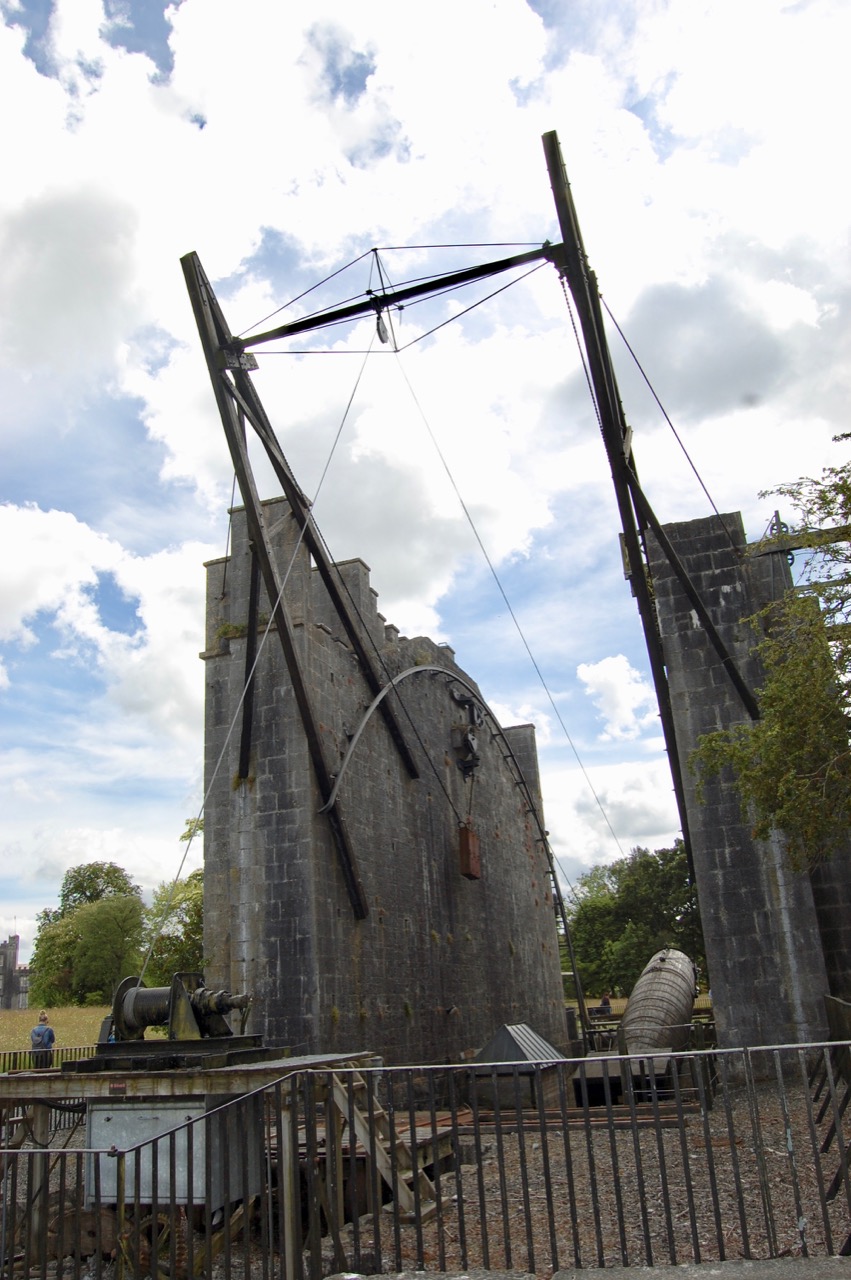
It was the third Earl, William Parsons (1800-1867), who built the world’s largest telescope for over 70 years, in 1845. He was one of the leading scientists and engineers of his day, and he designed the telescope as well as having it built.
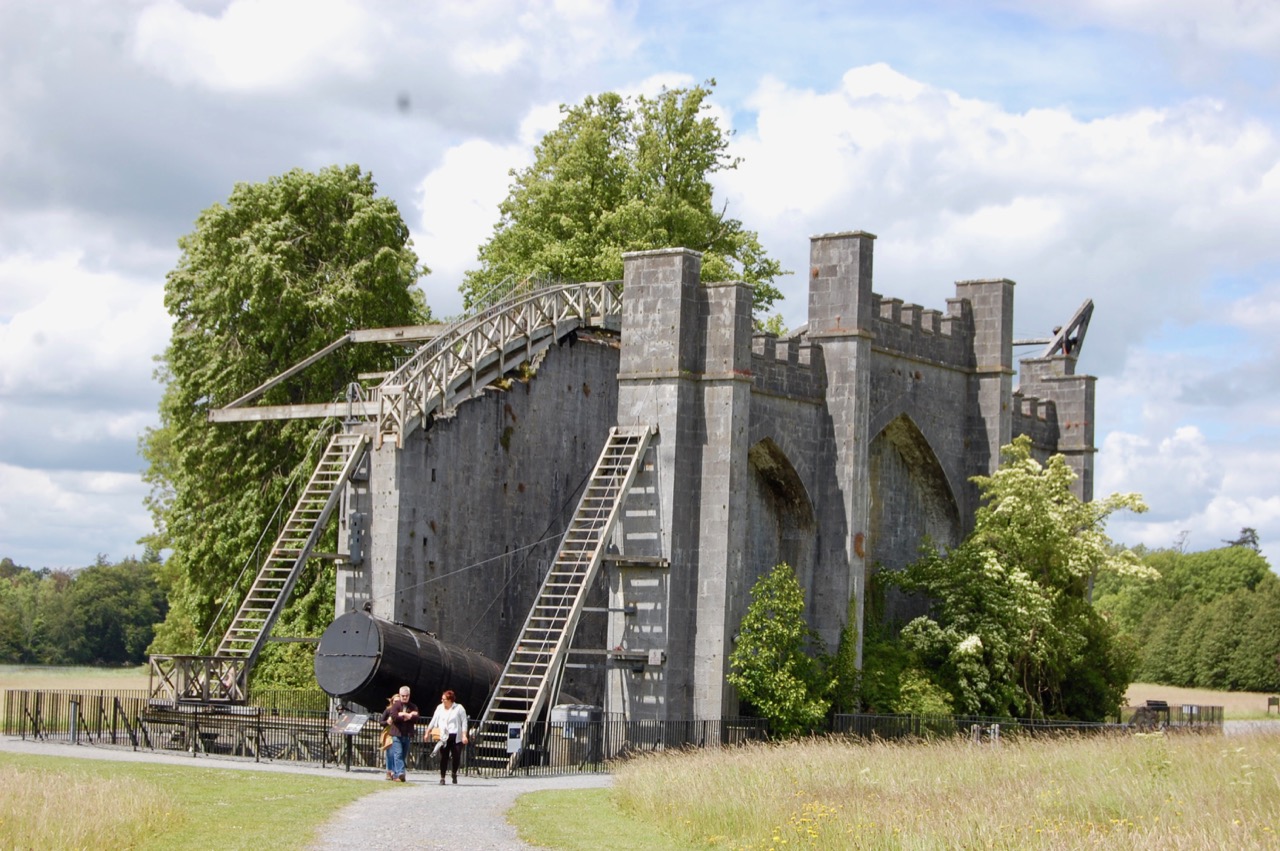
The world’s largest telescope for over 70 years, built in 1845. Photograph © Jennifer Winder-Baggot, www.irishhistorichouses.com

All this work took place in rural Parsonstown at the Birr demesne. Furnaces had to be built and local men trained in manufacture and metal casting, overseen by the 3rd Earl. As we saw earlier, his wife Mary also learned metalwork.

Mary was also an accomplished photographer – the photography dark room of his wife Mary née Field has only been rediscovered in the castle recently, but unfortunately we did not get to see it. Their younger son, Charles Parsons, was a groundbreaking engineering pioneer and the inventor of the steam turbine.

The Birr Castle website continues:“After a fire in the central block in 1836 the centre of the castle was rebuilt, ceilings heightened, a third story added and also the great dining room. In the middle of the 1840s to employ a larger work force during the famine, the old moat and the original Norman motte were also flattened and a new star-shaped moat was designed, with a keep gate. This was financed by Mary, Countess of Rosse. This period of remodelling also overlapped with the building of the Great Telescope, The Leviathan.”

Only one person perished in the 1836 fire, a nanny to the children, who is said to haunt the top floor of the house. There’s a crack in the fireplace of the library from this fire, which was started by a cigarette tossed into a bucket of turf.
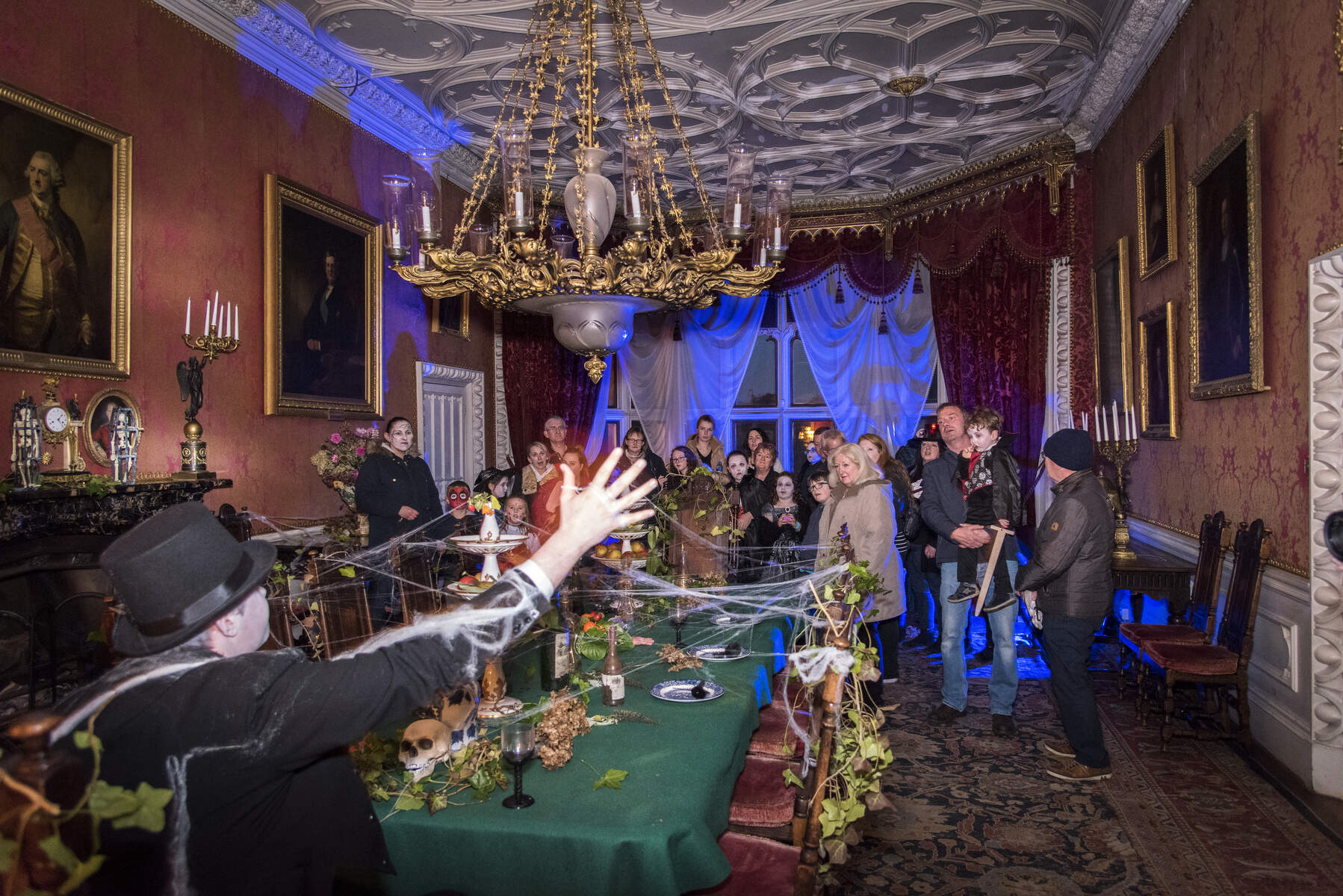
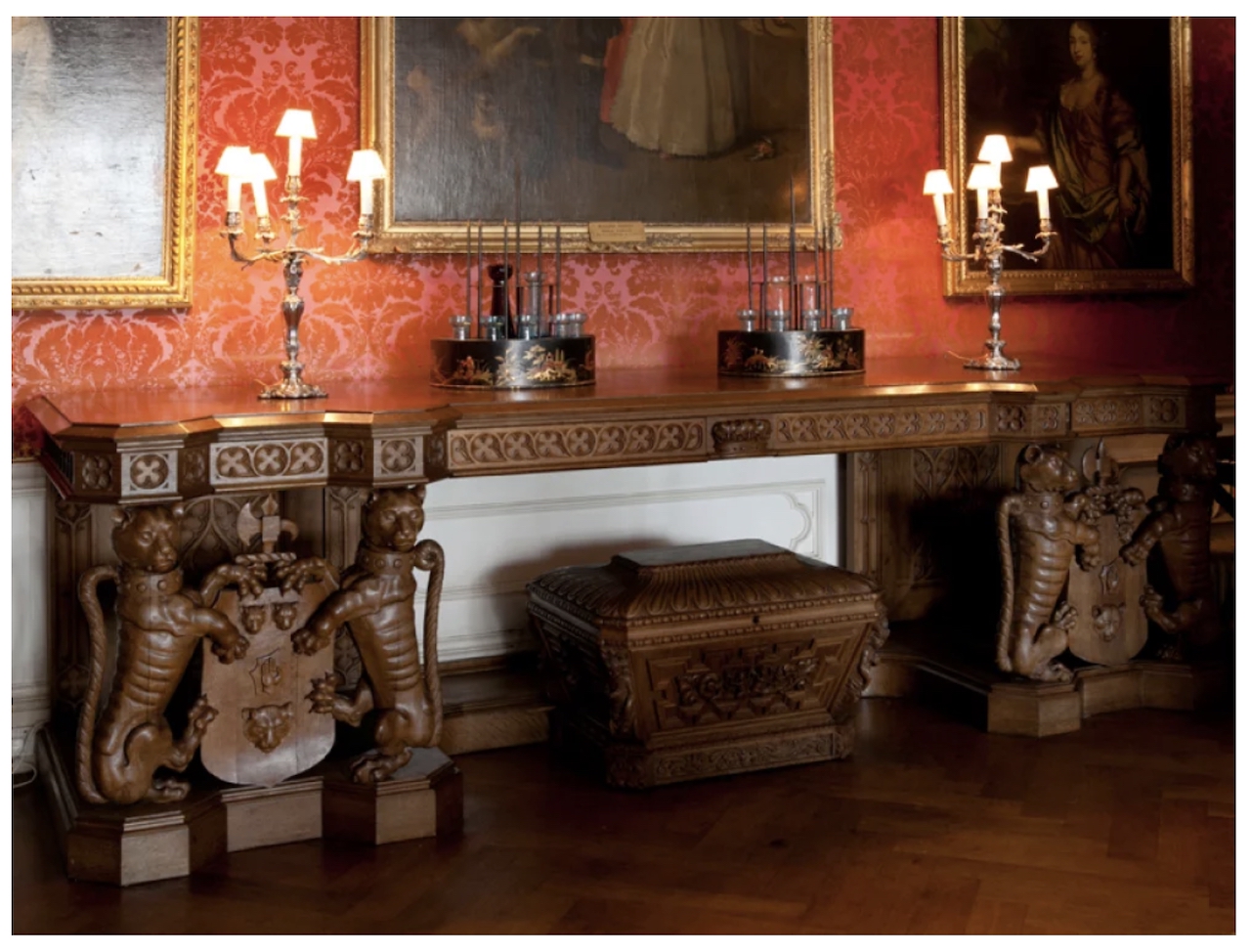
Birr Castle dining room, photograph by Chris Hill 2018, for Tourism Ireland, Ireland’s Content Pool. (see [1])
The Dining Room, which contains many family portraits. The sideboard is supported by the Parson family crest. The leopards are the heraldic symbol of the Parsons family. The massive Gothic sideboard of the dining room probably dates from shortly after the marriage in 1836 of the 3rd Earl of Rosse to Mary Wilmer Field. Birr Castle, photograph courtesy of Birr Castle website.

The website tells us that the final work on the castle was done in the 1860s when a square tower at the back of the castle on the East side was added. This now contains nurseries on the top floor which have a view over the town.

I was overwhelmed by the plush interior of the castle. It was the fanciest I had seen to date. The pelmets are huge, curtains heavy, and paintings old and abundant – although several are copies and not originals, placed due to their relevance to the inhabitants of the castle.

In the front hall there are huge tapestries, brought by the wife of the 6th Earl, Anne Messel, which fit the hall perfectly. The ceiling is sculpted in plaster, as are all of the reception rooms which we visited. There is an enormous wardrobe in the hall which can be taken apart so is called a “travel” wardrobe despite its heft, and a lovely walnut clock stood alongside the walnut exterior wardrobe. It is a Dutch clock, and as well as the time, it tells the date, and the phase of the moon, and has a little clockwork scene that is meant to move on the hour, but is no longer functioning. The clock is “haunted,” the guide told us, and is his favourite piece in the castle. It is said to be haunted because of a few odd incidents that occurred before it was brought to the castle. When someone in the family died, the clock stopped. Another time, at the moment someone in the house died, the pendulum of the clock dropped from its mechanics. Finally, when another person died in the house, the entire clock fell forwards onto its front.

Consequently nobody wanted the clock except the daughter of the family, who brought the clock with her when she moved into Birr Castle. For safety, however, she had the freestanding clock firmly affixed to the wall behind.

The website history of the family tells us:

The 19th century saw the castle become a great centre of scientific research when William Parsons, 3rd Earl built the great telescope. (See astronomy).His wife, Mary, whose fortune helped him to build the telescope and make many improvements to the castle, was a pioneer photographer and took many photographs in the 1850s.  Her dark room – a total time capsule which was preserved in the Castle – has now been exactly relocated in the Science Centre.

The website family history continues:

Their son the 4th Earl also continued astronomy at the castle and the great telescope was used up to the beginning of the 2nd world war. His son the 5th Earl was interested in agriculture and visited Denmark in search of more modern and successful methods. Sadly he died of wounds in the 1st world war.

The website continues: “His son, Michael the 6th Earl and his wife Anne created the garden for which Birr is now famous. (see the gardens and trees and plants) Anne, who was the sister of Oliver Messel the stage designer, brought many treasures to Birr from the Messel collection and with her skill in interior decoration and artist’s eye, transformed the castle, giving it the magical beauty that is now apparent to all.  Michael was also much involved in the creation of the National Trust in England after the war.

The Irish Historic Houses website tells us:

The interior is another skilful combination of dates and styles, forming a remarkably harmonious whole for which Anne Rosse, chatelaine of Birr from the 1930s to the 70s, is chiefly responsible [Anne Messel wife of 6th Earl]. She was the sister of Oliver Messel, the artist and stage-designer, and the mother of Lord Snowdon. A talented designer, decorator and gardener in her own right, her arrangement of the family collections is masterly.” [see 2]
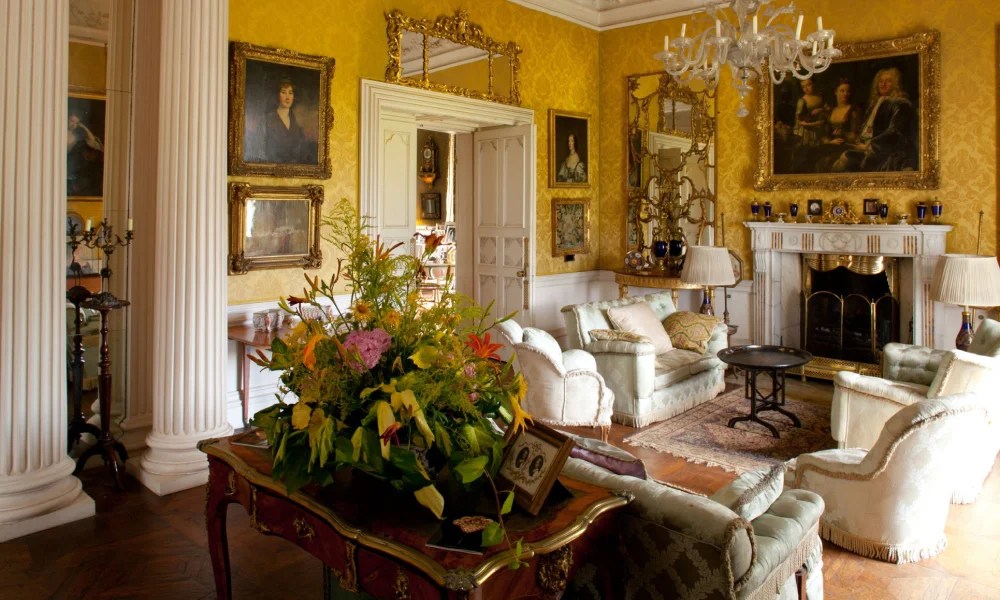
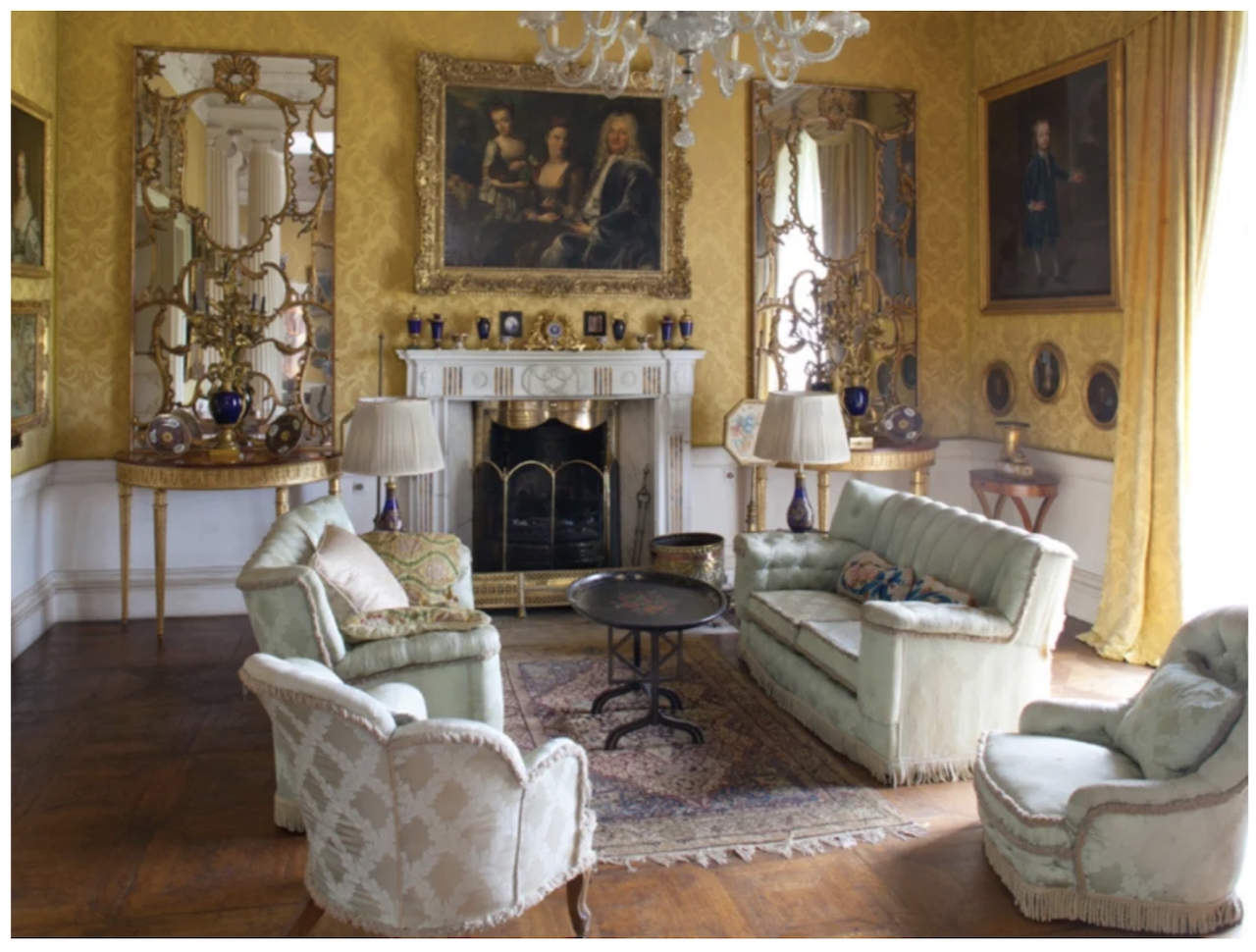
The Yellow Drawing Room, created by Anne née Messel, Countess of Rosse. She created the yellow drawing room from two rooms, a renovation that nearly brought the entire ceiling crashing down! Birr Castle, photograph courtesy of Birr Castle website.
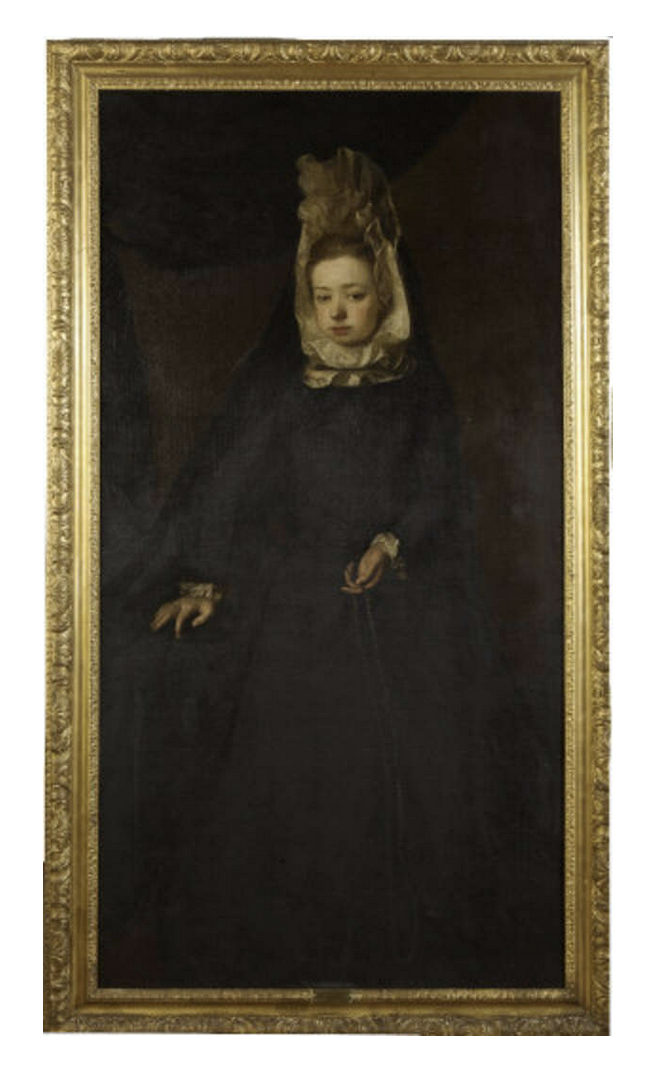
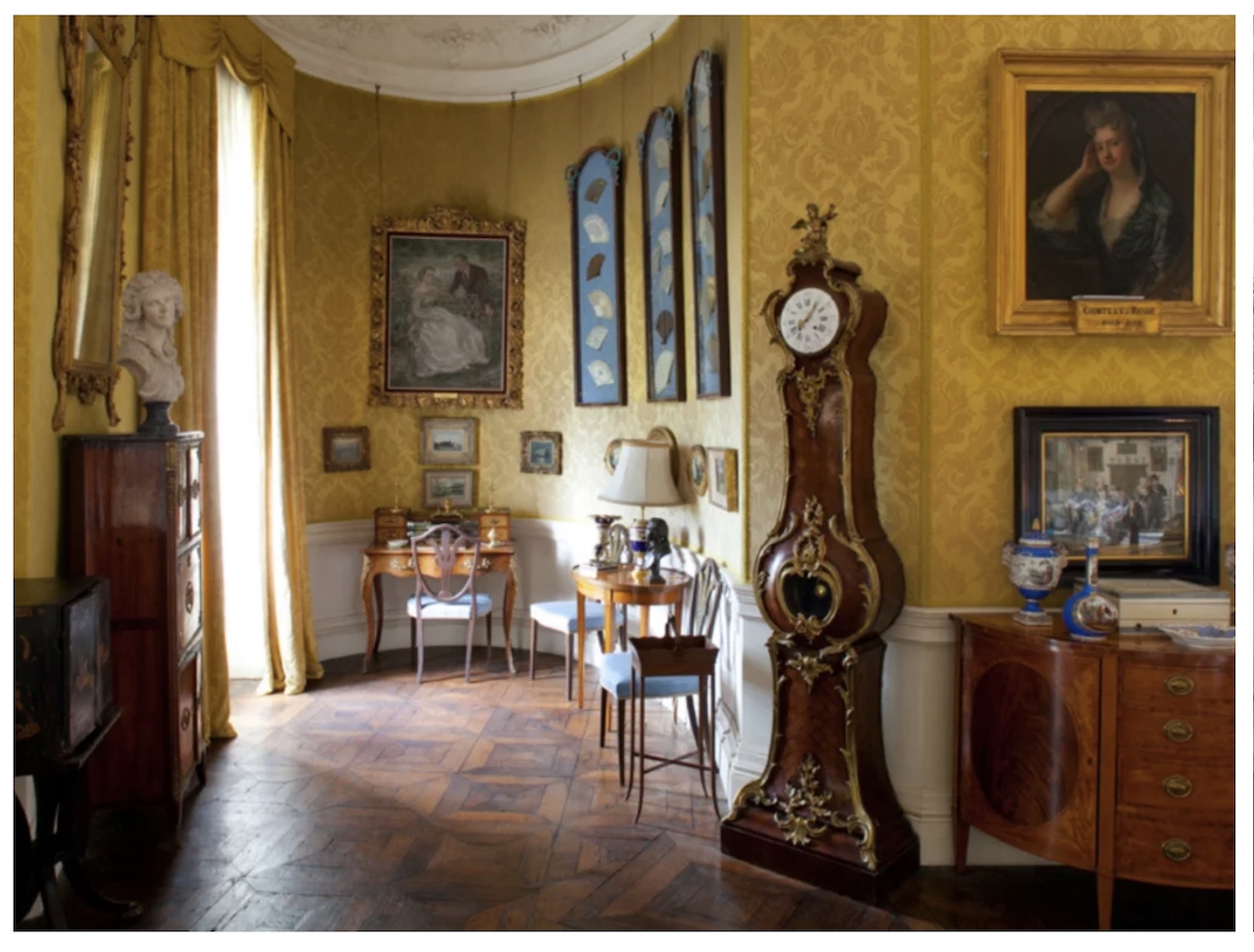
Birr Castle, photograph courtesy of Birr Castle website. The portrait is labelled Countess of Rosse b. 1698, but I can’t find which Countess this could be.
Birr Castle, photograph courtesy of Birr Castle website.

Anthony Armstrong-Jones, who married Princess Margaret, is a son from Anne Messel’s first marriage, her second marriage being to the sixth Earl of Rosse, Laurence Michael Parsons. The museum, off the Ticket Office, has a family tree:
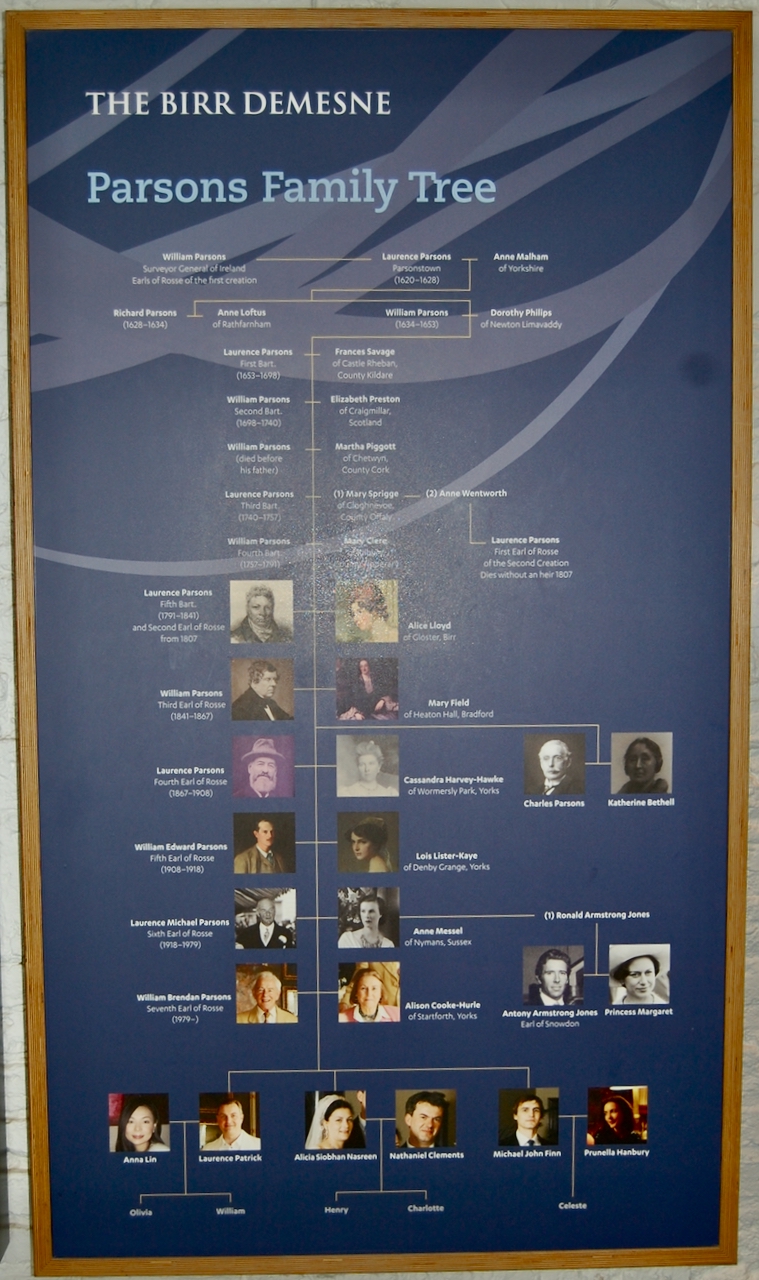
The museum, off the Ticket Office, has a family tree of the Parson family.

A sister of Anthony Armstrong-Jones married into the Vesey family of Abbeyleix, who owned the De Vesci estate. My father grew up in Abbeyleix. We used to be able to walk in the grounds of the De Vesci estate but it has since been closed to the public.

The website continues to tell us of the next generation: “Their son Brendan, the present Earl [b. 1936, he succeeded his father as the 7th Earl of Rosse in 1979], spent his career in the United Nations Development Programme, living with his wife Alison and their family in many third world countries.  He returned to Ireland on his father’s death in 1979. Brendan and Alison have also spent much time on the garden, especially collecting and planting rare trees. Their three children are all passionate about Birr and continue to add layers to the story for the future.

Patrick, Lord Oxmantown currently lives in London and is working on plans to bring large scale investment into Birr which will enable him and his family to move back to Ireland.

Alicia Clements managers the Birr Castle Estate and lives in the sibling house of Tullanisk.

Michael Parsons, works in London managing a portfolio of properties for the National Trust and is a board member to The Birr Scientific and Heritage Foundation.”

After our castle tour, we ate our lunch under a tree on a lovely circular bench made of a huge tree trunk, then went to see the telescope.
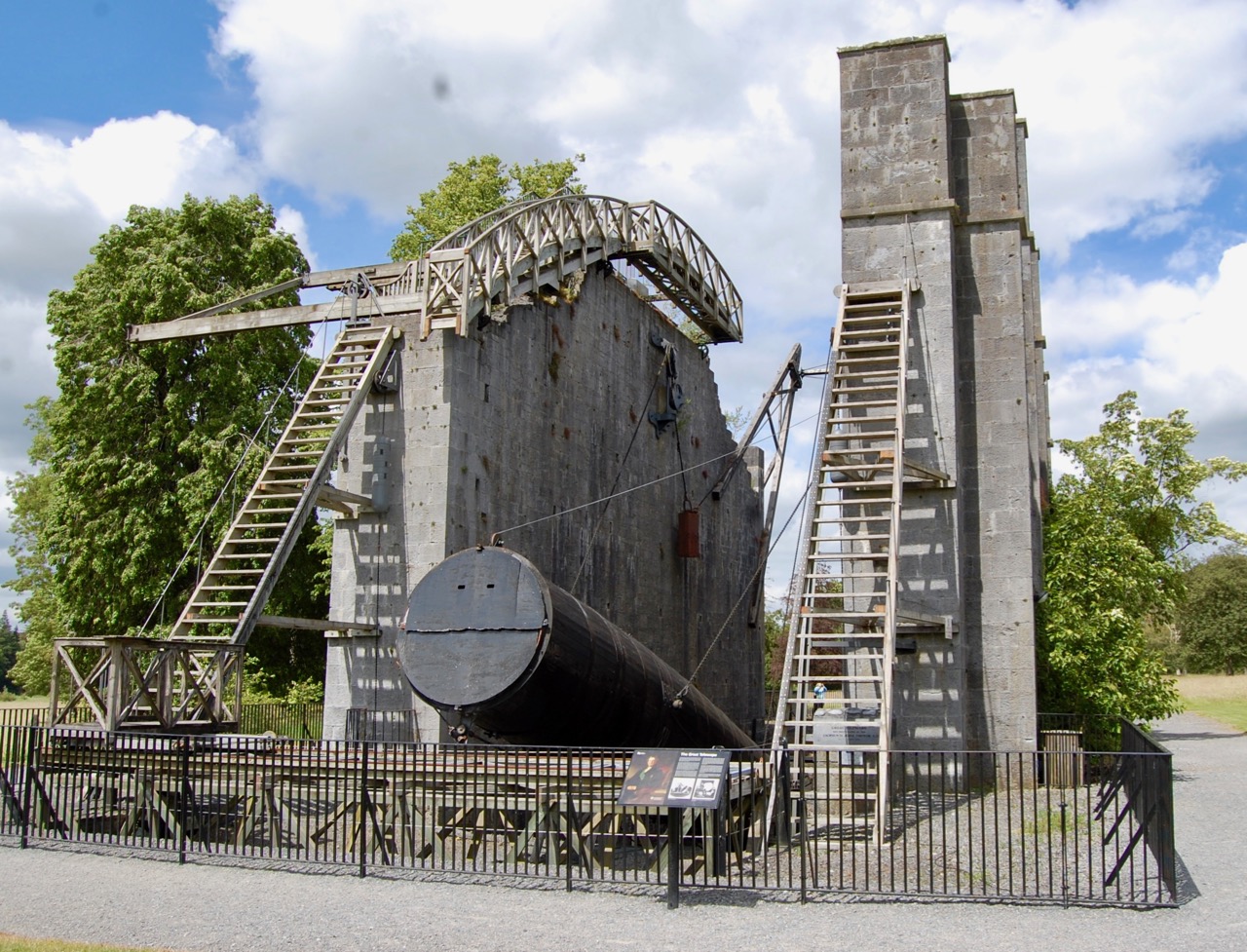
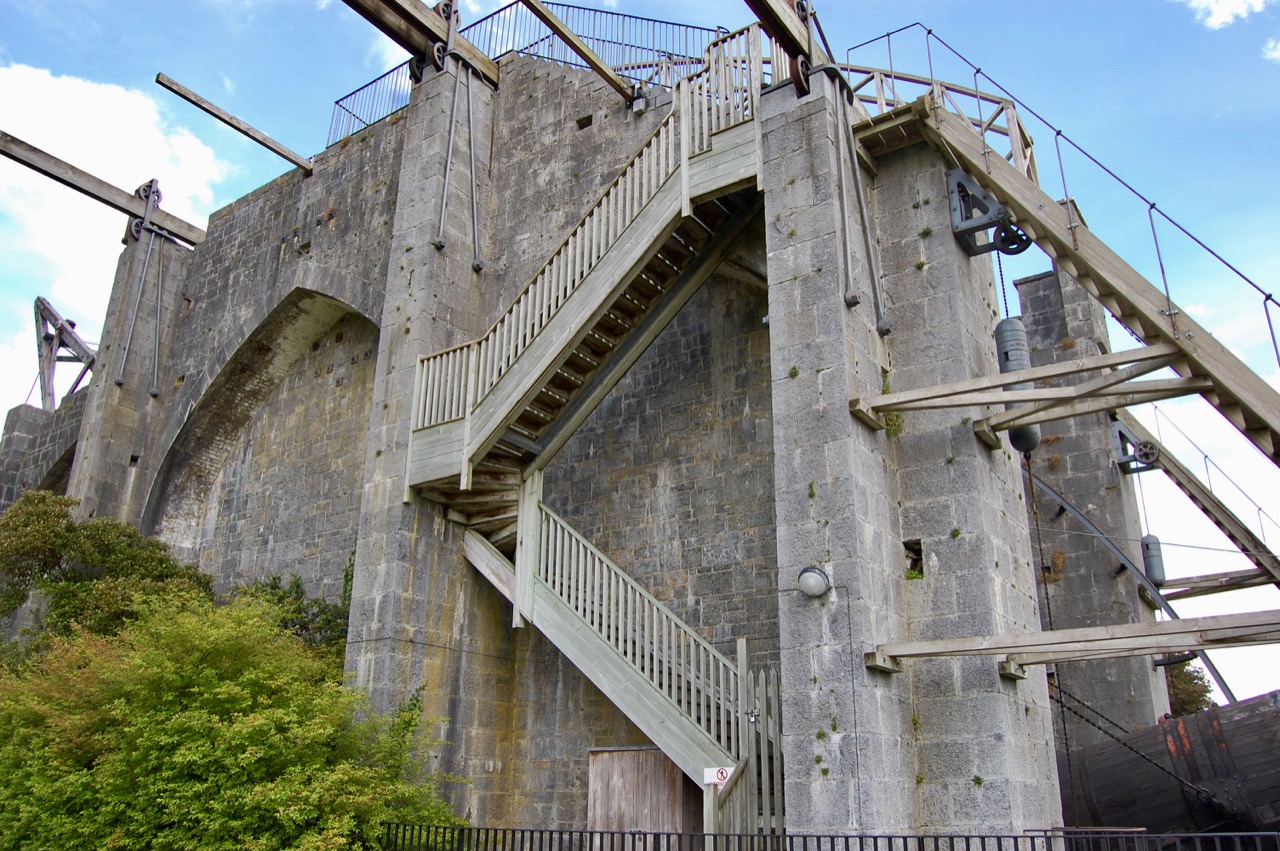
The “Leviathon” telescope. Photograph © Jennifer Winder-Baggot, www.irishhistorichouses.com
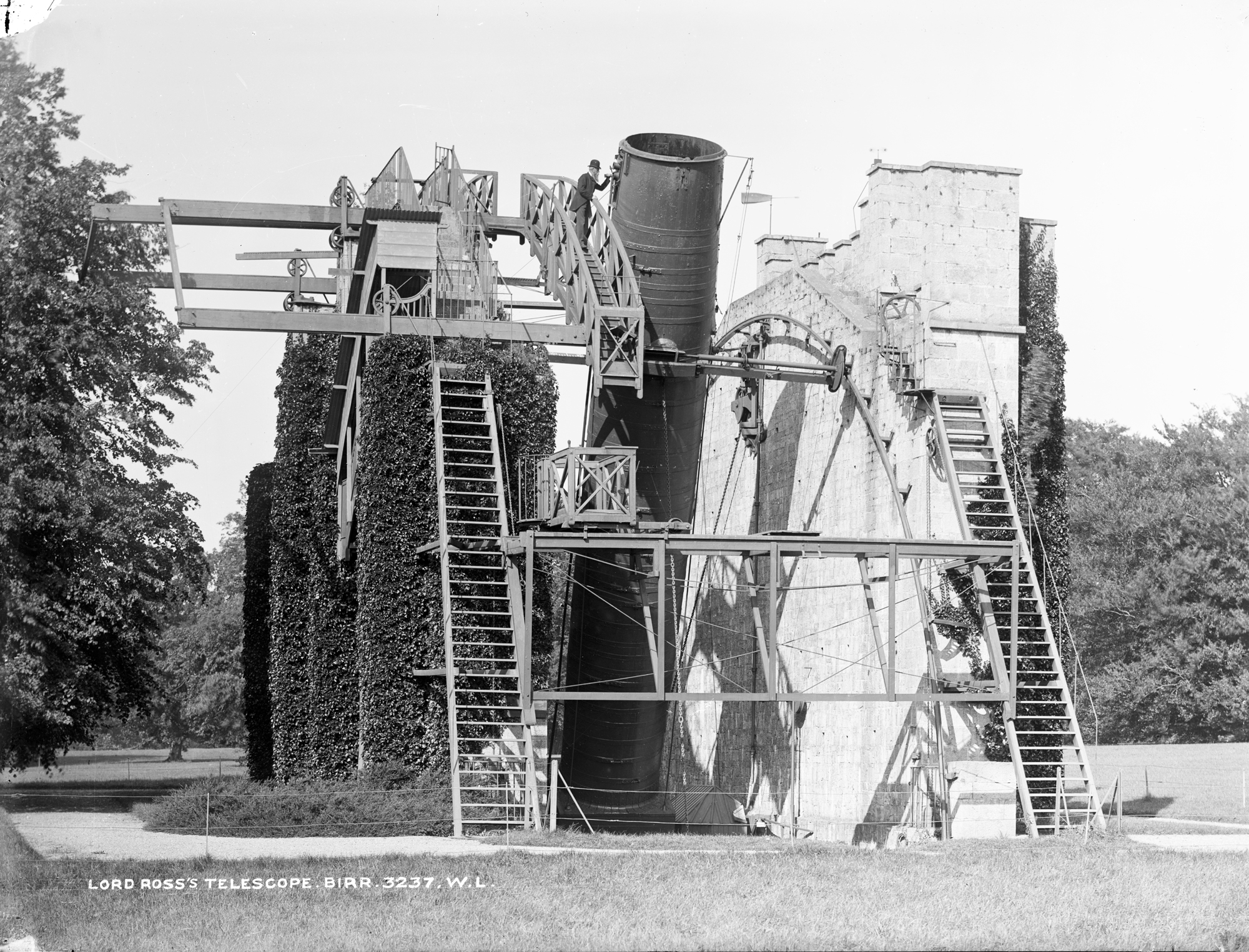
6 foot telescope of William Parsons, 3rd Earl of Rosse featuring Lawrence Parsons, 4th Earl of Rosse, by Robert French, Lawrence Collection c. 1880 L_ROY_03237.

The telescope contains a speculum mirror at the bottom of the tube, which is 1.8 metres in diameter. The mirrors were made in a workshop set up by William Parsons, and the speculum had to be taken away and polished up every once in a while, so a second speculum mirror was made. The tube which houses the speculum is 17 metres long and was made near me in the Liberties, in a Foundry on Cork Street. The Earl would look into the telescope via a brass eyepiece in the enormous wooden tube, by climbing up the stairs on the side of the stone walls, to the viewing platform. With the telescope, the Earl could see further into space than anyone had ever seen. He sketched what he saw. According to the information at the site, his sketches were amazingly accurate when compared to modern photographs taken by the Hubble Telescope. The Earl studied “nebulae,” which are clouds of dust and gas in space, and discovered the “Whirlpool Nebulae.” There is now a planting of trees in the grounds of the castle to honour the founding of this M51 nebula. The “whirlpool spiral” of trees is a plantation of lime trees, planted in 1995, marking 150 years since the Earl discovered the nebula.
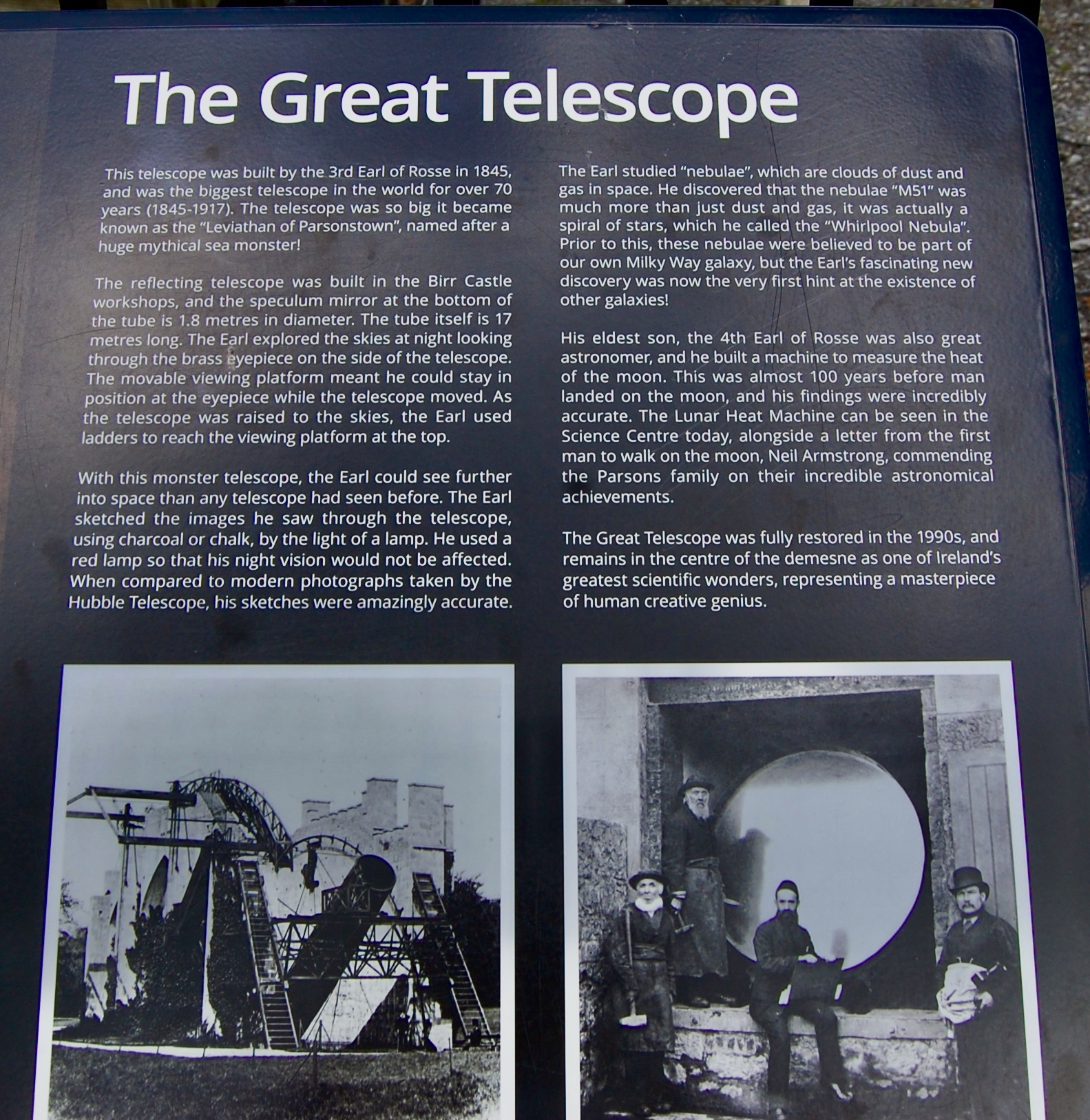
The “Leviathon” telescope. Photograph © Jennifer Winder-Baggot, www.irishhistorichouses.com

The sixth Earl of Rosse, Lawrence Michael Harvey Parsons,  pursued an interest in trees and botany rather than the stars and moon, and created the gardens. We enjoyed the beautifully sunny day, walking around the generous landscape.
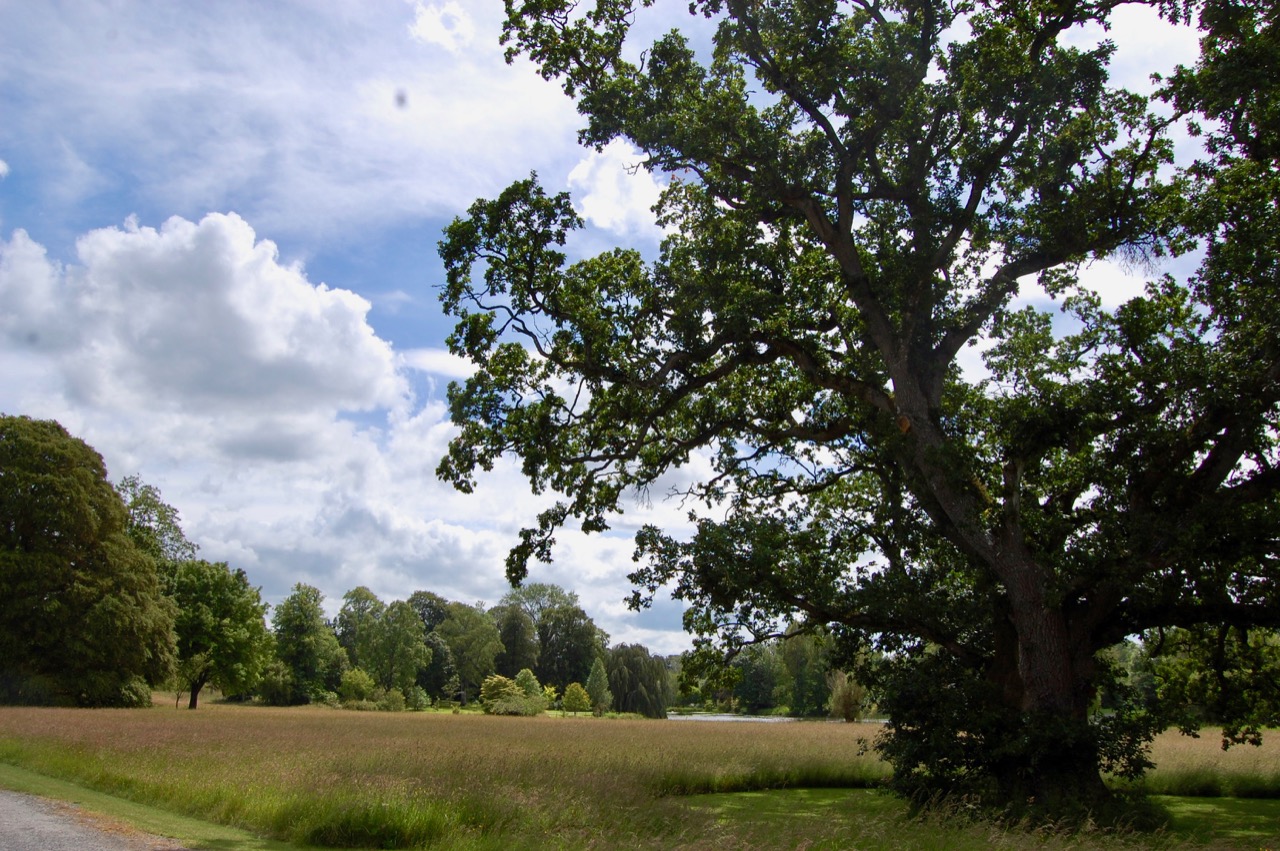
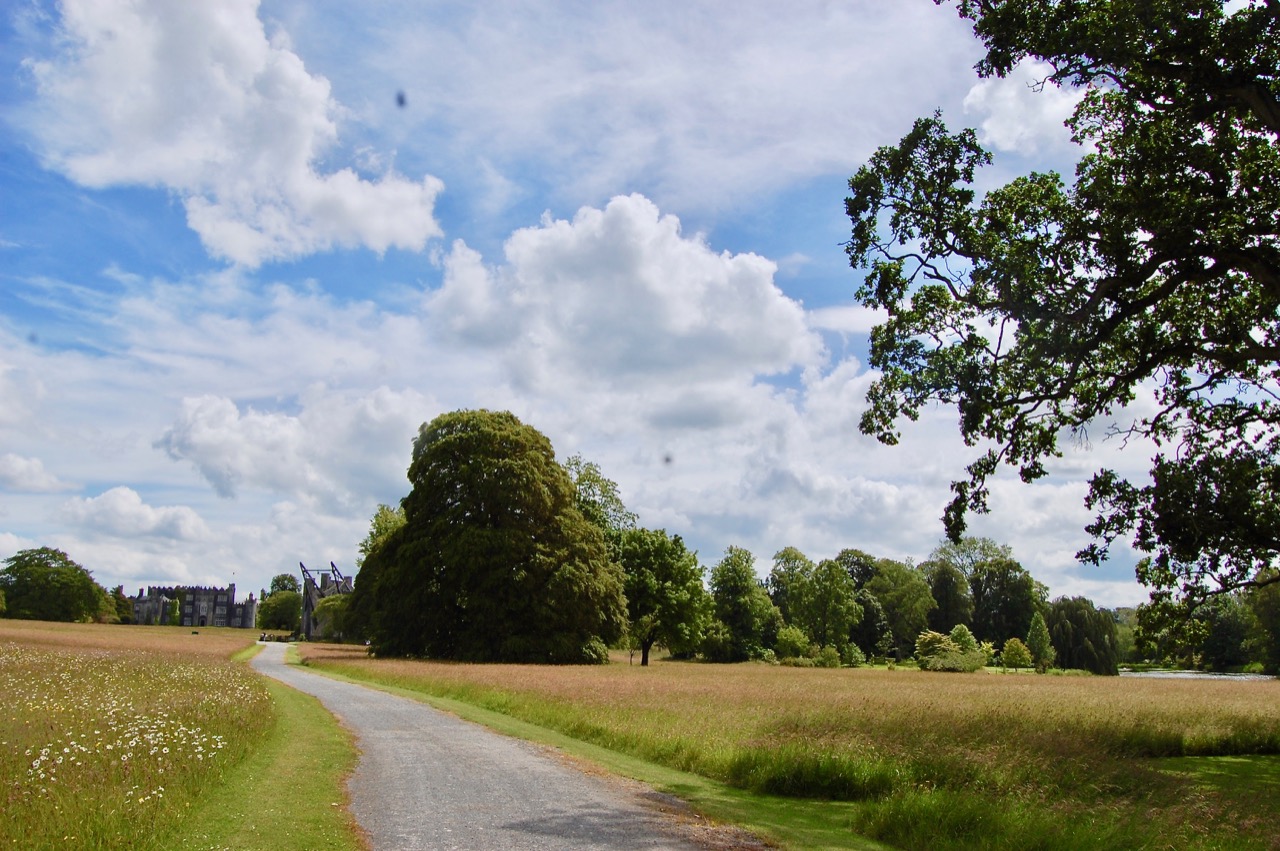
Birr Castle Demesne. Photograph © Jennifer Winder-Baggot, www.irishhistorichouses.com

The spring wildflower meadow has not been ploughed since at least 1620. Grass is let grow long to allow wildflowers, bees and wildlife to flourish.
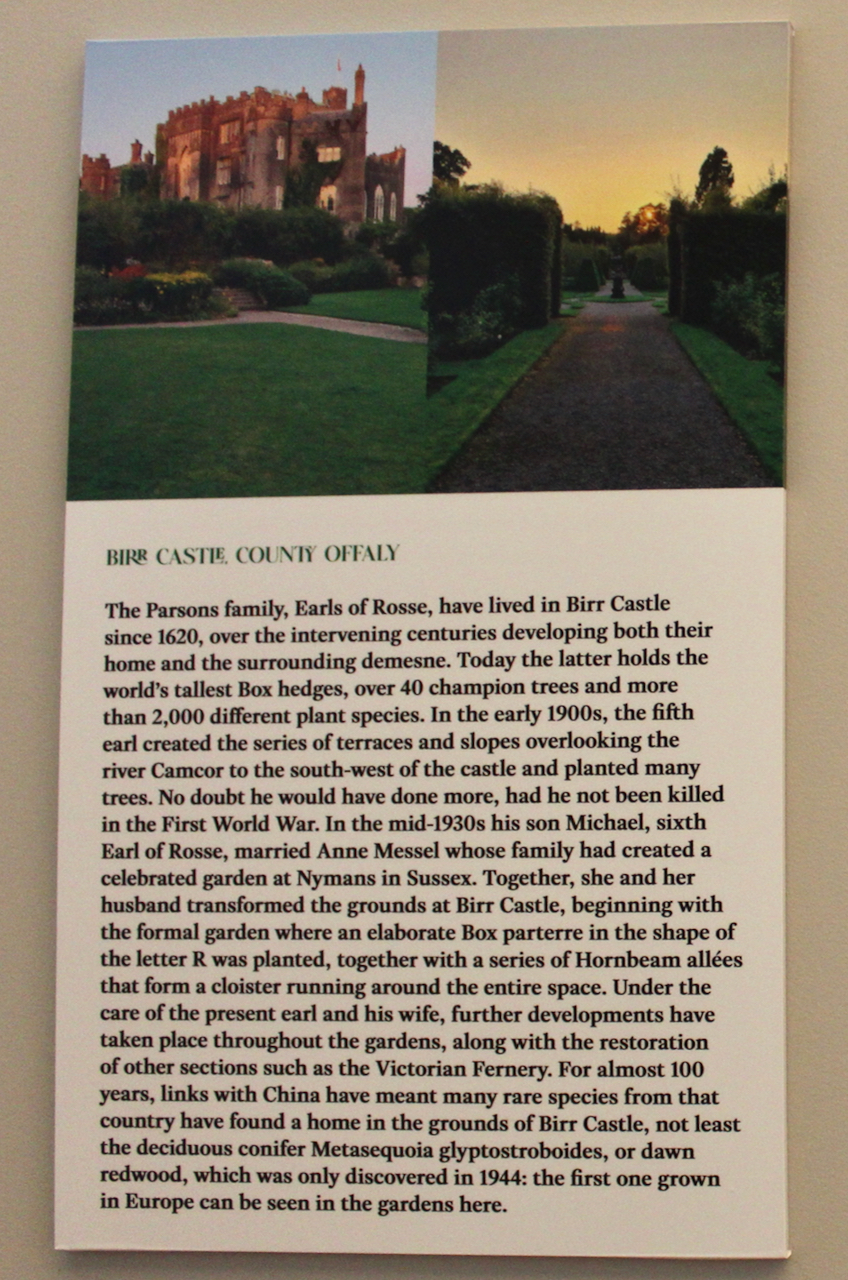
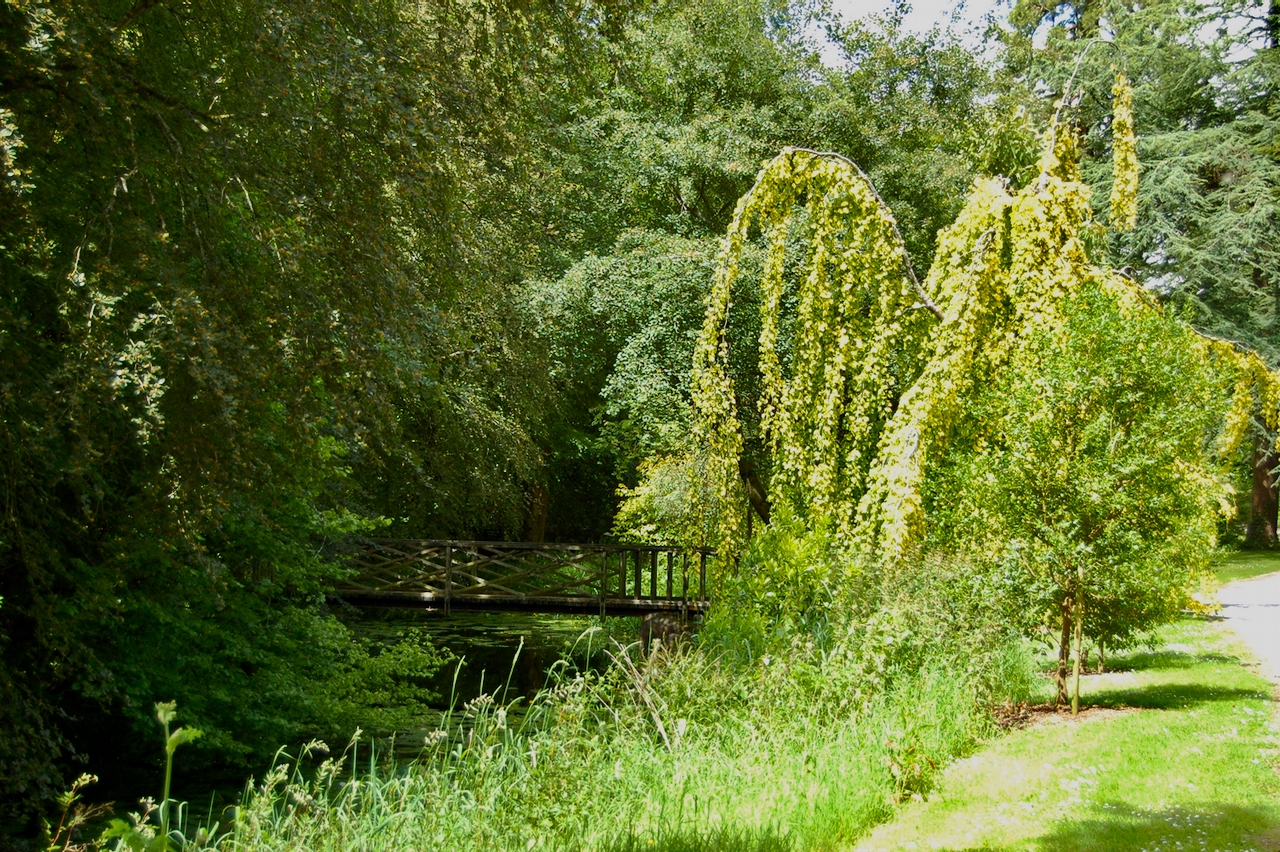
From “In Harmony with Nature, The Irish Country House Garden 1600-1900” in the Irish Georgian Society, July 2022, curated by Robert O’Byrne.
Birr Castle Demesne. Photograph © Jennifer Winder-Baggot, www.irishhistorichouses.com

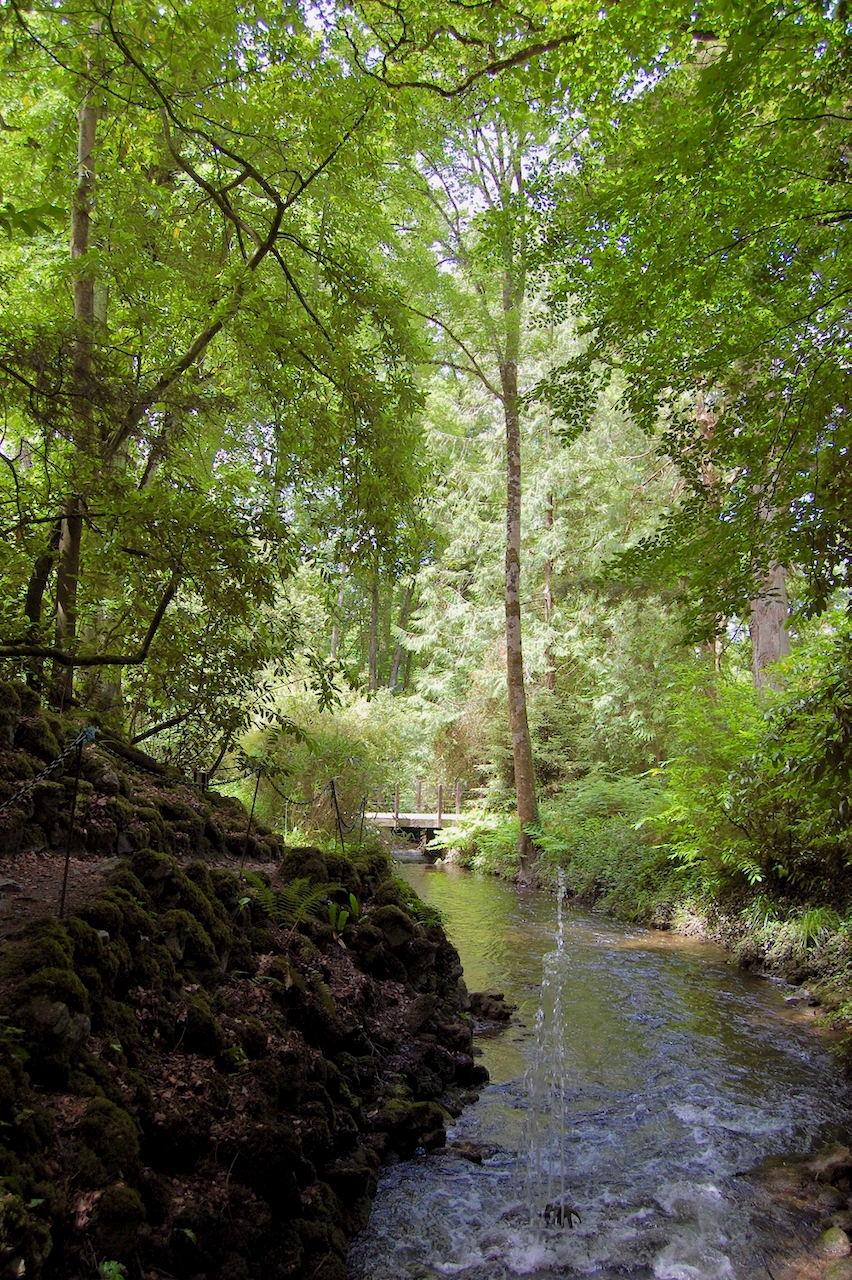
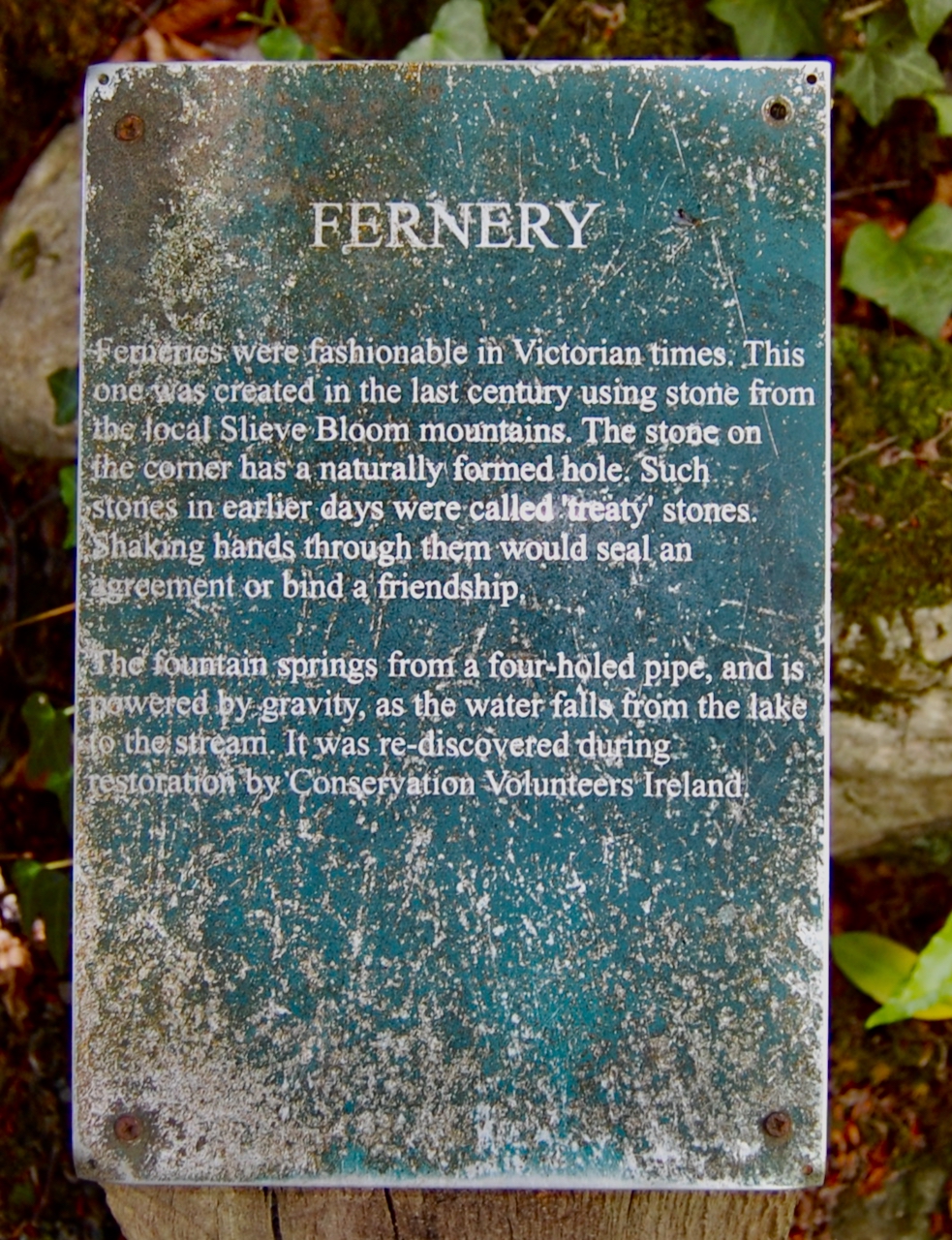
We entered The Fernery, which according to the sign beside it, tells that Ferneries were fashionable in Victorian times. 
Birr Castle Demesne. Photograph © Jennifer Winder-Baggot, www.irishhistorichouses.com

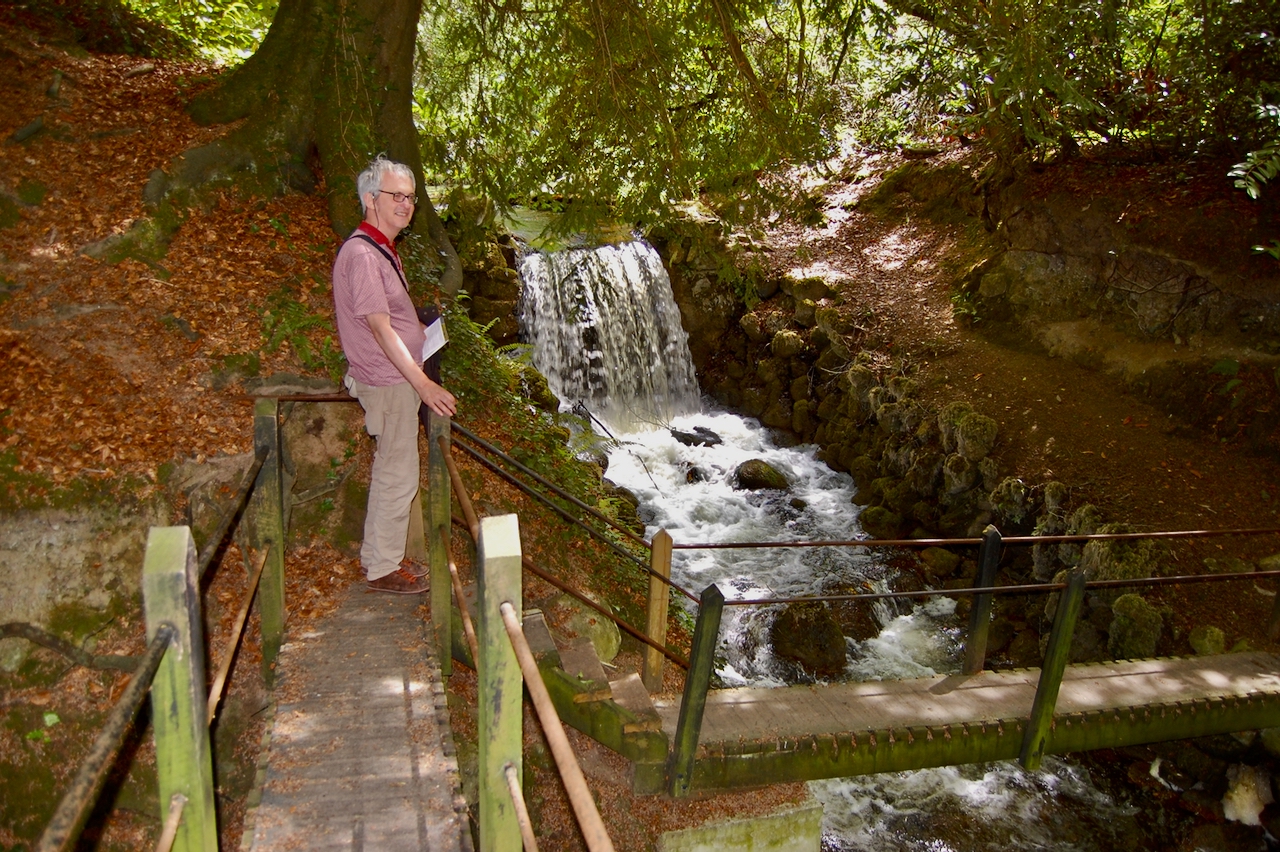
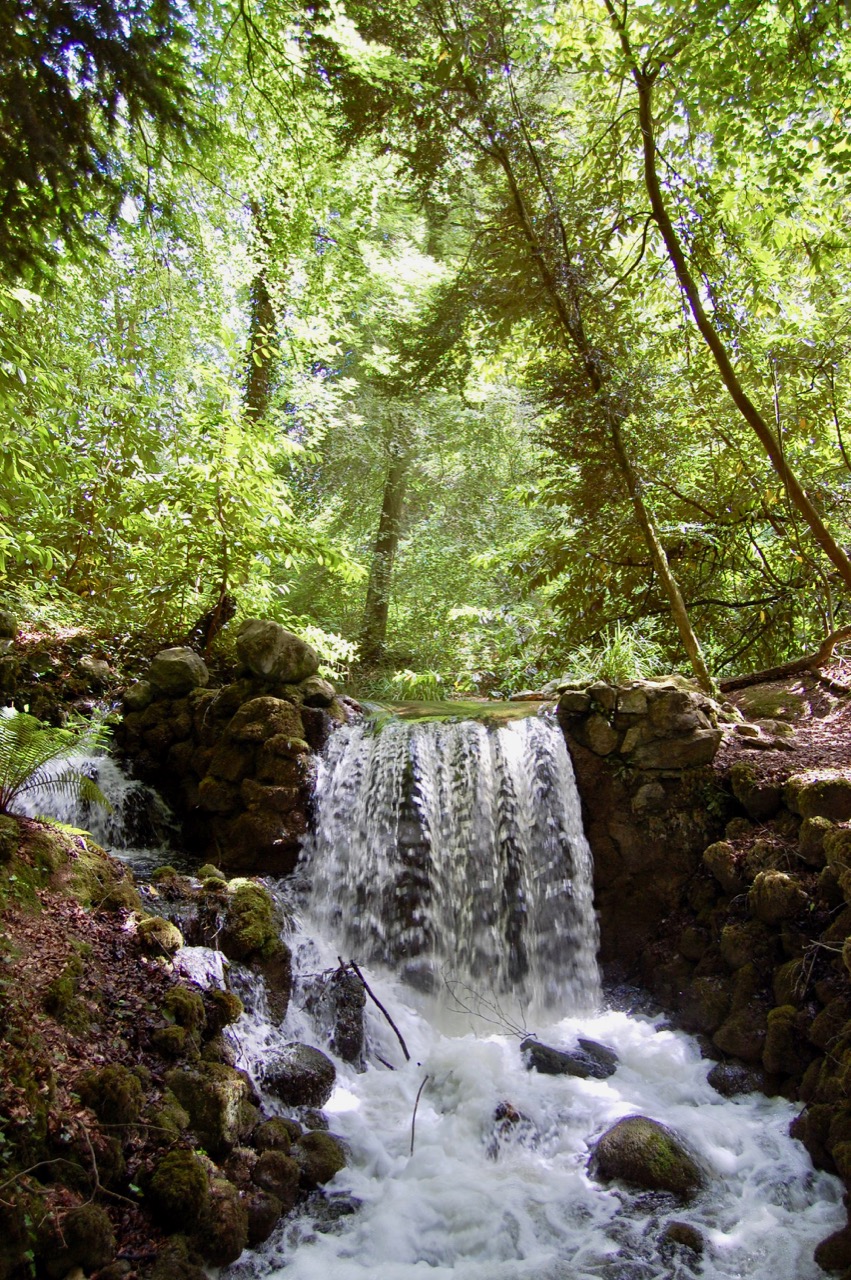
This little fountain works by gravity, as the water falls from the lake to the stream. It’s an aspect I love about exploring heritage properties: the clever and sustainable engineering of the times. We have much to learn from our ancestors. I love that they have kitchen gardens and walled gardens and were self-sustaining. 
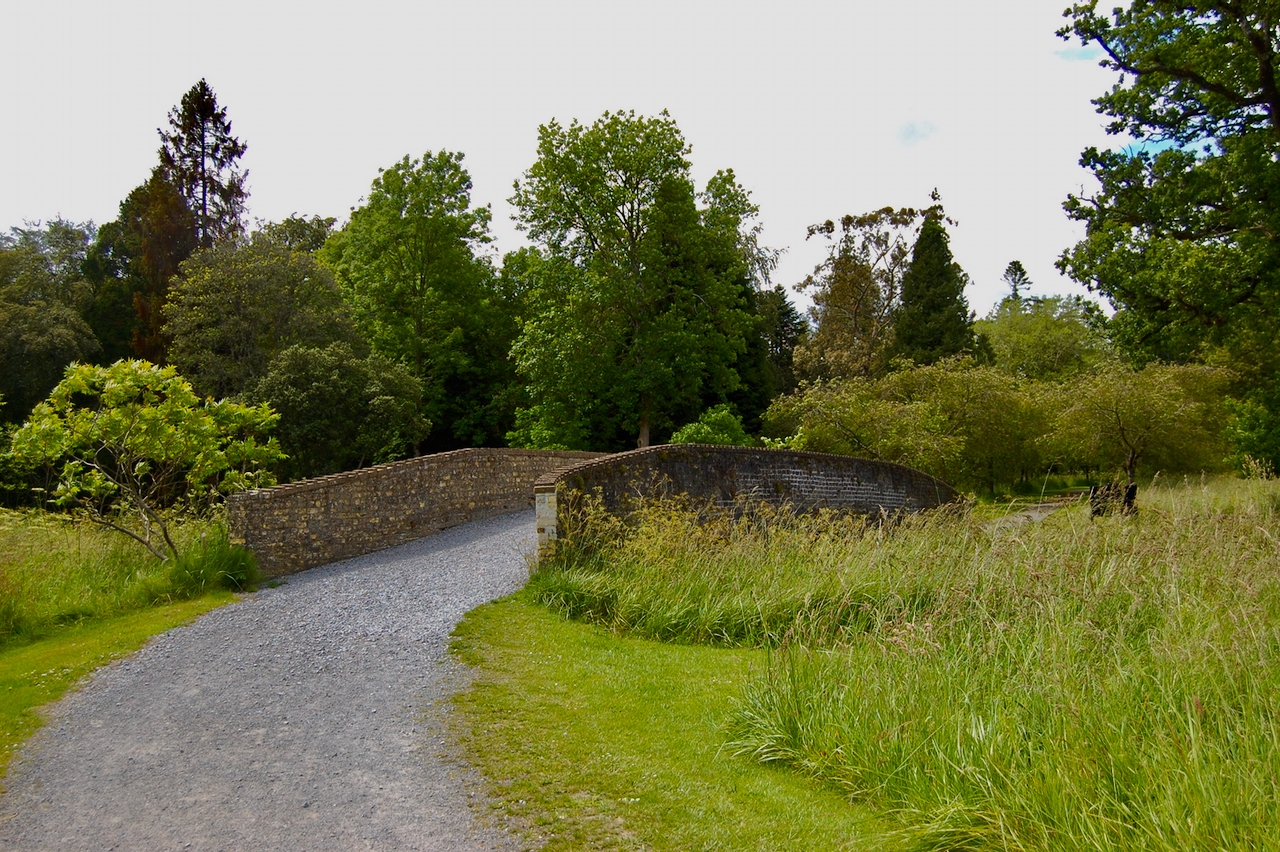
Birr Castle Demesne. Photograph © Jennifer Winder-Baggot, www.irishhistorichouses.com
Birr Castle Demesne. Birr Castle, County Offaly, Photograph © Jennifer Winder-Baggot, www.irishhistorichouses.com

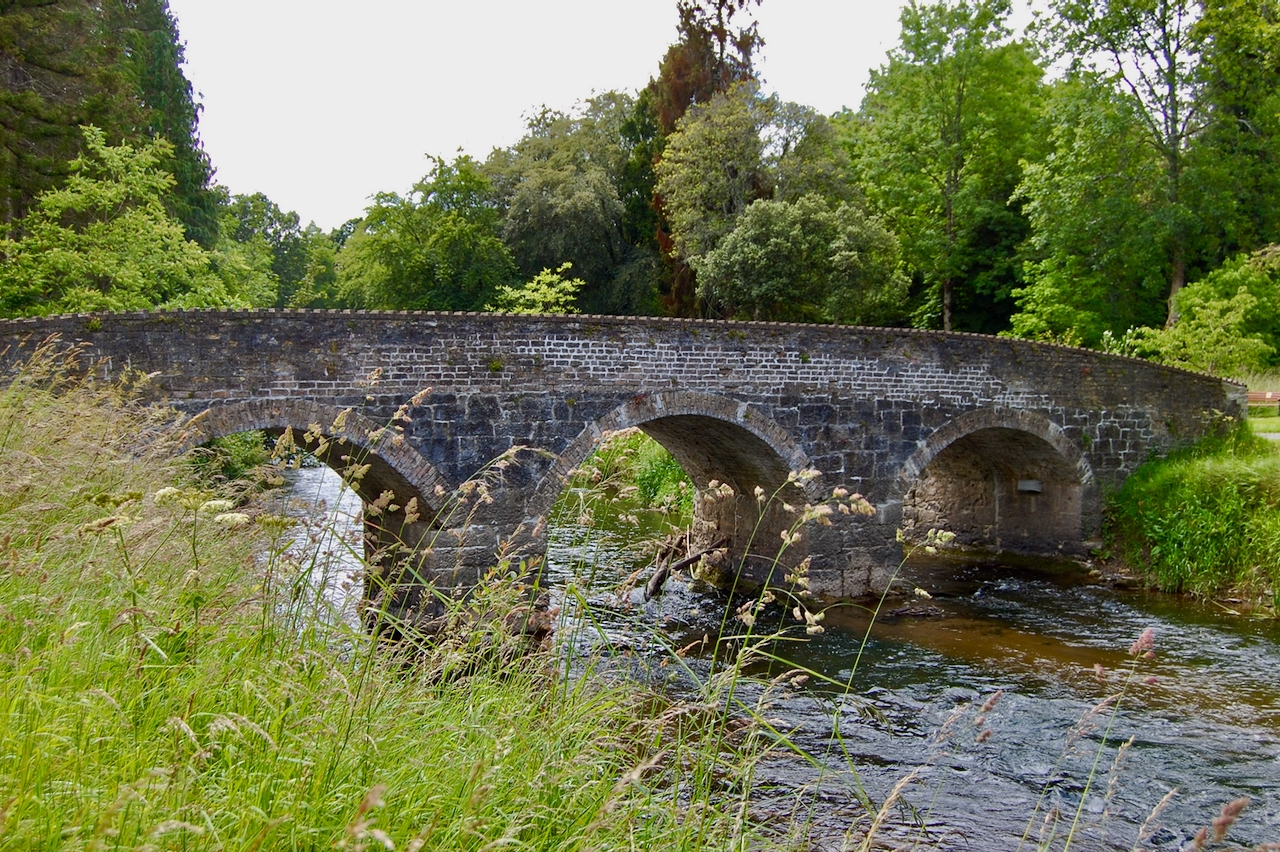
The Brick Bridge, formerly called the Ivy Bridge, is in County Tipperary, according to our leaflet about the grounds of Birr Castle.
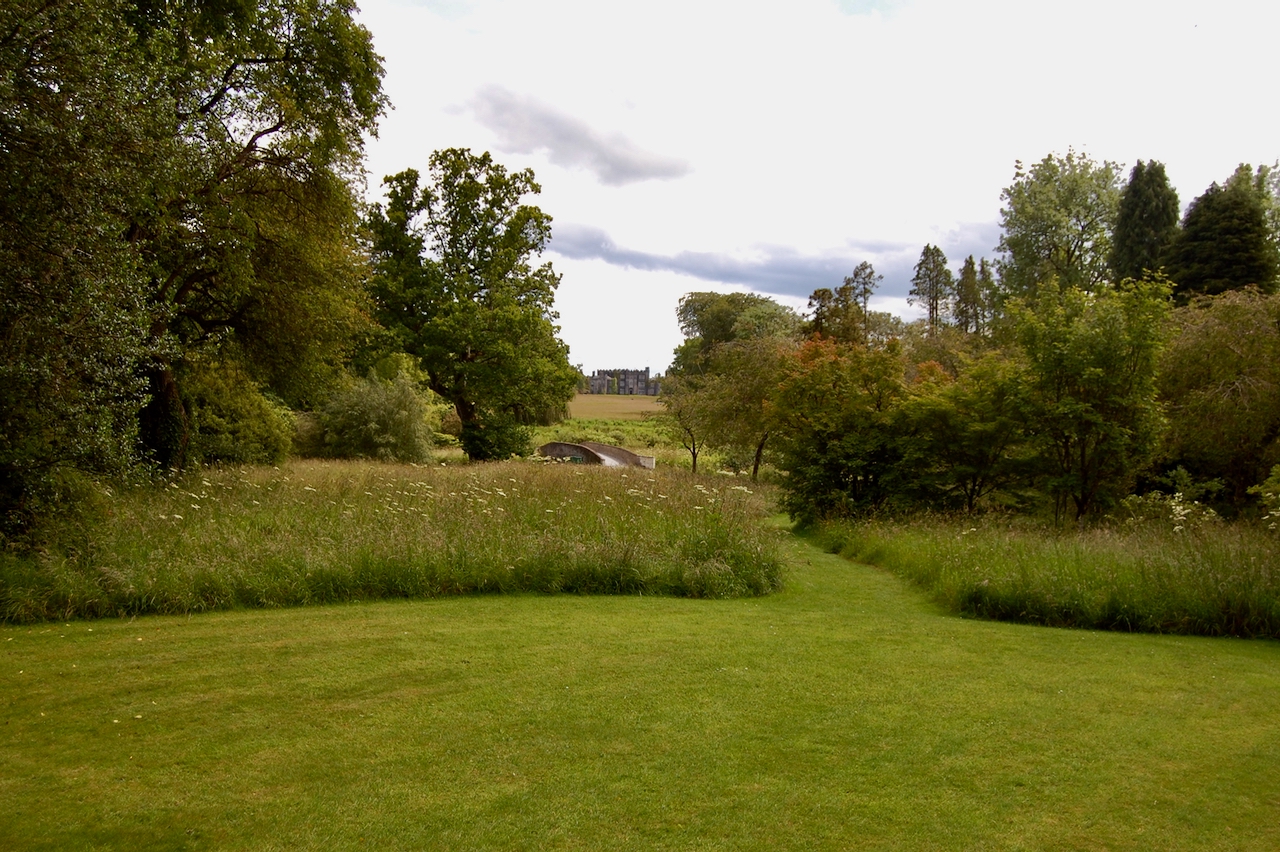
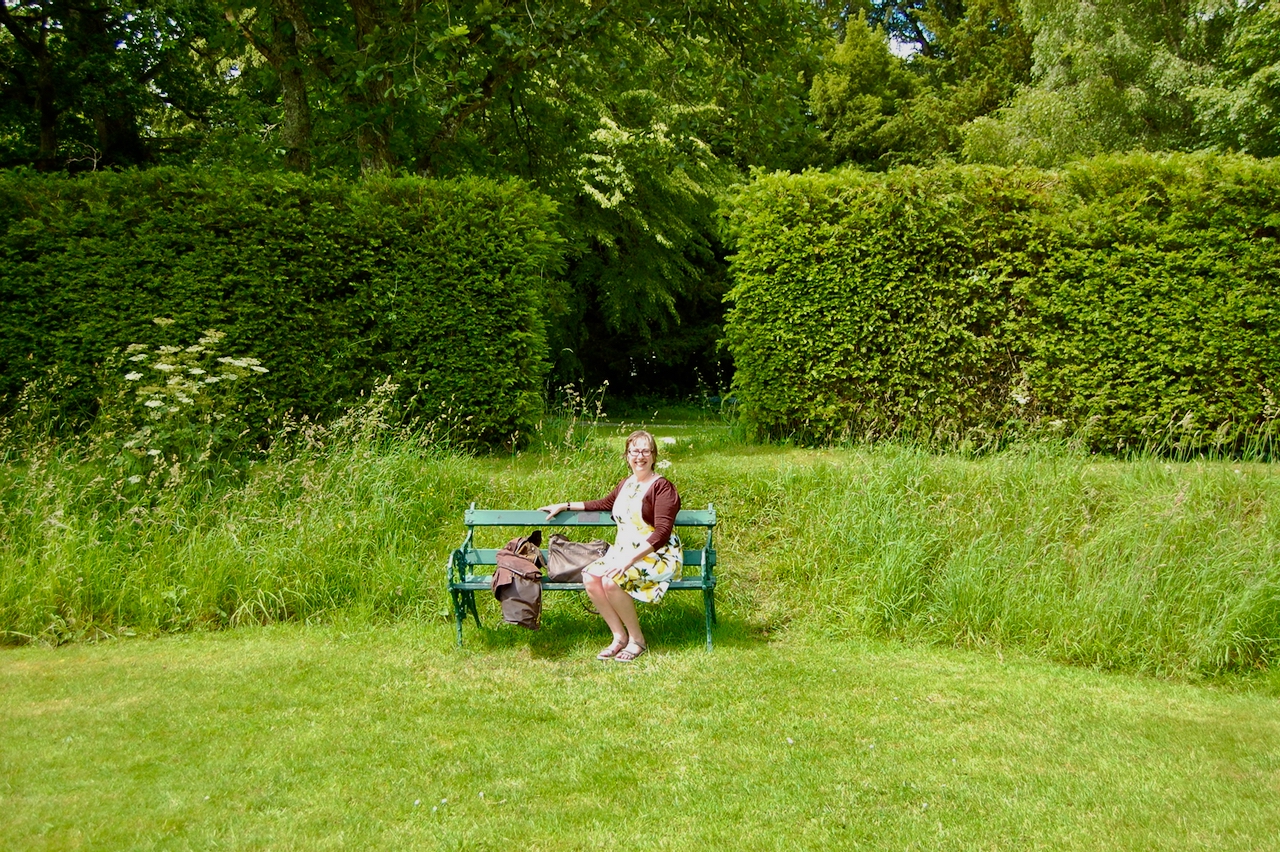
Birr Castle, County Offaly, Photograph © Jennifer Winder-Baggot, www.irishhistorichouses.com
Birr Castle Demesne. Birr Castle, County Offaly, Photograph © Jennifer Winder-Baggot, www.irishhistorichouses.com
Birr Castle, County Offaly, Photograph © Jennifer Winder-Baggot, www.irishhistorichouses.com

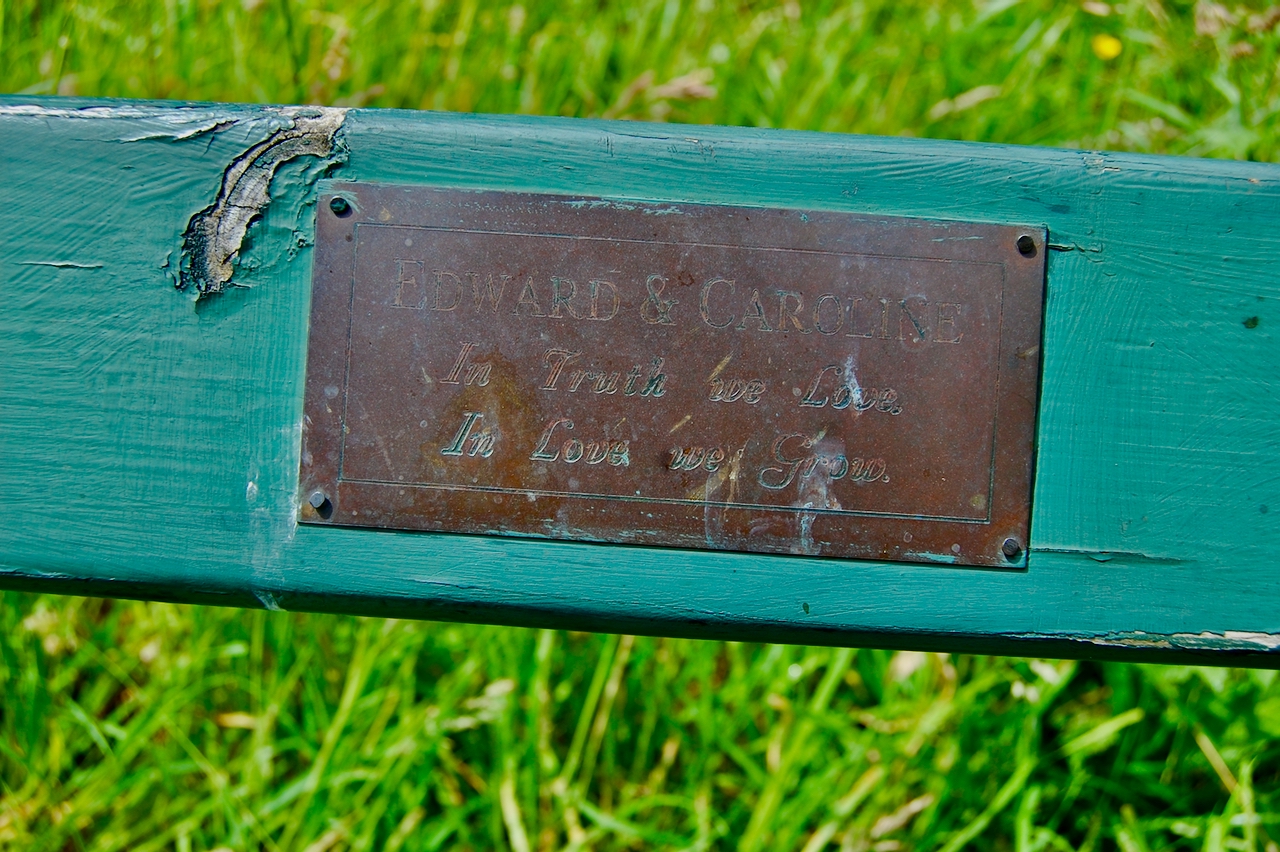
Above, the Teatro Verde, “Green Theatre,” from which you can see the vista of the castle and demesne. It was inspired by the design of 18th century architect and family member Samuel Chearnley. Dedication to Edward and Caroline on a plaque on the bench, “In Truth we Love, in Love we Grow.”

We didn’t have the energy to explore the entire garden, but followed the map to see a few places such as the Fernery, the Teatro Verde, and the Formal Gardens. Along the way, we passed the box hedges, the tallest in the world! The box hedges are around ten metres tall, and are over 300 years old.
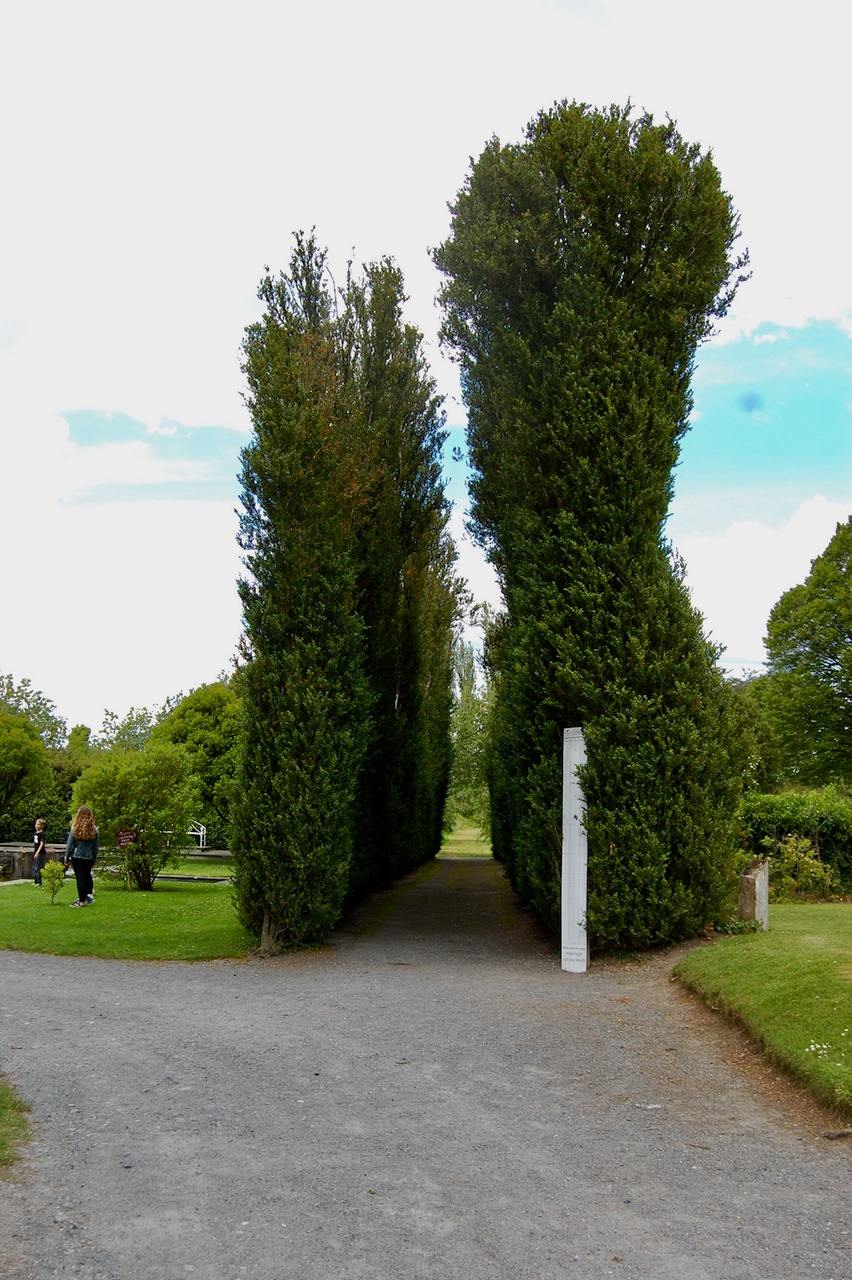
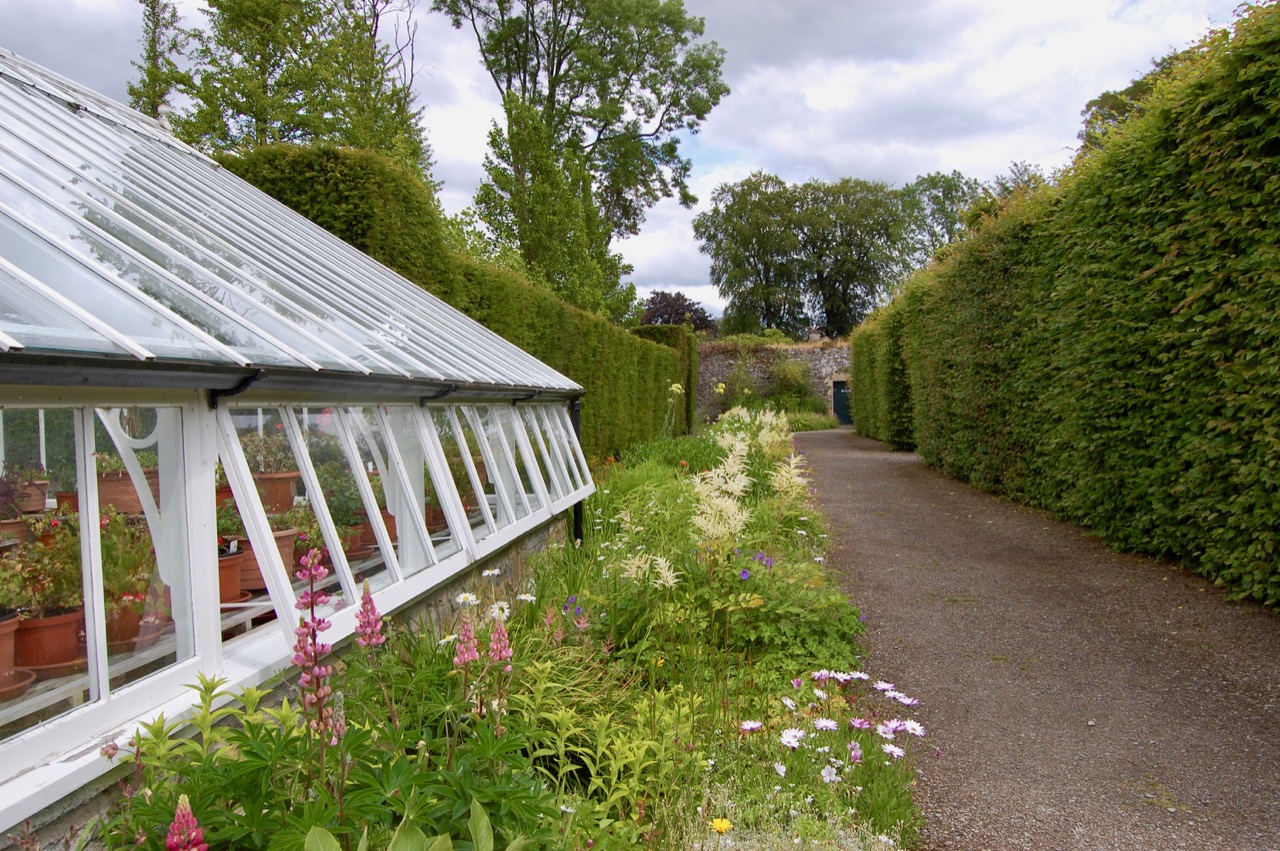
The box hedges are around ten metres tall, and are over 300 years old. Birr Castle, County Offaly, Photograph © Jennifer Winder-Baggot, www.irishhistorichouses.com
Birr Castle, County Offaly, Photograph © Jennifer Winder-Baggot, www.irishhistorichouses.com

The Formal Gardens were designed by Anne Messel, the 6th Countess of Rosse, to celebrate her marriage to the 6th Earl, Michael, in 1935. There are white seats either end which bear their initials, which she designed. The hornbeam arches are in the form of a cloister complete with “windows”!
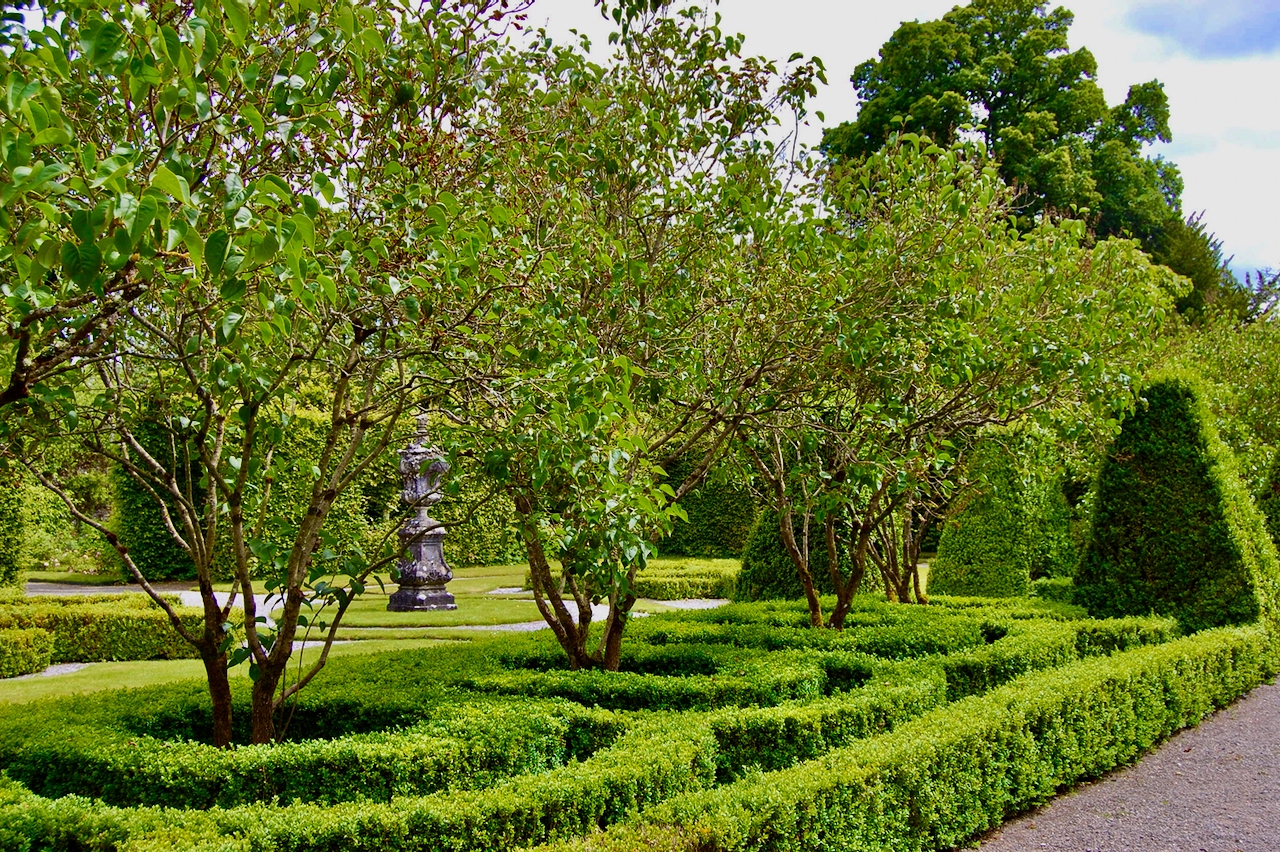
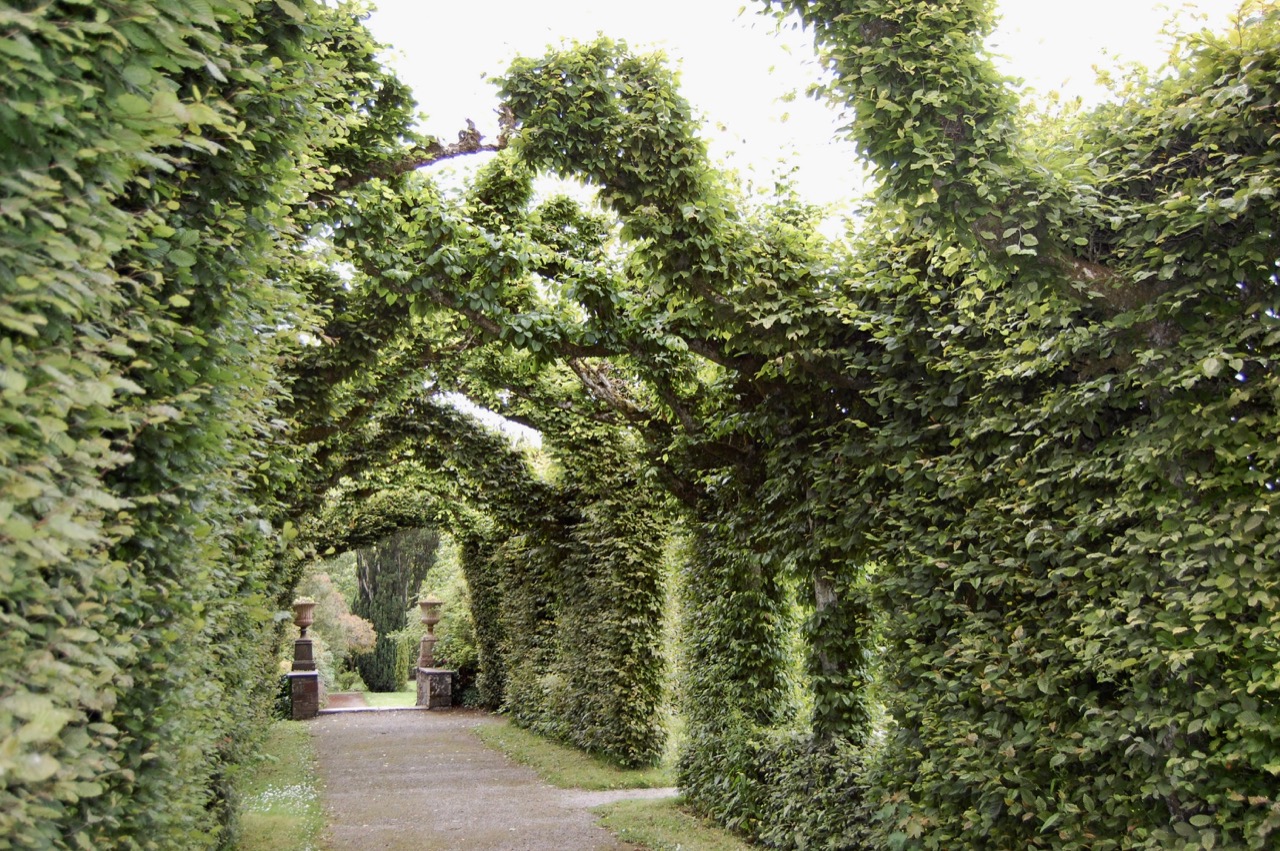
Birr Castle, County Offaly, Photograph © Jennifer Winder-Baggot, www.irishhistorichouses.com
Birr Castle gardens, photograph for Tourism Ireland, 2015, Ireland’s Content Pool. (see [1])
The Formal Gardens, Birr Castle, by Alison Rosse.

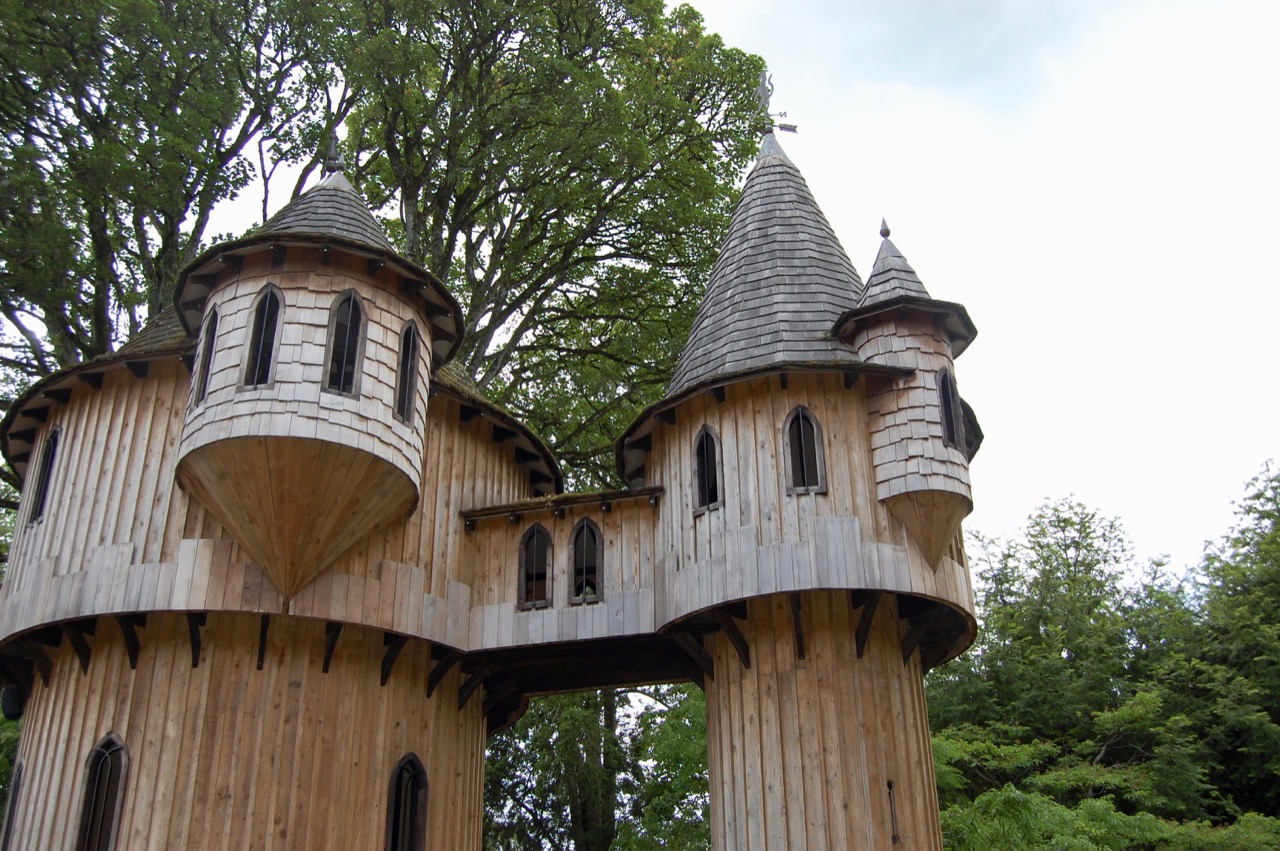
We headed back to the visitor centre and museum, passing the children’s area, the wonderful Tree House! The current owners, Brendan Parsons, who was director of the Irish House and Gardens Association for eleven years, and his wife Alison, have been leading advocates for finding a new role for country houses in a heritage and educational context.
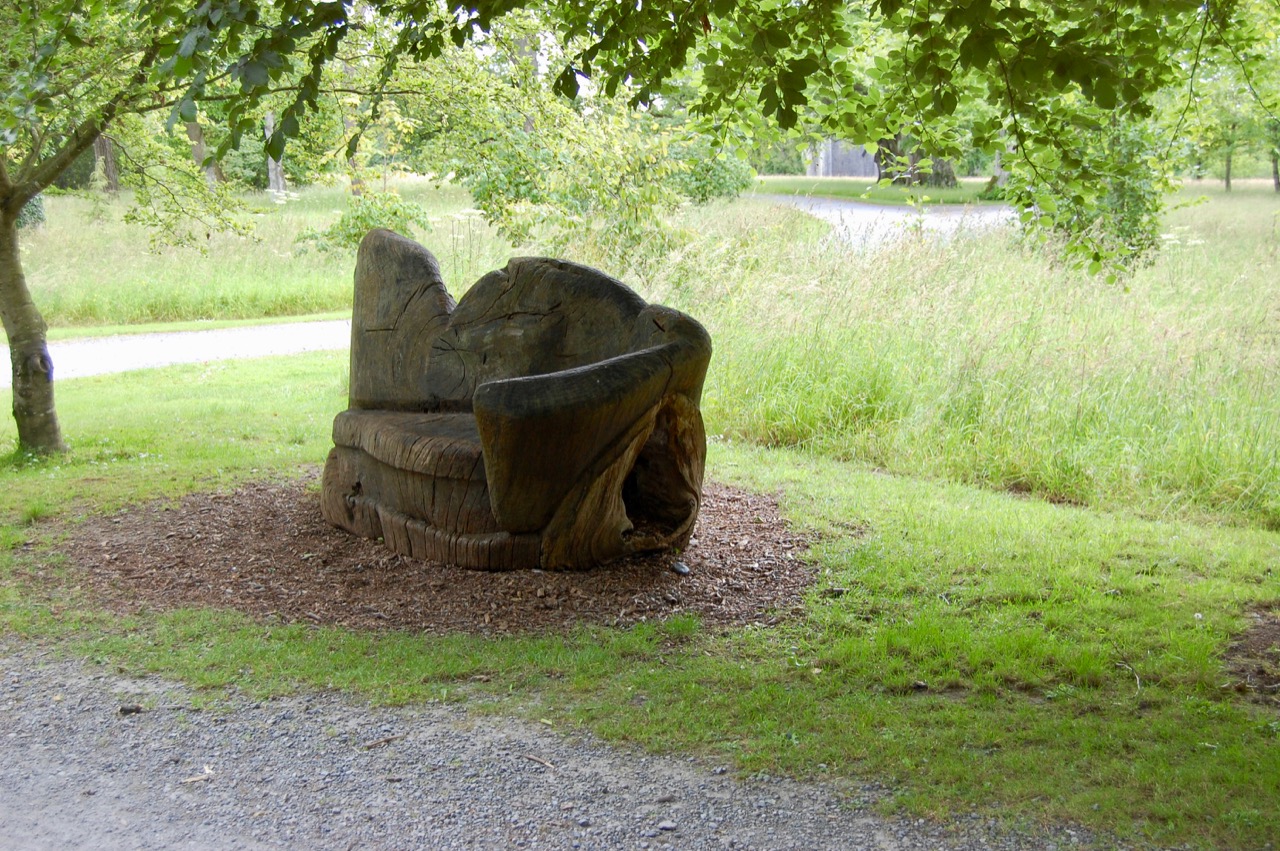
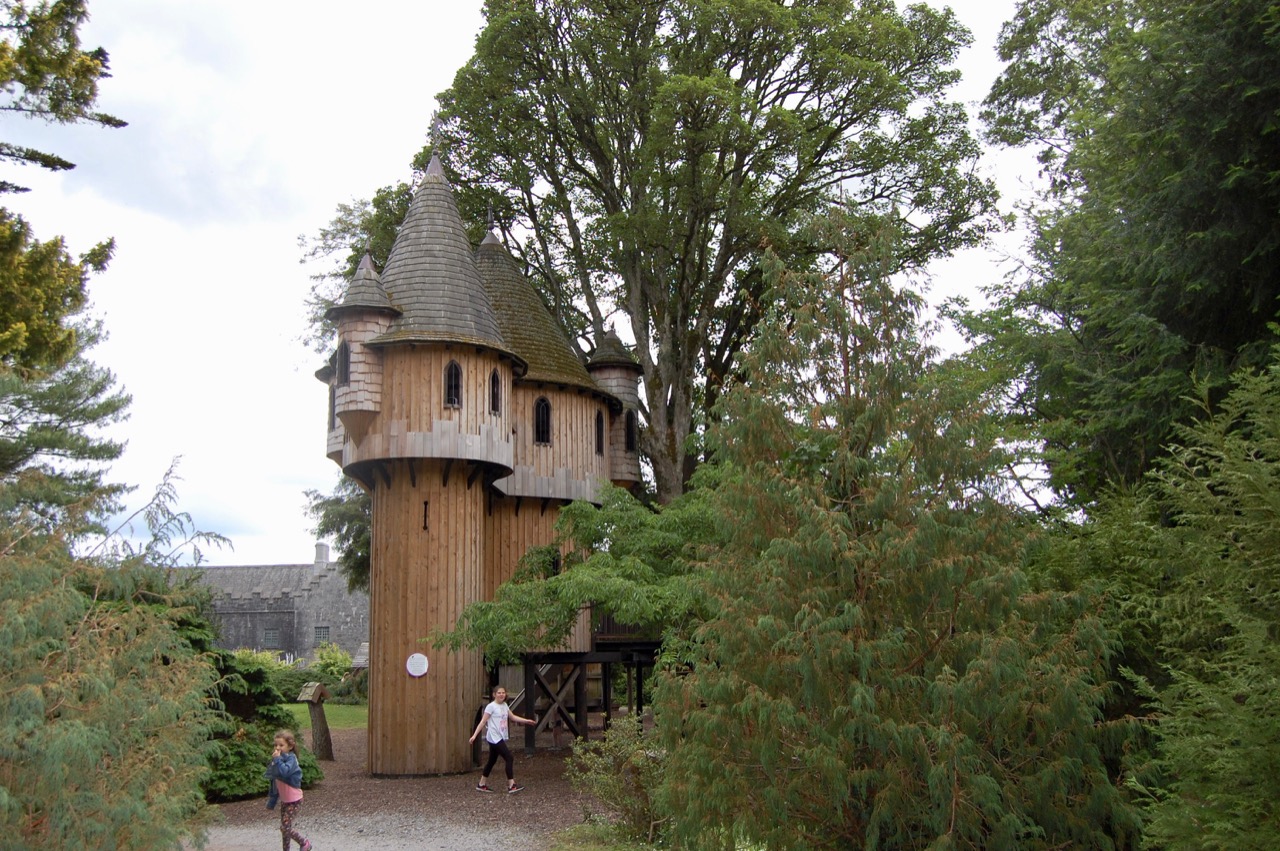
Birr Castle, County Offaly, Photograph © Jennifer Winder-Baggot, www.irishhistorichouses.com

In the museum, we studied the pictures and explanations, but had to ask where it was that the viewer would sit or stand to look through the telescope. There’s a great timeline in the museum – I always find these very useful and informative!

It was interesting also to see some documents from the family archives, including a booklet written by the Earl about management of property, and purchase of the elements that make up the speculum mirror, which is made of metal and not glass – only later did they make mirrors of glass for telescopes.
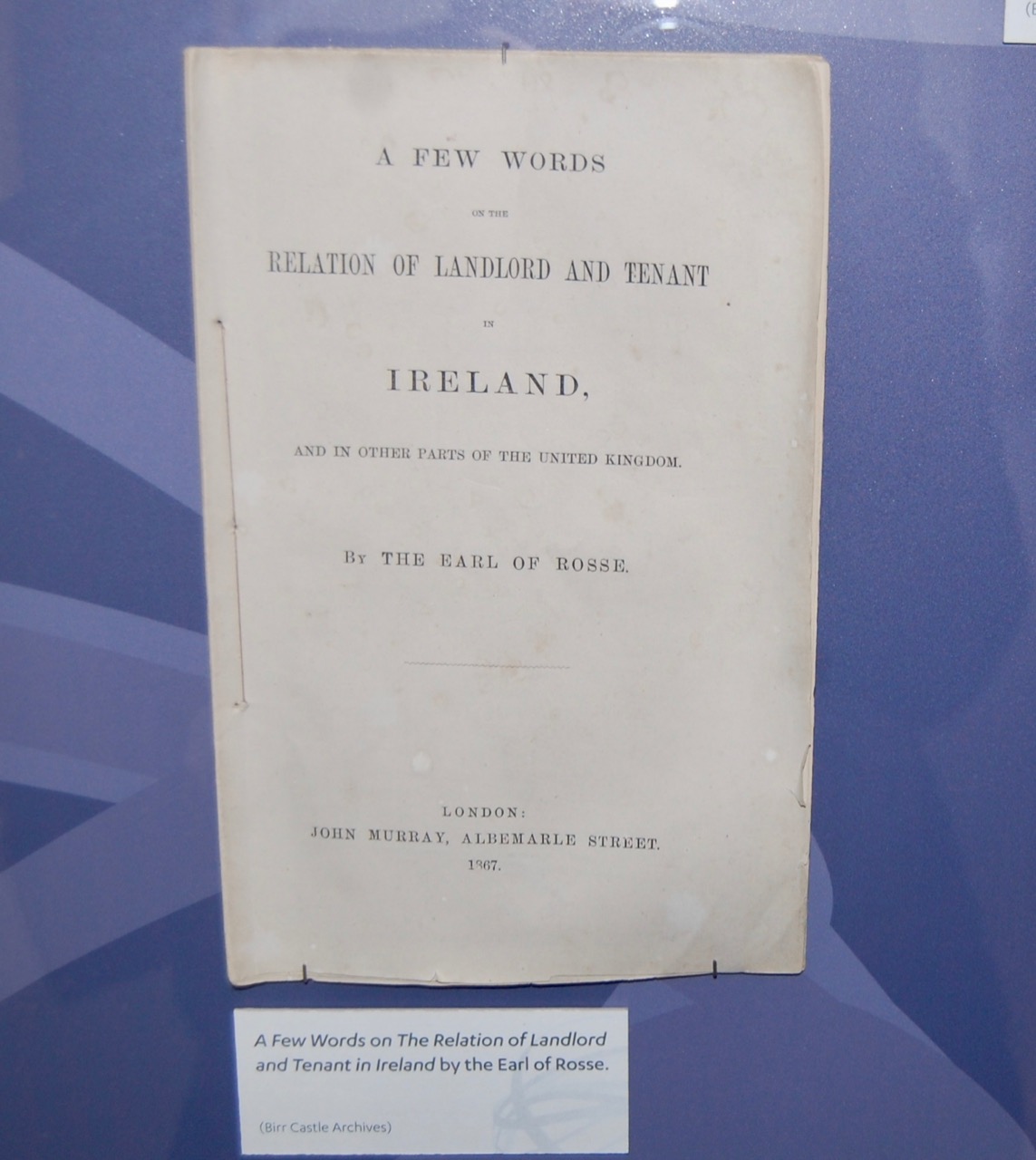
Birr Castle, County Offaly, Photograph © Jennifer Winder-Baggot, www.irishhistorichouses.com

[1] https://www.irelandscontentpool.com/en

[2] http://www.ihh.ie/index.cfm/houses/house/name/Birr%20Castle

[3] During the period 1979-2007, Lord and Lady Rosse facilitated research by Dr. Anthony Malcomson, former director of the Public Record Office of Northern Ireland (PRONI), and latterly sponsored by the Irish Manuscripts Commission, to enable the production of a comprehensive calendar of the Rosse Papers in 2008. The archive is held in the Muniment Room of Birr Castle.

[4] p. 12, Robertson, Nora. Crowned Harp, Memories of the Last Years of the Crown in Ireland, published 1960 by Allen Figgis & Co. Ltd., Dublin.

[5] https://www.tcd.ie/media/tcd/mecheng/pdfs/The_Family_Parsons_of_Parsonstown.pdf

[6] https://birrcastle.com/sharing-our-heritage/

[7] Hugh Montgomery Massingberd and Christopher Simon Sykes. Great Houses of Ireland. Laurence King Publishing, London, 1999.

[8] Bence-Jones, Mark. A Guide to Irish Country Houses (originally published as Burke’s Guide to Country Houses volume 1 Ireland by Burke’s Peerage Ltd. 1978); Revised edition 1988 Constable and Company Ltd, London.

[9] O’Reilly, Sean. Irish Houses and Gardens, from the archives of Country Life, Aurum Press, London: 1998, paperback edition 2008.
2026 Diary of Irish Historic Houses (section 482 properties)

To purchase an A5 size 2026 Diary of Historic Houses send your postal address to jennifer.baggot@gmail.com along with €20 via this payment button. The calendar of 84 pages includes space for writing your appointments as well as photographs of the historic houses. The price includes postage within Ireland. Postage to U.S. is a further €11 for the A5 size, so I would appreciate a donation toward the postage – you can click on the donation link.

€20.00

Donation

Help me to fund my creation and update of this website. It is created purely out of love for the subject and I receive no payment so any donation is appreciated! My website costs €300 per year on WordPress.

€15.00
Donation towards website

I receive no funding nor aid to create and maintain this website, it is a labour of love. The website hosting costs €300 annually. A generous donation would help to maintain the website.

€150.00

King House, Main Street, Boyle, Co. Roscommon F52 HM50 – section 482

https://www.visitkinghouse.ie/

Open dates in 2025: May 4, 6-11, 13-18, 20-25, 27-31, June 1-30, July 1-31, Aug 1-31, Sept 2-7, 9-14, 16-21, 23-29, Oct 1-5, 7-12, 14-19, 21-26, 28-31, weekdays 11am-5pm, Sun 11am-4pm, Nov 29-30, Fri 5pm-9pm, Sat 10am-5pm

Fee: adult €10, OAP/student/child €7, family €30 (2 adults & 2 children)  

donation

Help me to pay the entrance fee to one of the houses on this website. This site is created purely out of love for the subject and I receive no payment so any donation is appreciated!

€15.00
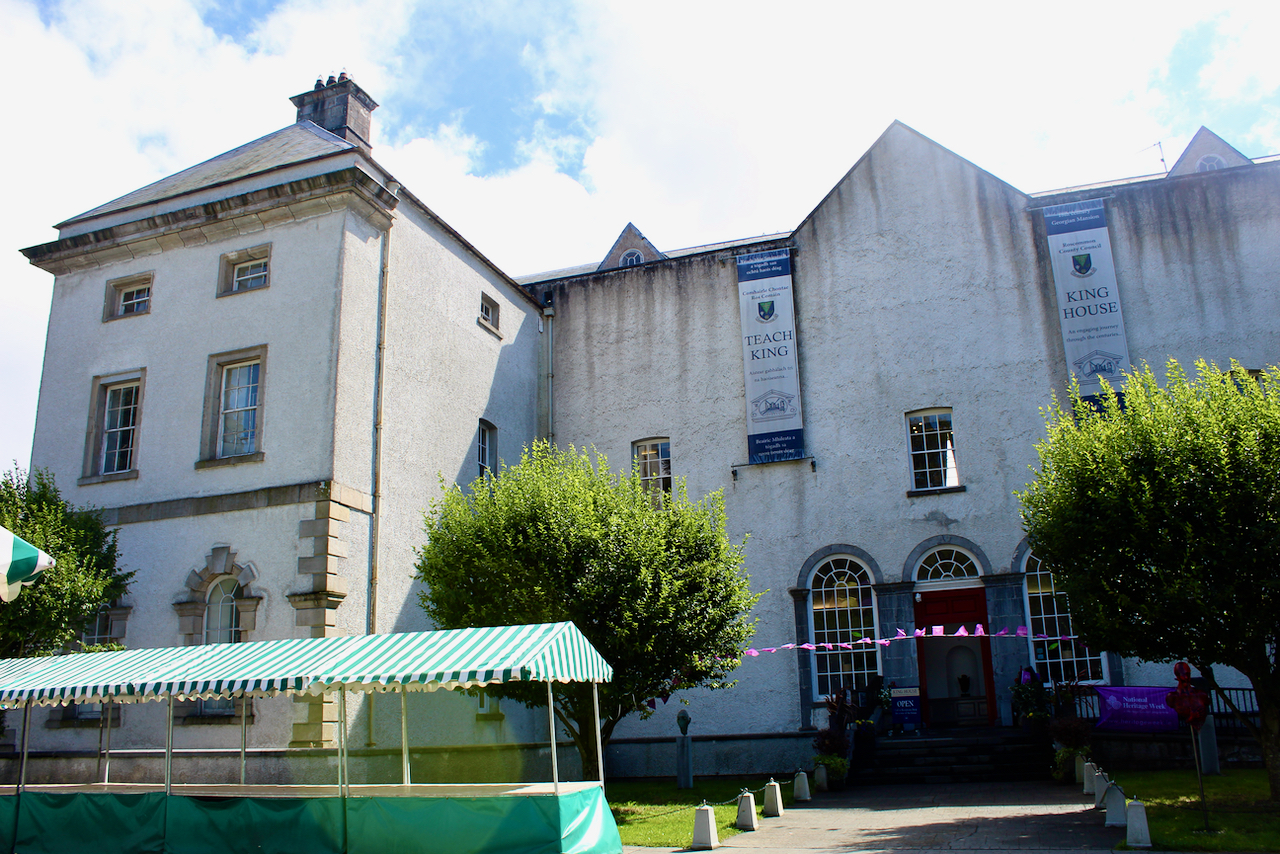
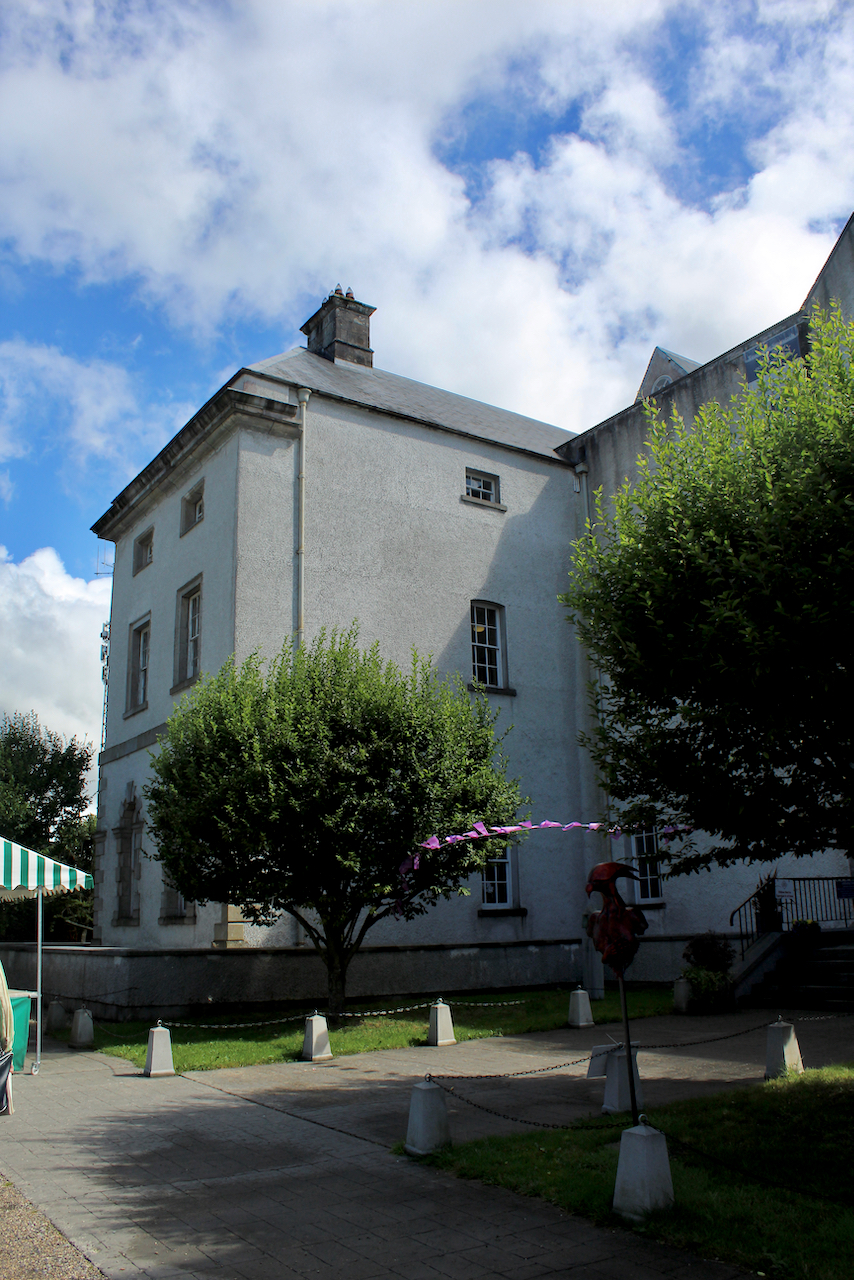
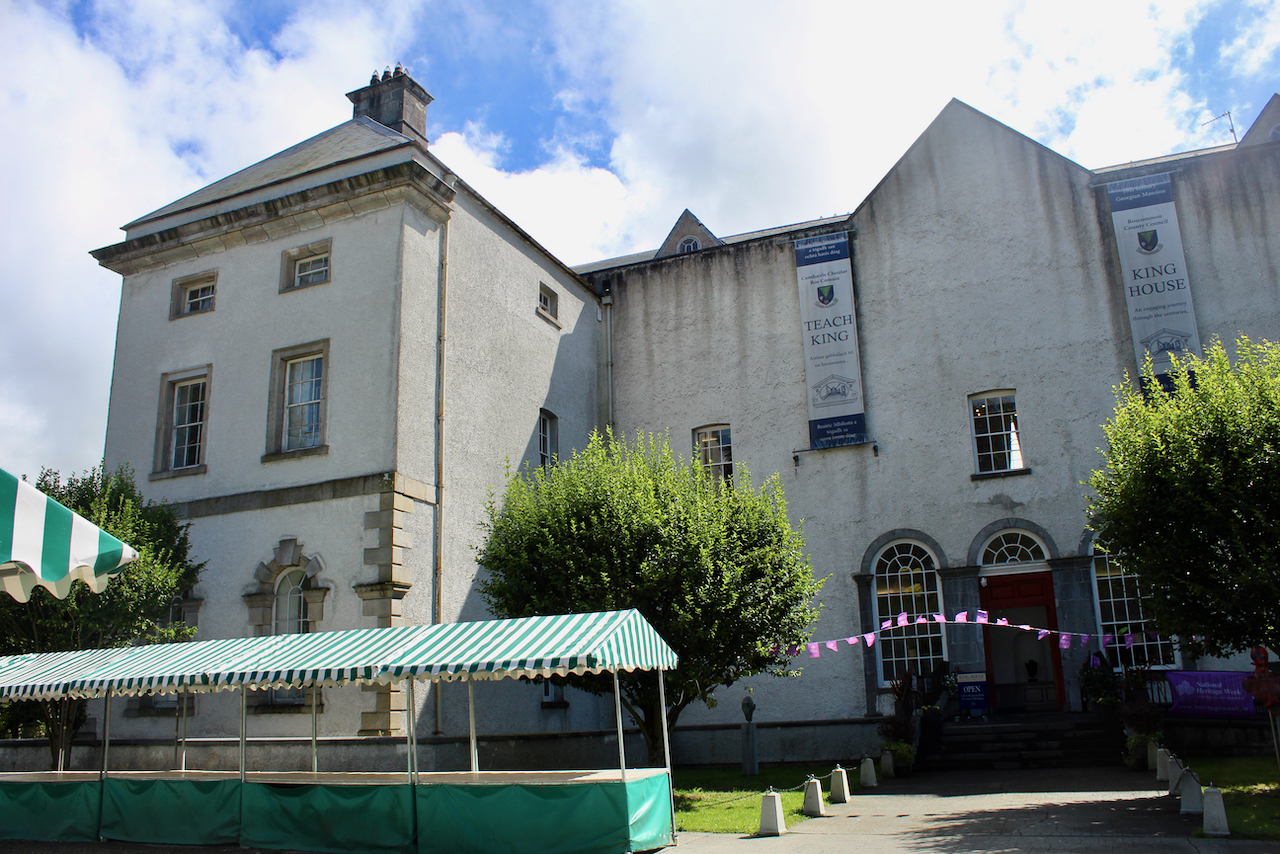
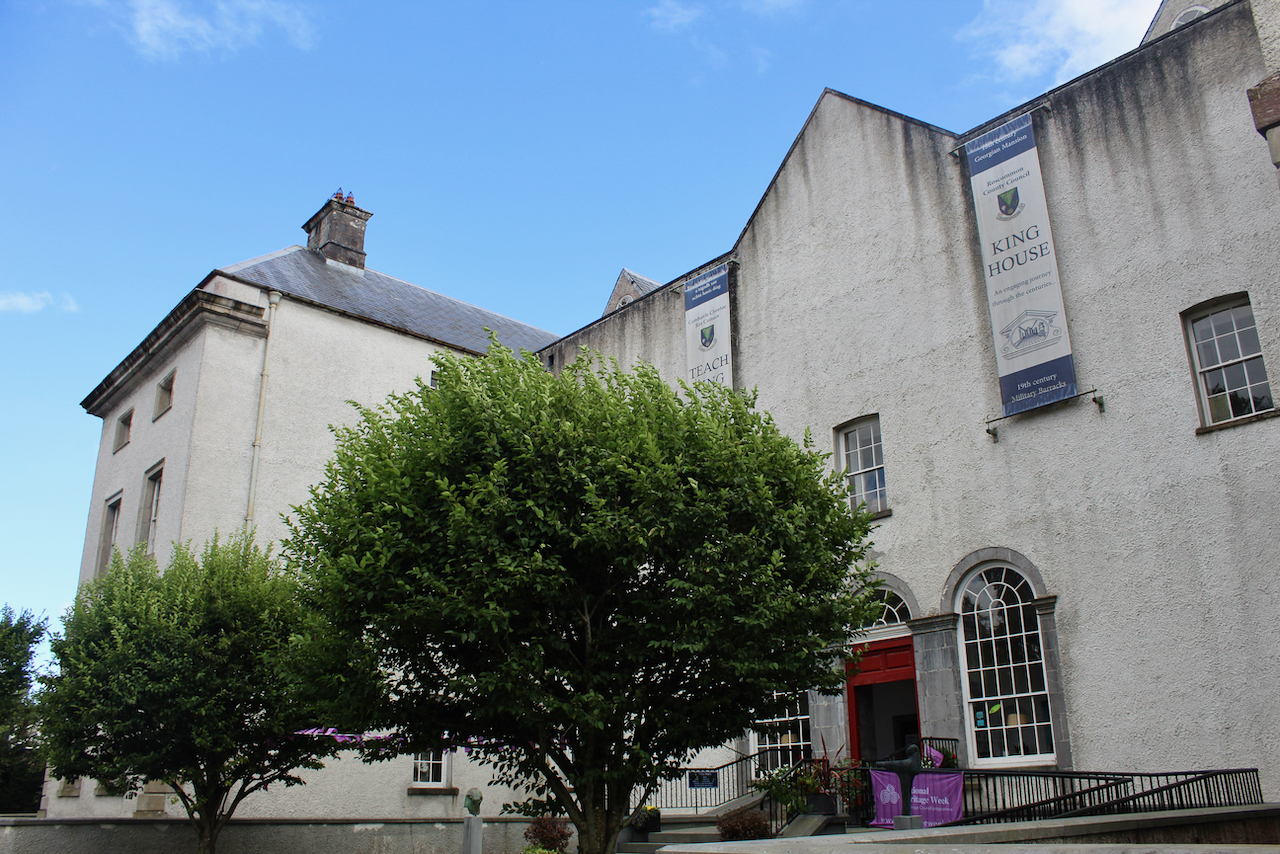
It is hard to capture King House in a photograph. Photograph © Jennifer Winder-Baggot, www.irishhistorichouses.com

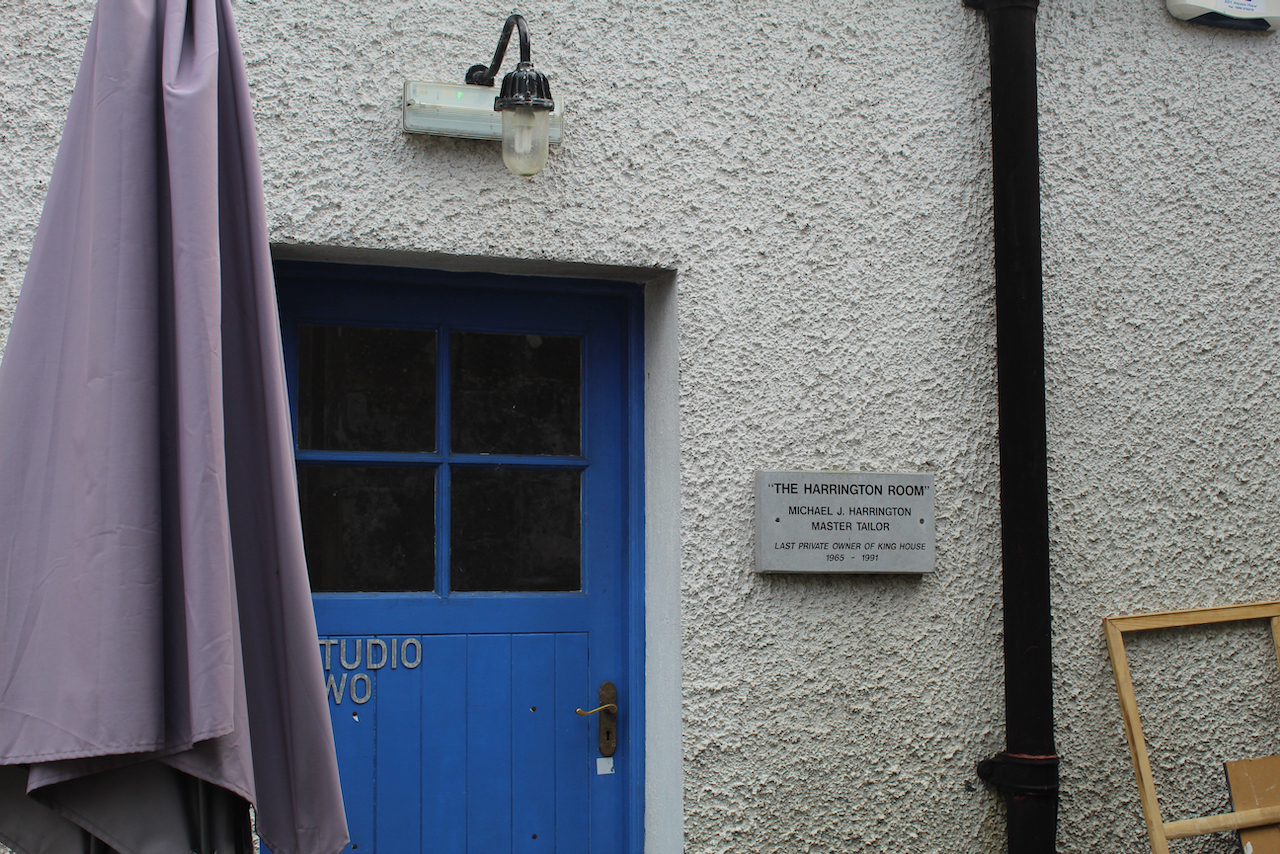
Stephen and I visited King House during Heritage Week 2022. It is open to the public and is no longer a private home.

King House was built in 1720 for Henry King, 3rd Baronet. There was a house previously on the site built for his grandfather, Robert. It was used as a military barracks in later years. Now it is a museum that tells the story of the King family, the history of the military unit which occupied the building, and it also houses a collection of contemporary art, the Boyle Civic Art Collection and the McAleese Collection. You can take a “virtual tour” on their website.

John King arrived in Ireland from Staffordshire, England, in the time of Queen Elizabeth I, Anthony Lawrence King-Harmon tells us in his book, The Kings of King House. His family originally came from Feathercock Hall in Yorkshire.

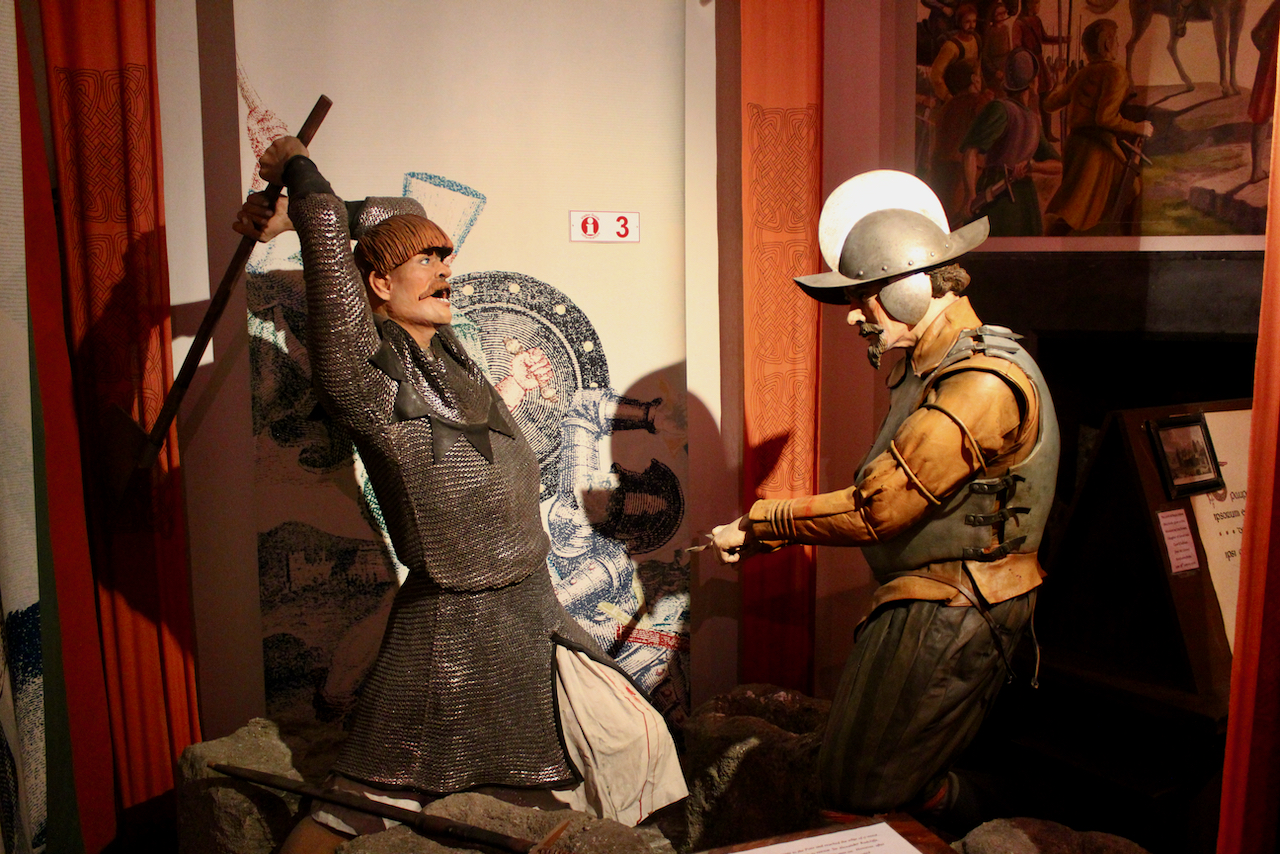
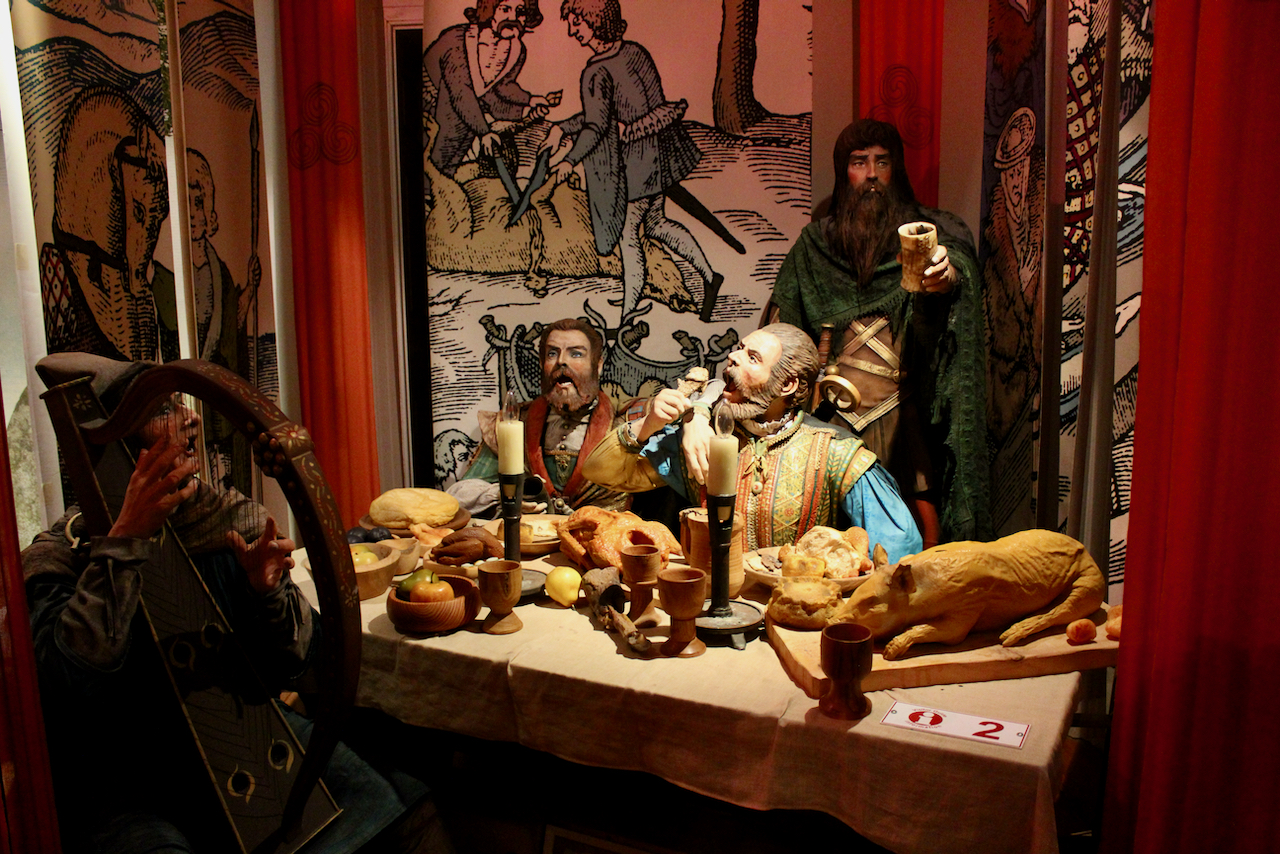
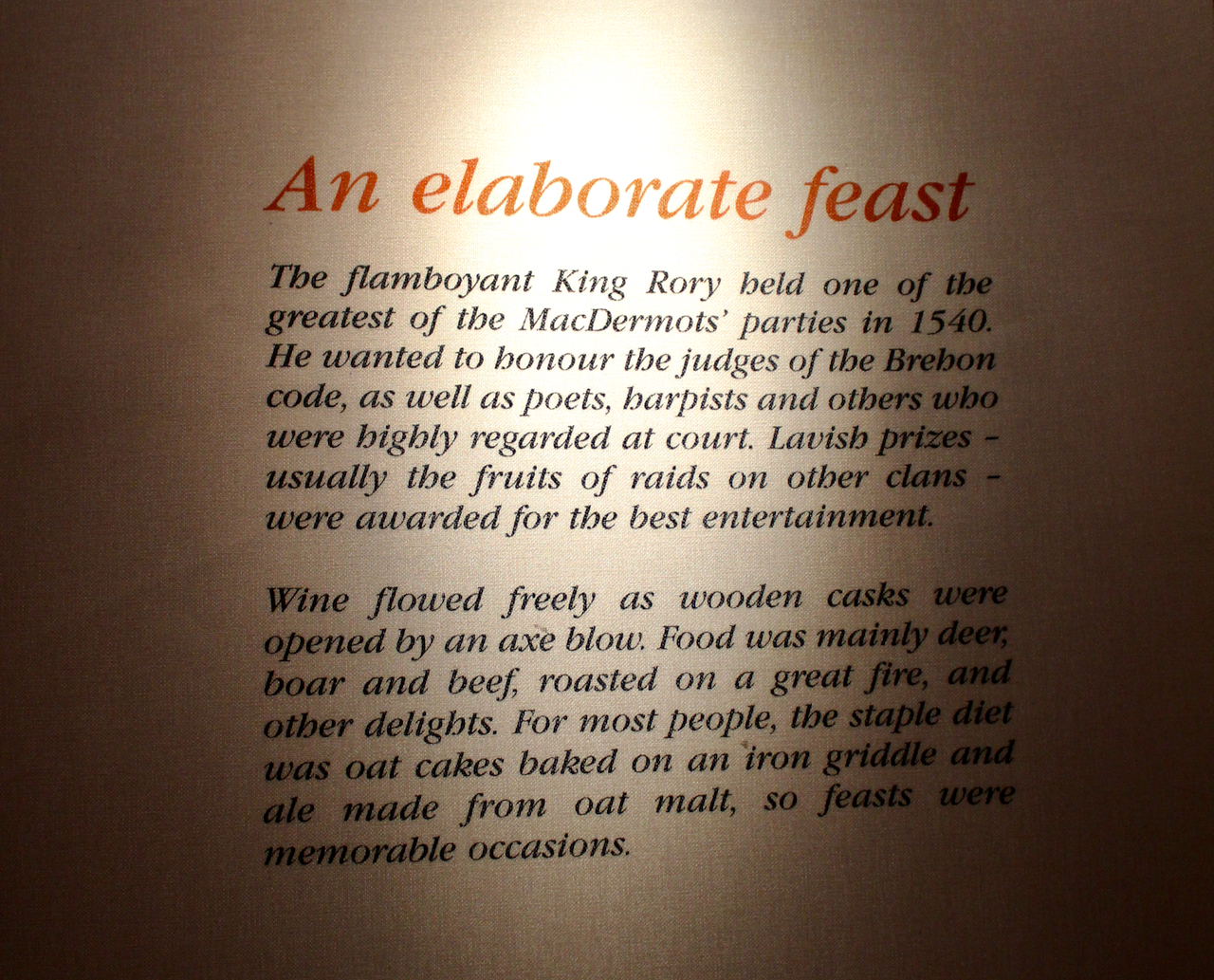
The land had been previously controlled by the MacDermott clan. A room in King House tells us a few stories about the MacDermott clan. They had a rare victory over Queen Elizabeth I’s forces in the pass in the Curlew Mountains, near Boyle.

King House, 2022.
King House, 2022.
King House, 2022.
King House, 2022.
King House, 2022.
King House, 2022.

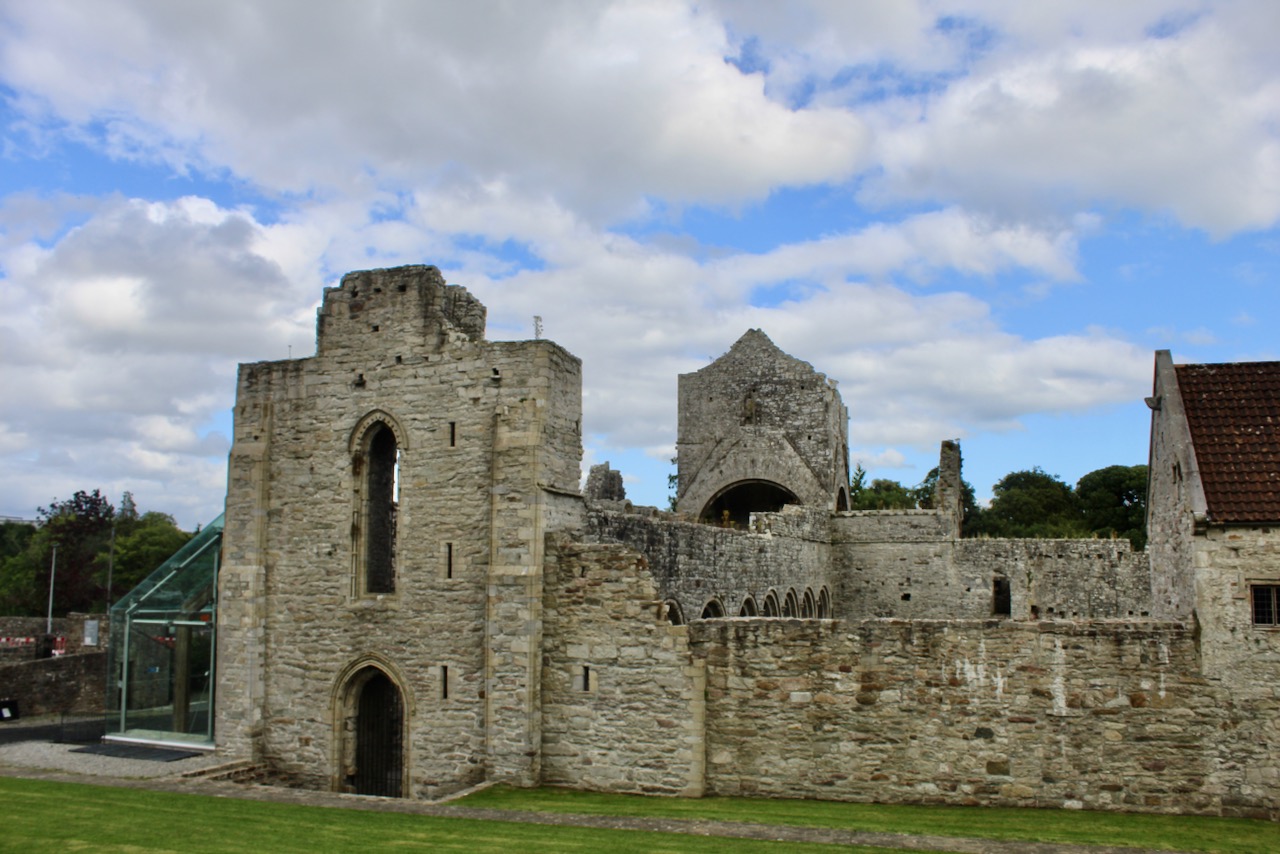
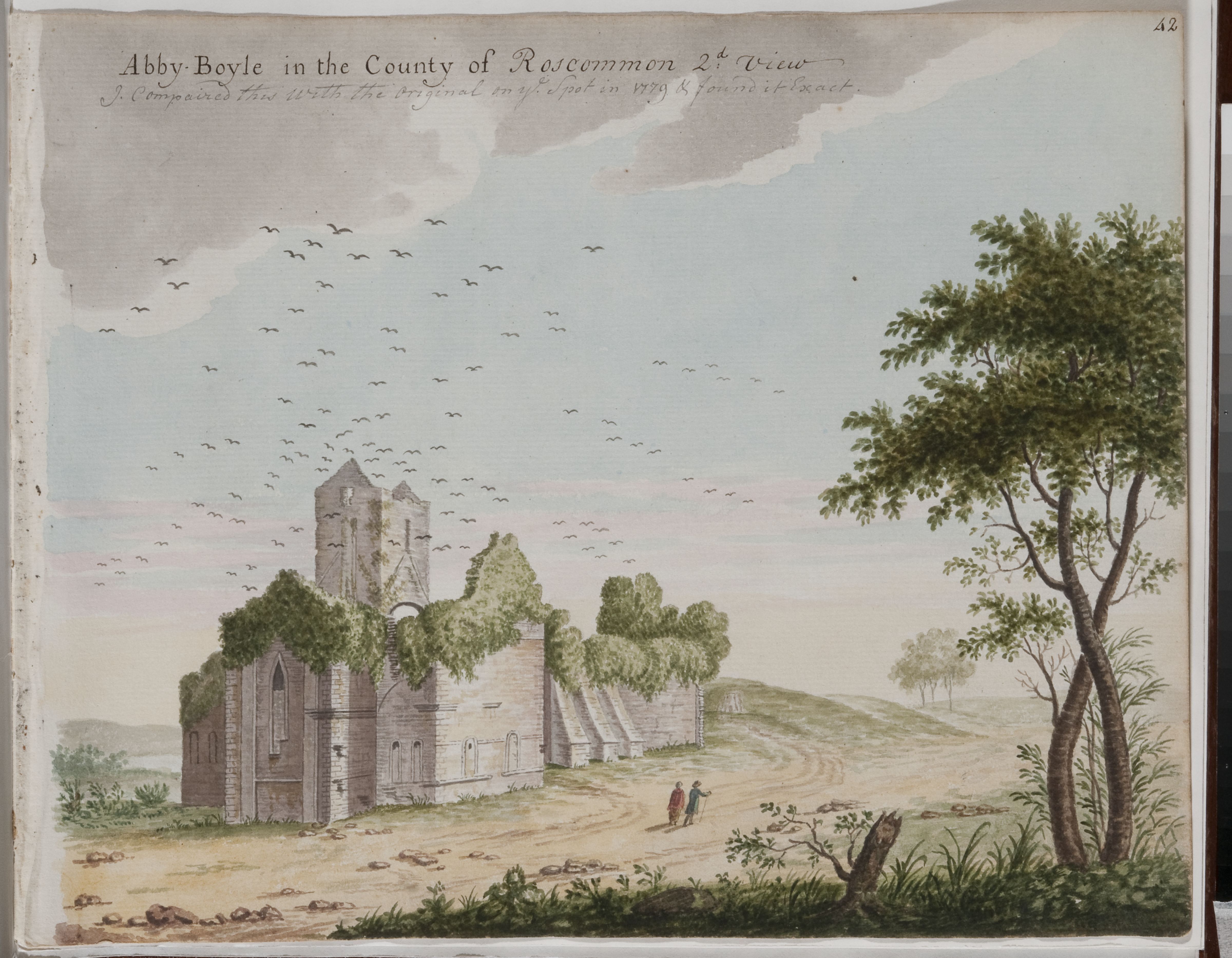
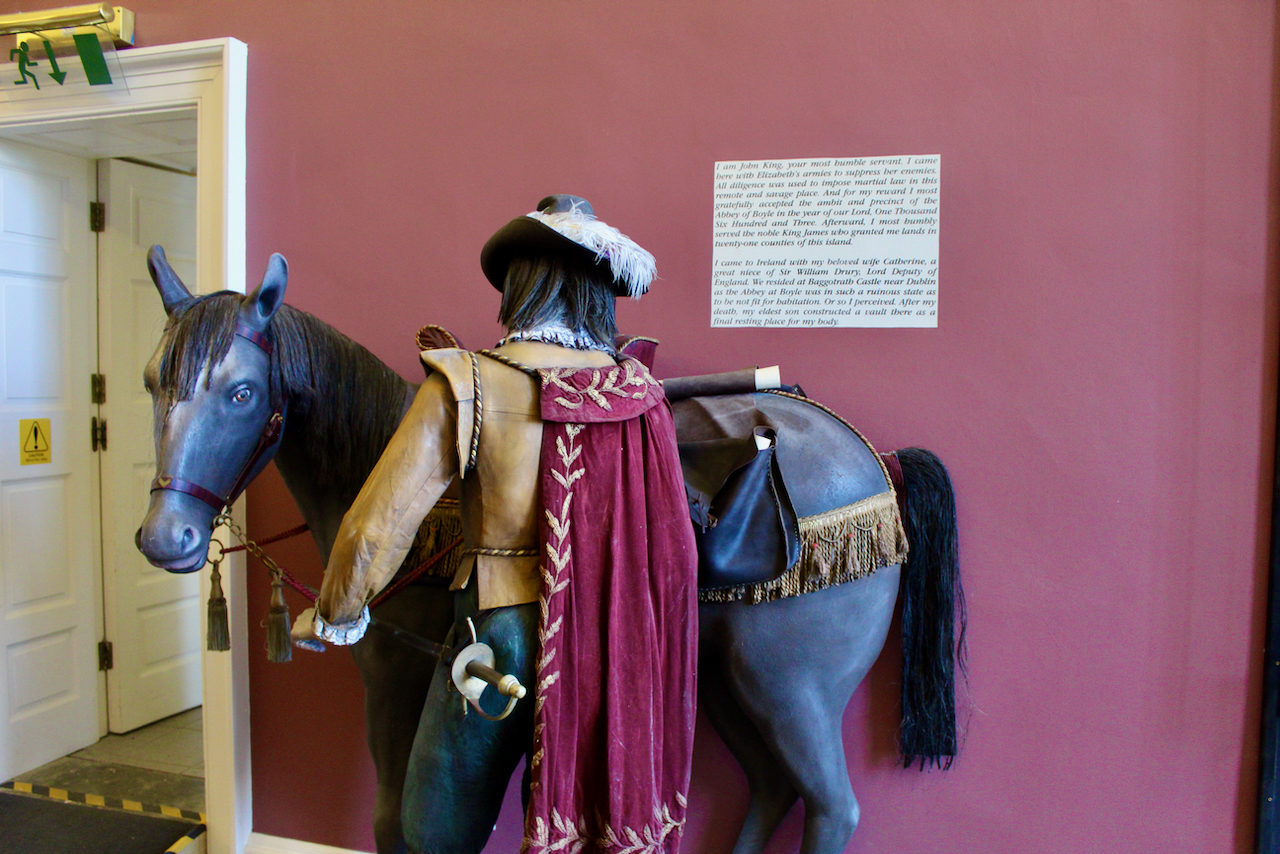
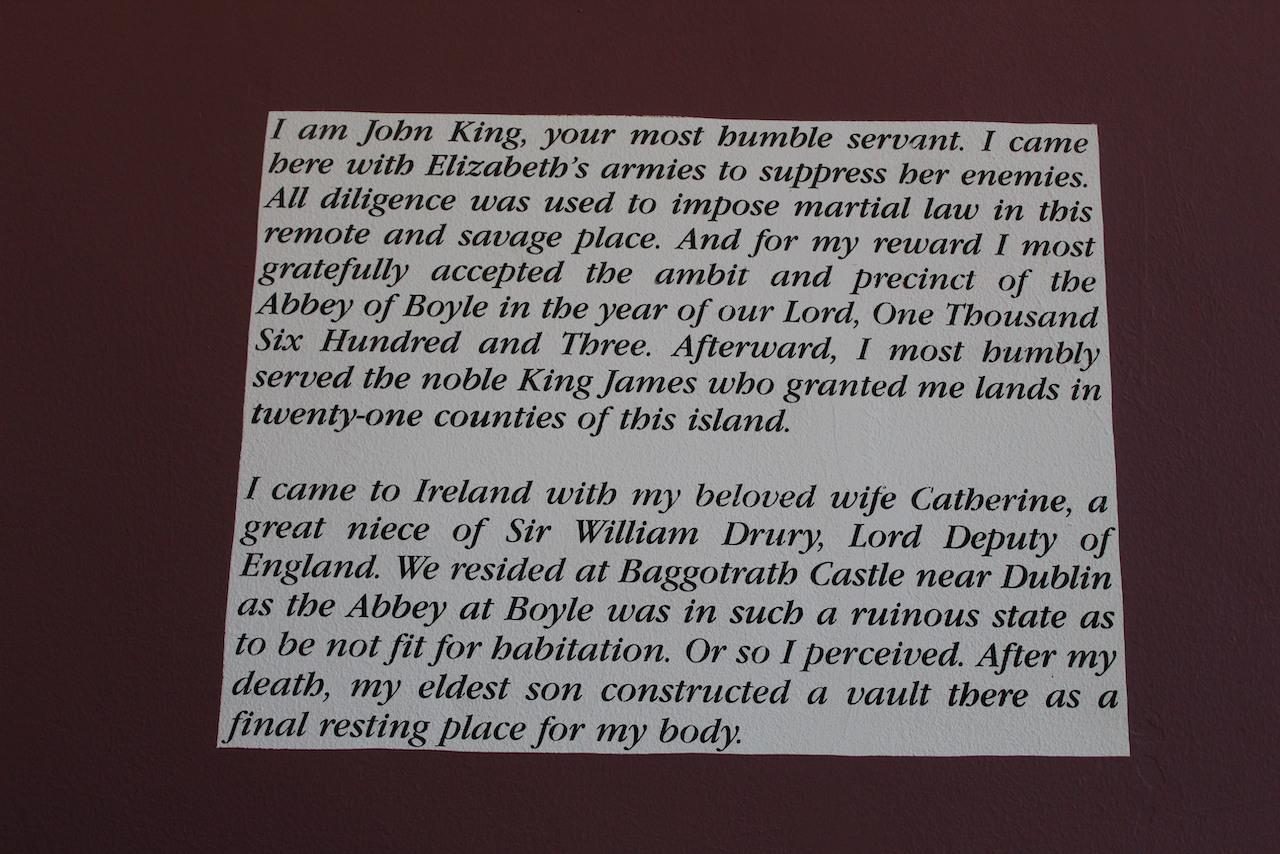
John King fought along with Sir Richard Bingham in Connaught during the Nine Years War. [1] In 1603 John King (1560-1636) was given, along with John Bingley, the lease of Boyle Abbey and its surrounding lands, in recognition for services rendered to the Crown. The Abbey had been used as a military barracks since the dissolution of the monasteries by King Henry VIII.

Boyle Abbey, County Roscommon, August 2022. Photograph © Jennifer Winder-Baggot, www.irishhistorichouses.com
Watercolour by Gabriel Berenger 1775 Royal Academy of Ireland digital collection RIA MS 3 C 30/42 93076r43v
At King House, 2022.

John married Catherine Drury, grand-niece of Sir William Drury, Lord Deputy of Ireland. They were the parents of Edward King, who was memorialised in John Milton’s poem, Lycidas, after he drowned in the Irish Sea. The King’s townhouse is now the home of the Society of Irish Pipers, Na Píobairí Uilleann, 15 Henrietta Street. A ceiling in the house features a bust of Milton, commemorating his poem to Edward King.

King House, 2022.
King House, 2022.

The King House website tells us that John King’s main residence was in Dublin, in Baggotrath near what is now Baggot Street, but he built a “great castle” in 1607 in Boyle. By 1618 he had obtained an outright grant to the Abbey and and its 4127 acres. King-Harmon tells us that an “apocryphal” story claims that the title “Lay Abbot” gave the right to have more than one wife! He adds that this was not a privilege of which John King availed.

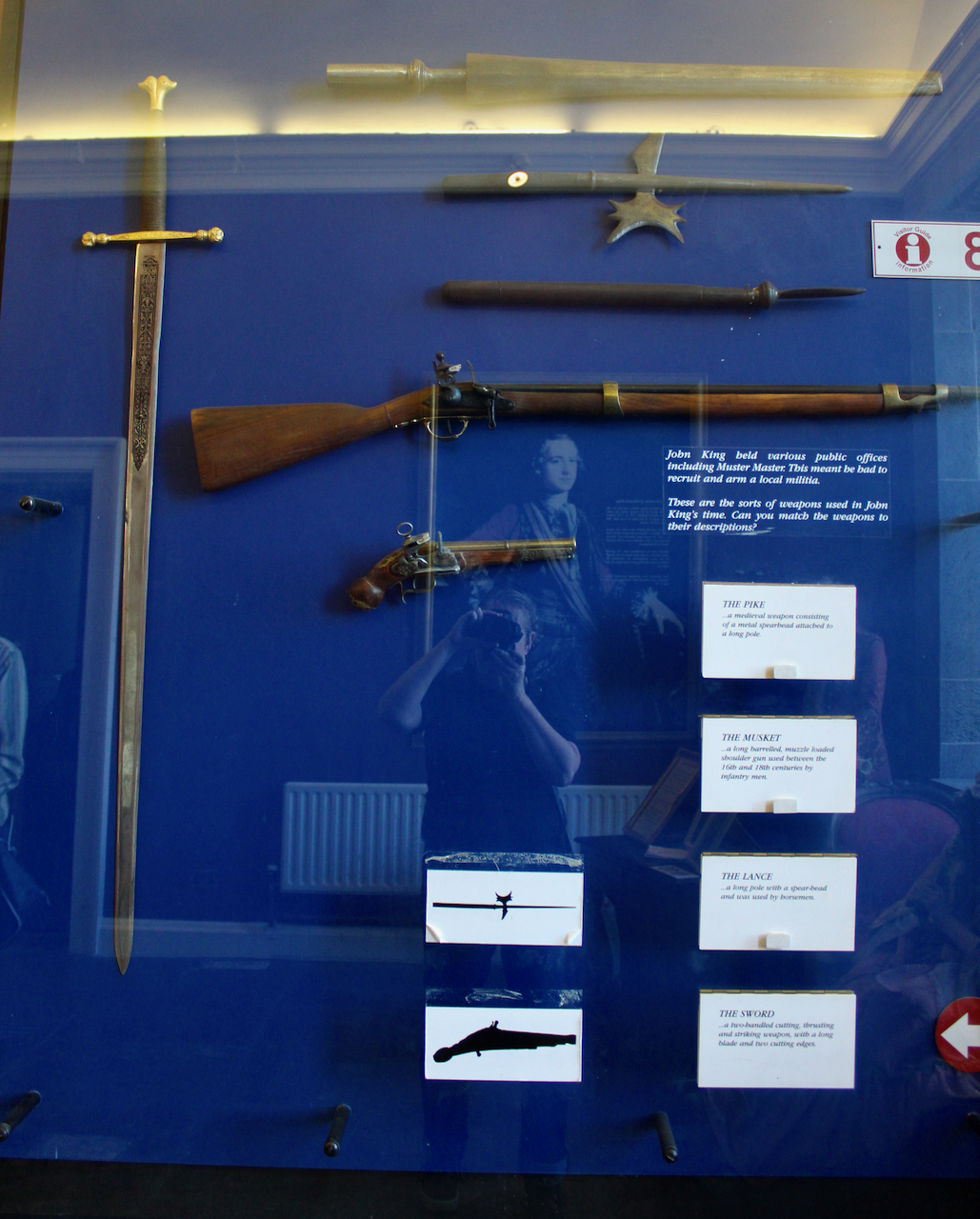
He was made “Muster General” of Ireland responsible for calling up personnel to assist with maintaining law and order in Ireland. At the time that he built his castle in Boyle, the population of Boyle was around 300, of whom thirty were English workmen or traders. Sir John was buried in Boyle Abbey.

As Muster Master, John King was in charge of weapons such as those above: a pike, musket, lance and sword.

Unfortunately we did not have time to visit Boyle Abbey this time, though we stopped to take a few photographs from the road – we will have to visit Boyle again.

King House, August 2022. Photograph © Jennifer Winder-Baggot, www.irishhistorichouses.com

Sir John’s daughters married well – Mary married William Caulfeild, 2nd Baron Caulfeild of Charlemont, County Armagh, who became the Master-General of the Ordnance for Ireland. Her sister Dorothy married Arthur Moore, son of Garret, 1st Viscount Moore of Drogheda.

John’s eldest son, Robert (d. 1657) was a supporter of Oliver Cromwell, and offered his services to the Parliamentarians. He fought in battles and has been credited with victory in the battle of Ballintubber. He was MP in the Cromwellian parliament in England, representing Roscommon, Sligo and Leitrim. He lived mostly in his home in Baggotrath in Dublin but built a house on the site of the present King House in Boyle. He died the year before Cromwell died, and the Kings immediately switched sides to support King Charles II.

King House, August 2022.

Robert King married twice (although not at the same time, so didn’t avail of the Lay Abbot’s rights!): first to Frances Folliott, daughter of Henry Folliott, 1st Lord Folliott, Baron of Ballyshannon (her sister married Richard Wingfield and was mother of 1st Viscount Powerscourt). Secondly, he married the widow of Edward Cecil, 1st Viscount Wimbledon, Sophia Zouche. Edward Cecil was the grandson of Queen Elizabeth I’s right hand man, William Cecil, 1st Baron Burghley.

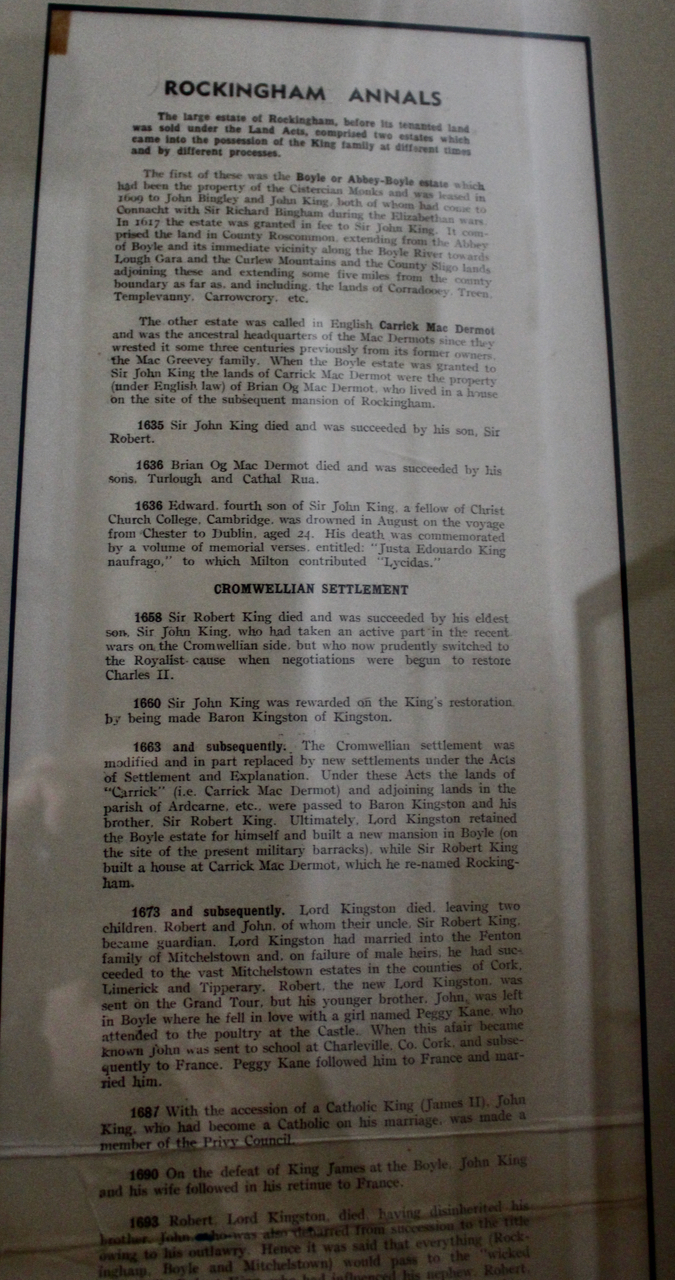
Robert’s eldest son, John (1638-1676) first fought with the Cromwellians but then became a supporter of King Charles II. He married Catherine Fenton of Mitchelstown, County Cork. Her brothers predeceased her and she was heir to vast estates. John was created 1st Baron Kingston, of Kingston, County Dublin, in 1660, when he was also appointed as Privy Counsellor in Dublin.

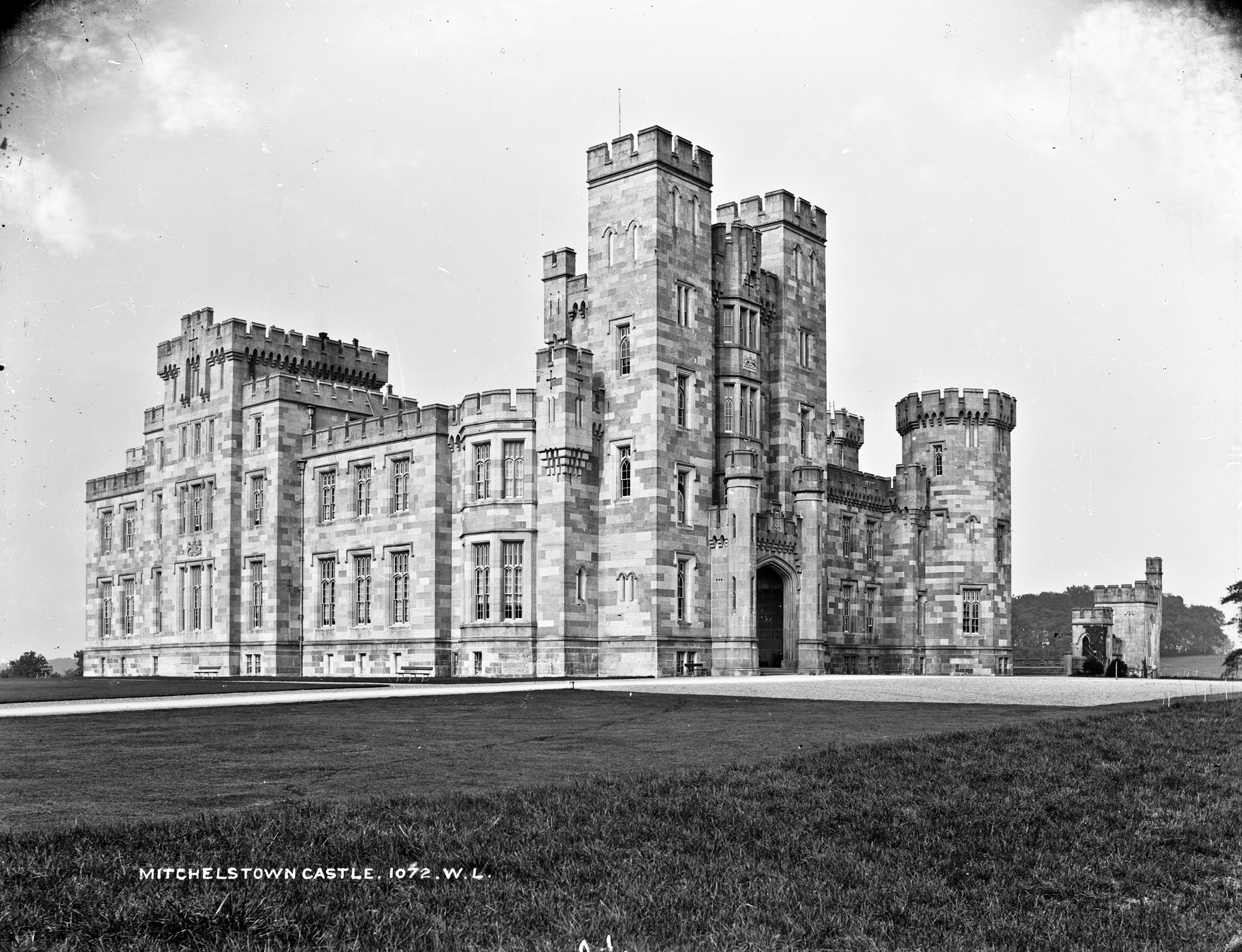
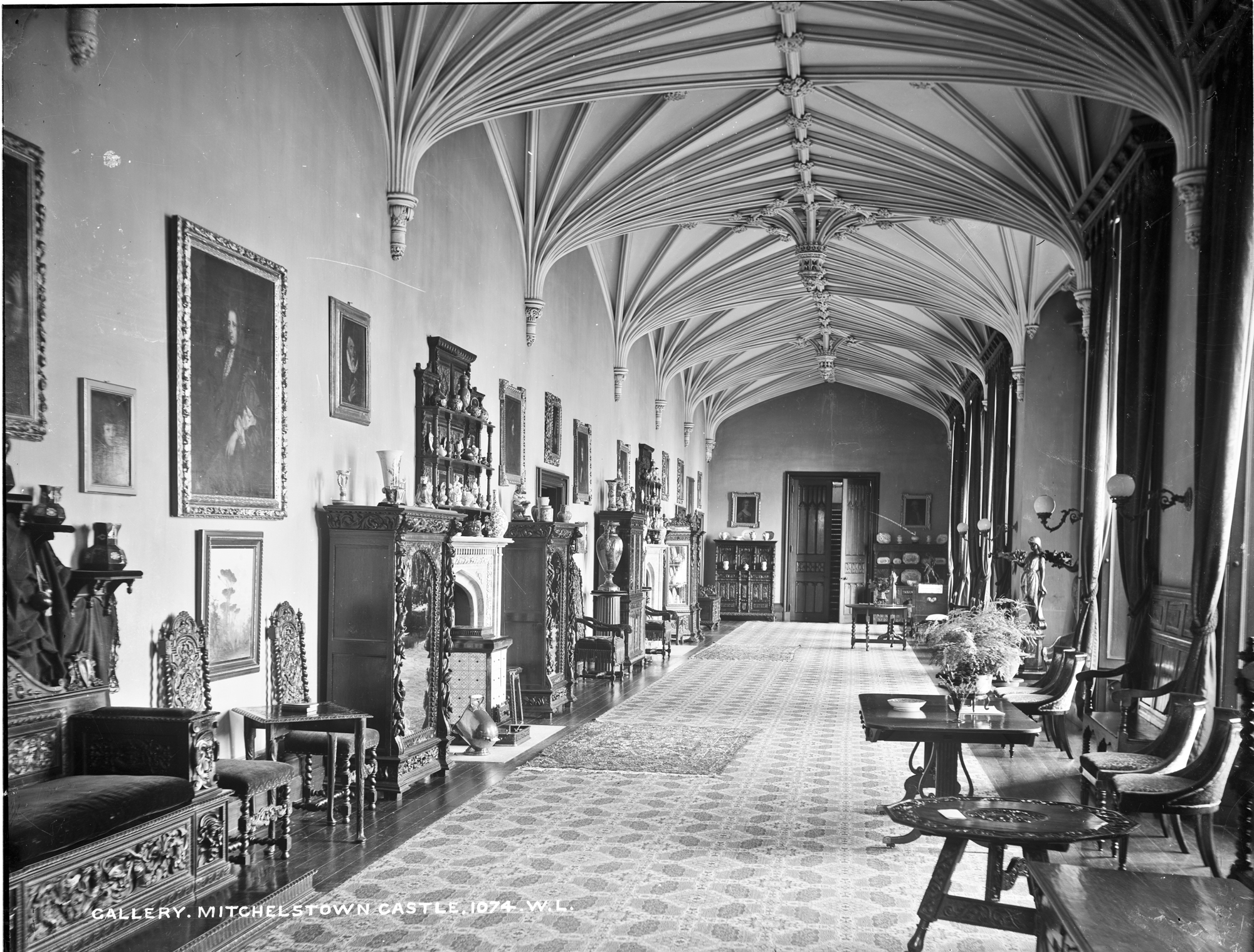
Mitchelstown, County Cork, photograph courtesy of the National Library of Ireland. An older castle was demolished and it was rebuilt, as we see in this photograph, in the 1770s by Caroline Fitzgerald and her husband Robert King, 2nd Earl of Kingston.
Mitchelstown, County Cork, photograph courtesy of the National Library of Ireland.

The land of Mitchelstown in County Cork passed into the hands of Maurice Fitzgibbon, the first White Knight, in the early part of the 14th century. The title of White Knight was an Anglo-Norman hereditary title in Ireland, one of three, the others being the Black Knight, or Knight of Glin, and Green Knight, or Knight of Kerry.

In 1608 Edmond Fitzgibbon the 9th White Knight died, as did his son Maurice, and it is said that they were poisoned. The inheritance of Mitchelstown passed to Edmond’s youngest granddaughter Margaret, who married Sir William Fenton. The castle then passed to Catherine Fenton, who brought the estate into the King family.

It was the descendants of John’s second son, Robert (abt. 1640-1707), who lived in County Roscommon, since descendants of the eldest son John 1st Baron Kingston lived in Mitchelstown Castle. John gave his younger brother Robert considerable lands in what was to become Rockingham, outside Boyle. John predeceased his brother Robert, dying in 1676, leaving two sons, who became 2nd and 3rd Barons Kingston.

In King House.
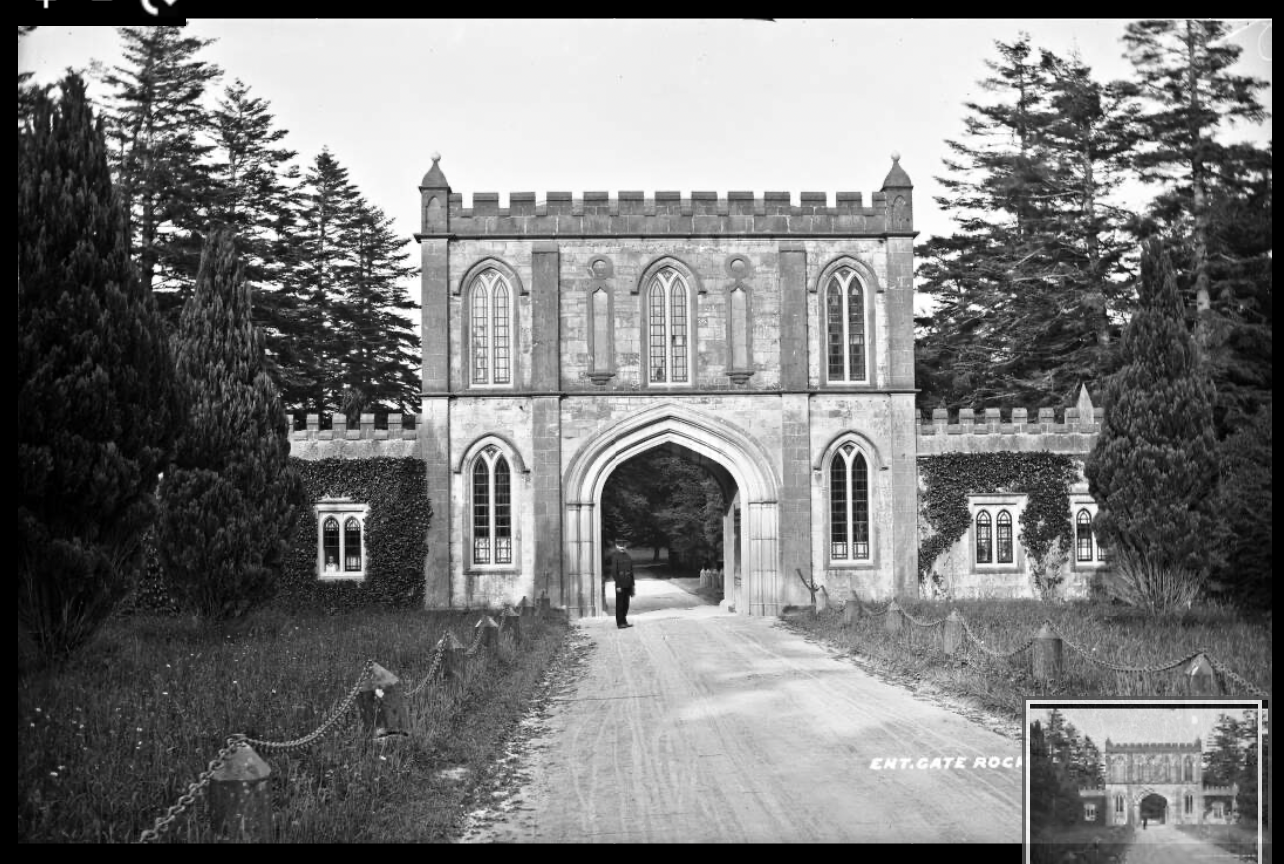
Rockingham, County Roscommon entrance gate, photograph by Robert French, Lawrence Photograph Collection, National Library of Ireland.
Robert King (1657–1693), 2nd Baron Kingston by John Michael Wright courtesy of Ulster Museum.

Robert (abt. 1640-1707) of County Roscommon held the office of Member of Parliament (M.P.) for Ballyshannon between 1661 and 1666. He built a sumptuous house at Rockingham in 1673, after he married Frances Gore, daughter of Lt.-Col. Henry Gore, around 1670. She had been previously married to Robert Choppyn of Newcastle, County Longford.

Robert King, (d. 1707) 1st Baronet of Boyle Abbey, County Roscommon from the circle of John Closterman, courtesy of “mutualart.com”

Robert was created 1st Baronet King, of Boyle Abbey, Co. Roscommon [Ireland] on 27 September 1682. He held the office of Member of Parliament (M.P.) for County Roscommon between 1692 and 1699. He was also appointed Privy Counsellor in Ireland, and he held the office of Member of Parliament (M.P.) for Boyle between 1703 and 1707.

King House, 2022. Photograph © Jennifer Winder-Baggot, www.irishhistorichouses.com
Inside King House today. Photograph © Jennifer Winder-Baggot, www.irishhistorichouses.com

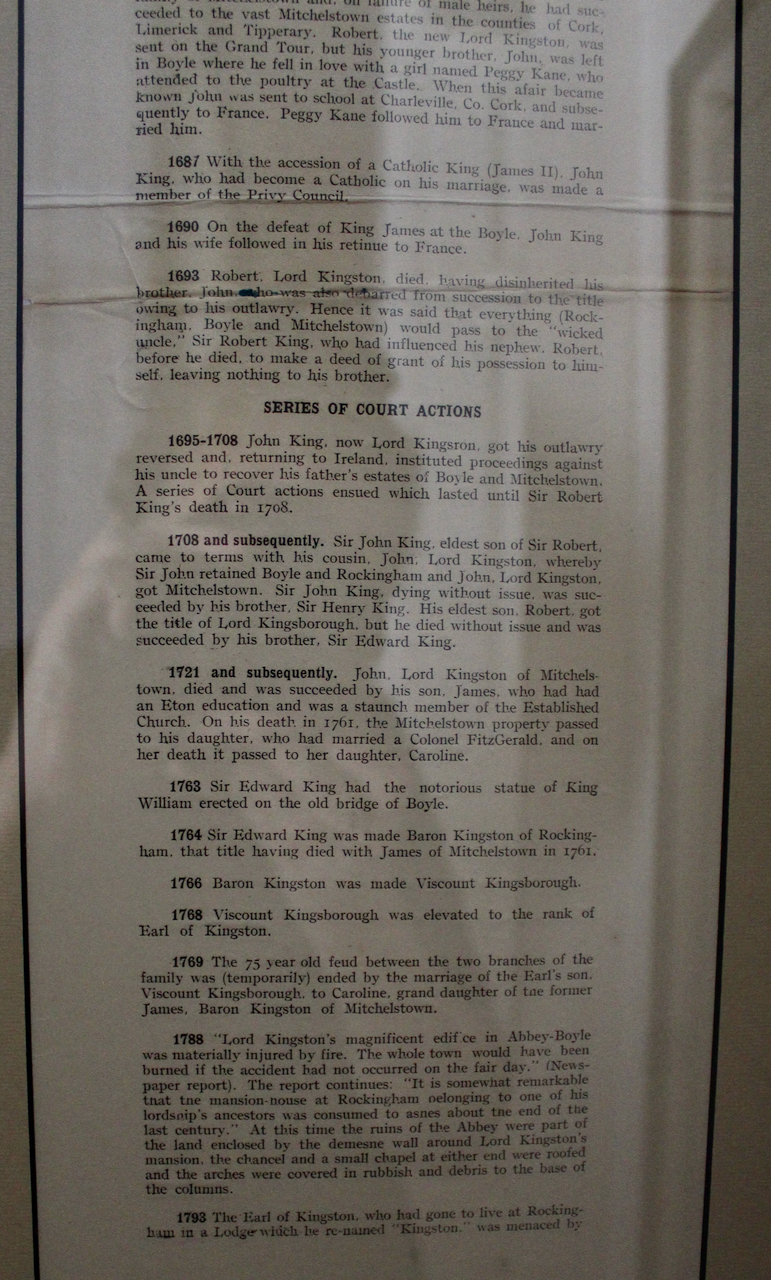
Robert’s brothers’ sons, the 2nd and 3rd Barons Kingston, still owned the property in Boyle. Robert King, 2nd Baron Kingston, and his uncle Robert 1st Baronet King of Boyle Abbey both supported William III, whereas most English families in Counties Sligo and Roscommon supported King James II. Both Robert Kings became heavily involved in military operations. Robert 1st Baronet King played a major role in the Battle of Aughrim. Anthony Lawrence King-Harman tells us that it was during this battle that Robert saved the life of the head of the MacDermot family, the original owner of Rockingham.

To add to complications of the time, Robert 1st Baronet of Boyle Abbey’s son John (1673-1720) supported King James II. He sat in King James’s parliament in Dublin. Fortunately he later escaped retribution from William III when William was made King, and his father must have forgiven him also as he was his father’s heir. John became 2nd Baronet King of Boyle Abbey.

The brother of Robert 2nd Baron Kingston, John (abt. 1664-1727/28), or Jack as he was known, eloped with a servant girl from King House named Peggy O’Cahan (or Kane). They moved to France and married, and he joined court of “The Pretender,” son of James II, also known as James III. Jack converted to Catholicism. His brother did not have children so Jack would have been his brother’s heir. However, due to his Catholicism, his family took legal action to disinherit him. Robert 2nd Baron Kingston instead changed his will so that his uncle Robert, 1st Baronet King of Boyle Abbey, would inherit the Mitchelstown estates and the estate in Boyle. Jack, however, disputed this. King-Harmon tells us in The Kings of King House that Jack, with the support of James II and Catholic circles in London, launched a legal action to show that the actions of his family were in contravention of the marriage settlements of his father, and before that of William Fenton, his mother’s father. He was successful and he obtained possession of Mitchelstown in 1699, but not the estate lands. Jack, who had become 3rd Baron Kingston after his brother’s death, also achieved a Royal pardon from William III for his previous support of King James II and his son.

Margaret O’Cahan (c. 1662-1721), standing in a black habit, and holding a string of rosary beads, Attributed to Garret Morphy (c.1655-1715), courtesy Adam’s 6 Oct 2009 she married James King 3rd Baron Kingston.

Jack’s actions threatened the Baronets of Boyle Abbey and their ownership of Rockingham. However, they managed to hold on to their estate and the threat receded somewhat with the accession of William and Mary to the throne. Jack, with an eye to their future, raised his children as Protestants in Mitchelstown.

Robert 1st Baronet of Boyle Abbey’s daughter Mary married Chidley Coote of Cootehall, County Roscommon, son of Richard Coote 1st Lord Coote, Baron of Colloony, County Sligo. His son John, who became 2nd Baronet of Boyle Abbey upon his father’s death, married Elizabeth Sankey, but he had no children. Elizabeth went on to marry secondly, John Moore, 1st Baron Moore of Tullamore and thirdly, Brabazon Ponsonby, 1st Earl of Bessborough. Her mother, Eleanor Morgan, was from Cottlestown, County Sligo, a property added in 2022 to the Section 482 list, which we have yet to visit.

The 2nd Baronet moved from Rockingham back to the house in Boyle, which by this time may have been known as King House. He died in March 1720 and his brother Henry (1681-1739) became 3rd Baronet King of Boyle Abbey.

It was Henry 3rd Baronet who built the King House that we see today. Rockingham burnt down, probably sometime shortly after the death of the 1st Baronet. King House in Boyle was destroyed by fire in 1720, so Henry immediately started to rebuild. King-Harman tells us he hired either Edward Lovett Pearce, or William Halfpenny, an assistant to Edward Lovett Pearce, as architect. The newer house may incorporate walls of the earlier house. A pleasure garden was created across the river, and it is now a public park. It contains a plinth that used to hold a statue of King William III but that statue disappeared!

Henry (1681-1739) 3rd Baronet King of Boyle Abbey, by Robert Hunter. When the portrait was advertised for sale by Adam’s auctioneers, 6 Oct 2009, it was identified as being by Charles Jervas (1675-1739).
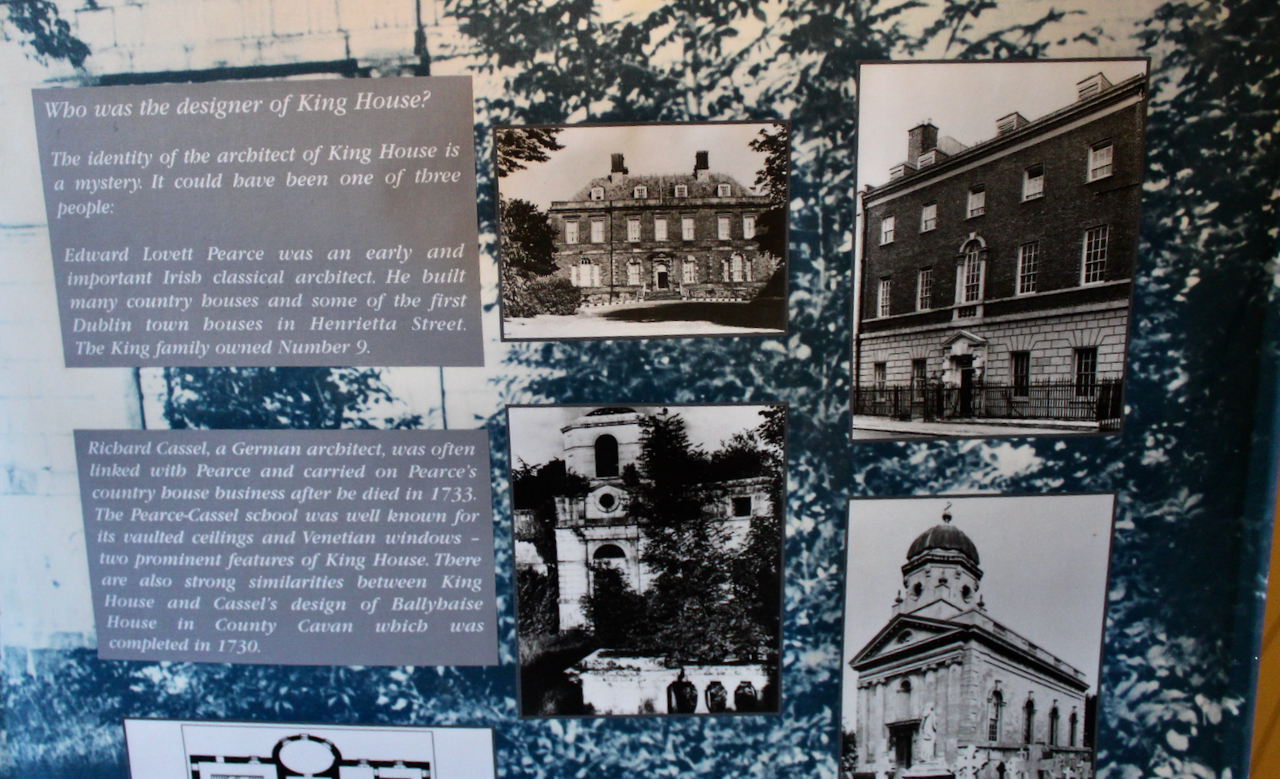
The museum in King House is less certain as to who designed it, suggesting it could have been Edward Lovett Pearce, Richard Cassel (or Castle), or William Halfpenny.
In King House.

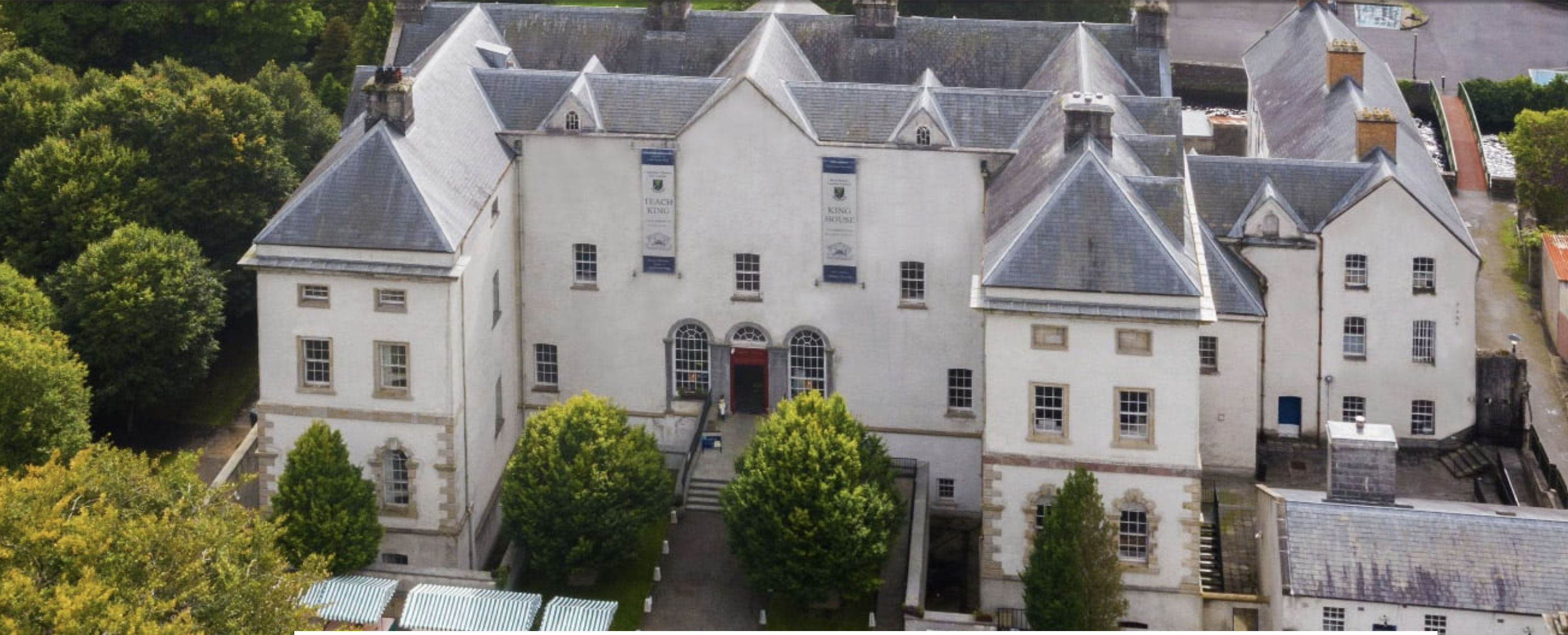
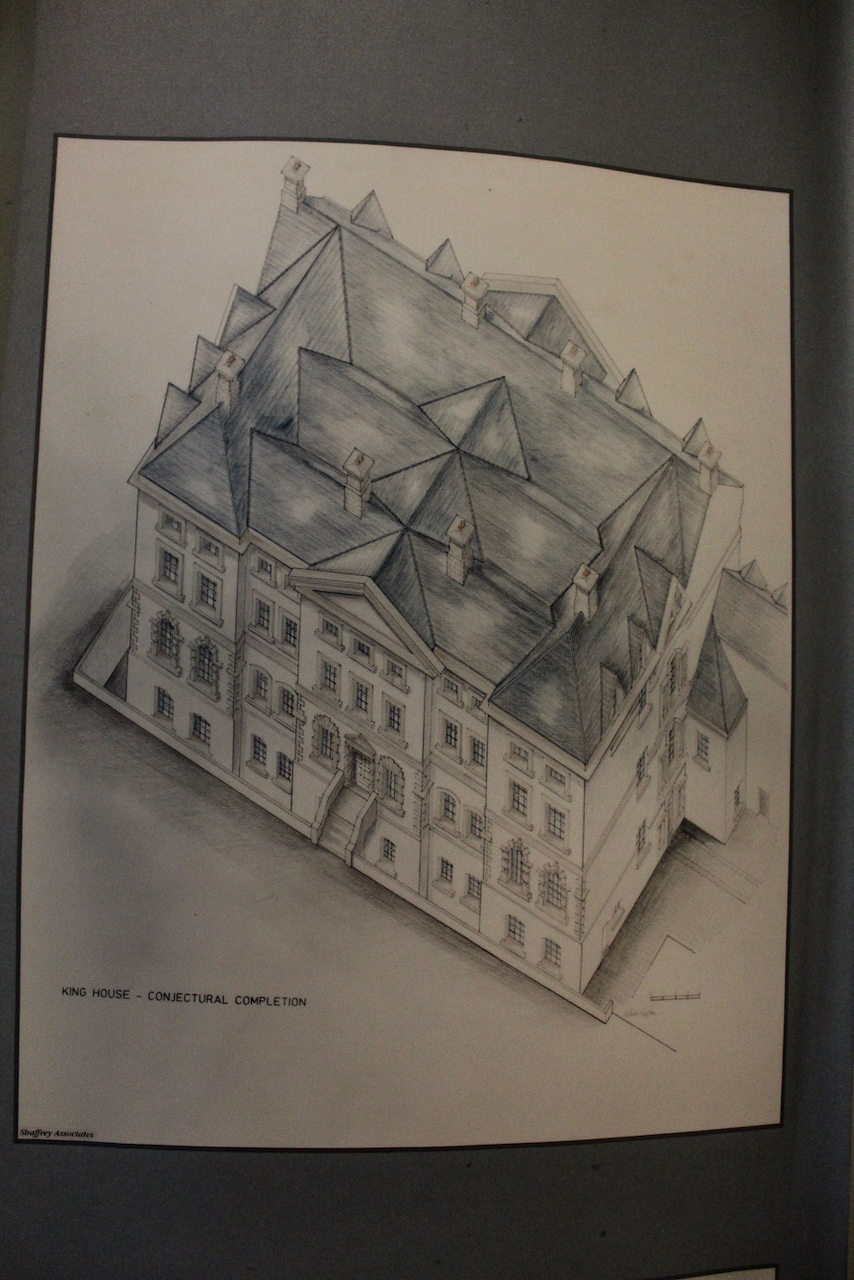
Mark Bence-Jones points out in his A Guide to Irish Country Houses (1988) that King House is not situated in a demesne but in the centre of a town. It is surrounded by thick walls. He describes it as a large “u” shaped mansion of two storeys over basement with a partly gabled attic. [2]

This overhead shot of King House is taken from the website. As you can see, it’s an unusual house.
King House, 2022.
King House, 2022. Photograph © Jennifer Winder-Baggot, www.irishhistorichouses.com
The entrance to King House, it is surrounded by these imposing walls. Photograph © Jennifer Winder-Baggot, www.irishhistorichouses.com
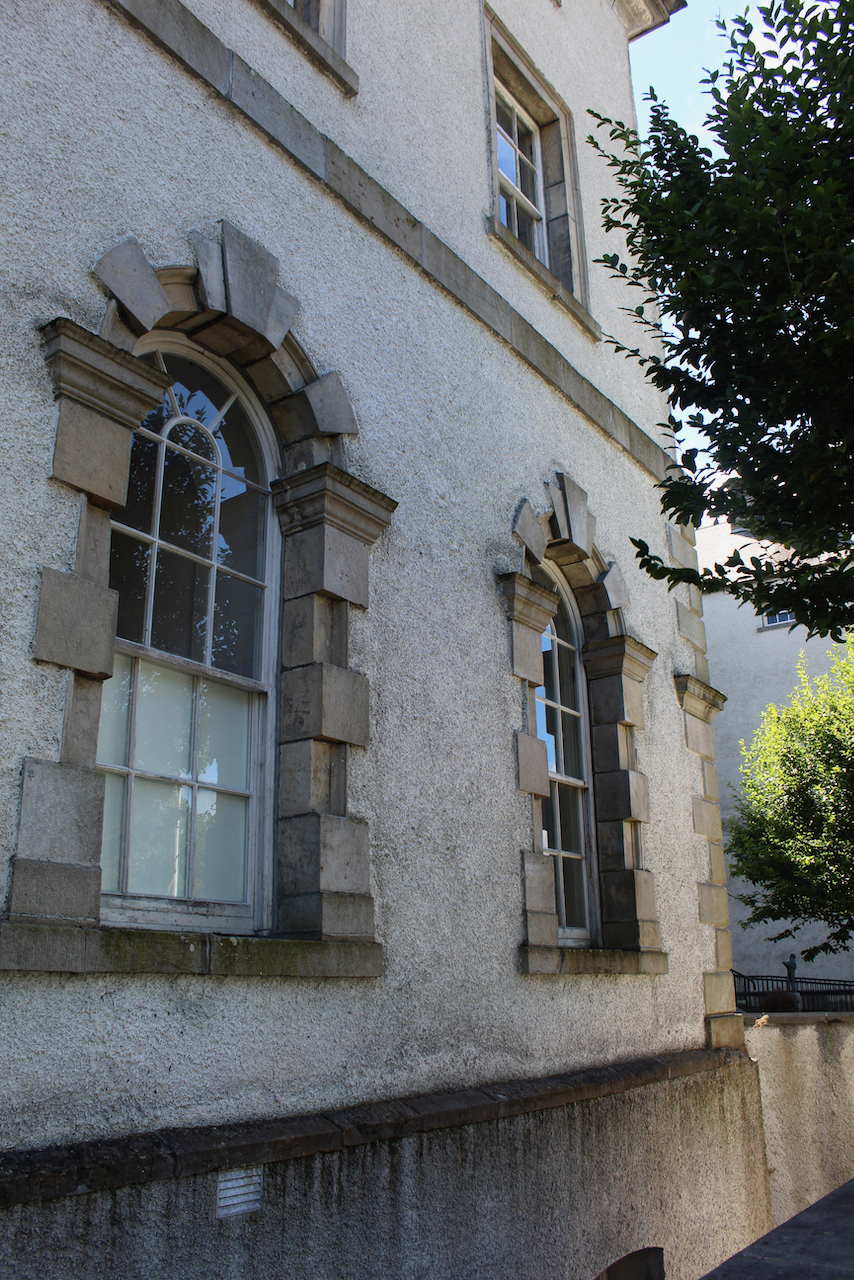
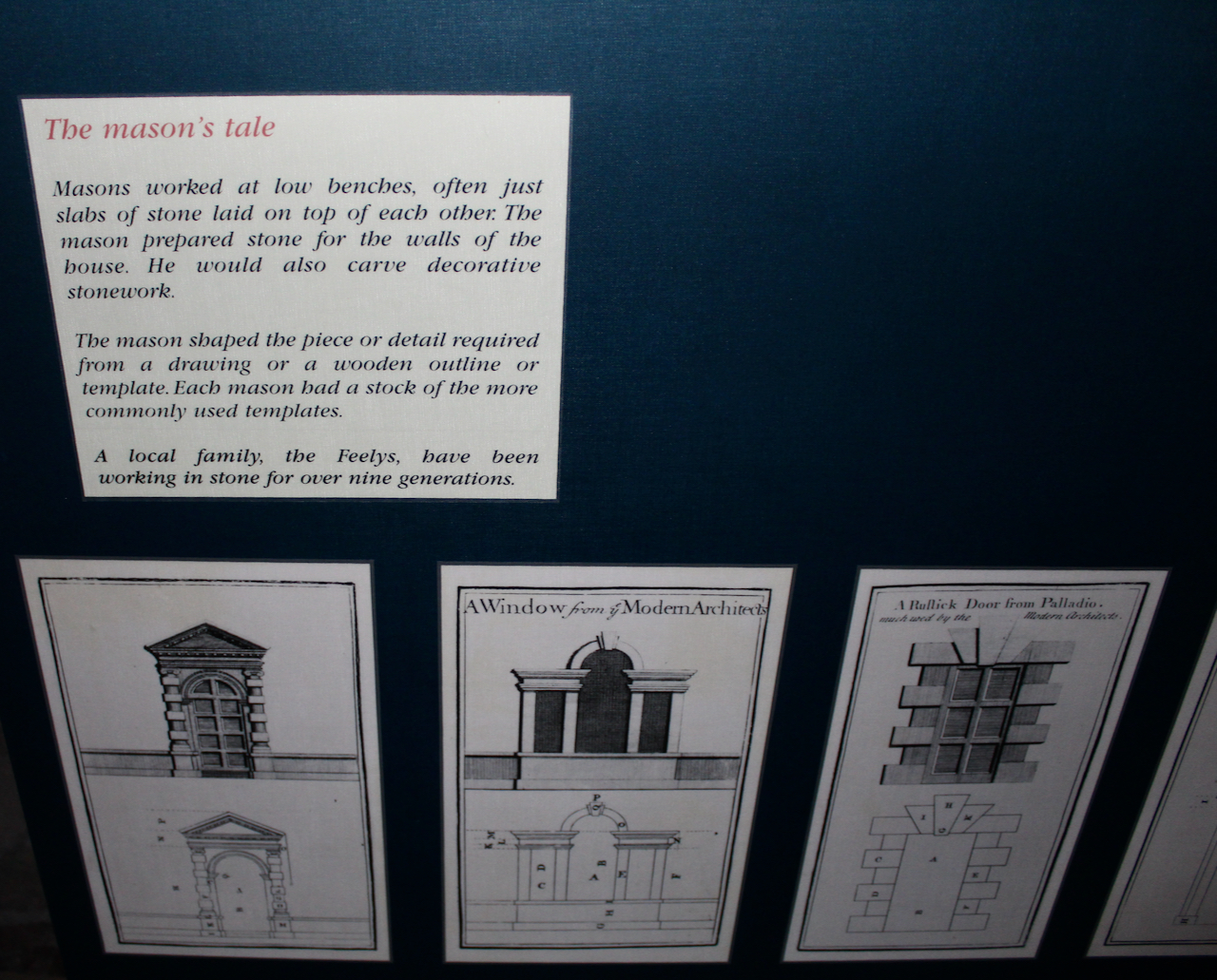
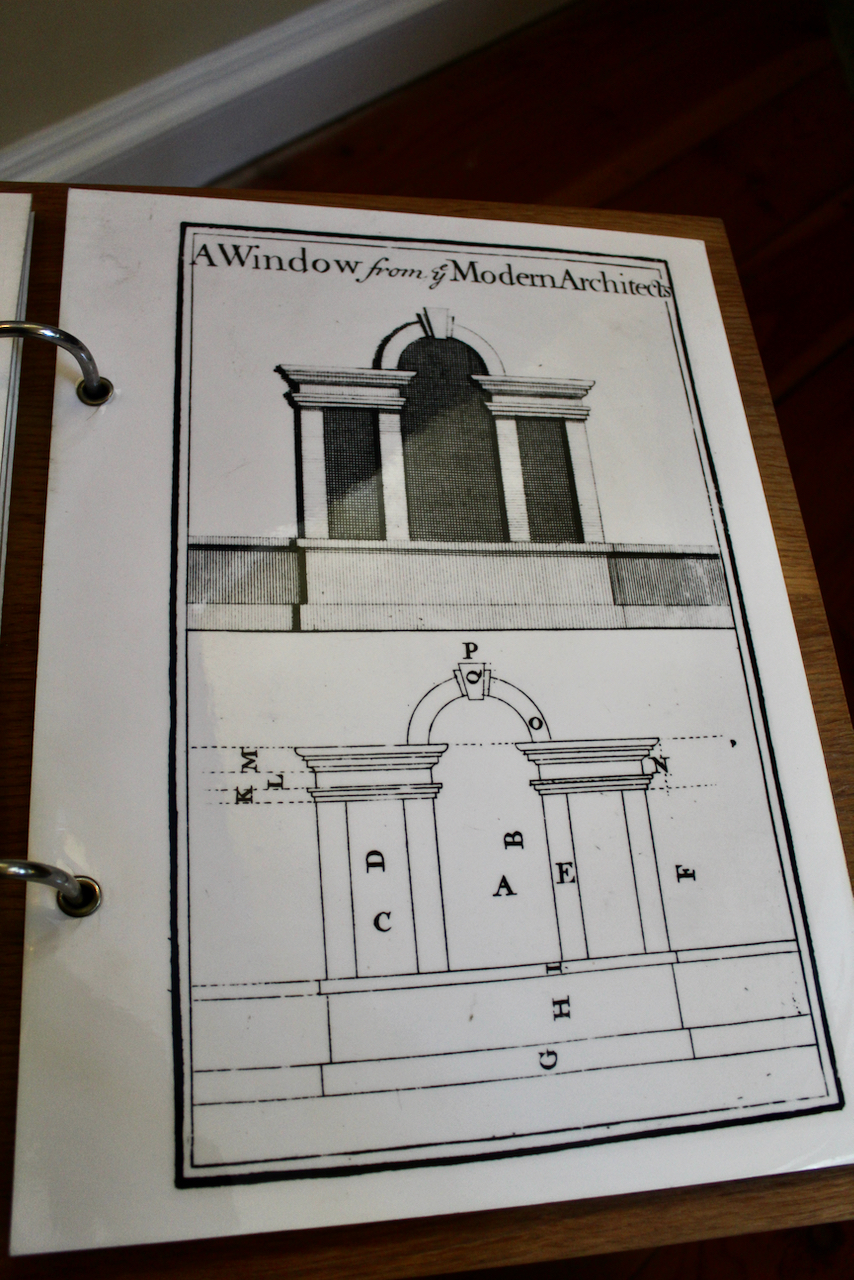
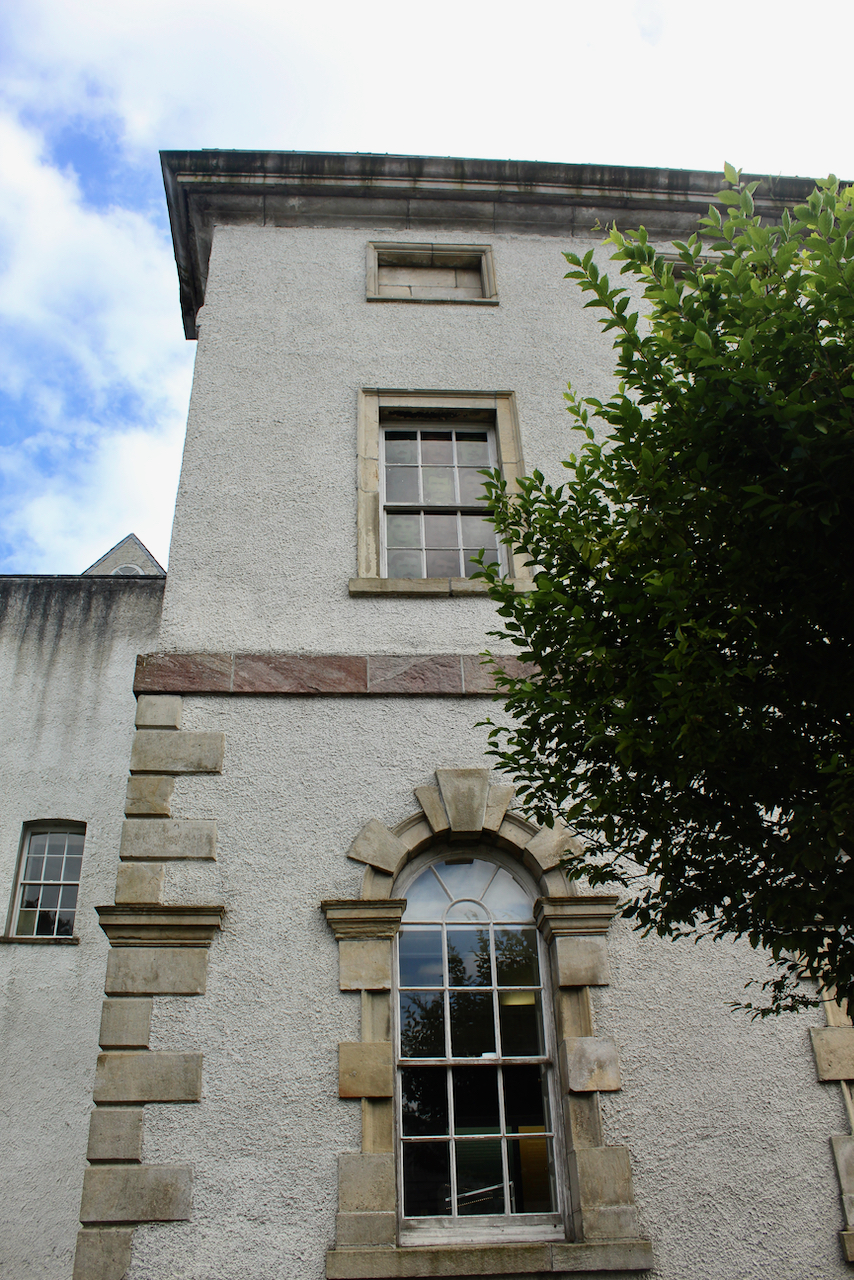
The round-headed ground floor windows with keystones and blocking. Photograph © Jennifer Winder-Baggot, www.irishhistorichouses.com
River-facing facade of King House, courtesy of National Inventory of Architectural Heritage [3]
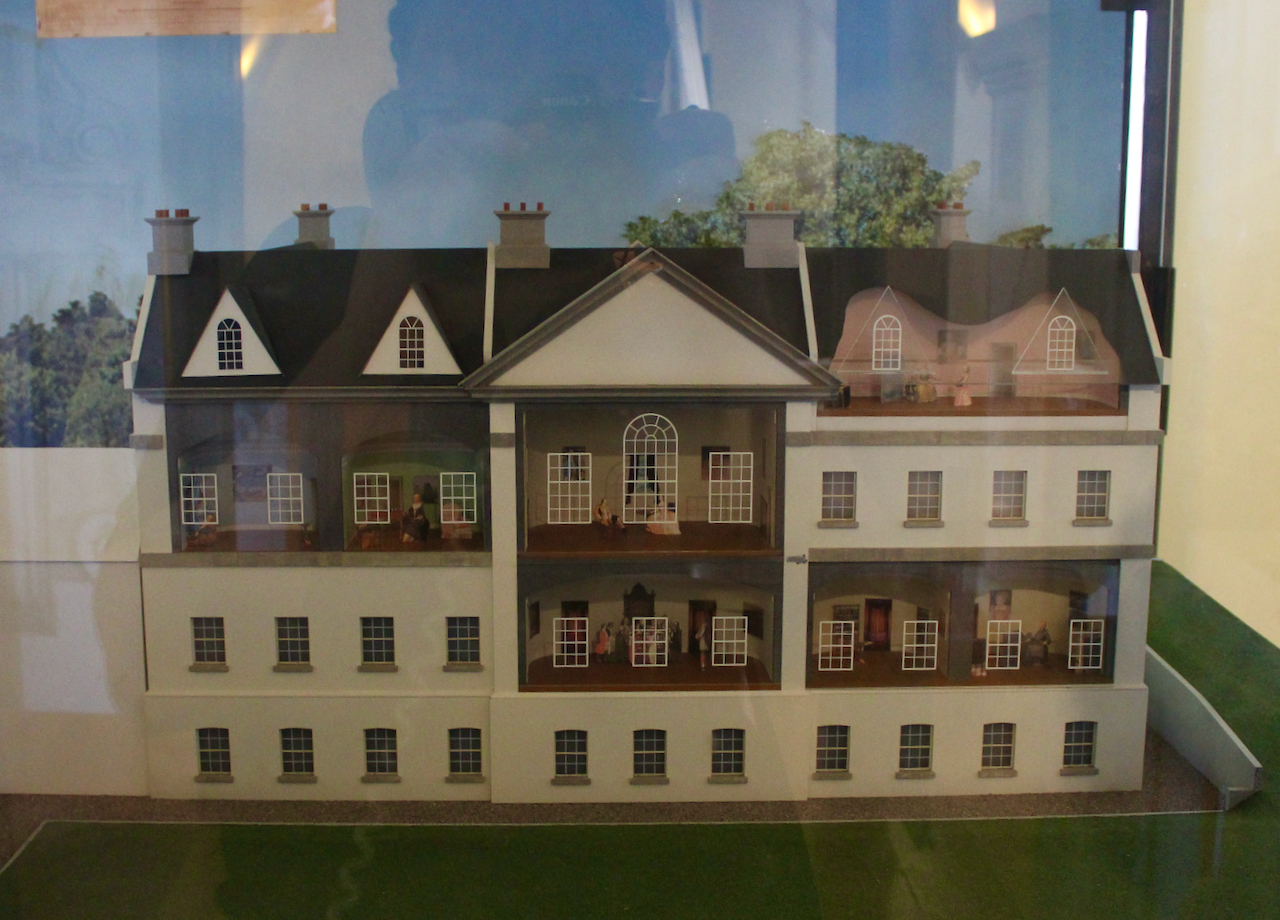
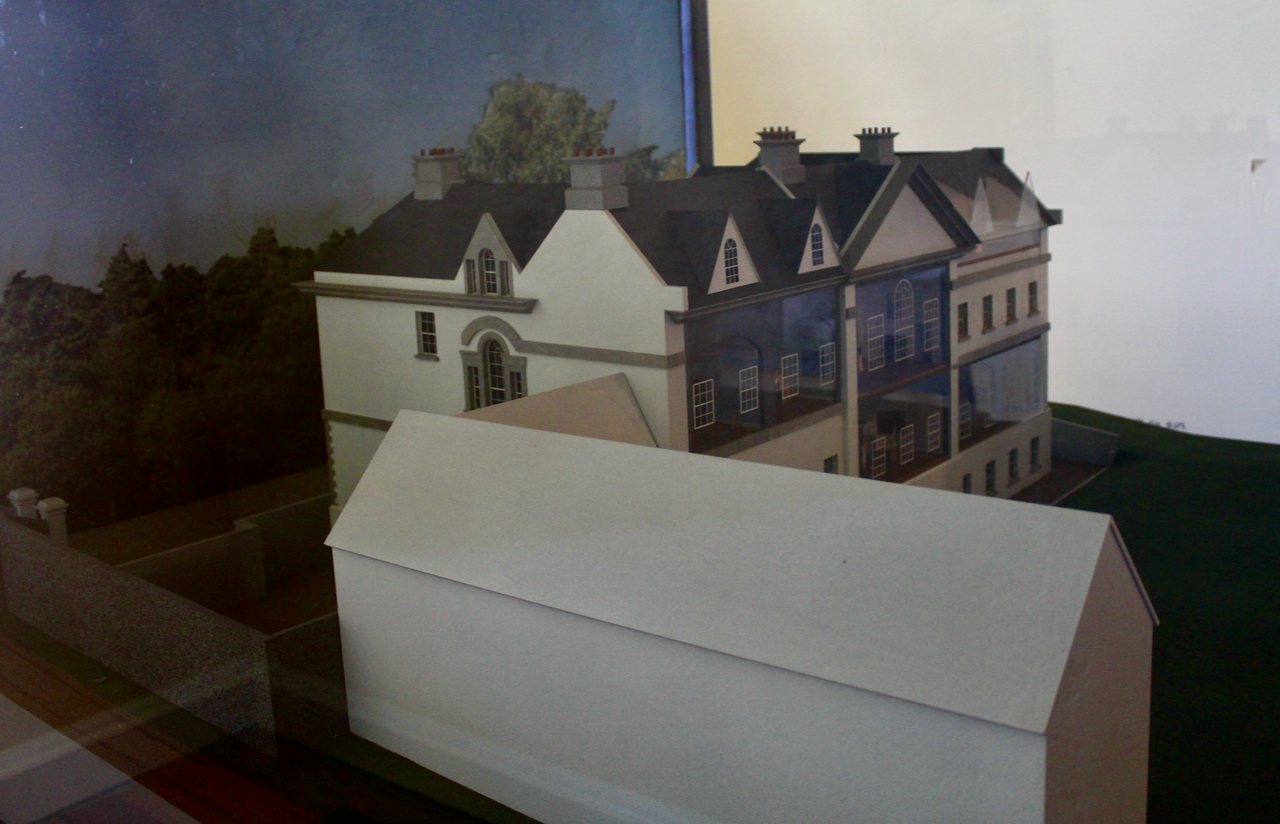
Model of King House, which is inside the house: river facing facade. Photograph © Jennifer Winder-Baggot, www.irishhistorichouses.com
King House, 2022. Photograph © Jennifer Winder-Baggot, www.irishhistorichouses.com
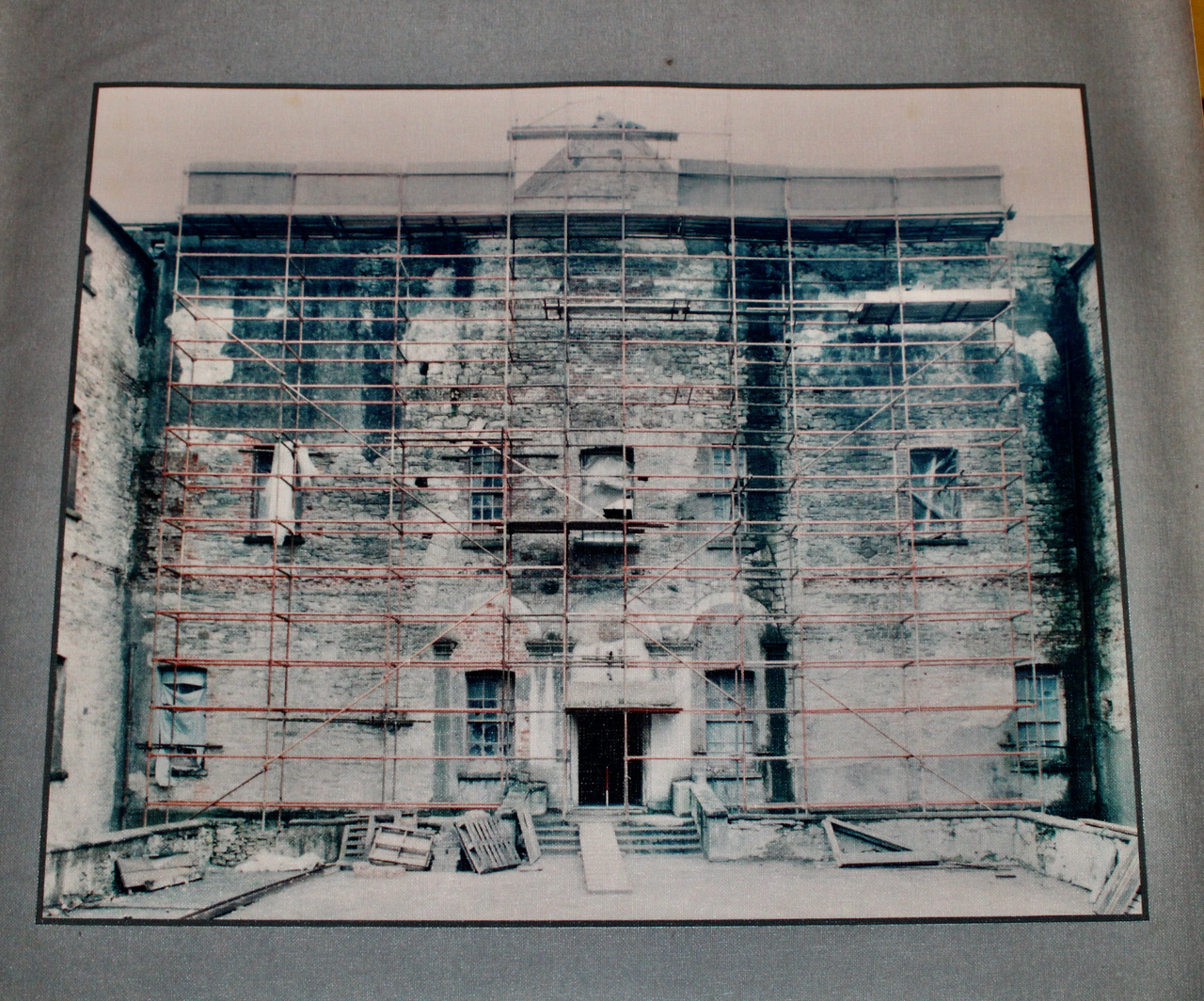
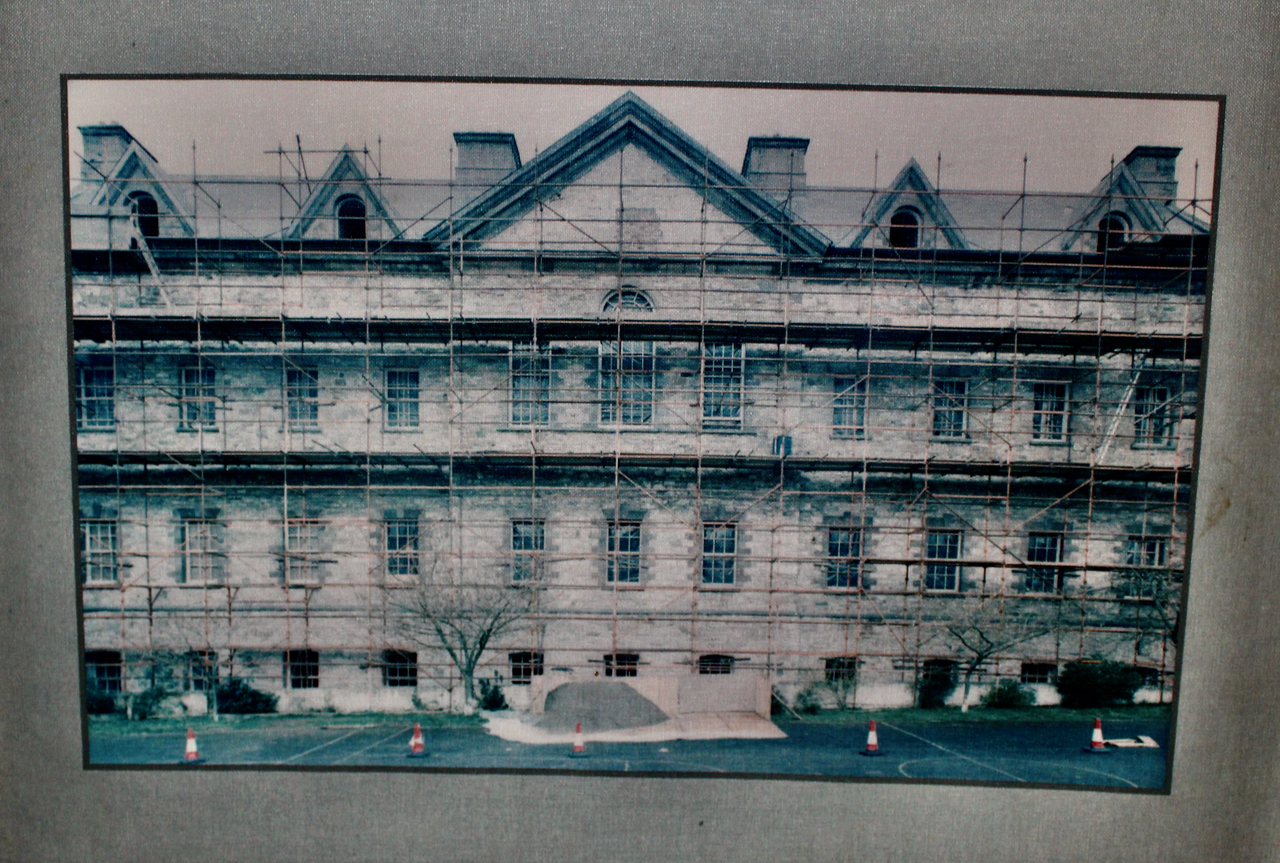
River facade of King House during repair by Roscommon County Council. Work began in 1989 and took over four years, with renovation works designed and supervised by Dublin architects Shaffrey Associates.

The photograph from the National Inventory shows the eleven bay garden front which faces the river, with its three bay pedimented breakfront and large central Venetian window in the upper storey.

The side facades have three Venetian windows, one on top of another, the top being within a gable.

King House, August 2022: side facade with three Venetian windows, the top one being within a gable. Photograph © Jennifer Winder-Baggot, www.irishhistorichouses.com
King House, 2022.
King House, 2022.
King House, 2022.
King House, 2022.
King House, 2022.
In King House.

Bence-Jones points out that: “As at Ballyhaise, County Cavan and King’s Fort, County Meath, there is vaulting in other storeys than just the basement; in fact, all four storeys are vaulted over. This was, according to Rev Daniel Beaufort, a fire precaution, Sir Henry King having naturally been fire-conscious after the fire in the earlier house.

Two wings project from the main centre block of the house, and are each two bays wide. The centre block is three bays wide with a centre triangular gable. Bence-Jones describes the deep cornice over the wings, and the round-headed ground floor windows with keystones and blocking.

King House, 2022. Photograph © Jennifer Winder-Baggot, www.irishhistorichouses.com
The front of King House before repair.

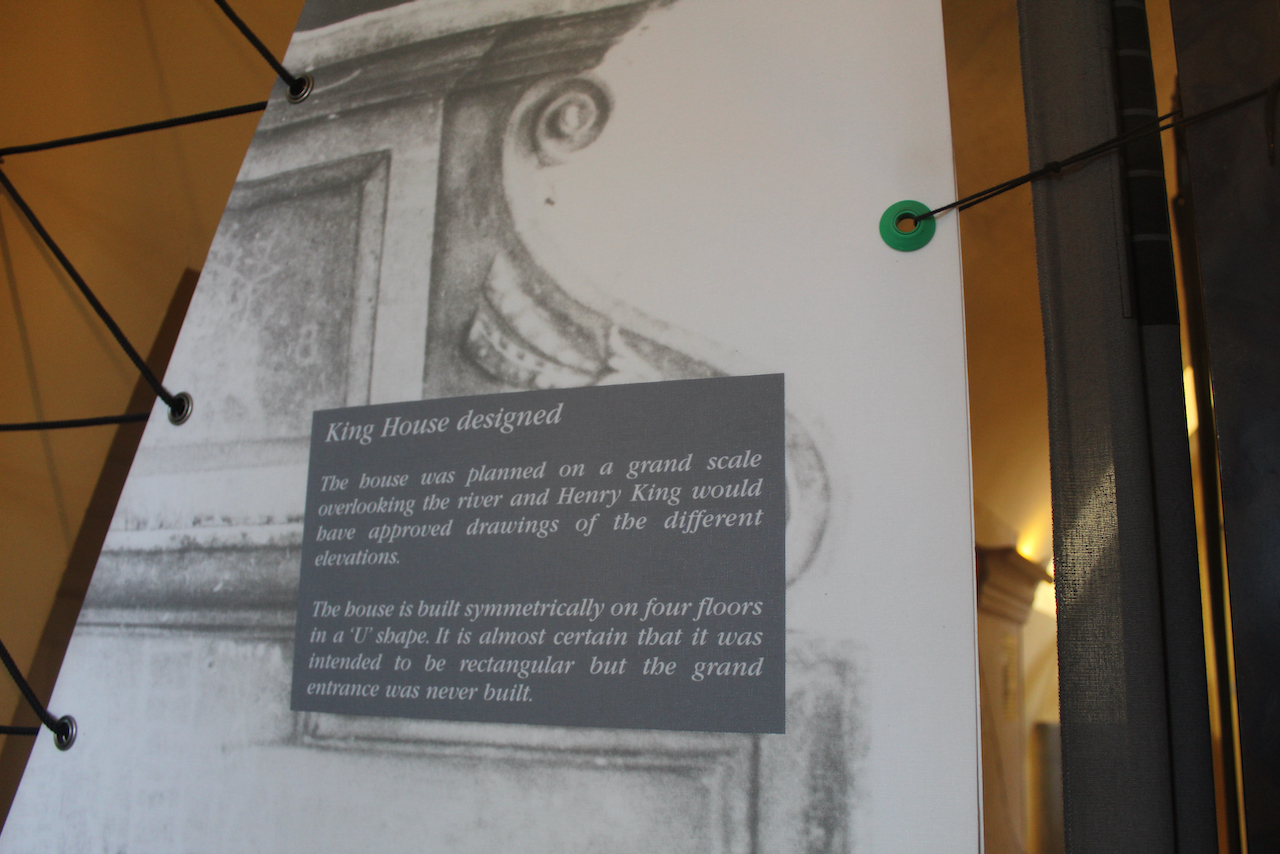
On the front facade Bence-Jones describes a “plain massive doorway.” I find the entire centre front surprisingly plain with few windows, except the large arched ones either side of the doorway and the fanlight over the door, and two dormer windows in the roofline. Inside the museum, in a description of the building it is suggested that the front facade was not completed.

King House, 2022. Photograph © Jennifer Winder-Baggot, www.irishhistorichouses.com
King House, 2022.
King House. Photograph © Jennifer Winder-Baggot, www.irishhistorichouses.com

The National Inventory adds that there is “a seven-bay three-storey extension to south-west with pitched slated roof with piecrust cornice and red brick chimneystacks. Single-storey roughcast-rendered outbuildings to front. Site bounded by rubble stone wall with carved stone gate piers and cast-iron gates.

The second side facade, with its Venetian windows one on top of another and gable windows in the roof. Photograph © Jennifer Winder-Baggot, www.irishhistorichouses.com
Single-storey roughcast-rendered outbuildings to front. Photograph © Jennifer Winder-Baggot, www.irishhistorichouses.com
The side facade and basement. Photograph © Jennifer Winder-Baggot, www.irishhistorichouses.com

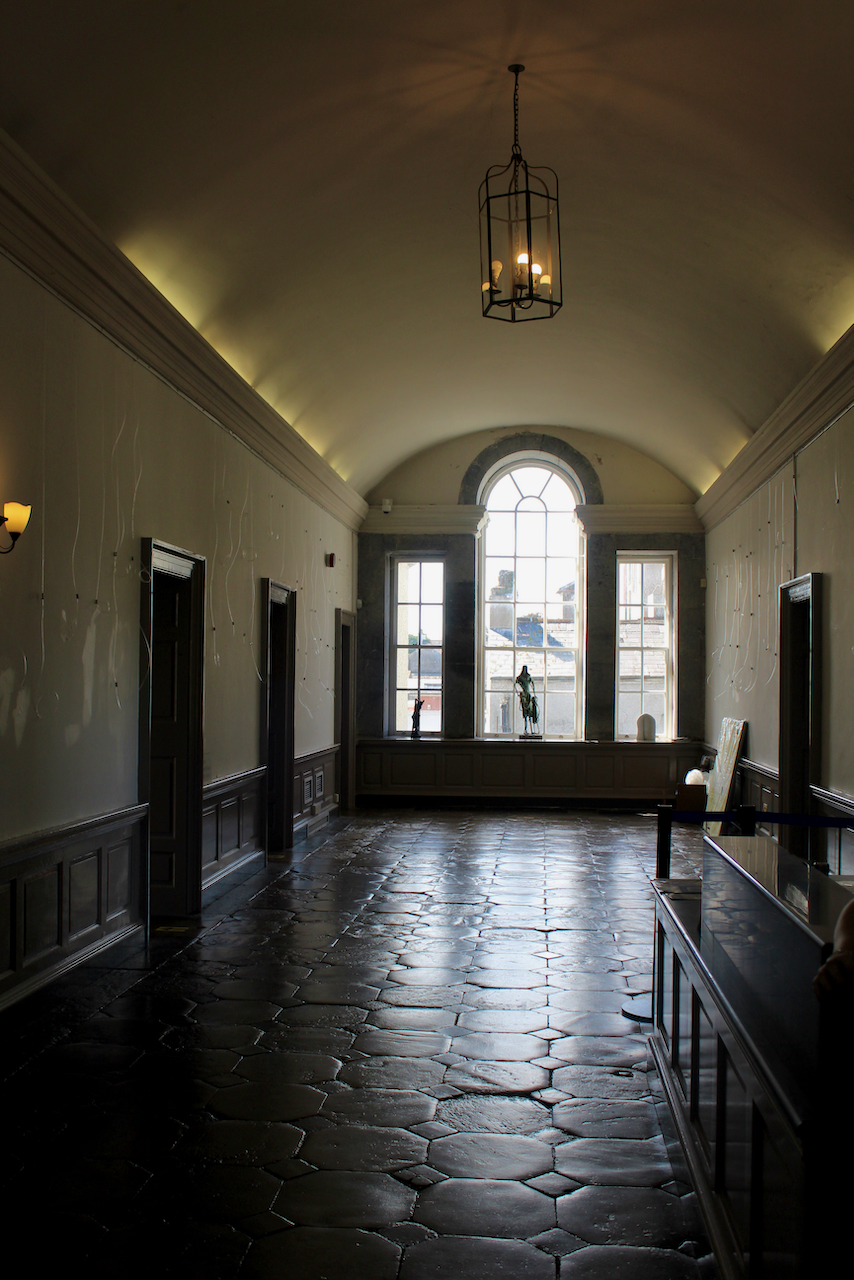
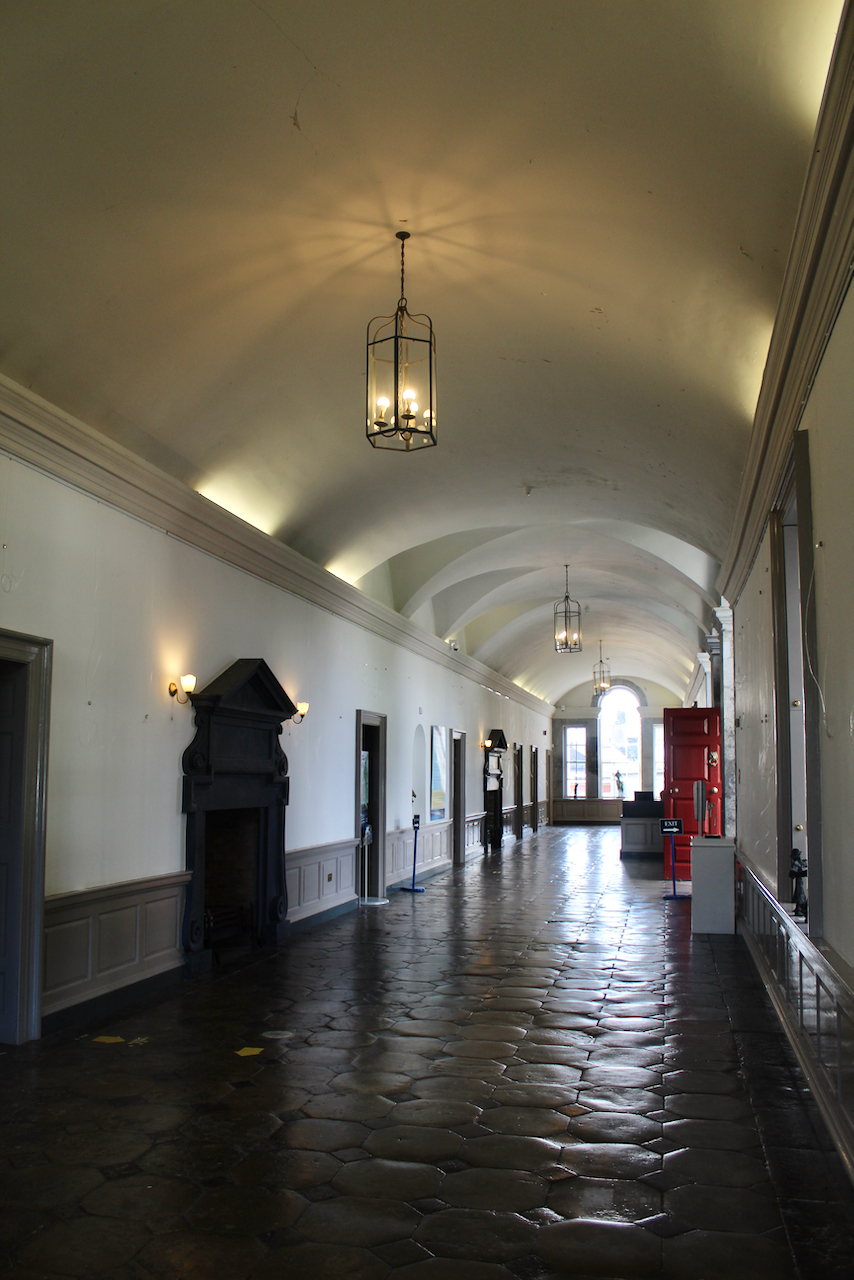
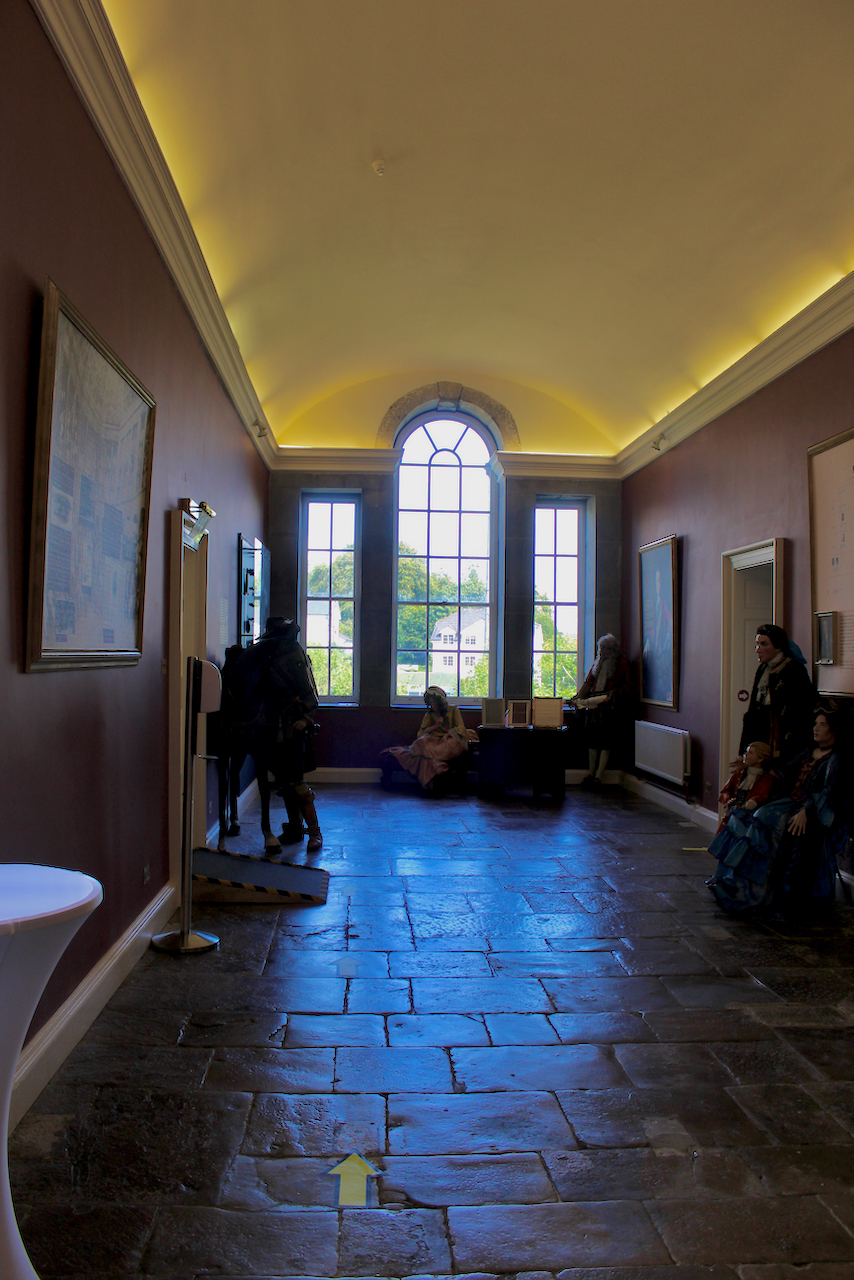
Inside the front door is a long and narrow hall or gallery with lovely flagstone floor, which is original to the house. You can see also the vaulted ceiling, and wood panelling on the walls.

The long gallery front hall, which has the Venetian windows of the side facades of the house at either end. Photograph © Jennifer Winder-Baggot, www.irishhistorichouses.com
King House, 2022. Photograph © Jennifer Winder-Baggot, www.irishhistorichouses.com
Fireplace in front hall. There are two in this hall, one is of Kilkenny marble and the other is a replica. Photograph © Jennifer Winder-Baggot, www.irishhistorichouses.com
King House, 2022. Photograph © Jennifer Winder-Baggot, www.irishhistorichouses.com
King House, 2022.
King House, 2022.
In King House.

Sir Henry King, 3rd Baronet of Boyle Abbey, served as MP for either Boyle or County Roscommon for thirty three years. He married Isabella Wingfield, daughter of Edward Wingfield of Powerscourt, County Wicklow (her brother was the 1st Viscount of Powerscourt). Henry died in 1739 and was succeeded by his son Robert (1724-1755), 4th Baronet of Boyle Abbey.

Robert 4th Baronet became MP for Boyle also and was created Baron Kingsborough in 1748. It was he who bought the house in Henrietta Street in Dublin. He became Grand Master of the Freemasons in Ireland. He died unmarried. On his death, the Barony of Kingsborough became extinct.

Robert King (1724-1755), 4th Baronet of Boyle Abbey, by Robert Hunter. He was created 1st Baron Kingsborough, but having no offspring, the title died with him.
Robert King, created Baron Kingsborough, died 1755, painting by Robert Hunter, courtesy Adam’s auction 11th Oct 2016. The sales catalogue tells us what the museum does not: Robert King 1724-1755 M.P. for Boyle succeeding Richard Wingfield, succeeded as 4th baronet in 1740 and was made Baron Kingsborough at the age of 23 in 1747, having fought a notorious duel with Captain Johnston. He borrowed the large sum of £40,000, became Grand Master of the Freemasons, set the family up in Henrietta Street and lived with a mistress, Mrs. Jones. He died unmarried and his will was bitterly contested by his surviving brothers as far as the House of Lords in London, Edward claimed that Kingsborough was subjected to undue influence by Mrs. Jones, “a common prostitute,” and that the will was witnessed by a drunken porter and a Swiss servant, all such being scoundrels.
Robert King, later 1st (and last) Baron Kingsborough courtesy Adam’s 6 Oct 2009, by Robert Hunter (c.1715/20-c.1803).
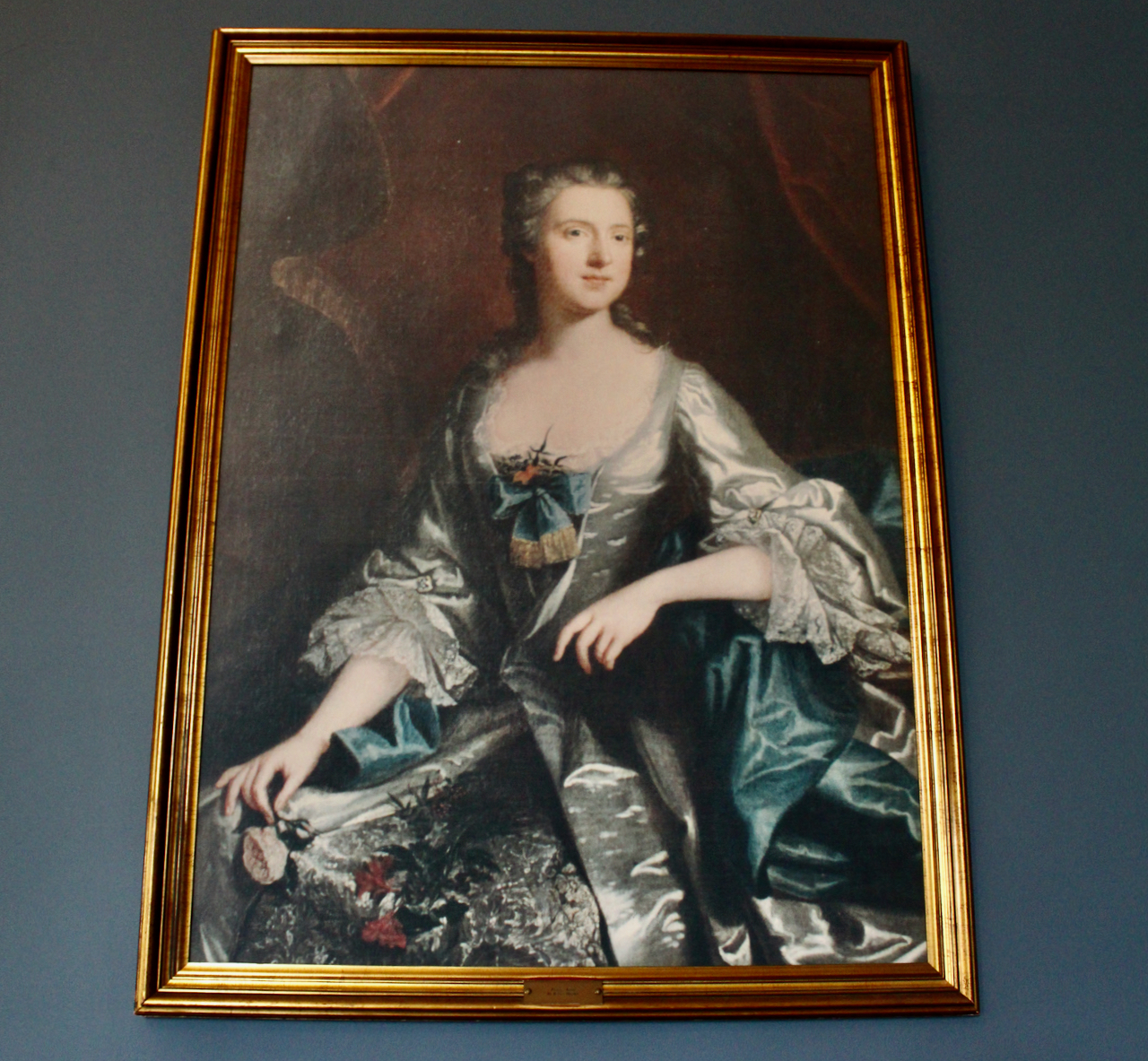
Frances King, by Robert Hunter. Robert’s sister Frances (1726-1812) who married Hans Widman Wood of Rossmead, County Westmeath.
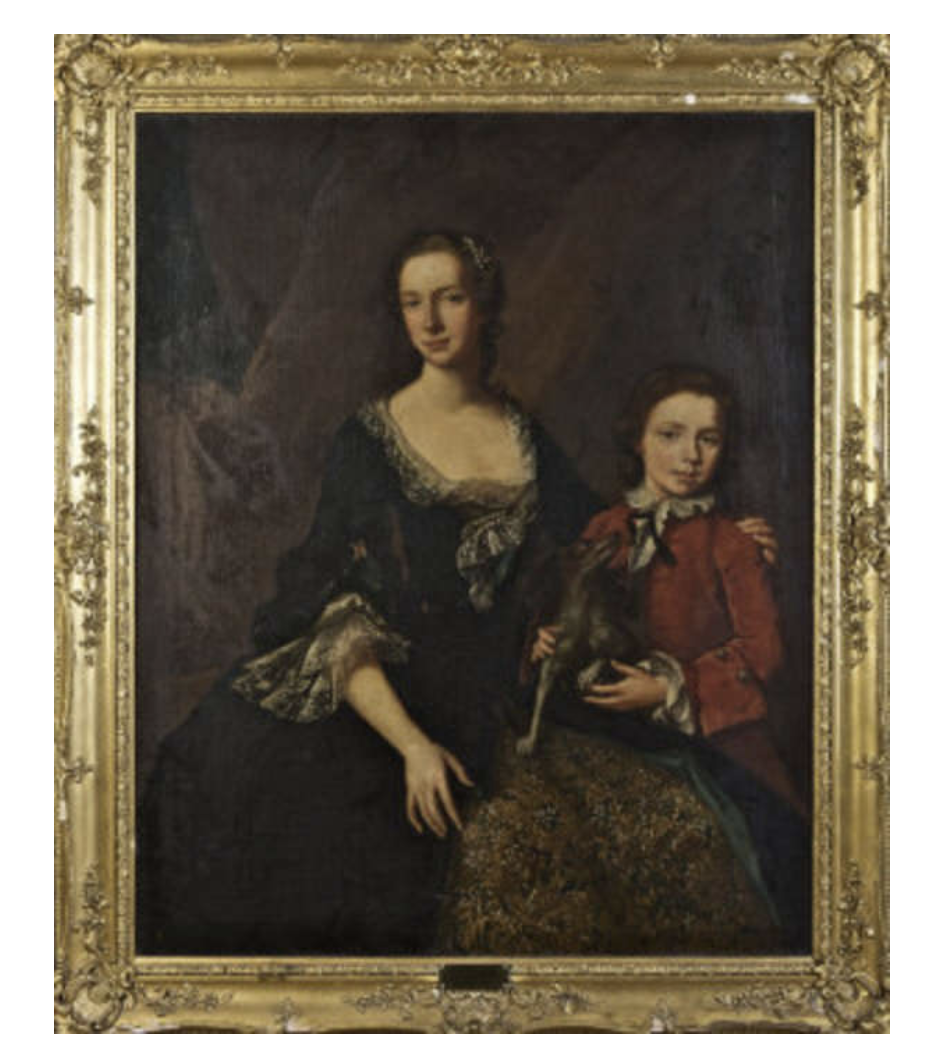
Eleanor King, daughter of Sir Henry King 3rd Baronet of Boyle Abbey and sister of Edward 1st Earl of Kingston, with her son James Stewart (of Killymoon) holding a dog courtesy of Adam’s 6 Oct 2009 by Robert Hunter (c.1715/20-c.1803).
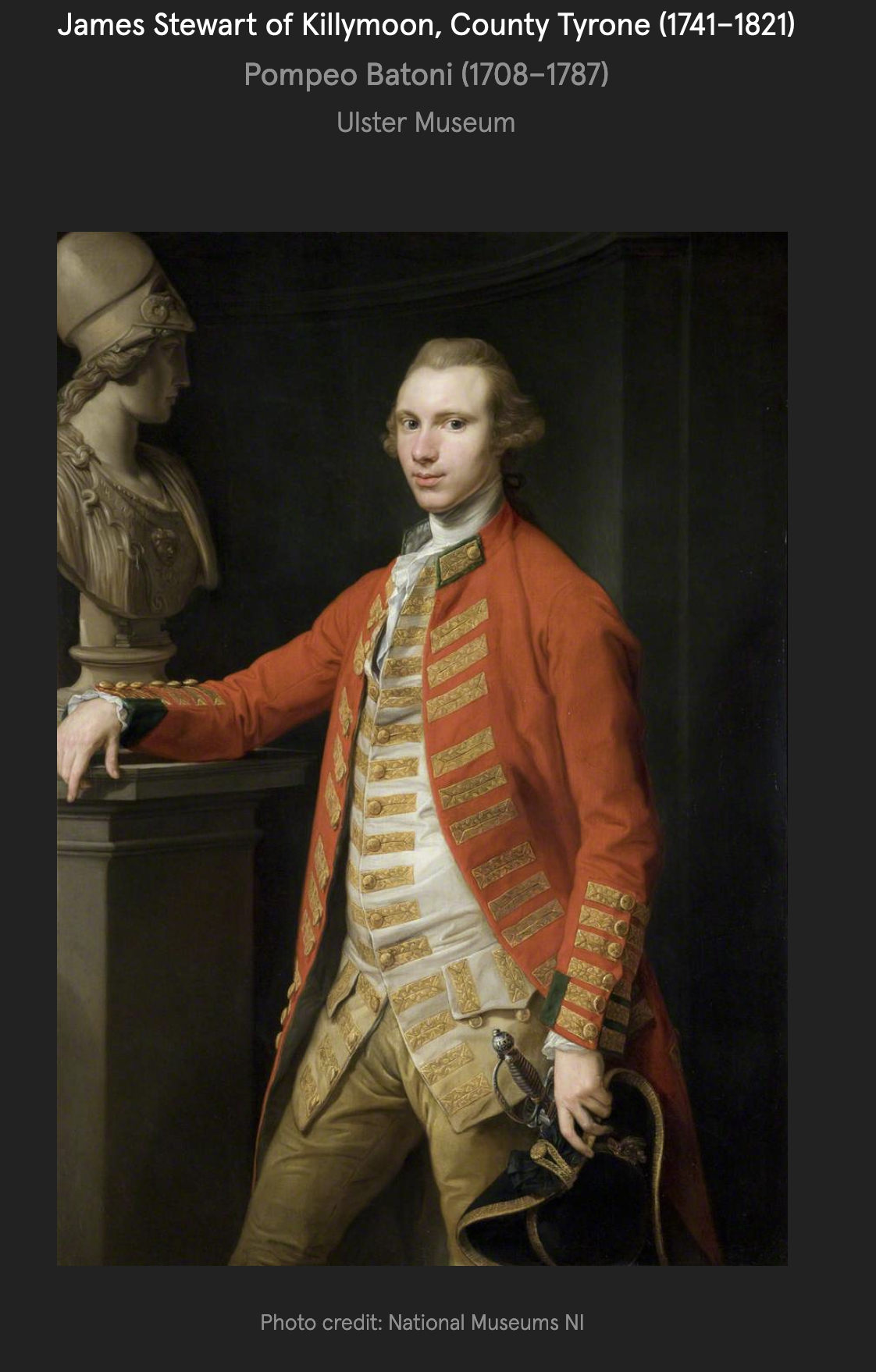
James Stewart (1741-1821) of Killymoon, County Tyrone, by Pompeo Batoni, Ulster Museum, National Museum of Northern Ireland.
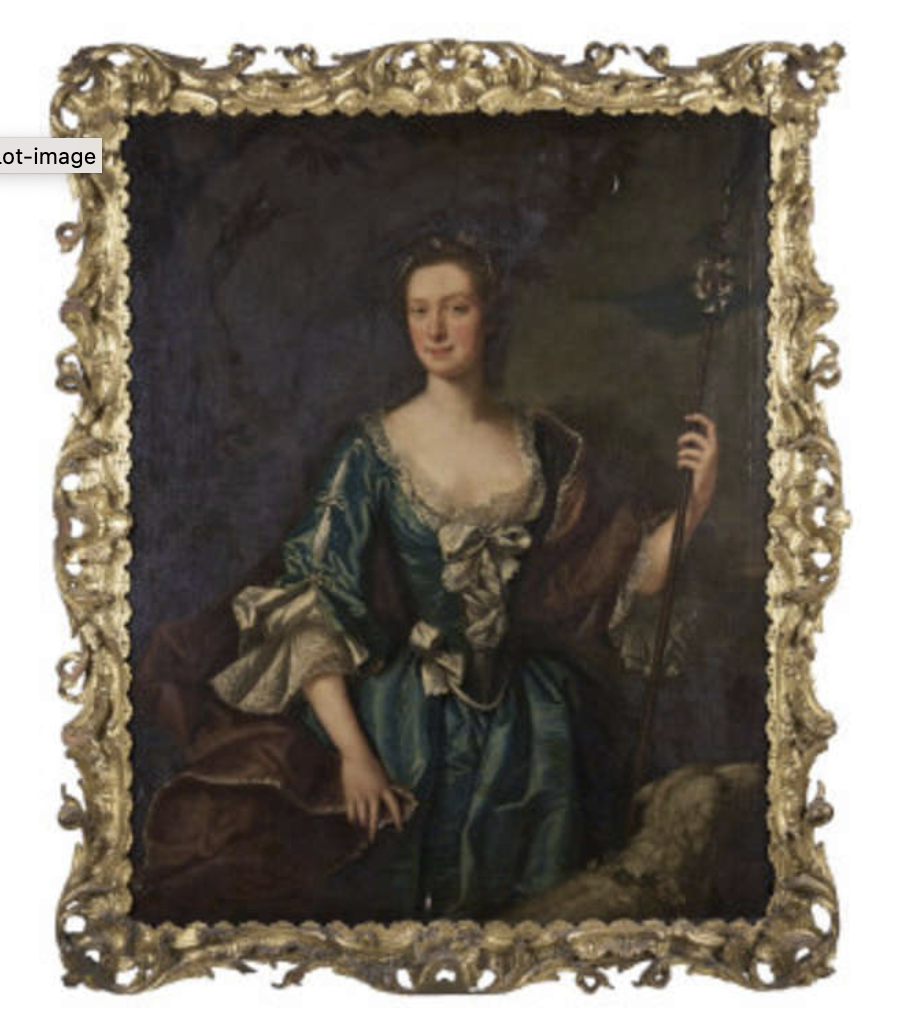
Portrait most likely to be William Stewart of Killymoon married to Isabella King, courtesy of Adam’s 6 Oct 2009 by Robert Hunter (c.1715/20-c.1803).
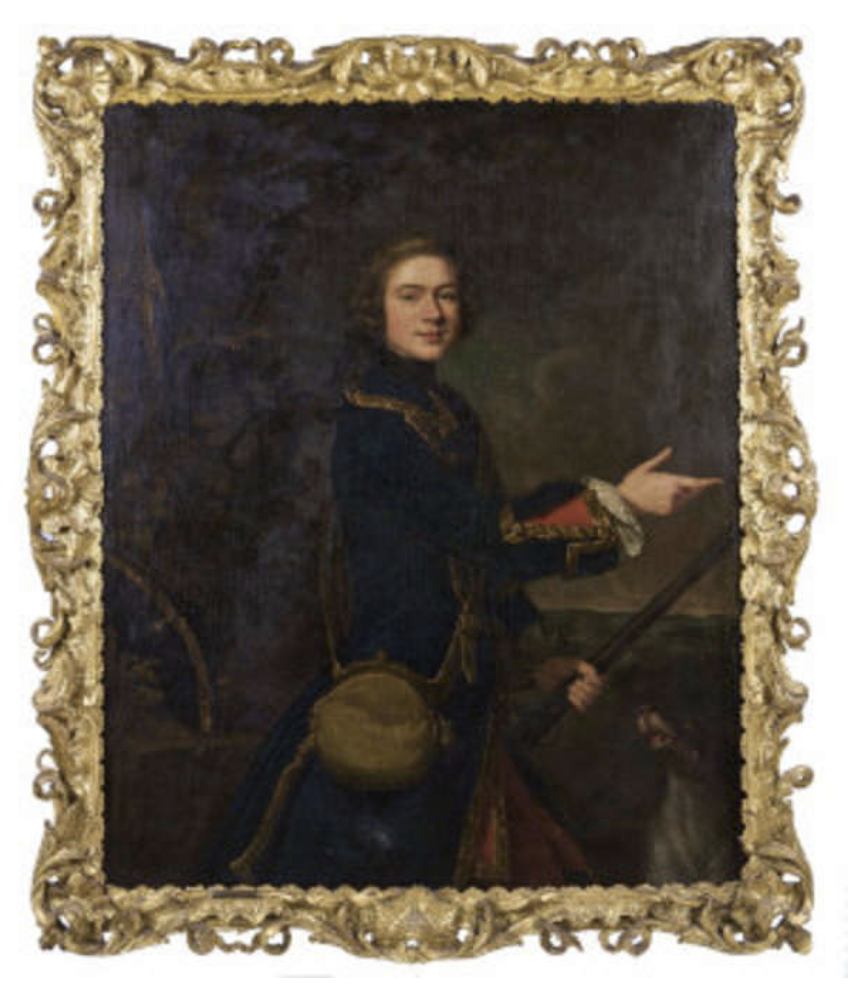
Henry King, Later Rt. Hon. Colonel courtesy Adam’s 6 Oct 2009 by Robert Hunter (c.1715/20-c.1803). He was probably a younger son of Henry King 3rd Baronet of Boyle Abbey, since several of the siblings were painted by Robert Hunter.
Isabella King, daughter of Sir Henry King and sister of 1st Earl of Kingston, wife of Thomas, 1st Earl of Howth courtesy Adam’s 6 Oct 2009 Robert Hunter (c.1715/20-c.1803).
Portrait almost certainly of Anne King, daughter of Sir Henry King and sister of 1st Earl of Kingston, married John ‘Diamond’ Knox of Castlerea, Co. Mayo courtesy Adam’s 6 Oct 2009 by Robert Hunter (c.1715/20-c.1803).
In King House. Photograph © Jennifer Winder-Baggot, www.irishhistorichouses.com

On his death the entailed parts of the estate went to his younger brother Edward (1726-1797), who became 5th Baronet of Boyle Abbey. Edward was also a Grand Master for the Freemasons and MP for County Roscommon, and Privy Counsellor in Ireland. He inherited King House and large parts of the Sligo and Roscommon estates. However, a later will of his brother was found after his brother’s death, and all the unentailed land was left to their younger brother Henry. Henry did not marry but the dispute over inheritance led to lawsuits and caused family rifts, King-Harmon’s book The Kings of King House tells us.

Edward King (1726-1797), 5th Baronet of Boyle Abbey and eventually, 1st Earl of Kingston.

Edward the 5th Baronet married Jane Caulfeild, daughter of Thomas Caulfeild of Donamon Castle, County Roscommon (still standing, it now belongs to the Divine Word Missionaries). Edward was ambitious and when his cousin James King 4th Baron Kingston died in 1761 with no sons, he applied for a peerage and was granted it, becoming the 1st Baron Kingston of the second creation. He built a second mansion in Rockingham, which he called Kingston Hall.

Edward King, later 1st Earl Kingston courtesy Adam’s 6 Oct 2009 by Robert Hunter (c.1715/20-c.1803).

He arranged with 4th Baron Kingston that his son would marry the heir to Mitchelstown, Caroline Fitzgerald. The 4th Baron Kingston’s son William predeceased him in 1755, dying childless. The 4th Baron’s daughter Margaret married Richard Fitzgerald, son of the 19th Earl of Kildare. Their only child was a daughter, Caroline (1754-1823).

Robert Fitzgerald (1675-1744) 19th Earl of Kildare, after Frederick Graves, courtesy of Adam’s auction 15th Oct 2019.

By marrying into the family of the Barons of Kingston, Mitchelstown came into the family of the Baronets of Boyle Abbey. Caroline and Edward’s son Robert were to marry when just 15 and 16 years old.

King House, 2022.
In King House.

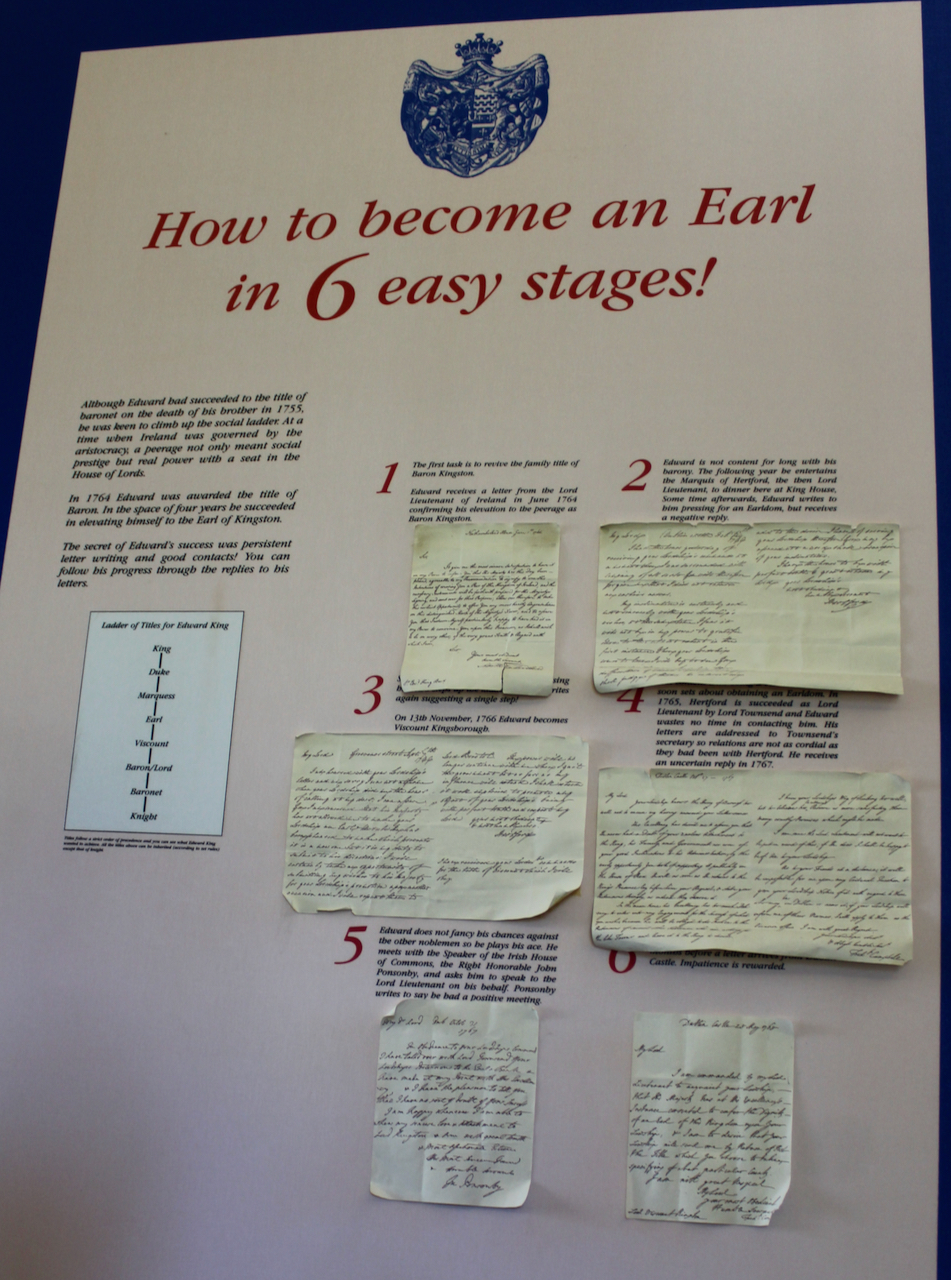
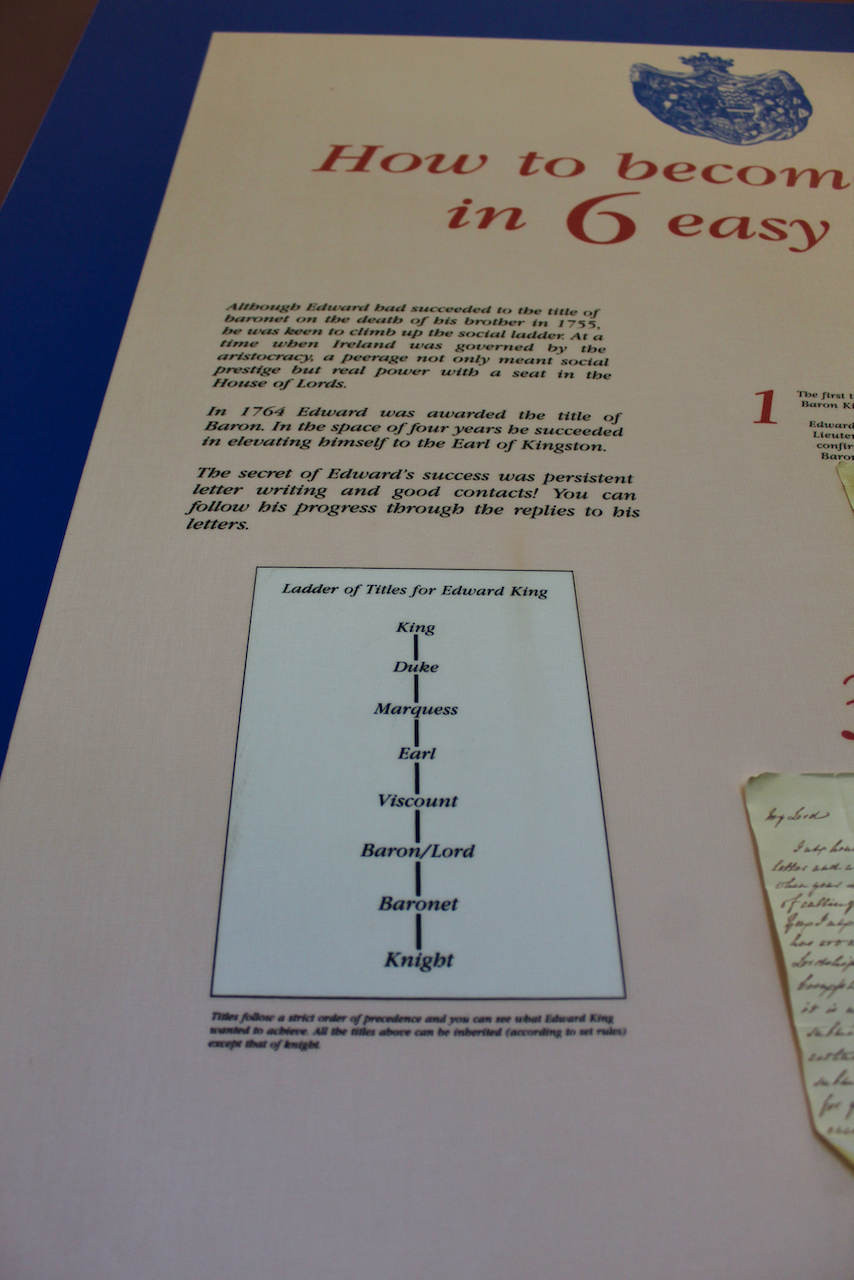
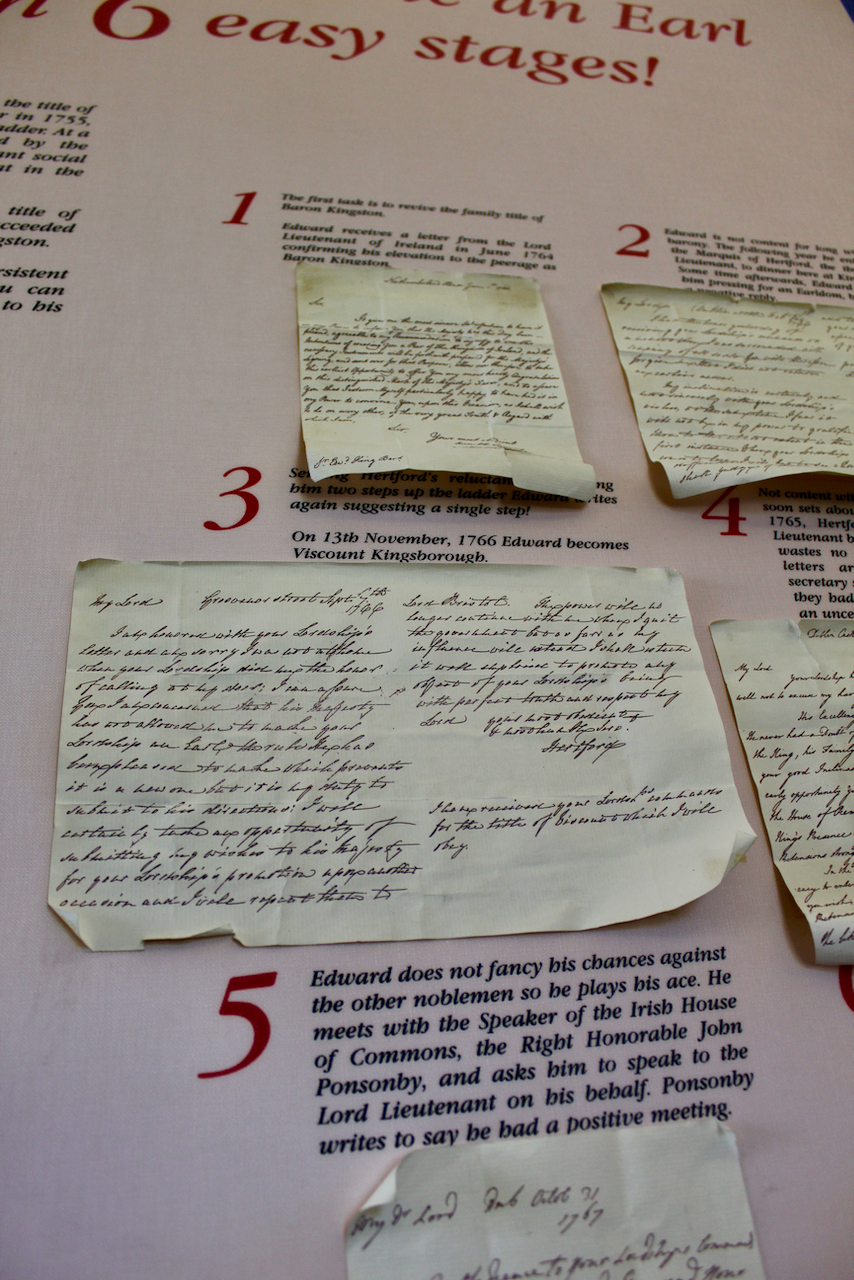
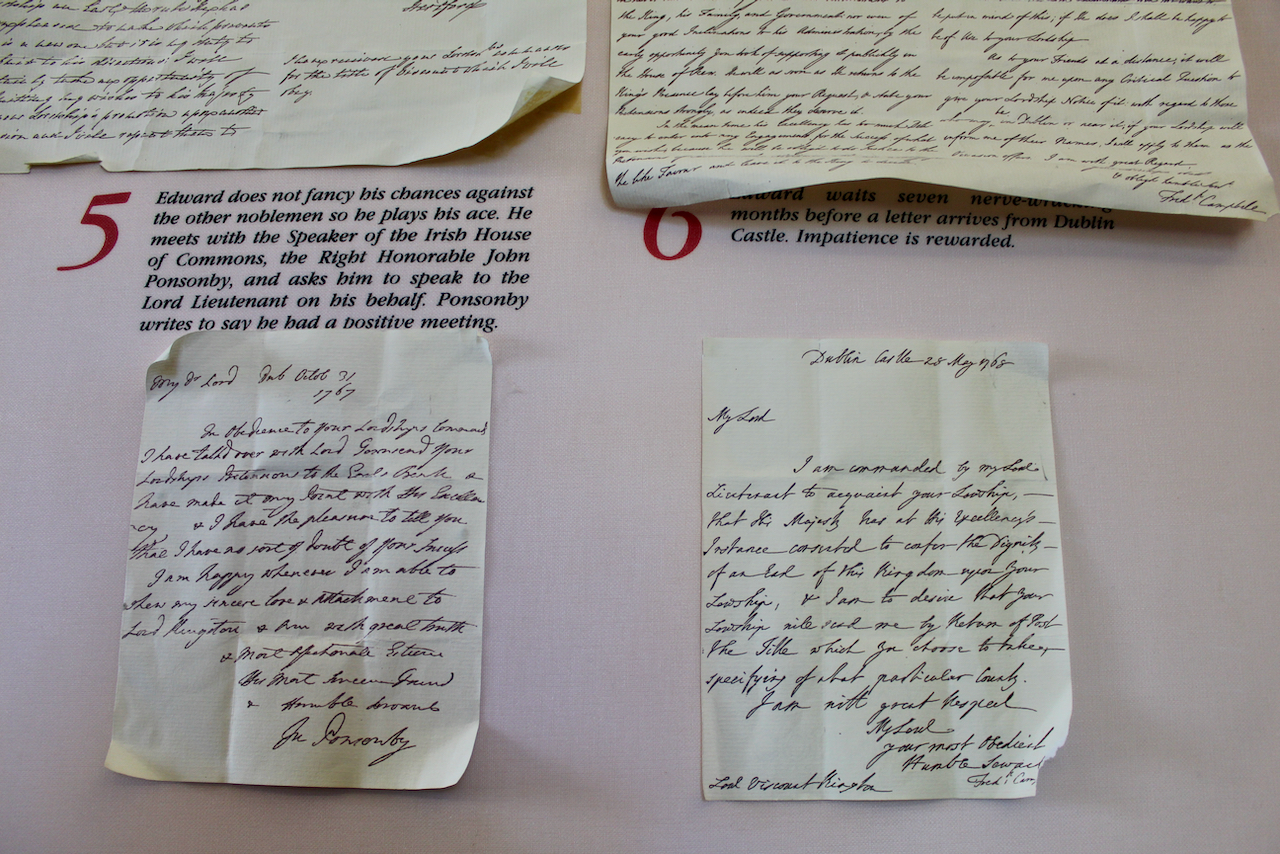
Meanwhile Edward, after intense lobbying, had become Viscount Kingsborough in 1767 and Earl of Kingston in 1768.

King House, 2022.
King House, 2022.
King House, 2022.
King House, 2022.
In King House.

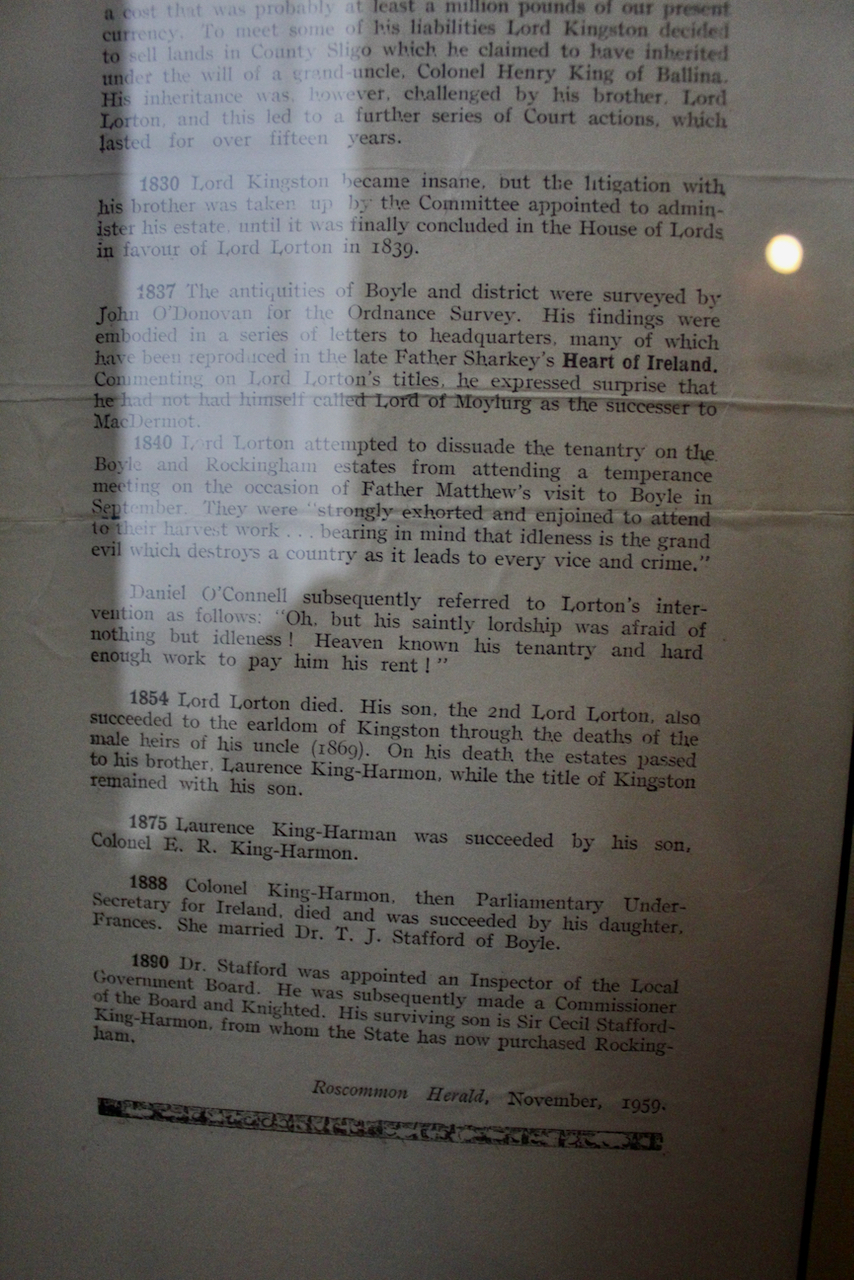
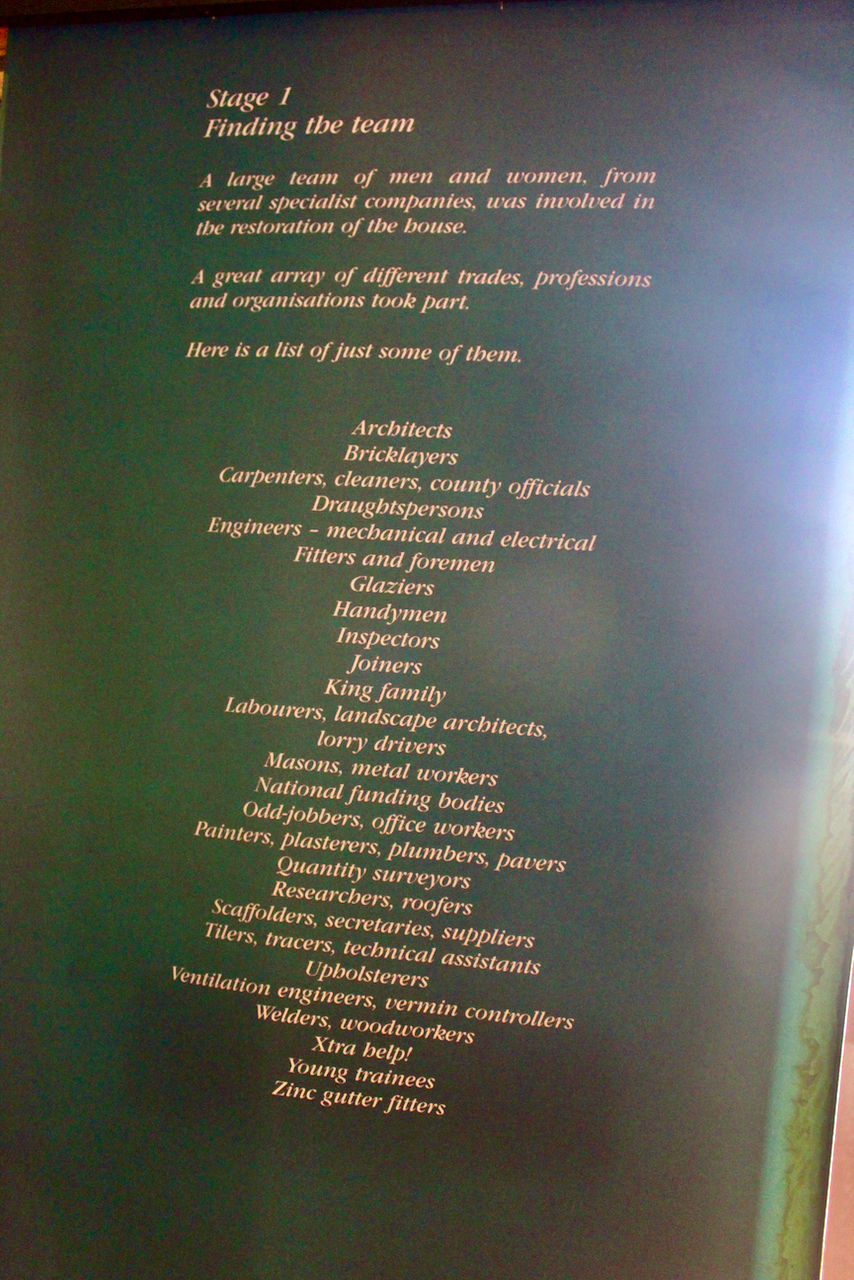
Edward, now Earl of Kingston, and his family moved into Kingston Hall in 1771, and King House was kept as a second residence, but following a fire in 1778, Edward decided to dispose of it. It was bought by the British army in 1795, and became the depot of the Connaught Rangers until taken over by the Irish army in 1922. It was abandoned and in ruins by 1987 when bought by Roscommon County Council, and it was restored and opened to the public in 1995.

King House, 2022.
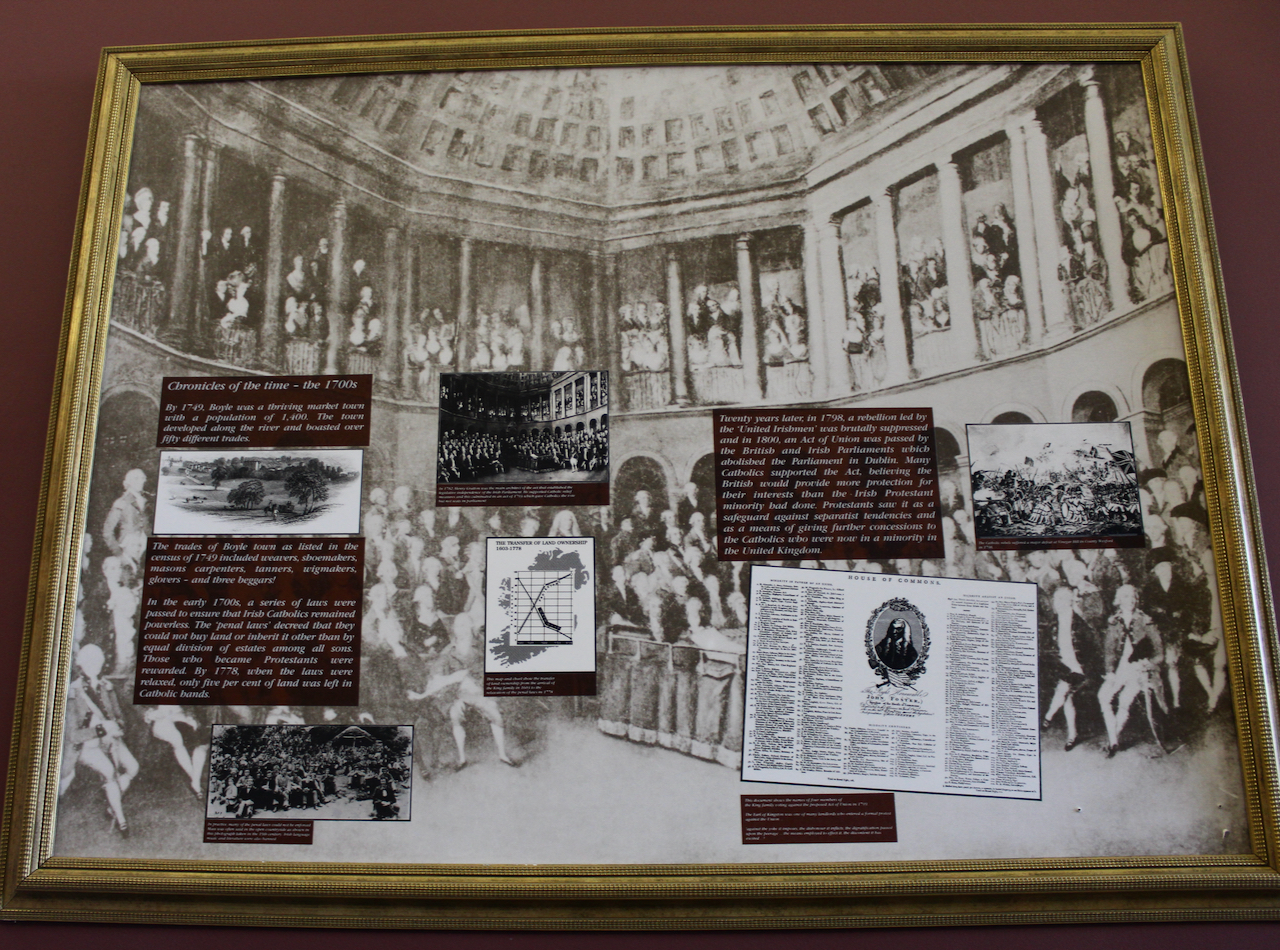
Information in King House about Boyle in the 1700s.
King House, 2022.
King House, 2022.
In King House.

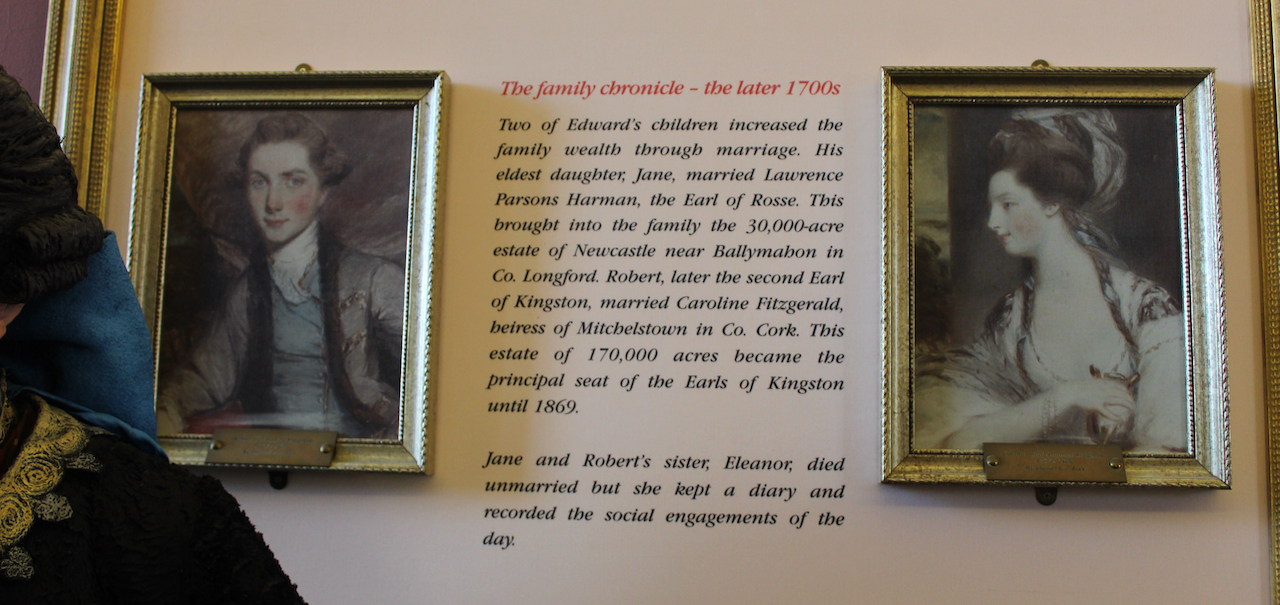
Edward Earl of Kingston’s daughter Jane married Laurence Harman Parsons (1749-1807), son of Laurence Parsons, 3rd Baronet, who was later created 1st Earl of Rosse, and Anne Harman. Lawrence Harman Parsons changed his surname to Harman.

In King House.

The 1st Earl of Kingston’s daughter Frances married Thomas Tenison, and their son Lt.-Col Edward King-Tenison lived in Kilronan Castle in County Roscommon and his wife, Lady Louisa Mary Anne Anson, was the origin of the use of the word “loo” for toilet! (according to The Peerage website). I’m not sure why! (Kilronan Castle is now also a hotel, https://www.kilronancastle.ie/ )

His daughter Eleanor died unmarried in 1822.

Eleanor King, died 1822, unmarried, painting by Hugh Douglas Hamilton.
King House, 2022.
In King House. Photograph © Jennifer Winder-Baggot, www.irishhistorichouses.com

Edward’s heir, Robert (1754-1799) became the 2nd Earl of Kingston and married his cousin Caroline Fitzgerald of Mitchelstown when he was just 15.

Robert King, 2nd Earl of Kingston by Hugh Douglas Hamilton.
Caroline, née Fitzgerald, Countess of Kingston, wife of Robert King 2nd Earl of Kingston, by Hugh Douglas Hamilton.

They had nine children but later separated. When young, they lived in London, and toured the world, until they took up residence at Mitchelstown Castle. Mary Wollstonecraft, who later died after giving birth to Mary Shelley née Godwin who wrote Frankenstein, was tutor to the 2nd Earl of Kingston’s children. Mary Wollstonecraft later became a writer, intellecutal and radical, spending time in Paris during the French Revolution, and wrote A Vindication of the Rights of Women, as well as several novels. She remained friendly with King’s daughters, who imbibed Mary’s feminism. Caroline, unhappy in her life with Robert, moved to England, and Robert took a lover, Elinor Hallenan, who bore him two more children.

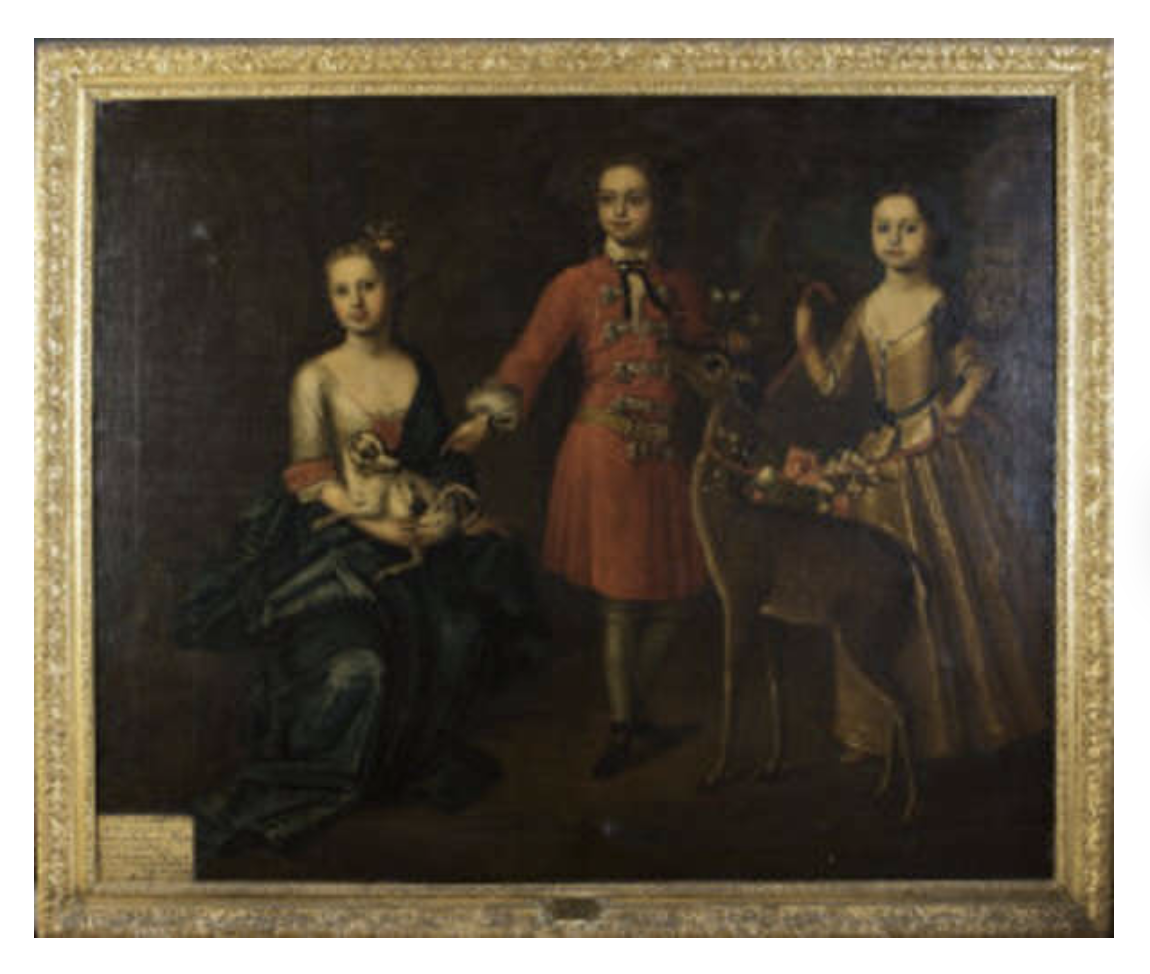
Jeremiah Barrett (d.1770) A conversation portrait of the Children, William, Elizabeth and Margaret King, of James 4th (last) Baron Kingston of Mitchelstown with a pet doe and dog courtesy of Adam’s 6 Oct 2009. The surviving daughter Margaret, daughter of Elizabeth Meade (Clanwilliam), inherited the vast Mitchellstown Estate of the White Knights. She married Richard Fitzgerald of Mount Ophanlis, and their only daughter Caroline married, as arranged, the 2nd Earl of Kingston thus uniting the two branches of the King family. Life at Mitchellstown was recorded by two famous employees of the Kings, Arthur Young the agriculturalist and Mary Wollstonecruft who probably sketched out the basis of Vindication of the Rights of Women whilst governess to the King children. It was not without excitement, in 1799 Lord Kingston shot dead Colonel Fitzgerald, his wife’s illegitimate half-brother in the hotel in Mitchellstown for abducting his 17 year old daughter Mary Elizabeth and his eldest daughter Margaret having married the 2nd Earl of Mount Cashell left him to befriend Shelley in Italy and is The Lady in ‘The Sensitive Plant’. Provenance: Rockingham House.

On 18 May 1798 Robert 2nd Earl of Kingston was tried by his peers in the Irish House of Lords for the murder of Colonel Henry Gerald Fitzgerald, who had seduced the Earl’s daughter. He was acquitted as no witnesses came forward – a benefit of being in the House of Lords was that one was not tried in a general court, but tried in a court consisting of the other members of the House of Lords.

Colonel Henry Gerald Fitzgerald was the illegitimate son of Caroline’s half-brother. Her father had remarried after her mother died. Caroline raised Henry Gerald along with her own family. Caroline brought her daughter Mary with her when she separated her husband and moved to England. It was Mary who was seduced by her cousin, despite him having a wife. As Mary Wollstonecraft later had lovers, perhaps young Mary King was influenced by her governess’s romantic nature. Colonel Fitzgerald regularly visited Caroline and Mary in their new home in London. One day, Mary disappeared, and was found installed in a lodging house, regularly visited by her lover, Colonel Fitzgerald. King-Harman tells the story in The Kings of King House. Her father shot and killed Colonel Fitzgerald.

Another daughter, Margaret, married Stephen Moore, 2nd Earl Mountcashell. Also influenced by Mary Wollstonecraft’s radicalism, she supported the United Irishmen and Anthony Lawrence King-Harman writes that she may have been with Edward Fitzgerald when he was mortally wounded in Dublin. She left her husband for George Tighe (1776-1837) of Rossana, County Wicklow, an Irishman living in Rome, and became close friends with Wollstonecraft’s daughter Mary Shelley. She wrote children’s books and treatises on pre- and post-natal care.

Margaret King (1773–1835) c. 1800 Public Domain, https://en.wikipedia.org/w/index.php?curid=67983213
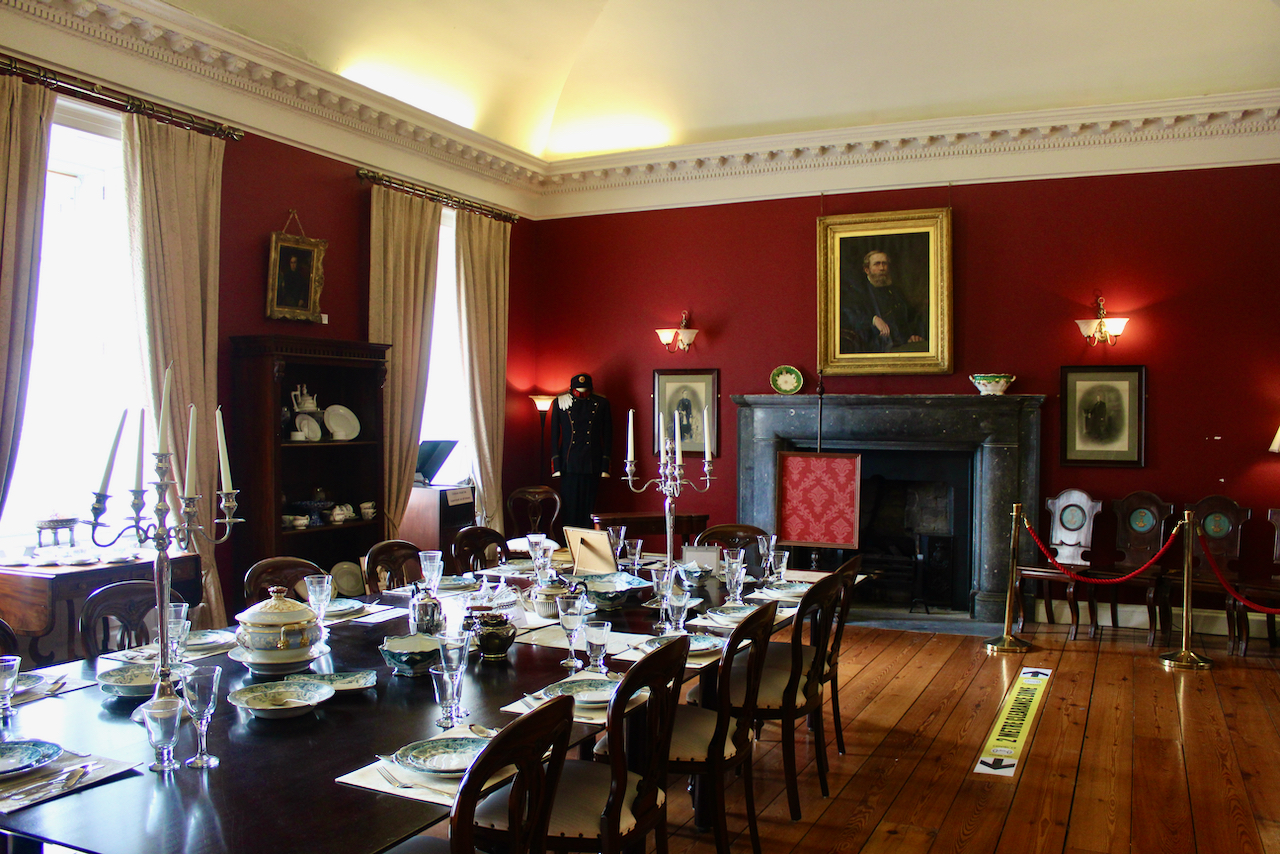
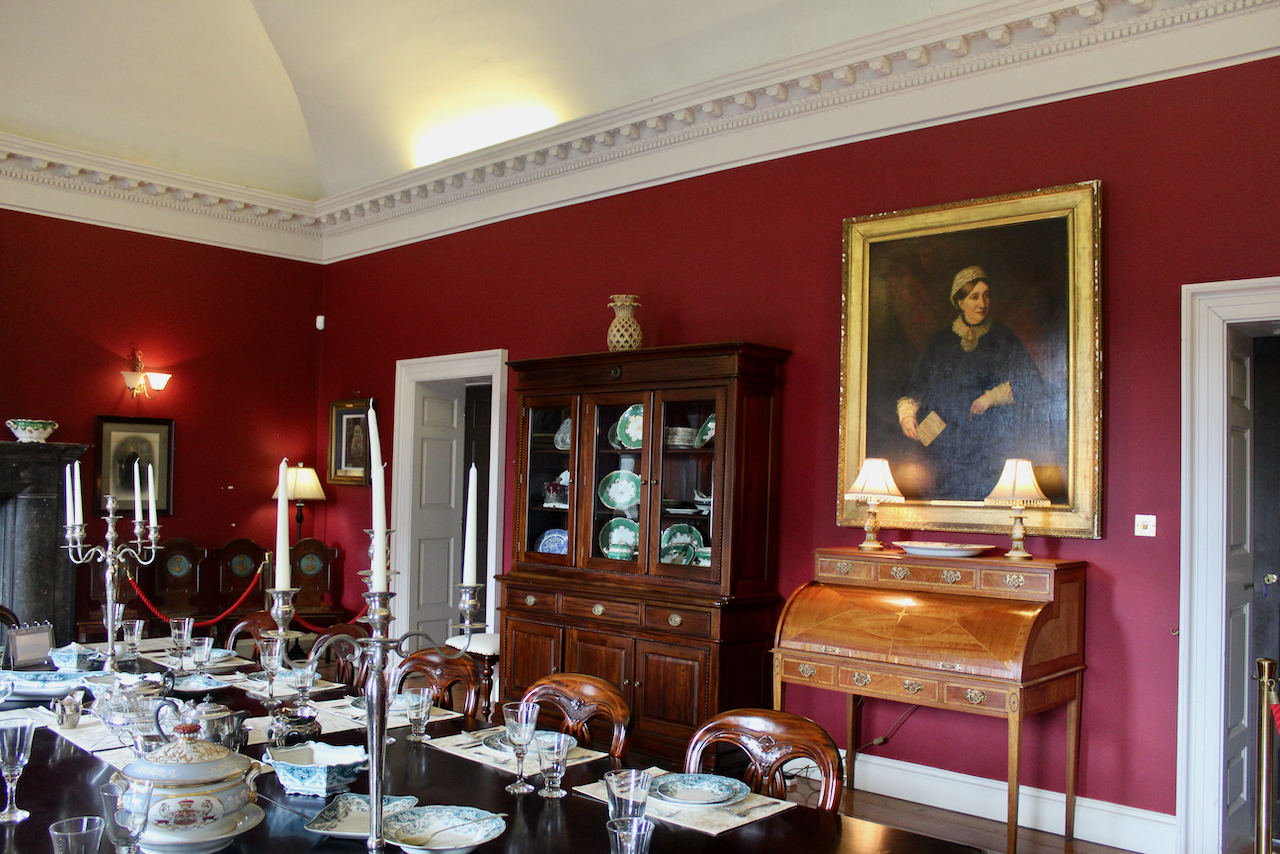
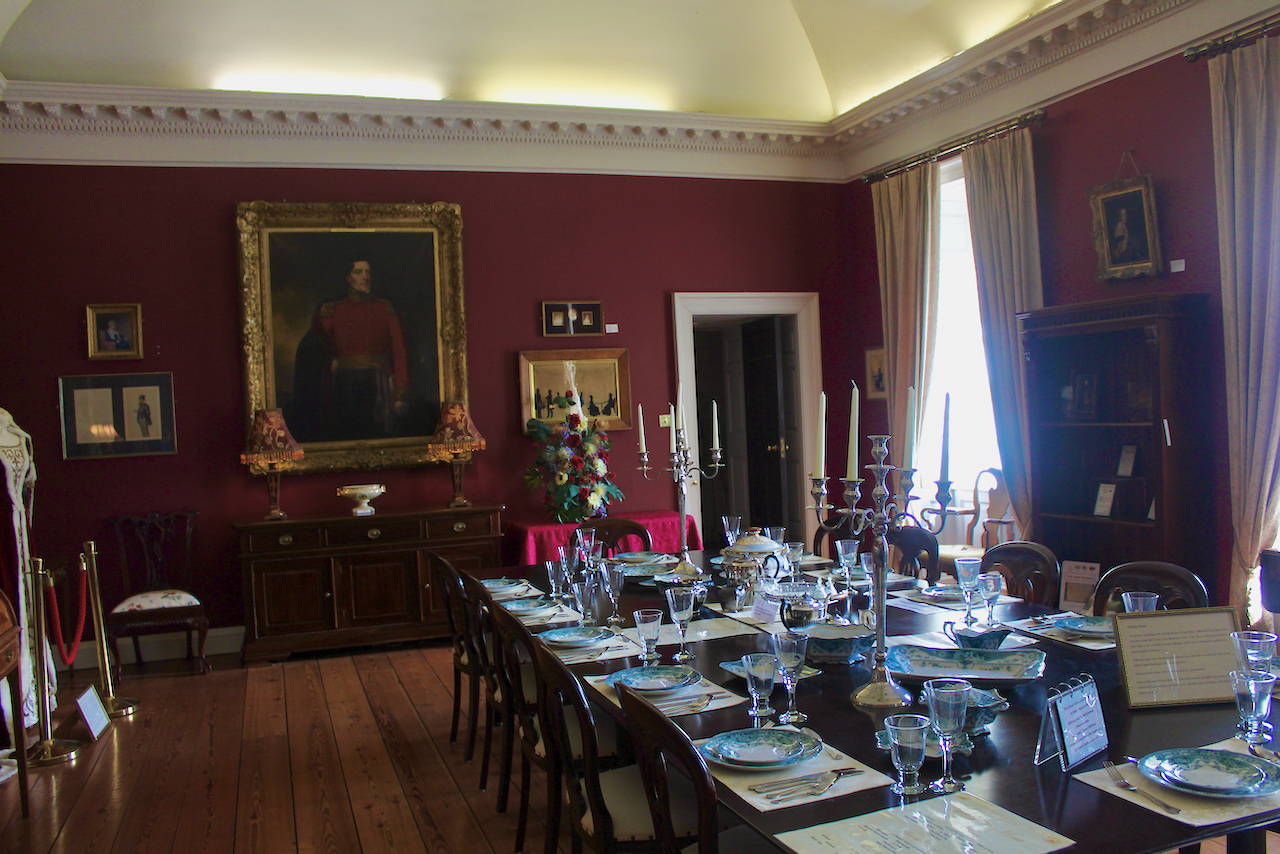
Dining room, King House. Photograph © Jennifer Winder-Baggot, www.irishhistorichouses.com

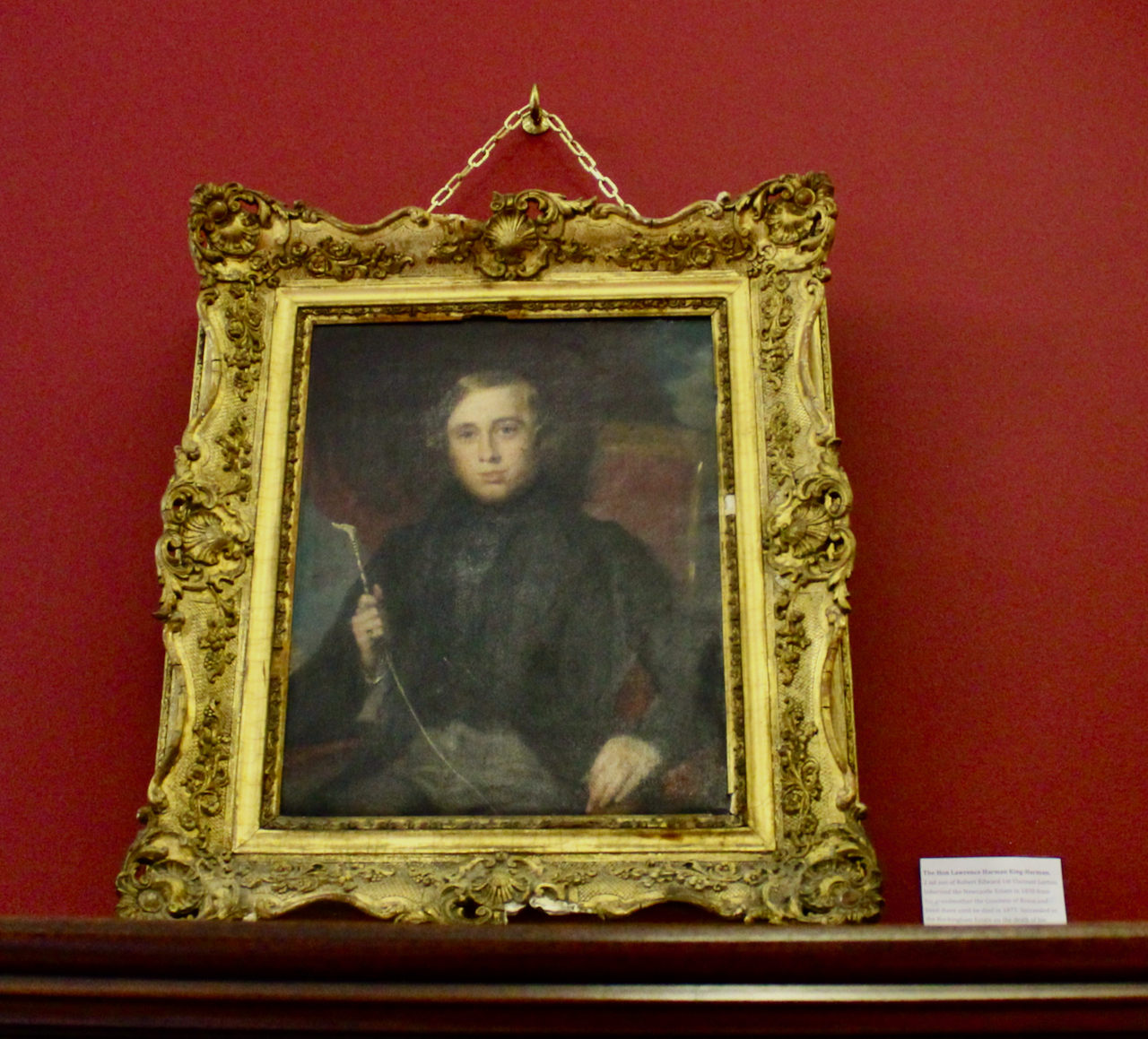
Robert’s son George (1770-1839) became the 3rd Earl of Kingston upon his father’s death in 1797. Robert left the Boyle properties to his second son, Robert Edward (1773-1854), who later became Viscount Lorton, the name chosen from a local place-name.

Brothers George, 3rd Earl of Kingston, Robert, 1st Viscount Lorton, and Admiral James William King, by Hugh Douglas Hamilton.
This large portrait in the dining room is General Robert King (1773-1854), 1st Viscount Lorton, who was the son of Robert King, 2nd Earl of Kingston.

Robert Edward King (1773-1854) inherited Kingston Hall at Rockingham. He joined the military and distinguished himself in the Caribbean. When he inherited in 1797, he returned to Ireland and joined the Roscommon Militia and worked his way up to become a General. With Rockingham, however, came debt. In 1799 he married his first cousin, Frances Parsons Harman, daughter of his aunt Jane who had married Lawrence Parsons Harman (1749-1807), who owned the Newcastle Estate in County Longford. Robert worked hard to reduce the debt, and was a tough landlord, evicting many tenants.

In the centre, Frances née Parsons Harman (1775-1841) who married Robert Edward King (1773-1854). She is flanked by their daughter Jane King, who married Anthony Lefroy, and Frances King, who married Right Reverend Charles Leslie of Corravahan.

Robert Edward was created Baron Erris of Boyle, County Roscommon in 1800 and in 1806, Viscount Lorton of Boyle, County Roscommon. His support of the Act of Union in 1800 would have helped in his rise within the Peerage.
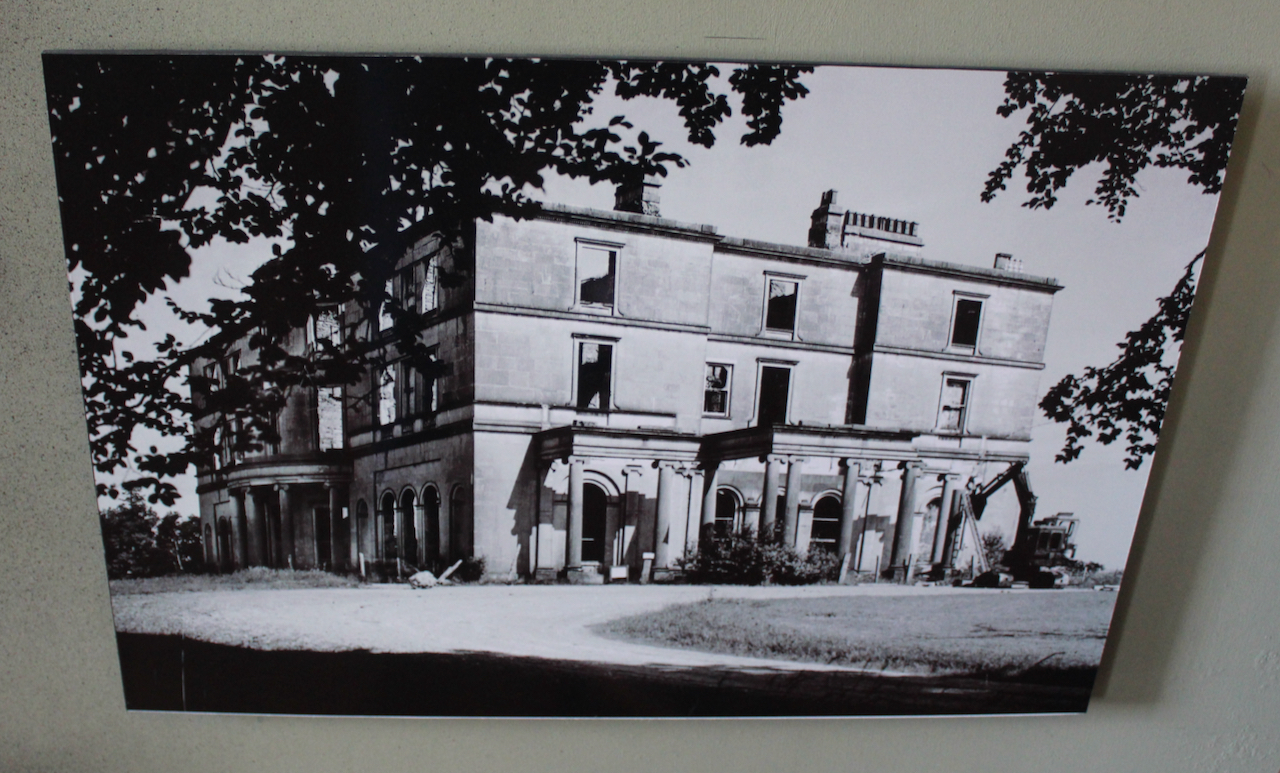
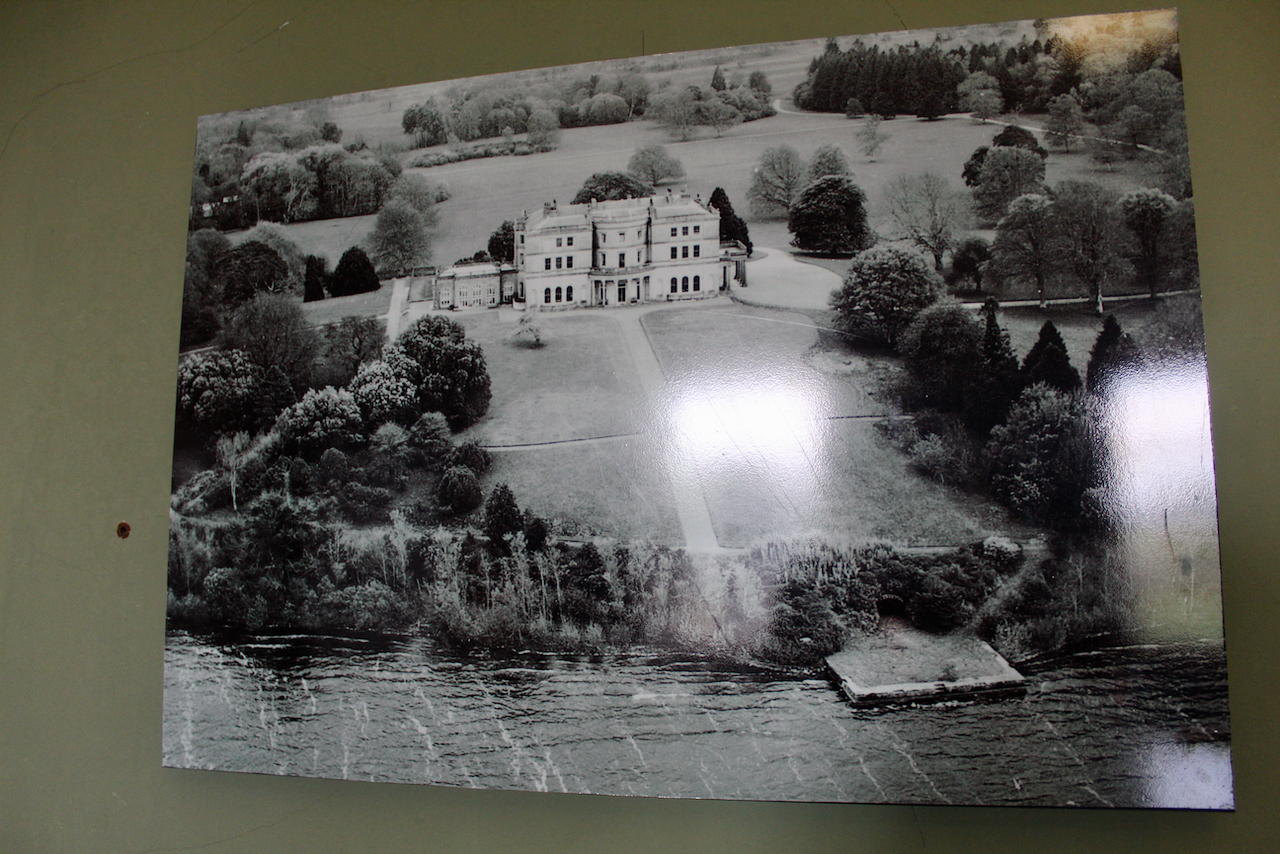
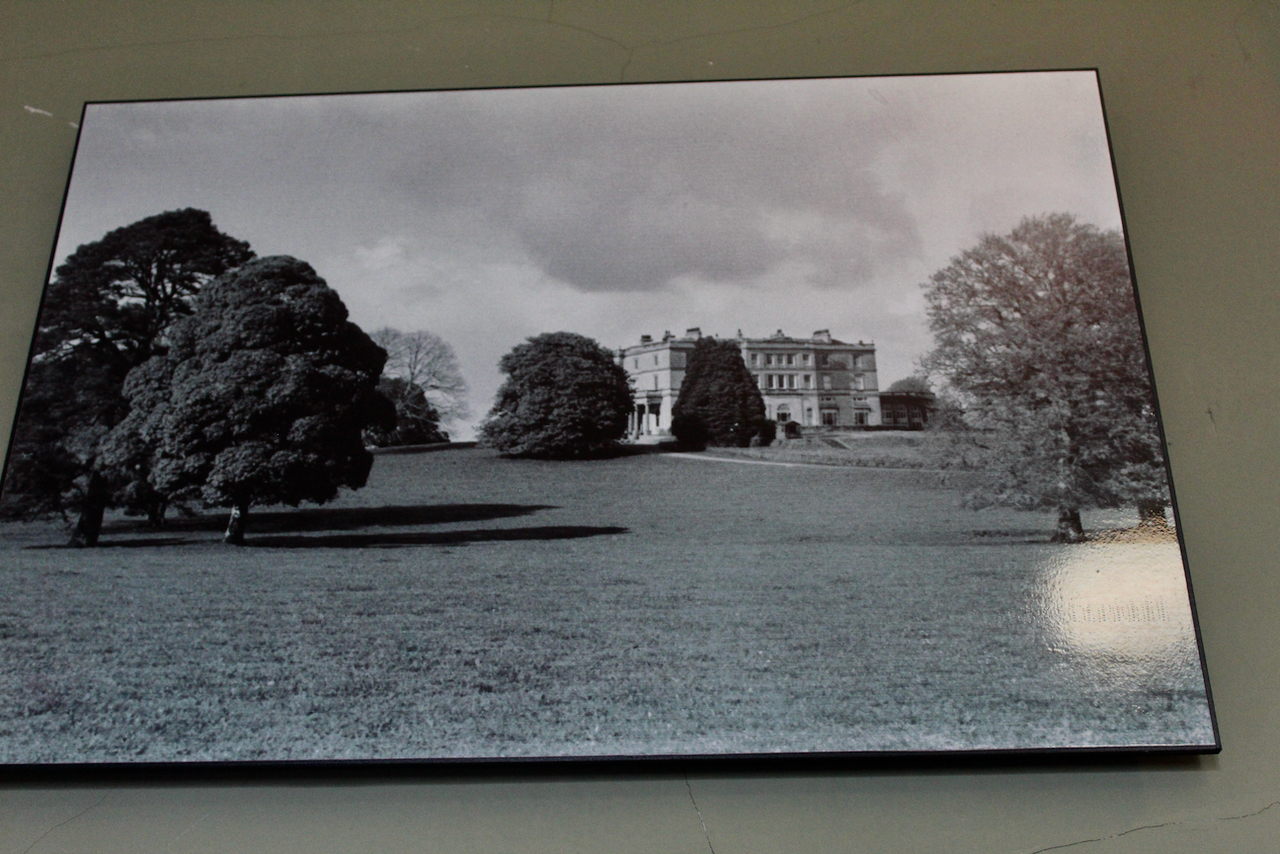
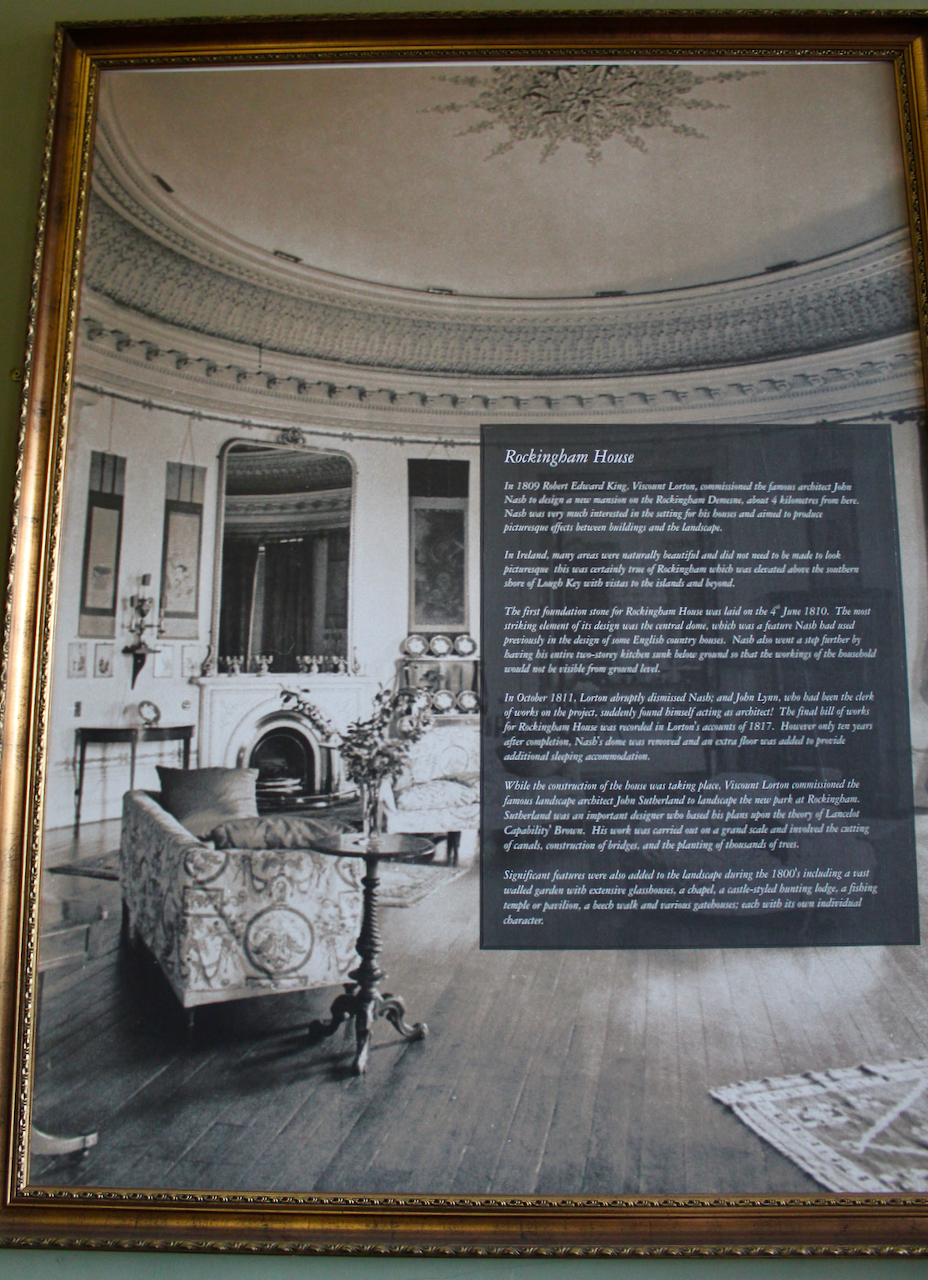
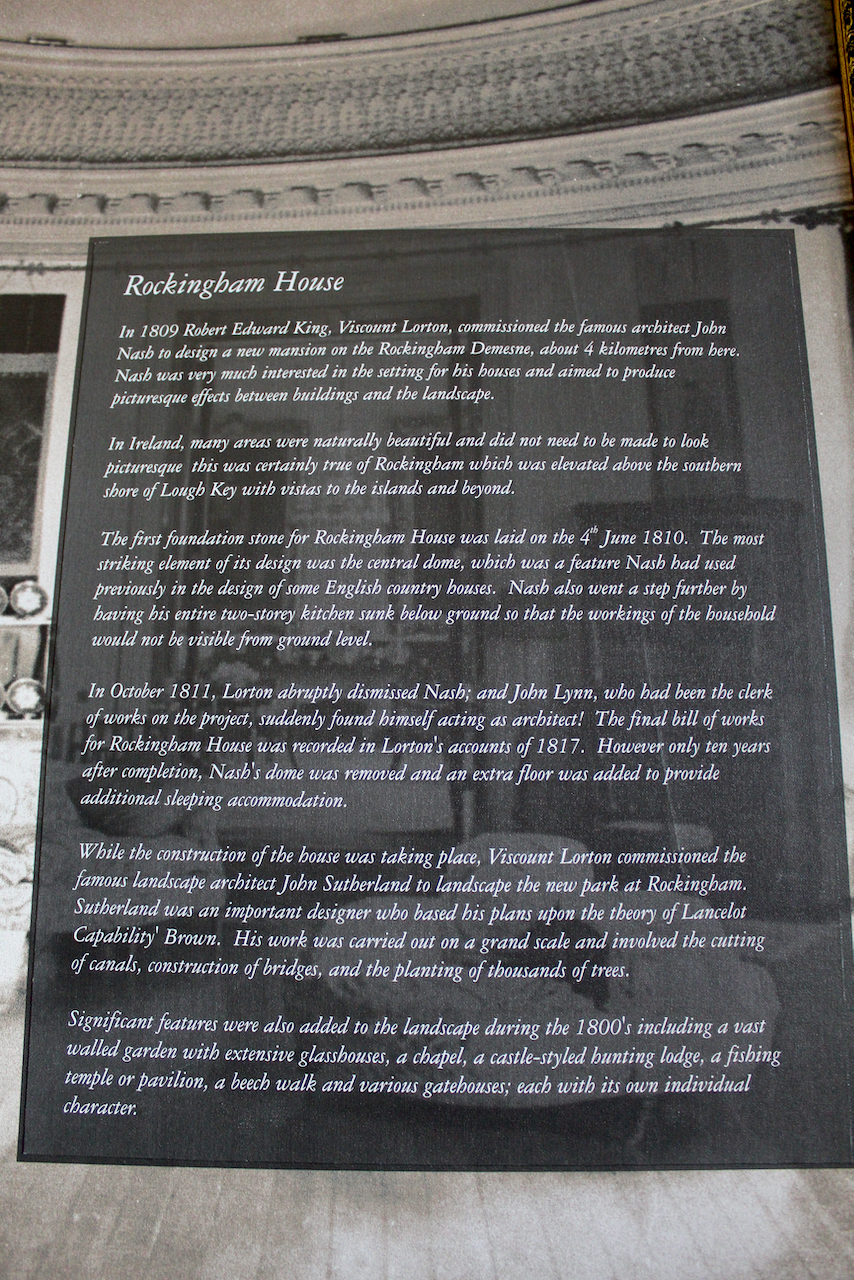
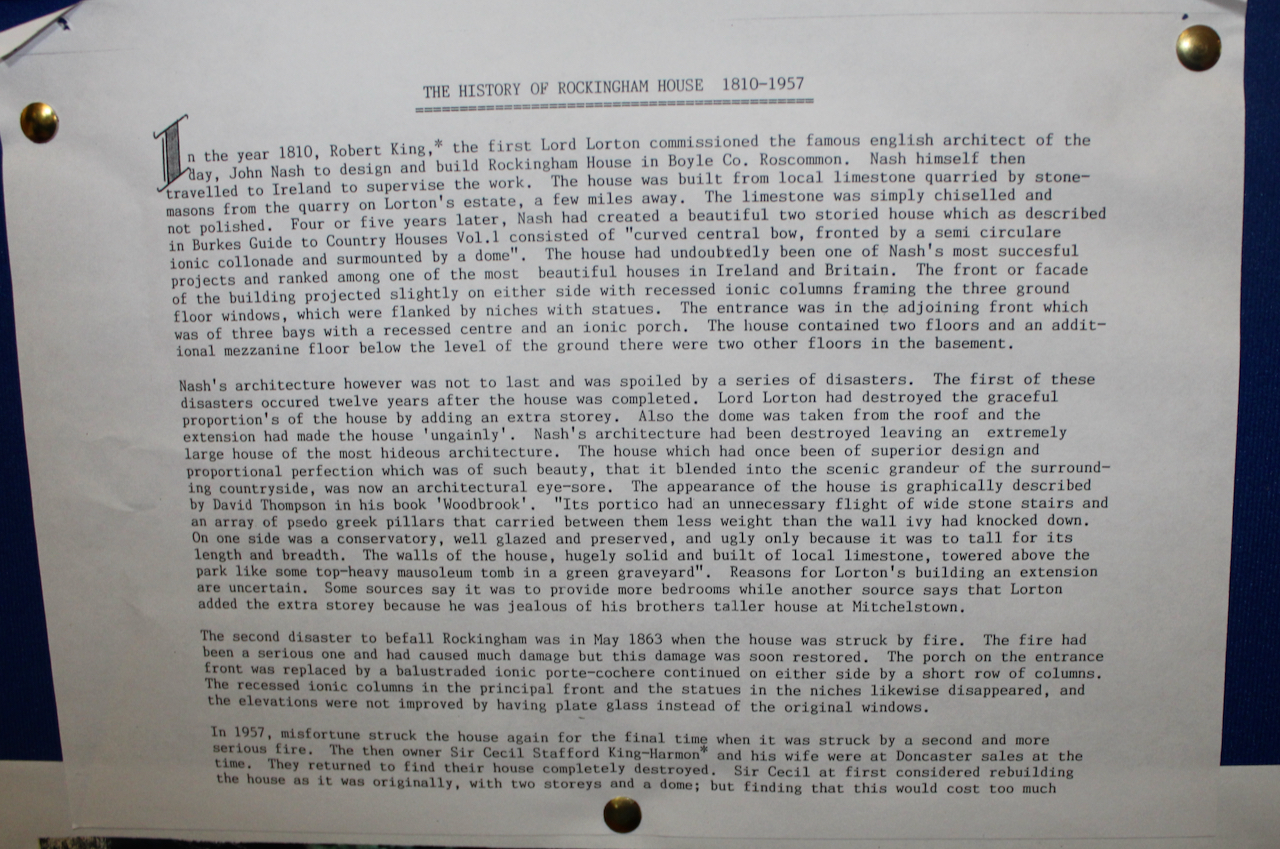
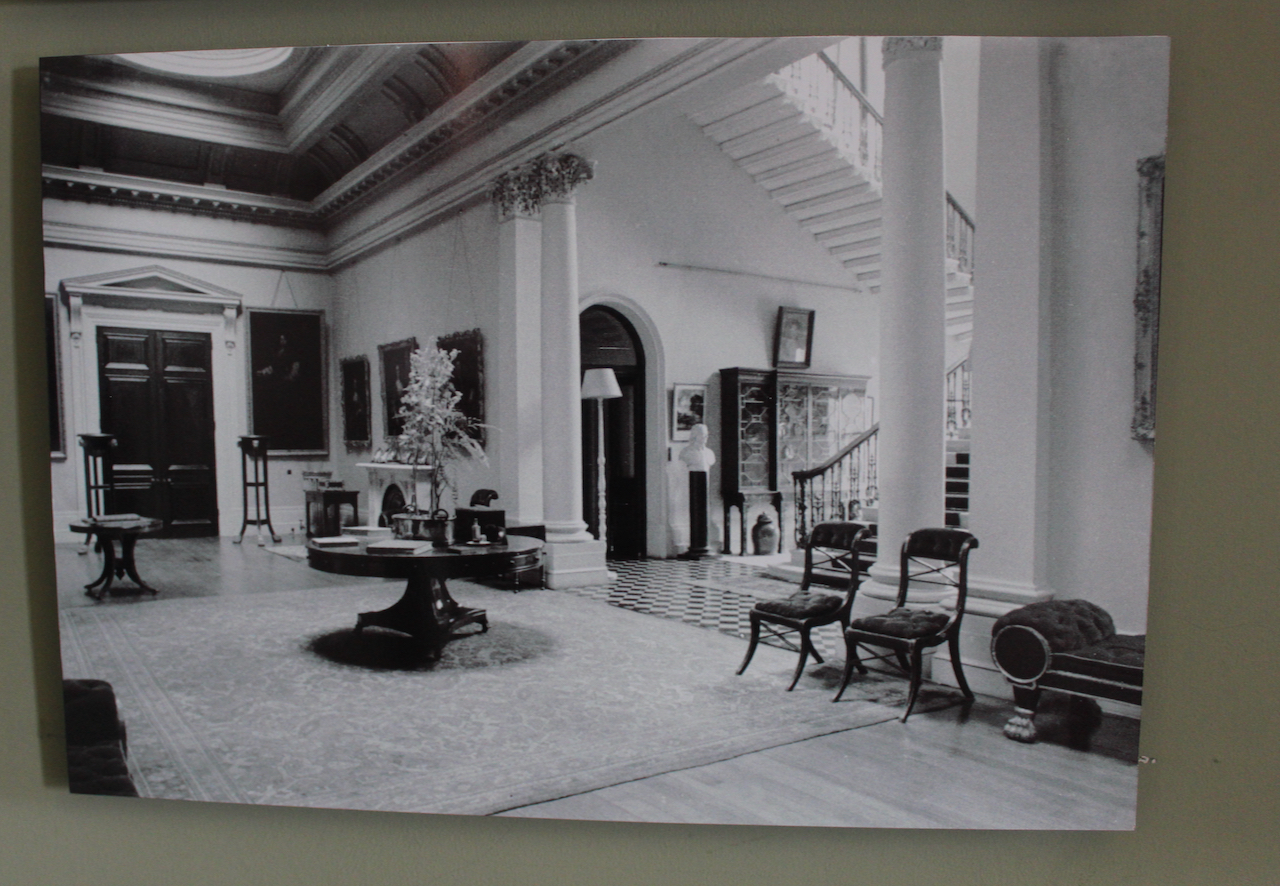
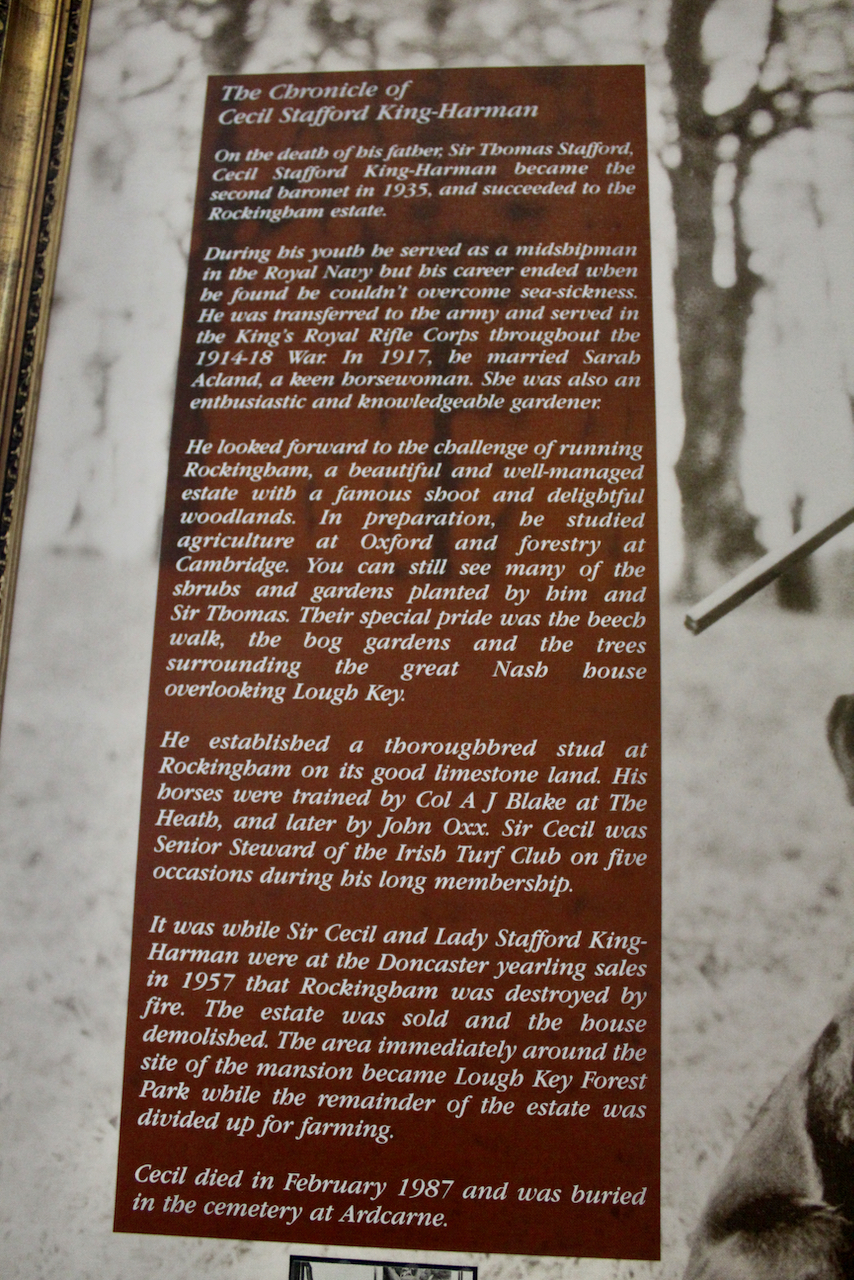
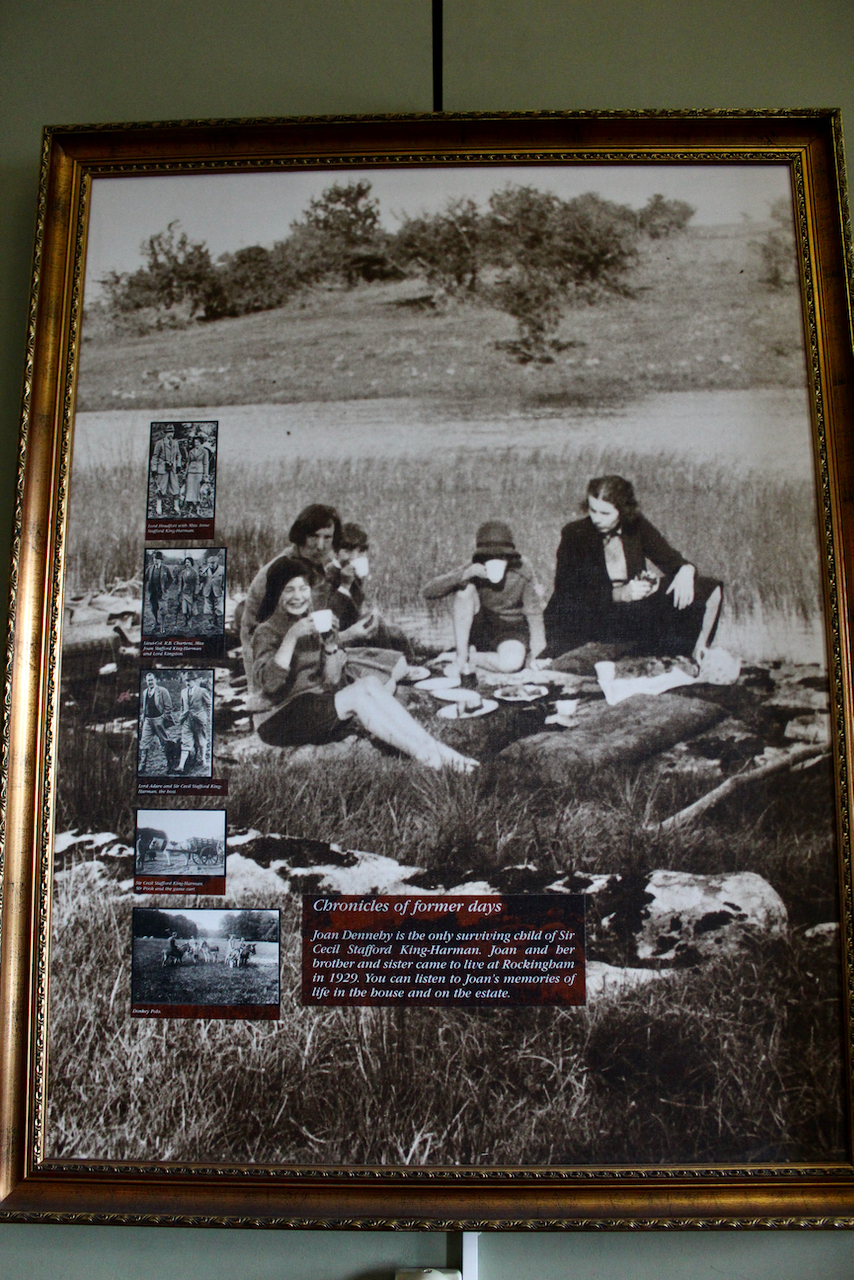
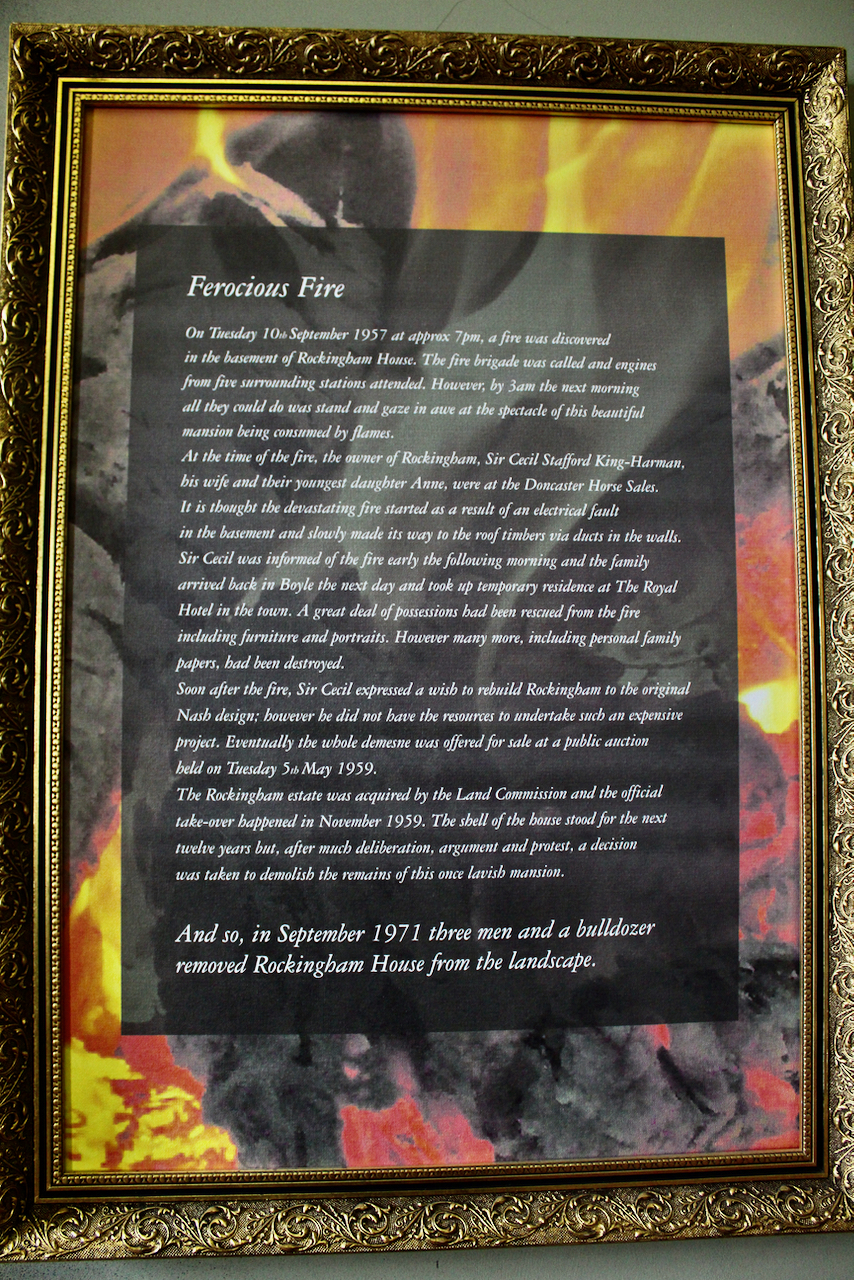
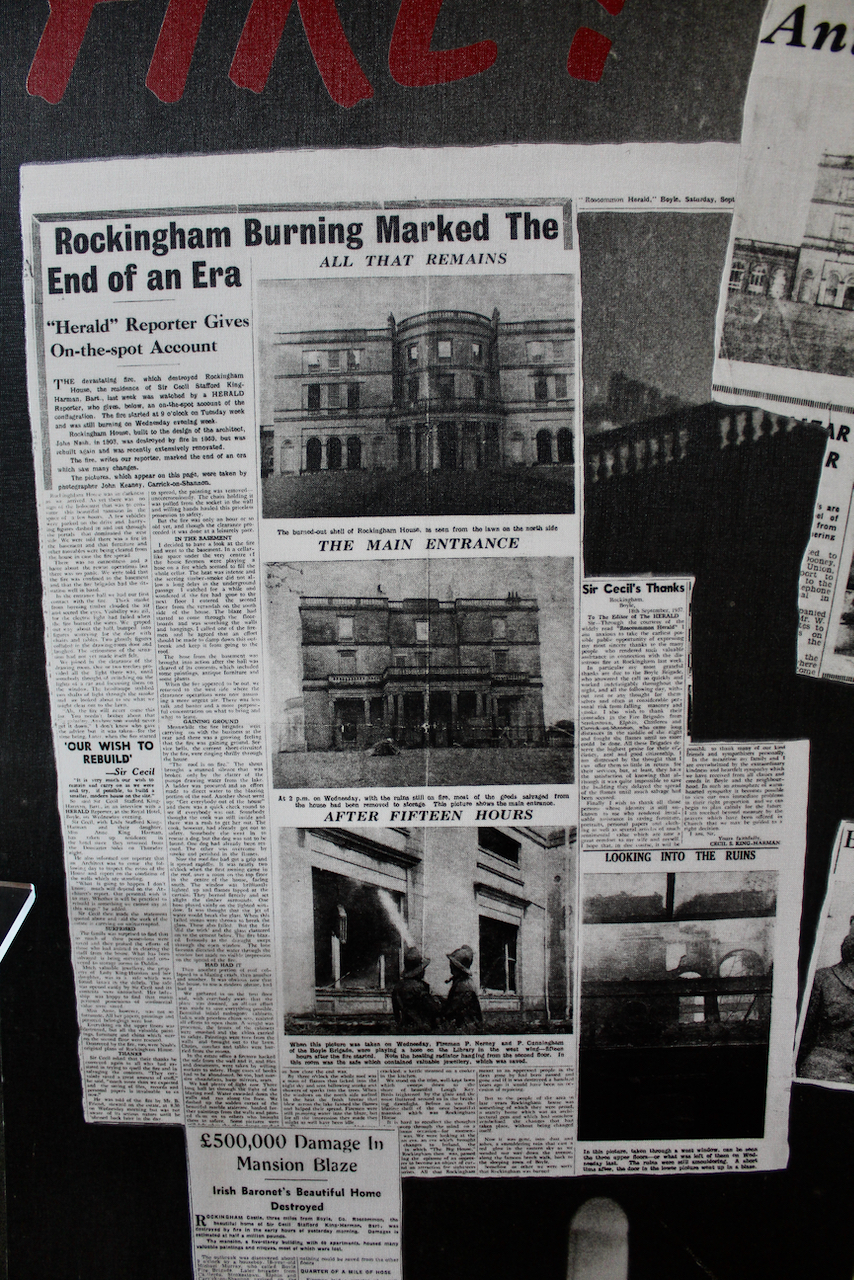
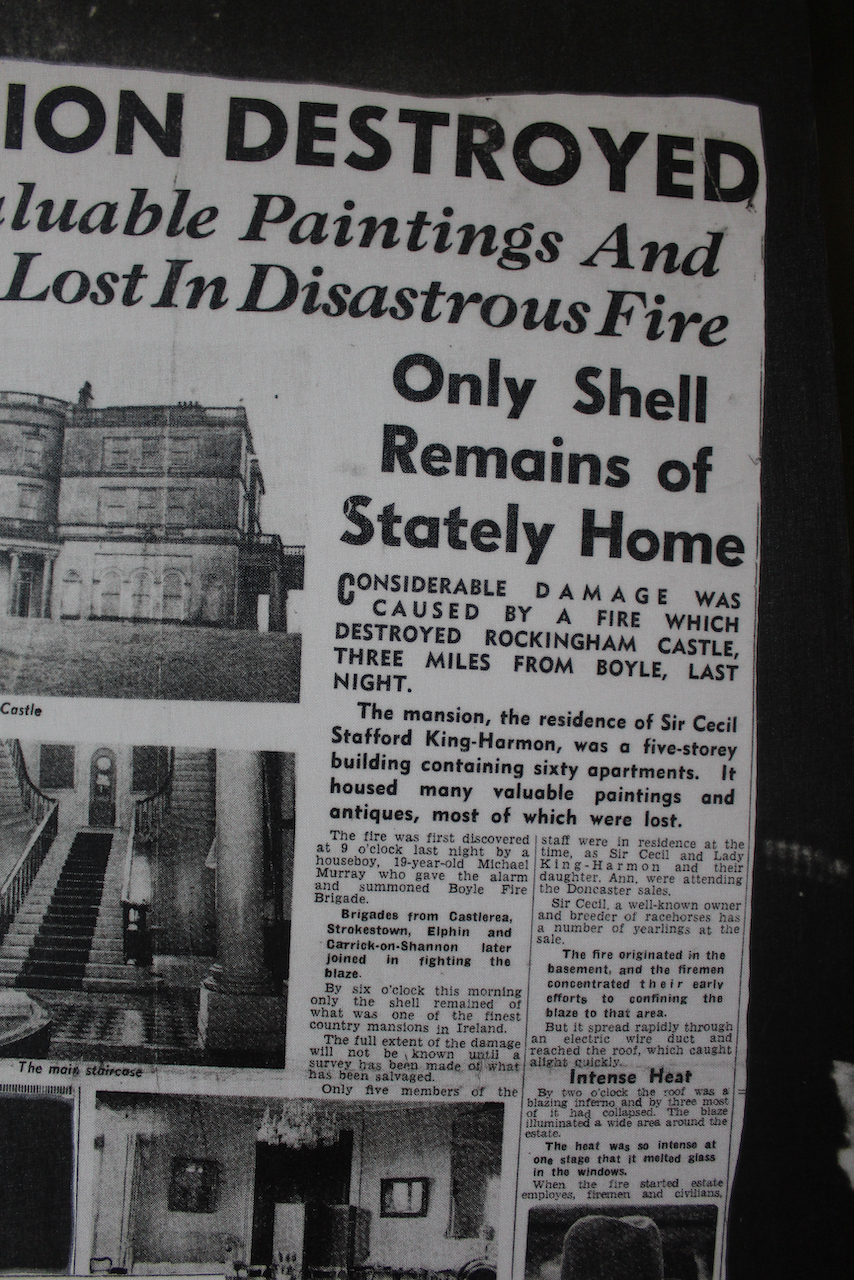
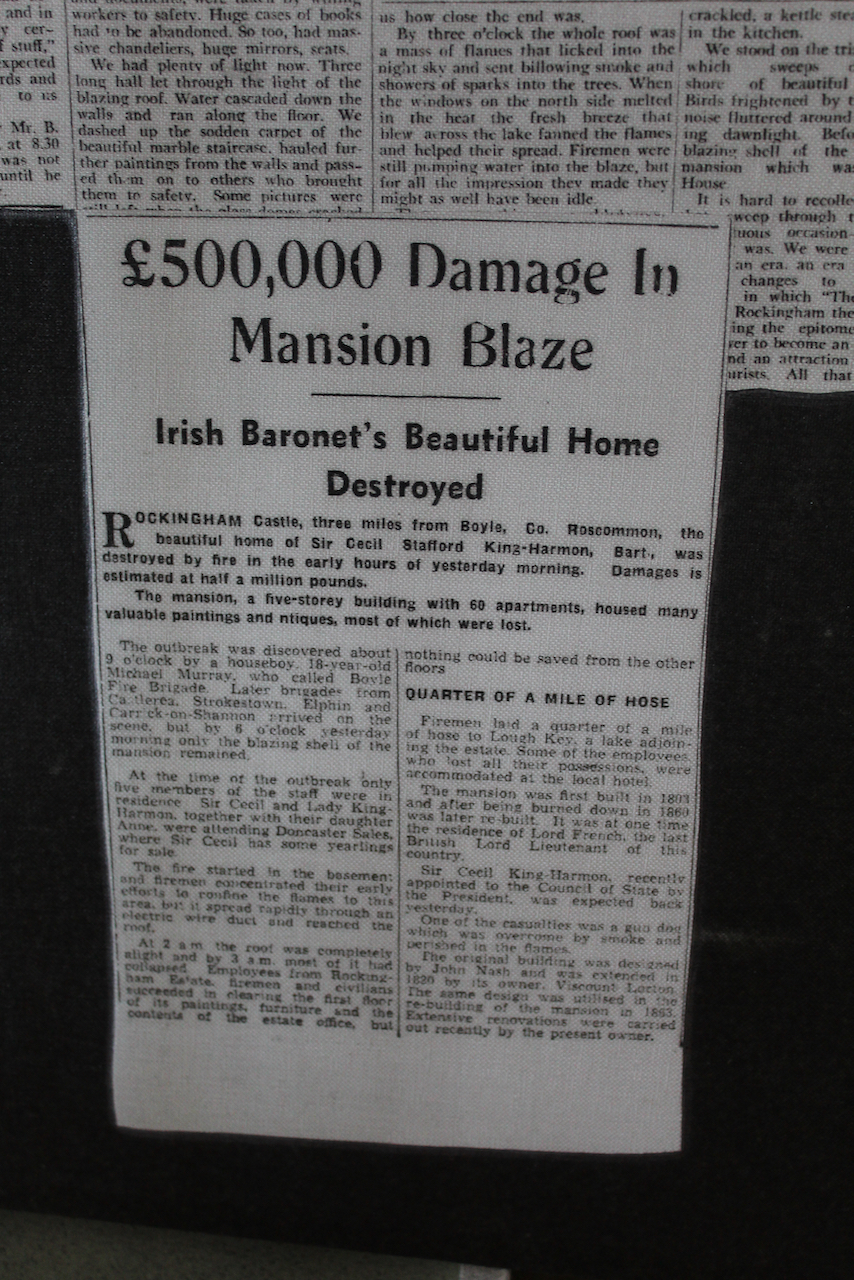
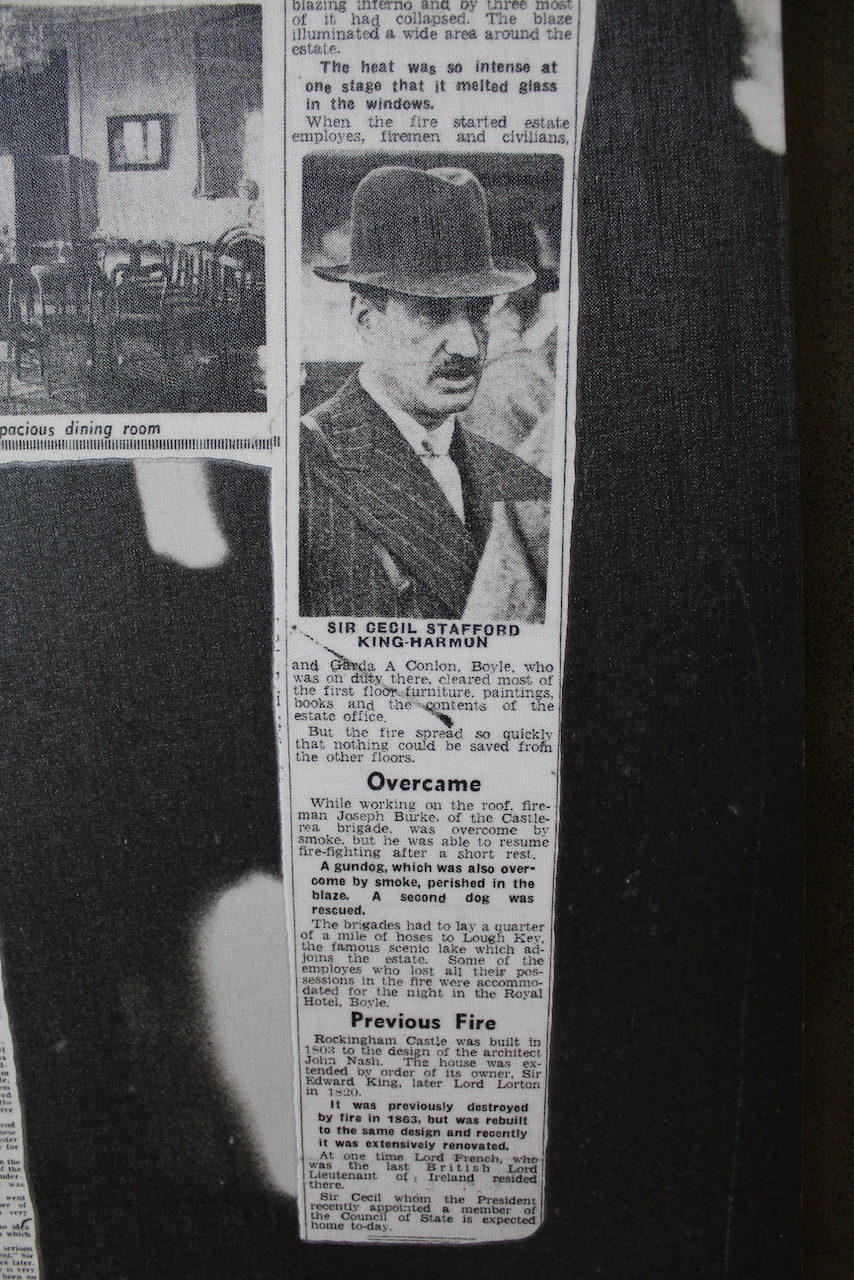
Viscount Lorton decided to build a new house on the Rockingham estate, which is a few kilometers from Boyle. Robert O’Byrne tells us that the previous house, Kingston Hall, remained in use and became known as the Steward’s House. [4] The new house was designed by John Nash and was ready by 1810. Lorton also modernised the estate. Landscaper Humphrey Repton helped with the design of the outbuildings, gate houses and demesne. The house no longer exists, and the demesne is now part of Lough Key Park. An impressive gate lodge remains, and a chapel built by Lord Lorton in 1833 on the site of a 17th century church also built by the Kings. An icehouse, gazebo called the Temple and a tunnel which ran from the mansion to the lake and was used by tradesmen is open for visitors.

Rockingham House.
Rockingham.
Rockingham.
Rockingham.
Rockingham.
Rockingham.
Rockingham.
Model of Rockingham House created by Leaving Certificate students of Ballinamore Vocational School Fergal Conefrey, Conor Lee and Declan Sammon with construction teacher Mr. Tommy Flynn.
The interior of Rockingham.
Looking out from Rockingham.

It was a time of trouble with tenants, as outlined in The Kings of King House. Robert evicted Catholic tenants due to uprisings. In famine years, however, he lowered rents and provided work.

King House, 2022.
King House, 2022.
In King House.

Viscount Lorton’s daughters married well. Jane married Anthony Lefroy of Carriglass Manor, County Longford. Jane Austen had been in love with his father, Thomas Lefroy, and Mr. Darcy in Pride and Prejudice may have been based upon him. Caroline married Robert Gore-Booth, 4th Baronet, of Lissadell, County Sligo (another section 482 property). Frances married Right Reverend Charles Leslie, who we came across when we visited Corravahan, another Section 482 property, in County Cavan.

Viscount Lorton’s heir was Robert (1804-1869). He had an unhappy marriage, and his wife, Anne Gore-Booth, daughter of Robert Newcomen Gore-Booth, 3rd Baronet of Lissadell, had an affair which produced a son. Robert and his father sought to make sure that this son would not inherit the King estates.

The Kings of Rockingham were a “cadet branch” of the family of the Kings of Mitchelstown, County Cork. Viscount Lorton’s older brother inherited the Mitchelstown estate and the title of 3rd Earl of Kingston. Let’s make a diversion and look at what was happening at the Mitchelstown estate.

After her husband Robert 2nd Earl of Kingston’s death, Mitchelstown remained in the hands of Caroline (née Fitzgerald), and she returned to run the estate for a further twenty-five years. She kept her son George at arm’s length, King-Harman tells us.

George King (1779-1839), later 3rd Earl of Kingston, painting by Romney.

George did not inherit Mitchelstown until he was 53 years old. He was godson of King George III and was a friend of the Prince Regent who later became King George IV. He had several illegitimate children with a lover when he was in his twenties, with whom he lived in the Bahamas. He went on to marry Helena Moore, daughter of Stephen, 1st Earl of Mountcashell, County Tipperary. Before his father died, he was titled Viscount Kingsborough between 1797 and 1799, and he held the office of Member of Parliament (M.P.) for County Roscommon between 1797 and 1799. He became Colonel of the local Militia, the Mitchelstown Light Dragoons, part of the North Cork Militia.

When his father died, he succeeded as the 3rd Baron Kingston of Rockingham, Co. Roscommon, the 3rd Viscount Kingston of Kingsborough, Co. Sligo, 3rd Earl of Kingston, and 7th Baronet King, of Boyle Abbey, Co. Roscommon.

George 3rd Earl of Kingston’s eldest son, Edward, predeceased him. Edward, who was Viscount Kingsborough, became interested in Mexico while in Oxford and devoted his life and finances to the production of a monumental work, The Antiquities of Mexico. He fell into debt, partly because his father did not allow him enough to run Mitchelstown, and was imprisoned in Ireland, where he developed typhus and died in 1837. In his lifetime he presented a number of antiquities to Trinity College Dublin.

It was therefore George’s second son, Robert Henry (1796-1857) who became 4th Earl of Kingston in 1839. By 1844 the Mitchelstown estate had been taken over by the Encumbered Estaes Court. Outstanding debts went back to James 4th Baron, King-Harman tells us. Despite this, Robert Henry’s life continued at Mitchelstown in rather high style, also despite the famine. Sadly, parts of the estate were sold off bit by bit and eventually Robert Henry had a mental breakdown and ended up in an asylum in England. [for more about the 4th Earl of Kingston see the Irish Aesthete’s blog. [5]

His younger brother James became the 5th Earl of Kingston, but died two years later without issue, and with him the Barony of Kingston of Mitchelstown became extinct. He married Anna Brinkley from Parstonstown (Birr), who was thirty years his junior, and King-Harman tells us that she “was destined to play a major role in the affairs of Castle [of Mitchelstown] right through to the present century.” They had no children, so the estate would have gone to the Viscounts Lorton of Boyle.

James King (1800-1869), 5th Earl of Kingston, who married Anna Brinkley.
Anna née Brinkley, wife of the 5th Earl of Kingston, who lived in Mitchelstown.

Robert, who was to become 2nd Viscount Lorton, and his wife Anne née Gore-Booth, had a son, Robert (1831-1871), and a daughter, Frances. Anne then had a son, Henry Ernest, with her lover, Vicomte Ernest Satgé St Jean. 1st Viscount Lorton tried to take action to ensure that Henry Ernest would not inherit.

In order to avoid Henry Ernest from inheriting Mitchelstown, they had to break the entail on Mitchelstown and James the 5th Earl of Kingston promised money from the Mitchelstown estate to the 3rd Viscount Lorton, for signing away the entail. Instead, Mitchelstown was left to his wife. The money promised to 3rd Viscount Lorton formed a debt, falling to Anna Brinkley, which gave her much difficulty later.

Before continuing, I must mention the youngest son of 1st Viscount Lorton, Laurence Harman King (1816-1875). He married Mary Cecilia Johnstone of Alva, Scotland. His father drew up a settlement which in the event that the 2nd Viscount’s legitimate son did not have an heir, Rockingham would go to his younger son, Laurence Harman, who in 1838 had legally changed his name to Laurence Harman King-Harman.

The Honourable Laurence Harman King-Harman (1816-1875).
Mary Cecilia, 6th daughter of Thomas Reymond Johnstone of Alva, Scotland. Married in May 1837 Laurence Harman King-Harman, 2nd son of Robert Edward 1st Viscount Lorton. She lived at Newcastle until her husband’s death in 1875 and then in London when she died in 1904.
Irish Army Artillery Dress Uniform c.1935: This uniform would have been worn by a Lieutenant Colonel. A military uniform would consist of the following: shako, tunic, slacks, black patent boots and spurs, white doe-skin gloves, cape, sword-belt complete with two scabbard slings and dress sword, sword knot and sword belt.
Dining room of King House. Photograph © Jennifer Winder-Baggot, www.irishhistorichouses.com
Laurence Harman King-Harman (1816-1875). The information tells us that he was the second son of Edward King, 1st Viscount Lorton. He inherited the Newcastle estate in County Longford in 1838 from his grandmother the Countess of Rosse, and lived there until his death. He succeeded to the Rockingham estate after the death of his brother Robert, 6th Earl of Kingston, in 1869.

Laurence Harman King-Harman also inherited the estate of Newcastle in County Longford. He was chosen for the inheritance in preference to his dissipated brother. Lawrence’s mother, recall, was Frances Parsons, daughter of Laurence Harman Parsons and and Jane King (daughter of 1st Earl of Kingston). Laurence Harman Parsons’s father was Laurence Parsons, 3rd Baronet of Birr Castle, County Offaly, and his mother was Anne Harman, whose family owned Newcastle, County Longford.

The property of Newcastle had belonged to the Chappoyne family. A daughter of that family married Anthony Sheppard, and the property passed into the ownership of the Sheppard family. It then passed via a daughter, Frances Sheppard, who married Wentworth Harman (c. 1635-1714). On Frances’s death in 1766 the property passed to her son Reverend Cutts Harman (1706-1784), Dean of Waterford. He had no children, so he left the property to his nephew, Laurence Parsons, who had married Jane King. In return, Laurence Parsons added the name Harman to his surname in 1792 to become Laurence Harman Parsons-Harman.

Laurence Harman Parsons was created 1st Baron Oxmantown, Co. Wexford in 1792, and 1st Earl of Rosse in 1806.

Laurence and Jane had a daughter, Frances, and no son. Frances married Robert Edward King, 1st Viscount Lorton in 1799. Laurence left all of his property to his wife Jane, which included Newcastle and two houses in St. Stephen’s Green in Dublin. Upon the birth of Frances and Robert Edward’s second son, whom they named Laurence Harman King, Lady Rosse decided to leave Newcastle to him. In 1838 when Lady Rosse died, just a year after Laurence Harman King’s marriage, he inherited Newcastle. At that time he also added Harman to his surname to become Laurence Harman King-Harman. [6]

One can now stay in Newcastle House, see https://www.newcastlehousehotel.ie/

Let us go back, however, to his brother Robert, who was upon his father’s death to become 2nd Viscount Lorton. The reason that 1st Viscount Lorton was worried about the second, illegitimate grandson inheriting, is that the first grandson, Robert Edward, had suffered a serious illness and had only one child, a daughter.

The 1st Viscount Lorton died in 1854 and was buried in the family vault in Boyle Abbey.

Obituary for 1st Viscount Lorton.
King House, 2022.
King House, 2022.
In King House.

The 1st Viscount Lorton’s son Robert had been a long time waiting to come into his inheritance and had meanwhile spent his time dissipating the family’s money and by the time of his marriage, according to The Kings of King House, had a reputation for drinking too much alcohol. In the same year that she was proven to have an affair, Robert became semi-paralysed, perhaps after severe attack of delirium tremens from his drinking.

Robert and his wife Anne moved to Frankfurt in 1840 and his health improved somewhat. However it was here that his wife met Vicomte Ernest de Satgé St Jean. He too was married. He and Anne accumulated debts at the gaming tables which Robert had to pay, and when his wife left him, Ernest de Satgé St Jean moved into the home of the Kings in Frankfurt!
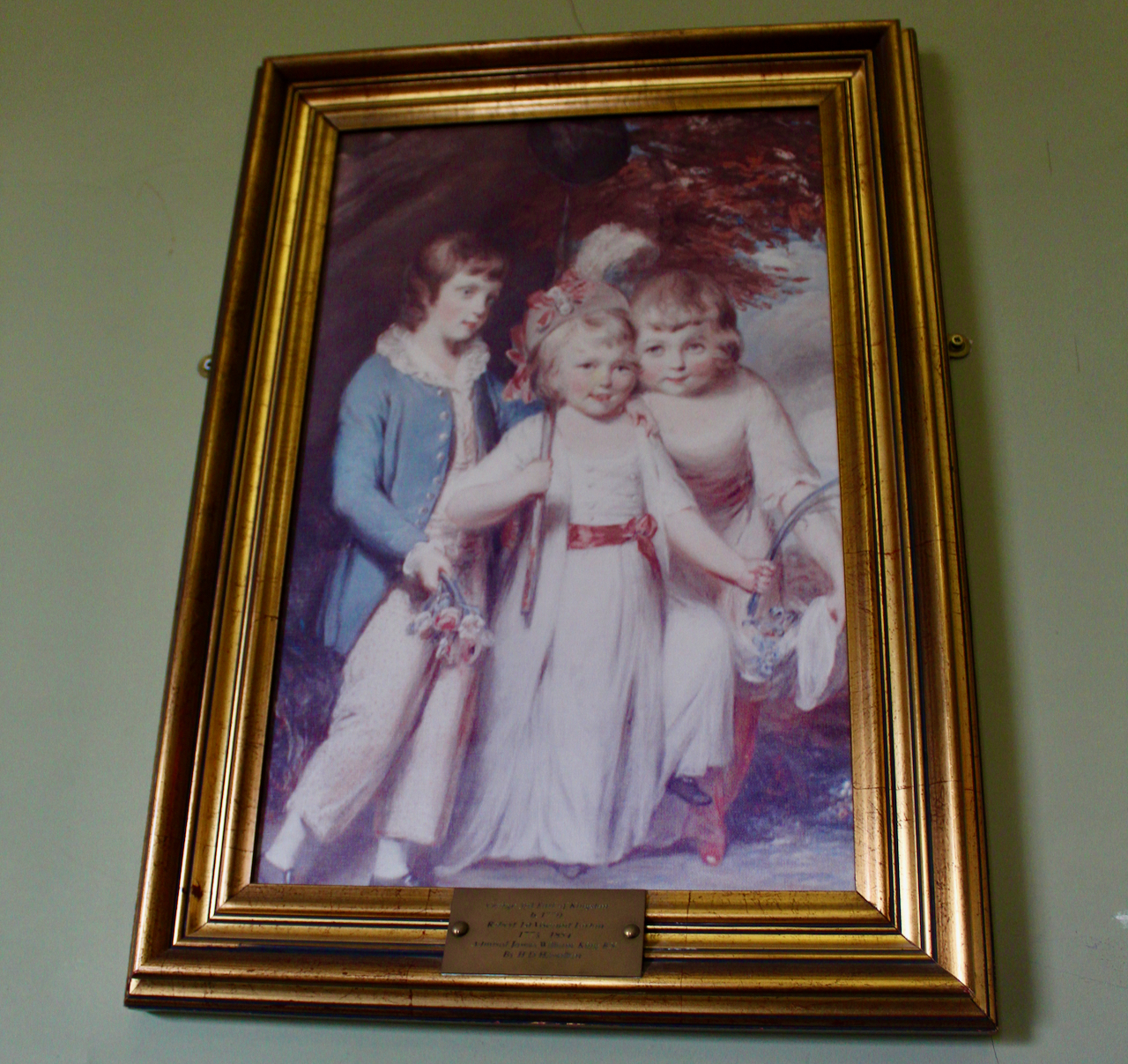
When 1st Viscount Lorton heard of the shenanigans, he sent an old friend to bring his son and his son’s wife back to Ireland. He did not succeed, and the story of Robert’s wife’s debts reminds me of “Buck” Whaley’s, with the Vicomte entering in convoluted schemes in order to try to gain money to pay off his debts, as described in The Kings of King House.

When the 1st then 2nd Viscounts Lorton died, the 2nd Viscount’s legitimate son Robert Edward (1731-1771) came into ownership of Rockingham, and became 3rd Viscount Lorton and 7th Earl of Kingston. He died two years later, after felling large quantities of timber at Rockingham to pay off his debts.

In King House.

In the meantime, the younger son, Henry Ernest Newcomen King (named Ernest after his birth father) had not been legally recognised as illegitimate. Therefore when his brother died, he became 8th Earl of Kingston, although he did not inherit as much land as he could have, since the entail on Mitchelstown had been broken, and his uncle Laurence Harman inherited Newcastle and Rockingham. He joined the Connaught Rangers, which were housed in the old King home, and he gained the rank of Lieutenant-Colonel, and was a representative Irish peer in the House of Lords. He married Florence, daughter and co-heir of Colonel Edward King-Tenison of Kilronan Castle in County Roscommon. He changed his name to surname King-Tenison in 1883. He held the office of Lord-Lieutenant of County Roscommon between 1888 and 1896.

The Coronation Robe and Crown in the dining room of King House belong to his son the 9th Earl of Kingston’s wife, Ethel Lisette, made to be worn at the coronation of King Edward VIII in 1936, which did not happen since he abdicated the throne.

King House, 2022. Photograph © Jennifer Winder-Baggot, www.irishhistorichouses.com
In King House.

On the death of the 7th Earl of Kingston, the 1st Viscount Lorton’s youngest son, Harman King-Harman, inherited Rockingham and the Boyle estates as life tenant. He remained living in Newcastle, County Longford. He had six sons and his eldest Edward King-Harman (1838-1888) would inherit Rockingham and Newcastle.

King House, 2022. Photograph © Jennifer Winder-Baggot, www.irishhistorichouses.com
This painting just identifies the sitter as Mrs King-Harman. She is probably Laurence Harman King-Harman’s wife Mary Cecilia née Johnstone, in later life.
Vanity Fair entry and picture, about Edward Robert King-Harman (1838-1888), son of Laurence Harman King-Harman. He inherited Newcastle in County Longford and Rockingham in Roscommon.

To continue with the story of Mitchelstown, in 1873 Anna née Brinkley, wife of James 5th Earl of Kingston, remarried, to William Webber. King-Harman writes that Webber allowed his relationship to the tenants to deteriorate. Meanwhile, the old debts were paid off by selling off tenanted lands under the Wyndham Land Acts. Anna, the Countess of Kingston, expressed a wish that upon her husband’s death, Mitchelstown should revert to the King family, in the person of Lt Colonel Alec King-Harman of Newcastle, great grandson of the 1st Lord Lorton. However, the castle was burnt by the IRA during the Civil War in 1922, and Alec sold off the estate.

The 2nd Earl of Kingston laid out much of the town of Mitchelstown. King Square includes Georgian houses of Kingston College and its Protestant chapel and family vault built by James, 4th Baron Kingston, and the square also includes the building where James founded the first Grand Lodge of Freemasons in Ireland. The 3rd Earl erected a drinking fountain in the square. The inn at Kilworth where Colonel Fitzgerald was shot is now a private residence. [The Kings of King House]

Edward Robert King-Harman (1838-1888), son of Laurence Harman King-Harman, inherited Newcastle in County Longford and Rockingham in Roscommon. He joined the military and fought in the siege of Dehli during the Indian Mutiny, then returned to Ireland in 1859 and became Honorary Colonel of the 5th Battalion of the Connaught Rangers whose depot was now in King House. He developed an interest in politics and the cause of Home Rule and was returned to the House of Commons in Ireland as a Conservative Home Ruler for County Sligo. He moved from Newcastle into Rockingham. He managed to leave Rockingham to his daughter, Fay, although her brothers contested this. She managed to keep Rockingham, however, along with her husband, Dr. Thomas Stafford, who was a Catholic. Fay’s son took the name Edward Stafford King-Harman.

Meanwhile Edward’s younger brother Wentworth (1840-1919) inherited Newcastle from his brother. He joined the military in Britain. When he inherited, he immersed himself in running Newcastle. It was his son Alec who inherited Mitchelstown. Alec also joined the military. He left Newcastle to a cousin Douglas King-Harman, and by that time the estate was reduced to just 50 acres, and he sold it in 1951. Before leaving Newcastle, Douglas set aside most of the family records and took them to England with him and published a book in 1959, Kings Earls of Kingston.

Edward Stafford King-Harman died in WWI. His father was raised to the British peerage as 1st Baronet Stafford in 1914. Edward married Olive Pakenham Mahon from Strokestown in Roscommon – I will be writing about it soon as it is also a Section 482 property.

King House, 2022.
In King House.

It was his second son, Cecil Stafford King-Harman, who inherited Rockingham and became 2nd Baronet Stafford. Having taken a degree in Agriculture in New Zealand, Cecil was able to bring the estate back into good working order. Unfortunately, Rockingham was destroyed by fire in 1957 and although most of the furniture and pictures were saved, Cecil decided to sell. The house was demolished, and half the estate became Lough Key Forest Park. On Cecil’s death the baronetcy became extinct.

King House, 2022.
King House, 2022.
Cecil Stafford King-Harman, King House, 2022.
King House, 2022.
King House, 2022.
King House, 2022.
King House, 2022.
King House, 2022.
King House, 2022.
King House, 2022.
King House, 2022.
Part of a set of china rescued from the fire in 1957. Photograph © Jennifer Winder-Baggot, www.irishhistorichouses.com
King House, 2022. Photograph © Jennifer Winder-Baggot, www.irishhistorichouses.com
King House, 2022.
King House, 2022.
King House, 2022.
King House, 2022.
This room in King House describes the fire at Rockingham. Over the fireplace is a picture of Lady Eleanor King, and one of her nephews, brothers George, 3rd Earl of Kingston, Robert, 1st Viscount Lorton, and Admiral James William King. Photograph © Jennifer Winder-Baggot, www.irishhistorichouses.com
In King House. Photograph © Jennifer Winder-Baggot, www.irishhistorichouses.com

In an upper storey of the King House there is a step-by-step description of the 1989-94 renovation of the house.

King House, 2022.
King House, 2022.
King House, 2022.
King House, 2022.
King House, 2022.
King House, 2022.
King House, 2022.
Inside the attic of King House. Photograph © Jennifer Winder-Baggot, www.irishhistorichouses.com
King House, 2022.
King House, 2022.
Vaulted ceiling of the attic. Photograph © Jennifer Winder-Baggot, www.irishhistorichouses.com
Display of builders’ paraphernalia in the attic. Photograph © Jennifer Winder-Baggot, www.irishhistorichouses.com
King House, 2022.
King House, 2022. Photograph © Jennifer Winder-Baggot, www.irishhistorichouses.com
King House, 2022.
In King House.

King House is used to host art exhibitions, as well as weddings and events.

King House, 2022. Photograph © Jennifer Winder-Baggot, www.irishhistorichouses.com
King House, 2022.
King House, 2022.
The Main Salon on the first floor. This room was used for formal dining and entertaining. It contains two fireplaces and decorative cornicing. Photograph © Jennifer Winder-Baggot, www.irishhistorichouses.com

When used as a Barracks, the military erected a mezzanine level in the Main Salon. After Independence, in the 1940s the Irish army used the room for dances every Wednesday.

Henry King b. 1733 by Hunter. He was a son of Henry King who built King House.
In King House. Photograph © Jennifer Winder-Baggot, www.irishhistorichouses.com

King House is now home to the Connaught Rangers museum as well as the Boyle Civic Art Collection, and the house also plays host to musical, dramatic and cultural events. 

The displays about the Connaught Rangers are very moving, and remind of us that horrors of war.
King House, 2022.
King House, 2022.
King House, 2022.
King House, 2022. Photograph © Jennifer Winder-Baggot, www.irishhistorichouses.com
King House, 2022.
Connaught Rangers dress helmet (1878-1922). Regimental buttons on uniforms had a harp and crown surrounded by a shamrock leaf, and on the collar was a brass Indian elephant. Photograph © Jennifer Winder-Baggot, www.irishhistorichouses.com
King House, 2022.
King House, 2022.
In King House.

The barracks in King House served as a recruitment centre. We can see some of the posters that encouraged Irish men to join the British Army during the wars.

King House, 2022.
King House, 2022.
In King House.

As home to the Connaught Rangers, Robert O’Byrne tells us that the house was able to accommodate 12 officers and 260 non-commissioned officers and private foot soldiers, as well as a 30-bed hospital and stabling for horses. [7]

In King House.

During the War of Independence, the Barracks was strongly garrisoned and the Royal Irish Constabulary and the Black and Tans were stationed outside the barracks near the main gate. Many arrests of Irishmen fighting for Independence were made, and prisoners were held in the barracks. Two prisoners managed to escape, James Molloy and Michael Dockery.

Prison cell in the basement of King House. Photograph © Jennifer Winder-Baggot, www.irishhistorichouses.com
King House, 2022. Photograph © Jennifer Winder-Baggot, www.irishhistorichouses.com
A drawing depicting the escape from King House.
In King House.

Sadly, reflecting the turbulent times in Ireland, Michael Dockery was later killed by anti-Treaty forces during the Irish Civil War that took place after Ireland gained Independence (the Civil War occurred because many did not agree with the Treaty signed to give Ireland independence since the British kept six counties in Ulster, leading to the division of the island of Ireland). When the new Republic of Ireland continued to use King House as a barracks it was called Dockery Barracks after Michael Dockery.

A couple of rooms in King House now contain the gifts which were given to President Mary McAleese, which is a lovely collection of the crafts of various nations.

King House, 2022.
King House, 2022.
King House, 2022.
King House, 2022.
King House, 2022.
King House, 2022.
King House, 2022.
In King House.

Based in the courtyard, Úna Bhán Tourism Co-operative runs a traditional craft shop showcasing locally produced crafts as well as operating an accommodation booking service and at weekends there is a farmers market in the courtyard.

[1] Connolly, Paul. The Landed Estates of County Roscommon. Published by Paul Connolly, 2018.

[2] Bence-Jones, Mark. A Guide to Irish Country Houses (originally published as Burke’s Guide to Country Houses volume 1 Ireland by Burke’s Peerage Ltd. 1978), Revised edition 1988, Constable and Company Ltd, London.

[3] https://www.buildingsofireland.ie/buildings-search/building/31804023/king-house-military-road-knocknashee-boyle-co-roscommon

[4] https://theirishaesthete.com/2022/08/22/kingston-lodge/

[5] https://theirishaesthete.com/2014/09/01/god-bless-the-kings/

[6] https://www.buildingsofireland.ie/buildings-search/building/13402709/newcastle-house-newcastle-newcastle-demesne-county-longford

[7] https://theirishaesthete.com/tag/king-house/

Text © Jennifer Winder-Baggot, www.irishhistorichouses.com