Help me to pay the entrance fee to one of the houses on this website. This site is created purely out of love for the subject and I receive no payment so any donation is appreciated!
€15.00
Marlay Park, Rathfarnham, County Dublin – owned by Dun Laoghaire/Rathdown County Council.
Marlay House is owned by Dun Laoghaire/Rathdown County Council. It has been restored for guided tours and the former stables have been converted into a crafts courtyard. The house had been declared unsound in 1977 and the council considered demolition. Insteahd, thank goodness, renovation began in 1992, much of the repairs done by people on an employment training scheme. The Council runs tours of the house during the Dun Laoghaire/Rathdown Heritage festival, which partially coincides with Heritage Week. Stephen and I went on the tour in 2025.
Marlay House was built for David La Touche (1729-1817), adding to an earlier 17th century house called the Grange. David La Touche bought the Grange in 1764. This Grange house is not to be confused with a house called Marlay Grange, mentioned by Mark Bence-Jones in his Guide to Irish Country Houses, and on the excellent website of Timothy William Ferres, Lord Belmont in Northern Ireland, which was built around 1850 and belonged to the Rowleys. [1]
The lands of Marlay Park belonged to the Cistercian Abbey of St. Mary, located in the city of Dublin – see my entry: https://irishhistorichouses.com/2022/11/09/the-church-junction-of-marys-street-jervis-street-dublin/ . After the dissolution of the monasteries by King Henry VIII, the land was granted to Barnaby Fitzpatrick (c.1478–1575) 1st Baron of Upper Ossory. Barnaby’s fourth wife was Margaret, daughter of Piers Butler, 8th Earl of Ormond. His son Barnaby who became 2nd Baron was raised at the English court with King Henry VIII’s son Edward.
Because the lands lay within the southern boundary of the pale, the holding became known as “Grange of the March”, meaning “Farmhouse of the Border.” The property later passed into the possession of the Harold family who were responsible for the defence of this section of the Pale from the attacks of the Irish clans. [2] They were known as “marcher lords” or “wild” border guardians, descendants of Vikings. The area of Harold’s Cross is named after them, specifically from a cross erected to mark the boundary between the lands of the Archbishop of Dublin and the lands of the Harold family, warning them not to encroach further toward the city. [3] The Harolds were dispossessed in after the 1641 Rebellion.
Grange, which was also known as Harold’s Grange, was owned previously by Thomas Taylor (1707-1763), Mark Bence-Jones tells us. [4] Taylor was Lord Mayor of Dublin in 1750. He inherited Grange from his father, also Thomas, who was an eminent agriculturalist, who died in 1727 and is buried in Kilgobbin graveyard. In the Taylors’ time the house was built, and also ornamental grounds and a deer park. Some of the house may have been demolished later when David La Touche was building the new part of the house.
Thomas Taylor (1707-1763) married, first, in 1733, Sarah, whose father John Falkiner held the office of High Sheriff of County Dublin in 1721 (Burke’s Peerage 2003 volume 1, page 1380). In 1747 Thomas married for a second time, this time to Anne (1725-1820), daughter of Michael Beresford, who in turn was the son of Tristram Beresford, 1st Baronet of Coleraine in County Derry.
After Thomas the son died in 1763, Grange was acquired by David La Touche.
The La Touche family was a Huguenot family. Huguenots were French Protestants, and they fled from France due to the punishment and killing of Protestants after Louis XIV revoked the Edict of Nantes – the Edict of Nantes had promoted religious toleration.
David Digues La Touche (1675-1745), born in the Loire Valley, fled from France after the Revocation of the Edict of Nantes. He fled to Holland, where his uncle obtained for him a commission in the army of William of Orange. He fought in the Battle of the Boyne in the regiment under General Caillemotte. [5] He left the army in Galway, where he was billeted on a weaver who sent him to Dublin to buy wool yarn (worsteds). He decided then to stay in Dublin, and with another Huguenot, he set up as a manufacturer of cambric and rich silk poplin. Where I live in Dublin is an area where many Huguenots lived and weaved – we are near “Weaver Square,” and our area is called “The Tenters” because cloth waas hung out to dry and bleach in the sun and looked like tents, hung on “tenterhooks”!
La Touche was an elder of the French Church group in Dublin, many of whom used to meet in what is now the Lady Chapel of St Patrick’s Cathedral. [6]
The La Touches began banking when Huguenots left their money and valuables with David for safekeeping when they would travel out of the capital. He began to advance loans, and so the La Touche bank began. He had two sons, David La Touche (1703-1785) and James Digues (later corrupted to Digges) La Touche.
David La Touche purchased properties which passed to his sons: Marlay House to David (1729-1817), Harristown in County Kildare to John (1732-1805) [see my write-up https://irishhistorichouses.com/2020/09/27/harristown-brannockstown-county-kildare/ ], and Bellevue, County Wicklow, to Peter (1733-1828). Bellevue has since been demolished, in the 1950s [7].
Photograph courtesy of La Touche Legacy website.
At the time of his death in 1785, La Touche’s rental income was £25,000 and the La Touche bank’s profit was £25,000-£30,000. His three sons who survived him, David (also the first Governor of the Bank of Ireland), John and Peter were partners in the Bank. Later, they took in their cousin William Digges La Touche as a Partner, following his distinguished service as Britain’s representative in Basra in the Persian Gulf. David and his brothers had a vast monument erected to their father in Christ Church, Delgany, where their father had died in his favourite country home, Bellevue. [see 6]
David La Touche of Marley, County Dublin (1729-1817), M.P., Banker and Privy Counsellor. Photograph courtesy of National Gallery of Ireland.Peter La Touche of Bellevue (1733-1828), Date 1775 by Robert Hunter, photograph courtesy of National Gallery of Ireland.Bellevue, County Wicklow, photograph by Robert French, Lawrence Photographic Collection, National Library of Ireland.Photograph courtesy of La Touche Legacy website.
David La Touche (1729-1817) commissioned the building of the extension of Grange, and he named his new house “Marlay” after his wife’s family. He married Elizabeth Marlay in 1762, just before he purchased the property. Her father was Bishop George Marlay of Dromore in County Down.
David La Touche (1729-1817), of Marlay, 1800 by Hugh Douglas Hamilton, courtesy of National Gallery of Ireland.
I don’t know what architect designed the enlargement of the original Taylor house at Marlay for David La Touche. Turtle Bunbury claims that the enlargement was by Whitmore Davis. Whitmore Davis joined the Dublin Society’s School of Drawing in Architecture in 1770. A date stone in the house tells us that the first stone of the house was laid by William La Touche in 1794.
David and his family would have spent much of their time in their townhouse in Dublin. Marlay House was their weekend retreat and place for entertainment. I’m not sure when the family purchased 85 St. Stephen’s Green, now part of the Museum of Literature of Ireland (MOLI), but by 1820 George La Touche was resident. George was the unmarried son of David La Touche (1729-1817). [see 6] David La Touche (1703-1785) developed much of the area around St. Stephen’s Green, Aungier Street and the Liberties. In 1812, Peter La Touche bought 9 St. Stephen’s Green, now a Private Members Club.
85 St. Stephen’s Green (in middle), Dublin, photograph by Robert French, (between ca. 1865-1914), Lawrence Photograph Collection, National Library of Ireland.9 St. Stephen’s Green, view of stairhall from first floor landing, UCD archive, Built c. 1756 for the Rev. Cutts Harman, Dean of Waterford, now Stephen’s Green Club, plasterwork is attributed to Paolo Lafranchini.
The La Touche family purchased Harristown in County Kildare in 1768 and hired Whitmore Davis to design the house.
Whitmore Davis also designed the building for the Bank of Ireland at St. Mary’s Abbey in Dublin around 1786-1791. The La Touches were involved with the establishment of this bank in 1783. David La Touche was a major investor.
Peter La Touche hired Whitmore Davis in 1789 to build a church in Delgany, County Wicklow, and John La Touche hired him to design the Orphan House on North Circular Road in Dublin in 1792.
Elizabeth La Touche née Vicars (1756-1842), wife of Peter La Touche, by John Whitaker National Portrait Gallery of London D18415.
The La Touche crest features a pomegranate symbol, for fertility. We see the crest on the urn which tops Marlay House over the front door. The same crest decorates over the front windows in Harristown. The star shaped symbol might be the shape of the pomegranate flower. This shape features on the front pillar gates of Harristown House also. The same crest was added to the stairwell in 85 St. Stephen’s Green.
Marlay House is two storeys over a basement. It has a seven bay front with a central door framed by what Mark Bence-Jones calls a frontispiece of coupled engaged Doric columns. The frontispiece has an entablature enriched with medallions and swags, and urns on the top at either end. The window above is also framed with an entablature on console brackets.
The large central urn located on the roof parapet is on a plinth carved with swags, and there are smaller urns dotted around the roof.
There is a bow at the side of the house and another at the back. The kitchen and staff areas were in the Grange part of the house. We were lucky to tour the Grange as well, to see the large kitchen, which has a galley level, where the lady of the house would instruct the cook what to prepare, remaining well away from the servants.
Unfortunately one is not allowed photography inside the house, but there are a few photographs on the County Council website. The house includes an elegant entrance hall, ballroom, and unusual oval music room, with decorative plasterwork by Michael Stapleton.
Marlay House front hall, photograph courtesy of Dun Laoghaire/Rathdown County Council website.
The Hall has a screen of Corinthian columns and frieze of tripods and winged sphinxes. Our guide pointed out that it is a large front hall for the size of the house. This is because it was built to impress visitors. It is not perfectly symmetrical, but has a dummy door to improve the symmetry.
The smaller Dining Room, off the front hall, also has a dummy door. It has a good frieze and cornice, and is the smaller dining room used for family dining. The house retains nearly all of the original chimneypieces. Our guide pointed out that one can surmise the age of the chimneypiece from the width of the mantlepiece. The Georgian mantlepieces were narrow, made to hold a mirror, which was tilted slightly upward to reflect light, and also to reflect a decorative ceiling. Later mantlepieces were made wider in the Victorian age when people liked to display objects.
There isn’t a feature staircase. There are two staircases, which are more functional than showy. There’s a servant staircase beside the small dining room.
The larger dining room could also act as a ballroom. It has beautiful delicate plasterwork mostly likely to have been made by Michael Stapleton, with a gorgeous ceiling and a decorative niche for a sideboard.
The larger dining room, Marlay House, photograph courtesy of Dun Laoghaire/Rathdown County Council website.
The walls have plaster swags and painted medallions.
There is a portrait of David La Touche in military outfit, and of his father in a soft turban-style hat.
A “jib” door leads to a corridor to the oval room. This room has a portrait of George Marlay, Bishop of Dromore. Musical instruments in the plaster ceiling show that this was a music room. The windows are curved as well as the walls.
Marlay House oval room, photograph courtesy of Dun Laoghaire/Rathdown County Council website.
There is also a fine plasterwork ceiling in the oval room. Unfortunately the photographs do not show the ceiling.
Marlay House interior, photograph courtesy of Dun Laoghaire/Rathdown County Council website.
There is a small vaulted vestibule off the oval room, which has more decorative plasterwork. Othere rooms include a library and another bow room with a decorative ceiling, which has drawings by the La Touche children. One of the library’s walls is dedicated to work by Evie Hone, since she spent time living and working in the courtyard.
In 1781 on a visit, Austin Cooper mentions the house as well as ponds with islands, rustic bridges, waterfalls, gardens with hothouses and greenhouses, an aviary and a menagerie. [8] The grounds were landscaped by Thomas Leggett (fl. 1770s-1810s) and Hely Dutton (fl. 1800s-1820s). [9]
A website about the La Touche family tells us that David (1729-1817) was an investor in the Grand Canal Company, and in 1800 he was its Treasurer. He and his brothers were founding members of the Kildare Street Club in the 1780s. They were also Freemasons. The La Touches were generous and supported most of the large charitable and cultural organisations of the time. [10] David developed an interest in farming and developed a model farm at Marlay.
David La Touche had many children, who married very well. Their daughter Elizabeth (1764-1788) married Robert Henry Butler 3rd Earl of Lanesborough and became the Countess of Lanesborough.
Photograph courtesy of La Touche Legacy website.Elizabeth, Countess of Lanesborough (née La Touche), (1764-1788), wife of 3rd Earl Date 1791 Engraver Francesco Bartolozzi, Italian, 1725-1815 After Horace Hone, English, 1756-1825, photograph courtesy of National Gallery of Ireland.
Daughter Emily (1767-1854) married Colonel George Vesey, and they lived in Lucan House (see my entry https://irishhistorichouses.com/2025/12/20/lucan-house-lucan-county-dublin/ ). Her husband’s father Agmondisham Vesey (1708–85) was, interestingly, a member of the house of commons for Harristown, Co. Kildare, 1740–60. He was an amateur architect and designed his residence, Lucan House, built in 1772, with the help of William Chambers, and consulted with James Wyatt (1746-1813) of London and Michael Stapleton for the interiors of the house. There are several similarities between Marlay House and Lucan House, including the bows, and the work by Michael Stapleton. Lucan also has a screen of Corinthian pillars in the front hall, and an oval room.
Daughter Harriet (d. 1841) married Nicholas Colthurst, 3rd Baronet of Ardum, Co. Cork. Another daughter, Anne (d. 1798) married George Jeffereyes (1768-1841) of Blarney Castle (see my entry https://irishhistorichouses.com/2022/09/23/blarney-castle-rock-close-blarney-co-cork/ ). Daughter Maria (d. 1829) married Maurice Fitzgerald, 18th Knight of Kerry, of Glin Castle in County Limerick. David and Elizabeth née Marlay’s sons were David (1769-1816), John David (1772-1838), George (1770-1824), Peter (1777-1830), Robert, who didn’t marry, and William, who is probably the one who lay the foundation stone of the house, who died young.
David La Touche (1769-1816) married Cecilia , daughter of Joseph Leeson, 1st Earl of Milltown, of Russborough House. The Dictionary of Irish Biography tells us that David served as MP for the borough of Newcastle (1790–97, 1798–1800) and MP for Co. Carlow (1802–16) in the UK parliament.
David La Touche of Marlay, Dublin (1734-1806) by Hugh Douglas Hamilton courtesy Christies Old Master & British Drawings and Watercolour.Cecilia La Touche née Leeson (about 1769-1848).
Hugh Douglas Hamilton, (1739-1808) Madame La Touche thought to be Cecilia La Touche who married David La Touche eldest son of R.T Hon David La Touche in 1789, dau of Joseph Leeson, courtesy of Adam’s 28 Sept 2005
John David La Touche of Marlay, Dublin (1772–1830), full-length, in a taupe frock coat and jabot, with Taormina and Mount Etna beyond by Hugh Douglas Hamilton courtesy Old Master & British Drawings and Watercolours, Christies.Gentleman believed to be Robert La Touche by Hugh Douglas Hamilton courtesy Christies Irish Sale 2003. Robert died when a stand collapsed at the Curragh Races.Portrait Of A Young Gentleman, Believed To Be Peter Digges La Touche courtesy of Adam’s 1st April 2009, Irish School, late 18th Century.
Peter (1777-1830) married Charlotte, daughter of Cornwallis Maude 1st Viscount Hawarden. Peter inherited the estate at Bellevue owned by his uncle Peter La Touche.
The family enjoyed theatricals, and the Masque of Comus was performed in 1778 with an epilogue by Henry Grattan, a cousin of Mrs. La Touche. [see 8] The house had its own theatre.
The walled garden in Marlay was built around 1794.
John David La Touche was the next to live in Marlay. He was succeeded by his son David Charles La Touche (1800-1872). He died without marrying, so his brother, Charles John Digges La Touche (1811-1884), succeeded him. The La Touche legacy website tells us that Charles had been at Oxford and knew Newman (later a Cardinal). In 1844, Charles caused consternation among the wider family by becoming a Roman Catholic and moving to Tours in France. Charles had a son, John David (1861-1935), who worked in China in the Imperial Chinese Customs Service, and on his retirement, he returned to Ireland in 1925 and bought a fine residence at Kiltimon, Co. Wicklow. [see 10]
In 1871 the La Touche bank was acquired by Munster Bank.
The La Touches sold the property to Robert Tedcastle around 1850. The Tedcastle family owned a fleet of cargo ships, one of which they named “Marlay”. The “Marlay” was used to carry freight, such as coal, and passengers between Dublin and Liverpool. Tedcastle was a devout Christian and he led a quiet life so the house was no longer a place for parties. His grandchildren came to live with him. One of his grandsons wrote a memoir which discusses growing up in the house. When Robert Tedcastle died, the house went to a distant cousin, but lay empty.
The Tedcastle family lived at Marley until 1925, when Robert Ketton Love bought the house. He lived there until his death in 1939. Robert and his wife Maud bought the property to build a dairy to make icecream, but nearby a rival firm set up so the business didn’t succeed. They then established a market garden at the property. When Robert died in 1939, his son Philip inherited the estate and market garden. He was the largest tomato producer in Ireland, I believe, and also bred racehorses. He died in August 1970 and in 1972 it was bought by Dublin County Council.
2026 Diary of Irish Historic Houses (section 482 properties)
To purchase an A5 size 2026 Diary of Historic Houses (opening times and days are not listed so the calendar is for use for recording appointments and not as a reference for opening times) send your postal address to jennifer.baggot@gmail.com along with €20 via this payment button. The calendar of 84 pages includes space for writing your appointments as well as photographs of the historic houses. The price includes postage within Ireland. Postage to U.S. is a further €10 for the A5 size calendar, so I would appreciate a donation toward the postage – you can click on the donation link.
€20.00
donation
Help me to pay the entrance fee to one of the houses on this website. This site is created purely out of love for the subject and I receive no payment so any donation is appreciated!
€15.00
Donation towards website.
I receive no funding nor aid to create and maintain this website, it is a labour of love. The website costs €300 annually on wordpress. Help to fund the website.
[4] Mark Bence-Jones, A Guide to Irish Country Houses (originally published as Burke’s Guide to Country Houses volume 1 Ireland by Burke’s Peerage Ltd. 1978); Revised edition 1988 Constable and Company Ltd, London.
p. 202. “(La Touche/IFR) The original early C18 house here, known as the Grange and built by Thomas Taylor, was sold ca 1760 to the banker, David La Touche, MP, afterwards 1st Governor of the Bank of Ireland, who renamed it Marlay, having married a daughter of Rt. Rev George Marlay, bishop of Dromore; and who rebuilt the house later in C18. Of two storeys over a basement. Seven bay front, central window-door framed by frontispiece of coupled engaged Doric columns, entablature enriched with medallions and swags, and urns; window above it with entablature on console brackets; large central urn on plinth carved with swags in centre of roof parapet; smaller urns on either side. Side elevation of 2 bays on either side of a curved bow. Delicate interior plasterwork, said to be by Michael Stapleton. Hall with screen of Corinthian columns and frieze of tripods and winged sphinxes. Fine plasterwork ceilings in dining room and oval room, that in the dining room incorporating a painted medallion; husk ornamentation on dining room walls. Sold ca 1867 to one of the Tedcastle famliy, of the well-known firm of coal merchants. From ca 1925 to 1974 the home of the Love family; for a period, the stained glass artist, Evie Hone, occupied a house in the stable court. Now owned by the local authority and empty, used by Radio-Telefis Eireann as Kilmore House in their recent feature.”
[7] p. 129. Bunbury, Turtle and Art Kavanagh, The Landed Gentry & Aristocracy of County Kildare. Published by Irish Family Names, 11 Emerald Cottages, Grand Canal St., Dublin 4 and Market Square, Bunclody, Co. Wexford, Ireland, 2004.
[8] p. 61-62, Ball, Francis Elrington, A History of the County Dublin: the people, parishes and antiquities from the earliest times to the close of the eighteenth century. Volume III. Alex. Thom, 1902-20.
On Thomas Taylor’s grave in Kilgobbin, it says “Here lieth the body of Thomas Taylor of Harold’s Grange who departed this life the 22nd November 1727. Underneath lie the remains of Samuel Taylor Esq. who departed this life 22nd April 1881 aged 79 years and six months leaving only one daughter who married to the Rev. Dr. Vesey of the City of Dublin. Mrs. Anna Taylor who departed this life Feb 22nd 1821 aged 66 years daughter of John Eastwood Esq. of Castletown, County Louth, wife of Mathew Beresford Taylor Esq who died 8th March 1828 aged 74 years. Mrs. Isabella Taylor who departed this life 1st March 1830, daughter to Sir Barry Collies Meredyth Bart wife of John Keatinge Taylor Esq. aged 36 years Captain 8th Hussars who died 3rd March 1836 aged 52 years. His widow Mary daughter of William Poole of Ballyroan Esq died 28th January 1892. Isabella their eldest child died 1834 aged two years.”
My friend Gary and I went on a tour of Howth Castle in Dublin during Heritage Week in 2025. You can arrange a tour if you contact the castle in advance, see the website https://howthcastle.ie
I envy historian Daniel, our tour guide, as he lives in the castle! Mark Bence-Jones describes the castle as a massive medieval keep, with corner towers crenellated in the Irish crow-step fashion, to which additions have been made through the centuries. [1]
Howth Castle, courtesy of Howth Castle instagram.In the middle of the photograph is the old tower house.Howth Castle, County Dublin, after Francis Wheatley, English, 1747-1801.
Timothy William Ferres tells us that the current building is not the original Howth Castle, which was on the high slopes by the village and the sea. [2]
Until recently, the castle was owned by the Gaisford-St. Lawrence family. Irish investment group Tetrarch who purchased the property in 2019 plan to build a hotel on the grounds. It had been owned by the same family, originally the St. Lawrences, ever since it was built over eight hundred years ago. Over the years, wings, turrets and towers were added, involving architects such as Francis Bindon (the Knight of Glin suggests he may have been responsible for some work around 1738), Richard Morrison (the Gothic gateway, and stables, around 1810), Francis Johnson (proposed works for the 3rd Earl of Howth), and Edward Lutyens (for Julian Gaisford-St. Lawrence).
Timothy William Ferres tells us that the St. Lawrence family was originally the Tristram family. Sir Almeric Tristram took the name St. Lawrence after praying to the saint before a battle which took place on St. Lawrence’s Day near Clontarf in Dublin. Sir Almeric landed in Howth in 1177. After the battle he was rewarded for his valour in the conflict with the lands and barony of Howth. [see 2]
In an article in the Irish Times on Saturday August 14th 2021, Elizabeth Birthistle tells us that a sword that is said to have featured in the St. Lawrence’s Day battle is to be auctioned. A “more sober assessment” of the Great Sword of Howth, she tells us, dates it to the late 15th century. Perhaps, she suggests, Nicholas St. Lawrence 3rd Baron of Howth used it in 1504 at the Battle of Knockdoe. The sword is so heavy that it must be held with two hands. It is first recorded in an inventory of 1748, and is described and illustrated in Joseph C Walker’s An Historical Essay on the Dress of the Ancient and Modern Irish. [3]
Almeric went on to fight in Ulster and then Connaught. In Connaught, he was killed by the O’Conor head of the province, along with his thirty knights and two hundred infantry. He left three sons by his wife, a sister of John de Courcy, Earl of Ulster. The eldest son, Nicholas Fitz Almeric, relinquished his father’s Ulster conquests to religious houses, and settled in Howth. [see 2]
The first construction on the site would have been of wood.
The family coat of arms depicts a mermaid and a sea lion. The mermaid is often pictured holding a mirror. There is a coat of arms on the wall of the front of the castle which was probably moved from an older part of a castle. The Howth Castle website tells us:
“A mermaid is one of the supporters of the St. Lawrence family coat of arms, alongside a sea lion. The mermaid is often portrayed holding a small glass mirror. According to legend, the mermaid was once Dame Geraldine O’Byrne, daughter of The O’Byrne of Wicklow. She fell victim to dark magic at Howth Castle and was transformed into a mermaid. One item she left behind in her bedroom was a small glass mirror. The tower she slept in was from then always known as the ‘Mermaid’s Tower’. “
An article in the Irish Times tells us that there was a tryst between Dame Geraldine O’Byrne and Tristram St. Lawrence which left the Wicklow woman heartbroken and shamed, so she transformed into a mermaid. It is said her wails of melancholy are still carried through the winds at night near the Mermaid’s Tower on the estate. [3]
The Howth Castle website tells us that:
“One Christmas, Thomas St. Lawrence, Bishop of Cork and Ross [(1755–1831), son of the 1st Earl, 15th Baron of Howth] returned to Howth Castle to find that the family had gone to stay with Lord Sligo for the holiday season. Bishop St. Lawrence was left alone in the cold and dark castle with just a housekeeper for company and his ancestors glaring at him from the portraits in the dark hallways. The housekeeper put him to bed in the ‘Mermaid’s Tower’. His room was described as if ‘designed as the locus in quo for a ghost scene. Its moth-eaten finery, antiquated and shabby – -its yellow curtains, fluttering in the air…the appearance of the room was enough to make a nervous spirit shudder.’
“He was suddenly and violently awoken in the night by the feeling of a cold, wet hand clasping his wrist and a cold hand covering his mouth. He made one large leap from his bed, lit his candle and there he found not a sinner in the room with him but one bloody yellow glove lying on his bed. Was he visited in the night by the mermaid?”
I’m confused about Barons of Howth as different sources number the Barons differently. I will follow the numbering used on The Peerage website, which refers to L. G. Pine, The New Extinct Peerage 1884-1971: Containing Extinct, Abeyant, Dormant and Suspended Peerages With Genealogies and Arms (London, U.K.: Heraldry Today, 1972), page 150. According to this, Christopher St. Lawrence (died around 1462) was 1st Baron Howth. He held the office of Constable of Dublin Castle from 1461.
The oldest surviving part of the castle is the gate tower in front of the main house. It dates to around 1450, the time of the 1st Baron Howth.
The Howth Castle website tells us that the Keep, the tower incorporated into the castle, also dates from the mid fifteenth century. Unfortunately I have misplaced the notes I took on my visit to the castle. Daniel pointed out the various parts of the castle as we stood on the balustrade looking out into the courtyard, telling us when each part was built. From the photograph of the painting above, the Keep is the large tower on the left of the front door, and the Gate House is slightly to the front of the building to the right. Traces remain in the gardens of the wall and turrets, which would have enclosed the area. You can’t fully see the keep from the front of the house.
Christopher’s son Robert St. Lawrence (d. 1486) 2nd Baron Howth served as Lord Chancellor of Ireland, after first serving as “Chancellor of the Green Wax,” which was the title of the Chancellor of the Exchequer of Ireland. He married Joan, second daughter of Edmund Beaufort, 2nd Duke of Somerset, so by marriage, Timothy William Ferres tells us, Lord Howth’s descendants derived descent from King Edward III, and became inheritors of the blood royal. [see 2]
Nicholas St. Lawrence (d. 1526) was 3rd Baron Howth according to the Dictionary of Irish Biography. He also served as Lord Chancellor of Ireland. He married three times. The first bride was Janet, daughter of Christopher Plunkett 2nd Baron Killeen. We came across the Plunketts of Killeen and Dunsany when we visited Dunsany Castle in County Meath.
The Dictionary of Irish Biography tells us that when Lambert Simnel came to Ireland in 1487 and was crowned as King Edward VI in Christchurch catheral in Dublin, Nicholas the 3rd Baron remained loyal to King Henry VII. [4] In 1504, as mentioned earlier, the 3rd Baron Howth played a significant role at the battle of Knockdoe in County Galway, where the lord deputy, 8th Earl of Kildare, defeated the MacWilliam Burkes of Clanricard and the O’Briens of Thomond. [see 4]
The family were well-connected. The third baron’s daughter Elizabeth married widower Richard Nugent, 3rd Baron Delvin, whose first wife had been the daughter of Gerald Fitzgerald 8th Earl of Kildare.
The son and heir of the 3rd Baron, Christopher (d. 1542), served as Sheriff for County Dublin. Christopher the 4th Baron was father to the 5th, Edward (d. 1549), 6th (Richard, d. 1558 and married Catherine, daughter of the 9th Earl of Kildare, but they had no children) and 7th Barons of Howth.
The Hall, which is the middle of the front facade, was added to the side of the Keep in 1558 by Christopher, who is the 20th Lord of Howth according to the Howth Castle website, or the 7th Baron. He was also called “the Blind Lord,” presumably due to weak eyesight. The 1558 hall is now entered by the main door of the Castle.
Christopher St. Lawrence (d. 1589) 7th Baron Howth was educated at Lincoln’s Inn, along with his two elder brothers, the 5th and 6th barons. Christopher entered Lincoln’s Inn in 1544 and was still resident ten years later in 1554. That year he was threatened with expulsion from Lincoln’s Inn for wearing a beard, which indicates, Terry Clavin suggests in the Dictionary of Irish Biography, a rakish side to his personality. He inherited his family estate of Howth and the title on the death of his brother Richard in autumn 1558 and was sworn a member of the Irish privy council soon afterward. [5]
The Dictionary of Irish Biography tells us that between December 1562 and February 1563 the 7th Baron represented Thomas Radcliffe 3rd Earl of Sussex’s views on the government of Ireland to Queen Elizabeth. [5]
The Dictionary tells us that from 1570 onward the 7th Baron Howth ceased to play an active role in the privy council and became increasingly estranged from the government. By 1575, concerned about his loyalty, the government briefly imprisoned him, following the arrest of his close associate Gerald Fitzgerald, 11th Earl of Kildare, upon charges of treason.
Christopher St. Lawrence (d. 1589) 7th Baron Howth compiled a book, The Book of Howth, in which he rebutted Henry Sidney’s views of Ireland.
Sir Henry Sidney (1529-1586), Lord Deputy of Ireland, after painter Arnold Van Brounkhorst, courtesy of National Gallery of Ireland.
Sidney believed that the medieval conquest of Ireland failed due to the manner in which the descendants of the Norman colonists, the so-called ‘Old English,’ embraced Gaelic customs. He regarded as especially pernicious the system of ‘coign and livery.’ Under ‘coign and livery,’ landowners maintained private armies. Sidney believed this impoverished the country and institutionalised violence. Clavin writes that Lord Howth produced the ‘Book of Howth’ to rebut this interpretation of Irish history and to provide a thinly-veiled critique of Sidney’s reliance on and promotion of English-born officials and military adventurers at the expense of the Old English community. Howth held that the abolition of ‘coign and livery’ would leave the Old English exposed to the depredations of the Gaelic Irish. [5]
Instead of “coign and livery,” the English maintained a royal army, with landowners providing for the soldiers with the “cess.” Christopher St. Lawrence 7th Baron opposed the “cess.” Sidney suggested that a tax be imposed instead of the cess. Lord Howth objected and was imprisoned for six months. He and others similarly imprisoned were released when they acknowledged that the queen was entitled to tax her subjects during times of necessity. [5]
In 1579, Christopher was convicted cruelty towards his wife and children. His wife Elizabeth Plunket was from Beaulieu in County Louth (see my entry https://irishhistorichouses.com/2021/03/17/beaulieu-county-louth/). After he whipped his thirteen year old daughter Jane to punish her, she died. He beat his wife so badly that she had to remain in bed for two weeks, and then fled to her brother. Howth was tried before the court of castle chamber on charges of manslaughter and domestic abuse. Clavin writes that: “In an unprecedented step, given Howth’s social status, the court accepted testimony providing lurid details of his dissolute private life. This may reflect either the crown’s desire to discredit a prominent opposition figure or simply the savagery of his crimes.” [5] He was imprisoned and fined, and made to pay support for his wife and children, from whom he separated, and he fell out of public life.
Amazingly, he later married for a second time, this time to Cecilia Cusack (d. 1638), daughter of an Alderman of Dublin, Henry Cusack. After Christopher died in 1589, she married John Barnewall of Monktown, Co. Meath, and after his death, John Finglas, of Westpalstown, Co. Dublin.
Another legend of the castle stems from around the time of Christopher 7th Baron. When we visited the castle, the dining room was set with a place for a guest. The tradition is to keep a place for any passing guest. This stems from a legend about Grace O’Malley (c.1530-1603), “the pirate queen.”
Grace O’Malley was nicknamed ‘Grainne Mhaol’ (Grace the Bald) because when she was a child she cut her hair when her father Eoghan refused to take her on a voyage to Spain because he believed that a ship was no place for a girl. She cropped her hair to look like a boy. [6]
Grace O’Malley, 18th century Irish school, courtesy of Fonsie Mealy auction for Howth Castle, 2021.
The story is told that in around 1575, Grace O’Malley landed in Howth on her return from a visit to Queen Elizabeth. However, the Howth website tells us that Grace O’Malley did not visit Queen Elizabeth until 1593. She was in Dublin, however, in 1576, visiting the Lord Deputy. The story tells us that Grace O’Malley proceeded to Howth Castle, expecting to be invited for dinner, and to obtain supplies for her voyage home to Mayo. However, the gates were closed against her. This breached ancient Irish hospitality.
Later, when Lord Howth’s heir was taken to see her ship, she abducted him and brought him back to Mayo. She returned him after extracting a promise from Lord Howth that his gates would never be closed at the dinner hour, and that a place would always be laid for an unexpected guest.
Nicholas the 8th Baron fought with the British against the rebels in the Nine Years War (1594–1603). He fought alongside Henry Bagenal (d. 1598) against Hugh O’Neill (c.1540–1616) 2nd Earl of Tyrone, and accompanied Lord Deputy William Russell, later 1st Baron Russell of Thornhaugh, on his campaign against the O’Byrnes in County Wicklow. In 1601 he went to London to discuss Irish affairs, and the Queen formed a high opinion of him. She was also impressed by Howth’s eldest son Christopher, later 9th Baron Howth. [7]
William Russell (d. 1613) 1st Baron of Thornhaugh, painting attributed to Marcus Gheeraerts the Younger. Nicholas the 8th Baron accompanied Lord Deputy William Russell 1st Baron Russell of Thornhaugh on his campaign against the O’Byrnes in County Wicklow.
Nicholas married Margaret, daughter of Christopher Barnewall of Turvey in Dublin. She gave birth to the heir, and her daughter Margaret married Jenico Preston, 5th Viscount Gormanston. When widowed, daughter Margaret married Luke Plunkett, 1st Earl of Fingall.
In 1599, Christopher St. Lawrence 9th Baron was one of six who accompanied Robert Devereux 2nd Earl of Essex on his unauthorised return to England, riding with the earl to the royal palace at Nonesuch, where Essex burst in to Queen Elizabeth’s bedchamber.
Robert Devereux, 2nd Earl of Essex (1566-1601) by Marcus Geeraerts the younger (Bruges 1561/2 – London 1635/6) and Studio, dated, top left: 1599. From a full-length portrait at Woburn Abbey (Duke of Bedford), courtesy of National Trust.
Rumour circulated that Christopher St. Lawrence pledged to kill Essex’s arch-rival Sir Robert Cecil. The Dictionary of Irish Biography tells us:
“In late October he was summoned before the English privy council, where he denied having threatened Cecil’s life. One of the counsellors then referred to his Irishness, the clear implication being that as such he could not be trusted, at which he declared: ‘I am sorry that when I am in England, I should be esteemed an Irish Man, and in Ireland, an English Man; I have spent my blood, engaged and endangered my Liffe, often to doe Her Majestie Service, and doe beseech to have yt soe regarded’ (Collins, Letters and memorials of state, i, 138). His dignified and uncharacteristically tactful response eloquently summed up the quandary of the partially gaelicised descendants of the medieval invaders of Ireland (the Old English), who were regarded with suspicion by the Gaelic Irish and English alike. It also mollified his accusers, who, in any case, recognised that his martial prowess was urgently required in Ireland. Prior to his return to Dublin on 19 January, the queen reversed an earlier decision to cut off his salary, and commended him to the authorities in Dublin.” [8]
Christopher married Elizabeth Wentworth, daughter of Sir John Wentworth of Little Horkesley and Gosfield Hall, Essex, but by 1605 they separated, and the Privy Council ruled that he must pay for her maintenance. The St. Lawrence family inherited estates near Colchester from her family.
By 1601, while fighting in Ulster alongside the Lord Deputy Charles Blount, 8th Baron Mountjoy, many of the men Christopher commanded were Gaelic Irish. Increasingly dissatisfied, Christopher St. Lawrence began to alienate leading members of the political establishment.
Charles Blount (1563-1606), 8th Baron Mountjoy, Lord Deputy of Ireland, 1775, engraver Valentine Green after Paulus Van Somer; photograph courtesy of National Gallery of Ireland.
In 1605 the government began prosecuting prominent Catholics for failing to attend Church of Ireland services. Although Protestant, St. Lawrence’s family connections led him to identify with the Catholic opposition. The Dictionary of Irish Biography tells us that he became involved in the planning of an uprising in late 1605, along with Hugh O’Neill, despite his father having previously battled against O’Neill. [8]
Hugh O’Neill (c. 1540-1616) 2nd Earl of Tyrone, courtesy of National Museums Northern Ireland. In Irish Portraits 1660-1860 by Anne Crookshank and the Knight of Glin, we are told that this was painted during his exile in Rome.
Low on funds, and not having yet inherited Howth, he sought to join the Spanish army in Flanders, where an Irish regiment had been established in 1605. He wanted support for a rebellion against the British crown. However, perhaps realising that an uprising would fail, he turned into an informant for the government. The Dictionary of Irish Biography tells us that he sought to consolidate ties to the establishment by arranging the marriage of his son and heir Nicholas to a daughter of the Church of Ireland bishop of Meath, George Montgomery, in 1615.
George Montgomery, Bishop of Meath (c. 1566-1621), courtesy of Fonsie Mealy auction 2021.Inside Howth Castle before the interiors auction, photograph courtesy of Irish Times, Saturday August 14th 2021.Pictured here is George Montgomery, Bishop of Meath (c. 1566-1621). On the left is a painting of George Montgomery’s wife Susan Steyning (1573-1614). In the middle is William St. Lawrence, son of William, 14th Baron Howth c 1740, Attributed to John Lewis (fl 1745-60). The auction catalogue tells us: “Born sometime around 1732, William was given the same name as his father, William St. Lawrence, 14th Baron Howth. Although William’s mother, Lucy Gorges, was twenty years younger than her husband, they were happily married and had three children; a daughter named Mary, and two sons, Thomas (who became 1st Earl of Howth), and William, the sitter in this portrait. The St. Lawrences were friends of Jonathan Swift, who was a frequent visitor to Howth Castle and also to Kilfane, their country house in Co. Kilkenny, where William Snr indulged his passion for horses and hunting…The attribution of this painting to the Dublin artist John Lewis, in Toby Bernard’s “Making the Grand Figure: Lives and Possessions in Ireland 1641-1770”, is convincing. Although not well-known as a portrait painter, Lewis was at the centre of Dublin’s theatre and cultural life in the mid eighteenth century, when he worked as a scene painter at the Smock Alley Theatre. He painted portraits of actor Peg Woffington, and dramatist Henry Brooke. While on a visit to Quilca House in Co. Cavan with Thomas Sheridan, he painted mural decorations, with images of Milton, Shakespeare and Jonathan Swift. He may have painted the portrait of William St. Lawrence after the boy’s untimely death. Although destined for a life as a professional soldier, and appointed an ensign in the army while still just fourteen years old, William’s military career was shortlived. While still a teenager, in April 1749, he died of smallpox. Dr. Peter Murray 2021.”
Christopher acted as a secret agent for the Crown, while pretending to be part of the rebellion against the Crown. He was afraid of being discovered as a traitor. The Dictionary of Biography has a long entry about his and his double dealings. He died in 1619 at Howth and was buried at Howth abbey on 30 January 1620. He and his wife had two sons and a daughter; he was succeeded by his eldest son, Nicholas. [8]
Nicholas St. Lawrence (d. 1643/44) 10th Baron Howth added the top floor above the hall of Howth Castle sometime prior to 1641. He and his wife Jane née Montgomery had two daughters: Alison, who married Thomas Luttrell of Luttrellstown Castle (now a wedding venue), and Elizabeth.
Luttrellstown Castle, courtesy of Luttrellstown Castle Resort for Failte Ireland 2019, Ireland’s Content Pool. [9]
Nicholas’s brother Thomas (d. 1649) succeeded as 11th Baron. Thomas’s son, William St. Lawrence (1628-1671), succeeded as 12th Baron Howth. The 12th Baron was appointed Custos Rotulorum for Dublin in 1661, and sat in the Irish House of Lords.
Nicholas the 10th Baron’s daughter Elizabeth married, as her second husband, her cousin William St. Lawrence 12th Baron Howth. She gave birth to the 13th Baron Howth.
Thomas St. Lawrence (1659-1727) 13th Baron Howth inherited the title when he was only twelve years old. Thomas Butler, 6th Earl of Ossory was appointed by his father as his legal guardian.
Thomas Butler (1634-1680) 6th Earl of Ossory, studio of Sir Peter Lely, circa 1678, courtesy of National Portrait Gallery NPG 371. Second son of the Duke and Duchess of Ormond and father of 2nd Duke of Ormonde. He was appointed as Thomas St. Lawrence (1659-1727) 13th Baron Howth’s legal guardian.
Thomas St. Lawrence married Mary, daughter of Henry Barnewall, 2nd Viscount Barnewall of Kingsland, County Dublin. After first backing King James II, in 1697 he signed the declaration in favour of King William III.
His son William (1688-1748) succeeded as 14th Baron, and carried out extensive work on Howth Castle, completing the project in 1738. A painting dating from this period commemorates the work.
Dating from around 1740, this bird’s eye view of Howth Demesne commemorates the extensive rebuilding of Howth Castle, a project completed in 1738 under the direction of William St. Lawrence, 14th Baron of Howth. Attributed to William Van der Hagen (fl. 1720-1745) or Joseph Tudor (d. 1759). Photograph courtesy of Sales Catalogue, Fonsie Mealy auction of Howth Castle contents, 2021.
Mark Bence-Jones writes that the castle is “Basically a massive medieval keep, with corner towers crenellated in the Irish crow-step fashion, to which additions have been made through the centuries. The keep is joined by a hall range to a tower with similar turrets which probably dates from early C16; in front of this tower stands a C15 gatehouse tower, joined to it by a battlemented wall which forms one side of the entrance court.” [see 1]
Mark Bence-Jones describes the central part of the front of the house:
“The hall range, in the centre, now has Georgian sash windows and in front of it runs a handsome balustraded terrace with a broad flight of steps leading up to the entrance door, which has a pedimented and rusticated Doric doorcase. These Classical features date from 1738, when the castle was enlarged and modernized by William St. Lawrence, 14th Lord Howth, who frequently entertained his friend Dean Swift here.” [see 1]
Mark Bence-Jones describes: “The hall has eighteenth century doorcases with shouldered architraves, an early nineteenth century Gothic frieze and a medieval stone fireplace with a surround by Lutyens.” [see 1] The hall was added to the medieval tower in 1558 by Christopher, who is the 20th Lord of Howth according to the Howth Castle website, or the 7th Baron. It was later adapted by Edwin Lutyens in around 1911.
In Irish Houses and Gardens. From the Archives of Country Life, Sean O’Reilly writes about the article written about Howth Castle by Weaver for Country Life:
“It is Lutyens’s selective retention and sensitive recovery of surviving original fabric from a variety of eras that distinguishes his work at Howth. The entrance hall, at the head of a wide flight of stairs, displays best his ability to empathise. While the photographs, by an unknown photographer and by Henson, convey his success, Weaver’s summary clarifies the architect’s methodology: ‘The general work of reparation in the interior revealed in the hall fireplace an old elliptical arch which enabled the original open hearth to be used once more. Above it Mr Macdonald Gill had painted, under Mr Lutyens’ direction, a charming conventional map of Howth and the neighbouring sea and a dial which records the movement of a wind gauge.’ ” [11]
The chimneypiece in the entrance hall was developed from existing Georgian and Victorian features, Seán O’Reilly tells us, with medieval fabric recovered during renovation, providing a mix of styles typical of Lutyens’ restorations. I wish I could find my notes to tell you more about the map painted by MacDonald Gill! I will just have to return so historian Daniel can tell me again.
We were lucky enough to visit the castle when it hosted an exhibition of paintings by Peter Pearson, which feature in a book: Of Sea and Stone: Paintings 1974-2014.
William the 14th Baron (1688-1748) married Lucy, younger daughter of Lieutenant-General Richard Gorges of Kilbrew, County Meath. Her mother was Nicola Sophia Hamilton, who before marrying Richard Gorges, had been married to Tristram Beresford, 3rd Baronet of Coleraine.
The Howth Castle website reminds us of a story that our guide on our visit to Curraghmore in County Waterford told us:
“For many years in the Drawing Room of the castle hung the portrait of a handsome woman. To the back of the portrait was attached an unsigned and undated note stating that the painting once had a black ribbon round the wrist but that this had been removed during cleaning. The woman is Nicola Hamilton born 1667 who married firstly Sir Tristram Beresford and subsequently General Richard Gorges. The younger daughter of this marriage was Lucy Gorges, wife of the 27th Lord Howth, Swift’s ‘blue-eyed nymph’.”
Nicola Hamilton (1666-1713) by 17th century Irish portraitist, Garrett Morphy, courtesy of Howth Castle instagram.
“The legend is that when she was quite young, she made an agreement with John Le Poer, Earl of Tyrone that whoever died first would come back and appear to the other. On dying Lord Tyrone came to her in the night, assured her of the truth of the Christian Revelation and made various predictions, that her first husband would soon die, that her son would marry the Tyrone heiress, and that she herself would die in her forty-seventh year, all of which came true. To convince her of the reality of his presence, he grasped her wrist causing her an injury and permanent scar which she concealed beneath a black ribbon.
“The ease with which the ribbon was removed from the portrait does little to enhance the veracity of the story.“
Nicola’s son was Marcus Beresford (1694-1763) 4th Baronet of Coleraine and as the ghost predicted, he married Catherine Le Poer of Curraghmore, daughter and heiress of James, 3rd Earl of Tyrone.
William St. Lawrence 14th Baron of Howth spent much time at another house he owned in Ireland, Kilfane in County Kilkenny. [12] He sat in the Irish House of Commons as MP for Ratoath between 1716 and 1727, and became a member of the Privy Council of Ireland in 1739.
William 14th Baron came to know Jonathan Swift through his wife. Swift became a regular visitor to Howth Castle and they exchanged numerous letters. At Howth’s request, Swift had his portrait painted by Francis Bindon.
Jonathan Swift by Francis Bindon, courtesy of Howth auction by Fonsie Mealy, 2021.
The painting of Jonathan Swift by Francis Bindon was offered at auction in 2021. A very similar painting by Bindon is owned by the Deanery of St. Patrick’s Cathedral. An obituary notice about Bindon in Faulkner’s Journal from 1765 describes Bindon as “one of the best painters and architects this nation has ever produced” and a copy of the Swift picture, painted by Robert Home, hangs in the Examination Hall at Trinity College, Dublin.
Portrait of Jonathan Swift (1667-1745) by Francis Bindon owned by St. Patrick’s Cathedral Deanery.
In 1736, Lady Lucy Howth’s brother Hamilton Gorges killed Lord Howth’s brother Henry St. Lawrence in a duel. Gorges was tried for murder but acquitted.
William 14th Baron and Lucy’s son Thomas (1730-1801) succeeded as 15th Baron. He was educated in Trinity College Dublin, and succeeded to the title when he was eighteen years old, after his father’s death. He became a barrister, and was elected as a “Bencher,” or Master of the Bench of King’s Inn in Dublin in 1767.
In 1750 he married Isabella, daughter of Henry King, 3rd Baronet of Boyle Abbey in County Roscommon.
Isabella King, daughter of Henry King 3rd Baronet of Boyle Abbey in County Roscommon and wife of Thomas, 1st Earl of Howth courtesy Adam’s 6 Oct 2009 Robert Hunter (c.1715/20-c.1803).
In 1767 Thomas was created Viscount St. Lawrence and then Earl of Howth. He was appointed to Ireland’s Privy Council in 1768. Timothy William Ferres tells us that in consideration of his own and his ancestors’ services, he obtained, in 1776, a pension of £500 a year.
His daughter Elizabeth married Dudley Alexander Sydney Cosby, 1st and last Baron Sydney and Stradbally, whom we came across when we visited Stradbally Hall in County Laois (see my entry https://irishhistorichouses.com/2021/10/14/stradbally-hall-stradbally-co-laois/ ). A younger son, Thomas St. Lawrence (1755-1831), became Lord Bishop of Cork and Ross. He’s the one who supposedly heard the mermaid in the tower!
Thomas’s son William (1752-1822) succeeded as 2nd Earl. William married firstly, in 1777, Mary Bermingham, 2nd daughter and co-heiress of Thomas, 1st Earl of Louth. Mary gave birth to several daughters.
Harriet St. Lawrence (d. 1830), daughter of William 2nd Earl of Howth. She married Arthur French St. George (1780-1844).
A daughter of the 2nd Earl of Howth, Isabella (d. 1837), married William Richard Annesley, 3rd Earl Annesley of Castlewellan, County Down.
Mary née Bermingham died in 1773 and William 2nd Earl of Howth then married Margaret Burke, daughter of William Burke of Glinsk, County Galway.
Howth Harbour was constructed from 1807, and in 1821, King George IV visited Ireland, landing at Howth pier.
Margaret the second wife, Countess of Howth, gave birth to a daughter Catherine, who married Charles Boyle, Viscount Dungarvan, son of the 8th Earl of Cork. She also gave birth to the heir, Thomas (1803-1874), who succeeded as 3rd Earl of Howth in 1822.
Thomas the 3rd Earl served as Vice-Admiral of the Province of Leinster, and Lord-Lieutenant of County Dublin. He married Emily, daughter of John Thomas de Burgh, the 1st Marquess of Clanricarde.
Emily, Countess of Howth, courtesy Fonsie Mealy Howth Castle sale.
Around 1840, Richard Morrison drew up plans for alterations in the castle, which were only partially executed, including Gothicizing the stables. [see 2]
Emily gave birth to several children, including the heir, but died of measles at the age of thirty-five, in 1842.
Emily and Thomas had a daughter, Emily (d. 1868), who married Thomas Gaisford (d. 1898). Another daughter, Margaret Frances, married Charles Compton William Domvile, 2nd Baronet of Templeogue and Santry.
The 3rd Earl married for a second time in 1851, to Henriette Elizabeth Digby Barfoot. She had a daughter, Henrietta Eliza, who married Benjamin Lee Guinness (1842-1900), and two other children.
In 1855 the 3rd Earl had the Kenelm Lee Guinness Tower built at the end of the east range at the front of the castle. Kenelm was the son of Henrietta née St. Lawrence and Benjamin Lee Guinness. The tower must have been named later, as Kenelm was born in 1887.
Thomas and Emily’s son William Ulick Tristram (1827-1909) succeeded as 4th Earl in 1874. He served as Captain in the 7th Hussars 1847-50. He was High Sheriff of County Dublin in 1854 and State Steward to the Lord Lieutenant of Ireland from 1855 until 1866. In the English House of Commons he served as Liberal MP for Galway Borough from 1868 until 1874.
He had no children and the titles died with him.
The property passed to his sister Emily’s family, and her son added St. Lawrence to his surname to become Julian Charles Gaisford-St. Lawrence (d. 1932). In 1911 he hired Edwin Lutyens to renovate and enlarge the castle.
The most substantial addition was the three bay two storey Gaisford Tower, with basement and dormer attic, at the end of the west wing, which he built to house his library. This tower picked up many of the motifs distinguishing the earlier fabric, from its irregular massing to the use of stepped battlements with pyramidal pinnacles, all moulding it into the meandering fabric of the earlier buildings. [see 11] Other work included the steps to the east of the new tower, a loggia with bathrooms above between the old hall and the west wing and a sunken garden. He also added square plan corner turrets to the south-west and north-east facades, incorporating fabric of earlier structures, 1738 and ca 1840. [see 2]
New facade on the west wing introduced by Lutyens, with library tower on the left, photograph courtesy of Howth Castle instagram.Plan of Howth Castle, courtesy Archiseek.Drawings by Lutyens for Howth Castle.
Mark Bence-Jones writes:
“On the other side of the hall range, a long two storey wing containing the drawing room extends at right angles to it, ending in another tower similar to the keep, with Irish battlemented corner turrets. This last tower was added 1910 for Cmdr Julian Gaisford-St. Lawrence, who inherited Howth from his maternal uncle, 4th and last Earl of Howth, and assumed the additional surname of St Lawrence; it was designed by Sir Edward Lutyens, who also added a corridor with corbelled oriels at the back of the drawing room wing and a loggia at the junction of the wing with the hall range; as well as carrying out some alterations to the interior.”
This architectural sketch by Lutyens shows in the middle drawing, the balustraded terrace to the front door, the hall, with “smoking room” on the right and dining room on the left.The Gaisford Tower, I think, containing the library, by Lutyens. Photograph courtesy of Archiseek. [13]Drawings by Lutyens for Howth Castle.
From the front hall, to the right, when facing the fireplace, is the dining room. It has surviving eighteeth century panelling.
Bence-Jones writes that Lutyens restored the dining room to its original size after it had been partitioned off into several smaller rooms. It has a modillion cornice and eighteenth century style panelling with fluted Corinthian pilasters.
Mark Bence-Jones writes: “The drawing room has a heavily moulded mid-C18 ceiling, probably copied from William Kent’s Works of Inigo Jones; the walls are divided into panels with arched mouldings, a treatment which is repeated in one of the bedrooms.”
Before entering the library we entered another room, the Boudoir, which contains an old map of the estate. At its height, the Howth Estate covered about 15,000 acres. This estate stretched from Howth to Killester and partially through North County Dublin and Meath.
Mark Bence-Jones tells us: “Lutyens also made a simple and dignified Catholic chapel in early C19 range on one side of the entrance court; it has a barrel-vaulted ceiling and an apse behind the altar.”
The addition to the east wing by Lutyens in around 1911 contains the chapel. Unfortunately we did not get to see inside this wing.
Drawings by Lutyens for Howth Castle, the east wing.The Chapel, Howth Castle, photograph courtesy of Archiseek. [13]
Bence-Jones also tells us that the castle has famous gardens, with a formal garden laid out around 1720, gigantic beech hedges, an early eighteenth century canal, and plantings of rhododendrons. I will have to return to see the gardens!
2026 Diary of Irish Historic Houses (section 482 properties)
To purchase an A5 size 2026 Diary of Historic Houses (opening times and days are not listed so the calendar is for use for recording appointments and not as a reference for opening times) send your postal address to jennifer.baggot@gmail.com along with €20 via this payment button. The calendar of 84 pages includes space for writing your appointments as well as photographs of the historic houses. The price includes postage within Ireland. Postage to U.S. is a further €10 for the A5 size calendar, so I would appreciate a donation toward the postage – you can click on the donation link.
€20.00
donation
Help me to pay the entrance fee to one of the houses on this website. This site is created purely out of love for the subject and I receive no payment so any donation is appreciated!
€15.00
Donation towards website.
I receive no funding nor aid to create and maintain this website, it is a labour of love. The website costs €300 annually on wordpress. Help to fund the website.
€150.00
[1] p. 155. Bence-Jones, Mark. A Guide to Irish Country Houses (originally published as Burke’s Guide to Country Houses volume 1 Ireland by Burke’s Peerage Ltd. 1978); Revised edition 1988 Constable and Company Ltd, London.
Stephen and I visited Lucan House during Open House Dublin in 2025. I am delighted that the house and thirty acres of parkland and woodland on the River Liffey have been purchased by South Dublin City Council in 2024, and they are being prepared for use as a public amenity.
Volunteer guide Colin took us around the outside of the house first, and to the stables, then back to the house where we were allowed to wander around on the ground floor, marvelling at the plasterwork by Michael Stapleton and the joinery detail.
The house we see today replaced an earlier medieval house. A painting by Thomas Roberts produced shortly before its demolition shows what appears to be a late-medieval tower house with a manor house with castellated roofline to one side. [1] It was demolished by Agmondisham Vesey (1708–85) to make way for the current house.
A painting by Thomas Roberts produced shortly before its demolition shows what appears to be a late-medieval tower house with a fortified manor house with castellated roofline to one side.
We passed the ruin of a medieval period church, the Church of the Blessed Virgin Mary, on the way along the driveway to the house – I am not sure if the original house was attached to this ruin.
Robert O’Byrne tells us that Vesey’s wife Elizabeth lamented the destruction of the older building, ‘with its niches and thousand other Gothic beauties,’ but her husband was determined to build the new house.
Our guide told us that William Sarsfield acquired the site in 1566. A later William Sarsfield (d. 1675) who lived at the Lucan House property married a woman said to be an illegitimate daughter of King Charles II, Mary Crofts (c. 1651-1693) (also called Mary Walters). Mary Crofts’ mother Lucy née Walter (d. 1658) was also mother of James Scott (1649-1685) Duke of Monmouth, who was recognised by Charles II as his offspring. Both Mary and James took the name Crofts as she and her brother were placed with with William Crofts, 1st Baron Crofts, a close friend of the King, to be raised. James changed his name to Scott, taking his wife’s name when he married. Lucy Walters was also a lover of Theobald Taaffe, 1st Earl of Carlingford (c. 1603 – 1677), who may have been Mary Crofts’s father.
Portrait by Godfrey Kneller. This could be Mary Crofts, who married William Sarsfield. She was the daughter of Lucy Walter, mistress of Charles II and mother of James, Duke of Monmouth. The Duke was placed at an early age with Lord Crofts, a close friend of the King, and took the name Crofts. It appears that his half sister Mary also took the name Crofts though her father was not Charles II but probably Theobald, Earl of Carlingford. Follwing Sarfield’s death in 1675 she married William Fenshaw, a Master of Requests. [ https://picryl.com/media/portrait-of-a-lady-possibly-mary-crofts-c-1651-1693-by-sir-godfrey-kneller-34c8af ]Lucy Walter (1630-1658), as a Shepherdess by Peter Lely; Abbotsford, The Home of Sir Walter Scott; http://www.artuk.org/artworks/lucy-walter-16301658-as-a-shepherdess-208642
William Sarsfield (d. 1675) and Mary Crofts had a daughter, Charlotte (d. 1699), who married Agmondisham Vesey (d. 1738). It was his son, Agmondisham Vesey (1708–85), who built the current Lucan House, with the help of William Chambers.
William’s brother was Patrick Sarsfield (d. 1693) 1st Earl of Lucan. They grew up at another property, Tully in County Kildare, but they moved to Lucan when their father inherited the property in the early 1650s. Their mother Anne was the daughter of Rory O’More, a leader of the 1641 rebellion.
Patrick Sarsfield Earl of Lucan d.1693 attributed to Hyacinthe Rigaud, French, 1659-1743.Honora Bourke (1675-1698), Countess of Lucan and Duchess of Berwick, French School 17th century. This portrait hangs in Kilkenny Castle. She married, firstly, General Patrick Sarsfield, 1st Earl of Lucan, son of Patrick Sarsfield, circa 9 January 1689/90 and secondly, James FitzJames, 1st Duke of Berwick-Upon-Tweed, son of James II Stuart, King of Great Britain and Arabella Churchill, on 26 March 1695 at Saint-Germain-en-Laye, Île-de-France, France. She was the daughter of William Bourke, 7th Earl of Clanricarde and Lady Helen MacCarty. Honora’s sister was Margaret, Lady Iveagh, wife of Thomas Butler of Kilcash. Honora died aged 22 at Pesenas in France. Both her sons inherited their father’s titles. Oval, 1/2 length portrait. Sitter wears a yellow dress with a blue ermine-trimmed, blue wrap. It was possibly taken from a portrait painted on the occasion of her marriage to the Duke of Berwick at St-Germain-en-Laye.
Both Sarsfield estates were confiscated by the Cromwellian regime and the family was transplanted to Connacht in 1657. Their father was restored to the Tully lands in 1661 by order of Charles II. In 1654 Lucan house was given to Cromwellian soldier Theophilus Jones (d. 1685) who later turned against the Cromwellians and helped to restore King Charles II to the throne.
The Sarsfields were Catholic. Patrick Sarsfield joined the military – the Dictionary of Irish Biography tells us that he served in one of the English regiments in the French army. These had been formed as a result of the secret treaty of Dover and allowed Catholics to avoid the test act and serve as officers. However, Sarsfield was implicated in the Popish Plot, and was dismissed from the army.
During a brief visit to Ireland he tried unsuccessfully to regain the family estate at Lucan to which he was then the heir presumptive. [2]
His military reputation soared as a consequence of his significant role in the defeat of Monmouth’s rebellion (1685) – who was his brother-in-law! James II promoted Patrick Sarsfield to the rank of lieutenant-colonel. He fought in Ireland with the Jacobites against William III, and James created him earl of Lucan in January 1691. He was involved in negotiations for the Treaty of Limerick. He went on to fight in the French army and died of battle wounds in 1693. The Dictionary of Irish Biography continues:
“He married Lady Honora Burke, the 15-year-old youngest daughter of the 7th earl of Clanricarde, sometime during the winter of 1689–90. Their only child was born (April 1693) at the court in exile of James II in Saint-Germain-en-Laye and was named (in honour of the prince of Wales) James Francis Edward. He served in both the French and Spanish armies and died without issue in St Omer in 1719.“
Patrick Sarsfield is memorialised by a memorial in the garden designed by James Wyatt.
Agmondisham Vesey was the son of John Vesey (1638-1716) Archbishop of Tuam, who also served as Lord Justice of Ireland and Privy Counsellor. He claimed the Lucan estate on behalf of his wife and by 1674 and was able to purchase the estate at a low price. [3] Theophilus Jones was compensated by lands elsewhere.
Charlotte Sarsfield died only three years after her marriage to Agmondisham Vesey. They had two daughters: Henrietta, who married Caesar Colclough (1696-1766) of Tintern Abbey in County Wexford; and Anne Vesey, who married John Bingham (d. 1749), 5th Baronet of Castlebar, County Mayo. Their son Charles Bingham (1735-1799) 7th Baronet was created 1st Earl of Lucan in 1795, but these Earls of Lucan did not inherit Lucan House.
John Bingham, 5th Bt., of Castlebar Attributed to Robert Hunter courtesy Christie’s Irish Sale 2001.Charles Bingham, 1st Baron of Lucan (1735-1799), later 1st Earl of Lucan, Engraver John Jones, After Joshua Reynolds, courtesy of National Gallery of Ireland.
Instead, Lucan House passed down to a son of Agmondisham Vesey’s second wife, Jane Pottinger. She was the widow of Thomas Butler (d. 1703) 3rd Baronet of Cloughgrenan, County Carlow, with whom she had no children. She and Agmondisham went on to have several children, the eldest of whom was Agmondisham Vesey (1708–85).
Agmondisham Vesey (1708–85) was a politician: a member of the house of commons for Harristown, Co. Kildare, 1740–60, and Kinsale, 1765–83. He was accountant and controller general from 1734 to his death, and a member of the privy council from 1776 to his death. He was also an amateur architect, and he designed his residence, Lucan House, built in 1772, with the help of William Chambers, who also designed the Casino in Marino in Dublin, built over the years 1758-76 (see my entry https://irishhistorichouses.com/2023/11/09/office-of-public-works-dublin-the-casino-at-marino/ ).
The fine stable block was designed earlier, in 1750s. Chambers may have been involved in the design of the stable block.
Bence-Jones describes the house as two storey over basement with a central feature of a pediment raised on a three bay attic, carried on four engaged Ionic columns. The ground floor is rusticated on the projecting three bays. The outer bays on the ground floor were also rusticated but the rustication was removed.
The house has five bay side elevation and a garden front with central curved bow containing an oval room which may have influenced James Hoban, designer of the White House in Washington DC (also said to be inspired by Leinster House).
Mark Bence-Jones tells us that Agmondisham Vesey consulted with James Wyatt (1746-1813) of London and Michael Stapleton for the interiors of the house. Robert O’Byrne adds he was aided by Wyatt’s Irish representative Thomas Penrose. James Wyatt had a flourishing country house practice in Ireland from the early 1770s until his appointment as Surveyor General of the King’s Works in England in 1796. [4]
The front hall has a screen of columns marbled to resemble yellow Siena, with squared pilasters to match on the back wall of the hall.
All the rooms on the ground floor at Lucan House are as they were when the house was completed in 1780, with the exception of a new floor in the library and bathrooms, which the Italian embassy added in the 1950s. [5] There is a large kitchen in the basement which we did not see.
In the Wedgwood Room, to the left of the hall, has a splendid ceiling. After much research an exact match for the original paint in the Wedgwood Room was found when the house was restored. The powder blue emphasises the marvellous stucco work by Michael Stapleton, and trompe l’oeil rondels said to be by Peter de Gree. However, Robert O’Byrne tells us that these are in fact prints that have been painted over. The ceiling curves downwards at the corners giving the effect of a shallow dome. At the centre of the gently domed ceiling is a medallion depicting a warrior kneeling before Minerva and by her maidens.
The room off the front hall to the back of the house is the Oval Room. The curve of the bow window is reflected in a facing curved wall, creating the oval shape. The bow has three windows placed in arches with decorative semicircles over the windows, which reflect the round decoration in the centre of the ceilng.
Robert O’Byrne points out that the arrangement of the front hall with the screen of columns to the rear with a central door opening into an oval room is also found in Castle Coole, County Fermanagh, which was designed in the early 1790s by James Wyatt – which is probably than the arrangement laid out in Lucan House (see my entry about Castle Coole https://irishhistorichouses.com/2024/03/21/castle-coole-county-fermanagh-a-national-trust-property/ ).
The large arch over the door entering from the front hall is repeated in the walls, which hold mirrors that look like doors. This room, Robert O’Byrne tells us, was designed as the Drawing Room but in later years served as a dining room. On the walls plaster “girandoles”, ornamental candle holders that are normally mounted on walls. O’Byrne tells us that Michael Stapleton created the design of these plaster girandoles. [see 1].
The room held an exhibition by Foley Architects, who prepared plans for South Dublin City Council for their transformation of Lucan House and its demesne for public use, including delicate watercolour paintings by Jérémy Cheval (his name is apt due to the prominent presence of the horse in the front hall!). Foley architects examine the entire site, with its Church Tower House ruin, main residence, boathouse, bathhouse (which we did not see as it is further from the house) and stables, its watercourse and vegetation.
The other room on the ground floor is a library with shelving units. I don’t know whether these units were in the house originally, or whether they are a later addition.
Robert O’Byrne tells us that the ceiling has been covered in plasterwork centred on another medallion, featuring, unusually, he points out, the Christ child and infant John the Baptist together with a lamb.
Vesey married his cousin Elizabeth, daughter of Right Reverend Sir Thomas Vesey, 1st Baronet, Bishop of Killaloe and of Ossory. Elizabeth Vesey was one of the founders of the Blue Stockings Society! This was an informal women’s social and educational movement in England in the mid-18th century that emphasised education and mutual cooperation. They liked to discuss literature, and invited men also to their gatherings. Elizabeth and Agmondesham did not have children, and they lived much of their time in London, where Elizabeth held her intellectual literary salons.
Robert O’Byrne tells us that like his wife Elizabeth, Vesey also took part in a conversational club. In 1773, during the period that work was underway on the new house, he was elected to the ‘Club’, the informal dining and conversational group established ten years earlier by Samuel Johnson and Joshua Reynolds. Johnson and James Boswell granted him the notional title of ‘Professor of Architecture,’ and the latter wrote that Vesey had ‘left a good specimen of his knowledge and taste in that art by an elegant house built on a plan of his own at Lucan.’ [see 1]
Behind the house is a boat house, on the River Liffey.
A sulphur spring was discovered in 1758, and a health spa opened that year in the area.
Watercolour painting by Jérémy Cheval of the spring, which must be located within the grounds of Lucan House.
The house passed to the son of a younger brother of Agmondisham. The younger brother, George, married a second cousin, Letitia Vesey. Their son George (1761-1836) inherited Lucan House. He married Emily La Touche (1767-1854), daughter of David La Touche (1729-1817) of Marley House in Dublin.
George and Emily’s daughter Elizabeth married Nicholas Conway Colthurst (1789-1829) 4th Baronet of Ardrum, County Cork. We came across the Colthurst family when we visited Blarney Castle in Cork. Their second son, Charles Vesey Colthurst, changed his name to Charles Vesey Colthurst-Vesey in 1860. He served as Justice of the Peace for Kildare and for Dublin, and High Sheriff of Dublin, and he lived at Lucan House. The house passed through their family until 1921, when it was sold.
Portrait of Mrs. George Vesey and Her Daughter Elizabeth Vesey, later Lady Colthurst, 1816 by Jean Auguste Dominique Ingres (1780-1867). Location: Fogg Art Museum at Harvard University Massachusetts USA.
Capt Richard Colthurst (afterwards 8th Bt) sold it 1932 to Charles Hugh O’Conor, President of Irish Association of the Order of Malta and brother of the O’Conor Don of Clonalis House in County Roscommon. Charles Hugh O’Conor and his wife Ellen Letitia More O’Ferrall were parents of the next O’Conor Don, Father Charles O’Conor (see my entry about Clonalis https://irishhistorichouses.com/2020/10/16/clonalis-castlerea-county-roscommon/ ).
A daughter, Mary Ellen O’Conor, married Luke William Teeling, Conservative MP for Brighton in the UK, who sold Lucan House after WWII to the Italian government, for use as their embassy. First it was leased by the Italian ambassador as a residence in 1942, and then bought by the the Italian government in 1954.
2026 Diary of Irish Historic Houses (section 482 properties)
To purchase an A5 size 2026 Diary of Historic Houses (opening times and days are not listed so the calendar is for use for recording appointments and not as a reference for opening times) send your postal address to jennifer.baggot@gmail.com along with €20 via this payment button. The calendar of 84 pages includes space for writing your appointments as well as photographs of the historic houses. The price includes postage within Ireland. Postage to U.S. is a further €10 for the A5 size calendar, so I would appreciate a donation toward the postage – you can click on the donation link.
€20.00
donation
Help me to pay the entrance fee to one of the houses on this website. This site is created purely out of love for the subject and I receive no payment so any donation is appreciated!
€15.00
Donation towards website.
I receive no funding nor aid to create and maintain this website, it is a labour of love. The website costs €300 annually on wordpress. Help to fund the website.
We visited Leinster House, the seat of Irish Government, during Open House Dublin 2025. We were lucky to get tickets! Open House Dublin events book out almost immediately.
Leinster House was built from 1745-1752 for James Fitzgerald (1722-1773) 20th Earl of Kildare and first Duke of Leinster.
James Fitzgerald (1722-1773) 20th Earl of Kildare later 1st Duke of Leinster, by Robert Hunter c. 1803, courtesy of National Gallery of Ireland.
James’s father, Robert FitzGerald (1675-1744) 19th Earl of Kildare, made Carton in County Kildare his principal seat and employed Richard Castle (1690-1751) from 1739 to enlarge and improve the house (see my entry https://irishhistorichouses.com/2024/06/04/carton-house-county-kildare-a-hotel/ ). Before that, the Earl of Kildare had lived in Kilkea Castle in County Kildare.
After the destruction of Maynooth Castle, occupied by Earls of Kildare, in 1641, George, 14th Earl of Kildare, resided at Kilkea Castle from 1647-1660, and it continued as the family’s principal seat until Robert, the 19th Earl, built Carton House. [1]
Robert, 19th Earl of Kildare (1675-1744) after Frederick Graves, courtesy of Adam’s auction 15th Oct 2019. Robert FitzGerald, (1675 – 1744) was married to Mary O Brien, daughter of William O’Brien 3rd Earl of Inchiquin. They had 12 children but only 2 survived to majority. They had lived quietly at Kilkea Castle, near Athy, but in 1739 Robert bought back the lease of Carton, in Maynooth, for £8,000. He commissioned Richard Castle, the eminent architect, to reconstruct the existing house. In the pediment over the South front, previously the main entrance, is the coat of arms of Robert FitzGerald and his wife Mary O’Brien. Robert also employed the La Franchini brothers to construct the wonderful ceiling in the Gold Salon. The additions to Carton were not finished when Robert died in 1744 but he left instructions in his will to finish the restoration according to his plans. A monument dedicated to Robert FitzGerald is situated in Christ Church Cathedral, Dublin. (This portrait hung in Carton until 1949 when the Fitzgerald family sold the estate. It hung in Kilkea Castle until 1960. It was in the FitzGerald family collection in Oxfordshire until 2013.)
The 20th Earl, James, employed Richard Castle from 1745 to build him a new house in the city, which is now called Leinster House, and began to be so called around 1766 when James Fitzgerald was created Duke of Leinster. He was told that this was not a fashionable area to build, as at that time most of the upper classes lived on the north side of the Liffey around Mountjoy Square and Henrietta Street. He was confident that where he led, fashion would follow, and indeed he was correct.
The building as it was originally constructed is a double cube of granite on the east and north fronts and Ardbraccan limestone on the west entrance front. It has a forecourt on the Kildare Street side, which Christine Casey tells us in her Dublin volume of the Pevsner series The Buildings of Ireland is in the French seventeenth century manner, which probably derived via Burlington House in London, a house which would have influenced Richard Castle. The form is Palladian, an eleven bay block of three storeys over basement with a “tetrastyle” (i.e. supported by four columns) Corinthian portico over advanced and rusticated central bays. “Rustication” in masonry is a decorative feature achieved by cutting back the edges of stones to a plane surface while leaving the central portion of the face either rough or projecting markedly, emphasising the blocks. [2]
Casey points to the unusual arrangement of pediments on the windows of the first floor, as an alternating pattern would be the norm, rather than the pairs of segmental (i.e. rounded) pediments flanked by single triangular pediments in the bays to either side of the central three windows. [see 2]
The centre block has a balustraded balcony, and the attic and ground floor windows have lugged architraves: the architrave is the classical moulding around the window and “lug” means ear, so the windows have “ears,” otherwise called shoulders. The term “Lugs” was made famous as a nickname for a policeman in the Dublin Liberties, “Lugs” Branigan, a man known for his sticking-out ears. A heavyweight boxing champion, he had a reputation as the country’s toughest and bravest garda. The ground floor windows have are topped with a further cornice – a horizontal decorative moulding.
Originally, Casey writes, the house was linked to the side walls of the forecourt by low five-bay screen walls with Doric colonneads and central doorcases flanked by paired niches. The colonnade was given a pilastered upper storey in the nineteenth century, and was rebuilt in the 1950s when the colonnade was filled in, Casey explains. The lower storey on the left side when facing the building (north side) still has the colonnade: you can compare the stages of building the colonnades in the pictures below. In fact this colonnade was reinstated after being filled in. It was recently (when written before 2005) reinstated, Casey tells us, by Paul Arnold Architects, and topped with the nineteenthy century screen wall above which we see today.
In the Malton drawing of Leinster house we can see that the side walls of the forecourt had pedimented arches. The present piers, wrought iron gates and railings were added in the 1880s, built by T.N. & T.M. Deane.
To the south of the forecourt lay a stable court, with a stable and coach house block and a kitchen block which was linked to the house by a small yard, which must have been very inconvenient when dinner was served!
The garden front is fully rusticated on the ground floor, with advanced two-bay ends.
The central first floor window has a triangular pediment. The door porch was added in the nineteenth century. The lawn lay on property leased from Viscount Fitzwilliam.
Irish Architectural Archive exhibition about Leinster House.It was designed by Richard Castle (1690-1751) with later input from Isaac Ware (1704-1786) and Thomas Owen (d. 1788). Here we see the location of the Main Hall, Supper Room and Parlour and Drawing room on first floor, Picture Gallery and principal bedrooms on second floor and Nursery and children’s and staff rooms on third floor. There is a separate kitchen and stores block and stable block.
James’s father died in 1744 before his house at Carton was complete, so it was finished for James the 20th Earl. James was the second son of his parents the 19th Earl and his wife Mary (d. 1780), eldest daughter of William O’Brien, 3rd Earl of Inchiquin. His elder brother died in 1740.
The Dictionary of Irish Biography tells us that James’s political career began on 17 October 1741, when (then known as Lord Offaly) he entered the Irish house of commons as member for Athy. In 1744 he moved to the House of Lords after he inherited the earldom. [3] It was then that he embarked on his town house in Dublin. Now the houses of parliament are located next to Leinster house, but at the time, they were located in what is now the Bank of Ireland on College Green in Dublin.
Parliament House, Dublin, with the House of Commons dome on fire, 27th February 1792.Parliament Buildings Bank of Ireland, College Green, Dublin, between ca. 1865-1914, photograph by Robert French, Lawrence Photograph Collection, National Library of Ireland.House of Lords, Parliament Building, Bank of Ireland, Dublin, between ca. 1865-1914, photograph by Robert French, Lawrence Photograph Collection, National Library of Ireland.
The Dictionary of Irish Biography continues:
“His seniority in the peerage, popularity, and electoral interests ensured his appointment to the privy council (12 May 1746). He was made an English peer, Viscount Leinster of Taplow, Bucks. (1 February 1747), and appointed lord justice (11 May 1756). Master general of the ordnance (1758–66), he became major-general (11 November 1761) and lieutenant-general (30 March 1770). He was also promoted through the Irish peerage, becoming marquis of Kildare (19 March 1761) and duke of Leinster (26 November 1766).” [see 3]
James married Emilia Mary Lennox (1731-1814) in 1747, two years after Richard Castle began work on James’s townhouse. She was the daughter of General Charles Lennox, 2nd Duke of Richmond. Her grandfather the 1st Duke of Richmond was an illegitimate son of King Charles II of England. Emilia’s sister Louisa (1743-1821) married Thomas Conolly (d. 1803) and lived next to her sister in Carton, at Castletown in County Kildare (see my entry https://irishhistorichouses.com/2024/03/15/castletown-house-and-parklands-celbridge-county-kildare-an-office-of-public-works-property/
Emily Fitzgerald née Lennox (1731-1814) Duchess of Leinster 1770s by Joshua Reynolds.This terrific portrait of William Conolly (1662-1729) of Castletown, County Kildare is in the dining room.
Richard Castle died in 1751 before the town house was complete. He died at Carton, the Earl of Kildare’s country seat, while writing a letter with instructions to a carpenter at Leinster house. Isaac Ware stepped in to finish the house. An exhibition about Leinster House in the Irish Archictural Archive explains that following the death of Richard Castle in 1751, little further about the building is recorded until 1759. By this time, English architect Isaac Ware, famous for his A Complete Body of Architecture published in 1756, had become involved with the project. The Fitzgeralds began to use the house in 1753 while work on the interior continued.
Inside, the house has a double height entrance hall with an arcaded screen of Doric pillars toward the back which opens onto a transverse corridor that divides the front and rear ranges. I found the hall hard to capture in a photograph, especially as we were part of a tour group. The hall reminded me of the double height entrance hall of Castletown, and indeed Christine Casey notes in her Buildings of Ireland: Dublin that the plan and dimensions of Leinster House relate directly to those of Castletown house in County Kildare, which was built in 1720s for William Conolly, and which was probably, she writes, built under the direction of Edward Lovett Pearce, possibly with the assistance of Richard Castle. [2]
It is the double height that reminds me of the great hall in Castletown, although Castletown has a gallery and Leinster house does not. The niches remind me of the similar front hall in Gloster house in County Offaly, which although a private family home, in 2025 is a Section 482 property which you can visit on particular days.
The black and white flooring is original to the house. [see 2] The red marble doorframe was added later.
The coffered ceiling in the Hall in Leinster house is different from the ceilings in the front hall in Castletown or Gloster. The deep coffered cove rises to a plain framed flat panel with central foliated boss. There is an entablature above the Doric columns around the four sides of the hall. The square ovolo framed niches above have statues and above the main door the niches have windows.
The chimneypiece in the front hall, Casey tells us, was originally faced with a pedimented niche on the north wall opposite, flanked by the doorcases. The chimneypiece is of Portland stone, she describes, with ornamental consoles and above the lintel, enormous scrolls flanking a bust pedestal.
The principal stair hall is a two bay compartment north of the front hall. Casey tells us that Isaac Ware inserted an imperial staircase – one in which a central staircase rises to a landing then splits into two symmetrical flights up to the next floor – into a hall compartment which was meant for a three flight open well staircase. The staircase is further marred, Casey tells us, by a later utilitarian metal balustrade. Casey does not mention the plasterwork here, which is very pretty. The wooden staircase is a later addition.
Beyond the stair hall is the former Supper Room, which is now the Library of the Oireachtais, which fills the entire depth of the house. I found the lights rather offputting and think they ruin the intended effect of the room and the ceiling, which Casey tells us derives from Sebastiano Serlio (1475-1554), an Italian architect who was part of an Italian team who built the Palace of Fontainbleau, and Tutte l’opere d’architettura et prospetiva (All the Works of Architecture and Perspective) is Serlio’s practical treatise on architecture.
The room has three screens of fluted Ionic columns – one at either end and one in front of the bow at one side of the room. Originally, Casey informs us, there were six fluted columns to each screen, paired at the ends of the room and in the centre of the north bow, but in the 19th century one column was removed from each pair. On the walls the corresponding pilasters would have matched the six columns.
The bow is considered to be the first bow in Dublin, and the design of the house is said to have inspired the design of the White House in Washington DC, designed by a man from Kilkenny, James Hoban.
A pedimented doorcase is flanked by ornate chimneypieces based on a design by William Kent. These are surmounted by Corinthian overmantels after a design by Inigo Jones, possibly made to frame portraits, Casey suggests, of the Earl and Countess of Kildare painted by Reynolds in 1753-54. [see 2]
Next to the Supper Room on the garden front is the large dining room, also designed by Isaac Ware. It is of three bays, and has decorative doorcases and a beautiful ceiling attributed to Filippo Lafranchini.
Christine Casey next describes the Garden Hall, with a more modest shell and acanthus ceiling and a chimneypiece with claw feet. Next is the former Private Dining Room, she tells us, a room from 1760, which has a ceiling with acanthus, rocaille shells and floral festoon forming a deep border to a plain chamfered central panel.
Casey tells us that the Earl of Kildare’s Library is at the southeast corner of the house, and that it has pedimented bookcases. It too was designed by Isaac Ware.
Designs for the ceiling of the Earl of Kildare’s dressing room by Richard Castle, 1745, IIA 96/68.1/1/17, 18, 19. Irish Architectural Archive exhibition about Leinster House.As with the several surviving designs for the front elevation of Leinster House, these three beautifully executed drawings for proposed ceilings in the Earl of Kildare’s dressing room are indicative of the attention to design detail which Richard Castle brought to the project in an effort to satisfy his demanding clients. The third variant shows the ceiling almost as executed.
Before we go into the separate building that holds the current Dáil chamber, let us go up to the first floor. The former gallery now holds the Senate Chamber, and it fills the north end of the eighteenth century house. Both Richard Castle and Isaac Ware prepared plans for this room, but the room was unfinished when the Duke of Leinster died in 1773.
James died on 19 November 1773 at Leinster House and was buried in Christ Church cathedral four days later. His eldest son George predeceased him, so the Dukedom passed to his second son, William Robert Fitzgerald (1748/49-1804). The 2nd Duke completed the picture gallery in 1775 to designs by James Wyatt (1746-1813).
The ceiling as designed by James Wyatt is tripartite. I defer to Christine Casey for a description:
“at its centre a chamfered octagon within a square and at each end a diaper within a square, each flanked by broad figurative lunette panels at the base of the coving and bracketed by attenuated tripods, urns and arabesque finials… It remains among the finest examples of Neoclassical stuccowork in Dublin.“
Irish Architectural Archive exhibition about Leinster House: Sketch showing the interior of the Senate Chamber of Leinster House by Con O’Sullivan, 1930s (IAA 96/145.1). Founded in 1747, Henry Sibthorpe & Co were one of the leading painting and decorating firms in Dublin from the first half of the 19th century to the mid 20th, and they closed in 1970s. Some of its records survive in the National Archives and in the IAA. Drawings showed perspective views of proposed decorative schemes to prospective clients. This dawing by Sibthorpe employee Con O’Sullivan shows a proposed repainting of the Senate Chamber.
Wyatt created an elliptical vault over the principal volume of the room and a half-dome above the bow.
On the inner wall of the room Wyatt places three ornate double-leaf doorcases and between them two large white marble chimneypieces. The chimneypieces have high-relief female figures to the uprights and on the lintel, putti sit “between headed spandrels enclosing urns and confronted griffins.”
Unfortunately with the tour group I was unable to get good photographs of the room, the chimneypieces or the carved doorframes.
At the south end of the ground floor corridor is a top-lit stair hall which leads to the Dáil chamber. This separate building originally housed a lecture theatre, built in 1893 by Thomas Newenham and Thomas Manly Deane. Before this was built, let us look at the rest of the history briefly of the Dukes of Leinster who continued to use the house as their Dublin residence.
The first duke’s wife Emilia went on to marry her children’s tutor, William Ogilvie. This would have caused quite a scandal, and she and her husband lived quietly in Blackrock in Dublin at their house called Frascati (or Frescati), which no longer exists. She and the Duke of Leinster had had nineteen children! She had happy times when the children were young and their tutor would take them bathing in the sea near Frescati house. She and her second husband went on to have two daughters.
Frescati House, County Dublin, photograph by Robert French (between ca. 1865-1914), Lawrence Photograph Collection, National Library of Ireland.
A younger son of Emilia and the Duke of Leinster, Edward (1763-1798) became involved in an uprising in Dublin, inspired by the French Revolution, and he was put in prison as a traitor and where he died of wounds he’d received while resisting arrest.
Edward Fitzgerald (1763-1798)
Another son, Charles James (1756-1810) served in the Royal Navy. He also acted as M.P. for County Kildare between 1776 and 1790, Commissioner of Customs between 1789 and 1792 and M.P. for County Cavan between 1790 and 1797. He held the office of Muster Master-General of Ireland between 1792 and 1806 and Sheriff of County Down in 1798. He was M.P. for Ardfert between 1798 and 1800 and was created 1st Baron Lecale of Ardglass, Co. Down [Ireland] in 1800. He held the office of Member of Parliament (M.P.) for Arundel in England between January 1807 and April 1807.
A sister of Edward Fitzgerald (1763-1798), Emily Maria Margaret (1751-1818) married Charles Coote 1st Earl of Bellomont, County Cavan.
William Robert Fitzgerald, 2nd Duke of Leinster, K.P. (1749-1804), circle of Joshua Reynolds courtesy of Christie’s Irish Sale 2002.
The Dictionary of Irish Biography tells us about the second duke:
“He was returned as MP for Dublin city in 1767, though he was too young to take his seat, and it was only in October 1769 that he returned to Ireland to sit in parliament. He represented the constituency until 1773, supporting the government for most of this period. On learning that he was a freemason, the grand lodge of Irish freemasons rushed to make him their grand master and he served two terms (1770–72 and 1777–8). On 19 November 1773 he succeeded his father as 2nd duke of Leinster. The family home of Carton in Co. Kildare had been left to his mother but he, somewhat vainly, was determined to own it and purchased her life interest, a transaction that was the major source of his future indebtedness. His aunt, Lady Louisa Conolly, believed that he was ‘mighty queer about money’ and that his ‘distress’ about it was ‘the foundation of all that he does’ (HIP, iv, 160). In November 1775 he married Emilia Olivia Usher, only daughter and heir of St George Usher, Lord St George, a union that helped to ease some of his financial problems.“
HUGH DOUGLAS HAMILTON portrait of Emilia Olivia née St. George, 2nd Duchess of Leinster courtesy of Bonhams Old Master Paintings 2018.
The 2nd Duke was active in politics. He died in 1804 and is buried in Kildare Abbey.
William Robert Fitzgerald (1749-1804) 2nd Duke of Leinster wearing Order of St. Patrick, by Gilbert Stuart, courtesy Christies.
One of William Robert Fitzgerald’s daughters, Emily Elizabeth (1778-1856) married John Joseph Henry of Straffan house in County Kildare, now the K Club. A son, Augustus Frederick (1791-1874) became the 3rd Duke of Leinster. He sold the town house in 1814. Since the Union in 1801 when there was no longer an Irish Parliament, a townhouse in Dublin was no longer essential. It was purchased by the Dublin Society, a group founded for “improving Husbandry, Manufactures and other useful arts and sciences.”
Augustus Frederick Fitzgerald (1791-1874), 3rd Duke of Leinster, engraver George Saunders after Stephen Catterson Smith, courtesy of National Gallery of Ireland.
From 1815-1922 Leinster House was the Headquarters of the Royal Dublin Society – the “Royal” was added to the Society’s name in 1820. Rooms in the house were used to accommodate the Society’s library and museum as well as offices and meeting spaces. The original kitchen wing of the house was converted to laboratories and a lecture theatre. Gradually more buildings were added around the house, including sheds and halls for the Society’s events, namely the Spring Show and the Horse Show.
Note at Irish Architectural Archive exhibition about the RDS at Leinster House.Irish Architectural Archive exhibition about Leinster House.Configuration of Leinster house as RDS and centre of culture, learning and innovation the site of The Dublin Society (1815-1820) and the RDS (1820-1922). The School of Drawing (1845) was to the left, and later became the Metropolitan School of Art and the National College of Art and Design which continued as the National College of Art on this site until 1980, when it moved to Thomas Street and its facilities were incorporated into the adjacent National Library. The former kitchen and stable block were amended and expanded to host sculpture galleries, a stone yard, laboratories and lecture facilities. It had a 700 seat lecture theatre. To the right, Shelbourne Hall and the Agricultural Hall in the mid 19th century had facilities to display agricultural and industrial products, and it was later the site of the Museum of Archaeology. The Museum of Natural History (1857) and the National Gallery of Art (1860) were first developed for RDS collections, an dwere later expanded in conjunction with the Department of Science and Art/South Kensington and the Department of Agriculture and Technical Instruction.
Leinster Lawn was the site of industrial and agricultural exhibitions. In 1853, the Great Industrial Exhibition ran on the RDS grounds at Leinster House, just two years after Prince Albert’s Exhibition in the Crystal Palace in London. Constructed of iron, wood and glass, the Irish Industrial Exhibition building was paid for by William Dargan and installed by Richard Turner on Leinster Lawn in a matter of months. Its architect was John Benson, who was knighted for his efforts.
Spring Shows and Industries Fairs (1831-1880) and early Horse Shows (1864-1881) were also held on Leinster Lawn.
Irish Architectural Archive exhibition about Leinster House.Opening of the Dublin Great Exhibition, Illustrated London News 4th June 1853, IIA 80/010.20/1. A successor to the Great Exhibition held in the Crystal Palace, London in 1851, the Great Industrial Exhibition ran on the RDS grounds at Leinster House from 12 May to 31st October 1853. As much a marvel as any of the objects on display was the edifice in which the exhibition was housed. Constructed of iron, wood and glass, the Irish Industrial Exhibition building was paid for by William Dargan and installed by Richard Turner on Leinster Lawn in a matter of months. Its architect was John Benson, who was knighted for his efforts.
The National Museum and National Library were built in 1890, and were designed by Thomas Newenham Deane and his son Thomas Manly Deane.
The museum and library were designed as a pair of Early Renaissance rotundas facing each other. The rotundas have a single storey yellow sandstone Roman Doric colonnade surrounding them. Above is a row of circular niches. Above that are columns framing round headed windows and panels of red and white marble. The pavillions next to the rotundas have a rusticated ground floor, with Venetian windows on first floor level and Corinthian pilasters.
The Lecture Theatre was built in 1893, and was also designed by Thomas Newenham Deane. The lecture theatre is a horseshoe shaped top-lit galleried auditorium with a flat west end that originally accommodated a stage and lecture preparation rooms.
Irish Architectural Archive exhibition about Leinster House: The RDS lecture theatre.
Single and paired cast iron Corinthian columns support the gallery in the former theatre. The building was appropriated as a temporary Dáil chamber in 1922 on Michael Collins’s recommendation, and in 1924 the government acquired Leinster House to be the seat of the Oireachtais. The theatre was remodelled: a new floor was inserted over the central block of seats to make a platform for the Ceann Comhairle, the clerk of the Dail, and the official reporters. The lower tier of seating was replaced with rows of mahogany and leather covered seats designed either by Hugh O’Flynn of the OPW, as the exhibition in the Irish Architectural Archive tells us, or by James Hicks & Sons according to Christine Casey, and the upper tiers became the press and public galleries. The stage was closed in and replaced by a press gallery and adjoining press rooms. The gallery was remodelled around 1930.
To enter Leinster house, you go through a security hut upon which a controversial sum was spent by the Office of Public Works. I love the way the hut goes around a large tree. I assume a large part of the cost of the hut was the beautiful marble countertops!
[1] MacDonnell, Randal. The Lost Houses of Ireland. A chronicle of great houses and the families who lived in them. Weidenfeld and Nicolson. London, 2002.
[2] Casey, Christine. The Buildings of Ireland: Dublin. The City within the Grand and Royal Canals and the Circular Road with the Phoenix Park. Yale University Press, New Haven and London, 2005.
Farmleigh,photograph courtesy of Farmleigh facebook page.Farmleigh,photograph courtesy of Farmleigh facebook page.
Farmleigh House is part of a 78-acre estate inside Dublin’s Phoenix Park. The government bought it in June 1999 to provide accommodation for high-level meetings and visiting guests of the nation. The rest of the time it is maintained by the Office of Public Works and is open to the public for tours.
Farmleigh was originally a two storey Georgian house, belonging to the Coote family and the Trenches, then bought by Edward Cecil Guinness (1847-1927) in 1873, a great grandson of brewery owner Arthur Guinness, at the time of his marriage to his cousin Adelaide Guinness.
Farmleigh was built for the Trench family in 1752, according to a Dublin City Council website, Bridges of Dublin. Charles Trench built the walled garden. I am afraid I am unable to find more information about the Trenches of Farmleigh so I would appreciate any feedback about them.
The Landed Estates database identifies John Chidley Coote (1816-1879) as a previous owner, the son of Charles Henry Carr Coote (1794-1864) 9th Baronet. John Chidley was from Ballyfin in County Laois, later and school and now a beautiful hotel. He married his neighbour Margaret Mary Pole Cosby from Stradbally Hall in County Laois (see my entry https://irishhistorichouses.com/2021/10/14/stradbally-hall-stradbally-co-laois/ ), daughter of Sydney Cosby (1807-1840). They had no children, and she went on to marry Charles Robert Piggott 3rd Baronet of Knapton, County Laois, after John Chidley’s death.
Edward Cecil Guinness enlarged the house, using designs first by James Franklin Fuller (1832-1925), who extended the house to the west, refurbished the existing house and added a third storey. Edward Cecil later engaged William Young (1843-1900), a young Scottish architect, who added the ballroom wing in 1896. Young also worked on the Guinness’s English country seat Elveden in Surrey and Edward Cecil’s house on St. Stephen’s Green. A conservatory was added adjoining the ballroom in 1901. Edward Cecil Guinness was created the 1st Earl of Iveagh in 1919.
Edward Cecil Guinness (1847-1927) 1st Earl of Iveagh, by William Orpen, photograph courtesy of Farmleigh website.Adelaide Maria Guinness by George Elgar Hicks, photograph courtesy of Farmleigh website.
From the website:
“Farmleigh is a unique representation of its heyday, the Edwardian period. Edward Cecil Guinness [(1847-1927) 1st Earl of Iveagh], great-grandson of Arthur Guinness (founder of the brewery), constructed Farmleigh around a smaller Georgian house in the 1880s. According to his tastes, the new building merged a variety of architectural styles.
“Many of the artworks and furnishings that Guinness collected remain in the house. There is a stunning collection of rare books and manuscripts in the library. The extensive pleasure-grounds contain wonderful Victorian and Edwardian ornamental features, with walled and sunken gardens and scenic lakeside walks. The estate also boasts a working farm with a herd of Kerry cows.” [1]
In the Dublin between the canals book by Christine Casey, part of the Buildings of Ireland series, she describes Farmleigh as a mediocre building. It is of three storeys with an extensive south facing front, rendered with a pediment and Corinthian Portland stone portico to the two advanced central bays and central canted bows to the flanking five-bay ranges. The five bays on the right of the porch correspond to the eighteenth century house, of which one interior survives, she tells us.
One is not allowed to take photographs inside the house but you can see pictures of the house and take an online tour on the website. It operates as the official residence for guests of the Irish state, which is why photography is not allowed inside.
The website tells us:
“With the addition of a new Conservatory adjoining the Ballroom in 1901, and increased planting of broadleaves and exotics in the gardens, Farmleigh had, by the early years of the twentieth century, all the requisites for gracious living and stylish entertainment. Its great charm lies in the eclecticism of its interior decoration ranging from the classical style to Jacobean, Louis XV, Louis XVI and Georgian.
“Farmleigh was purchased from the Guinness family by the Irish Government in 1999 for €29.2m. The house has been carefully refurbished by the Office of Public Works as the premier accommodation for visiting dignitaries and guests of the nation, for high level Government meetings, and for public enjoyment.” [2]
Edward Cecil Guinness was the son of Benjamin Lee Guinness (1798-1868), who purchased Ashford Castle, County Galway, in 1855. The castle had been a shooting lodge belonging to Lord Oranmore and Browne. In 1867 Benjamin Lee Guinness was created 1st Baronet of Ashford Castle in thanks for his restoration of St. Patrick’s Cathedral in Dublin at his own expense. His father had lived in St. Anne’s Park in Clontarf, a house unfortunately no longer in existence.
St. Anne’s, Dublin entrance front with garden party 1912, Gillman Collection Vanishing Country Houses of Ireland by The Knight of Glin, David J. Griffin and Nicholas K. Robinson, published by The Irish Architectural Archive and The Irish Georgian Society, 1988.Ashford Castle,photograph courtesy of Ashford Castle facebook page.
Edward Cecil’s older brother Arthur Edward (1840-1915), like his father, held the office of Member of Parliament (M.P.) (Conservative) for the City of Dublin. He succeeded as 2nd Baronet of Ashford Castle. He added to the residence at Ashford Castle and developed its grounds. He was created Baron Ardilaun of Ashford Castle in 1880. In 1871 he married Lady Olivia Charlotte White, daughter of the 3rd earl of Bantry. They had no children, and the Ardilaun barony became extinct after his death in Dublin on 20 January 1915.
The Dictionary of Irish Biography tells us about Arthur Edward:
“As well as providing funding for the completion of the restoration of Marsh’s library, begun by his father, he also contributed to the rebuilding of the Coombe Hospital. As president of the Artisans’ Dwellings Company (in which he was a large shareholder), he took particular interest in improving working-class housing conditions, most notably in the areas around St Patrick’s cathedral. Perhaps his most notable legacy was financing the transformation of the twenty-two-acre St Stephen’s Green into a landscaped garden, which, through an act of parliament sponsored by Guinness, was presented to the Board of Works for the use of Dublin citizens. This generosity was marked by the erection of a bronze statue of him in the park, financed by public subscription in 1891. Another significant purchase of his was the 17,000-acre Muckross estate in Co. Kerry, adjoining the lakes of Killarney, which he bought for £60,000 to prevent the land being exploited by a commercial syndicate, thus enabling it to continue as an important tourist attraction.“
Muckross House Killarney Co. Kerry, photograph by Chris Hill 2014 for Tourism Ireland, Ireland’s Content Pool.
Another brother, Benjamin Lee (1842-1900) who went by his middle name Lee, married Henrietta Eliza St. Lawrence of Howth Castle. It was their son who became the 3rd Baronet of Ashford Castle.
Edward Cecil Guinness, the Dictionary of Biography tells us, was: “Socially innovative, with a concern for the welfare of employees, from as early as 1870 he had established a free dispensary for his workforce and made provisions for pension and other allowances – acts of social reform that were remarkable for the time. To mark his retirement in 1890 he placed in trust £250,000 to be expended in the erection of working-class housing in London and Dublin.“
Before the Iveagh Market was built in 1906, hundreds of traders sold their goods outdoors, especially around St. Patrick’s Cathedral, and the area was a maze of poor and dirty streets and alleys with homes, as the city council said, “unfit for human habitation.” Children were sent out by their parents to work selling goods in the streets, and women tried to make money as dealers selling fish, flowers, old clothes and fruit.
Edward Cecil Guinness cleared the markets in the area to build a park and housing for the labouring poor – you can see the beautiful Victorian style brick buildings still run by the “Iveagh Trust” around St. Patrick’s Cathedral. He donated what in today’s money would be almost 20 million euro for the new housing. As the traders had long established market rights, he built a new market building, moving trading indoors, in the tradition of Victorian covered markets.
Edward’s main residence at the time he purchased Farmleigh was 80 St. Stephen’s Green, now Iveagh House, the headquarters of the Department of Foreign Affairs. He viewed Farmleigh as ‘a rustic retreat’.
Let’s take a quick diversion to Iveagh House (80 and 81 St. Stephen’s Green), which I was lucky enough to visit during Open House Dublin in 2014. 80 St. Stephen’s Green was built for Bishop Robert Clayton (1695-1758), Bishop of Cork and Ross, by Richard Castle in 1736. After both number 80 and 81 were bought by Benjamin Guinness in 1862, he acted as his own architect and produced the current house, combining the two houses. [see Archiseek] In 1866 a Portland stone facade by James Franklin Fuller was added.
The Dictionary of Irish Biography entry by C. J. Woods tells us that Archbishop Robert Clayton was born in England to John Clayton (1657–1725) and his wife, Eleanor (née Atherton). John Clayton moved to Ireland as prebendary of St Michan’s, Dublin (1698–1725), and was later dean of Kildare (1708–25). On his father’s death Robert inherited his estate and so could afford to resign his fellowship and marry, which he did on the same day (17 June 1728), marrying Catherine Donnellan (1703?–1766), a daughter of Nehemiah Donnellan, chief baron of the Irish exchequer. Robert inherited estates in England, and had a fine house built on the south side of St Stephen’s Green, designed in Italian style by Richard Castle in the mid 1730s. He also acquired a country house in Co. Kildare, St Wolstan’s near Celbridge (1752), and spent freely. He and his wife had no children.
St. Wolstan’s, Celbridge, County Kildare, photograph by Robert French, (between ca. 1865-1914), Lawrence Photograph Collection, National Library of Ireland.
The Archiseek website tells us about Iveagh House:
“The Dublin Builder, February 1 1866: ‘In this number we give a sketch of the town mansion of Mr. Benjamin Lee Guinness, M.P, now in course of erection in Stephen’s Green, South, the grounds of which run down to those of the Winter Garden. As an illustration so very quiet and unpretending a front is less remarkable as a work of architectural importance than from the interest which the name of that well-known and respected owner gives it, and from whose own designs it is said to have been built. The interior of the mansion promises to be of a very important and costly character, and to this we hope to have the pleasure of returning on a future occasion when it is more fully advanced. The works, we believe, have been carried out by the Messrs. Murphy of St. Patrick’s Cathedral notoriety, under Mr. Guinness’s own immediate directions, without the intervention of any professional architect.’ “
Benjamin Lee Guinness by Stephen Catterson Smith Jr courtesy of Adam’s auction 13 Oct 2015, Provenance: St. Annes, Clontarf, and by descent in the family.
The Farmleigh website tells us of the Guinness family’s source of wealth: “In 1886 Edward Cecil Guinness floated the brewery on the Stock Exchange increasing his wealth and social standing and this reflected in an extensive rebuild of Farmleigh. Despite this work, Edward and his wife Adelaide spent relatively little time there. Their primary residence was in London, but when in Dublin, they stayed mostly at 80 St. Stephen’s Green. The family only stayed in Farmleigh for short periods of a couple of weeks, mainly in the spring and summer months.“
80/81 St. Stephen’s Green was donated to the Irish government by Benjamin Guinness’s grandson Rupert, the 2nd Earl of Iveagh, in 1939 and was renamed Iveagh House.
One enters Iveagh House through a large nineteenth century entrance hall with two screens of Ionic columns, which incorporates the front parlour of the Clayton house. The hall is adorned with sculptures bought by the Guinnesses at the Dublin Exhibition of 1865. Through a door at the west end is a Victorian domed vestibule and beyond it a service stair. East of the hall is an Inner Hall that was the entrance hall of Bishop Clayton’s house. This has niches flanking the chimney breast, fielded panelling and a modillion cornice.
The two stair compartments of the eighteenth century house on St. Stephen’s Green were combined to create the space for the grand imperial staircase inserted by James Franklin Fuller in 1881.
The drawing room’s ceiling is modelled on the Provost of Trinity House dining room ceiling. There is also a room downstairs in Iveagh House with a room which was added in 1866 with Georgian Revival ornament derived from the Provost’s House.
Christine Casey describes the ballroom of Iveagh House, which was designed, as was that in Farmleigh, by William Young. Casey writes in her Buildings of Ireland: Dublin book (p. 498): “This is an impressive if vulgar room. Tripartite, with a big shallow central dome and lower vaulted end bays with canted bay windows overlooking the garden. Elaborate, almost Mannerist stucco decoration by D’Arcy’s of Dublin.”
The ballroom, our guide to Iveagh House told us, was created to host a Royal visit. The room was built specially to have room for the guests, for £30,000.
Now that we have placed Edward Cecil Guinness in the context of the house he lived in at the time of purchasing Farmleigh, let’s return to Farmleigh.
Casey writes that inside Farmleigh, two ranges of rooms open off an east-west spinal corridor, with a “showy” central entrance hall opening through a columnar screen to a large top-lip double-height stair hall.
The entrance hall at Farmleigh, photograph courtesy of Office of Public Works Farmleigh website.
The immediate front hallway is also toplit by roundels set in the ceiling of the hallway/porte cochere. The porte cochere is upheld by Portland stone pilasters and there is a screen of six columns of Connemara marble on pedestals with Ionic capitals on pedestals. The columns support the coffered ceiling of the Entrance Hall.
The chimneypiece is of carved and inlaid marble, and the website tells us it is probably a nineteenth-century copy of an original, though the plaque may date from the eighteenth century.
The entrance hall at Farmleigh, photograph courtesy of Office of Public Works Farmleigh website.Fireplace plaque in the entrance hall at Farmleigh, photograph courtesy of Office of Public Works Farmleigh website.
The doors leading off the hall have carved mouldings and pediments, and the doors are of veneered mahogany on the hall side and of oak on the other.
The website continues: “The classical motif continues at the Staircase to the rear of the hall. Corinthian pilasters rise from first-floor level to a strongly projecting cornice. San Domingo mahogany is used for the Staircase on which the wrought iron balusters were made to correspond exactly with those on the staircase of Iveagh House, formerly the Earls of Iveaghs’ city mansion.“
After Edward Cecil’s death in 1927 his eldest son Rupert became the second Earl of Iveagh and inherited Farmleigh and 80 St Stephen’s Green. He was aBritish MP for Southend at the time, and ceased to be an MP when he succeeded to his father’s earldom. His wife Gwendolen the Countess of Iveagh won the Southend by-election in November 1927 to replace her husband as MP. She served until her retirement in 1935.
He presented the house on St. Stephen’s Green to the Irish State in 1939.
The website tells us about the family in Farmleigh: “Rupert gave Farmleigh to his grandson and heir, Benjamin (Rupert’s eldest son and Benjamin’s father, Arthur, was killed in WWII). Farmleigh became a family home for Benjamin (3rd Earl of Iveagh) and Miranda Guinness, and their children. Benjamin became a keen bibliophile and collector of rare books, parliamentary and early bindings, as well as first editions of the modern poets and playwrights. The library in Farmleigh in now dedicated to Benjamin Iveagh and his wonderful collection of books.
“Benjamin died in 1993 in London and in 1999, his son Arthur Guinness (4th Earl of Iveagh), sold Farmleigh to the Irish State.” [2]
The website continues:
“The door to the left of the hall leads to the Dining Room, which is lined with boiseries in the style of Louis XV. There is some spectacular woodcarving in this room, of particular note is the chimney piece, supported by a pair of female herms, with a clock at its centre surmounted by a grotesque face. Bronze figures of Bacchantes are placed in the shell-topped niches on either side of the fireplace, while beneath them are late Victorian oak buffets. The London firm of Charles Mellier & Co., supplied the interior here (apart from the ceiling which was designed by the architect J.F. Fuller).”
The Dining Room panelling was designed by decorators Charles Mellier & Co to incorporate four late seventeenth century Italian tapestries which once belonged to Queen Maria Christina of Spain. Three of the embroidered panels have been identified as the planetary gods, Jupiter, Venus, and Saturn. These panels are likely to be part of a larger set of seven panels relating to the Roman deities. One such panel, apparently from the same set and depicting Mercury, is in the Hermitage Museum in St Petersburg. The fourth panel above the fireplace is thought to depict a personification of Africa and to be part of a further set, depicting the continents.
The Dining Room in Farmleigh, photograph courtesy of Office of Public Works Farmleigh website.
Beyond the dining room is Guinness’s Study, a wainscoted room with a sky painted ceiling. A concealed door next to the window at the southwest corner led to a basement stronghold, a secret chamber for Guinness to escape in case of attack.
The Study in Farmleigh, photograph courtesy of Farmleigh facebook page.
The website tells us:
“The main entrance to Farmleigh was originally on the north side of the house (in part of what is now the Library) and this was probably a reception room where guests either dined or withdrew after dinner. By 1873, when Edward Cecil Guinness bought the house, the entrance had been changed to the south of the building and this room was the entrance hall. It subsequently became a boudoir and reverted in later years with the Guinness family to a reception room while keeping its appellation as ‘boudoir’. (Generally the boudoir was a ‘private’ room for the lady of the house, decorated in a light and elegant style. Her ‘public’ room was the drawing room, just as the gentleman’s study was his ‘private’ room and the library his ‘public’ room.).
“The Boudoir is oval in shape with two niches, one each side of the door into the Corridor. The niche to the right of the door as one enters contained a jib door into the Oak Room but the space between the rooms now holds a safe accessed from the Oak Room.“
Christine Casey describes the Oak Room in her Buildings of Ireland: Dublin (p. 298). She writes: “On the right of the hall is the studiolo-like Oak Room, which has a coffered oak ceiling and tall panelling with pilasters, scalloped tympana and grotesque terms. …Beefier and more textured than most of the carving at Farmleigh. It has been suggested that Fuller used salvaged panelling, although the regularity of execution seems at odds with the seventeenth century style.”
The Boudoir,Farmleigh, photograph courtesy of Office of Public Works Farmleigh website.
The website describes the Boudoir: “The ceiling plasterwork dates from about 1790 and is in the Adam style, with husk chains and classical motifs in medallions surrounding the central decoration of a fan-like or bat’s-wing motif, which is itself echoed in the heads of the niches. The unusual medallion motifs here are similar to those in a ceiling in 35 North Great George’s Street, Dublin which has been attributed to Francis Ryan or Michael Stapleton and dated to 1783. It is in particularly fine condition and clearly articulated without excessive applications of paint.
“During the OPW restoration work, it was possible to examine the original decorations and colour scheme of the Georgian house here because the ceiling heights had been changed in the Guinness alterations. Particular attention has been paid in the selection of fabrics for this room to reflect its character.
“An item of particular interest is the pair of engraved brass lock-plates on the door into the corridor which are similar to some in Iveagh House where they are original to that 1736 house! They are the only examples of these at Farmleigh and it is presumed that they got here through Fuller who also worked at Iveagh House.“
One of the former drawing rooms is now called the “Nobel Room” and honours the memory of Ireland’s four Nobel Laureates for literature: George Bernard Shaw, William Butler Yeats, Samuel Beckett and Seamus Heaney. It interconnects with the “Blue Drawing Room.” These rooms were significantly re-modelled by Fuller in the 1880s, and again in the 1890s by William Young. The saucer-domed ceiling in the Nobel Room is in the style of the 1820s and its plasterwork of vine-leaves, grapes and vases filled with fruit and flowers indicates that it may have been a dining room. A clever touch is the window over the fireplace, an unusual feature. Christine Casey writes: “Taking a leaf from Charles Barry’s book, Fuller went to pains to move the fireplace to the centre of the rear wall to create an arresting overmantel window.”
The Nobel Room and Blue Room, with the window over the fireplace, Farmleigh, photograph courtesy of Office of Public Works Farmleigh website.
The Blue Room is an ante room to the Ballroom. The ceiling was copied from that in the Oval Room, though it is not at all as finely executed as the original. The three arched doorways in these rooms were created out of windows in the old house when Young added the Ballroom in 1896.
The Blue Drawing Room, photograph courtesy of Farmleigh facebook page.Blue Room, Farmleigh, with a “portiere” over the arched door on the right, photograph courtesy of Office of Public Works Farmleigh website.The spandrels in the Nobel Room support a circular ceiling. The spandrels have overscaled Rococo-revival flower baskets, Farmleigh, photograph courtesy of Office of Public Works Farmleigh website.
The suite for state guests, which is not included in the house tour, is inspired by designs of Irish modernist Eileen Gray (you can see examples of her work in the Museum at Collins Barracks in Dublin).
The house also contains the Benjamin Iveagh Library, donated by the Guinness family to Dublin’s Marsh’s Library and on permanent display in Farmleigh. The Library, which is panelled in Austrian Oak with exquisitely rendered carvings in the neo – Jacobean style, was part of the renovation undertaken by Edward Cecil in the 1880s. Scholars can access material from the collection by arrangement. The Benjamin Iveagh Library is open for use by suitably qualified scholars, third-level students, and independent researchers. A full electronic catalogue of the collection may be viewed online via Marsh’s Library.
The Library, Farmleigh, photograph courtesy of Office of Public Works Farmleigh website.
Applications to carry out research in the Benjamin Iveagh Library may be made to the Keeper of Marsh’s Library. Email: reading.room@marshlibrary.ie
The librarian Nuala Canny writes:
“While the printed works which include many rare imprints and early periodicals represent the majority of the holdings, there is some exceptional manuscript material, including a copy of the Topography of Ireland by Gerald of Wales c.1280, and the trilingual language primer used by Queen Elizabeth I c. 1564 to learn Irish, together with letters from Sean O’Casey, W.B. Yeats, Lennox Robinson, Daniel O’Connell and Roger Casement.
“The items that adorn these shelves represent important moments in the areas of Irish Politics, Literature, and Science: we have a triumphant letter from Daniel O’Connell to his wife in 1829 telling her of the passing of the Roman Catholic Relief Act, which led to Catholic Emancipation, a first edition of James Joyce’s seminal work Ulysses published in 1922 and the first appearance in print in 1662 of Boyle’s Law.”
The Ballroom with adjoining conservatory is the piéce de resistance of the house. The ballroom was designed by William Young in 1892. It is a large rectangular room with bows in the centre of the north, east and south walls. Casey writes that “it is a much more reticent affair than the showy marble ballroom that Young designed the Guinness townhouse at St. Stephen’s Green [as pictured above].”
The Ballroom, Farmleigh, photograph courtesy of Office of Public Works Farmleigh website.Ballroom at Farmleigh, photograph courtesy of Farmleigh facebook page.
The website tells us:
“The Guinness’ guests could not fail to be impressed with the superb decoration in the style of Louis XVI with swags, wreaths, musical trophies, urns, sphinxes, and Corinthian pilasters. The rich decoration is executed in plaster that is applied to wood panelling, and the whole room, including the ceiling, is painted off-white to resemble plaster. The chimney piece is also made of wood and this, together with the overmantel, the ceiling, and the elegant portieres, were all part of an integrated scheme designed by Young. The Edinburgh-based interior design company Morrisons probably supplied the portieres as they had done so for the Young-designed ballroom at Iveagh House.“
“Hanging from the centre of the ceiling is a magnificent late nineteenth-century cut-glass and gilt metal chandelier complete with coronet. Purchased specifically for the Ballroom, it is on loan from the Guinness family. There is a story that the oak floor was made from disused barrels at the brewery but that has never been confirmed!“
The Ballroom, Farmleigh, photograph courtesy of Office of Public Works Farmleigh website.
The Conservatory: “Erected in 1901-2, it was supplied by Mackenzie and Moncur of Edinburgh, on the recommendation of Young. Exotic plants and flowers were grown here, and have been re-introduced by the Office of Public Works. Hot water pipes that ran around the perimeter were covered up by cast iron grilles, which have been restored. The marble floor, which is original, is tiled in the traditional eighteenth-century pattern of carreaux octagons.
“This room posed one of the most difficult conservation problems for the OPW at Farmleigh, as it was in a dangerous condition when the State took over the house. It was completely re-glazed and new structural supports for high-level metal work were introduced. As a result the character of the Conservatory has been retained and its life span increased for at least another 100 years.“
A room we don’t see on the tour is discussed on the blog on the Farmleigh website: the Billiard Room:
“Located at mezzanine level between the ground and first floors, typical of nineteenth century billiard rooms to keep offending cigar odours away from the rest of the house and male visitors appropriately distanced from visiting ladies, it is very much a masculine enclave. Beneath a top-lit roof – reconstructed and reglazed with ultraviolet screens by the OPW – the plaster cornice, deep ceiling cove and decorative ribs are painted in imitation of timber. The oak chimneypiece with Corinthian columns and carved frieze to the south of the room is dark in colour, lending to the heaviness about the overall decor when combined with the distinctive red cotton wall fabric which is printed with an arabesque motif.“
The Billiard Room at Farmleigh, photograph courtesy of Office of Public Works Farmleigh website.
The grounds contain a clock tower, a large classical fountain in the Pleasure Grounds, an ornamental dairy, garden temple and four acre walled garden and sunken garden. The outbuildings have been adapted to house an art gallery and a theatre and a courtyard for additional state accommodation. The Boathouse now houses a cafe overlooking the lake.
“Sunken gardens in various formal styles were popular in the early twentieth century… This one is in the Dutch of Early English style and was created some time after 1907, probably by Edward Cecil Guinness. The design has some similarities with the sunken pond garden at Hampton Court, which dates from the original Early English period, and may relate to his connections with the British Royal family.
“An ornamental gate leads into the rectangular garden, which was designed with three descending brick terraces leading to an oval pool in the centre, with a marble fountain of carved putti figures. The fountain has been restored under the direction of OPW and the Carrara marble exposed. Fine topiary peacocks and spirals surround this fountain on two levels. A brick wall enclosing the garden is paralleled by a high yew hedge, which leads the eye to the two conifers framing the view to the small apple orchard beyond.” [3]
“The Walled Garden covers about four acres and is sloped ideally towards the south. A fine pair of highly decorative wrought iron gates lead into a diagonal walk with double herbaceous borders backed by high yew hedges. South of the main crosswalk is a small orchard and potager, while north of it there is a small rose and lavender garden. The Walled Garden dates from the early nineteenth century, when Charles Trench owned Farmleigh; it is shown on the 1837 Ordnance Survey map as having a diagonal layout with seven squares and glasshouse. Later that century it had an extensive range of glasshouses on the south wall for many plants grown in typical Victorian fashion to support large-scale bedding schemes as well as producing exotic fruit and flowers and foliage, particularly orchids and ferns, for year round display in the house.
“Among the additions made by Edward Cecil Guinness were the small Victorian fernery under glass and grotto nearby with two old ogee windows from St Patrick’s Cathedral in the end wall of the garden. He also erected a number of glasshouses, including a fine three quarter span cast-iron vinery behind the high yew hedge, the potting shed, and the gardener’s house and pump house which were built in the Arts and Crafts style. His daughter in-law, Gwendolen, Lady Iveagh, subsequently created a compartmentalised layout, which was fashionable in the early twentieth century along with renewed interest in old style garden plants and herbaceous borders. A new traditional path led from the wrought iron gateway connecting the Walled Garden to the broad walk at the back of the house. This new axis of the garden was reinforced by tall yew hedges backing the long double herbaceous borders which she also planted.
“A stone temple was created as a focal point of the garden by Benjamin and Miranda Guinness in 1971: it has six antique columns of Portland with a copper roof and ornamental weather vane. The main cross path either side of the temple has metal structures designed by Lanning Roper for climbing roses and wisteria similar to those in the famous Bagatelle Garden in Paris. A paved rose garden was laid out to the north east of the temple backed by a yew hedge and looking across a lawn to the small orchard and potage. Lanning Roper suggested planting a quince, a mulberry, a catalpa, and a magnolia, to complete what he described as a Carolingian Quartet on this lawn. Lady Iveagh subsequently planted the double herbaceous borders, which include yuccas, phormiums, paeonies, astilbe and euphorbias.” [4]
General Enquiries: 01 493 9462, rathfarnhamcastle@opw.ie
Rathfarnham Castle is a wonderful property to visit and I suspect, much underappreciated! It is one of the oldest surviving residences in Ireland, and has a variety of impressive ceilings. It is also another property which was inhabited by the Jesuits at one time, as was Emo Court in County Laois. Although they no longer own either of these properties, they still run schools in the former Castle Browne in County Kildare (now Clongowes Wood College) and Belvedere House in Dublin. They certainly knew how to pick impressive properties! [1]
Rathfarnham Castle was built around 1583 for Adam Loftus (1533-1605), a clergyman originally from Yorkshire, who rose to the position of Archbishop of Dublin and Lord Chancellor of Ireland. Its position outside the city of Dublin made it vulnerable to attack, so it was built as a fortified house, with four flanker towers shaped to give maximum visibility of the surrounding landscape. The OPW website tells us:
“Loftus wanted the Castle to be a grand and impressive home which would reflect his high status in Irish society. He also needed it to be easily defended against attack from hostile Irish families such as the O’Byrnes based in the mountains to the south. The design was radically modern for the time and based on recent continental thinking about defensive architecture. The angled bastion towers located at each corner of the building were equipped with musket loops which allowed a garrison of soldiers to defend all approaches to the castle.”
Archbishop-Chancellor Adam Loftus (1533-1605). The portrait is in Trinity College Dublin, as he was the first Provost. He was also Keeper of the Great Seal of Ireland, and he is here holding the embroidered purse which held the seal.Adam Loftus (1533-1605), Lord Chancellor, 1619. Painting hangs in Malahide Castle, courtesy of National Museum of Ireland.This shows the special shape of Rathfarnham Castle’s flanker towers.
Loftus had previously lived in an archiepiscopal palace in Tallaght, and it had been sacked by the O’Byrnes and O’Tooles from the Wicklow mountains, which is why he ensured that his new house in Rathfarnham had strong defenses. The Bishop’s Palace in Raphoe, now a ruin, is similarly shaped.
Maurice Craig points out in his The Architecture of Ireland from the earliest times to 1880 that there are a group of similar buildings, built over a period of fifty years or more: Rathfarnham; Kanturk for MacDonagh MacCarthy, built before 1609; Portumna for the Earl of Clanrickarde, before 1618; Manorhamilton for Sir Frederick Hamilton, probably around 1634; Raphoe, for Bishop John Leslie (the “Fighting Bishop” – see my entry on Castle Leslie https://irishhistorichouses.com/2020/08/07/castle-leslie-glaslough-county-monaghan/) in 1636, and Burncourt for Sir Richard Everard before 1650. Manorhamilton is a section 482 ruin (see my entry https://irishhistorichouses.com/2025/02/20/manorhamilton-castle-castle-st-manorhamilton-co-leitrim/) and we visited Portumna in County Galway – see my entry https://irishhistorichouses.com/2022/02/14/office-of-public-works-properties-connacht/. The buildings resemble a fort, such as Mountjoy Fort in County Tyrone built 1600-1605. Killenure, County Tipperary, is similar but has cylindrical flankers, Craig tells us. This last was unroofed by 1793, and it is now (2025) a Section 482 property which I must visit!
Loftus attended Cambridge, where he took holy orders as a Catholic priest. Upon Queen Elizabeth’s accession to the throne in 1558, he declared himself Anglican. The Dictionary of Irish Biography tells us that a major turning point in Loftus’s life and career occurred in 1560, when he emigrated to Ireland as a chaplain to Thomas Radcliffe, 3rd Earl of Sussex, who had been granted a commission to serve as Lord Lieutenant of Ireland by Queen Elizabeth. On the recommendation of Sussex, Loftus was appointed Archbishop of Armagh, his consecration taking place on 2 March 1563. In January 1565, on account of the poverty of the archbishopric of Armagh, Queen Elizabeth granted Loftus the deanery of St Patrick’s cathedral in Dublin. In 1567 he was made Archbishop of Dublin.
It was Adam Loftus who had Reverend Dermot O’Hurley executed, whom I wrote about a couple of weeks ago in my entry about Doheny & Nesbitt.
The Dictionary of Irish Biography tells us:
He was “a strongly delineated establishment figure whose primary concerns were to serve the crown in Ireland, in whatever capacity the queen and her advisers thought fit; and to build up his own personal affinity, so that he would be in a position to execute the offices that came his way with a measure of genuine political and social authority. Thus, during the periods when the archbishop served as lord chancellor of Ireland (1581–1605), or as acting governor of the country during the periodic absences from Ireland of a serving viceroy (August 1582–June 1584, November 1597–April 1599, September 1599–February 1600), he was also careful to establish a network of connections throughout the country, particularly through the marriage of his children to leading families among the new English protestant elite. Among the families with which Loftus made these connections were the Bagenals of Co. Down, the Dukes of Castlejordan, the Hartpoles of Shrule, the Usshers of Dublin, the Colleys of Castle Carbury, the Berkeleys of Askeaton, and the Warrens of Warrenstown. The social ascent of Loftus and his family was also evident in the archbishop’s decision to proceed with the purchase of the estate of Rathfarnham, Co. Dublin (c.1589–90), on which he built a stately castle.” [2]
Adam Loftus married Jane Purdon. They had twenty children, not all of whom survived to adulthood, and those who did married very well.
Anne Loftus married, first, Henry Colley of Castle Carbury in County Kildare, and second, Edward Blayney, 1st Lord Blayney, Baron of Monaghan.
Martha Loftus (d. 1609) married Thomas Colclough (1564-1624) of Tintern Abbey in Wexford.
Isabelle Loftus (d. 1597) married William Ussher (1561-1659)
Thomas Loftus (d. 1635) married Helen Hartpole of Shrule.
Alice Loftus (d. 1608) married Henry Warren of Warrenstown, County Offaly.
Katherine Loftus married Francis Berkeley of Askeaton, County Limerick.
son Adam died unmarried in 1599.
Margaret Loftus married George Colley of Castle Carbury.
Edward Loftus (d. 1601) married Anne Duke of Castle Jordan, County Meath.
Dudley Loftus (1561-1616) married Anne Bagenal of Newry Castle, County Down, daughter of Nicholas Henry Bagenal, Marshal of Ireland.
Dorothy Loftus (d. 1633) married John Moore (d. 1633)
Adam Loftus was the first Provost of Trinity College Dublin.
The Dictionary of Irish Biography continues:
“Although by the early 1590s Loftus had largely reconciled himself to the reality that the task of converting the indigenous community to protestantism, and securing its allegiance to the state church, was beyond him, the queen and her advisers still expected him to discharge his religious duties and press ahead with reforming initiatives on behalf of the state church. To this end, and in the midst of a period of mounting political crisis that culminated in the outbreak of the Nine Years War, Loftus was the prime mover behind the foundation of TCD, which received its royal charter on 3 March 1592. The archbishop also served as the college’s first provost till June 1594.“
Adam Loftus died in the old Palace of St. Sepulchre beside St. Patrick’s Cathedral, which until recently was the Garda barracks on Kevin Street, now housed in a new building. I hope they will make something of the historic old archbishop’s palace now, which could be a great museum!
Adam’s son Dudley (1561-1616) sat in the Irish parliament for Newborough in County Wexford. He married Anne Bagenal of Newry Castle, County Down, daughter of Nicholas Henry Bagenal, Marshal of Ireland. The castle passed to their son, Adam Loftus (1590-1666), who married Jane Vaughan of Golden Grove, County Offaly.
Another son of Dudley and Anne Bagenal was Nicholas Loftus (1592-1666), the ancestor of Henry Loftus, the Earl of Ely. Nicholas’s second son Henry (1636-1716) lived in Loftus Hall in County Wexford.
Loftus Hall, County Wexford, for sale April 2025 courtesy Colliers.Formerly named Redmond Hall, it is a three-storey mansion built in 1871, incorporating parts of a previous house here, which was late 17th century or early C18. [3]
Adam Loftus (1590-1666) and Jane née Vaughan’s children also made good marriages. Their son Arthur Loftus (1616-1659) married Dorothy Boyle (1616-1668), daughter of Richard Boyle the 1st Earl of Cork. Arthur also served as MP for County Wexford, as well as Provost Marshall of Ulster.
The castle came under seige in 1641 and in 1642 the house was occupied by Cromwell’s Parliamentary troops. [4] In 1649 it was stormed and taken by Royalist troops under the Marquess of Ormond and all occupants were taken as prisoners. Ormond writes that nobody was killed. [5] Rathfarnham Castle was restored to Adam Loftus (1590-1666) when Charles II was crowned king.
Adam’s son Arthur predeceased him, so the castle passed to Arthur’s wife Dorothy née Boyle. In 1665 she obtained six firelock muskets from the Master of Ordinance to protect the castle.
Arthur Loftus and Dorothy née Boyle had a son Adam Loftus (1632-1691). Adam Loftus was Ranger of the Phoenix Park in Dublin and from 1685, a member of the Irish Privy Council. King James II created him Baron of Rathfarnham and Viscount Lisburne in the Peerage of Ireland. Adam married Lucy Brydges, daughter of George Brydges, 6th Baron Chandos of Sudeley, England.
Lucy Loftus née Brydges (1654-1681), by Peter Lely.She was a renowned Restoration beauty and the first wife of Viscount Adam Loftus. He died at the Siege of Limerick in 1691 and the cannon ball which reputedly killed him hangs in St Patrick’s Cathedral. Lucy is dressed in pseudo-antique clothing against an Arcadian landscape. The parrot in the background is an ambiguous symbol and can refer to a number of characteristics including eloquence, marital obedience or exoticism. Peter Lely was of Dutch origin but spent most of his career in England and became the most influential portrait painter at court following the death of Anthony van Dyck. He successfully navigated the turbulence of the 17th century to paint at the court of Charles I, the Cromwellian Commonwealth and Charles II following the Restoration. Lely was prolific, often only painting the sitter’s head while students and assistants at his studio completed the portraits.
After his wife Lucy died, Adam Loftus married Dorothy, the daughter of Patrick Allen or Alen, of St. Wolstan’s of Celbridge in County Kildare. Adam was a gallant at the court of King Charles II.
Despite earning his peerage from King James II, Adam Viscount Lisburn supported the cause of William III. He died at the Siege of Limerick in 1691 and the cannon ball which reputedly killed him hangs in St Patrick’s Cathedral.
The castle passed to Adam’s daughter Lucy, who married Thomas Wharton, 1st Marquess of Wharton in 1692, who in 1715 was created 1st Earl of Rathfarnham, 1st Marquess of Carlow and 1st Baron of Trim.
Lucy Loftus, Marchioness of Wharton (1670-1717) by Godfrey Kneller.
Lucy and the Marquess of Wharton had a son Philip, who became the Duke of Wharton. He was a Jacobite and supporter of the titular James III, and was subsequently granted many titles. The Peerage website lists the titles. As well as those he inherited from his father, he was created 1st Viscount Winchendon, Co. Buckingham [England] and 1st Marquess of Woodburn, Co. Buckingham [England], 1st Earl of Malmesbury, Co. Wilts [England] on 22 December 1716, Jacobite.
He was appointed Privy Counsellor (P.C.) in Ireland between 1717 and 1726. He was created 1st Duke of Wharton, Co. Westmorland [Great Britain] on 28 January 1717/18, in an attempt by the authorities to wean him from his Jacobitism and make him a good Whig like his father. Darryl Lundy of The Peerage website tells us that his Dukedom did at least make him for a while speak and vote with the Tories in the House of Lords, for instance in debates on the South Sea Bubble. He lost a fortune from participation in the South Sea Bubble. In June 1725 he left the country. He was Envoy to Vienna in August 1725, for the Jacobite King James III, and then Envoy to Madrid in March 1725/26.
Philip Wharton Duke of Wharton by Rosalba Carriera – Royal Collection, Public Domain.
Out of money, he took a position in the Jacobite forces and commanded a Spanish detachment at the Siege of Gibraltar in 1727, fighting against the English. On 3 April 1729 he was outlawed and his titles and such estates as he still held in Britain forfeited.
He had no surviving male issue when he died on 31 May 1731. On his death, all his titles, most forfeited by his treason, expired, except the Barony of Wharton, which was deemed by the House of Lords in 1915 to be descendible to his heirs.
He sold Rathfarnham Castle in 1724. It was purchased by Speaker William Conolly for £62,000. Speaker Conolly never lived in the Castle since he had built Castletown in County Kildare, and he leased Rathfarnham in 1742 to Dr. Hoadley, Archbishop of Armagh.
Dr. Hoadley was interested in building, and he had built an Episcopal mansion in Tallaght to replace a medieval castle. He then restored Rathfarnham Castle. It was famed for its excellent agriculture and fruit gardens. [see 5].
Dr. Hoadley’s daughter Sarah married Bellingham Boyle (1709-1772), and they inherited Rathfarnham Castle. Boyle also took an interest in farming and grew the first oats in Ireland. [see 5]. The Hoadley-Boyle tenancy lasted for twenty-five years, and Bellingham Boyle and his wife mixed in high society, entertaining two Lords Lieutenant in the castle: the Duke of Devonshire and the Earl of Harrington. Boyle may be be responsible for installing some of the delicate rococo ceilings in the castle.
“Bellingham Boyle (1709-1772). He inherited Rathfarnham Castle in 1746 from his father-in-law, Archbishop John Hoadley who leased the castle in 1742 by “indented lease renewable forever.” Bellingham Boyle served as an MP, first for Bandon then for Youghal in Cork and was later appointed a Commissioner for the Revenue. Prior to his marriage, Belingham travelled across Europe to Italy where he had his portrait painted by Giorgio Dupra.”
Interestingly, in Aug 1742, Bellingham Boyle was appointed to a commission to investigate the soundness of mind of Jonathan Swift, Dean of St. Patrick’s Cathedral in Dublin. The Writ “De Lunatico Inquirendo,” in the case of Jonathan Swift, D.D. was issued to investigate and ascertain whether the ailing Dean Swift was of unsound mind and memory to safely conduct his own business. Belllingham Boyle was one of 12 commissioned to perform the investigation. Dean Swift was found to be of unsound mind and memory and was placed under the protection of the Court of Chancery. [6]
Boyle’s daughter Anne married Robert Langrishe 2nd Baronet Langrishe, of Knocktopher, Co. Kilkenny.
Knocktopher Abbey, Knocktopher, Co. Kilkenny, for sale November 2024, photograph courtesy DNG Country Homes & Estates.
The castle returned to the ownership of the Loftus family in 1767, to Nicholas Hume Loftus, 2nd Earl of Ely, a descendant of the original owner Adam Loftus. Nicholas never married and on his death in 1769 the Castle passed to his uncle, Henry Loftus (created Earl of Ely in 1771). Henry continued the remodelling of the castle and the works were completed by the time of his death in 1783.
Let us backtrack now to look at the descendants of the first Adam Loftus. Adam’s grandson Nicholas lived in Fethard, County Wexford, in the precursor to Loftus Hall. His son Henry (1636-1716) of Loftus Hall was the father of Nicholas Loftus (1687-1763) who was created 1st Viscount Loftus of Ely.
Nicholas Loftus, 1st Viscount Ely (1687-1763). Painter unknown. This painting was completed in 1758 to mark the 70th birthday of Nicholas, father of both Nicholas (the 1st Earl of Ely) and Henry Loftus. He sits next to a book entitled The Present State of Ireland. This anonymous work was originally published in 1730 and contained criticism of the amount of money flowing out of Ireland to absentee landlords, no doubt reflecting Nicholas’s concern with the financial state of the kingdom. He is sometimes known as “the Extinguisher” because of his threat to extinguish the Hook lighthouse in Wexford unless the rent he received from it was increased.
Nicholas served as MP for Wexford, and married Anne Ponsonby, daughter of William Ponsonby, 1st Viscount Duncannon. He was first created Baron Loftus of Loftus Hall in 1751, and then assumed a seat in the House of Lords, and became Privy Counsellor of Ireland in 1753. He was created Viscount Loftus of Ely in County Wicklow in 1756.
After Anne died, around 1724, Nicholas Viscount Ely married Letitia Rowley (d. 1765) of Summerhill in County Meath. To make matters more confusing, she had been previously married to Arthur Loftus (1644-1725) 3rd Viscount of Ely!
Summerhill, County Meath, etnrance front, photograph: Maurice Craig, Vanishing Country Houses of Ireland by The Knight of Glin, David J. Griffin and Nicholas K. Robinson, published by The Irish Architectural Archive and The Irish Georgian Society, 1988.
Viscount Loftus is a title that has been created three times in the Peerage of Ireland for members of the Anglo-Irish Loftus family. The first creation was for Adam Loftus (1568-1643) on 10 May 1622, who served as Lord Chancellor of Ireland in 1619. He is not to be confused the our Adam Loftus (1533-1605) of Rathfarnham Castle. This title became extinct in 1725 upon the death of the third viscount, who had no male heir, despite having married three times.
Nicholas and Anne’s son Nicholas Loftus (1708-1766) became the 1st Earl of Ely, and added Hume to his surname after marrying Mary Hume, daughter of Gustavus Hume, 3rd Baronet of Castle Hume, County Fermanagh. As well as Loftus Hall in Wexford, they owned 13 Henrietta Street in Dublin. He became known as the “wicked earl” due to a court hearing about the supposed mental incapacity of his son, also named Nicholas. Young Nicholas’s uncle, George Rochfort (1713-1734), brother of the 1st Earl of Belvedere, sought to have young Nicholas declared incapable of succeeding to the title. George Rochfort was married to another daughter, Alice, of Gustavus Hume, 3rd Baronet of Castle Hume. Family members testified that young Nicholas was of normal intelligence, and that any eccentric behaviour should be blamed on his father’s ill-treatment. The trial lasted for nine years and was even brought to the House of Lords. Poor young Nicholas died before the trial was finished and Rochfort’s case was declared invalid.
Nicholas Hume Loftus, 1st Earl of Ely (1708-1766), unknown artist. It was after Nicholas Loftus (son of the Extinguisher) had married into the wealthy Hume family that the Ely earldom was created for the first time. This depicts Nicholas, the so-called “Wicked Earl” in the doctoral robes of Trinity College Dublin.Nicholas Hume Loftus, 1st Earl of Ely (1708-1766) by Jacob Ennis. These two portraits depict Nicholas, the so-called “Wicked Earl” at various stages of his life. Nicholas is much older in the Ennis portrait. Jacob Ennis was an Irish historical and portrait painter who spent some time studying in Italy. He was later a Master in the Dublin Society’s Drawing Schools.
Nicholas Loftus Hume officially succeeded as 2nd Earl of Ely (1738-1769). It was through him that Rathfarnham Castle returned to Loftus ownership. Nicholas bequeathed Rathfarnham Castle and the estate to his uncle, Henry Loftus (1709-1783) who became the 1st Earl of Ely of the second creation. Henry was the younger son of Nicholas Loftus (d. 1763) 1st Viscount Loftus and Anne née Ponsonby, brother to the earlier Nicholas Hume Loftus (d. 1766) 1st Earl of Ely, the Wicked Earl.
Henry Loftus, 1st Earl of Ely of the 2nd Creation (1709-1783) by Angelica Kauffman. Henry inherited Rathfarnham Castle and its demesne in 1769 upon the death of Nicholas, his nephew. Nicholas had been the subject of a long running legal case concerning the state of his mind and Henry had supported him throughout. The Swiss artist Angelica Kauffman is known to have spent several months in Dublin in 1771. As well as this portrait which was probably completed to mark Henry’s elevation to the earldom of Ely, this renowned painter also completed a group portrait of Henry and his family (now in the National Gallery) as well as a series of ceiling paintings for the long gallery on the first floor depicting scenes from Greek mythology.
Between 1769 and his death in 1783 Henry funded some of the most substantial 18th century changes to Rathfarnham Castle and the demesne.
He contracted Sir William Chambers to remodel several of the rooms including the Ballroom and Anteroom. Externally, the window openings were enlarged, and a new stone Tuscan entrance portico added, probably to the designs of William Chambers. The original battlements were removed and the new parapet was embellished with ball finials and urns some of which also serve as chimneys. On the south front new garden steps were added, while on the east front a three bay bow had been added by 1774.
“Loftus’s castle, with its four flanker towers, is an excellent example of the Elizabethan fortified house in Ireland. In the late eighteenth century, the house was remodelled on a splendid scale employing some of the finest architects of the day including Sir William Chambers and James ‘Athenian’ Stuart. The collection includes family portraits by Angelica Kauffman, Sir Peter Lely, and Hugh Douglas Hamilton.“
From an information panel in the entrance hall: “This room is believed to have been built to a design by the influential architect Sir William Chambers (1723-1796). Despite never visiting Ireland, Chambers left a significant mark on Dublin where he also designed the Casino at Marino, Charlemont House on Parnell Square, and much of Front Square in Trinity College. The floor and free standing Doric columns are in Portland stone. The painted glass panels featuring fruit and flowers are believed to be by the Dublin Huguenot artist Thomas Jervais (d. 1799). The marble relief busts on the walls depict well known figures from the Classical and Renaissance past, including the Egyptian queen Cleopatra and Italian poet Dante. These sculptures seem to have been acquired in Italy and would have been incorporated into the design of the Entrance Hall to signal the taste and refinement and learning of the Loftus family. The original eighteenth century marble fireplace was replaced with a painted timber one in around 1913. It was one of several of the original fireplaces which were removed and sold when the Blackburne family left the castle in 1911.“
Henry Loftus (1709-1783) is pictured below. He married first, Frances Monroe of Roe’s Hall, County Down, (pictured below), who died in 1774, then married secondly Anne Bonfoy. He purchased Ely House in Dublin (built 1770) from Sir Gustavus Hume, 3rd Baronet (now owned by the Knights of Columbanus).
Painting by Angelica Kauffman, who spent several months in Dublin in 1771. It shows Henry Loftus 1st Earl of Ely of the 2nd Creation (1709-1783) with his wife Frances, her nieces and an exotic trophy servant, a young Indian page in Oriental dress carrying a cushion with two coronets, symbolising the title the Earl had just received. The older niece, Dolly Monroe, was Classical costume. Her younger sister Frances plays a fashionable aria on the harpsichord.
As well as the ante room and ballroom and the entrance hall on the first floor, Chambers was responsible for the small drawing room ceiling, back staircase lobby, and the octagonal room in one of the towers.
There are also several rooms which are attributed to architect and designer James “Athenian” Stuart, whose best work in Ireland is the Temple of the Winds at Mount Stewart, County Down. Stuart was employed at Rathfarnham from at least 1769 and was responsible for the design of the ground floor gallery and two rooms above it. He was also involved in the decoration of some interiors at the family townhouse, Ely House, Dublin.
Henry Loftus was succeeded by his nephew Charles Tottenham (1738-1806), son of Henry’s sister Elizabeth (1720-1747) and her husband John Tottenham (1714-1786) 1st Baronet of Tottenham Green, County Wexford. Charles Tottenham’s name was changed to Charles Loftus in 1783 after the death of Henry Loftus 1st Earl of Ely of the 2nd Creation.
Charles held the office of Member of Parliament (M.P.) for New Ross between 1761 and 1768, M.P. for Bannow between 1768 and 1776, M.P. for New Fethard between 1776 and 1783. and M.P. for County Wexford between 1783 and 1785. He was created 1st Baron Loftus of Loftus Hall, Co. Wexford [Ireland] on 28 June 1785. He succeeded as the 2nd Baronet Tottenham [I., 1780] on 29 December 1786. He was created 1st Viscount Loftus of Ely [Ireland] on 28 December 1789 and 1st Earl of Ely [Ireland] on 2 March 1794. He was created 1st Marquess of Ely [Ireland] on 1 January 1801 and 1st Baron Loftus of Long Loftus, Co. York [U.K.] on 19 January 1801. He was also Privy Counsellor.
Charles Tottenham Loftus, Marquis of Ely by Hugh Douglas Hamilton. Charles was the nephew of Henry Loftus Earl of Ely and inherited Rathfarnham Castle and the demesne on his death in 1783. The painting shows Charles in the robes of the Irish House of Lords. He is also wearing a chain indicating his membership of the prestigious Order of St Patrick. He was elevated to a Marquis, given a baronetcy in England as well as £45,000 in return for his votes in favour of the Act of Union. Hugh Douglas Hamilton (1740-1808) was born and grew up in Dublin and attended the Dublin Society’s Drawing Schools. He had a long and successful career as an artist and worked in London and Rome as well as Dublin. He is perhaps best known for his work in pastels and left an extensive series of portraits of leading figures in Irish society.
At Rathfarnham, Charles did little beyond the erection in 1790 of the Gothic or Back Gate, now almost competely demolished to make way for a road.
He married Jane Myhill of Killarney, County Kerry. Her sister Hannah married Hercules Langrishe, 1st Baronet of Knocktopher, County Kilkenny.
The Dining Room. “This room remains unrestored which allows us to see the changes and alternations which were made to the building over the years. The door on the left-hand (northern) wall is typically eighteenth century in style and decoration. However to the left of it a trace of the original Elizabethan doorway is visible. It was blocked up during the 18th century refurbishments. The bow extension to the eastern side of the building is another change dating to that period which added space and brought more light into these rooms. The 18th century timber wall panelling and lining paper survives in this room. It is likely that the walls were covered with silk. Although designed as a dining room, in the 20th century the Jesuits used this room as a library.“
The Castle fell into disrepair. From the Parliamentary Gazetteer of Ireland 1846 (vol. iii): ‘Rathfarnham Castle, situated in a once noble demesne, at the south-east extremity of the village, was not long ago esteemed a magnificent building, and boasted a gorgeous picture-gallery, and superb series of garden and pleasure grounds, but it was allowed to fall into decay in consequence of the prolonged non-residence of its proprietor, the Marquis of Ely, and it now prosaically, though usefully, figures as a diary‘.
At this time, John Loftus (1770-1845) was 2nd Marquess of Ely, who inherited the Castle and lands from his father, Charles Tottenham Loftus. John Loftus rented out the house and surrounding lands, and between 1812 and 1852 the estate was leased to the Roper family. [from the castle’s Instagram page]
Oil painting on canvas, John Loftus, 2nd Marquess of Ely (1770-1845), attributed to Sir Thomas Lawrence (1769-1830). A three-quarter-length portrait, in a brown coat and blue sash. Peer’s robes to the right, red curtain to the background. A picture of the sitter’s wife by Lawrence is in the Art Institute of Chicago. By Studio of Thomas Lawrence – Sothebys, Public Domain, https://commons.wikimedia.org/w/index.php?curid=15266849
Rathfarnham Castle was sold in 1852 to Francis Blackburne (1782-1867), Lord Chancellor of Ireland.
Francis Blackburne (1782-1867), Lord Chancellor of Ireland, 1852 by engraver George Sanders, after Stephen Catterson Smith, courtesy of National Gallery of Ireland.
His family lived there until 1911. Coincidentally almost in the footsteps of Adam Loftus who built Rathfarnham Castle, Francis Blackburne became Vice-Chancellor of Trinity College.
The Society of Jesus then acquired the building and for much of the remainder of the 20th century it was used as a Retreat House for lay visitors as well as accommodation for seminarians attending college in the city. Following the departure of the Jesuits in 1985, the Castle came into the care of the state and a great deal of restoration work has been carried out. Most of the rooms have been restored to their 18th century state and several are furnished with a collection of fine eighteen and nineteenth century pieces from continental Europe, Britain and Ireland.
Belvedere House in Dublin, Castle Browne, now Clongowes Wood College, and Manresa House in Clontarf, formerly called Granby Hall and Baymount Castle.
Manresa Jesuit Retreat Centre, Clontarf, photograph courtesy of National Inventory.A three-bay three-storey house over basement, dated 1838, incorporating mid-eighteenth-century fabric.Originally known as Granby Hall, this house was leased by Doctor James Traill, Church of Ireland Bishop of Down and Connor, in 1775. Robert Warren was later granted a lease of the land and house from J.E.V. Vernon in 1838, undertaking to construct new outbuildings, gate lodges, and to repair and improve the house, and renaming it Baymount Castle.
Clongowes Wood College, County Kildare:
Clongowes Wood College, County Kildare, is a school run by the Jesuits. It was purchased by the Jesuits in 1814. There was a castle here since 1450, built by the Eustace family to protect the area called The Pale. The Pale rampart itself was a six foot high bank surrounded by a double ditch. There are two areas of well preserved Pale on the property of Clongowes Wood. The name comes from a hybrid of Latin and Irish, meaning “the wood of the meadow of the smith.” See https://www.clongowes.net/about-us/clongowes-history/ Photograph by Brian O’Neill, This file is licensed under the Creative CommonsAttribution-Share Alike 3.0 Unported license.
In 1718 Stephen Fitzwilliam Browne (d. 1767) rebuilt Clongowes Wood Castle, creating the western front facade as it appears today, comprising the central keep and two square towers. In 1788 Thomas Wogan Browne (d. 1812) extended and decorated the castle. The extension consists of the eastern facade and two round towers at the back of the castle. Note that this information is from the Clongowes Wood school website, with information from A Short History of Clongowes Wood College by Brendan Cullen.
Stephen and I visited Belvedere House during Open House in 2015. We went into three rooms upstairs, up the beautiful staircase. We weren’t allowed photograph on the tour, unfortunately, in the Apollo Room, Venus Room and Jupiter Room.
Belvedere House is a symmetrical five-bay four-storey Georgian townhouse over exposed basement, completed 1786, designed by Robert West who, in addition to being a stuccodore was also an architect and property developer. It was built for George Augustus Rochfort, 2nd Earl of Belvedere. The house was built for £24,000 on what would have been rural green fields with a view of the Custom House, the bay and distant mountains. It is alleged that the house is haunted by Mary Molesworth, the first lady of Belvedere, mother to George Rochfort – we came across her at Belvedere in County Westmeath.
Rochfort was the son of the cruel Robert Rochfort, 1st Earl of Belvedere, who kept his wife under lock and key in the countryside after he believed she had an affair with his brother. Some believe that she was the inspiration for Charlotte Bronte’s “madwoman in the attic.” Robert Rochfort had the summer lodge, Belvedere, built in County Westmeath, now open to the public, which also has fine plasterwork. Robert O’Byrne writes that it was the 1st Earl who bought the property on Great Denmark Street. At first his son attempted to sell the property, but then he finished having the house built. Robert O’Byrne also tells us that it is similar to 86 St Stephen’s Green (Newman House, now housing the Museum of Literature of Ireland (MOLI), which was begun in 1765, and which is also attributed to Robert West.
North Great Georges Street itself was originally laid out in 1774 as a driveway leading to Belvedere House.
In 1841 the house was bought by the Society of Jesus (Jesuits) to accommodate their growing boys school which had started life ten years previously around the corner on Hardwicke Street, now known as Belvedere College.
One of the more outstanding features of the house is the stucco-work of Adamesque style popularised by Robert and James Adam. This can be seen in the ornamental surrounds, wherein pictures are framed in plaster rather than oil.
Dublin stuccodore and designer Michael Stapleton (1740-1801) was responsible for this work and further examples of his craftsmanship include the ceiling in the exam hall in Trinity College as well as some of the plasterwork in Powerscourt House in South William Street in Dublin and the Aras an Uachtarain in Phoenix Park.
It seems odd that a house designed by Robert West would have plasterwork by Michael Stapleton. Robert O’Byrne elucidates this for us:
“In 1967 C.P. Curran’s Dublin Decorative Plasterwork of the 17th and 18th centuries noted in the collection of drawings left by stuccodore Michael Stapleton several items directly relating to the design of ceilings in Belvedere House. Accordingly, this work was assigned to Stapleton. However, the fact that West was responsible for designing the house complicates matters, and the consensus now appears to be that both he and Stapleton had a hand in the plasterwork. Conor Lucey (in The Stapleton Collection, 2007) suggests that Stapleton may have been apprenticed to, or trained with, West and the fact that he was named the sole executor of the latter’s will in 1790 indicates the two men were close. The source material for the stucco work is diverse, that in the stair hall deriving in part from a plate in Robert Adam’s Works in Architecture, but the first-floor rooms feature a wider range of inspiration, much of it from France and Italy.”
“The ground floor rooms were intended for everyday and business use and therefore are minimally ornamented. However when one ascends they will encounter Stapleton’s stucco-work that depicts scenes from Greek and Roman mythology.On the half-landing the Bacchanalia is celebrated. The left panel depicts Bacchus with his thyrsis and staff, the right panel is Ceres with her cornucopia. The central oval shows Cupid being demoted by the three Graces. The arched window is ornamented with symbols of the authority of ancient Rome. The tall pilasters on each side have the Green anthemion (honeysuckle) motifs.
“At the top of the stairs the panel between the two doors on the right show Juno seated on a cloud with her peacock. The panel on the centre wall is Aurora in her chariot pulled by winged horses. Under this plaque “The New Bride” from an ancient marble popular in 18th century Rome. All the five doors have the same over-door: Silenus, the tutor of Bacchus. On the ceiling, Eros is depicted gazing at Psyche as she sleeps. Next is an Apollo head with winged lions and lastly, Cupid with a flower.
“The door immediately to the right of the stairs leads to the Apollo Room, named after the featured frieze of Apollo the music-maker holding court with attendent putti playing a variety of instruments. The adjoining Diana Room depicts Diana, patron of the chase, in a chariot drawn by stags. The design is taken directly from Pergolesi, however, Stapleton added the outer circle of flowers.
“Finally the Venus Room’s flanking panels have lunettes representing astronomy, architecture and sculpture. Notice the beautiful over-doors in all three rooms, each with the head of the principle subject.”
Venus was taken down by the Jesuits as she was nude, and it is supposedly in the National Gallery.
Belvedere House, Dublin, photograph from Brendan Merry and Partners website from their conservation and restoration of Belvedere House.Belvedere House, Dublin, photograph from Brendan Merry and Partners website from their conservation and restoration of Belvedere House.Belvedere House, Dublin, photograph from Brendan Merry and Partners website from their conservation and restoration of Belvedere House.Belvedere House, Dublin, photograph from Brendan Merry and Partners website from their conservation and restoration of Belvedere House.Belvedere House, Dublin, photograph from Brendan Merry and Partners website from their conservation and restoration of Belvedere House.
[3] Loftus Hall: Formerly named Redmond Hall, it is a three-storey mansion built in 1871, incorporating parts of a previous house here, which was late 17th century or early C18.
Loftus Hall, County Wexford, for sale April 2025 photograph courtesy Colliers.Loftus Hall, County Wexford, for sale April 2025 photograph courtesy Colliers.Loftus Hall, County Wexford, for sale April 2025 photograph courtesy Colliers.Loftus Hall, County Wexford, for sale April 2025 photograph courtesy Colliers.Loftus Hall, County Wexford, for sale April 2025 photograph courtesy Colliers.
Open dates in 2026: all year, except Christmas Day, Mon-Thurs, 9am -11.30pm, Fri-Sat 9am -12.30am, Sunday 10am-midnight, Fee: Free
Donation
Help me to fund my creation and update of this website. It is my “full time job” and created purely out of love for the subject and I receive no payment so any donation is appreciated! My costs include travelling to our destinations from Dublin, accommodation if we need to stay somewhere nearby, and entrance fees. Your donation could also help with the cost of the occasional book I buy for research (though I mostly use the library – thank you Kevin Street library!). Your donation could also help with my Irish Georgian Society membership or attendance for talks and lectures, or the Historic Houses of Ireland annual conference in Maynooth.
€15.00
Doheny & Nesbitt, photograph courtesy of Flickr, “photos by Joe.”
Doheny & Nesbitt, a popular bar on Lower Baggot Street, occupies what was once a residence, built around 1790. Now it holds one of the finest Victorian pubs in Dublin.
Not long before, until 1773, the road had been called Gallows Road, as it led to the Gallow Mount, where criminals were hung. It was not just criminals, however, but also Catholics: Dermot O’Hurley, Archbishop of Cashel, was hung on 20 June 1584, and officially recognised as a Catholic martyr by Pope John Paul II in 1992. I first heard of the painful fate of Dermot O’Hurley when exploring the park of St. Kevins church, where the Archbishop is buried. His feast day, coincidentally, is this week, the 20th June.
Dermot O’Hurley was born in County Tipperary and studied in Louvain in Belgium. Catholics from Ireland had to go abroad to study. He knew that when he was ordained, his life would be that of a fugitive, ministering when possible. When he travelled to Ireland after his appointment, he never reached Cashel . Officials believed that O’Hurley was plotting to overthrow the English in Ireland. He was captured and tortured, including putting his feet into boots filled with boiling pitch and oil.
Richard Verstegen’s depiction of the 1584 torture and execution of Archbishop Dermot O’Hurley. The 1579 hanging of fellow Irish Catholic Martyrs Bishop Patrick O’Hely and Friar Conn Ó Ruairc is shown in the background.Coloured engraving from Richard Verstegan, Theatrum crudelitatum haereticorum nostri temporis, 1587.
Another person executed in the same spot was “Darkey” Dorcas Kelly, a “Madam” who operated the Maiden Tower brothel on Copper Alley, off Fishamble Street in Dublin. She was burnt at the stake in 1761 – not all that long before the Georgian houses were built on Gallows Road.
Doheny & Nesbitt, photograph from the pub’s facebook page.
The pub occupies both numbers 4 and 5, two Georgian houses of two bays and four storeys, fronted in brown brick, with corner quoins. The windows diminish in size from ground to top storey. The Georgian period spans over a century, referring to the four successive reigns of King Georges of the House of Hanover, from the accession of George I to the throne in 1714 to the death of George IV in 1830.
Dublin Georgian town houses are typically terraced. Dublin Civic Trust’s website tells us that the house facade, including the spacing and shape of windows, is designed in accordance with classical rules of proportion. Servants quarters and kitchens were housed in the basement, while the principal living space was at first floor level, called a ‘piano nobile’ (Italian for main floor). Large windows at this level let in lots of light. Bedrooms, with smaller windows, were on upper storeys.
The National Inventory tells us that the timber pub front is from around 1890. The Inventory describes panelled pilasters over a painted masonry plinth.
Doheny & Nesbitt, photograph from the National Inventory.
A decorative brass sheet reads ‘Tea & Wine Merchant’.
Doheny & Nesbitt, photograph from the National Inventory.
Wooden oversize scrolled foliate consoles frame the signage. Inside the pub retains its Victorian decor, with its original joinery in the bar, snugs and carved timberwork ceilings (according to the National Inventory). The website tells us that the ceiling is of papier maché, and that it has been restored. There’s a replica Victorian bar in the rear.
Doheny & Nesbitt, photograph from the National Inventory.Doheny & Nesbitt, photograph from the pub’s facebook page.
The main bar retains the original counter, and almost all of the original fittings date from the 19th century. I think it’s unfortunate the bar has big tvs so that customers can follow sports, as they ruin the old world atmosphere.
The National Inventory tells us that the liquor licence has been held by several owners. It was a grocers as well as a pub. Shaw’s Directory of 1850 records William Burke as the occupant of the premises. The website tells us that it became a pub in the 1840s. Burke ran the pub as ‘Delahuntys’ for almost fifty years.
In 1924, Philip Lynch and James O’Connor took it over for around thirty years, before passing it onto a Felix Connolly. A sign over the bar retains the Connolly name. Ned Doheny and Tom Nesbitt, two Co. Tipperary men, then took over and gave it the current name. It now has newer owners, who retained the name.
There are three rooms available to book for functions: Tom’s Bar, Paul’s Bar and the Marble Bar. There is also a cellar bar.
Doheny & Nesbitt, photograph from the pub’s facebook page.Doheny & Nesbitt, photograph from the pub’s facebook page.Doheny & Nesbitt, photograph from the pub’s facebook page.Doheny & Nesbitt, photograph from the pub’s website.Doheny & Nesbitt, photograph from the pub’s website.Doheny & Nesbitt, photograph from the pub’s website.The smoking area, Doheny & Nesbitt, photograph from the pub’s website.Doheny & Nesbitt, photograph from the pub’s website.
I receive no funding nor aid to create and maintain this website, it is a labour of love. I travel all over Ireland to visit Section 482 properties and sometimes this entails an overnight stay. A donation would help to fund my accommodation.
€150.00
2026 Diary of Irish Historic Houses (section 482 properties)
To purchase an A5 size 2026 Diary of Historic Houses send your postal address to jennifer.baggot@gmail.com along with €20 via this payment button. The calendar of 84 pages includes space for writing your appointments as well as photographs of the historic houses. The price includes postage within Ireland. Postage to U.S. is a further €11 for the A5 size, so I would appreciate a donation toward the postage – you can click on the donation link.
€20.00
Donation
Help me to fund my creation and update of this website. It is my “full time job” and created purely out of love for the subject and I receive no payment so any donation is appreciated! My costs include travelling to our destinations from Dublin, accommodation if we need to stay somewhere nearby, and entrance fees. Your donation could also help with the cost of the occasional book I buy for research (though I mostly use the library – thank you Kevin Street library!). Your donation could also help with my Irish Georgian Society membership or attendance for talks and lectures, or the Historic Houses of Ireland annual conference in Maynooth.
The Odeon, formerly Harcourt Street Railway Station.
Donation
Help me to fund my creation and update of this website. It is my “full time job” and created purely out of love for the subject and I receive no payment so any donation is appreciated! My costs include travelling to our destinations from Dublin, accommodation if we need to stay somewhere nearby, and entrance fees. Your donation could also help with the cost of the occasional book I buy for research (though I mostly use the library – thank you Kevin Street library!). Your donation could also help with my Irish Georgian Society membership or attendance for talks and lectures, or the Historic Houses of Ireland annual conference in Maynooth.
€15.00
I have created my 2026 Diary Calendar, which is available to order now. Please note that if you are purchasing from outside Ireland, I would appreciate a donation toward postage, by clicking on the donation button.
2026 Diary of Irish Historic Houses (section 482 properties)
To purchase an A5 size 2026 Diary of Historic Houses send your postal address to jennifer.baggot@gmail.com along with €20 via this payment button. The calendar of 84 pages includes space for writing your appointments as well as photographs of the historic houses. The price includes postage within Ireland. Postage to U.S. is a further €11 for the A5 size, so I would appreciate a donation toward the postage – you can click on the donation link.
€20.00
Donation towards accommodation
I receive no funding nor aid to create and maintain this website, it is a labour of love. I travel all over Ireland to visit Section 482 properties and sometimes this entails an overnight stay. A donation would help to fund my accommodation.
€150.00
The Odeon, 57 Harcourt Street, Dublin 2, D02VE22, formerly the Old Harcourt Street Railway Station, is now a bar and currently a Section 482 property:
Open in 2026: all year Tue-Sat, National Heritage Week, Aug 15-23, 12 noon-12 midnight
Railways began in the 1550s as wooden rails used in mines to transport tubs carrying ore. That reminds me of the way Bord na Mona used trains to carry their turf on the bog, and the Guinness brewery also had its own train lines for transporting barrels of stout within the site.
The first public commuter railway system in Ireland launched in 1834 and ran between Dublin and Dún Laoghaire, formerly named Kingstown. [1] The Dublin and Kingstown Railway (D&KR) travelled from Westland Row in Dublin.
The Harcourt Street Station, built in 1859, was the terminus for the Dublin to Bray, County Wicklow train. Passengers could travel to the villages of Dundrum, Stillorgan and Milltown, and the train line helped to develop Bray into a seaside resort. An article in the Irish Independent, “Fascinating story of Harcourt Street line retold,” published 29th February 2012, tells us that two companies vied for the contract to run the train line. One company started building from Harcourt Street, the other from Bray. It was decided that the first to reach Dundrum would win the contract to run the Railway line. William Dargan was the successful contractor. [2]
Before trains, public transportation comprised of stagecoaches travelling specified routes between coaching inns and horse-drawn boats carried paying passengers along canals.
The Harcourt-Bray train travelled for a century, ceasing in 1959. Much of the former trackbed remained intact and now carries the Luas, the Dublin light rail, the modern version of the tram. The Luas station ‘furniture’ impedes photography of the building and my attempts to highlight its architectural features!
An entry about Dublin tram history on the Dublin City Public Participation Network tells us that the idea of transporting people along a fixed routewithin a city began in Nantes, France, around 1823, when Stanislas Baudry opened a bath house outside the city and started a shuttle service that left the town centre on a regular schedule. [3] I’m glad that the first fixed route city public transport system was for bathing and not for work, as I would have expected!
After Baudry realised some passengers used the shuttle to travel to destinations along the route, he created the first urban transit service in 1826 in Nantes, calling his coaches the “Omnibus” (Latin for “for all”). He quickly expanded to Bordeaux, Lyon, and eventually Paris. [see 3]
Architect George Wilkinson (1840-1890) designed the Harcourt Street station. [4] After he built twenty-four workhouses in England, in 1839 the Poor Law Commission in Ireland invited Wilkinson to design 130 workhouses. After eleven years, the Commissioners of the Poor Law decided that they could no longer afford their own full-time architect, and in September 1855 Wilkinson was retired on a pension of £300 per annum. [5]
Next, Wilkinson designed railway stations, mostly for the Midland Great Western Railway Company. As he acknowledged, a workhouse had to be “uniform and cheap, durable and unattractive” so that people would be discouraged from applying to them for aid and accommodation. He took pride in his work, however. To underline the painstaking attention he had given to the materials used in the construction of the workhouses, Wilkinson published in 1845 his Practical Geology and Ancient Architecture of Ireland, which included a detailed account of the building materials available in the different counties with tables of the experiments he had conducted on the principal Irish building stones. [see 5] He managed to insert an Italianate tower in the Carlow workhouse.
The Dictionary of Irish Architects tells us that in August 1860 Wilkinson was appointed architect to the Commissioners of Asylums for the Lunatic Poor at a salary of £300 per annum. He designed two identical asylums at Castlebar, Co. Mayo, and Letterkenny, Co. Donegal. He remained in the post until 1886. He appears to have done relatively little private work. A few houses are recorded in Bray and Dalkey and a marble staircase for the Marquess of Sligo at Westport House (1858) but he does not seem to have designed any commercial premises or churches. His last important recorded commission was the new agricultural hall for the Royal Dublin Society at Ballsbridge, built in 1879-80. [see 5]
The building is brown brick with granite stone dressing. Two colonnades of Tuscan columns flank the central monumental arch porch which has the entrance doors inside under a further two stone arches. The building is fronted by stone steps as it was built on an embankment.
The central block is double height, topped by an open pediment portico which has ends sitting on a frieze on top of pairs of oversized granite scrolled “corbels.” The large entrance arch is supported on a structure of paired columns.
At the rear of Harcourt Street Station at Hatch Street is the curved end wall of the former trainshed. The curved is due to the placement of the former turntable upon which steam locomotives turned to travel in the opposite direction. [6] This engine shed was used at another time as a bonded warehouse.
In 1900 an accident occurred, when a train failed to stop at the station due to the weight of 30 wagonloads of cattle.
The 1900 crash, photograph courtesy of Odeon websiteThe 1900 crash, photograph courtesy of Odeon website, copyright Ciaran Cooney.
Archiseek describes:
“Beneath the station shed are excellent arched vaults originally designed as a bonded spirit store and now housing a wine merchants and one of Dublin’s trendiest nightspots. The main front part of the building has recently been renovated and cleaned and is now an enormous bar which looks and feels bigger that the external dimensions of the station would suggest. The bar design manages to be sympathetic to the original design suggesting a large ‘Gentleman’s Club’ of the Victorian era without descending to pastiche.
“The rear of the station has various store buildings which were accessible from a raised ramp off Harcourt Road. Due for redevelopment, these stores are quite large containing many brick archways from area to area and were used by Dunlop for many years.” [4]
The Odeon, photograph courtesy of Lisney Commercial Real Estate, June 2025.The Odeon, photograph courtesy of Lisney Commercial Real Estate, June 2025.The Odeon, photograph courtesy of Lisney Commercial Real Estate, June 2025.The Odeon, photograph courtesy of Lisney Commercial Real Estate, June 2025.The Odeon, photograph courtesy of Lisney Commercial Real Estate, June 2025.
This entry makes me want to visit the Steam Museum in County Kildare, another Section 482 property! More next week on a different pub, Doheny and Nesbitt.
Help me to fund my creation and update of this website. It is my “full time job” and created purely out of love for the subject and I receive no payment so any donation is appreciated! My costs include travelling to our destinations from Dublin, accommodation if we need to stay somewhere nearby, and entrance fees. Your donation could also help with the cost of the occasional book I buy for research (though I mostly use the library – thank you Kevin Street library!). Your donation could also help with my Irish Georgian Society membership or attendance for talks and lectures, or the Historic Houses of Ireland annual conference in Maynooth.
Ashtown Castle is in the Phoenix Park. The Office of Public Works are currently running one tour per day. [1] The tower house had been incorporated into a house in the late 1700s, and the Office of Public Works demolished the house, which had become very dilapidated, to restore the tower house.
Hugh Tyrrell (d. 1199), later 1st Baron of Castleknock, came to Ireland with Strongbow, Richard de Clare, 2nd Earl of Pembroke. Tyrrell, a second cousin of Strongbow, became right hand man to Hugh de Lacy, Lord of Meath. De Lacy conferred the feudal barony of Castleknock to Tyrrell.
The land at Ashtown, now part of the Phoenix Park, was granted by Hugh Tyrrell to the Hospital of St. John the Baptist in the 12th century. The Hospital belonged to the “Crutched Friars” (brothers of the cross) and was one of the earliest city charities.
When the monasteries were dissolved in 1540, Walter Foster was leasing the land, which he in turn sublet to two tenants.
It is not known when the tower house was built but a fragment of a wooden roof truss, found in the wall during the restoration project, has been dated by dendrochronology to the early seventeenth century. The OPW website tells us that it could date further back, as early as the fifteenth century.
In 1429 a statute was passed by King Henry IV to grant £10 to every man within the Pale who would build a castle of certain minimal dimentions in the following ten years. Ashtown may have been built in this period.
On the tour, our tour guide told us the castle was built for a General Lambert in the early 1600s. I am not sure if this is conjecture or fact! General John Lambert (7 September 1619 – 1 March 1684) was an English army officer and politician and he fought in Cromwell’s army for the Parliamentarians. He was also Deputy Lord Lieutenant of Ireland.
Major-General John Lambert, (1619-1683), Parliamentarian, Deputy Lord Lieutenant of Ireland, courtesy of National Gallery of Ireland.
From the OPW website:
“For years it was completely hidden within the walls of a Georgian mansion once occupied by the under-secretary for Ireland. When that house was demolished in the late 1980s, the castle was rediscovered. It has since been fully restored and now welcomes visitors.”
Ashtown Castle, Dublin, courtesy of Phoenix Park website. The arrangement of the growing hedges outline where the house was, before it was demolished.
Outside, the hedges to one side of the castle form the shape of the house that used to stand there, attached to the old castle.
“The castle was dated to the early seventeenth century on the basis of surviving fragments of a roof truss found in the wall during the restoration project in the early 1990s. There is in the stonework some suggestion of a further wing to the north, but no archaeological evidence was found, leaving this section unresolved. The builder is unknown, but in 1641 the estate was in the ownership of John Connell, a distant ancestor of Daniel O’Connell. Curiously the Civil Survey, 1654, lists him as a Protestant. Stone from a quarry at Pelletstown owned by Connell was used in the building of the original wall of the Park.”
When James Butler 12th Earl of Ormond (who later became 1st Duke of Ormond) was created Lord Lieutenant of Ireland in 1662, he purchased the tower house and lands around it to create a deer park for King Charles II.
In 1668 Marcus Trevor, Viscount Dungannon, was appointed Ranger of the Park. Along with two Keepers, he was responsible for overseeing the Fallow deer imported from England.
The tower house became the official residence of second Keeper of the Park, William Flower, but he assigned it to a subordinate.
In the late eighteenth century the tower house was extended to become the Under Secretary’s residence, and was called Ashtown Lodge.
After Irish Independence, the house served as the residence of the Papal Nuncio. In 1978 the Papal Nuncio moved to a different residence.
The guide showed us what the house used to look like, that had been attached to the castle. For some more photographs, you can visit the Irish Tower House website. [2]
Restoration started in Autumn 1989. Corbels that carried the floor levels were uncovered, and also portions of fireplaces on the first and second floors and a piece of window jamb on the first floor.
Restoration work including new stonework, insertion of oak floors and roof was carried out by craftsmen attached to the National Monuments depot in the Phoenix Park.
Help me to fund my creation and update of this website. It is my “full time job” and created purely out of love for the subject and I receive no payment so any donation is appreciated! My costs include travelling to our destinations from Dublin, accommodation if we need to stay somewhere nearby, and entrance fees. Your donation could also help with the cost of the occasional book I buy for research (though I mostly use the library – thank you Kevin Street library!). Your donation could also help with my Irish Georgian Society membership or attendance for talks and lectures, or the Historic Houses of Ireland annual conference in Maynooth.
€15.00
MOLI (Museum of Literature Ireland), Newman House, 85-86 St. Stephen’s Green, Dublin
“No. 85 St. Stephen’s Green was built in 1738 by Richard Cassels, architect of Powerscourt House and Russborough House, and is notable for its exquisite baroque plasterwork by the Lafranchini brothers. The adjoining townhouse at No. 86 was constructed in 1765 and features superb examples of rococo stuccowork by the distinguished Dublin School of Plaster Workers.“
85 St. Stephen’s Green was built for Captain Hugh Montgomerie. Robert O’Byrne tells us that Hugh was one of five children born to Sir Thomas Montgomerie and Clemence Hovell. Clemence was married to Charles Stuart, who died in 1709, and her children with Thomas Montgomerie were born before her husband’s death so were illegitimate. [1]
In 1738 Hugh Montgomerie married Mary Bingham, eldest daughter of Sir John Bingham 5th Baronet of Castlebar, County Mayo, and it may have been her wealth that helped to build their new house on St. Stephen’s Green designed by Richard Castle (or Cassels). After Hugh Montgomerie’s death, Mary married Vesey Colclough (1734-1745), whom we came across when we saw Tintern Abbey in County Wexford.
86 St Stephen’s Green is a granite-faced townhouse built in 1765 for Richard Chapel Whaley (d. 1796) who was called “Burn Chapel” Whaley due to his anti-Catholic sentiment. The “Chapel” or “Chapell” was really part of his name, from his mother’s family. The Dictionary of Irish Biography tells us “he was a fervent priest-hunter, and once while hunting a priest burned down a catholic chapel when he fired his fowling-piece into the roof and the wadding lodged in the thatch. Forever afterwards he was known as ‘Burn-Chapel ’ Whaley.”
It is ironic that Richard Chapel Whaley’s house is now owned by the Catholic university, University College Dublin, and named for Cardinal John Henry Newman (1801-1890) who famously converted from Protestantism to Catholicism, and by his example, encouraged many others to convert to Catholicism! The house may have been designed by Robert West, more famous as a stuccadore [2]. Much of the stucco work inside is in the style of Robert West – he may have done some of the work and it is thought that others were involved also. [2]
Richard Chapel Whaley (1700–69) wanted to create a house that dwarfed his neighbour in number 85, which was owned at that time by John Meade, 1st Earl Clanwilliam. 85 St. Stephen’s Green was known as Clanwilliam House.
The two houses, 85 and 86, were joined in the mid 19th century and named after Cardinal Newman (1801-90). Together they contain some of the most spectacular plasterwork in Ireland.
The MOLI website continues: “The building takes its name from the theologian and educationalist Dr. John Henry Newman, who was rector when the Catholic University was founded in 1854. UCD Newman House also boasts many literary and cultural associations. The poet Gerard Manley Hopkins lived here during his time as Professor of Classics at the university, and James Joyce was a student here before graduating with a BA in 1902. Other famous Irish writers to have studied at UCD Newman House include Flann O’Brien, Kate O’Brien and Maeve Binchy.
“Explore the stunning surroundings and turbulent history of Numbers 85 and 86 St Stephen’s Green on MoLI’s Historic House Tour.
“These beautiful examples of Georgian opulence – with lavish stuccowork by the famous Lafranchini brothers – have served not only as a university and a museum, but also as the townhouse of Buck Whaley, one of Ireland’s most infamous playboys and adventurers.
“Join your guide as they bring you on a journey through these hidden historic rooms, witness these architectural treasures up close, and learn about the many fascinating characters that have passed through over the centuries.“
86 St. Stephen’s Green is of five bays across, of four storeys over basement. It has a two bay entrance hall flanked by two further rooms, and the service stair is on the transverse axis between the entrance hall and the rear right-hand parlour, Christine Casey tells us. [3]
The stair hall decoration is particularly splendid. Acanthus ornament mixes with Rococo elements such as trophies of musical instruments, asymmetrical scrolls and birds distinctive of the Dublin school of plasterwork.
Richard Chapel Whaley was the father of Thomas “Buck” Whaley (1766-1800). Thomas’s father died when he was only three years old, and Thomas inherited much property and wealth. He gambled away nearly everything he owned and died almost penniless aged just 34. [4] Another house he inherited was Castletown in County Carlow – not to be confused with the more well-known Castletown in County Kildare (or Castletown “Cox” in County Kilkenny), and also Whaley Abbey in County Wicklow. Jimmy O’Toole tells us that his annual income was the equivalent of about £700,000 today. Poor Buck Whaley was a gambler, and he made a bet that he could travel to Israel and back within two years. He won the wager, and £15,000. I read his memoir and he comes across as a lovely man despite his foibles.
Thomas “Buck” Whaley (1766-1800), c. 1780.Buck Whaley’s Memoirs, courtesy Fonsie Mealy auction.The sitter’s maiden name was Maria Courtney but for some seven or eight years before her death in 1798 in Douglas, Isle of Man, she was known as Mrs. Whaley. She was the constant companion of a wealthy and dissolute young Irishman, Thomas, or Buck, Whaley, by whom she had four children: Thomas, Richard, Ann, and Sophia Isabella. They lived in a house Buck Whaley built on the Isle of Man, where this portrait may have hung in the dining room. Portrait is attributed to George Chinnery, c. 1795. Picture courtesy of The Met, New York.
After his lover Maria Courtney died, he married Mary Catherine Lawless, sister of Valentine Lawless 2nd Baron Cloncurry.
Valentine Lawless, 2nd Baron Cloncurry, a portrait in 85 St. Stephen’s Green.
Thomas “Buck” Whaley’s sister Anne married John Fitzgibbon, later 1st Earl of Clare, who became Lord Chancellor of Ireland.
The front ground-floor drawing room is, Casey tells us, virtually identical to the now lost French Room at Charlemont House, the home of James Caulfeild, 1st Earl of Charlemont, a house built in 1763. The plaster and timber panels of the walls, Casey writes, appear to emulate the boiserie interiors of mid eighteenth century France.
The Great Room, three bays wide and overlooking St. Stephen’s Green, is not normally part of the MOLI tour, but our guide let us pop our heads in to marvel at the plasterwork. It is let to the School of Music. It has an elaborate and stylized bird ceiling, similar to one by Filippo Lafranchini at 9 St. Stephen’s Green. [see 3].
The Bishop’s Room is to the rear of the house. It has a Rococo ceiling composed of interlocking C-scrolls and acanthus ornament. The front drawing room has a Rococo ceiling with a flock of birds encircling the central boxx, “rocaille-backed scrolls” in the corners, flower baskets and garlands of flowers.
We then went outside on the tour to enter 85 St Stephen’s Green, next door. This is a smaller building, a Neo-Palladian urban palazzo designed by Richard Castle for Captain Hugh Montgomerie (d. 1741), built for entertaining! It has a rusticated granite street front, a Venetian window overhead formed by pedimented openings, and a balustraded parapet. The strict symmetry of the front hides an asymmetrical interior.
85 St. Stephen’s Green is of three bays and two storeys. Its lower floor is rusticated, and the first floor has a central Venetian window. Inside, it has a two bay entrance hall with a screen of two rounded arches opeing to the stair hall behind. On the right is a single bay front parlour, called the Apollo Room. The stair hall is flanked by a back parlour, and their is a service stair behind the stair hall, and a third room projecting out the back. [3] Christine Casey describes the spatial sequence as Baroque, and points out that it shows us the link Castle had to the Vanbrugh-Pearce circle of architects. The hall retains its eighteenth century flagsone, wainscoting and Kilkenny marble chimneypiece.
I don’t think we entered the Apollo room. Christine Casey tells us that it is rich in stucco ornament, which is accepted to be by Paolo and Filippo Lafranchini. Around the walls are high-relief almost Neoclassical figures of the Nine Muses set in moulded rectangular frames. I mistook the picture in Dublin City Library and Archives (below) to be of Riverstown House in County Cork, which is very similar.
Christine Casey tells us that the stair is mahogany with finely crafted Tuscan balusters and carved tread ends. The upper stair hall, she tells us, was much altered in the nineteenth century and a reconstruction of its ceiling and plasterwork was recently installed, based on an outline of the original scheme found behind the nineteenth century plaster.
At the head of the stair is the ante-room to the saloon, which was much altered c. 1830 by Judge Nicholas Ball (the last private owner), who cut through the ceiling and created an elegant top-lit galleried library. A large extension with a canted bow was built across the back wall of the house in the early nineteenth century, creating a new reception room on each floor, blocking the light into the now windowless ground floor parlour and first floor ante-room.
The Great Room or Saloon is the full width of the house and overlooks St. Stephen’s Green. The stucco work is by the Lafranchini brothers Paolo and Filippo. The room is entered by a pair of Corinthian doorcases. It is lit by a central Venetian window flanked by two sash windows, all with Corinthian frames.
Newman House 1953, Dublin City Library and Archives.A layer of plasterwork has been added below the dentil cornice in this photograph, as we can see in my photographs. [2]
The frieze below the dentil cornice was deed relatively recently and was copied from the saloon frieze at Tyrone House. [see 3]
The cove, Christine Casey tells us, is ornamented with six lobed ovals containing figure groups, two on each of the long walls and one at each end. These are linked by a frieze of putti who grasp and swing from the oak garlands!
The figures of Prudence and Justice at each end of the room derive from paintings by Simon Vouet in the Salon de Mars at Versailles, Christine Casey tells us.
[3] Casey, Christine. The Buildings of Ireland: Dublin. The City Within the Grand and Royal Canals and the Circular Road with the Phoenix Park. Yale University Press, New Haven and London, 2005.
[4] p. 125, O’Toole, Jimmy, The Carlow Gentry: What will the neighbours say! Published by Jimmy O’Toole, Carlow, Ireland, 1993. Printed by Leinster Leader Ltd, Naas, Kildare.

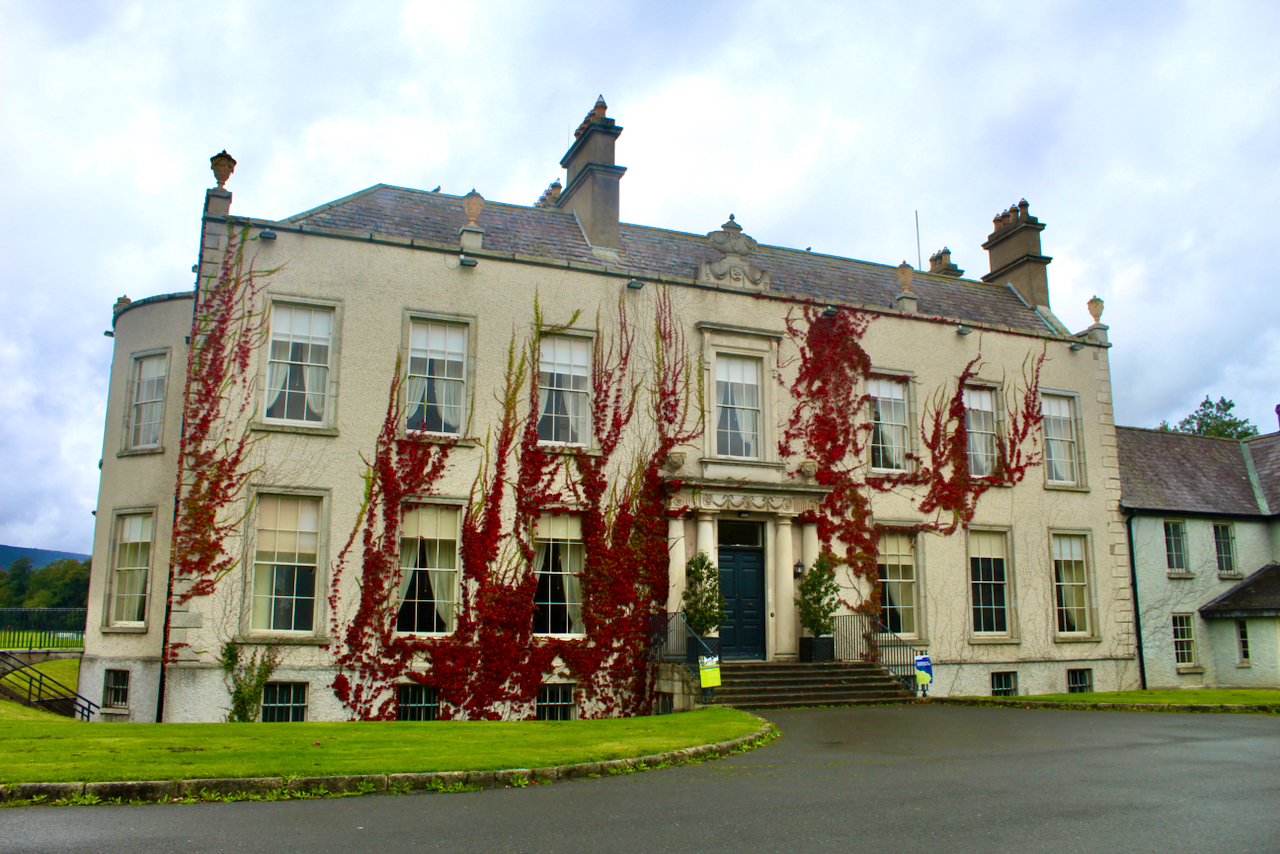
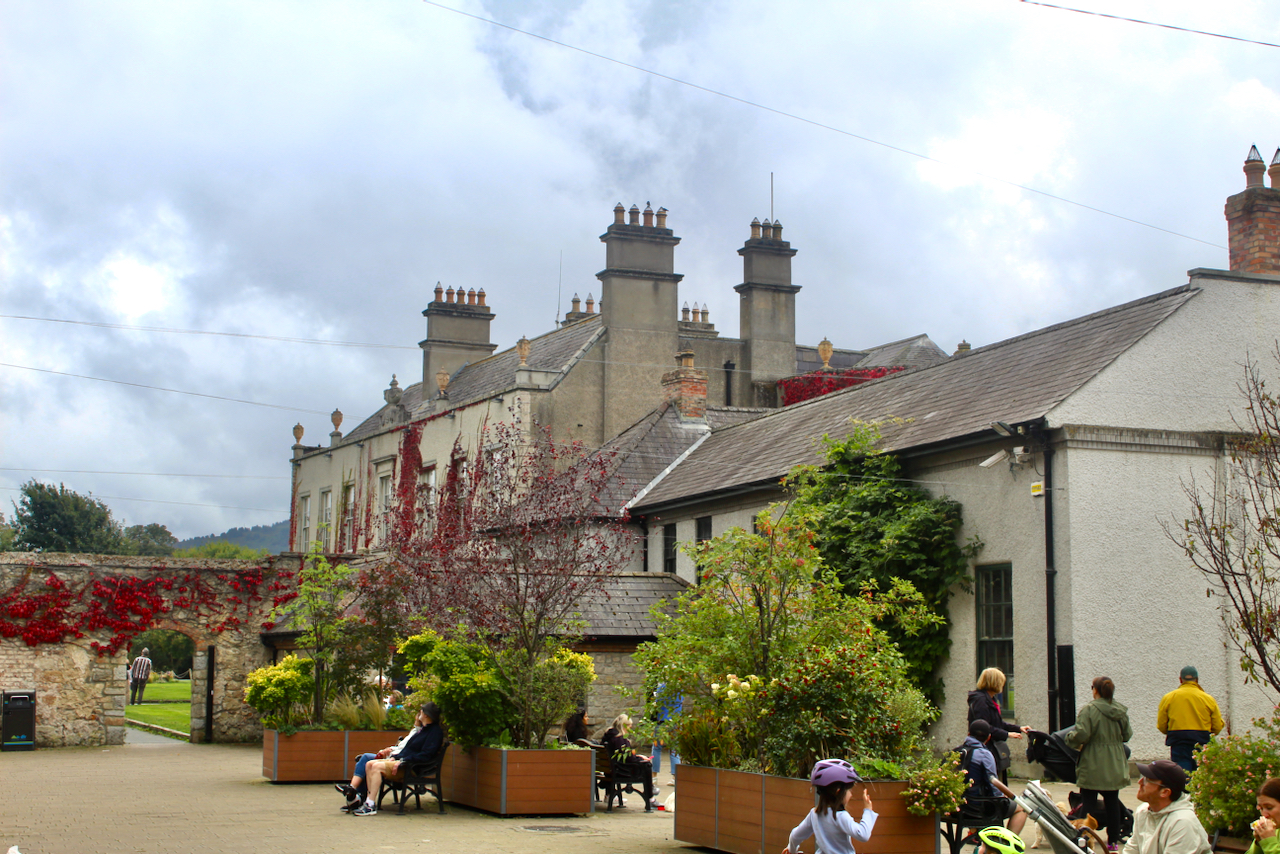
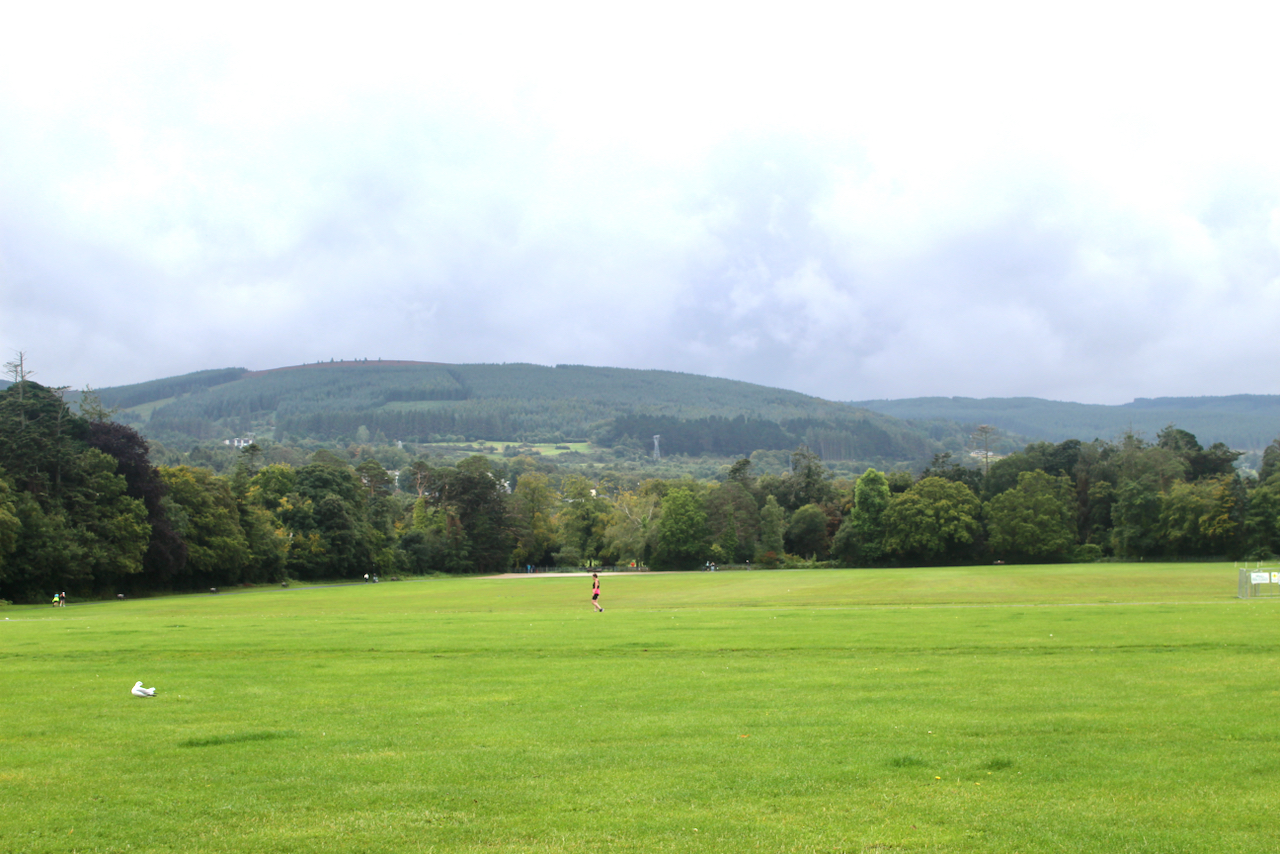
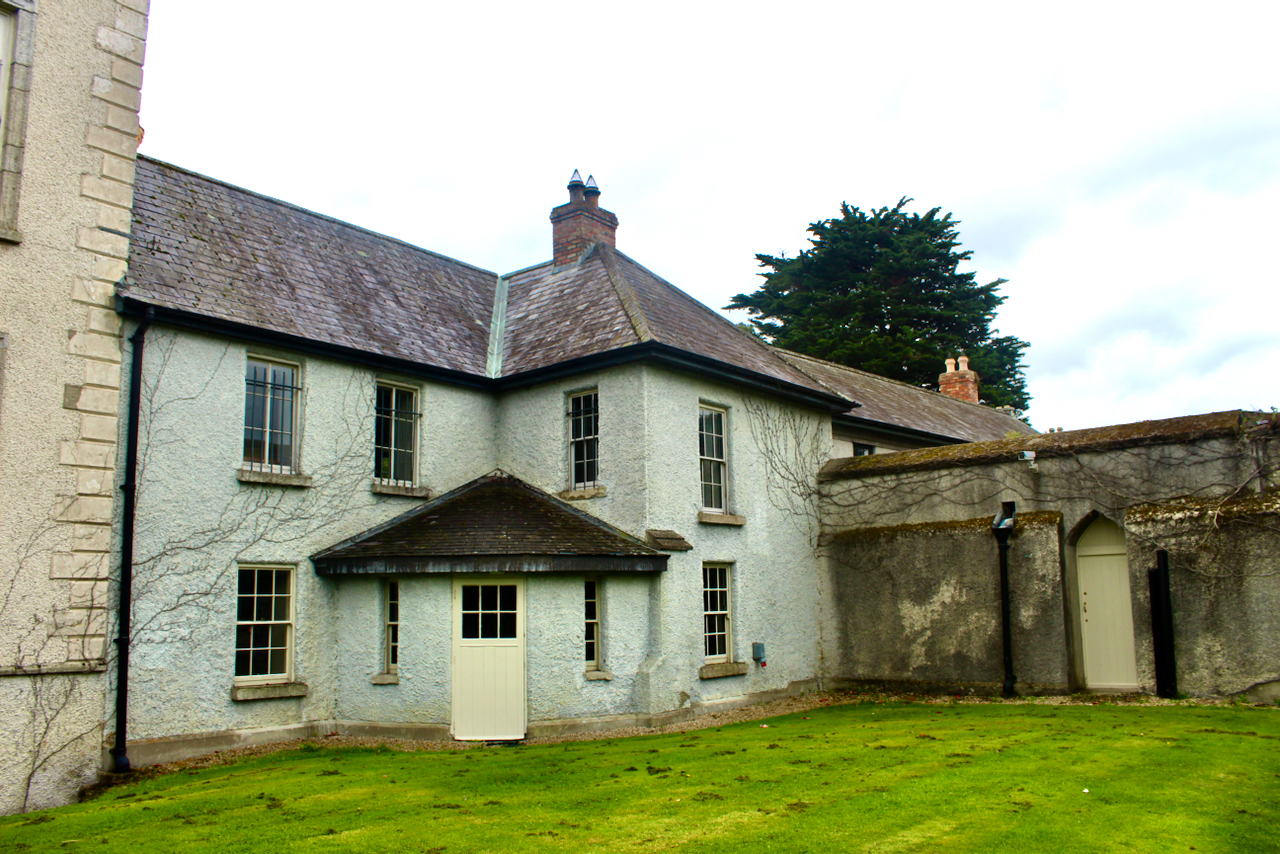
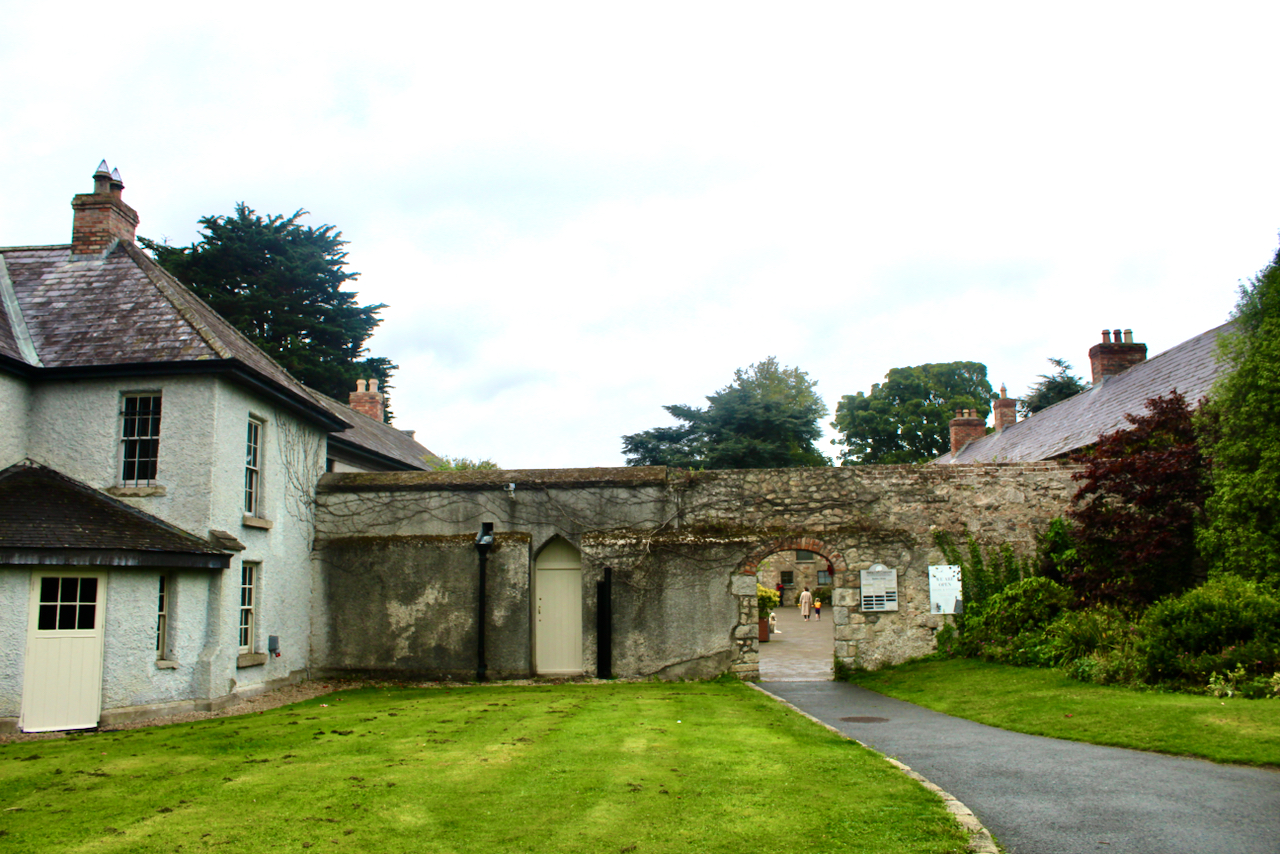
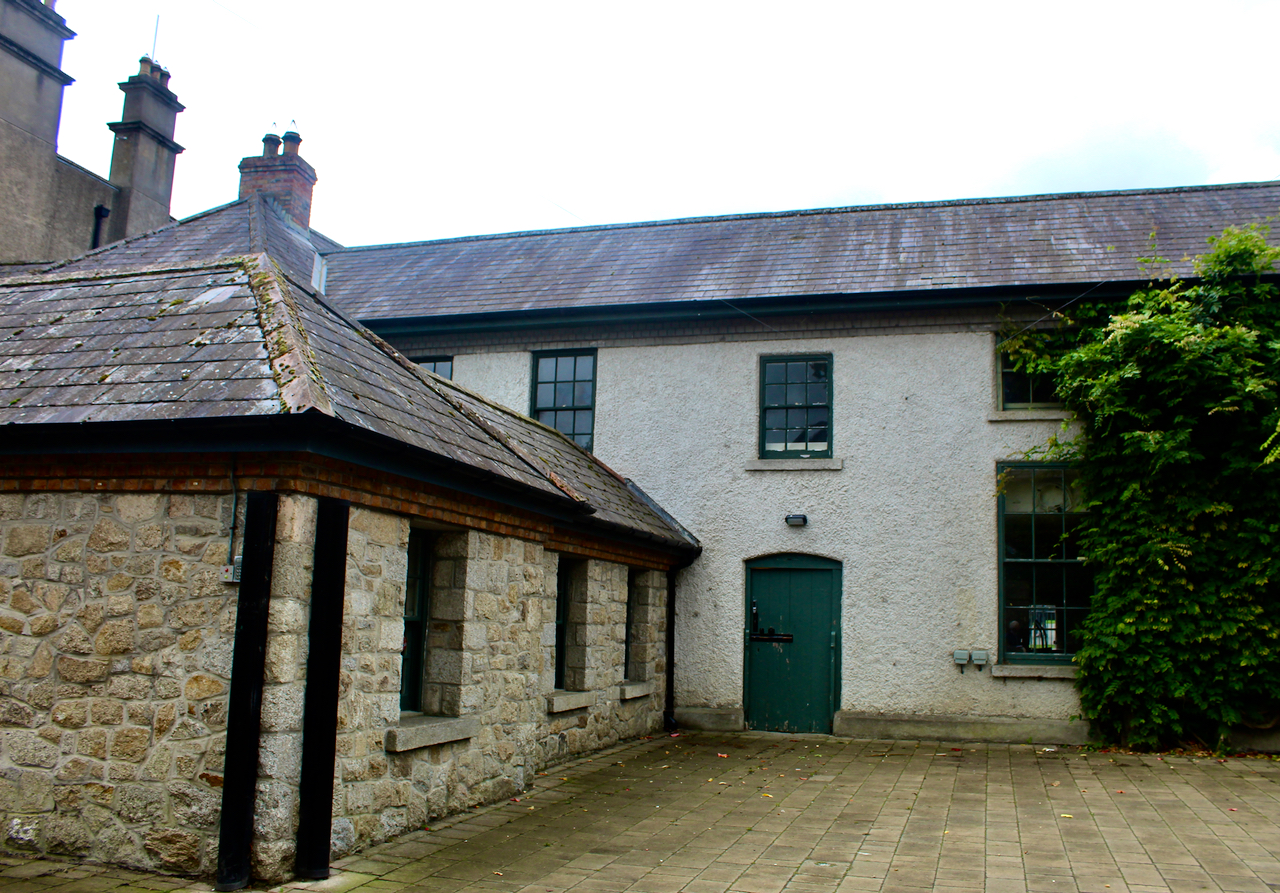
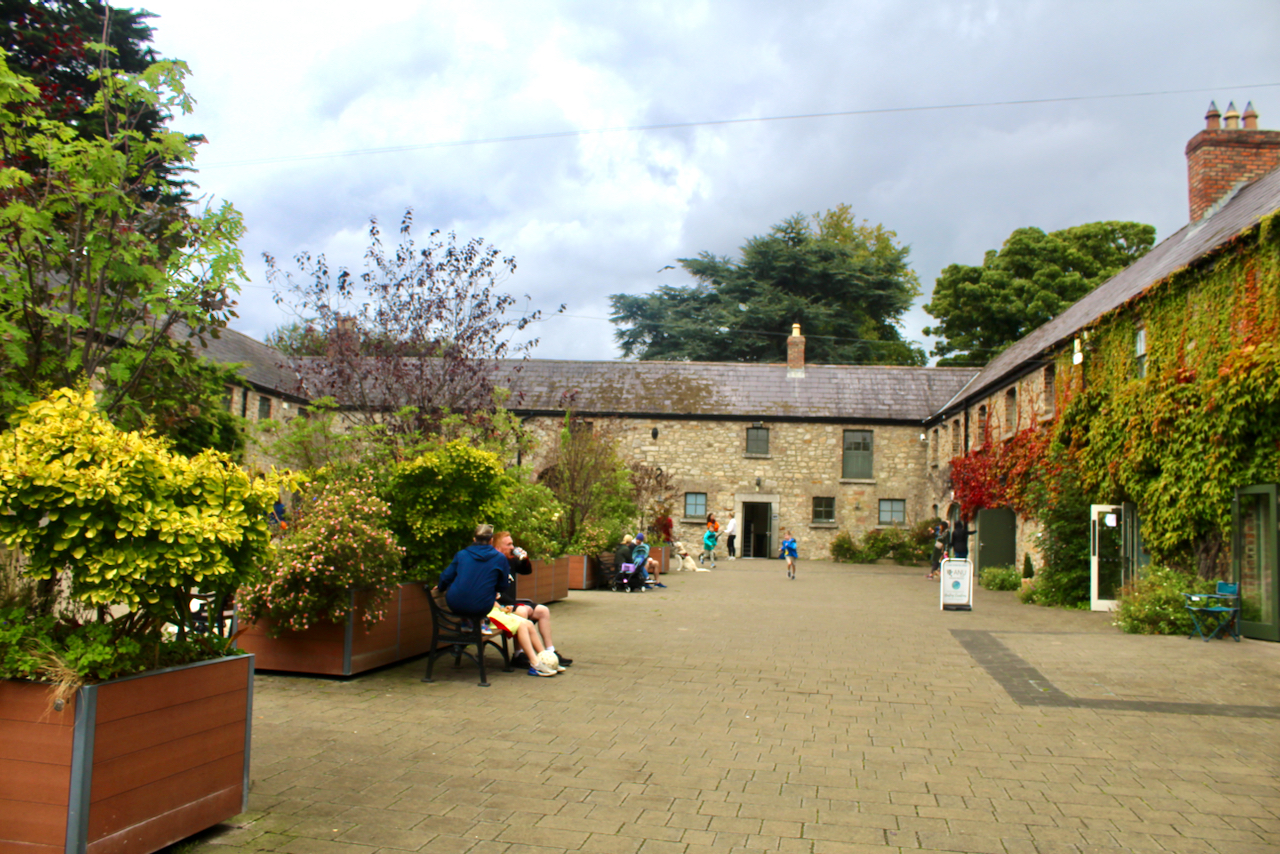
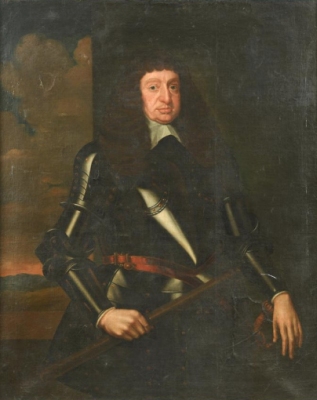
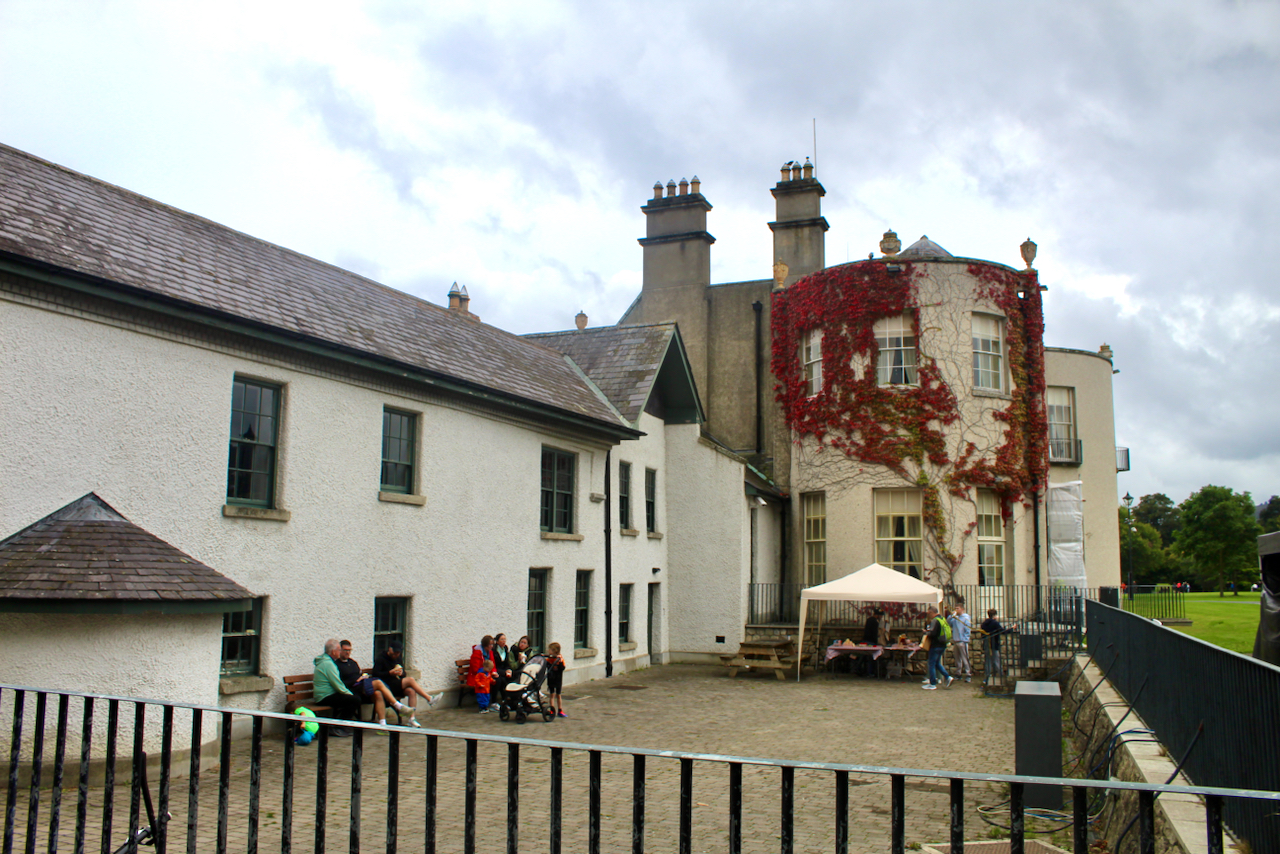
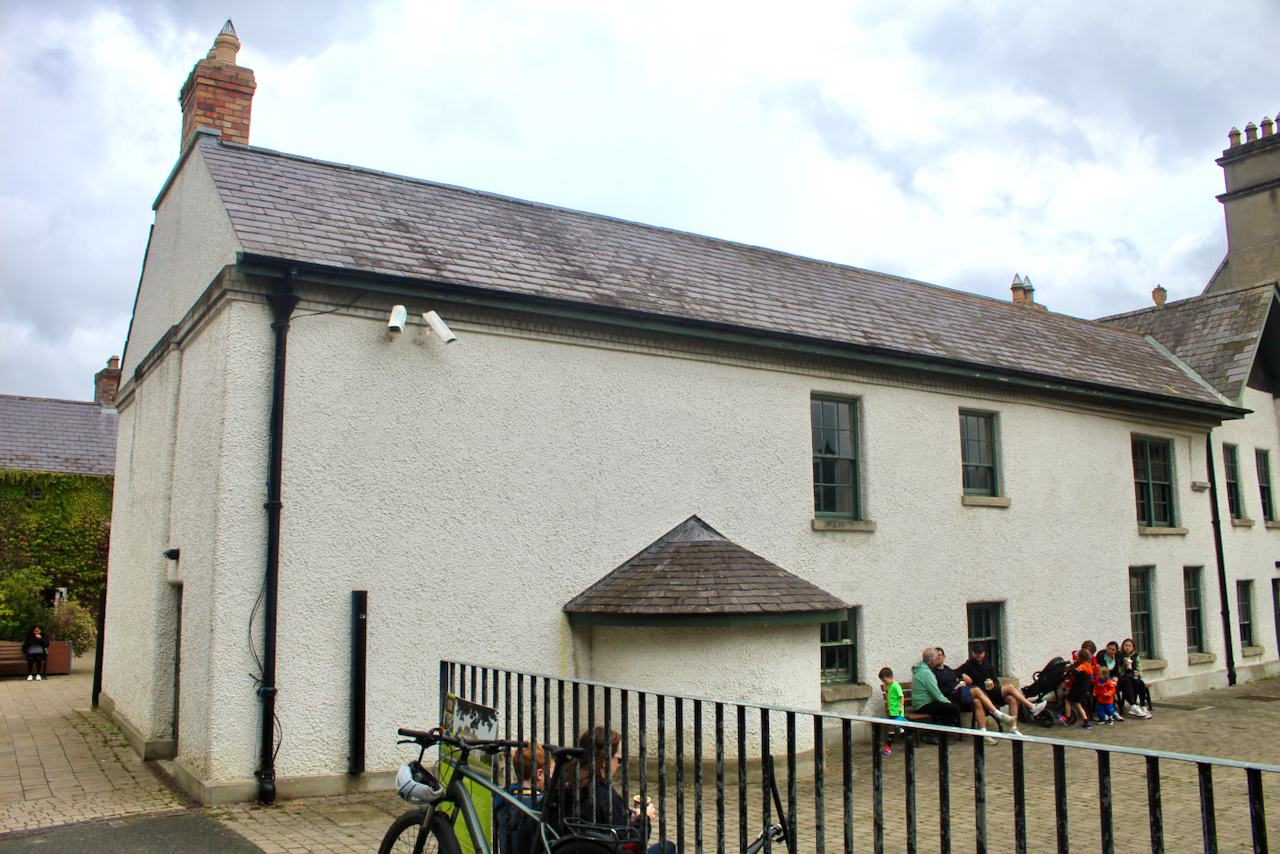
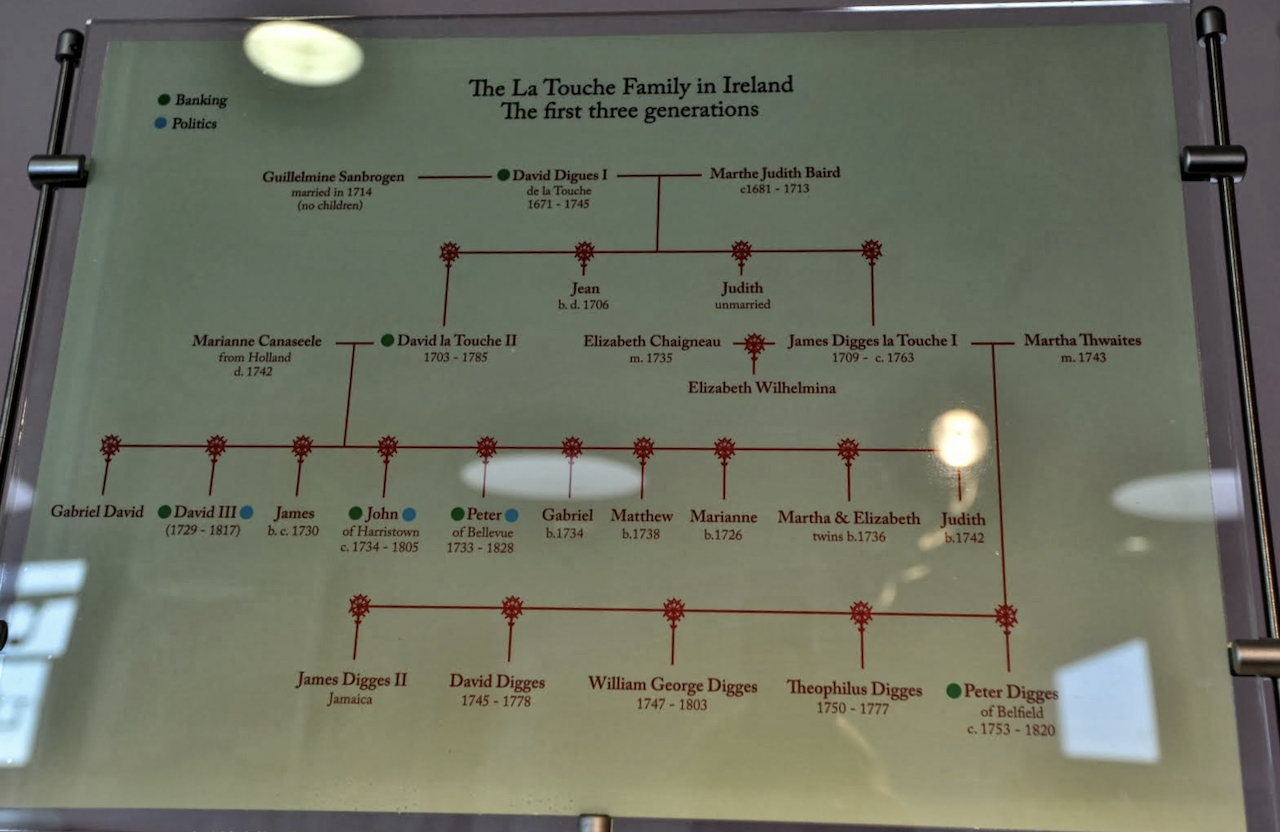


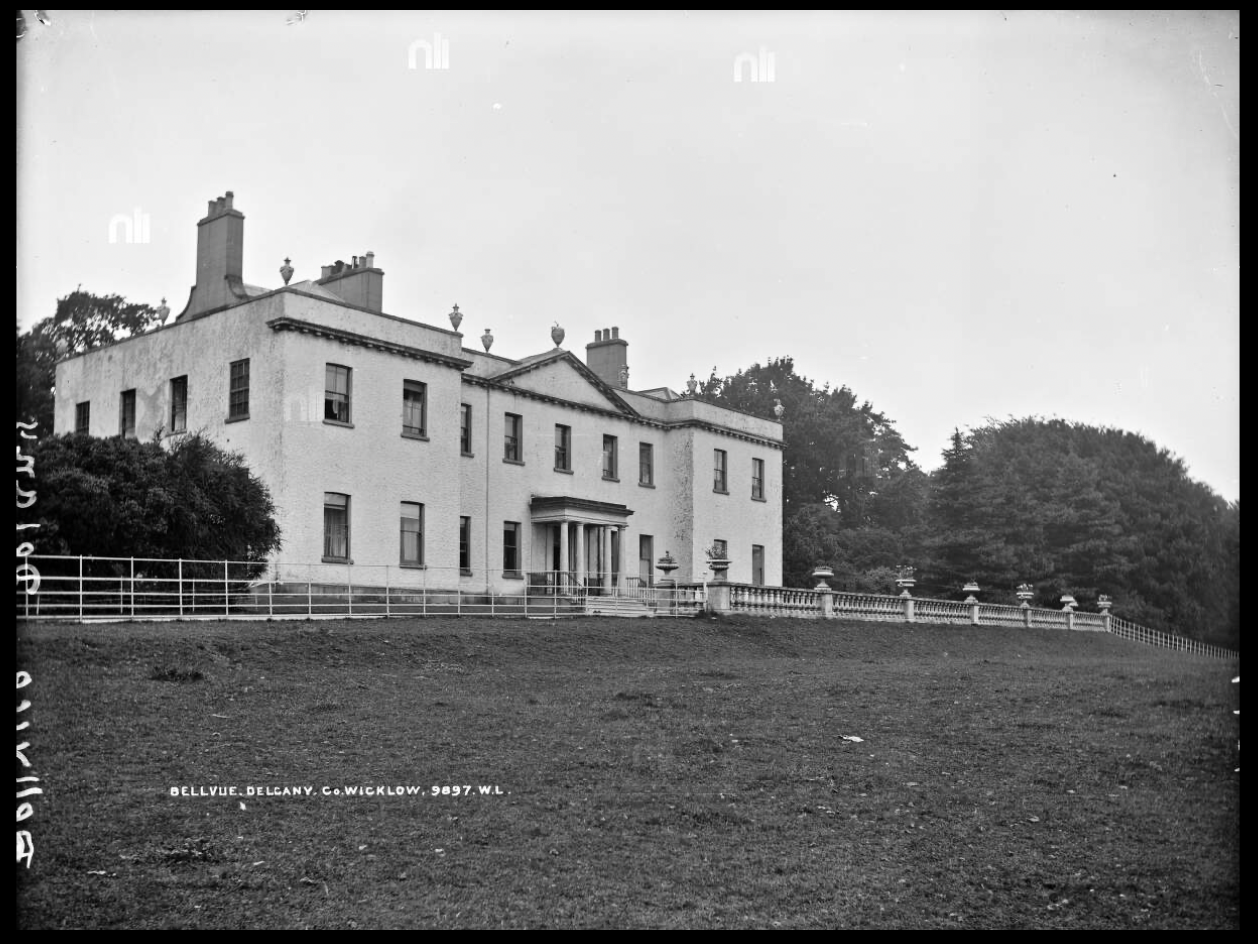
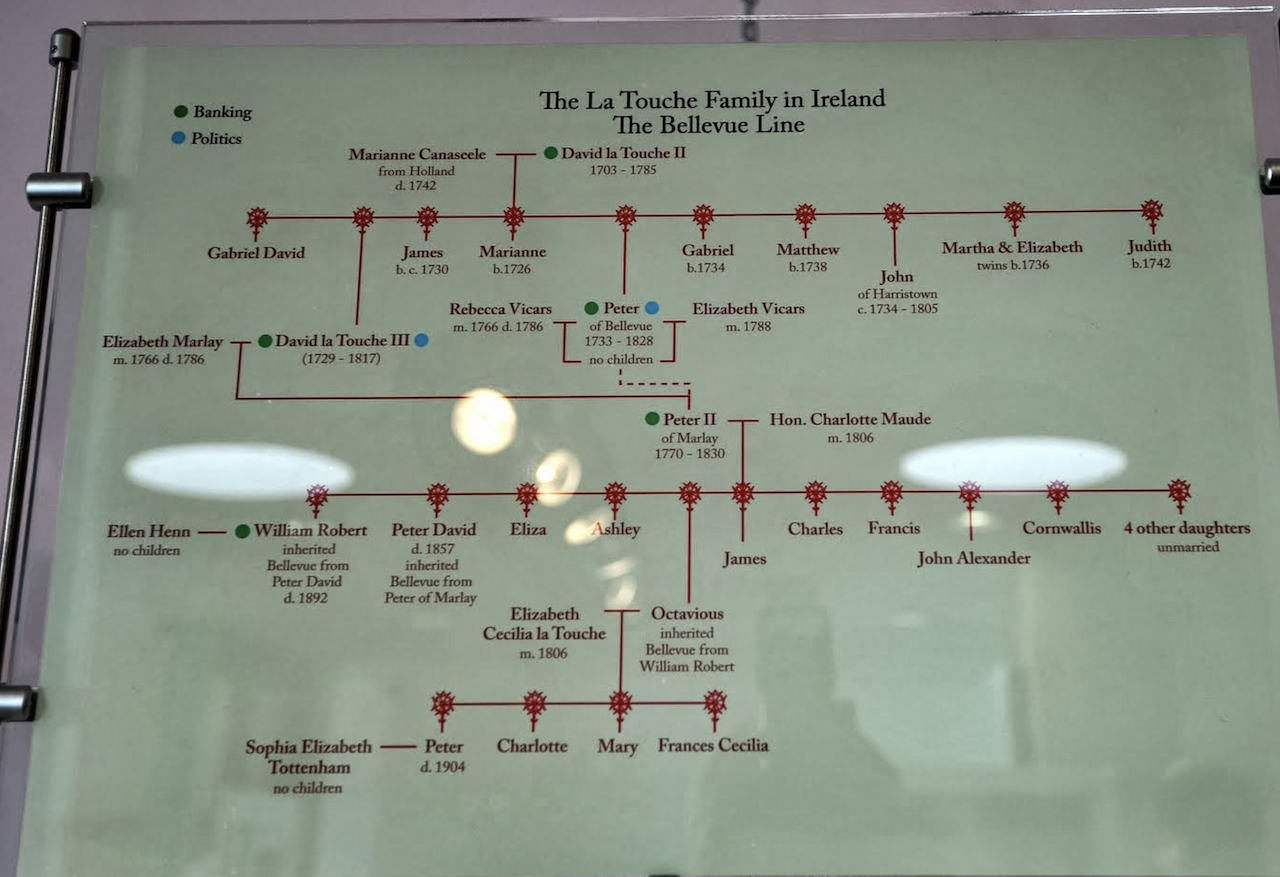

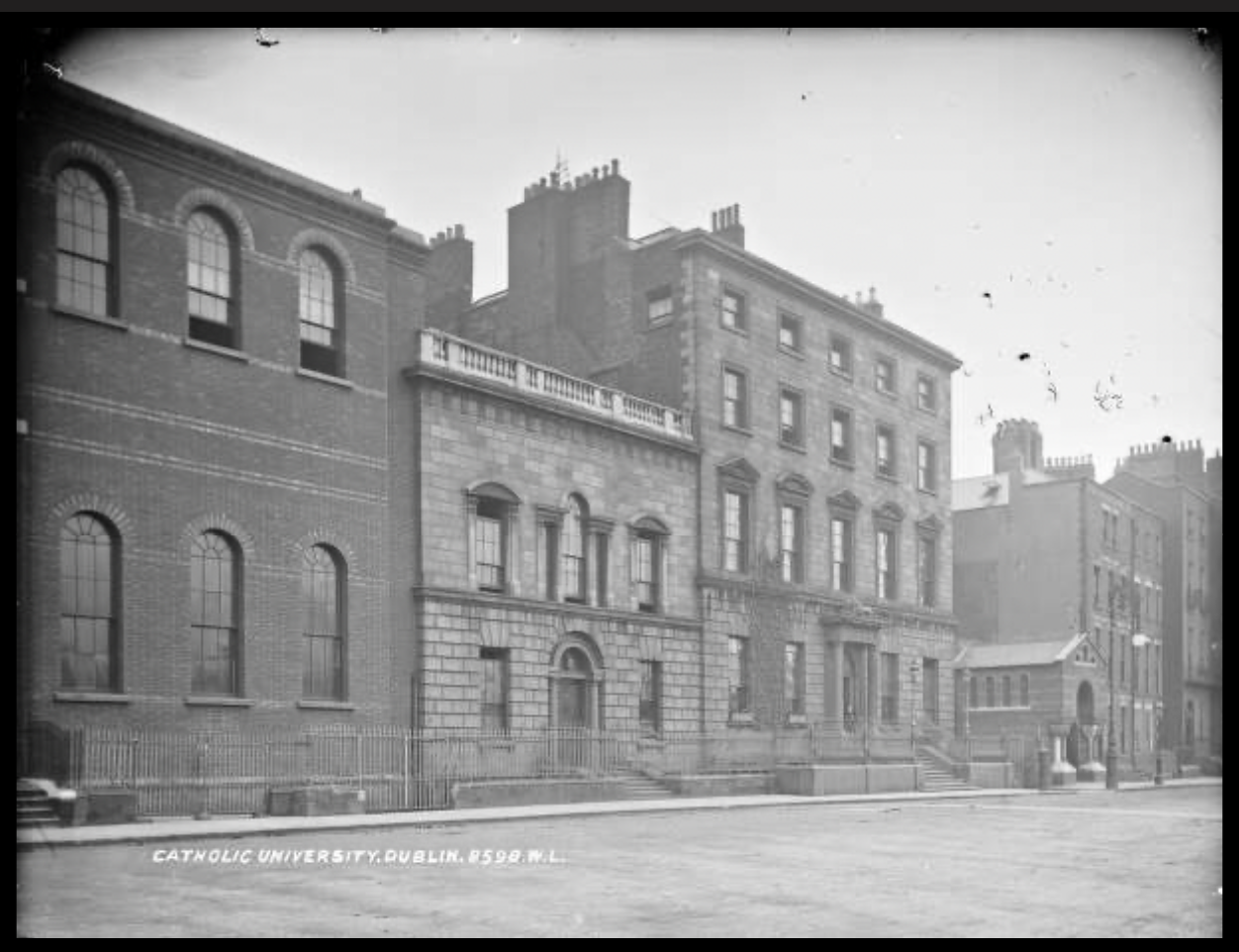
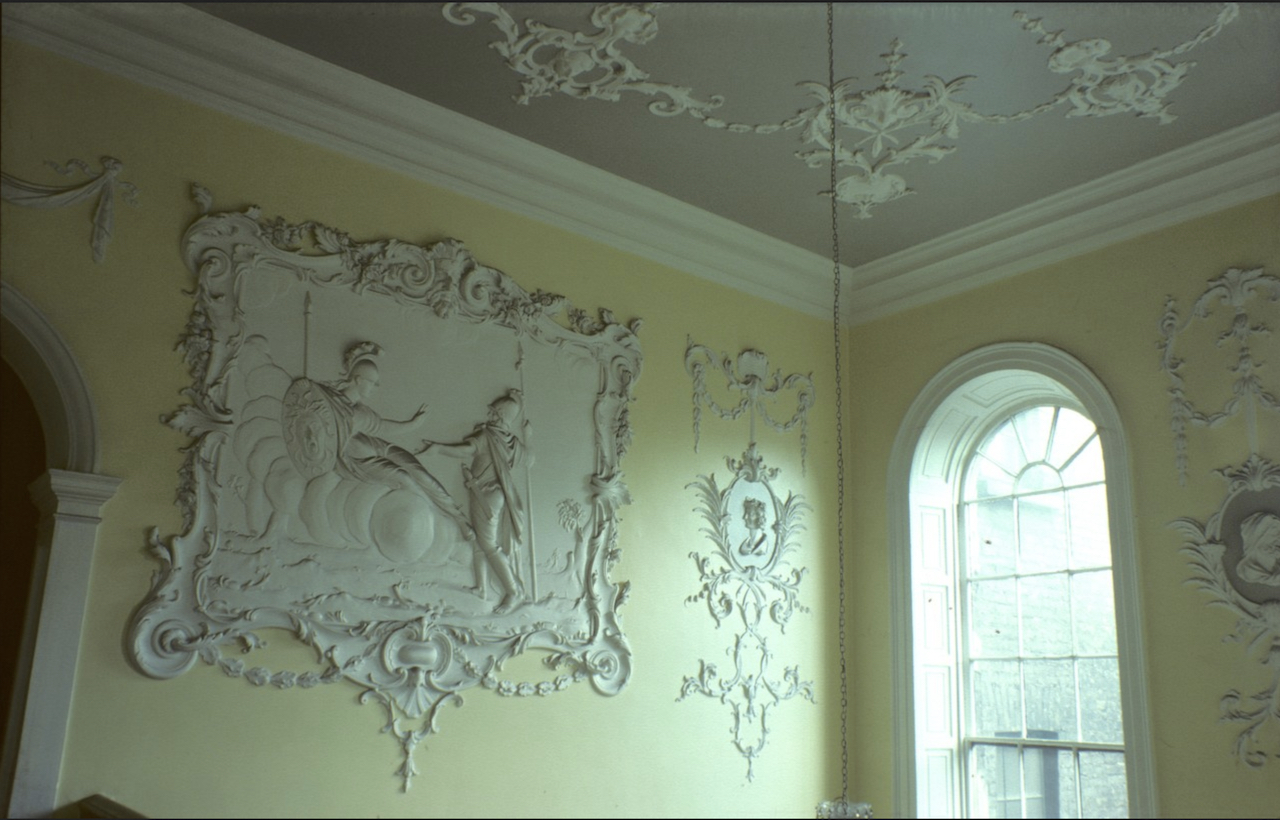

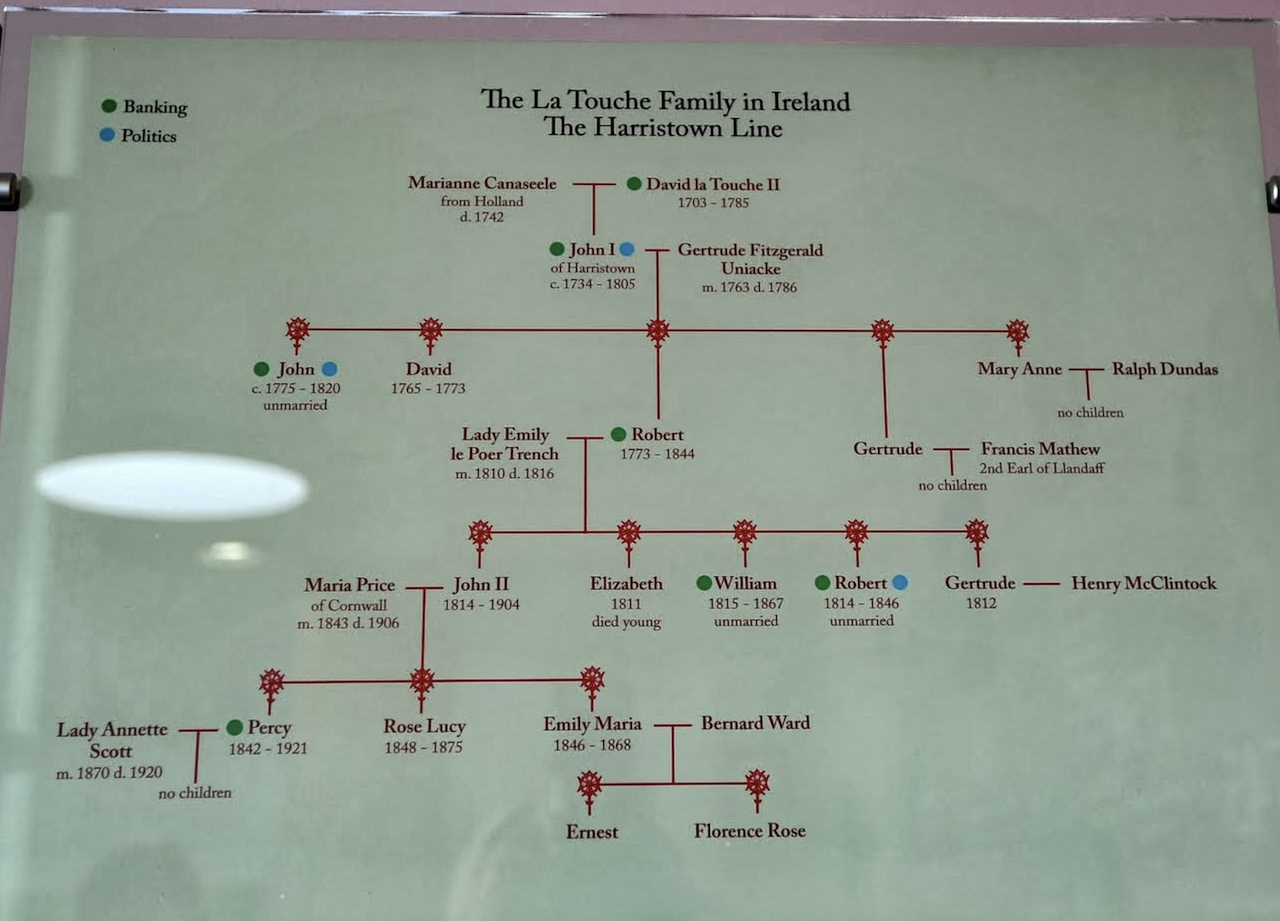

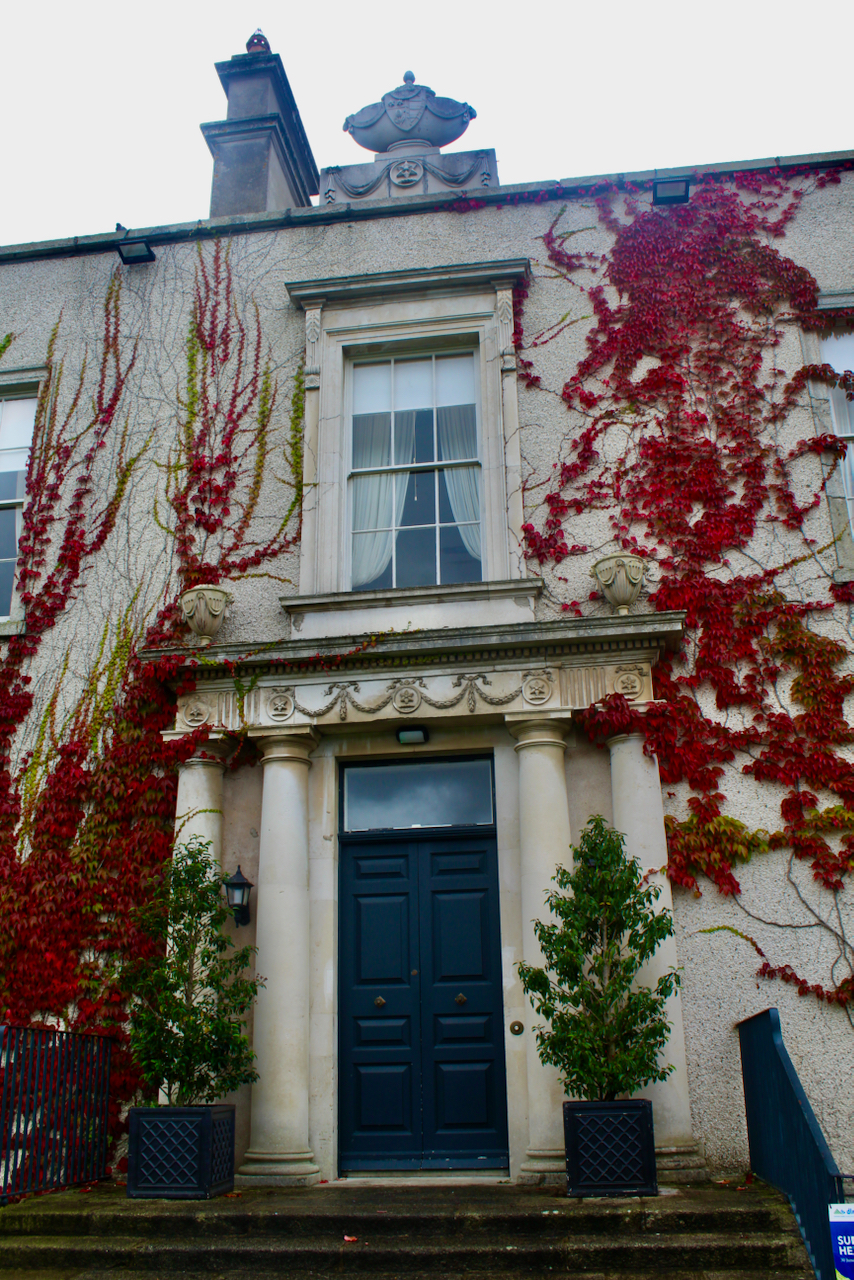
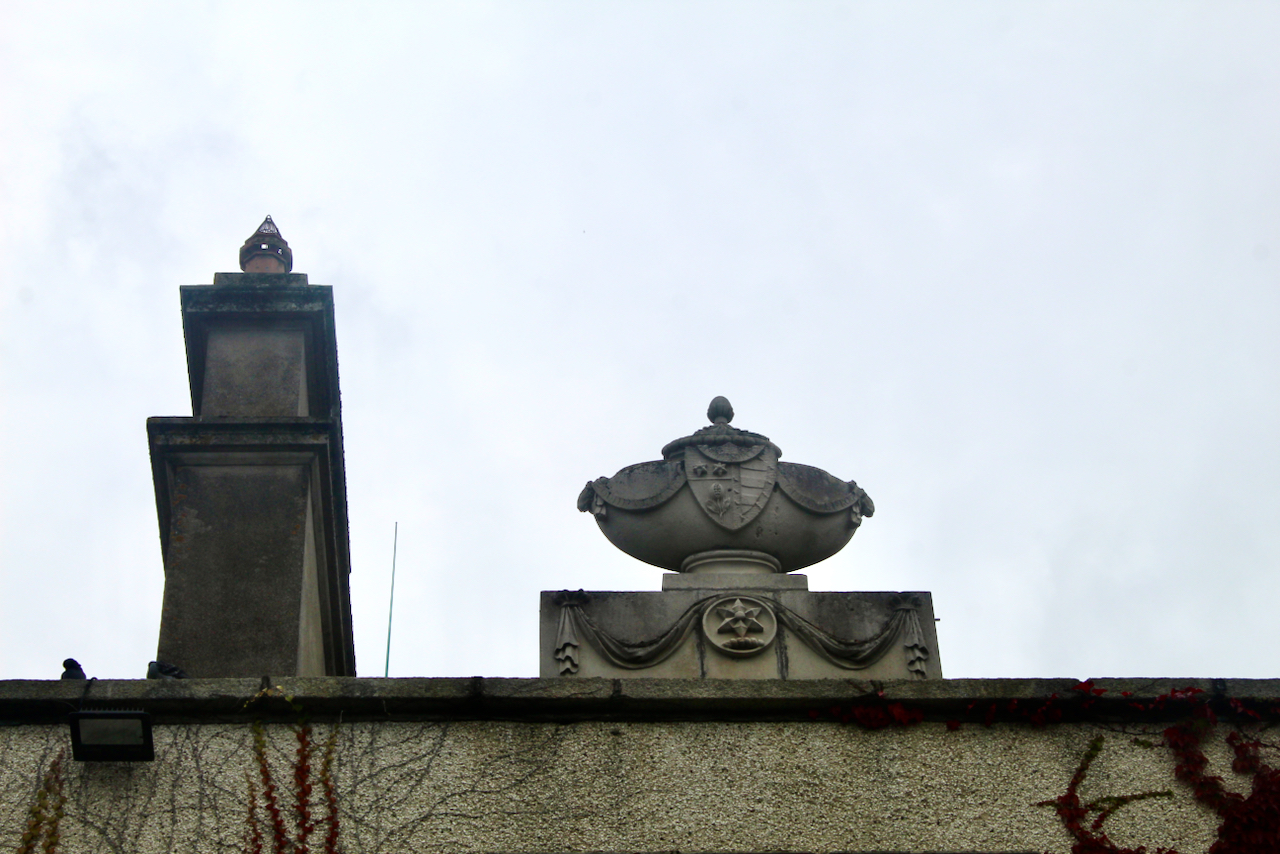

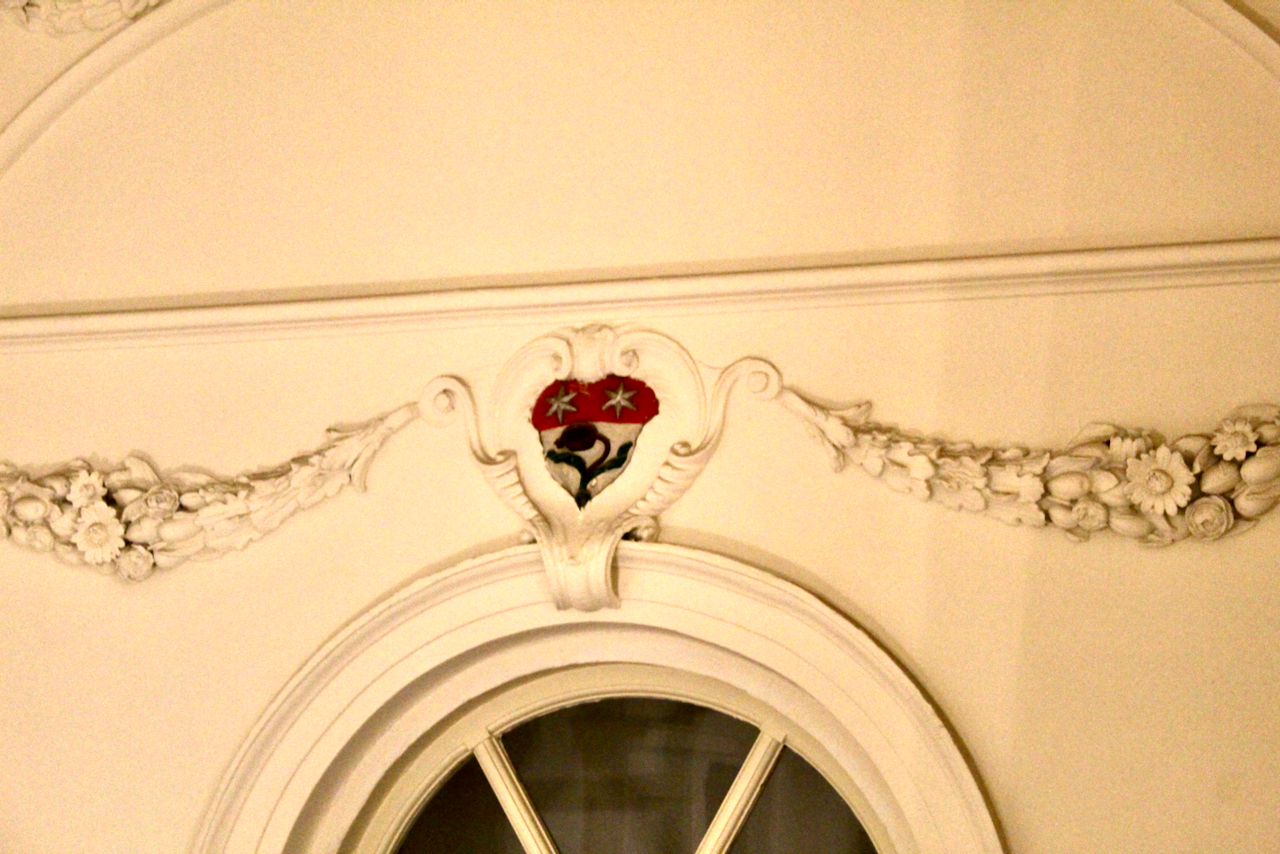
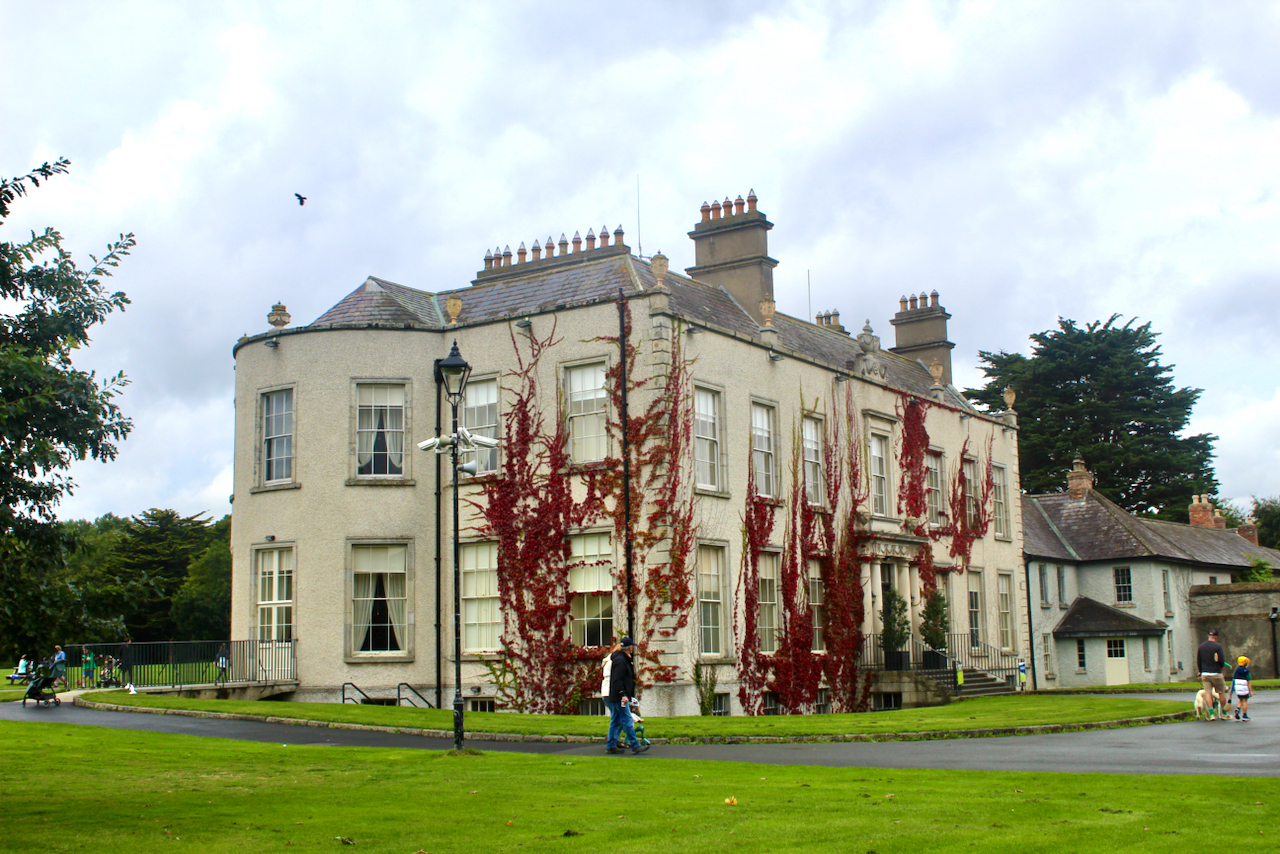
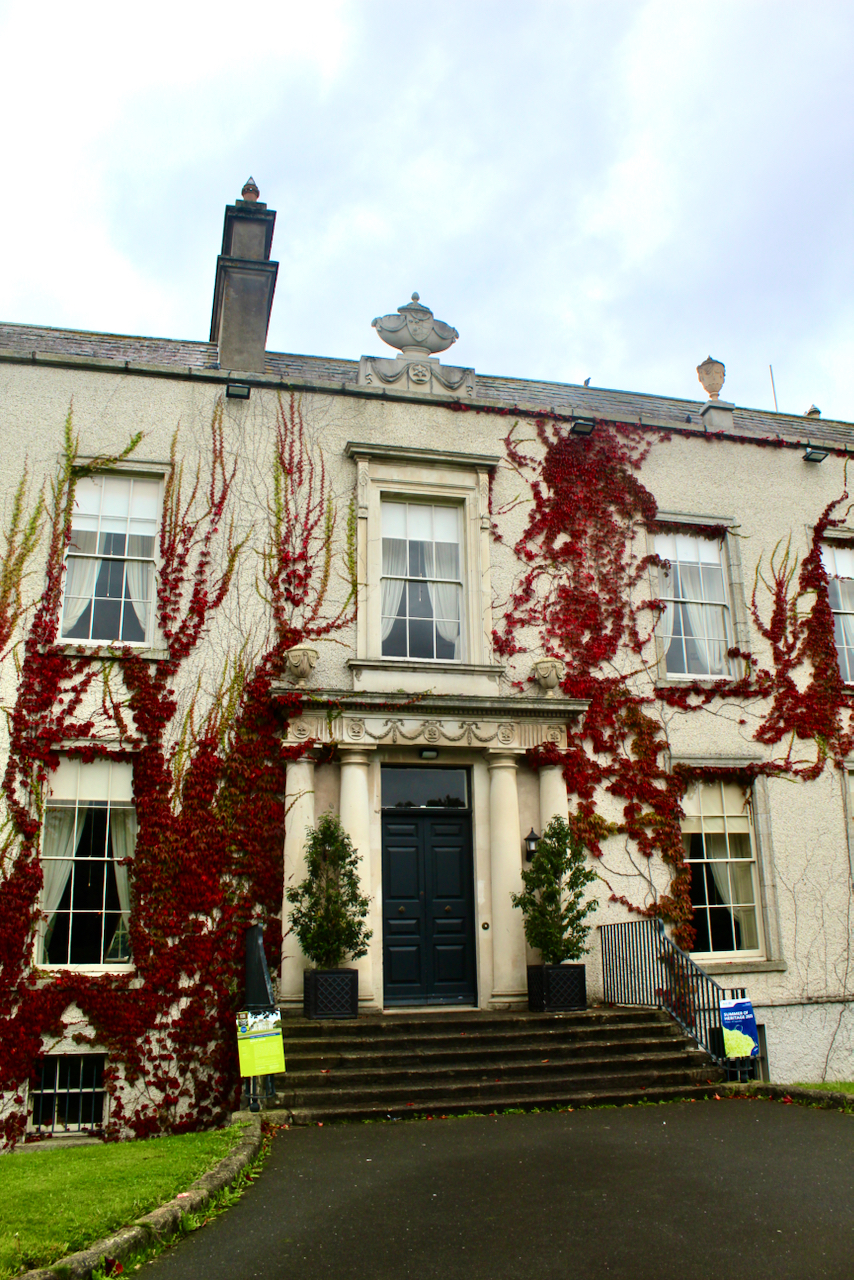
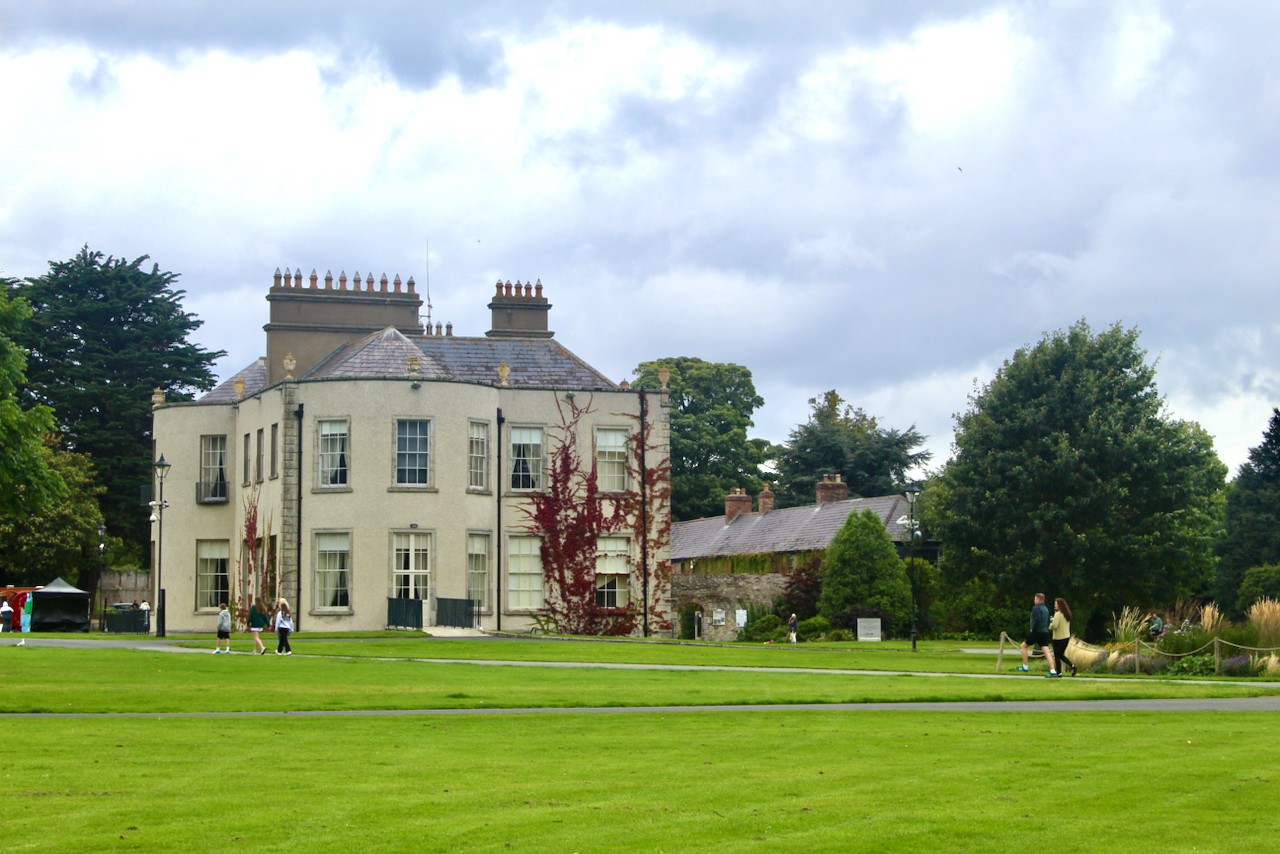
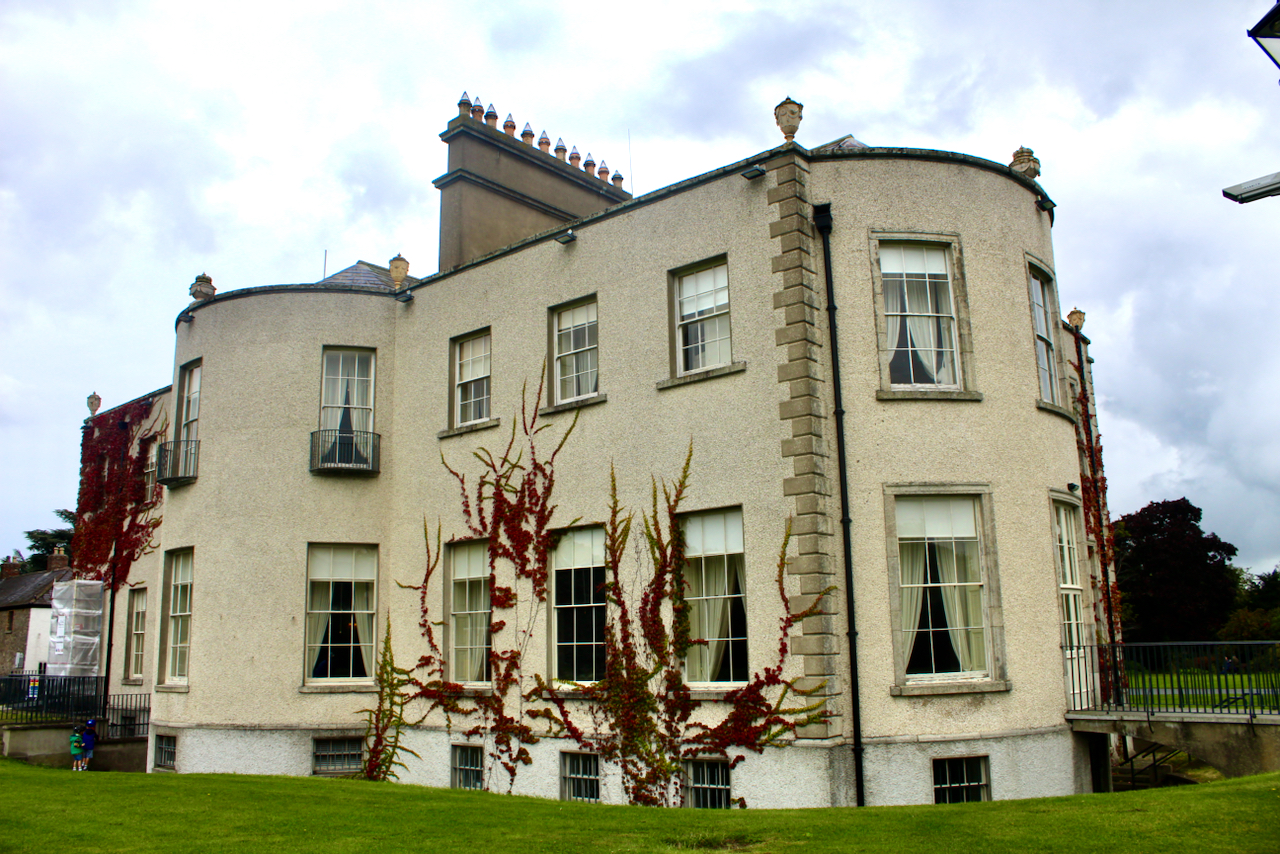
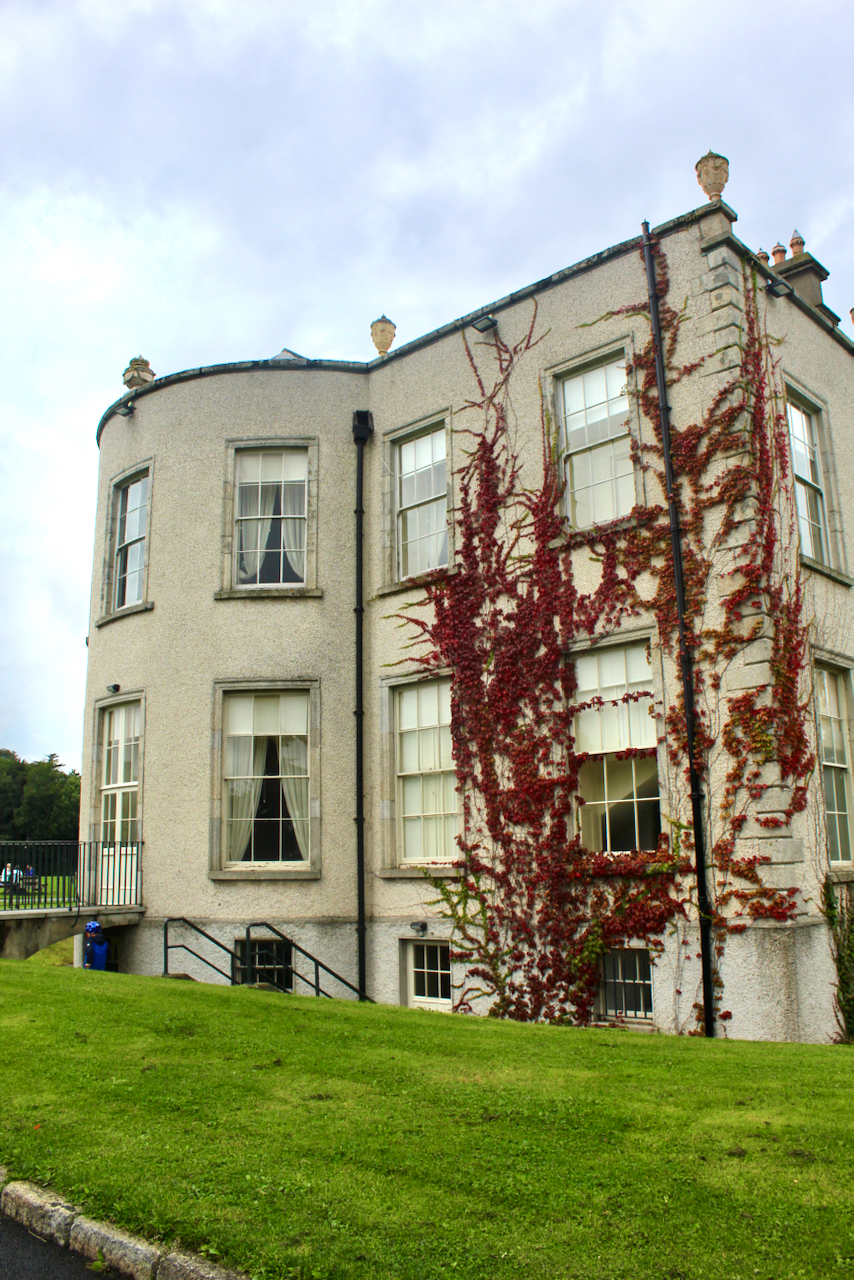
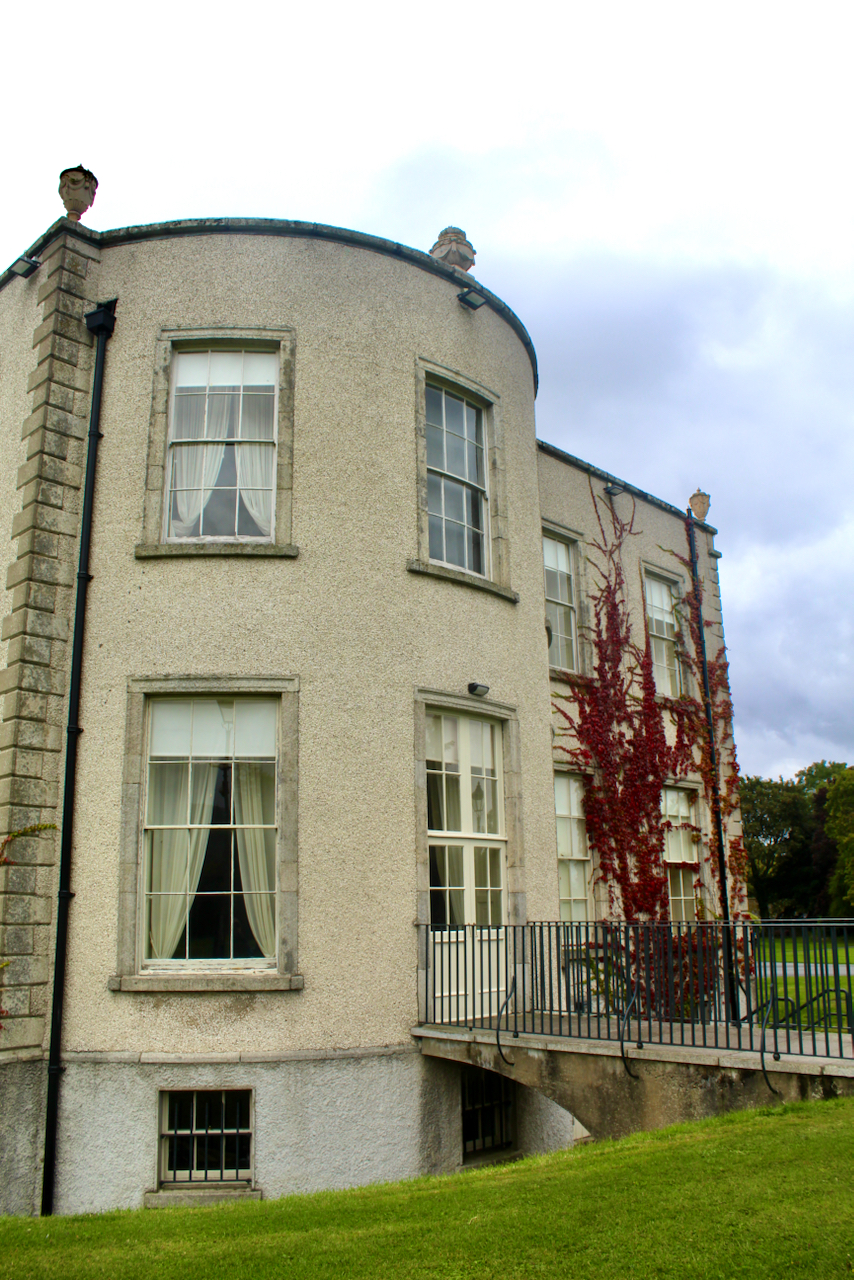
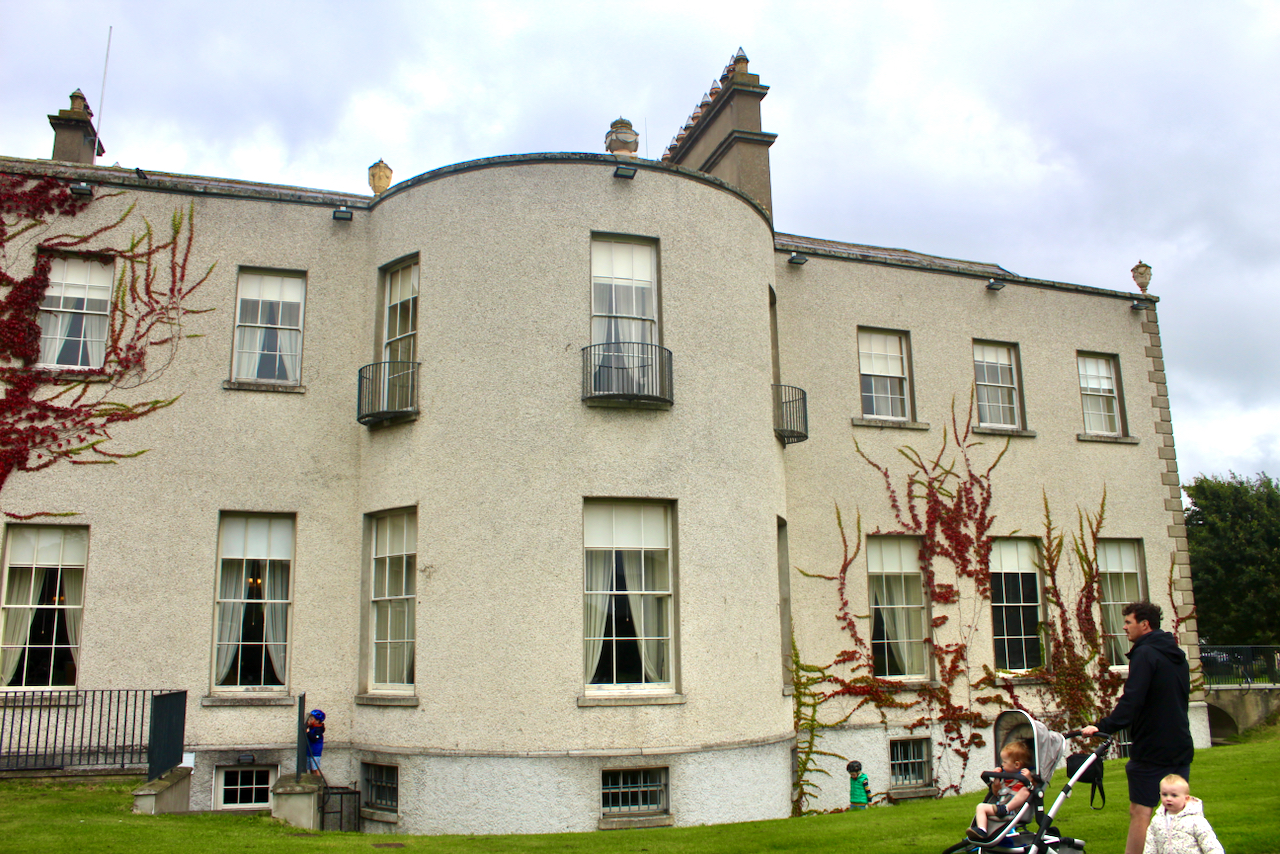
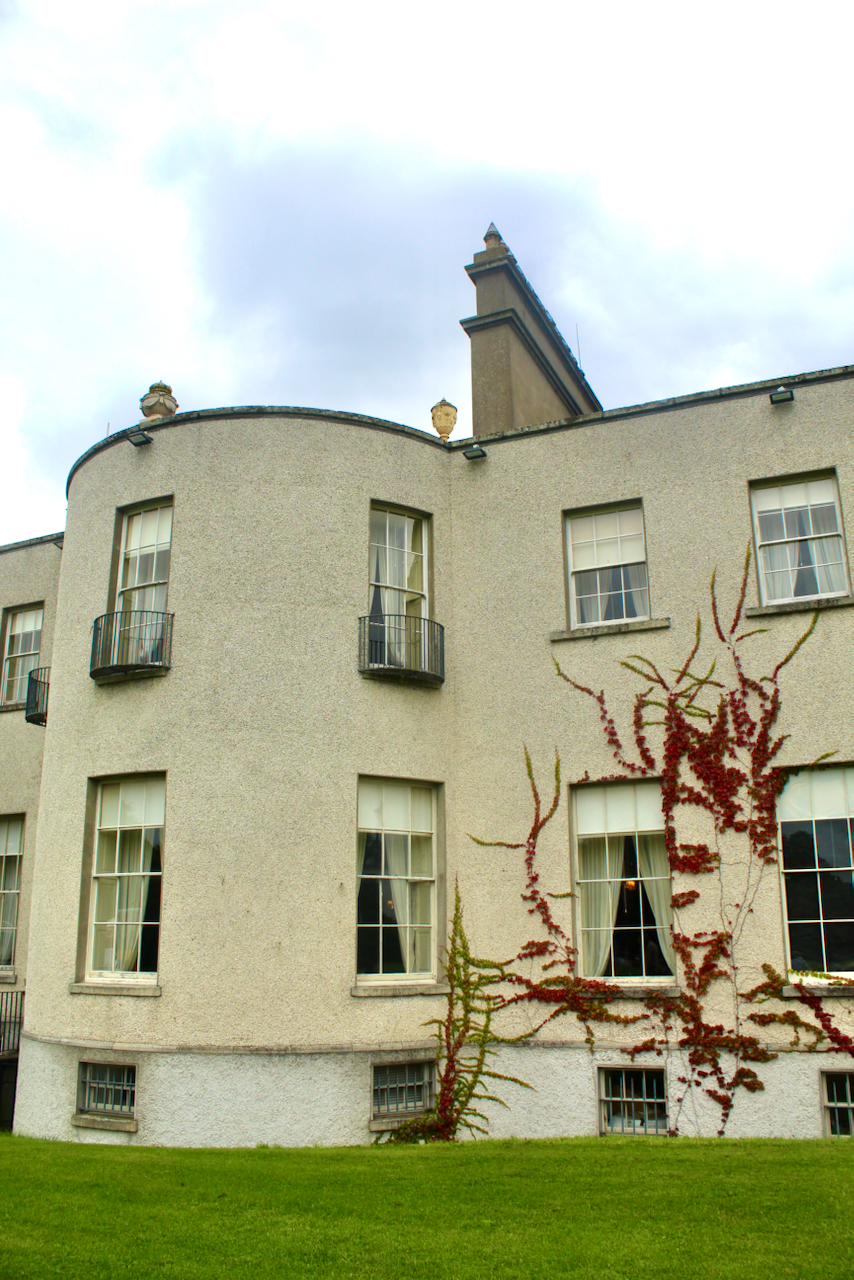
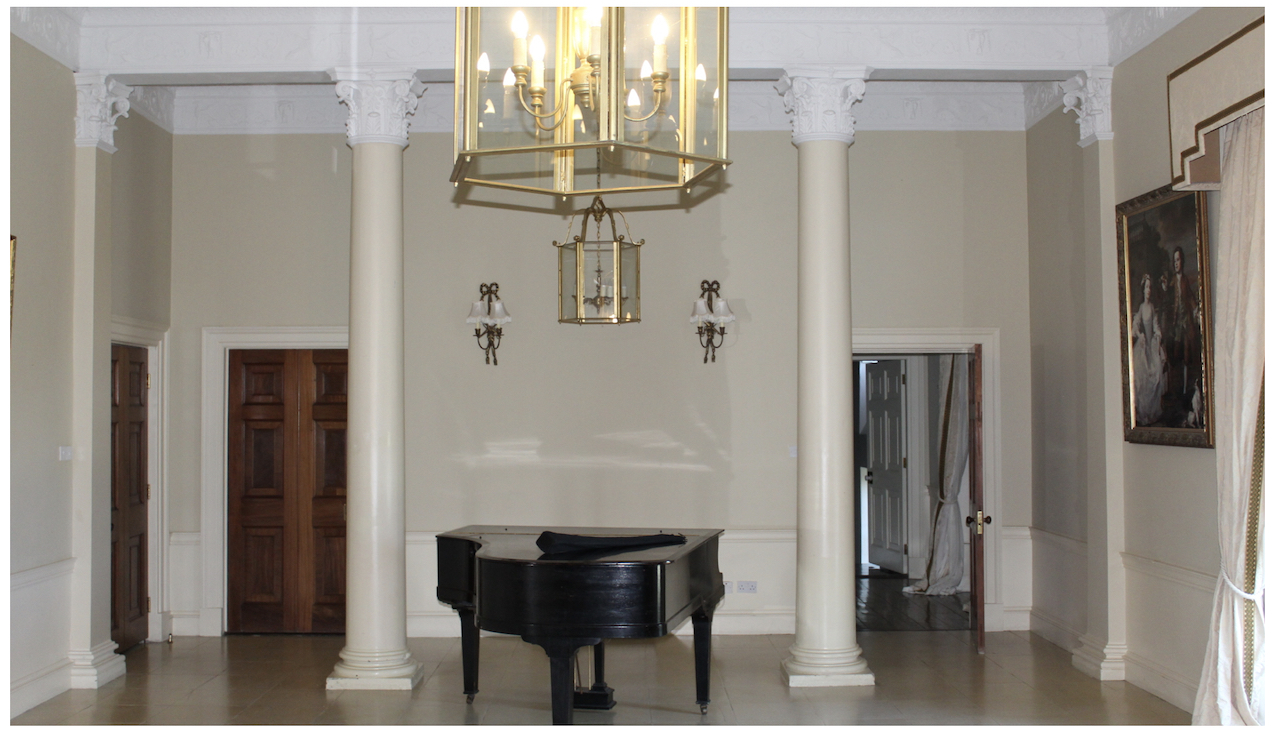
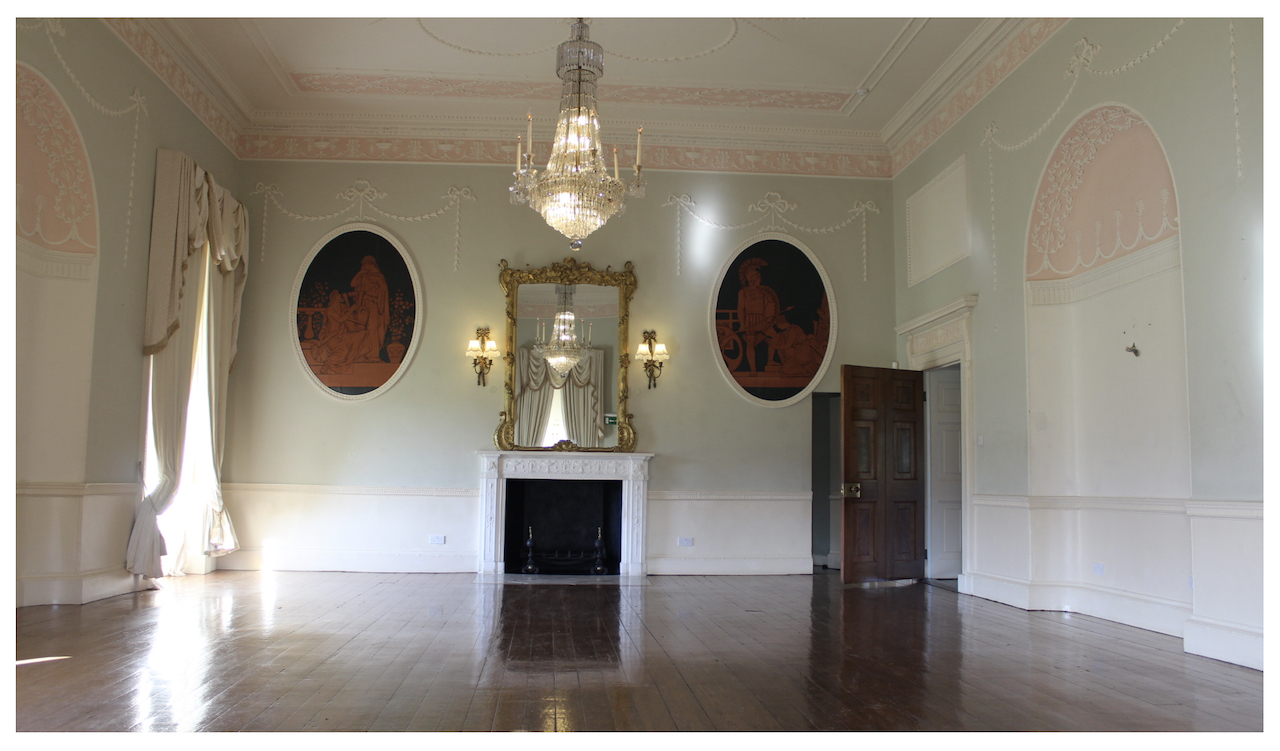
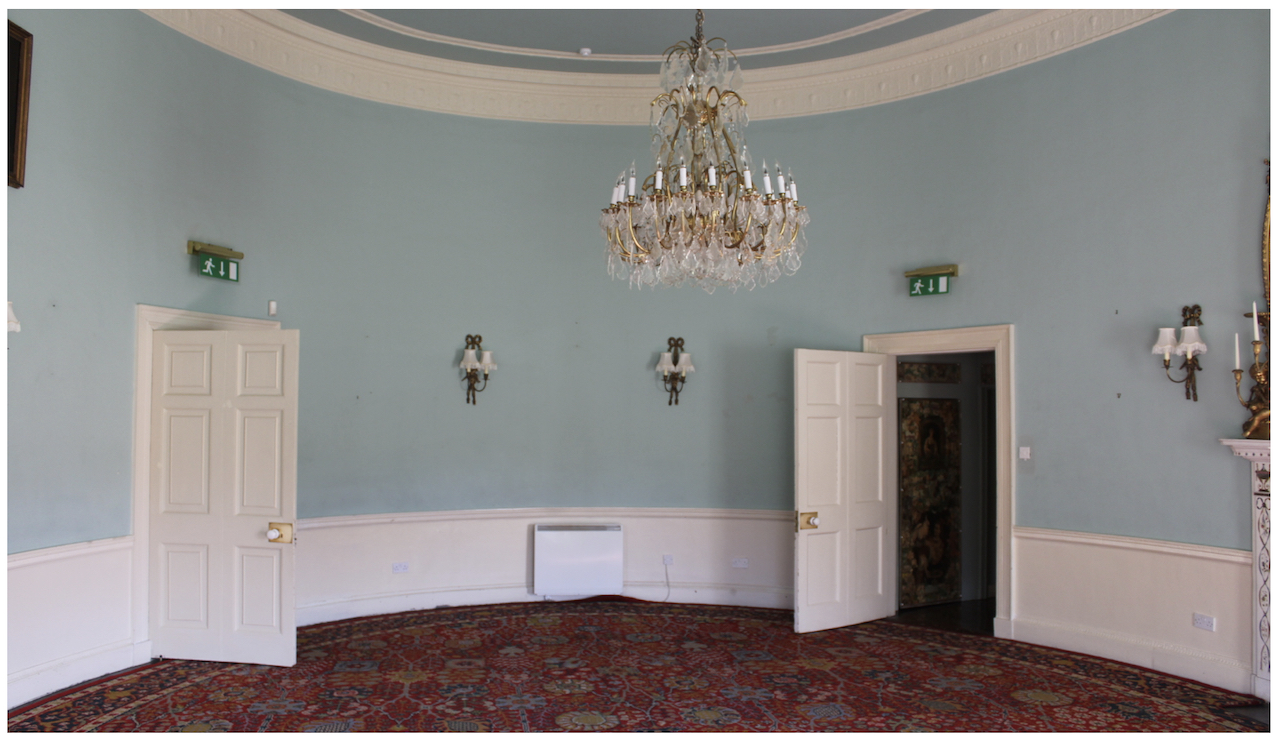
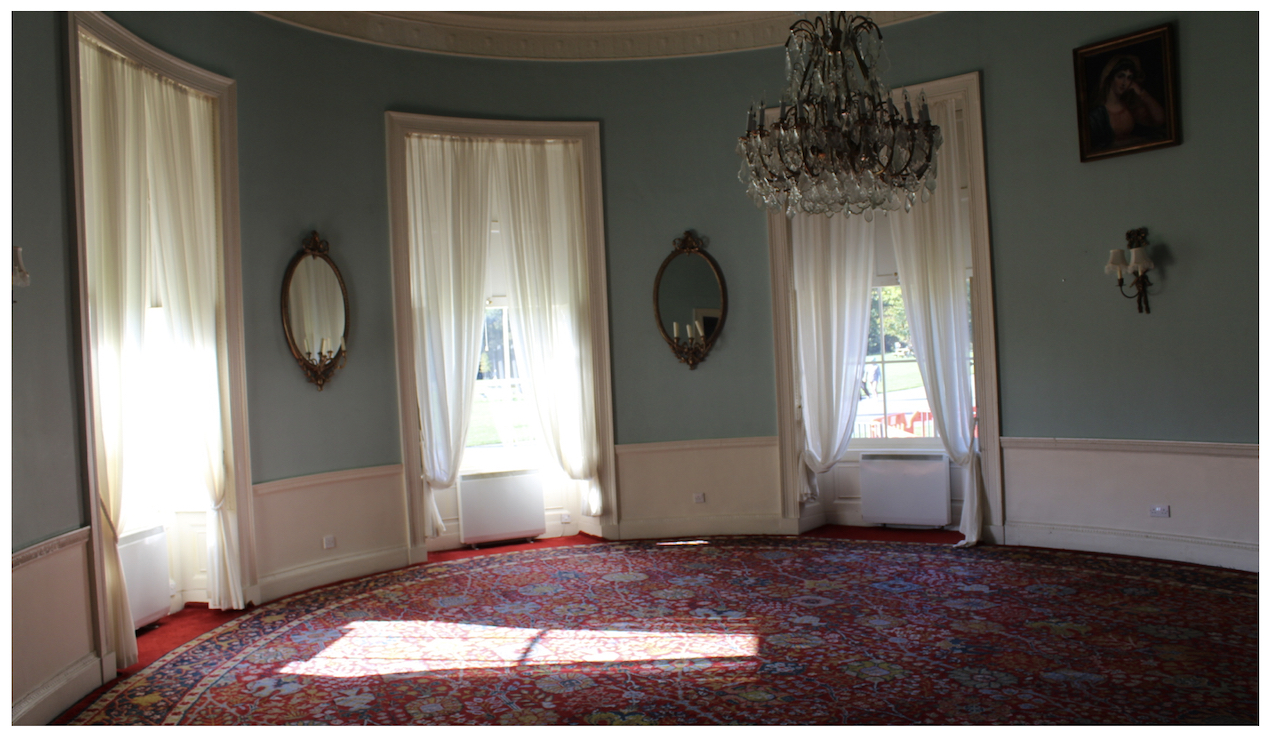
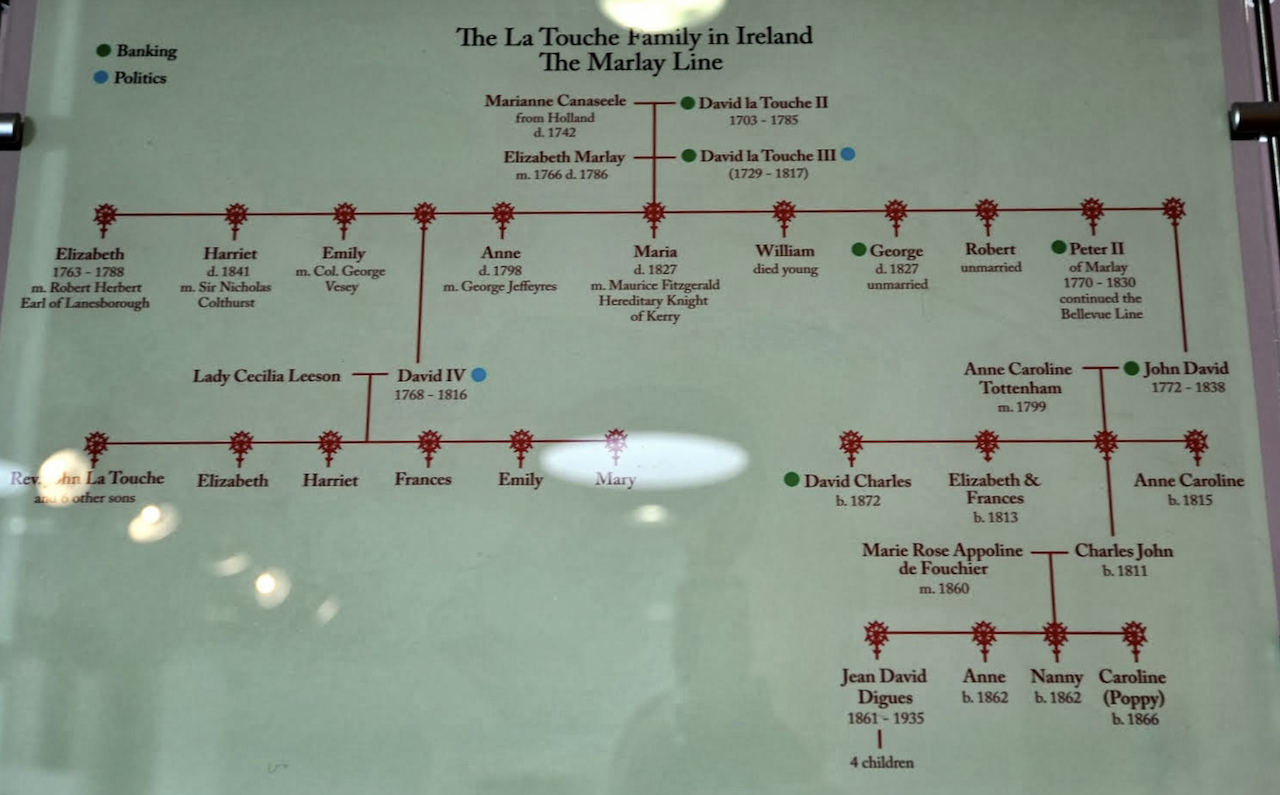


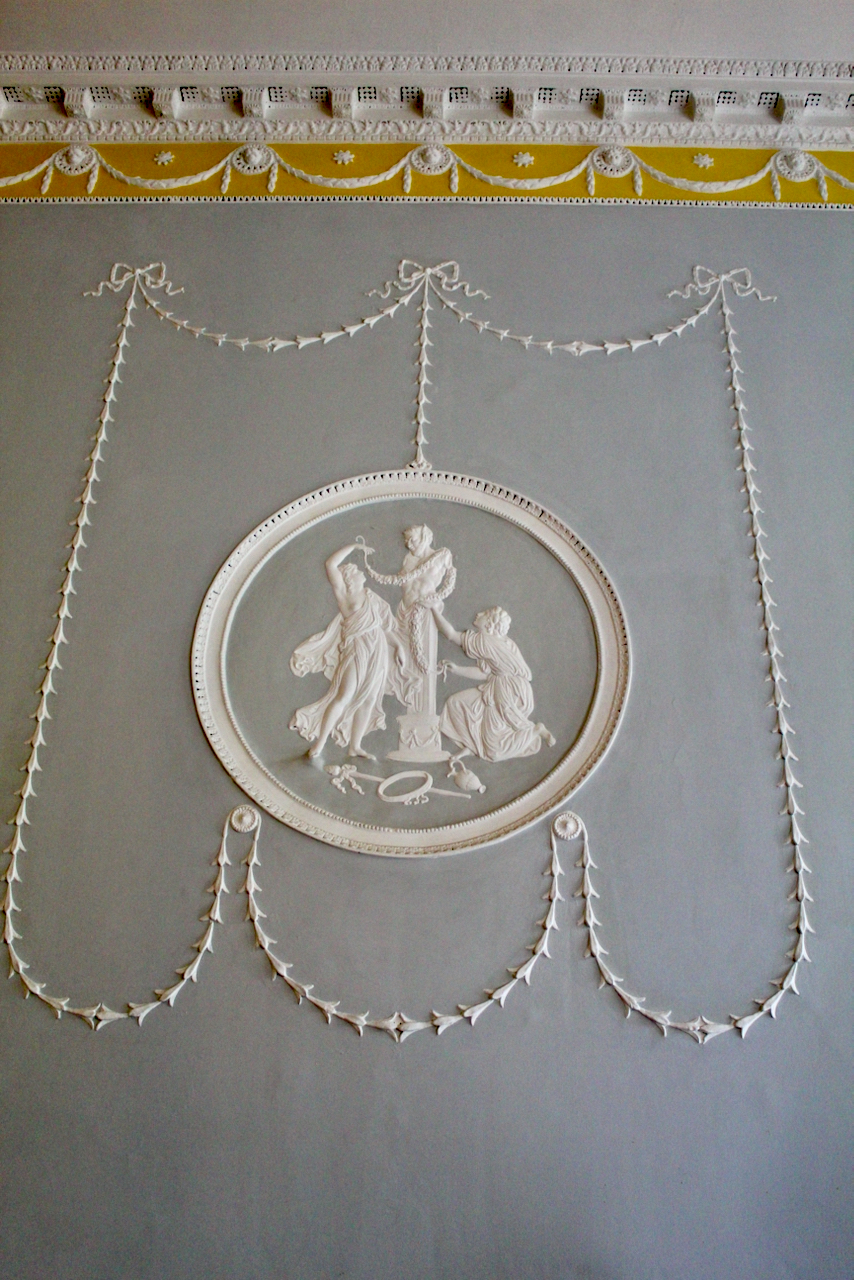
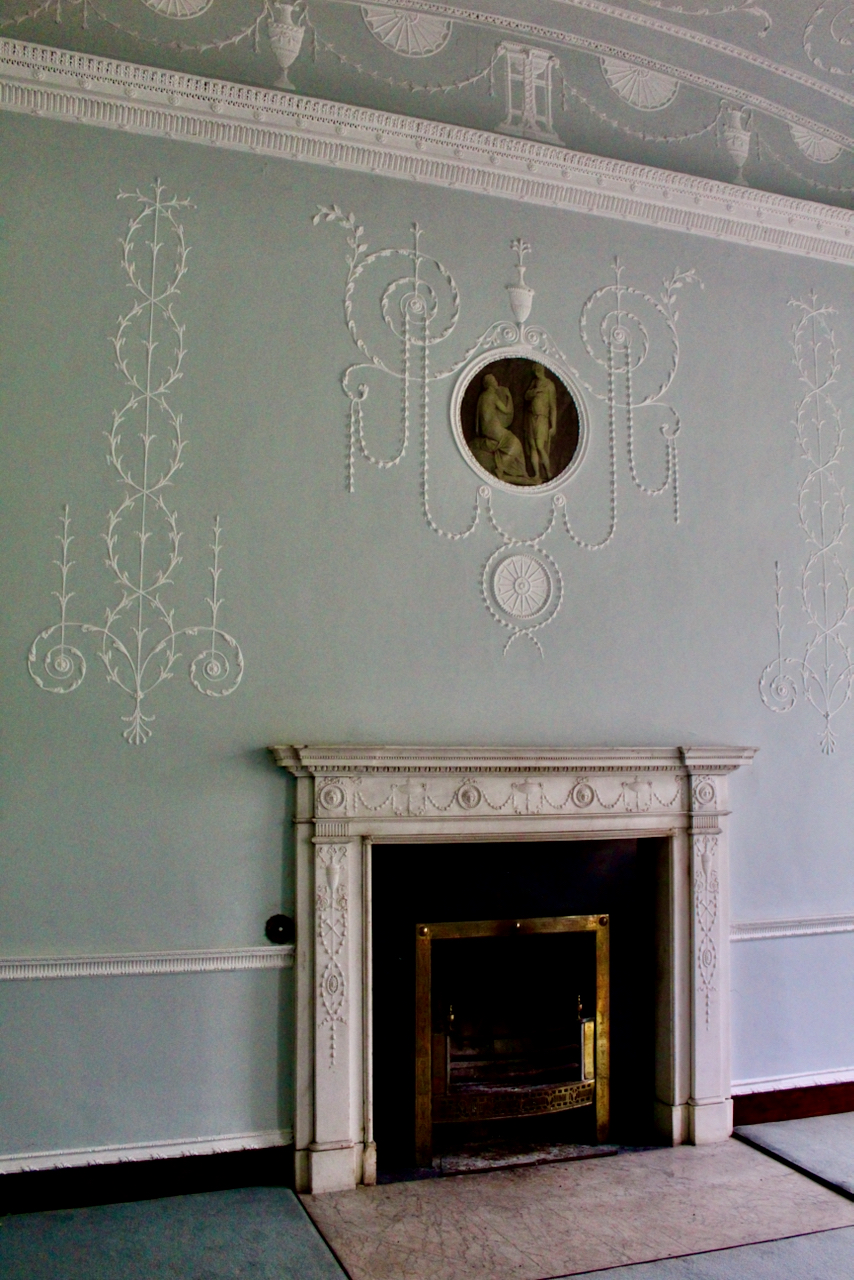


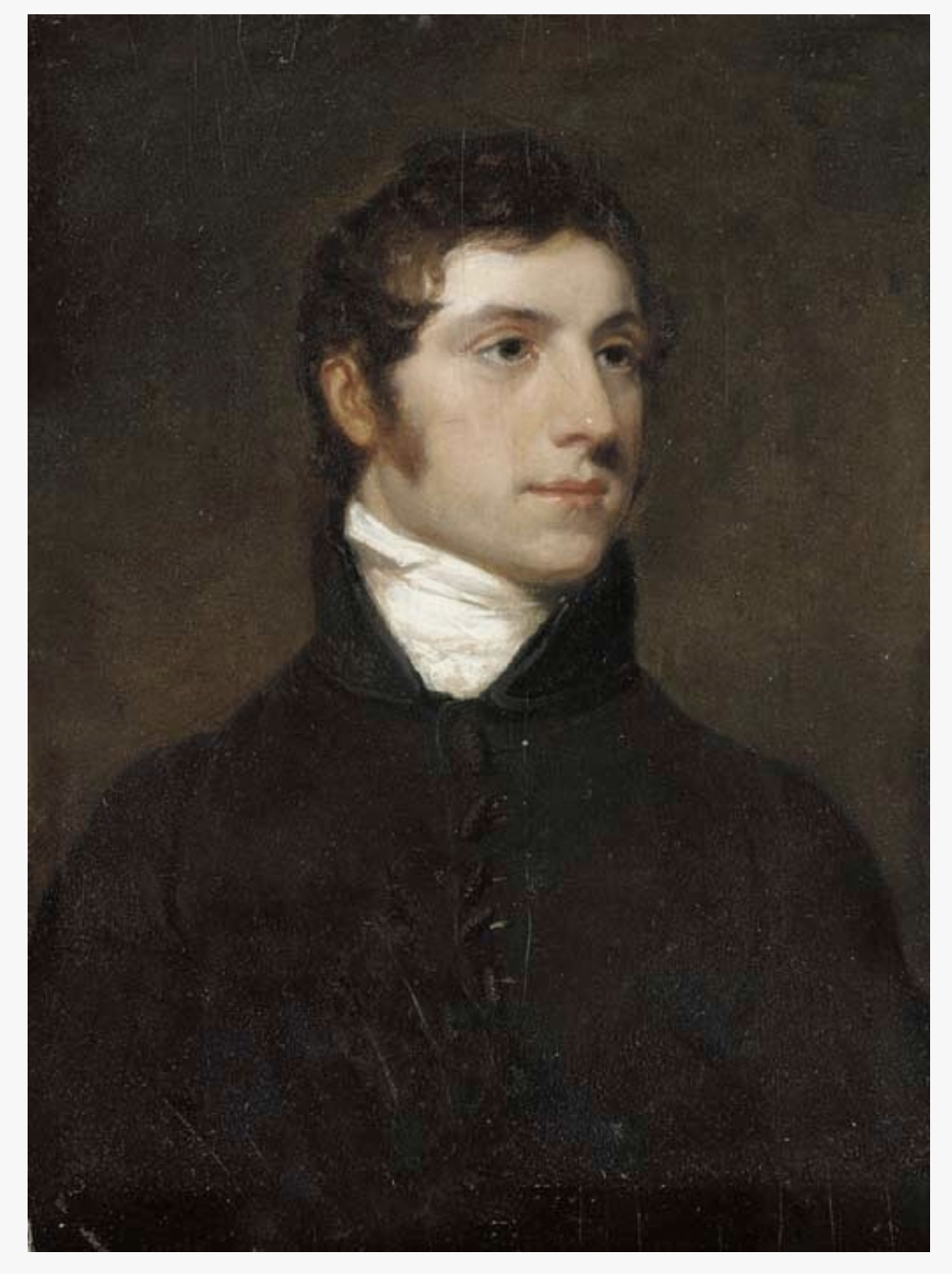
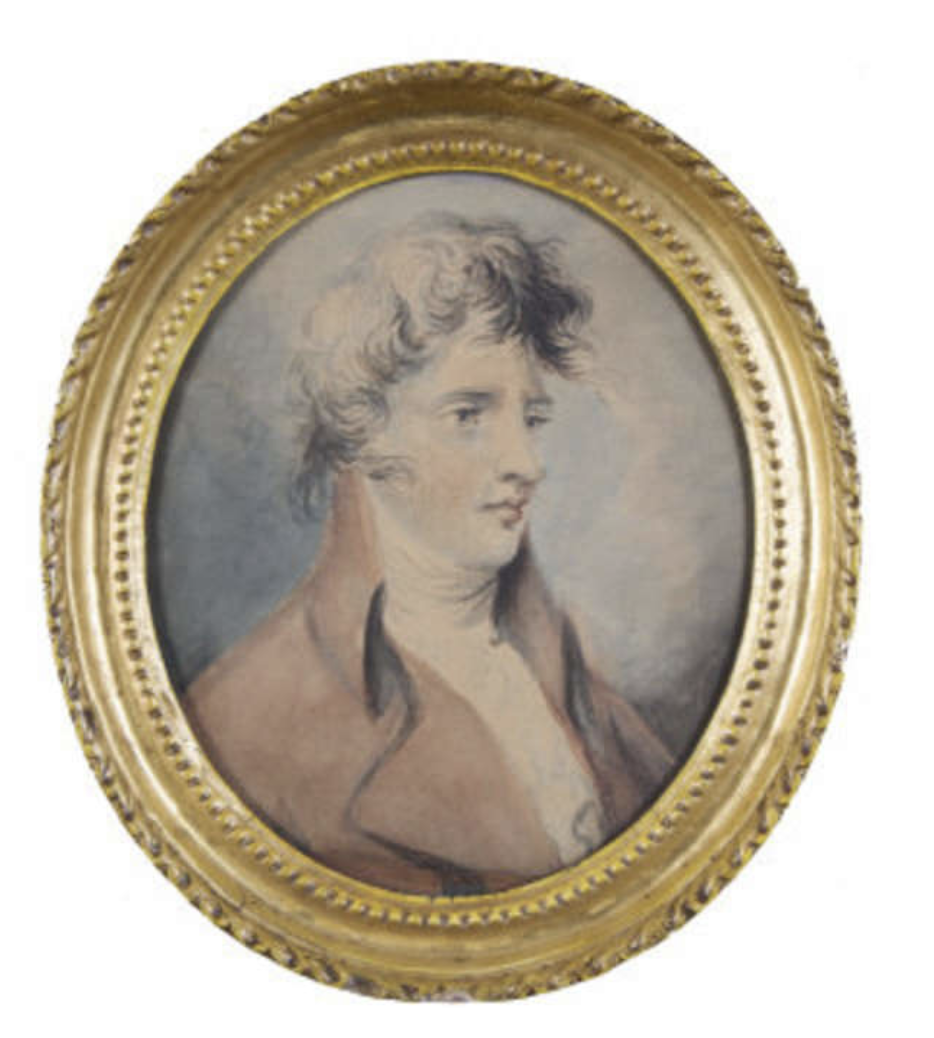
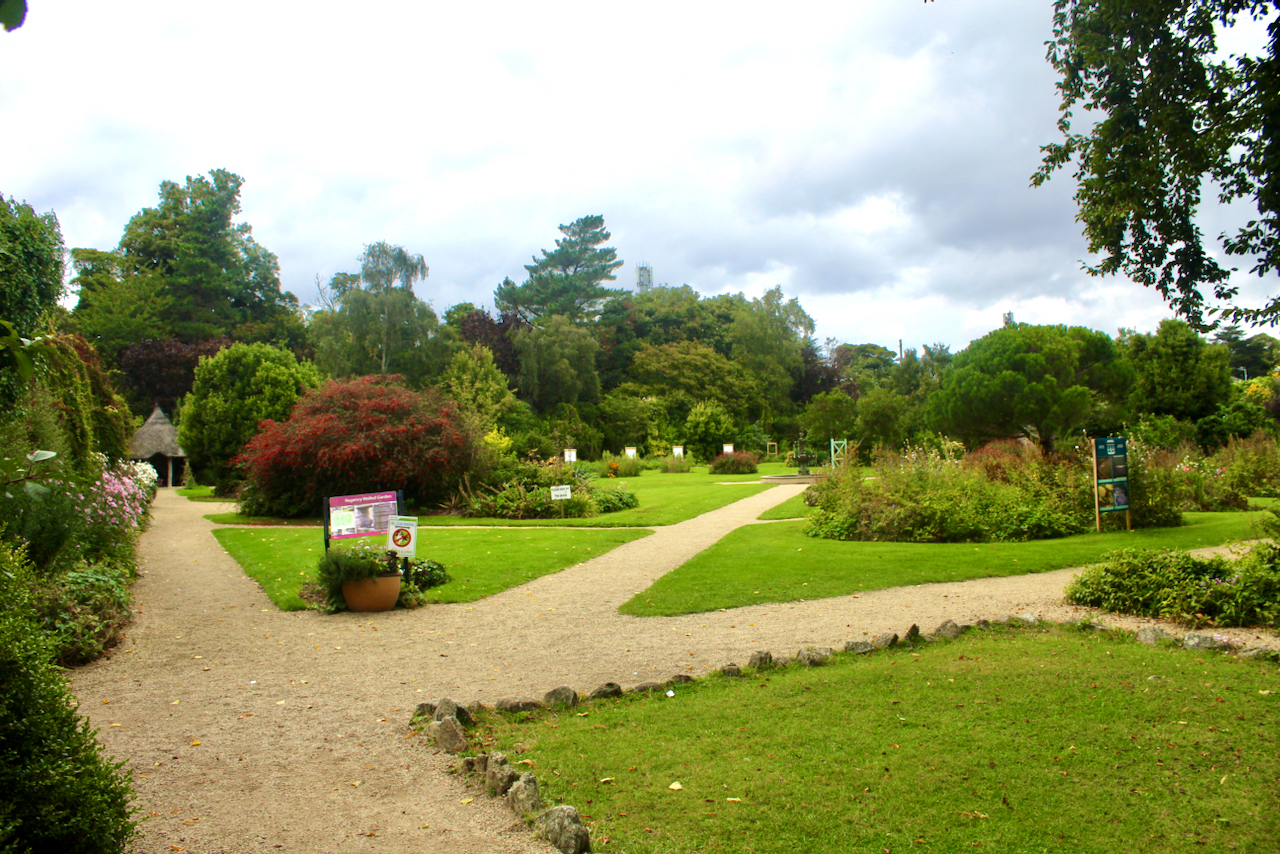
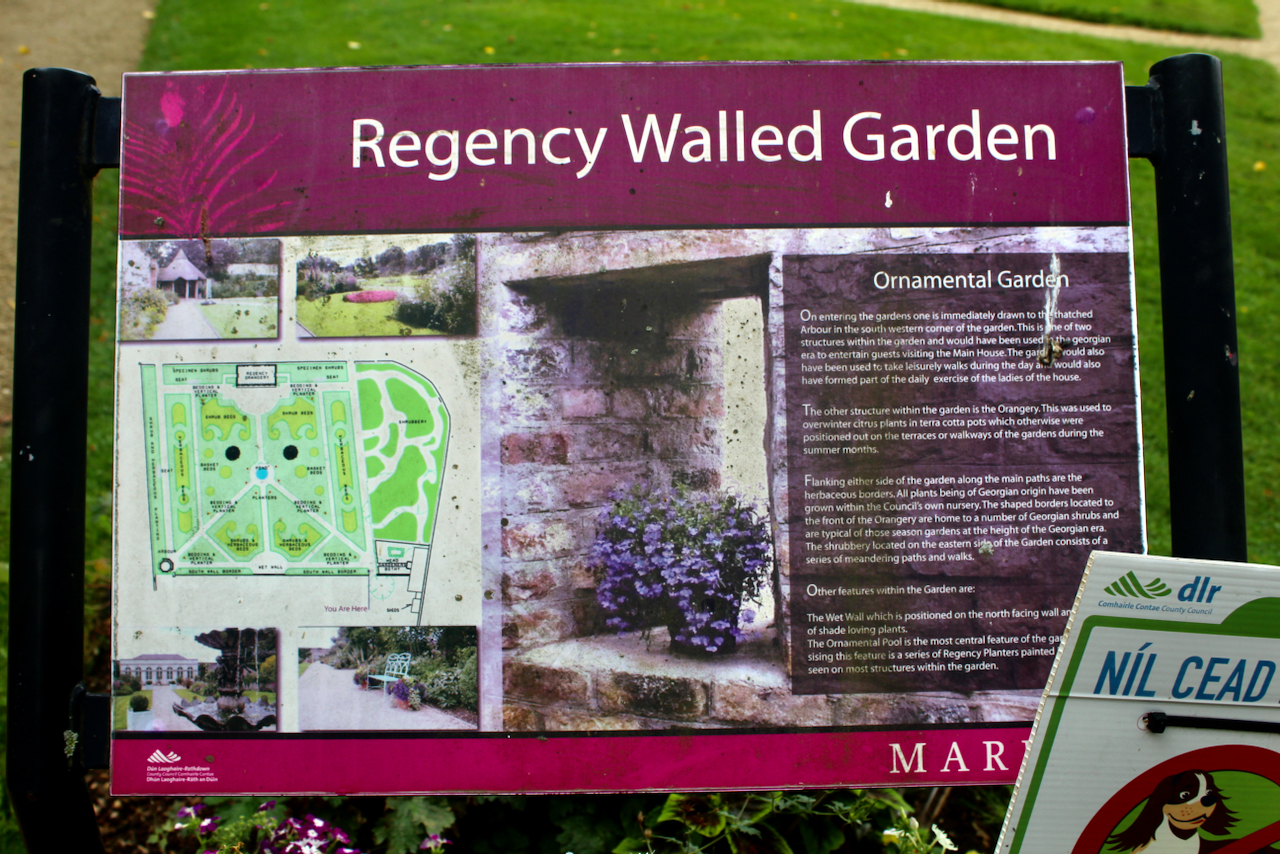
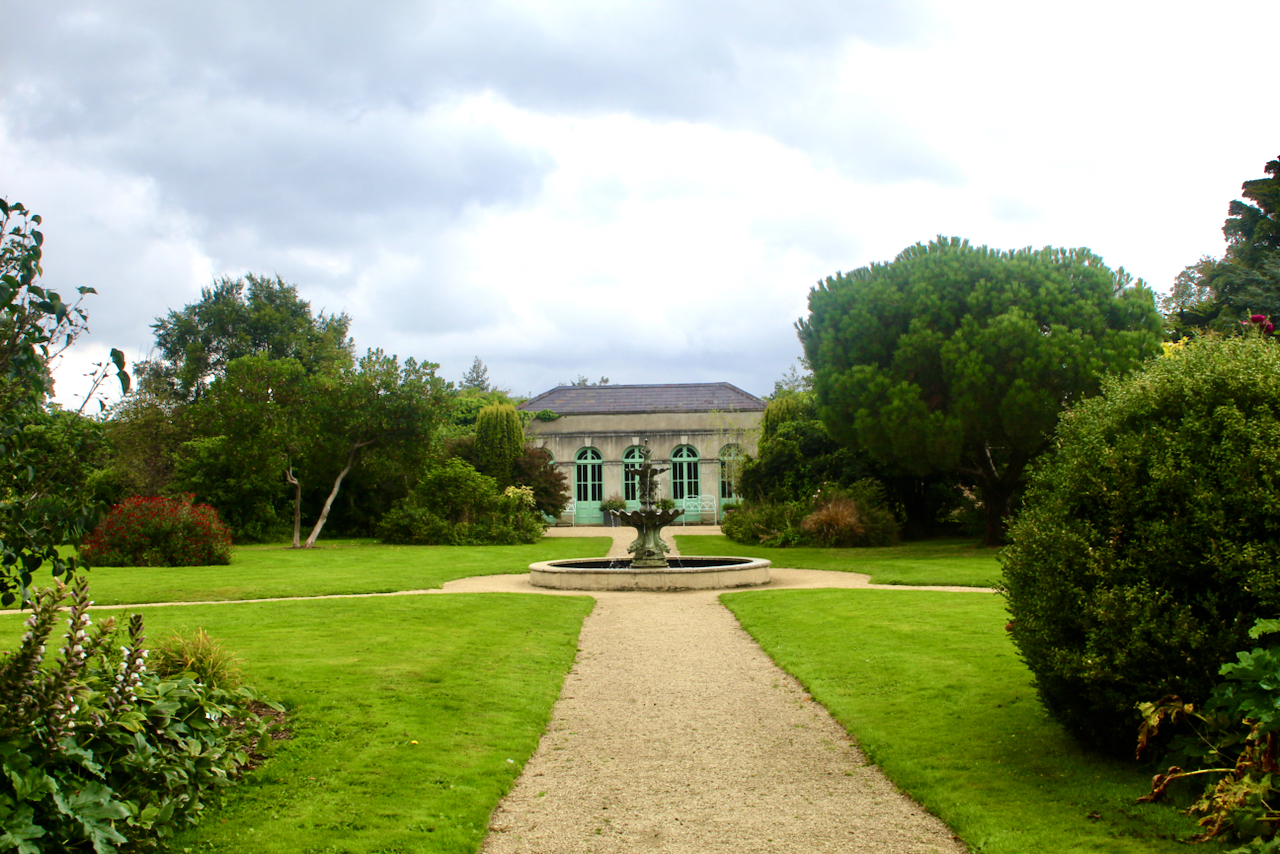
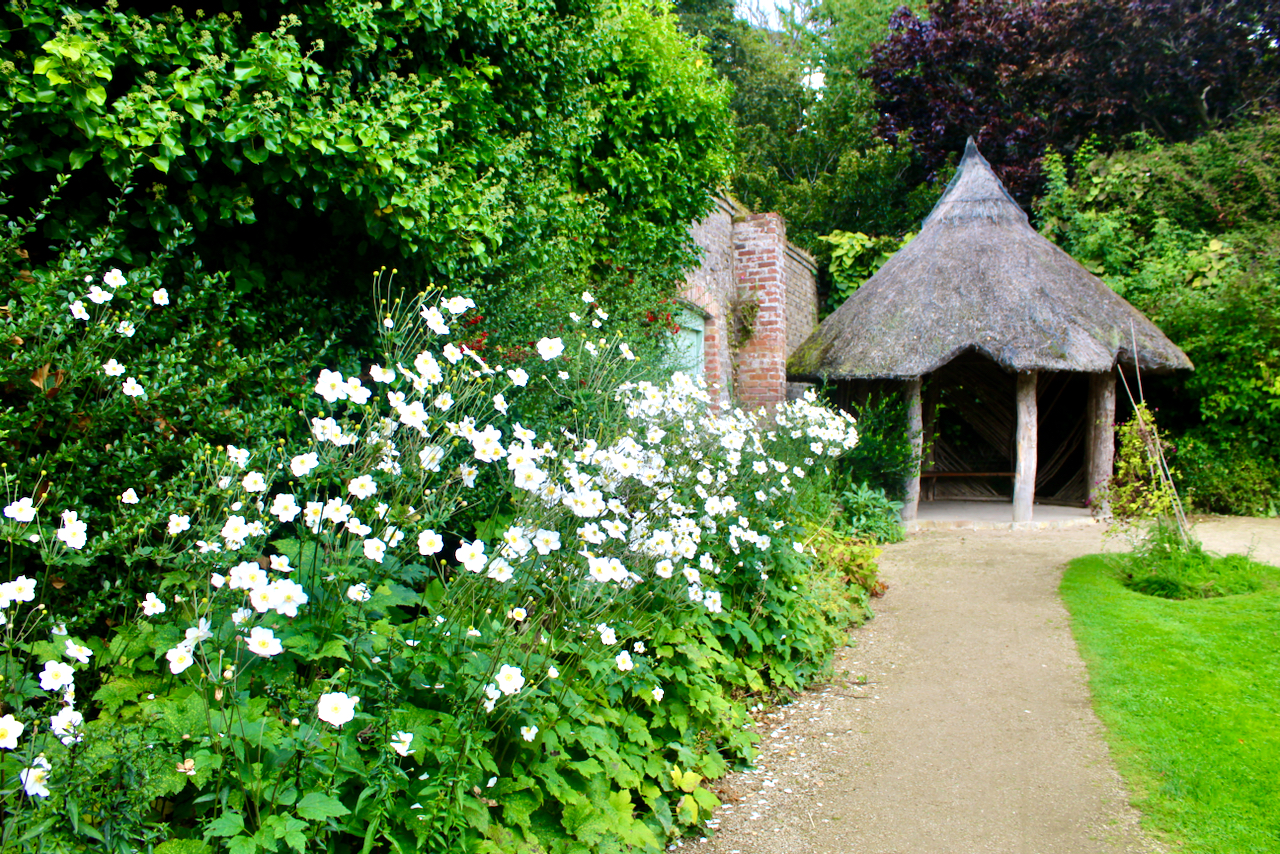
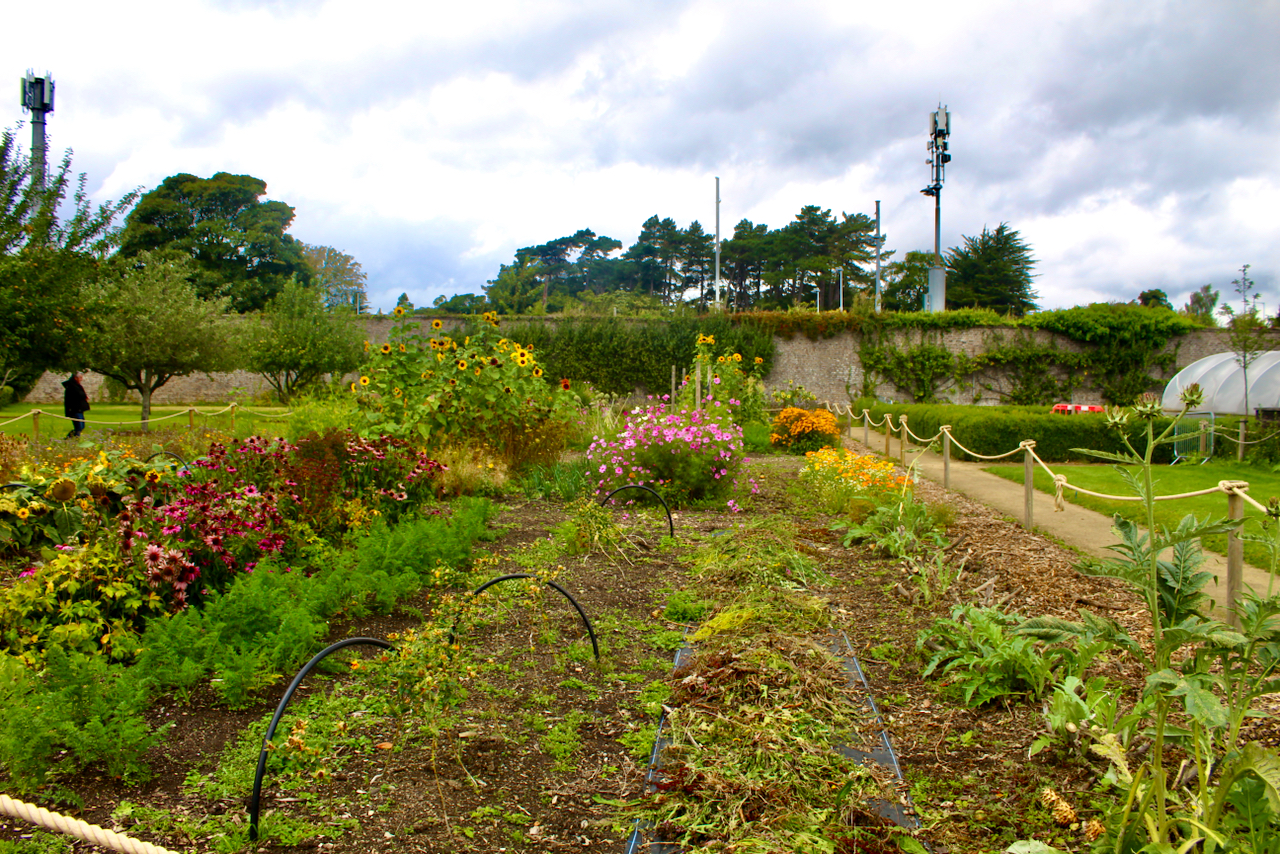
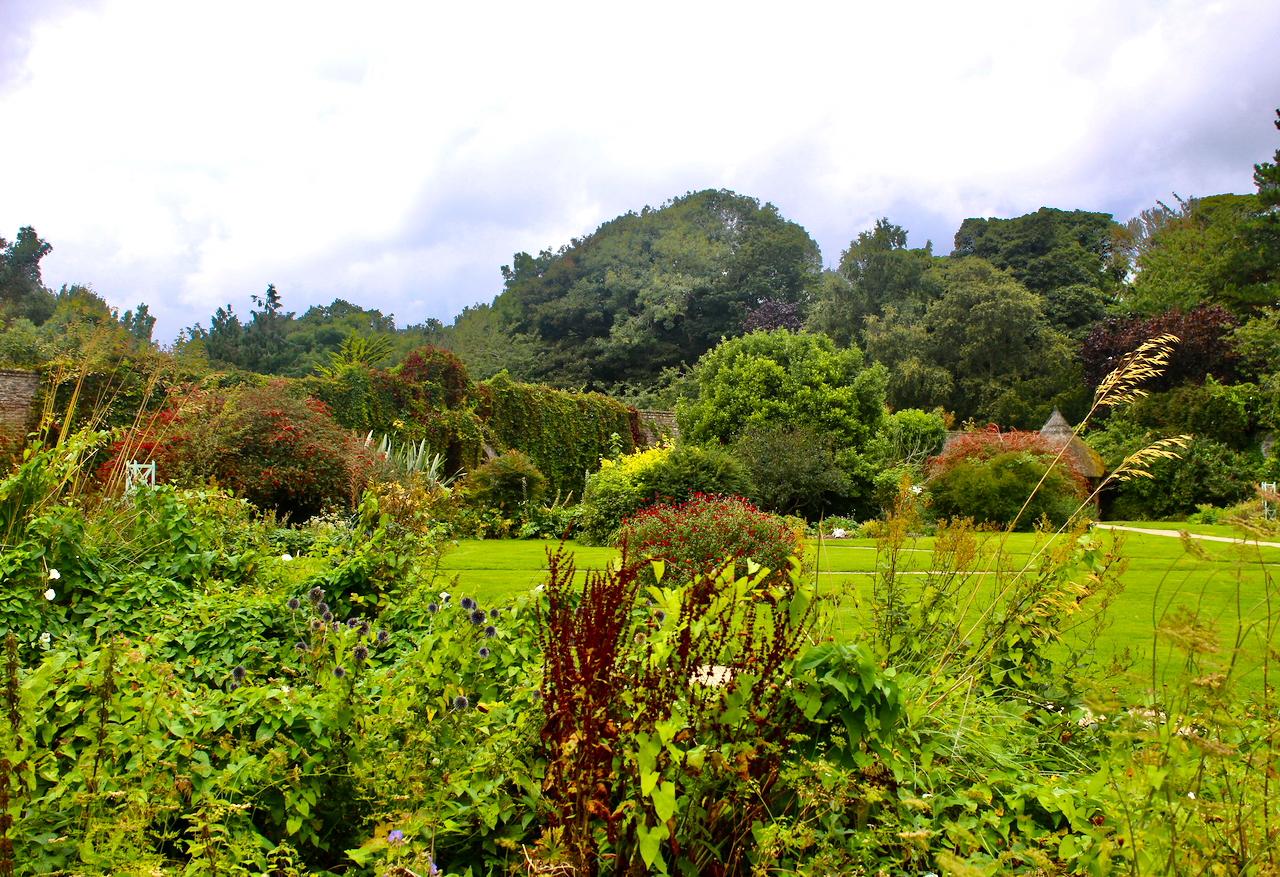
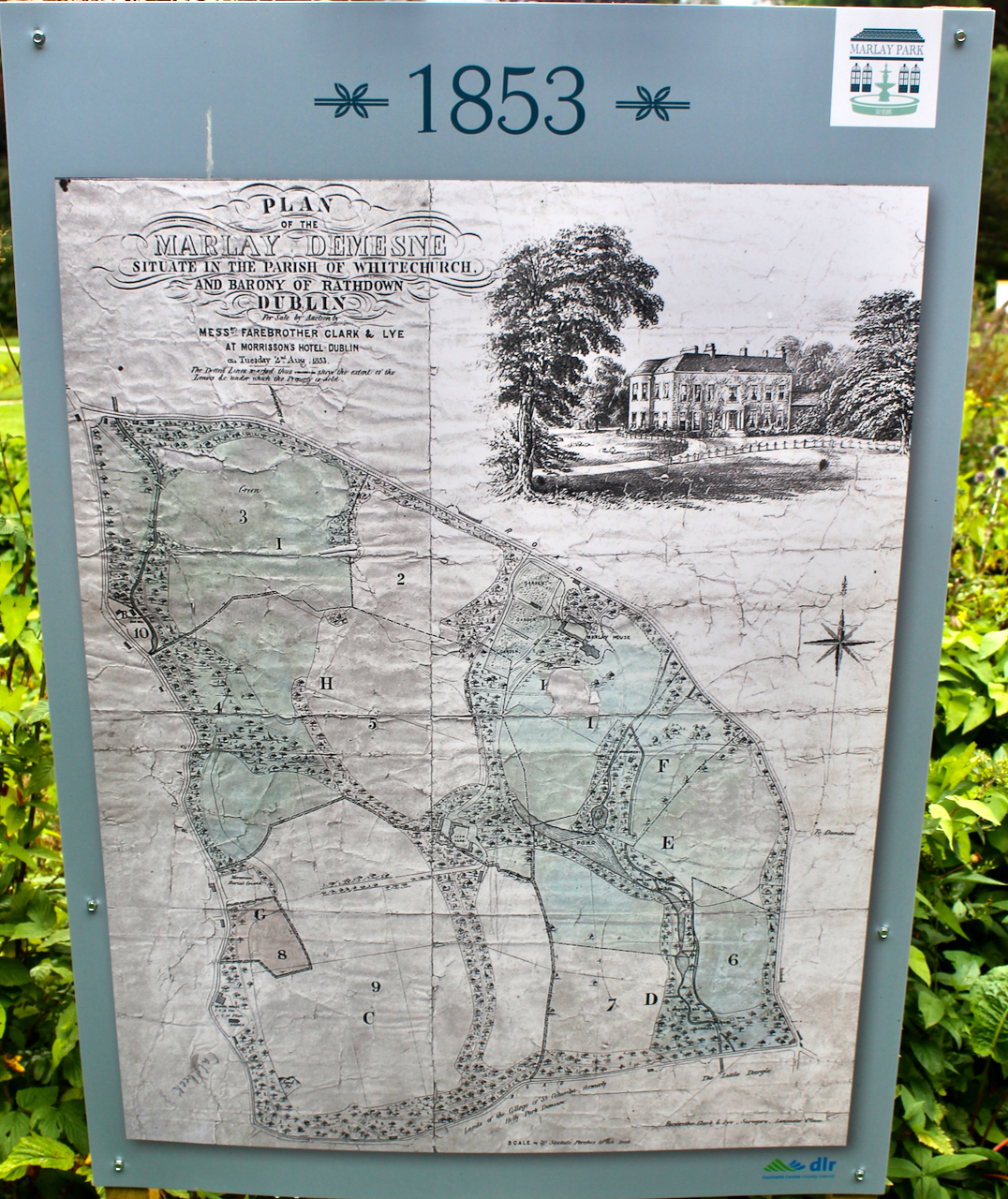
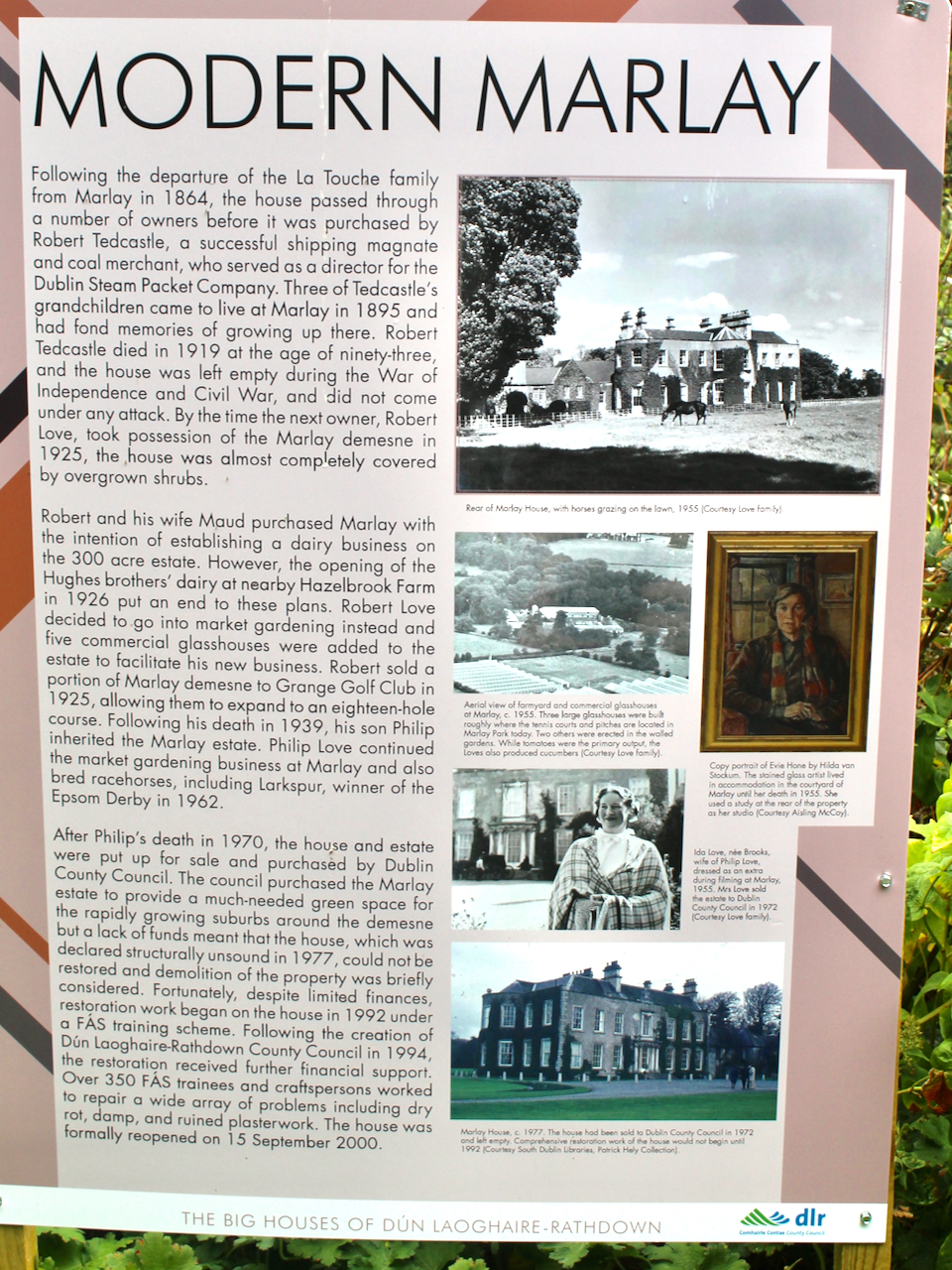
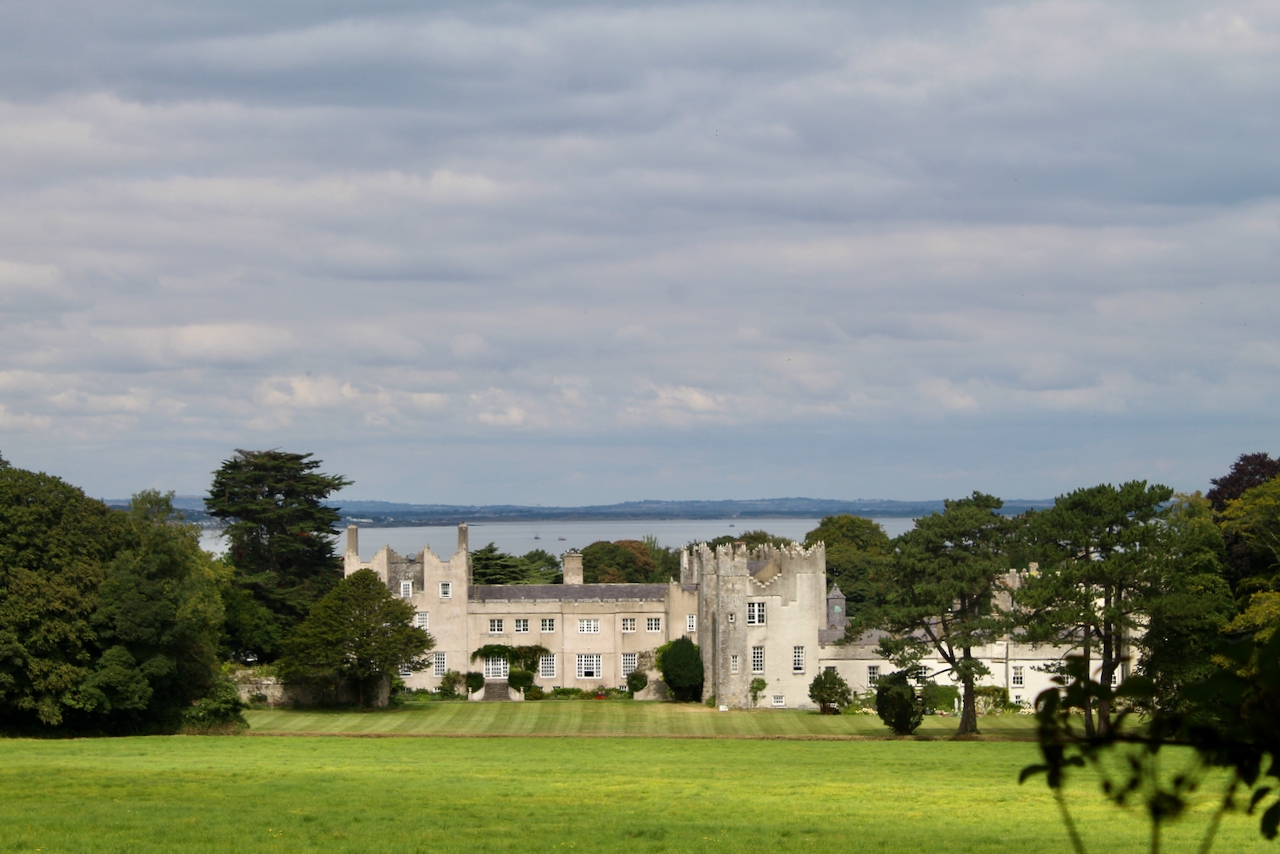
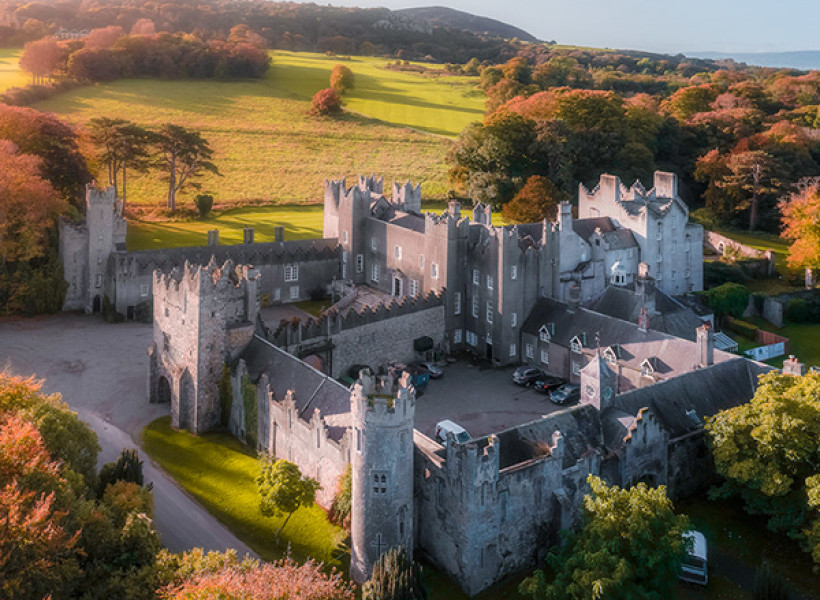
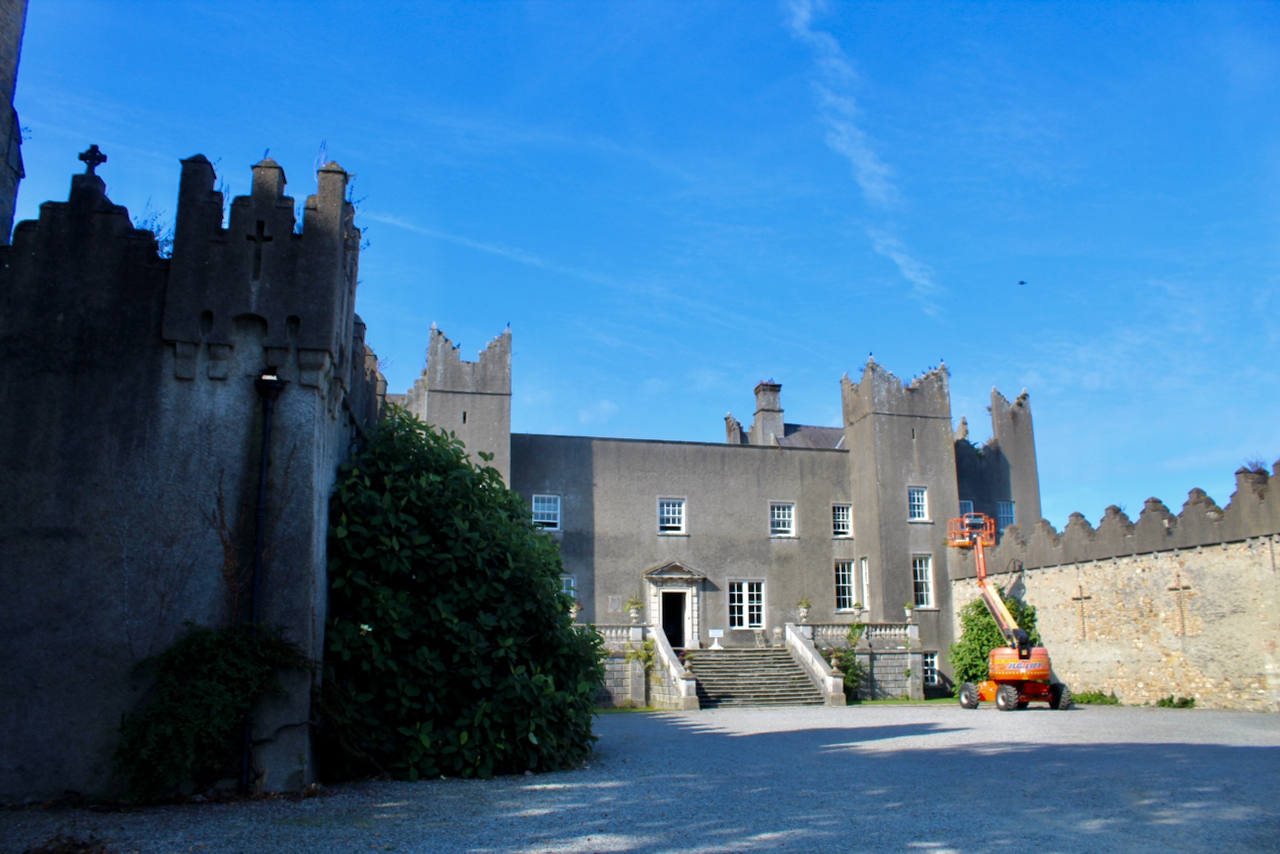
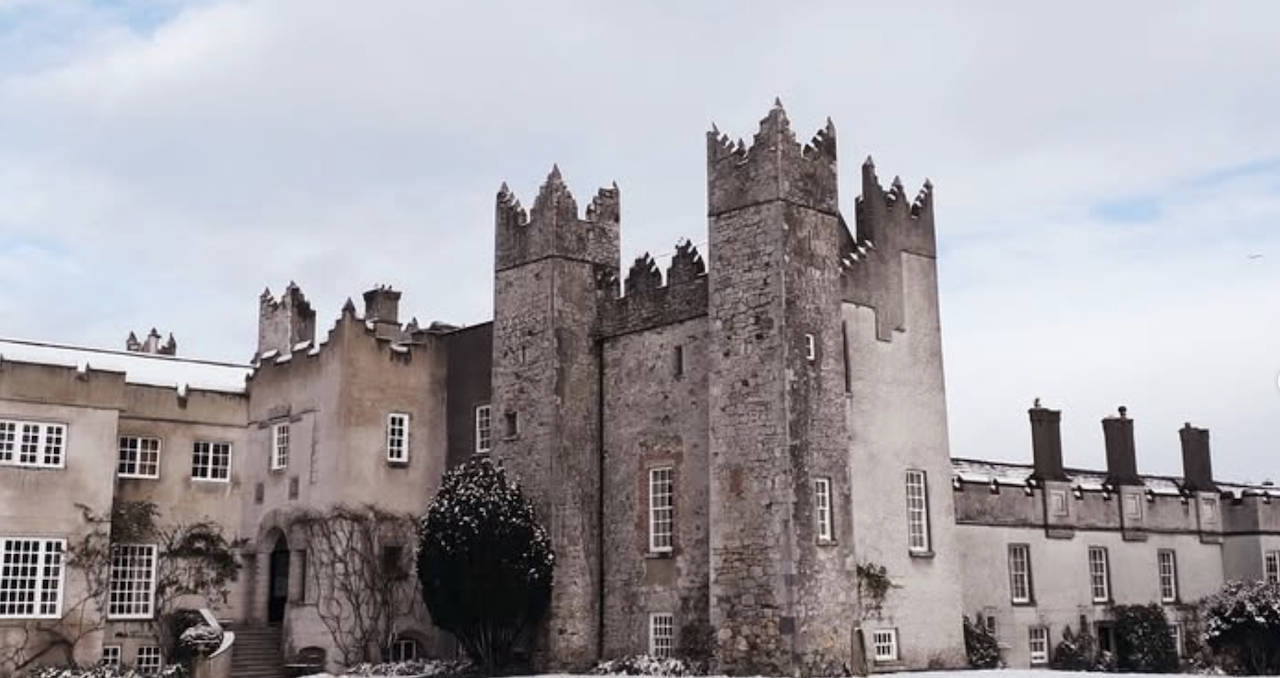
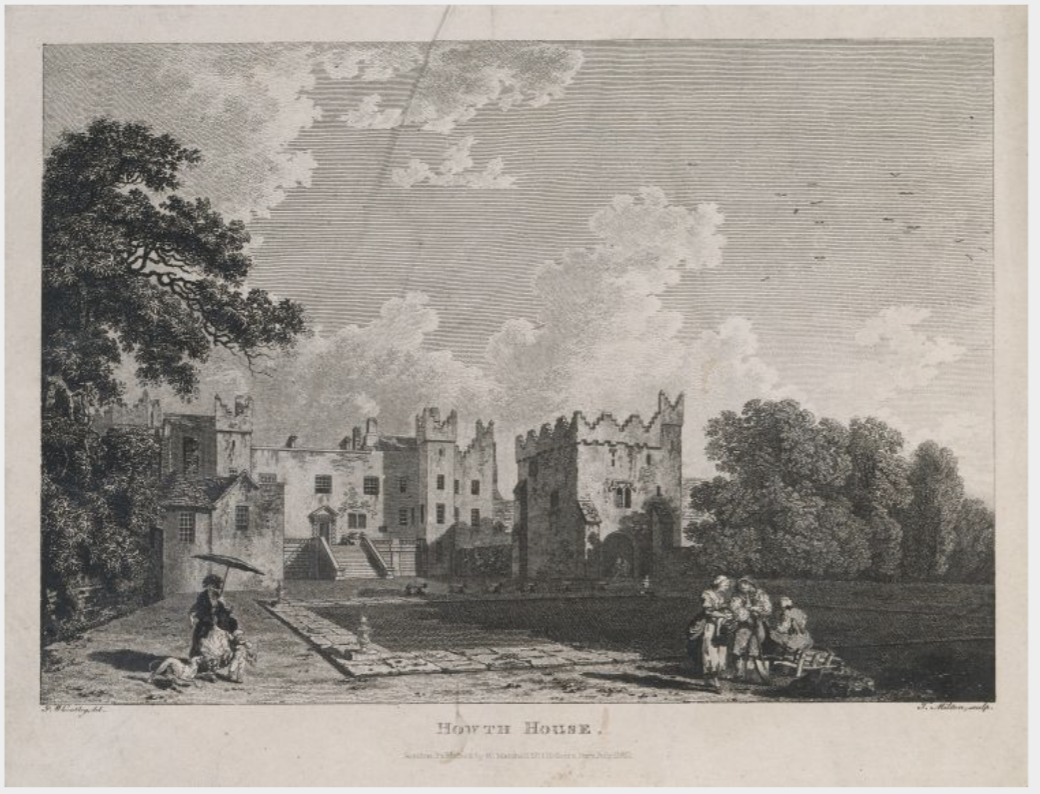

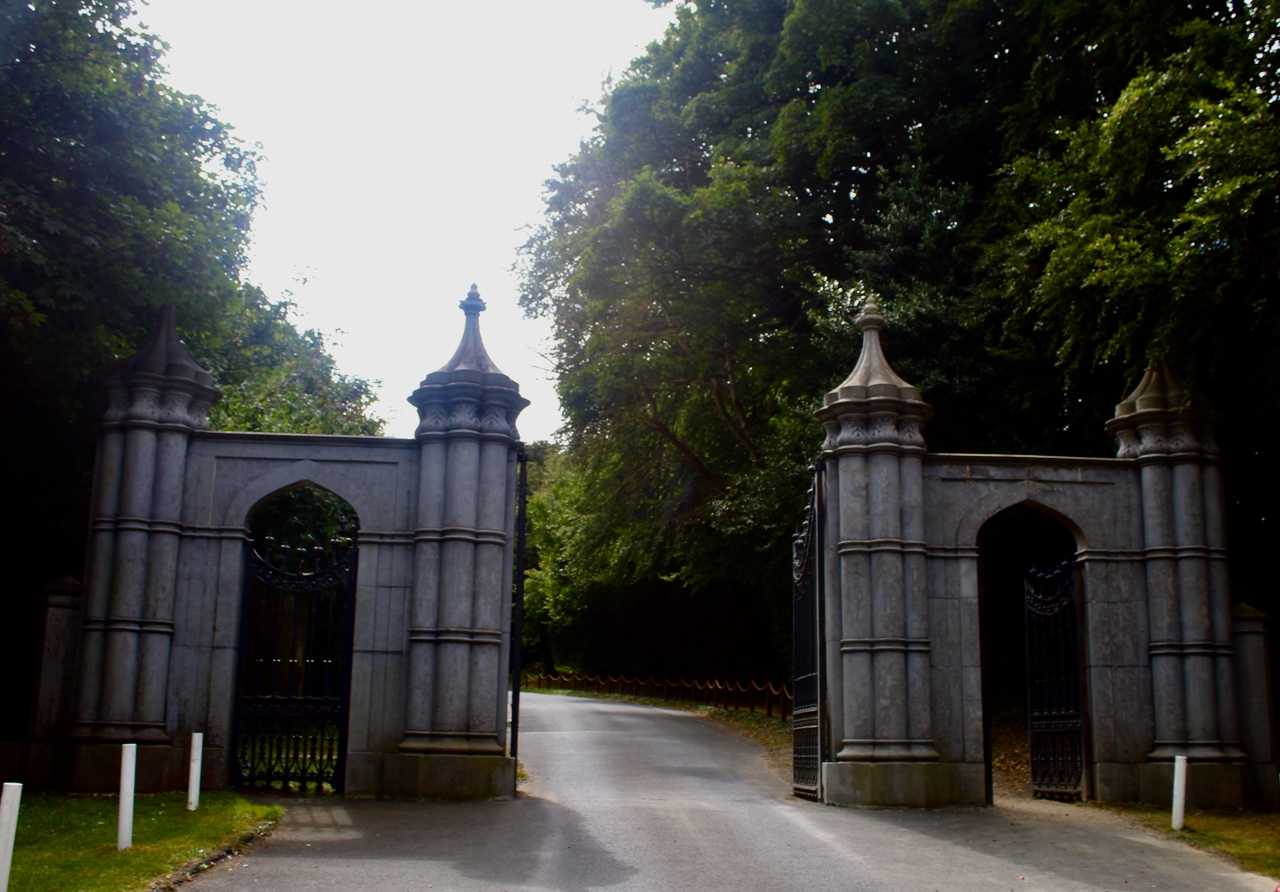
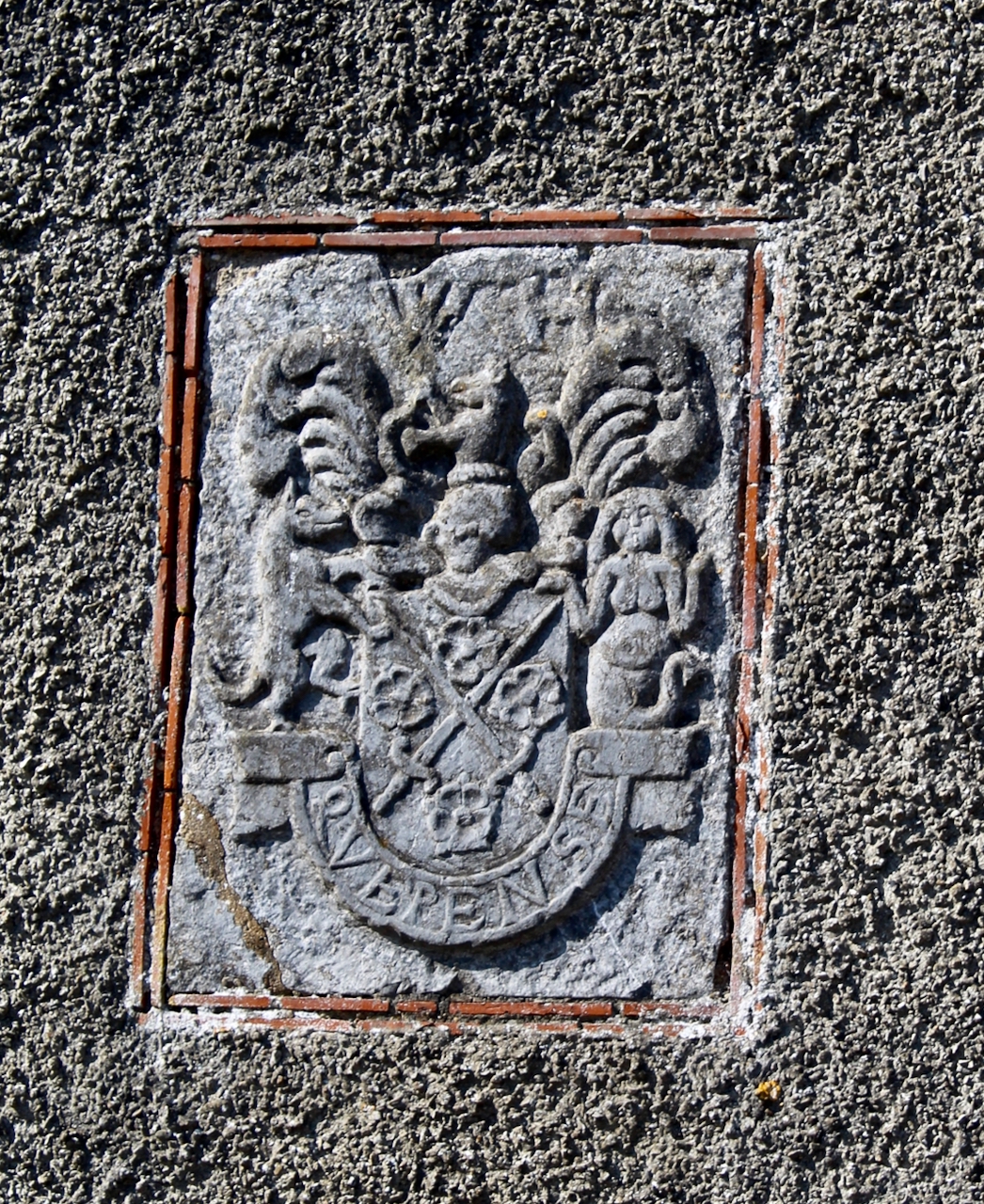


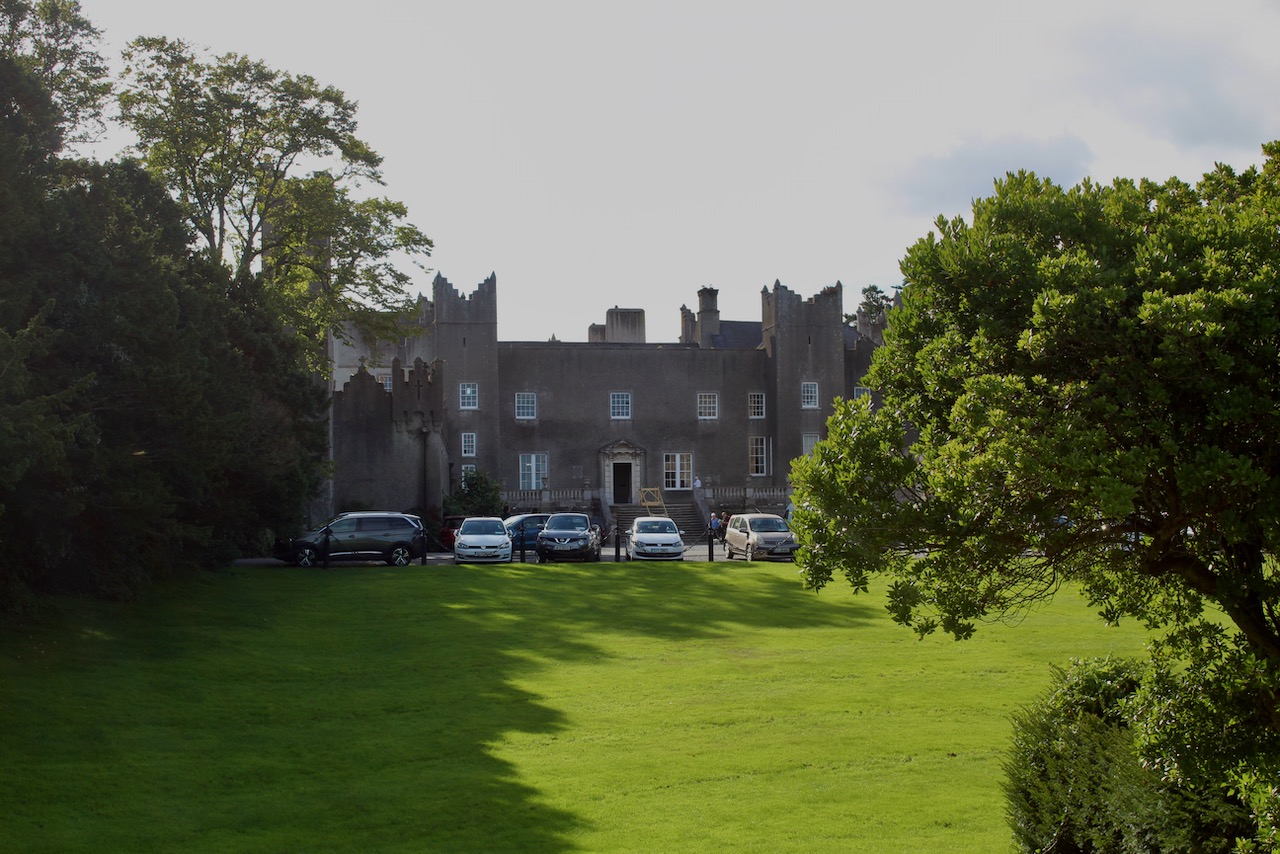
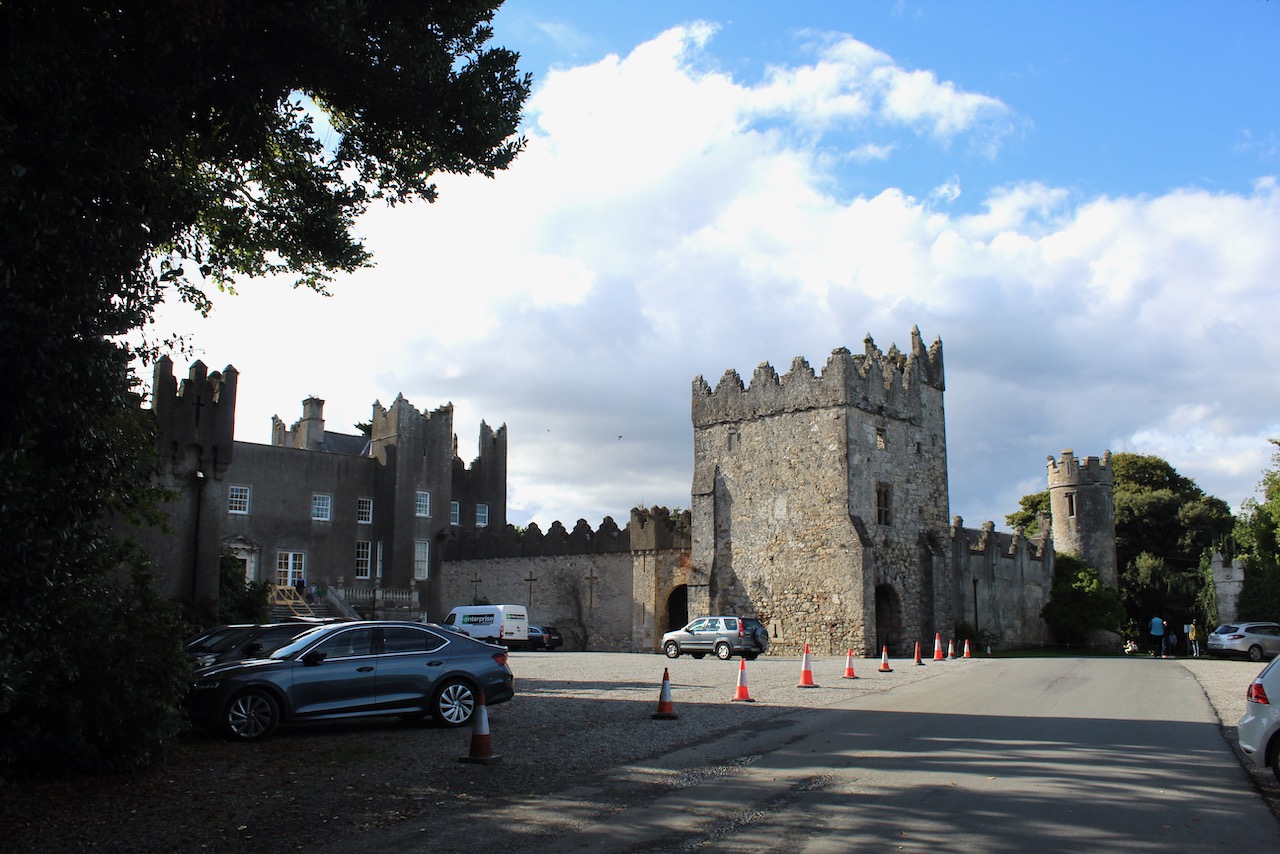
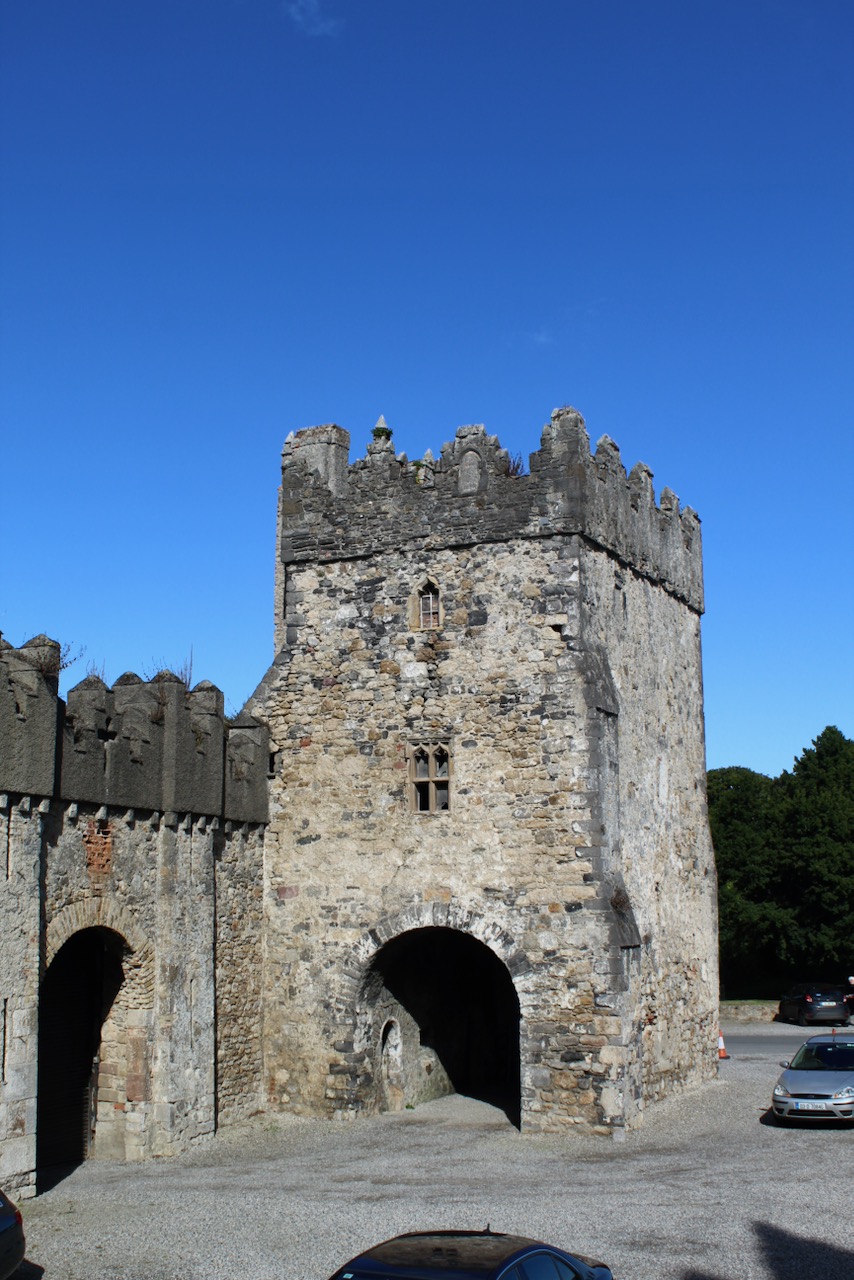
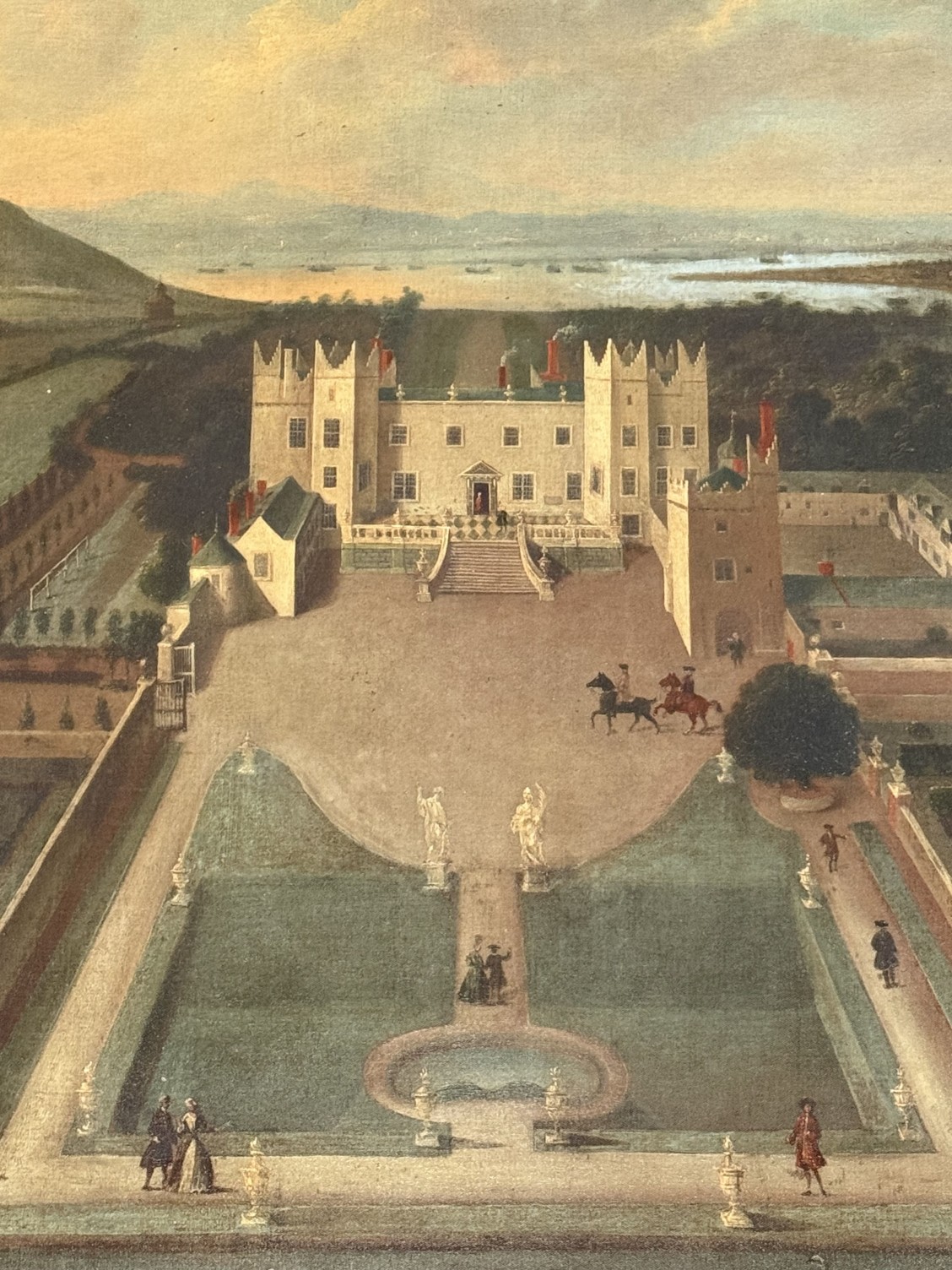
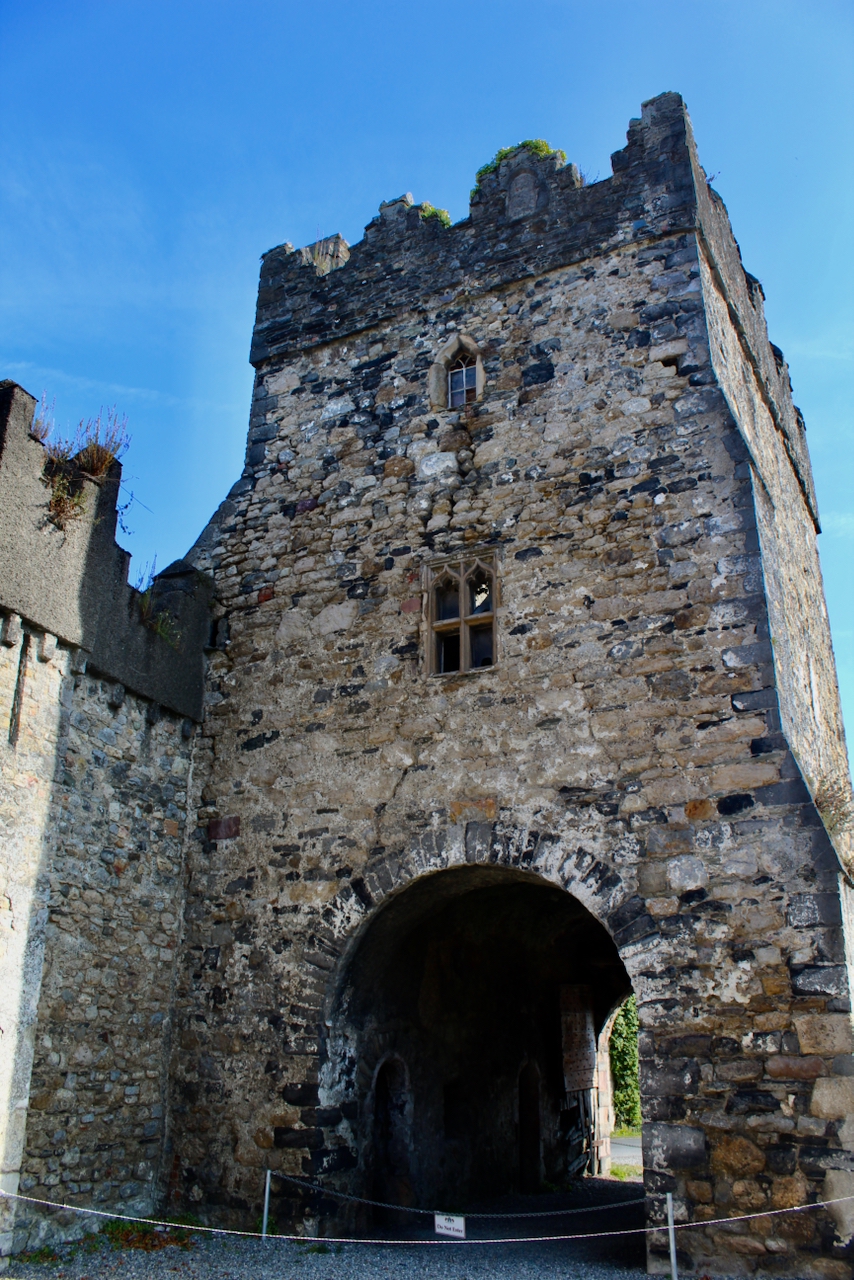
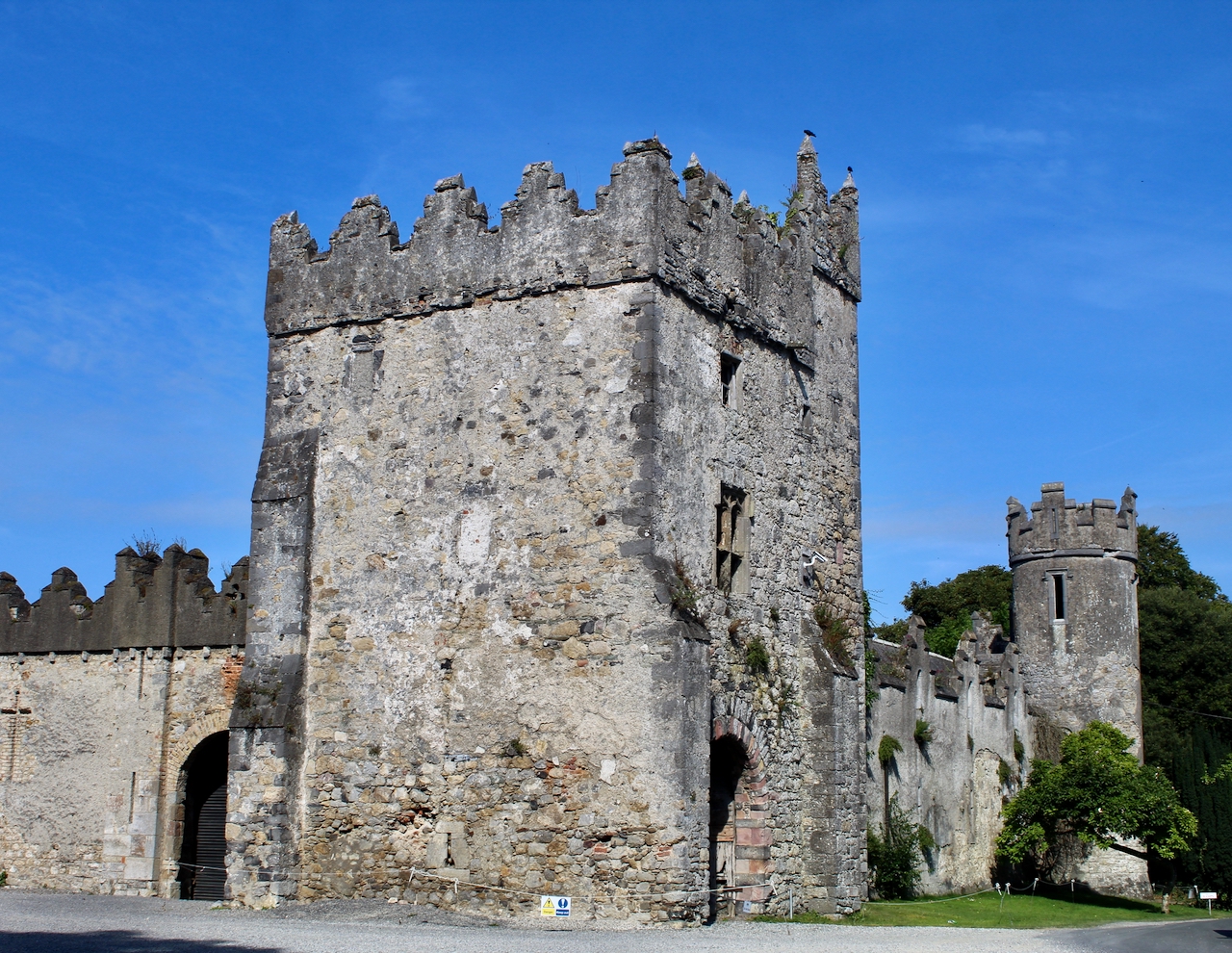
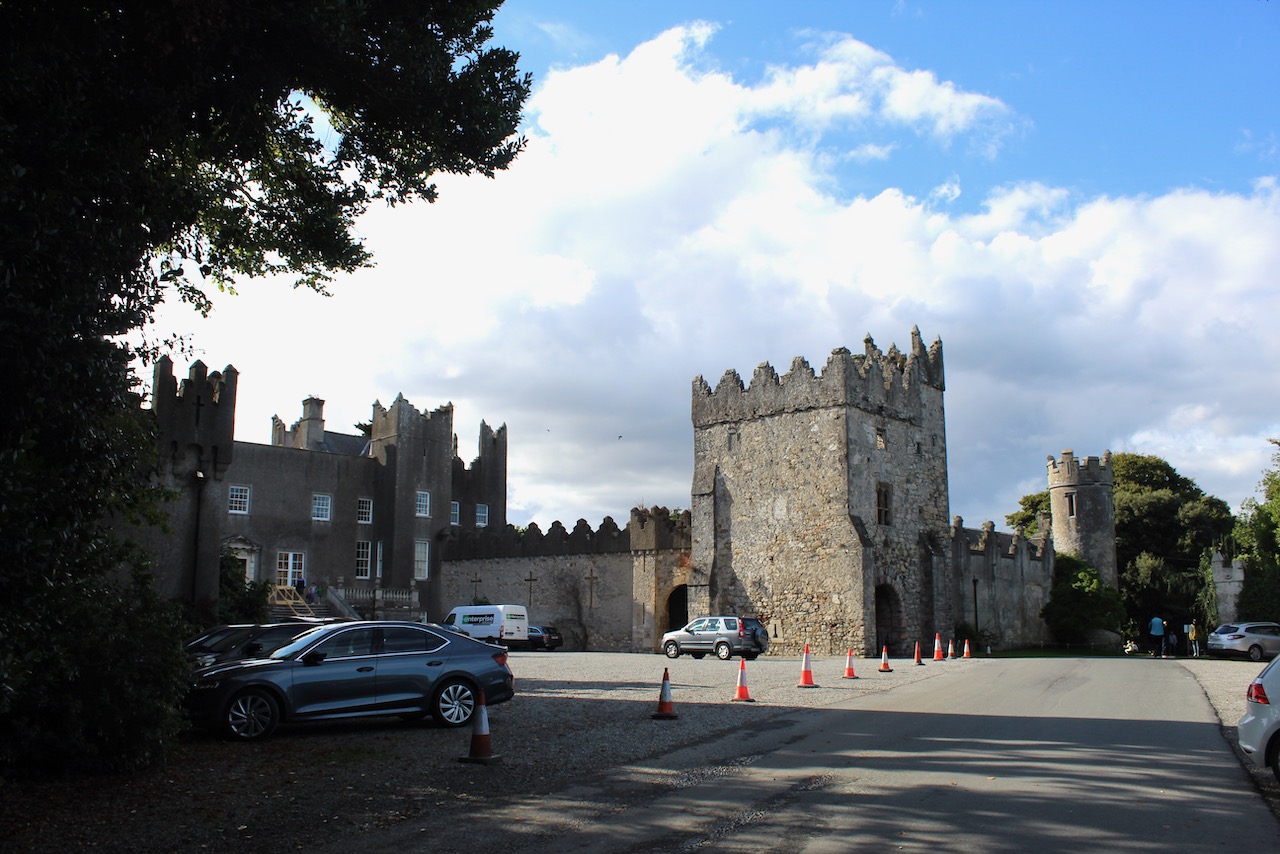

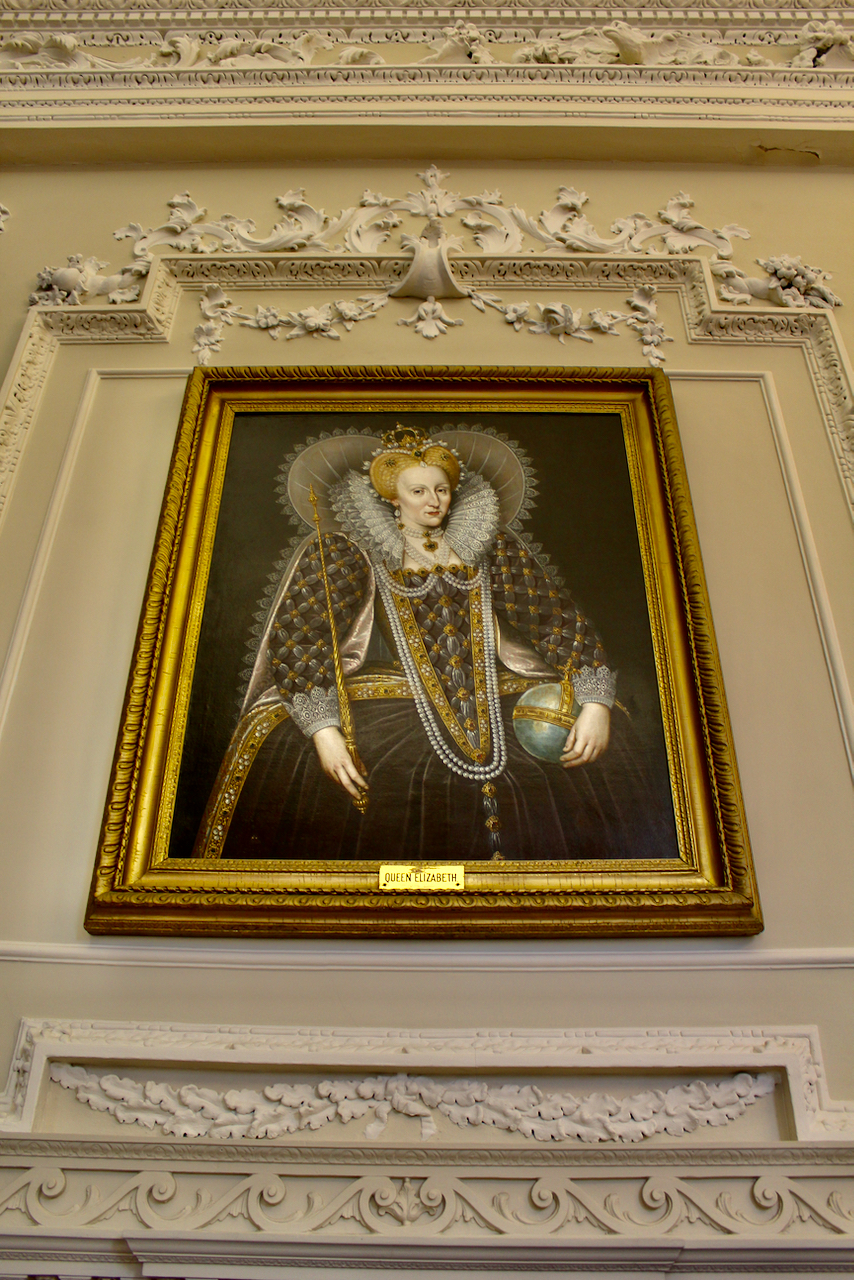
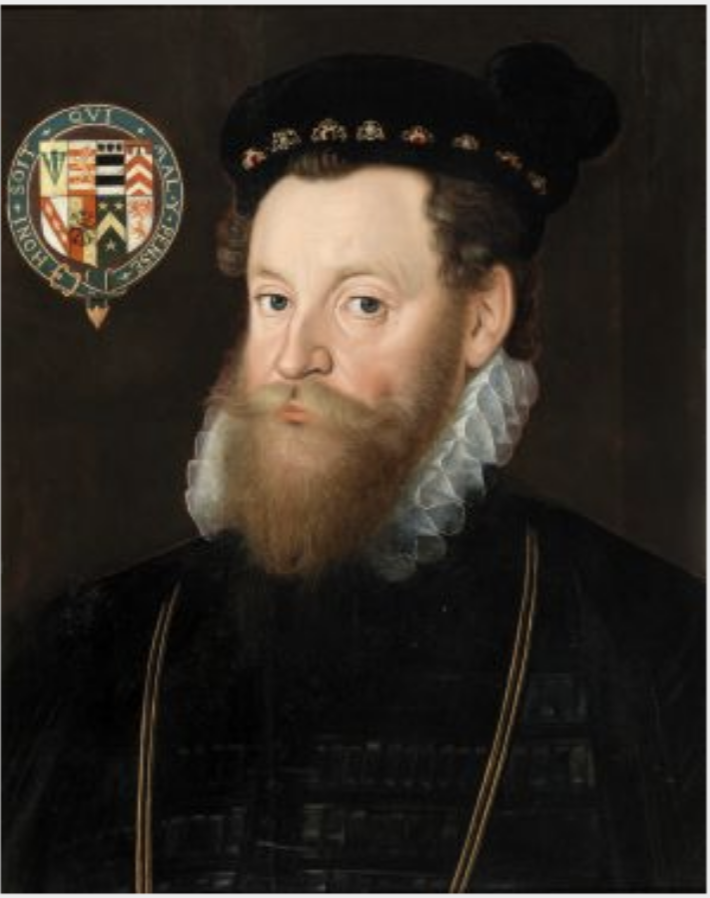
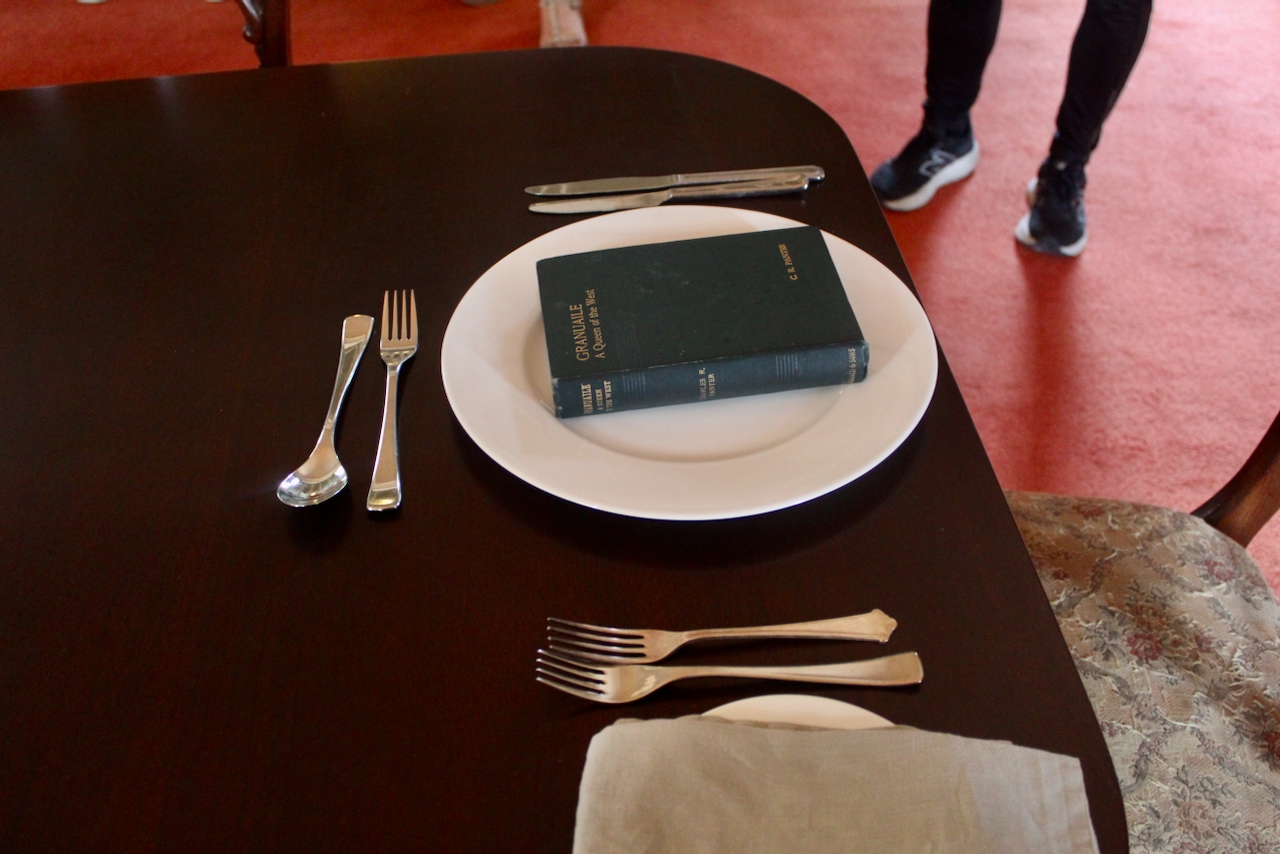
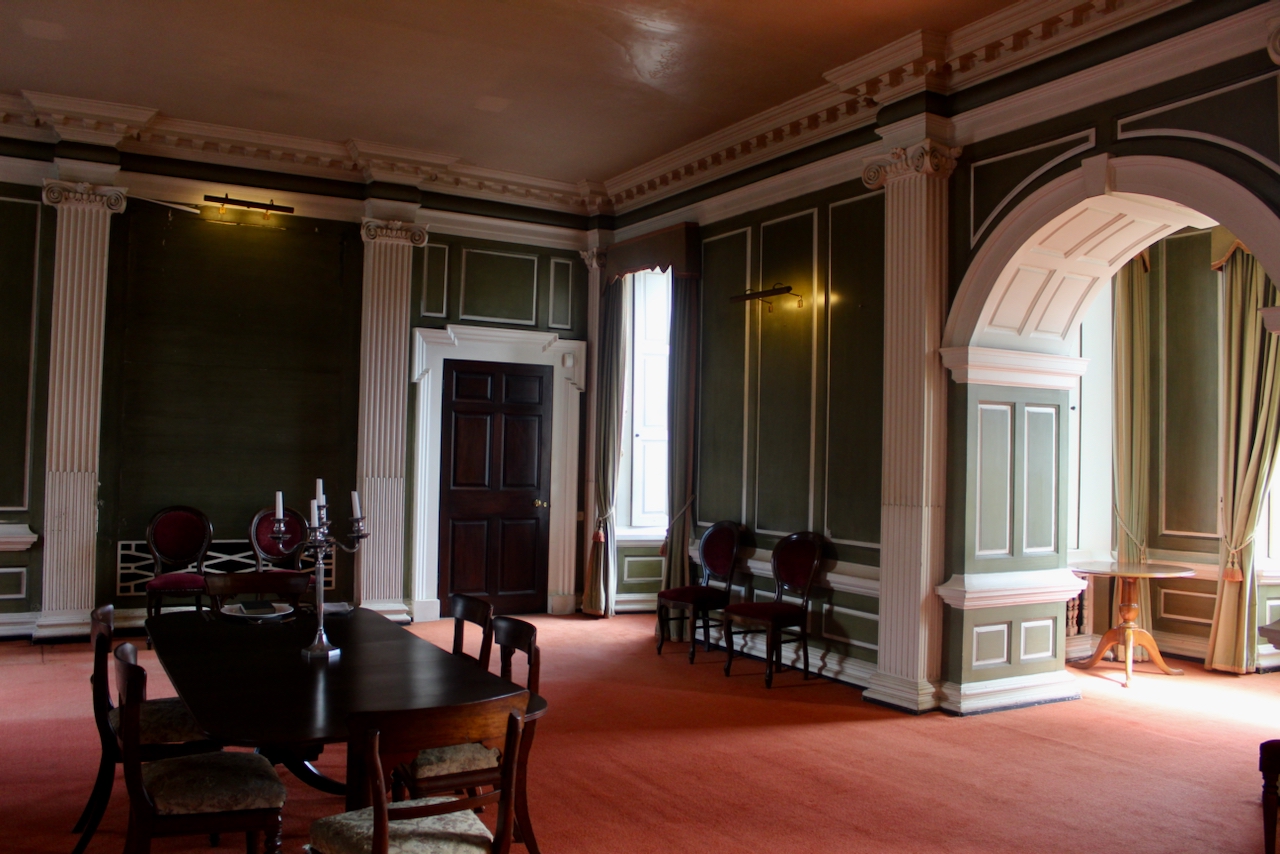

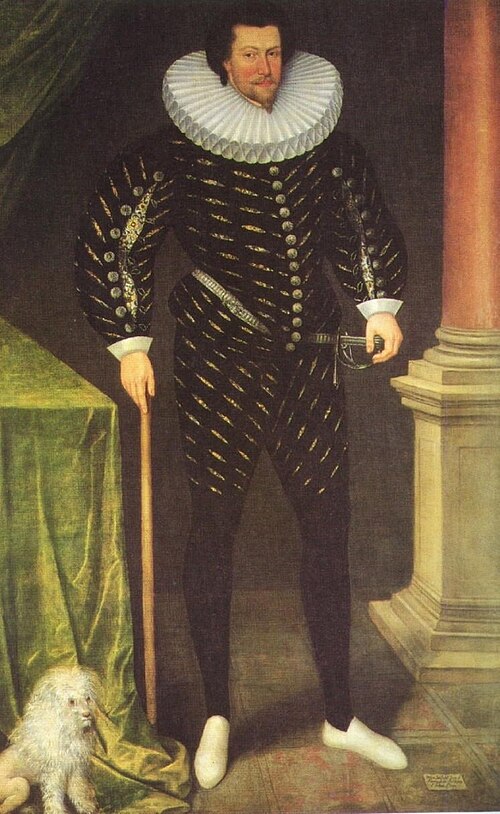
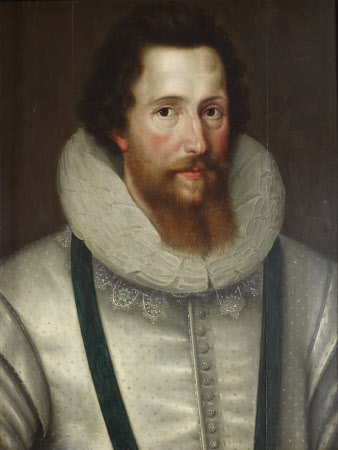
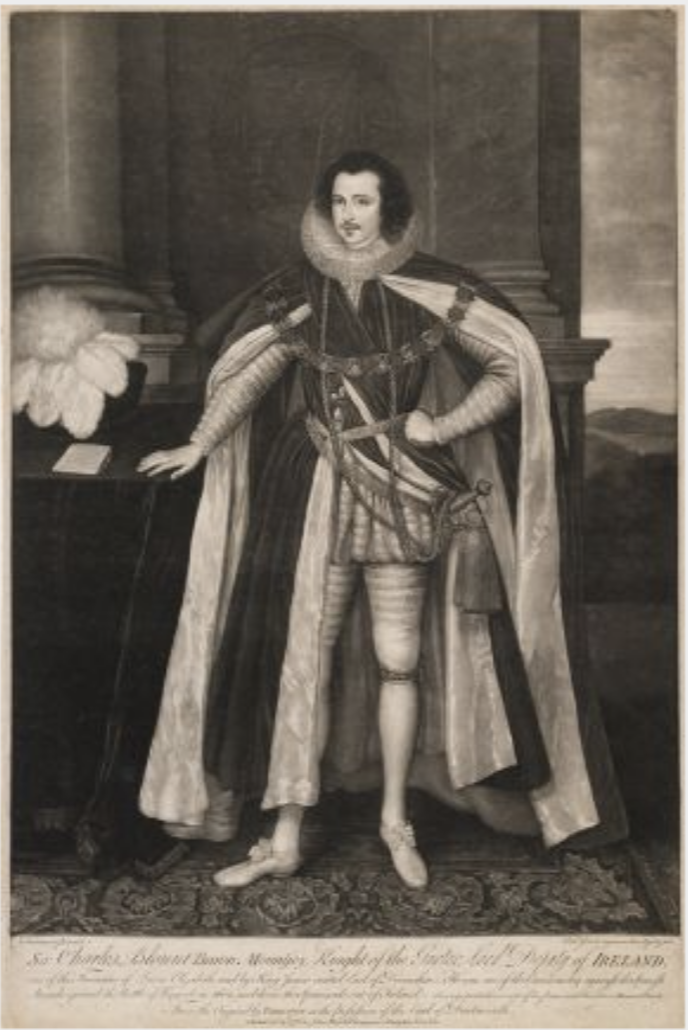
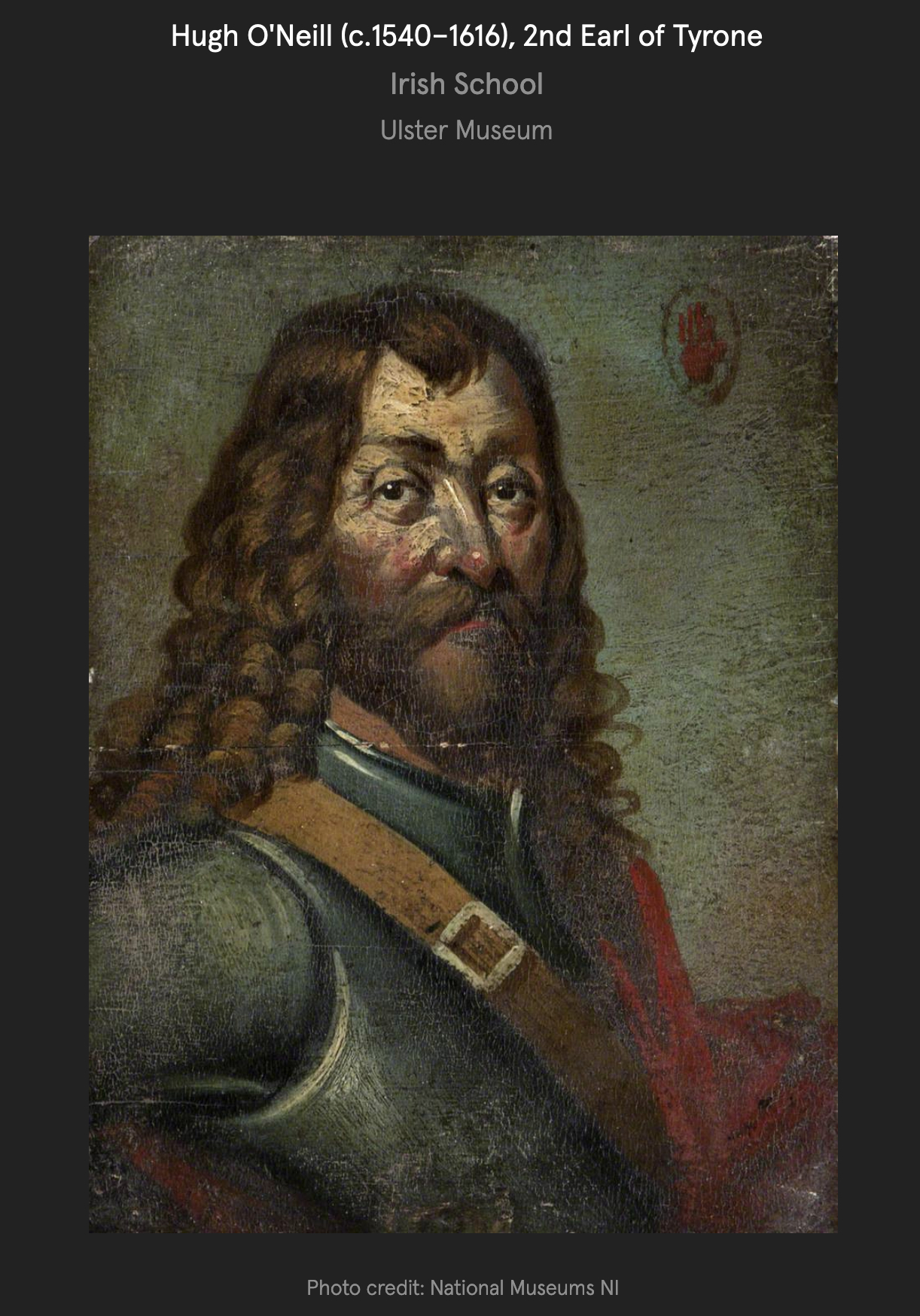
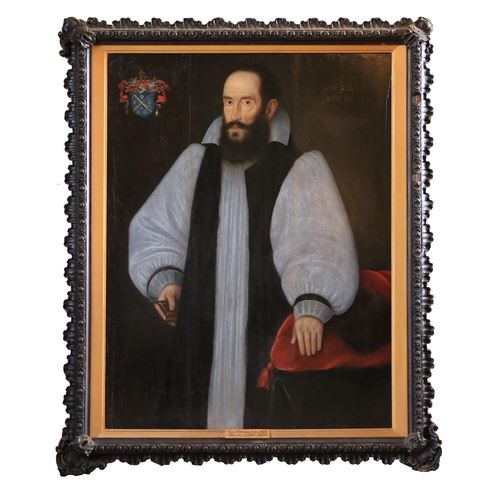
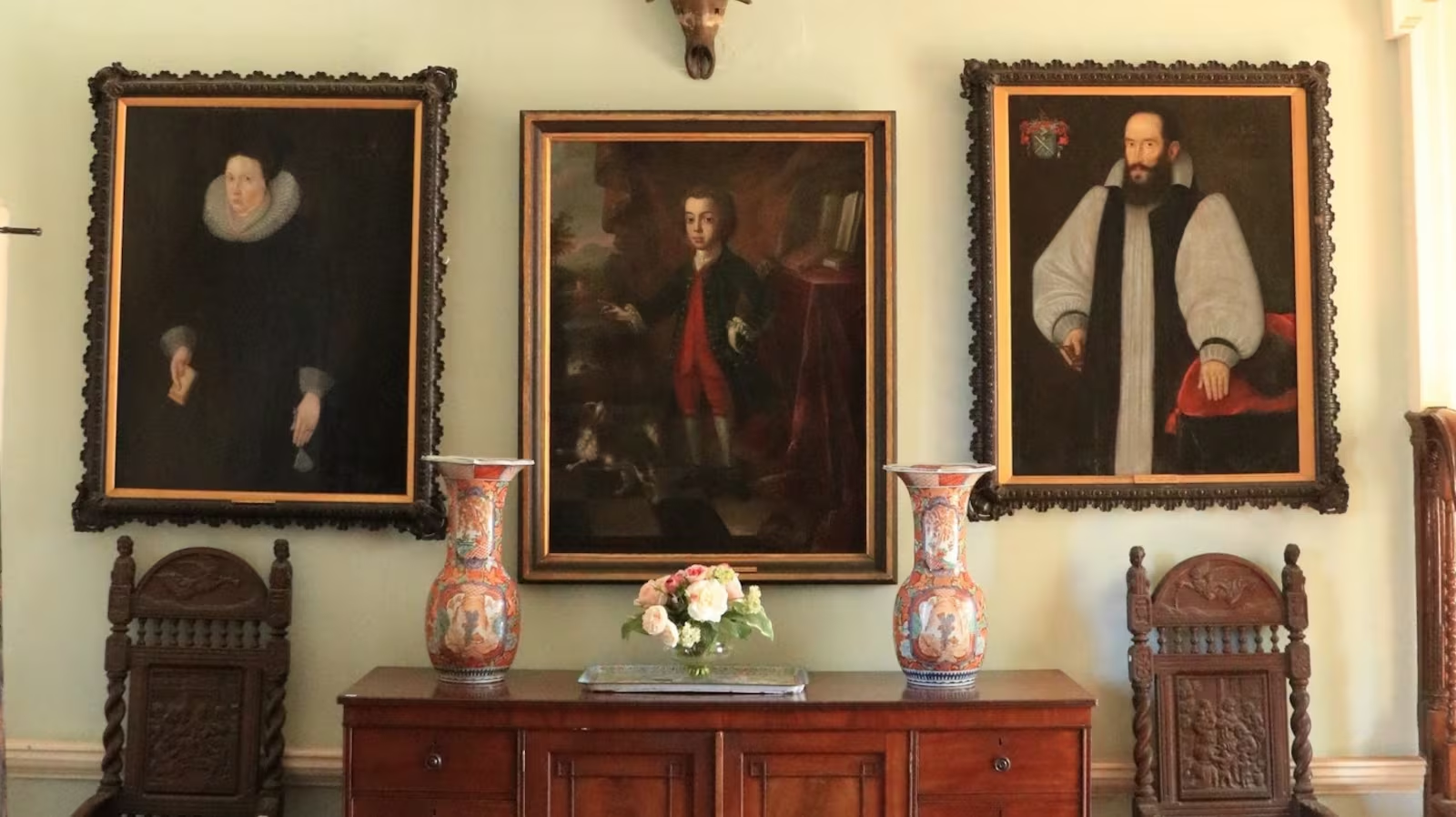

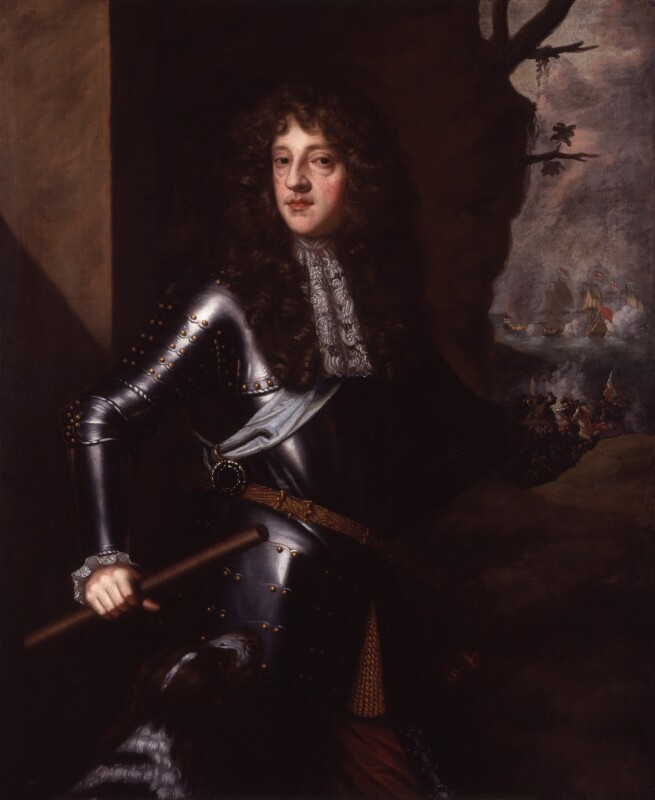
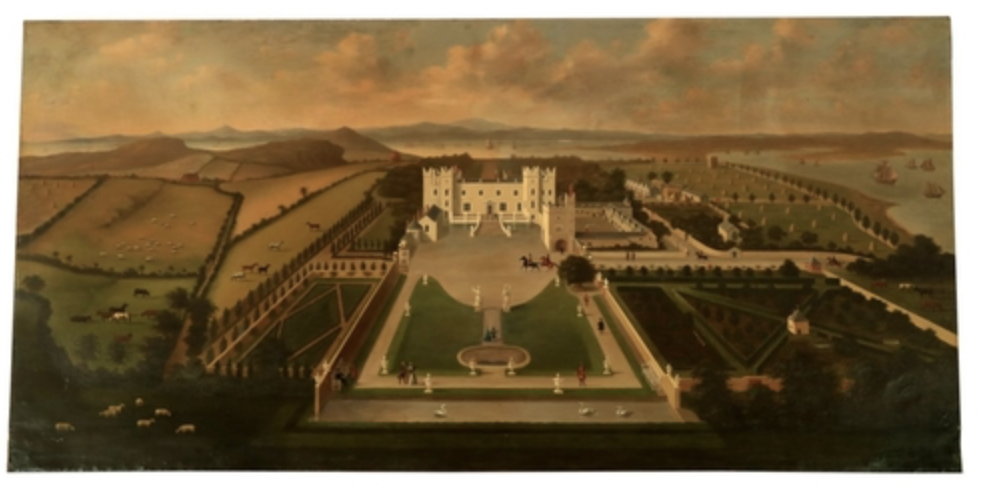
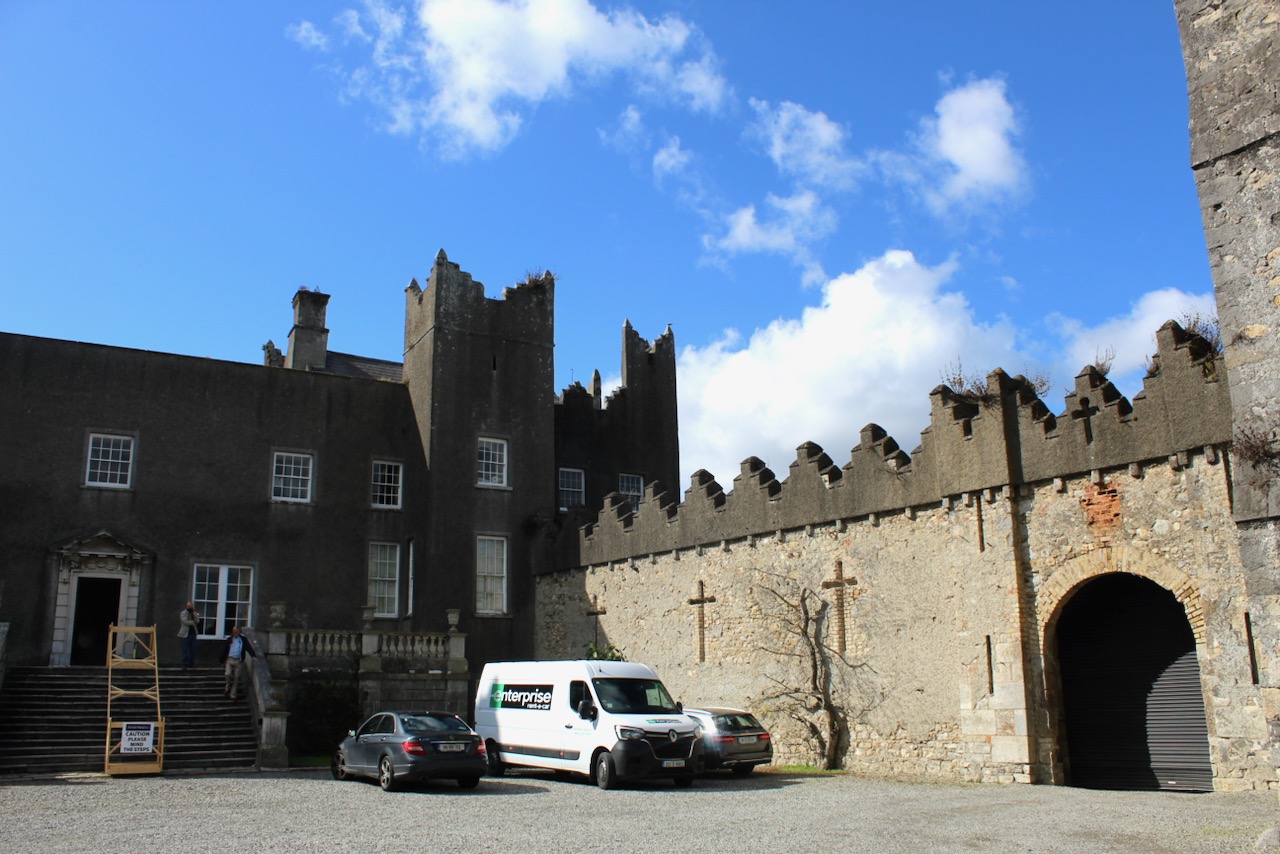
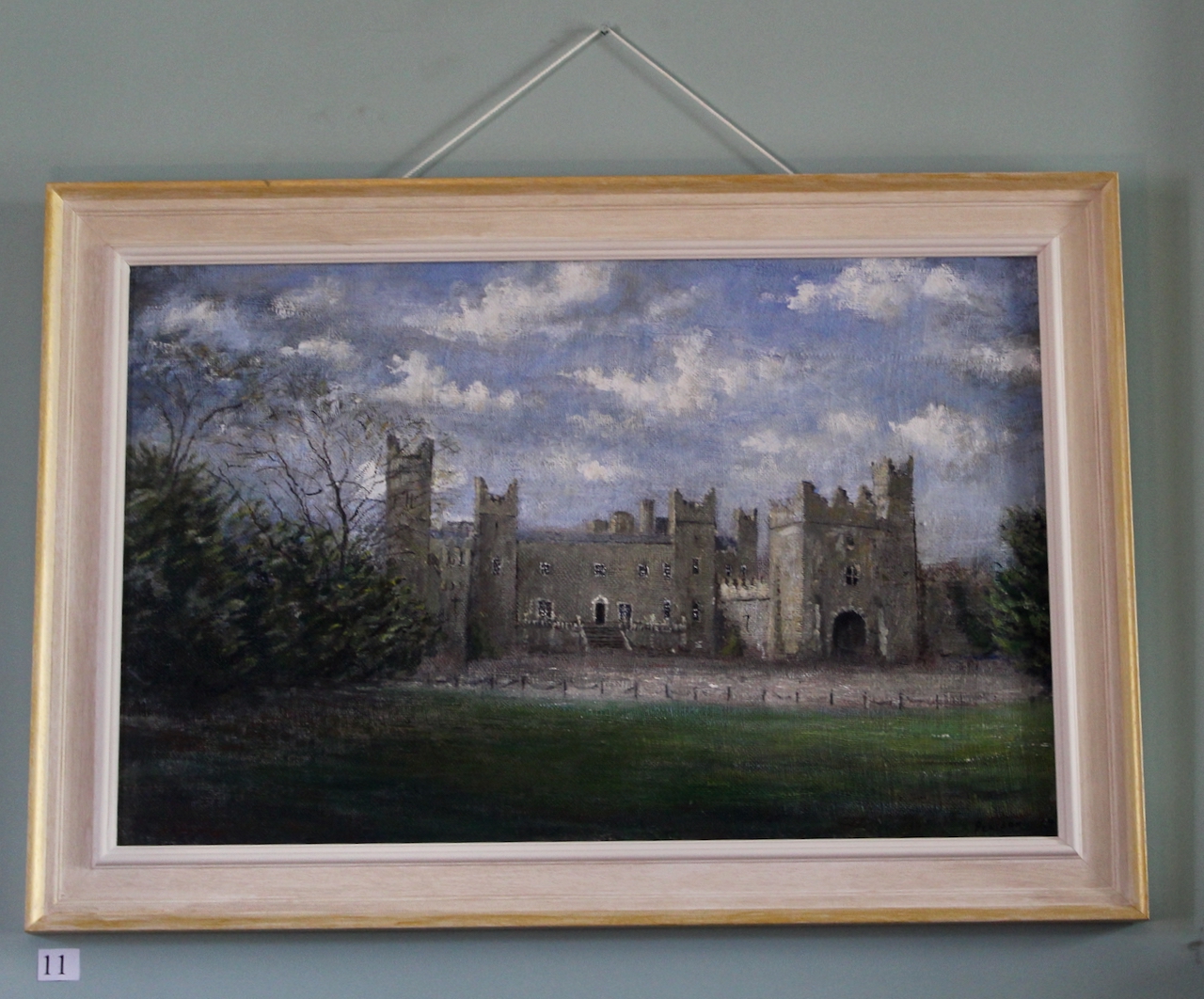
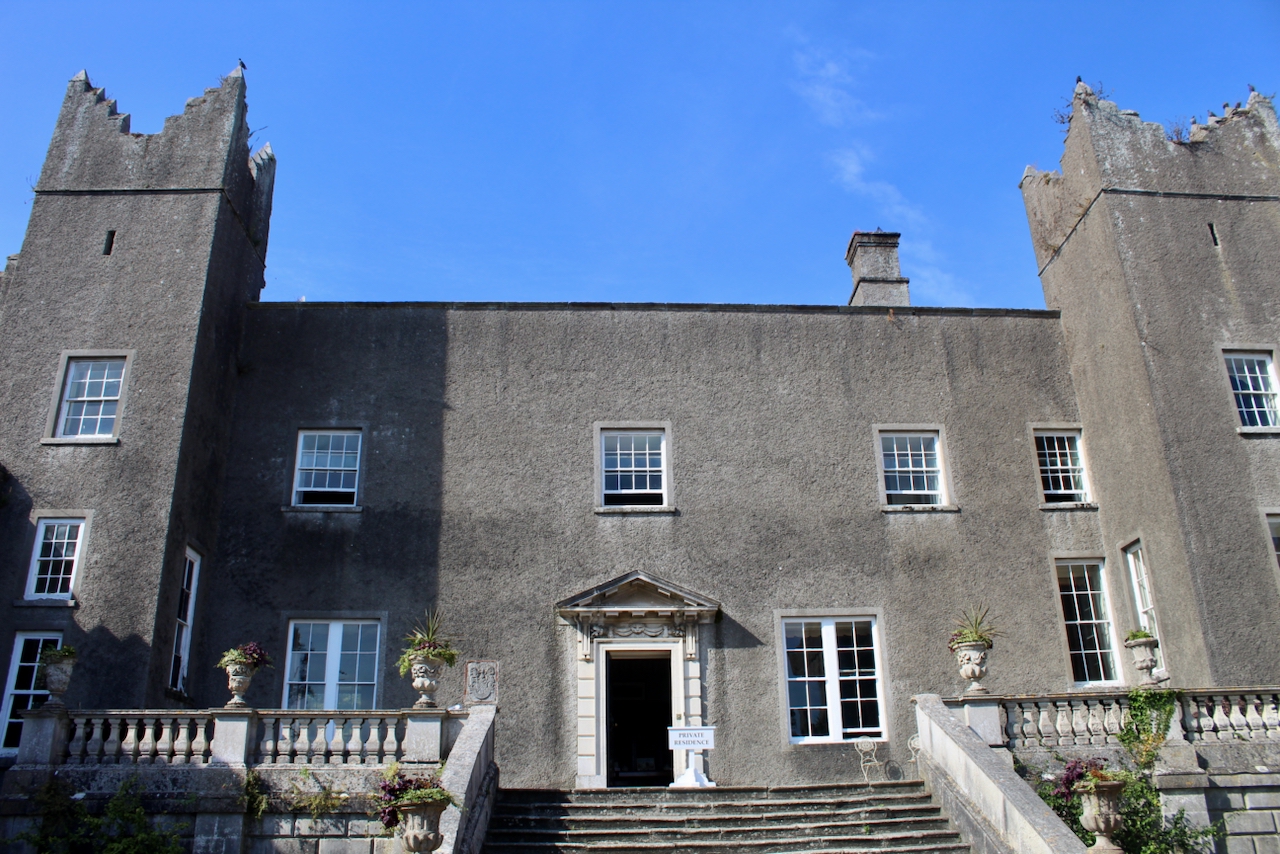
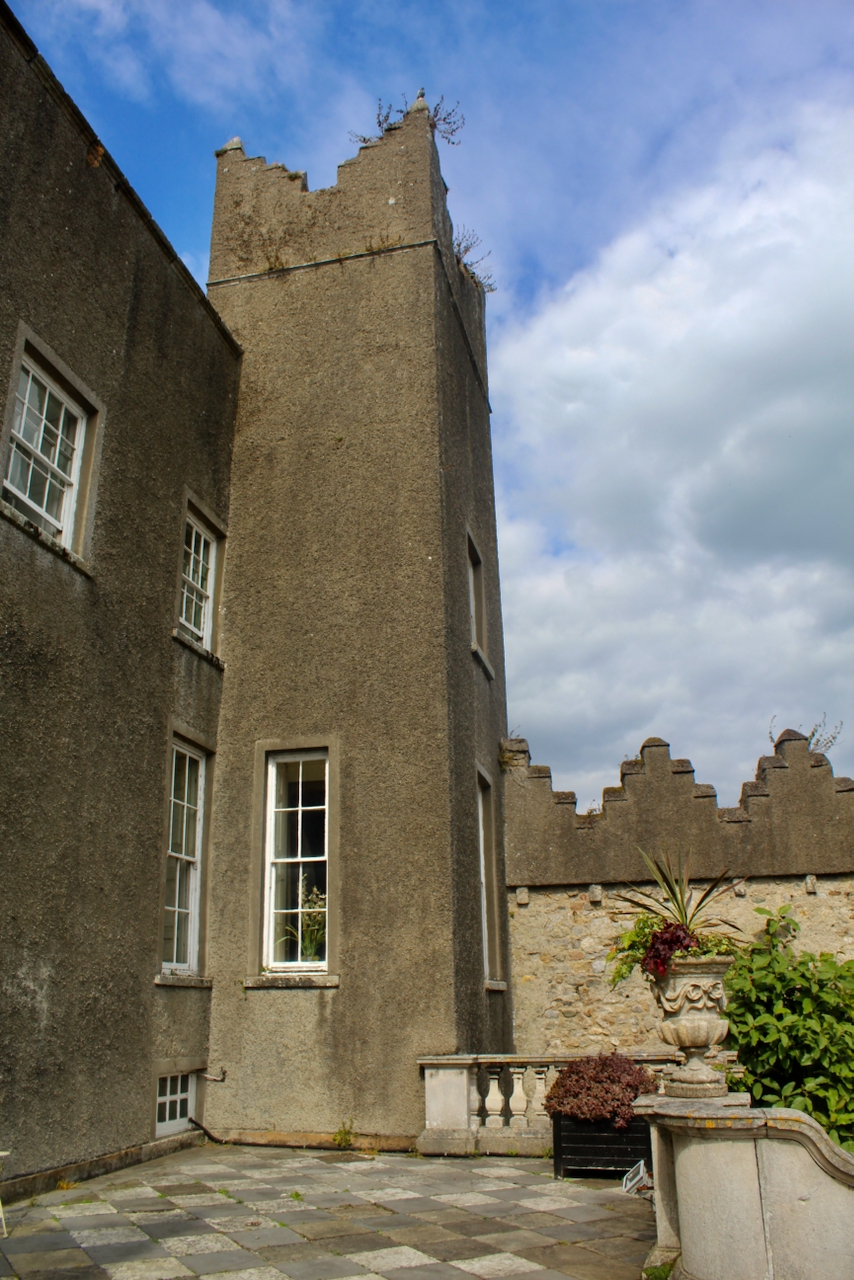
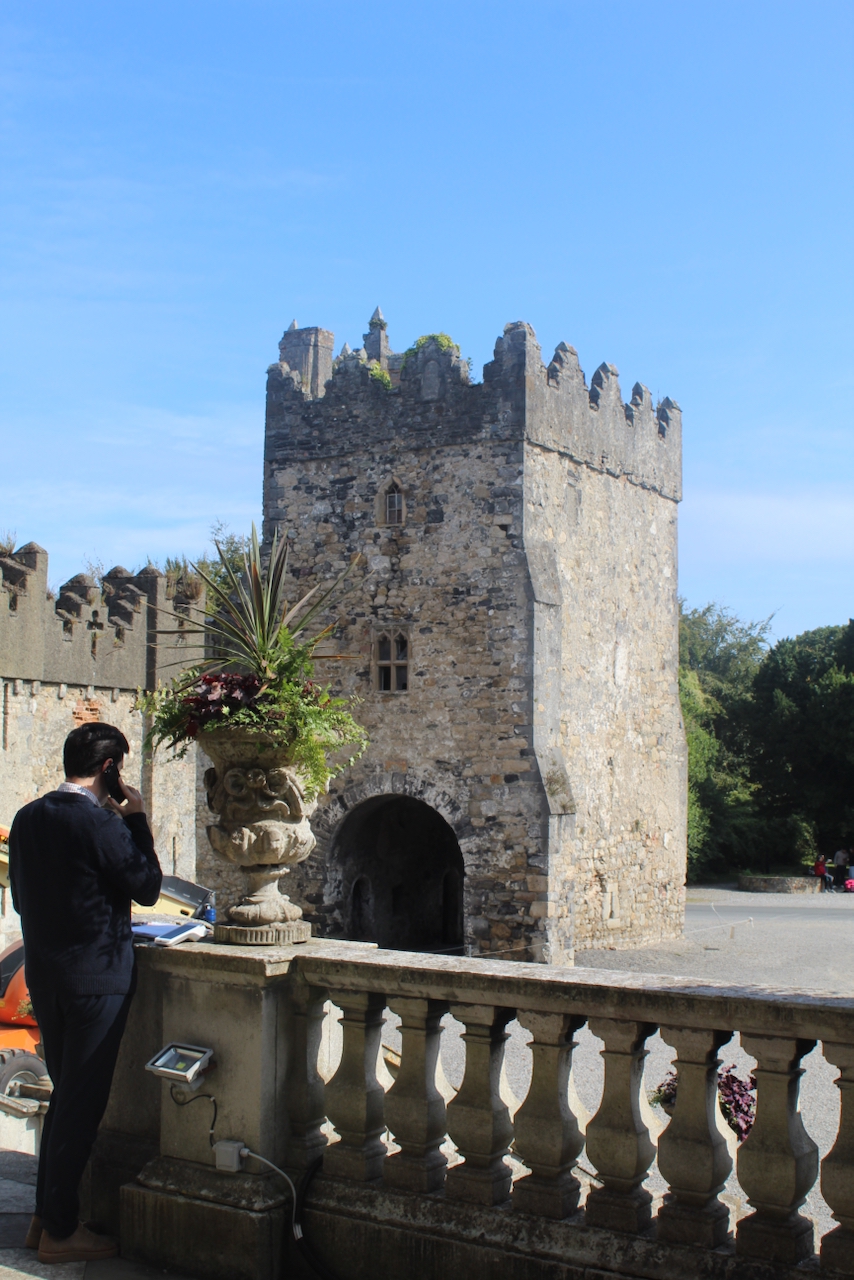
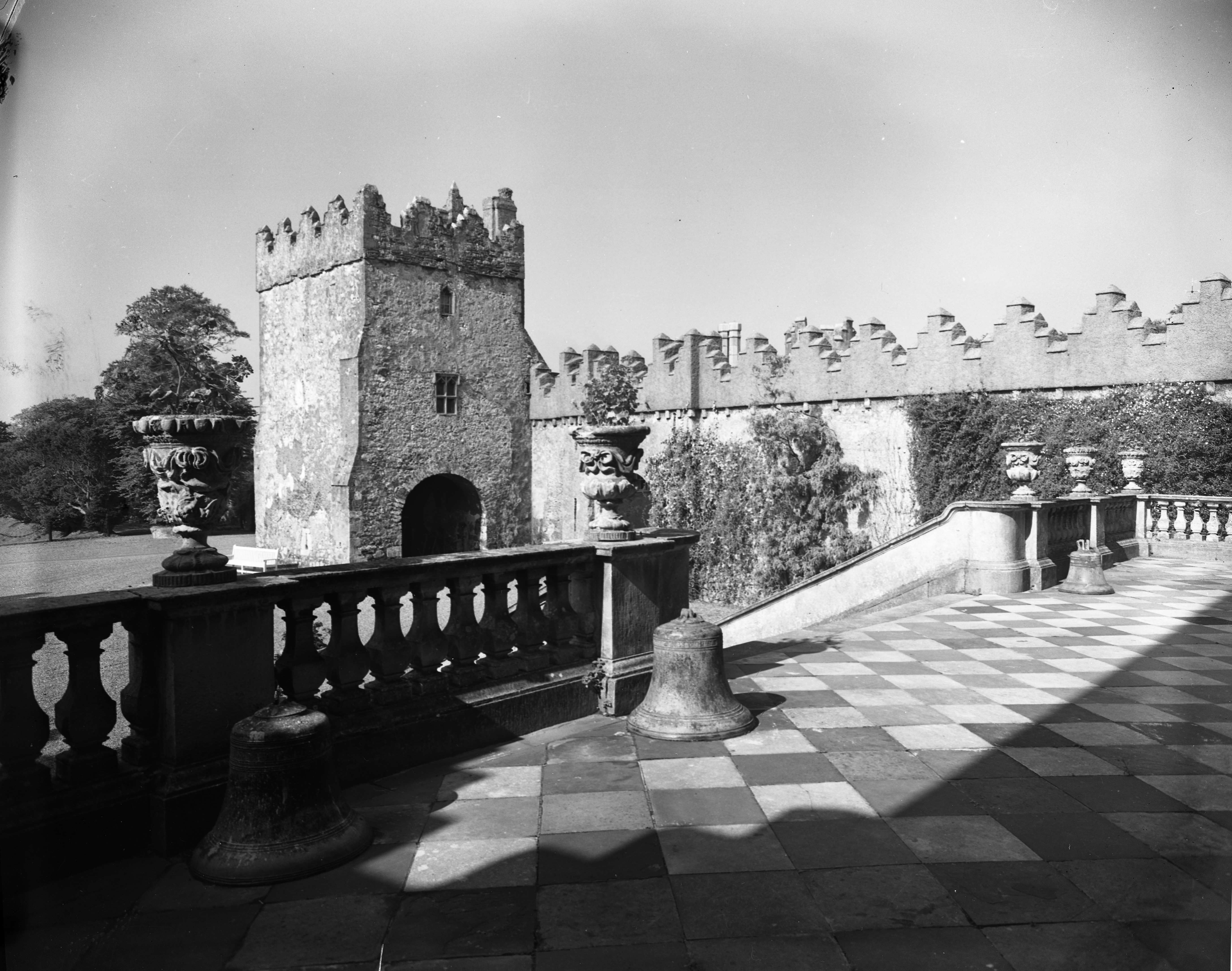
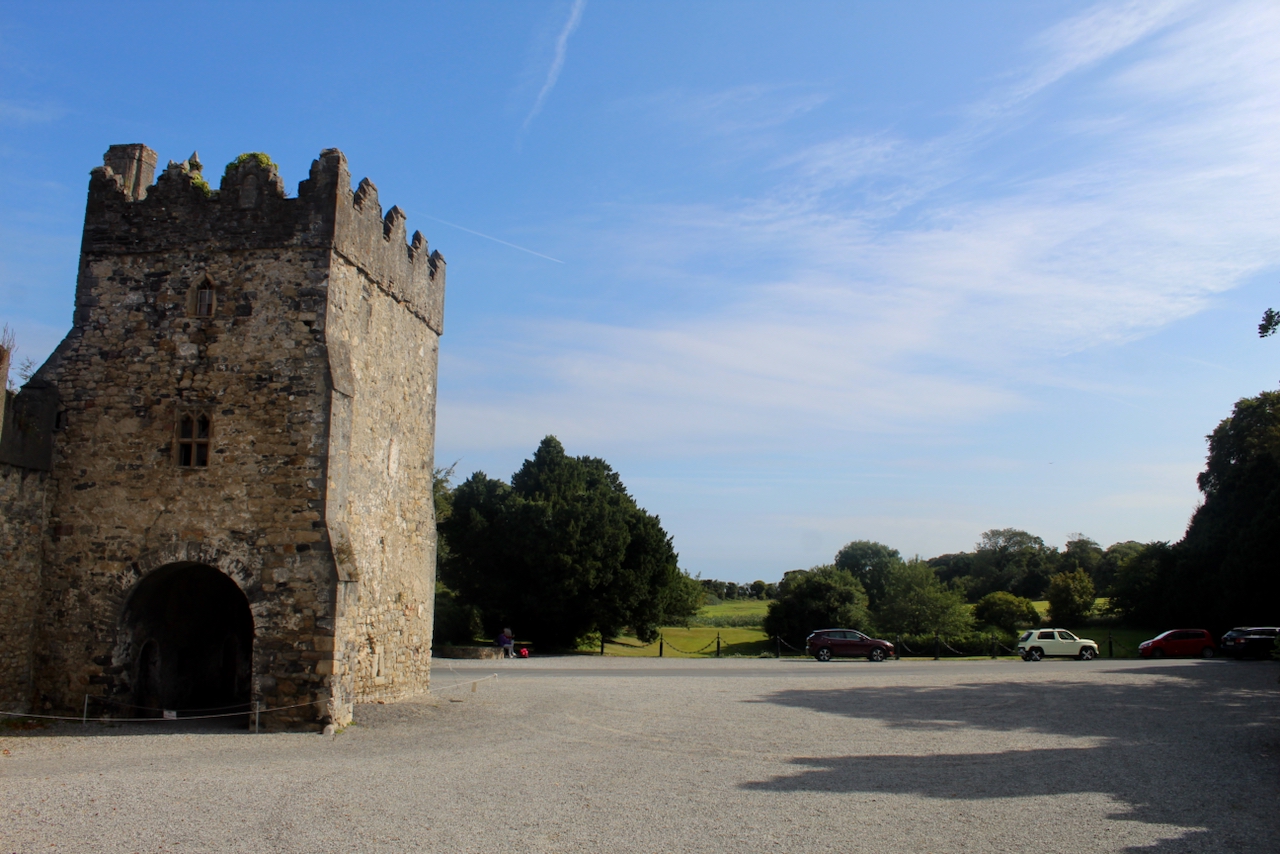
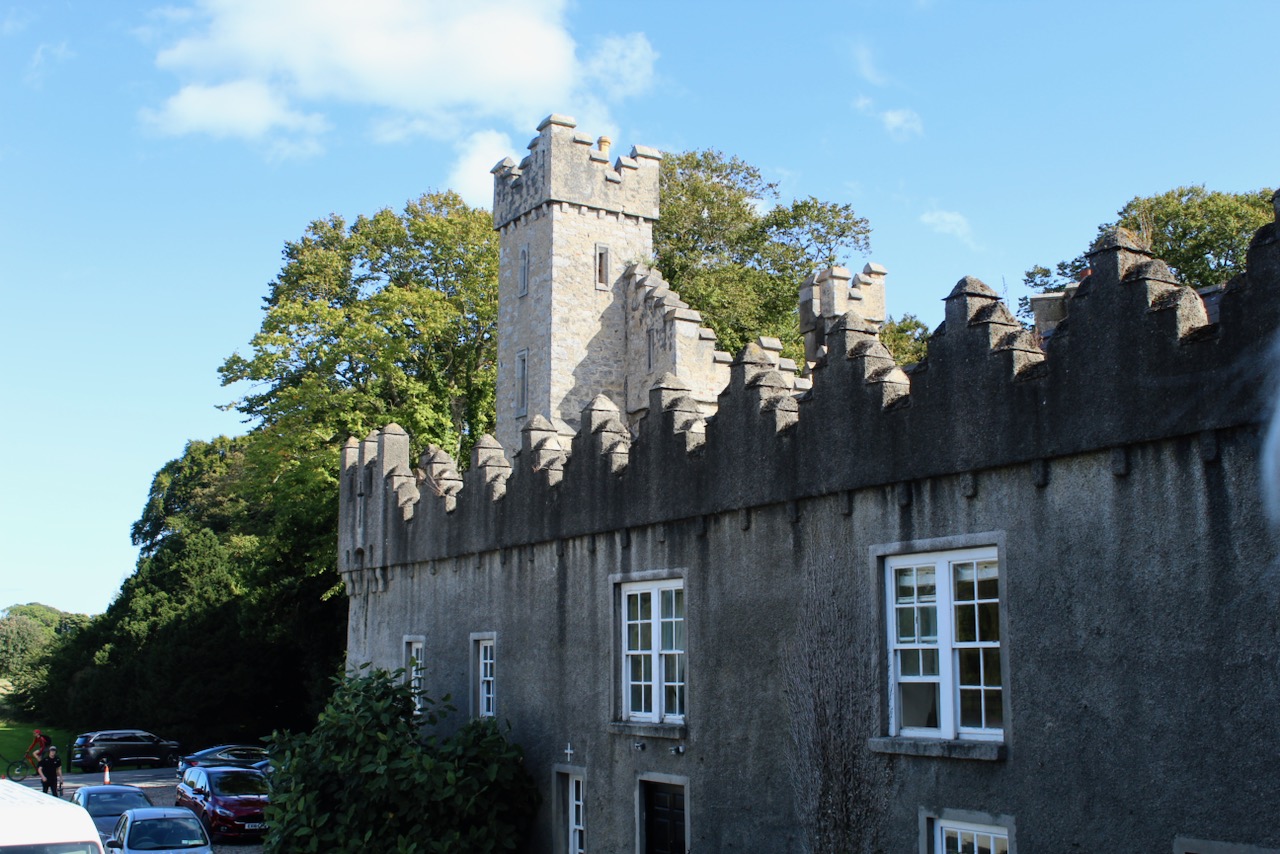
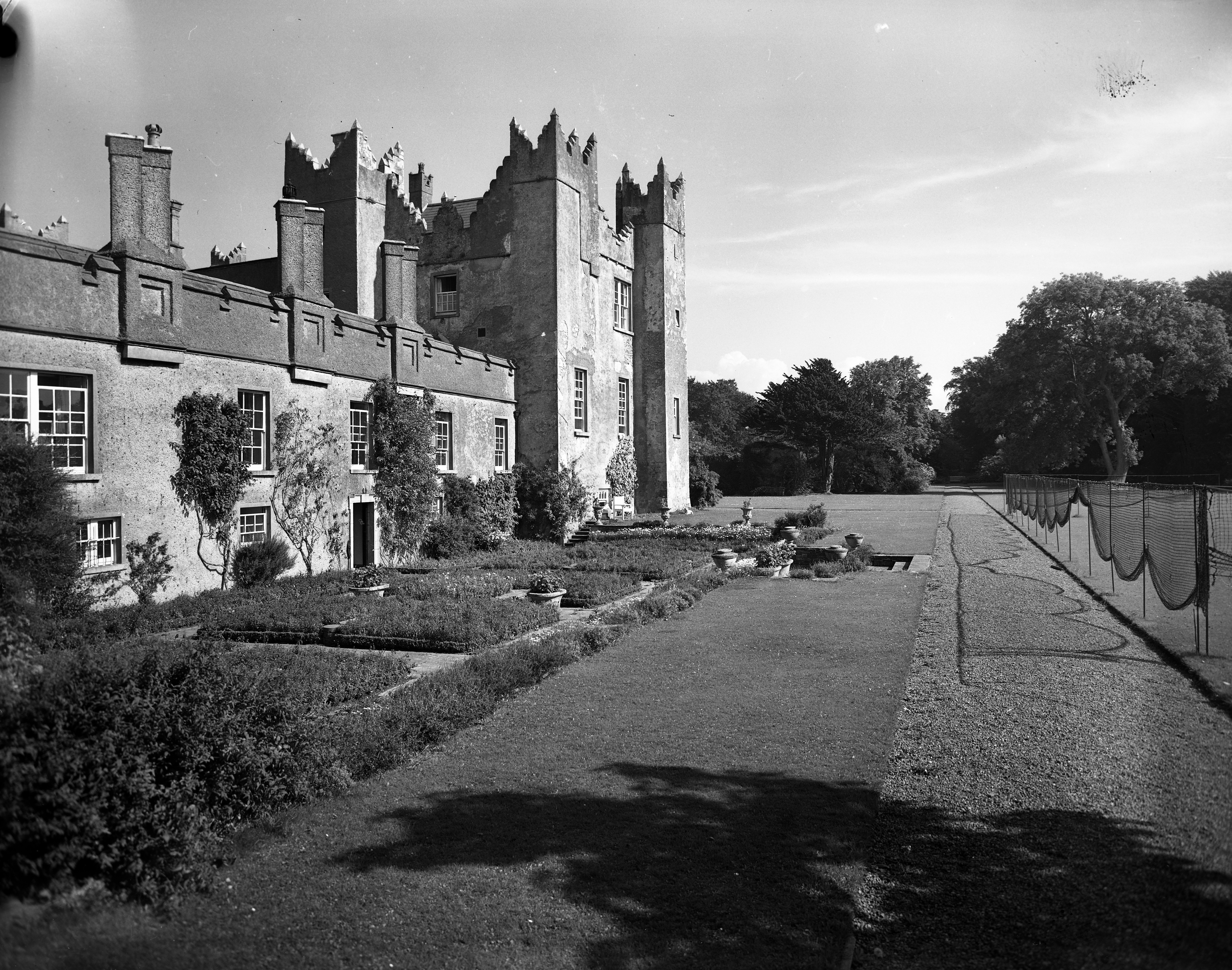
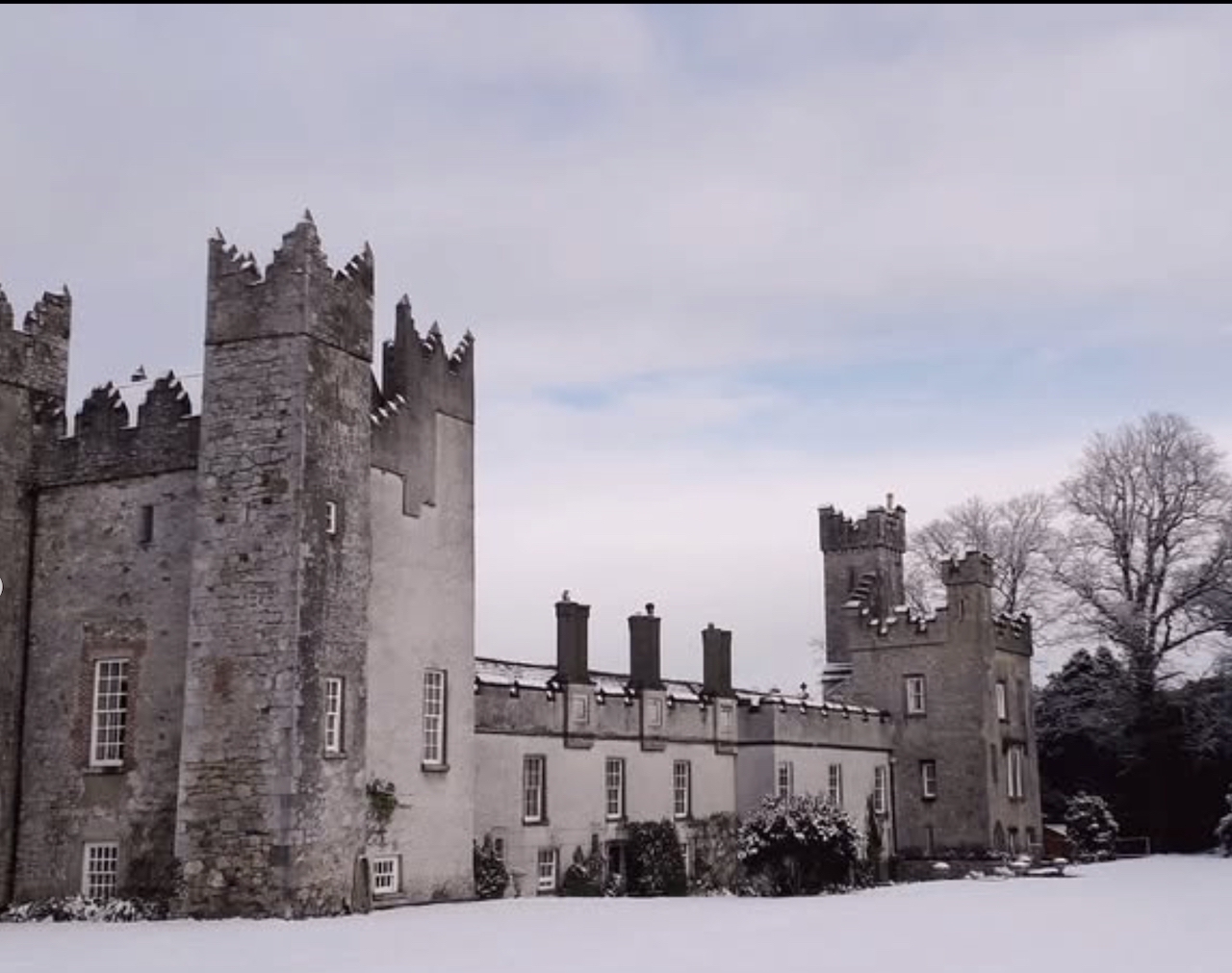
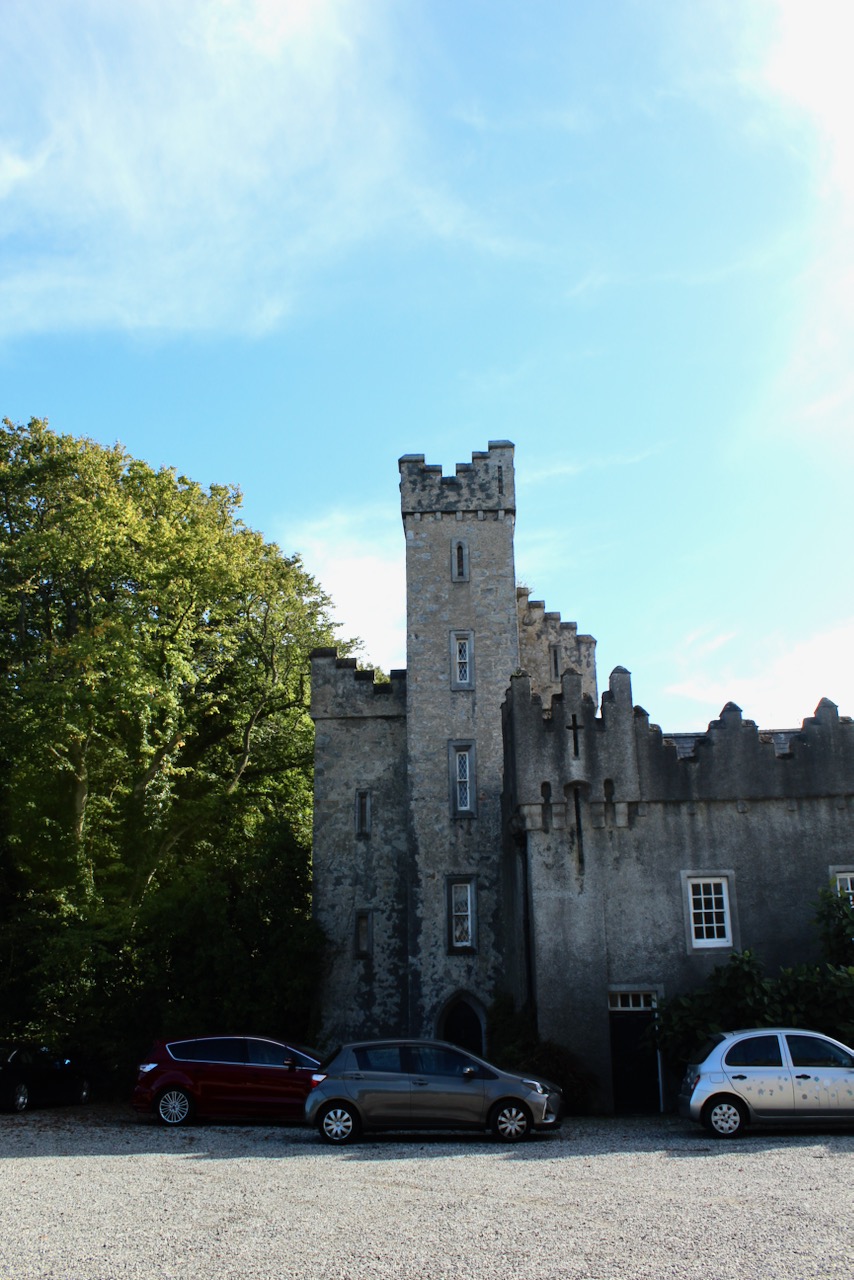
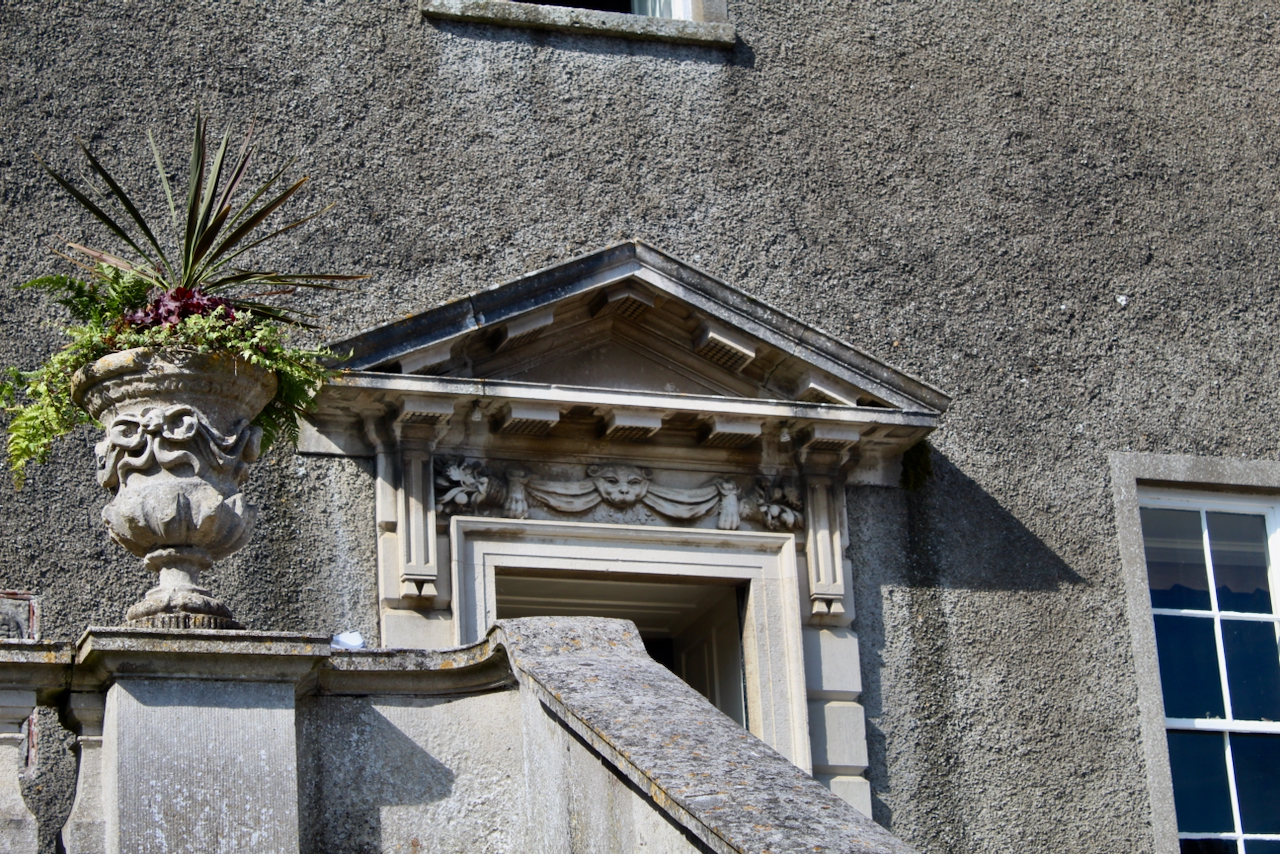
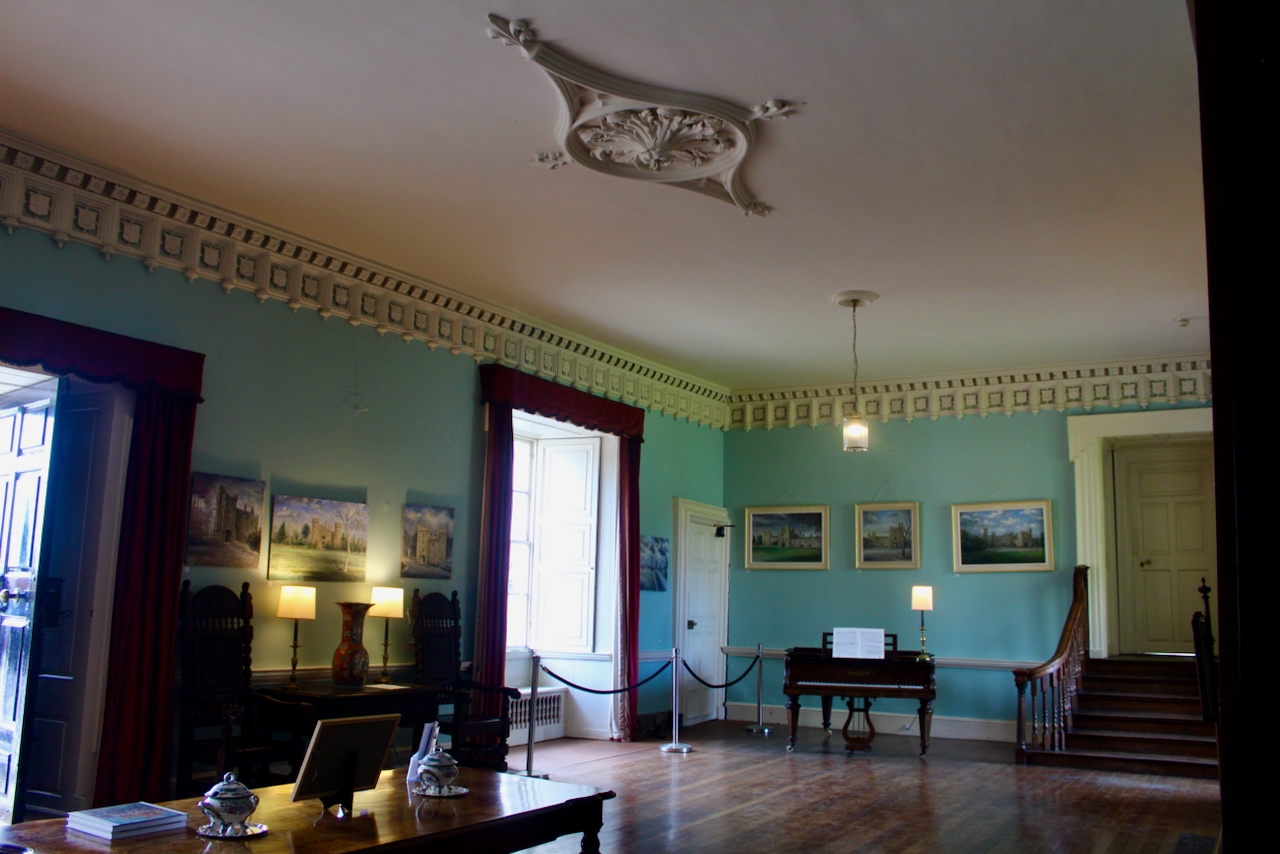
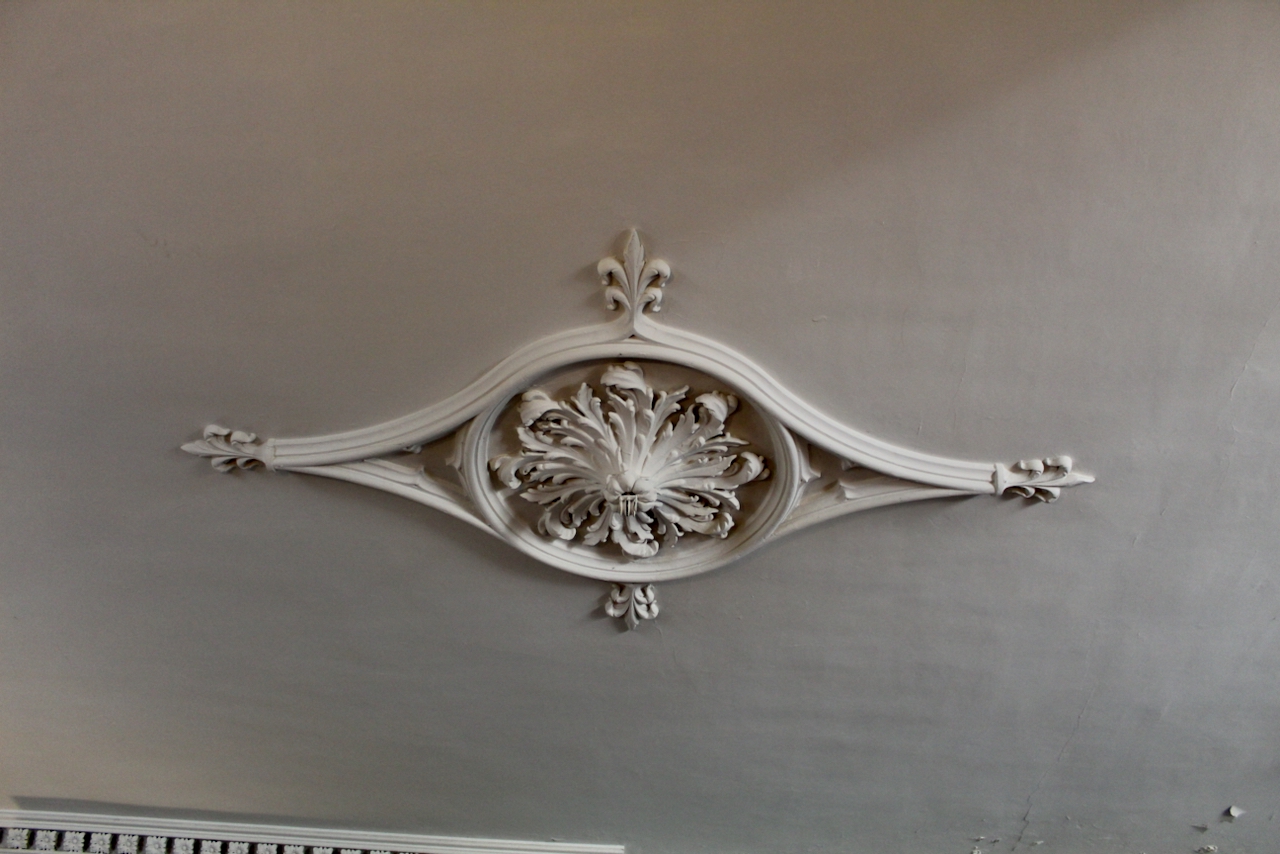
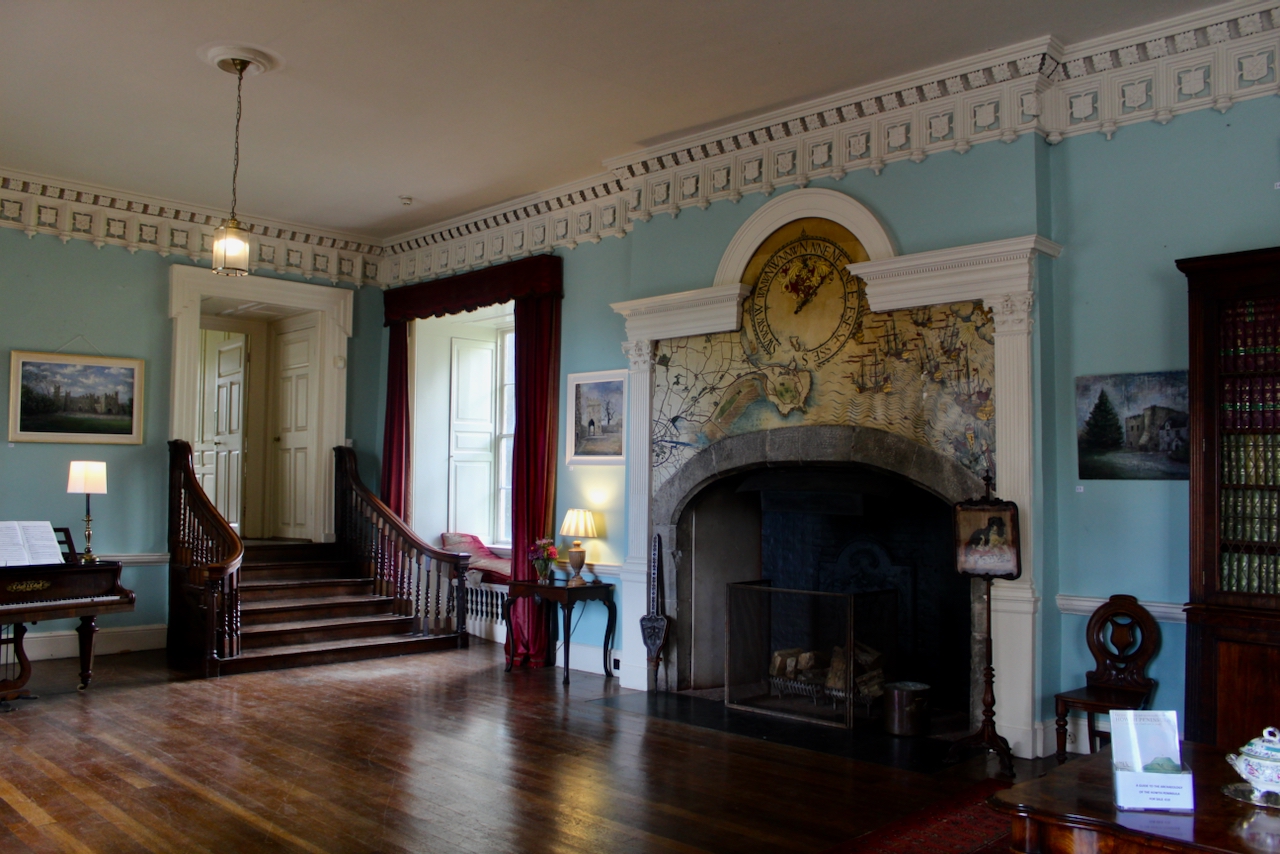
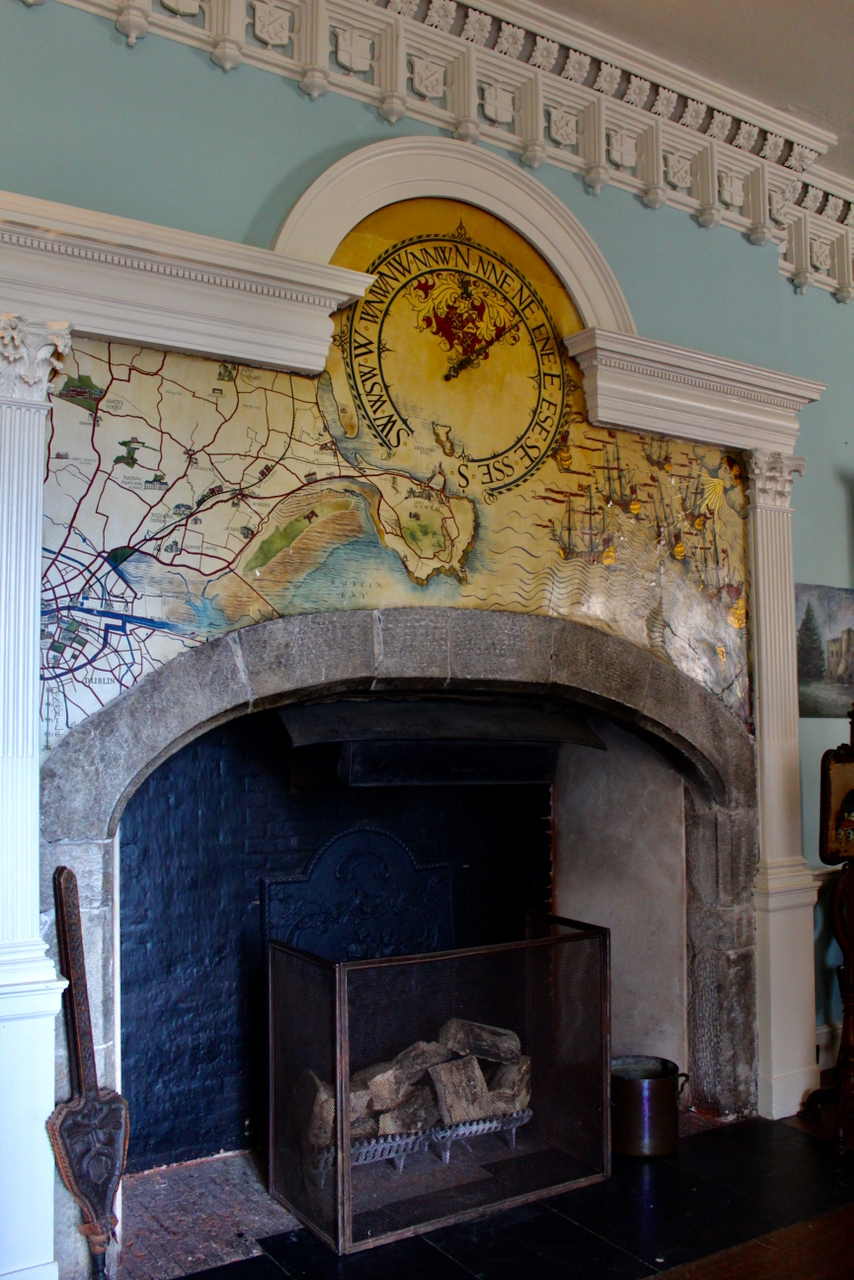
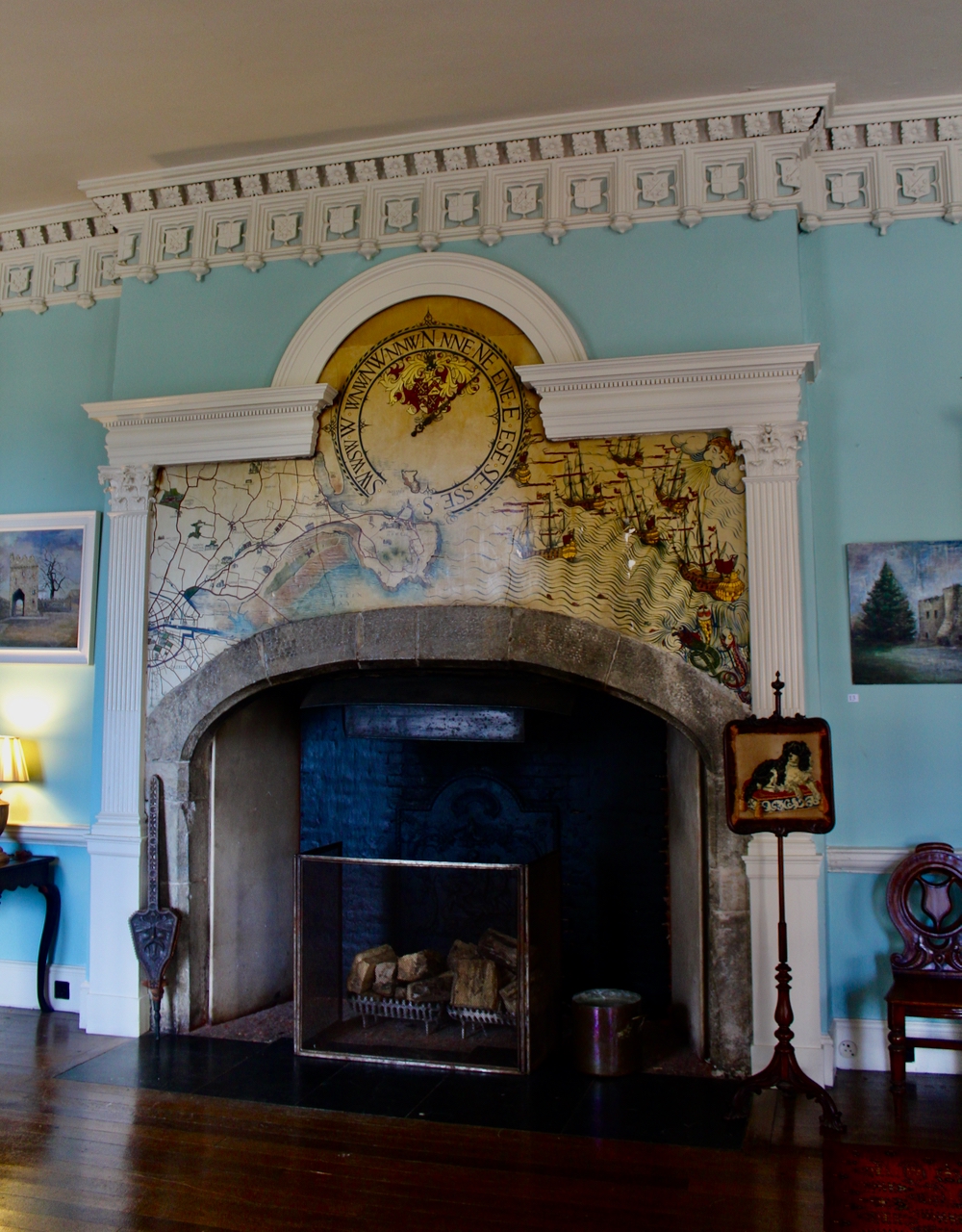
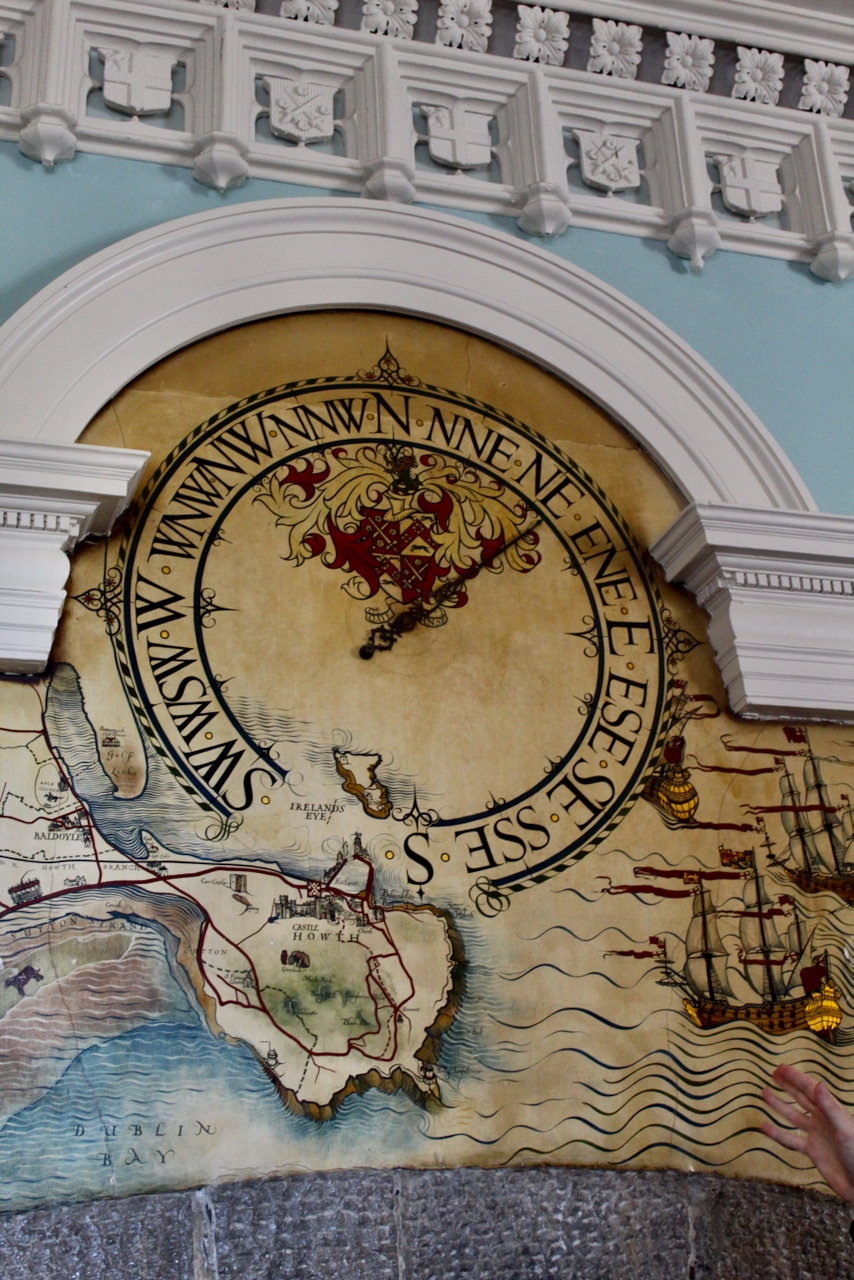
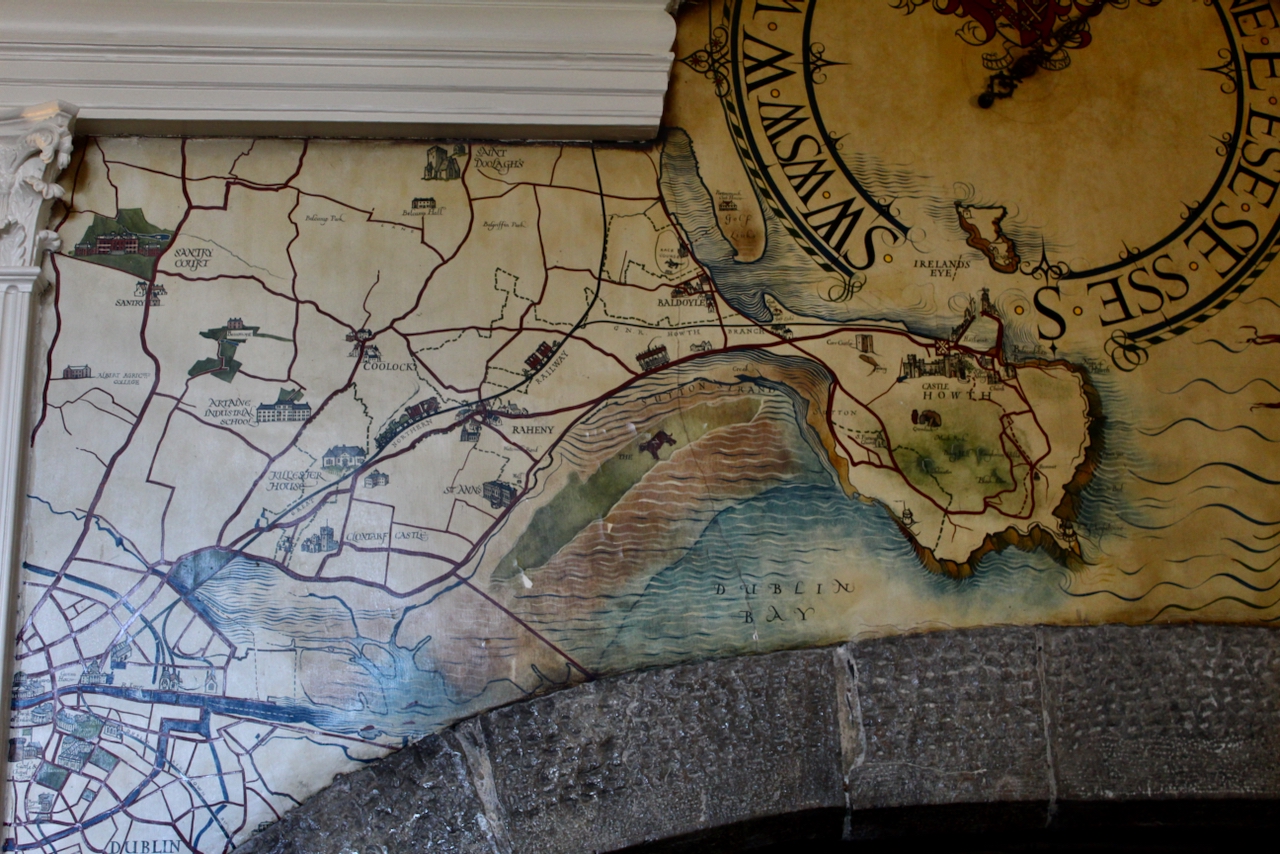
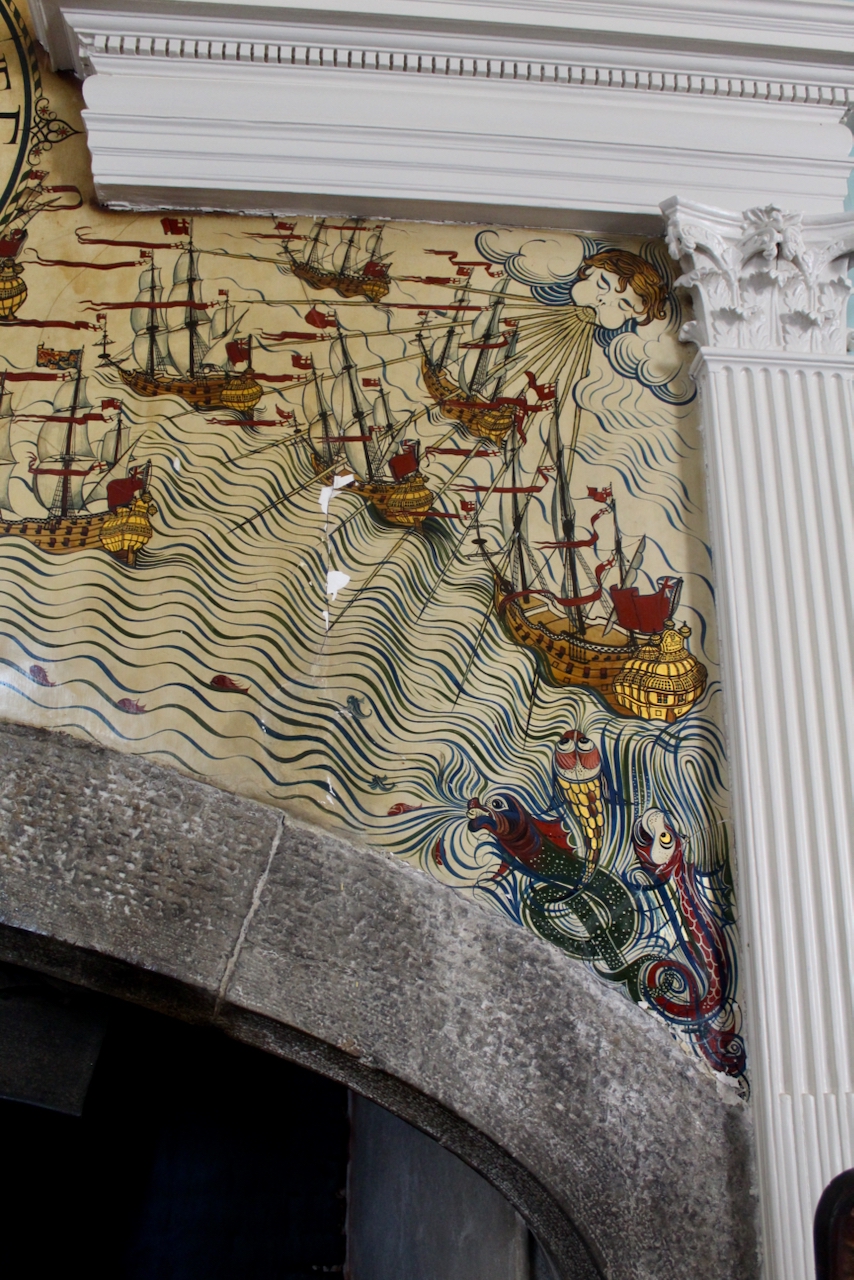
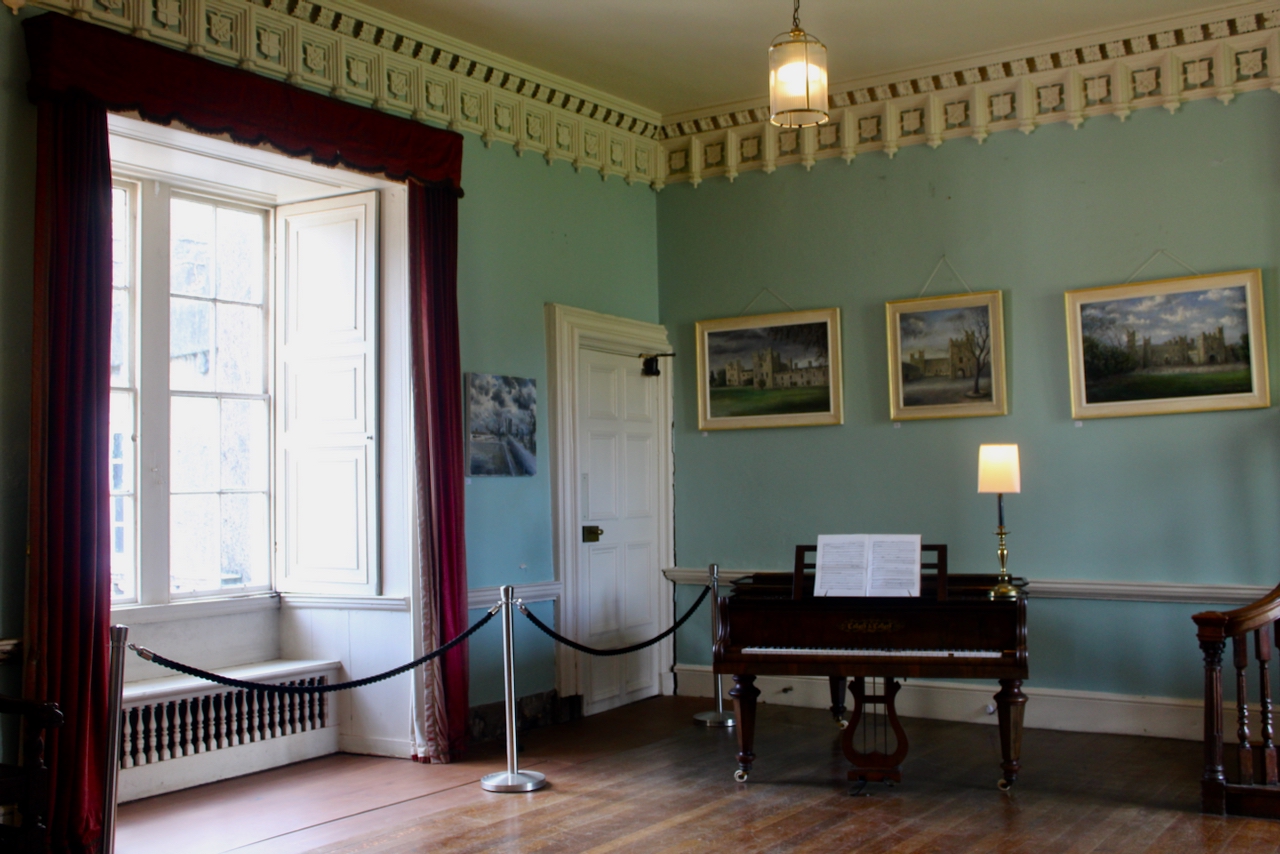
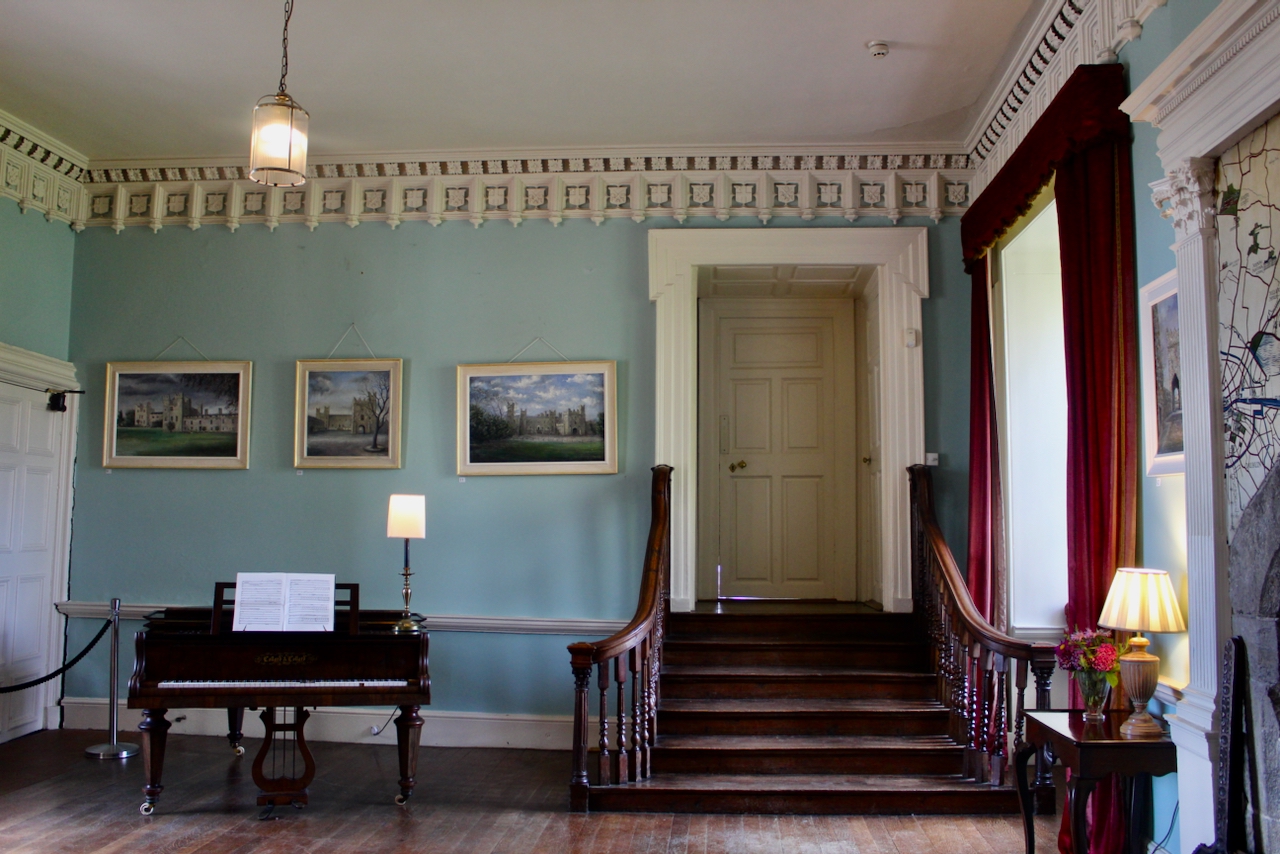
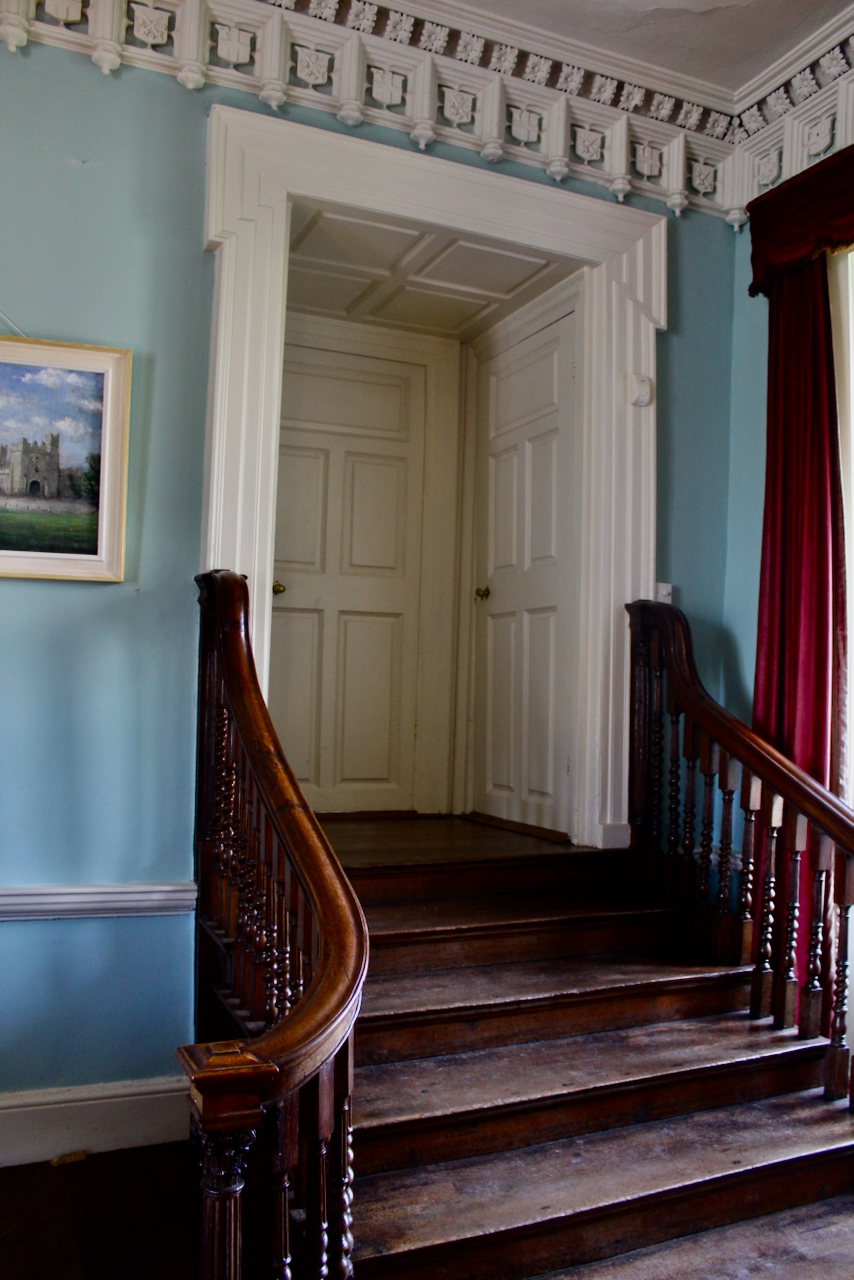
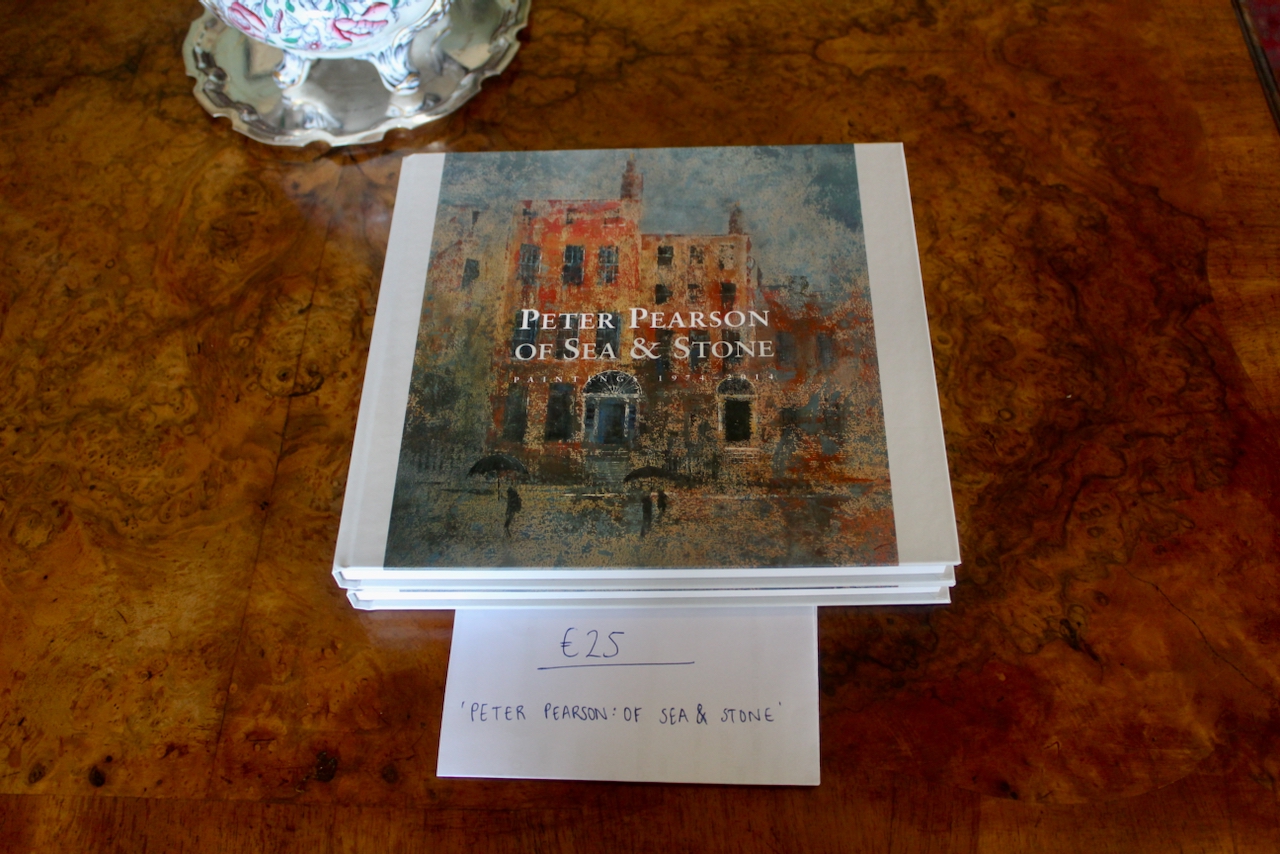
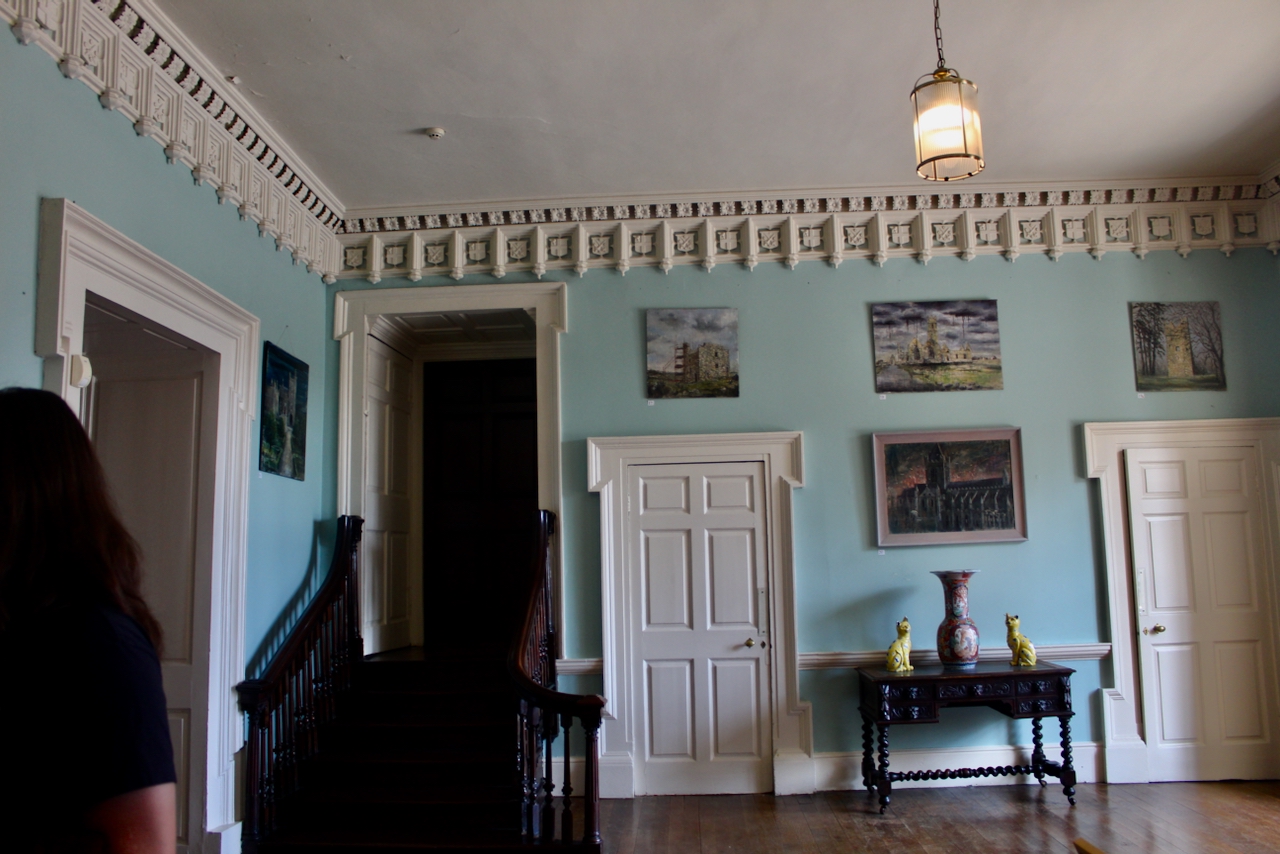
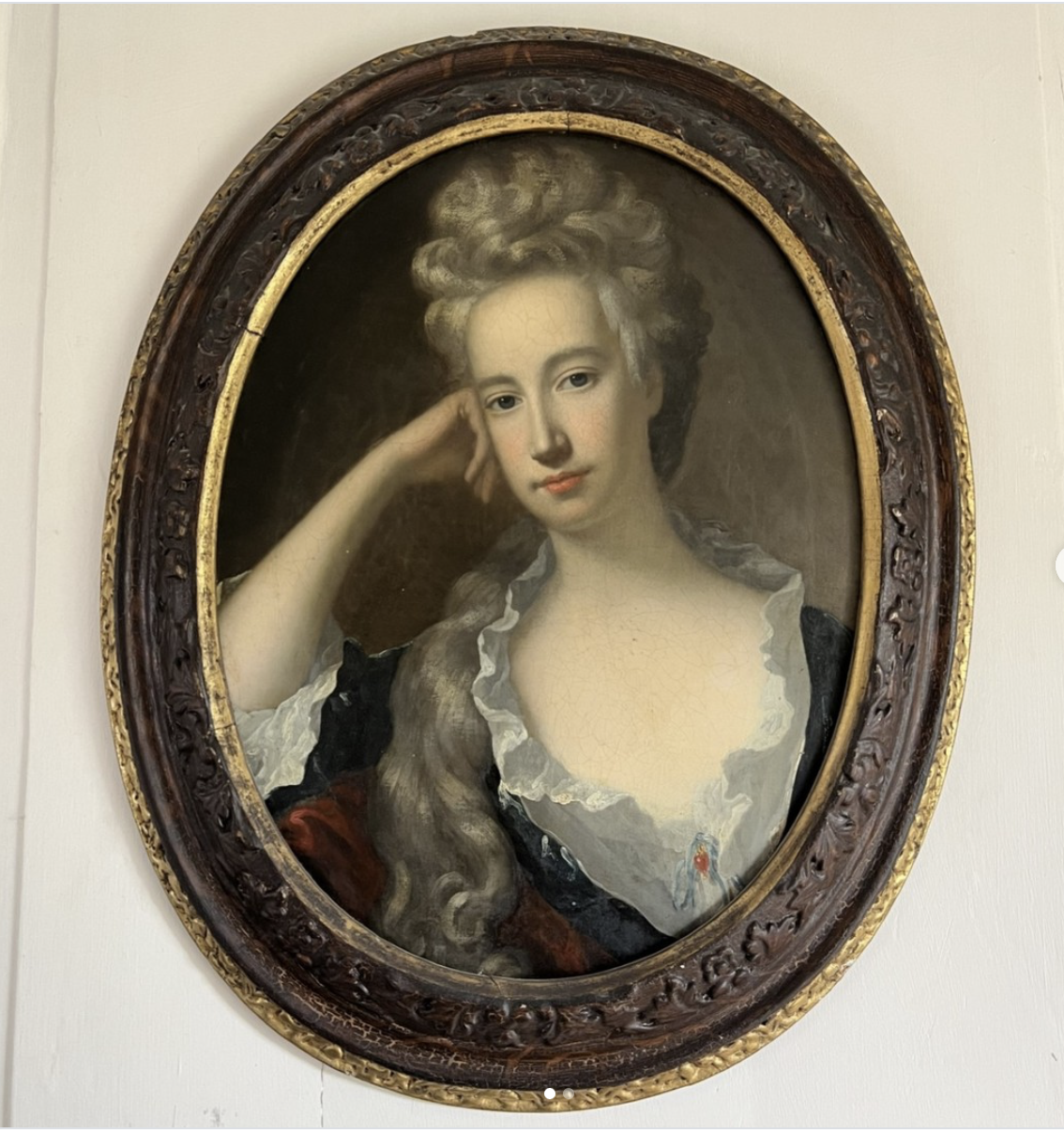
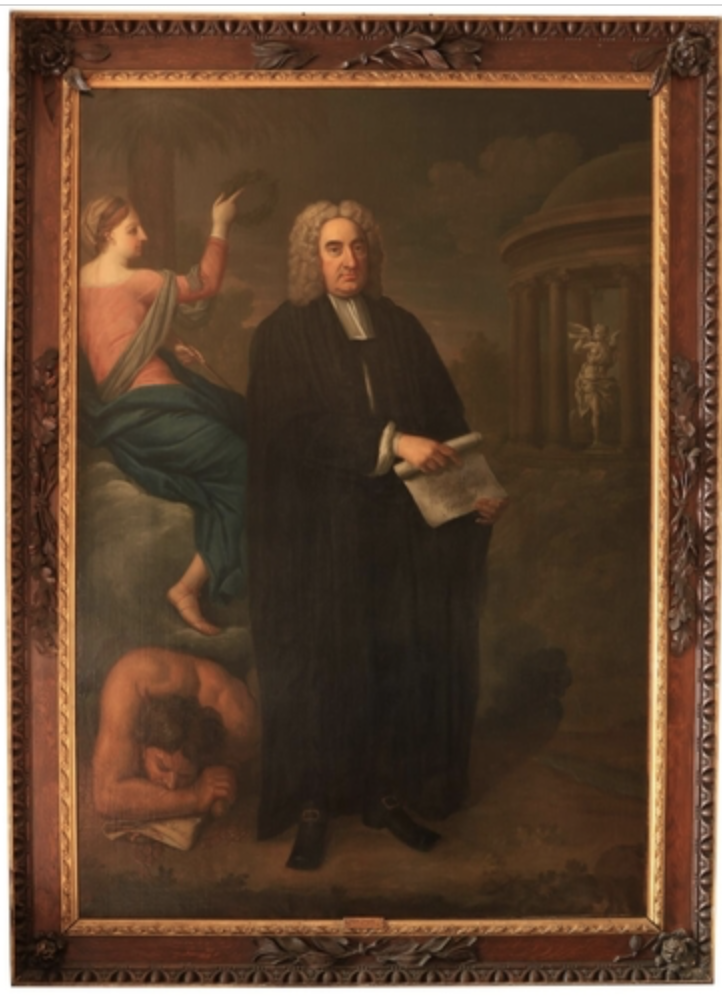
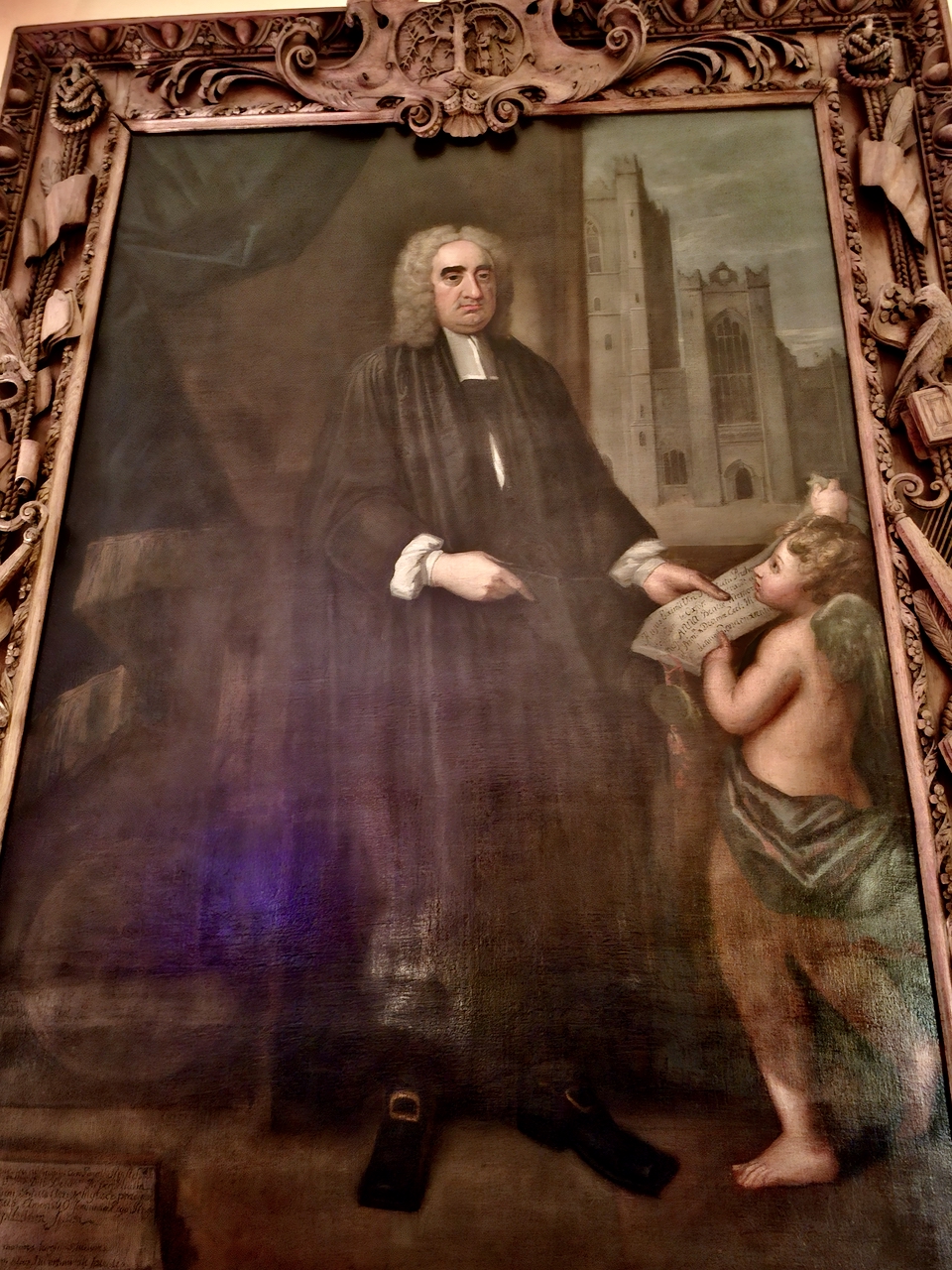


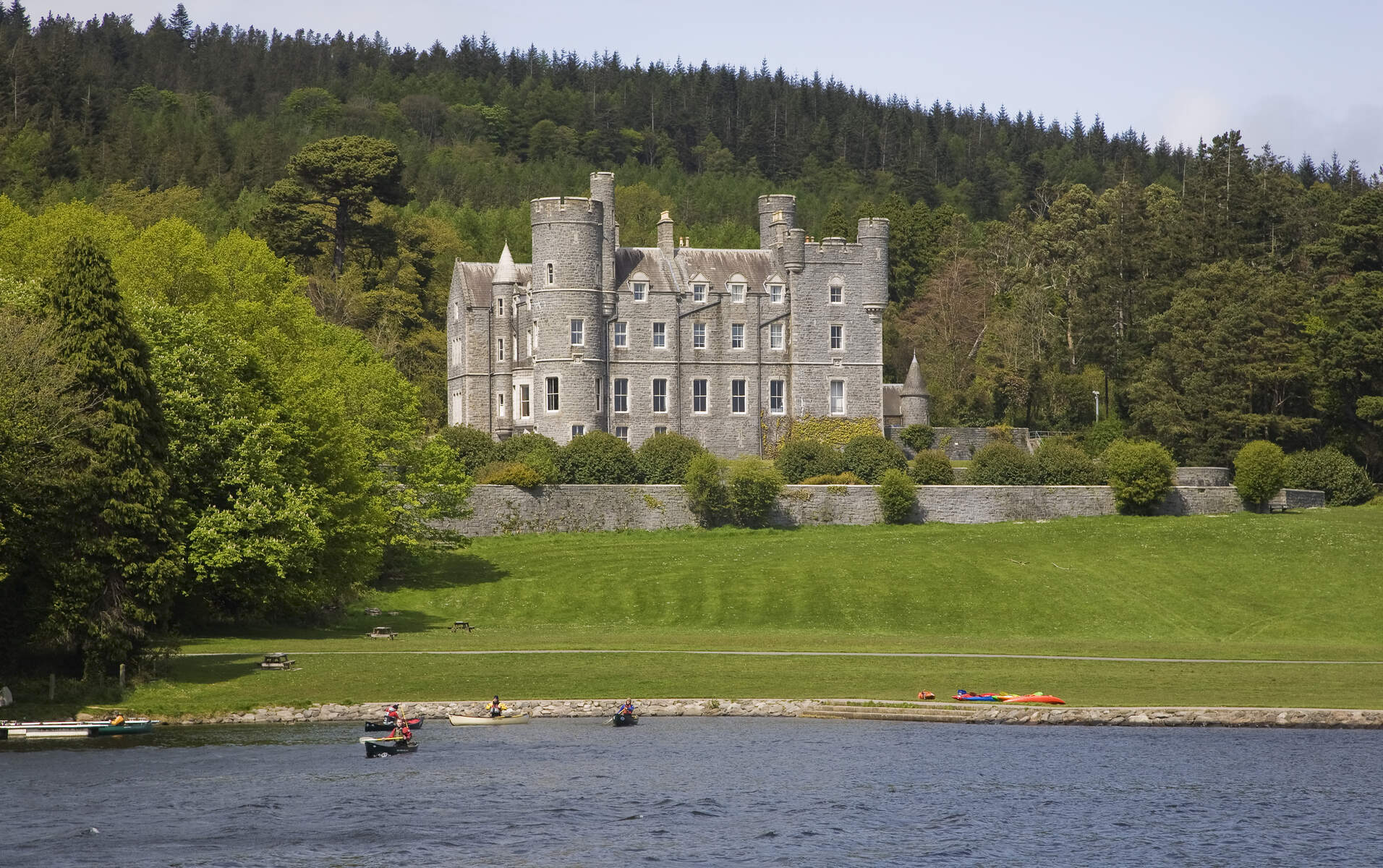
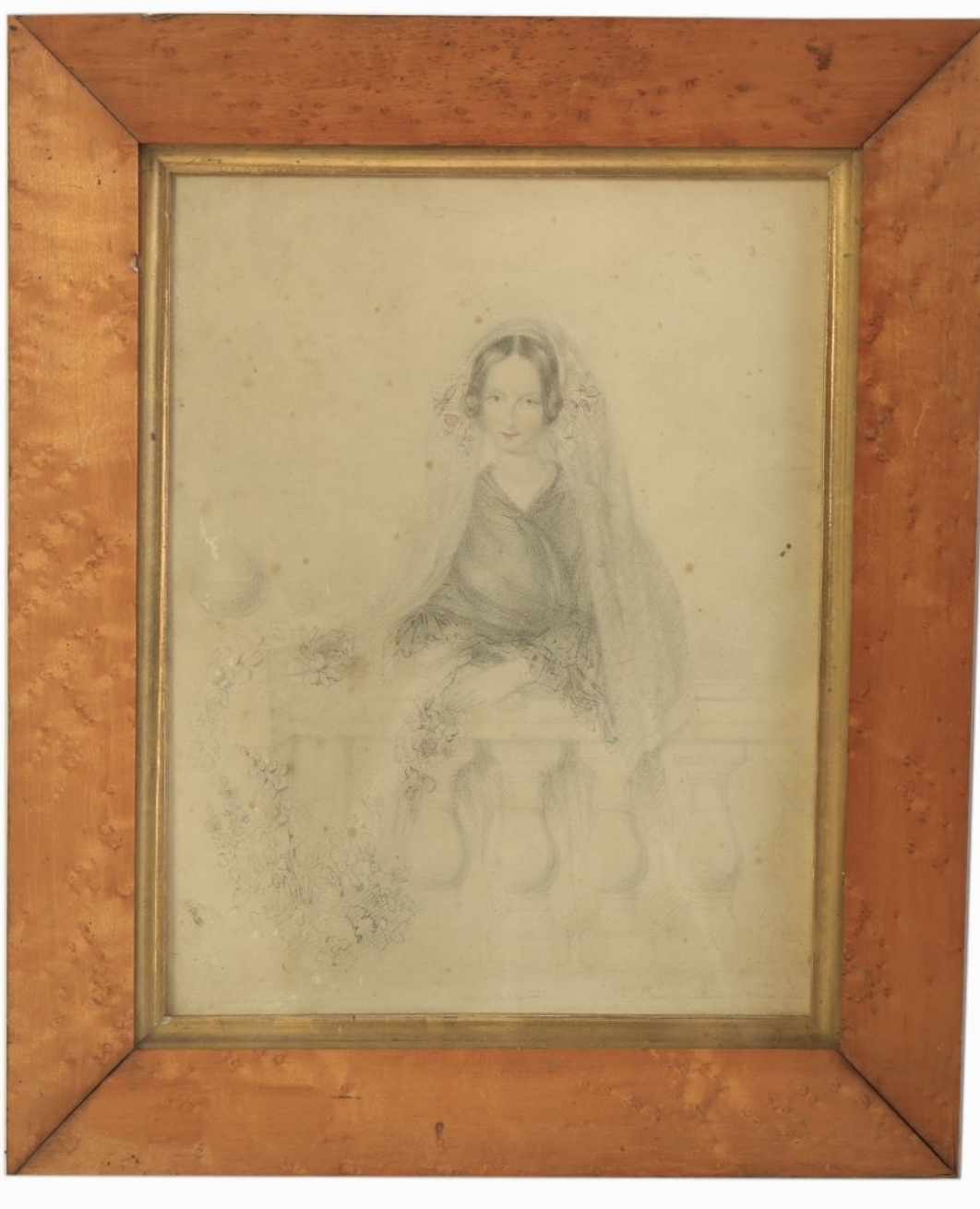
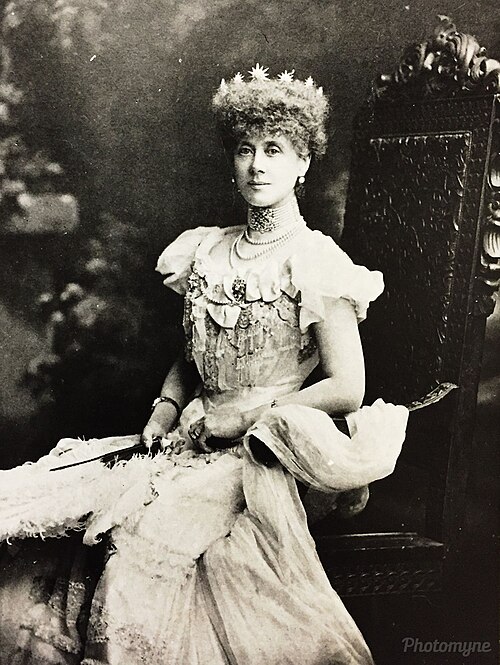
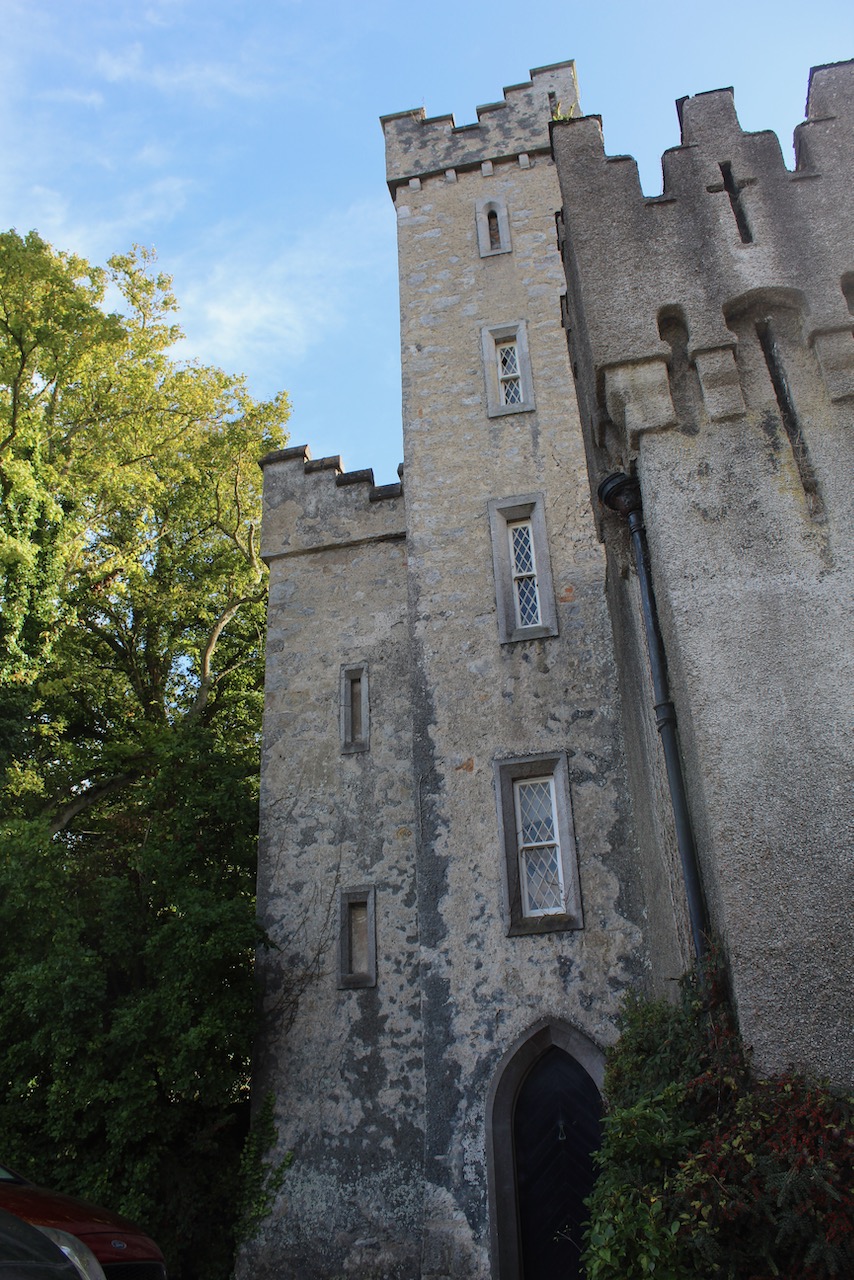

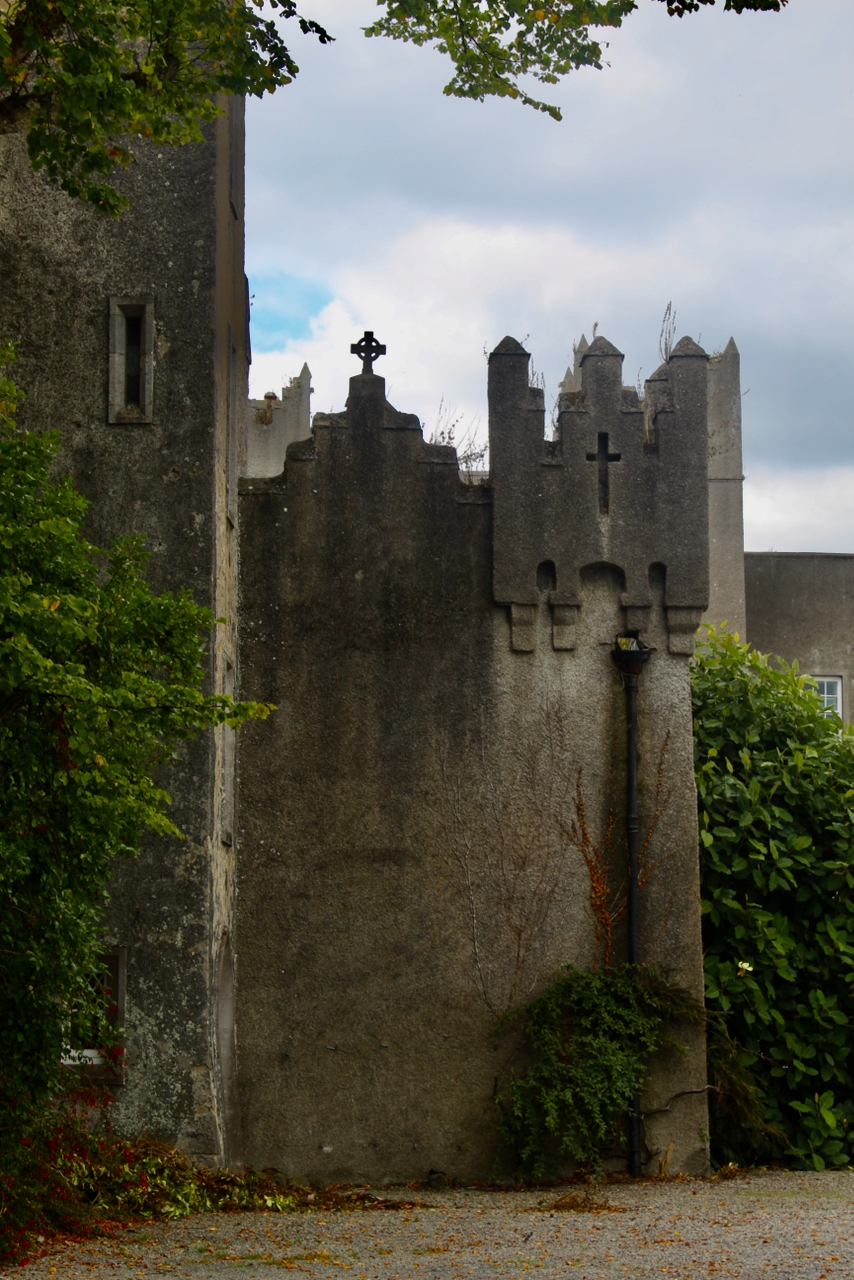
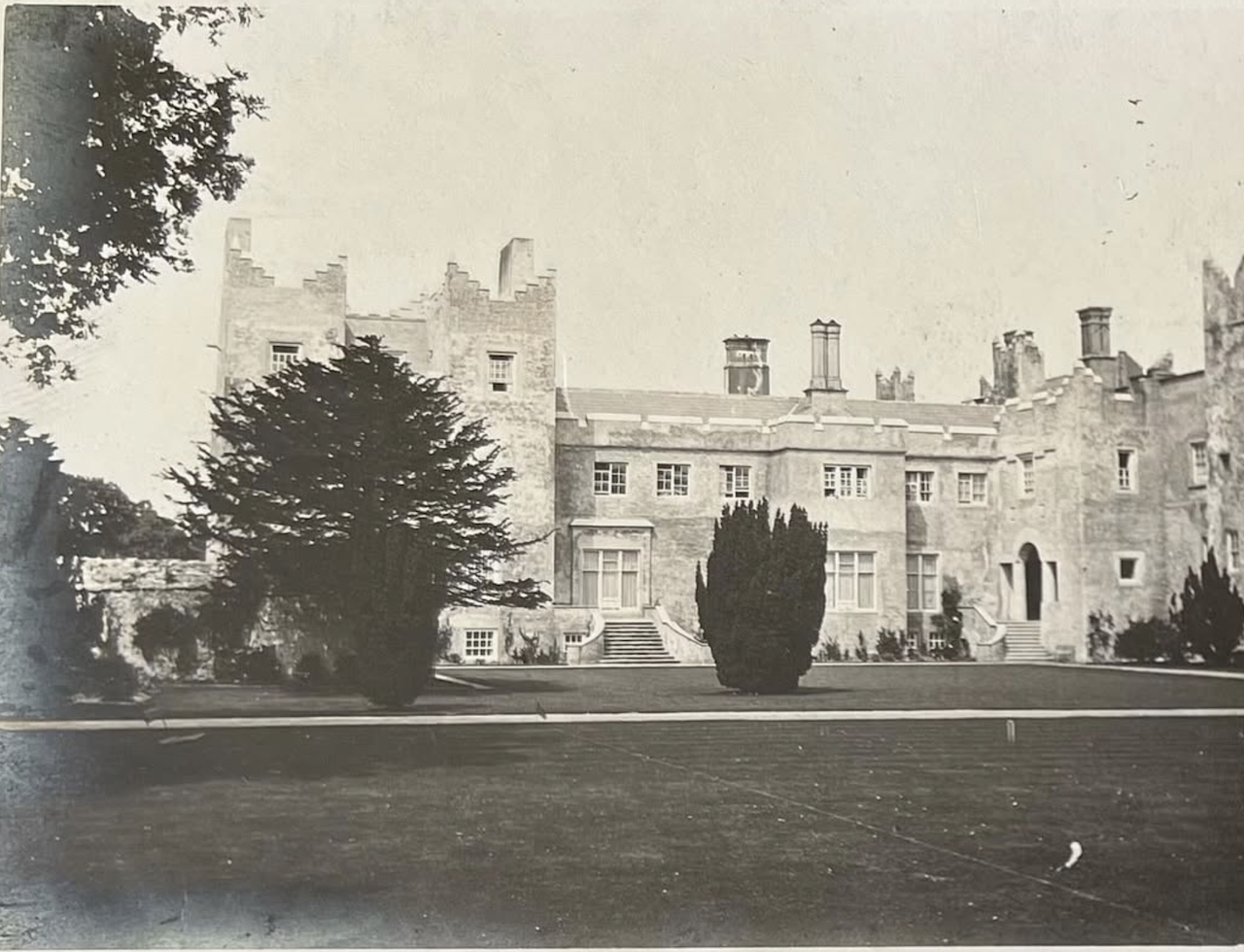
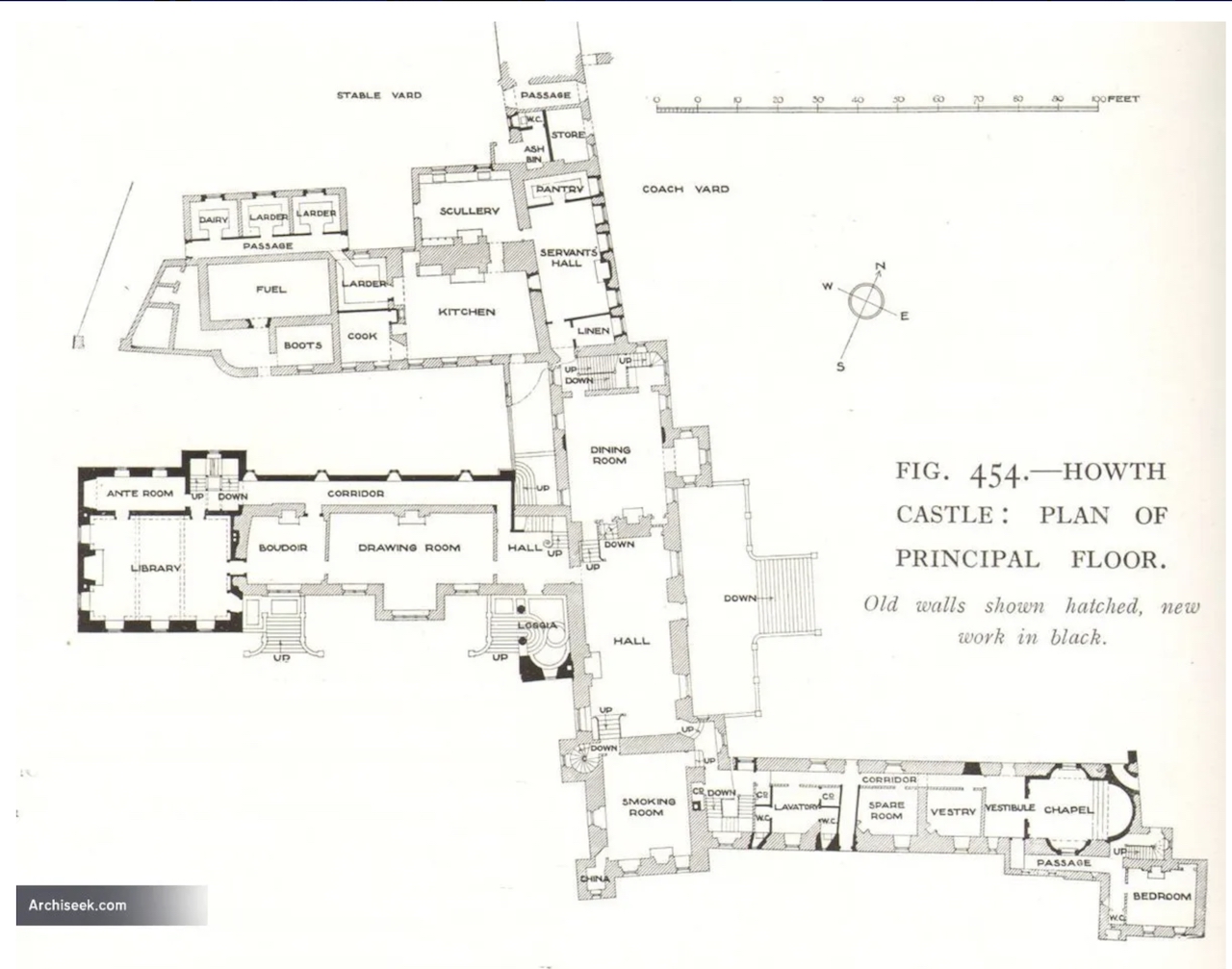
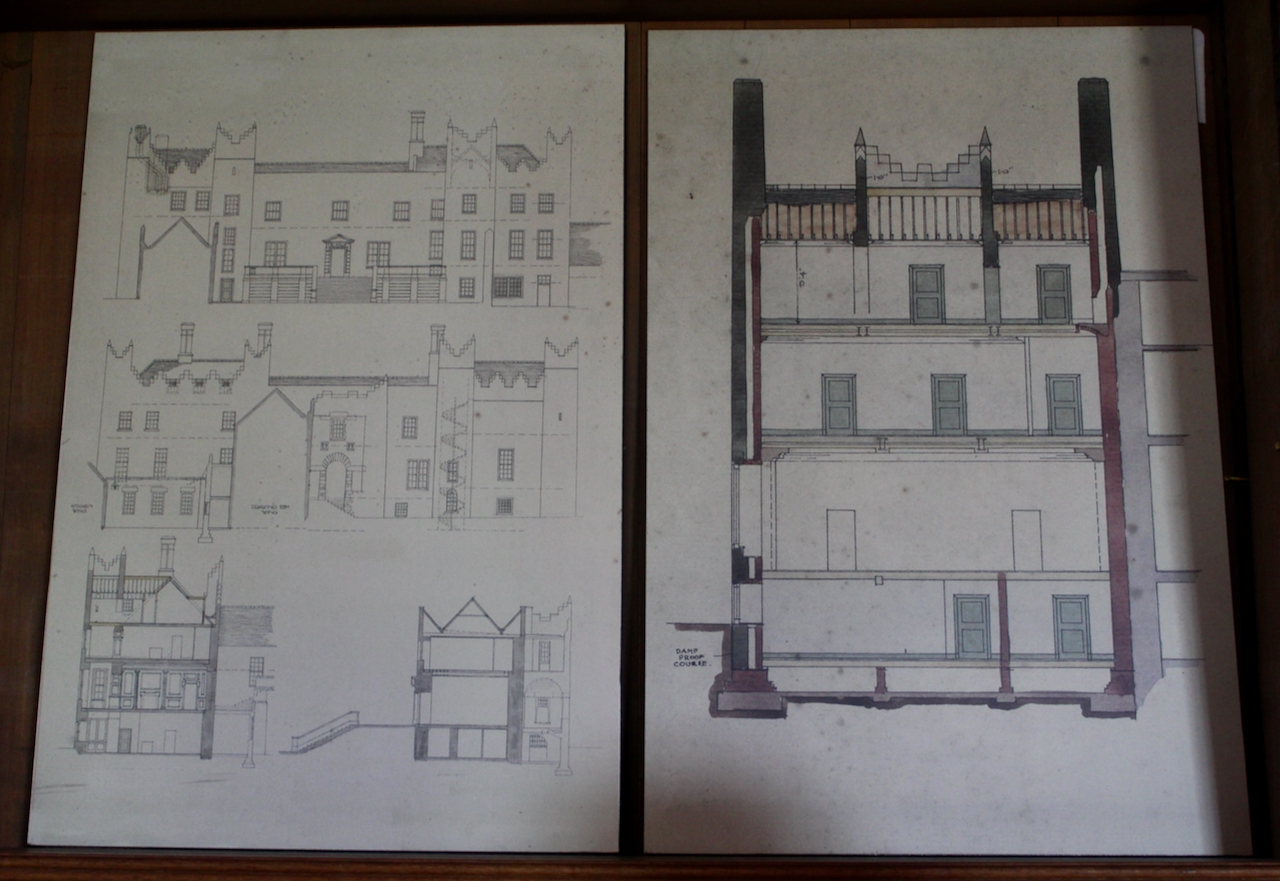
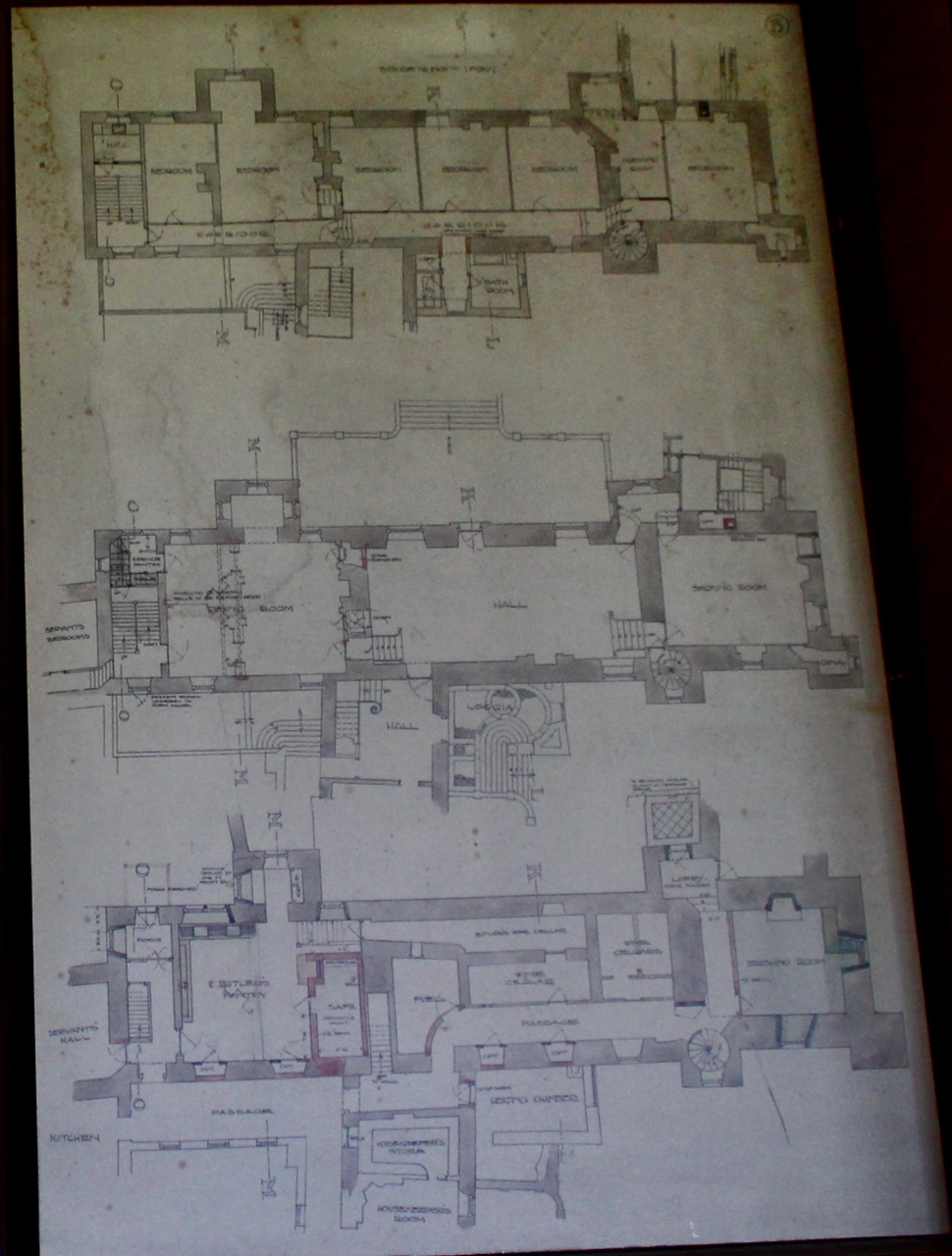
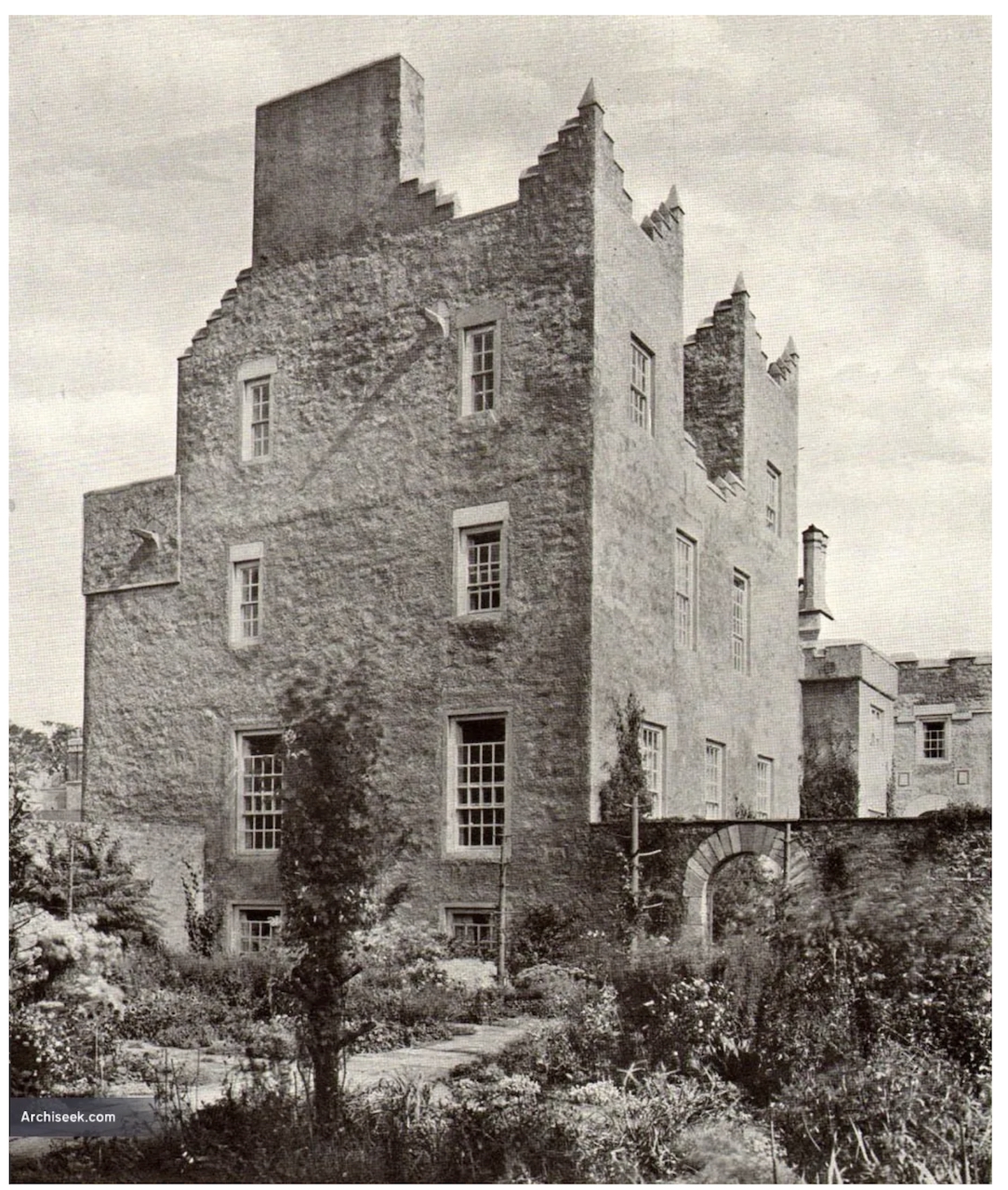
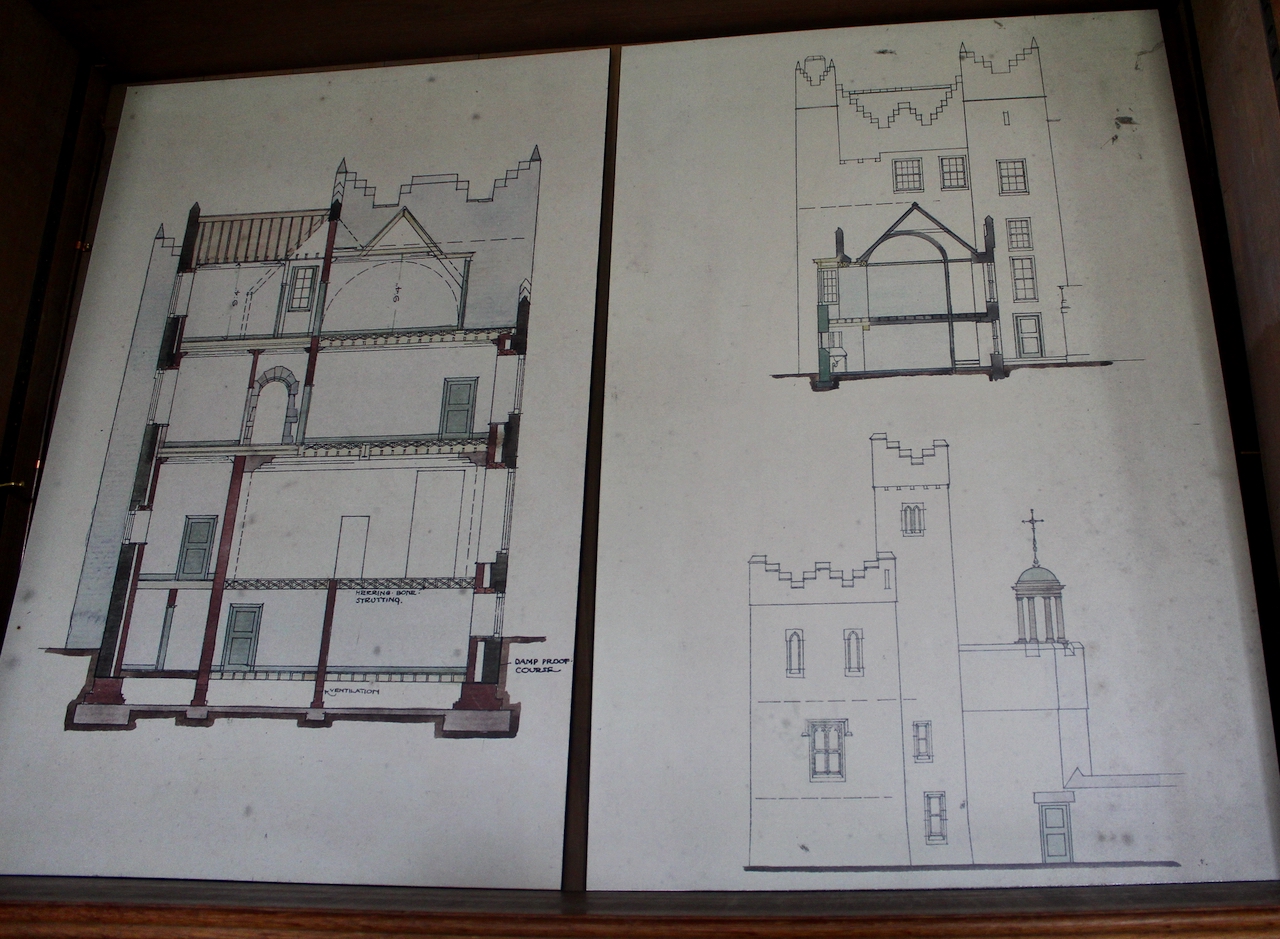
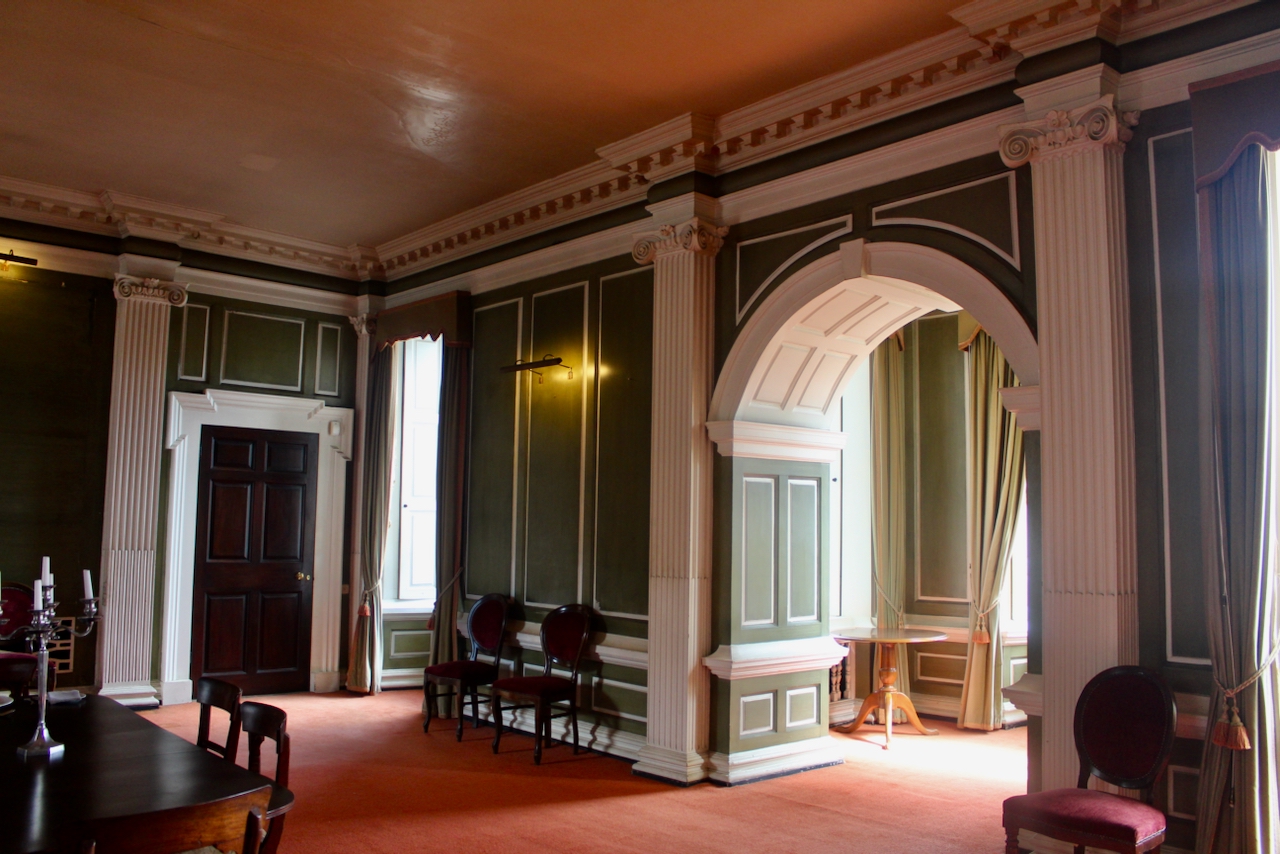
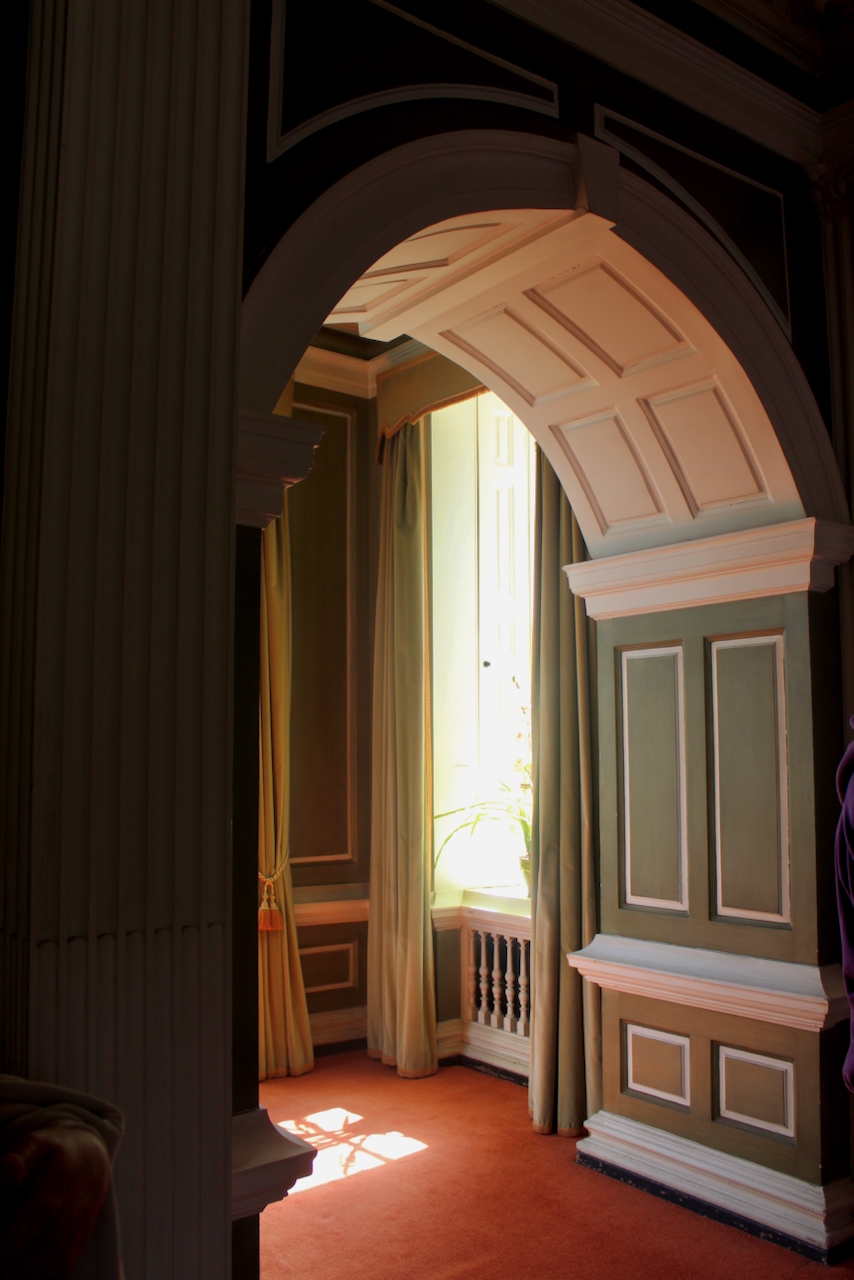
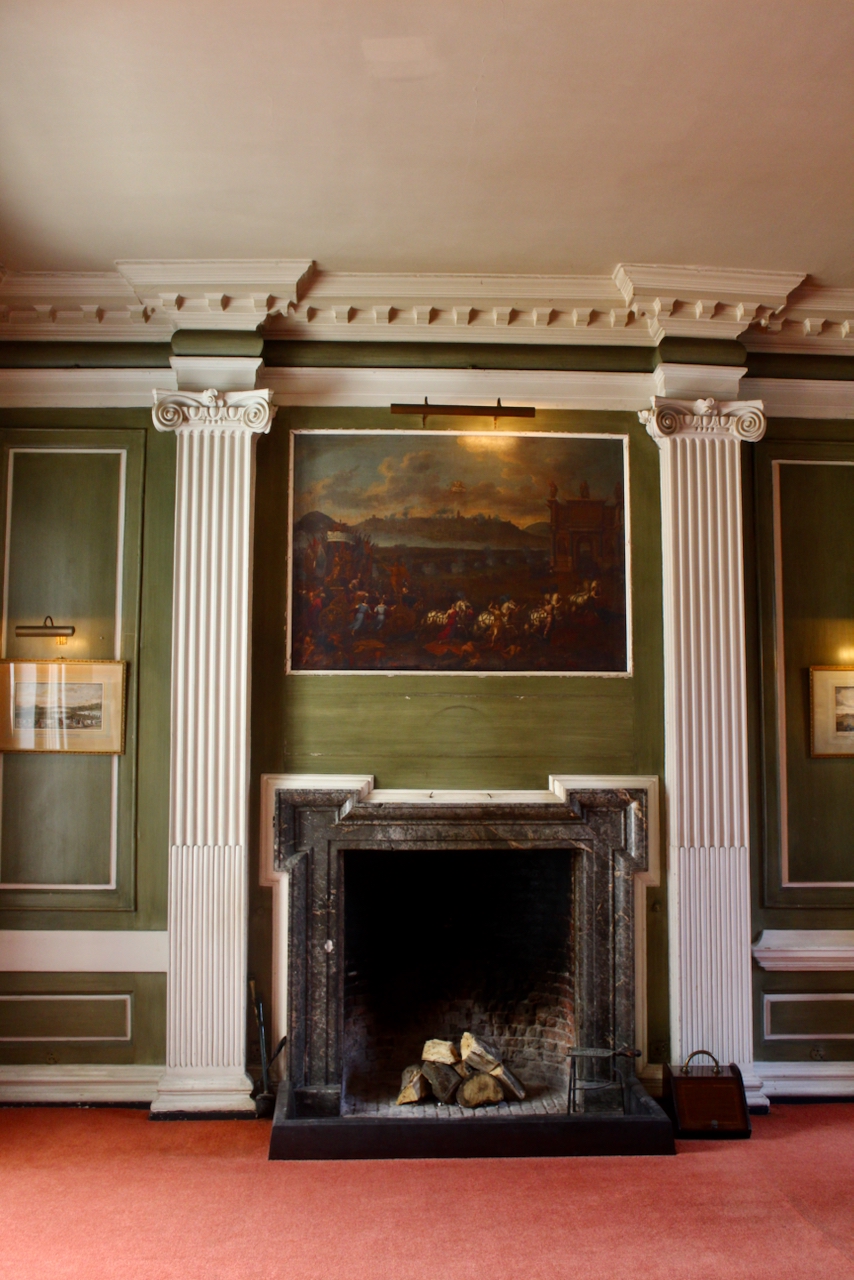
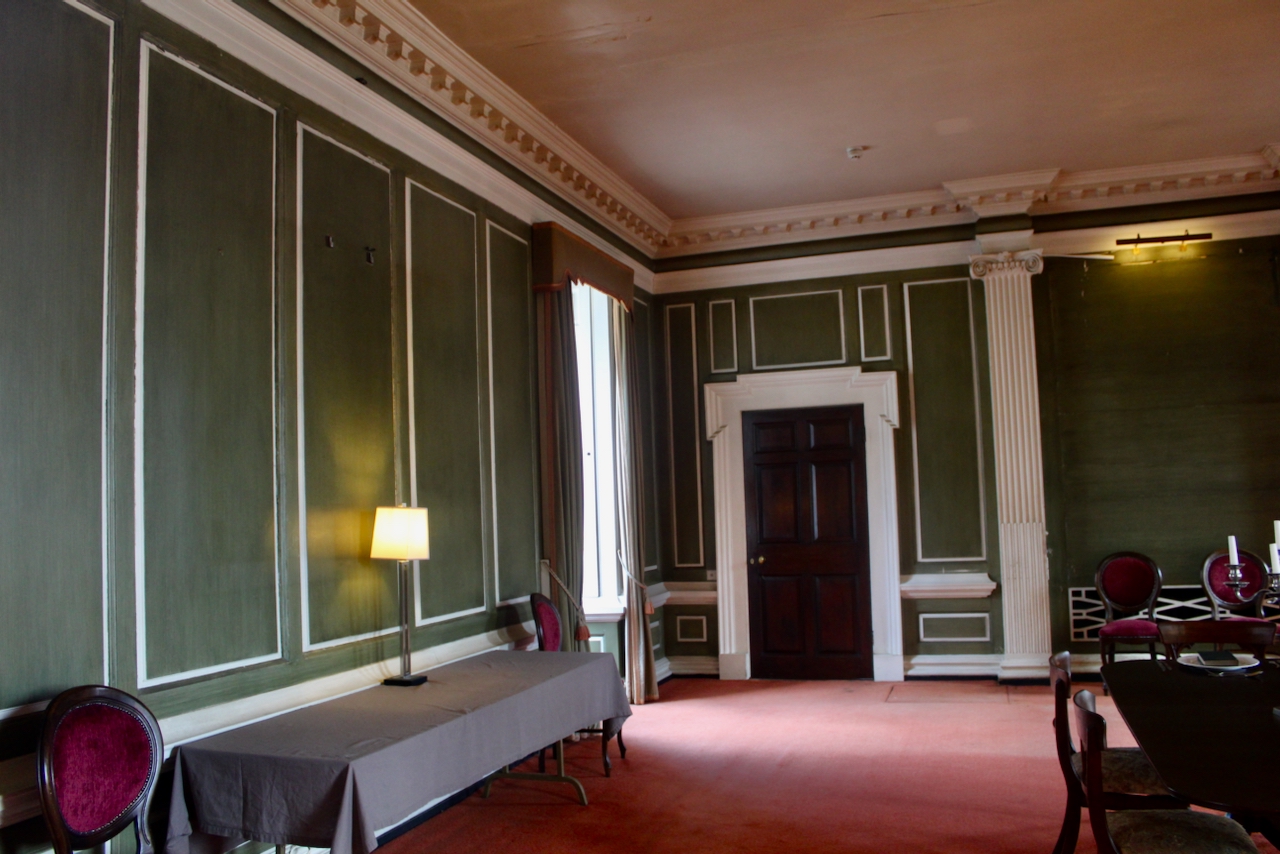
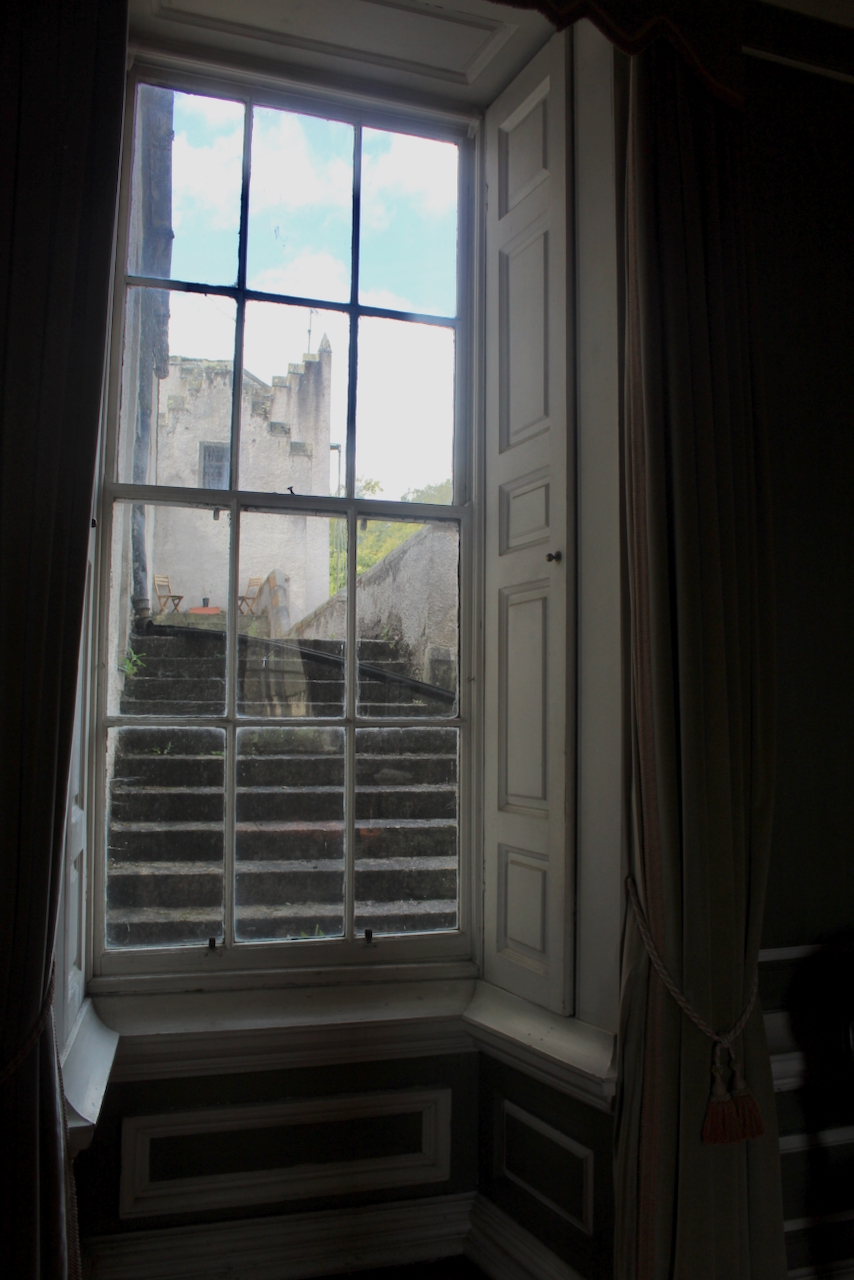
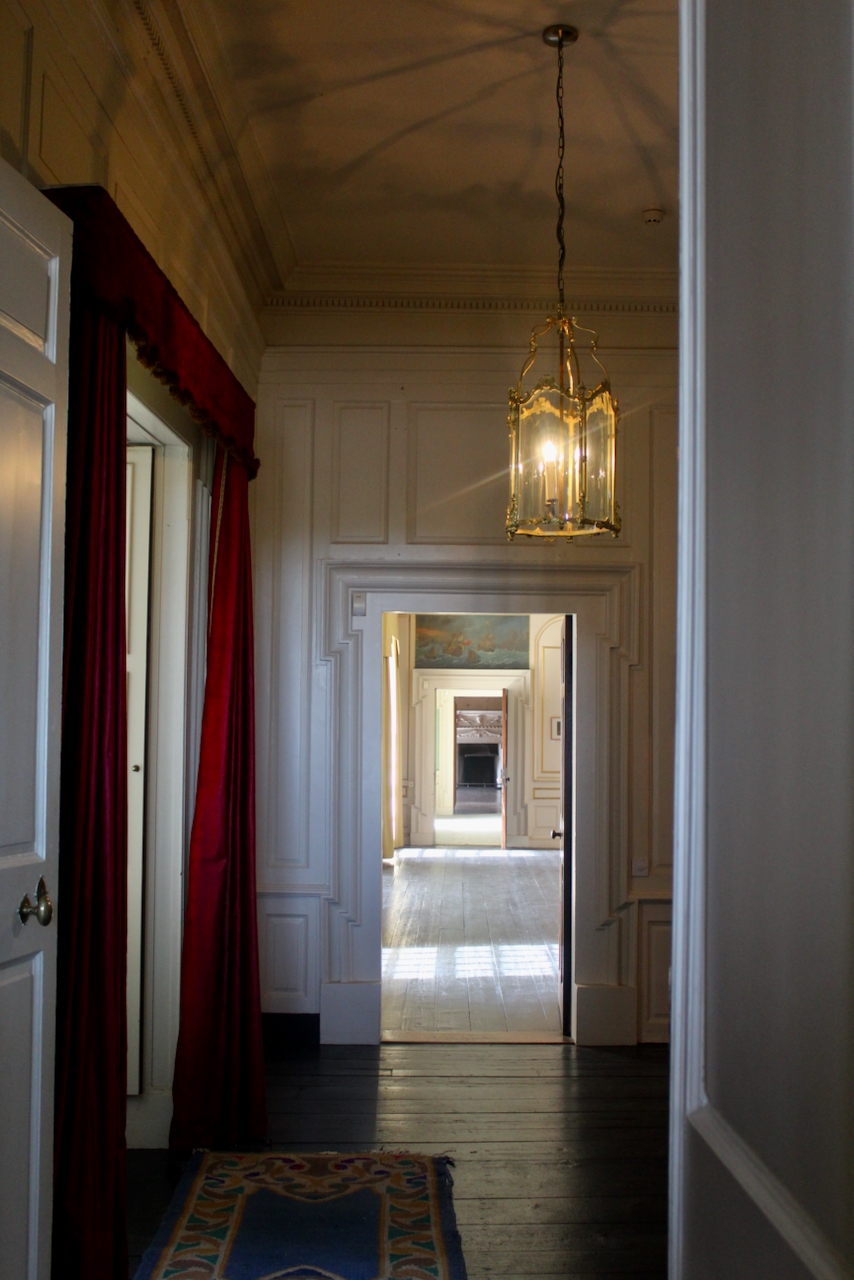
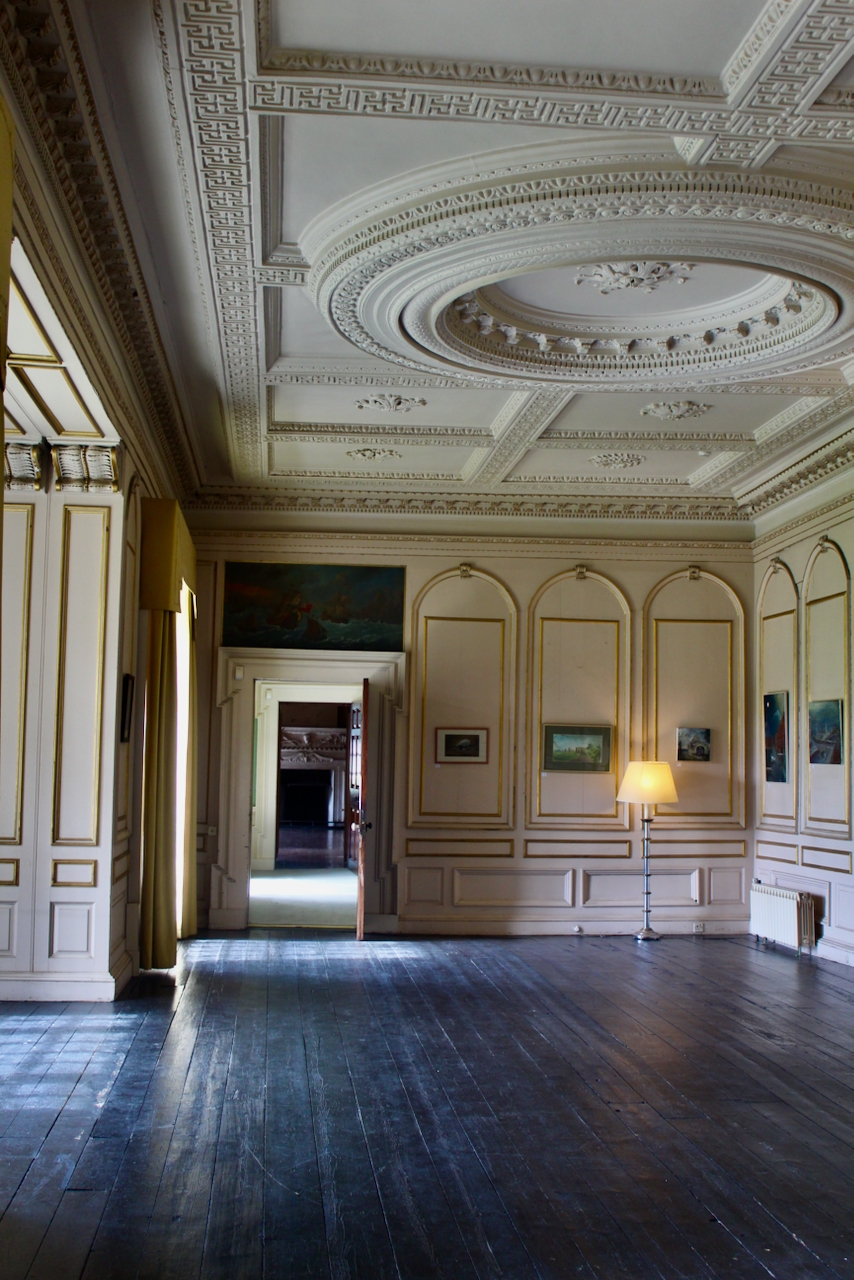
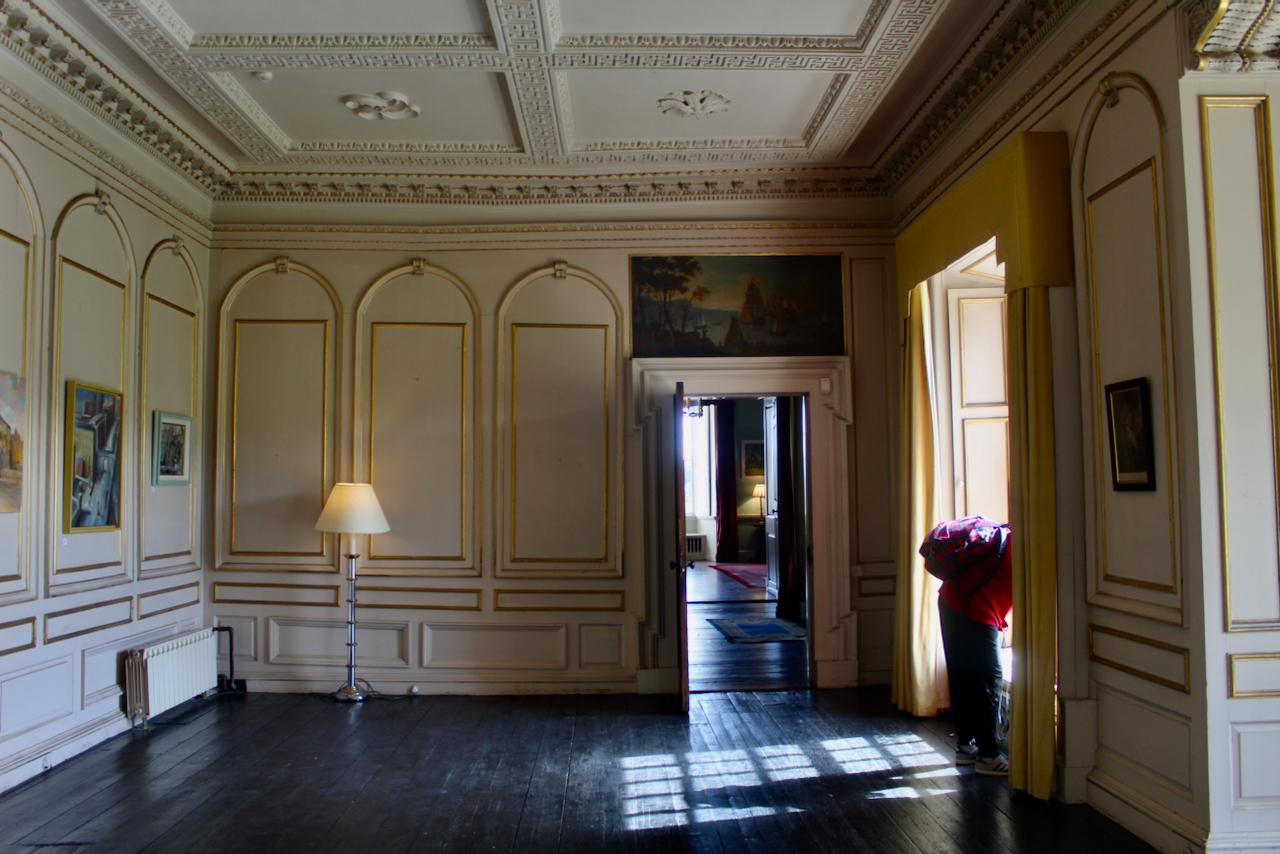
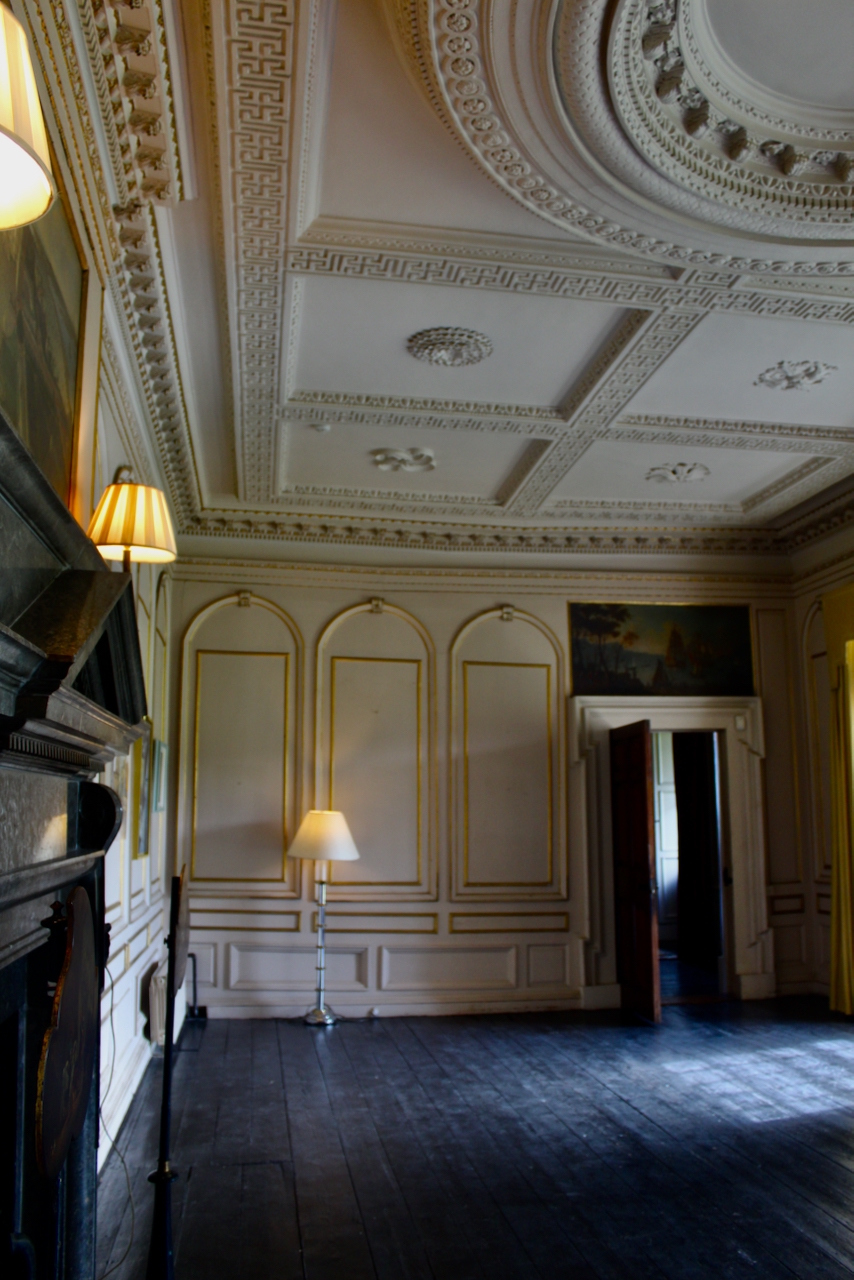
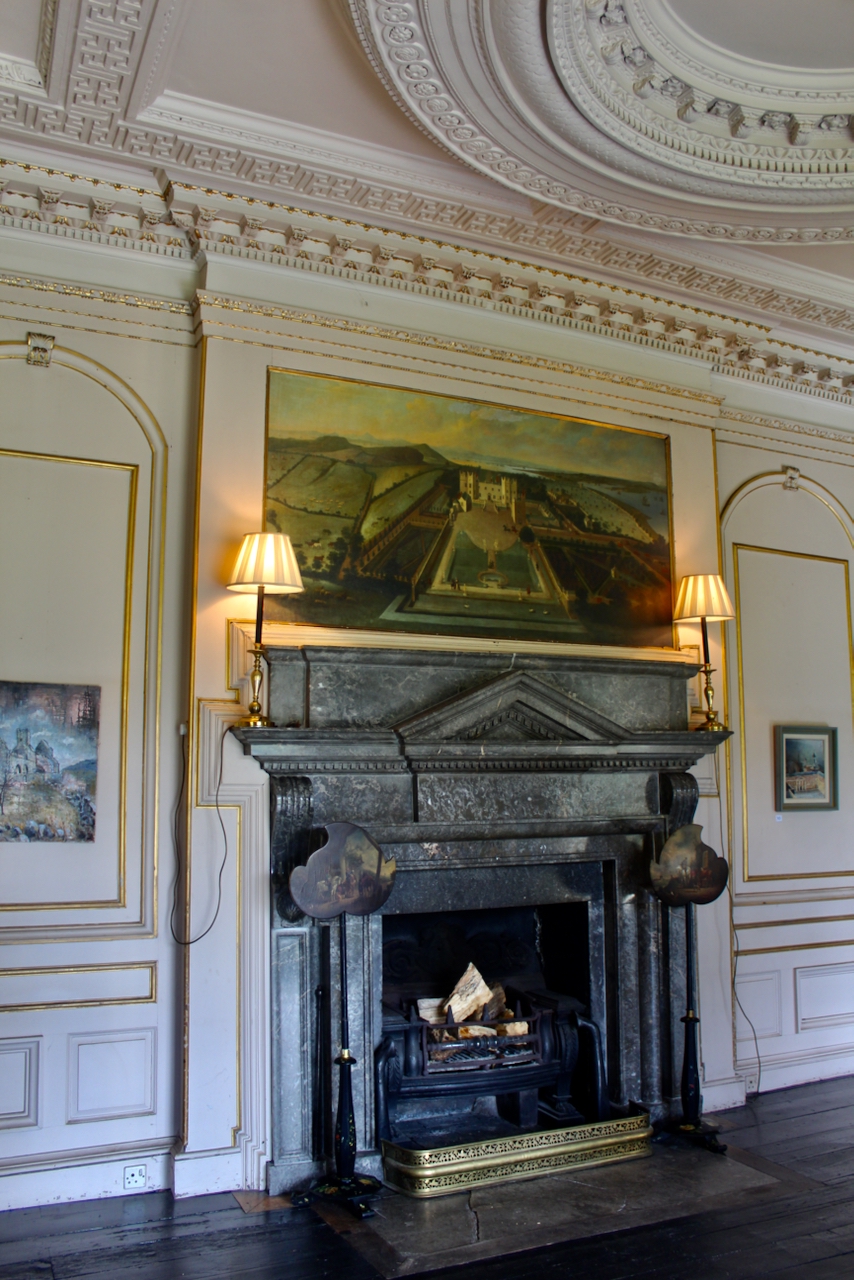
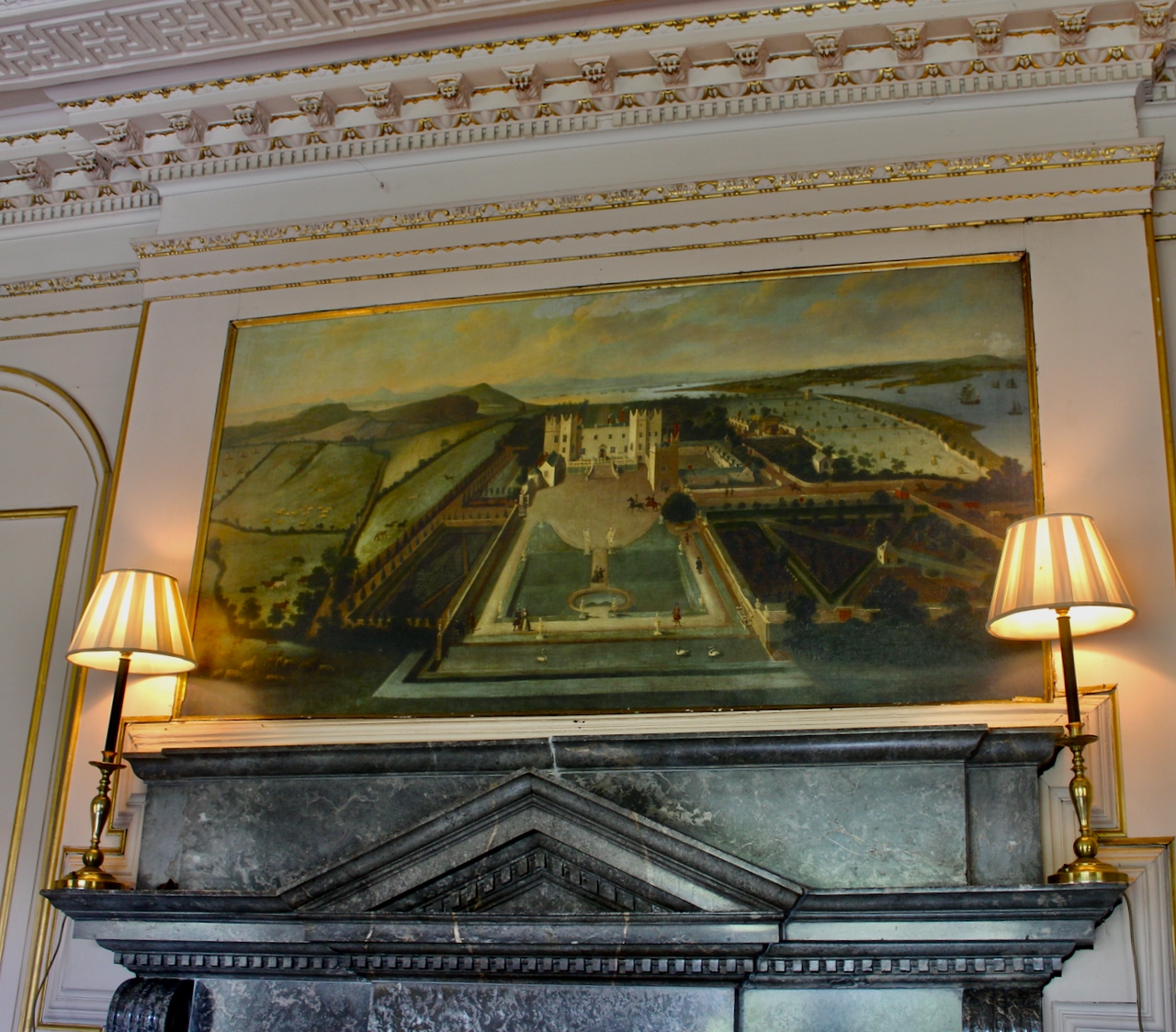
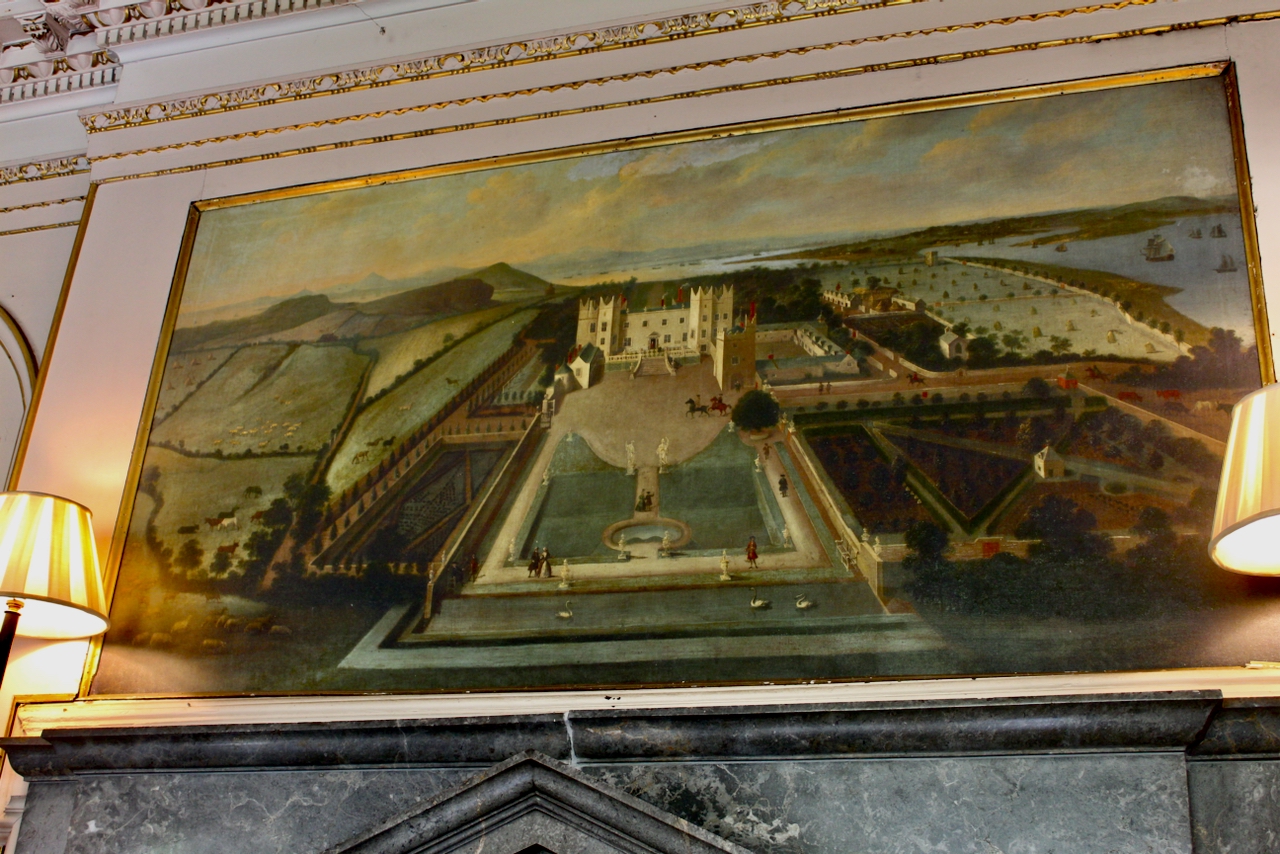
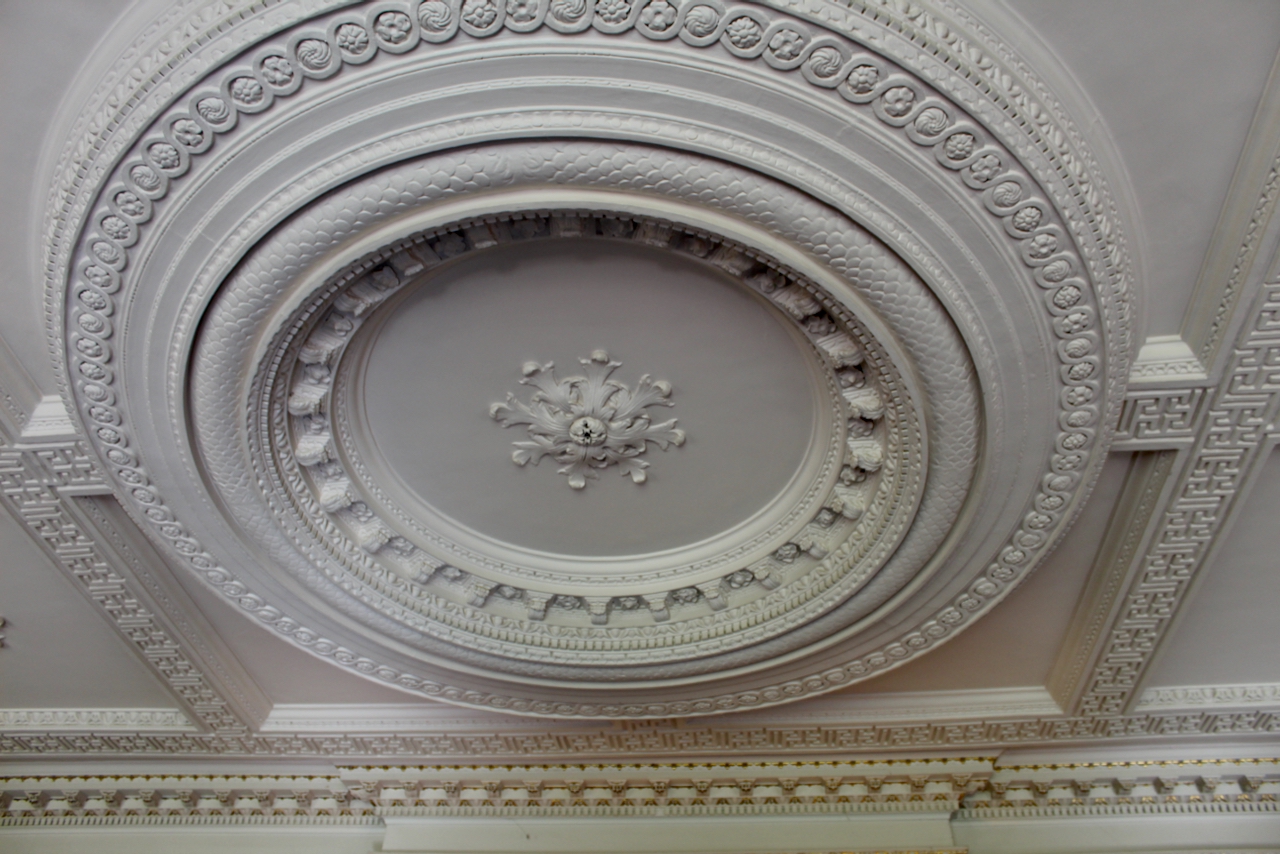
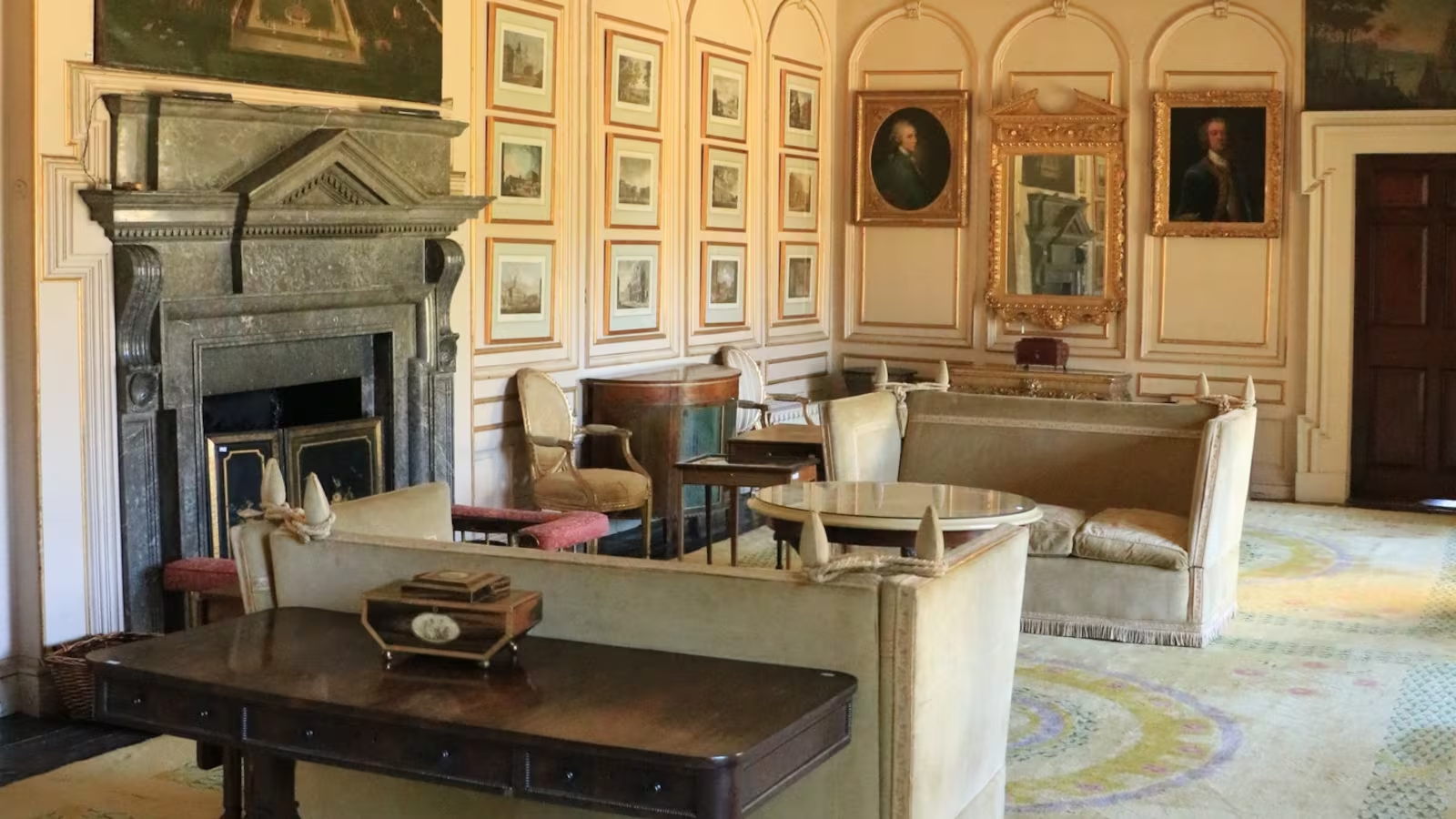
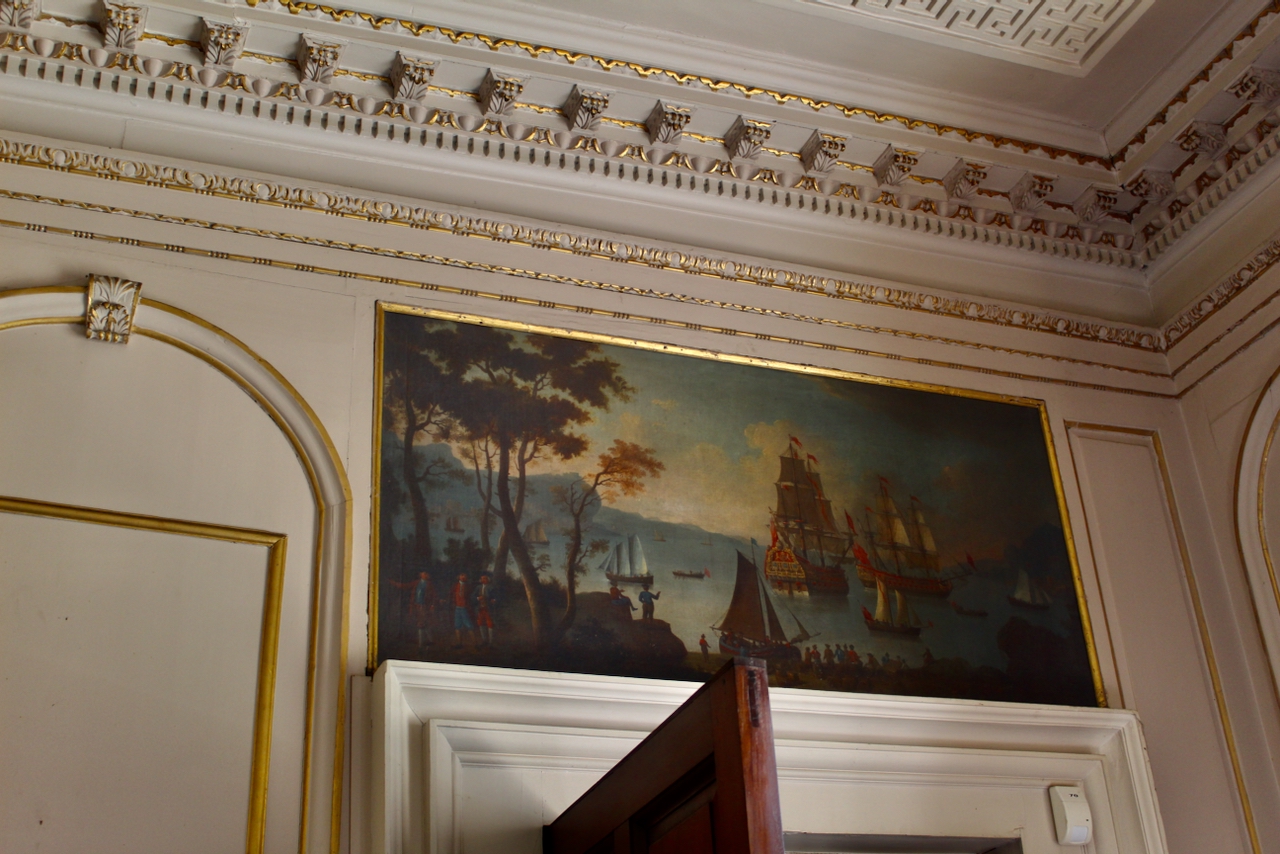
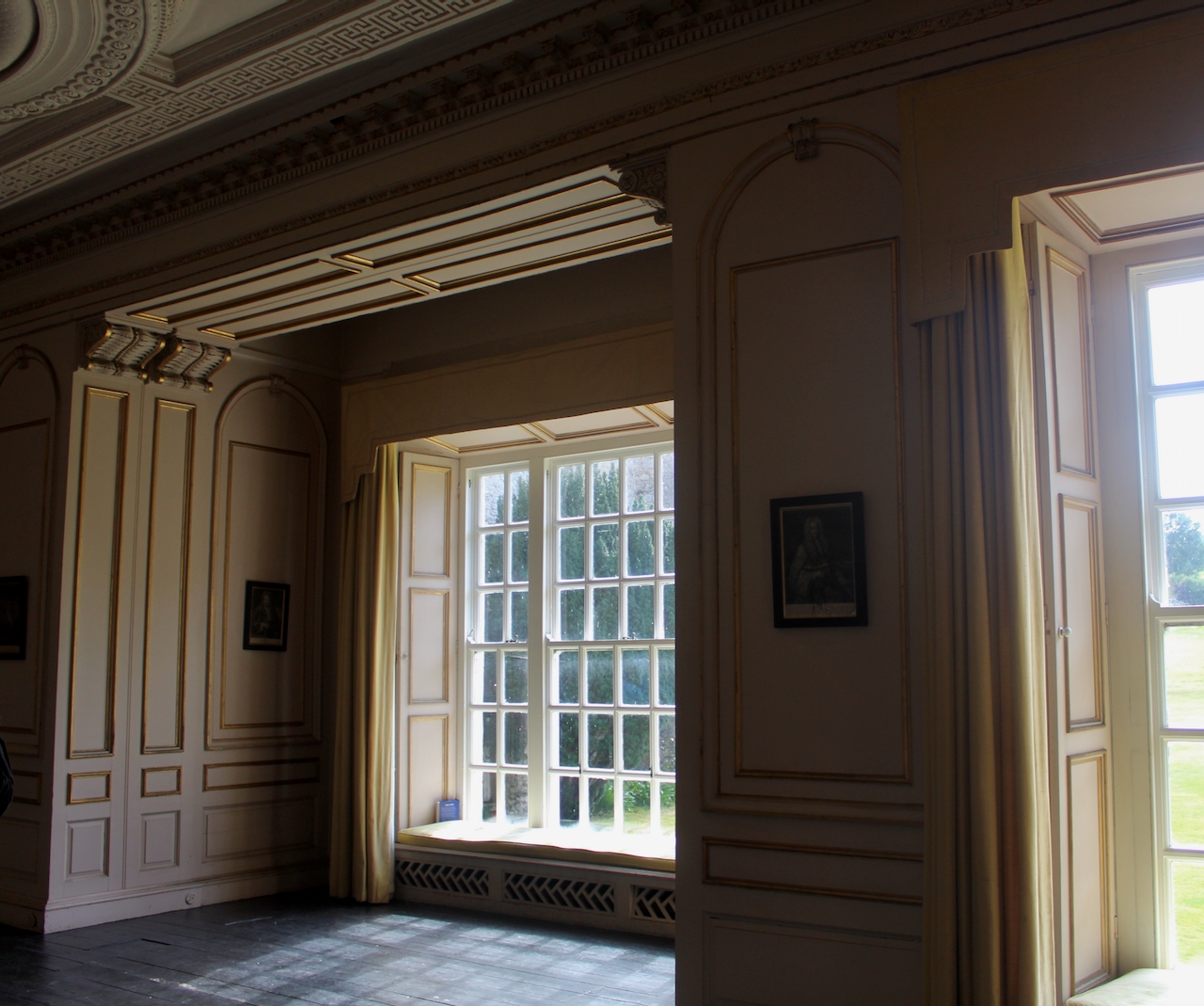
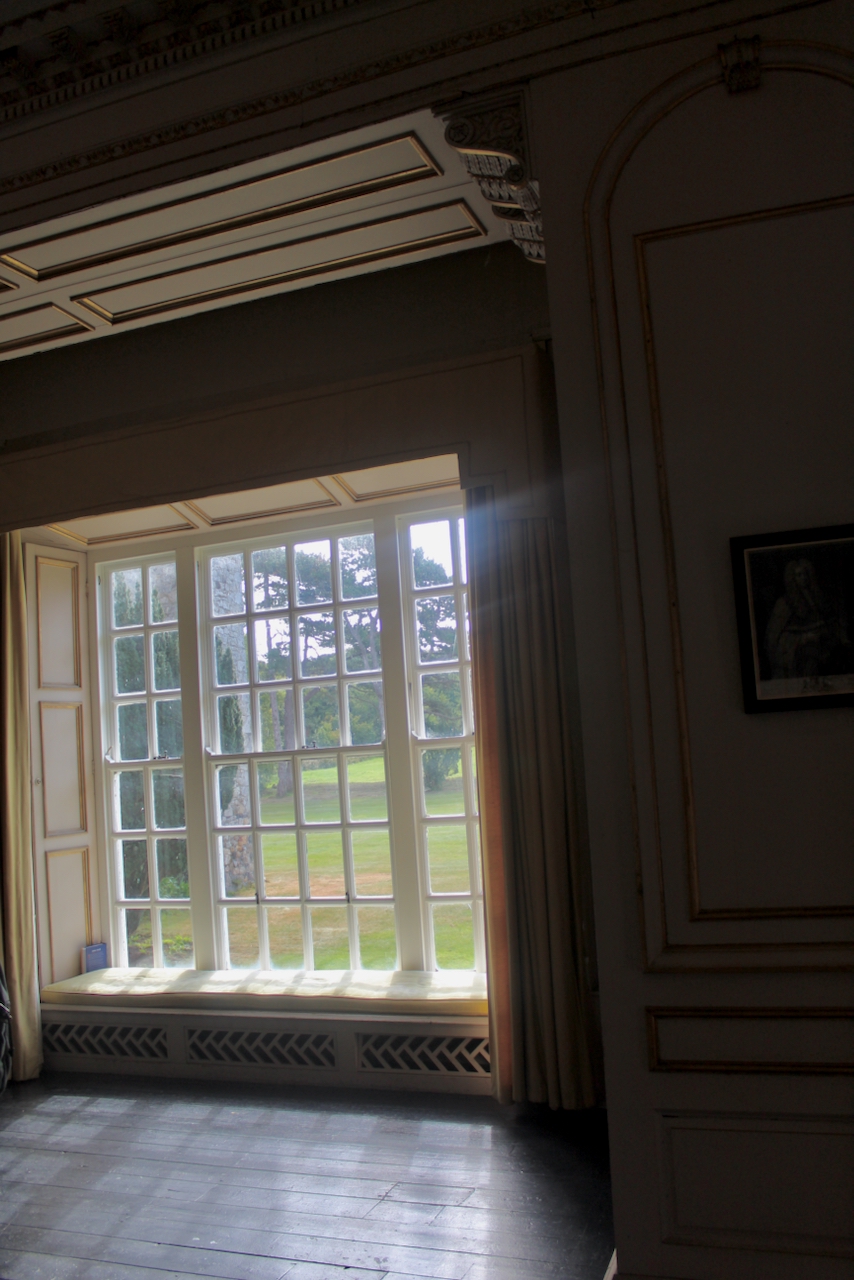
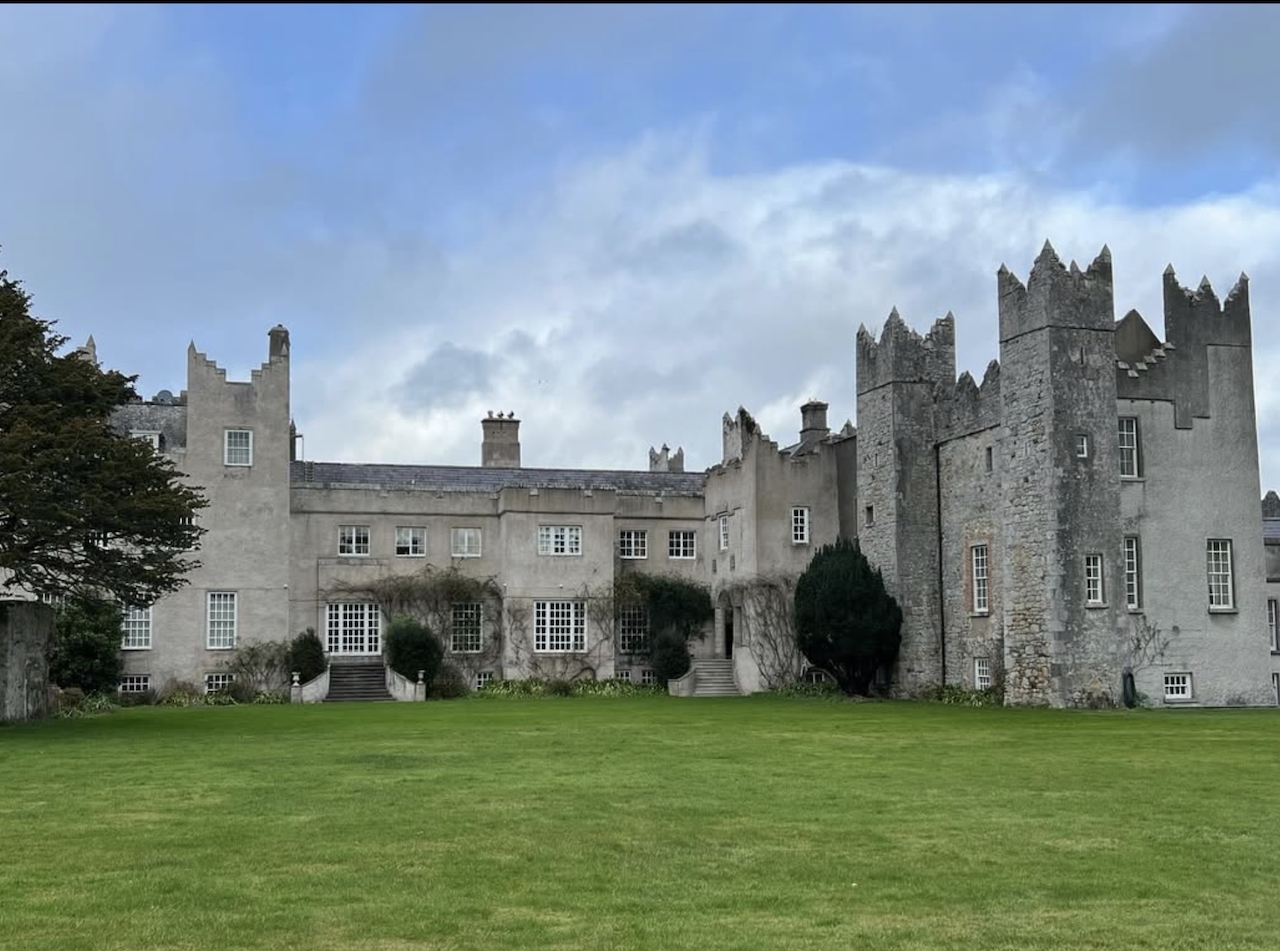
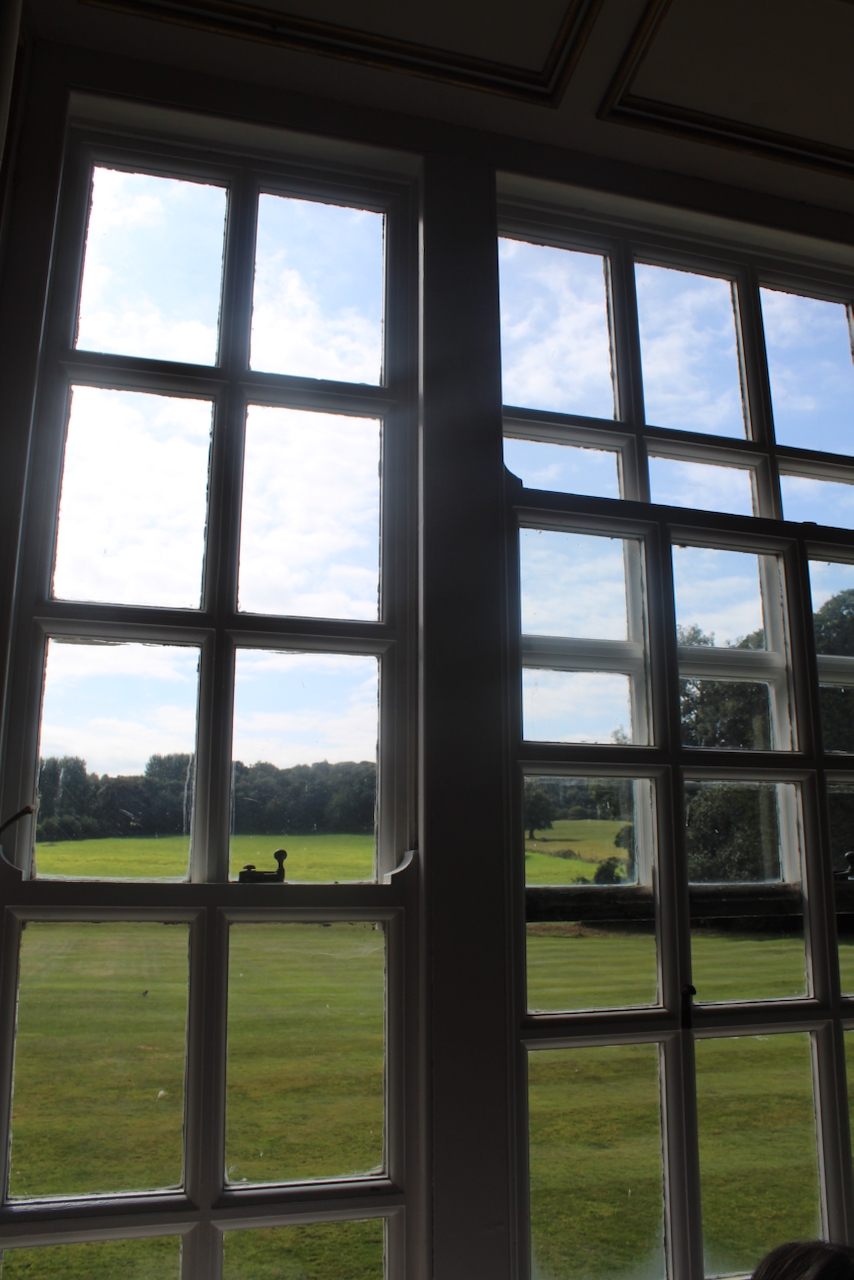
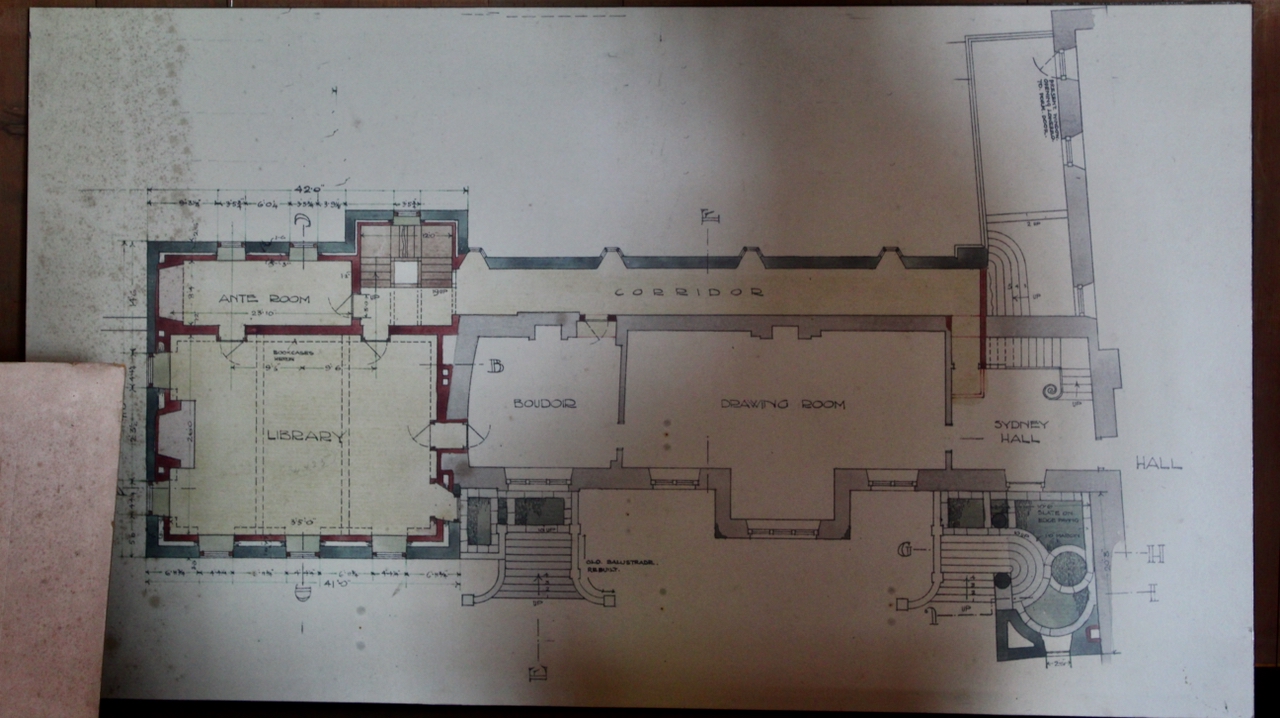
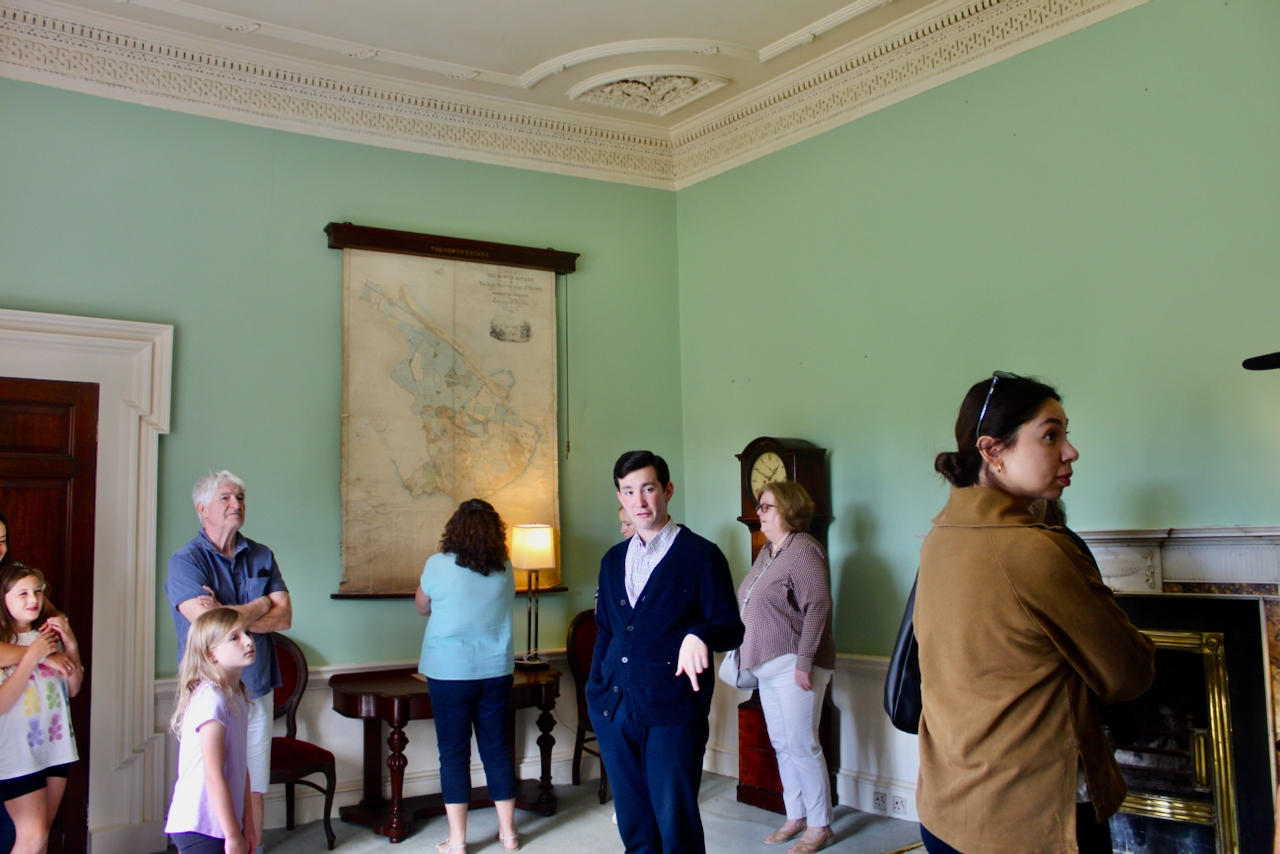
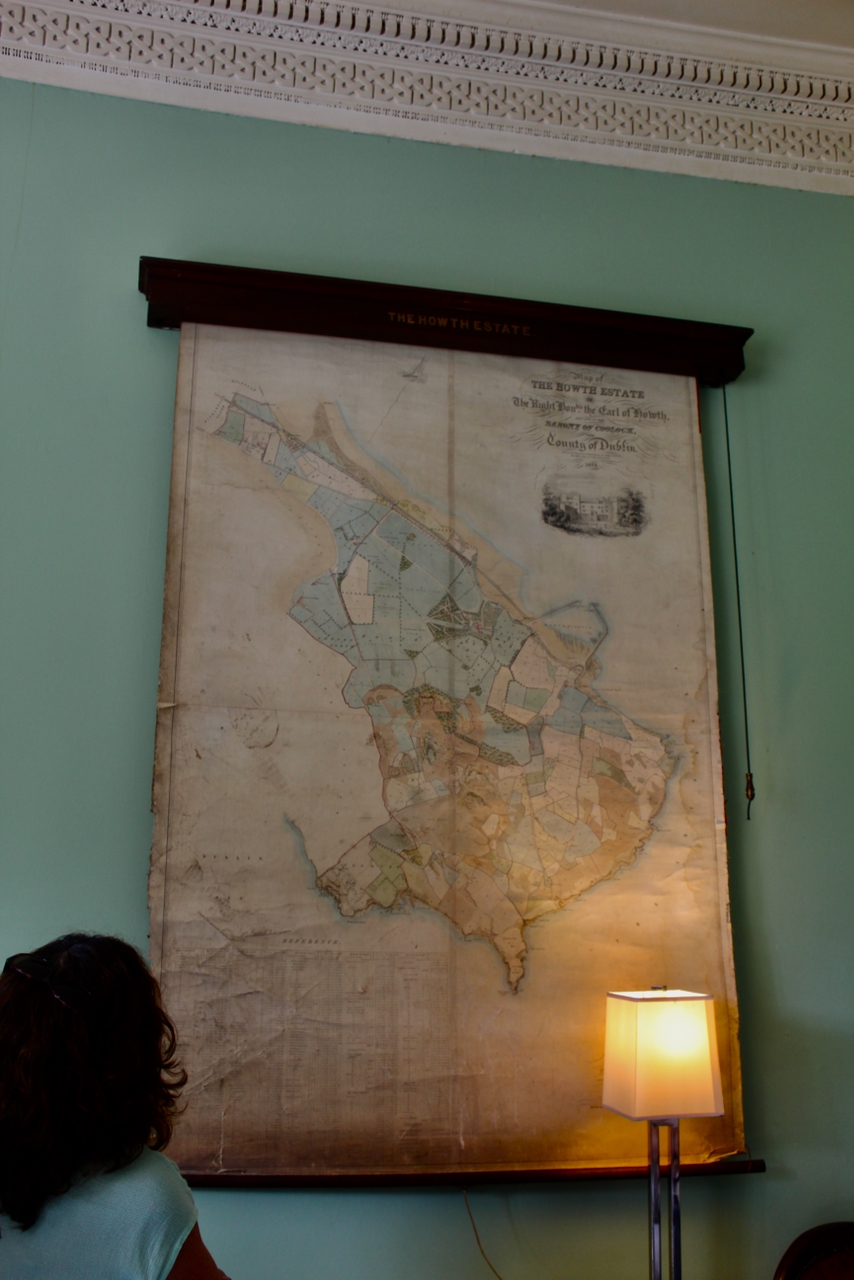
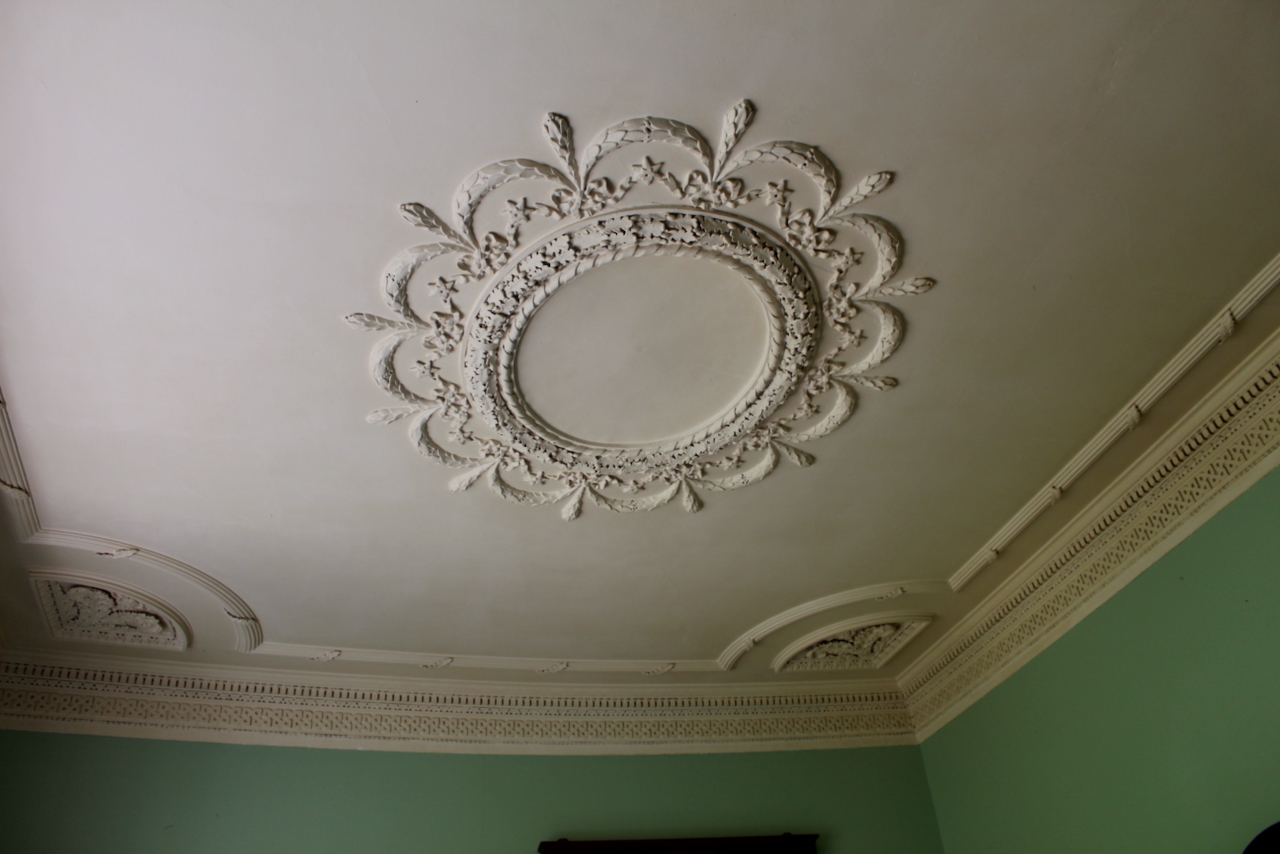
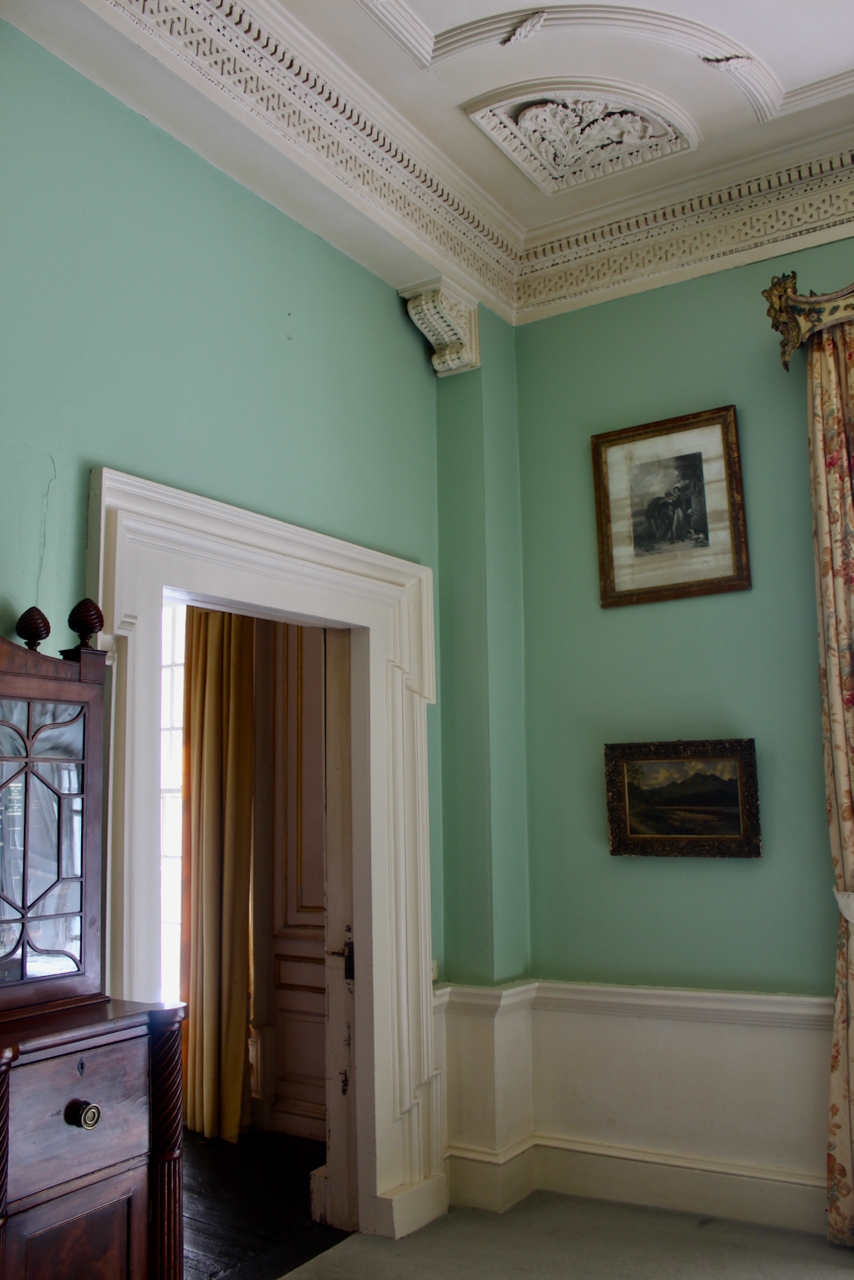
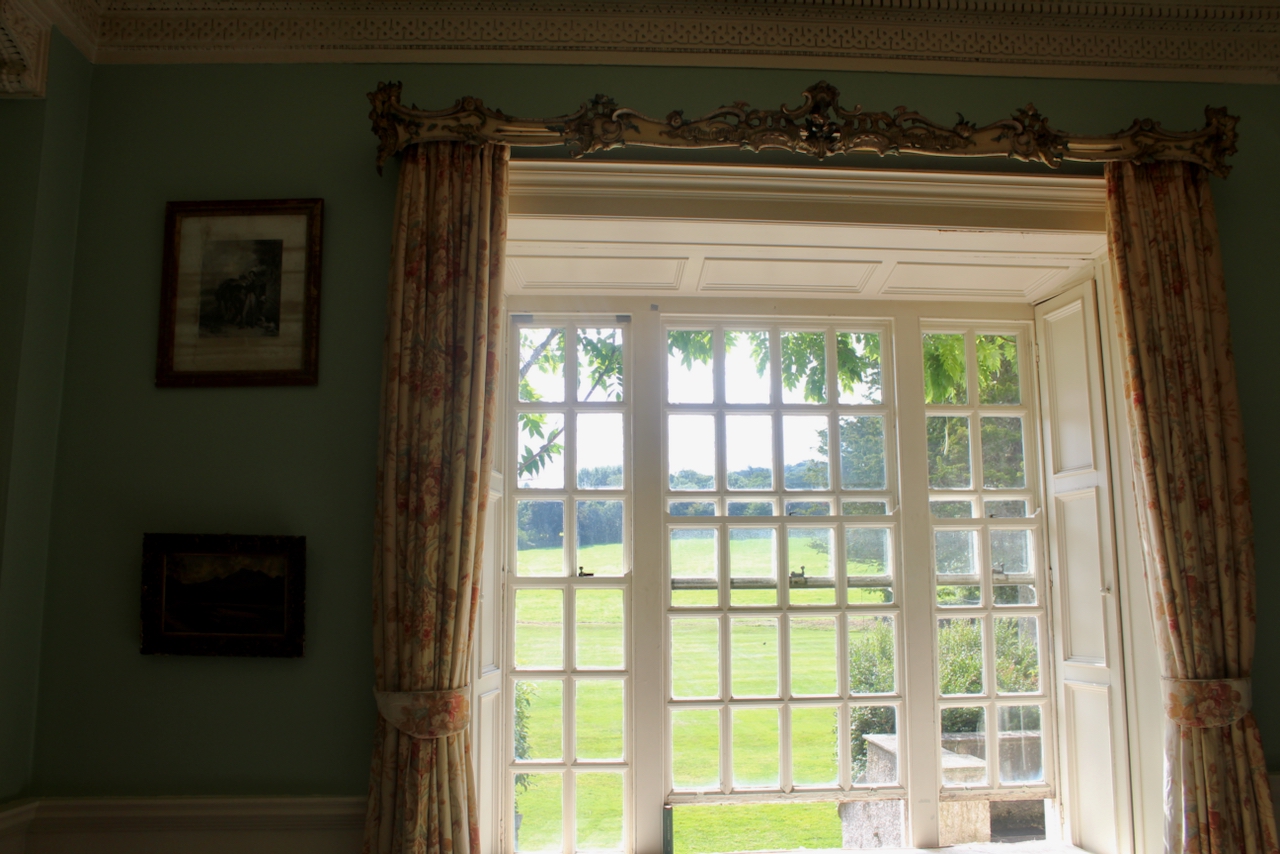
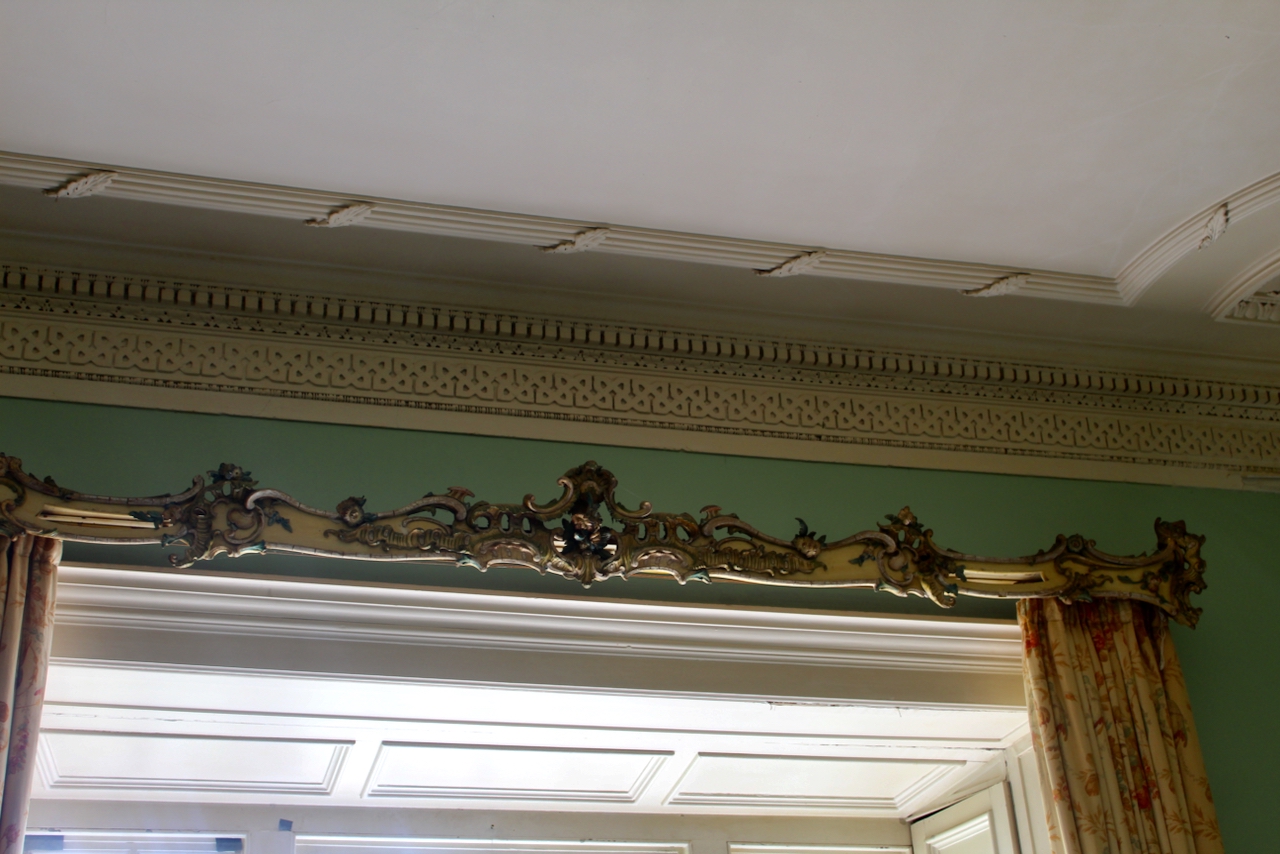
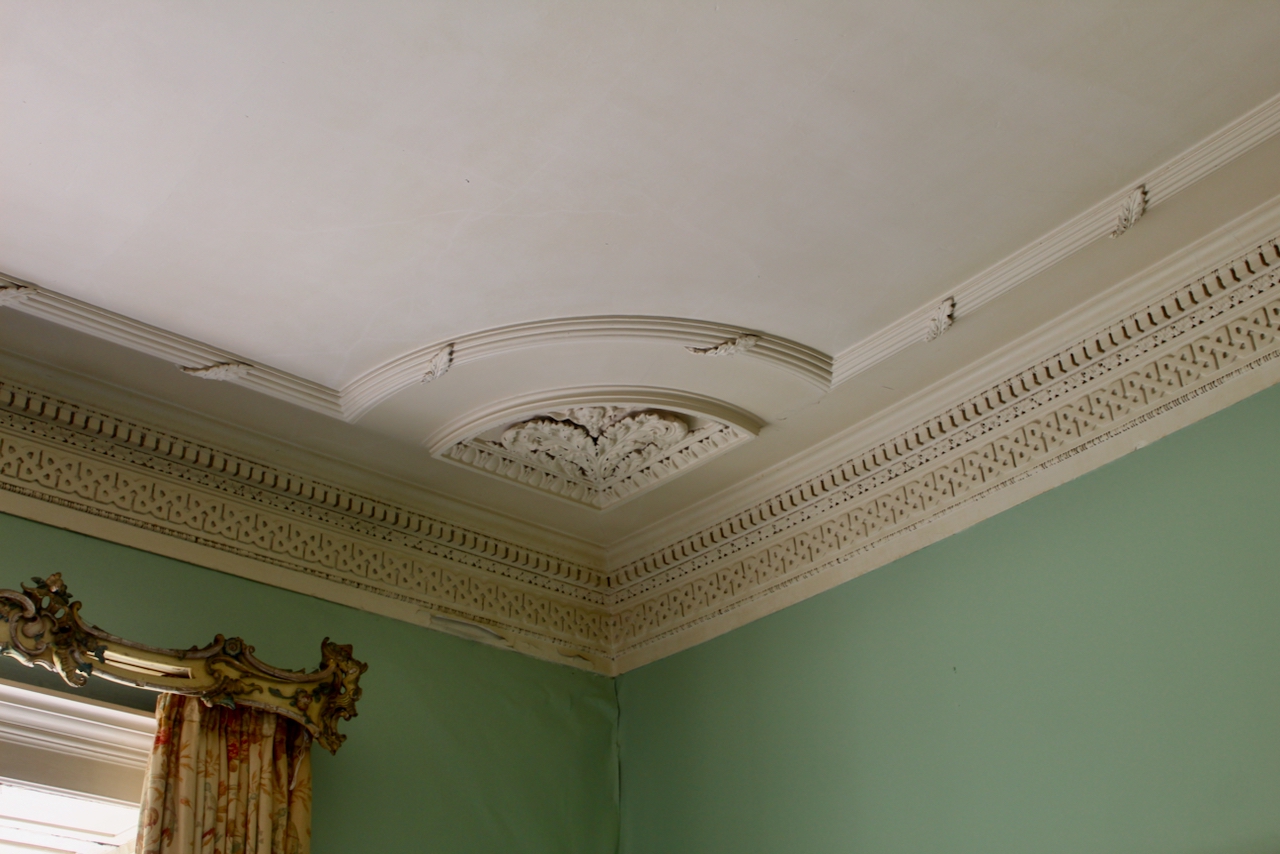
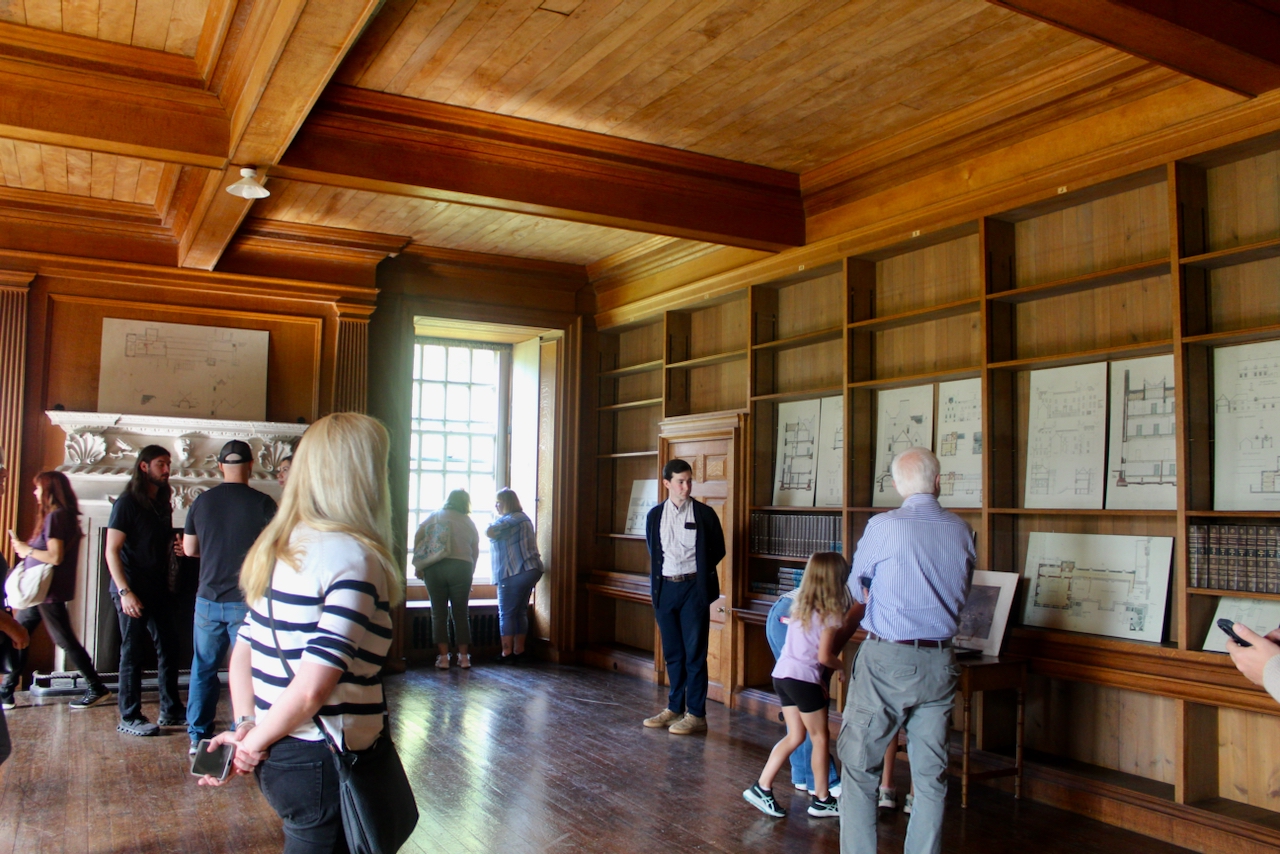
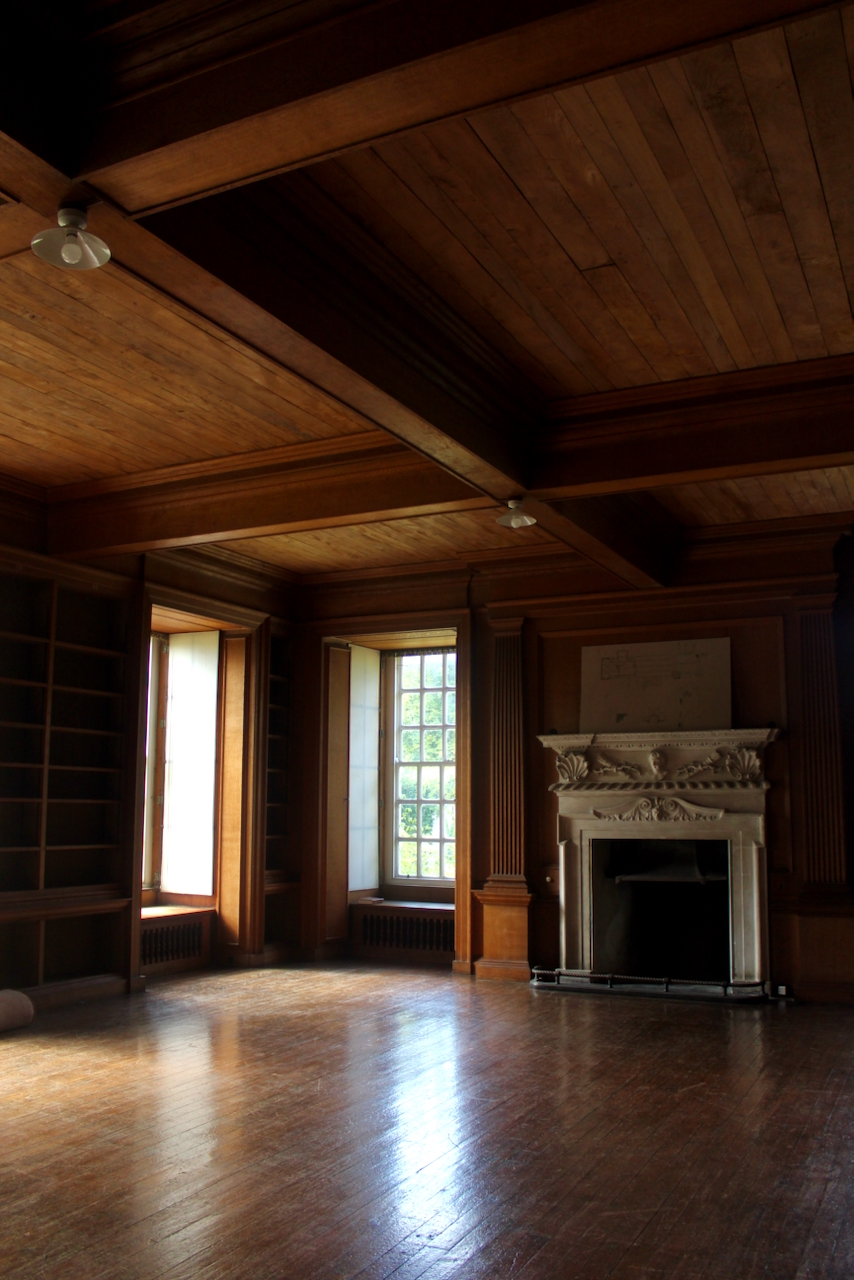
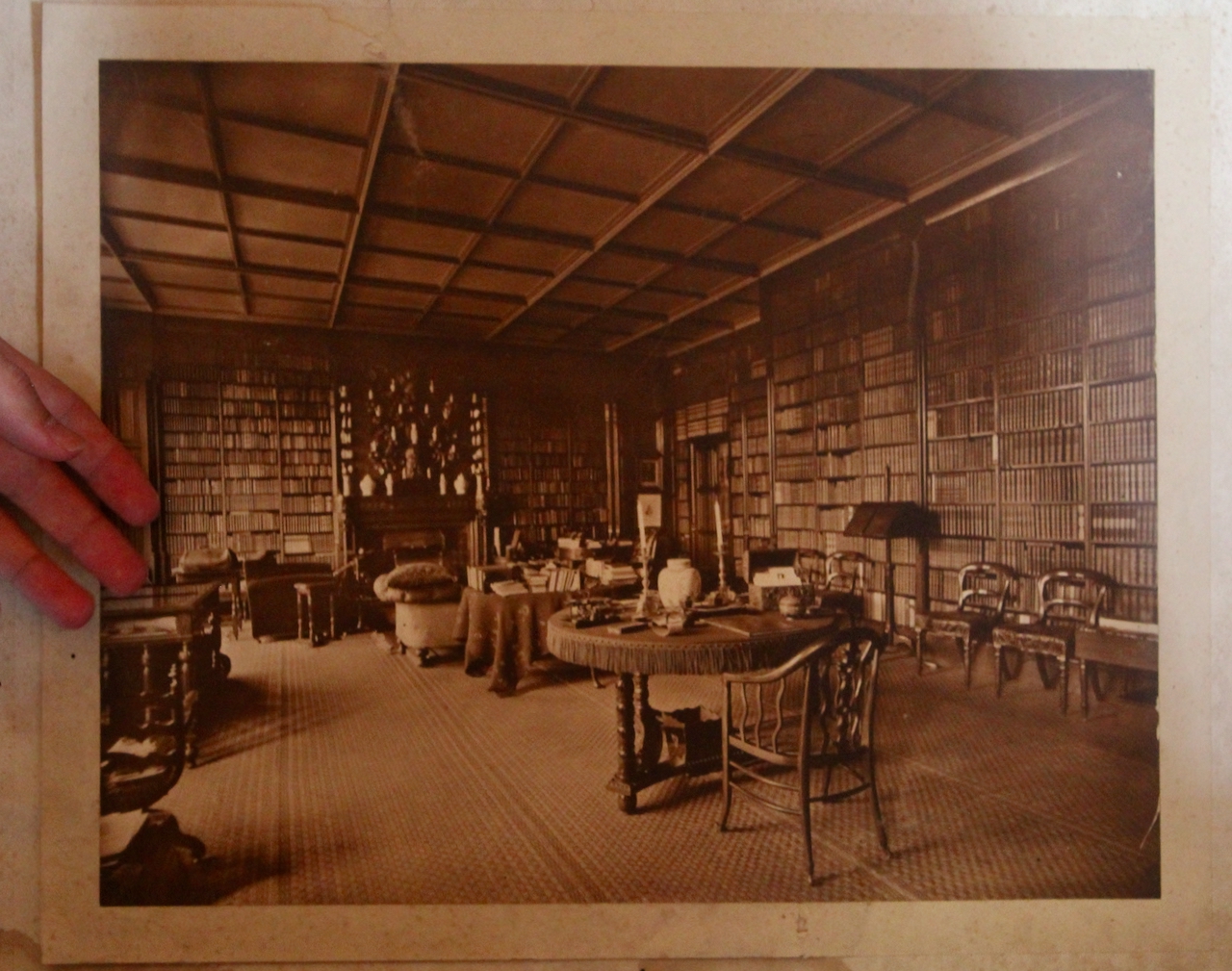
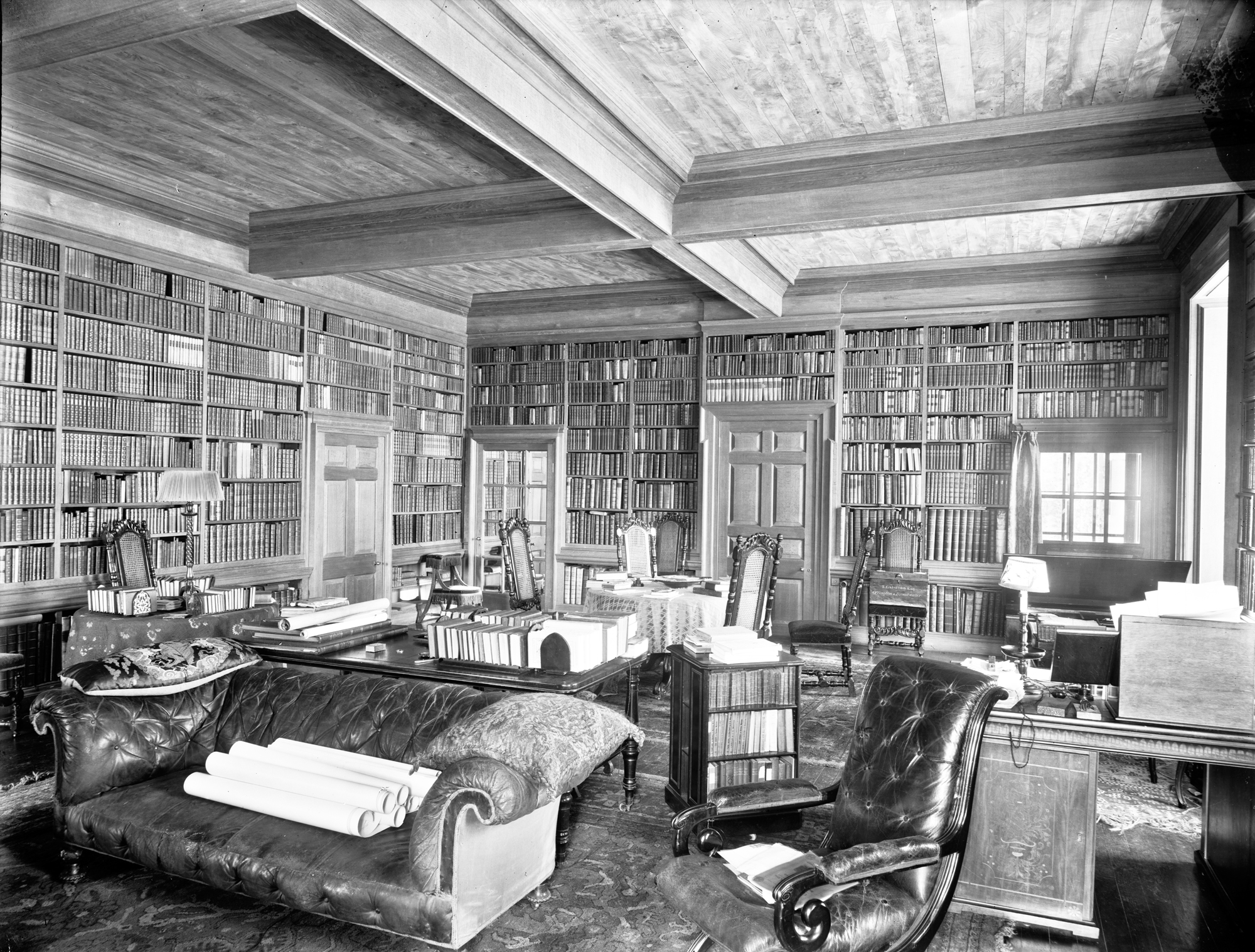
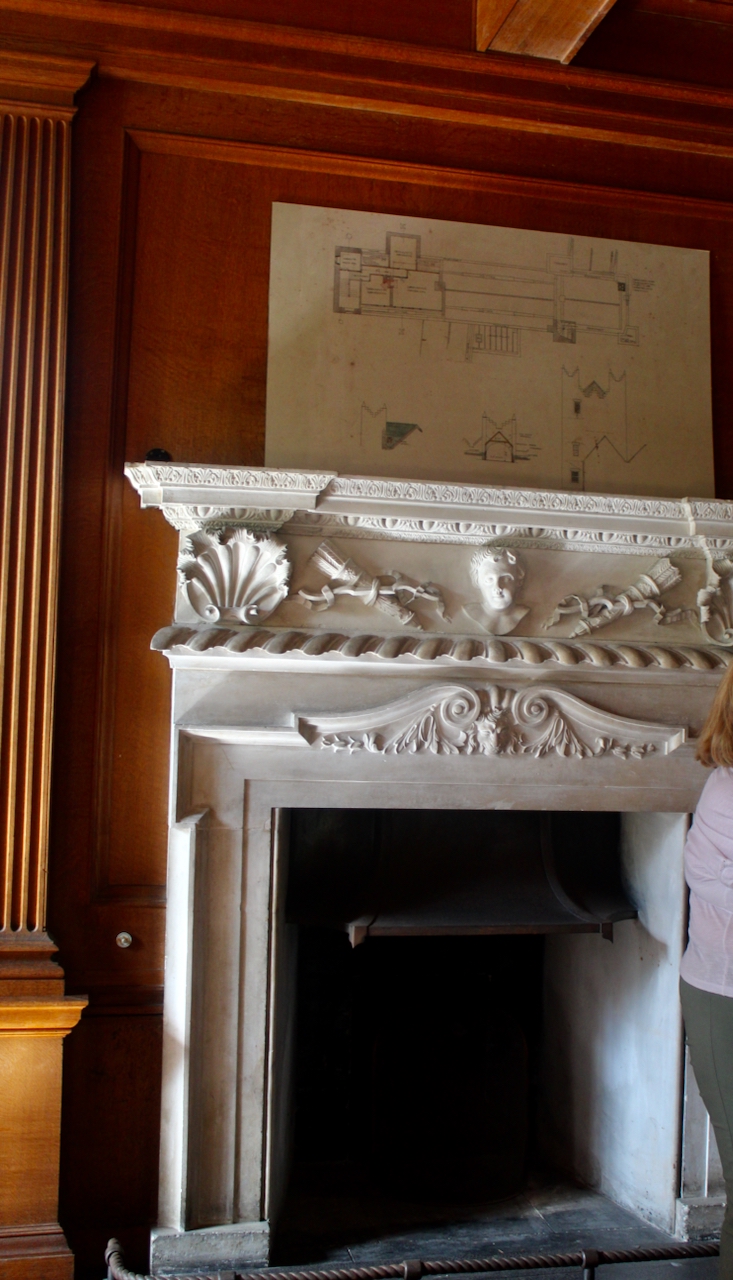
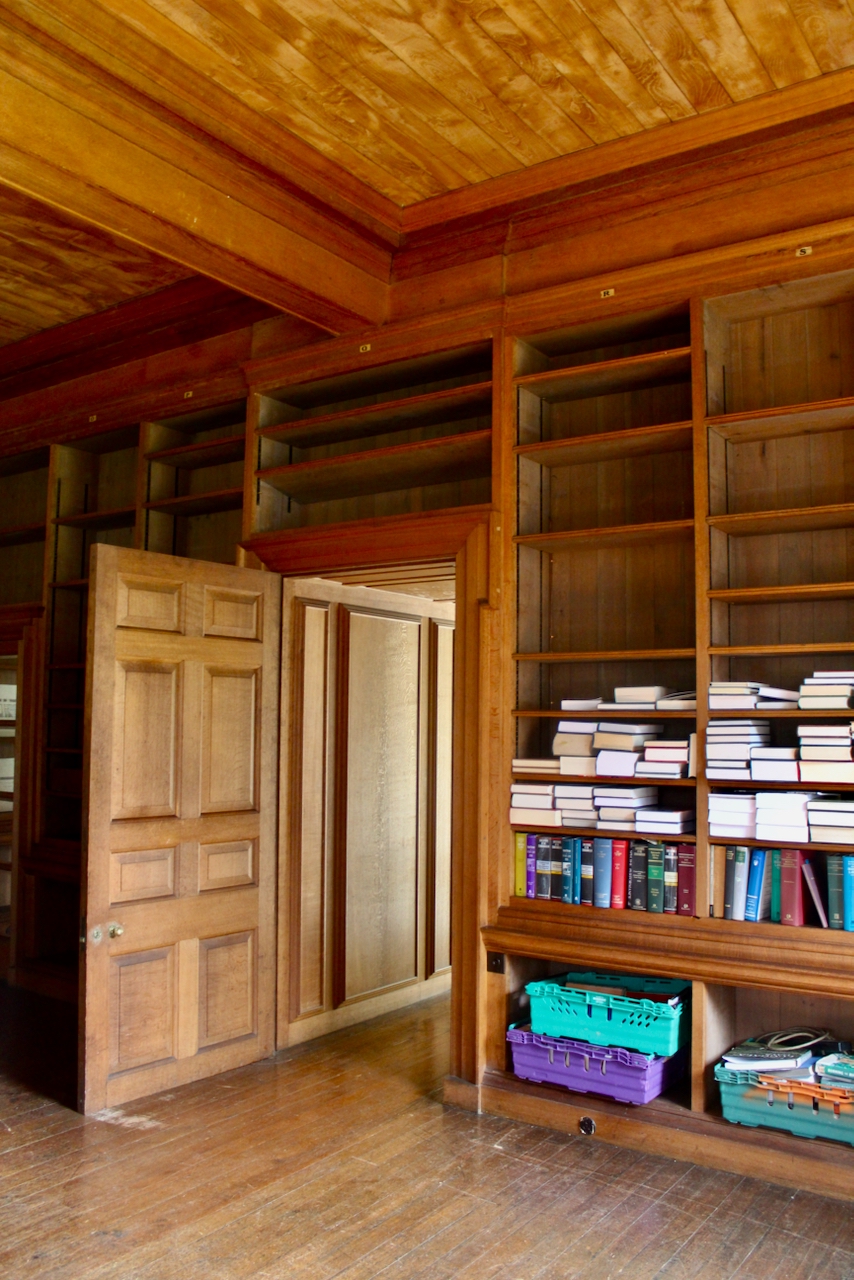
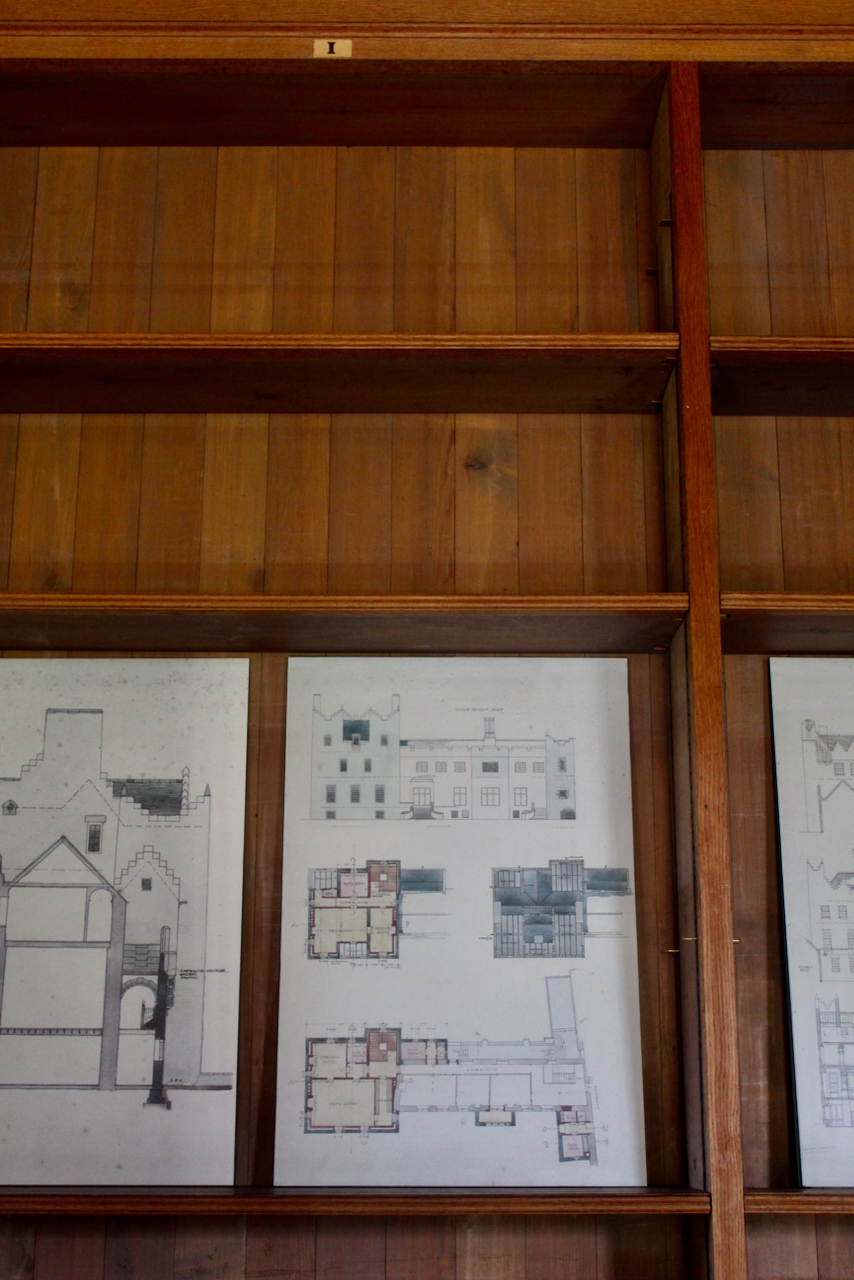
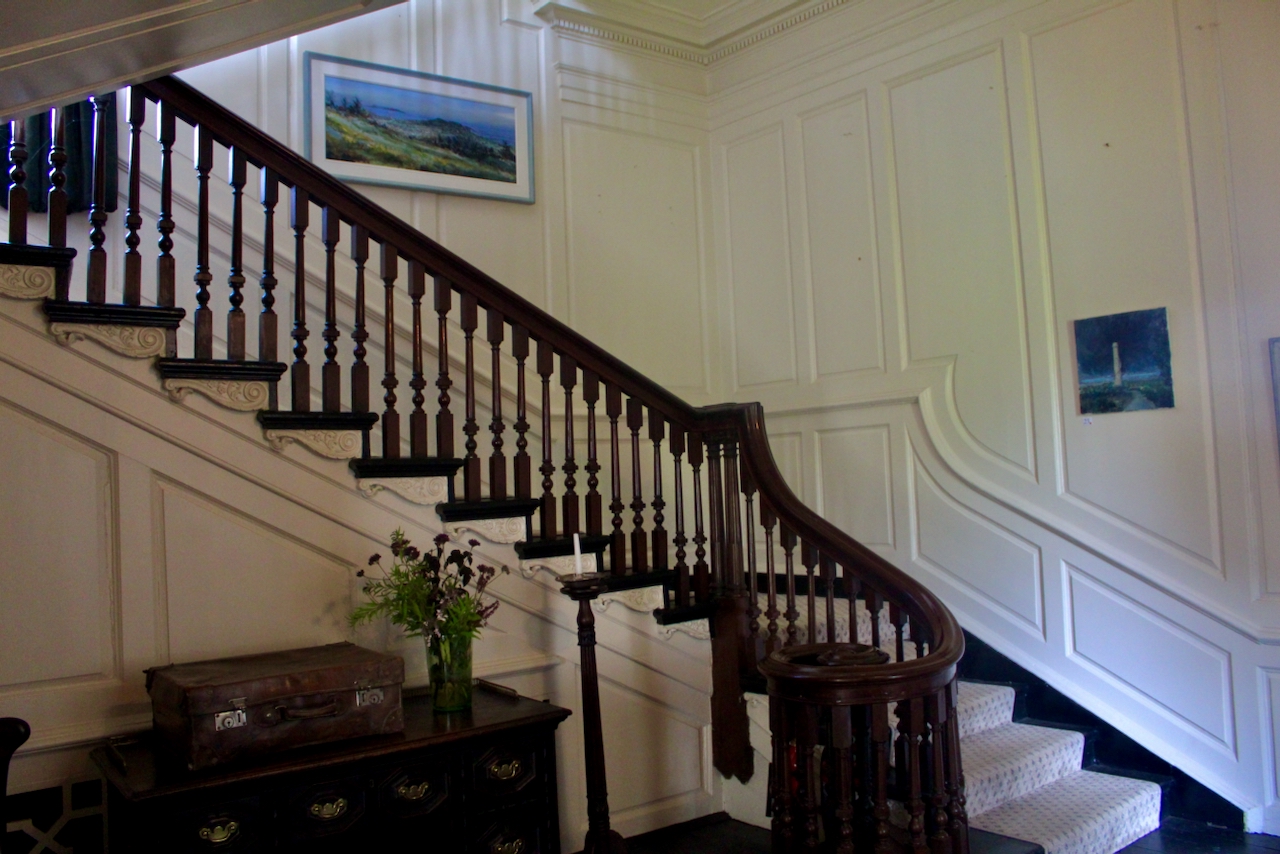
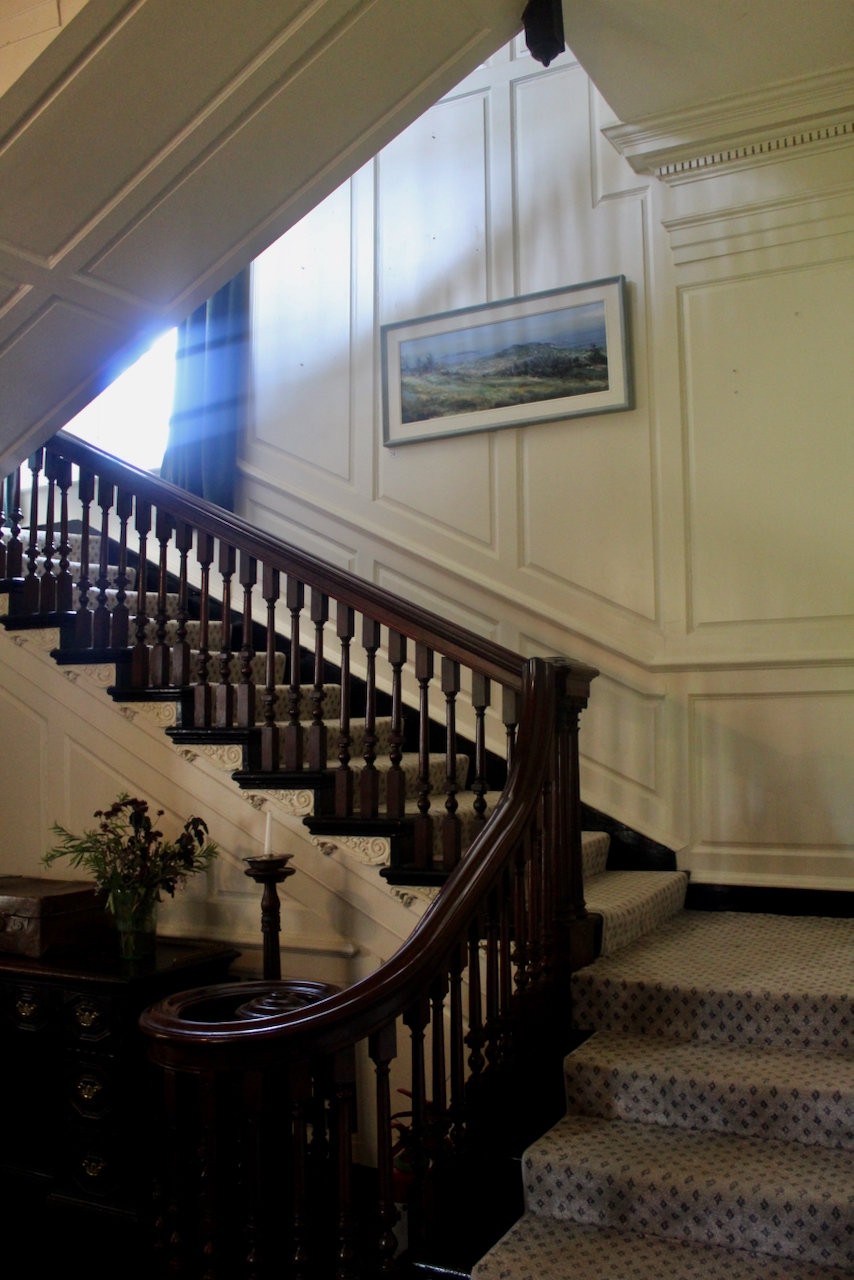
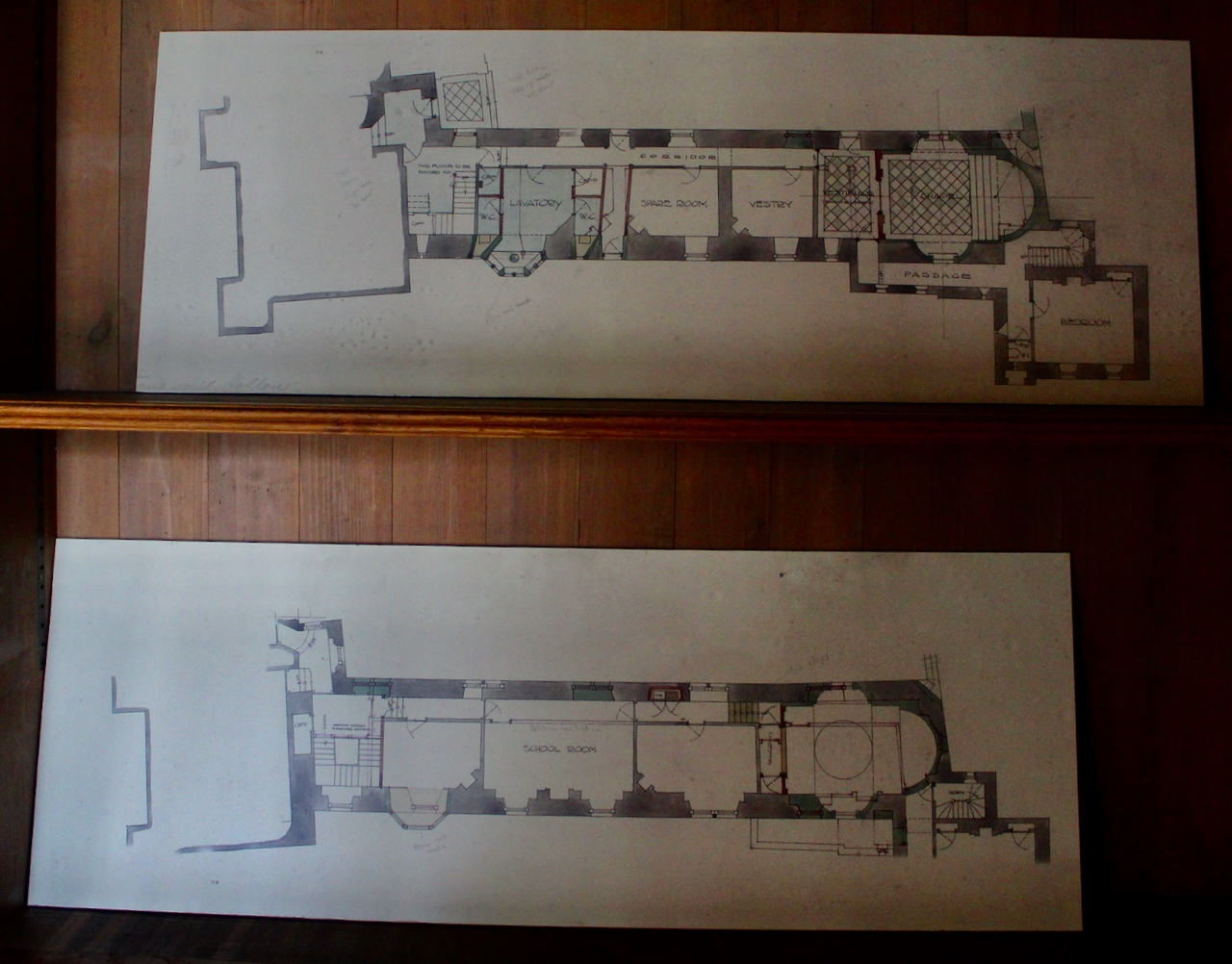
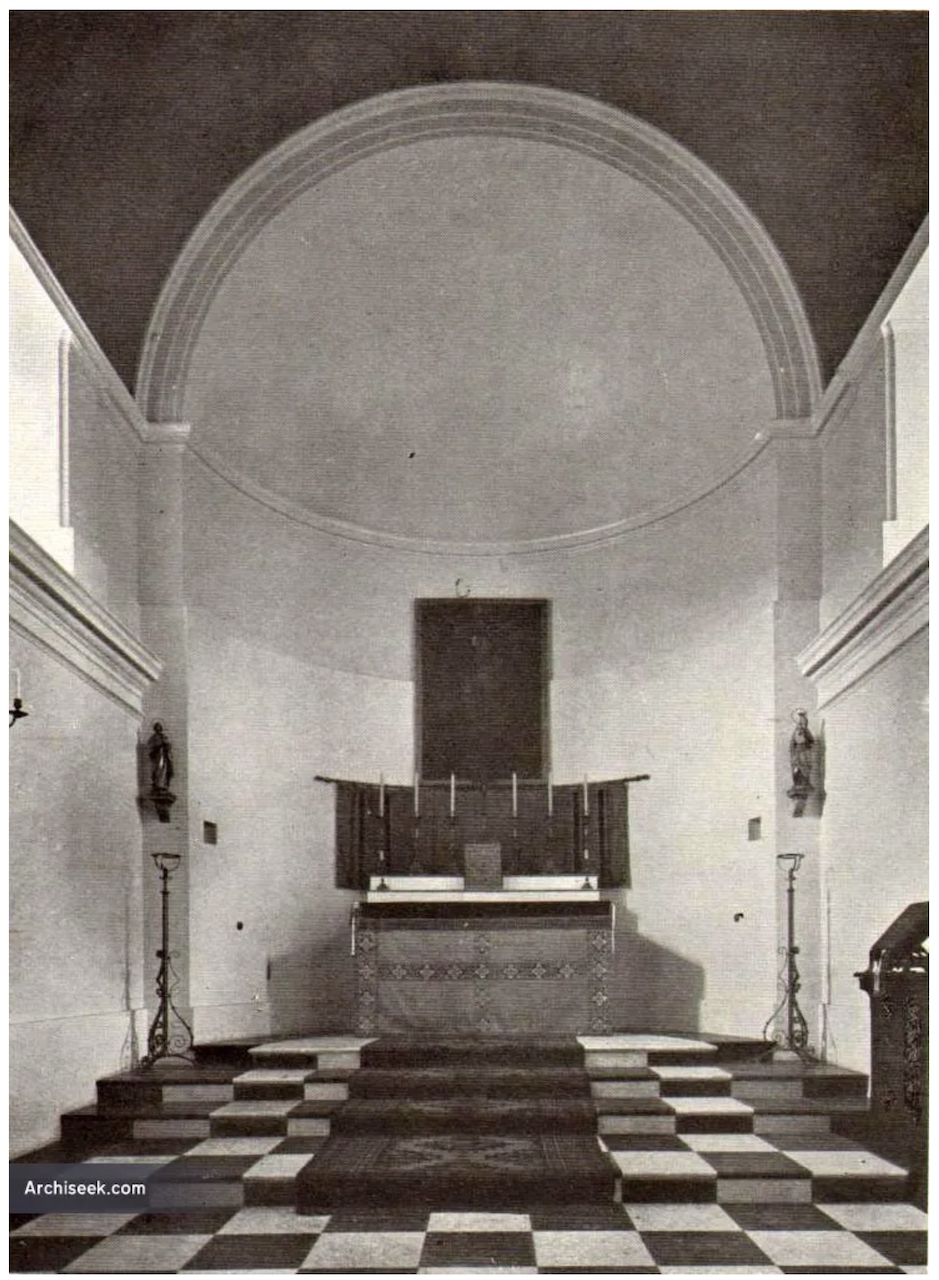
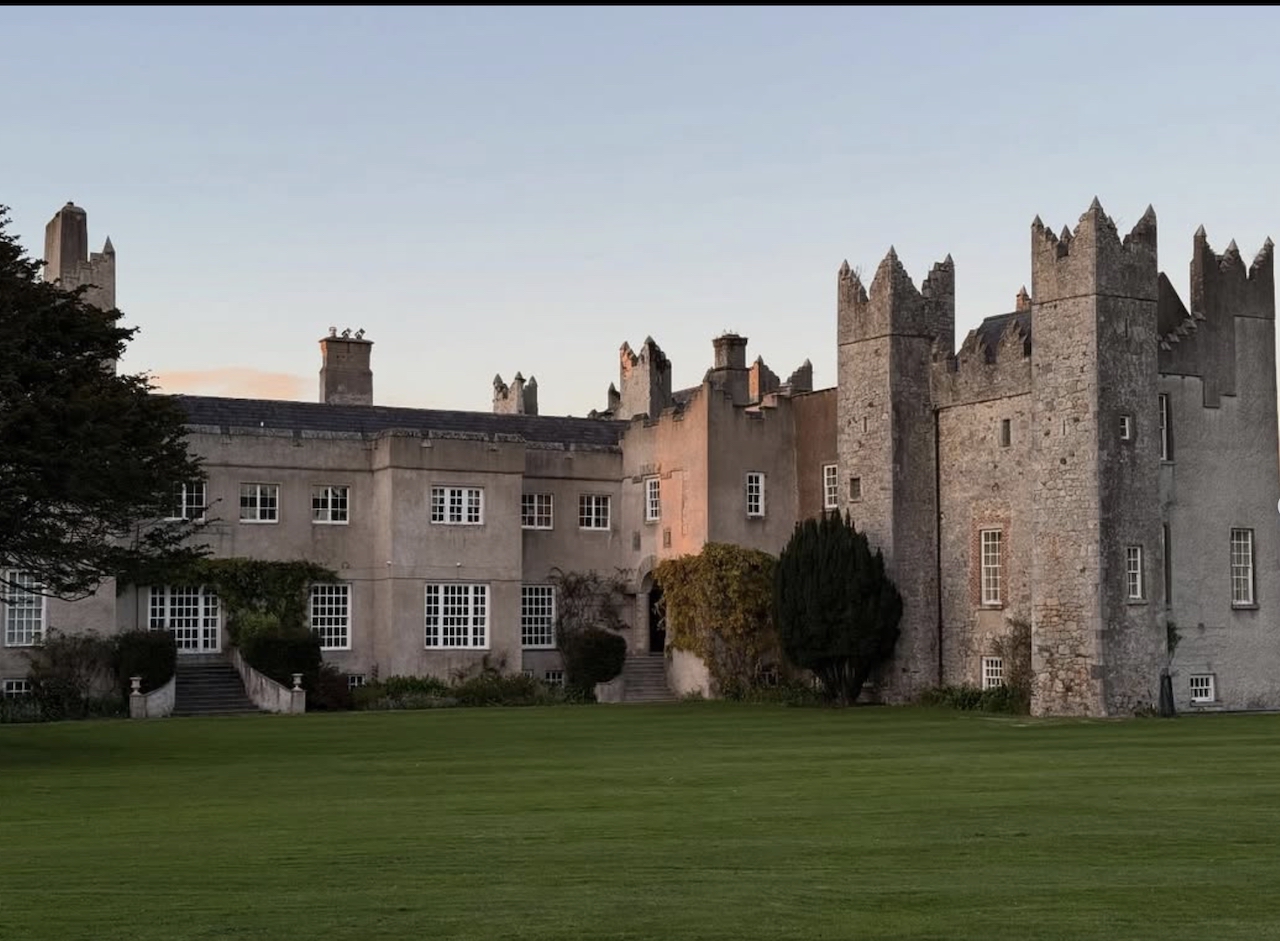
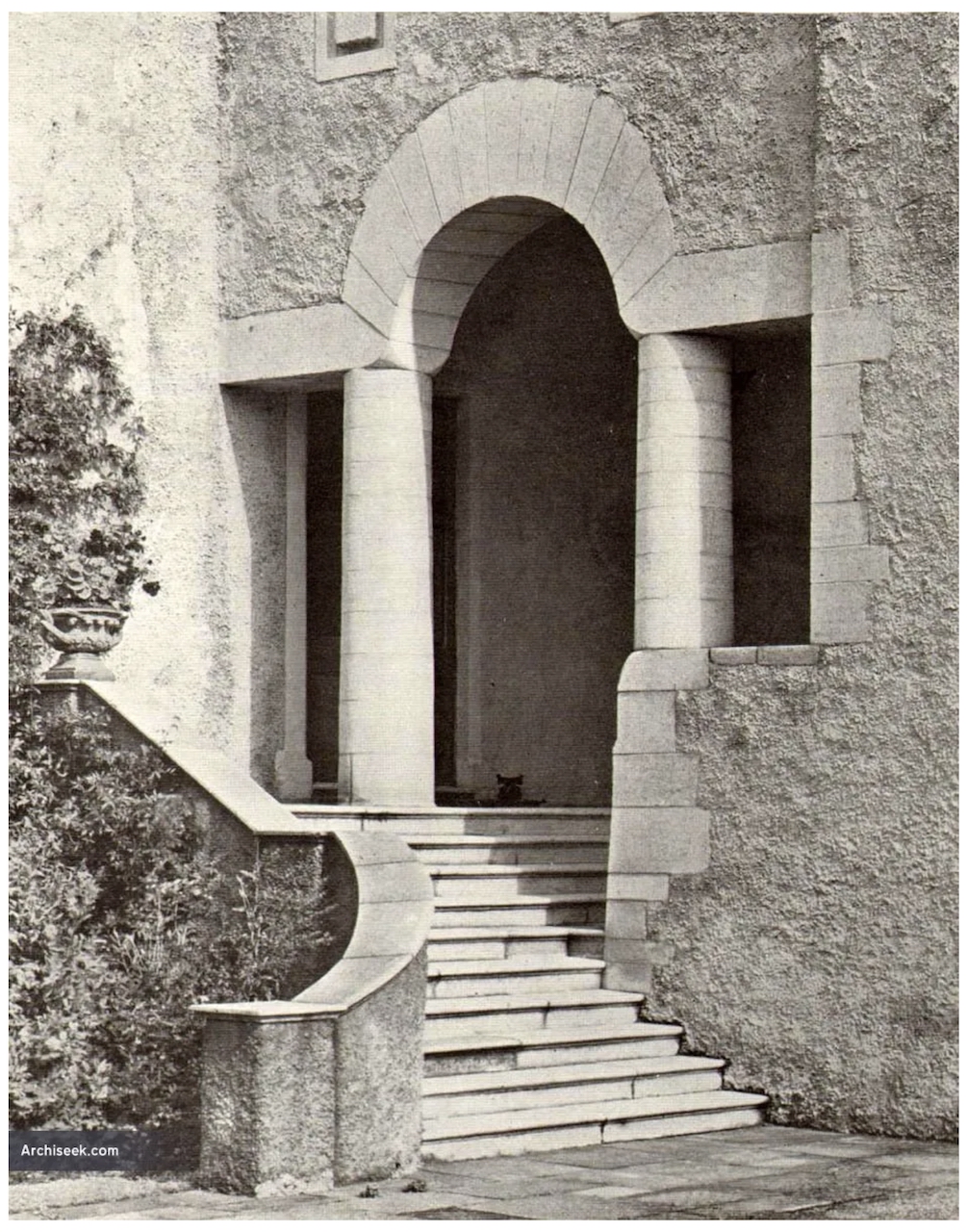
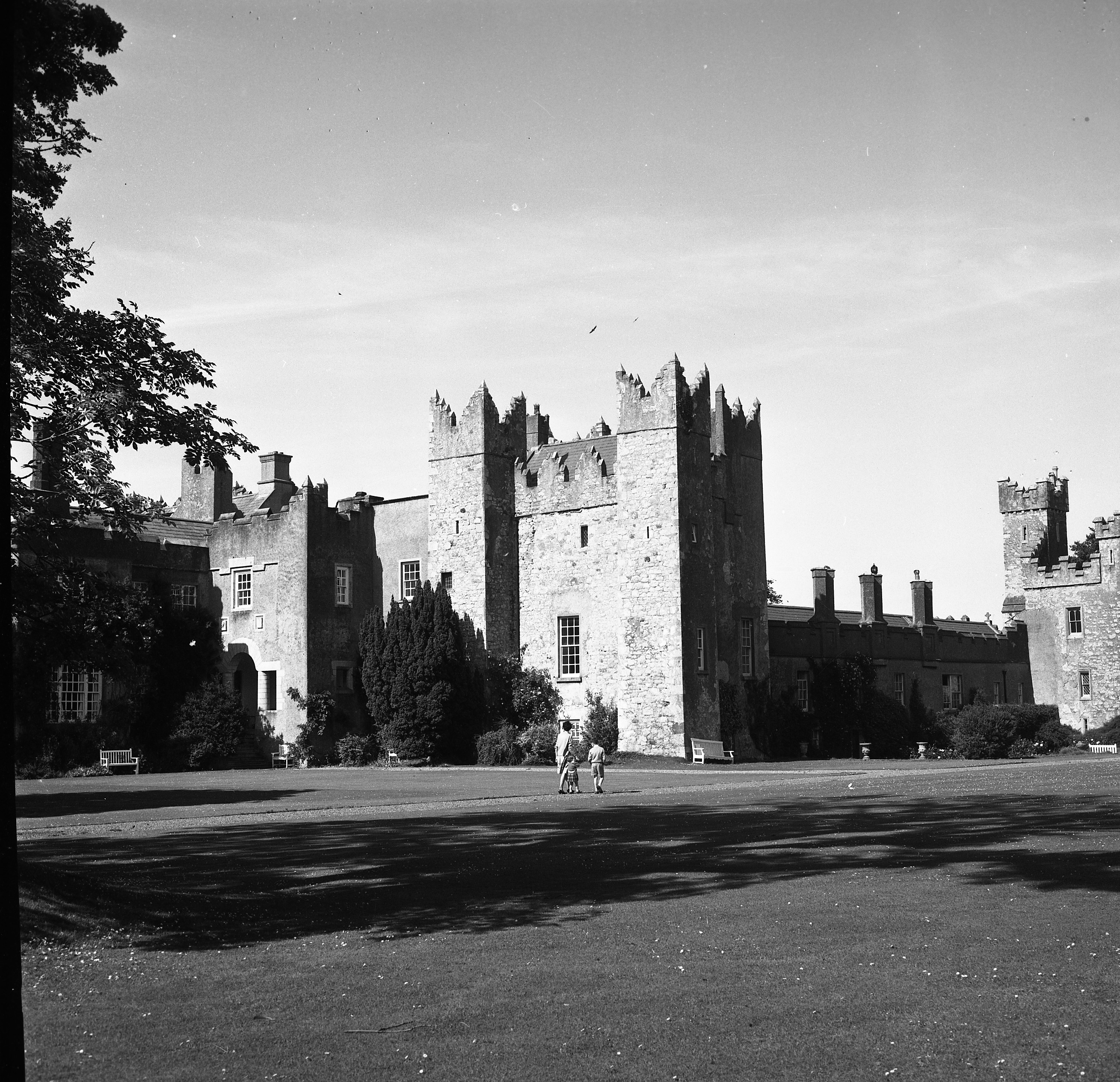
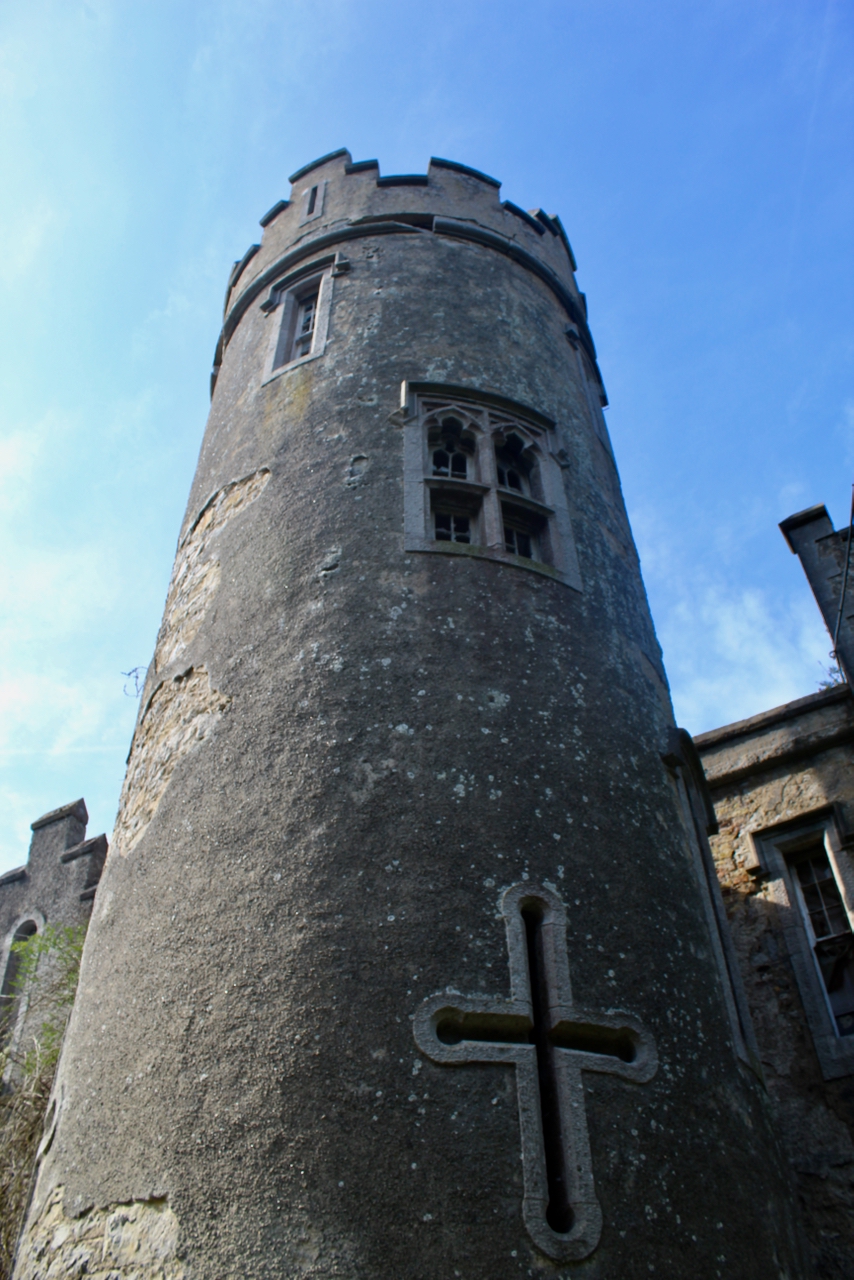
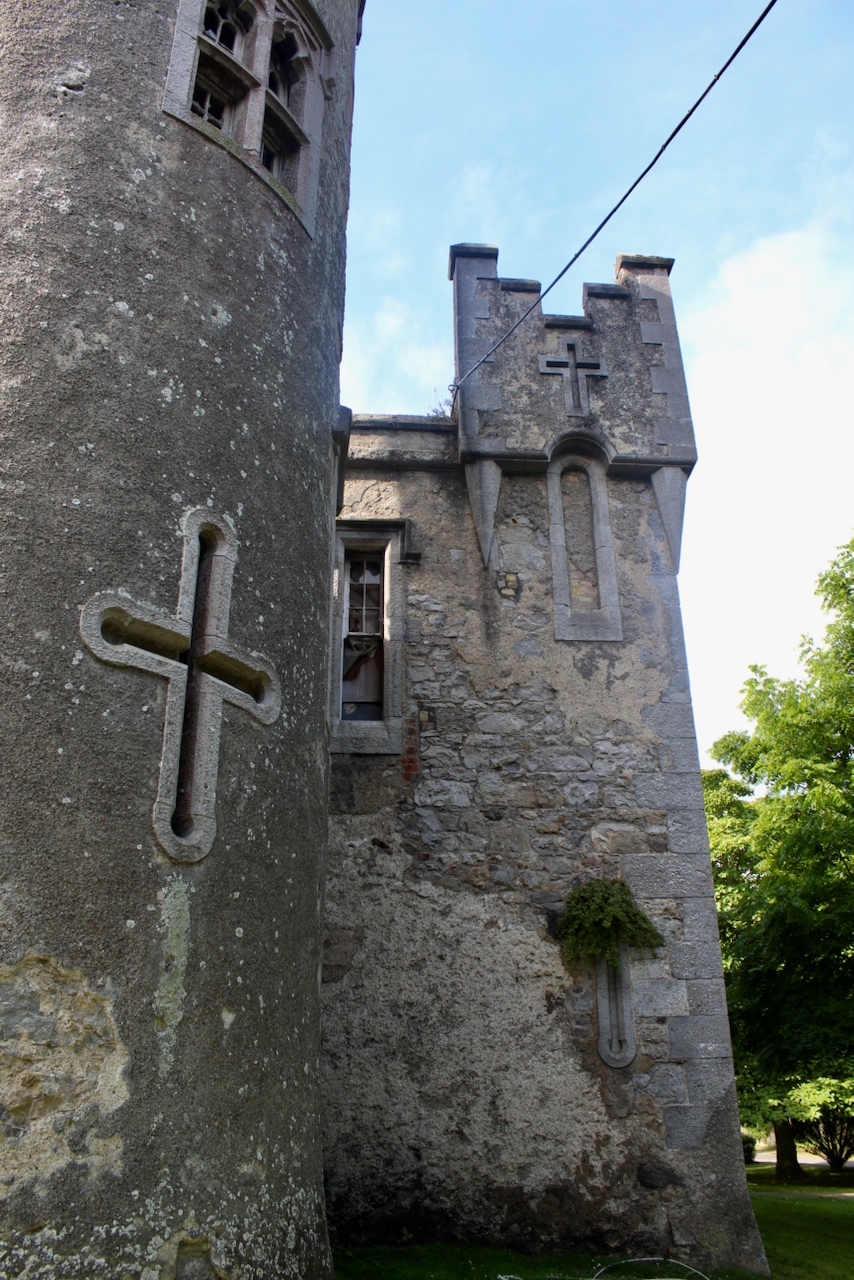
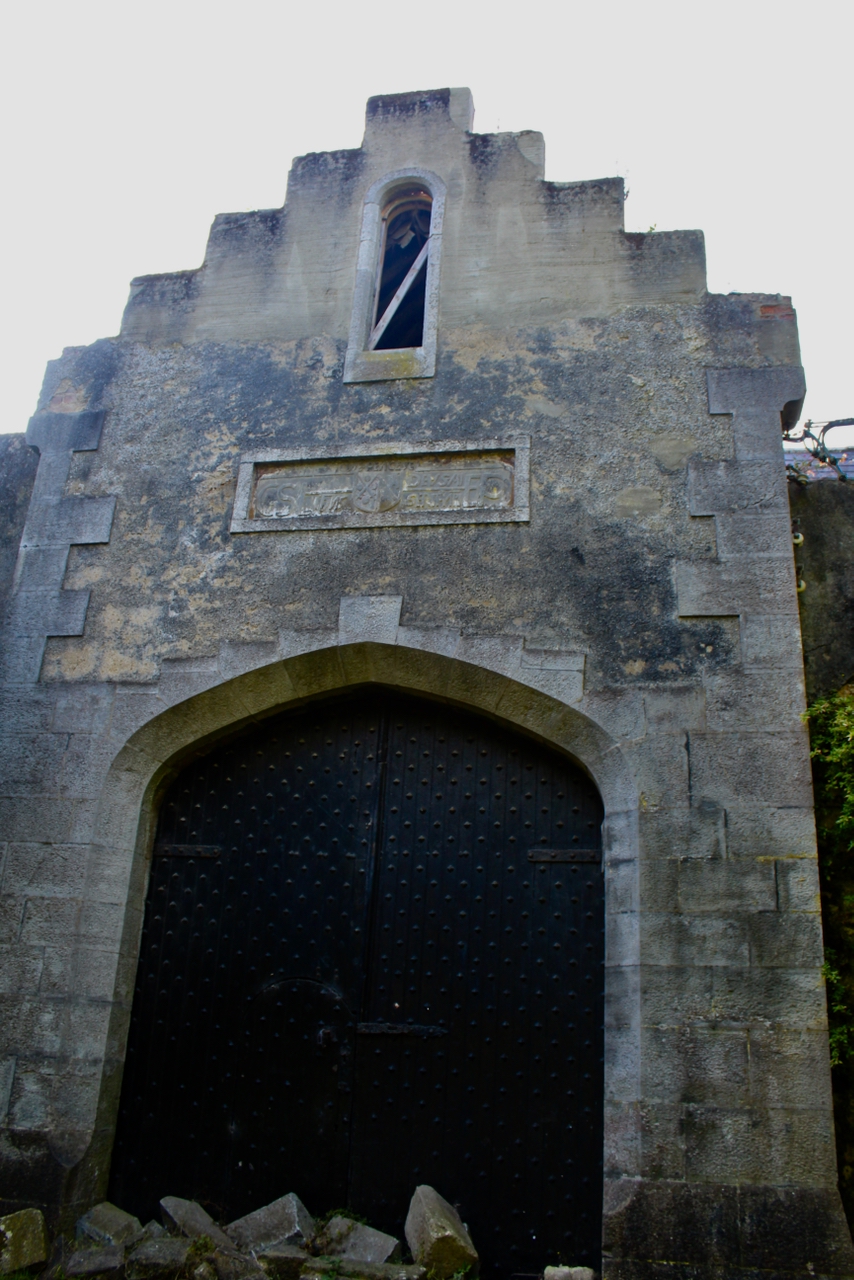

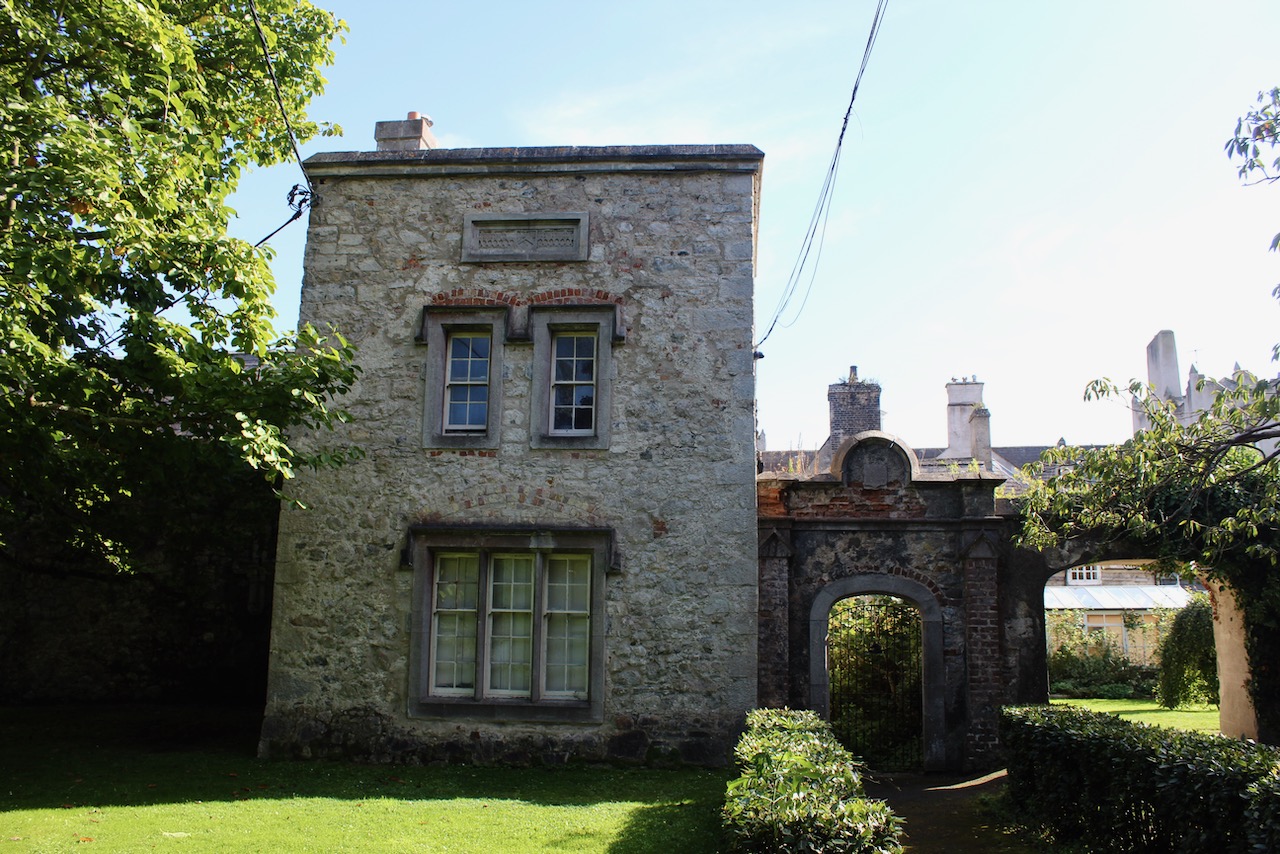
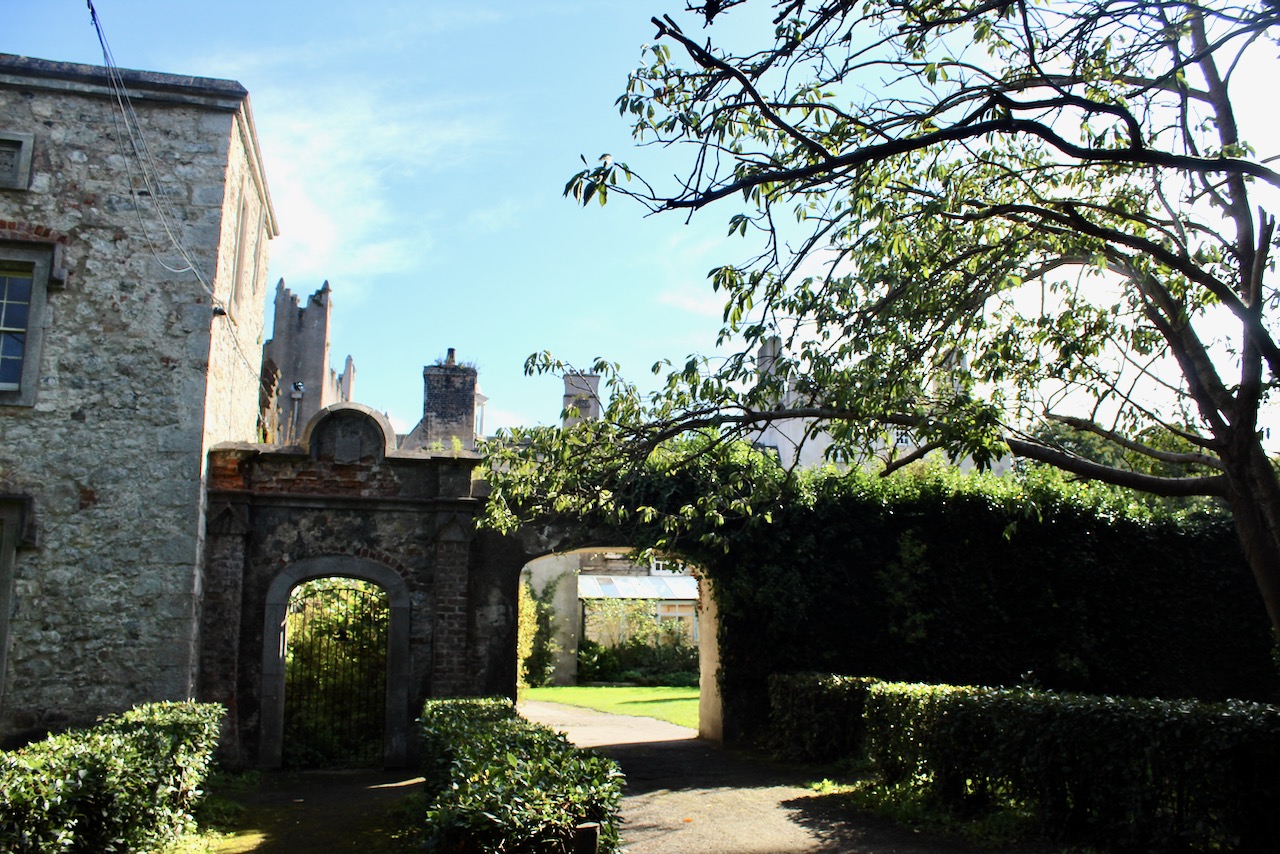
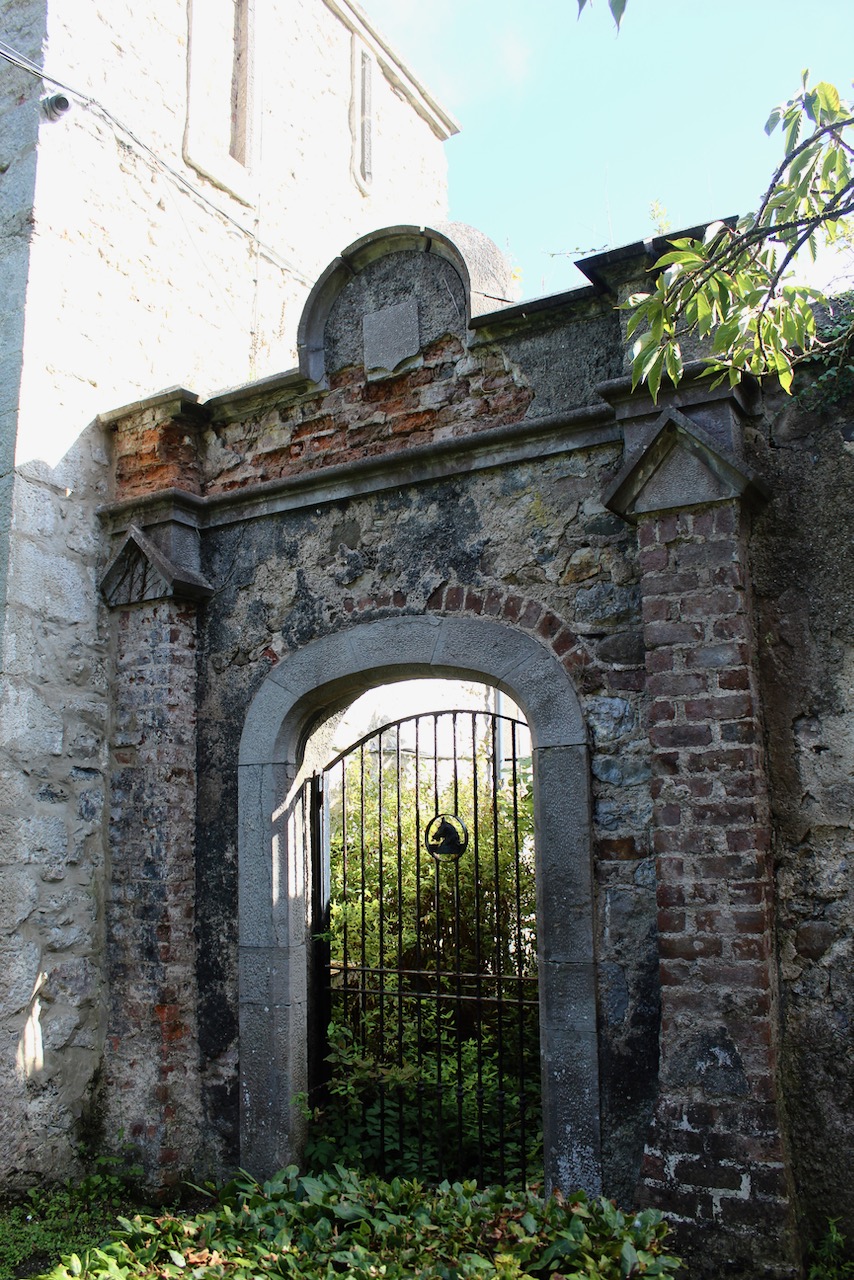
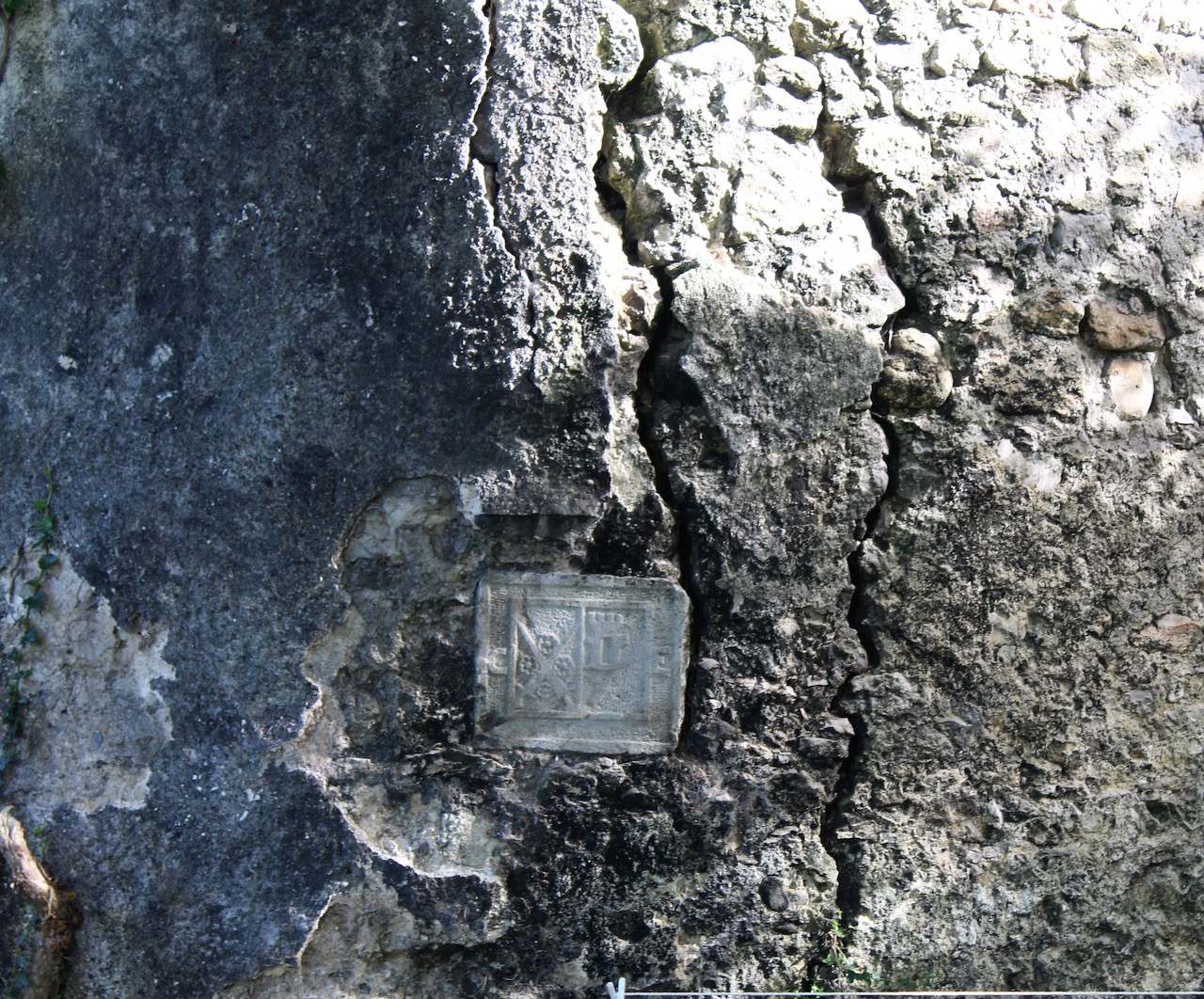
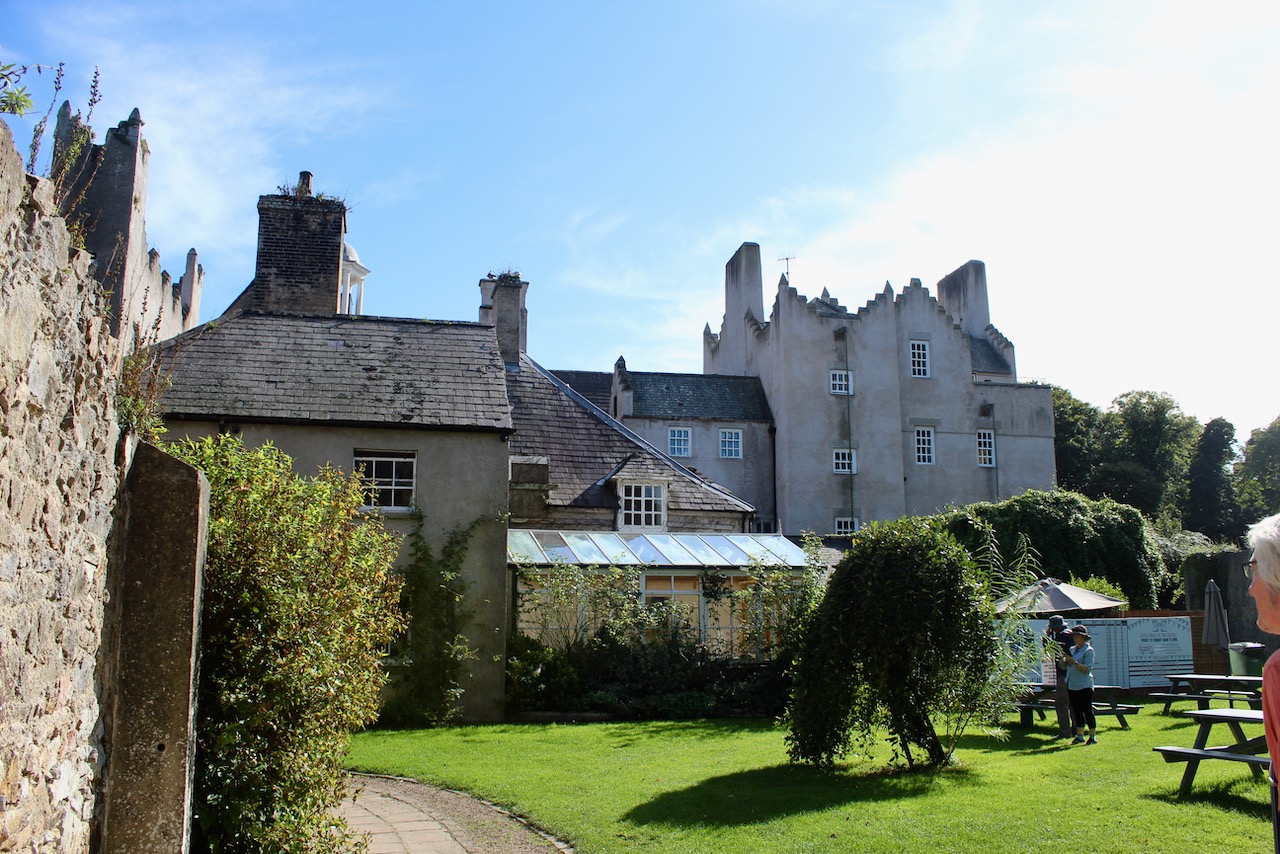
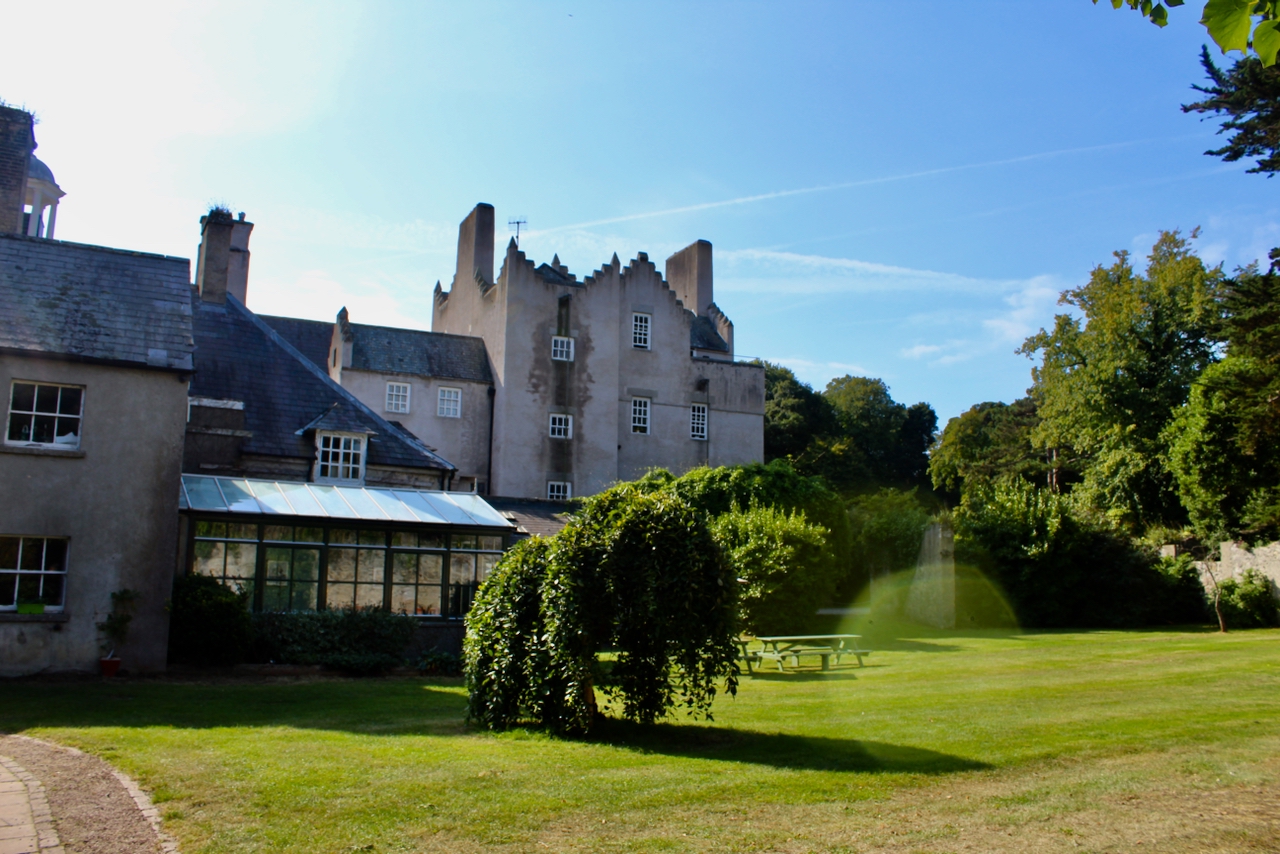
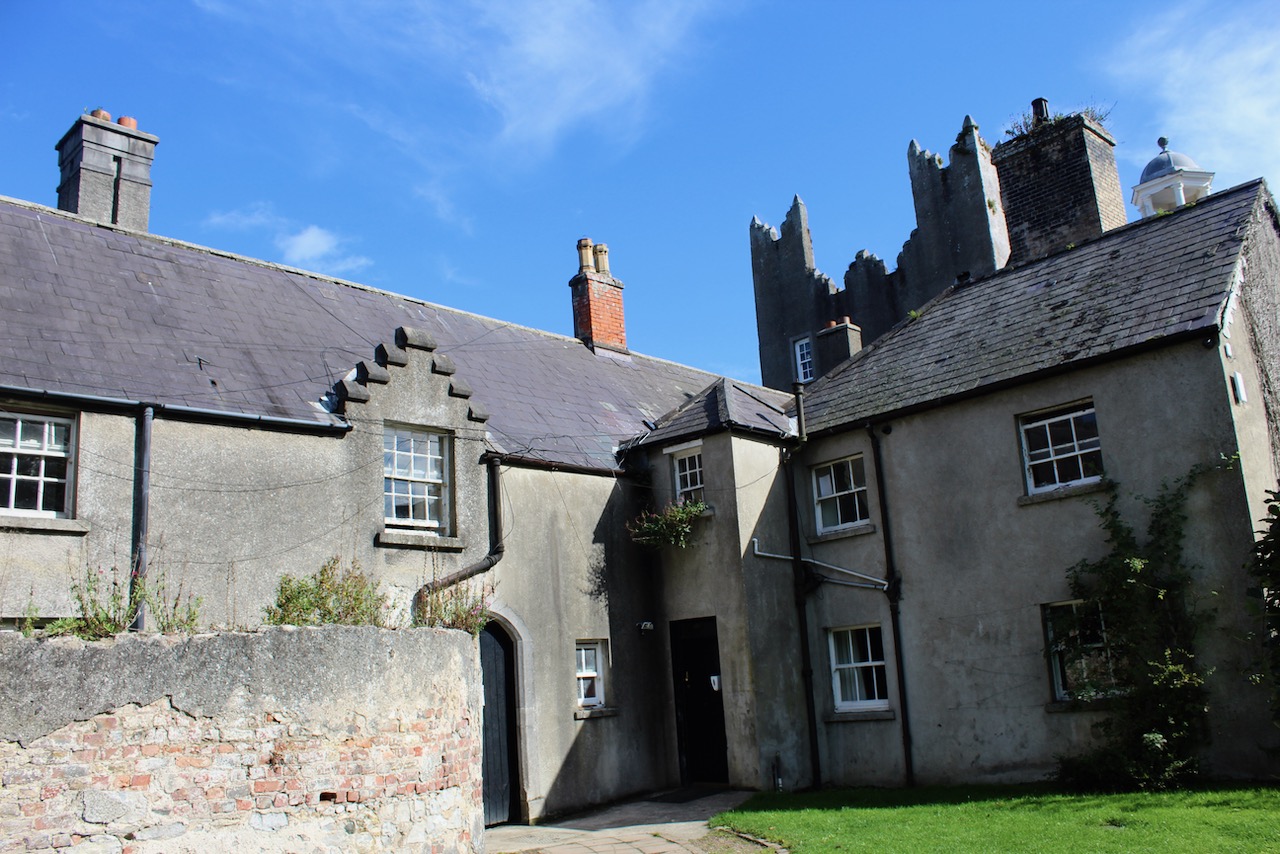
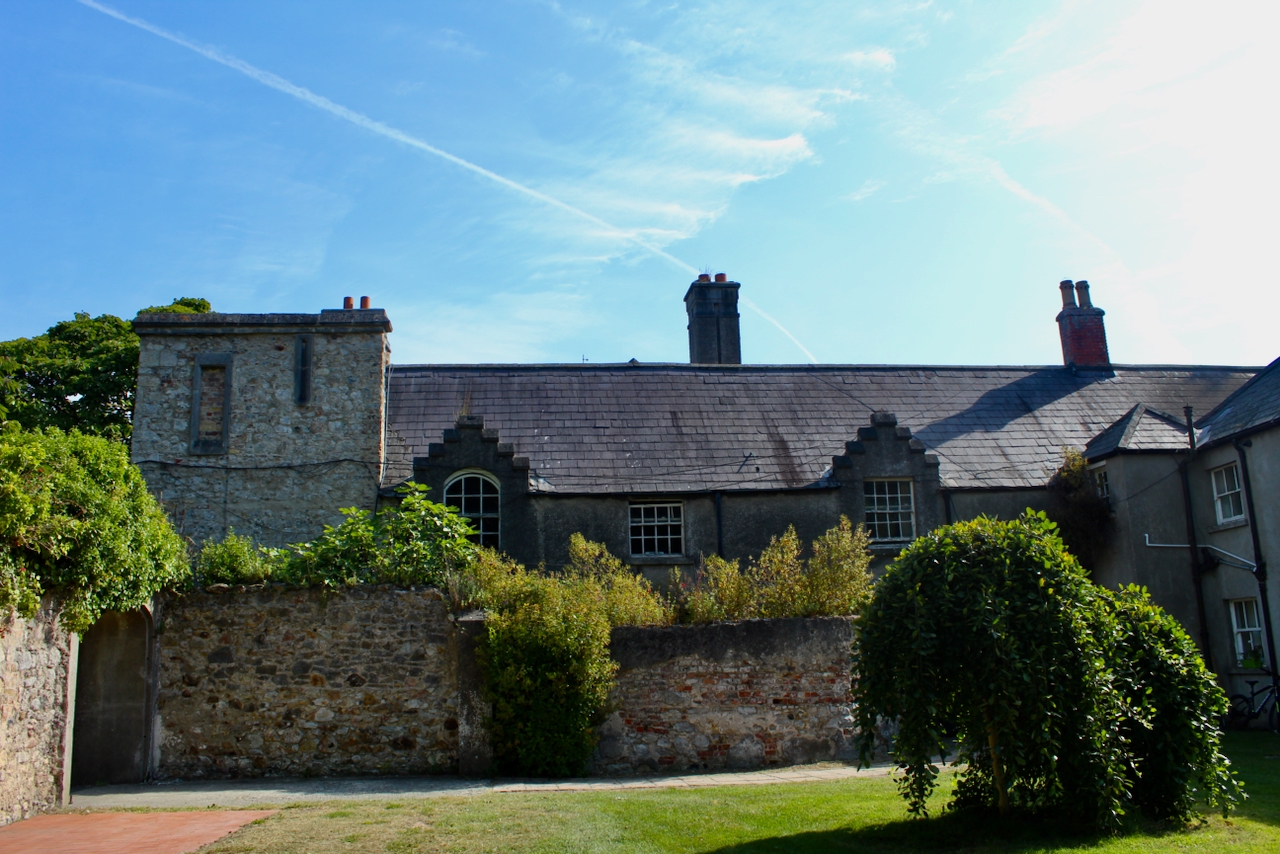
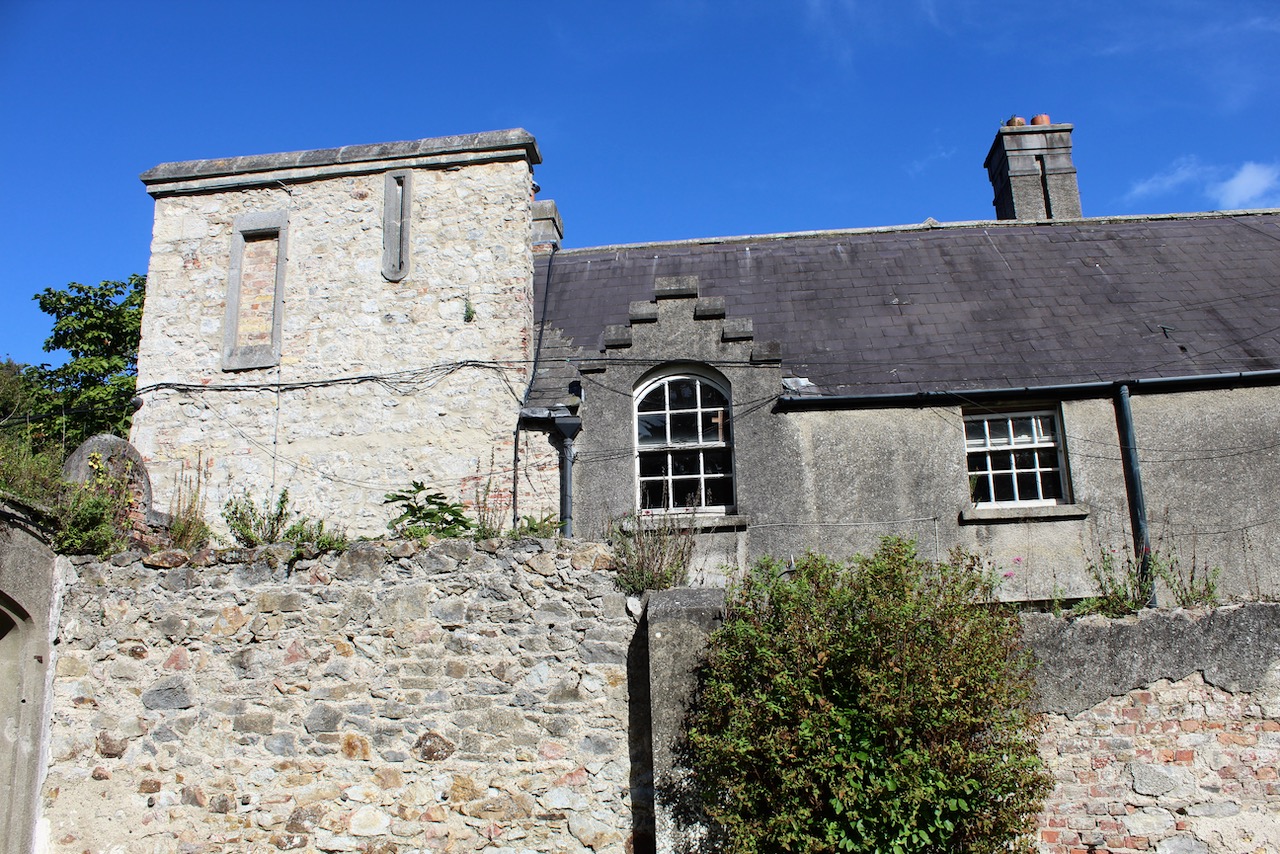
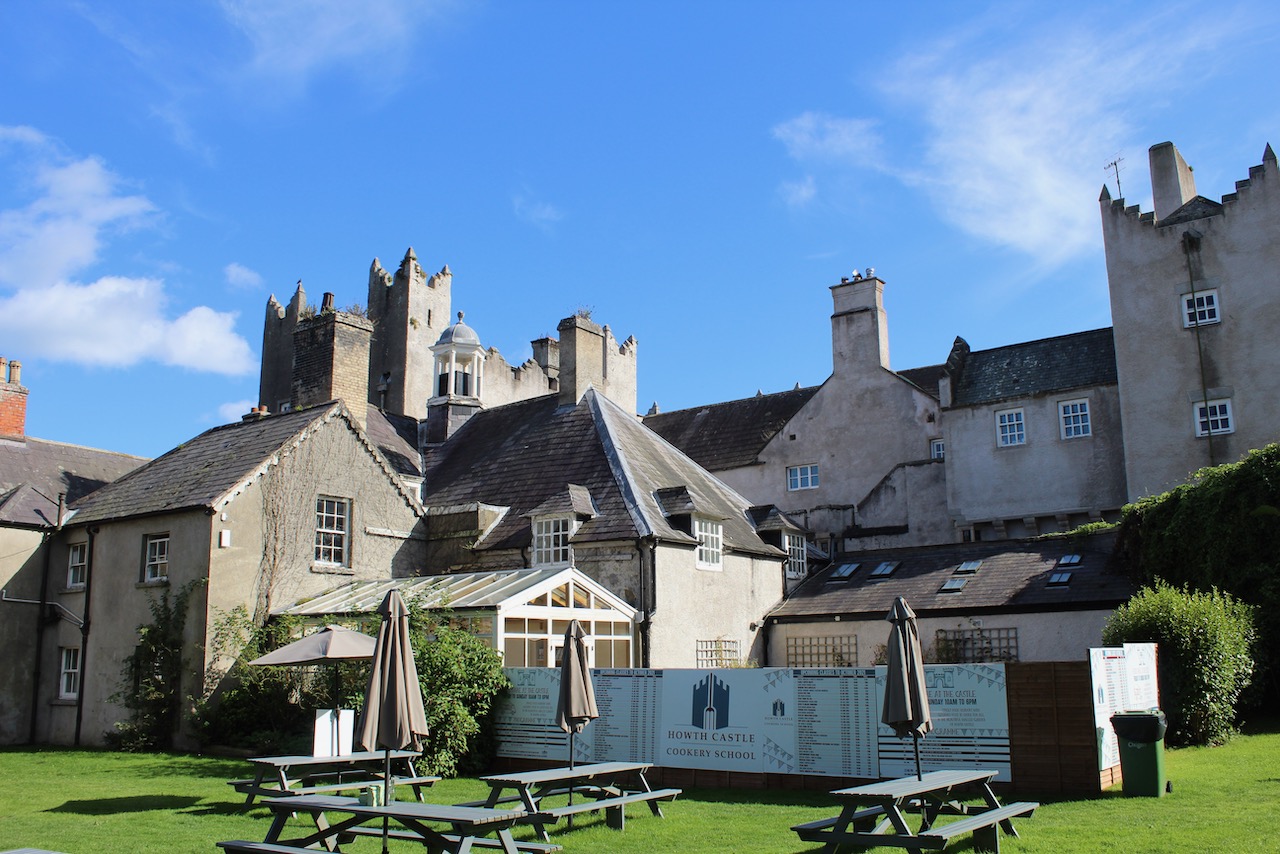
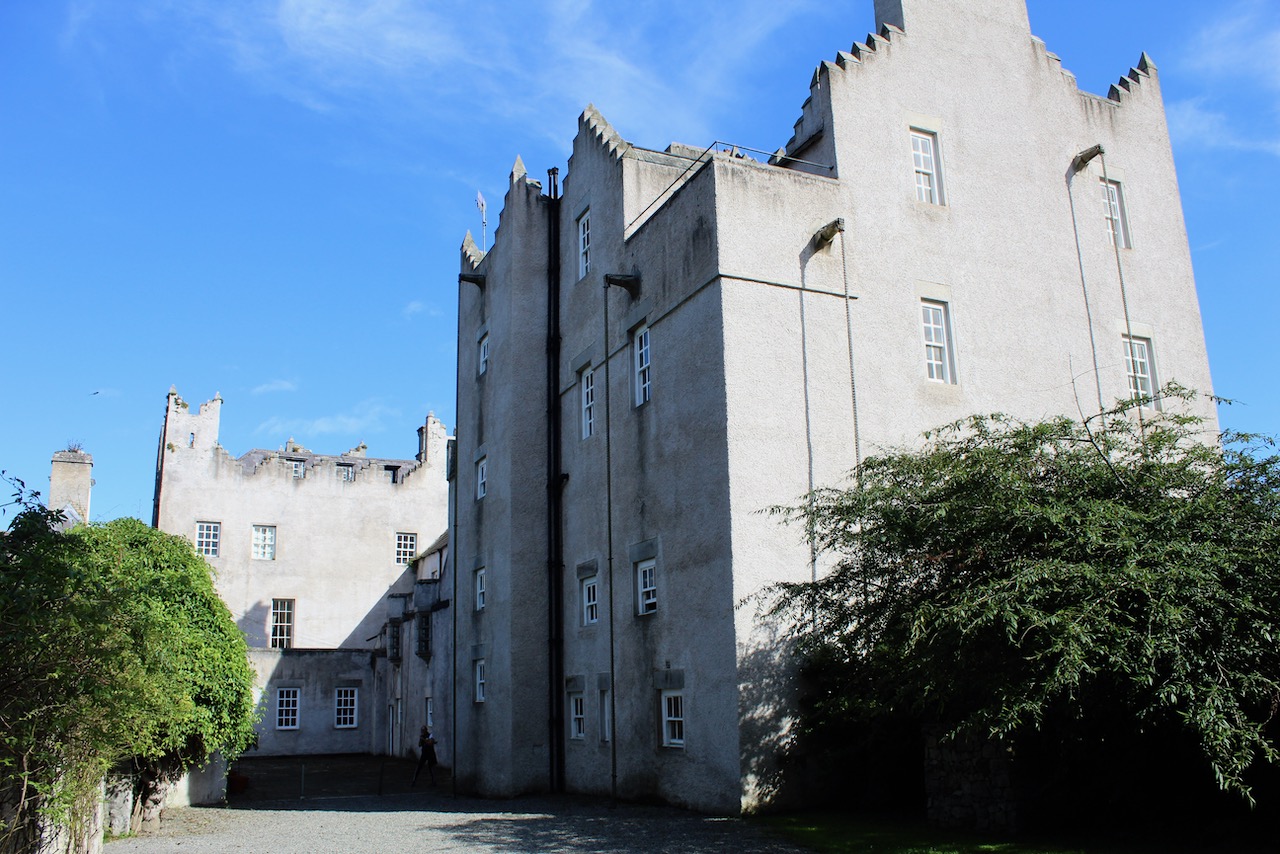
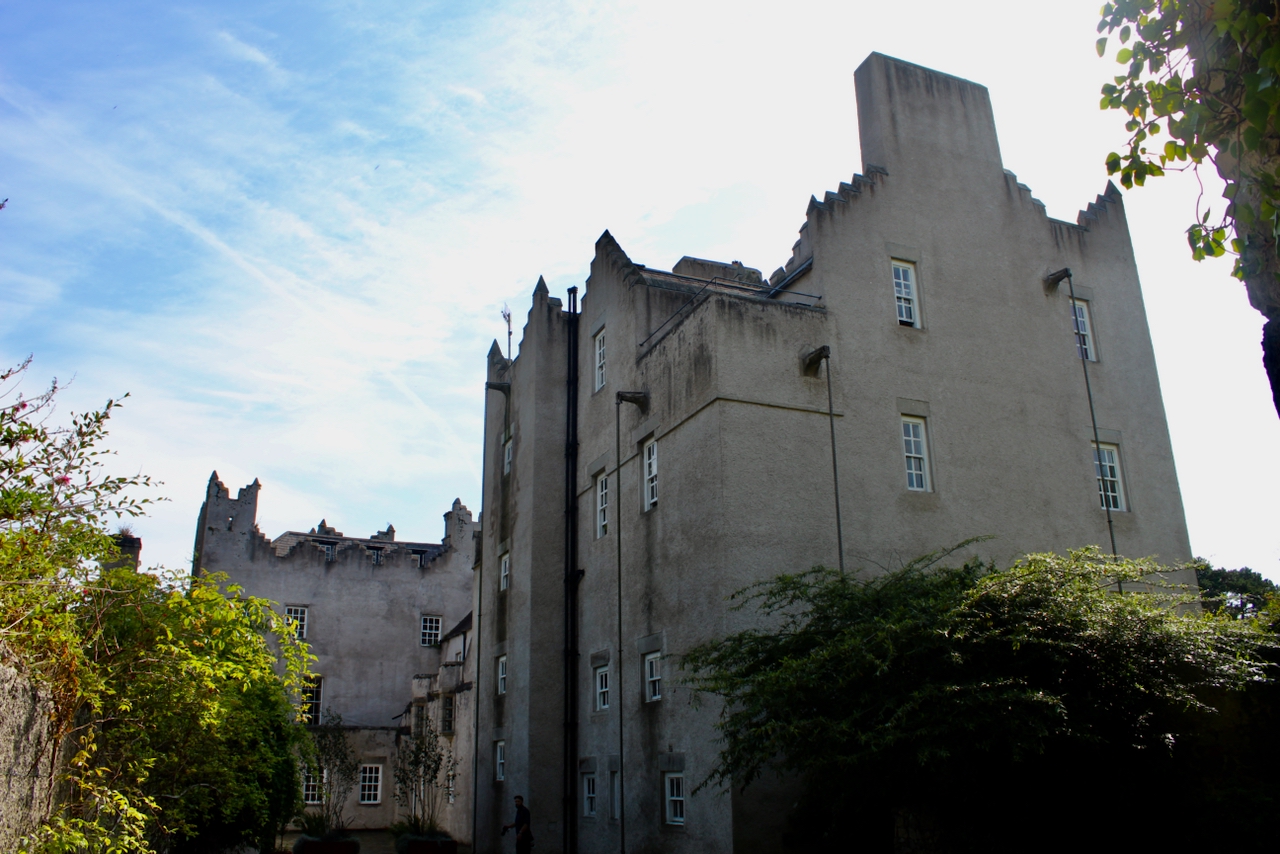
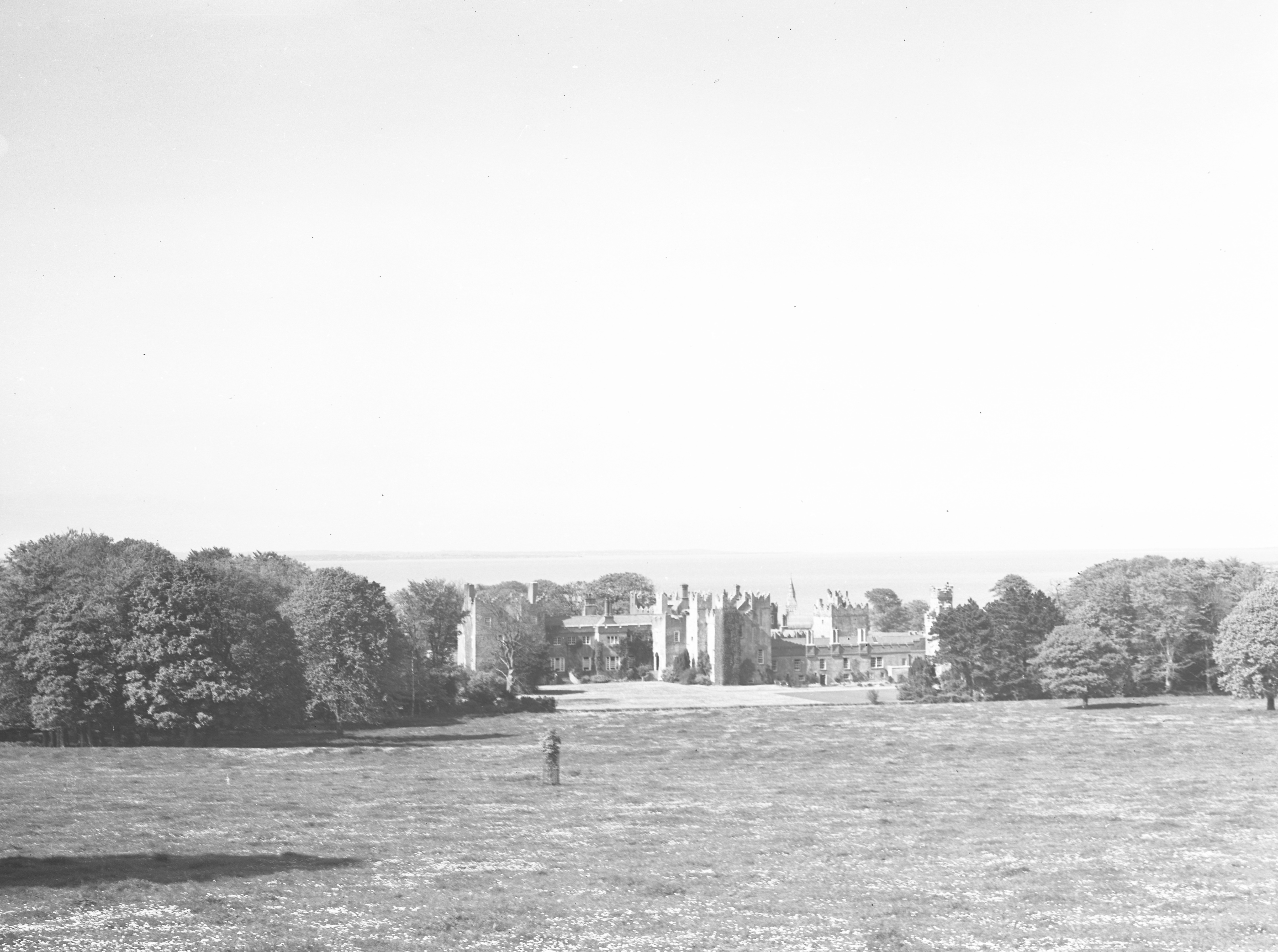


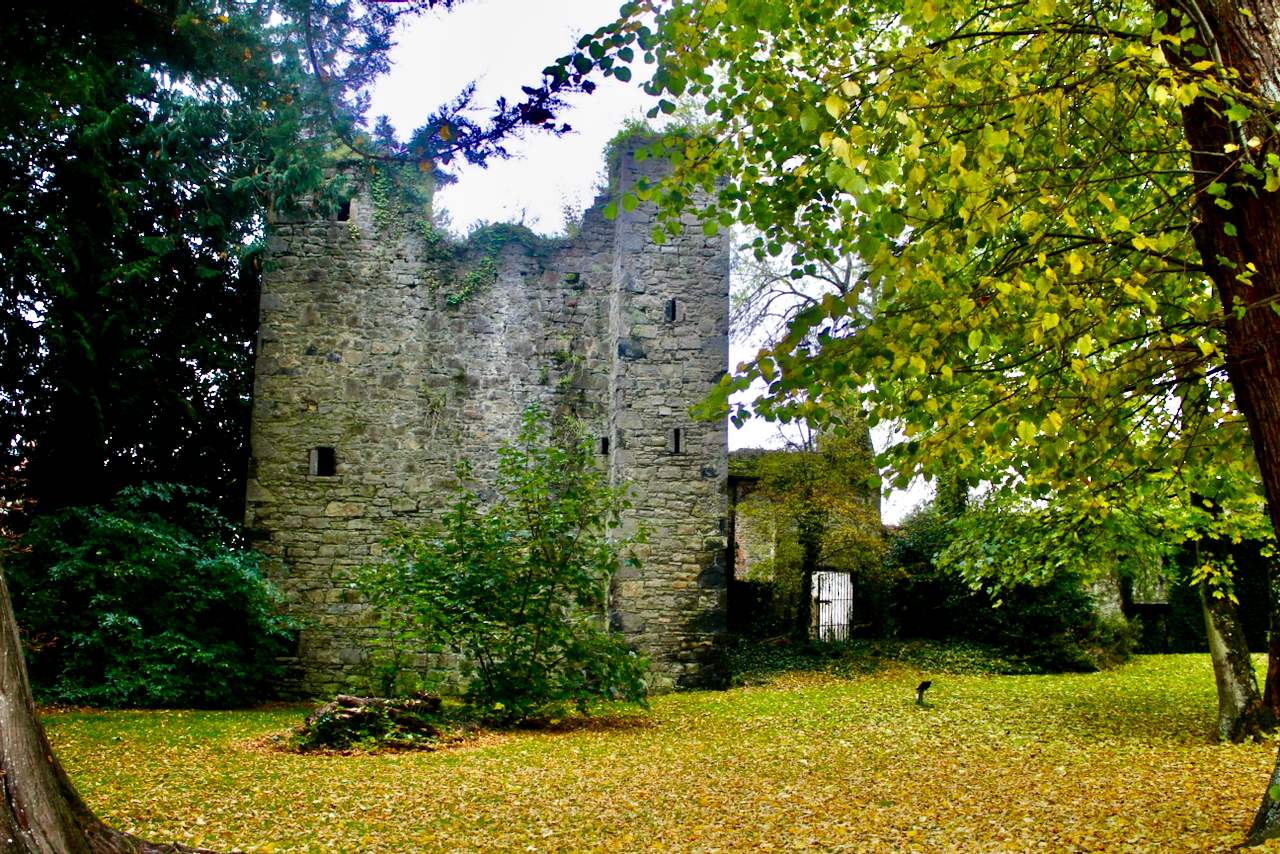

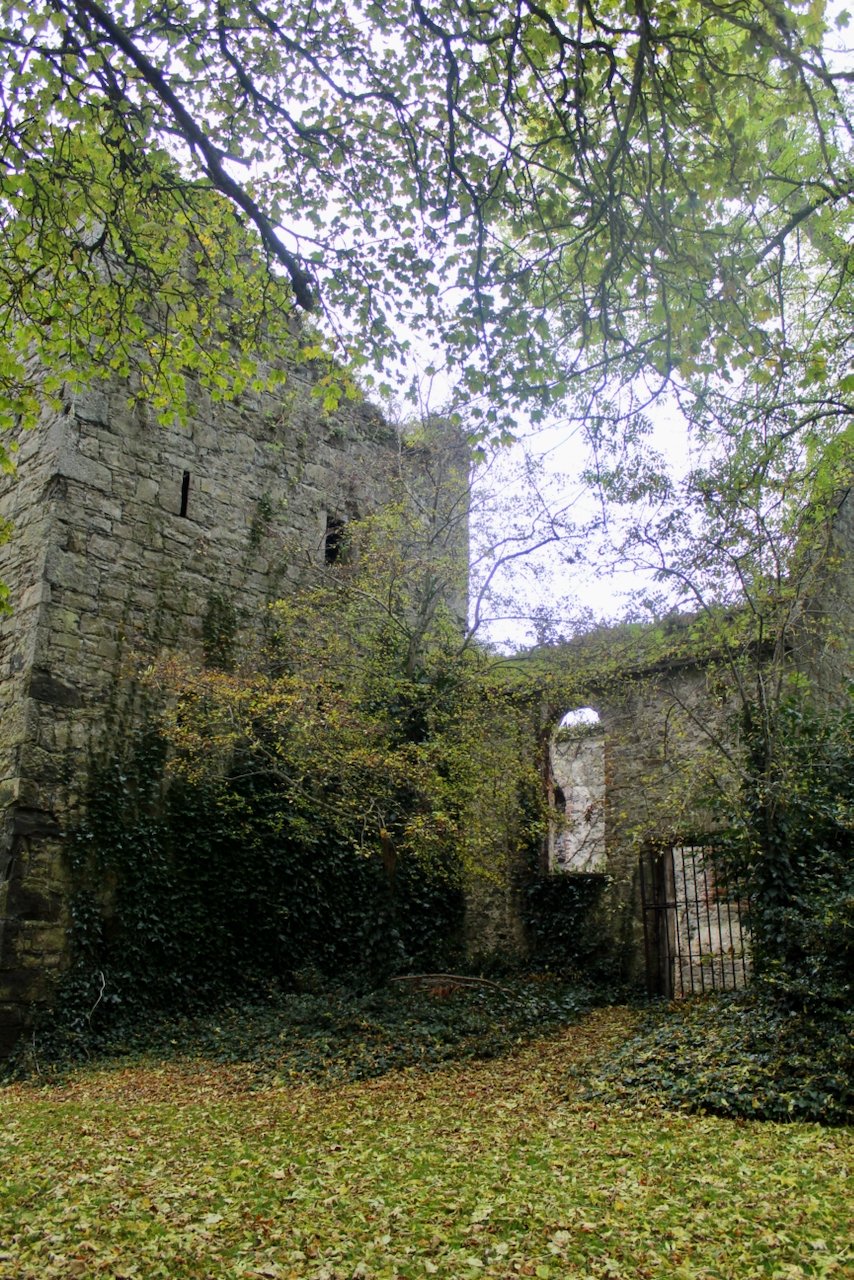


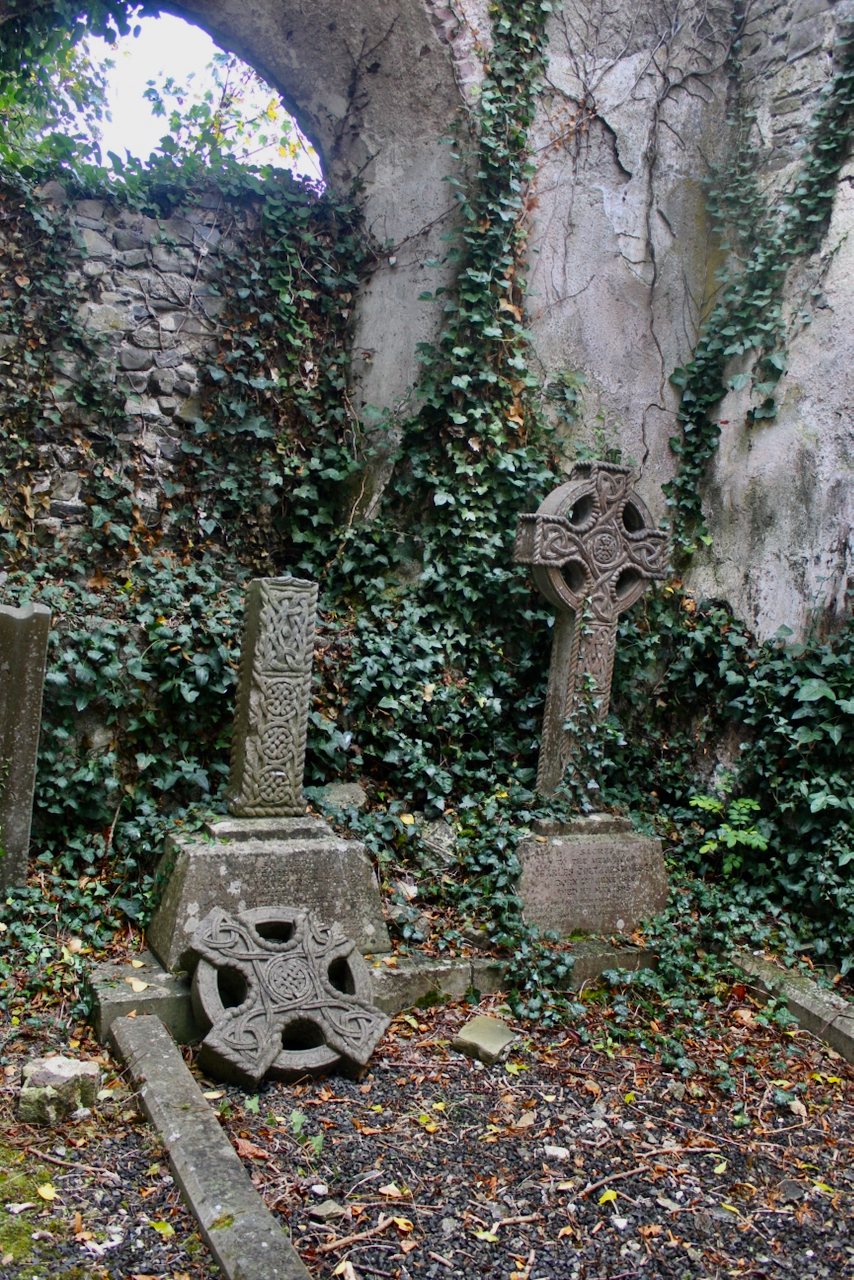
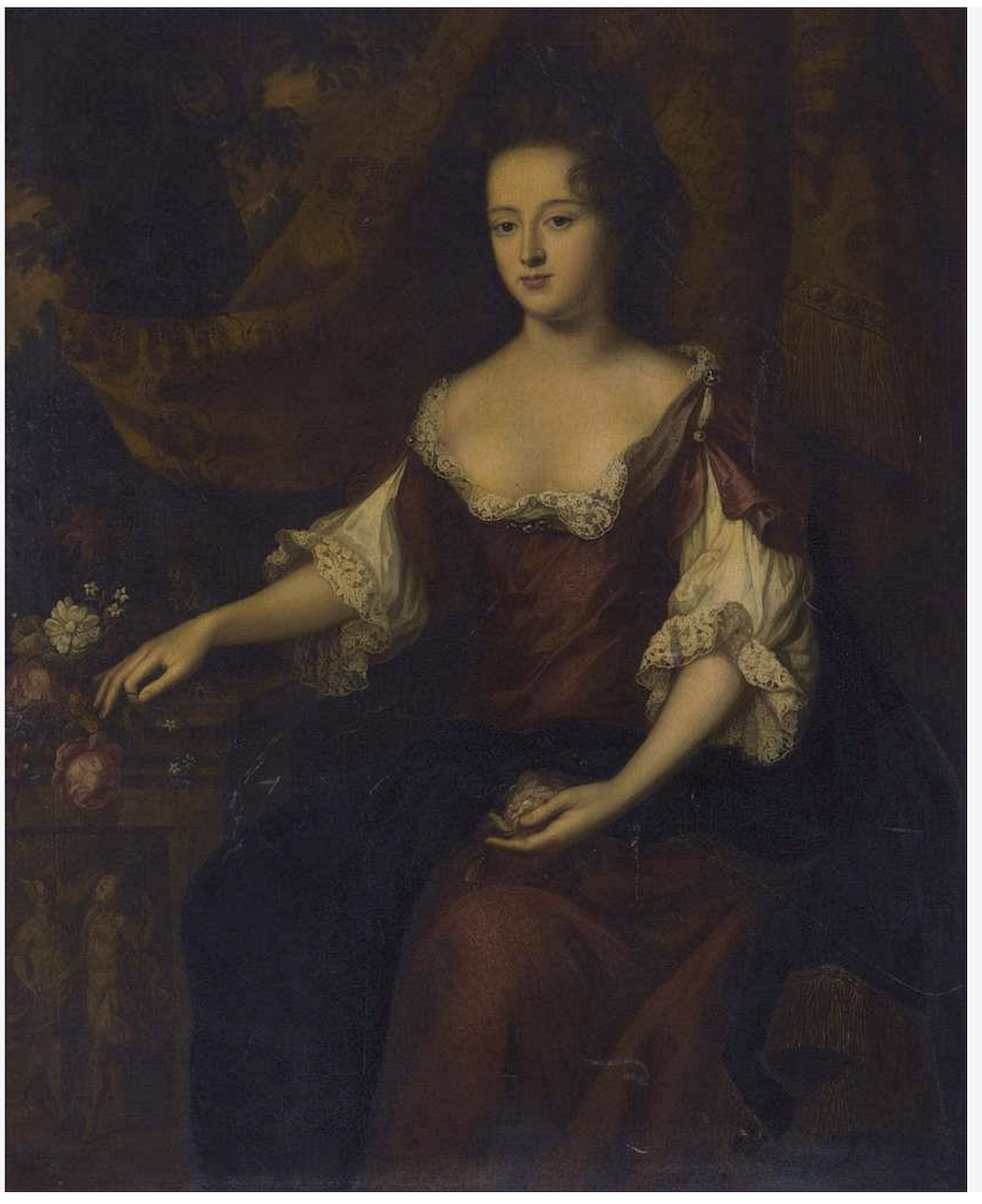
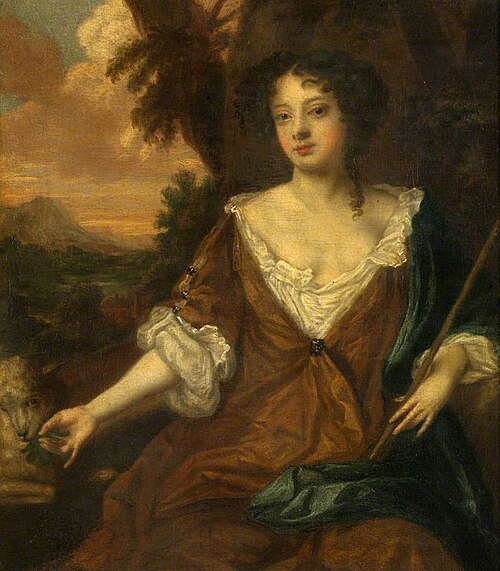
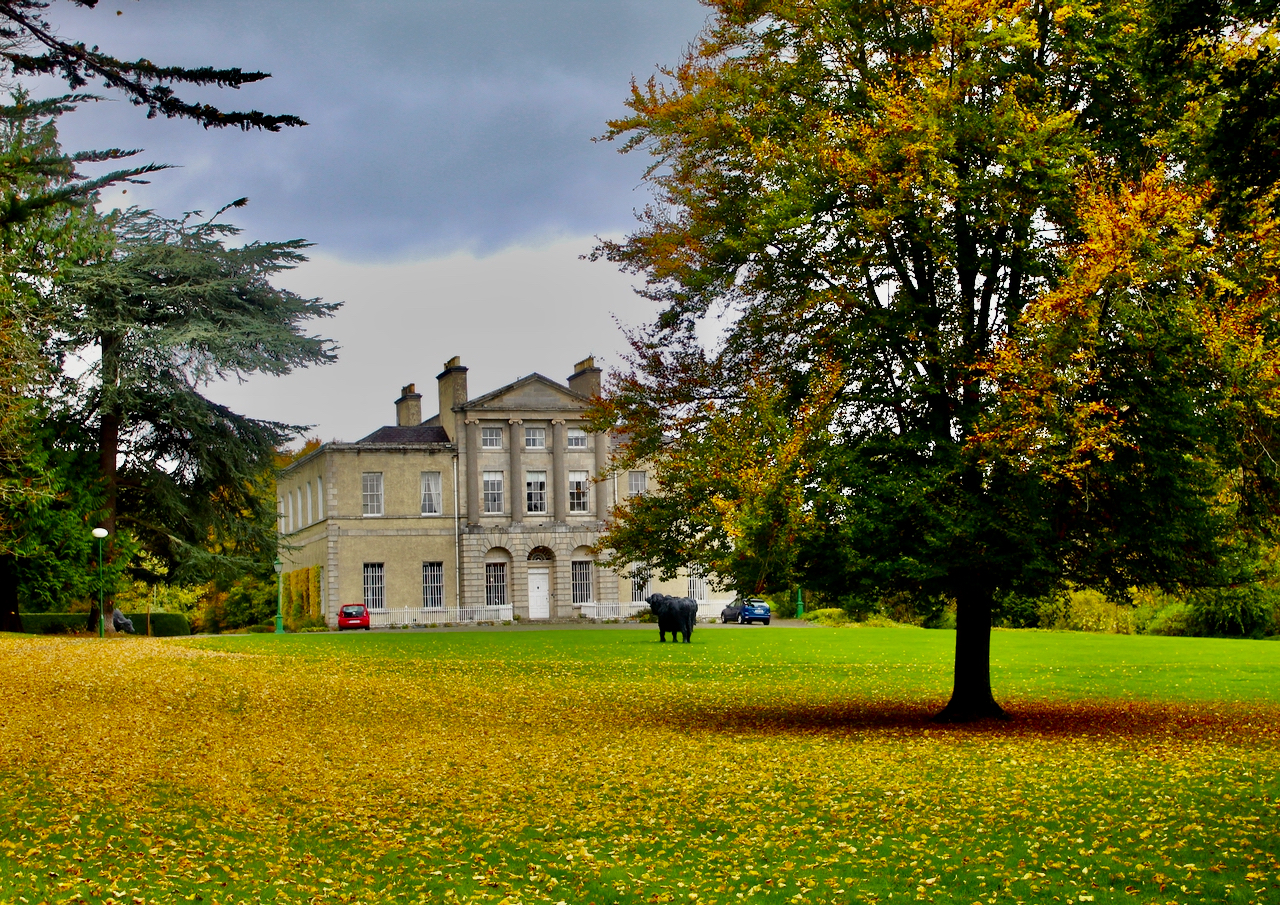

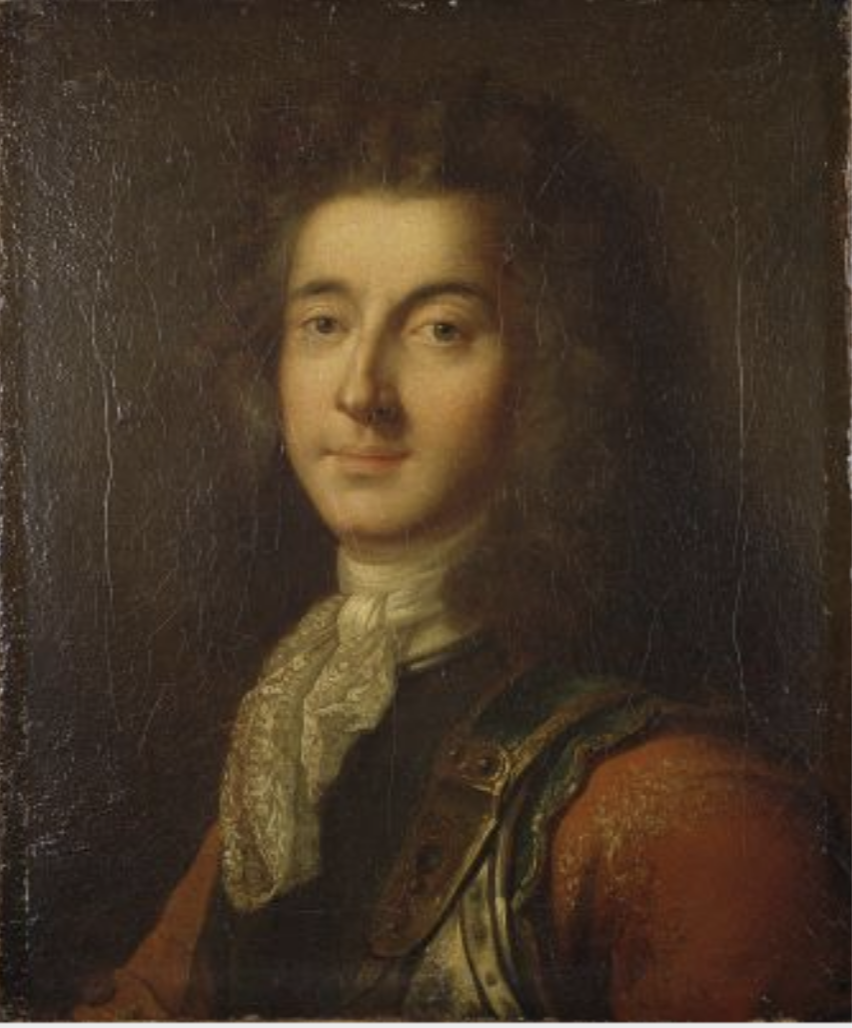
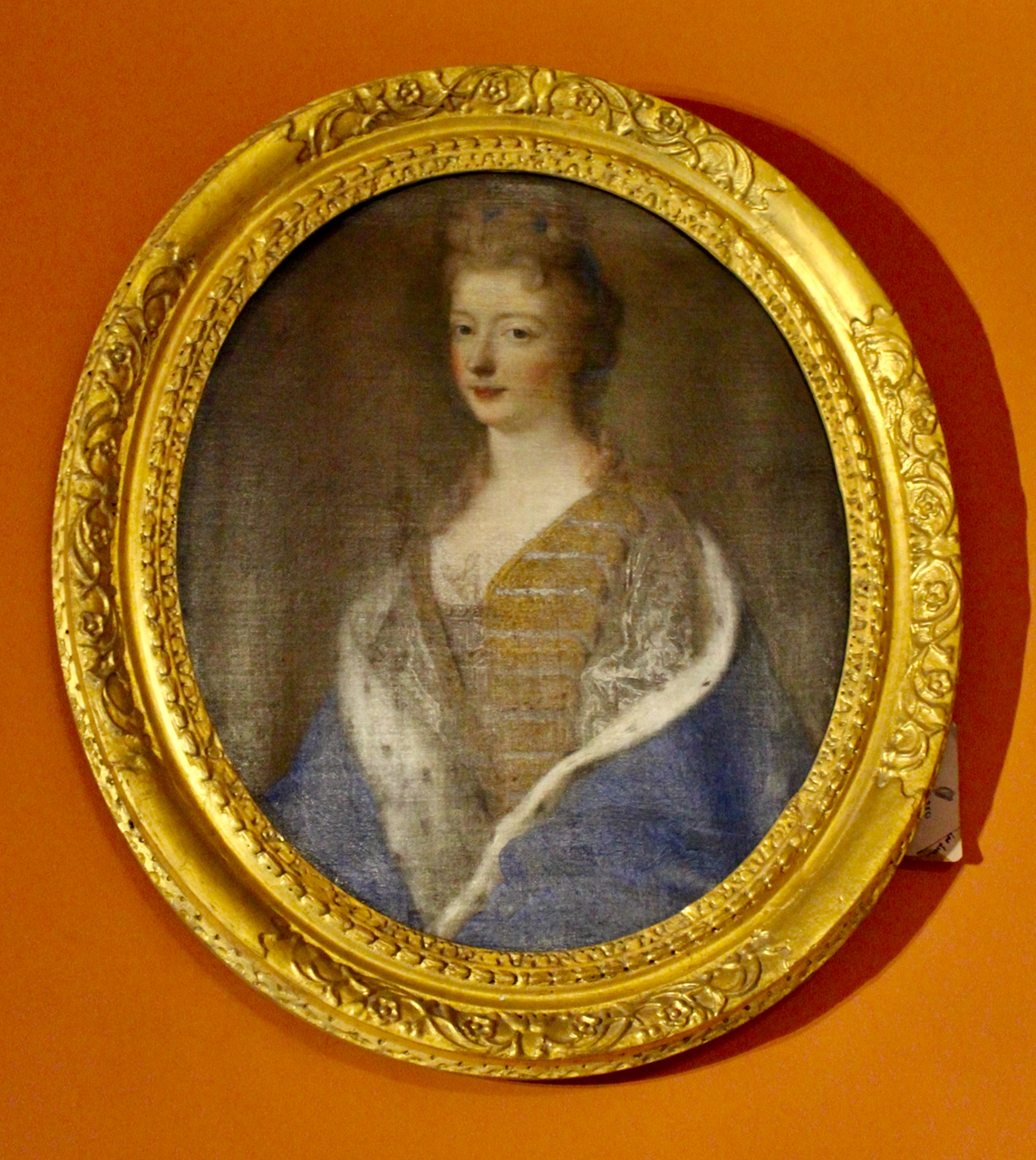
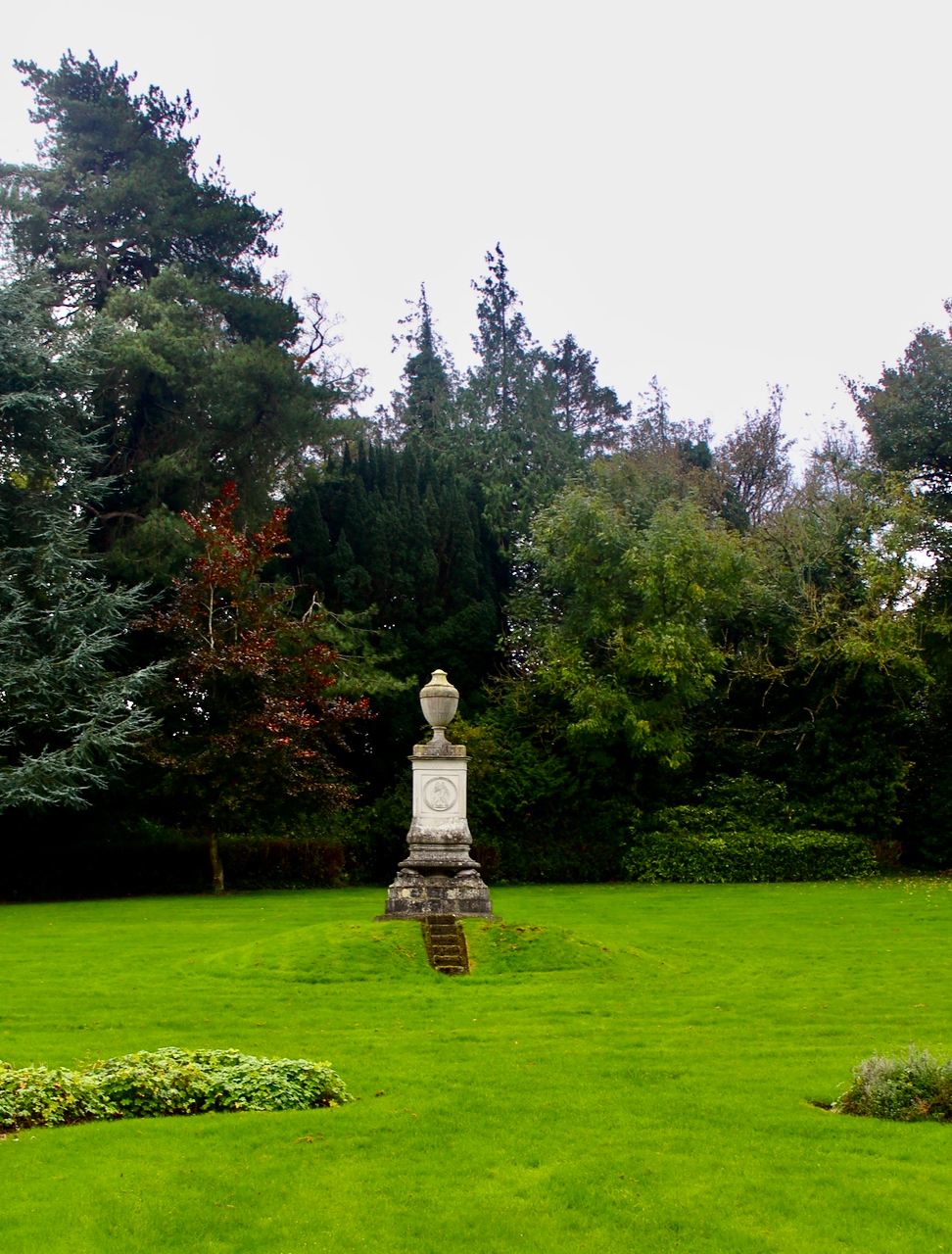
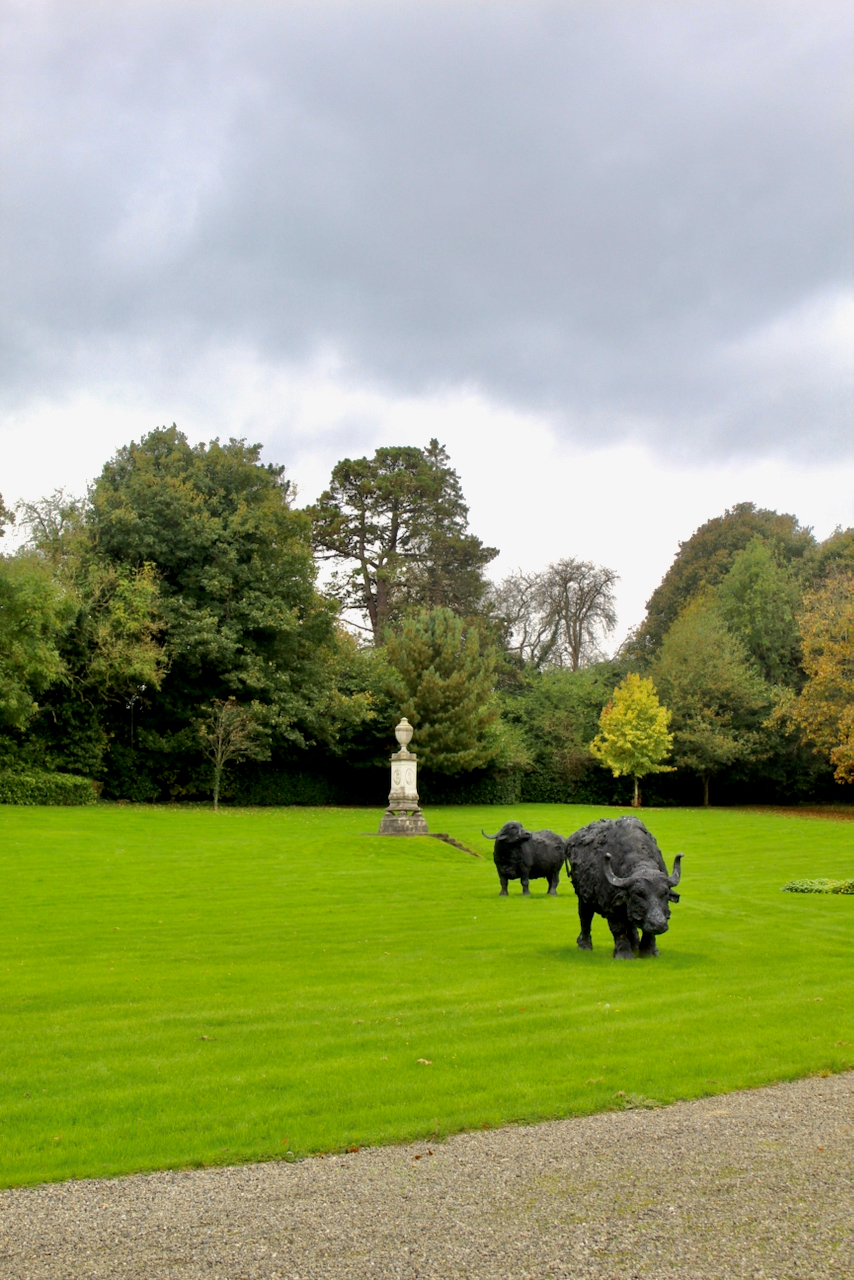
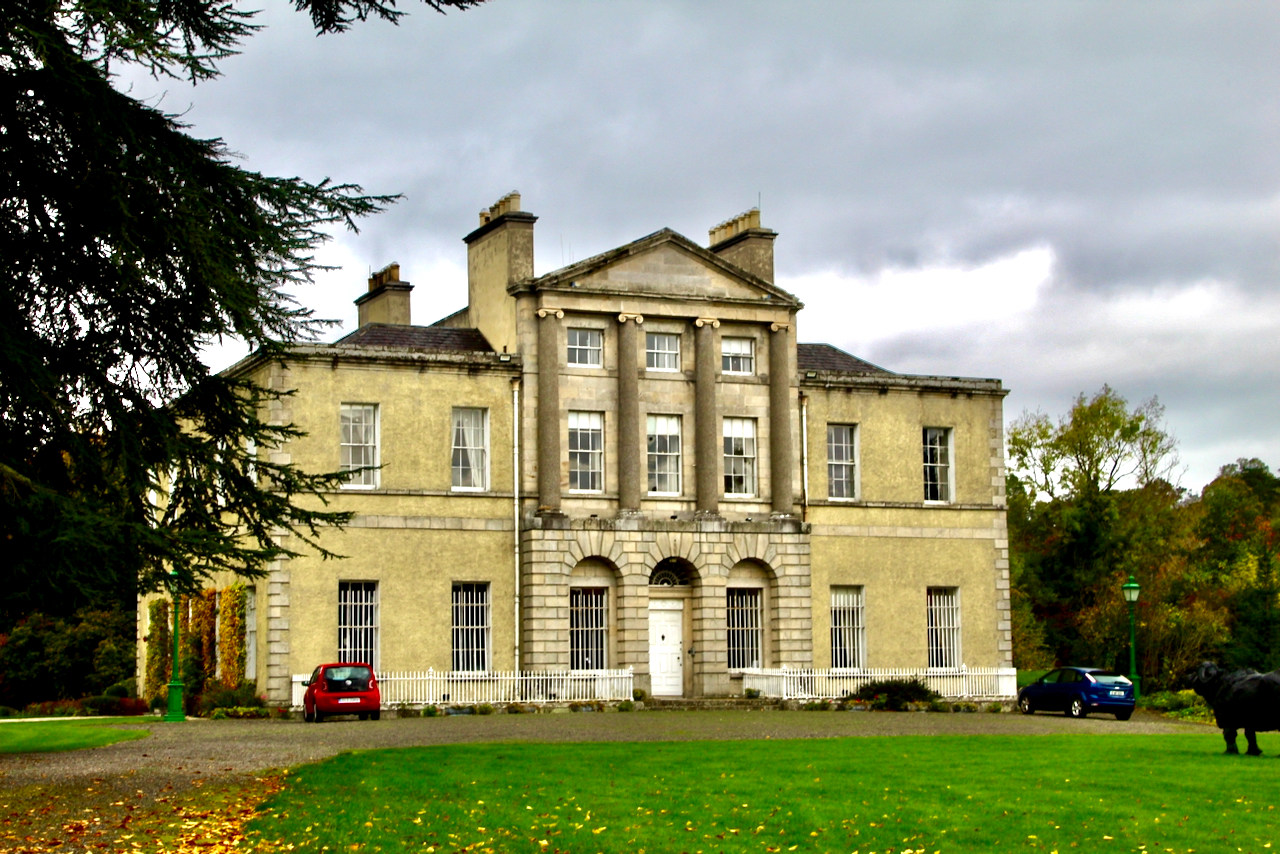
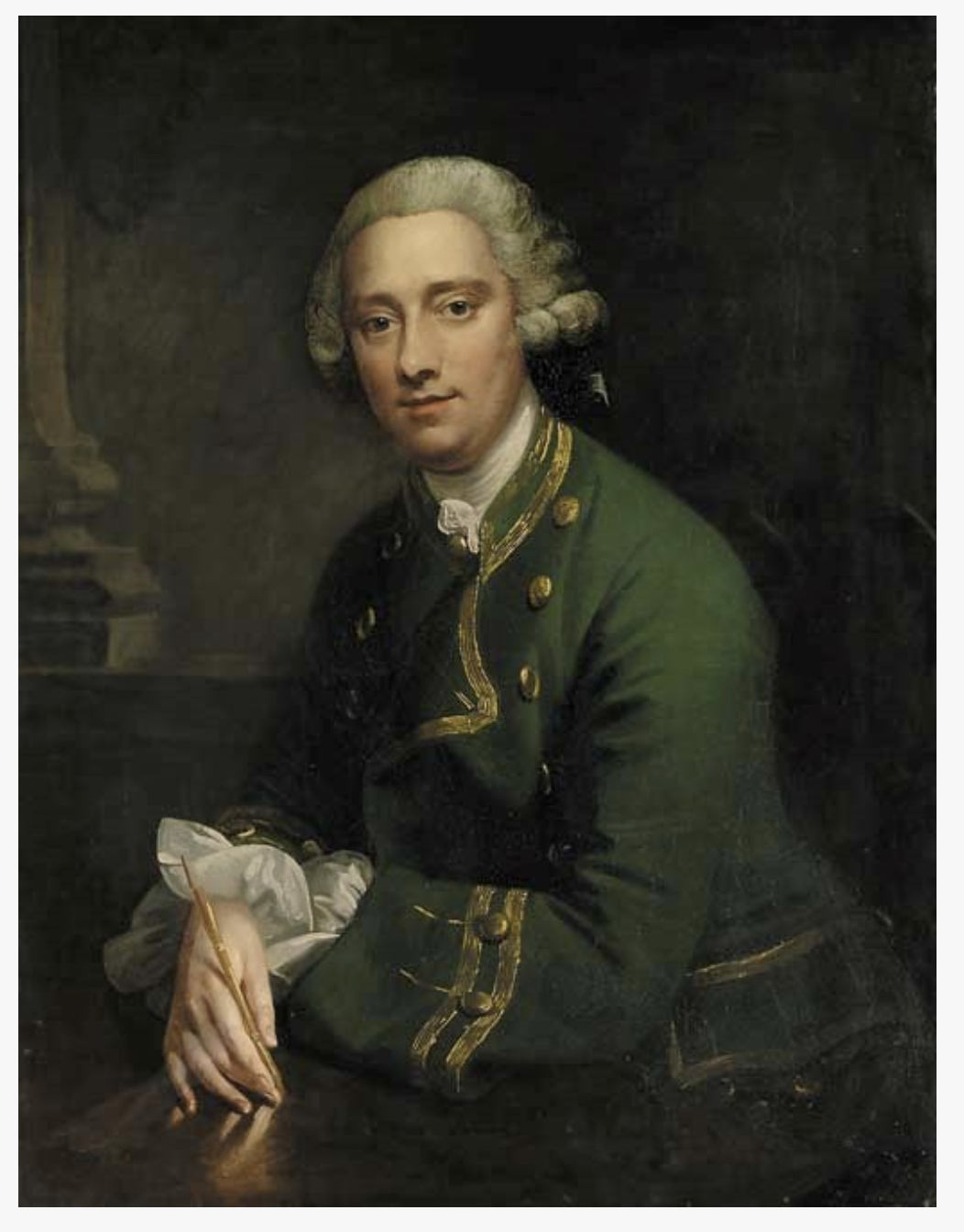
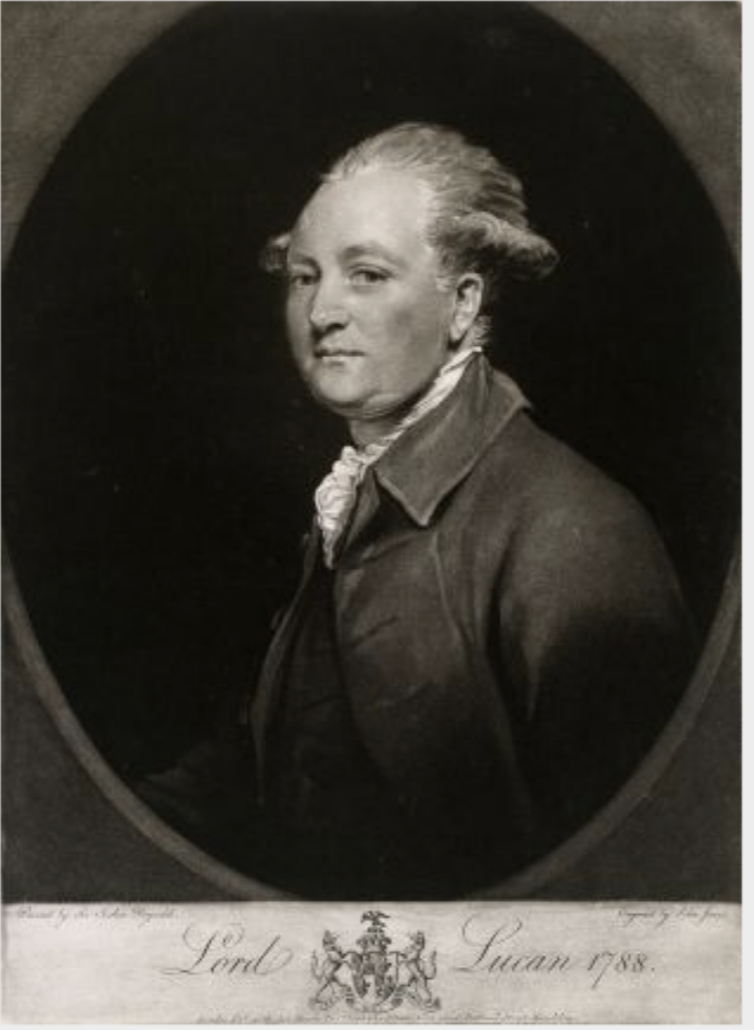

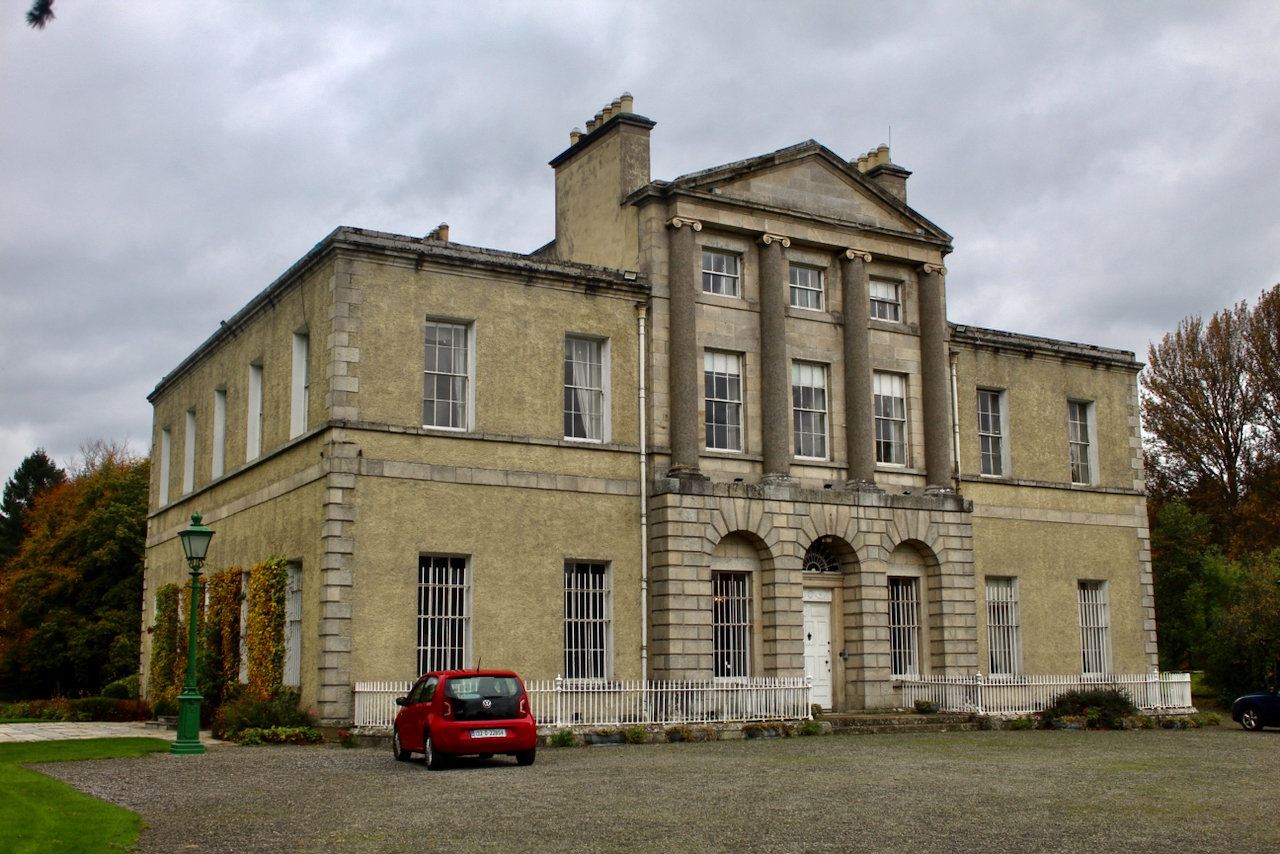

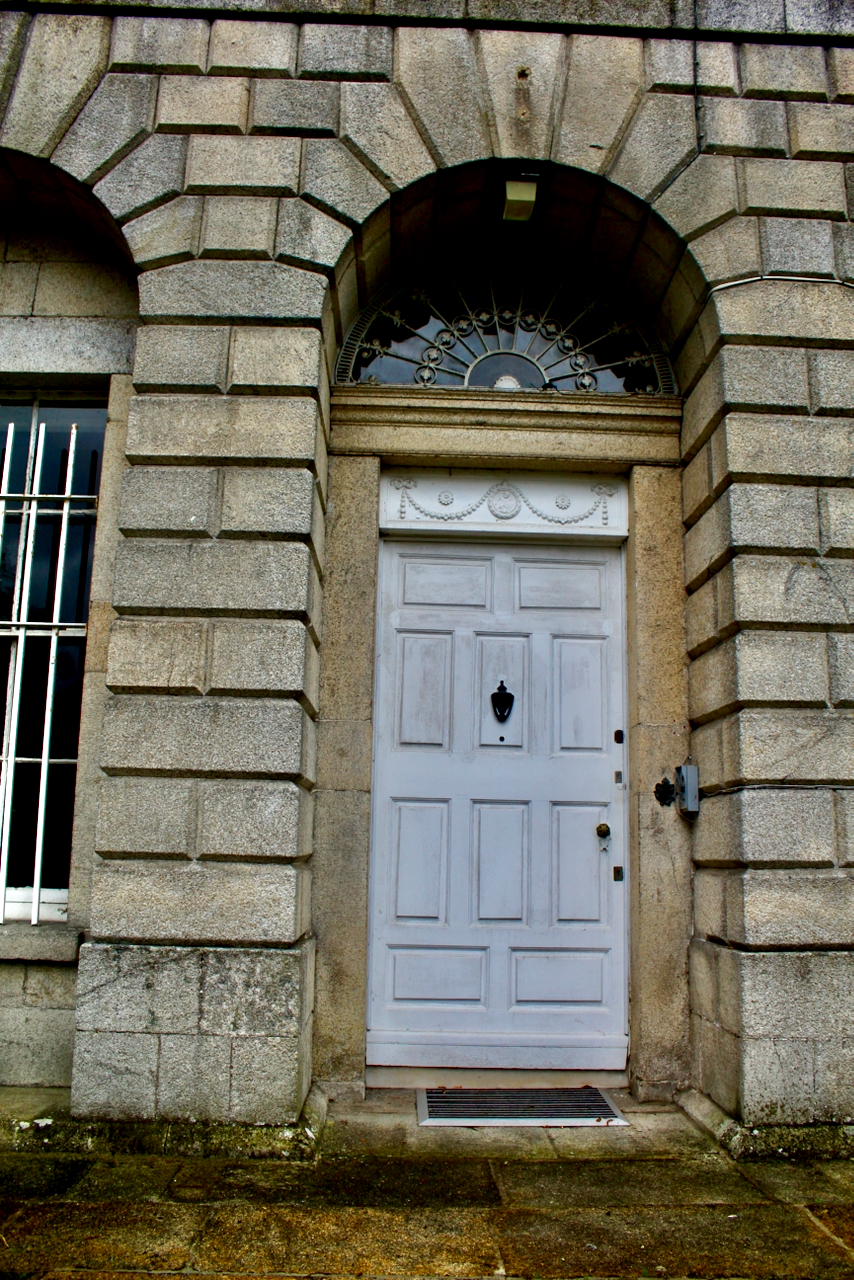

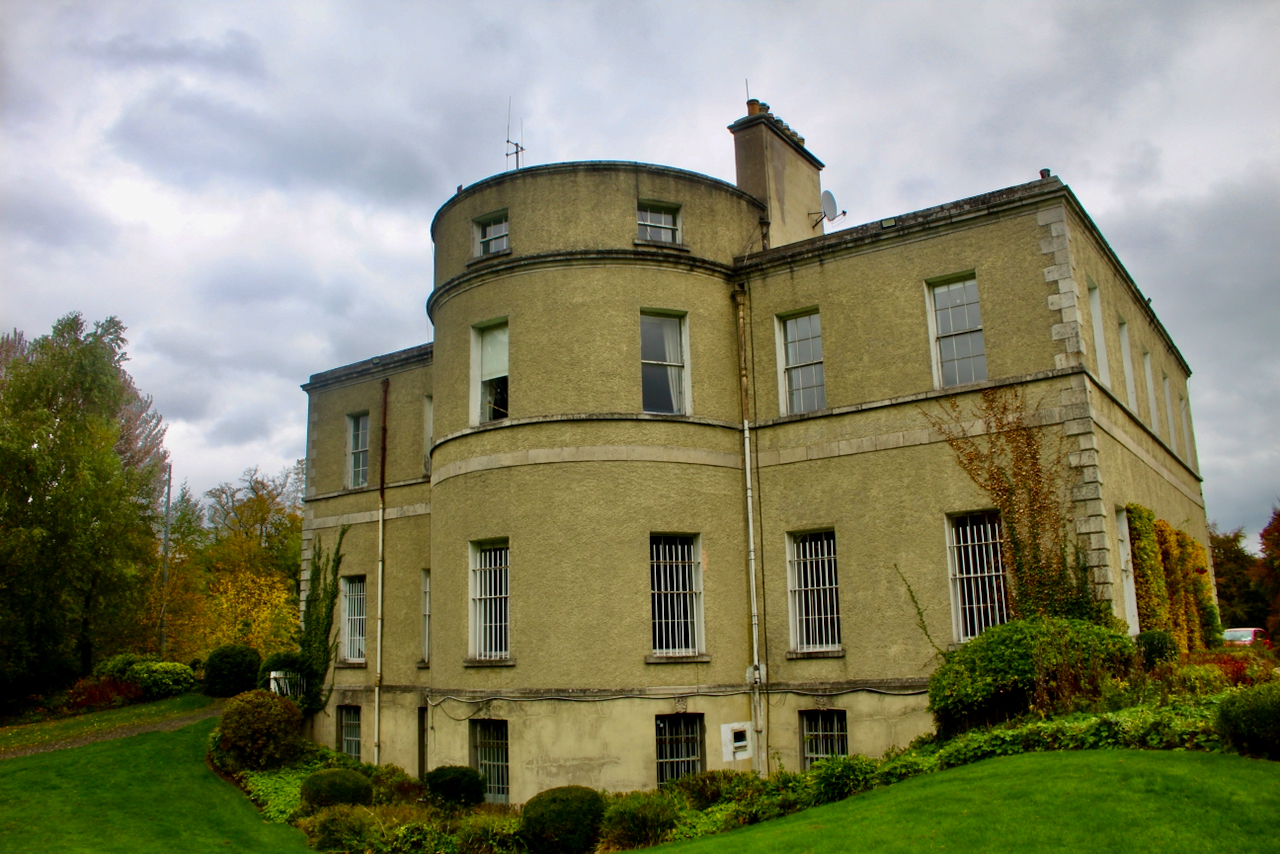


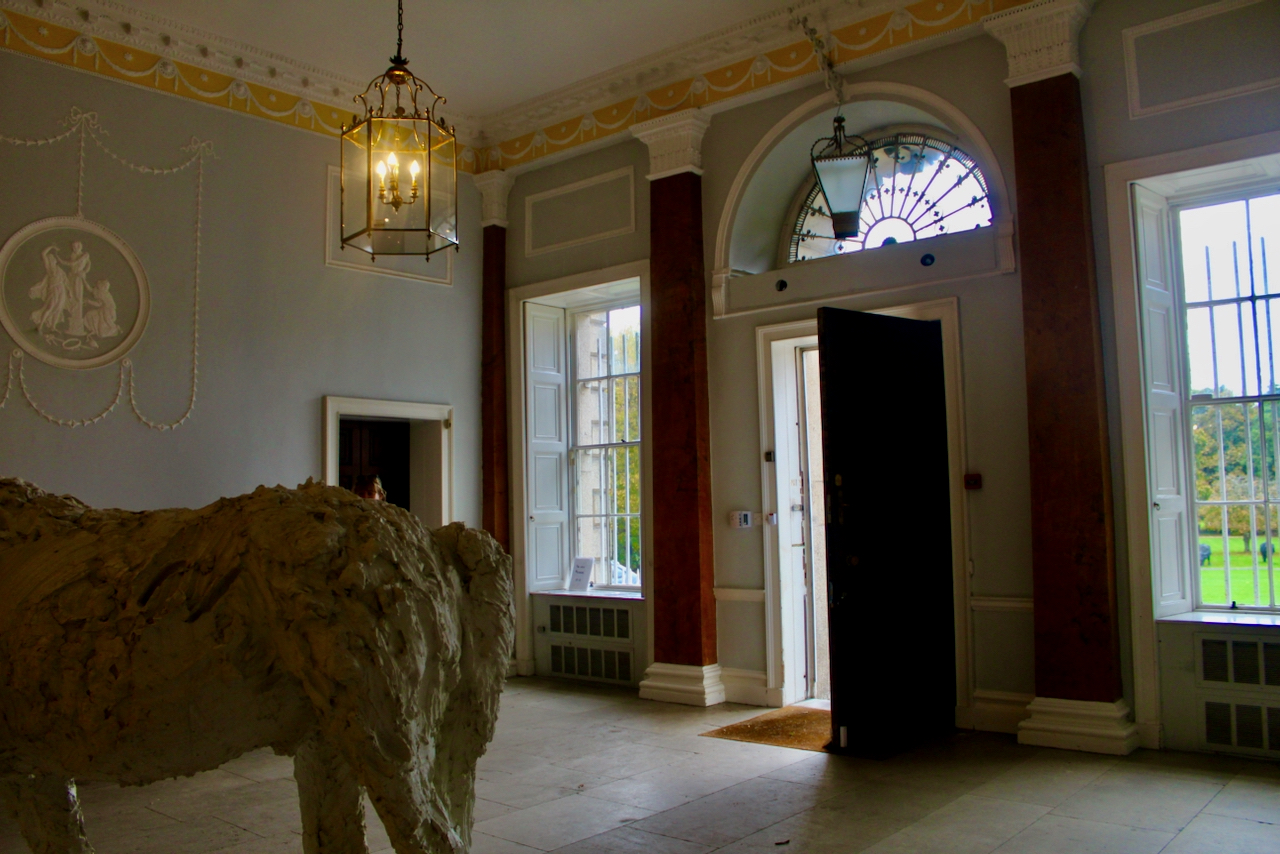
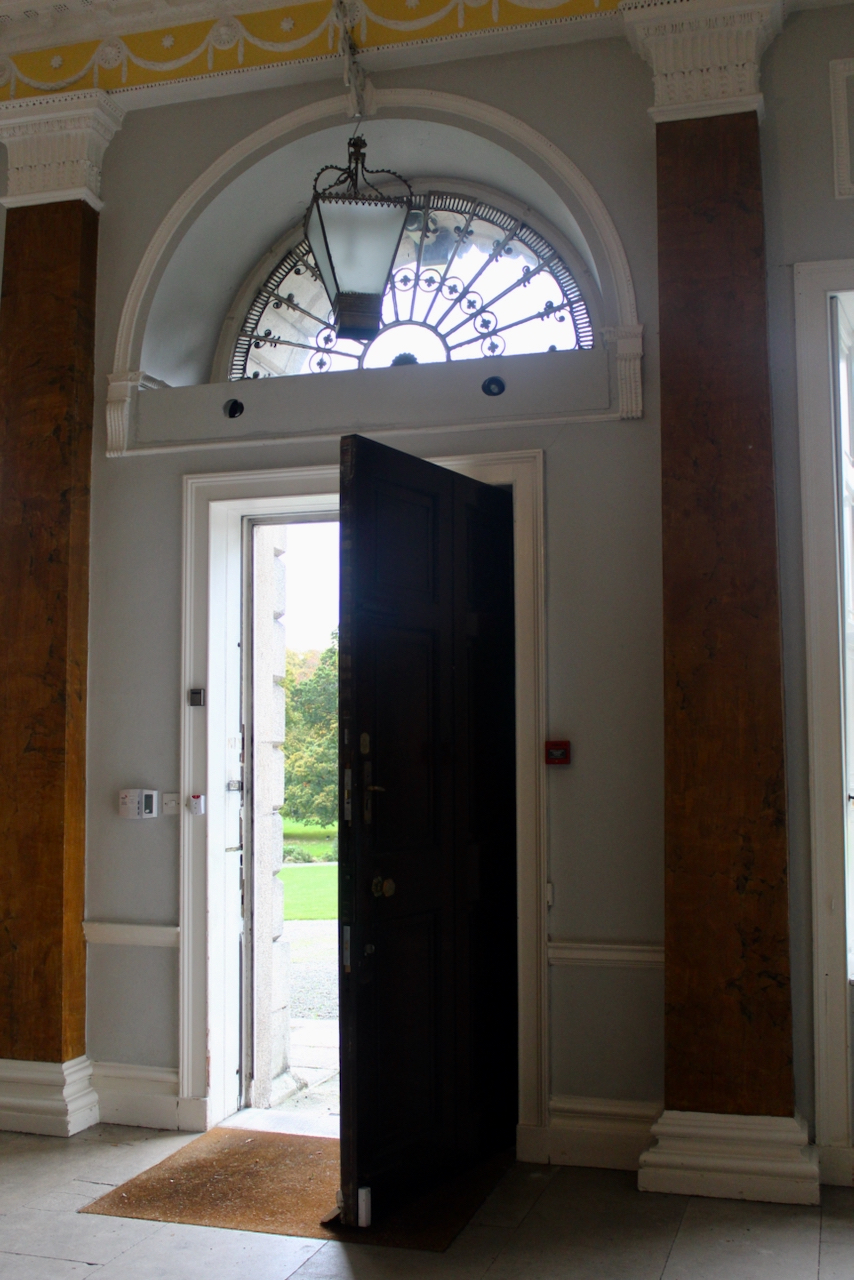
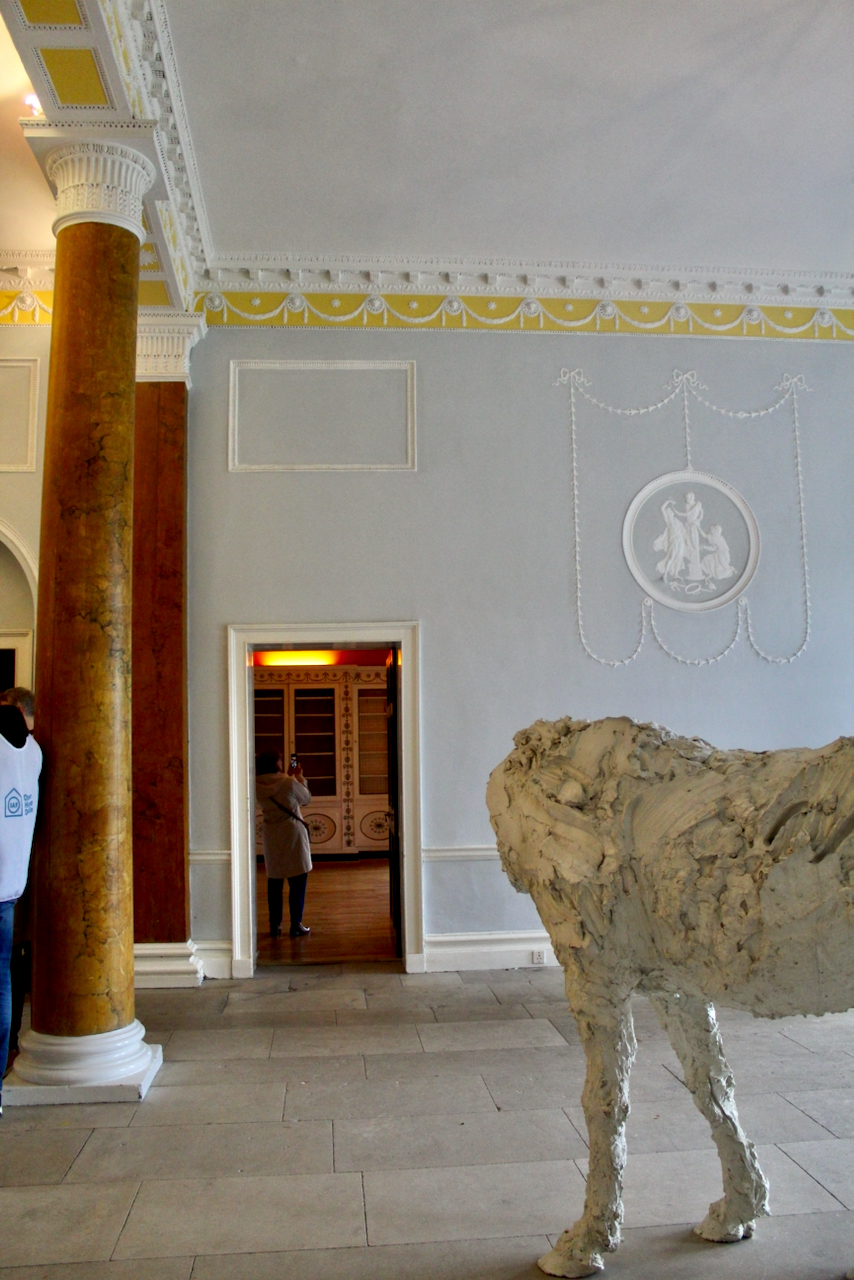

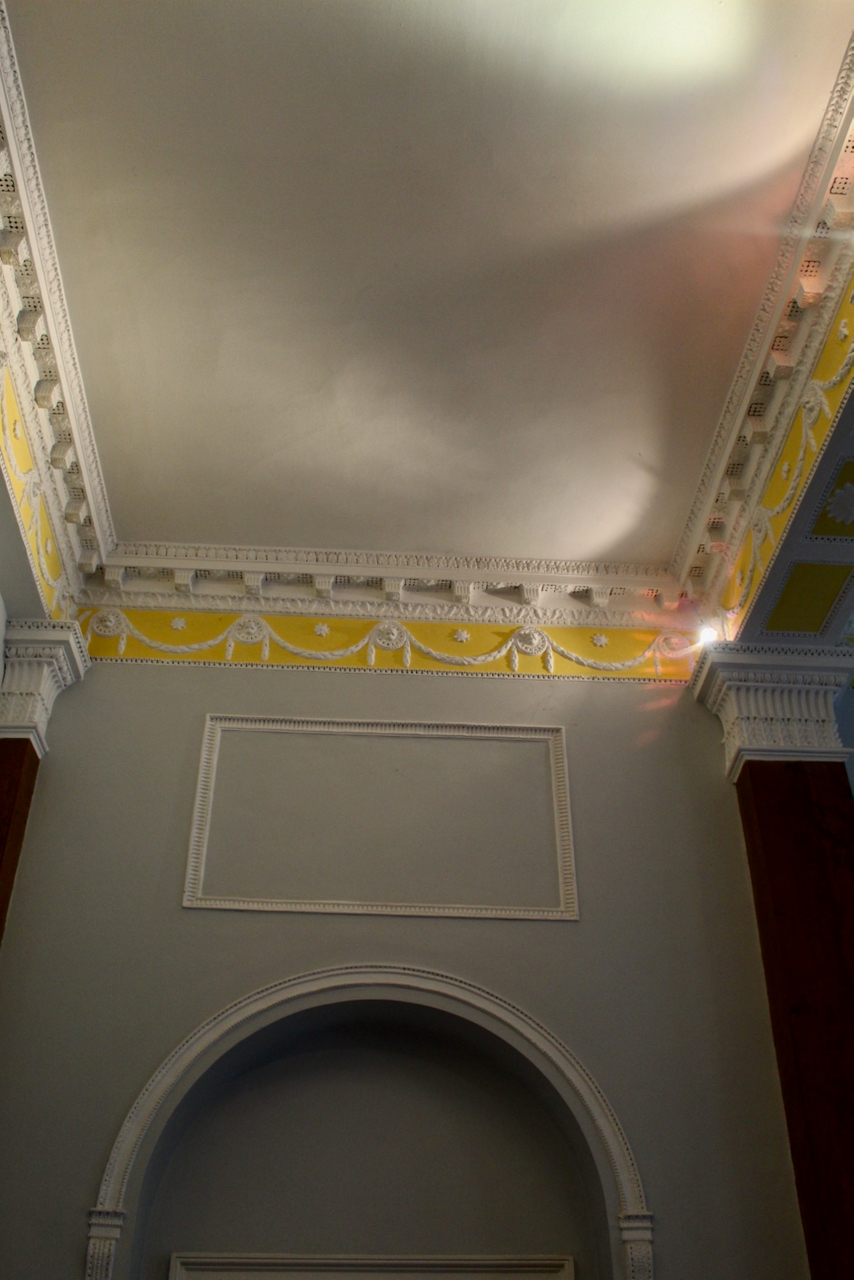
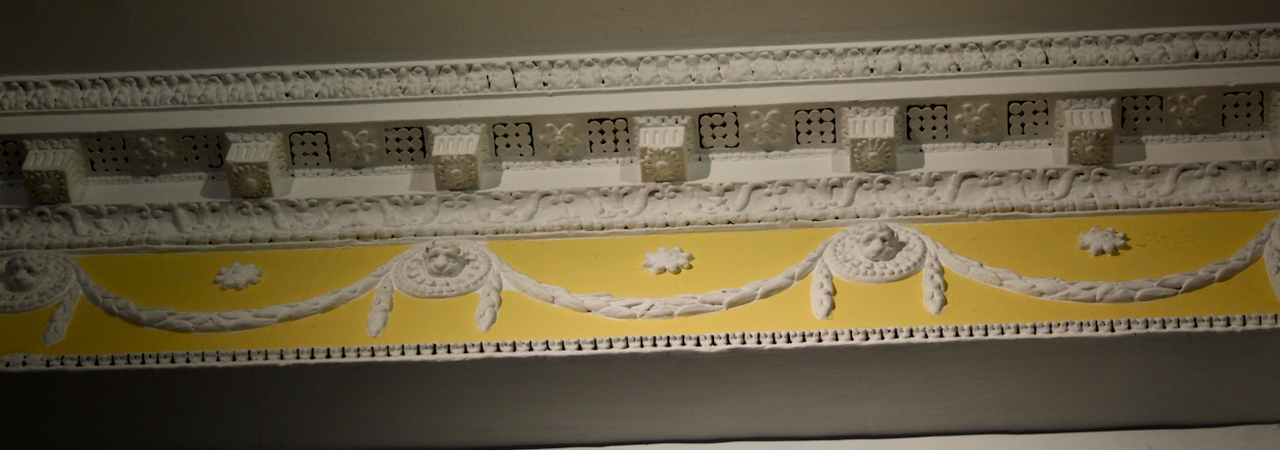
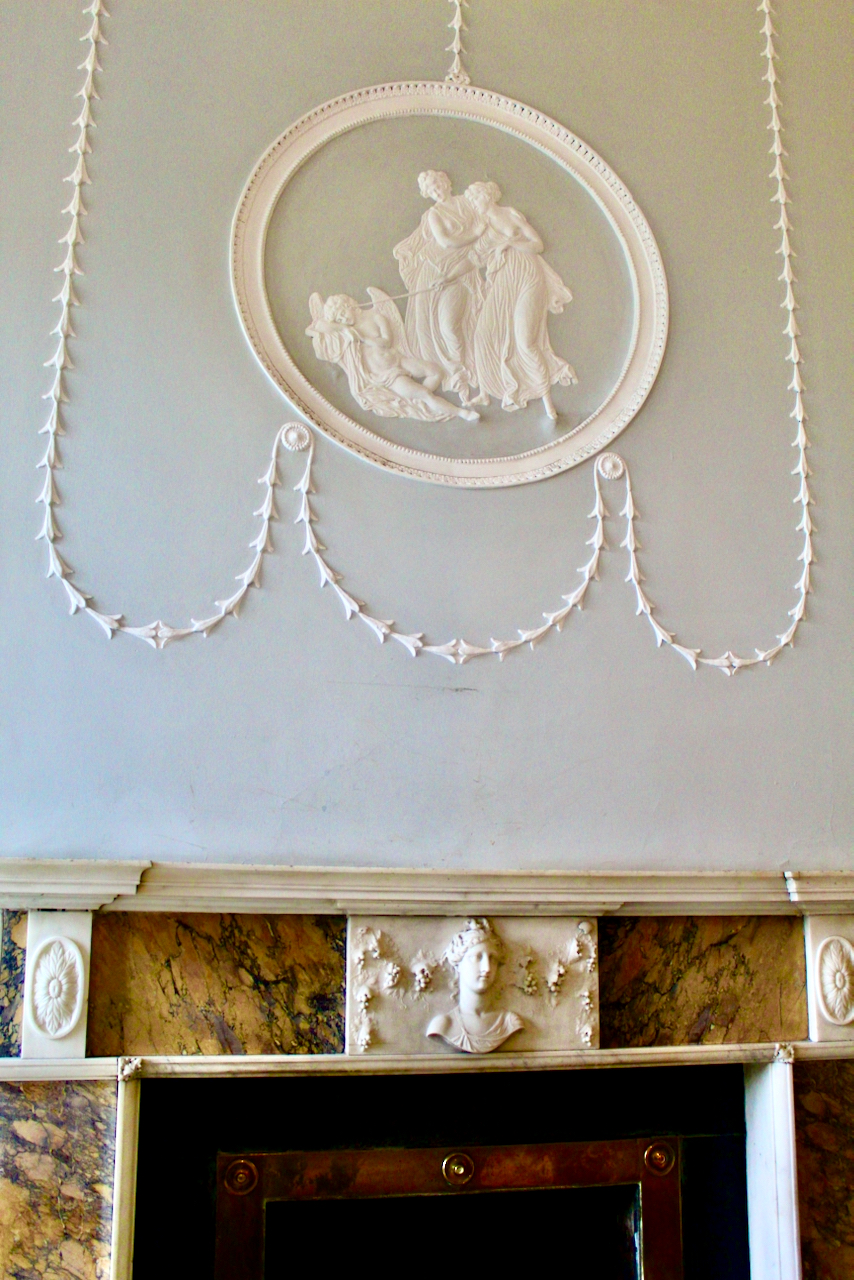
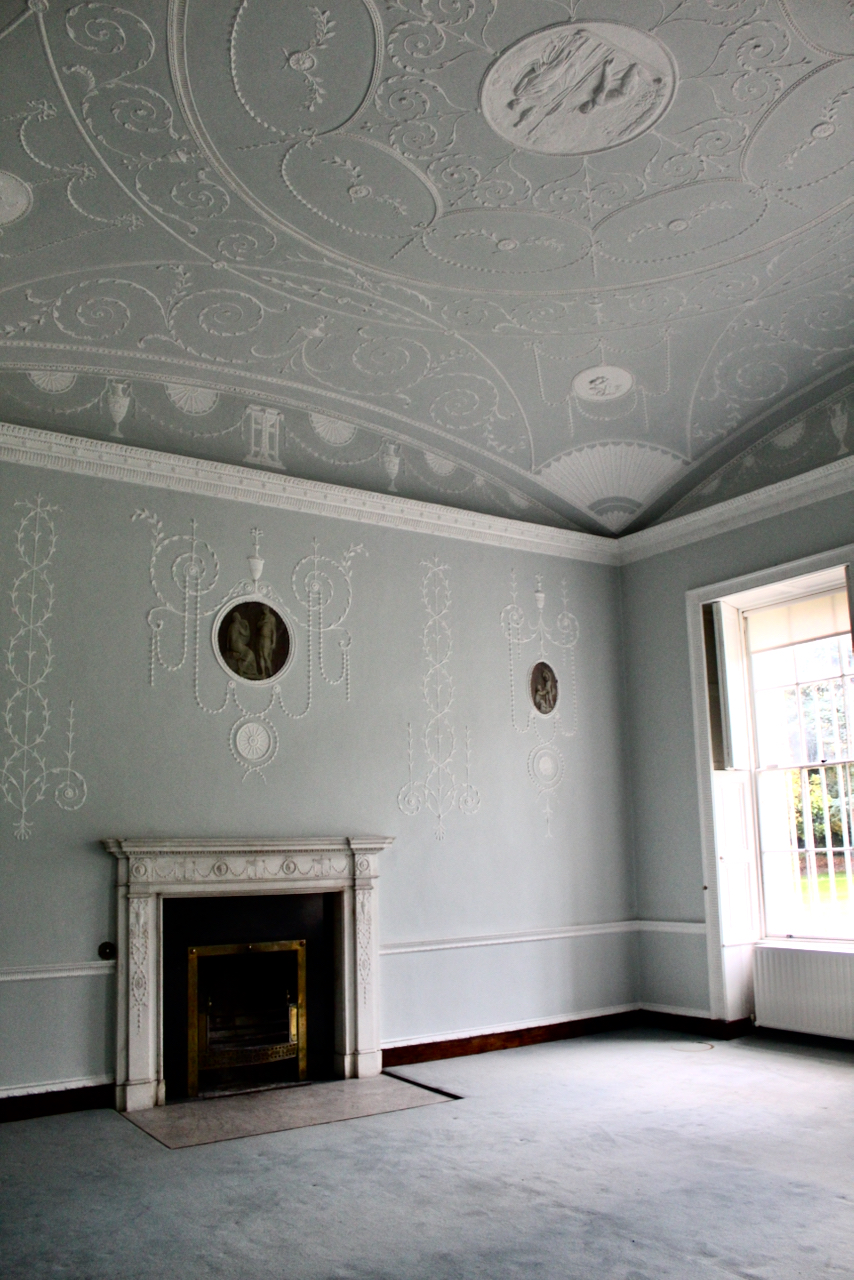
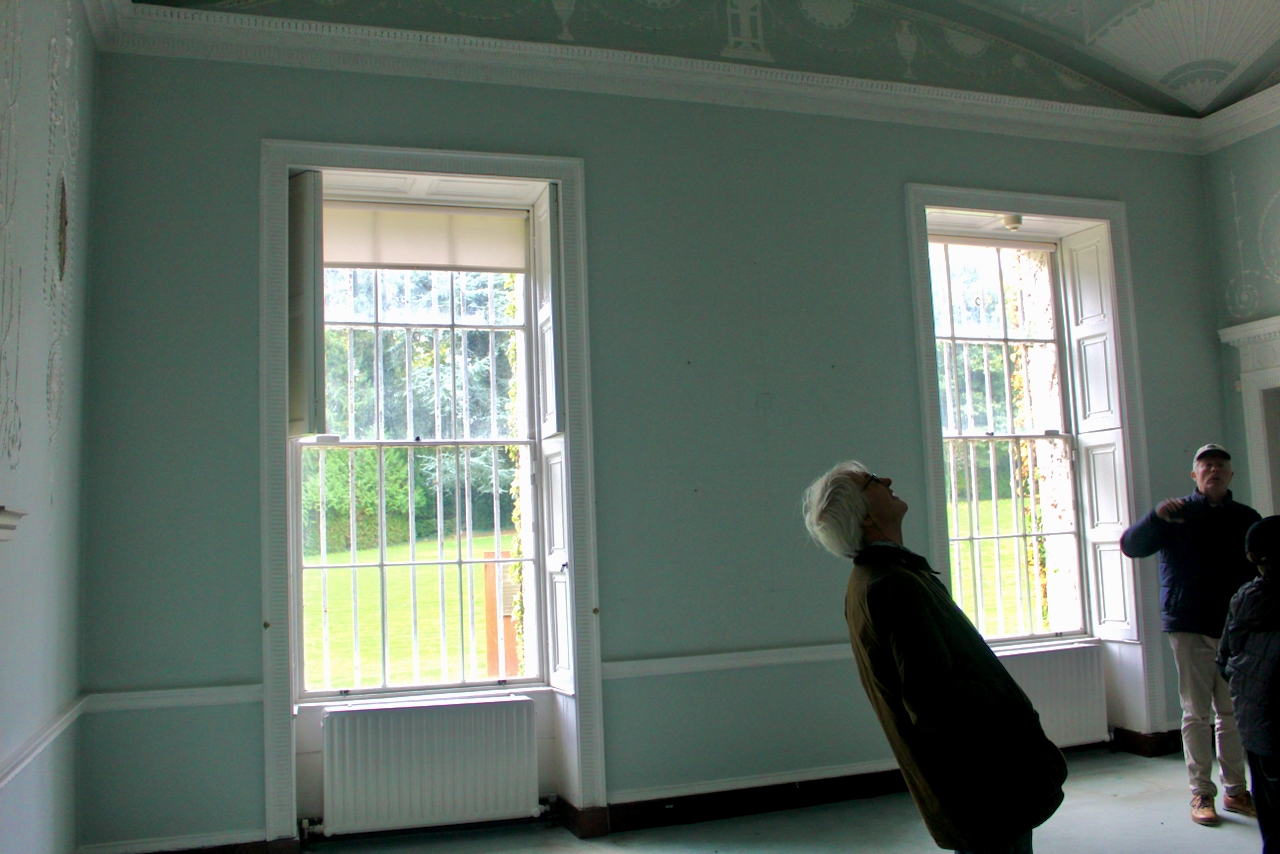
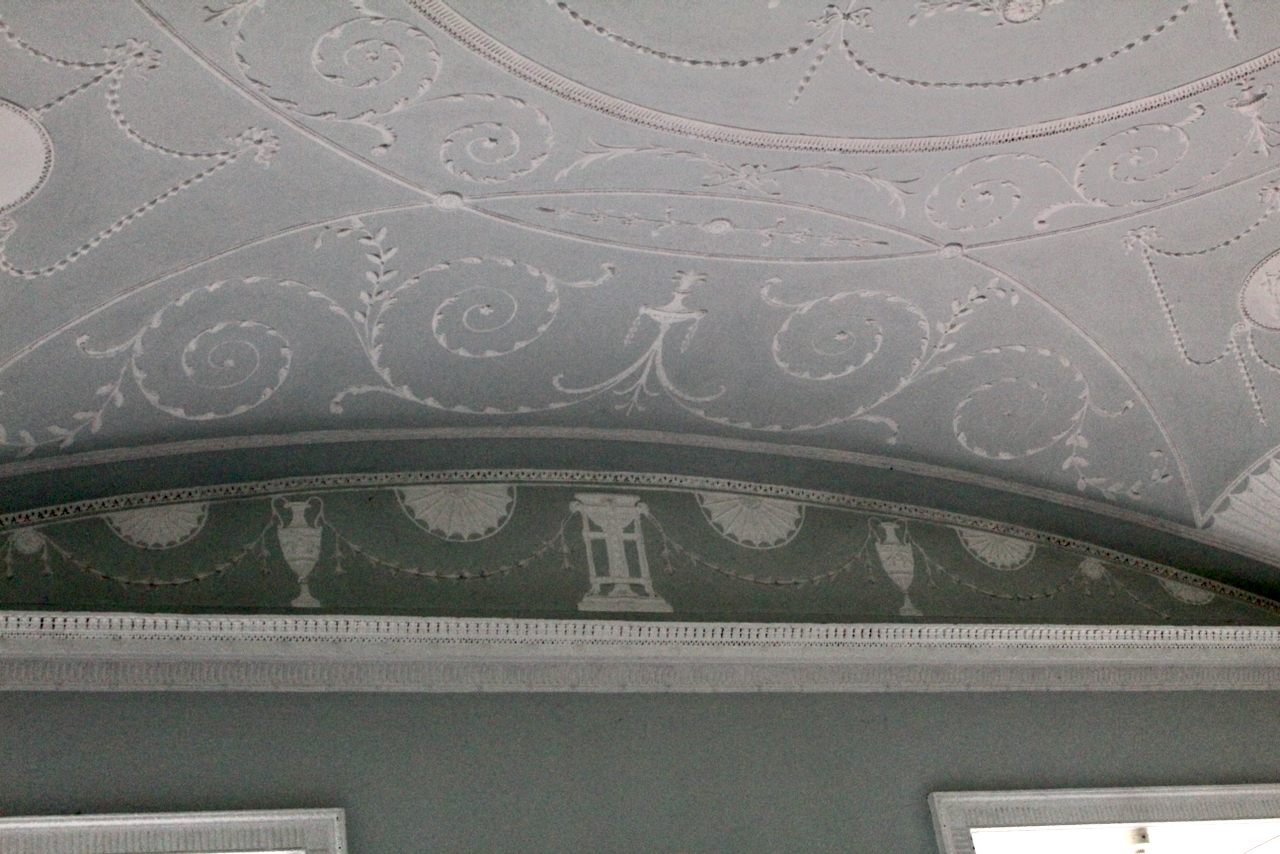


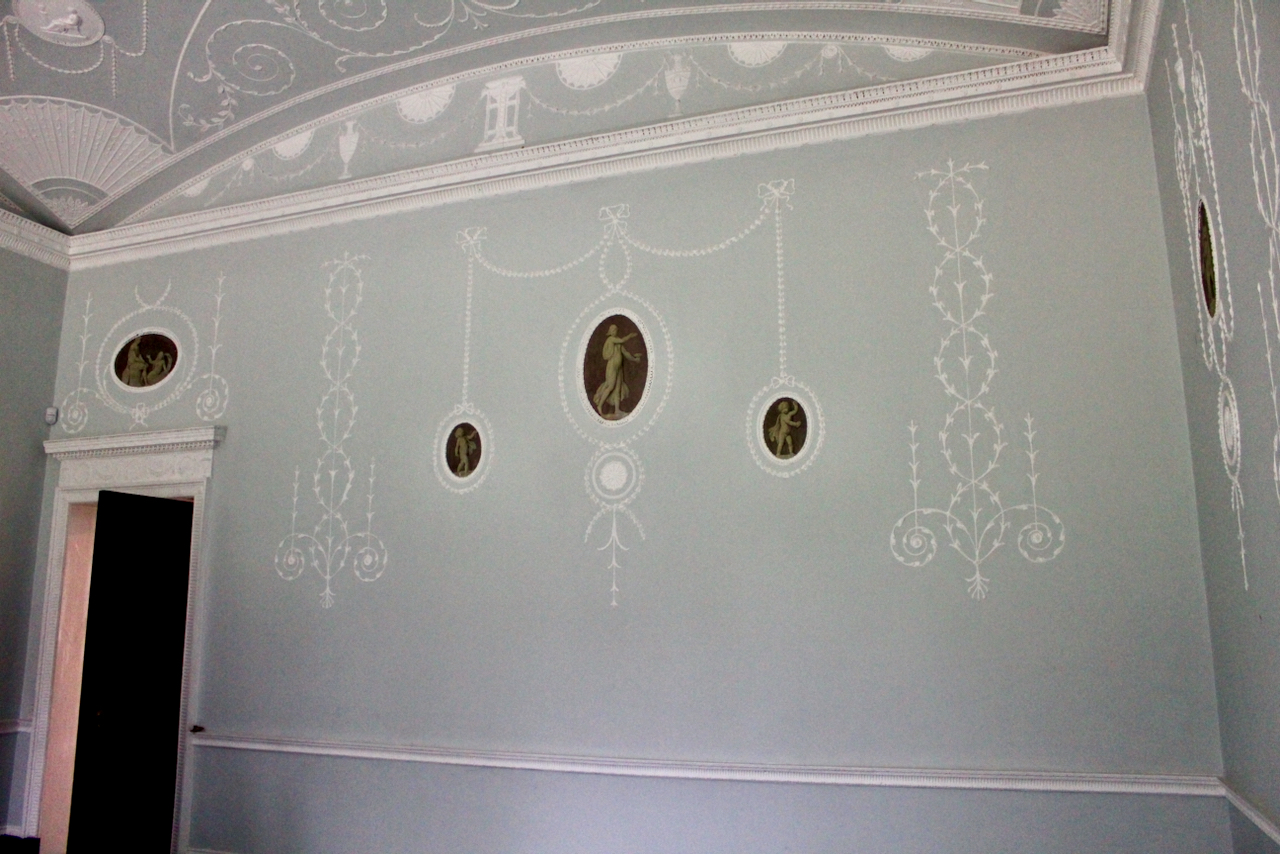

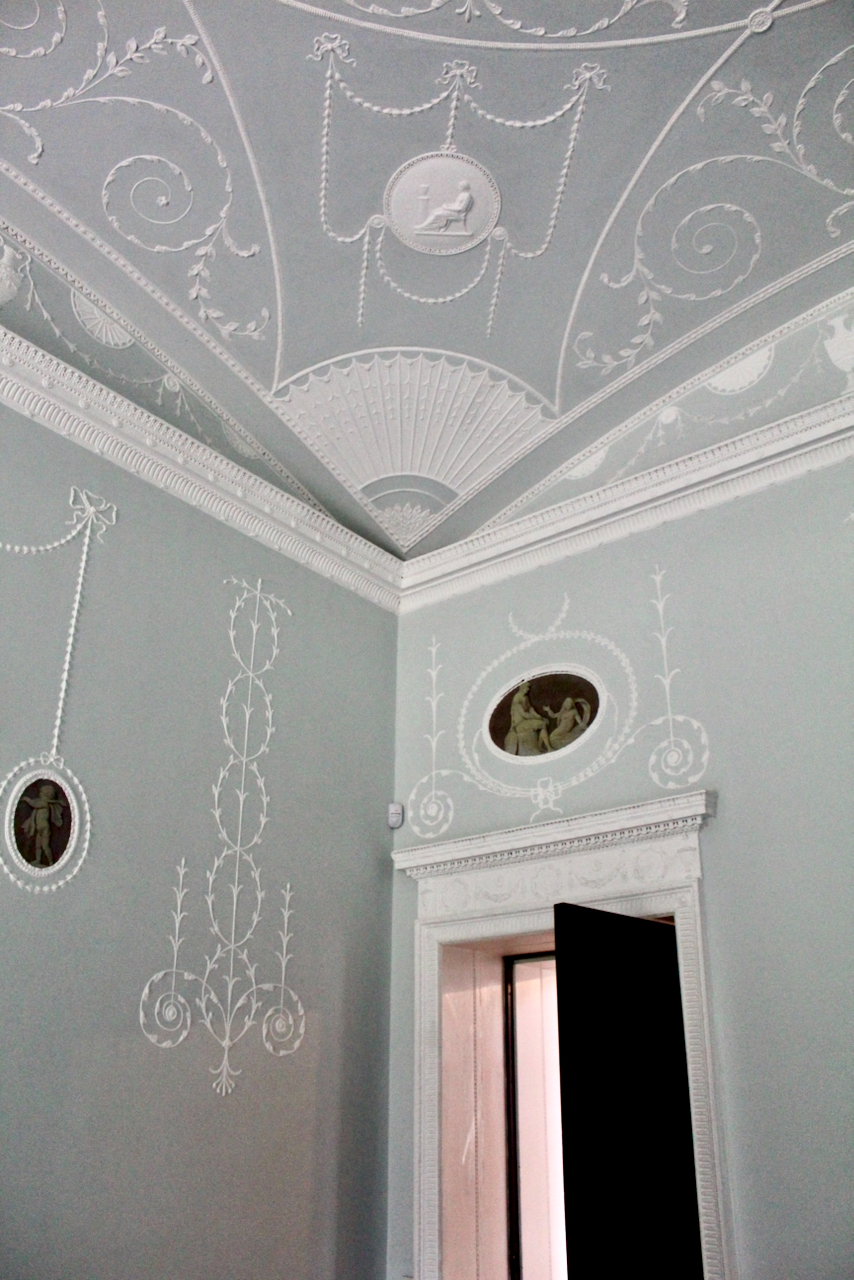
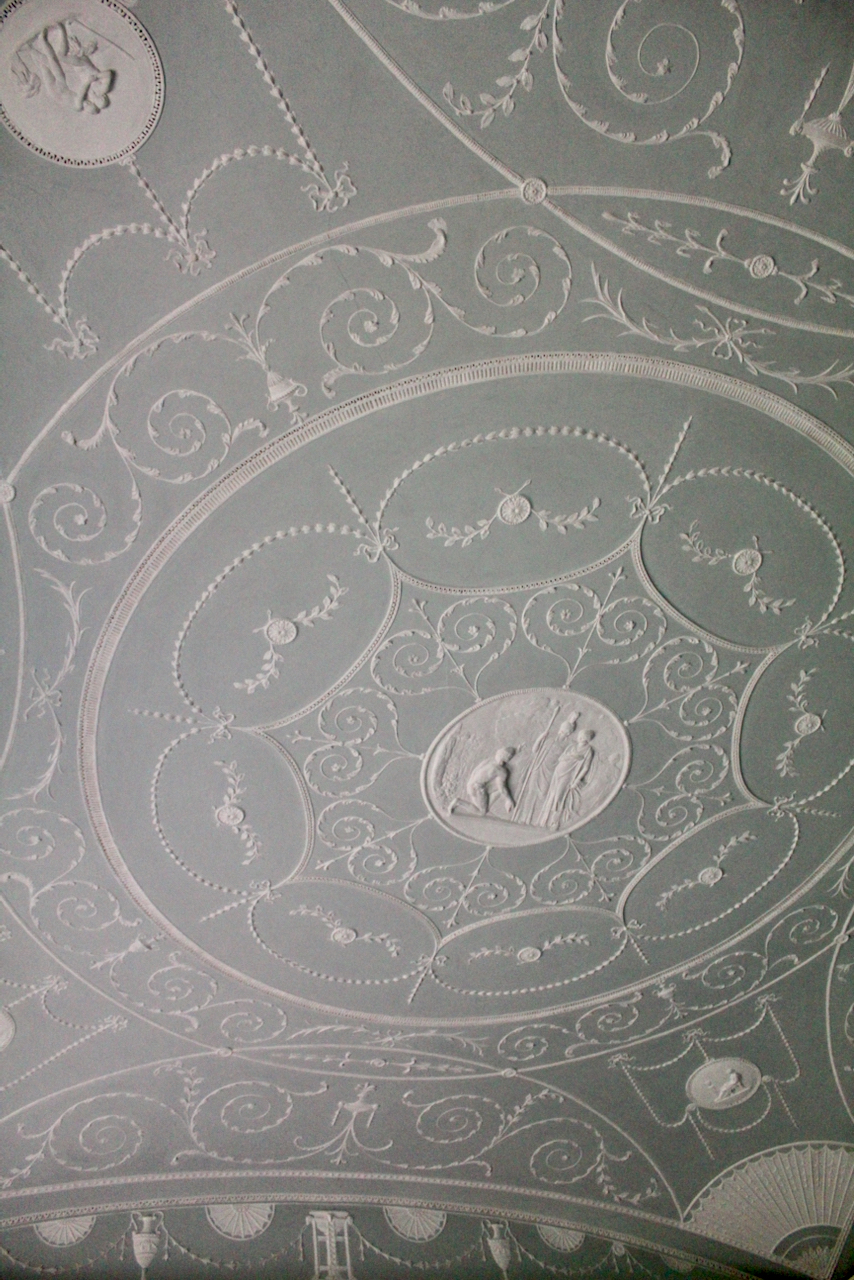

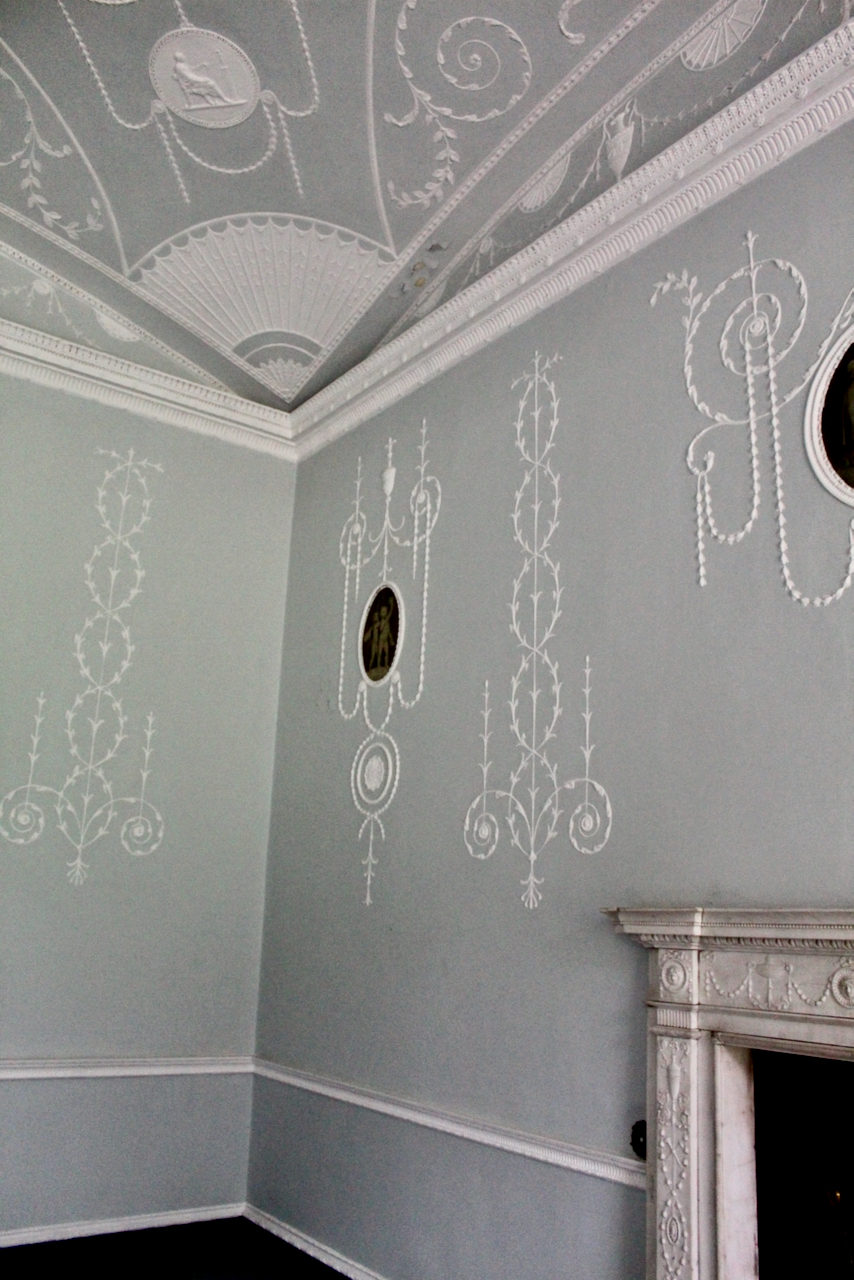


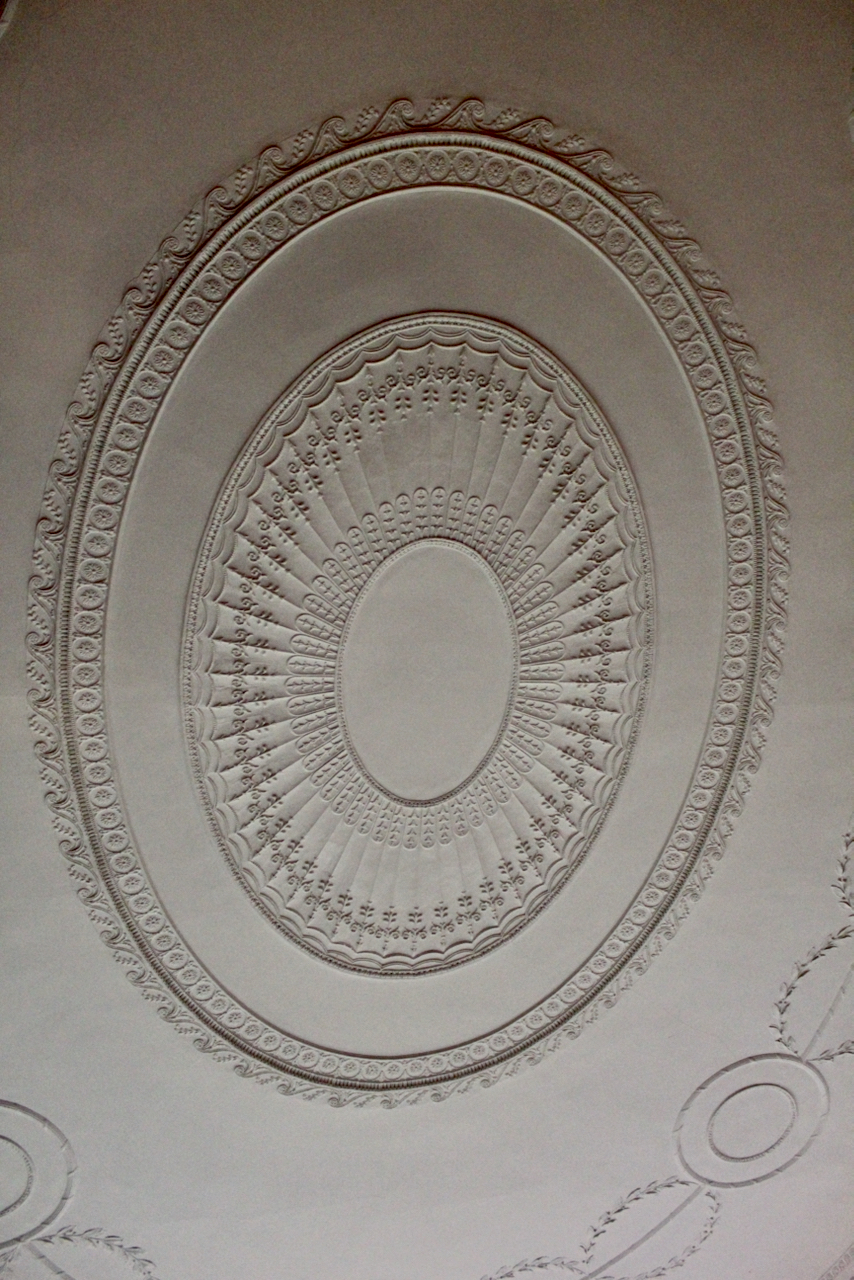
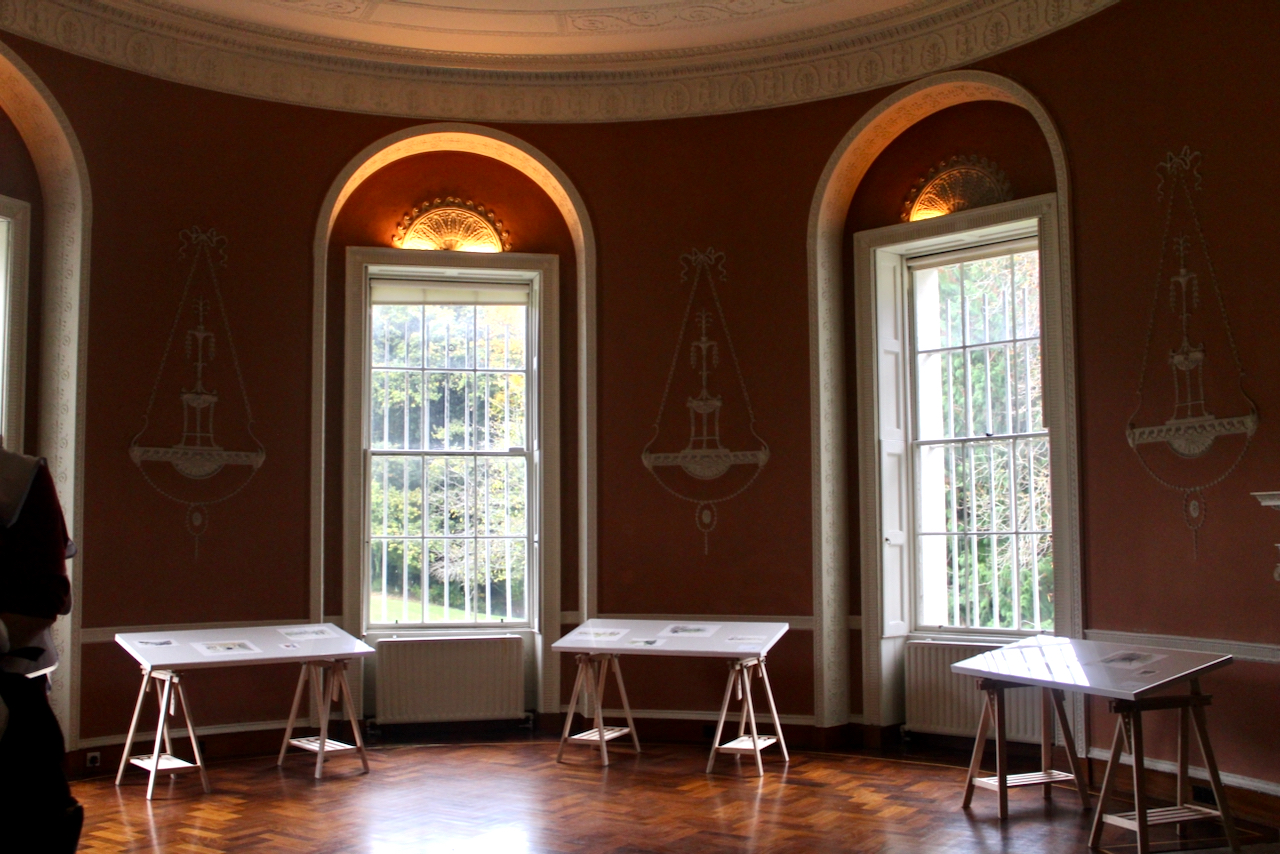

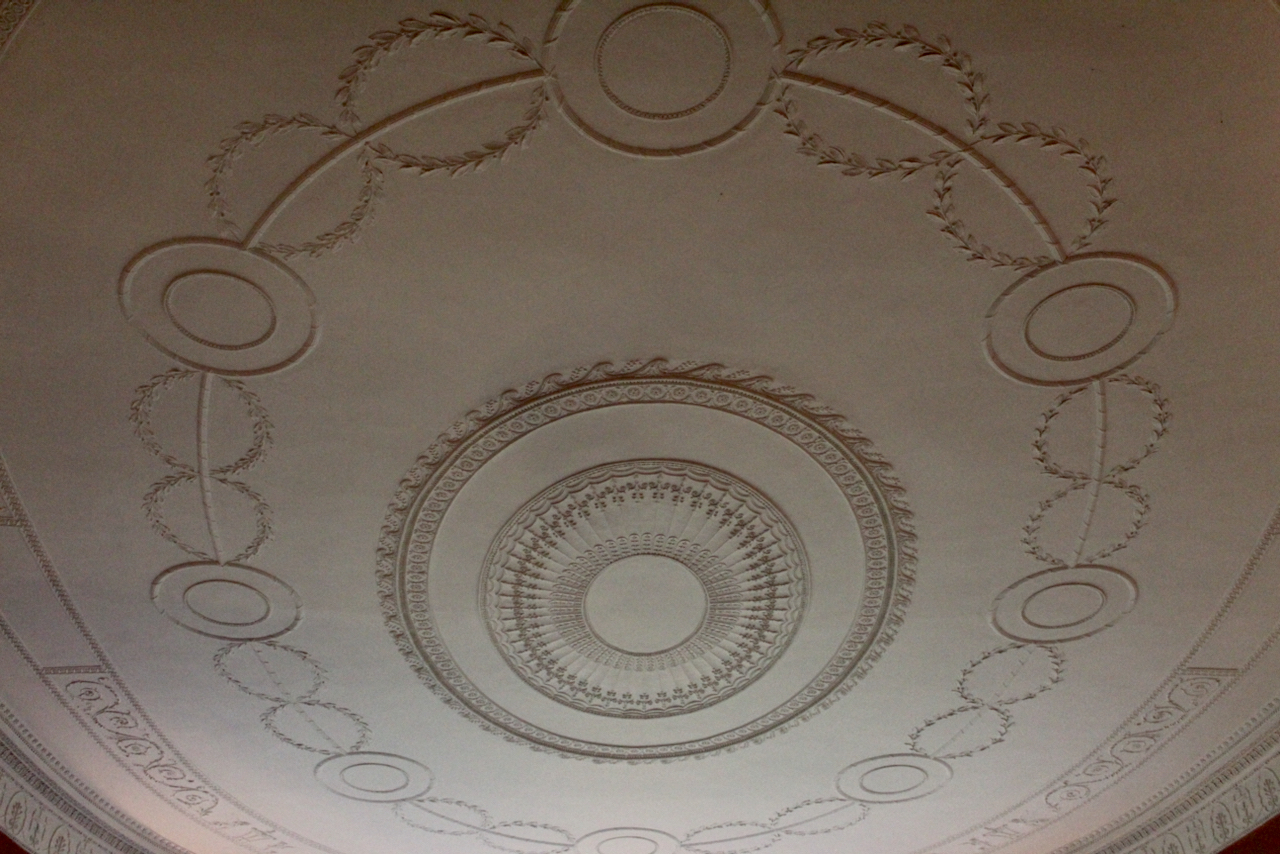
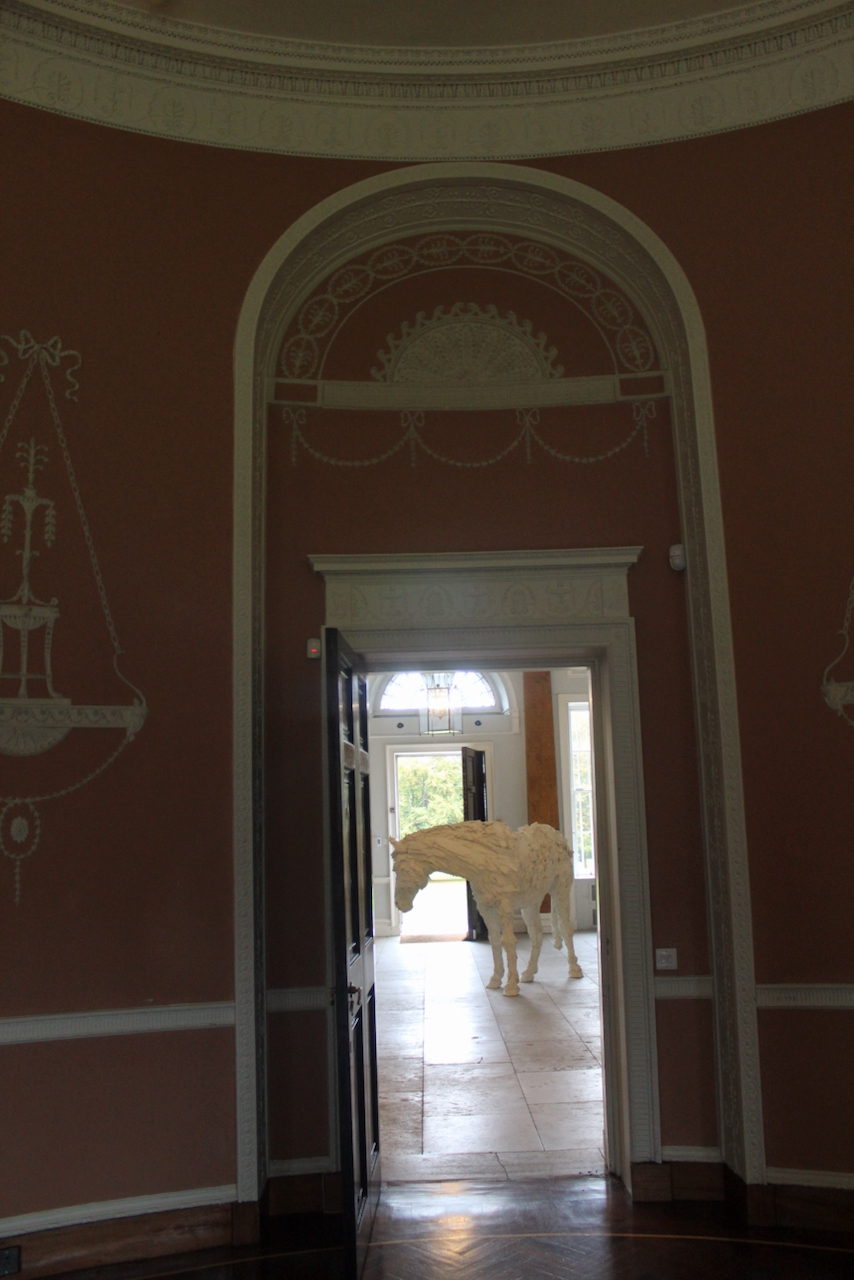
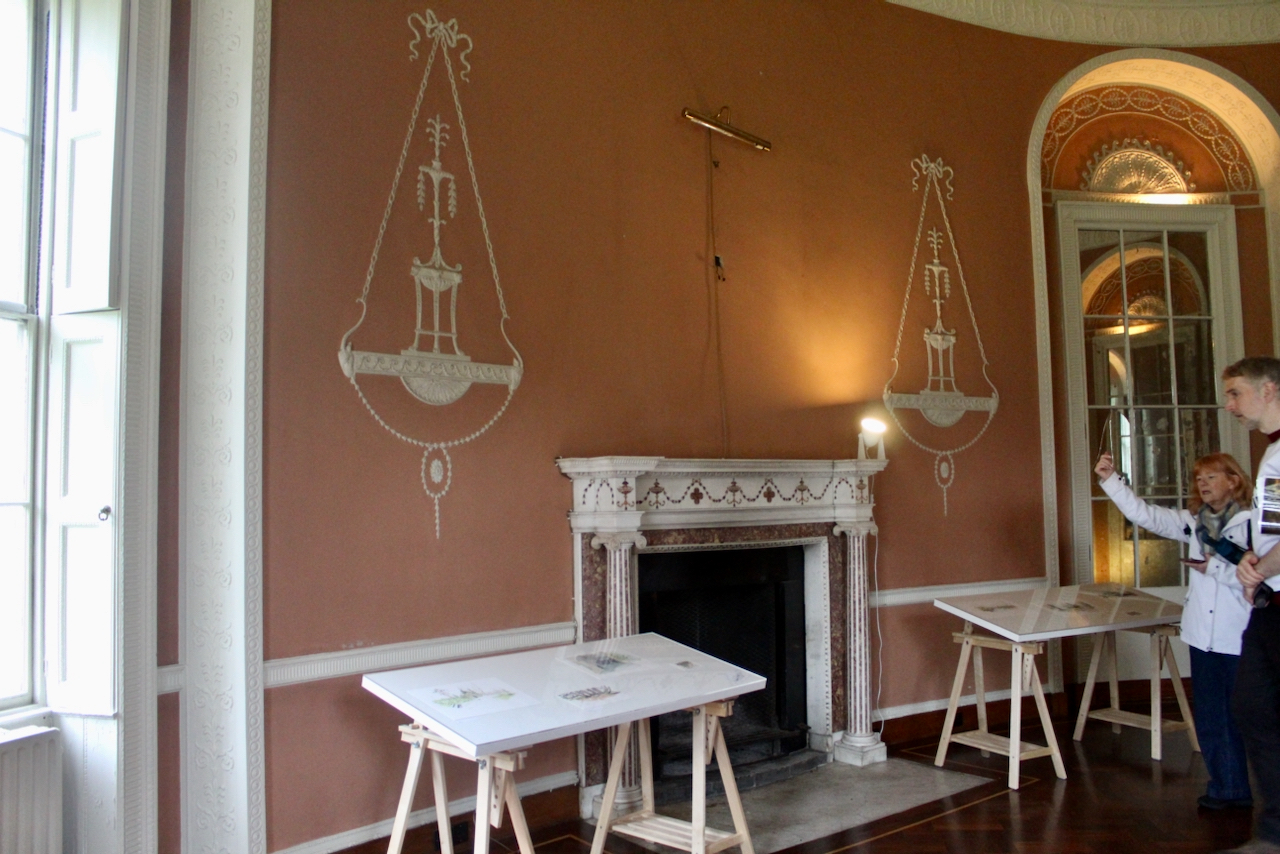

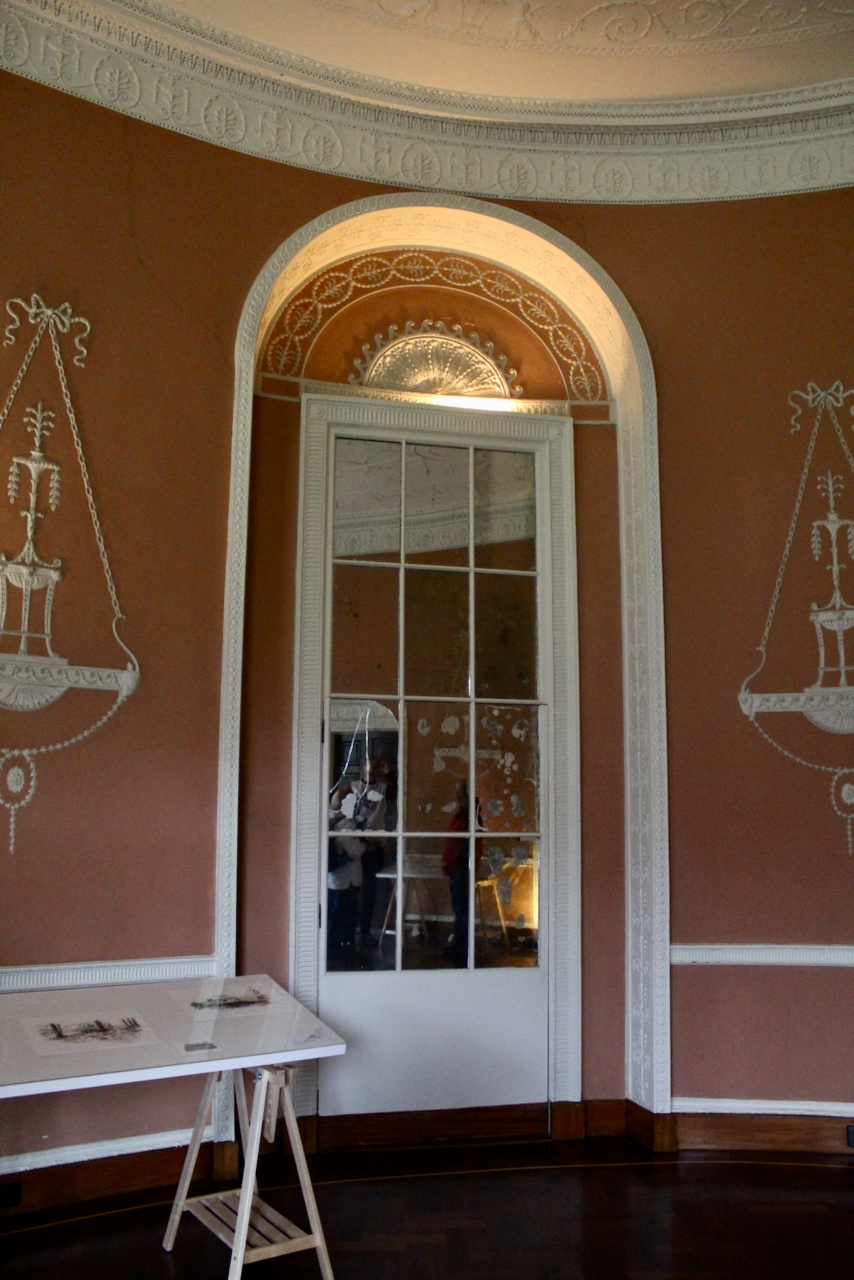

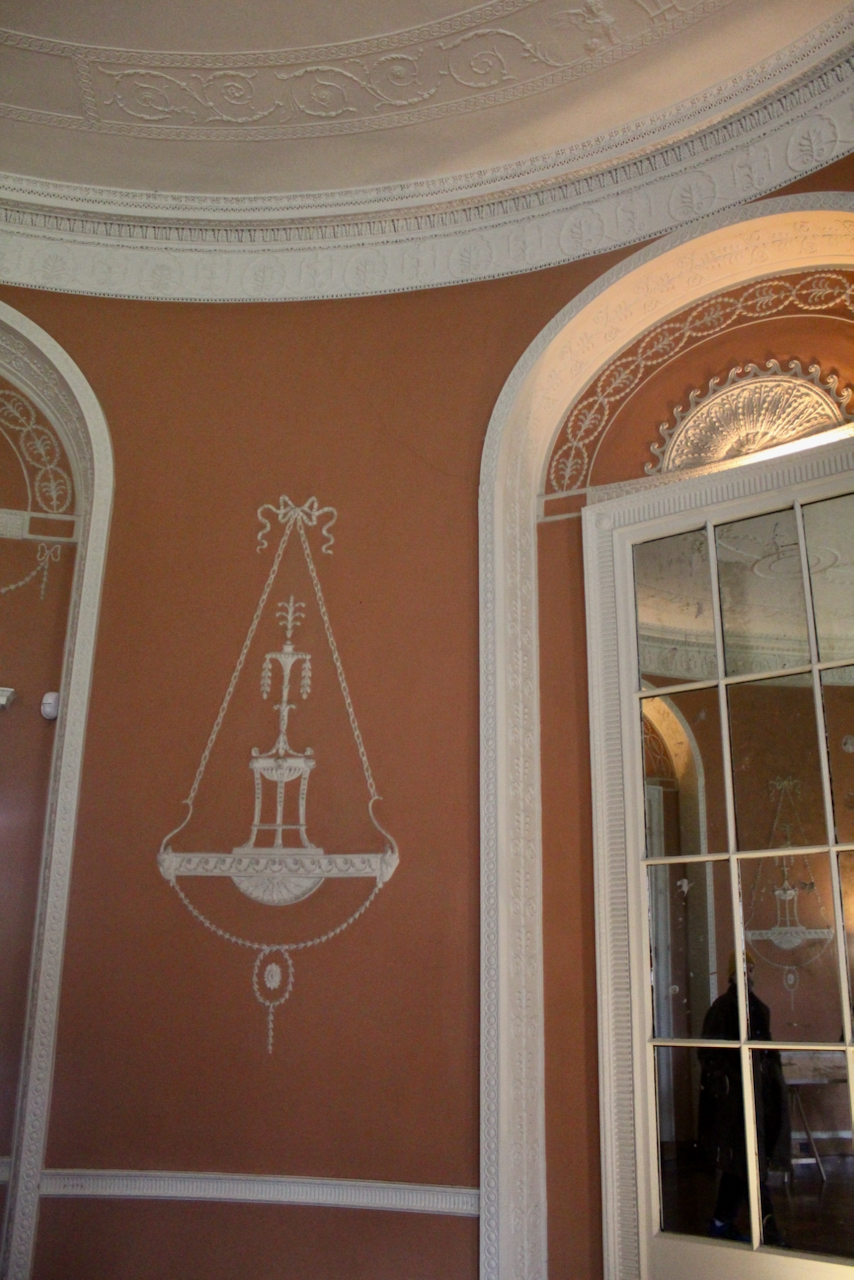

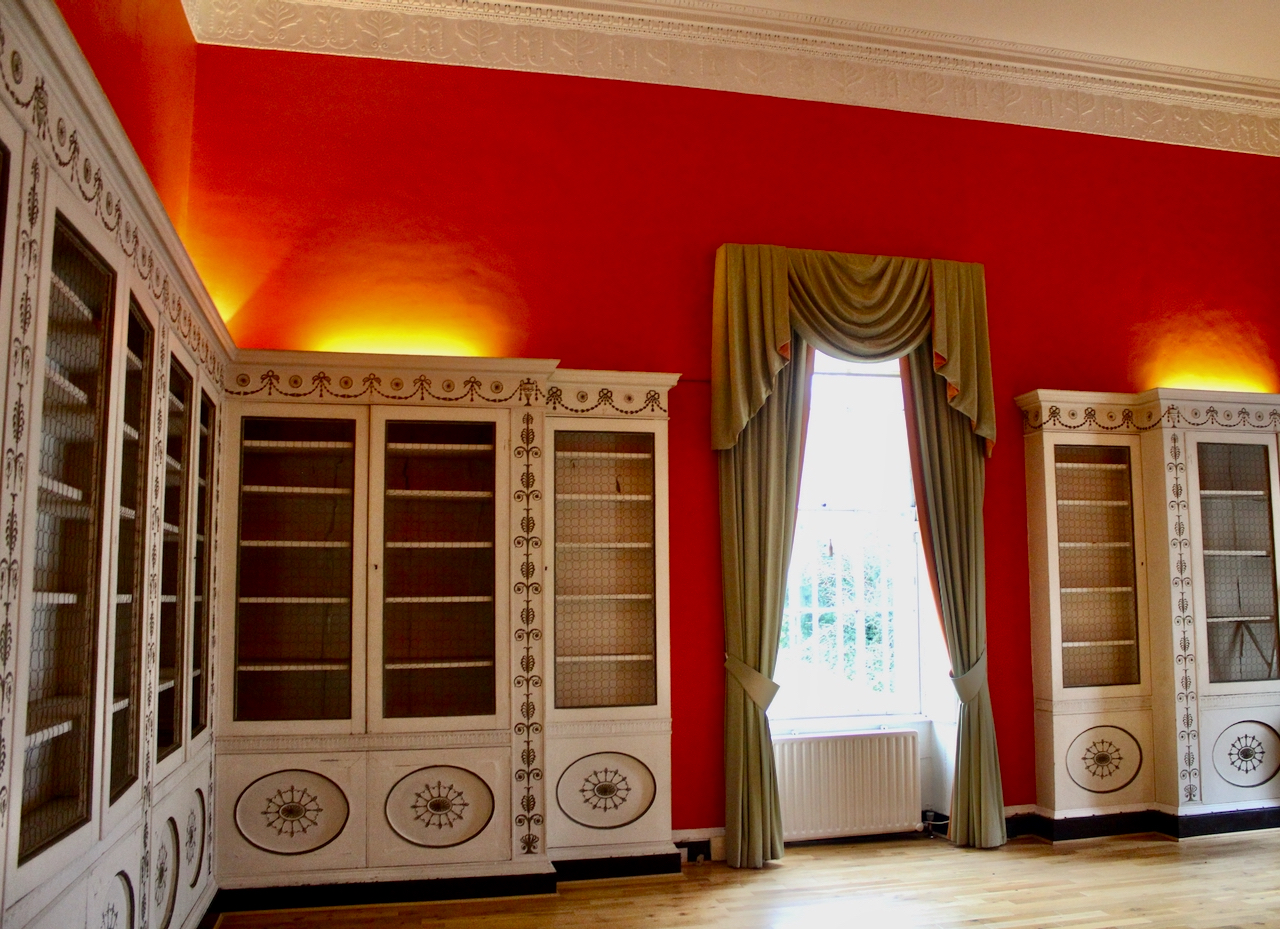
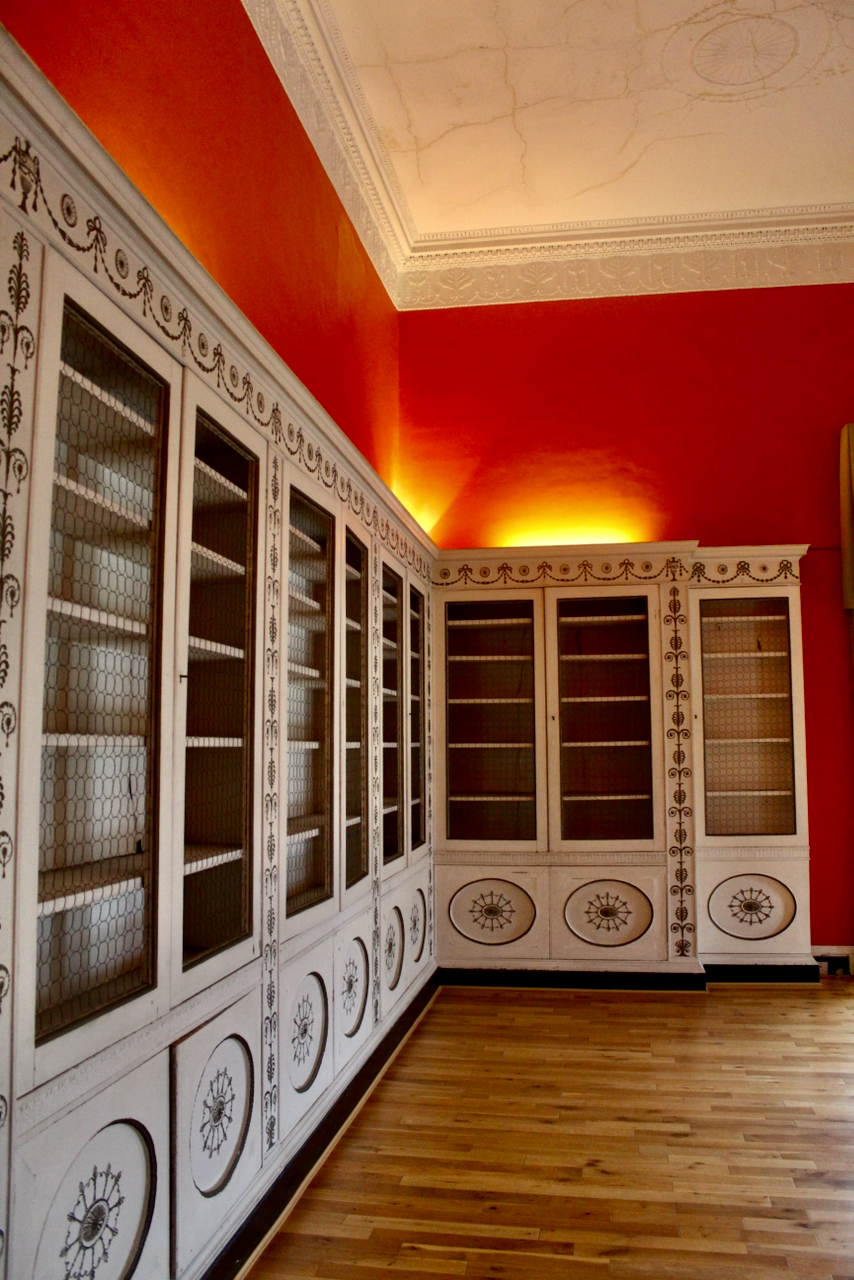
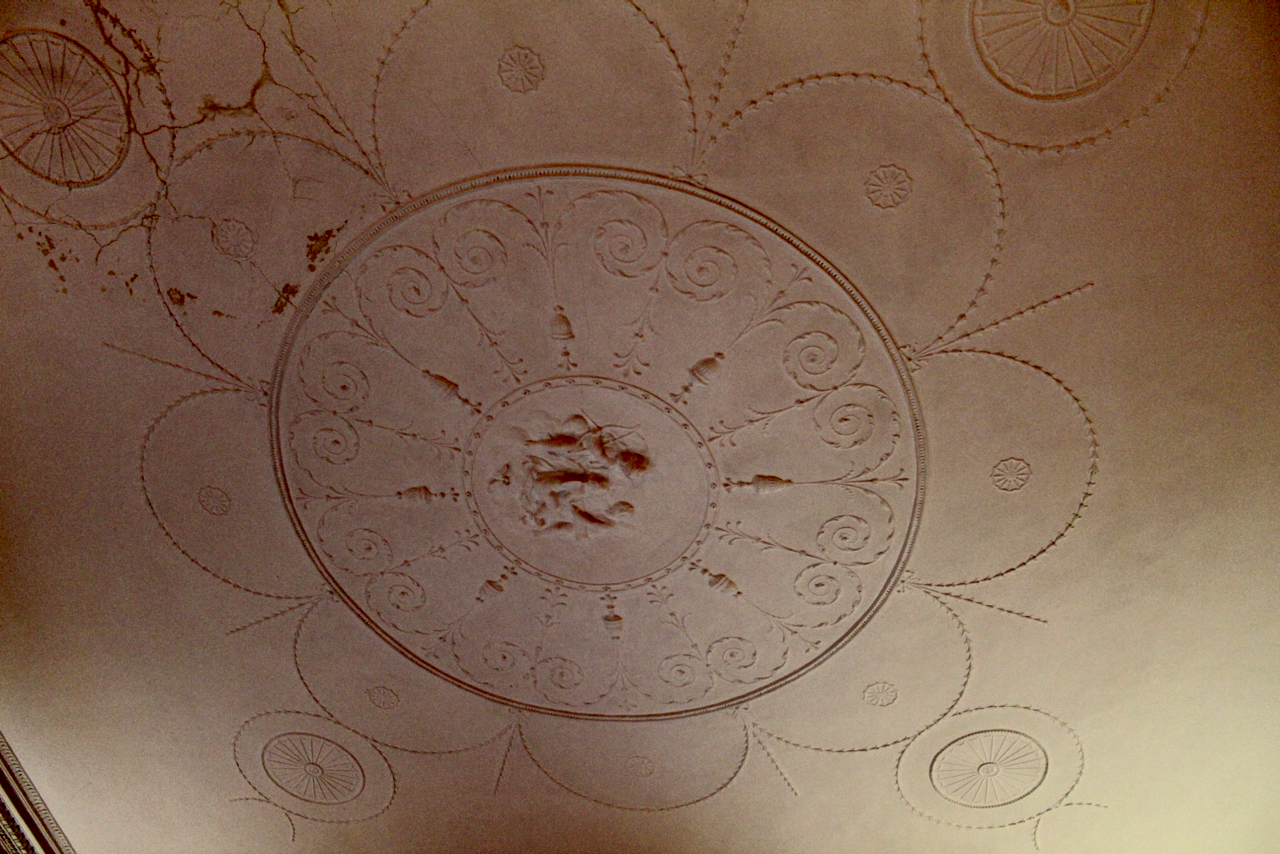


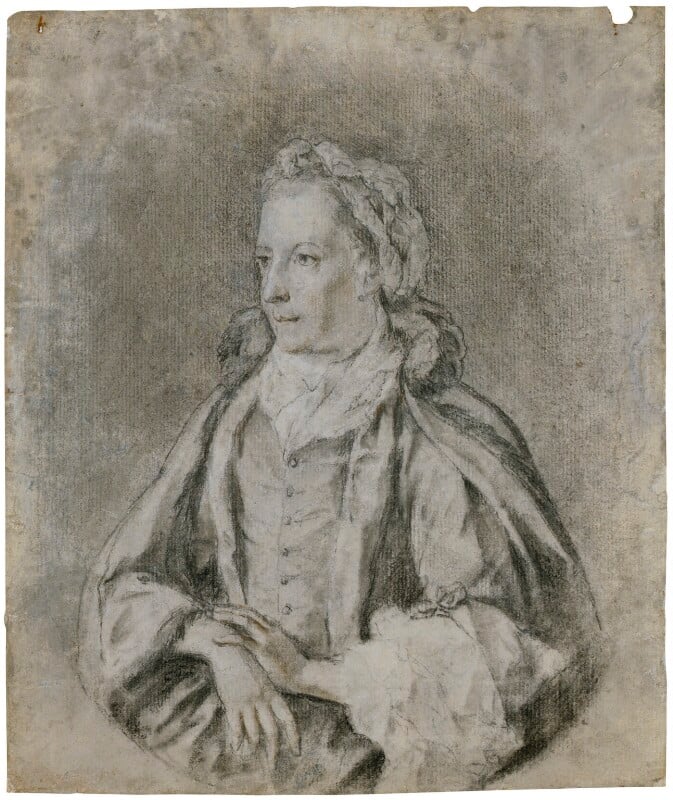
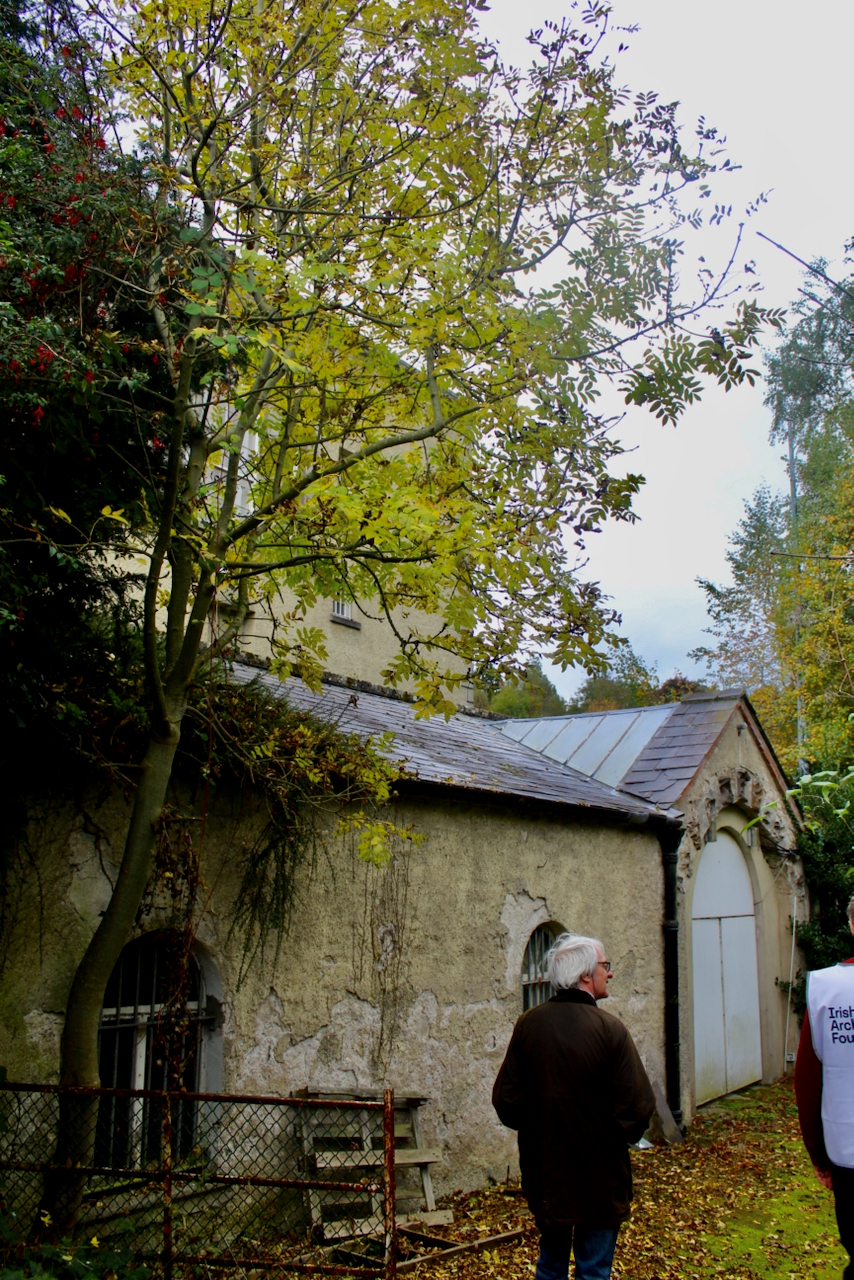
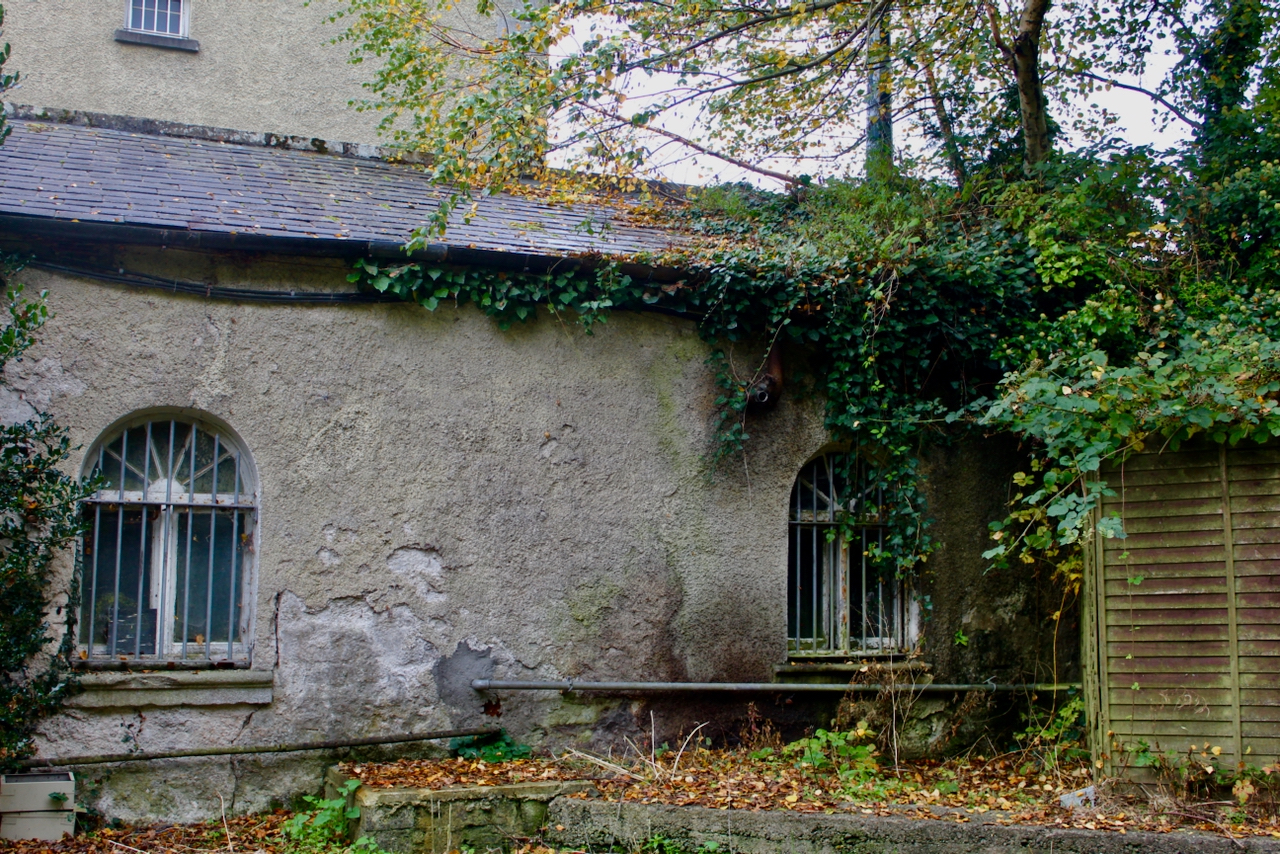
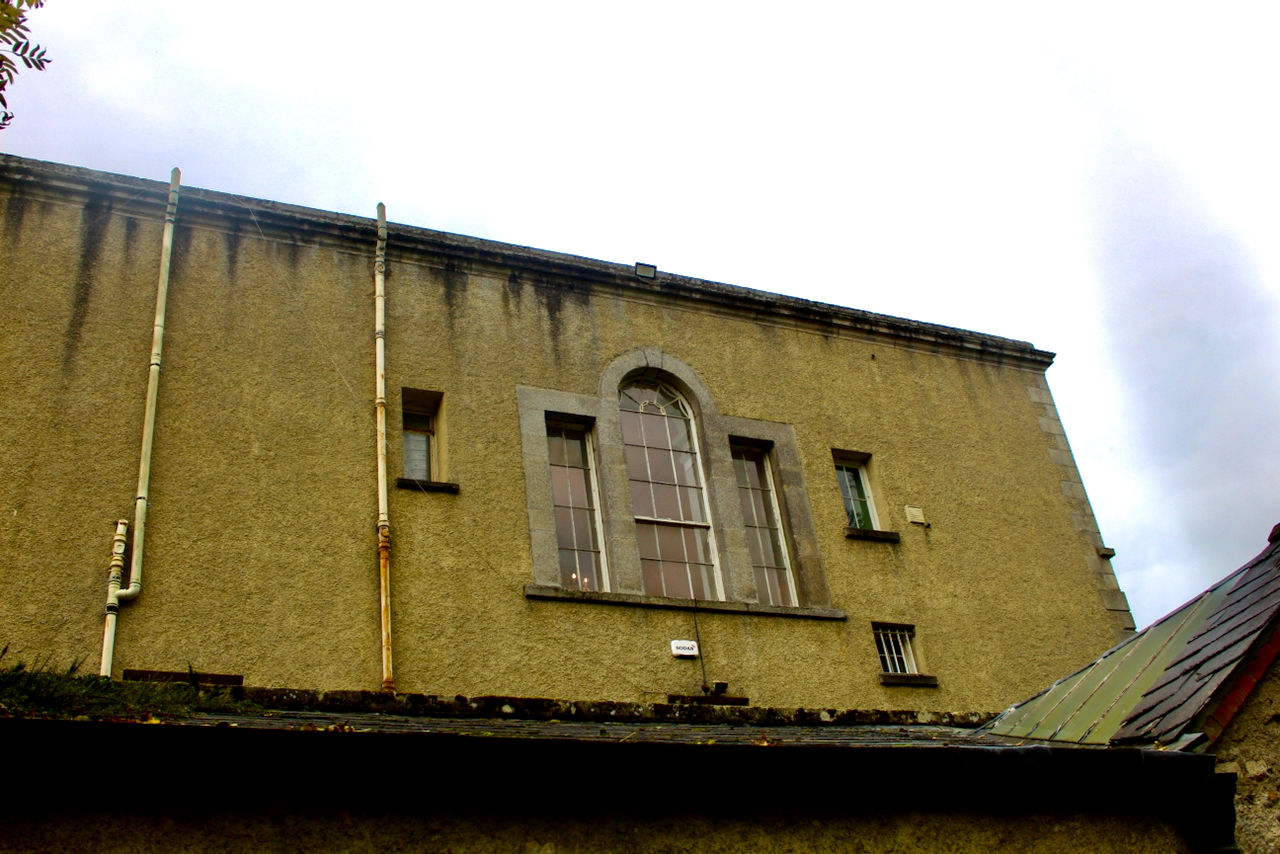
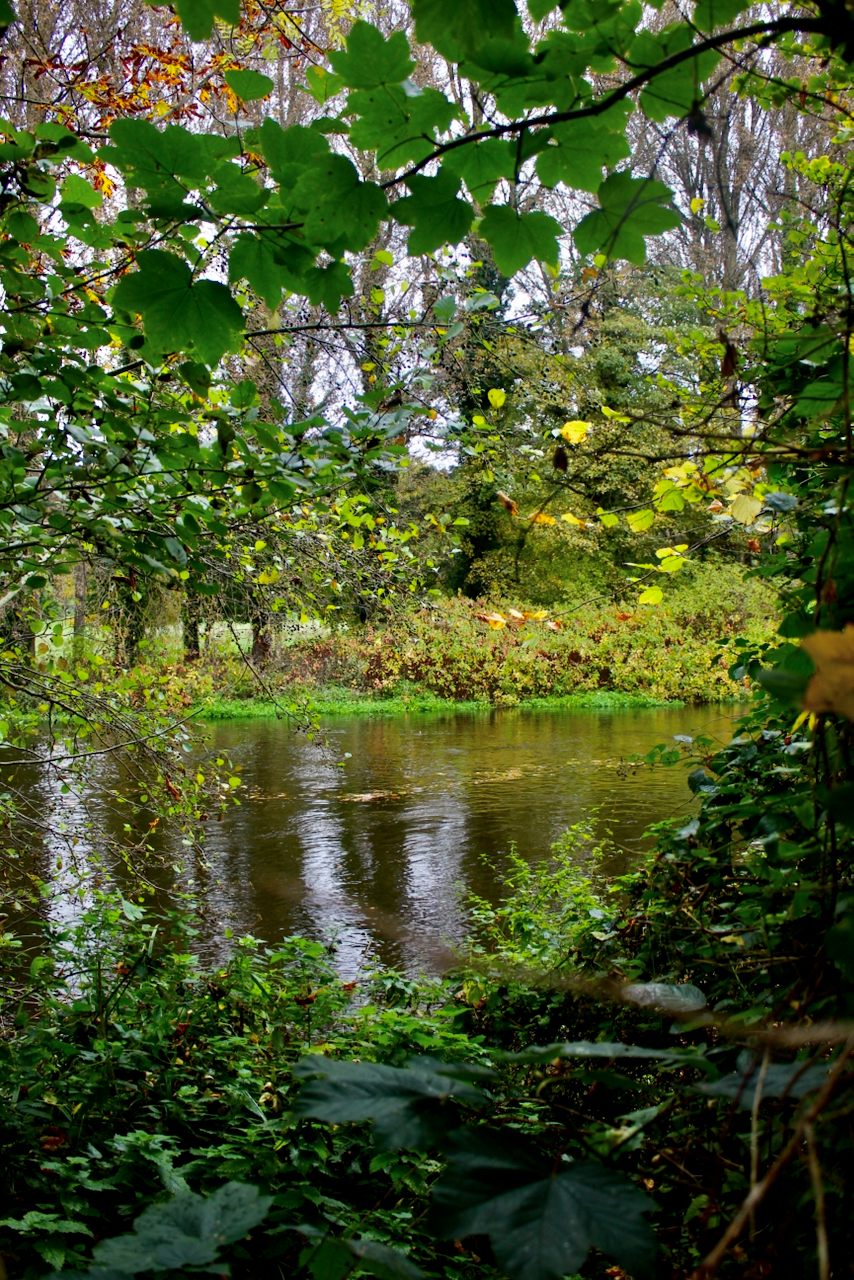

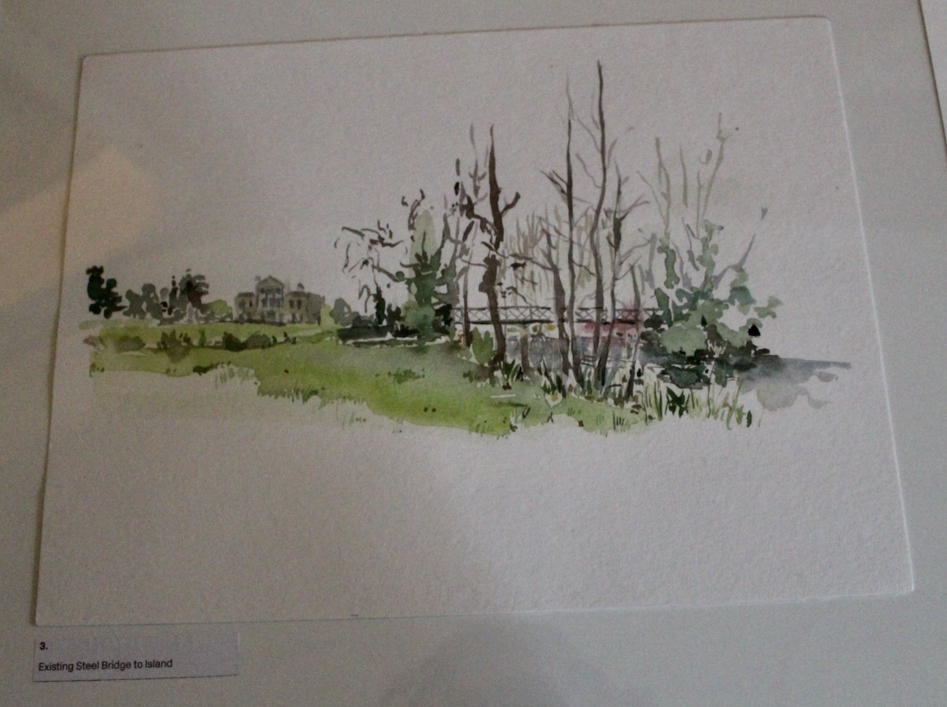


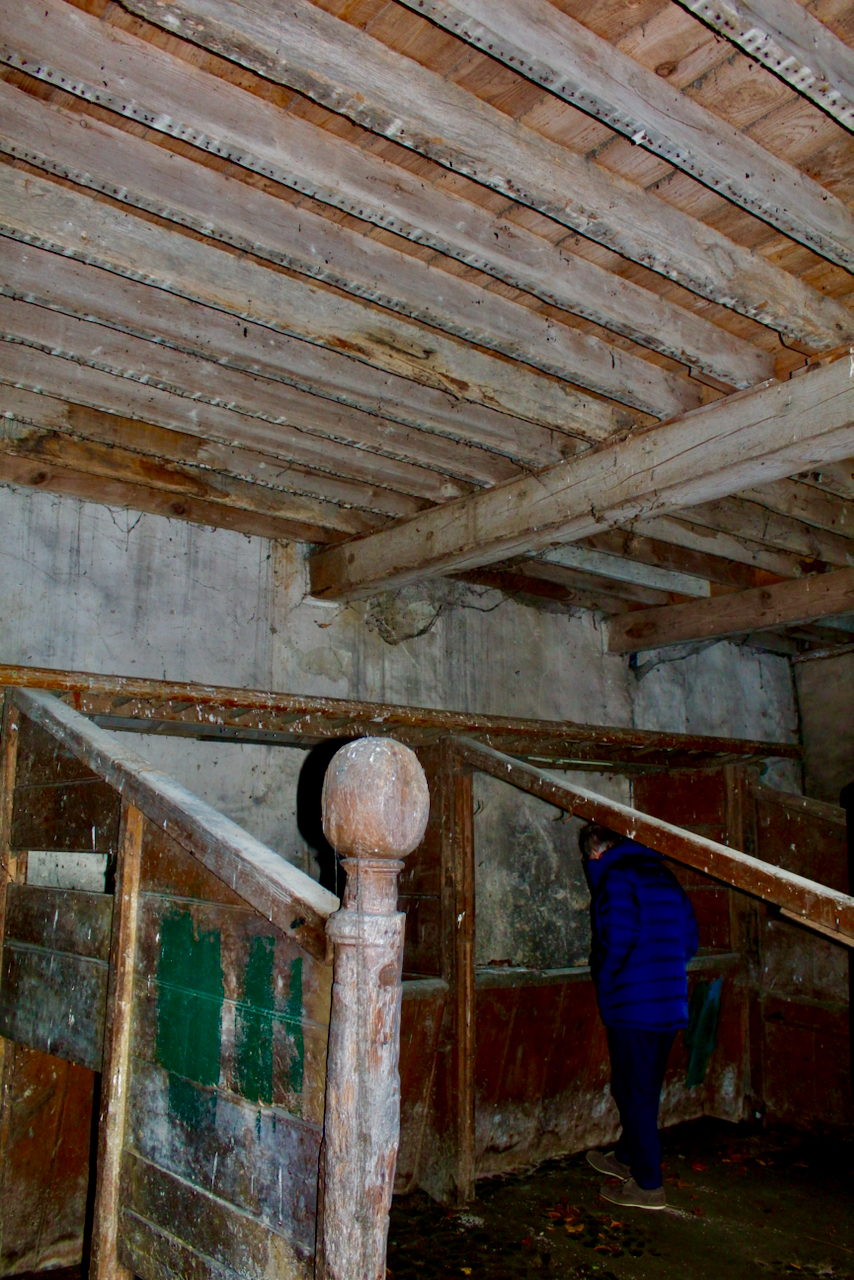


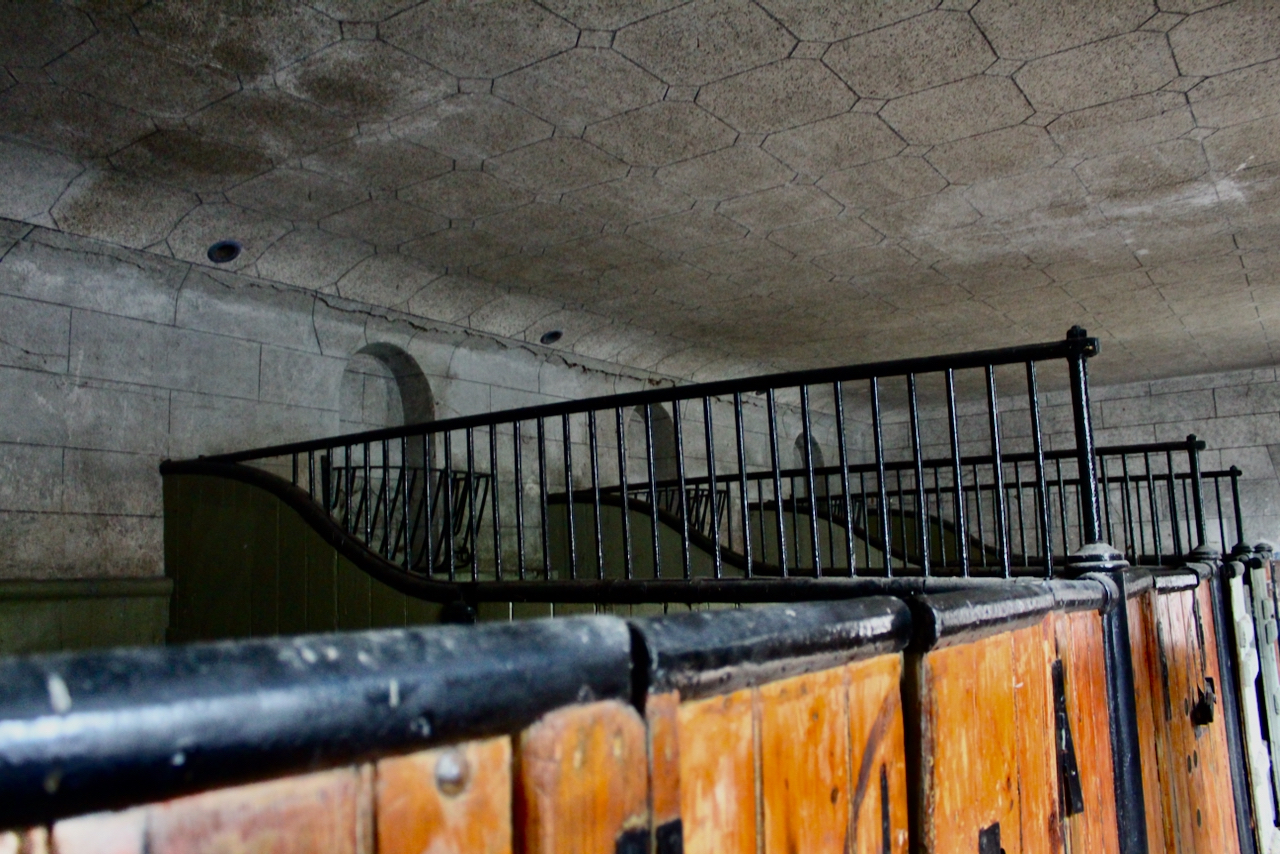


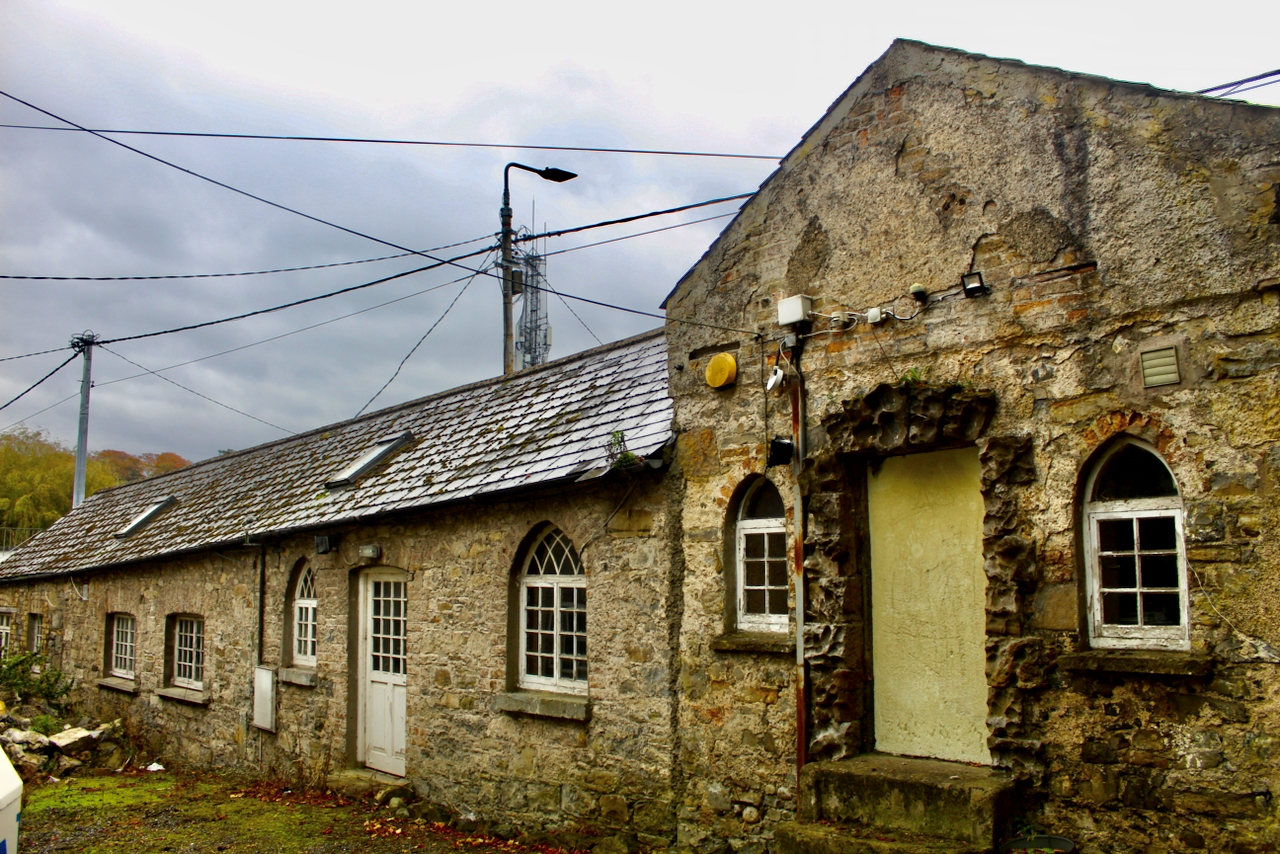

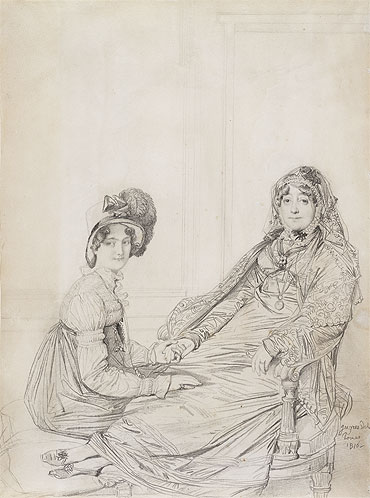

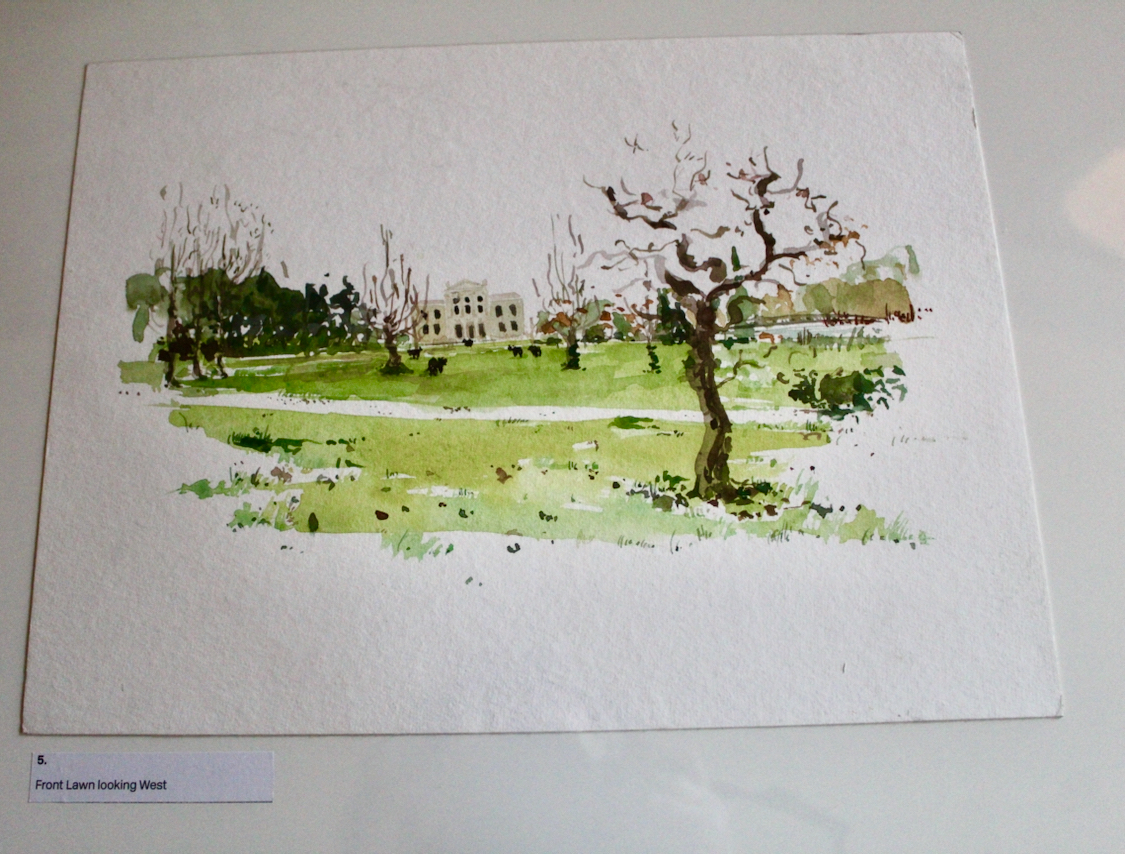
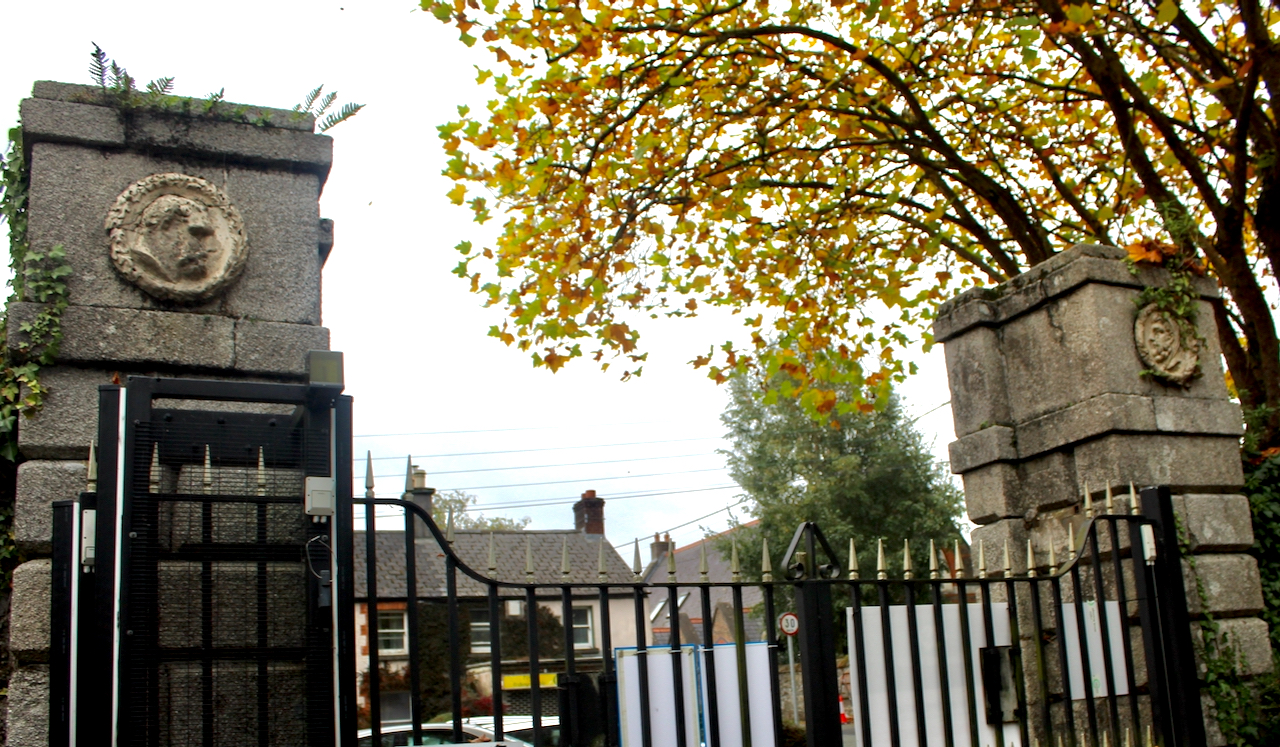
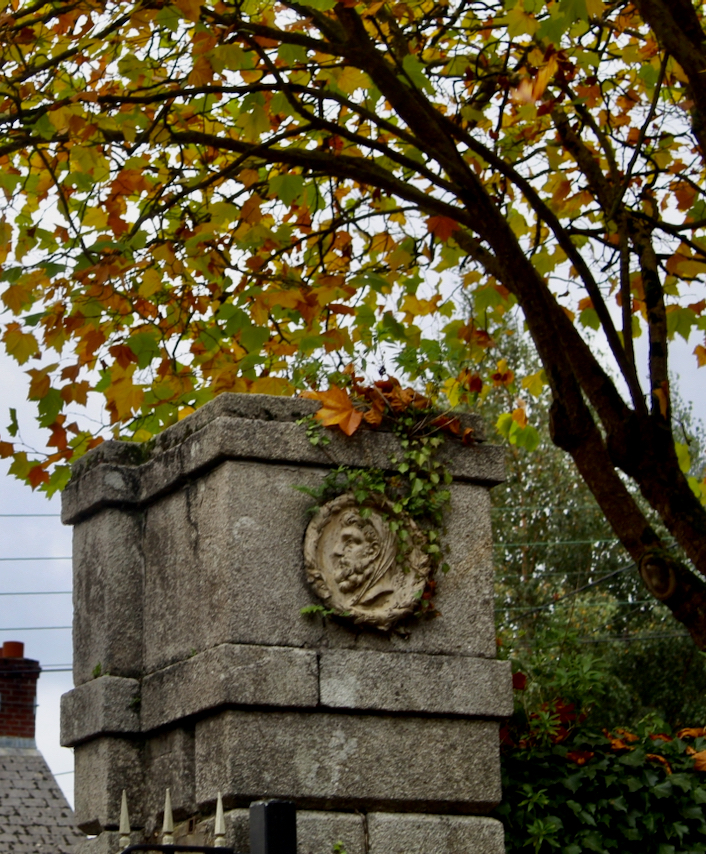


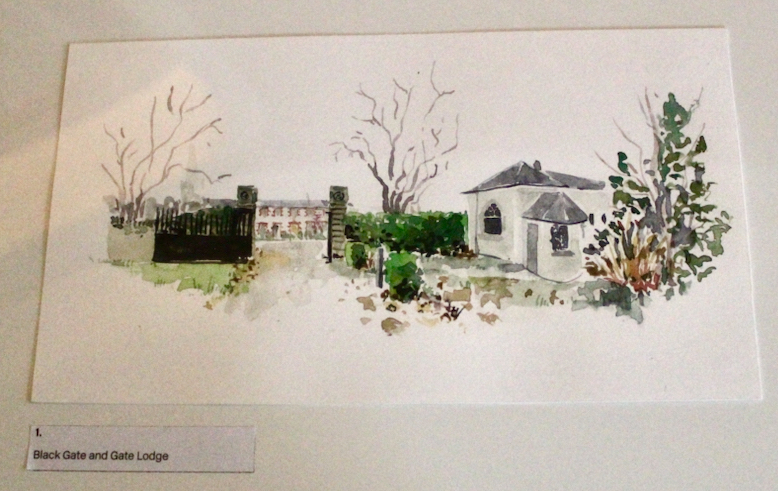

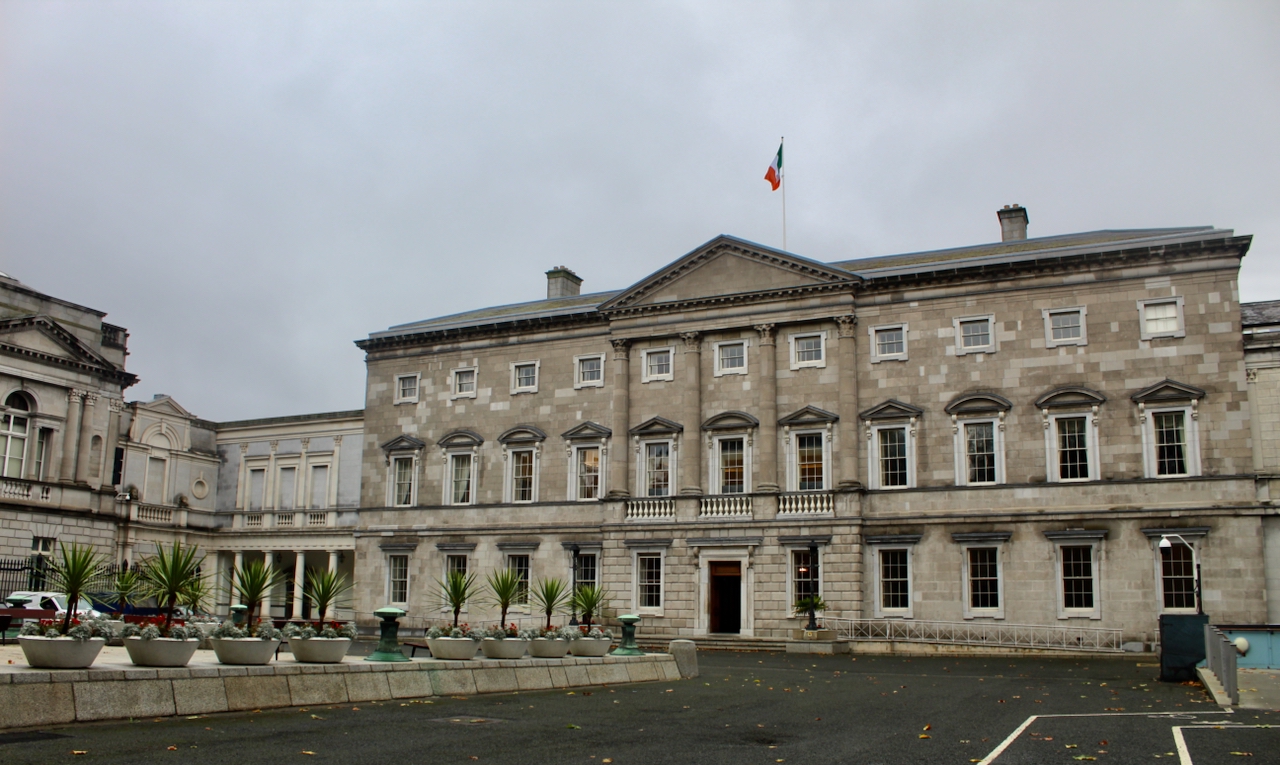
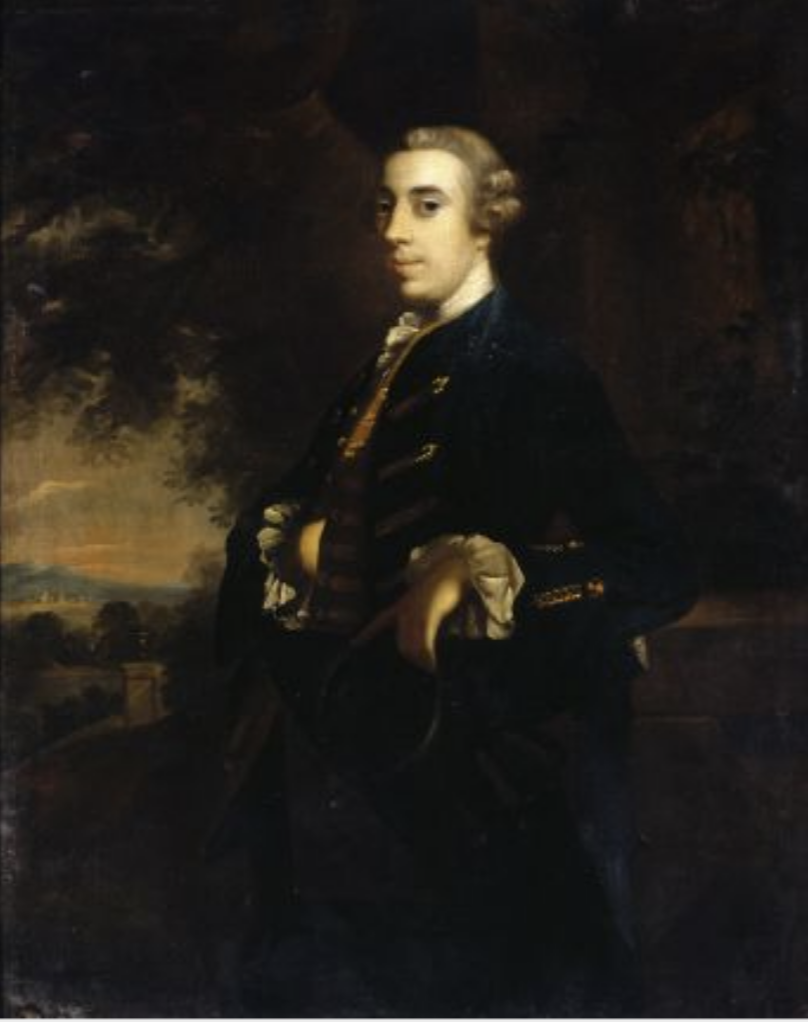
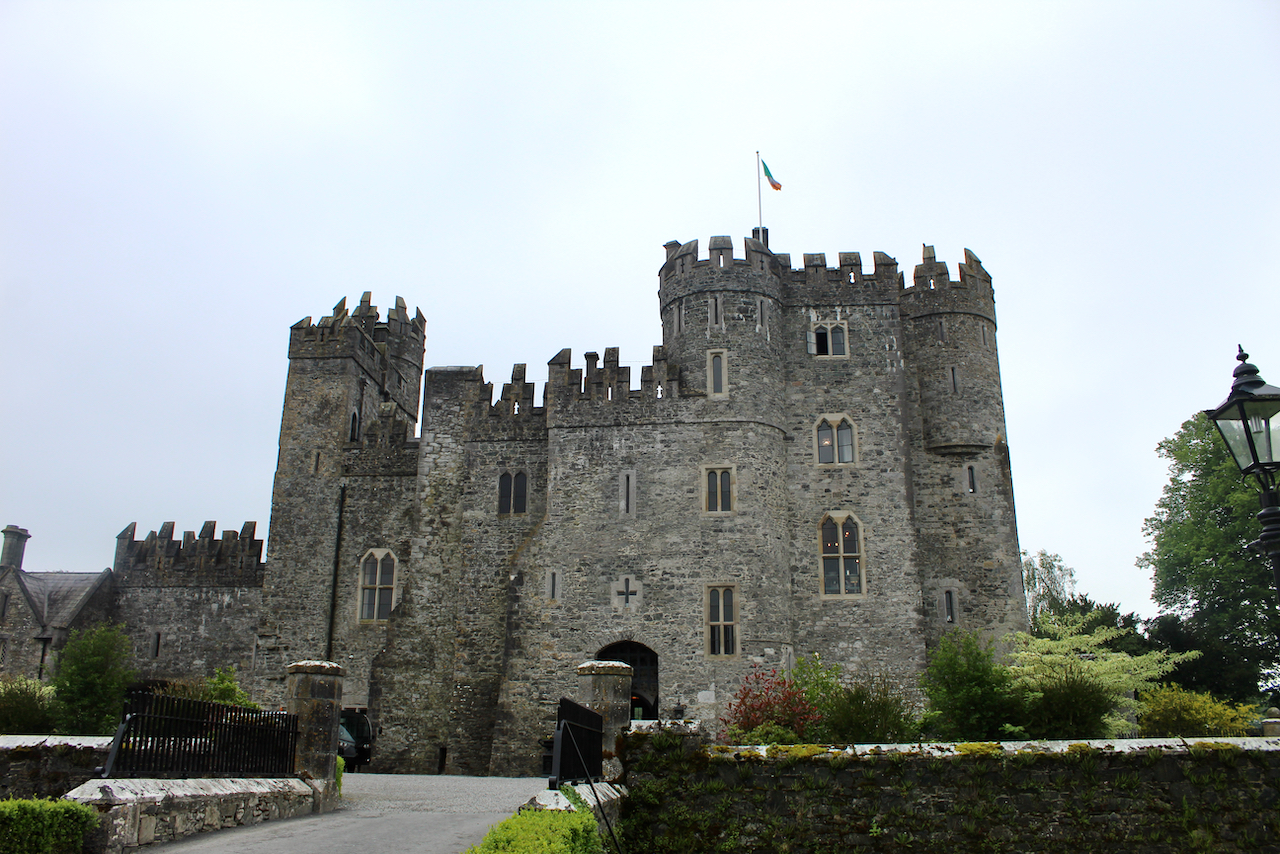

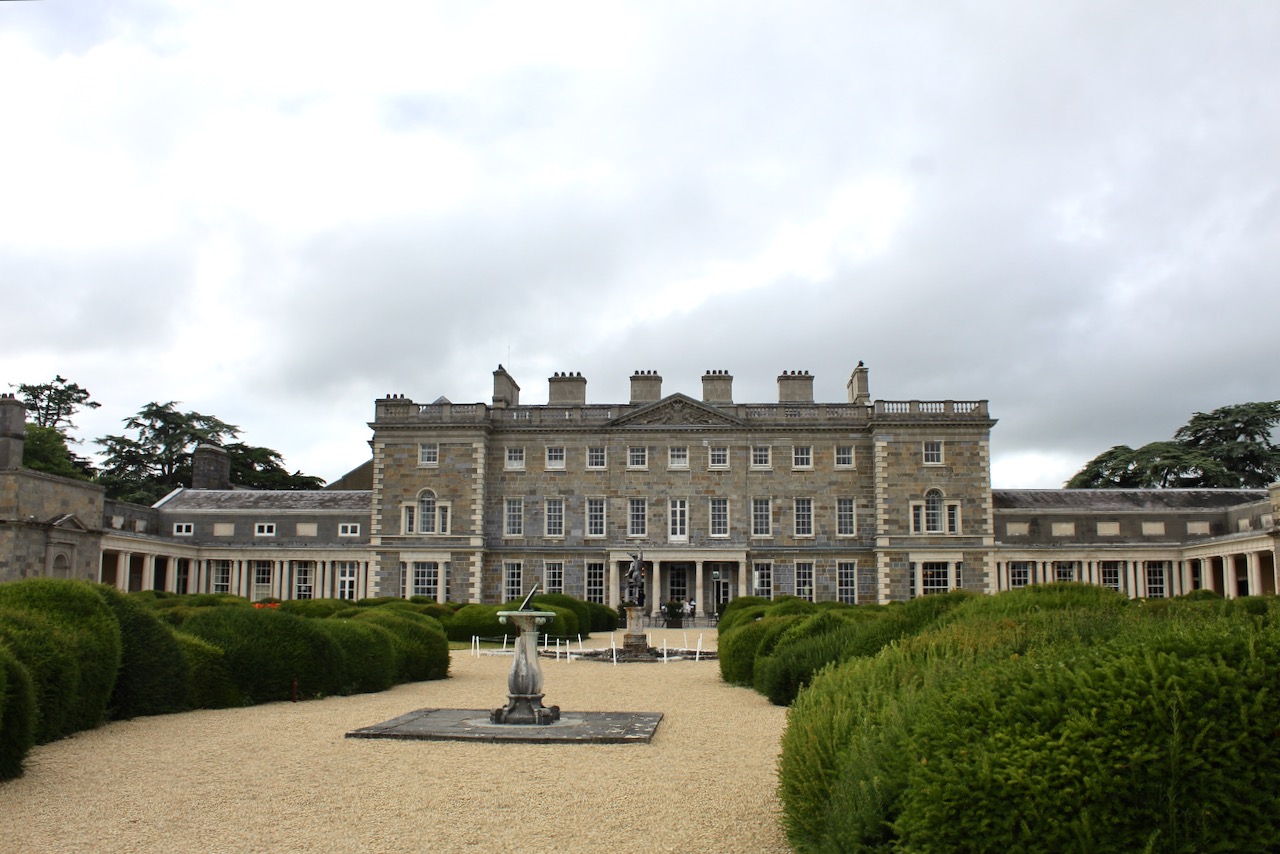

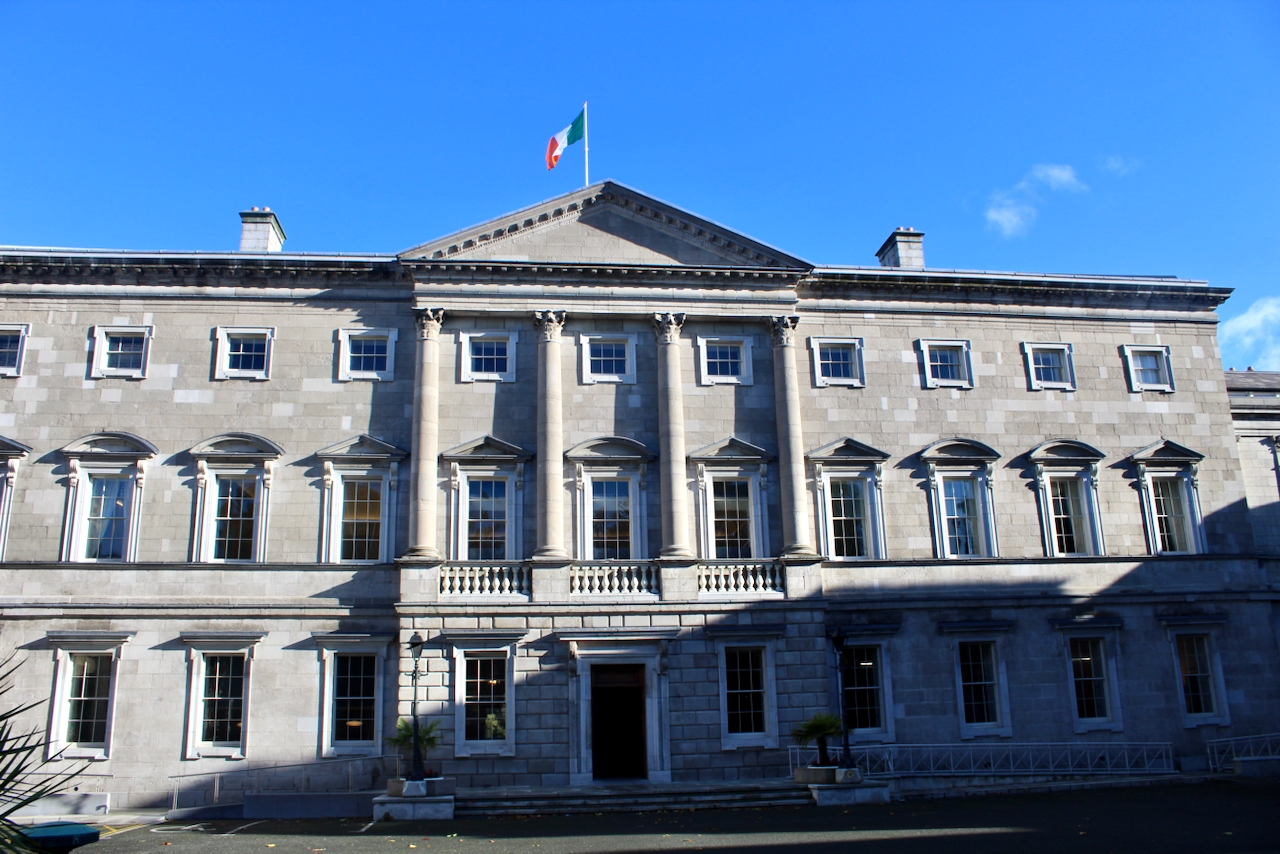
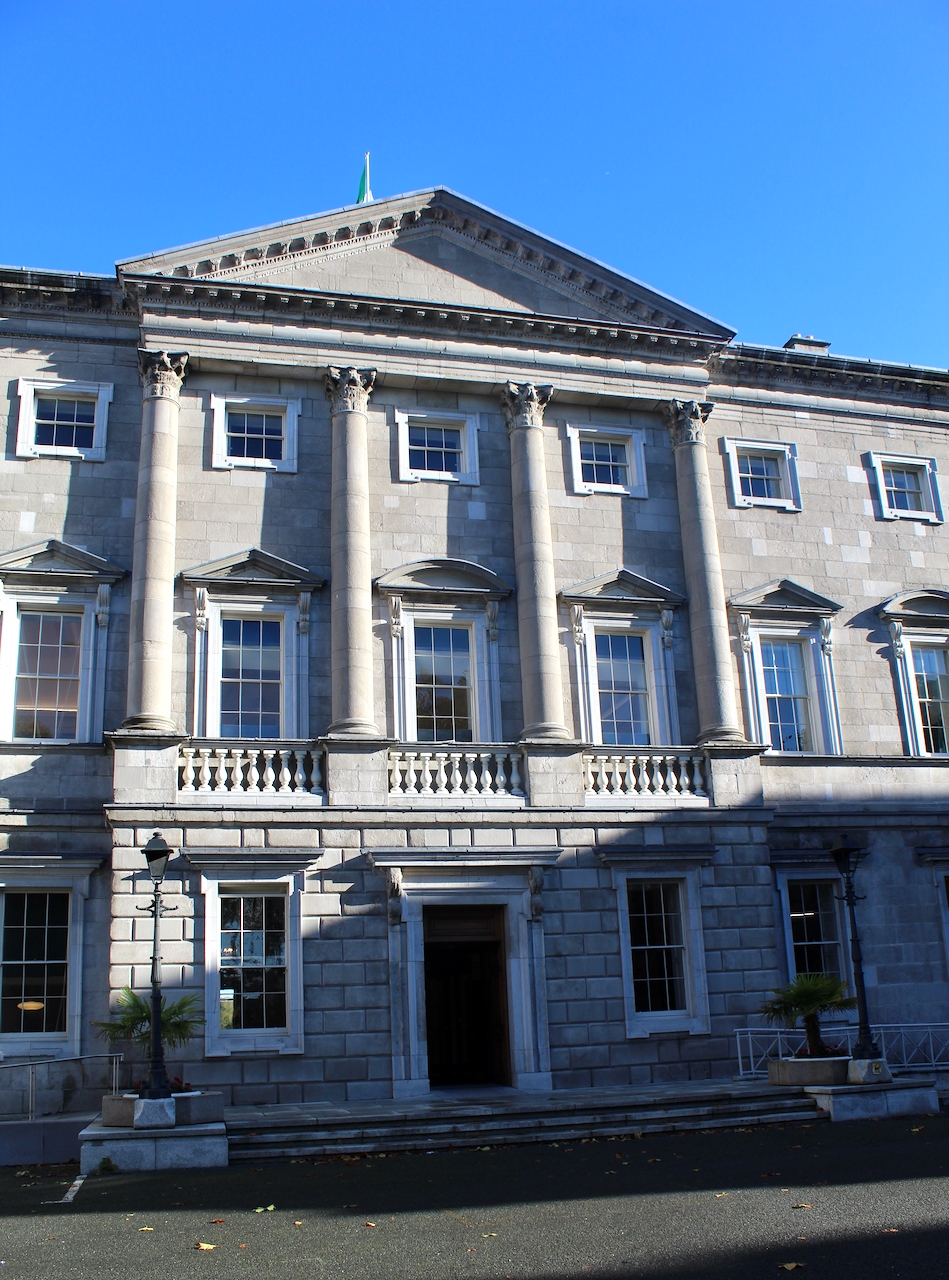

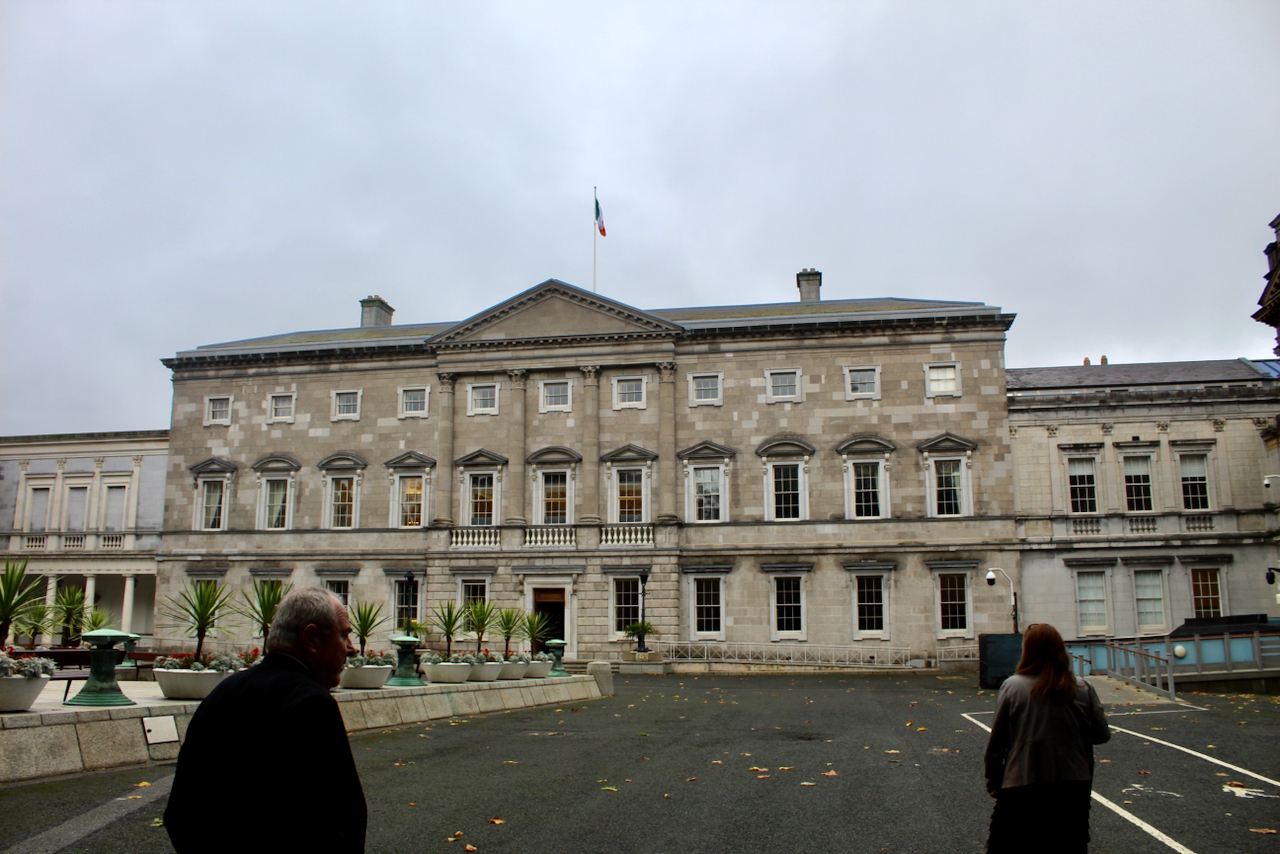
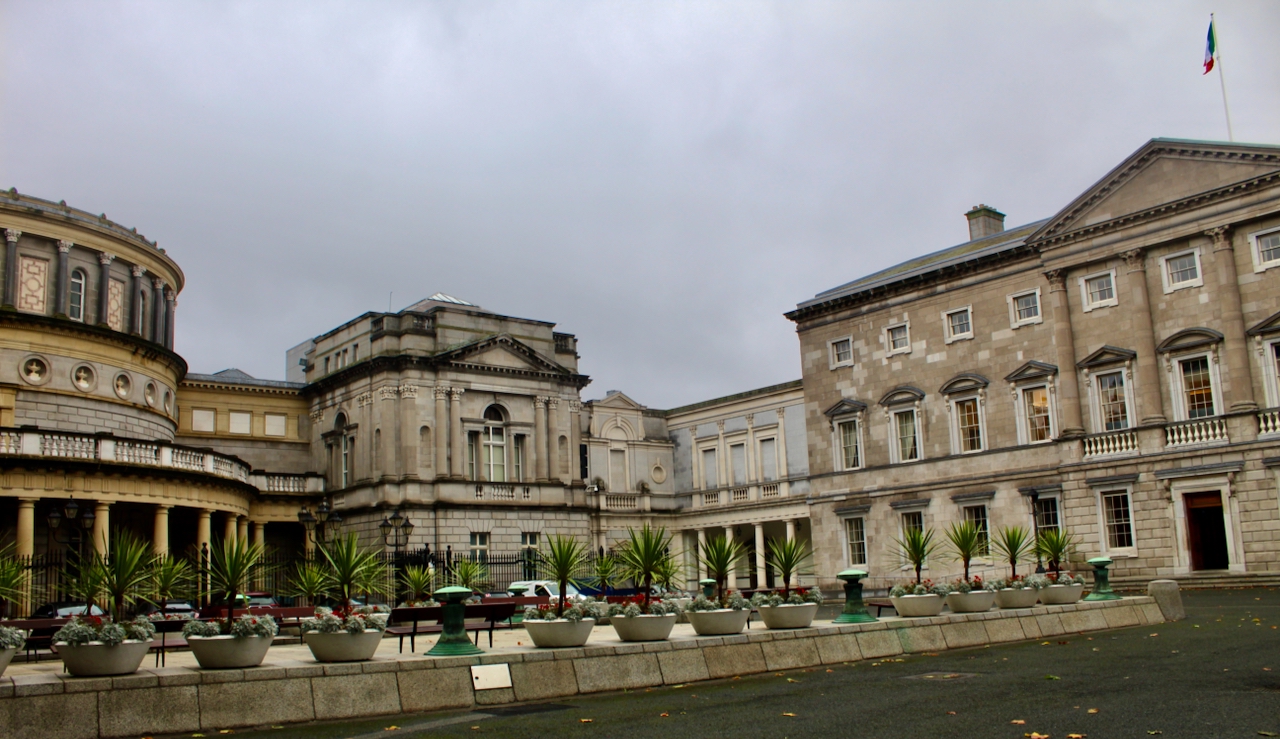
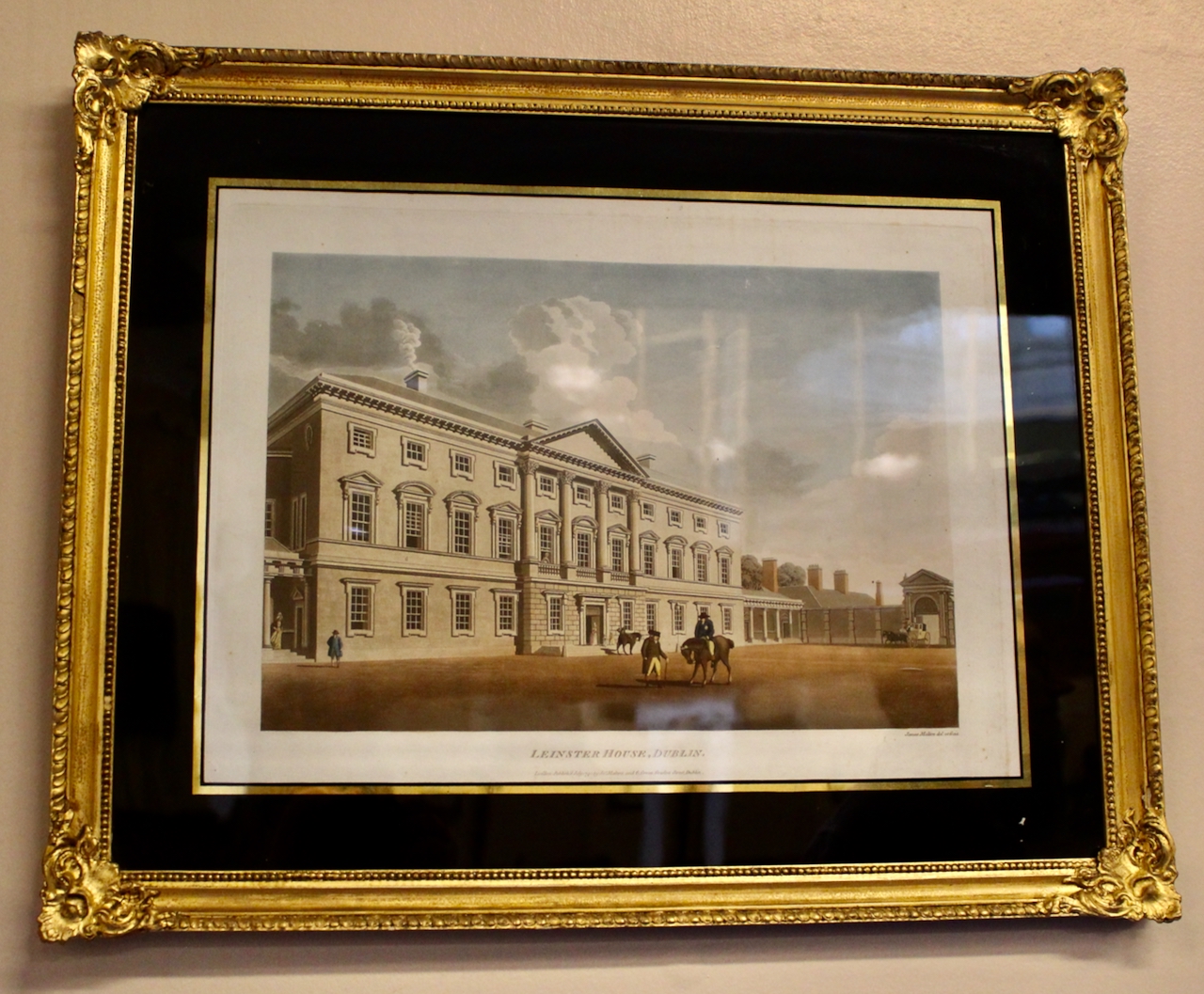

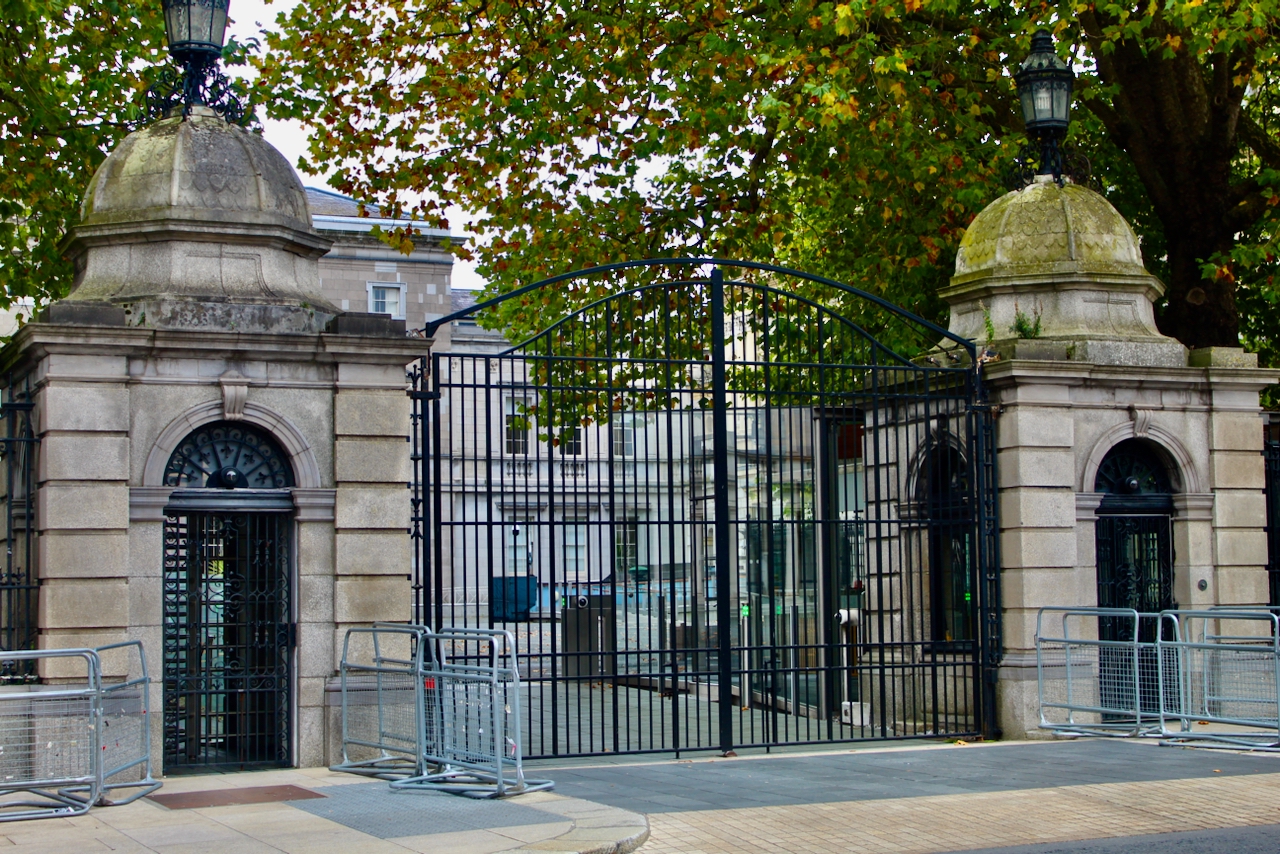


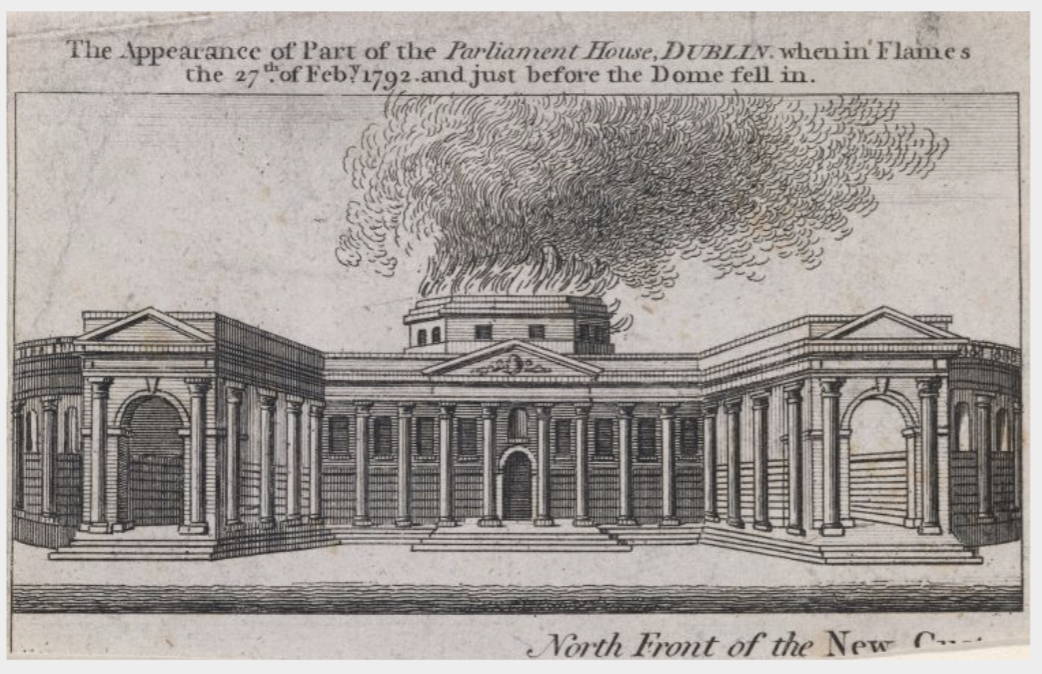
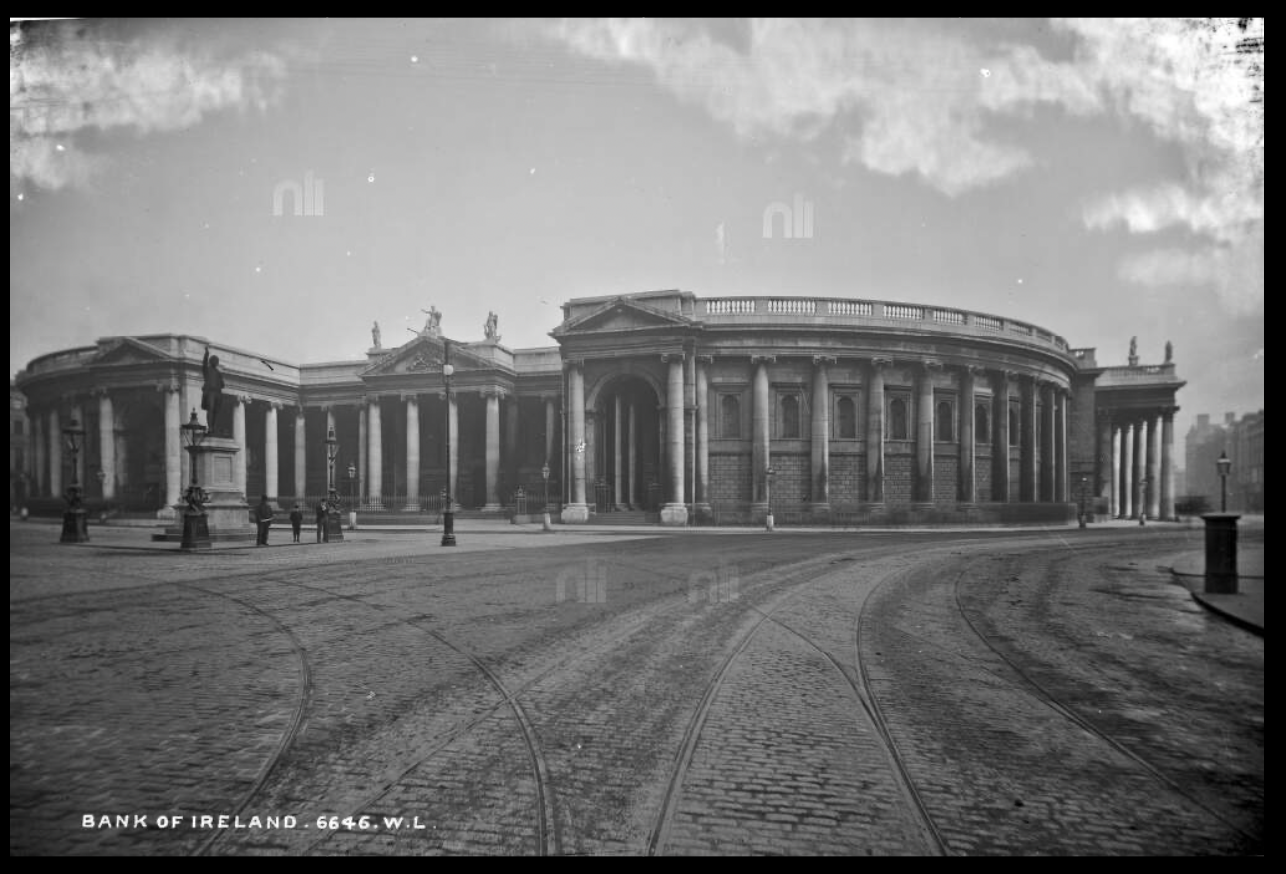
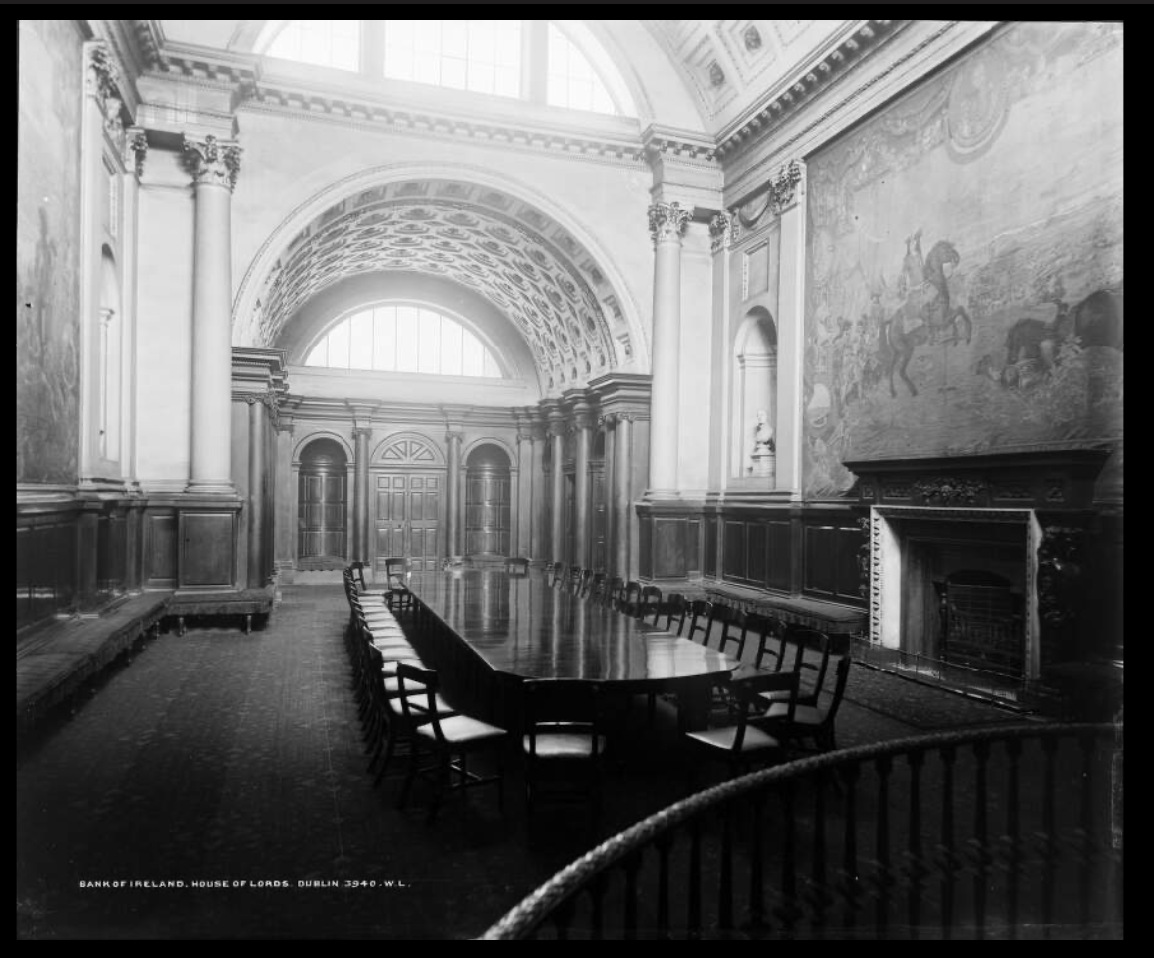

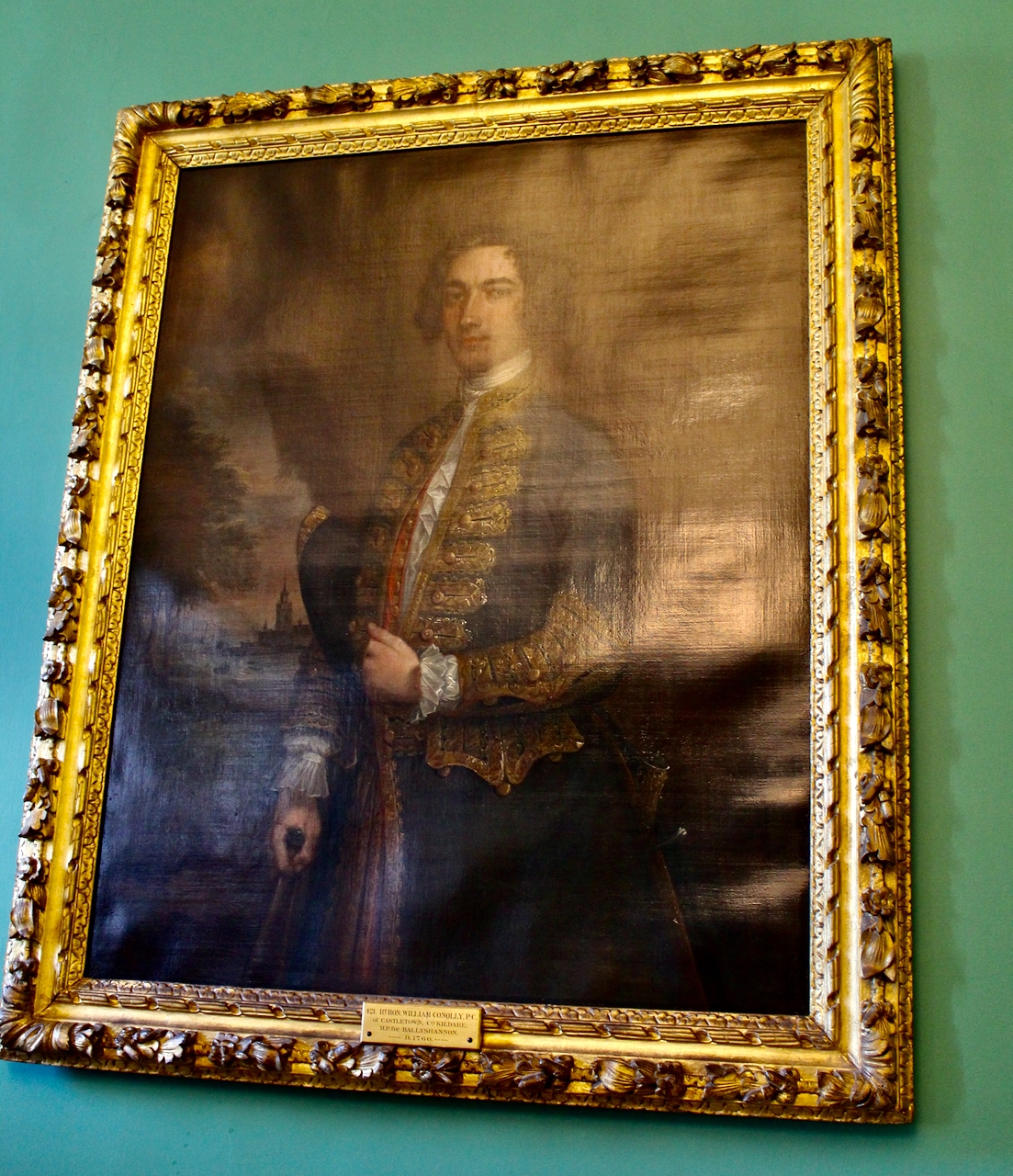
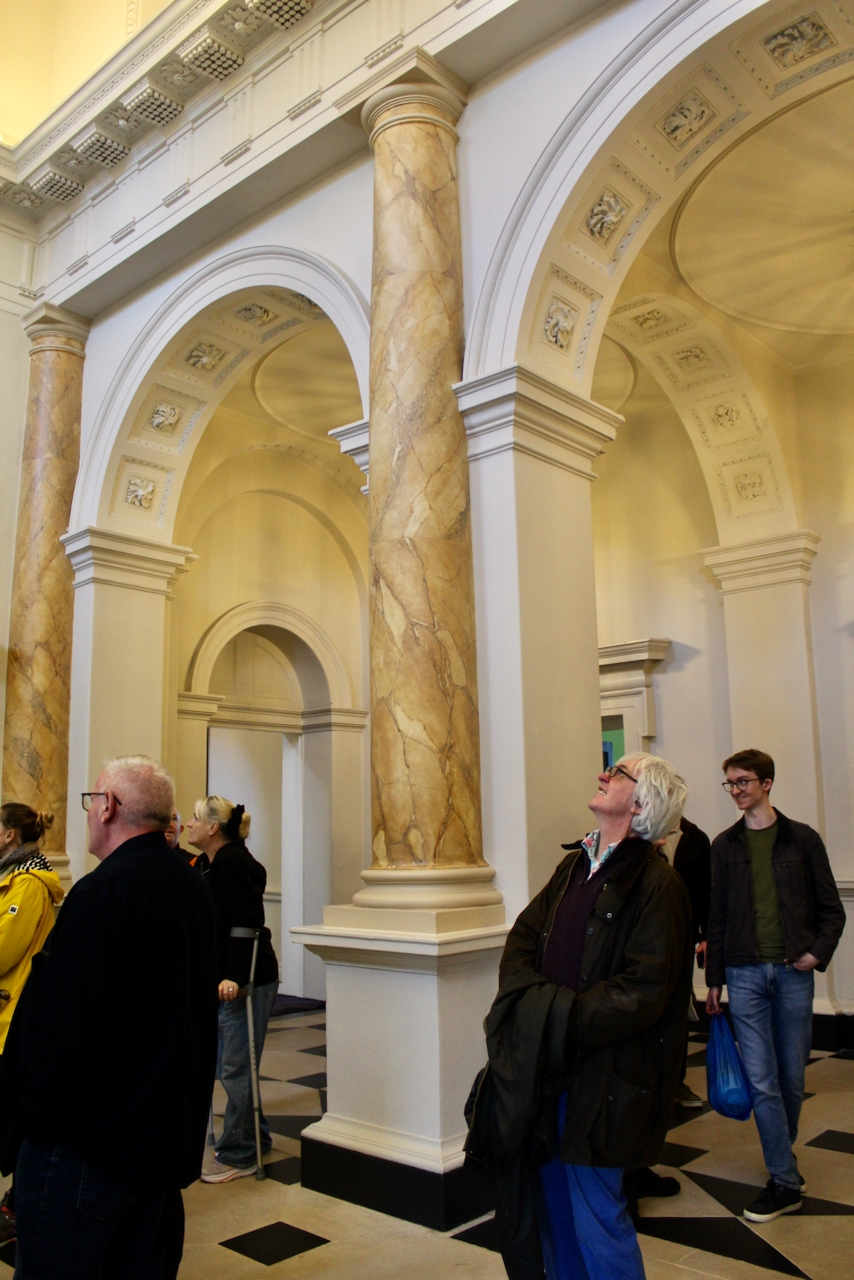
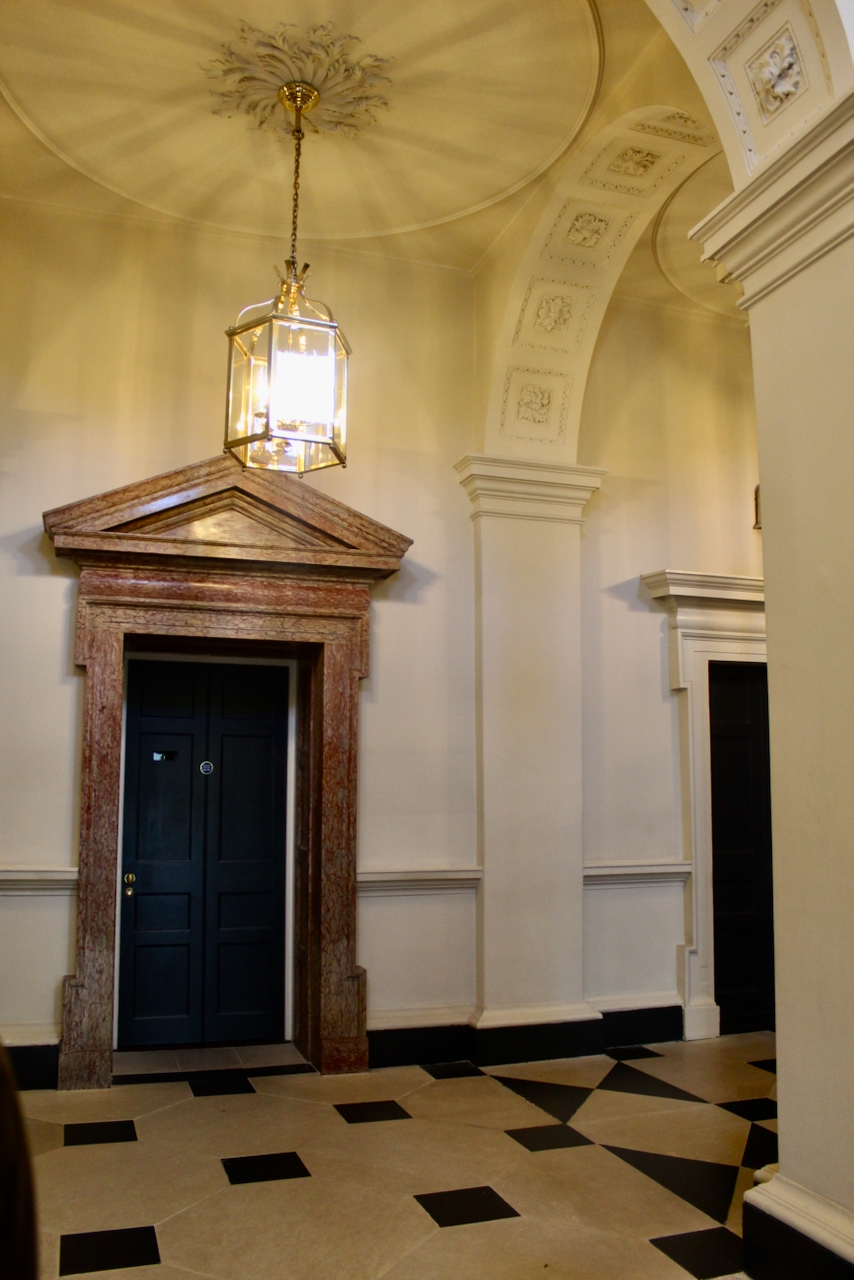
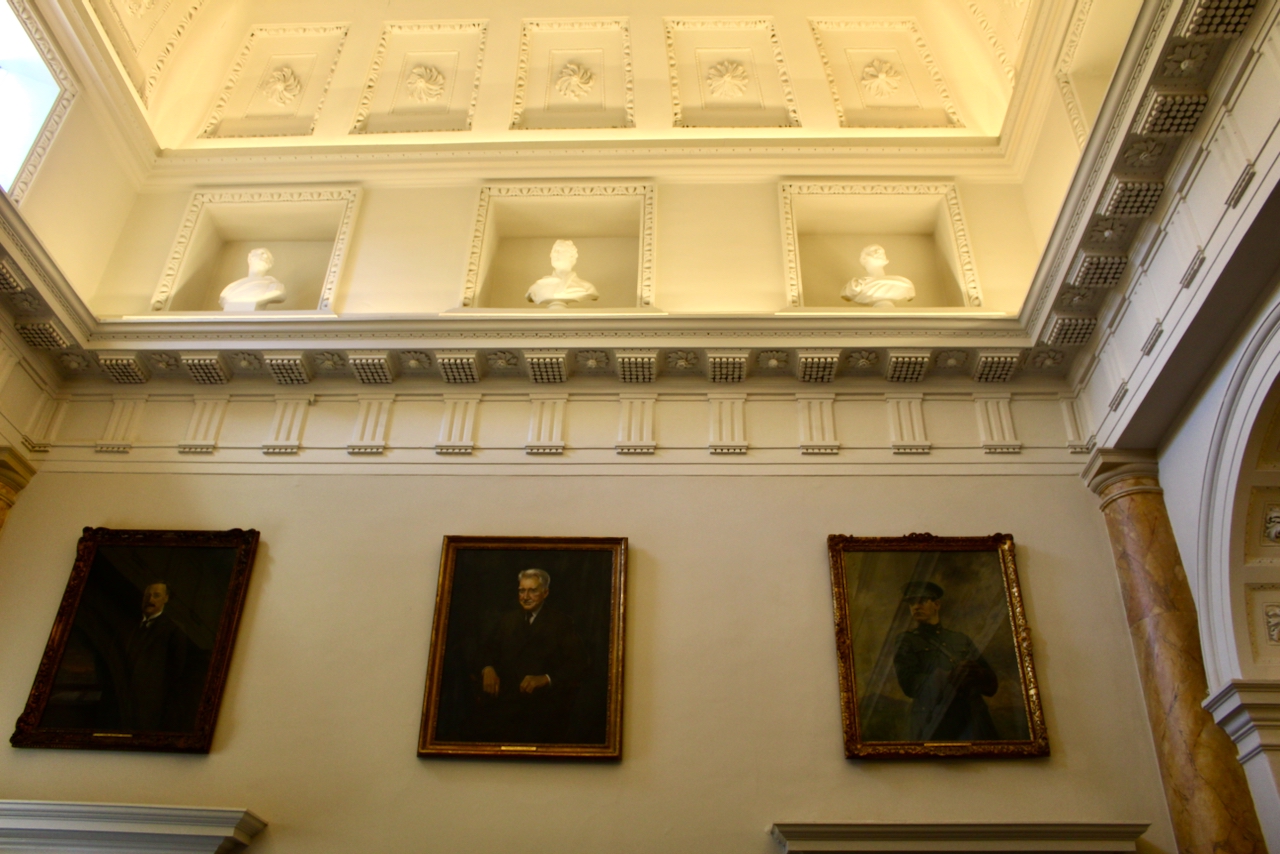
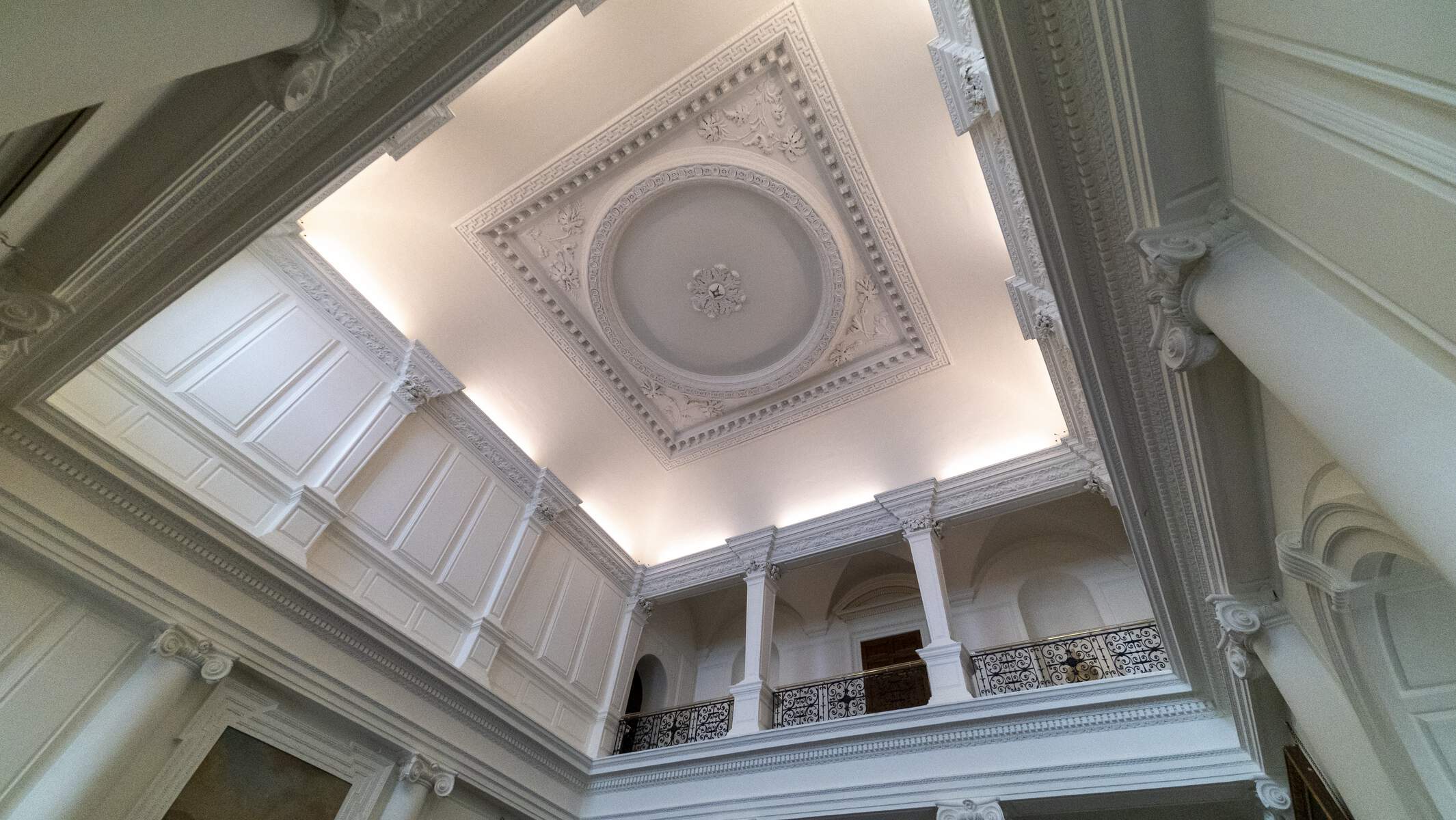
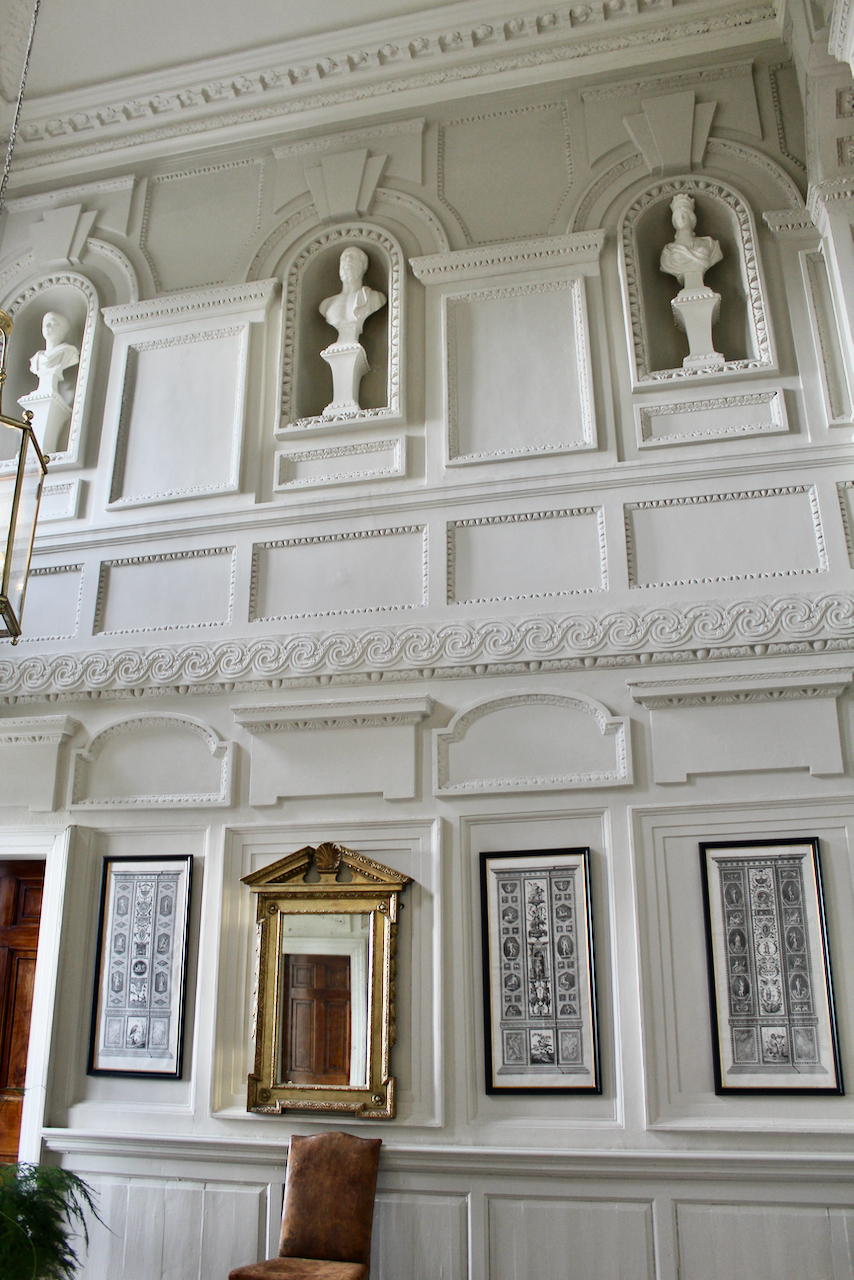
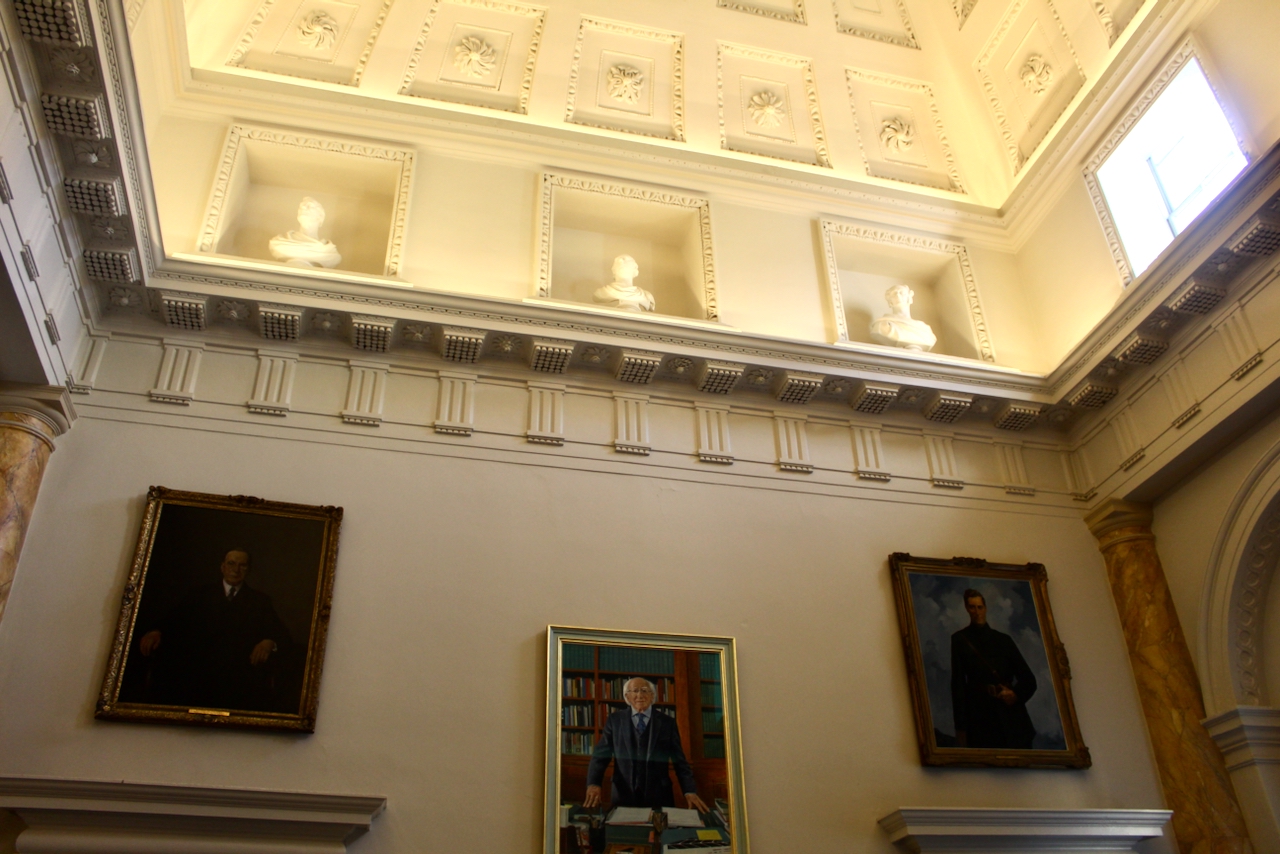
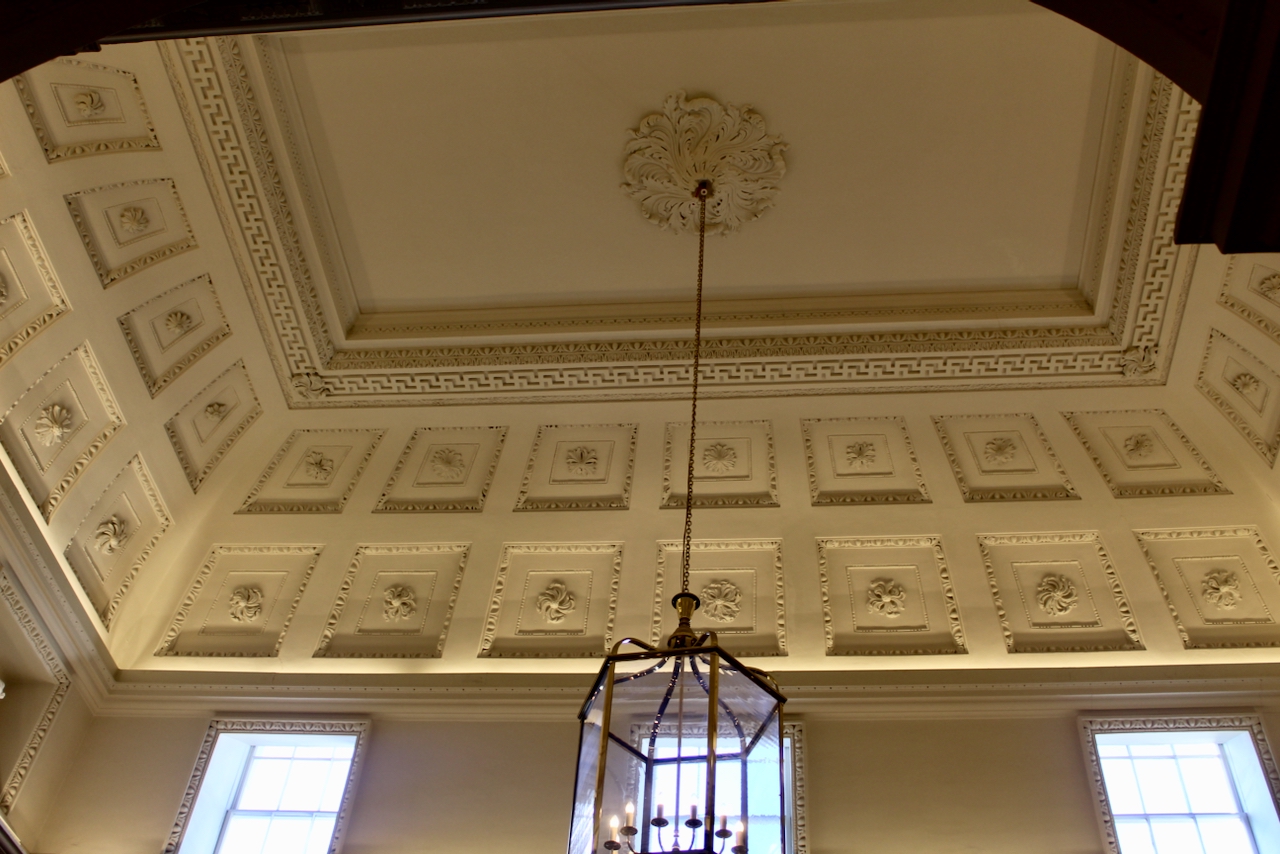
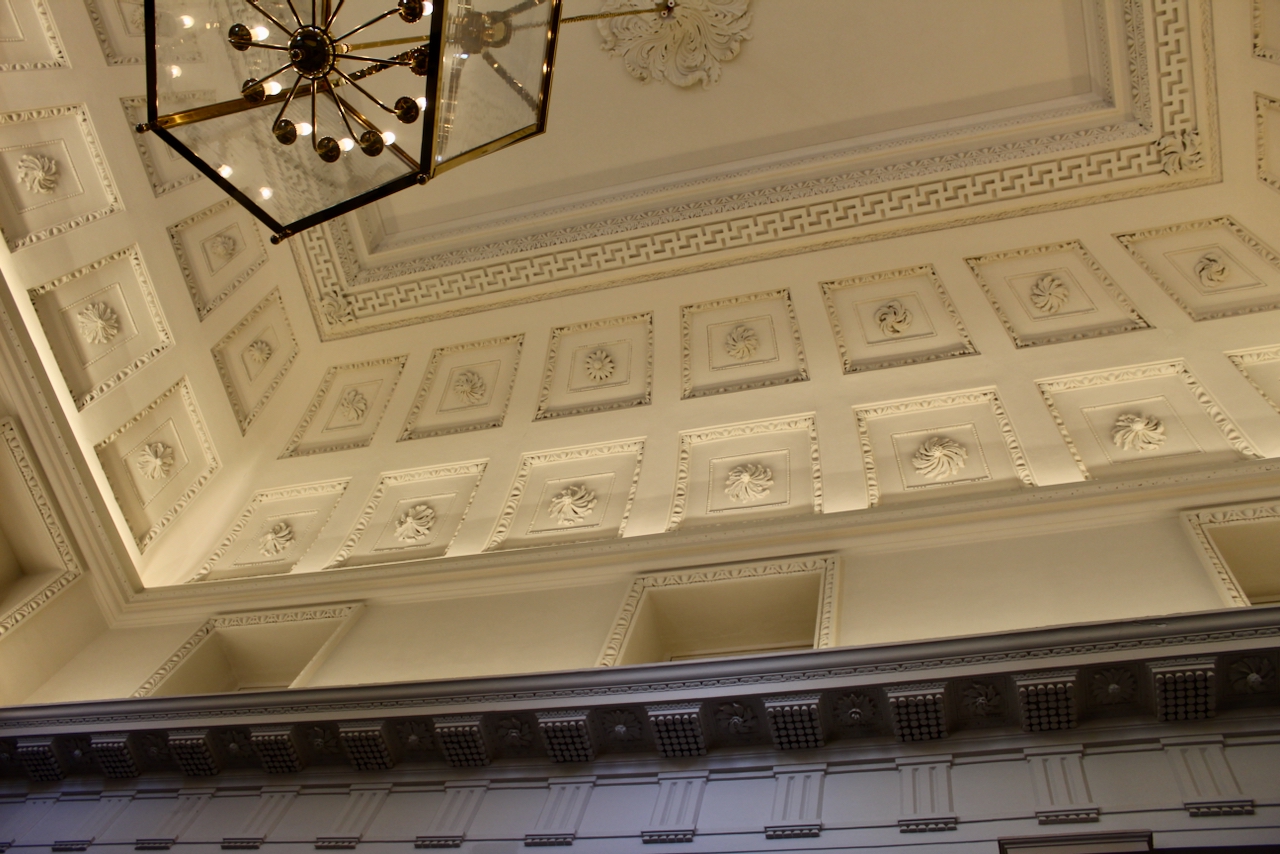
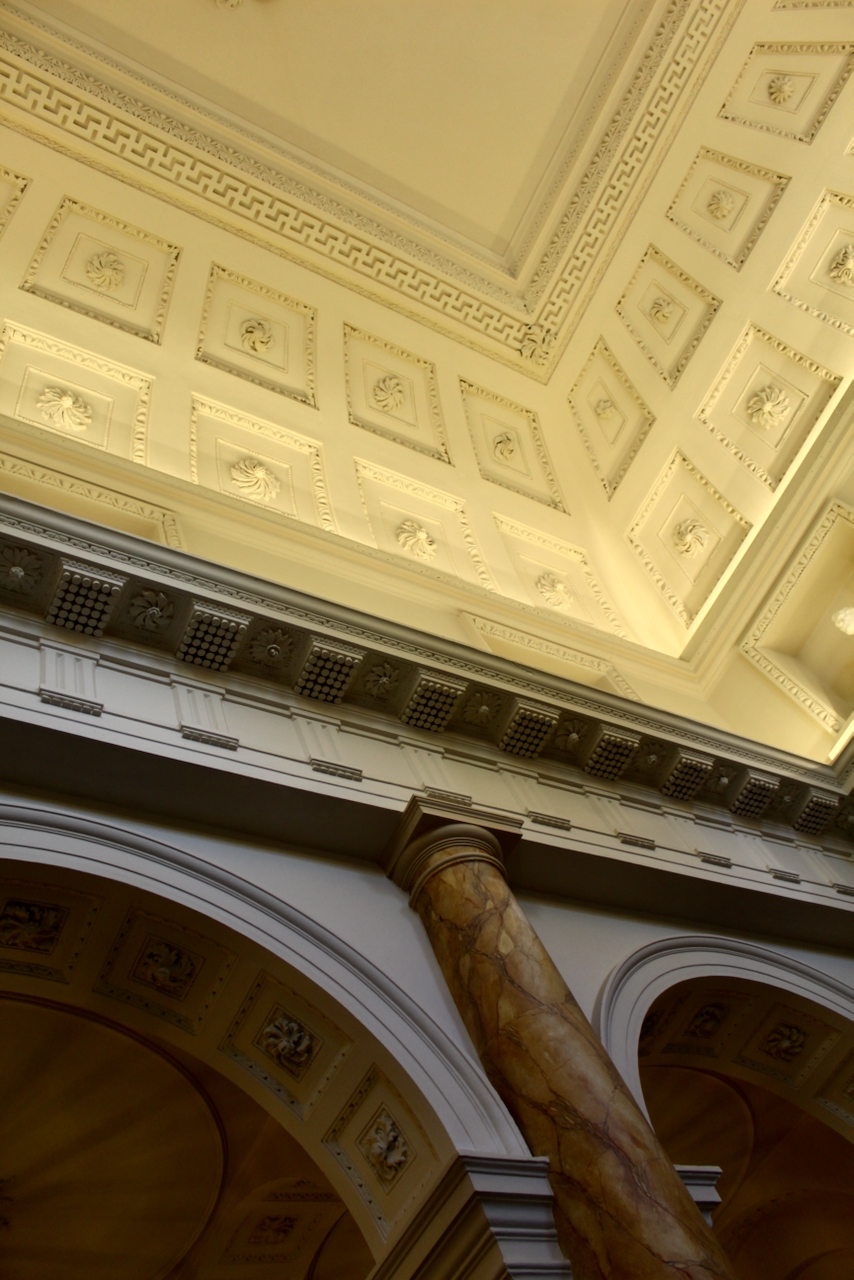
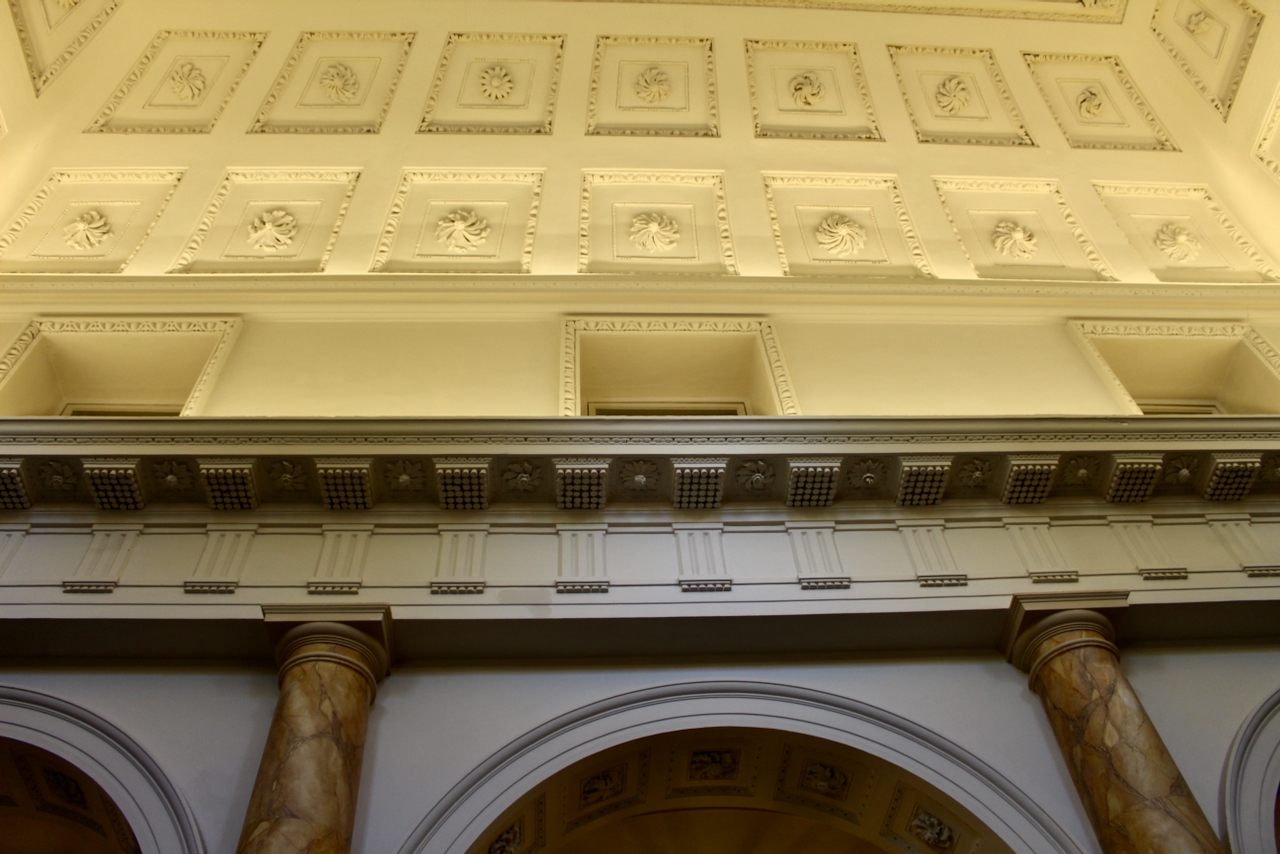
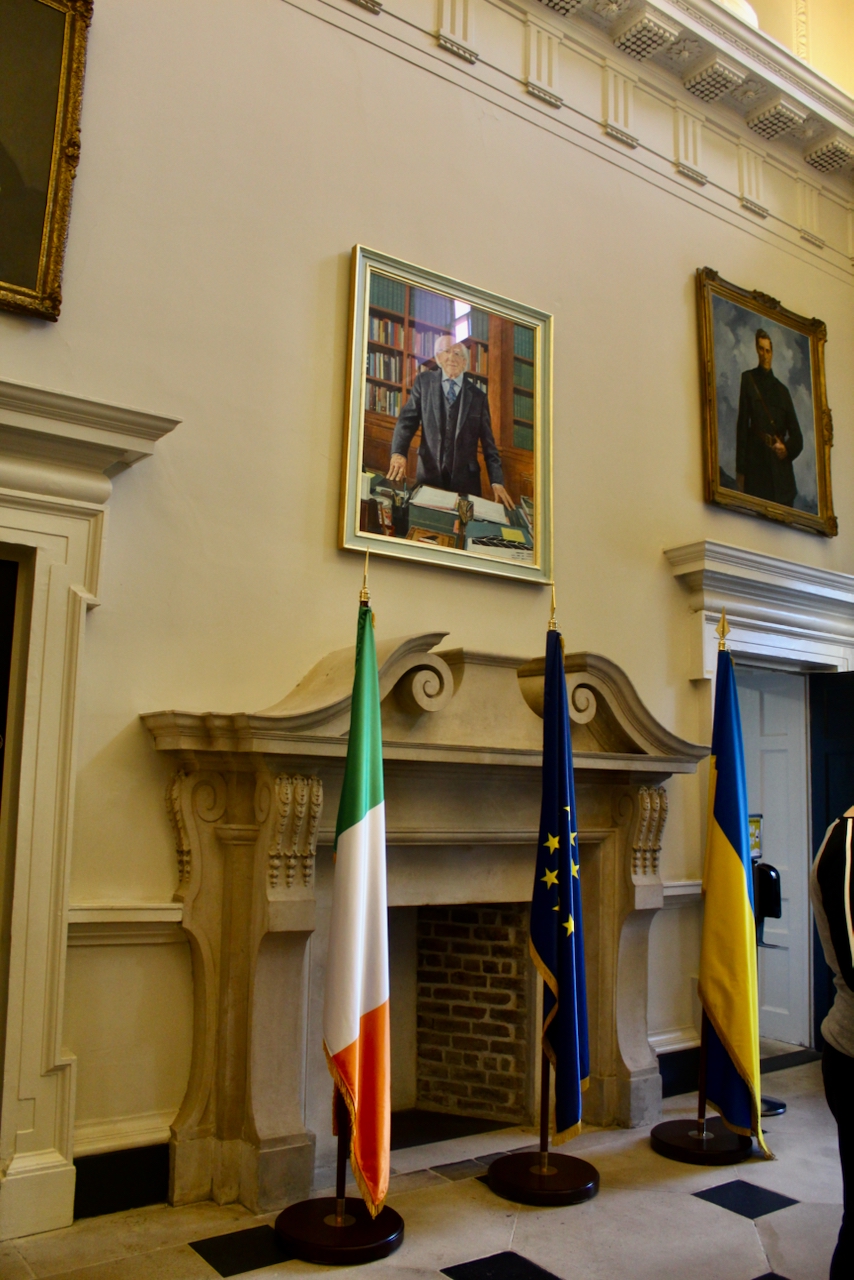
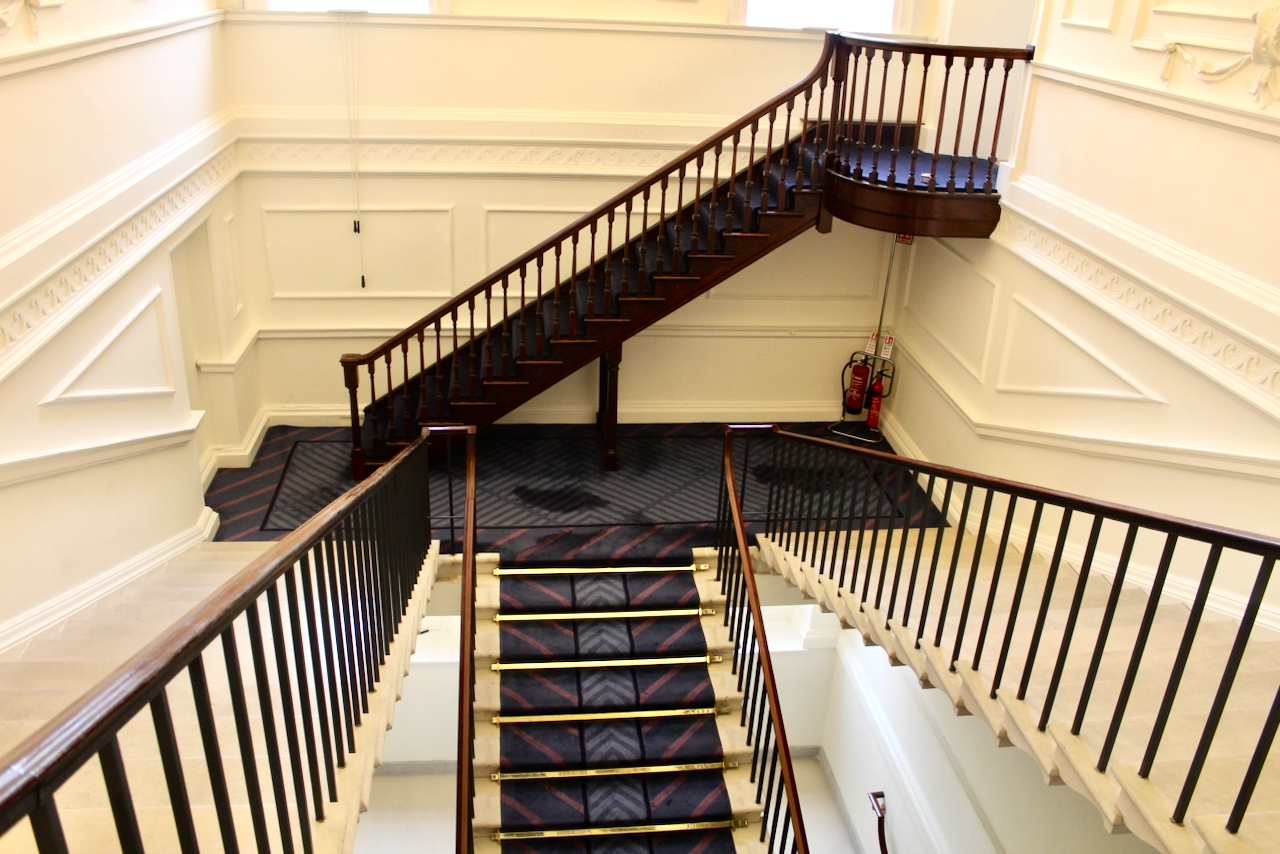
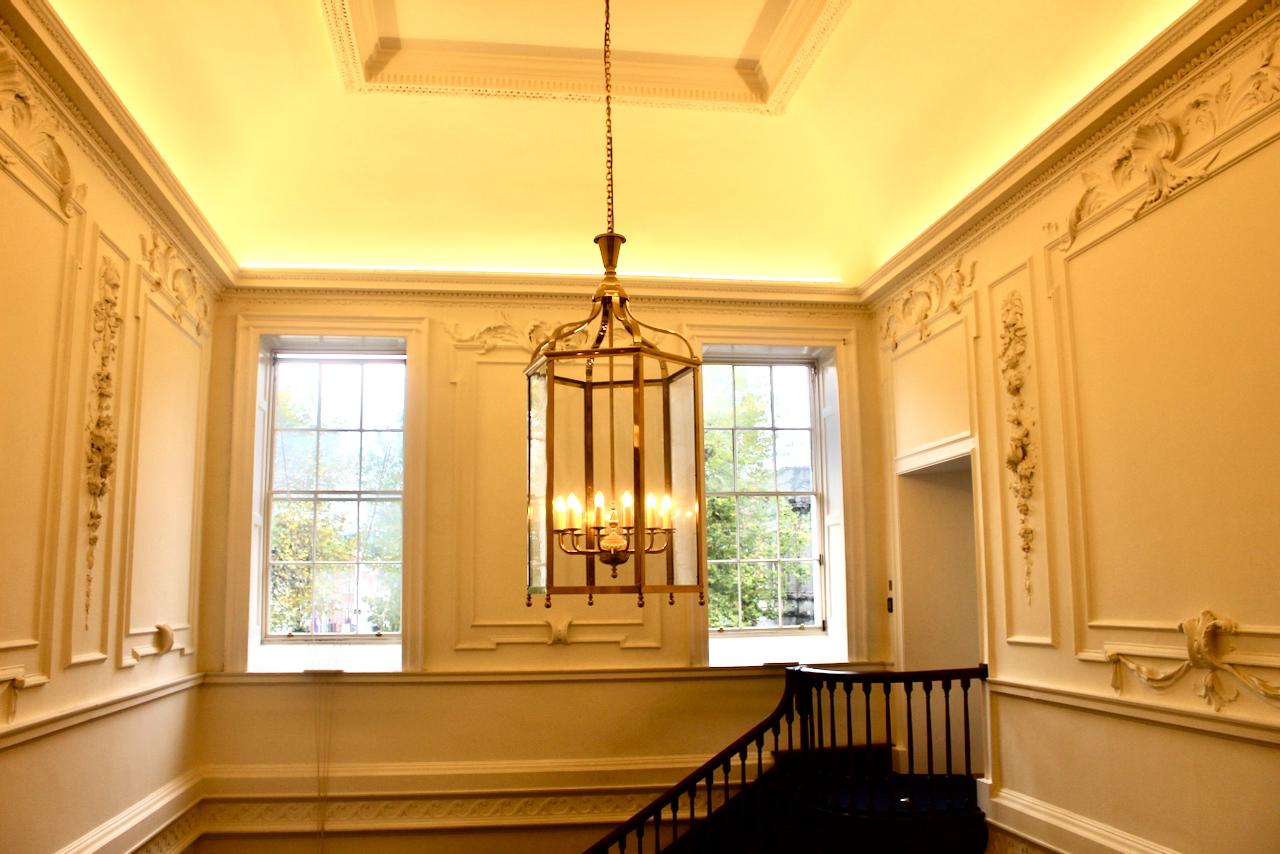
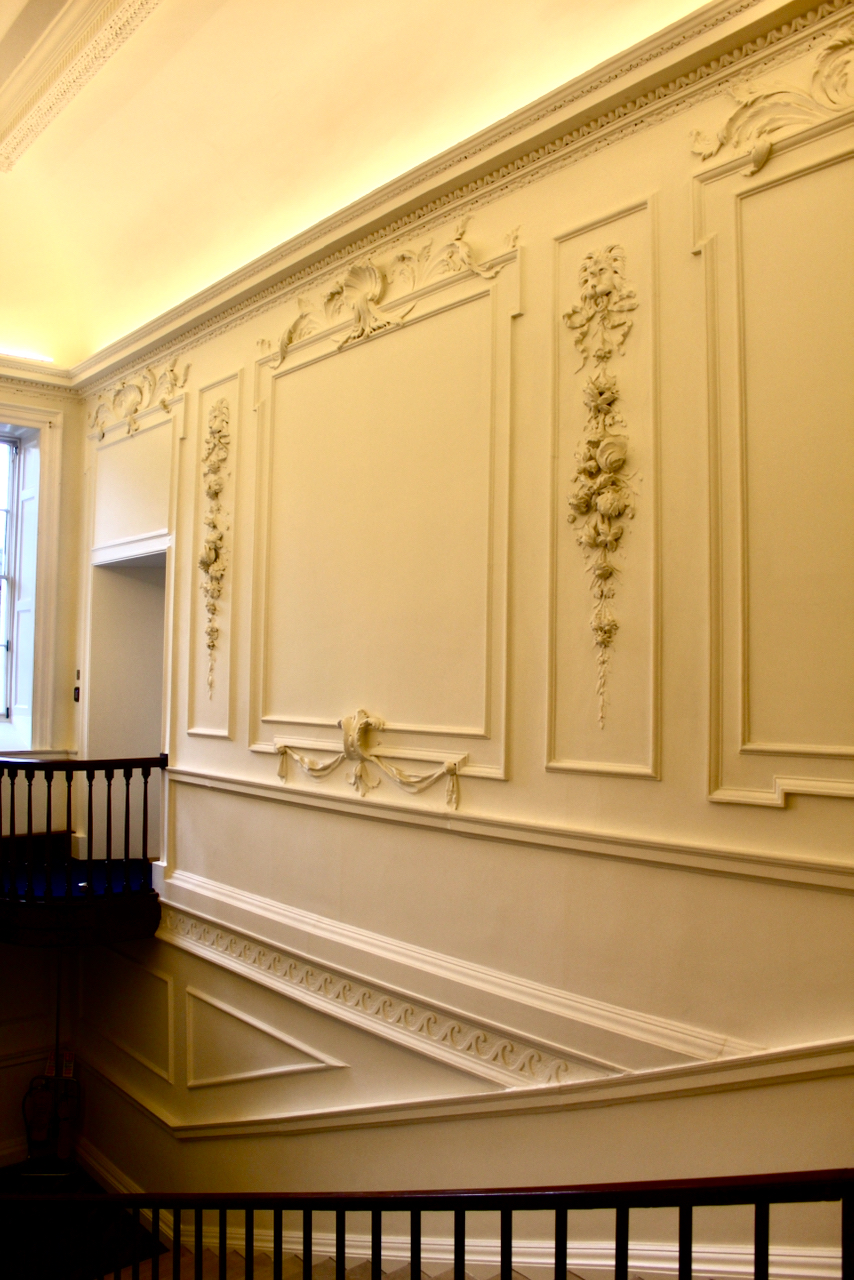
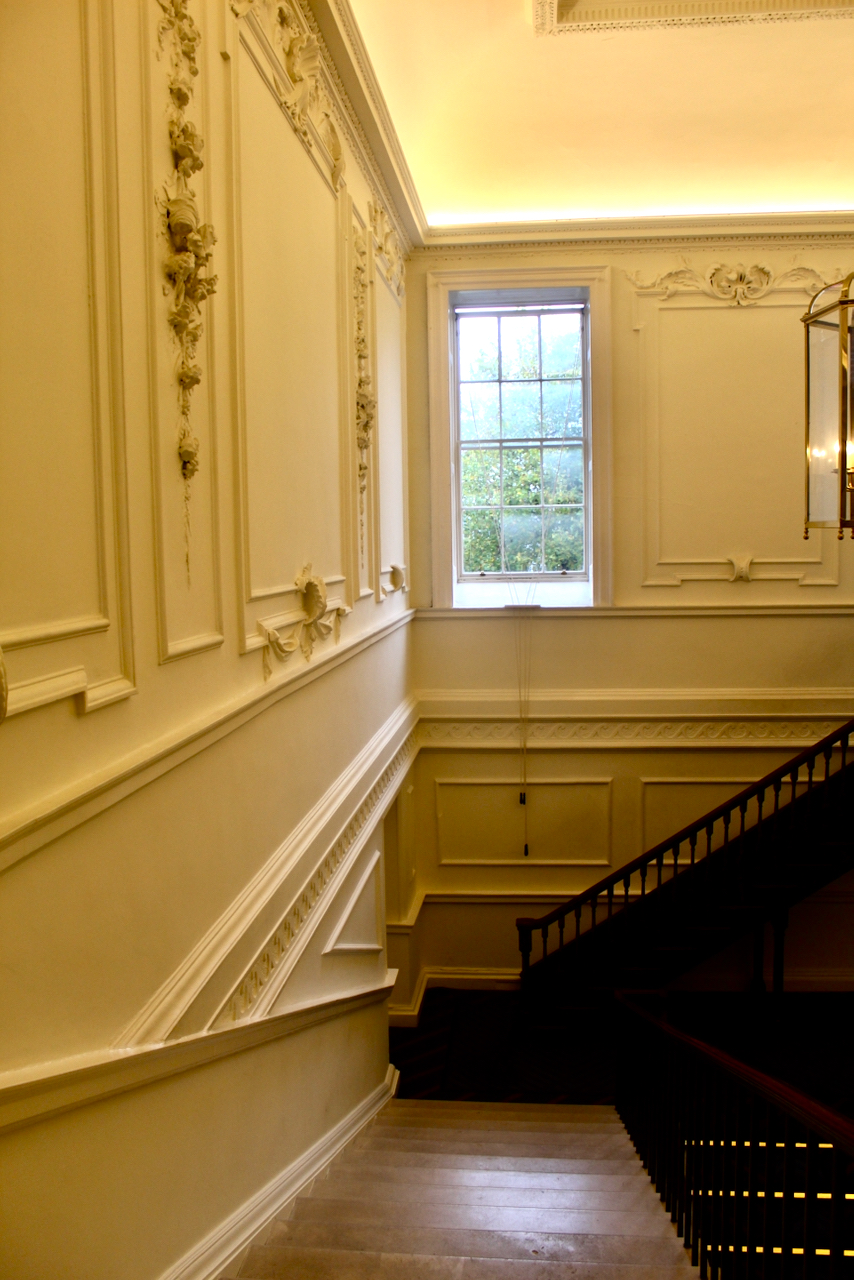
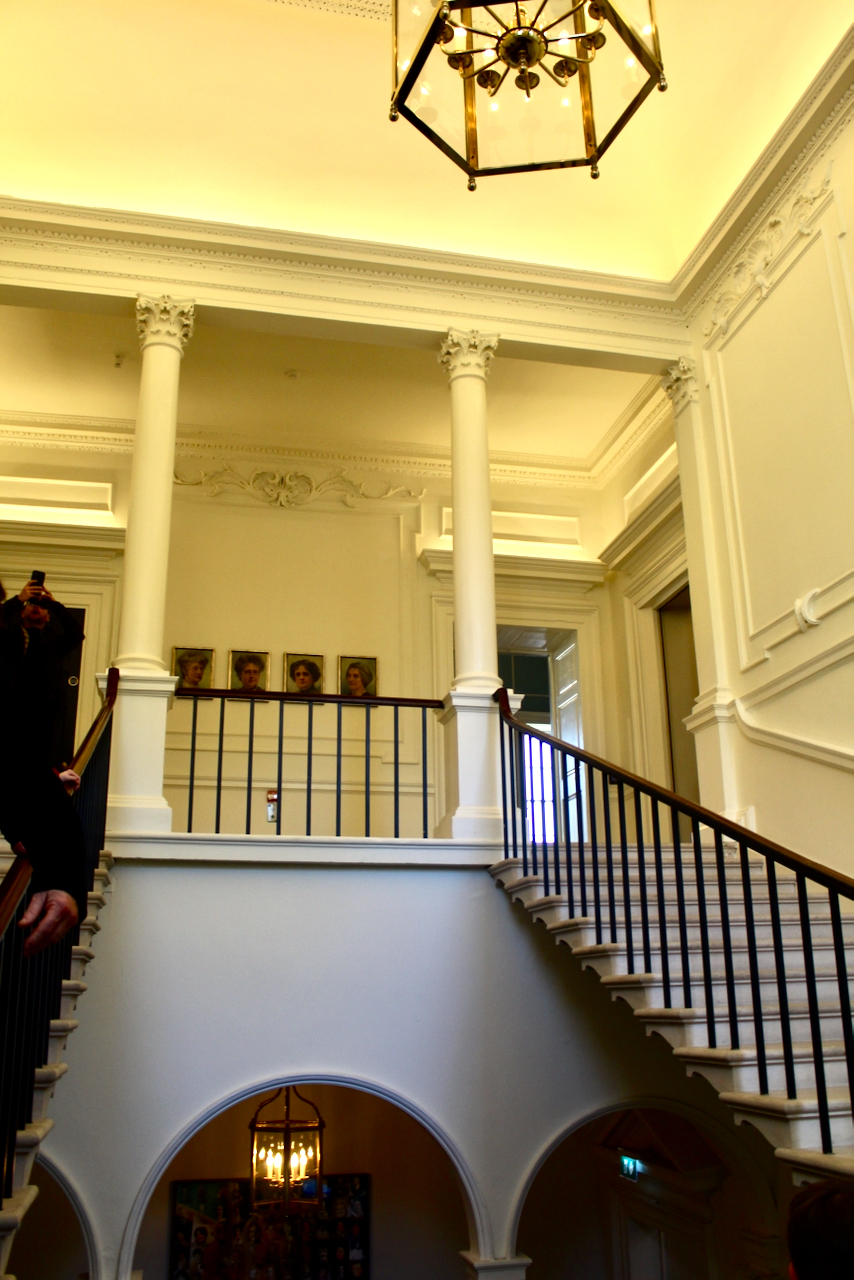
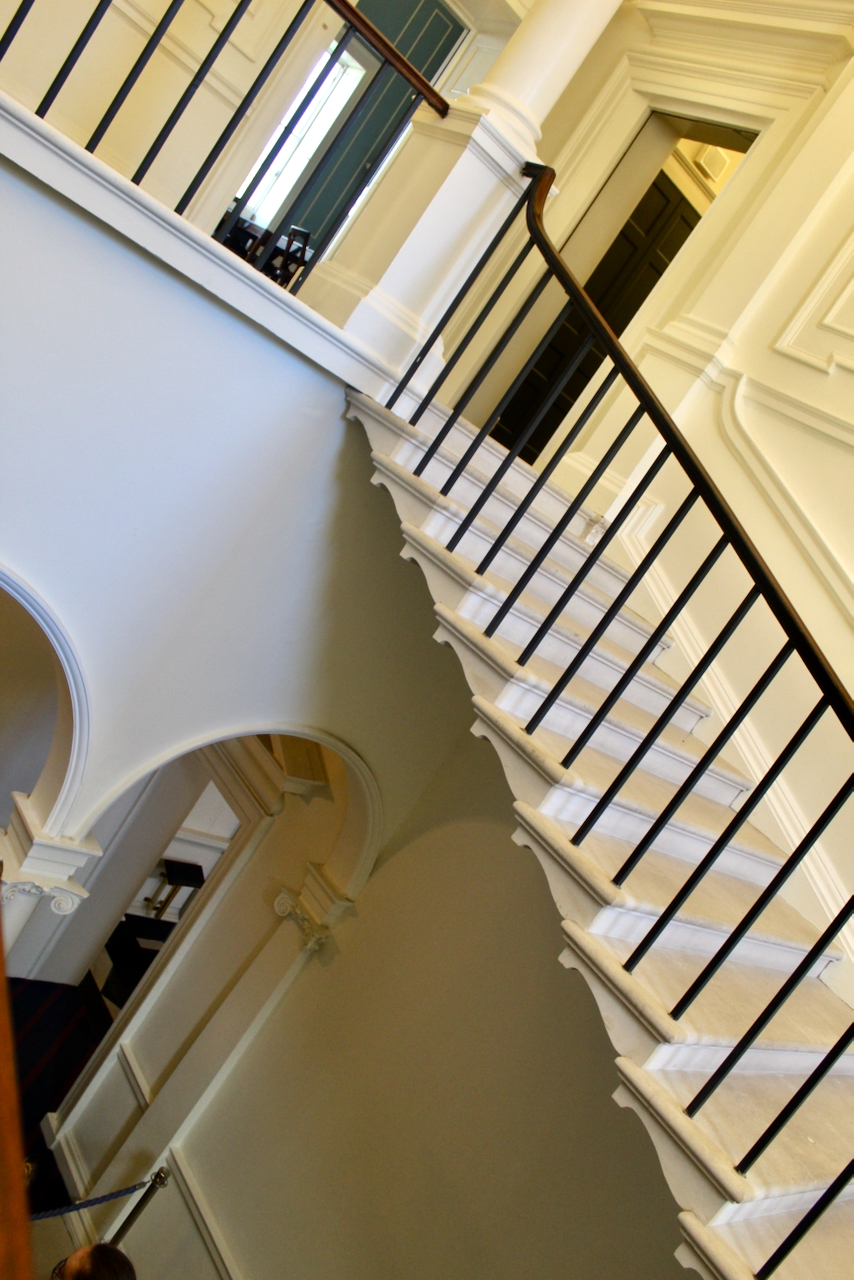
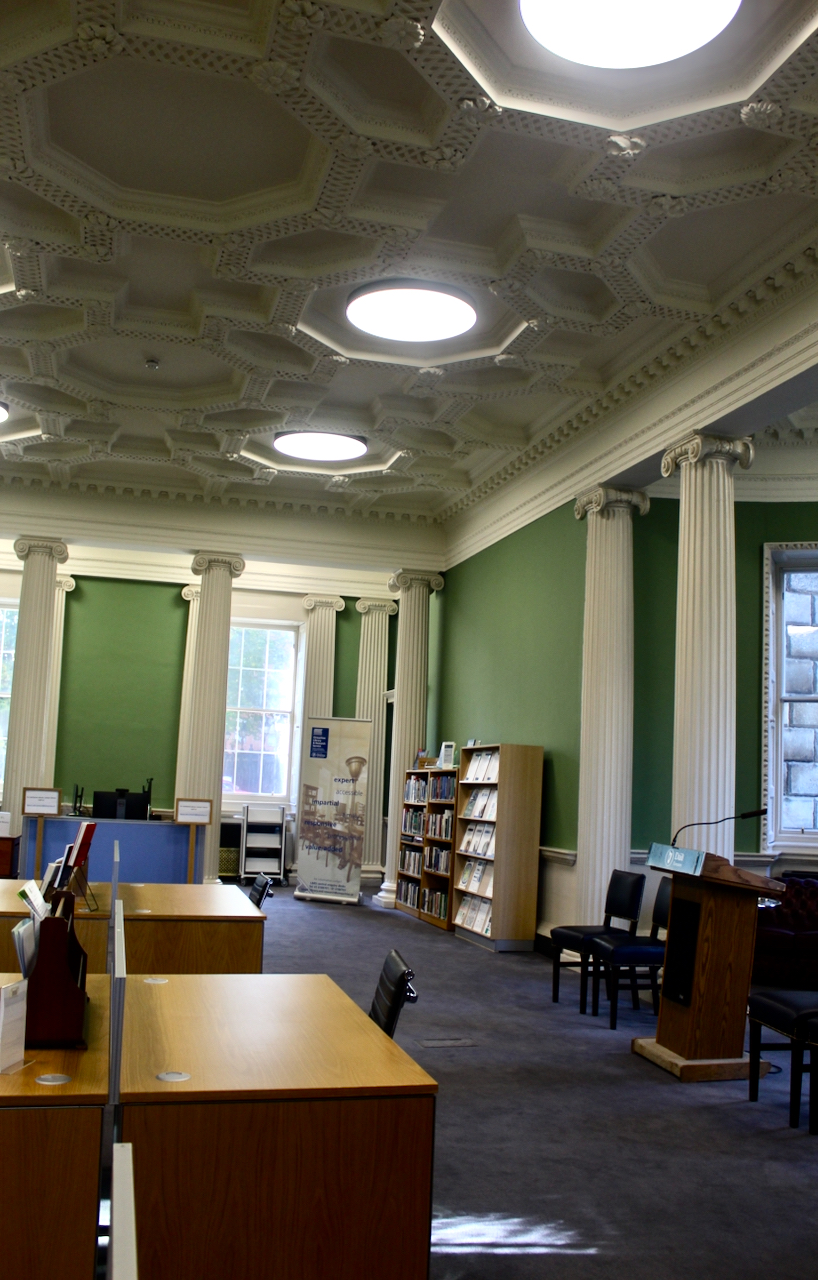
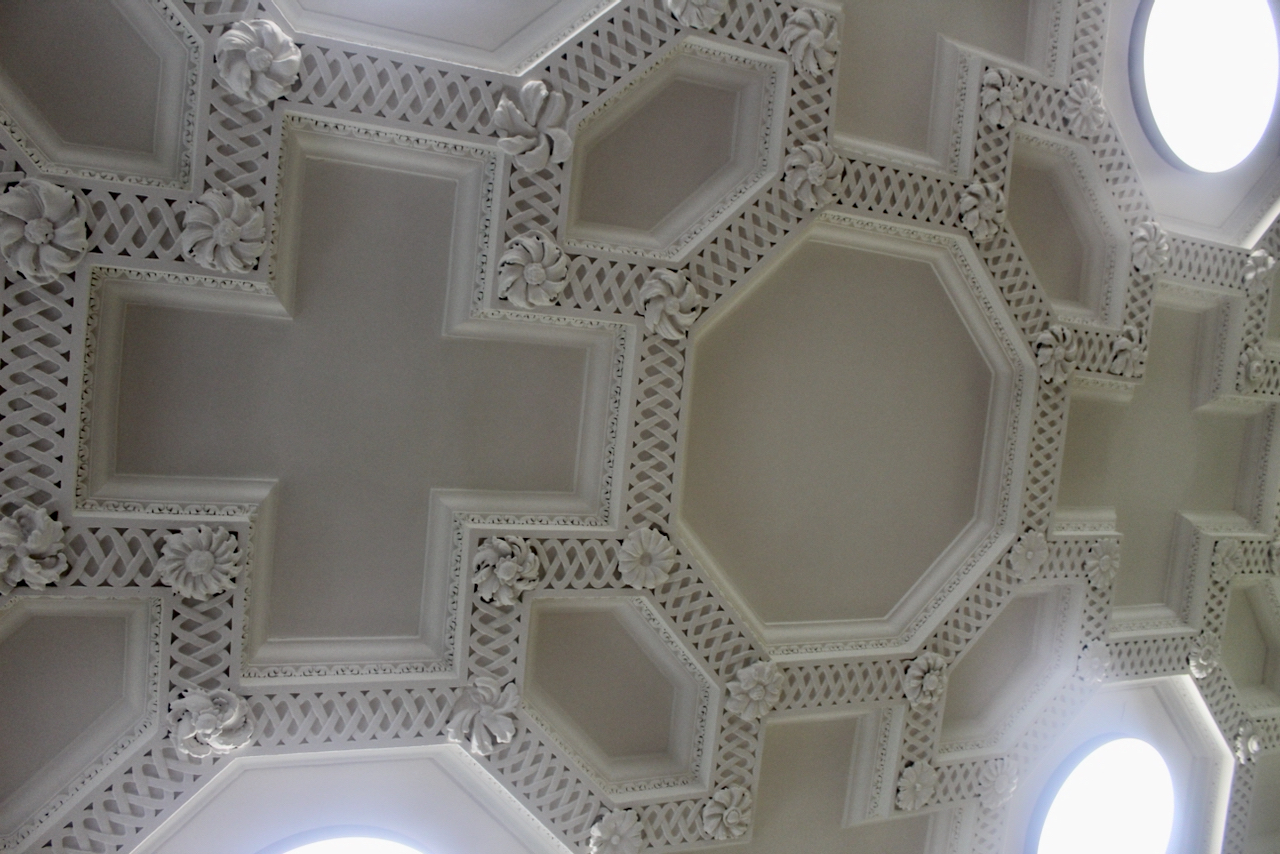

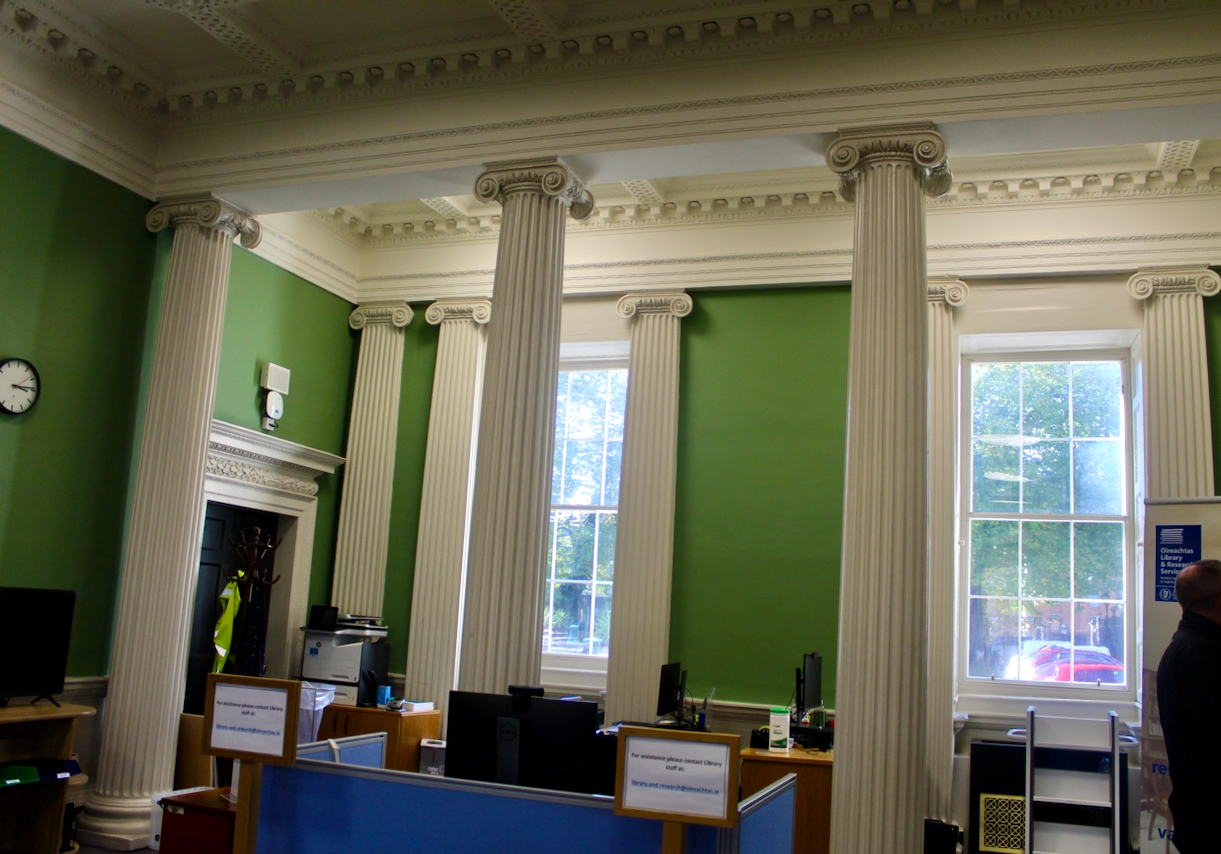
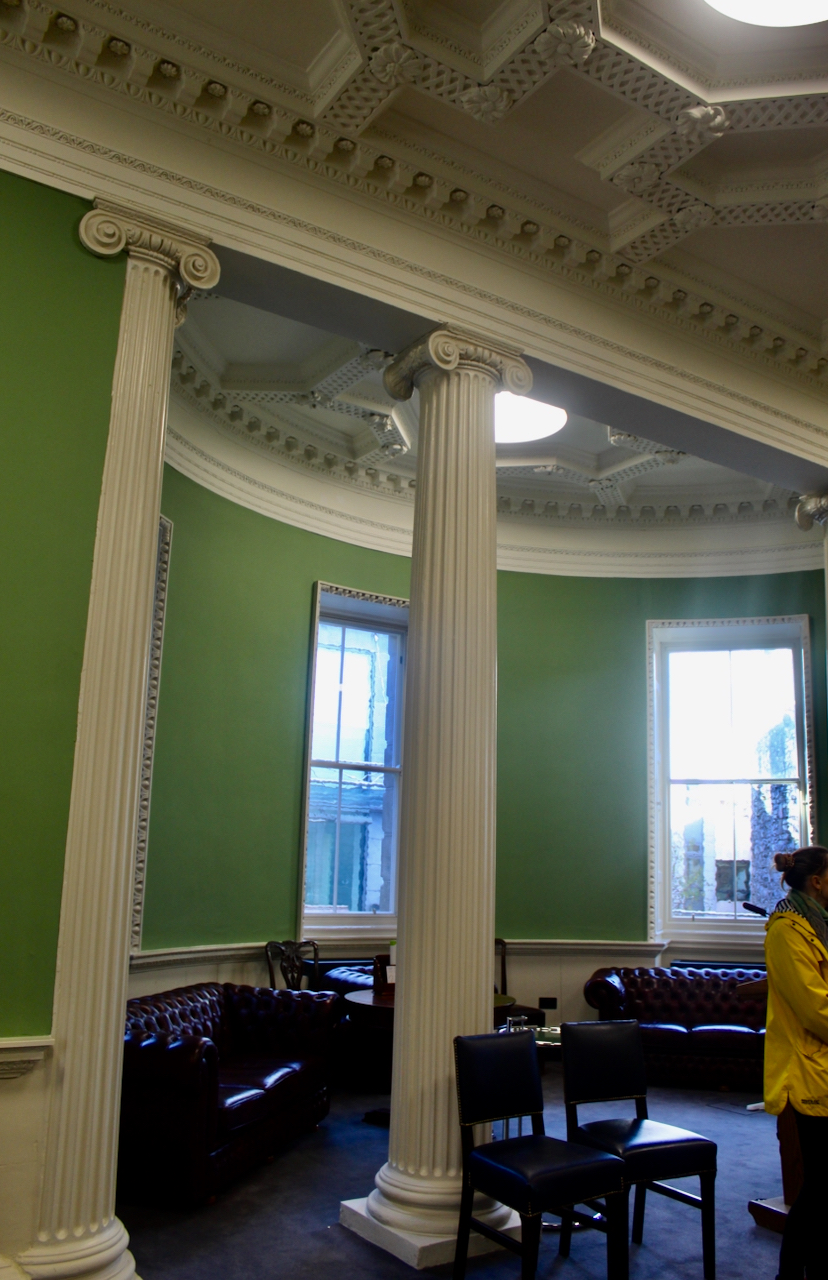
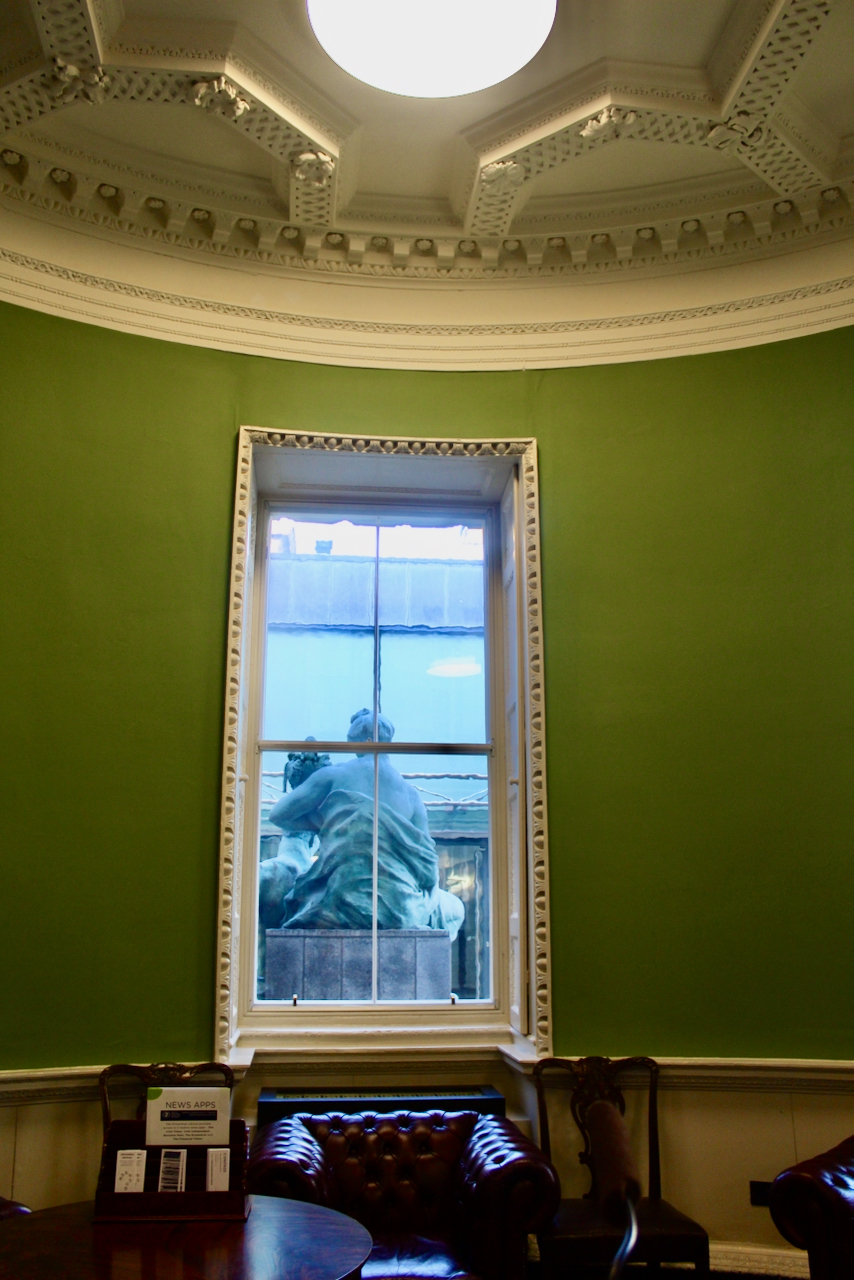

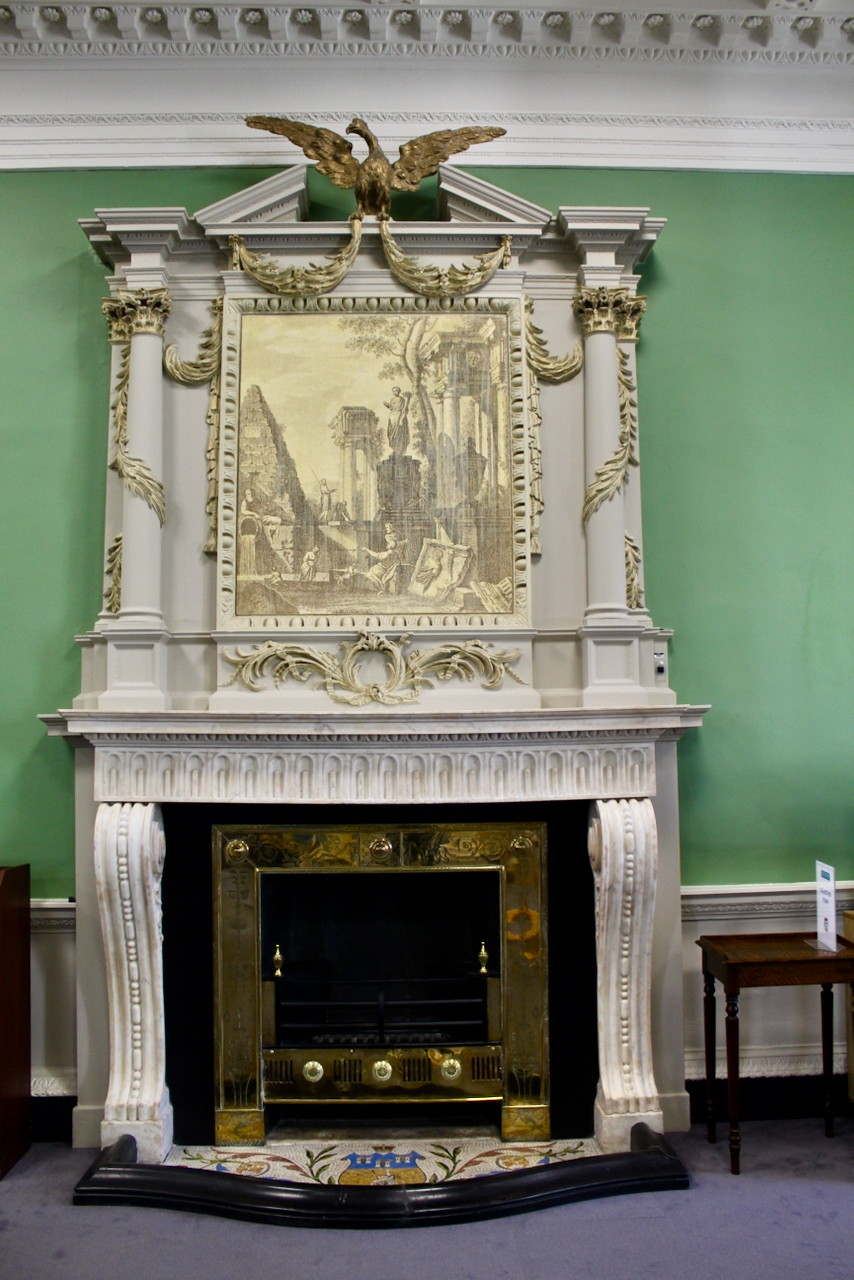
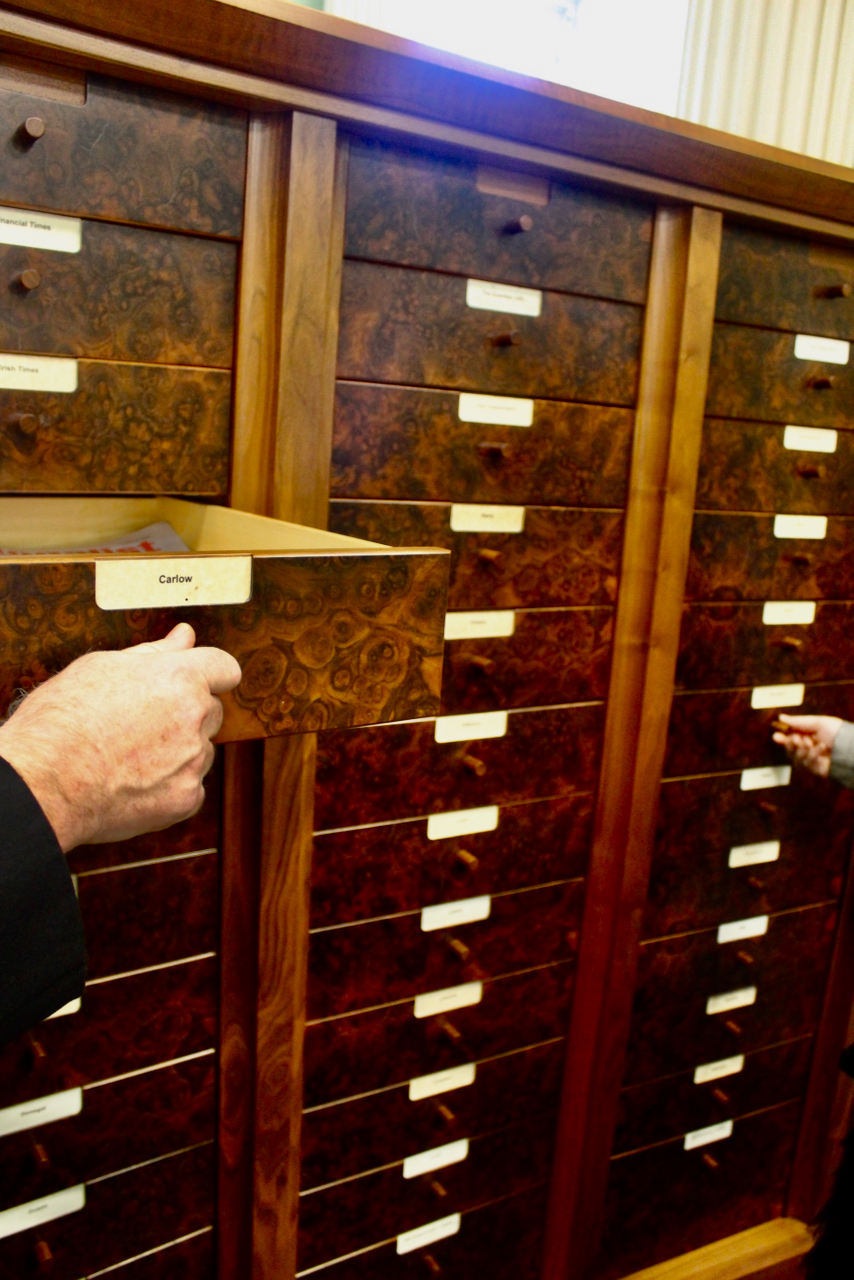
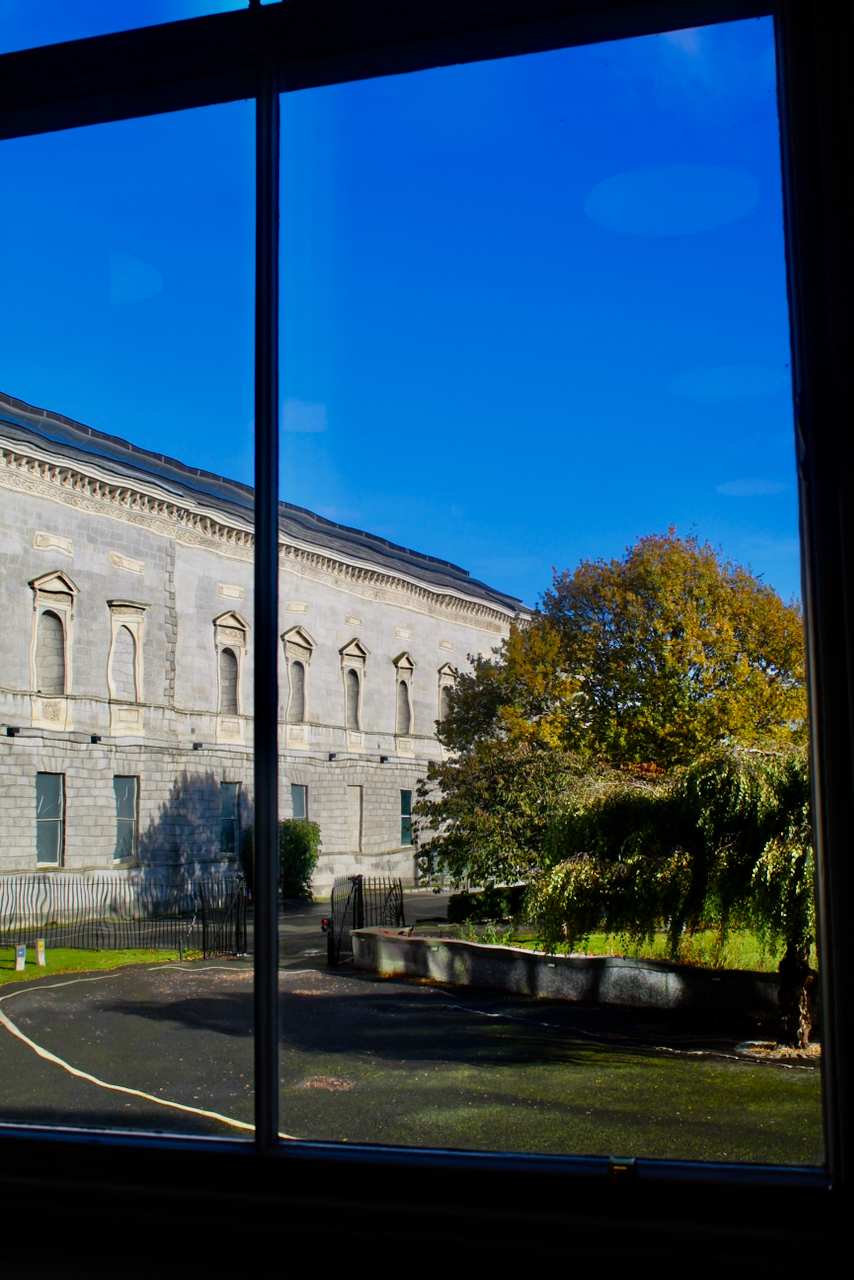
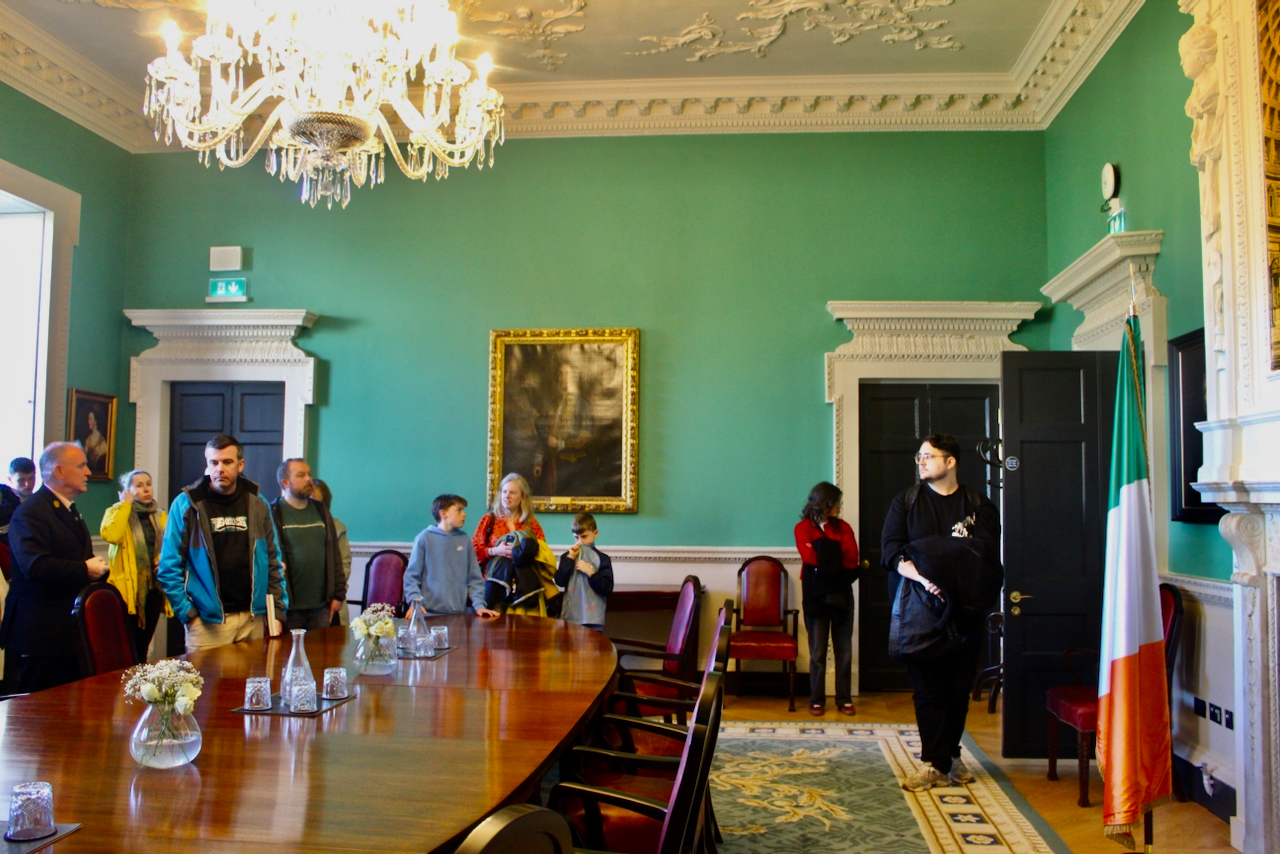


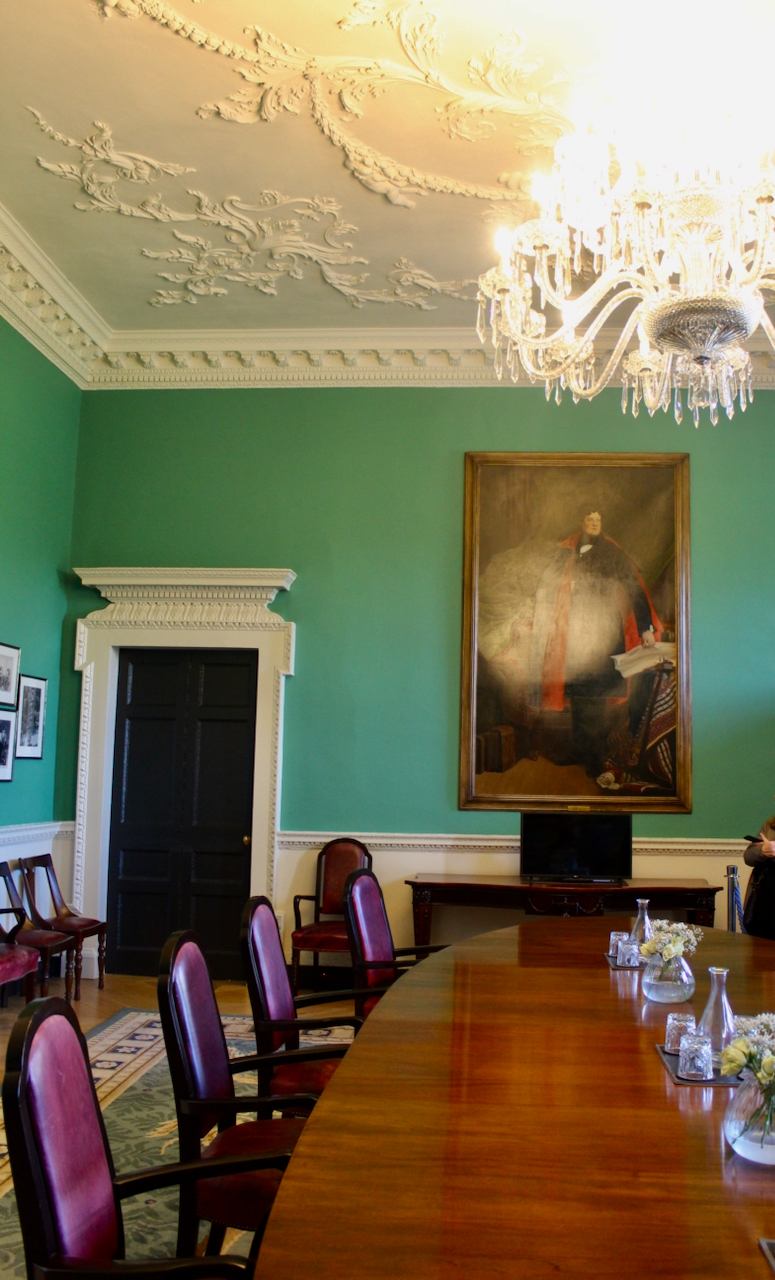
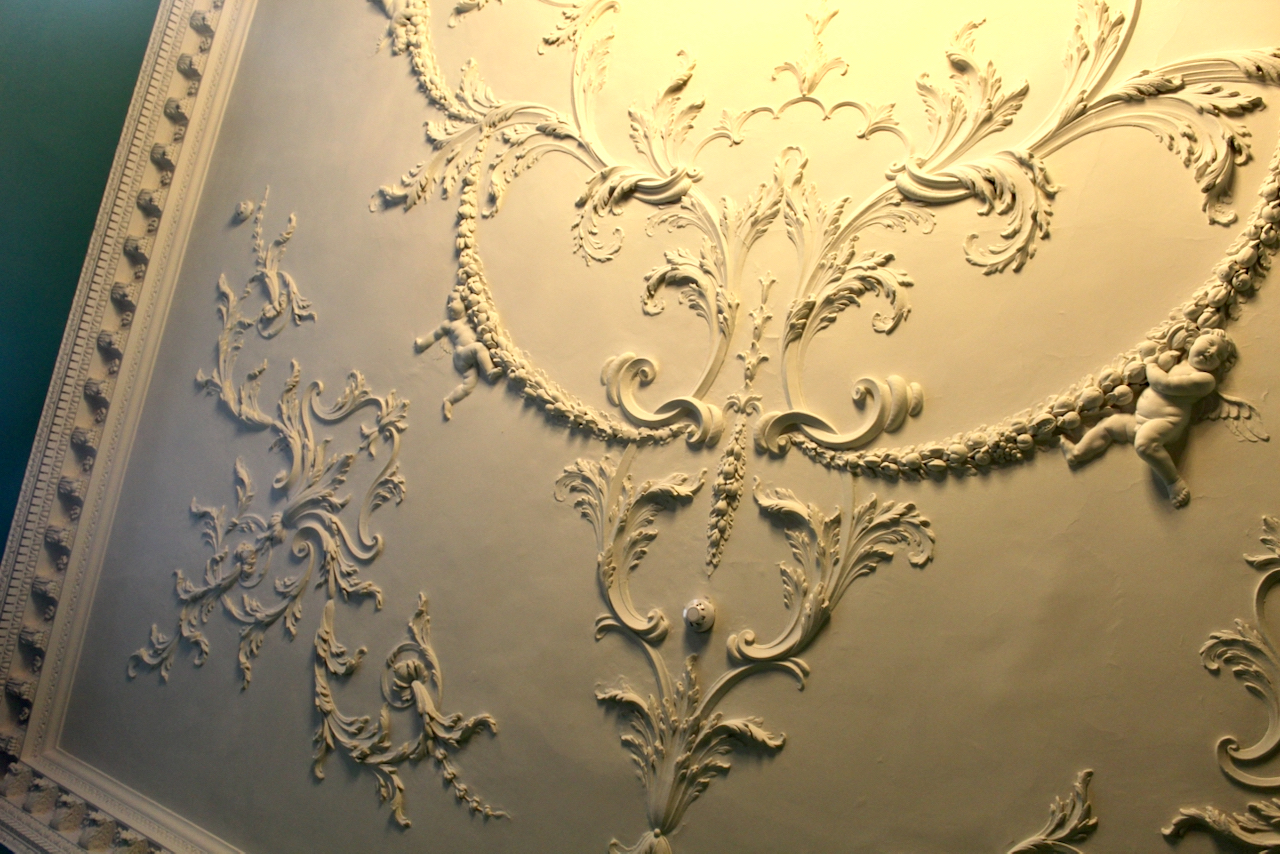
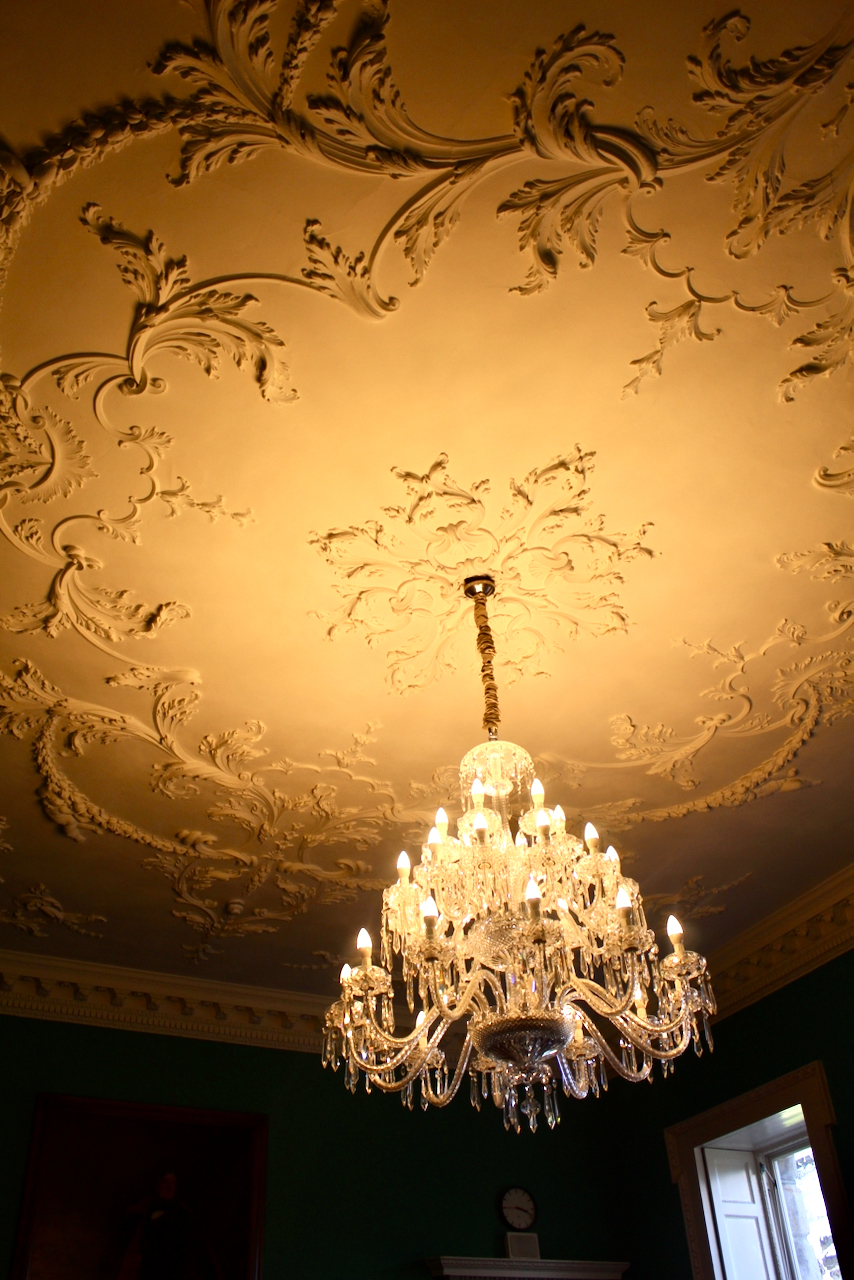
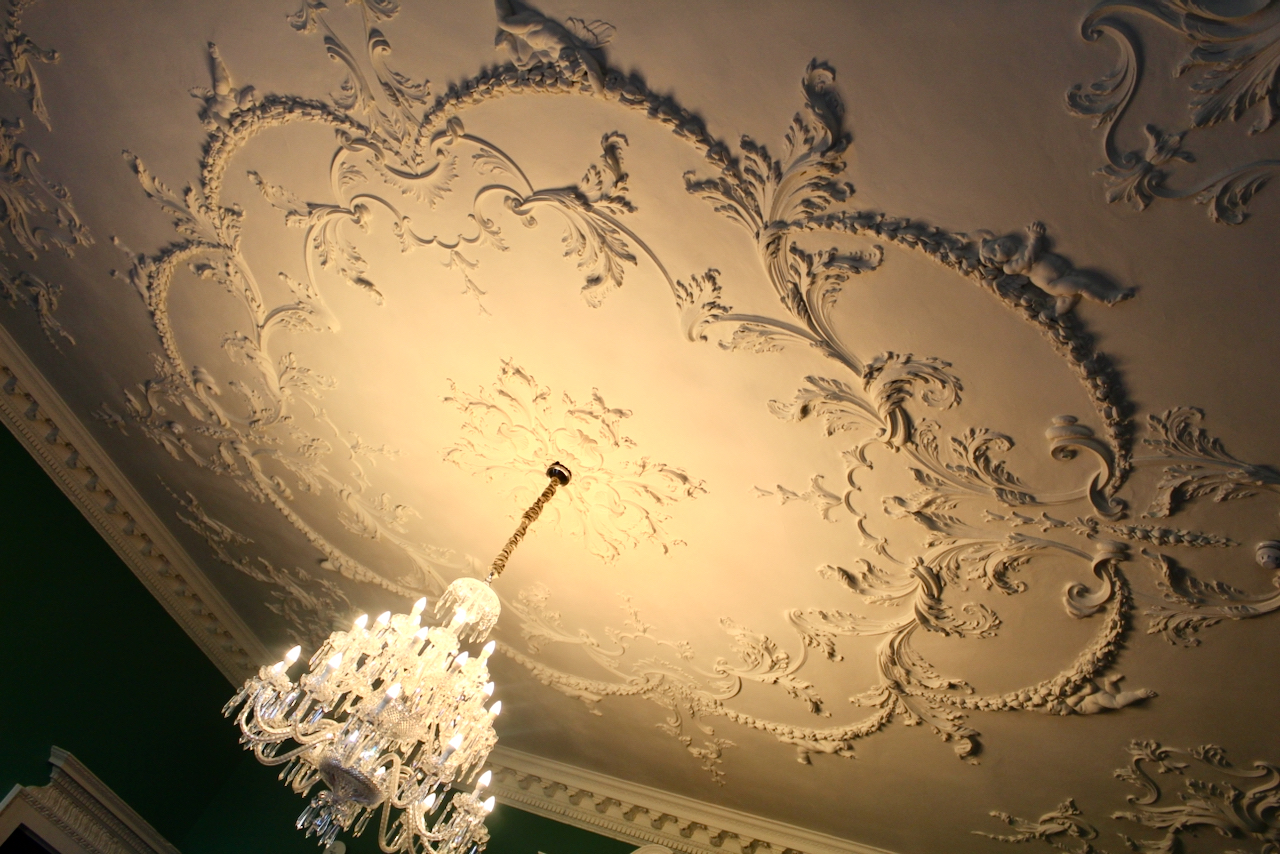
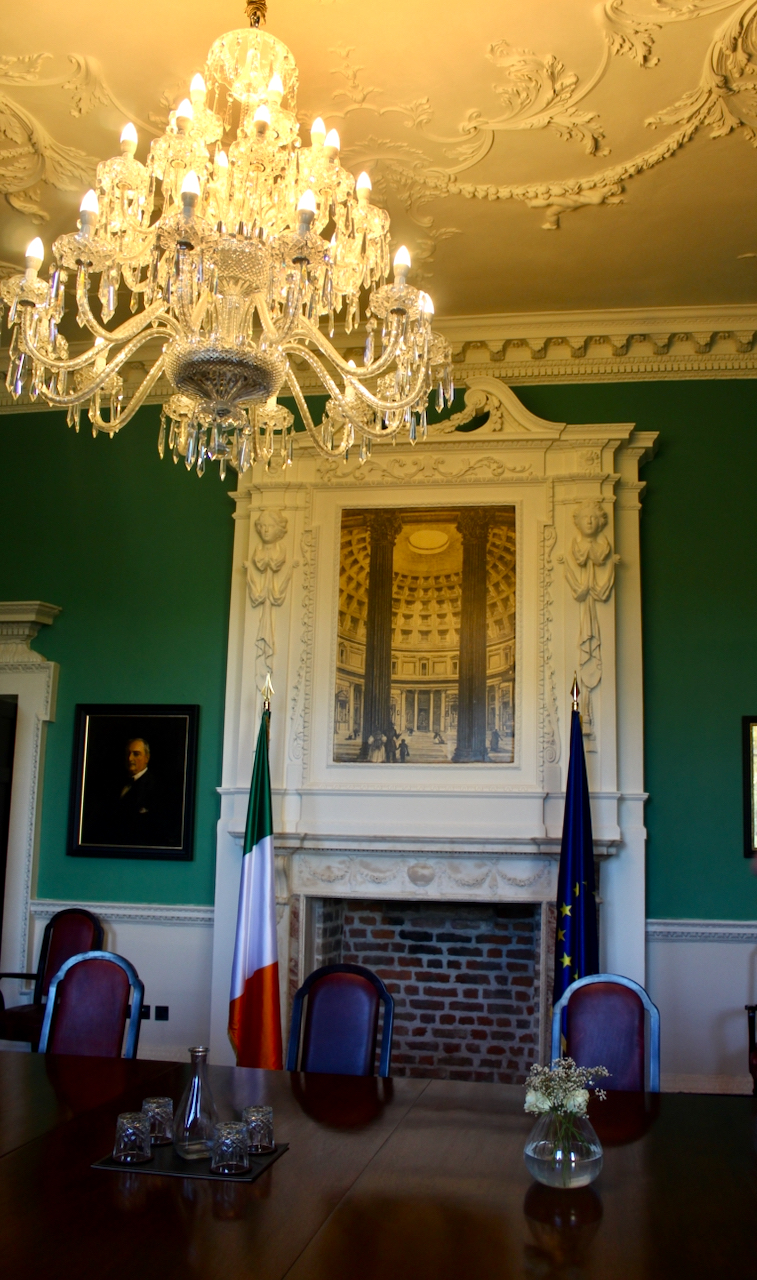

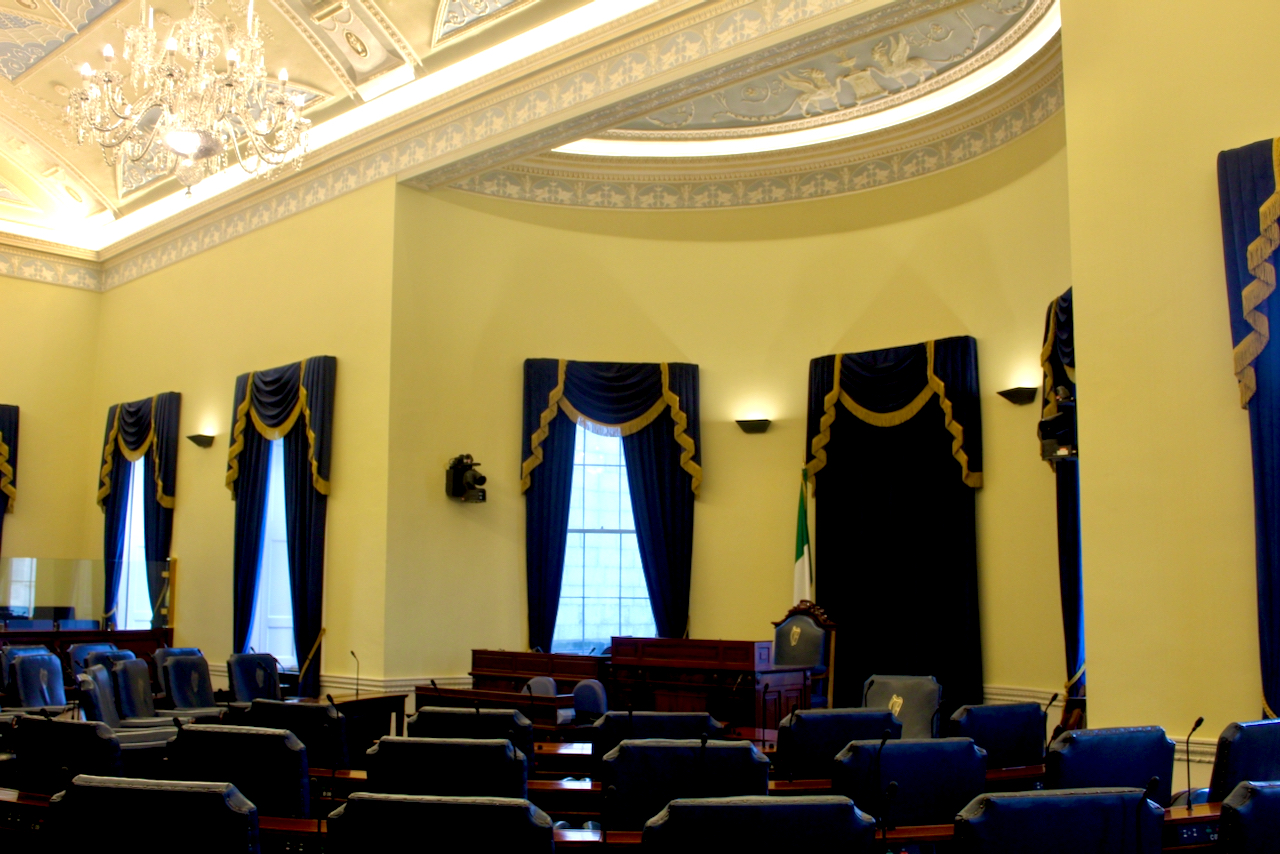
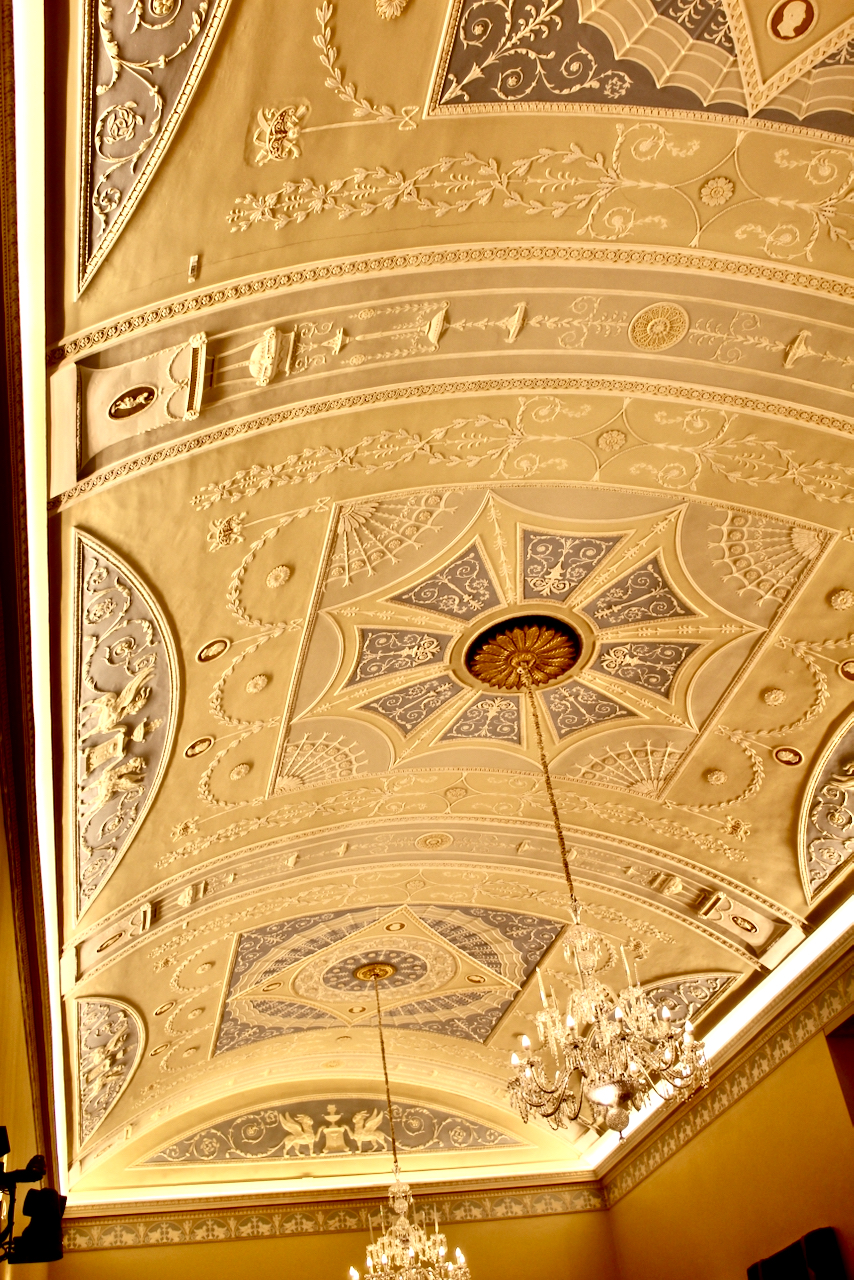

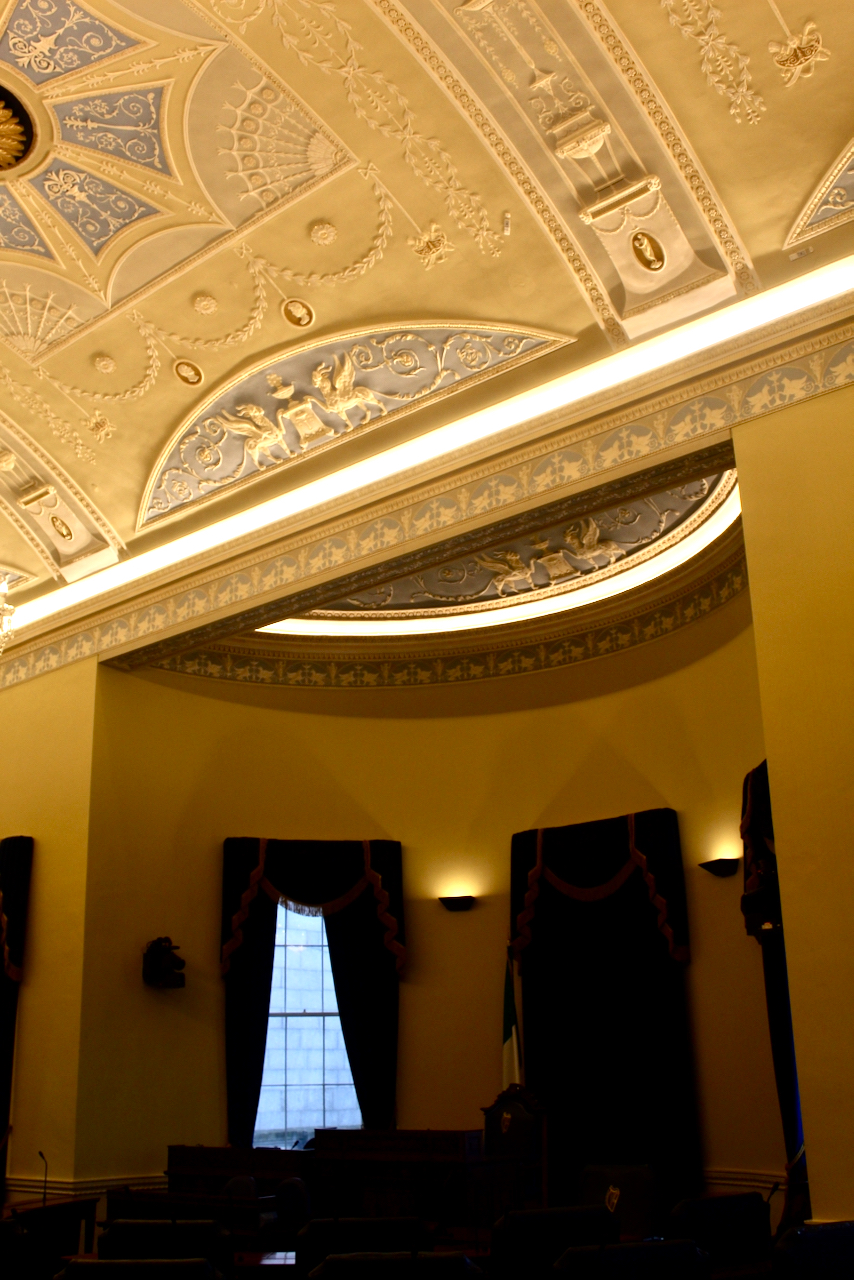

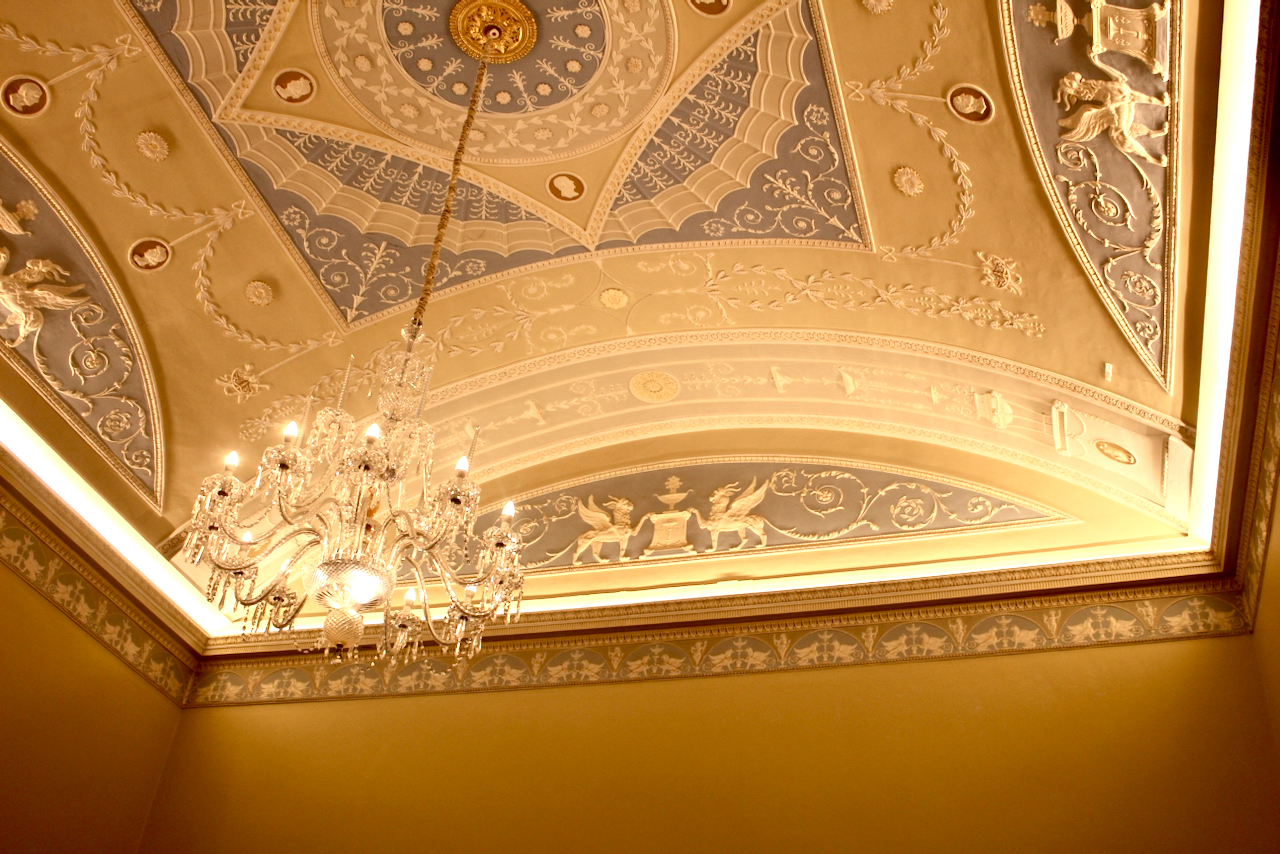
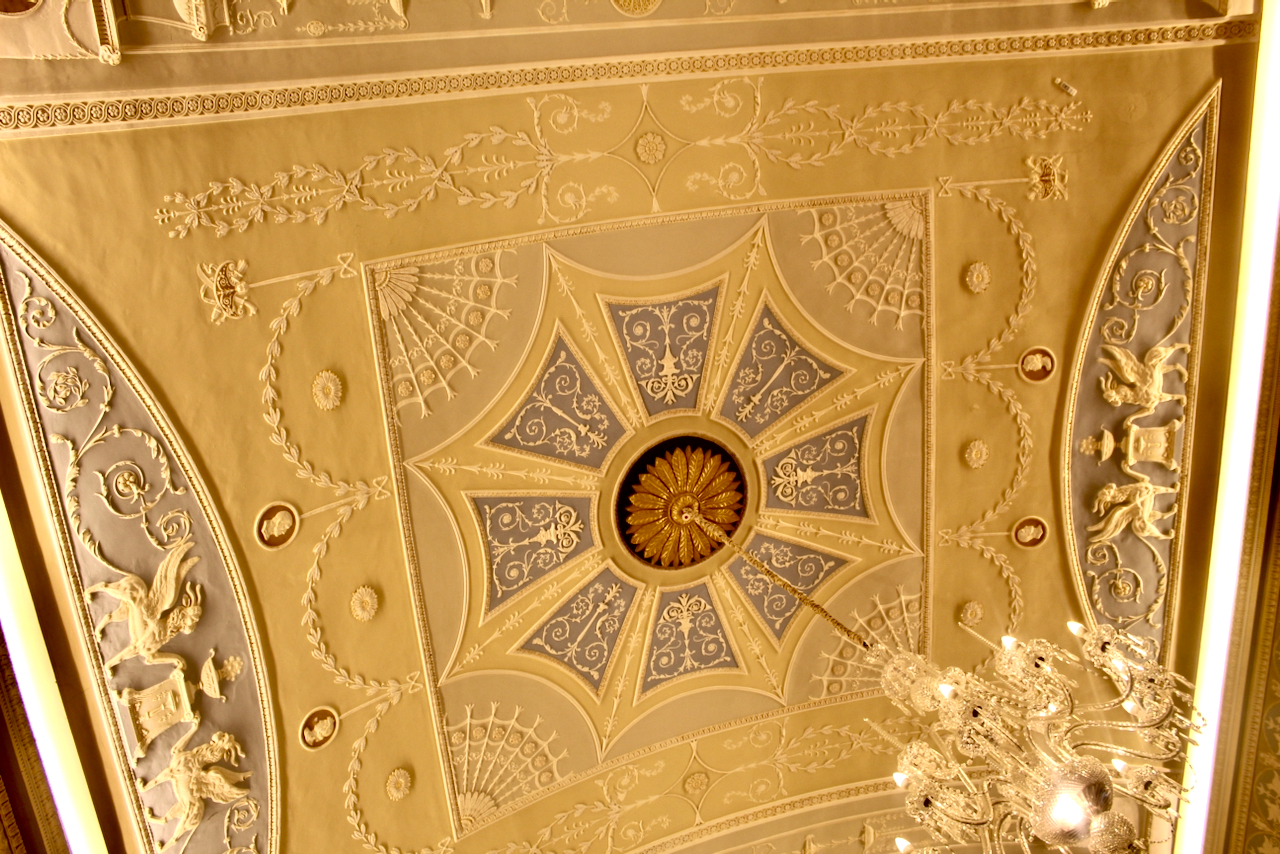
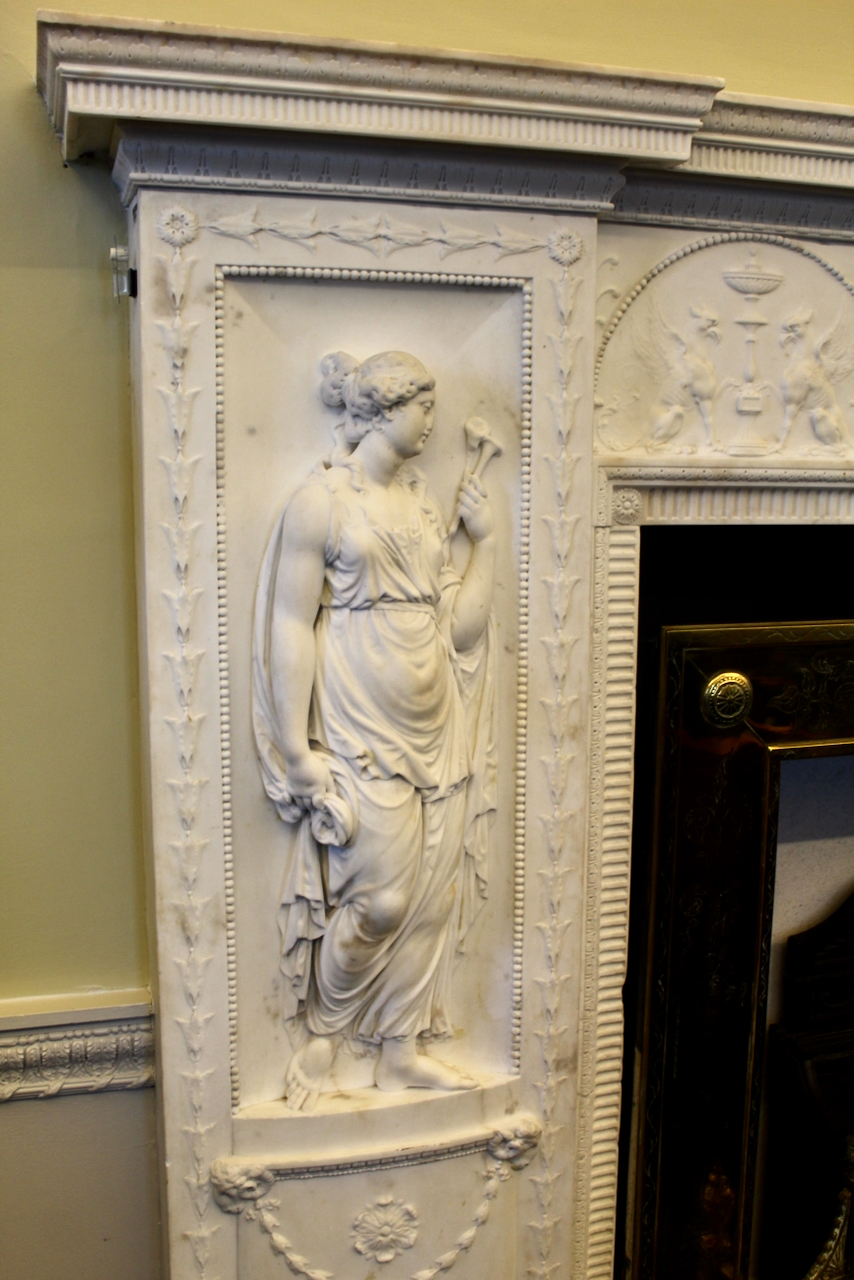
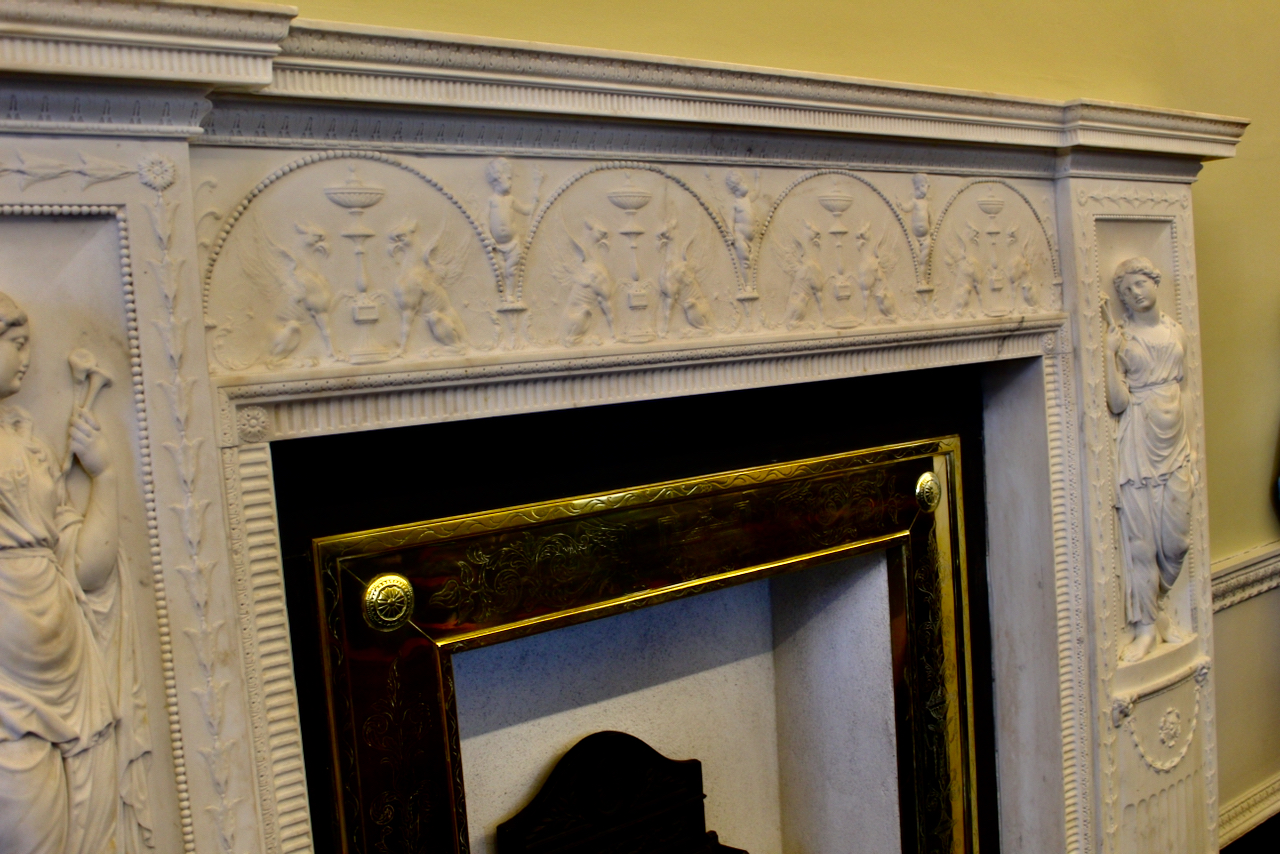
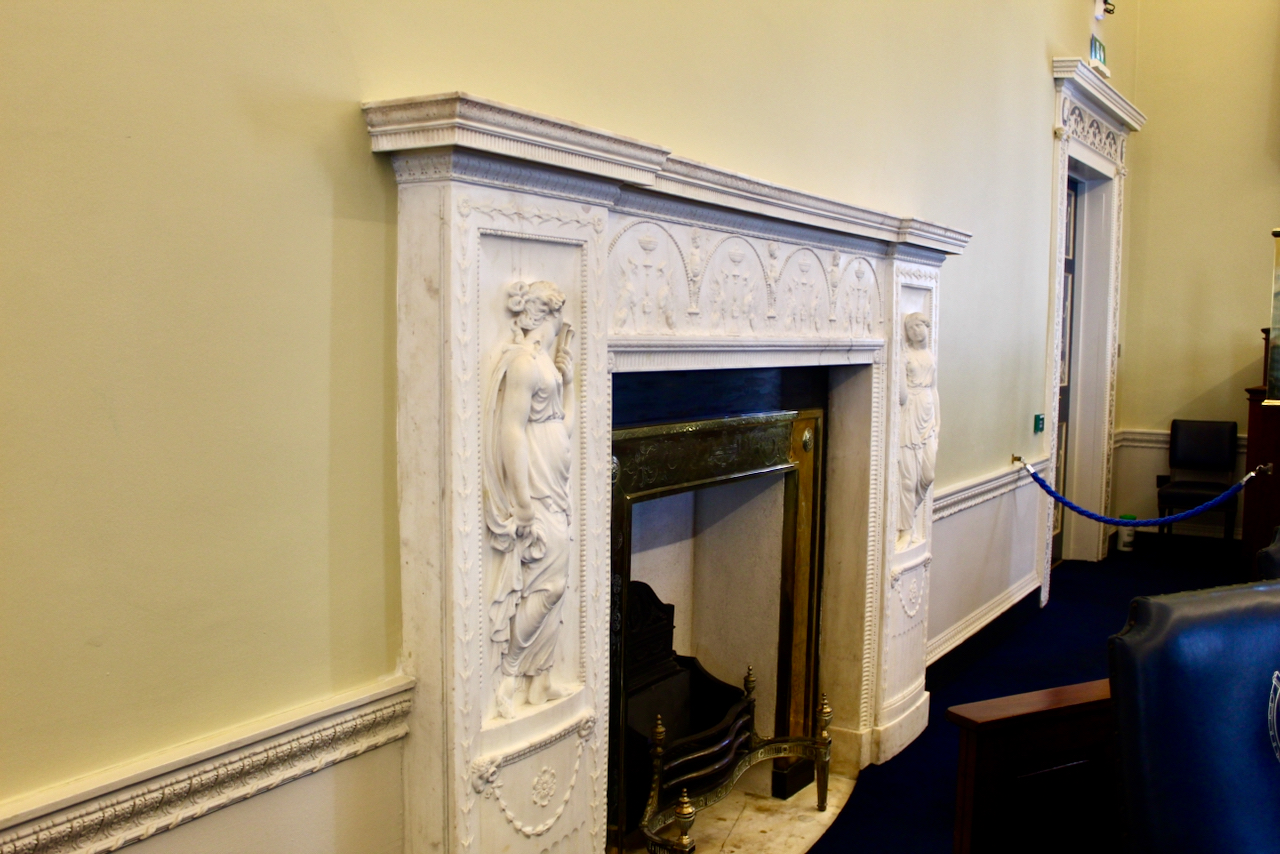
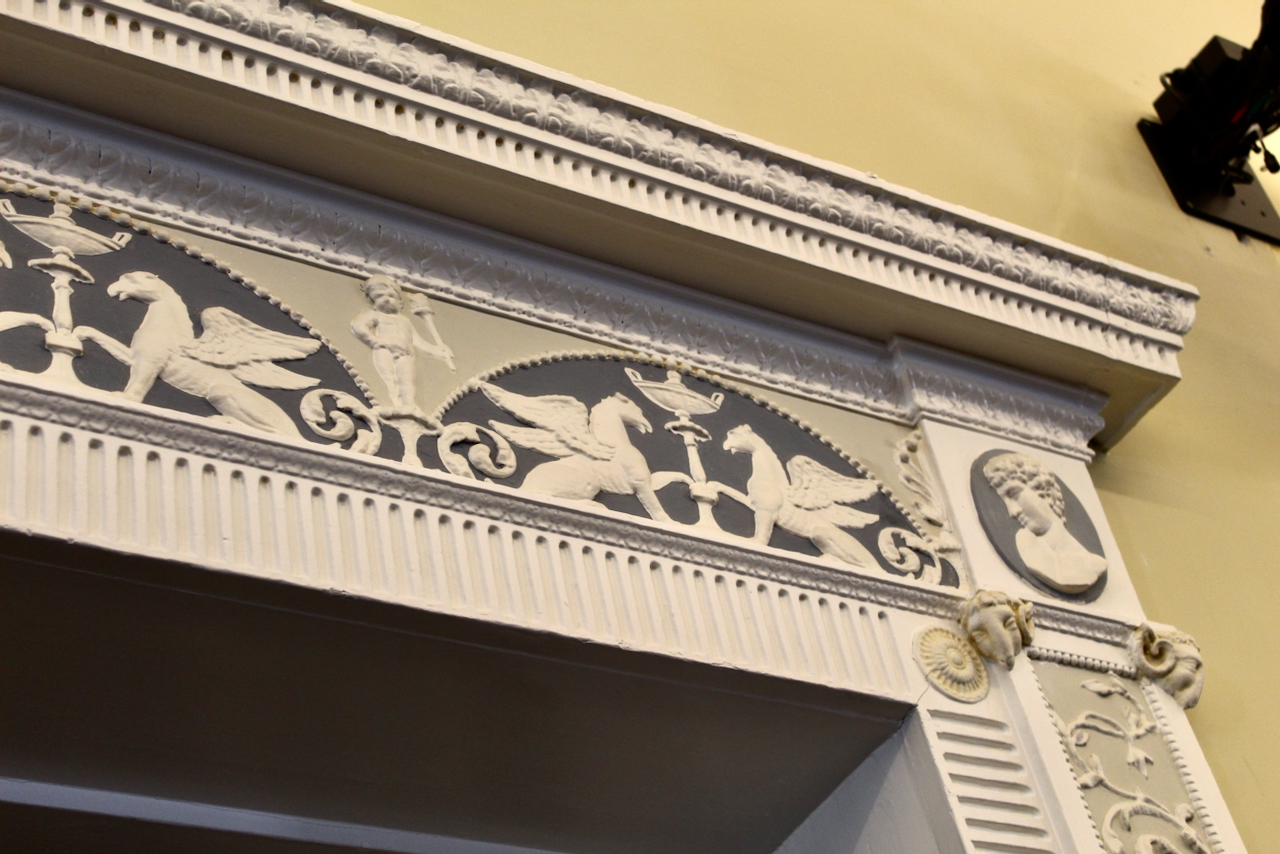
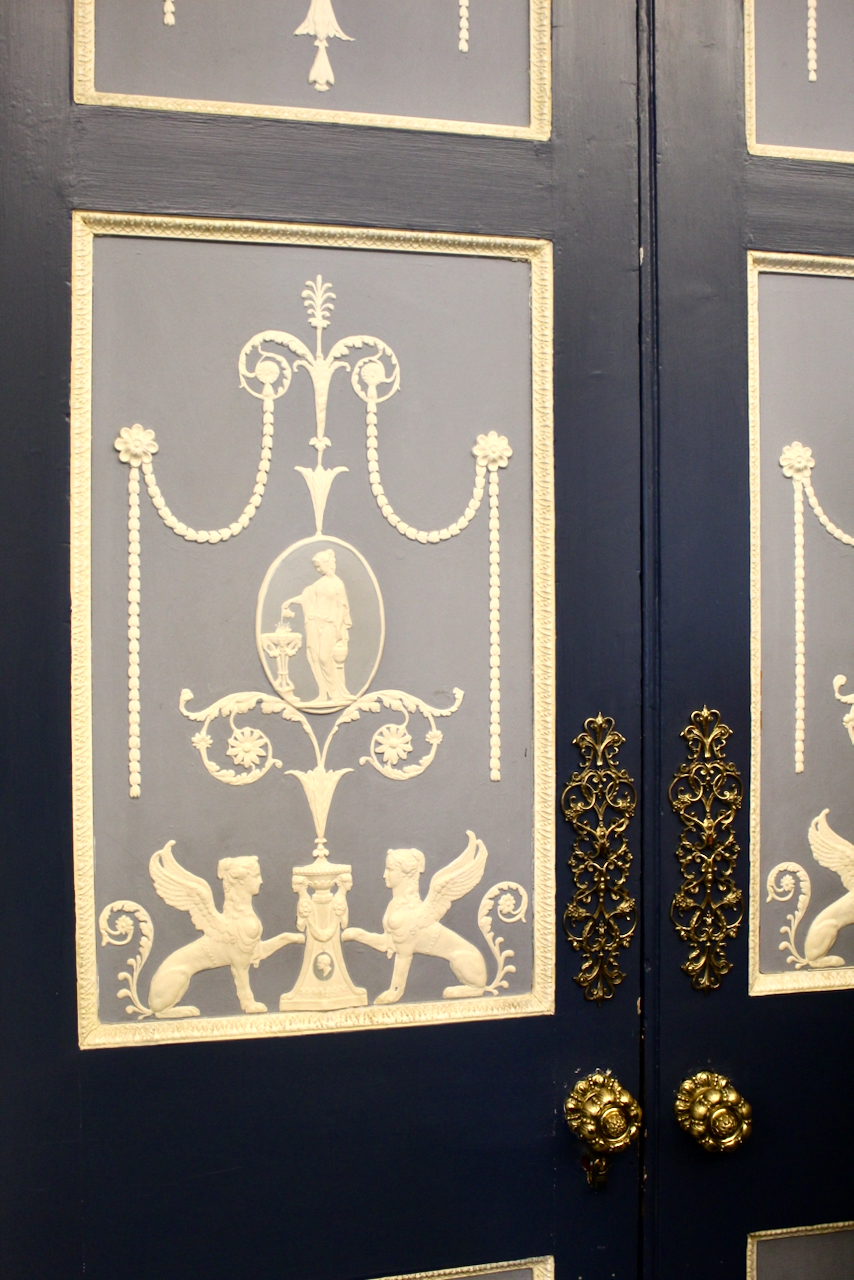
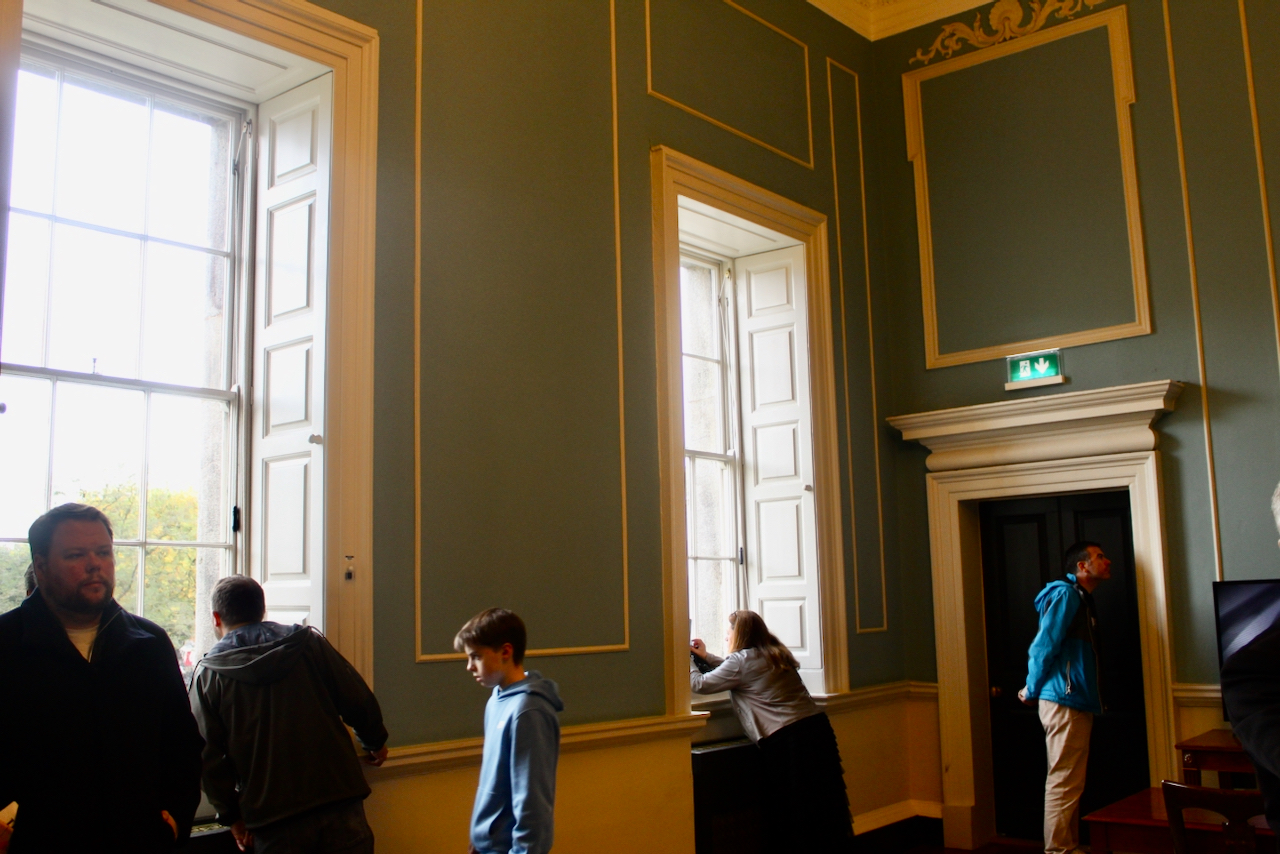
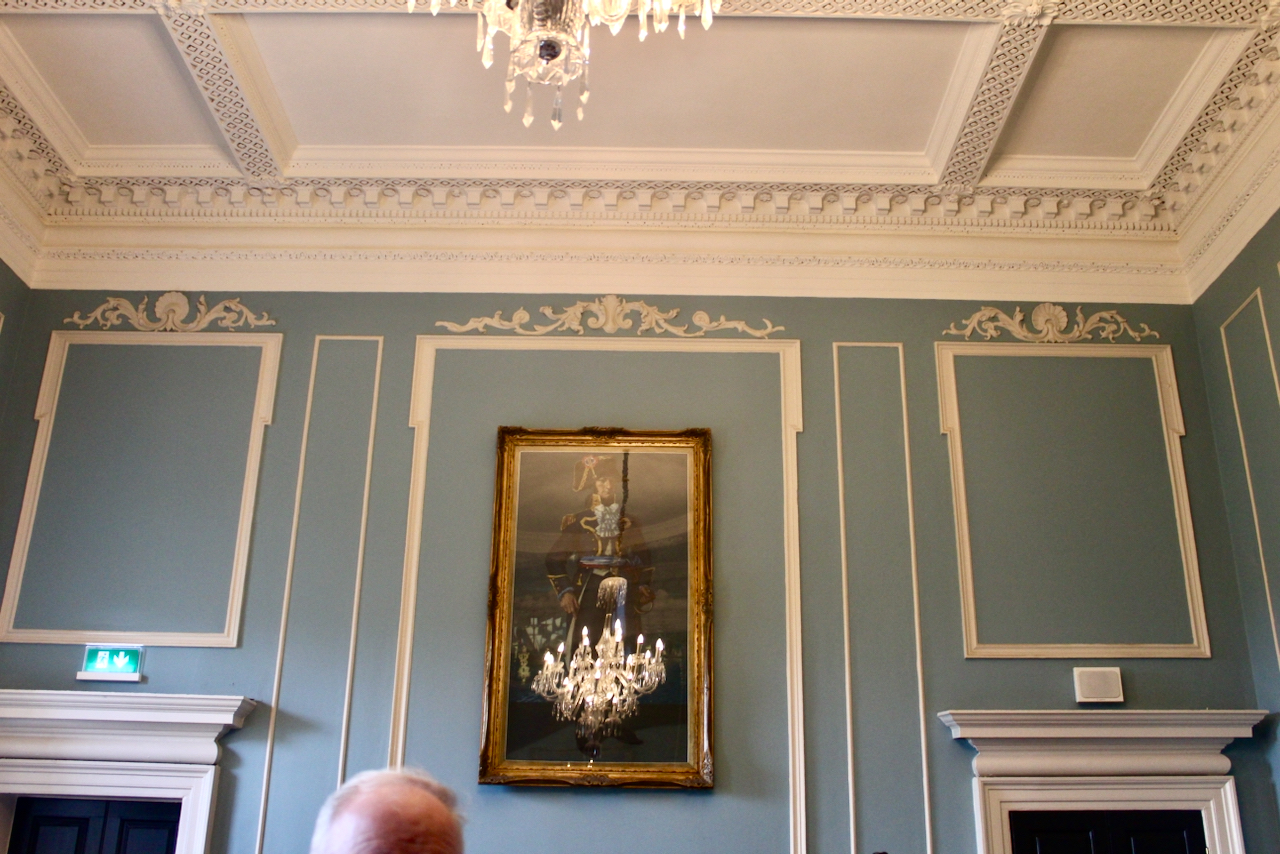
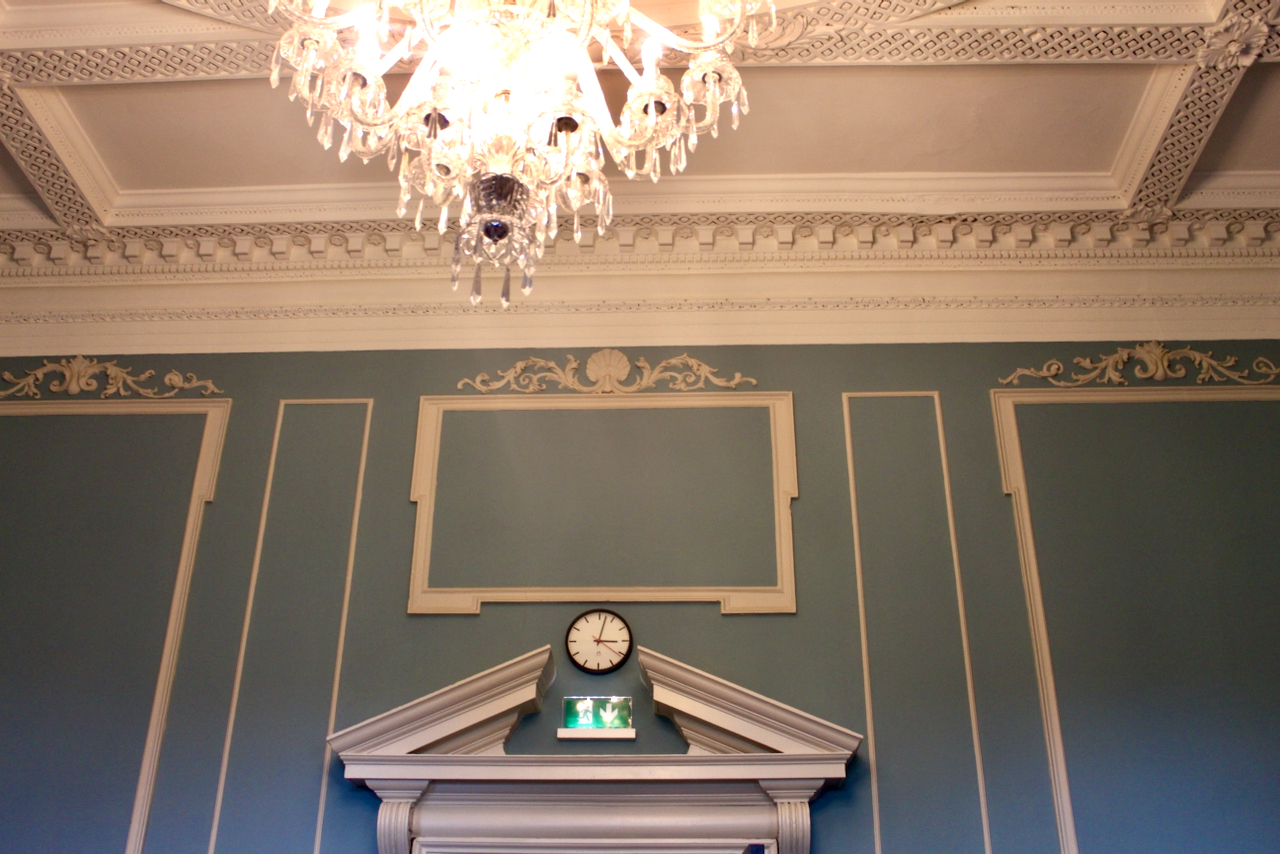
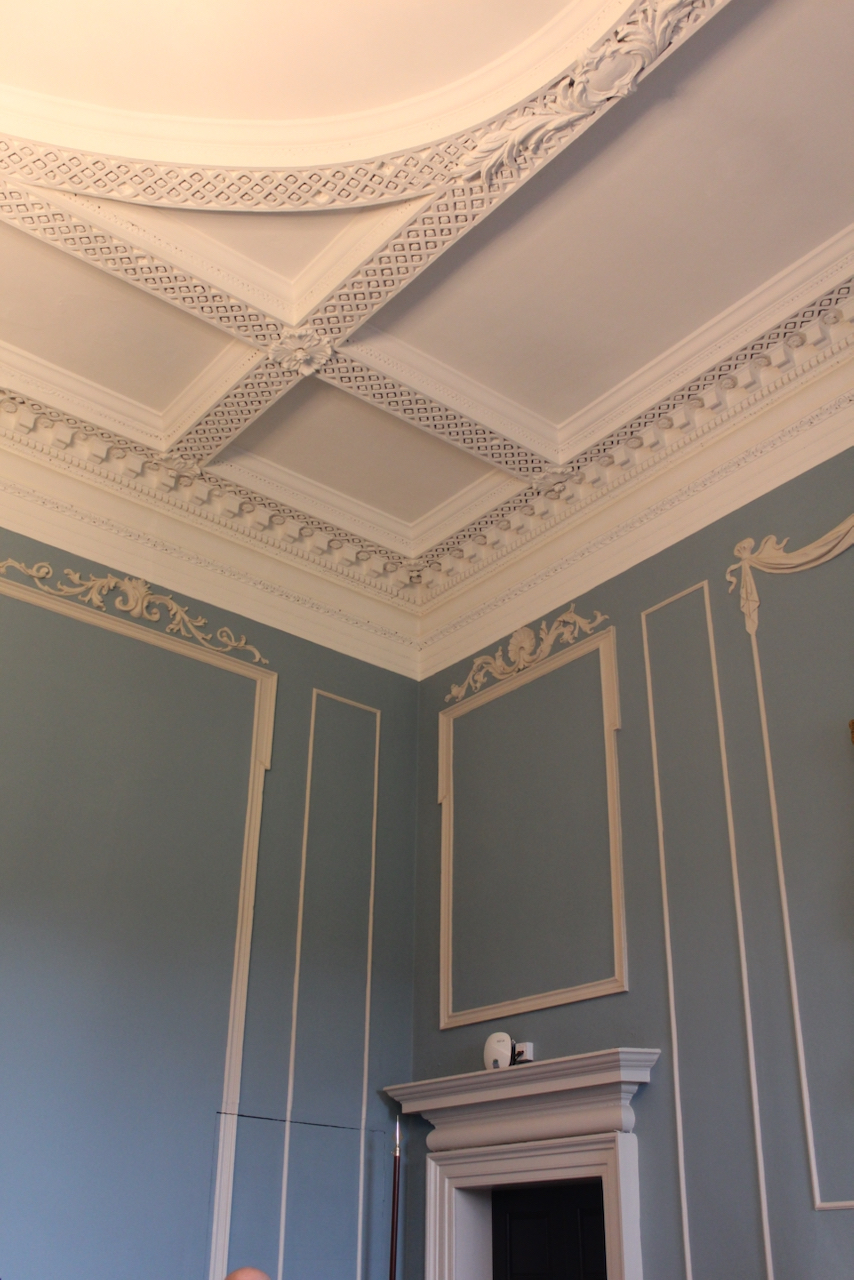
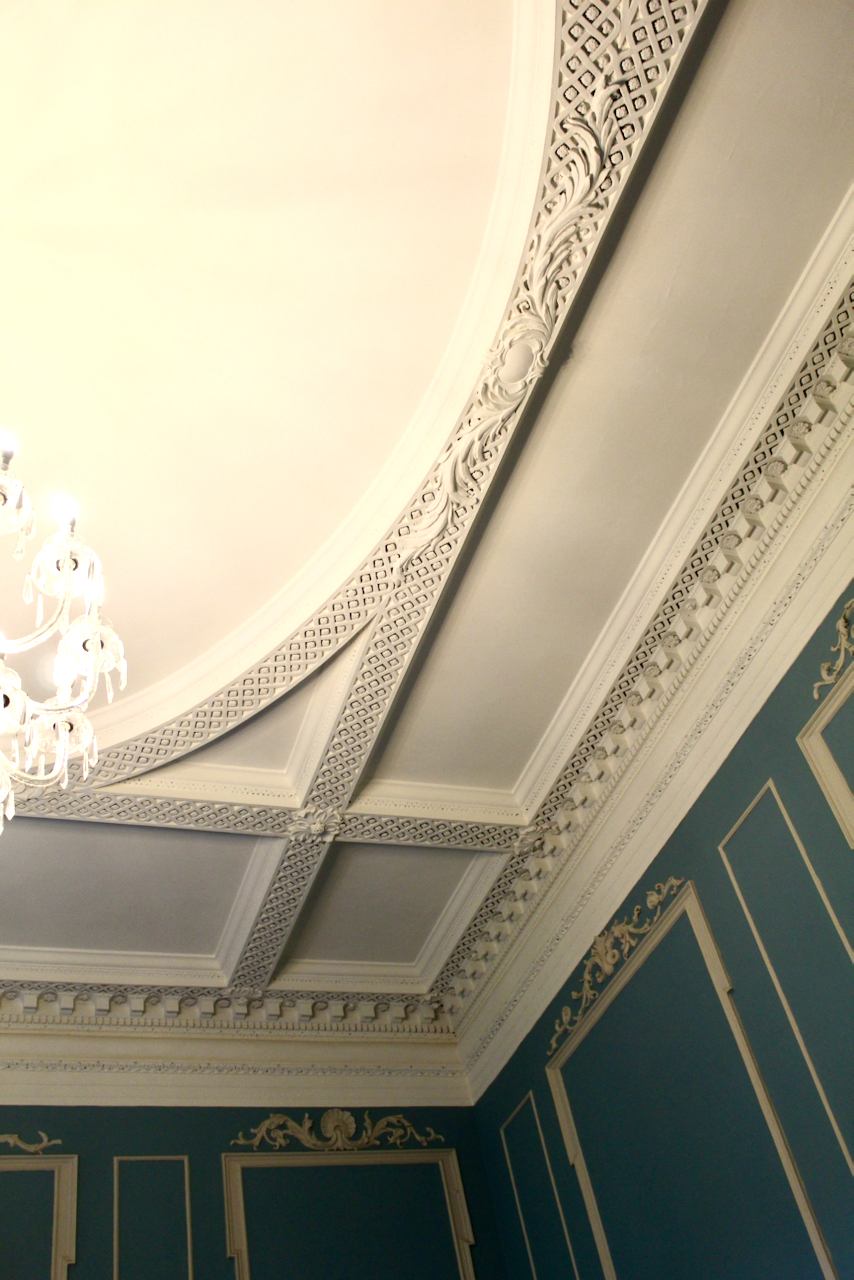
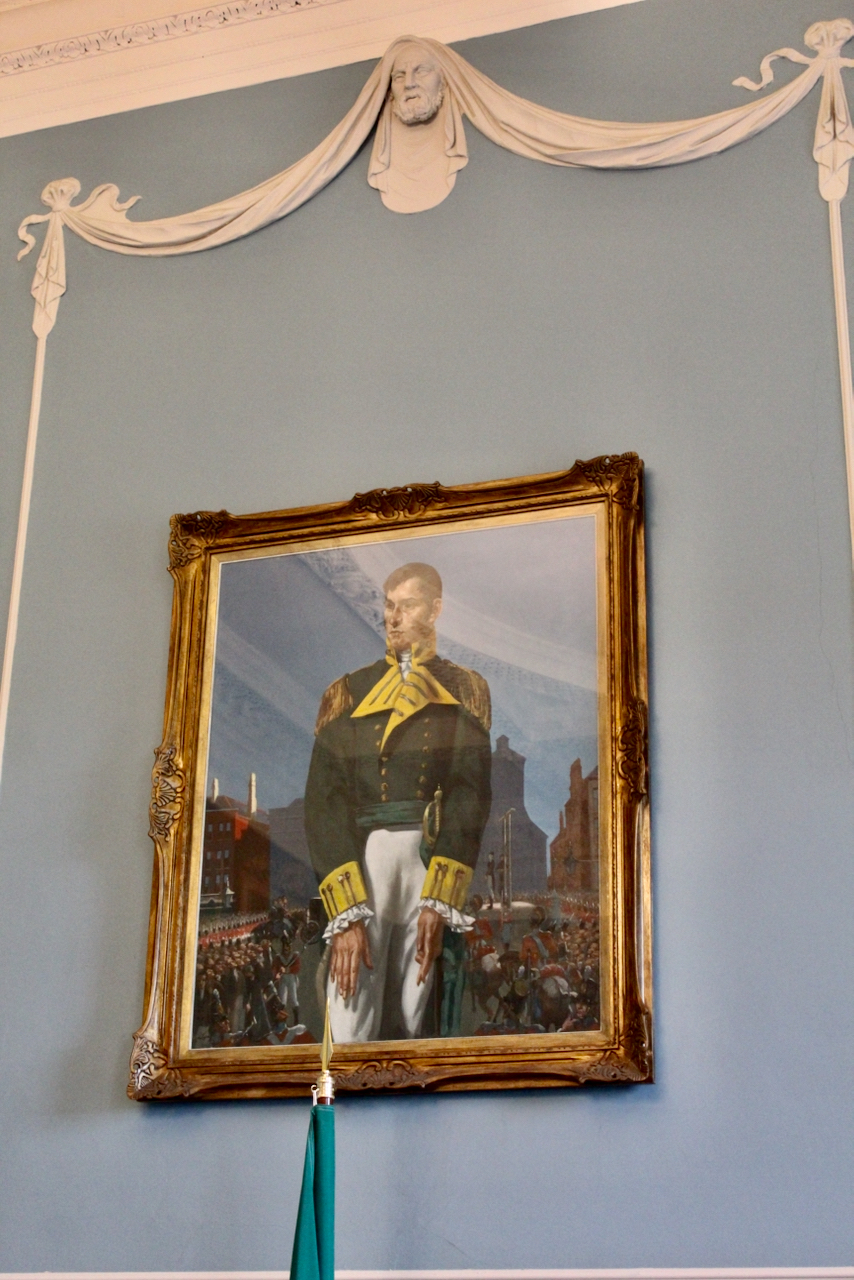
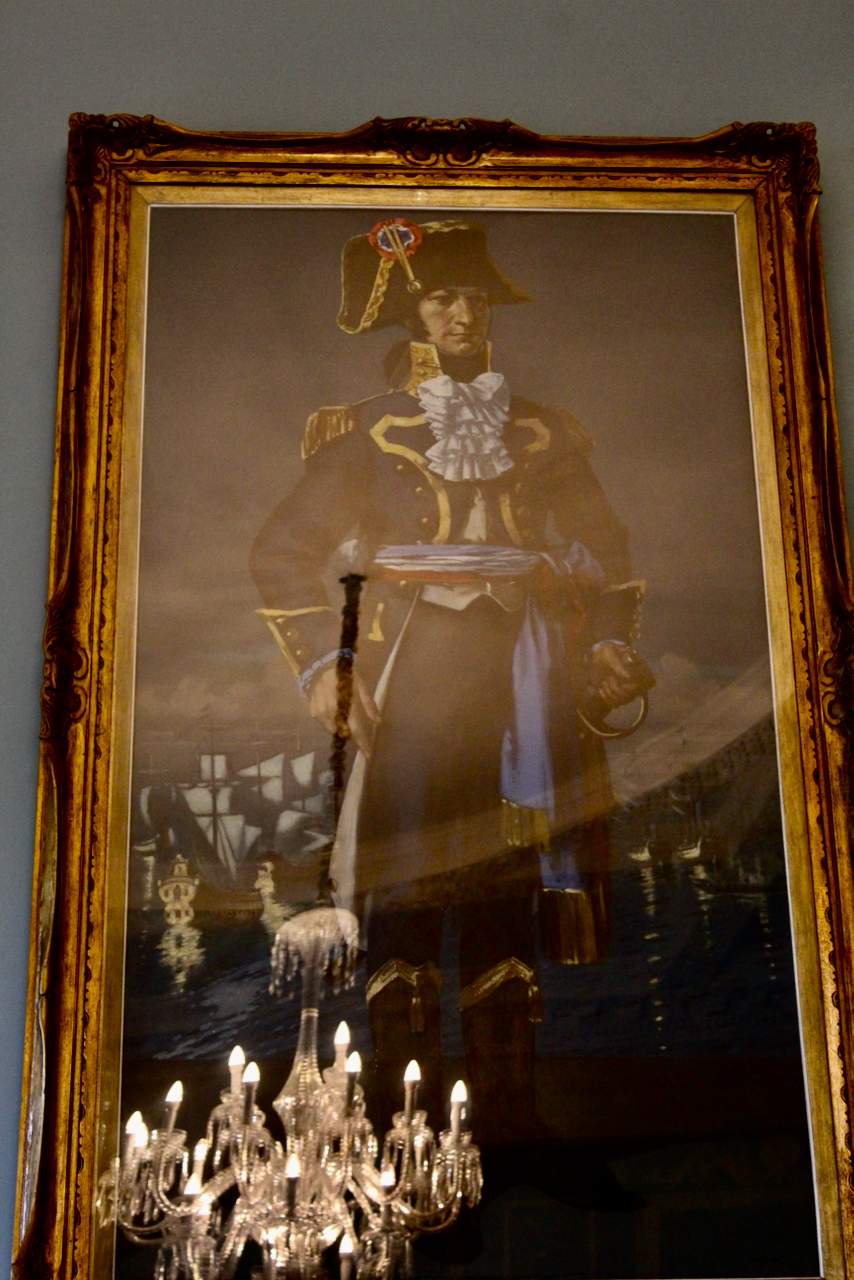
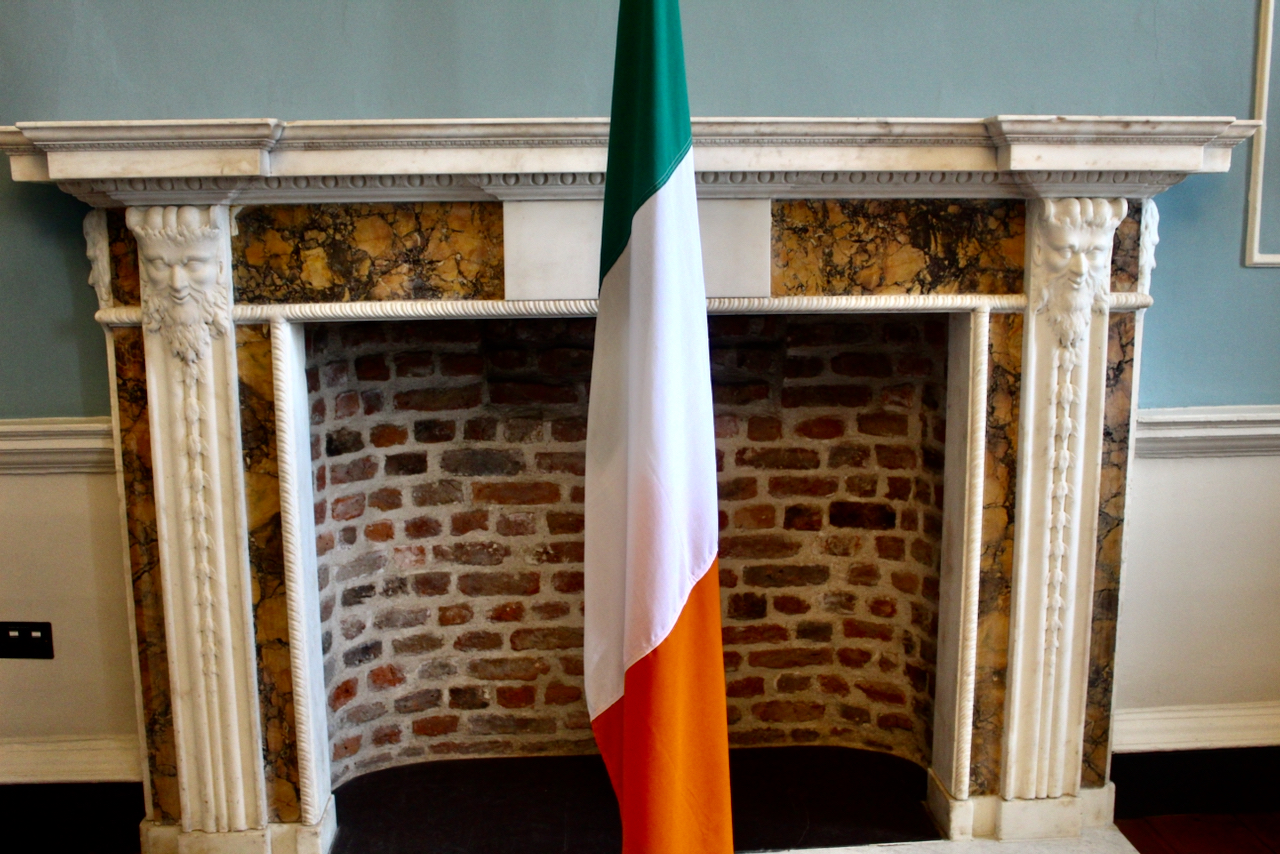
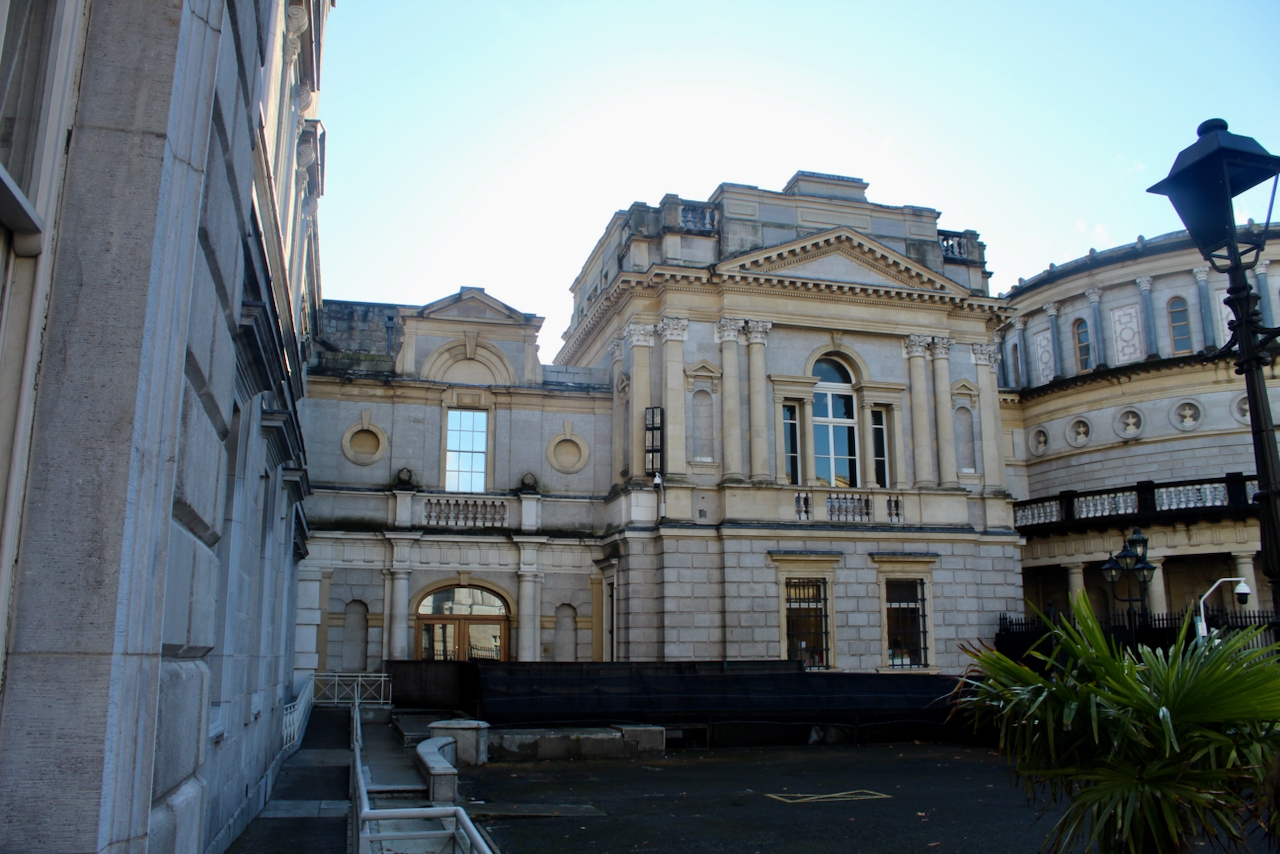
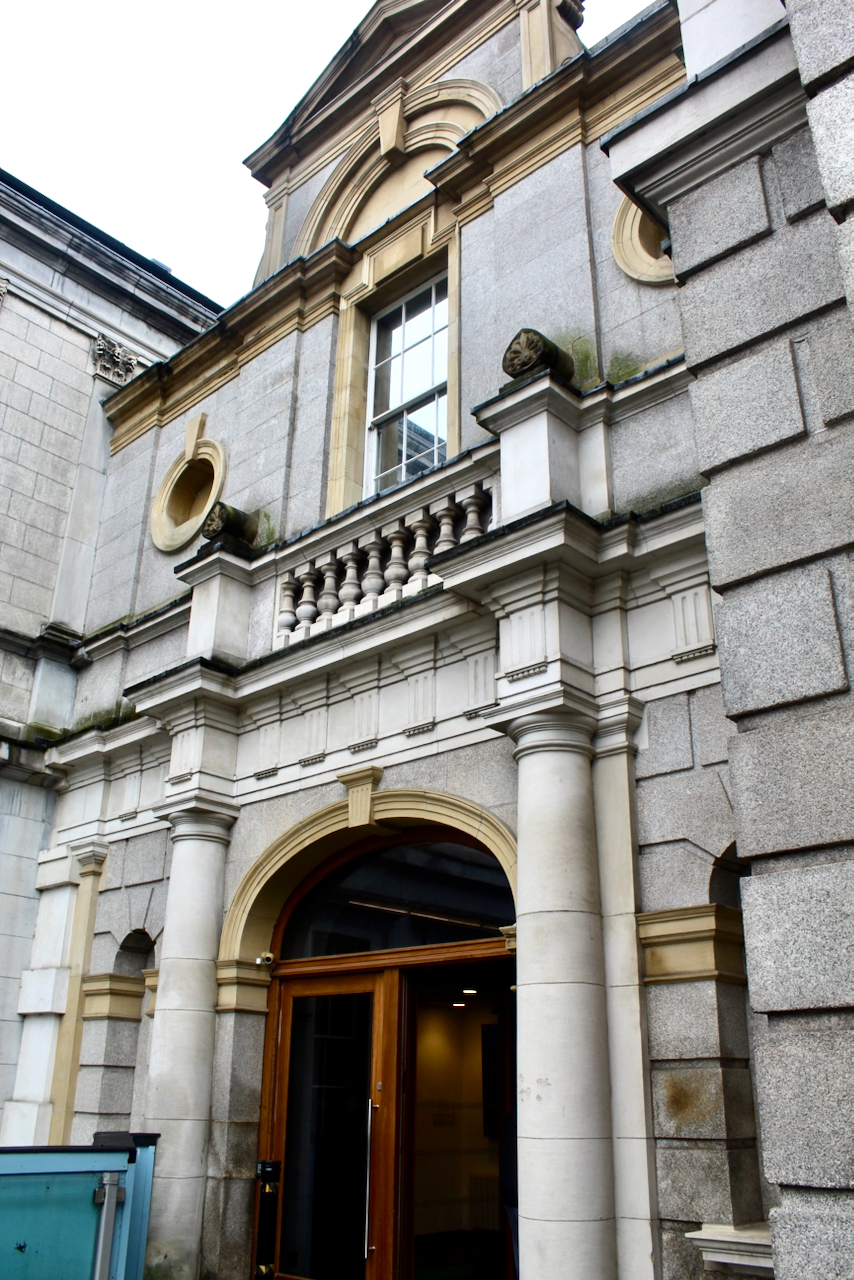
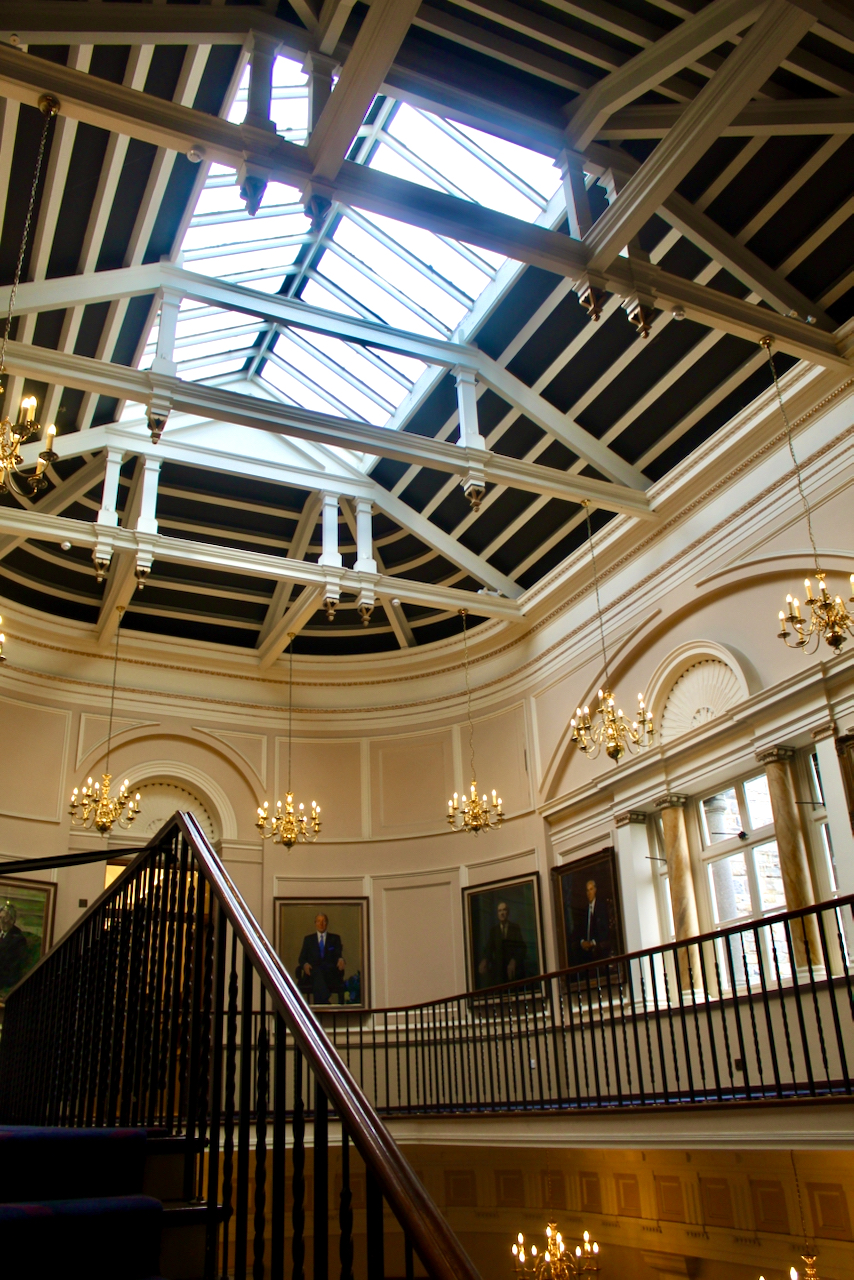
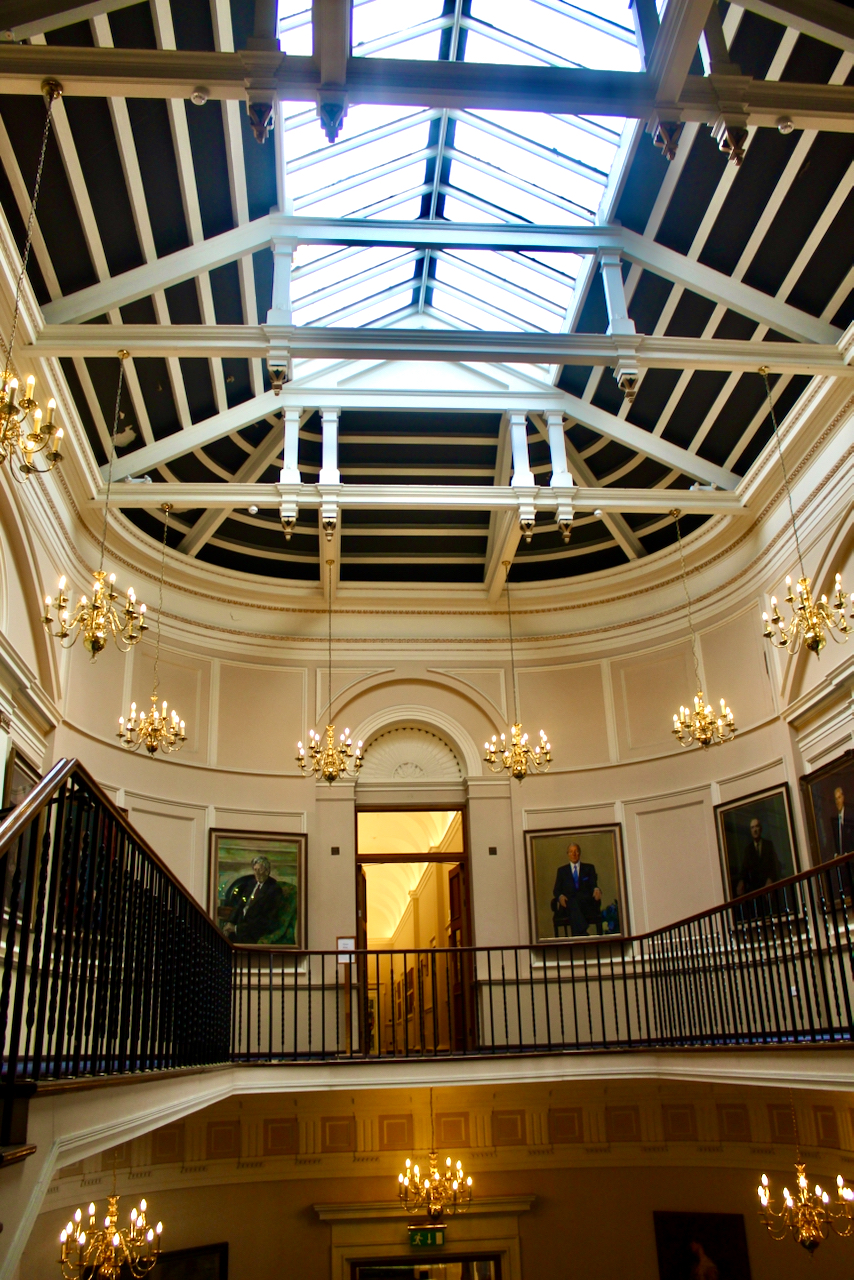
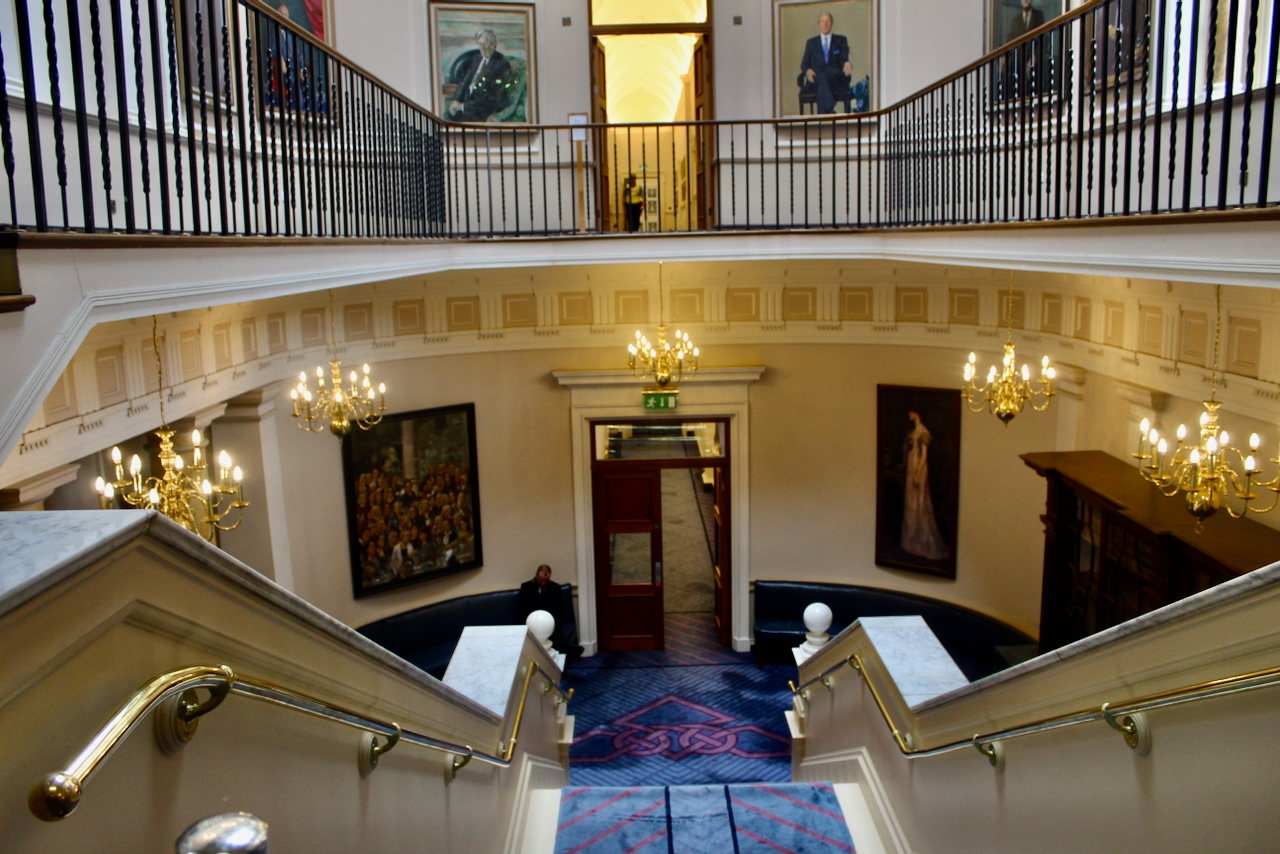
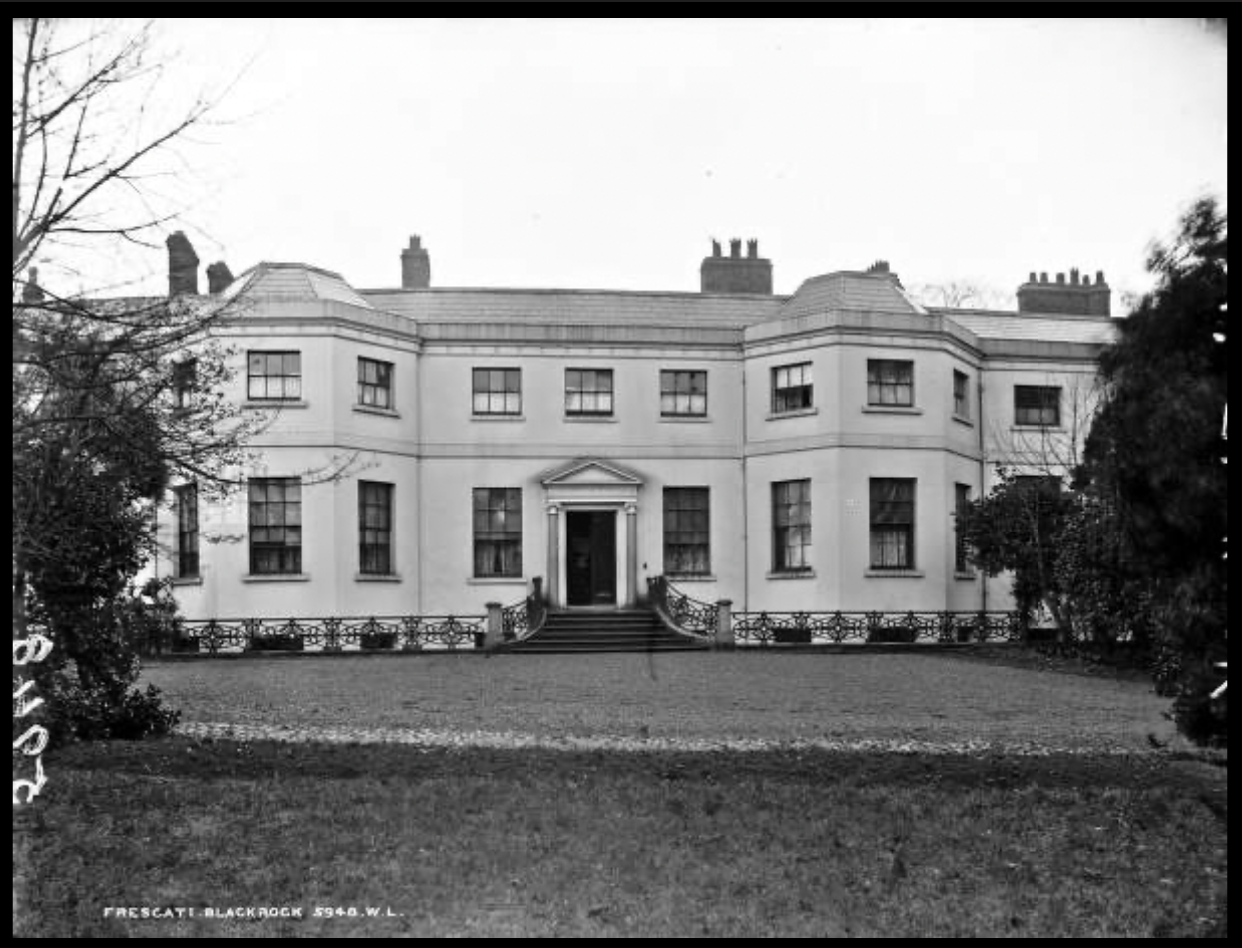
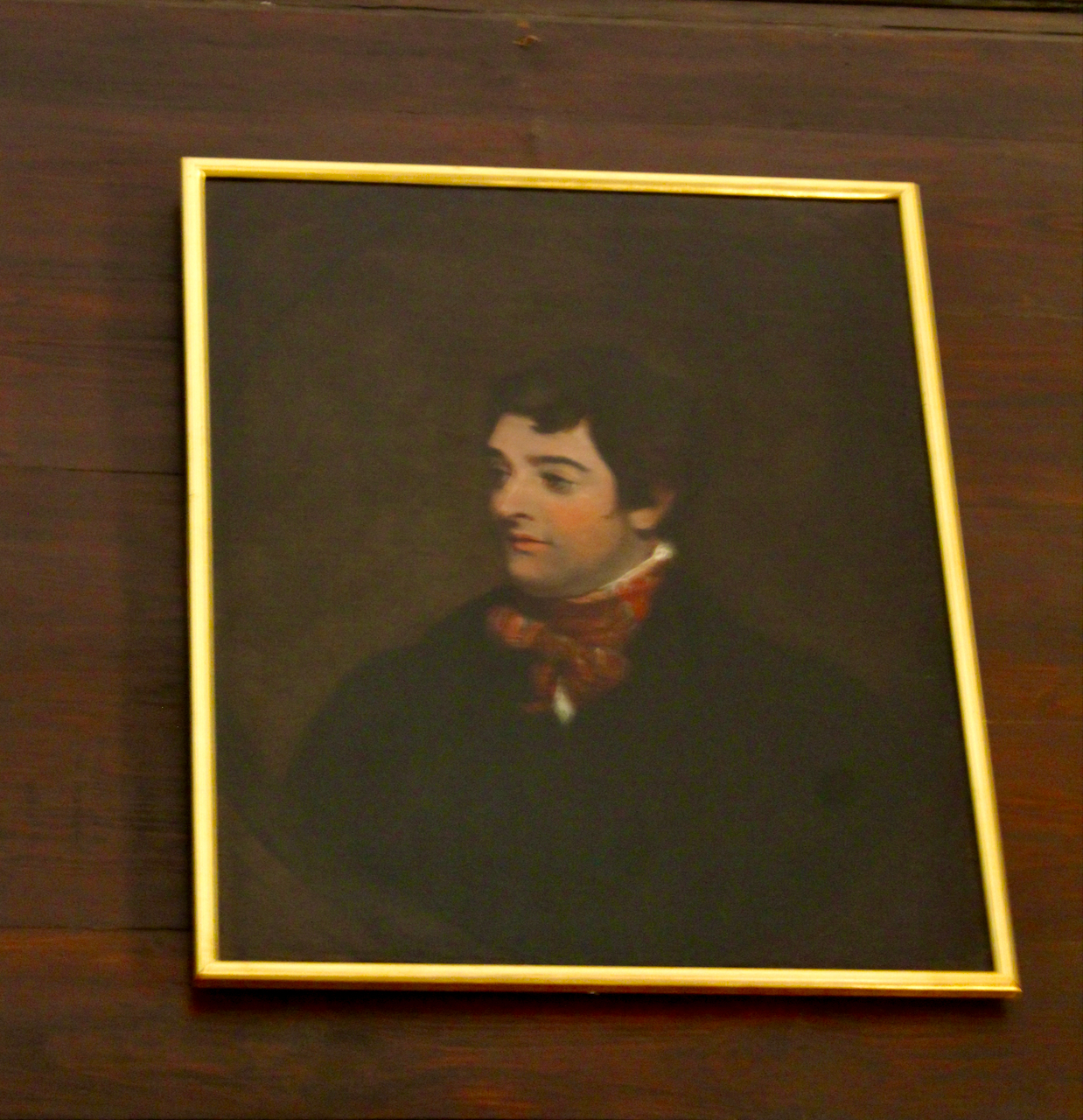
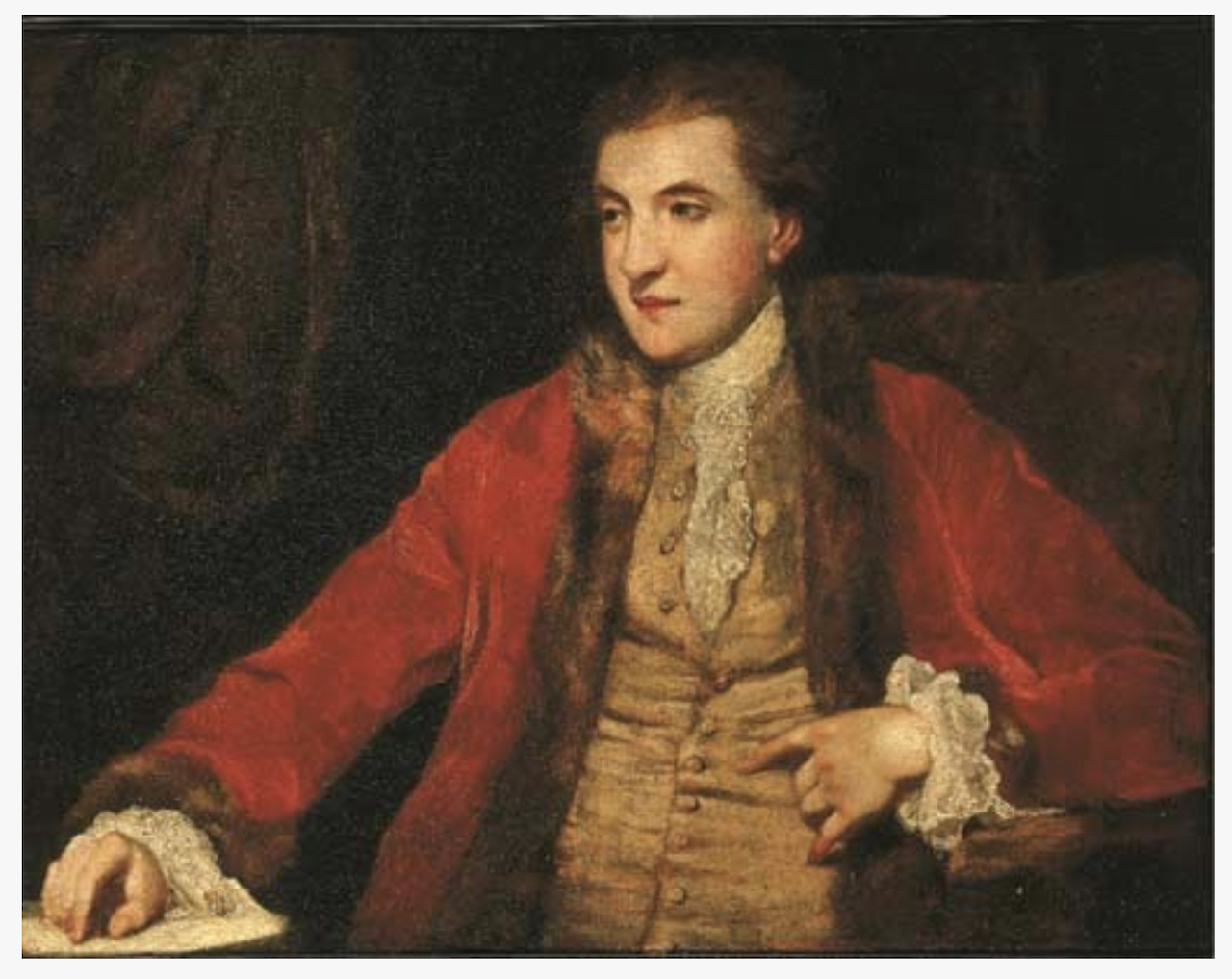
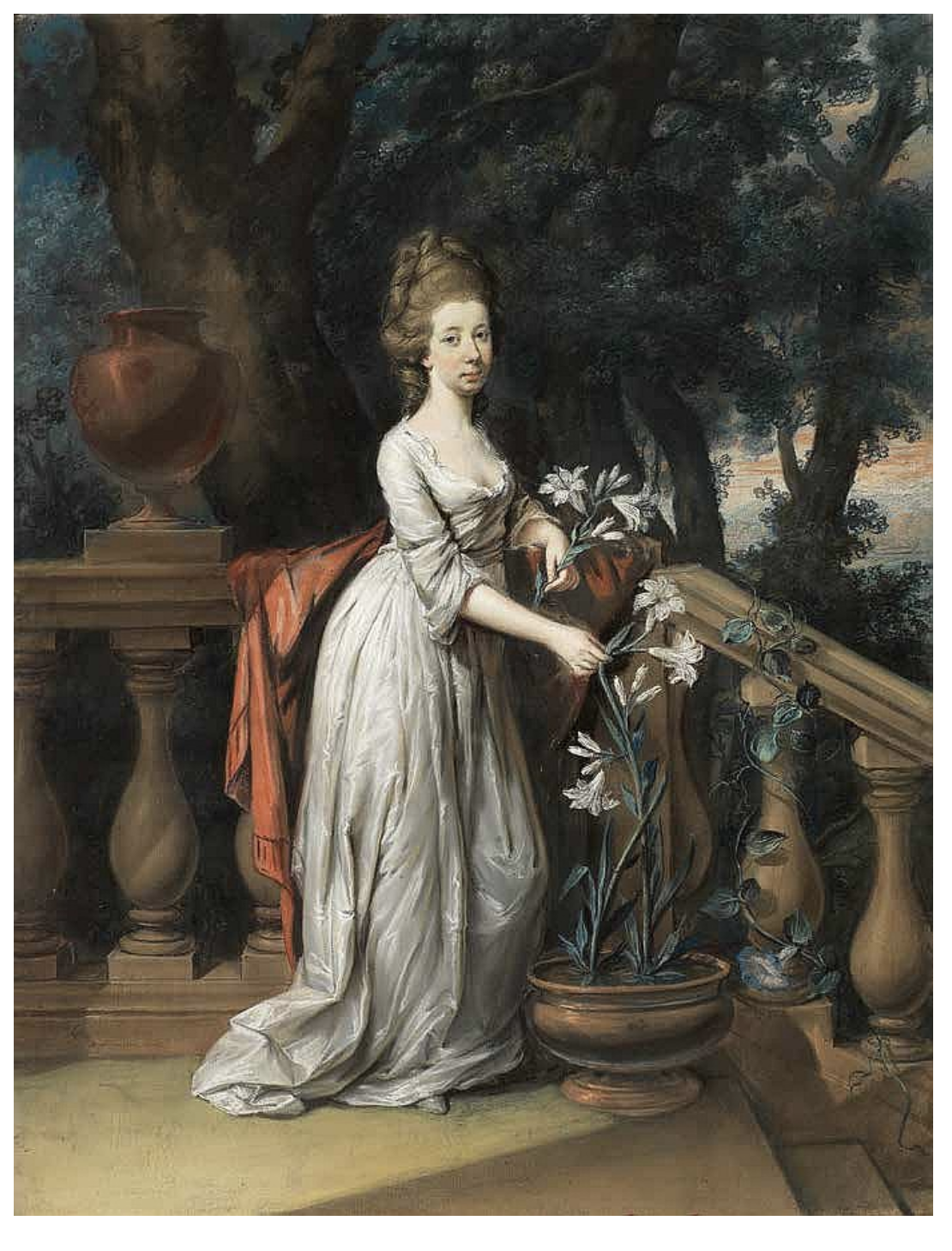
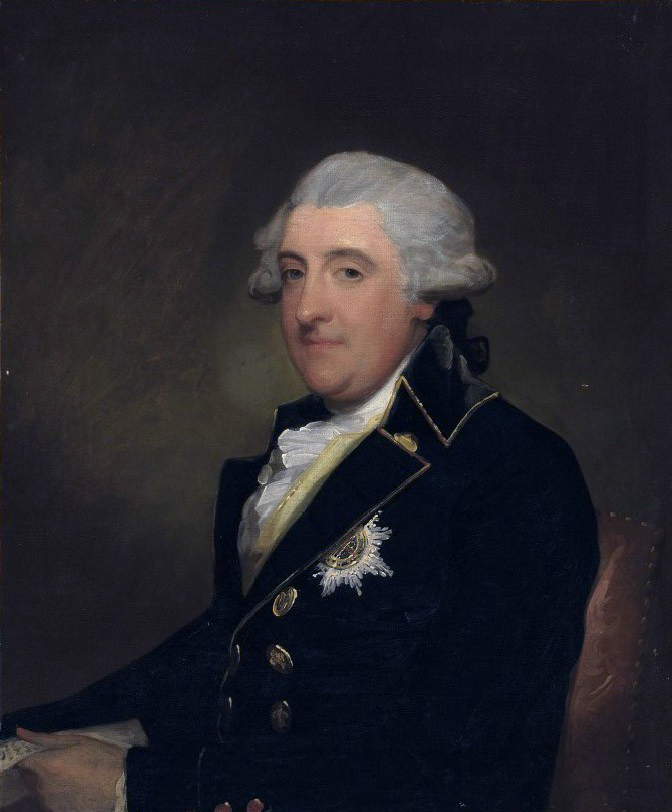
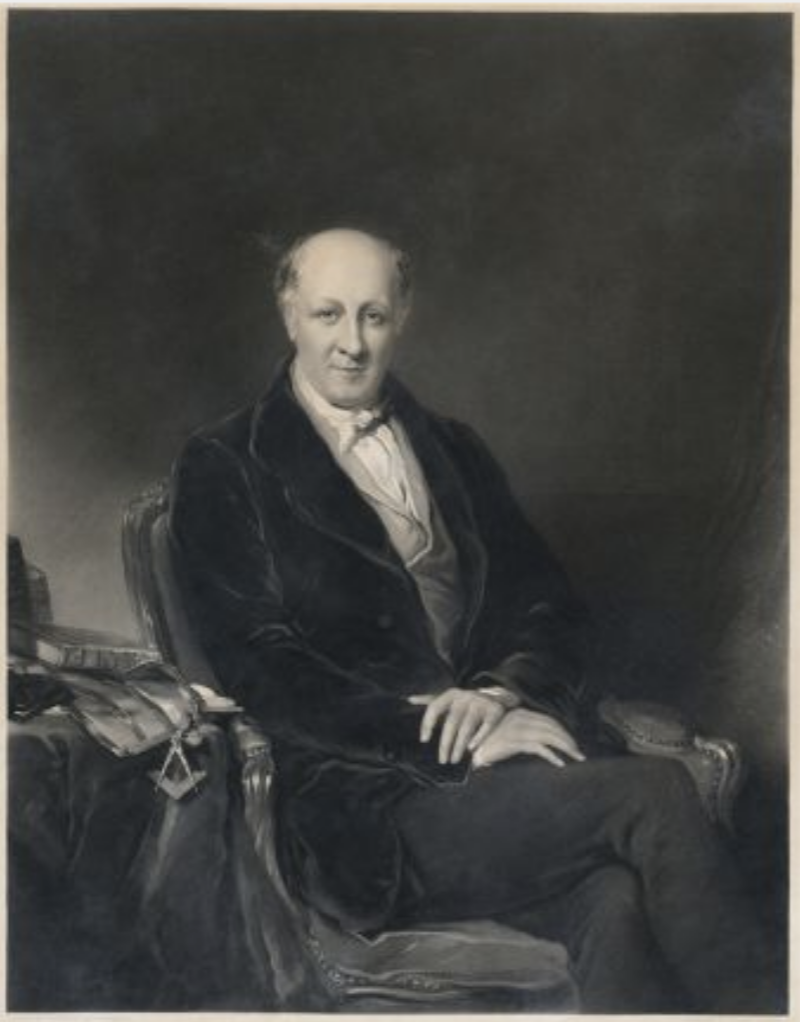




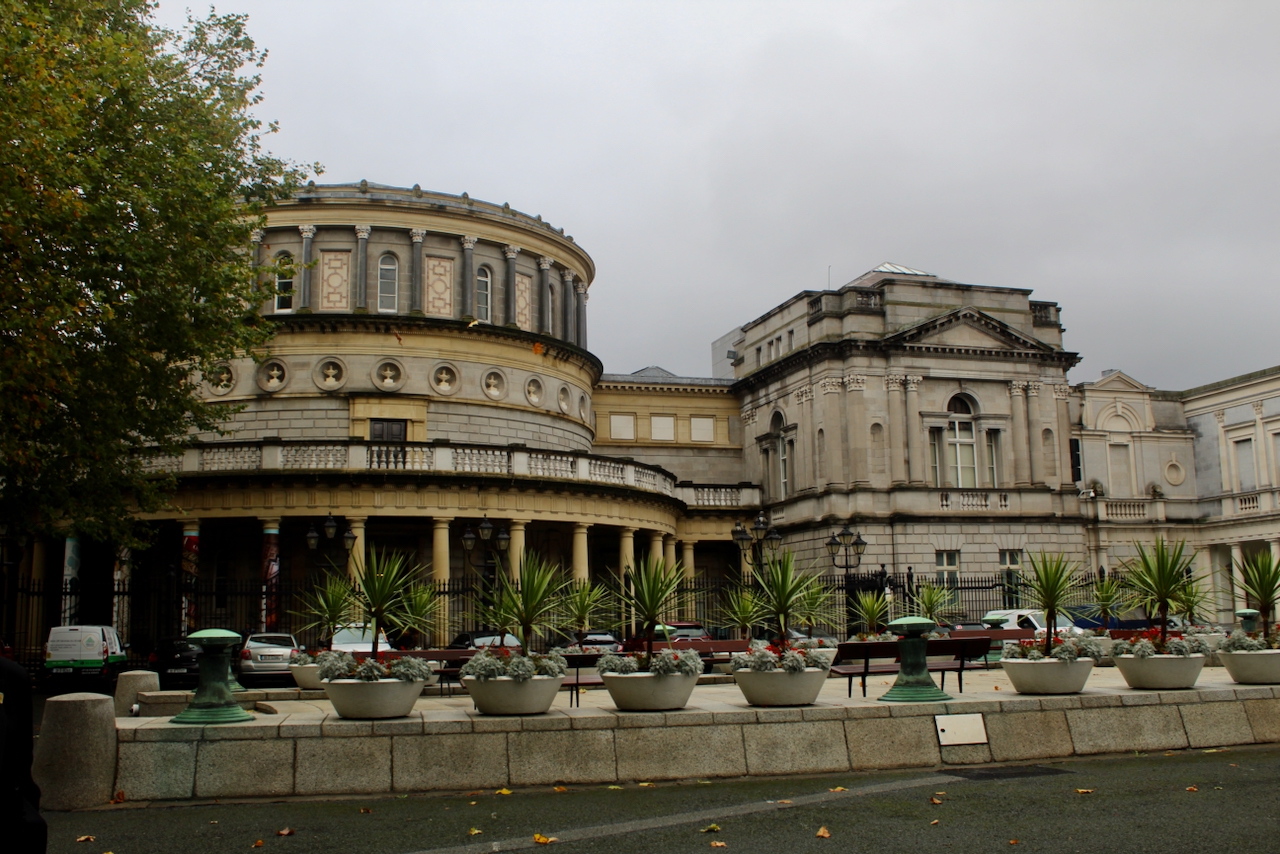
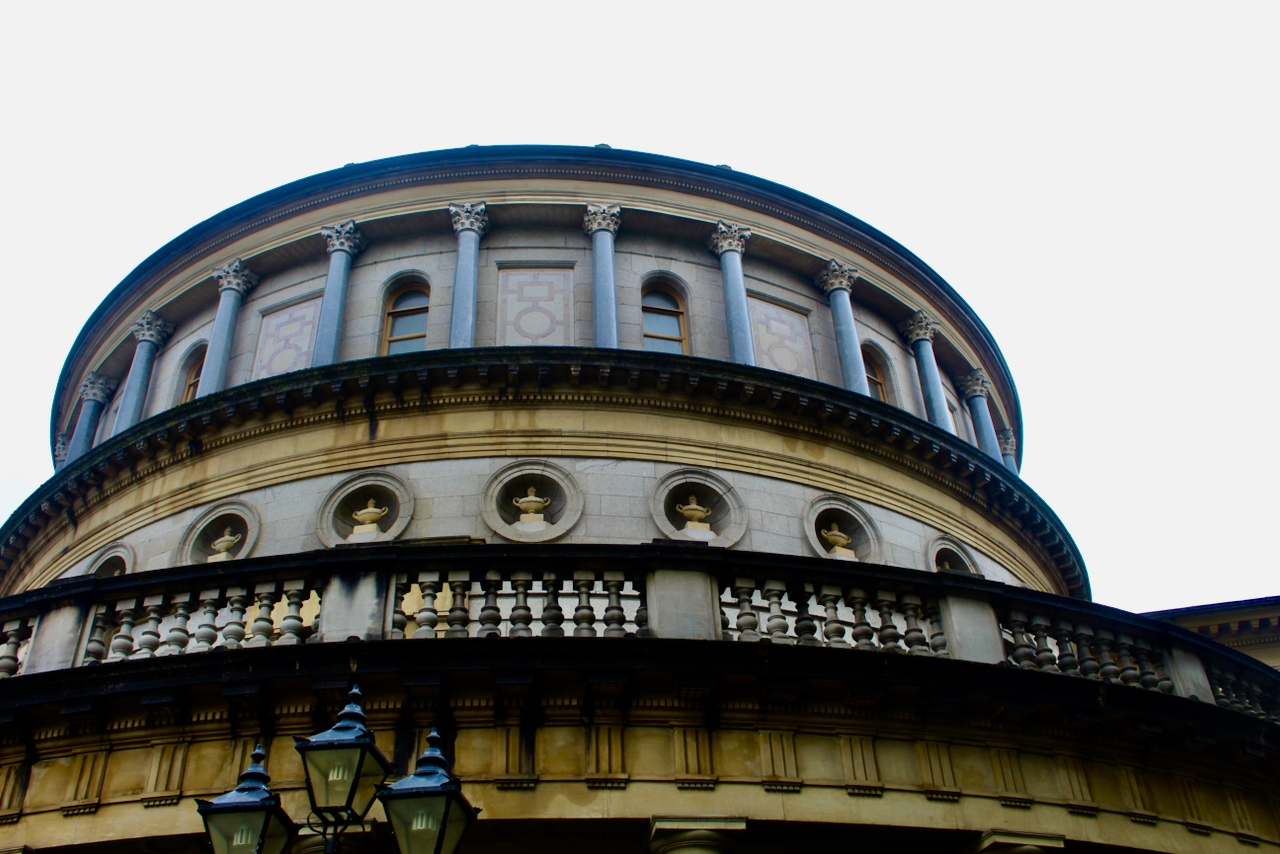

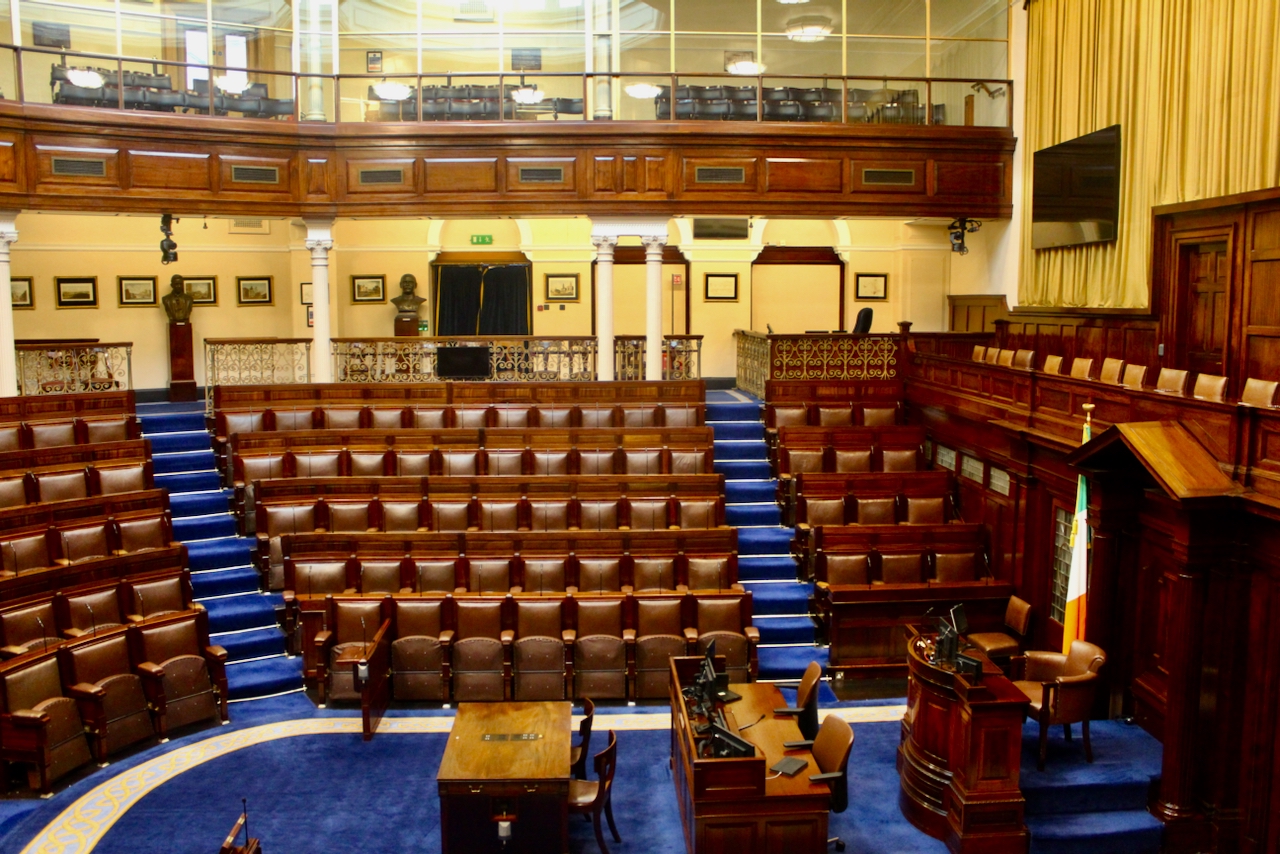
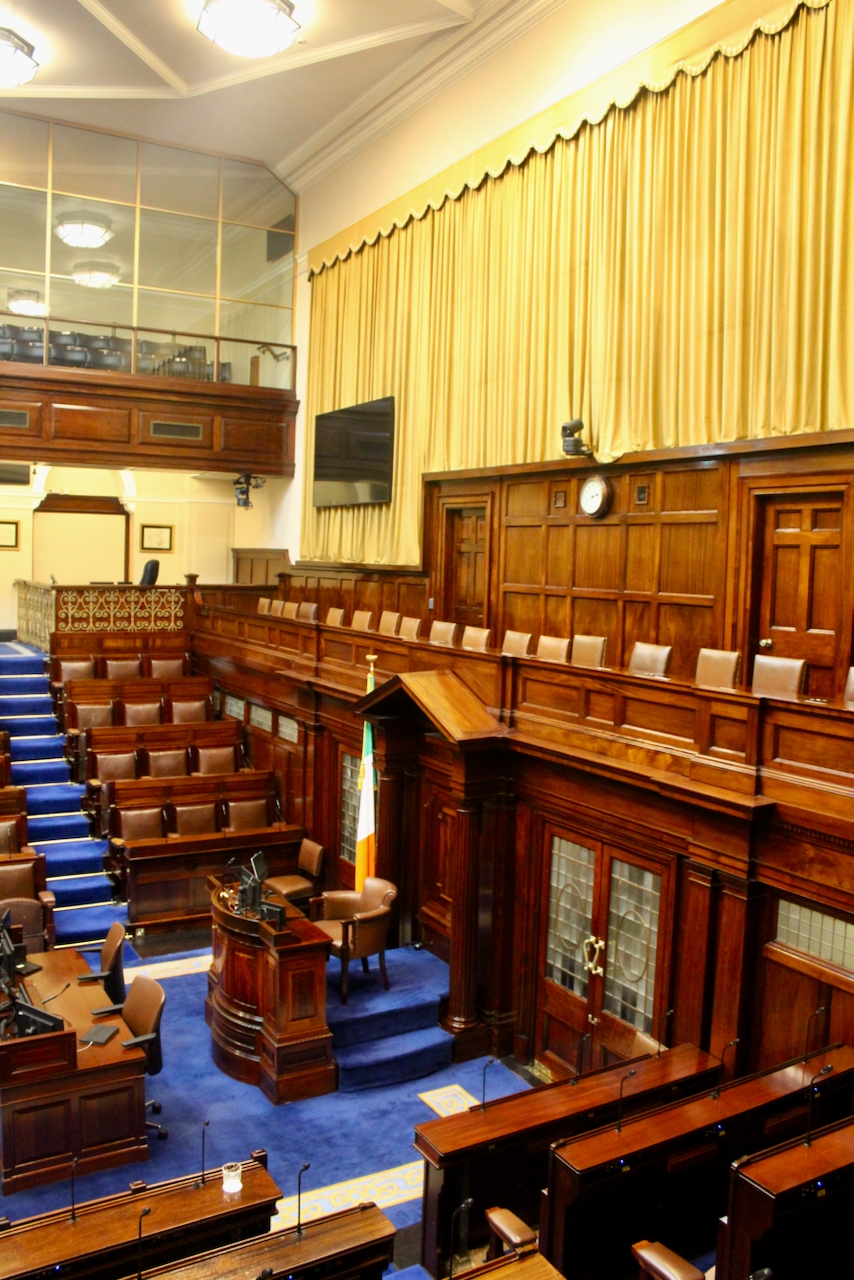
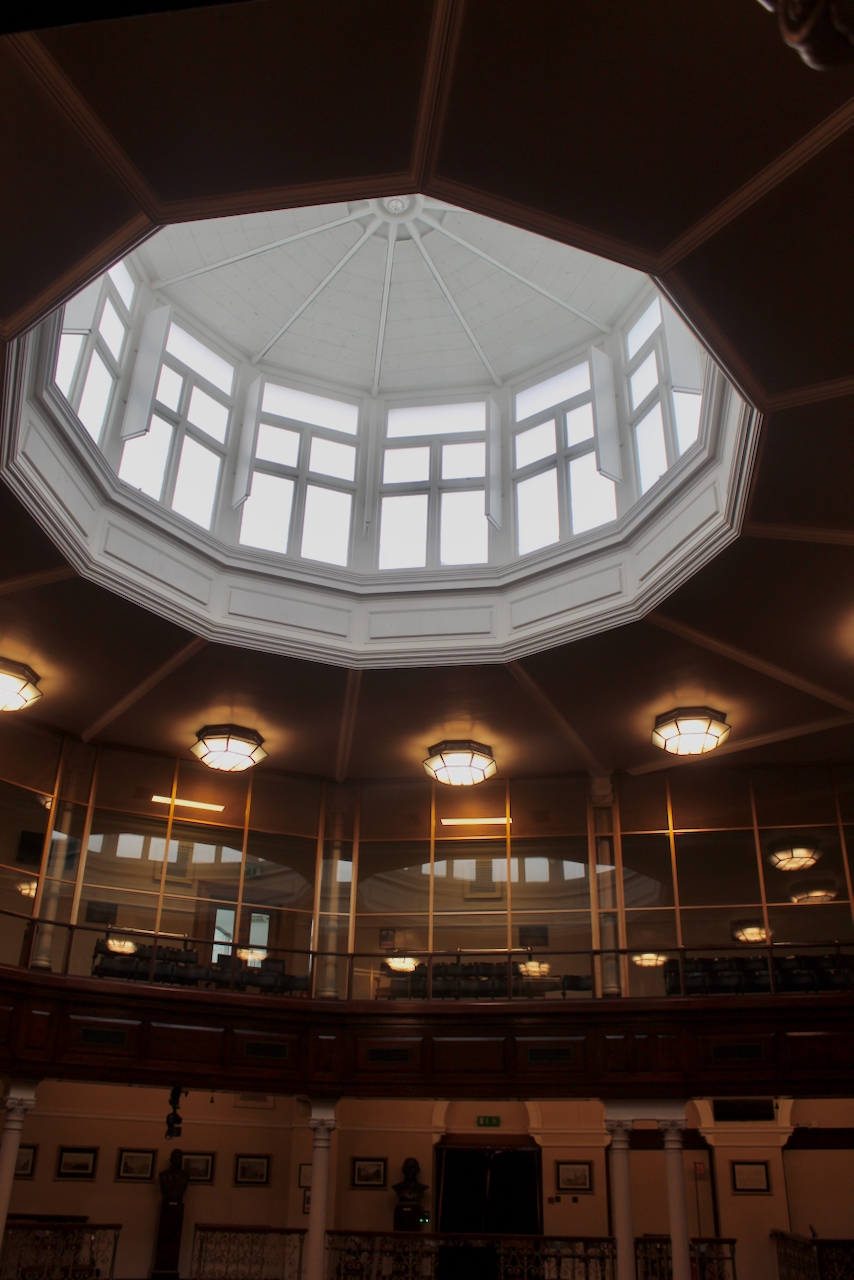
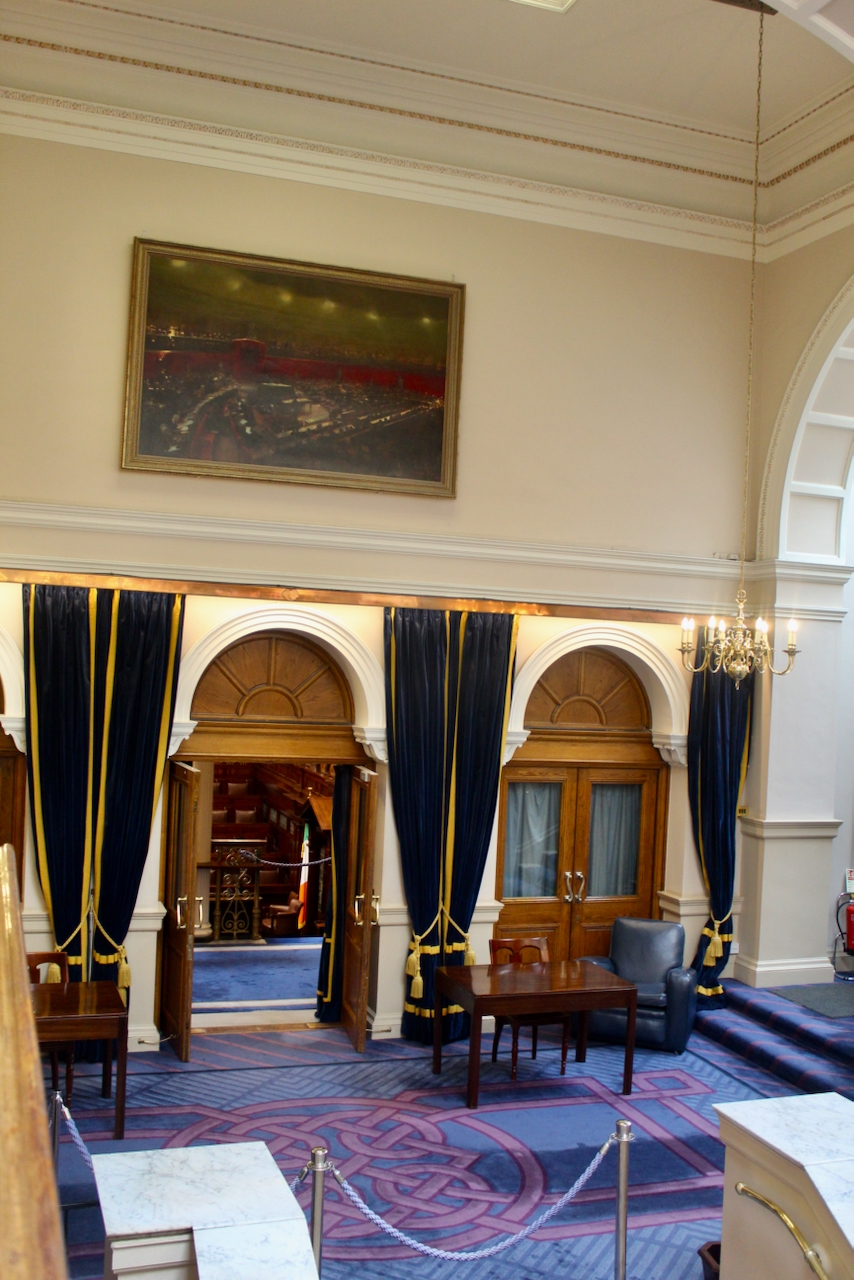


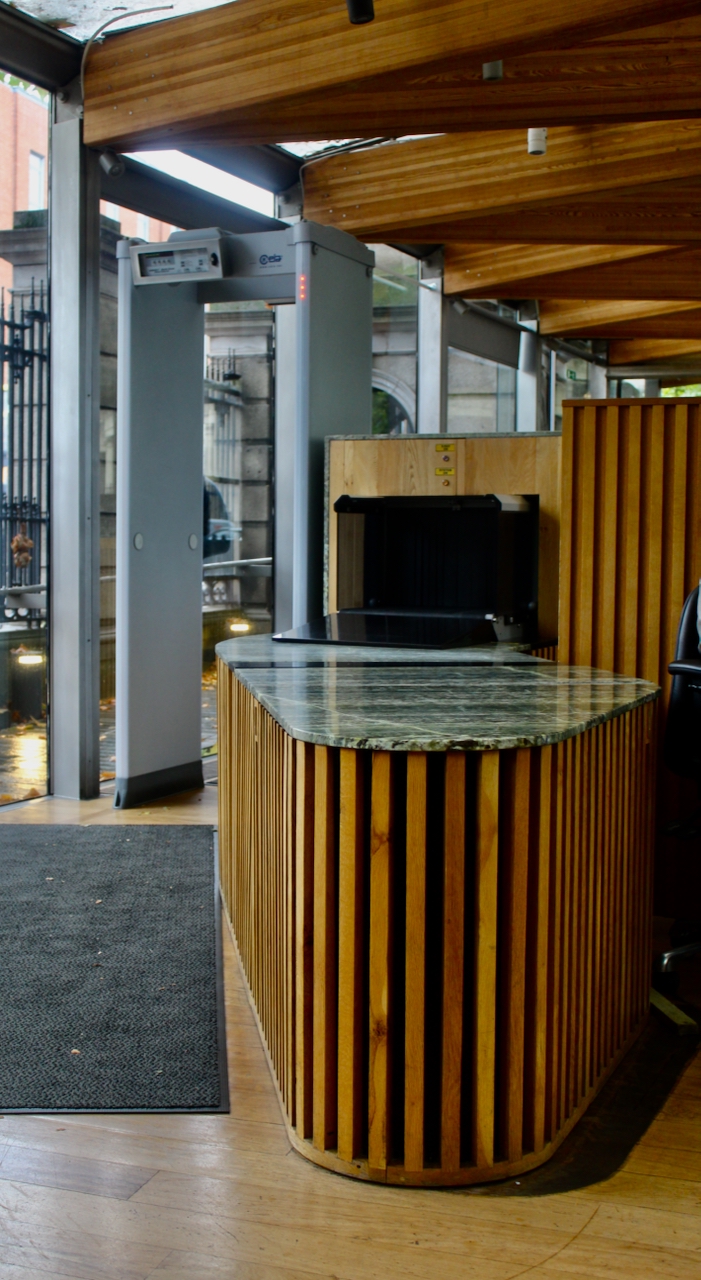

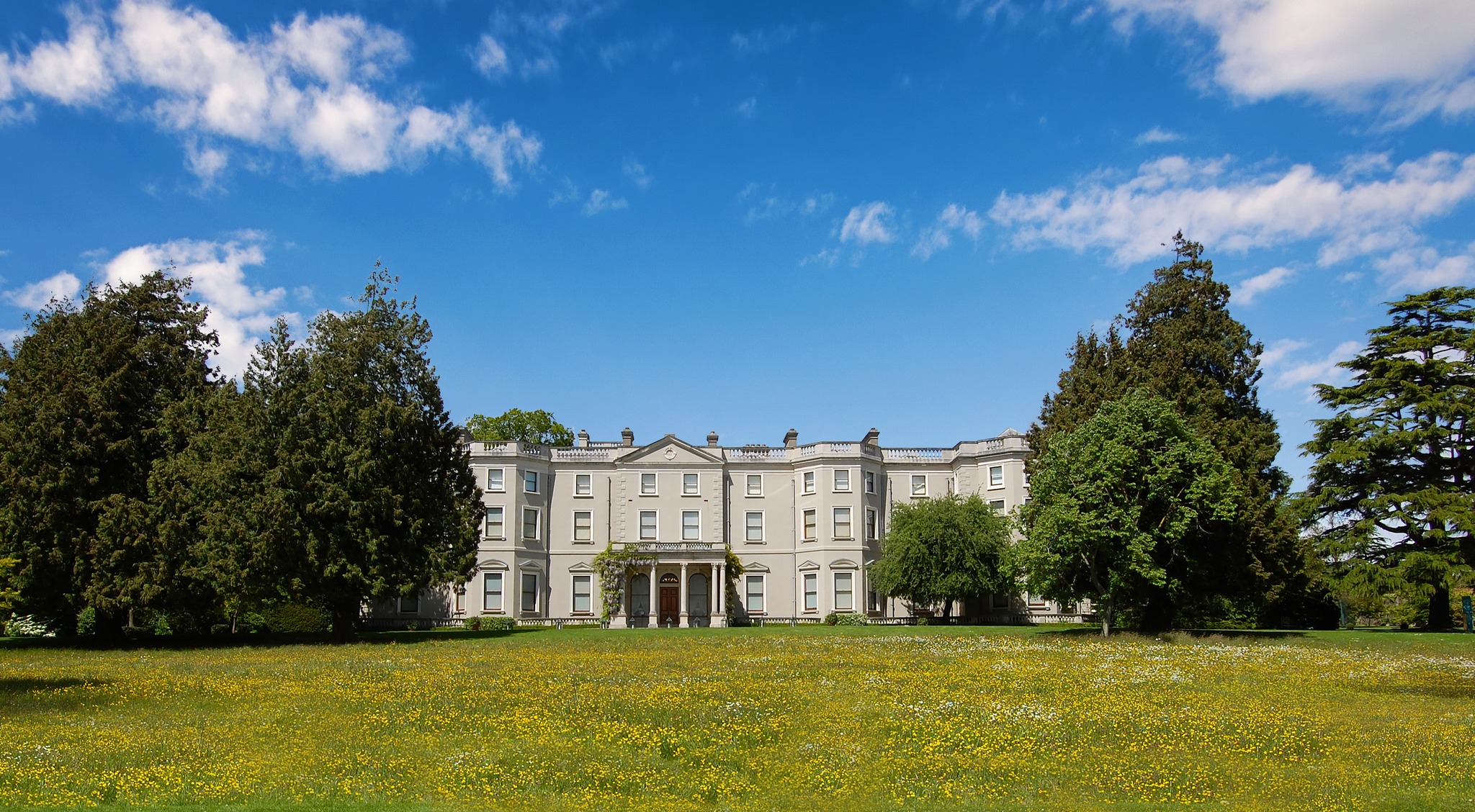
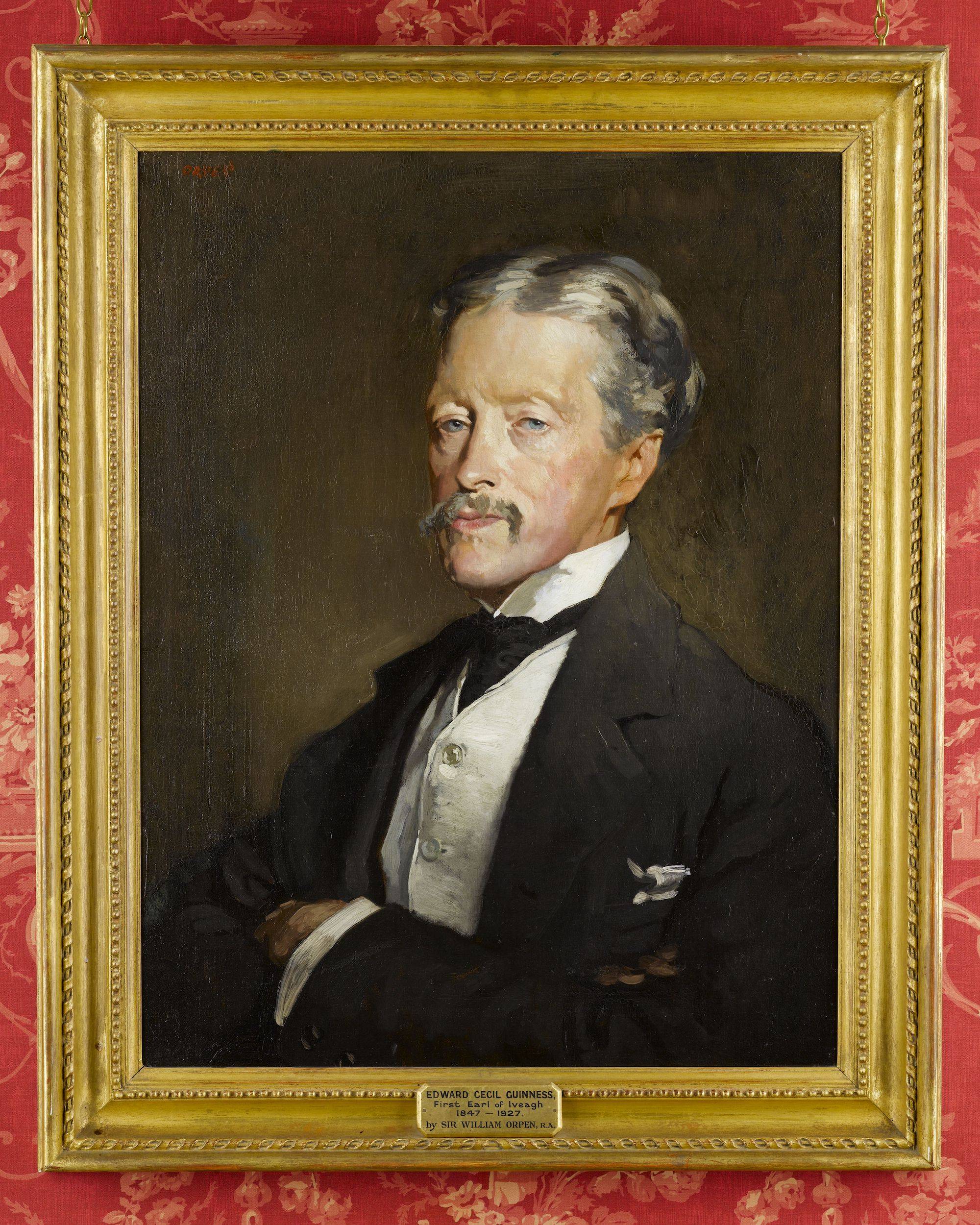
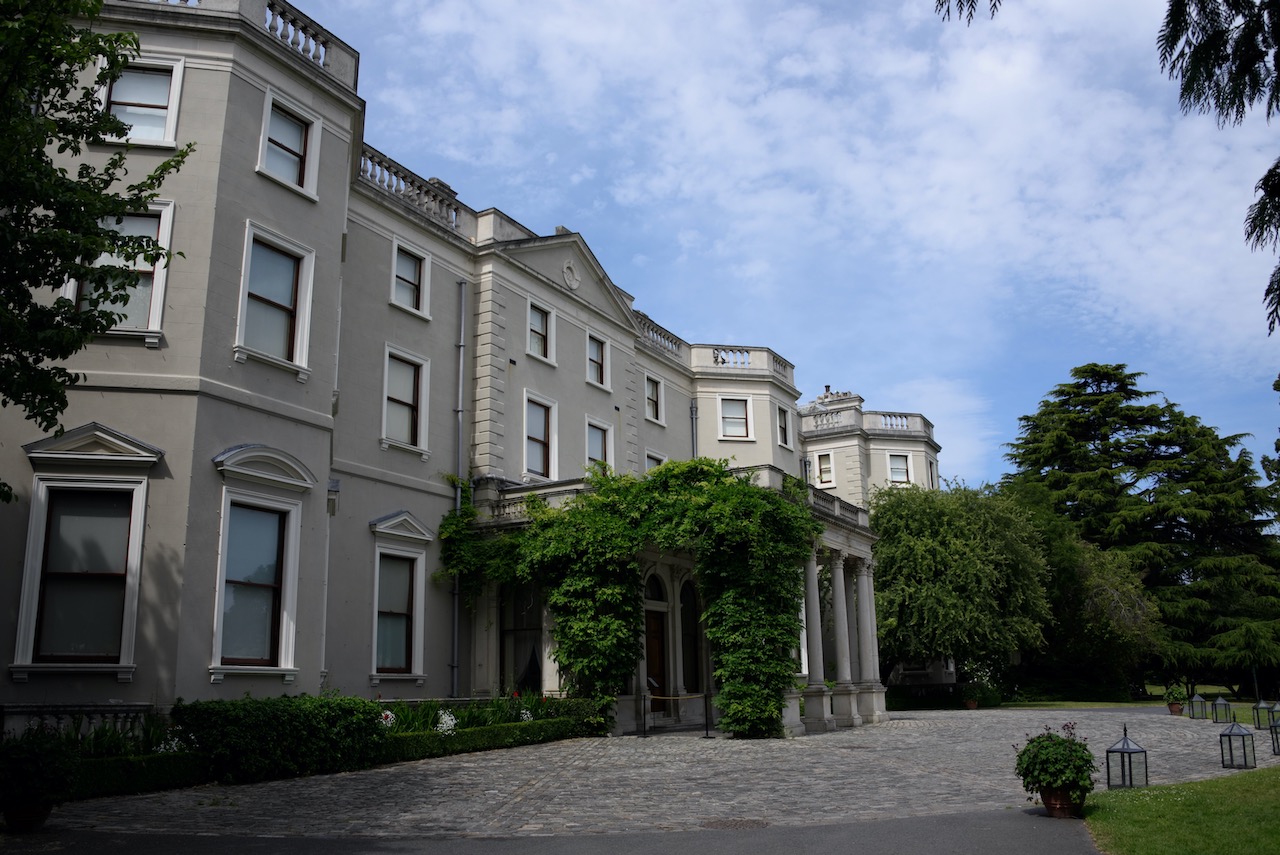
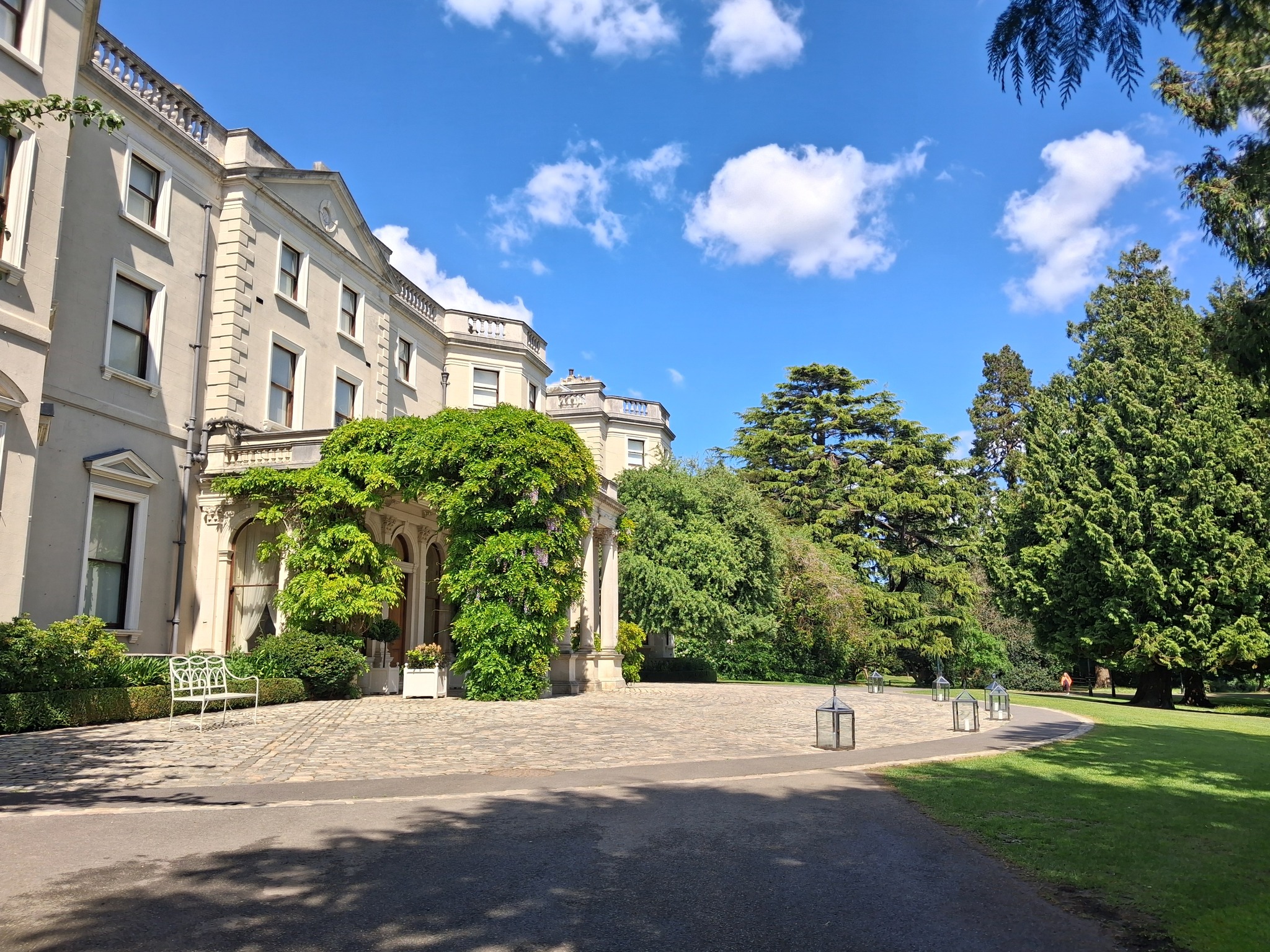
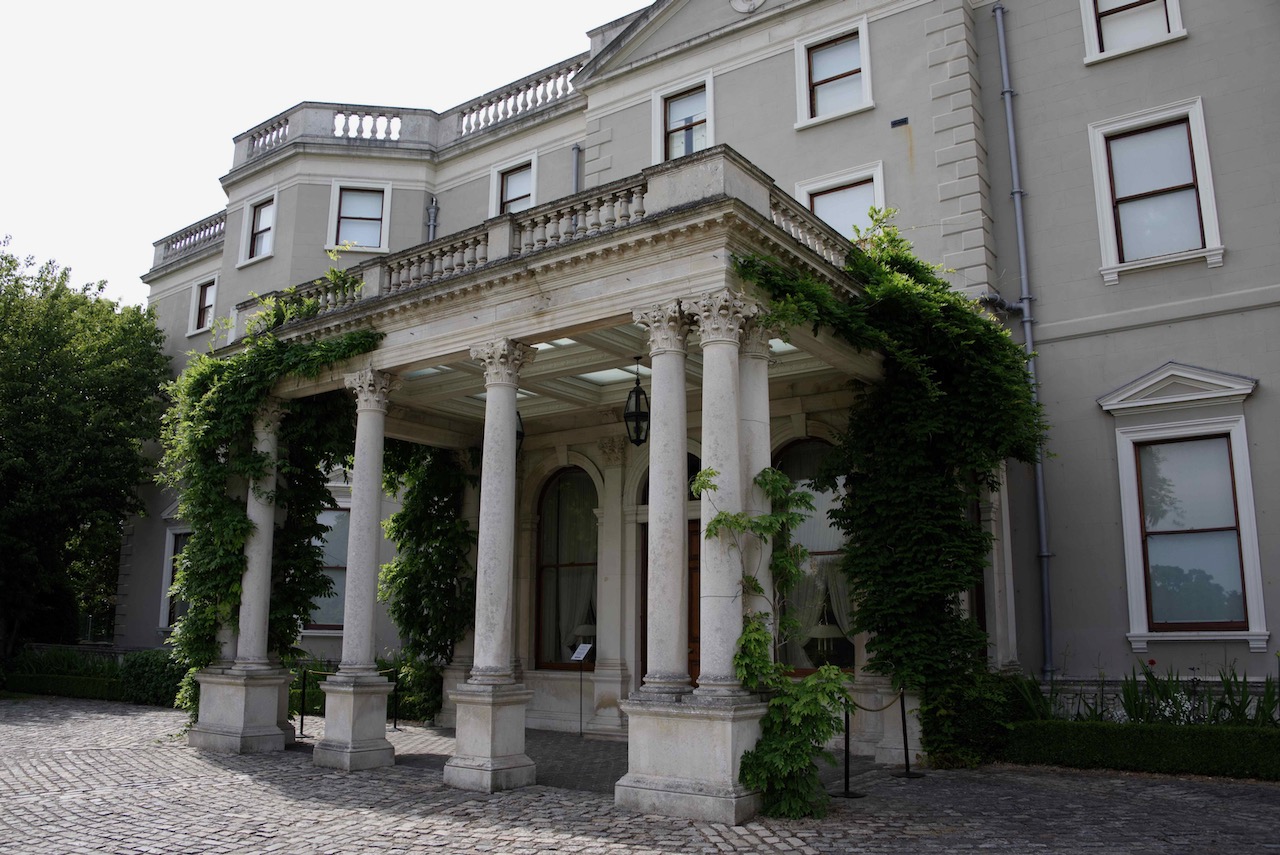
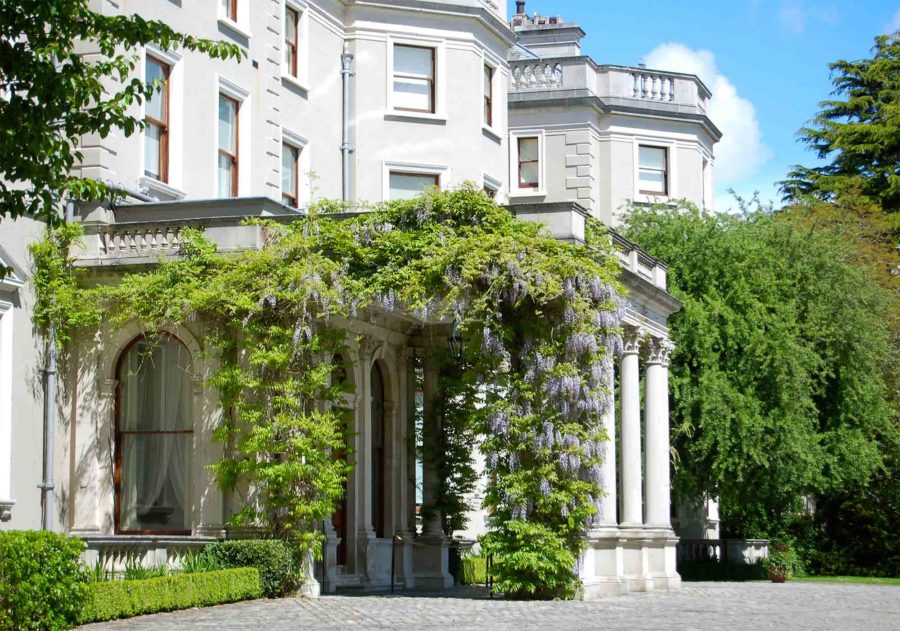
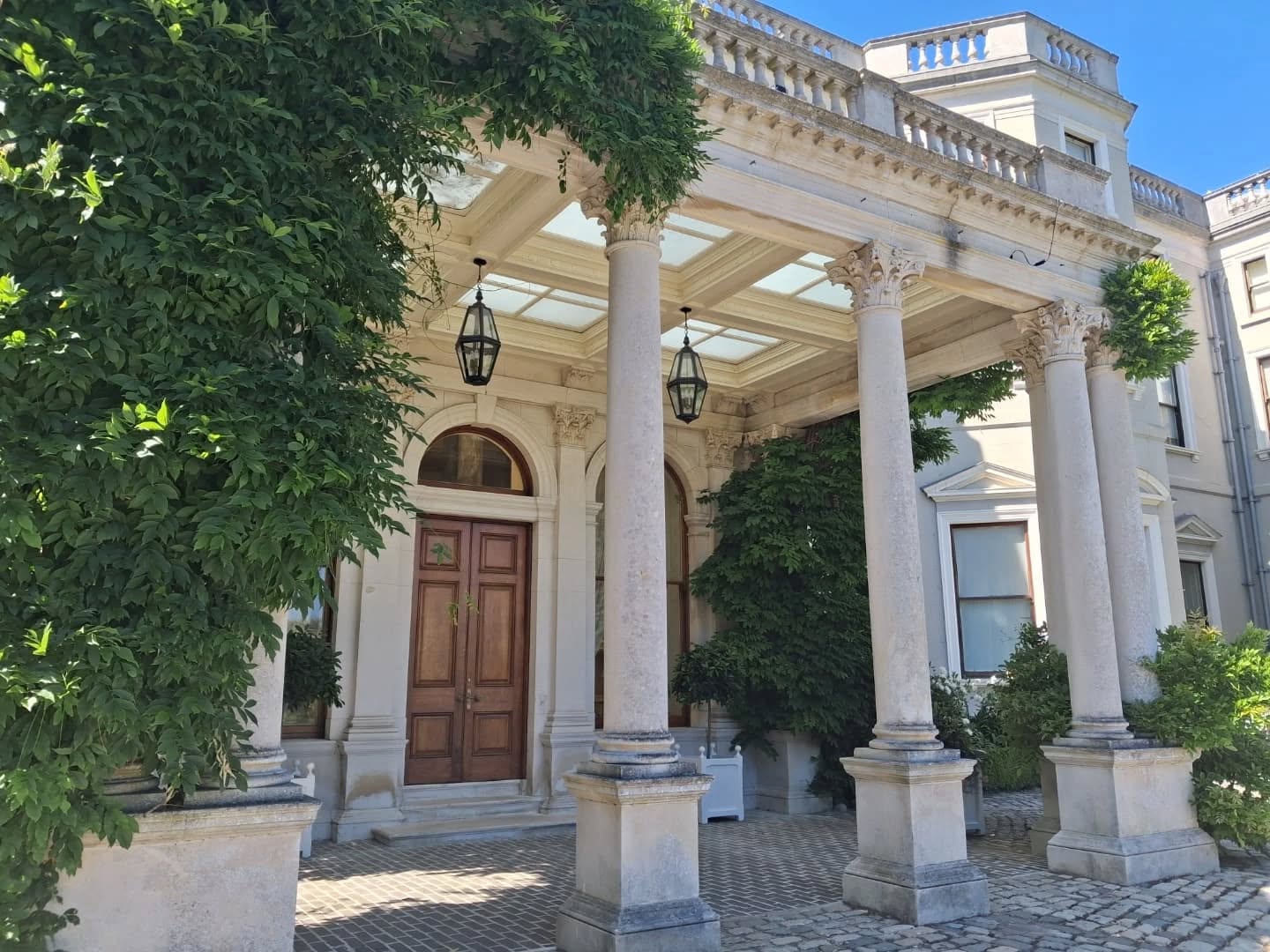
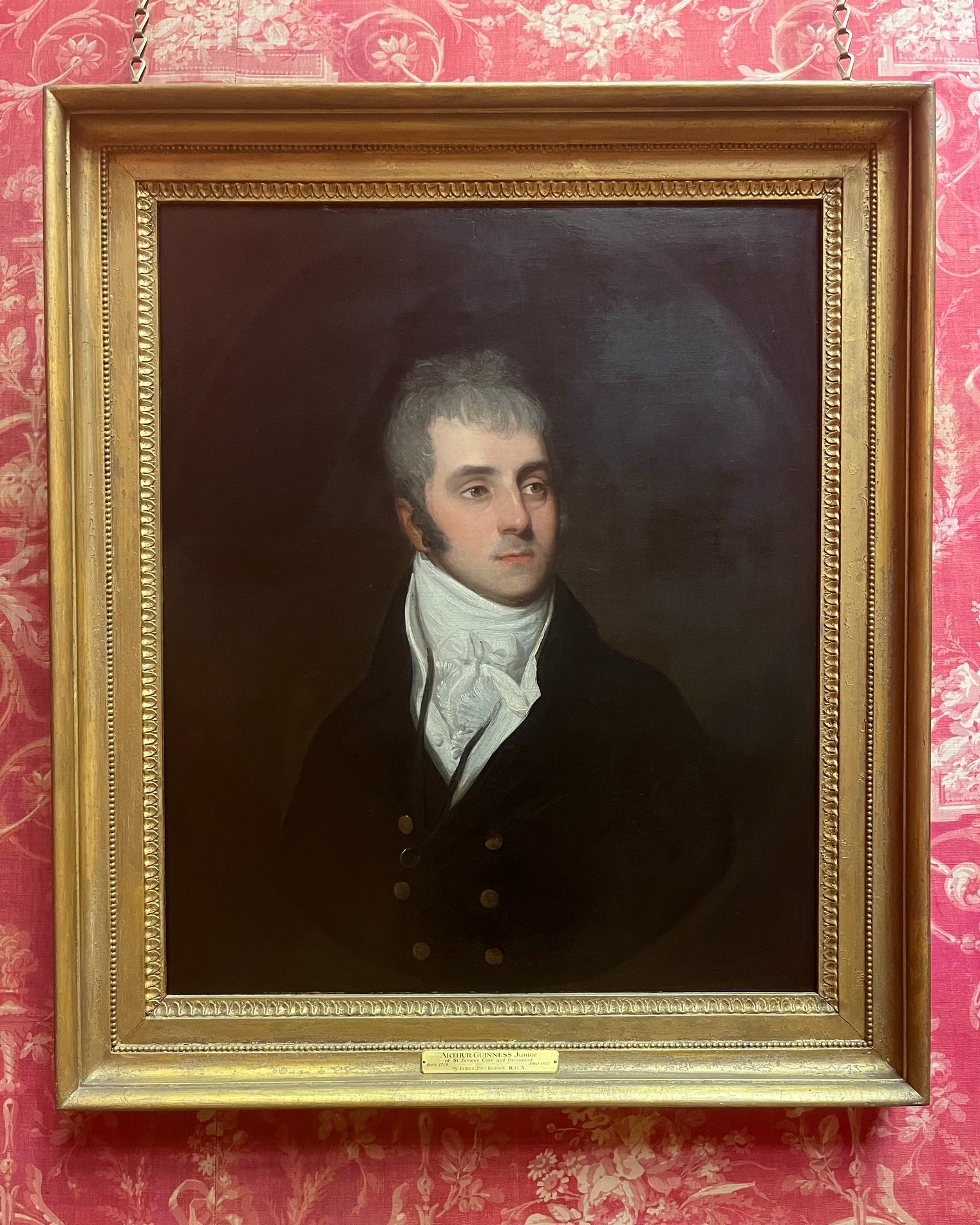

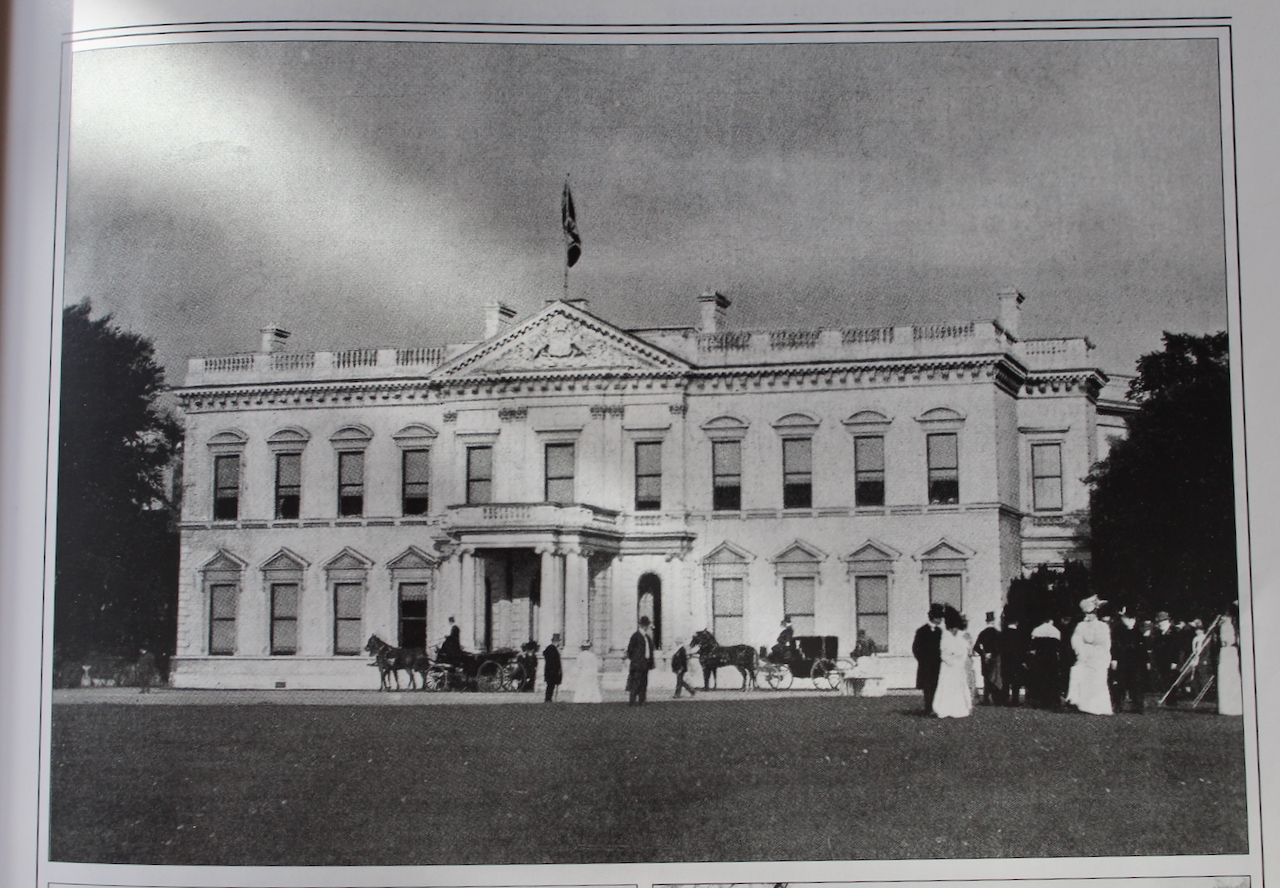
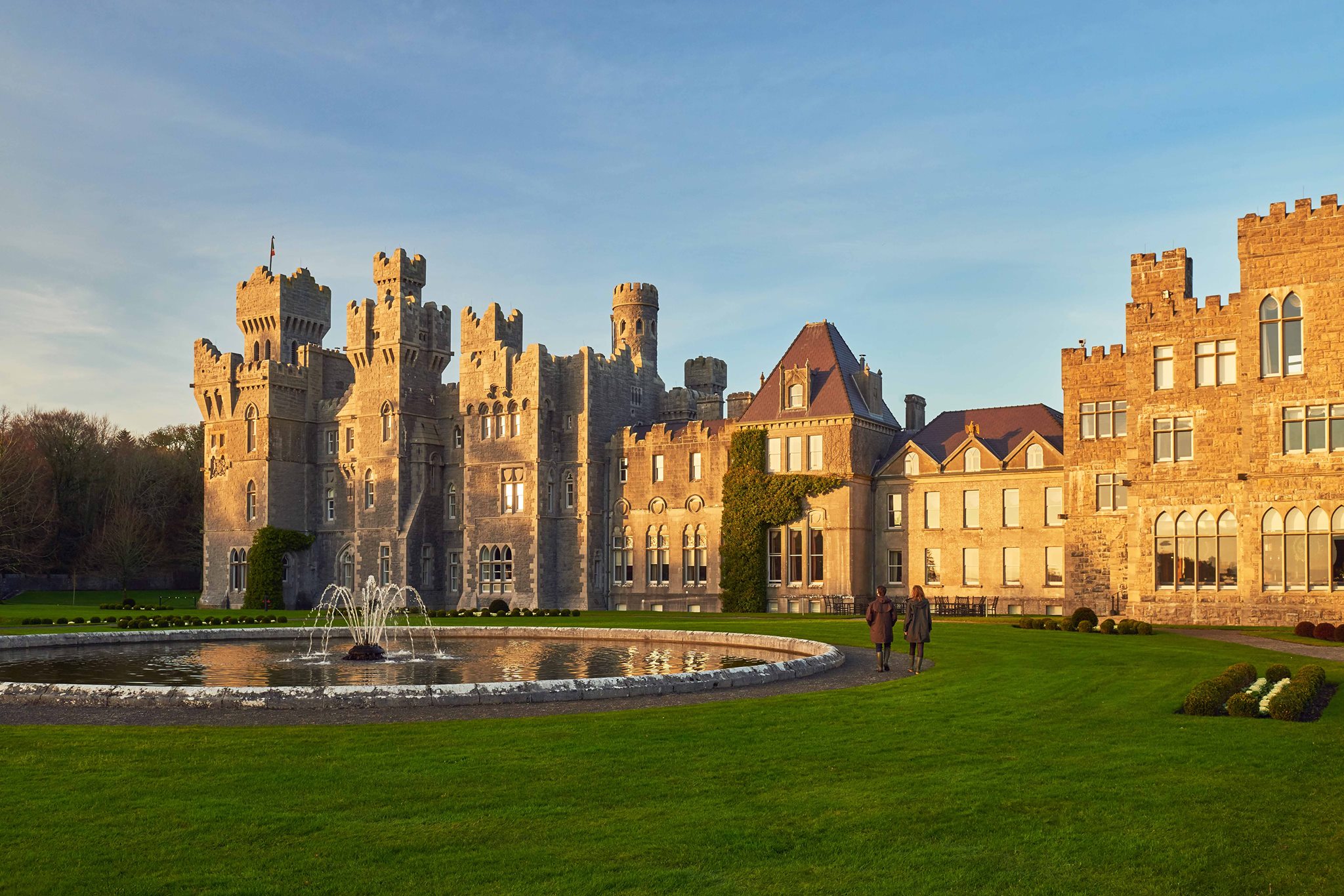

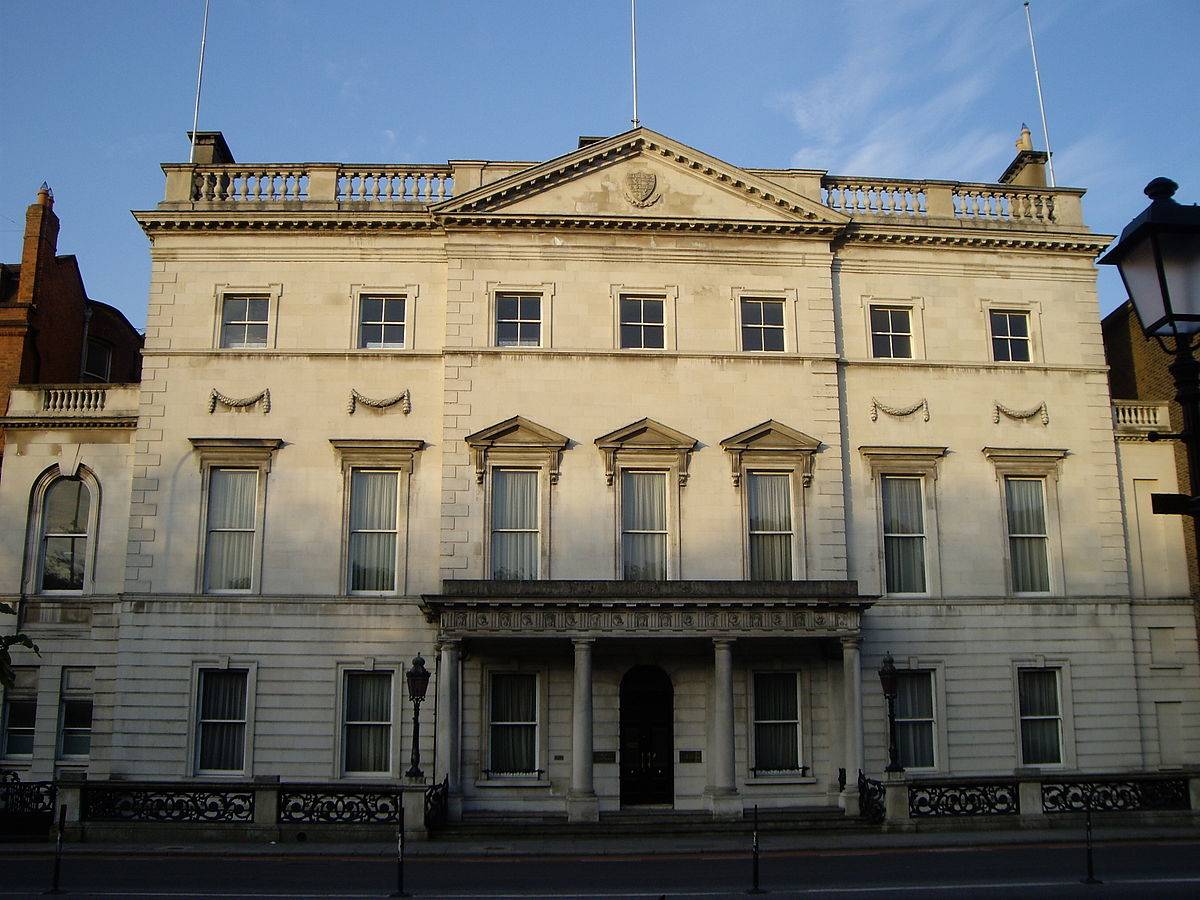
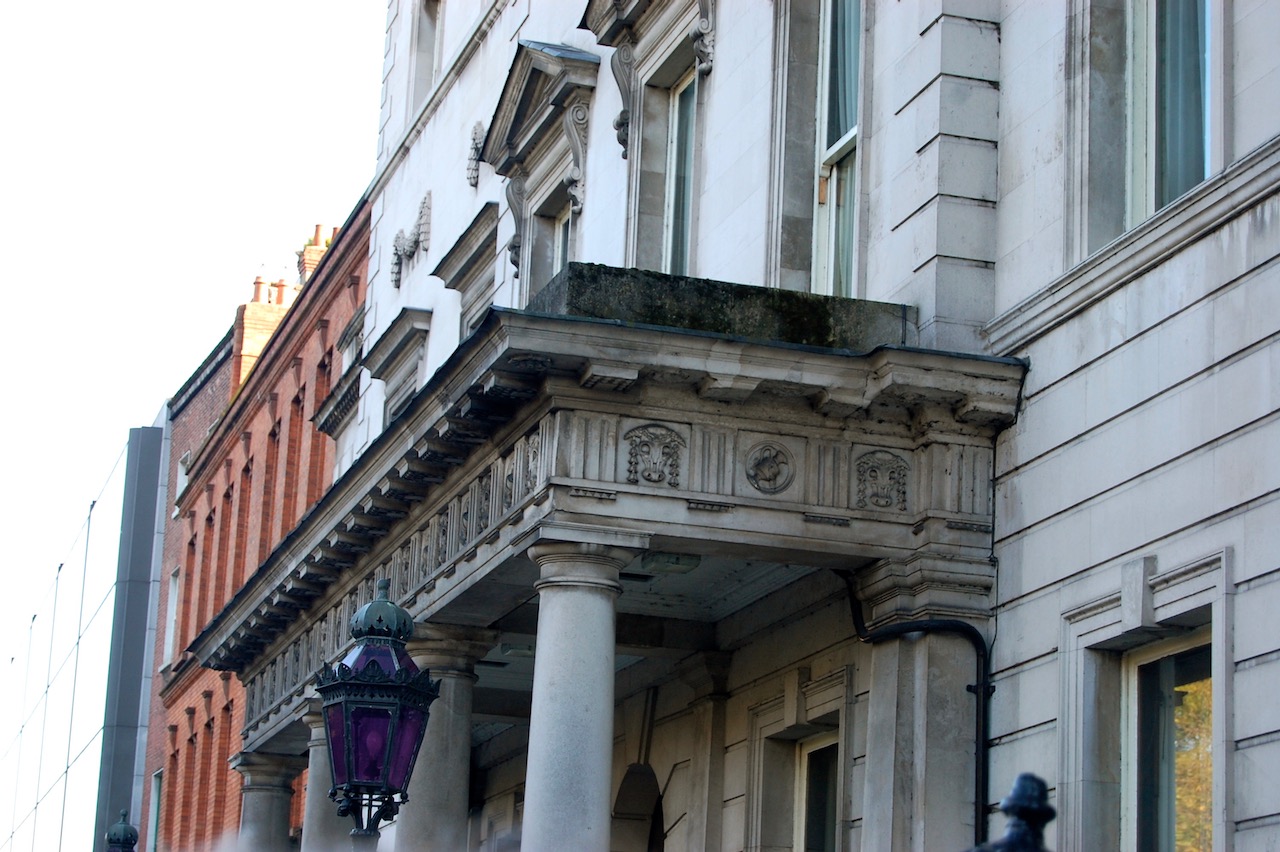


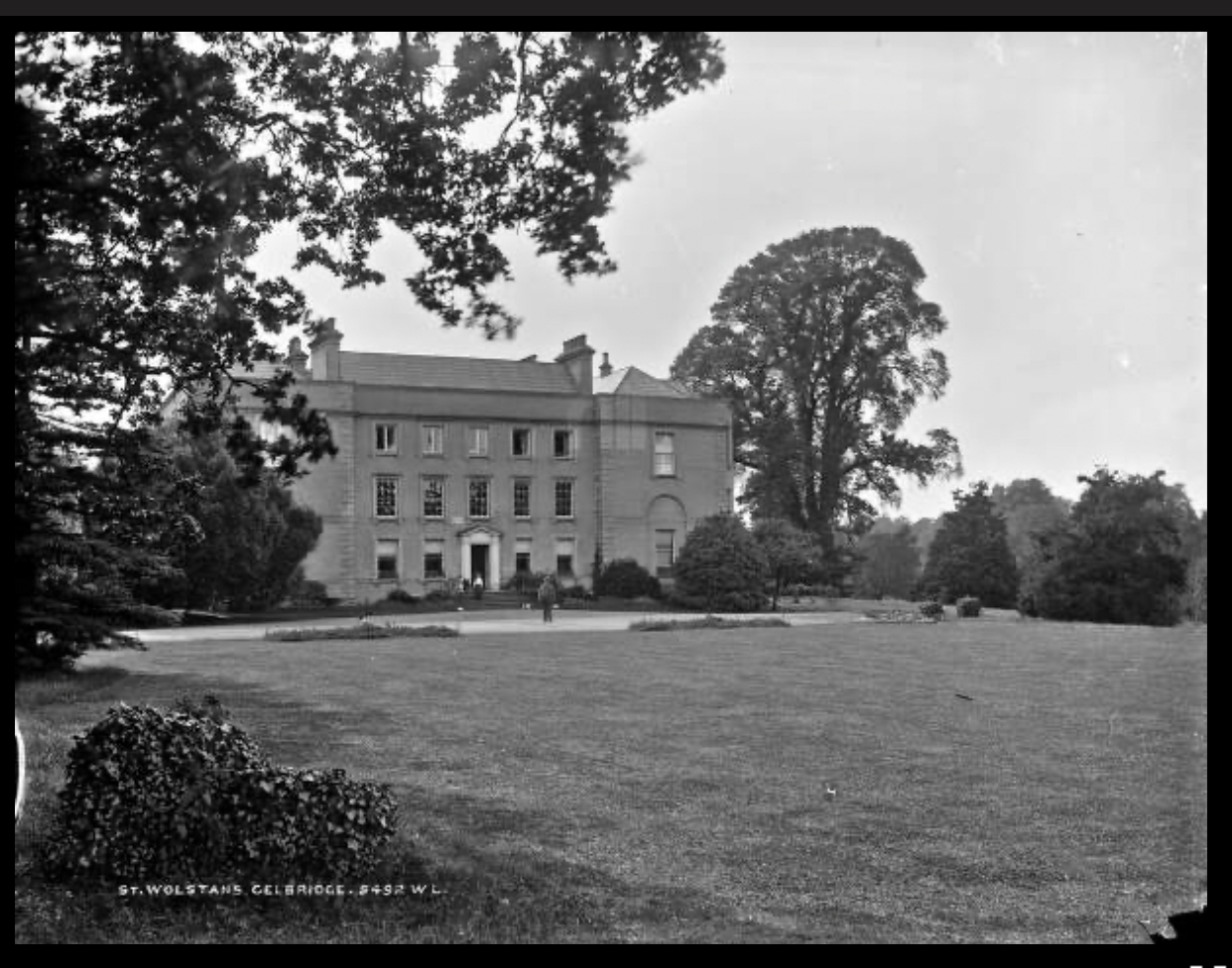
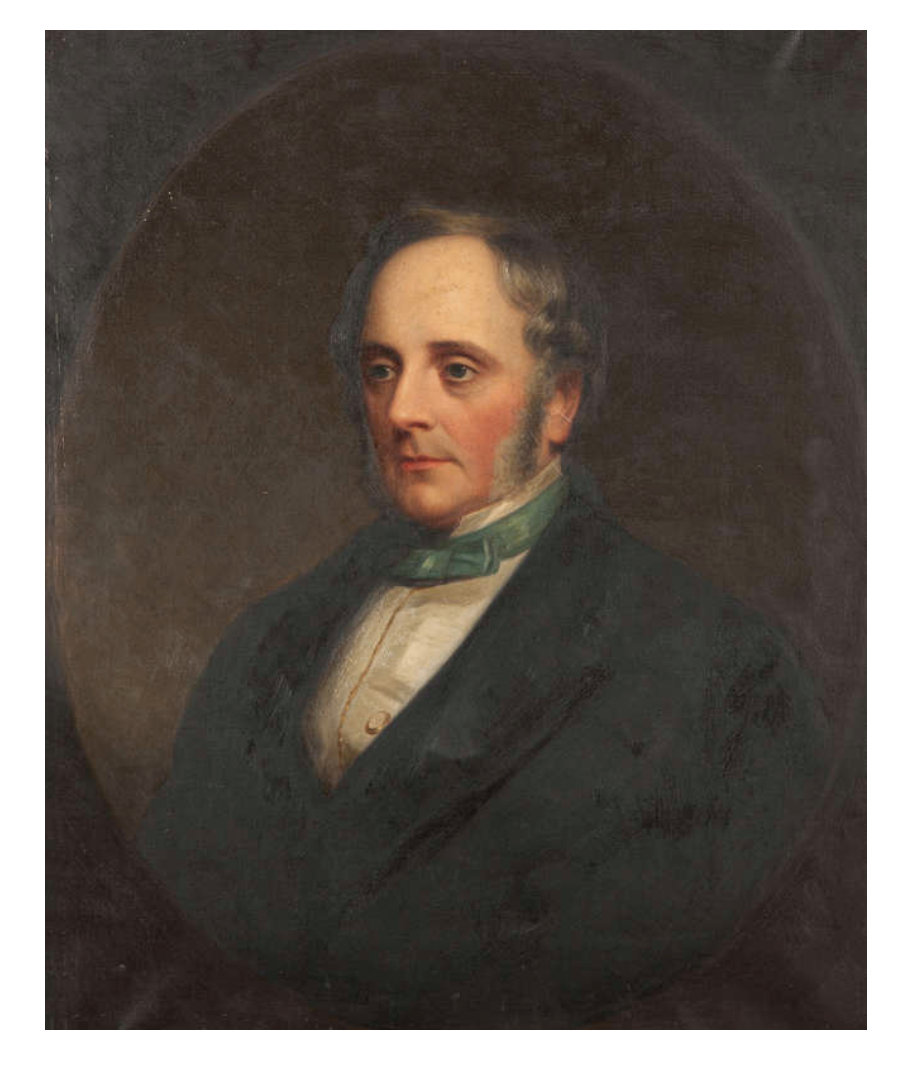
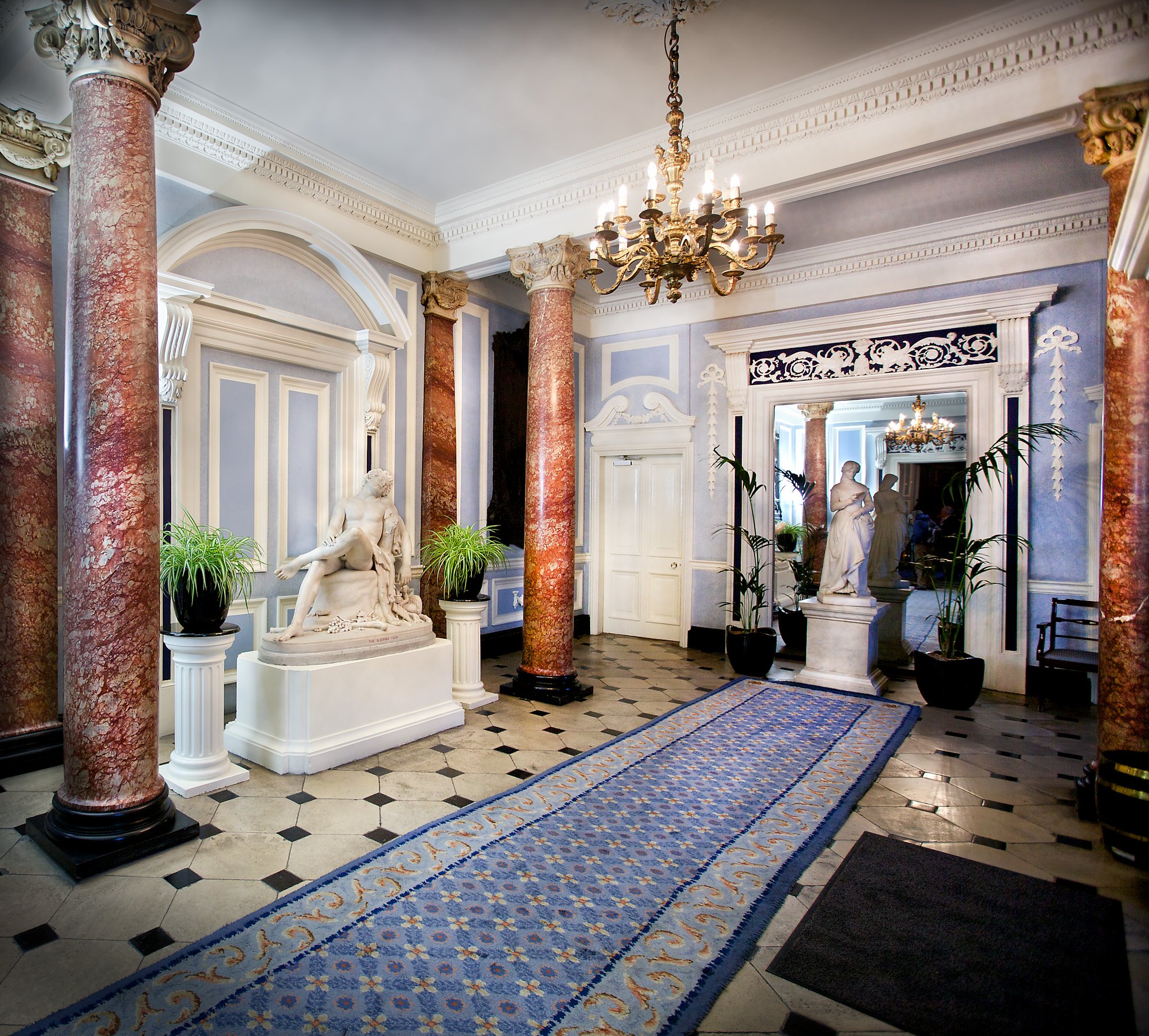
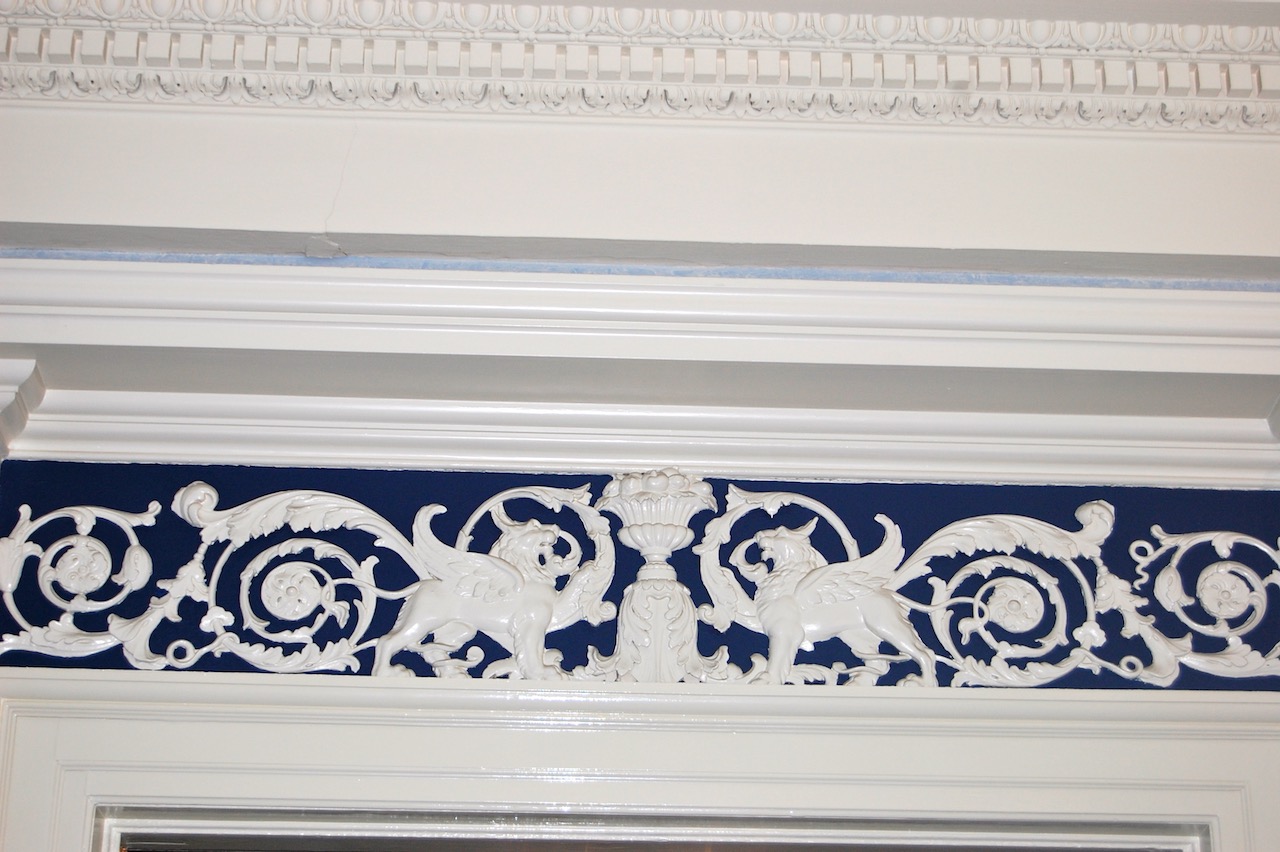
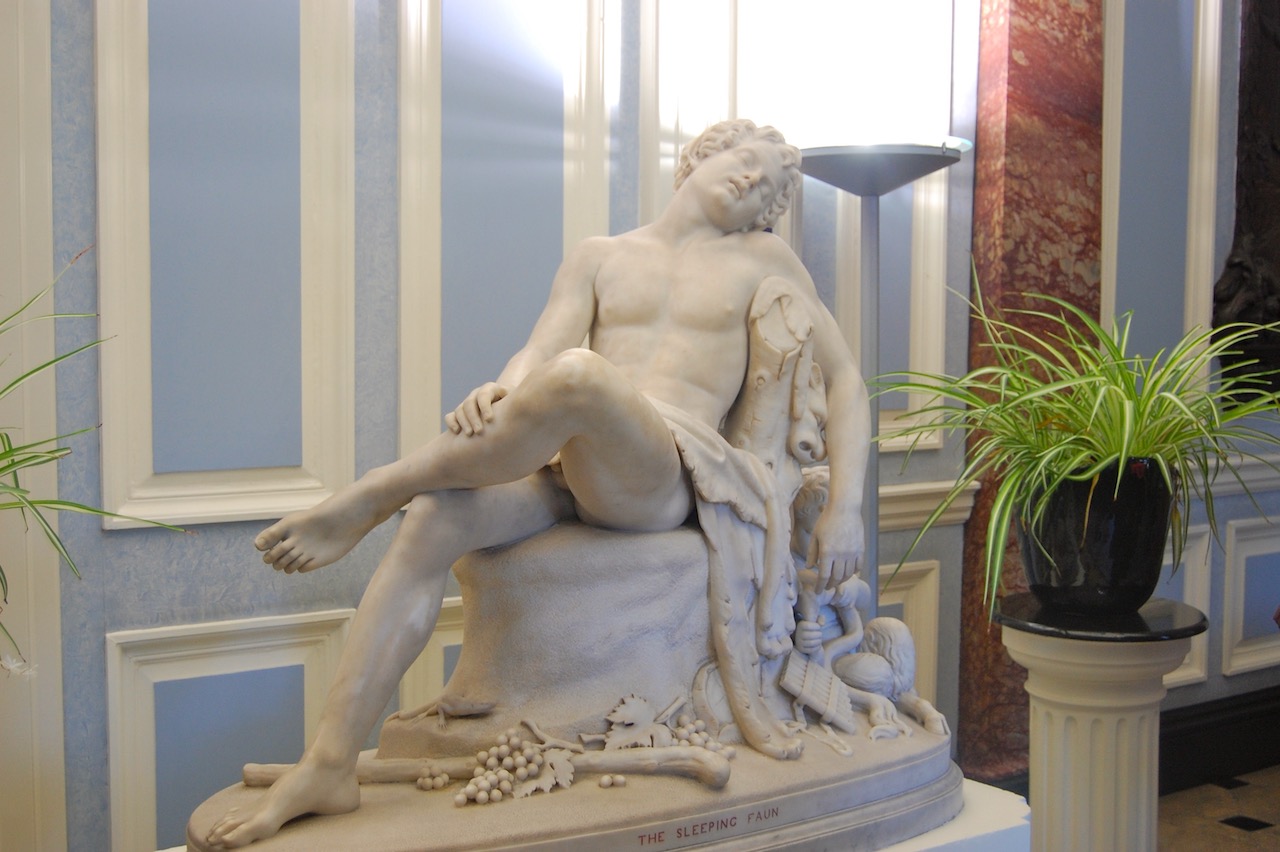
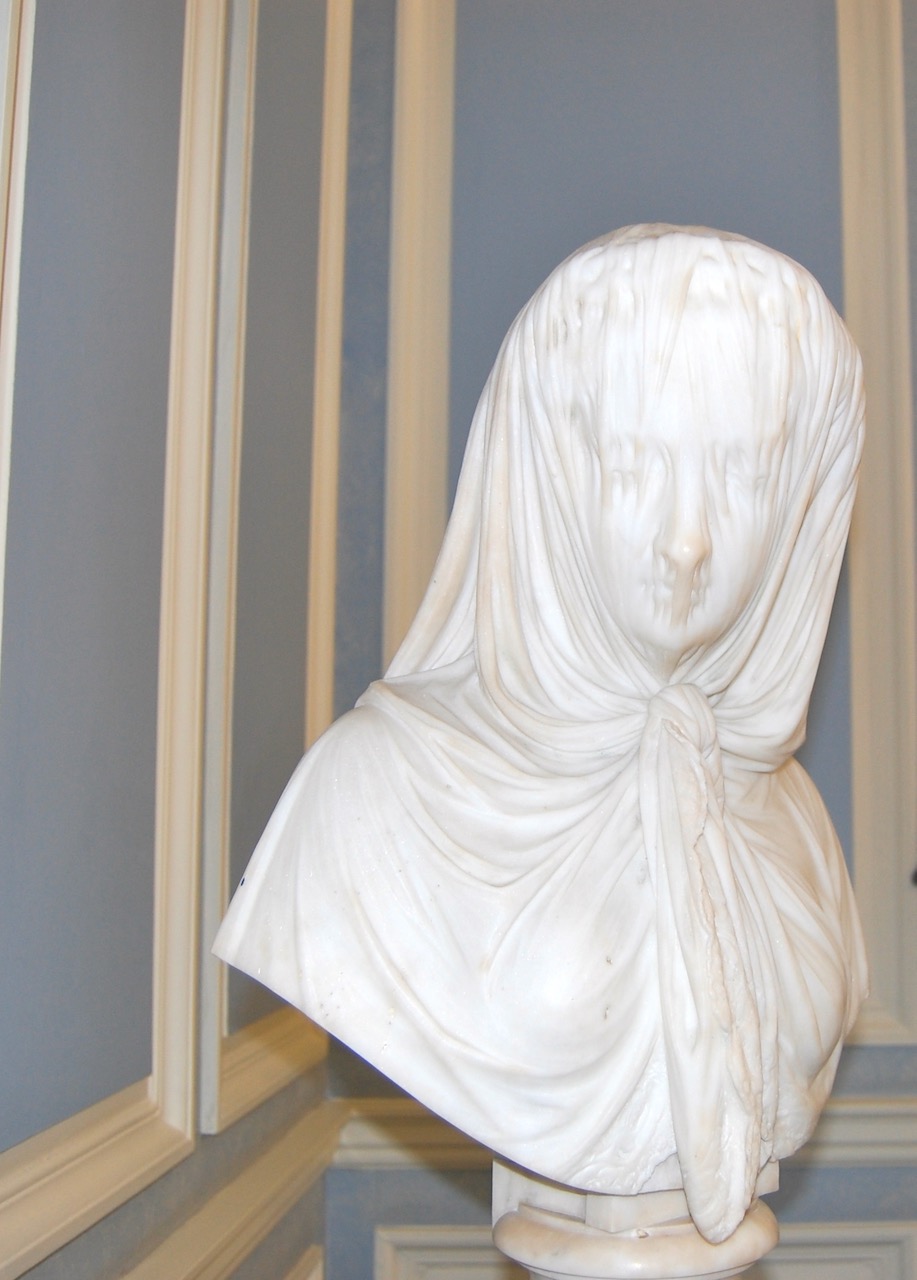

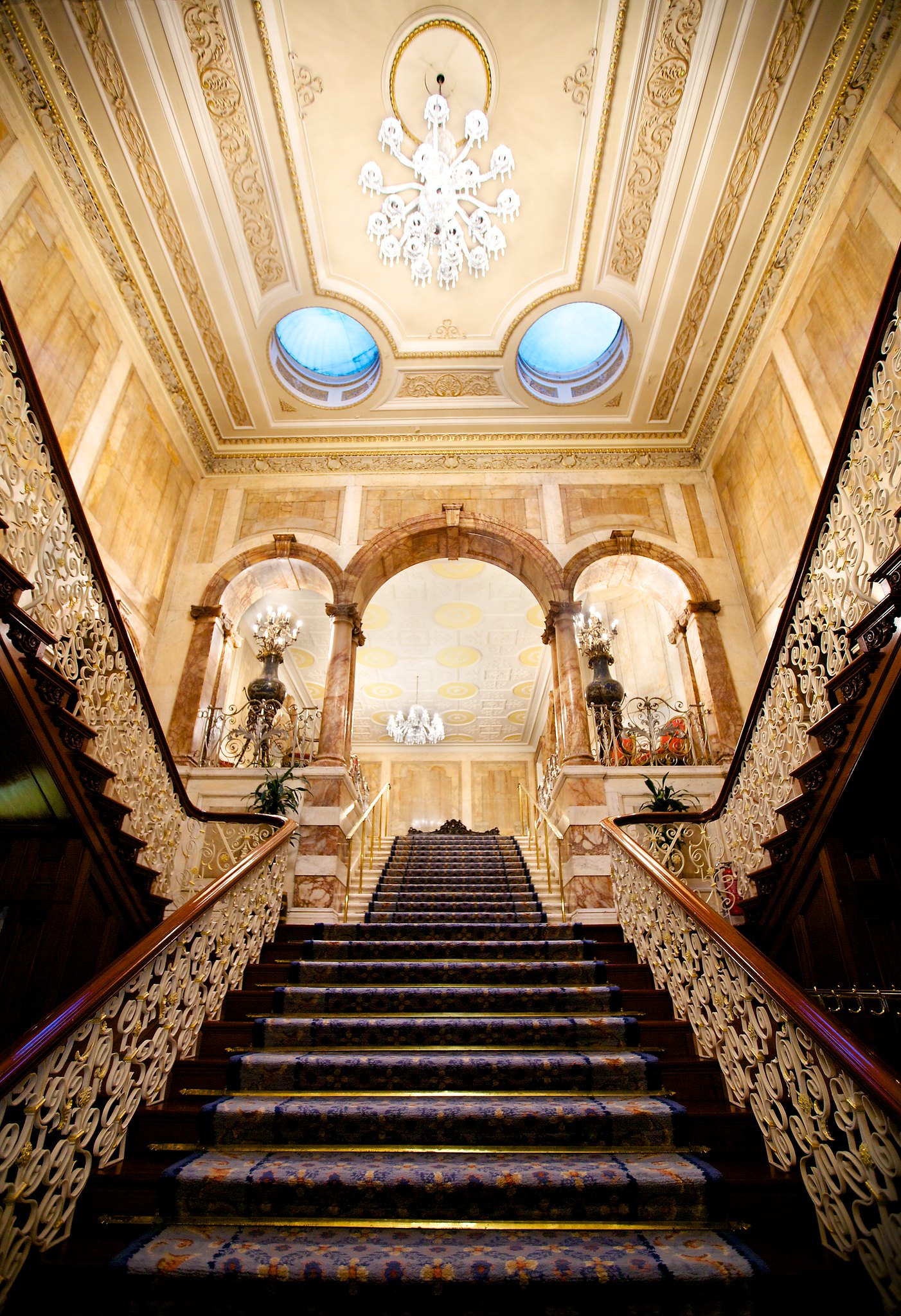
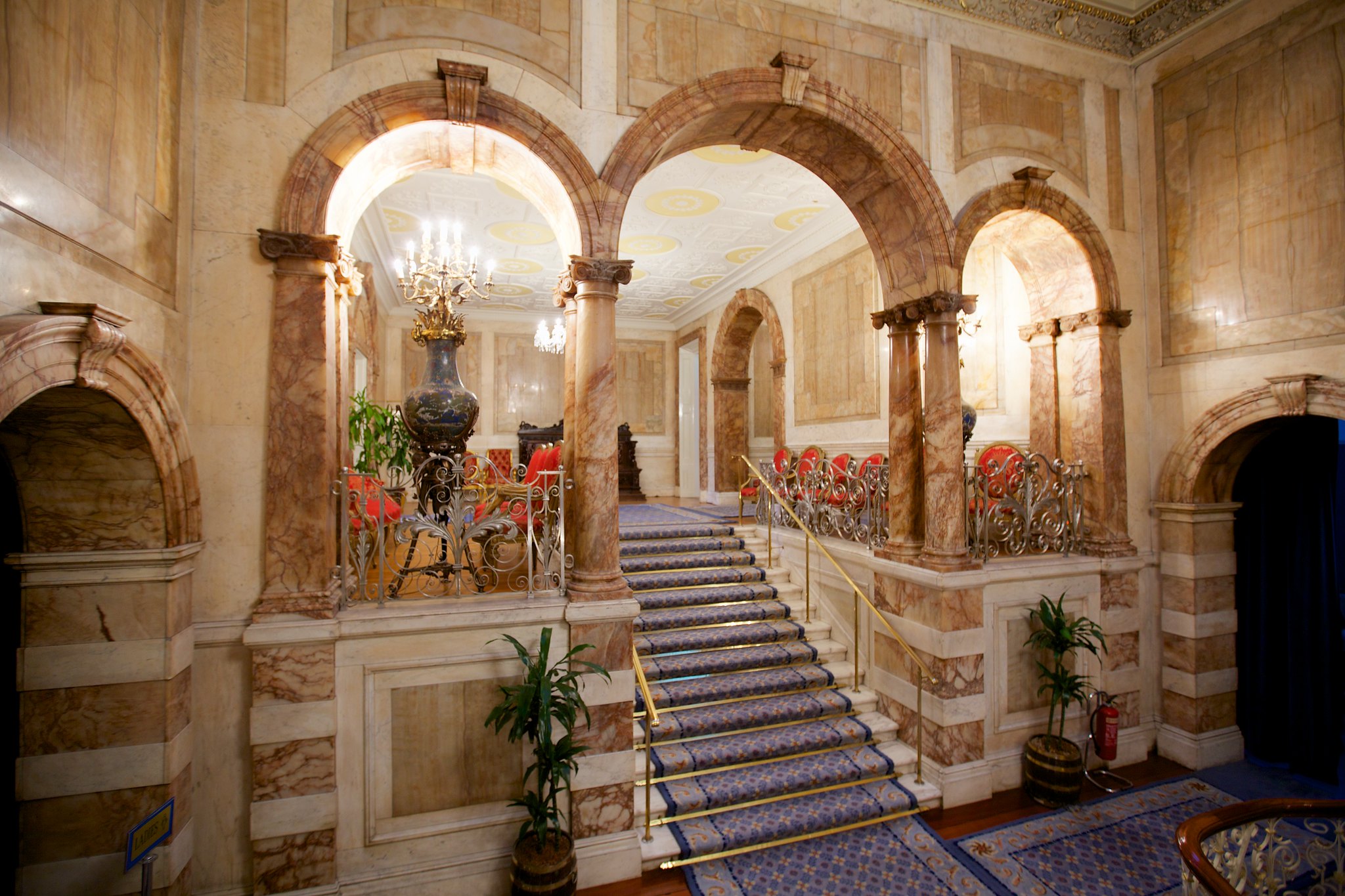
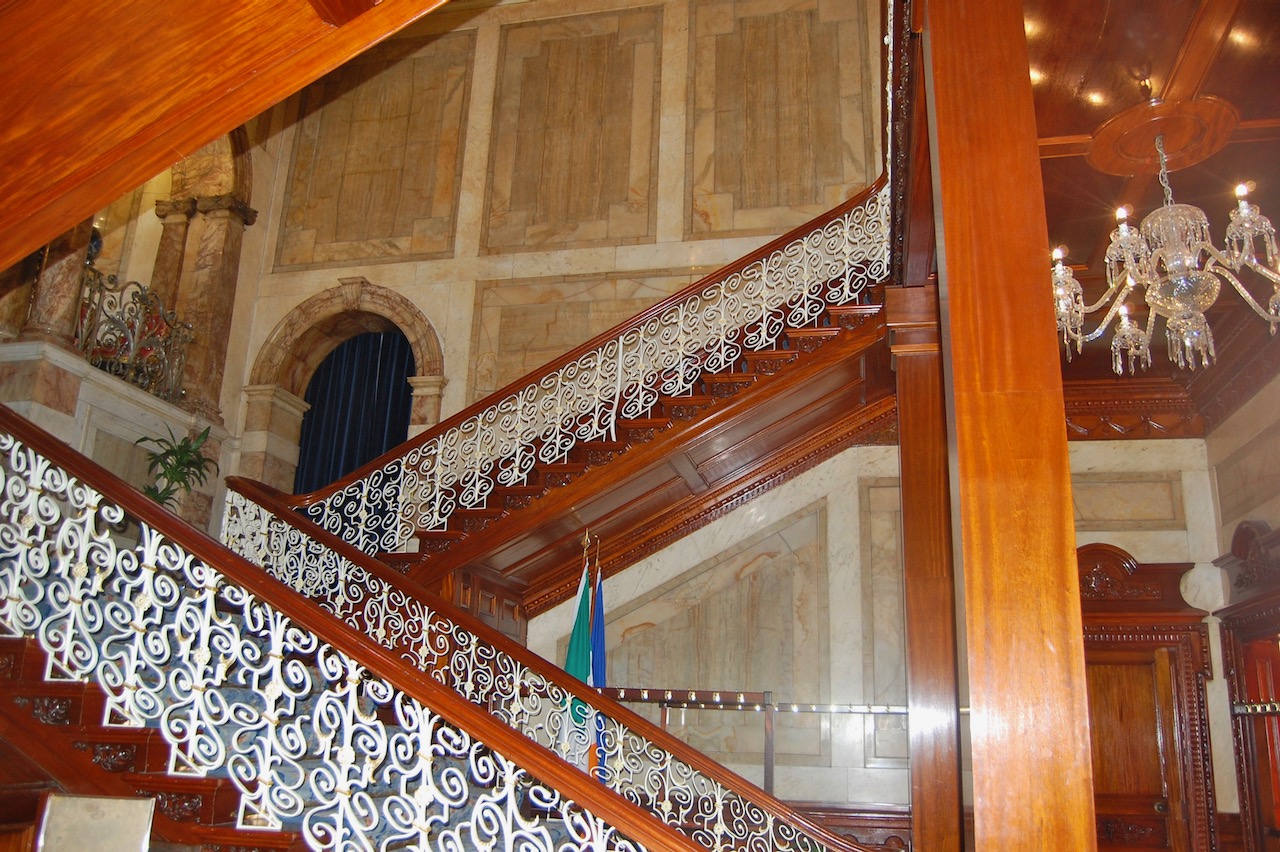

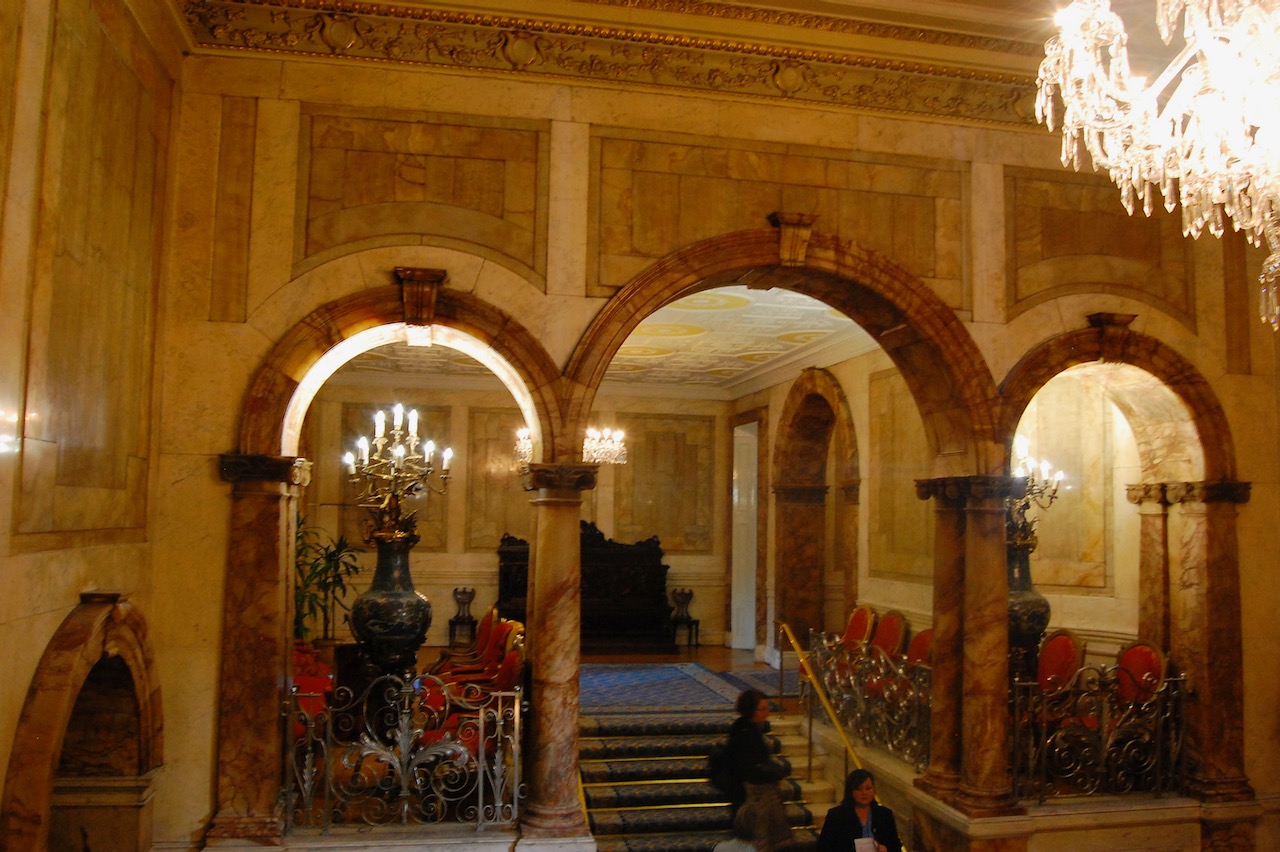

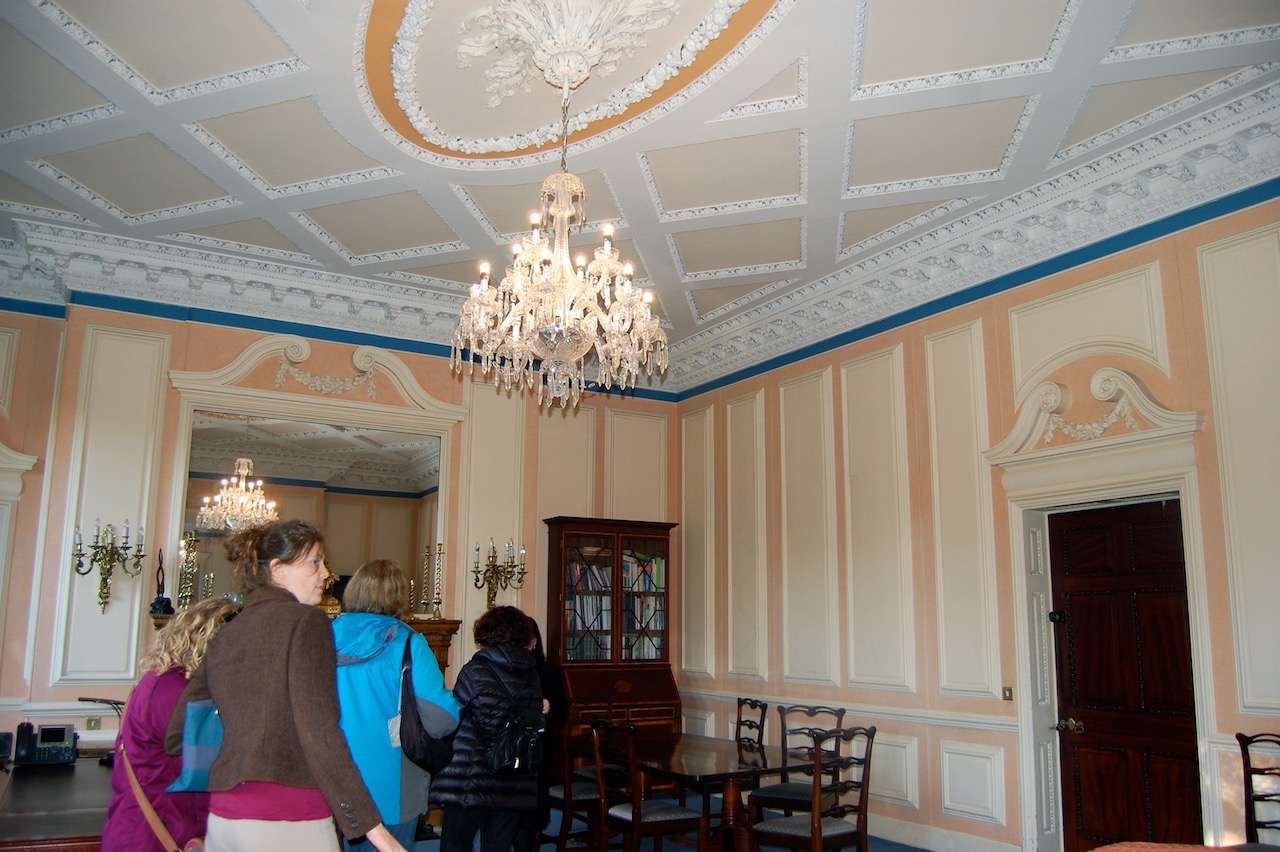
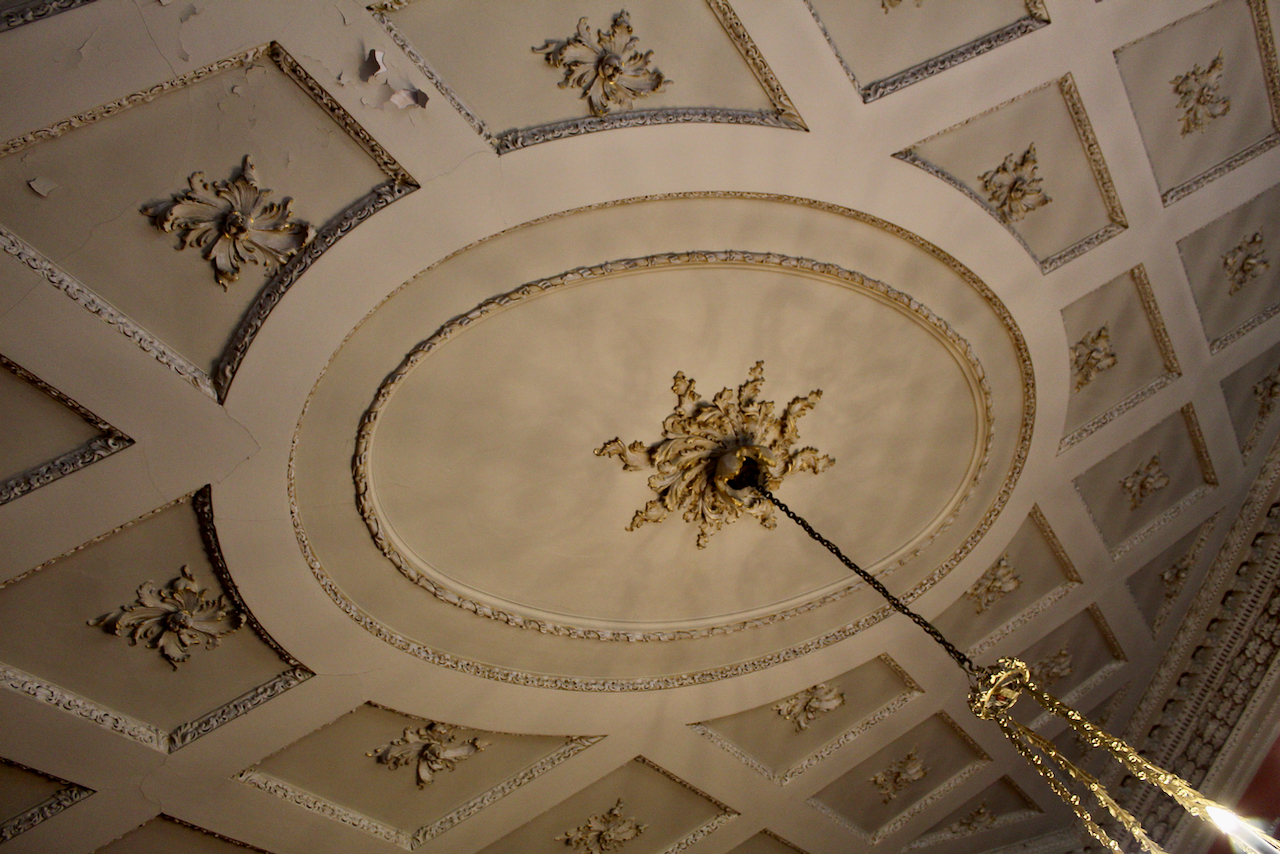
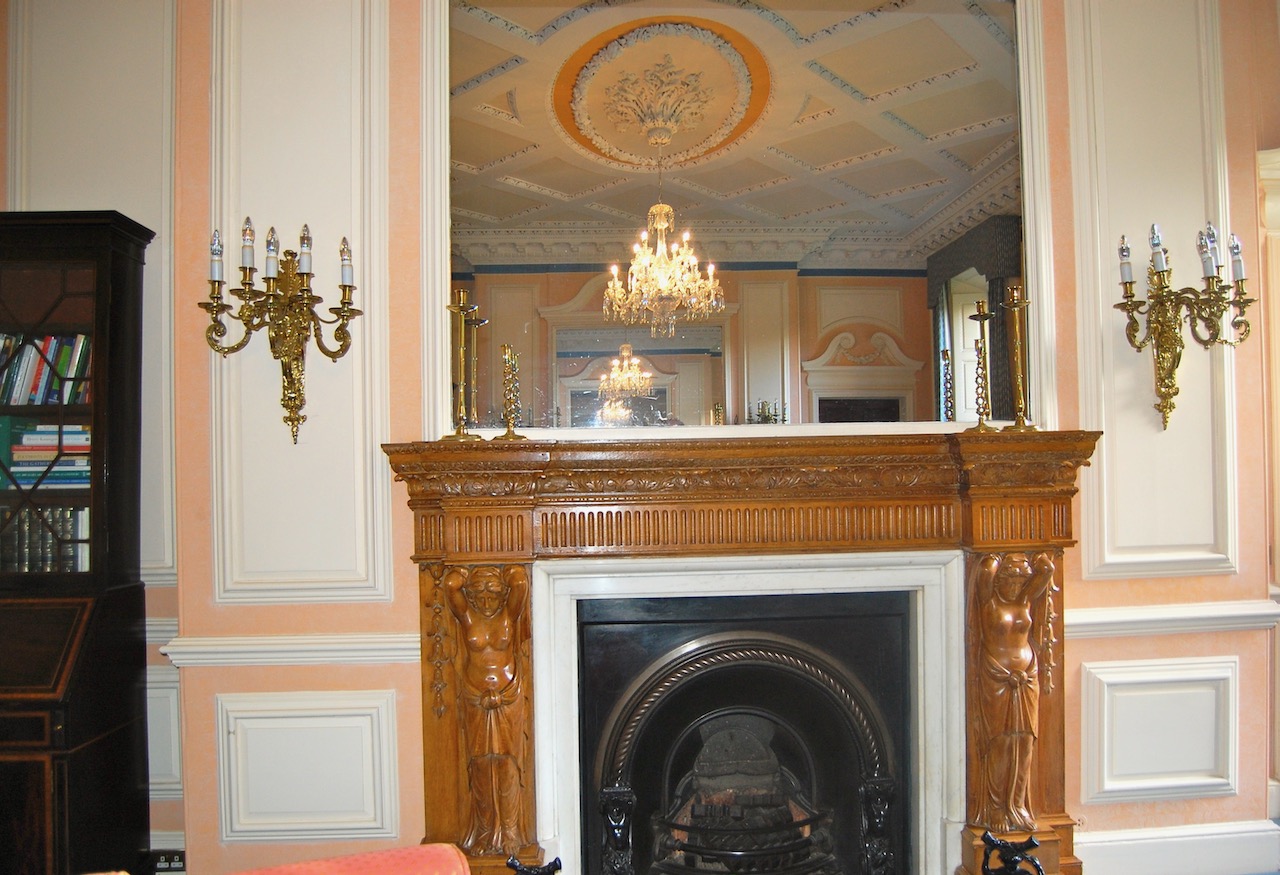
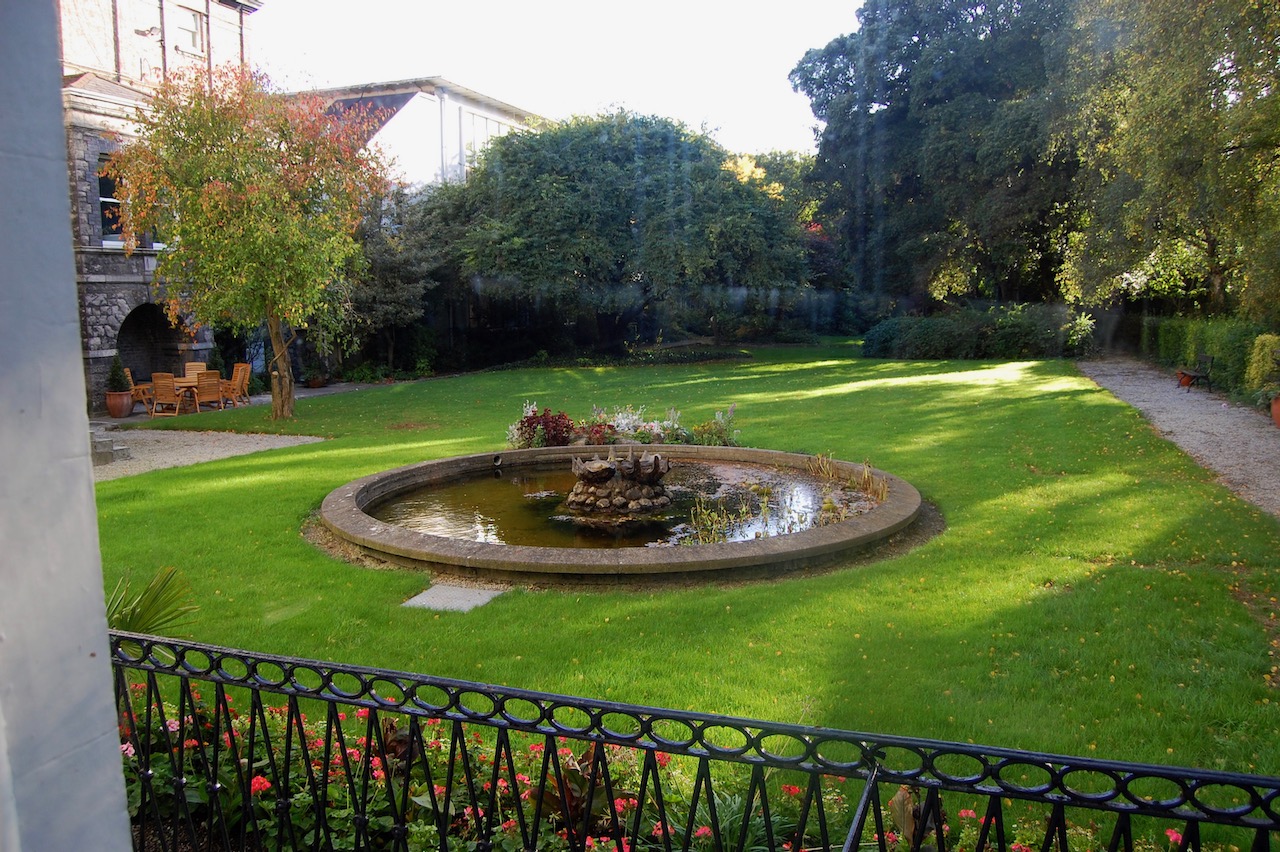
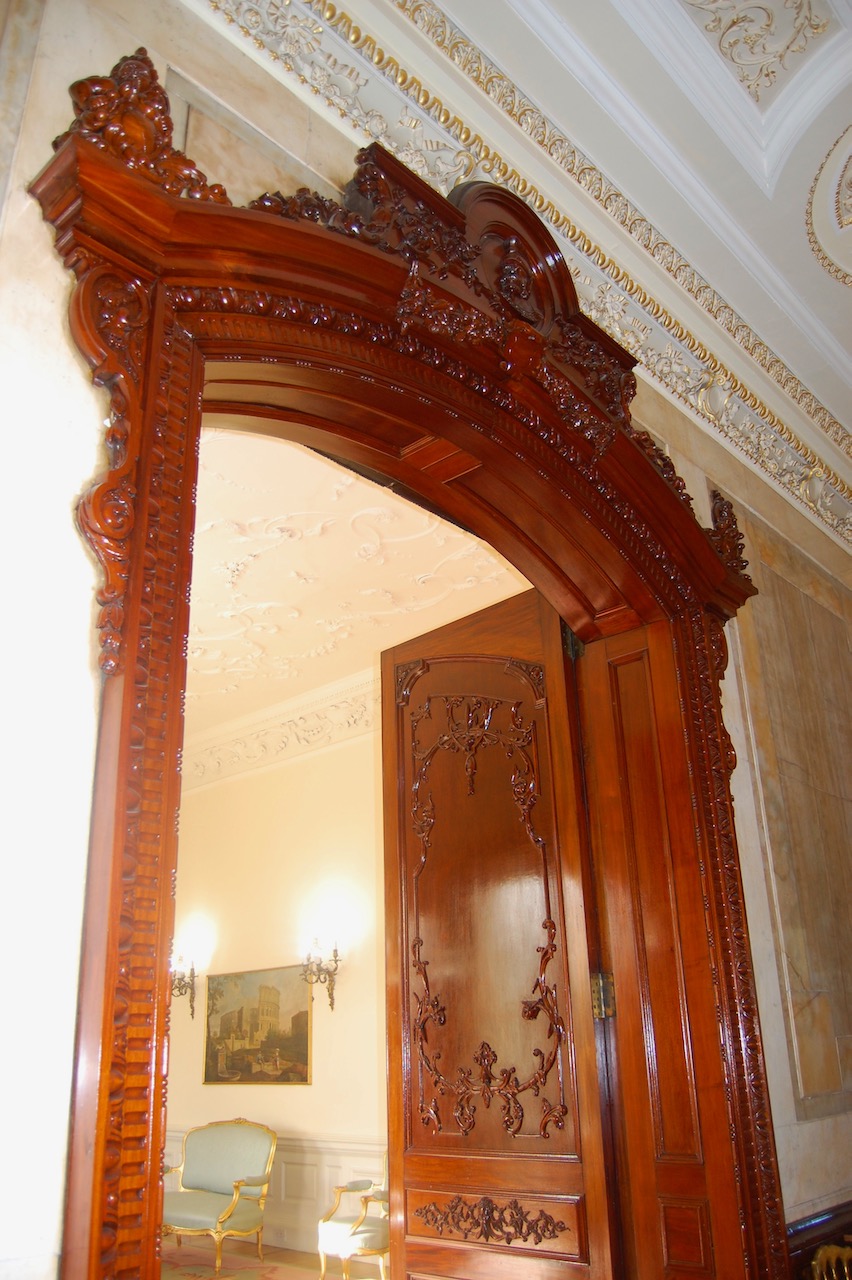


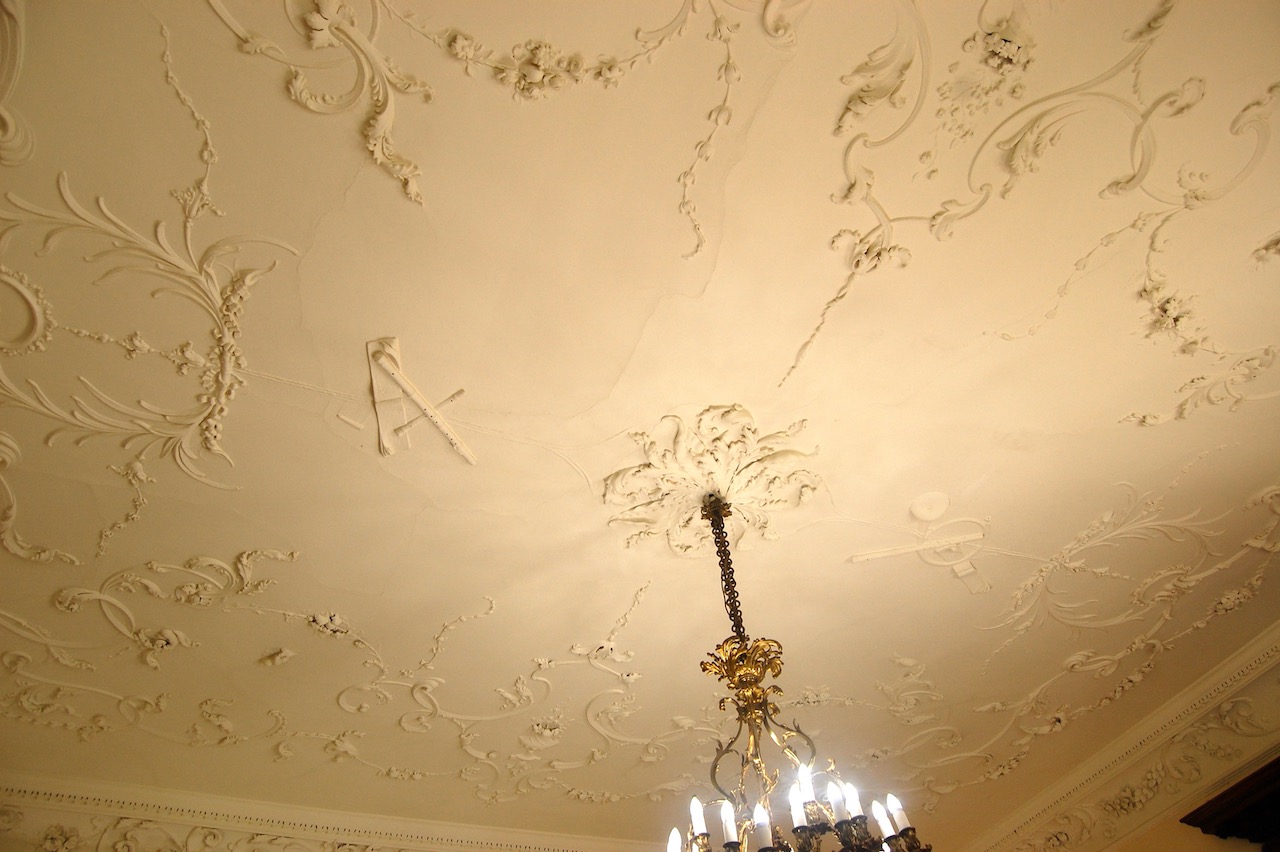

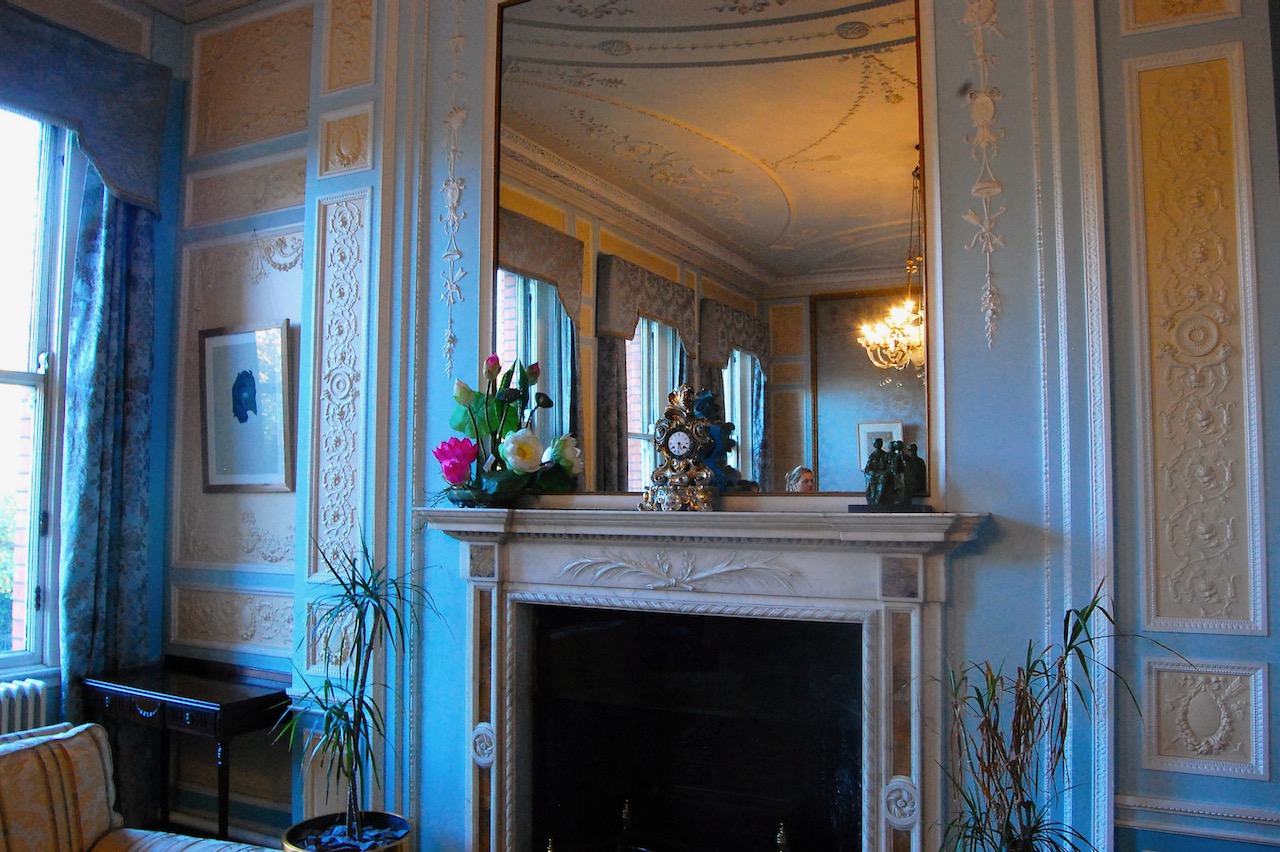
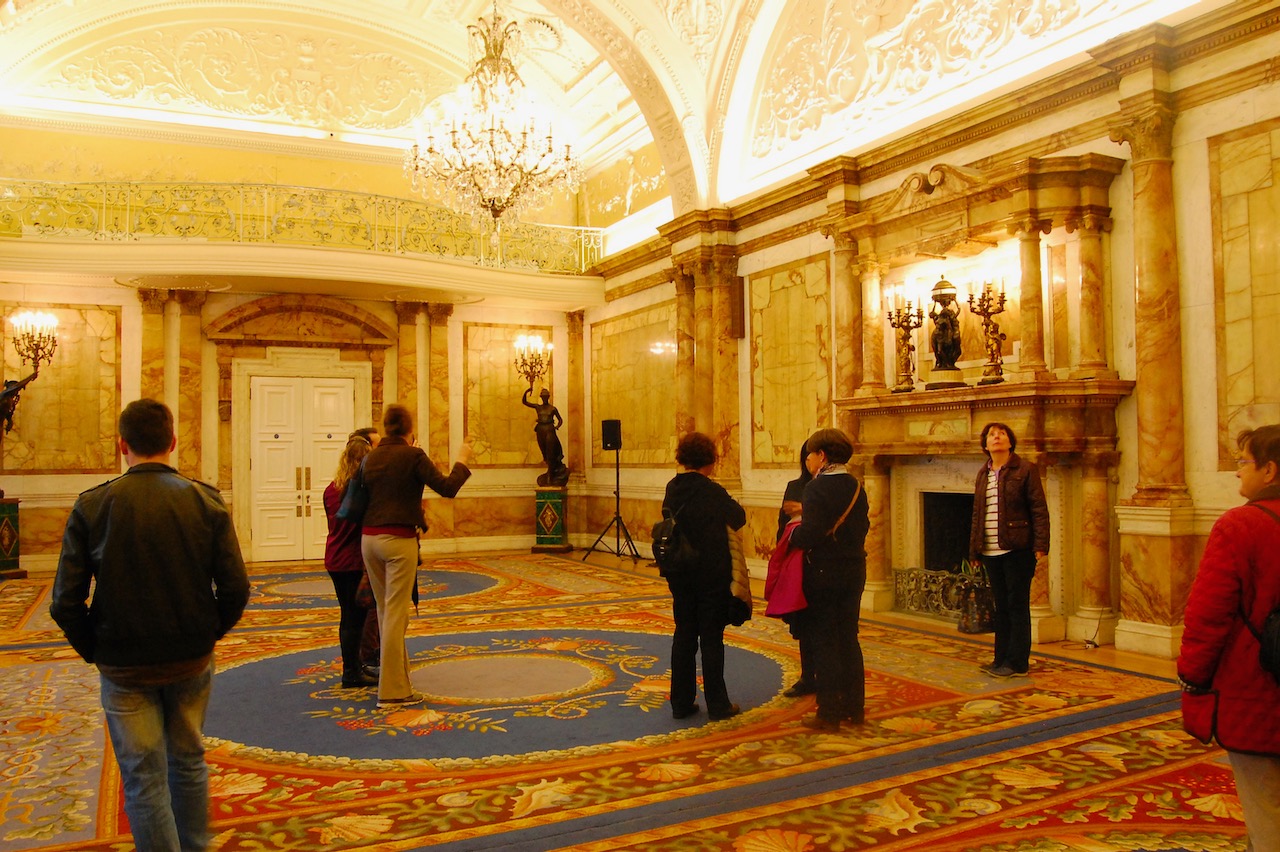
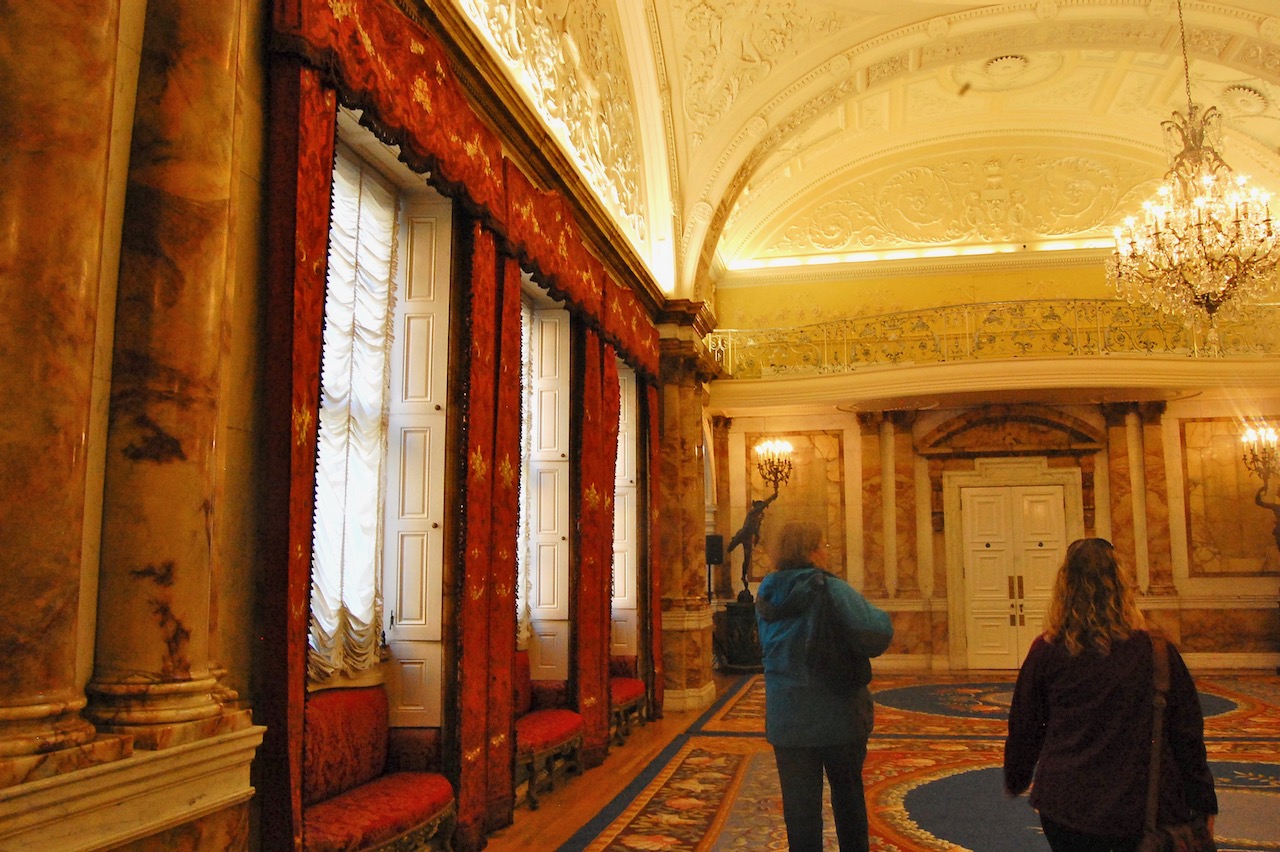

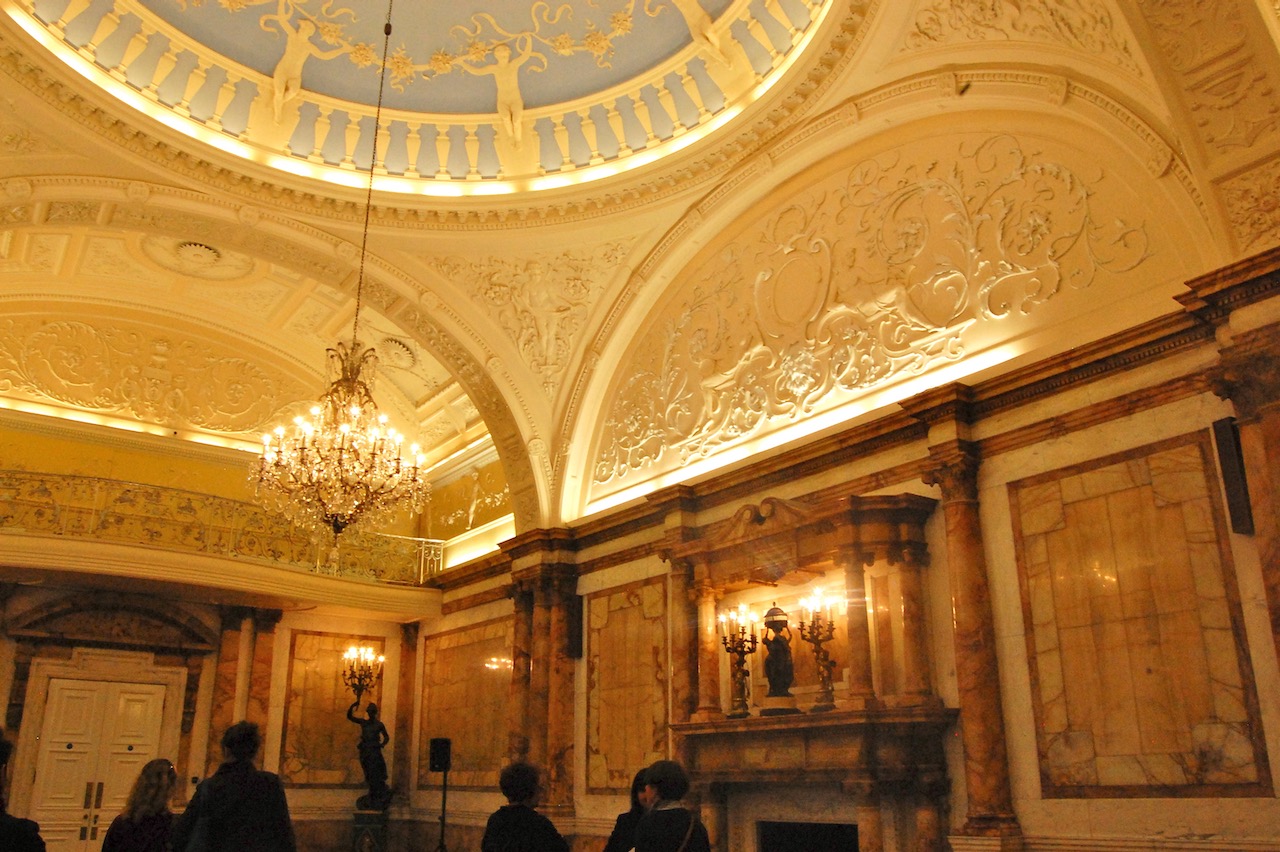
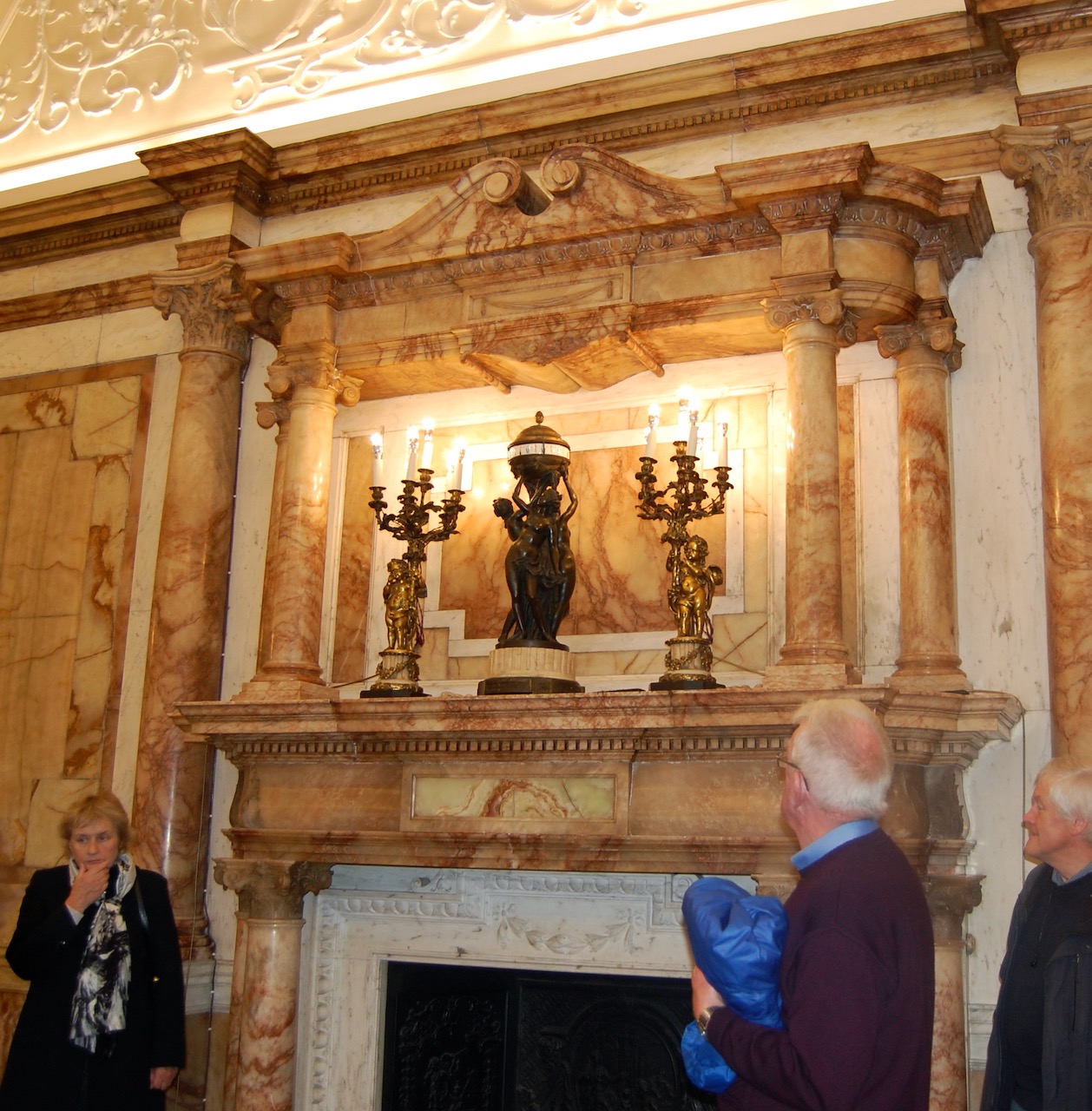
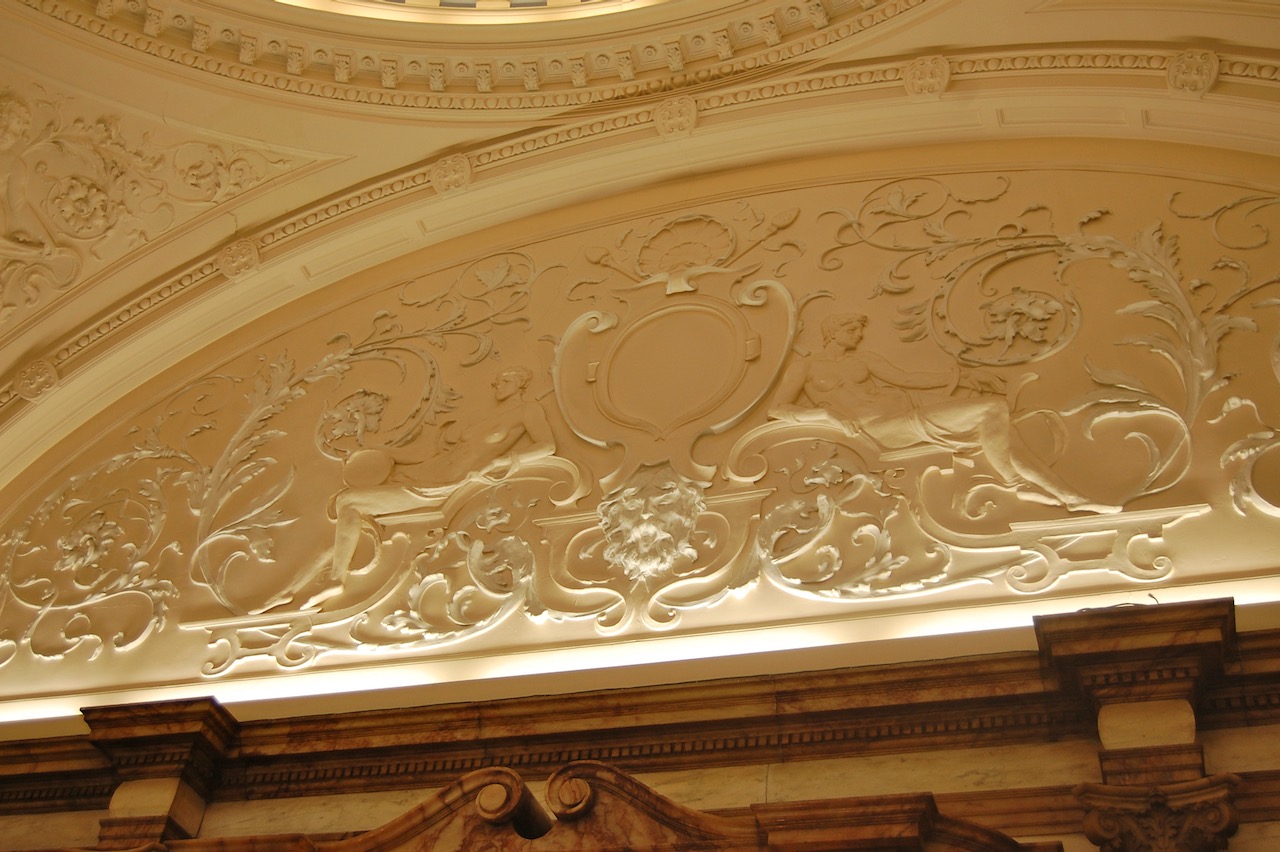
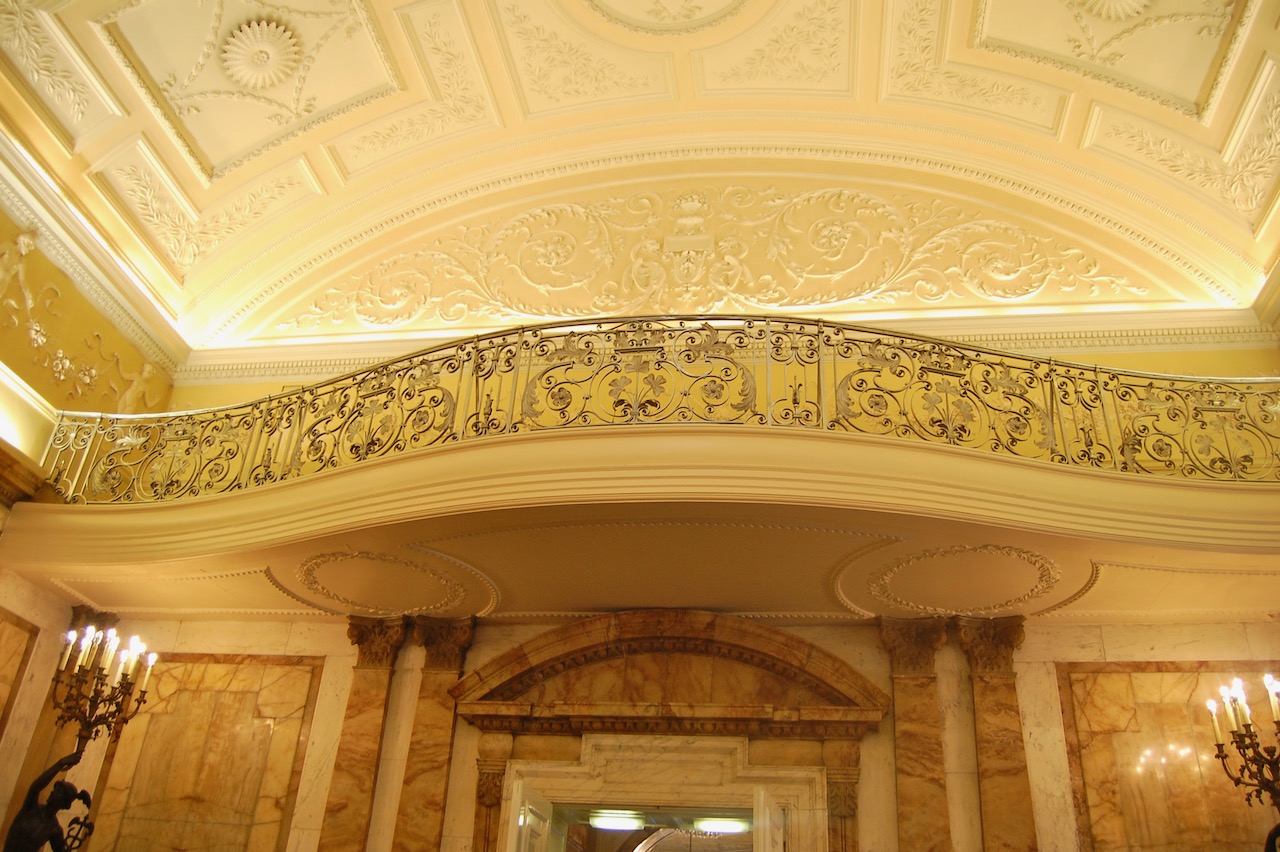

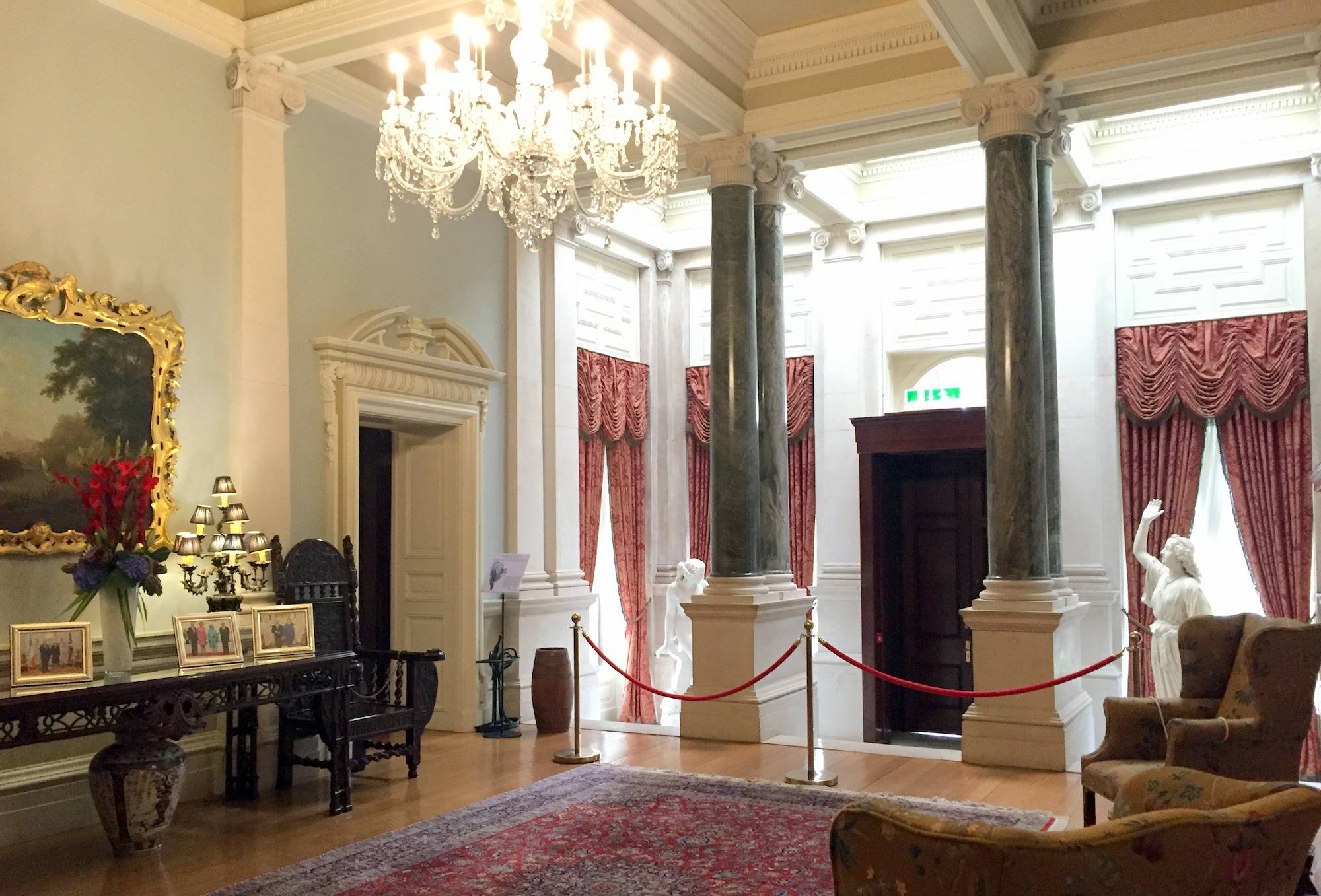
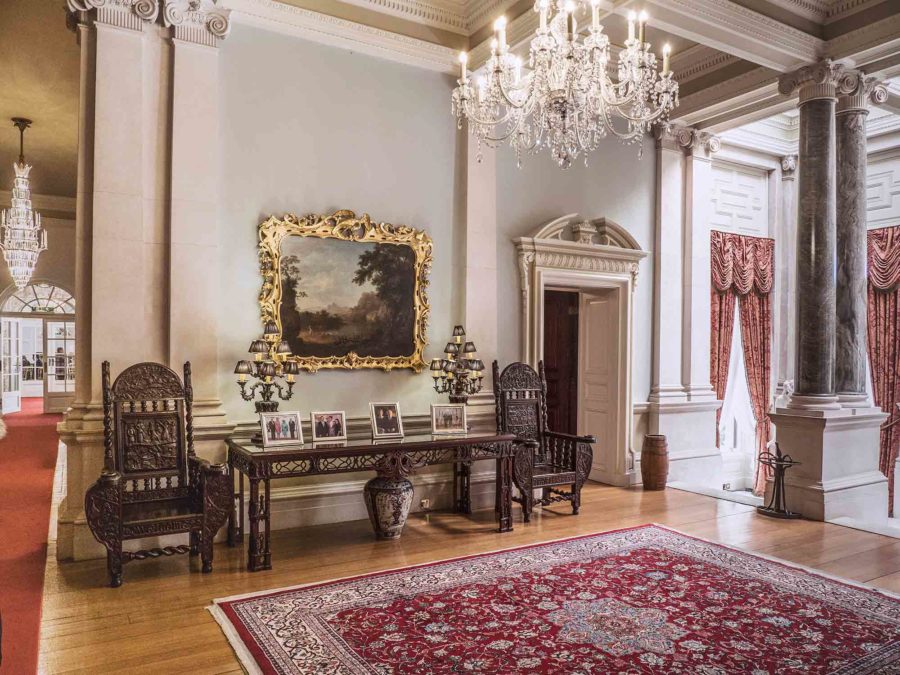
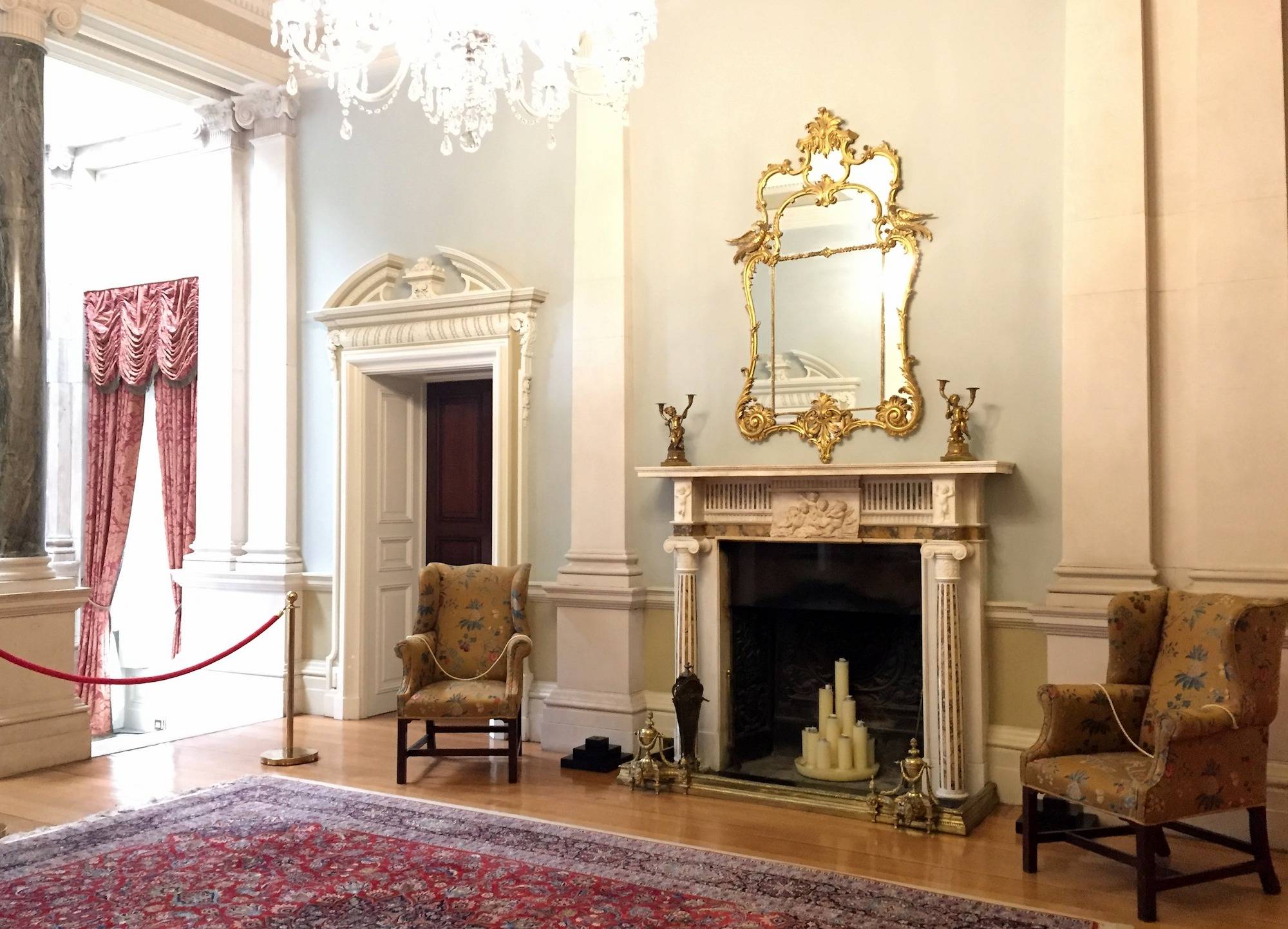
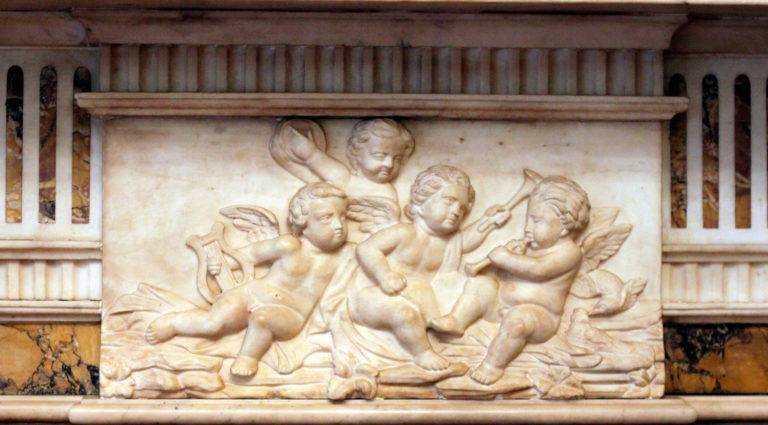
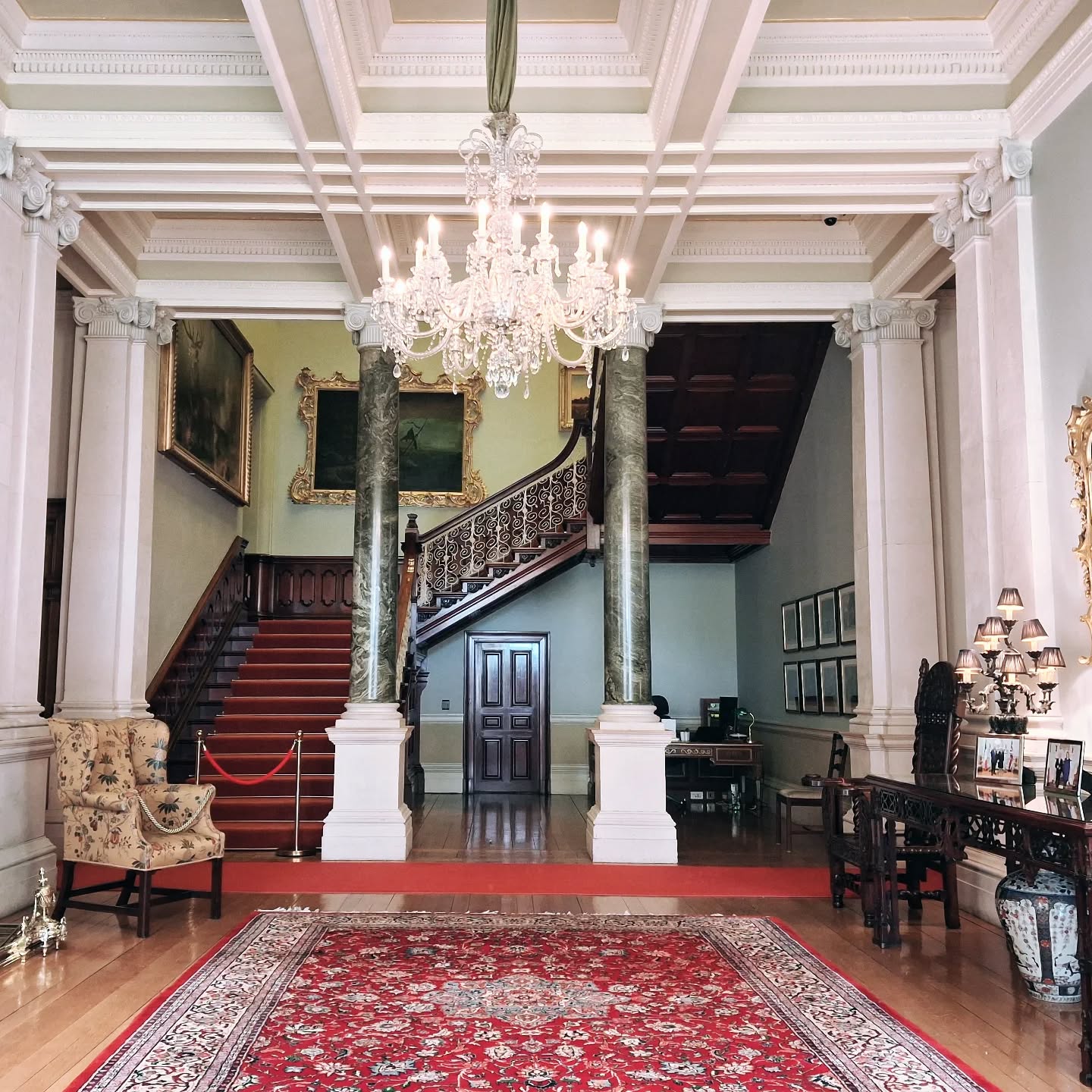
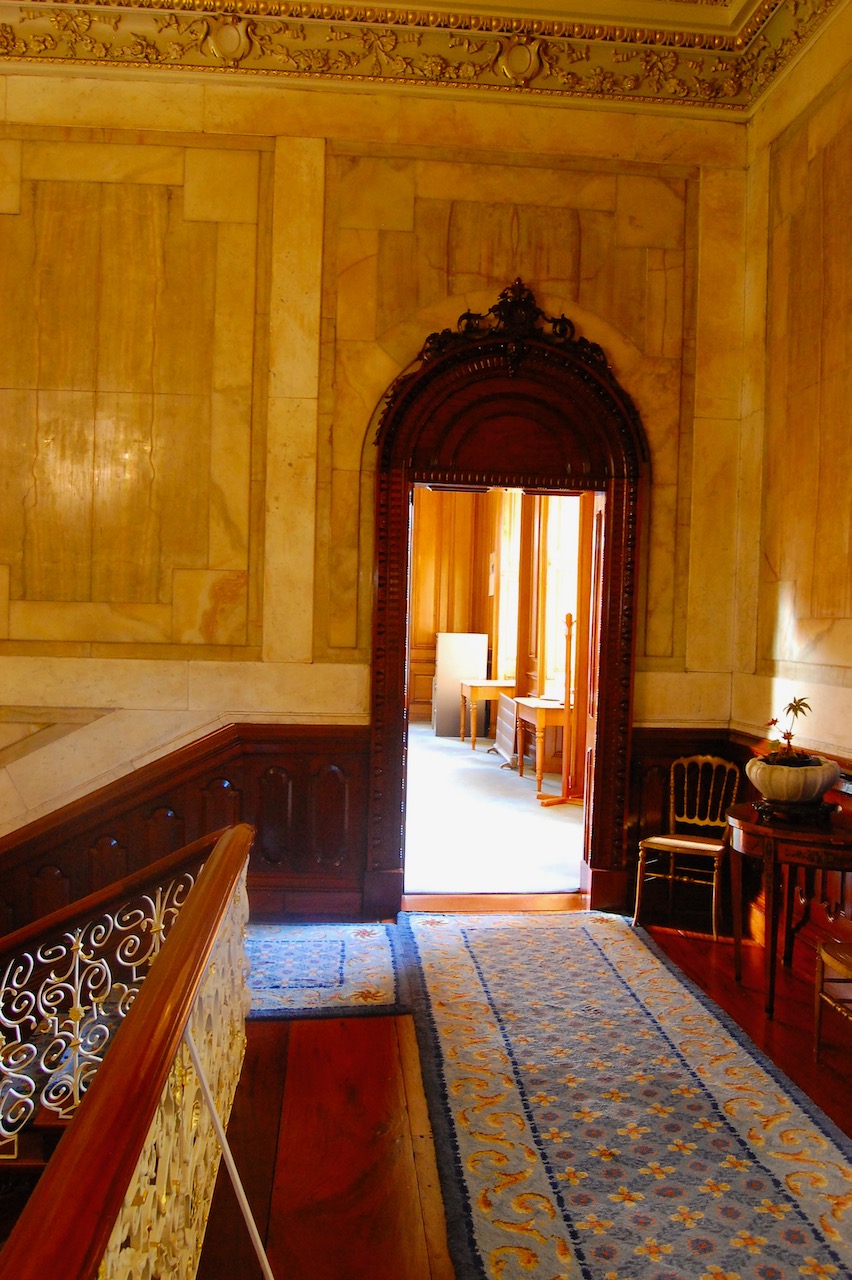
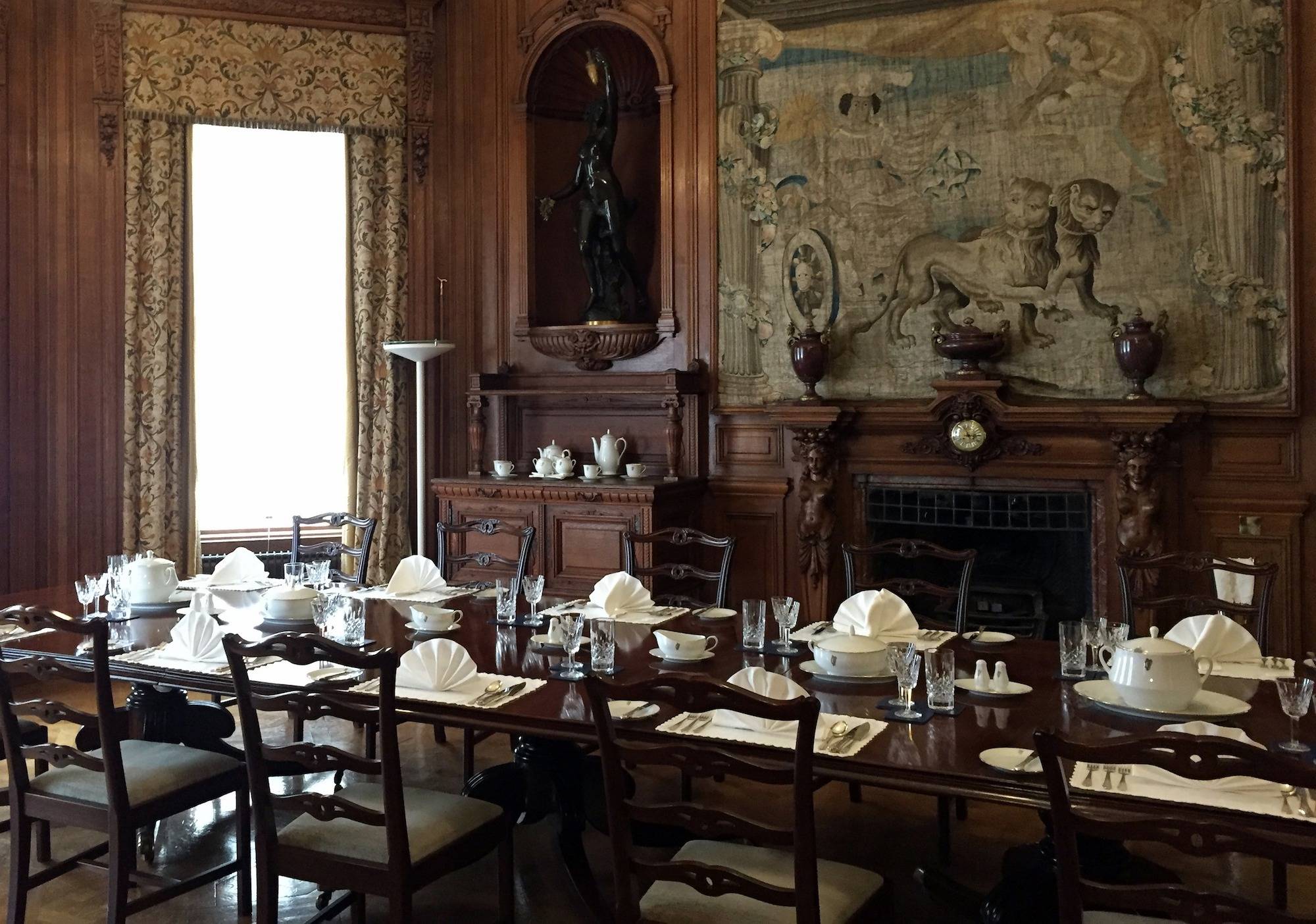
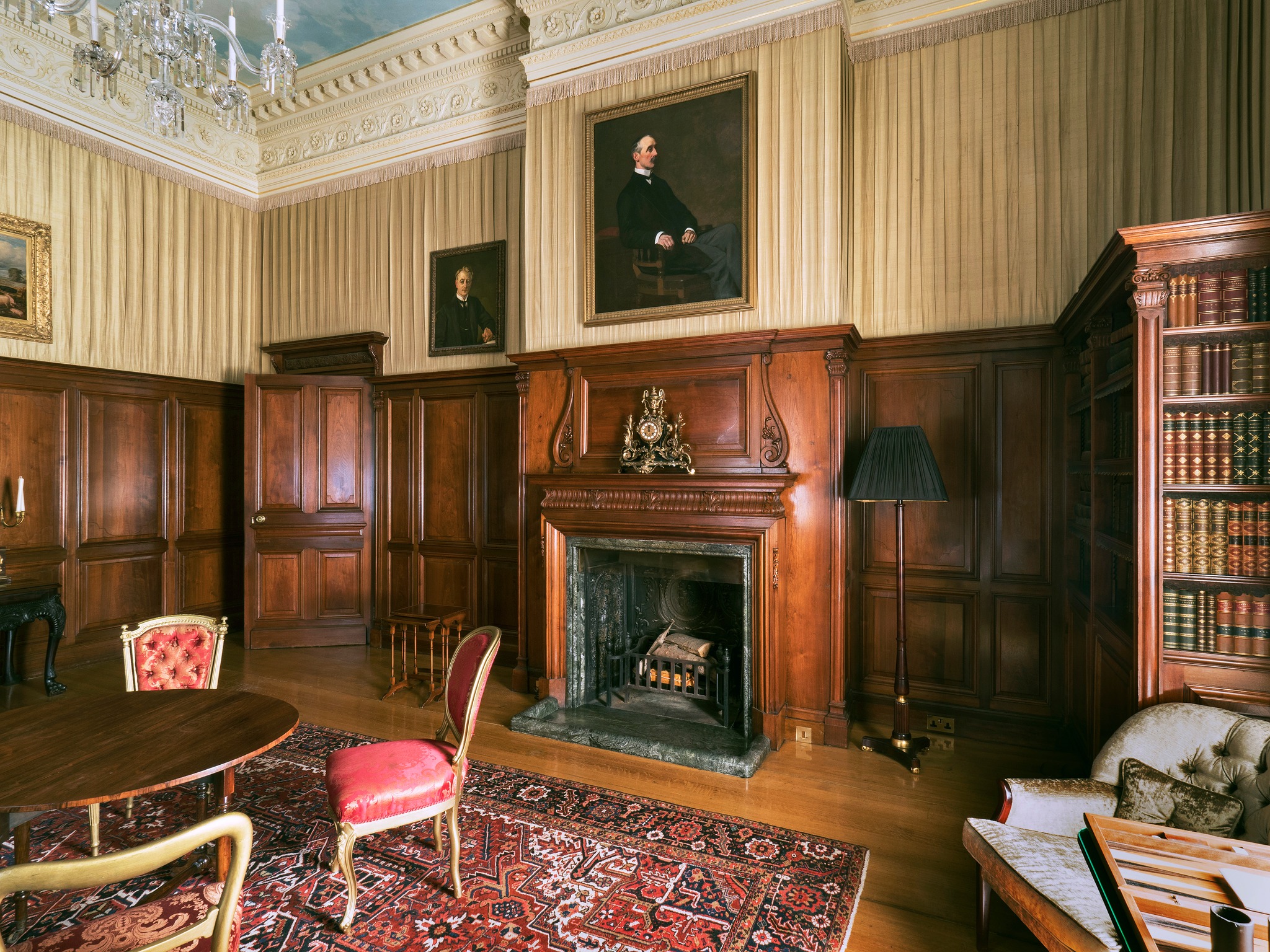
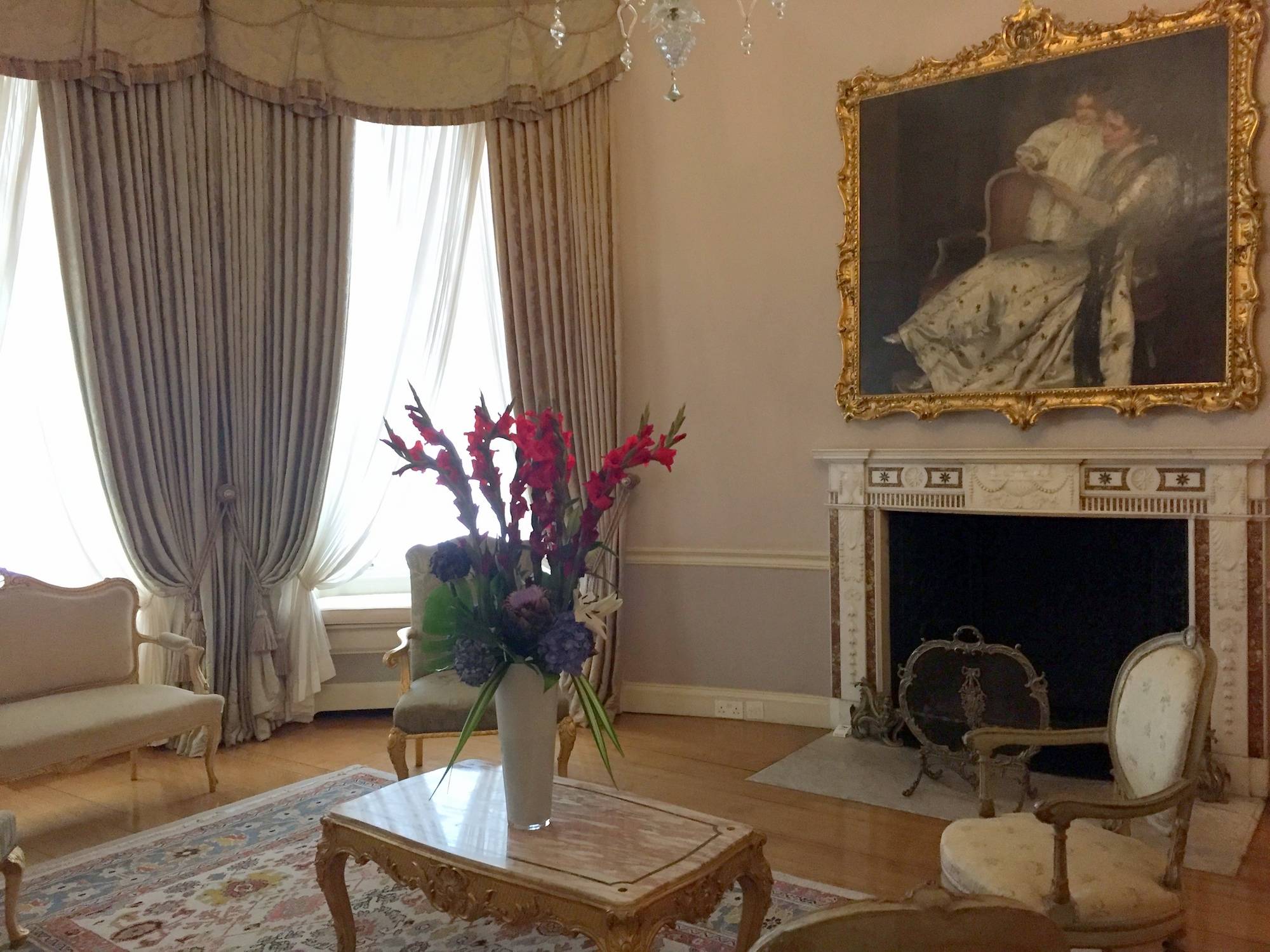
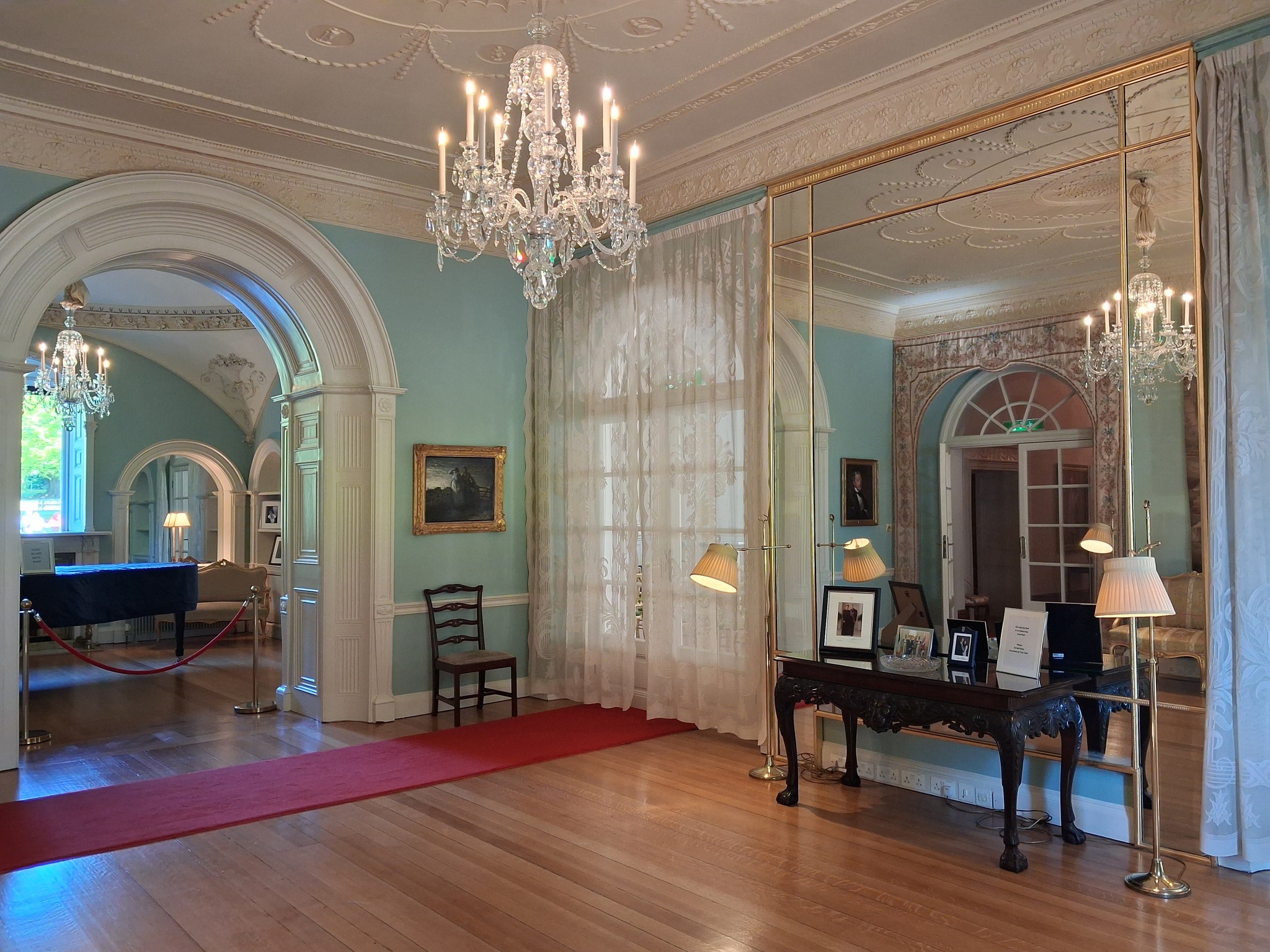
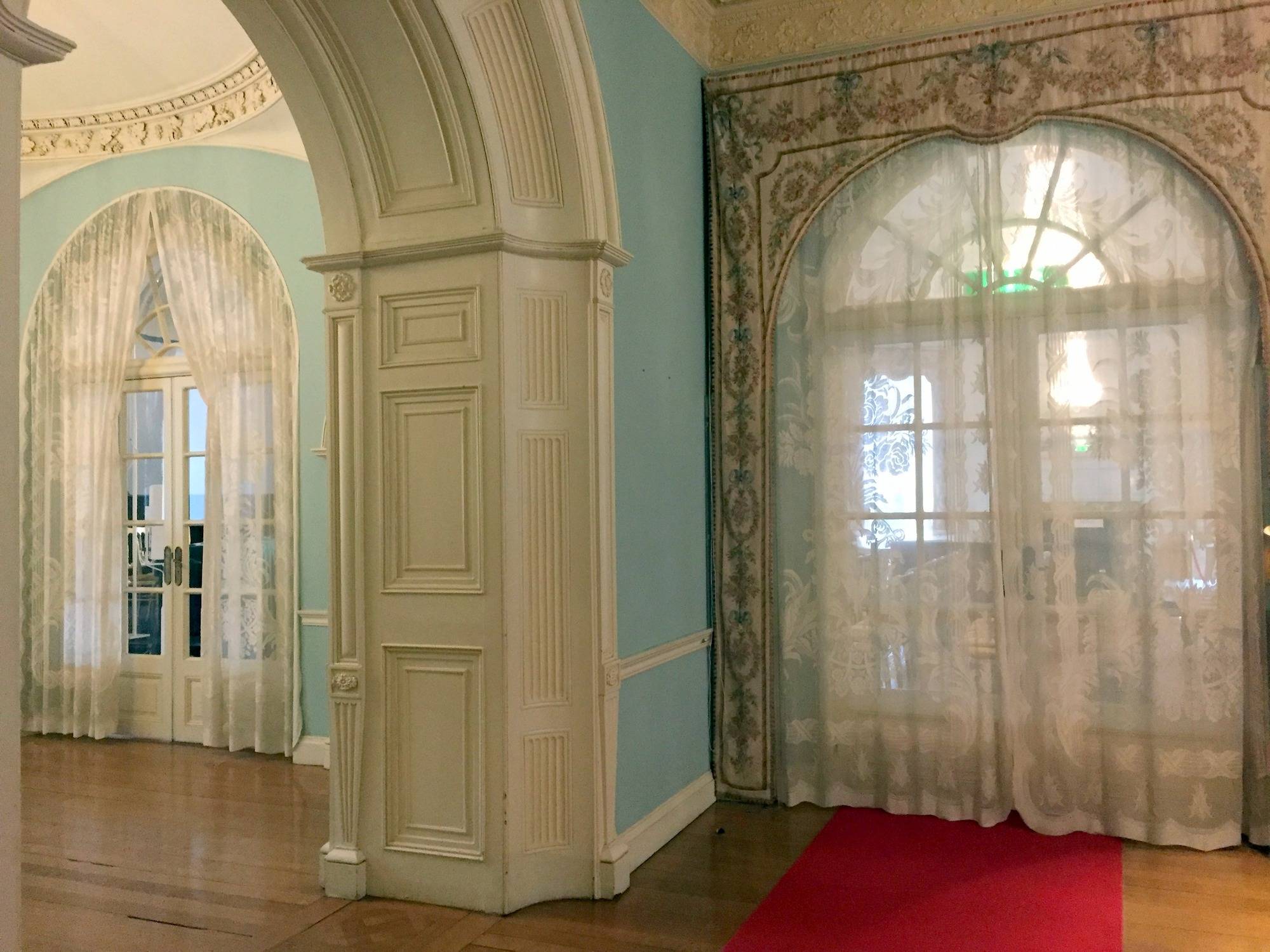
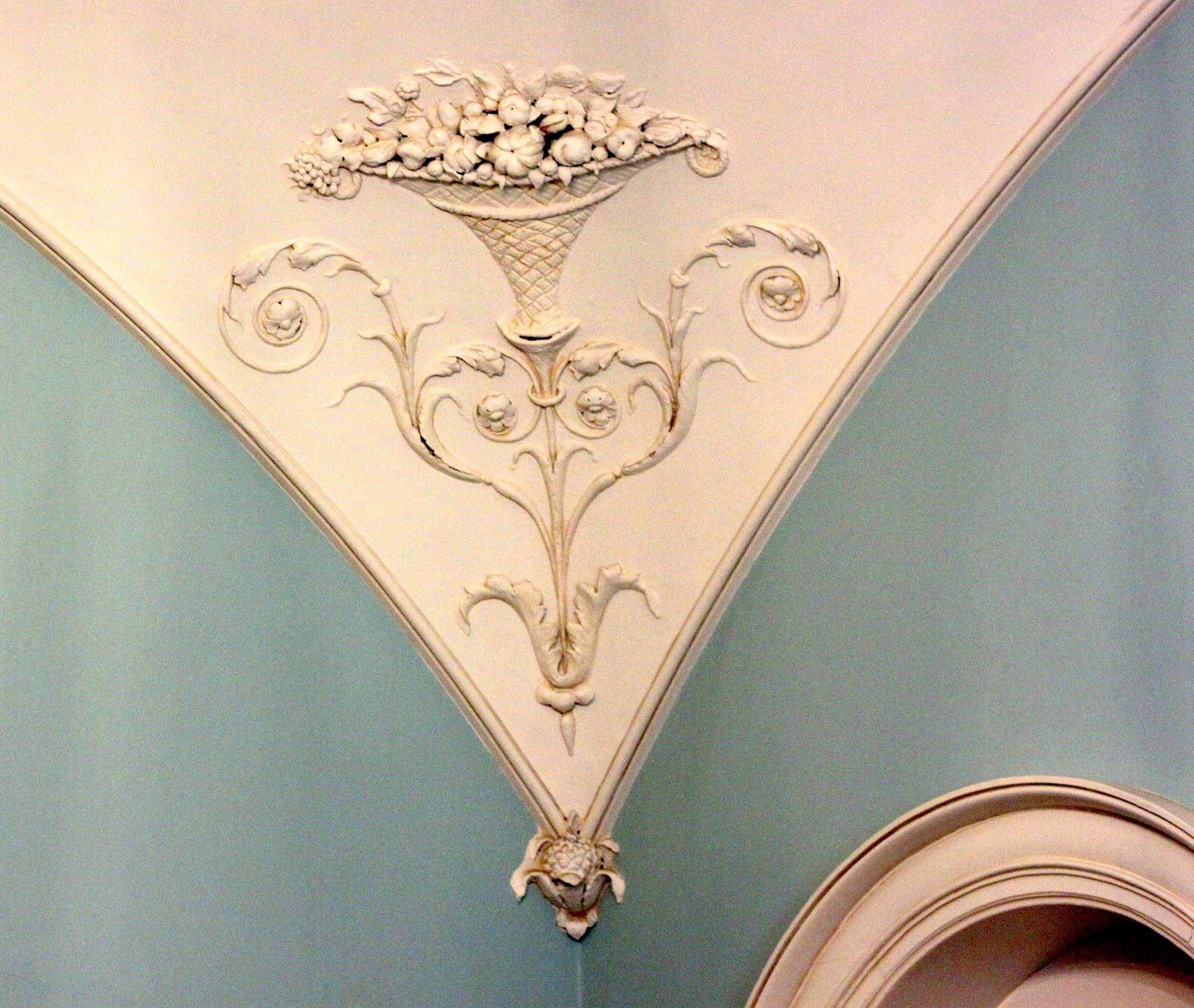
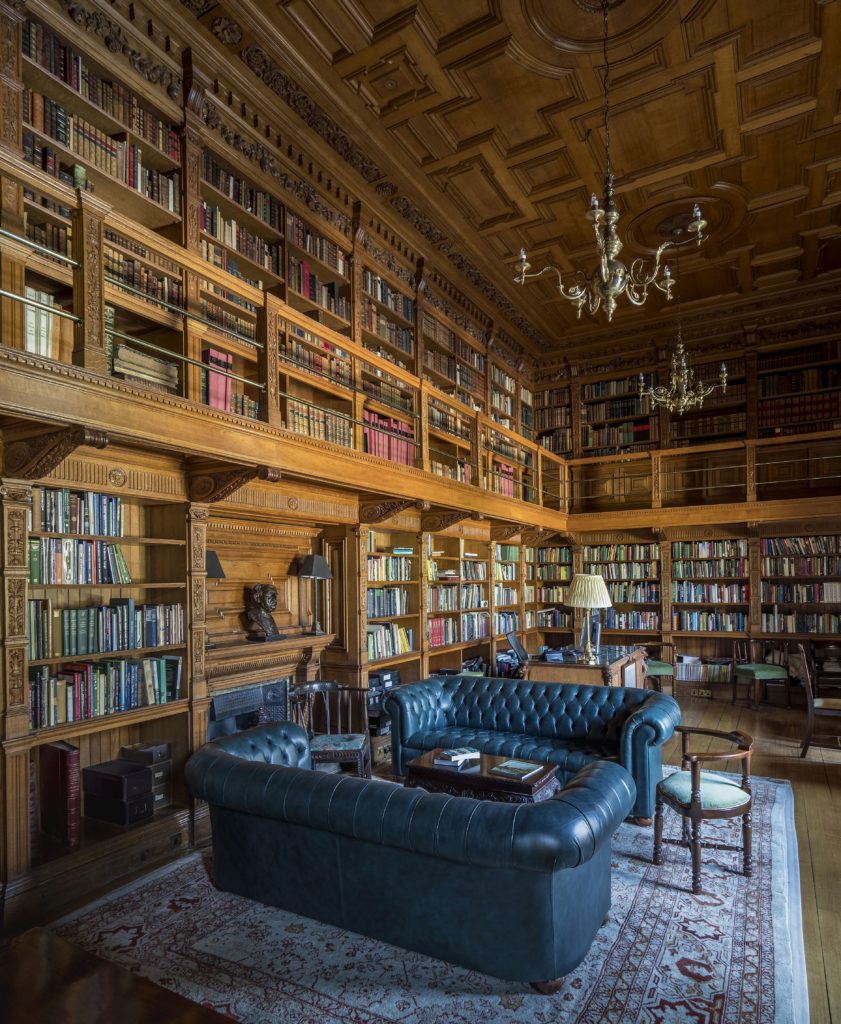
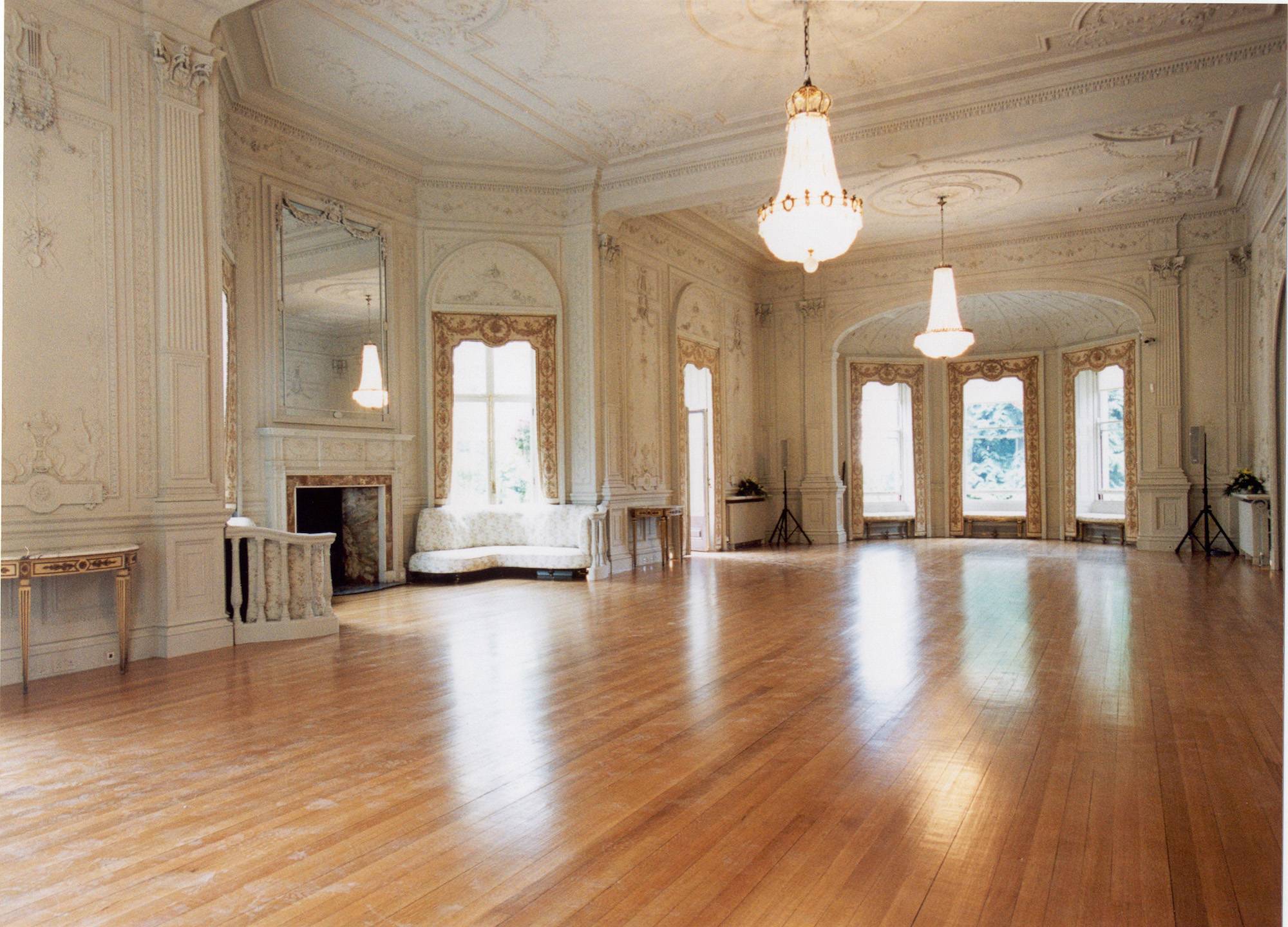
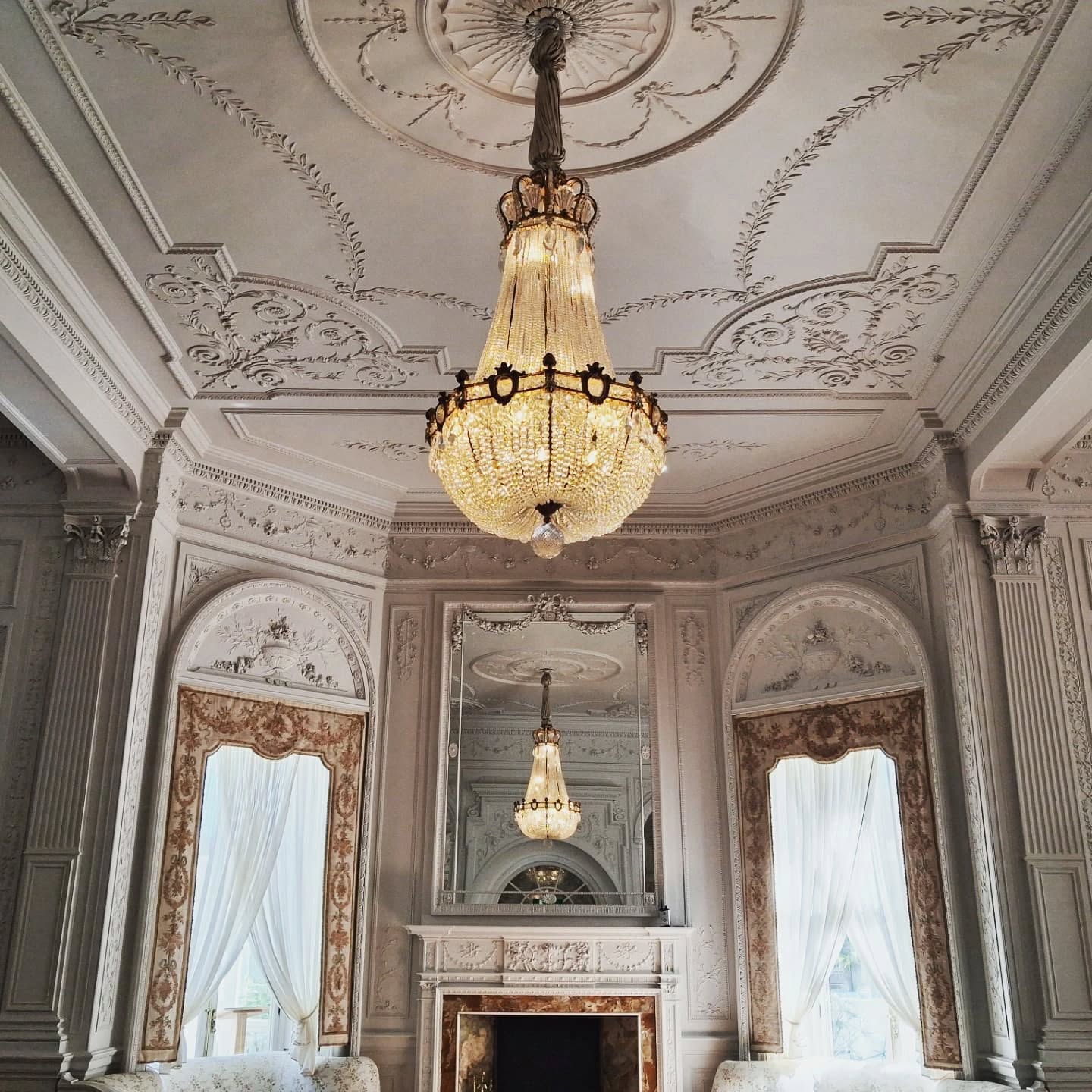
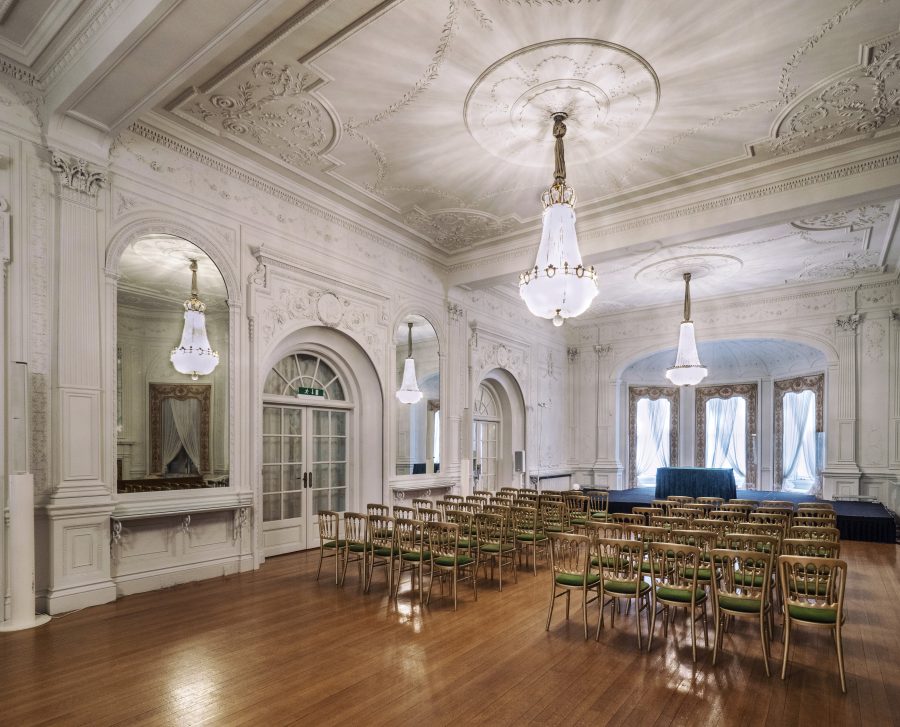
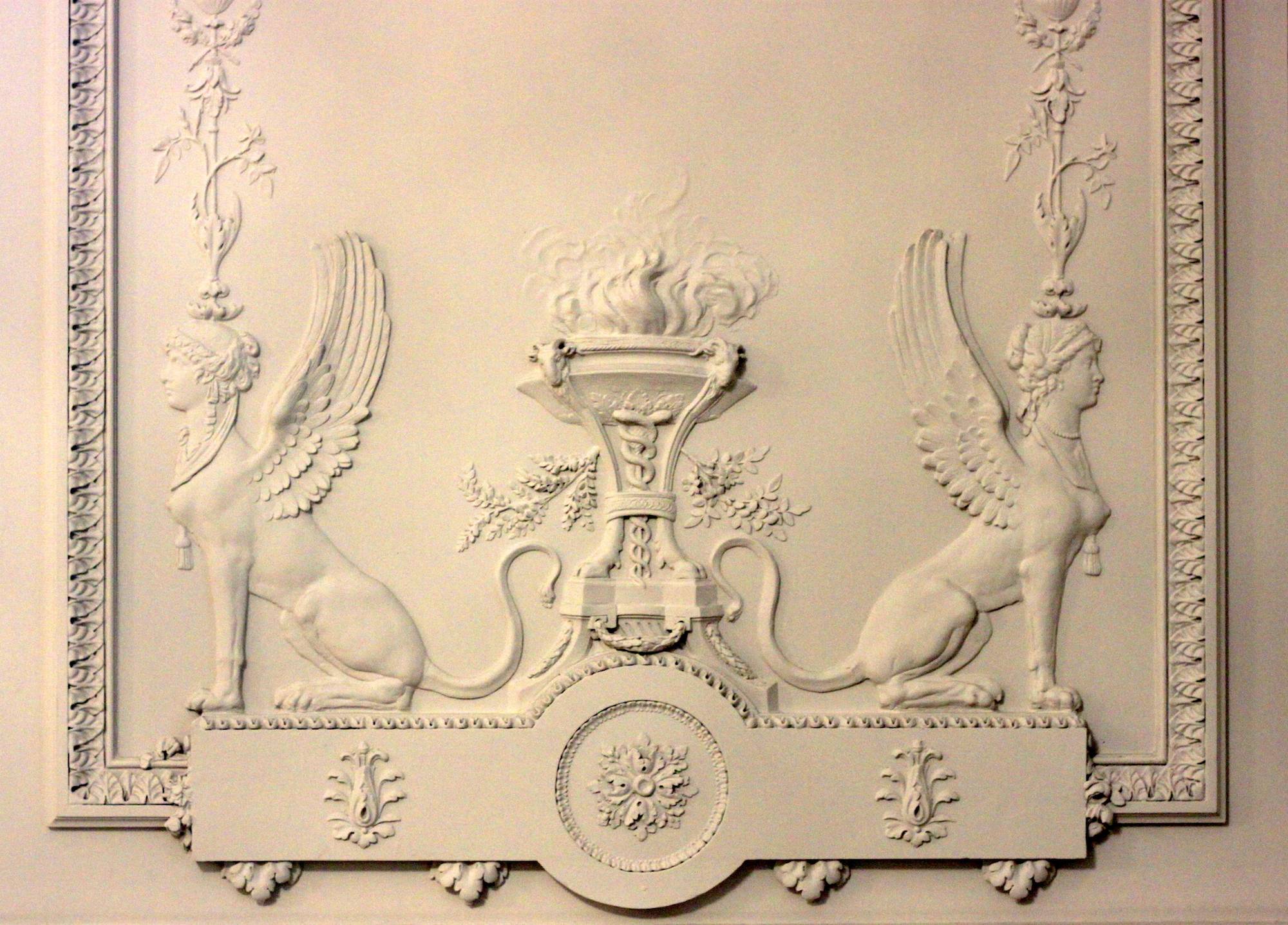
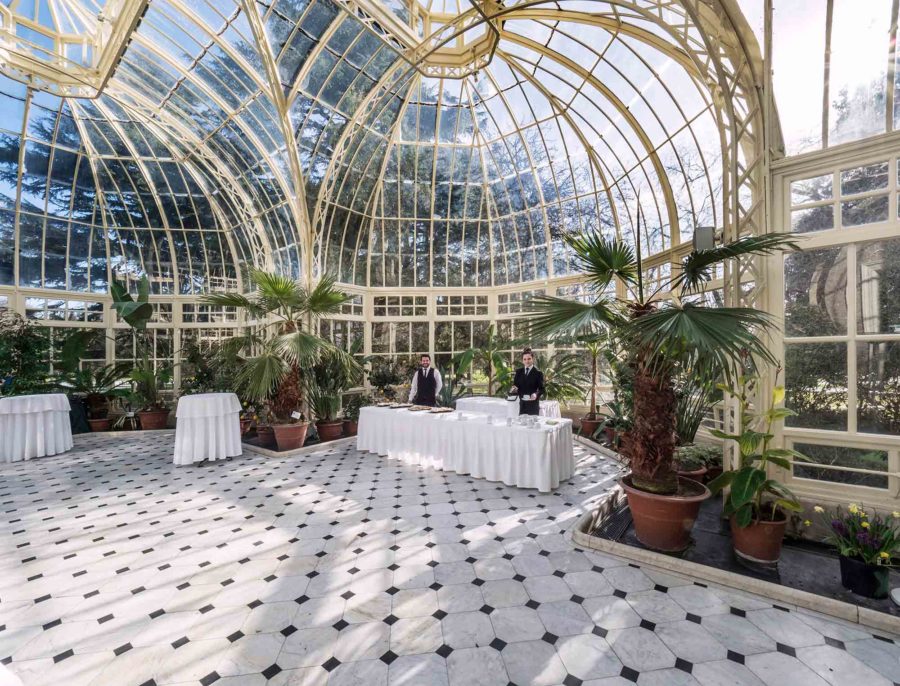
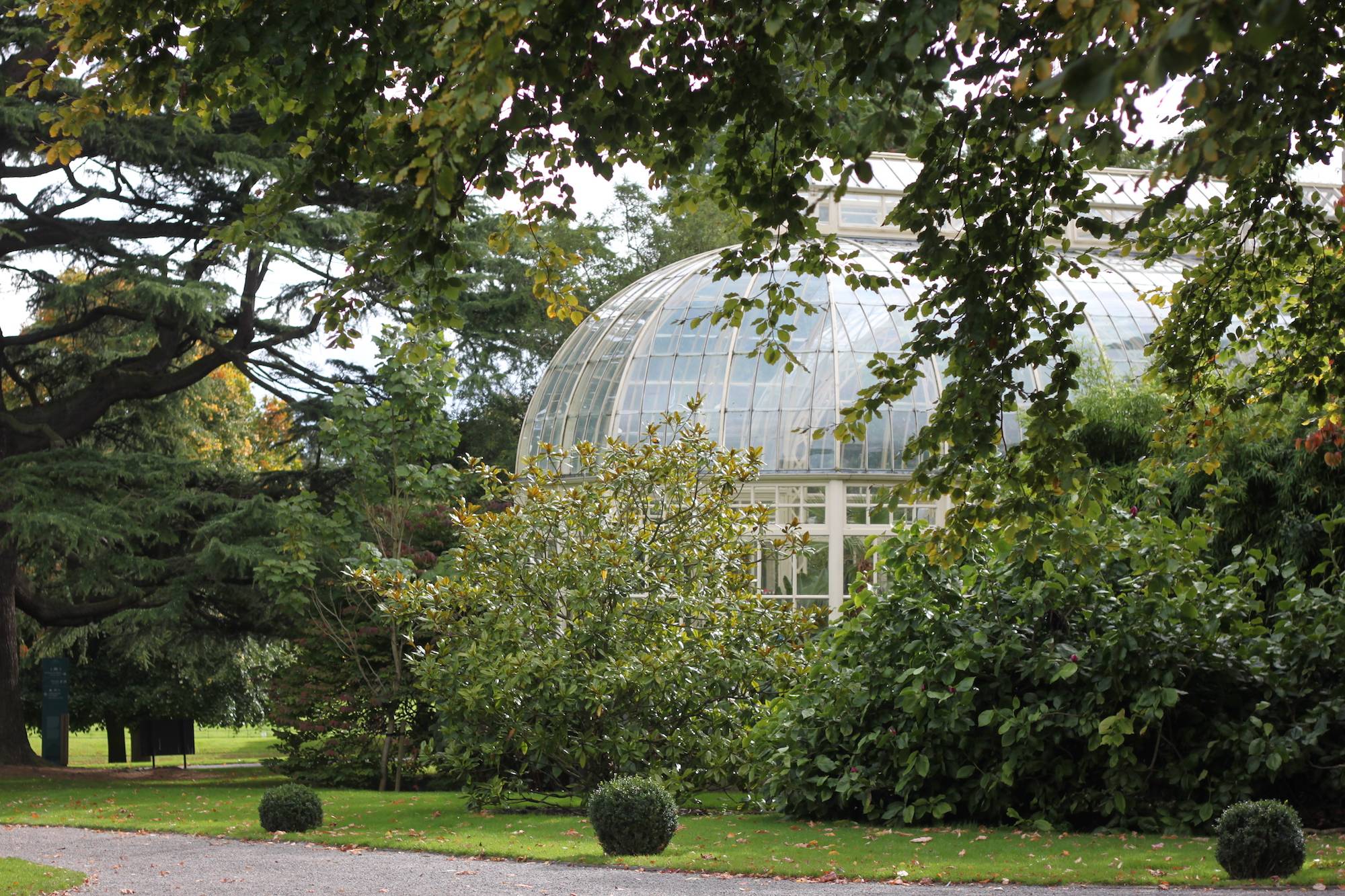
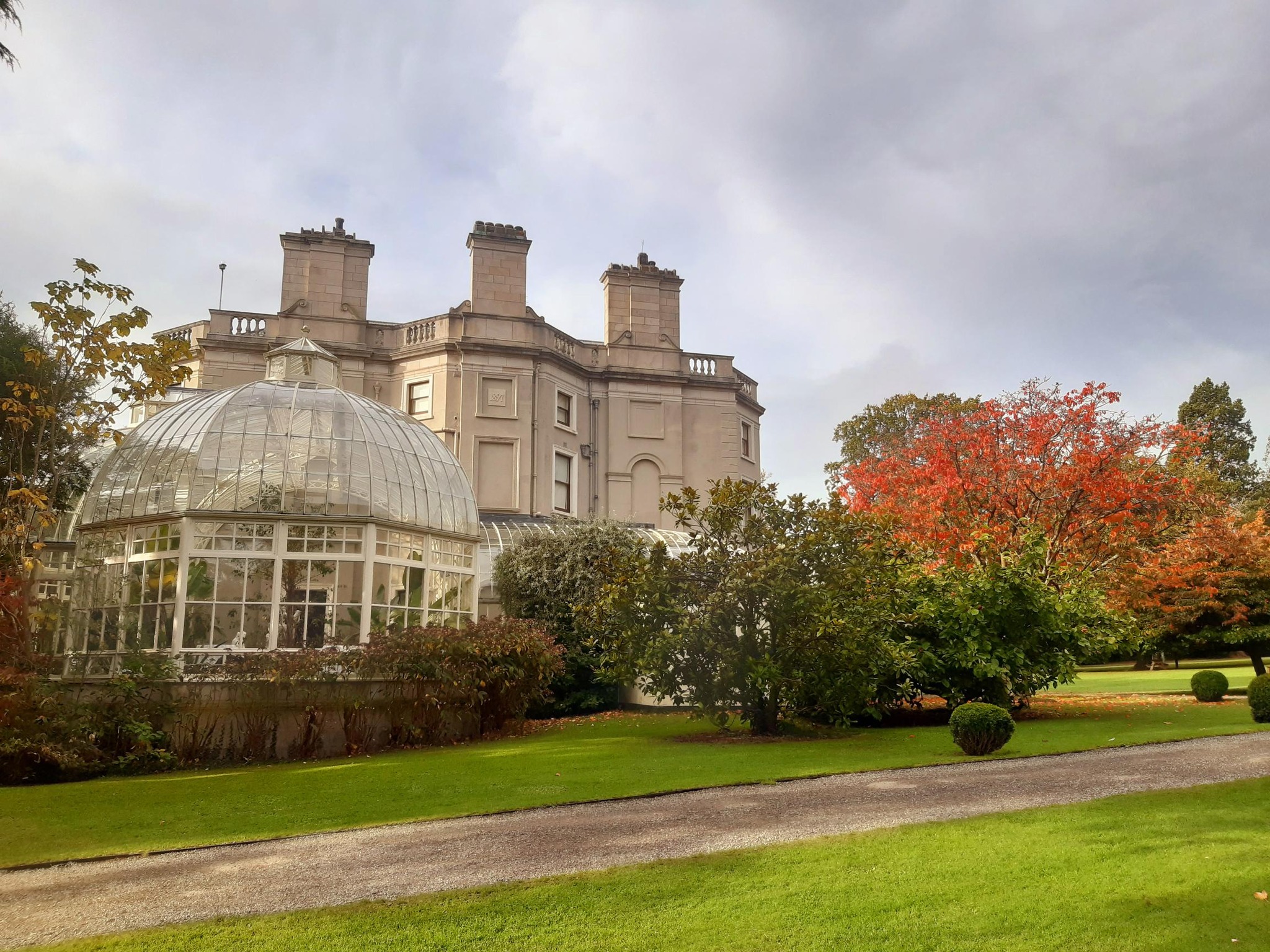
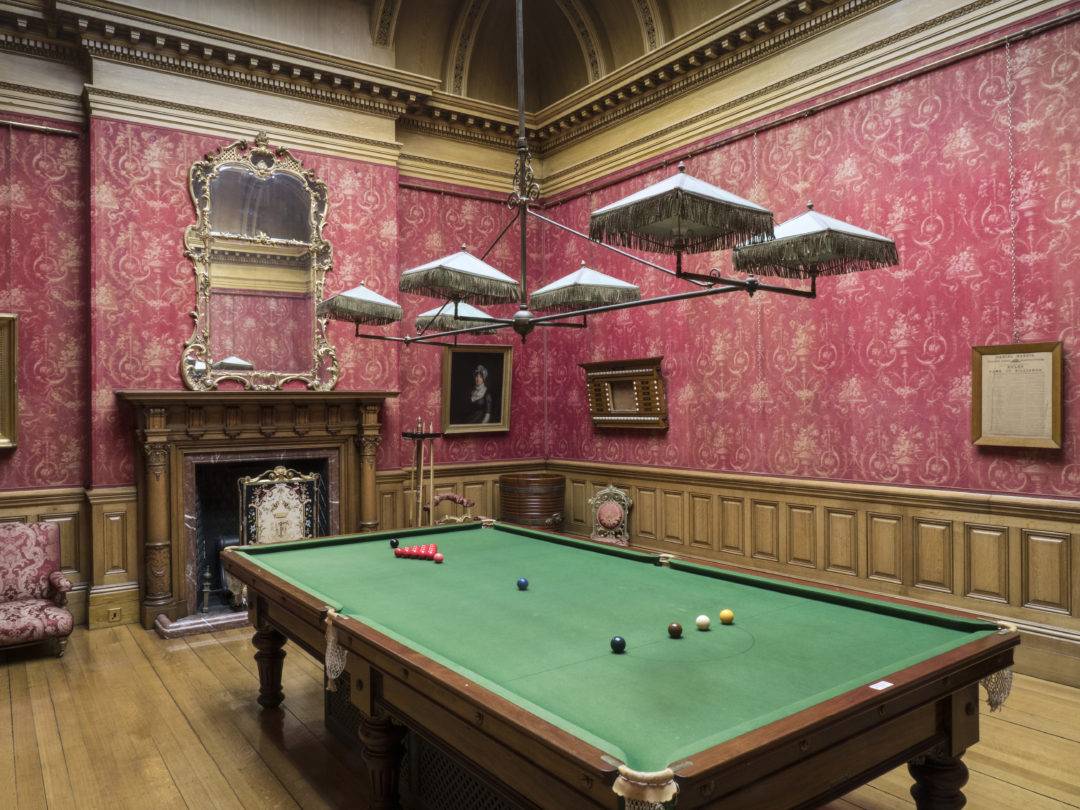


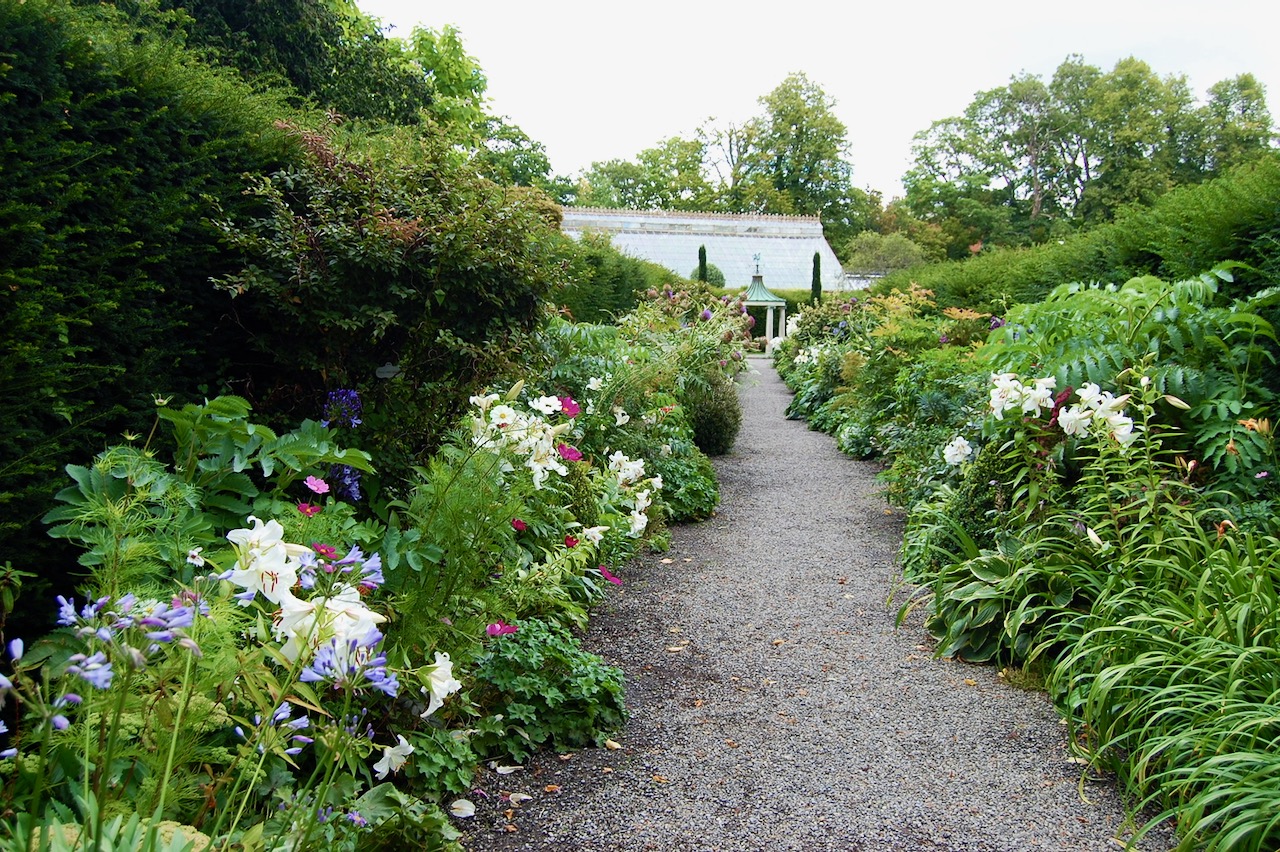
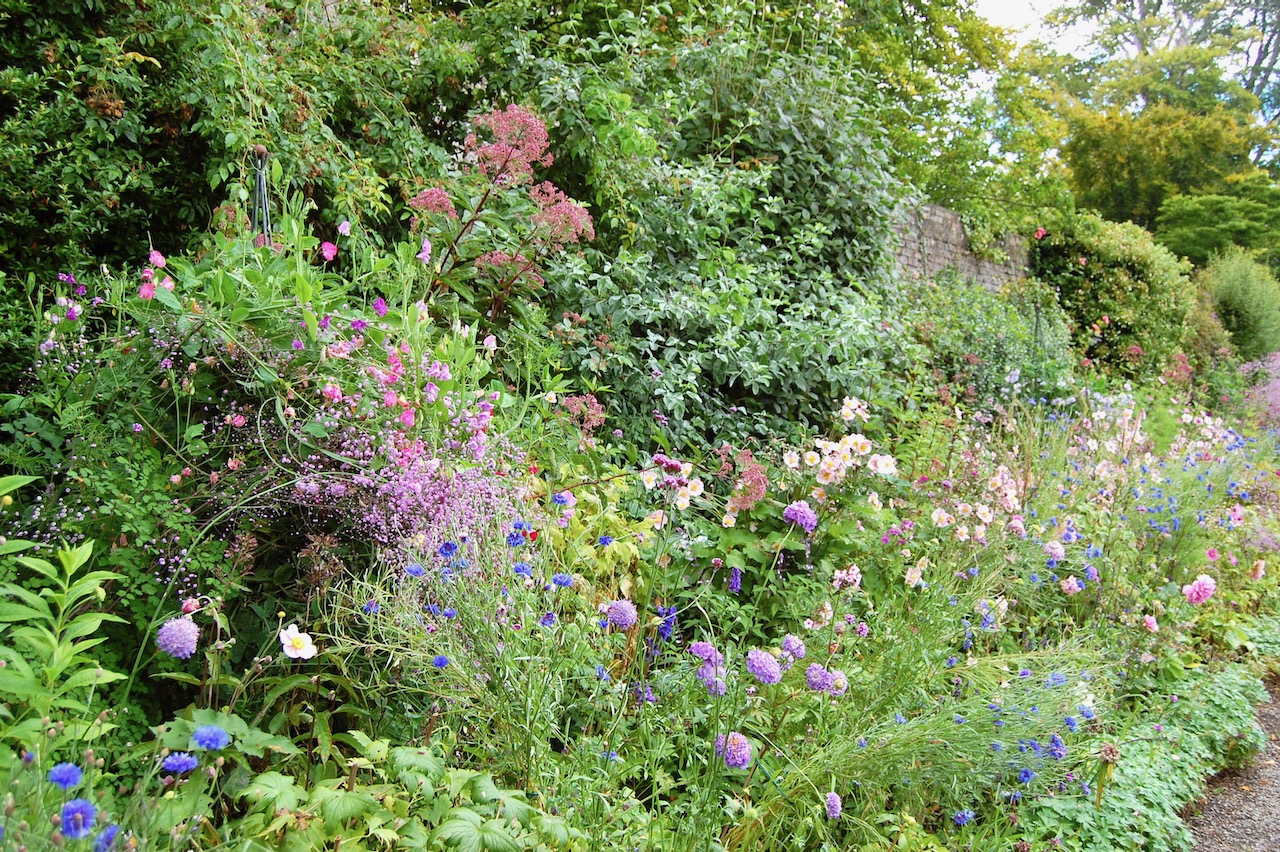
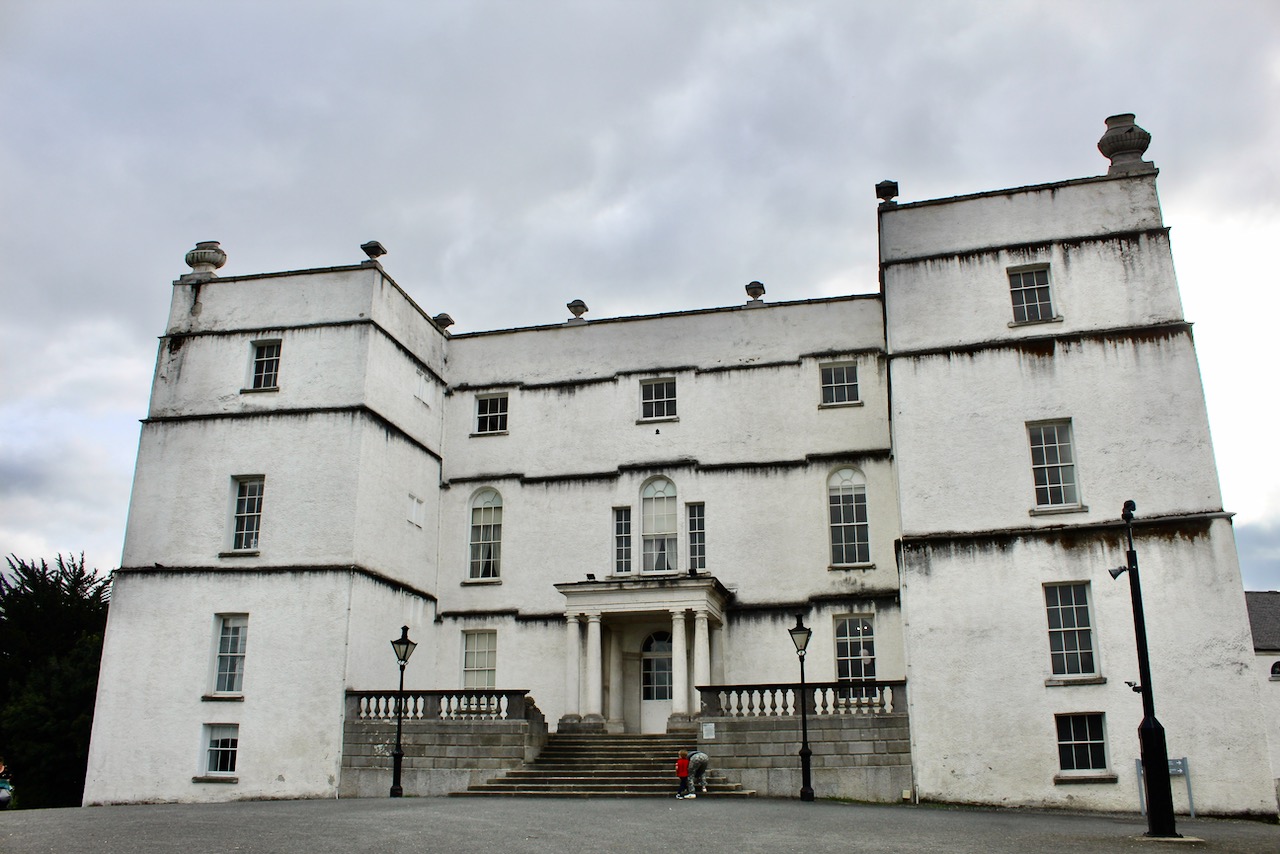
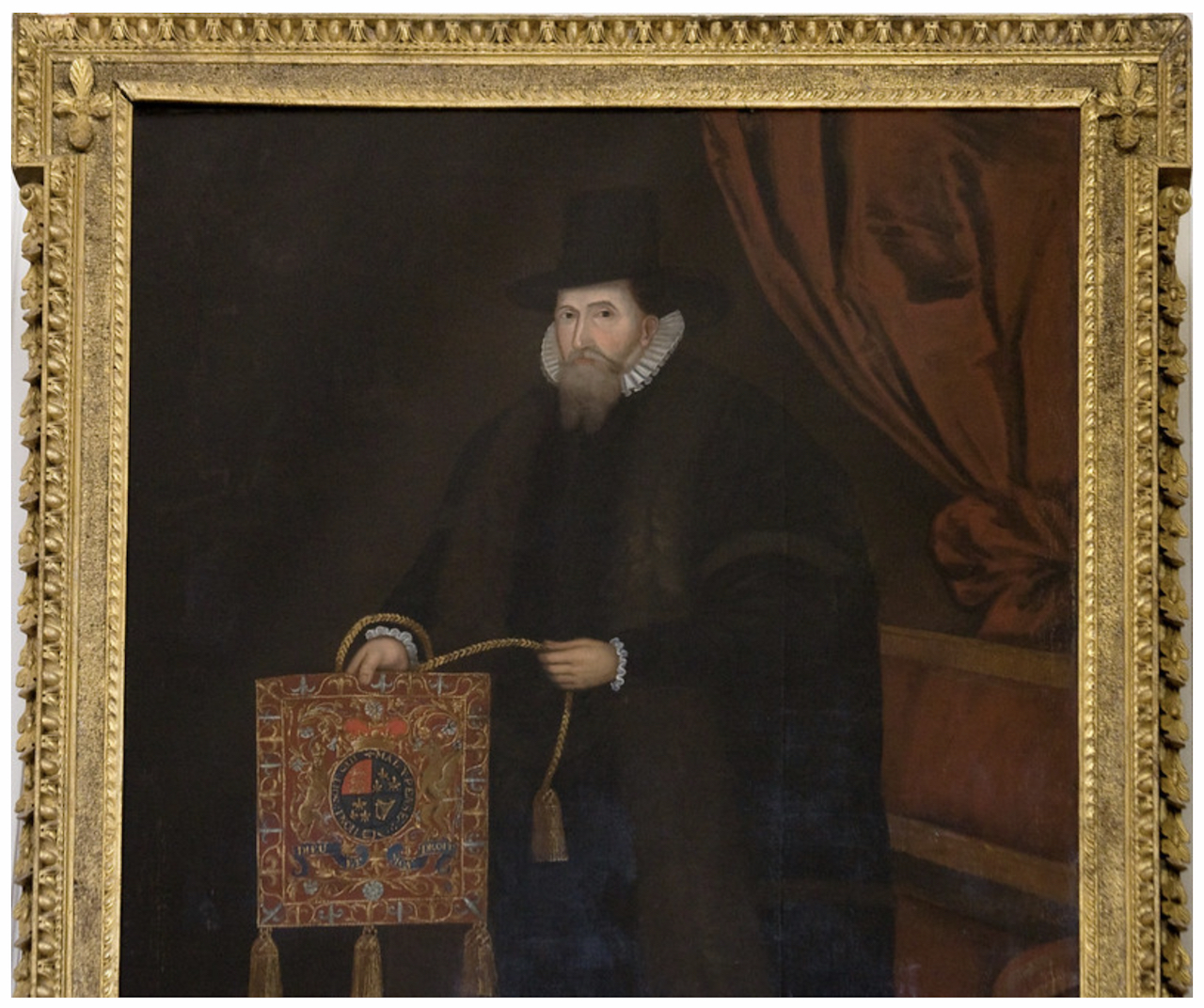
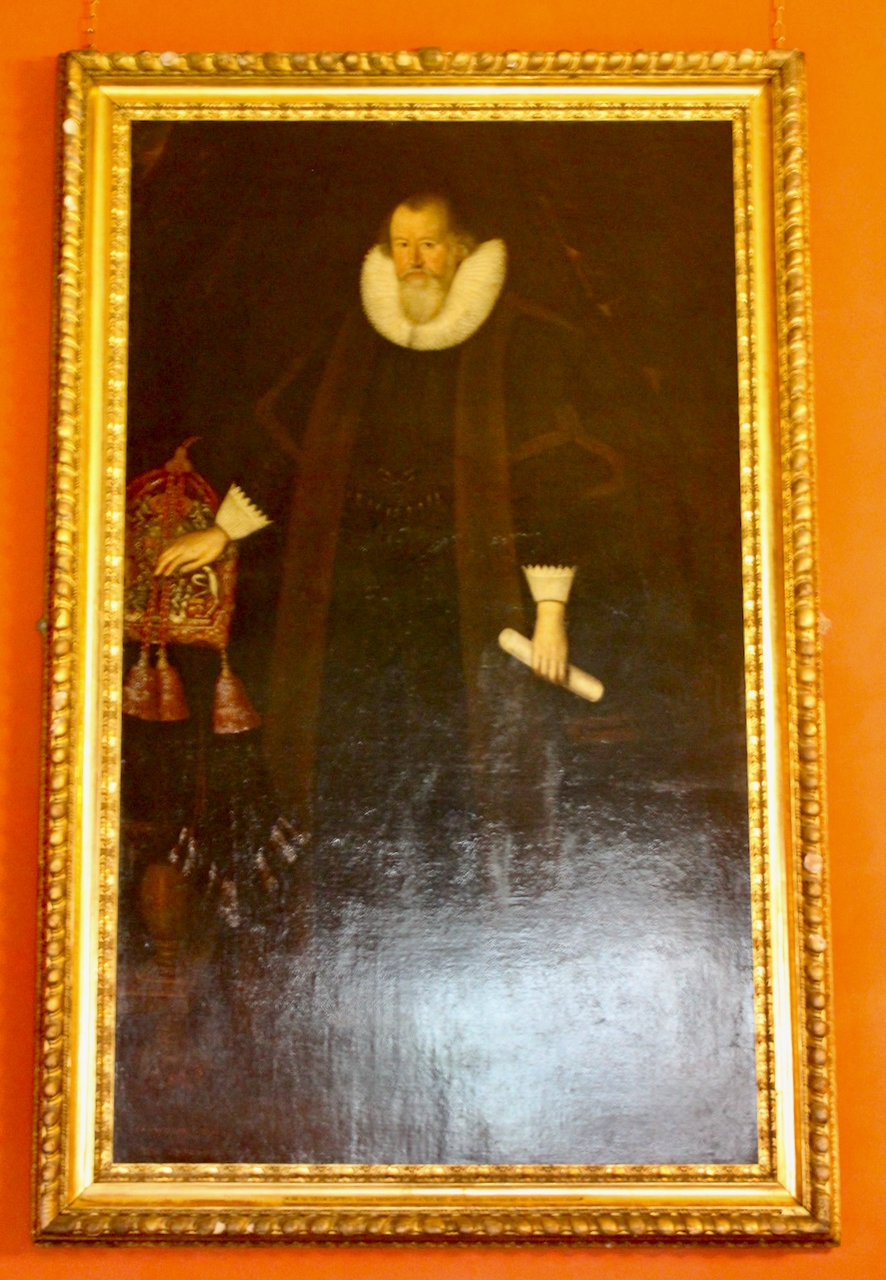
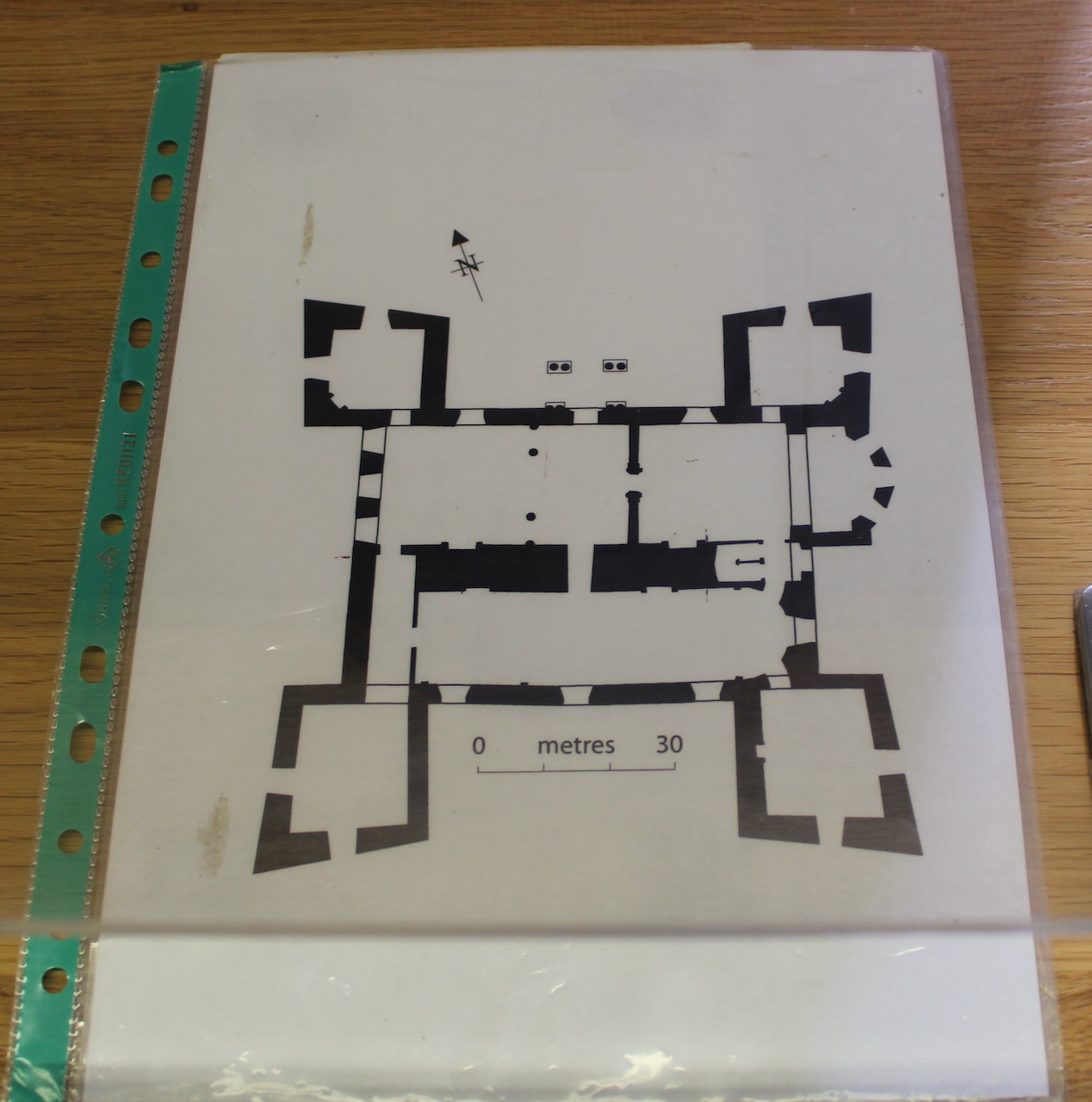
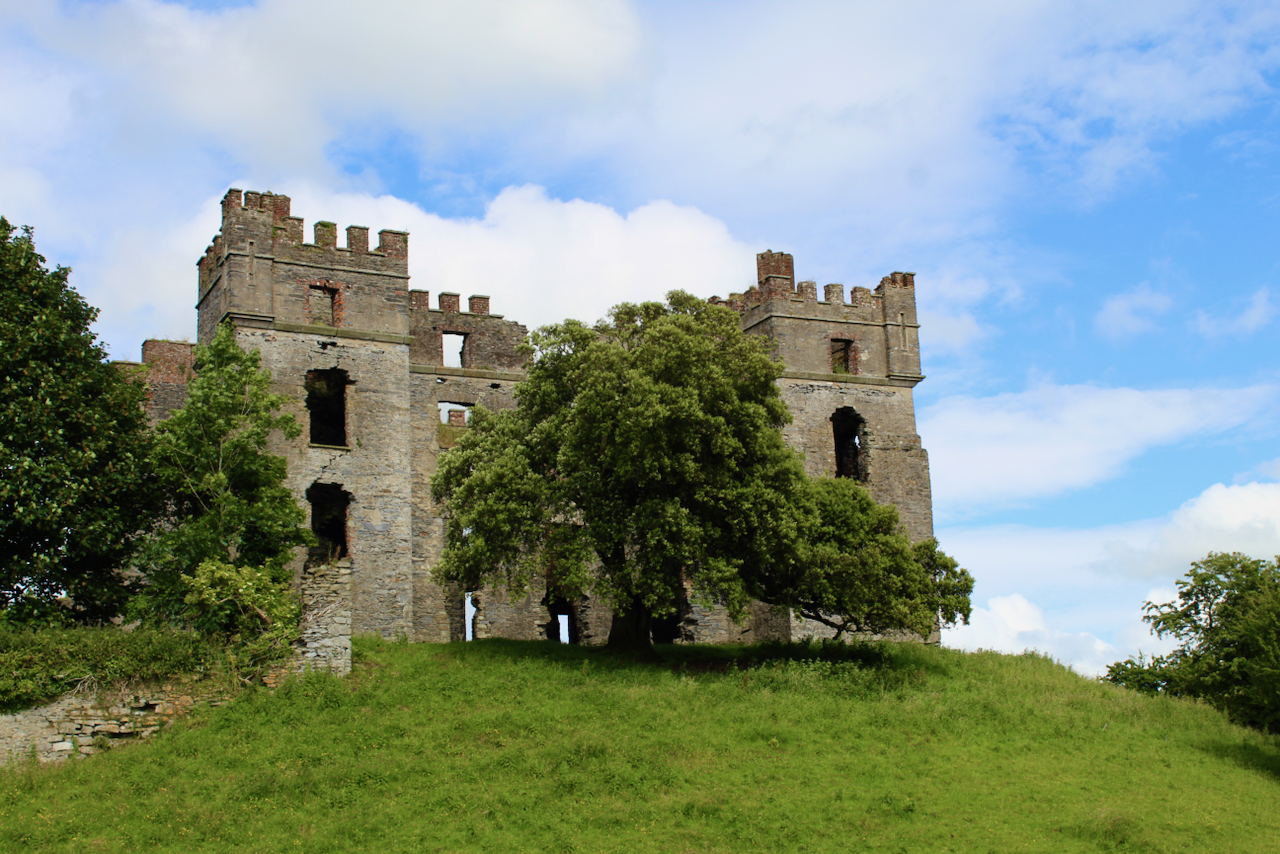
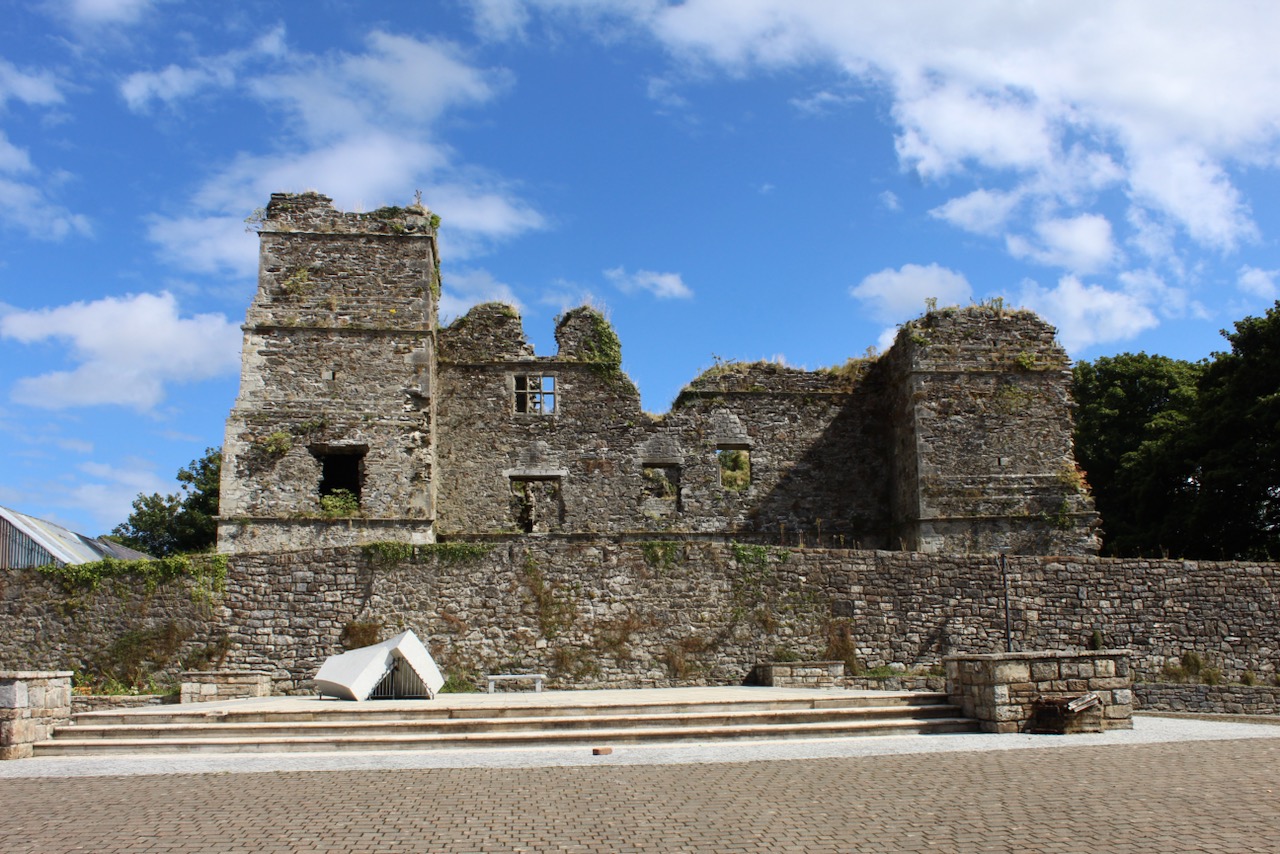
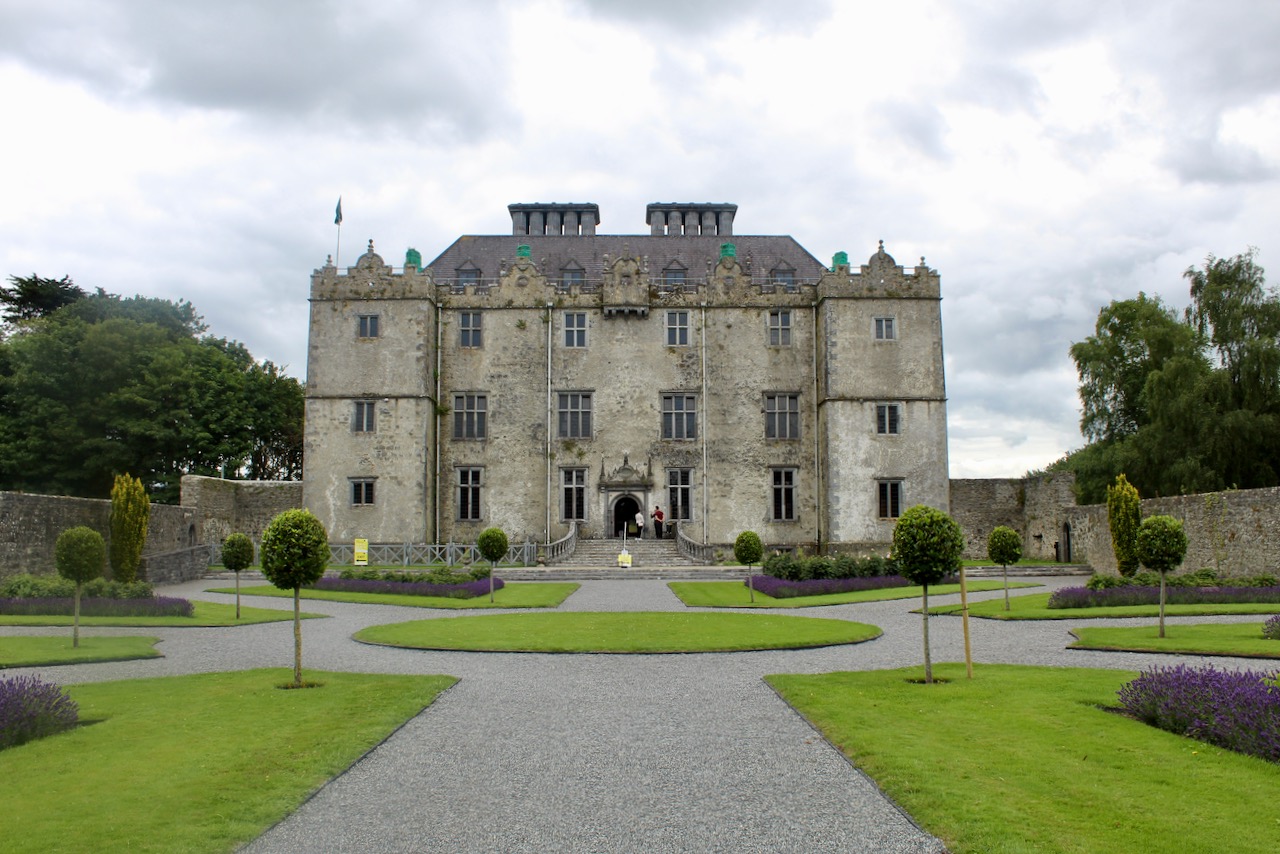
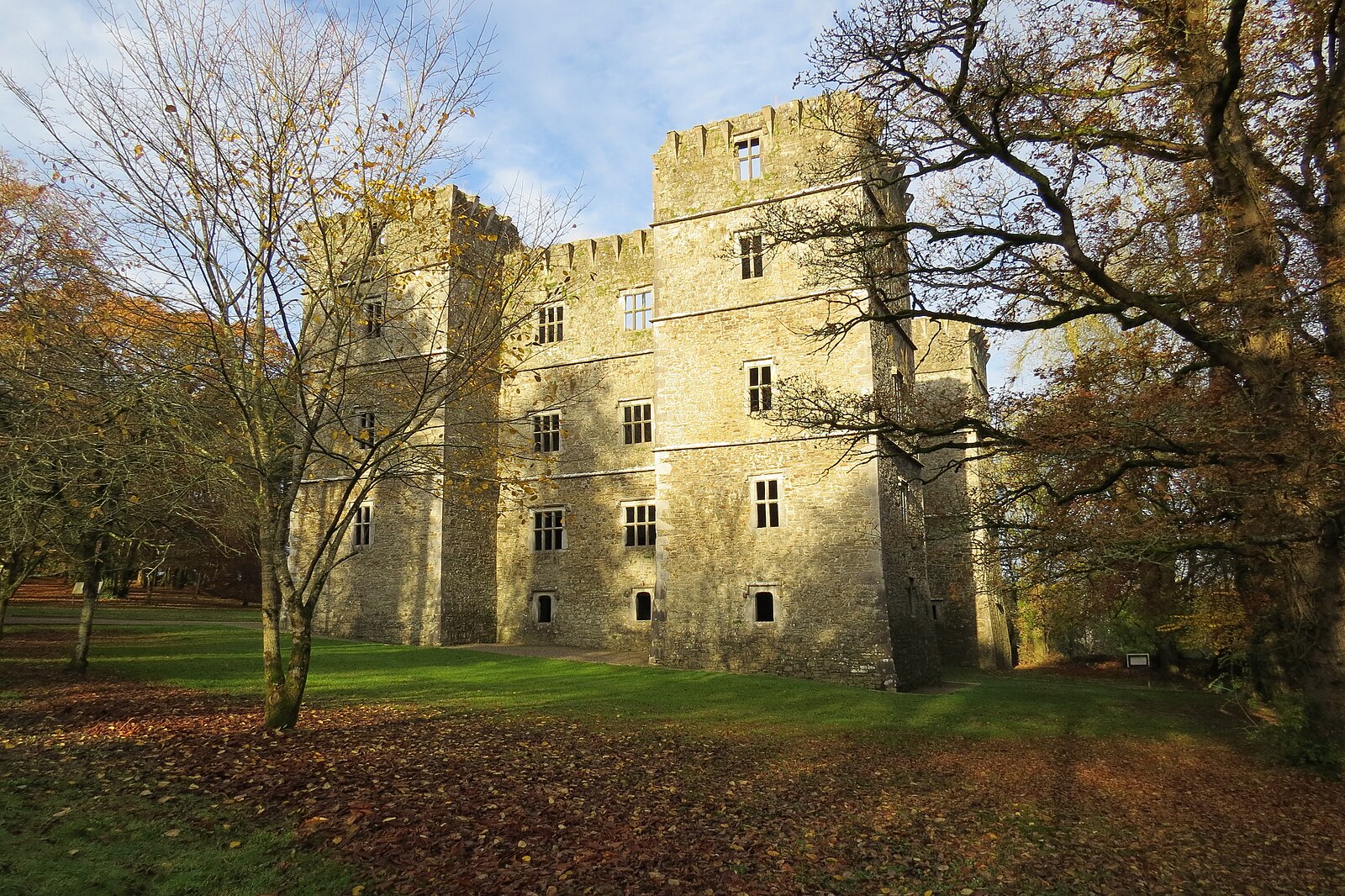
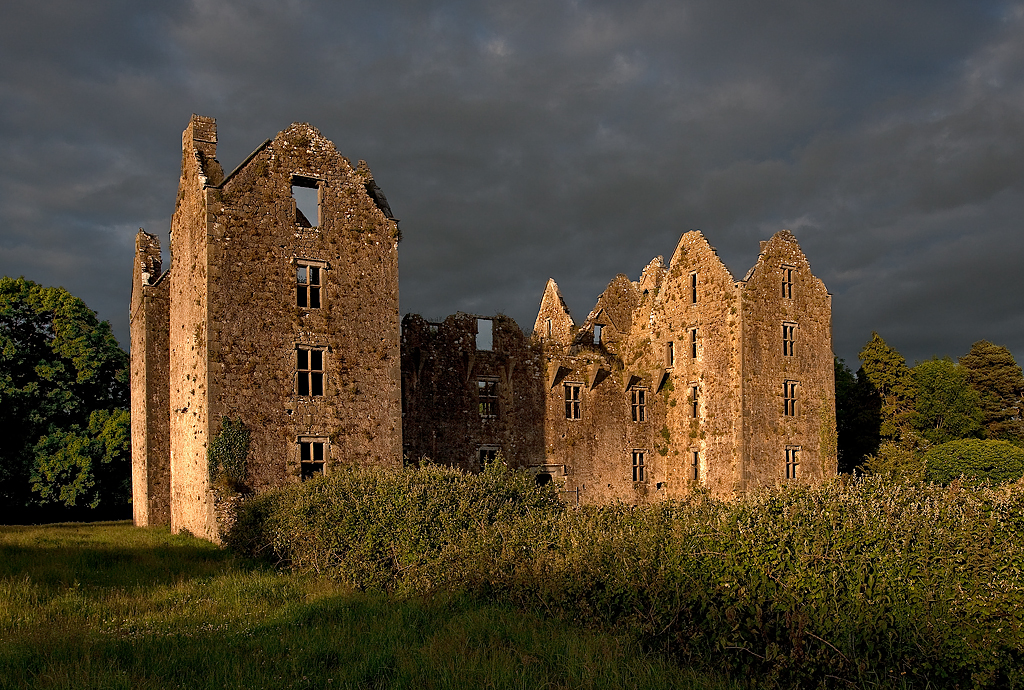
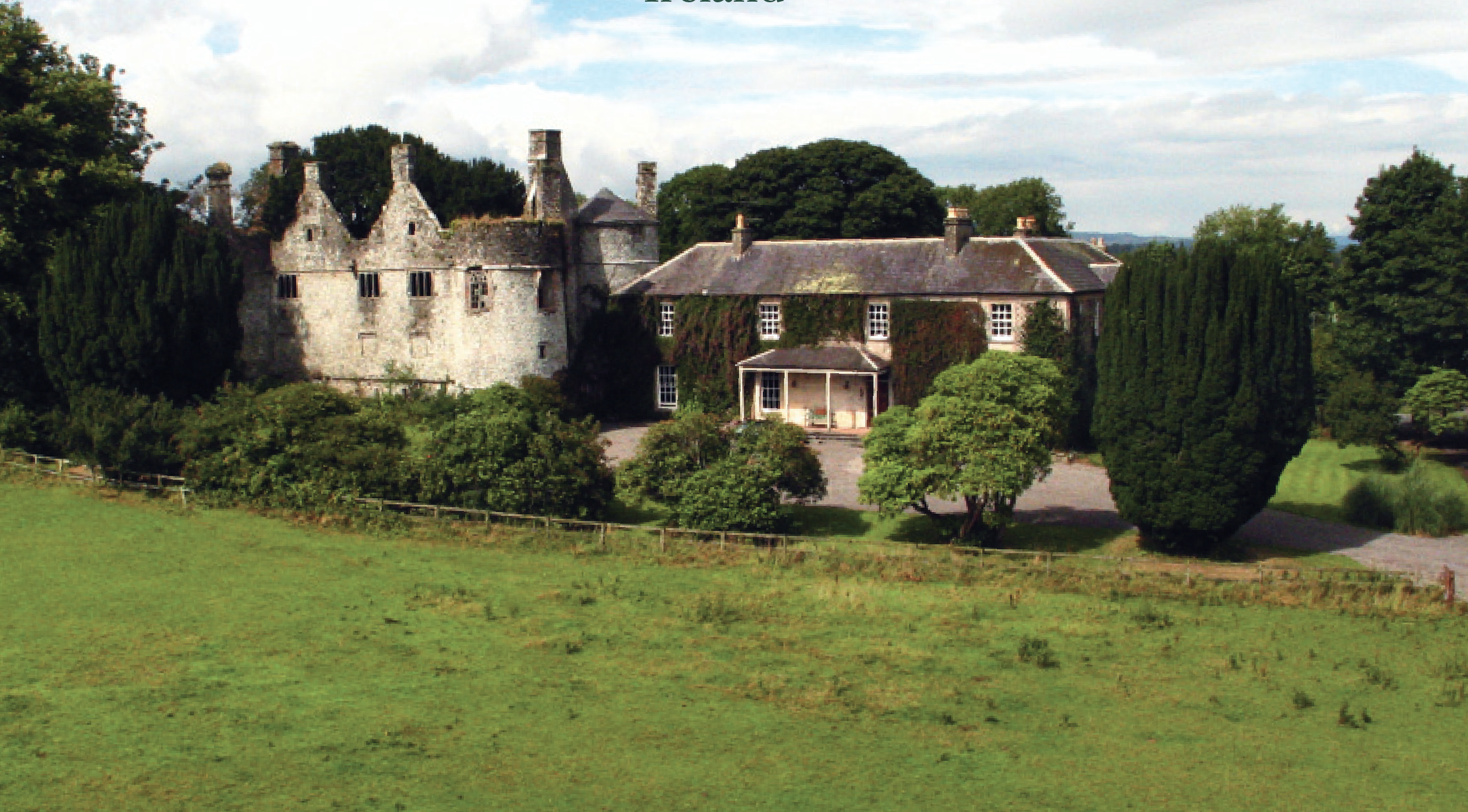
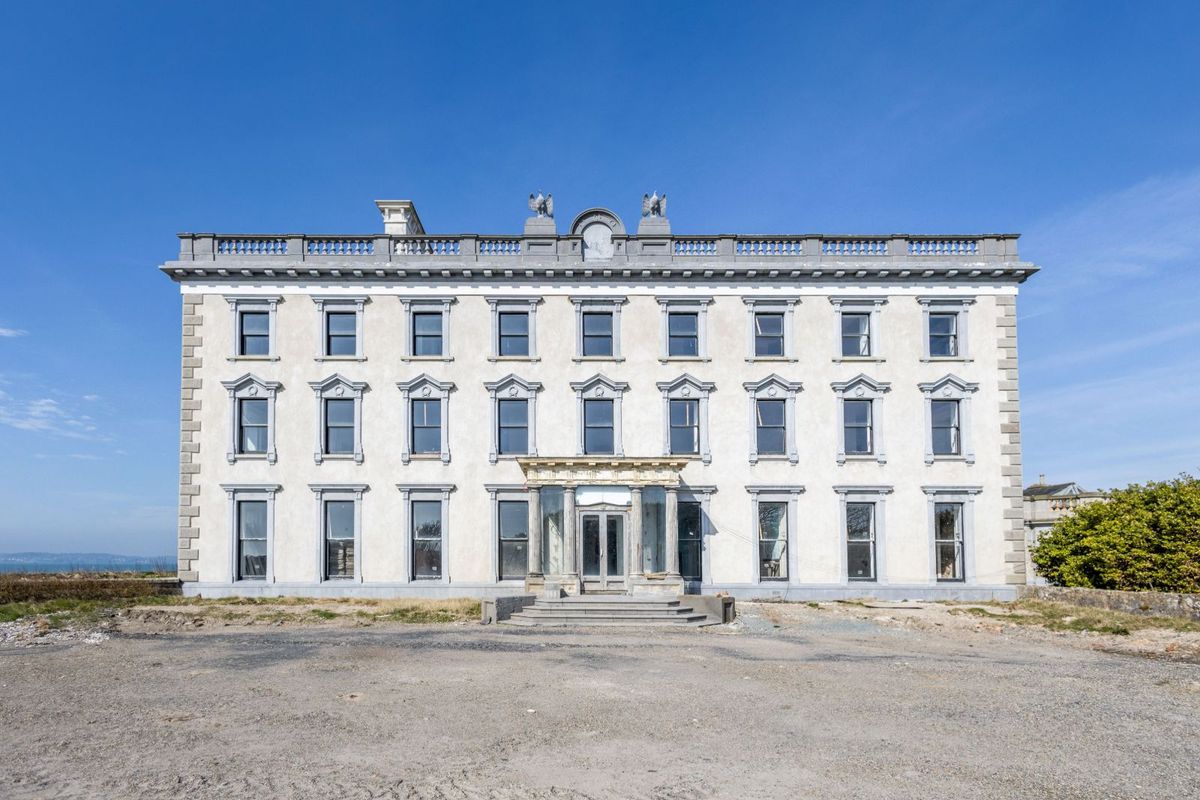
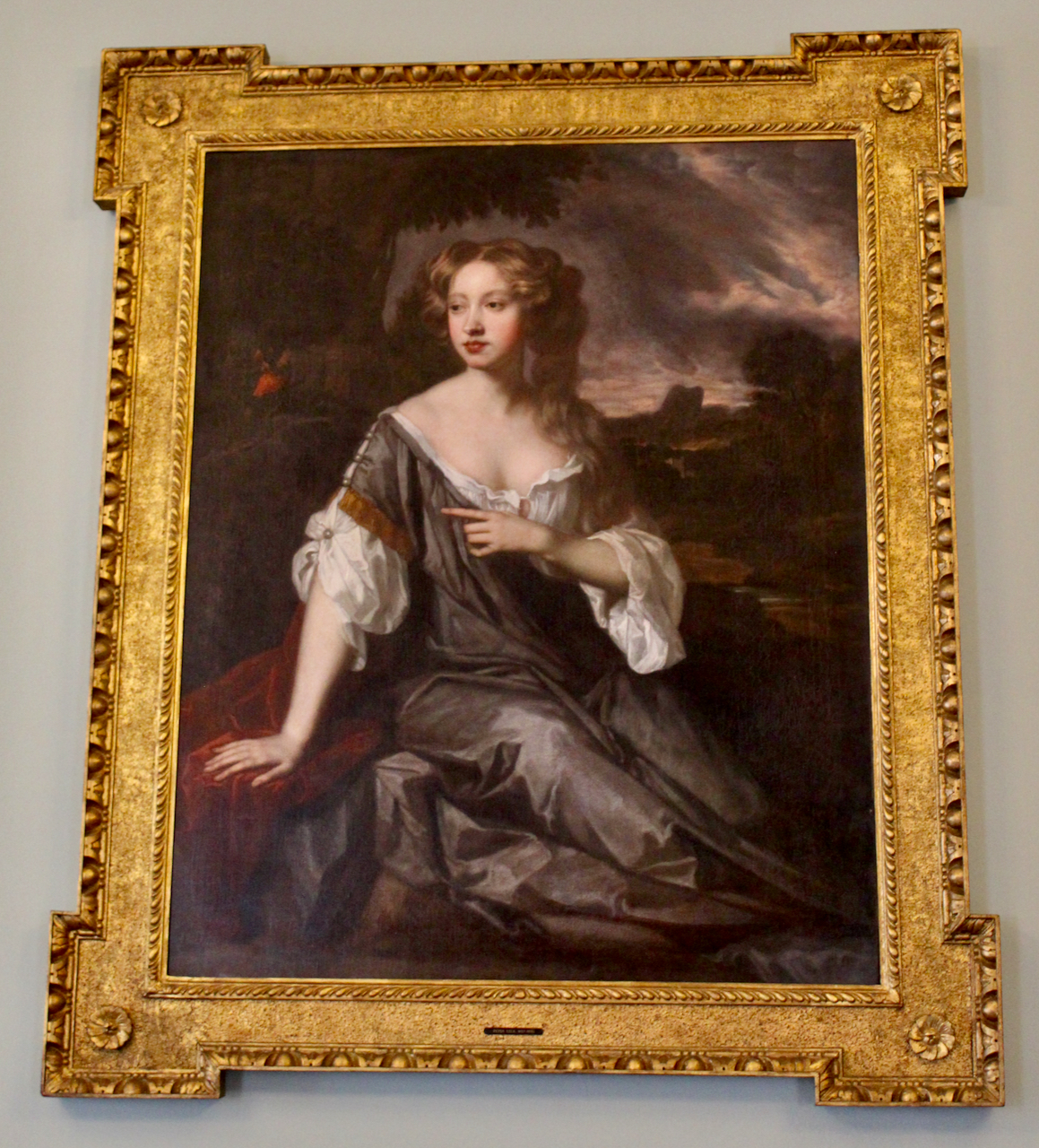
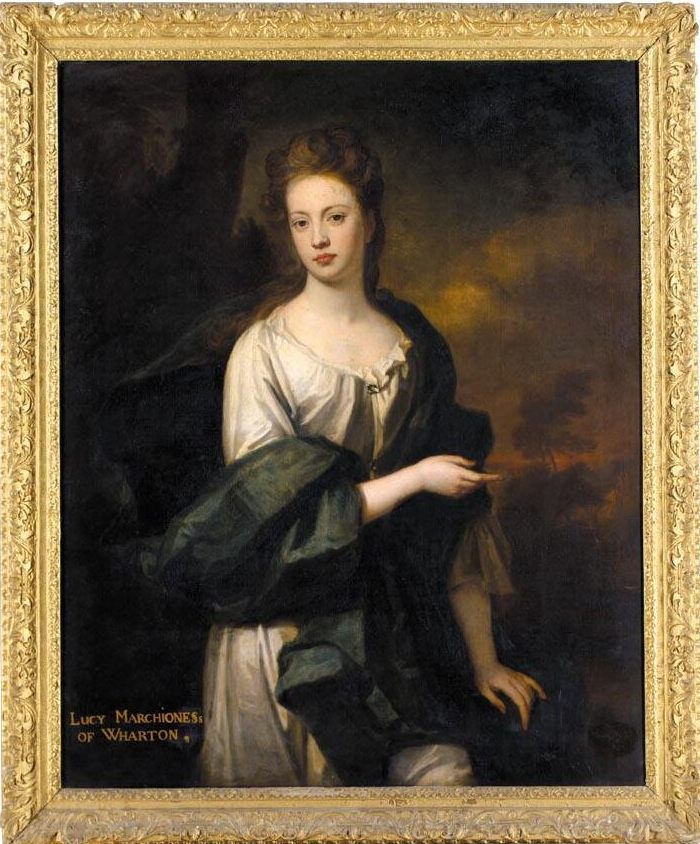
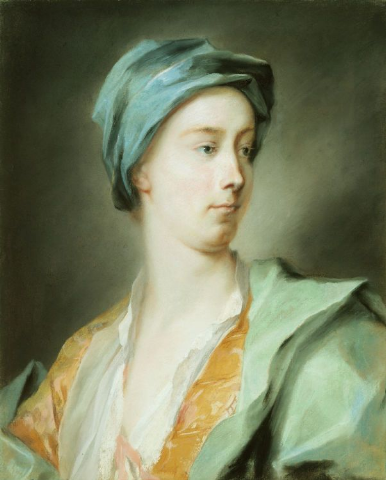
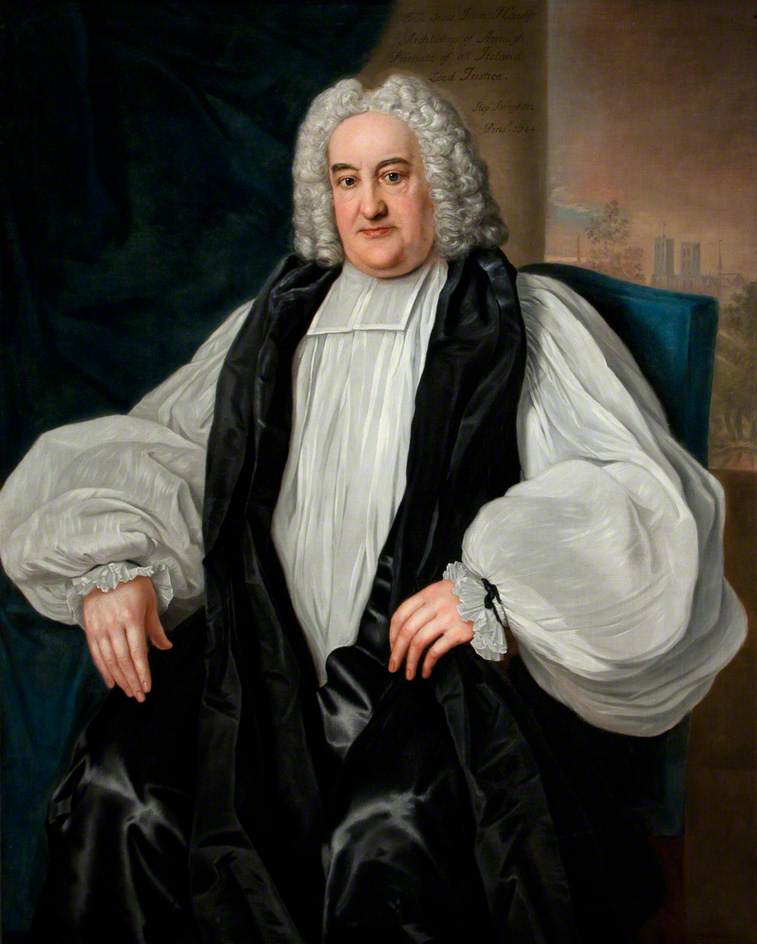
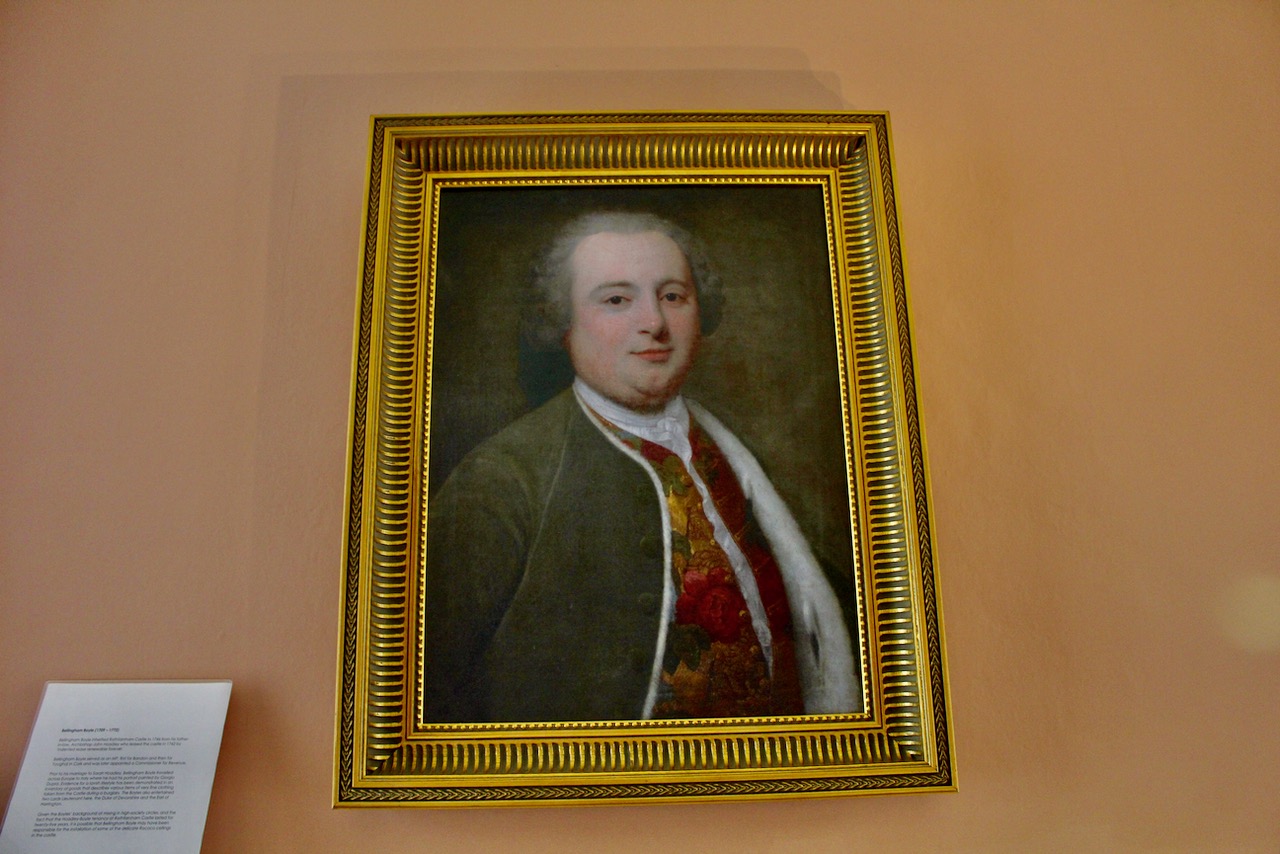

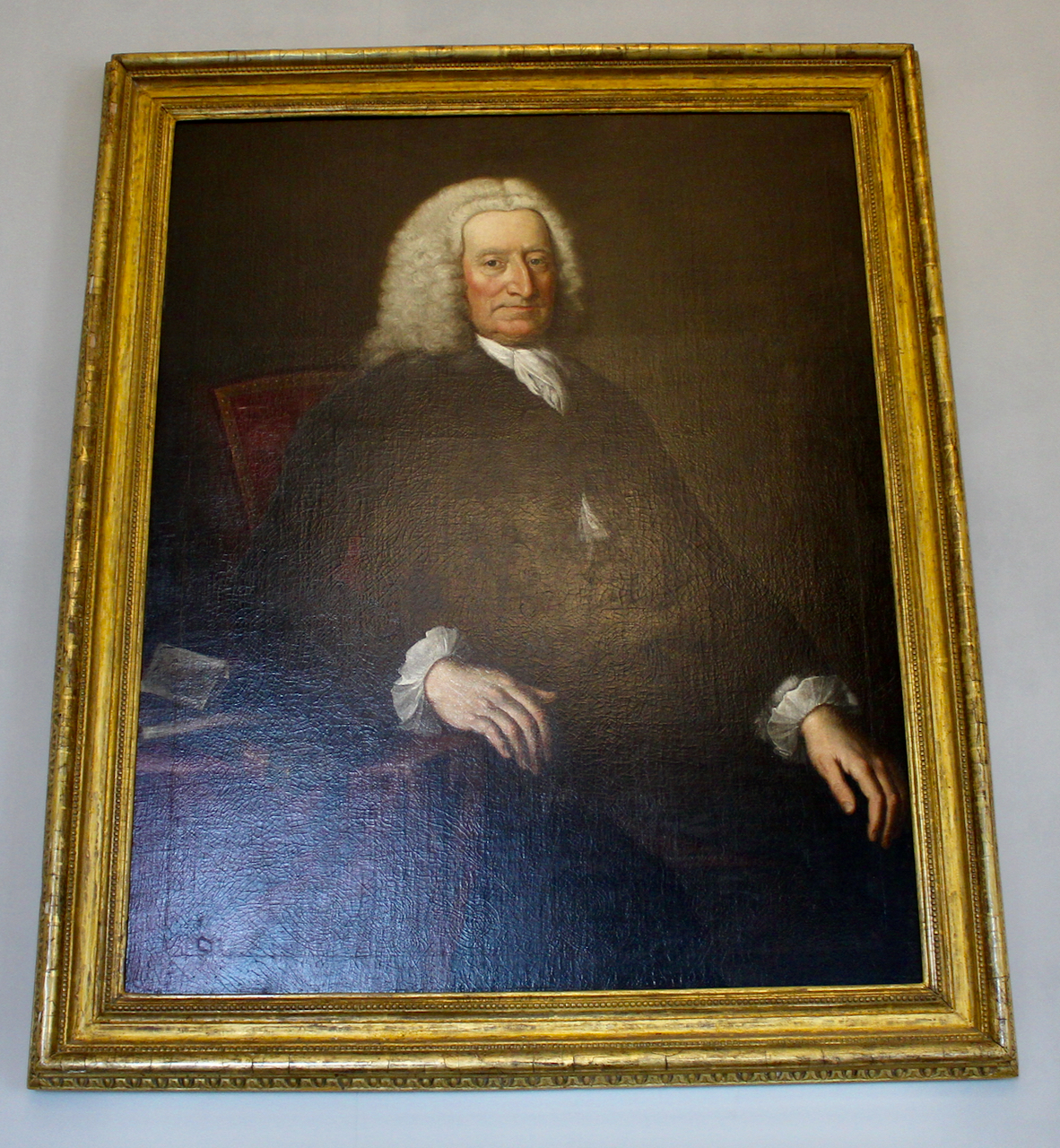

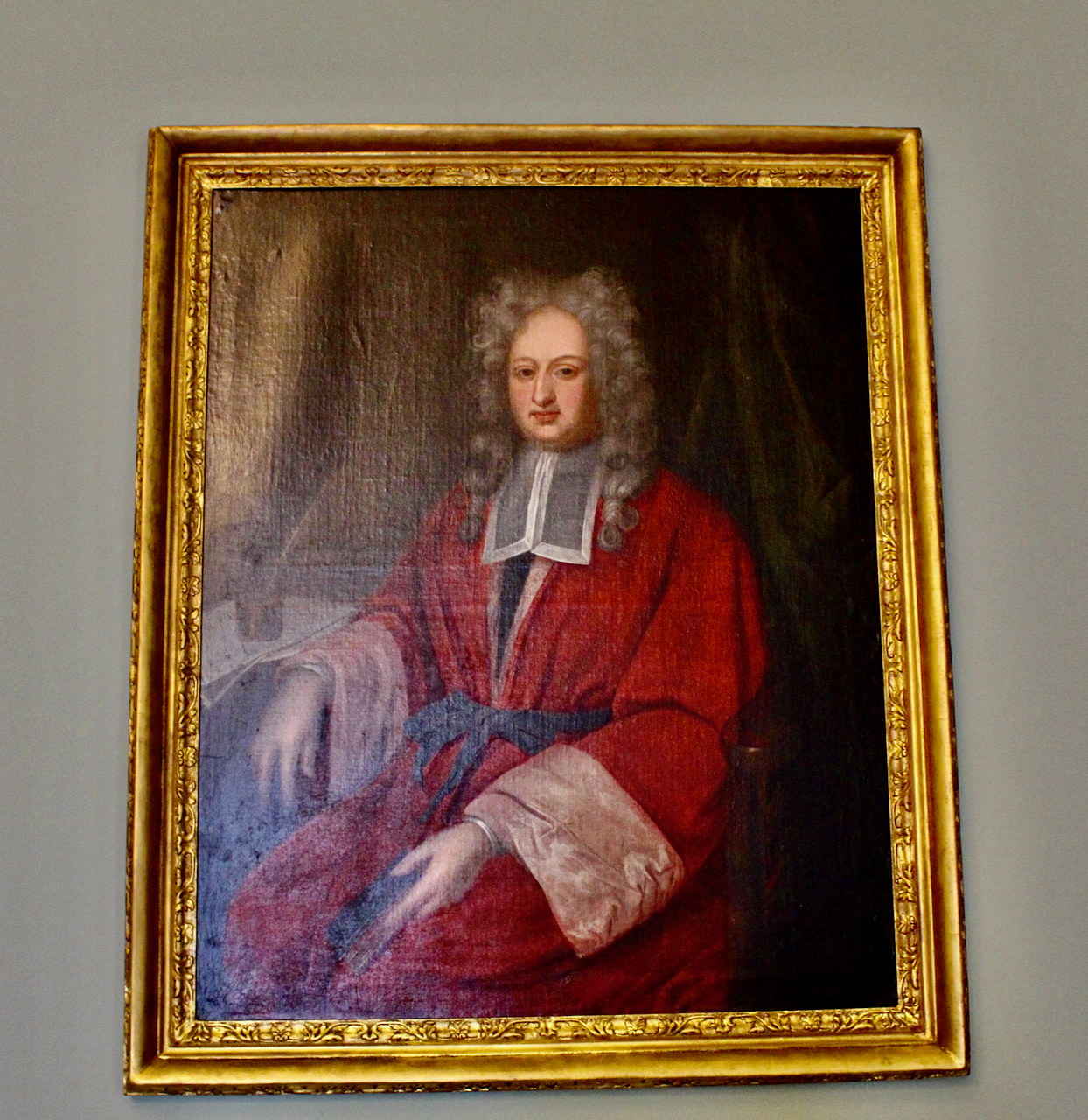
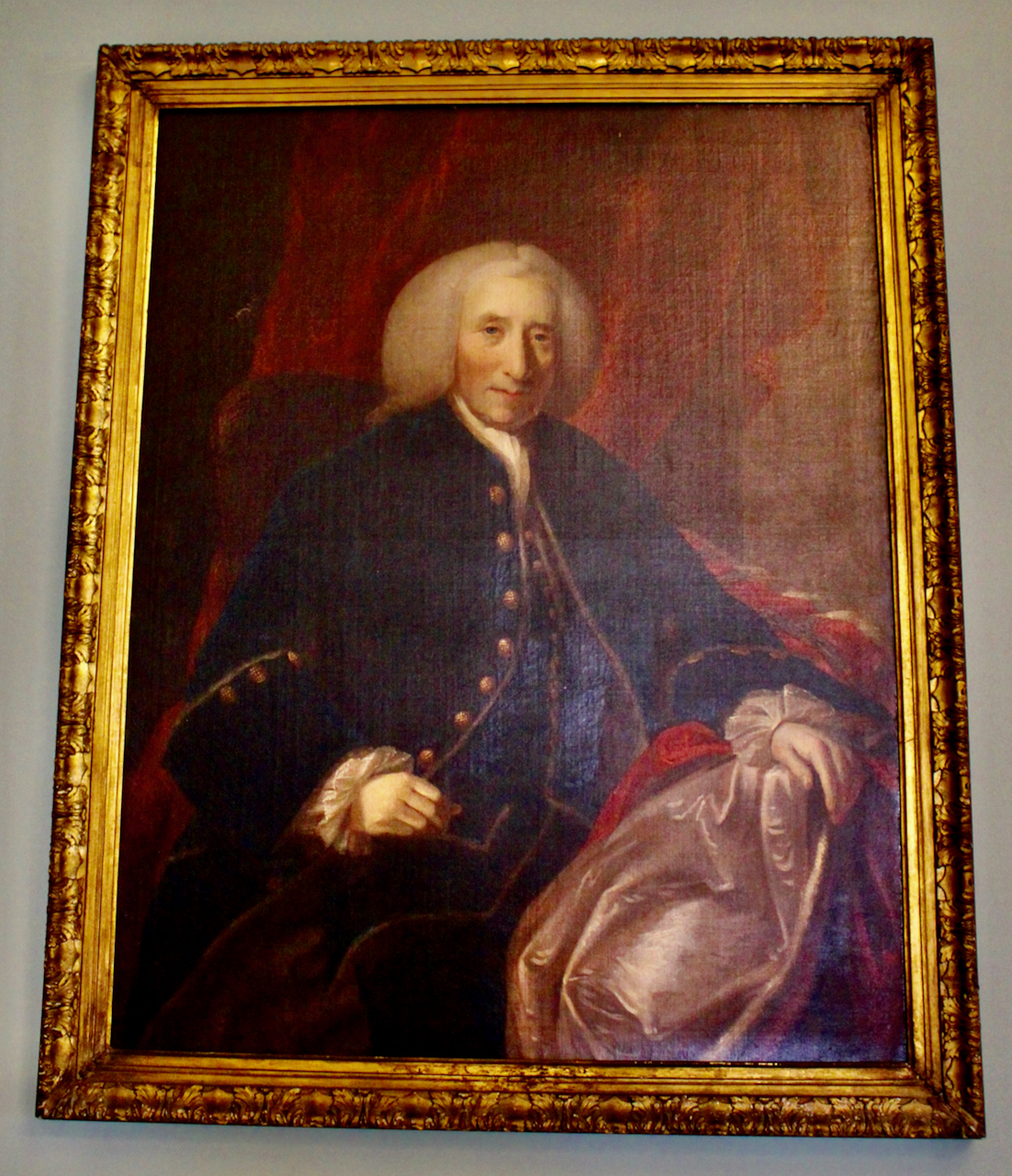
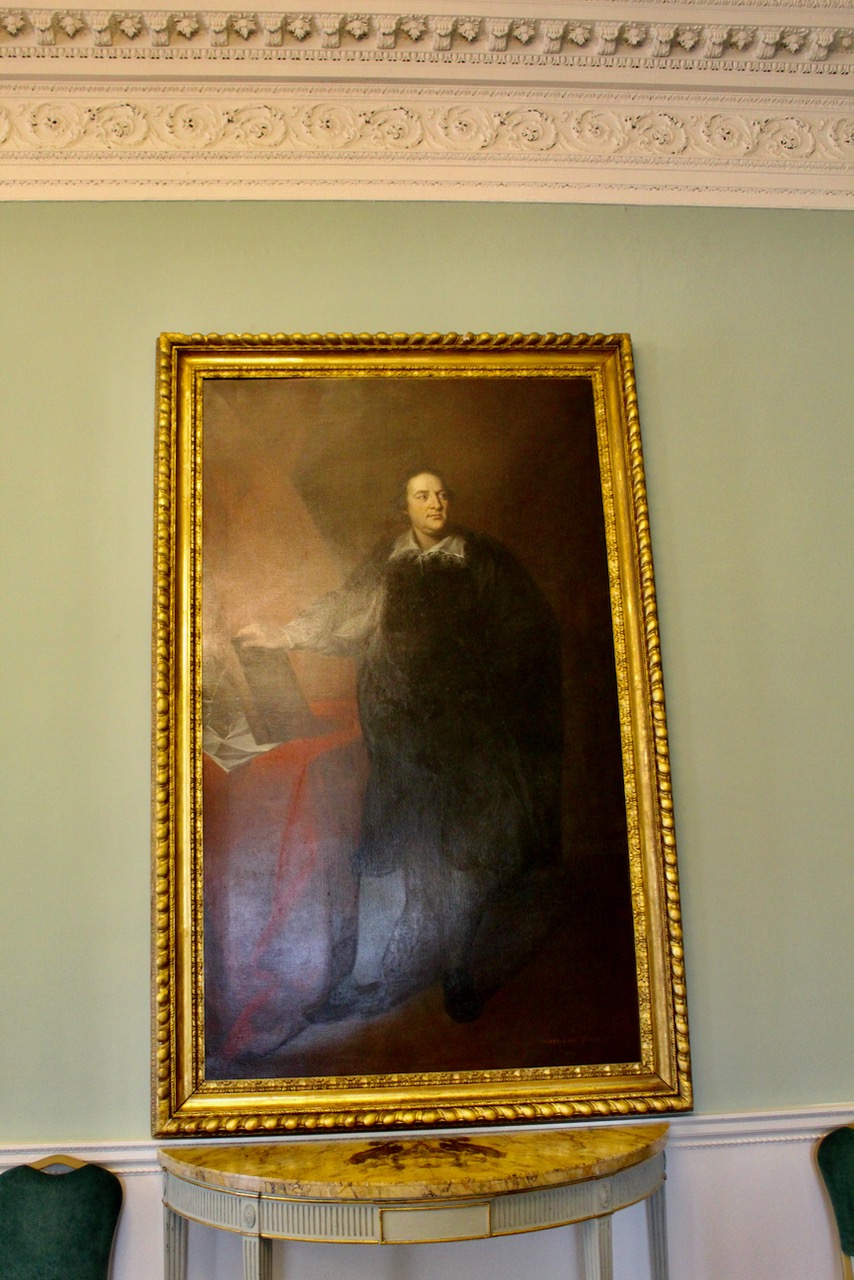
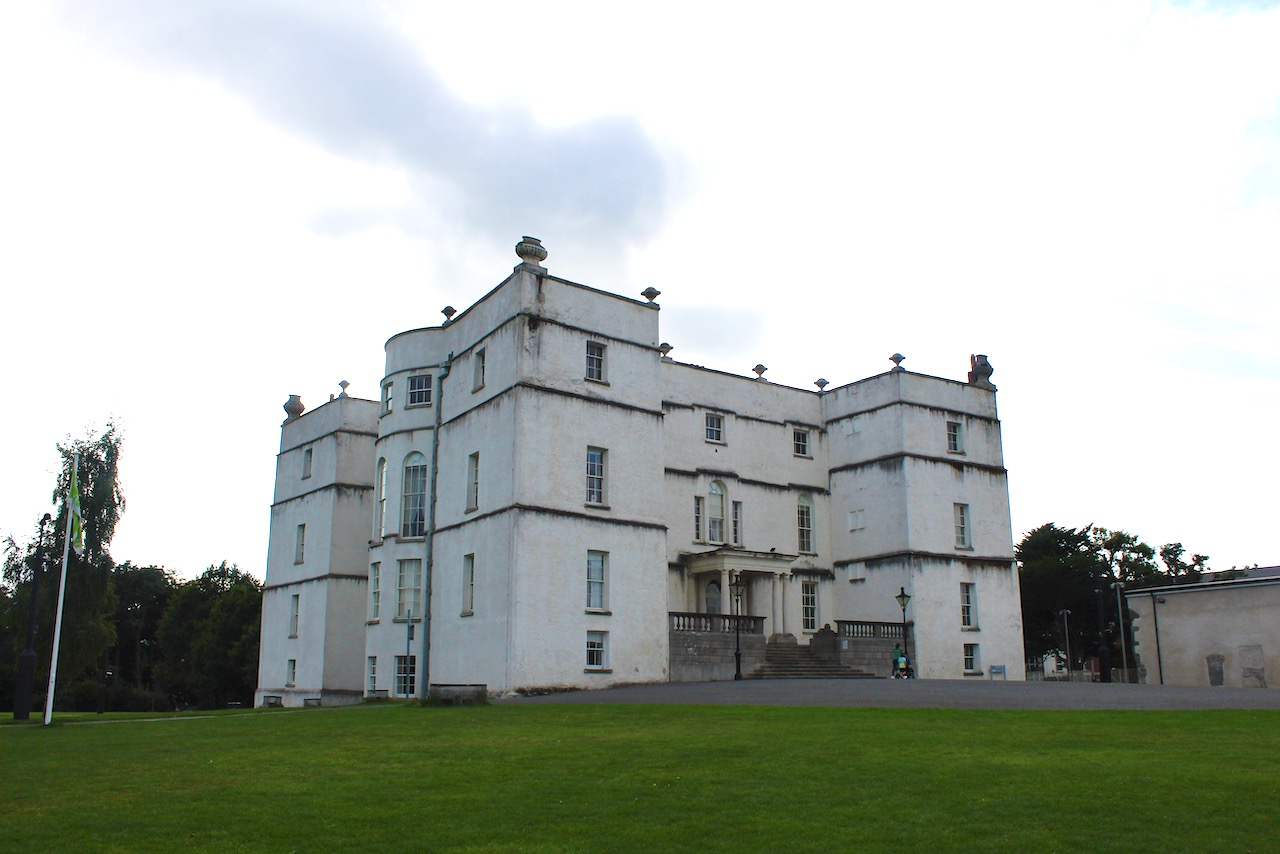
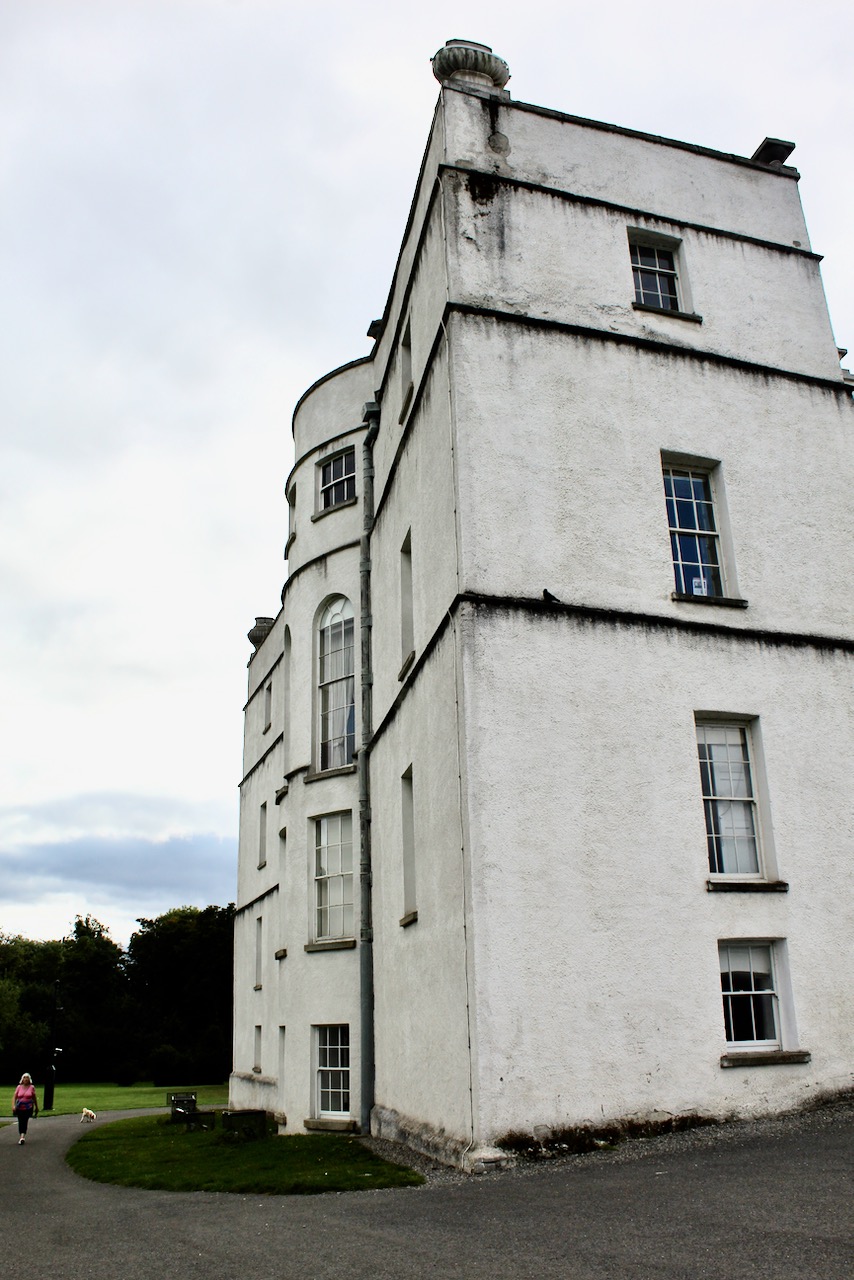
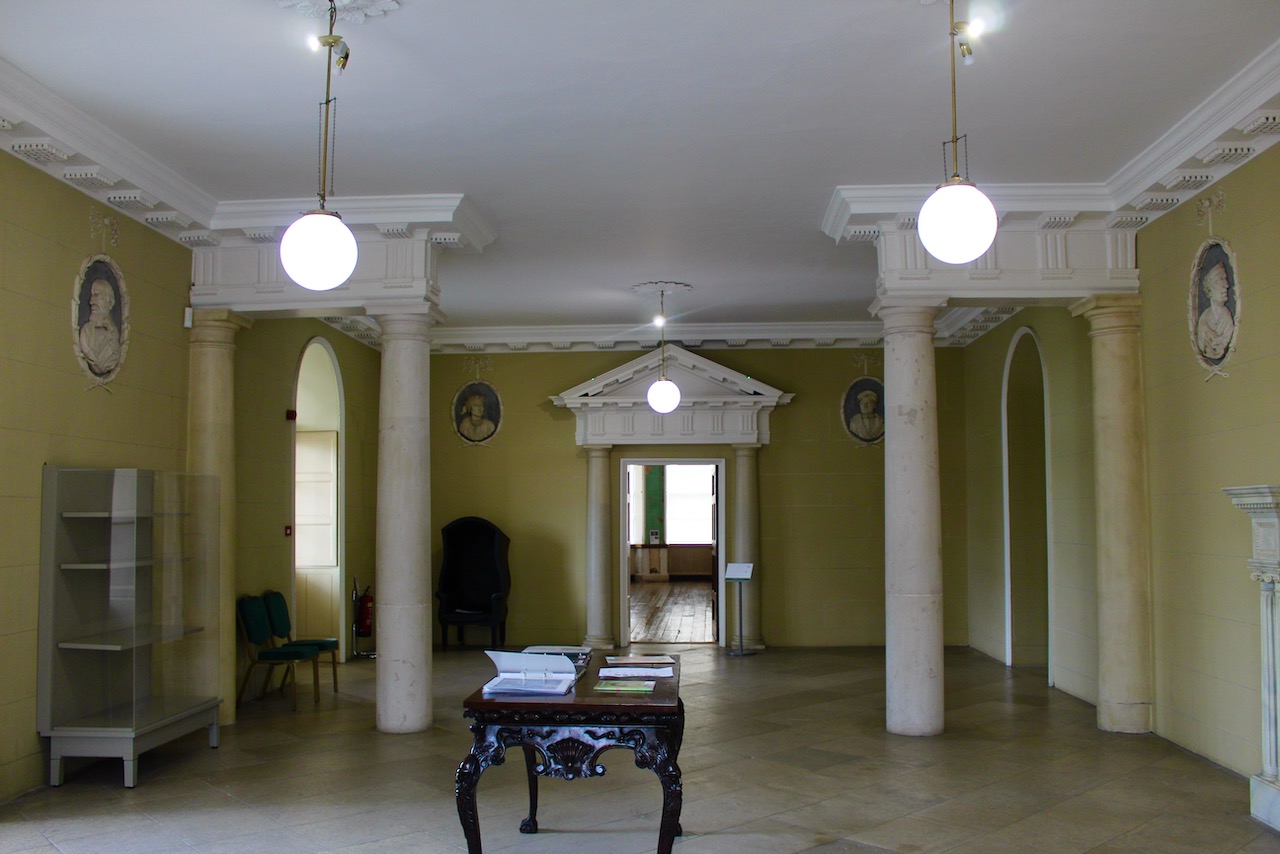
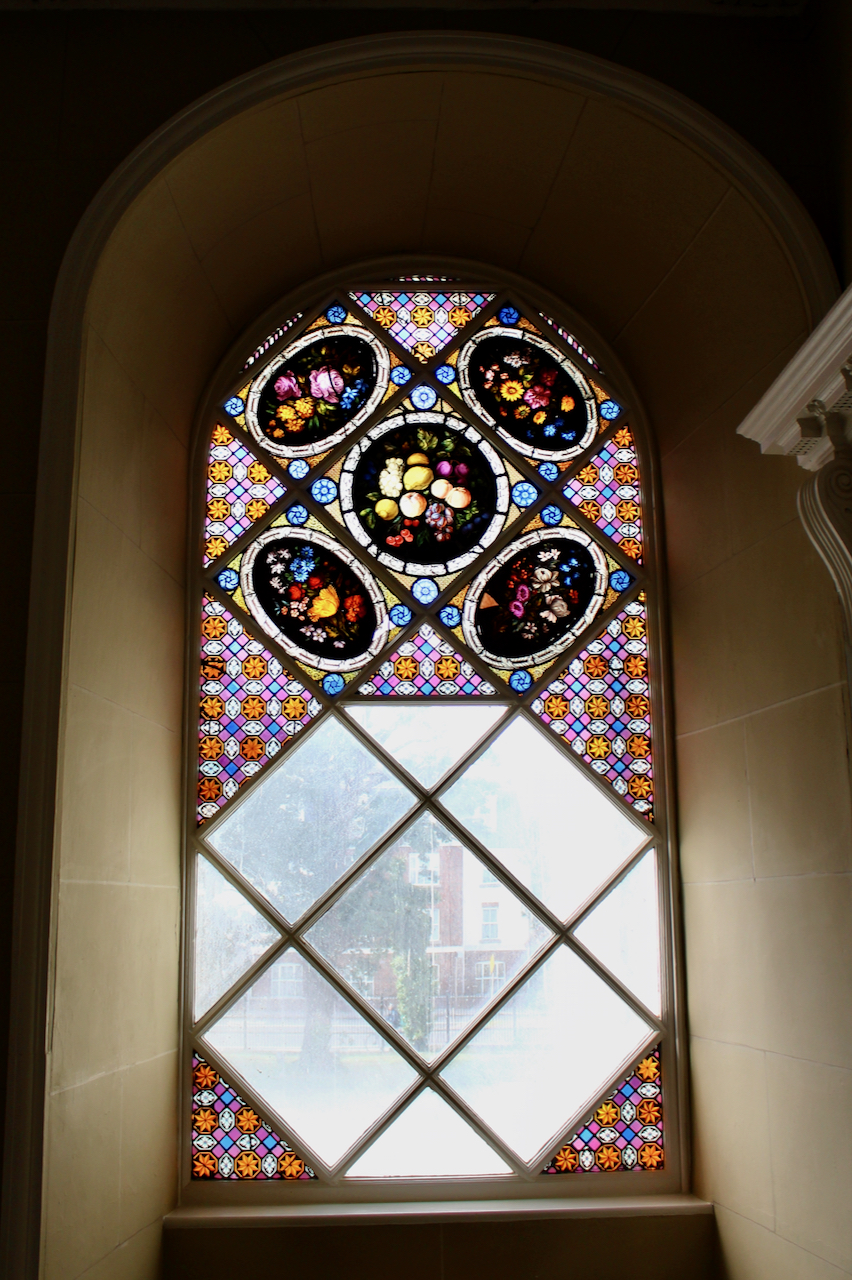
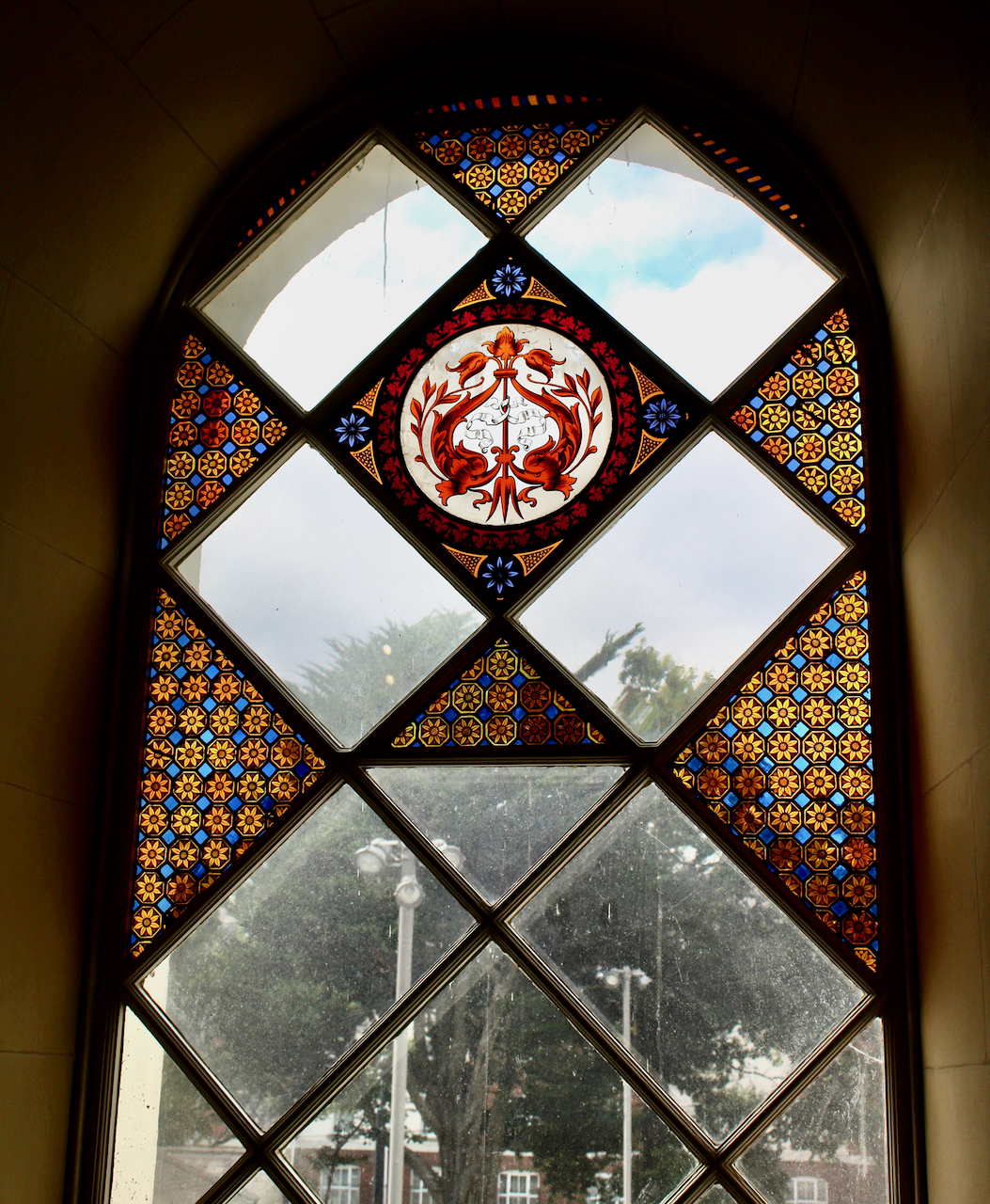
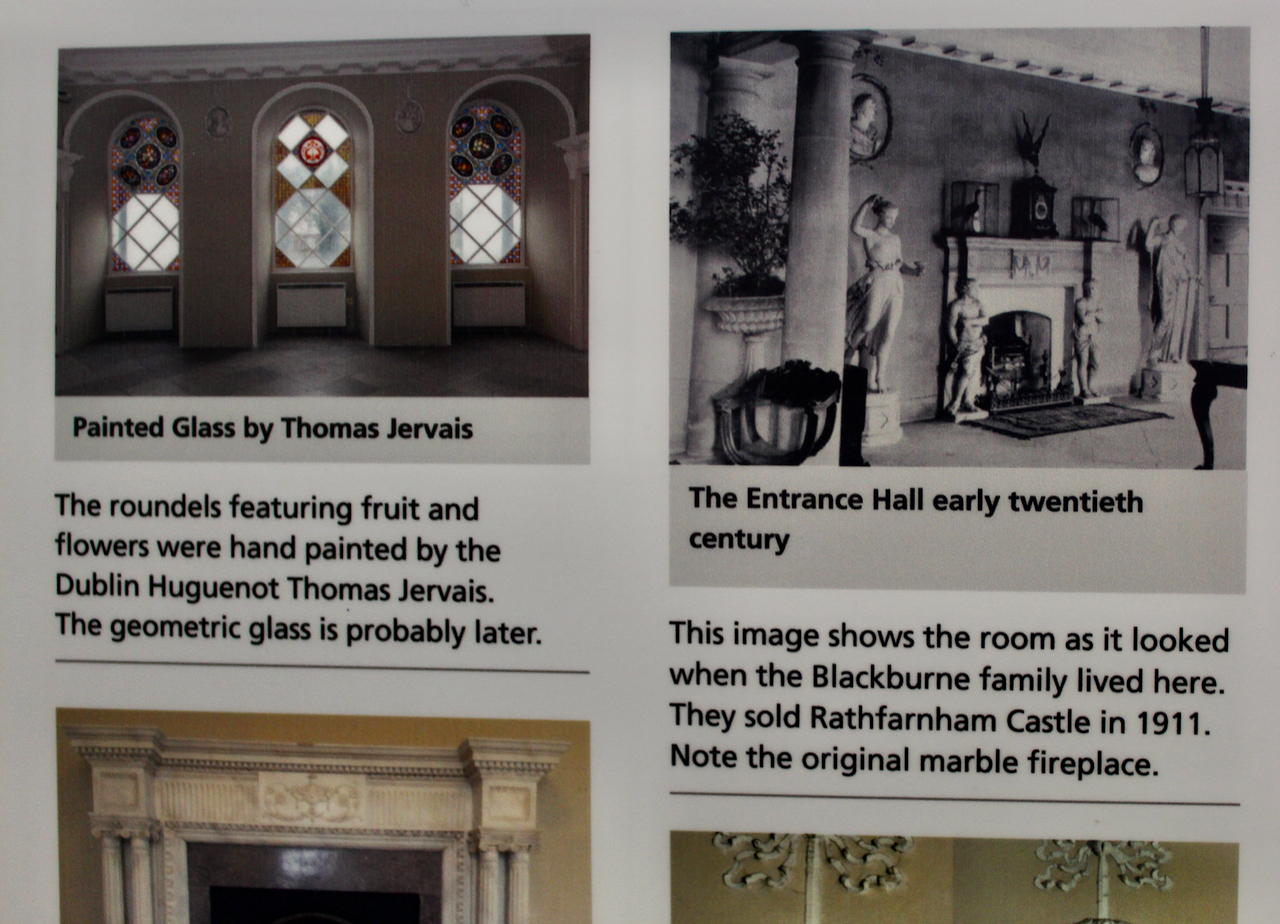
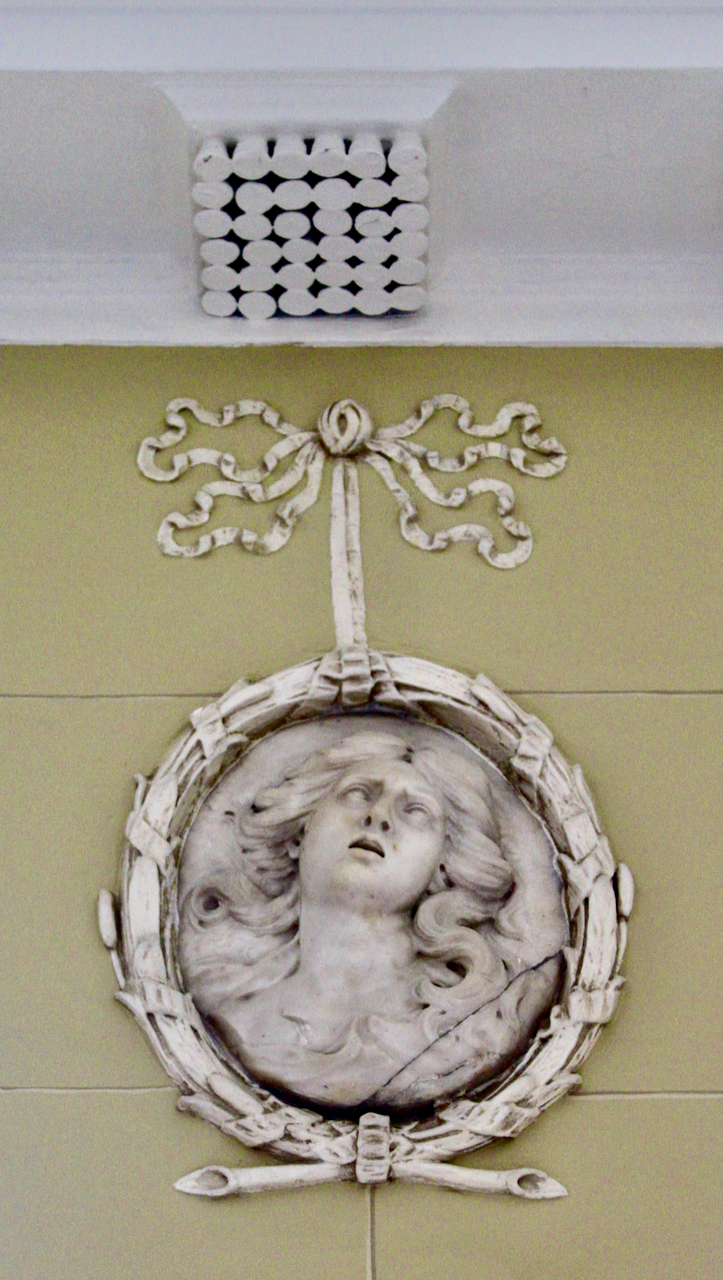

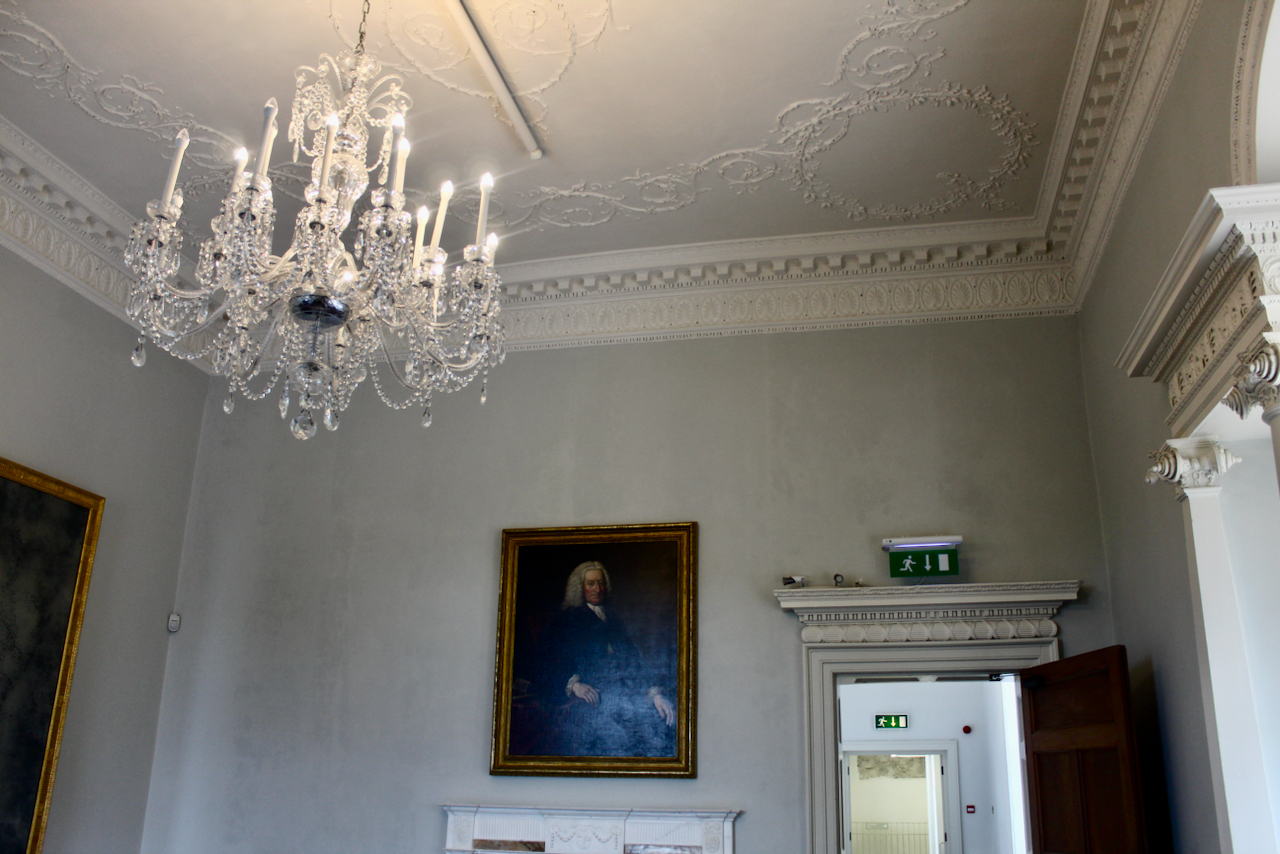

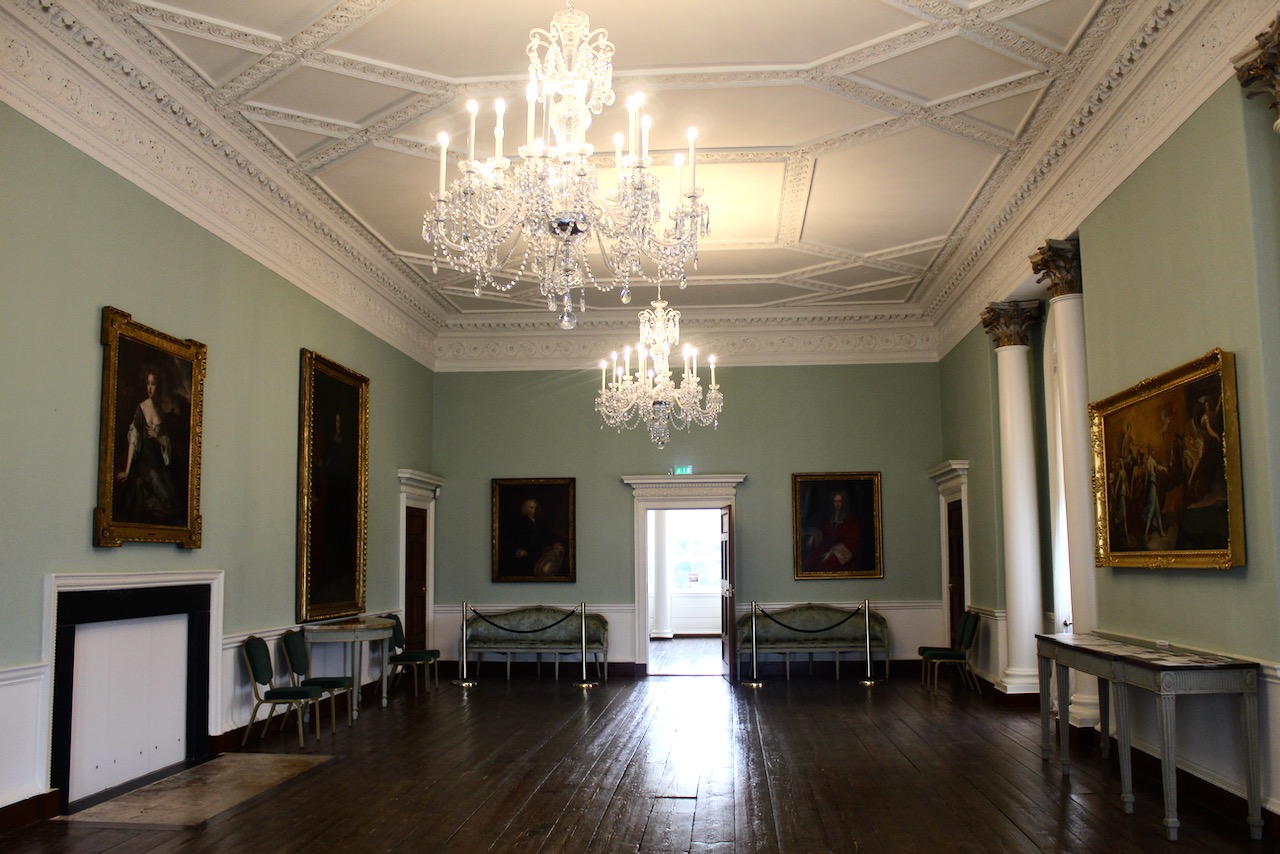
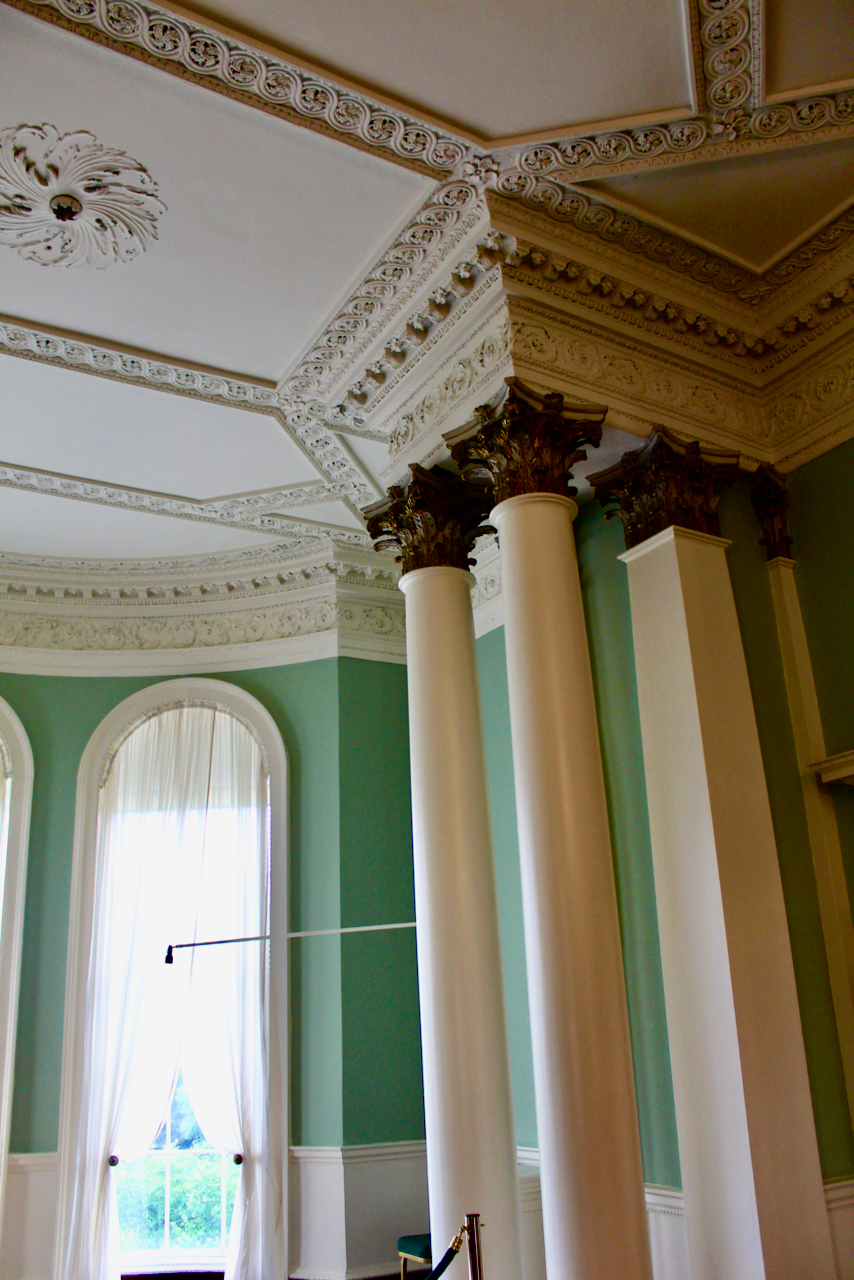
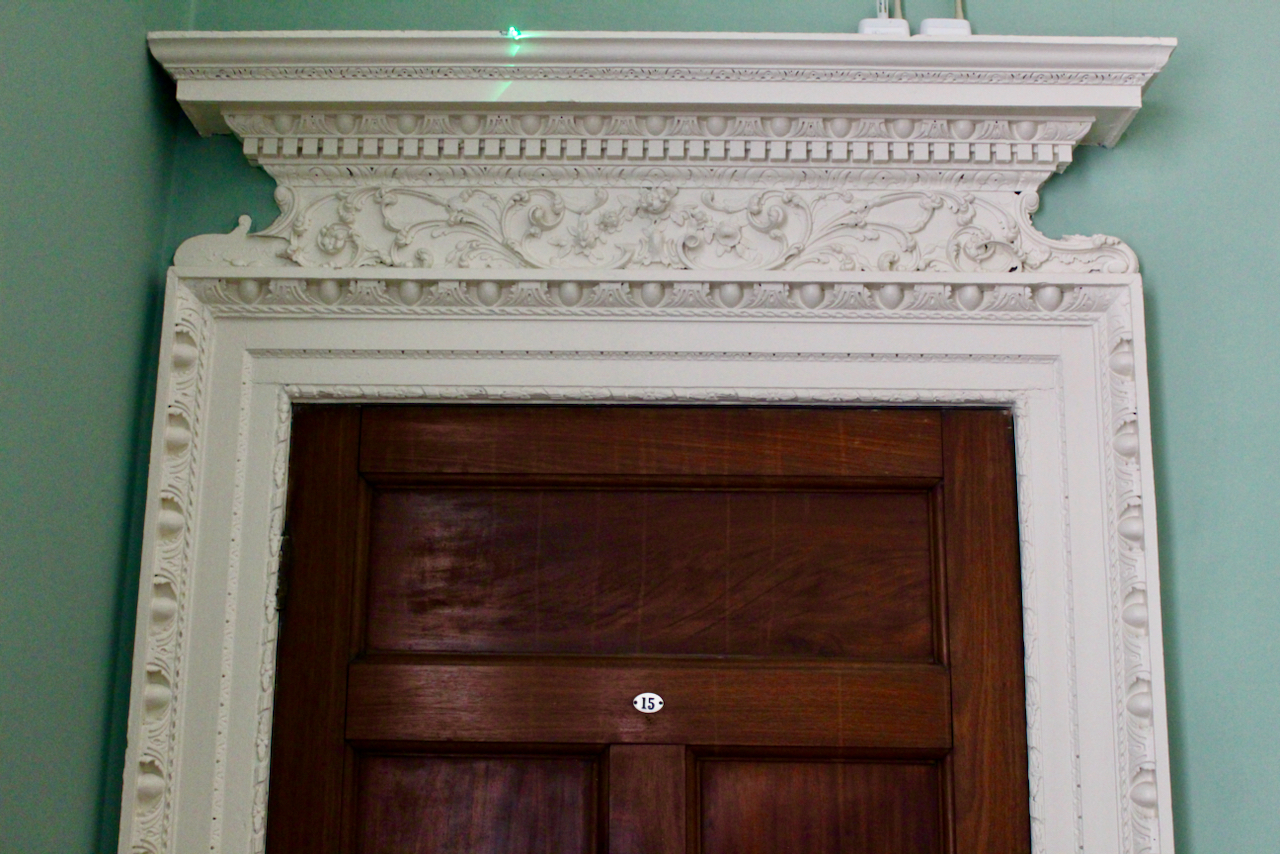
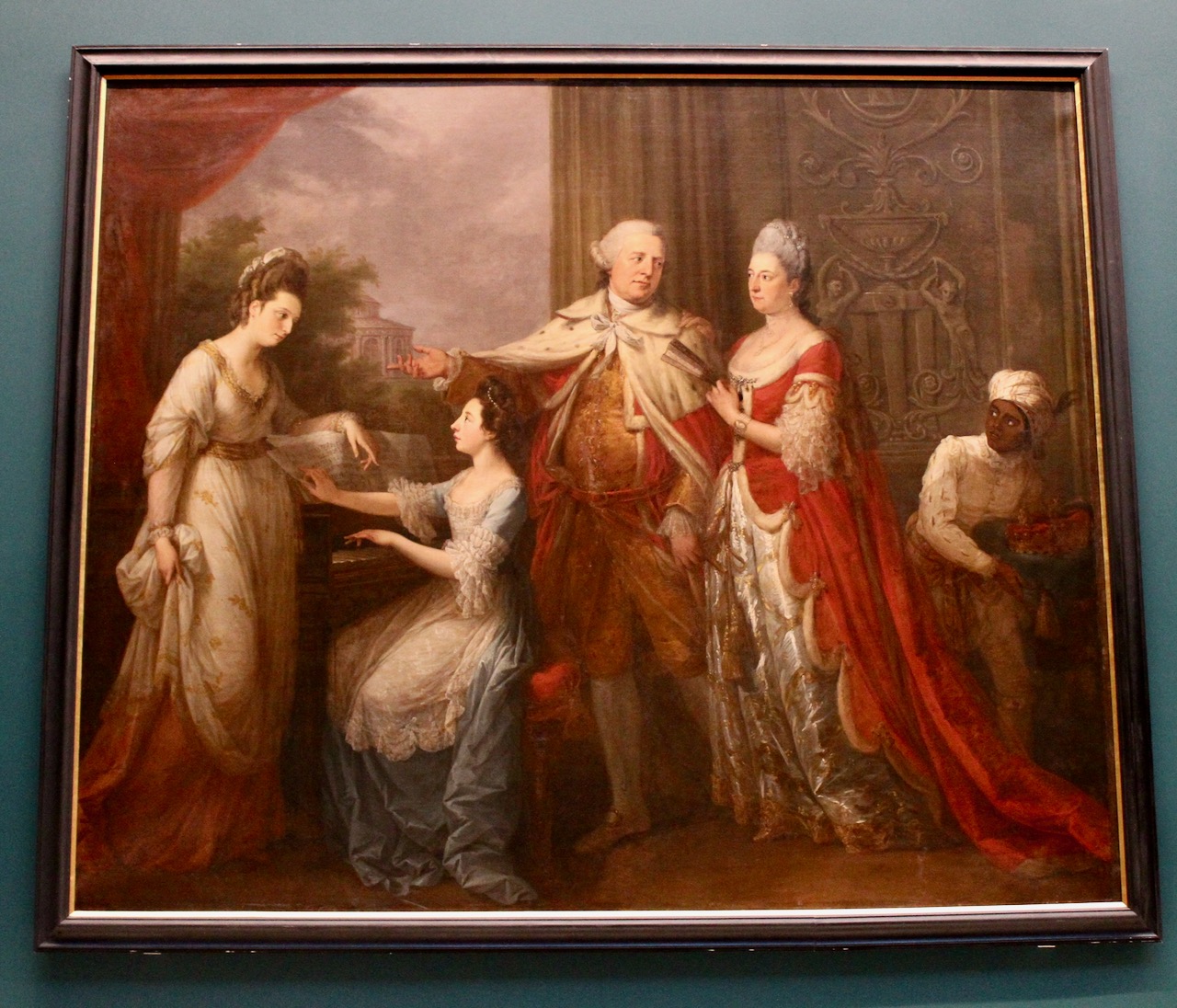
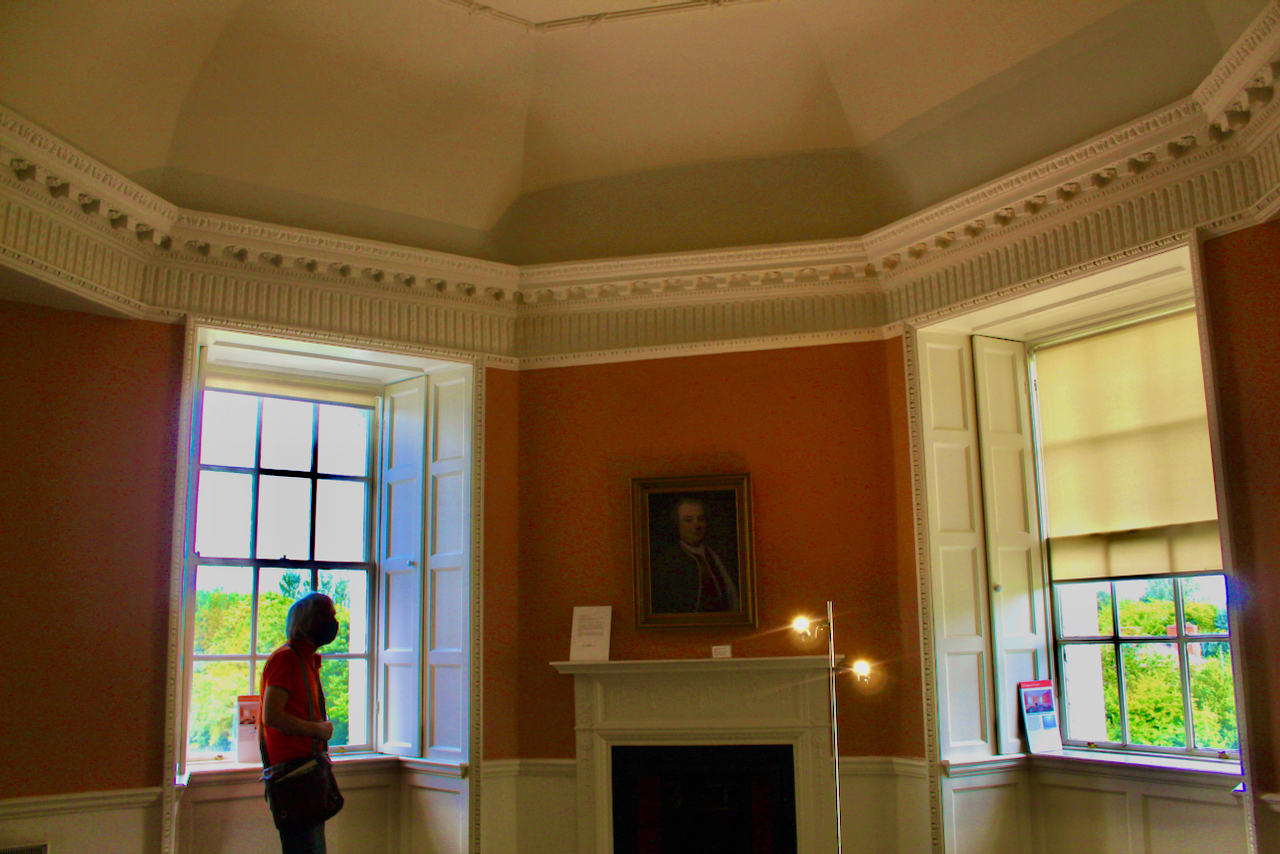
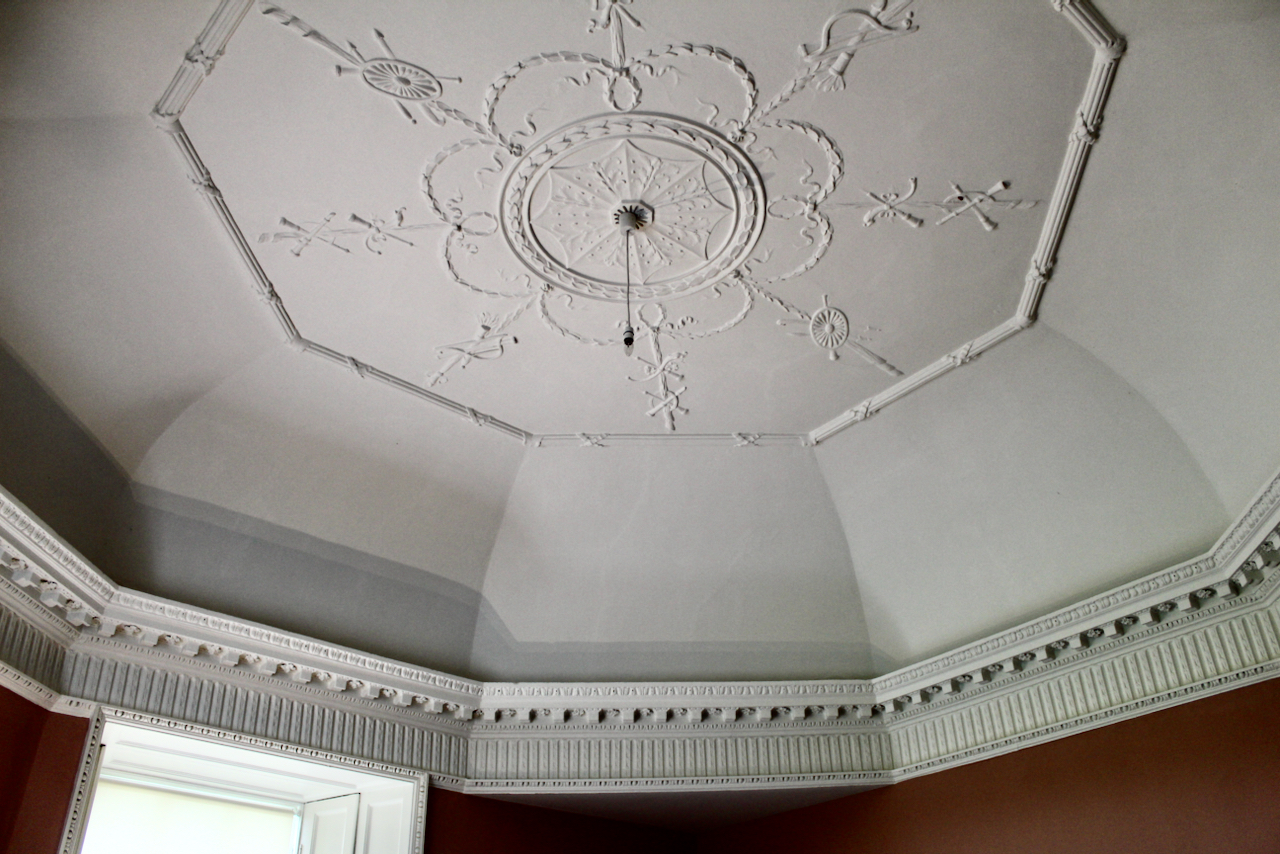
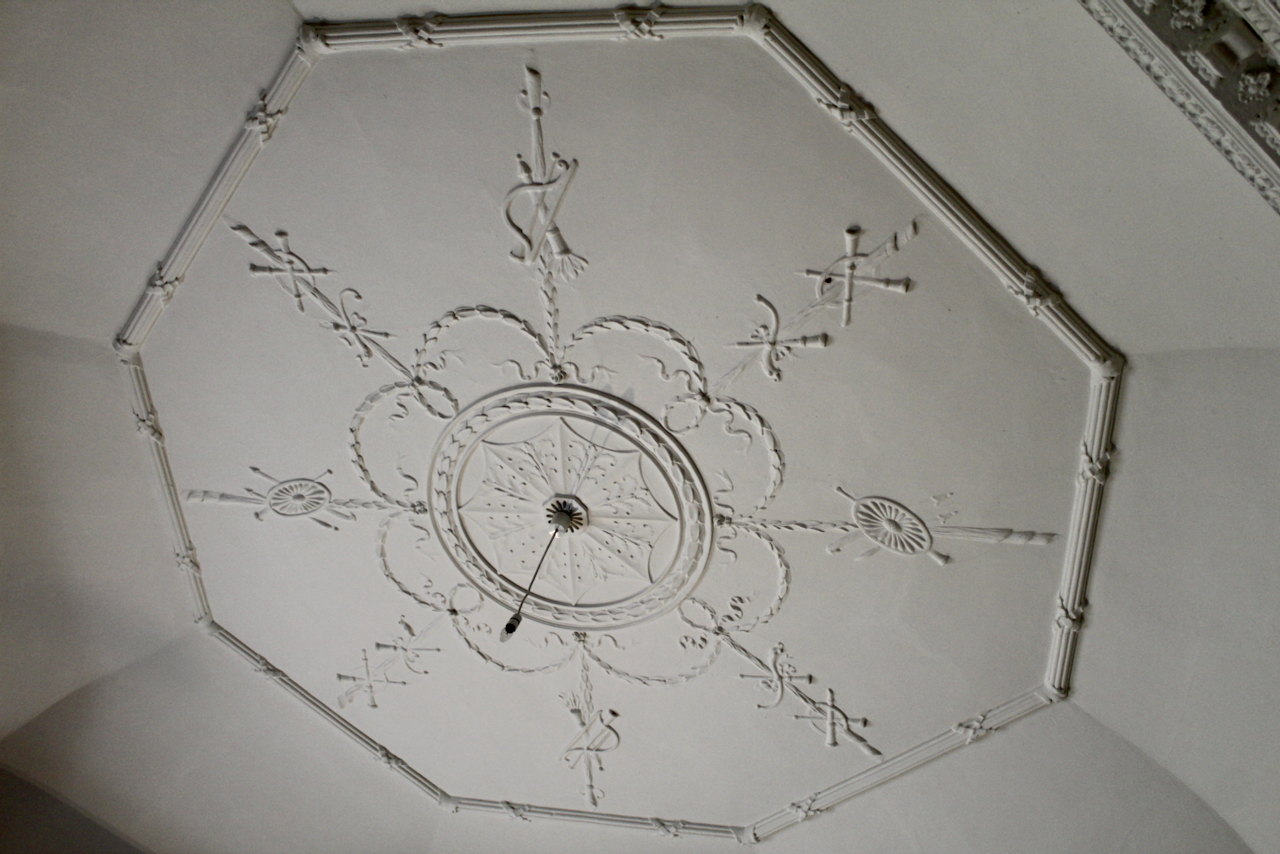
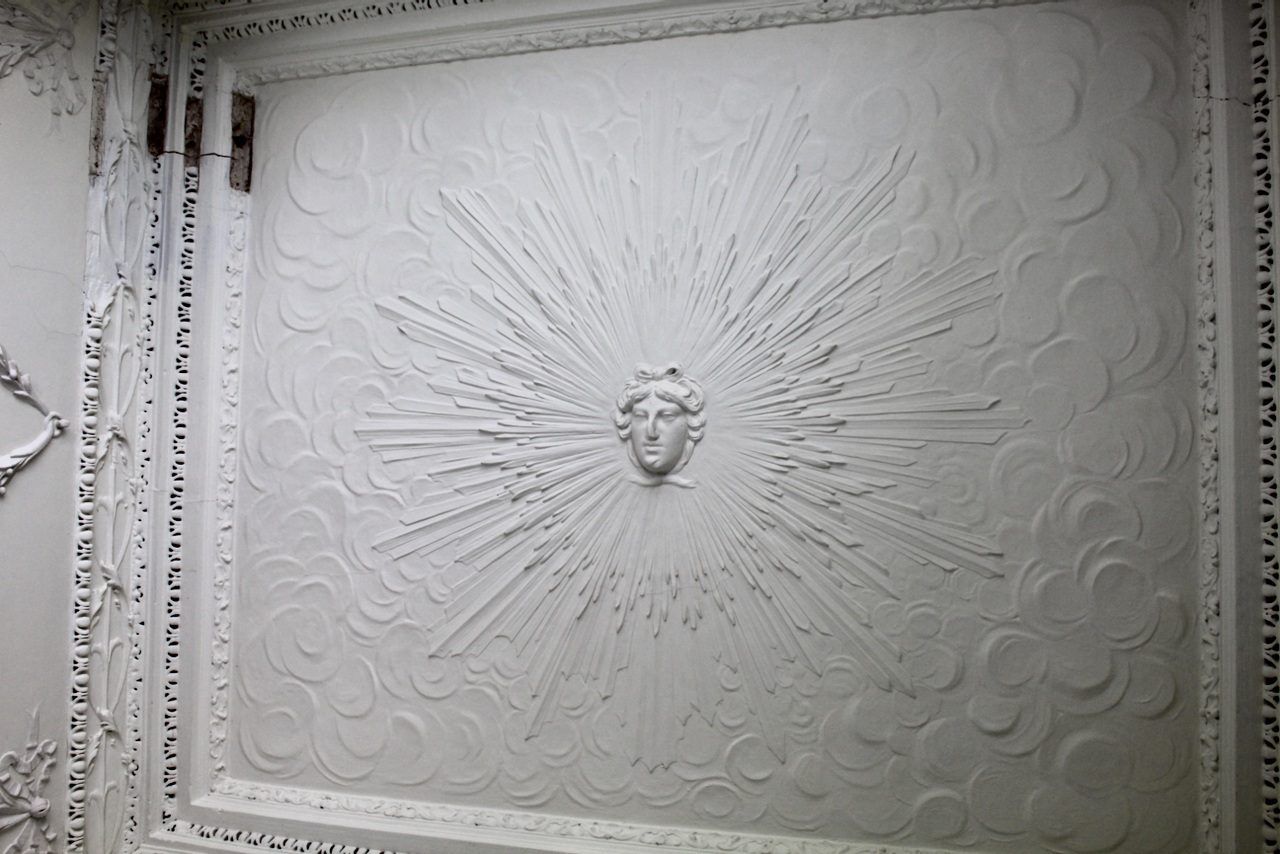
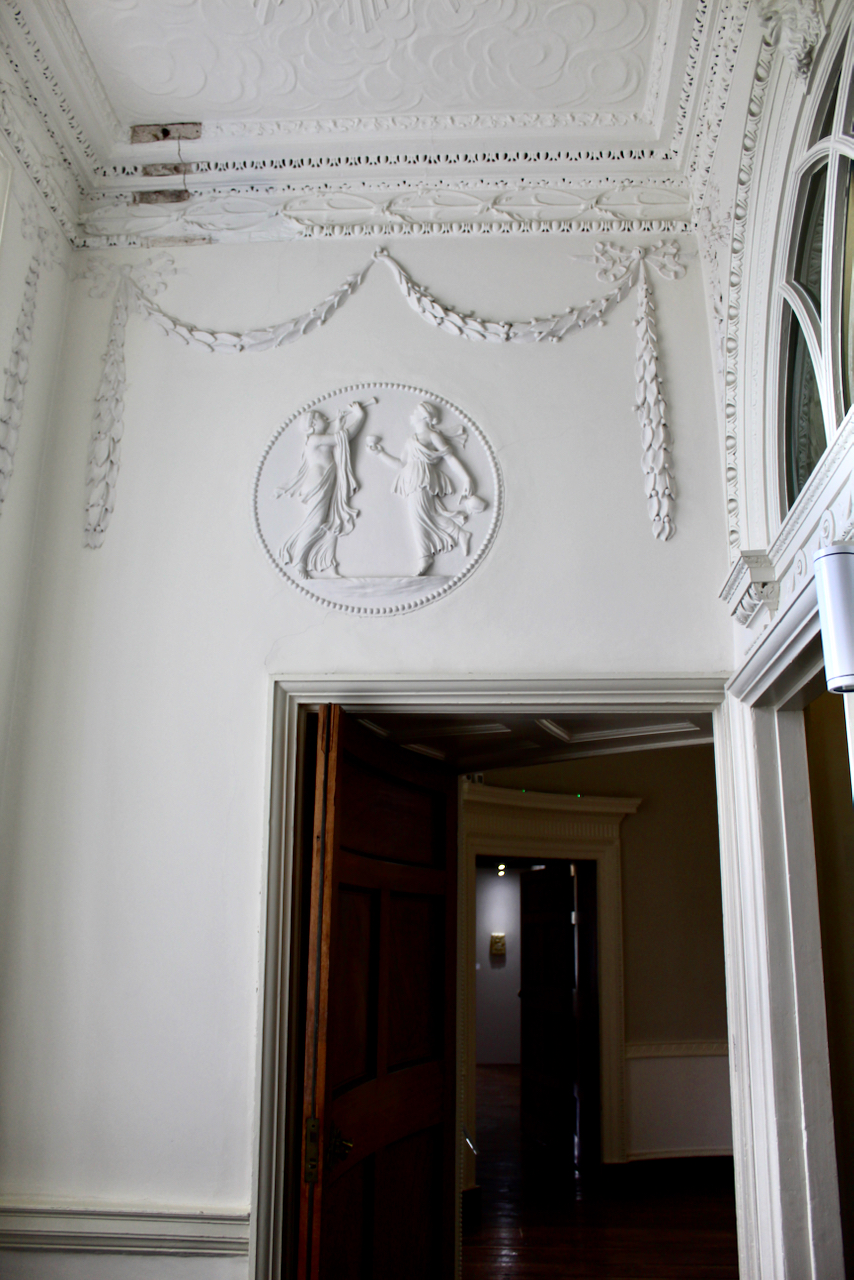
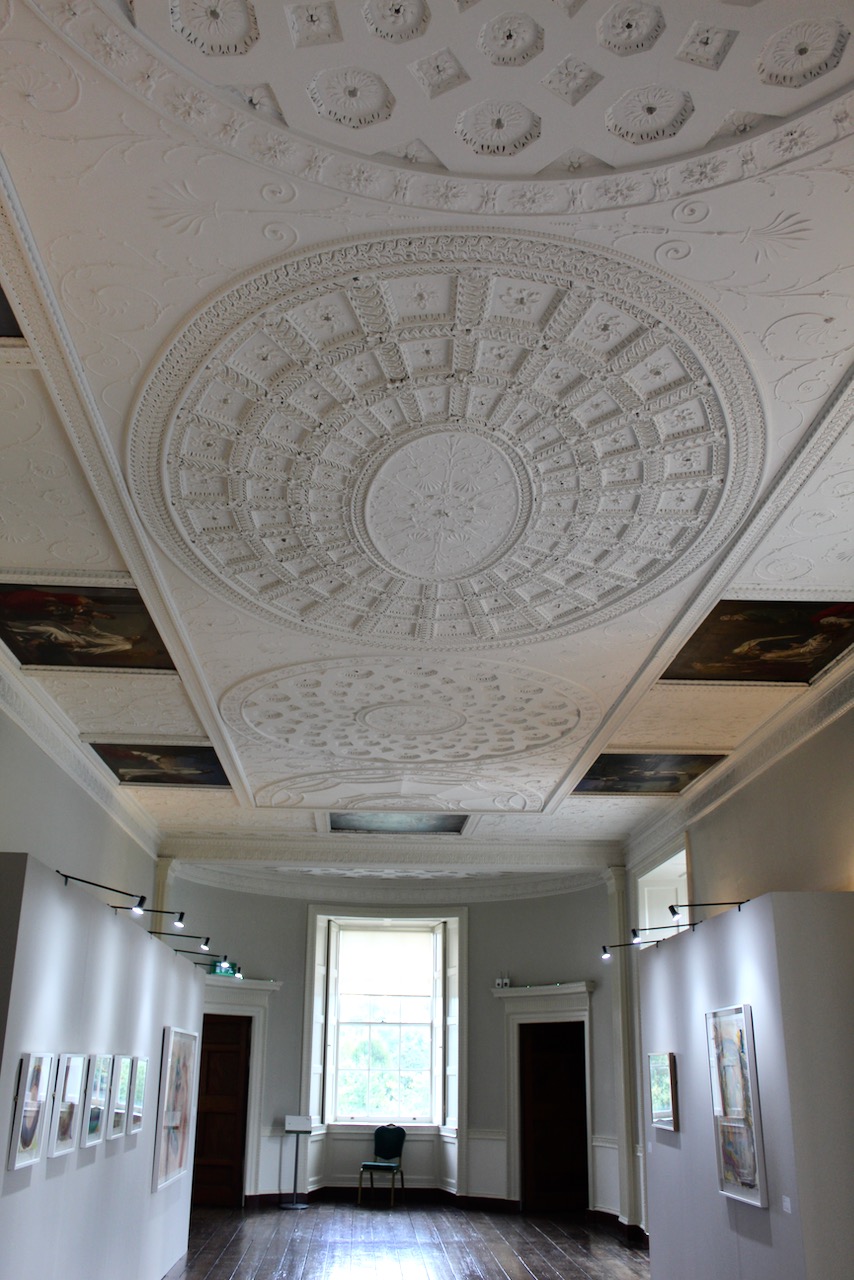
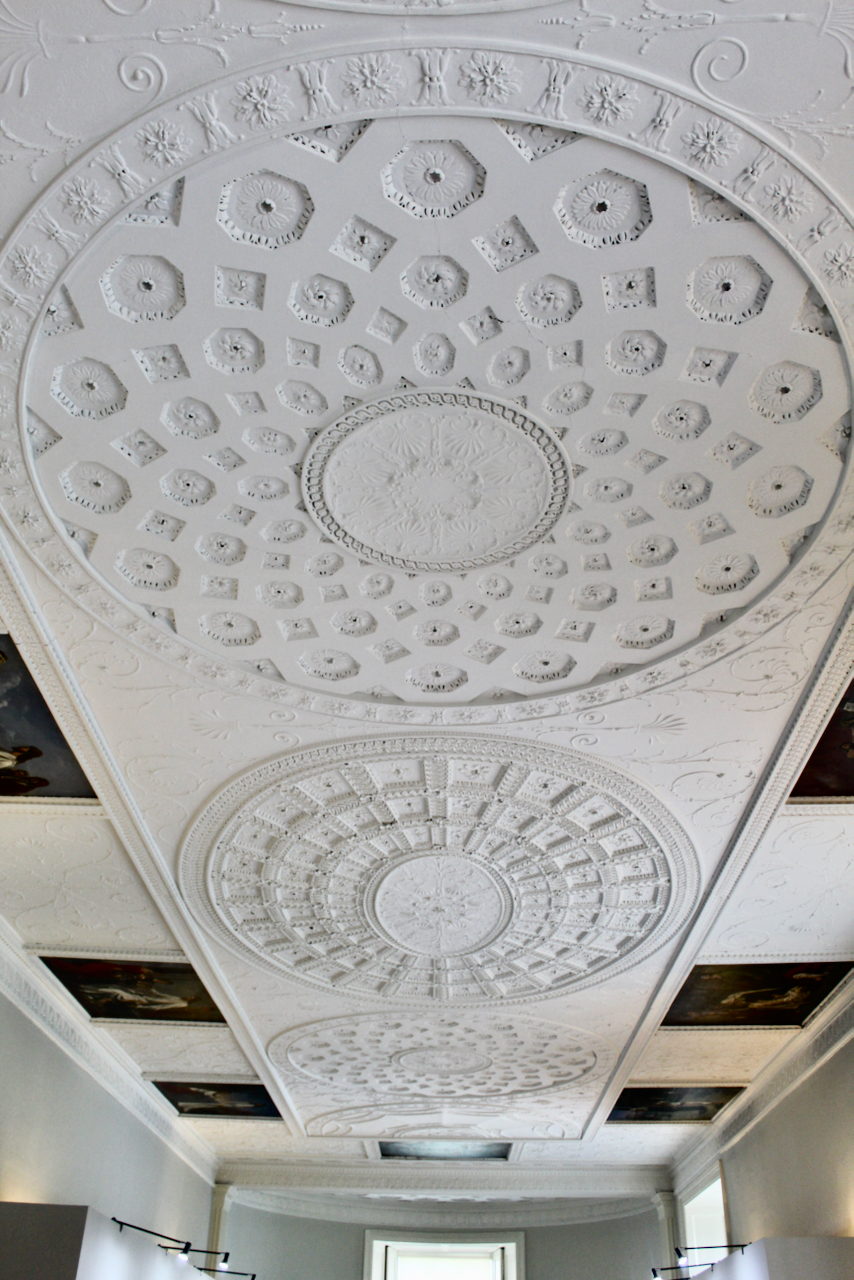
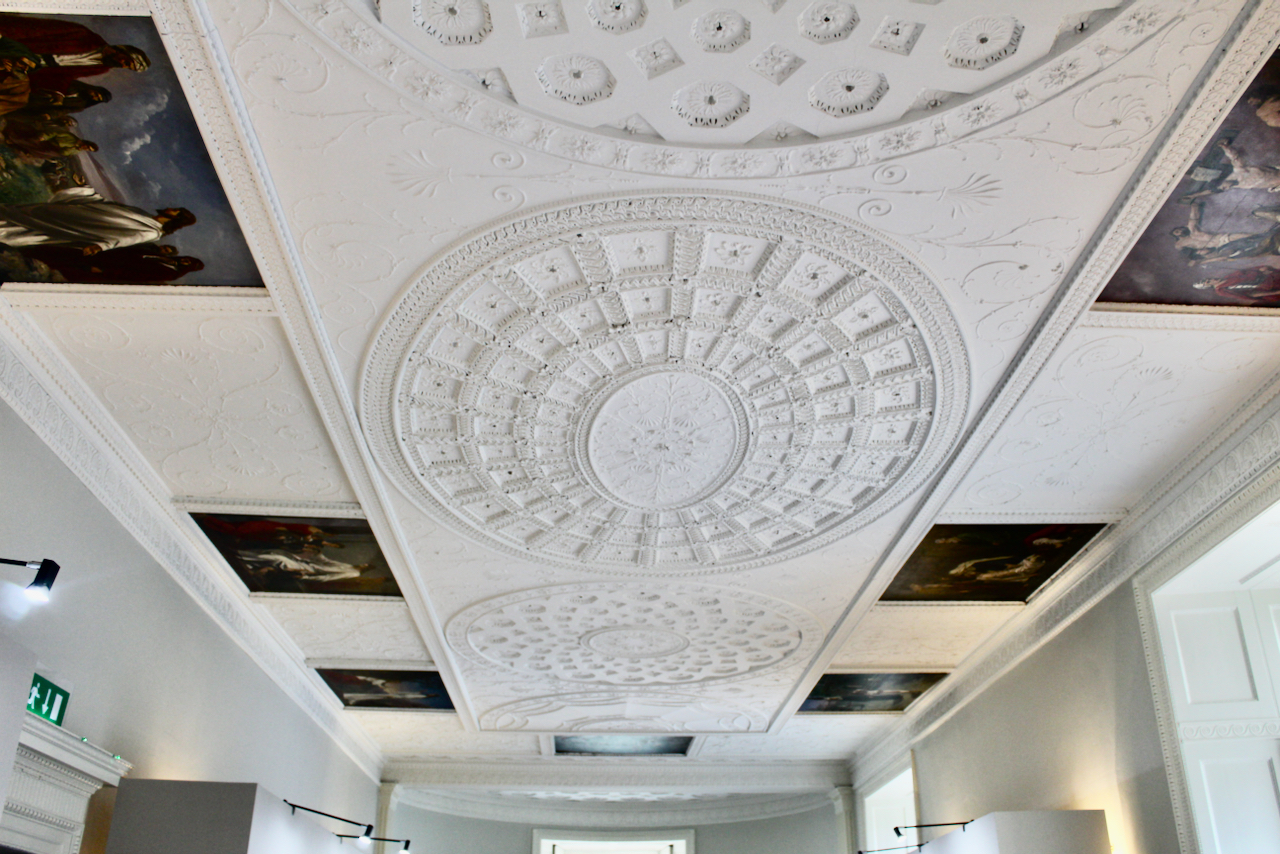
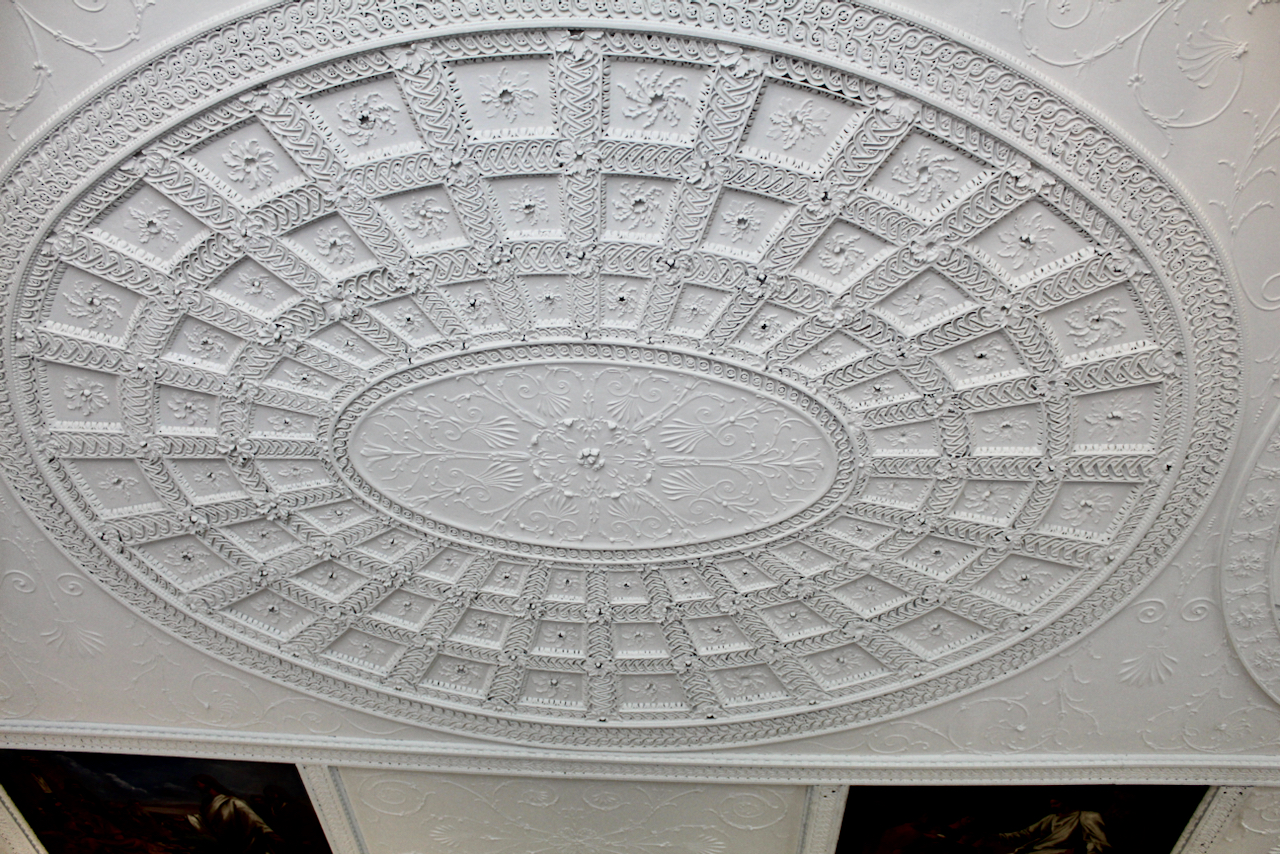
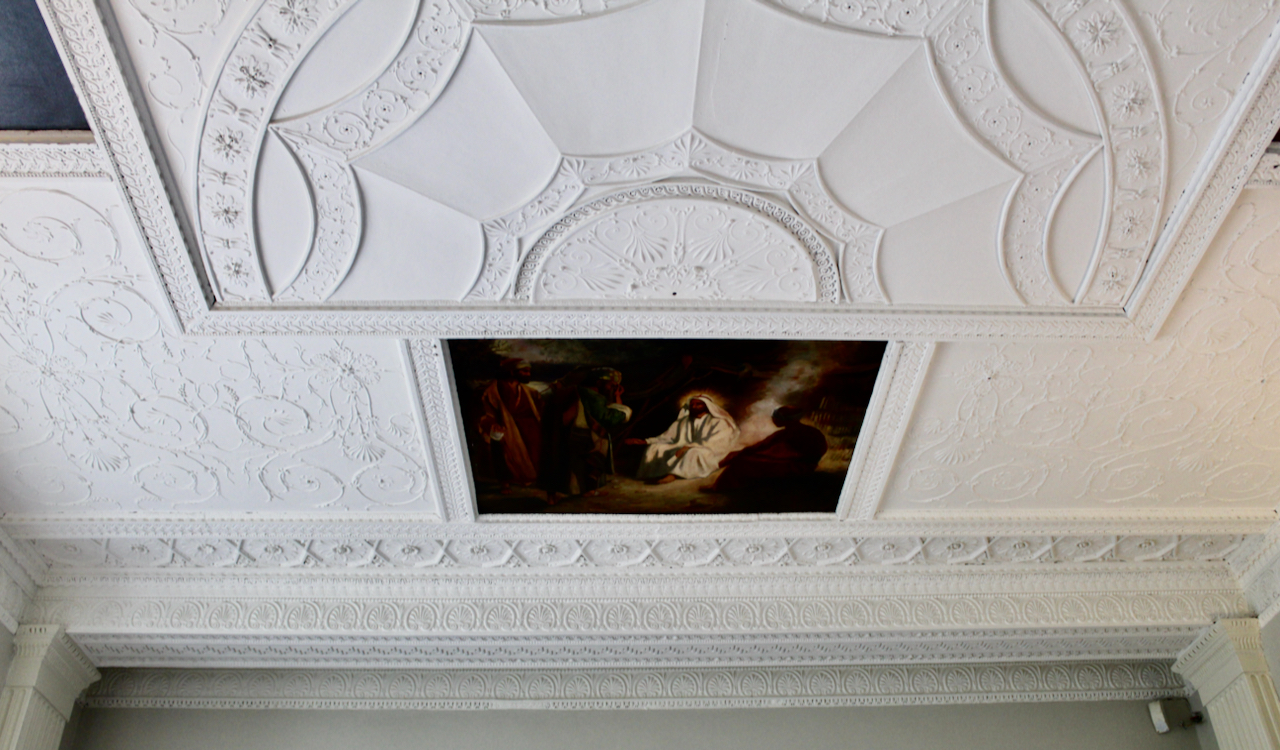
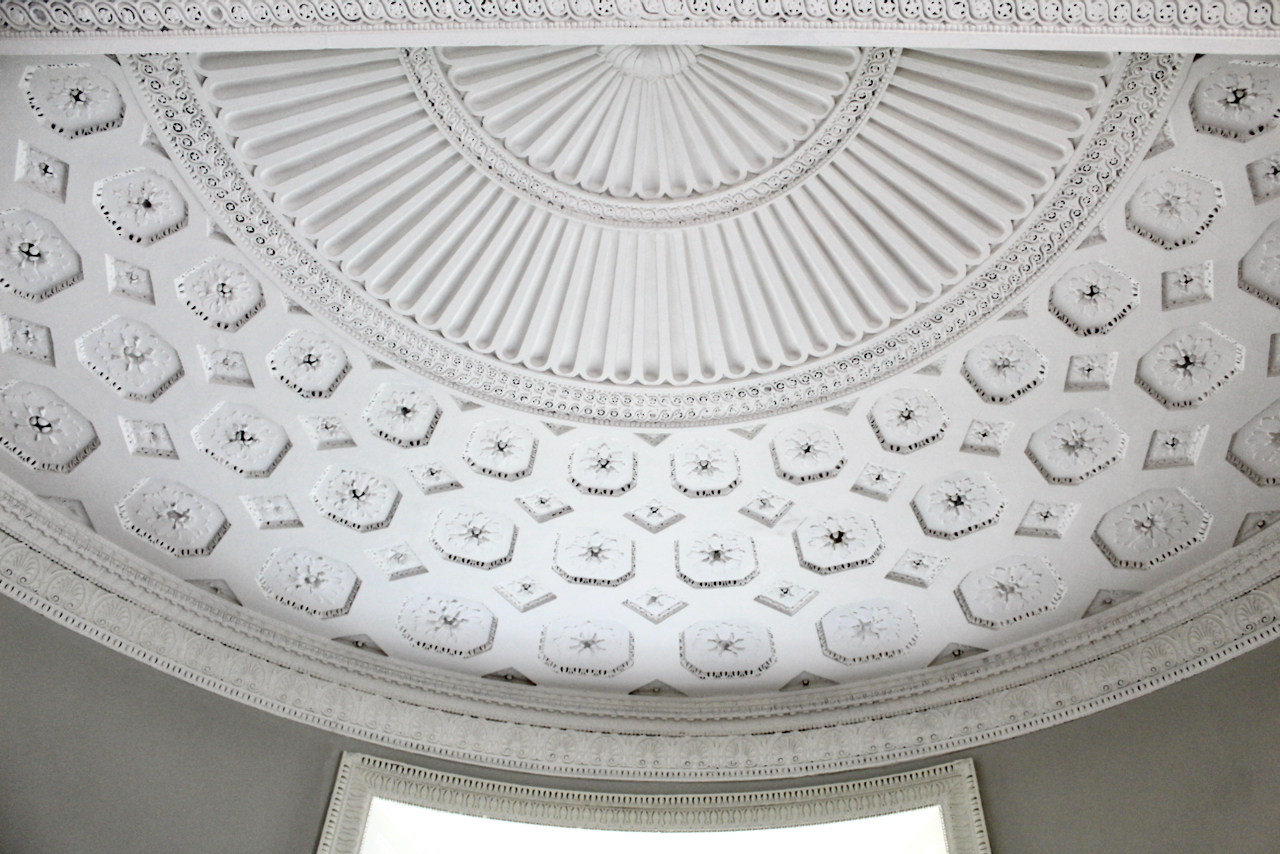

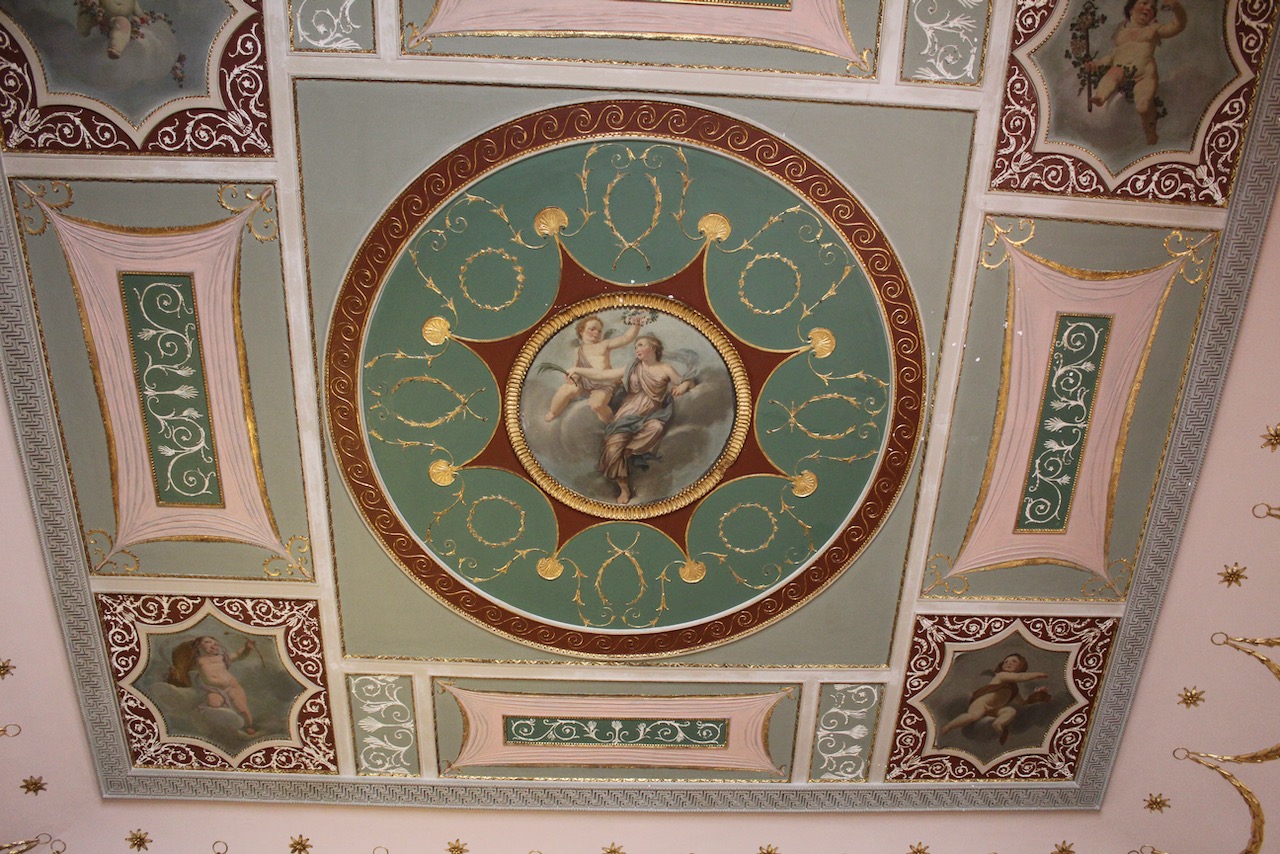
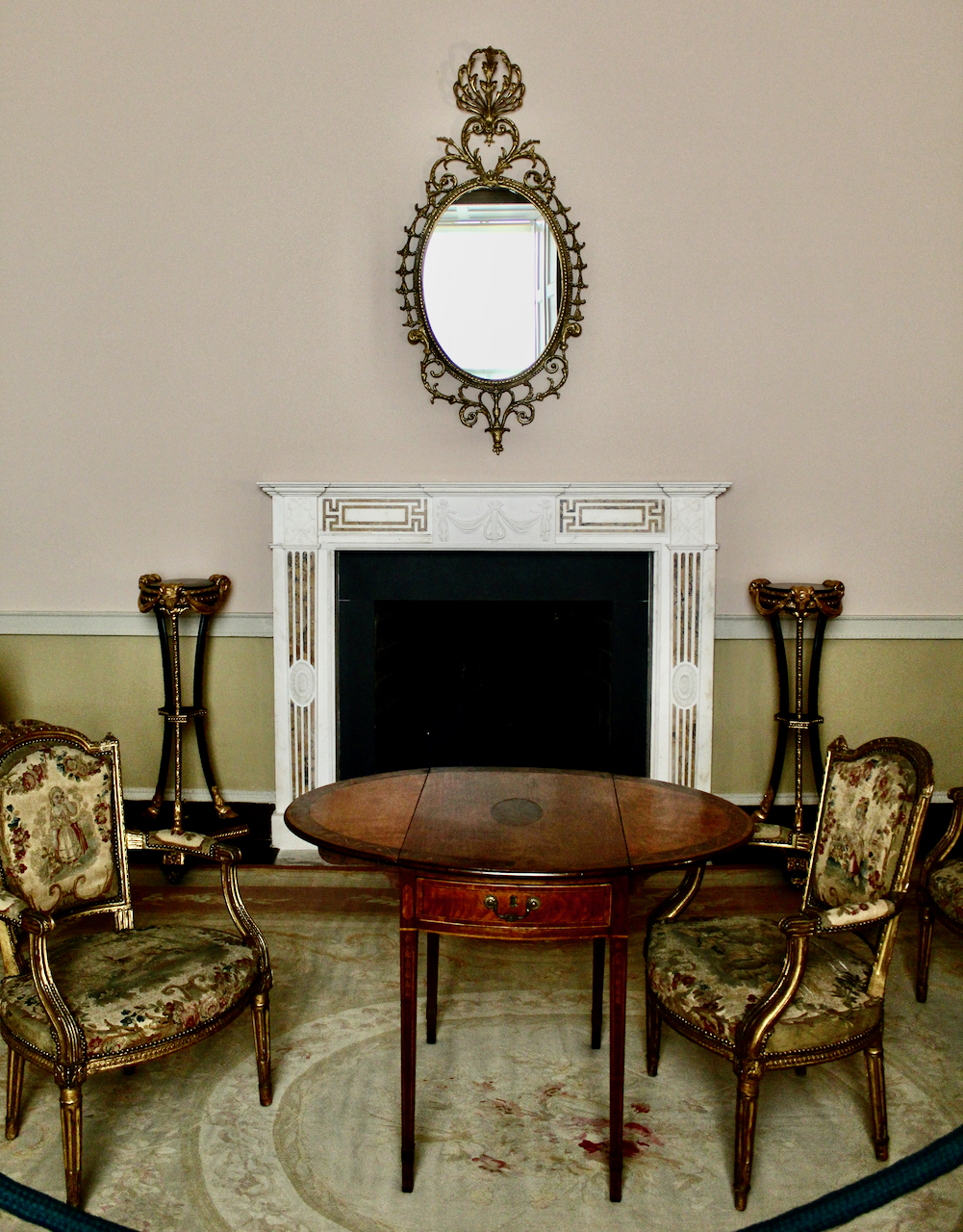
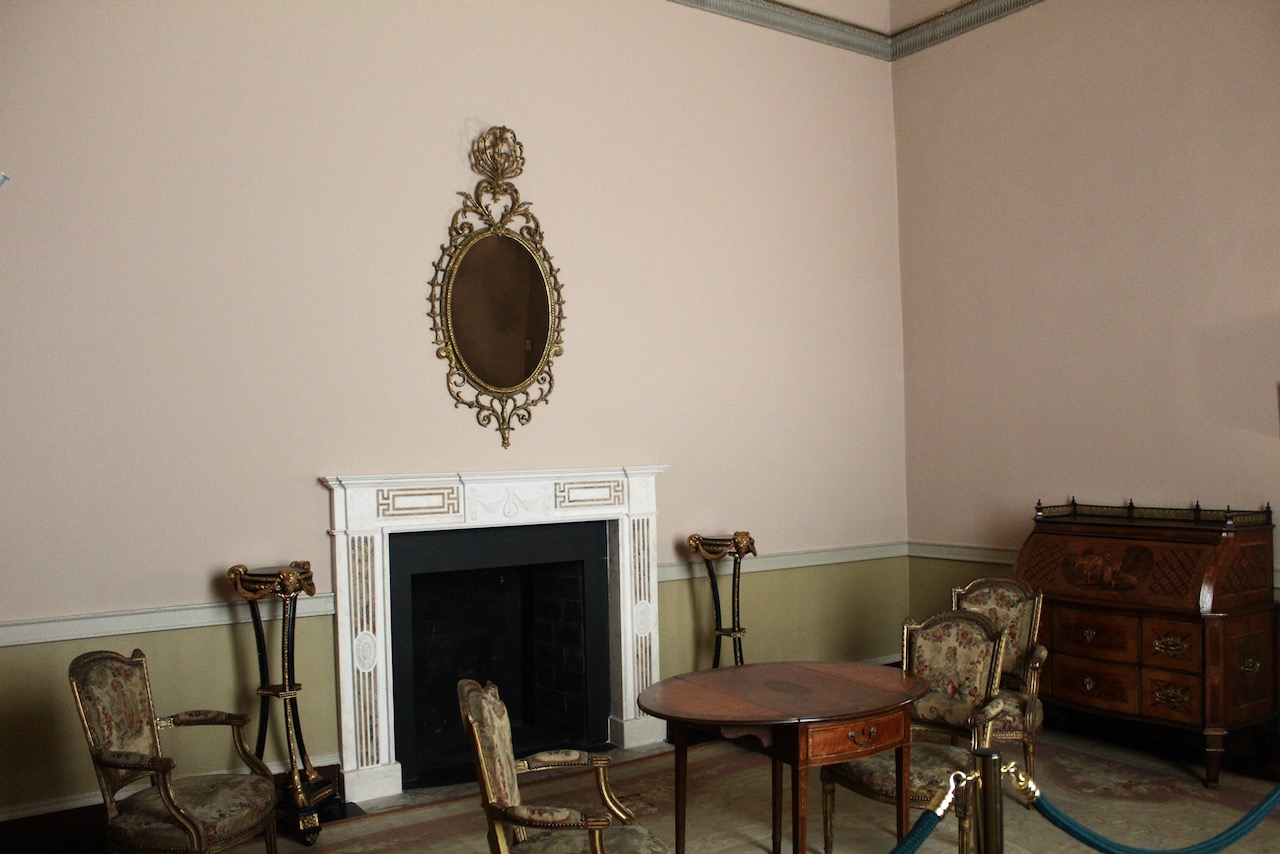
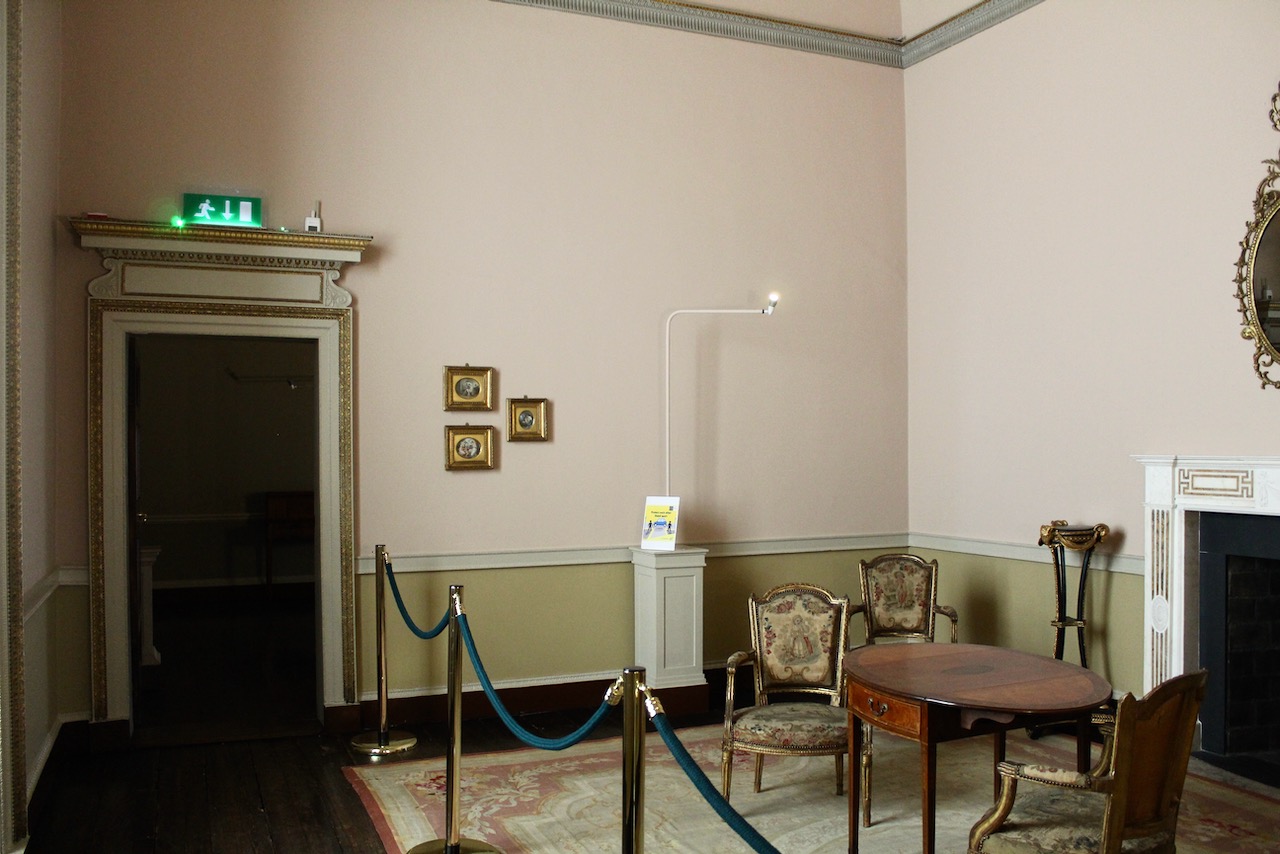

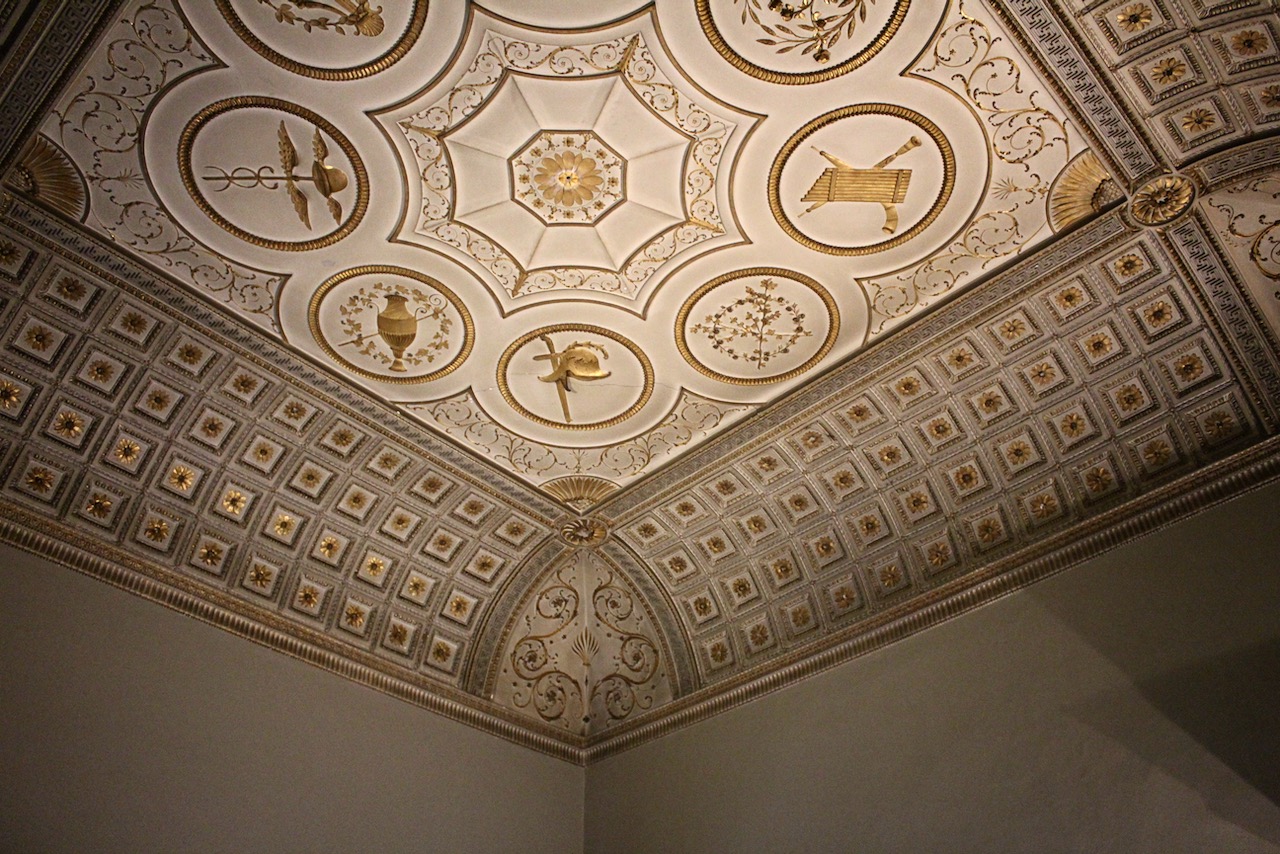
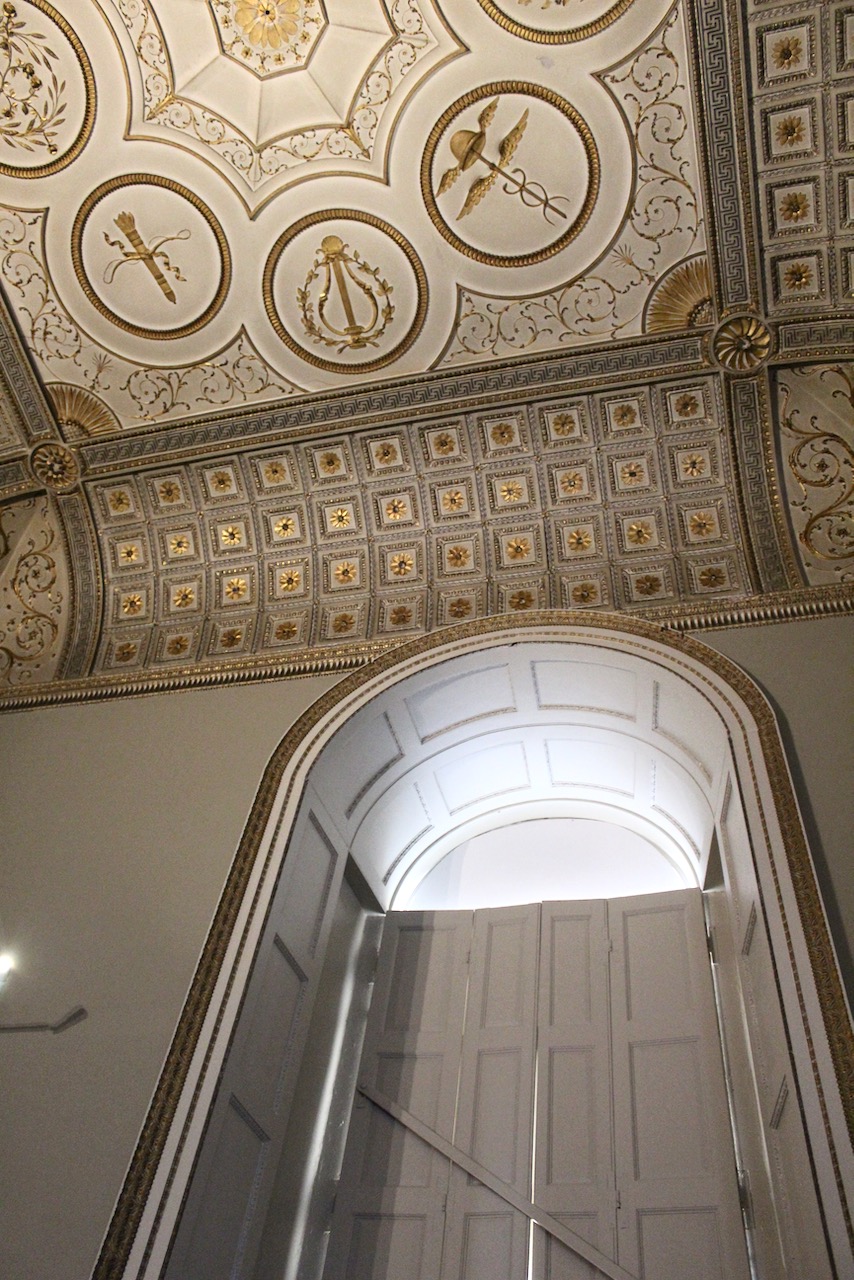
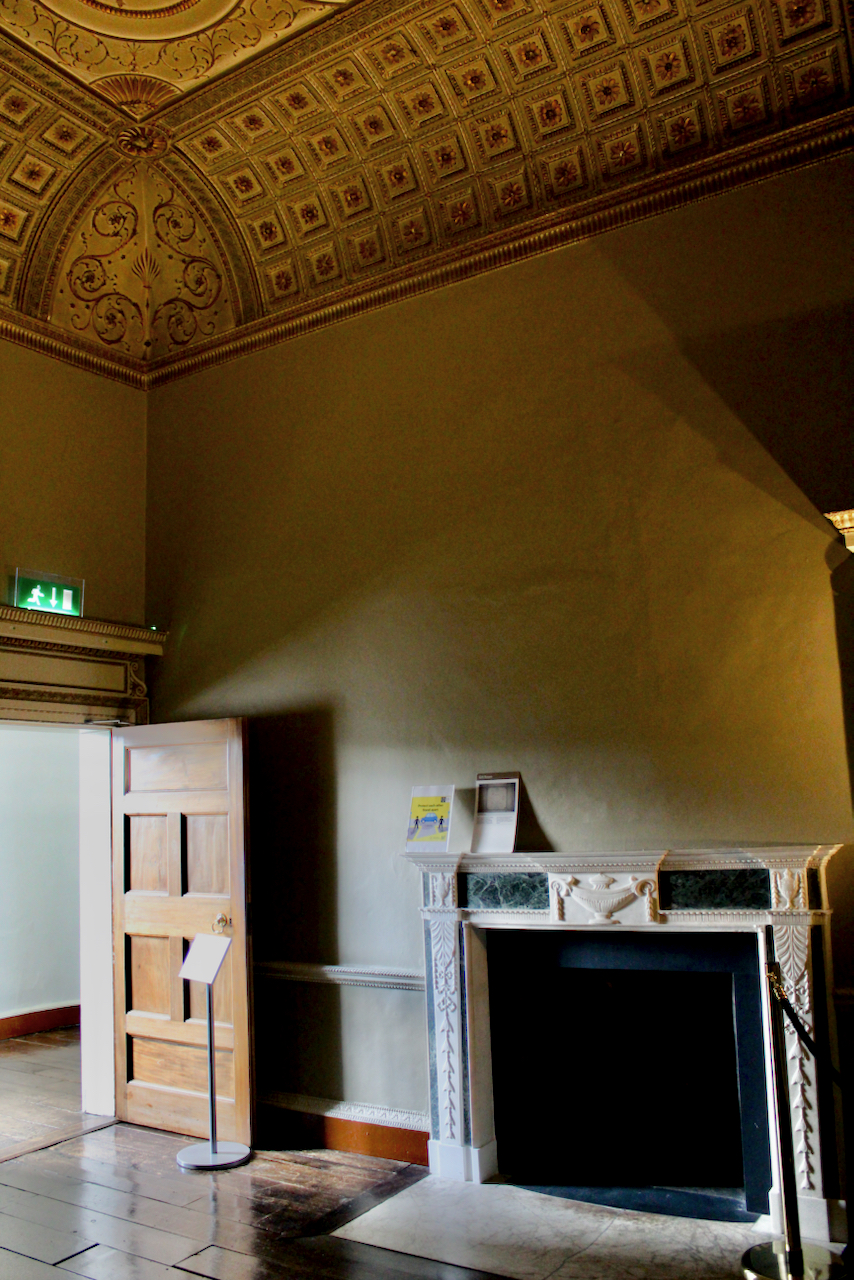
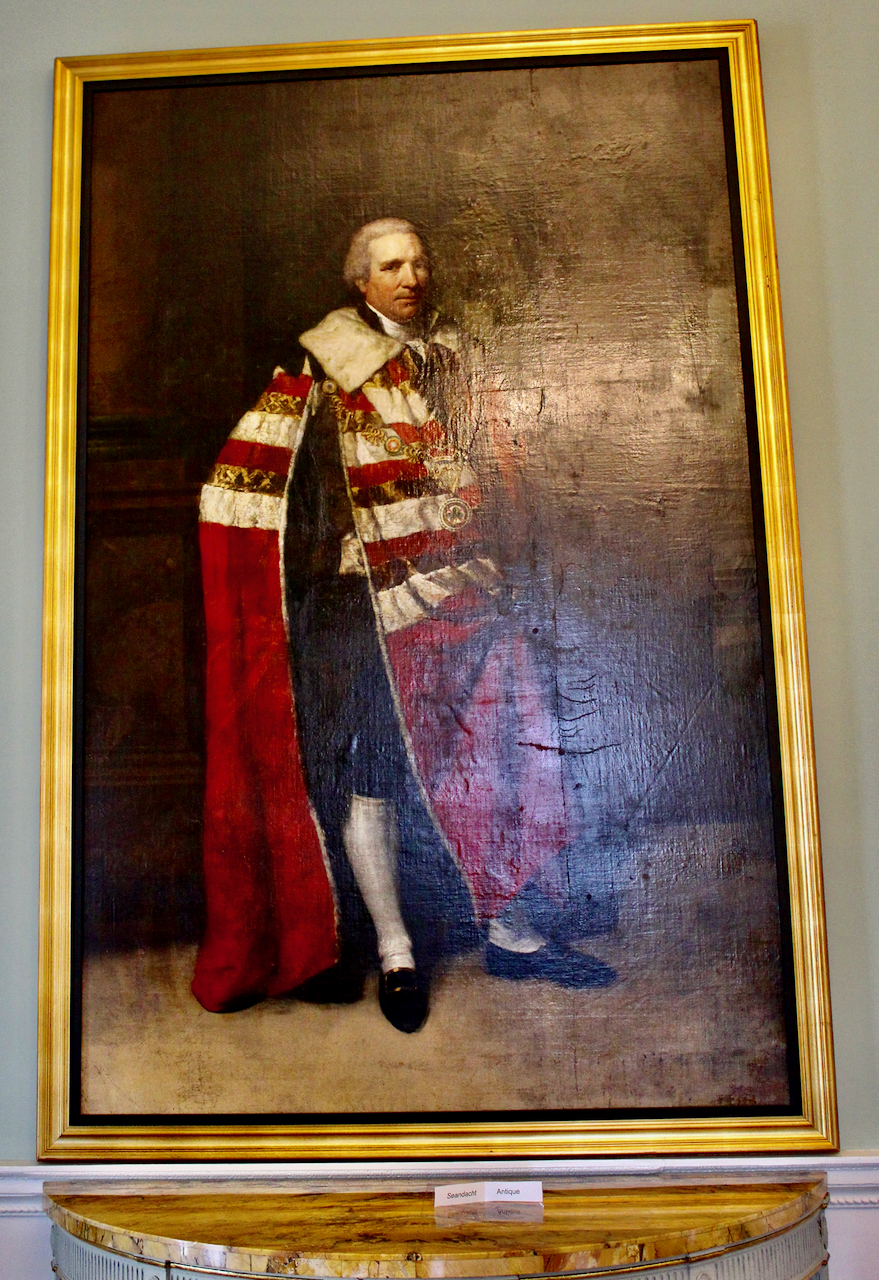
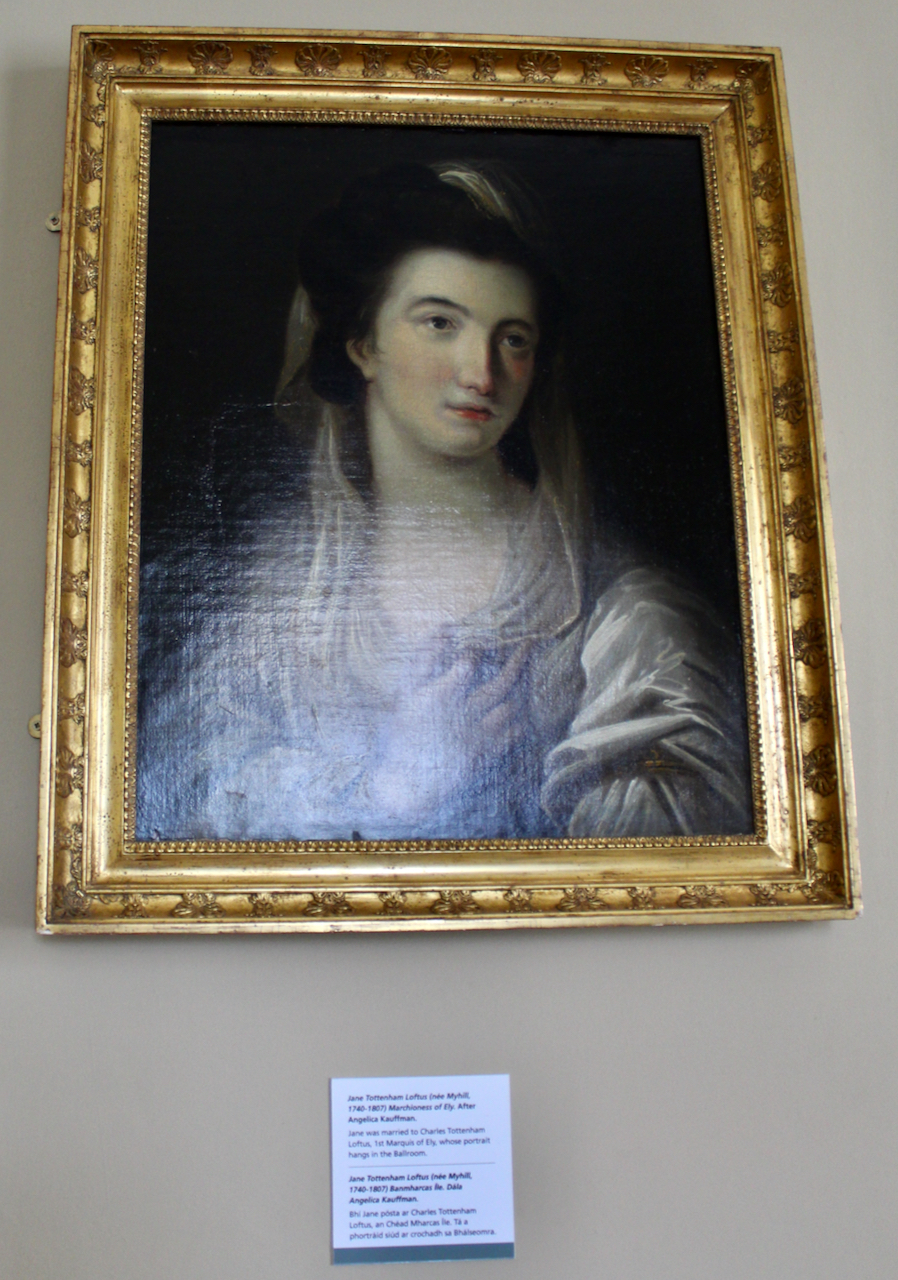

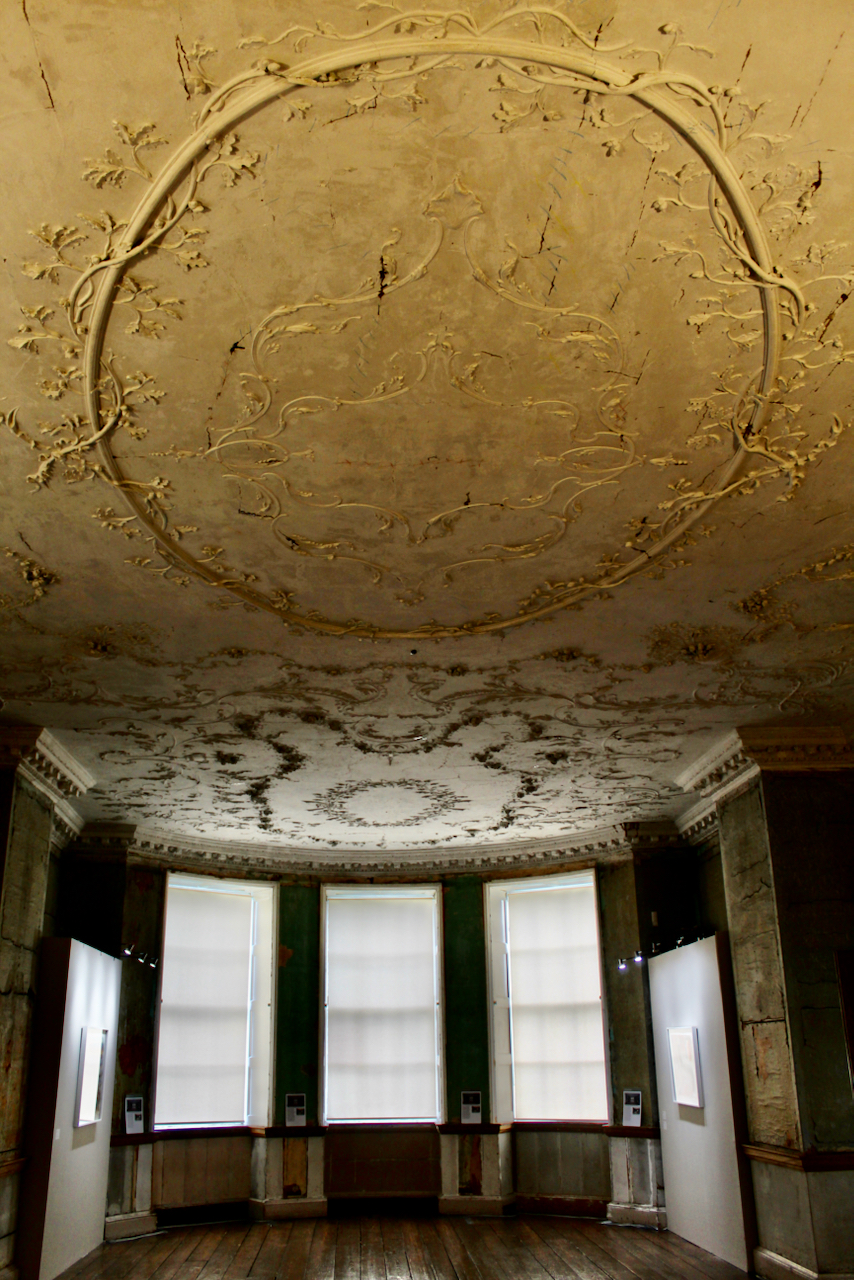
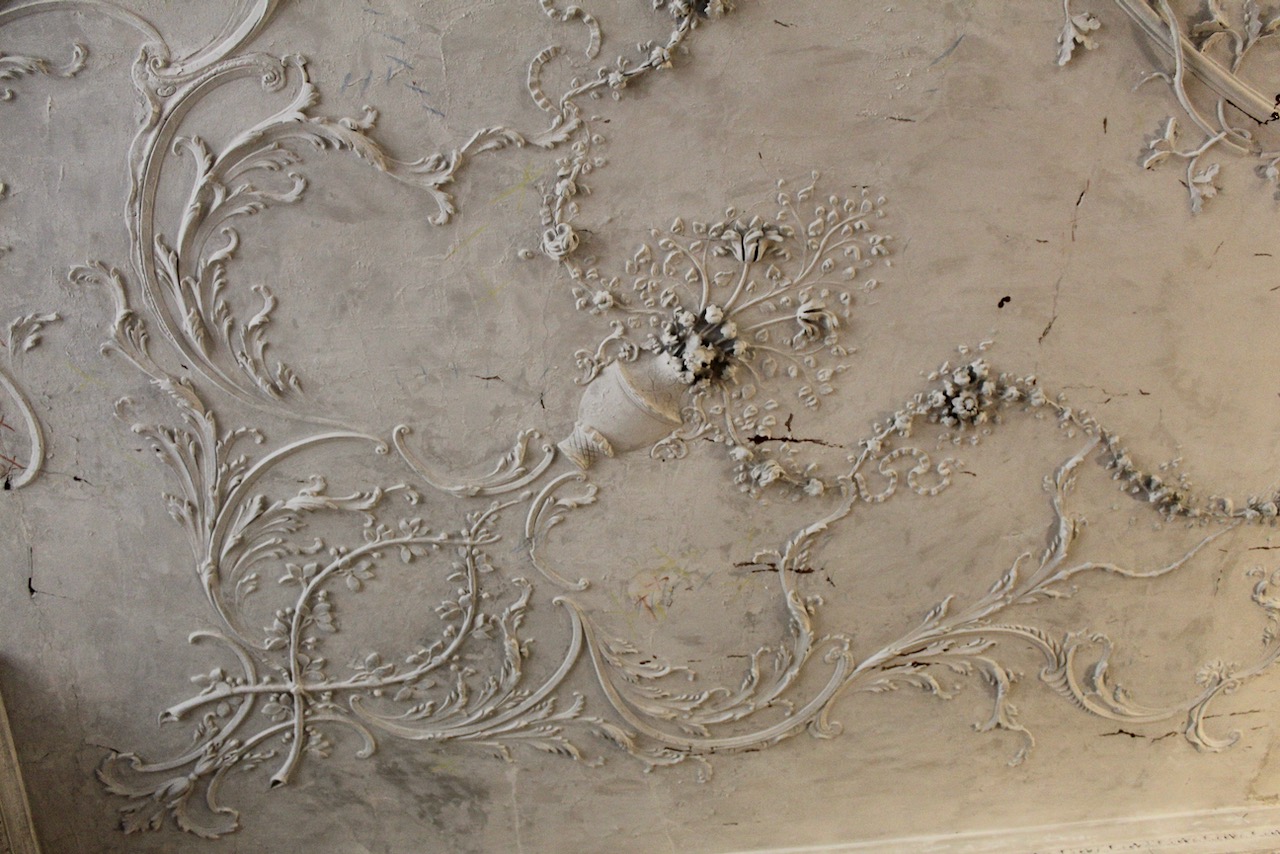
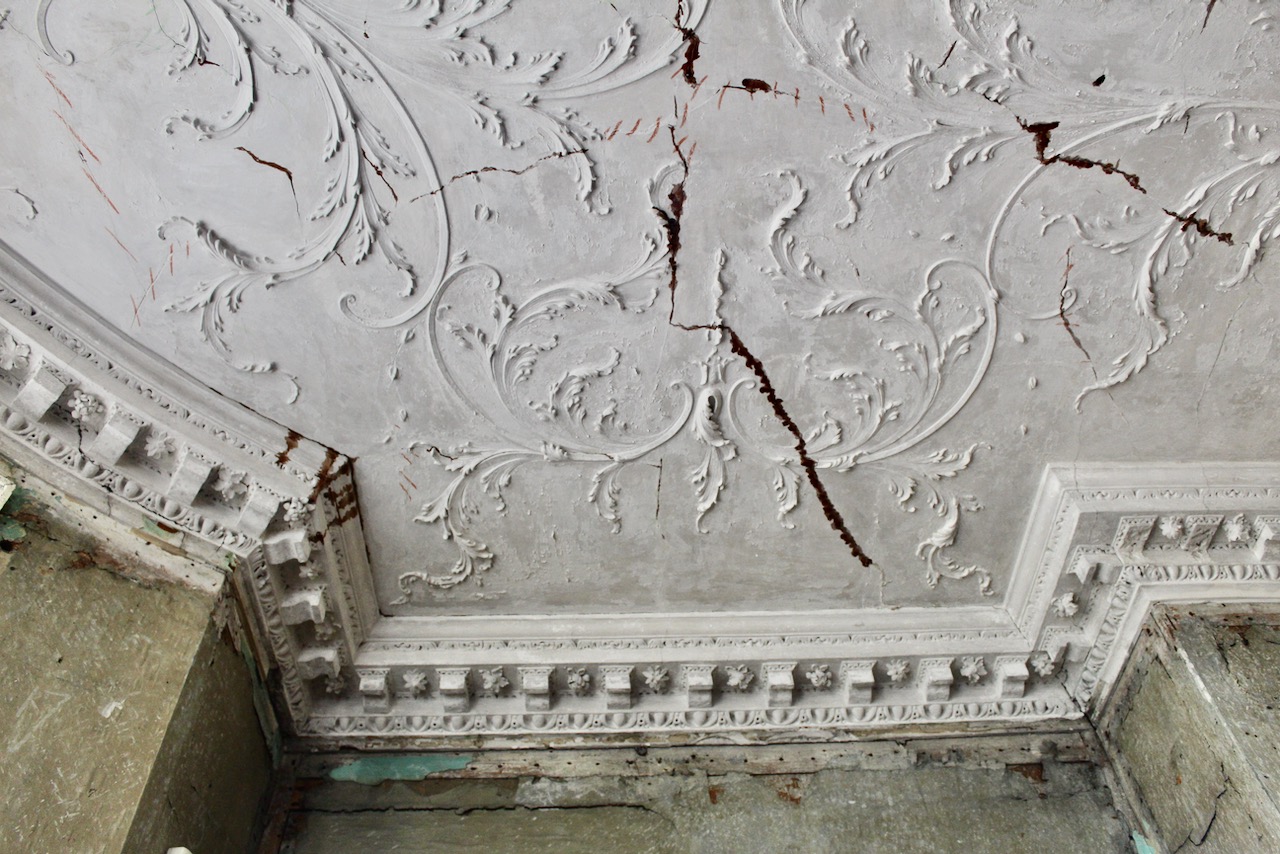
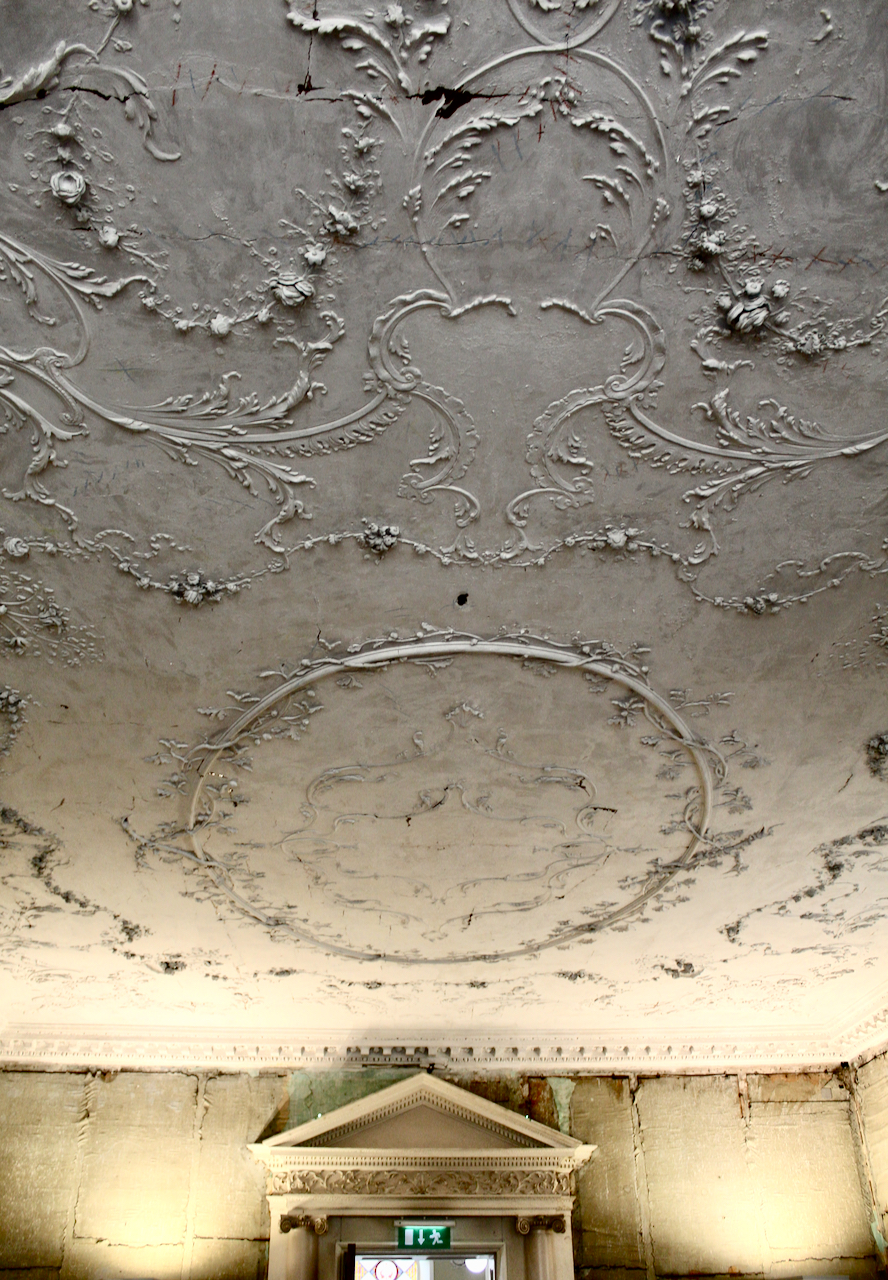
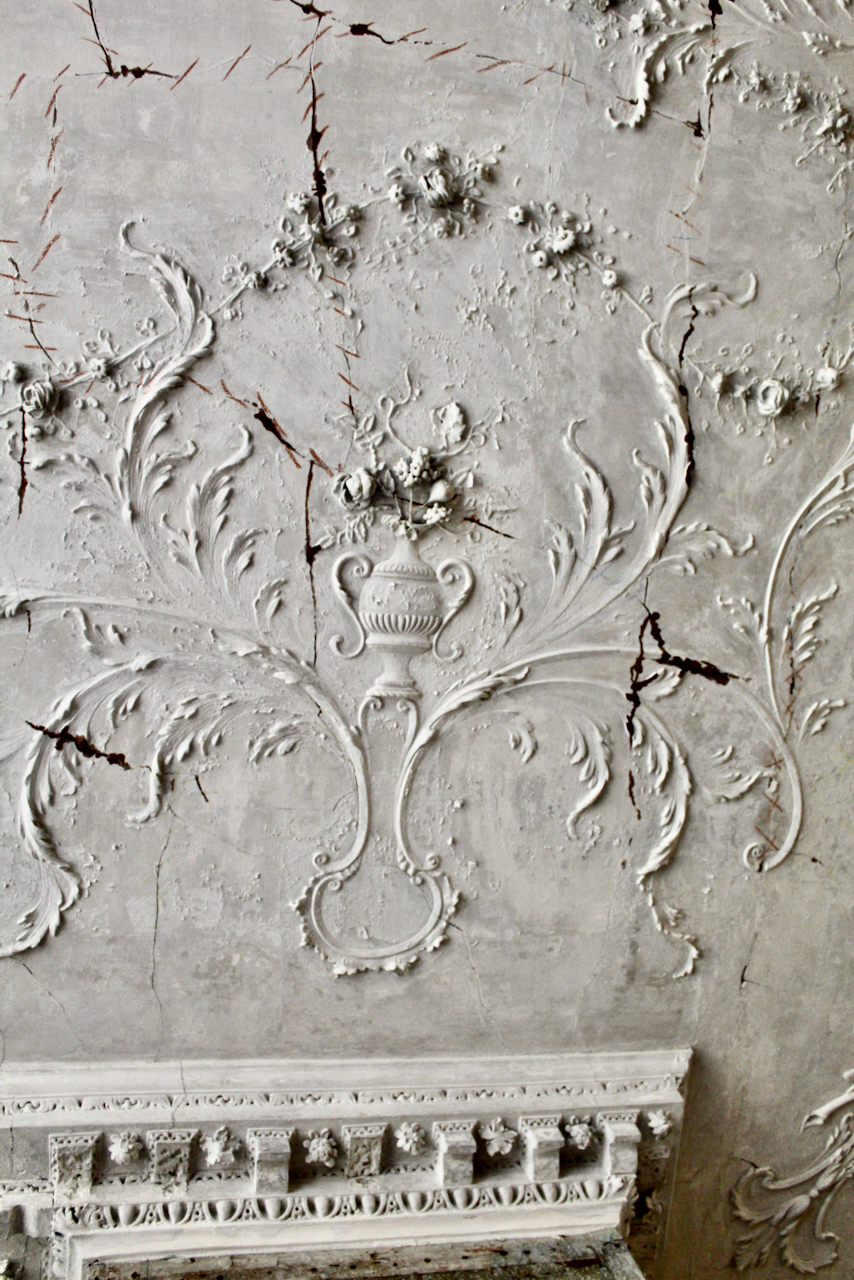
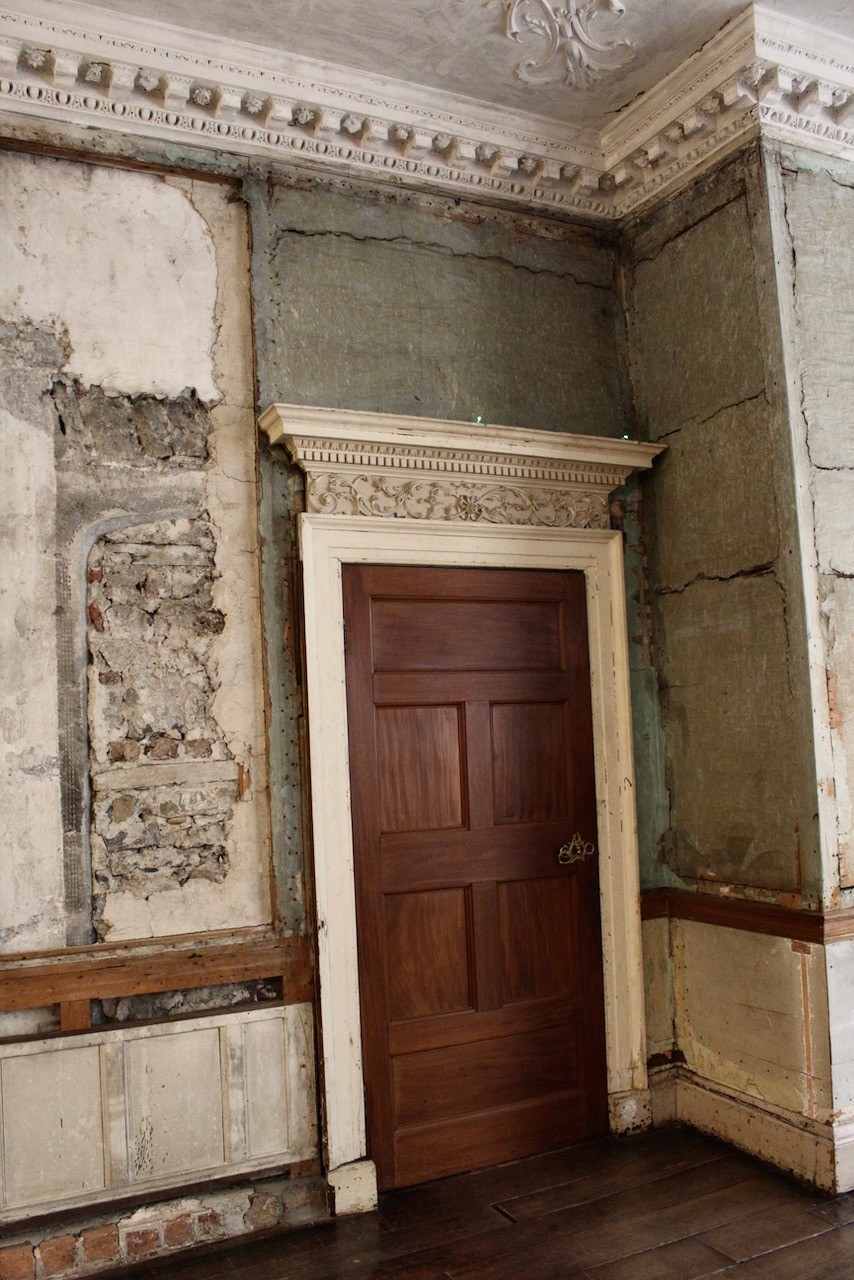


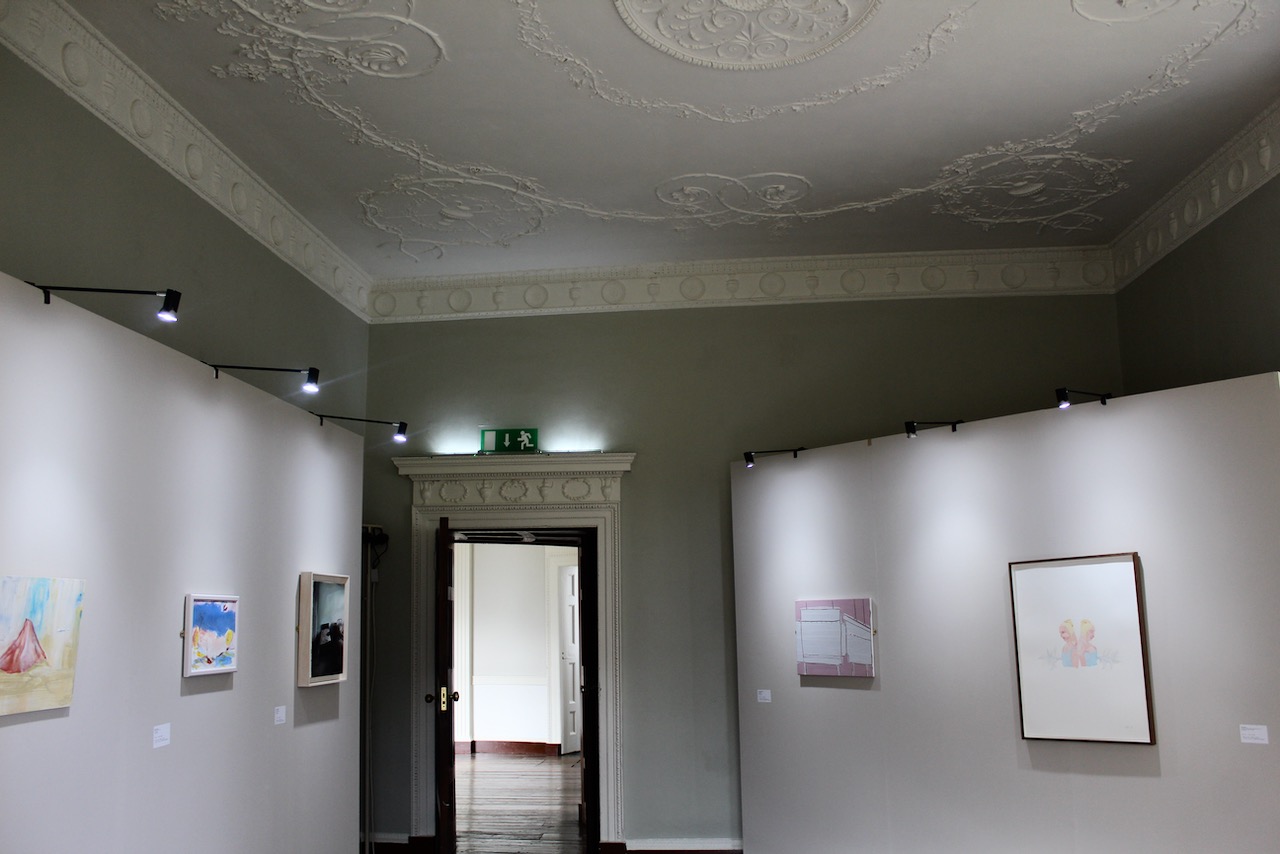
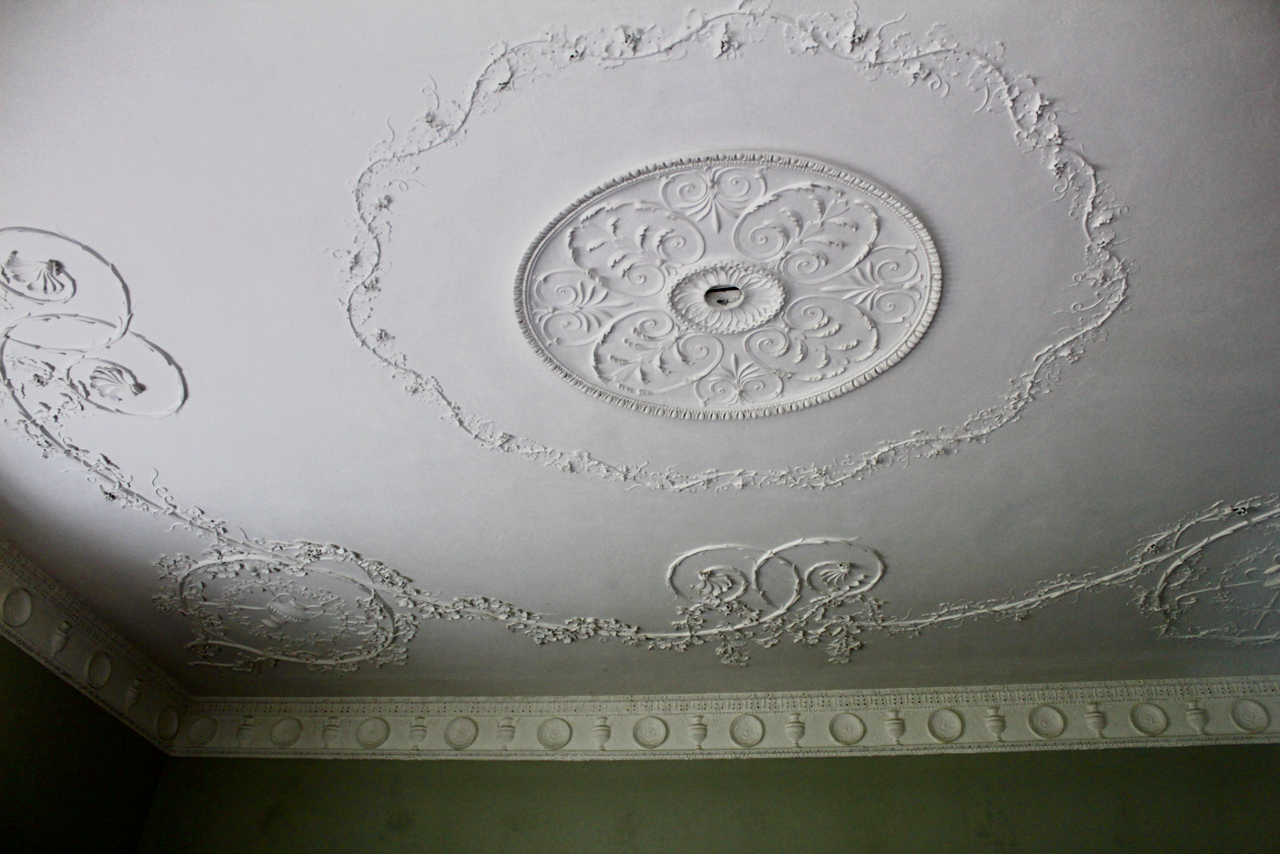
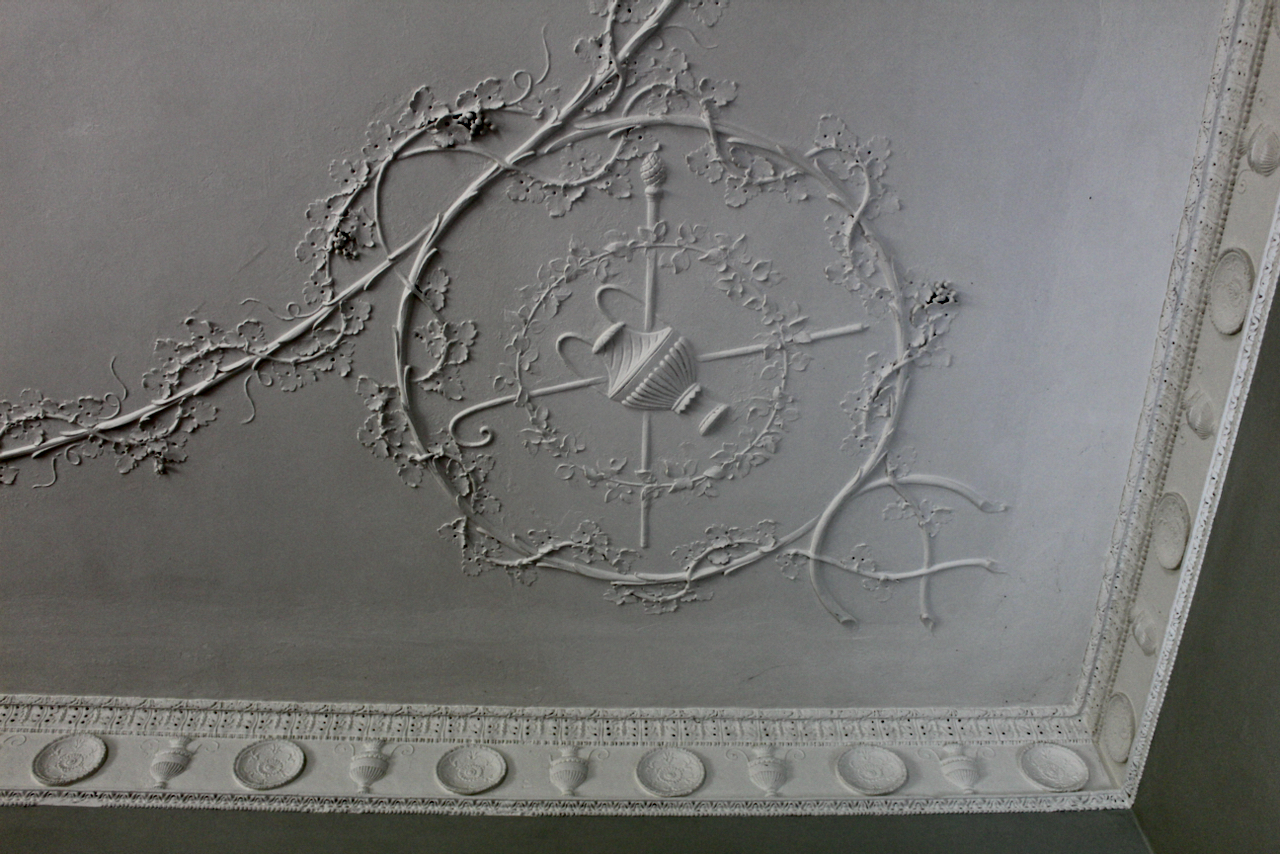
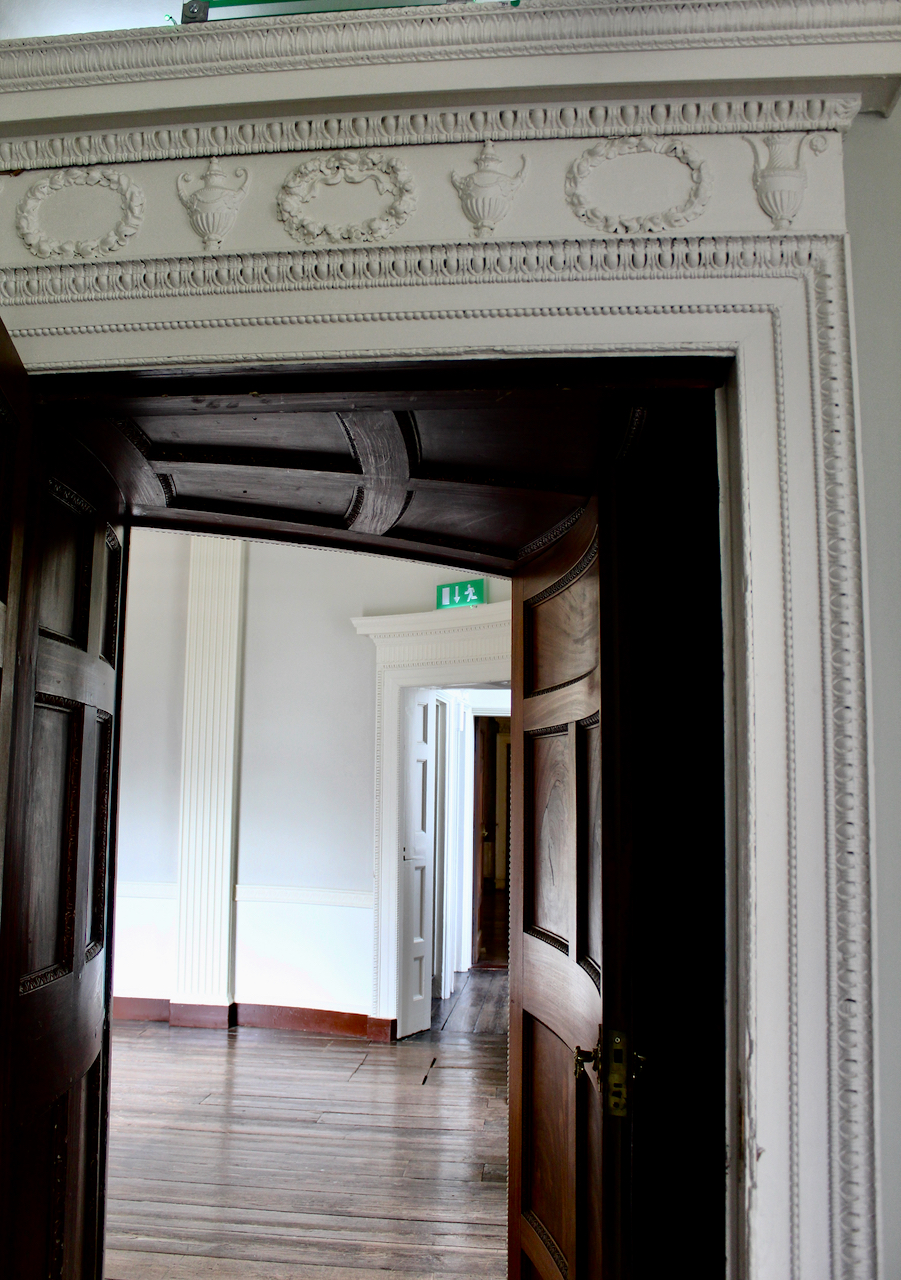
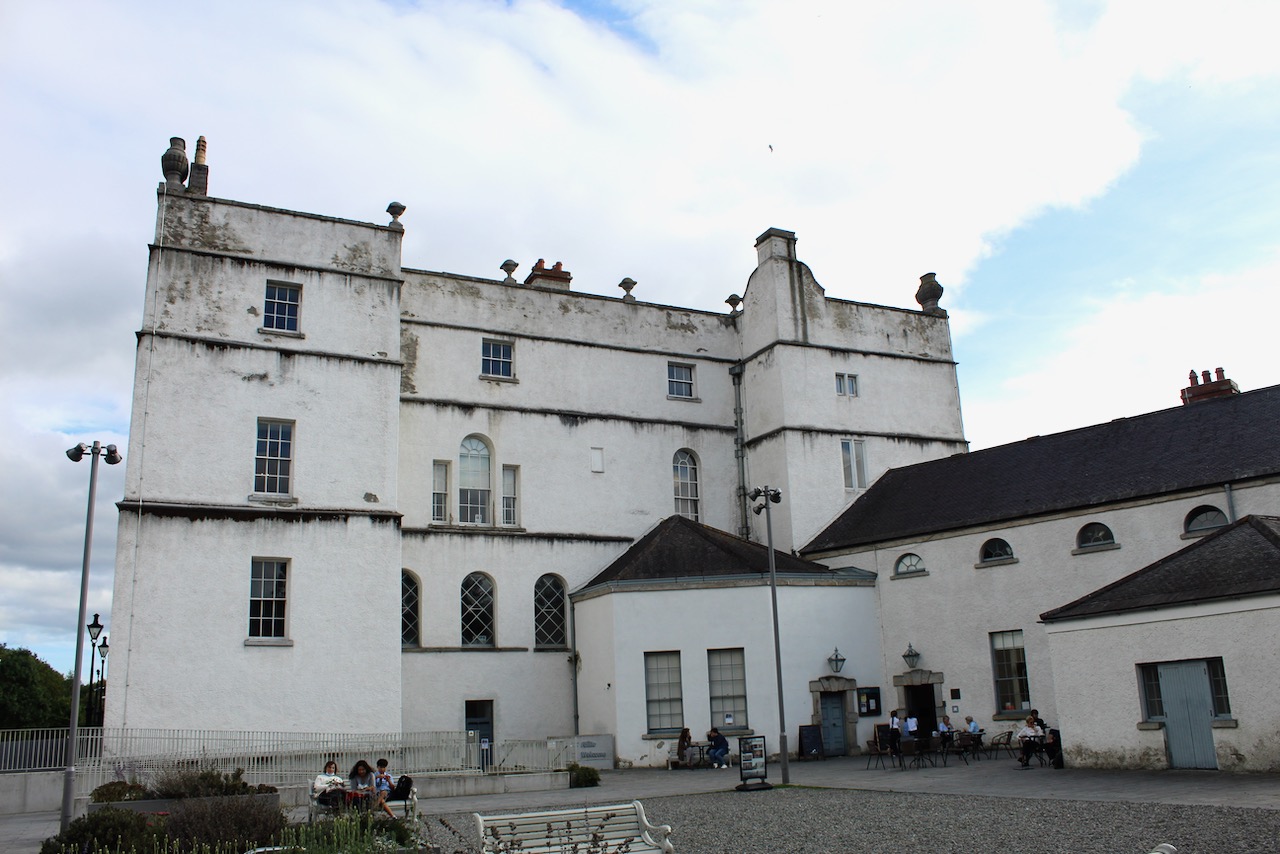

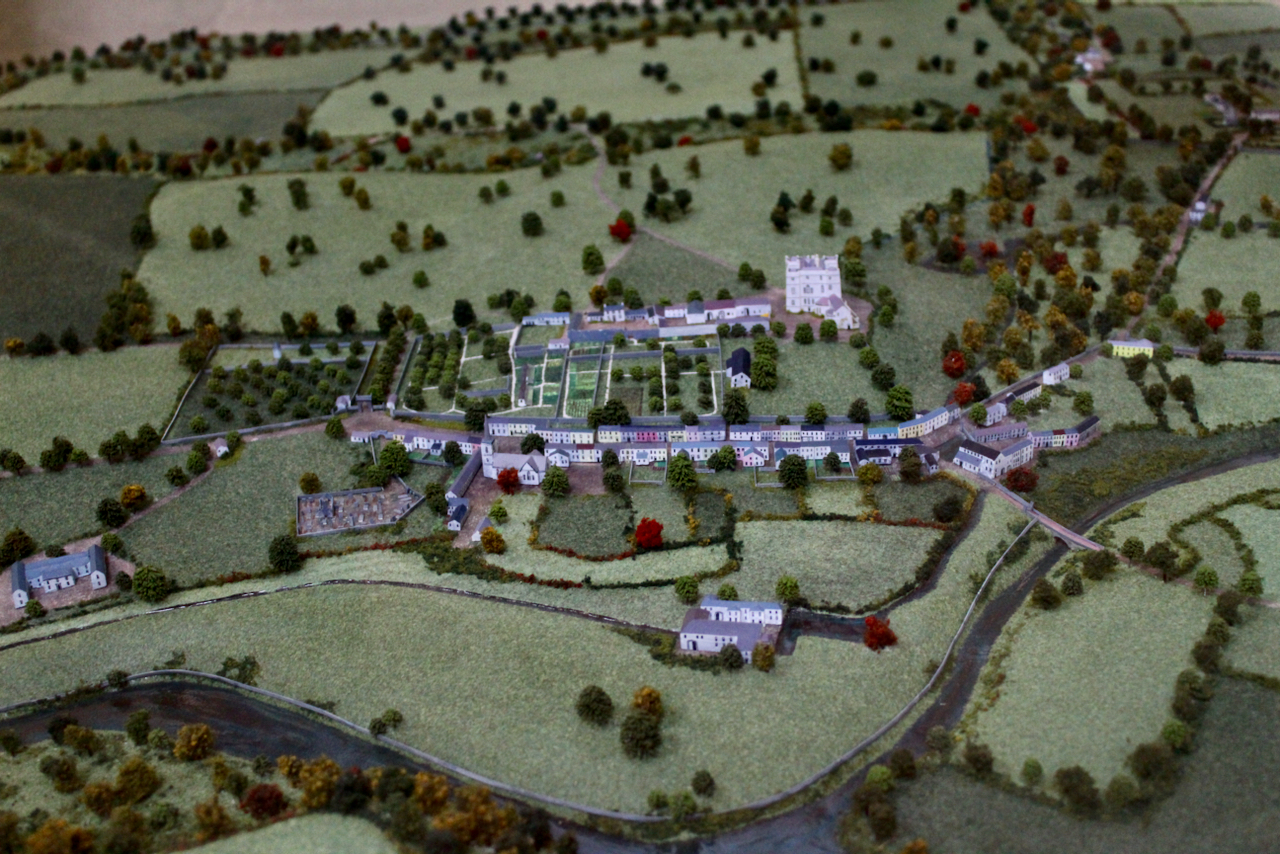
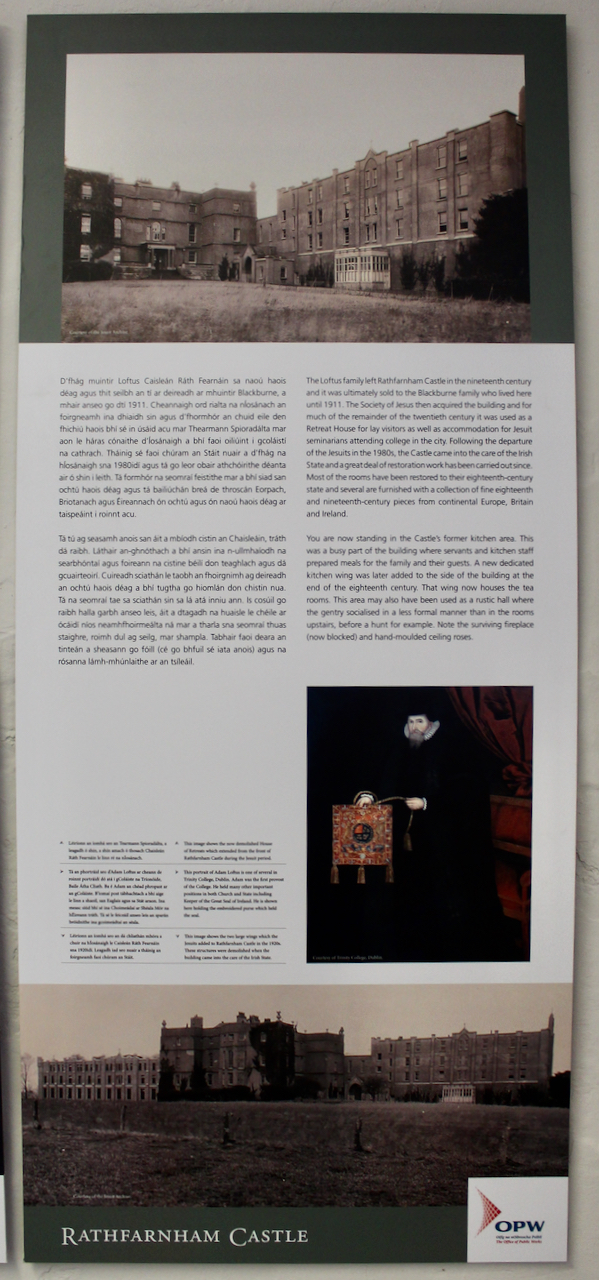
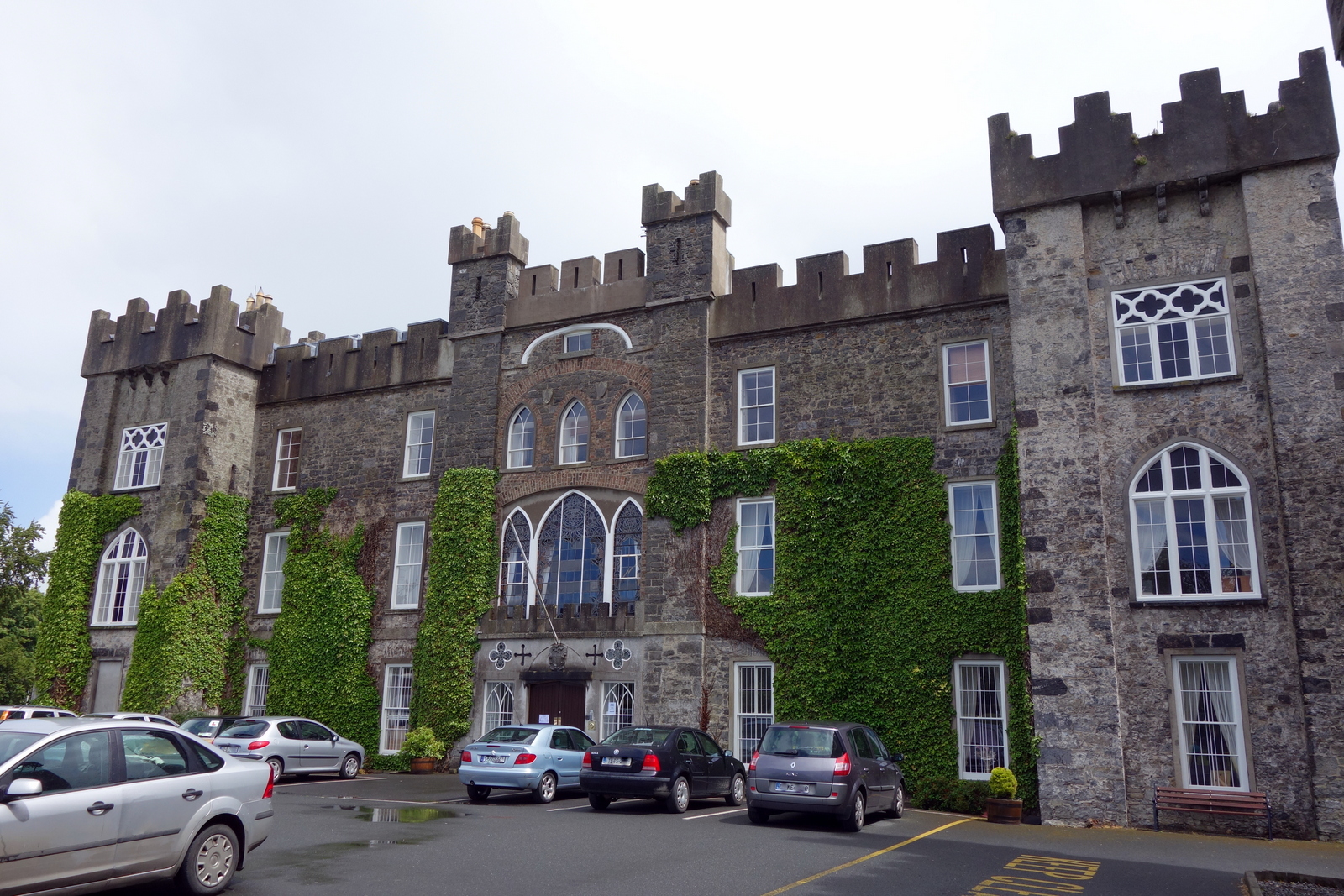
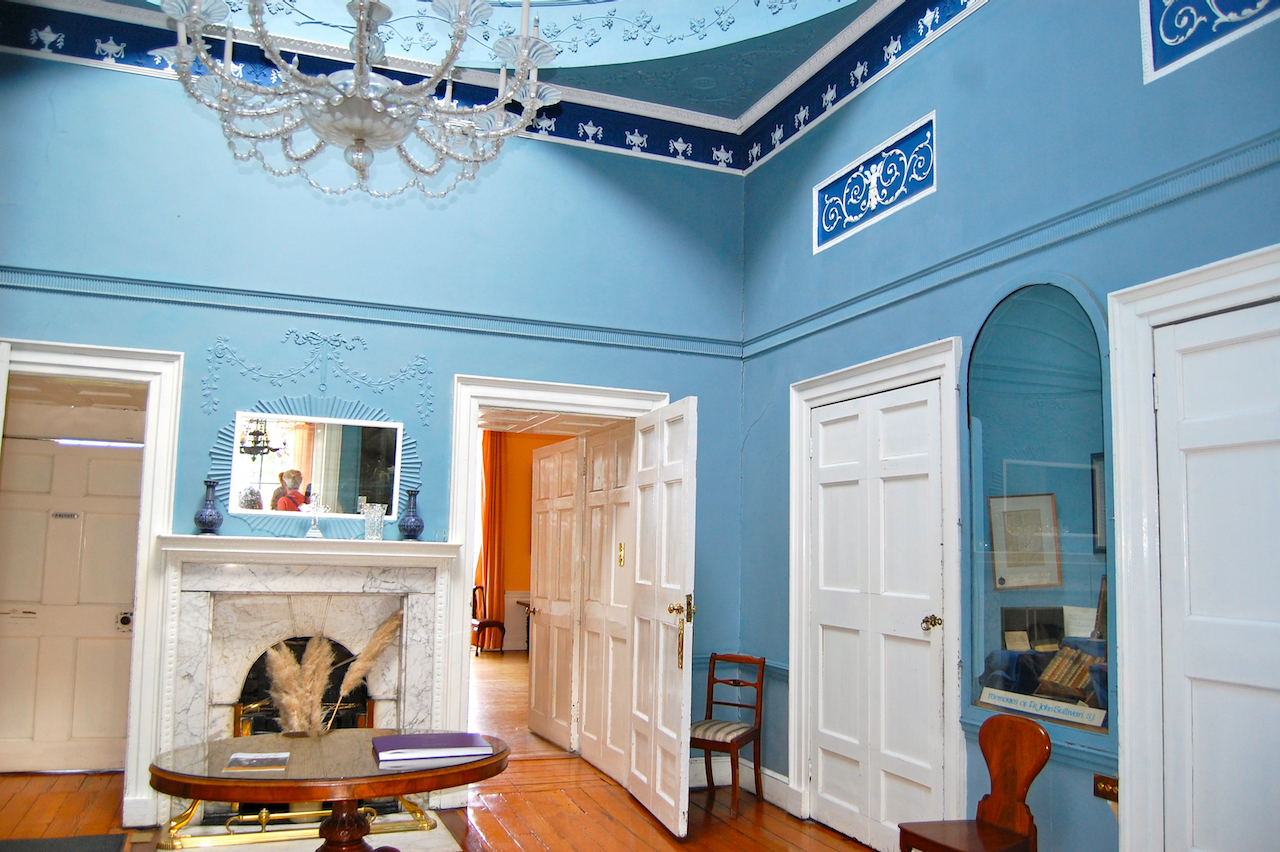
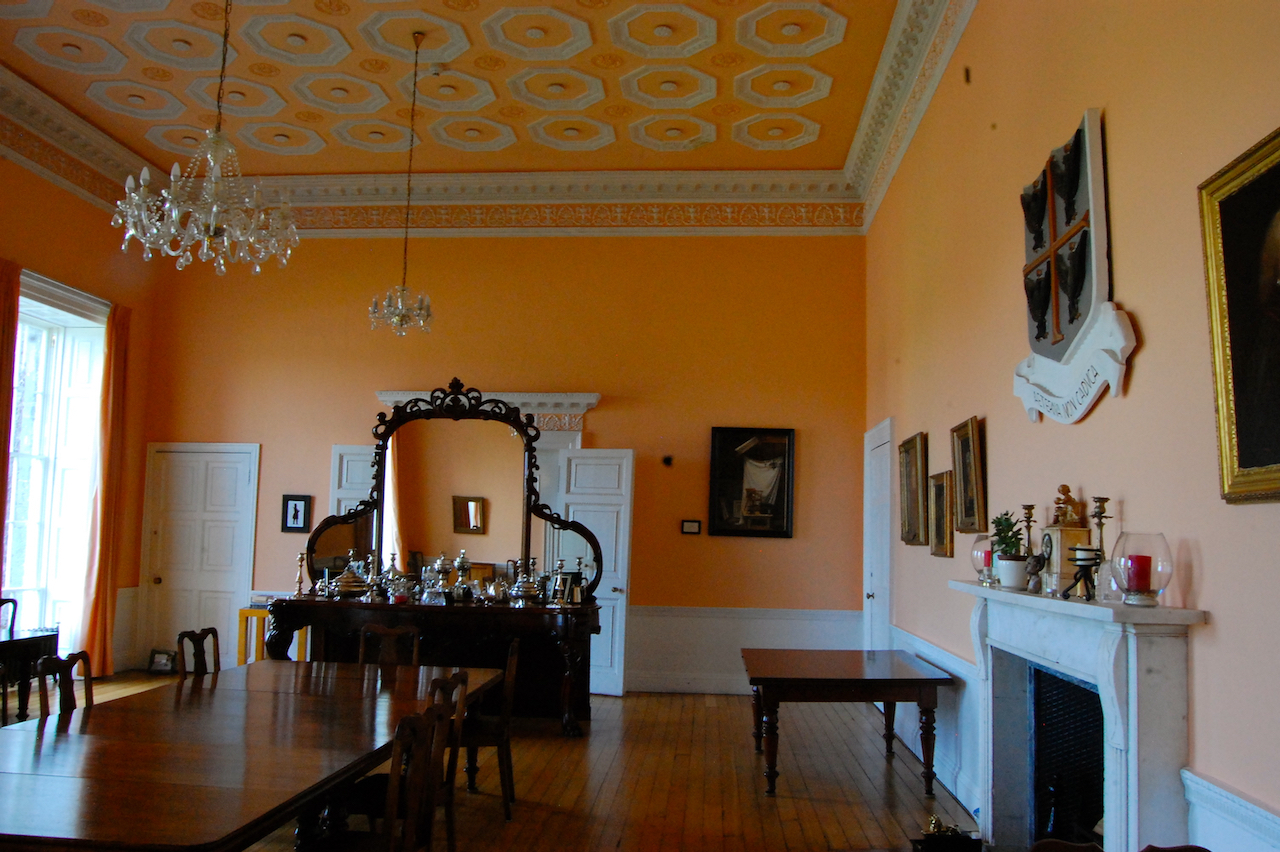

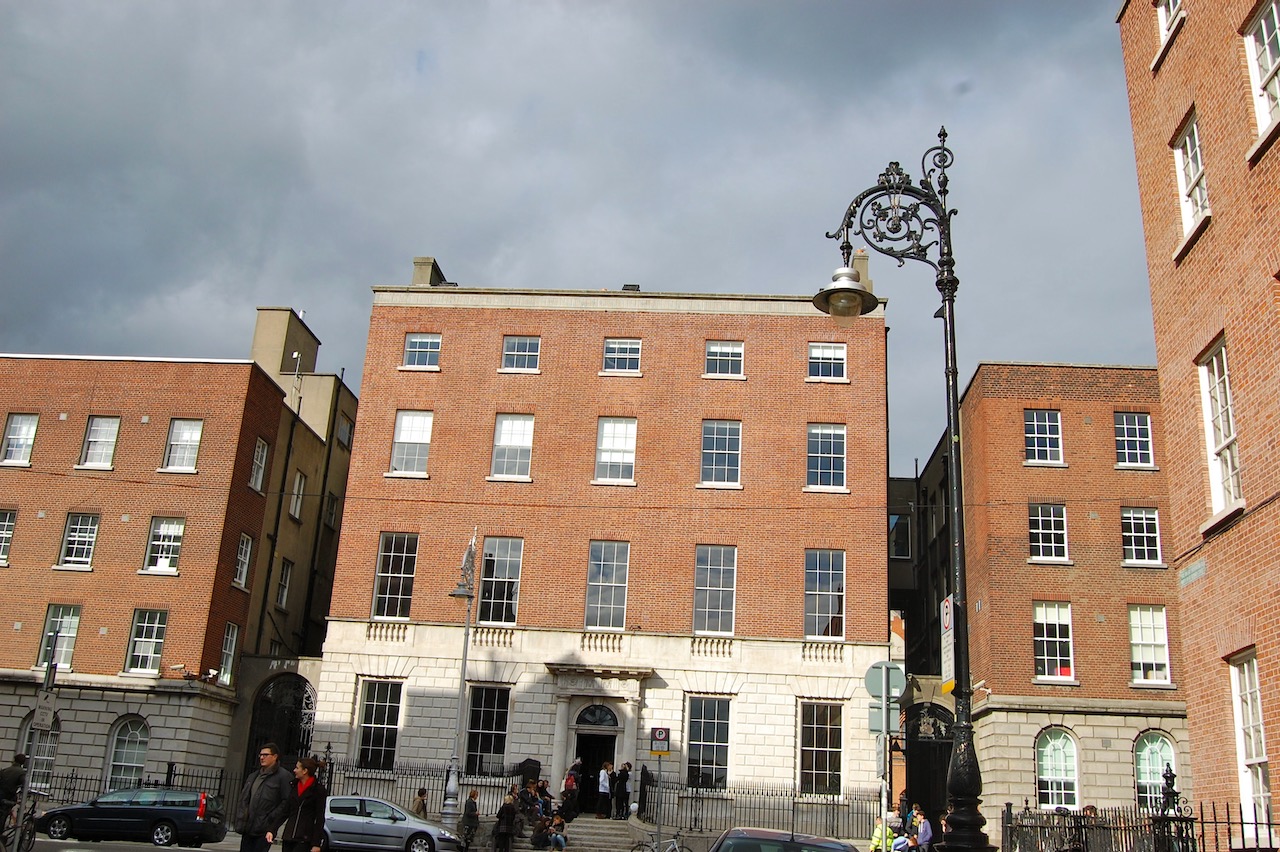

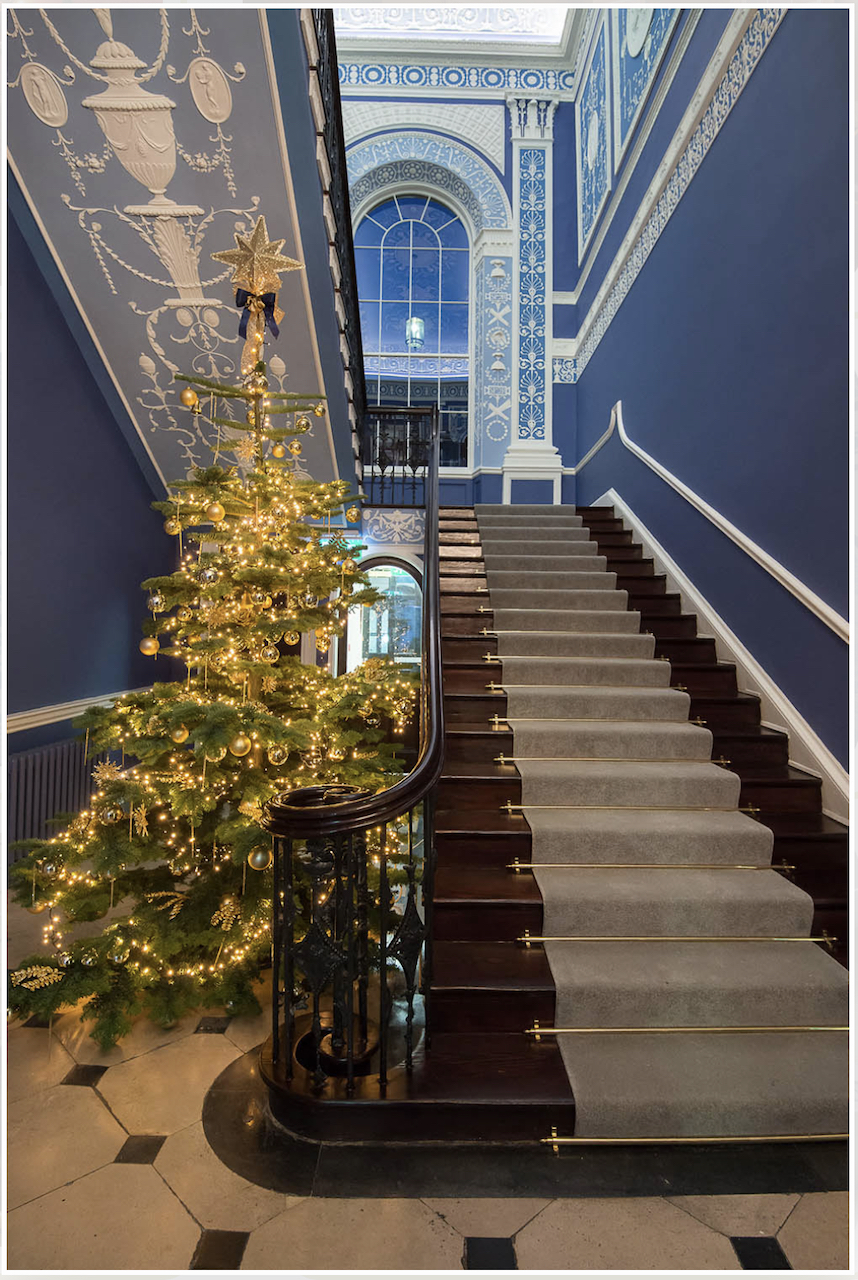

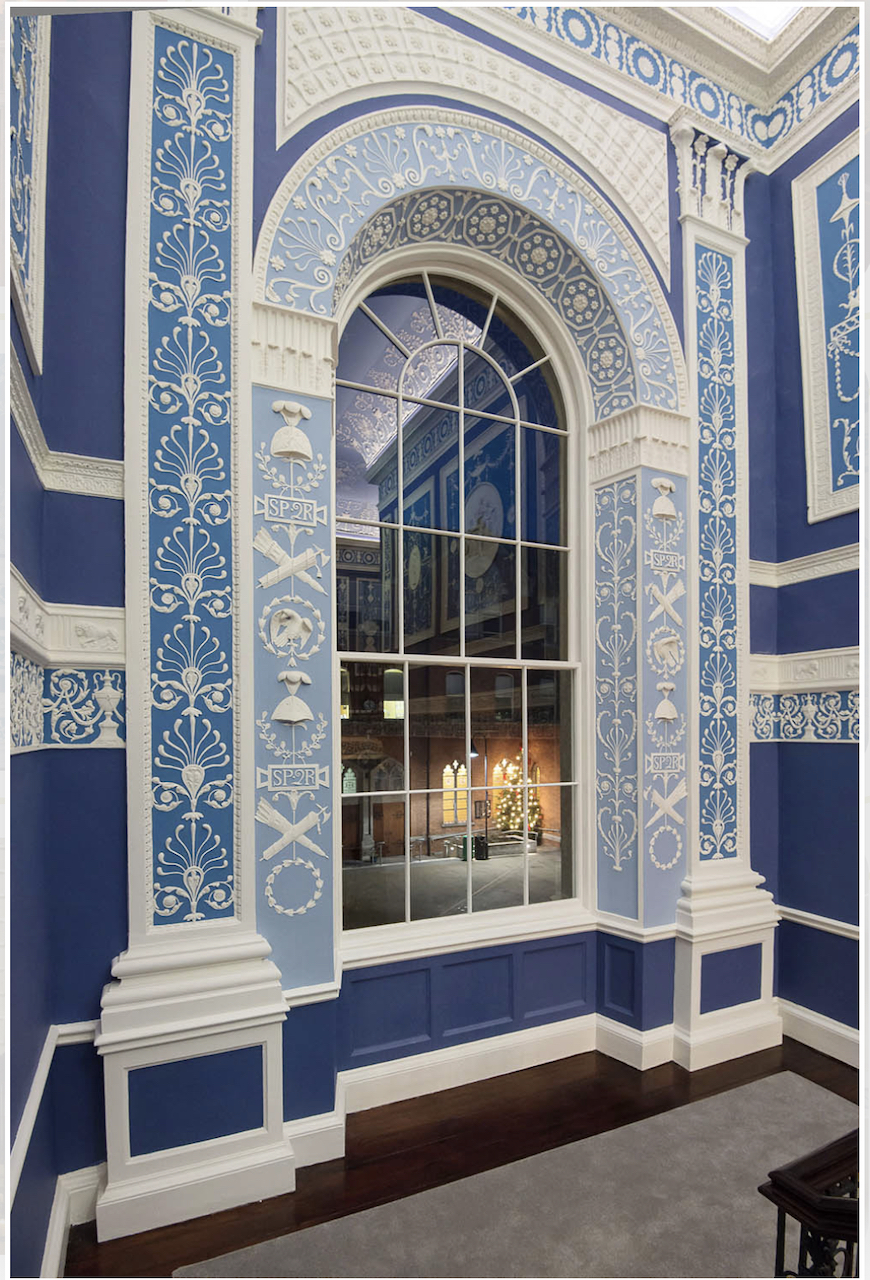
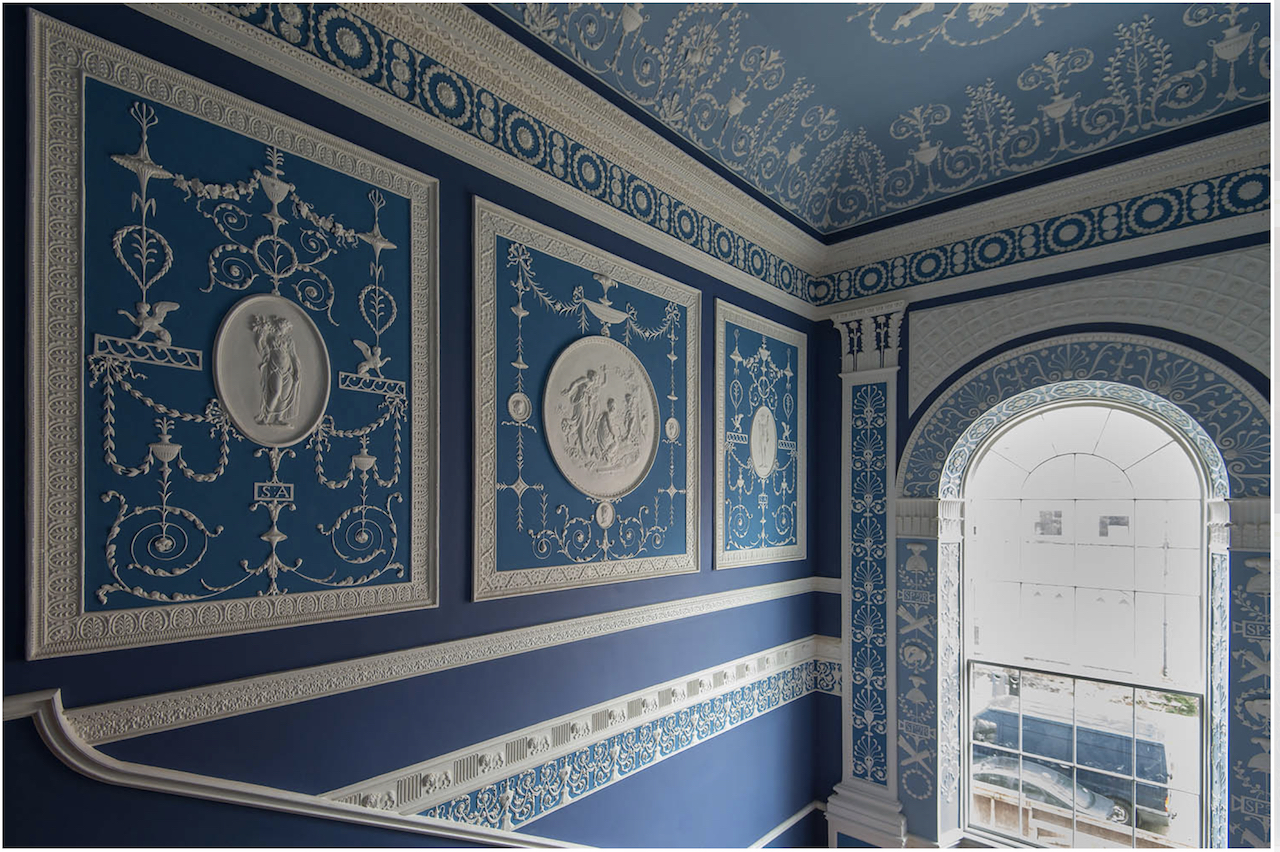
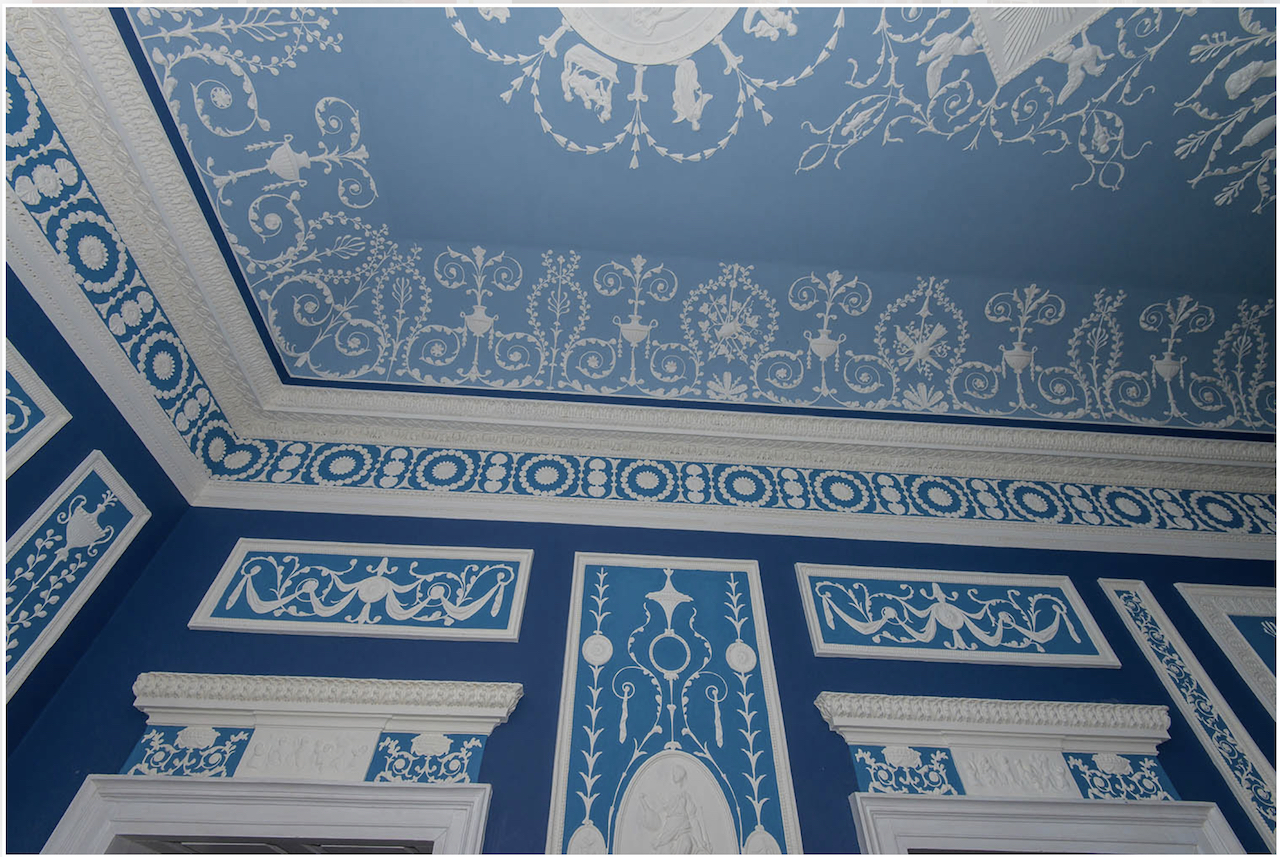
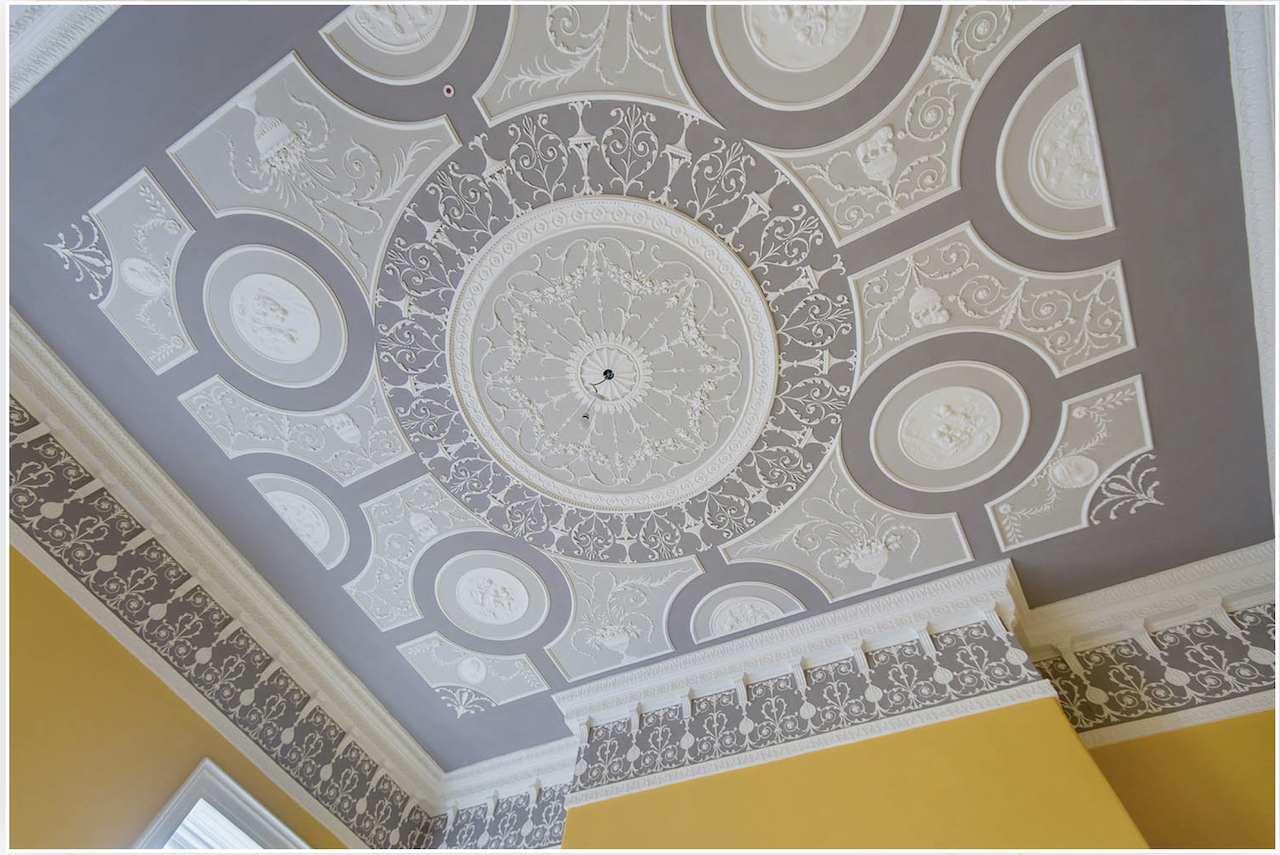
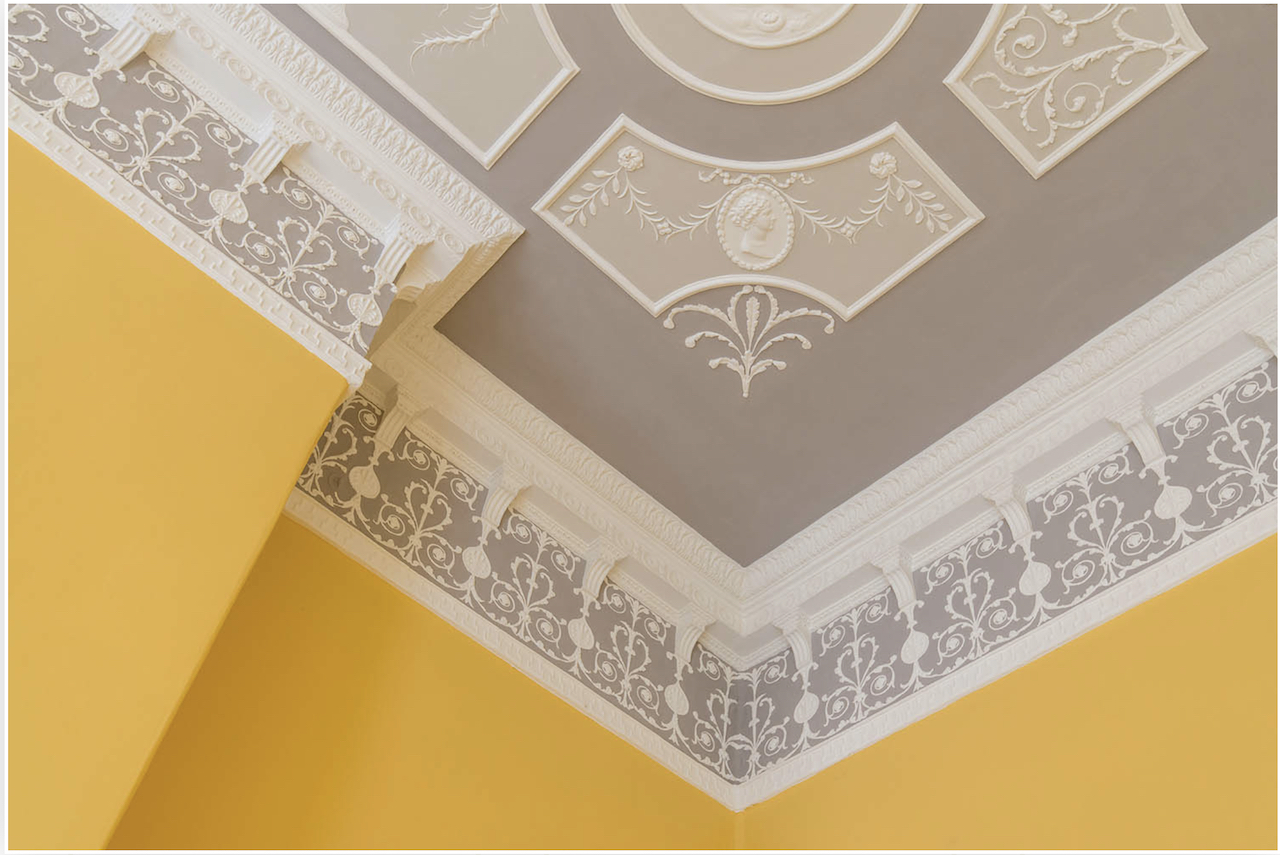
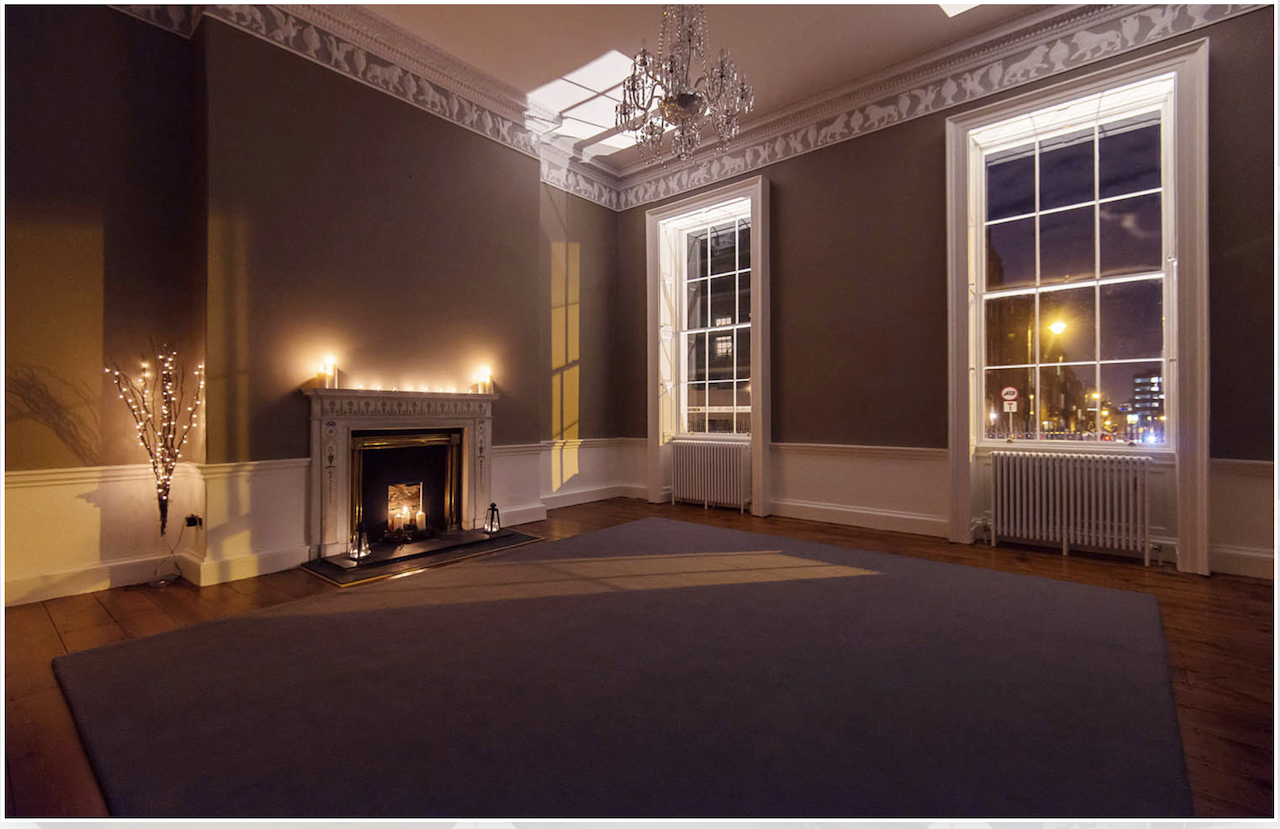
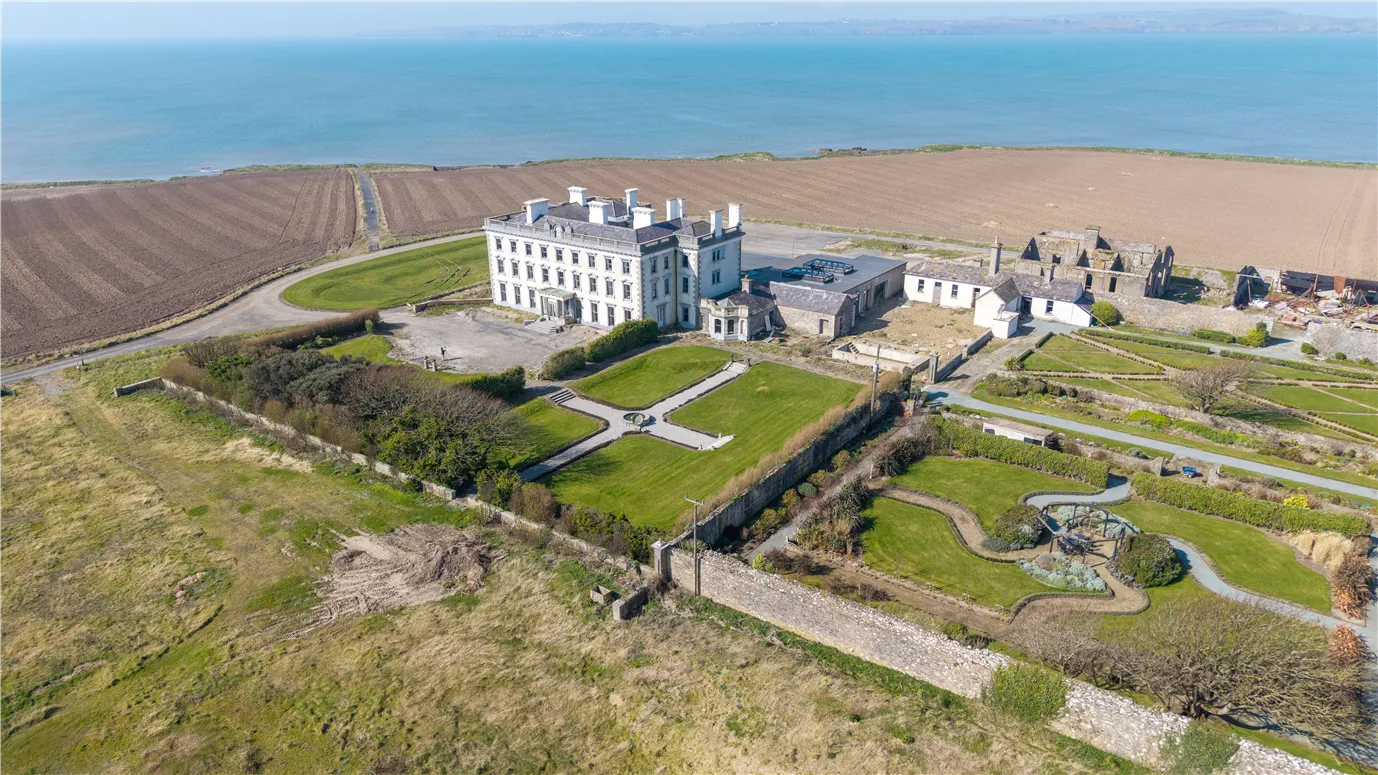
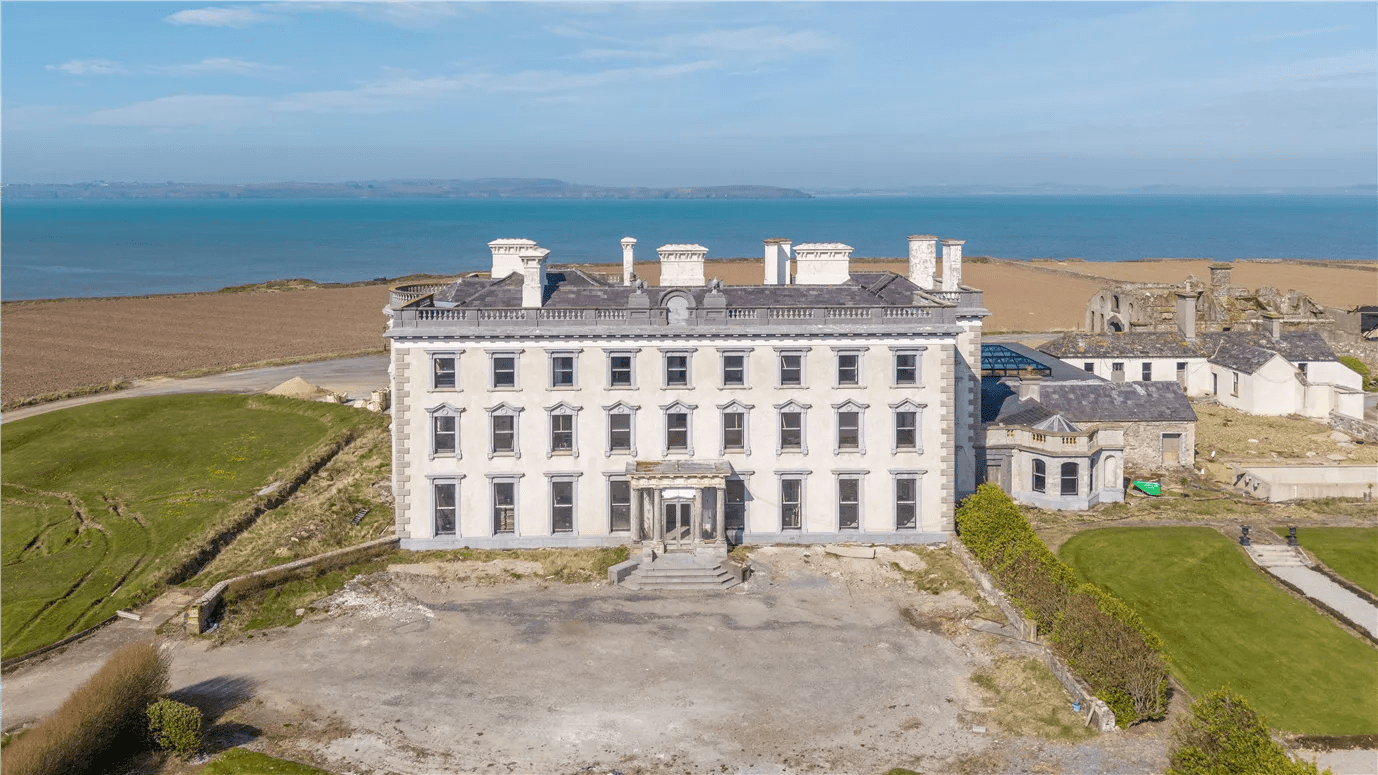
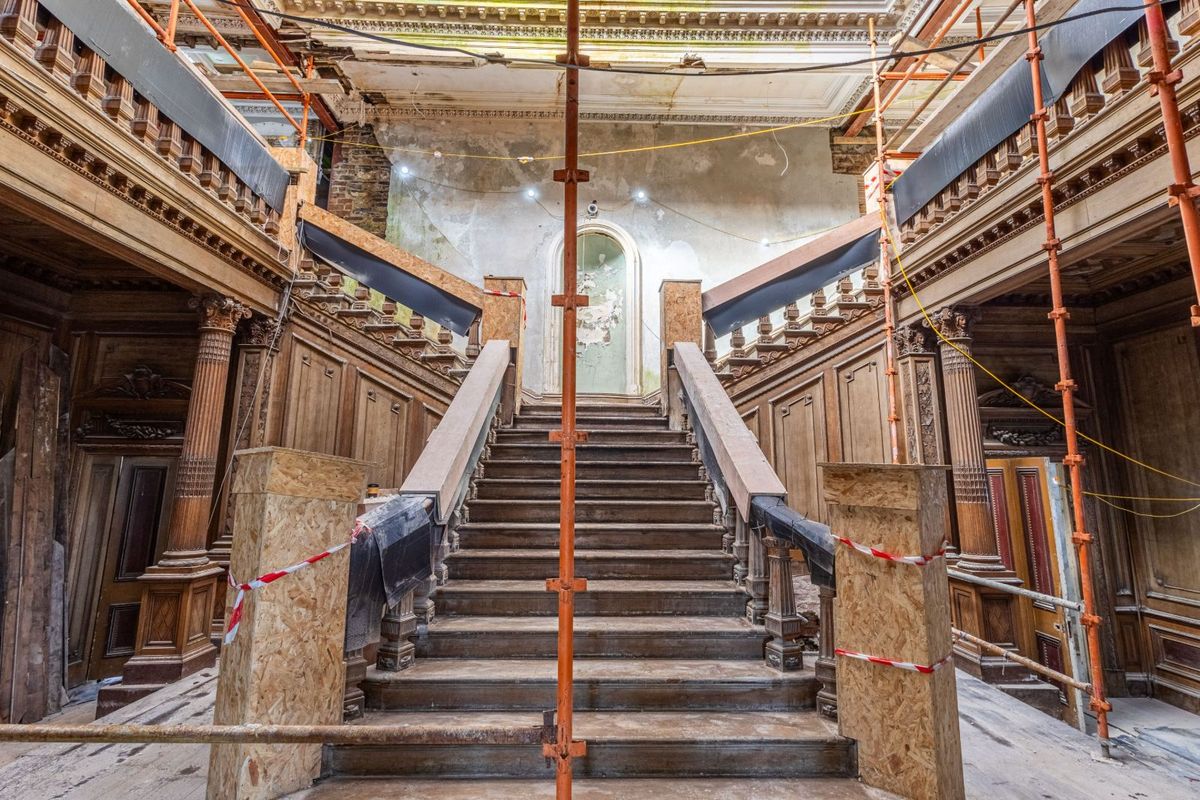
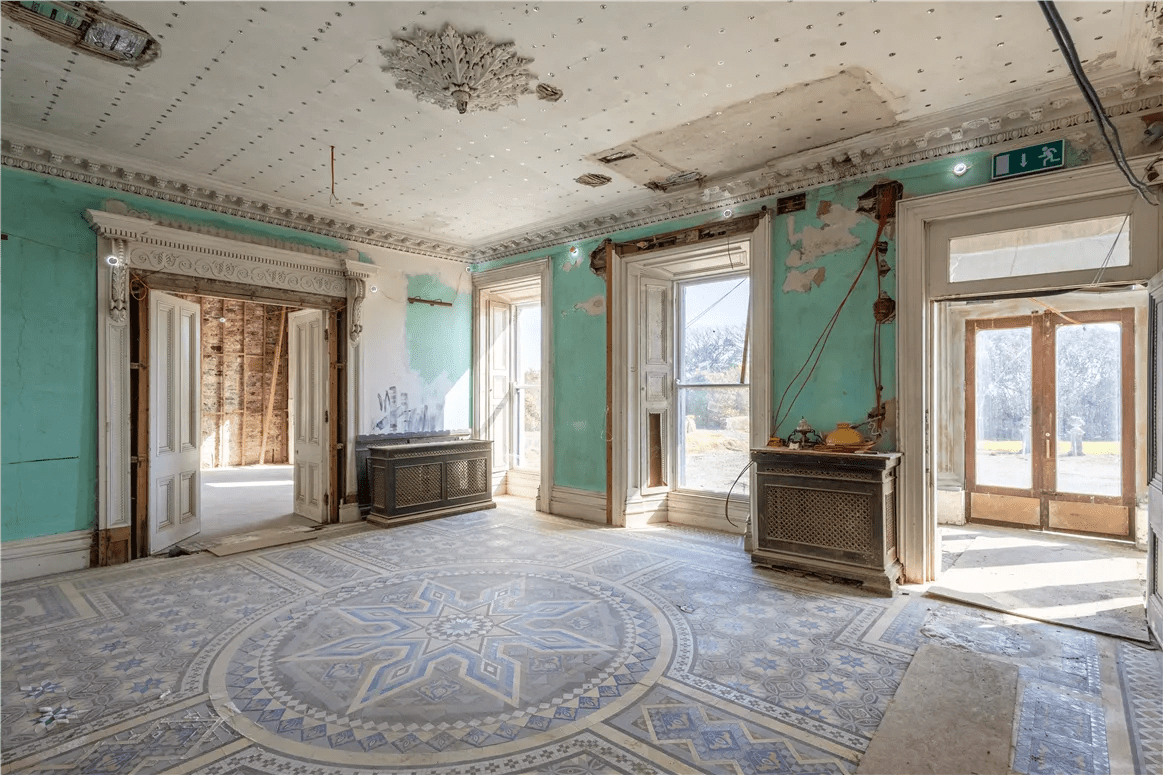
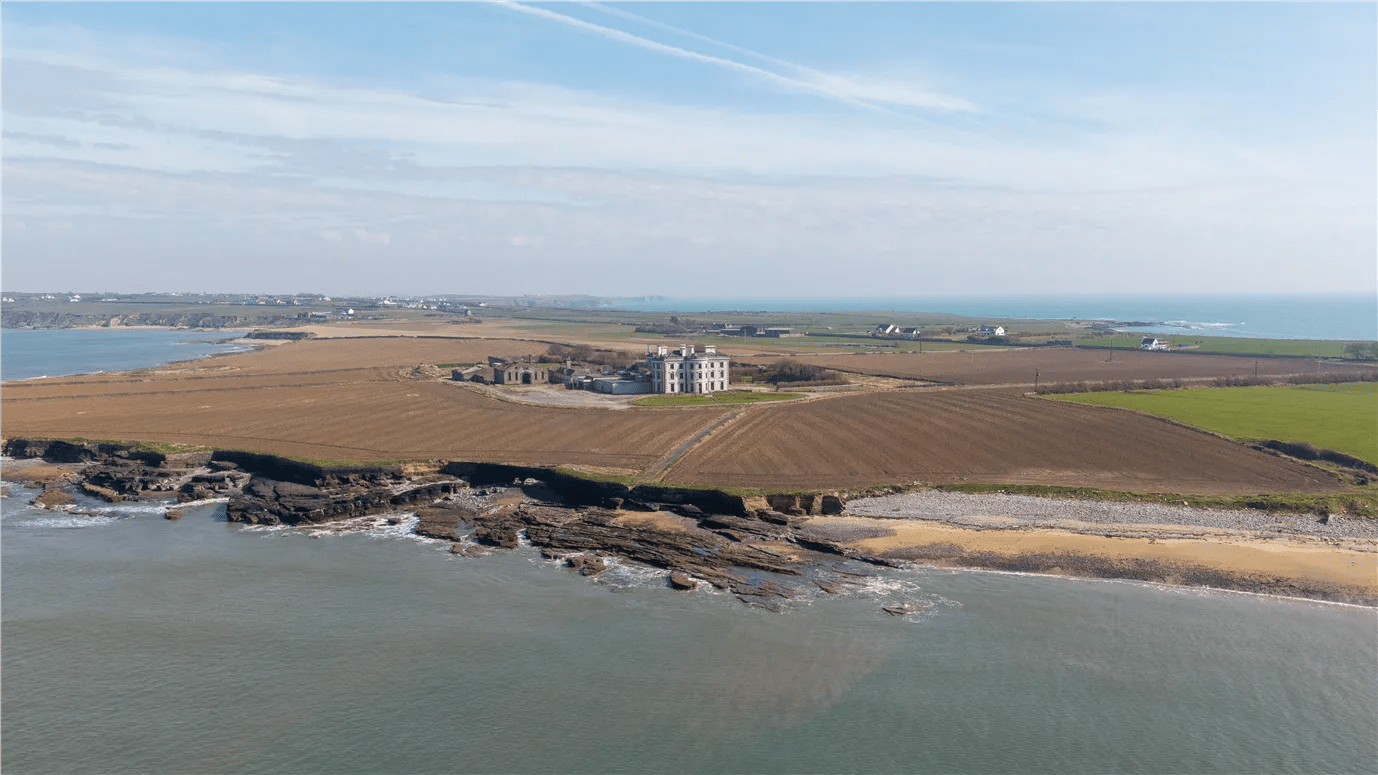















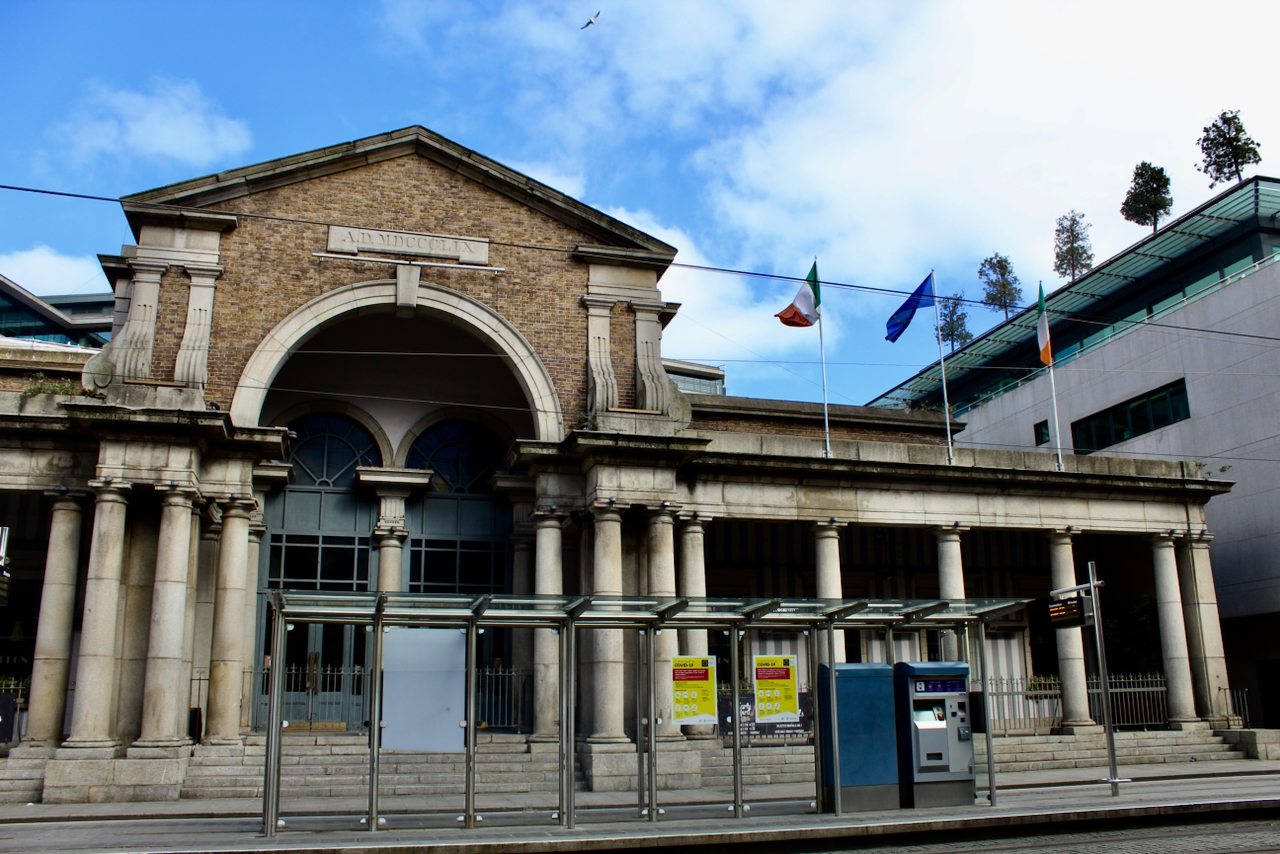
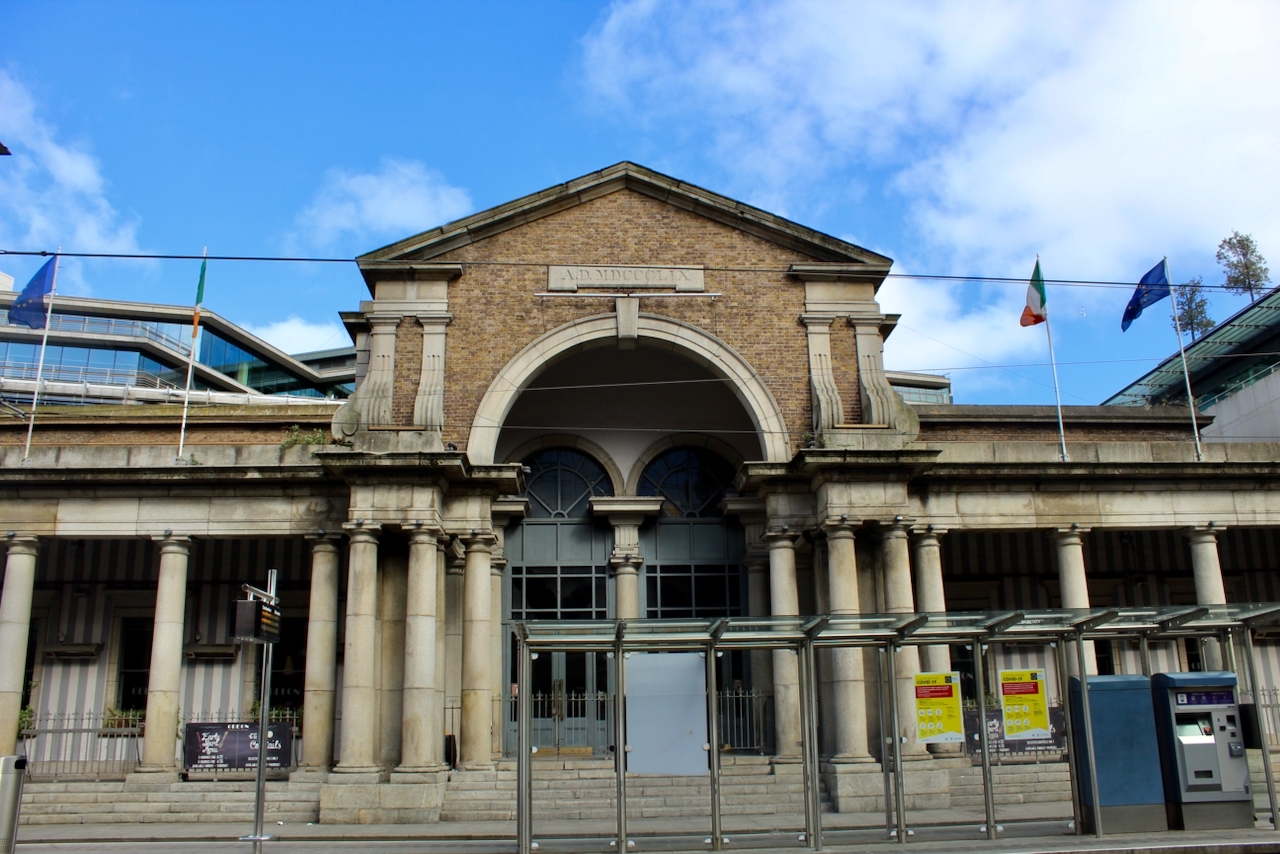
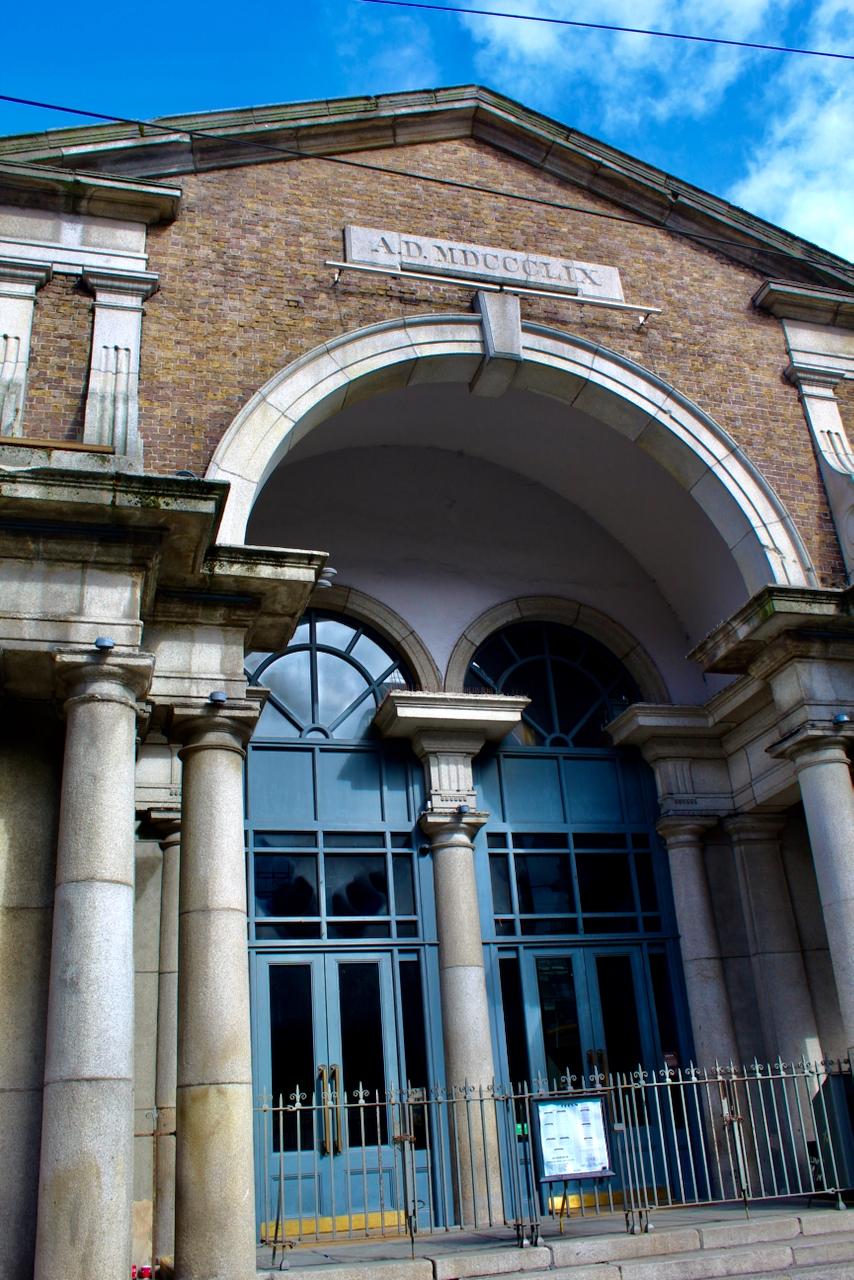
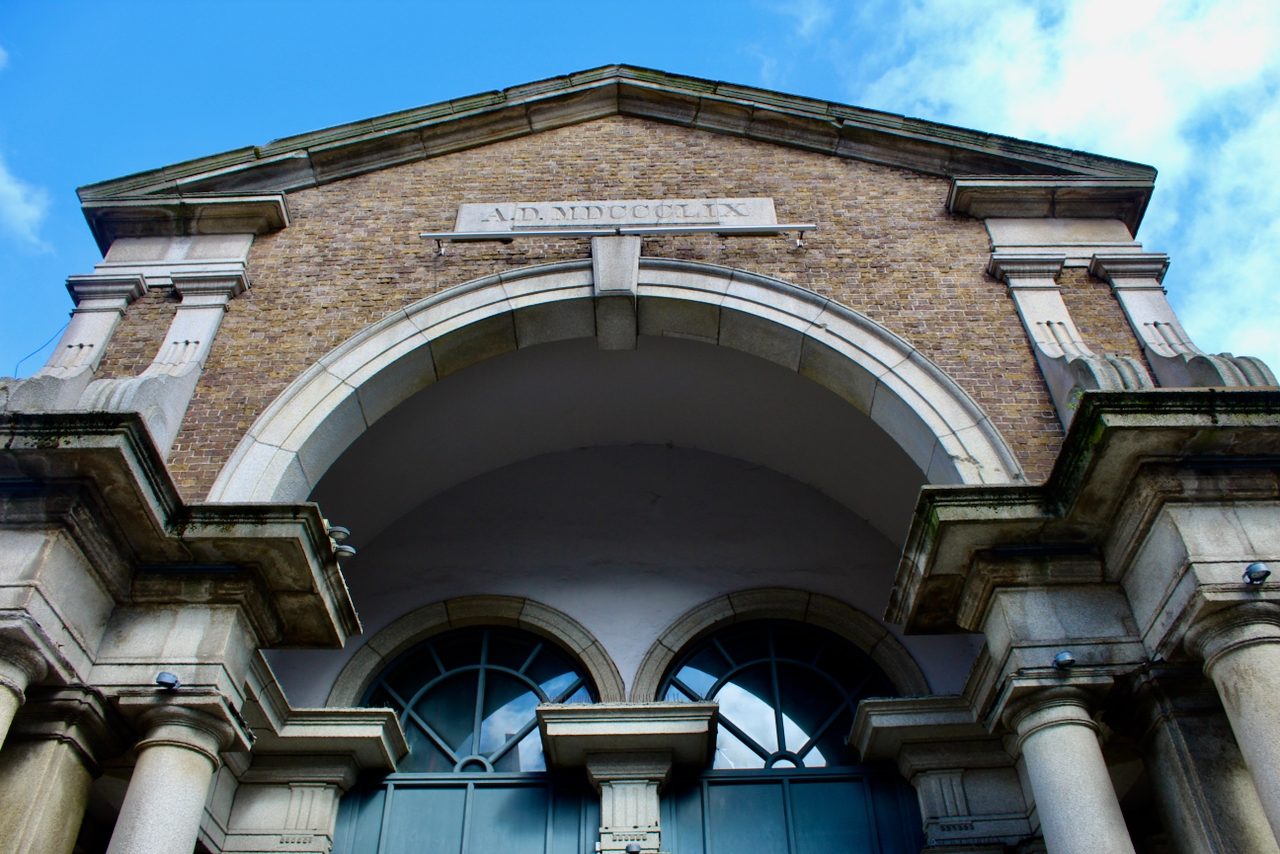
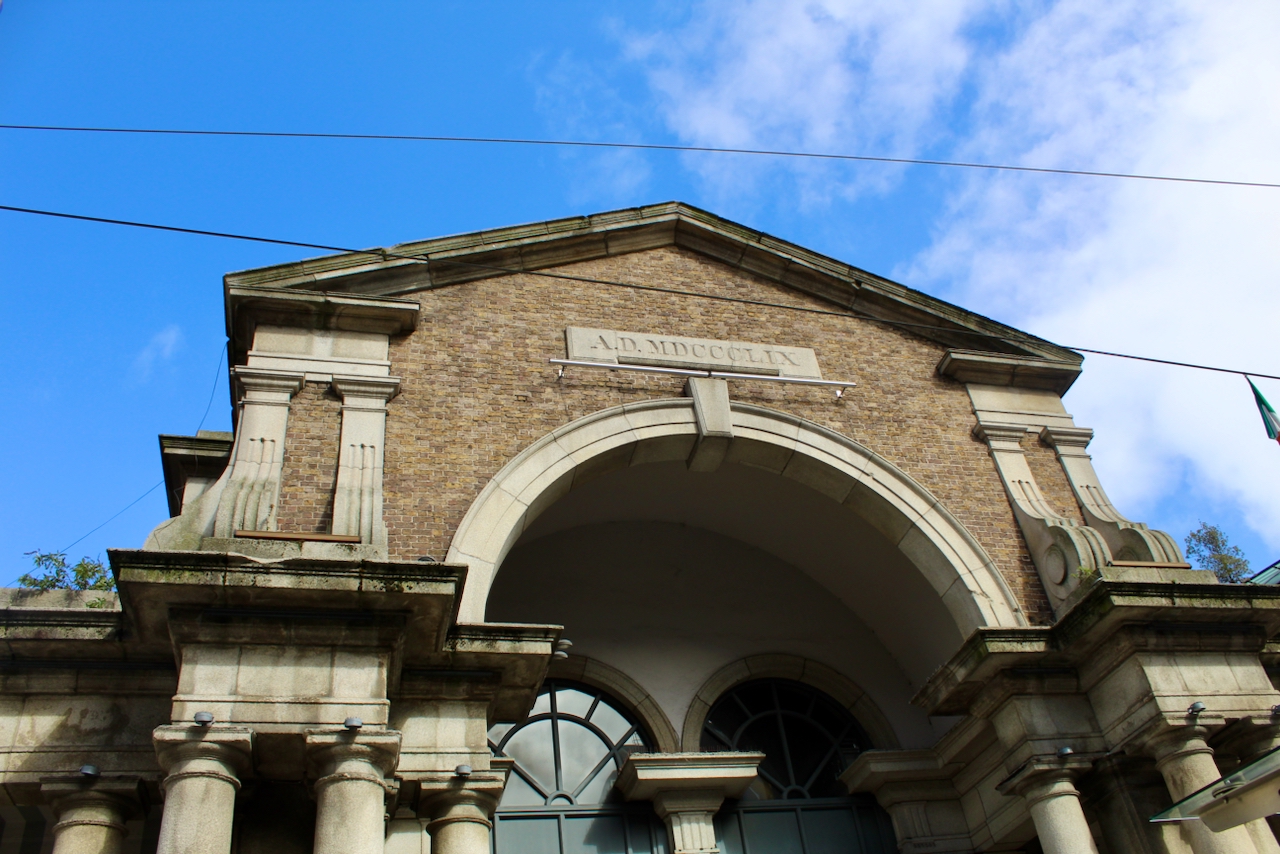
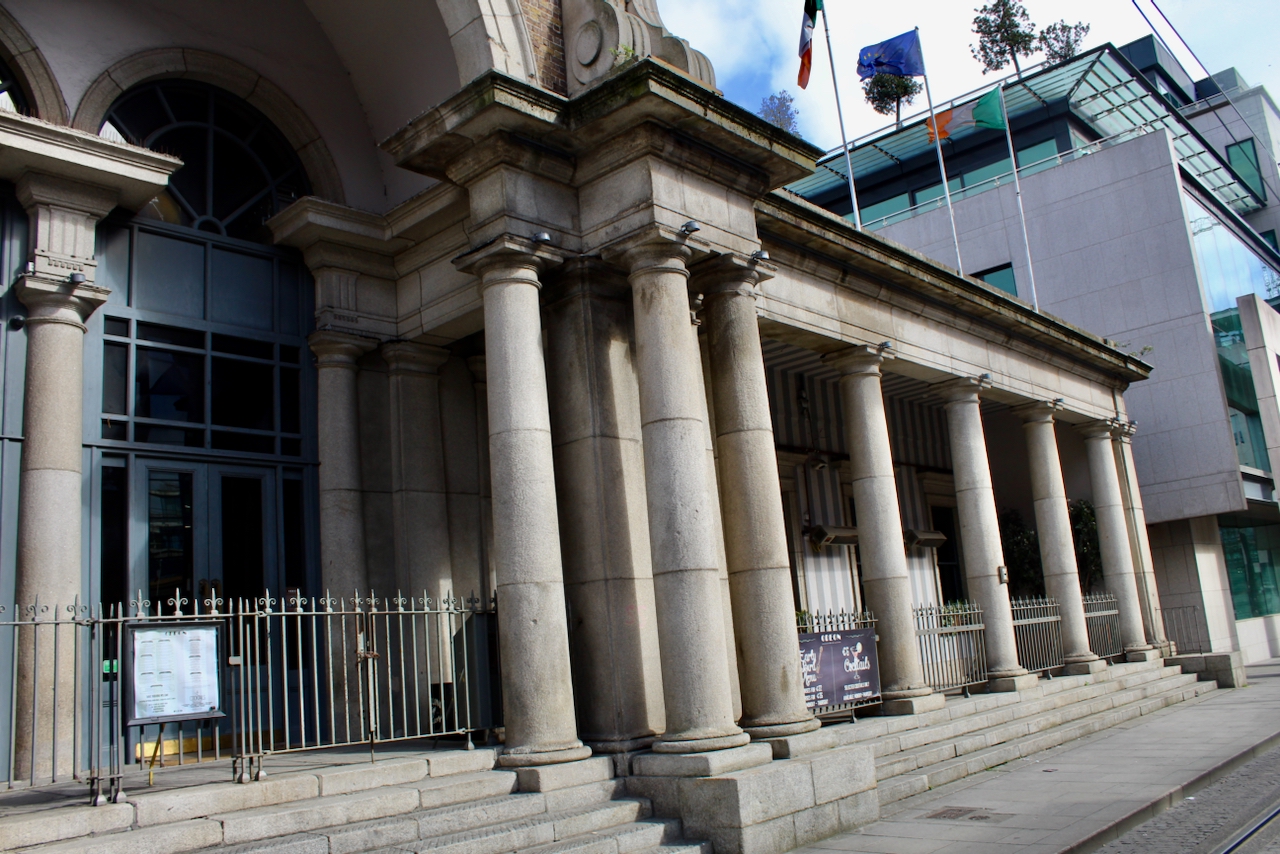
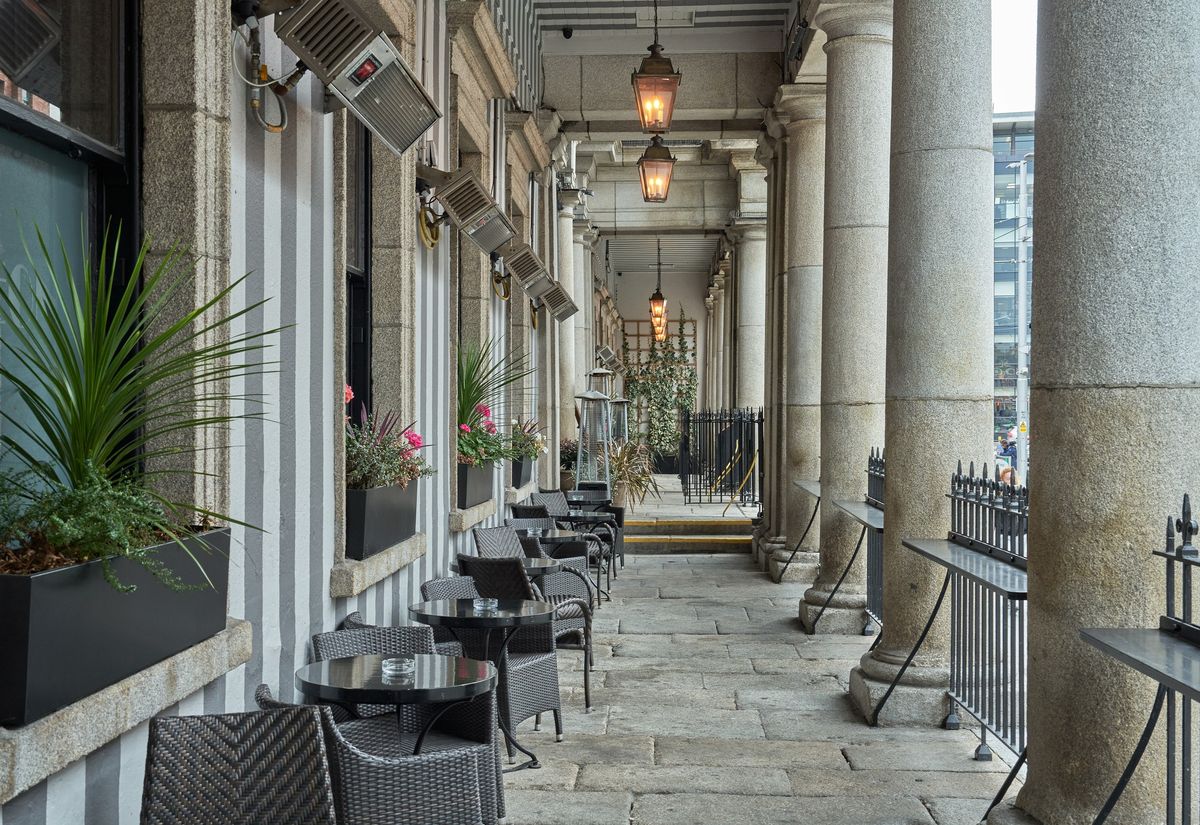
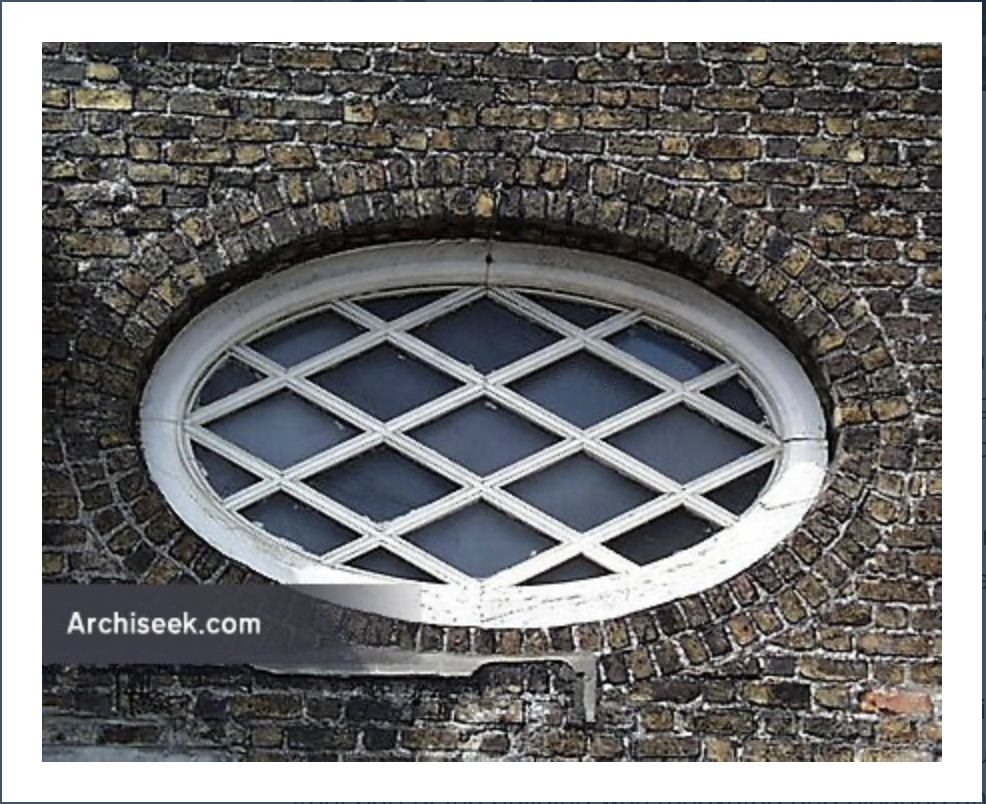
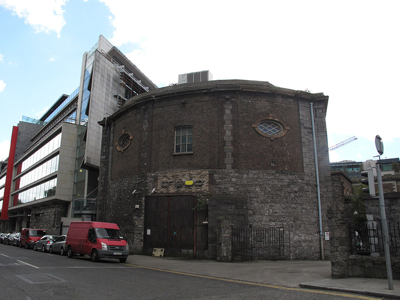
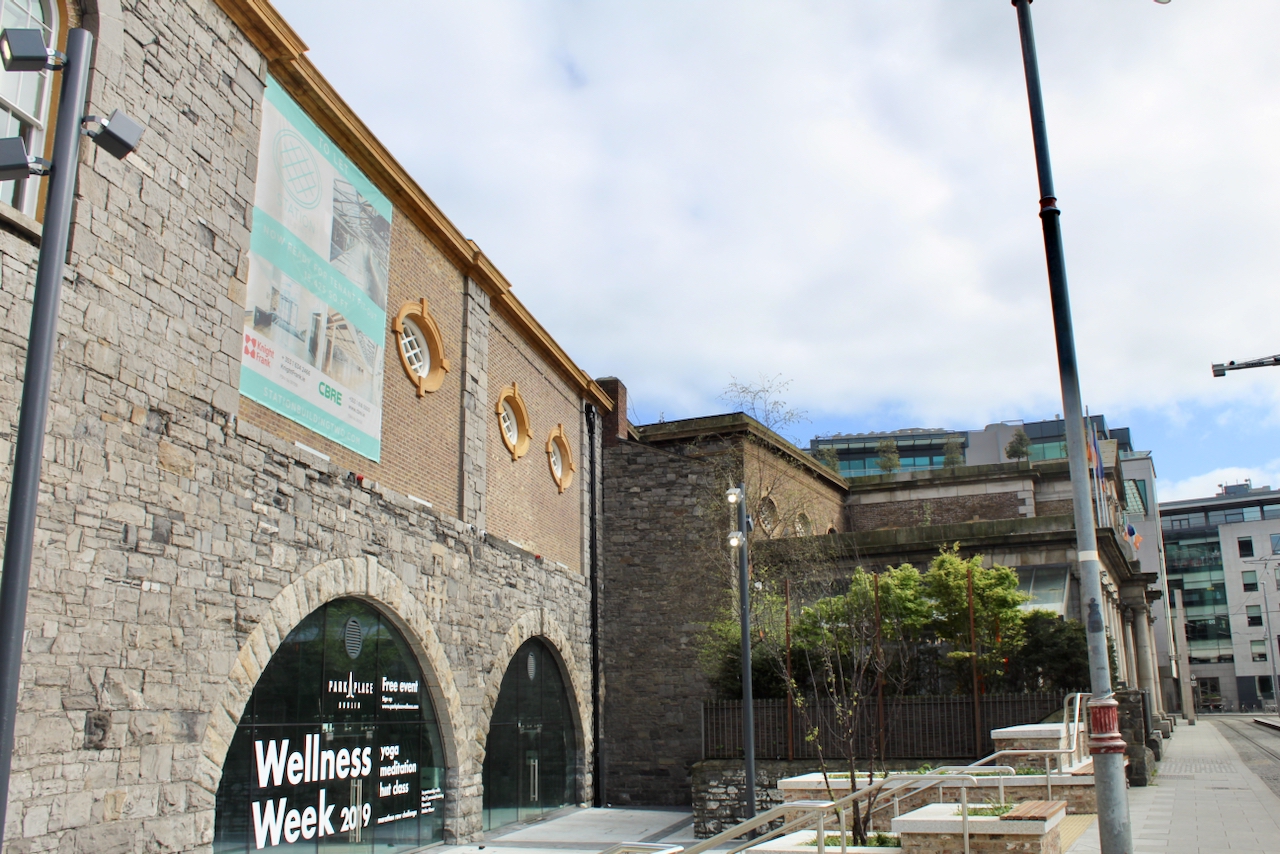
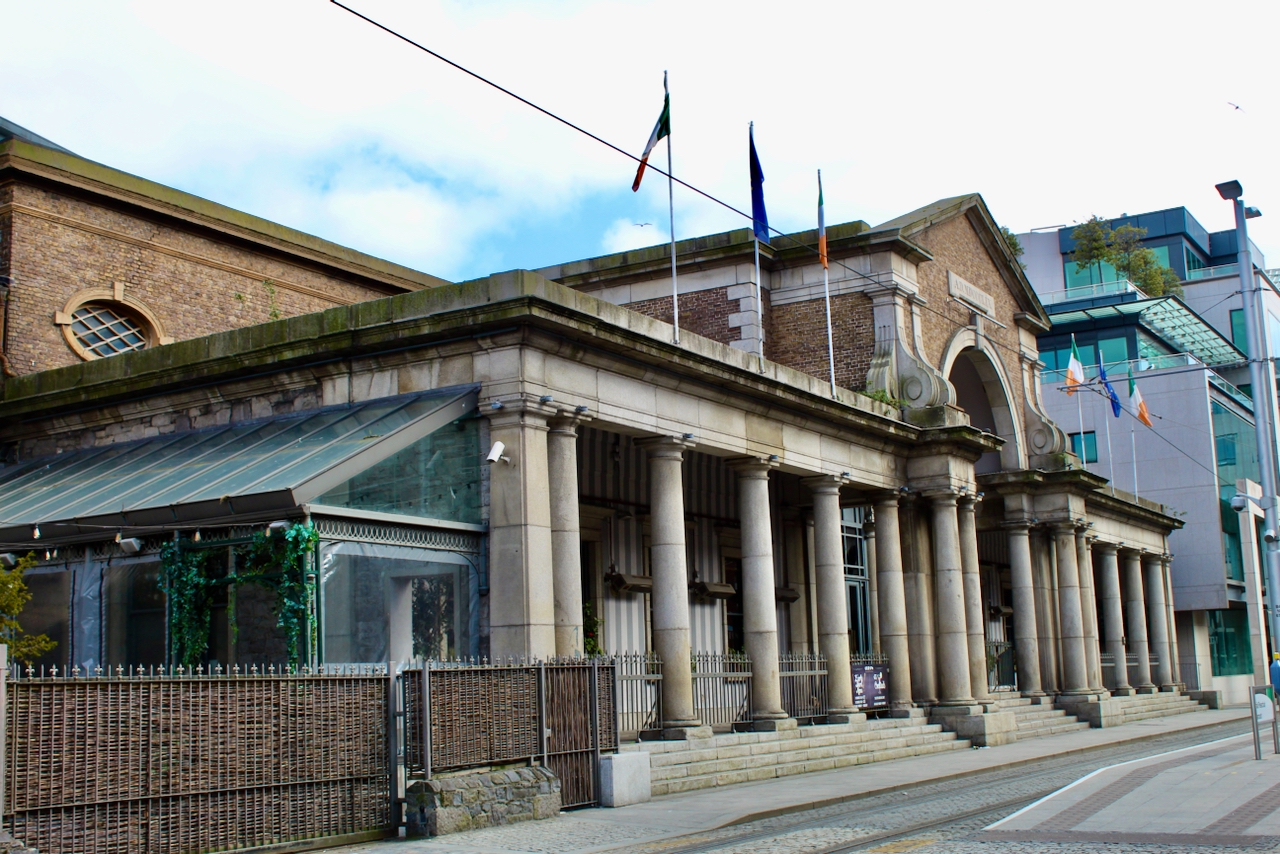
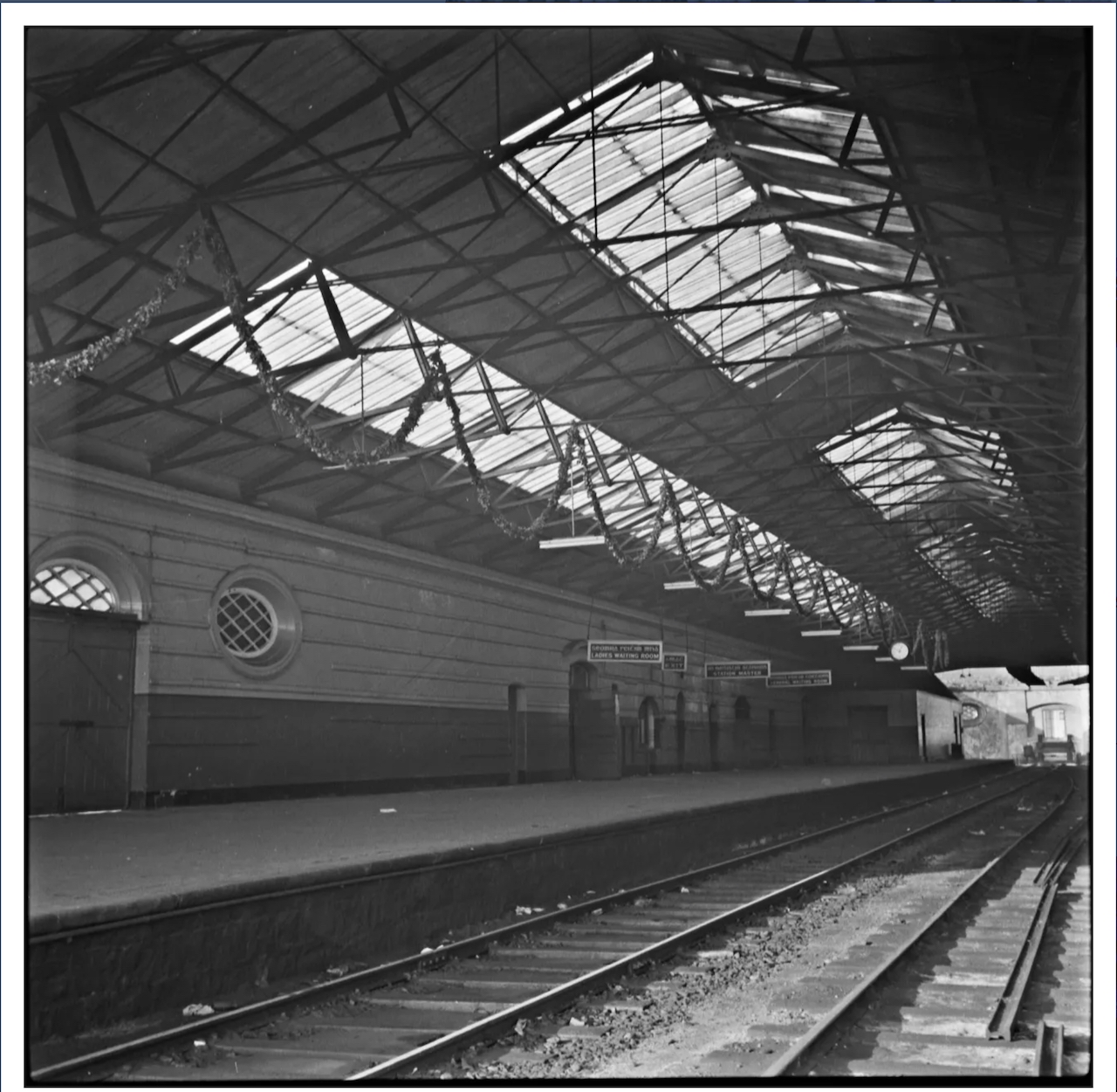
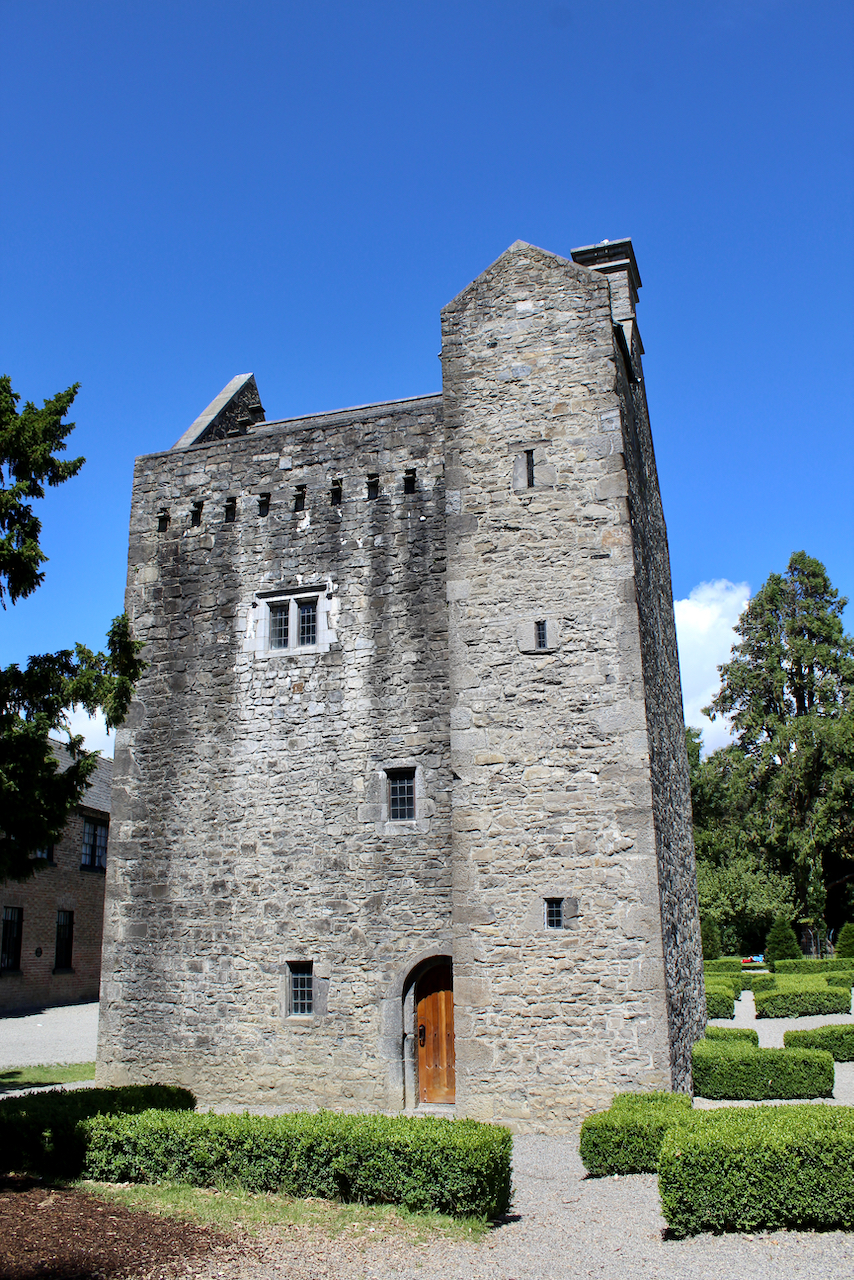
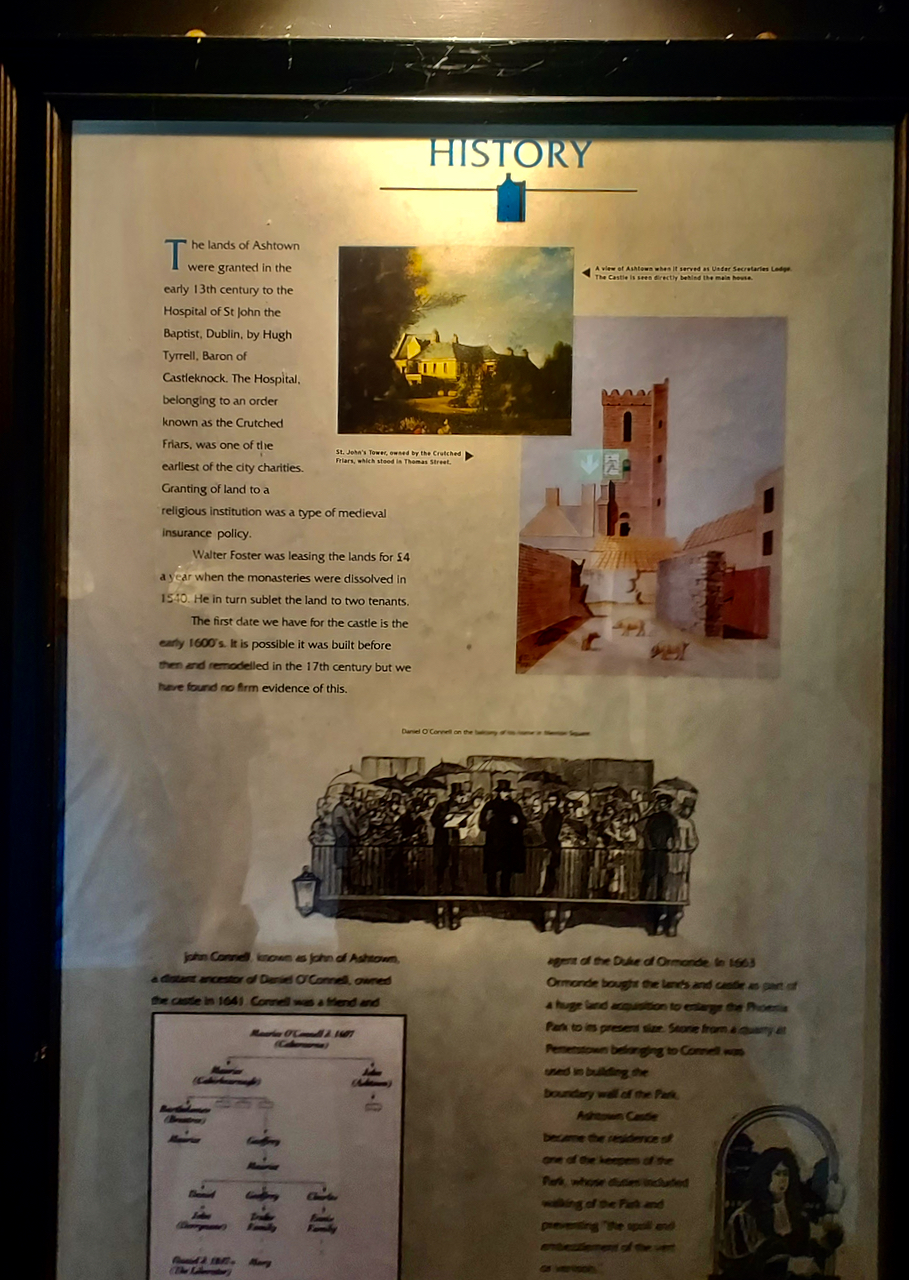
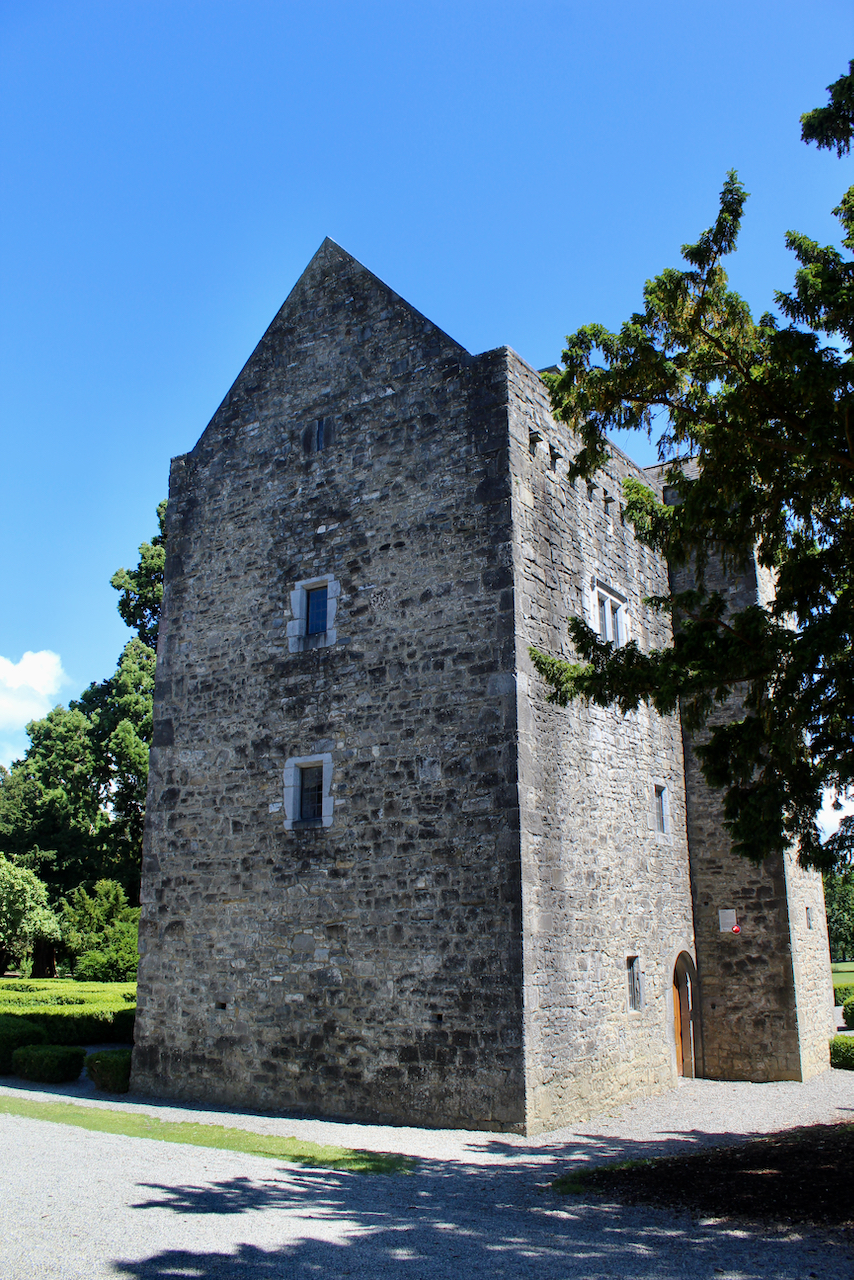
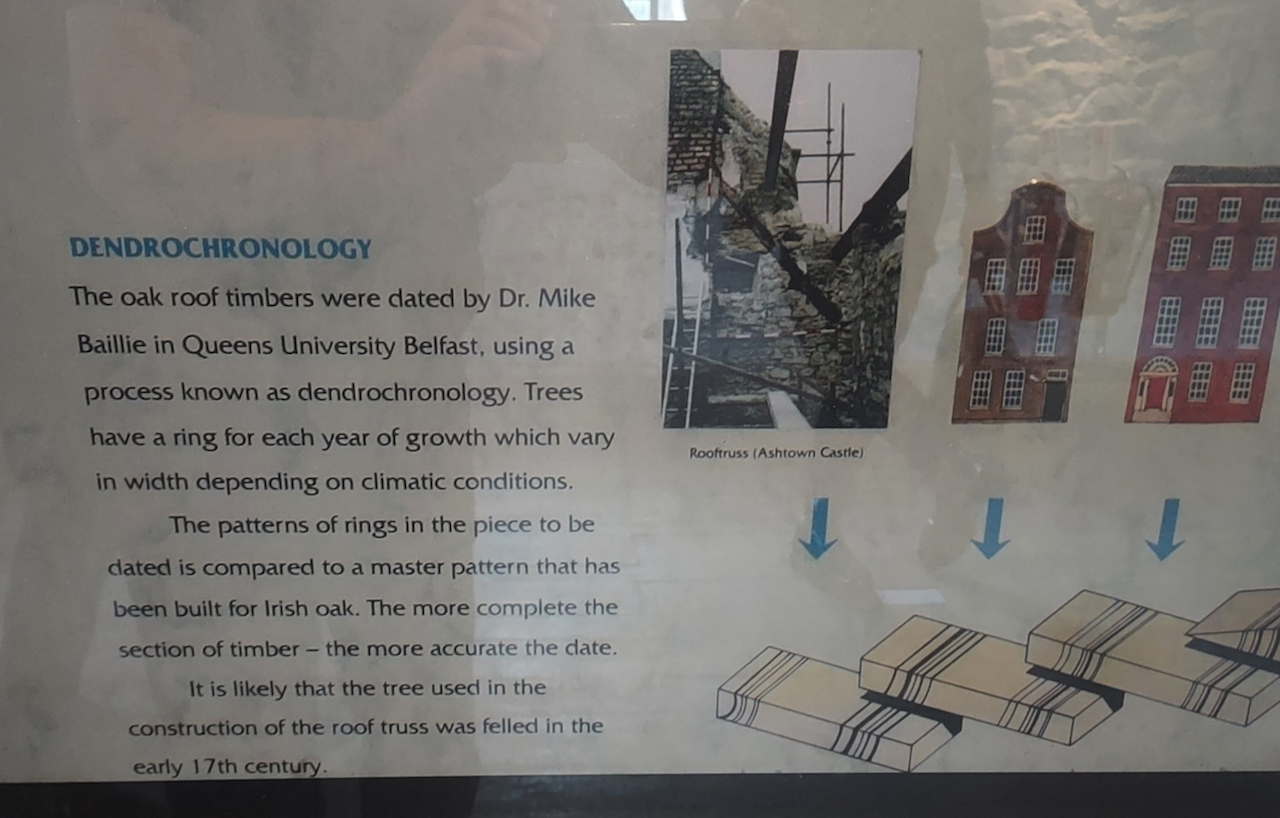
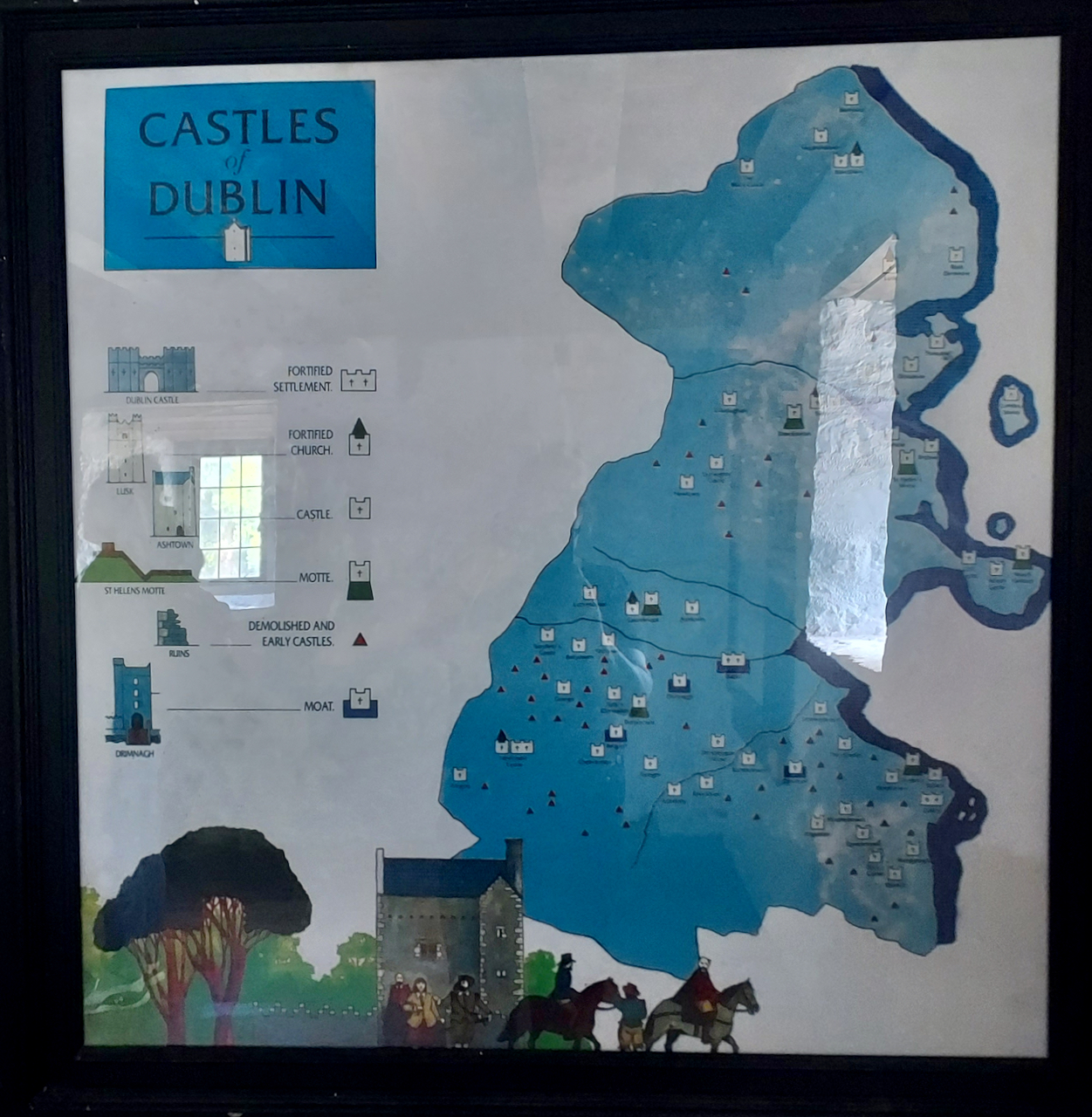
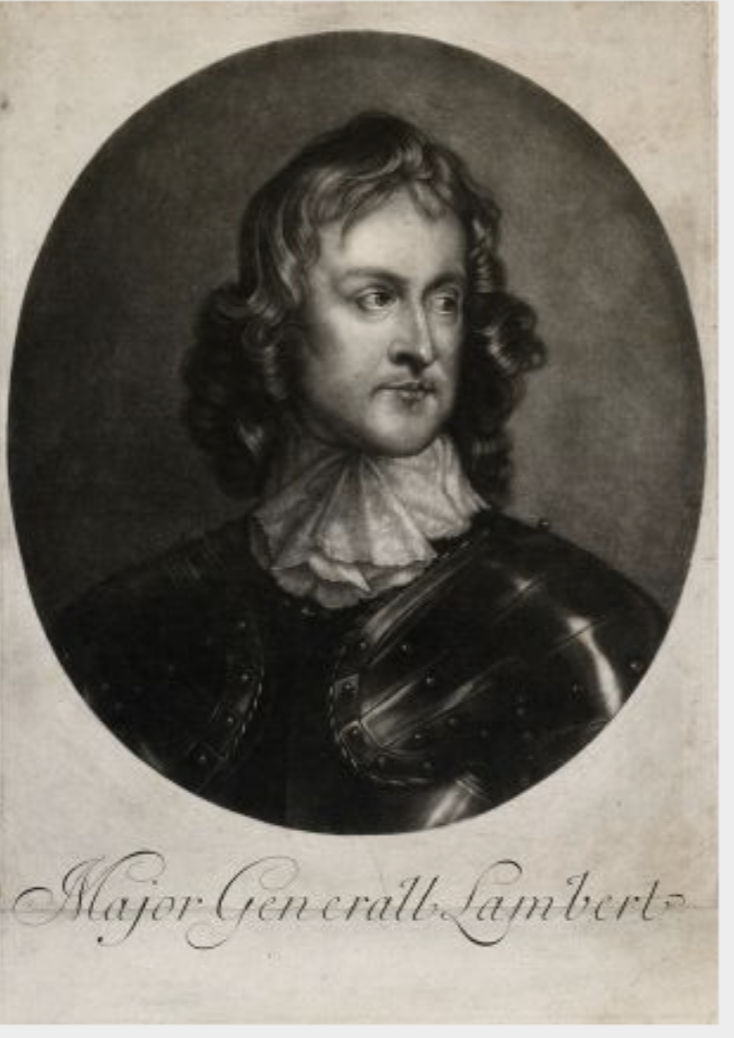
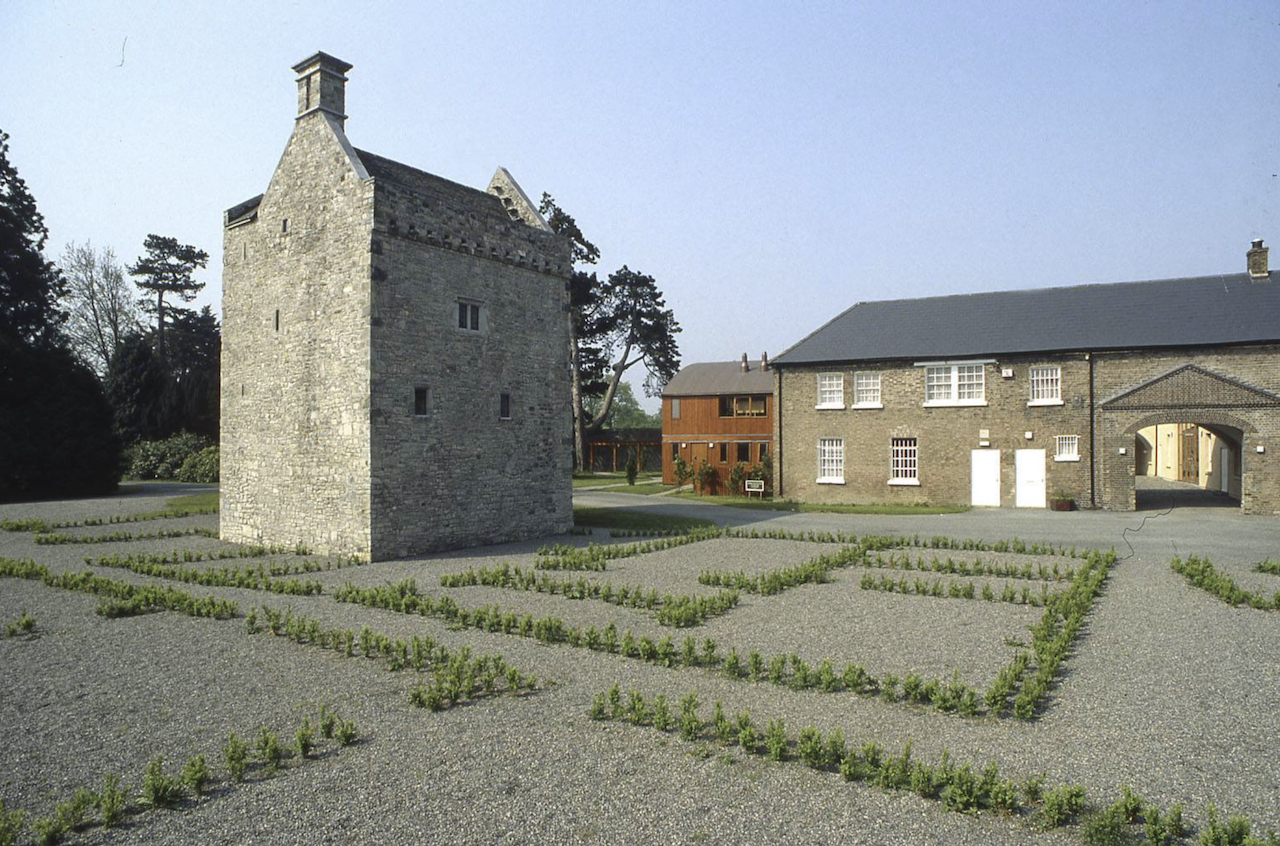
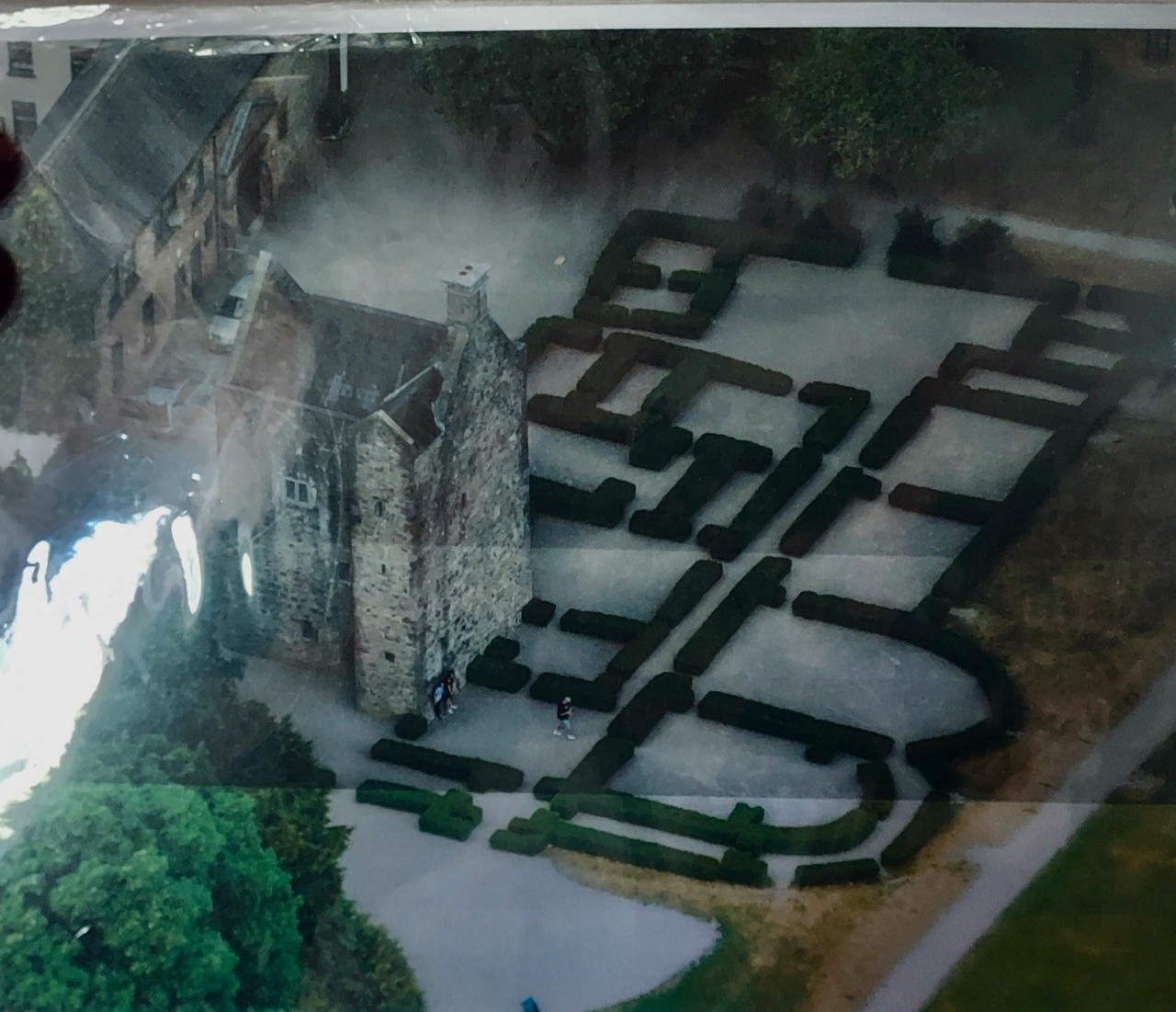
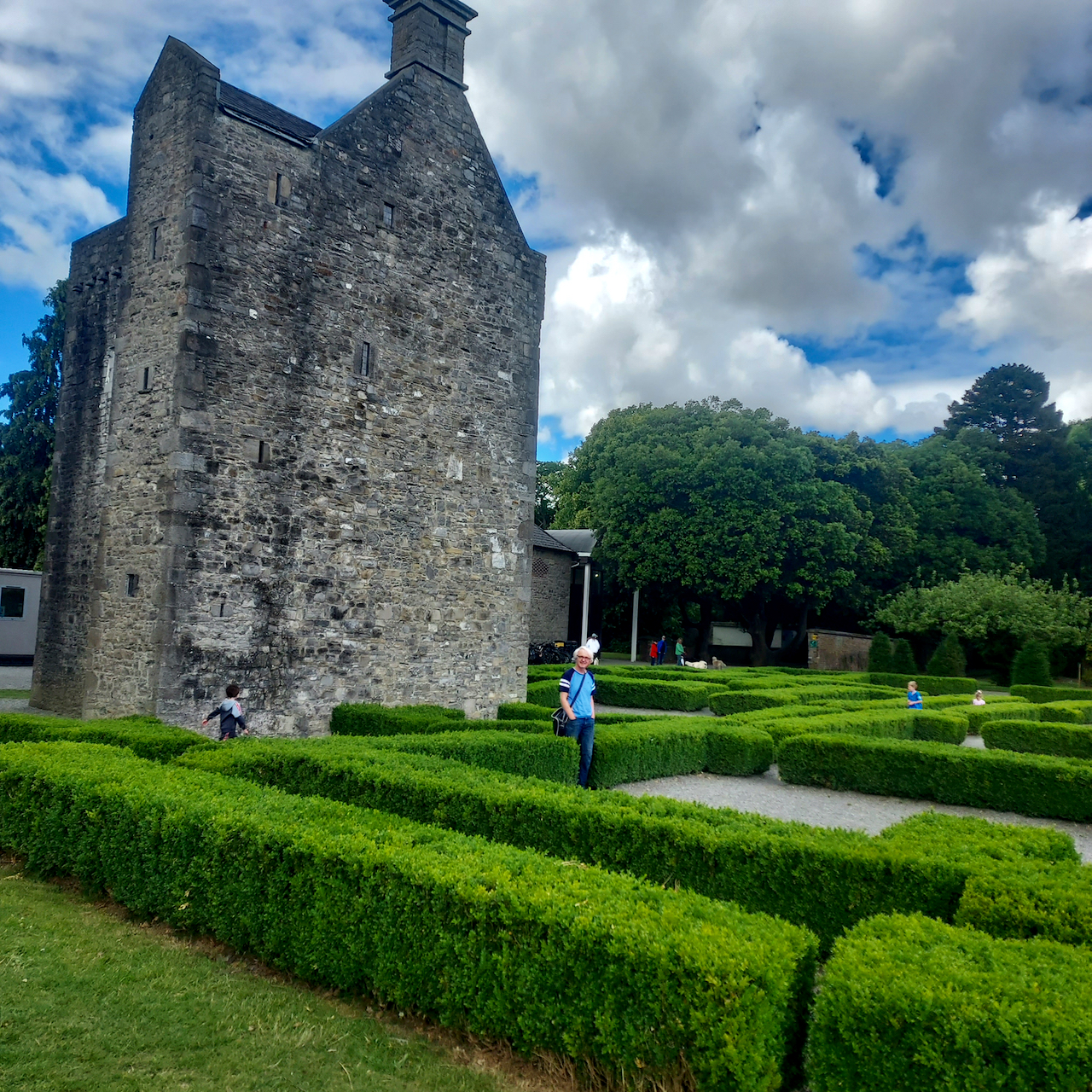
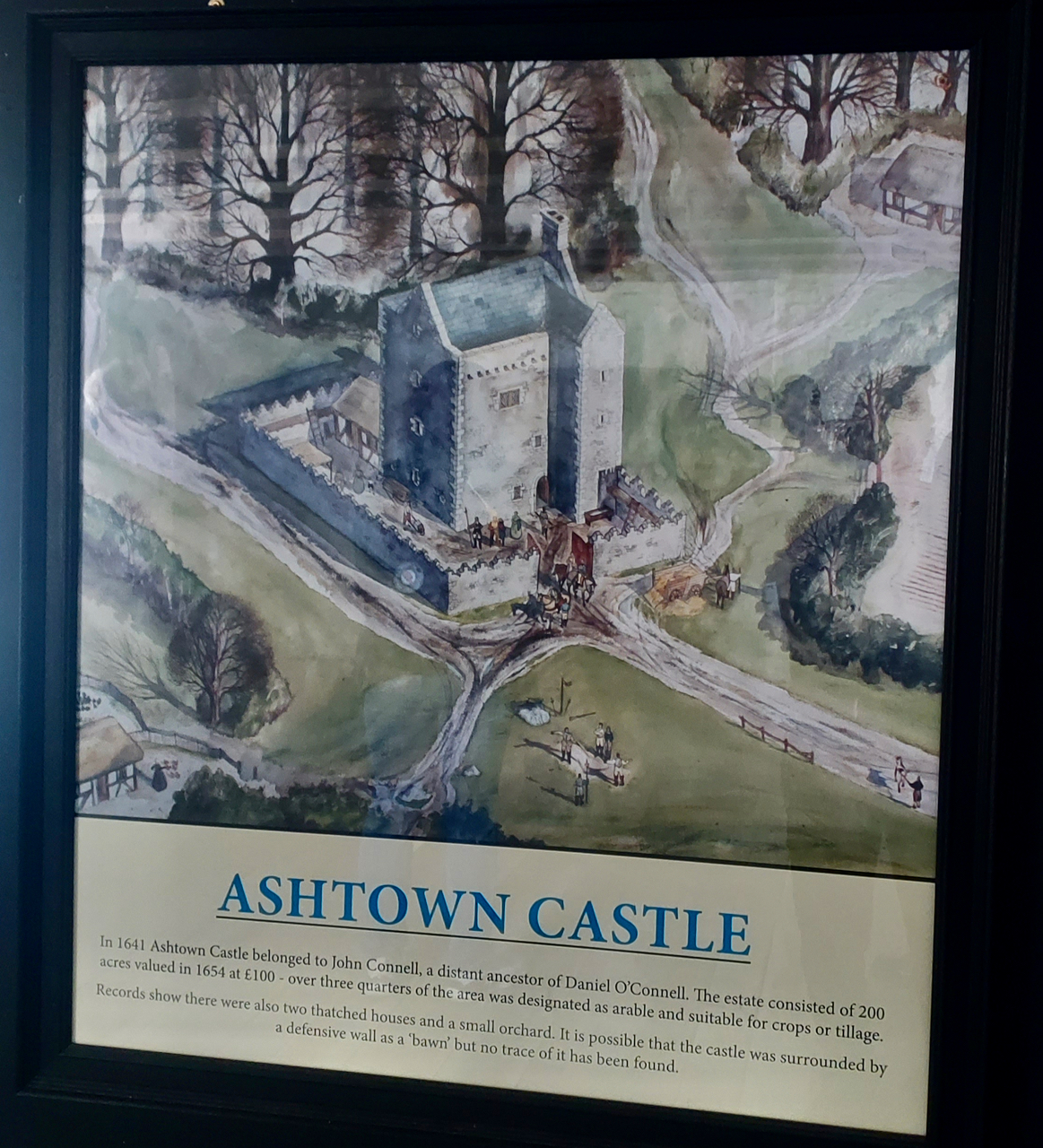
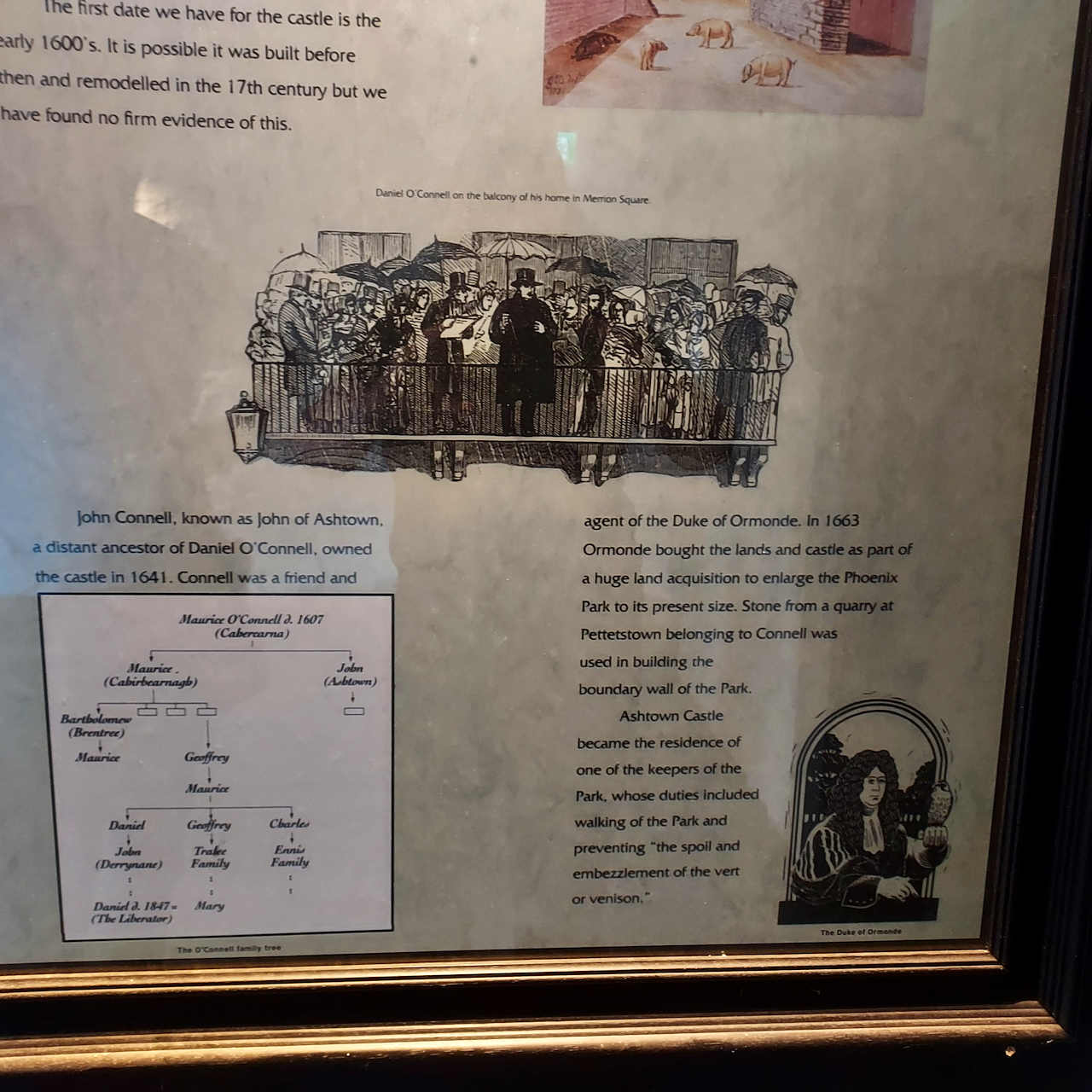
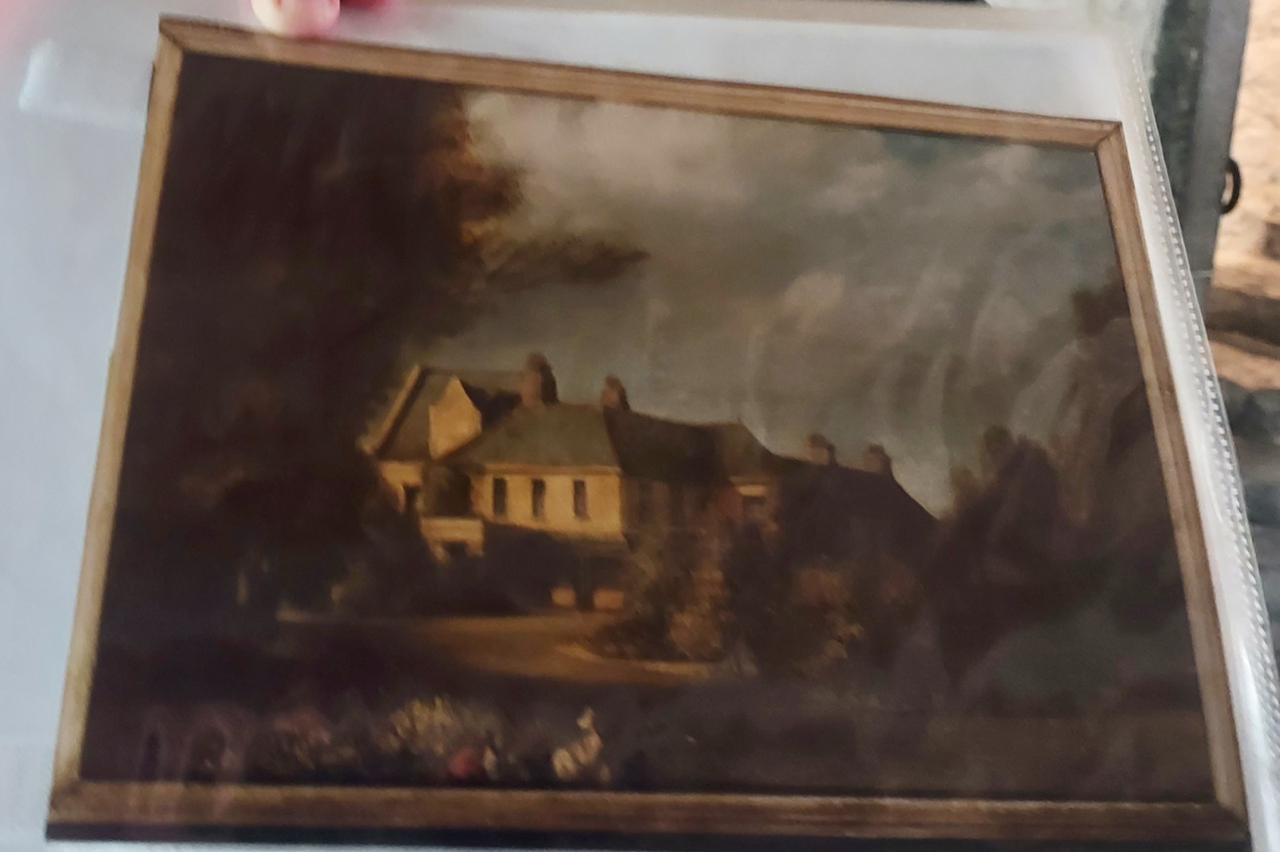
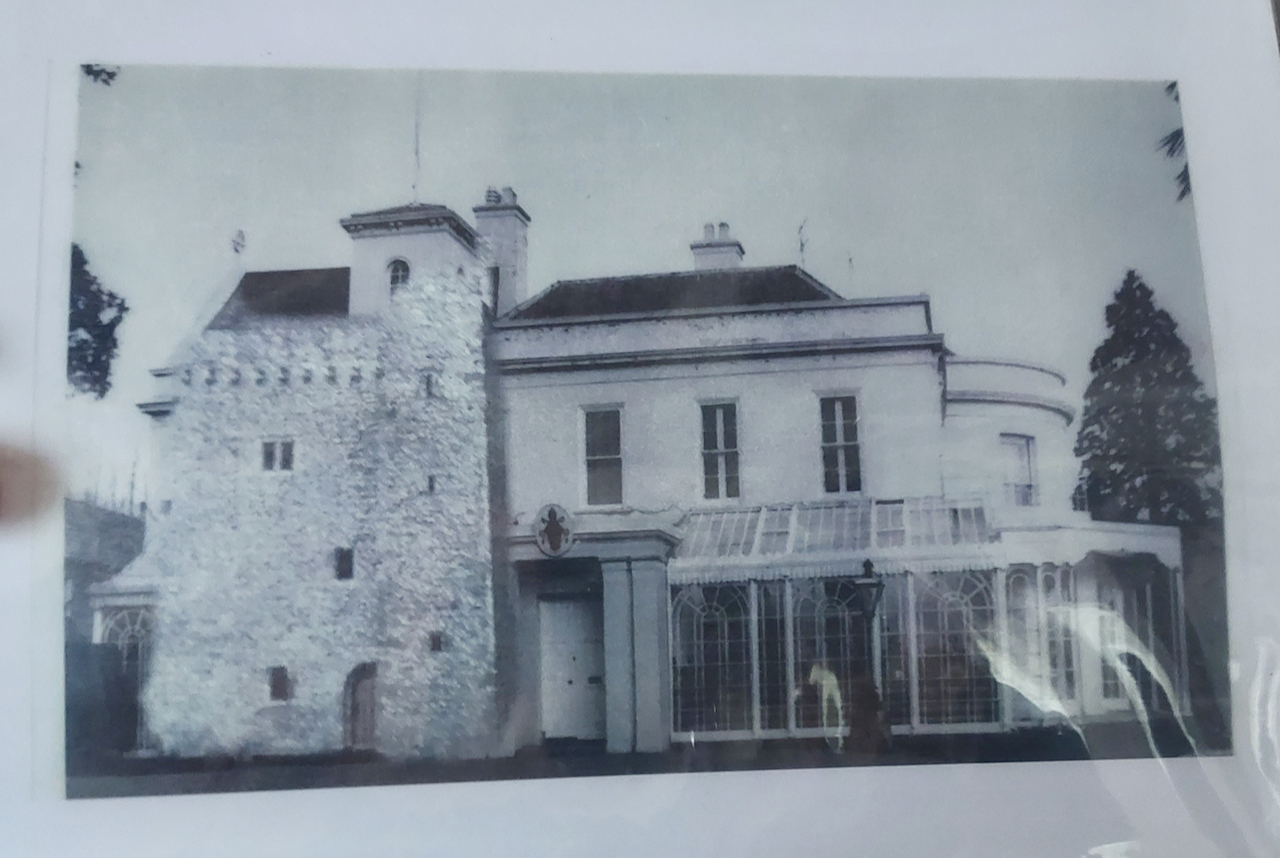
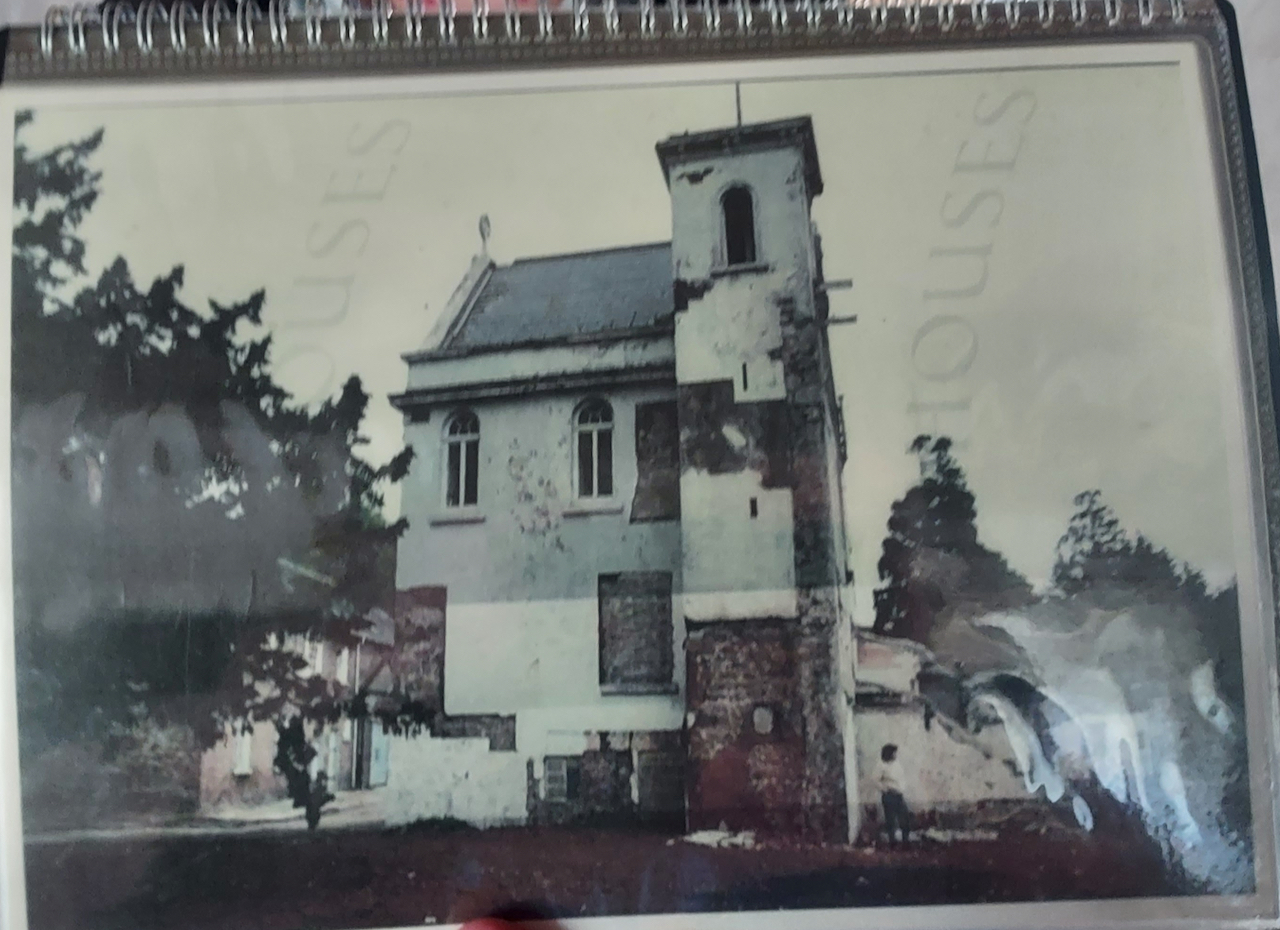
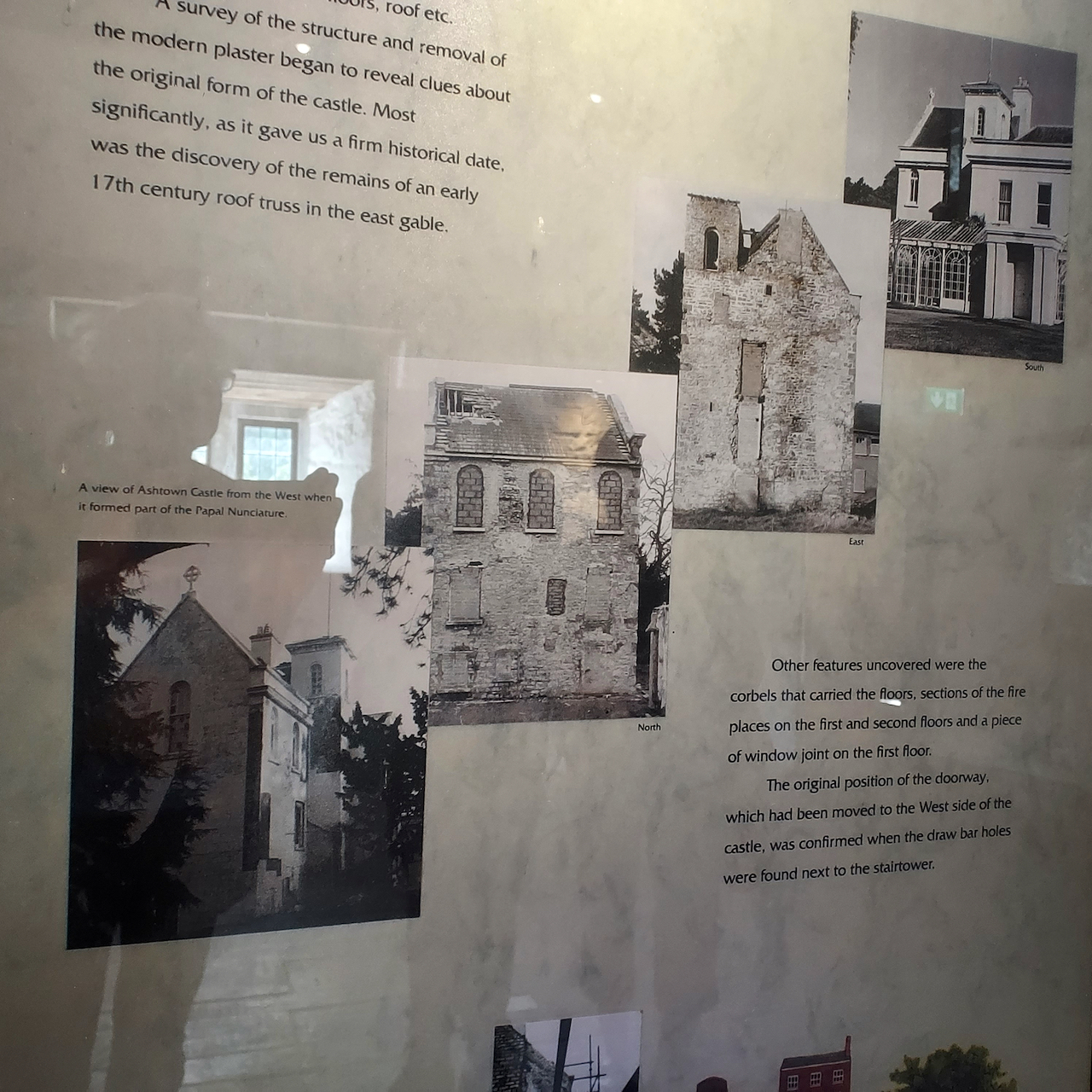
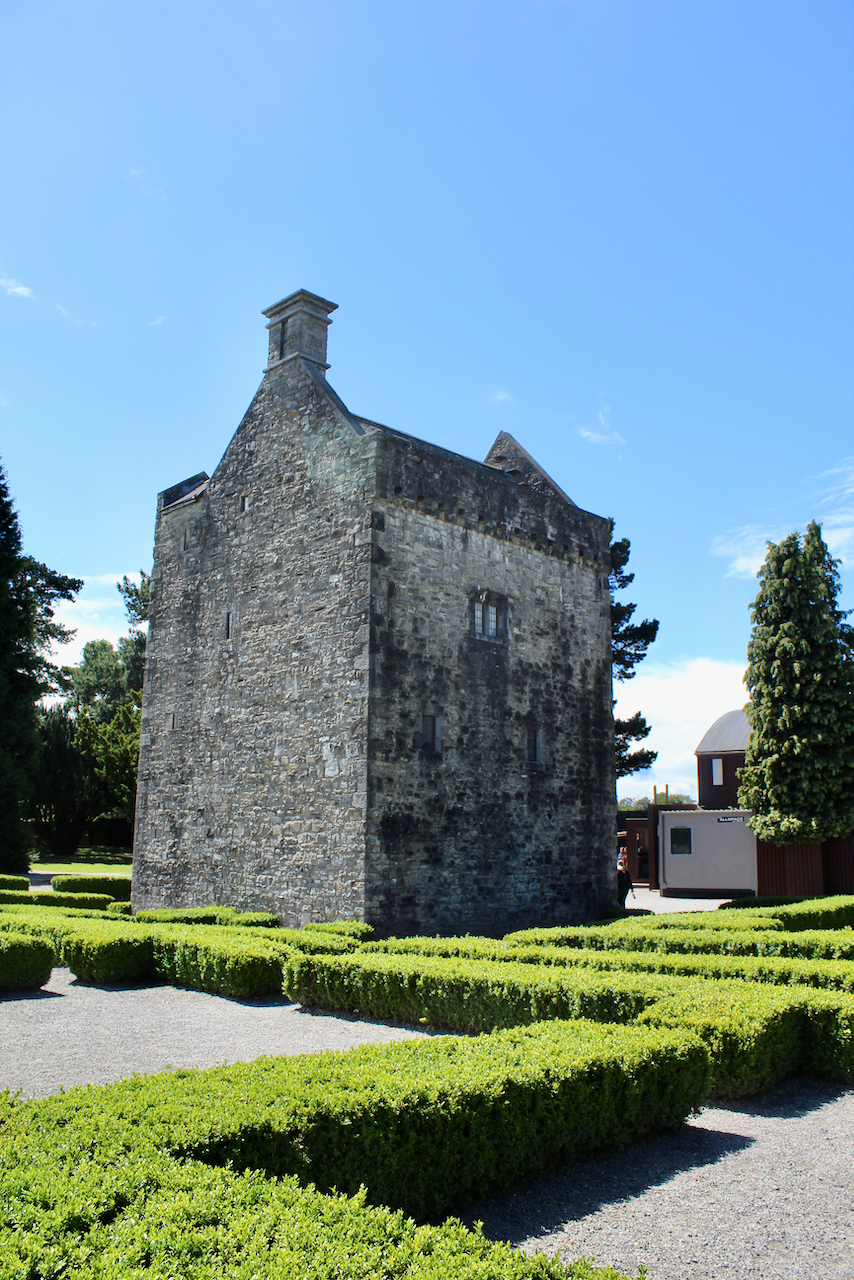
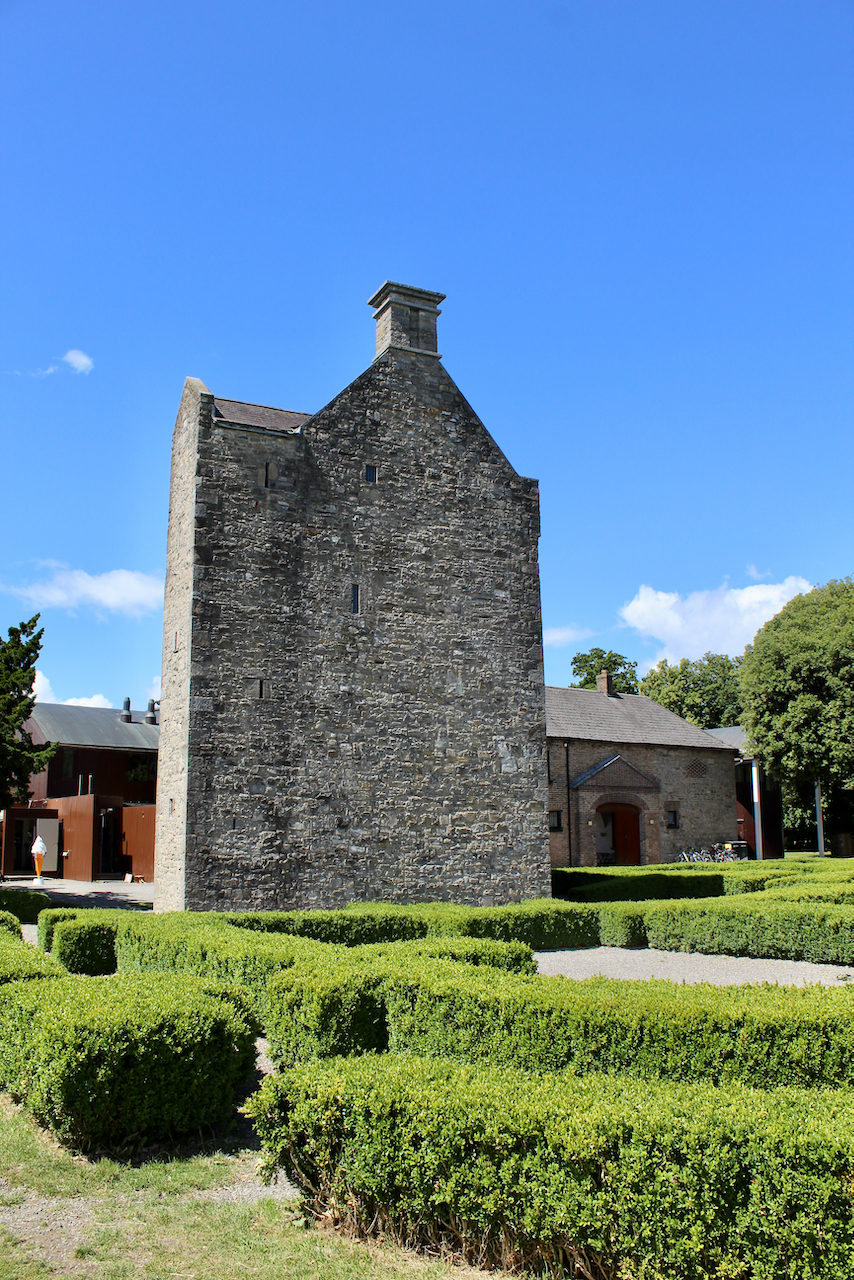
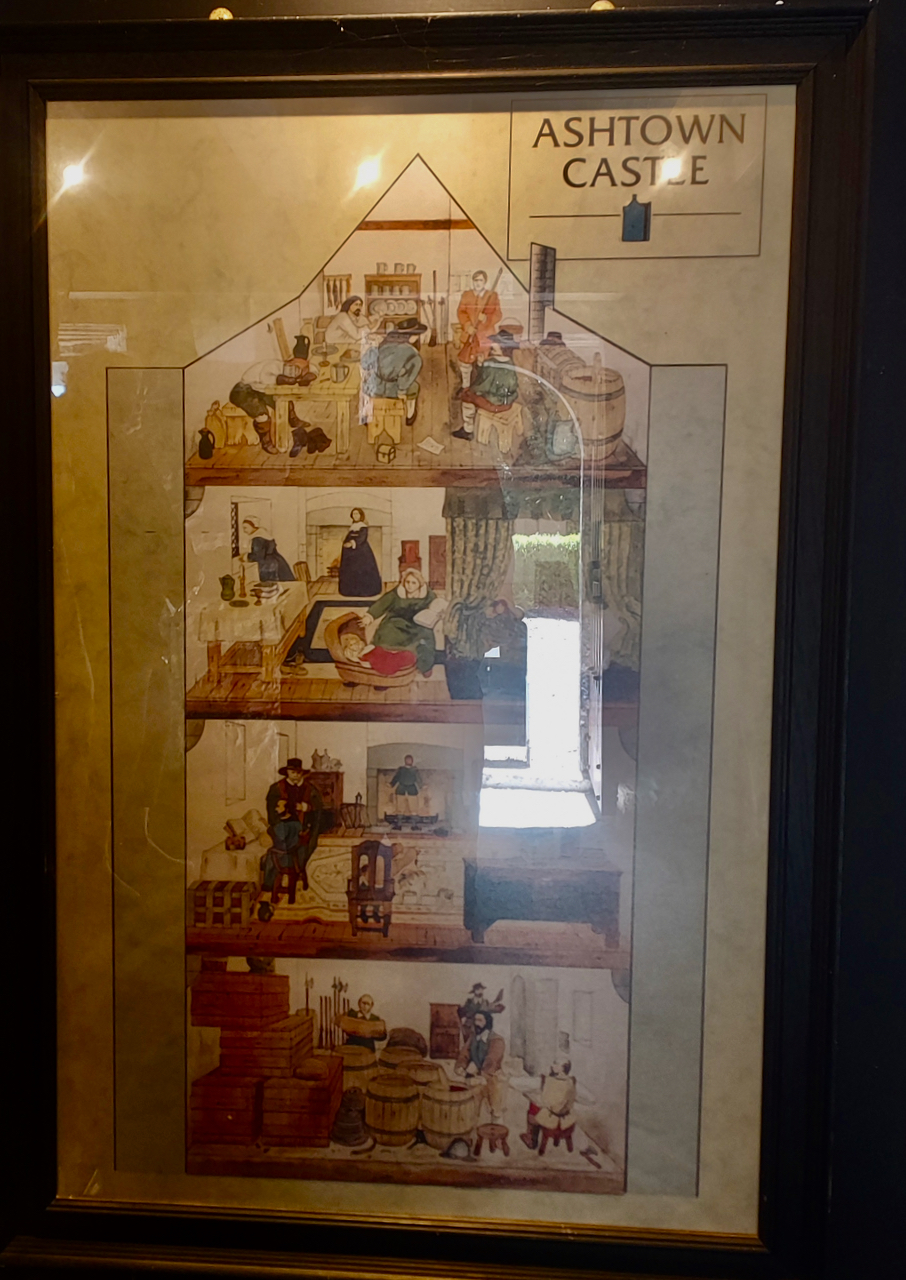
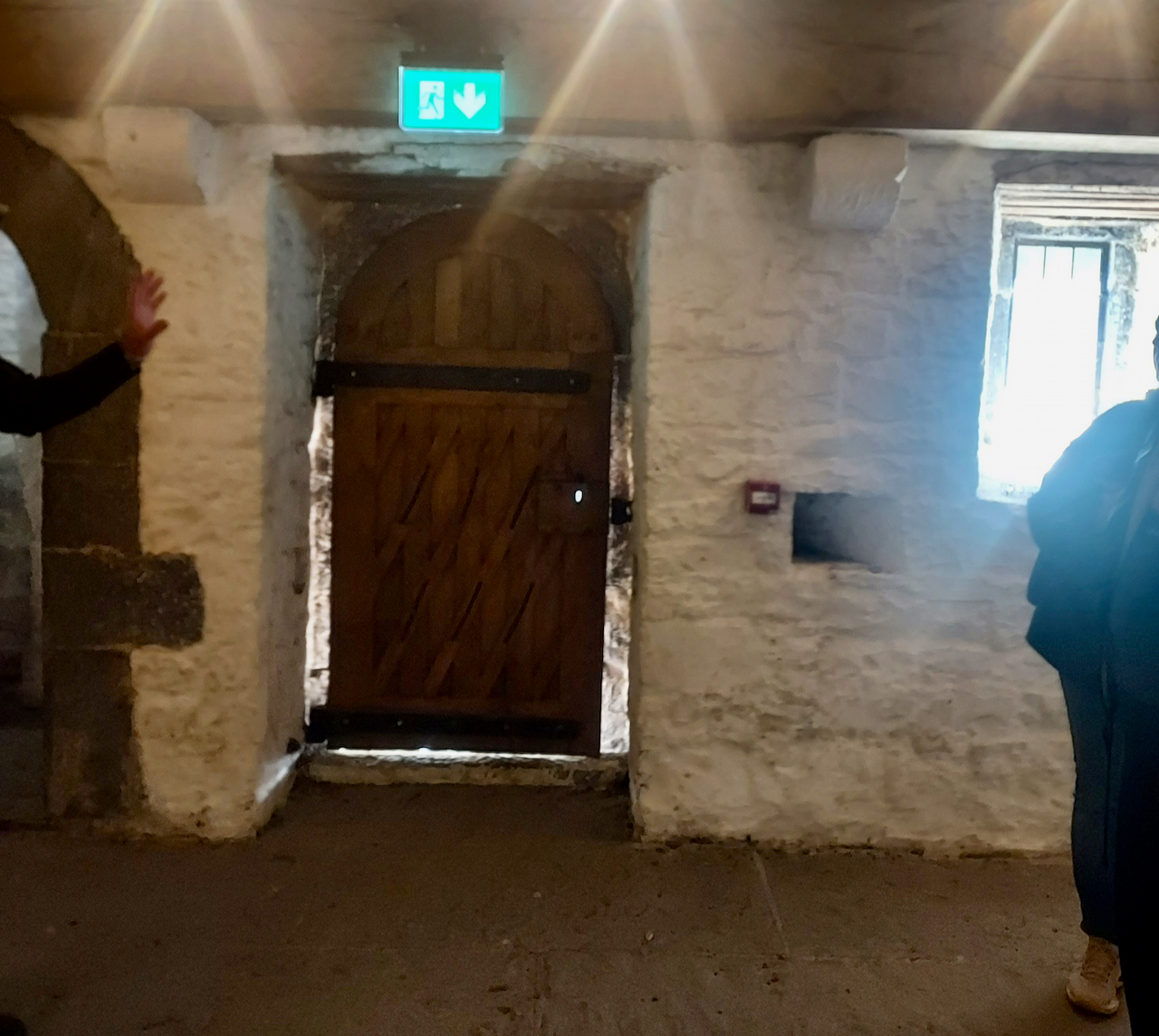
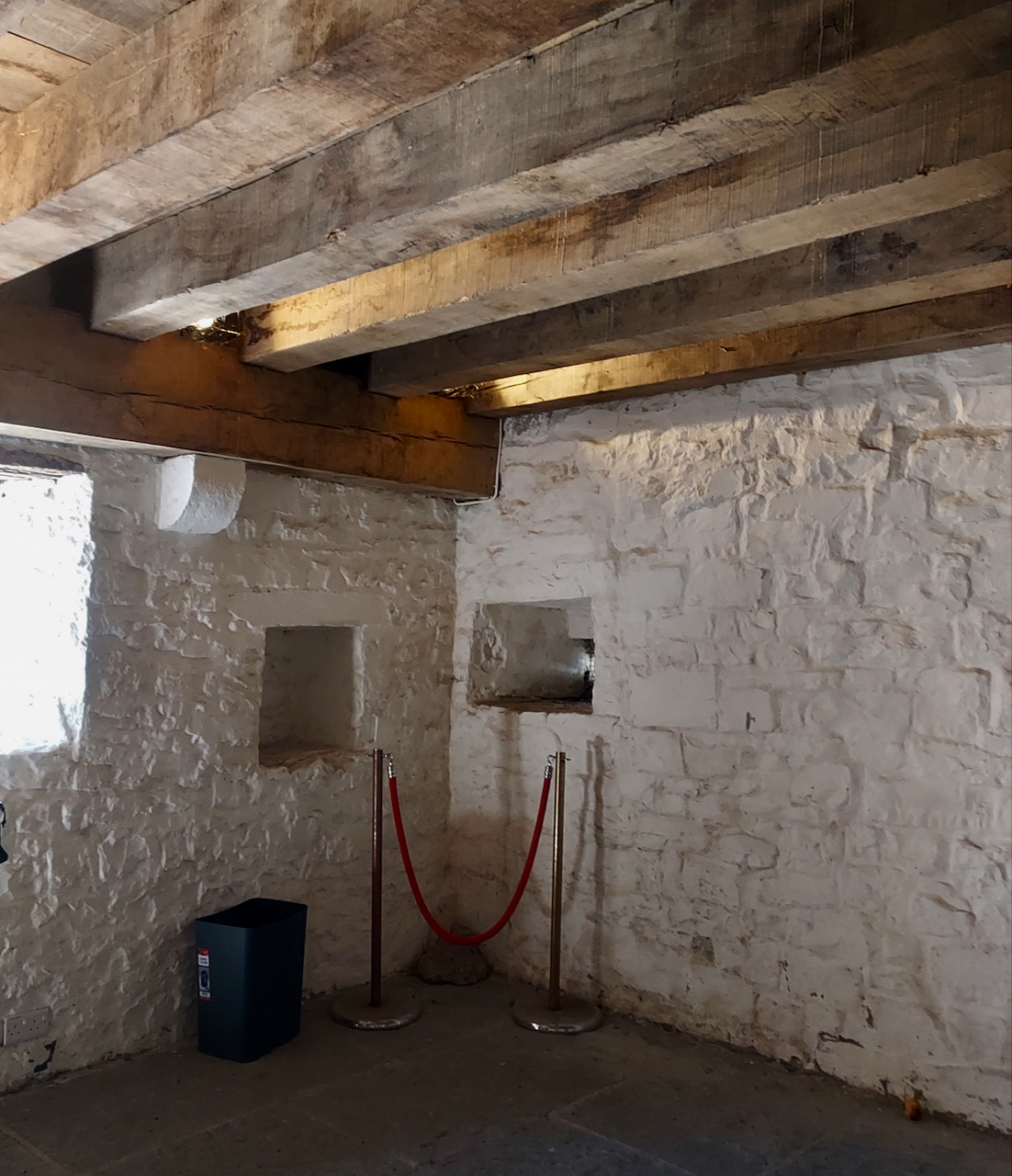
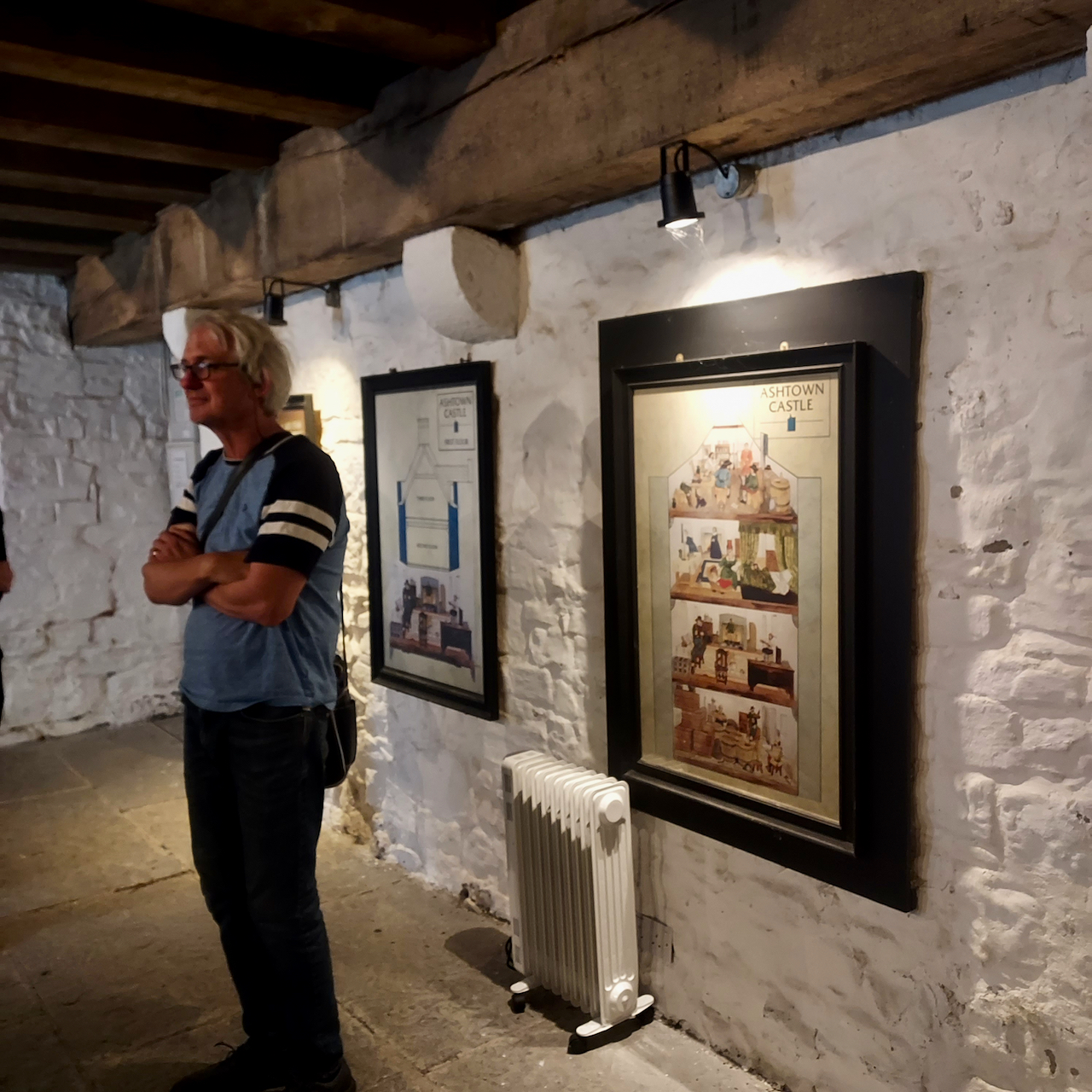
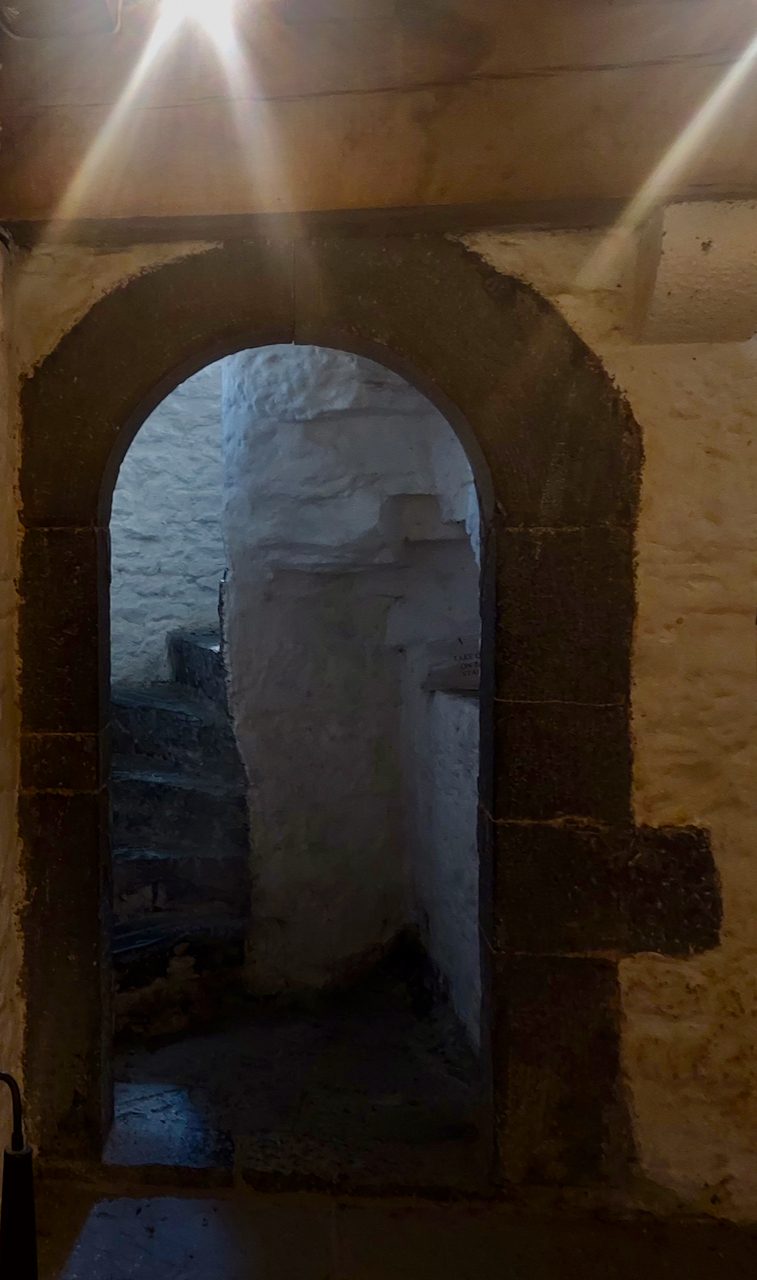
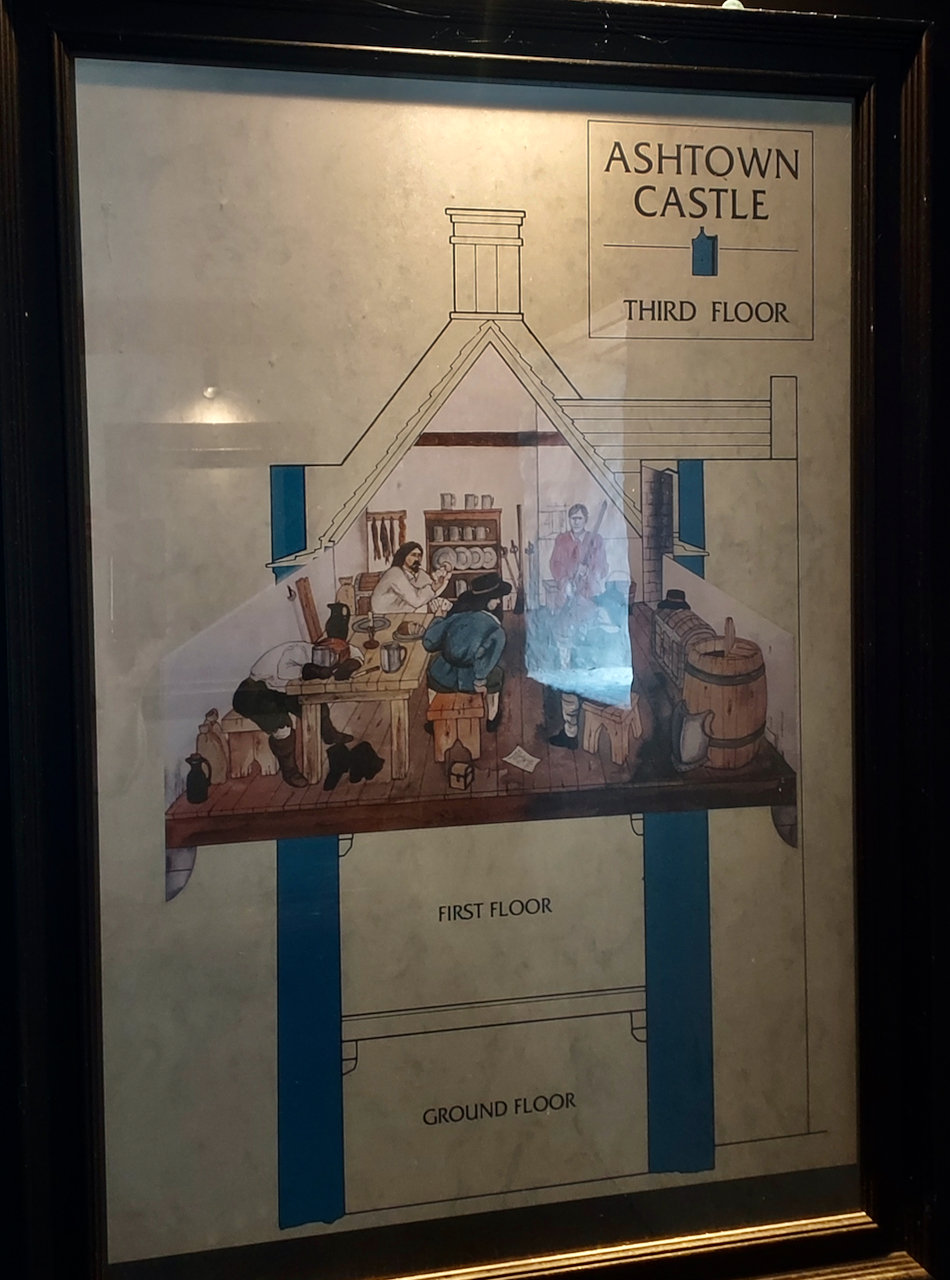
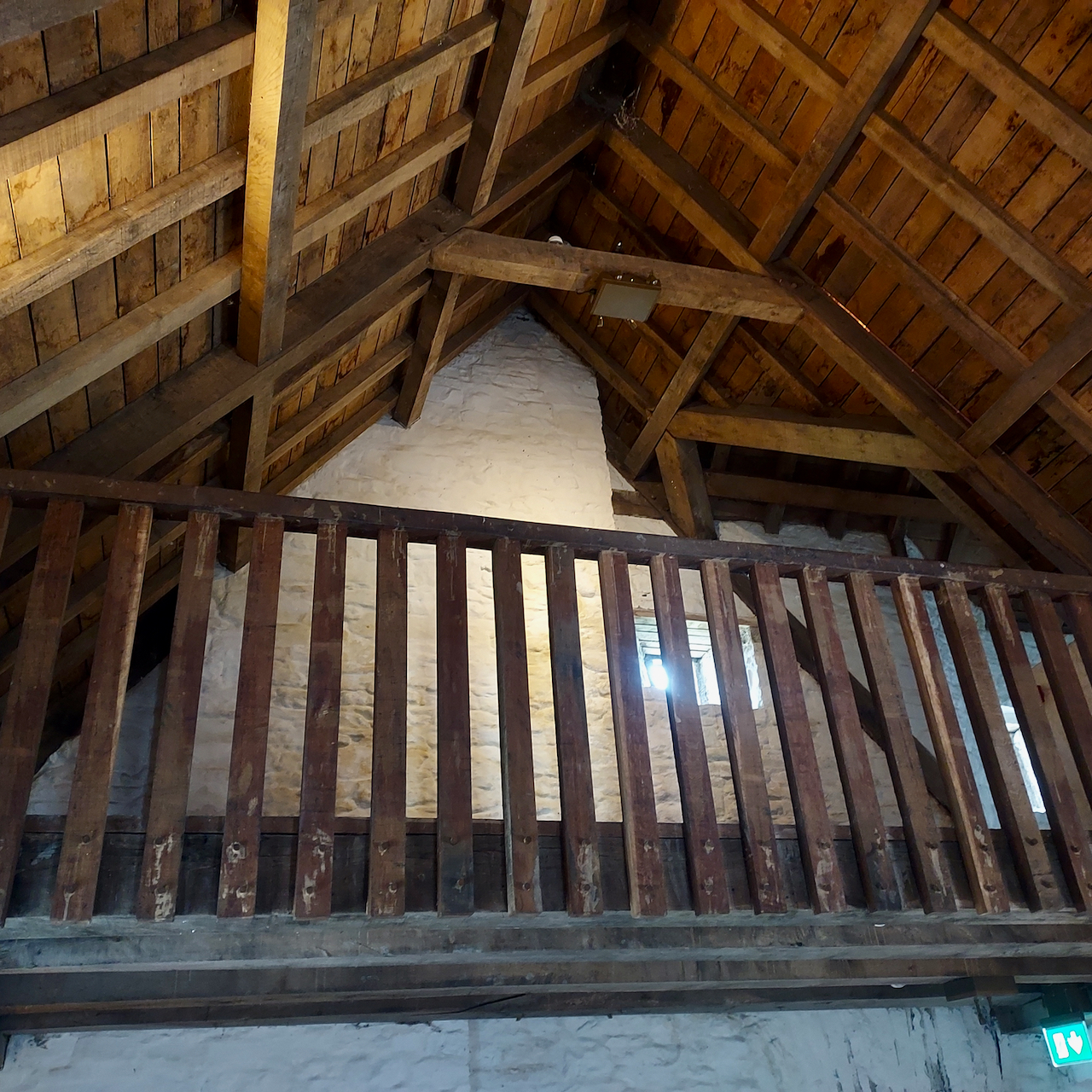
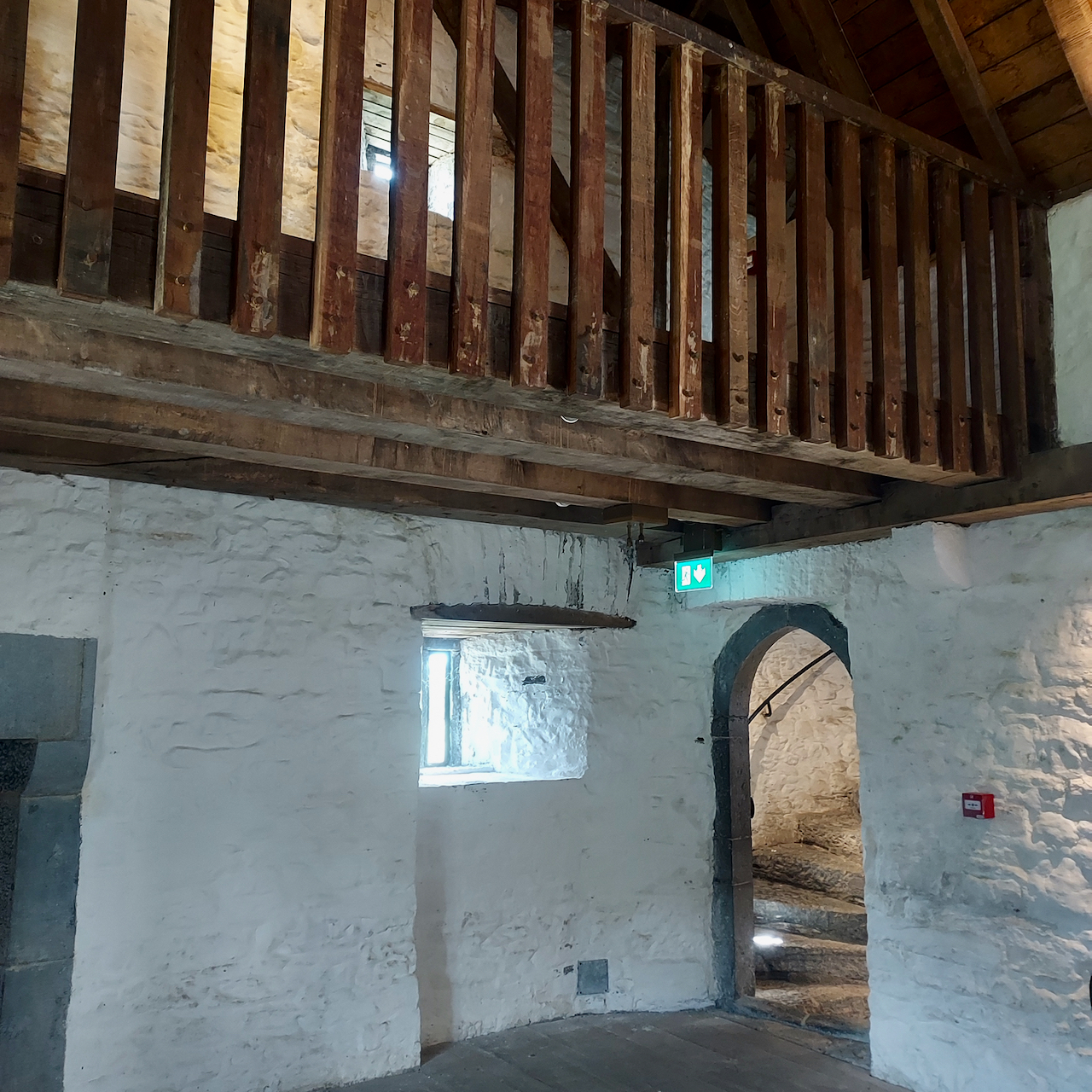
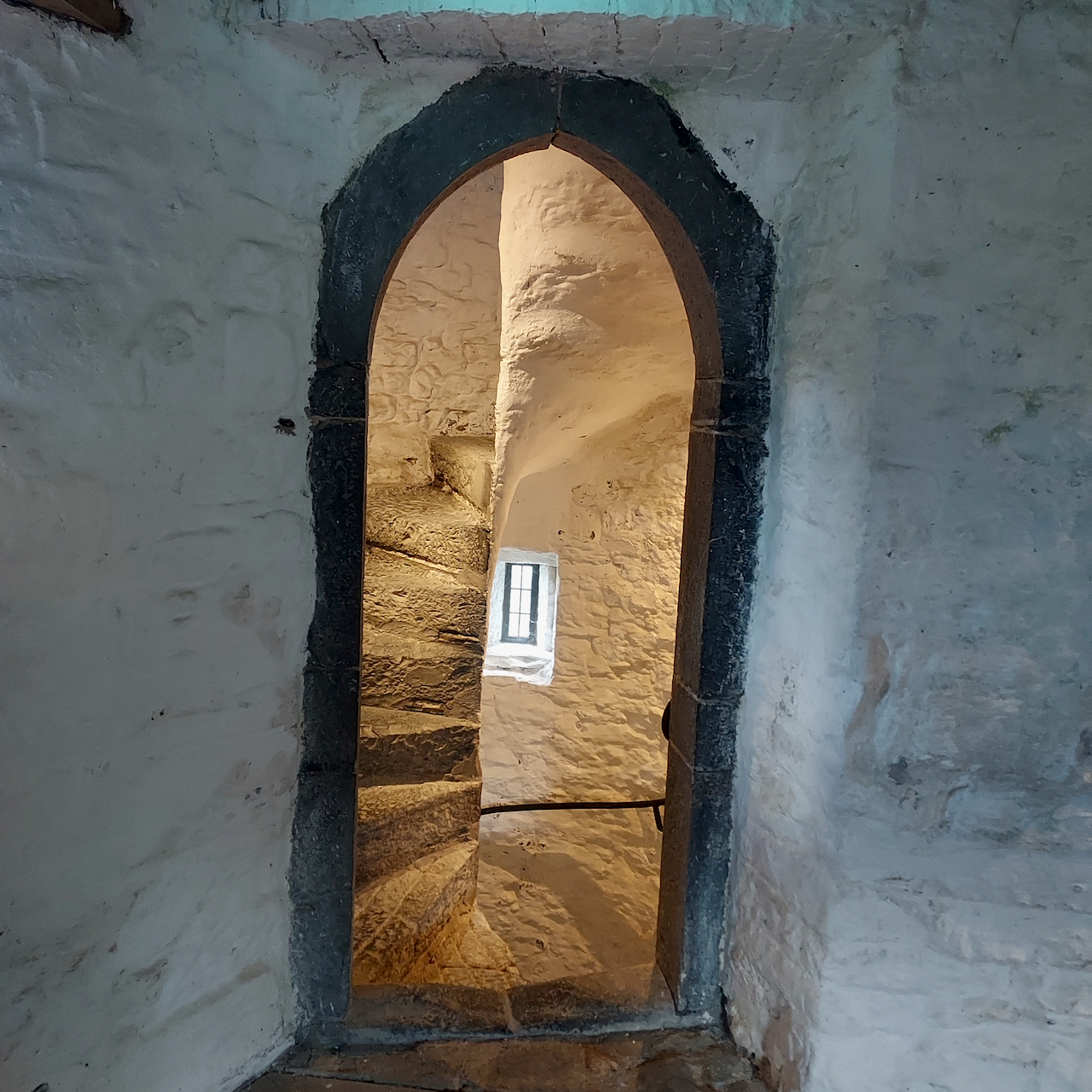
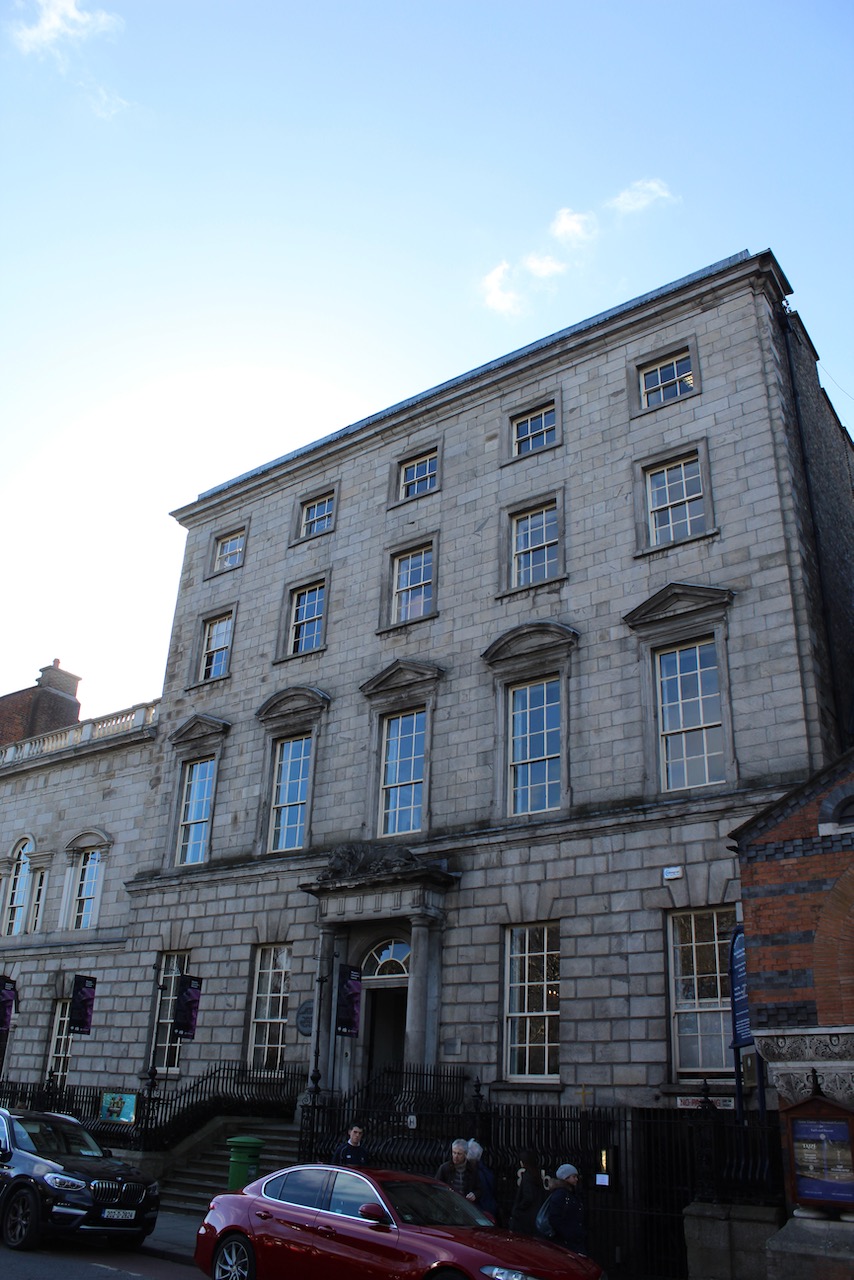
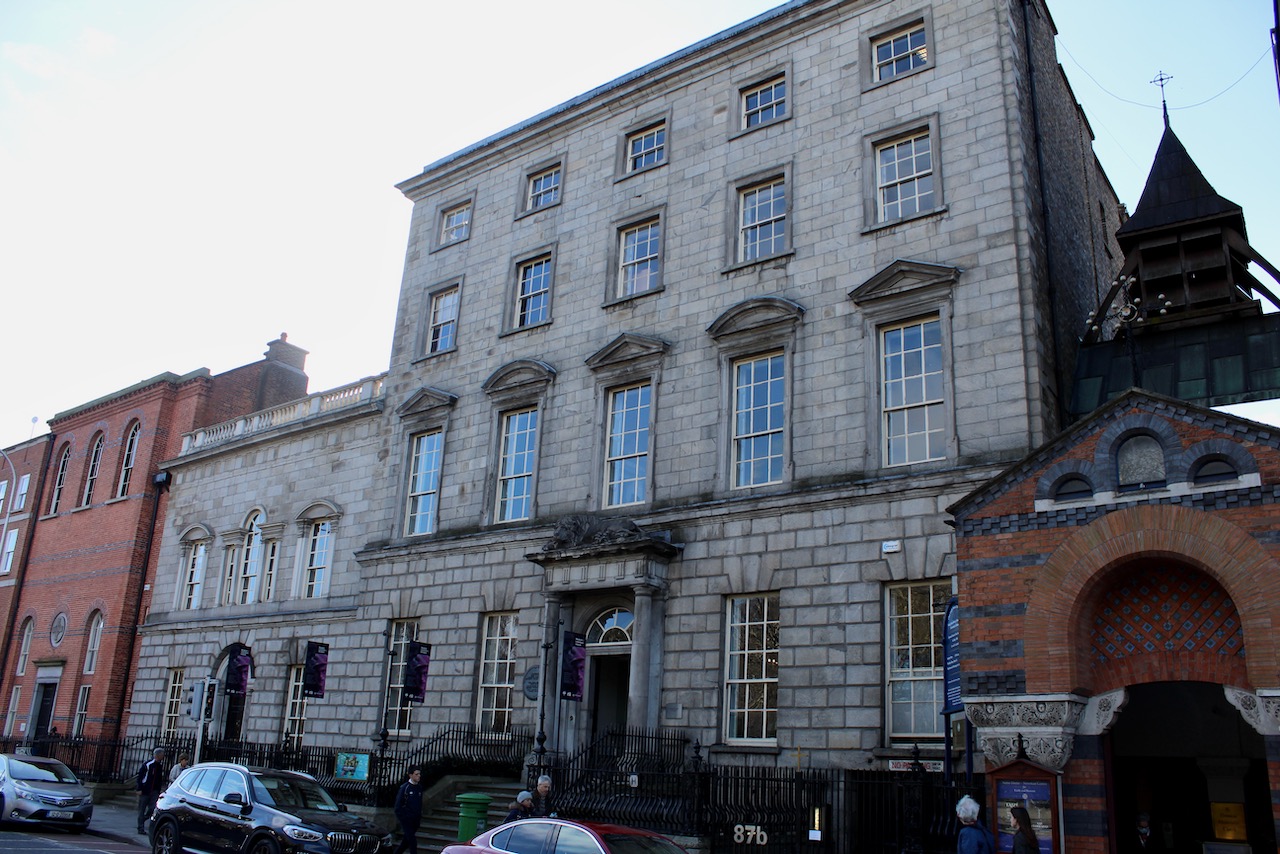
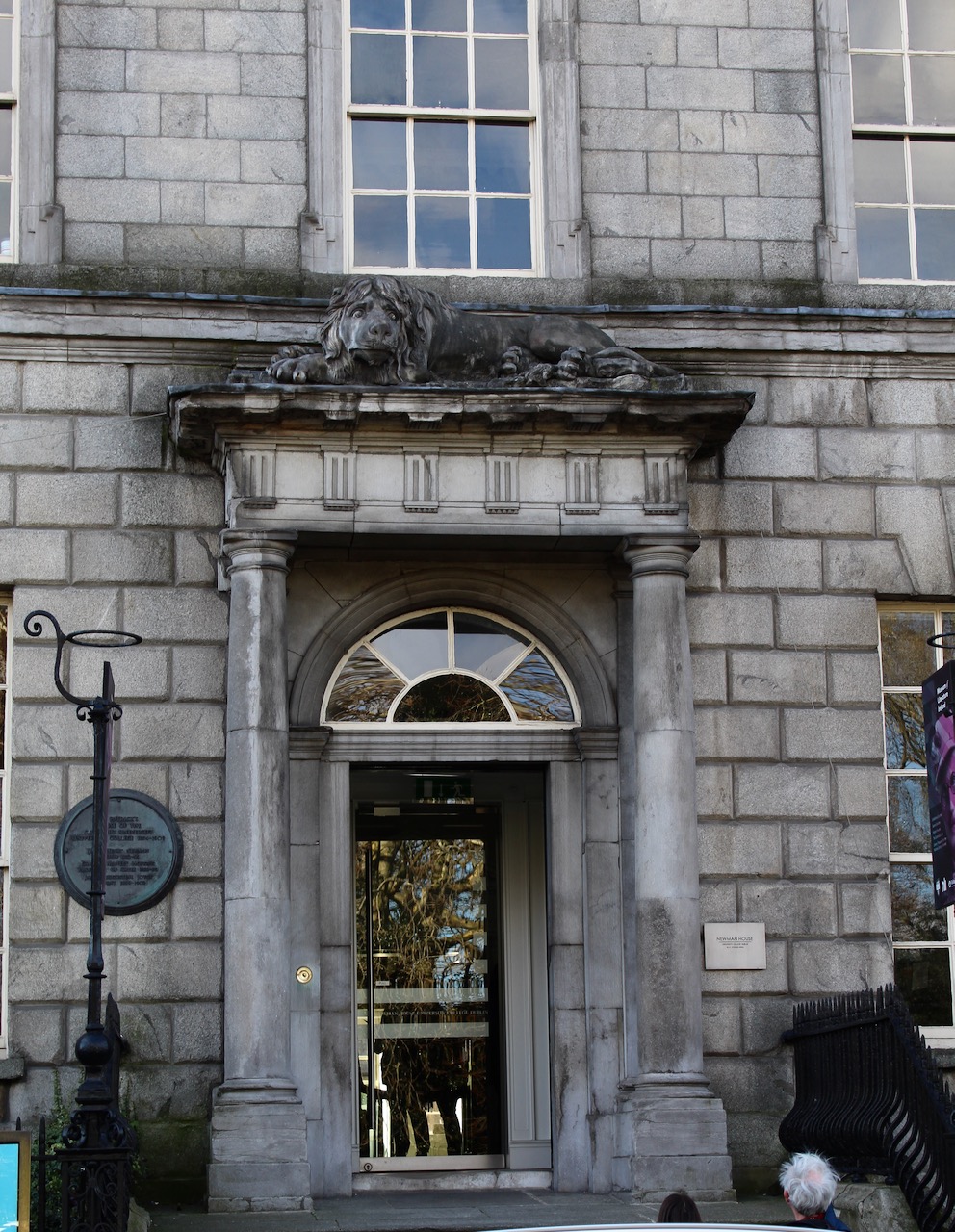
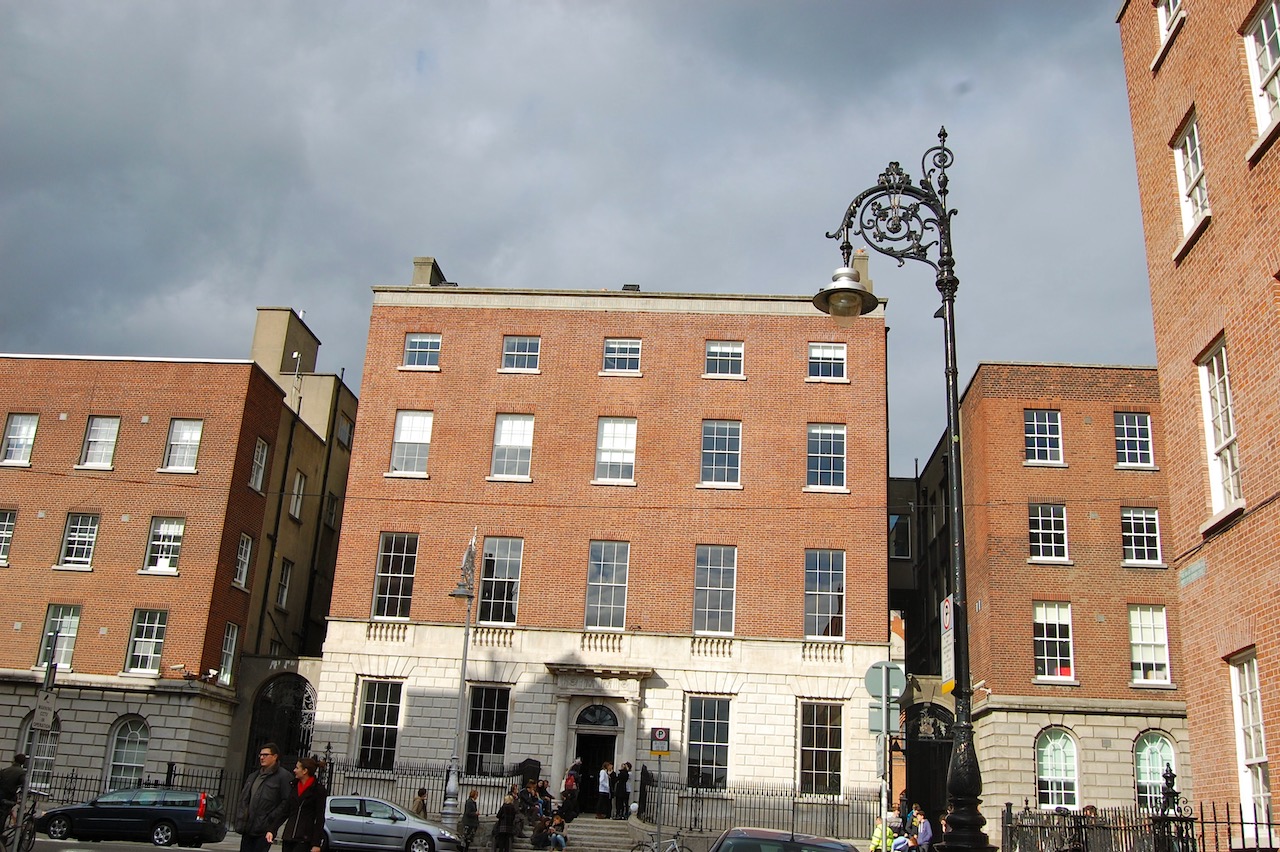

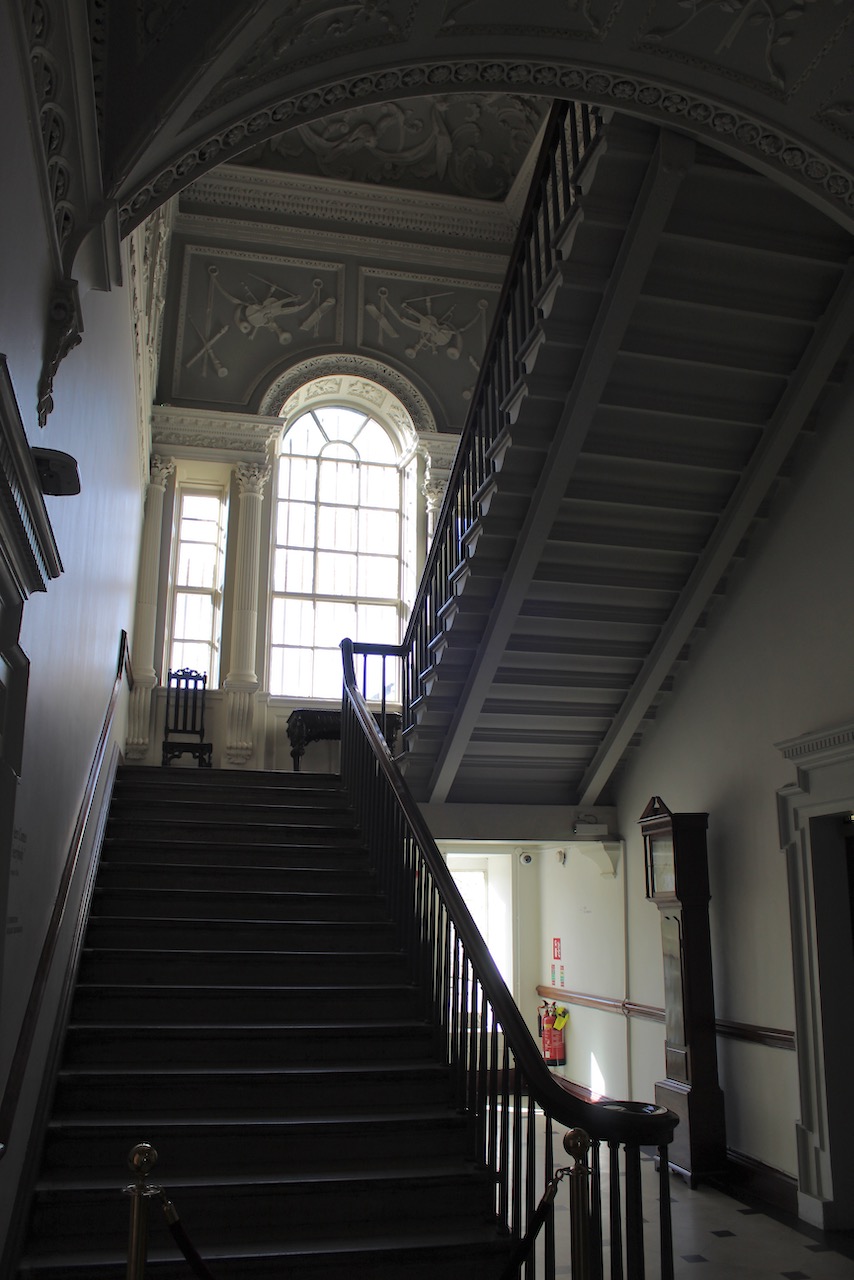
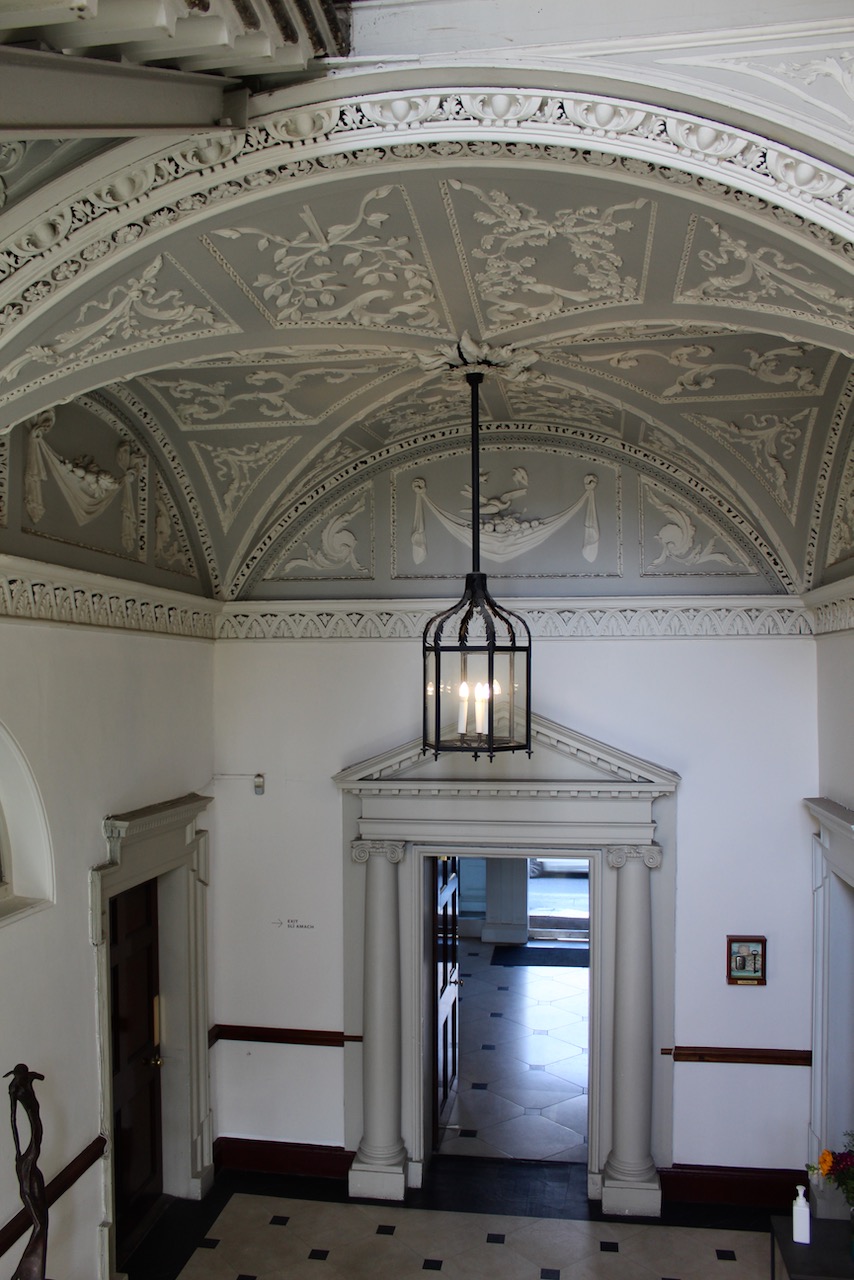
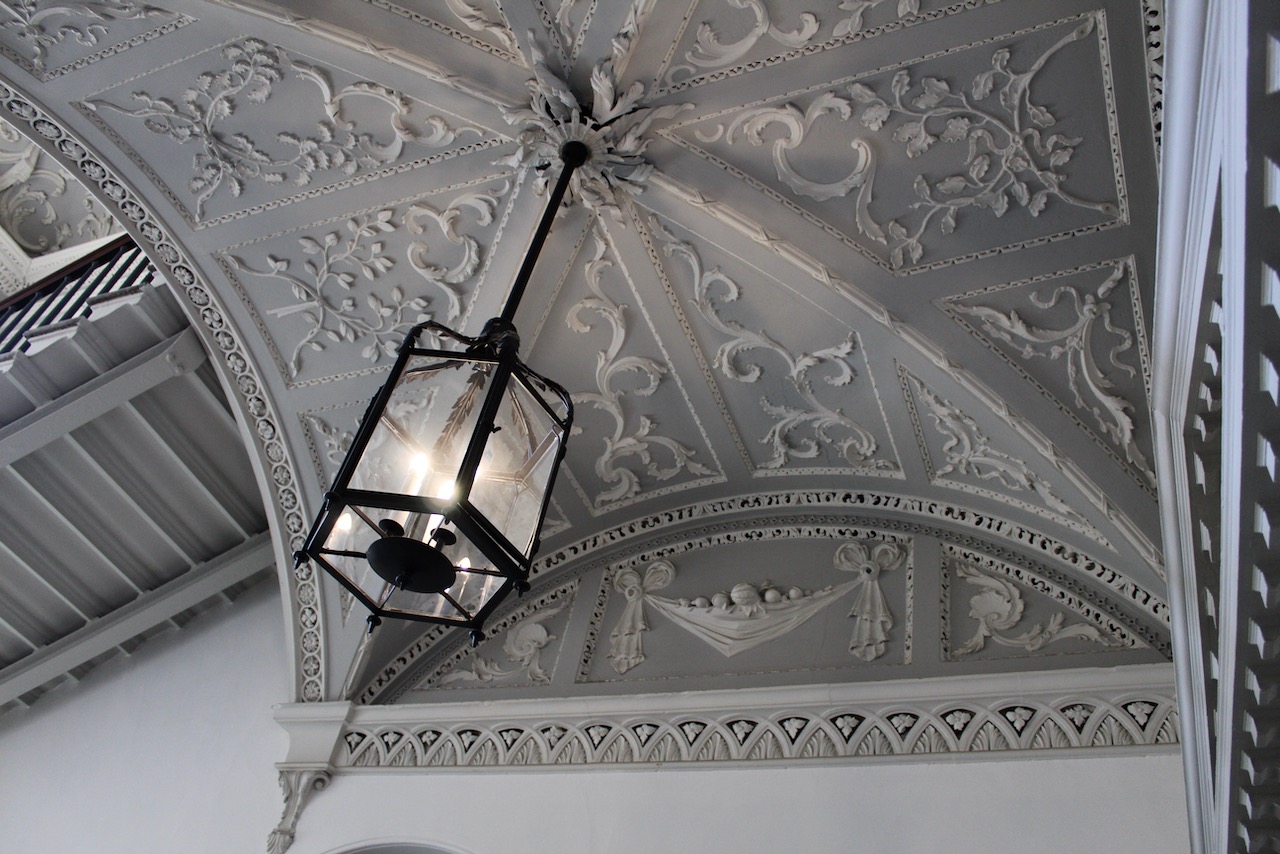
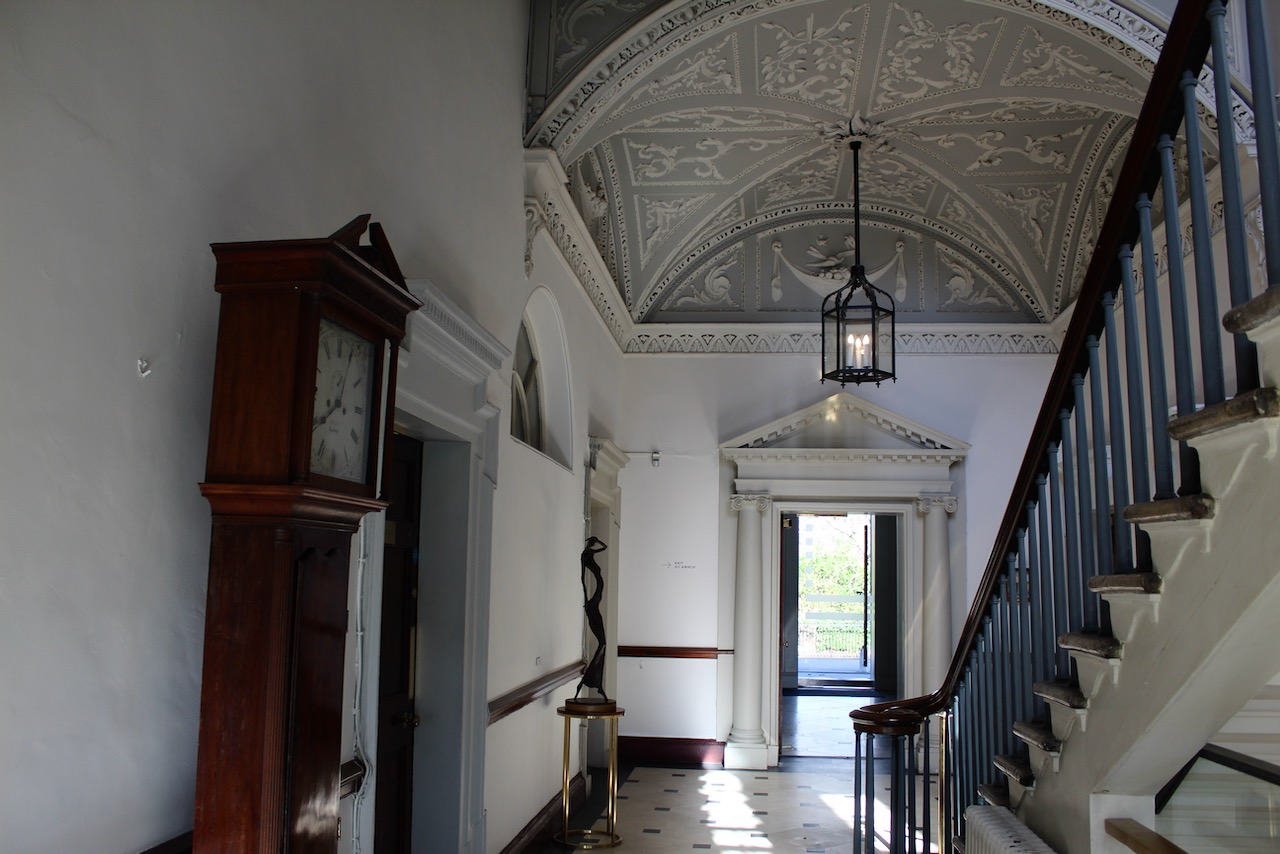
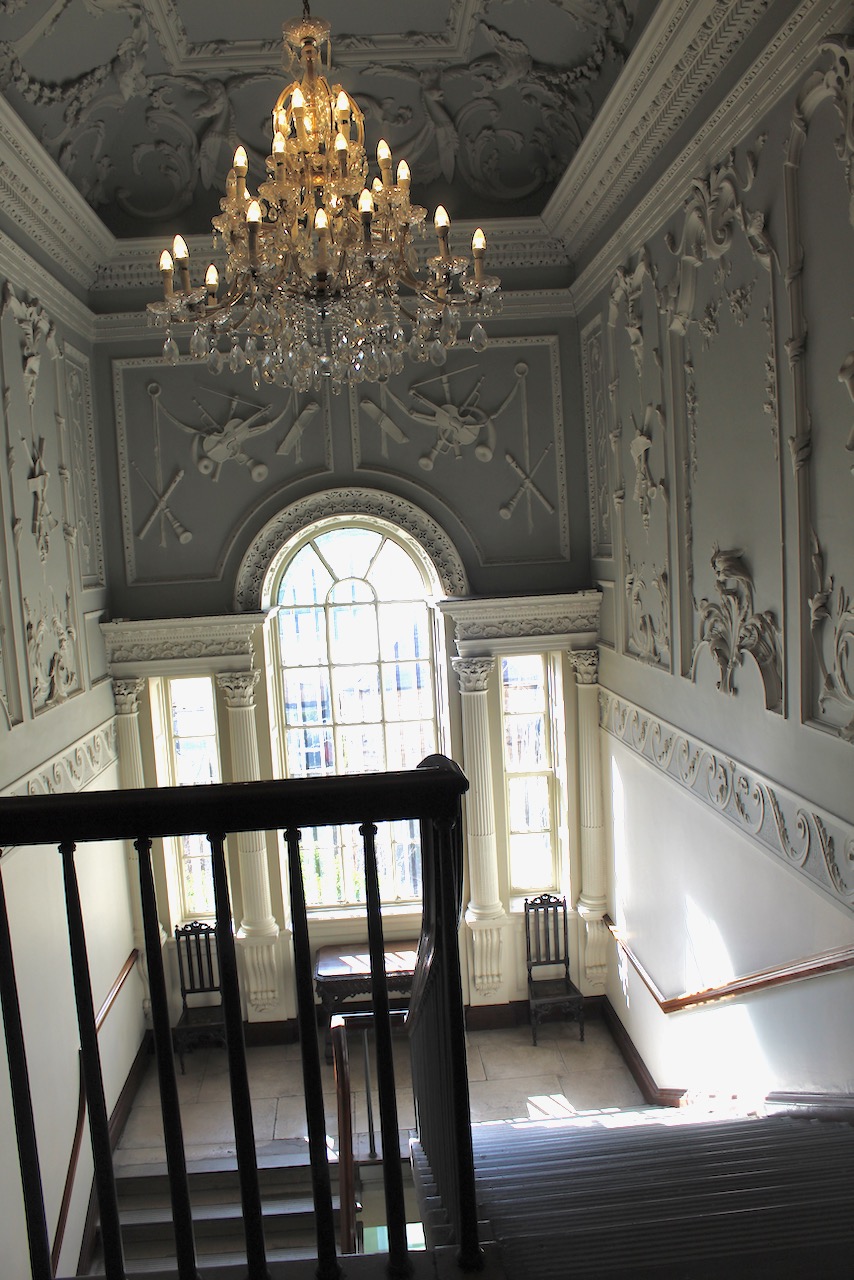
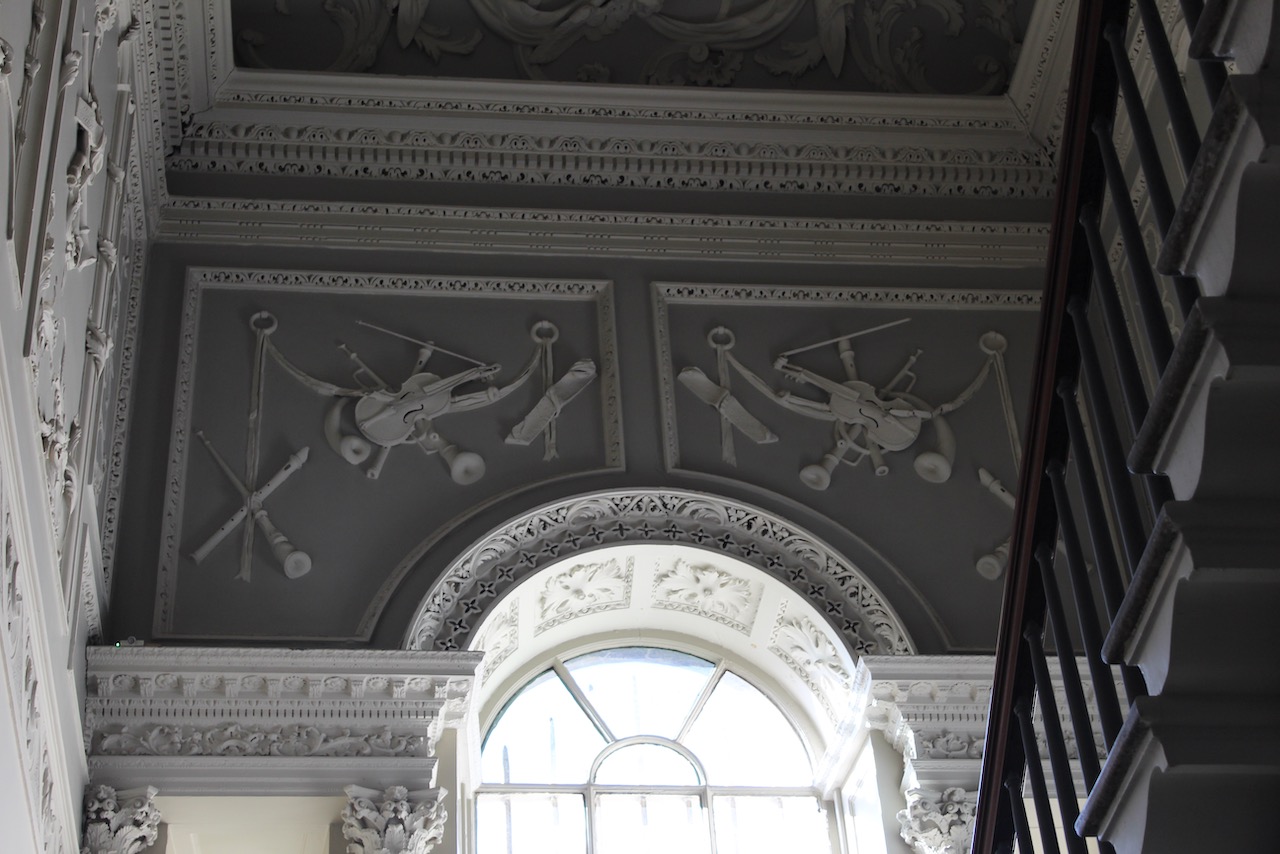
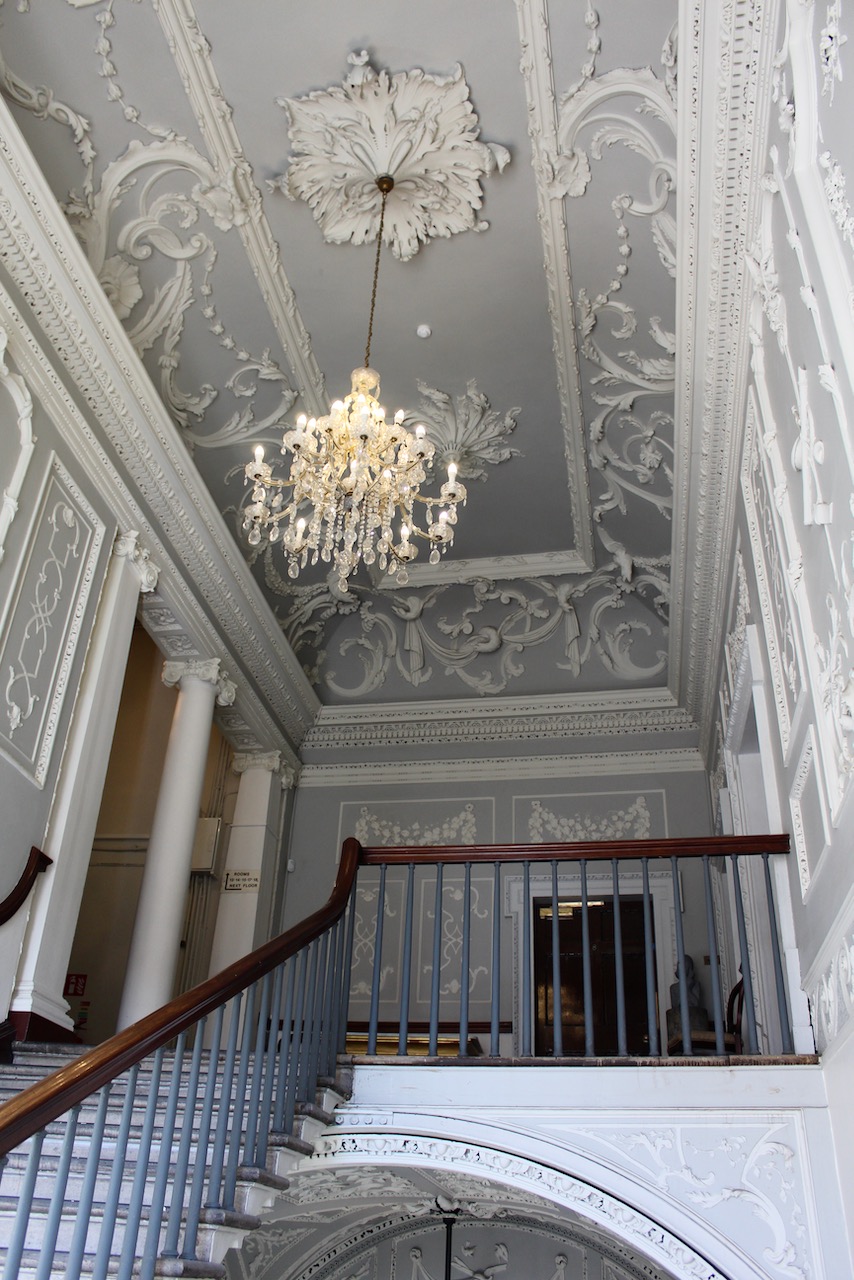


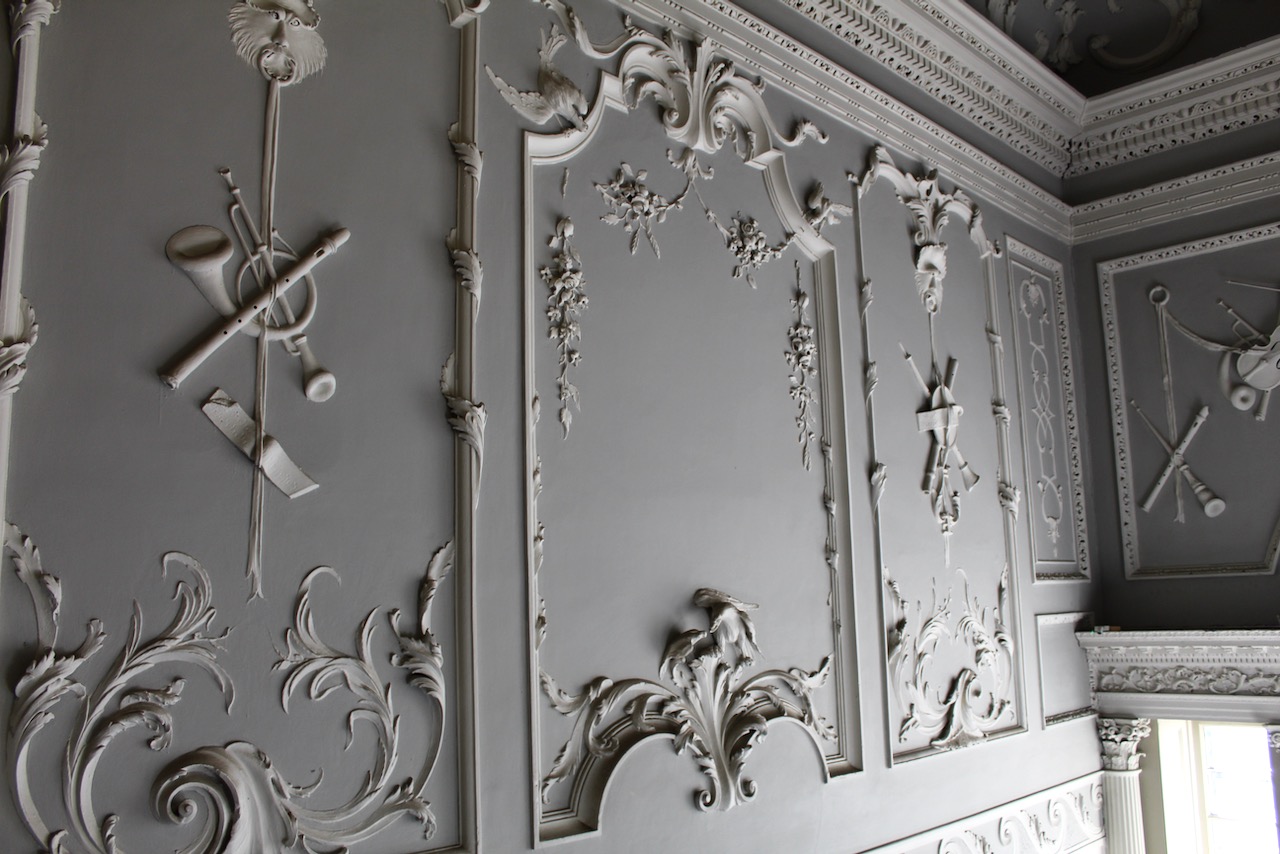

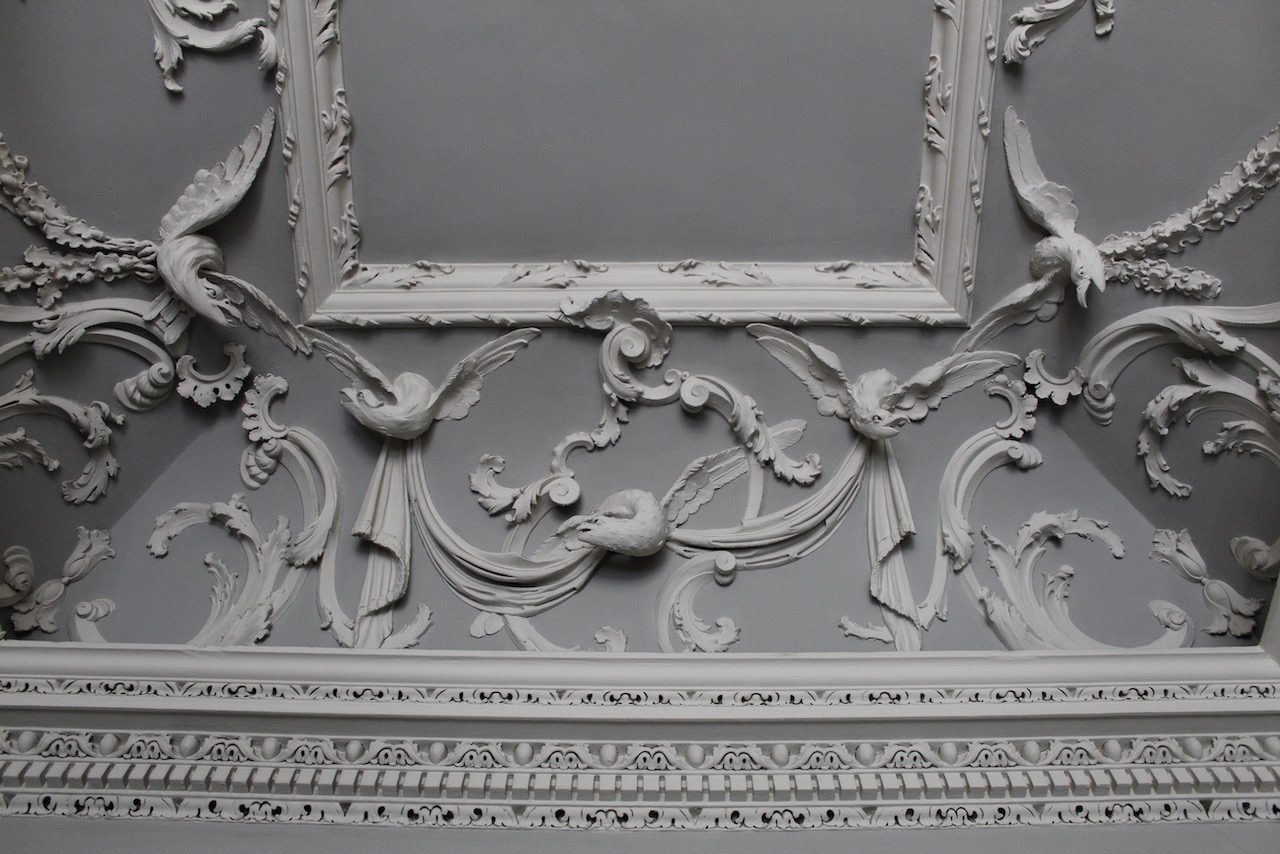
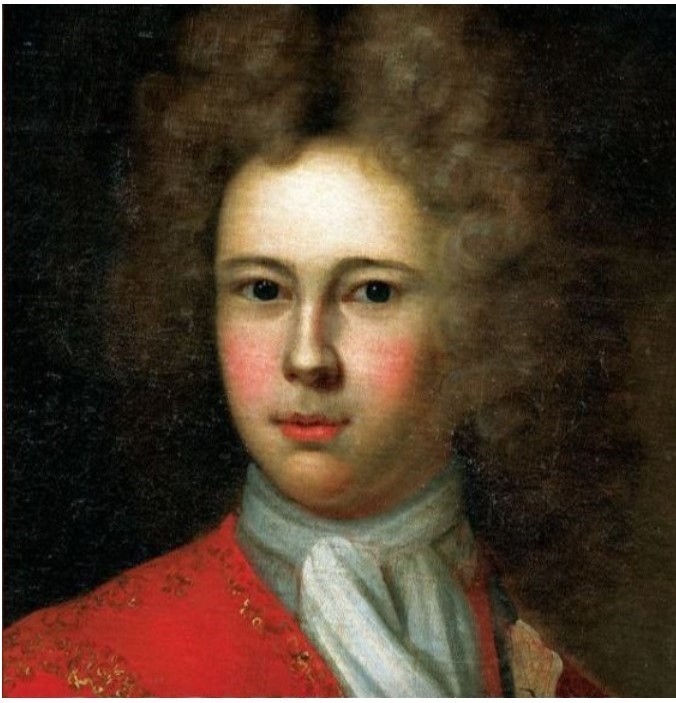

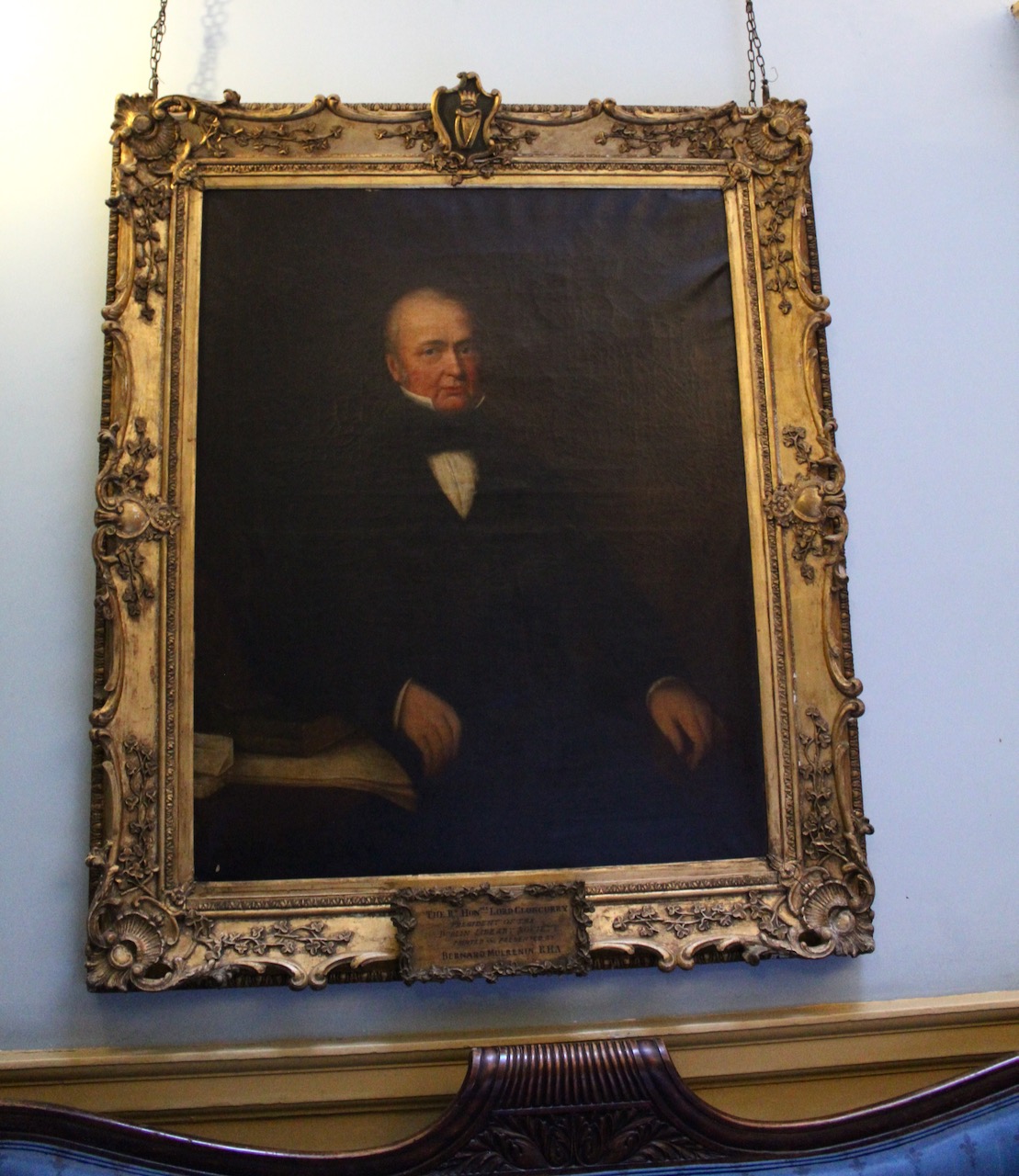
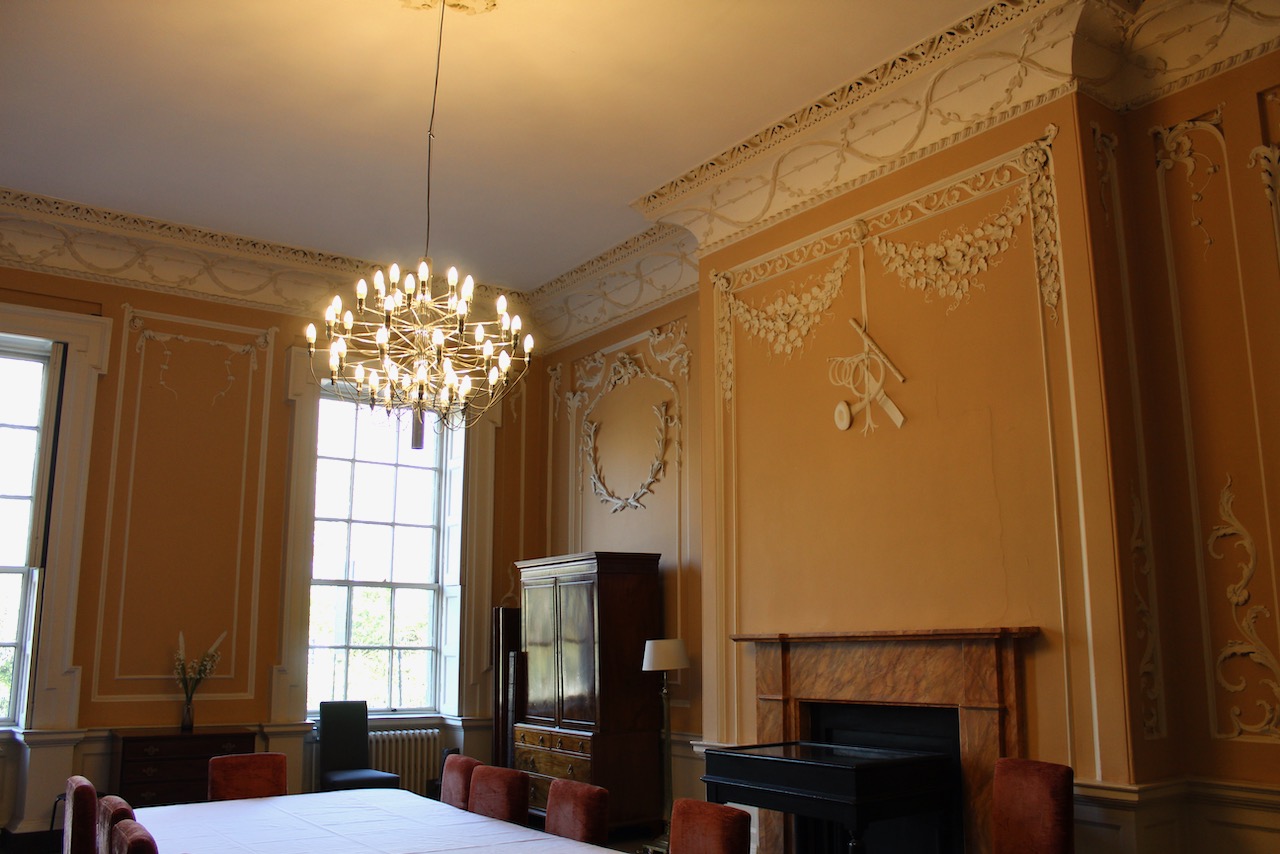
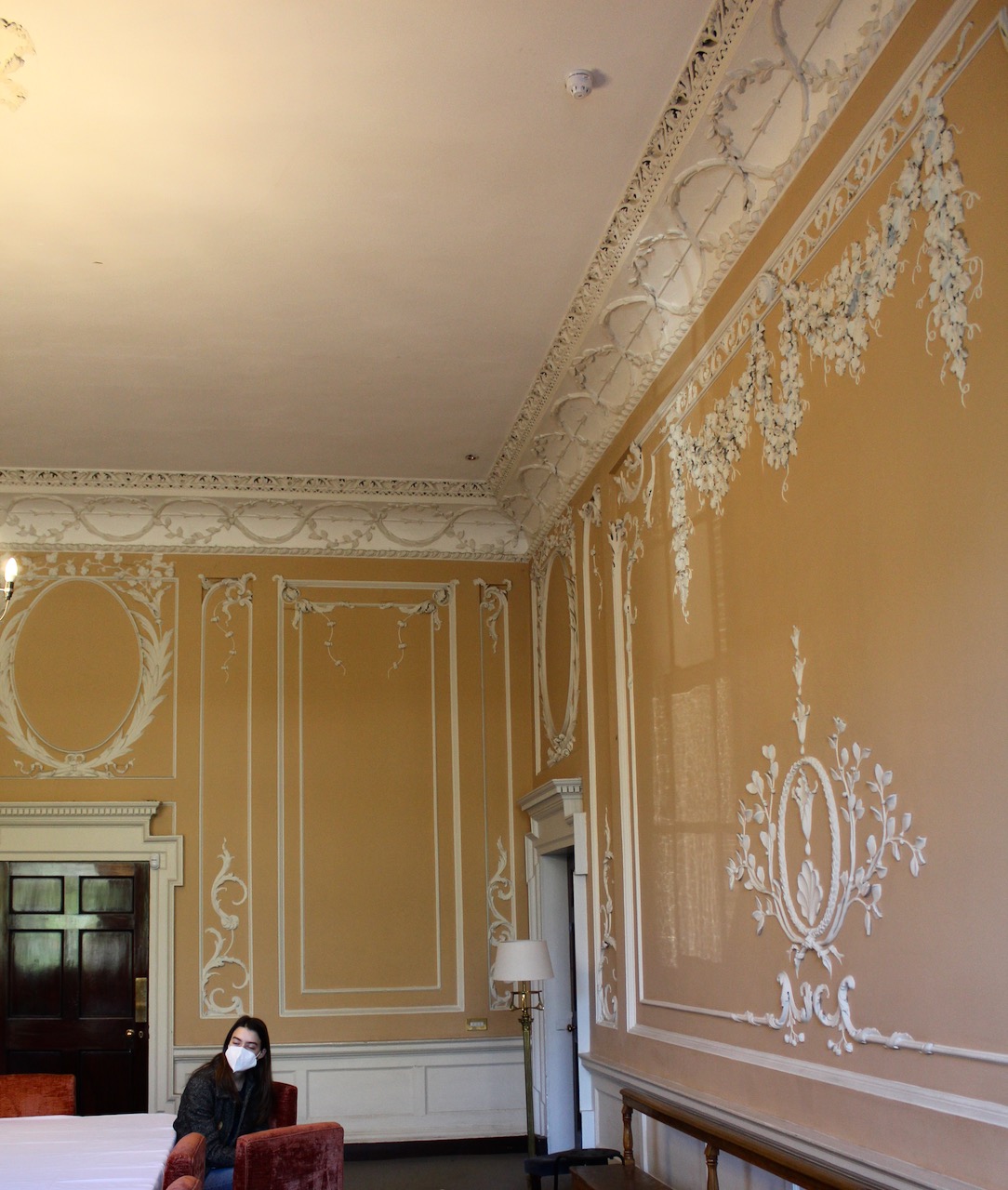
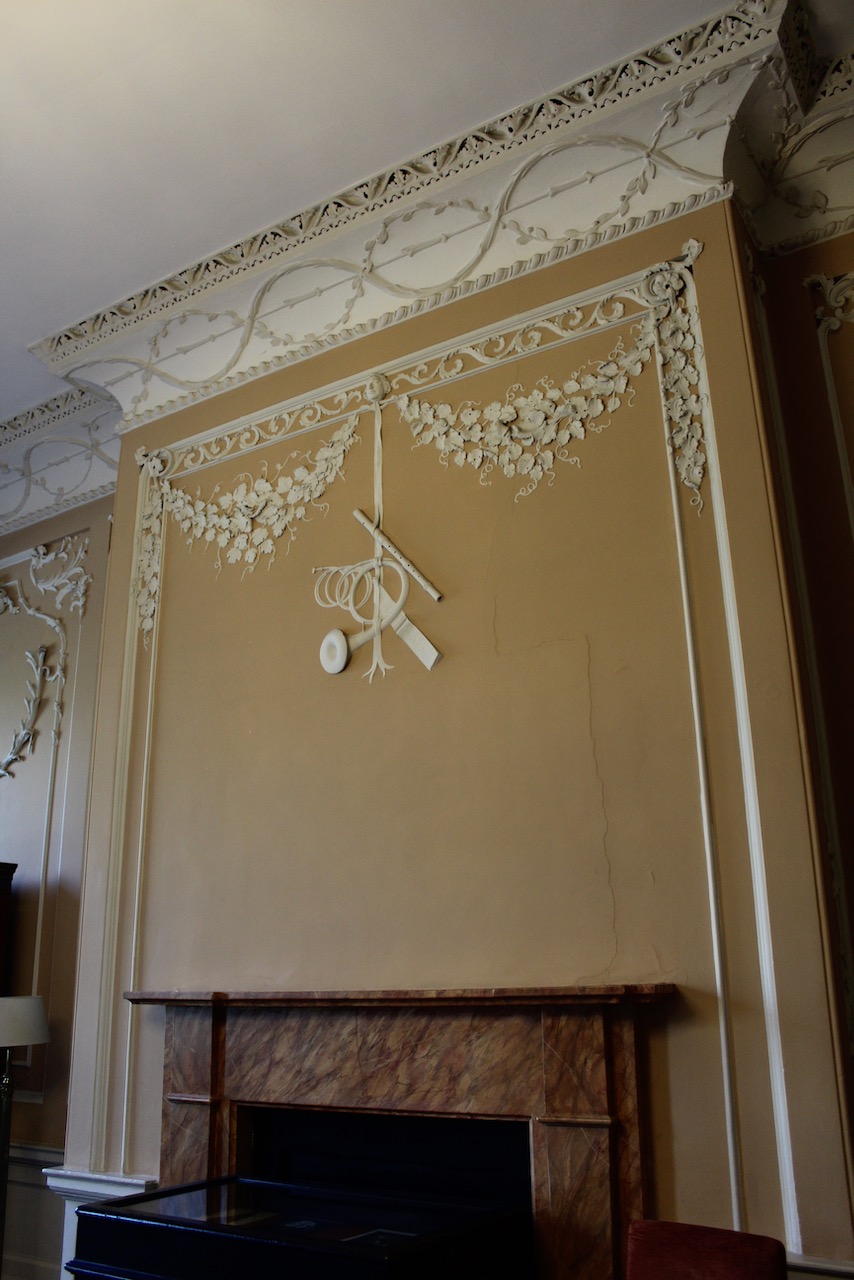
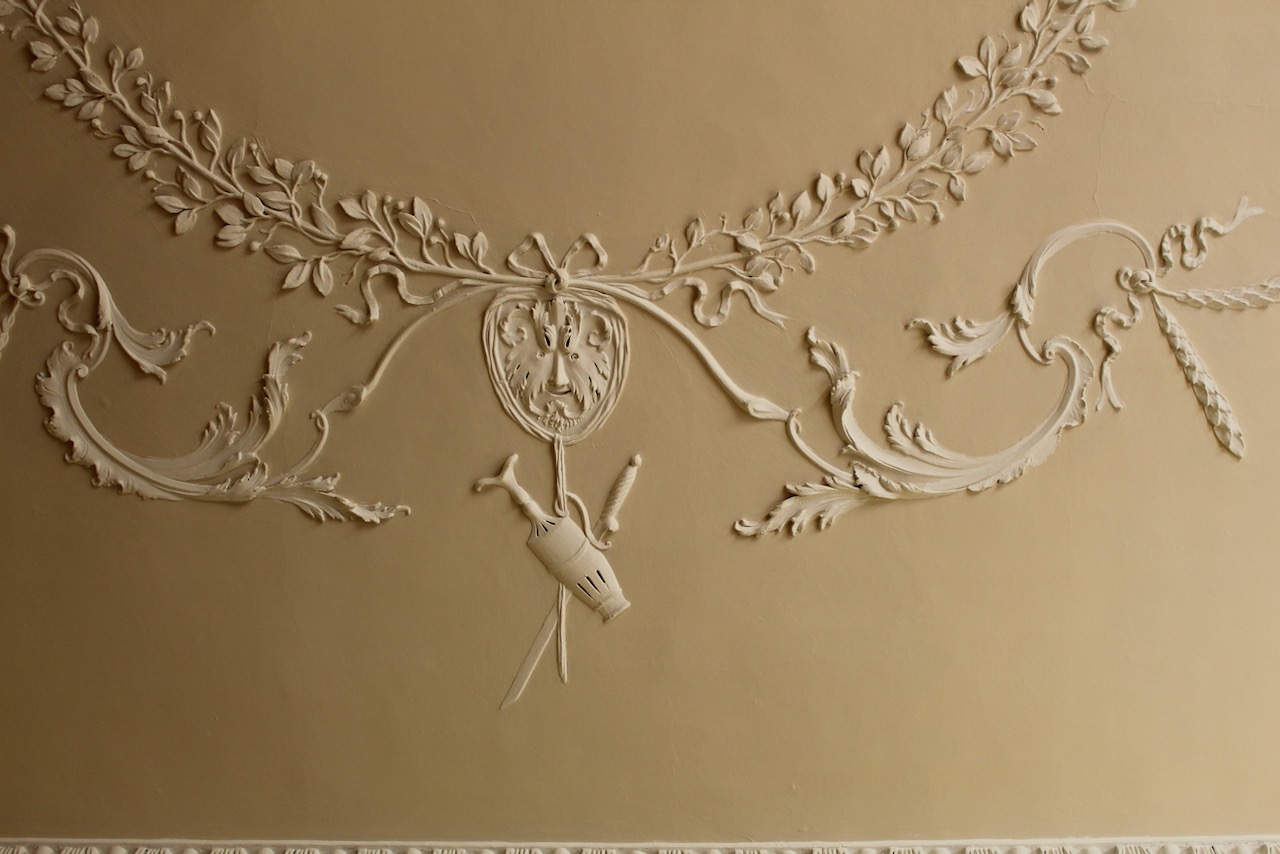

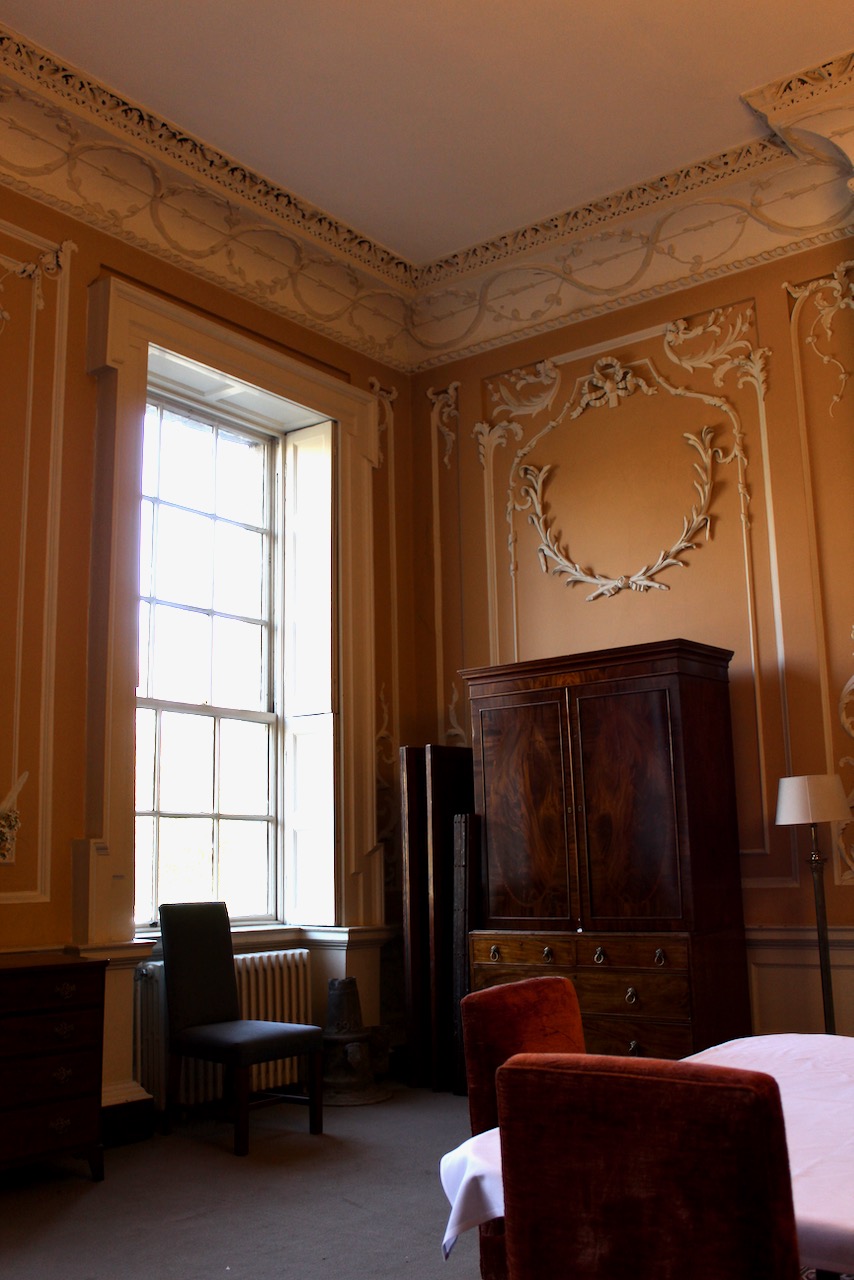
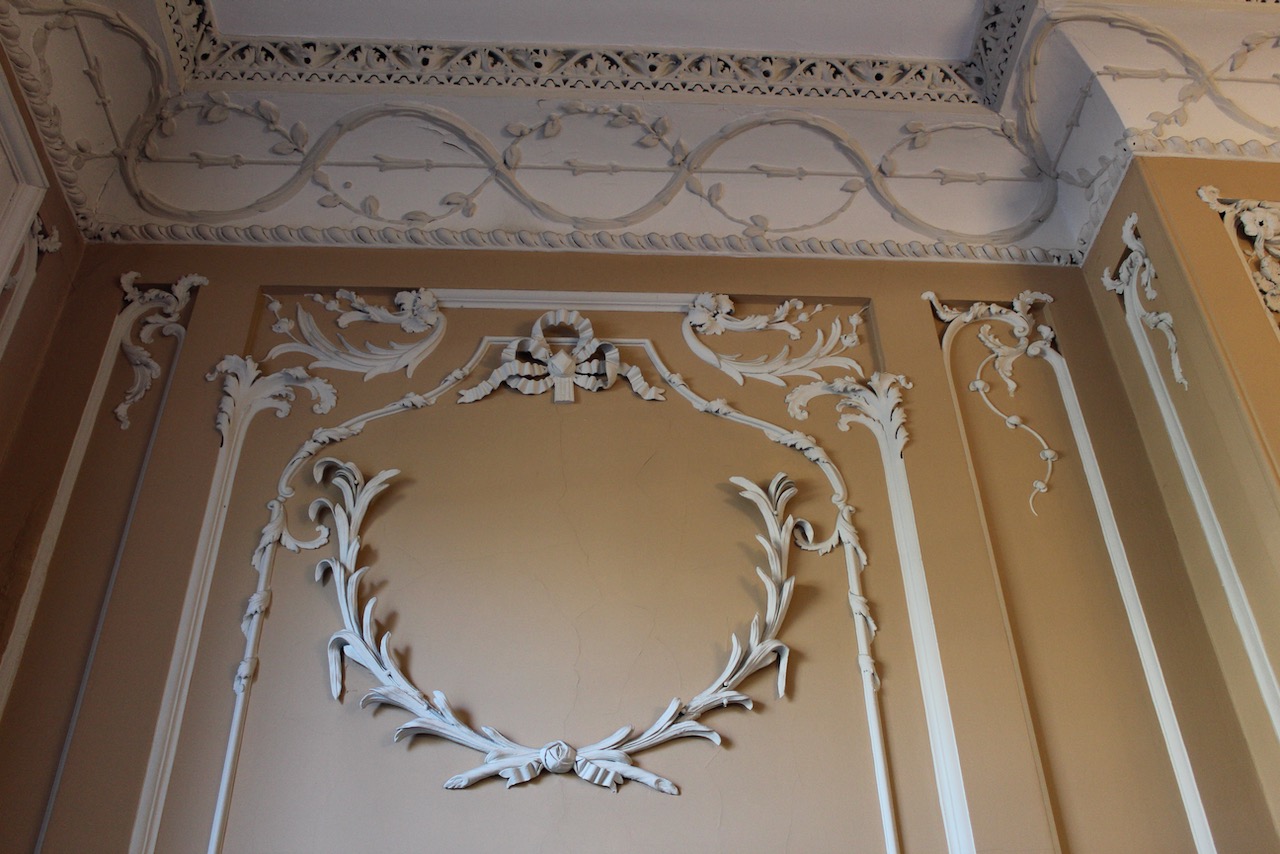

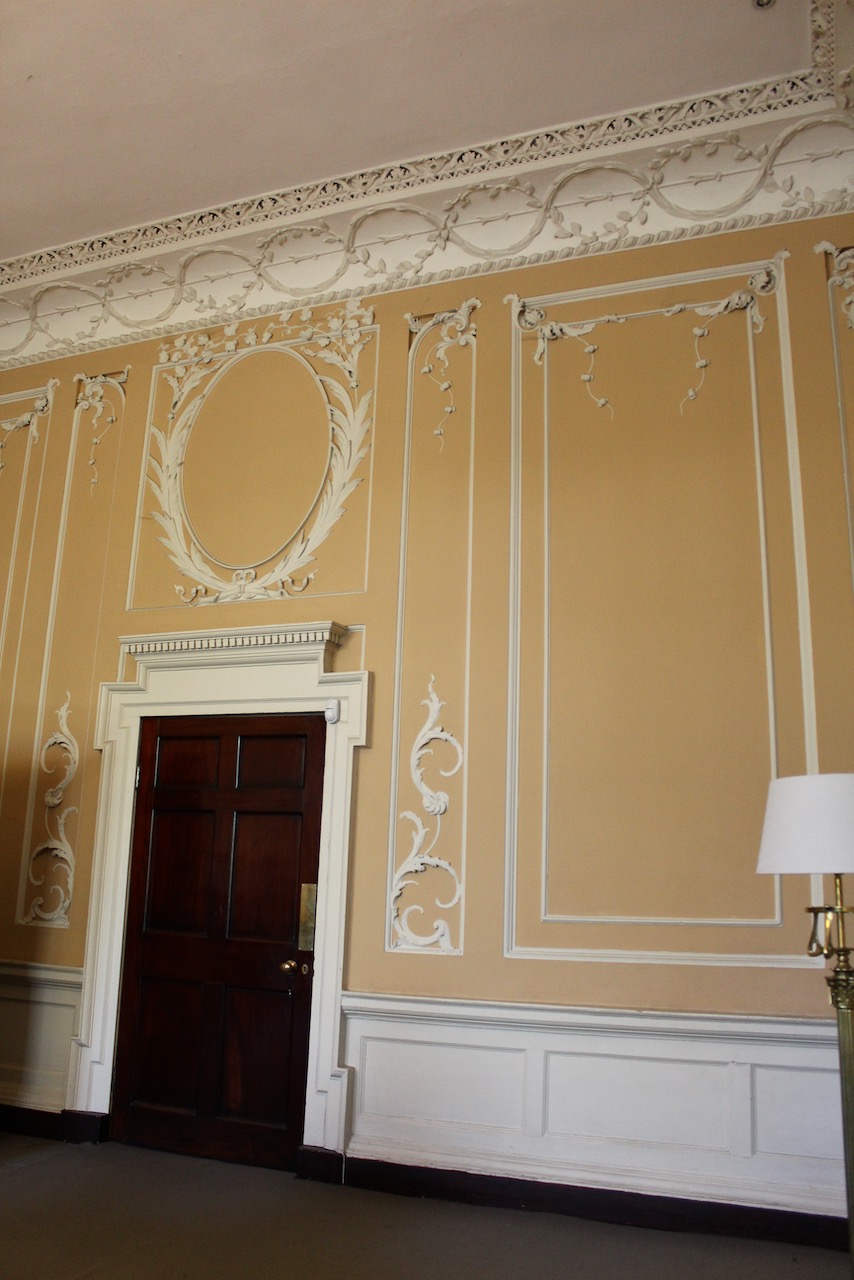
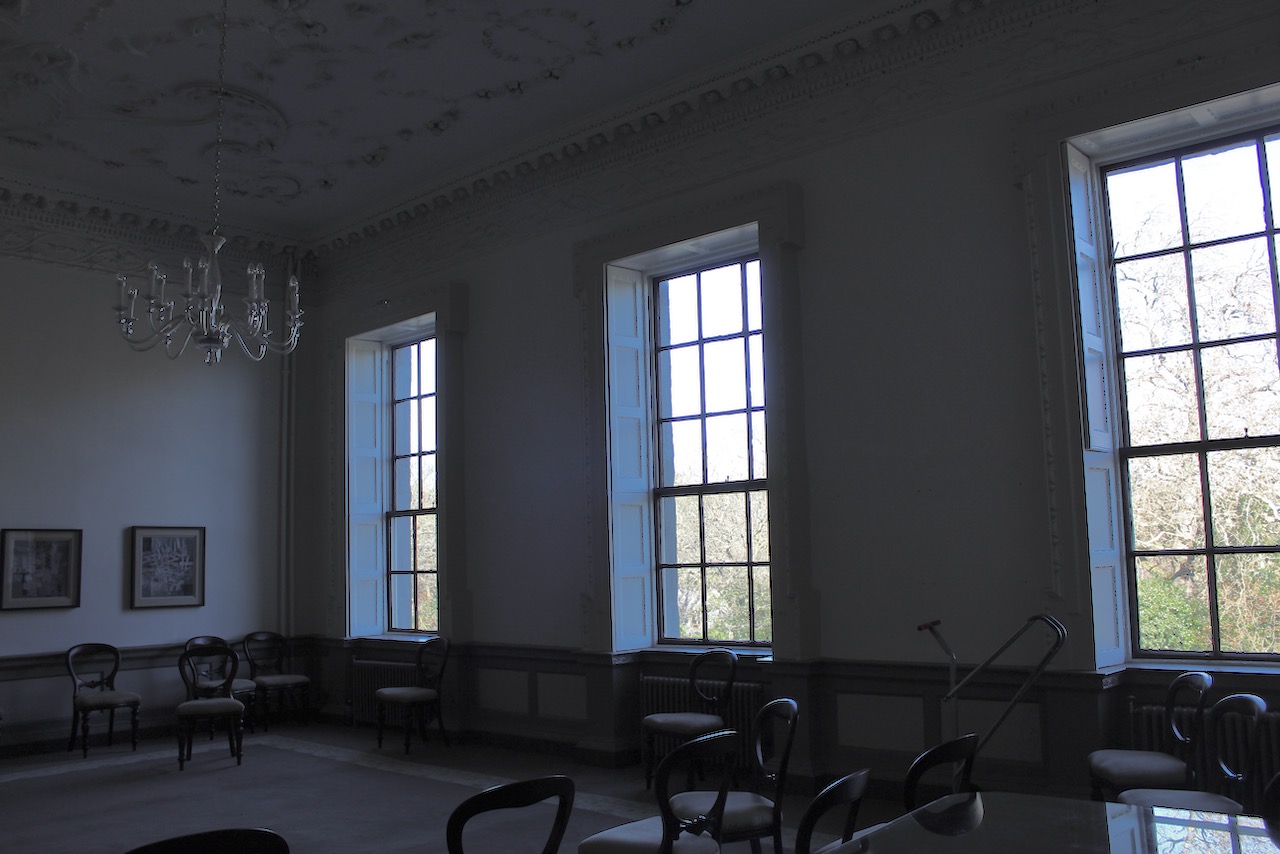
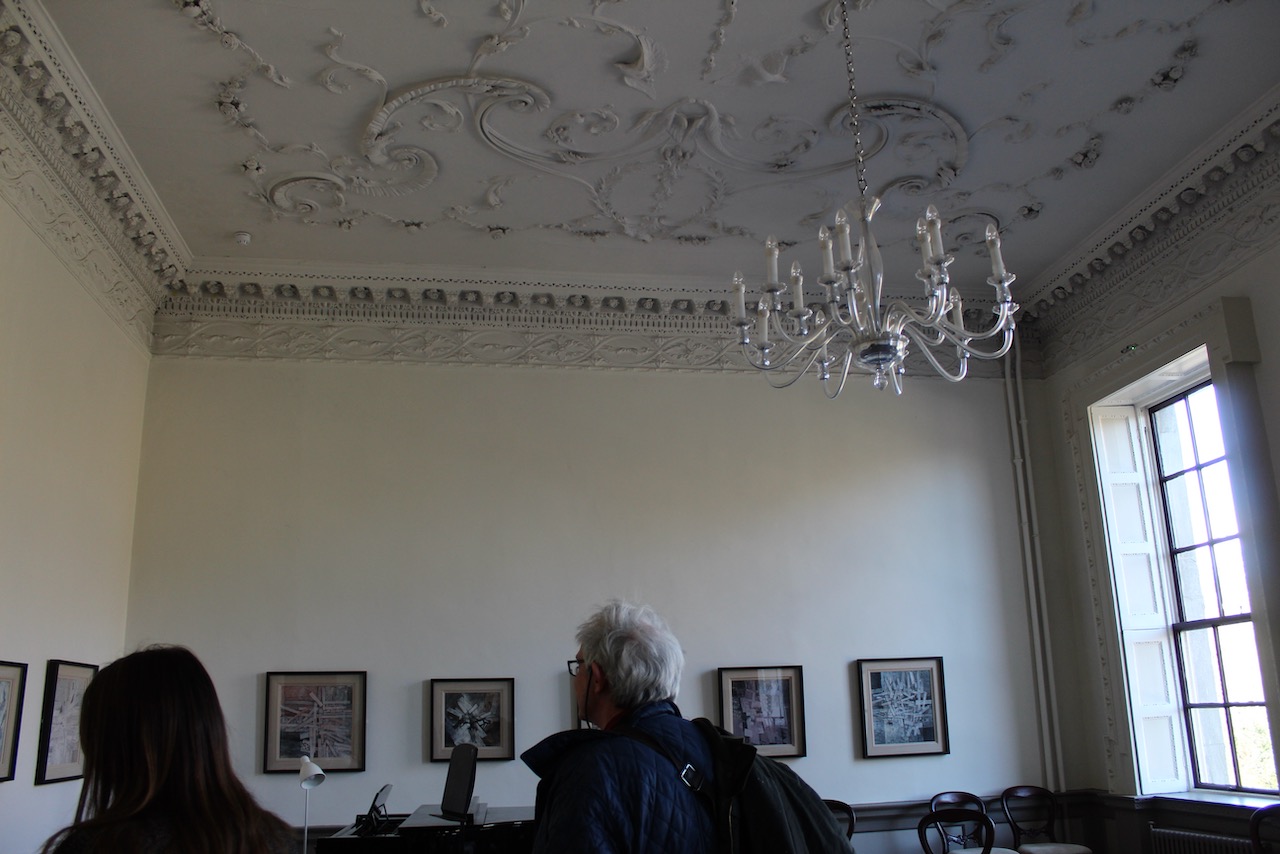
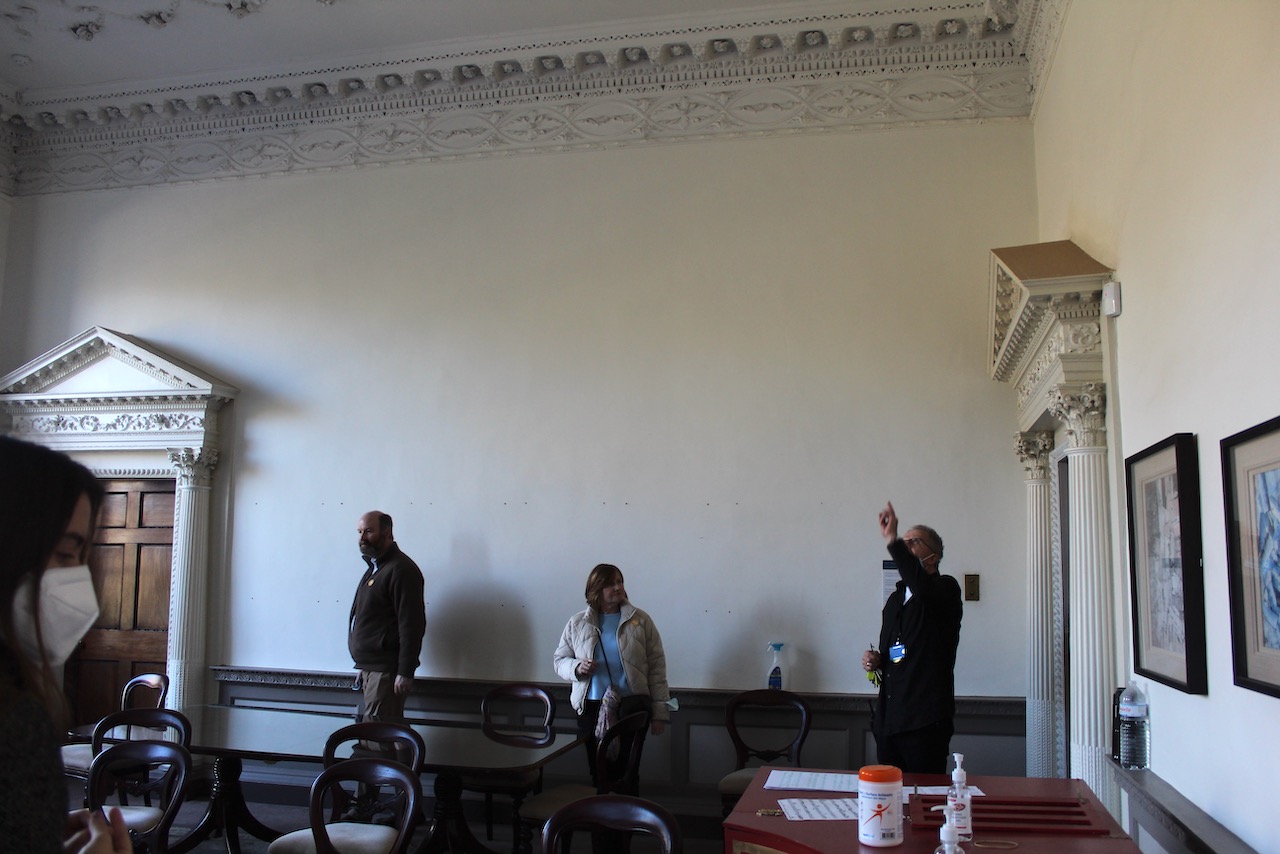

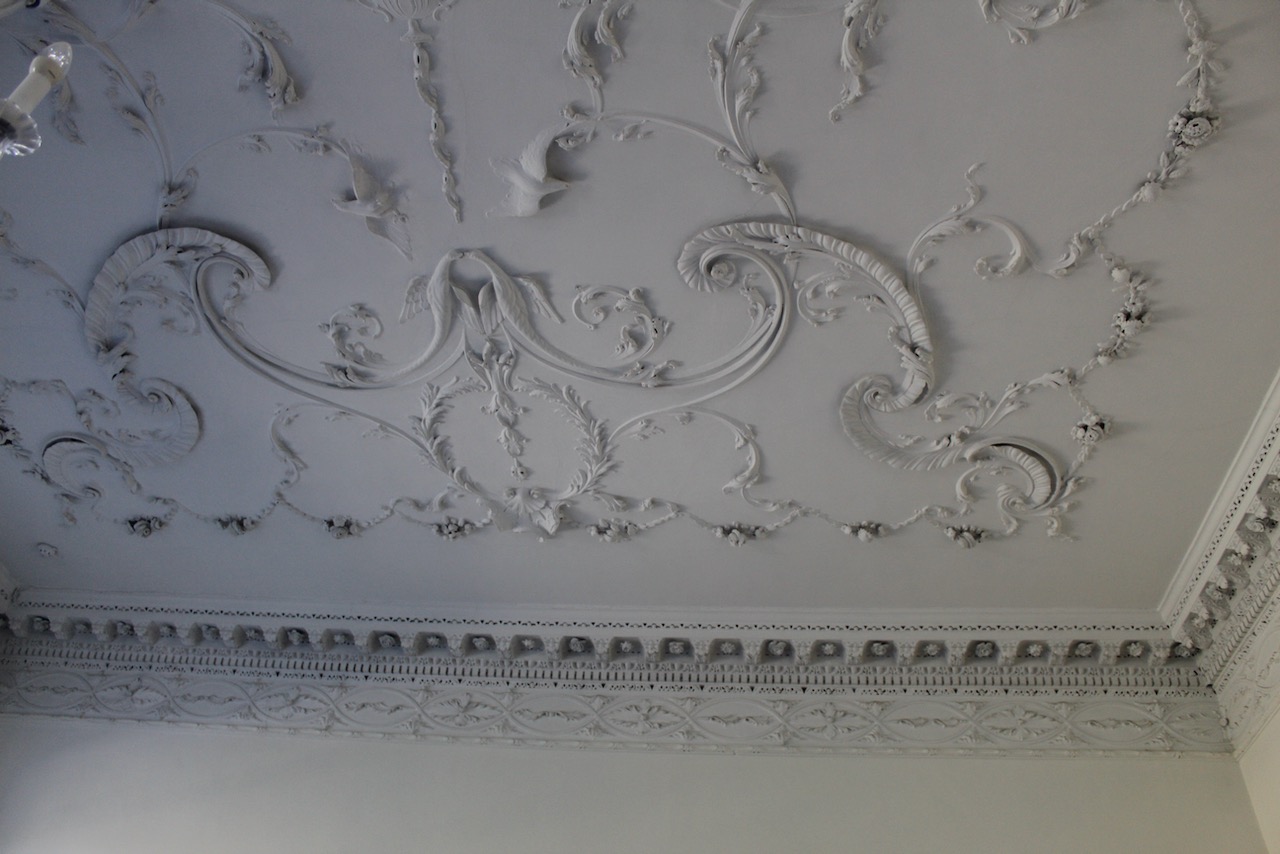
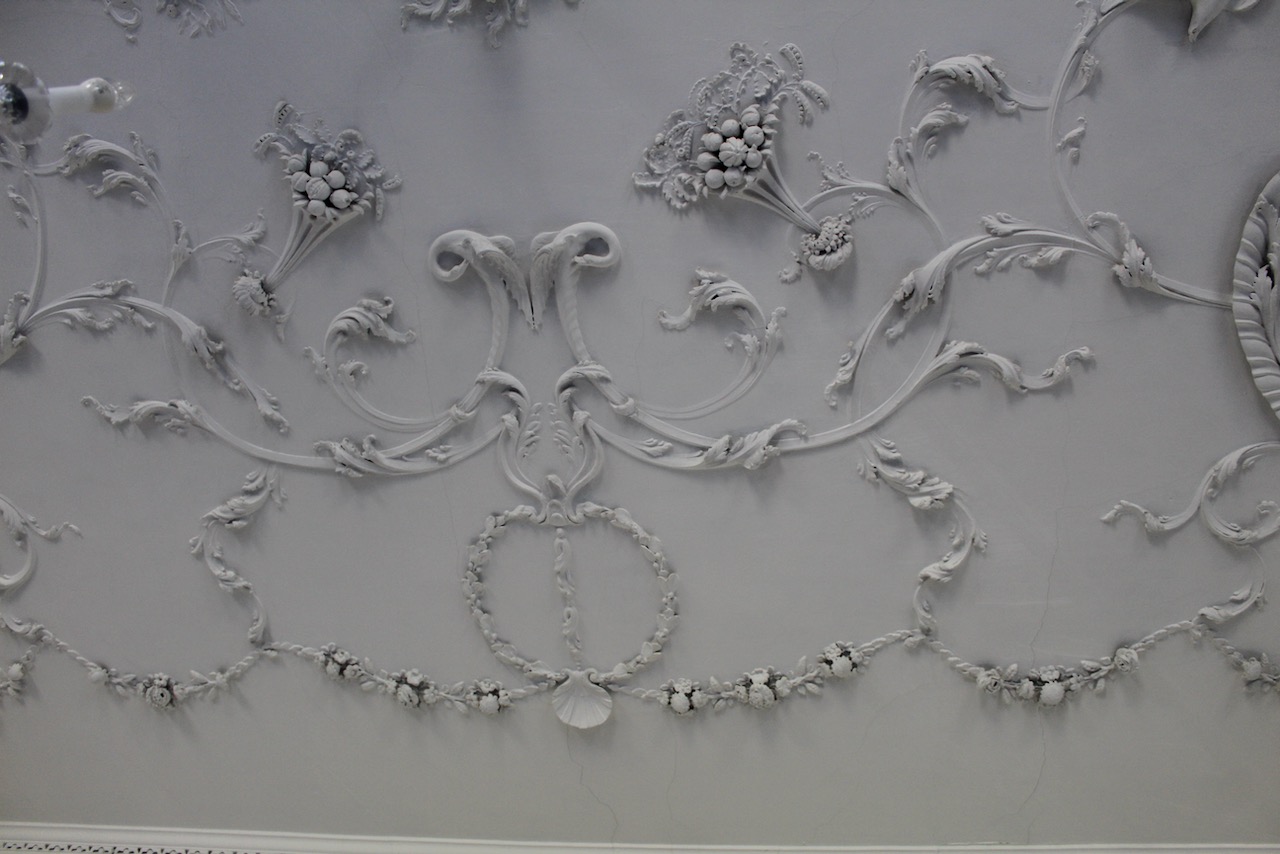


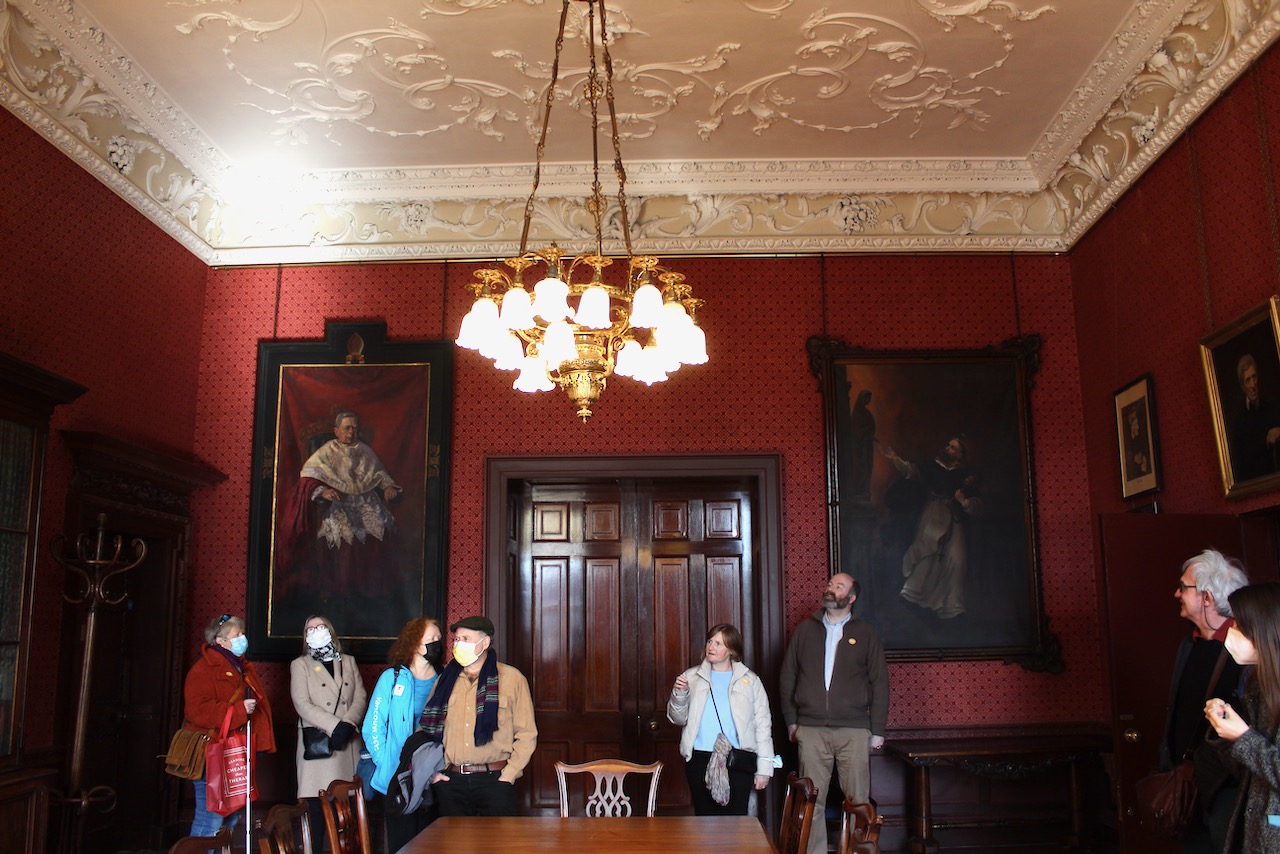
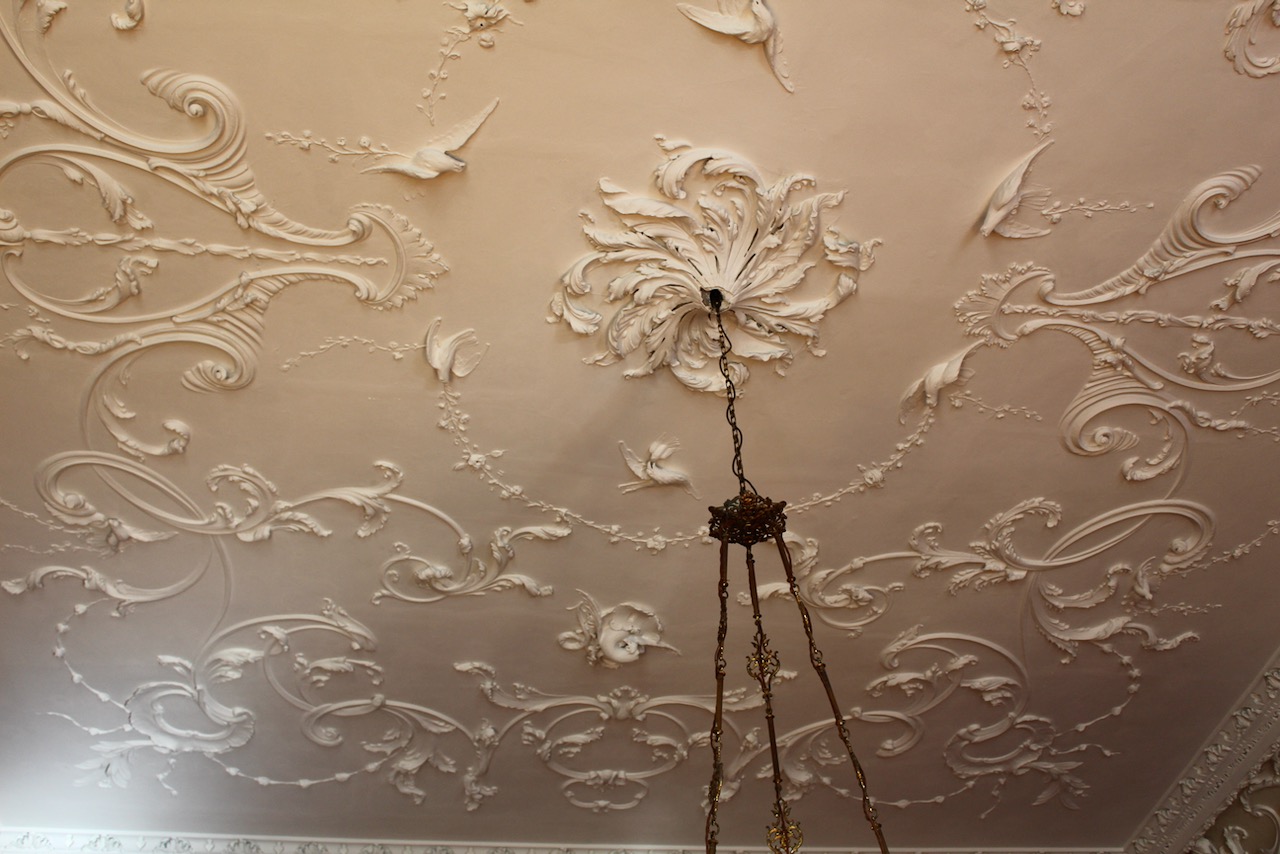

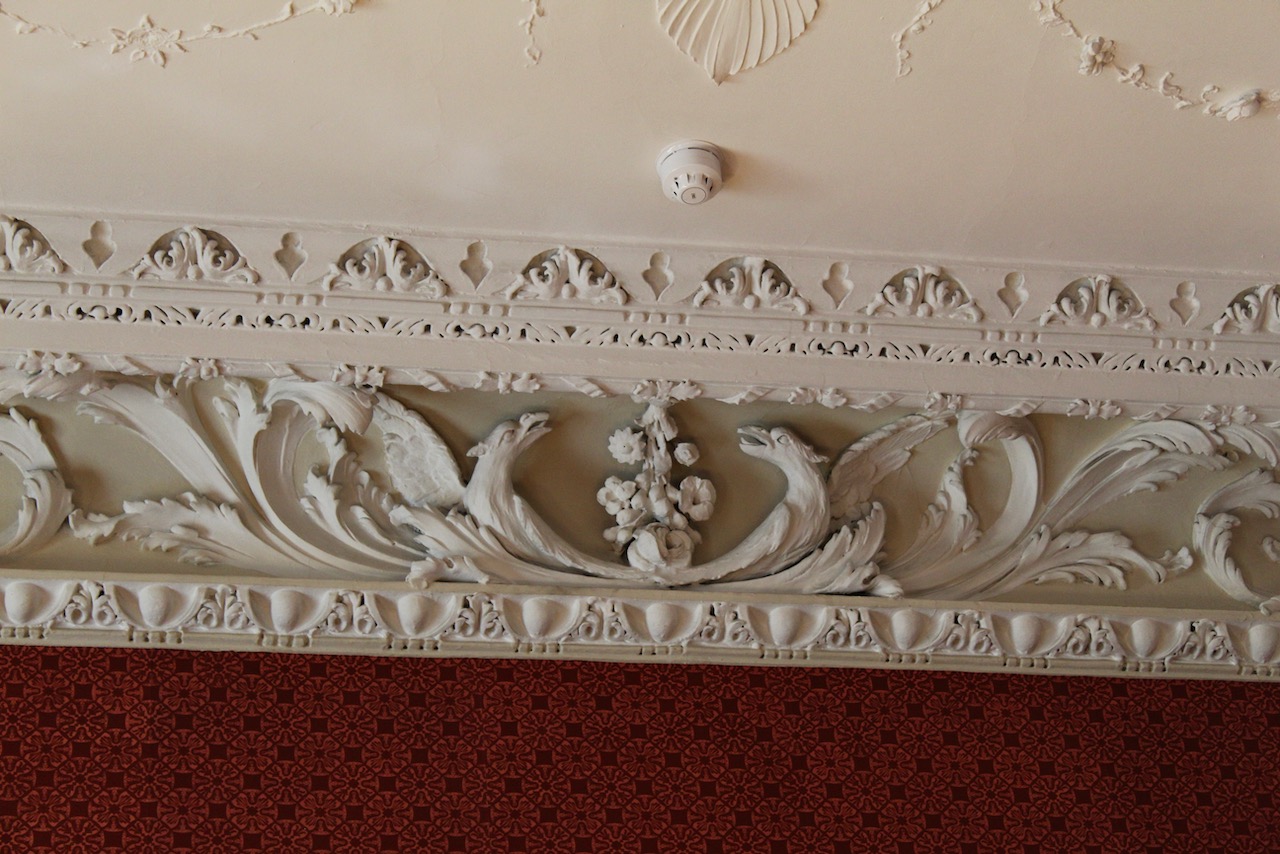
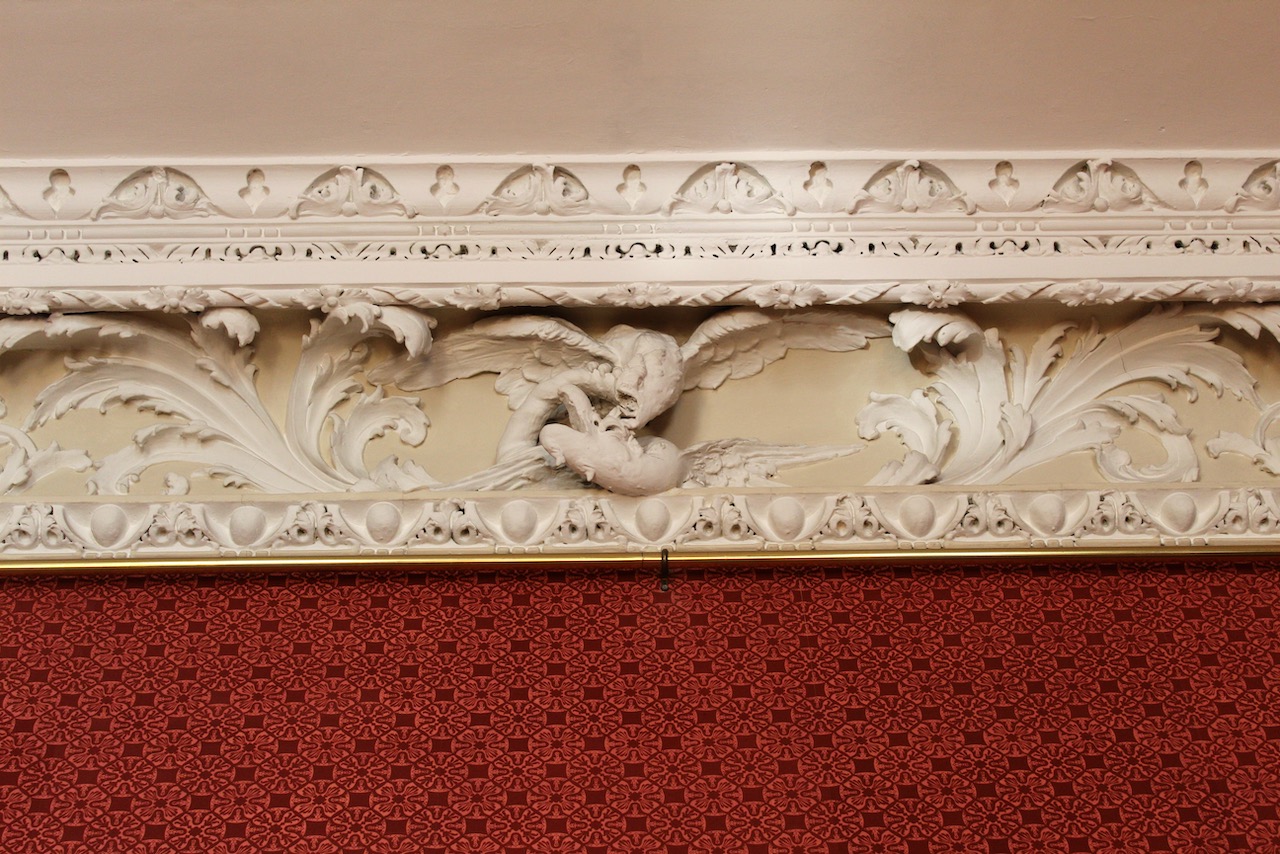
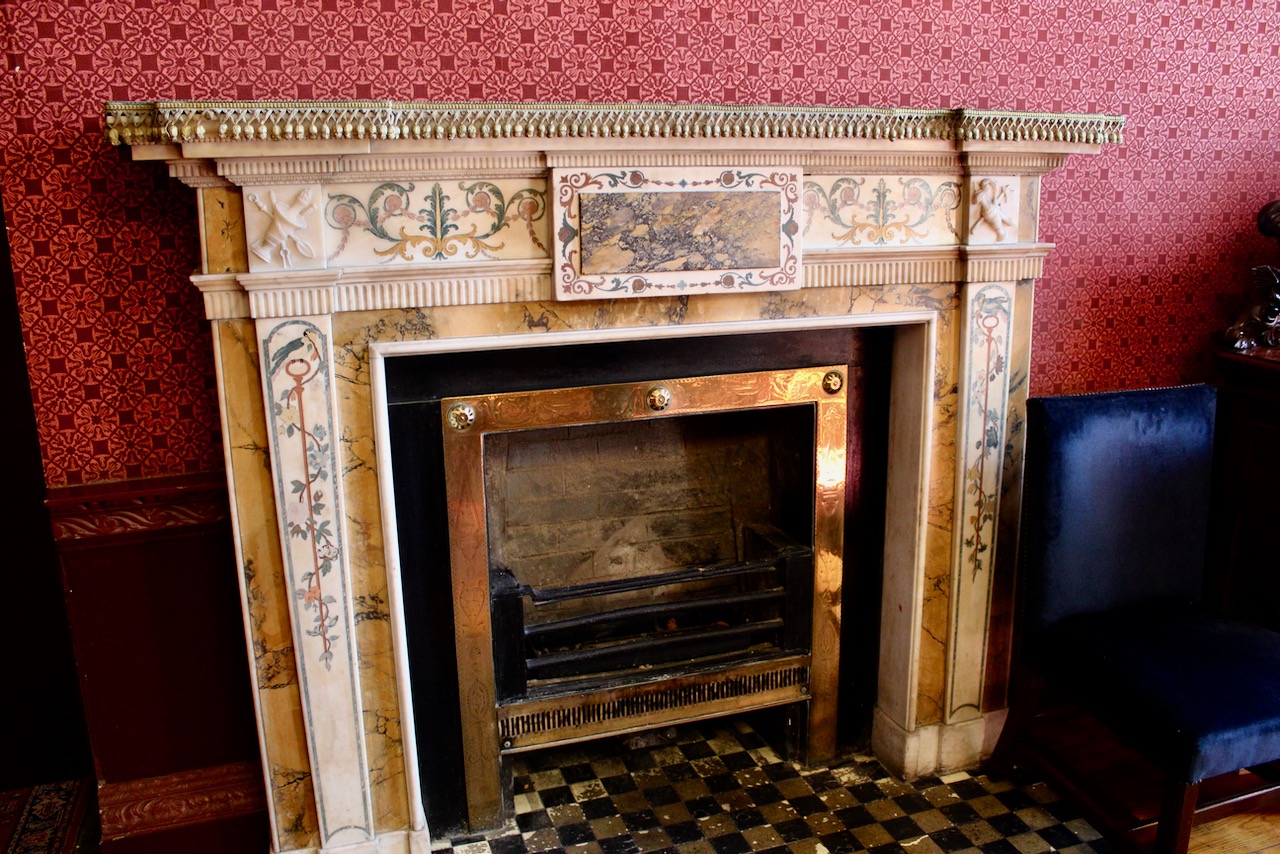
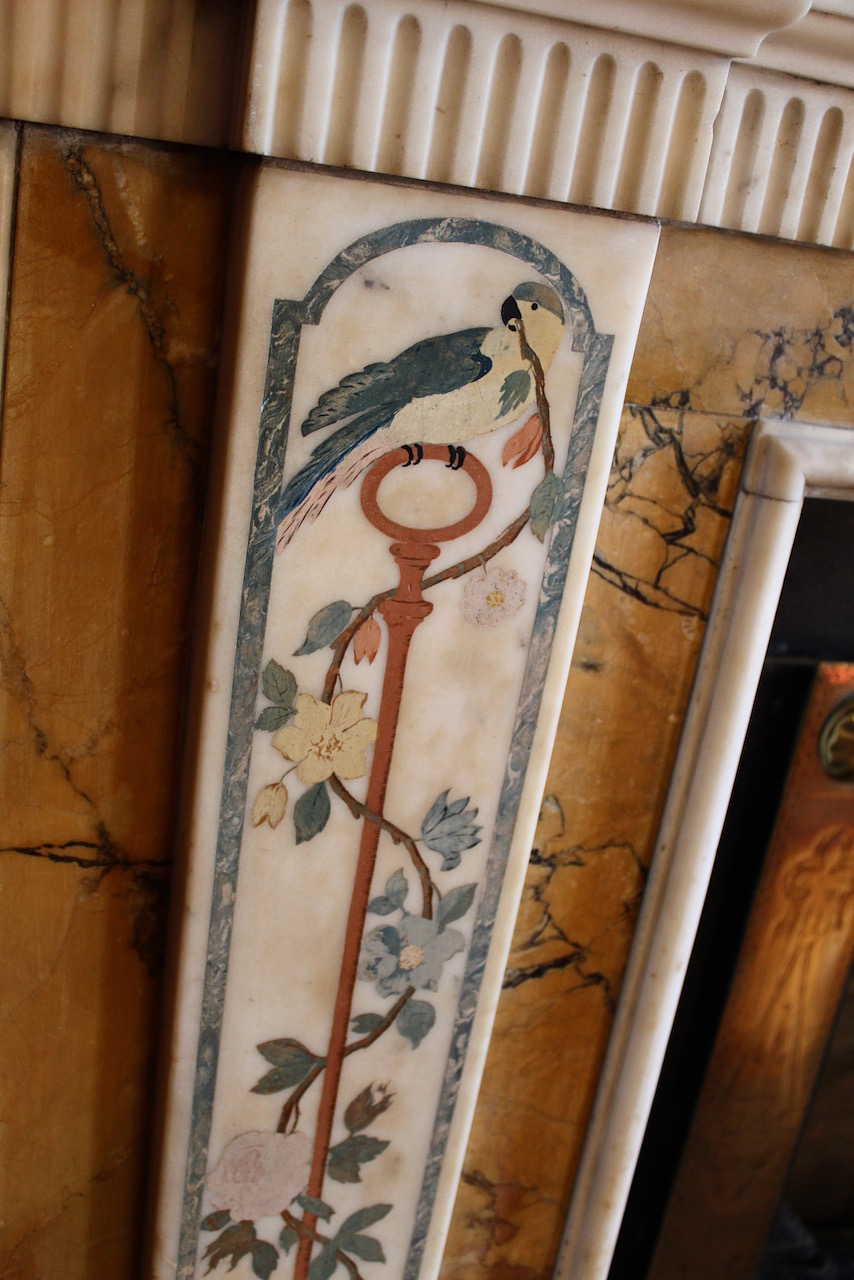

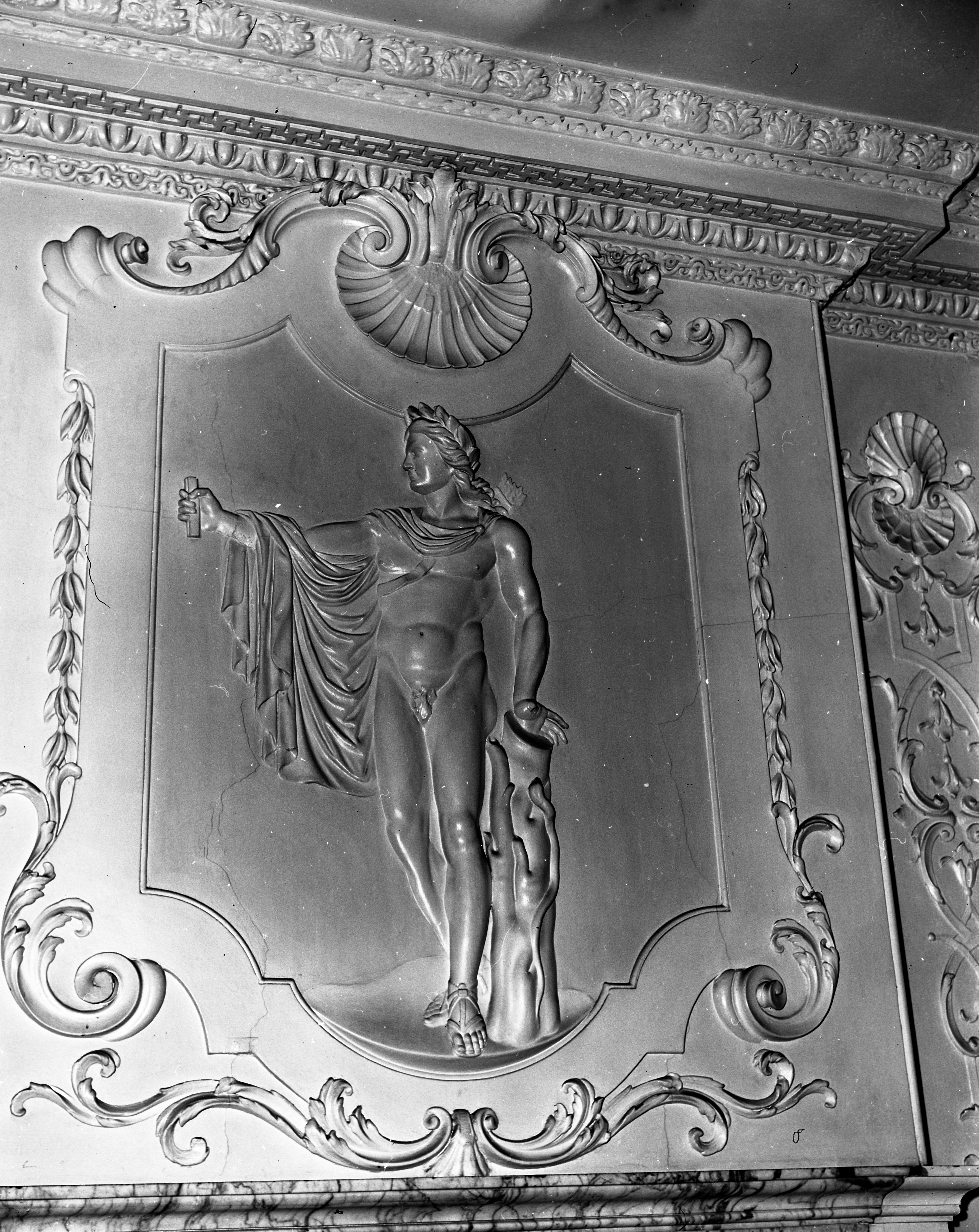

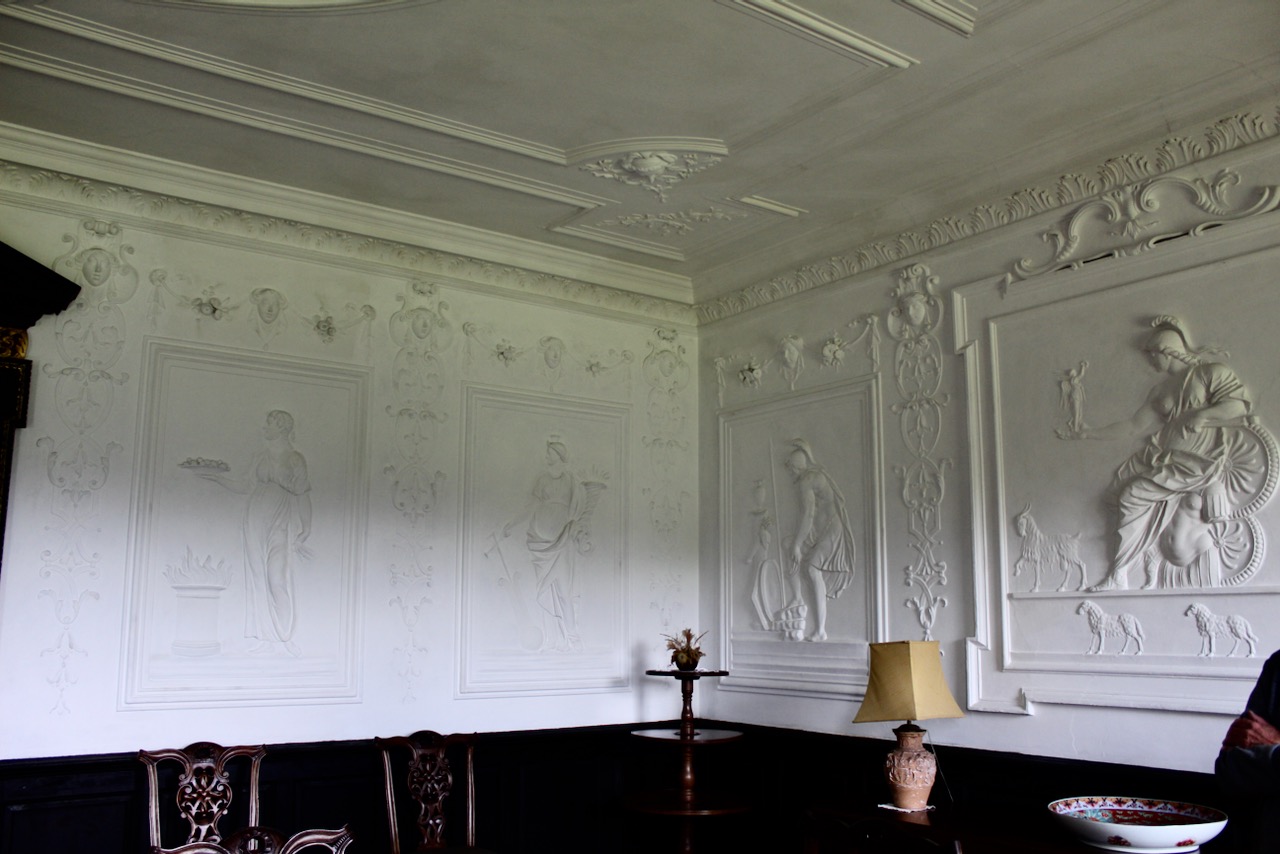


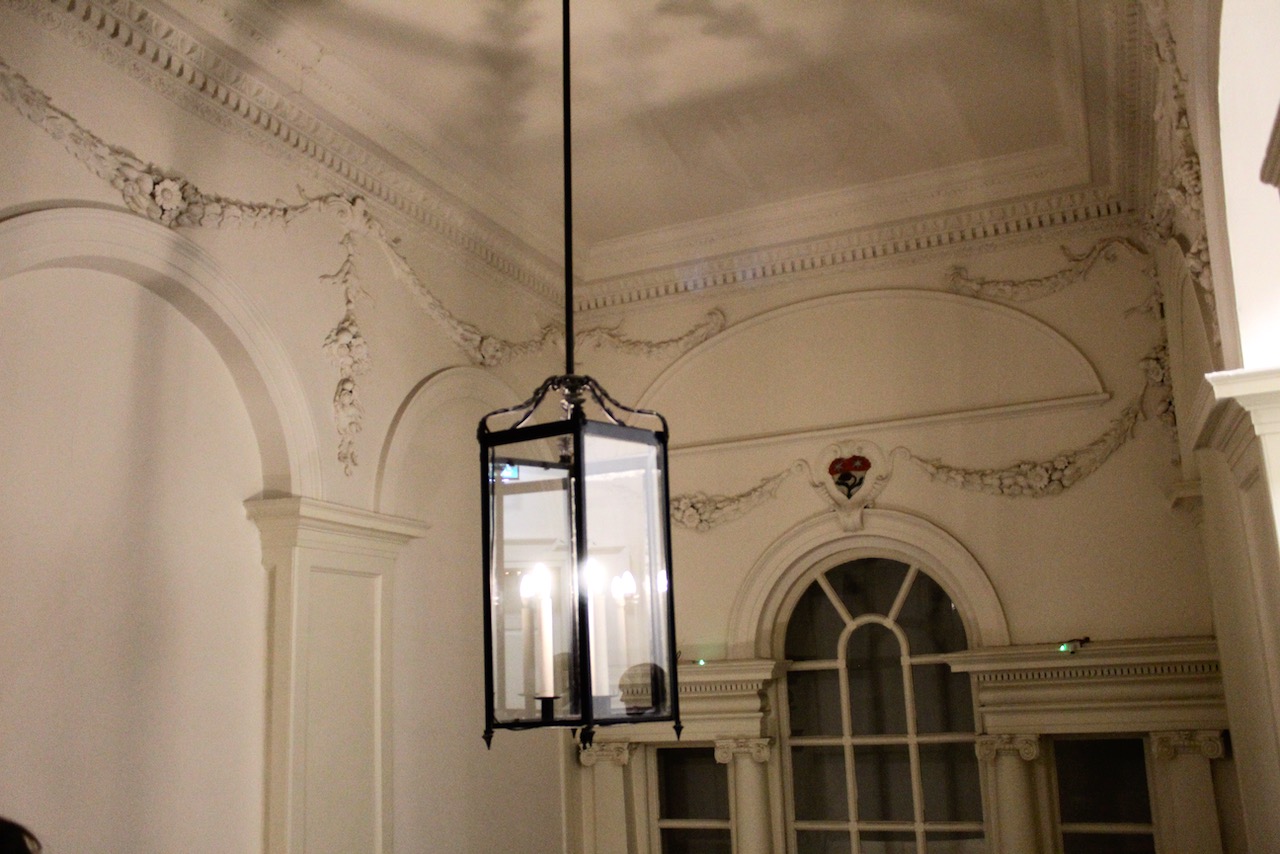

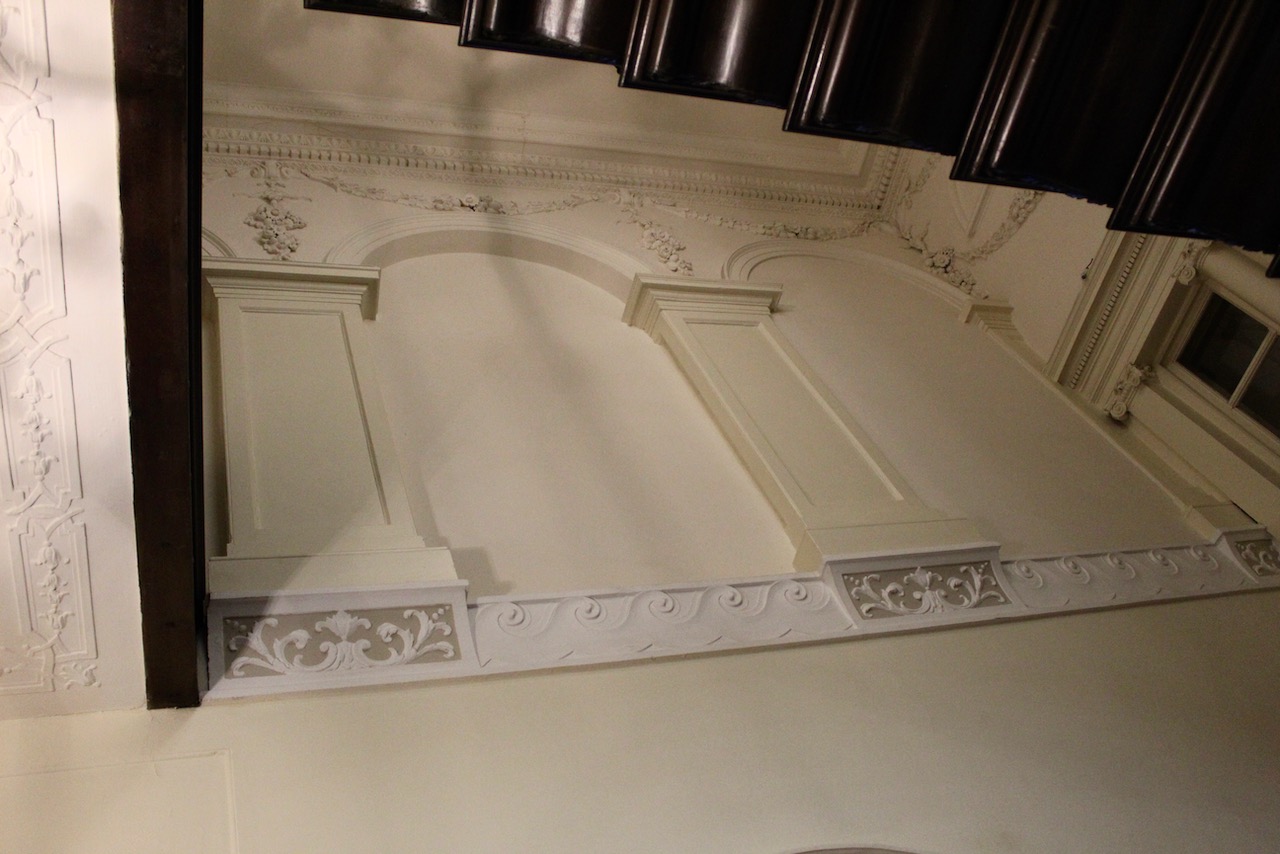


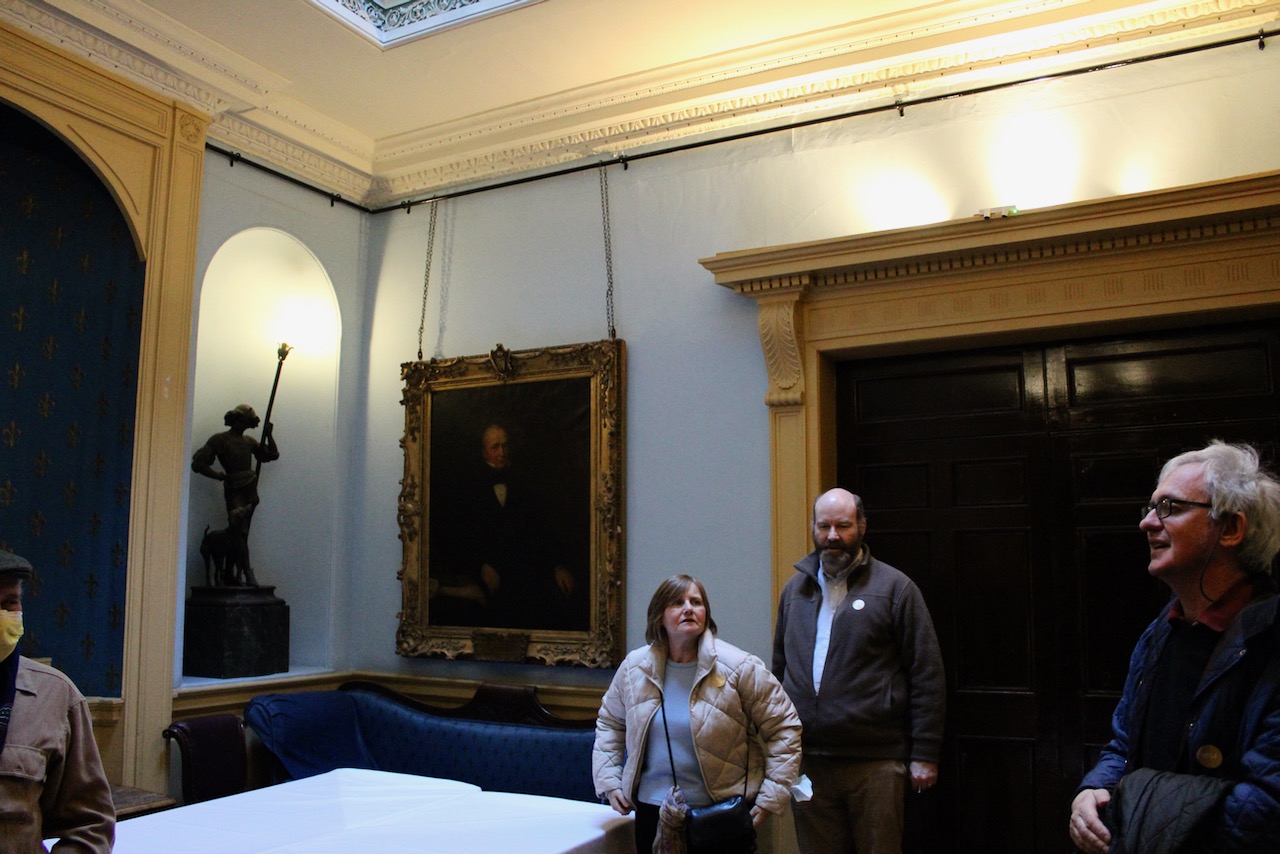

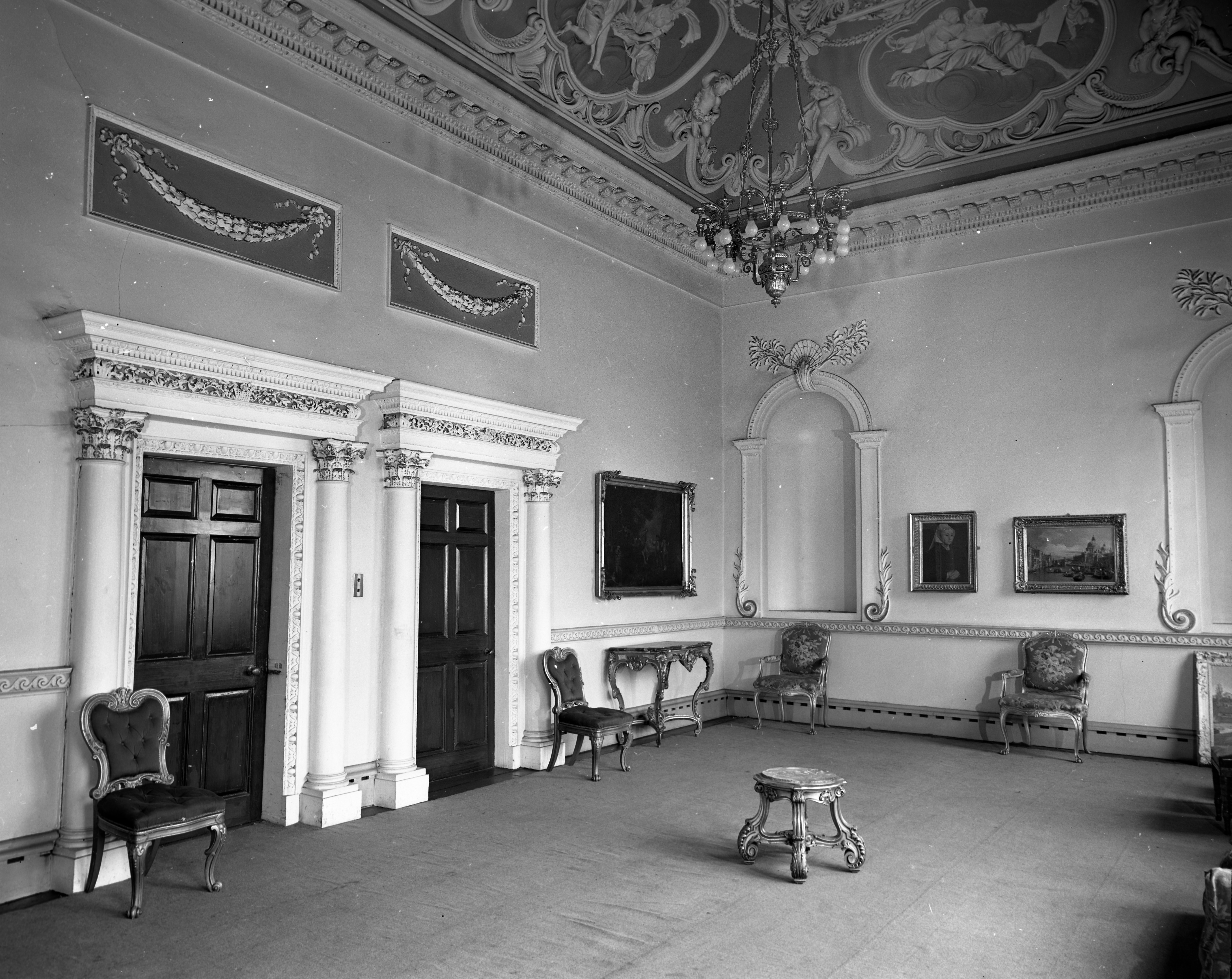
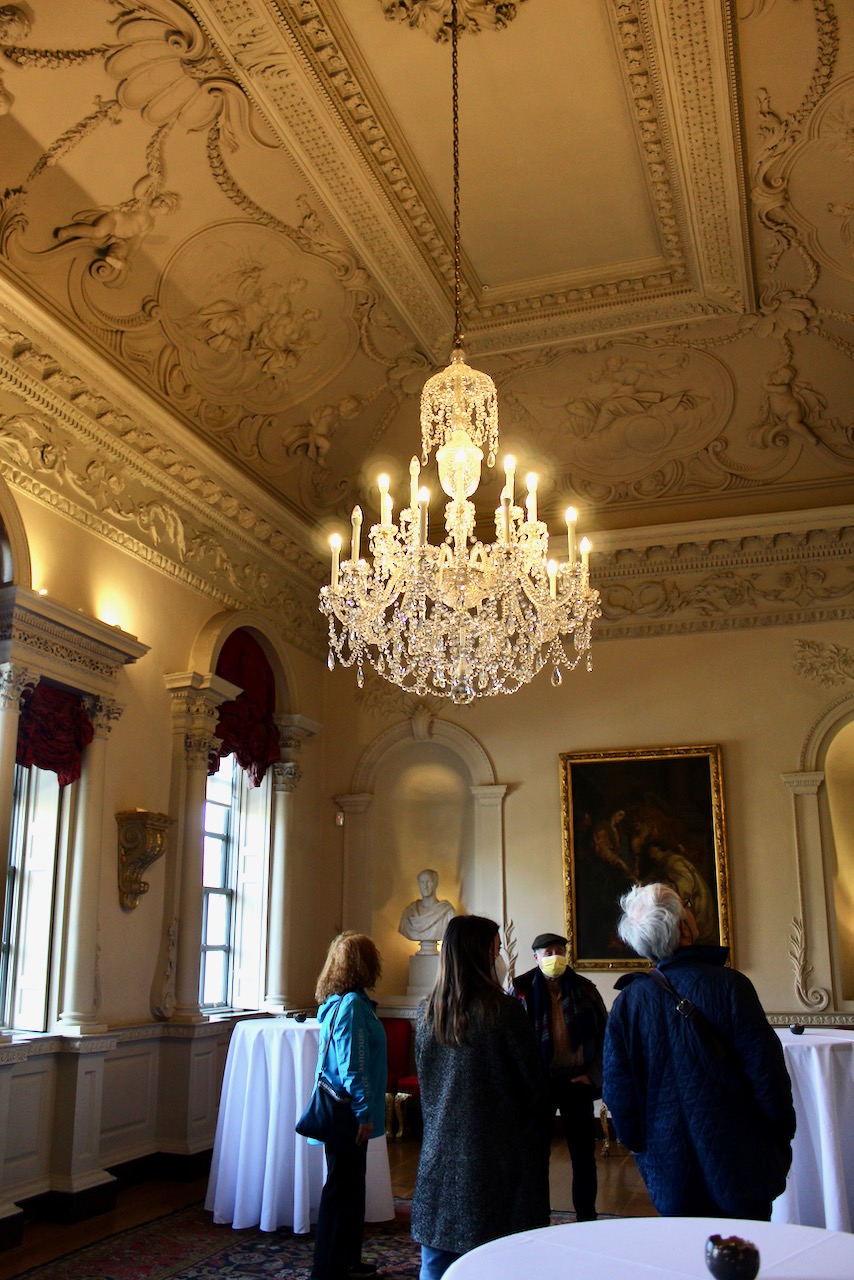


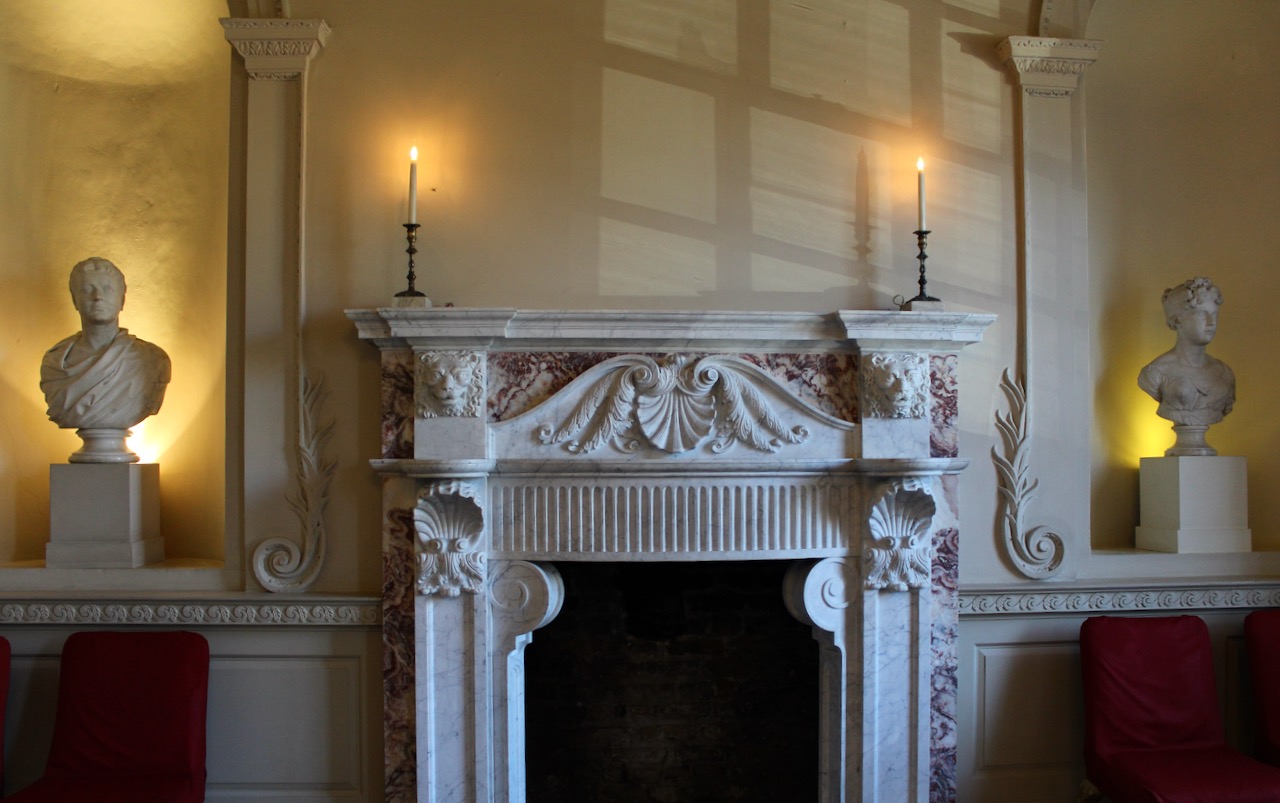
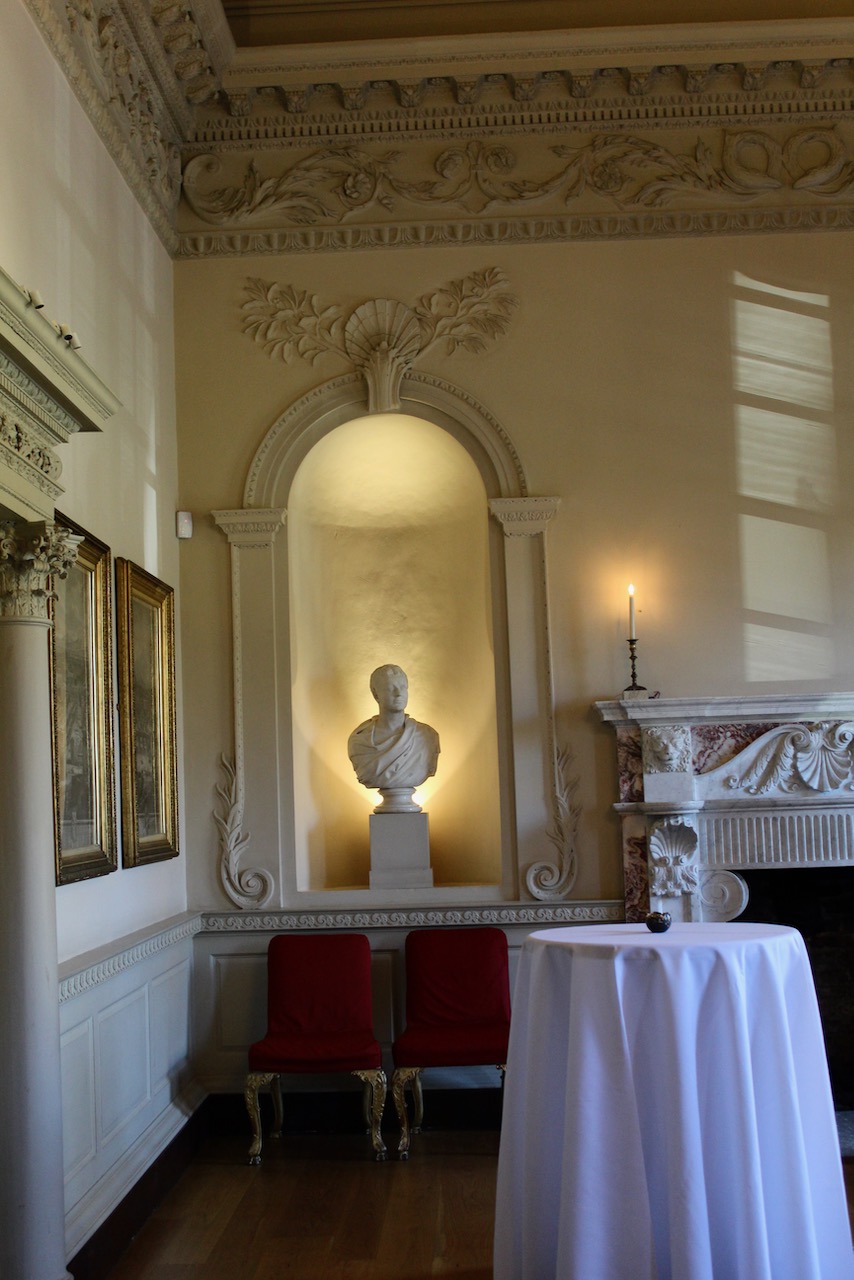


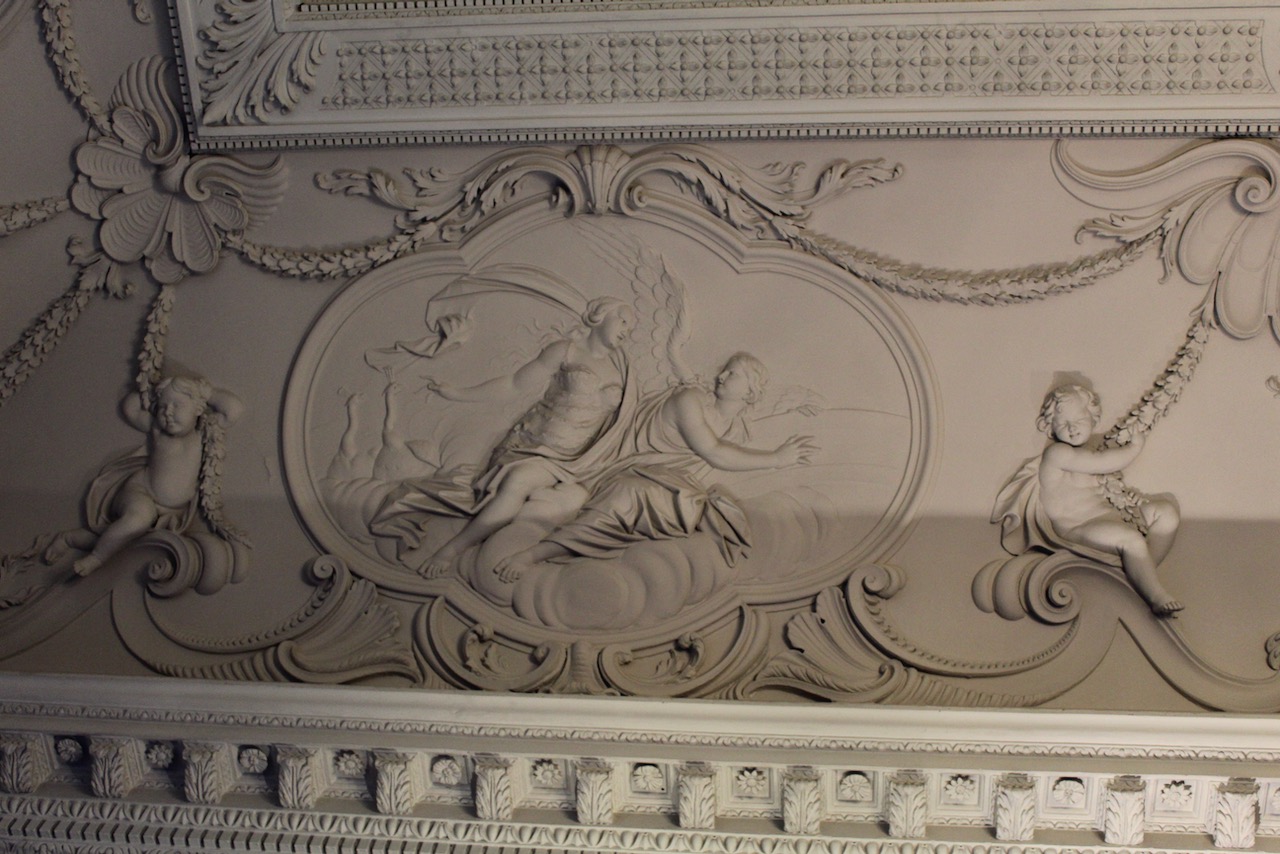
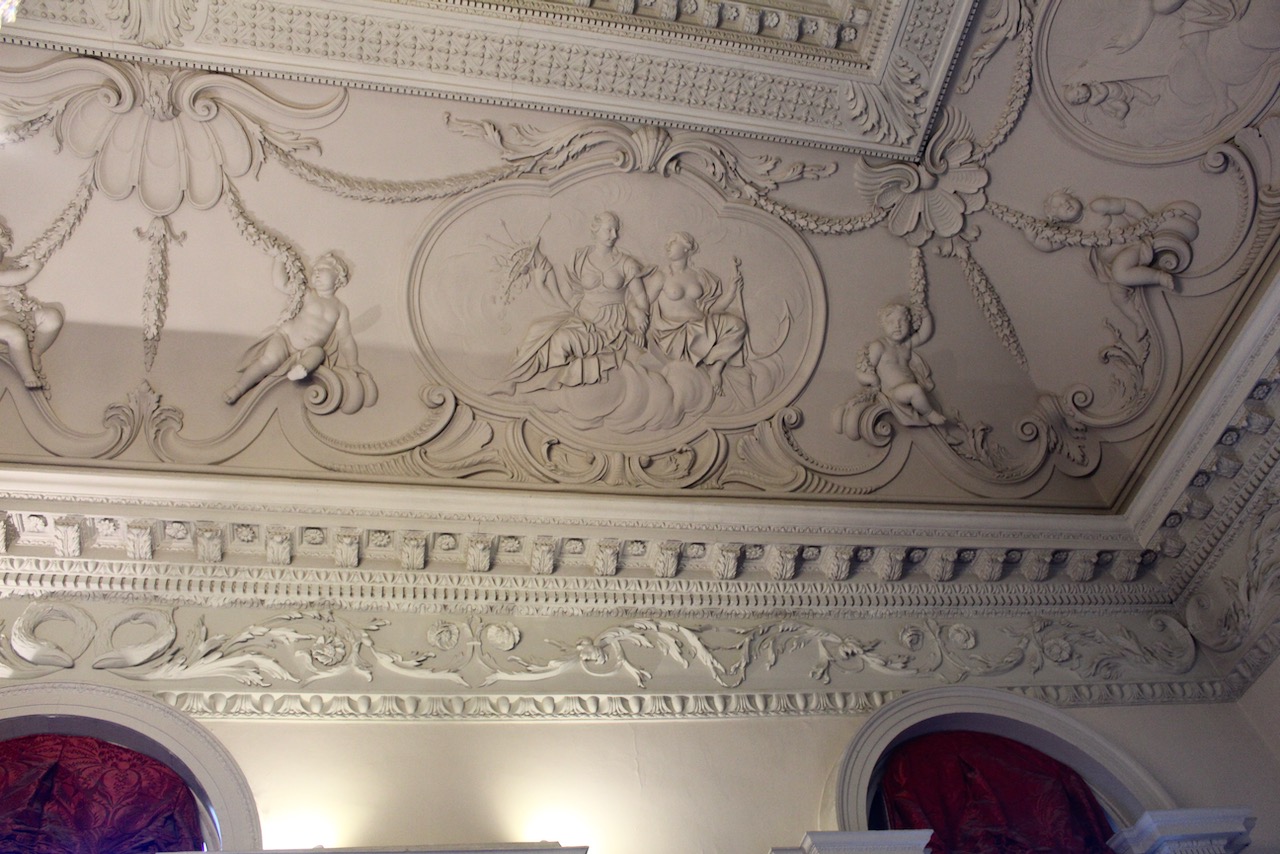
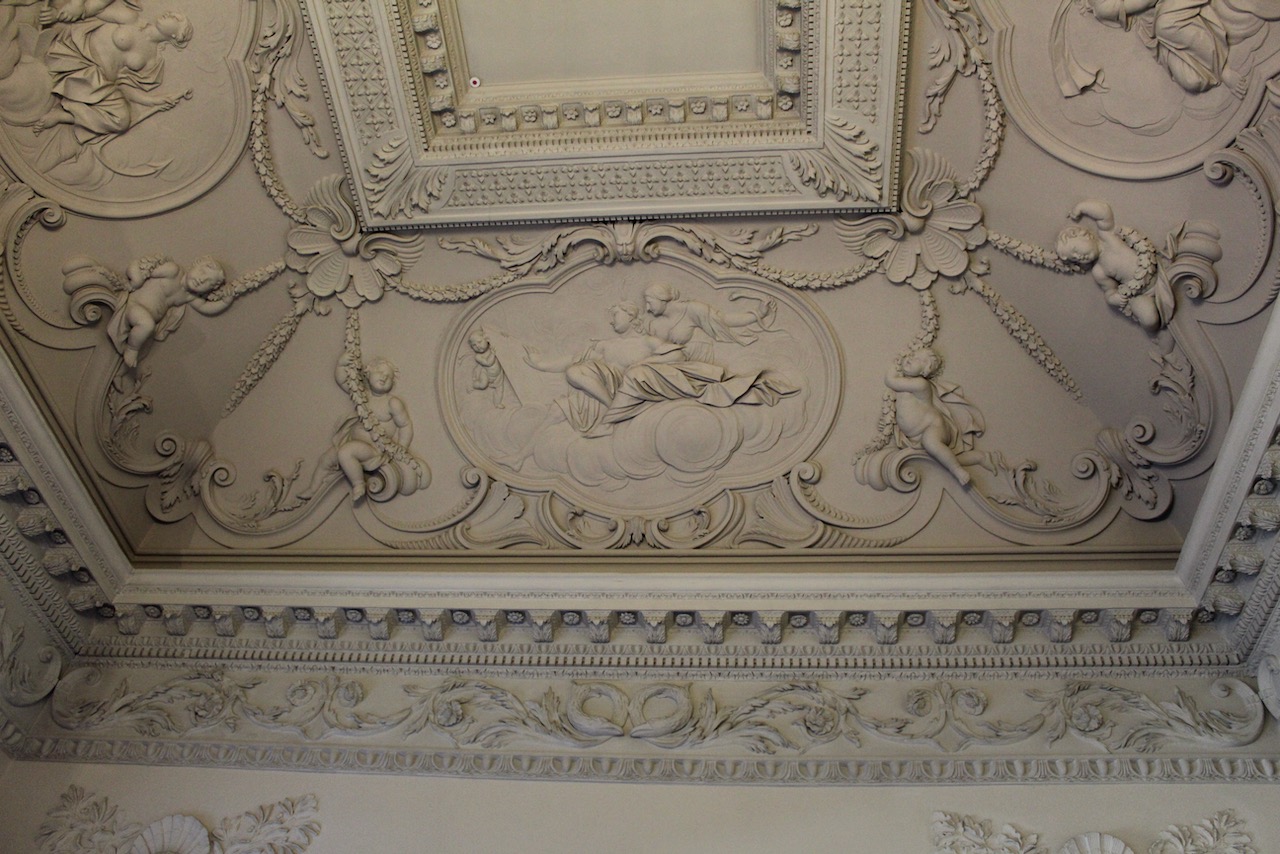
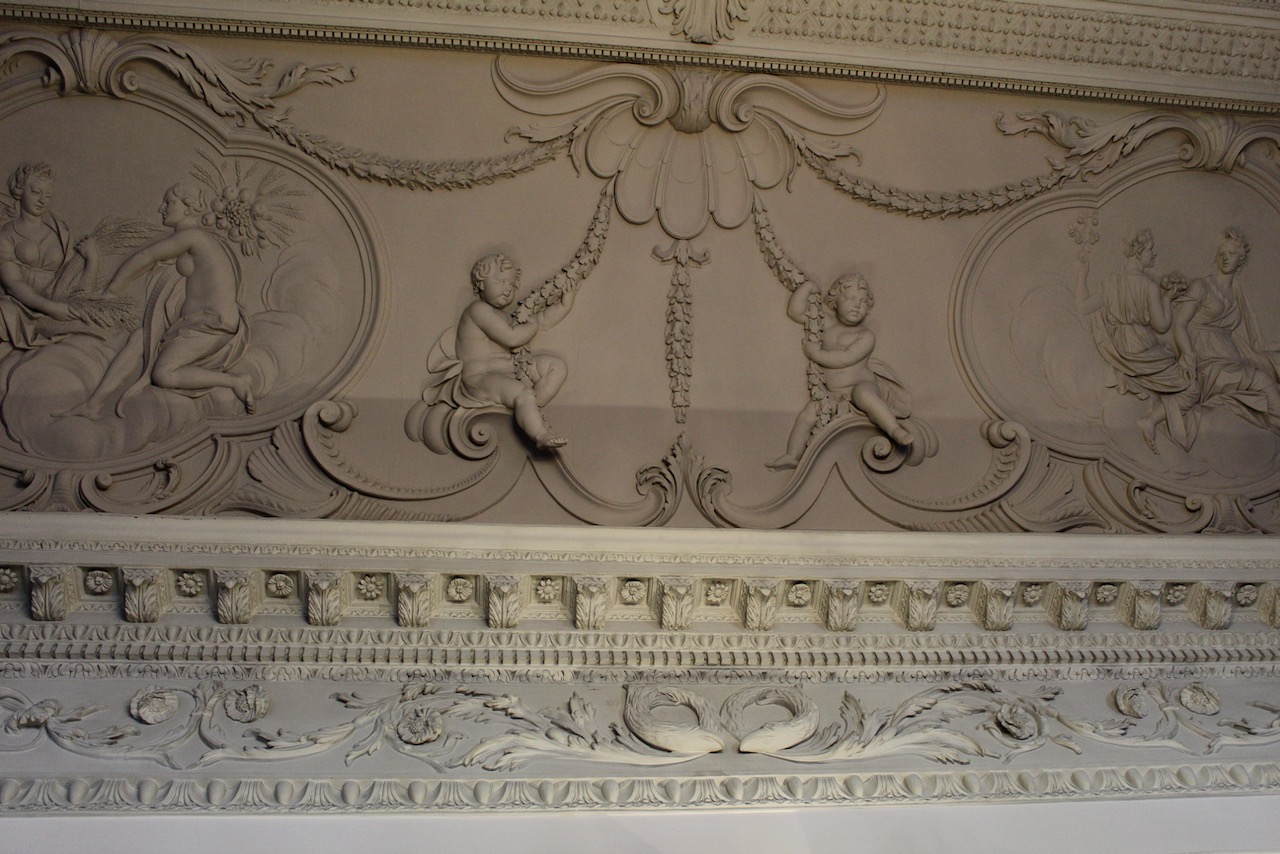
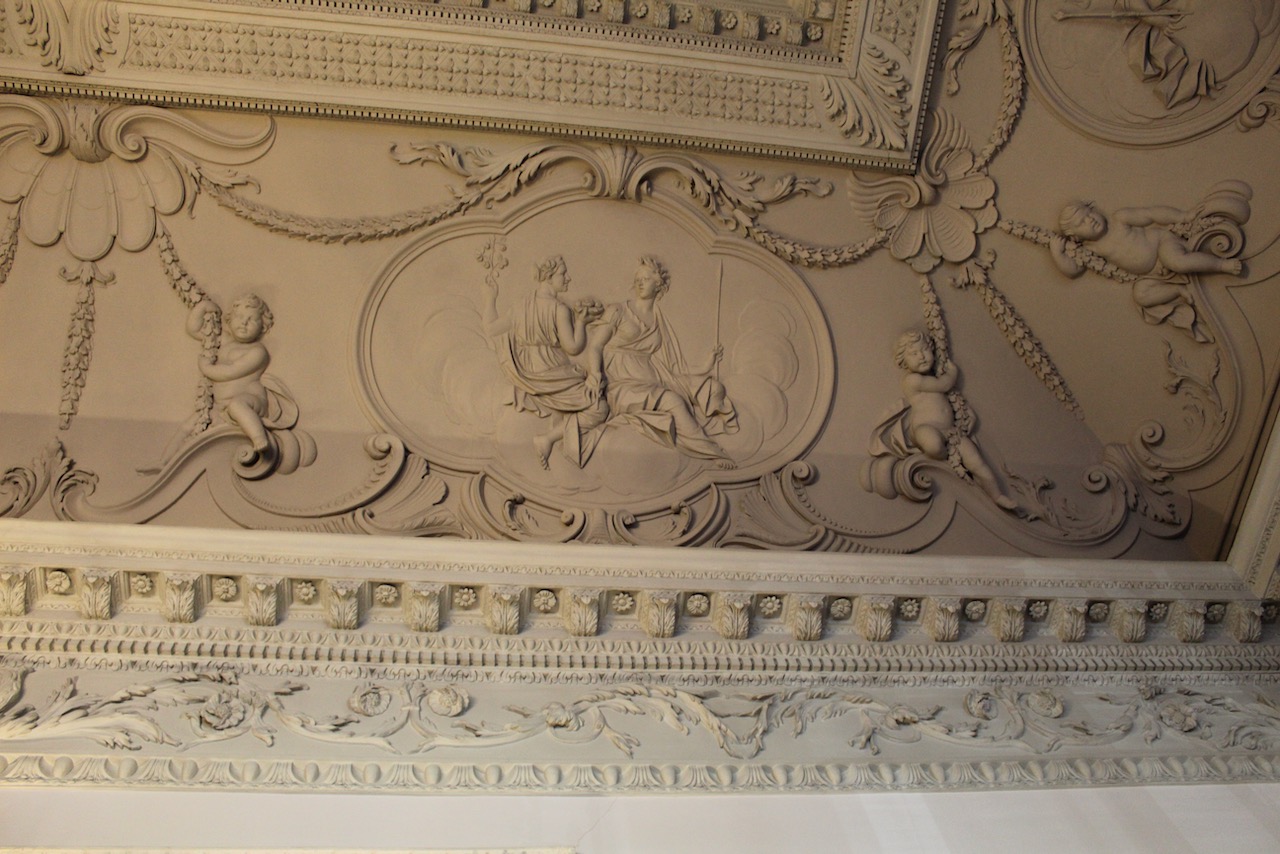

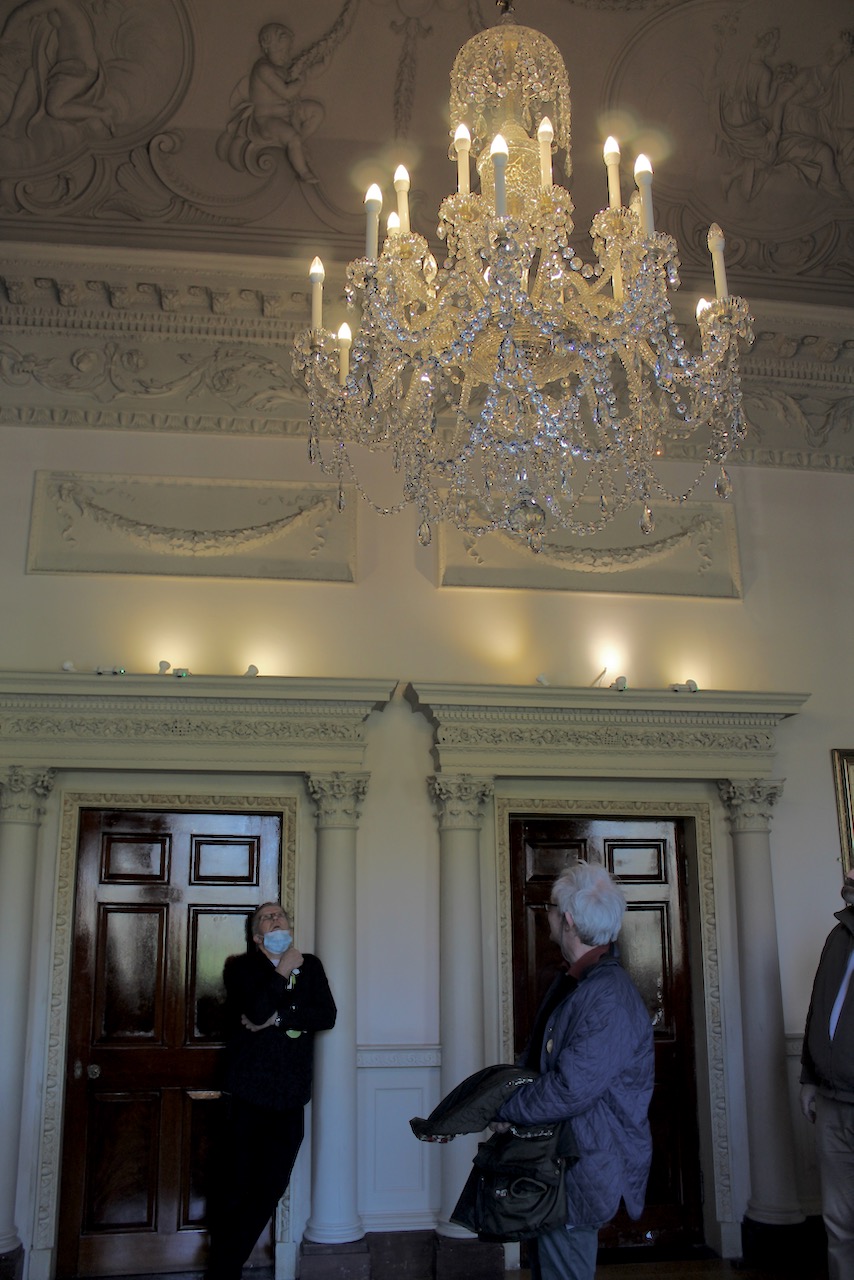


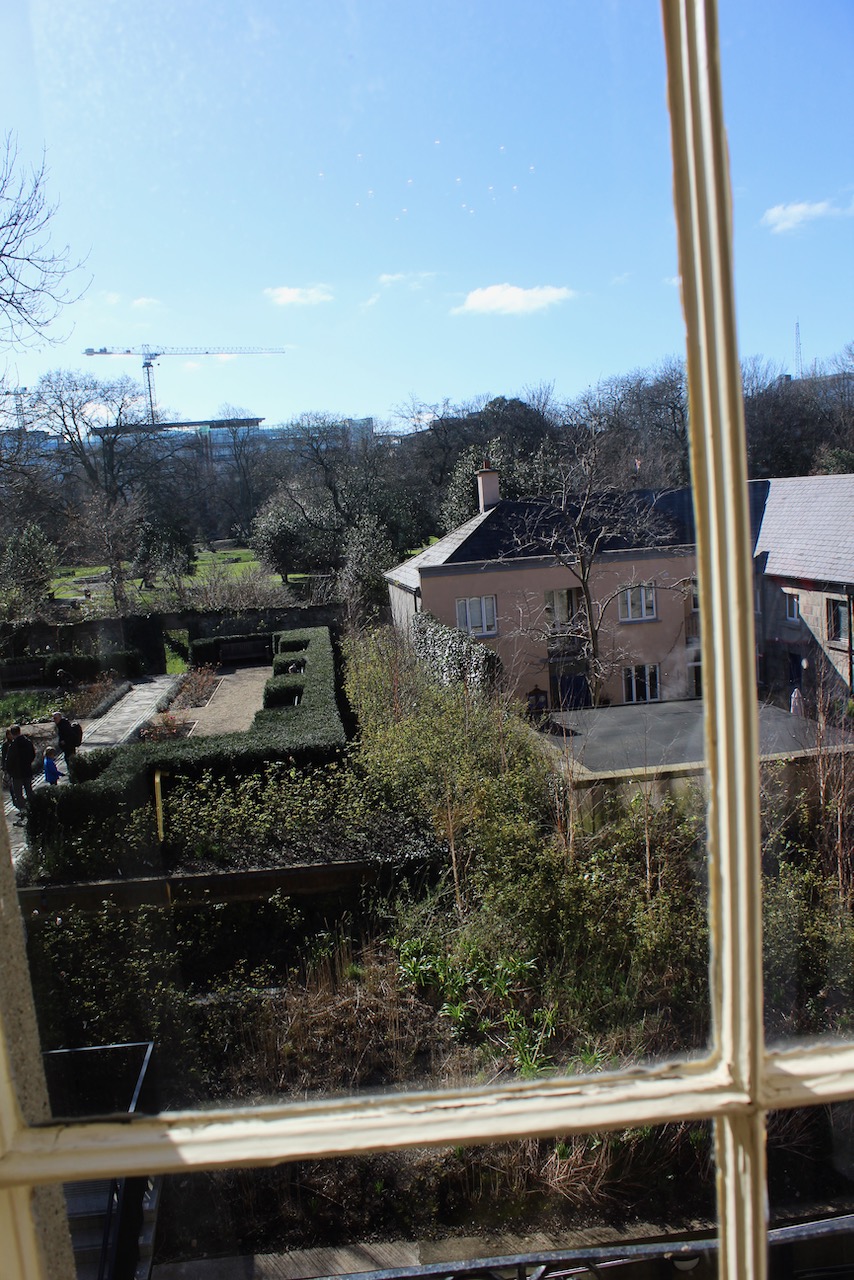
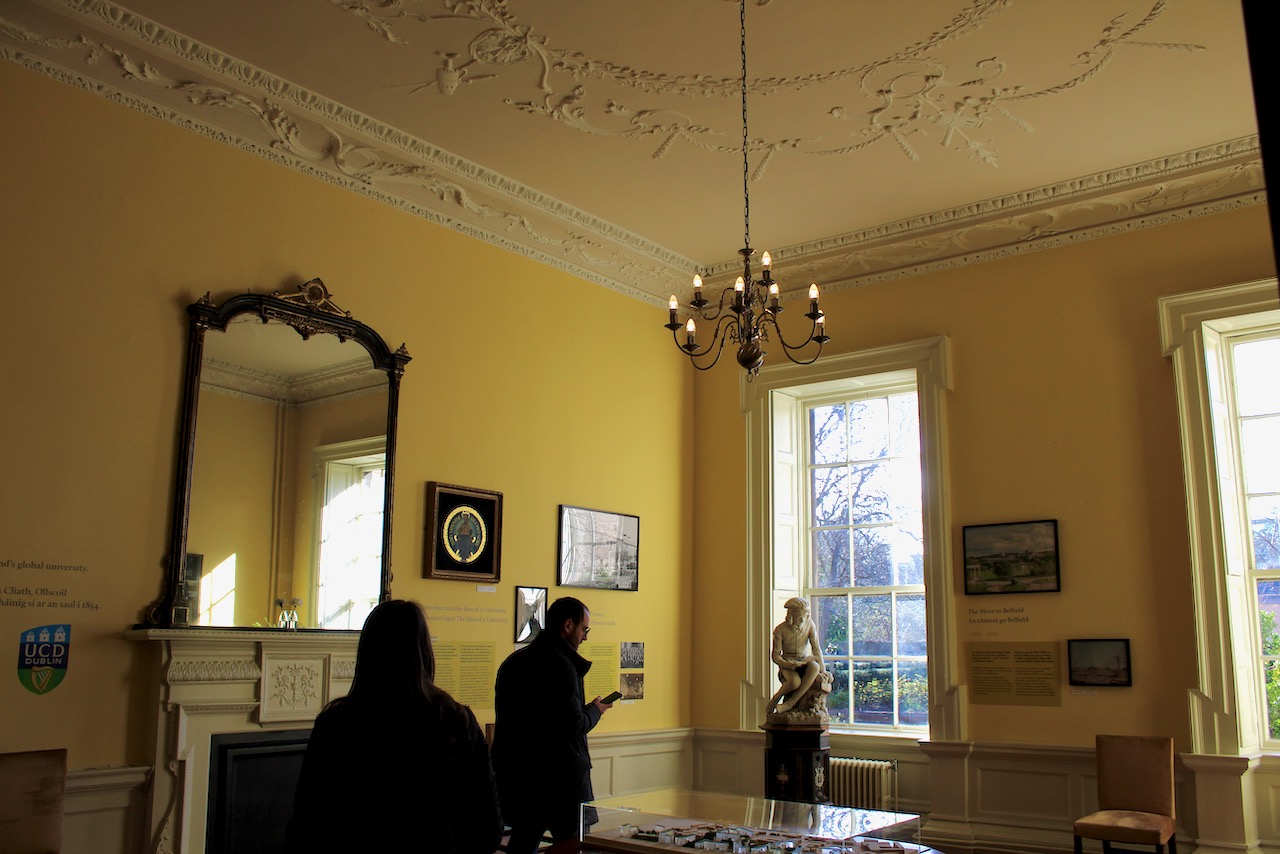
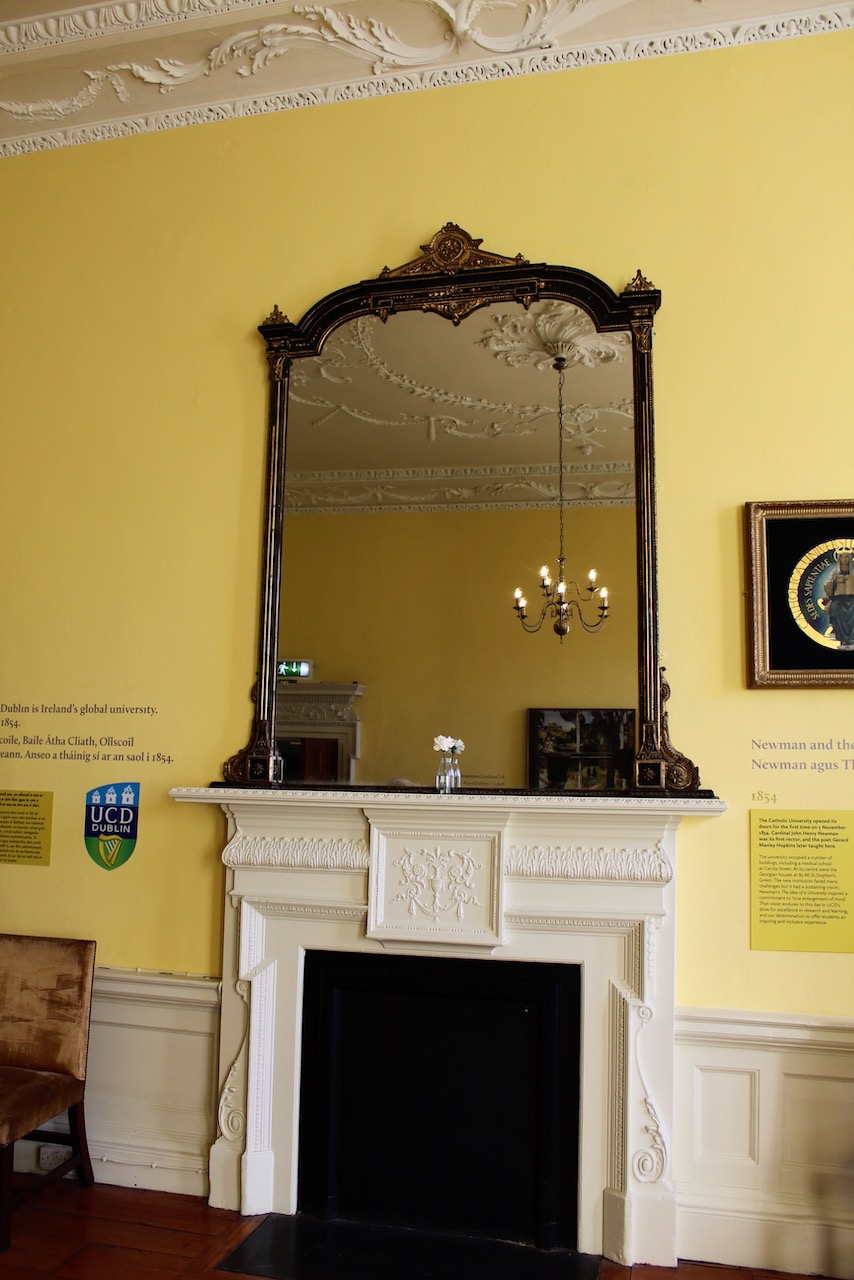
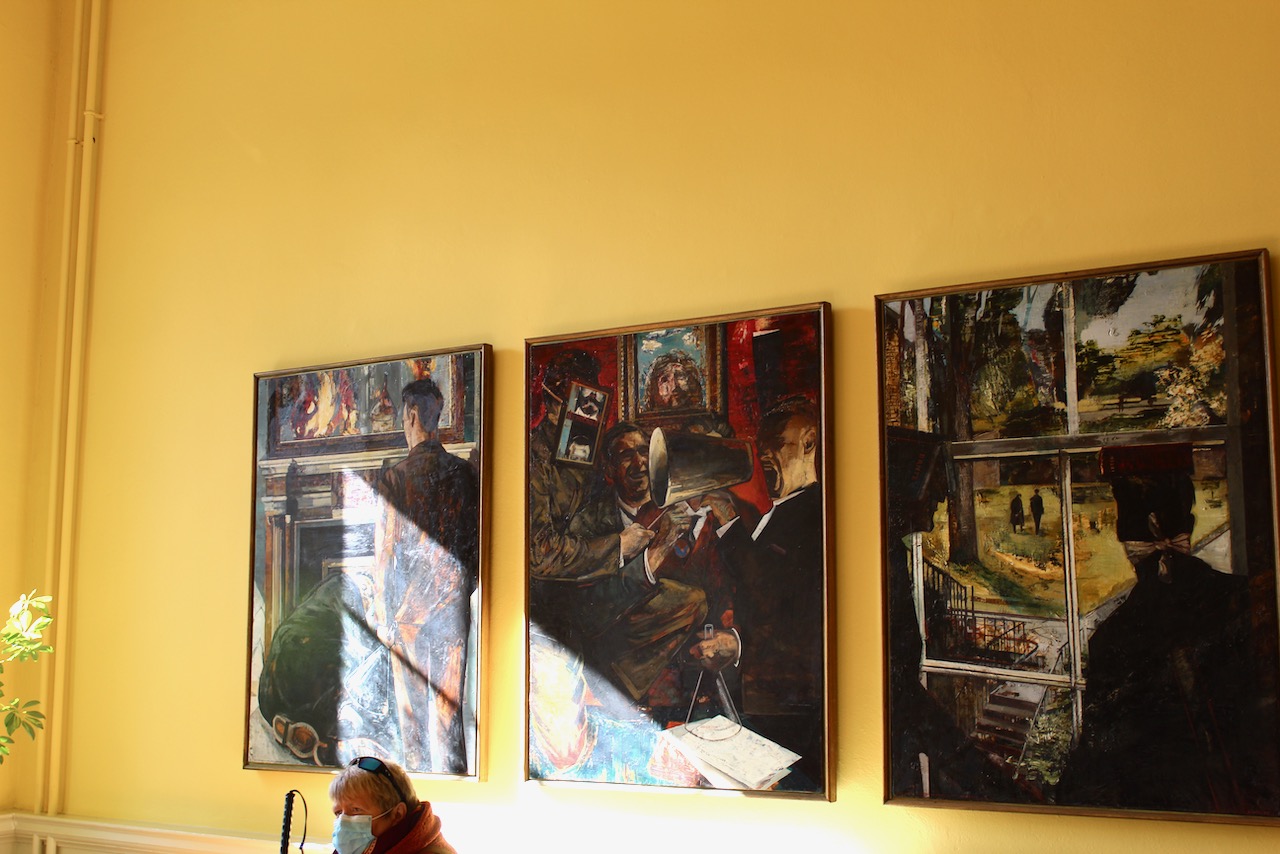
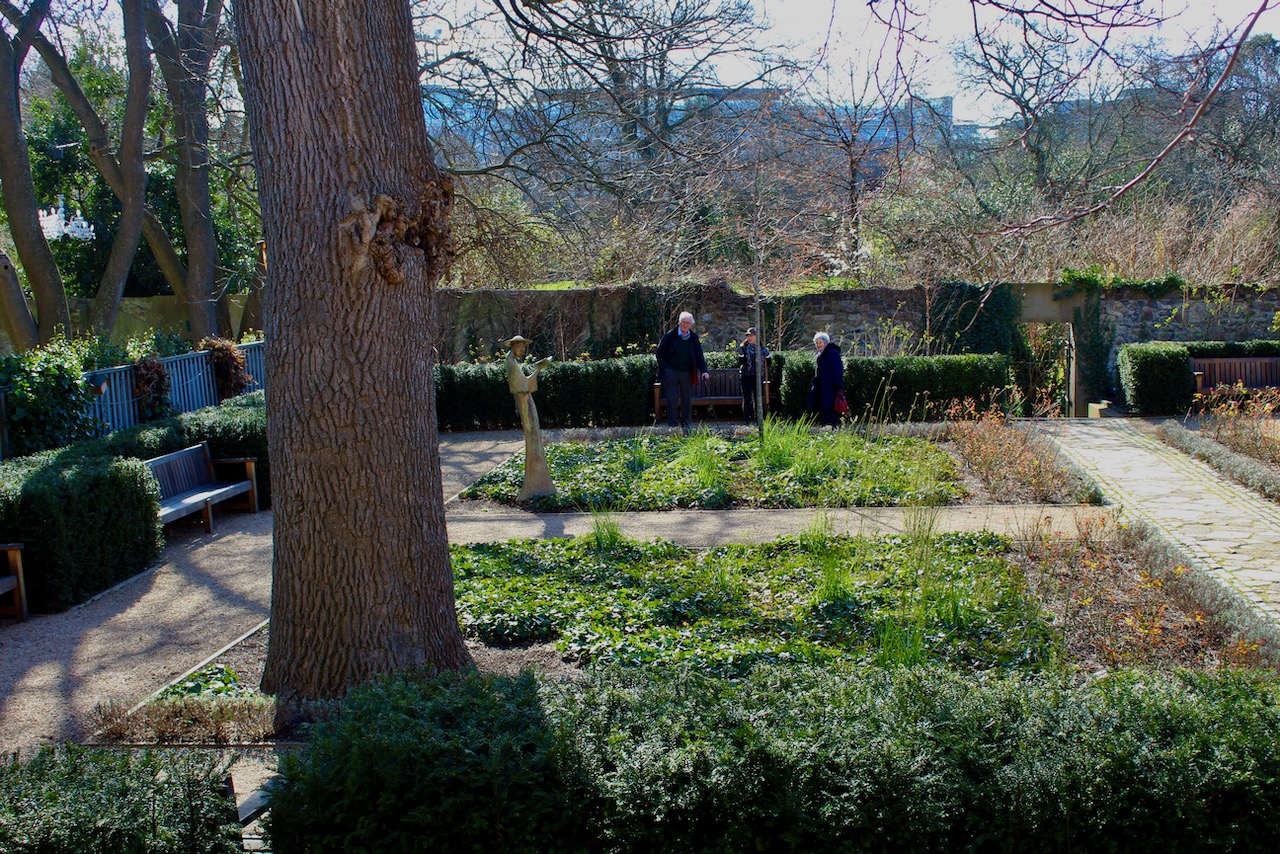

 Irish Historic Houses