Birr Castle, County Offaly – section 482

Donation

Help me to fund my creation and update of this website. It is created purely out of love for the subject and I receive no payment so any donation is appreciated! My website costs €300 per year on WordPress.

€15.00

Open dates in 2026: May 15-30, June 1-6, 8-13, 15-20, 22-27, 29-30, July 1-31, Aug 1-31, Sept 1-5,

11am-3pm

Fee: €22 each castle tour and garden
www.birrcastle.com

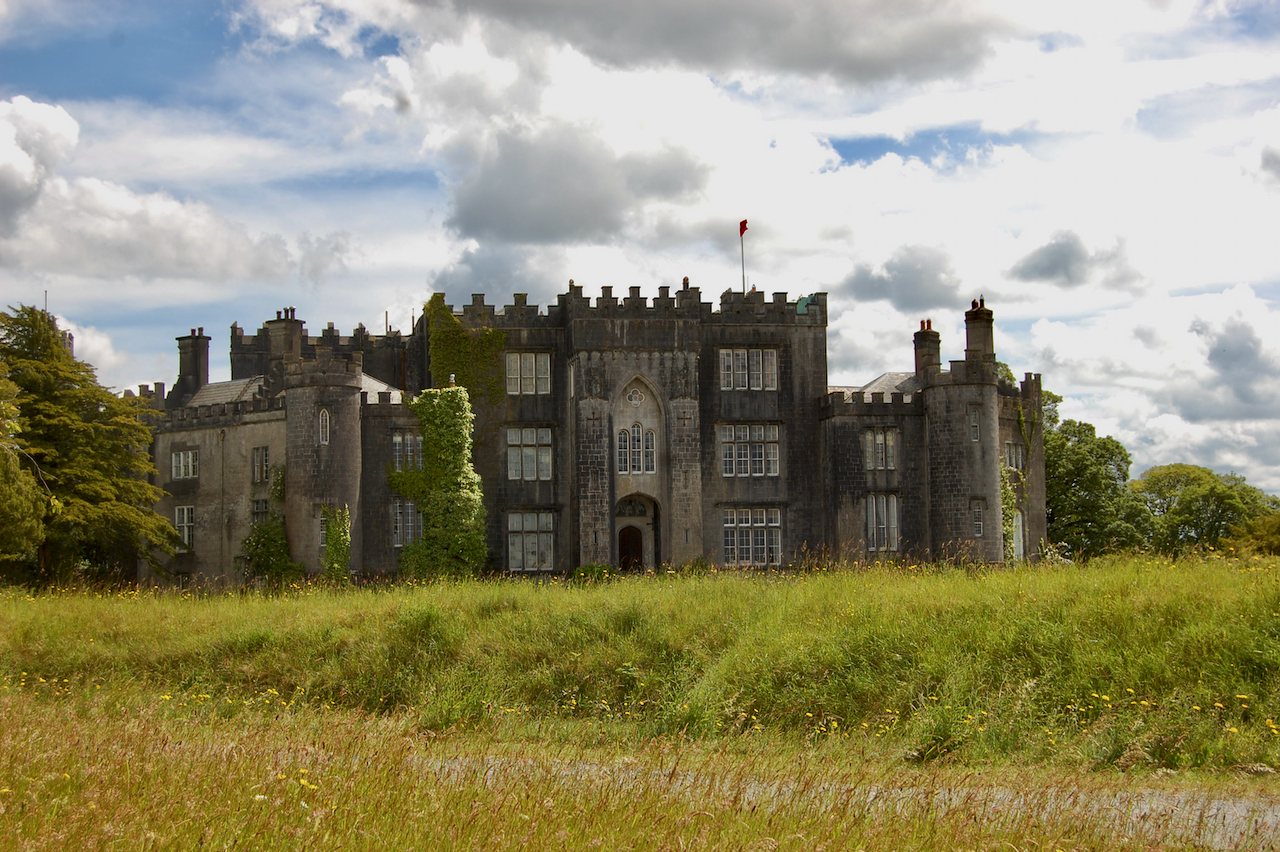
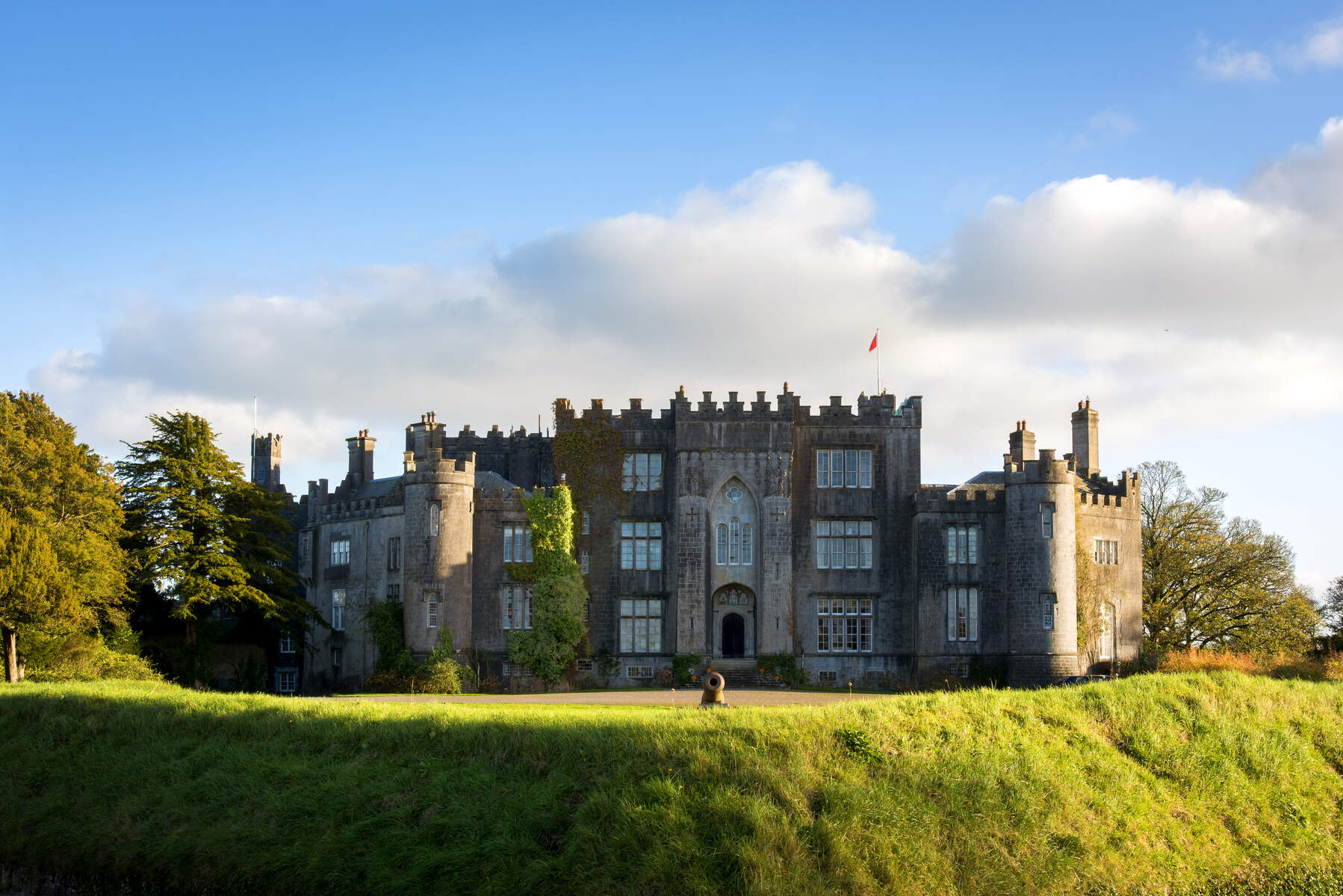
Birr Castle, photograph by Chris Hill 2018, for Tourism Ireland, Ireland’s Content Pool. [1]

We visited Birr Castle in June 2019. I am dying to visit again!

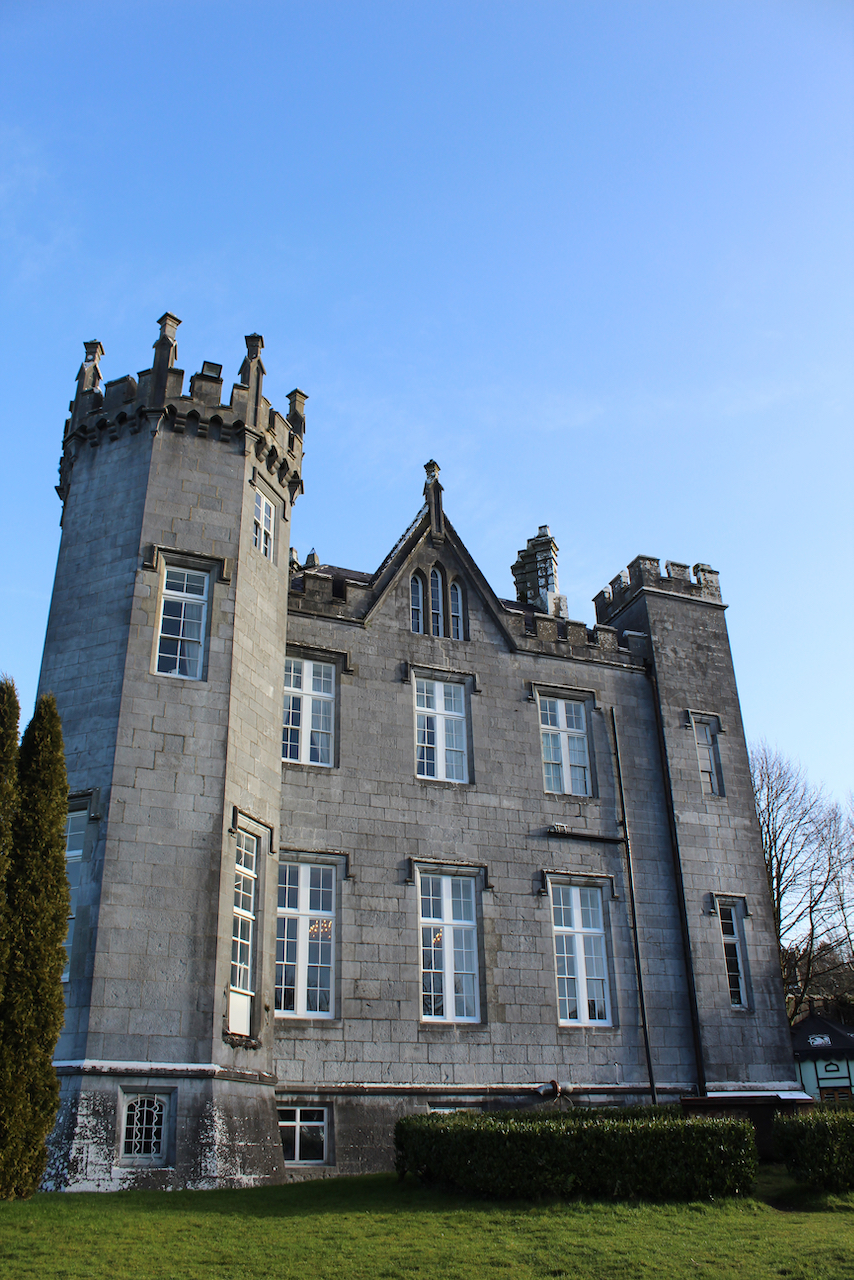
The castle has been in the one family since 1620. A castle existed on the site before then, but little remains of the original, as the old O’Carroll keep and the early C17 office ranges were swept away around 1778. However, parts of the auxiliary buildings of the original are incorporated into today’s castle, which was made from the gate tower which led into the castle bawn. The front hall of the original gatehouse is now at basement level. The rest of the castle has been built around this, at various times.

The castle formed part of a chain of fortresses built by the powerful O’Carroll family of Ely, on the borders of Leinster and Munster. In the 1580s the castle was sold to the Ormond Butlers. By 1620 the castle was a ruin, and King James I granted it to Laurence Parsons (d. 1628). [2] It was Laurence who made the current castle originating from the gate tower.

Although still a private residence, it is well set up for tours of the castle, and the demesne is wonderful for walks. The current owner is William Parsons, 7th Earl of Rosse.

The Parsons still live in the castle today and maintain the archives. According to the website: 

The Rosse papers are one of the most important collections of manuscripts in private ownership in Ireland. Extending from the early seventeenth century, when members of the family first established roots in the country, to the present, the core of the family archive is provided by the papers of successive members of the Parsons family. This calendar is essential reading for anyone interested in the history of: seventeenth and eighteenth-century Ireland; science in the nineteenth century; the British navy in the eighteenth century; the evolving story of the surviving families of the Irish landed elite in the nineteenth and twentieth centuries, and in the influence of a particular family that contrived over a number of centuries not only to transform Birr into one of the country’s most elegant small towns, but also to construct and sustain one of the finest country houses and its gardens.Access to the archives is by appointment.” [3]

In Crowned Harp, Memories of the Last Years of the Crown in Ireland, Nora Robertson writes about her ancestor Laurence Parsons:

With the further connivance of his even less admirable brother [less admirable, that is, than Laurence Parson’s kinsman Richard Boyle], Lord Justice William Parsons, Laurence acquired the forfeited estates of the Ely O’Carrolls in Offaly, whither he moved and erected Birr Castle...” [4]

The family history section of the Birr Castle website explains that there were four Parson brothers living in Ireland in the 1620s. They came to Ireland around 1590, and were nephews of Sir Geoffrey Fenton, Secretary of State in Ireland to Queen Elizabeth I. [5] Laurence’s brother William (1570-1649/1650) became Surveyor General of Ireland, 1st Baronet, and founded the elder branch of the Parson family in Bellamont, Dublin. This branch died out at the end of the eighteenth century.

Sir William Parsons (d. 1650), Surveyor-General and Lord Justice of Ireland Date: 1777, Engraver Samuel De Wilde, after unknown artist.

William was known as a “land-hunter”, expropriating land from owners whose titles were deemed defective. William was the progenitor of the first generation of the title of Earl of Rosse. When the last male to hold that title died without heirs, after a time the title passed to the descendants of the first baronet Bellamont’s younger brother, Laurence Parsons of Birr Castle.

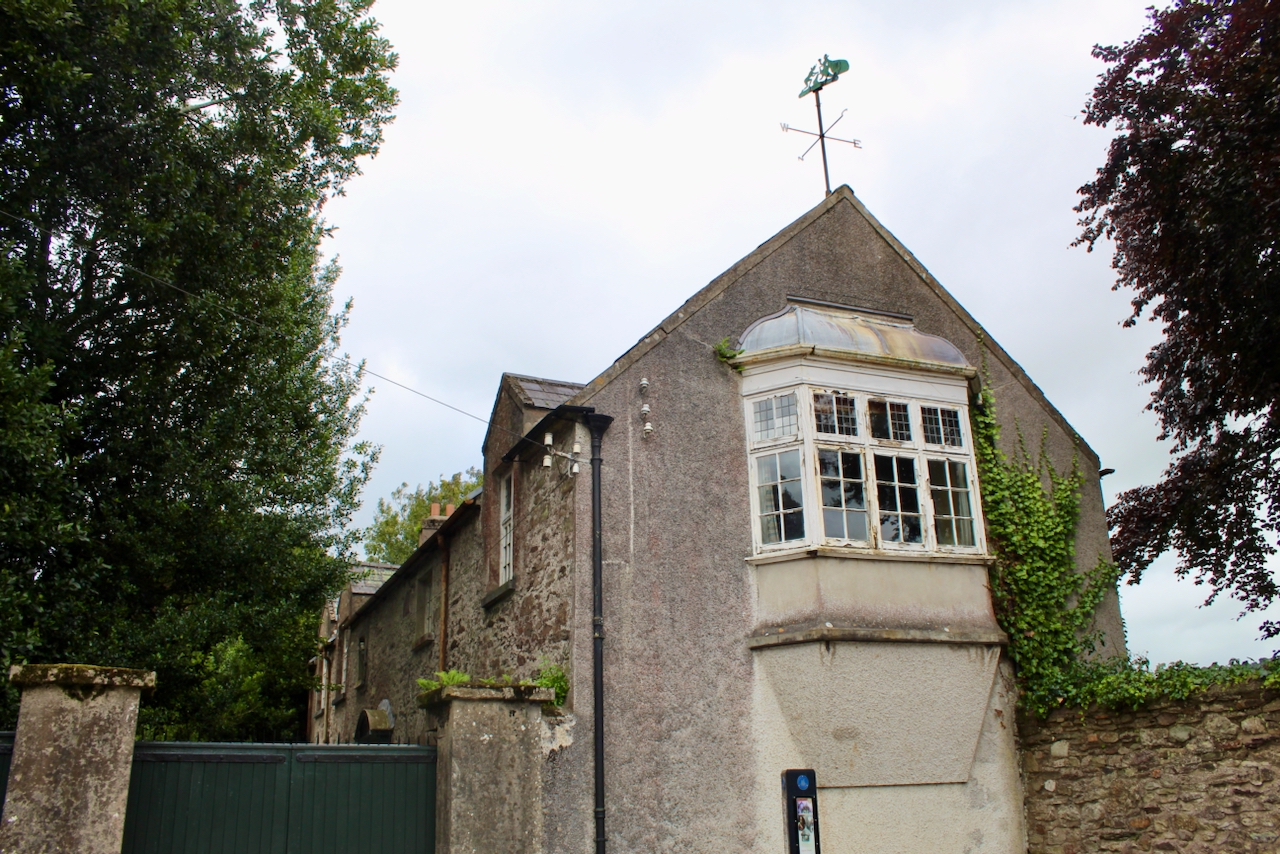
Before obtaining land in Offaly, through his connection with Richard Boyle later 1st Earl of Cork (Richard married Catherine Fenton, daughter of Geoffrey Fenton, Secretary of State in Ireland to Queen Elizabeth I), Laurence Parsons acquired Myrtle Grove in Youghal, Co. Cork, previously owned by Walter Raleigh, and succeeded Raleigh as Mayor of Youghal. 

Raleigh, who introduced tobacco to Europe after discovering it on his travels, had a bucket of water thrown over him by a housemaid when he was smoking, as she thought he was on fire! Raleigh is also said to have planted the first potato in Ireland.
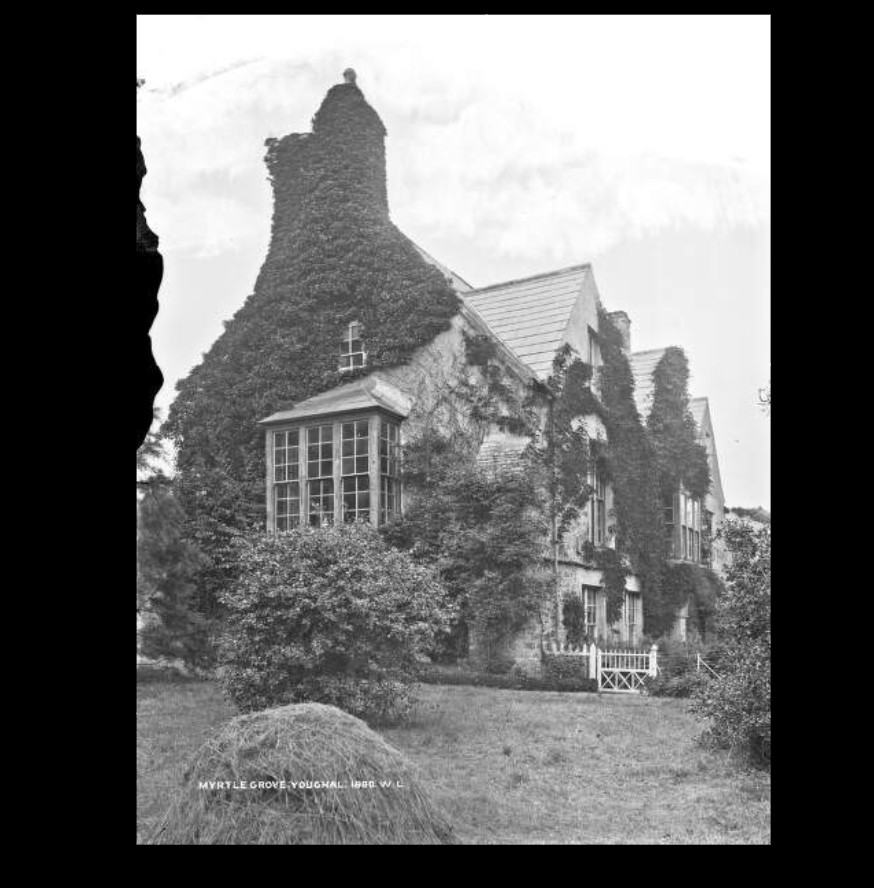
Myrtle Grove, Youghal, County Cork, photograph courtesy of Lawrennce Photographic Collecition National Library of Ireland, photographer: Robert French, 1841-1917.
Myrtle Grove, Youghal, County Cork, August 2020. Photograph © Jennifer Winder-Baggot, www.irishhistorichouses.com

Laurence Parsons served as Attorney General of Munster and later, Baron of the Exchequer, and was knighted in 1620. That same year, he ‘swapped’ his interest in a property near Cadamstown in County Wexford with Sir Robert Meredith, who served as Chancellor of the Exchequer in Ireland, for the latter’s 1,000 acres at Birr, Kings County. Parsons was granted letters patent to ‘the Castle, fort and Lands of Birr.’ [see 5]

The castle website states that:

“rather than occupy the tower house of the O’Carrolls, the Parsons decided to turn the Norman gate tower into their ‘English House,’ building on either side and incorporating two flanking towers. Sir Laurence Parsons did a large amount of building and remodelling including the building of the two flanking towers, before his death in 1628. This is all accounted for in our archives.” [6]

Suitably, a room which is now the castle’s Muniments room, which holds the archives, is located inside one of the flanking towers and retains a frieze of early 17thcentury plasterwork.
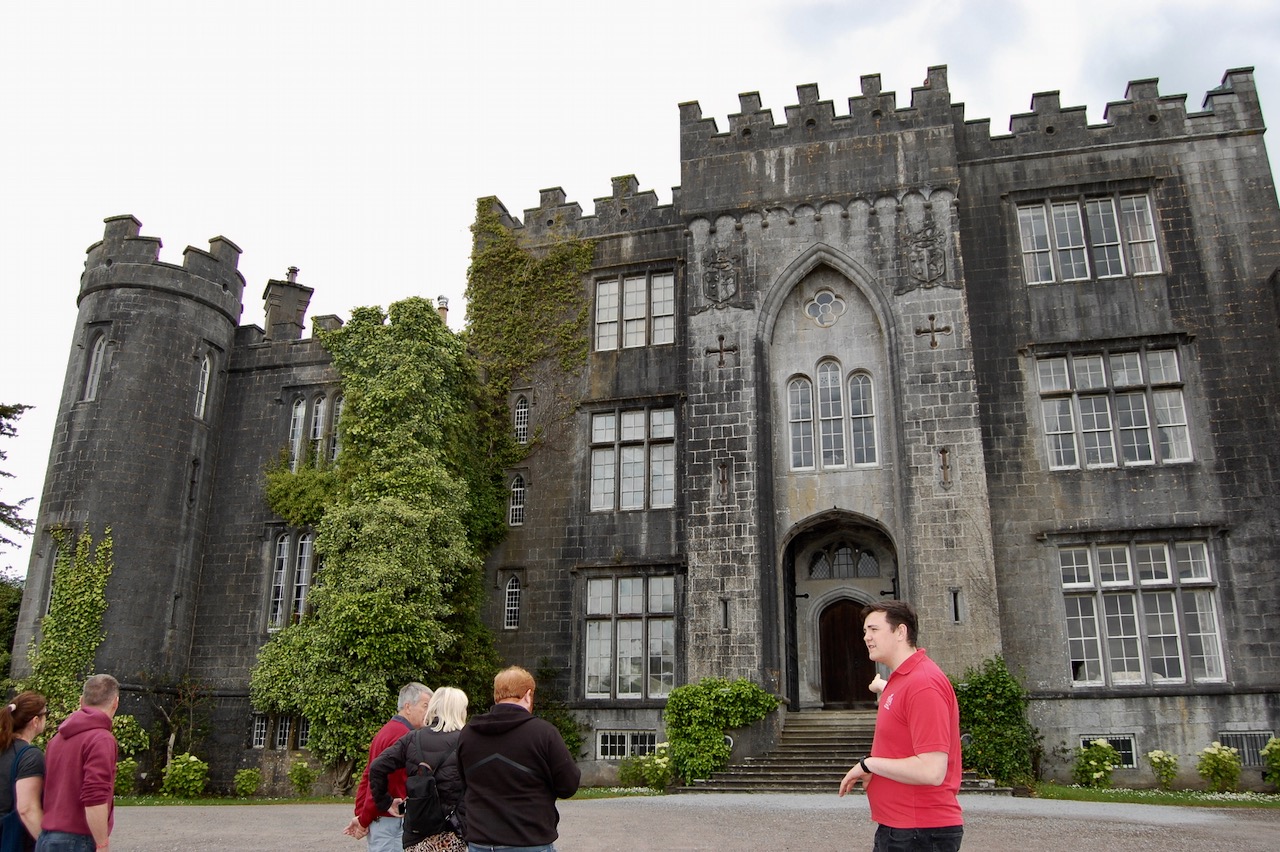
The group being led by our tour guide, Birr Castle, County Offaly. The entrance is approached by a tall flight of wide steps overshadowed by a massive arch, which gives the impression of passing beneath a medieval portcullis. Photograph © Jennifer Winder-Baggot, www.irishhistorichouses.com

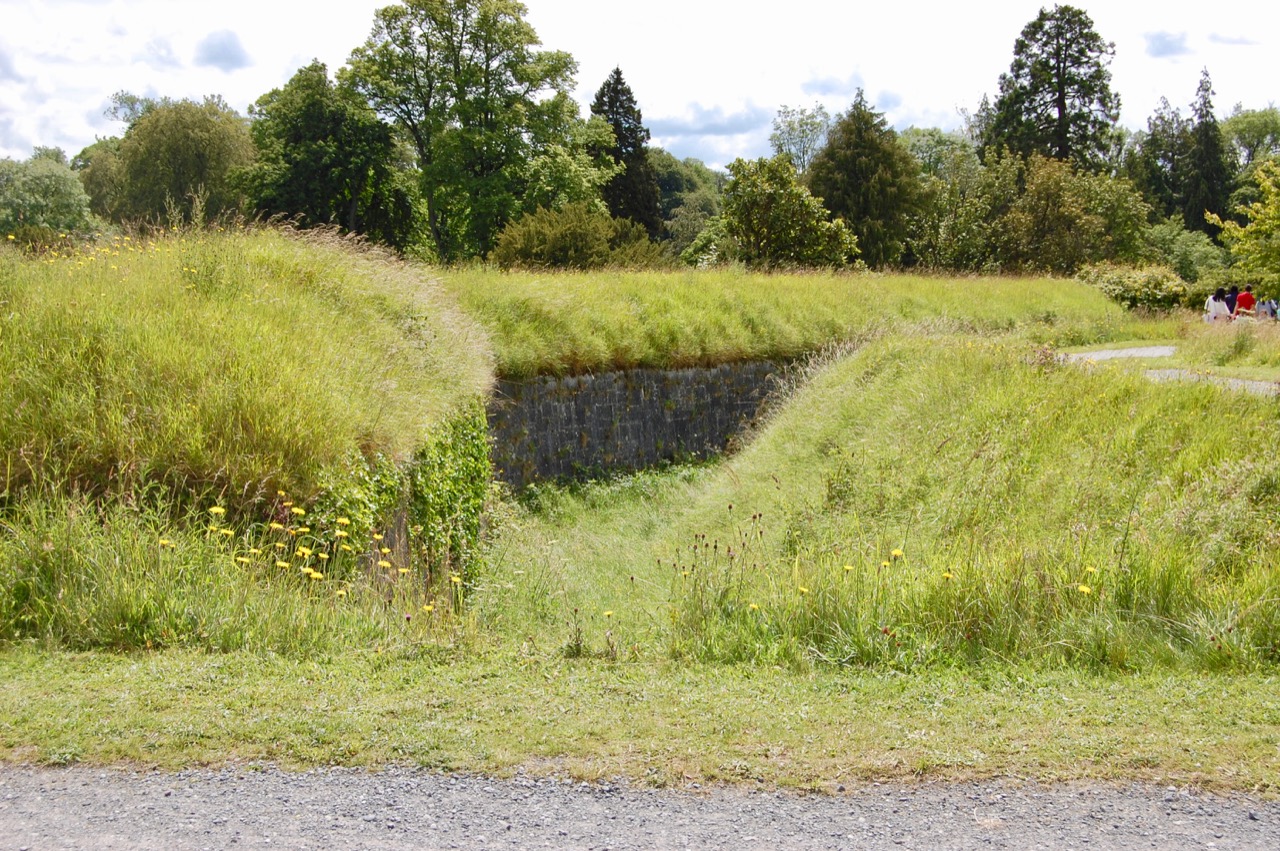
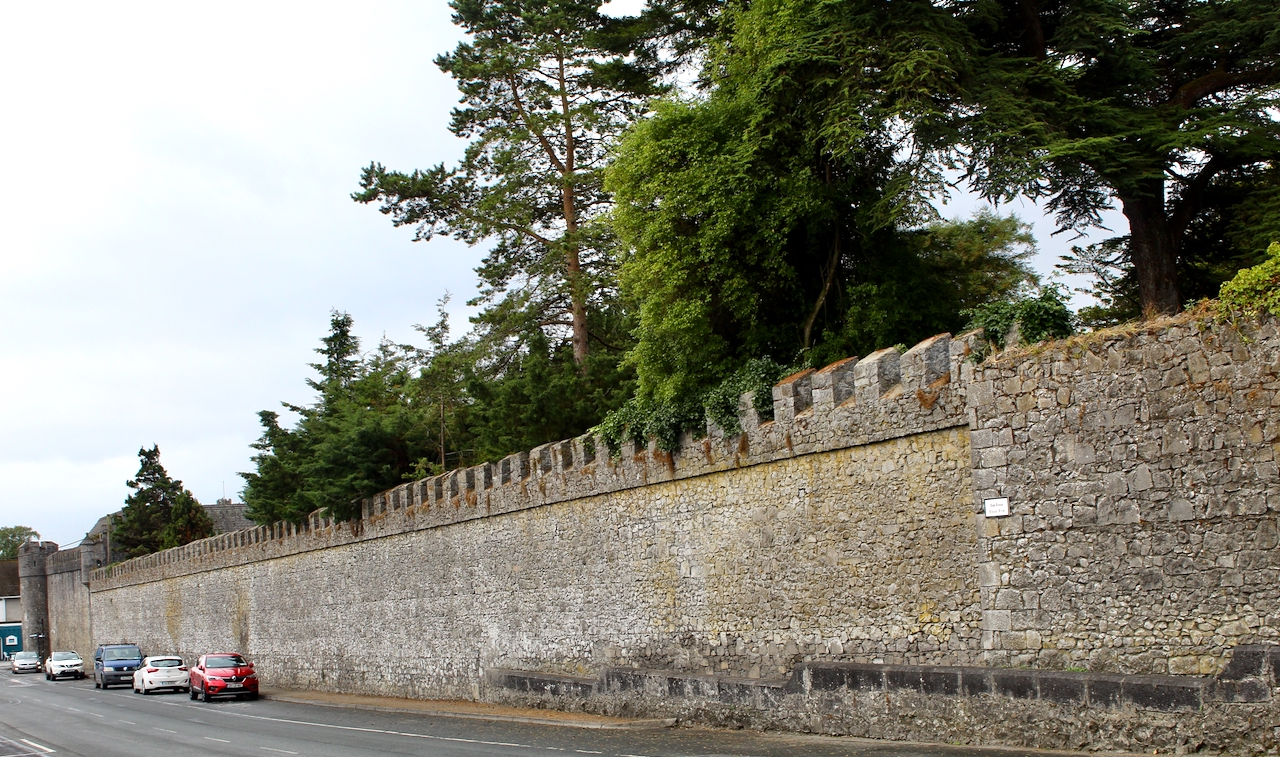
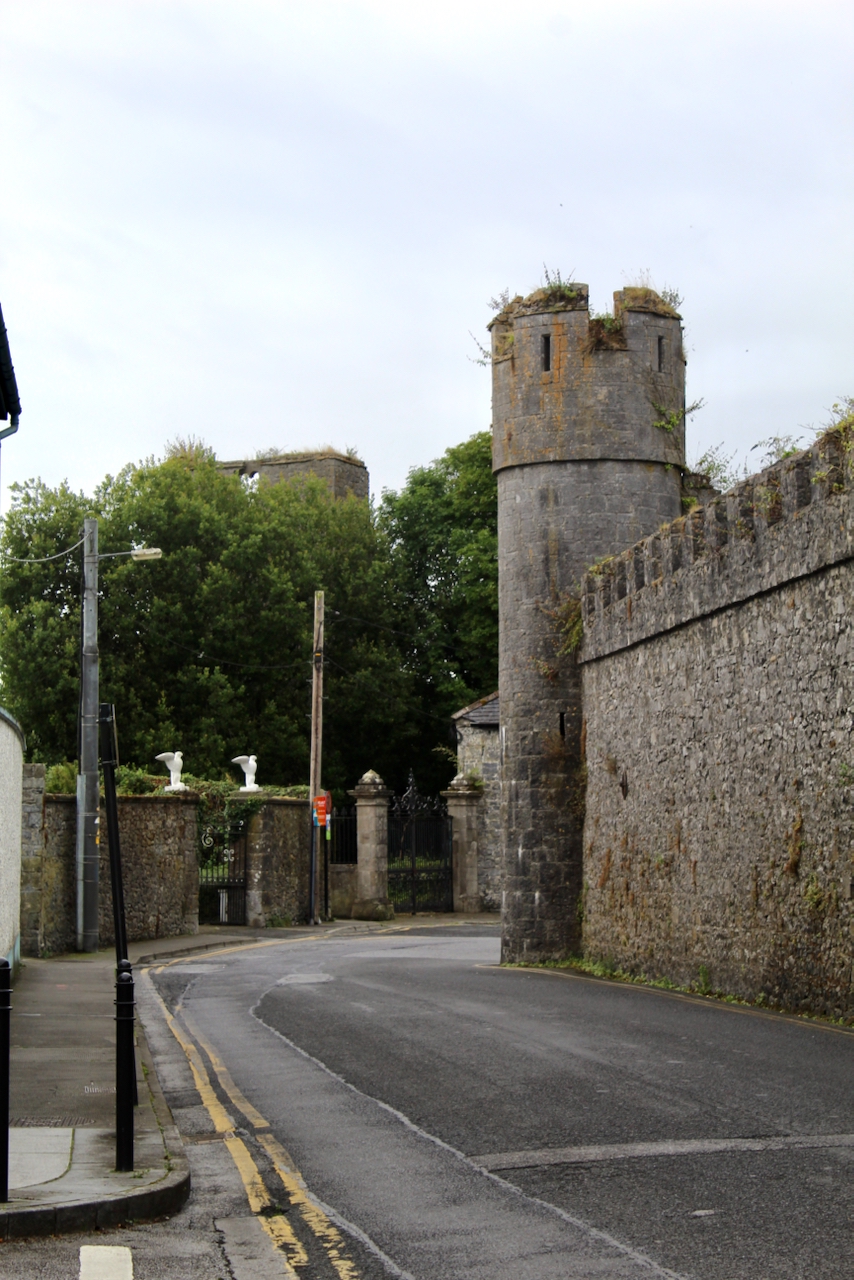
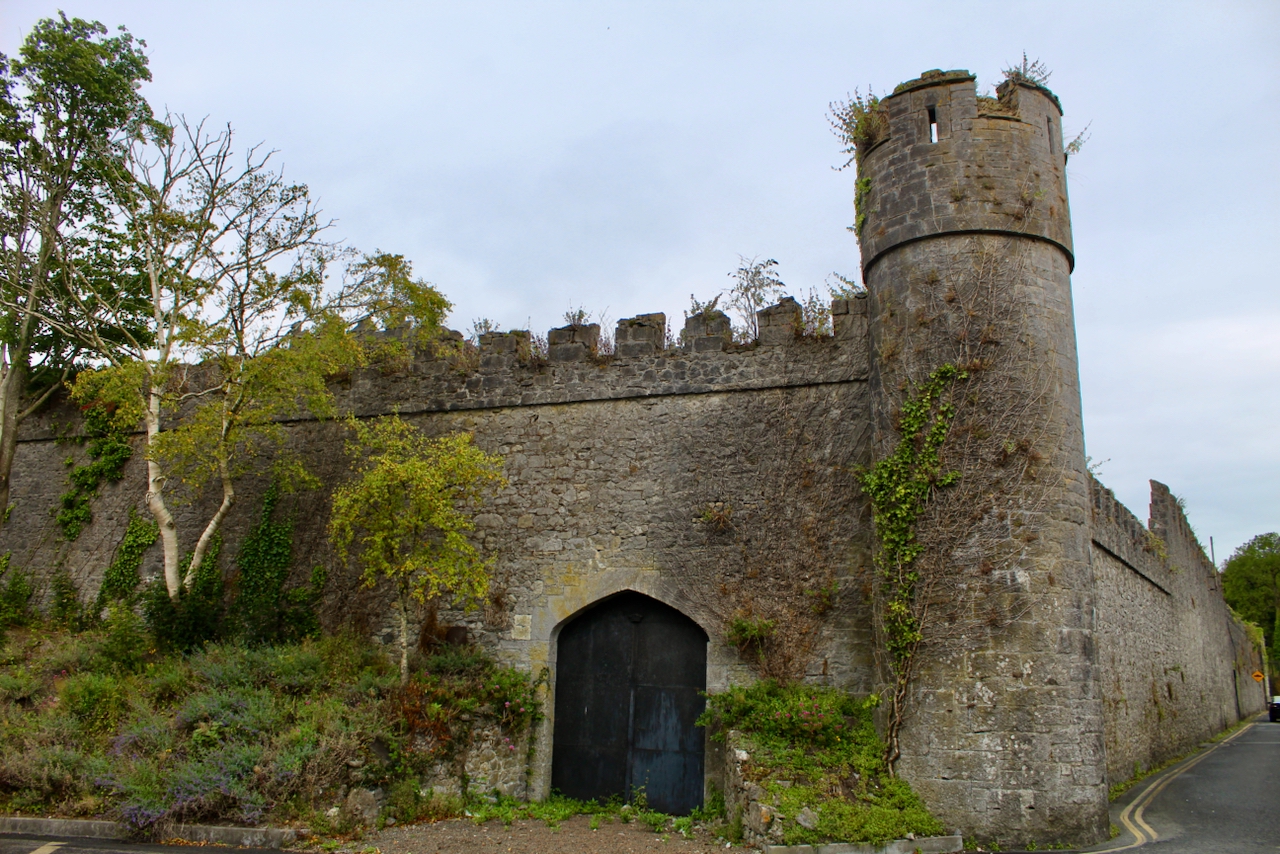
Our guide walked a group of us over to the castle, across the moat, which he told us had been created in 1847 when the owners of Birr Castle provided employment to help to stave off the hunger of the famine, along with the enormous walls surrounding the castle demesne as well as the stone stable buildings, which are now the reception courtyard, museum and cafe. 
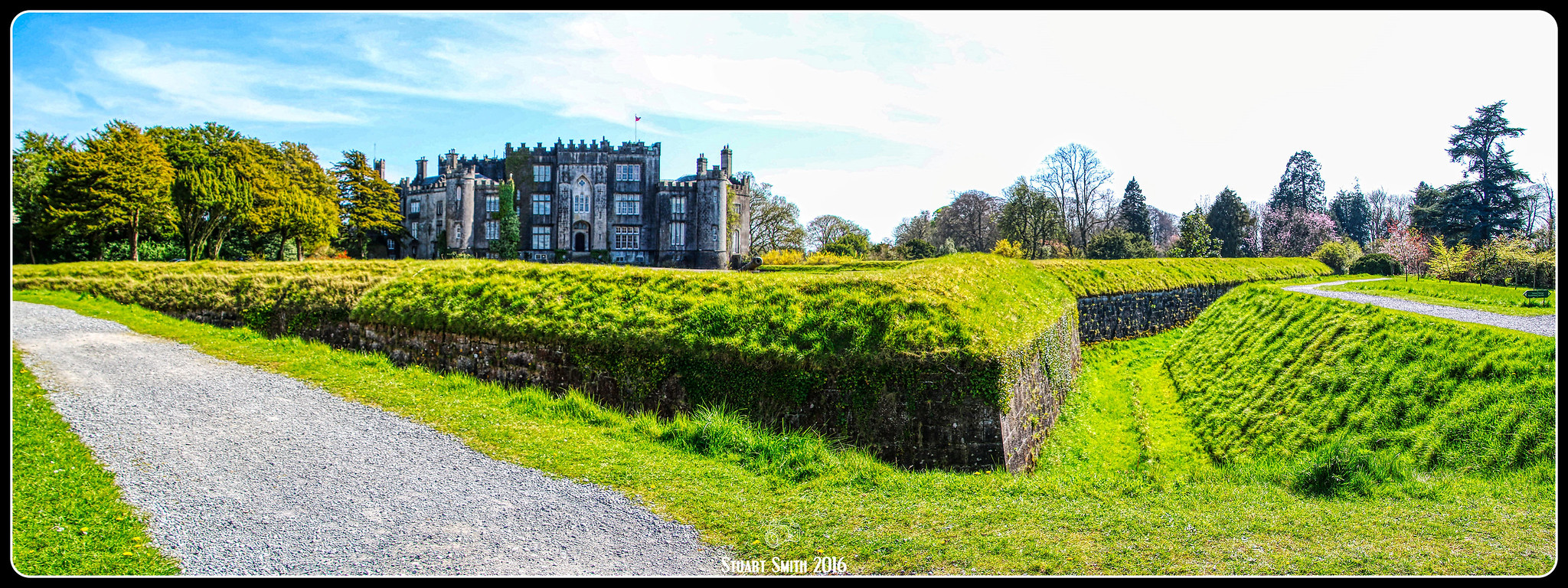
Birr Castle, County Offaly, photograph by Stuart Smith 2016 on flickr commons.
A photograph of the moat which our guide told us had been created as a famine project in order to pay the workers. Photograph © Jennifer Winder-Baggot, www.irishhistorichouses.com
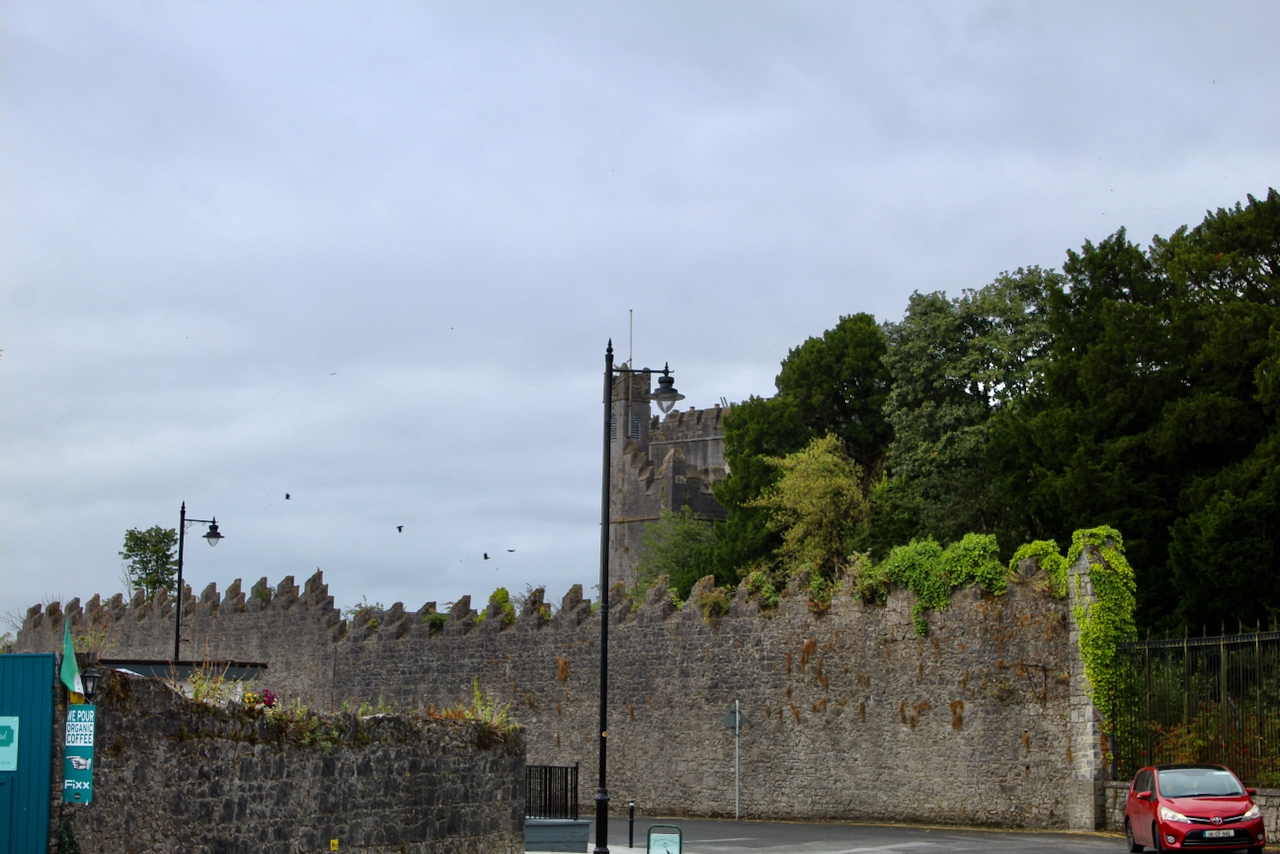
The walls around the demesne were created in 1847 when the owners of Birr Castle provided employment to help to stave off the hunger of the famine. Photograph © Jennifer Winder-Baggot, www.irishhistorichouses.com
Birr Castle walls. Photograph © Jennifer Winder-Baggot, www.irishhistorichouses.com
The walls around the demesne were created in 1847 when the owners of Birr Castle provided employment to help to stave off the hunger of the famine. Photograph © Jennifer Winder-Baggot, www.irishhistorichouses.com
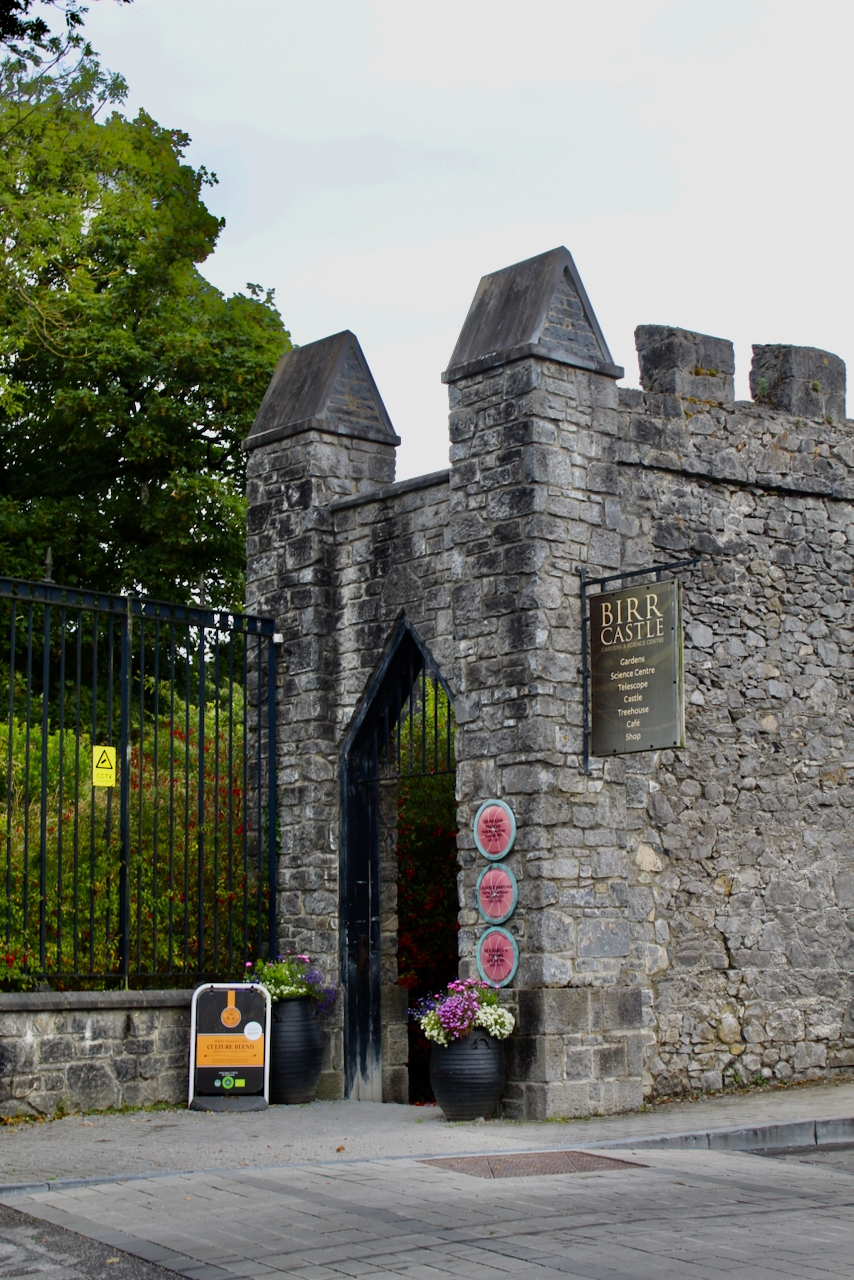
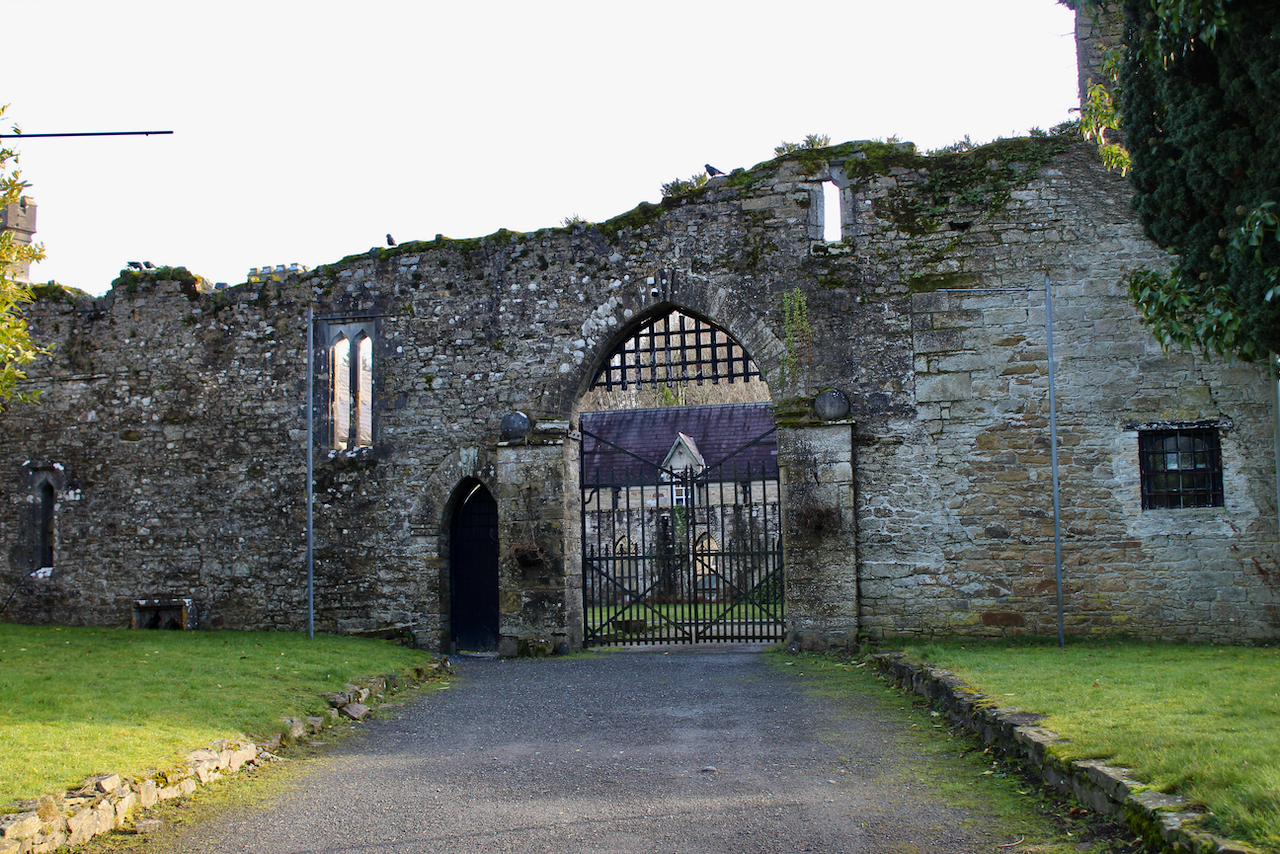
Birr Castle entrance, Photograph © Jennifer Winder-Baggot, www.irishhistorichouses.com

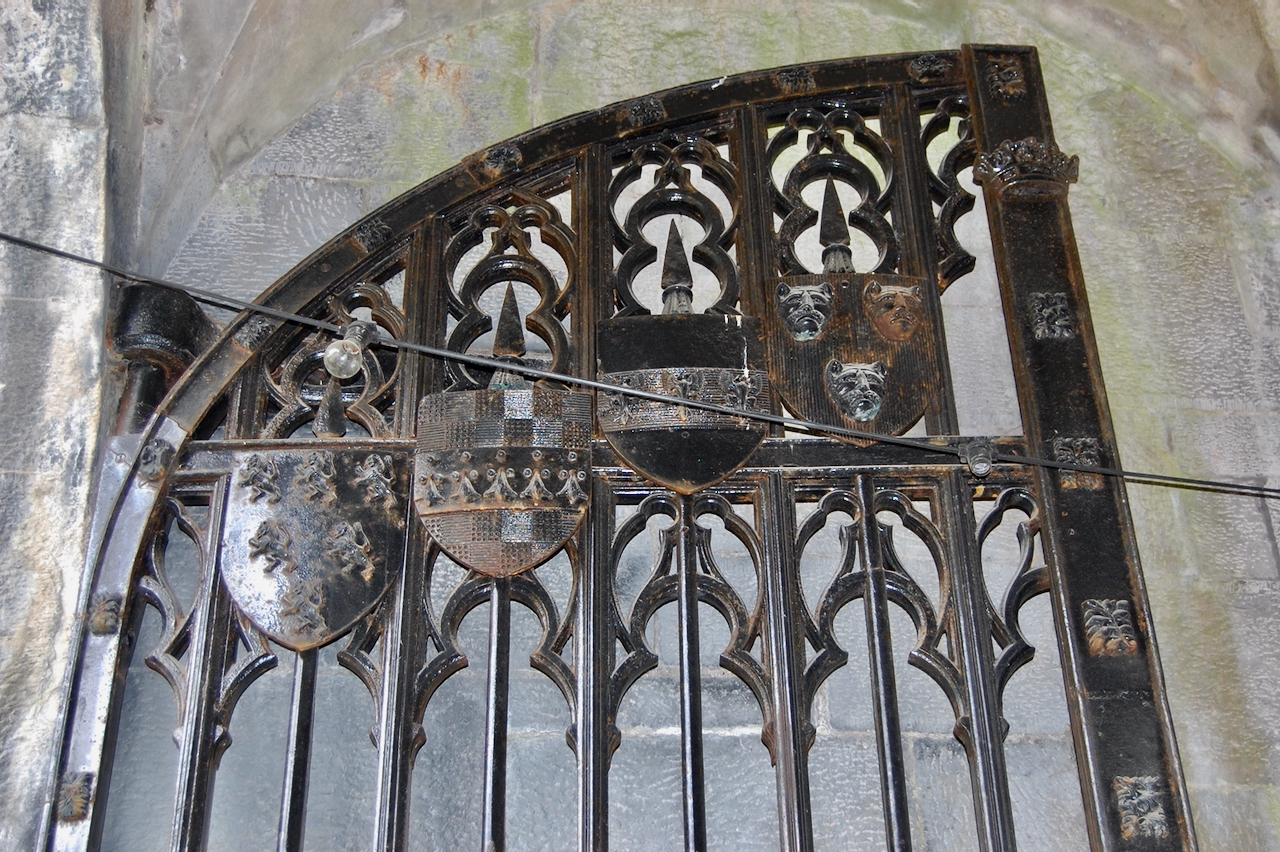
I was intrigued to hear that the gates had been made by one of the residents of the castle, Lady Mary Field, wife of William Parsons, the third Earl of Rosse. She was an accomplished ironworker! She was also a photographer. She brought a fortune with her to the castle when she married the Earl of Rosse, which enabled him to build his telescope, for which the estate is famous. But more on that later. 
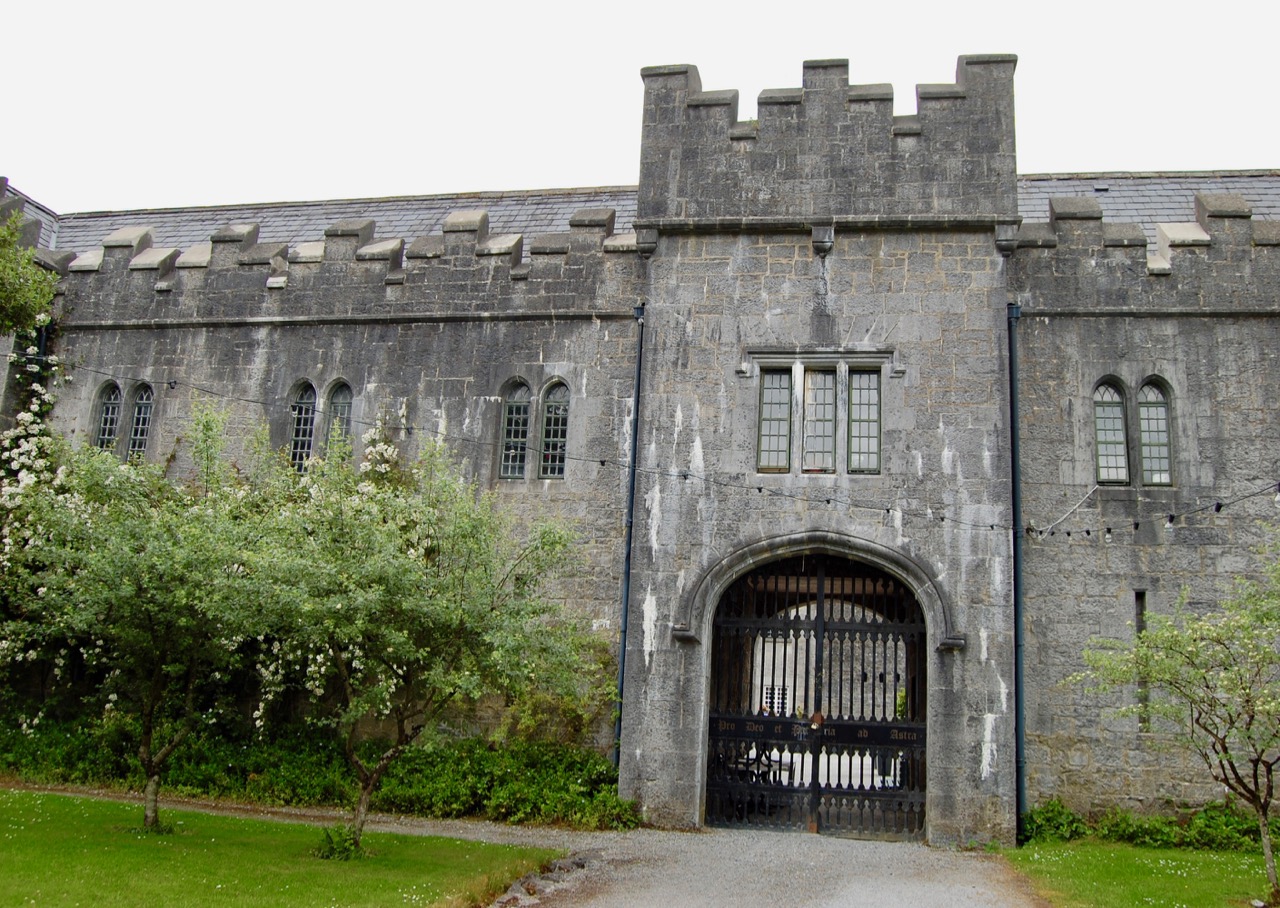
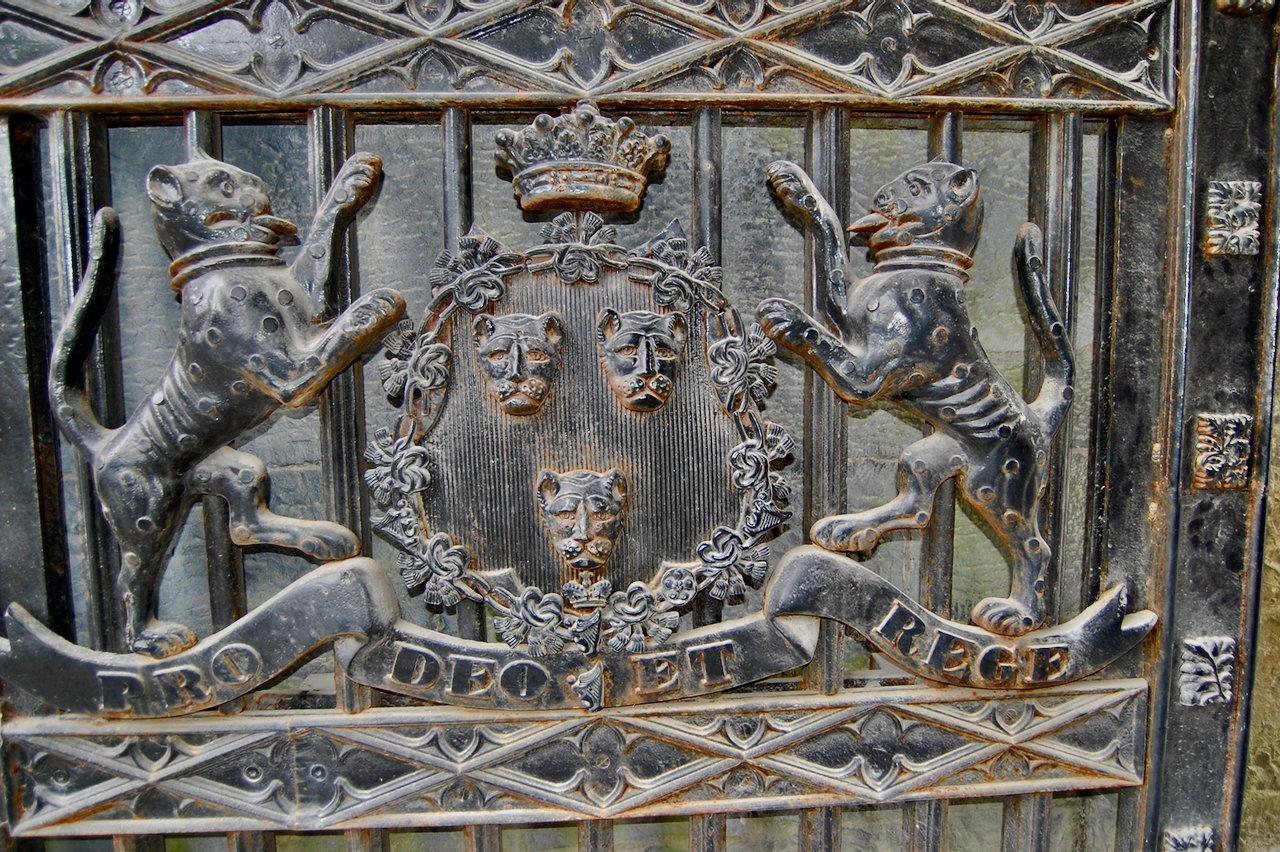
Gates on courtyard entrance made by Lady Rosse, Mary Field (1813-1885), wife of the third Earl of Rosse, with the family motto, “For God and the Land to the Stars.” The motto was originally “For God and King” but, unhappy with the monarch’s response to the famine, the family changed their motto. Photograph © Jennifer Winder-Baggot, www.irishhistorichouses.com
Detail of a gate by Mary Field. This is the Parsons crest, the three leopard heads. Photograph © Jennifer Winder-Baggot, www.irishhistorichouses.com
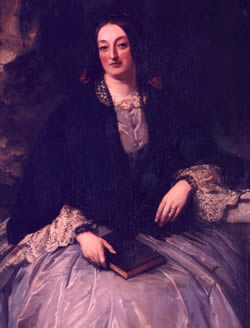
Mary Rosse, Countess of Rosse (née Mary Field) (1813-1885), painter unknown, photograph from Birr Archives, courtesy wikimedia commons.

Family crests from families who intermarried with the Parsons of Birr are also worked into the gate. There are similar crests on the ceiling of the front hallway of the castle. 
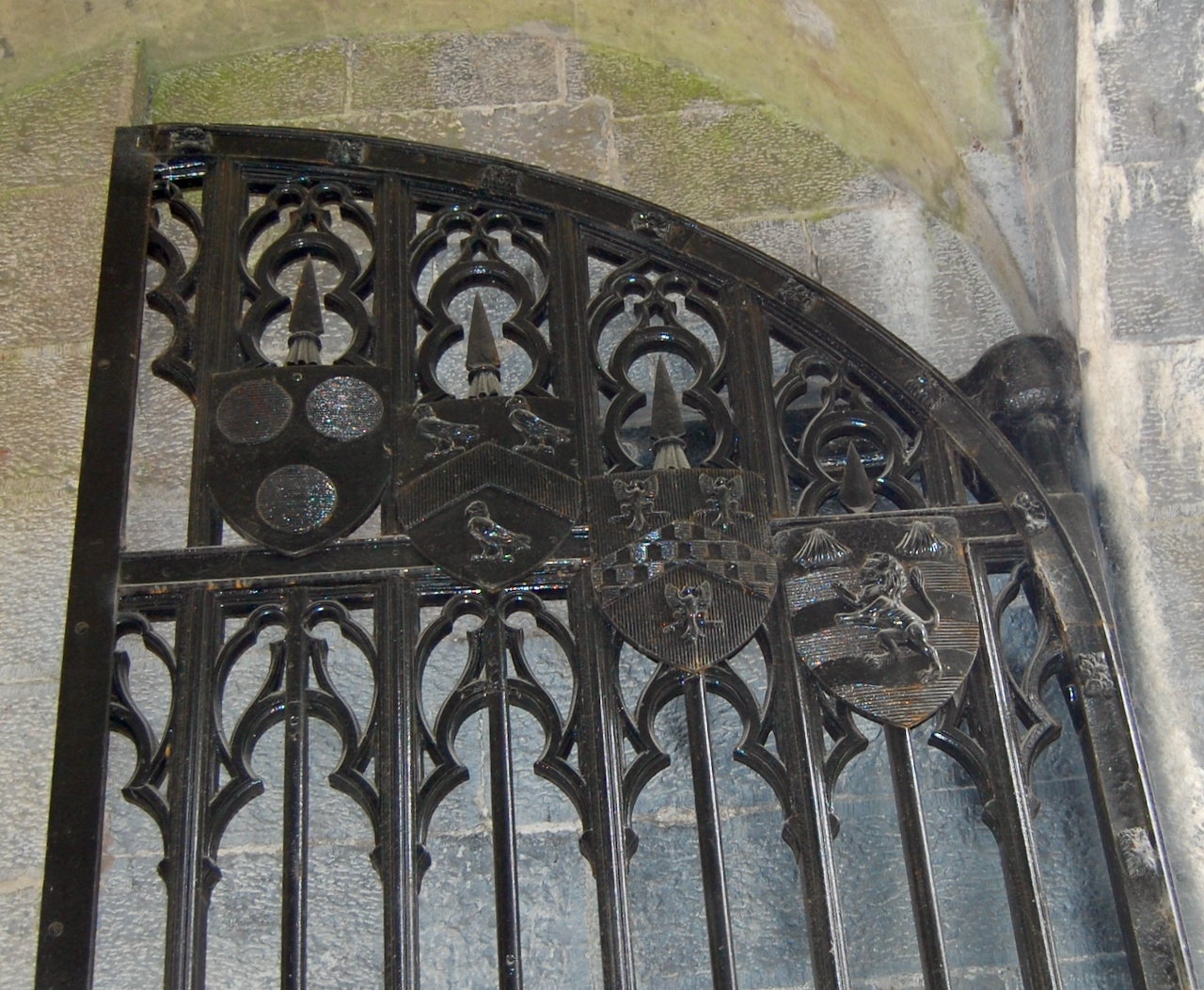
Birr Castle, County Offaly. Photograph © Jennifer Winder-Baggot, www.irishhistorichouses.com

We were not allowed to take photos inside the castle, unfortunately. On the other hand it’s always a relief when I am told I cannot take photos, for it means I can relax and really look, and listen to the tour guide.

With the help of portraits, our guide described the Parson family’s ancestors. The entrance hall, the room over the arch in the original gatehouse, has some portraits and a collection of arms.
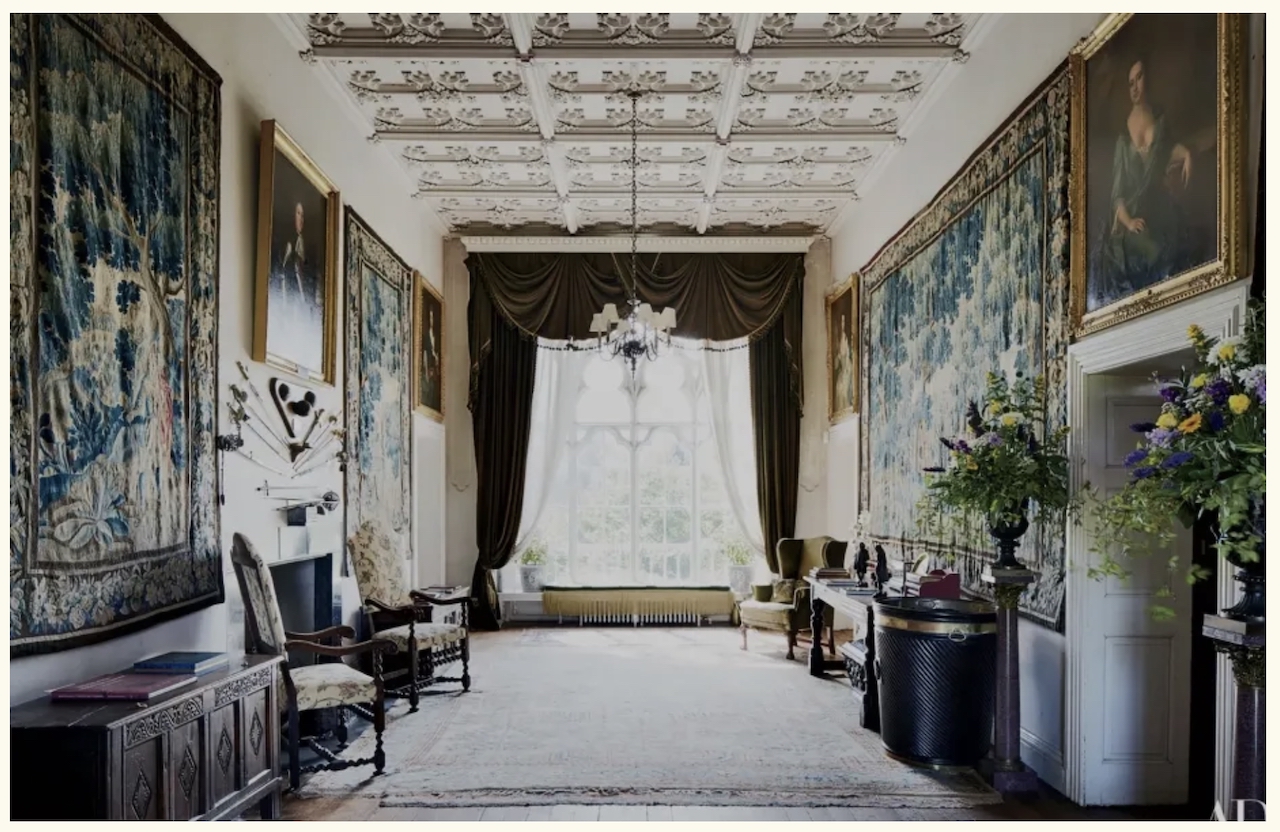
Birr Castle, photograph courtesy of Birr Castle website.

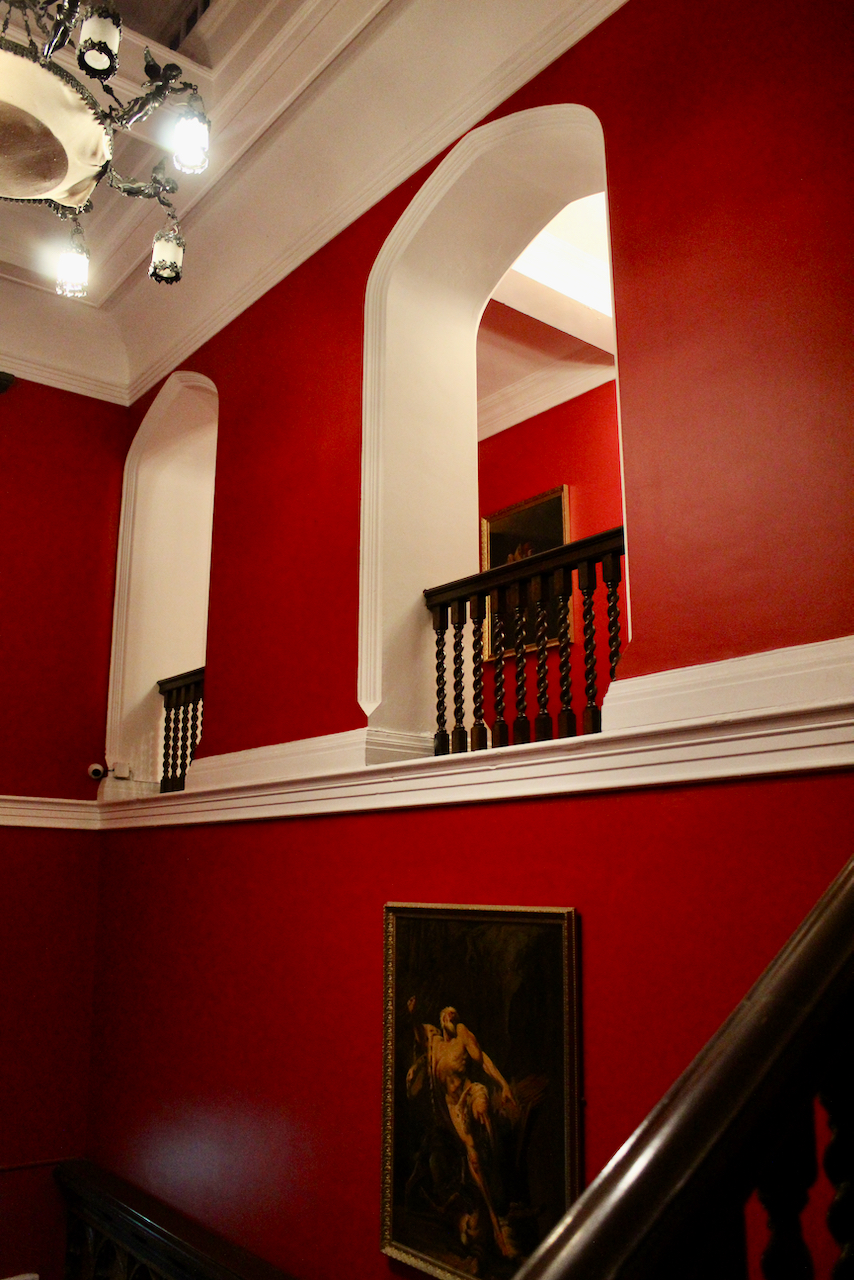
The principal staircase is from the 17th century house, and is built of native yew. It was described in 1681 by Thomas Dinely as “the fairest in all Ireland.” It rises through three storeys, and is heavy, with thick turned balusters and a curving carved handrail. The ceiling above the stairs has plaster Gothic vaulting and dates from the reconstruction after a fire in 1832.
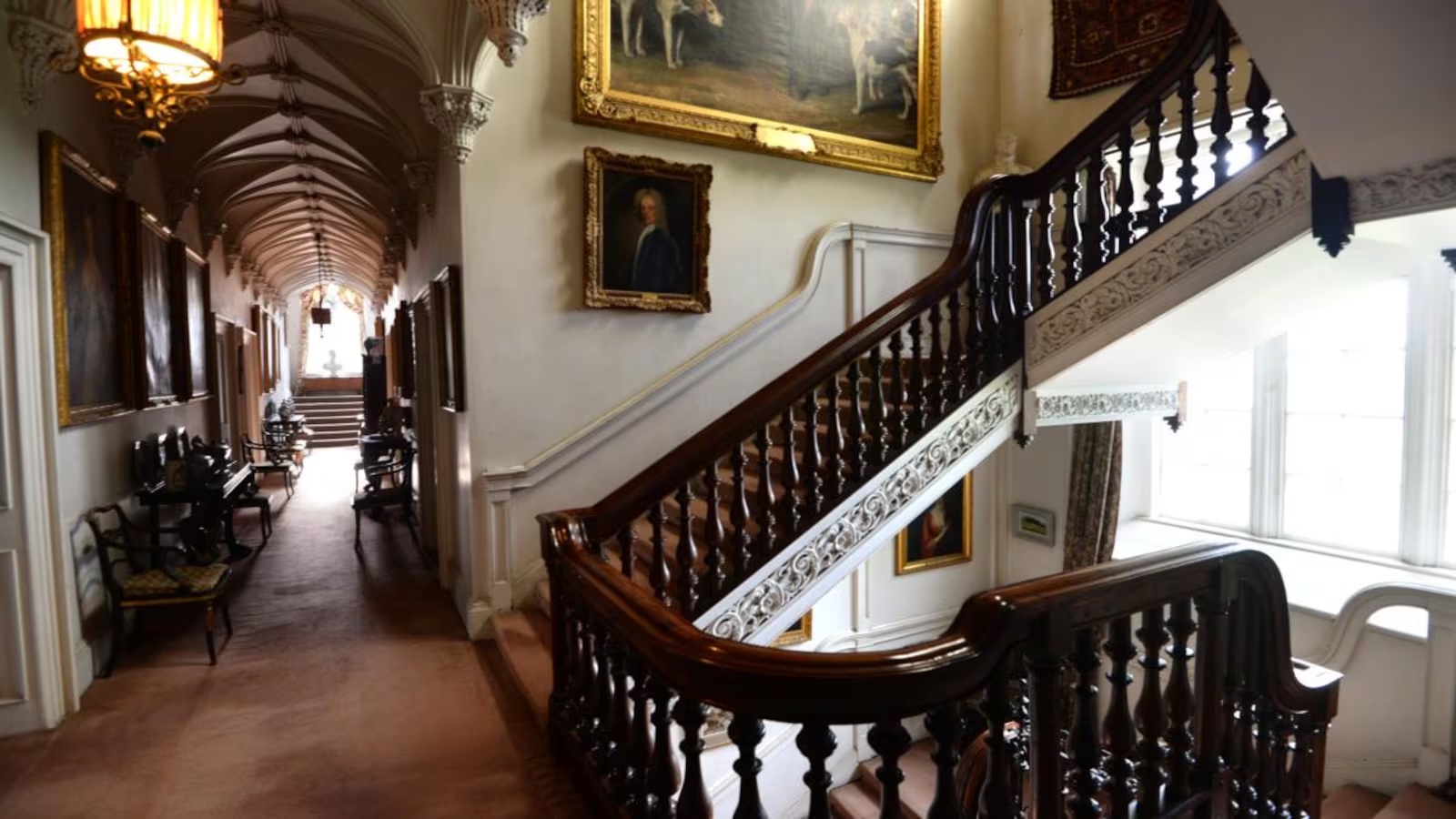
The massive seventeenth century yew staircase, photograph from an article in the Irish Times, photographer Laura Slattery.

Sir Laurence’s son Richard succeeded his father in 1628. Richard died in 1634 without an heir so Birr Castle passed to Richard’s brother William (d. 1653). During his time in Birr Castle, William protected the castle from a siege in 1641 during the Catholic uprising. He fought off the forces for fourteen or fifteen months but eventually surrendered in January 1642/43. [Burke’s Peerage and Baronetage p. 1721] The family moved to London, returning at the end of the Cromwellian period.

In his will, William specified that when the Birr estate is worth £1000 per year, his heir should build an alsmhouse in Birr for four aged Protestants, each with a garden and orchard and enough grass for the grazing of two cows. The beneficiaries would be given 12 pence every Sunday, freedom to cut turf for fire, and a red gown with a badge once every two years, which was to be presented by the heir.

William’s heir was his son, Laurence Parsons (d. 1698), who married Lady Frances, youngest daughter and co-heir of William Savage Esquire of Rheban, County Kildare.

This Laurence Parsons has a substantial entry in The Dictionary of Irish Biography. He was created Baronet of Birr Castle in 1677. Under the lord deputyship of Tyrconnell, Irish protestant grew nervous about another Catholic uprising, and Parsons moved his family to England in 1687. He left a tenant and servant of long standing, Heward Oxburgh, in charge of his estate, with instructions to use his rentals to pay certain debts, and to remit payments to him in England.

Oxburgh was a Catholic who had lost land and been transplanted to Connaught, but was a tenant and servant of the Parsons for thirty years by 1692.

When the rental money did not materialise, Parsons returned to Ireland. He found his agent “highly advanced to the dignity of sheriff of the county, who lorded it over his neighbours at a great rate, and was grown and swollen to such a height of pride he scarce owned his master.” (Birr Castle MSS, A/24, ff 1–2). Furthermore, Oxburgh had used the estate’s rental income to raise a regiment of foot soldiers for King James II.

Parsons reoccupied his castle, which was then besieged by Oxburgh’s forces. Under duress he signed articles, only to find himself tried for treason against William III, and sentenced to death. Imprisoned in his castle, he was reprieved from execution several times, and eventually in April 1690 he was moved to Dublin, and was released shortly after the battle of the Boyne.

Oxburgh sat for King’s County in the Irish parliament summoned by James II in 1689, while his son Heward was returned for Philipstown. He died in the Battle of Aughrim in 1691.

Parsons was again appointed high sheriff of King’s County, and returned to Birr to secure the area against Jacobites and tories. He was involved in one notable skirmish on 11 August, before returning to Dublin to meet his wife and children who had travelled from England. Birr was subsequently occupied by Williamite forces.

Laurence Parsons died in 1698 and was succeeded in the baronetcy by his son, William Parsons (d. 1740) 2nd Baronet. William served in the Williamite forces, and was MP for King’s Co. (1692–1741). He married firstly Elizabeth, daughter of a Scottish Baronet, and they had one son. This son William Parsons married Martha Pigott and they had a son, Laurence (1707-1756). William Parsons 2nd Baronet died in 1740 and his grandson Laurence Parsons (1707-1756) succeeded as 3rd Baronet of Birr Castle.

his conduct as supervisor of various plantations outraged the numerous native landowners who were dispossessed by his highly questionable legal machinations: local juries were intimidated into invalidating titles to property, while those dispossessed who sought legal recourse were ruined by expensive and time-consuming counter-suits. From 1611 to 1628 he was heavily involved in the increasingly crude efforts by the government to wrest land in Cosha and Ranelagh, Co. Wicklow, from Phelim McFeagh O’Byrne, which culminated in a failed attempt to frame O’Byrne for murder by torturing witnesses. He also encountered criticism for the manner in which he exercised his office as surveyor of plantation land by deliberately underestimating the extent of plantation land in order to defraud the crown and the church of their revenues. At least twice he had to procure royal pardons for corrupt activities.

By these means, he furthered the crown’s policy of supplanting catholic landowners with more politically reliable protestant ones while personally acquiring prime plantation land in Co. Wexford, Co. Tyrone, and Co. Longford, and in King’s Co. (Offaly) and Queen’s Co. (Laois). Although his grasping nature was widely advertised in Ireland, he escaped royal censure due to his political clout, being a key member of a powerful and tightly knit group of Dublin-based government officials who enriched themselves by obstructing and redirecting royal grants of Irish lands intended for courtiers in London. Reflecting his political influence and widening property interests, he sat as MP for Newcastle Lyons (1613–15), Armagh Co. (1634–5) and Wicklow Co. (1640–41).

Parsons’s fortunes changed when Thomas Wentworth came as Lord Deputy to Ireland. Wentworth believed that the protestant establishment was hopelessly corrupt and had failed in its civilising mission in Ireland. He instigated legal proceedings – designed to recover property for the crown – against a number of prominent protestant landowners.
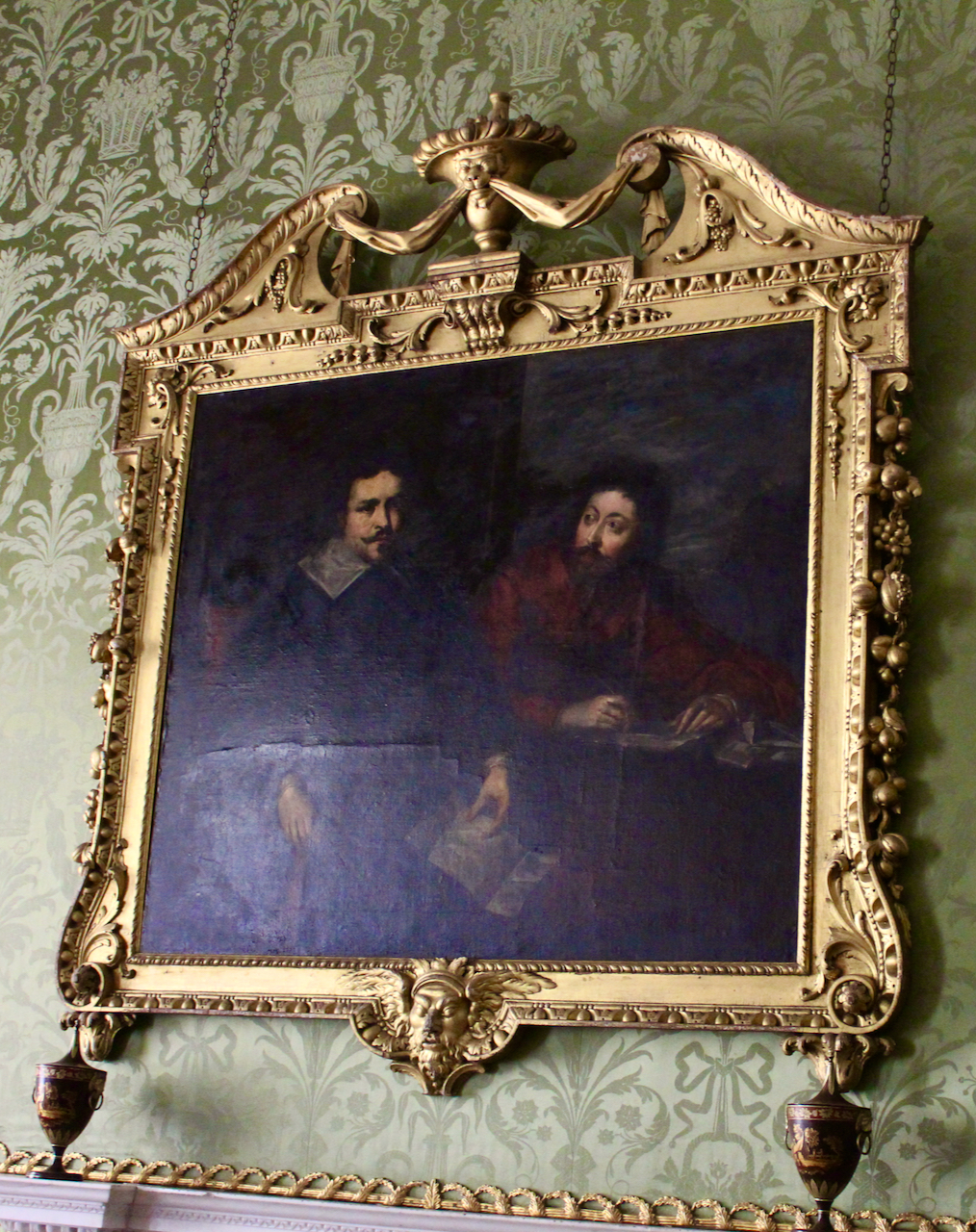
Thomas Wentworth 1st Earl of Strafford (1593-1641), Lord Deputy of Ireland 1632-1640 for King Charles I.

Parsons managed to keep in favour to an extent with Wentworth, although they did not trust each other, and when Wentworth was subsequently accused in 1640 of corruption and treason, Parsons was appointed Lord Justice of Ireland. Parsons knew he stood on shakey ground, however, due to his complicity with Wentworth.

Parsons’s position deteriorated when the king agreed to make a number of wide-ranging concessions, including a promise to halt the plantation of Connacht. Parsons succeeded in delaying the passage of the king’s concessions into law by pleading with the king not to give so much away without extracting money from parliament. Many then and since believed that, but for Parsons’s delaying tactics, the king’s concessions would have been passed by the Irish parliament, the catholics would have felt more secure, and the subsequent disaster of 1641 would have been averted. 

In February 1642 a royal proclamation arrived in Dublin calling on the rebels to surrender and promising them lenient treatment, after which a number of catholic landowners surrendered voluntarily to the government. Parsons disliked this, and to discourage further submissions, he imprisoned and tortured those who had surrendered and even executed a catholic priest who had saved thirty protestants from being murdered in Athy, Co. Kildare. Similarly, in May he condemned the terms by which the city of Galway had submitted to the government as being too lenient. His actions quickly stemmed the flow of submissions that could have brought a peaceful end to the rising. In the meantime the English Parliament was gaining in power over King Charles I.

The Dictionary of Irish Biography continues:

Parsons declared an official policy of neutrality while privately favouring parliament in every matter. From October 1642 he allowed two parliamentarian representatives to sit at the meetings of the Irish privy council. However, the royalist Ormond had his supporters in the Irish council. The growing factionalism that pervaded the Dublin administration reflected the mistrust between the royalists and parliamentarians in Ireland.

Meanwhile in Ireland the catholics organised their own system of government, the ‘catholic confederation’, and were bolstered militarily by the arrival of experienced officers from the Irish regiments serving in the Spanish Netherlands. The protestant forces, starved of pay and munitions, were pushed back once more. The royalists led by Ormond began courting the disgruntled protestant troops in Ireland. In December army officers presented Parsons and his council with a petition outlining their unhappiness at their lack of pay. Although Parsons maintained his grip on the civil administration, the army increasingly looked to Ormond.” This led to his dismissal from the Irish privy council in July and his arrest in August 1643.

Parsons remained a prisoner in Dublin until autumn 1646. By then parliament had won the English civil war and Parsons was released. He died in 1650.

Richard Parsons, 1st Viscount Rosse married three times. He married, firstly, Anne Walsingham, daughter of Thomas Walsingham, on 27 February 1676/77. He was created 1st Viscount Rosse, Co. Wexford [Ireland] on 2 July 1681. He married, secondly, Catherine Brydges, daughter of George Brydges, 6th Baron Chandos of Sudeley on 14 October 1681.

He married his third wife, Elizabeth Hamilton, daughter of Sir George Hamilton, Comte Hamilton in December 1695, after he’d been imprisoned in the Tower of London in February for high treason, according to Burke’s Peerage, Baronetage & Knightage. I can’t find much information about this.

Viscount Rosse’s father-in-law George Hamilton, Comte Hamilton, was the grandson of the 1st Earl of Abercorn, son of 1st Baronet Hamilton, of Donalong, Co. Tyrone and of Nenagh, Co. Tipperary. George Hamilton travelled to France to fight in the Catholic French army, where he was given the title of Comte, fighting against the British. He married Frances Jenyns, who gave birth to his daughter Elizabeth who married Richard Parsons 1st Viscount Rosse. Frances Jenyns, or Jennings, married a second time, to Richard Talbot, the Duke of Tyrconnell. So we can see the circles in which Richard Parsons mixed, and why it was that he could have been imprisoned for treason.
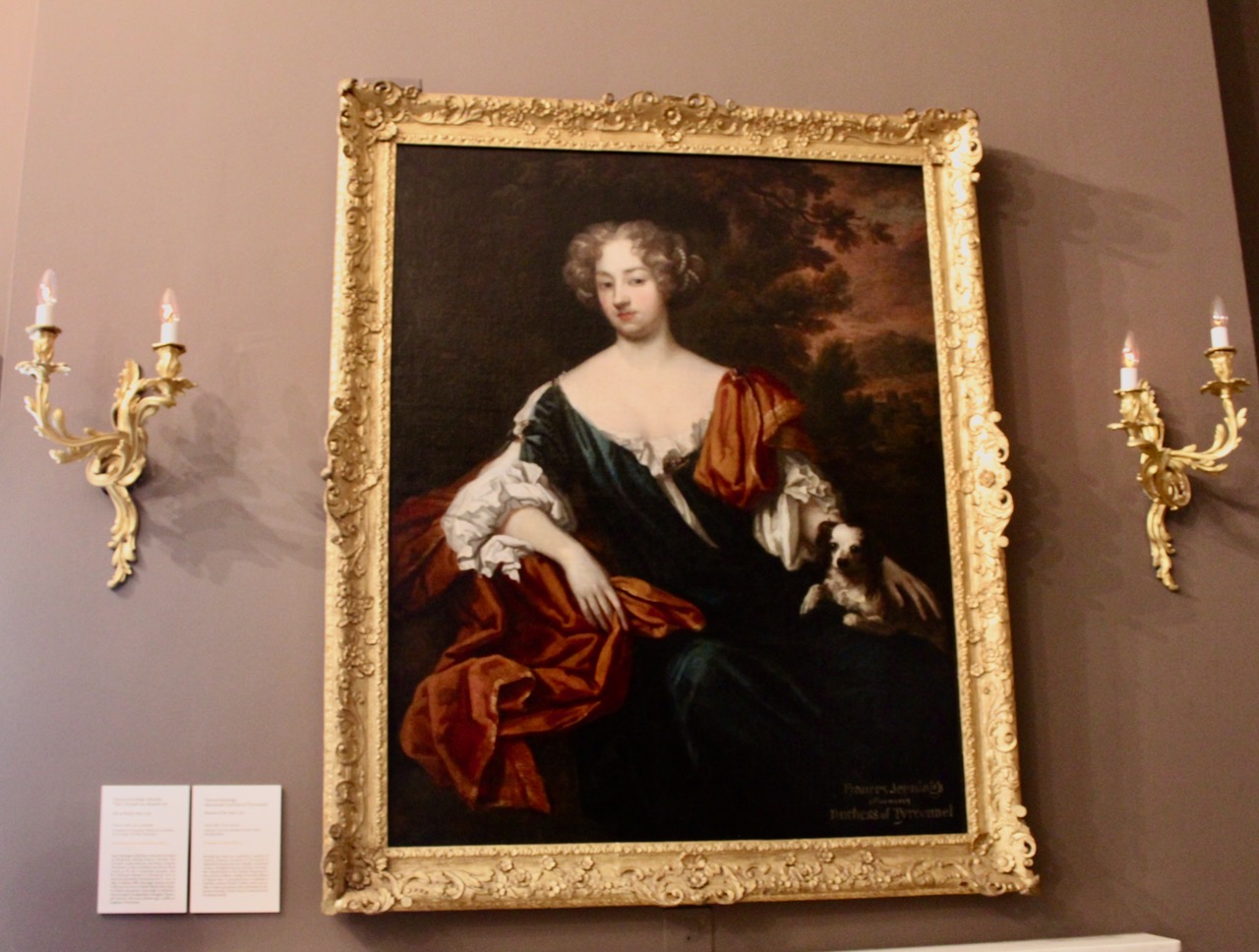
Frances Jennings, Vicereine of Ireland 1687-89, Duchess of Tyrconnell. She was married to Richard Talbot, 1st Duke of Tyrconnell (1630-1691).

The Viscount must have changed his loyalties, to support William III. The Viscount Rosse’s son by Elizabeth Hamilton, Richard (d. 1741), succeeded as 2nd Viscount Rosse upon his father’s death in 1703. He was raised to the peerage as 1st Earl of Rosse in 1718. He became the Grand Master of the Freemasons and was a founder member of the Hellfire Club which met at Montpelier Hill in a former shooting lodge of William Conolly. The Earl of Rosse’s townhouse on Molesworth Street later became the site of the Masonic Grand Hall. One sees no trace of his supposed Satanic leanings in his portrait in Birr Castle, in which he looks the picture of innocence!
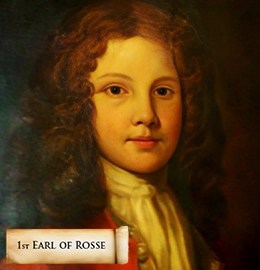
The innocent looking Richard Parsons (d. 1741) 1st Earl of Rosse, one of the founders of the Hellfire Club. Photograph of the portrait courtesy of Birr Castle’s website. Painting by William Gandy.
Henry Clements (1698-1745), Col Henry Ponsonby (1685-1745), Richard St George (d. 1775), Simon Luttrell, Henry Barry 3rd Baron Santry (1680-1735), members of the Hellfire Club, painted by another member, and co-founder, James Worsdale, photograph of portrait in the National Gallery of Ireland.

Richard’s son, also named Richard, succeeded as the 2nd Earl but died childless and the title became extinct. It was then created for a second time for the descendants of Lawrence Parsons of Birr Castle.

Let us go back now to the Parson Baronets of Birr Castle. As I mentioned, Laurence Parsons 3rd Baronet of Birr Castle had a son by his first marriage, William (1731–1791). When Laurence died in 1749, William succeeded as 4th Baronet of Birr Castle.

Laurence’s son by his second marriage, Laurence (1749-1807), who inherited his uncle Cutts Harman’s estate County Longford with the proviso that he take the name Harman, became Laurence Harman Parsons. In 1792 he was raised to the Peerage of Ireland as Baron of Oxmantown, in the County of Dublin and in 1795, Viscount Oxmantown. In 1806 when he was created Earl of Rosse in the Irish peerage, of the second creation.

William Parsons (1731-1791) the 4th Baronet served as M.P. and High Sheriff for County Offaly. William in turn was succeeded in the baronetcy by his son Laurence Parsons (1758-1841). When Laurence the 5th Baronet of Birr Castle’s uncle the 1st Earl of Rosse of the second creation died without a male heir, Laurence became the 2nd Earl of Rosse. He married Alice, daughter of John Lloyd Esquire of Gloster, King’s County.
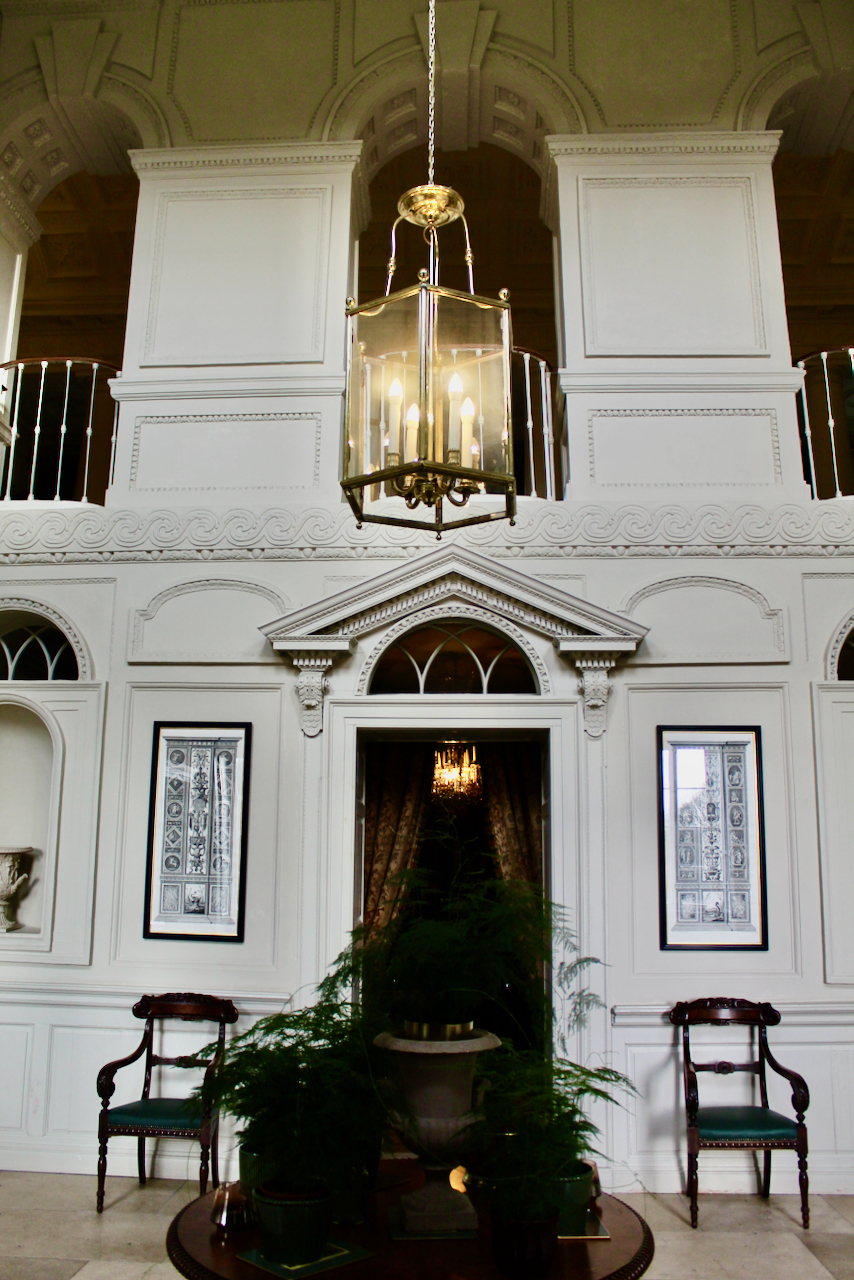
Gloster, County Offaly, February 2023. Photograph © Jennifer Winder-Baggot, www.irishhistorichouses.com.

During Heritage Week in 2024, Stephen and I visited Tullynisk house in County Offaly, where Alicia Clement, daughter of the Earl of Rosse, who grew up in Birr Castle, gave a tour of her home. She told us that the Parsons were not as illustrious as the Lloyds, and that Alice Lloyd was considered to be a good catch!
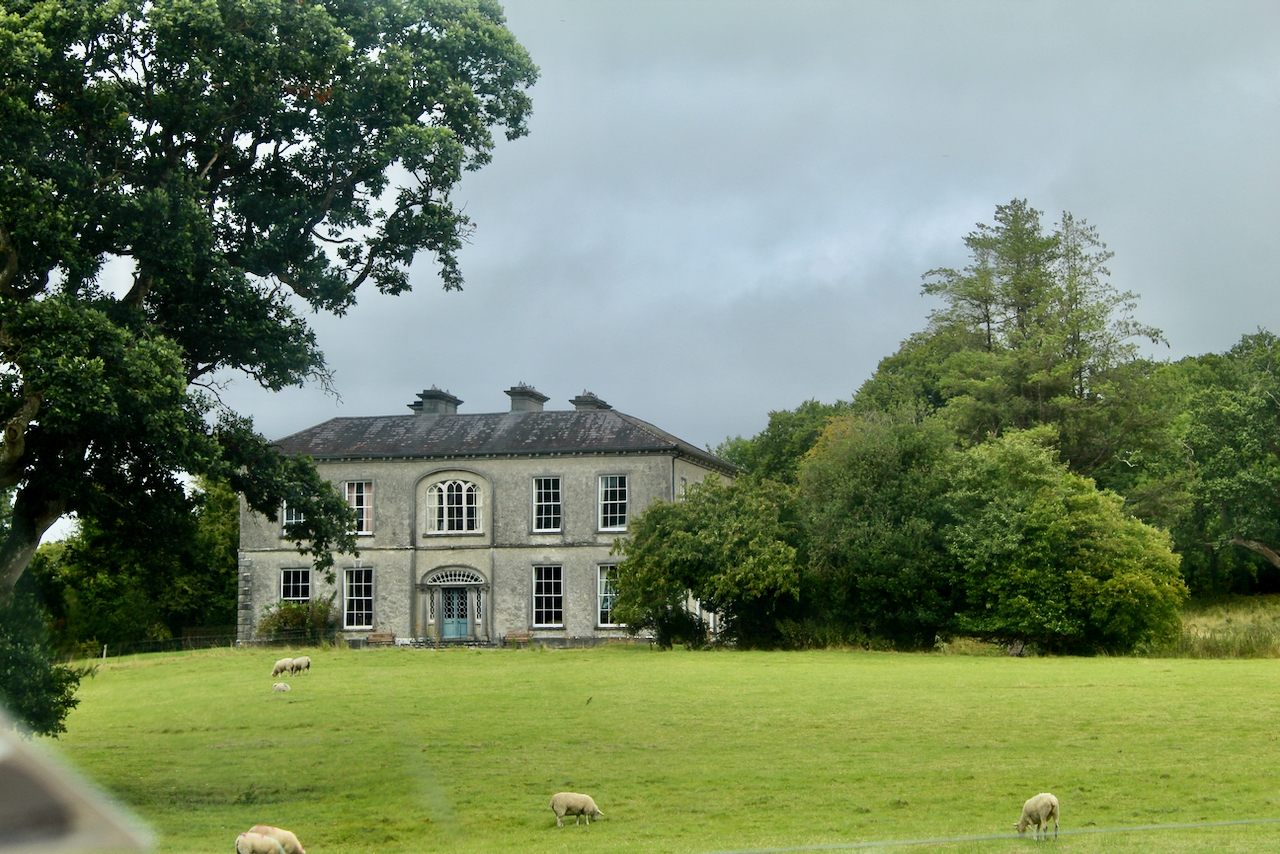
Tullynisk, County Offaly, built for two brothers of the Earl of Rosse. Photograph © Jennifer Winder-Baggot, www.irishhistorichouses.com.

Laurence Parsons (1758-1841) 2nd Earl of Rosse served as M.P. and opposed the Union and the abolishment of the Irish Parliament. He was a friend of Henry Grattan. He was described by Wolfe Tone in his days as an MP as “one of the very few honest men in the Irish House of Commons.” [7]

The 2nd Earl of Rosse made further alterations to the castle, shortly after 1800. He worked with a little known architect, John Johnson, and they gave the castle its Georgian Gothic style.

The website explains the additions to the castle:

“The castle survived two sieges in the 17th century, leaving the family impoverished at the beginning of the 18th century and little was done to the 17th century house. However, at some time towards the end of that century or at the beginning of the 19th century, the house which had always faced the town, was given a new gothic facade, which now faces the park. The ancient towers and walls on this, now the park side of the castle, were swept away, including the Black Tower (the tower house) of the O’Carrolls, which had stood on the motte. Around 1820 the octagonal Gothic Saloon overlooking the river was cleverly added into the space between the central block and the west flanking tower.”

Birr Castle, photograph by Liam Murphy, 2015, for Tourism Ireland, Ireland’s Content Pool. (see [1])

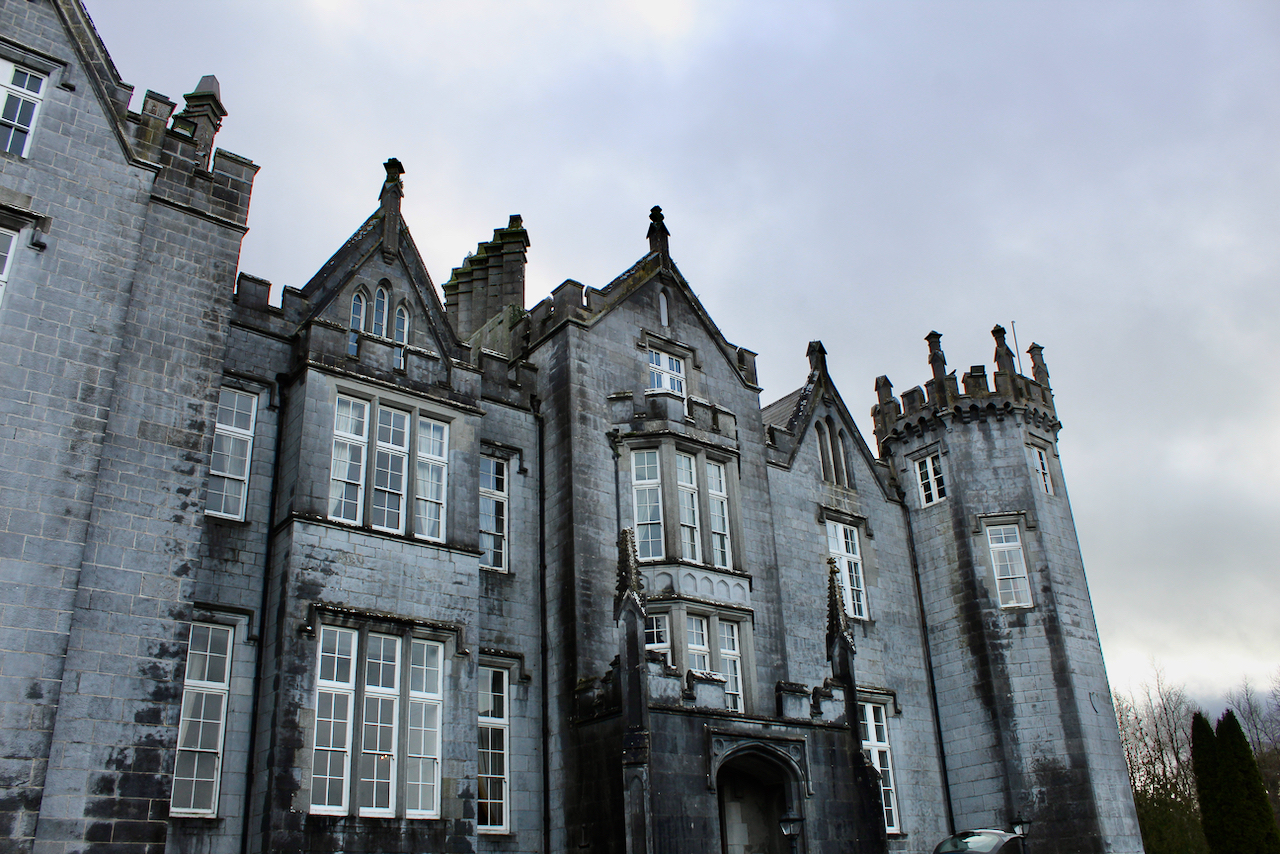
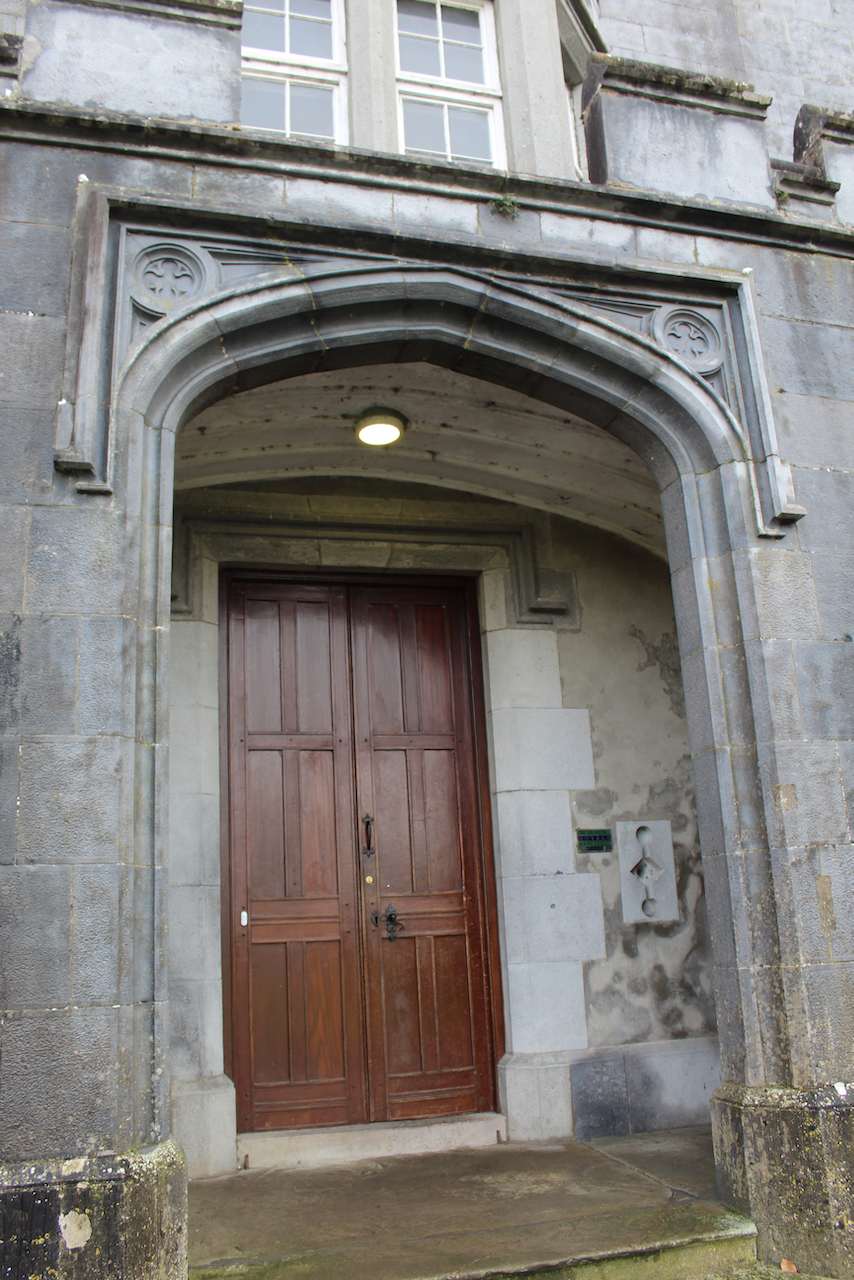
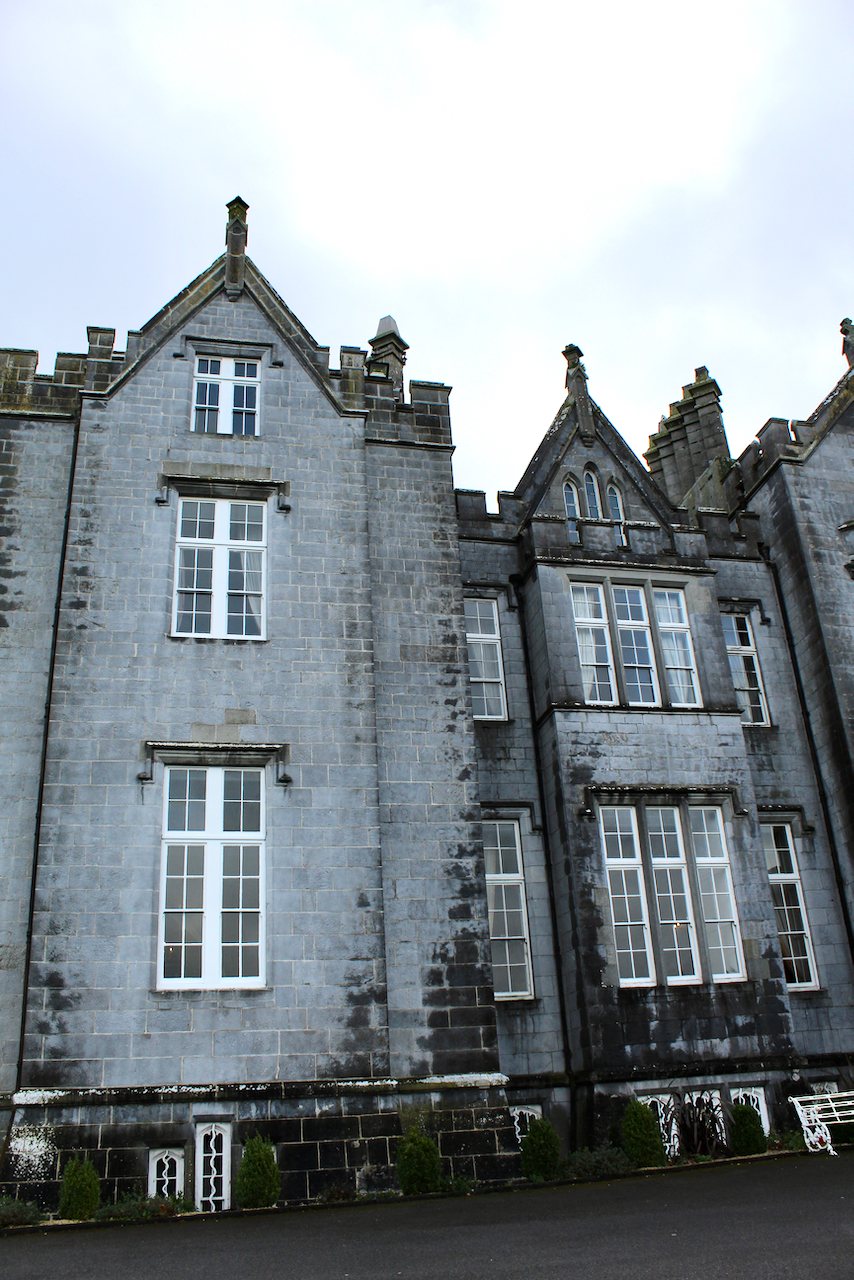
The entrance we see was previously the back of the house, and most of this facade was added in the additions by the 2nd Earl from 1801 onward. First the two storey porch in the centre of the front, with the giant pointed arch over the entrance door was added and the entire facade faced with ashlar. The third storey which we see was added later, after 1832. The battlements were added as the castle was given a Gothic appearance.
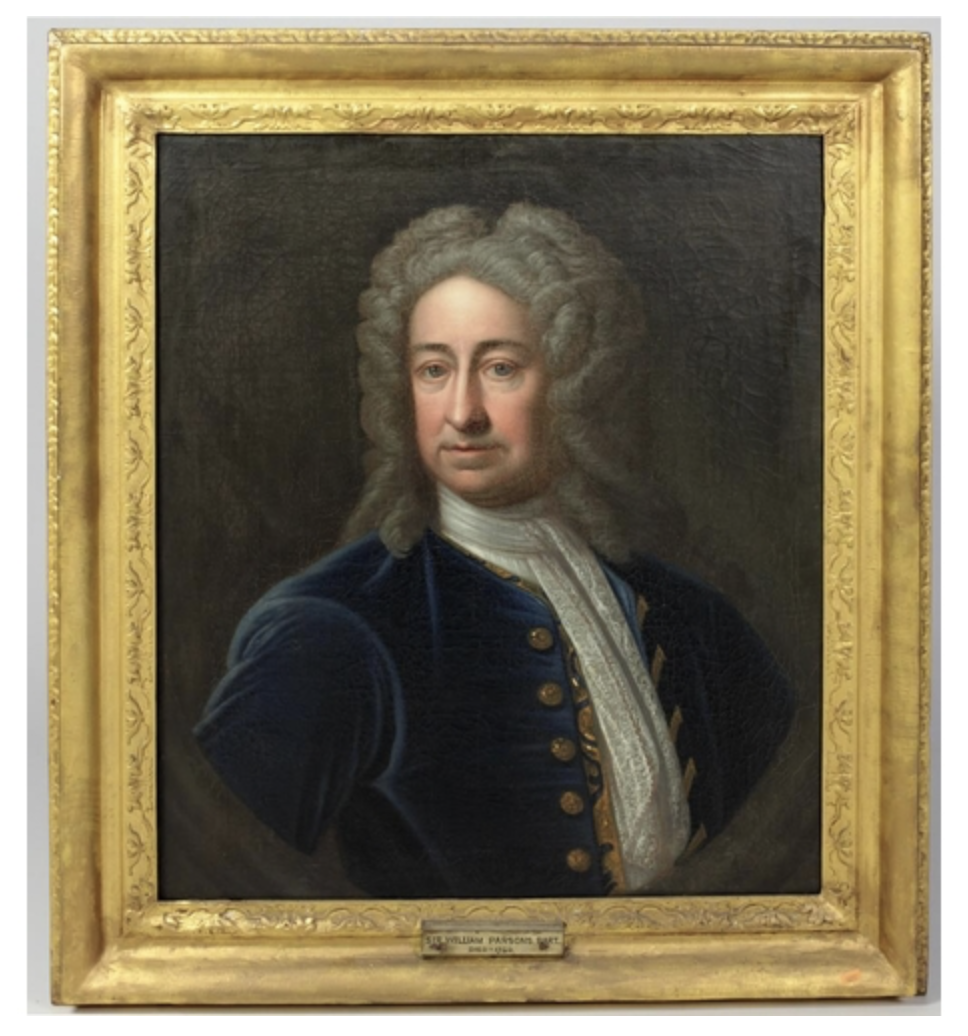
William Parsons, died 17th March, 1740, 2nd Baronet, grandfather to Jane Parsons, who married William Acton. Provenance The de la Touche Family, Kilmacurragh, Co. Wicklow. (Mealy’s Sale June 26th & 27th, 2001).

Mark Bence-Jones describes the Castle in his Guide to Irish Country Houses:

“…during the course of C17, the gatehouse was transformed into a dwelling-house, being joined to the two flanking towers, which were originally free-standing, by canted wings; so that it assumed its present shape of a long, narrow building with embracing arms on its principal front, which faces the demesne; its back being turned to the town of Birr and its end rising above the River Camcor. Not much seems to have been done to it during C18, apart from the decoration of some of the rooms and the laying out of the great lawn in front of it, after the old O’Carroll keep and the early C17 office ranges, which formerly stood here, had been swept away ca. 1778. From ca 1801 onwards, Sir Laurence Parsons [1758-1841] (afterwards the 2nd Earl of Rosse), enlarged and remodelled the castle in Gothic, as well as building an impressive Gothic entrance to the demesne. His work on the castle was conservative; being largely limited to facing it in ashlar and giving a unity to its facade which before was doubtless lacking; it kept its original high-pitched roof containing an attic and two C17 towers at either end of the front were not dwarfed by any new towers or turrets; the only new dominant feature being a two storey porch in the centre of the front, with a giant pointed arch over the entrance door. At the end of the castle above the river, 2nd Earl built a single-storey addition on an undercroft, containing a large saloon. He appears to have been largely his own architect in these additions and alterations, helped by a professional named John Johnston (no relation of Francis Johnston). In 1832, after a fire had destroyed the original roof, 2nd Earl added a third storey, with battlements.” [8]
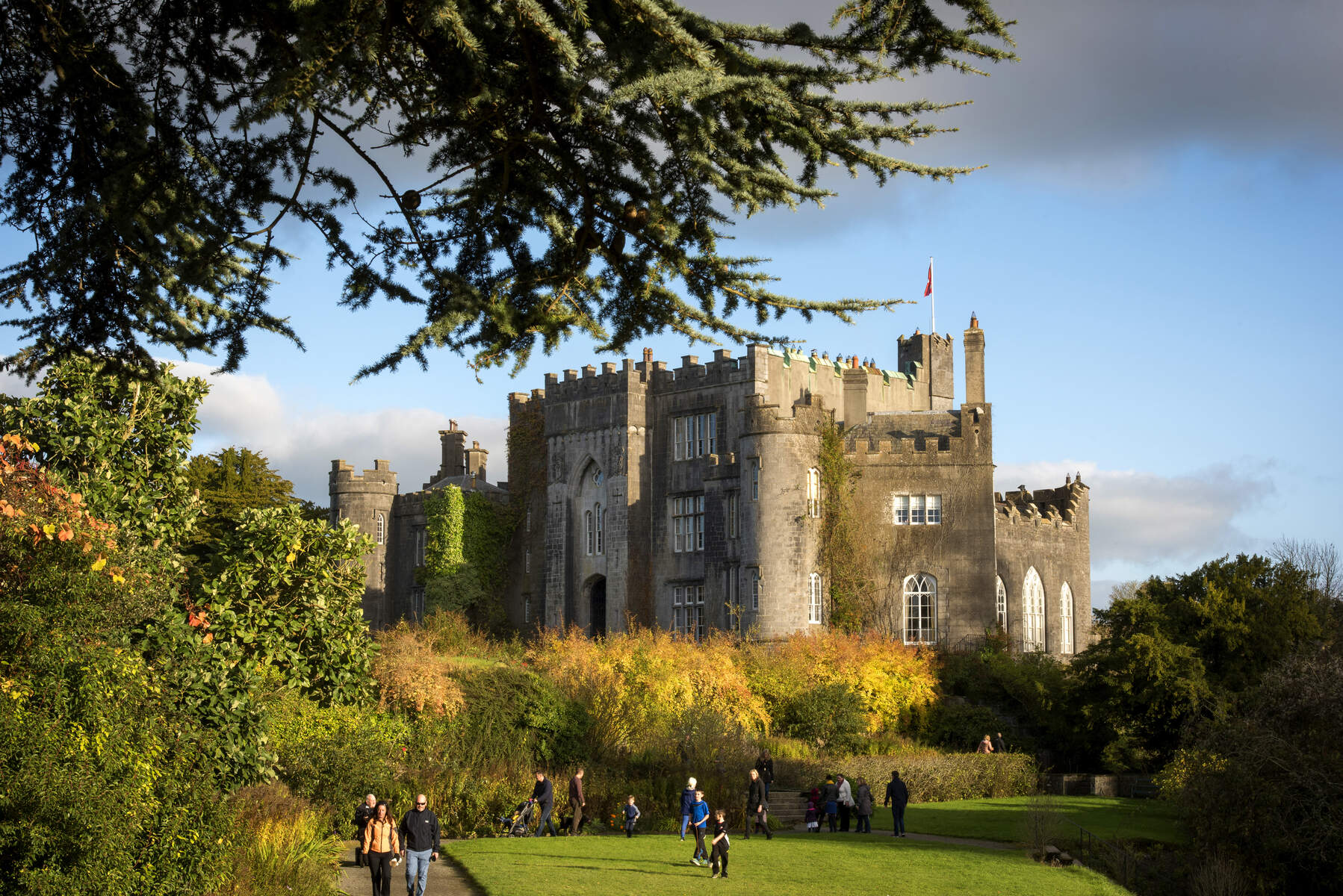
…the only new dominant feature being a two storey porch in the centre of the front, with a giant pointed arch over the entrance door.Birr Castle, photograph by Chris Hill 2018, for Tourism Ireland, Ireland’s Content Pool. (see [1])
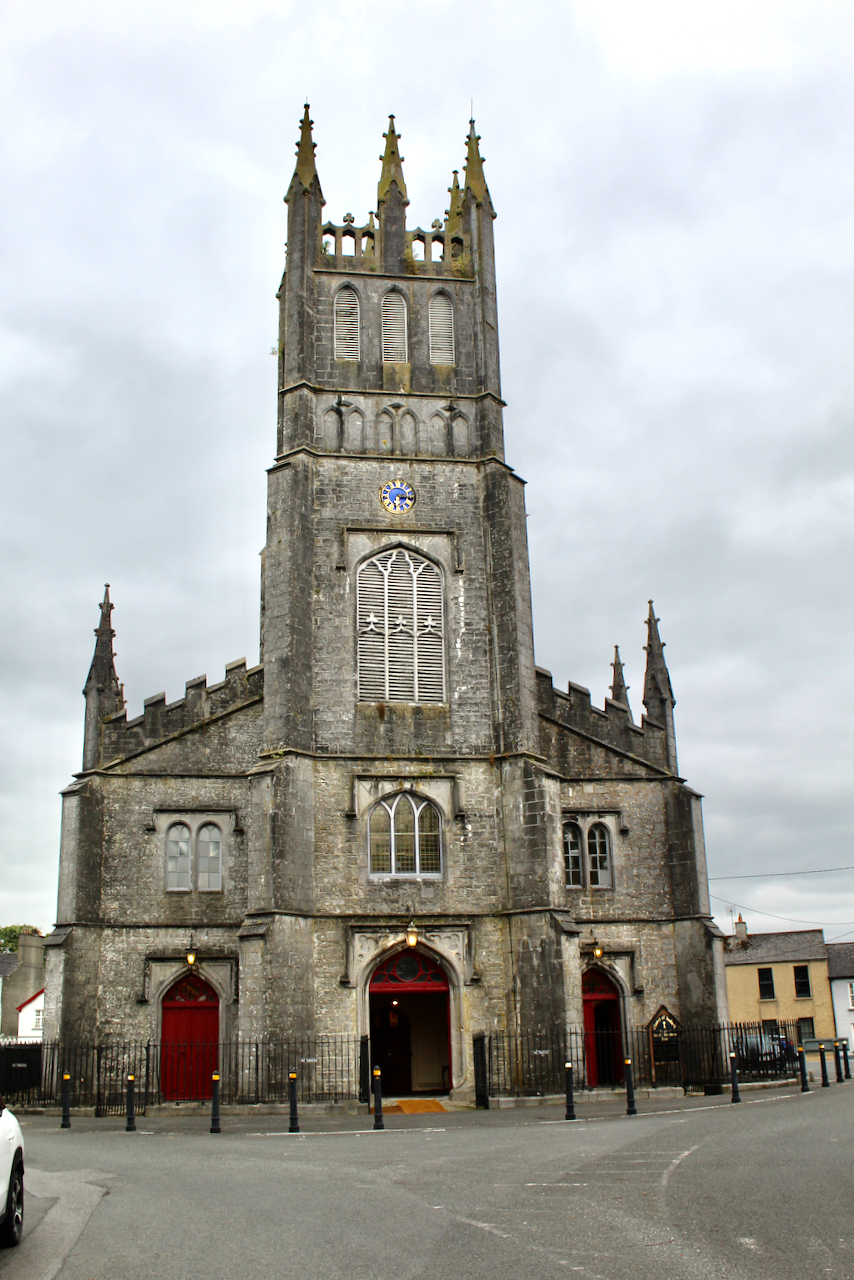
St. Brendan’s Church of Ireland, Oxmantown Mall, Birr. Built by the architect John Johnson in 1815, who worked with the 2nd Earl on Birr Castle. The church was extended in 1876 by the architect Thomas Drew, who added a new chancel. Further enhancements included the insertion of the east window, which was commissioned from Charles Kempe by the fourth Earl of Rosse in 1891. Photograph © Jennifer Winder-Baggot, http://www.irishhistorichouses.com

Besides enlarging and remodelling the castle in the Gothic style, the 2nd Earl also built the impressive Gothic entrance to the demesne. [8]
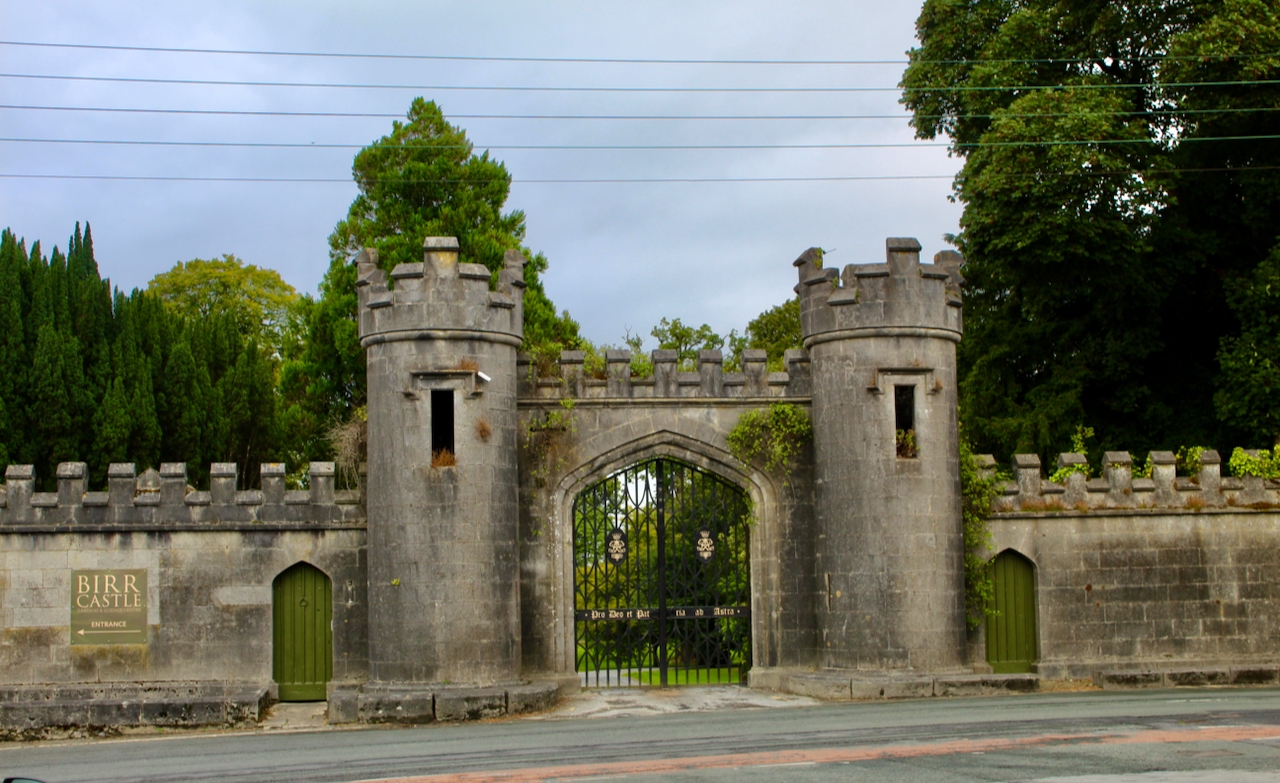
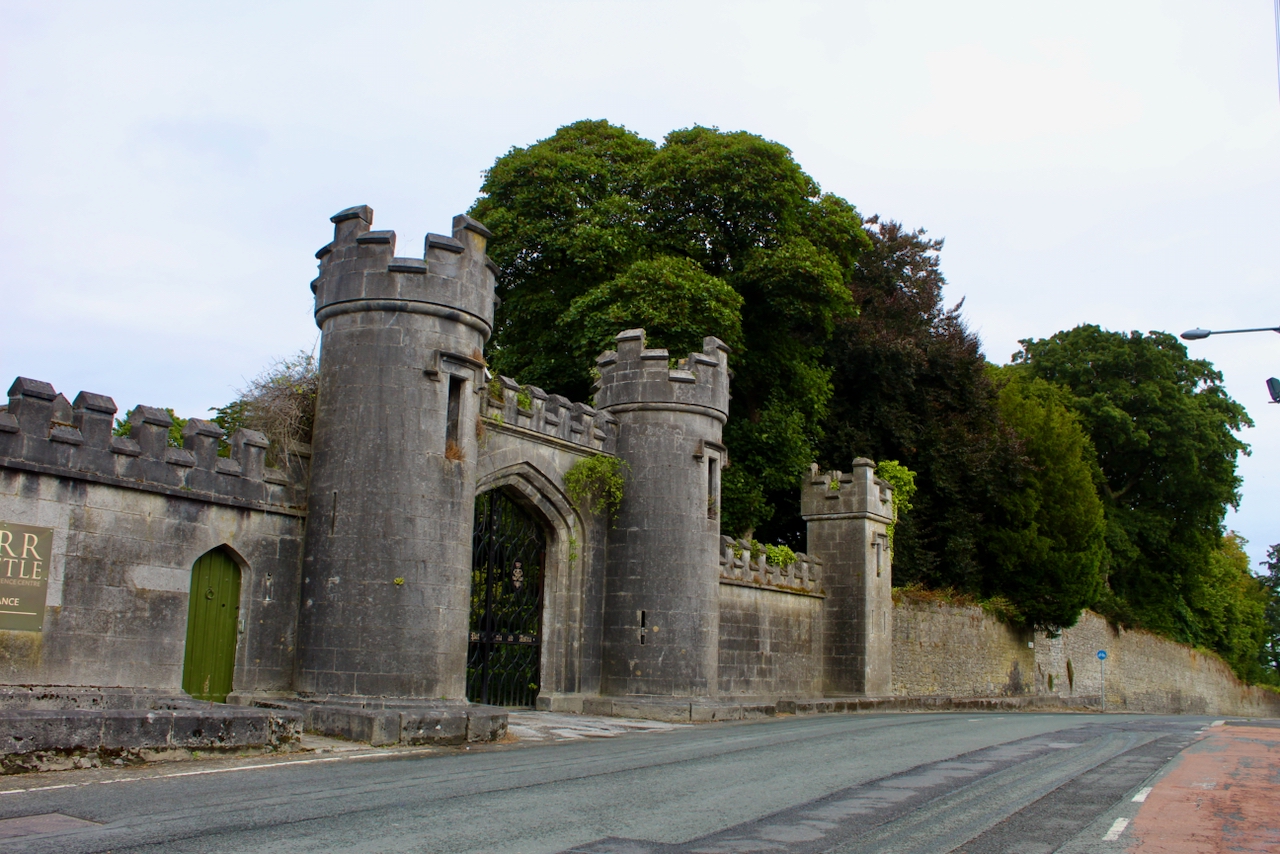
Gothic Entrance gates to Birr Castle. From ca 1801 onwards, Sir Laurence Parsons [1758-1841] (afterwards the 2nd Earl of Rosse), enlarged and remodelled the castle in Gothic, as well as building an impressive Gothic entrance to the demesne. Photograph © Jennifer Winder-Baggot, www.irishhistorichouses.com
Gothic Entrance gates to Birr Castle. Photograph © Jennifer Winder-Baggot, www.irishhistorichouses.com

In the book Irish Houses and Gardens, from the archives of Country Life by Sean O’Reilly, the plaster-vaulted saloon which the 2nd Earl added is described: “With the slim lines of its wall shafts and ribs, the free flow of the window tracery and the curious irregular octagon of its plan, the room possesses all the light, airy mood of the best of later Georgian Gothic, and remains one of Birr’s finest interiors.” [9]
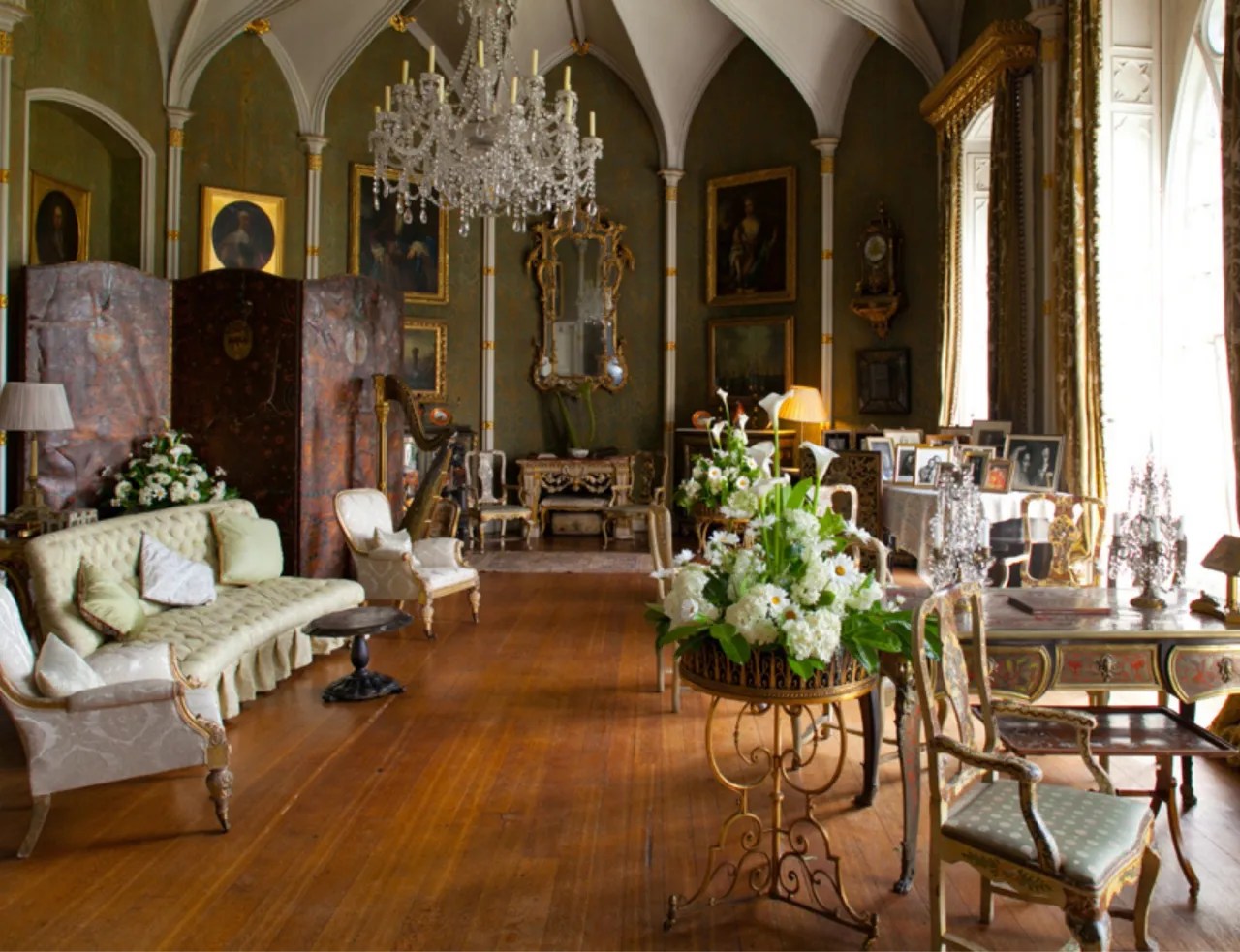
The Saloon, or Music Room, Birr Castle, photograph courtesy of Birr Castle website.

Vaulting fills the castle, even in small hallways.

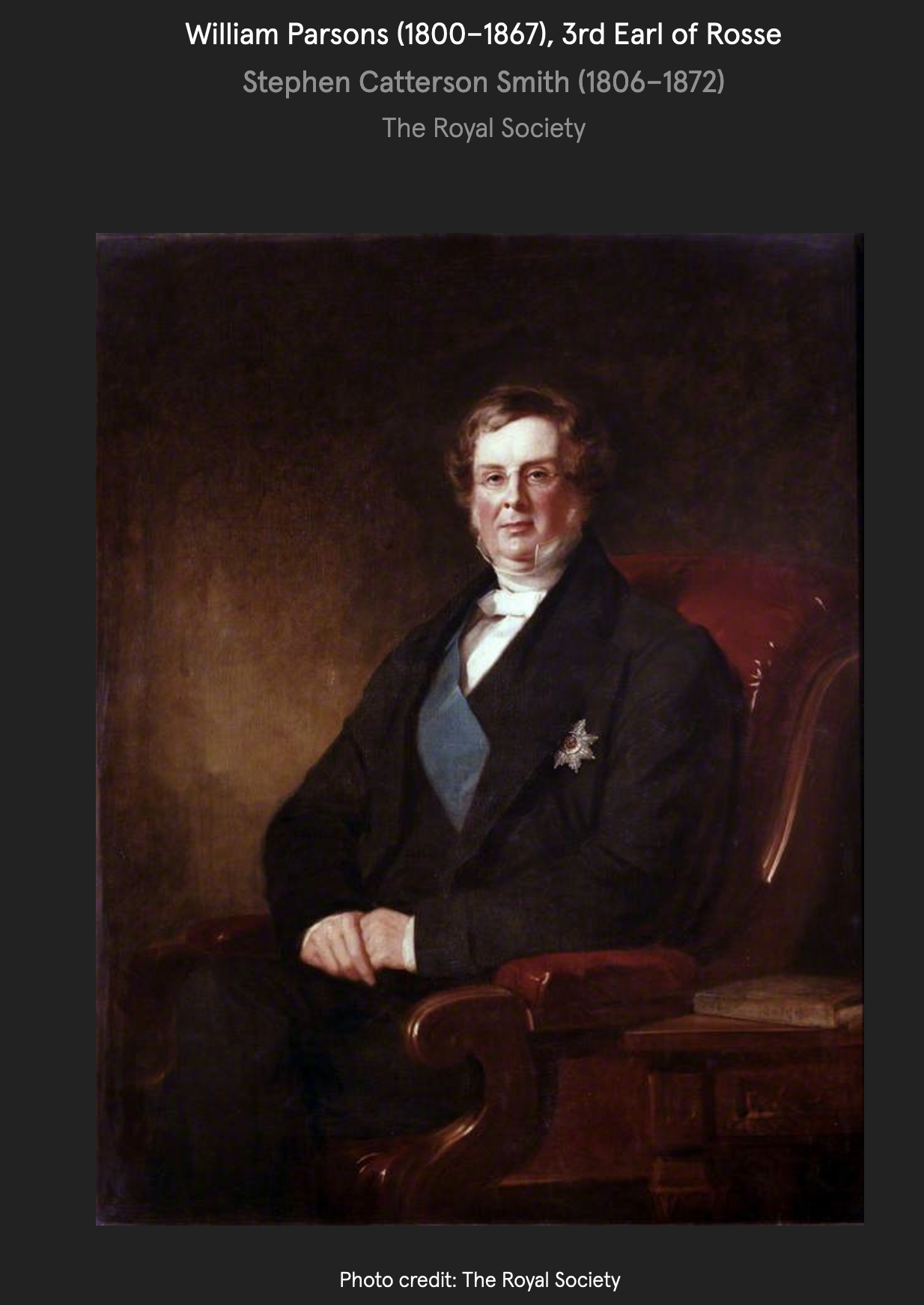
Laurence Parsons (1758-1841) 2nd Earl of Rosse was succeeded by his son William Parsons (1800-1867), the 6th Baronet and 3rd Earl of Rosse. In 1836 he married Lady Mary, eldest daughter and co-heir of John Wilmer Field Esquire of Heaton Hall, County York. It was this Mary who created the gates which we admired on the way to the Castle.
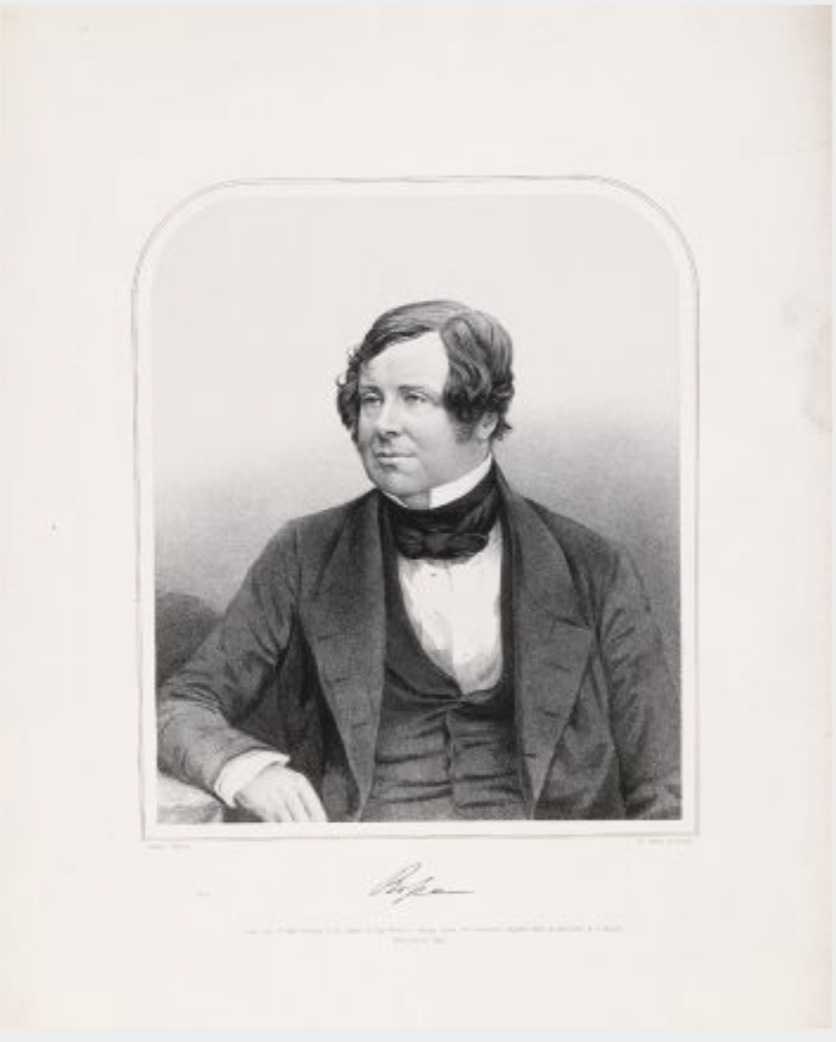
Portrait of William Parsons, 3rd Earl of Rosse, (1800-1867), photograph courtesy of National Gallery of Ireland.
William Parsons (1800-1867) 3rd Earl of Rosse by Stephen Catterson Smith, courtesy of the Royal Society.

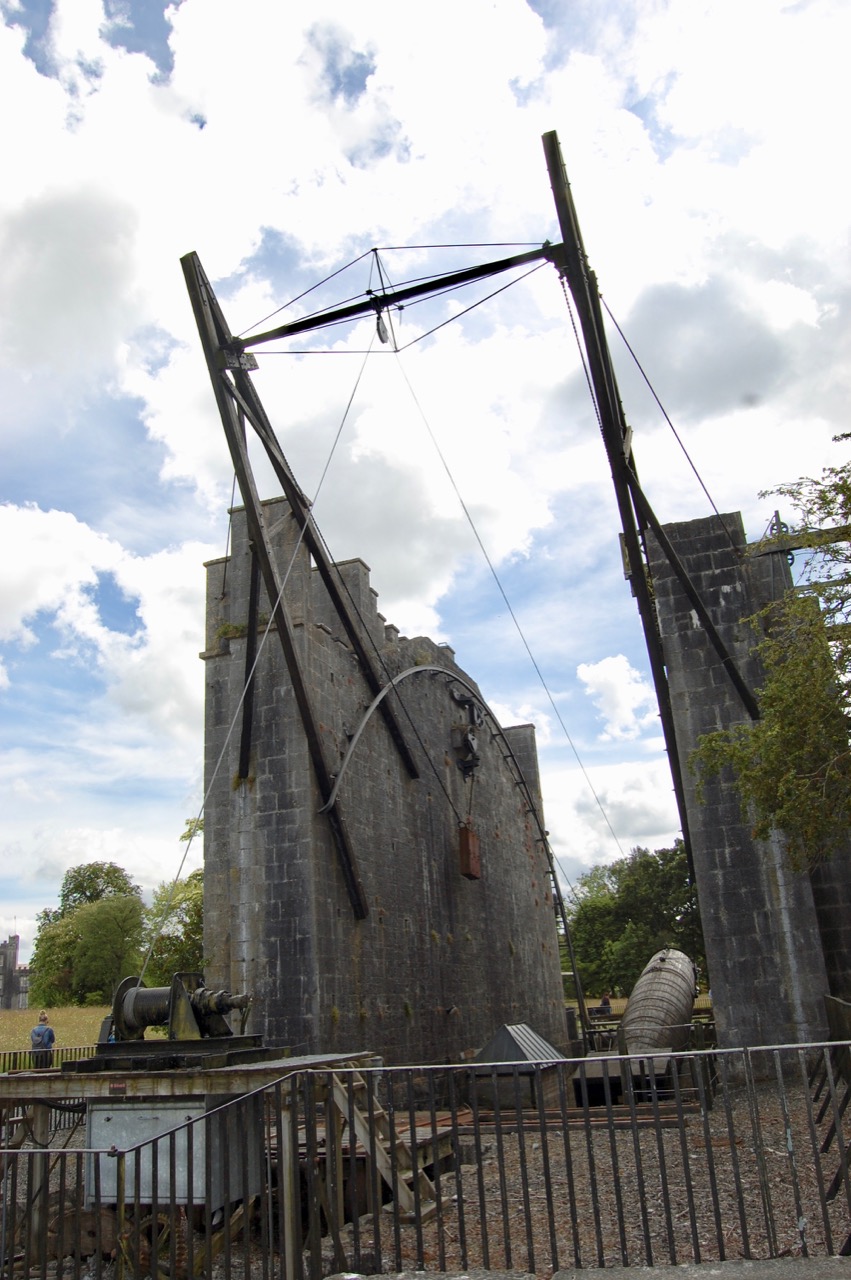
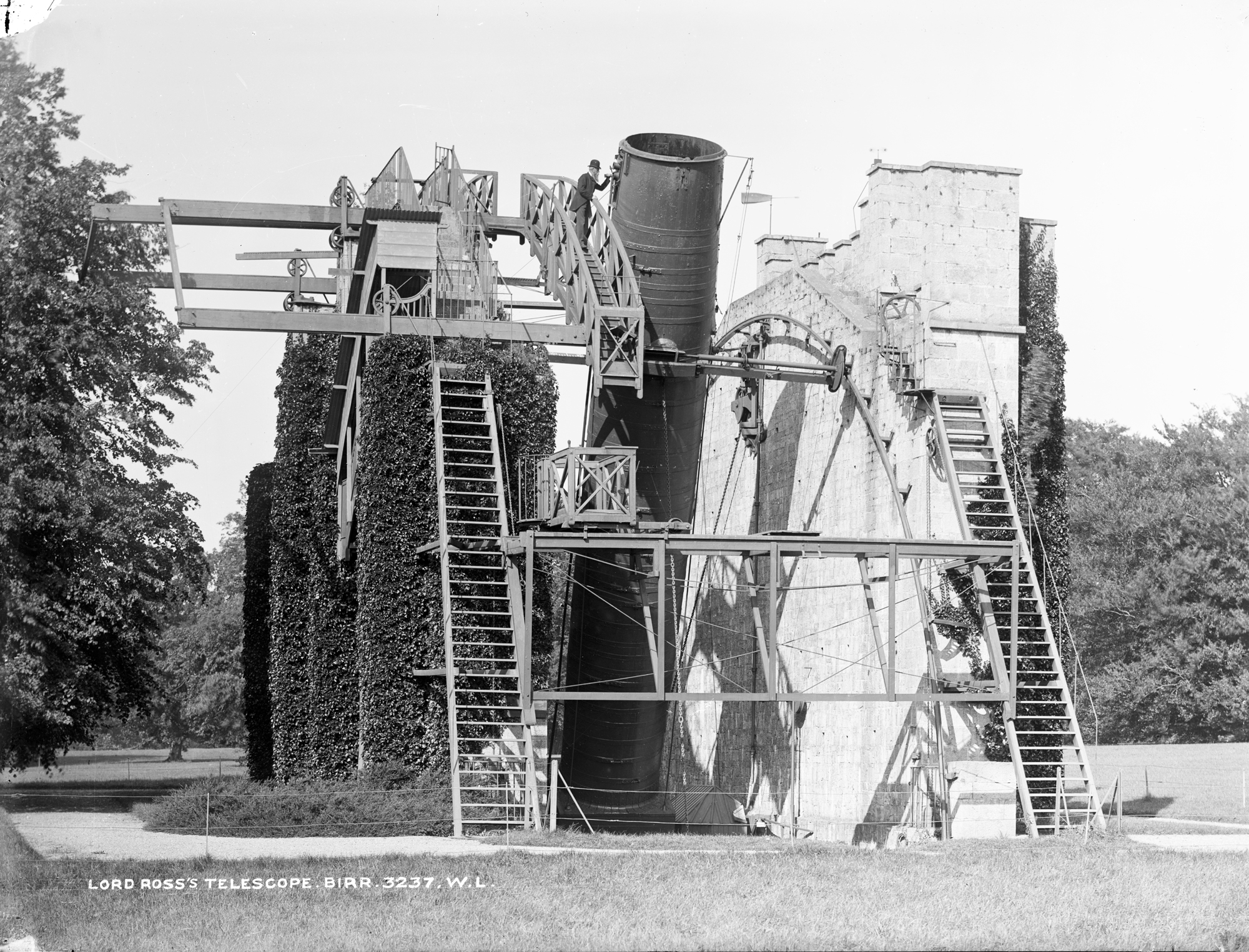
It was the third Earl, William Parsons (1800-1867), who built the world’s largest telescope for over 70 years, in 1845. He was one of the leading scientists and engineers of his day, and he designed the telescope as well as having it built.
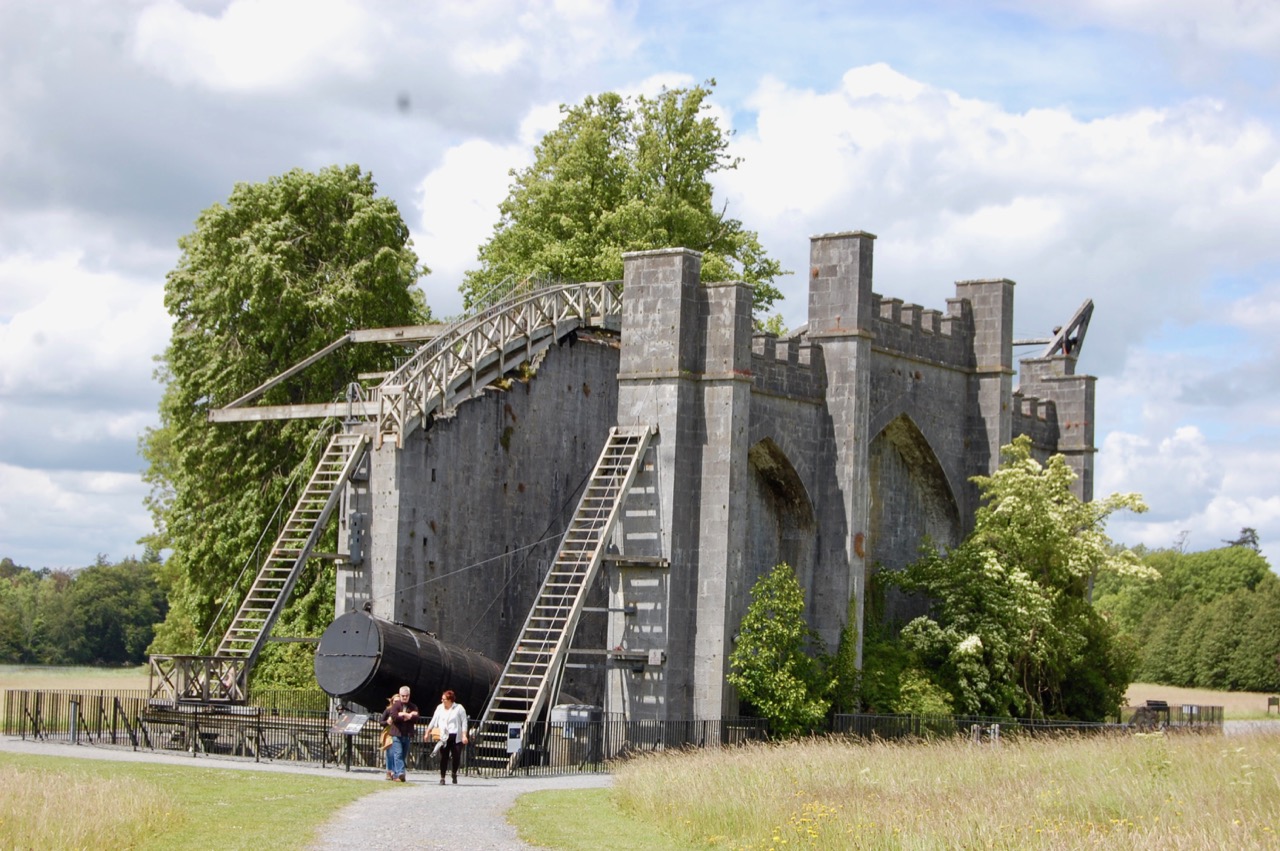
The world’s largest telescope for over 70 years, built in 1845. Photograph © Jennifer Winder-Baggot, www.irishhistorichouses.com

All this work took place in rural Parsonstown at the Birr demesne. Furnaces had to be built and local men trained in manufacture and metal casting, overseen by the 3rd Earl. As we saw earlier, his wife Mary also learned metalwork.

Mary was also an accomplished photographer – the photography dark room of his wife Mary née Field has only been rediscovered in the castle recently, but unfortunately we did not get to see it. Their younger son, Charles Parsons, was a groundbreaking engineering pioneer and the inventor of the steam turbine.

The Birr Castle website continues:“After a fire in the central block in 1836 the centre of the castle was rebuilt, ceilings heightened, a third story added and also the great dining room. In the middle of the 1840s to employ a larger work force during the famine, the old moat and the original Norman motte were also flattened and a new star-shaped moat was designed, with a keep gate. This was financed by Mary, Countess of Rosse. This period of remodelling also overlapped with the building of the Great Telescope, The Leviathan.”

Only one person perished in the 1836 fire, a nanny to the children, who is said to haunt the top floor of the house. There’s a crack in the fireplace of the library from this fire, which was started by a cigarette tossed into a bucket of turf.
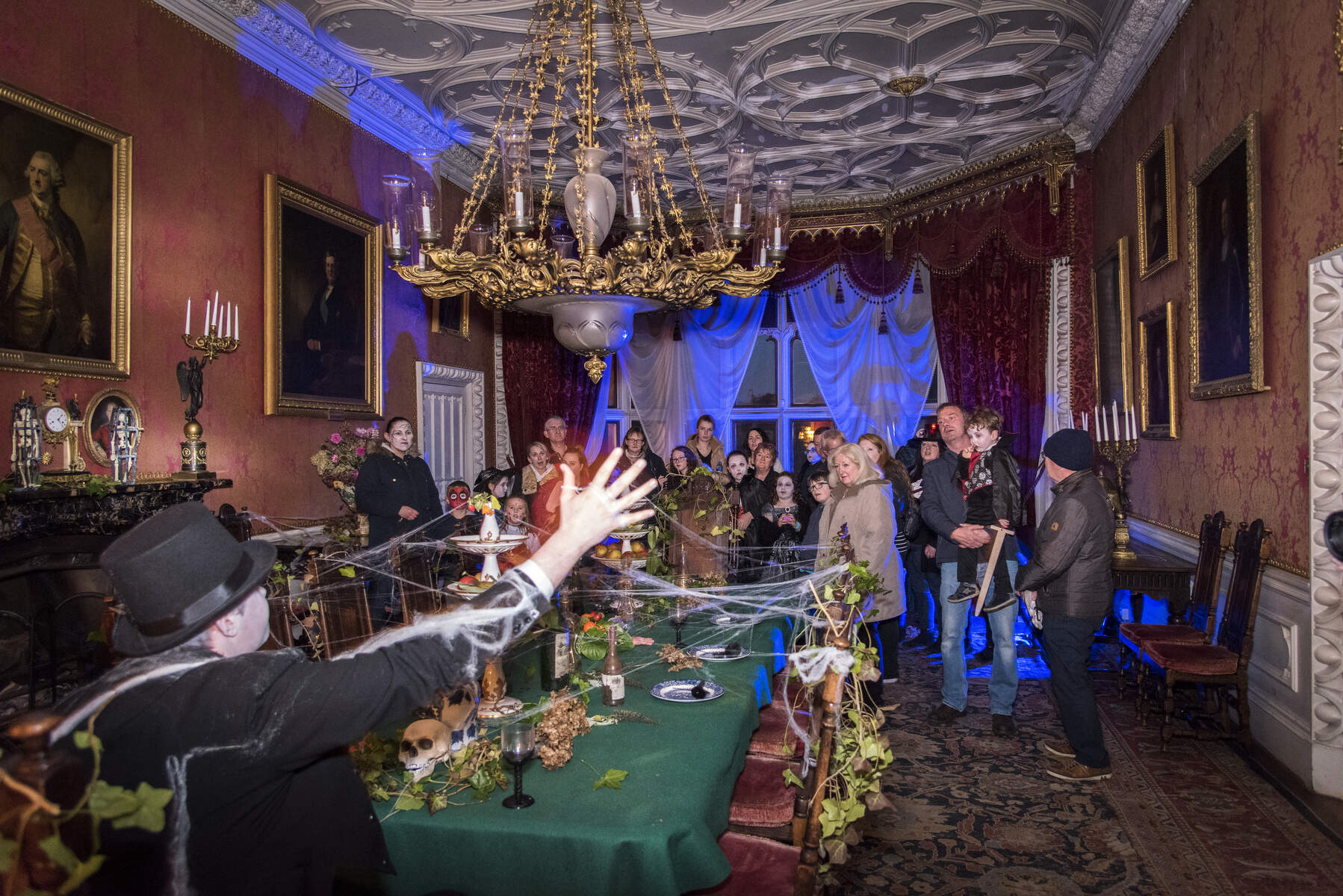
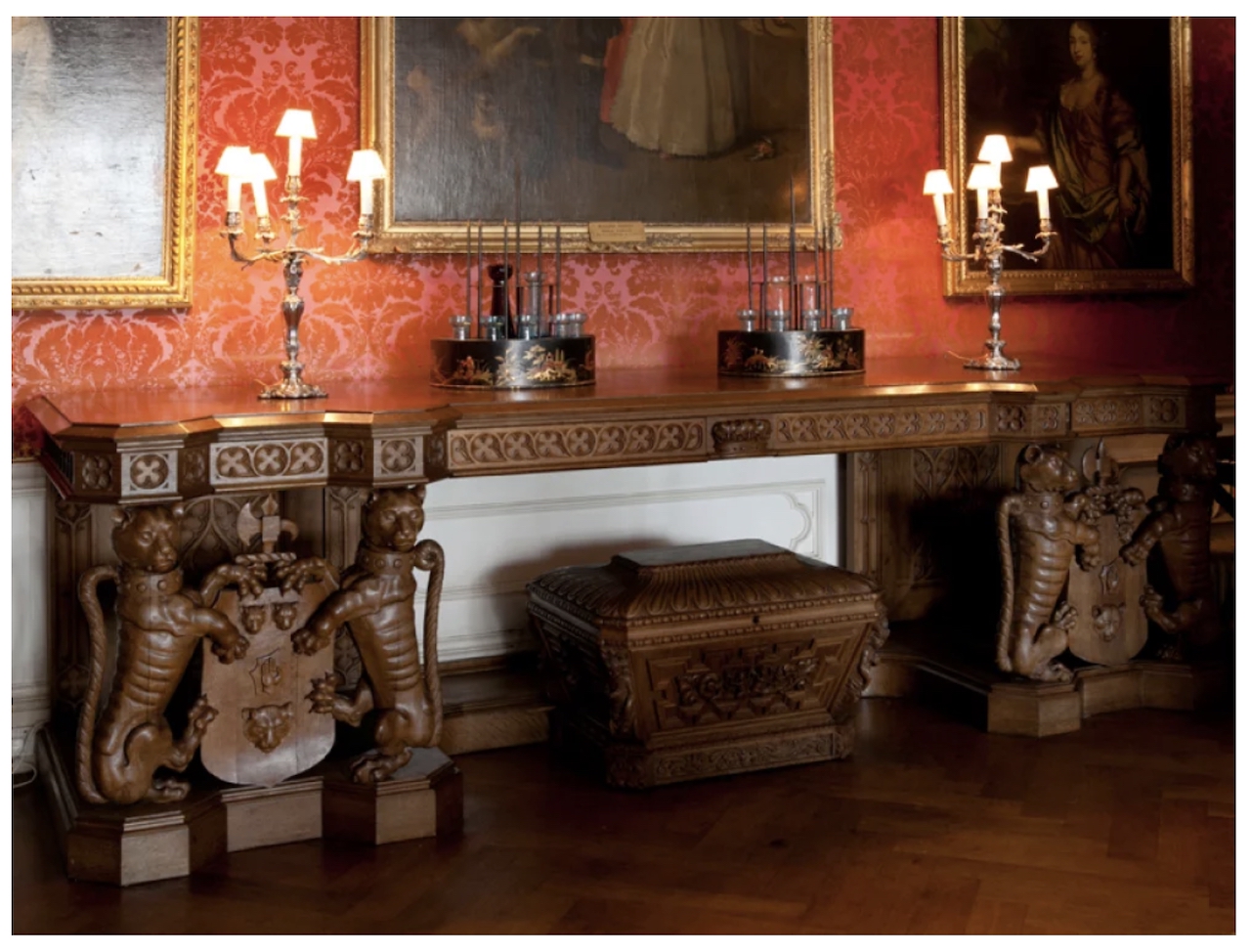
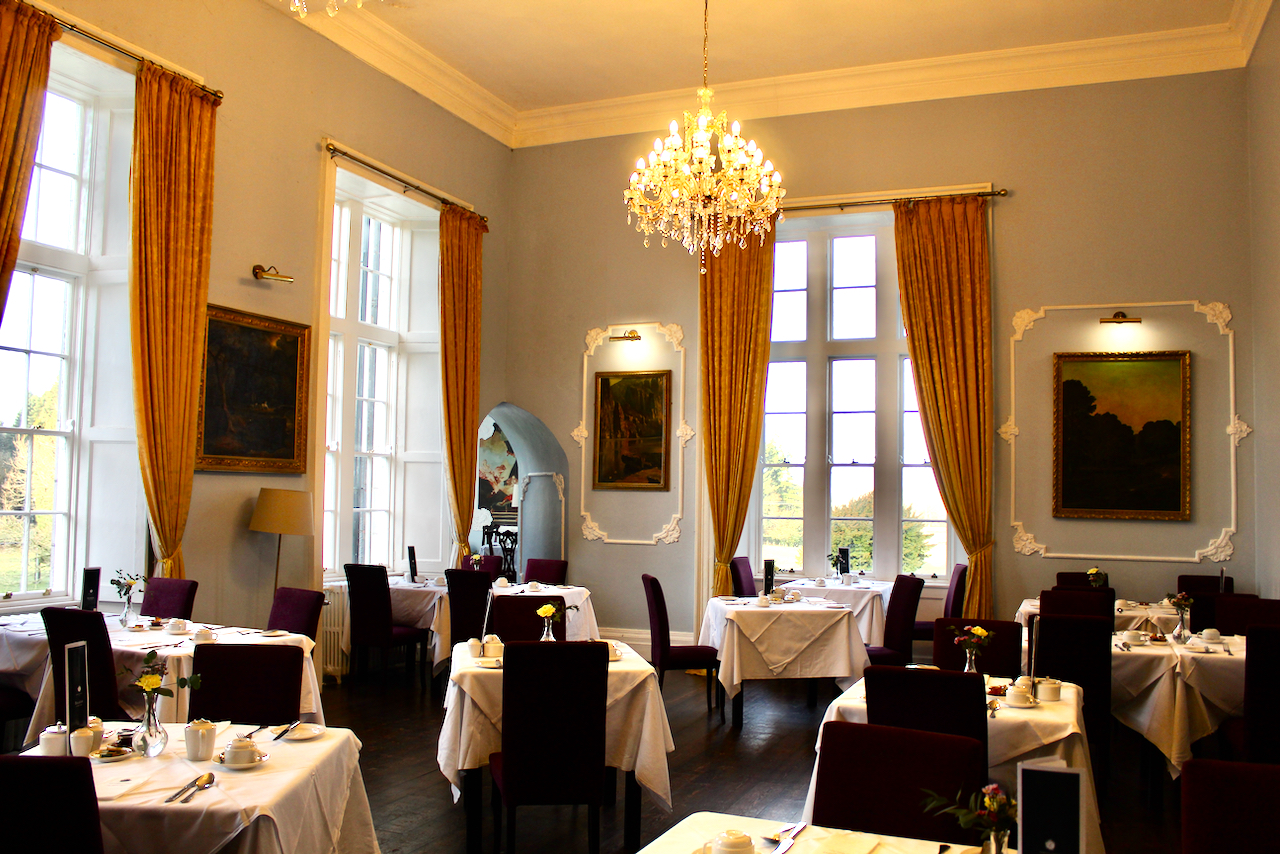
Birr Castle dining room, photograph by Chris Hill 2018, for Tourism Ireland, Ireland’s Content Pool. (see [1])
The Dining Room, which contains many family portraits. The sideboard is supported by the Parson family crest. The leopards are the heraldic symbol of the Parsons family. The massive Gothic sideboard of the dining room probably dates from shortly after the marriage in 1836 of the 3rd Earl of Rosse to Mary Wilmer Field. Birr Castle, photograph courtesy of Birr Castle website.

The website tells us that the final work on the castle was done in the 1860s when a square tower at the back of the castle on the East side was added. This now contains nurseries on the top floor which have a view over the town.

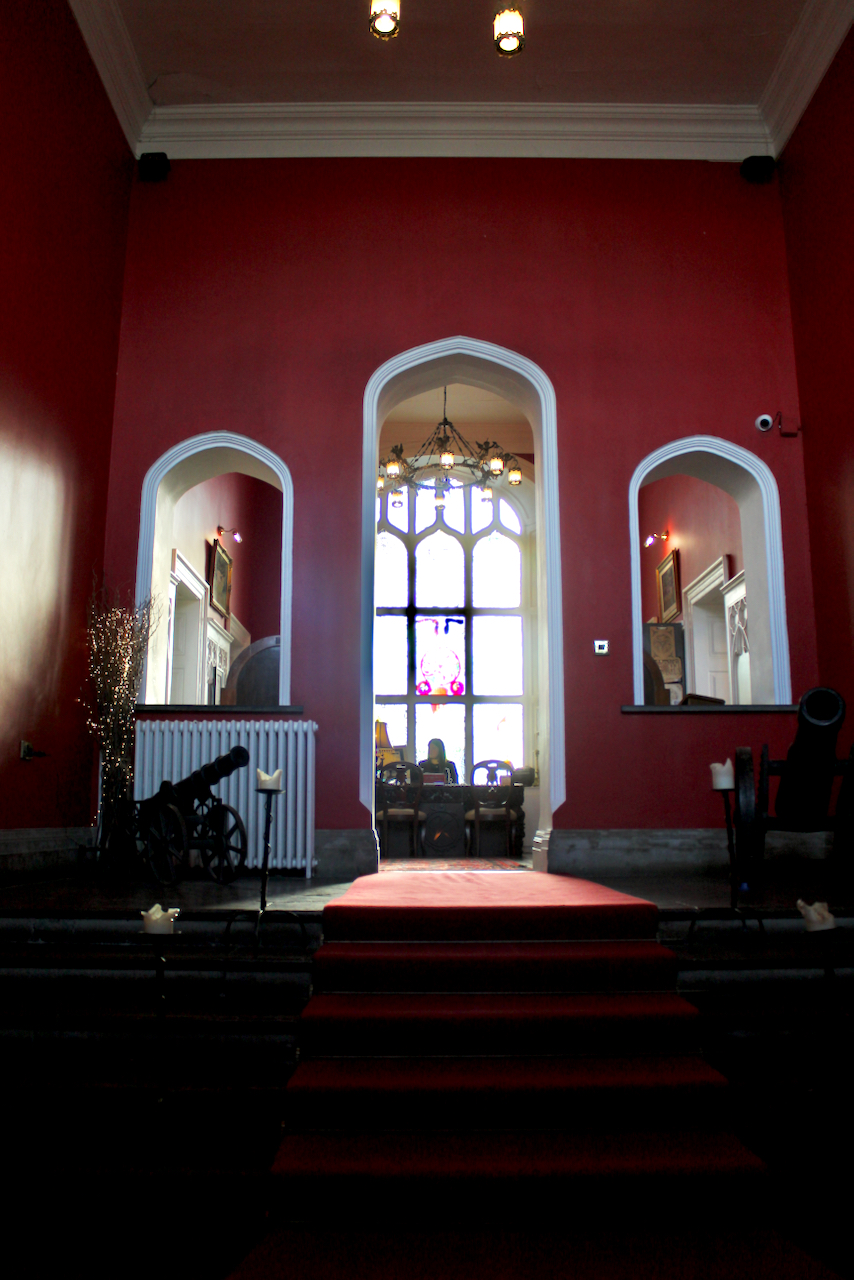
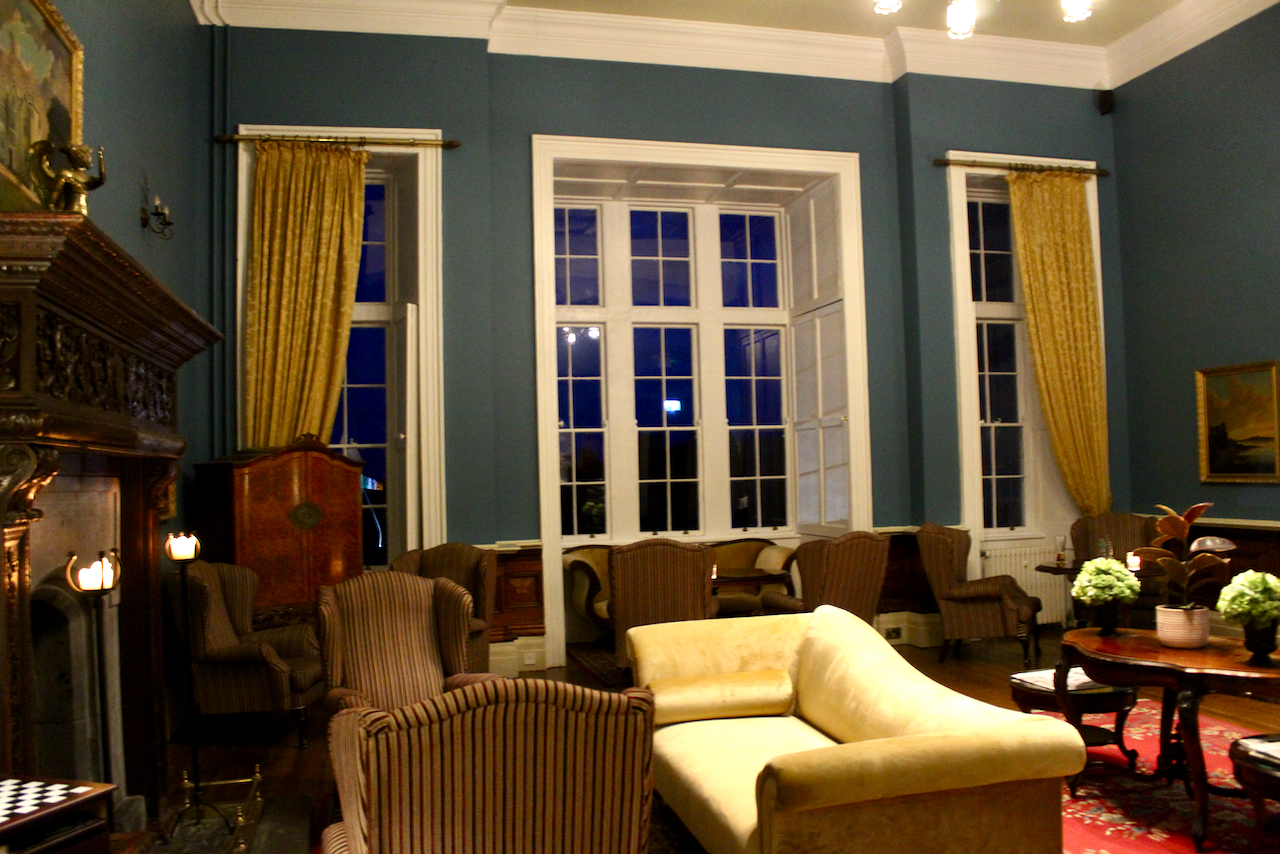
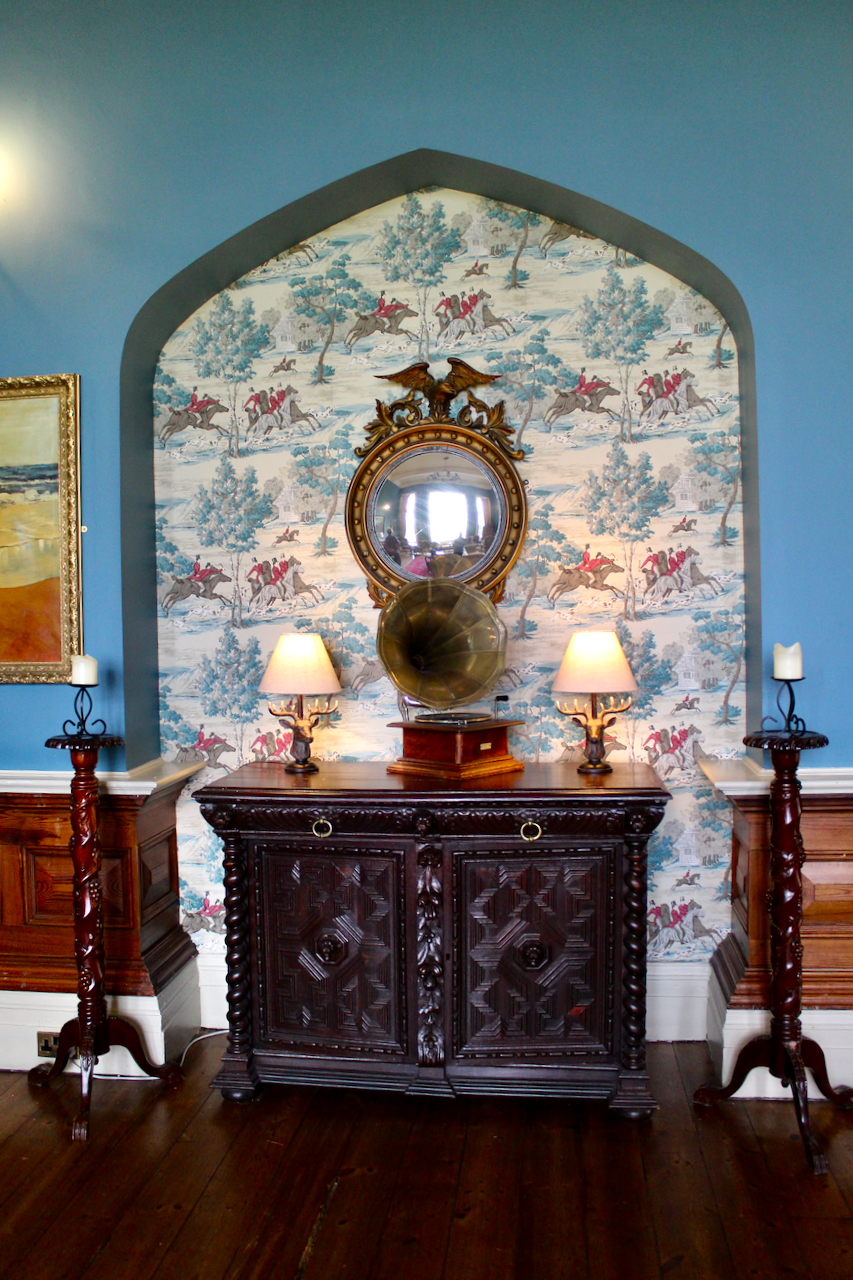
I was overwhelmed by the plush interior of the castle. It was the fanciest I had seen to date. The pelmets are huge, curtains heavy, and paintings old and abundant – although several are copies and not originals, placed due to their relevance to the inhabitants of the castle.

In the front hall there are huge tapestries, brought by the wife of the 6th Earl, Anne Messel, which fit the hall perfectly. The ceiling is sculpted in plaster, as are all of the reception rooms which we visited. There is an enormous wardrobe in the hall which can be taken apart so is called a “travel” wardrobe despite its heft, and a lovely walnut clock stood alongside the walnut exterior wardrobe. It is a Dutch clock, and as well as the time, it tells the date, and the phase of the moon, and has a little clockwork scene that is meant to move on the hour, but is no longer functioning. The clock is “haunted,” the guide told us, and is his favourite piece in the castle. It is said to be haunted because of a few odd incidents that occurred before it was brought to the castle. When someone in the family died, the clock stopped. Another time, at the moment someone in the house died, the pendulum of the clock dropped from its mechanics. Finally, when another person died in the house, the entire clock fell forwards onto its front.

Consequently nobody wanted the clock except the daughter of the family, who brought the clock with her when she moved into Birr Castle. For safety, however, she had the freestanding clock firmly affixed to the wall behind.

The website history of the family tells us:

The 19th century saw the castle become a great centre of scientific research when William Parsons, 3rd Earl built the great telescope. (See astronomy).His wife, Mary, whose fortune helped him to build the telescope and make many improvements to the castle, was a pioneer photographer and took many photographs in the 1850s.  Her dark room – a total time capsule which was preserved in the Castle – has now been exactly relocated in the Science Centre.

The website family history continues:

Their son the 4th Earl also continued astronomy at the castle and the great telescope was used up to the beginning of the 2nd world war. His son the 5th Earl was interested in agriculture and visited Denmark in search of more modern and successful methods. Sadly he died of wounds in the 1st world war.

The website continues: “His son, Michael the 6th Earl and his wife Anne created the garden for which Birr is now famous. (see the gardens and trees and plants) Anne, who was the sister of Oliver Messel the stage designer, brought many treasures to Birr from the Messel collection and with her skill in interior decoration and artist’s eye, transformed the castle, giving it the magical beauty that is now apparent to all.  Michael was also much involved in the creation of the National Trust in England after the war.

The Irish Historic Houses website tells us:

The interior is another skilful combination of dates and styles, forming a remarkably harmonious whole for which Anne Rosse, chatelaine of Birr from the 1930s to the 70s, is chiefly responsible [Anne Messel wife of 6th Earl]. She was the sister of Oliver Messel, the artist and stage-designer, and the mother of Lord Snowdon. A talented designer, decorator and gardener in her own right, her arrangement of the family collections is masterly.” [see 2]
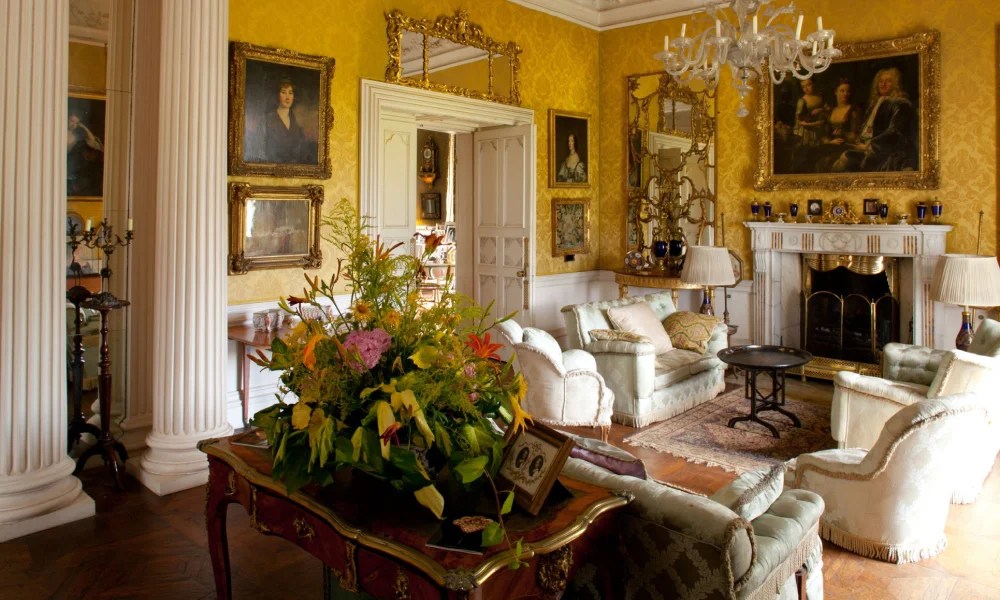
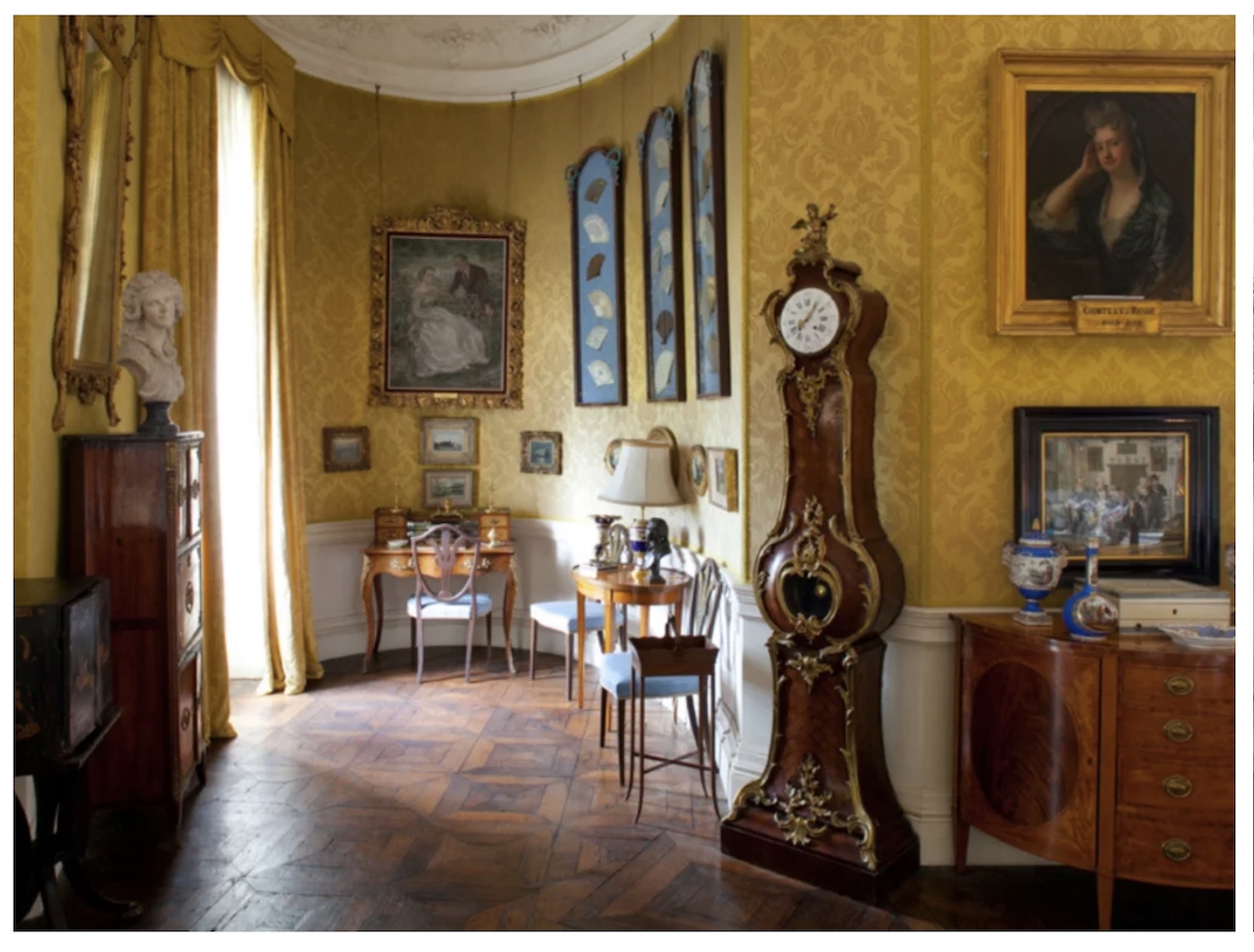
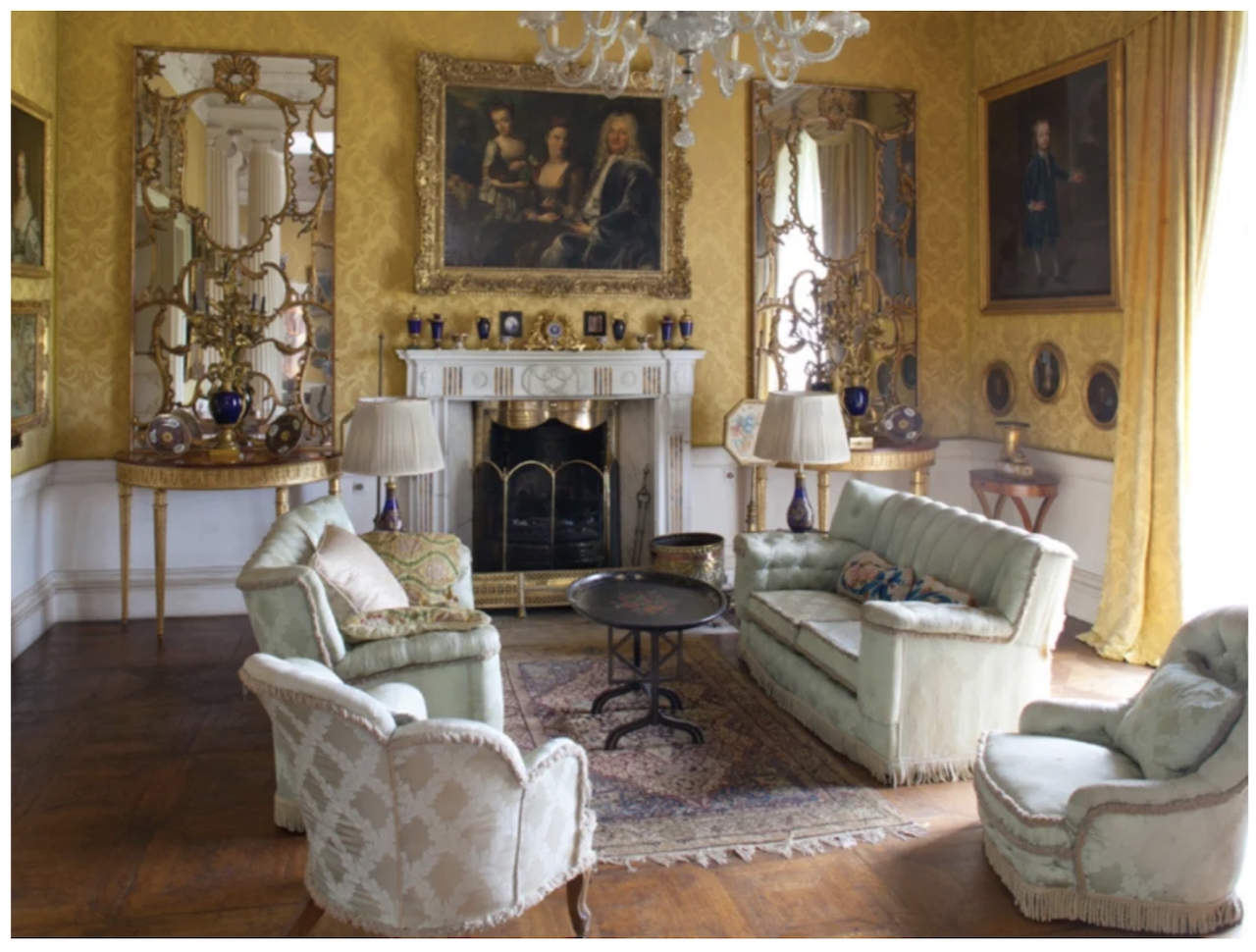
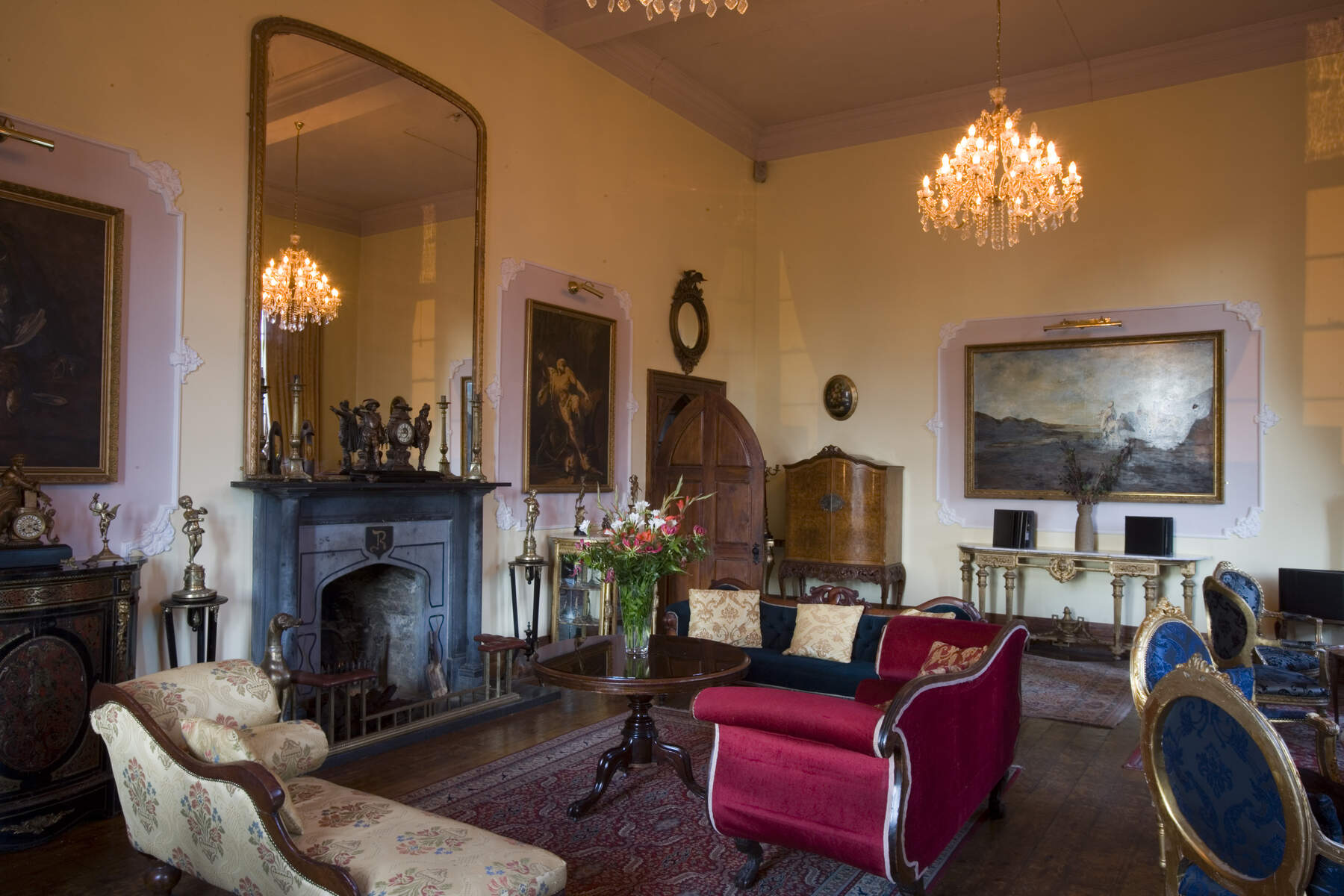
The Yellow Drawing Room, created by Anne née Messel, Countess of Rosse. She created the yellow drawing room from two rooms, a renovation that nearly brought the entire ceiling crashing down! Birr Castle, photograph courtesy of Birr Castle website.
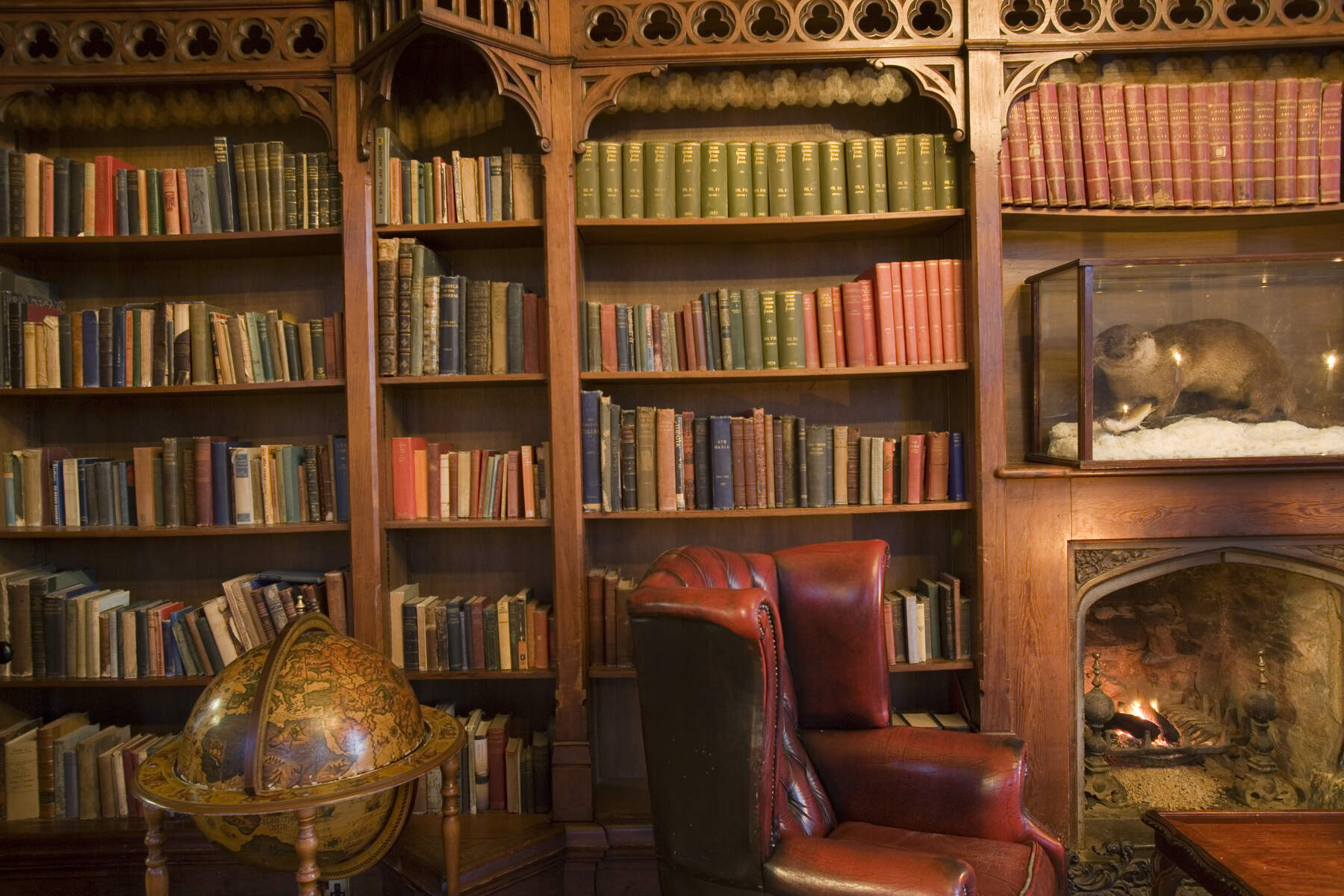
Birr Castle, photograph courtesy of Birr Castle website. The portrait is labelled Countess of Rosse b. 1698, but I can’t find which Countess this could be.
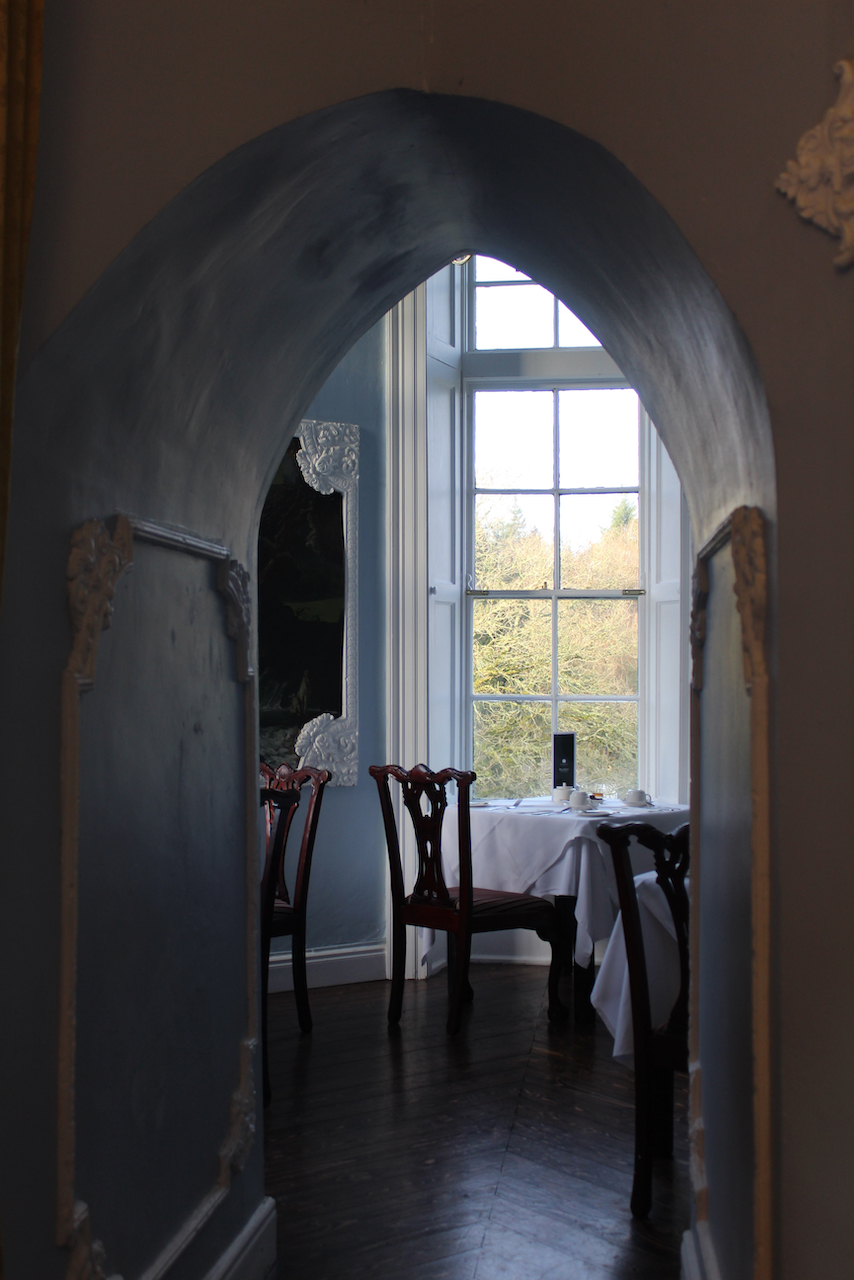
Birr Castle, photograph courtesy of Birr Castle website.

Anthony Armstrong-Jones, who married Princess Margaret, is a son from Anne Messel’s first marriage, her second marriage being to the sixth Earl of Rosse, Laurence Michael Parsons. The museum, off the Ticket Office, has a family tree:
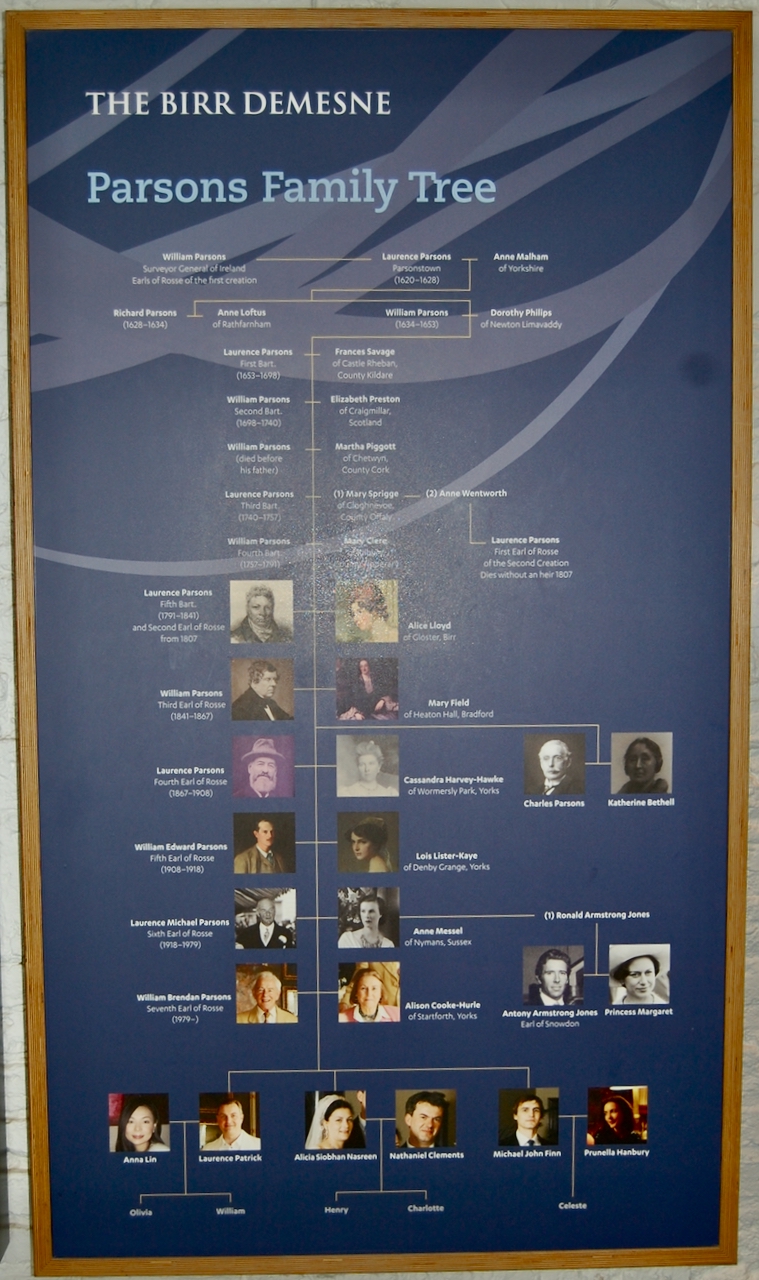
The museum, off the Ticket Office, has a family tree of the Parson family.

A sister of Anthony Armstrong-Jones married into the Vesey family of Abbeyleix, who owned the De Vesci estate. My father grew up in Abbeyleix. We used to be able to walk in the grounds of the De Vesci estate but it has since been closed to the public.

The website continues to tell us of the next generation: “Their son Brendan, the present Earl [b. 1936, he succeeded his father as the 7th Earl of Rosse in 1979], spent his career in the United Nations Development Programme, living with his wife Alison and their family in many third world countries.  He returned to Ireland on his father’s death in 1979. Brendan and Alison have also spent much time on the garden, especially collecting and planting rare trees. Their three children are all passionate about Birr and continue to add layers to the story for the future.

Patrick, Lord Oxmantown currently lives in London and is working on plans to bring large scale investment into Birr which will enable him and his family to move back to Ireland.

Alicia Clements managers the Birr Castle Estate and lives in the sibling house of Tullanisk.

Michael Parsons, works in London managing a portfolio of properties for the National Trust and is a board member to The Birr Scientific and Heritage Foundation.”

After our castle tour, we ate our lunch under a tree on a lovely circular bench made of a huge tree trunk, then went to see the telescope.
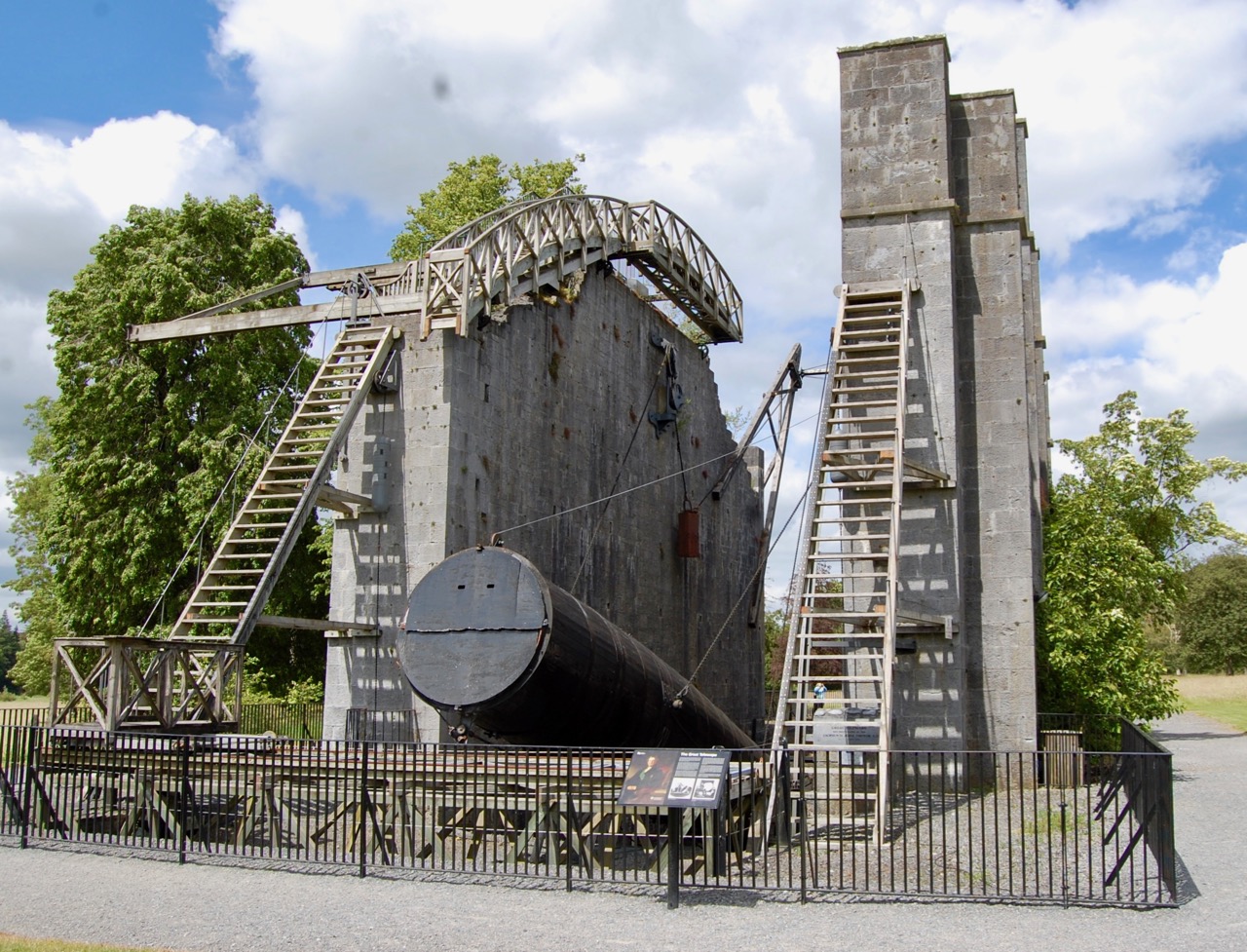
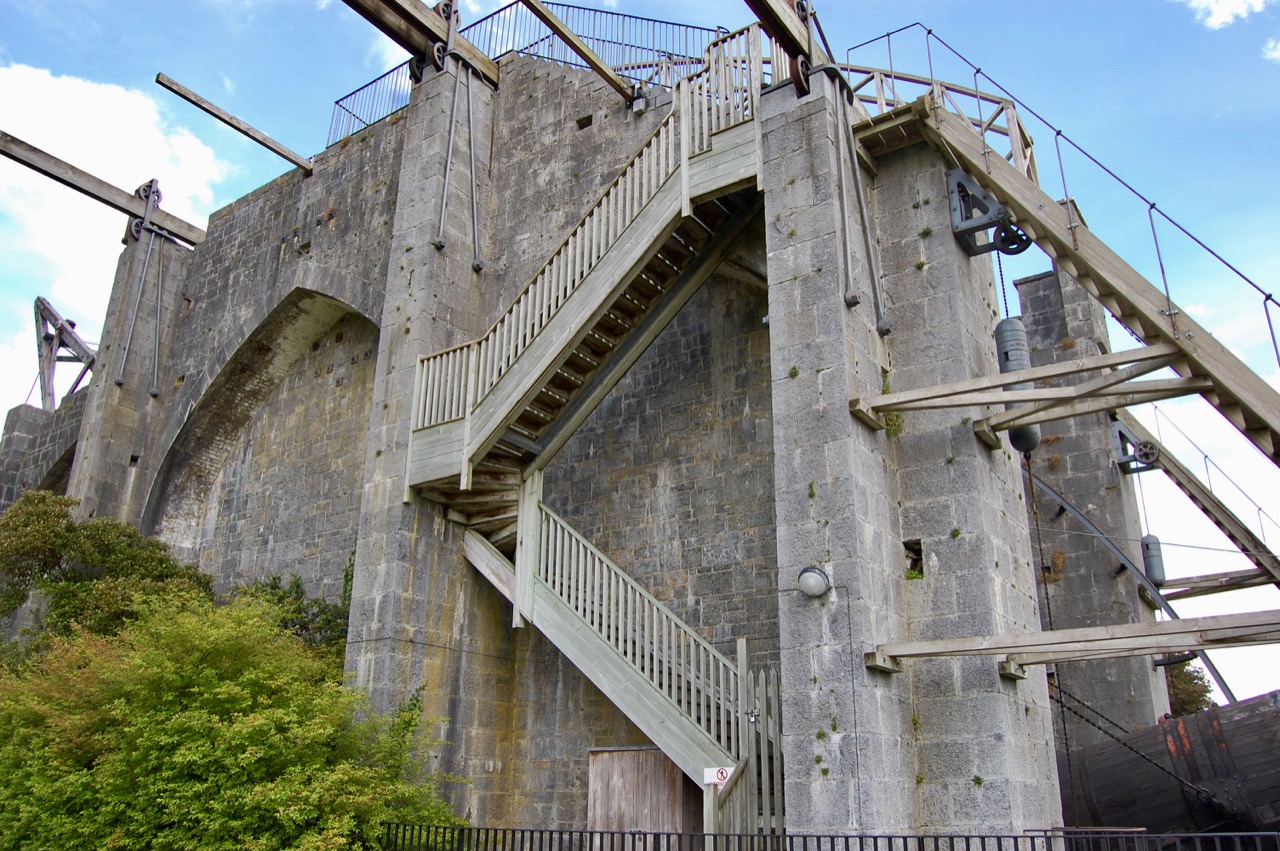
The “Leviathon” telescope. Photograph © Jennifer Winder-Baggot, www.irishhistorichouses.com
6 foot telescope of William Parsons, 3rd Earl of Rosse featuring Lawrence Parsons, 4th Earl of Rosse, by Robert French, Lawrence Collection c. 1880 L_ROY_03237.

The telescope contains a speculum mirror at the bottom of the tube, which is 1.8 metres in diameter. The mirrors were made in a workshop set up by William Parsons, and the speculum had to be taken away and polished up every once in a while, so a second speculum mirror was made. The tube which houses the speculum is 17 metres long and was made near me in the Liberties, in a Foundry on Cork Street. The Earl would look into the telescope via a brass eyepiece in the enormous wooden tube, by climbing up the stairs on the side of the stone walls, to the viewing platform. With the telescope, the Earl could see further into space than anyone had ever seen. He sketched what he saw. According to the information at the site, his sketches were amazingly accurate when compared to modern photographs taken by the Hubble Telescope. The Earl studied “nebulae,” which are clouds of dust and gas in space, and discovered the “Whirlpool Nebulae.” There is now a planting of trees in the grounds of the castle to honour the founding of this M51 nebula. The “whirlpool spiral” of trees is a plantation of lime trees, planted in 1995, marking 150 years since the Earl discovered the nebula.
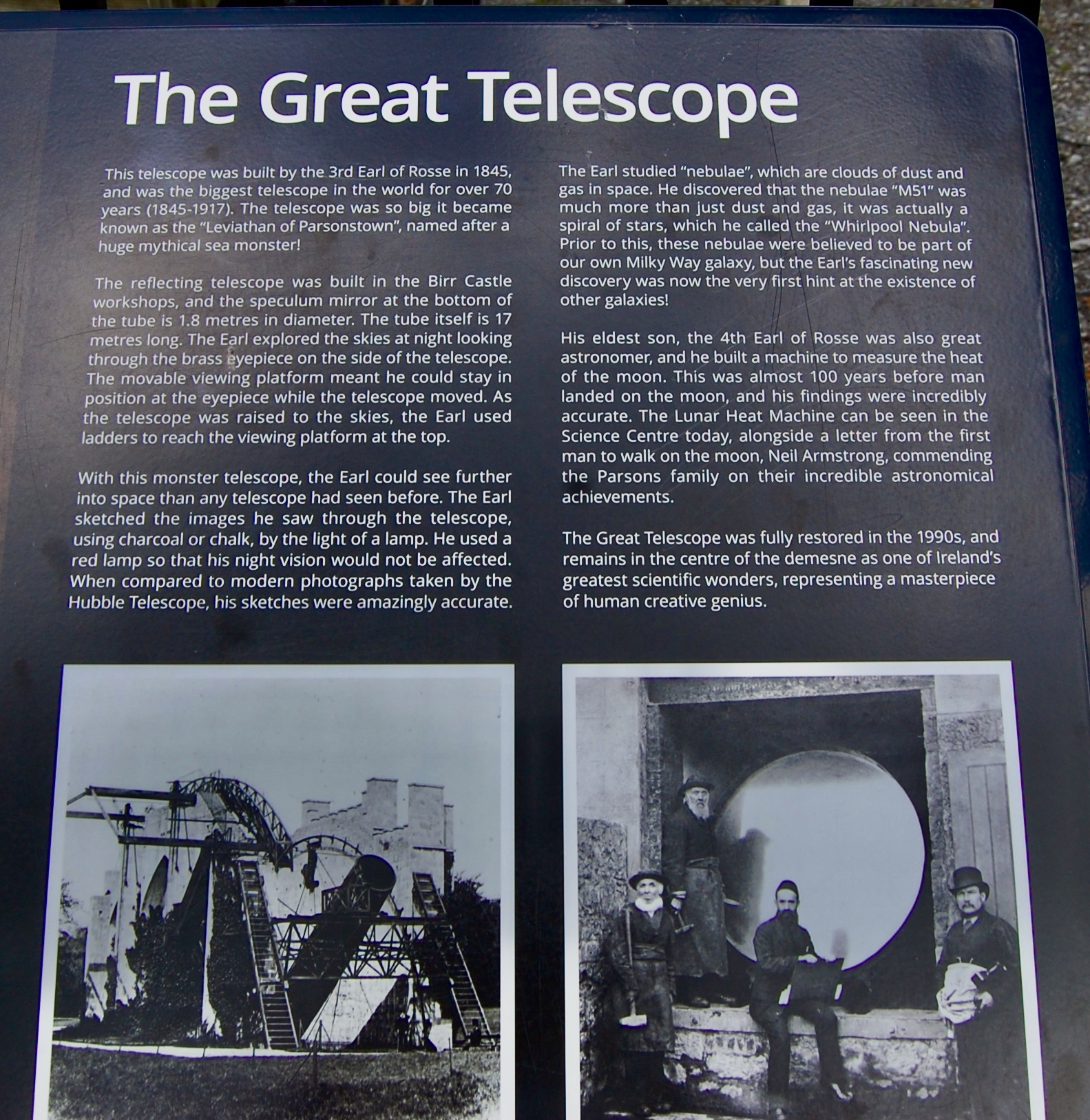
The “Leviathon” telescope. Photograph © Jennifer Winder-Baggot, www.irishhistorichouses.com

The sixth Earl of Rosse, Lawrence Michael Harvey Parsons,  pursued an interest in trees and botany rather than the stars and moon, and created the gardens. We enjoyed the beautifully sunny day, walking around the generous landscape.
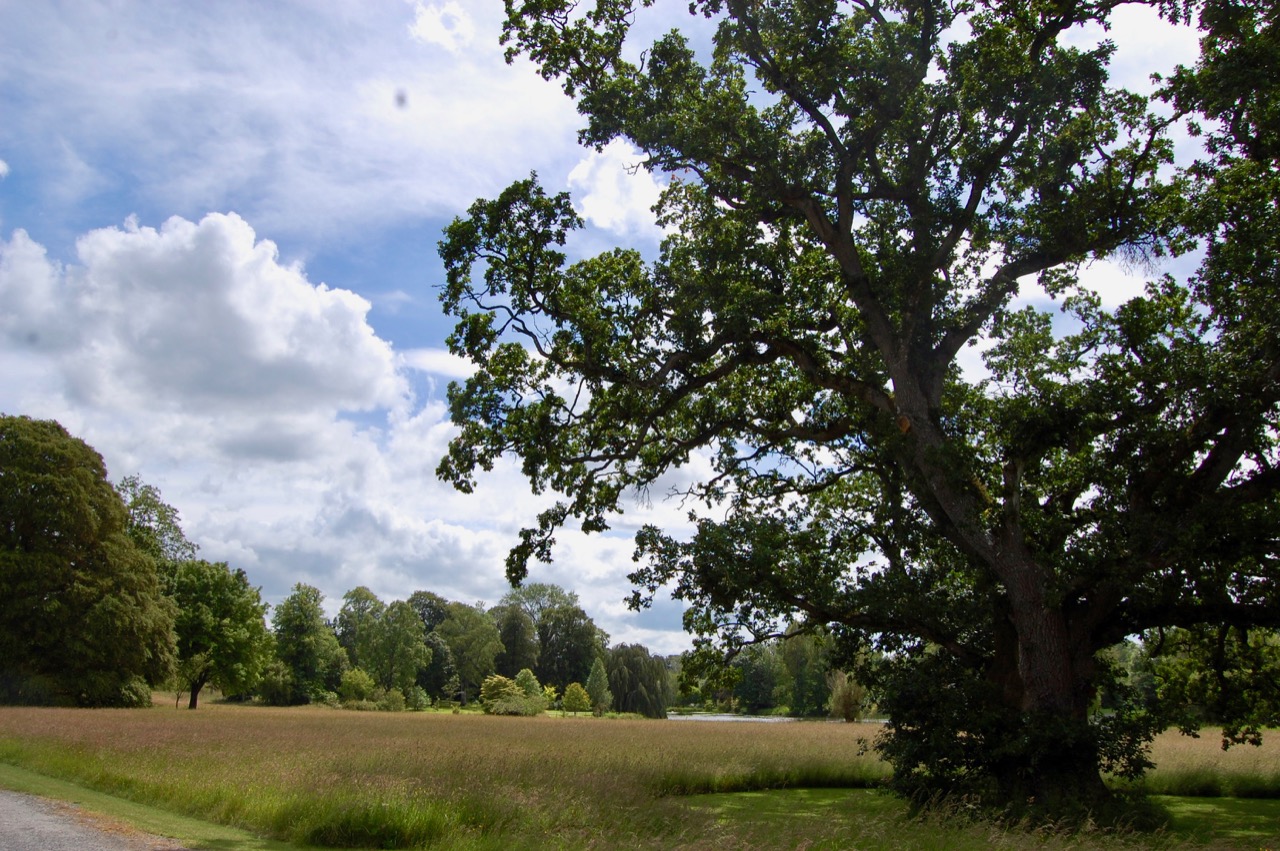
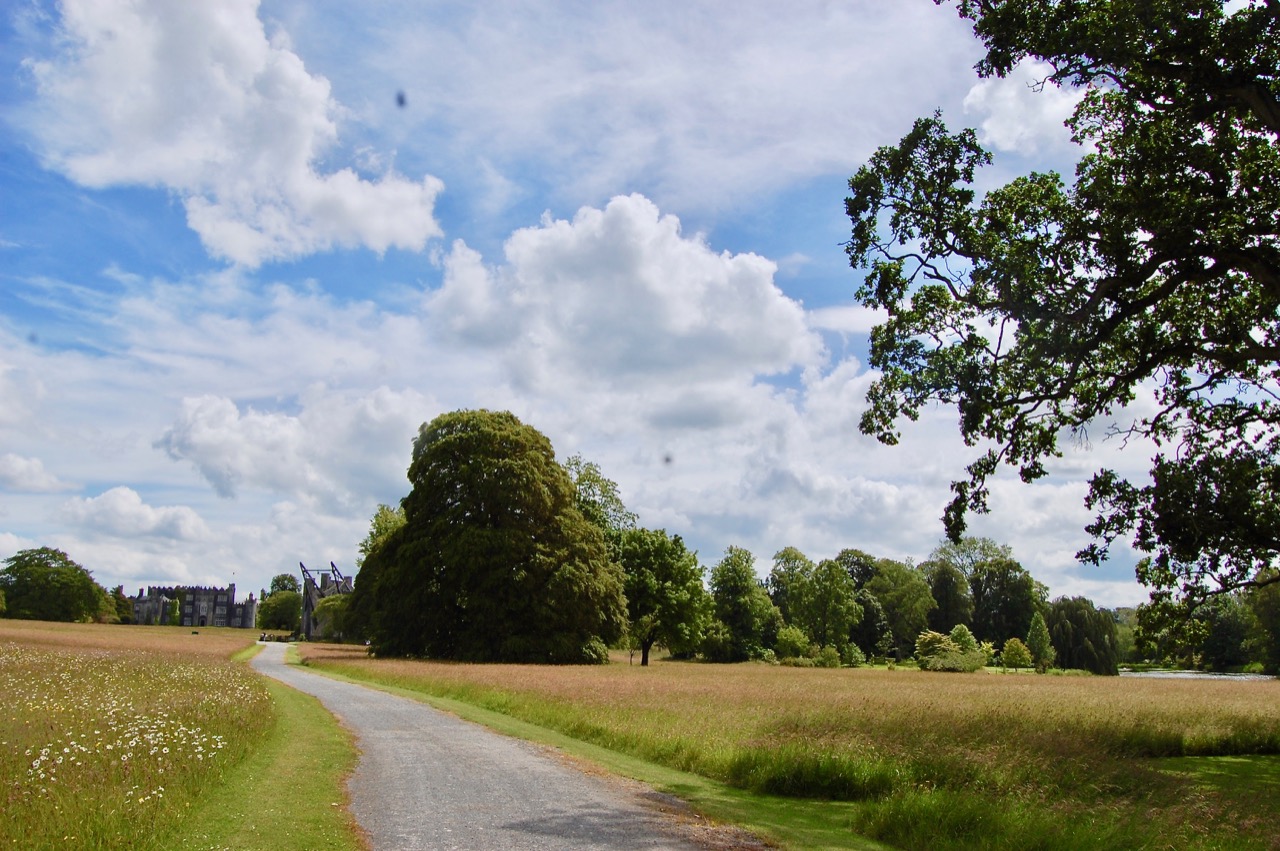
Birr Castle Demesne. Photograph © Jennifer Winder-Baggot, www.irishhistorichouses.com

The spring wildflower meadow has not been ploughed since at least 1620. Grass is let grow long to allow wildflowers, bees and wildlife to flourish.
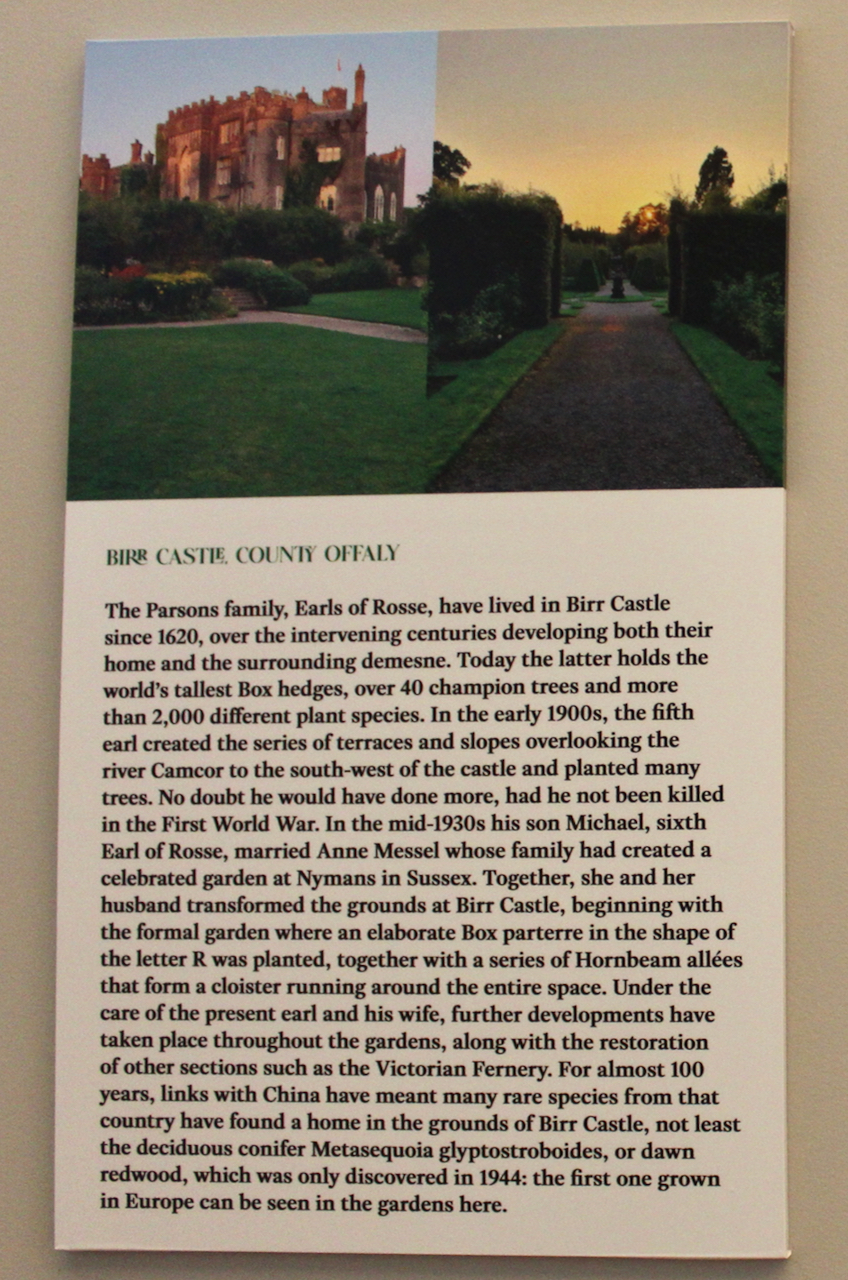
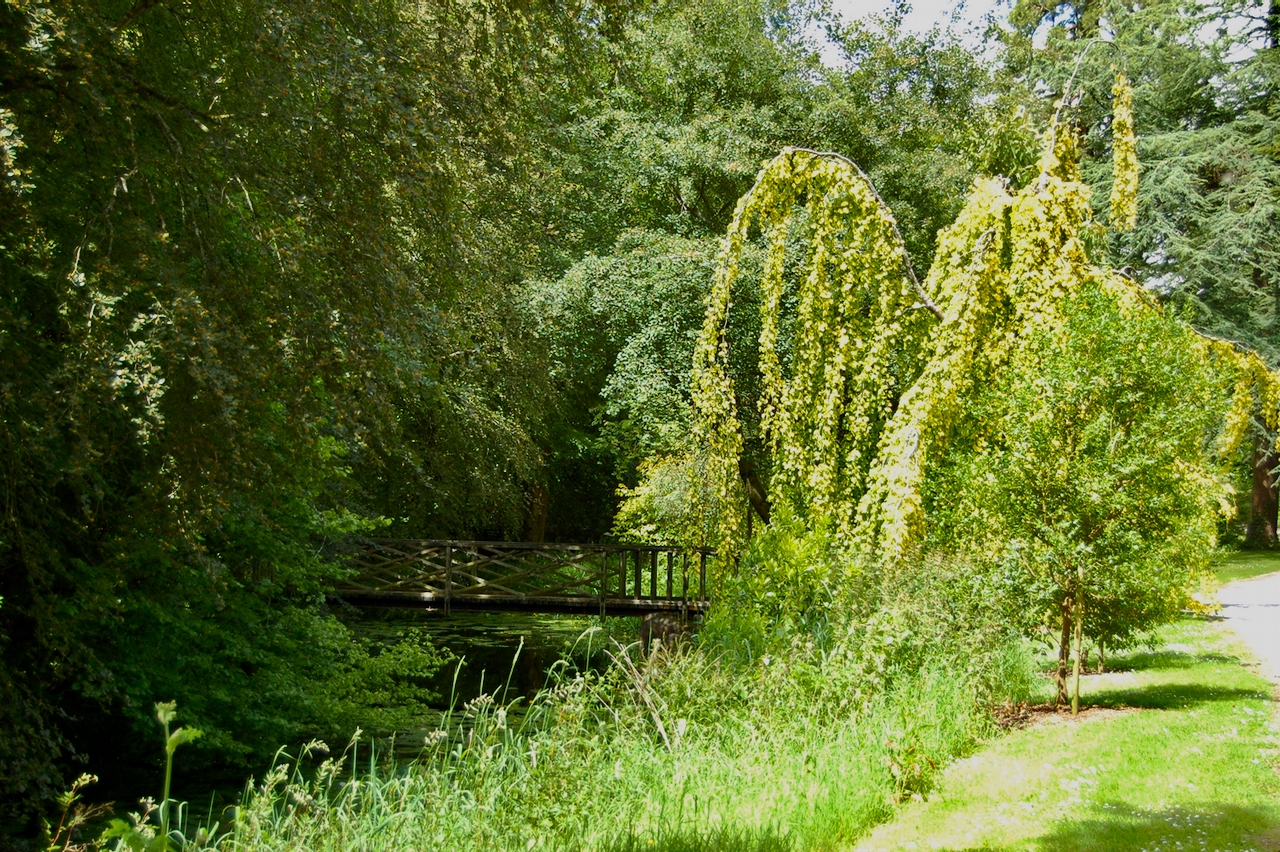
From “In Harmony with Nature, The Irish Country House Garden 1600-1900” in the Irish Georgian Society, July 2022, curated by Robert O’Byrne.
Birr Castle Demesne. Photograph © Jennifer Winder-Baggot, www.irishhistorichouses.com

We entered The Fernery, which according to the sign beside it, tells that Ferneries were fashionable in Victorian times. 
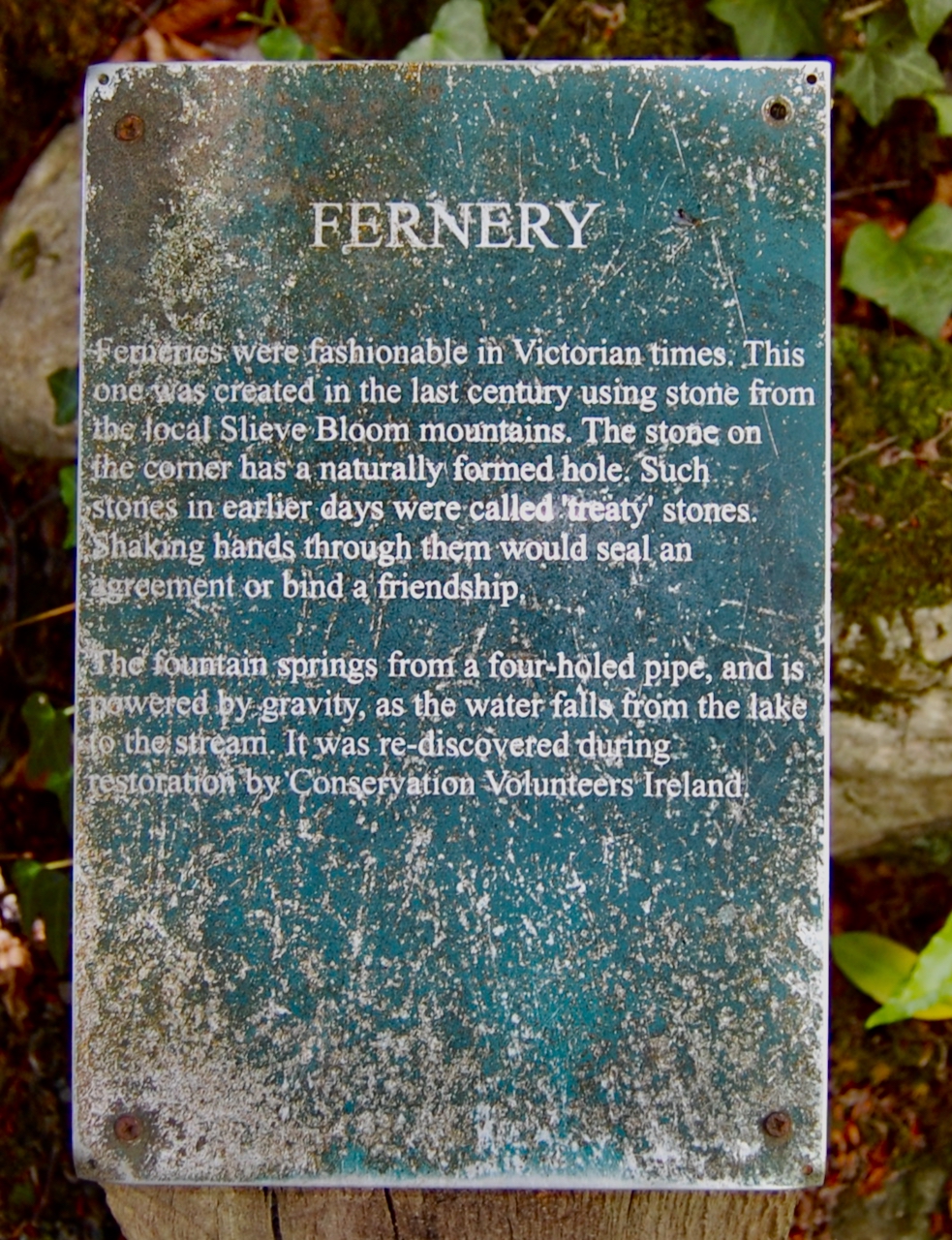
Birr Castle Demesne. Photograph © Jennifer Winder-Baggot, www.irishhistorichouses.com

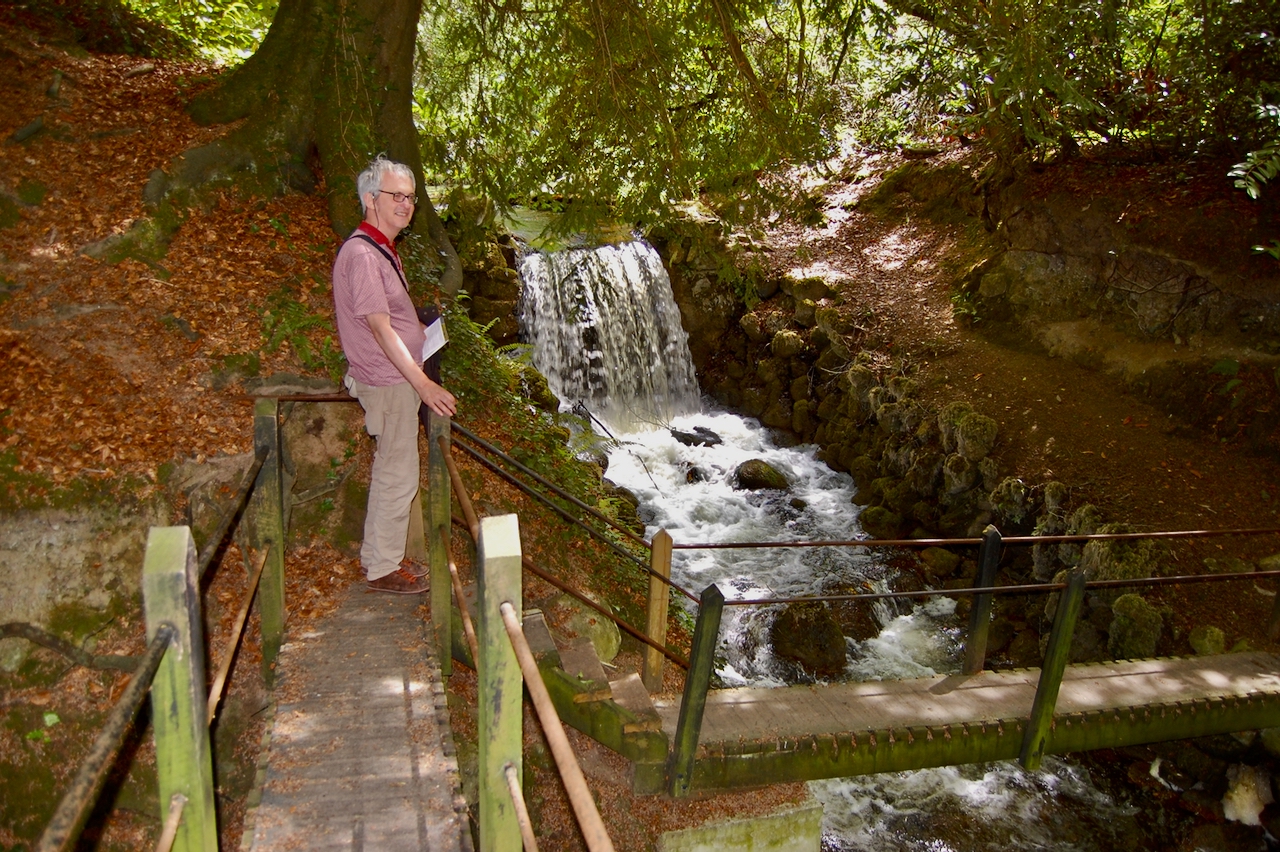
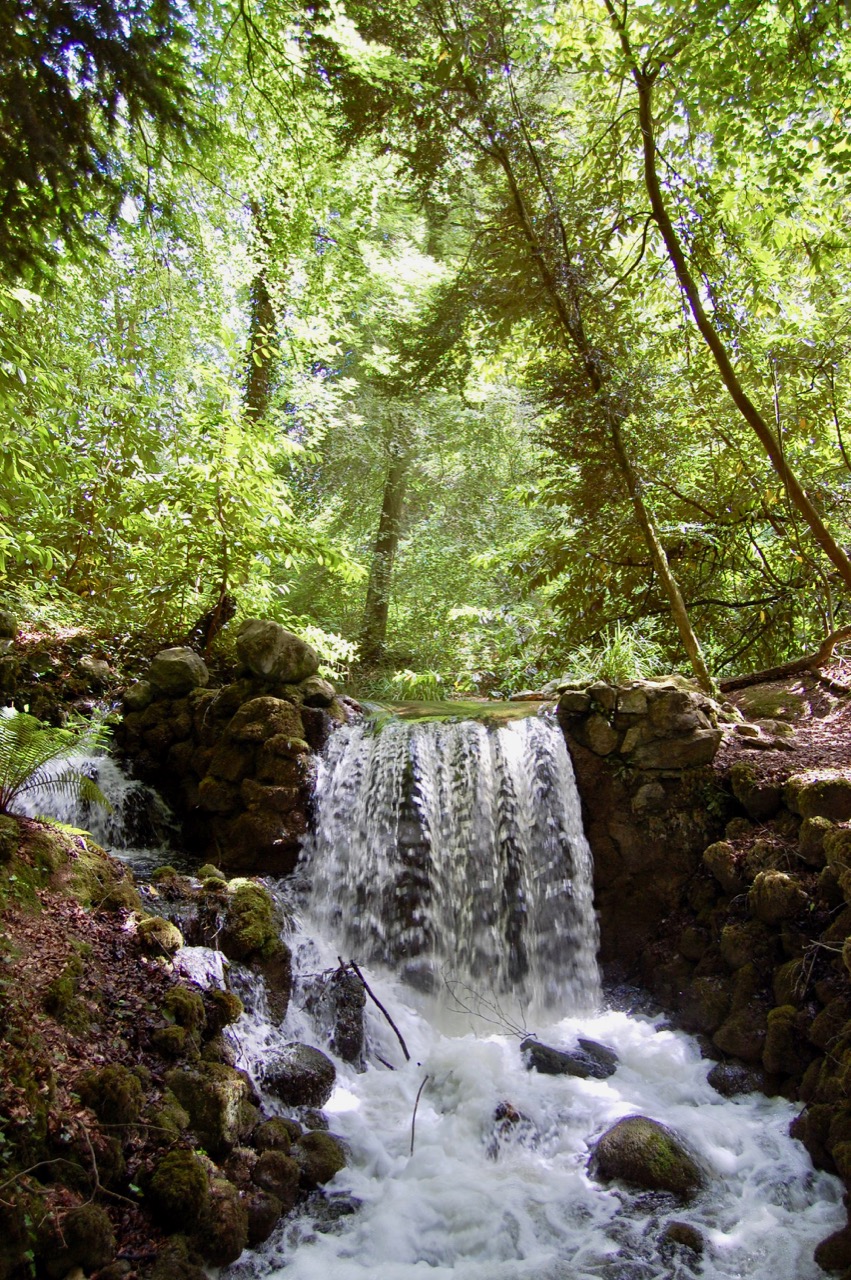
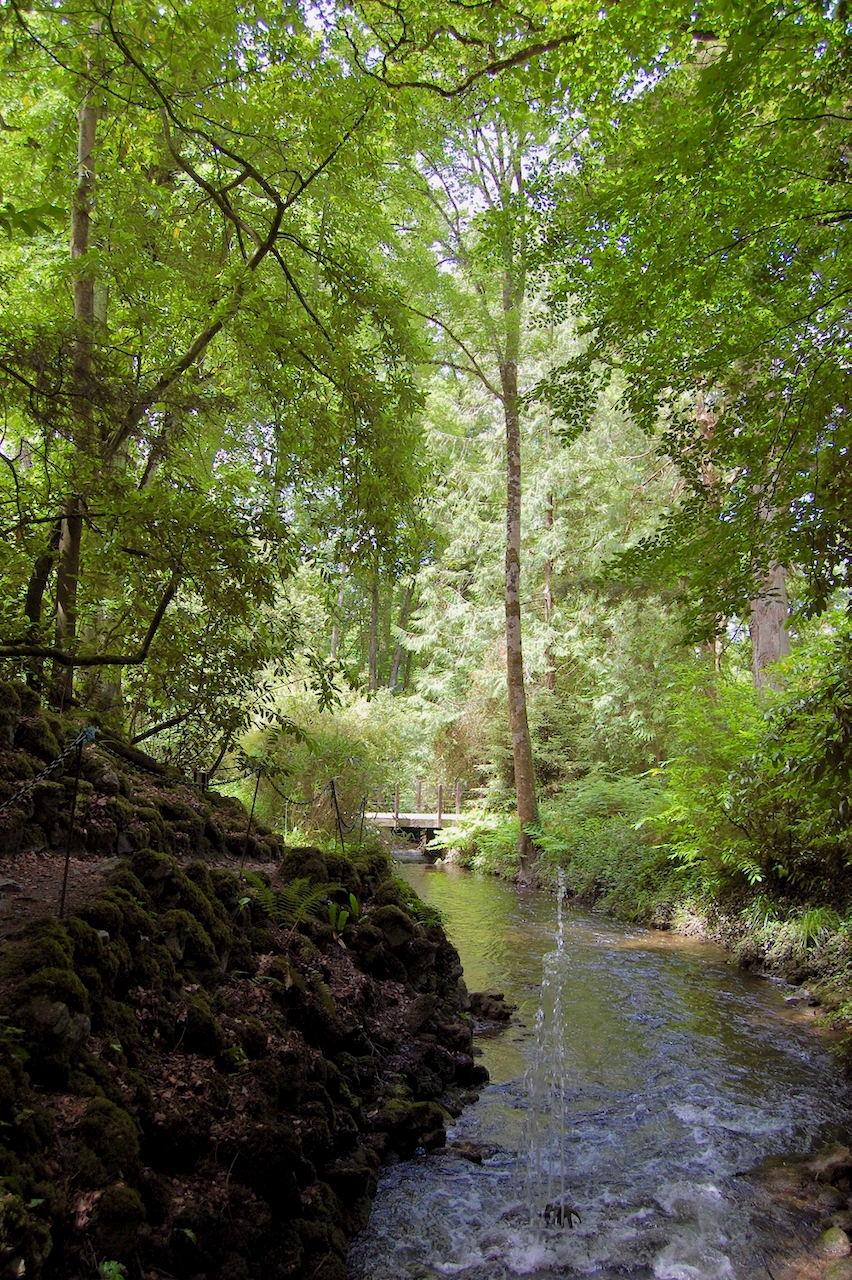
This little fountain works by gravity, as the water falls from the lake to the stream. It’s an aspect I love about exploring heritage properties: the clever and sustainable engineering of the times. We have much to learn from our ancestors. I love that they have kitchen gardens and walled gardens and were self-sustaining. 
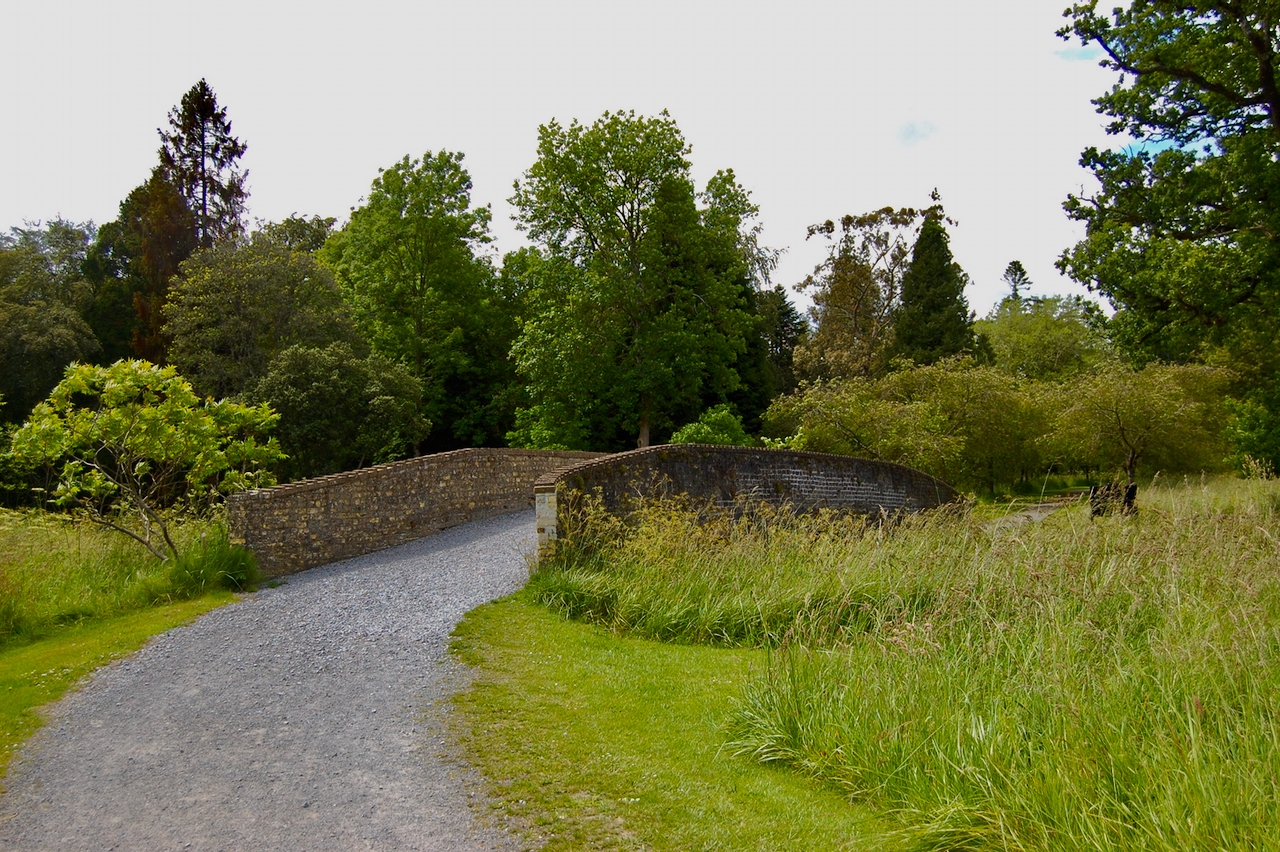
Birr Castle Demesne. Photograph © Jennifer Winder-Baggot, www.irishhistorichouses.com
Birr Castle Demesne. Birr Castle, County Offaly, Photograph © Jennifer Winder-Baggot, www.irishhistorichouses.com

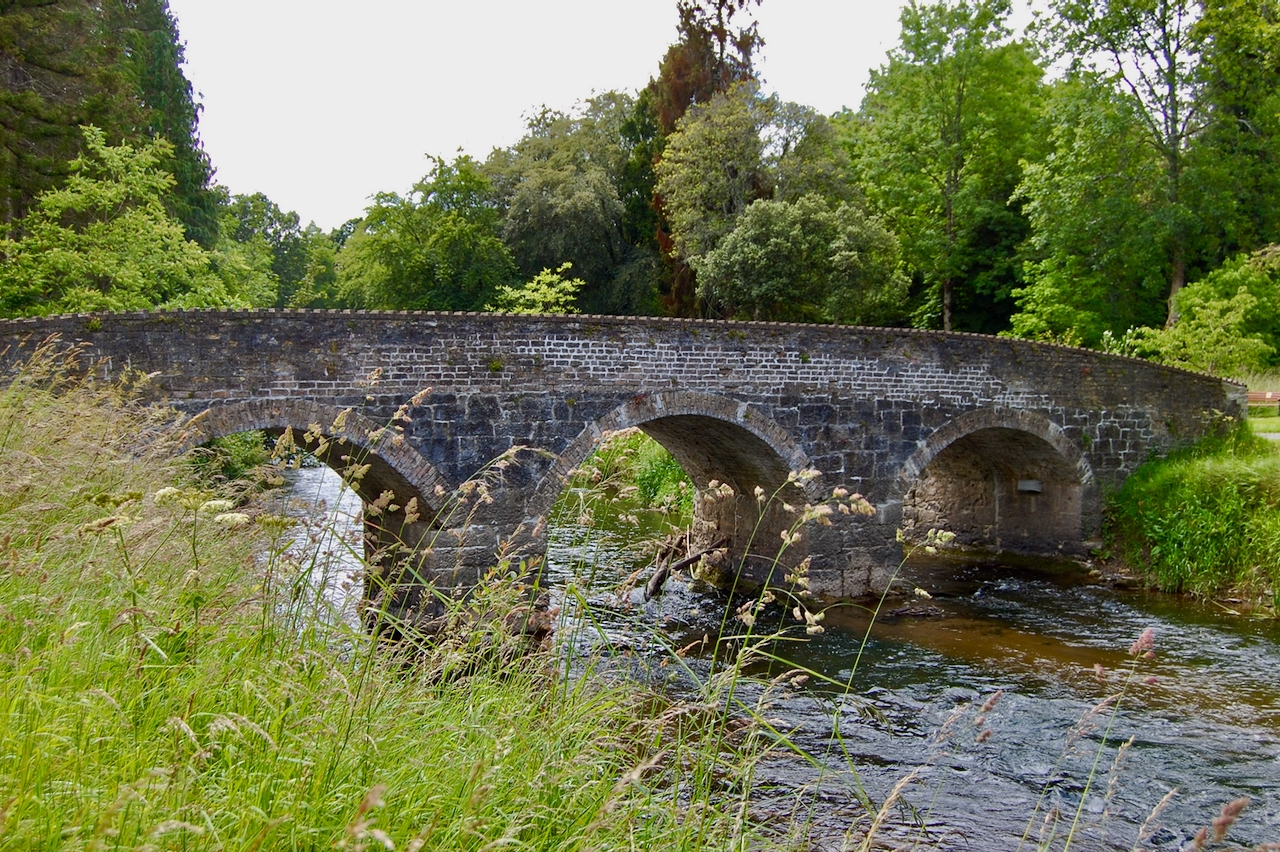
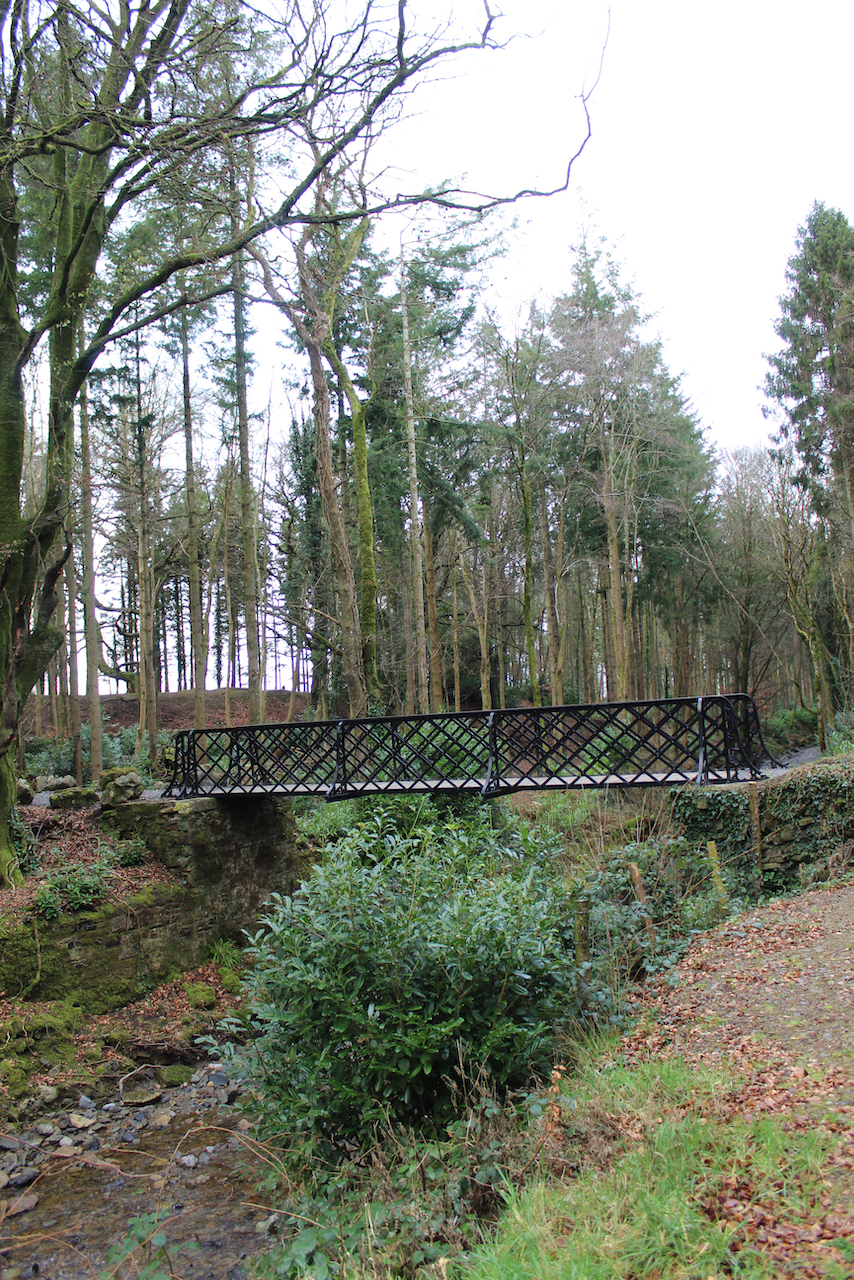
The Brick Bridge, formerly called the Ivy Bridge, is in County Tipperary, according to our leaflet about the grounds of Birr Castle.
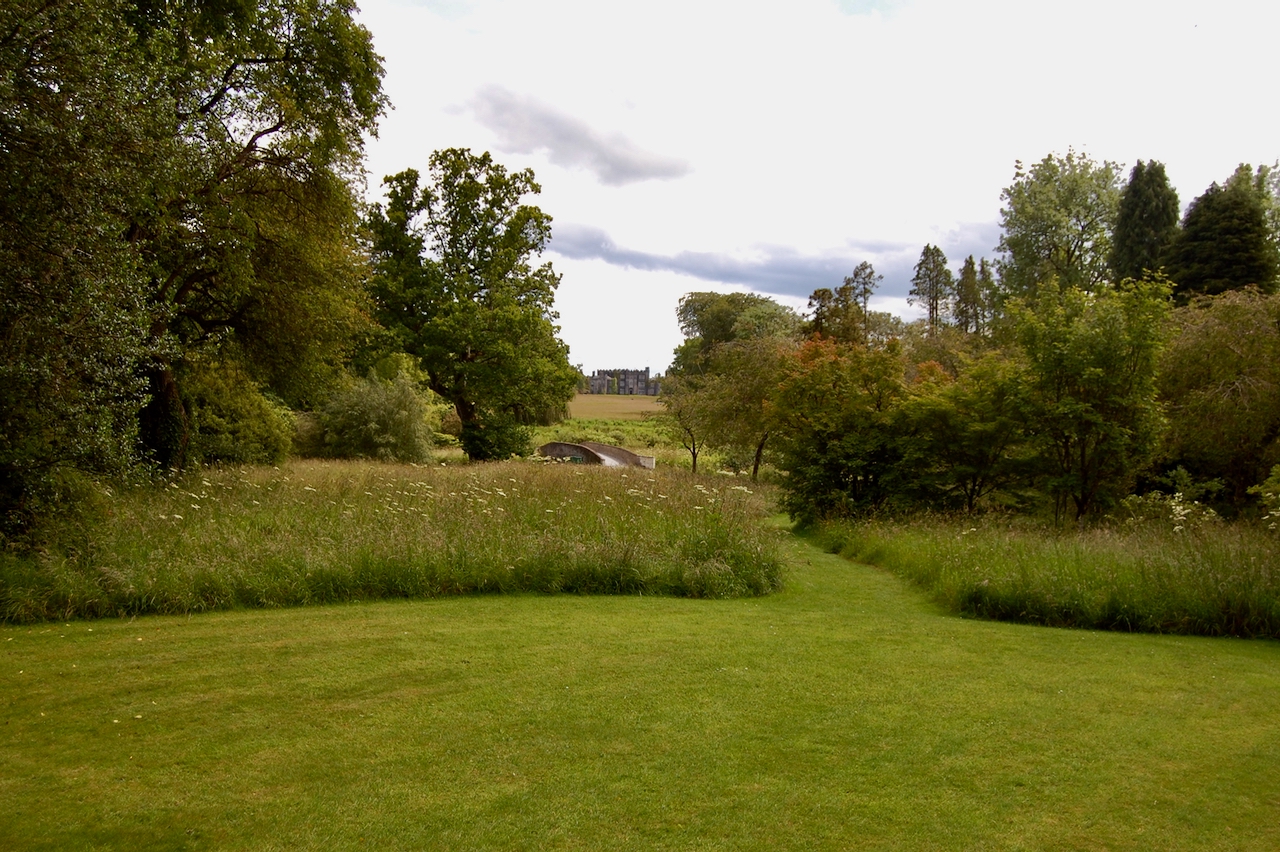
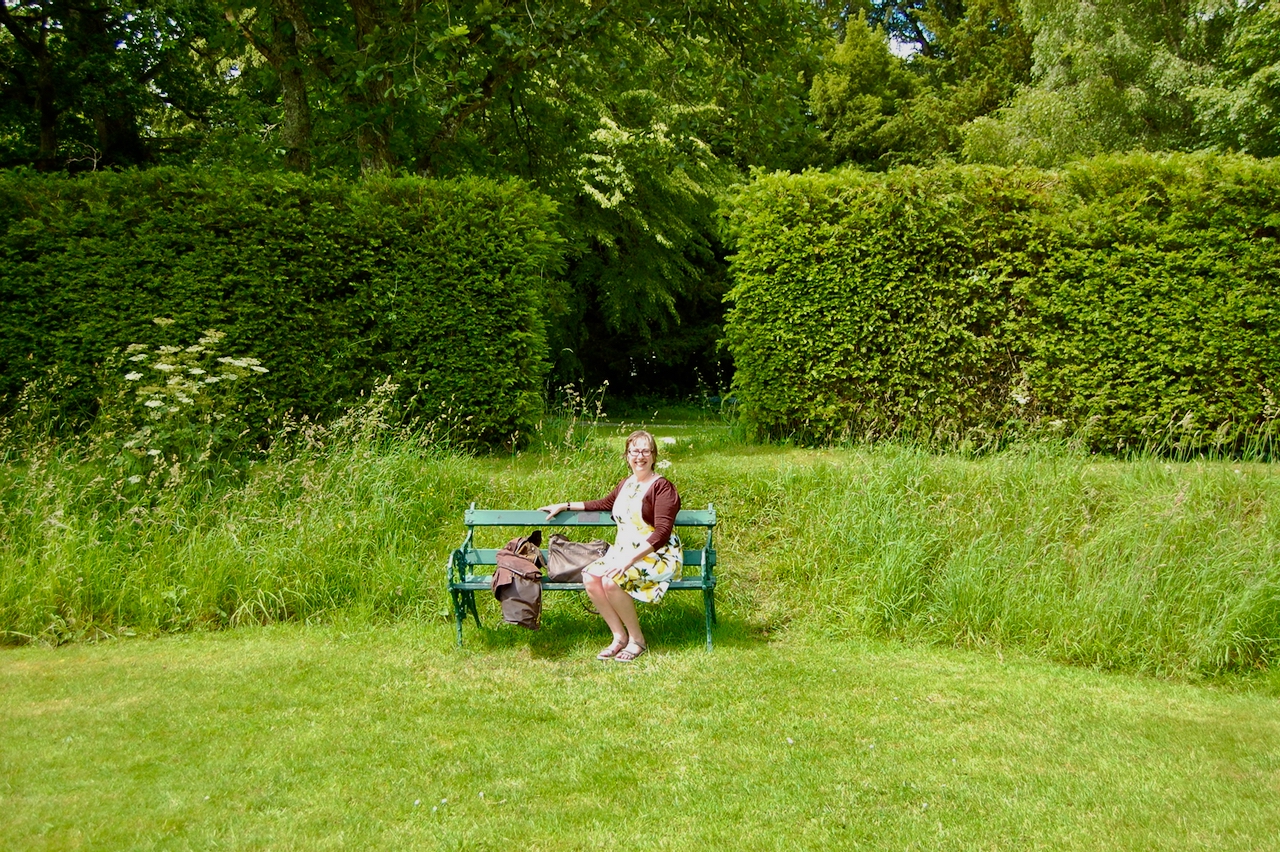
Birr Castle, County Offaly, Photograph © Jennifer Winder-Baggot, www.irishhistorichouses.com
Birr Castle Demesne. Birr Castle, County Offaly, Photograph © Jennifer Winder-Baggot, www.irishhistorichouses.com
Birr Castle, County Offaly, Photograph © Jennifer Winder-Baggot, www.irishhistorichouses.com

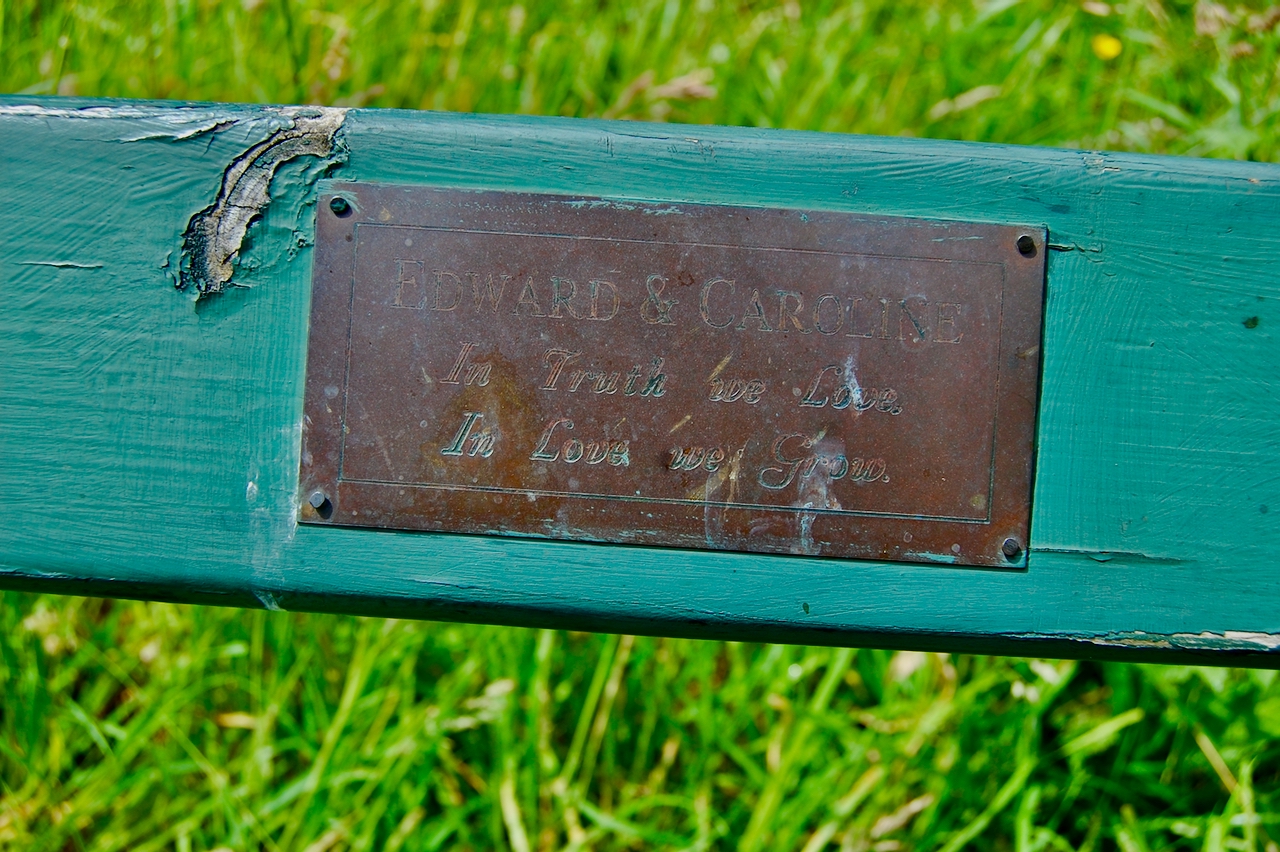
Above, the Teatro Verde, “Green Theatre,” from which you can see the vista of the castle and demesne. It was inspired by the design of 18th century architect and family member Samuel Chearnley. Dedication to Edward and Caroline on a plaque on the bench, “In Truth we Love, in Love we Grow.”

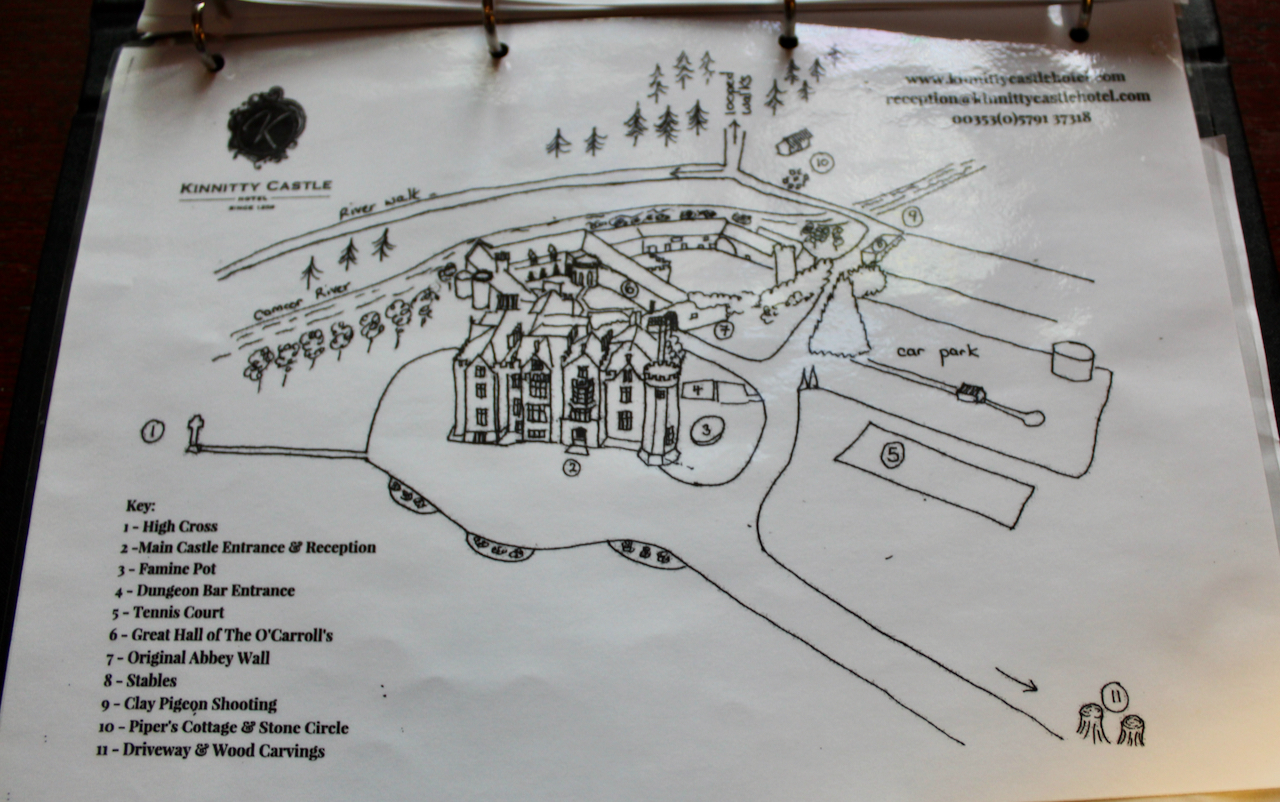
We didn’t have the energy to explore the entire garden, but followed the map to see a few places such as the Fernery, the Teatro Verde, and the Formal Gardens. Along the way, we passed the box hedges, the tallest in the world! The box hedges are around ten metres tall, and are over 300 years old.
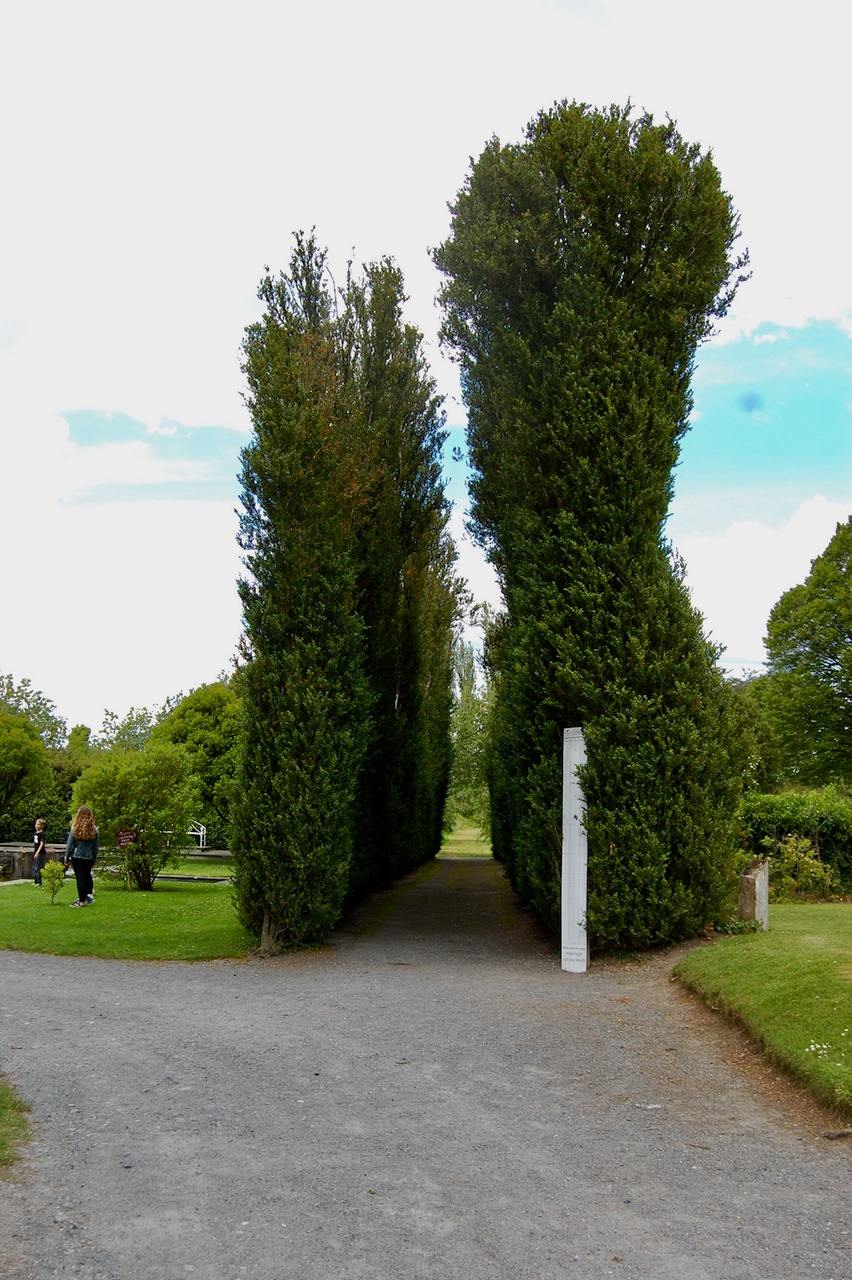
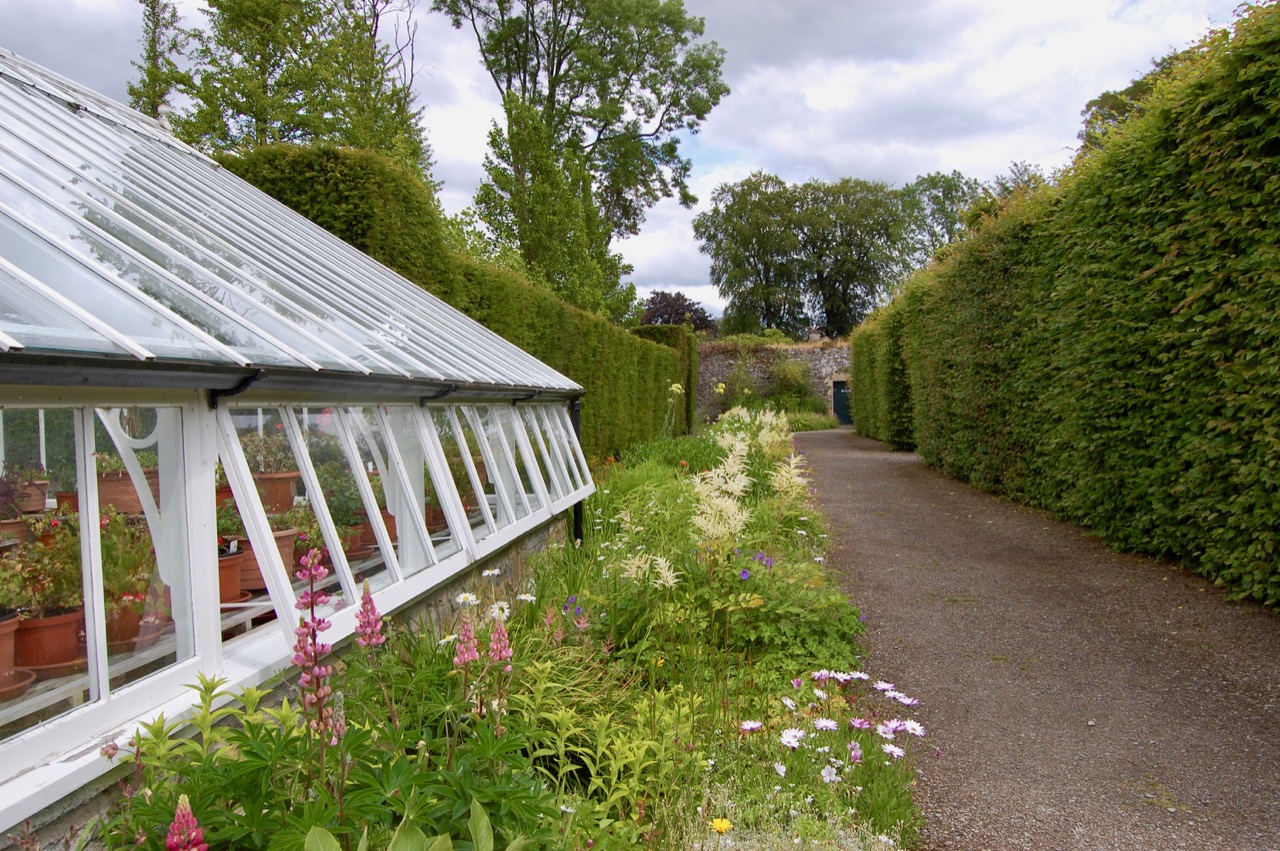
The box hedges are around ten metres tall, and are over 300 years old. Birr Castle, County Offaly, Photograph © Jennifer Winder-Baggot, www.irishhistorichouses.com
Birr Castle, County Offaly, Photograph © Jennifer Winder-Baggot, www.irishhistorichouses.com

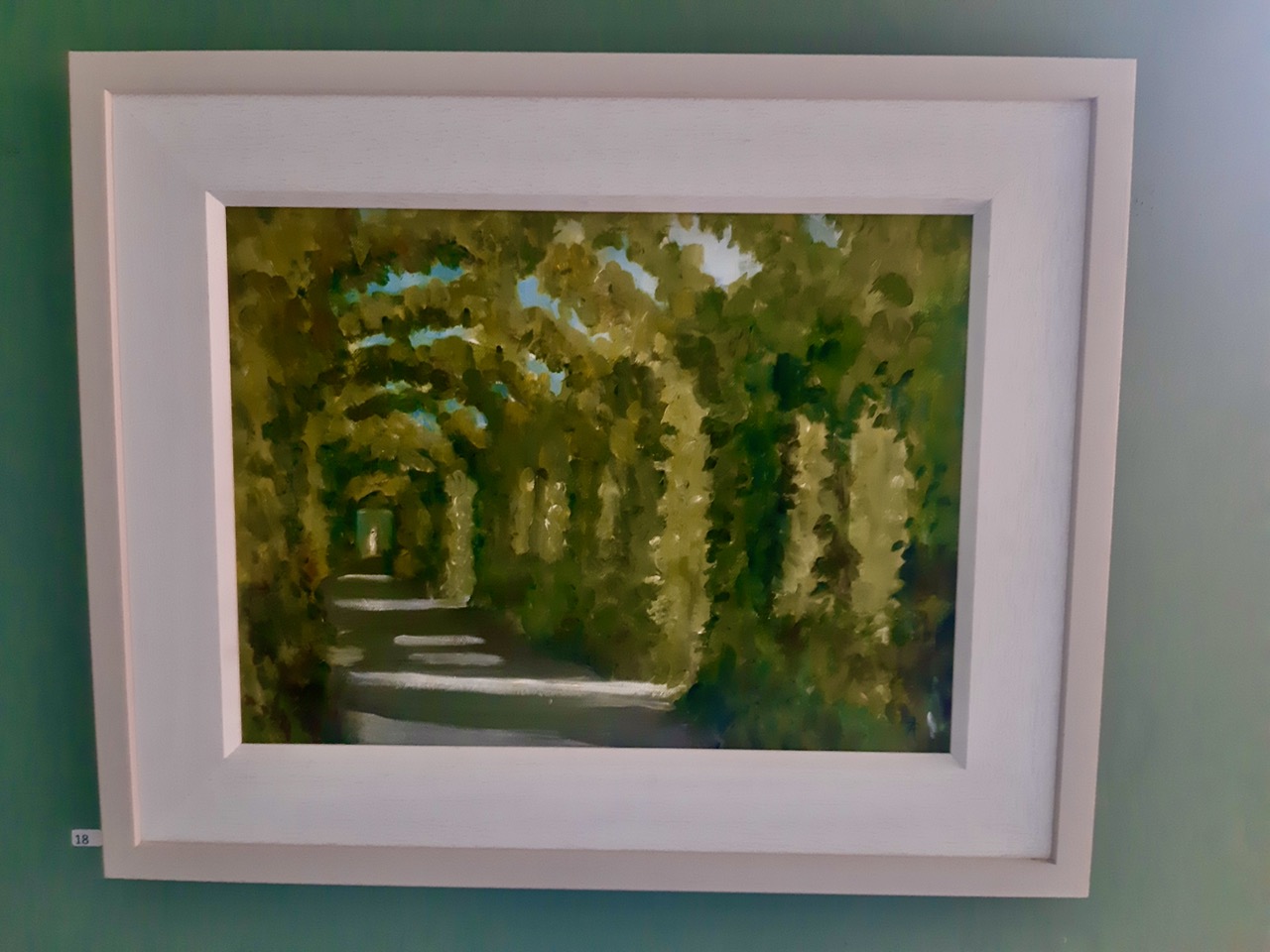
The Formal Gardens were designed by Anne Messel, the 6th Countess of Rosse, to celebrate her marriage to the 6th Earl, Michael, in 1935. There are white seats either end which bear their initials, which she designed. The hornbeam arches are in the form of a cloister complete with “windows”!
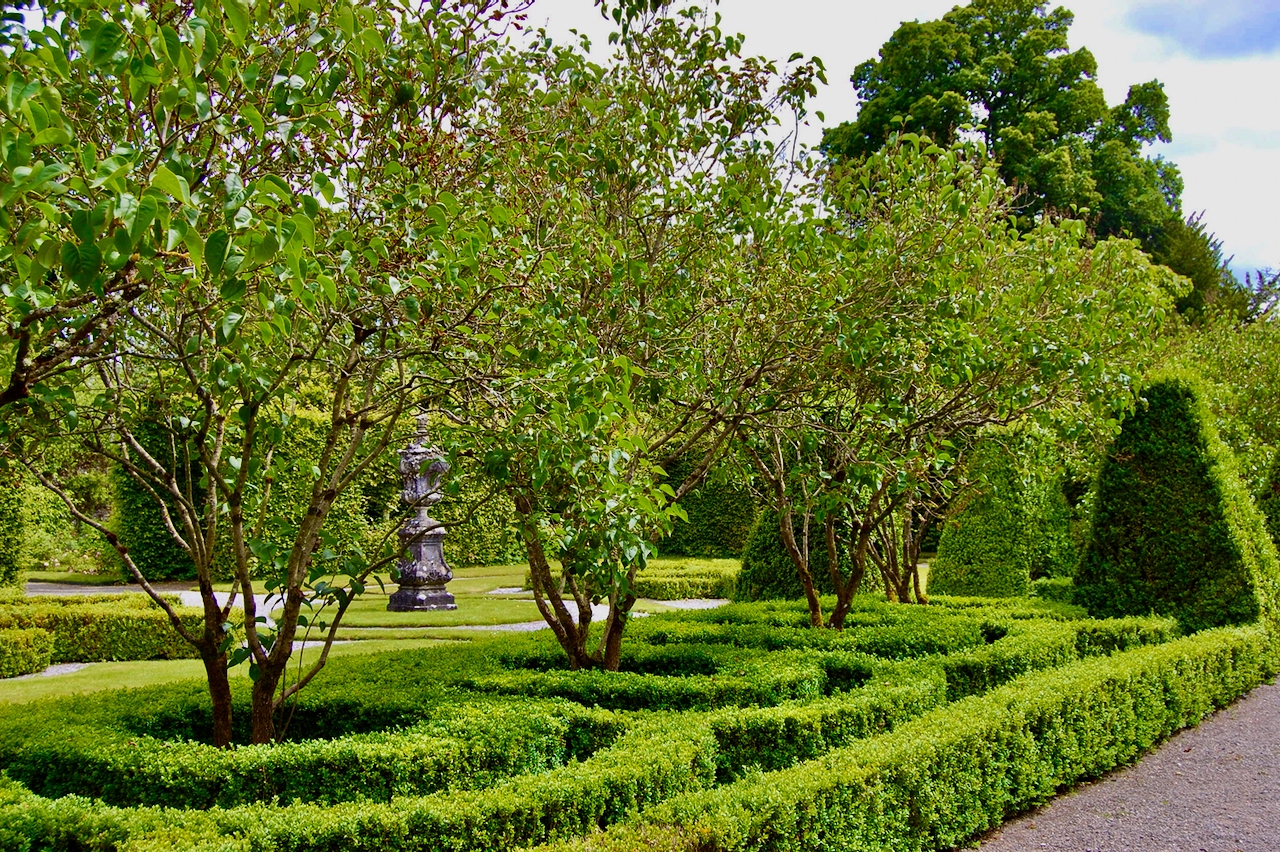
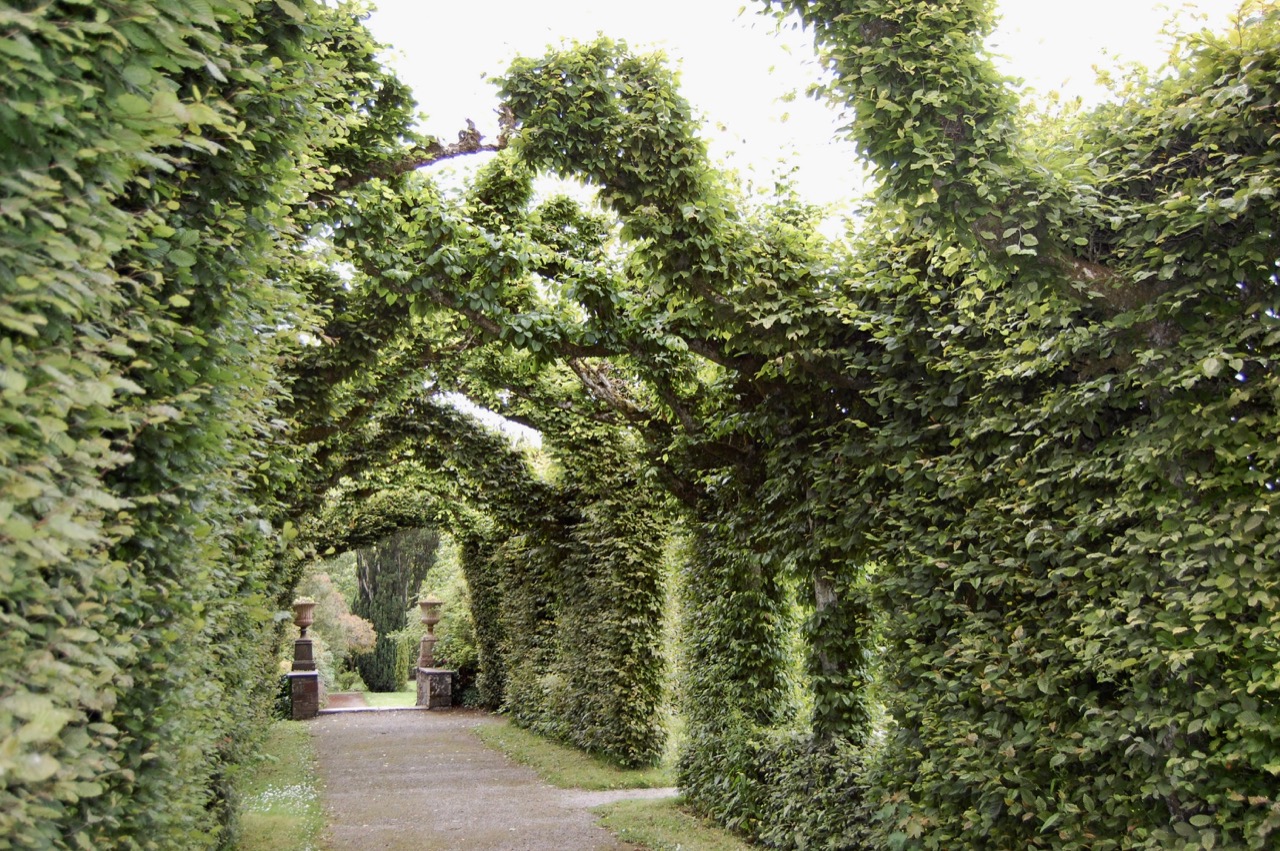
Birr Castle, County Offaly, Photograph © Jennifer Winder-Baggot, www.irishhistorichouses.com
Birr Castle gardens, photograph for Tourism Ireland, 2015, Ireland’s Content Pool. (see [1])
The Formal Gardens, Birr Castle, by Alison Rosse.

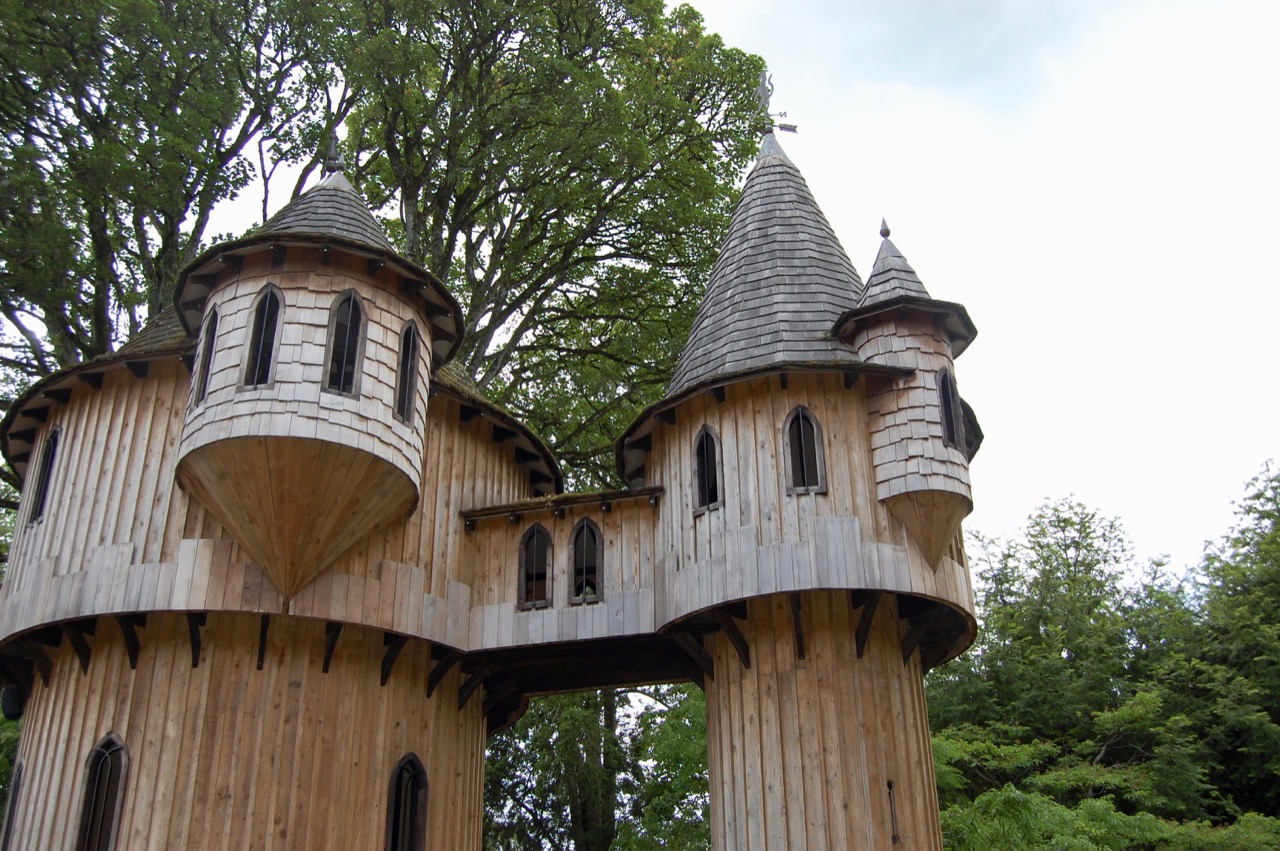
We headed back to the visitor centre and museum, passing the children’s area, the wonderful Tree House! The current owners, Brendan Parsons, who was director of the Irish House and Gardens Association for eleven years, and his wife Alison, have been leading advocates for finding a new role for country houses in a heritage and educational context.
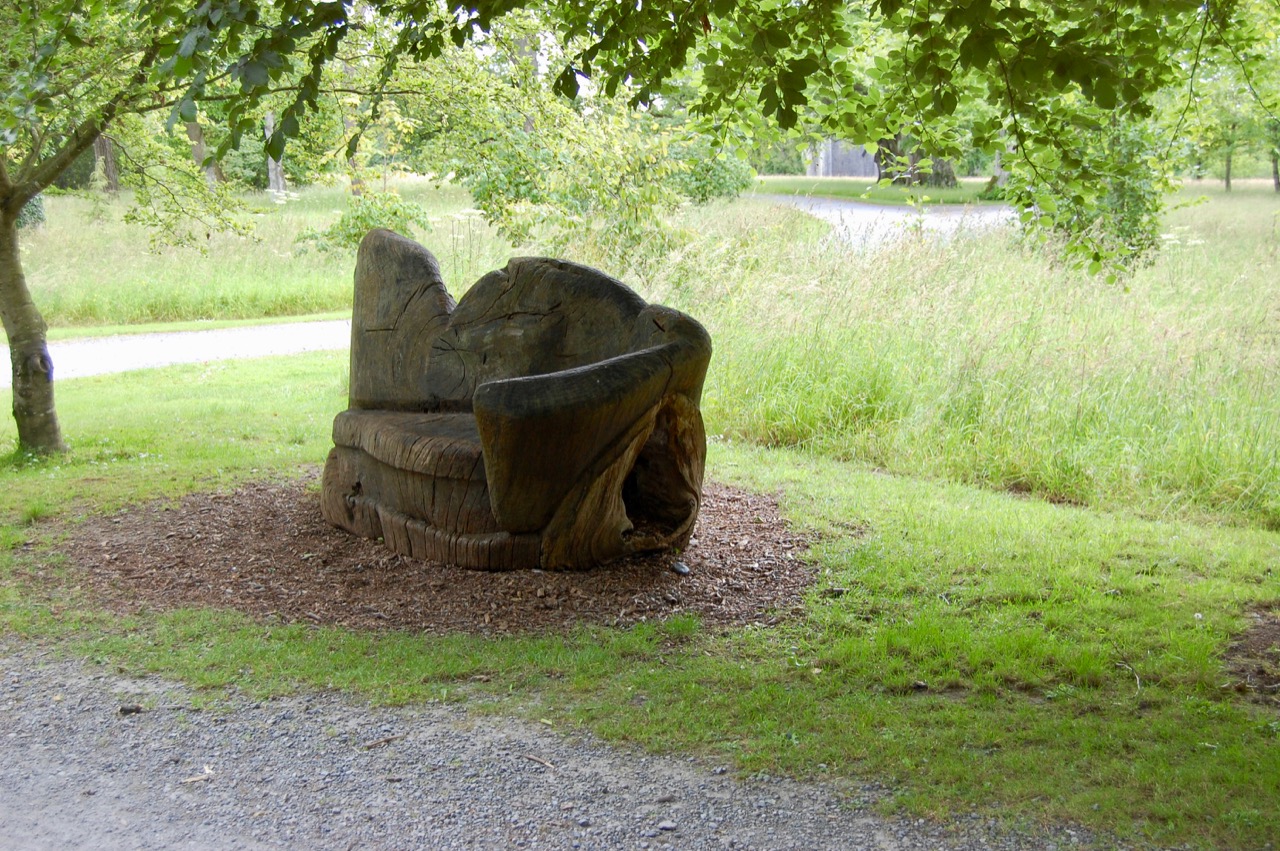
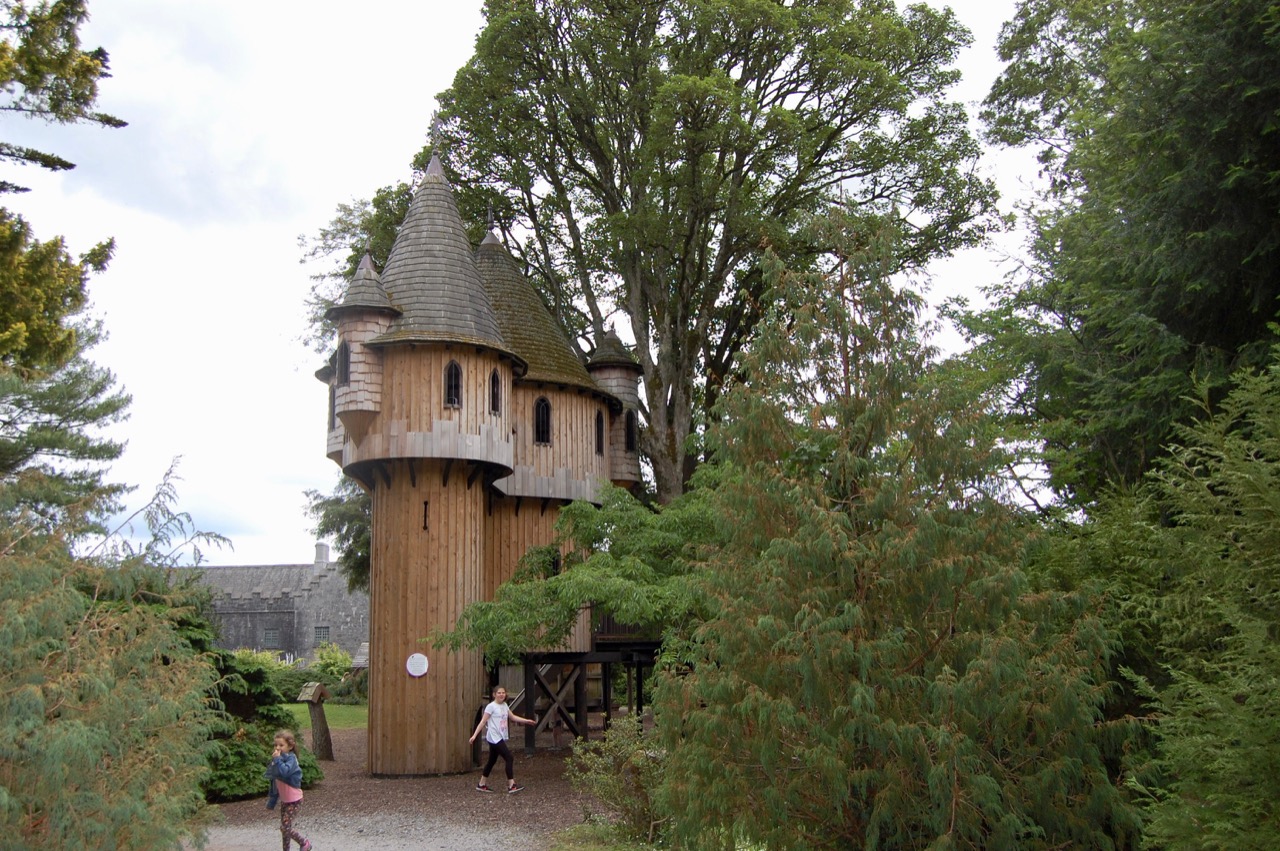
Birr Castle, County Offaly, Photograph © Jennifer Winder-Baggot, www.irishhistorichouses.com

In the museum, we studied the pictures and explanations, but had to ask where it was that the viewer would sit or stand to look through the telescope. There’s a great timeline in the museum – I always find these very useful and informative!

It was interesting also to see some documents from the family archives, including a booklet written by the Earl about management of property, and purchase of the elements that make up the speculum mirror, which is made of metal and not glass – only later did they make mirrors of glass for telescopes.
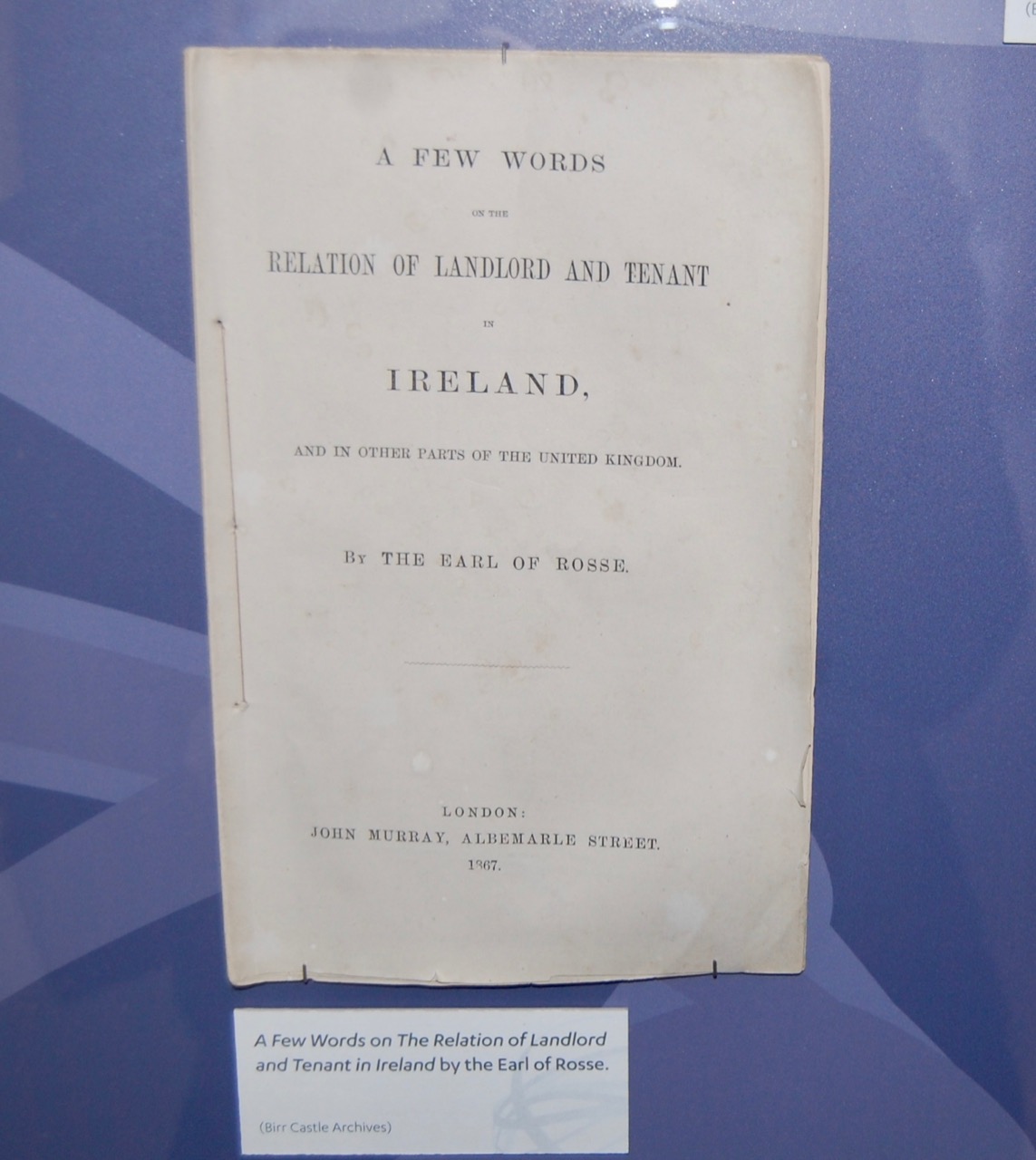
Birr Castle, County Offaly, Photograph © Jennifer Winder-Baggot, www.irishhistorichouses.com

[1] https://www.irelandscontentpool.com/en

[2] http://www.ihh.ie/index.cfm/houses/house/name/Birr%20Castle

[3] During the period 1979-2007, Lord and Lady Rosse facilitated research by Dr. Anthony Malcomson, former director of the Public Record Office of Northern Ireland (PRONI), and latterly sponsored by the Irish Manuscripts Commission, to enable the production of a comprehensive calendar of the Rosse Papers in 2008. The archive is held in the Muniment Room of Birr Castle.

[4] p. 12, Robertson, Nora. Crowned Harp, Memories of the Last Years of the Crown in Ireland, published 1960 by Allen Figgis & Co. Ltd., Dublin.

[5] https://www.tcd.ie/media/tcd/mecheng/pdfs/The_Family_Parsons_of_Parsonstown.pdf

[6] https://birrcastle.com/sharing-our-heritage/

[7] Hugh Montgomery Massingberd and Christopher Simon Sykes. Great Houses of Ireland. Laurence King Publishing, London, 1999.

[8] Bence-Jones, Mark. A Guide to Irish Country Houses (originally published as Burke’s Guide to Country Houses volume 1 Ireland by Burke’s Peerage Ltd. 1978); Revised edition 1988 Constable and Company Ltd, London.

[9] O’Reilly, Sean. Irish Houses and Gardens, from the archives of Country Life, Aurum Press, London: 1998, paperback edition 2008.
2026 Diary of Irish Historic Houses (section 482 properties)

To purchase an A5 size 2026 Diary of Historic Houses send your postal address to jennifer.baggot@gmail.com along with €20 via this payment button. The calendar of 84 pages includes space for writing your appointments as well as photographs of the historic houses. The price includes postage within Ireland. Postage to U.S. is a further €11 for the A5 size, so I would appreciate a donation toward the postage – you can click on the donation link.

€20.00

Donation

Help me to fund my creation and update of this website. It is created purely out of love for the subject and I receive no payment so any donation is appreciated! My website costs €300 per year on WordPress.

€15.00
Donation towards website

I receive no funding nor aid to create and maintain this website, it is a labour of love. The website hosting costs €300 annually. A generous donation would help to maintain the website.

€150.00

Cangort, Shinrone, County Offaly

Cangort, Shinrone, Co Offaly

Cangort Park, County Offaly courtesy Sherry Fitzgerald Country Homes, Farms and Estates.

Mark Bence-Jones. A Guide to Irish Country Houses (originally published as Burke’s Guide to Country Houses volume 1 Ireland by Burke’s Peerage Ltd. 1978); Revised edition 1988 Constable and Company Ltd, London.

p. 55. [Atkinson] The seat of the Atkinson family 1600-1957. Original castle beseiged and destroyed by Cromwellian forces and the family fled. They returned at the Restoration and built a house on the right of the castle, which was subsequently altered from time to time; 2 very small rooms from the castle surviving at the back of the present house. The front of the house was rebuilt in early Victorian Tudor-Gothic, being finished 1850; with steep pointed gables and plain mullioned windows.

https://www.buildingsofireland.ie/buildings-search/building/14942022/cangort-house-cangort-demesne-co-offaly

Cangort House, Cangort demesne, County Offaly, Courtesy of National Inventory.

Detached Jacobean style country house, built c.1870, incorporating earlier house visible from the rear and built on the site of Cangort Castle, destroyed in the seventeenth century. Three-bay two-storey principal elevation with projecting gabled bay and gabled entrance porch. South-facing side elevation has gabled end bays. Pitched slate roofs with tall rendered chimneystacks with moulded brick cornices. Punched ashlar limestone south-facing elevation and to projecting gables to front and rear elevations with heraldic plaques, corbelled eaves course and surmounted by finials. Ruled-and-lined render to remaining elevations. Square-headed window openings to front and south-facing side elevations with box-bay windows with transom and mullion windows to ground floor and square-headed mullion windows to first floor. Round-headed window openings to rear elevation with timber sash windows. Square-headed window openings elsewhere with timber sash windows and limestone sills. Tudor arched door opening to gabled entrance porch with limestone hoodmoulding and timber and glazed door. Ranges of single- and two-storey outbuildings in yard to north of house. Walled garden to north-west of house with random coursed walls. Ruined three-bay single-storey structure to rear of walled garden with pointed-arched door opening. Site accessed through decorative cast-iron gates and railings to road. 

Appraisal 

Cangort Castle, once residence of the Atkinson family, was destroyed by Cromwellian forces in the seventeenth century. The present appearance of the house dates to a nineteenth-century remodeling of an earlier eighteenth-century house, an elevation of which survives to the rear of the present structure and retains distinctly eighteenth-century round-headed windows. The Jacobean style is expressed in the tall narrow gabled elevations with finals and elaborately carved kneelers and the large limestone transom and mullion windows. There are three heraldic plaques on the house, one to the projecting gable to the front of the house and two on the south-facing elevation. The ornate plaques are skillfully executed and add artistic interest to the site. A small single-storey structure to the rear of the walled garden survives as a ruin. Its pointed-arched door opening suggests an ecclesiastical function, perhaps a small chapel. The main house together with the outbuildings, elegant entrance gate and long avenue, walled garden and former gate lodges form an interesting group of related structures. 

Cangort House, Cangort demesne, County Offaly, Courtesy of National Inventory.

https://www.buildingsofireland.ie/buildings-search/building/14942023/cangort-house-cangort-demesne-co-offaly

Cangort House, Cangort demesne, County Offaly, Courtesy of National Inventory.

Detached three-bay single-storey former gate lodge to Cangort House, built c.1870, with modern extension to rear. Located in a wooded area in the former demesne. Pitched slate roof with rendered chimneystack and decorative bargeboards. Rendered walls with limestone corbelled eaves course. Pointed-arched window openings with decorative tooled limestone surrounds comprising limestone transom, sill and hoodmoulding with fanlight and timber casement window. Square-headed door opening with timber panelled and glazed door. 

Appraisal 

Though no longer in use as a gate lodge, its form, scale and decorative treatment make its original function immediately recognisable. The pointed-arched window opening with particularly fine tooled limestone surrounds and hoodmoulding contribute to the significance of the structure. This gate lodge together with the Cangort House and ancillary structures form an interesting group of related demesne structures. Bargeboards, Picture 

Cangort House, Cangort demesne, County Offaly, Courtesy of National Inventory.
Cangort Park, County Offaly courtesy Sherry Fitzgerald Country Homes, Farms and Estates.

http://www.grantonline.com/grant-family-individuals/places/cangort/cangort.htm 

Cangort, originally Camgart, i.e., the marshy field, has been the seat of the Atkinsons since the time of James I. Cangort Castle, was destroyed by Cromwellian forces in the seventeenth century. The present appearance of the house dates to a nineteenth-century remodeling of an earlier eighteenth-century house, an elevation of which survives to the rear of the present structure and retains distinctly eighteenth-century round-headed windows. Cangort House was the seat of the Atkinson family from 1600 to 1957. Is an important building with a sightly ungainly exterior almost identical to Bellair. Internally it is very finely planned and has a well finished interior. The farm buildings include a range of stables and a huge barn.  

Anthony Atkinson, of Cangort, married, 1709, Mary, daughter of Admiral John Guy, who is said to have been instrumental in breaking the boom at the siege of Derry; he was M.P. for St. Johnstown, 1711-13, and for Belfast, 1713-14, and died in 1743, leaving numerous issue. His eldest son having died in his lifetime, he was succeeded by Guy, the second, but he , being a beneficed clergyman in the North of Ireland,Cangort was long occupied by Charles, a younger son, who acted as agent for his brother. This Charles was ancestor of the branch now settled at Ashley Park, Co. Tipperary, while the present owner of Cangort if descended from the Rev. Guy. One of their sisters married Francis Sanderson, ancestor of the late Colonel Edward James Sanderson, of Castle Saunderson, M.P. Source: F.R. Montgomery Hitchcock The Midland Septs and the Pale (1908)  

Lewis 1837 records “Cangort, the residence of G. Atkinson, Esq., a handsome mansion erected on the site of the ancient castle;” 

Atkinson, Guy Newcomen, of Cangort, eldest son of Guy, of Cangort, (born 1800, died 1859), by Anne Margaret, daughter of William Trench, Cangort Park, born 1847; married 1877, Frances E., daughter of The Hon. Lawrence Harman King-Harman, Rockingham, Roscommon. Has with other children, Guy Montague, born 1882. Was educated at the Royal Military College. Is J.P, for County and Lieut.-Colonel Shropshire Regt. 

Lt.-Col. Guy Newcomen Atkinson lived in Cangort. Lt.-Col. Guy Newcomen Atkinson married Frances Elizabeth King-Harman, daughter of Hon. Laurence Harman King-Harman and Mary Cecilia Johnstone, on 19 July 1877. He died on 10 February 1890. 

The Grant first appear in Shinrone records in 1797. Three brothers aged about 25/35 – Stephen, John and William – arrived at that date, settled in the parish and raised families. As the Shinrone records run from 1741 we can be sure that there were no Grants in the parish any earlier.  

Both my great-grandfather (Thomas) and by grandfather (Charles) said that the family came from Waterford and Cork to near Cashel. Mrs Whitford of Stream Cottage, Aghancon said her great-grandfather William Grant had said that they came from near Goolds Cross, Co Tipp (i.e. Moyaliff). Ireland was very violent at this time, and it is likely that the Grants moved to Shinrone as it was then a Protestant area. Family lore has it that they had their cattle maimed and that made them move. Interestingly the family remaining in Moyaliff turned Catholic around 1810, perhaps their way of reducing the problems of life, perhaps because of a lack of Protestant marriage parners. The continuing links with Moyaliff can be seen with Mary Grant’s marriage in 1812 to a man from Glenkeen. 

Shinrone was referred to as a hot bed of Orangeism during the demonstrations for and against Catholic emancipation in 1828. A large gathering of Green Boys tried to march on Shinrone which was defended by the army. They were only talked out of it at the last minute, bloodshed was averted. 

By 1831 only 5% of the total population of Co Tipperary was Protestant. But Borrisokane and Cloughjordan parishes had the largest concentration of Protestants ( over 20% in each parish were Protestant) 

The church records are good, and we can see where they lived and what children were born. The family were very prolific with ten to twelve children being the norm. They then stayed in the immediate area until the famine forced them to move in the 1840’s 

Stephen was the first to arrive in 1797, followed by John in 1801 and William in 1812. I suspect that none of them produced their complete families in Shinrone, but the records for Moyaliff do not exist, so we do not know what happened there.  

There is a John Grant on the Poor List of Shinrone Parish in 1811 and 1812, when he is getting relief from the parish.  

The Tithe Commission Book 1824 gives 3 Grants in the area 

  • John of Towra 8 acres from Chas Atkinson 
  • John of Gurtgreen 5 acres from Lord Ross 
  • Thomas Grant of Modreeny 4 acres from Lord Dunally 

SOLD 24 Jul 2018 

€461,538 

Cangort Park, County Offaly courtesy Sherry Fitzgerald Country Homes, Farms and Estates.

https://landedfamilies.blogspot.com/search/label/Ireland?updated-max=2017-02-19T16:18:00Z&max-results=20&start=23&by-date=false

Atkinson of Cangort and Ashley Park 

Anthony Atkinson (d. 1626) was a junior officer in the army who received a grant of lands in Co. Offaly and built a fortified residence known as Cangort Castle. During the Civil War the castle was garrisoned for the king but captured by Cromwellian troops and slighted. Anthony Atkinson (1630-63) recovered the estate at the Restoration and a new house was built adjoining the castle ruins. Information about the family is very sketchy before the time of a third Anthony Atkinson (c.1680-1743), who trained as a barrister and was an MP in the Irish parliament between 1711 and 1714. He married Mary Guy, the daughter of Admiral John Guy, whose chief claim to fame was breaking the boom across the River Foyle to relieve the Siege of Derry. Anthony Atkinson’s eldest son having predeceased him, the estate passed on his death to his second son, the Rev. Guy Atkinson (c.1712-1804), who was vicar of Trim (Meath) and later rector of Aghoghill (Antrim). He seems to have lived chiefly in or close to the parishes which he served, and it may be that his eldest son by his first marriage Anthony Atkinson (1748-90) managed the estates until his death. The eldest son of Guy’s second marriage, Jackson Wray Atkinson (1766-1846), certainly did so later, and was High Sheriff of Offaly in 1803.  
 
After many years living on his estates and serving as commander of the county militia, Jackson seems to have moved to France in old age, where in 1841 he took a French woman as his second wife. His son and heir, Guy Atkinson (1800-59) was also on the continent at this time, as his first two children were born in Rome and Geneva, but he had taken over the management of the Cangort estate by 1846, when he was High Sheriff and succeeded his father. He died fairly young, and his heir, Guy Newcomen Atkinson (1847-90) did not come of age until 1868. It was probably soon afterwards that he remodelled Cangort House, perhaps assisted by the accumulating revenues during his minority, which coincided with a brief period of agricultural prosperity in Ireland. At his death in 1890, G.N. Atkinson left an heir who was only eight years old. Perhaps because he was a career soldier and a bachelor, Guy Montague Atkinson (1882-1956) decided to sell the Cangort estate to his uncle, William Henry Atkinson (1848-1930). He left Cangort to his eldest surviving son, Guy Hamilton Atkinson (1881-1932), but Guy died shortly afterwards and it passed to his only son, Anthony Guy Atkinson (1909-85), who had just embarked on a career in the Royal Artillery. In 1957 Major Atkinson sold Cangort House while retaining the majority of the estate. In 1970 he inherited the Loughton House estate at Moneygall (Offaly) from his Trench relatives, but he made this over to his son, Guy Nevill Atkinson (b. 1950). He sold Loughton House in 2001. 
 
Charles Atkinson (c.1720-79), one of the younger sons of Anthony Atkinson (c.1680-1743), seems to have farmed part of the Cangort estate. His eldest son, Anthony Atkinson (1752-1815), moved south and leased South Park, Ballingarry (Tipperary) from the Trench family. His younger son, George Guy Atkinson (1799-1872), bought Ashley Park at Nenagh (Tipperary) in 1824 and probably built the present house soon afterwards. In 1872 it descended to his youngest son, James Netterville Atkinson (1843-93), who in the 1870s owned 2,000 acres in Tipperary and nearly 1,000 acres in Galway. He extended the house in 1883, but died without any sons, so that the house passed to his eldest daughter, Alice Marjorie Atkinson (1882-1919). In 1903 she came of age and married Thomas Bateson Biggs (1878-1945), who took the name Biggs-Atkinson, but they had no children. After she died, Biggs-Atkinson married again, and he left the estate to his second wife, who lived there until 1963. Since they had had no children either, Mrs Biggs-Atkinson left the estate to a niece in South Africa, Zelie Biggs, who rarely visited. The house was not surprisingly in poor condition by the time she sold it in 1983 to Sean Mounsey, who restored it and converted it into an hotel. 
 

Cangort House, Shinrone, Offaly 

 
Cangort Castle, the original residence of the Atkinson family, was destroyed by Cromwellian forces in the 17th century after being garrisoned for the king. The family returned at the Restoration and built a house to the right of the castle, which was later altered several times. One Georgian elevation survives at the rear, with round-headed windows, and is said to conceal two very small rooms which were once part of the castle.  
 

The present house is the result of a Victorian neo-Jacobean remodelling of the 18th century house.  Work is said to have been completed in 1850 but it seems more likely that the stone east and south fronts with their tall gabled elevations and large mullioned and transomed windows were built for Guy Newcomen Atkinson after he came of age in 1868. The east (entrance) front is of three bays and two storeys, with a projecting gabled bay on the left and a gabled porch jammed up against it. The south front, also of three bays, has gables at each end and another doorway, this time with perfectly plain flat door surround, in the middle. There are, on the house, three well-carved heraldic plaques, one on the gable of the entrance front and two on the south front. The other elevations are of ruled-and-lined render. The main house is approached through an elegant entrance gate with lodges, and down a long avenue. Nearby there is a walled garden and at the rear of this is a small ruined single-storey structure with an arched doorway, which may have been a chapel. In the 1870s, the estate amounted to 2,787 acres. 

Descent: Anthony Atkinson (d. 1626); to son, William Atkinson (b. 1613); to son, Anthony Atkinson (1630-63); to son, William Atkinson (c.1665-84); to son, Anthony Atkinson (c.1680-1743); to son, Rev. Guy Atkinson (c.1712-1804); to son, Lt-Col. Jackson Wray Atkinson (1766-1846); to son, Guy Atkinson (1800-59); to son, Guy Newcomen Atkinson (1847-90); to son, Guy Montague Atkinson (1882-1956), who sold 1907 to his uncle, William Henry Atkinson (1848-1930); to son, Guy Hamilton Atkinson (1881-1932); to son, Anthony Guy Atkinson (b. 1909), who sold Cangort in 1957. 

Atkinson family of Cangort 

Atkinson, Anthony (d. 1626). Parentage unknown. A Lieutenant in the Army. He married Mary, daughter of Thomas Bathe and had issue: 
(1) William Atkinson (b. 1613) (q.v.); 
(2) John Atkinson; 
(3) George Atkinson; 
(4) Thomas Atkinson; 
(5) Mary Atkinson; 
(6) Frances Atkinson; 
(7) Elizabeth Atkinson (fl. 1650); 
(8) Jane Atkinson; 
(9) Margaret Atkinson; 
(10) Anne Atkinson. 
He settled on lands (the island of Kiltober or Kiltobrett (Offaly)) granted by Queen Elizabeth by patent, and built Cangort Castle. 
He died 9 October 1626. 
 
Atkinson, William (b. 1613). Eldest son of Anthony Atkinson (d. 1626) and his wife Mary, daughter of Thomas Bathe, born 1613. During the Civil War Cangort Castle was garrisoned for the King and taken and slighted by Parliamentary forces, and he was forced to flee. He married, Anne, daughter of Bartholomew Peisley of Punchestown (Kildare), and had issue: 
(1) Anthony Atkinson (1630-63); 
(2) A daughter; married Thomas Newcomen. 
He inherited the Cangort estate from his father, and acquired an interest in Kilbalymalin (Tipperary) through his marriage. His widow was confirmed in his lands in 1649. 
He died before 1649. His widow survived him but her date of death is unknown. 
 
Atkinson, Anthony (1630-63). Only son of William Atkinson (b. 1613) and his wife Anne, daughter of Bartholomew Peisley of Punchestown (Kildare), born 1630, He married, before 1655, Anne (1632-1709), younger daughter of Sir Robert Newcomen, 4th bt. and had issue: 
(1) William Atkinson (c.1655-84) (q.v.); 
(2) Capt. Newcomen Atkinson (d. c.1691); married [forename unknown] L’Estrange and had issue one son (from whom descended the Atkinsons of Newry and Mill Vale); will proved, 1691; 
(3) Charles Atkinson (d. 1686); died unmarried, 1686; 
(4) Frances Atkinson (d. 1738); married Thomas L’Estrange (1656-1741), son of Henry L’Estrange of Moystown (Offaly) and had issue four sons and two daughters; died 1738. 
He inherited Cangort from his father and recovered the property at the Restoration. 
He died in January 1663. His widow married 2nd, 1664, William Tynte (d. 1669) of Cahirmoney (Cork), third son of Sir Robert Tynte of Ballycrenane (Cork), and 3rd, William Digby of Newtown (Offaly); she died in 1709. 
 
Atkinson, William (c.1655-84). Eldest son of Anthony Atkinson (1630-63) and his wife Anne, younger daughter of Sir Robert Newcomen, 4th bt, born about 1655.  He married Anne, granddaughter of Sir Francis Hamilton of Killeshandra (Cavan), and had issue: 
(1) Anthony Atkinson (c.1680-1743) (q.v.); 
(2) William Atkinson. 
He inherited Cangort from his father. 
He died in 1684. His widow married 2nd, [forename unknown] Blake and 3rd, Maj. Marcus French of Rahassan; her date of death is unknown. 
 
Atkinson, Anthony (c.1680-1743). Elder son of William Atkinson (c.1655-84) and his wife Anne, born about 1680. Educated at Trinity College, Dublin (admitted 1697), Middle Temple (admitted 1700) and Kings Inn, Dublin (called to bar, 1708). Barrister-at-law. MP in the Irish Parliament for St. Johnstown, 1711-13 and for Belfast, 1713-14. He married, 1709, Mary (d. 1748), daughter of Admiral John Guy of Greenwich (Kent) – who broke the boom across the River Foyle to relieve the siege of Derry in 1690 – and had issue including: 
(1) William Atkinson (c.1710-38); educated at Middle Temple (admitted 1732) and Kings Inn, Dublin (called to bar, 1737); barrister-at-law; died in the lifetime of his father, 3 July 1738; 
(2) Rev. Guy Atkinson (c.1712-1804) (q.v.); 
(3) Anthony Atkinson of Headfield (Offaly); died in the lifetime of his father; 
(4) Charles Atkinson (c.1720-80) [for whom see below, under Atkinson family of Ashley Park]; 
(5) Newcomen Atkinson (d. 1759); a Lieutenant in the army; will proved in Ireland, 1759; 
(6) Anne Atkinson; married Francis Sanderson (d. 1746) of Castle Sanderson, Belturbet (Cavan) and had issue two sons and two daughters; 
(7) Frances Atkinson (d. 1795); married, 1749 (settlement 30 March), Nathaniel Robbins of Hymenstown (Tipperary) and had issue; died 1795; 
(8) Harriet Atkinson (fl. 1749); married, 2 September 1749, Robert Sanderson; 
(9) Jane Atkinson (d. 1763); married Rev. Robert Carew Armstrong (1709-90) of Corolanty (Offaly), son of Thomas Armstrong of Moyaliffe; died 23 January 1763; 
(10) Catherine Atkinson; married George Fraser of Cuba Court, Banagher (Offaly). 
He inherited Cangort from his father in 1684. 
He died in December 1743 and his will was proved the same month. His widow’s will was proved in 1748. 
 
Atkinson, Rev. Guy (c.1712-1804). Second but oldest surviving son of Anthony Atkinson (c.1680-1743) and his wife Mary, daughter of Admiral John Guy of Greenwich (Kent), born about 1712. Educated at Trinity College, Dublin (admitted 1730; BA 1735; MA 1739; DD 1756). Vicar of Newtown Clonbun, 1748-53, Trim and Rathcore (Meath), 1753-67 and Rector of Aghoghill (Antrim), 1767-95. He married 1st, 14 March 1747 at St Peter, Dublin, Jane (d. 1760?), daughter of Charles Maule and niece of Rt. Rev. Henry Maule, bishop of Meath, and 2nd, 19 March 1762 at St Anne, Dublin, Jane (c.1736-98?), daughter of Jackson Wray of Oak Park (Donegal), and had issue: 
(1.1) Anthony Atkinson (1748-90), born 13 February and baptised at St Peter, Dublin, 15 March 1747/8; died without issue in the lifetime of his father, 1790; 
(1.2) Hugh Atkinson (d. 1763); died unmarried in India, 1763; 
(1.3) Guy Atkinson (d. 1766); an officer in the Royal Navy; died unmarried when he was killed by an explosion on board ship; 
(2.1) Anne Atkinson (b. 1764); died young; 
(2.2) Lt-Col. Jackson Wray Atkinson (1766-1846) (q.v.); 
(2.3) Charles Atkinson (b. 1768), baptised at Shinrone, 7 March 1768; died young; 
(2.4) Rev. Charles Atkinson (c.1769-1851); educated at Lisburn and Trinity College, Dublin (admitted 1788; BA 1792); ordained deacon, 1792; rector of Forkhill (Armagh), 1795-1817 and of Creggan, 1817-51; married 1st, 1793, Thomasine, daughter of Rev. Alexander Clotworthy Downing of Leckpatrick (Derry) and had issue four sons and four daughters; married 2nd, 22 June 1832, Jane Letitia (b. 1803), third daughter of Rev. Arthur Ellis, vicar of Ardee, and had further issue one son and four daughters; died 4 March 1851; 
(2.5) William Henry Atkinson (b. 1770); died young; 
(2.6) George Atkinson (b. 1772); died young; 
(2.7) George Atkinson (later Wray) (1773-1852); assumed the name and arms of Wray, 1809; married, 1797, Leonora (d. 1832), daughter of Jackson Wray of Brentford (Antrim) and had issue three sons; died in Dublin, 6 April 1852; 
(2.8) Maria Atkinson (d. 1796); married, 1793, George R. Golding; died 1796; 
(2.9) Jane Atkinson (b. 1780); died young. 
He inherited the Cangort estate from his father in 1743. 
He died 24 October 1804, aged about 92; his will was proved in 1804. His first wife may have been the Jane Atkinson whose will was proved in 1760. His second wife died in 1798 (or 30 Dec. 1790). 
 
Atkinson, Lt-Col. Jackson Wray (1766-1846). Eldest son of Rev. Guy Atkinson (c.1712-1804) and his second wife, Jane, daughter of Jackson Wray of Co. Donegal, born at Newry (Down), 1766. Educated at Hertford College, Oxford (matriculated 1792), Middle Temple (admitted 1792) and Kings Inn, Dublin (called to bar, 1795). An officer in the 46th foot (Ensign, 1787) and King’s County (Offaly) militia (Lt-Col.); High Sheriff of Offaly, 1803; JP for Offaly; freemason. He married, 1st, 3 November 1794, Sarah, daughter of Richard Caddell of Downpatrick (Down), and 2nd, 24 November 1841 at British Embassy in Paris (France), Virginie Aspasie Penneguin of Dept. du Nord (France), and had issue: 
(1.1) Sarah Atkinson (b. c.1795); died unmarried; 
(1.2) Maria Atkinson (b. c.1797); died unmarried; 
(1.3) Mabella Jane Atkinson (b. c.1799); probably died young; 
(1.4) Guy Atkinson (1800-59) (q.v.); 
(1.5) Caroline Stewart Atkinson (1803-39); married William L’Estrange (1789-1860) of Kilcummin, Banagher (Offaly) and had issue two sons and four daughters; died from injuries received in the ‘Night of the Big Wind’, 22 January 1839; 
(1.8) Emily Rebecca Atkinson (c.1804-82); died unmarried, 15 December 1882; 
(1.6) Henry Wray Atkinson (1806-73) of Frankville, Athboy (Meath), born July 1806; married, 9 April 1839, Elizabeth Jane, daughter of Rev. William Brownlow Savage, rector of Shinrone (Offaly) and had issue five sons and five daughters; died 24 January 1873; administration granted to his son, 22 March 1873 (effects under £1,500); 
(1.7) Charles Atkinson (1808-40); an officer in HEICS 10th Native Cavalry; died from a snake bite, 17 June 1840 at Nusseerabad, Bengal (India); 
(1.9) Harriet Anne Atkinson (b. c.1809); probably died young; 
(1.10) Richard Atkinson (1818-71), of Gortmore, Dundrum (Dublin), born 6 October 1818; educated at Kings Inn, Dublin (admitted 1835); married, 14 October 1840 at Caledon (Tyrone), Mary Jane Elizabeth (d. 1886), daughter of Capt. George R. Golding of Lime Park, Caledon, and had issue three sons and six daughters; died 18 July 1871. 
He inherited the Cangort estate from his father in 1804. 
He died at Neuilly-sur-Seine (France), 14 August 1846. His first wife’s date of death is unknown. His widow’s date of death is unknown. 
 
Atkinson, Guy (1800-59). Eldest son of Lt-Col. Jackson Wray Atkinson (1766-1846) and his wife Sarah, daughter of Richard Caddell of Downpatrick (Down), born 14 July and baptised at Shinrone, 3 August 1800. Educated at Trinity College, Dublin (admitted 1818; BA 1823). JP for Offaly; High Sheriff of Offaly, 1846; freemason. He married, 24 October 1839 at Shinrone, Anne Margaret (1810-79), second daughter of William Trench of Cangort Park (Offaly) and had issue: 
(1) Charles Newcomen Atkinson (1840-41), born probably in December 1840 and baptised in Rome, January 1841; died in infancy in Rome, 11 January 1841; 
(2) Sarah Harriet Atkinson (1842-1935), baptised at British chaplaincy in Geneva (Switzerland), 26 June 1842; married, 11 May 1865 at Shinrone, George Arthur Waller JP (1835-1923) of Prior Park, Borrisokane (Tipperary) and Luska, Nenagh (Tipperary) and had issue ten sons and one daughter; died 11 January 1935 aged 92; 
(3) Emily Atkinson (1843-1928), baptised at Shinrone, 31 December 1843; married, 4 October 1865 at Shinrone, George Adolphus Western (1838-1929) of Beckenham (Kent), solicitor, second son of Edward Western of London, and had issue three sons and seven daughters; died 21 March 1928; 
(4) Caroline Sophia Atkinson (1845-1943), born 3 June 1845; married, 14 December 1869 at St Bartholomew, Dublin, Lt-Col. James Halifax Western CMG (1842-1917) of Halifax Lodge, Hurstpierpoint (Sussex) and had issue; died 8 January 1943, aged 97, and was buried at Hurstpierpoint; will proved 21 April 1943 (estate £13,661). 
(5) Lt-Col. Guy Newcomen Atkinson (1847-90) (q.v.); 
(6) William Henry Atkinson (1848-1930) (q.v.); 
(7) Maj. Richard Frederick Atkinson (1849-86), born 11 December 1849 and baptised at Shinrone, 6 January 1850; educated at the Royal Military Academy; an officer in the 67th Regiment (Ensign, 1869; Lt., 1871; Capt. 1880, Maj., 1886); served in Afghan War, 1878-80 and died unmarried when he was killed in action at Salin Myo (Burma), 31 August 1886; will proved in London, 1 February 1887 (effects £4,867) and resealed in Dublin, 1 March 1887 (effects in Ireland £1,577). 
He inherited the Cangort estate from his father in 1846. 
He died at Cangort, 28 November 1859 and his will was proved in Dublin in 1860. His widow died 12 July 1879. 
 
Atkinson, Lt-Col. Guy Newcomen (1847-90). Second, but eldest surviving son, of Guy Atkinson (1800-59) and his wife Anne Margaret, second daughter of William Trench of Cangort Park (Offaly), born 4 January 1847. Educated at Royal Military Academy. An officer of Shropshire Light Infantry (Ensign, 1865; Lt., 1867; Capt., 1875; Major, 1882; Lt-Col., 1886); Adjutant of Shropshire Rifle Brigade, 1882-86. JP for Offaly. He married, 19 July 1877 at Leamington (Warks), Frances Elizabeth (c.1846-1929), elder daughter of Hon. Lawrence Harman King-Harman of Rockingham House (Roscommon) and Newcastle (Longford), and had issue: 
(1) Guy Edward Atkinson (1878-79), born in India, 9 December 1878 and baptised at Lucknow (India), 2 February 1878; died in infancy, 24 May 1879; 
(2) Helen Mary Atkinson (1880-1973), born 30 September and baptised at Littlemore (Oxon), 12 December 1880; married, 5 September 1908 at St Ethelburga, Bishopsgate, London, Brig-Gen. Robert William Hare CMG DSO DL (1872-1953), only son of Robert Dillon Hare JP of Ballymore, Queenstown (Cork) and had issue one son and two daughters; died in Norwich Jan-Mar 1973, aged 92; 
(3) Lt-Col. Guy Montague Atkinson (1882-1956) (q.v.); 
(4) Maj. Gerald Newcomen Atkinson (1884-1962), born 10 March 1884; educated at Charterhouse and Royal Military College, Sandhurst; an officer in the Somerset Light Infantry (2nd Lt., 1904; Lt., 1908; Capt., 1915; Maj. by 1920) who served in First World War; married, 1 March 1923 in Bombay (India), Grace Phoebe (1890-1986), daughter of Alfred James Davies of Heaton Moor, Stockport (Lancs); lived in North Devon; died 24 July 1962; will proved 4 September 1962 (estate £21,436). 
He inherited the Cangort estate from his father in 1859 and came of age in 1868. He was probably responsible for a substantial remodelling c.1870. 
He died at Kilkenny, where he was in command of the garrison, 10 February 1890, and was buried at Shinrone; his will was proved in London, 21 July 1890 (effects £6,613) and sealed in Dublin, 18 November 1890 (effects in Ireland £1,961). His widow died 29 March 1929; administration of her goods was granted to her elder son, 16 December 1929 (estate £7,518). 
 
Atkinson, Lt-Col. Guy Montague (1882-1956). Second, but eldest surviving, son of Lt-Col. Guy Newcomen Atkinson (1847-90) and his wife Frances Elizabeth, elder daughter of Hon. Lawrence Harman King-Harman of Rockingham House (Roscommon) and Newcastle (Longford), born at Shrewsbury (Shropshire), 30 March 1882. Educated at Charterhouse and Royal Military College, Sandhurst. An officer in Kings Royal Rifle Corps, 1902-22 (2nd Lt., 1902; Lt., 1906; Capt., 1914; Major, 1916); he served in South African War and First World War (wounded, 1915; DSO 1916); served as Lt-Col. commanding Wiltshire Home Guard in Second World War. JP for Wiltshire, 1937. He married, 7 January 1920, Hon. Bertha Beatrice (1884-1961), fifth daughter of Lt-Col. George Best, 5th Baron Wynford, but had no issue. 
He inherited the Cangort estate from his father in 1890 and came of age in 1903. He sold the estate to his uncle, William Henry Atkinson, in 1907. He lived latterly at Penleigh House, Westbury (Wilts). 
He died 1 May 1956; his will was proved 18 September 1956 (estate £31,012). His widow died 10 June 1961; her will was proved 21 November 1961 (estate £31,225). 
 
Atkinson, William Henry (1848-1930). Third son of Guy Atkinson (1800-59) and his wife Anne Margaret, second daughter of William Trench of Cangort Park (Offaly), born 28 August and baptised at Shinrone, 8 October 1848. He married, 20 November 1877 at St Peter, Dublin, Anna (c.1848-1917), second daughter of Lewis Moore of Cremorgan, Timahoe (Leix) and had issue: 
(1) Ella Mary Emily Atkinson (1878-1922), born 3 September 1878; died unmarried, 7 April 1922; administration of goods granted to her father (effects in England, £668); 
(2) Henry Richard Atkinson (1880-1905), born 17 March 1880; died unmarried, 26 December 1905; administration of his goods granted to his father, 21 March 1906 (effects £1,076); 
(3) Guy Hamilton Atkinson (1881-1932) (q.v.); 
(4) Geraldine Anna Atkinson (c.1884-1950); married, 18 April 1906, James Wallace (1876-1961), barrister-at-law, of Cangort Park (Offaly) and had issue one daughter; died 5 January 1950; administration of goods granted to her daughter, 2 May 1950 in Dublin and 23 June 1950 in London (effects in Ireland, £599 and in England, £640). 
He purchased the Cangort House estate from his nephew in 1907. 
He died 7 May 1930; his will was proved in London, 12 August 1930 (effects in England £3,310). His wife died 17 June 1917; administration of her goods was granted 8 September 1917 (effects £154). 
 
Atkinson, Guy Hamilton (1881-1932). Only surviving son of William Henry Atkinson (1848-1930) and his wife Anna, second daughter of Lewis Moore of Cremorgan, Timahoe (Leix), born 20 April 1881. Educated at Monckton Combe School, Bath (Somerset). He married, 18 February 1909, Sybilla Gertrude (1884-1962), only daughter of Canon Richard Philip Homan of Lockeen Glebe, Birr (Offaly) and had issue: 
(1) Anthony Guy Atkinson (1909-85) (q.v.); 
(2) Sylvia Geraldine Atkinson (1919-91), born 29 May 1919; married, 19 March 1947, Col. David Peter Davidson OBE (d. 1986) of West Haddon (Northants), only son of David Peter Davidson of Dundee; died 5 November 1991; administration of her goods with will annexed granted 12 February 1992 (estate under £125,000). 
He inherited the Cangort House estate from his father in 1930. 
He died 23 February 1932; his will was proved at Mullingar, 24 October 1932 and in London, 7 May 1932 (estate in Ireland, £8,465 and in England £5,972). His widow died 30 January 1962; her will was proved 7 December 1962 (estate in England, £3,594). 
 
Atkinson, Maj. Anthony Guy (1909-85). Only son of Guy Hamilton Atkinson (1881-1932) and his wife Sybilla Gertrude, only daughter of Canon Richard Philip Homan of Lockeen Glebe, Birr (Offaly), born 10 December 1909. Educated at St. Columba’s and Royal Military Academy, Woolwich. An officer in the Royal Artillery, 1929-52 (2nd Lt., 1929; Maj.; retired 1952); served in Second World War in Hong Kong and was a prisoner of war, 1941-45. He married, 16 October 1937, Anne Elizabeth (b. c.1915), eldest daughter of Rev. Nevill Lascelles-Ward of Largo, Florida (USA), and had issue: 
(1) Mary Catherine Charlotte Atkinson  (b. 1938), born 11 November 1938; married, 10 April 1964, Maj. Thomas Michael Hawksworth Smyth (1933-2004) of Ballyvona House, Killinick, Rosslare (Wexford), only son of Maj. Thomas Reginald Hawksworth Smyth of Cedar Hill, Roscrea (Tipperary) and had issue one son and three daughters; living in 1976; 
(2) Antonia Sybilla Atkinson (b. 1948), born 26 July 1948; married, 13 February 1971, Capt. Andrew William Orr MB BS MRCS LRCP (b. 1946), of Royal Army Medical Corps, only son of Lt-Col. Harold Arthur Orr of Poole (Dorset) and had issue one daughter; living in 1976. 
(3) Guy Nevill Atkinson (b. 1950) (q.v.); 
He inherited the Cangort House estate from his father in 1932, but sold the house in 1957. He inherited Loughton House, Moneygall (Offaly) from the Trench family in 1970 but made it over to his son. 
He died 15 March 1985; his will was proved in London, 11 October 1985 (estate in England & Wales, £19,256). His wife was living in 1976. 
 
Atkinson, Guy Nevill (b. 1950). Only son of Maj. Anthony Guy Atkinson (1909-85) and his wife Anne Elizabeth, eldest daughter of Rev. Nevill Lascelles-Ward of Largo, Florida (USA), born 29 November 1950. Educated at St. Columba’s and Royal Military Academy, Sandhurst. An officer in Queen’s Royal Irish Hussars (2nd Lt., 1971). He married, 20 April 1974, Mary Grace, younger daughter of Dr. Norman Cunningham Porter of The Lodge, Naburn (Yorks NR). 
He was given Loughton House, Moneygall and the Cangort estate by his father in 1970, but sold the former in 2000. 
He was living in 2016. 

Cangort House, On Approx. 9.67 Hec (23.9 Acre), Shinrone, County Offaly 

€1,950,000. R42HT92 8 beds2 baths798 m2 for sale 2025 courtesy Sherry Fitzgerald Country Homes, Farms and Estates

Cangort House is a stunning Jacobean-style residence set within 9.67 hectares (23.9 acres) of beautifully landscaped grounds, offering a mix of historical charm and modern comforts. With extensive living spaces, equestrian facilities, and a natural swimming pool, it provides a perfect setting for relaxing country living and recreation. CANGORT HOUSE Set amidst a landscape steeped in history, Cangort House combines the allure of the past with the conveniences of modern living. Though the original castle fell in the 17th century, its surviving rear section was preserved and incorporated into the present structure, which was rebuilt around 1870 in a distinguished Jacobean style. With its steeply pitched roofs and tall chimneys adorned with intricate moulded brick cornices, the house exudes a timeless elegance and enduring charm. The current owners have skilfully preserved the property’s historic character while introducing a bold and vibrant colour palette that adds a modern, distinctive touch throughout the house. Upon entering Cangort House, you are greeted by a long entrance hall featuring a decorative vaulted ceiling and stunning parquet flooring, which extends into many of the rooms throughout the house. To the right is a small lobby area, and as you continue, the first reception room you encounter is the dining room. This elegant space boasts lofty ceilings adorned with intricate cornicing, solid wood flooring, a striking marble fireplace, and large mullioned windows, a hallmark of the Jacobean era. Next door, the library offers a cosy atmosphere with built-in shelving. Sliding double doors lead from this room into the beautifully light-filled drawing room, where the rich navy walls create a warm and inviting ambiance. A wood-burning stove is complemented by a stunning Adams fireplace above, making it the ideal space for entertaining. A panelled hallway leads you to a cosy sitting room that overlooks the outdoor swimming pool. With its lower ceilings and a wood-burning stove, this room exudes warmth and comfort, making it the perfect space for everyday living. Next door, two interlinking studies provide an ideal setting for working from home. An additional hallway leads to another family room, painted in a striking blue shade, offering yet another inviting space for everyday living. Opposite the family room is the kitchen, which has been recently refurbished by the owners who clearly love to cook and entertain. The light-flooded kitchen combines classic country kitchen features, including a striking black and white marble floor, solid wood built-in cabinetry, a sizable island unit with a double Shaws Belfast sink and a generous dining table. Complemented by two cookers, an electric Stanley Rangemaster with 5-burner gas hob, and a cast iron solid fuel Stanley stove and Smeg fridge. A fantastic adjacent pantry area boasts floor-to-ceiling solid oak cabinets and provides ample storage and convenience, including a second fridge. Just off the kitchen, you’ll find a boot room, laundry room, and WC, adding to the home’s practicality. A magnificent dark wooden staircase leads you to the upper floors, where on the returning landing, an open fireplace stands as a striking and unique feature. It creates a stunning focal point, especially when lit on cold winter evenings, adding warmth and charm to the space. The master suite exudes luxury, with lofty ceilings, an open fire, and large windows adorned with shutters that overlook the splendid gardens. It is further enhanced by a dressing room with built-in wardrobes. The main bathroom is a relaxing retreat, featuring panelled walls, solid wood flooring, a generous shower, a vintage freestanding roll top bathtub, and an Edwardian rectangular washstand, creating an elegant space. You will find seven more generously sized double bedrooms on this floor, each offering a unique view of the surrounding grounds. This floor also includes a shower room, study, an additional bathroom and a newly decorated WC. Another bathroom is awaiting refurbishment, offering potential for personalisation. While a second internal staircase provides extra access to the ground floor. GARDENS & GROUNDS Cangort House is set within splendid grounds, extending to approximately 9.67 hectares (23.9 acres). A pair of electric gates welcome you to the property, where a tarmac driveway, bordered by trees and post and rail fencing, stretches ahead, passing by paddocks to the left. As you draw closer to the house, the driveway gently splits, allowing you the choice to drive up to the front entrance or to the courtyard and stables. As you approach the front of the house, a large turning circle greets you, with a mature beech tree standing proudly at its centre while manicured lawns unfold before you. To the side of the house lies a stunning natural swimming pool, surrounded by a lush array of aquatic plants and filled with pure rainwater, free from chemicals or chlorine. This serene, eco-friendly oasis provides the perfect spot to unwind and relax amidst the beauty of the garden. At the rear of the house, an enclosed courtyard is framed by a collection of charming old stone buildings, including 13 stables and a shed for firewood and garden tools. Adjacent to the courtyard lies the historic walled garden, now home to a sand arena for exercising horses. LOCATION Cangort House is perfectly situated just 2.4 km from the village of Shinrone, where you’ll find a range of essential amenities, including a national (primary) school, filling station, convenience shop, pub, farm store, gym, squash courts and both GAA and soccer clubs, ensuring everything you need is close at hand. Additionally, the Slieve Bloom Cricket Club is only 7.6 km away, providing further recreational options for sports enthusiasts. The property is also ideally situated, nearly equidistant from the towns of Roscrea and Birr, offering easy access to both locations.

Cangort Park, County Offaly courtesy Sherry Fitzgerald Country Homes, Farms and Estates.

https://www.businesspost.ie/property/e2m-sought-for-jacobean-gem-with-pool-paddocks-and-a-colourful-past/

by Tina-Marie O’Neill April 18, 2025

When a Dublin couple were gifted two horses by an emigrating aunt, they never imagined it would lead them to swap the coast of Sandymount for the sweeping pastures of Offaly.

But that’s exactly what happened in 2002 when regular weekend visits to check on the horses stabled on family land near Birr sparked something unexpected — a love affair with rural life.

Property Details

  • Cangort House, Shinrone, Birr, Co Offaly
  • Price: €1.95m
  • BER: exempt
  • Beds: Eight
  • Agents: Sherry FitzGerald Country Homes 01-2376308 and Sherry FitzGerald Fogarty 0505-21192

Fast forward and they’ve traded a modest 110-square-metre city semi for Cangort House, a spectacular 19th-century Jacobean-style residence of just under 800 square metres sprawled across nearly 24 acres.

With eight bedrooms, 13 stables, a natural swimming pool, and enough fireplaces to keep winter endlessly cosy, the move was nothing short of a leap — or as they put it, “a jump-off-a-jetty” decision.

What started as a trial run in a nearby holiday home owned by the husband’s father turned into a full-blown lifestyle reinvention.

Cangort House, once home to thriller writer Campbell Black (rumoured inspiration for Jilly Cooper’s iconic Rupert Campbell-Black), became their forever home — a haven for horses, friends, and family alike.

“That Sunday night feeling when everyone else is leaving, and we get to stay — that’s never worn off,” they say.

And who could blame them?

The first order of business was upgrading Cangort’s beautiful, period, shuttered sash windows, then repairing, refurbishing and in some cases installing wood-burning stoves throughout the house, which, combined, they admit was a game-changer.

“We then turned our attention to the kitchen, which was a dark, unwelcoming space tacked onto the rear of the house,” they said, transforming the space into a large, bright, traditional space.

The refurbished classic country kitchen
The games room, with sash windows and high ceiling, has a full size pool table
The games room, with sash windows and high ceiling, has a full size pool table 
The impressive dual-aspect drawing room with marble fireplace

Everywhere else, the couple have filled the house with a bold, vibrant gemstone colour palette, the grand proportions and intricate detailing of which historic homes like this were built for.

Entry is via a pair of electric gates opening to a long, tree-lined drive cutting a swathe through the estate’s paddocks. Along the main drive a secondary driveway splinters off to whisk away those with an equestrian purpose to Cangort’s courtyard and stables.

At the front of the house proper is a large turning circle with a majestic beech tree at its centre surrounded by manicured lawns, a gravel drive and parking apron and the modern addition of a basketball court off to the side.

A set of double front doors open to a long entrance hall featuring a decorative vaulted ceiling and stunning parquet floors, which extend into many of the rooms throughout the house.

To the right of the entrance is a small lobby area, and the first reception room, the impressive dual-aspect dining room, is on the left. The inky blue-hued walls contrast with the room’s high ceilings adorned with intricate cornicing, its solid wood floors, striking white marble fireplace, and large Jacobean, mullioned windows.

Next door, the library offers a cosy atmosphere with built-in shelving.

Sliding double doors lead from this room into the beautifully light-filled, dual-aspect drawing room, where the rich navy walls once more create a warm and inviting ambience, warmed further by a wood-burning stove set into an Adams fireplace.

A panelled hallway leads to a cosy sitting room with emerald green walls and which overlooks the outdoor swimming pool and has a wood-burning stove set into a white marble fireplace.

Next door, two interlinking studies provide an ideal setting for working from home.

Another hallway leads to another family room, painted in a striking teal shade with another handsome fireplace and inset wood-burning stove.

Opposite the family room is the refurbished classic country kitchen, laid in classic black and white marble floors, solid timber built-in cabinetry, a sizeable island unit with a double Shaws Belfast sink and a generous dining table.

Complemented by two cookers, an electric Stanley Rangemaster with five-burner gas hob, and a cast iron solid fuel Stanley stove and Smeg fridge.

An adjacent pantry area boasts floor-to-ceiling solid oak cabinets and provides ample storage and convenience, including a second fridge.

Just off the kitchen is a handy boot room, laundry room, and WC, adding to the home’s practicality.

A magnificent dark wooden staircase leads to the upper floors, where on the returning landing, an unexpected open fireplace stands as a striking feature as well as offering additional warmth to the space.

The dual-aspect principal suite, set above the formal dining room below, exudes luxury, with lofty ceilings, an open fire and large, shuttered windows and an adjacent, enviable dressing room with built-in wardrobes.

The main bathroom is a relaxing retreat, featuring panelled walls, solid timber floors, a generous shower, a vintage free-standing roll-top bathtub, and an Edwardian rectangular washstand, creating an elegant space.

There are seven equally generously sized double bedrooms on this floor, each offering a unique view of the surrounding grounds.

This floor also includes a shower room, study, an additional bathroom and a newly decorated WC.

Another bathroom is awaiting refurbishment, while a second internal staircase provides alternative access to the ground floor.

Outside, Cangort House boasts a delightful freshwater swimming pool, which was installed four years ago during Covid-19 and is a 17-step walk from the kitchen and a warming, post-dip cup of coffee.

“You’re not standing on a rock at the Forty Foot struggling to put your smalls on,” said the owner. “You can go from the pool up to a roaring fire in your bedroom to get changed with your morning coffee in tow.

“The pool has transformed Cangort House from an autumn leaves and fireplace, wintry home to a summer home too and when the sun does come out, you do not want to be anywhere else.”

Surrounding the pool is a lush array of aquatic plants, a raised sheltered deck area, lawns, a sunken trampoline, original stone walls and, at the rear of the house, an enclosed courtyard framed by a collection of charming old stone buildings. These include 13 stables and a shed for firewood and garden tools.

“We inherited the yard in working order with stabling and a water supply and we had a pal who rented the yard from us, and he ran a kind of a livery yard from there,” said the owners.

Beside this is a historic walled garden, now home to a sand arena for exercising horses.

Cangort House is just 2.4 km from the village of Shinrone, which is home to a range of essential amenities, including a national (primary) school, filling station, convenience shop, pub, farm store, gym, squash courts and both GAA and soccer clubs. The Slieve Bloom Cricket Club is 7.6 km away.

The property is also nearly equidistant from the towns of Roscrea and Birr, the latter renowned for its preserved Georgian heritage. Birr is home to Birr Theatre and Arts Centre along with Birr Castle Demesne, the ancestral seat of the Parsons family – the Earls of Rosse – for 14 generations, as well as having cafes, pubs, restaurants, shops and two hotels.

Roscrea has a variety of shops, supermarkets, cafes, restaurants and healthcare facilities as well as rugby, tennis and athletics clubs and Cistercian College Roscrea, a boarding and day school for boys.

The Urseline Secondary School, a boarding school for girls, is located about 39km from Cangort House.

Cangort House is a 70-minute drive from Shannon Airport and an hour and 20 minutes to Dublin’s Red Cow Roundabout.

Monasteroris, Edenderry, County Offaly

Monasteroris, Edenderry, County Offaly for sale May 2025 courtesy Sherry Fitzgerald, R45X384

€1,650,000

5 Bed

2 Bath

612 m²

Monasteroris, Edenderry, County Offaly for sale May 2025 courtesy Sherry Fitzgerald.

MONASTERORIS IS A COMPACT COUNTRY ESTATE WITH PERIOD RESIDENCE, GATE LODGE AND FARMYARD ON ABOUT 97 ACRES WITHIN CLOSE PROXIMITY OF THE BUSTLING TOWN OF EDENDERRY & 1 HOUR FROM DUBLIN CITY

Monasteroris, Edenderry, County Offaly for sale May 2025 courtesy Sherry Fitzgerald.

LOTTING • Lot 1: Period House on approx. 27.87 Hectares (68.8 Acres) of pasture • Lot 2: Grazing lands on approx. 11.37 Hectares (28 Acres) • The Entire: (Lot 1 & Lot 2) on a total land area of approx. 39 Hectares (96.9 Acres)

Monasteroris, Edenderry, County Offaly for sale May 2025 courtesy Sherry Fitzgerald.

SPECIAL FEATURES • Imposing 18th Century house-built c.1730 with extension to the rear c.1790. • Compact Country Estate with a manageable and well maintained house on prime agricultural lands. • Extensive history with the property. • Wonderful location close to the busy town of Edenderry in County Offaly. • Privately positioned on approx. 39 Hectares (96.9 Acres) with walled garden and fertile lands suitable for a variety of farming pursuits. • Residence and farmyard boast original period features, preserving all the charm and character of a classic country house • Excellently proportioned reception rooms creating good family spaces. • Located just 50km from the M50 motorway. • Easily accessible to several large towns and Dublin City / Airport. • Farmyard has great potential for many uses. • Possible long-term prospects with the land. • Close proximity to the new Canal Greenway for walking / cycling.

Monasteroris, Edenderry, County Offaly for sale May 2025 courtesy Sherry Fitzgerald.

LOCATION Monasteroris is located just on the periphery of Edenderry town in County Offaly. The town itself has a population of around 7,000 people and is known for its historical buildings. The town has a strong community spirit and hosts various events throughout the year, such as the annual Edenderry Agricultural Show. Additionally, Edenderry is surrounded by beautiful countryside, offering opportunities for outdoor activities such as hiking and cycling and is close to the Grand Canal Greenway which is very popular for family day trips.

Monasteroris, Edenderry, County Offaly for sale May 2025 courtesy Sherry Fitzgerald.

HISTORICAL AREA The residence and lands are adjacent to the former monastery; a medieval monastery founded in the 6th century by Saint Natalis and was originally a monastic settlement. The ruins of the monastery still stand today and are a popular historical site for visitors to explore. The monastery is known for its ornate stonework and intricate carvings, showcasing the craftsmanship of the monks who once lived there. Within close proximity is the Monasteroris Franciscan Abbey which is a historic site that dates back to the 13th century and was founded by the Franciscan Order. The abbey served as a place of worship and a centre of religious activities for the local community. Today, visitors can explore the ruins of the abbey and learn about its fascinating history.

Monasteroris, Edenderry, County Offaly for sale May 2025 courtesy Sherry Fitzgerald.

MONASTERORIS Monasteroris is approached via a winding avenue through a parkland setting. It is privately positioned surrounded by lovely mature trees and it comprises a detached eight-bay three-storey house, built c.1730, with an extension to the rear c.1790, a single-bay extension to west and two-bay extension to the east. The property retains its imposing symmetrical façade to the front and is full of charm, tradition, and character. The entrance hall is an impressive welcoming space with formal dining room to the left as you enter.

Monasteroris, Edenderry, County Offaly for sale May 2025 courtesy Sherry Fitzgerald.

The dining room is fully carpeted with an open fireplace and marble surround. Continuing from there is the tv room, just off the kitchen which is to the rear of the property.

Monasteroris, Edenderry, County Offaly for sale May 2025 courtesy Sherry Fitzgerald.

The tv room is ideal for families to relax together and has an open fireplace with wrought iron surround. The kitchen, at the heart of the home, offer sample storage, traditional tiled flooring which is in excellent condition, electric hob, oven, dishwasher and fridge/freezer and is complete with a large AGA which is a wonderful addition. Leading off the kitchen to the side of the property are the scullery and utility rooms. The dairy is accessible from the utility room. There is also a bathroom that includes a shower facility to the rear of the residence. Back through to the entrance hall there is a further front room that is currently being used as an office but could easily be used for any purpose. The main room on the ground floor is the superb drawing room to the rear. This is an exceptional south facing room with wonderful proportions. The high ceilings offer a classical feel and, with the good lighting coming from the ample windows, it makes for a very impressive setting. The room is fully carpeted with an open fireplace and ceiling coving and rose to finish. On this floor, there is also a wine cellar to the rear of the house. Overall the generously sized reception rooms offer excellent spaces for family gatherings. As you ascend the staircase to the first floor, you are greeted by the charming addition of a conservatory which overlooks the south facing gardens and provides a wonderful space for reading or simply relaxing.

Monasteroris, Edenderry, County Offaly for sale May 2025 courtesy Sherry Fitzgerald.

The following floor is as accommodating as the ground floor. The principal bedroom is a large space with ample room for wardrobes or furniture. There is a double bedroom (Bedroom 2) off this room that could be converted into a walk-in wardrobe and ensuite. Both rooms have open fireplaces and collectively would make a magnificent principle suite. Bedroom 3 to the front is a good sized double bedroom with a walk-in wardrobe/single bedroom just off this room. Bedroom 4 is also quite spacious, with an adjacent room that could be transformed into a walk-in-wardrobe or an ensuite bathroom. Each of the bedrooms provides ample space to meet all family needs. There is a family bathroom that complete this floor with wc, whb and bath. Above the drawing room there is a similar sized room that is fondly called ‘The Play Room’. This versatile room features wooden flooring, a large open fireplace with marble surround, and high ceilings, providing for wonderful light and a sense of spaciousness. The top floor of the house offers ample storage space and has great potential.

Monasteroris, Edenderry, County Offaly for sale May 2025 courtesy Sherry Fitzgerald.

THE GATE LODGE The gate lodge, entrance gates, walled garden and farmyard provide a suitable setting for Monasteroris. The original gate lodge building consisted of two rooms which were extended. The front façade retains the tradition Georgian period style, whilst the rear extension harmonises with the main house. The property consists of a kitchen, living room, bedroom, bathroom, hallway and has been recently renovated. MONASTERORIS GARDEN AND GROUNDS The large, walled and south facing gardens (with patio, mature trees/shrubs and fruit trees) to the rear of the residence offer privacy and are a wonderful family area that can be enjoyed in the summer months. The farmyard is located adjacent to the residence and provides several old stone buildings with lofts to include coach houses, garages, former veterinary surgery and stores. Most of these buildings are perfect for restoration. Having been constructed with limestone the potential to put them to another use is significant. There is also a cattle yard with crush and the farmyard has direct access onto the public roadway. The majority of the lands are in excellent condition and are suitable for all types of farming, including cattle, tillage and equestrian. They are well laid out with mature hedging. The land may also have some longer-term development potential as it adjoins the urban boundary for Edenderry along the southeastern side. The current Local Area Plan is up for review to cover the period 2024 – 2030. • M4 motorway 17km • Edenderry 2.5km • Enfield 18km • Kinnegad / M6 16km • Johnstownbridge 30km • Tullamore 35km • Naas 35km • Clane 31km • Maynooth 37km • Dublin Airport 66km • Dublin City 59km (Distances are approximates) FURTHER INFORMATION: Philip Guckian Sherry Fitzgerald Country Homes, Farms and Estates 176 Pembroke Road, Ballsbridge, Dublin D04 EN80 T: +353 (0)1 237 6308 E: philip.guckian@sherryfitz.ie Clive Kavanagh / Paddy Jordan Jordan Auctioneers Edward Street, Newbridge, Co. Kildare, Ireland T: +353 045 433 550 E: clive@jordancs.ie http://www.jordancs.ie

Monasteroris, Edenderry, County Offaly for sale May 2025 courtesy Sherry Fitzgerald.

https://www.buildingsofireland.ie/buildings-search/building/14912002/monasteroris-house-monasteroris-offaly

Detached eight-bay three-storey house, built c.1730, with extension to rear c.1840, and single-bay extension to west and two-bay extension to east. Flanked by screen walls. Situated amongst fields with mature trees and adjacent to site of former Monasteroris monastery. Pitched slate roof, hipped to west, with rendered chimneystacks. Hipped slate roof to rear extension with rendered chimneystacks. Pebbledashed walls with limestone ogee cornice. Square-headed window openings with tooled limestone sills and timber sash windows. Round-headed door opening to front elevation with limestone architrave surround with keystone and cornice. Timber panelled door and decorative batswing fanlight. Farmyard to north-east of house with single- and two-storey outbuildings with pitched and hipped slate roofs, and roughcast rendered walls. Outbuildings to north of yard with limestone flat arches to window and door openings. Walled garden to west of house. Gate lodge to south-west of house. 

Appraisal 

Monasteroris is an early eighteenth-century house, and although it has been extended and altered, it retains its imposing symmetrical façade. Architectural features such as the limestone door surround, tall pitched slate roof and diminishing window size and six-over-six timber sash windows with exposed window boxes are typical of architecture of this period and contribute to the architectural significance and character of the house. Located north-west of Edenderry, Monasteroris is positioned adjacent to a ruined mill and windmill and on the former lands of a monastery. The former monastery was a large important ecclesiastical complex serviced by the ruined mill, and its remains contribute an archaeological interest to the site. The gate lodge, entrance gates, walled garden and yard provide a suitable setting for Monasteroris. 

For sale May 2024 

€1,3000,000 

Jordan Town and Country Estate Agent 

“Monasteroris is a compact Country Estate with Period Residence, Gate Lodge and farmyard on about 68.8 acres within close proximity of the bustling town of Edenderry & 1 hour from Dublin City”. LOCATION Monasteroris is located just on the periphery of Edenderry town in County Offaly. The town itself has a population of around 7,000 people and is known for its historical buildings. The town has a strong community spirit and hosts various events throughout the year, such as the annual Edenderry Agricultural Show. Additionally, Edenderry is surrounded by beautiful countryside, offering opportunities for outdoor activities such as hiking and cycling and is close to the Grand Canal Greenway which is very popular for family day trips. • M4 motorway 17km • Edenderry 2.5km • Enfield 18km • Naas 35km • Clane 31km • Maynooth 37km • Dublin Airport 66km • Dublin City 59km (Distances are approximates) HISTORIACAL AREA The residence and lands are adjacent to the former monastery; a medieval monastery founded in the 6th century by Saint Natalis and was originally a monastic settlement. The ruins of the monastery still stand today and are a popular historical site for visitors to explore. The monastery is known for its ornate stonework and intricate carvings, showcasing the craftsmanship of the monks who once lived there. Within close proximity is the Monasteroris Franciscan Abbey which is a historic site that dates back to the 13th century and was founded by the Franciscan Order. The abbey served as a place of worship and a centre of religious activities for the local community. Today, visitors can explore the ruins of the abbey and learn about its fascinating history. MONASTERORIS Monasteroris is approached via a winding avenue through a parkland setting. It is privately positioned surrounded by lovely mature trees and it comprises a detached eight-bay three-storey house, built c.1730, with an extension to the rear c.1790, a single-bay extension to west and two-bay extension to the east.  

The property retains its imposing symmetrical façade to the front and is full of charm, tradition, and character. The entrance hall is an impressive welcoming space with formal dining room to the left as you enter. The dining room is fully carpeted with an open fireplace and marble surround. Continuing from there is the room, just off the kitchen which is to the rear of the property. The tv room is ideal for families to relax together and has an open fireplace with wrought iron surround. The kitchen, at the heart of the home, offers ample storage, traditional tiled flooring, which is in excellent condition, electric hob, oven, dishwasher and fridge/freezer and is complete with a large AGA which is a wonderful addition. Leading off the kitchen to the side of the property are the scullery and utility rooms. The dairy is accessible from the utility room. There is also a bathroom that includes a shower facility to the rear of the residence. Back through to the entrance hall there isa further front room that is currently being used as an office but could easily be used for any purpose. The main room on the ground floor is the superb drawing room to the rear. This is an exceptional south facing room with wonderful proportions. The high ceilings offer a classical feel and, with the good lighting coming from the ample windows, it makes for a very impressive setting. The room is fully carpeted with an open fireplace and ceiling coving and rose to finish. On this floor, there is also a wine cellar to the rear of the house. Overall, the generously sized reception rooms offer excellent spaces for family gatherings. As you ascend the staircase to the first floor, you are greeted by the charming addition of a conservatory which overlooks the south facing gardens and provides a wonderful space for reading or simply relaxing. The following floor is as accommodating as the ground floor. The principal bedroom is a large space with ample room for wardrobes or furniture. There is a double bedroom (Bedroom 2) off this room that could be converted into a walk-in wardrobe and ensuite. Both rooms have open fireplaces and collectively would make a magnificent principal suite. Bedroom 3 to the front is a good-sized double bedroom with a walk-in wardrobe/single bedroom just off this room. Bedroom 4 is also quite spacious, with an adjacent room that could be transformed into a walk-in-wardrobe or an ensuite bathroom. Each of the bedrooms provides ample space to meet all family needs. There is a family bathroom that complete this floor with wc, whb and bath. Above the drawing room there is a similar sized room that is fondly called ‘The Playroom’. This versatile room features wooden flooring, a large open fireplace with marble surround, and high ceilings, providing for wonderful light and a sense of spaciousness. The top floor of the house offers ample storage space and has great potential. THE GATE LODGE The gate lodge, entrance gates, walled garden and farmyard provide a suitable setting for Monasteroris. The original gate lodge building consisted of two rooms which were extended. The front façade retains the tradition Georgian period style, whilst the rear extension harmonises with the main house. The property consists of a kitchen, living room, bedroom, bathroom, hallway and has been recently renovated. MONASTERORIS GARDEN AND GROUNDS The large, walled and south facing gardens (with patio, mature trees/shrubs and fruit trees) to the rear of the residence offer privacy and are a wonderful family area that can be enjoyed in the summer months. The farmyard is located adjacent to the residence and provides several old stone buildings with lofts to include coach houses, garages, former veterinary surgery and stores. Most of these buildings are perfect for restoration. Having been constructed with limestone the potential to put them to another use is significant. There is also a cattle yard with crush and the farmyard has direct access onto the public roadway. The majority of the lands are in excellent condition and are suitable for all types of farming, including cattle, tillage and equestrian. They are well laid out with mature hedging. The land may also have some longer-term development potential as it adjoins the urban boundary for Edenderry along the southeastern side. The current Local Area Plan is up for review to cover the period 2024 – 2030. SALE METHOD: By Private Treaty. FIXTURES & FITTINGS: The fitted carpets, curtains and any integrated items are included in the sale. SERVICES & FEATURES: Mains

electricity, septic tank for foul drainage, oil fired central heating, Mains water, AGA (Kerosene) TENURE: For Sale Freehold. 

Features  

 Imposing 18th Century house-built c.1730 with extension to the rear c.1790.  Compact Country Estate with a manageable and well-maintained house on prime agricultural lands.  Extensive history with the property.  Wonderful location close to the busy town of Edenderry in County Offaly.  Privately positioned on approx. 27.87 Hectares (68.8 Acres) with walled garden and fertile lands suitable for a variety of farming pursuits.  Residence and farmyard boast original period features, preserving all the charm and character of a classic country house.  Excellently proportioned reception rooms creating good family spaces.  Located just 50km from the M50 motorway.  Easily accessible to several large towns and Dublin City / Airport.  Farmyard has great potential for many uses.  Possible long-term prospects with the land.  Close proximity to the new Canal Greenway for walking / cycling 

BER Details  

BER: Exempt 

Directions  

R45X384

John’s Mall, Birr, Co Offaly, R42HK12

John’s Mall, Birr, Co Offaly, R42HK12 for sale April 2025 courtesy Julie Fogarty Estate Agent,

John’s Mall, Birr, County Offaly, courtesy Sherry Fitzgerald.

€850,000

6 Bed

2 Bath

John’s Mall in Birr is an impeccable and elegant period residence, with one of the most recognised addresses in the Midlands, located in the heart of the picturesque town of Birr, in the faithful county of Offaly. Birr, complete with castle & estate, built by the river Camcor, is located approx. 140 kms from Dublin and approx. 95 kms from Galway. It represents a thriving community, education, commercial enterprise, sports, with a variety of cafes, pubs, restaurants, hotels, and tourist attractions within easy reach. This fine and gracious period home on John’s Mall is a wonderful example of a restored Georgian townhouse, true to its original form, and lovingly cared for and enjoyed by the current owners for more than fifty years. An opportunity to purchase and live in one of these beautiful houses comes along just once in a lifetime. From the moment you approach the house you cannot fail to be impressed by the original cast iron railings, the limestone steps leading to the ornate front door with fanlight & polished brass, and the perfect symmetry and proportions of this gorgeous house. Once inside it is evident that many original Georgian features have been retained such as decorative cornicing, sash windows, period marble fireplaces, and high ceilings, all of which contribute to the historic and distinctive character of the house. Arriving at hall floor level the house offers four interconnecting reception rooms, with endless natural light and beautiful views of both the gardens and John’s Mall itself. The current owners located their kitchen at this level and took full advantage of the heartwarming views from all aspects and windows allowing endless natural light. The connection to the stuning rear garden is wonderful from these rooms. The first floor level is laid out with six bedrooms and a bathroom. Some rooms overlook the Mall and its unique structures, and some overlook the rear garden. Every view a picture. The lower ground floor with its own access from Johns Mall itself, has five individual rooms ready to accommodate your needs and preferred uses. The original kitchen and pantry are located here complete with preserving hooks in ceiling and an open fireplace with crane. The four other rooms could be the ideal space for a dedicated home gym, a laundry room, household storage or indeed a home office suite. As well as the access from the Mall to the front, there is a staricase and door to the rear breath taking garden. Once in the gardens it is difficult to believe that you are in the centre of Birr, an easy walking distance from all services and shops. Birr is renowned for its preserved Georgian heritage, featuring charming terraces, including John’s Mall & Oxmantown Mall. The town is home to Birr Theatre and Arts Centre along with Birr Castle Demesne, the ancestral seat of the Parsons family – the Earls of Rosse – for fourteen generations. Birr Vintage Week & Arts Festival occurs every August and is a fantastic week long celebration of Birr’s history and culture with a jam-packed programme of events. A great advantage to living in such a vibrant residential town are the many clubs and societies available to its residents. Rugby, GAA, soccer, golf, tennis, cycling and angling, to name a few. There are endless opportunities to be a part of the active and friendly community of Birr town. There is access to a range of quality educational institutions locally. Along with a newly built Gaelscoil, there are five other primary schools locally to choose from. Local second-level schools are St. Brendan’s Community School, Banagher College (bus available from Birr) and Cistercian College Roscrea, a boarding and day school for boys (bus available from Birr for day-boarders). 36.3 km/ 30 minutes to Tullamore 44.8 km/ 40 minutes to Athlone 96.1km/ 1 hour & 20 minutes to Galway City 105km/ 1 hour & 20 minutes to Shannon Airport 147km/1 hour & 45 mins to Dublin Airport (All distances/times are approximate.) Ground Level Entrance Hall 2.50m x 4.84m Family Room 4.22m x 4.84m. Brown Marble fireplace Living Room 4.29m x 4.84m. White Marble fireplace, wall lights and decorative cornice. Dining Room 4.28m x 2.93m. Elegant view of rear garden Kitchen 4.22m x 2.93m. Range of units. Plumbed for dishwasher. Electric oven and hob. Basement Level Hall 2.47m x 5.20m Utility Room 4.23m x 4.04m Office 4.23m x 3.73m Boot room 2.47m x 2.57m Sitting Room 4.31m x 4.80m Storage Room 1 2.28m x 2.97m Storage Room 2 2.97m x 1.93m Split level on Stairs Entry Hall 2.52m x 1.25m Hall 1.56m x 1.22m Bathroom 2.52m x 2.22m First Floor Landing 2.49m x 2.45m Bathroom 3.11m x 3.62m Bedroom 1 4.14m x 2.58m Bedroom 2 3.09m x 3.84m Bedroom 3 4.17m x 3.84m Bedroom 4 2.50m x 3.30m Master Bedroom 4.29m x 4.52m Bedroom 6 4.28m x 3.26m

John’s Mall, Birr, County Offaly R42HK12 courtesy Sherry Fitzgerald Fogarty Estate Agent April 2025

John’s Mall, Birr, County Offaly, courtesy Sherry Fitzgerald.

Kinnitty Castle (formerly Castle Bernard), Kinnity, County Offaly – now a hotel

donation

Help me to pay the entrance fee to one of the houses on this website. This site is created purely out of love for the subject and I receive no payment so any donation is appreciated!

€15.00

Kinnitty Castle (formerly Castle Bernard), Kinnity, County Offaly

https://www.kinnittycastlehotel.com/index.html

Kinnitty Castle Hotel, 2014, photographer unknown, for Tourism Ireland, Ireland’s Content Pool. [1]

We treated ourselves to a stay in Kinnitty Castle in February 2023. Formerly a home, it is now a hotel.

The website used to include a history, which told us that the present building was originally built by William O’Carroll on the site of an old Abbey in 1630. The building we see today, however, received a major reconstruction by architect brothers James (1779-1877) and George Richard Pain (1793-1838) in 1833. You can see traces of the Abbey in the courtyard.

A finely cut ogee-headed window set in the wall, Andrew Tierney tells us, attests to the fact that the site was occupied in medieval times. Pointed arched entrance to former stable yard and screen wall incorporate part of fifteenth-century church. Photograph © Jennifer Winder-Baggot, www.irishhistorichouses.com

There is a ninth or tenth-century high cross in front of the hotel, which must have been from the grounds of the Abbey.

The ninth or tenth century high cross.
Photograph © Jennifer Winder-Baggot, www.irishhistorichouses.com

In 1641 the castle was confiscated from William O’Carroll, as he must have played a part in the 1641 rebellion. The land was granted in 1663 by King Charles II to Colonel Thomas Winter for his military service.

The Stable yard is in use as a banqueting hall, called the Great Hall of the O’Carrolls, and kitchens.

There’s even an arrow loop in the ruins by the stable yard. Photograph © Jennifer Winder-Baggot, www.irishhistorichouses.com
The stableyard of Kinnitty Castle. Photograph © Jennifer Winder-Baggot, www.irishhistorichouses.com
Photograph © Jennifer Winder-Baggot, www.irishhistorichouses.com
The Banqueting Hall in the stable yard of Kinnitty Castle. Photograph © Jennifer Winder-Baggot, www.irishhistorichouses.com
The Banqueting Hall of Kinnitty Castle has a mezzanine, or Minstrels Gallery. Photograph © Jennifer Winder-Baggot, www.irishhistorichouses.com
The Banqueting Hall of Kinnitty Castle. Photograph © Jennifer Winder-Baggot, www.irishhistorichouses.com
There’s an impressive looking fireplace in the banqueting hall. Photograph © Jennifer Winder-Baggot, www.irishhistorichouses.com
Photograph © Jennifer Winder-Baggot, www.irishhistorichouses.com

The website continues, telling us that the Winter family sold the building in 1764 to the Bernards of County Carlow.

Andrew Tierney tells us in his The Buildings of Ireland Central Leinster that Franks Bernard (named after the surname “Franks”), a son of Charles Bernard of Bernard’s Grove, County Laois (now called Blandsfort), leased a small estate here in the early eighteenth century. Either he or his nephew Thomas (d. 1788) probably built the modest T-plan house that forms the core of the castle.

There is another Castle Bernard in County Cork – this seems to have belonged to a different Bernard family.

The castle website tells us that it was Catherine Hely Hutchinson (d. 1844, daughter of Francis Hely Hutchinson, MP for Naas, County Kildare), wife of Colonel Thomas Bernard (d. 1834), who hired the Pain brothers, James and George Pain, to renovate the building, in 1833 (according to Mark Bence-Jones).

Kinnitty Castle, County Offaly, 9th February 2023. The National Inventory tells us that the oriel window over the castellated entrance porch was added at a later date. Photograph © Jennifer Winder-Baggot, www.irishhistorichouses.com

James and George Pain were architects of the impressive Mitchellstown Castle, unfortunately no longer existing.

Mitchelstown Castle, County Cork, designed by the Pain brothers, courtesy of the National Library of Ireland, Lawrence PHotographic Collection, photographer Robert French ca. 1865-1914 ref. NLI L_ROY_01072.

We saw work by the Pain brothers on a visit to Revenue section 482 property Loughton in County Offaly – see my entry https://irishhistorichouses.com/2020/11/01/loughton-house-moneygall-county-offaly/ Loughton is not Tudor Gothic like Kinnitty.

Loughton, County Offaly. Photograph © Jennifer Winder-Baggot, www.irishhistorichouses.com

James and George were sons of James Pain, an English builder and surveyor. Their Grandfather William Pain was the author of a series of builder’s pattern books, so they had architecture in the blood. According to the Dictionary of Irish Architects, James and his younger brother George Richard were both pupils of John Nash, one of the foremost British architects of his day, responsible for the design of many important areas of London including Marble Arch, Regent Street and Buckingham Palace. He was architect to the prolific lover of architecture the Prince Regent, later King George IV. When Nash designed Lough Cutra Castle in County Galway for Charles Vereker in 1811, he recommended that the two brothers should be placed in charge of the work, so it was at this time that they came to Ireland. Lough Cutra is an amazing looking castle privately owned which is available for self-catering rental (very expensive, I am sure! But for those of you with oodles of money to spend, or for an event that requires nine bedrooms…). [2]

Lough Cutra castle, County Galway, also designed by the Pain brothers, photograph from Lough Cutra website.

James Pain settled in Limerick and George in Cork, but they worked together on a large number of buildings – churches (both Catholic and Protestant), country houses, court houses, gaols and bridges – almost all of them in the south and west of Ireland. [3] In 1823 James Pain was appointed architect to the Board of First Fruits for Munster, responsible for all the churches and glebe houses in the province.

The Pains Gothicized and castellated Dromoland Castle in County Clare at some time from 1819-1838, now a luxury hotel. [4]

Dromoland Castle, County Clare, which was renvoated by the Pain brothers, photo care of Dromoland Castle, for Tourism Ireland 2019, Ireland’s Content Pool.

The Pains took their Gothicizing skills then to Mitchelstown Castle in 1823-25. In 1825 they also worked on Convamore (Ballyhooly) Castle but that is now a ruin. They also probably worked on Quinville in County Clare and also Curragh Chase in County Limerick (now derelict after a fire in 1941), Blackrock Castle in County Cork (now a science centre, museum and observatory which you can visit [7]), they did some work for Adare Manor in County Limerick (also now a luxury hotel), Clarina Park in Limerick (also, unfortunately, demolished, but you can get a taste of what it must have been like from its gate lodge), Fort William in County Waterford, and they probably designed the Gothicization and castellation of Ash Hill Towers in County Limerick (a section 482 property and with lovely tourist accommodation, see my entry https://irishhistorichouses.com/2023/04/06/ash-hill-kilmallock-co-limerick/), alterations and castellation of Knappogue Castle, County Clare (you can also visit and stay, or attend a medieval style banquet), Aughrane Castle mansion in County Galway (demolished – Bagots used to own it, I don’t know if we are related!), a castellated tower on Glenwilliam Castle, County Limerick and more.

Curragh Chase, County Limerick garden front 1938, also designed by the Pain brothers, like Loughton it is classical rather than Tudor Gothic, photograph from Vanishing Country Houses of Ireland by The Knight of Glin, David J. Griffin and Nicholas K. Robinson, published by The Irish Architectural Archive and The Irish Georgian Society, 1988.
Fortwilliam, Glencairn, Lismore, Co Waterford courtesy Michael H. Daniels and Co., also designed by the Pains in Tudor Gothic style.
Knappogue, or Knoppogue, Castle, County Clare, also designed by the Pains.
Kinnity Castle (Castle Bernard) County Offaly, photograph by Robert French, Lawrence c. 1865-1914 Photographic Collection National Library of Ireland ref L_Cab_09230.

In his 1988 book A Guide to Irish Country Houses, Mark Bence-Jones writes about Kinnitty Castle, formerly named Castle Bernard, that it is a Tudor-Revival castle of 1833, with impressive entrance front with gables, oriels and tracery windows and an octagonal corner tower with battlements and crockets; all in smooth ashlar. [5]

Kinnitty Castle Hotel, 2014, photographer unknown, for Tourism Ireland, Ireland’s Content Pool. (see [1])

The National Inventory describes it:

Ashlar limestone walls with castellated parapet, carved limestone plinth course and continuous string course to parapet. Battered walls to basement level. Square-headed window openings with tooled limestone and sandstone label mouldings, chamfered surrounds and punched limestone sills. Castellated box bay to second bay from north-east rising from basement level to first floor with chamfered stone mullions. Oriel window above entrance added at later date.”

Battered walls at basement are walls that slant outwards. This was a traditional building feature of castles, so that stones could be dropped from above and they would not fall straight down but hit the battered walls and bounce outwards to hit intruders.

The stone finials on top of the porch are particularly impressive. Photograph © Jennifer Winder-Baggot, www.irishhistorichouses.com

Mark Bence-Jones defines an oriel window as a large projecting window in Gothic, Tudor, Gothic-Revival and Tudor-Revival architecture; sometimes rising through two or more storeys, sometimes in an upper storey only and carried on corbelling. This particular window is not carried on corbels.

Kinnitty Castle, February 2023. Photograph © Jennifer Winder-Baggot, www.irishhistorichouses.com

The National Inventory continues: “Single-storey castellated entrance porch with diagonal buttresses surmounted by pinnacles with crockets and finials. Tudor arched opening to porch with label moulding accessed rendered porch with ribbed ceiling, niches to side walls and tooled limestone bell surround and post box flanking door. Square-headed door opening with chamfered limestone surround and label moulding, sandstone threshold and timber double doors.

The Tudor arch opening to porch with “label moulding” over, and you can see the ribbed ceiling inside. Photograph © Jennifer Winder-Baggot, www.irishhistorichouses.com
I love the rather church-like configuration of the three narrow pointed headed windows at the top arranged to form an arch. Photograph © Jennifer Winder-Baggot, www.irishhistorichouses.com
Side of Kinnitty Castle, February 2023. Photograph © Jennifer Winder-Baggot, www.irishhistorichouses.com

Before he married Catherine, Thomas Bernard, MP for County Offaly, married Elizabeth, daughter of Henry Prittie, 1st Baron Dunalley of Kilboy, County Tipperary. She died in 1802 and he married for a second time in 1814. He began building work on his house in 1833 but died the following year.

Thomas and Catherine had several children. Their heir was Thomas Bernard (1816-1882). Other sons were Francis, Richard Wellesley, and John Henry Scrope, and daughter Margaret.

Thomas Bernard (1816-1882), son of Catherine née Hely Hutchinson and Thomas Bernard (d. 1834).

Nearby the Bernard family have an unusual pyramid-shaped mausoleum. Richard Wellesley Bernard (c. 1822-1877) completed his military training in Egypt. He was an architect and engineer and it is said that he built the pyramid between 1830-34 but he would have been only eight years old, so perhaps it was constructed by an earlier Bernard. It is an exact replica of the Egyptian pyramid of Cheop.

Richard Wellesley Bernard (1822-1877) in early 1860s, National Portrait Gallery of London ref. Ax196557.
The Kinnitty Bernard mausoleum. Photograph © Jennifer Winder-Baggot, www.irishhistorichouses.com

The website continues: “The building was burned in 1922 by Republican forces and rebuilt by means of a Government grant of £32,000 in 1927.

The Buildings of Ireland Central Leinster book by Andrew Tierney tells us that the castle was rebuilt by Joseph John Bruntz. He was born in Dublin. The Dictionary of Irish Architects tells us that he was a pupil in his father’s office for four years and remained as an assistant for a further three years. After starting to practise independently as an architect circa 1915, he moved in 1917 or 1918 to Edenderry, Co. Offaly, where he set up an office. From 1922 he held the position of architect and civil engineer to the Co. Offaly Board of Health.

The website continues: “The building became the property of Lord Decies in 1946. He in turn sold it and the estate to the Government of Ireland on 12th December 1951. The State used the castle as a Forestry Training centre from 1955 until it was purchased in 1994 and turned into a 37 bedroom luxurious hotel for all guests both locally and internationally to enjoy.

Arthur George Marcus Douglas De La Poer Beresford (1915-1992), 6th Lord Decies, bought the property in 1946. He sold it in 1951.

It is a wonderful and affordable hotel, full of character.

The front entrance to Kinnitty Castle. Photograph © Jennifer Winder-Baggot, www.irishhistorichouses.com
A suit of armour stands watch by the door. Photograph © Jennifer Winder-Baggot, www.irishhistorichouses.com
Entrance hall and reception of Kinnitty Castle. Photograph © Jennifer Winder-Baggot, www.irishhistorichouses.com
The impressive staircase of Kinnitty Castle. Photograph © Jennifer Winder-Baggot, www.irishhistorichouses.com
I love the angels on this overhead light. Photograph © Jennifer Winder-Baggot, www.irishhistorichouses.com
The stair hall is toplit. Photograph © Jennifer Winder-Baggot, www.irishhistorichouses.com
Kinnitty Castle, February 2023. Photograph © Jennifer Winder-Baggot, www.irishhistorichouses.com
There’s a lovely fireplace in the blue drawing room and a painting of the castle. Photograph © Jennifer Winder-Baggot, www.irishhistorichouses.com
The Blue drawing room. Photograph © Jennifer Winder-Baggot, www.irishhistorichouses.com
Kinnitty Castle Hotel, 2014, photographer unknown, for Tourism Ireland, Ireland’s Content Pool. (see [1])
This room is now a dining room, 2023. Photograph © Jennifer Winder-Baggot, www.irishhistorichouses.com
The dining room leads to the octagonal tower room. The room has a vaulted ceiling. Photograph © Jennifer Winder-Baggot, www.irishhistorichouses.com
The Library Bar in Kinnitty Castle. Photograph © Jennifer Winder-Baggot, www.irishhistorichouses.com
Kinnitty Castle Hotel, 2014, photographer unknown, for Tourism Ireland, Ireland’s Content Pool. (see [1])
A hallway upstairs at Kinnitty Castle. Photograph © Jennifer Winder-Baggot, www.irishhistorichouses.com
We gravitated toward the bookshelf at the top of the stairs. Photograph © Jennifer Winder-Baggot, www.irishhistorichouses.com
Another hallway in Kinnitty Castle. Photograph © Jennifer Winder-Baggot, www.irishhistorichouses.com
Our lovely bedroom at Kinnitty Castle. Photograph © Jennifer Winder-Baggot, www.irishhistorichouses.com
Photograph © Jennifer Winder-Baggot, www.irishhistorichouses.com

There’s a bar in the cellar of the hotel, called the Dungeon Bar.

The back stairs of the castle. Photograph © Jennifer Winder-Baggot, www.irishhistorichouses.com
The Dungeon Bar in the basement of the hotel. Photograph © Jennifer Winder-Baggot, www.irishhistorichouses.com
The Dungeon Bar at Kinnitty Castle. Photograph © Jennifer Winder-Baggot, www.irishhistorichouses.com
A snug in the Dungeon Bar. Photograph © Jennifer Winder-Baggot, www.irishhistorichouses.com
An old horse trough in the rather ecclesiastical bar looks for a moment like a coffin! Photograph © Jennifer Winder-Baggot, www.irishhistorichouses.com
The atmospheric Dungeon Bar at Kinnitty Castle. Photograph © Jennifer Winder-Baggot, www.irishhistorichouses.com
There are still meat hooks on the vaulted ceiling of the cellar. Photograph © Jennifer Winder-Baggot, www.irishhistorichouses.com
Kinnitty Castle. Photograph © Jennifer Winder-Baggot, www.irishhistorichouses.com

The River Camcor winds through the property.

A map of the Demesne at Kinnitty.
The River Camcor crosses the property at Kinnity Castle, and one can go for lovely walks in the grounds, along the river. Photograph © Jennifer Winder-Baggot, www.irishhistorichouses.com
Single-spire wire suspension footbridge, built c.1840, over the River Camcor within the demesne of Kinnitty Castle. The bridge is hung from cast-iron columns, and is accessed through a wrought-iron gate with iron circular framing. The Manufacturer’s name ‘T & D Roberts’ is on a downstream upright. It is one of only two suspension bridges in Offaly (the other is at Birr Castle demesne) and one of several footbridges with Kinnitty Castle demesne. It is a rare surviving example of a multiple-wire cable suspension bridge, and the National Inventory tells us it is significant because of its association with the Mountmellick Foundry. Photograph © Jennifer Winder-Baggot, www.irishhistorichouses.com
The bridge has odd sunburst decorative iron circular framing at one end. Photograph © Jennifer Winder-Baggot, www.irishhistorichouses.com
Single-span metal lattice footbridge, c.1900, over the River Camcor in the grounds of Kinnitty Castle. Photograph © Jennifer Winder-Baggot, www.irishhistorichouses.com
This could be the “back lodge” referred to by Andrew Tierney. If so, he suggests that it too could have been designed by the Pain brothers, who had supervised the work of John Nash, who designed the Swiss Cottage in County Tipperary (see my entry under Places to Visit and Stay in County Tipperary). Photograph © Jennifer Winder-Baggot, www.irishhistorichouses.com
The gate lodge at Kinnity used to be the Day Spa but is was empty when we visited in February 2023, perhaps a victim of Covid. The National Inventory tells us that it was built around 1835. Photograph © Jennifer Winder-Baggot, www.irishhistorichouses.com

[1] https://www.irelandscontentpool.com/en

[2] http://www.loughcutra.com/

[3] https://www.dia.ie/architects/view/2640/PAIN-JAMES

[4] https://www.dromoland.ie/

[5] p. 62 (under Castle Bernard), Bence-Jones, Mark. A Guide to Irish Country Houses (originally published as Burke’s Guide to Country Houses volume 1 Ireland by Burke’s Peerage Ltd. 1978); Revised edition 1988, Constable and Company Ltd, London.

Thomastown Park, Birr, County Offaly

Thomastown Park, Birr, County Offaly:

Mark Bence-Jones. A Guide to Irish Country Houses (originally published as Burke’s Guide to Country Houses volume 1 Ireland by Burke’s Peerage Ltd. 1978); Revised edition 1988 Constable and Company Ltd, London.

p. 272. “A house built ca mid-C18 by a Mr Leggat. Old castle in demesne. Sold by Capt R.S.Ryan 1951.”

Listed in Vanishing Country Houses of Ireland by The Knight of Glin, David J. Griffin and Nicholas K. Robinson, published by The Irish Architectural Archive and The Irish Georgian Society, 1988. 

Built for the Leggatt family in the mid 18C. Demolished. 

https://lordbelmontinnorthernireland.blogspot.com/2015/01/thomastown-park.html

THE BENNETTS WERE MAJOR LANDOWNERS IN THE KING’S COUNTY, WITH 5,480 ACRES

NICHOLAS BENNETT married Mabel O’Kelly, of County Roscommon, and had issue,

Nicholas, died unmarried;
FRANCIS, his heir;
Mabel, m to John Ball;
Anne, died unmarried.

The eldest surviving son, 

FRANCIS BENNETT, of Thomastown, wedded Elizabeth Laffin, of County Kilkenny, and had issue,

Thomas, died unmarried;
VALENTINE;
Mary Catherine, to Lt-Col L’Estrange;
Elizabeth Emily, to John Farrell.

The younger son,

VALENTINE BENNETT JP DL, of Thomastown, High Sheriff of King’s County (Offaly), 1830, married, in 1894, Elizabeth Helen, daughter of George Ryan, of Inch House, County Tipperary, and had issue,

FRANCIS VALENTINE, his heir;
George Henry;
Thomas Joseph;
Henry Grey;
Valentine;
FREDERICK PHILIP, succeeded his brother;
Albert;
Elizabeth Marian.

Mr Bennett died in 1839, and was succeeded by his eldest son,

FRANCIS VALENTINE BENNETT JP DL (1826-90), of Thomastown Park, High Sheriff of King’s County, 1854, who died without issue, and was succeeded by his brother,

FREDERICK PHILIP BENNETT JP DL (1830-1905), High Sheriff of King’s County, 1895, who died at Monaco.

Mr Bennett left his estate to Mr Valentine Ryan, on condition that he adopt the name of BENNETT. 

THOMASTOWN PARK HOUSE, Frankford, near Birr, County Offaly, was built in the mid-18th century.

There is said to be an old castle within the demesne.

The house, built during the mid-18th century for the Leggat family, and in the ownership of the Bennett family during the 19th century, was once a large and important demesne within County Offaly.

The house even had a private chapel.

Though the country house itself is no longer extant, the associated structures of the demesne remain.

(Image: Country Life/Nicholas Kingsley)

Notable elements include the large walls which surround what once was a deer park; the finely tooled limestone entrance gates; the walled garden; and the outbuilding with ashlar bellcote.

The walled garden, outbuilding, deer park and former entrance gates and lodge to former Thomastown Park House, built ca 1750.

Main entrance gates (above) with square-profile, ashlar limestone gate piers with frieze and capping stones with wrought-iron gates flanked by pedestrian entrances with tooled limestone surrounds flanked by quadrant walls; large, walled deer park to north of former demesne with random coursed stone walls.

Walled garden to west of former house site with random coursed stone walls and red brick internal wall to north.

Outbuilding to farmyard complex with rough-cast rendered walls, corrugated roof and ashlar limestone bell-cote to south-east elevation.

Segmental and square-headed carriage arch openings with corrugated doors. 

The estate was sold by Group Captain Richard Stephen Ryan CBE RAF in 1951.

There are more images of the house here.

First published in January, 2013.

Rathrobin, Tullamore, Co Offaly – a ruin

Rathrobin, Tullamore, Co Offaly – a ruin

Rathrobin, County Offaly, photograph courtesy of National Inventory.

Mark Bence-Jones. A Guide to Irish Country Houses (originally published as Burke’s Guide to Country Houses volume 1 Ireland by Burke’s Peerage Ltd. 1978); Revised edition 1988 Constable and Company Ltd, London.

p. 240. “(Biddulph/IFR) A house originally built 1694 by Nicholas Biddulph, near an old castle. Rebuilt C19 in irregular Tudor-Revival style; numerous gables, with ball finials; dormers, gabled single-storey porch; mullioned windows. Burnt ca 1920, now a ruin.

Rathrobin, County Offaly, photograph courtesy of National Inventory.

Listed in Vanishing Country Houses of Ireland by The Knight of Glin, David J. Griffin and Nicholas K. Robinson, published by The Irish Architectural Archive and The Irish Georgian Society, 1988. 

p. 121. 19C Tudor Revival house designed by Sir Thomas Drew for the Biddulph family. Burnt c. 1920. Now a ruin.

https://www.buildingsofireland.ie/buildings-search/building/14924005/rathrobin-house-rathrobin-county-offaly

Detached multiple-bay three-storey Tudor Revival country house, built c.1890, with advanced end bay and gabled bays to front. Single-storey return and two-storey canted bay to rear. Burnt c.1920 and now in a ruinous condition. Set within its own grounds. Roof gone. Ashlar and rendered chimneystacks with finials and limestone coping to pediments. Ruled-and-lined render to walls with plinth. Plaque to front elevation with label moulding. Window opening with tooled limestone surrounds and sills and some with limestone mullions and transoms. Pedimented ashlar porch with Tudor arched opening with chamfered limestone surround and label moulding. Random coursed limestone outbuildings to north-west set around yard. Random coursed boundary wall to rear with segmental-arched gateway. 

Rathrobin House was designed by Sir Thomas Drew for the Biddulph family, to replace a house built in 1694. It iis constructed of massed concrete, making it a particularly interesting structure of technical and architectural merit. Now an ivy-covered ruin following its destruction during the 1920s. It retains some of its Tudor Revival features, however, such as the multiple gables, dormers and stone window fixtures, which attest to its one time greatness. Its destruction was recounted by Arthur Magan in ‘The Magans of Ummera’, as this was his mother’s home. Despite its humble present state, Rathrobin House makes a valuable contribution to the architectural heritage of County Offaly. 

In Blake, Tarquin. Abandoned Mansions of Ireland II: More Portraits of Forgotten Stately Homes. Collins Press, Cork, 2012. 

Cuba Court, Banagher, Co Offaly – demolished 

Mark Bence-Jones. A Guide to Irish Country Houses (originally published as Burke’s Guide to Country Houses volume 1 Ireland by Burke’s Peerage Ltd. 1978); Revised edition 1988 Constable and Company Ltd, London.

p. 96. “Described by Dr Craig as “perhaps the most splendidly masculine house in the whole country,” an early C18 house of noble proportions and bold, self-confident detail; of two storeys over a basement, with two adjoining pedimented breakfront elevations, one of five bays and the other of seven. The longer of two fronts had a Venetian window above a pedimented doorcase flanked by two windows; the shorter had a doorcase with a pediment on tapering pilasters copied from Sir John Vanbrugh’s door at King’s Weston, Glos, which in turn derived from Michaelangelo. Roof on massive cornice with tall stacks. The house is said to have been built for a fmily named Fraser; it seems likely that Sir Edward Lovett Pearce had at least a hand in the design. By the end of C18 it belonged to a branch of the Daly family; early in C19, it became a school, one of the masters of which was the uncle of Rev A.B. Nicholls, who brought his bride, Charlotte Bronte, to stay here on their honeymoon 1854. The house was unroofed ca 1946, and in recent years, much of the ruin has been demolished.

Cuba Court, County Offaly, entrance front 1978 photograph: William Garner, Vanishing Country Houses of Ireland by The Knight of Glin, David J. Griffin and Nicholas K. Robinson, published by The Irish Architectural Archive and The Irish Georgian Society, 1988.

Listed in Vanishing Country Houses of Ireland by The Knight of Glin, David J. Griffin and Nicholas K. Robinson, published by The Irish Architectural Archive and The Irish Georgian Society, 1988. 

p. 121. designed by school of Edward Lovett Pearce for the fraser family…

https://www.buildingsofireland.ie/buildings-search/building/14810035/cuba-court-curraghavarna-and-portavolla-banagher-co-offaly

Cuba Court, CURRAGHAVARNA AND PORTAVOLLA, Banagher, County Offaly 

Detached L-plan five-bay two-storey school house, built c.1720. Now disused. Set within the former demesne of Cuba Court. Hipped slate roof with terracotta ridge tiles. Rendered walls. Square-headed window openings with limestone sills, round-headed door opening and carriage arch opening. Site accessed through stone gate piers with cast-iron gates. 

Appraisal 

This building was part of the Cuba Court Demesne, and is one of the only remaining structures in what was described by Maurice Craig as ‘perhaps the most splendidly masculine house in the whole country’. Cuba Court was built for the Fraser family in the early eighteenth century and has been associated with Irish architect Sir Edward Lovett Pearce. Charlotte Brontë stayed in Cuba Court on her honeymoon and was impressed to find ‘so much English order and repose in the family habits and arrangements’. Unfortunately the house no longer remains, but the remaining buildings give an impression of the demesne’s former glory, retaining much character and original fabric. 

http://banagher.ie/2018/02/28/cuba-court/

Cuba Court, now demolished, was built around 1730 for George Fraser former Governor of Cuba. The 1629 Charter of Charles I gave Banagher a Royal Free School which was located here in the 19th century. 

Arthur Bell Nicholls grew up in Cuba Court while his uncle Rev. Alan Bell was Headmaster (1821-1839). Bell Nicholls was ordained a clergyman in 1844 and in the following year became assistant in Haworth to the Rev. Patrick Bronte (originally Prunty from Co. Down) whose daughter Charlotte, the English novelist, he married in June 1854. 

Part of their honeymoon was spent in Cuba Court. Sadly Charlotte died in March the following year, 1855. She was expecting a child at the time. In addition to Bell Nicholls other famous past students of Cuba Royal School were Sir William Wilde, father of Oscar Wilde, and William Bulfin, author of ‘Rambles in Erin’.

https://offalyhistoryblog.wordpress.com/category/places/banagher/

Charlotte Bronte and her association with Banagher. ‘It is a solemn and strange and perilous thing for a woman to become a wife.’ Offaly Literary Associations, no 6 by Michael Byrne 

JULY 6, 2019 ~ MICHAEL BYRNE 

Royal SchoolCuba Court before 1946 

Banagher’s Cuba Court (now demolished) is said to date from the 1730s and may have been constructed by one George Frazer, a former Governor of Cuba and perhaps to a design of Sir Edward Lovett Pearce. The house was unroofed in 1946 because, like so many Irish houses, it was ruined by the policy on rates at the time. If the abolition of rates in 1977 was disastrous for the National Debt and local government at least, it may have contributed to the saving of many Irish houses. 

Towards the end of the eighteenth century Cuba was the home of Denis Bowes Daly. Bowes Daly was a prominent member of the local ascendancy. Prior to his death in 1821 he had leased Cuba Court to the Army Medical Board as of 1804 on a 61-year lease. The building was but little used as a hospital and the Medical Board was quite happy to give it up to the Commissioners of Education for the purpose of the Royal School. In 1819 the school had some forty pupils. The then headmaster, Thomas Morris, was succeeded by Revd Alan Bell in 1822. Bell purchased the headmastership from Morris for £1,000. 

Alan Bell was at the time master of a classical school in Downpatrick and was the son of a County Antrim farmer. He graduated from T.C.D. in 1814. One of his assistant teachers in the late 1830s was Arthur Nicholls, a nephew and a past pupil of Banagher school. Alan Bell died in 1839 and was succeeded by Revd James Hamilton. After a succession of school masters James Adamson Bell, son of Revd Alan Bell, was appointed in 1848 – at the age of 21. The later agreed, at an inquiry at Tullamore in 1855, that he had not the experience at the time to run the establishment. He graduated from T.C.D. with a B. A. in 1847 and in 1852 became a clergyman. The school improved under his management and had 36 pupils in 1852. 

Arthur Bell Nicholls 

IMG_1110 (1) 
Arthur Bell Nicholls was born of Scottish parents in County Antrim in 1818. He was orphaned early and subsequently brought up by his headmaster uncle in Banagher. He graduated from T.C.D. in 1844 and became curate of Haworth in 1845. It was at Haworth in the West Riding of Yorkshire that he met Charlotte Bronte, daughter of Patrick Bronte, a clergyman at Haworth. Charlotte was born in 1816 and at 31 published an extremely successful novel, Jane Eyre. Her sister, Emily, had earlier published Wuthering Heights. Bell was two years younger than Charlotte and was said to be very serious, almost grave, reserved religious young man of strong convictions – highly conscientious in the performance of his parish duties and narrow in his ideas. Phyllis Bently in her book The Brontes and their World described the marriage proposal and acceptance as follows: 

‘For some time Charlotte had been uneasily aware of constraint and awkwardness in Nicholl’s behaviour in her presence, and when one evening in December 1852, just after the disappointing reception of Villette by George Smith, Nicholls on leaving Mr. Bronte’s study tapped on the parlour door, she guessed in a flash what was coming. But she had not realized how strong his feelings for her were. Pale, shaking from head to foot, speaking with difficulty in a low but vehement tone, Nicholls made her understand what this declaration meant to him. She asked if he had spoken to Mr. Bronte; he said, he dared not. She half led, half pushed him from the room, promising him an answer on the morrow, then went immediately to her father with news of the proposal. Mr. Bronte was furious. Charlotte’s own accounts of this courtship and eventual engagement, given in her letters to Ellen Nussey as it went along, could not be bettered in the finest novel in the world. Mr. Bronte’s jealous fury, expressing itself as snobbish resentment – a curate with £100 a year marry his famous daughter! Mr. Nicholl’s stubborn passion, which almost unseated his reason – he would not eat or drink; stayed shut up in his lodgings at the Browns’ (though he still took poor old Flossy out for walks); broke down in the Communion Service, while the village women sobbed around; was rude to a visiting Bishop; resigned his Haworth curacy and agreed to remain till Mr. Bronte found another curate; volunteered as a missionary to Australia but finally took a curacy at Kirk Smeaton, in the West Riding itself. Charlotte, exasperated by Nicholl’s lack of the qualities she desired in a husband, infuriated by her father’s ignoble objections to the match, conscious of the absence of alternatives. The villagers, torn between opposing parties – some say they would like to shoot Mr. Nicholls, but they gave him a gold watch as a parting present. What a tragic drama – or a roaring comedy, depending on its result. Love, coupled with Charlotte’s loneliness and Mr. Bronte’s dissatisfaction with his new curate, Mr. De Renzi, triumphed. 

The only-known surviving portrait of Charlotte, Emily and Anne Bronte  was painted by their brother Branwell in 1834 and then bought by the National Portrait Gallery in 1914 after it was rediscovered in Banagher. The painting is creased because it was discovered folded up on top of a cupboard in 1914 by the second wife of Charlotte’s husband. 

The marriage took place at Haworth on 29 June, 1854, just 165 years ago. The honeymoon was in Ireland and if Bell was a poor unknown curate in England – in Banagher he was a member of a respectable family. In a letter quoted by Mrs. Gaskell in her book The Life of Charlotte Bronte, Charlotte wrote: 

“My dear husband, too, appears in a new light in his own country. More than once I have had deep pleasure in hearing his praises on all sides. Some of the old servants and followers of the family tell me I am a most fortunate person; for that I have got one of the best gentlemen in the country . . . . I trust I feel thankful to God for having enabled me to make what seems a right choice; and I pray to be enabled to repay as I ought the affectionate devotion of a truthful, honourable man. “ 

Ruin of Cuba House BanagherCuba Court about 1977 

She noted of the school in Cuba House where she stayed while in Banagher: “It is very large and looks externally like a gentleman’s country seat – within most of the rooms are lofty and spacious, and some – the drawing room, dining room &c handsomely and commodiously furnished. The passages look desolate and bare – our bedroom, a great room of the ground floor, would have looked gloomy when we were shown into it but for the turf fire that was burning in the wide old chimney. “Mrs. Bentley felt in her biography that it was difficult to judge whether Charlotte was happy in her marriage. “We’ve been so happy,’ she murmured to her husband, and she spoke warmly of his care and affectionate company when she was ill. But to Ellen she wrote: ‘It is a solemn and strange and perilous thing for a woman to become a wife.’ At least she was no longer lonely, but alway occupied, always needed; she had a parish and two men to care for – ‘my time is not my own now’ – and knew the reality of sex. 

In January 1855 Charlotte discovered she was pregnant. It was accompanied by severe illness and she died on 31 March 1855 probably killed by the same illness – consumption – that had killed her two sisters and her brother. The marriage was of short duration – no more than nine months. As to Mr. Nicholls he “remained faithfully with Mr. Bronte in Haworth for the six long years which remained of the old man’s life. He was a somewhat stern guardian of the bedridden invalid that Mr. Bronte rapidly became, and allowed himself a strong dislike to references to his wife’s fame, refusing, for example to baptize infants with the names of any of the Bronte family. Mr. Bronte, learning this, once baptized an infant in his bedroom from a water jug – a sufficient indication of the terms on which the two men stood. When Mr. Bronte died in 1861 Mr. Nicholls returned to Banagher, taking with him his wife’s portrait, her wedding dress (of which a copy has been made), some of Charlotte’s letters and other mementoes, including Mr. Bronte’s dog Plato and Martha Brown. He made a happy second marriage with his cousin, but did not forget Charlotte. Forty years later, when the critic Clement Shorter prepared to write Charlotte Bronte and Her Circle, he found at Banagher among other cherished relics two diary notes of Emily and Anne, in a tin box, and some of the minute childhood writings wrapped in newspaper at the bottom of a drawer. 
The following report of the pictures he brought from Haworth appeared in 1914 in a local newspaper: 

Banagher and Valuable Pictures 
The Trustees of the National Portrait Gallery have purchased and placed in Room XXXVII a group and a single portrait of considerable personal value. The group represents the portraits of Charlotte Bronte and her two sisters Emily and “dear”, gentle Anne”; the single image is believed to be a long lost portrait of Emily, both pictures from the brush of the brother, Branwell, who was born a year later than Charlotte. The importance of the discovery is indicated also by the reference of the London daily papers. The Morning Post, from which the above extract is taken, says further:- “There seems to have been another group of the three sisters by Branwell. Mr. A. B. Nicholls took the picture with him to Ireland, and not caring much for the portraits of his wife, Charlotte, and Ann he cut them out of the canvas and destroyed them. He retained the portrait of Emily, however, and gave it Martha Brown, the Brontes servant, on one of her visits to Ireland. Martha took it back with her to Haworth, and from that date the fragment disappeared until recently rediscovered in the possession of the widow of Mr. Nicholls, and from her acquired for the National Portrait Gallery. 

In order to ascertain particulars the editor of the King’s Co. Chronicle communicated with the Revd. J. J. Sherrard, B. D. , Banagher, wrote to the Chronicle on 7th March – 

“The Rev. A. B. Nicholls, left an orphan at six, was practically adopted by Rev. A. Bell, Headmaster of Cuba School, which Mr. N. who was a relative, attended as a boy. He returned to Banagher after the death of Rev. P. Bronte, to whom he was curate in Yorkshire, and married Miss Bell, daughter of Rev. A. Bell. The pictures, two in number – one of the three sisters and one of Emily, were found wrapped in brown paper in a wardrobe a few weeks ago in the Hill House, Banagher, by Mrs. Nicholls, who sent them to Mr. Smith, of Smith and Elder, Publishers of Charlotte Bronte’s books, and were sold through him to the National Gallery. The enclosed cutting (from the Morning Post) is wrong in stating the picture given to Martha Brown was among these. It was not and is believed to be lost. 

030275 Protestant Church BanagherBanagher Church of Ireland where Bell Nicholls was buried 

Subsequent to the publication of the above there appeared in the Morning Post a letter from James J. Sherrard of Banagher a letter dated March 8, 1914. 
” Sir, 
I have received a copy of the “Morning Post” containing an article animadverting on some information I had recently forwarded to the King’s County Chronicle with reference to the above. I may state that your account of the discovery, &c. , of the pictures – though not quite correct- was nearer the truth than any of the accounts I read in other newspapers. The facts are as follows: The pictures sent by Mrs. Nicholls to the National Gallery have been at The Hill House, Banagher, ever since they were brought there by the late Rev. A. B. Nicholls. The single one of Emily – cut out of a large portrait containing three sisters – was preserved by Mr. Nicholls. The rest of picture, with the portraits of his wife Charlotte and Anne, was handed to Martha Brown – who lived at The Hill House for upwards of eight years – not for preservation, but to be destroyed, and it is believed it was destroyed by her. I need not go into all the reasons for this action on the part of Mr. Nicholls. You see, therefore, that I was correct in saying that the picture of Emily forwarded to the National Gallery was never in Martha Brown’s possession, though I was mistaken in implying that Mr. Nicholls had ever given any portrait to Martha Brown. I have the above facts on the best living authority. Yours &c. “ 
James J. Sherrard. 

Banagher before the First World War 


Charlotte Bronte and the Bell Family 
Charlotte died in 1855 and her husband at Banagher in 1906. He had married his cousin and spent the last 45 years of his life there. Their writings place the three Bronte sisters on the highest eminence. Today their novels are read with the same avidity as marked their first publication, and promise to be perpetual. Charlotte’s, Jane Eyre, a romantic love story, met the public eye in 1847, and immediately had an immense circulation, which greatly relieved the straightened circumstances of the family, besides winning lasting fame for its author. Her two other principal works of fiction are known by the names Shirley and Villette, the former a tragedy appearing two years after the first, and at which time her brother and two sisters were dead. In both stories nearly all the people appear as living pictures of relatives and neighbours, and both secured a circulation surpassing expectation. Emily’s undying fame is due to her novel, Wuthering Heights, which saw the light in 1847, but she was not destined to reap the reward of her success as she expired in the course of another brief year, aged 30. The sister Anne’s novel, Agnes Grey, afforded another evidence of the almost evenly divided genius of the three immortal sisters. 

Cuba School, Banagher, was one of the Royal educational institutions in Ireland, and ceased as such about 40 years ago, its last master under the endowment having been Mr. Joyce, who afterwards became a medical doctor. The school turned out not a few who rose to distinction in after life, one of these having been the late Sir William, father of Oscar Wilde. 

Hill HouseHIll House, Banagher 

Hill House, where Nicholls spent so many years, was sold to Major Bell in 1919. He died in 1944 and his wife inherited the property. Florence Bell died in 1959. It is now once again open to visitors who can enjoy its restored appearance and sense the history of a place connected in a curious way with the Bronte family. 

OFFALY’S LITERARY ASSOCIATIONS: No. 4, Anthony Trollope and Banagher. Michael Byrne 

JUNE 1, 2019 ~ MICHAEL BYRNE 

020a - Banagher by George Petrie 1821Banagher in 1820 from a drawing by George Petrie with the old bridge, barracks and mill. 

Banagher, County Offaly has associations with two well-known writers of the nineteenth century – Anthony Trollope and Charlotte Bronte. Up to recent years nothing by way of notice of this was to be found in Banagher, but that has all changed as Banagher, now hard pressed along its main street, looks again to embrace tourism in a way that it did so well in the nineteenth century and in the 1960s. The rescue of Crank House was a great feat, but the challenges are growing. 

Many have tackled Trollope’s Life, but none immersed himself so much in Banagher as the late James Pope Hennessy. John McCourt in his 2015 study of Trollope Writing the Frontier: Anthony Trollope between Britain and Ireland ‘offers an in-depth exploration of Trollope’s time in Ireland as a rising Post Office official, contextualising his considerable output of Irish novels and short stories and his ongoing interest in the country, its people, and its always complicated relationship with Britain’. 

Continue reading → 

Offaly and the First Air War: Joe Gleeson 

FEBRUARY 2, 2019 ~ OFFALY HISTORY 

2_D.H.42. D.H.4 bomber, aircrew posing with map (IWM, Q12021) 

Offaly had a small but significant part in the early years of military aviation. In September 1913 Offaly was an important base for some of the earliest uses of aircraft in the annual British Army manoeuvres; some of the Royal Flying Corps’ earliest crashes took place in Offaly during those operations. Approximately 85 men who served in the Allied flying services were born or from Offaly, but their impact was far greater than would be expected. Ferbane hosted an operational wartime base at ‘RAF Athlone’, and there was a landing ground at Birr during the 1918-1920 mobilisation period. 

Continue reading → 

The new book, Offaly and the Great War, represents new and original historical research on the 1914-18 period. Lisa Shortall 

NOVEMBER 17, 2018 ~ OFFALY HISTORY 


The Parker Brothers of Clara and John Martin of Tullamore. One of the Parker boys was killed as was John Martin on 8 October 1918. 

There was very little published work relating to Offaly in World War I until recent times. The 1983 essay by Vivienne Clarke was a first and rare examination of the period in Offaly, until Tom Burnell’s Offaly War Dead in 2010, and 2014’s Edenderry in the Great War by Catherine Watson. And so nearly every essay published in Offaly and the Great War which was launched to mark the centenary of the end of the Great War represents new and original historical research and findings, a very exciting prospect in the world of history publishing.The seventeen contributors have submitted essays that cover every aspect of the war and from almost all corners of the county. 

Continue reading → 

Banagher in the Seventeenth Century: some interesting Historical Titbits Cosney Molloy 

OCTOBER 13, 2018 ~ OFFALY HISTORY 


008 ConventBanagher convent schools 

I was fortunate to be invited to visit Banagher during Heritage Week in August 2018. Unfortunately I missed the presentation by Messrs Keenaghan and Scully but am told that all went swimmingly or, as we say up here in BAC, it was a hoot. Anyway I have many relations in the Banagher district and some of my ancestors were distillers and engineers about that town and in Kilcormac. I always like to visit Houghs when in Banagher. It was beloved by my old friend Hugh Leonard. I have had a pint or two with ‘admiralty men’ in Pawky Flynn’s and in the Railway Bar. 

Not so many years ago we had fine restaurants in Brosna Lodge, the Shannon Hotel (a disgrace now) and we had Valerie Landon’s pottery. I remember the great Waller firm and Ray O’Donovan up in the Midland Maltings. It’s a fine old town and deserves a right good clean up and boost to its business. If Mrs Quirke was alive now what would she say not to mention the late R.H. Moore who my father and grandfather told me was one of nature’s gentlemen. I wonder how is the Vocational School going now. The late Elsie Naugton even had the boys playing hockey. I read somewhere that La Sainte Union had the first flush toilet in Offaly for the new French order of nuns there. It was a great place for the young ladies of the midlands. The old Royal School was long closed in my time but a bit of it survived up to when I left the area. There was always a bit of quality about Banagher and it would be a shame to lose it. Anyway my piece this week is culled from the Birr bastion of unionism, the Chronicle. I know Trollope and Charlotte Bronte would have liked its sentiments but it would not sit so easy with the Sinn Féin men of more recent times. 

Ruin of Cuba House BanagherCuba Court, Banagher, late the Royal School and host for a night or two for Charlotte Bronte 

From the Kings County Chronicle, 18 July 1918 
Banagher, well known for its celebrated annual fair, held on the 15th, 16th and 17th of September, is in the Rynagh Parish, Garry Castle Barony, six miles north-west of Parsons town (Birr), 82, miles from Dublin, on the east bank of the Shannon, near the confluence of the Little Brosna, and just in the angle of three of the four provinces, being within Leinster, and divided by the Shannon from Connaught, while lower down the river, a little distance, is the juncture of the Brosna, on the other shore of which is Munster. It returned two MPs to the Irish Parliament from Charles 1 to 1800. It is mainly one long street stretching for nearly a mile from the top of the hill at the church to the bridge, near which is the old barrack and the railway terminus. 

The Distillery What was one of the largest whiskey distilleries in Ireland was worked by a private company of a few gentlemen, the former and originating company having abandoned it as a failure. It was formerly a mill, but a limited liability company, about the year 1870, reconverted it. Owing to the capital being reduced by the building charges of about £70,000, the enterprise was closed after a few years, and so remained until, owing to the energetic efforts of the former manager, a new company was formed; and the enterprise was at once placed on a firm financial basis. In its first season, such was the fine quality, the distillery was obliged to continue working up to August. Unfortunately, however, this prosperous condition of things did not continue, and the place has since been almost idle, except for malting carried on by Messrs D. E. Williams, Ltd which firm, within the past few years, also started a cabinet factory in the premises. The distillery itself is a splendid pile, heavy sums, years ago, having been expended on buildings and plant. 

Public Buildings The Roman Catholic Church is a fine structure, and a clock placed in the tower through the enterprise of a few. Mr. Patrick Hynes, an energetic inhabitant, taking the lead. Here is also an ancient endowed Royal School, but the Government having decided on discontinuing it, a Commission sat to consider, among other matters, the cause of its decline in the number of pupils. The school endowment is very ancient, dating back to the time of Elizabeth, and is on the foundation of the Royal Schools of Ireland. In its time the school sent forth into the world many eminent men, the late Sir William Wilde being one of its pupils. 

The first agent of the Bank of Ireland was Mr. W. Scott, and through the energy of the Roman Catholics a fine convent was erected. Three miles off is the ancient historic town of Cloghan Castle. The town is inconveniently, though pleasantly, situated on a rather steep hill sloping to the Shannon. The ancient name was Beandcar, from the pointed eminence on which it is built. It was known as Fortfalk-land and Bannagh. St. Reynach, sister of St. Finian, who died in 563 founded a religious house here called Kill- Rignaighe, and gave her name to the parish. The site of the house is now a burial ground. Amongst its ruins there was a shaft of a stone cross erected in memory of Bishop O’Duffy, of Clonfert, who was killed by a fall from his horse in 1297. This cross was removed to Clonmacnoise, and it represents the Bishop on horseback bearing a crozier. Here the great Felin MacCoghlan was slain in 1539 by the sons of O’Madden after Mass on Sunday. The castle was rebuilt by Teige O’Carroll in spite of the opposition of the O’Maddens. But in 1584 they demolished it, lest it should come into possession of the English. 

021 Banagher Fair, 1904Fair day in Banagher about 1904 

The Markets Sir John Mac Coghlan, in 1612, obtained a grant to hold a market here on Thursday, but it was afterwards changed to a Monday and is now held on Friday. It was constituted a corporate town by charter of Charles 1 is 1628, the corporation being styled. “The Sovereign, Burgeases and Free Commons of the Borough and Town of Bannacher alias, Banagher.” “The Sovereign” was appointed a justice of the peace, coroner, and a clerk of the market, and had an extended jurisdiction. These offices, as well as to send two members to parliament, lapsed at the Union 

Banagher Besieged Banagher gave considerable trouble to the Birr garrison, and often sent out marauding parties who foraged for themselves pretty freely in the surrounding district. However, when Birr Castle surrendered to General Preston, the natives evacuated Banagher. Dr Warren describes what happened then in his words: “There being no opposition made to Preston, he sat down before Fort Falkland (Banagher), a place of strength enough to have held out against him longer then he could have stayed in that season of the year, and for want of provisions. But though those within were numerous, yet many of them were not serviceable, and they were much encouraged by a long and vain expectation of succour from the monastery which had entirely neglected them. It would have been impossible, indeed, that they should have done, had it not been for the relief, which was sent, then, from time to time, by Lord Clanricarde but as he was himself, then surrounded with too many difficulties to afford them a prospect of succour, and as Preston had granted an honourable capitulation to the garrison in Birr, the besieged were inclined to surrender to him, for fear of falling into worse hands. Therefore, the next day after he came up to Fort falkland, before any battery was raised. Lord Castleward, the Governor, capitulated and was to be conveyed safe, with all his people to the fort of Galway.” It seems this garrison was finally delivered at the castle of Athlone. 

Sarsfield at Banagher “All the island called Enisbreary, alias Island MacCoghlan, in the barony of Garrycastle, and also the two ruinous castles of Banagher and Belanaley,” with “liberty of fishing in the Shannon, in the aforesaid barony” were about 1671 granted to John Blysse. A right to establish a ferry was also given, the annual rent for the lands being 10s and for the ferry 5s. As appears by Sarsfield’s operations that he repeatedly crossed a bridge here, the old bridge at Banagher must have been built before then, and the ferry discontinued. From Harris we learn that when Sarsfield attacked Birr in 1690, the English generals – Douglas, Kirk and Lanier – advanced, reliving Birr, and driving Sarsfield across the Shannon to Banagher. The attempt by the English to destroy the bridges was too dangerous, as the Irish were strongly posted on the Connaught side, besides defending the bridge with a castle and other works. The present bridge is on the site of the ancient one.” 

The Armstrong Family At Mount Cartaret is the seat of a very old and universally respected family, the Armstrongs, of Scottish extraction. They have resided about Banagher for over two centuries. A mural tablet, dated 1680, records “Here lies the body of Gerald Armstrong.” On another is “Armstrong, four brothers, 1700.” Their first ancestor in Ireland was Thomas Armstrong, who came over in 1657. The present representative is Major T.P. St. G. Armstrong, J.P., and a constant resident with his family. 

TEMP-1536Anthony Trollope from a Spyt Cartoon in Vanity Fair, 5 Apr. 1873. 

A Masonic Lodge, No. 306, was by warrant, dated 1758, from the Earl of Drogheda, G.M. of Ireland, founded in Banagher. 
[I read somewhere that Trollope was a member of this lodge and had great high jinks when the new bridge was opened. A big bill for the bottles but at least they paid for themselves.] 
Next time I get the OK to contribute to Offaly History I may do something on Raleen near Mount Bolus where I believe the last of the chiefs of my clan was located. But then I might recall Kieran Molloy of Clonmacnoise. Do any of you remember them when they looked the monastic site. Some of them were teachers there. I think Clonmacnoise has 150,000 visitors a year now at near €10 each and that cannot be bad. Good to see my old friends in Lukers getting a few visitors from it, not to mention Birr Castle. 

Clonearl, Daingean (formerly Philipstown), County Offaly

Clonearl, Daingean (formerly Philipstown), Offaly

Mark Bence-Jones. A Guide to Irish Country Houses (originally published as Burke’s Guide to Country Houses volume 1 Ireland by Burke’s Peerage Ltd. 1978); Revised edition 1988 Constable and Company Ltd, London.

Supplement

p. 294. “(Leicester, Bt/Edb; Magan/IFR) In mid-C18, Clonearl was sold by Sir John Leicester to Arthur Magan, a County Westmeath landed magnate of old Irish descent who had married a rich wife. William Henry Magan, “The Magnificent” built a new and elegant cut-stone neo-Classical house here ca 1820, to the design of William Farrell. Of two storeys, it had a five bay front with a giant Ionic portico in antis…Clonearl was inherited 1840 by the yonger William Henry Magan, known as Wiliam Henry the Bad; he was wildly extravagant and his misdeeds ranged from seducing the married daughter of an Earl (he married her, but is alleged, probably unfairly, to have strangled her) to annoying Queen Victoria by making faced when, as a young cavalry officer, he was escorting her carriage. He was also blamed for causing the death of a local man, who was called in to amuse a stag party at Clonearl and accidentally set fire to his shirt, sustaining fatal burns. Clonearl was burnt 1846, supposedly as a result of one of William Henry the Bad’s drunken orgies; it was not rebuilt. The house features in Brid William Magan’s excellent book, Umma-More.”

Listed in Vanishing Country Houses of Ireland by The Knight of Glin, David J. Griffin and Nicholas K. Robinson, published by The Irish Architectural Archive and The Irish Georgian Society, 1988. 

p. 121. “A very fine cut stone two storey house built for W.H. Magan to the design of William Farrell c. 1817. Garden front with two storey Ionic portico in antis. Demolished.”

https://www.buildingsofireland.ie/buildings-search/building/14910003/clonearl-house-clonearl-county-offaly

Ranges of stone outbuildings, built c.1750, set around courtyard. Multiple-bay single- and two-storey buildings with pitched and hipped slate roofs. Renovated east wing with replacement widows and doors. Square and segmental-headed openings to north west and south wings, with remains of groin-vaulted carriage arch beneath former clock tower to west range. Remains of Clonearl House, underground rooms and water pump located on the site. 

Though in poor condition, these outbuildings retain evidence of some original design features that hint of the former splendour of Clonearl House. At present efforts are being made to restore the north wing. 

Ballylin House, Ferbane, Co Offaly – demolished

Ballylin House, Ferbane, Co Offaly – demolished 

Mark Bence-Jones. A Guide to Irish Country Houses (originally published as Burke’s Guide to Country Houses volume 1 Ireland by Burke’s Peerage Ltd. 1978); Revised edition 1988 Constable and Company Ltd, London.

p. 23. “[King/LGI 1958] An early C19 villa by Richard Morrison…Now demolished.”

Thought to be John King (d.1778) by Robert Home (1752-1834), Label on reverse reads He married Alice, daughter of Ross Mahon and of Jane,daughter of John Ussher courtesy of Whyte’s Sep 2013

Listed in Vanishing Country Houses of Ireland by The Knight of Glin, David J. Griffin and Nicholas K. Robinson, published by The Irish Architectural Archive and The Irish Georgian Society, 1988. 

https://lordbelmontinnorthernireland.blogspot.com/2014/07/ballylin-house.html

THE KINGS WERE MAJOR LANDOWNERS IN THE KING’S COUNTY, WITH 10,242 ACRESThis family, and that of Sir Gilbert King, 1st Baronet, of Charlestown, County Roscommon, is one and the same, descended from

THE RT REV EDWARD KING (1577-1639), born at Stukeley, Huntingdonshire, was elected Fellow of Trinity College Dublin, 1593, two years after its foundation, and consecrated Lord Bishop of Elphin, 1611.

Bishop King was buried at Elphin, where he built a castle and acquired landed property in the neighbourhood. 

His lordship married twice, and left sons and daughters, among them JOHN KING, of Boyle, County Roscommon, whose daughter, Anne, wedded Dominick French, of Dungar, or French Park, County Roscommon, and

JAMES KING (1610-87), of Charlestown, County Roscommon, High Sheriff of County Roscommon, 1657, MP for County Roscommon, 1657, who espoused Judith, daughter of Gilbert Rawson, and had issue,

Edward;
GILBERT;
Elizabeth; Martha; Susanna.

Mr King was succeeded by his younger son,

GILBERT KING JP MP (1658-1721), of Charlestown, High Sheriff of County Leitrim, 1717, who married Mary, daughter of Dominick French, of French Park, and granddaughter of John King, of Boyle, and had issue,

JOHN, his heir;
Gilbert;
Oliver (Rev).

Mr King was succeeded by his eldest son,

JOHN KING, of Charlestown, High Sheriff of County Sligo, 1711, County Leitrim, 1728, MP for Jamestown, 1721, who wedded firstly, in 1706, Elizabeth, daughter of Robert Shaw, of Newford, County Galway, and had issue,

Gilbert;
Judith.

He married secondly, in 1721, Rebecca, daughter of John Digby, and grandson of Essex Digby, Lord Bishop of Dromore, who was son of Sir Robert Digby and Lettice, 1st Baroness Offaly, and had further issue,

JOHN;
Digby;
Jane.

Mr King died ca 1737, and was succeeded by his son,

JOHN KING, of Fermoyle, County Longford, High Sheriff of King’s County, 1782, the first of the family to live at Ballylin, who espoused firstly, in 1748, Alice, daughter of Ross Mahon, of Castlegar, County Galway; secondly, Frances Digby, and had issue,

John, of Ballylin, MP for Jamestown, b 1760;
Gilbert, m Elizabeth, daughter of Joseph Henry, of Straffan, County Kildare;
Jane, m Abraham Creighton, 1st Baron Erne;
Rebecca.

Mr King’s younger daughter,

REBECCA KING, espoused her cousin, GILBERT KING, Major, 5th Dragoon Guards, son of Gilbert King, by Sarah, daughter of John French, of French Park, County Roscommon, who fought at the Battle of Quebec, 1759, and by him left (with a daughter, Harriet) a son and heir,

THE REV HENRY KING (1799-1857), of Ballylin, Ferbane, King’s County, who succeeded to Ballylin at the decease of his maternal uncle; married, in 1821, Harriett, youngest daughter of John Lloyd, of Gloster, King’s County, for many years MP for that county, and sister of the Countess of Rosse, and had issue,

JOHN GILBERT, his heir;
Harriett, mother of HENRY LOUIS MAHON;
Jane;
Mary5th Viscount Bangor; accidentally killed.

The Rev Henry King was succeeded by his son,

JOHN GILBERT KING JP DL (1822-1901), of Ballylin, High Sheriff of King’s County, 1852, MP for King’s County, 1865-8, who died unmarried and was succeeded by his nephew,

HENRY LOUIS MAHON JP DL (1860-1922), of Ballylin, High Sheriff of King’s County, 1903, eldest son of Ross Mahon, of Ladywell, by Harriett his wife, daughter of the Rev Henry King, of Ballylin.

He assumed, by royal licence, the name and arms of KING in lieu of his patronymic, MAHON.

Mr King wedded, in 1904, Winifred Harriette, only surviving daughter of William Somerset Ward, of Dublin, and had issue,

GILBERT MAHON, 1905;
Harriet Mary, 1906;
Winifred Alice, 1909.

He was succeeded by his son,

MAJOR GILBERT MAHON KING, born in 1905, whose last known address was at Mullingar, County Westmeath.

BALLYLIN HOUSE, Ferbane, County Offaly, was a two-storey, early 19th century villa designed by Richard Morrison.

It had a three-bay entrance front, with a side elevation with one bay on either side of a central curved bow.

An advertisement in Faulkner’s Dublin Journal on April 2nd, 1757, offered part of Ballylin’s demesne lands, then in the possession of Lucy Armstrong, and consisting of 160 acres, to be let, along with the dwelling house, stabling for 16 horses, a large orchard and a walled garden.

It was purchased by John King about 1761, and so began a long association with the King family, which lasted until 1936, when the demesne was sold and it became an intensive farming operation.

The house was abandoned “and eventually unroofed to avoid rates”.

By 1947, the house was demolished and the stones were “dumped in amongst the foundations of the local power station”.

Before this sad end, however, the house had been painted by Mary Ward, the gifted youngest child of the Rev Henry King who had inherited the property in 1821.

His wife was Harriette Lloyd, sister of Alice Lloyd, mother of the astronomer 3rd Earl of Rosse.

Young Mary Ward was also interested in science and “shared the experience of building the Leviathan, the great telescope at Birr, between 1842 and 45”.

Mary Ward died abruptly in 1869, when she fell from Lord Rosse’s steam engine and was crushed.

First published in July, 2014.