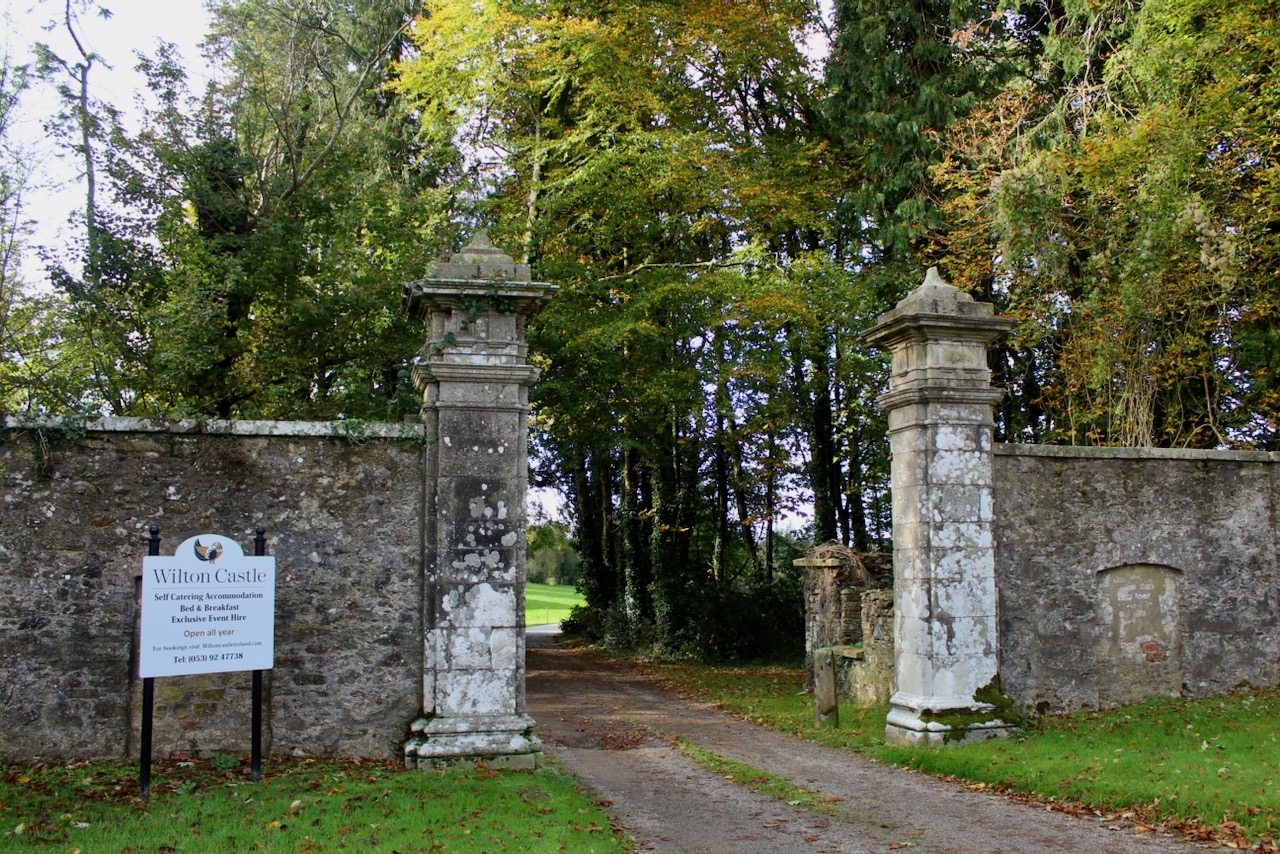
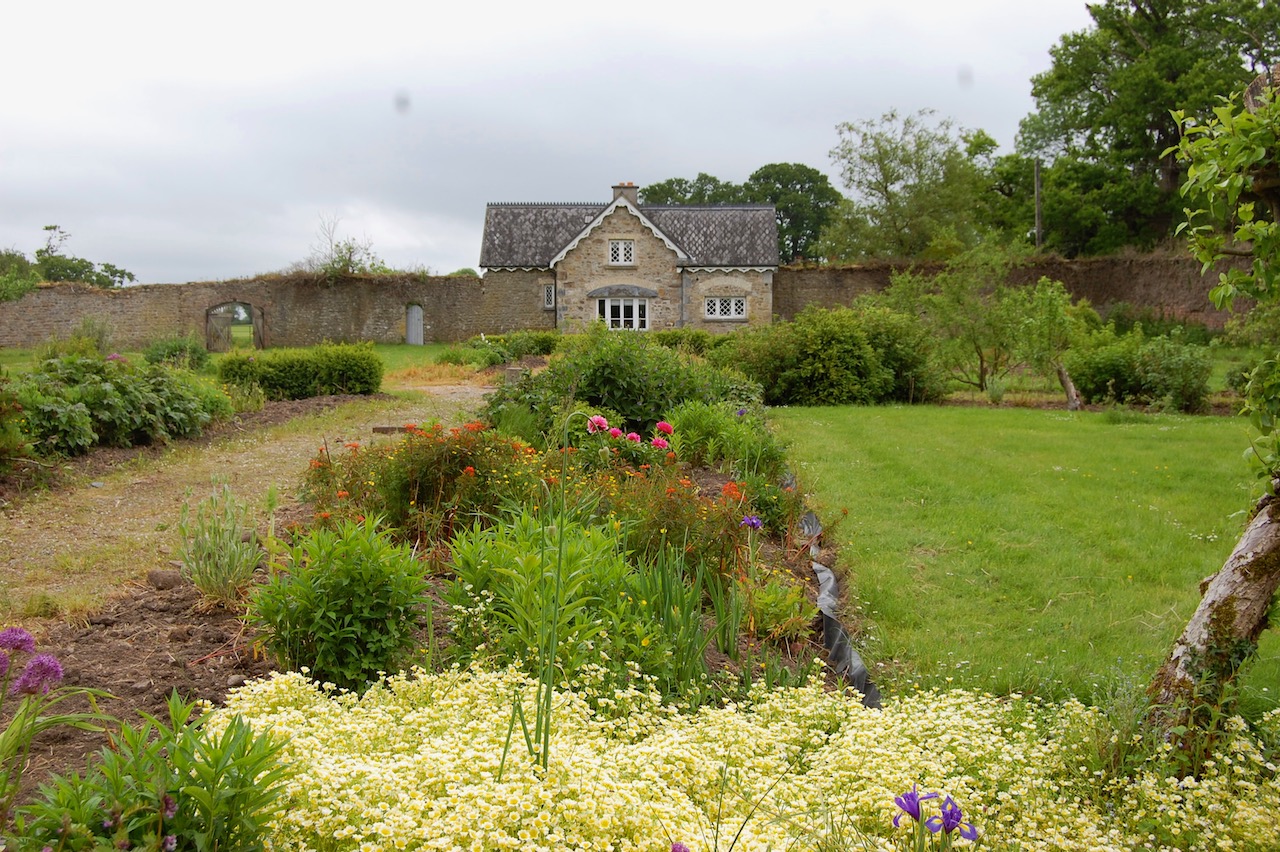
Wilton Castle, Bree, Enniscorthy, Co. Wexford Y21 V9P9 – section 482

Tourist Accommodation Facility – not open to visitors, overnight guests only

www.wiltoncastleireland.com
Open for accommodation: all year

Wilton Castle. Photograph © Jennifer Winder-Baggot, www.irishhistorichouses.com
Wilton Castle, November 2021. Photograph © Jennifer Winder-Baggot, www.irishhistorichouses.com

We treated ourselves to a stay in Wilton Castle in November in 2021. Having been gutted in a fire in 1923, it stood as a dramatic ruin until the Windsors purchased and began to refurbish it into luxurious accommodation. The current restoration was completed in 2014. So far just half of it has been rebuilt, the rest has been stabilised but remains empty and without a roof. The work which has been done by the Windsors is incredible – it seems to have been rebuilt to a very high standard. I’m not sure if they intend to continue to rebuild the rest of the castle.

Wilton Castle was designed for Harry Alcock (1792-1840) by Daniel Robertson (d. 1849) in 1836-38, subsuming parts of an earlier castle and house.

The area was previously known as Clogh na Kayer (The Castle of the Sheep). Herbert Hore writes in History of the Town and County of Wexford that an ancient Castle of Cloghnakayer was built in the fourteenth century. The De Dene family owned the land until 1354, when an only daughter married Philip Furlong whose descendant, Sir Fulke Furlong, knight, of Horetown, built a castle around 1410. 

The land then passed to the Butlers of Mountgarret. Edward Butler, Baron of Kayer (eldest son of Pierce, second son of Richard 1st Viscount Mountgarret) rebuilt and restored the ancient Castle, and added a mansion house to it in 1599. [1]

The view from our suite. Photograph © Jennifer Winder-Baggot, www.irishhistorichouses.com

Edward Butler’s son, Pierce, inherited. Pierce Butler was a Catholic and a supporter of the monarchy and his land was confiscated by the Cromwellian parliament in 1655 and granted to a Cromwellian soldier, Captain Robert Thornhill. Captain Robert’s son sold the estate in 1695 to William Alcock (d. 1705) of Downpatrick, County Down. [2]
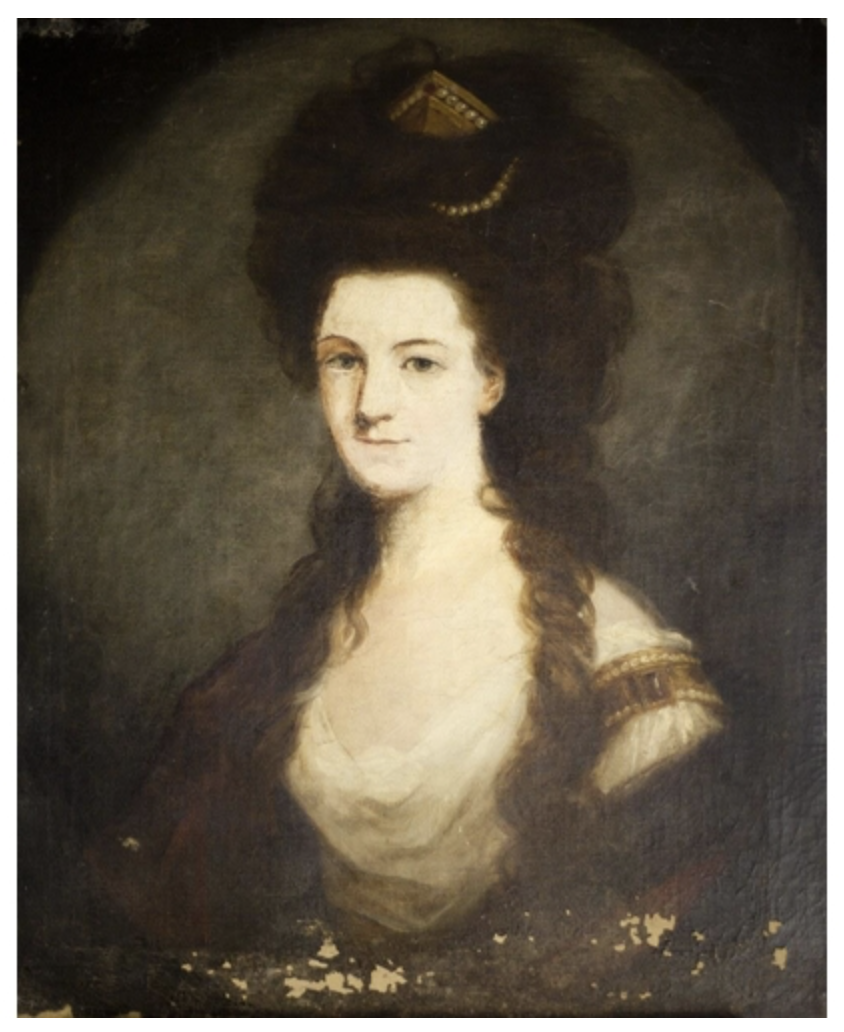
Herbert Hore tells us that William Alcock rebuilt the castle, and called it Wilton. It was this castle that was subsumed in Daniel Robertson’s design for Harry Alcock. Herbert Hore writes that “the late Colonel Alcock [Harry, (1821-93)] told me that some of the walls of the ancient Castle of the Butlers are incorporated in the present building.”

Robert O’Byrne writes: “William Alcock built a new residence for himself on the site of an old castle, and this was occupied by his descendants for several generations. A handsome classical doorcase of granite with segmental pediment above fluted pilasters survives on the façade of the former steward’s house at Wilton to indicate the appearance of the original Alcock house, dismissed by Martin Doyle in his 1868 book on the county as being ‘in the dull style of William and Mary.’ ” [3]
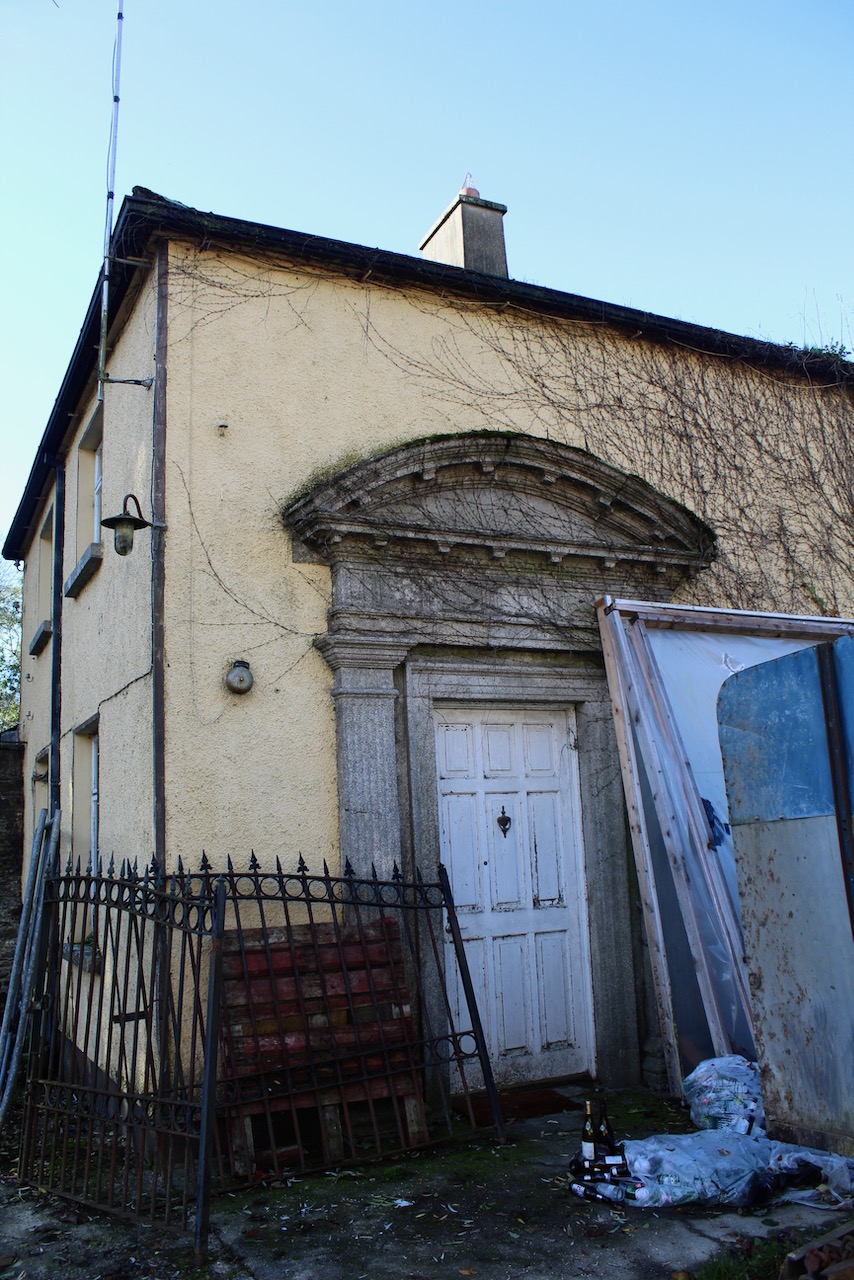
A handsome classical doorcase of granite with segmental pediment above fluted pilasters survives on the façade of the former steward’s house at Wilton to indicate the appearance of the original Alcock house.” Photograph © Jennifer Winder-Baggot, www.irishhistorichouses.com
The former steward’s house, in the stable yard below Wilton Castle. Photograph © Jennifer Winder-Baggot, www.irishhistorichouses.com

A daughter of William and his wife Jane nee Bamber of Bamber Hall of Lancaster, England, married Patrick Lattin and was the mother of the famous Jack Lattin of Morristown Lattin, County Kildare, who danced himself to death!

The estate passed to William Alcock’s son, another William Alcock (1681-1739), then to his son, Col. William Alcock (d. 1779) (Colonel in the Waterford Militia). He married Mary Loftus of Loftus Hall, County Wexford, daughter of Nicholas Loftus, 1st Viscount Loftus of Ely and his wife Anne Ponsonby, daughter of William Ponsonby, 1st Viscount Duncannon.
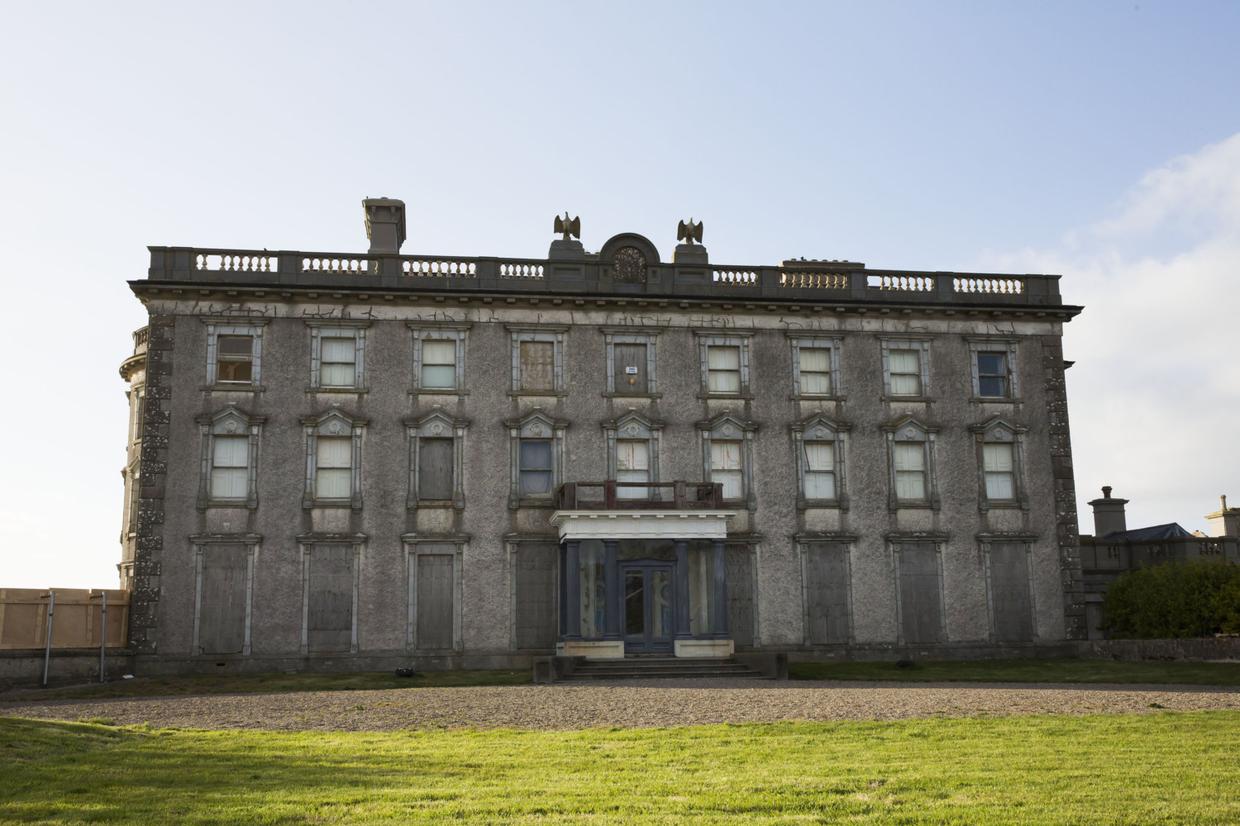
Loftus Hall, the home of Mary Loftus, wife of William Alcock (d. 1779). Photograph from the National Inventory of Architectural Heritage.

Wilton then passed to his son, Henry Alcock (d. 1811). Henry Alcock married Elizabeth Katherine Ussher, daughter of Beverly Ussher of Kilmeadon, County Waterford, who was a long term MP for County Waterford. Henry Alcock also served as an MP for Waterford. Elizabeth Katherine’s sister Mary also married an MP, John Congreve of Mount Congreve in Waterford (which has beautiful gardens open to the public, although temporarily closed – I wonder if the house is to be opened also?).

The estate then passed to his son, William Congreve Alcock (1771-1812). William competed in the general election of 1807 against John Colclough of Tintern Abbey (son of Vesey Colclough, MP for County Wexford). Unfortunately they decided to settle a dispute by a duel, and William shot and killed John. John had been engaged to a sister of William’s. William was tried for murder but acquitted. He never got over the incident however and it affected his mental health and he died five years later. [4] Thus Wilton Castle passed to his brother, Harry Alcock (1792-1840).

In 1818 Harry Alcock married Margaret Elinor Savage, daughter of James Savage of Kilgibbon, County Wexford (this house is now a ruin). He then engaged Daniel Robertson in 1837 to renovate Wilton House, which became Wilton Castle. The newer house was built in front of the older Wilton House.

The older Wilton House, covered in weather-slating, is visible at the back of Wilton Castle. Photograph © Jennifer Winder-Baggot, www.irishhistorichouses.com

The details of Daniel Robertson’s training are not known. He struggled with bankruptcy for a large part of his life and moved from working in Oxford in England to Ireland, at the urging of his father-in-law. The Dictionary of Irish Architects tells us:

From the early 1830s he did no further work in Britain but received a series of commissions in Ireland, mainly for country house work in the south eastern counties. Most of these houses or additions were in the Tudor style, which, he asserted in a letter to a client, Henry Faulkner, of Castletown, Co. Carlow, was ‘still so new and so little understood in Ireland’. For some of them he used Martin Day as his executant architect. In spite of his success in attracting commissions, when he was working at Powerscourt in the early 1840s he was, in the words of Lord Powerscourt, ‘always in debt and…used to hide in the domes of the roof of the house’ to escape the Sheriff’s officers who pursued him. By then he was crippled with gout and in an advanced state of alcoholism; at Powerscourt he ‘used to be wheeled out on the terrace in a wheelbarrow with a bottle of sherry, and as long as that lasted he was able to design and direct the workmen, but when the sherry was finished he collapsed and was incapable of working till the drunken fit had evaporated.’ In at least two instances – at Powerscourt and at Lisnavagh – he lived on the premises while work was in progress, and it seems that from the 1830s until the year of his death his wife and family never settled for any time in Ireland… Robertson was overseeing the completion of Lisnavagh, Co. Carlow, where he had been living intermittently since the start of building in 1846, when he fell seriously ill in the spring of 1849” and died in September of that year. [5]

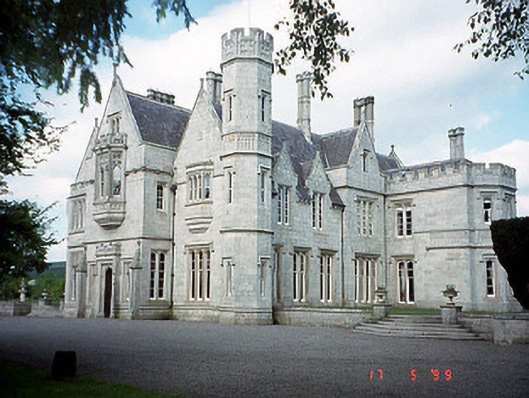
Ballydarton House, County Carlow, also designed by Daniel Robertson, in 1830. Photograph from the National Inventory of Architectural Heritage.
Dunleckney Manor, County Carlow, by Daniel Robertson, 1835. Photograph from the National Inventory of Architectural Heritage.

Daniel Robertson also designed the nearby Johnstown Castle in County Wexford. We visited Johnstown Castle also but unfortunately it was closed the only day we were in Wexford, as they were taking down Hallowe’en decorations from a special event! Such a pity we weren’t able to see the inside of the castle yet, but we shall certainly visit again.

Johnstown Castle is described in the National Inventory of Architectural Heritage: “the construction in a blue-green rubble stone offset by glimmering Mount Leinster granite dressings not only demonstrating good quality workmanship, but also producing a sober two-tone palette.” [6] Wilton Castle also has Mount Leinster granite dressings. It was covered however in white lime plaster – which has been reinstated on the renovated part of the castle.

The lakeside facade of Johnstown Castle, County Wexford, built 1836-72 for Hamilton Knox Grogan Morgan (1808-54), MP, also by Daniel Robertson – it has remarkable similarities to Wilton Castle. It envelops a seventeenth-century house (perhaps by Thomas Hopper) [7] remodelled (1810-4) by James Pain (1779-1877) of Limerick. Photograph © Jennifer Winder-Baggot, www.irishhistorichouses.com
Johnstown Castle overlooks a beautiful lake. Photograph © Jennifer Winder-Baggot, www.irishhistorichouses.com

Harry’s daughter Henrietta married William Russell Farmar who also had a house built by Daniel Robertson: Bloomfield in County Wexford.
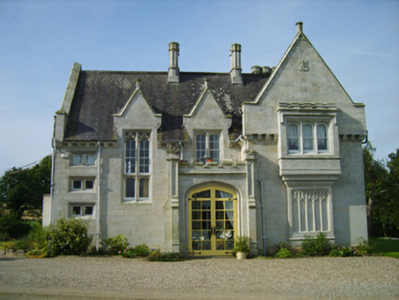
Bloomfield, a country house erected for William Russell Farmar JP (1802-71) to a design by Daniel Robertson. Photograph from National Inventory of Architectural Heritage.

Another daughter, Sarah, married Thomas John Fetherston, 5th Baronet, of Ardagh, County Longford (the house is now in use as training college, St. Brigid’s Training College, by the Sisters of Mercy).

Harry’s son, another Harry Alcock (1821-93), inherited Wilton Castle and the estate. He served as High Sheriff of Wexford in 1846 and was Lt-Col. of the Wexford Militia.  He continued the building work, which finished in 1844, adding the large square four storey tower with its elaborate balconies. He also improved the surrounding estate. He increased the plantation of trees and implemented a programme of road construction, fence building and draining of land which was carried out as Famine relief work. [8]

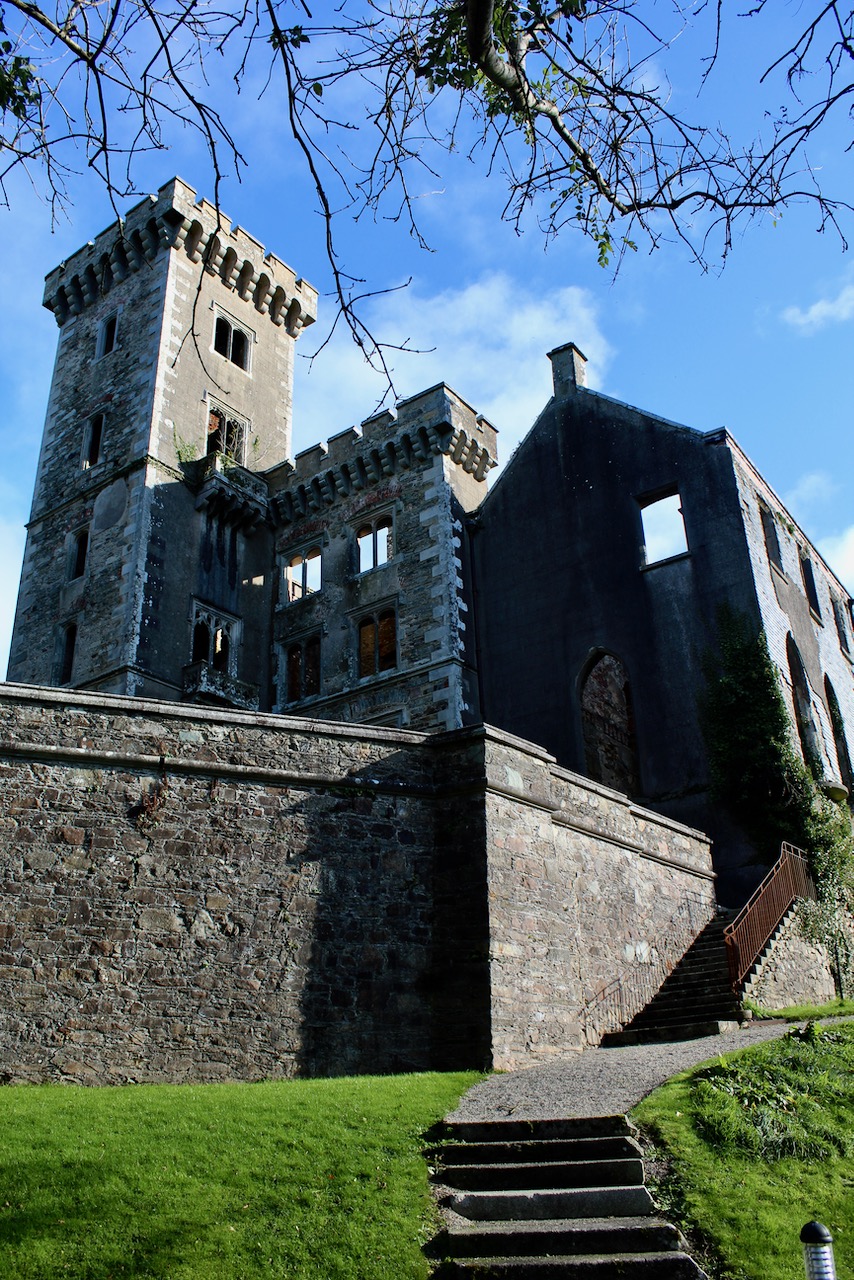
Wilton Castle, November 2021. Photograph © Jennifer Winder-Baggot, www.irishhistorichouses.com

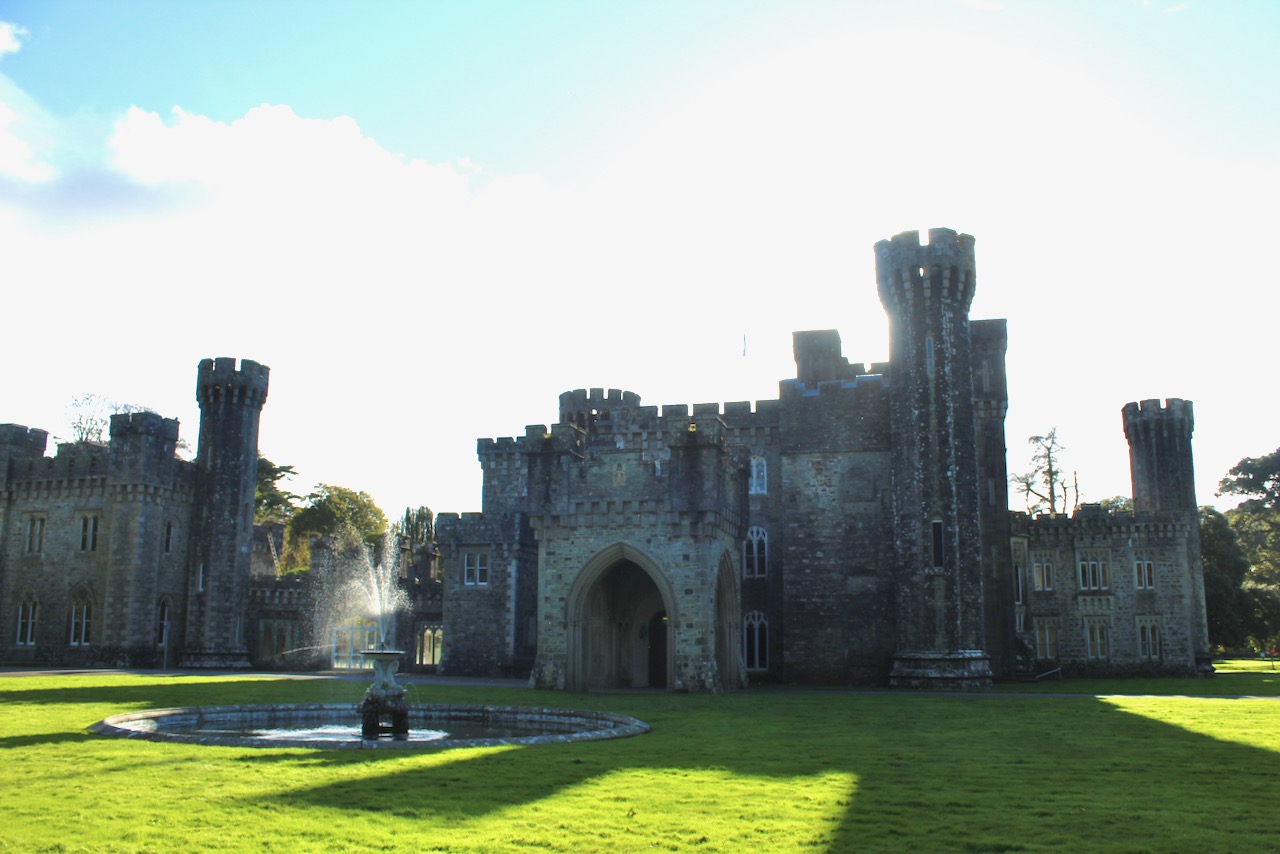
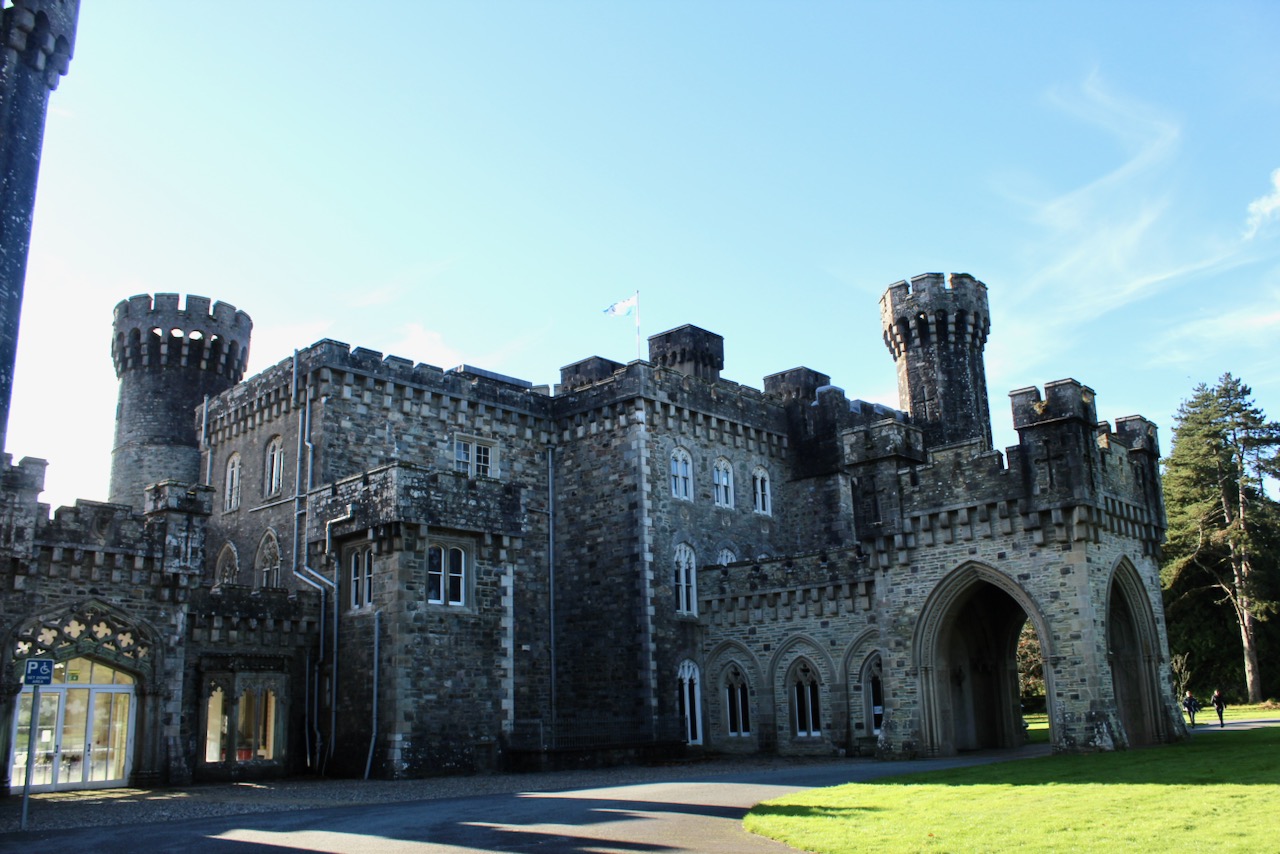
Wilton Castle, when designed by Daniel Robertson, consisted of a three-storey main block and two-storey wing, all dominated by a tall square tower at one end and a tall polygonal tower and turret at the other, and it is heavily machicolated and battlemented. It is the two storey wing which has been renovated for accommodation.
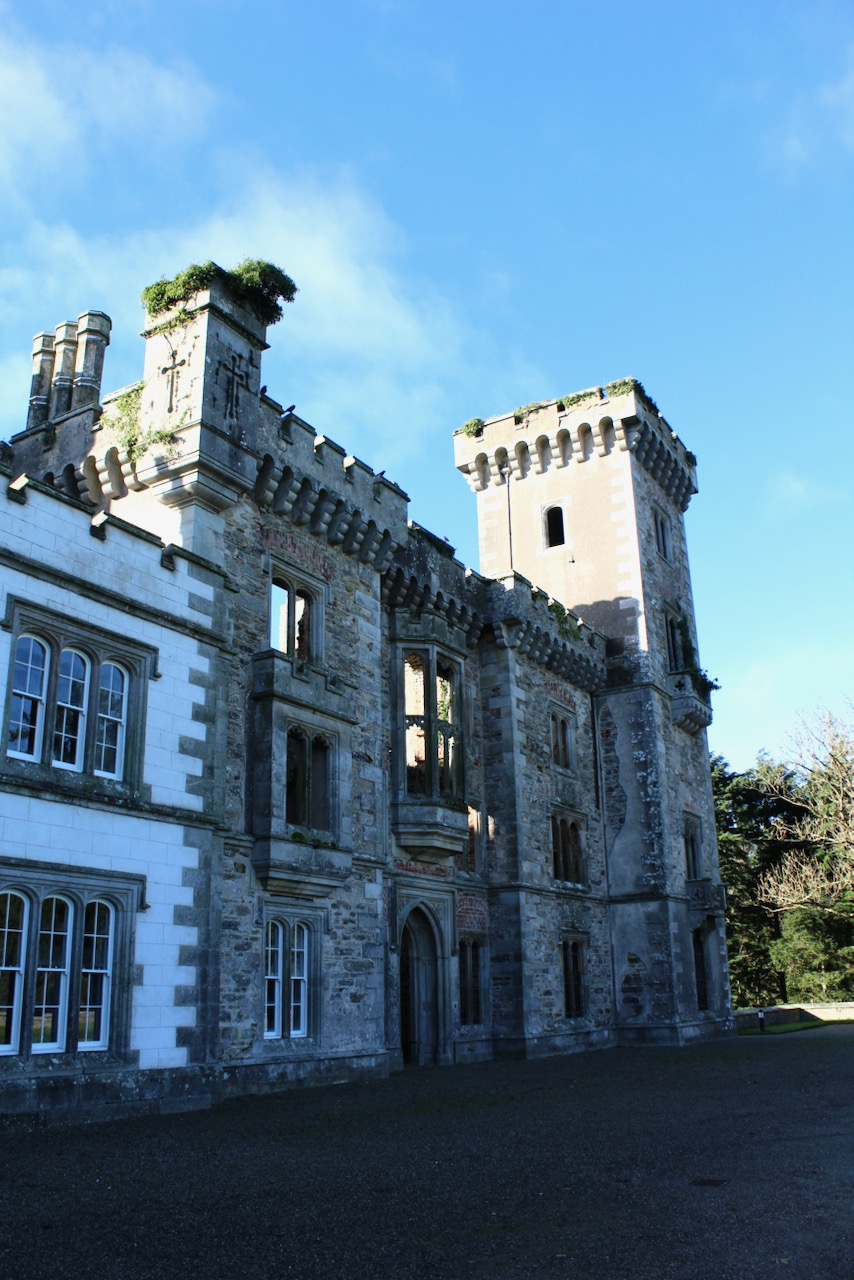
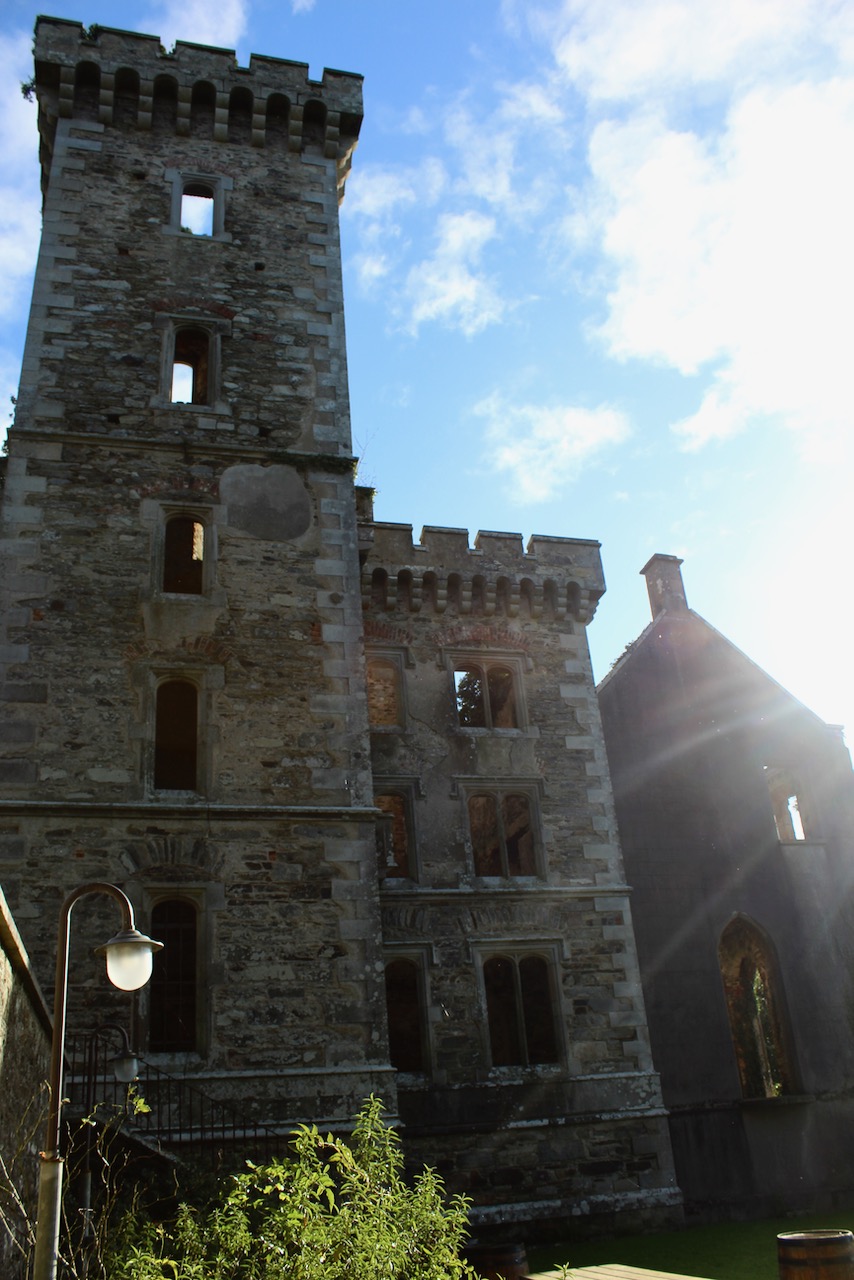
The tall square tower is at one end of Wilton Castle, on the three storey section. Photograph © Jennifer Winder-Baggot, www.irishhistorichouses.com

Harry Alcock died unmarried in 1893 and the estate (some 7,000 acres in the 1870s) passed to his nephew, Philip Clayton Alcock (1861-1949), son of Harry’s brother Philip Savage Alcock (1828-86) of Park House on the Wilton estate and his wife Katherine Annette Browne-Clayton of Carrickbyrne Lodge in County Wexford. Philip Clayton Alcock was a Captain in the Gloucestershire Regiment, and in 1900 High Sheriff of Wexford, but by 1922 he felt it was too dangerous to remain at Wilton and moved to England. In 1923 his fears about his Irish property were justified when Wilton Castle was burned by arsonists. [9]

A contemporary account in the Irish Times, 7 March 1923 tells us about the burning: “Wilton Castle, the residence of Captain P.C. Alcock, about three miles from Enniscorthy, was burned by armed men on Monday night. Nothing remains of the beautiful building but smoke-begrimed, roofless walls, broken windows, and a heap of smouldering debris. The Castle was occupied by a caretaker – Mr. James Stynes – the owner, with his wife and family, having gone to England about a year ago. Shortly after 9 o’clock on Monday night the caretaker was at the Steward’s residence…when he was approached by armed men, who demanded the keys to the Castle. When he asked why they wanted the keys, one of the armed men said: “We have come to burn the place. We are sorry”. The raiders told the caretaker that he could remove his personal belongings from the part of the Castle that he occupied, but they would not allow him to remove the furniture. Fearing that the Castle might be burned, however, Captain Alcock had removed the most valuable portion of his furniture some weeks ago, but a good many rooms were left furnished. When the caretaker had removed his property he was ordered back to the Steward’s house. Soon the noise of breaking glass was heard. It appears that the armed men broke all the windows on the ground floor, and having sprinkled the floors with petrol, set them alight. They did not hurry over their work of destruction, and they did not leave the Castle until near 12 o’clock, when the building was enveloped in flames. About thirty men took part in the raid. After the raiders left, the caretaker and Steward, with what help they could procure, tried to extinguish the flames, but their effort was hopeless”. [10]
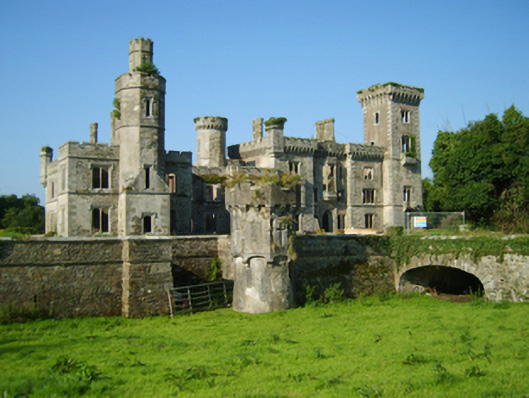
Photograph from the National Inventory of Architectural Heritage of Wilton Castle before renovation.
The tall polygonal tower and telescoping turret at the other end of Wilton Castle, on the two storey section of the castle, which has been renovated and faced in a creamy white lime plaster to distinguish it from the section which remains a ruin. Photograph © Jennifer Winder-Baggot, www.irishhistorichouses.com

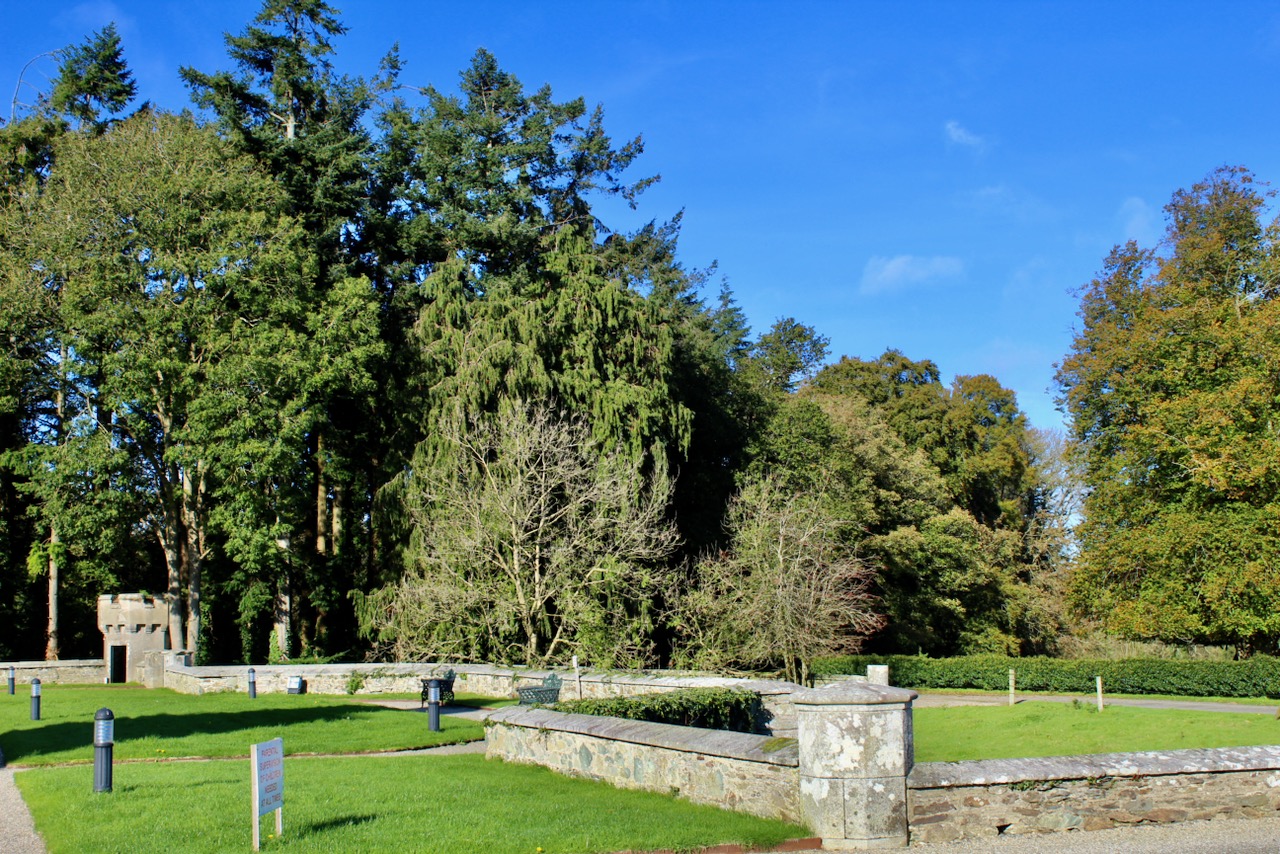
Wilton Castle was built on a moated platform surrounded by parapet walls and sham fortifications.

The moated area, in front of the castle. Photograph © Jennifer Winder-Baggot, www.irishhistorichouses.com
One of the little fortification towers along the moat in front of the castle. Photograph © Jennifer Winder-Baggot, www.irishhistorichouses.com
Area in front of the castle, with another of the fortification towers and the moated area (not filled with water) lies on the far side of the low wall. Photograph © Jennifer Winder-Baggot, www.irishhistorichouses.com
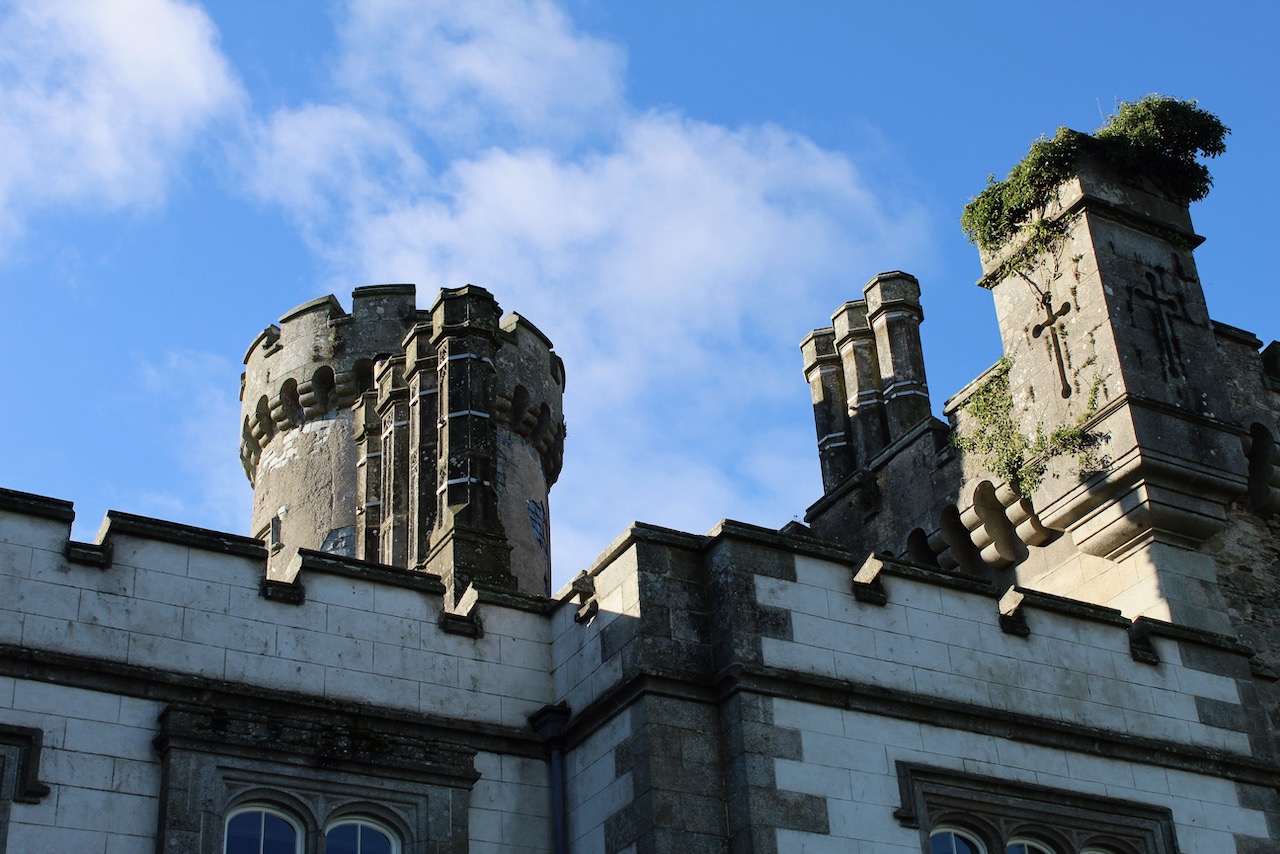
The windows of Wilton Castle are arched and paired and have hood mouldings; the roof has crenellations. Photograph © Jennifer Winder-Baggot, www.irishhistorichouses.com
The side of Wilton Castle. Note the fine stone chimneys. The octagonal turret on the south west corner of Wilton Castle is built entirely of Mount Leinster granite and contains 182 cubic ft of stone or approx 13.5 ton in weight. [11] Photograph © Jennifer Winder-Baggot, www.irishhistorichouses.com
Wilton Castle, November 2021. Photograph © Jennifer Winder-Baggot, www.irishhistorichouses.com

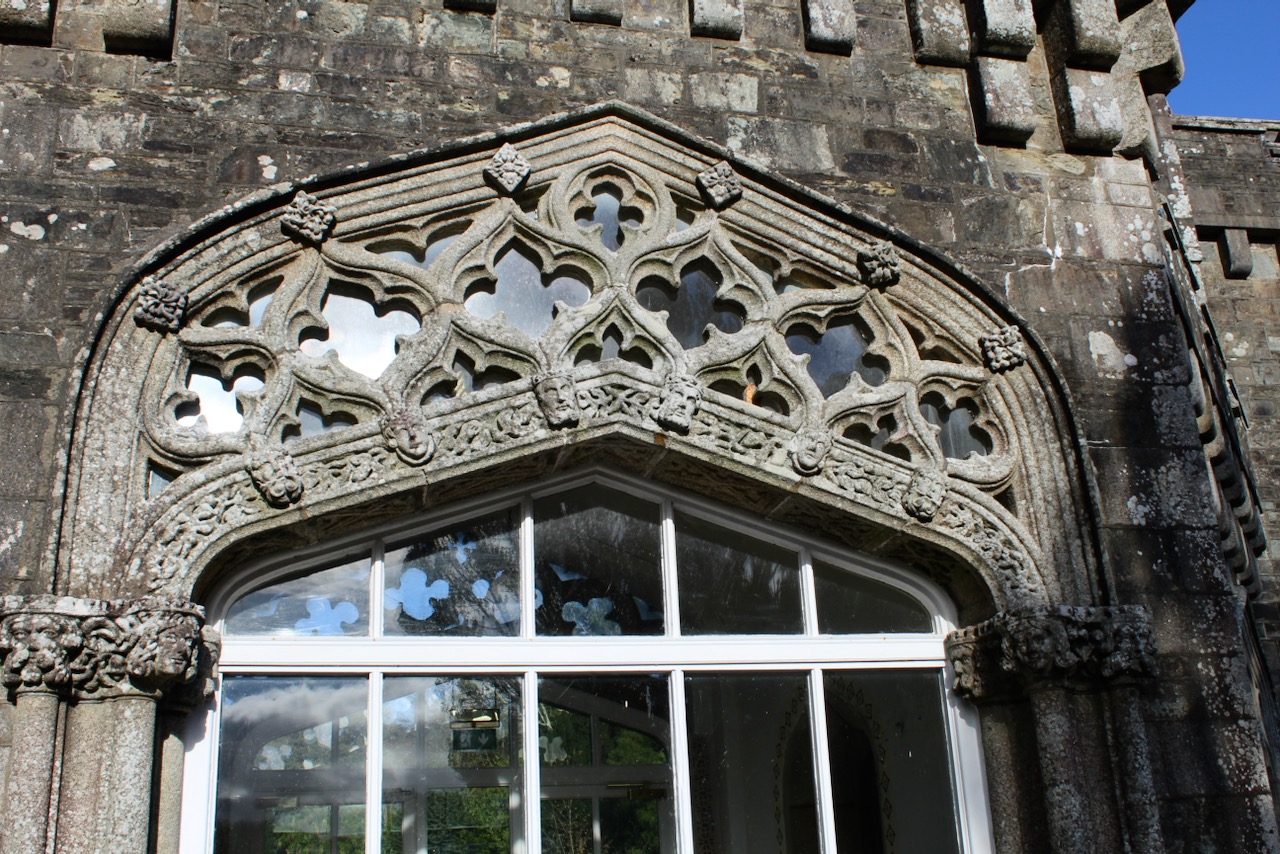
In the three storey section of the castle, there is a beautiful carved doorcase, and an oriel window over it with delicate stone tracery and crenellations on top of the windowframe. Mark Bence-Jones defines an oriel window as “a large projecting window in Gothic, Tudor, Gothic-Revival and Tudor-Revival architecture; sometimes rising through two or more storeys, sometimes in an upper storey only and carried on corbelling.” [12] There is a similar oriel window at Johnstown Castle, which is only one storey high.
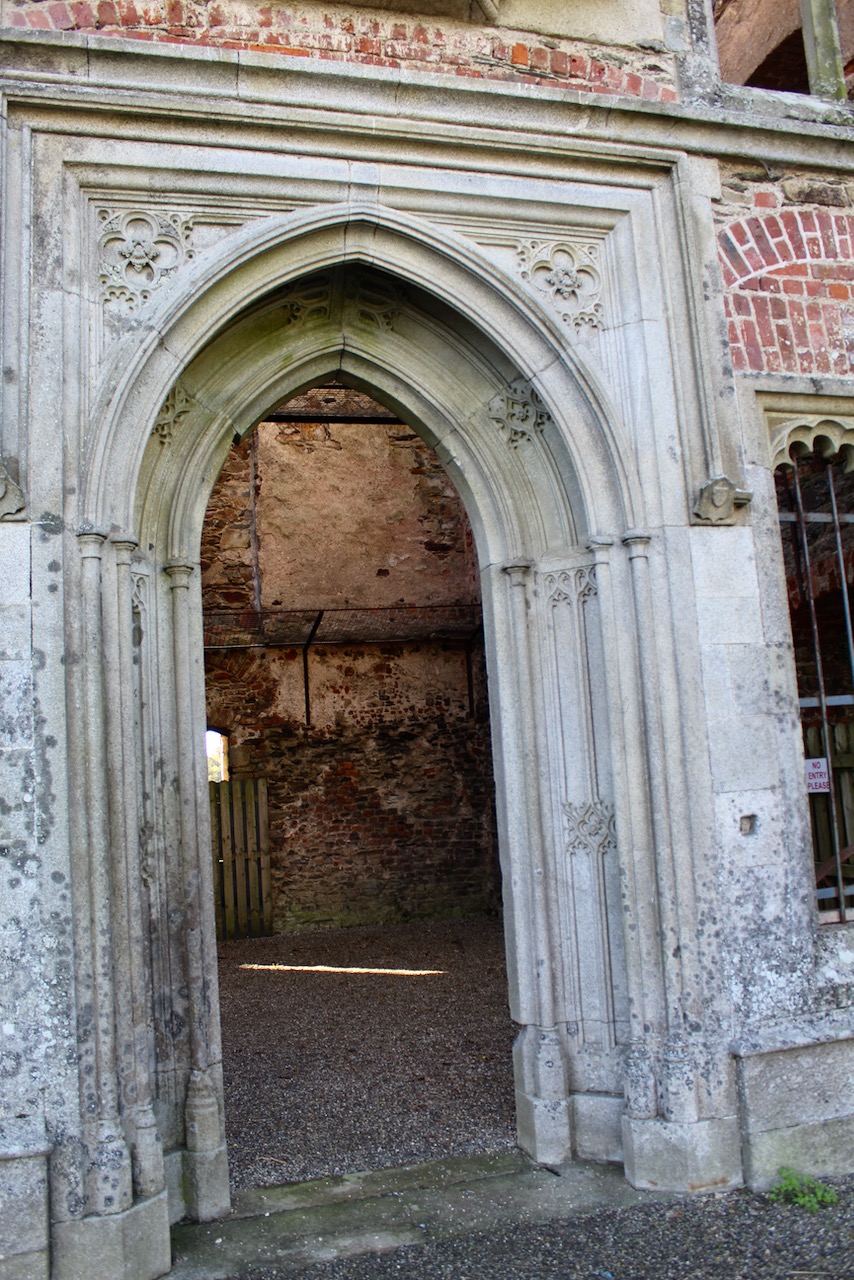
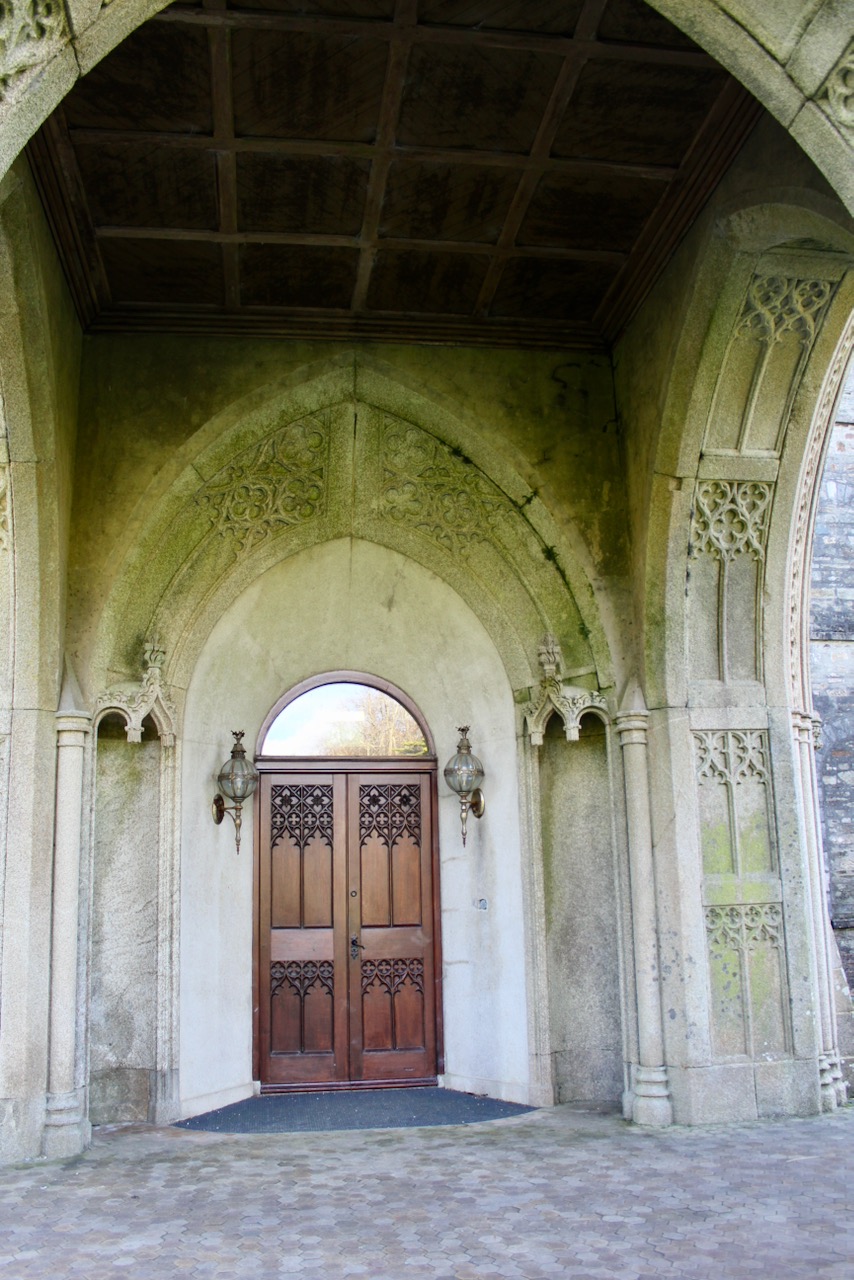
The beautifully carved Tudor-style doorcase at Wilton Castle. Photograph © Jennifer Winder-Baggot, www.irishhistorichouses.com
The carved doorcase and oriel window of Wilton Castle. Photograph © Jennifer Winder-Baggot, www.irishhistorichouses.com

At Wilton Castle there are double sets of sidelight windows either side of the doorcase, with arched carved window frames.

The Oriel window at Johnstown Castle, similar to that at Wilton Castle though the one at Wilton Castle is double-height. Photograph © Jennifer Winder-Baggot, www.irishhistorichouses.com

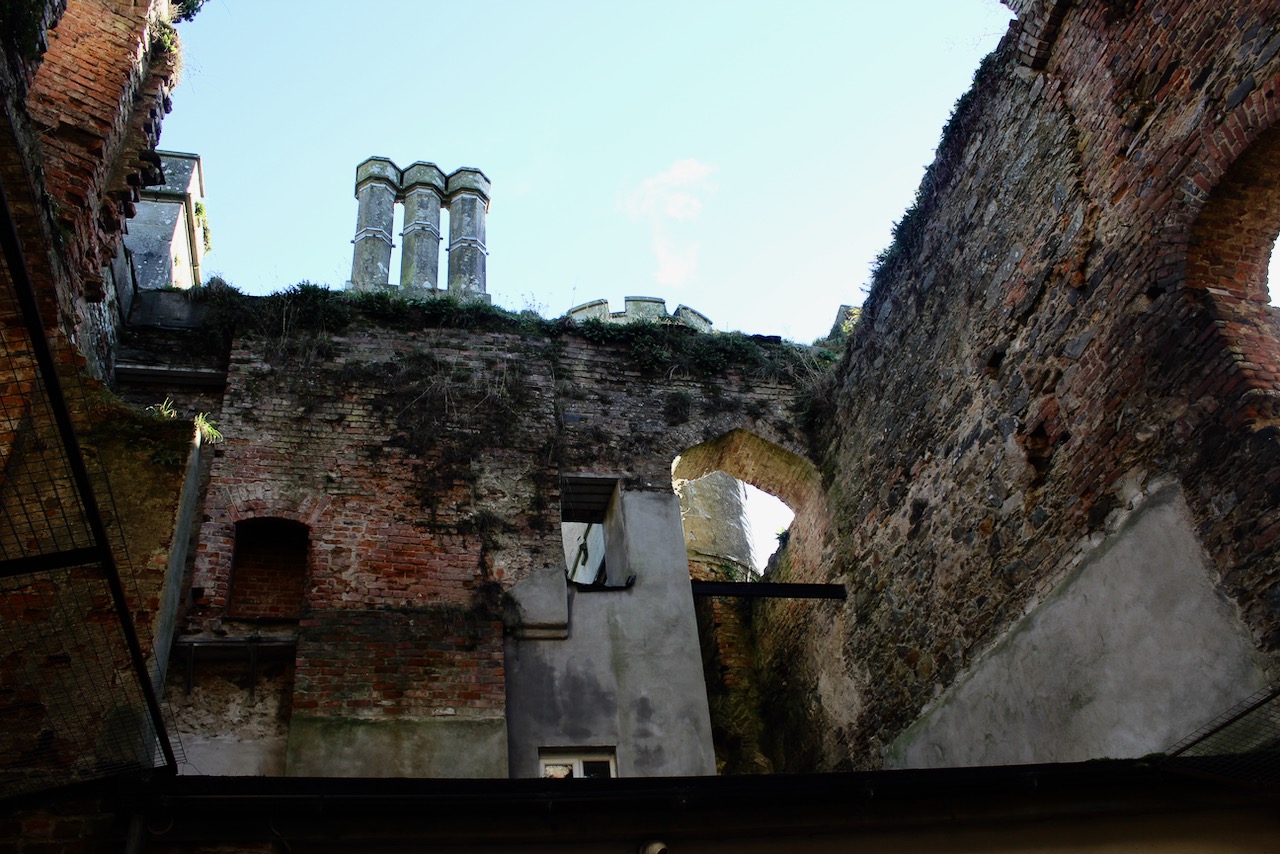
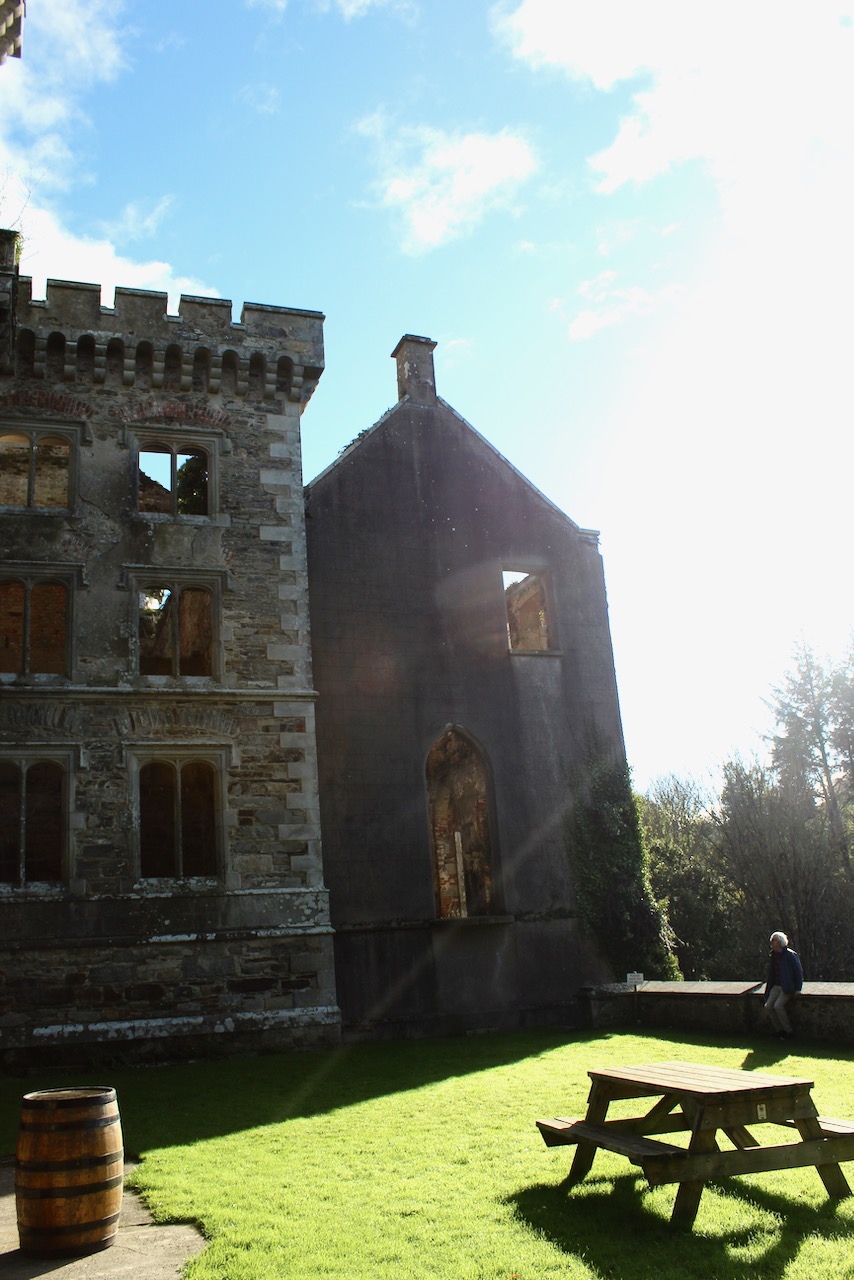
I was most excited to discover that we could explore the ruined part of the castle as it has been stabilised securely. It was wonderful to explore the detail.
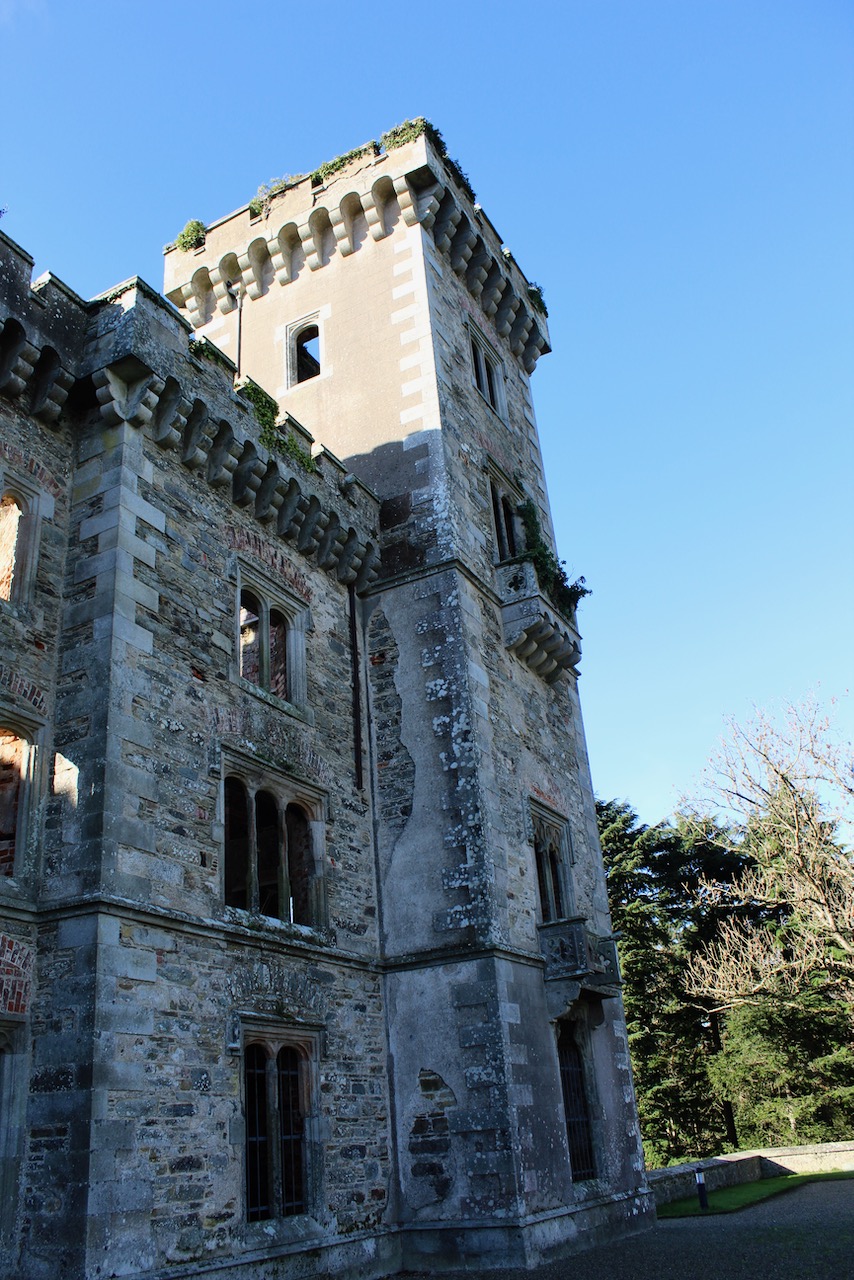
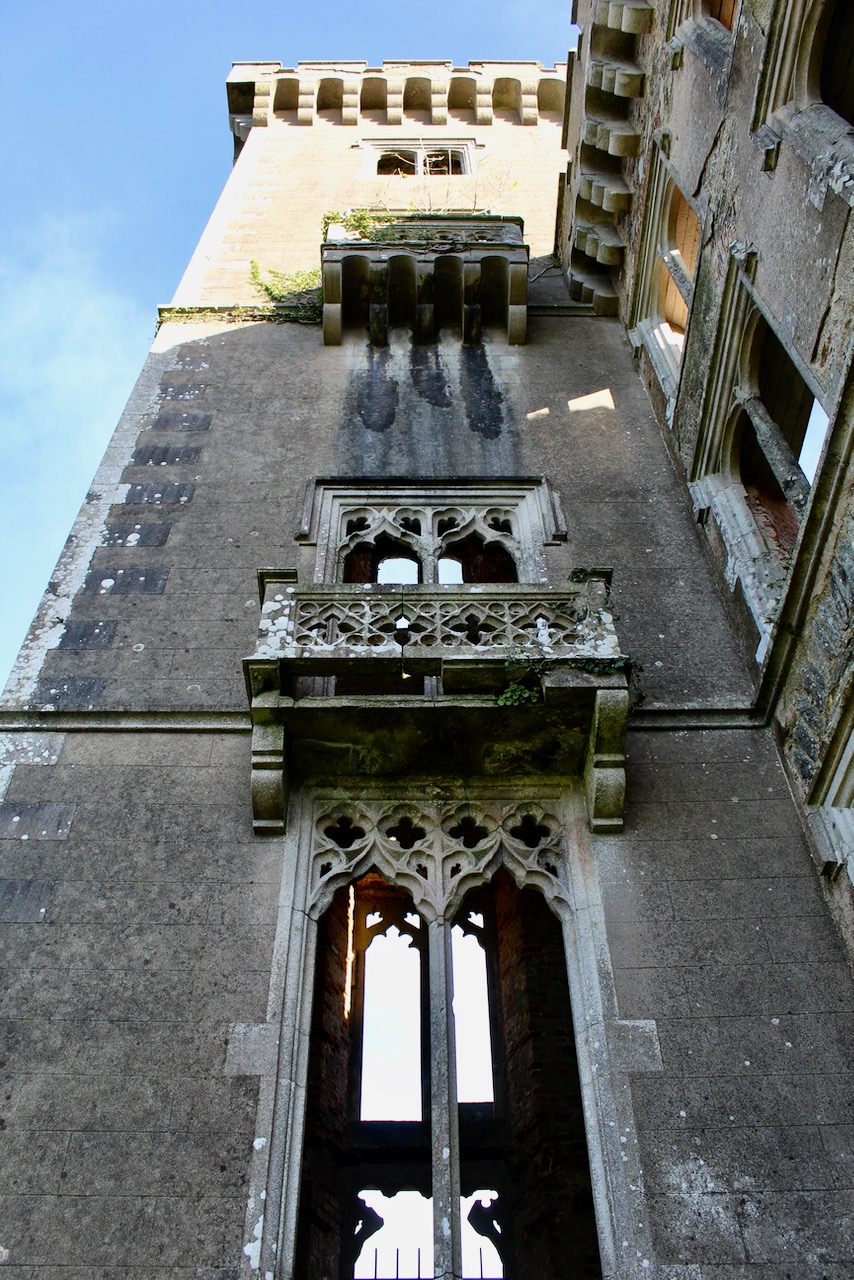
The tower of the ruined part of Wilton Castle. It has wonderful balconies on heavy stone corbels with Gothic tracery windows. Photograph © Jennifer Winder-Baggot, www.irishhistorichouses.com
The oriel window and doorcase as seen from inside Wilton Castle. Photograph © Jennifer Winder-Baggot, www.irishhistorichouses.com
Wilton Castle. Photograph © Jennifer Winder-Baggot, www.irishhistorichouses.com
Wilton castle. Photograph © Jennifer Winder-Baggot, www.irishhistorichouses.com
Wilton Castle, November 2021. Photograph © Jennifer Winder-Baggot, www.irishhistorichouses.com

We kept discovering more. Pictures from the front of the castle do not do it justice. The land drops down behind the castle to the River Boro, to reveal beautiful pastoral views from the back windows of the castle.

The view over the river from inside the ruin of Wilton Castle. Photograph © Jennifer Winder-Baggot, www.irishhistorichouses.com
Wilton Castle. Photograph © Jennifer Winder-Baggot, www.irishhistorichouses.com
The River Boro running along the back of Wilton Castle. Photograph © Jennifer Winder-Baggot, www.irishhistorichouses.com
There are lots of stone corbels. Photograph © Jennifer Winder-Baggot, www.irishhistorichouses.com
The spiral staircase inside the round tower at the back of the castle which joins the older Wilton House to the rest of the Castle. Photograph © Jennifer Winder-Baggot, www.irishhistorichouses.com
The view from the interior spiral staircase inside the ruin, of the river side of the castle and down toward the steward’s house. Photograph © Jennifer Winder-Baggot, www.irishhistorichouses.com

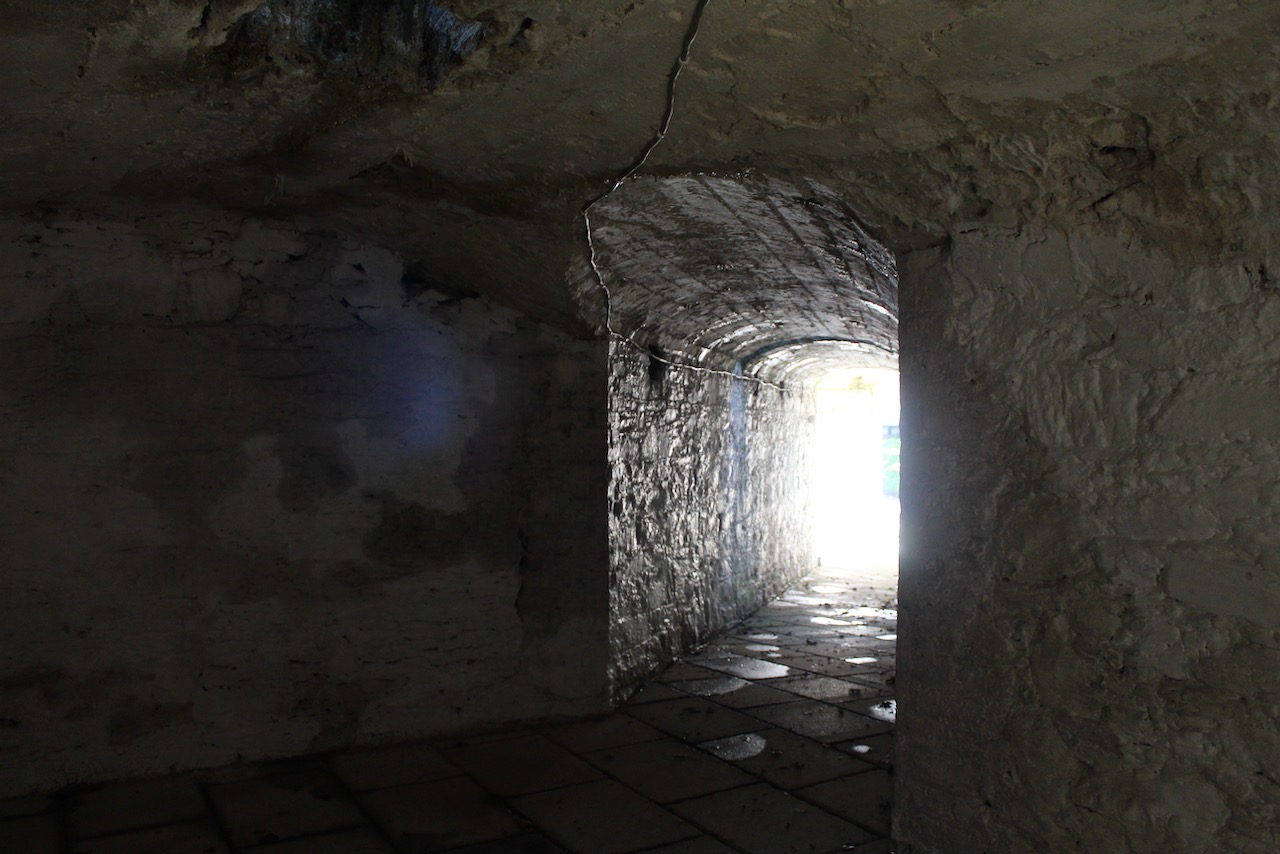
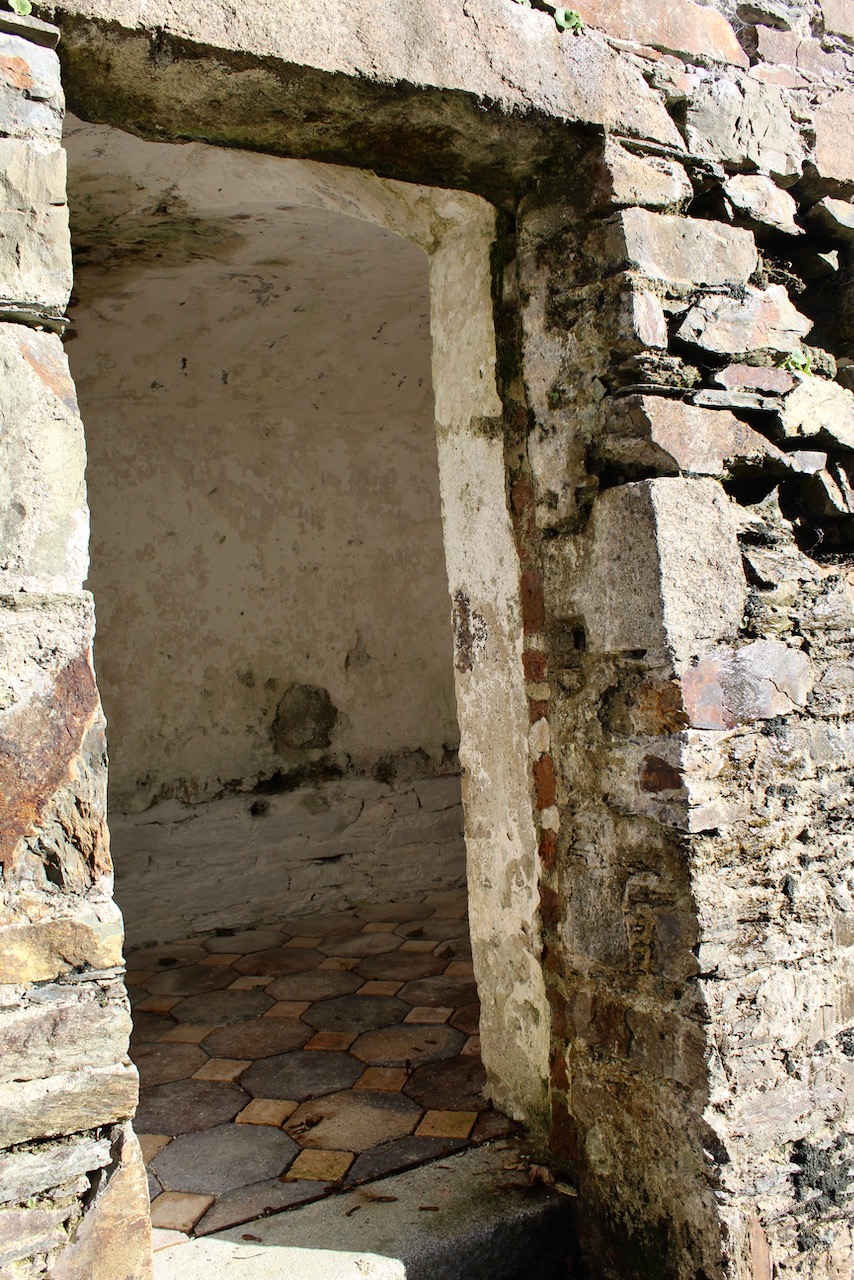
One can walk down to the river and more of the detail of the castle is revealed from behind. We found a warren of tunnels to one side on a level below the castle.
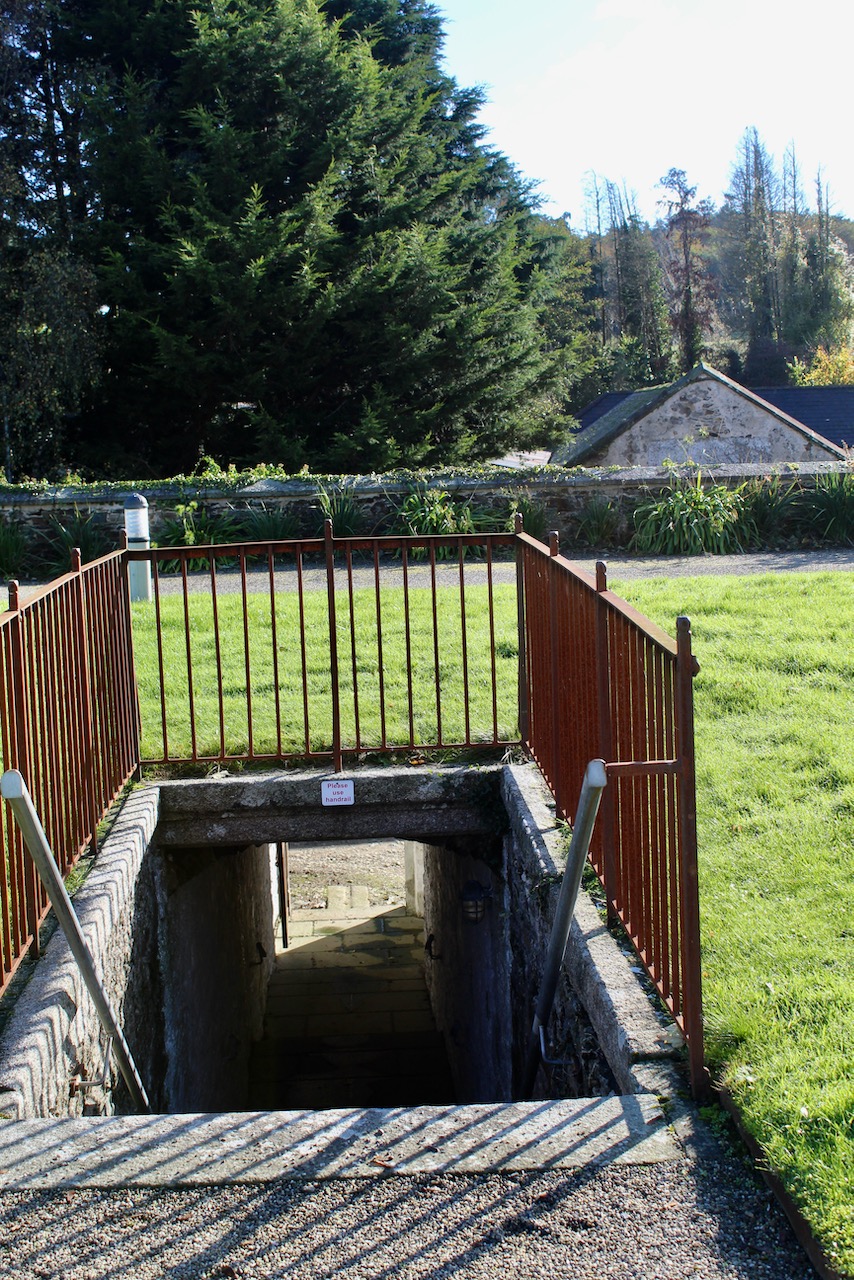
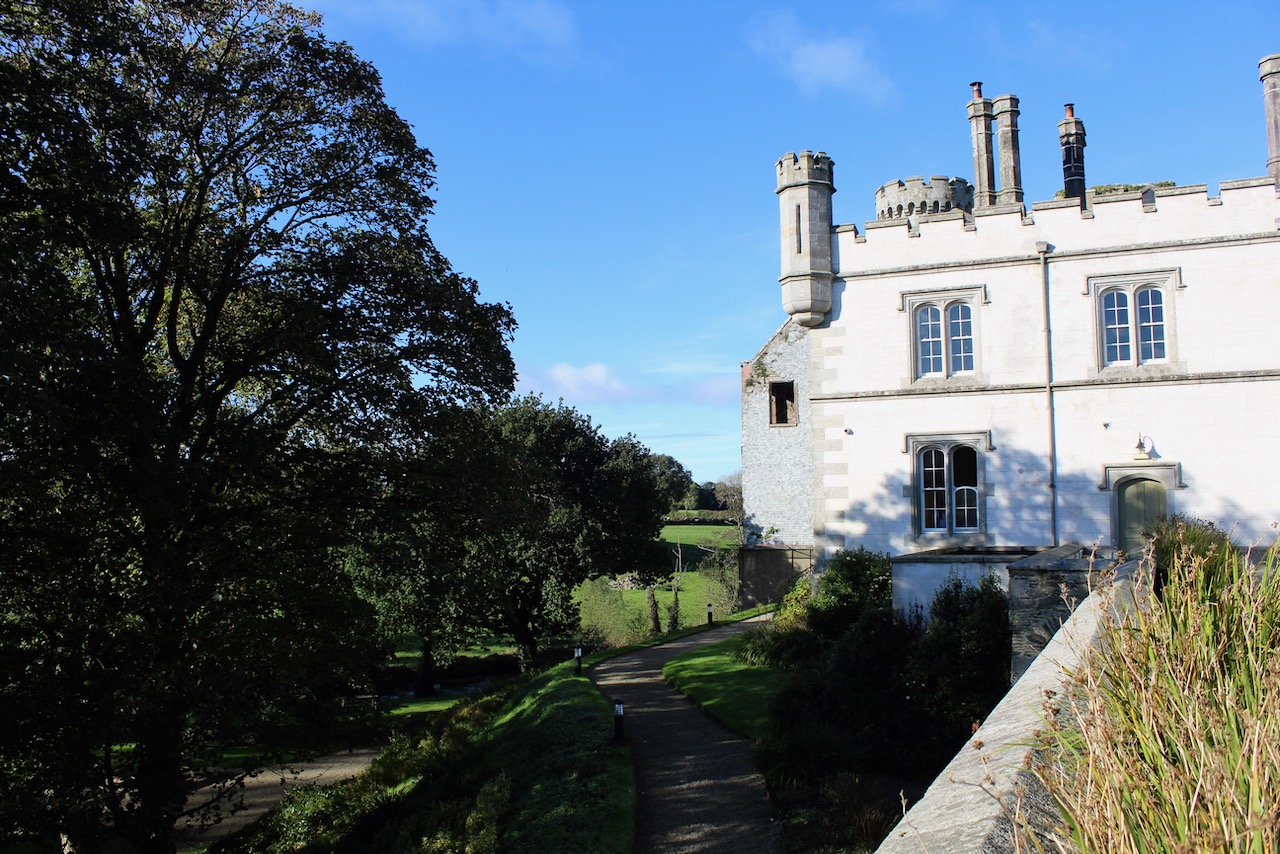
The tunnel from the castle level down to the farmyard. Photograph © Jennifer Winder-Baggot, www.irishhistorichouses.com
In this photograph you can see the side of the castle, and the path below. The river lies below that. Photograph © Jennifer Winder-Baggot, www.irishhistorichouses.com
The tunnels to the side of Wilton Castle, at the lower level. Photograph © Jennifer Winder-Baggot, www.irishhistorichouses.com

The tunnels provided quick access for servants to different parts of the castle, stable yard and grounds. There were cellars for wine and storage areas for food. Cast iron grilles let natural light and air into the tunnels. [13]

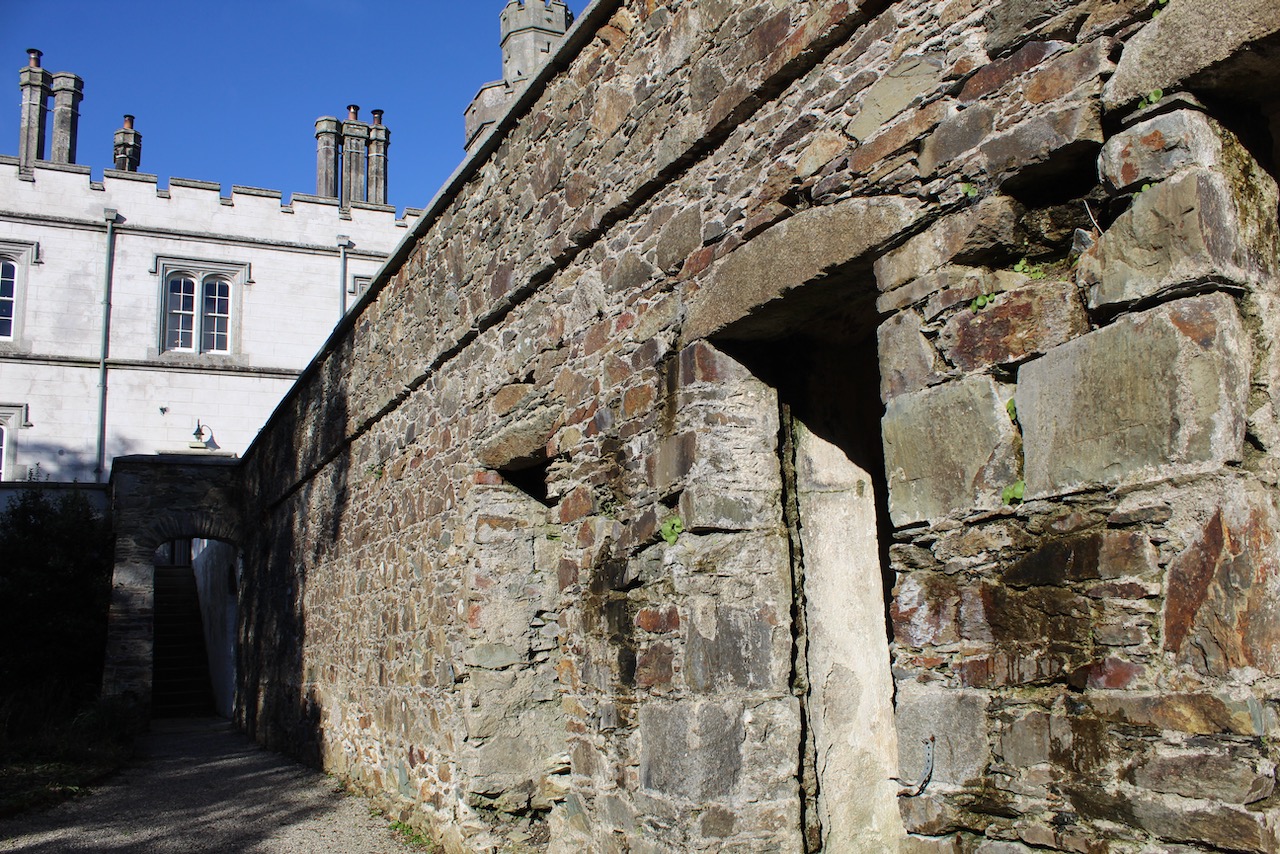
The entrances to the tunnels are in this stone wall. Photograph © Jennifer Winder-Baggot, www.irishhistorichouses.com
Entrances to the tunnels, in the stone wall. Photograph © Jennifer Winder-Baggot, www.irishhistorichouses.com
Wilton Castle. Photograph © Jennifer Winder-Baggot, www.irishhistorichouses.com
The riverside facade of Wilton Castle. The three storey section in the back – which is part of the older Alcock house – is covered in weather-slating tiles. The round tower contains the spiral staircase which I climbed inside the ruin. Photograph © Jennifer Winder-Baggot, www.irishhistorichouses.com
It was only when we explored around the river side of Wilton Castle that we realised the extent of its size and the beauty of its surroundings. Photograph © Jennifer Winder-Baggot, www.irishhistorichouses.com
Wilton Castle. Photograph © Jennifer Winder-Baggot, www.irishhistorichouses.com
The older section of Wilton Castle, formerly Wilton House. Photograph © Jennifer Winder-Baggot, www.irishhistorichouses.com
From the path along the river side of the castle, one can climb back up these stairs, to discover a picnic area! Photograph © Jennifer Winder-Baggot, www.irishhistorichouses.com
The picnic area. Photograph © Jennifer Winder-Baggot, www.irishhistorichouses.com
Wilton Castle. Photograph © Jennifer Winder-Baggot, www.irishhistorichouses.com
From the picnic area, you can see the full height of the square tower. Photograph © Jennifer Winder-Baggot, www.irishhistorichouses.com
More wonderful balconies and tracery windows in the square tower, seen from the river side. Photograph © Jennifer Winder-Baggot, www.irishhistorichouses.com

After the fire, the Alcocks were unable to rebuild as the house had not been insured. The lands were redistributed by the Irish Lands Commission, and the castle and land was purchased by local farmer, Sean Windsor.

When we arrived we were welcomed and brought inside the renovated section of the castle. It opens into a nicely tiled hallway.
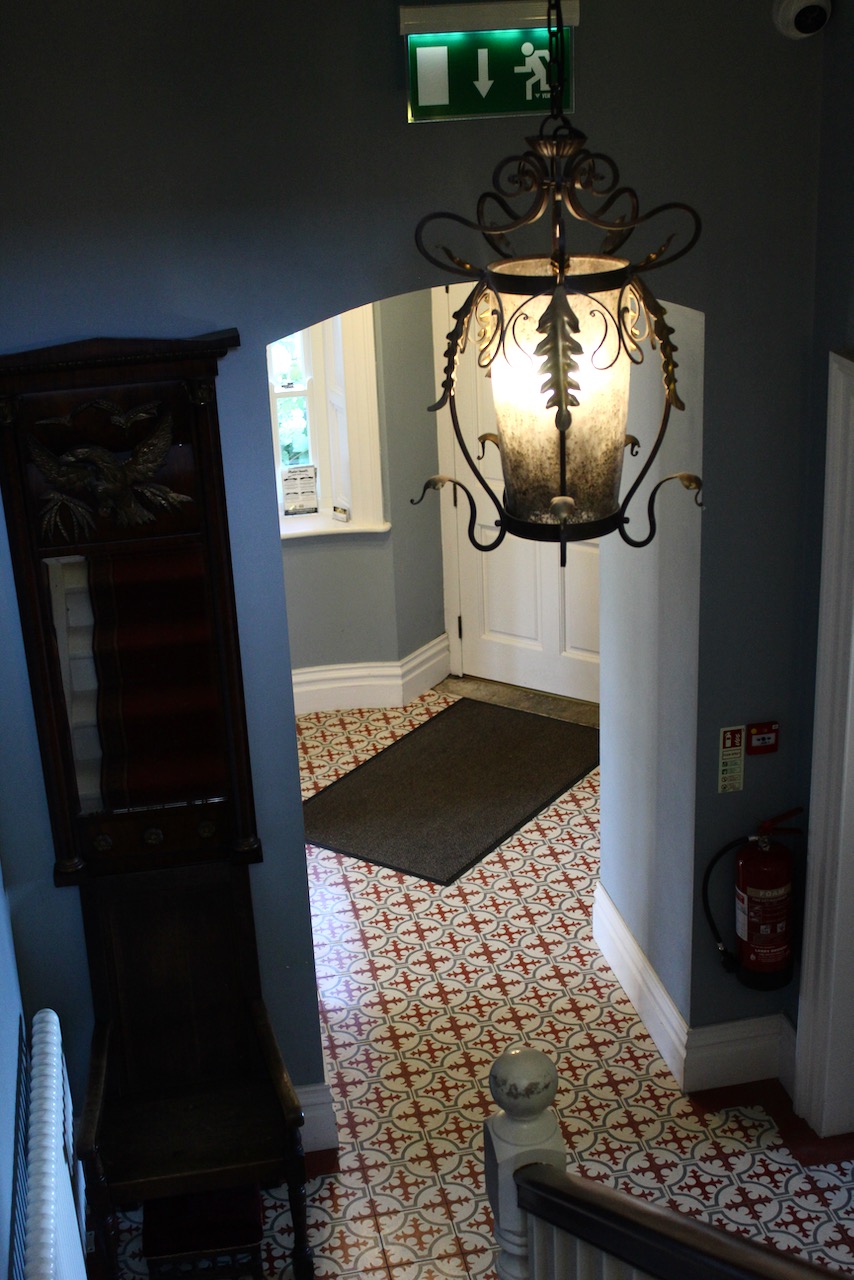
Wilton Castle, November 2021. Photograph © Jennifer Winder-Baggot, www.irishhistorichouses.com

The accommodation consists of four suites, one of which has a large entertaining space. Two suites are upstairs and two downstairs, with the large one being downstairs. Our accommodation was upstairs.
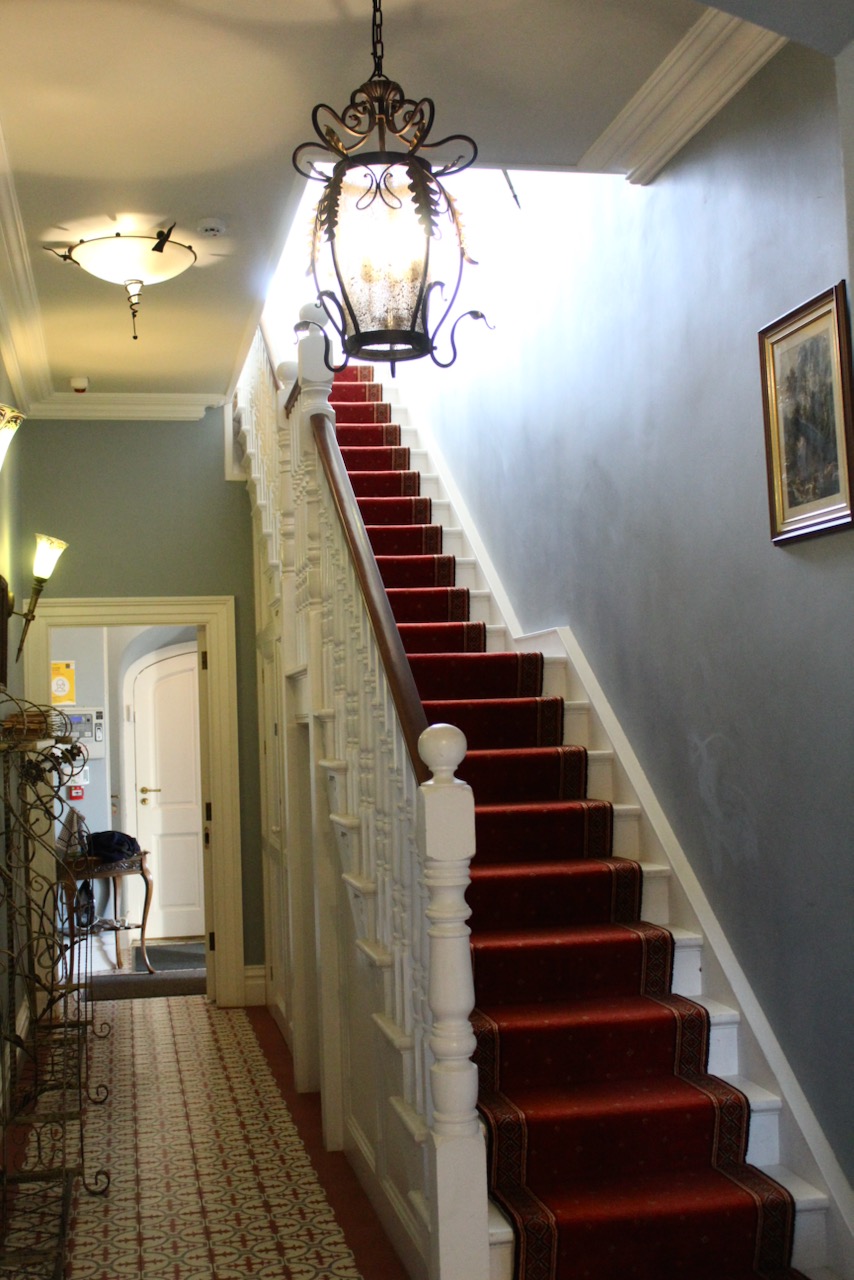
Wilton castle. Photograph © Jennifer Winder-Baggot, www.irishhistorichouses.com
The upstairs hallway. Photograph © Jennifer Winder-Baggot, www.irishhistorichouses.com

Our accommodation was a suite, with sitting room, fully stocked kitchen, bathroom with walk-in shower, and bedroom. The sitting room and bedroom have beautiful wallpaper.

Wilton castle. Photograph © Jennifer Winder-Baggot, www.irishhistorichouses.com
Wilton Castle. Photograph © Jennifer Winder-Baggot, www.irishhistorichouses.com
Our bedroom had a lovely Chinese style wallpaper. Photograph © Jennifer Winder-Baggot, www.irishhistorichouses.com
Wilton Castle. Photograph © Jennifer Winder-Baggot, www.irishhistorichouses.com
Wilton Castle, November 2021. Photograph © Jennifer Winder-Baggot, www.irishhistorichouses.com

Our bathroom was in the round tower of the castle!

Wilton Castle. Photograph © Jennifer Winder-Baggot, www.irishhistorichouses.com
While our suite had a walk-in shower, the suite in the floor below has a bath. Photograph © Jennifer Winder-Baggot, www.irishhistorichouses.com

Our host showed us the larger suite downstairs that has room for a party. The double doors in the room open up to the view of the river below, onto a fine sweep of steps.

Wilton Castle. Photograph © Jennifer Winder-Baggot, www.irishhistorichouses.com
The double doors from the entertainment suite. Photograph © Jennifer Winder-Baggot, www.irishhistorichouses.com
The larger entertainment suite. Photograph © Jennifer Winder-Baggot, www.irishhistorichouses.com
Wilton Castle, November 2021. Photograph © Jennifer Winder-Baggot, www.irishhistorichouses.com

The accommodation is more pricey than we can usually afford but for a romantic getaway it is hard to beat! It’s very quiet. There seemed to be one other suite occupied when we were there, but we never saw or heard the inhabitants. The Windsors live in a house next door. We chose to have breakfast provided, which was brought to us on a tray in the morning. We used the kitchen facilities one evening to make our dinner, and the next night, ordered a delivery from nearby Enniscorthy, which was delivered to the castle!

donation

Help me to pay the entrance fee to one of the houses on this website. This site is created purely out of love for the subject and I receive no payment so any donation is appreciated!

€15.00

[1] p.560-561, Hore, Herbert. History of the Town and County of Wexford, Volume 6, ed. Philip Hore, pub. 1901-1911. Reference from http://butlerancestryireland.blogspot.com/2012/11/butlers-co-wexford-ch1-richard-1stviscount-mountgarrett.html

There is also an excellent history of the early days of the area on the Bree Heritage website, https://breeheritage.com/2015/02/27/the-early-history-of-wilton-castle-bree-co-wexford/

[2] https://landedfamilies.blogspot.com/search/label/Wexford

[3] https://theirishaesthete.com/2018/05/21/wilton-castle/

[4] For more on this, see the chapter in The Wexford Gentry by Art Kavanagh and Rory Murphy. Published by Irish Family Names, Bunclody, Co Wexford, Ireland, 1994.

[5] https://www.dia.ie/architects/view/4570/ROBERTSON%2C+DANIEL#tab_biography

[6] https://www.buildingsofireland.ie/buildings-search/building/15704226/johnstown-castle-johnstown-fo-by-co-wexford

[7] https://www.archiseek.com/2014/johnstown-castle-county-wexford/

[8] p. 130, Hicks, David. Irish Country Houses: A Chronicle of Change. The Collins Press, Cork, 2012.

[9] https://landedfamilies.blogspot.com/search/label/Wexford

[10] https://www.archiseek.com/2015/1838-wilton-castle-co-wexford/

[11] Note taken from the Wilton Castle facebook page, where you can see the progress of restoration that took place. https://www.facebook.com/WiltonCastleIreland

[12] Bence-Jones, Mark. A Guide to Irish Country Houses (originally published as Burke’s Guide to Country Houses volume 1 Ireland by Burke’s Peerage Ltd. 1978); Revised edition 1988, Constable and Company Ltd, London.

[13] p. 130, Hicks, David. Irish Country Houses: A Chronicle of Change. The Collins Press, Cork, 2012.

Here are more photographs from our visit to Johnstown Castle, also designed by Daniel Robertson.
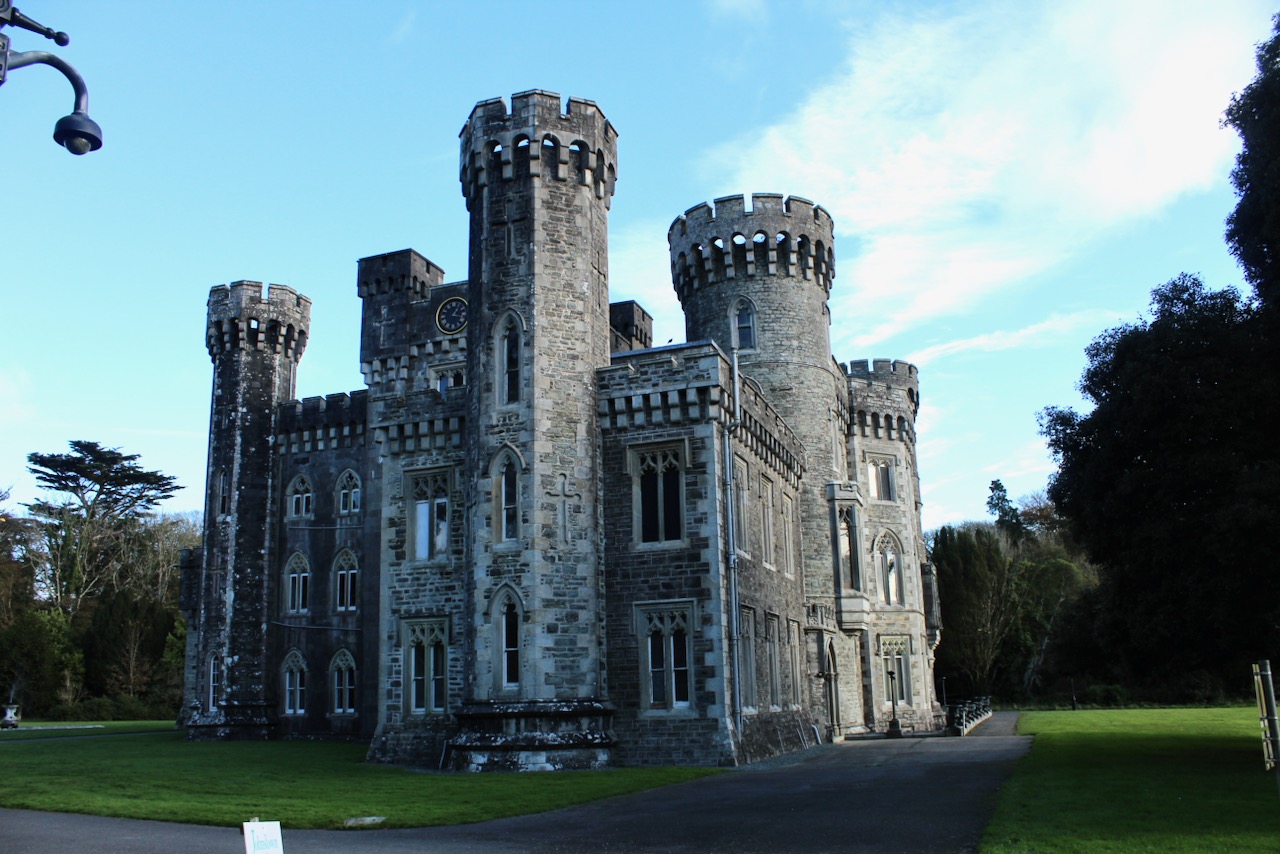
The clock tower side of Johnstown Castle. Photograph © Jennifer Winder-Baggot, www.irishhistorichouses.com
The front entrance of Johnstown Castle – clock tower side on the right. Photograph © Jennifer Winder-Baggot, www.irishhistorichouses.com
Inside the front arch of Johnstown Castle. Photograph © Jennifer Winder-Baggot, www.irishhistorichouses.com
The front entrance of Johnstown Castle. Photograph © Jennifer Winder-Baggot, www.irishhistorichouses.com
Spectacular doorway arch to one side of Johnstown Castle. Photograph © Jennifer Winder-Baggot, www.irishhistorichouses.com
The doorway arch at Johnstown Castle features a border of carved stone heads. Photograph © Jennifer Winder-Baggot, www.irishhistorichouses.com
Carved stone heads at Johnstown Castle. Photograph © Jennifer Winder-Baggot, www.irishhistorichouses.com
Window surround detail and tracery at Johnstown Castle. Photograph © Jennifer Winder-Baggot, www.irishhistorichouses.com
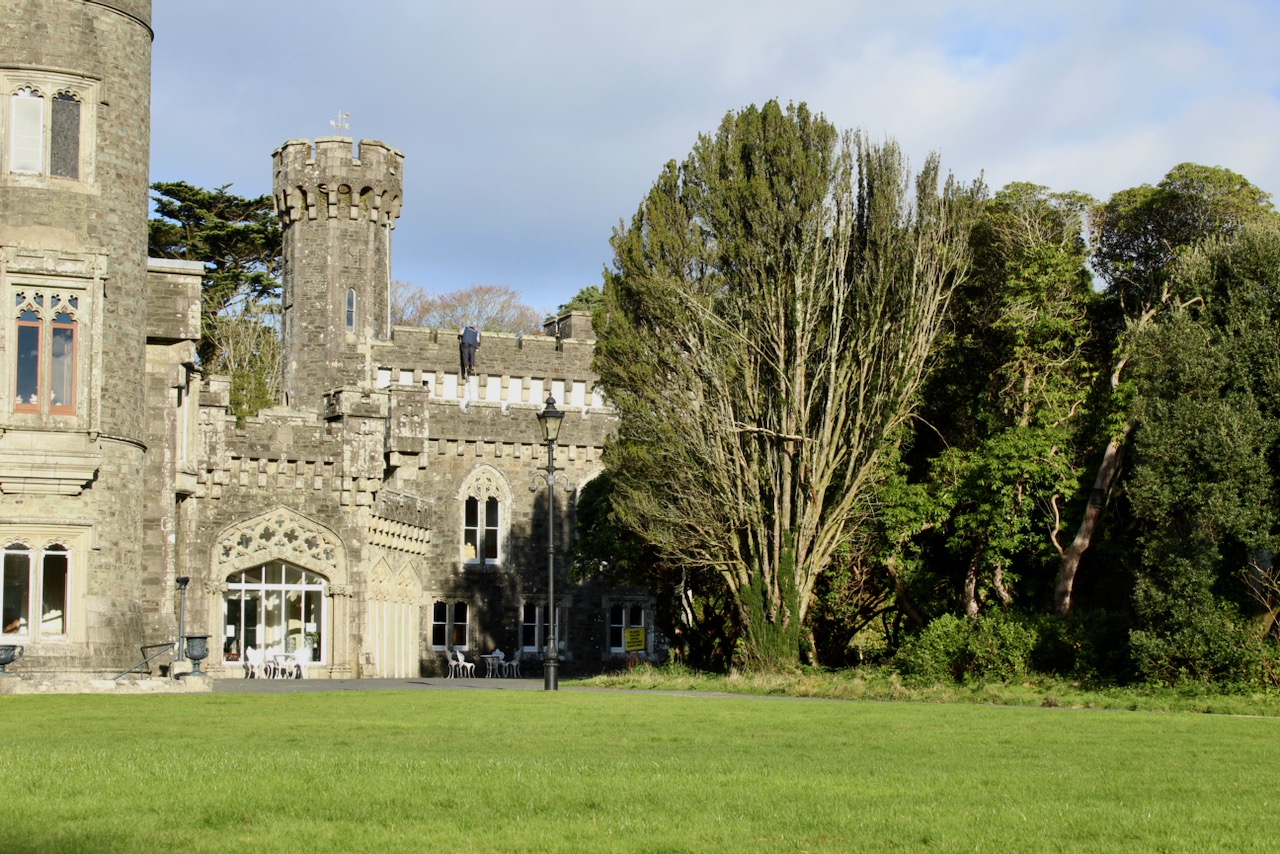
A workman at Johnstown Castle. Photograph © Jennifer Winder-Baggot, www.irishhistorichouses.com
Text © Jennifer Winder-Baggot, www.irishhistorichouses.com
Loughton House, Moneygall, County Offaly E53 WK16 – section 482

www.loughtonhouse.com
Open dates in 2025: May 1-3, 6-10, 13-17, 20-24, 27-31, June 3-7, 10-14, 17-21, 24-28, Aug 5-9, 12-24, 11am-3pm

Fee: adult €8, OAP €7, child/student free

donation

Help me to pay the entrance fee to one of the houses on this website. This site is created purely out of love for the subject and I receive no payment so any donation is appreciated!

€15.00

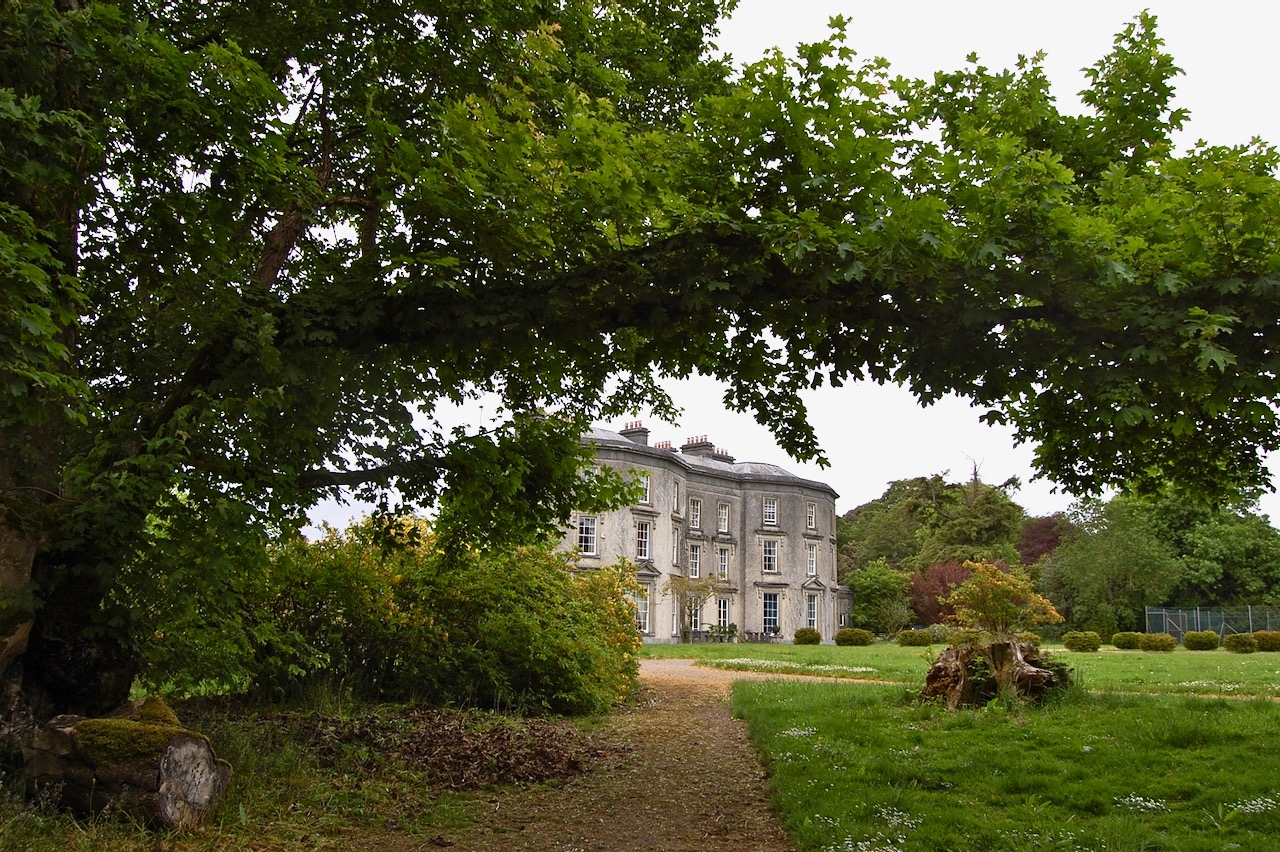
Loughton, May 2019. Photograph © Jennifer Winder-Baggot, www.irishhistorichouses.com
We drove up a long tree-lined avenue to Loughton House. Stephen rang from the car on our way and spoke to Michael Lyons, who was out chopping wood, so told us that Andrew would be at the house to meet us.

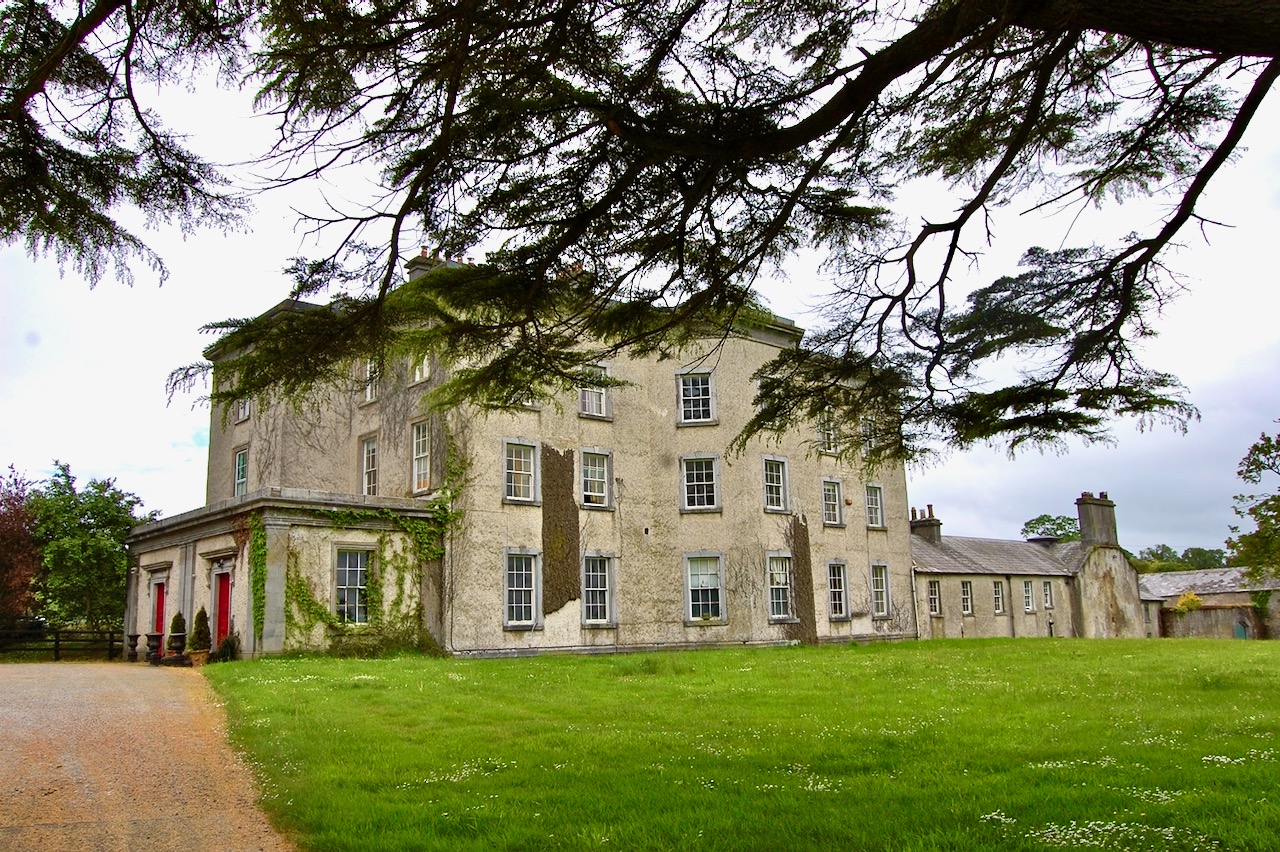
This would have been the front of the house in 1777, as it has the bow in the centre. This is the side which we saw first as we drove up, the North facing side. Photograph © Jennifer Winder-Baggot, www.irishhistorichouses.com
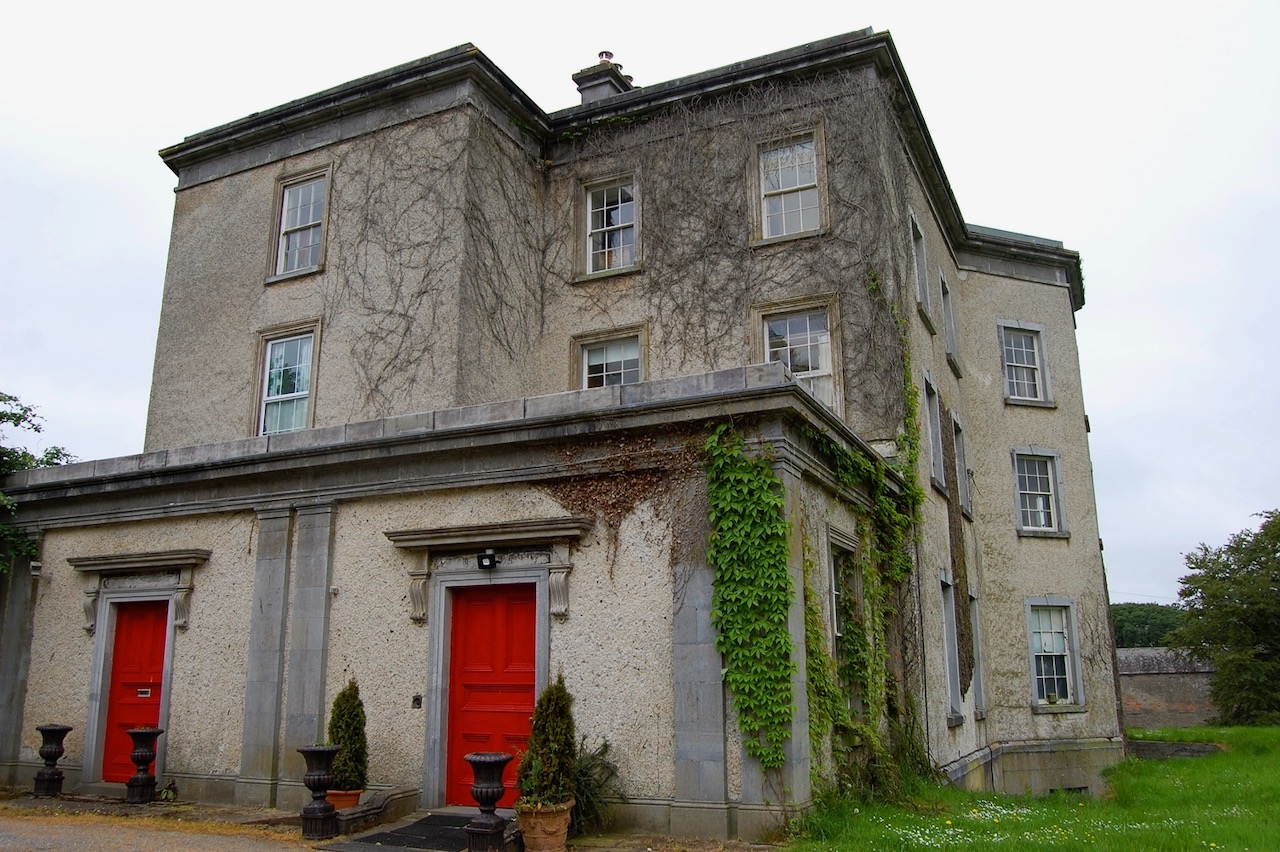
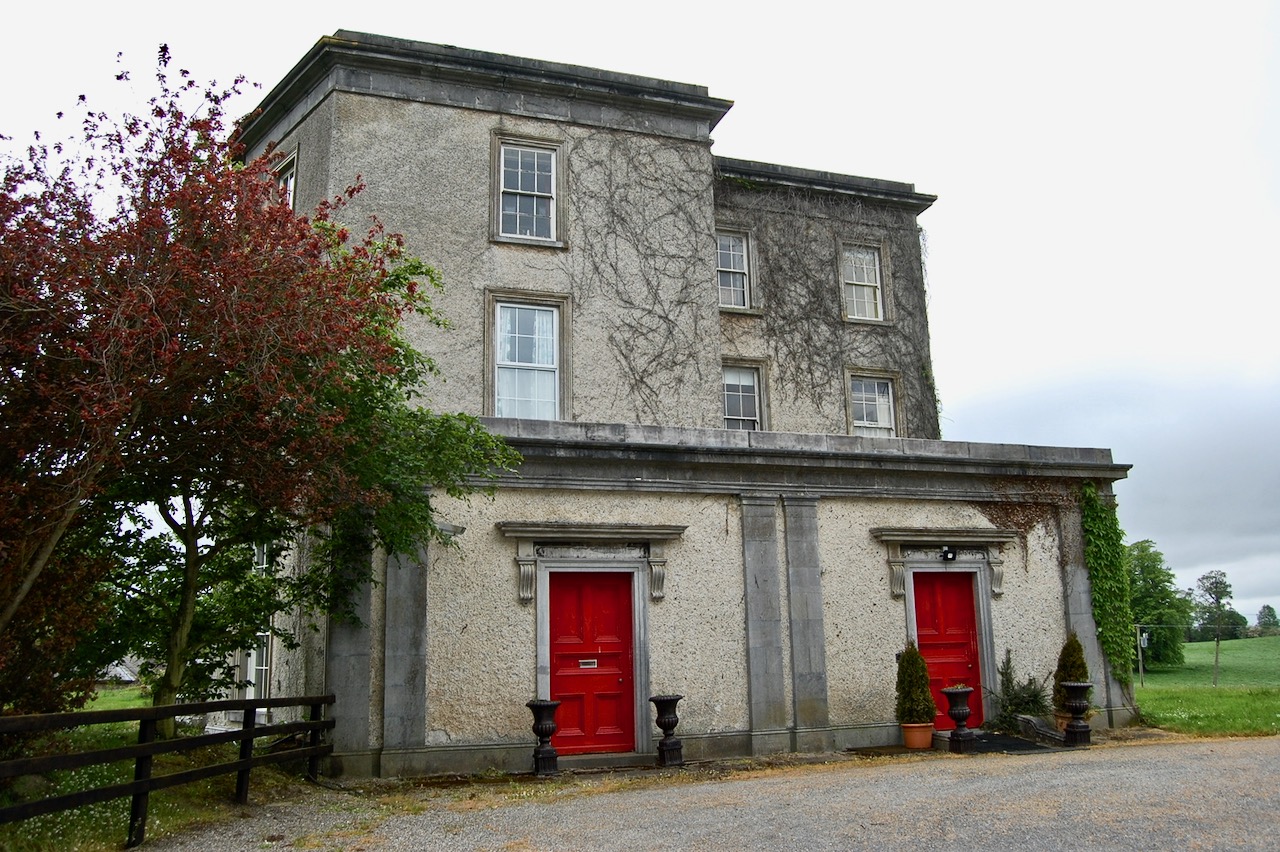
Loughton House was built on the site of a previous house, in 1777. When we arrived, we wondered why there were two front doors. I think Andrew Vance, who greeted us, explained, but we were so busy introducing ourselves and immediately got along so well, that I forget what he told me about the two doors. That’s a question for next time!

Single storey addition with crisp limestone pilasters, and pediments on console brackets over the doors. Photograph © Jennifer Winder-Baggot, www.irishhistorichouses.com
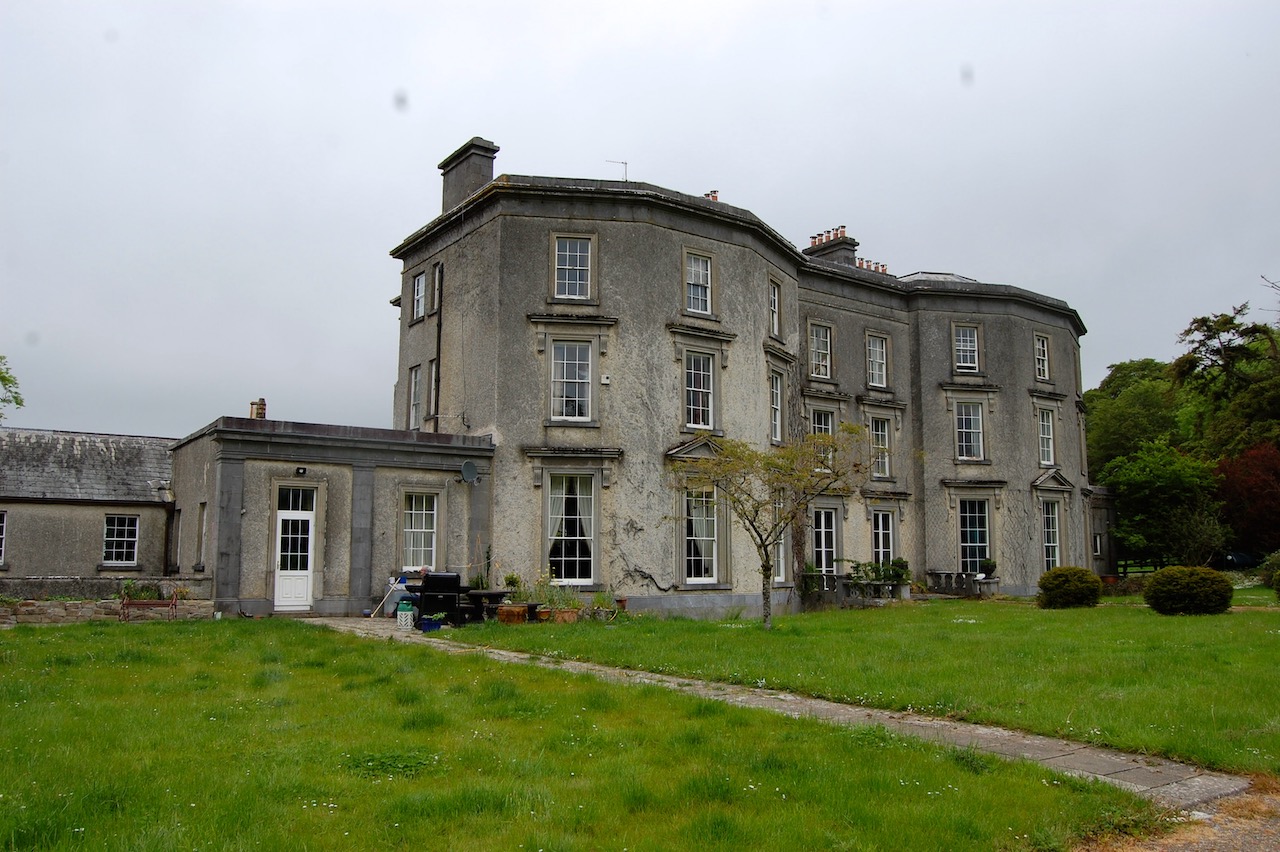
According to the website, alterations were made to the house in 1835 by James and George Pain. I don’t know who the architect of the 1777 house is, but originally the house faced north, with a shallow full-height half hexagon bow in the centre.

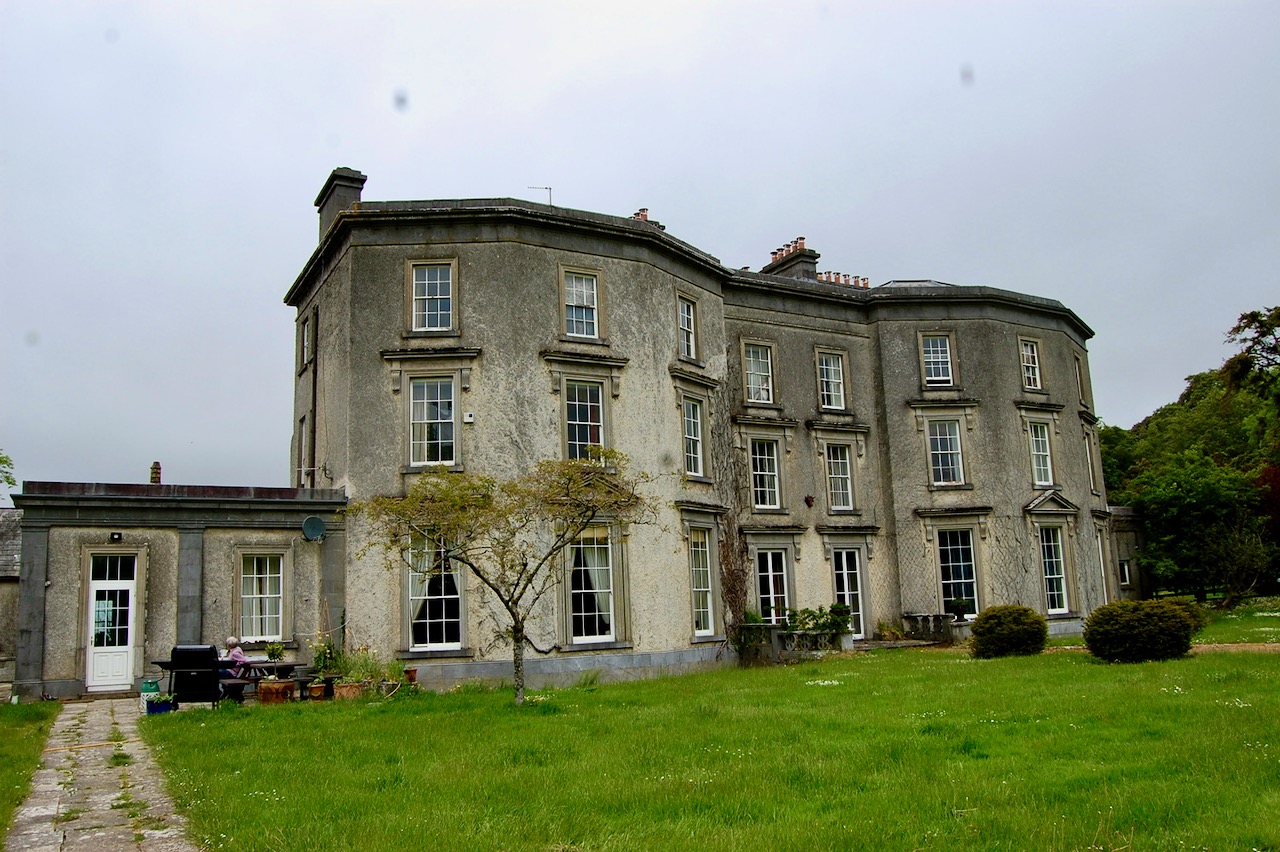
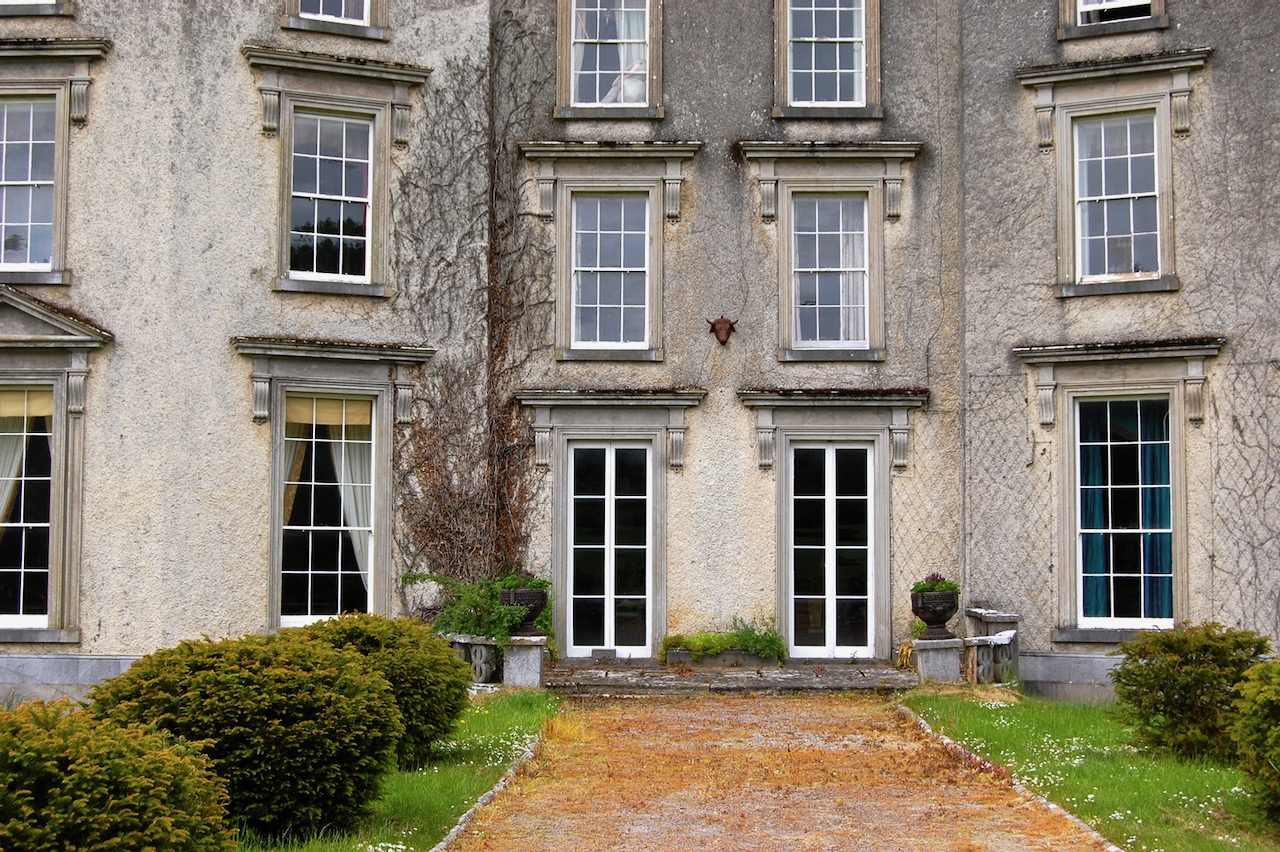
I would consider this to be the back of the house since we went out of the door in the single-storey addition, above, after our tour, to see the garden, but is officially the front, the South facing side. The windows have pediments with console brackets on the ground and first floors. The three storeys are over a concealed basement. Photograph © Jennifer Winder-Baggot, www.irishhistorichouses.com
Mark Bence-Jones describes the house in his A Guide to Irish Country Houses:

“Of elegant and restrained late-Georgian character, the main front consisting of two wide and shallow three sided bows of three bays each, with a two bay centre between them. Single storey wing of two bays, adorned with pilasters. Pediments and entablatures on console brackets over ground floor and first floor windows. Parapeted roof. Very handsome Georgian stables.” [1]

The 1777 house was built for Major Thomas Pepper. Thomas, born around 1735, of Ballygarth, Julianstown, Co Meath, son of Lambert Pepper and Jane Otway, was Major in the 14th Light Dragoons. The Peppers acquired Ballygarth Castle (now a ruin) and lands in County Meath after the Restoration of Charles II to the British throne in 1660, for their loyalty to the Stuart monarchy. [2] Thomas Pepper married Mary Ryder, daughter of John Ryder, the Archbishop of Tuam, County Roscommon. The 14th Light Dragoons was originally called James Dormer’s Dragoons, and were raised in the south of England in 1715 in response to the Jacobite Rebellion. They were sent to Ireland in 1717. In 1747 they were renamed the 14th Regiment of Dragoons, and became the Light Dragoons in 1776 [3]. Loughton House passed to their son Thomas Ryder Pepper (1760-1828), who in 1792 married Anne Bloomfield, daughter of John Benjamin Bloomfield and Charlotte Anne Waller, of Newport, County Tipperary. The Bloomfield family had originally settled at Eyrecourt, County Galway.

Thomas Ryder Pepper (1760-1828) with The Old Castle, Loughton in the background from Loughton house auction, 2016, Shepphards.

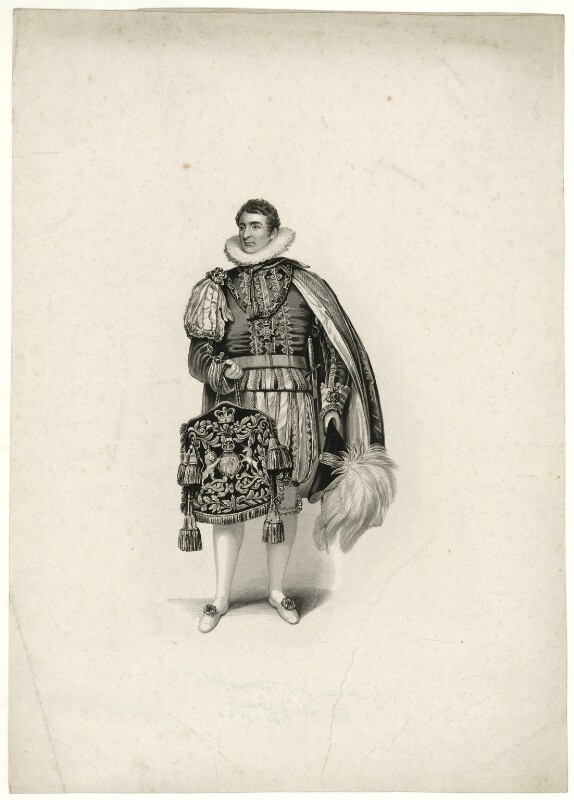
When Thomas Ryder Pepper died, the house passed to his brother-in-law, Benjamin Bloomfield, 1st Baron Bloomfield (1815) of Oakhampton and Redwood (1768-1846). Redwood House in County Tipperary no longer exists. Oakhampton, also in Tipperary, still stands. He was Lieutenant General in the British Army and fought the rebels in 1798 at Vinegar Hill, County Wexford. He rose in the ranks to become Keeper of the Privy Purse for King George IV. This was a particularly difficult job – we came across King George IV before at several houses listed in the Revenue Section 482 Property list. The king enjoyed a romance with Elizabeth Conyngham of Slane Castle, and relished the good life: food, drink and beauty in the form not only of women but in architecture, with the help of John Nash. He was therefore rather a Big Spender. Naturally, therefore, he came to resent Benjamin Bloomfield and his efforts to tighten the purse strings.

Benjamin Bloomfield (1768-1846) 1st Baron Bloomfield as Keeper of His Majestys Privy Purse at the Coronation of George IV, by Henry Meyer, after Philip Francis Stephanoff 1826, NPG D31893.
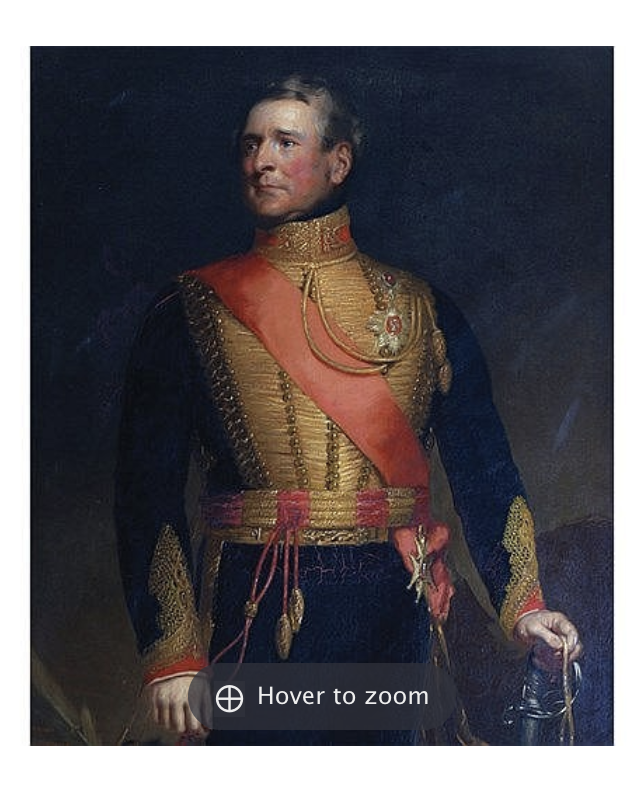
1st Lord Bloomfield, 1768-1846, by John Lilley, from Loughton house auction catalogue, 2016, Shepphards
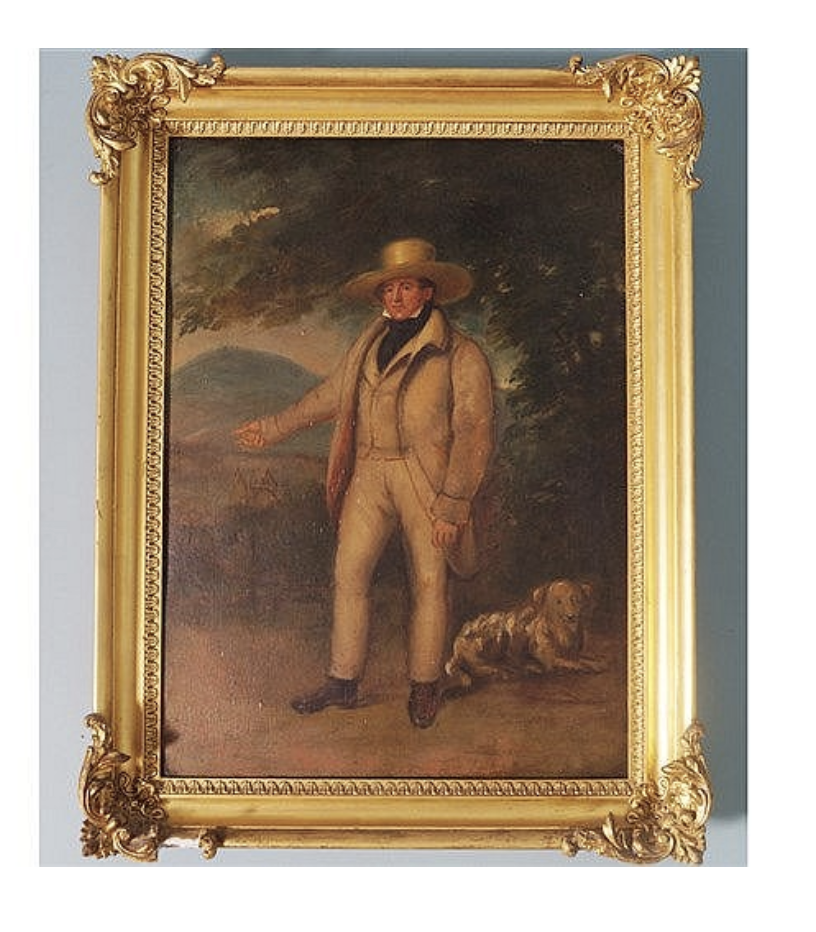
Benjamin, Ist Lord Bloomfield (1768-1846), Irish school, 19th c, from Loughton house sale, 2016, Shepphards.
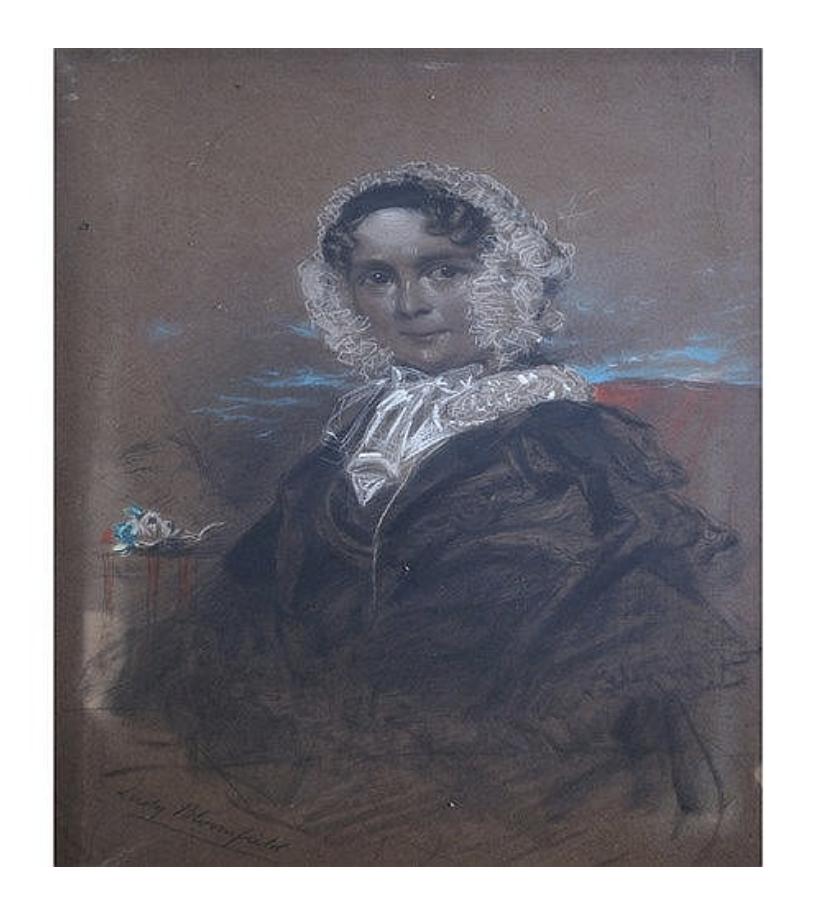
Portrait of Lady Bloomfield, from Loughton house sale, 2016, Shepphards

We have already seen that several houses underwent alterations in expectation of a visit from King George IV in 1821. In Charleville, County Wicklow, a new floor was installed at great expense. Here in Loughton, a bedroom was done up for the King. Unfortunately, the King never made it to Loughton.

It was later that Bloomfield hired James and George Richard Pain to renovate Loughton House, in 1835.

Loughton, May 2019. Photograph © Jennifer Winder-Baggot, www.irishhistorichouses.com
James and George were sons of James Pain, an English builder and surveyor. Their Grandfather William Pain was the author of a series of builder’s pattern books, so they had architecture in the blood. According to the Dictionary of Irish Architects, James and his younger brother George Richard were both pupils of John Nash, one of the foremost British architects of his day responsible for the design of many important areas of London including Marble Arch, Regent Street and Buckingham Palace. He was architect to the prolific lover of architecture the Prince Regent, later King George IV. When Nash designed Lough Cutra Castle in County Galway for Charles Vereker in 1811, he recommended that the two brothers should be placed in charge of the work, so it was at this time that they came to Ireland. Lough Cutra is an amazing looking castle privately owned which is available for self-catering rental. [4] James Pain settled in Limerick and George in Cork, but they worked together on a large number of buildings – churches (both Catholic and Protestant), country houses, court houses, gaols and bridges – almost all of them in the south and west of Ireland. [5] In 1823 James Pain was appointed architect to the Board of First Fruits for Munster, responsible for all the churches and glebe houses in the province.

The Pains Gothicized and castellated Dromoland Castle in County Clare at some time from 1819-1838, now a luxury hotel. [6] They took their Gothicizing skills then to Mitchelstown Castle in 1823-25, but that is now a ruin. In 1825 they also worked on Convamore (Ballyhooly) Castle but that too is now a ruin. They also probably worked on Quinville in County Clare and also Curragh Chase in County Limerick (now derelict after a fire in 1941), Blackrock Castle in County Cork (now a science centre, museum and observatory which you can visit [7]), they did some work for Adare Manor in County Limerick (also now a luxury hotel), Clarina Park in Limerick (also, unfortunately, demolished, but you can get a taste of what it must have been like from its gate lodge), Fort William in County Waterford, probably they designed the Gothicization and castellation of Ash Hill Towers in County Limerick (also a section 482 property!), alterations and castellation of Knoppogue Castle, County Clare (you can also visit and stay, or attend a medieval style banquet), Aughrane Castle mansion in County Galway (demolished – Bagots used to own it, I don’t know if we are related!), a castellated tower on Glenwilliam Castle, County Limerick and more.

The Pain brothers reoriented Loughton House to face south, and the main doorcase was put to the east end, the Loughton House website tells us. In his Buildings of Ireland: Central Leinster. Counties of Kildare, Laois and Offaly, Andrew Tierney tells us that this oblique approach of typical of James Pain. [8]

Loughton, County Offaly. Photograph © Jennifer Winder-Baggot, www.irishhistorichouses.com
Loughton, May 2019. Photograph © Jennifer Winder-Baggot, www.irishhistorichouses.com
The National Inventory of Architectural Heritage claims that Loughton House is probably the Pain’s finest Classical work [9]. The exterior is relatively plain, with limestone window dressings with keystones. The north facing side is the original house, whereas the south facing side, of eight bays instead of the seven in the north side, is by the Pain brothers. The windows on this side have moulded cement detailing: architrave, cornice and consoles, and pediments. We saw more of the Pains’ work inside, in the Drawing and Dining Rooms which date from their renovation, and the wonderful curved stone cantilevered staircase.

The current owners, who acquired the house in 2016, are both medical doctors, as was the previous owner, Dr. James Reilly, who was also a former Minister for Health in the Irish government. When we visited, the house exuded a comfortable quirky chic, with marble busts on pillars in the front hall and a touch of whimsy, with a stag’s head draped in a fur at the bottom of the sweeping cantilevered staircase. 

The Loughton House website tells us:

“The house has very fine detailing – traces of the late eighteenth-century decoration can be seen in the house as well as early nineteenth-century changes in internal layout.

“The ground floor is laid out with bright and generously proportioned formal reception rooms with magnificent decorative cornicing and ceilings, ornate plaster work and large original period fireplaces. The original wood floors remain throughout and the grand sash bay windows permit torrents of light into the house. Most notable are the wood-carved shutters and door panels in the original Billiard room.” [10]

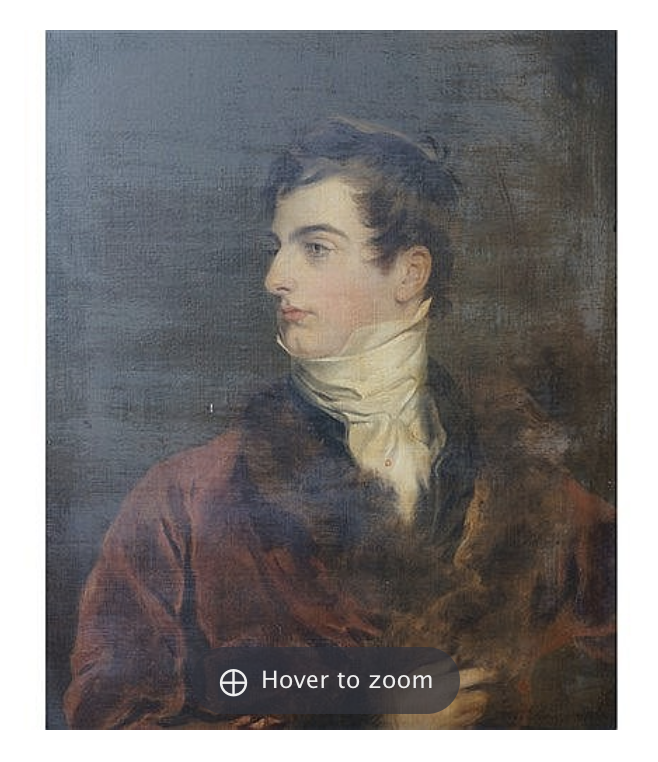
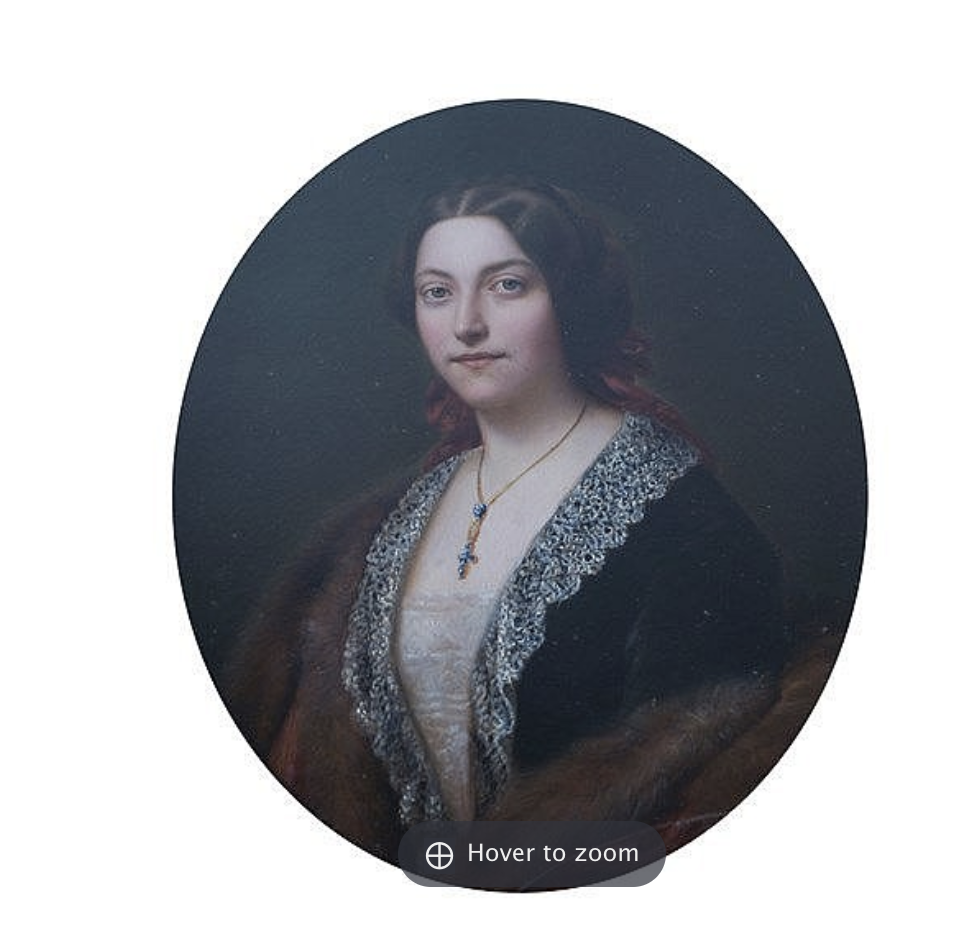
Loughton passed to Bloomfield’s son, John Arthur Douglas Bloomfield (1802-1879). He succeeded as 2nd Baron Bloomfield on his father’s death. He was a diplomat and travelled widely, was envoy to St. Petersburg and Ambassador to Austria. He was appointed Privy Counsellor on 17 December 1860. He was created 1st Baron Bloomfield of Ciamhaltha, Co. Tipperary on 7 August 1871. In 1834 his father had a hunting lodge built, Ciamhaltha House, County Tipperary, so the new title referred to this house [11]. He and his wife Georgiana Liddell had no son and the titles ended with his death. Georgina served as a Maid of Honour to Queen Victoria between 1841-45. Upon Georgiana’s marriage to Baron Bloomfield in 1845, when Georgiana left her position in the house of the Queen, Victoria gave her a cutting from a vine, which still grows at Loughton House today. Georgiana wrote the book Reminiscences of Court and Diplomatic Life, published 1883. It sounds fascinating!

2nd Lord Bloomfield, 1802-1879 wearing a burgundy red jacket and fur collar, Painting After Sir Thomas Lawrence, from Loughton house auction catalogue, 2016, Shepphards
Georgiana Bloomfield née Liddell, Lady Bloomfield from Loughton house auction catalogue, 2016, Shepphards.

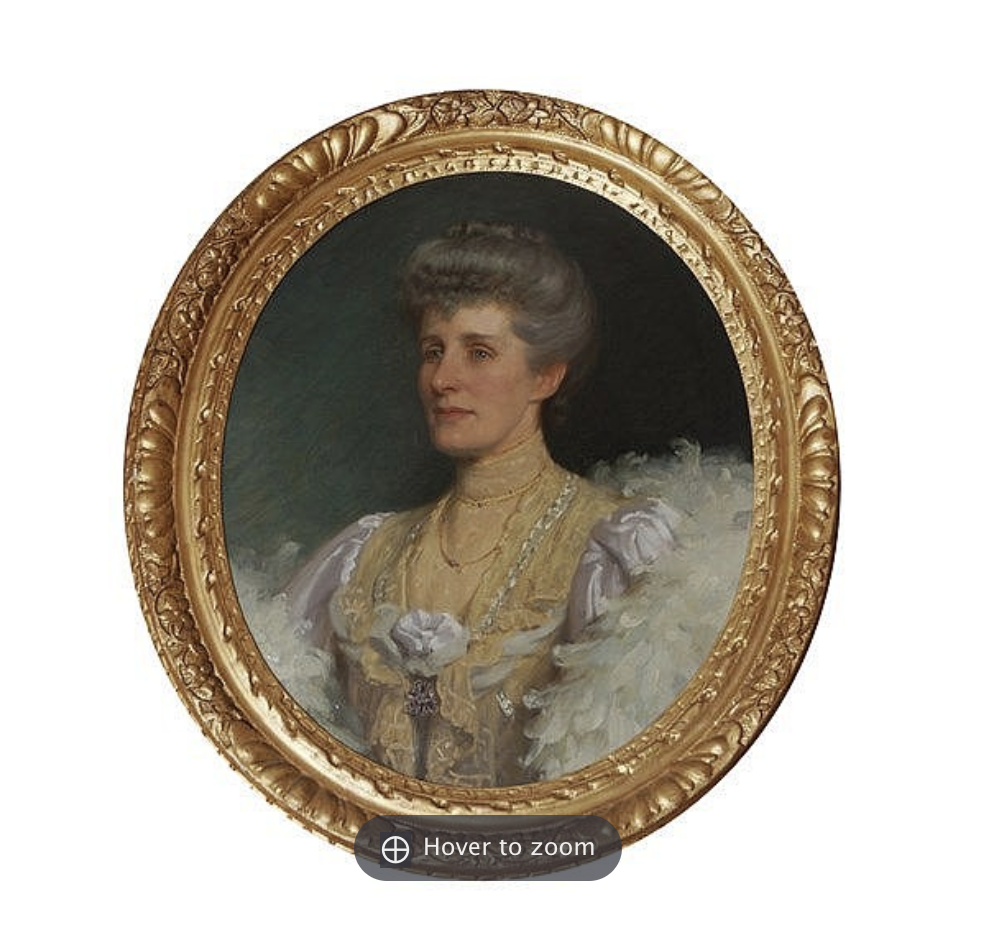
The house passed to the Baron’s sister, Georgiana, and her husband, Henry Trench, of Cangort Park, County Offaly (still standing, privately owned). The Landed Estates website tells us that in the 1870s, Henry Trench owned 4,707 acres in county Tipperary, 2,113 acres in county Offaly, 1,926 acres in county Limerick, 1,581 acres in county Galway, 704 acres in county Clare and 432 acres in county Roscommon. [12]

Frederick Trench (1755-1840) 1st Baron Ashtown from Loughton sale Sept 2016 by Shepphards. He was an uncle of Henry Trench who married Georgiana Bloomfield.
A portrait of Blanche Trench (1852-1937), from Loughton house sale, 2016, Shepphards. She was a daughter of Henry Trench and Georgiana née Bloomfield.

When James Reilly sold Loughton House, he unfortunately sold its contents, including an archive of family papers. Michael Parsons of The Irish Times wrote of the auction:

Lot 2066, The Loughton Papers circa 1749-1960 – an archive of documents including correspondence, diaries, journals, sketch books and recipe books created by the various families who had lived at Loughton House – sold for €12,000 (above the estimate of €5,000-€8,000).

Sheppard’s said the buyer was Galway businessman Pat McDonagh, founder and managing director of the Supermac’s fast-food chain and owner of the Barack Obama Plaza – a services area on the M8 motorway just outside the village of Moneygall built following the visit of the US president.”

Fortunately, the article continues to reassure the readers that the documents will be properly preserved and accessible:

“In a statement issued via the auction house, Mr McDonagh described the archive “part of a tapestry of history” and that his “first priority” was its “preservation for historians, the community and the country”.

“The statement said: “Mr McDonagh commended Offaly County Council for their interest in working with Supermac’s for the preservation of the papers” which will be digitised, and that “historians owe a debt of gratitude to the owners of Loughton House, Dr James Reilly and his wife Dorothy”.

“Mr McDonagh “confirmed also that the visitor centre at the Barack Obama Plaza will host a Loughton House section, where extracts from the archive will be displayed on a rolling basis.” He said the plaza would work to ensure that the heritage of the house was not lost to the community, adding that he would encourage local and expert input to ensuring that the archive would be educational, appropriate and accessible.” [13]

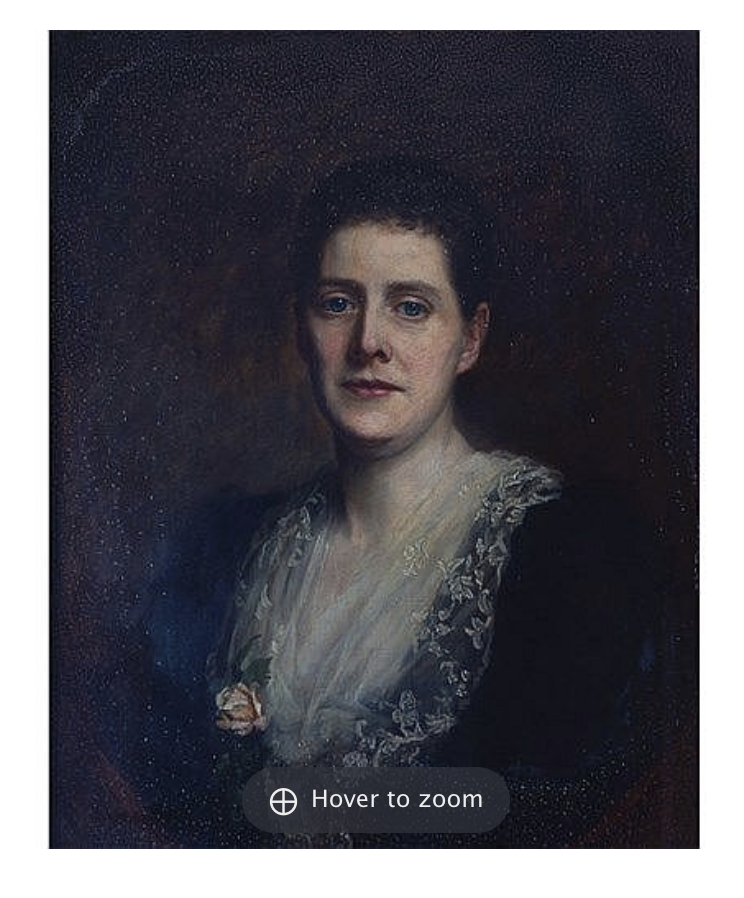
A portrait of Dora Agnes Caroline Trench (1858-1899) née Turnor, wife of Benjamin Bloomfield Trench, from Loughton house sale, 2016, Shepphards.
A portrait of Mr Trench, dated 1920, from Loughton house sale, 2016, Shepphards.

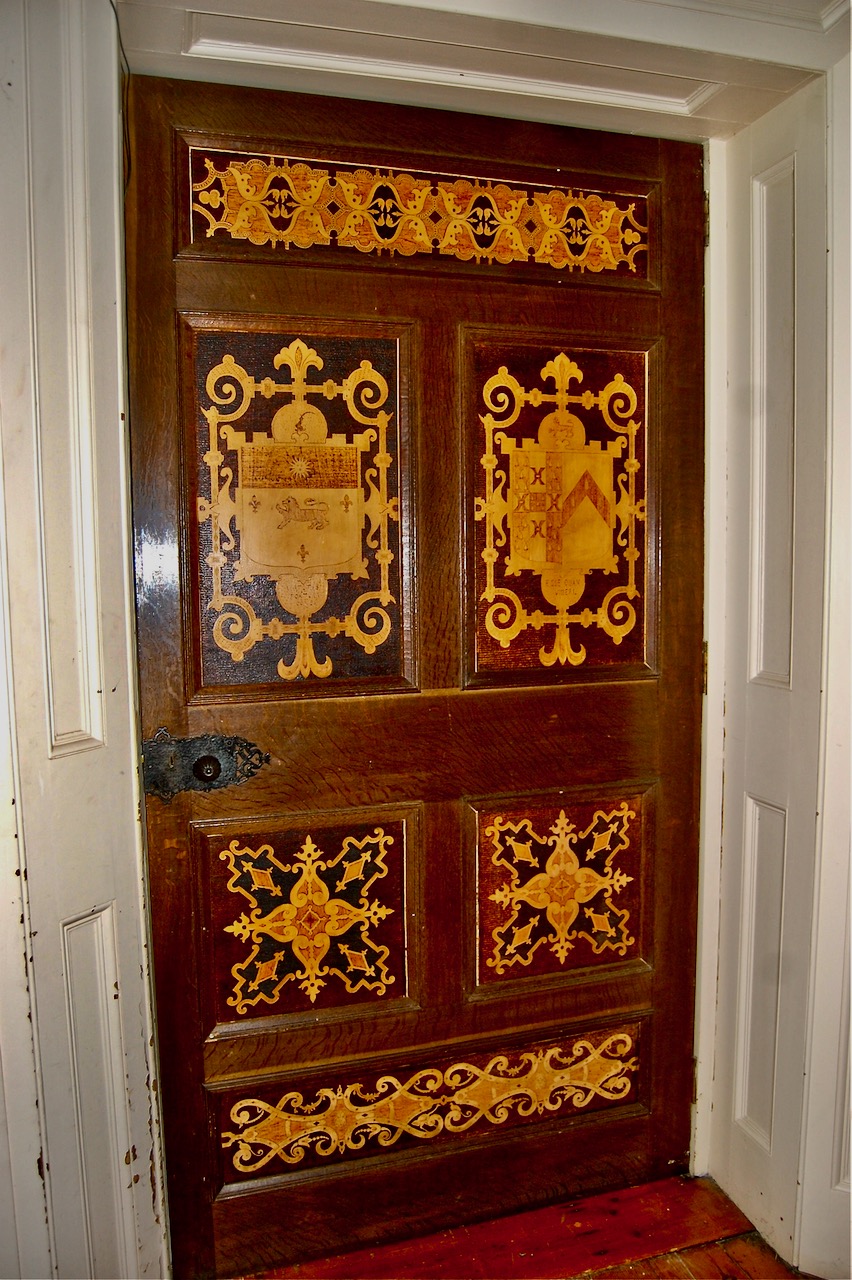
The wood carved panels shutters and door panels in the billiards room, now a dining room, were decorated by one of the Trenches, Dora. The form of decoration, with details rendered by a hot poker, is exquisitely done. The portrait of the artist, Dora, hangs next to the doors. Dora was Henry Trench’s son Benjamin Bloomfield Trench’s wife, Dora Agnes Caroline Turnor. Dora Trench died in 1899, after a brief illness. Benjamin and Dora had two daughters, Sheelagh Georgiana Bertha and Theodora Caroline. [14]

Loughton, May 2019. Photograph © Jennifer Winder-Baggot, www.irishhistorichouses.com

Dora illustrated the doors with crests and intricate patterns, and all of the doors from the room are decorated, along with the shutters. I was delighted when Stephen asked if I could take a photograph of the door – I didn’t like to ask, knowing that most section 482 houses forbid indoor photography. Andrew’s assent typified his warm welcome. You can see photographs of the room, called Dora’s Room, on the Loughton website, along with photographs of the other reception rooms, the Library, Dining and Drawing Rooms. “Dora’s Room” contains a long table and chairs, and an intricately carved fireplace.

The fireplace in Dora’s Room can be seen on the Loughton website. It is, Andrew Tierney tells us in his Buildings of Ireland: Central Leinster, it is Tudor Revival, of 1862. The male caryatid figure on the right is the original, Andrew thinks, whereas the figure on the left is a copy. It’s strange how such fireplaces are carved in wood and manage to survive the fire they contain. Andrew said it throws out great heat. It has a second flue behind, from which the fire can draw its oxygen, rather than drawing from the warmed air inside the room.

The Loughton website tells us that the Trenches remained in residence until 1973 when the property was passed to the Atkinson family.

Major Anthony Guy Atkinson (b. 1909) inherited Loughton in 1970 from his cousins Thora and Sheelah Trench (Dora’s daughters). Henry Trench, Georgina Bloomfield’s husband, had a sister, Anne Margaret Trench. She married Guy Caddell Atkinson. They inherited Cangort Park in County Tipperary and Major Anthony Guy Atkinson was a descendant of Anne Margaret Trench. [15] He made Loughton over to his son, Guy Nevill Atkinson (b. 1950), who sold it in 2001.

From Dora’s Room we came upon the hallway with the sweeping floating stone cantilever staircase. This was originally the entrance hall, before James Pain added the staircase and moved the entrance to the east end.

Andrew drew our attention to an old tall clock with barometer. It was from Lissadell House, and, appropriately, was made by a man named Yates – not the poet Yeats who frequented the house, note the different spelling, but in a nice touch, the picture hanging beside it was of the poet. Incidentally, one of the Trench family, a sister of Benjamin Bloomfield Trench who inherited Loughton, Louisa Charlotte, married Colonel James Gore-Booth, of the Lissadell family. The owners have taken their time to populate the house appropriately, with respect for its history and a dash of humour.

I was most enamoured with the next room, the library, with its floor to ceiling built in bookshelves. It retains original wallpaper, worn but still in situ.

“This is where we sit in the evenings, with a glass of wine,” Andrew told us. I could just see myself there too, in the well-worn couches, facing the fireplace. You can also see this room on the website, with its comfy leather armchairs. The Equine pictures are appropriate as Andrew is Master of the local Hunt!

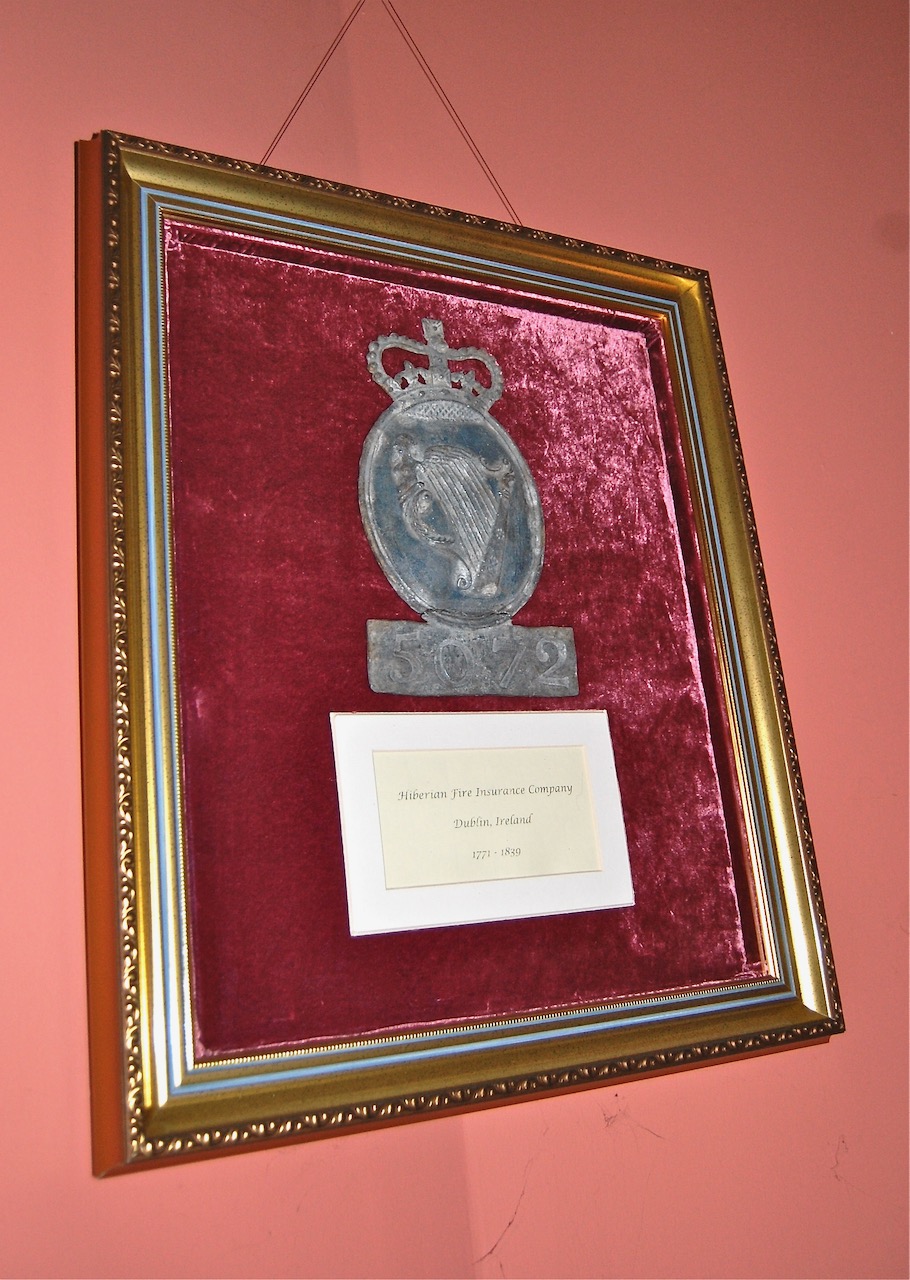
In the Drawing Room, a formal room with sofas, carpets and lovely salmon pink walls, gorgeous cabinets, piano and ornate gilt overmantel mirror, Andrew pointed out another treasure: the fire insurance plaque from a building. The various insurance companies had their own firetrucks and teams, and they only put out fires of the buildings insured by them. Unfortunate neighbours burned down. I was excited to see the plaque as I had seen one on the Patriot Inn in Kilmainham, one of the few remaining, and learned about them in a lecture in Warrenmount in Dublin.

Loughton, May 2019.

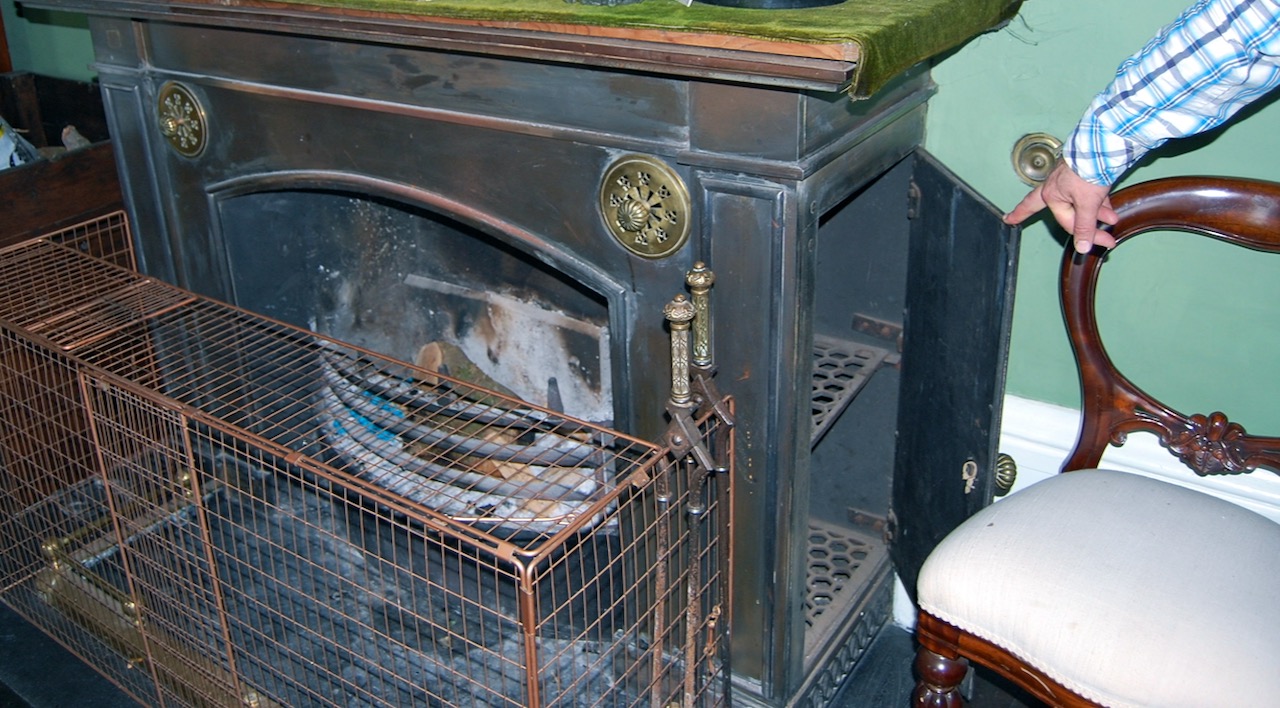
We then entered the second dining room (if we consider Dora’s Room, the former Billiards room, to be a dining room also, as it is currently furnished), a larger room than the first. This dining room also has a clever fireplace, this one of steel, with secret cabinets at the sides to keep the plates and dishes hot. It also had vents, and further vents built into the walls of the room, to control temperature and air flow.

Loughton, May 2019. Photograph © Jennifer Winder-Baggot, www.irishhistorichouses.com
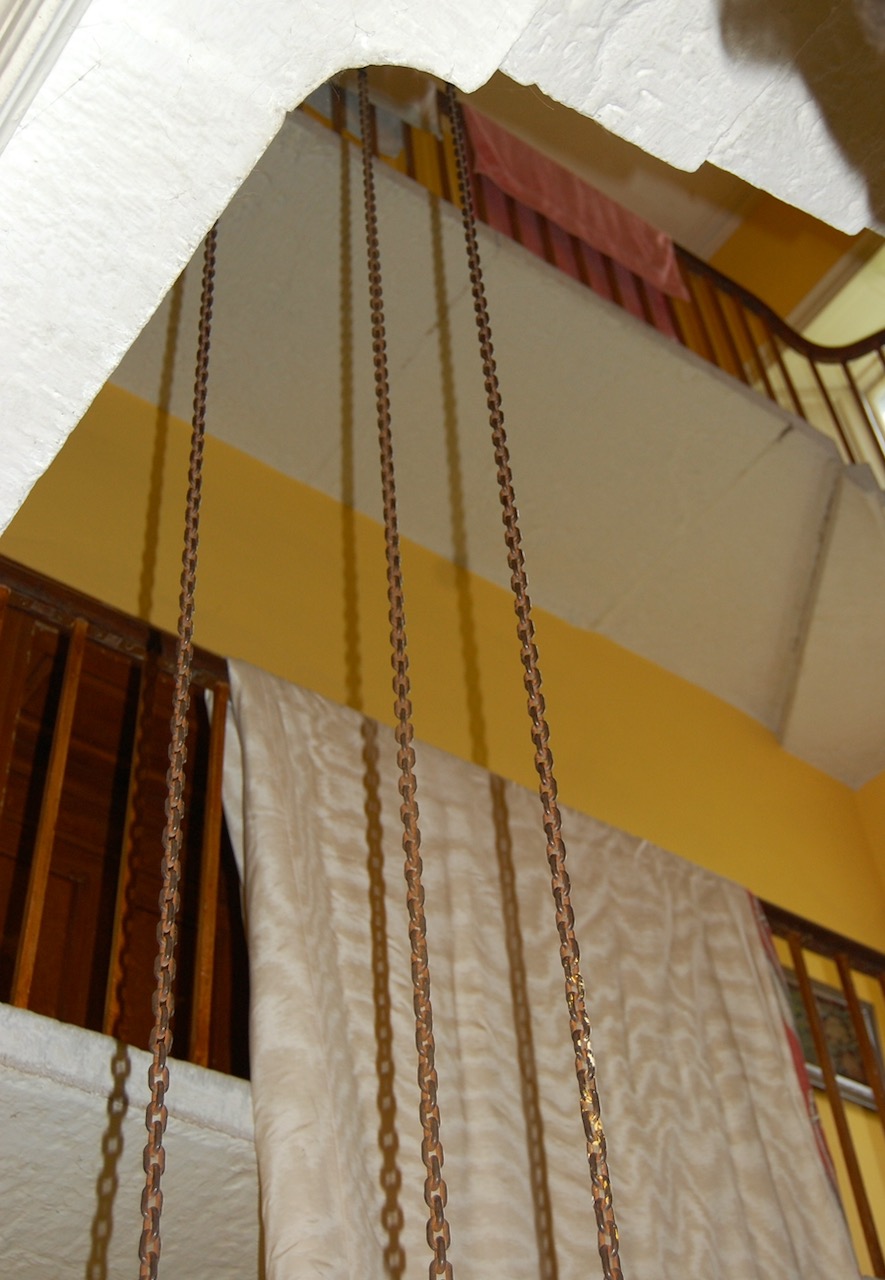
A painting above the door is by Sarah, Lady Langham, an artist, who has also applied her creative skills to the house, and who manages the day-to-day operation of the house. She has made curtains and even the wallpaper of The King’s Bedroom. On our way to the back staircase we ran into Sarah herself, as I was photographing the chain that was used to pull the coal to the upper floors.

Loughton, May 2019. Photograph © Jennifer Winder-Baggot, www.irishhistorichouses.com
The final rooms we viewed are Sarah’s piece de resistance, “the King’s Suite,” which comprises two rooms – the room where George IV was meant to sleep, and a room next to it also furnished with a bed, which might have been his dressing room or a parlour.

Loughton, May 2019. Photograph © Jennifer Winder-Baggot, www.irishhistorichouses.com
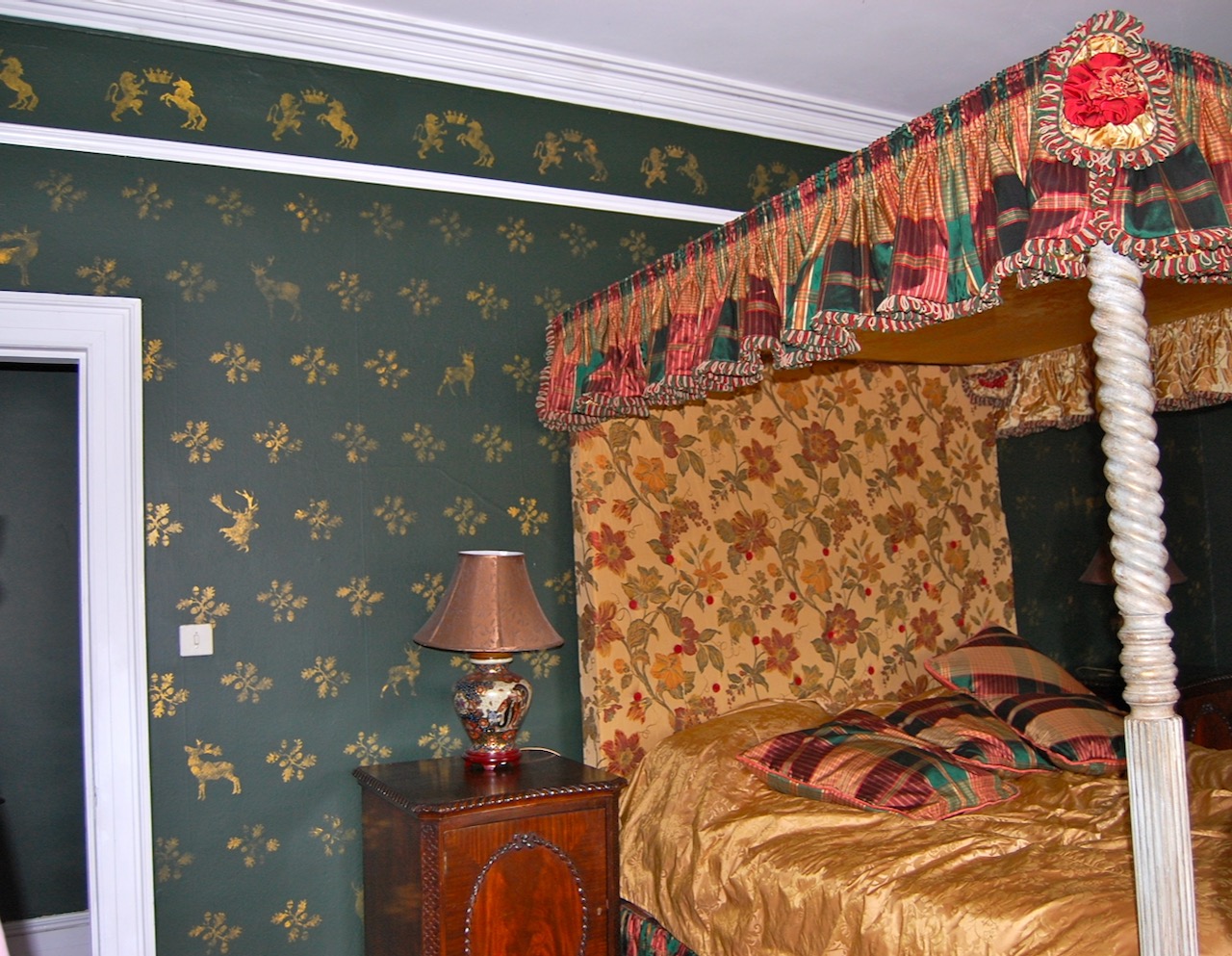
Sarah created the wallpaper. It features a crest of a unicorn and a lion around the top – and a stag that is pictured in the recurring motifs below. She also made the magnificant curtains and pelmet.

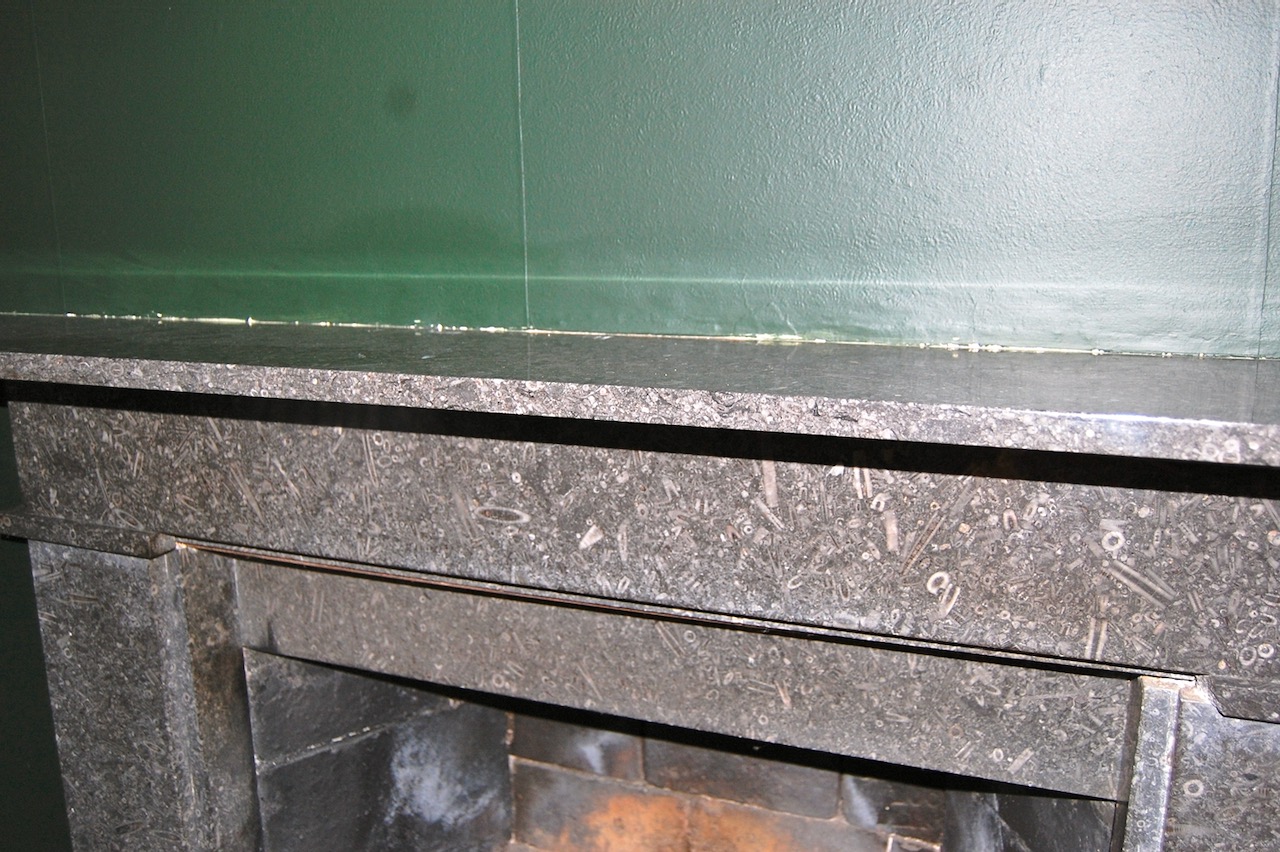
The fireplace is interesting. It is made of limestone, which contains fossils of tubular sea creatures:

Loughton, May 2019. Photograph © Jennifer Winder-Baggot, www.irishhistorichouses.com
This, along with other rooms, is available for guest accommodation.

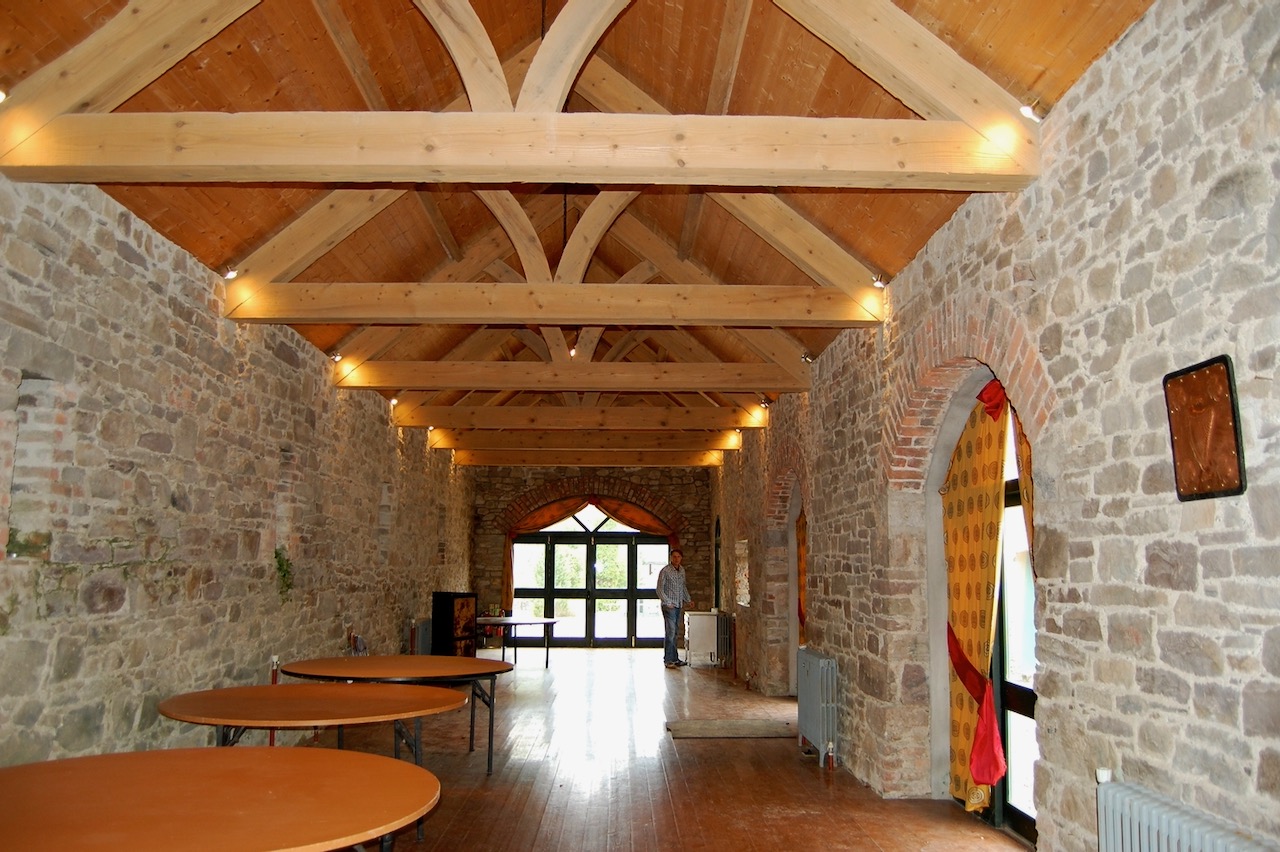
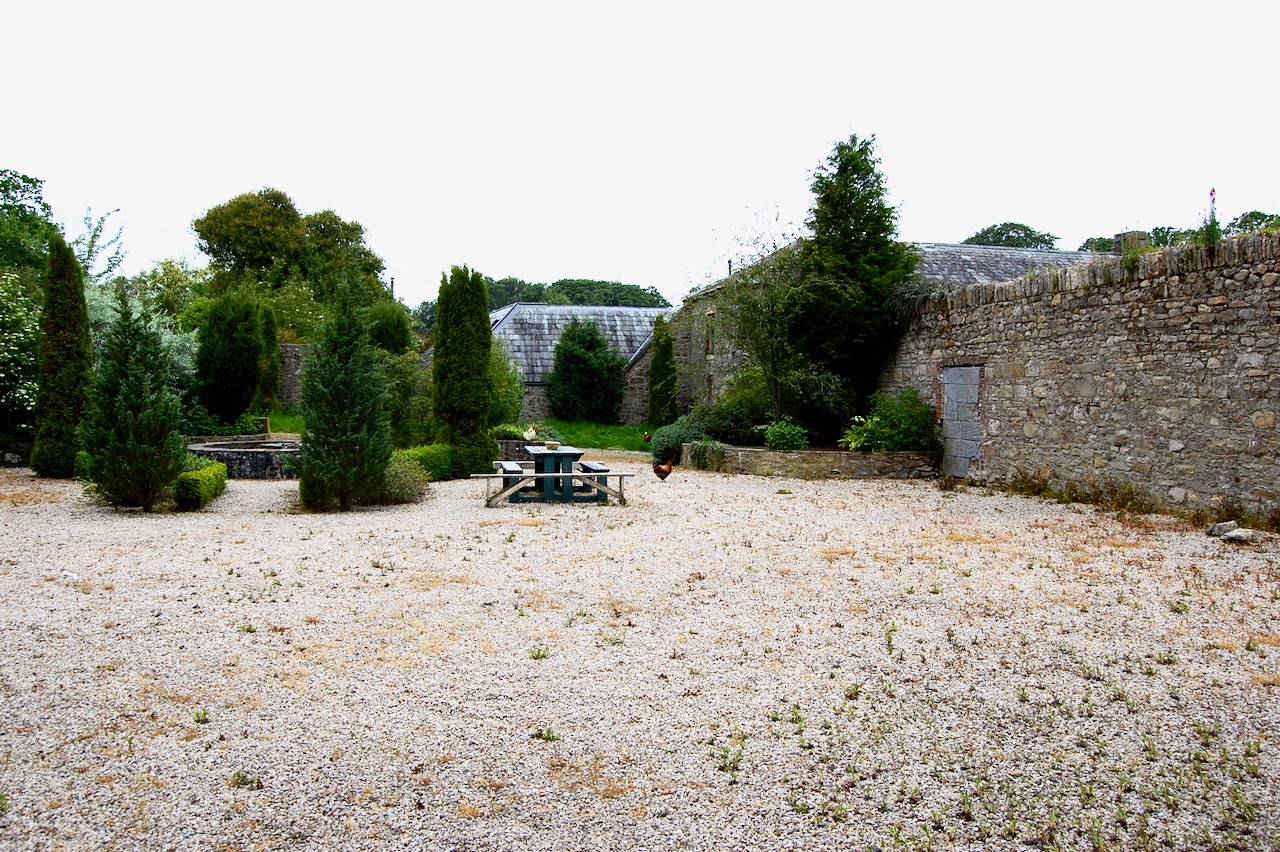
There is a stable complex to one side of the house. Andrew brought us out to show us the function room, which was originally a coal shed. It’s huge, and would be wonderful for parties, and is available for hire. The garden outside it, which would also be available for the functions, is romantic and beautiful, with a pond and stone walls.

Loughton, County Offaly. Photograph © Jennifer Winder-Baggot, www.irishhistorichouses.com
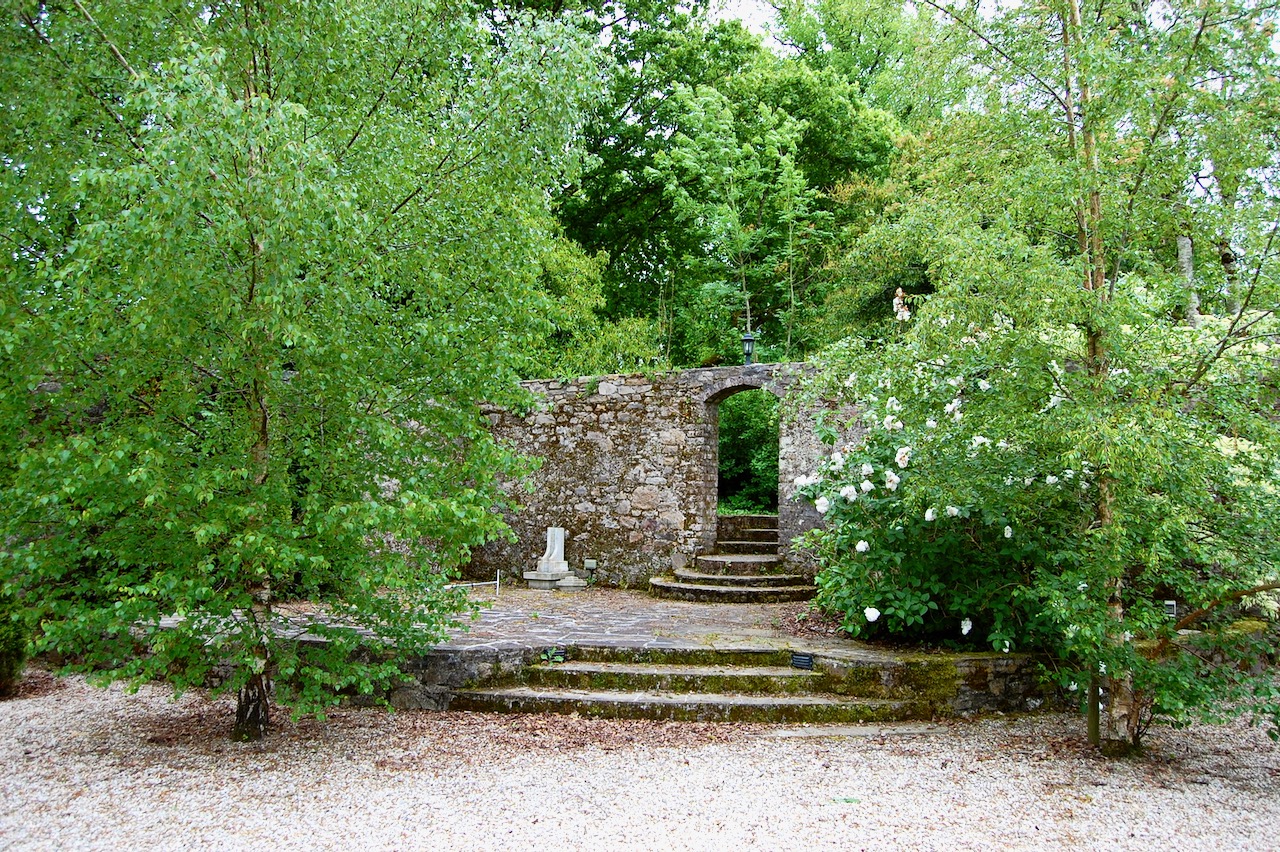
Loughton, May 2019. Photograph © Jennifer Winder-Baggot, www.irishhistorichouses.com
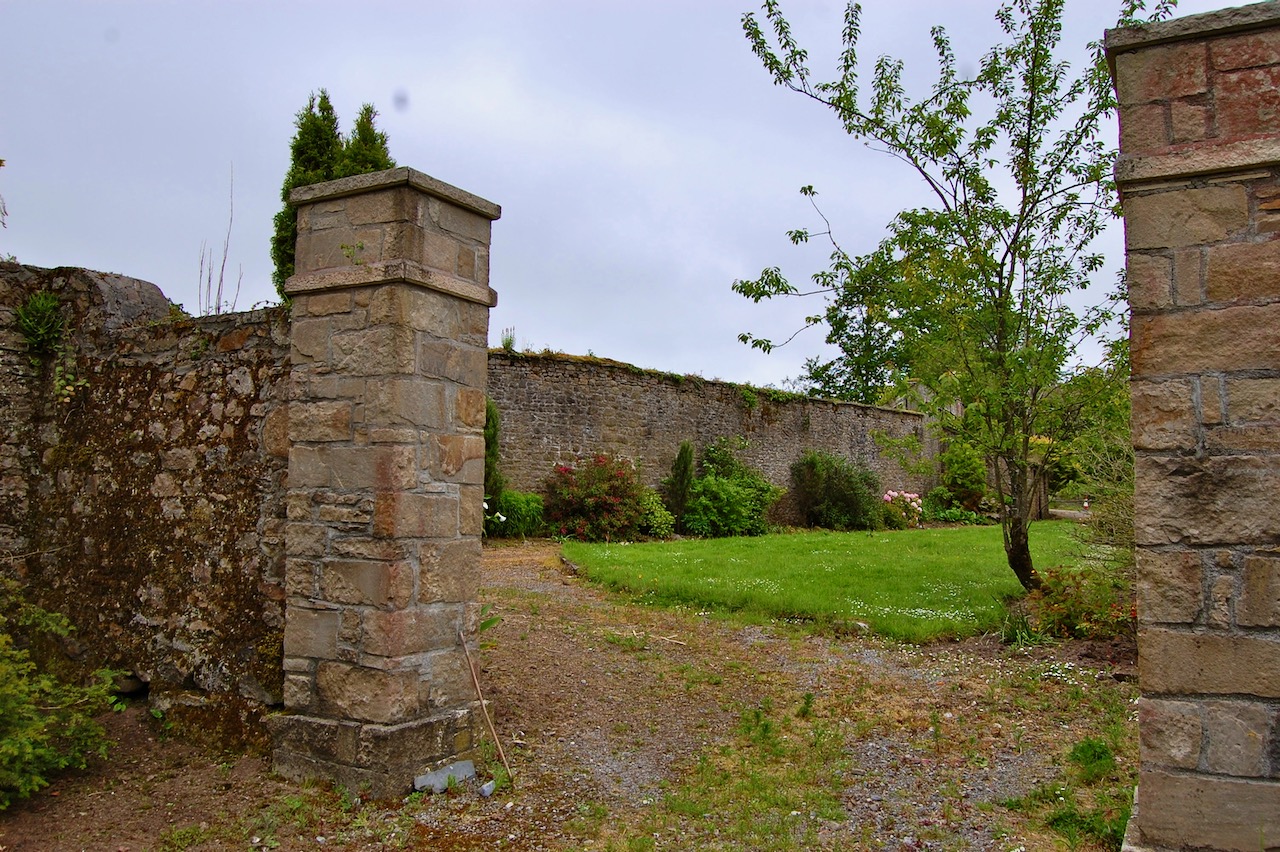
Then we sat at a table outside and Andrew brought us coffees – such a lovely touch!

Loughton, County Offaly. Photograph © Jennifer Winder-Baggot, www.irishhistorichouses.com
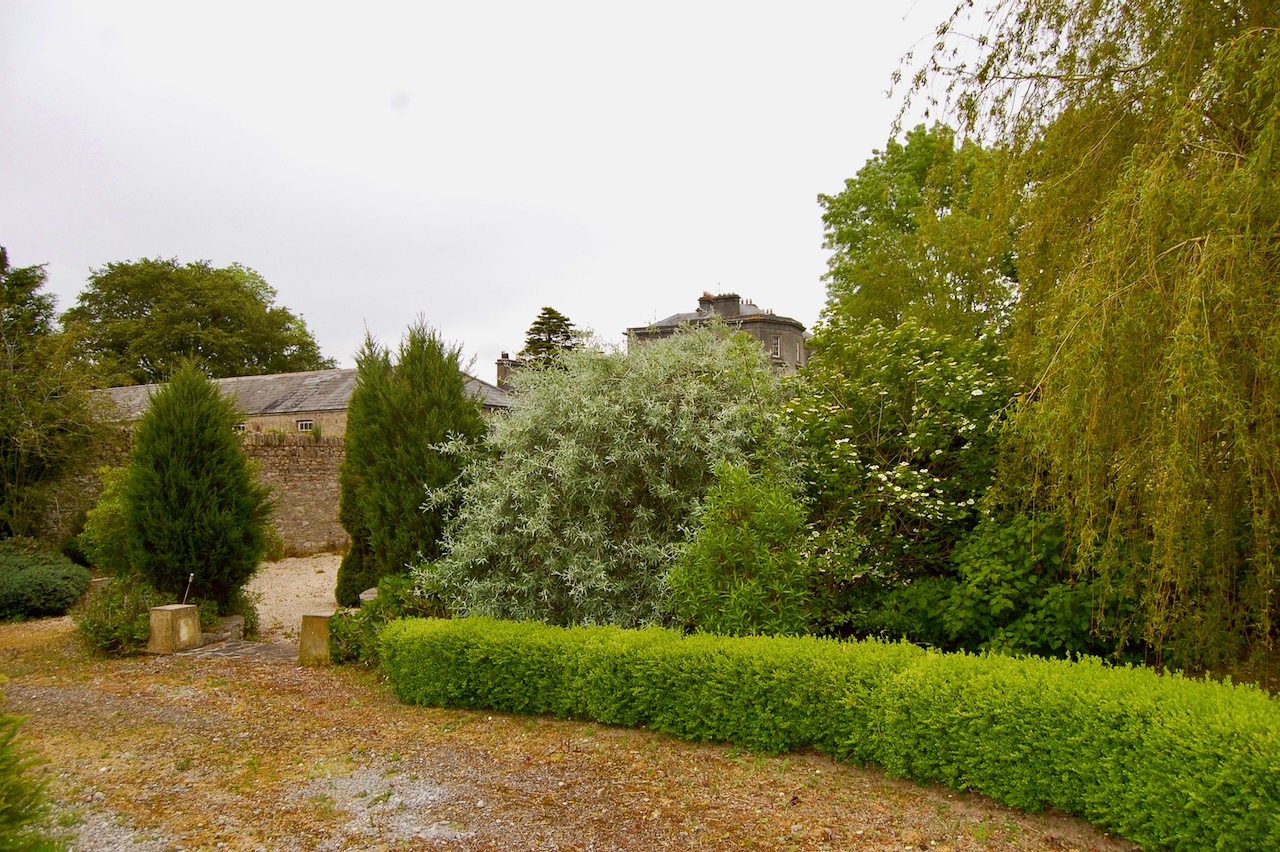
Loughton, May 2019. Photograph © Jennifer Winder-Baggot, www.irishhistorichouses.com
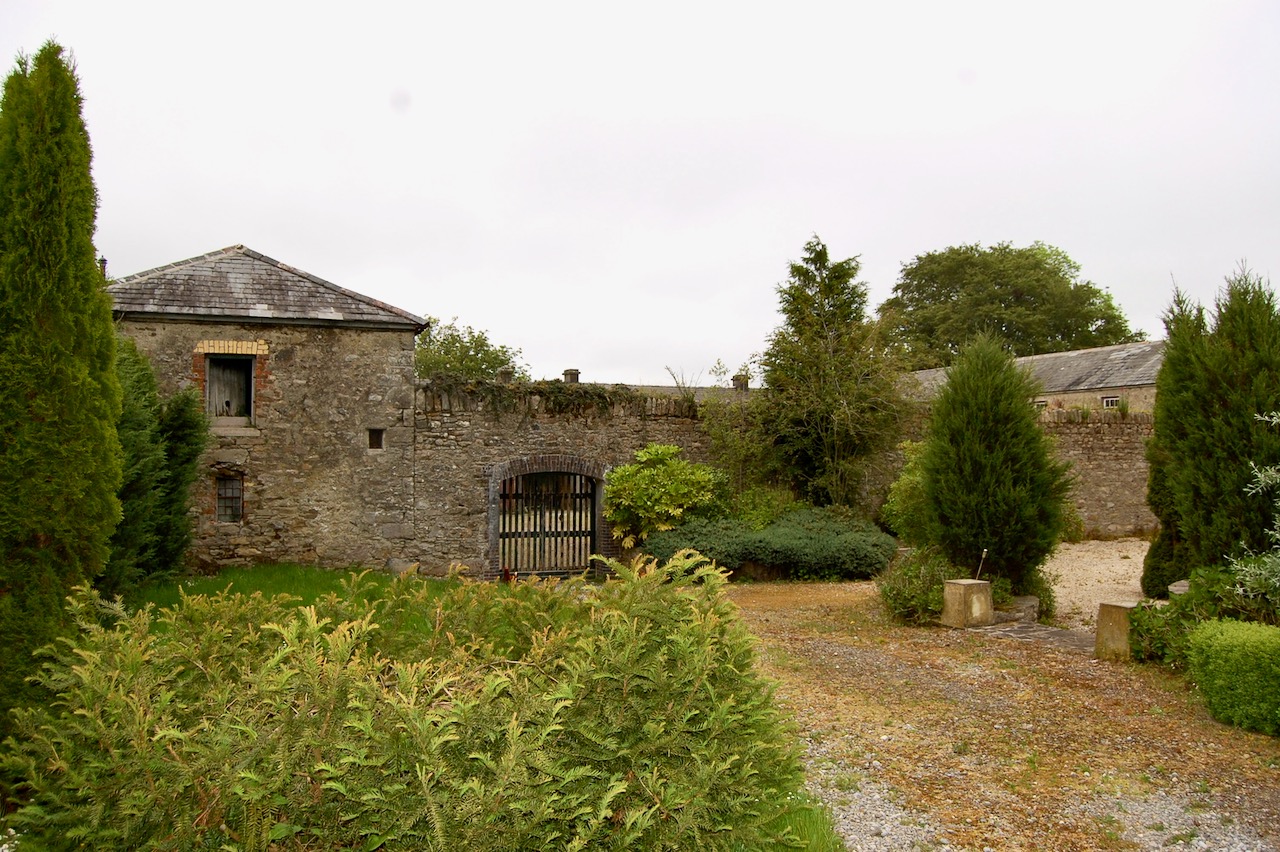
Michael joined us briefly and shared with us a photograph he had found in the national archives in England, of a group gathered at what is now the back of the house.

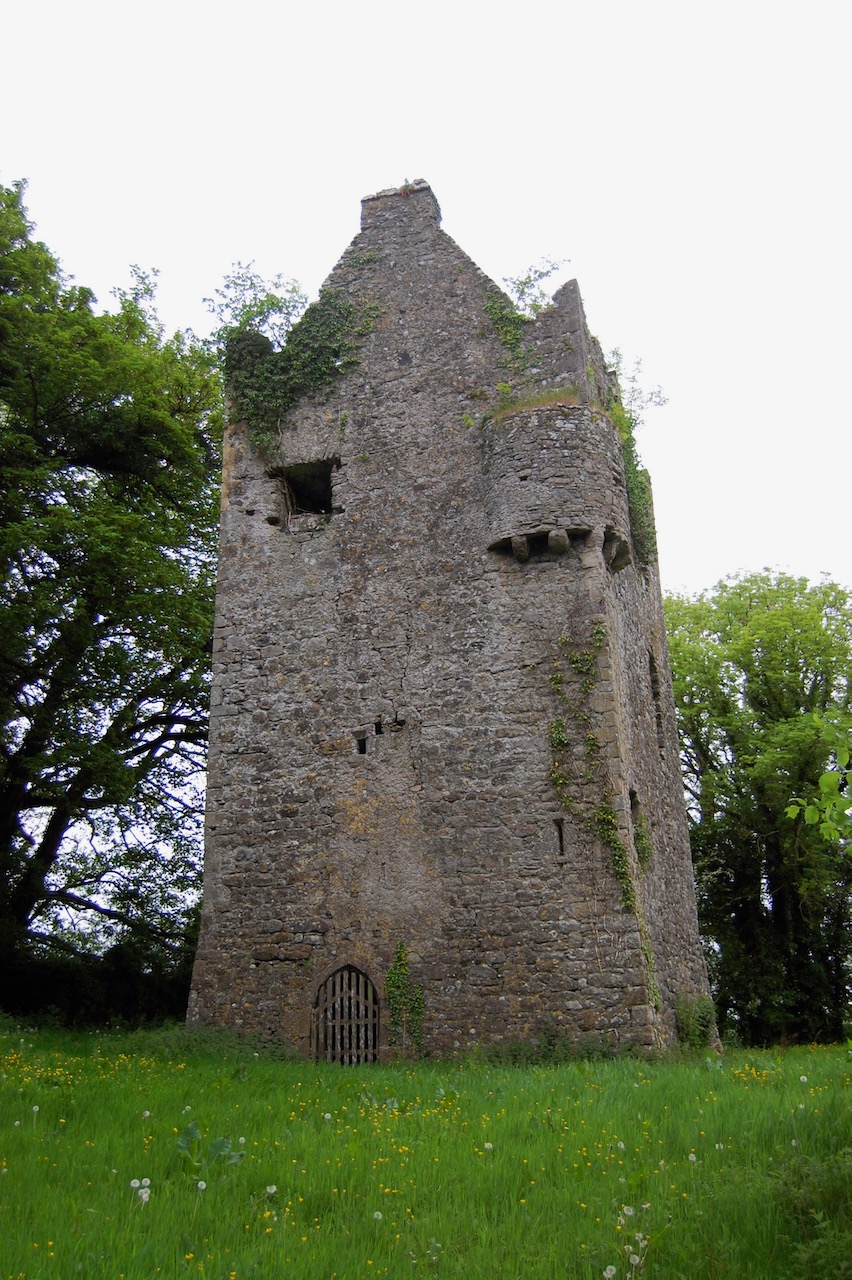
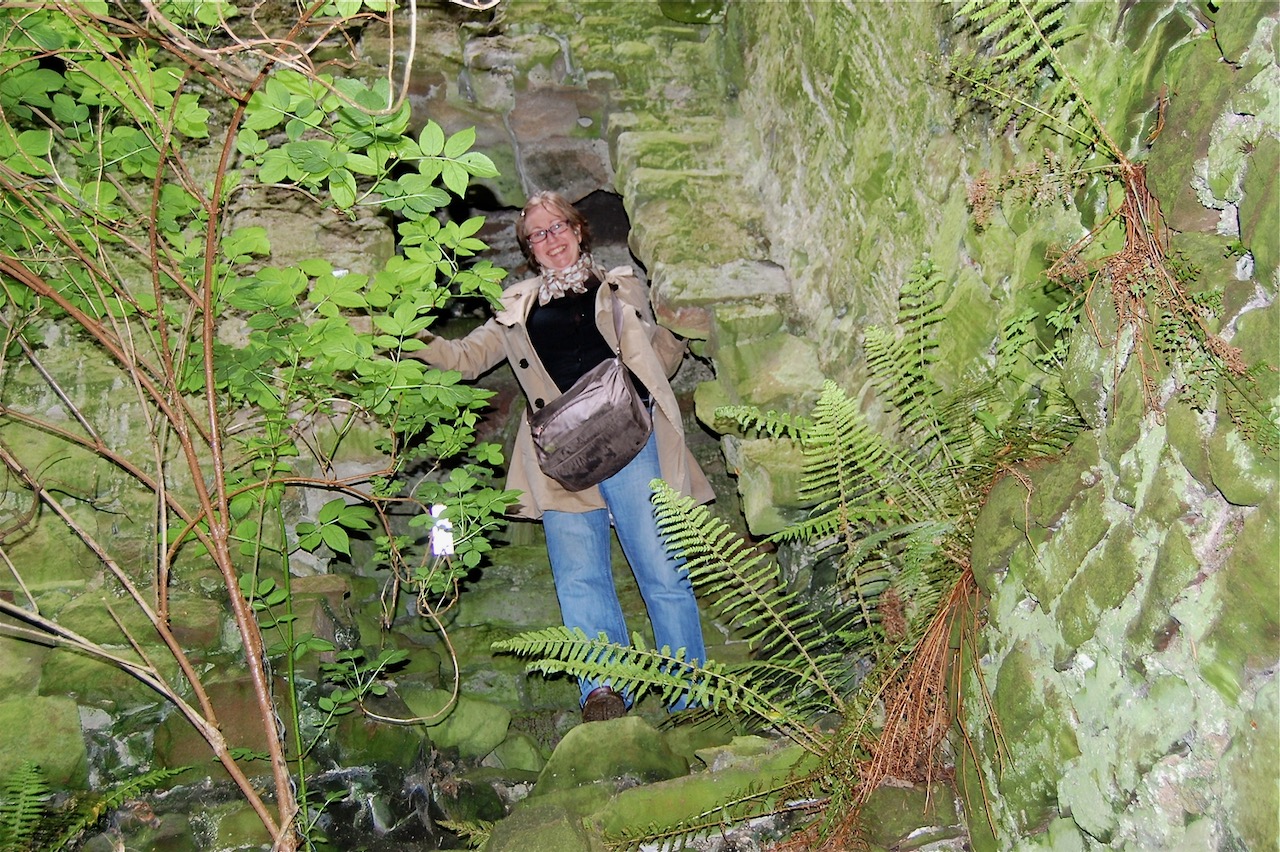
Andrew then urged us to wander in the gardens. We walked over to what looks like a Norman keep. It is Ballinlough Castle (not to be confused with Ballinlough Castle of County Westmeath), which dates back to the early seventeeth century, and belonged to the O’Carroll family. I climbed nearly all the way to the top (at my own peril!)!

Loughton, County Offaly. Photograph © Jennifer Winder-Baggot, www.irishhistorichouses.com
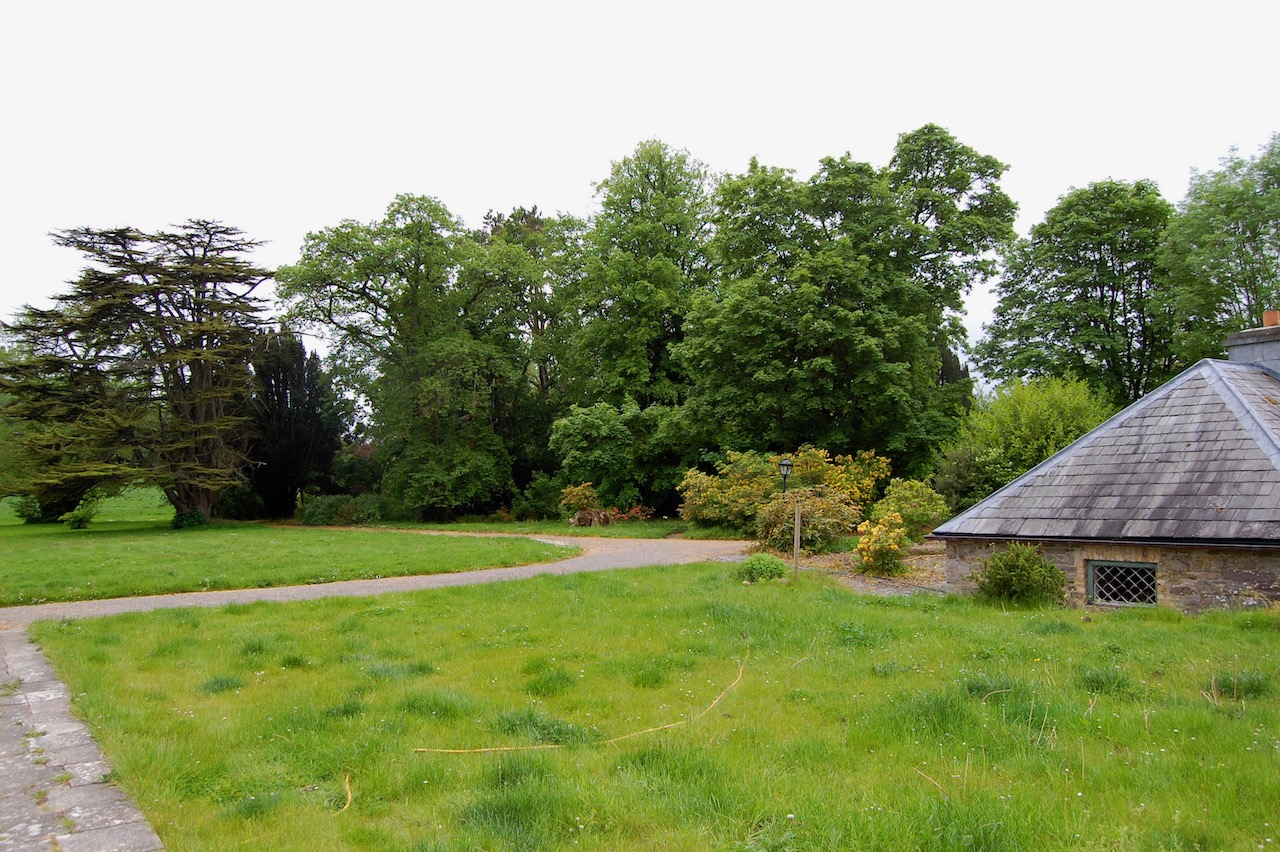
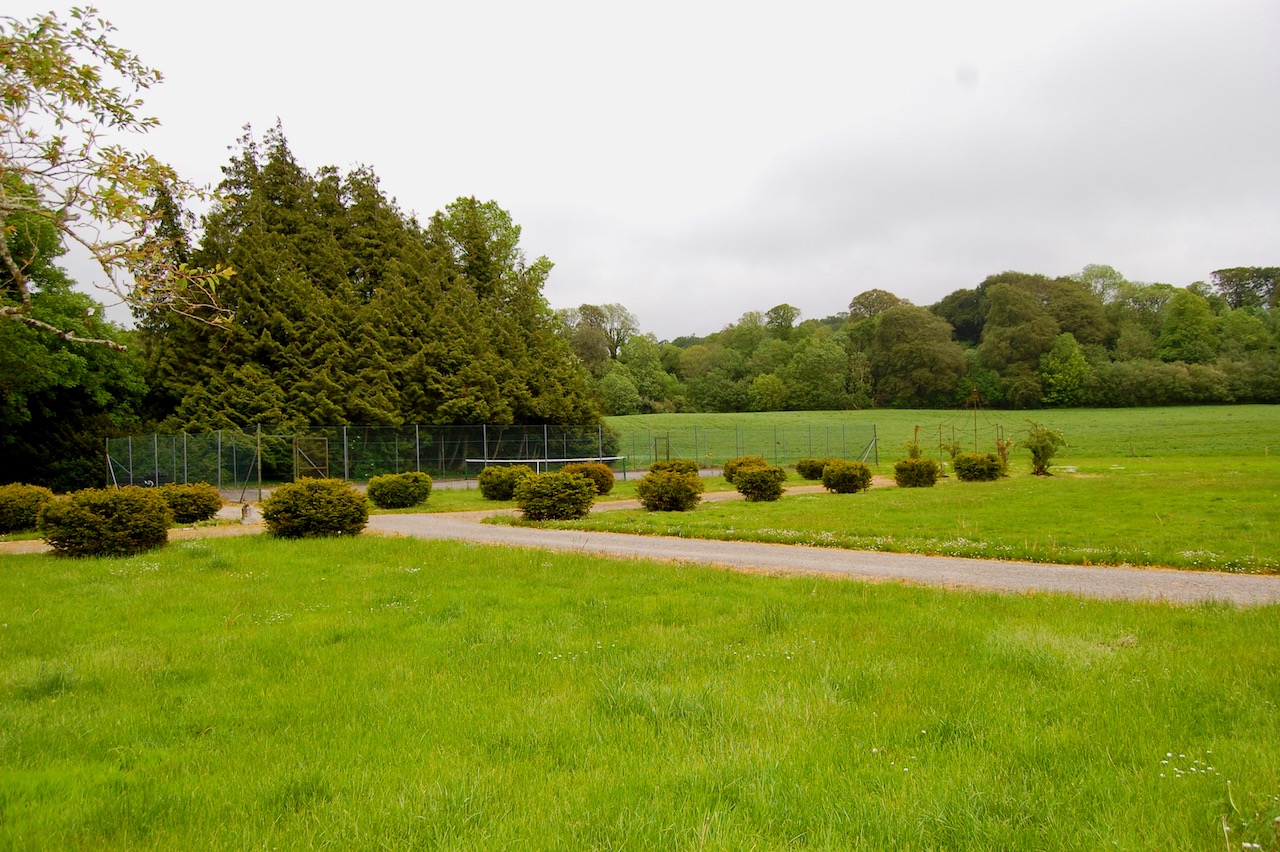
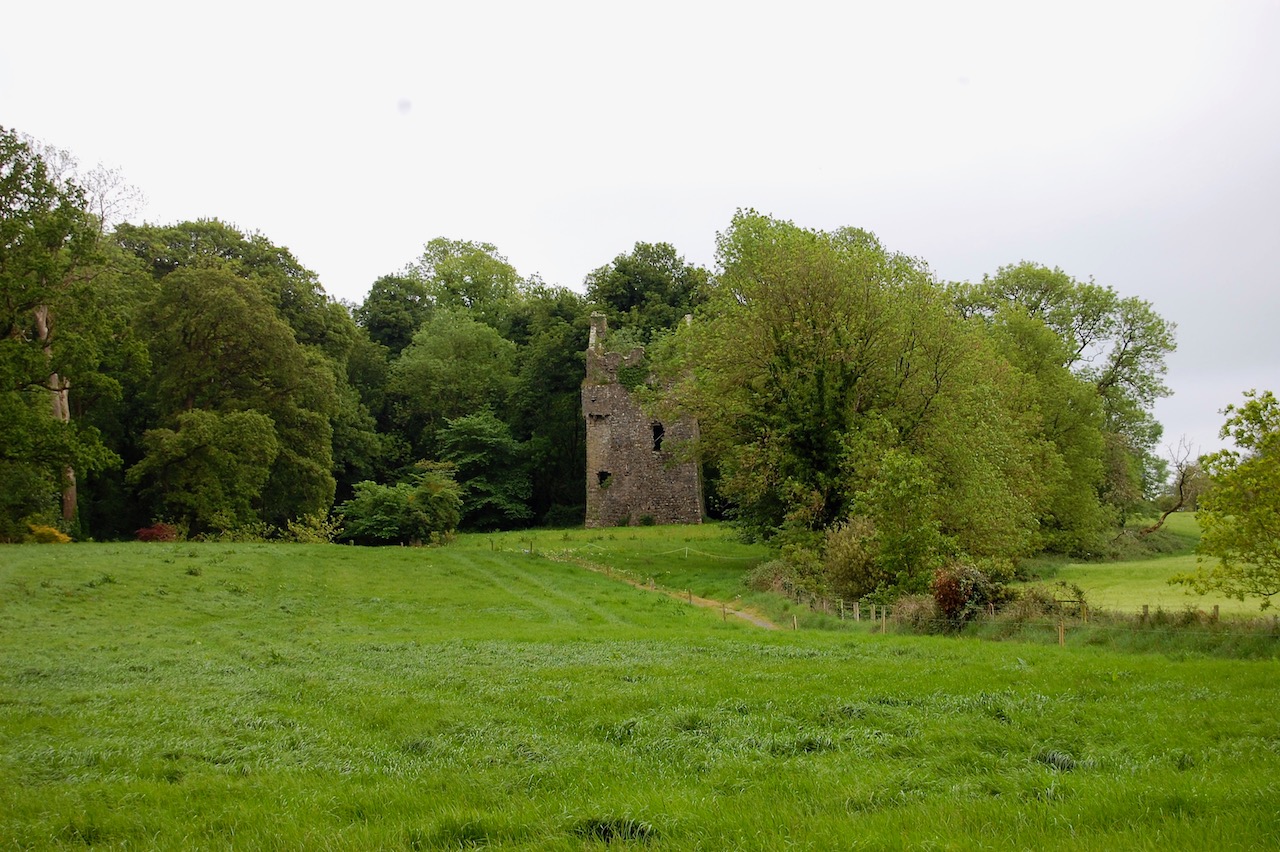
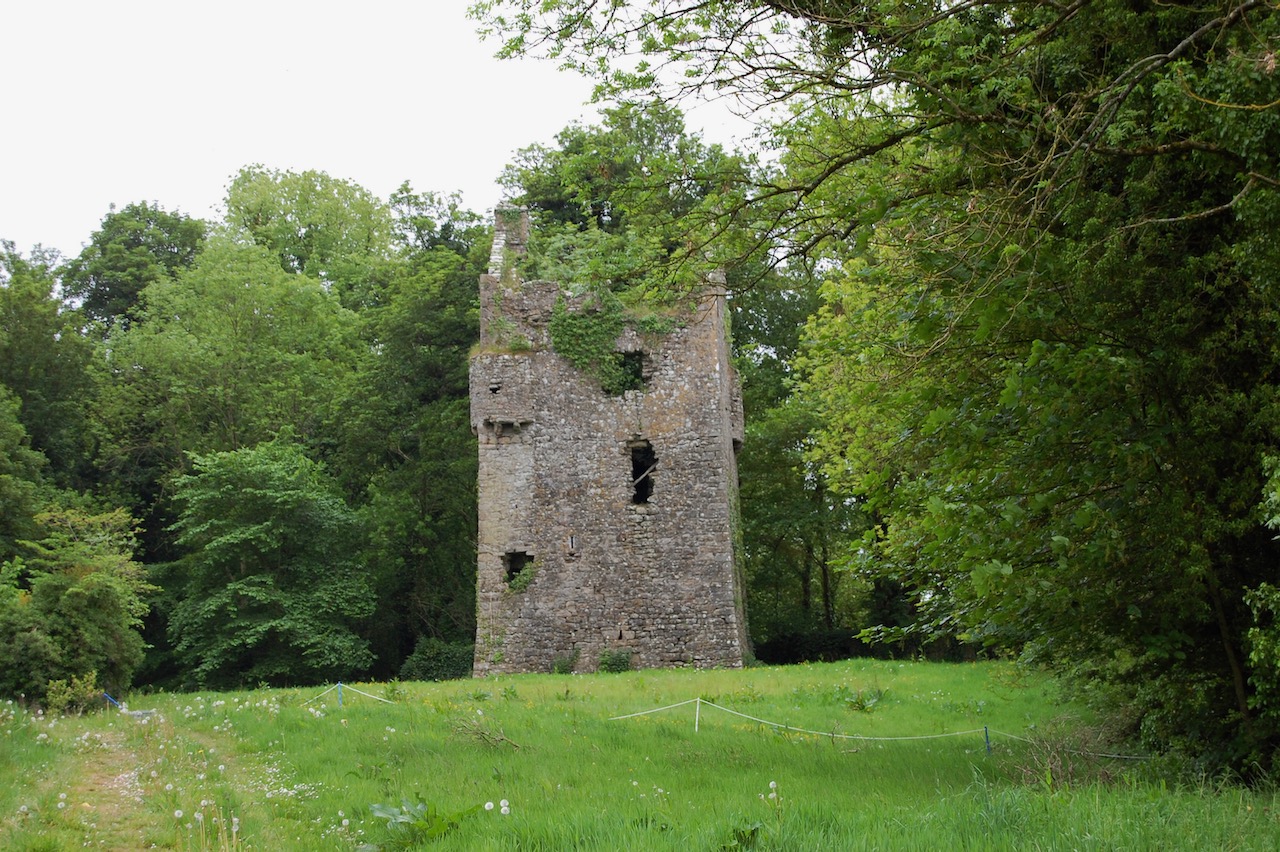
Loughton, May 2019. Photograph © Jennifer Winder-Baggot, www.irishhistorichouses.com
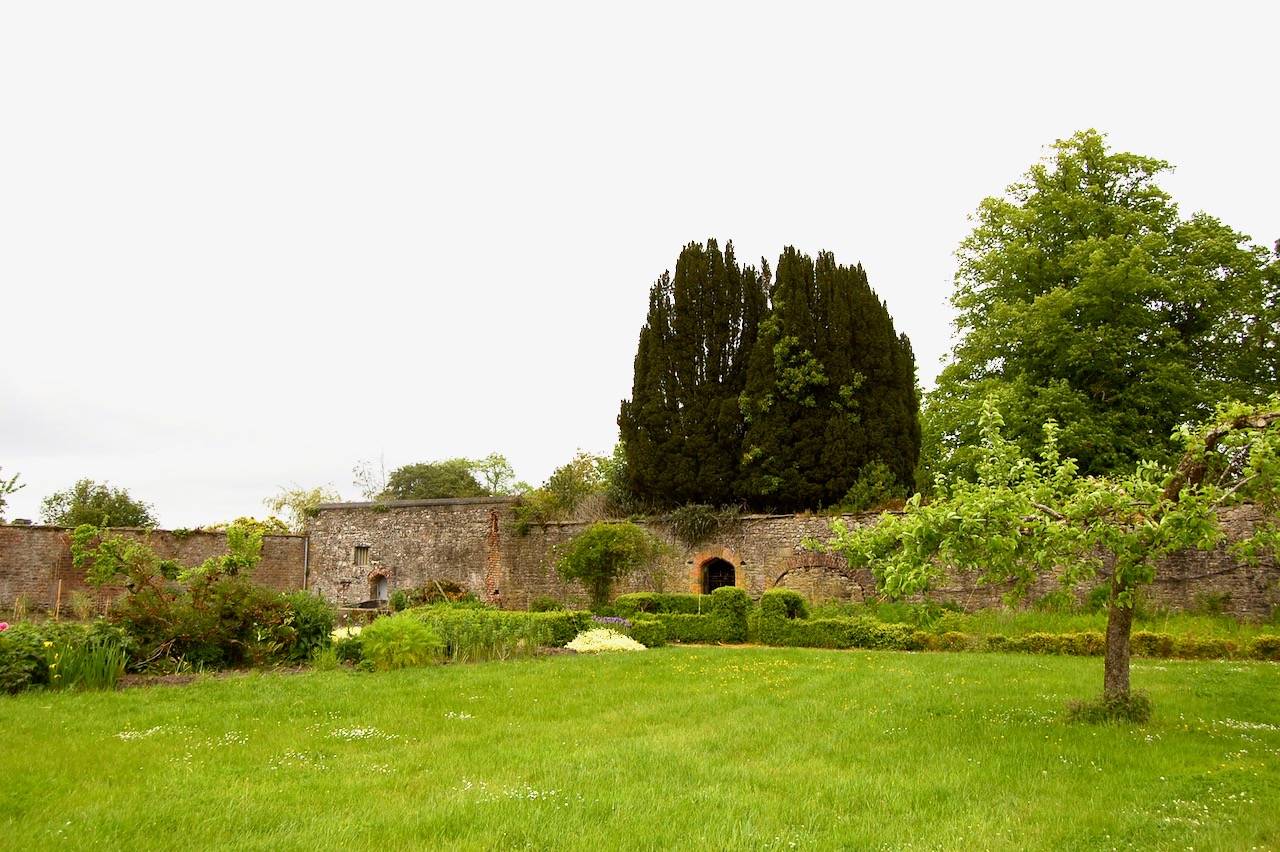
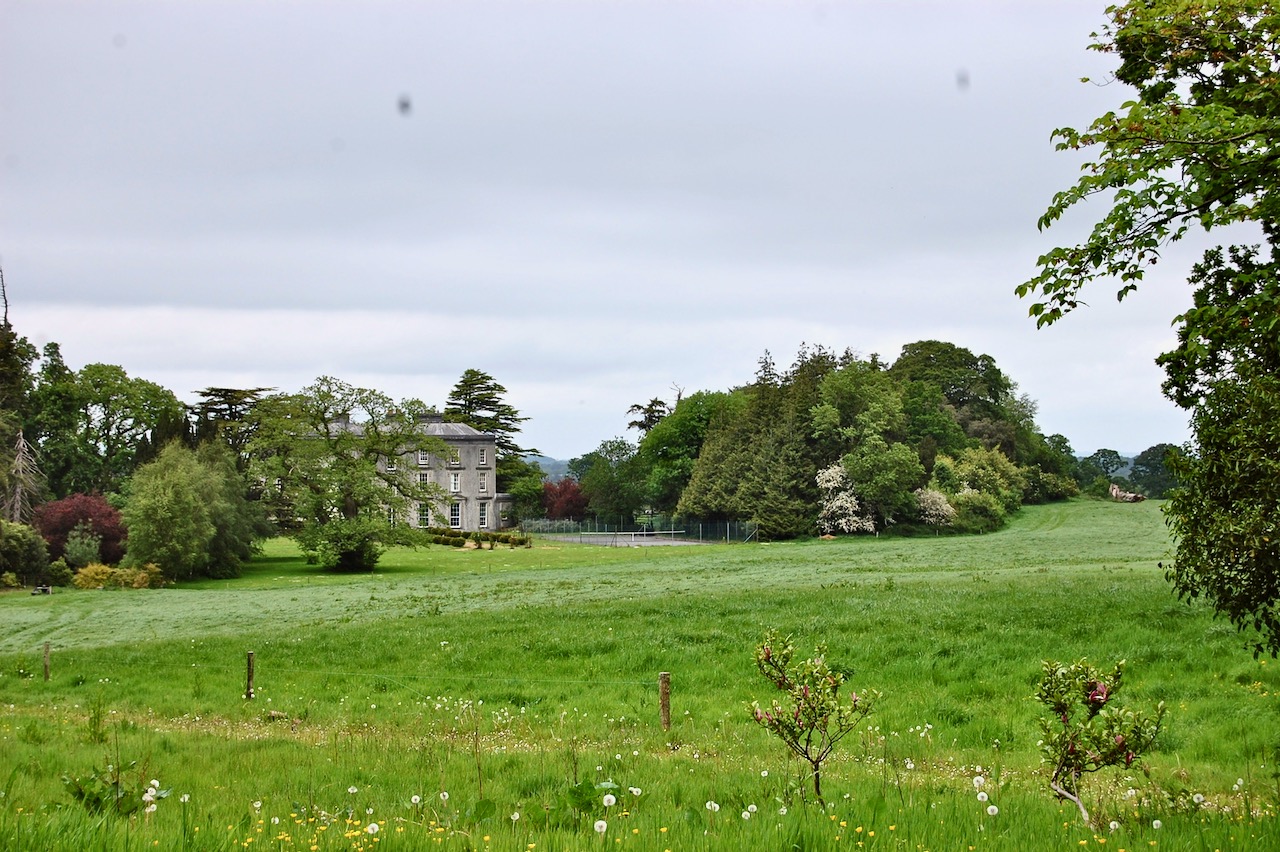
We then found our way to the walled garden. Michael told us he hopes to restore the glasshouse.

Loughton, County Offaly. Photograph © Jennifer Winder-Baggot, www.irishhistorichouses.com
Loughton, May 2019. Photograph © Jennifer Winder-Baggot, www.irishhistorichouses.com
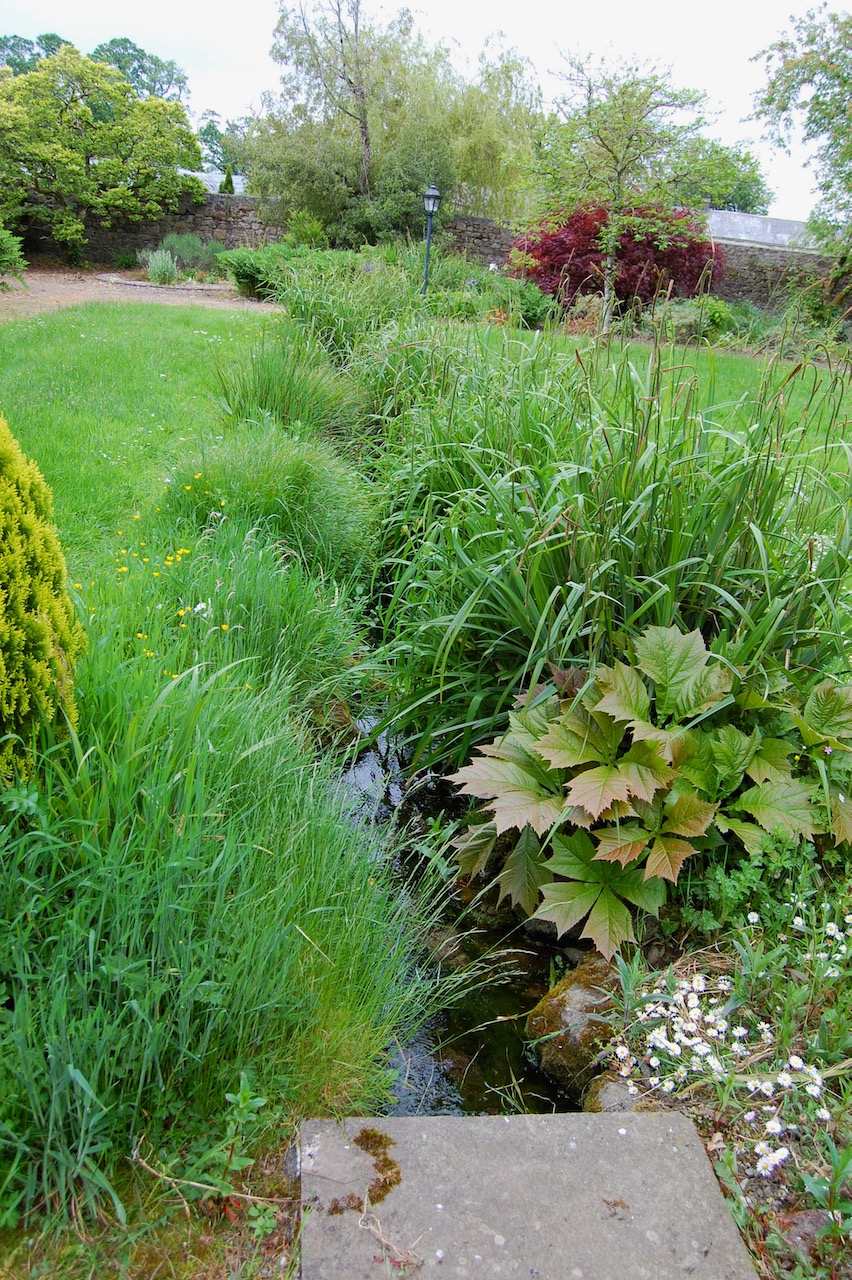
I’d love such a large growing space, with space for fruit trees and sheltering walls. I have had my own allotment for seven years!

Loughton, County Offaly. Photograph © Jennifer Winder-Baggot, www.irishhistorichouses.com
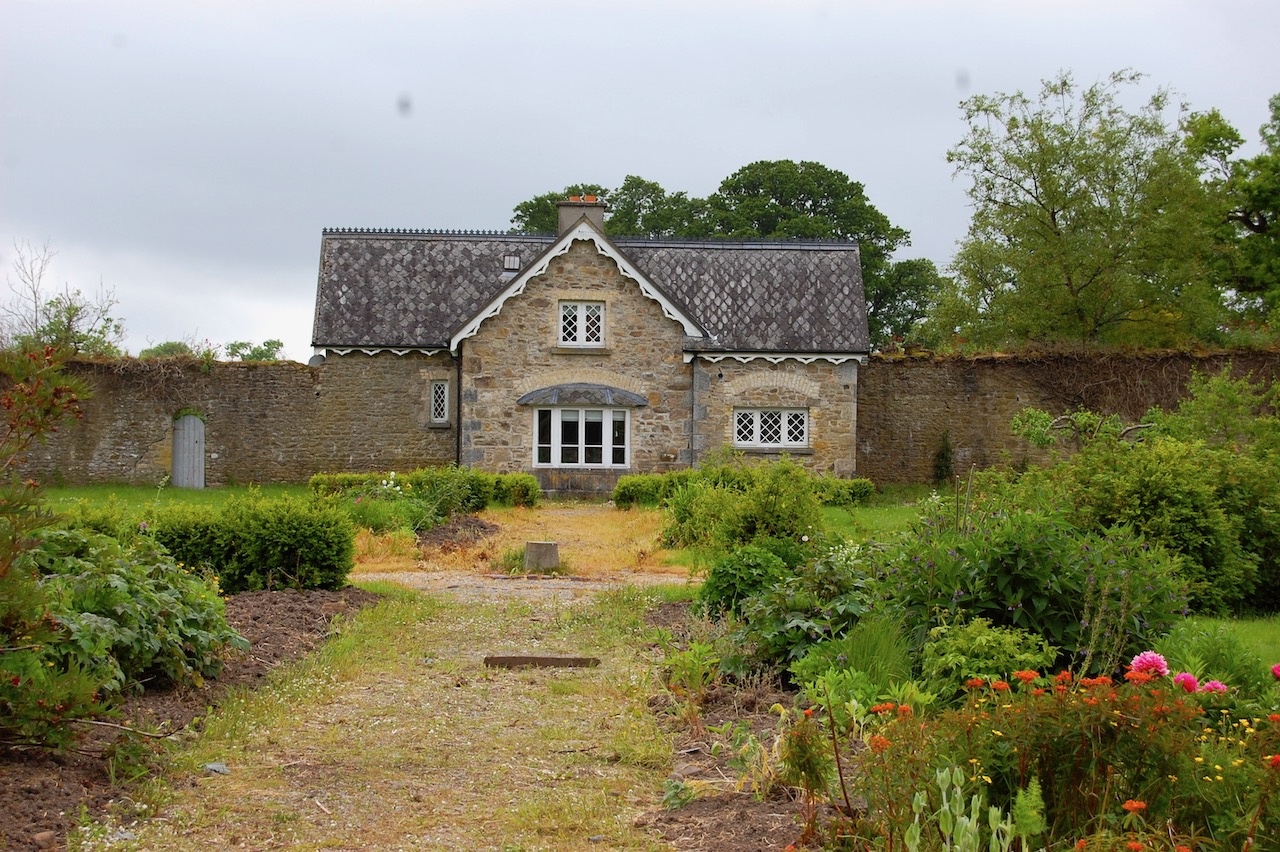
The vine, above, which was taken from a cutting from a vine belonging to Queen Victoria and given to her lady-in-waiting, Georgiana Liddell, when she married Baron Bloomfield. Photograph © Jennifer Winder-Baggot, www.irishhistorichouses.com
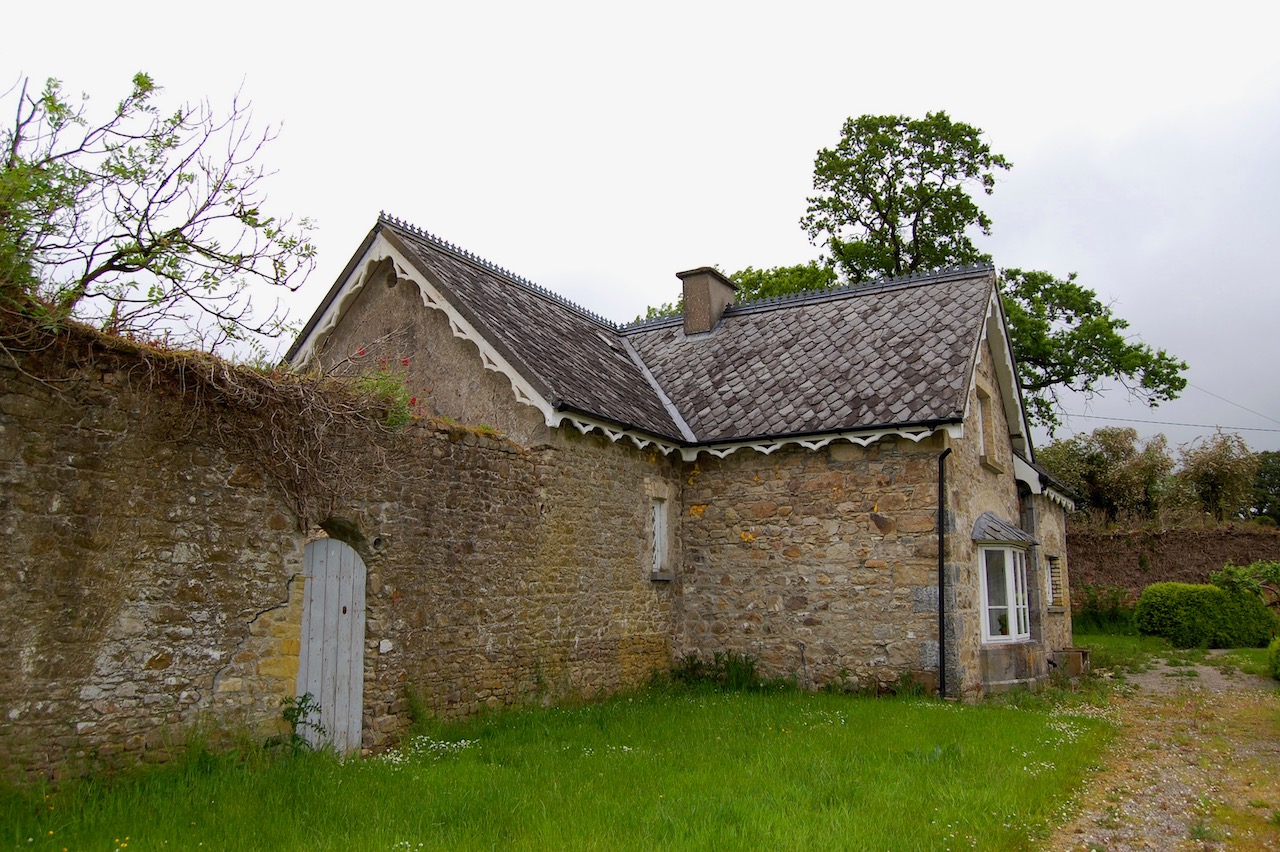
Loughton, May 2019. Photograph © Jennifer Winder-Baggot, www.irishhistorichouses.com

I’d love to stay in the cottage, which is also available to rent.

Loughton, County Offaly. Photograph © Jennifer Winder-Baggot, www.irishhistorichouses.com
Loughton, May 2019. Photograph © Jennifer Winder-Baggot, www.irishhistorichouses.com

[1] Mark Bence-Jones. A Guide to Irish Country Houses. (originally published as Burke’s Guide to Country Houses volume 1 Ireland by Burke’s Peerage Ltd. 1978); Revised edition 1988 Constable and Company Ltd, London.

[2] http://www.patrickcomerford.com/search/label/castles?updated-max=2017-03-10T11:30:00Z&max-results=20&start=79&by-date=false

[3] https://en.wikipedia.org/wiki/14th_King%27s_Hussars

[4] http://www.loughcutra.com/

[5] https://www.dia.ie/architects/view/2640/PAIN-JAMES

[6] https://www.dromoland.ie/

[7] https://www.bco.ie

[8] p. 472. Tierney, Andrew. Buildings of Ireland: Central Leinster. The Counties of Kildare, Laois and Offaly. Yale University Press, New Haven and London, 2019.

[9] https://www.buildingsofireland.ie/buildings-search/building/14946003/laughton-house-ballinlough-cl-by-cullenwaine-ed-moneygall-co-offaly

[10] https://loughtonhouse.com/

[11] https://www.buildingsofireland.ie/buildings-search/building/22403202/ciamaltha-house-garraunbeg-tipperary-north

[12] http://landedestates.nuigalway.ie/LandedEstates/jsp/estate-show.jsp?id=2352

Redwood was inherited by Henry Trench’s son William Thomas Trench (1843-1911).

[13] https://www.irishtimes.com/life-and-style/homes-and-property/fine-art-antiques/owner-of-supermac-s-buys-loughton-house-archive-1.2818308

[14] http://www.thepeerage.com

[15] https://landedfamilies.blogspot.com/search/label/Ireland?updated-max=2017-02-19T16:18:00Z&max-results=20&start=23&by-date=false Atkinson of Cangort and Ashley Park

Text © Jennifer Winder-Baggot, www.irishhistorichouses.com