Powerscourt Townhouse, 59 South William Street, Dublin 2 – section 482

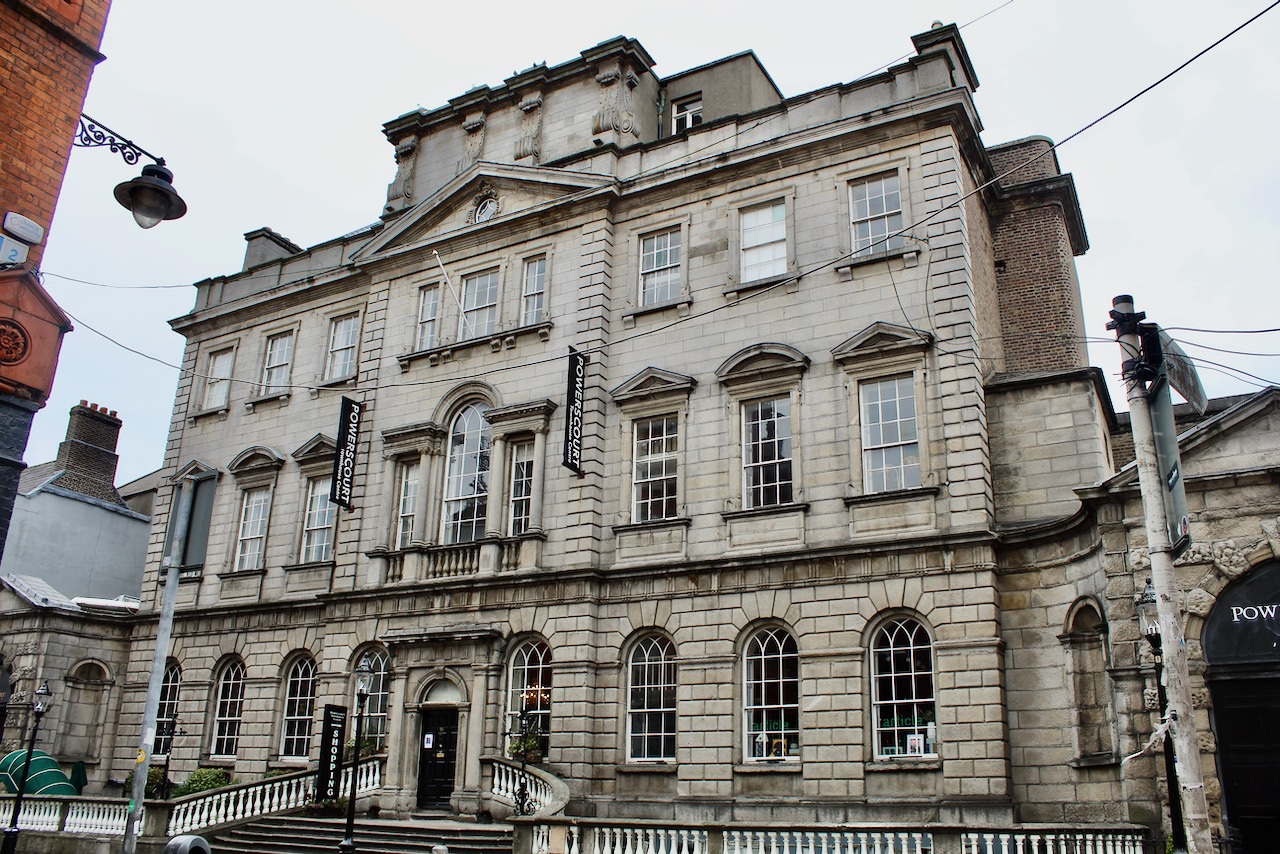
Powerscourt townhouse. Photograph © Jennifer Winder-Baggot, www.irishhistorichouses.com

https://www.powerscourtcentre.ie/

Open in 2026: all year, except New Year’s Day, Christmas Day, 10am-6pm

Fee: Free entry

This house was built for the 3rd Viscount Powerscourt, Richard Wingfield (1730-1788), in 1771, as his city residence. He already owned the Wicklow estate and grand house of Powerscourt in Enniskerry (see my entry for more about the Wingfield family and the Viscounts Powerscourt). I came across the Wingfield family first on my big house travels in 2019, when Stephen and I visited Salterbridge House in Cappoquin, County Waterford, which is owned by Philip and Susan Wingfield (Philip is the descendent of the 3rd Viscount Powerscourt, by seven generations! [1]).
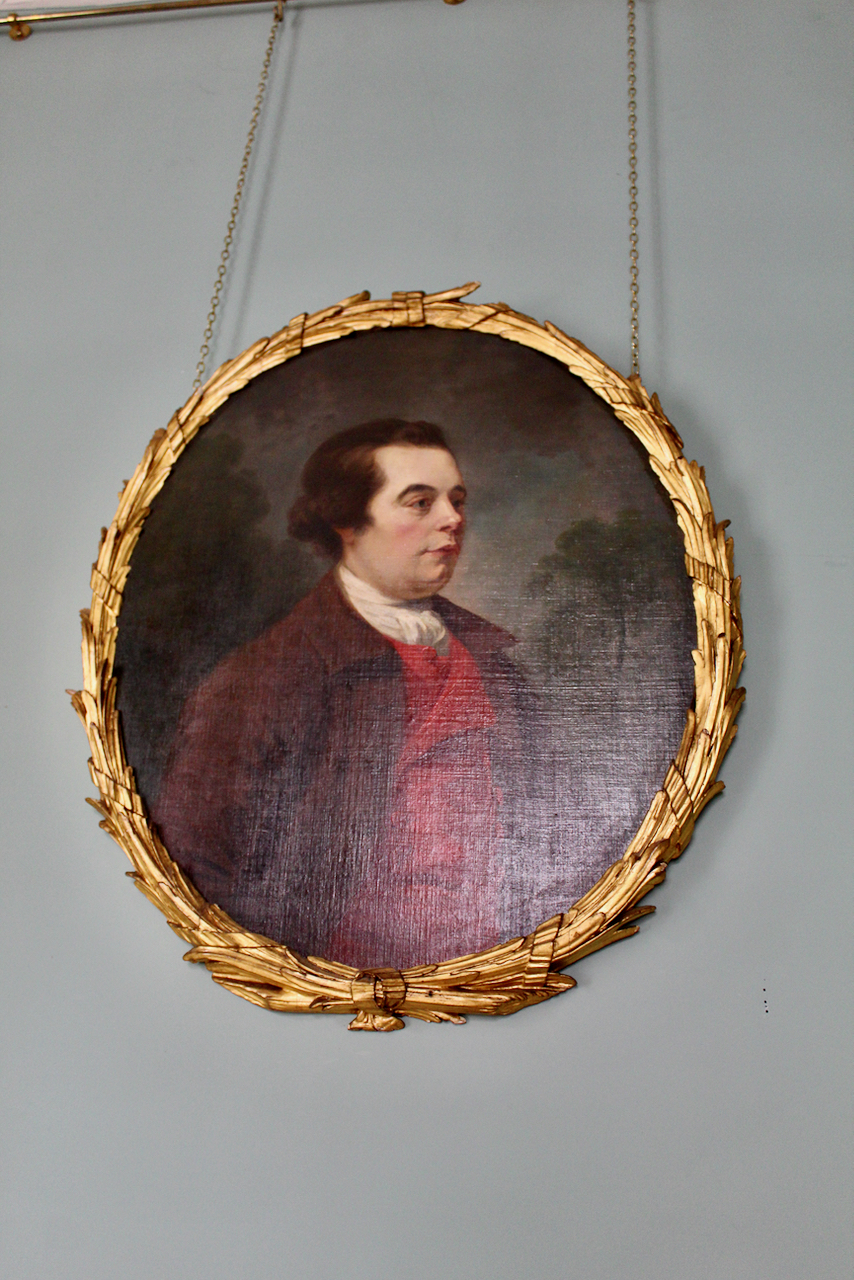
Richard Wingfield (1730-1788) 3rd Viscount Powerscourt.

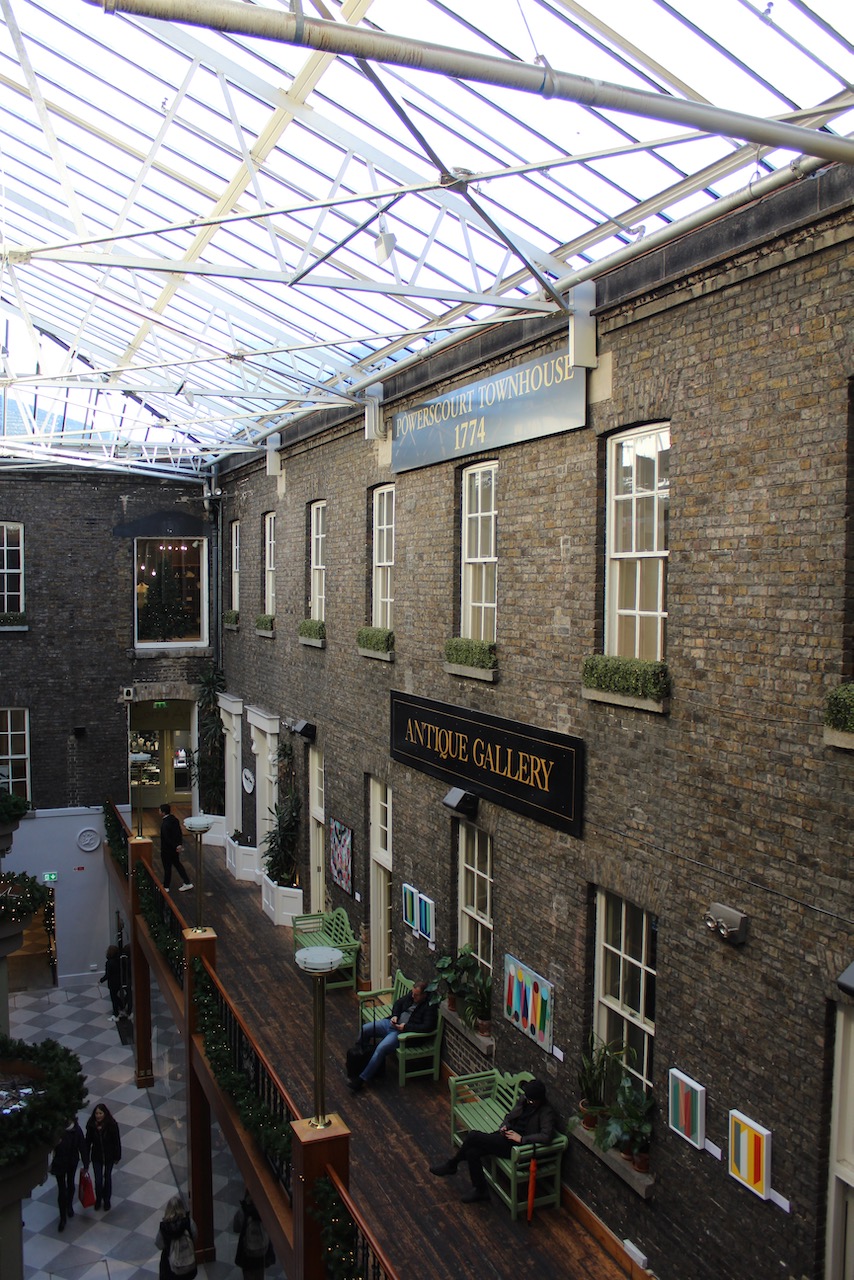
Kevin O’Connor writes in his Irish Historic Houses that “The palazzo was originally laid out around an open square. This has now been fitted (and covered) in to provide a centre specialising as a grand emporium for crafts, antiques, shopping and restaurants.”
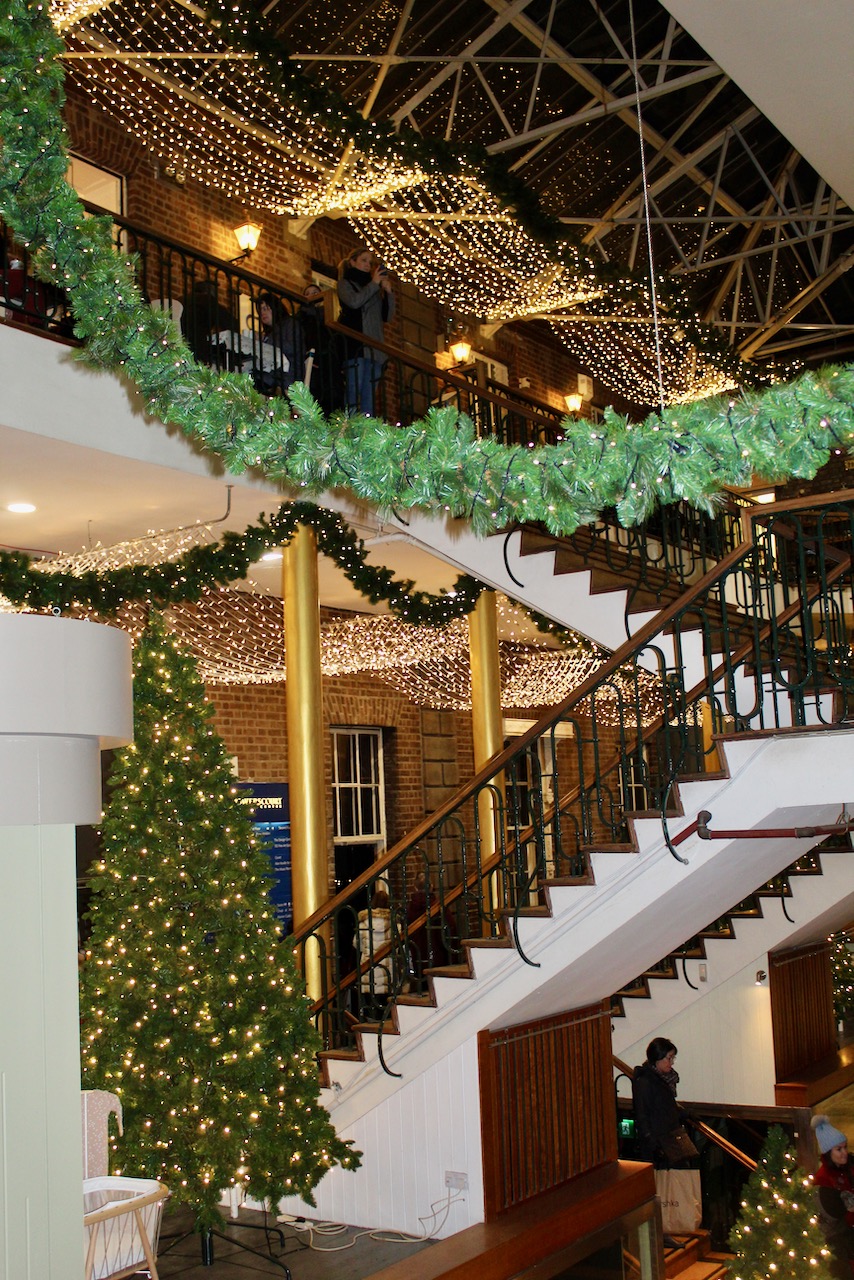
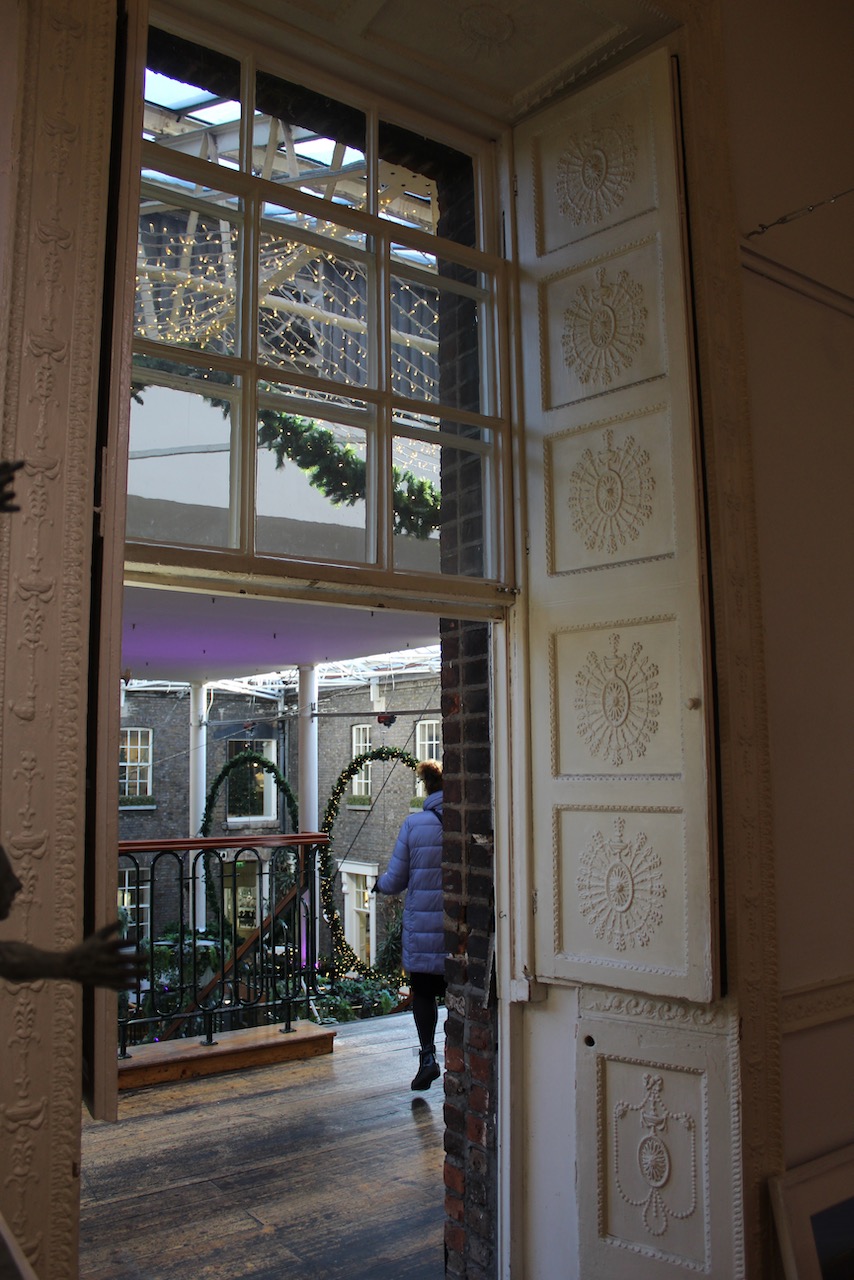
Inside Powerscourt townhouse, now full of shops. Photograph © Jennifer Winder-Baggot, www.irishhistorichouses.com

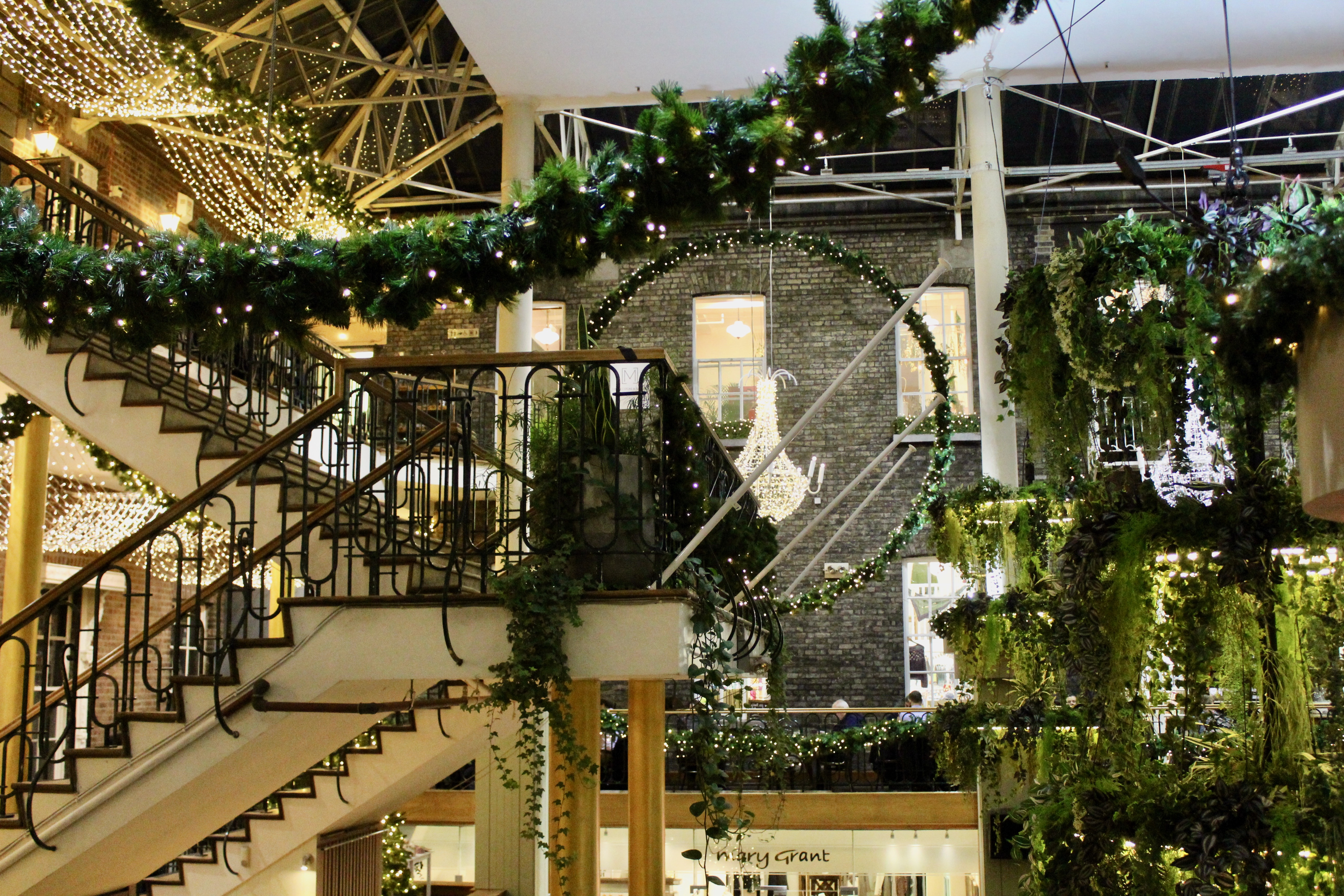
I am writing this blog during the Covid-19 lockdown in March 2020! I started to take pictures of Powerscourt townhouse last December, when it was in its full glory inside with Christmas decorations, knowing that it is listed in section 482. Today I will write about the history of this house and share my photographs, although I have not yet contacted Mary Larkin, who must manage the Townhouse Centre. Last week before the lockdown, when most of Ireland and the world were already self-isolating and most shops were closed, Stephen and I walked into town. It was a wonderful photographic opportunity as the streets were nearly empty.
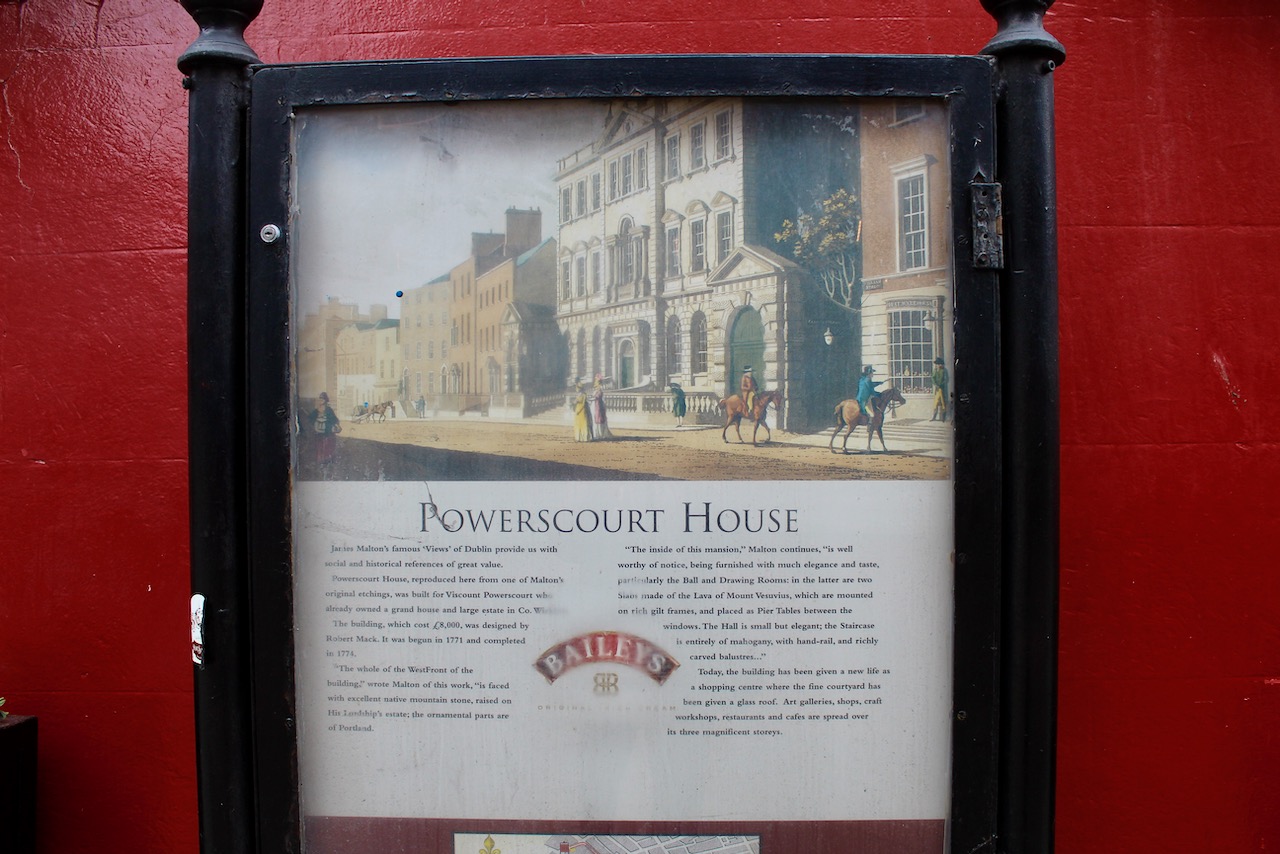
Above, by the wall of our favourite pub, Grogans, is the picture of the James Malton engraving (1795) of the neo-Palladian Powerscourt Townhouse. This sign tells us that the house was begun in 1771 and completed in 1774 and cost £8000.

Architectural historian Christine Casey describes Powerscourt Townhouse to be reminiscent of Richard Castle’s country-house practice, although she writes that it was designed by Robert Mack. [3] Mack was an amateur architect and stonemason. The west front of the house, Malton tells us, is faced with native stone from the Wicklow estate, with ornament of the more expensive Portland stone, from England.

Powerscourt Townhouse 1945, photograph from Dublin City Library and Archives. [2]

The house is historically and architecturally one of the most important pre-Union mansions of the Irish nobility. The Wingfields, Viscount Powerscourt and his wife Lady Amelia Stratford (daughter of John, Earl of Aldborough), would have stayed in their townhouse during the “Season,” when Parliament sat, which was in the nearby College Green in what is now a Bank of Ireland, and they would have attended the many balls and banquets held during the Season.

Richard was the younger son of the 1st Viscount Powerscourt, and he inherited the title after his older brother, Edward, died. He was educated in Trinity College, Dublin, and the Middle Temple in London. He served in the Irish House of Commons for Wicklow County from 1761-1764. In 1764 he became 3rd Viscount after the death of his brother, and assumed his seat in the Irish House of Lords.
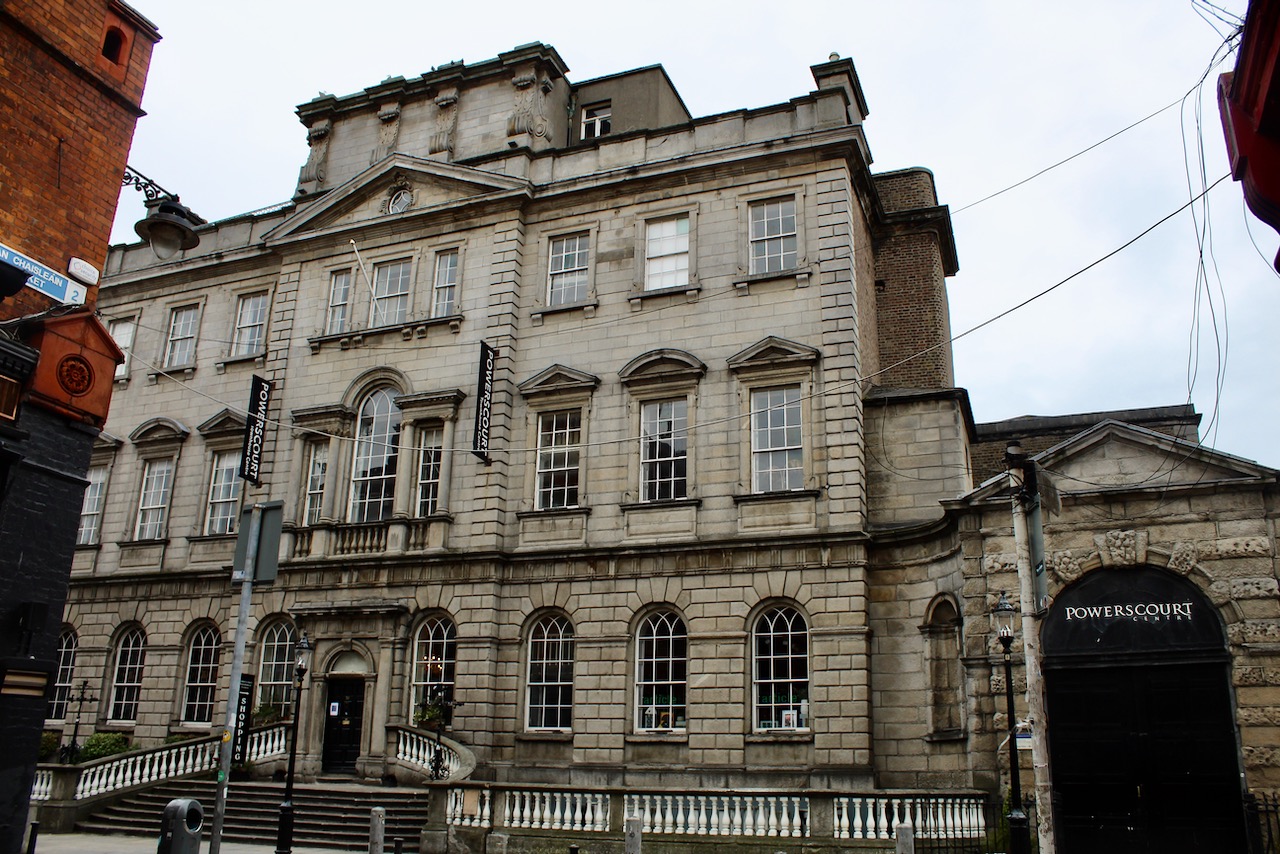
Powerscourt townhouse. Photograph © Jennifer Winder-Baggot, www.irishhistorichouses.com

The arch to the left of the house was a gateway leading to the kitchen and other offices and there is a similar gateway on the right, which led to the stables.

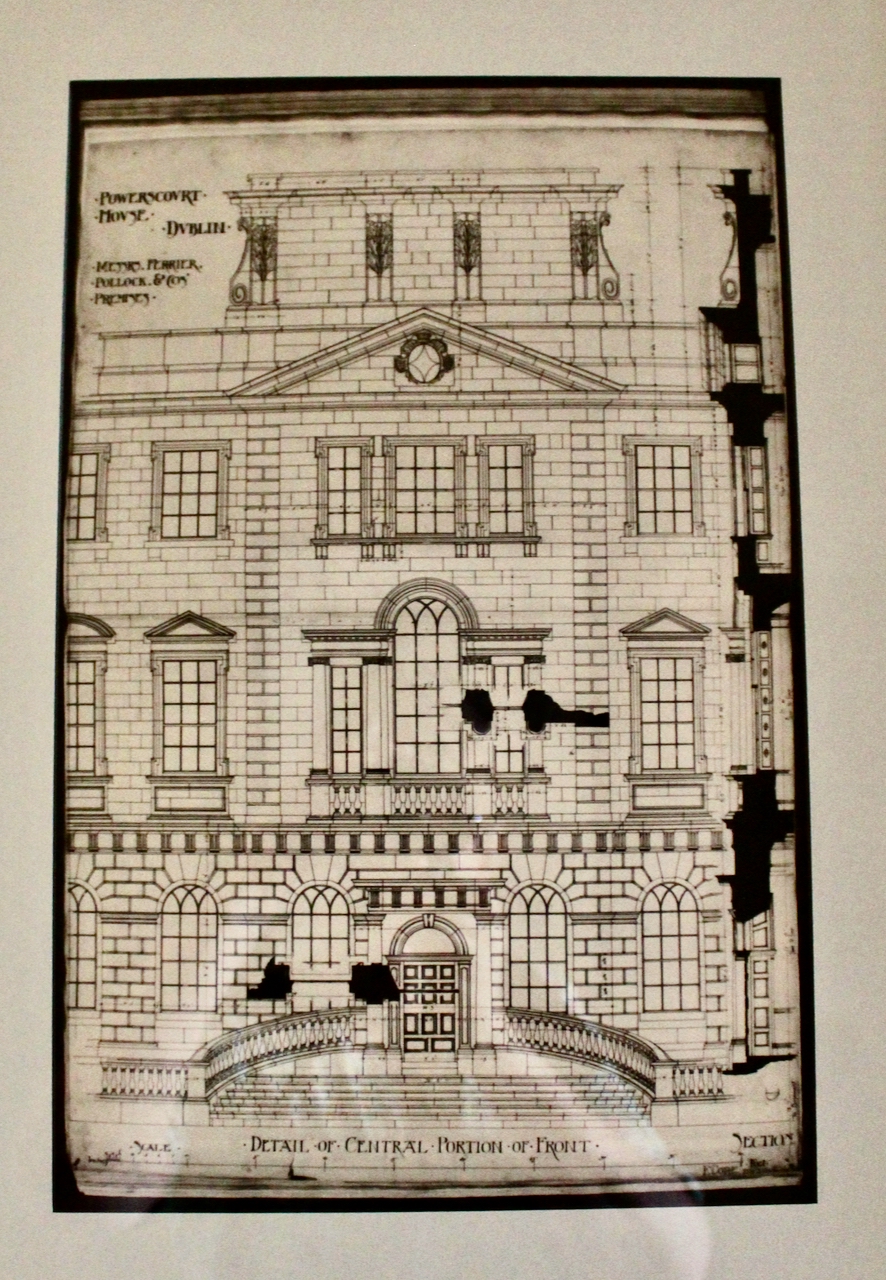
The house has four storey over basement frontage to South William Street, with “stunted and unequal niched quadrants” (see this in the photograph above, between the main block of the house, and the gateway) and pedimented rusticated arches. [4][5] Christine Casey describes the nine bay façade as faced with granite, and it has an advanced and pedimented centrepiece crowned by a solid attic storey with enormous volutes like that of Palladio’s Villa Malcontenta [5].

The attic storey housed an observatory. From this level, one could see Dublin Bay.

The ground floor has round-headed windows, while the piano nobile has alternating triangular and “segment-headed” pediments. A “Piano nobile” is Italian for “noble floor” or “noble level”, also sometimes referred to by the corresponding French term, bel étage, and is the principal floor of a large house. This floor contains the principal reception and bedrooms of the house. There is a Venetian window and tripartite window over the doorcase. Mark Bence-Jones tells us a Venetian window had three openings, that in the centre being round-headed and wider than those on either side; it is a very familiar feature of Palladian architecture.
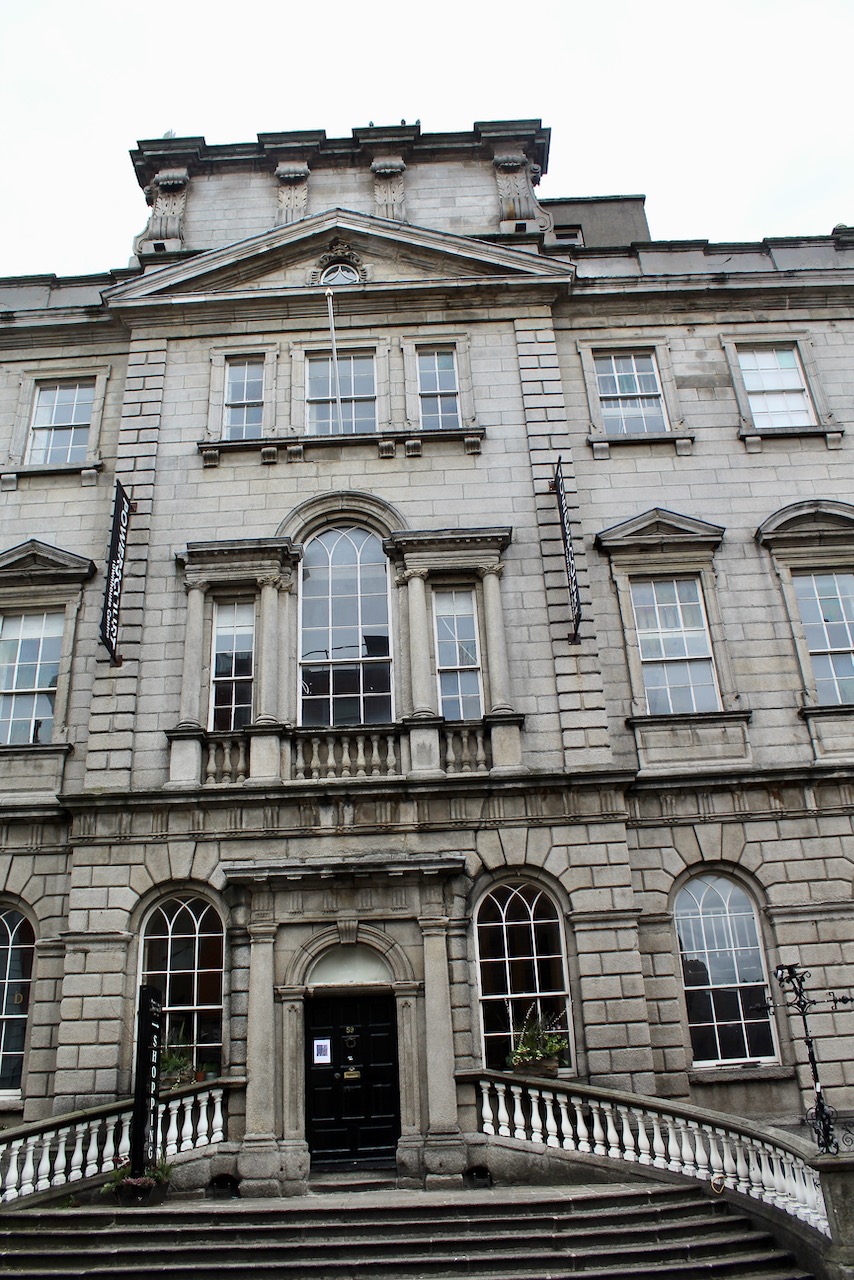
Powerscourt Townhouse. Photograph © Jennifer Winder-Baggot, www.irishhistorichouses.com
Powerscourt townhouse.
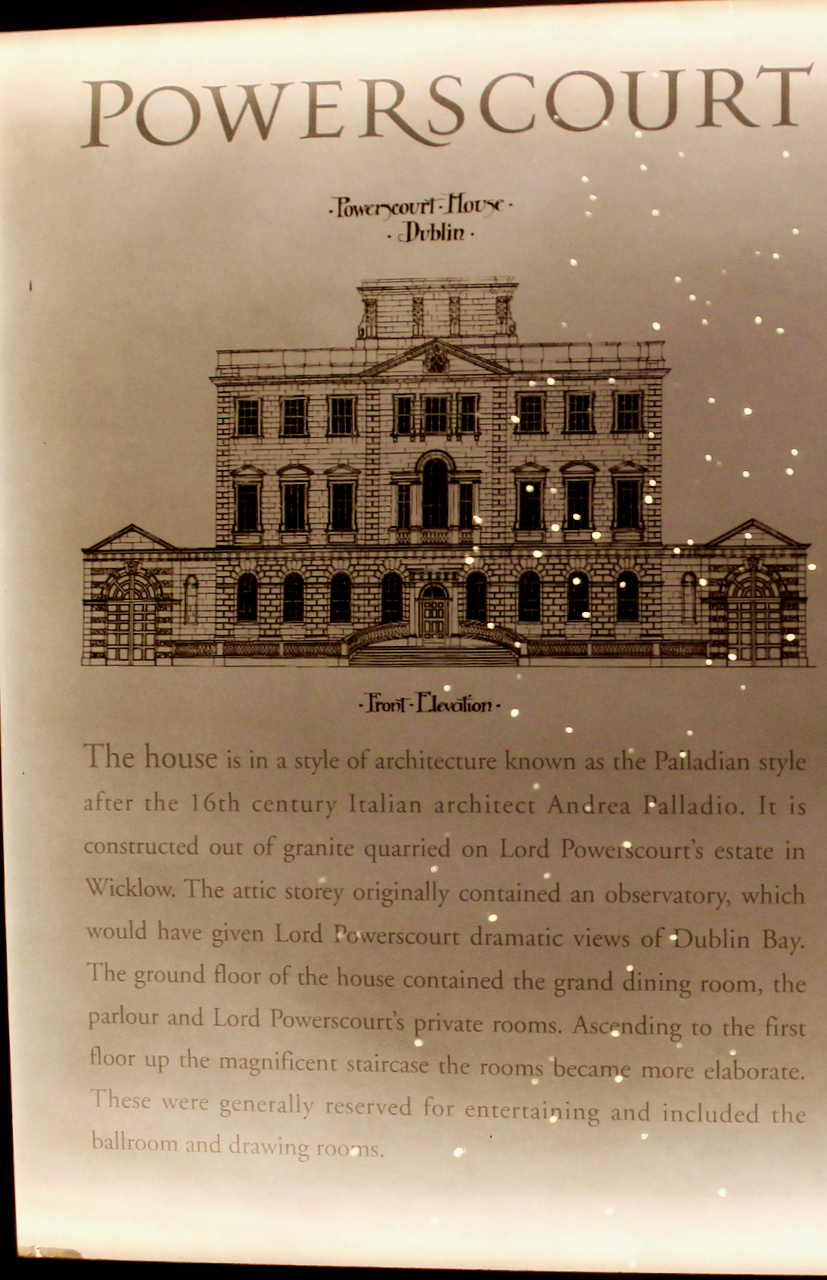
Plan of front of Powerscourt Townhouse, from a sketch on display at Carton, County Kildare.

The ground floor contained the grand dining room, the parlour, and Lord Powerscourt’s private rooms. Ascending to the first floor up the magnificent mahogany staircase, one entered the rooms for entertaining: the ballroom and drawing room.
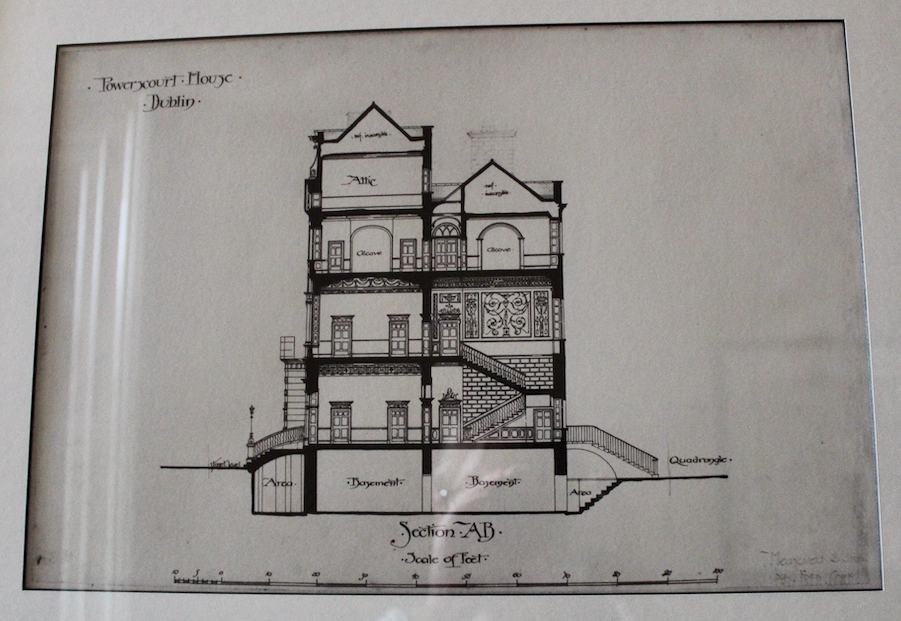
Plan of Powerscourt Townhouse, from a sketch on display at Carton, County Kildare.
Powerscourt townhouse.

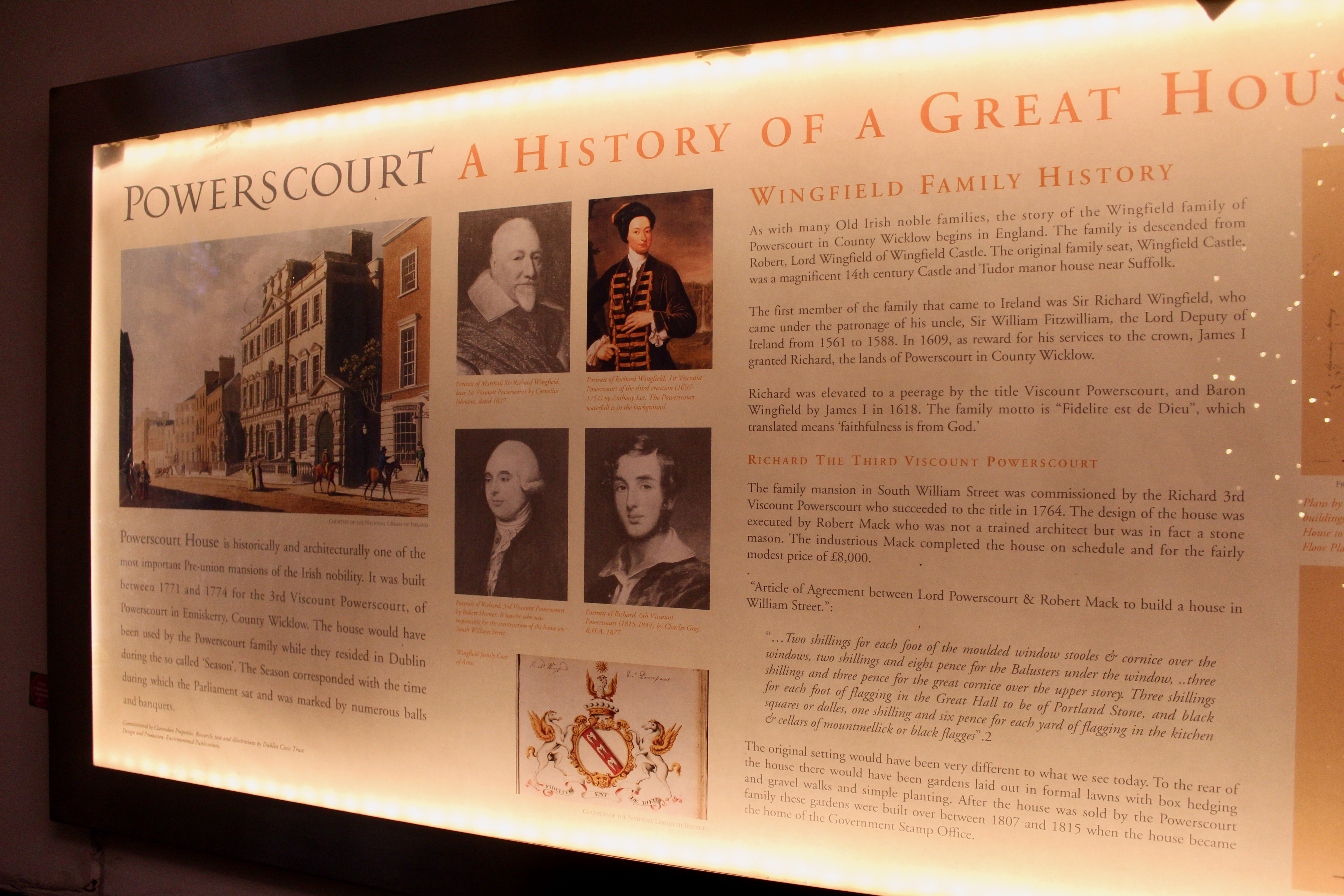
An information board inside the house quotes the “Article of Agreement” between Lord Powerscourt and the stonemason Robert Mack:

Two shillings for each foot of the moulded window stooles and cornice over the windows, two shillings and eight pence for the Balusters under the windows… three shillings and three pence for the great cornice over the upper storey. Three shillings for each foot of flagging in the Great Hall to be of Portland Stone, and black squares or dolles, one shilling and six pence for each yard of flagging in the kitchen and cellars of mountmellick or black flagges.”

This information board also tells us that the original setting of the house would have been a garden to the rear of the house, laid out in formal lawns with box hedging and gravel walks.
IMG_1707
Powerscourt townhouse.

When one walks up the balustraded granite steps leading to the front door, through the hall and past the mahogany staircase, one enters what was the courtyard of the house.

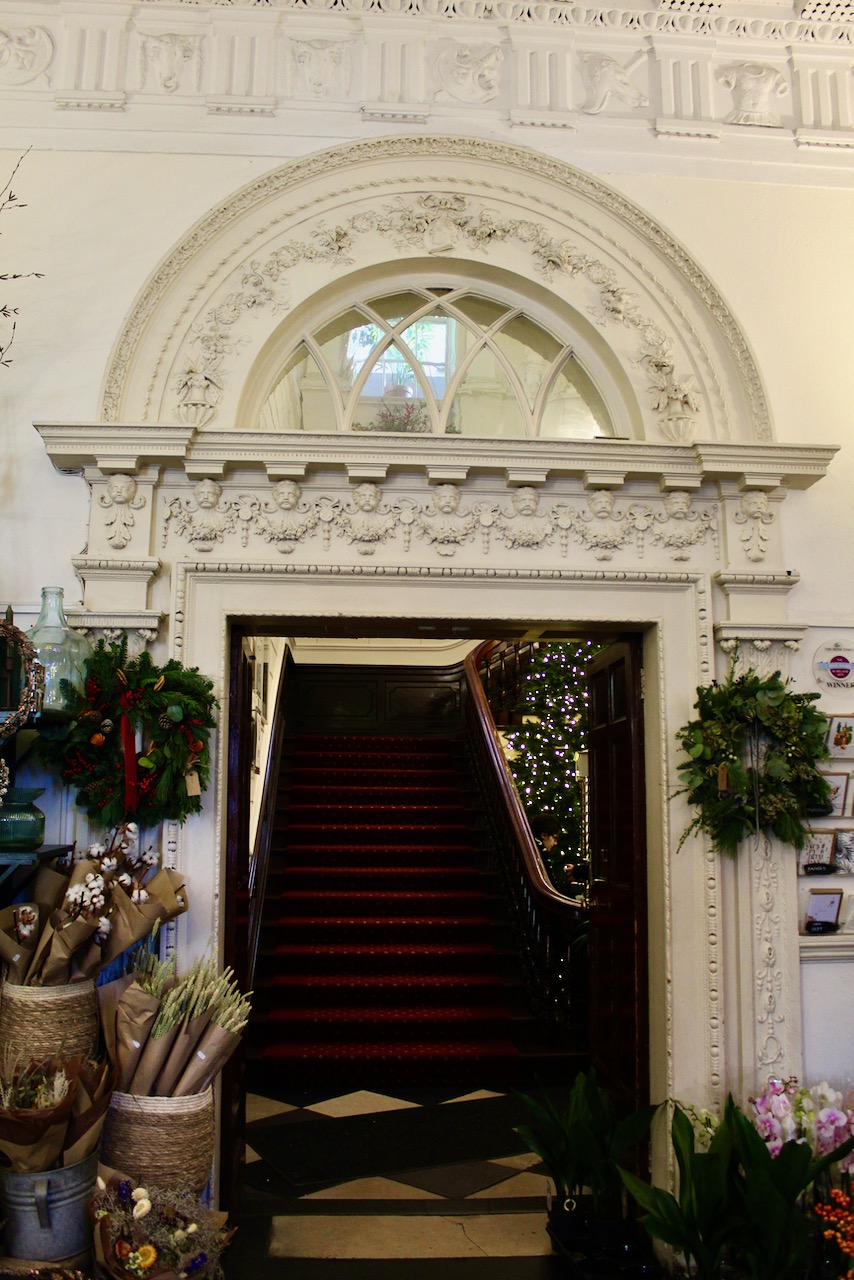
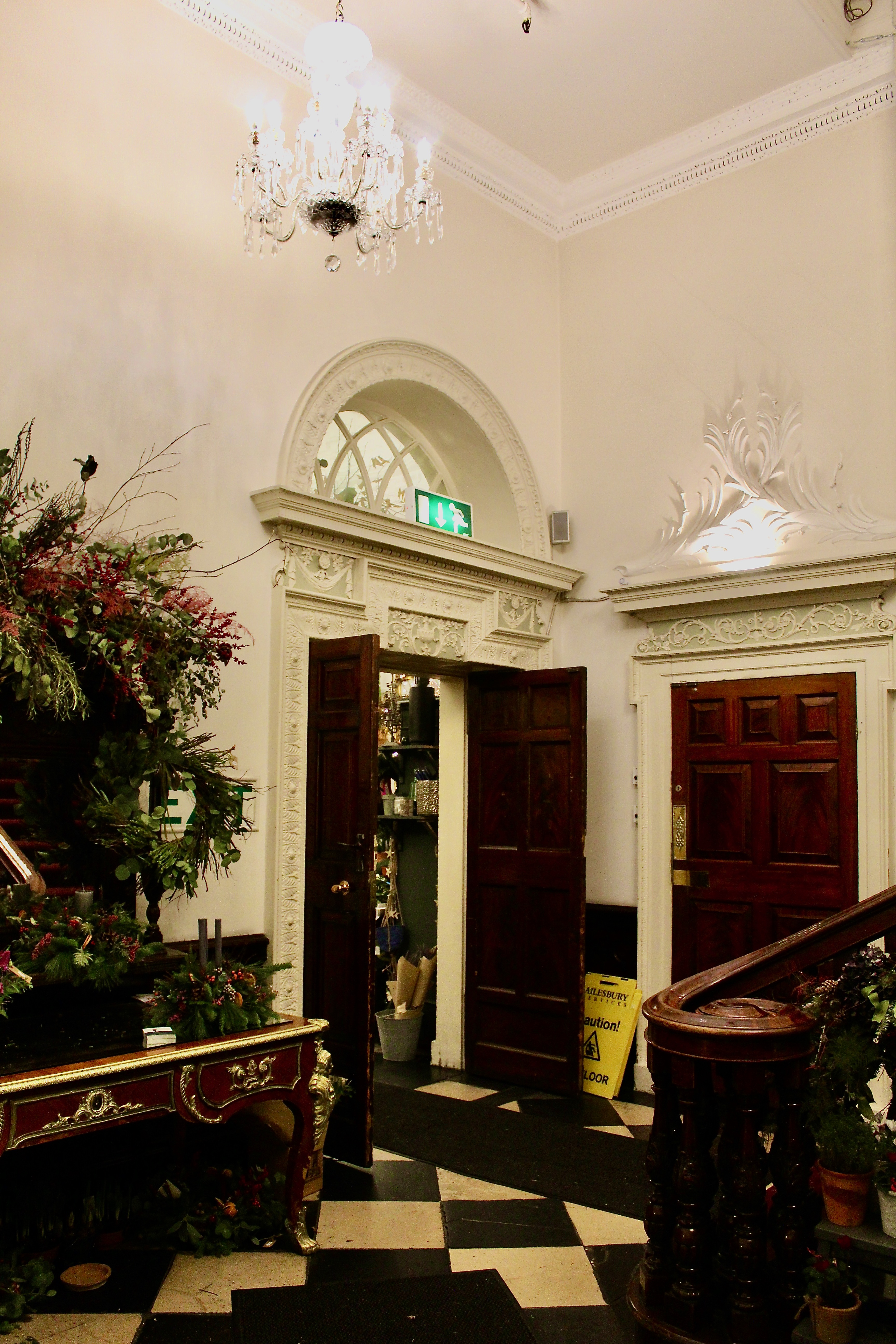
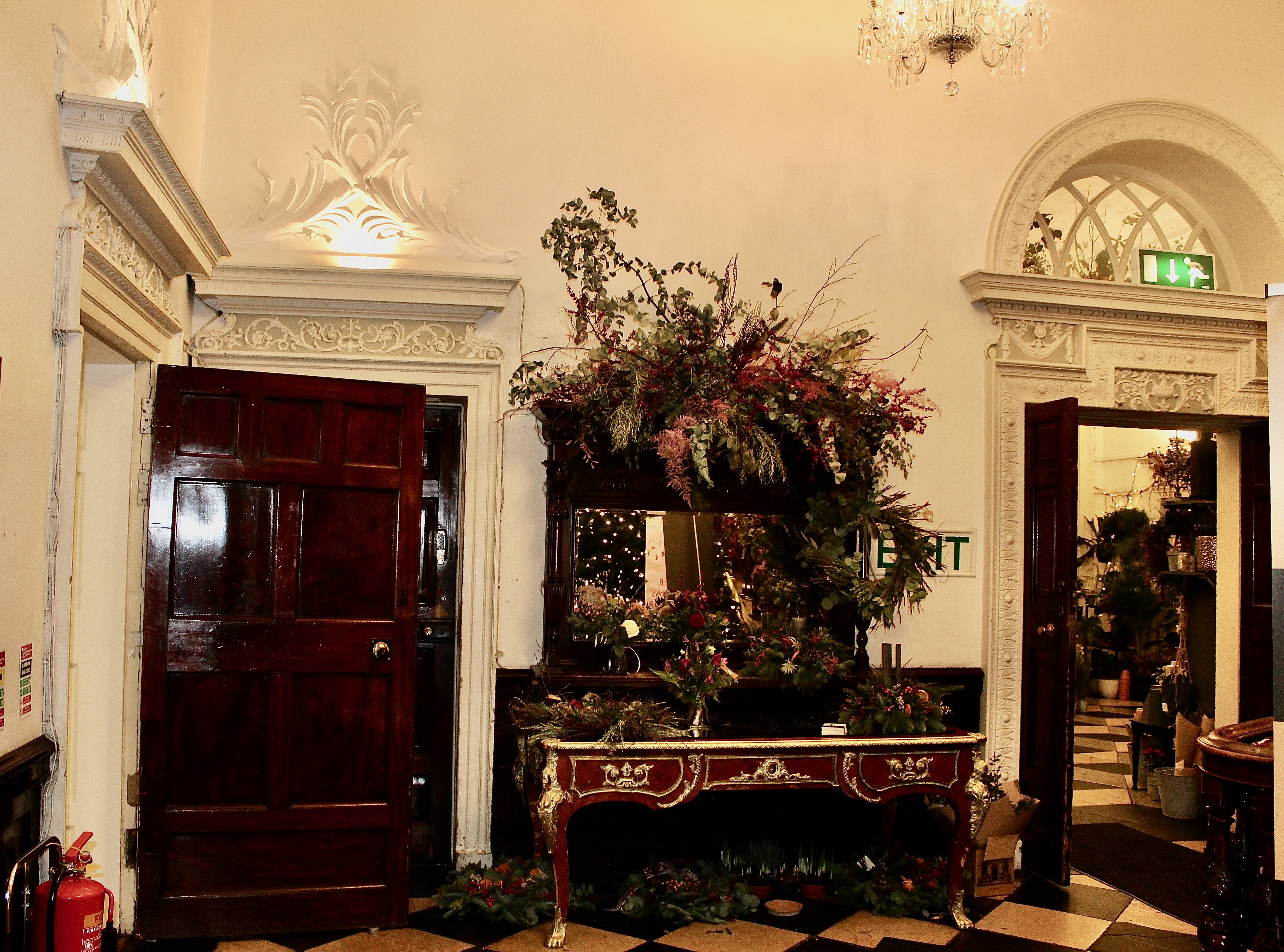
The entrance hall is now occupied by a flower shop. It has fine ceilings by James McCullagh. Photograph © Jennifer Winder-Baggot, www.irishhistorichouses.com
Powerscourt townhouse 1964, photograph from Dublin City Library and Archives. [see 2]
Information board about Powerscourt townhouse.
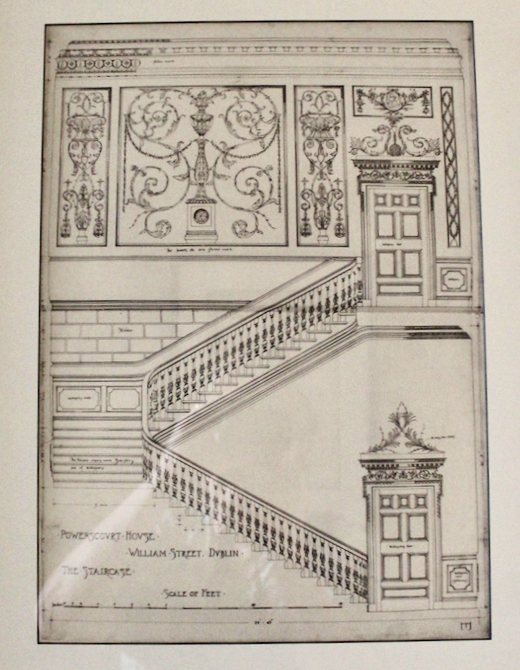
The staircase hall plan, Powerscourt Townhouse, from a sketch on display at Carton, County Kildare.
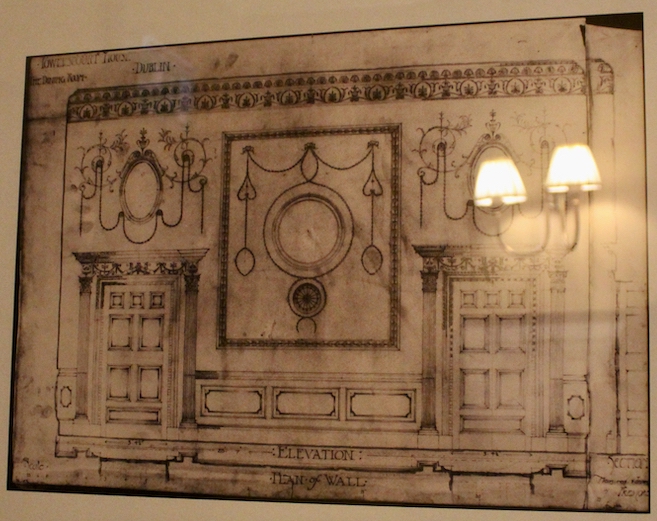
Plan of Powerscourt Townhouse, from a sketch on display at Carton, County Kildare.
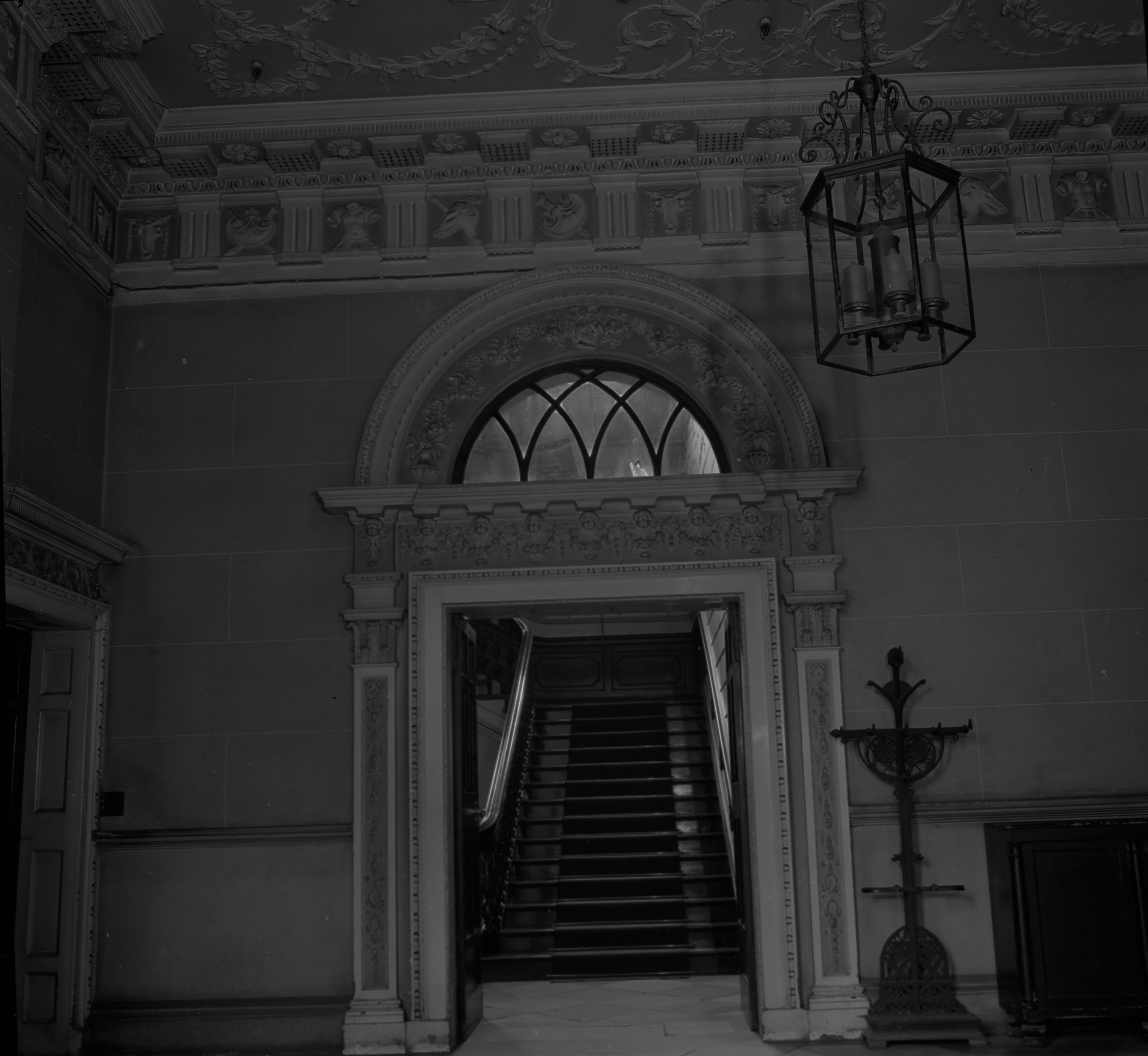
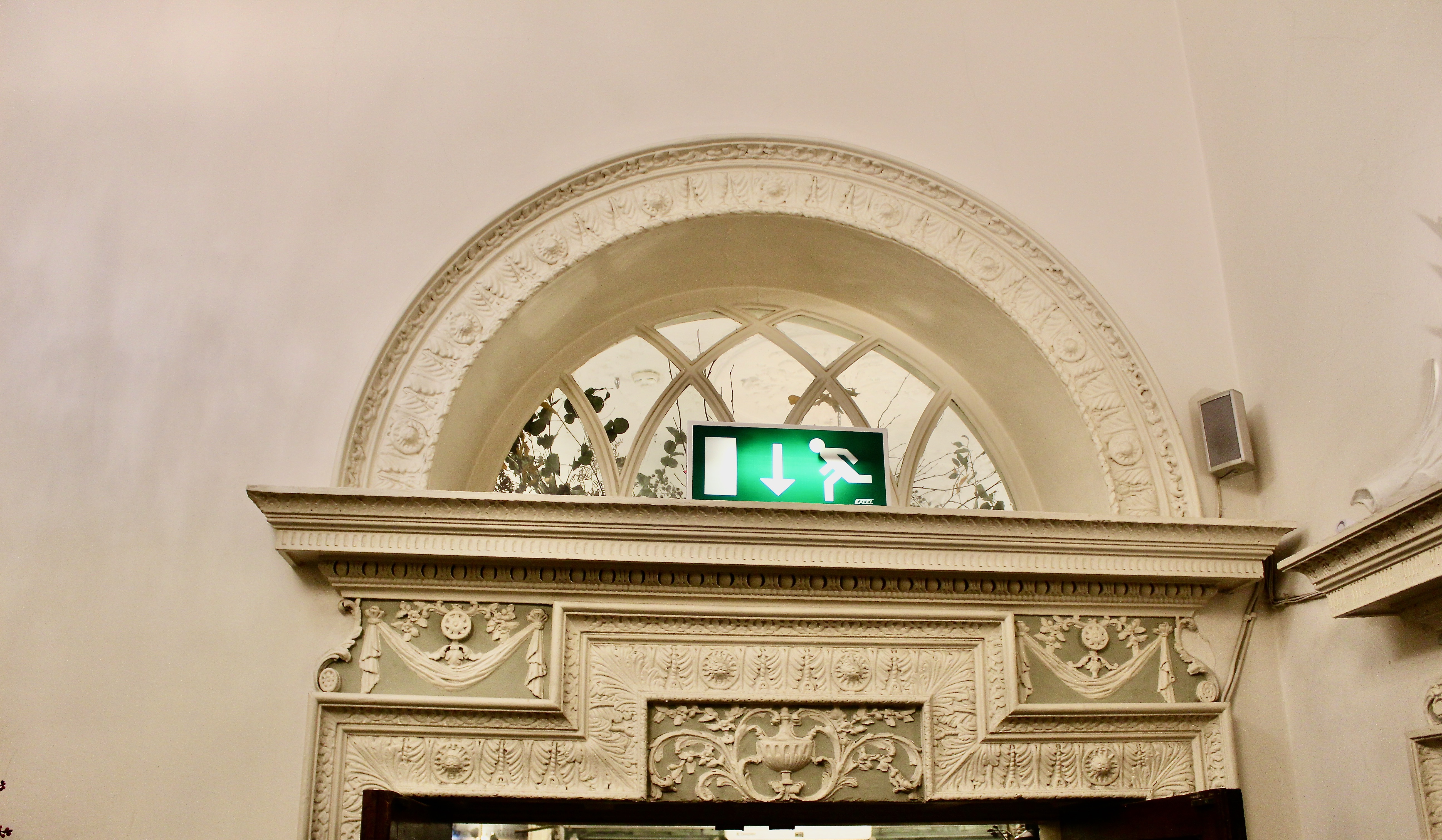
There are decorative heads along the top of the doorway leading from the entrance hall into the stair hall. Photograph © Jennifer Winder-Baggot, www.irishhistorichouses.com
Powerscourt townhouse, Dublin. Photograph © Jennifer Winder-Baggot, www.irishhistorichouses.com
The entrance hall has fine ceilings by James McCullagh. Photograph © Jennifer Winder-Baggot, www.irishhistorichouses.com
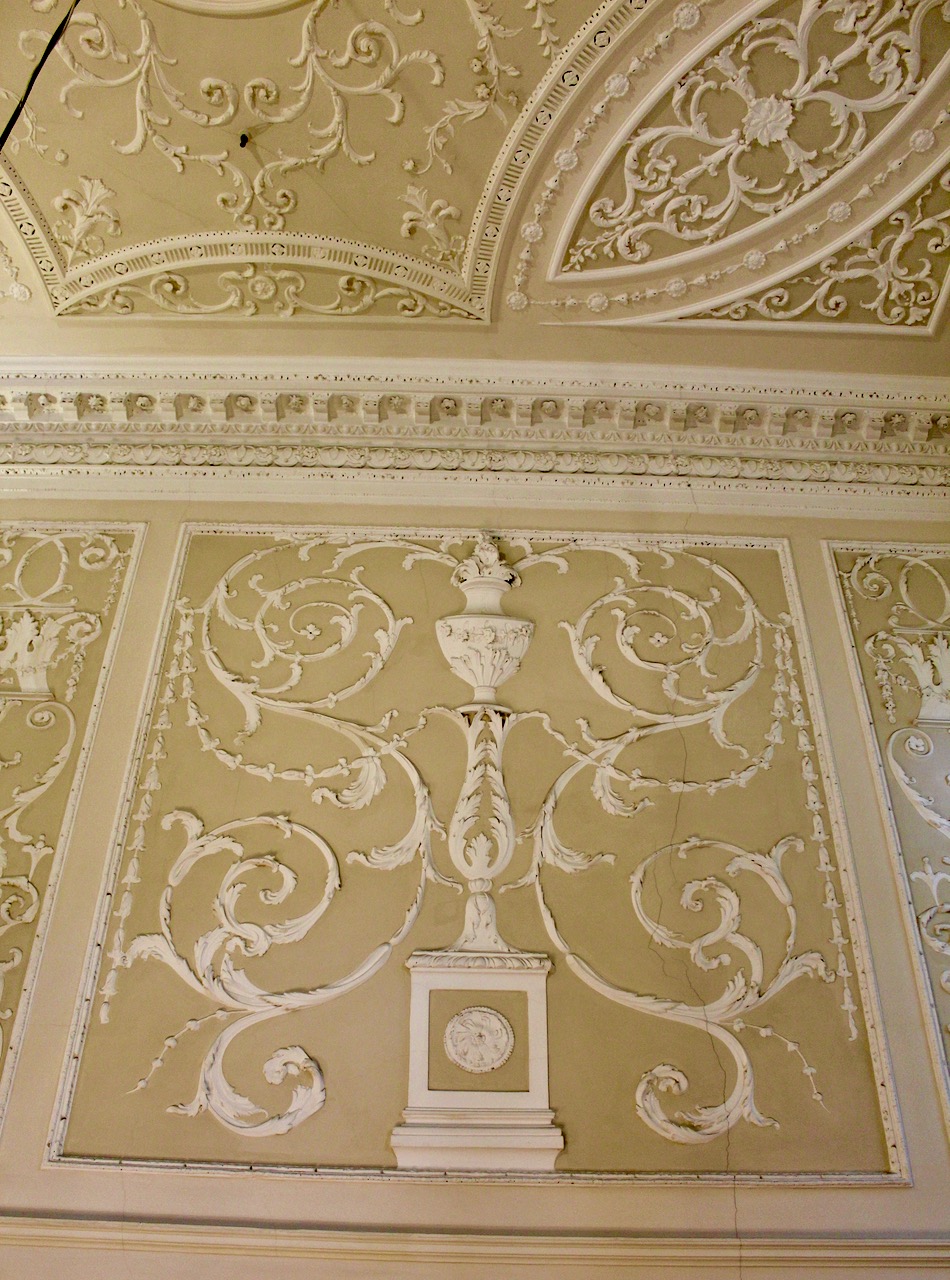
The entrance hall has fine ceilings by James McCullagh. There are wonderful metopes and panels with urns, buncrania, bows and arrows and baskets of fruit. Photograph © Jennifer Winder-Baggot, www.irishhistorichouses.com
IMG_1716
See the “monkey tail” wooden volute at end of stairway. Photograph © Jennifer Winder-Baggot, www.irishhistorichouses.com

You can see the “trompe l’oeil” floor in the entrance hall in the photo below, made up of black Kilkenny marble, grey and white limestone.
IMG_1715
Powerscourt Townhouse, the stair hall. Photograph © Jennifer Winder-Baggot, www.irishhistorichouses.com
IMG_1724
Powerscourt townhouse. Photograph © Jennifer Winder-Baggot, www.irishhistorichouses.com

The mahogany staircase rises in three flights to the first floor. The balusters are probably the most elaborately carved in Ireland, and the handrail ends in a large volute or “monkey’s tail” at the base of the stairs. The woodwork carving is by Ignatius McDonagh. I need to go back to take a better picture of the balustrade. We saw an even larger “monkey tail” volute end of a staircase in Barmeath (another section 482 property, see my entry), more like a dragon’s tail than a monkey, it was so large!
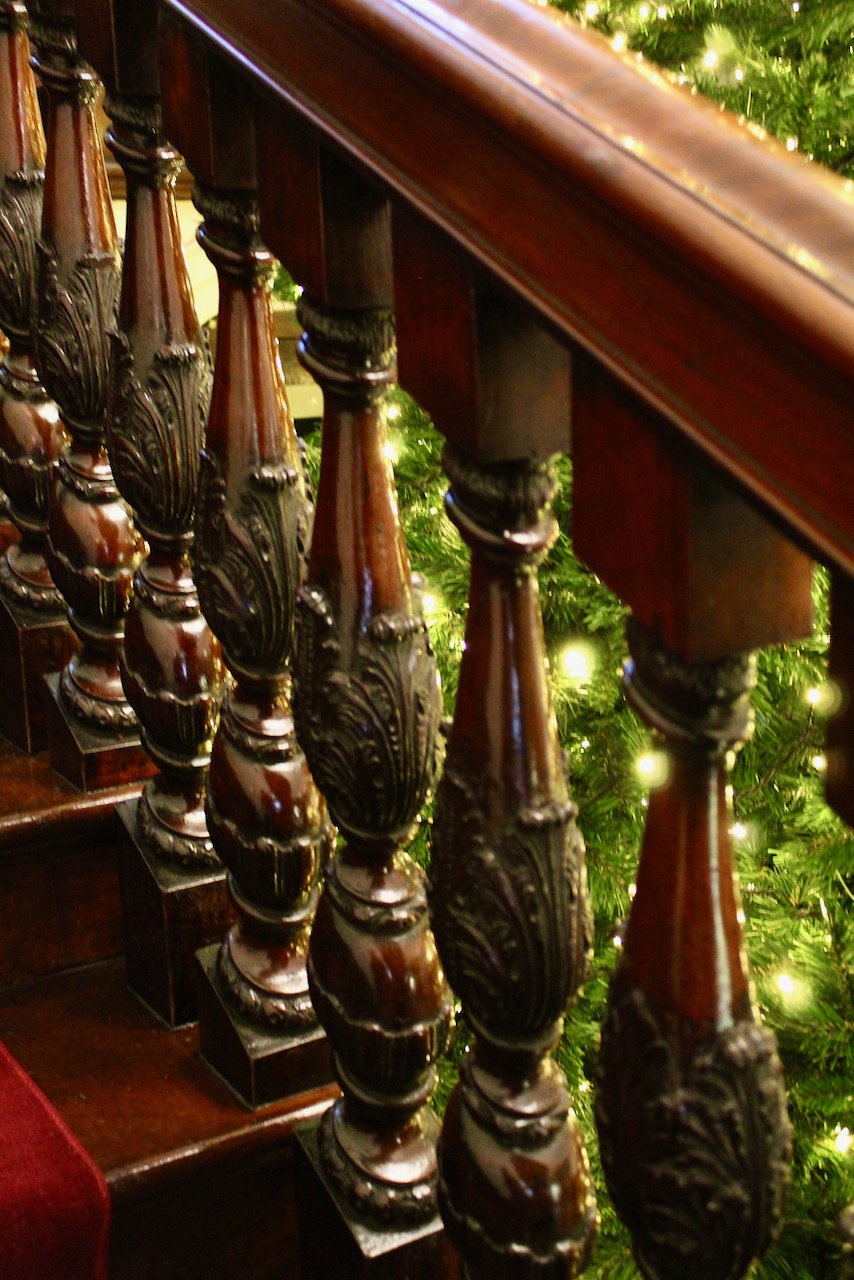
The carved mahogany balusters by Ignatius McDonagh. Photograph © Jennifer Winder-Baggot, www.irishhistorichouses.com

The Wingfield family descended from Robert, Lord Wingfield of Wingfield Castle in England, near Suffolk. The first member of the family who came from England was Sir Richard Wingfield, who came under the patronage of his uncle, Sir William Fitzwilliam, the Lord Deputy of Ireland from 1561 to 1588. In 1609 King James I granted Richard Wingfield, in reward for his services to the Crown, the lands of Powerscourt in County Wicklow. Richard was a military adventurer, and fought against the Irish, and advanced to the office of Marshal of Ireland. In May 1608 he marched into Ulster during “O’Doherty’s Rebellion” against Sir Cahir O’Doherty, and killed him and dispersed O’Doherty’s followers. For this, he was granted Powerscourt Estate, in 1609. [7]

In 1618 James I raised Richard to the Peerage as Viscount Powerscourt, Baron Wingfield. The family motto is “Fidelite est de Dieu,” faithfulness is from God.

Richard the 3rd Viscount Powerscourt succeeded to the title in 1764. He was not a direct descendant of the 1st Viscount Powerscourt. Richard the 1st Viscount had no children, so the peerage ended with the death of the 1st Viscount.

The Powerscourt estate in Wicklow passed to his cousin, Sir Edward Wingfield, a distinguished soldier under the Earl of Essex (Robert Devereux, 2nd Earl of Essex), and a person of great influence in Ireland. [8] Essex came to Ireland to quell a rebellion that became the Nine Years’ War. Sir Edward Wingfield married Anne, the daughter of Edward, 3rd Baron Cromwell (descendent of Henry VIII’s Thomas Cromwell). [9]  It was this Edward Wingfield’s grandson Folliot (son of Richard Wingfield), who inherited the Powerscourt estates, for whom the Viscountcy was revived, the “second creation,” in 1665. [10]

However, once again the peerage expired as Folliot also had no offspring. Powerscourt Estate passed to his cousin, Edward Wingfield. Edward’s son Richard (1697-1751) of Powerscourt, MP for Boyle, was elevated to the peerage in 1743, by the titles of Baron Wingfield and Viscount Powerscourt (3rd Creation).

This Richard Wingfield was now the 1st Viscount (3rd creation). He married, first, Anne Usher, daughter of Christopher Usher of Usher’s Quay, but they had no children. He married secondly Dorothy, daughter of Hercules Rowley of Summerville, County Meath. Their son, Edward, became the 2nd Viscount. When he died in 1764, Richard, his brother, became 3rd Viscount. Seven years after inheriting the title, Richard 3rd Viscount began the building of Powerscourt Townhouse.

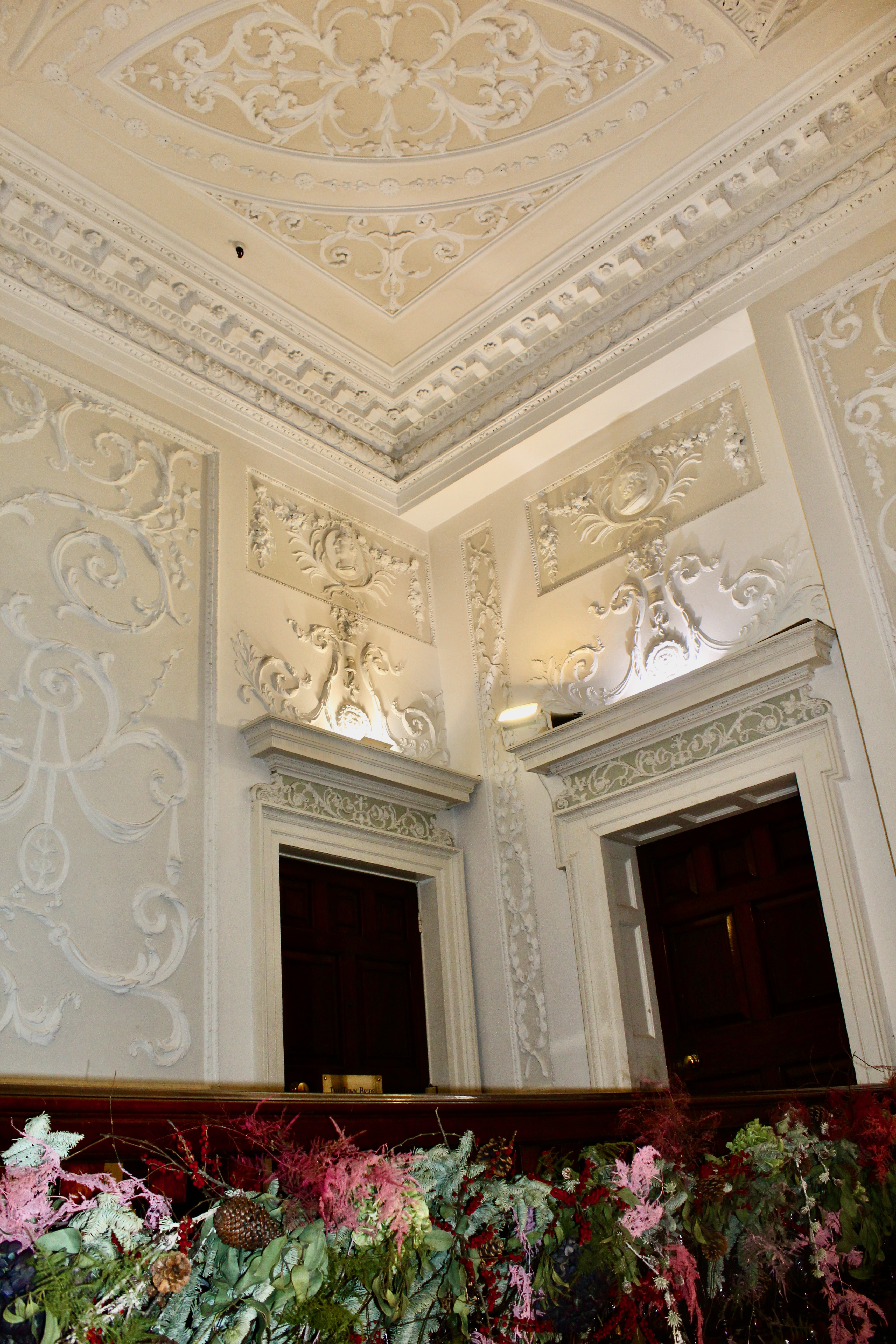
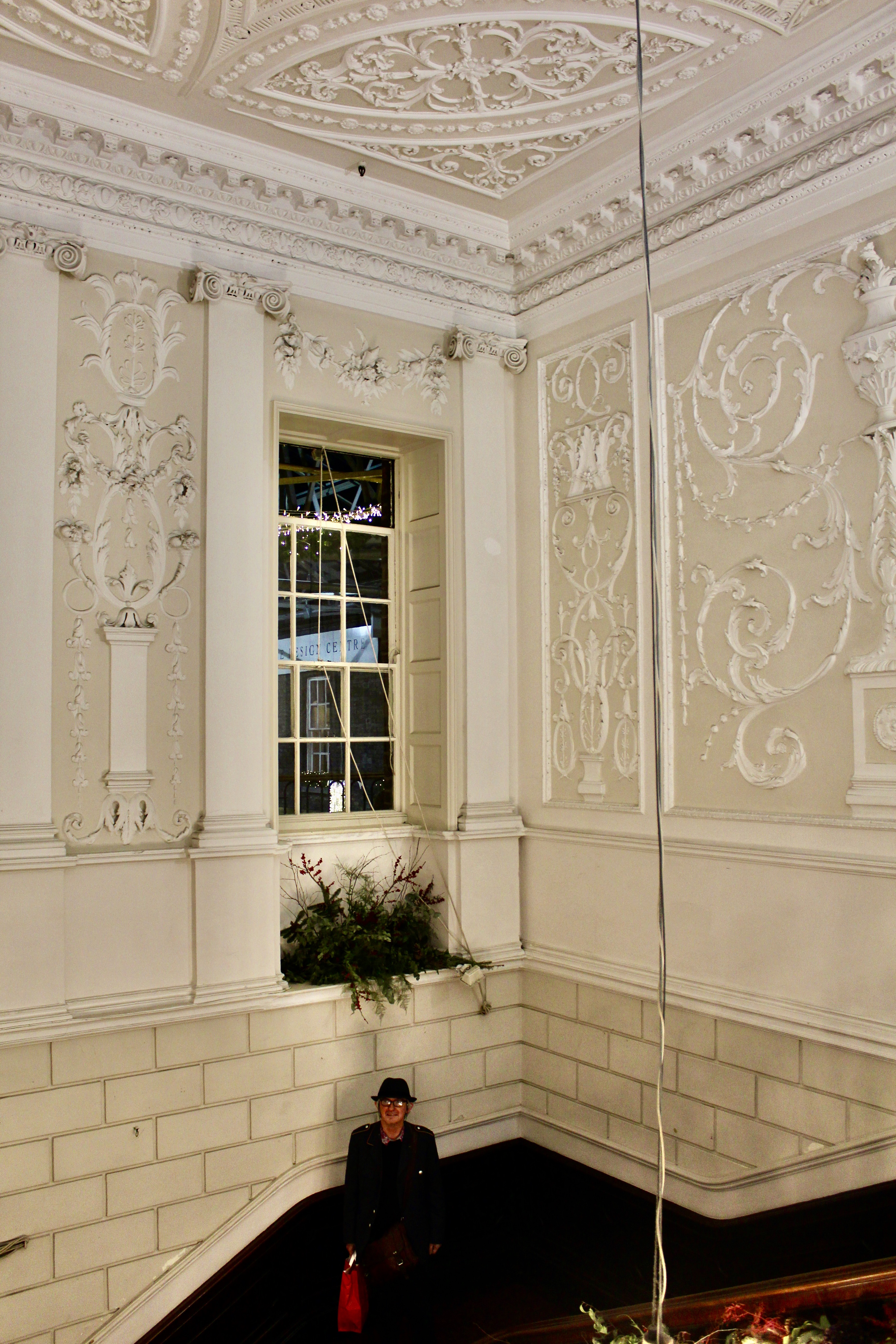
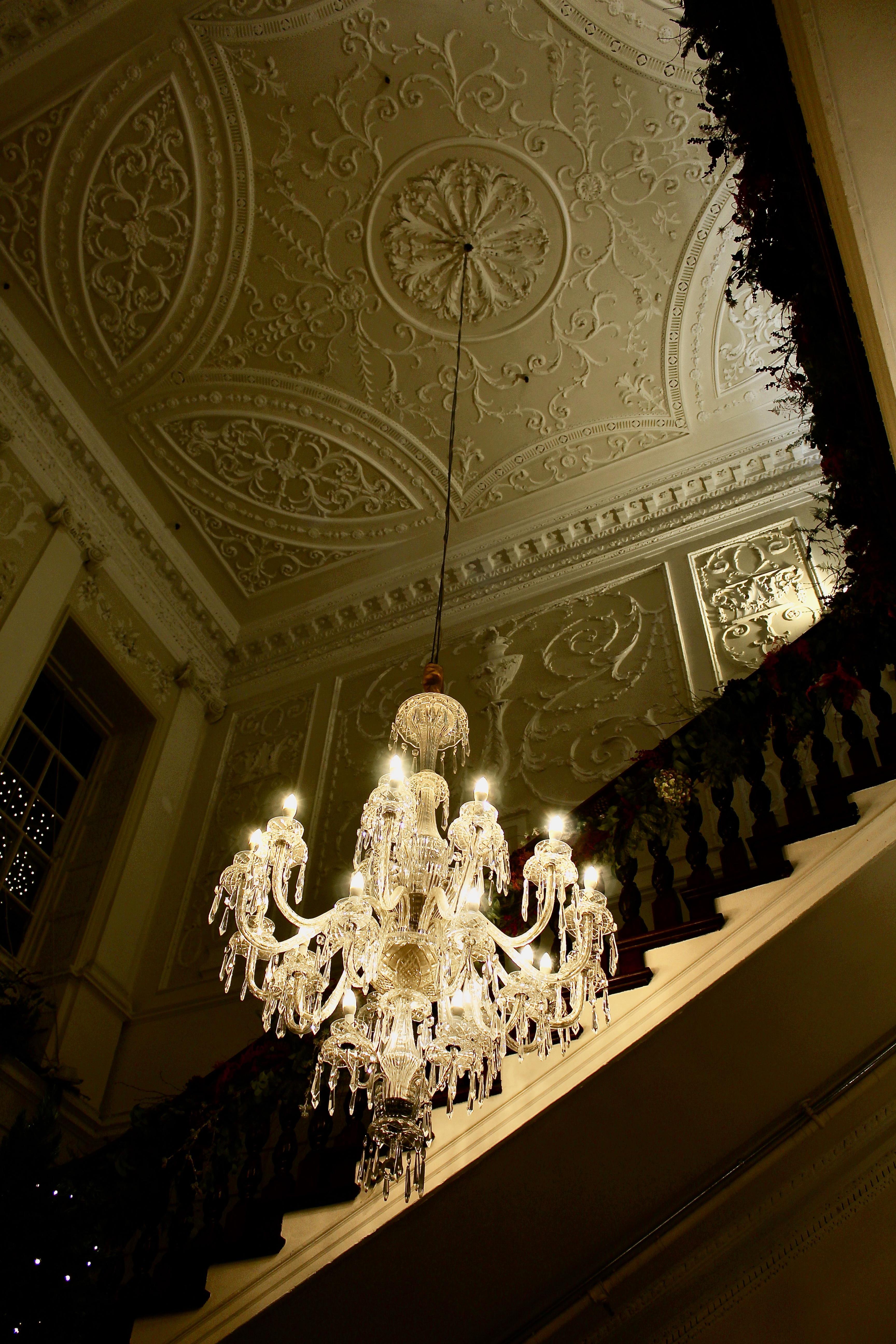
Inside just past the entrance hall, we can still climb the staircase and see the wonderful plasterwork by stuccodores James McCullagh assisted by Michael Reynolds.

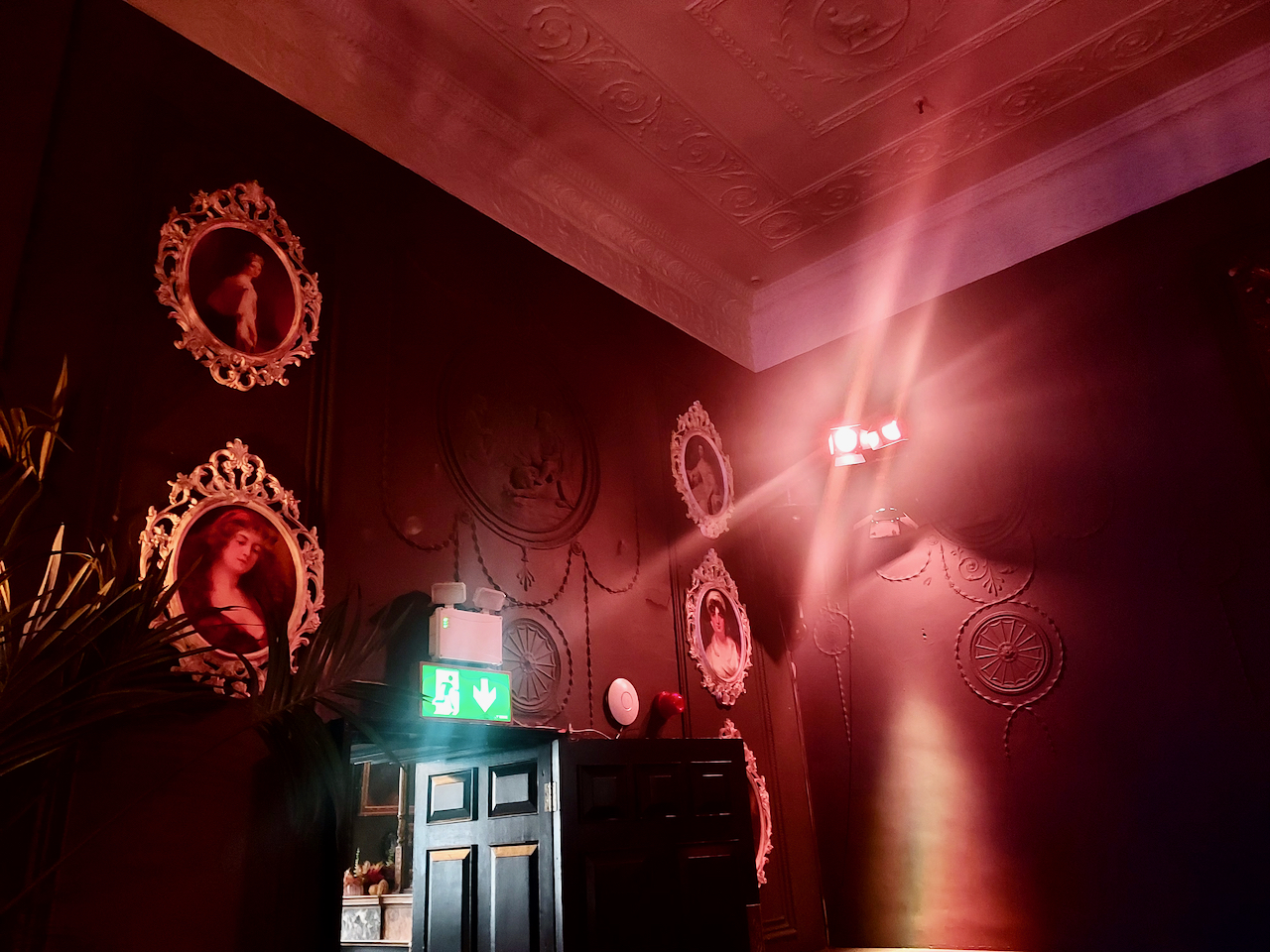
The decoration on the upper walls consists of panels decorated with arabesque work interspersed with urns, acanthus scrolls [6], palms and portrait medallions. I haven’t discovered who is pictured in the portraits! Neither Christine Casey nor the Irish Aesthete tell us in their descriptions.
IMG_1717
Powerscourt Townhouse. Photograph © Jennifer Winder-Baggot, www.irishhistorichouses.com
Powerscourt Townhouse.
IMG_1719
Powerscourt Townhouse. Photograph © Jennifer Winder-Baggot, www.irishhistorichouses.com
IMG_1720
Powerscourt Townhouse. Photograph © Jennifer Winder-Baggot, www.irishhistorichouses.com
Detail of the stair hall. Photograph © Jennifer Winder-Baggot, www.irishhistorichouses.com
Detail of the drapery in the stuccowork. Photograph © Jennifer Winder-Baggot, www.irishhistorichouses.com
IMG_1721
Powerscourt Townhouse. Unfortunately the busts are not identified. Photograph © Jennifer Winder-Baggot, www.irishhistorichouses.com
One of the many busts in stucco medallions in the stair hall. Photograph © Jennifer Winder-Baggot, www.irishhistorichouses.com
Detail of the stair hall ceiling. Photograph © Jennifer Winder-Baggot, www.irishhistorichouses.com
IMG_1722
Powerscourt Townhouse. Photograph © Jennifer Winder-Baggot, www.irishhistorichouses.com
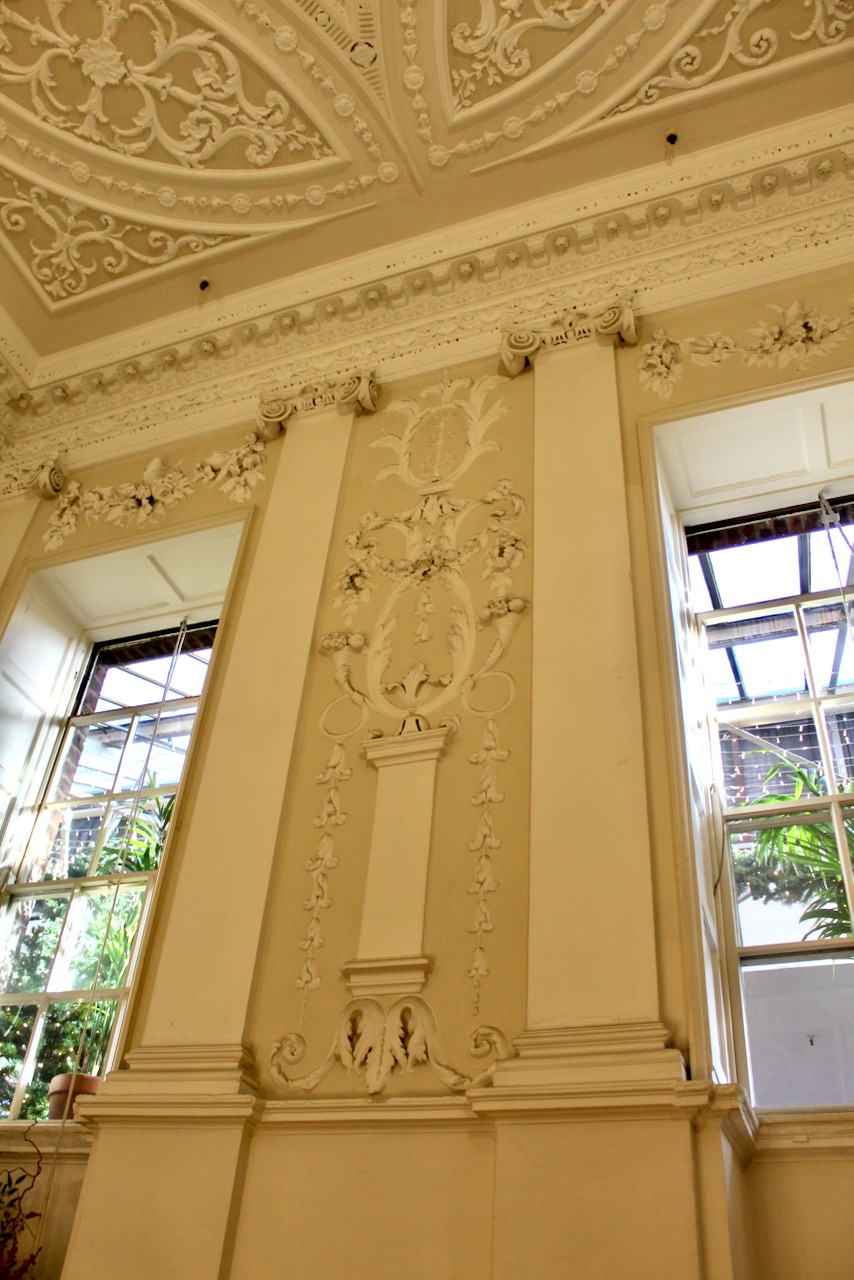
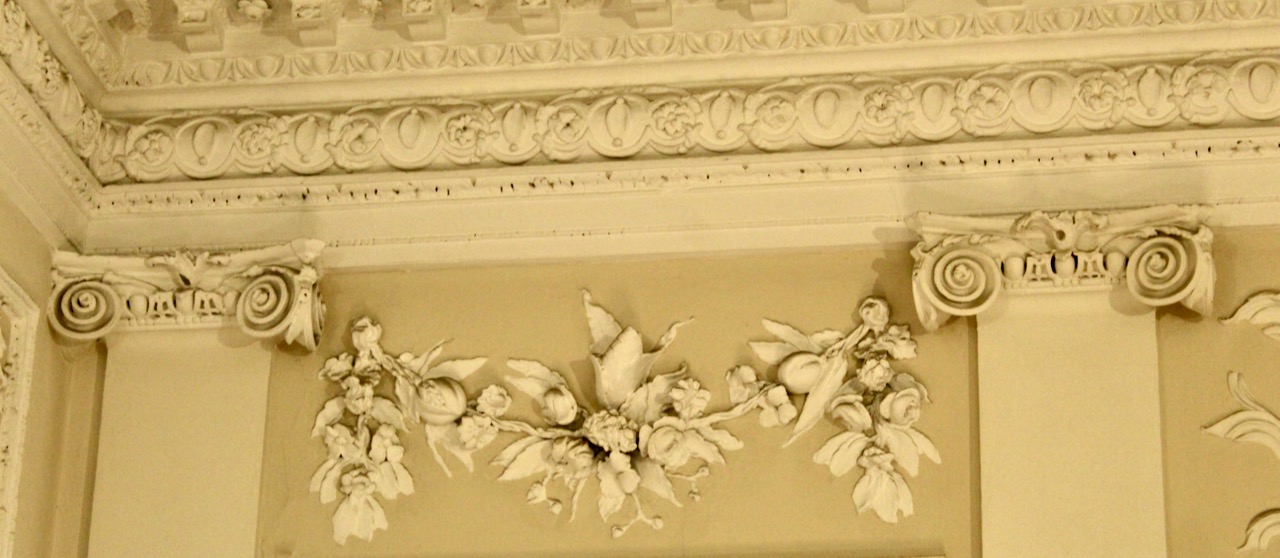
Ionic pilasters of the stair hall. Photograph © Jennifer Winder-Baggot, www.irishhistorichouses.com
Detail of the floral swags in stucco. Photograph © Jennifer Winder-Baggot, www.irishhistorichouses.com
IMG_1723
Powerscourt townhouse. Photograph © Jennifer Winder-Baggot, www.irishhistorichouses.com

Ionic pilasters frame two windows high up in the east wall – we can see one in the photograph above. The lower walls are “rusticated in timber to resemble stone,” Casey tells us. I would have assumed that the brickwork was of stone, not of timber.

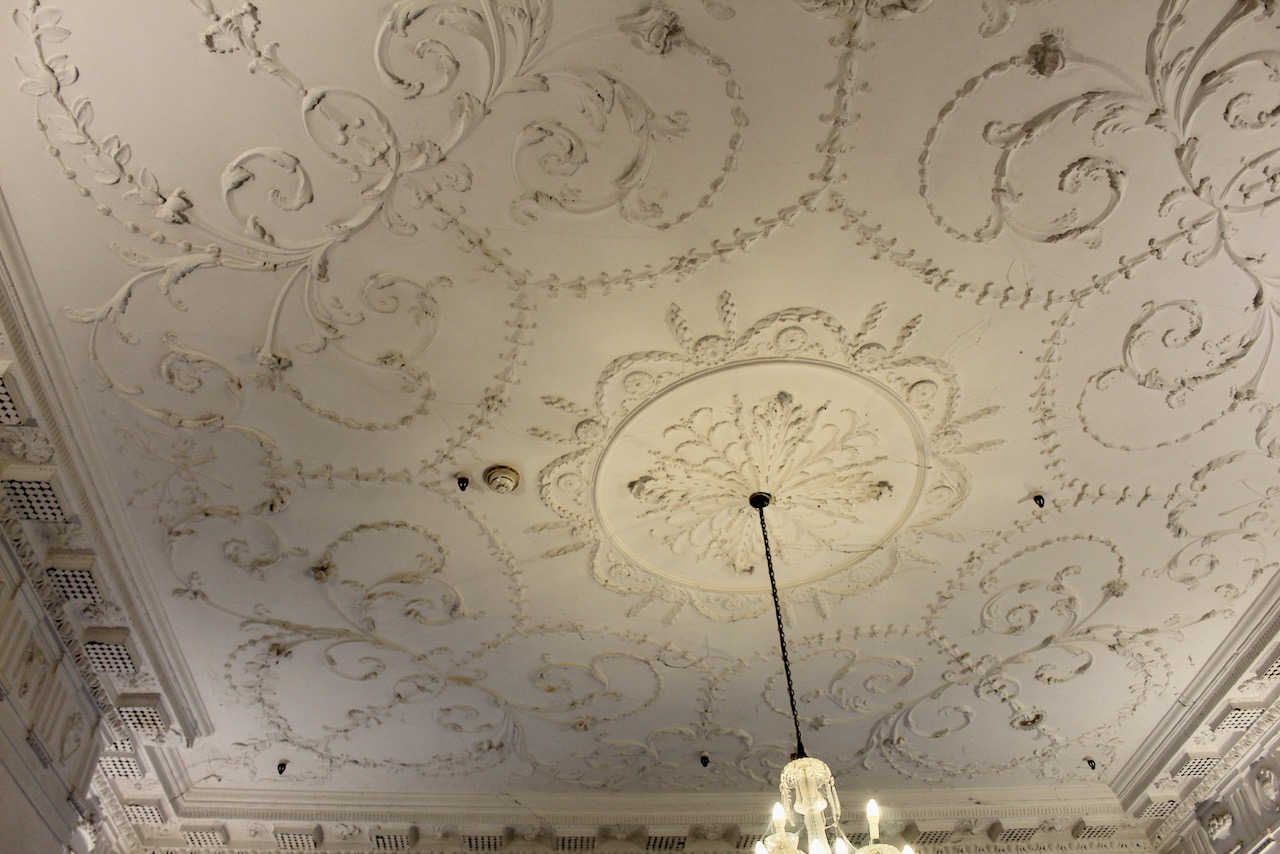
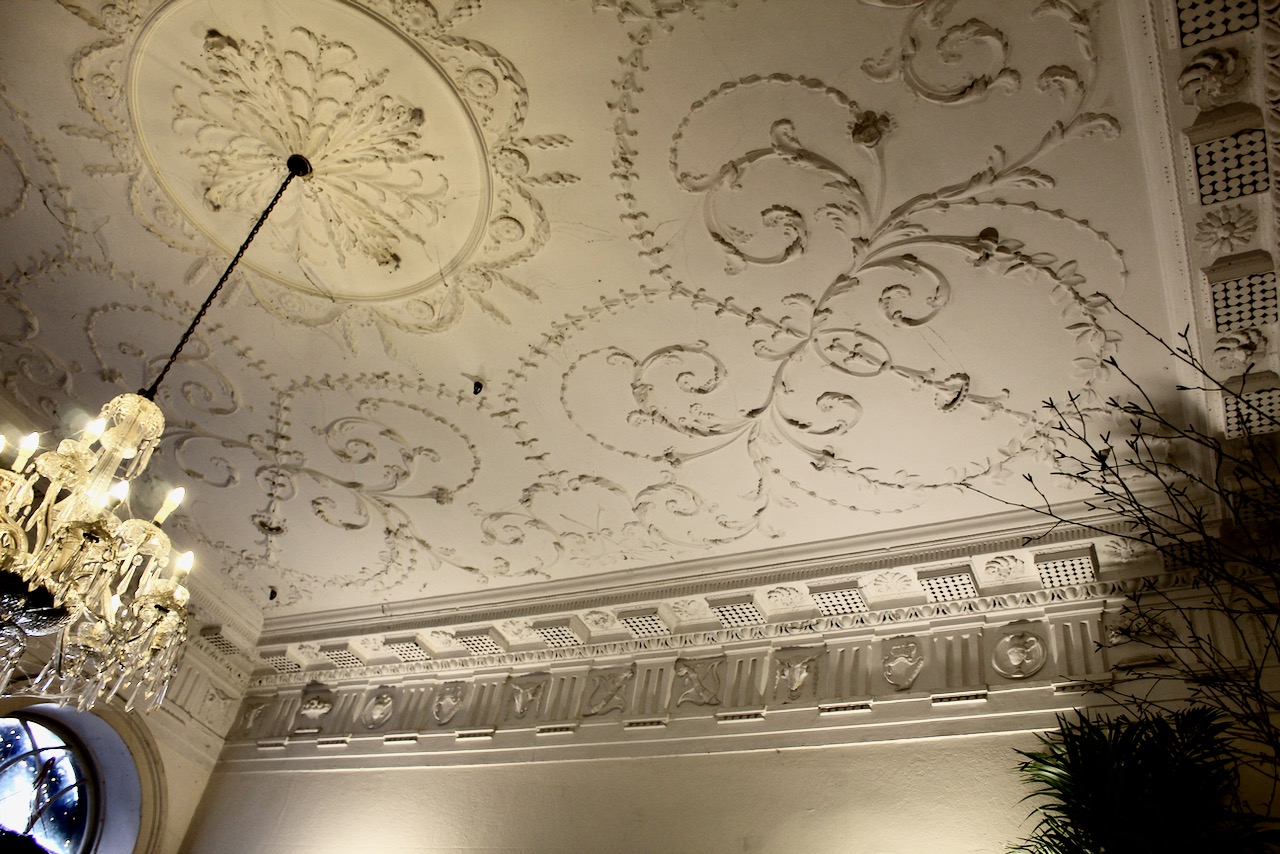
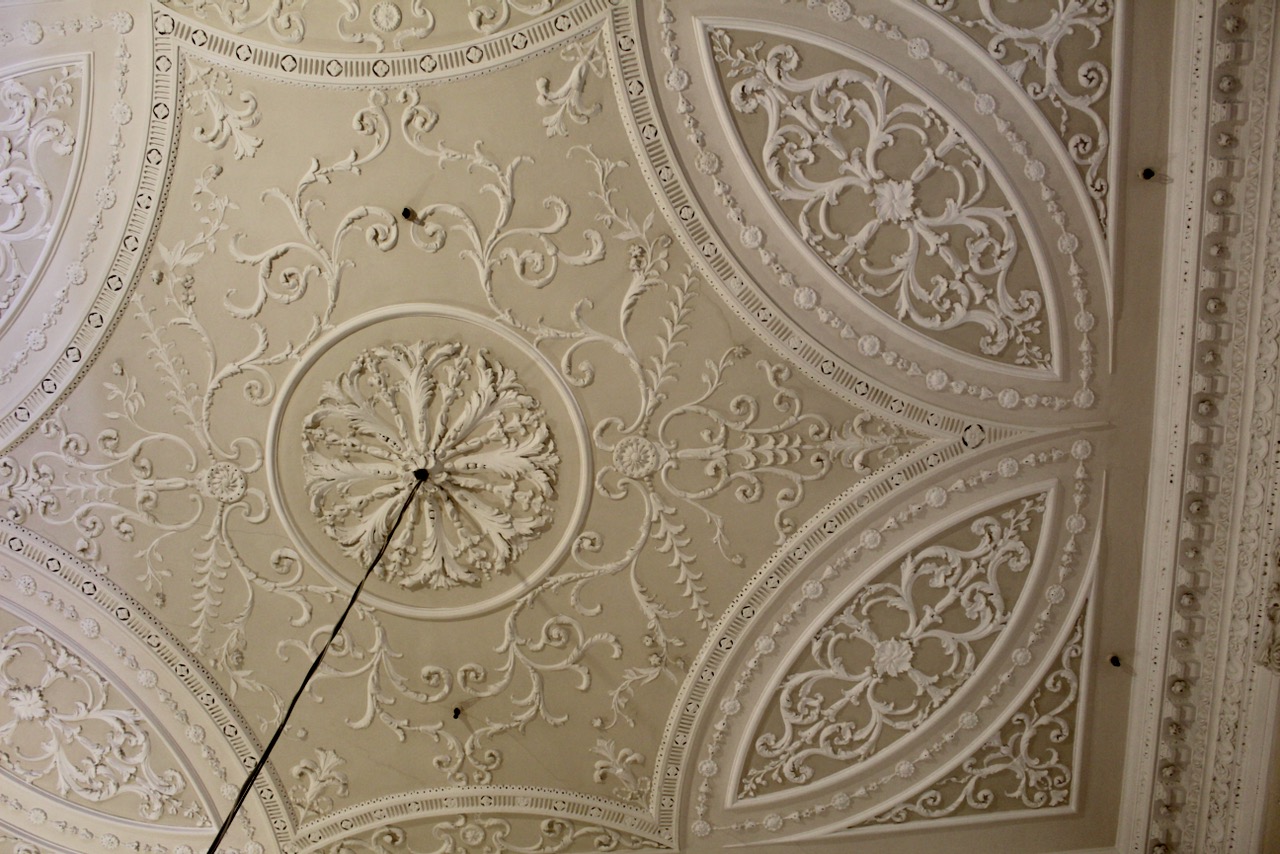
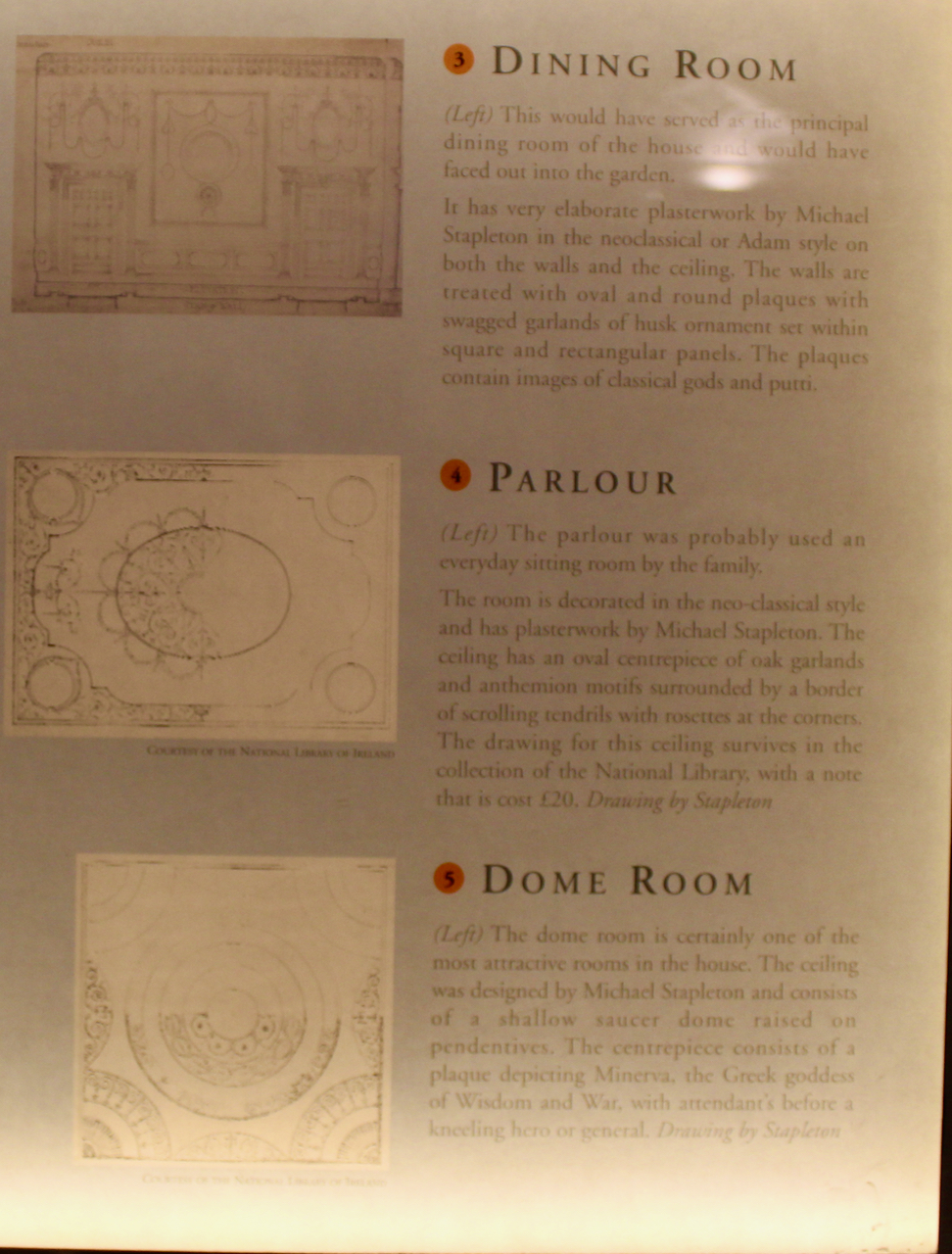
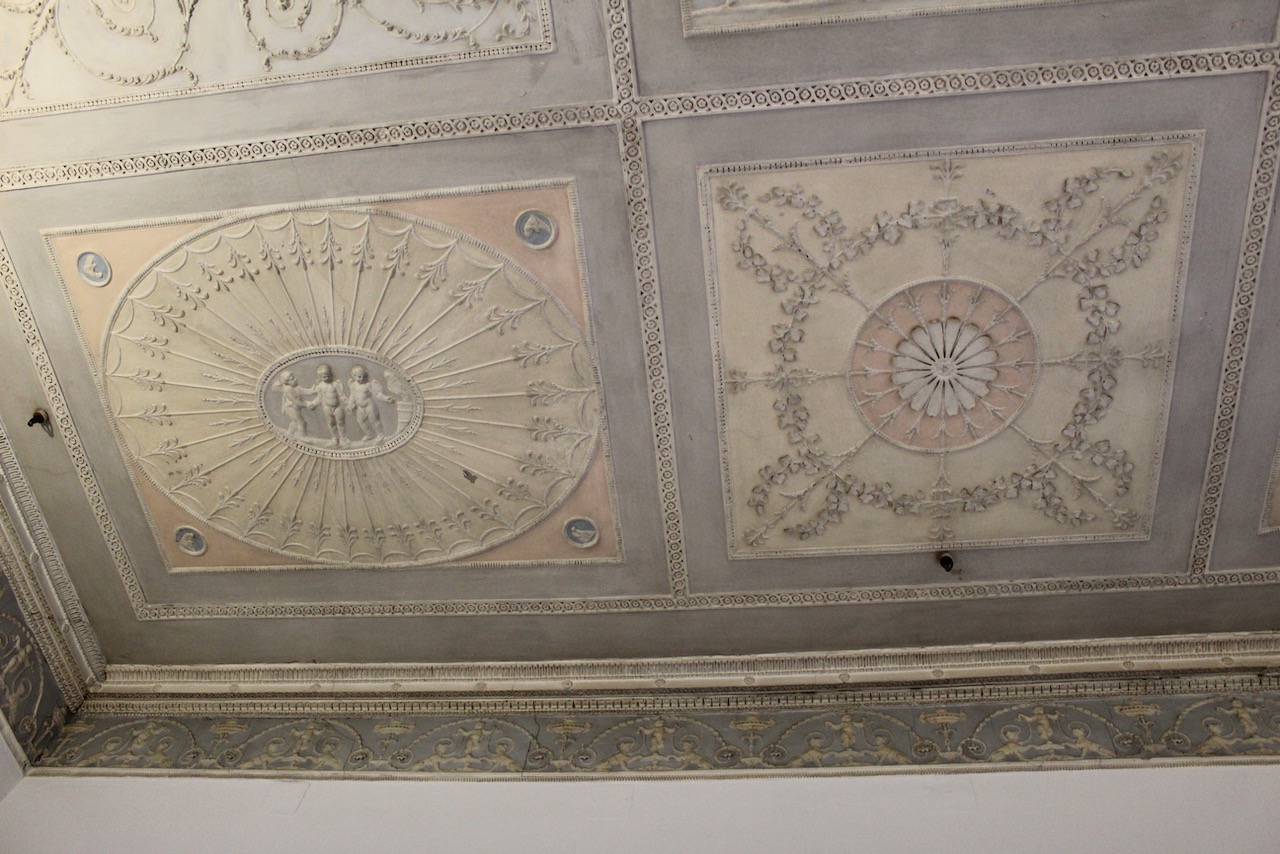
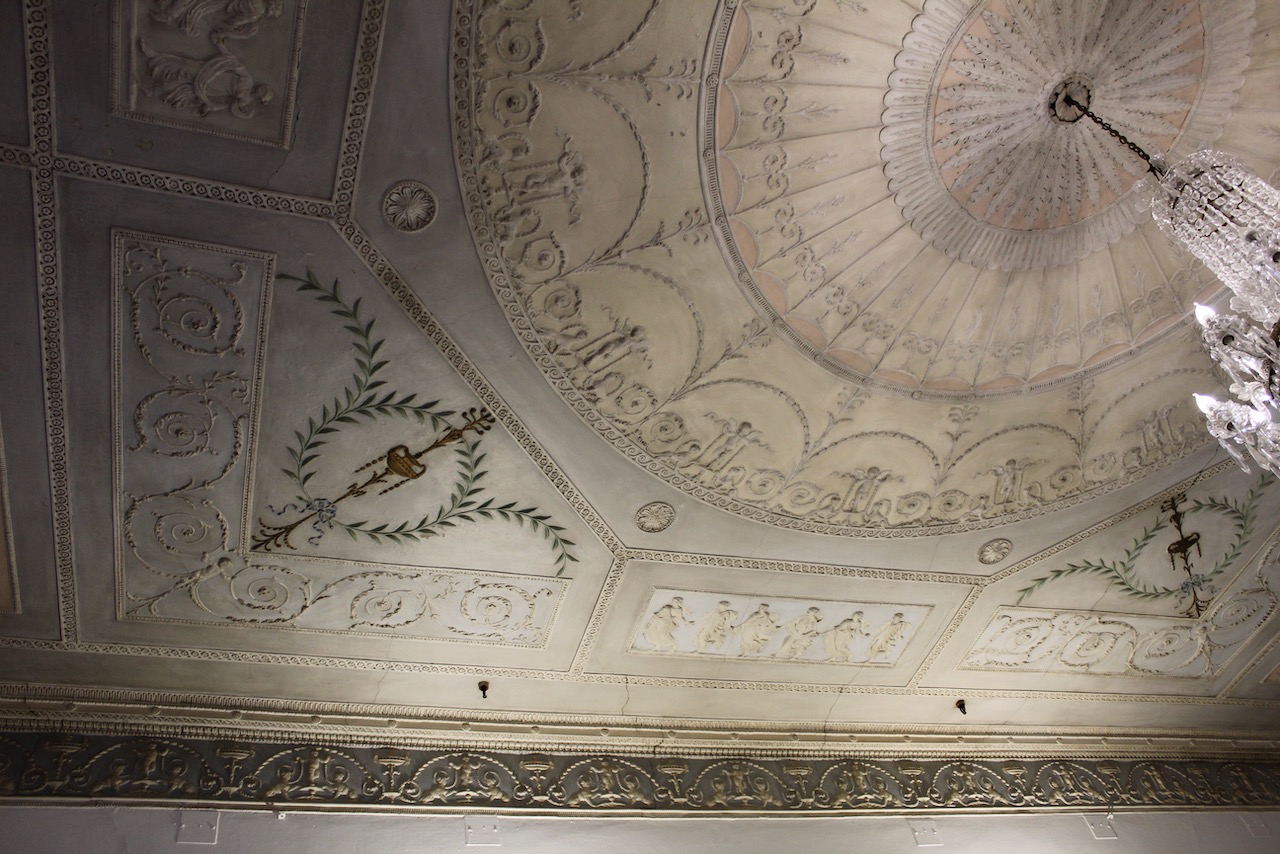
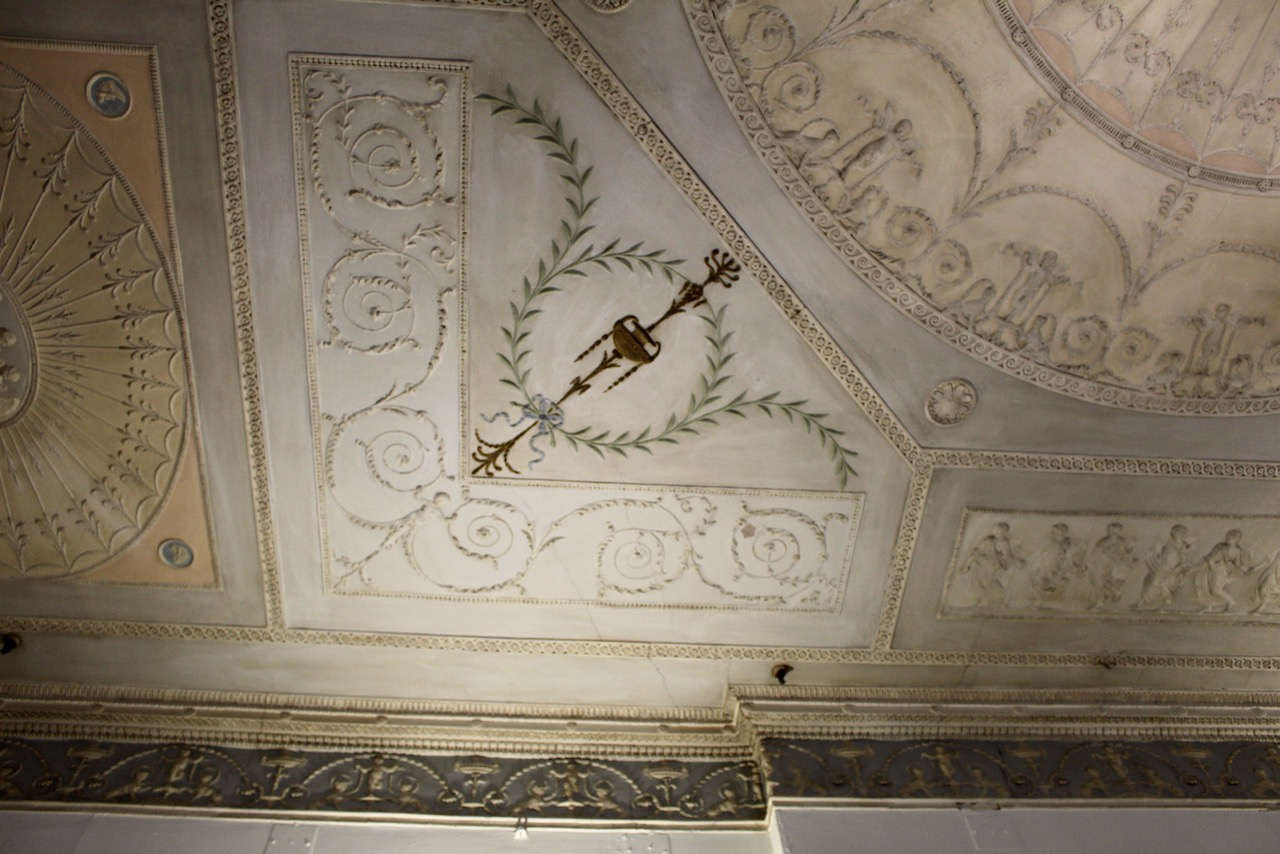
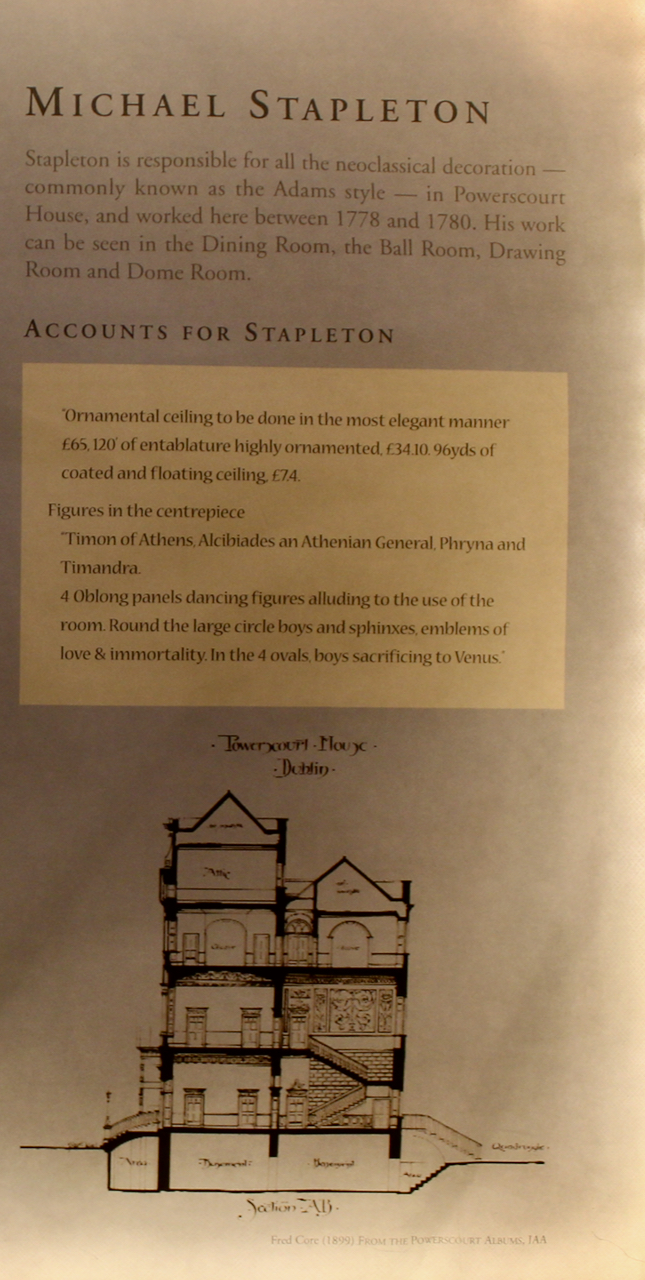
No expense was spared in furnishing the house. As well as the rococo plasterwork on the stairs there was neo-Classical work by stuccodore Michael Stapleton. According to the information board, much of the more sober neo-Classical work was cast using moulds, no longer created freehand the way the rococo plasterwork was done. The neo-Classical work was called the Adams style and in Powerscourt Townhouse, was created between 1778-1780. Stapleton’s work could have been seen in the Dining Room, Ballroom, Drawing room and Dome Room.

Powerscourt Townhouse.
Ceiling of the drawing room, by Michael Stapleton. Photograph © Jennifer Winder-Baggot, www.irishhistorichouses.com
The former drawing room, with its fine stucco work by Michael Stapleton, looking out onto what was the courtyard. Photograph © Jennifer Winder-Baggot, www.irishhistorichouses.com
Powerscourt townhouse.

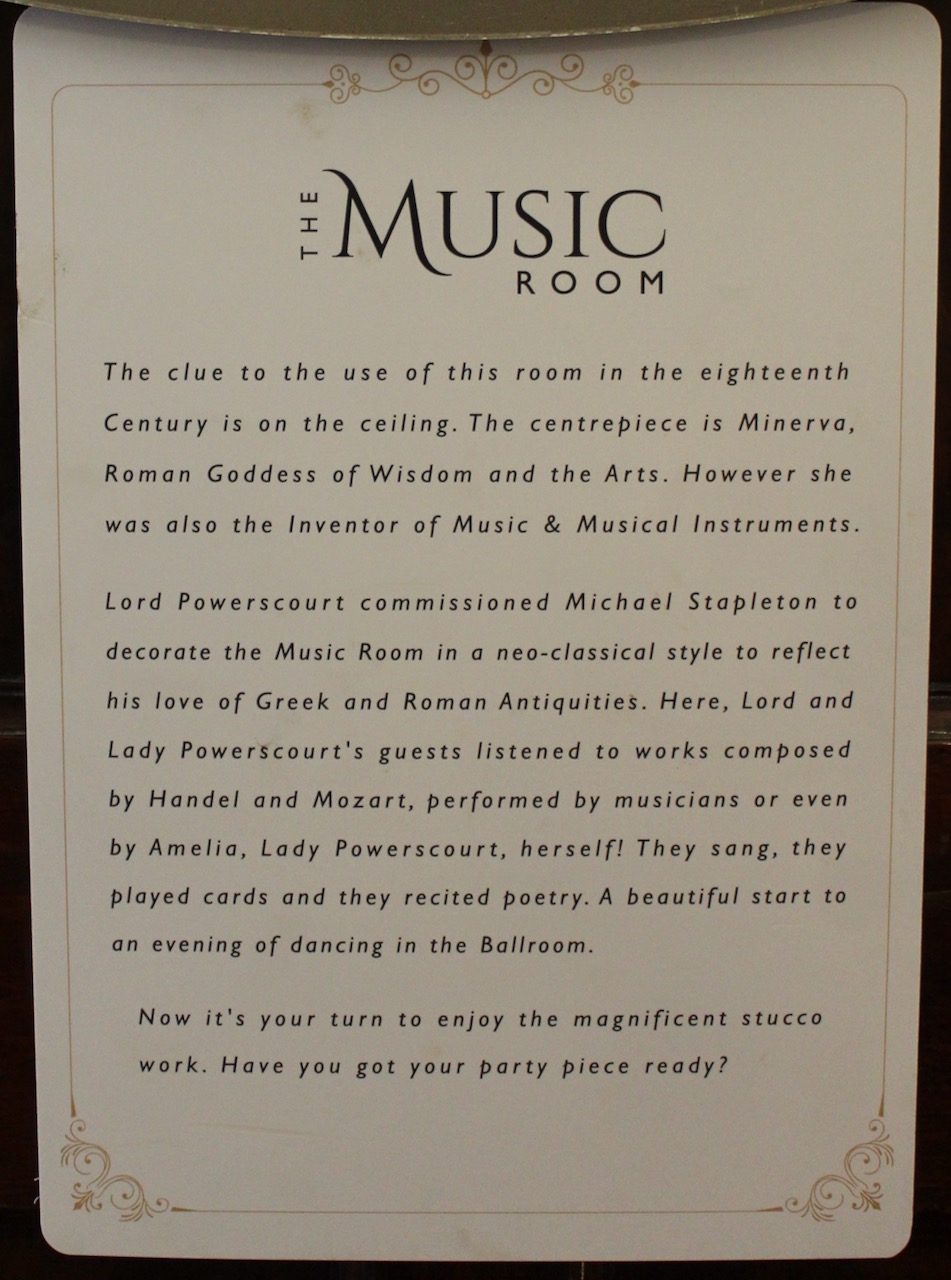
The ceiling in a room now occupied by The Town Bride, which was the original music room, and the ballroom, now occupied by the Powerscourt Gallery, contain Stapleton’s work.
Powerscourt townhouse, Dublin.
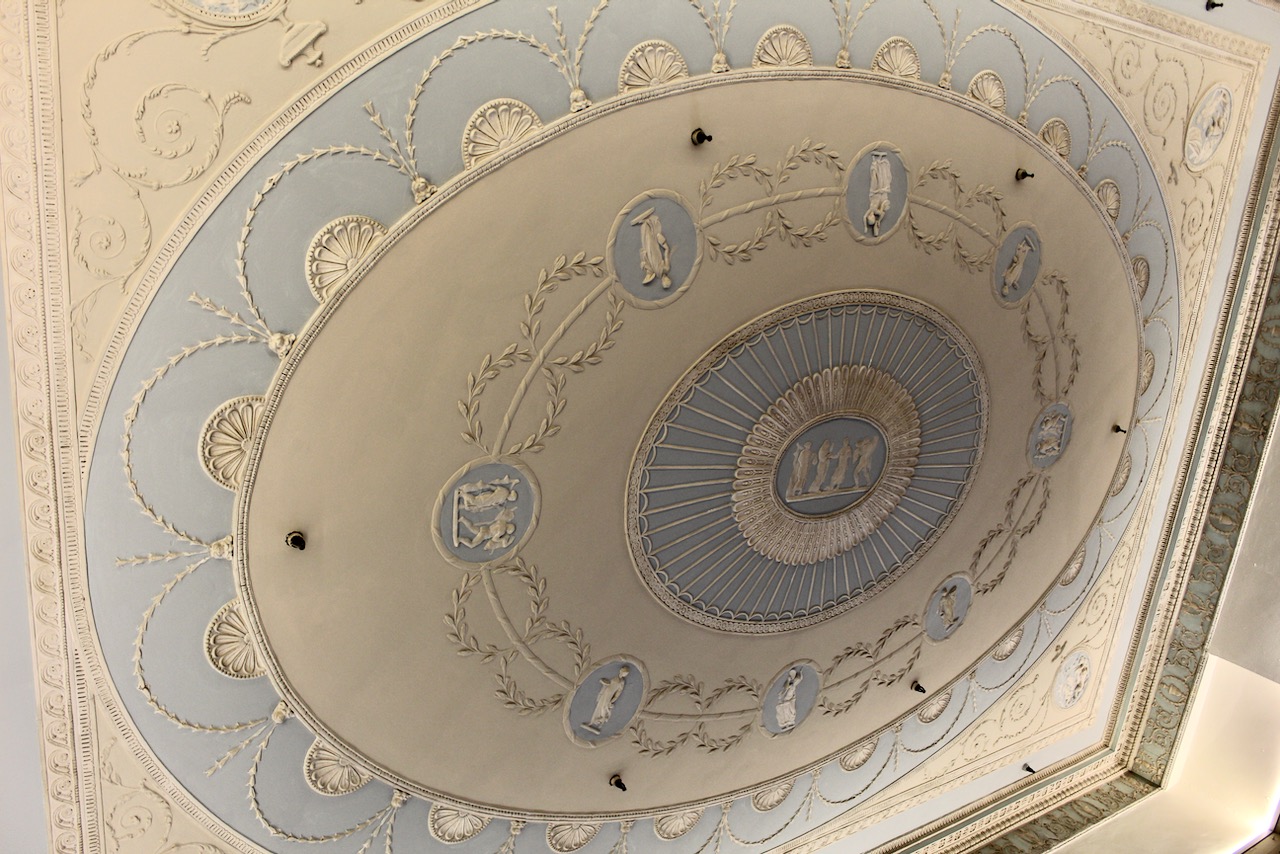
The ceiling of The Town Bride: Minerva, Roman Goddess of Music and the Arts, in the Music Room on the ceiling. Photograph © Jennifer Winder-Baggot, www.irishhistorichouses.com
The ceiling of what is now The Town Bride shop. Photograph © Jennifer Winder-Baggot, www.irishhistorichouses.com
I love the stucco work around the top of the walls also, of urns and cherubs and swags. Photograph © Jennifer Winder-Baggot, www.irishhistorichouses.com

The Dome Room is now behind glass.

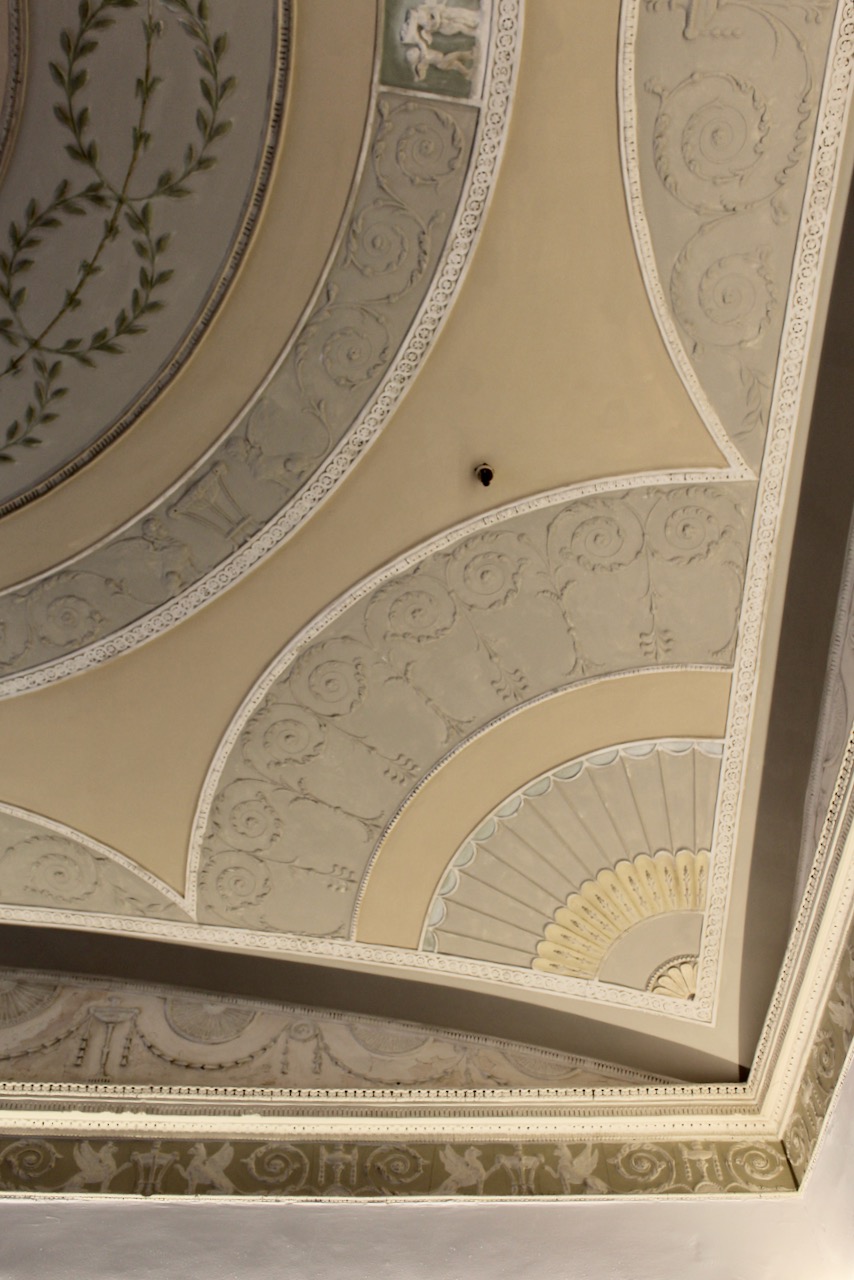
Detail on the Dome Room ceiling. Photograph © Jennifer Winder-Baggot, www.irishhistorichouses.com
Detail of Dome Room ceiling and the top of the walls. Photograph © Jennifer Winder-Baggot, www.irishhistorichouses.com
The items in the dome room are behind glass so I could not get more detail in the photographs. Photograph © Jennifer Winder-Baggot, www.irishhistorichouses.com
The ceiling of another room on the second storey. Photograph © Jennifer Winder-Baggot, www.irishhistorichouses.com
This room is on the top floor and is magnificent! Photograph © Jennifer Winder-Baggot, www.irishhistorichouses.com
There are lots of frolicking putti on this ceiling and walls. Photograph © Jennifer Winder-Baggot, www.irishhistorichouses.com
Powerscourt townhouse, Dublin. Photograph © Jennifer Winder-Baggot, www.irishhistorichouses.com
This room, appropriately, houses an art gallery. The window and door frames are magnificent also. Photograph © Jennifer Winder-Baggot, www.irishhistorichouses.com
Powerscourt townhouse, Dublin. Photograph © Jennifer Winder-Baggot, www.irishhistorichouses.com
This room also looks onto the converted courtyard. Photograph © Jennifer Winder-Baggot, www.irishhistorichouses.com
Looking down into the centre of the shopping area. Photograph © Jennifer Winder-Baggot, www.irishhistorichouses.com
Powerscourt townhouse, Dublin. Photograph © Jennifer Winder-Baggot, www.irishhistorichouses.com
Powerscourt townhouse. Photograph © Jennifer Winder-Baggot, www.irishhistorichouses.com

To see the Dining Room and Parlour, you must enter through one of the side carriage entrances, to the restaurant Farrier and Draper.
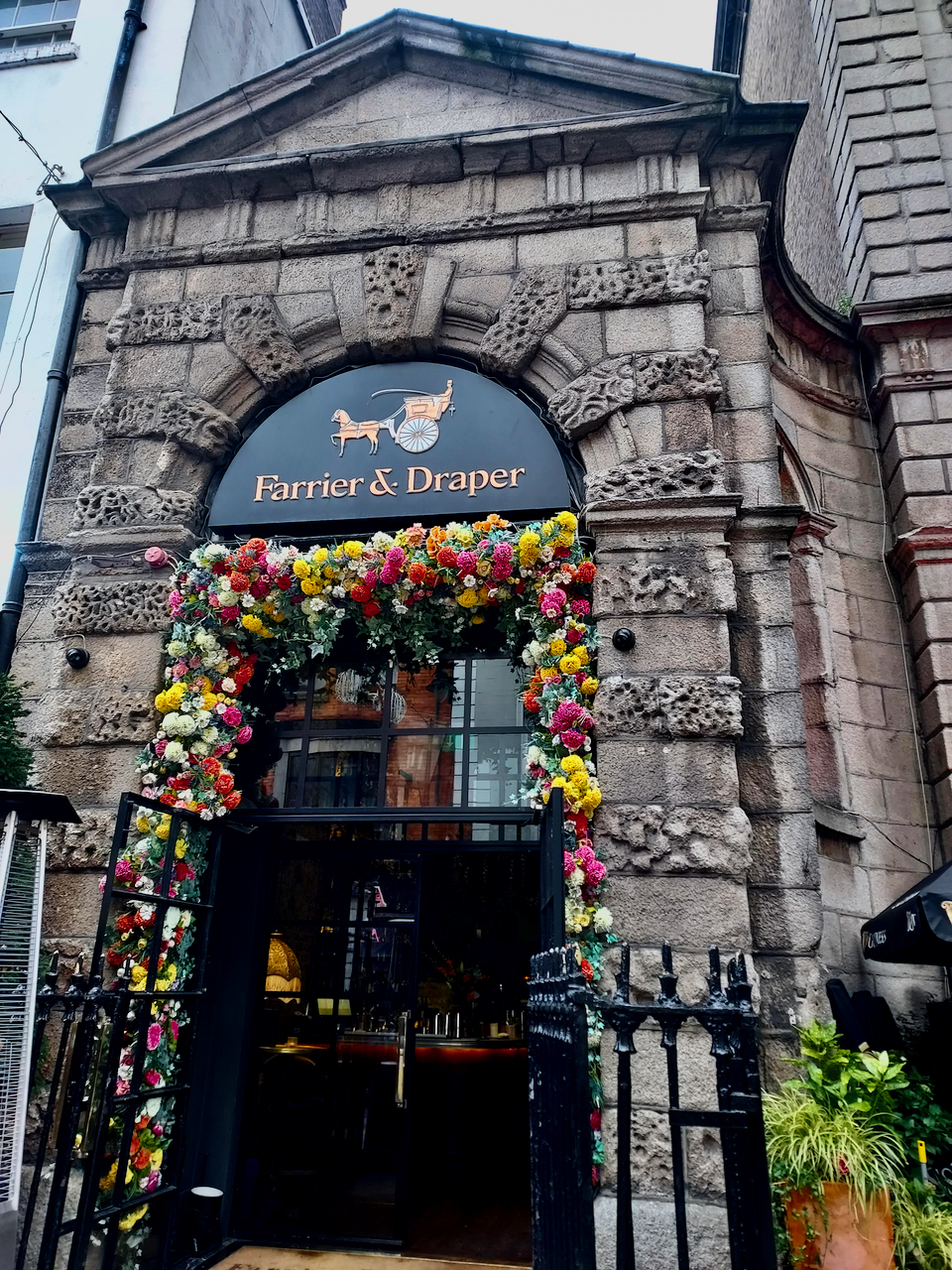
To see the Dining Room and Parlour, you must enter through one of the side carriage entrances, to the restaurant Farrier and Draper. Photograph © Jennifer Winder-Baggot, www.irishhistorichouses.com
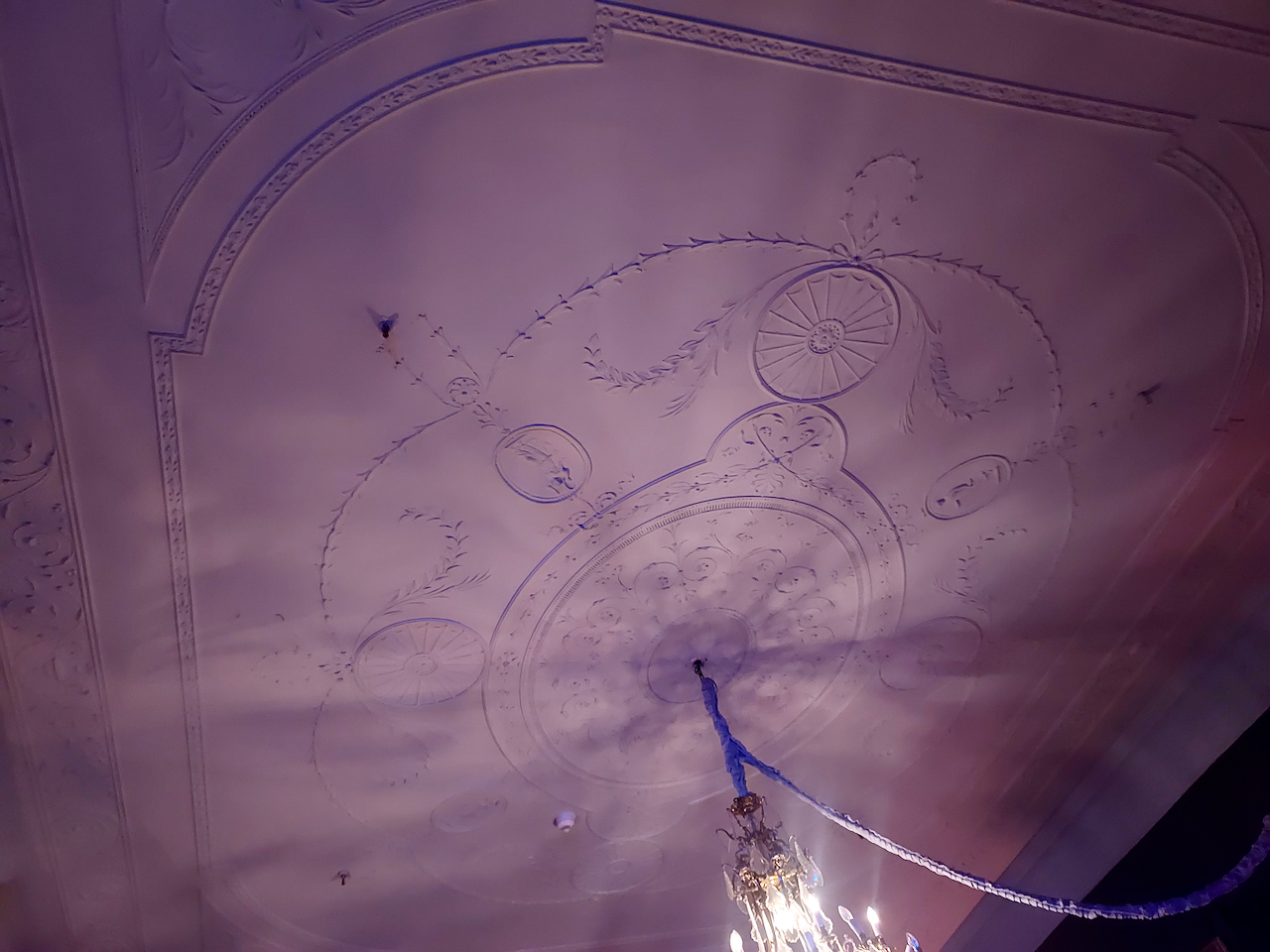
Originally the Parlour, now part of Farrier and Draper, plasterwork by Michael Stapleton. Photograph © Jennifer Winder-Baggot, www.irishhistorichouses.com
Powerscourt Townhouse. Photograph © Jennifer Winder-Baggot, www.irishhistorichouses.com
The original Dining Room, with oval and round plaques with swagged garlands set within square and rectangular panels, now part of restaurant Farrier and Draper. Photograph © Jennifer Winder-Baggot, www.irishhistorichouses.com
Powerscourt townhouse. Photograph © Jennifer Winder-Baggot, www.irishhistorichouses.com

The townhouse website tells us that Richard Wingfield was known as the “French Earl” because he made the Grand Tour in Europe and returned wearing the latest Parisian fashions. He died in 1788 and was laid out in state for two days in his townhouse, where the public were admitted to view him! His son Richard inherited the title and estates.

The garden front is of seven bays rather than nine, and has a broader three-bay advanced centrepiece.
Powerscourt townhouse. Photograph © Jennifer Winder-Baggot, www.irishhistorichouses.com

After the house was sold by the Powerscourt family the gardens were built over between 1807 and 1815, when the house became the home of the Government Stamp Office. After the Act of Union, when the Irish Parliament was abolished and Ireland was ruled by Parliament in England, many Dublin mansions were sold. In July 1897 Richard 4th Lord Powerscourt petitioned Parliament to be allowed to sell his house to the Commissioner of Stamp Duties. The house was described as black from “floating films of soot” produced by the city’s coal fires. I can remember when Trinity was blackened by soot also before smoky coal was banned from Dublin, and extensive cleaning took place.

Powerscourt townhouse.

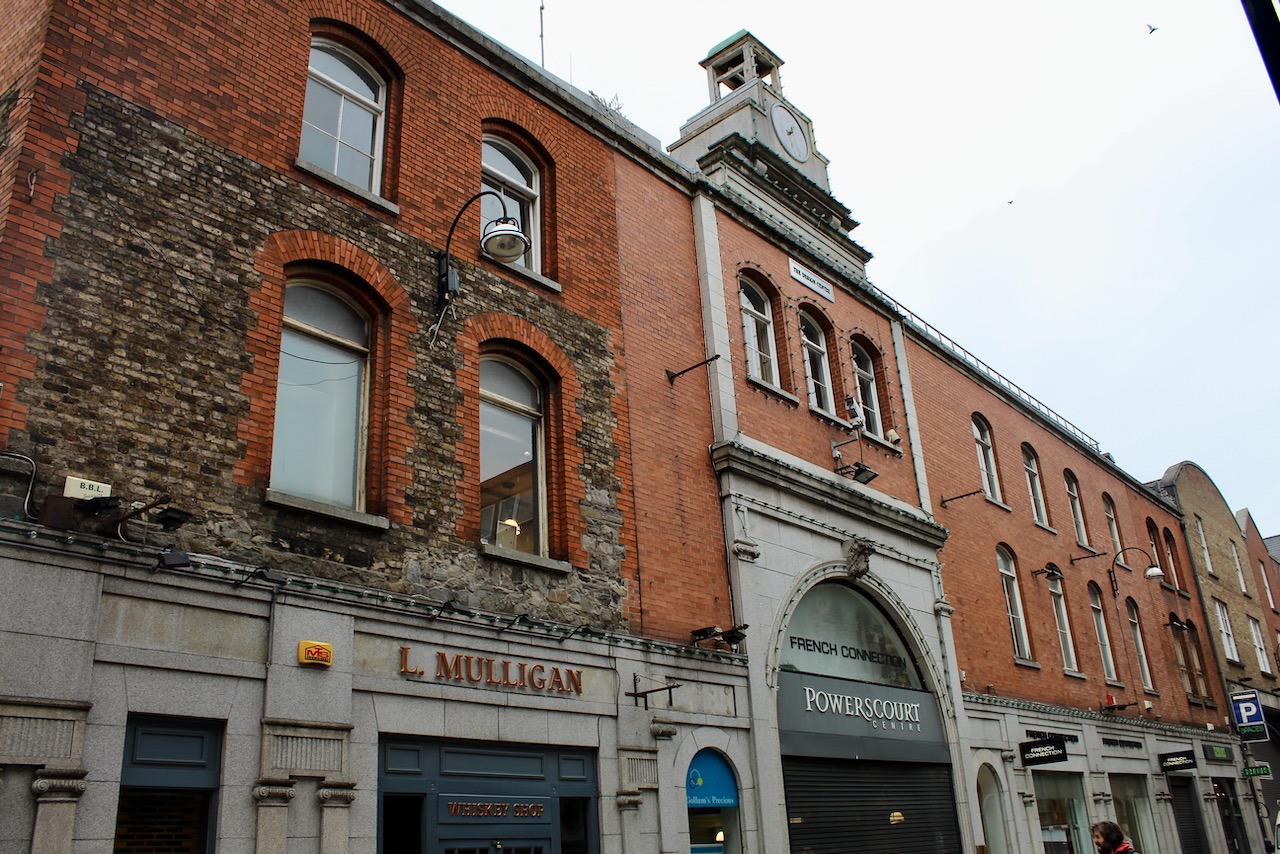
Several alterations were made to make the house suitable for its new purpose. This work was carried out by Francis Johnston, architect of the Board of Works, who designed the General Post Office on O’Connell Street. He designed additional buildings to form the courtyard of brown brick in Powerscourt townhouse, which served as offices. This consisted of three ranges of three storeys with sash windows. He also designed the clock tower and bell on Clarendon Street.
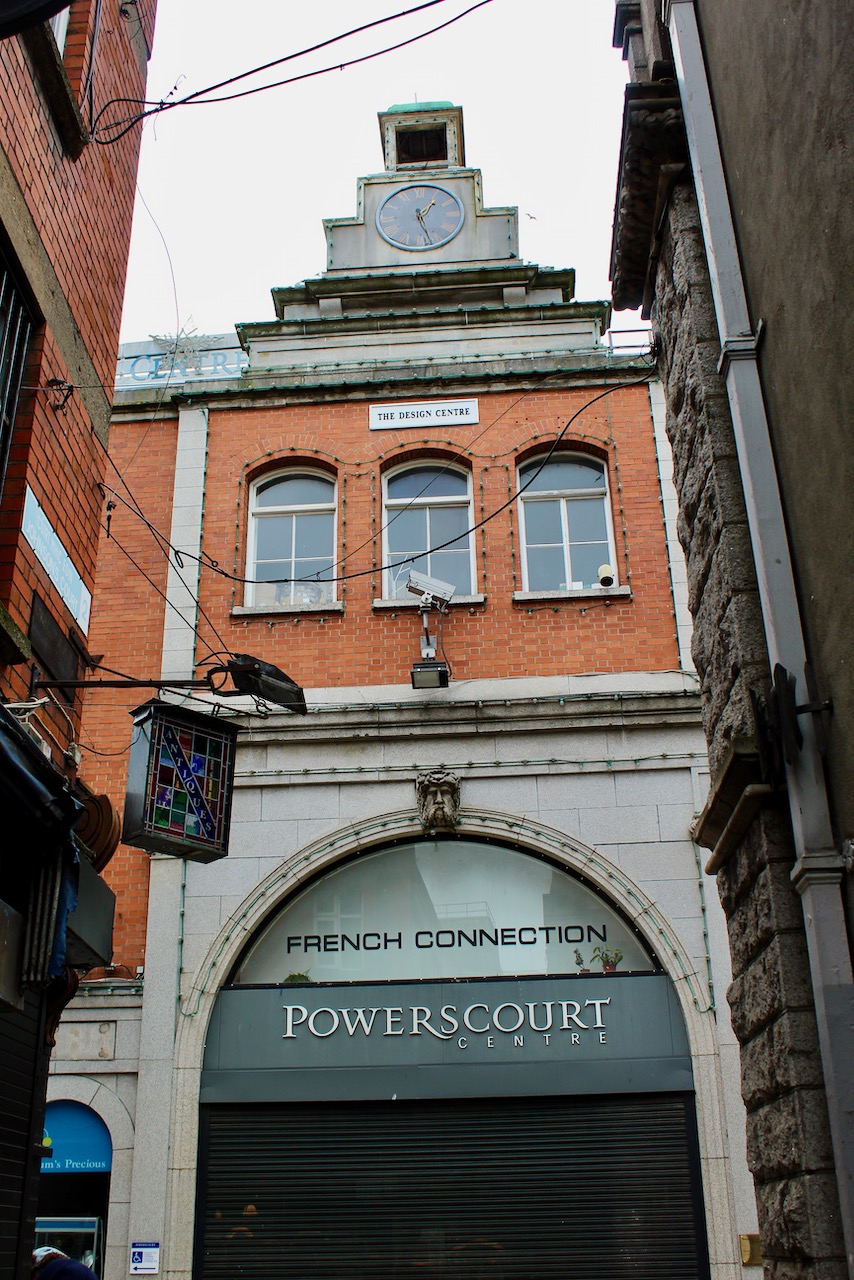
Francis Johnston designed the clock and bell tower on Clarendon Street. Photograph © Jennifer Winder-Baggot, www.irishhistorichouses.com

In 1835, the Government sold the property to Messrs Ferrier Pollock wholesale drapers, who occupied it for more than one hundred years. It was used as a warehouse. I’m sure the workers in the warehouse enjoyed going up and down the grand staircase!

In 1981 the buildings were converted into a shopping centre, by architect James Toomey, for Power Securities. The courtyard was glazed over to make a roof.
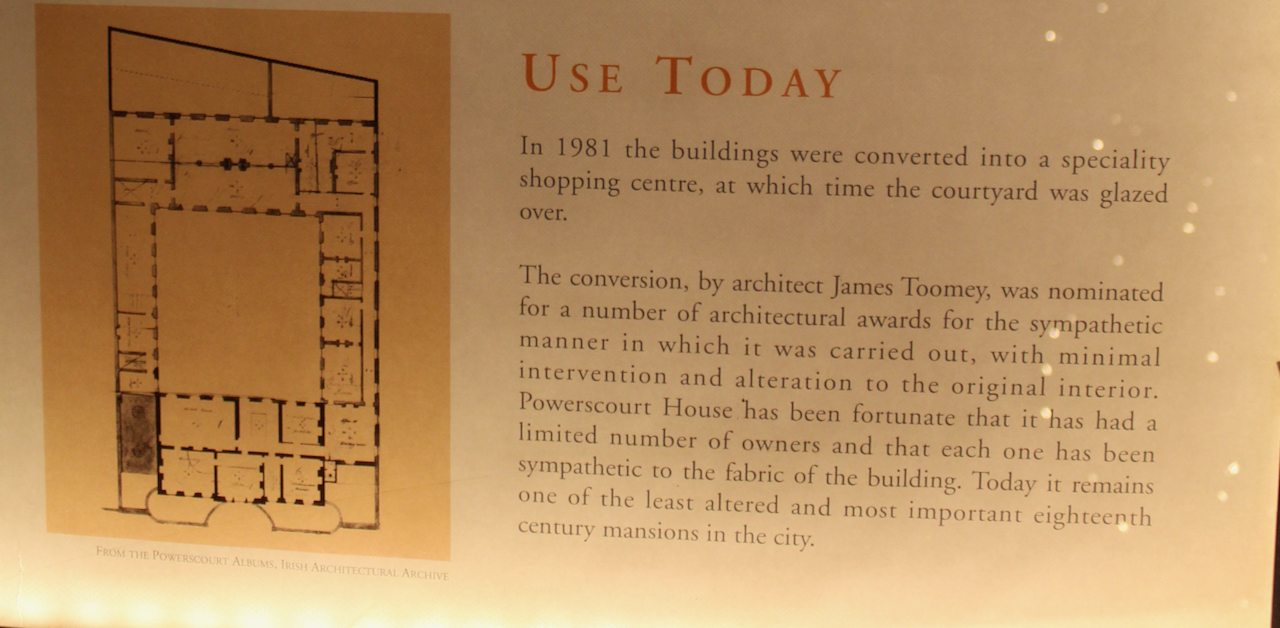
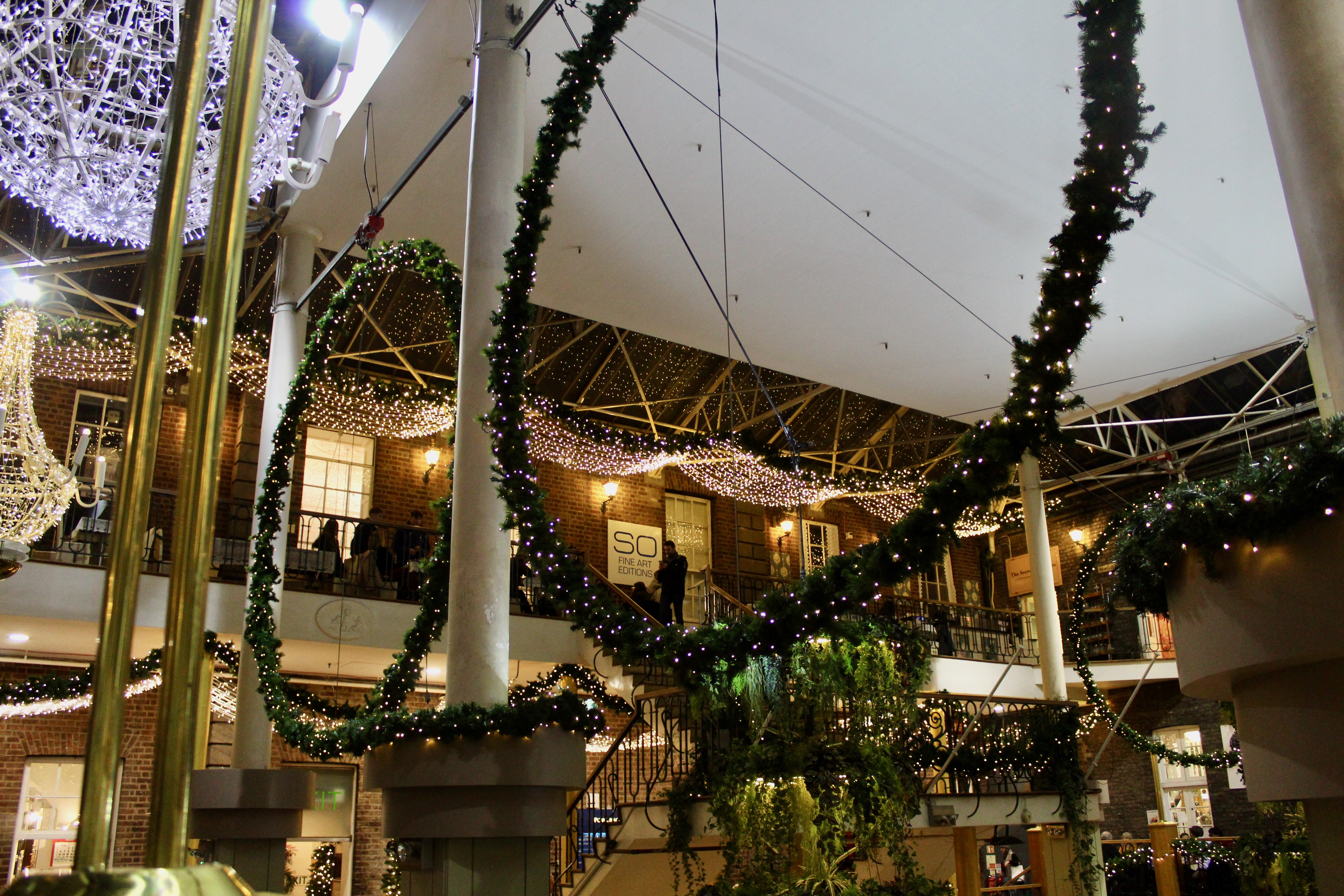
Powerscourt Townhouse.
IMG_1701
Powerscourt Townhouse. Photograph © Jennifer Winder-Baggot, www.irishhistorichouses.com
IMG_1703
Powerscourt Townhouse. Photograph © Jennifer Winder-Baggot, www.irishhistorichouses.com
IMG_1704
Powerscourt townhouse. Photograph © Jennifer Winder-Baggot, www.irishhistorichouses.com

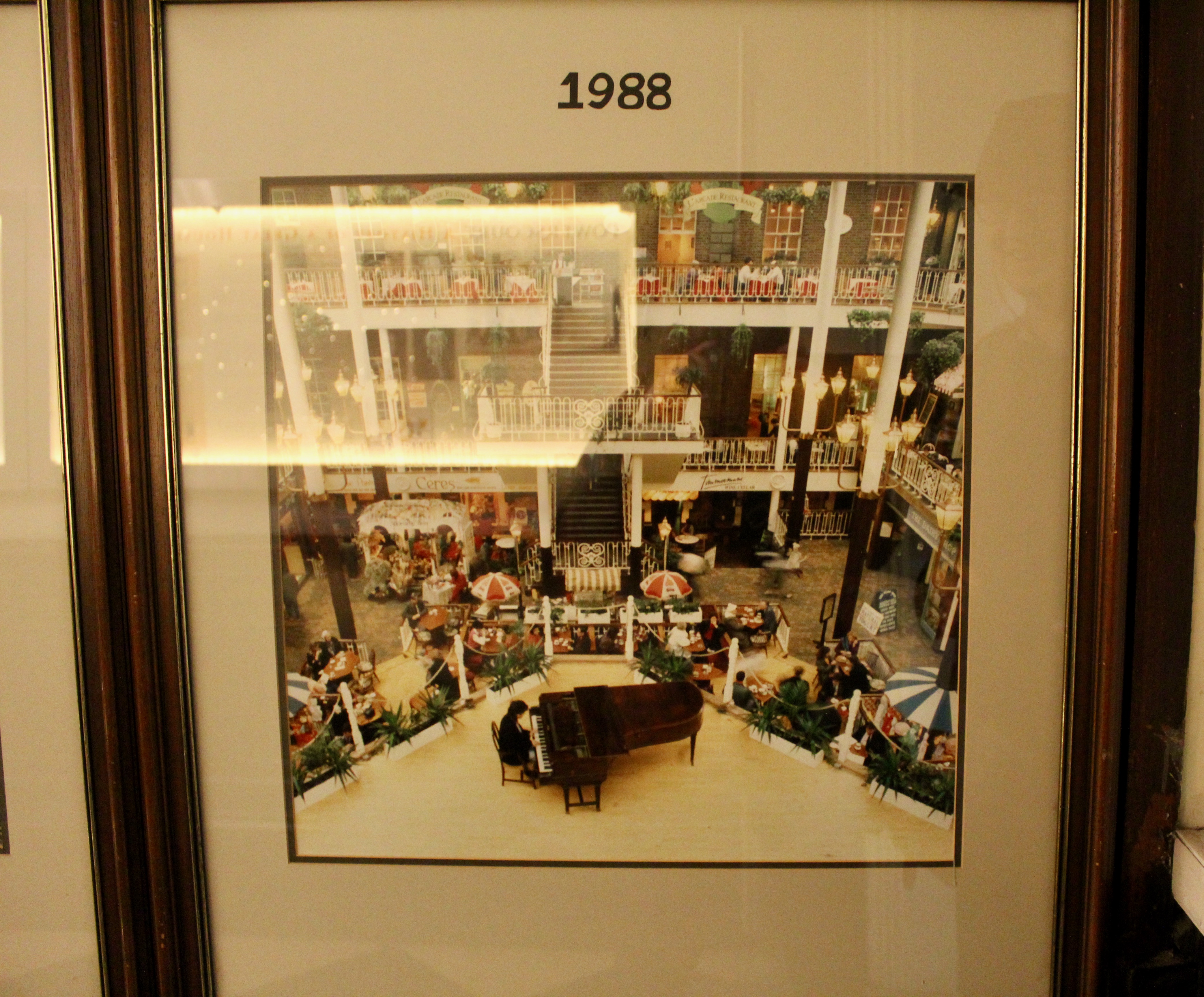
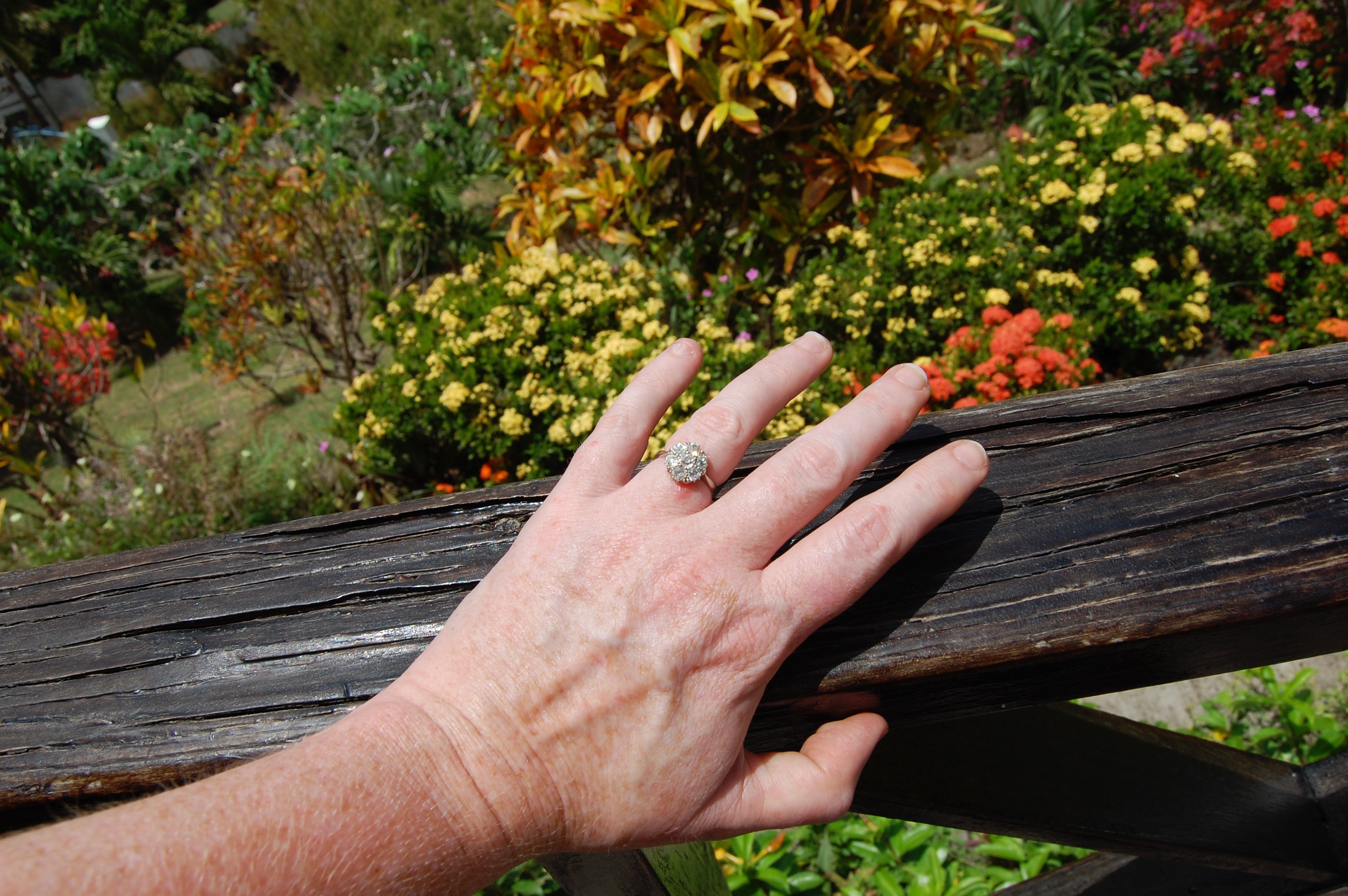
Powerscourt Townhouse was one of my haunts when I first moved to Dublin in 1986 (after leaving Dublin, where I was born, in 1969, at eight months old). I loved the antique stores with their small silver treasures and I bought an old pocket watch mounted on a strap and wore it as a watch for years. My sister, our friend Kerry and I would go to Hanky Pancakes at the back of the town centre, downstairs, for lemon and sugar coated thin pancakes, watching them cook on the large round griddle, being smoothed with a brush like that used to clean a windshield. For years, it was my favourite place in Dublin. Pictured below is the pianist, an old friend of Stephen’s, Maurice Culligan. My husband bought my engagement ring in one of the antique shops!
IMG_1710 (1)
Maurice Culligan playing piano in Powerscourt Townhouse.
DSC_1117.JPG
My engagement ring, purchased in Powerscourt Townhouse. Photograph © Jennifer Winder-Baggot, www.irishhistorichouses.com

Despite the very helpful information boards, I find it impossible to imagine what the original house looked like. I took pictures walking around the outside of the shopping centre.

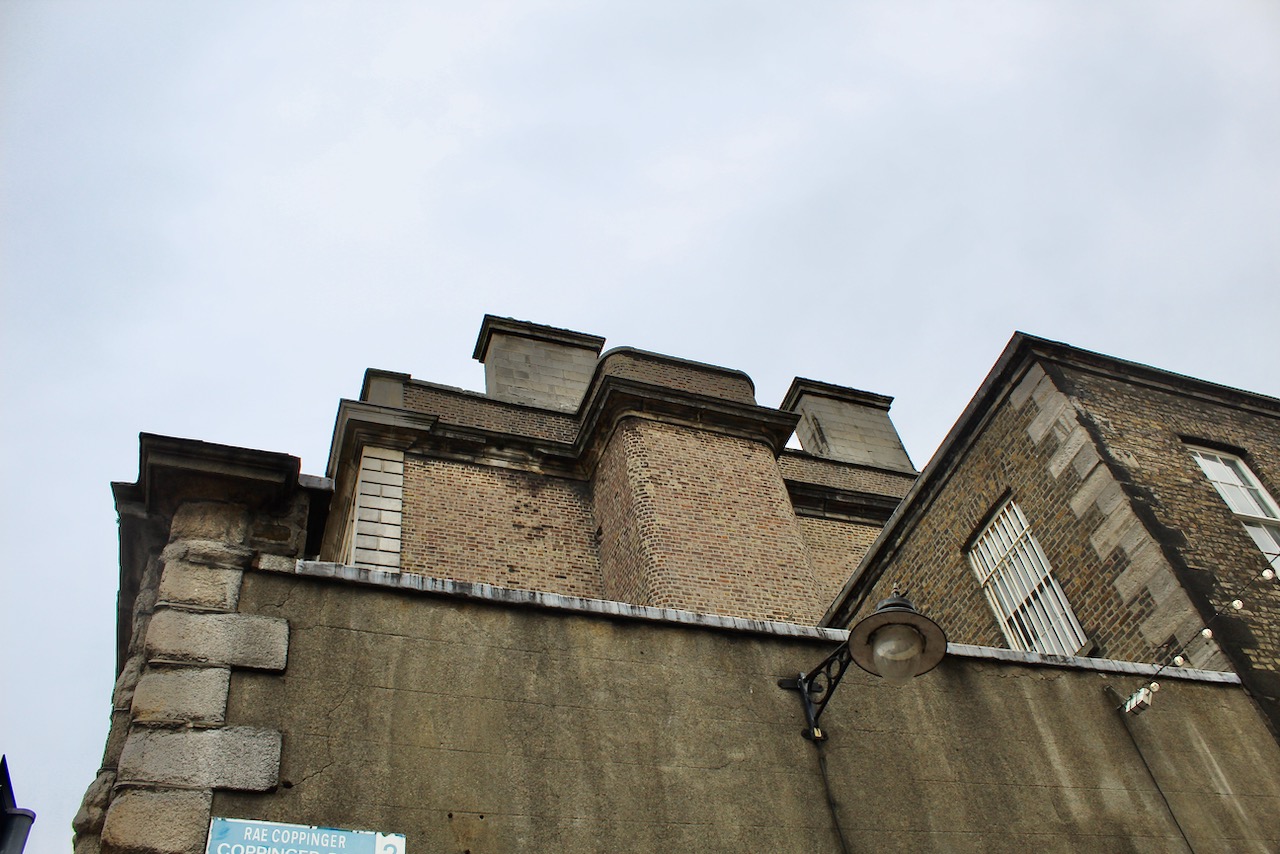
Powerscourt Townhouse. Photograph © Jennifer Winder-Baggot, www.irishhistorichouses.com
There’s an art deco feel to the curved middle projection on the upper storey at the side. Photograph © Jennifer Winder-Baggot, www.irishhistorichouses.com
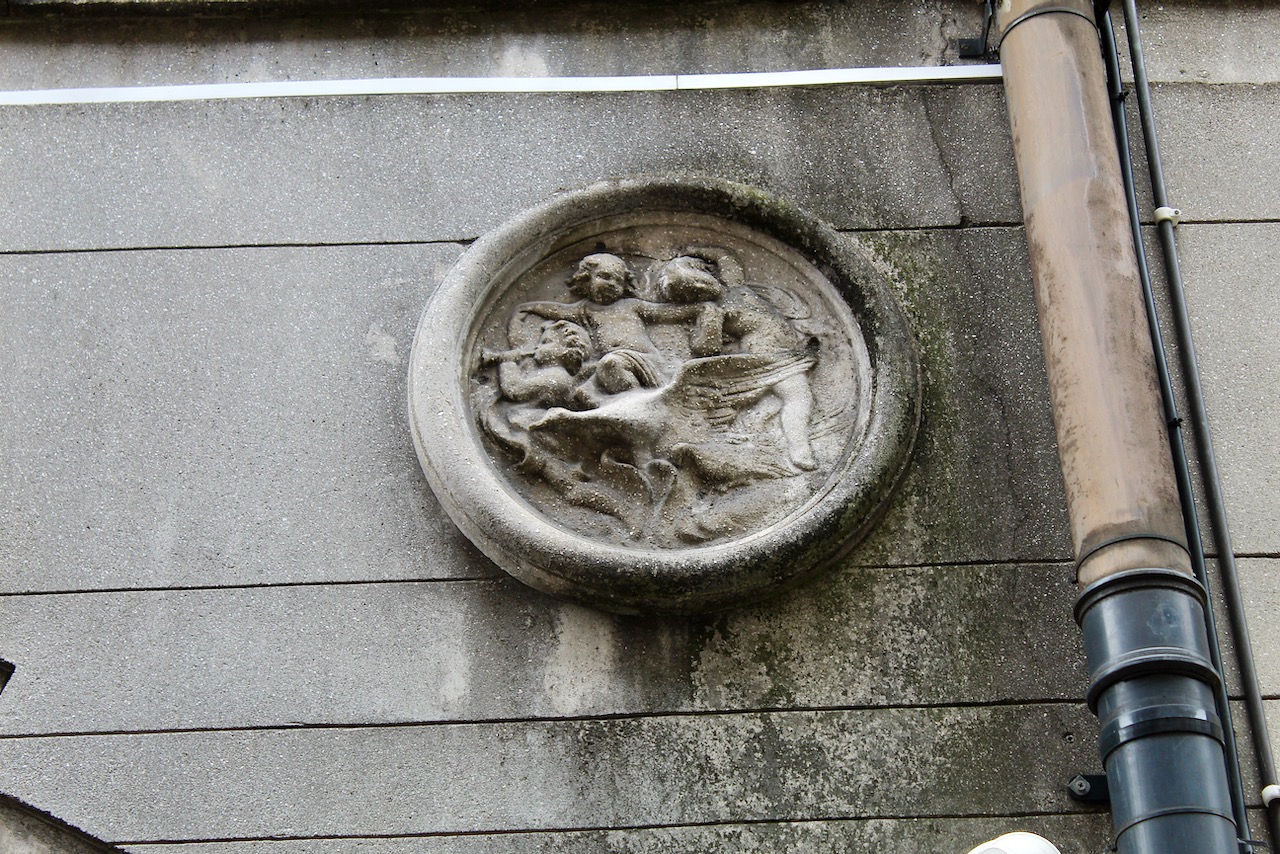
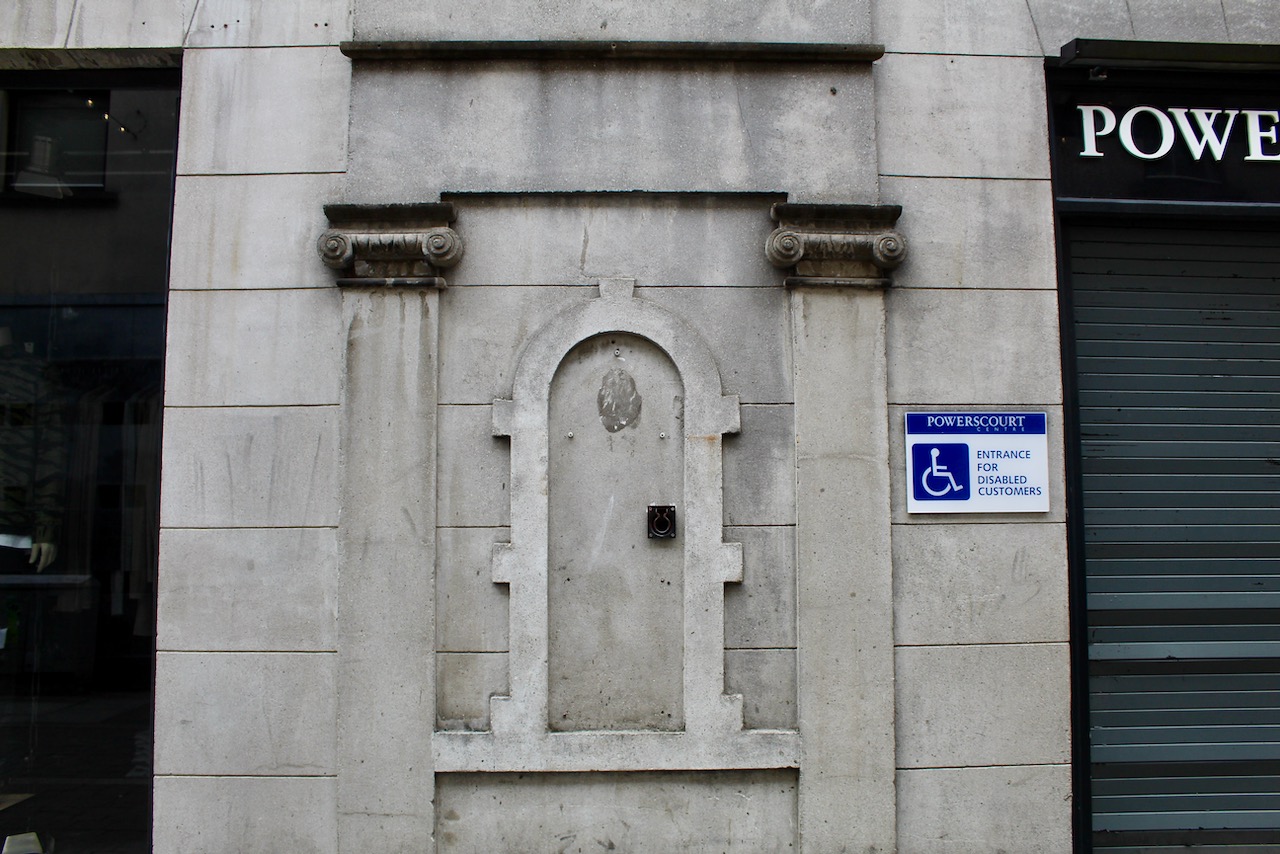
Perhaps the detailing to the sides – the inset pillars and medallions – of this side entrance to the shopping centre are by Francis Johnston (who trained under Thomas Cooley, creator of Rokeby Hall, also on Section 482). Photograph © Jennifer Winder-Baggot, www.irishhistorichouses.com
Powerscourt Townhouse. Photograph © Jennifer Winder-Baggot, www.irishhistorichouses.com
Powerscourt townhouse. Photograph © Jennifer Winder-Baggot, www.irishhistorichouses.com

The French Connection entrance side is opposite the Westbury Mall.
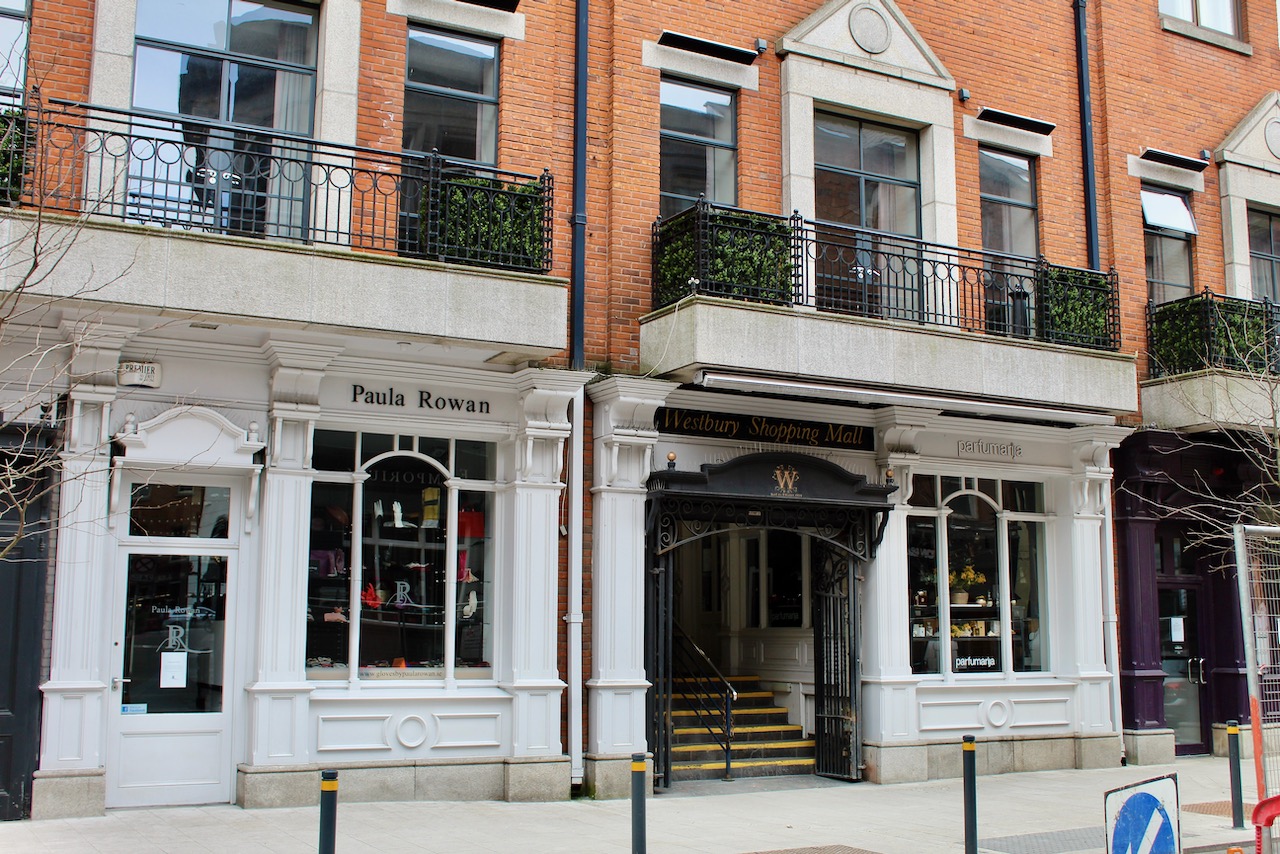
Opposite Powerscourt townhouse. Photograph © Jennifer Winder-Baggot, www.irishhistorichouses.com

The grander side is opposite from Grogans, and next to the old Assembly House which is now the headquarters of the Irish Georgian Society. The walkway by Grogans leads down to the wonderful Victorian George’s Arcade buildings.

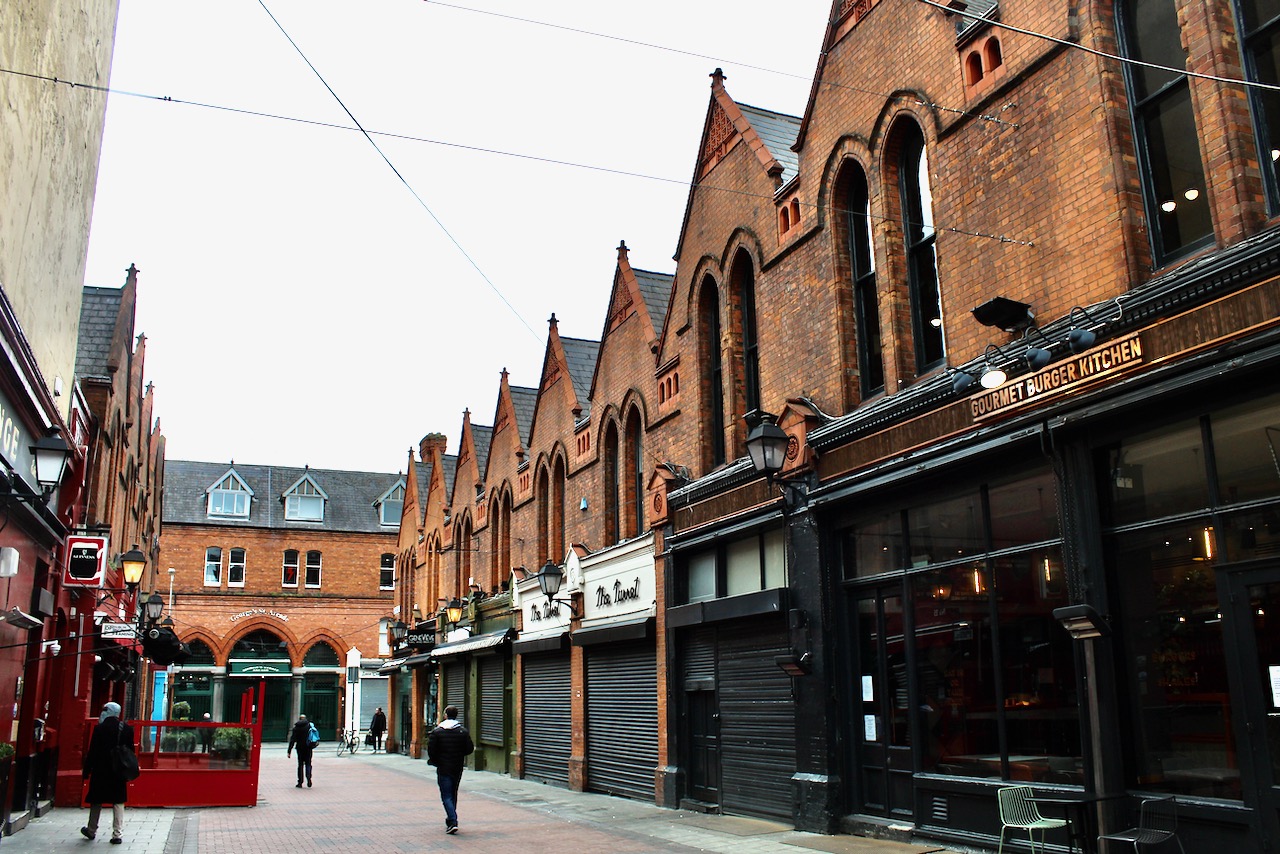
South City Markets. Photograph © Jennifer Winder-Baggot, www.irishhistorichouses.com
IMG_1975
South City Markets, by Lockwood & Mawson, 1878-81. Photograph © Jennifer Winder-Baggot, www.irishhistorichouses.com

Donation

Help me to fund my creation and update of this website. It is created purely out of love for the subject and I receive no payment so any donation is appreciated!

€15.00

[1] I traced the genealogy of the owner of Salterbridge, Philip Wingfield. I traced him back to the owners of Powerscourt Townhouse. Richard 4th Viscount Powerscourt (1762-1809) has a son, Reverend Edward Wingfield (his third son) (b. 1792). He marries Louise Joan Jocelyn (by the way, he is not the only Wingfield who marries into the Jocelyn family, the Earls of Roden). They have a son, Captain Edward Ffolliott Wingfield (1823-1865). He marries Frances Emily Rice-Trevor, and they have a son, Edward Rhys Wingfield (1848-1901). He marries Edith Caroline Wood, and they have a son, Captain Cecil John Talbot Rhys Wingfiend. He marries Violet Nita, Lady Paulett, and they have a son, Major Edward William Rhys Wingfield. It is he who buys Salterbridge, along with his wife, Norah Jellicoe. They are the parents of Philip Wingfield.

[2] https://repository.dri.ie/catalog?f%5Broot_collection_id_ssi%5D%5B%5D=pk02rr951&mode=objects&search_field=all_fields&view=grid

[3] Archiseek seems mistaken as identifying the architect to be Richard Castle/Cassells

http://archiseek.com/2010/1774-powerscourt-house-south-william-street-dublin/

[4] Casey, Christine. The Buildings of Ireland: Dublin. The City within the Grand and Royal Canals and the Circular Road with the Phoenix Park. Founding editors: Nikolaus Pevsner and Alistair Rowan. Yale University Press, New Haven and London, 2005.

[6] architectural definitions

pediment: “Originally the low-pitched triangular gable of the roof of a Classical temple, and of the roof of a portico; used as an ornamental feature, generally in the centre of a facade, without any structural purpose.”

portico: “an open porch consisting of a pediment or entablature carried on columns.”

entablature: “a horizontal member, properly consisting of an architrave, frieze and cornice, supported on columns, or on a wall, with or without columns or pilasters.”

architrave: “strictly speaking, the lowest member of the Classical entablature; used loosely to denote the moulded frame of a door or window opening.”

frieze: “strictly speaking, the middle part of an entablature in Classical architecture; used also to denote a band of ornament running round a room immediately below the ceiling.”

cornice: “strictly speaking, the crowning or upper projecting part of the Classical entablature; used to denote any projecting moulding along the top of a building, and in the angle between the walls and the ceiling of a room.”

pilasters: “a flat pillar projecting from a wall, usually with a capital of one of the principal Orders of architecture.”

volute: “a scroll derived from the scroll in the Ionic capital.”

Ionic Order: “the second Order of Classical architecture.”

Acanthus – decoration based on the leaf of the acanthus plant, which forms part of the Corinthian capital

[7]https://en.wikipedia.org/wiki/Richard_Wingfield,_1st_Viscount_Powerscourt_(first_creation)

[8]http://lordbelmontinnorthernireland.blogspot.com/search/label/County%20Wicklow%20Landowners

I did further research in Burke’s Peerage to discover the exact relationship of these cousins. https://ukga.org/cgi-bin/browse.cgi?action=ViewRec&DB=33&bookID=227&page=bp189401283

Lewis Wingfield of Southampton married a Ms. Noon. He had a son Richard who married Christiana Fitzwilliam, and a son George. Richard the 1st Viscount who moved to Ireland is the son of Richard and Christiana. Edward Wingfield, who inherited Powerscourt Estate from Richard 1st Viscount, was the grandson of George (son of Lewis of Southampton), son of Richard Wingfield of Robertstown, County Limerick, who married Honora O’Brien, daughter of Tadh O’Brien (second son of Muragh O’Brien, 1st Lord Inchiquin).

[9] There was much intermarrying between the Cromwells and the Wingfields at this time! 1st Viscount Richard Wingfield, of the first creation, married Frances Rugge (or Repps), daughter of William Rugge (or Repps) and Thomasine Townshend, who was the widow of Edward Cromwell, 3rd Baron Cromwell. Frances Rugge and Edward Cromwell had two daughters, Frances and Anne. Frances Cromwell married Sir John Wingfield of Tickencote, Rutland, and Anne Cromwell married Sir Edward Wingfield of Carnew, County Wicklow. Anne and Edward’s grandson Folliott became the 1st Viscount Powerscourt of the 2ndcreation.

[10] Wikipedia has a different genealogy from Lord Belmont’s blog. Folliott Wingfield, 1st Vt of 2nd creation (1642-1717), according to Wikipedia, is the son of Richard Wingfield and Elizabeth Folliott, rather than the son of Anne Cromwell and Edward Wingfield of Carnew, County Wicklow, as the Lord Belmont blog claims. Burke’s Peerage however, agrees that Folliott Wingfield, 1st Vt 2nd Creation is not the son of Edward Wingfield of Carnew.

According to Burke’s Peerage, Edward Wingfield of Carnew, who married Anne Cromwell, and who inherits Powerscourt Estate, dies in 1638. They have six sons:

I. Richard is his heir;

II. Francis

III. Lewis, of Scurmore, Co Sligo, who married Sidney, daughter of Paul Gore, 1st Bart of Manor Gore, and they have three sons: Edward*, Lewis and Thomas. This Edward inherits Powerscourt Estate.

IV. Anthony, of London

V.  Edward, of Newcastle, Co Wickow, d. 1706

Richard (d. 1644 or 1645), the heir, married Elizabeth Folliott, and is succeeded by his son Folliott Wingfield, who becomes 1st Vt, 2nd Creation. When he dies, the peerage ends again. However, his first cousin, Edward* inherits Powerscourt. Edward Wingfield Esq, of Powerscourt, Barrister-at-Law, marries first Eleanor Gore, daughter of Arthur Gore of Newtown Gore, County Mayo, and by her has a son, Richard. Richard inherited Powerscourt, became an MP and was elevated to the peerage in 1743, and became (1st) Viscount Powerscourt of the 3rd creation.

Text © Jennifer Winder-Baggot, www.irishhistorichouses.com
11 North Great George’s Street, Dublin 1 – section 482

www.number11dublin.ie

Open dates in 2026: March 23-27, April 20-24, May 5-9, June 8-13, July 6-11, Aug 4-8, 15-23, Sept 1-10, 21-25, Oct 5-8, 12 noon-4 pm

Fee: adult €7, student/OAP €3, child free, all takings at door are donated to Merchants Quay Ireland

North Great George’s Street, Dublin, Courtesy Fionn Mc Cann for Fáilte Ireland, 2021.
39 North Great Georges Street, Dublin. Photograph © Jennifer Winder-Baggot, www.irishhistorichouses.com

I visited 11 North Great George’s Street in 2012 during Open House, run by the Irish Architectural Foundation. I went with my husband Stephen and my Dad, Desmond. There is a video of the day on the website and I am excited to see myself in it! [1]

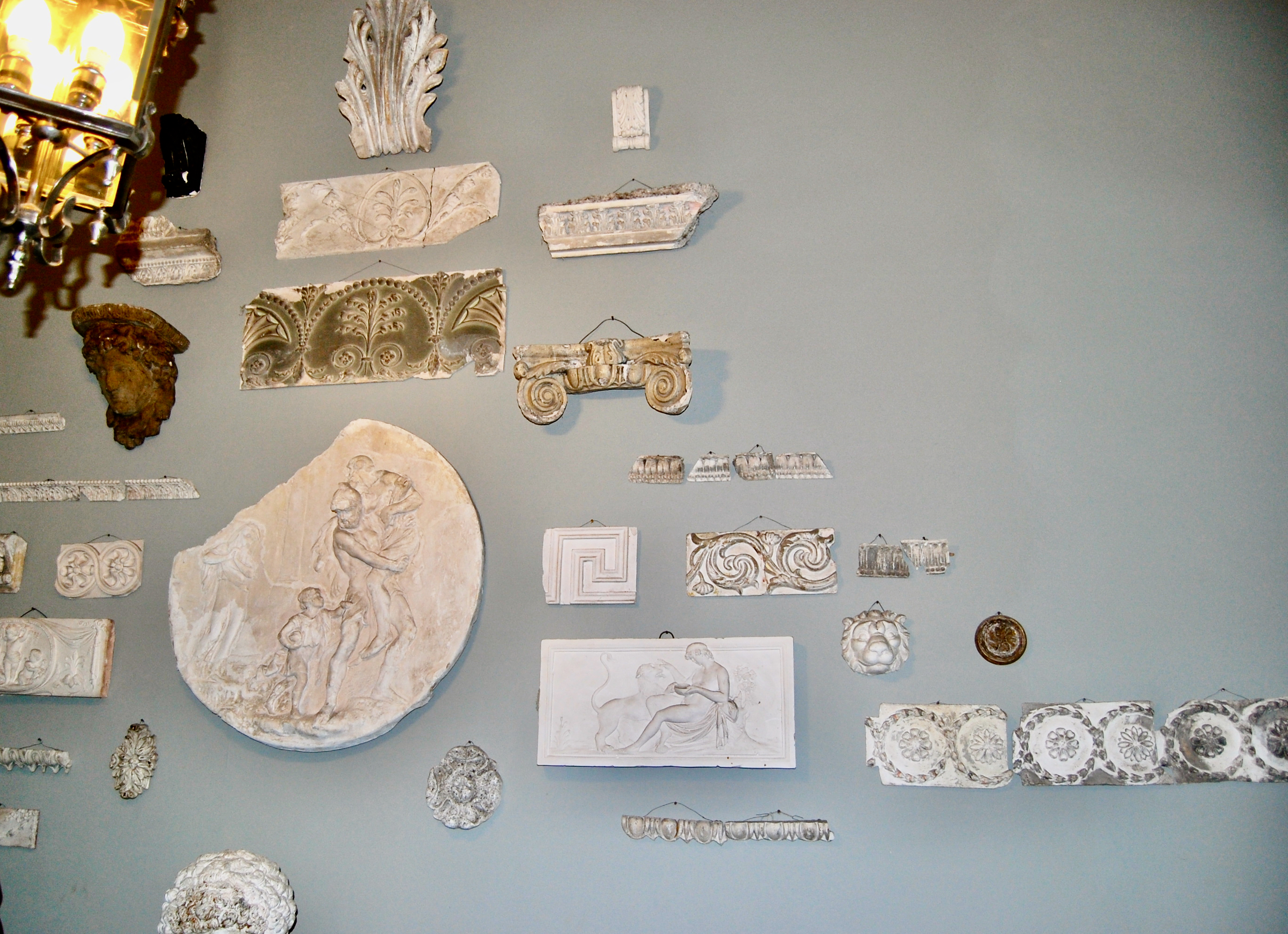
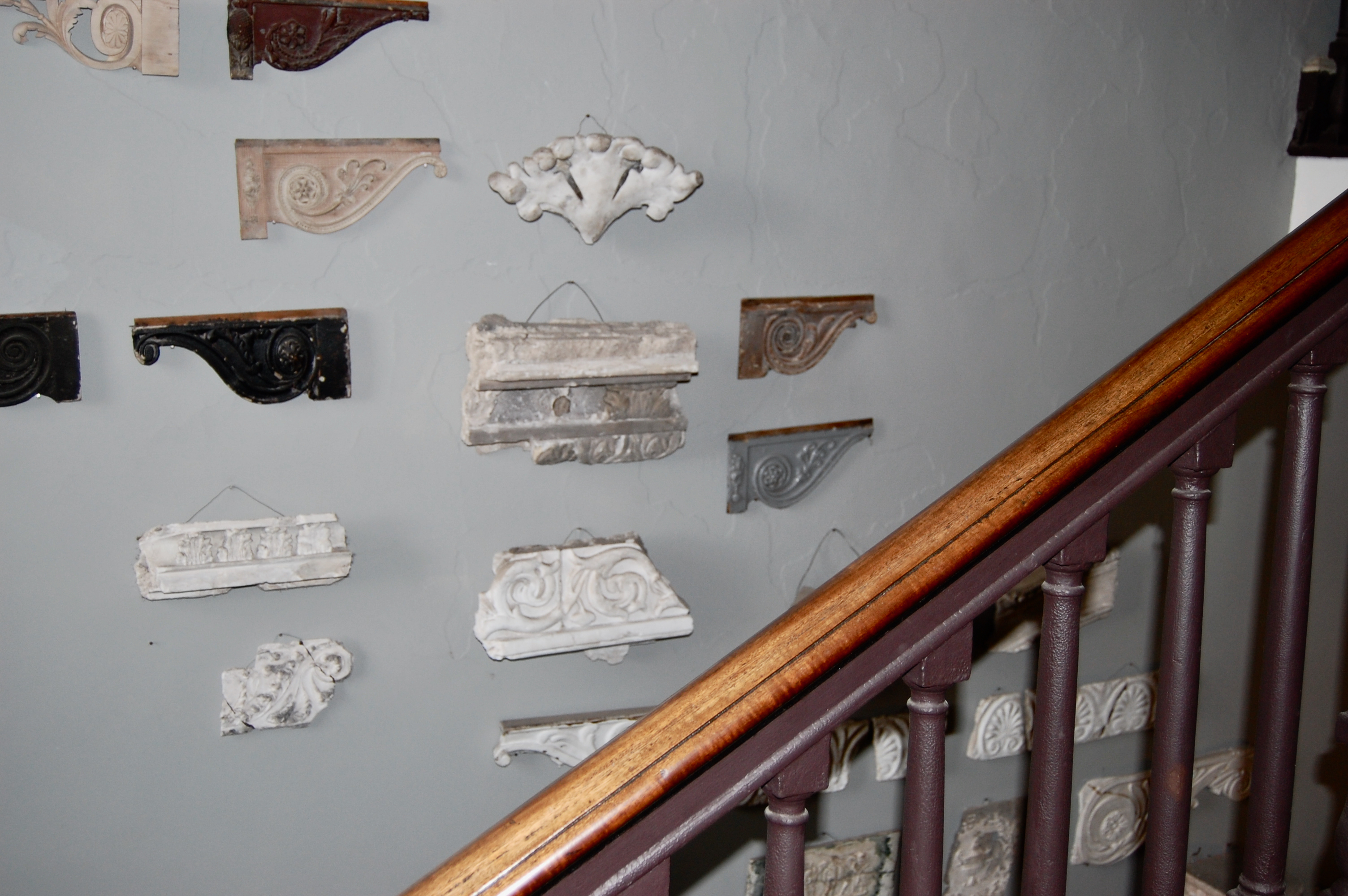
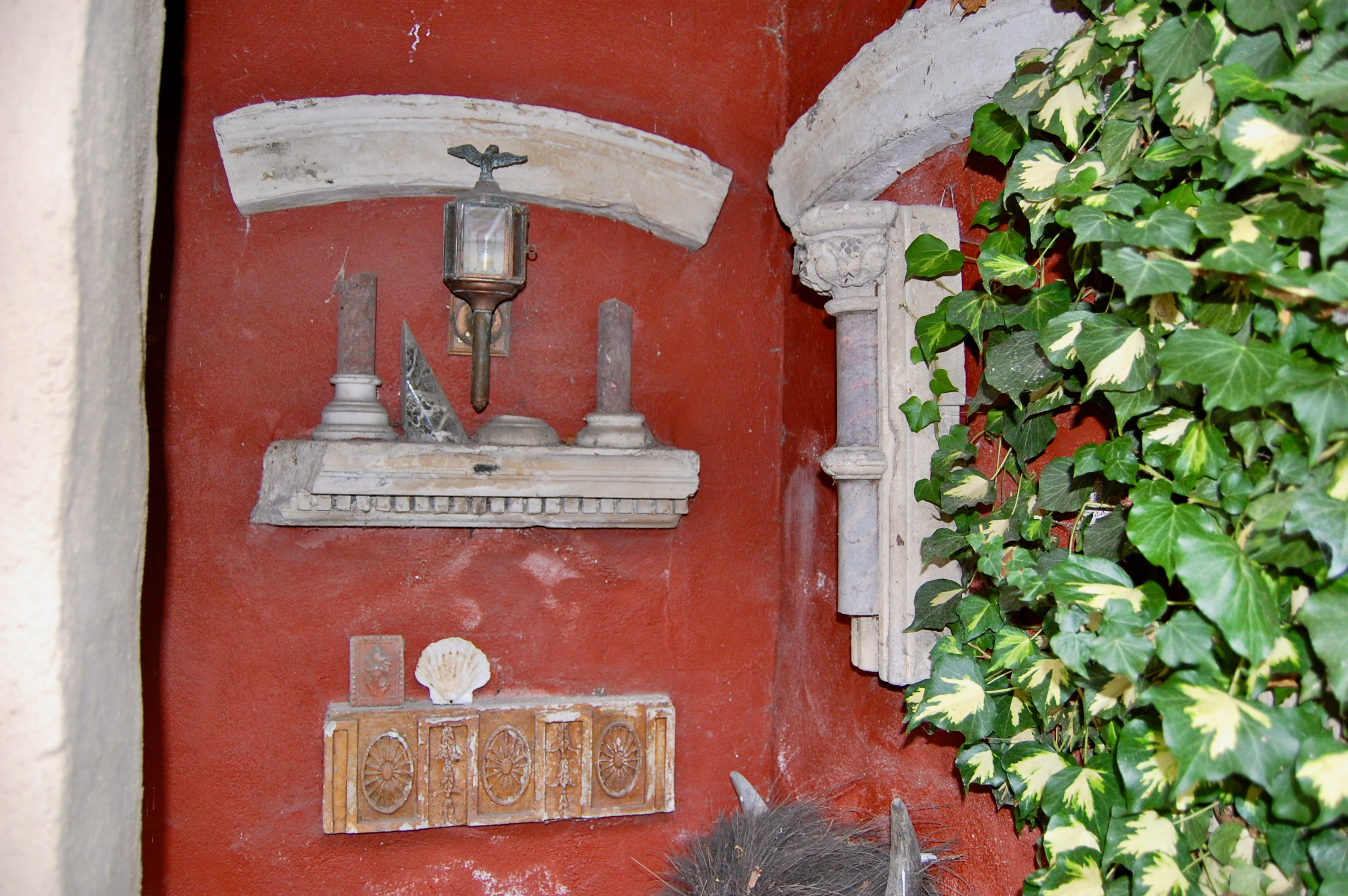
We loved this house! It’s wonderfully decorated and we had a tour with owner John Aboud. The decor is very quirky and full of character. I loved the plaster decoration on the walls, “John Soane’s Museum” style. Like Peter Pearson, the occupant has rescued parts of old houses which are being discarded. How I’d love to come across such a skip!

DSC_0999
11 North Great George’s Street, 2012. Photograph © Jennifer Winder-Baggot, www.irishhistorichouses.com
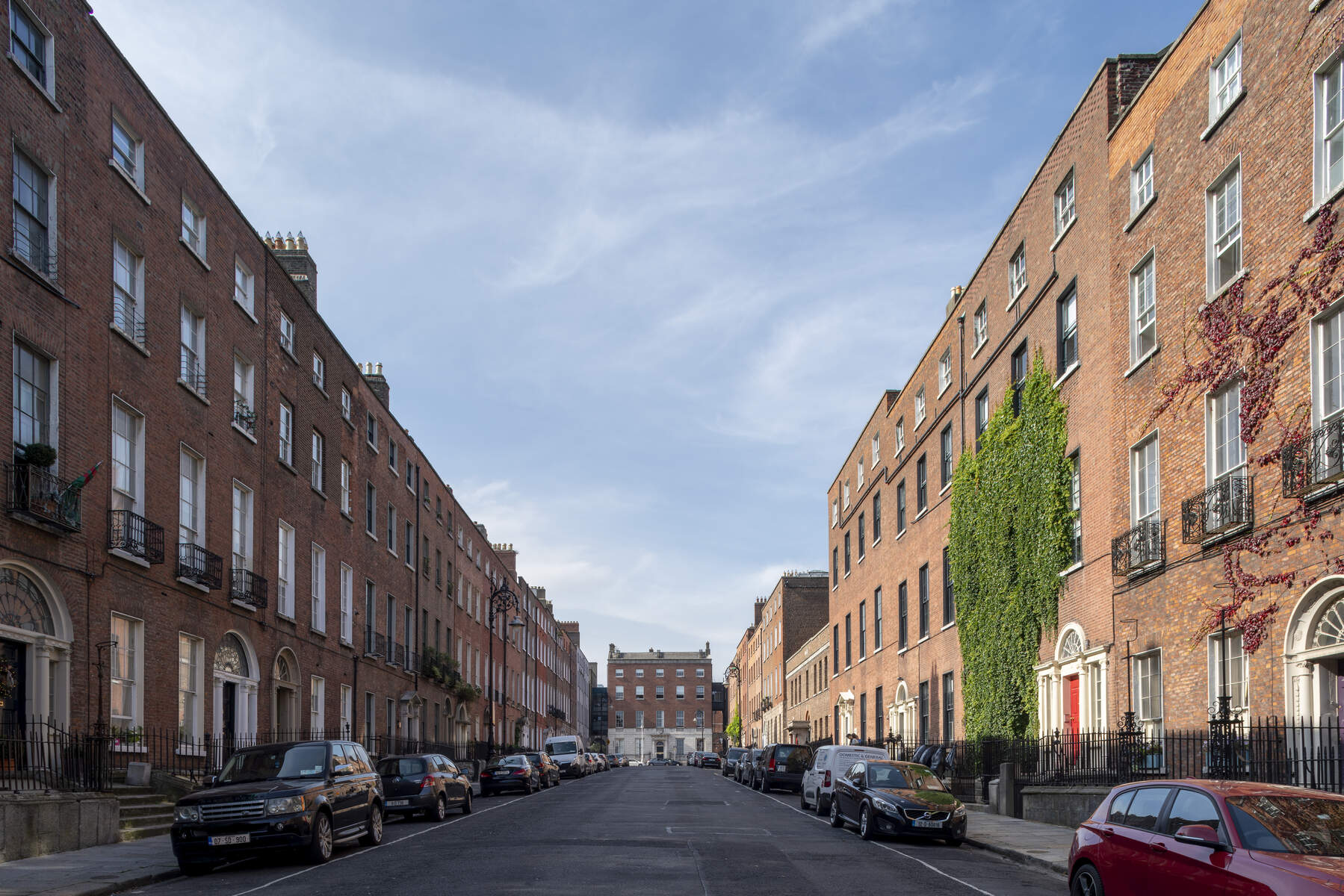
According to the Buildings of Ireland website, this house was one of the first to be built on North Great George’s Street, a street of stepped terraces built after 1768 as a result of commercial leases granted on the avenue leading to the Mount Eccles Estate and in response to the expansion of the Gardiner Estate [2]. The houses were built as townhouses for the gentry. Number 11 was completed in 1774.

The street has its own North Great George’s Street Preservation Society, which has an excellent website with a history of the street written by Conor Lucey. [3] The Preservation Society began in 1979, according to its website, by a group of resident house-owners who had become concerned about the fate of the street, which had survived almost alone amid the surrounding dereliction of North Central Dublin. The Association was formed more recently to represent the views and interests of the many long-term residents in the street.

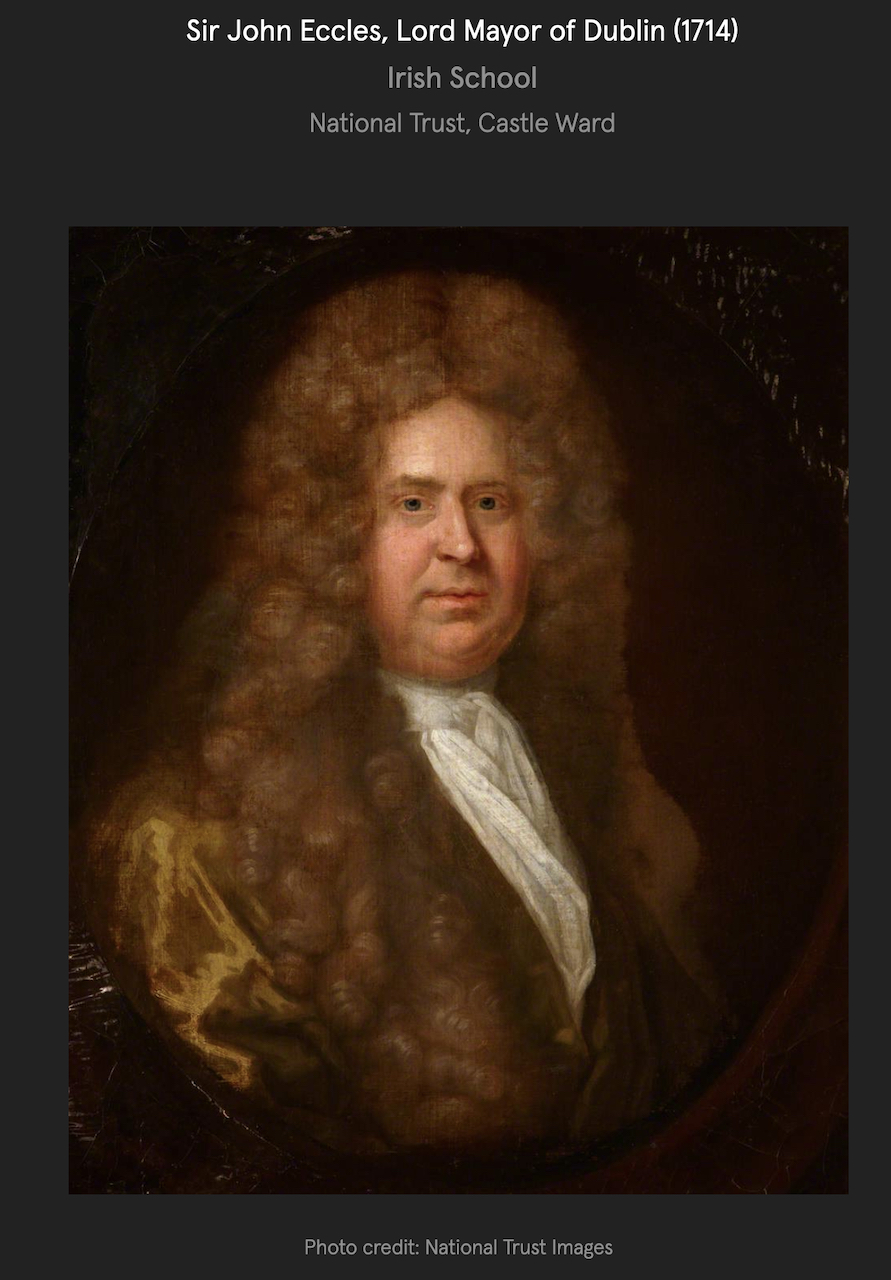
Sir John Eccles was Lord Mayor of Dublin in 1710. He owned an extensive private estate, which contained the area which is now North Great George’s Street. Unfortunately his mansion has gone and the site where it stood is now occupied by a small two-storey building situated between the present numbers 43 and 46 North Great George’s Street.

John Eccles Lord Mayor of Dublin (1714) courtesy of National Trust Castle Ward.
DSC_0994
11 North Great George’s Street, 2012. Photograph © Jennifer Winder-Baggot, www.irishhistorichouses.com
Conor Lucey tells us that Mount Eccles is clearly visible on John Rocque’s map of Dublin published in 1756, but it is labelled with the name of Nicholas Archdall Esq. Nicholas Archdall had purchased the lease for the Mount Eccles estate for 999 years, beginning 1st August 1749.

Nicholas Archdall was MP for County Fermanagh. His son, Edward Archdall, became a property developer. He built numbers 19 and 20 North Great George’s Street in the late 1780s. Nicholas Archdall’s widow Sarah (nee Spurling) petitioned the Irish Parliament in 1766 for permission to grant long leases on premises on her property. She may have been inspired by the new Gardiner estate and Gardiner’s Row. Permission was granted, and the advertisement read:

To be Let in Lots for Building, the Lands of Mount Eccles, in Great Britain-street, opposite Marlborough-street, joining Palace-row and Cavendish-street, containing seven Acres, which for Situation, Air and Prospect, cannot be exceeded by any in or about Dublin, subject to no Manner of Tax, Hearth Money excepted. For further Particulars, enquire of Mrs. Archdale, at Mount Eccles, where a Plan of the whole may be seen.

DSC_1000
11 North Great George’s Street, 2012. Photograph © Jennifer Winder-Baggot, www.irishhistorichouses.com
Lucey tells us that the leases for North Great George’s Street contain no covenants or specifications regarding the form of the house, except for the provision of an eight foot wide ‘area’ intended to be ‘in the front of the houses which is to be built on the said ground over and above the flagged passage which is to be 6 ft and 6 in wide’. Other developments, such as Merrion Square and Fitzwilliam square, had much more detailed specifications for the houses to be built.

Lucey describes the typical layout of the houses on the street:

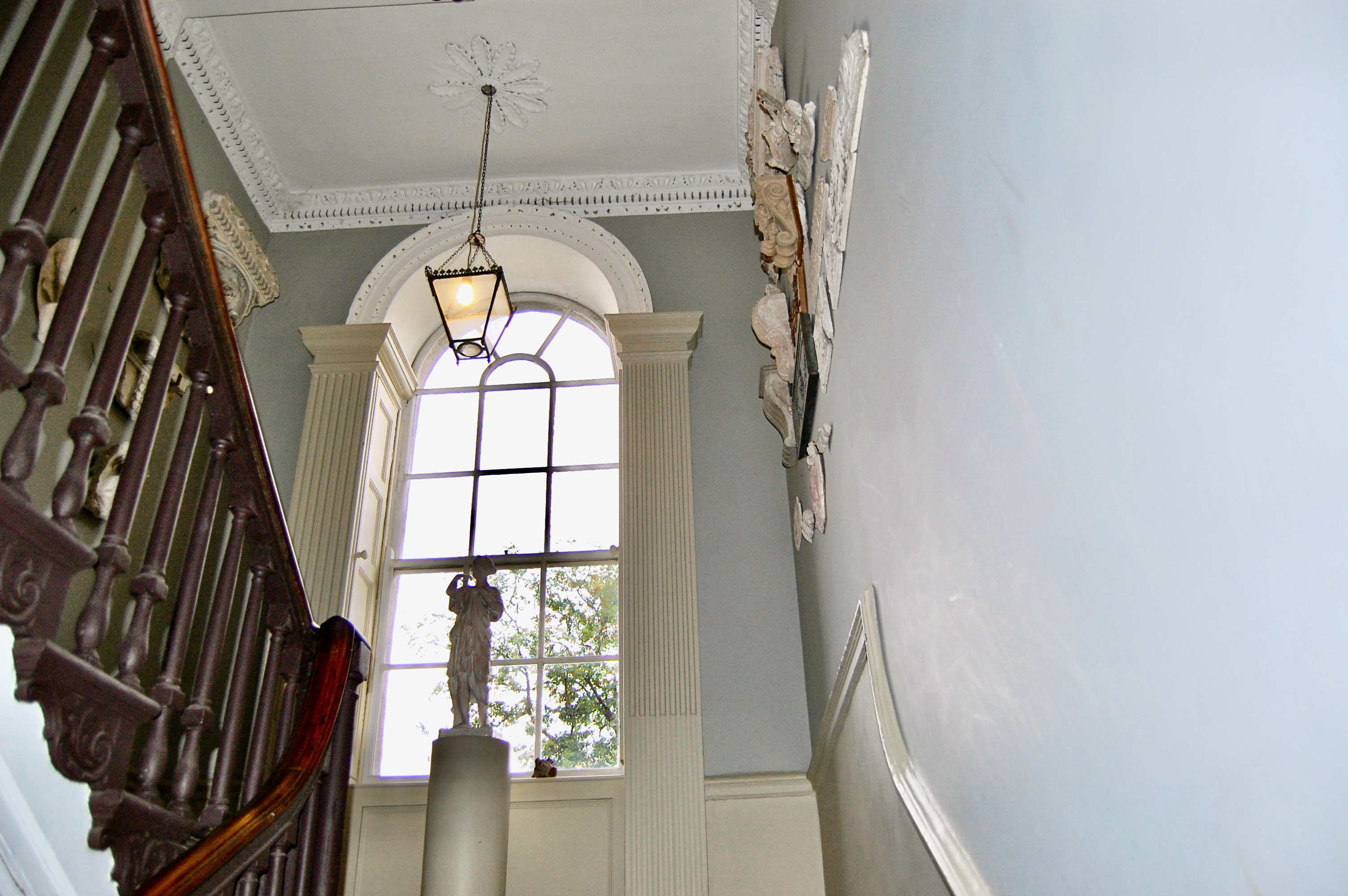
By far the most common plan type is the ‘two room’ plan, composed of an axially- aligned entrance hall and stair hall, and flanked by front and rear parlours, the latter typically serving as the formal dining room. The principal staircase, customarily of timber open-string construction, is situated at the back of the house and rises from the ground floor – by way of the piano nobile or ‘drawing room storey’ – to the ‘attic’ or bedroom storey, with admittance to the ‘garret’ alone acquired by a smaller, subordinate stair. A distinctive decorative feature of the garret storey stair is the ‘Chinese Chippendale’ balustrade, popular from mid-century and exemplified by surviving examples at Nos.4, 11, 36 and 50.

DSC_1004
Chinese Chippendale balustrade on the way to the garret, with the owner’s display of masks. Photograph © Jennifer Winder-Baggot, www.irishhistorichouses.com
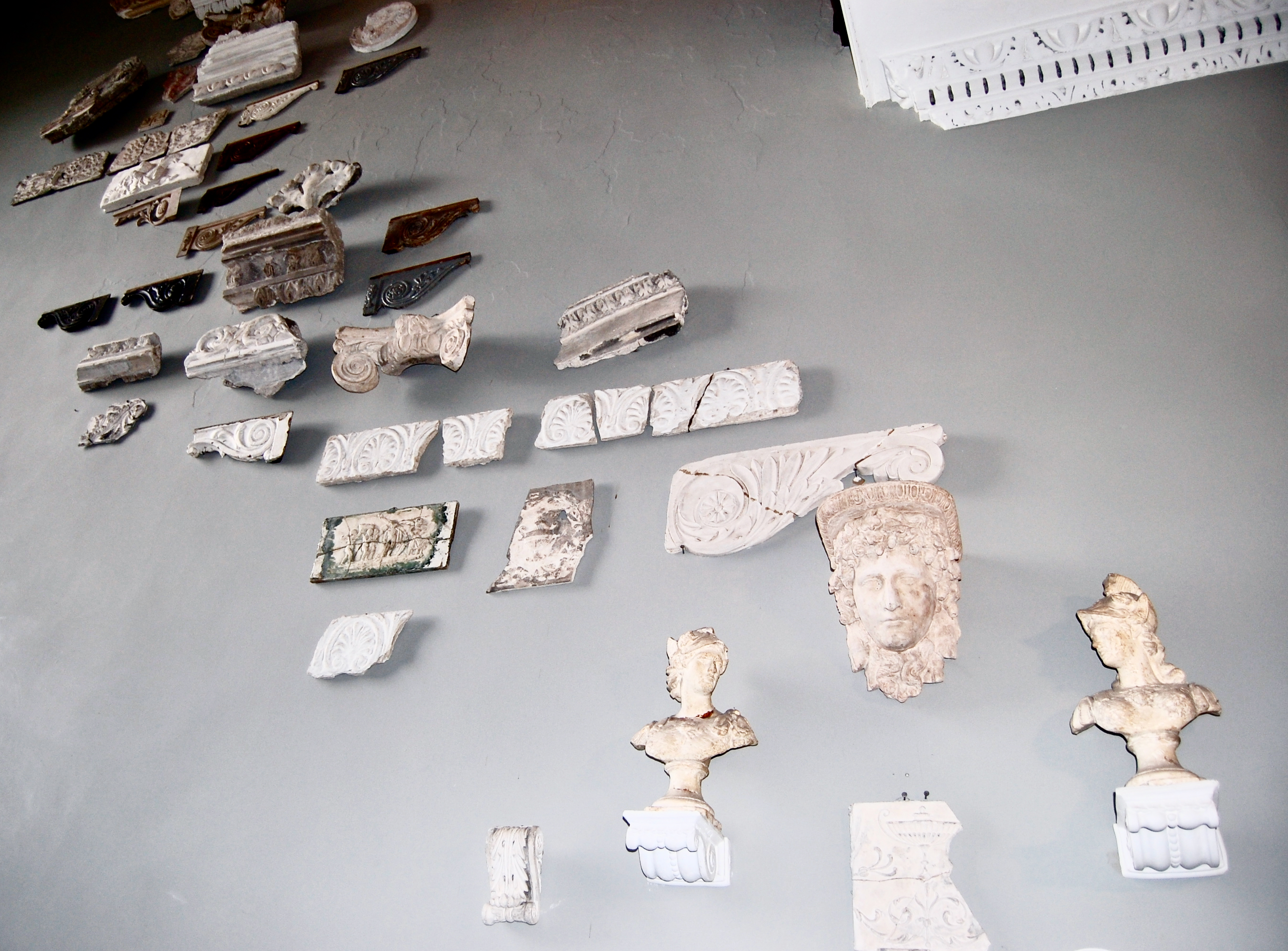
Other properties on the street were leased to Emilia, Dowager Viscountess Powerscourt (the widow of Richard Wingfield, 3rd Viscount Powerscourt, who built Powerscourt Townhouse in Dublin – see my entry on Powerscourt Townhouse) and Valentine Browne, 1st Earl of Kenmare.

The Act of Union of 1800, however, meant that there was no longer a Parliament in Dublin and many gentry left Ireland. The house’s website states:

Despite the drain from the city of power and money after the Act of Union in 1800, North Great George’s Street managed to hold onto some grandees till the very end of the 19th Century. In the case of no. 11, these included in 1821 a George Whitford, High Sheriff of Dublin, who was knighted in that year by George IV at the Mansion House. No doubt to celebrate his new status, he had the front doorcase re-modelled to accommodate a large new fanlight, and also had the Salon joinery replaced in the fashionable neo-classical style.

The No.11 website tells us more about former inhabitants.

Dr. Charles Orpen lived in the house in the 1830s. He played a significant part in the development of sign language, and in the education of deaf children, founding Ireland’s first school for deaf children, in 1816, in Brunswick Street (now Pearse Street). It became The Claremont Institution for the Deaf and Dumb when it moved to a large demesne called Claremont in Glasnevin. Dr. Orpen worked at the Workhouse at the House of Industry in Dublin, where he noticed that there were 21 deaf children. He took one of the children, Thomas Collins, home to educate him, and based on his learnings about the conditions of being deaf, he gave several popular lectures in the Rotunda, which led to a public interest in the condition and of education of deaf and dumb children. [4]

Another former inhabitant of number 11 in the 1850s was a barrister named Patrick Blake. He had Nationalist leanings, and the no.11 website tells us that it is believed that Michael Davitt, one of the leaders of the Irish Republican Brotherhood and the Land League, was hidden in the house for some time before his arrest and imprisonment in 1870. By this time, and for the rest of the century, the domestic quarters of the house had retreated to the top two floors, and the rest of the house was given over to office space for barristers and land agents.

DSC_1002
11 North Great George’s Street, 2012. Photograph © Jennifer Winder-Baggot, www.irishhistorichouses.com

As the wealthy left the city centre for houses in the suburbs, in 1910 a Mr. Kelly bought the house and turned it into a tenement. The No.11 website tells us that unlike many houses, the landlord lived on the premises and so the house survived many of the ravages that other houses suffered at this time. Between the 1930s and 1970s every room in the house was used as a family flat.

By the early 1980s the historic centre of Dublin had been all but abandoned. The house was largely derelict with a roof that was on the point of collapse. The website tells us that a great deal of the house was saturated and pigeons inhabited the upper floors. Despite this, the last tenant, Mrs. Margaret Howard, who had moved into the house in 1921, struggled to maintain an old fashioned gentility in her tenement rooms.

The National Inventory of Architectural Heritage Buildings of Ireland website describes number 11 as a terraced three-bay four-storey house over exposed basement. It’s made of handmade red bricks and granite window sills. The website describes:

Round-headed door opening with painted stone Doric doorcase. Original ten-panelled painted timber door flanked by engaged Doric columns on stone plinth blocks supporting deep cornice, and replacement peacock fanlight with moulded surrounds and scrolled keystone.

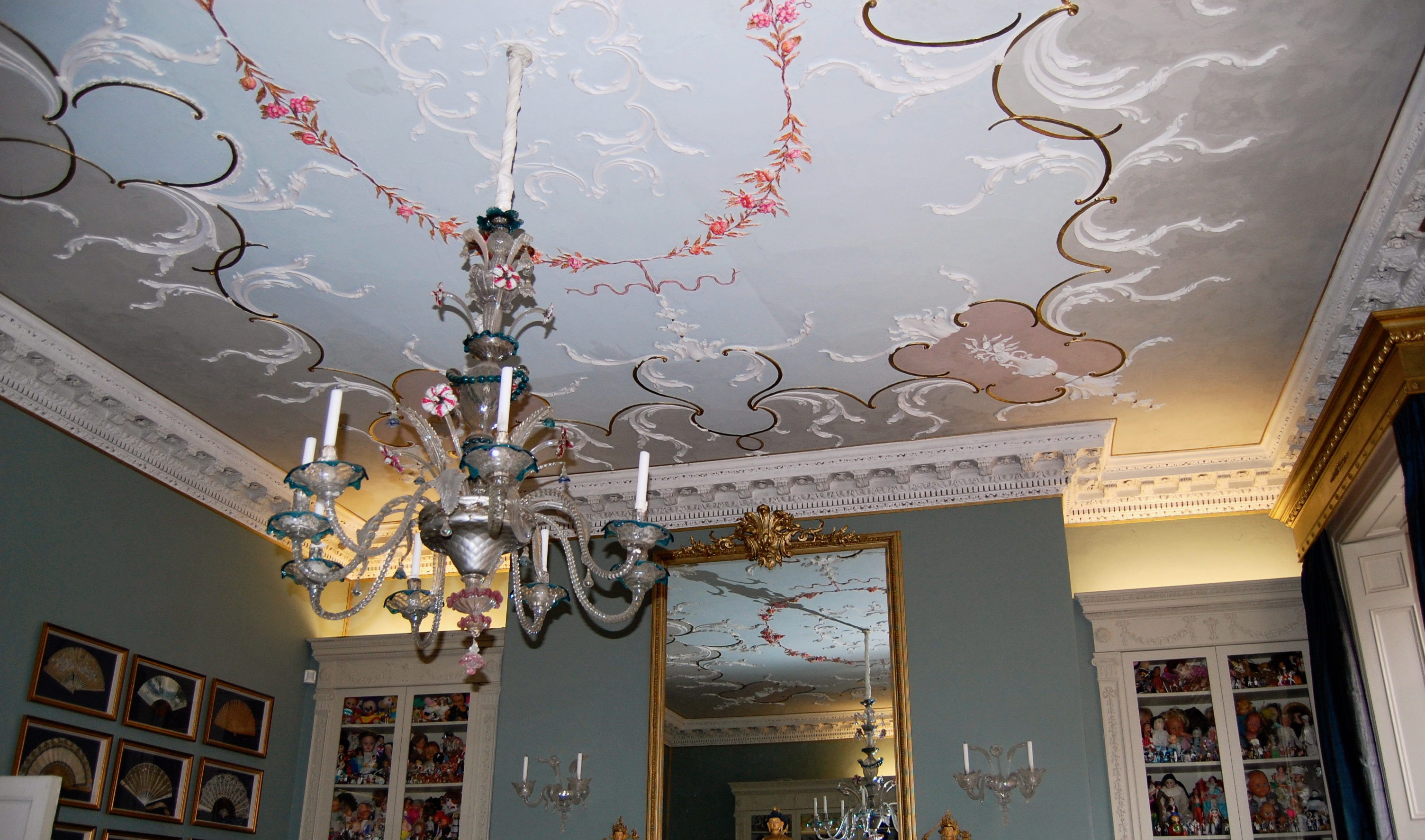
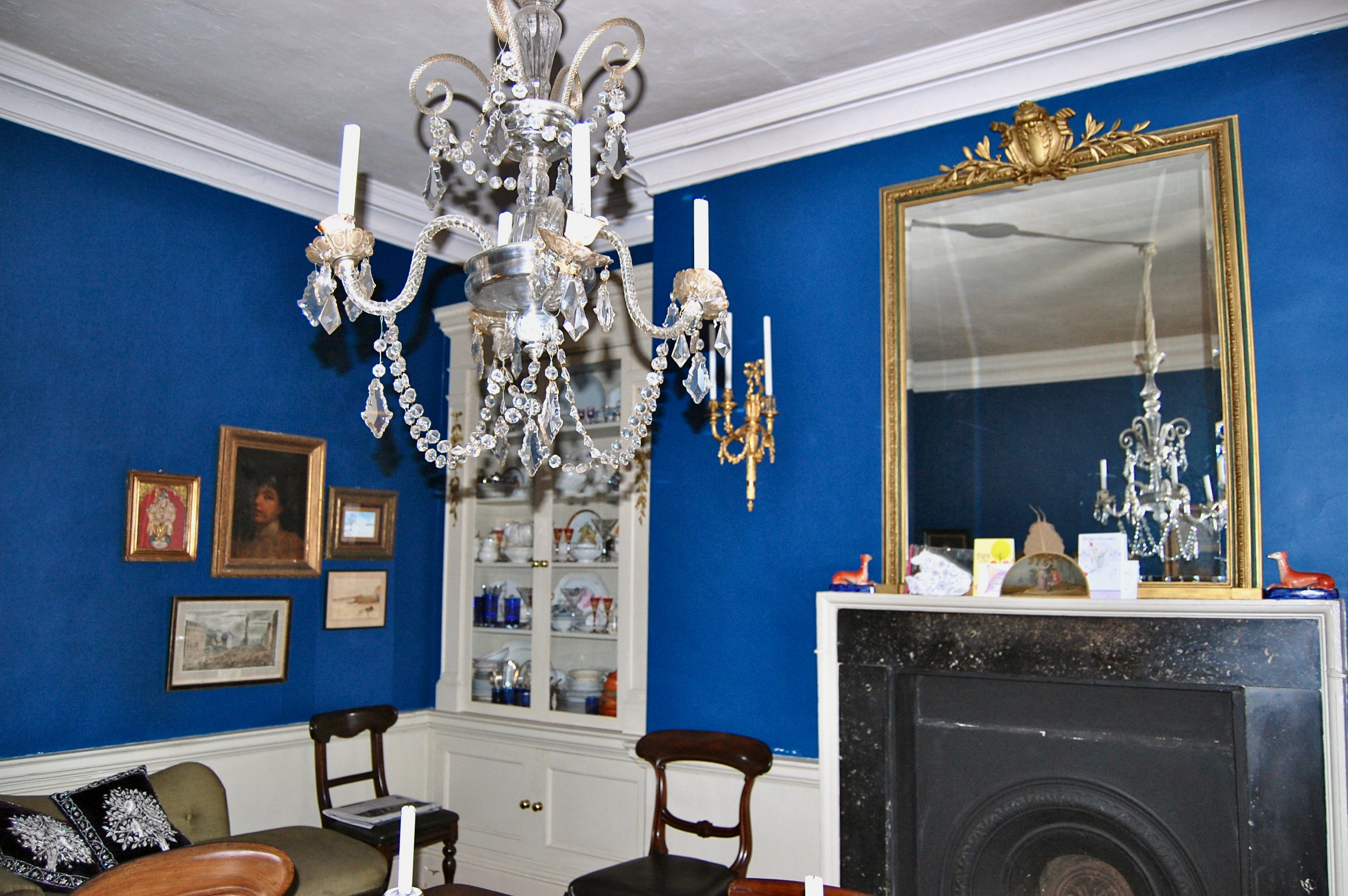
The website also mentions the original plaster walls and ceiling, as well as original timber joinery and flooring. The ceilings seemed overly colourful, but the owner assured us that this is how such a ceiling would have looked originally.

DSC_0995
11 North Great George’s Street, 2012. Photograph © Jennifer Winder-Baggot, www.irishhistorichouses.com
The Buildings of Ireland website describes:

Upper floors having large amounts of surviving late Rococo plasterwork with projecting birds, acanthus leaves and flower-baskets to rear rooms. First floor saloon having ceiling with flower vases, acanthus pendants and cartouches. Neo-classical over-doors and friezes with urns and festoons. Lugged architraves throughout and moulded joinery [“lugged” is a moulded frame with horizontal projections at the top, according to wikipedia]. Imposing fluted Doric architraves to round-headed windows at each half-landing. Chinese Chippendale stair to garret floor.” [5]

The Rococo plasterwork, the number 11 website tells us, “must be amongst the very last flings of the renowned Robert West School of Rococo plasterwork.” We came across Robert West plasterwork also in Colganstown [6].

DSC_0997
11 North Great George’s Street. Photograph © Jennifer Winder-Baggot, www.irishhistorichouses.com
DSC_1003
11 North Great George’s Street. Photograph © Jennifer Winder-Baggot, www.irishhistorichouses.com
DSC_1007
11 North Great George’s Street, 2012. Photograph © Jennifer Winder-Baggot, www.irishhistorichouses.com
The home owner is a collector, not only of architectural pieces and masks, but of dolls:

DSC_0996
11 North Great George’s Street, 2012. Photograph © Jennifer Winder-Baggot, www.irishhistorichouses.com
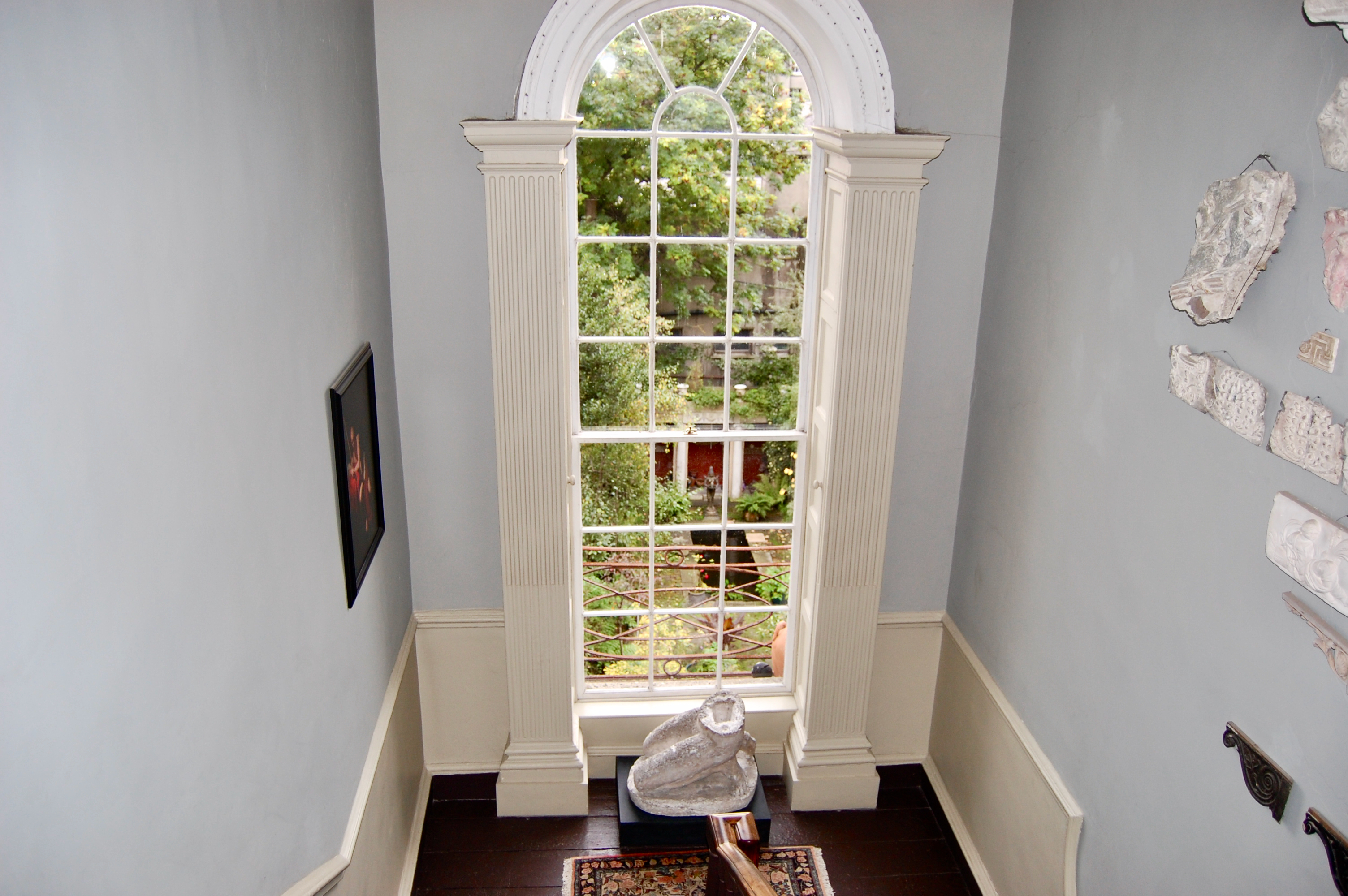
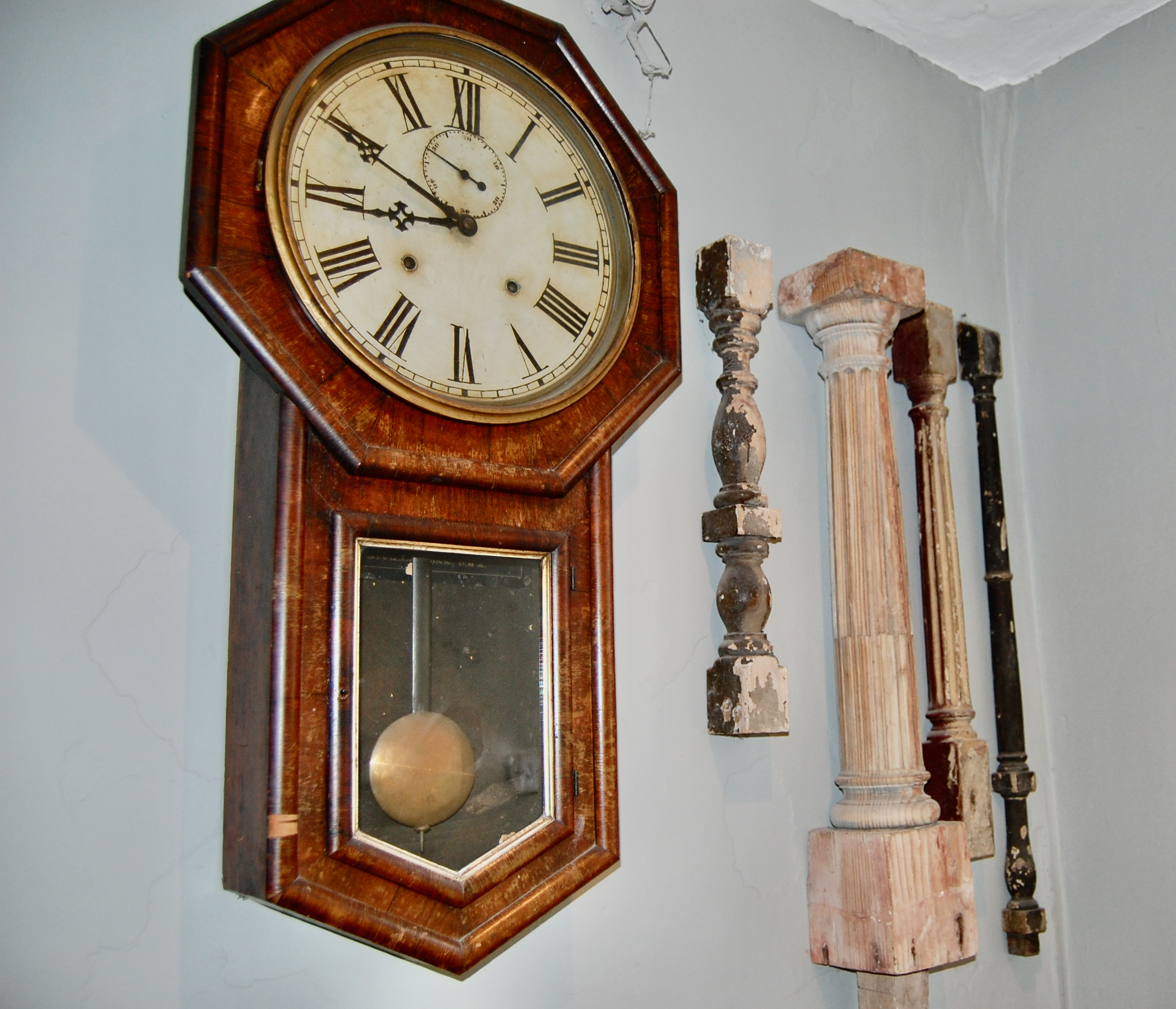
Some of the architectural pieces are from, I believe, a church that was demolished, St. Peter’s Church on Aungier Street. These banisters might have been altar rails:

DSC_0993
11 North Great George’s Street. Photograph © Jennifer Winder-Baggot, www.irishhistorichouses.com
DSC_0992
11 North Great George’s Street, 2012. Photograph © Jennifer Winder-Baggot, www.irishhistorichouses.com
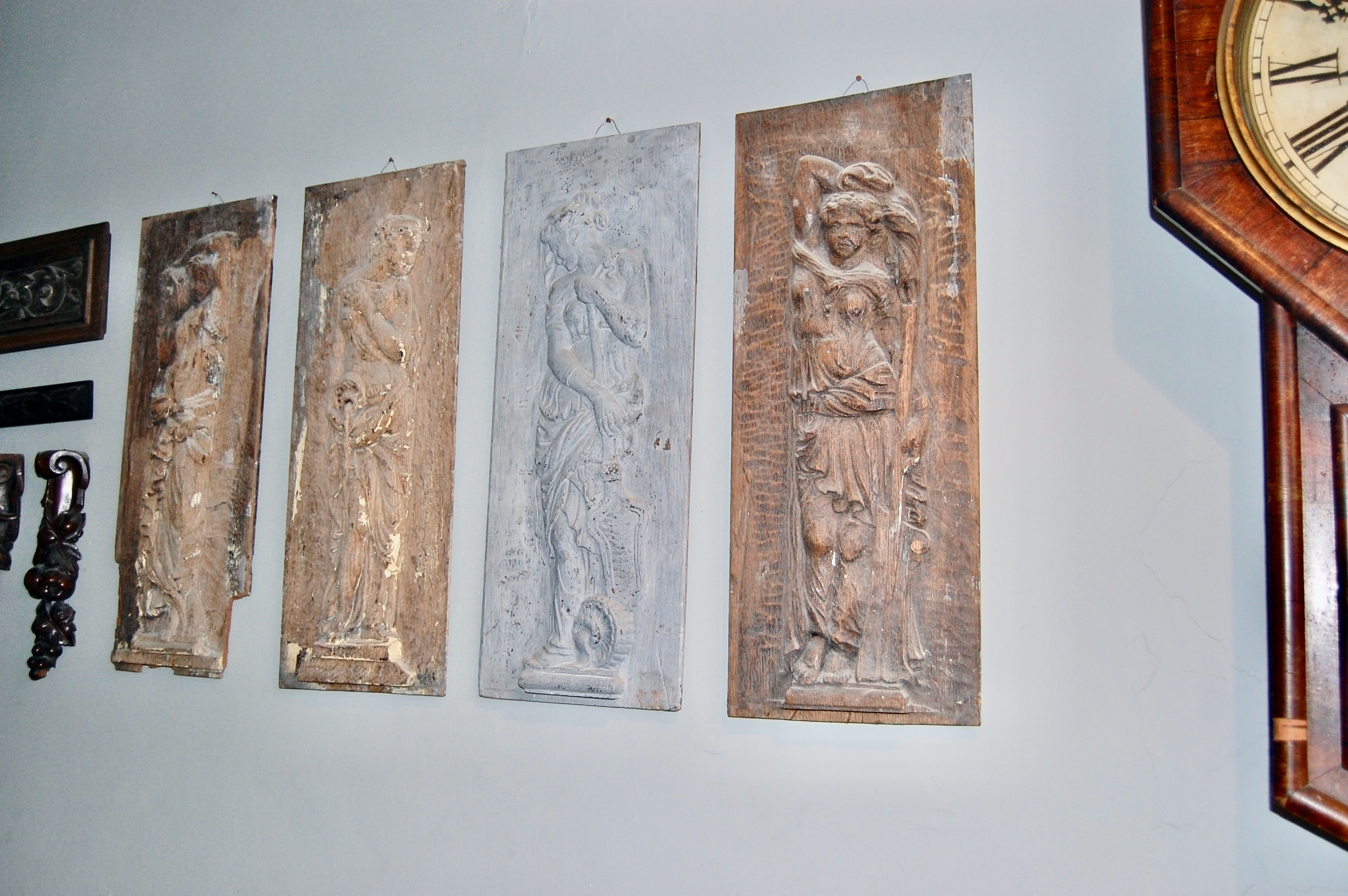
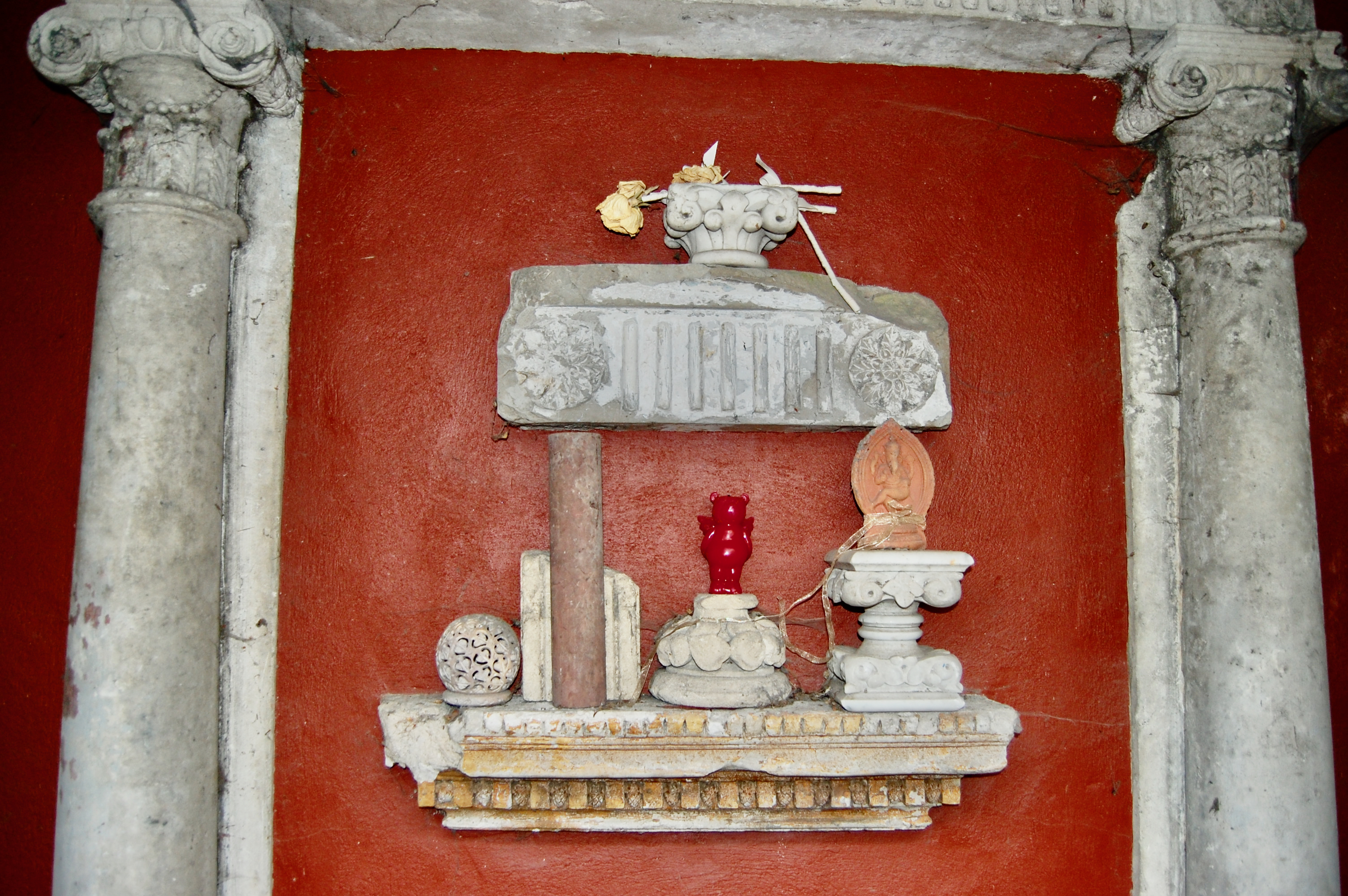
The back garden is beautifully tranquil with an Oriental vibe, with a pond and a temple at the back with more architectural pieces and sculptures.

DSC_0988
11 North Great George’s Street. Photograph © Jennifer Winder-Baggot, www.irishhistorichouses.com
DSC_0990
11 North Great George’s Street. Photograph © Jennifer Winder-Baggot, www.irishhistorichouses.com
DSC_0989
11 North Great George’s Street, 2012. Photograph © Jennifer Winder-Baggot, www.irishhistorichouses.com
In its appraisal the National Inventory website states:

Largely dilapidated by the early 1980s, it was carefully conserved by the owner and is now a residence and venue for weddings and other events. The surviving early plasterwork is a fine example of the traditional ‘Dublin school’ Rococo style and its juxtaposition with the Neo-classical embodies the stylistic developments of the late eighteenth century. The oversailing lintel of c.1820 is one of few on the street and the restored light posts add a further element of interest in the public realm of the street. The retention of timber sash windows and of the granite and iron work to the entrance and basement enhances the architectural heritage quality of this house and of the street in general.

DSC_0991
11 North Great George’s Street, 2012. Photograph © Jennifer Winder-Baggot, www.irishhistorichouses.com
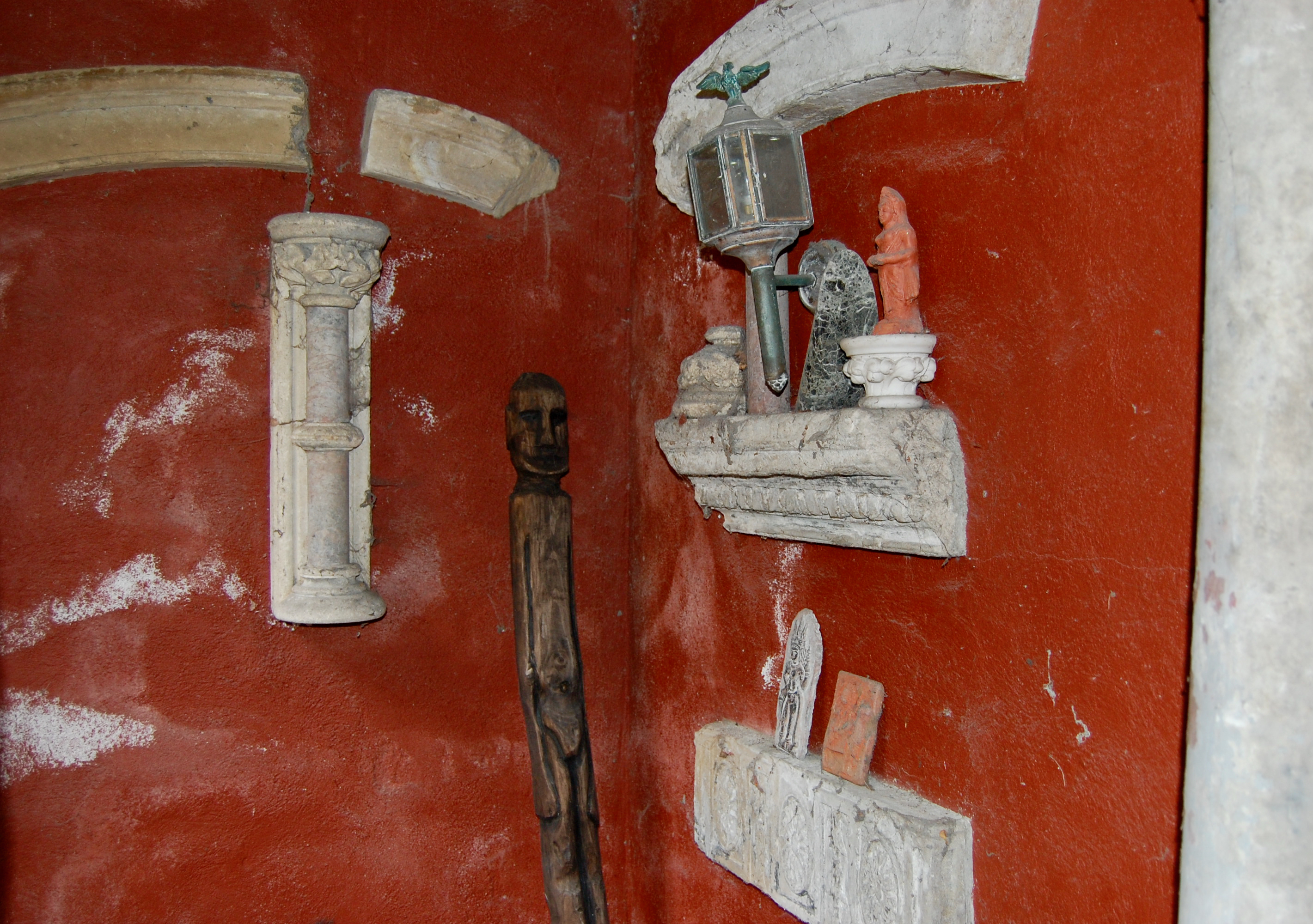
The website for number 11 has a link to airbnb accommodation available in the house.

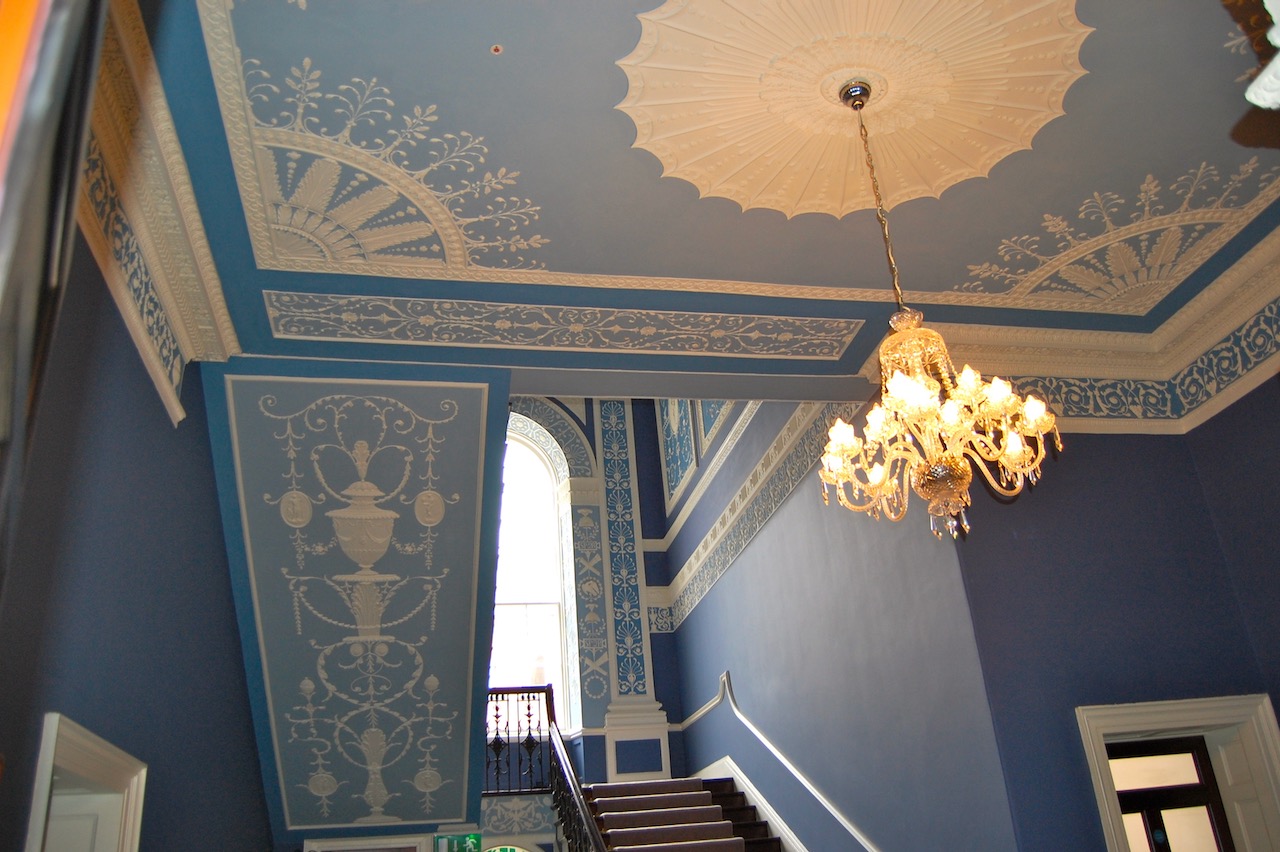
At the top of North Great George’s Street, on Denmark Street, is Belvedere House, now part of Belvedere College, a boys’ secondary school. I visited this on another Open Day. Its splendid stucco work is of the Neoclassical or “Adam” style popular in Dublin in mid 1770s to 1800, designed by Michael Stapleton. Conor Lucey writes:

The neoclassical style is also well represented by Belvedere House. Built for George Augustus Rochfort, 2nd Earl of Belvedere, and completed by 1786, it is one of the finest city mansions built during the latter part of the century. The interiors of this house represent a text-book model of how Irish stuccodors invented freely within the Adamesque idiom, deriving their decorative vocabulary from architectural treatises, builder’s manuals and pattern books.

Open House, Belvedere House, Belvedere College, Dublin. Photograph © Jennifer Winder-Baggot, www.irishhistorichouses.com
Open House, Belvedere House, Belvedere College, Dublin
Belvedere House, 2015. The architect was Robert West. 86 St. Stephen’s Green has also been attributed to Robert West, which now houses MoLI, the new Museum of Literature of Ireland. The stucco work in no. 11 North Great George’s Street is of the Robert West school. Photograph © Jennifer Winder-Baggot, www.irishhistorichouses.com
George Rochfort (1738-1815), later 2nd Earl of Belvedere by Robert Hunter (C. 1715/20-1801), Adams auction 18 Oct 2022. He owned Belvedere House on North Great Georges Street.

Donation

Help me to fund my creation and update of this website. It is created purely out of love for the subject and I receive no payment so any donation is appreciated!

€15.00

[1] https://www.youtube.com/watch?time_continue=10&v=C3RdULJddO0&feature=emb_logo

[2] https://www.buildingsofireland.ie/buildings-search/building/50010998/north-great-georges-street-dublin-dublin-city

[3] https://northgreatgeorgesstreet.ie/

[4] https://en.wikipedia.org/wiki/Claremont_Institution

[5] According to Craig, Maurice and Knight of Glin, Ireland Observed, A Handbook to the Buildings and Antiquities. Mercier Press, Dublin and Cork, 1970, Rococo is the asymmetrical freely-modelled style of decoration originating in France and popular in Ireland from about 1750 to 1775. See also Architectural Definitions:

architectural definitions

[6] Colganstown House, Hazelhatch Road, Newcastle, County Dublin

Text © Jennifer Winder-Baggot, www.irishhistorichouses.com
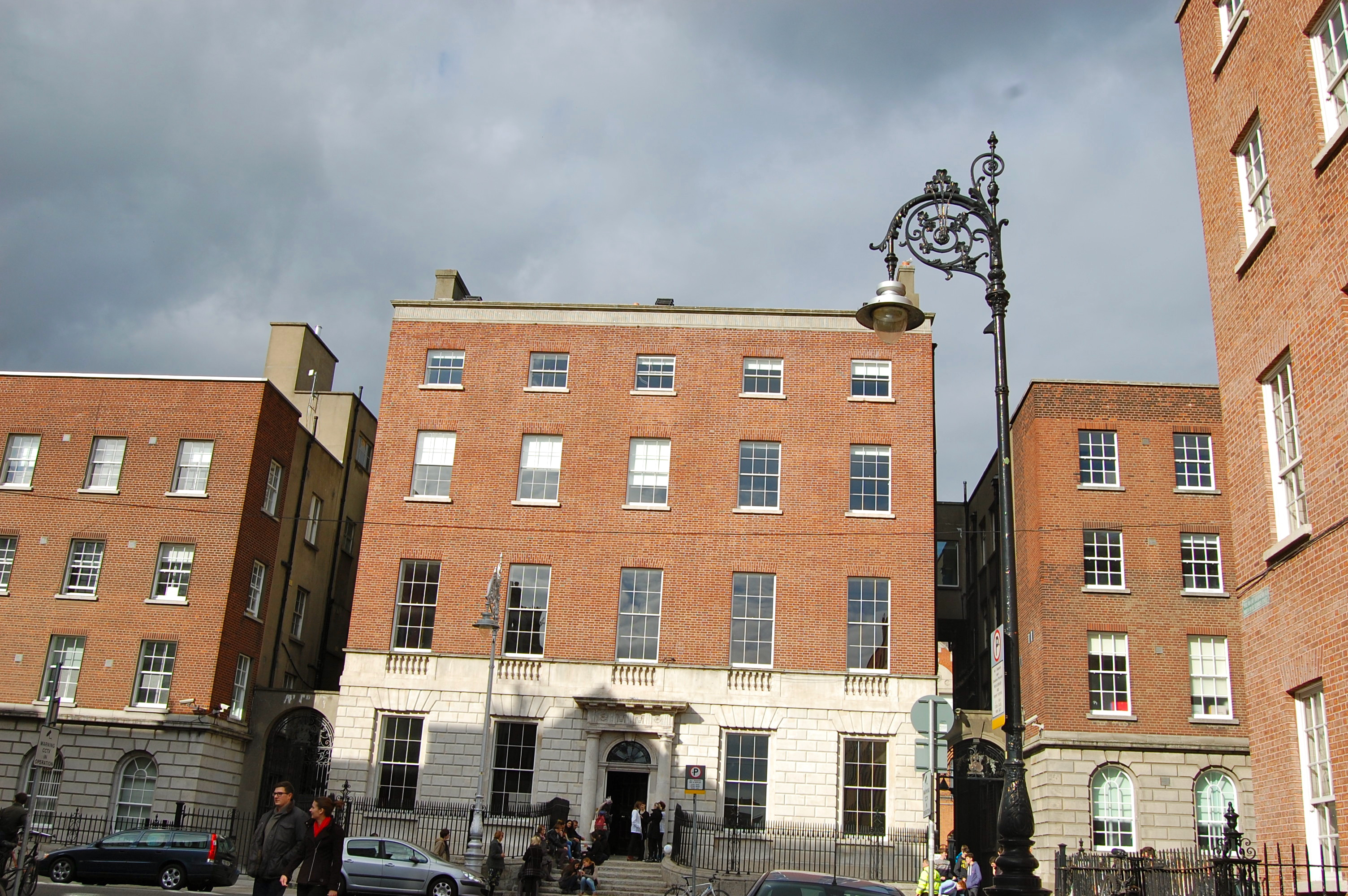
The Old Glebe, Newcastle-Lyons, County Dublin – section 482

Open dates in 2026: May 1-31, June 1-30, Mon-Sat, Aug 15-23, 10am-2pm

Fee: Free

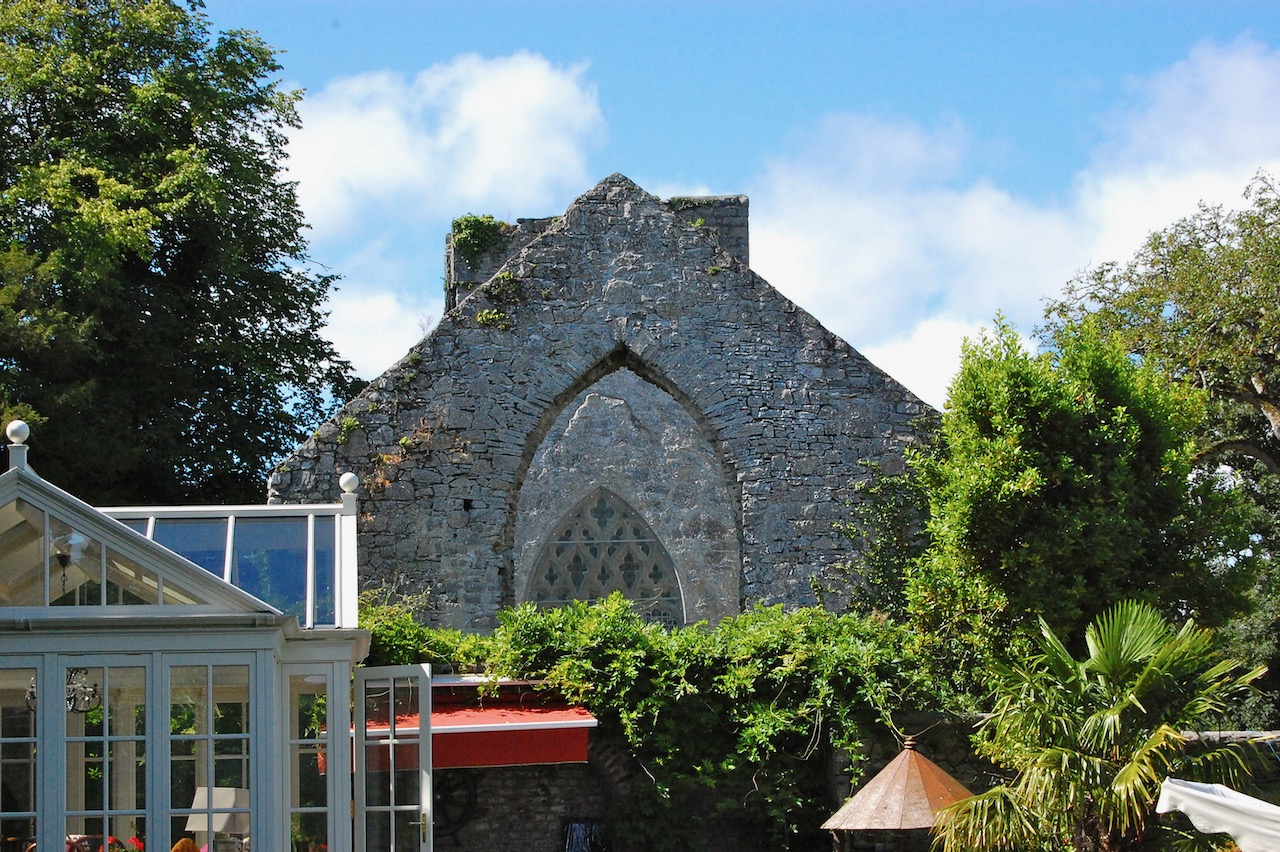
I visited this property in 2012 during Heritage Week with my husband Stephen and my Dad. We were welcomed by the owner, Frank Kerins. A glebe house is one on the grounds of a church providing accommodation for the clergy. This house is next to Saint Finian’s, an ancient church from the fifteenth century, but no longer houses its vicar and is in private ownership. St. Finian’s is now a Church of Ireland and still holds weekly services. There’s a beautiful view of the church from the back of the house, where one can see the restored Gothic “pointed-arched window with flowing tracery” [1] through another arch, and behind, the church tower.

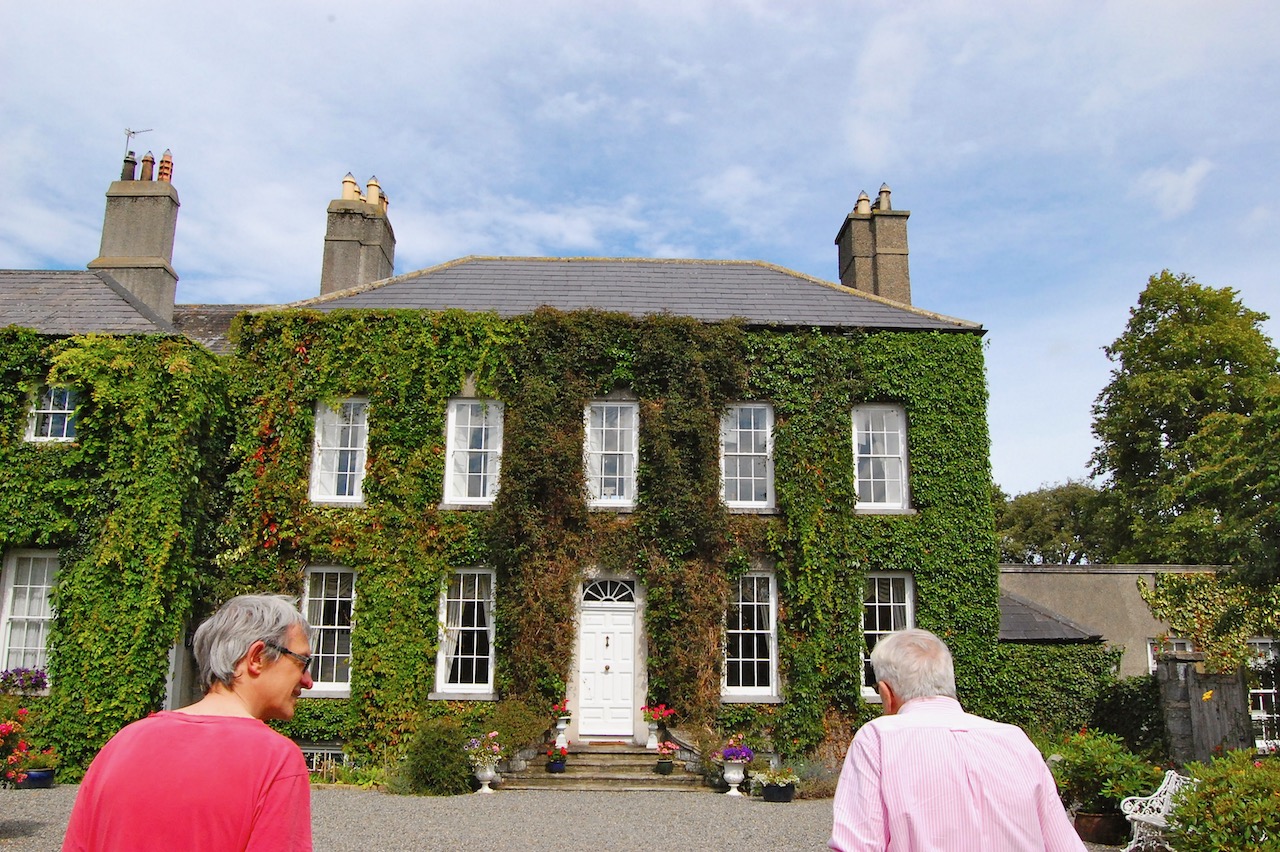
“The Old Glebe,” Newcastle-Lyons, County Dublin. Photograph © Jennifer Winder-Baggot, www.irishhistorichouses.com

The older part of the house dates from around 1720, and is a five bay two storey block over basement [2].

[17/5/20: I have stumbled across a reference while looking up historic houses in Dublin, while googling Athgoe Castle. This reference gives a little detail about the Glebe House, which is referred to as the Rectory for St. Finian’s Church: The Archdeacon of Glendalough, Thomas Smyth, who became Archdeacon in 1722, built the rectory. The east window of the church bears his initials and the date 1724. [3] He was son of Thomas Smyth Bishop of Limerick.]

An addition from about 1820 has, according to the National Inventory of Architectural Heritage website, two-bay rere elevation, and single-storey extensions to east. [4]

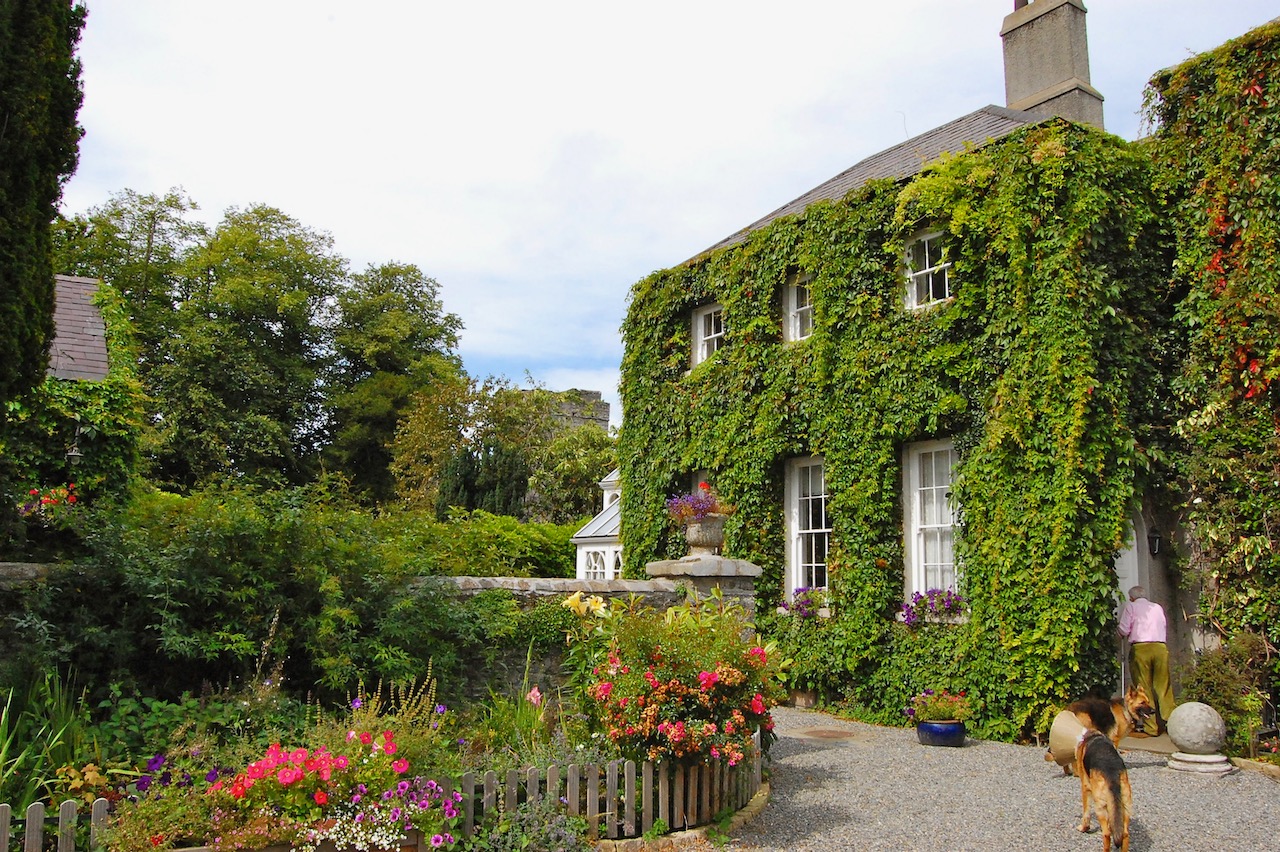
Continuation of the front of the house; the gardens were looking splendid on the August day on which we visited, the flowers in full array. Photograph © Jennifer Winder-Baggot, www.irishhistorichouses.com
St Finian’s church, Newcastle Lyons (now Protestant). Photograph © Jennifer Winder-Baggot, www.irishhistorichouses.com
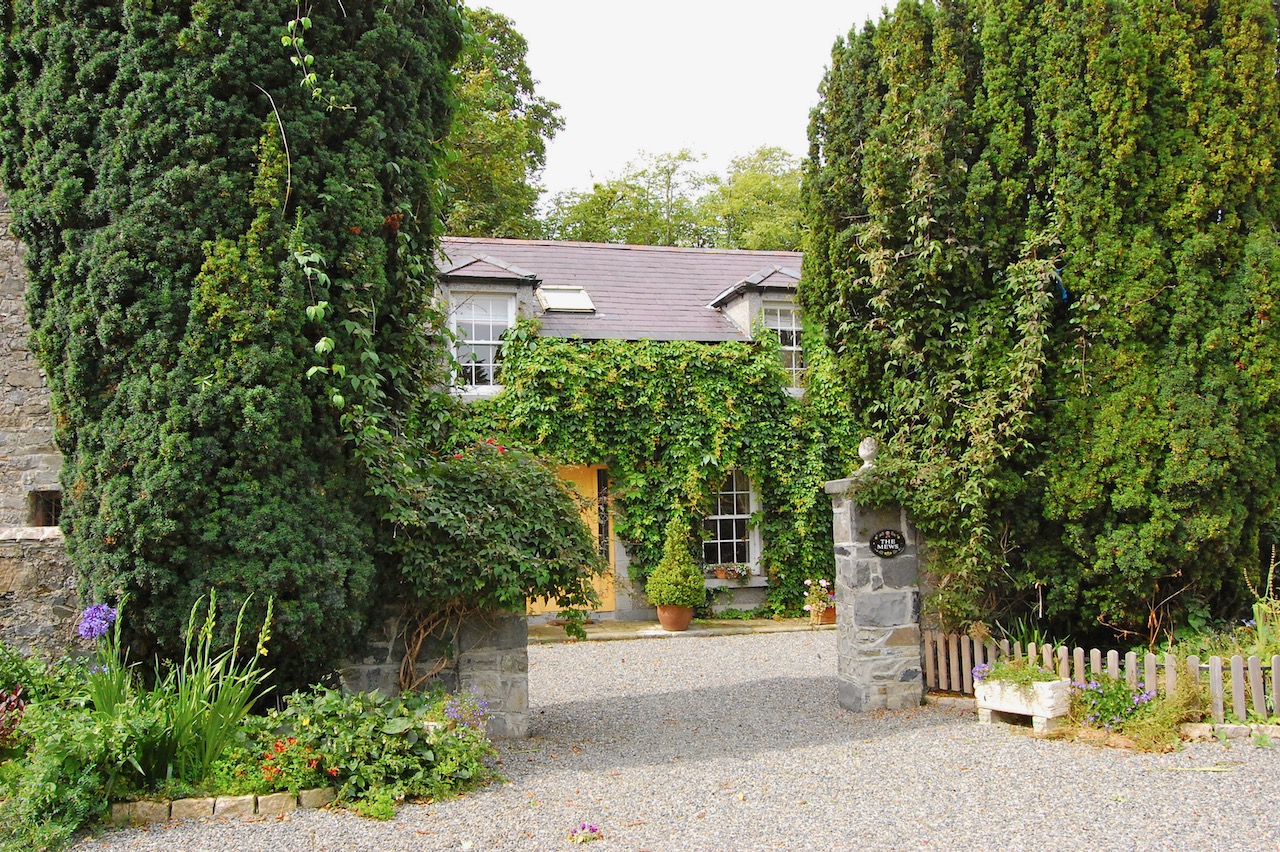
A second tower stands in front of the Glebe house, and I immediately fell in love with the attached 1727 Mews house. The Mews house contains accommodation and an artist’s studio. The deep yellow door, white painted divided pane sash windows, ivy and flowers won my heart.

The Old Glebe, Mews House. Photograph © Jennifer Winder-Baggot, www.irishhistorichouses.com
Mews house at the Old Glebe, Newcastle. Photograph © Jennifer Winder-Baggot, www.irishhistorichouses.com
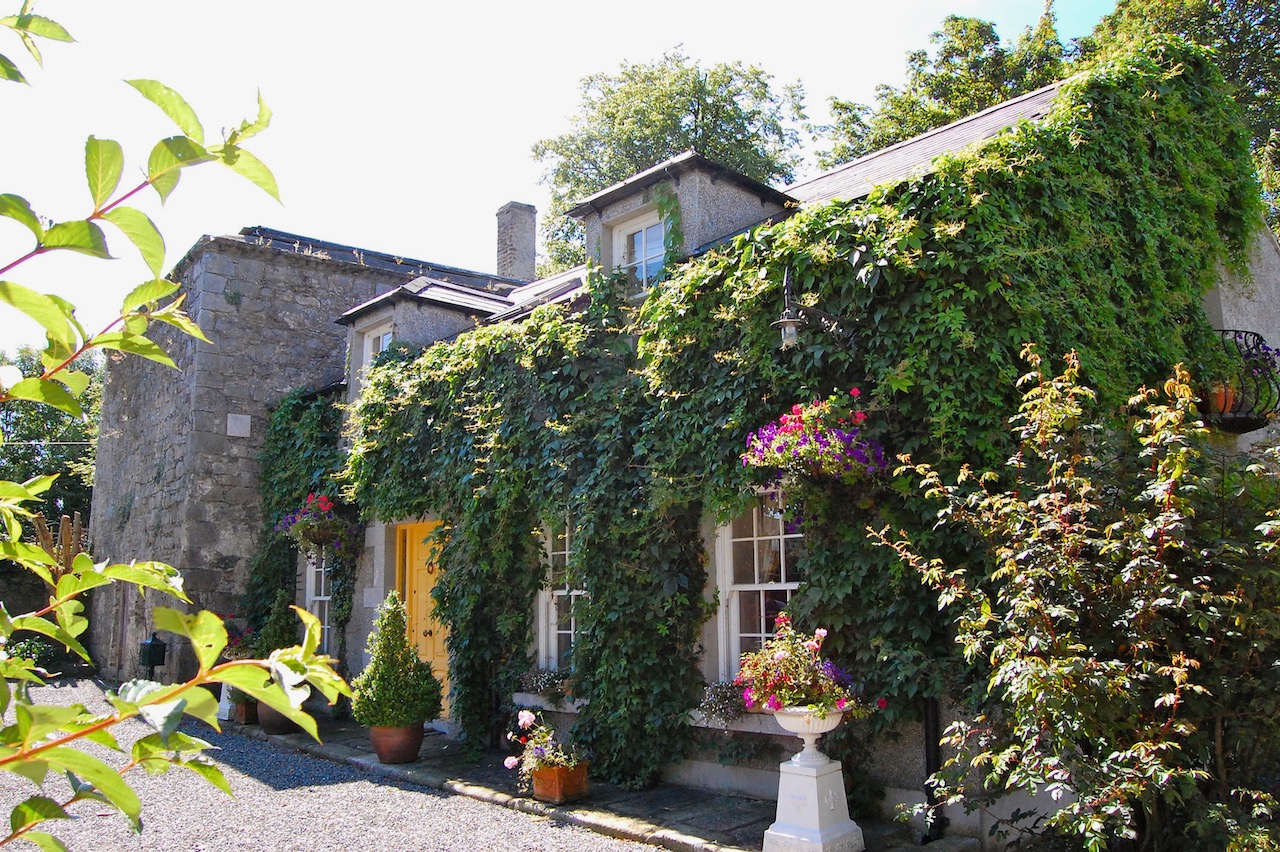
“The Old Glebe,” Newcastle-Lyons, County Dublin. Photograph © Jennifer Winder-Baggot, www.irishhistorichouses.com
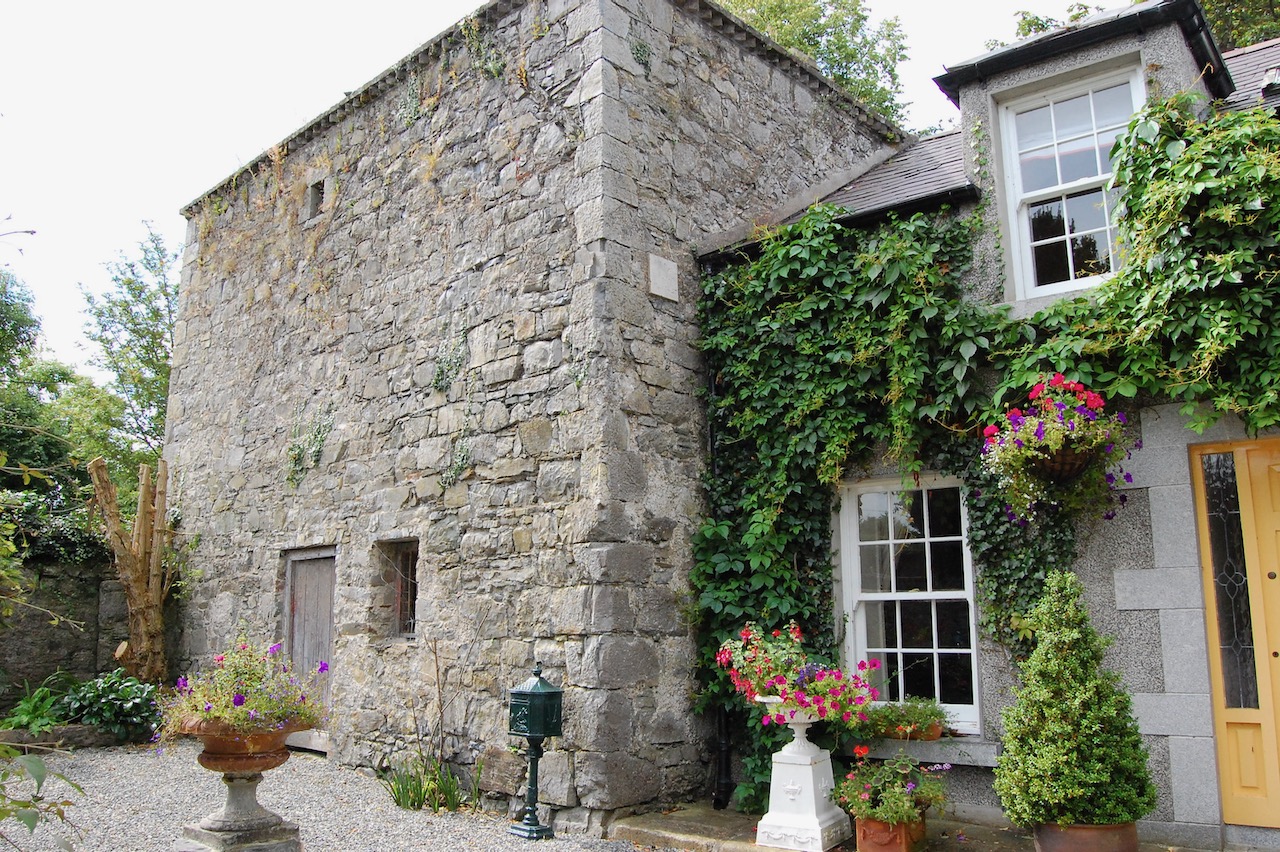
Mr. Kerins is enthusiastic about the house and is familiar with the history, as of that of the tower and adjoining church. He has written a book, published in 2017, called Some views of the Old Glebe House, Newcastle.

There is an article that was in the Irish Times when the house was for sale in 1999, by Orna Mulcahy. She overestimates, I believe, the age of the house. [5]:

One of the oldest houses in south Dublin, it was built by a vicar of Rathmichael, the Reverend Simon Swayne, in the mid-1600s. The original two-storey over basement house was extended in the 18th and 19th centuries and the current owners have made their own contribution in the form of a small conservatory overlooking the gardens. The property includes an old cut-stone mews house.

Maurice Craig in his Classic Irish Houses of the Middle Size, p. 66, pictures “Newcastle Rectory, Co. Dublin” and it looks like this Glebe House. He says it is built in 1727 by Archdeacon Smyth. Another article in the Irish Times claims that it was built in 1710. [6]

I was not allowed to take photographs inside the house, which is usual for the section 428 properties. Mr. Kerins gave us a tour. We entered the large front hall, impressively furnished and finished. This open into the long drawing room through a door with fanlight. Another door from the hall leads to a dining room. Through a hall, one steps into a lower level of the house and to the timber conservatory. My father and Mr. Kerins chatted about furniture, as my Dad’s father was an antiques dealer, while I envied the occupants of this beautiful, comfortable, elegant home. There is a beautiful wood-panelled sitting room.

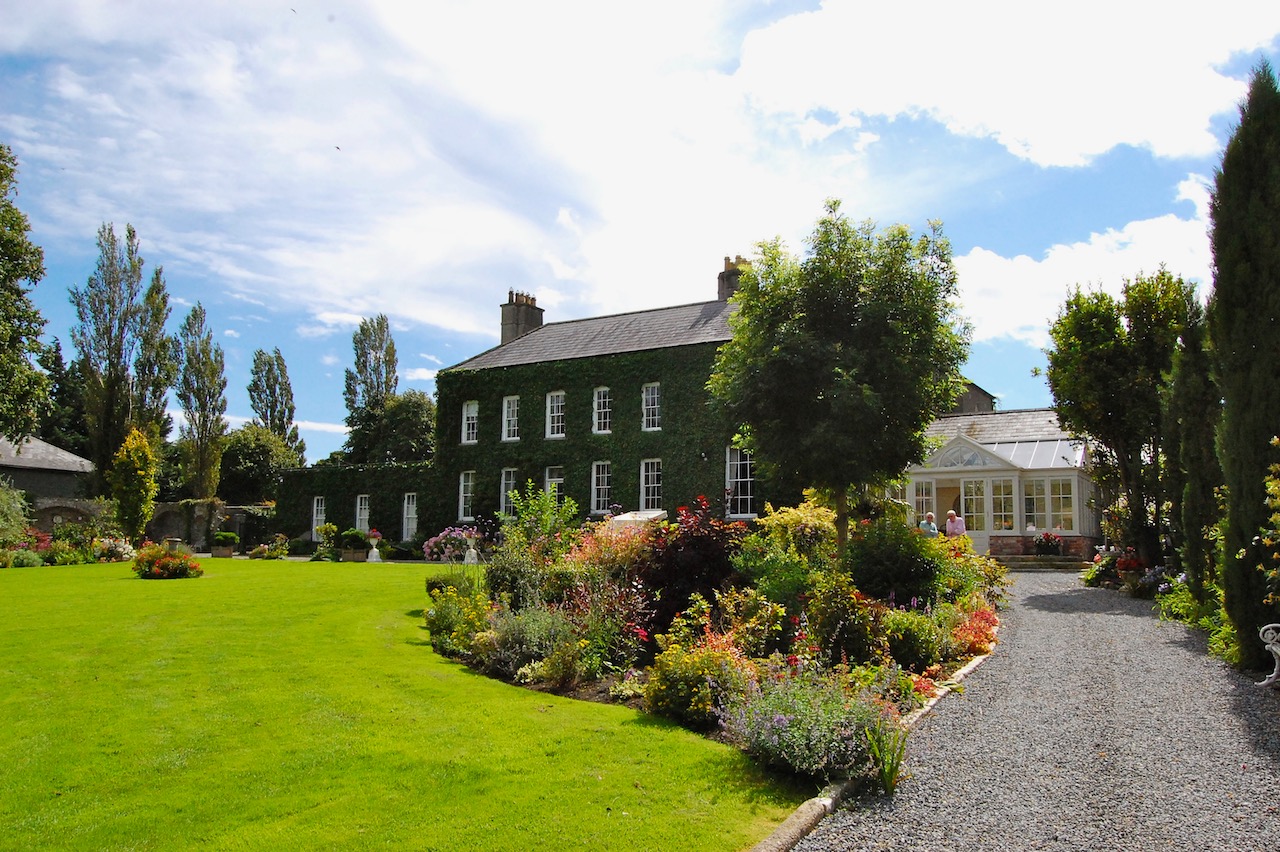
I did, however, take many photographs of the splendid garden at the back of the house, which leads down to a lake.

Back of “The Old Glebe” Newcastle, County Dublin. Photograph © Jennifer Winder-Baggot, www.irishhistorichouses.com
Looking down the garden from the back of the house. Photograph © Jennifer Winder-Baggot, www.irishhistorichouses.com
“The Old Glebe,” Newcastle-Lyons, County Dublin. Photograph © Jennifer Winder-Baggot, www.irishhistorichouses.com
The second article from the Irish Times continues:

The Old Glebe used to belong to the Church of Ireland. The church dates back to the 13th century but the present house was built in 1710. The current owner, Frank Kerins, bought it in 1989. In a corner of the garden (open to the public in summer) surrounded by benches, stands a wonderfully wide and healthy yew. Like any tree, its age is up for dispute. With a bulging girth of five metres, Fennell estimates it at 500 years plus. “Some of the branches have been lifted, but it’s probably Dublin’s oldest tree.” Kerins is adamant it is older. “ There are local references to it and to Jonathan Swift – it’s definitely over 700 years.”

Fennell is conservative when estimating age. “Yews are probably older than most people think. Some time in the future they will be able to nail it down with new technology and humble previous opinions.”

In the meantime, Kerins, like others before him, enjoys his tree. ‘We’ve restored the gardens and the house. The wildlife and shrubs have returned. We love to sit under the tree and take a glass of wine and imagine what Swift must have been thinking when he sat here 300 years ago. He wrote to his friends and he also had a girlfriend in the area, from Celbridge.’ ” [he must mean “Vanessa,” or Esther Vanhomrigh, who lived in Celbridge Abbey in County Kildare].

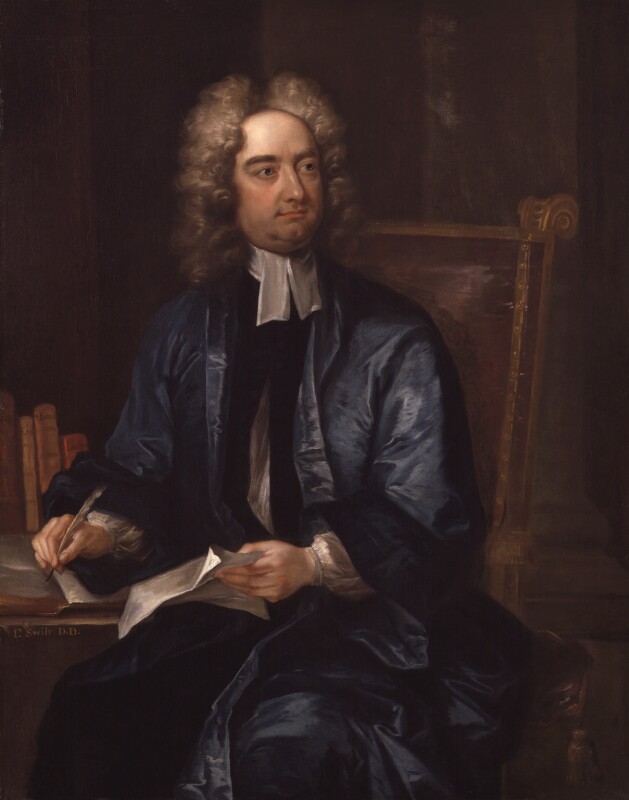
Jonathan Swift by Charles Jervas circa 1718, National Portrait Gallery 278.
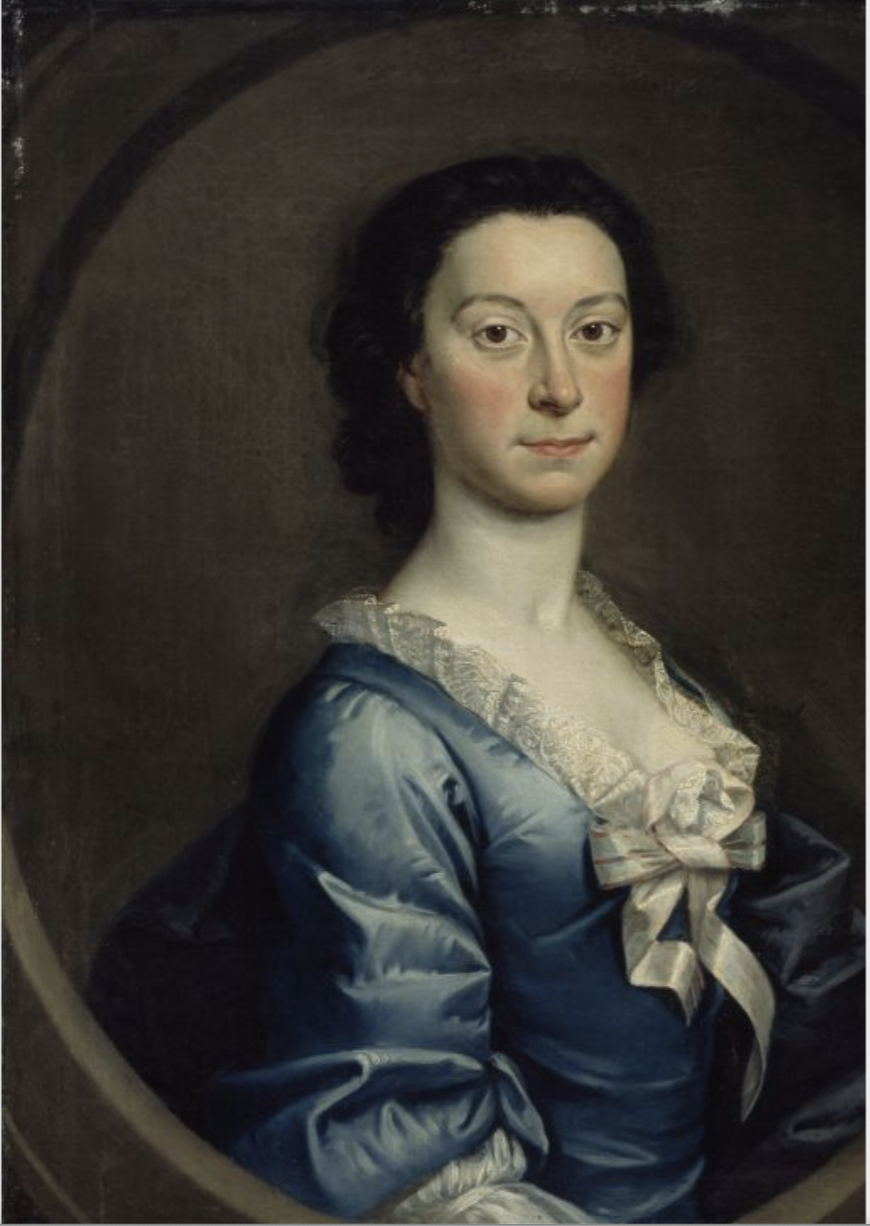
Possibly a portrait of Hester Van Homrigh (1690-1723), Jonathan Swift’s “Vanessa,” courtesy of National Gallery of Ireland.

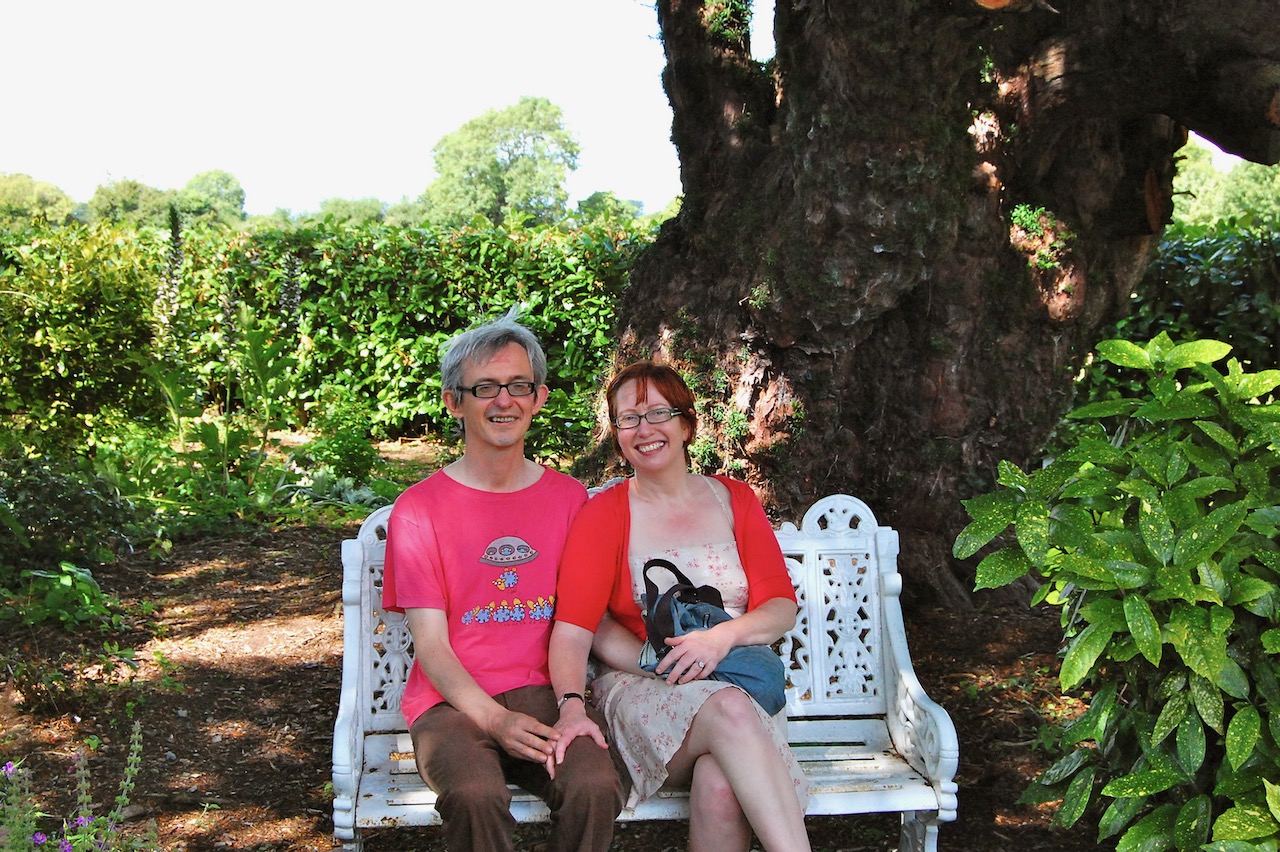
Stephen and I sat beneath this “Dean’s Tree”, under which Jonathan Swift, Dean of St. Patrick’s Cathedral, enjoyed writing before his death in 1745. Perhaps he sat here to write a letter to Stephen’s ancestor, the Reverend John Winder, who succeeded Jonathan Swift as Vicar of Kilroot, County Armagh.

Stephen and Jen at the “Dean’s Tree” (Jonathan Swift sat on that bench!). Photograph © Jennifer Winder-Baggot, www.irishhistorichouses.com
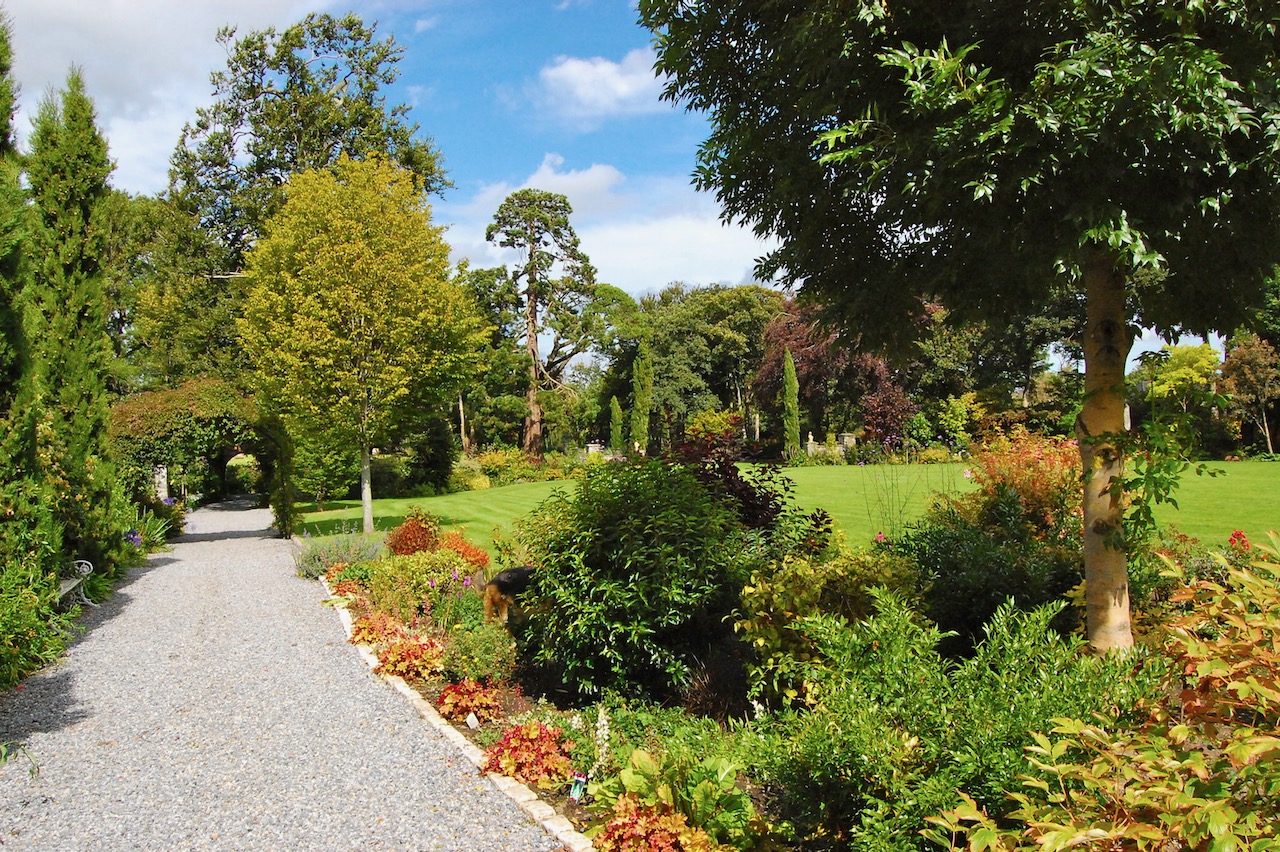
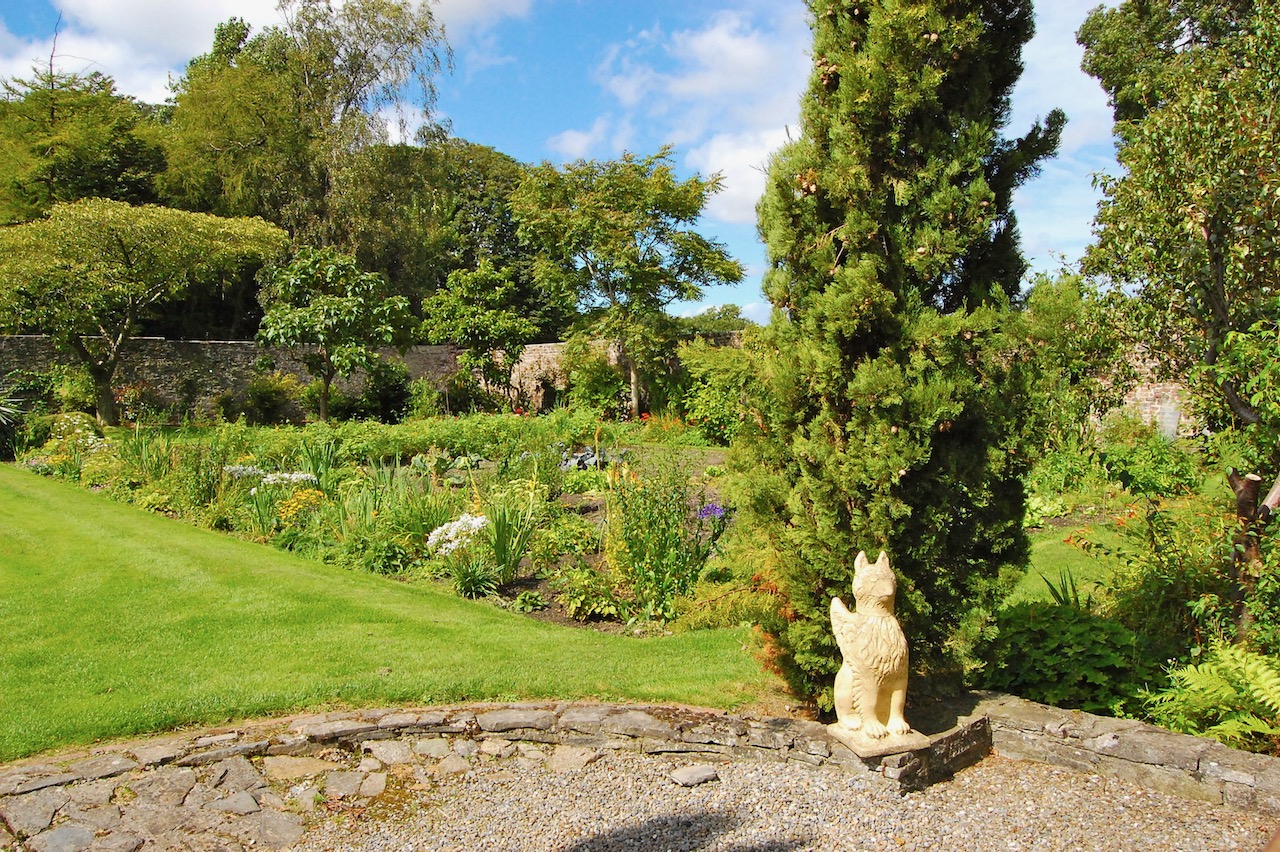
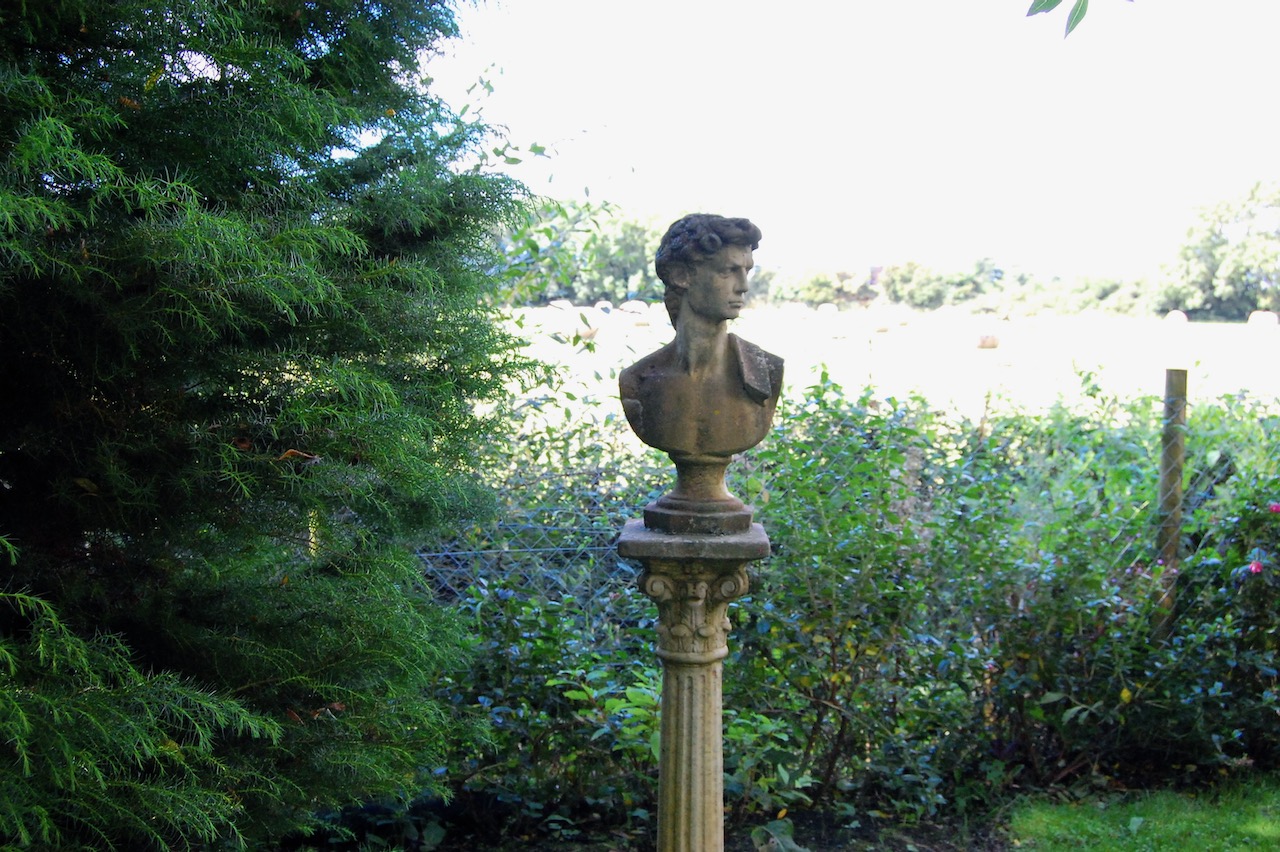
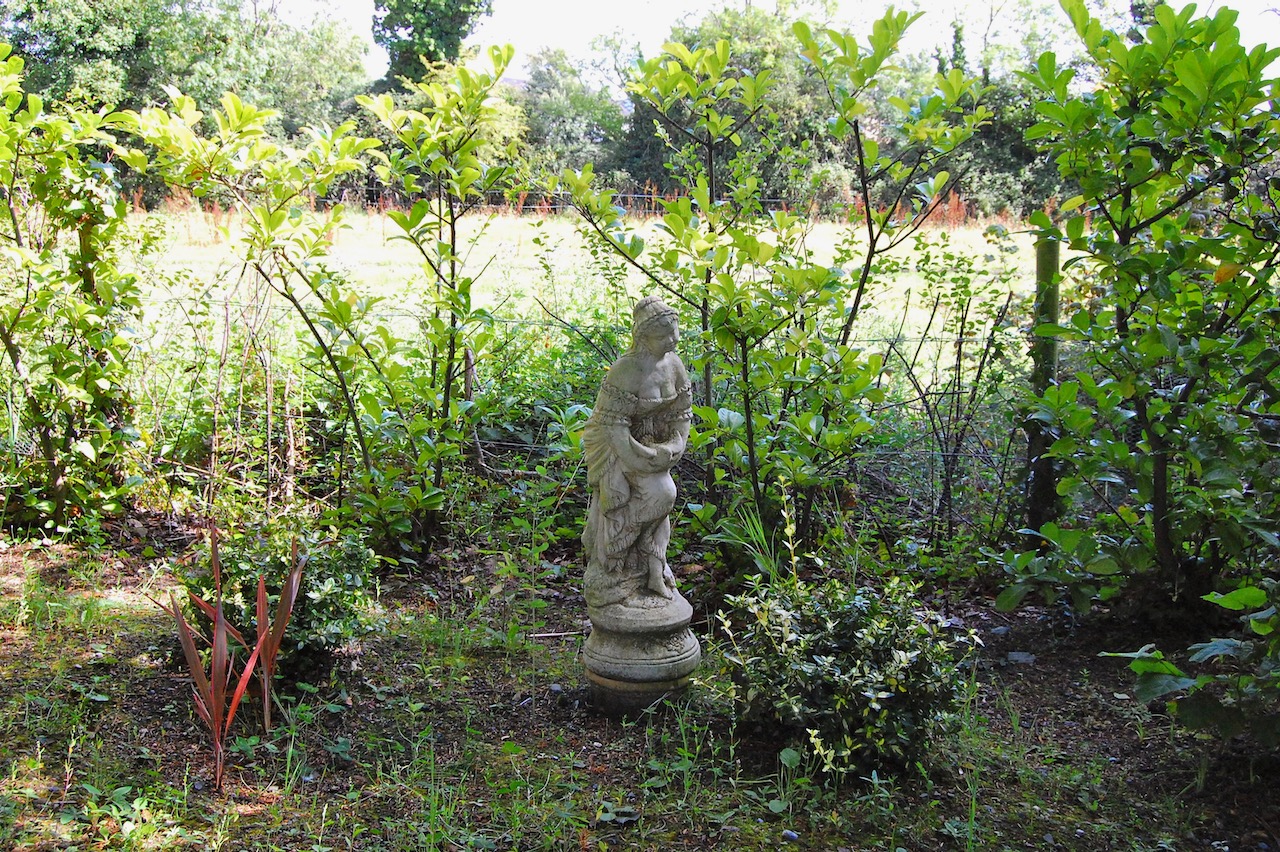
I loved the romantic statues placed in the garden.

At the Old Glebe. Photograph © Jennifer Winder-Baggot, www.irishhistorichouses.com
“The Old Glebe,” Newcastle-Lyons, County Dublin. Photograph © Jennifer Winder-Baggot, www.irishhistorichouses.com
The picturesque lake completes the beauty of the garden with its deep peace.

By the ornamental lake at The Old Glebe, Newcastle, County Dublin. Photograph © Jennifer Winder-Baggot, www.irishhistorichouses.com
My father observes the lake and its small fountain. Photograph © Jennifer Winder-Baggot, www.irishhistorichouses.com
After we said goodbye to Mr. Kerins, we went to explore the church nextdoor. The National Inventory describes it [1]:

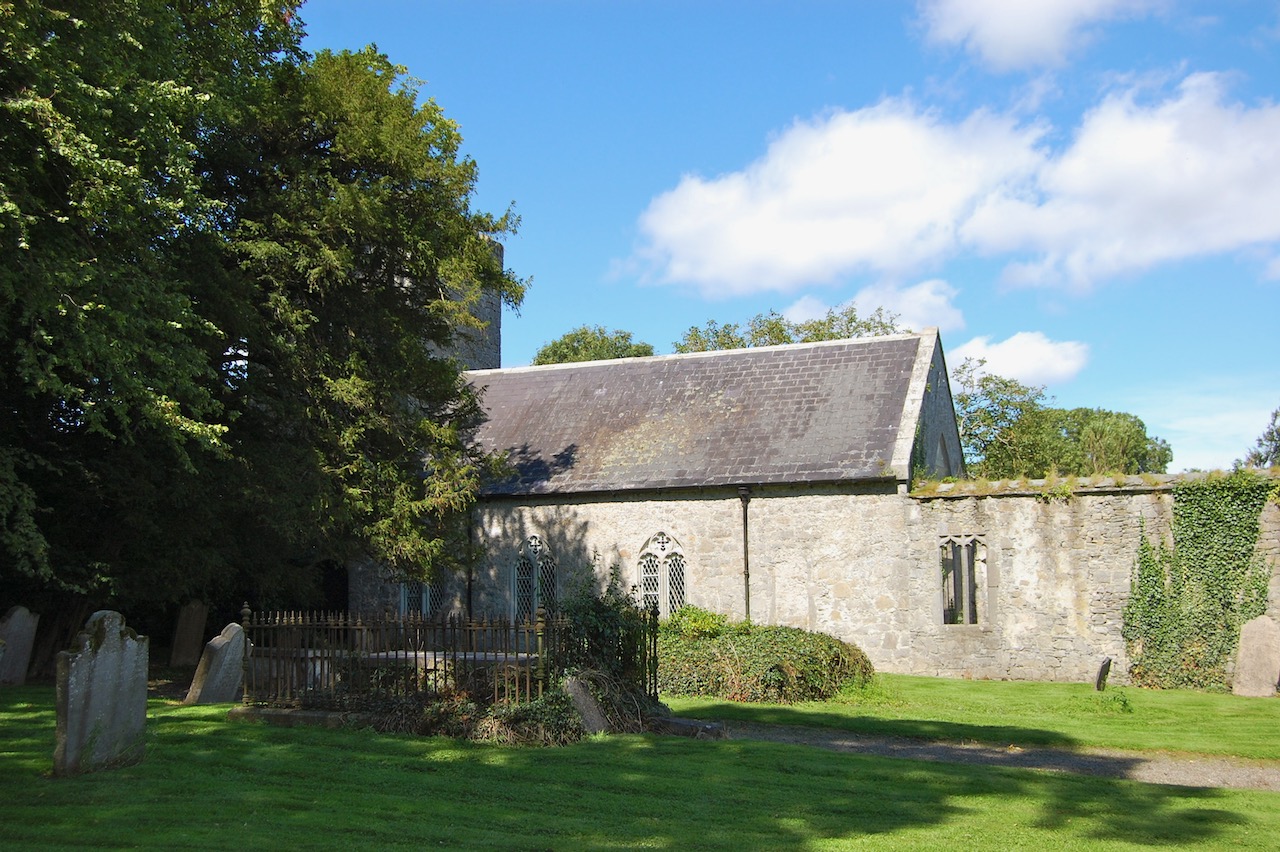
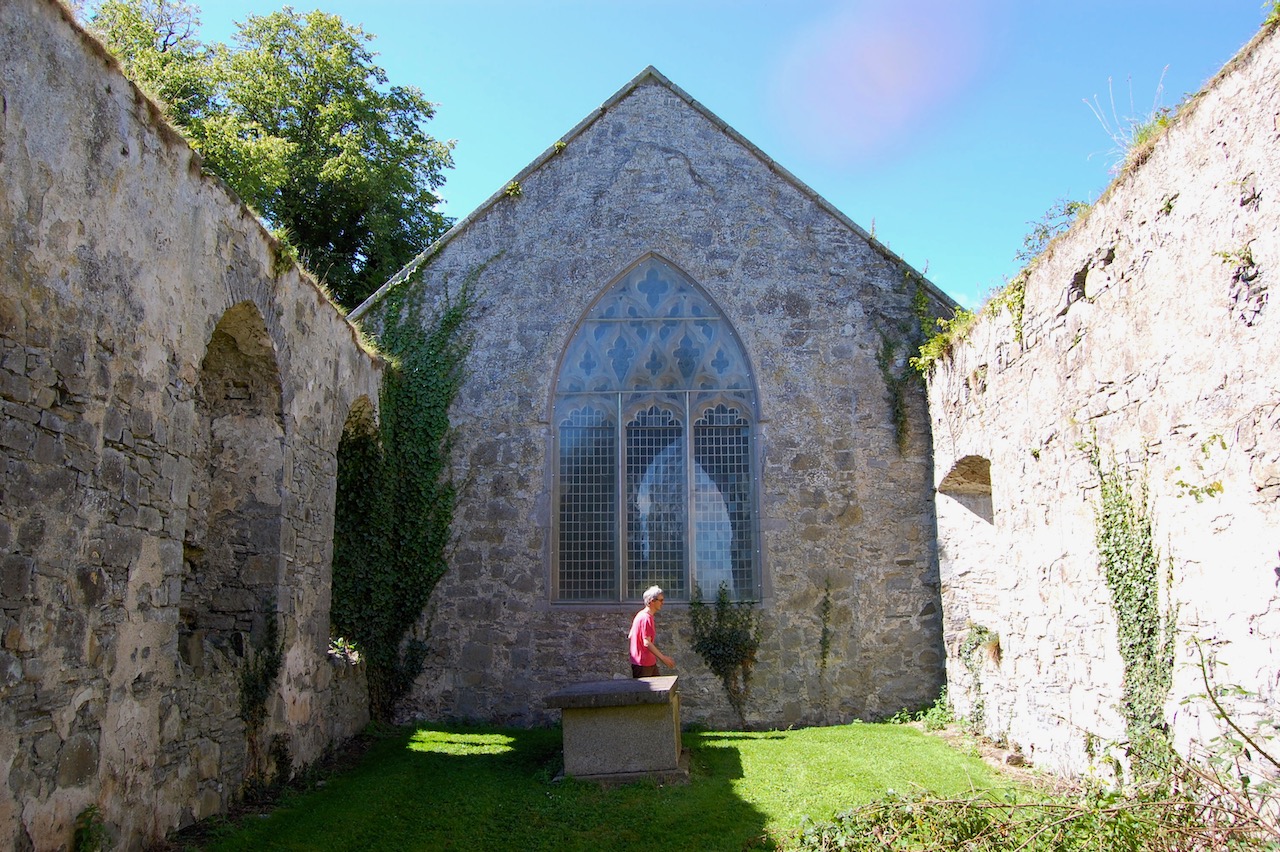
Detached single-cell church, c.1775, incorporating west tower and chancel of fifteenth-century church. Four-bay nave, with further three bays to east, now unroofed. Rubble stone walls. Paired cusp-headed windows with quatrefoil [2] over having smooth limestone surround to nave. Large pointed-arched window with flowing tracery to the east gable of nave. Pitched slate roof. Graveyard to grounds in use since medieval times. Some table graves, legible gravestones dating from the late 1760s, also including medieval cross. Rendered stone rubble boundary wall and gate piers to road.

“Appraisal
This church has been a major historical feature of Newcastle since the fifteenth century, once a Parish Church of the Royal Manor and is still in use. The site contains a variety of fine gravestones which further enhance the setting of this engaging building which possesses many attractive features, particularly its windows.

I found it difficult to take a photograph of the whole church, so here is one from the National Inventory website:

11212009_1
photograph from the National Inventory of Architectural Heritage.
Newcastle-Lyons, County Dublin. Photograph © Jennifer Winder-Baggot, www.irishhistorichouses.com
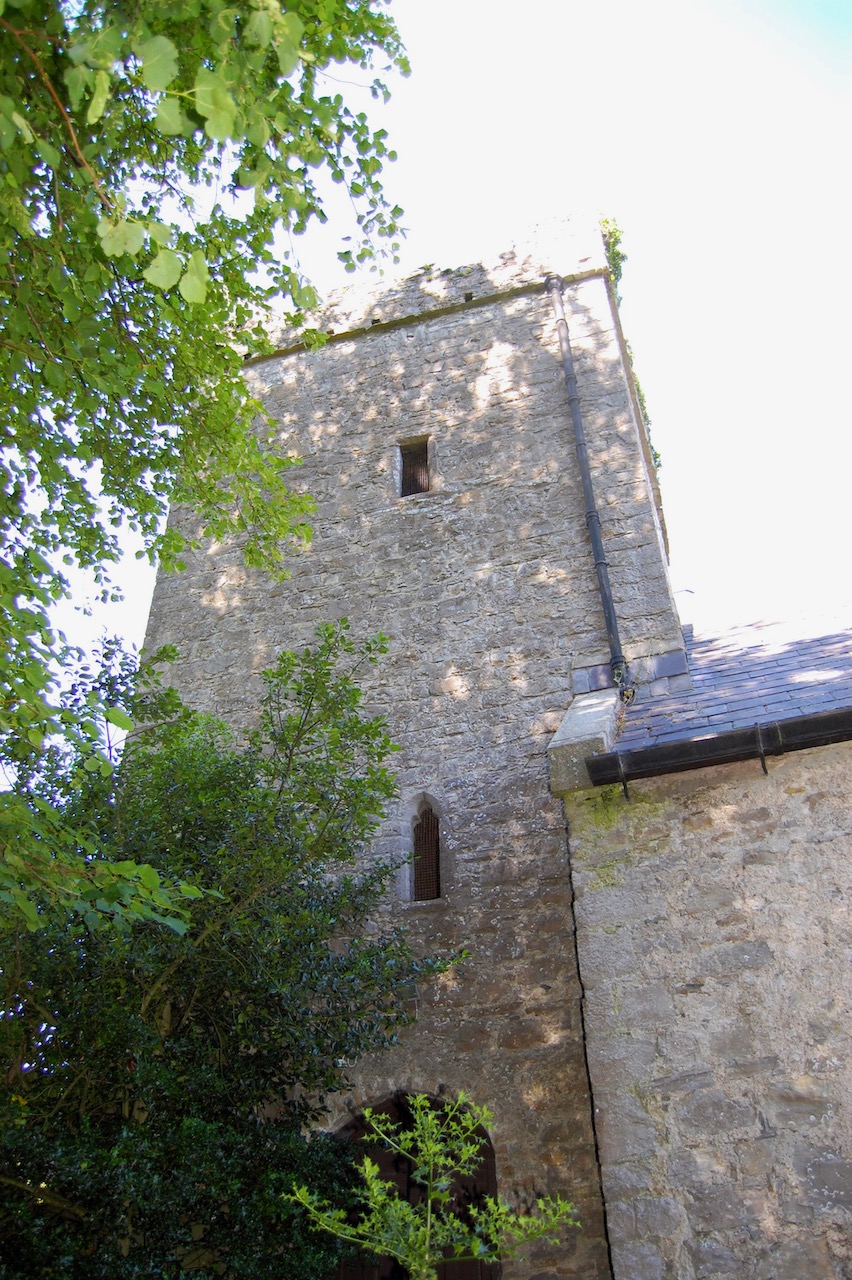
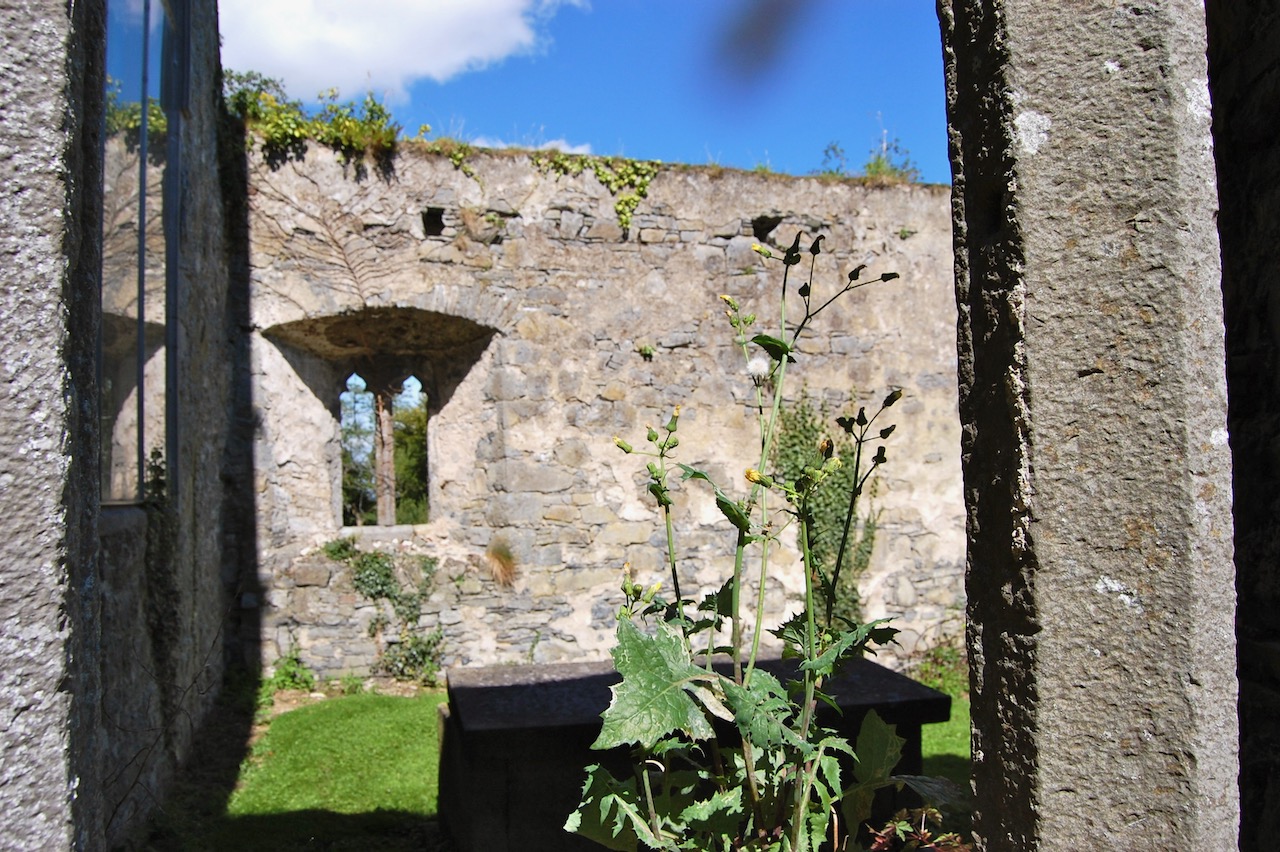
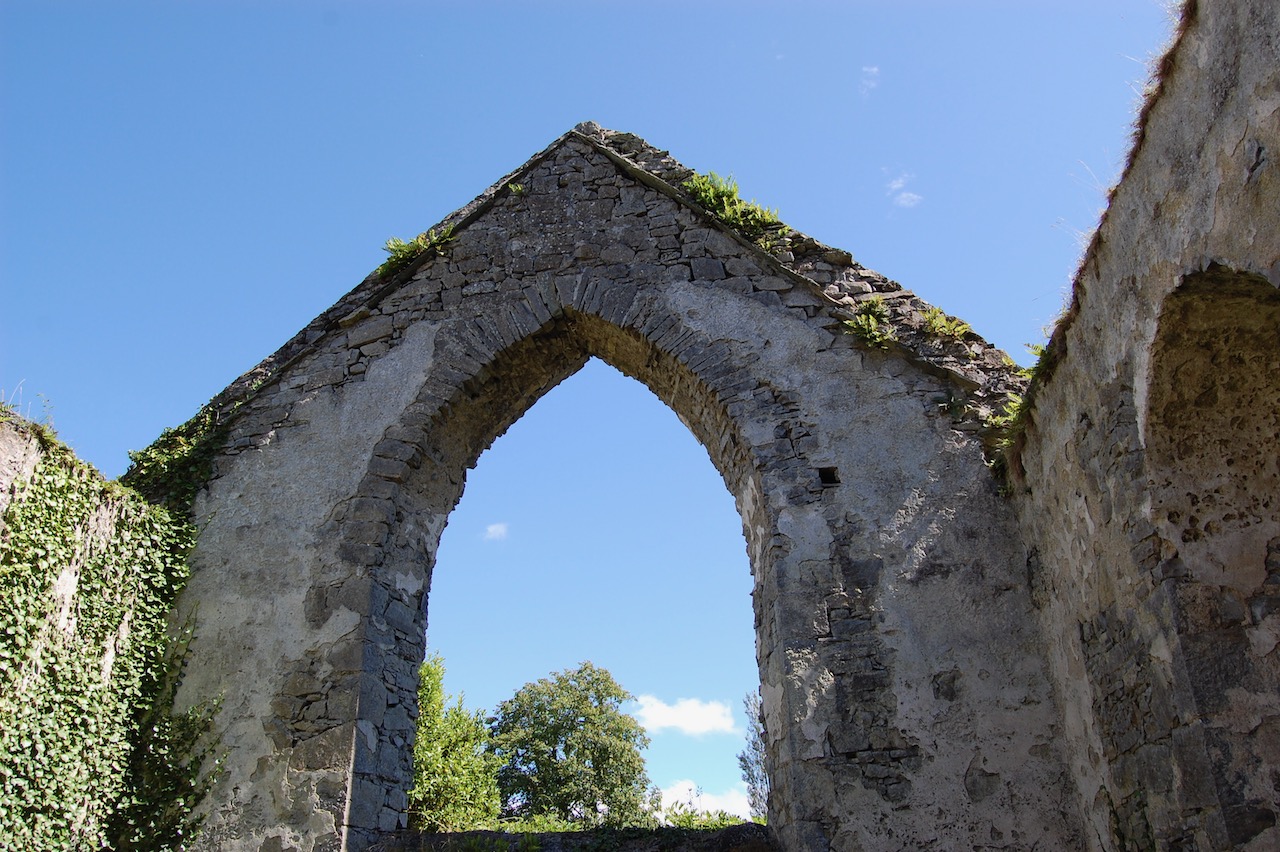
The church consists of three parts: the tower, built in the days of King John (1166-1216), the church section (built around 1775), and a roofless section.

St. Finian’s Church. The ivy covered grave is, I think, a Bagot grave. Photograph © Jennifer Winder-Baggot, www.irishhistorichouses.com
The impressive church tower, built during the era of King John, it is believed (1166-1216), through which one enters to go to the nave of the church. Photograph © Jennifer Winder-Baggot, www.irishhistorichouses.com
Windows looking into the functioning part of the church. Photograph © Jennifer Winder-Baggot, www.irishhistorichouses.com
Stephen in the roofless section of the church. Photograph © Jennifer Winder-Baggot, www.irishhistorichouses.com
At the Old Glebe. Photograph © Jennifer Winder-Baggot, www.irishhistorichouses.com
Newcastle-Lyons, County Dublin. Photograph © Jennifer Winder-Baggot, www.irishhistorichouses.com

I was particularly interested in the graveyard as it contains some Bagots, whom I hope were my relatives, though I have not found the connection (it must be far back in the family tree, and we stem from a different branch, if connected at all). A website that describes graves lists James John Bagot and his wife Ellen Maria (nee O’Callaghan), who are interred in this cemetery [7]:

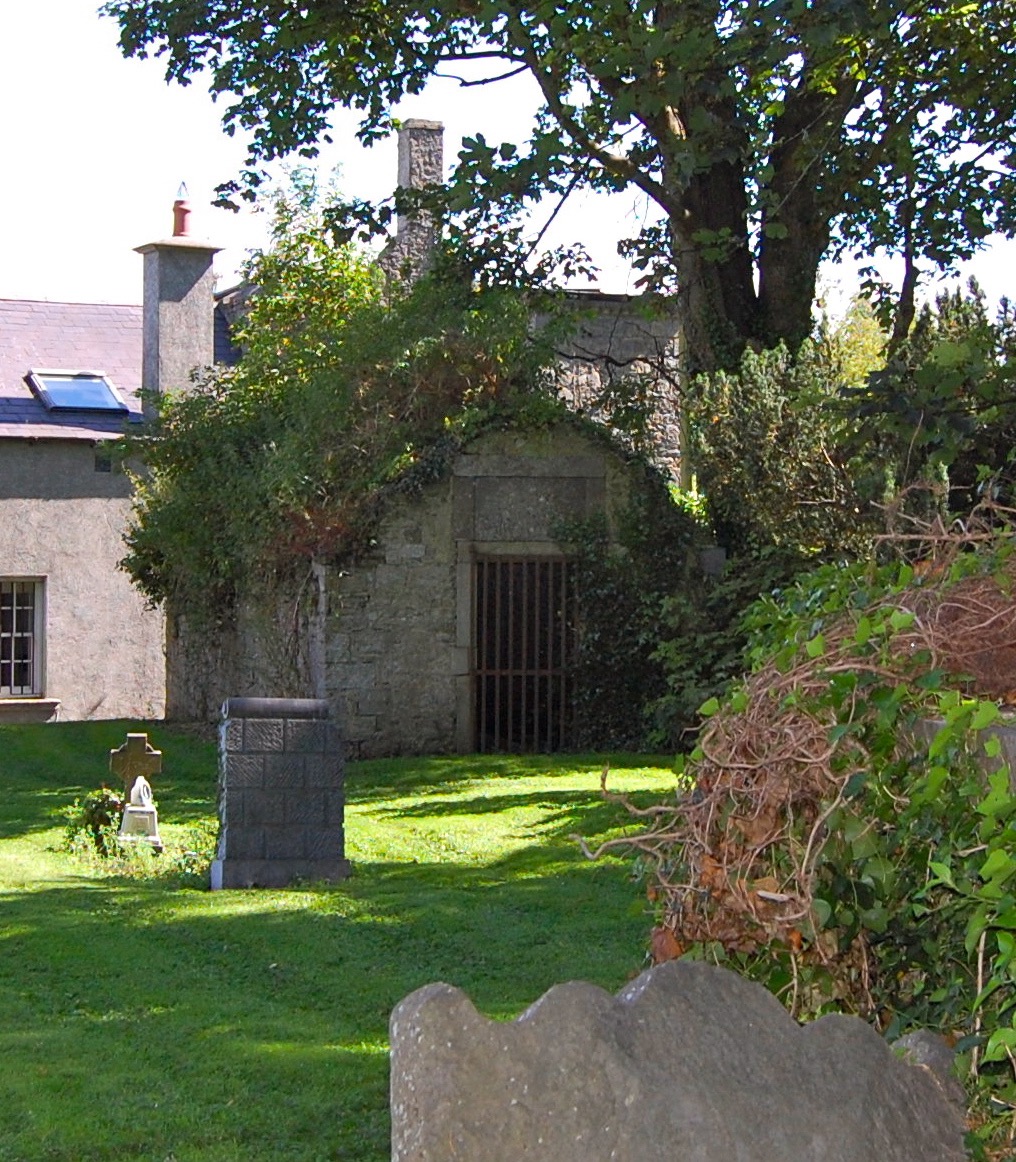
There is a large vault, grass-grown at top, with a cross-shaped loophole at east end,inscribed:-
Pray for the souls of | Those members of the BAGOT Family | who are interred herein | the last of whom | JAMES JOHN BAGOT ESQr | of Castle Bagot County Dublin | Died Aged 76 years | on the 9th of June 1860 | Pray also for the soul of |Ellen Maria BAGOT | his widow interred Herein | who died at Rathgar on 17th Sept 1871 | R.I. P.

Stephen and I returned in 2018 to have a closer look at the grave. In 2012, we thought the grave was the rather macabre vault containing half-open coffins:

At the Old Glebe. Photograph © Jennifer Winder-Baggot, www.irishhistorichouses.com
Iron vaults in graveyard at St Finian’s, Newcastle Lyons. Photograph © Jennifer Winder-Baggot, www.irishhistorichouses.com

Coincidentally, James John’s mother, Eleanor Dease, was probaby related to Colonel Gerald Dease who lived in Celbridge Abbey in 1901.

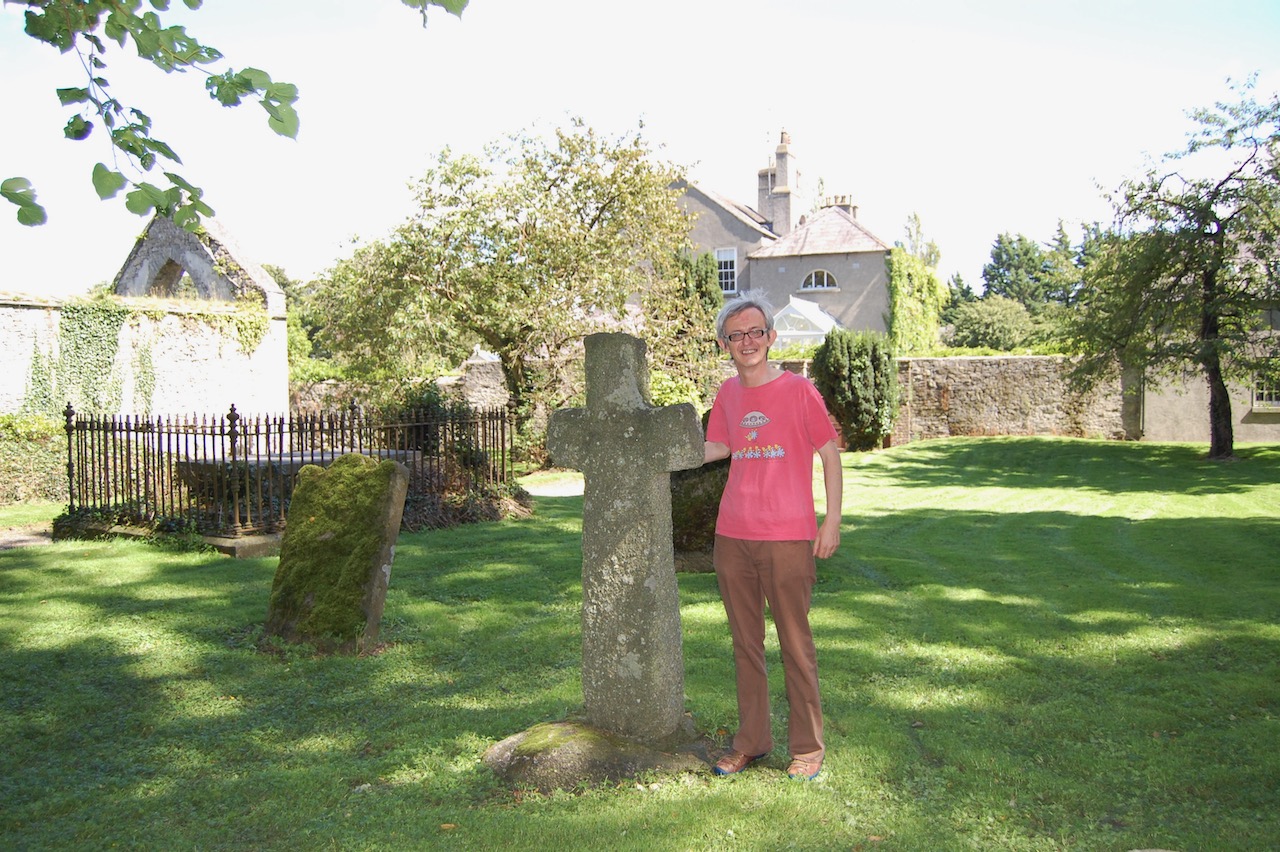
1000 year old cross in graveyard of St Finian’s, Newcastle Lyons. Photograph © Jennifer Winder-Baggot, www.irishhistorichouses.com

In August 2012, we also visited the Catholic church of St. Finian’s in nearby Kilamactalway, to see the baptismal font donated by Ellen Maria Bagot in memory of her husband James John, who died in 1860 and who had lived in Castle Bagot in Rathcoole/ Kilmactalway. I’m a little confused as to why James John and his wife were buried in the Protestant graveyard, since there is a graveyard at the Catholic church, which was built in 1813.

Catholic church of St. Finian’s in Kilmactalway. Photograph © Jennifer Winder-Baggot, www.irishhistorichouses.com
Castle Bagot, Rathcoole, 4th April 2011. Photograph © Jennifer Winder-Baggot, www.irishhistorichouses.com.

Donation

Help me to fund my creation and update of this website. It is created purely out of love for the subject and I receive no payment so any donation is appreciated! For this entry I paid for petrol. There was no entrance fee as we visited during Heritage Week.

€15.00


[1] http://www.buildingsofireland.ie/niah/search.jsp?type=record&county=SC&regno=11212009

[2] architectural definitions

“A bay is a vertical division of the exterior of a building marked by a single tier of windows in its centre. Thus the number of bays in a façade is usually the same as the number of windows in each storey. There are, however, facades in which some of the bays contain two or more narrow windows in each storey in place of a single window of whatever width is the norm.”

“Quatrefoil window: a window in the shape of a four leafed clover; found in Gothic and Gothic-Revival architecture.”

Mark Bence-Jones. A Guide to Irish Country Houses.[originally published as Burke’s Guide to Country Houses volume 1 Ireland by Burke’s Peerage Ltd. 1978; Revised edition 1988 Constable and Company Ltd, London.] pp. xxix-xxxi

[3] https://ardclough.wordpress.com/about/ardclough-history/xtras-hinterland-history-celbridge-straffan/newcastle-lyons-by-francis-ball-1905/

[4] http://www.buildingsofireland.ie/niah/search.jsp?type=record&county=SC&regno=11212007

[5] https://www.irishtimes.com/life-and-style/homes-and-property/900-000-plus-for-historic-family-home-on-1-3-acres-1.223027

[6] https://www.irishtimes.com/life-and-style/growing-old-gracefully-1.788481

[7] http://www.igp-web.com/IGPArchives/ire/dublin/cemeteries/st-finian.txt

Text © Jennifer Winder-Baggot, www.irishhistorichouses.com
Irish Historic Homes