Places to visit and stay in County Clare

On the map above:

blue: places to visit that are not section 482

purple: section 482 properties

red: accommodation

yellow: less expensive accommodation for two

orange: “whole house rental” i.e. those properties that are only for large group accommodations or weddings, e.g. 10 or more people.

green: gardens to visit

grey: ruins

Munster’s counties are Clare, Cork, Kerry, Limerick, Tipperary and Waterford.

For places to stay, I have made a rough estimate of prices at time of publication:

€ = up to approximately €150 per night for two people sharing (in yellow on map);

€€ – up to approx €250 per night for two;

€€€ – over €250 per night for two.

For a full listing of accommodation in big houses in Ireland, see my accommodation page: https://irishhistorichouses.com/accommodation/

donation

Help me to pay the entrance fee to one of the houses on this website. This site is created purely out of love for the subject and I receive no payment so any donation is appreciated!

€15.00

Clare:

1. Barntick House, Clarecastle County Claresection 482

2. Bunratty Castle, County Clare

3. Craggaunowen Castle, Kilmurray, Sixmilebridge, County Clare

4. Dunguaire Castle, Kinvara, County Clare

5. Kilrush House, County Clare‘lost,’ Vandeleur Gardens open 

6. Knappogue or Knoppogue Castle, County Clare

7. Mount Ievers Court, Sixmilebridge, County Clare  

8. Newtown Castle, Newtown, Ballyvaughan, County Clare – section 482

9. O’Dea’s, or Dysert Castle, County Clare

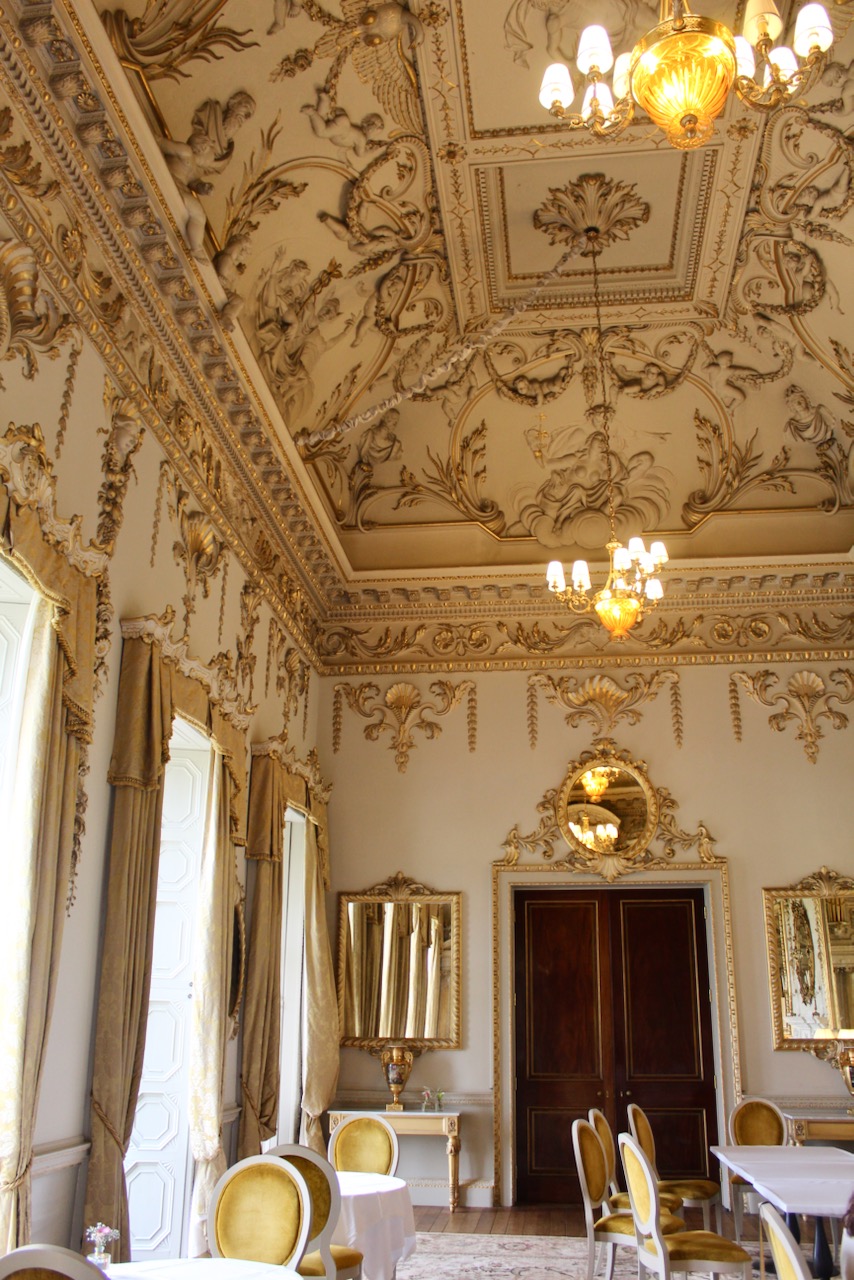
Places to Stay, County Clare 

1. Armada House, formerly Spanish Point House, Spanish Point, County Clare €

2. Ballinalacken Castle, Lisdoonvarna, County Clare – hotel €€

3. The Carriage Houses, Beechpark House, Bunratty, County Clare €

5.  Dromoland Castle, Newmarket-on-Fergus, Co. Clarehotel €€€

6. Falls Hotel (was Ennistymon House), Ennistymon, Co. Clare €€

7. Gregan’s Castle Hotel, County Clare €€€

8. Loop Head Lightkeeper’s Cottage, County Clare €€ for 2; € for 4-6

9. Mount Callan House and Restaurant, Inagh, County Clare – B&B 

10. Mount Cashel Lodge, Kilmurry, Sixmilebridge, County Clare €

11. Newpark House, Ennis, County Clare

12. Smithstown Castle (or Ballynagowan), County Clare € for 4-8 for one week

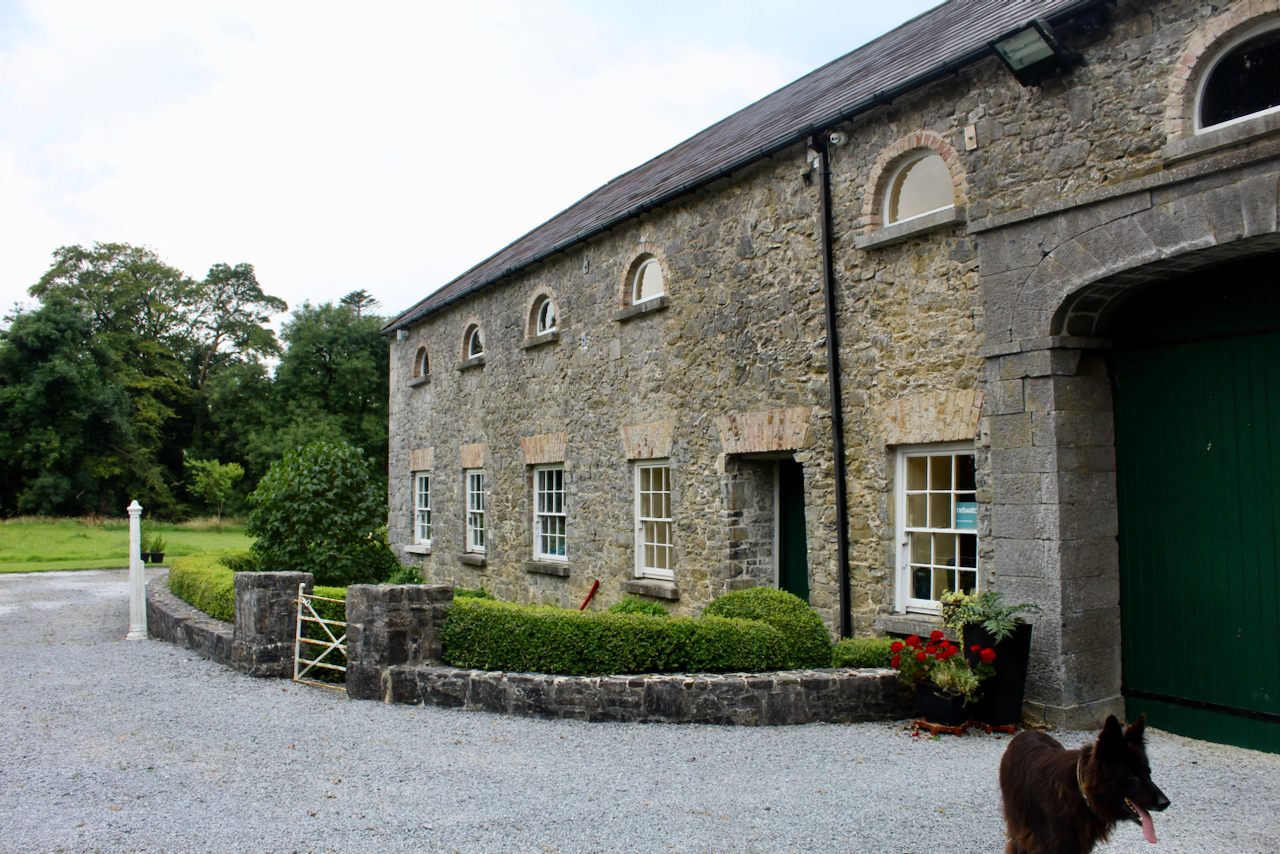
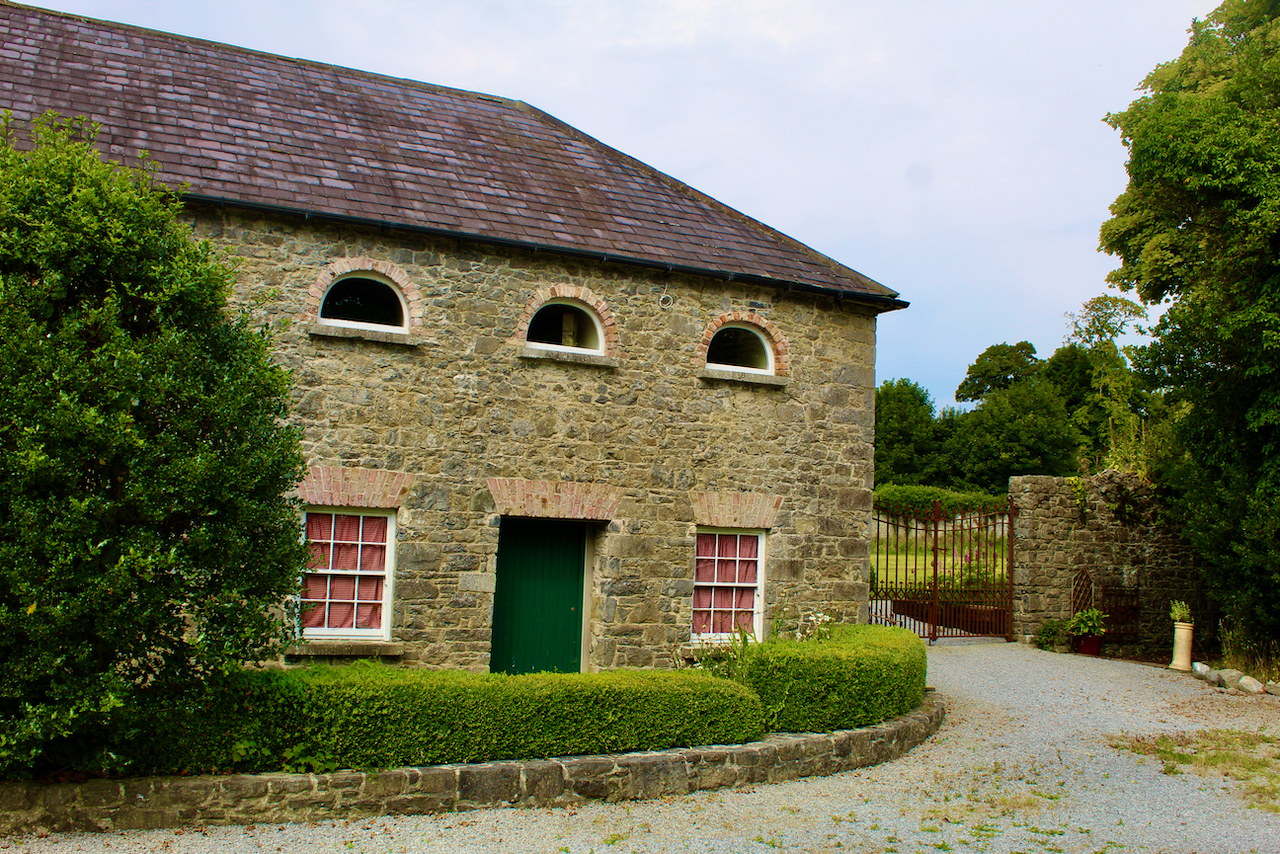
13. Strasburgh Manor coach houses, Inch, Ennis, County Clare

Whole House Rental, County Clare

1. Inchiquin House, Corofin, County Clare – whole house rental € for 6-10

2. Mount Vernon lodge, County Clare – whole house accommodation € for 7-11 people

Clare:

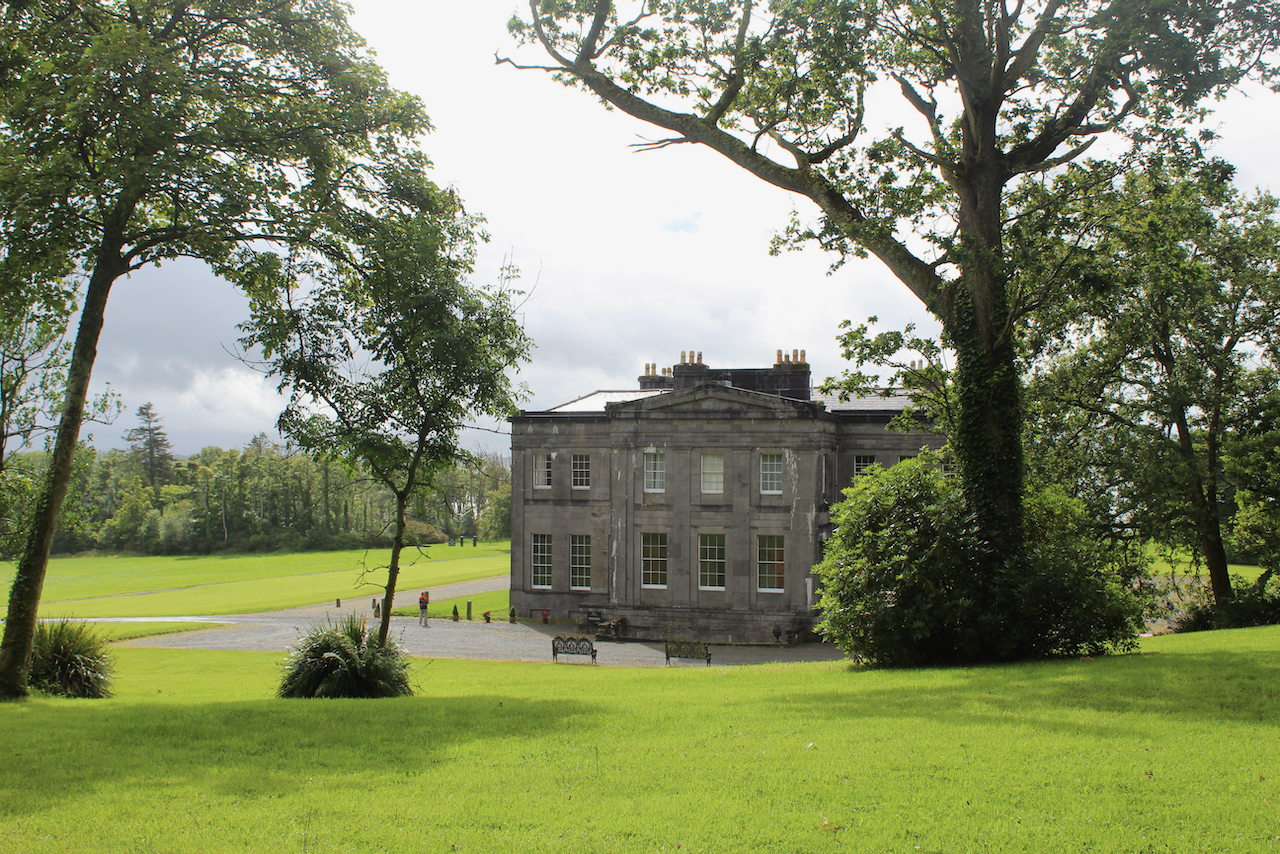
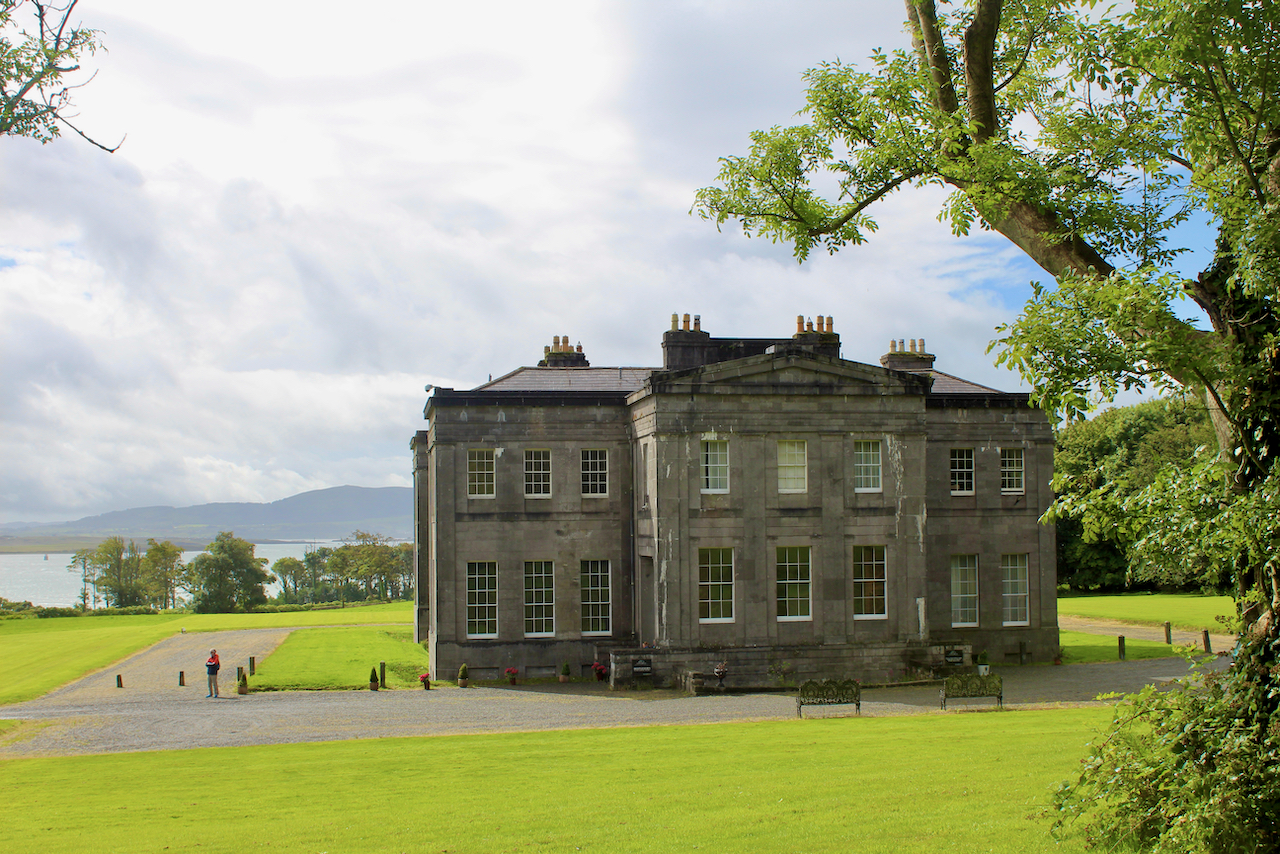
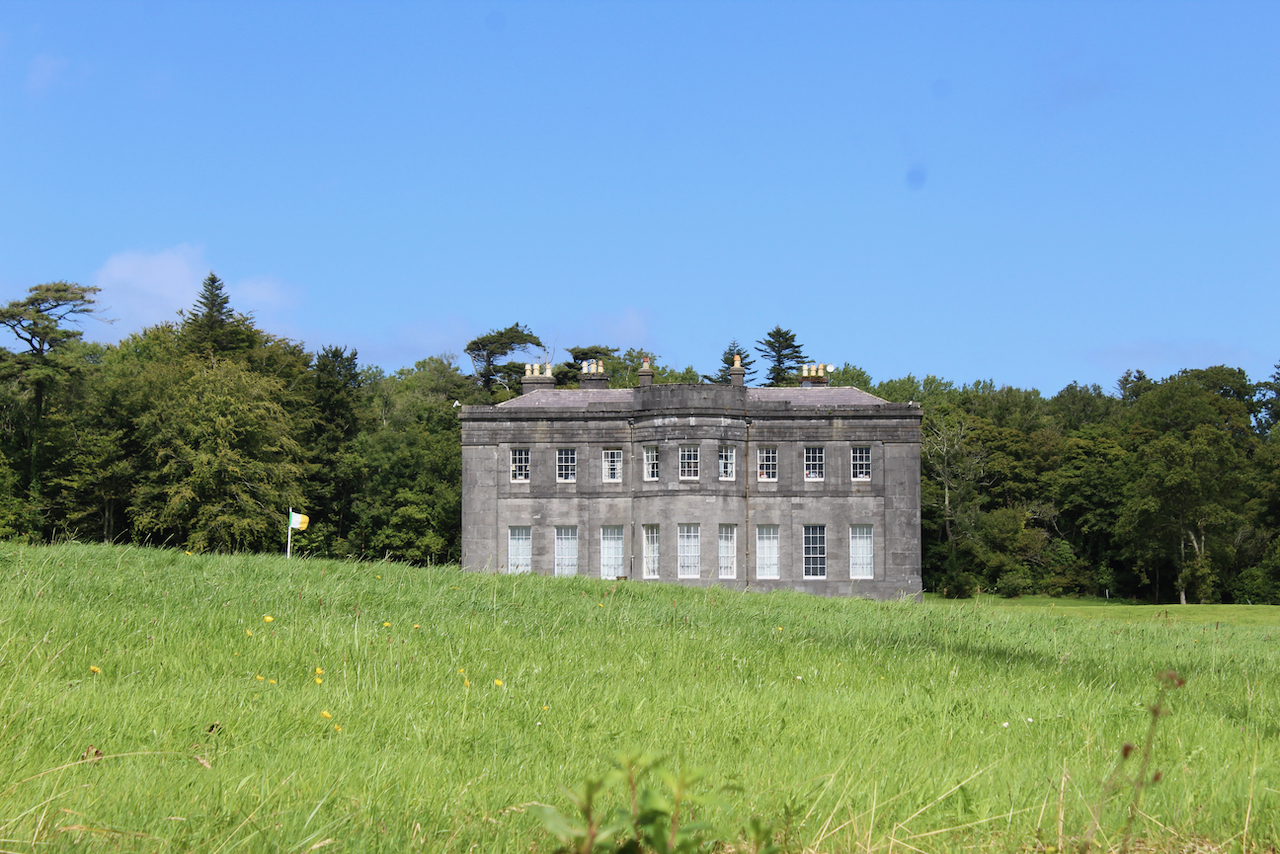
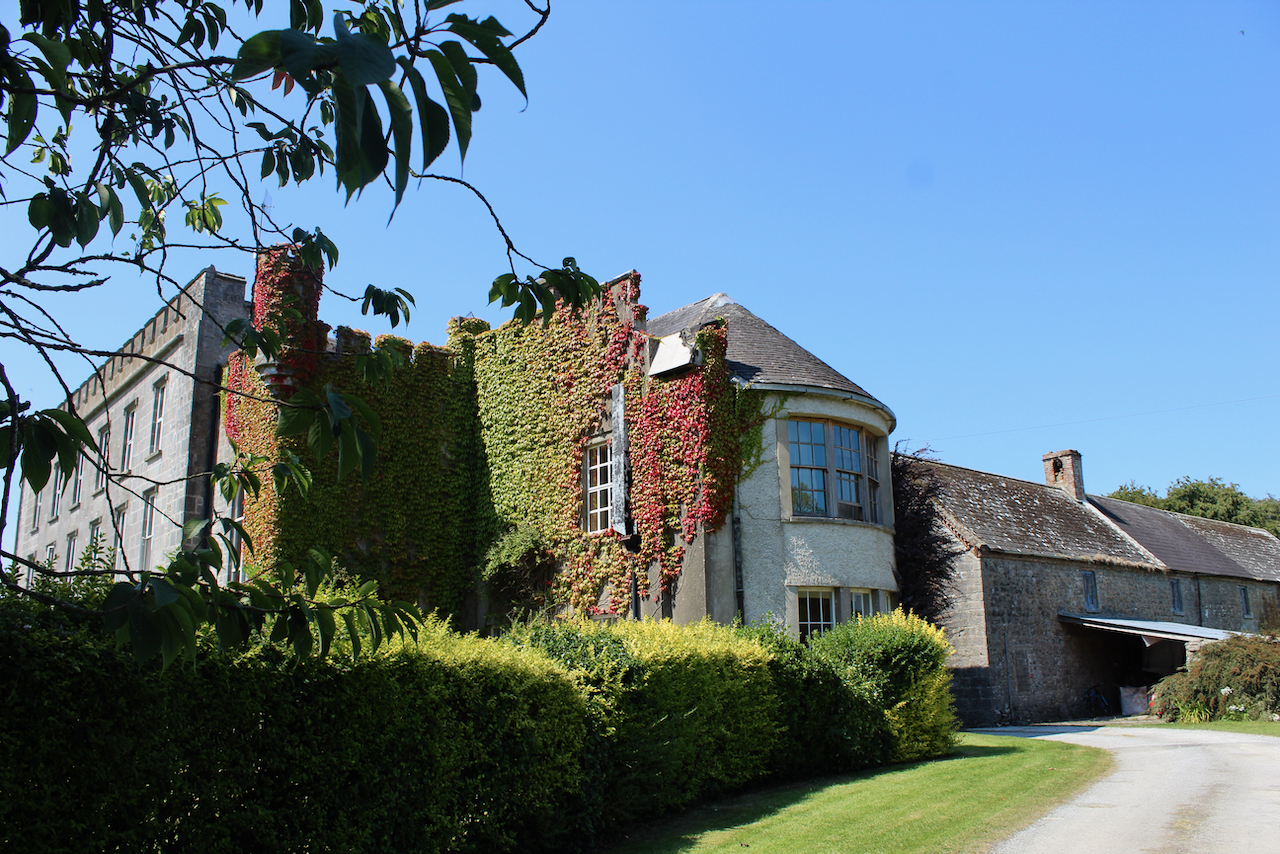
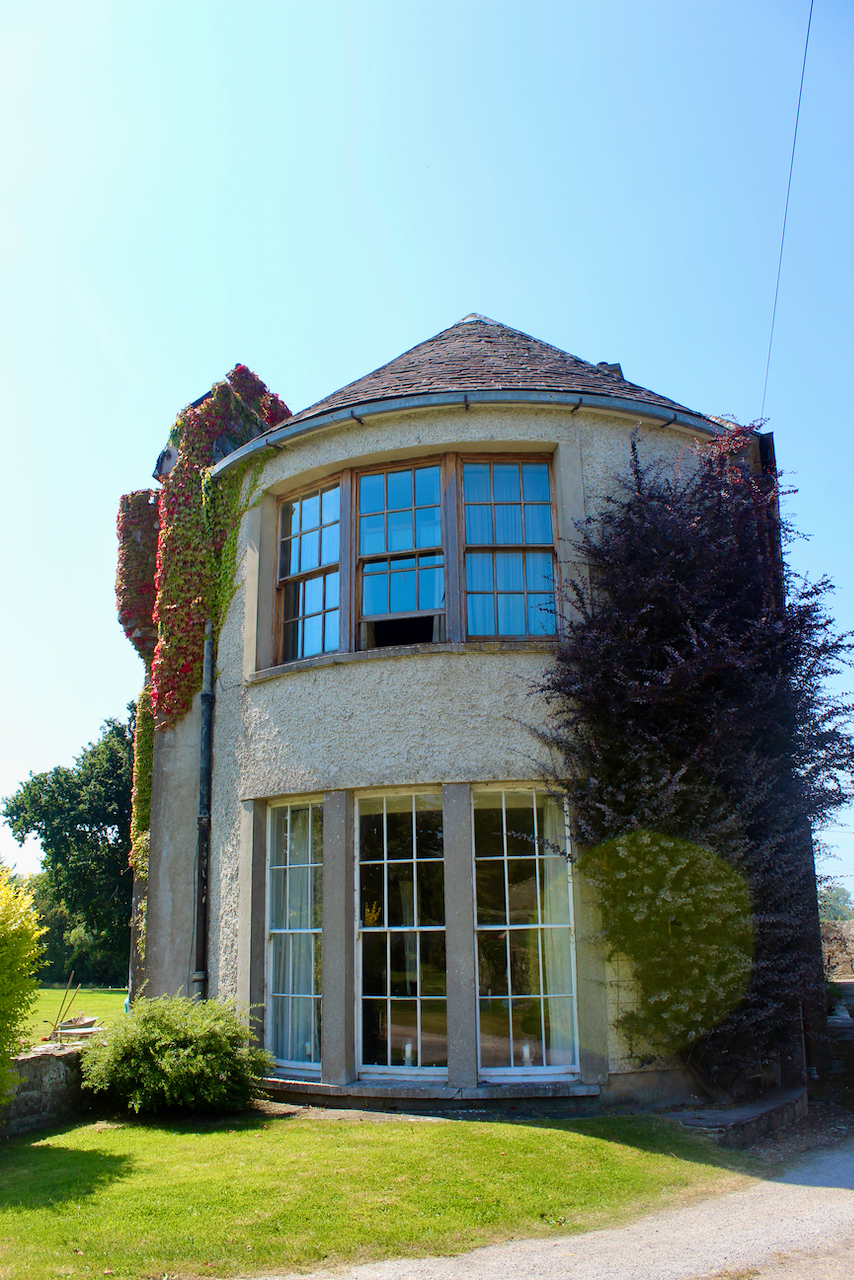
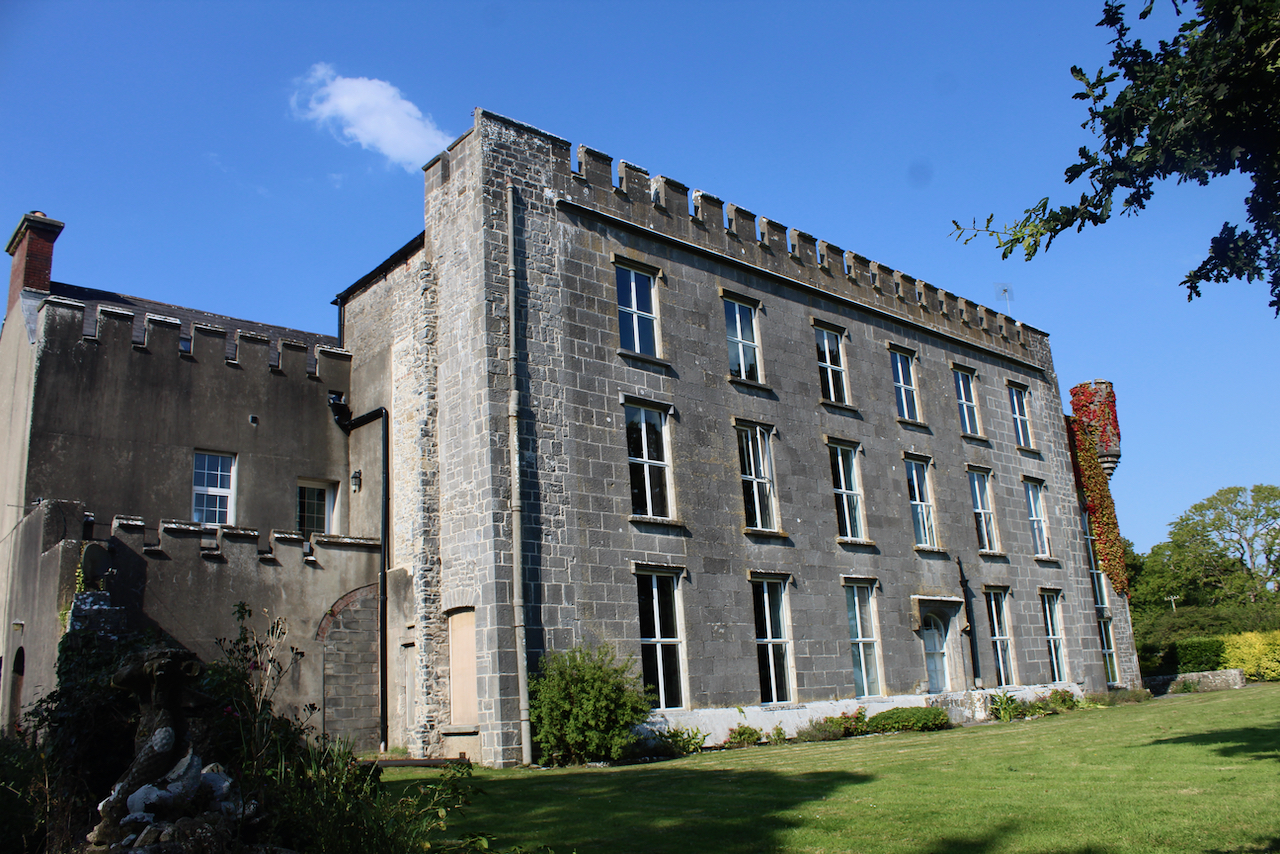
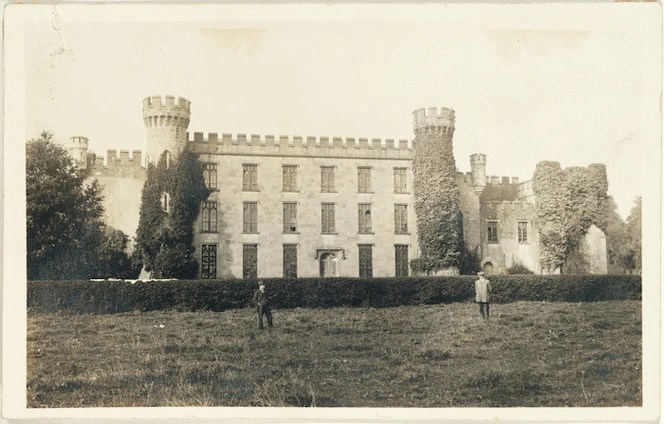
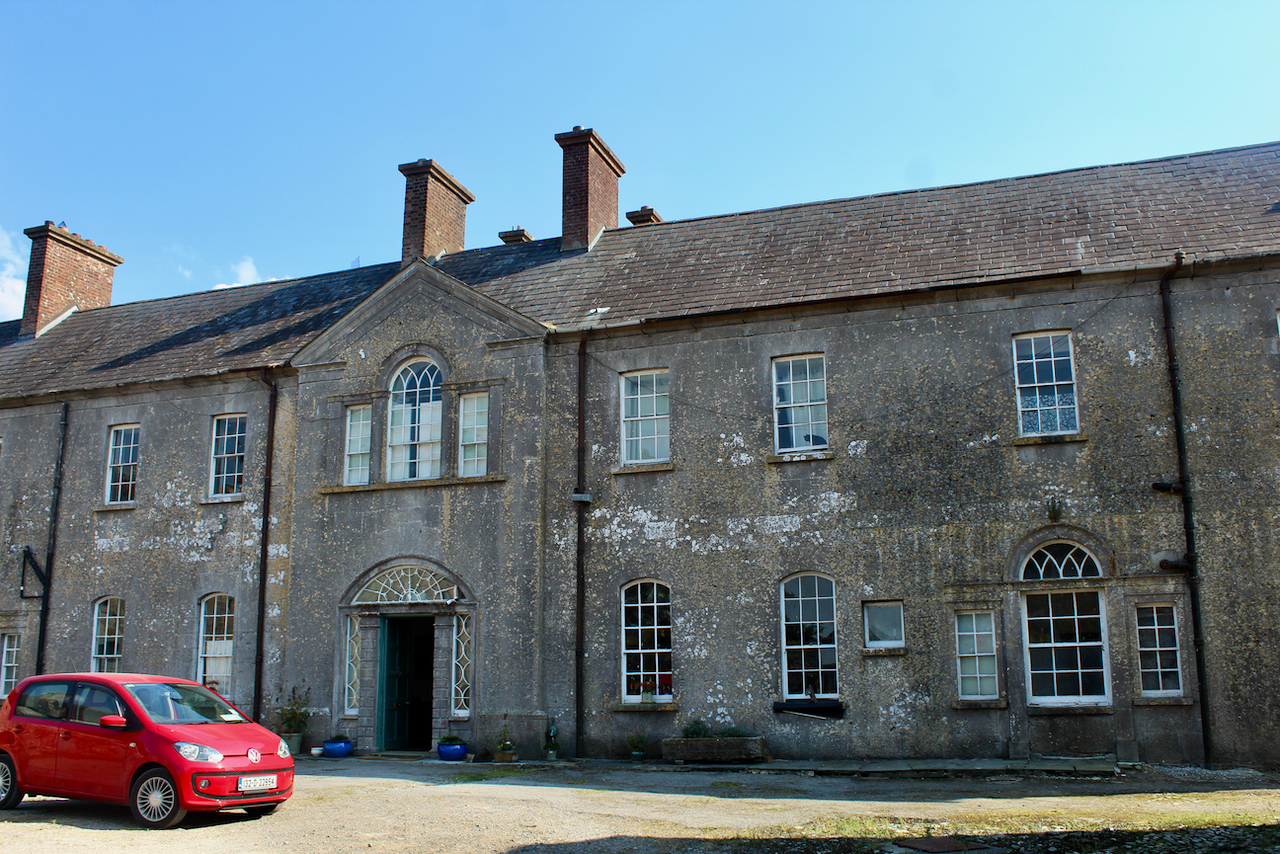
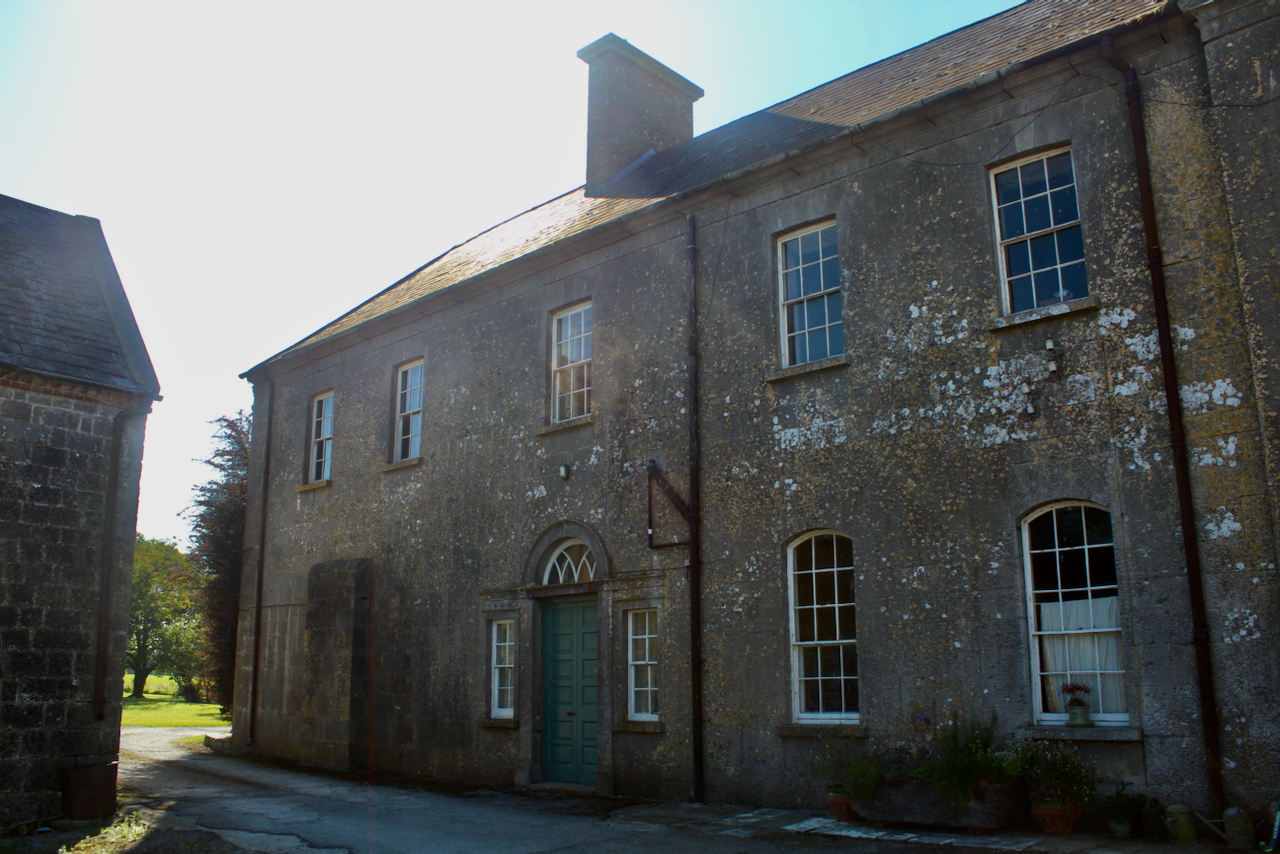
1. Barntick House, Clarecastle Co. Clare V95 FH00section 482

contact: Ciarán Murphy
Tel: 086-1701060
Open dates in 2025: May 1-31, June 1-30, 4.30pm-8.30pm, Aug 16-24, 2pm-6pm

Fee: Free

Barntick House May 2022, photograph courtesy of Ciarán Murphy.

See my entry https://irishhistorichouses.com/2022/11/06/barntick-house-clarecastle-county-clare/

This house dates back to 1665!

2. Bunratty Castle, County Clare

maintained by Shannon Heritage

Bunratty Castle, County Clare, photograph by Chris Hill 2014, for Tourism Ireland, Ireland’s Content Pool. [1]

Mark Bence-Jones writes in his  A Guide to Irish Country Houses:

p. 49. “(O’Brien, Inchiquin, B/PB; and Thomond, E/DEP; Studdert/IFR; Russell/IFR; Vereker, Gort, VPB) One of the finest 15C castles in Ireland, standing by the side of a small tidal creek of the Shanon estuary; built ca 1425, perhaps by one of the McNamaras; then held by the O’Briens, who became Earls of Thomond, until 6th Earl [Barnabas O’Brien (d. 1657)] surrendered it to the Cromwellian forces during the Civil War. A tall, oblong building, it has a square tower at each corner; these are linked, on the north and south sides, by a broad arch just below the topmost storey. The entrance door leads into a large vaulted hall, or guard chamber, above which is the Great Hall, the banqueting hall and audience chamber of the Earls of Thomond, with its lofty timber roof. Whereas the body of the castle is only three storeys – there being another vaulted chamber below the guard chamber – the towers contain many storeys of small rooms, reached up newel stairs and by passages in the thickness of the walls. One of these rooms, opening off the Great Hall, is the chapel, which still has its original plasterwork ceiling of ca 1619, richly adorned with a pattern of vines and grapes. There are also fragment of early C17 plasterwork in some of the window recesses. After the departure of the O’Briens, a C17 brick house was built between the two north towers; Thomas Studdert [1696-1786], who bought Bunratty early in C18, took up residence here in 1720. Later, the Studderts built themselves “a spacious and handsome modern residence in the demesne: and the castle became a constabulary barracks, falling into disrepair so that, towards the end of C19, the ceiling of the Great Hall collapsed. Bunratty was eventually inherited by Lt-Com R.H. Russell, whose mother was a Studdert, and sold by him to 7th Viscount Gort [Standish Robert Gage Prendergast Vereker (1888-1975)] 1956. With the help of Mr Percy Le Clerc and Mr John Hunt, Lord Gort carried out a most sympathetic restoration of the castle, which included removing C17 house, re-roofing the Great Hall in oak and adding battlements to the towers. The restored castle contains Lord Gort’s splendid collection of medieval and C16 furniture, tapestries and works of art, and is open to the public; “medieval banquets” being held here as a tourist attraction. Since the death of Lord Gort, Bunratty and its contents have been held in trust for the Nation.” [2]

Bunratty Castle, County Clare, Photograph by Chris Hill 2014 for Tourism Ireland, Ireland’s Content Pool. (see [1])
Bunratty Co Clare National Library of Ireland stereo pairs collection STP_1858. (Dublin City Library and Archives) [3]
Bunratty Castle Co Clare National Library of Ireland Lawrence Collection taken between 1880 and 1914, L_CAB_00962 (Dublin City Library and Archives) [3]

3. Craggaunowen Castle, Kilmurray, Sixmilebridge, County Clare

Craggaunowen Pre-Historic Park, County Clare, photo by Stephen Power 2014 for Tourism Ireland, Ireland’s Content Pool. (see [1])

– history park, maintained by Shannon Heritage, www.craggaunowen.ie

The Irish Homes and Garden website tells us:

“Early medieval 500AD-1500: The most common form of house style during this period was the ringfort –a circular area of earth surrounded by a bank and ditch. In some cases, stone was used in the defensive enclosure and these are known as cashels. Over 45,000 examples still remain today. Also dating from this period were crannogs (from the Irish crann – tree) – an artificial island built in the shallow areas of lakes with the houses surrounded by a timber palisade or fence. These can be spotted in the landscape as small tree covered islands close to the lake shore – both the ringforts and crannogs most commonly contained circular houses. A reconstruction of a crannog dwelling can be found at Craggaunowen, Co. Clare

This was also a time when Christianity was introduced to Ireland and whereas the early churches of the 6th and 7th centuries were of timber, evidence of stone churches appear from the late 8th century. These were simple rectangular buildings of about 5m long with a high steep pitched roof. The only doorway had a flat-topped lintelled opening. The early Irish monasteries of the 9th and 10th centuries, such as Clonmacnoise, had larger churches and monastic buildings also included the drystone beehive hut or clochan, as can be seen at Skellig Michael, and also the Round Tower, built between the 10th and 12th century, which consisted of a narrow tower up to 30m high tapering at the top with a conical roof.” [4]

The Craggaunowen website tells us: “Craggaunowen Castle - built by  John MacSioda MacNamara in 1550 a descendant of Sioda MacNamara who built Knappogue Castle in 1467. After the collapse of the Gaelic Order, in the 17th century, the castle was left roofless and uninhabitable. The Tower House remained a ruin until it and the estate of Cullane House across the road, were inherited in 1821 by ”Honest” Tom Steele, a confederate of Daniel O’Connell, Steele had the castle rebuilt as a summer house in the 1820s. He used it and the turret on the hill opposite for recreation. His initials can be seen on one of the quoin-stones to the right outside. “The Liberator”. By the time of the First Ordnance Survey, in the 1840s, the castle was “in ruins”. After Steele in 1848 the lands were divided, Cullane going to one branch of his family, Craggaunowen to another, his niece Maria Studdert. Eventually the castle and grounds were acquired by the “Irish Land Commission”. Much of the land was given over to forestry and the castle itself was allowed to fall into disrepair. In the mid-19th century, the castle, herd’s house and 96 acres were reported in the possession of a Reverend William Ashworth, who held them from a Caswell (a family from County Clare just north of Limerick). In 1906, a mansion house here was owned by Count James Considine (from a family based at Derk, County Limerick). Craggaunowen Castle was restored by John Hunt in the 1960s – he added an extension to the ground floor, which for a while housed part of his collection of antiquities. The collection now resides in the Hunt Museum in the city of Limerick.” [5]

4. Dunguaire Castle, Kinvara, County Clare

Dunguaire Castle, County Clare, July 2021. Photograph © Jennifer Winder-Baggot, www.irishhistorichouses.com

Maintained by Shannon Heritage.

Mark Bence-Jones writes in A Guide to Irish Country Houses (1988):

p. 115. “(Martyn/LGI1912; Gogarty/IFR; Russell, Ampthill, B/PB) An old tower-house with a bawn and a smaller tower, on a creek of Galway Bay; which was for long roofless, though in other respects well maintained by the Martyn family, of Tulira, who owned it C18 and C19, and which was bought in the present century by Oliver St John Gogarty, the surgeon, writer and wit, to save it from threat of demolition. More recently, it was bought by the late Christabel, Lady Ampthill, and restored by her as her home; her architect, being Donal O’Neill Flanagan, who carried out a most successful and sympathetic restoration. The only addition to the castle was an unobtrusive two storey wing joining the main tower to the smaller one. The main tower has two large vaulted rooms, one above the other, in its two lower storeys, which keep their original fireplaces; these were made into the dining room and drawing room. “Medieval” banquets and entertainments are now held here.” 

Dunguaire Castle, County Clare, July 2021. Photograph © Jennifer Winder-Baggot, www.irishhistorichouses.com
Dunguaire Castle, County Clare, July 2021.
Dunguaire Castle, County Clare, July 2021. Photograph © Jennifer Winder-Baggot, www.irishhistorichouses.com
Dunguaire Castle, County Clare, July 2021.
Dunguaire Castle, County Clare, July 2021. Photograph © Jennifer Winder-Baggot, www.irishhistorichouses.com
Dunguaire Castle, County Clare, July 2021.
Dunguaire Castle, County Clare, July 2021. Photograph © Jennifer Winder-Baggot, www.irishhistorichouses.com

5. Kilrush House, County ClareVandeleur Gardens

Vandeleur walled Garden, Kilrush, Co Clare, photo by Air Swing Media 2019 for Tourism Ireland, Ireland’s Content Pool. (see [1])

– ‘lost’, Vandeleur Gardens open 

www.vandeleurwalledgarden.ie 

Timothy William Ferrers writes about it on his website:

KILRUSH HOUSE, County Clare, was an early Georgian house of 1808. 

From 1881 until Kilrush House was burnt in 1897, Hector Stewart Vandeleur lived mainly in London and only spent short periods each year in Kilrush. Indeed during the years 1886-90, which coincided with the period of the greatest number of evictions from the Vandeleur estate, he does not appear to have visited Kilrush. 

In 1889, Hector bought Cahircon House and then it was only a matter of time before the Vandeleurs moved to Cahircon as, in 1896, they were organising shooting parties at Kilrush House and also at the Cahircon demesne.  

Hector Stewart Vandeleur was the last of the Vandeleurs to be buried at Kilrush in the family mausoleum. Cahircon House was sold in 1920, ending the Kilrush Vandeleurs’ direct association with County ClareHector Vandeleur had, by 1908, agreed to sell the Vandeleur estate to the tenants for approximately twenty years’ rent, and the majority of the estate was purchased by these tenants. 

THE VANDELEURS, as landlords, lost lands during the Land Acts and the family moved to Cahircon, near Kildysart. 
 
In 1897, Kilrush House was badly damaged by fire. 

During the Irish Land Commission of the 1920s, the Department of Forestry took over the estate, planted trees in the demesne and under their direction the remains of the house were removed in 1973, following an accident in the ruins.Today the top car park is laid over the site of the house. 

Vandeleur Walled Garden now forms a small part of the former Kilrush demesne. The Kilrush demesne was purchased by the Irish Department of Agriculture as trustee under the Irish Land Acts solely for the purpose of forestry. The Kilrush Committee for Urban Affairs purchased the Fair Green and Market House.” [6]

6. Knappogue or Knoppogue Castle, County Clare

Knappogue is maintained by Shannon Heritage and holds Medieval style banquets. https://www.knappoguecastle.ie

Knappogue, or Knoppogue, Castle, County Clare.

Mark Bence-Jones writes about Knoppogue, or Knappogue, Castle in A Guide to Irish Country Houses (1988):

p. 180. “(Butler, Dunboyne, B/PB) A large tower-house with a low C19 castellated range, possibly by James Pain, built onto it. Recently restored and now used for “medieval banquets” similar to those at Bunratty Castle, Co Clare.” 

7. Mount Ievers Court, Sixmilebridge, County Clare  

Mount Ievers, photograph from National Inventory.

mountieverscourt.ie

The website has a terrific history of the house. First, it tells us:

Mount Ievers Court is an 18th c. Irish Georgian country house nestled in the Co. Clare countryside just outside the town of Sixmilebridge.  The house was originally the site of a 16th c.  tower house called Ballyarilla Castle built by Lochlann McNamara.  The tower house was demolished in the early 18th c. to construct the present house, built between 1733-1737 by John & Isaac Rothery, for Col. Henry Ievers.

Mount Ievers Court  has been home to the Ievers family for 281 years and since then generations of Ievers and their families have worked hard to maintain the house in order to ensure that the estate retains a viable place in the local community and Ireland’s heritage long into the future. Mount Ievers is currently owned by Breda Ievers née O’Halloran, a native of Sixmilebridge, and her son Norman. Norman is married to Karen, an American by birth, who has a keen interest in Irish history & the family archives.

A topographical vie of Mount Ievers, County Clare dating from the second quarter of the 18th century, courtesy of exhibition “In Harmony with Nature” curated by Robert O’Byrne in the Irish Georgian Society, July 2022. Photograph © Jennifer Winder-Baggot, www.irishhistorichouses.com

Mark Bence-Jones writes in A Guide to Irish Country Houses (1988):

p. 214. “(Ievers/IFR) The most perfect and also probably the earliest of the tall Irish houses; built ca. 1730-37 by Colonel Henry Ievers to the design of John Rothery, whose son, Isaac, completed the work after his death and who appears to have also been assisted by another member of the Rothery family, Jemmy. The house, which replaced an old castle, is thought to have been inspired by Chevening, in Kent – now the country house of the Prince of Wales – with which Ievers could have been familiar not only through the illustration in Vitruvius Britannicus, but also because he may have been connected with the family which owned Chevening in C17. Mount Ievers, however, differs from Chevening both in detail and proportions; and it is as Irish as Chevening is English. Its two three storey seven bay fronts – which are almost identical except that one is of faded pink brick with a high basement whereas the other is of silvery limestone ashlar with the basement hidden by a grass bank – have that dreamlike, melancholy air which all the best tall C18 Irish houses have. There is a nice balance between window and wall, and a subtle effect is produced by making each storey a few inches narrower than that below it. The high-pitched roof is on a bold cornice; there are quoins, string-courses and shouldered window surrounds; the doorcase on each front has an entablature on console brackets. The interior of the house is fairly simple. Some of the rooms have contemporary panelling; one of them has a delightful primitive overmantel painting showing the house as it was originally, with an elaborate formal layout which has largely disappeared. A staircase of fine joinery with alternate barley-sugar and fluted balusters leads up to a large bedroom landing, with a modillion cornice and a ceiling of geometrical panels. On the top foor is a long gallery, a feature which seems to hark back to the C17 or C16, for it is found in hardly any other C18 Irish country houses; the closest counterpart was the Long Room in Bowen’s Court, County Cork. The present owners, S.Ldr N.L. Ievers, has carried out much restoration work and various improvements, including the placement of original thick glazing bars in some of the windows which had been given thin late-Georgain astragals ca. 1850; and the making of two ponds on the site of those in C18 layout. He and Mrs Ievers have recently opened the home to paying guests in order to meet the cost of upkeep.” 

The website tells of the ancient origins of the family, and goes on to explain:

A parchment found in the sideboard at Mount Ievers in July 2012 maintains that Henry Ivers arrived in Ireland in 1640 from Yorkshire, where the family had been settled since arriving with William the Conqueror nearly six hundred years earlier. It also records that Henry settled in County Clare in 1643 when he was appointed Collector of Revenue for Clare and Galway.

8. Newtown Castle, Newtown, Ballyvaughan, Co. Clare – section 482

Newtown Castle, photograph fron National Library of Ireland, flickr constant commons.

www.newtowncastle.com , 
Open dates in 2025: Jan 6-Dec 19 Mon-Fri, National Heritage Week 16-24, 10am-5pm
Fee: Free

The website tells us: “The historic Newtown Castle has occupied a prominent position in Ballyvaughan since the 16th century. Having lain derelict for many years, the castle’s restoration began in 1994, completed in time for the opening of the Burren College of Art in August of that year. 

Newtown Castle is once again a vibrant building in daily use, central to the artistic, cultural and educational life of the Burren. It is open free of charge to the public on week days. Newtown Castle is also available to hire for: wedding ceremonies, small private functions or company events.” 

Maurice Craig and Desmond Fitzgerald the Knight of Glin describe it in their book Ireland Observed. A handbook to the Buildings and Antiquities: “This sixteenth-century tower, nearly round in plan, rises from a square base, on which is the entrance door. Ingeniously places shot-holes protect its four sides.” [7]

Maurice Craig also writes about Newtown in his book The Architecture of Ireland from the Earliest Times to 1880:

There is a small class of cylindrical tower-houses: so small that it is worth attempting to enumerate them all, omitting those which appear to be thirteenth-century (and hence not tower-houses). They are Cloughoughter, County Cavan (which is dubiously claimed for the fourteenth century); Carrigabrack, East of Fermoy County Cork; Knockagh near Templemore County Tipperary; Ballysheeda near Cappawhite County Tipperary; Golden in the same county; Crannagh now attached to an eighteenth century house near Templetuohy in the same county; Balief County Kilkenny; Grantstown near Rathdowney County Leix; Barrow Harbour County Kerry; Newtown near Gort in County Galway; Doonagore County Clare also by the sea; Faunarooska, Burren, County Clare; and Newtown at the North edge of the Burren, also in County Clare.

The last of these is in some ways the most interesting, being in form a cylinder impaled upon a pyramid. Over the door (which is in the pyramid) there is a notch in the elliptical curve traced by the cylinder, and in this notch is a gunhole covering a wide sector of the sloping wall below. At some other castles, for example, Ballynamona on the Awbeg river, there is a feature using the same principle, which is not easy to describe. On each face of the building there is what looks at first site like the “ghost” or creasing of a pitched roof, but is in fact a triangular plane, about a foot deep at the top, decreasing to nothing at the base. In the apex there is a gunhole. Aesthetically the effect is very subtle.” [8]

Newtown Castle, courtesy of National Inventory of Architectural Heritage. [9]

9. O’Dea’s, or Dysert Castle, County Clare

– can visit https://dysertcastle.ie

The Castle was built in 1480 by Diarmuid O’Dea, Lord of Cineal Fearmaic. The uppermost floors and staircase were badly damaged by the Cromwellians in 1651. Repaired and opened in 1986, the castle houses an extensive museum, an audio visual presentation and various exhibitions. 

Free car/coach parking and toilets 
Tea rooms and bookshop 
Chapel 
Modern History Room 1700AD – 2000AD 
Museum – Local artefacts 1000BC – 1700AD 
Audio – visual presentation – local archaeology 
Medieval masons and carpenters workshop 
Roof wall – walk to view surrounding monuments 

Places to Stay, County Clare 

1. Armada House, formerly Spanish Point House, Spanish Point, County Clare €

https://www.armadahotel.com

The is a Victorian house, originally called Sea View House.

The website tells us:

In 1884 the local Roman Catholic Bishop, James Ryan, expressed a wish to start a primary and secondary school in Miltown Malbay, a short distance from Spanish Point House, but his vision was unrealised for many years to come.

In 1903 the bishop’s estate donated £900 to the Mercy Sisters to establish a school, but things did not happen until 1928, when three houses owned by the Morony estate were offered for sale to the Mercy Sisters with the intention of establishing a school at Spanish Point. The Moronys were a family of local landlords who had owned a significant number of properties in the Spanish Point and Miltown Malbay area between 1750 and 1929, including Sea View House, Miltown House, and The Atlantic Hotel.

The Moronys were responsible for much of the development of the locality of Spanish Point, which began in 1712 when Thomas Morony took a lease of land, later purchased by his eldest son, Edmund, divided it into two farms and leased it to two local landlords for thirty-one years. Francis Gould Morony willed Sea View House, which he built in 1830, to his wife’s niece, Marianne Harriet Stoney, who married Captain Robert Ellis. The house was inherited by the Ellis family and one of their sons – Thomas Gould Ellis – became the son and heir.

Almost a century later, in January 1928, a successor, Robert Gould Ellis, sold the property to the Mercy Sisters for £2,400 and in 1929 Colonel Burdett Morony sold Woodbine Cottage to the nuns for £300. Colonel Burdett Morony was a son of widow Ellen Burdett Morony of Miltown House, a woman who was quite unpopular amongst her tenants for rack-renting to such an extent that a boycott was operated against her. Woodbine Cottage, now part of the local secondary school building, was a summer residence of the Russell family and part of the Morony estate.

On 19 March 1929 – the feast of St Joseph – a deed of purchase was signed and Sea View House became St Joseph’s Convent. The coach house, stables and harness rooms were fitted out as classrooms and a secondary school was opened on 4 September 1929.

In 1931 the west wing was used as dormitories for boarders for the first time. In 1946 Wooodbine Cottage was converted into three classrooms and Miltown House (the Morony family seat, built in the early 1780s by Thomas J. Morony, who developed the town of Miltown Malbay) was also bought by the nuns and became the convent of the Immaculate Conception and a day school, while St Joseph’s was given over to boarding pupils.

In 1959 a new secondary school was opened in part of Miltown House and in Woodbine Cottage by Dr Patrick Hillery, then Minister for Education. He originally came from Spanish Point and was later to become President of Ireland.

“In 1978 the boarding school at St Joseph’s closed, due to falling numbers, following the introduction of free secondary education and free school transport, which allowed pupils a greater choice of schools. The house was then given by the sisters to Clare Social Services as a holiday home for children, and was called McCauley House after the Venerable Catherine McCauley – founder of the Mercy Order.

In September 2015 Clare Social Service sold the former convent to Pat and Aoife O’Malley, who restored it as a luxury guesthouse and re-named it Spanish Point House.”

2. Ballinalacken Castle (house next to), Lisdoonvarna, Co Clare – hotel €€

Photograph from National Library of Ireland, constant commons, Flickr, Ballinalicken Castle, County Clare.

https://www.ballinalackencastle.com/ 

The website tells us that the property has been in the O’Callaghan family for three generations, and is now run by Declan and Cecilia O’Callaghan. The rooms look luxurious, some with four poster beds, and the hotel has a full restaurant.

The website tells us: “The original house was owned by the famous O’Brien clan – a royal and noble dynasty who were descendants of the High King of Ireland, Brian Ború. The house , castle and 100 acres of land was bought by Declan’s grandfather Daniel O’Callaghan, in 1938 and he and his wife Maisie opened it as a fine hotel. It was later passed to Daniel’s son Dennis and his wife Mary and then to his son, Declan. Declan and Cecilia have three children who also assist in the family business.

Standing tall on a limestone outcrop, our very own Castle, Ballinalacken Castle, is a two-stage tower house which was built in the 15th or early 16th century. It is thought the name comes from the Irish Baile na leachan (which means “town of the flagstones/tombstones/stones”).

10th Century: The original fortress is built by famous Irish clan, the O’Connors – rulers of West Corcomroe.

14th Century: The fortress itself is found and Lochlan MacCon O’Connor is in charge of its rebuilding.

1564: Control of West Corcomroe passes to Donal O’Brien of the O’Brien family.

1582: The lands are formally granted by deed to Turlough O’Brien of Ennistymon. After the Cromwellians triumphed in the area, five of Turlough’s castles are razed to the ground – but Ballinalacken is saved as it was not on the list of “overthrowing and demolishing castles in Connaught and Clare.”

1662: Daniel dies and grandson Donough is listed as rightful holder of the Castle.

Mark Bence-Jones writes in his A Guide to Irish Country Houses (1988):

p. 26. “(O’Brien/LGI1912) A single-storey house with a curved bow, close to an old keep on a rock. The seat of the O’Brien family, of which Lord Chief Justice Peter O’Brien, Lord O’Brien of Kilfenora (known irreverently as “Pether the Packer”) was a younger son.” 

3. The Carriage Houses, Beechpark House, Bunratty, County Clare € https://beechparkcountryhouse.ie

A warm welcome awaits you at The Carriage Houses, situated in the grounds of Beechpark House, Bunratty, in the heart of County Clare on the west coast of Ireland.

Part of the estate of a former Bishop’s Palace, the Carriage Houses have been restored to provide a retreat away from the frenetic pace of the modern world. We invite you to relax in your own luxury suite, complete with all modern amenities, and succumb to a slower pace of life while you are with us.”

4. Clare Ecolodge, formerly Loughnane’s, Main Street, Feakle, Co Clare

www.clareecolodge.ie
Open dates in 2025: June 1-August 31, Wed-Sun, Aug 16-24, 2pm-6pm Fee: Free

The website tells us:

Clare Ecolodge at Loughnane’s, Feakle, in the heart of East Clare, is a unique family-run guest accommodation experience. We also offer group and self-catering accommodation as well as residential courses.
The buildings, which have been in the family for over 100 years, were renovated 10 years ago. Since then we have been welcoming guests from all over the world.
Clare Ecolodge at Loughnane’s offers a wide variety of accommodation to suit the needs of individuals and groups visiting Feakle for a residential courses or using the village as a base to explore the wild and beautiful landscape of County Clare.
Feakle is an ideal location from which to discover the East Clare countryside. Steeped in history and heritage, the area is known for its fine walks, stunning lakes, rugged mountains and of course its vibrant Irish traditional music scene.
Loughnane’s offers a unique blend of tranquillity and fun giving guests a genuine Irish experience.

Clare Ecolodge at Loughnane’s in Feakle has been designated by the Irish State as a building of significant historical, architectural interest and members of the public are invited to view the building (free of charge) at the following times from June 1 to August 31 from Wednesday to Sunday between 2pm and 6pm.

Clare Ecolodge; The Energy Story:

Clare Ecolodge was created in 2018 to signify the changes which we have implemented over  the past two years at Loughnane’s Guesthouse/ Hostel. We have converted all our rooms in the main house to large private double and family rooms. In May 2018 we installed 30 Solar Photovoltaic (PV) panels on the roof of the main building. Look up and see for yourself! Since then we have been producing between 20 to 60kw hours per day.

In May 2018 we also installed an air to water heat pump system. This is a low usage eco-water heating system powered by electricity. This heats all our water requirements for showers, laundry and kitchen requirements. We have not turned on our oil burner since installation. The average yearly energy requirements for an Irish household is approximately 4000kwh. Our energy system has produced this in the past 3 months. In that time we have avoided 2.5 tonnes of CO2. We use between 5 and 15kwh per day. The surplus is sent back to the grid at the transformer  at the top of the village. We currently receive zero compensation for the excess electricity we generate but the ESB charges the community for the usage of this electricity.

We estimate that we are currently at least 50% off-gird. Our main hot water and energy requirements are in the summer months. In high season there are more showers used and laundry needed. Our current energy system can handle this with little effort.

For the past decade we have been growing our own vegetables and herbs for use in our kitchen.

Next phase – Winter time

Our Solar PV panels are powered by light rather than heat so will work in winter, albeit not for periods as long in the summer. We aim to install a battery storage system so we can manage the energy we generate to be used at the most opportune times. We aim to install a second heat pump for our central heating requirements. This will effectively reduce our oil consumption to zero. We aim to install a wind turbine system on our 12 acre farm behind the main house. This will be used as a back up to bridge the energy generation gap between winter and summer.

5. Dromoland Castle, Newmarket-on-Fergus, Co. Clare – hotel €€€

www.dromoland.ie 

Dromoland Castle, County Clare, photo care of Dromoland Castle, for Tourism Ireland 2019, Ireland’s Content Pool. (see [1])

Mark Bence-Jones writes in A Guide to Irish Country Houses (1988):

p. 109. “(O’Brien, Inchiquin, B/PB) Originally a large early C18 house with a pediment and a high pitched roof; built for Sir Edward O’Brien, 2nd Bt; possibly inspired by Thomas Burgh, MP, Engineer and Surveyor-General for Ireland. Elaborate formal garden. This house was demolished ca 1826 by Sir Edward O’Brien, 4th Bt (whose son succeeded his kinsman as 13th Lord Inchiquin and senior descendant of the O’Brien High Kings) and a wide-spreading and dramatic castle by James and George Richard Pain was built in its place. The castle is dominated by a tall round corner tower and a square tower, both of then heavily battlemented and machicolated; there are lesser towers and a turreted porch. The windows in the principal fronts are rectangular, with Gothic tracery. The interior plan is rather similar to that of Mitchelstown Castle, Co Cork, also by the Pains; a square entrance hall opens into a long single-storey inner hall like a gallery, with the staircase at its far end and the principal reception rooms on one side of it. But whereas Mitchelstown rooms had elaborate plaster Gothic vaulting, those at Dromoland had plain flat ceilings with simple Gothic or Tudor-Revival cornices. The dining room has a dado of Gothic panelling. The drawing room was formerly known as the Keightley Room, since it contained many of the magnificent C17 portraits which came to the O’Brien family through the marriage of Lucius O’Brien, MP [1675-1717], to Catherine Keightley, whose maternal grandfather was Edward Hyde, the great Earl of Clarendon. The other Keightley portraits hung in the long gallery, which runs from the head of the staircase, above the inner hall. Part of the C18 garden layout survives, including a gazebo and a Doric rotunda. In the walled garden in a C17 gateway brought from Lemeneagh Castle, which was the principal seat of this branch of the O’Briens until they abandoned it in favour of Dromoland. The Young Irelander leader, William Smith O’Brien, a brother of the 13th Lord Inchiquin, was born in Dromoland in C18 house. Dromolond castle is now a hotel, having been sold 1962 by 16th Lord Inchiquin, who built himself a modern house in the grounds to the design of Mr Donal O’Neill Flanagan; it is in a pleasantly simple Georgian style.” 

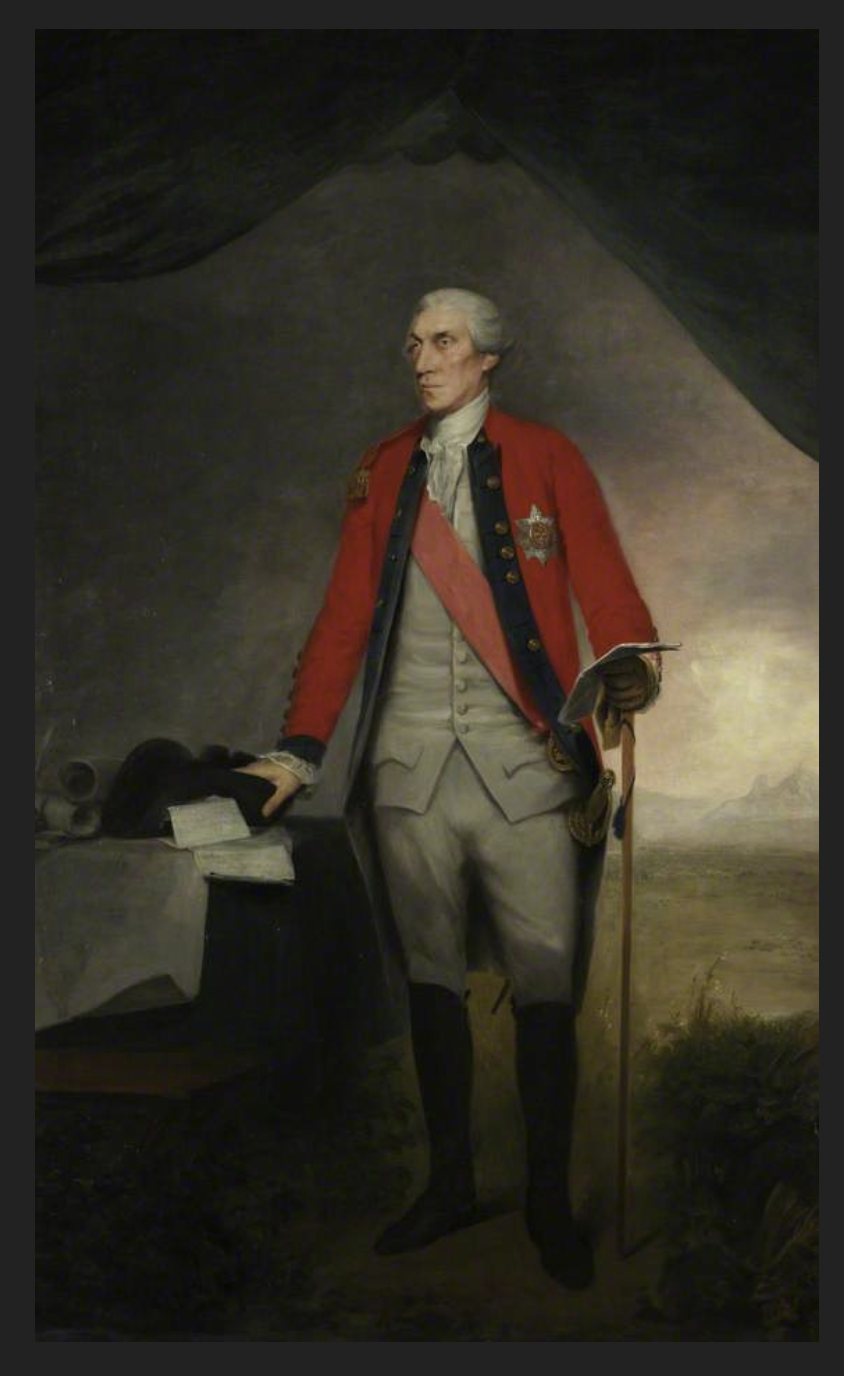
Donough O’Brien (1642-1717), 1st Baronet by Mary Beale, 1690. He lived in an earlier Dromoland Castle.
Lucia Hamilton, 1674, daughter of George Hamilton. Wife of Donough O’Brien, 1st Baronet, married in 1674. She died two years later, not long after the birth of his son and heir, Lucius.
Edward O’Brien (1705-1765) 2nd Baronet of Dromoland, County Clare from Historical memoir of the O’Briens : The Origin and History of the O’Brien Clan, by John O’Donoghue A.M, Barrister-at-Law, First Published in 1860 (Martin Breen 2002) Illustrations section (Collection of O’Brien of Dromoland), Public Domain, https://commons.wikimedia.org/w/index.php?curid=109837449
Mary Hickman, wife of Edward O’Brien, 2nd Baronet, from Historical memoir of the O’Briens : The Origin and History of the O’Brien Clan, by John O’Donoghue A.M, Barrister-at-Law, First Published in 1860 (Martin Breen 2002) Illustrations section, Public Domain, https://commons.wikimedia.org/w/index.php?curid=109837783

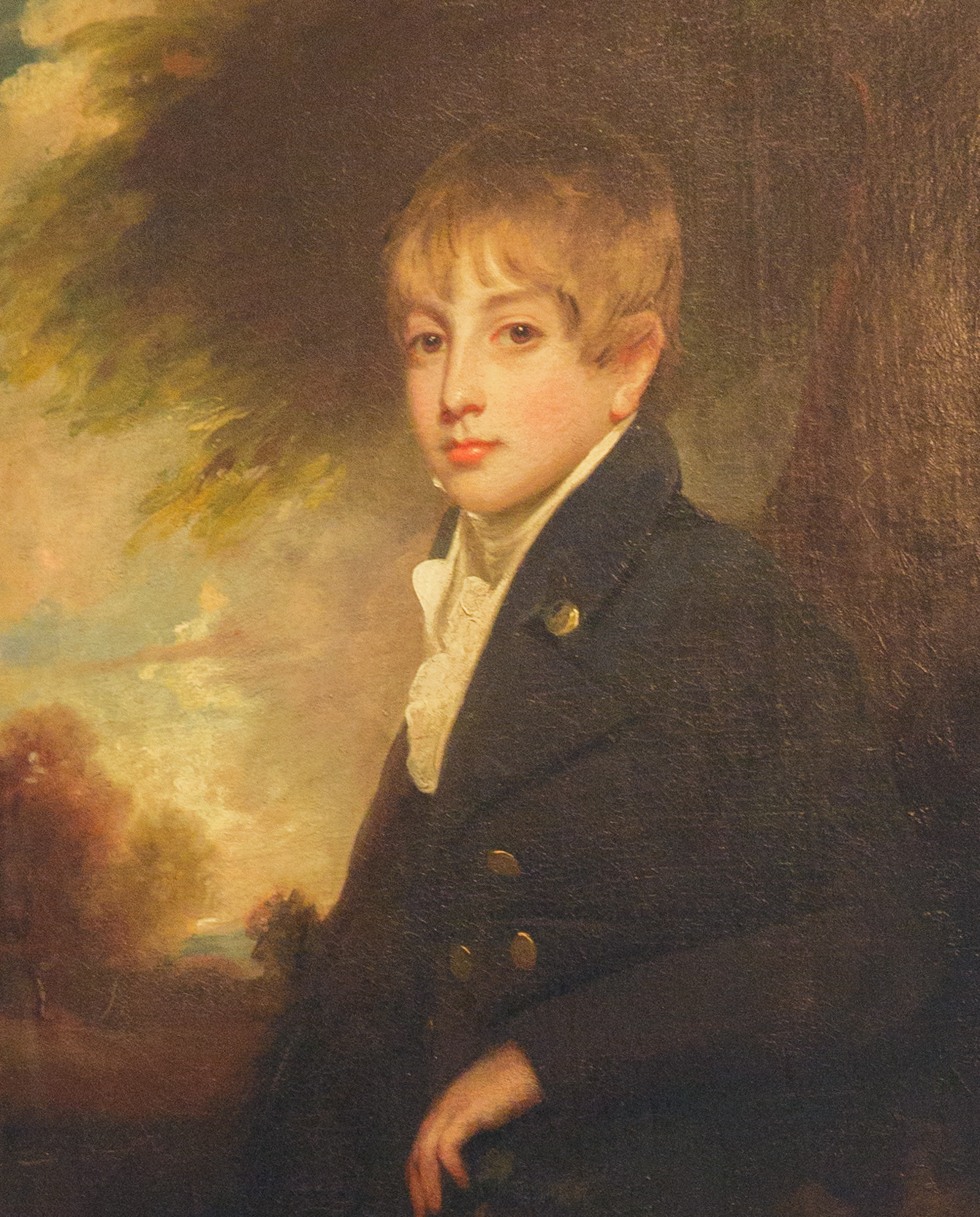
Lucius Henry O’Brien, 3rd Baronet of Dromoland, County Clare (1731-95) also lived in 14 Henrietta St from 1767-1795 – for more about him, see Melanie Hayes, The Best Address in Town: Henrietta Street, Dublin and its First Residents 1720-80, published by Four Courts Press, Dublin 8, 2020. 

Dromoland Castle, Co Clare, NLI, Lawrence Photographic Collection photo by Robert French.

6. Falls Hotel, formerly Ennistymon House, Ennistymon, Co. Clare  €€

Falls Hotel, photograph for Failte Ireland, 2021. [see Ireland’s Content Pool]. (see [1])

www.fallshotel.ie 

Mark Bence-Jones writes in A Guide to Irish Country Houses (1988):

p. 121. “(Macnamara/IFR) :A two storey seven bay gable-ended C18 house with a two bay return prolonged by a single-storey C19 wing ending in a gable. One bay pedimented breakfront with fanlighted tripartite doorway; lunette window in pediment. Some interior plasterwork, including a frieze incorporating an arm embowed brandishing a sword – the O’Brien crest – in the hall. Conservatory with art-nouveau metalwork; garden with flights of steps going down to the river. The home of Francis MacNamara, a well-known bohemian character who was the father-in-law of Dylan Thomas and who married, as his second wife, the sister of Augustus John’s Dorelia; he and John are the Two Flamboyant Fathers in the book of that name by his daughter, Nicolette Shephard.” 

Ennistymon House (between ca. 1865-1914), County Clare, photograph by Robert French, Lawrence Photograph Collection, National Library of Ireland.

7. Gregan’s Castle Hotel, County Clare €€€

WWW.GREGANS.IE

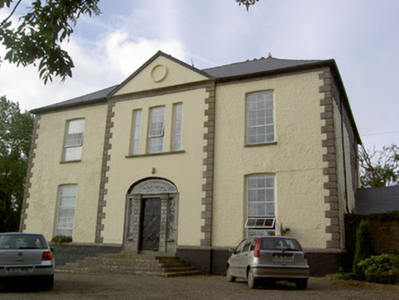
Gregan’s Castle hotel, County Clare, photograph from National Inventory of Architectural Heritage.

The National Inventory tells us Gregan’s Castle was built in 1750. It tells us Gregan’s Castle is a: “six-bay two-storey house, built c. 1750, with half-octagonal lower projection. Extended c. 1840, with single-bay two-storey gabled projecting bay and single-storey flat-roofed projecting bay to front. Seven-bay two-storey wing with single-storey canted bay windows to ground floor, added c. 1990, to accommodate use as hotel.”

The website tells us:

Welcome to Gregans Castle Hotel. Please take a look around our luxury, eco and gourmet retreat, nestled in the heart of the beautiful Burren on Ireland’s west coast. The house has been welcoming guests since the 1940s and our family have been running it since 1976. Our stunning 18th century manor house is set in its own established and lovingly-attended gardens on the Wild Atlantic Way, and has spectacular views that stretch across the Burren hills to Galway Bay.

Inside, you’ll find welcoming open fires, candlelight and striking decoration ranging from modern art, to antique furniture, to pretty garden flowers adorning the rooms. Gregans Castle has long been a source of inspiration for its visitors. 

Guests have included J.R.R Tolkien, who’s said to have been influenced by the Burren when writing The Lord of the Rings, as well as other revered artists and writers such as Seamus Heaney and Sean Scully.

And for the guests of today: with warm Irish hospitality, stylish accommodation, outstanding service and exceptional fine dining in our award-winning restaurant, we truly are a country house of the 21st century. You can do nothing or everything here. And whatever you choose, we’d like you to join us in celebrating all that is wondrous and beautiful in this truly exceptional place.

Simon Haden and Frederieke McMurray

8. Loop Head Lightkeeper’s Cottage, County Clare €€ for 2; € for 4-6

https://www.irishlandmark.com/properties/

Perched proudly on an enclosure at the tip of Loop Head stands the lighthouse station. Surrounded by birds and wild flowers, cliffs and Atlantic surf, Loop Head offers holiday accommodation with all of the spectacular appeal of the rugged west coast.

https://www.mountcallanhouse.ie

Culleen, Kilmaley,
County Clare, V95 NV0T

Mark Bence-Jones writes in A Guide to Irish Country Houses (1988):

p. 212. (Synge/IFR; Tottenham/IFR) A Victorian house of two storys over basement built 1873 by Lt Col G.C. Synge and his wife, Georgiana, who was also his first cousin, being the daughter of Lt-Col Charles Synge, the previous owner of the estate. The estate was afterwards inherited by Georgiana Synge’s nephew, Lt-Col F. St. L. Tottenham, who made a garden in which rhododendrons run riot and many rare and tender species flourish.” 

The website tells us:

Mount Callan House & Restaurant is situated in the beautiful surroundings of West Clare in the heart of Kilmaley village. We are a small, family-run restaurant, led by Chef Daniel Lynch, and guest house with a deep connection to our rural community.

The local landscape is our inspiration and our food is created using the very best seasonal ingredients from award-winning, local suppliers.

We encourage creativity, a good working environment and a community approach for the benefit of all.

10. Mount Cashel Lodge, Kilmurry, Sixmilebridge, Co Clare period self-catering accommodation €

https://www.mtcashel.com

and Stables https://hiddenireland.com/stay/self-catering-holiday-rentals/

The website describes it: “Enjoy luxury self-catering accommodation in these beautifully restored 18th Century lakeside lodges. Set in a 38 acre private landscaped estate with private Lake, riverside walk and Victorian cottage garden to explore. Lake boating, kayaking and fishing are available on site to complete this idyllic retreat.

11. Newpark House, Ennis, County Clare €

https://www.newparkhouse.com/rates/

Newpark House, County Clare by Jen on flickr constant commons, 2016.

The website tells us: “Newpark House was built around 1750, and since then it has been the property of three families: the Hickmans, the Mahons and the Barrons.

The Hickmans came into the possession of Cappahard Estate in 1733. On part of this estate, Gortlevane townland, Richard Hickman built a house and landscaped around it. Around this time he re-named the townland Newpark. Several of those trees from the planting of the new park still survive. 
On his marriage in 1768 his father transferred the property to Richard. He died in 1810 and this property transferred to his son Edward Shadwell Hickman. Edward was a Crown Solicitor in Dublin and put the property up for rent. 

“The Mahons: Patrick Mahon, a member of the new up and coming Catholic gentry, took up this offer and moved his family into Newpark. The Mahon family were very involved in the campaign for equal rights for Catholics in Ireland. Patrick’s son, James Patrick commonly known as The O’Gorman Mahon, nominated Daniel O’Connell to contest the famous Clare Election of 1828. O’Connell’s victory in this election resulted in the granting of Catholic Emancipation in 1829. It is highly likely that Daniel O’Connell stayed at Newpark during his visits to Ennis at this time. O’Gorman Mahon (1802-1891) had a very colourful life which ranged from hunting bears in Finland with a Russian Tzar to becoming a Colonel and Aide-de-Camp to the President of Costa Rica. Back in Ireland he is said to have introduced Parnell to Kitty O’Shea. 

While the Mahon family were living here they totally remodled the house. They added on wings and castlated the house in the Gothic revival style which was fashionable in Ireland at that time. The architect responsible would seem to be either John Nash or one of his former apprentices, the Pain brothers, all three were working in the area at this time.

 “Of special historical significance is a pair of crosses on the turrets of the house. These crosses have shamrocks on the ends and were put there to commerate Catholic Emancipation. The Mahon family purchased the estate outright in 1853 and held it until 1904. 

At times when Newpark was owned by the Hickmans and Mahons several other families and individuals lived there. The Ennis poet Thomas Dermody spent time here with his father before he set off from Newpark, in 1785, for Dublin, in search of fame and fortune. Thomas remarked on the comfort he felt at Newpark during his time there. Also to have lived at Newpark were Captain William Cole Hamilton, a Magistrate (1870-1876), William Robert Prickett (1883-1886) and Philip Anthony Dwyer (1888-1904), Captains in the local Clare Division of the British Army. 

“The Barrons: In 1904 the property came into ownership of the present family, the Barrons. 
Timothy ‘Thady’ Barron was born on the side of the road, in 1847, during the famine. His father had lost his herdsman job, along with the herdsman’s cottage, due to a change of landlord. After a few tough years his father got another herdsmans job and Thady followed in his fathers footsteps. Thady moved in to Newpark in 1904 with his family and he lived he until his death in 1945. In the 1950s Thady’s son James ‘Amy’ bought the property from his sister Nance. In 1960 Amy’s son Earnan and his new wife Bernie moved into a barely habitable Newpark House. They set about slowly but surely bringing the house back to live. Luckily for them they got an opportunity to furnish the house with antiques, which were at that time considered second-hand furniture. Bernie opened up Newpark House as a B&B in 1966. Her son, Declan, is the present owner and we are looking forward to 50 years in business in 2016.”
“The Barrons: In 1904 the property came into ownership of the present family, the Barrons. 
Timothy ‘Thady’ Barron was born on the side of the road, in 1847, during the famine. His father had lost his herdsman job, along with the herdsman’s cottage, due to a change of landlord. After a few tough years his father got another herdsmans job and Thady followed in his fathers footsteps. Thady moved in to Newpark in 1904 with his family and he lived he until his death in 1945. In the 1950s Thady’s son James ‘Amy’ bought the property from his sister Nance. In 1960 Amy’s son Earnan and his new wife Bernie moved into a barely habitable Newpark House. They set about slowly but surely bringing the house back to live. Luckily for them they got an opportunity to furnish the house with antiques, which were at that time considered second-hand furniture. Bernie opened up Newpark House as a B&B in 1966. Her son, Declan, is the present owner and we are looking forward to 50 years in business in 2016.”

12. Smithstown Castle (or Ballynagowan), County Claretower house € for 4-8 for one week

http://smithstowncastle.com 

Ballynagowan Castle County Clare by Neale Adams, 2011 on flickr constant commons.

From the website:

Only few castles in the West of Ireland have survived into our times. Ballynagowan (Smithstown) Castle has played an exciting role in the history of North Clare, taking its name from ‘beal-atha-an-ghobhan’, meaning the ‘mouth of the smith’s ford’. 

It was first mentioned in 1551 when the last King of Munster, Murrough O’Brien, (also known as the Tanist, was created 1st Earl of Thomond and 1st Baron of Inchiquin in 1543), willed the Castle of Ballynagowan to his son Teige before his death. 

Murrough O’Brien (1614-1674) 1st Earl of Inchiquin by John Michael Wright courtesy of Manchester Art Gallery.

Over the years it accommodated many famous characters of Irish history. Records show that in 1600 the legendary Irish rebel “Red” Hugh O’Donnell rested there with his men during his attack on North Clare, spreading ruin everywhere and seeking revenge on the Earl of Thomond for his being in alliance with the English. 

In 1649 Oliver Cromwell’s army came from England with death and destruction. The Castle was attacked with cannons when Cromwell’s General, Ludlow, swept into North Clare striking terror everywhere he went. 

In 1650 Conor O’Brien of Lemeneagh became heir of the castle. His death, however, came shortly afterwards in 1551, as he was fatally wounded in a skirmish with Cromwellian troops commanded by General Ludlow at Inchicronan. With him had fought his wife Maire Rua O’Brien (“The Red Mary”, named after her long red hair), one of the best known characters in Irish tradition. She had lived in the castle as a young woman and it is the ferocity and cruelty attributed to her, which has kept her name alive. Legends tell that to save her children’s heritage after Conor’s death she married several English generals, who were killed in mysterious ways one after the other- she supposedly ended her bloody carrier entombed in a hollow tree. 

During 1652 almost all inhabitable castles in Clare including Smithstown were occupied by Cromwellian garrisons, a time of terrible uncertainty as Clare was under military rule. 

Over the next decades Ballynagowan Castle was the seat of army generals, the High Sheriff of County Clare and Viscount Powerscourt, one of the most powerful aristocrats who had their main residence – a monumental neogothic palace – in Dublin.  

The castle was last inhabited mid 19th century and until its recent restauration served as beloved meeting point for couples -, songs and poems about it finding their way into the local pubs.

13. Strasburgh Manor coach houses, Inch, Ennis, County Clare

https://www.strasburghmanor.com/about-strasburgh-manor/

The website tells us:

The buildings that comprise the holiday homes were the coach houses attached to the House.

Once occupied by James Burke, who was killed in the French Revolution in 1790, the House was named after the French town of Strasbourg.

It figured prominently in Irish history up to its demise in 1921, when it was burned down during the Irish War of Independence.

Families associated with it included: Burke, Daxon, Stacpoole, Huxley, Mahon, Talbot, Taylor, Scott & McGann (ref: ‘Houses of Clare’ by Hugh Weir, published by Ballinakella Press, Whitegate, Co. Clare).

Whole House Rental, County Clare

1. Inchiquin House, Corofin, County Clare – whole house rental, €€€ for 2, € for 6-10

https://www.irishlandmark.com/propertytag/cottages-and-houses/?gclid=Cj0KCQiApL2QBhC8ARIsAGMm-KFInICcRSxwLSiDxfFNk5WFytNcVrLvOQYhzJbIBes4V-M65iXz0gYaAln_EALw_wcB

Inchiquin House, County Clare by Conall, 2021 on flickr constant commons.

The website tells us “Inchiquin House is an elegant period home in County Clare, romantically tucked away in the west of Ireland not far from the Wild Atlantic Way. It is the perfect base from which to explore the unique Burren landscape, historic sites, and the region’s many leisure activities.

2. Mount Vernon lodge, Co Clare – whole house accommodation € for 7-11 people 

https://www.mountvernon.ie

Mount Vernon is a lovely Georgian Villa built in 1788 on the Burren coastline of County Clare with fine views over Galway Bay and the surrounding area. 

Built in 1788 for Colonel William Persse on his return from the American War of Independence, Mount Vernon was named to celebrate his friendship with George Washington. The three remaining cypress trees in the walled garden are thought to have been a gift from the President. 
 
During the nineteenth century Mount Vernon was the summer home of Lady Augusta Gregory of Coole, an accomplished playwright and folklorist and a pivotal figure in the Irish Cultural Renaissance. It was her collaboration with W.B.Yeats and Edward Martyn that created the Abbey Theatre in Dublin in 1904. Lady Gregory entertained many of the luminaries of the Irish Literary Revival at Mount Vernon including W.B.Yeats, AE (George Russell), O’Casey, Synge and George Bernard Shaw. 
 
In 1907 Lady Gregory gave the house to her son Robert Gregory as a wedding present and it was from here that he produced many of his fine paintings of the Burren landscape. He later joined the Royal Flying Corps and was shot down by ‘friendly fire’ in 1918, an event commemorated by W.B.Yeats in his famous poem, An Irish Airman Foresees his Death. 

A feature from this period are the unusual fireplaces designed and built by his close friend the pre-Raphaelite painter Augustus John.

[1] https://www.irelandscontentpool.com/en

[2] p. 49. Bence-Jones, Mark. A Guide to Irish Country Houses (originally published as Burke’s Guide to Country Houses volume 1 Ireland by Burke’s Peerage Ltd. 1978); Revised edition 1988 Constable and Company Ltd, London.

[3] https://repository.dri.ie/catalog?f%5Broot_collection_id_ssi%5D%5B%5D=pk02rr951&mode=objects&search_field=all_fields&view=grid

[4] https://www.irishhomesandgardens.ie/irish-architecture-history-part-1/

[5] https://www.geni.com/projects/Historic-Buildings-of-County-Clare/29203

[6] http://lordbelmontinnorthernireland.blogspot.com

[7] Craig, Maurice and Knight of Glin [Desmond Fitzgerald] Ireland Observed. A handbook to the Buildings and Antiquities. The Mercier Press, Dublin and Cork, 1970.

[8] p. 103. Craig, Maurice. The Architecture of Ireland from the Earliest Times to 1880, Lambay Books, Portrane, County Dublin, first published 1982, this edition 1997, p. 103.

[9] https://www.buildingsofireland.ie/buildings-search/building/20400502/newtown-art-college-newtown-burren-co-clare

[10] https://www.geni.com/projects/Historic-Buildings-of-County-Clare/29203

Text © Jennifer Winder-Baggot, www.irishhistorichouses.com

Happy new year!

Happy new year and best wishes for 2023 to all my readers!

As you may recall if you are a regular visitor, the updated Revenue Section 482 list for the year is not normally published until February. So if you are making some visits to properties in January I recommend using the 2022 list and contacting a property in advance to see if it is open.

I still have to write up many properties that I have visited – all properties from Heritage week onwards. I took a hiatus to work on my calendars for 2023. I am now working on a calendar that will publish the opening dates of all of the properties for 2023, which I will publish once the 2023 Revenue Section 482 list is published.

Each property opens on different dates, so planning routes around the country to visit when neighbouring properties are open takes some work! To help you to plan, I am listing for each date which properties are open on that date. I am listing properties by number, as it would take too much space to list every property open on every day, considering that there were 187 properties in 2022. To make it easier, I am colour-coding the properties by province, so that one can scan and see where neighbouring properties are open.

Each year I try to visit as many properties as possible, taking holidays for the most far-flung counties from Dublin, and during Heritage Week, going on a tour of as many properties as possible all over the country, as all the properties are open on those dates (unless they are listed as Accommodation, in which case, they do not have to be open during Heritage Week).

I will be publishing photographs of properties in the calendar, to create a book. Here is a sample of how the calendar will look:

I hope that some of my readers would like to purchase my calendars! It will give you a go-to hard copy for planning your visits to historic houses in Ireland, full of photographs of places to be discovered. (I will publish details as to how to order a copy, and the price, once the dates have been finalised).

A summary of 2022 and previous years

As 2022 is entering its final dark days, I thought I’d look over our last few years, to see how we are doing on the project of visiting Section 482 properties. I began the project in April 2019 with a visit to Slane Castle, in County Meath. That was an impressive start to our project.

Slane Castle, County Meath, 26th April 2019, formerly owned by the Flemings and then the Conynghams. Photograph © Jennifer Winder-Baggot, www.irishhistorichouses.com

I gathered notes on properties I had already visited, during Open House or Heritage weeks in previous years. As you can see, my interest in historic houses predated my discovery of the Section 482 scheme. In fact, in a PhD I started but never finished, about aesthetic experience, I began my thesis by attempting to capture a moment of aesthetic experience: that of looking at a historic house. It’s lovely to see how I was already trying to understand what it is that draws me to such places.

We’ve visited 87 of the properties so far!

Properties we’d visited before I learned of the Section 482 list include:

Loughcrew, County Meath, May 2010 – our combined Hen and Stag weekend, before Stephen and I married!

Lough Crew 22nd May 2010, where Stephen and I had our combined Hen and Stag weekend before our wedding. Photograph © Jennifer Winder-Baggot, www.irishhistorichouses.com
Lough Crew 22nd May 2010. Photograph © Jennifer Winder-Baggot, www.irishhistorichouses.com

11 North Great Georges Street, Dublin, during Open House 2012;

11 North Great Georges Street, Dublin. Photograph © Jennifer Winder-Baggot, www.irishhistorichouses.com

Old Glebe in Newcastle Lyons, County Dublin, during Heritage Week 2012;

“The Old Glebe,” Newcastle, County Dublin, Heritage Week, 17th August 2012. Photograph © Jennifer Winder-Baggot, www.irishhistorichouses.com

Primrose Hill, County Dublin, 17th August 2013

Primrose Hill, Lucan, Dublin, which may have been designed by James Gandon, who designed the Custom House in Dublin. Photograph © Jennifer Winder-Baggot, www.irishhistorichouses.com

Huntington Castle, County Carlow, in August 2016.

Huntington Castle, Clonegal, County Carlow, August 2016, home of the Esmondes and later, still related by marriage, the Durdin Robertsons. Photograph © Jennifer Winder-Baggot, www.irishhistorichouses.com

Russborough House, County Wicklow, April 2018

Russborough House, which I have visited several times, including in April 2018. Photograph © Jennifer Winder-Baggot, www.irishhistorichouses.com

I’d like to choose a House of the Year for each year. I should have started in my first year! In 2019 the competition is stiff and it seems a little unfair as my favourite dwarfs the others in size as well as in impressive interior: I have to choose Curraghmore, County Waterford, as my 2019 House of the Year! Although considering that we also visited Birr Castle, Dunsany and Borris House that year, it was a year full of wonderful discoveries. Lady Dunsany, who sadly passed away since, deserves a special mention as a warm, welcoming and delightful host.

In 2019 we set off at an ambitious pace, visiting a house nearly every weekend! We went on holidays to Waterford to see some of the lovely houses, and coincided with the day of lectures in Dromana on the topic of “The Pursuit of the Heiress.” In 2019 we visited:

Salterbridge, County Waterford, 3rd May 2019

Salterbridge, County Waterford. We visited in May 2019. Photograph © Jennifer Winder-Baggot, www.irishhistorichouses.com

Tourin, County Waterford, 3rd May 2019

Tourin House, County Waterford, home of the Jamesons, of former whiskey fame. Photograph © Jennifer Winder-Baggot, www.irishhistorichouses.com

Dromana, County Waterford, 5th May 2019

Dromana, County Waterford – the estate was the home of the Fitzgerald Lords of the Decies, and is owned by their descendants. Photograph © Jennifer Winder-Baggot, www.irishhistorichouses.com

Curraghmore, County Waterford, 5th May 2019, my chosen Home of the Year in 2019.

Curraghmore, County Waterford. The house is very large as it is not only seven bays wide but seven bays deep. It is still in the hands of the Le Poer Beresford family. Photograph © Jennifer Winder-Baggot, www.irishhistorichouses.com

Moone Abbey, County Kildare, May 18, 2019

View from Moone Abbey tower, County Kildare. The nearby Abbey has a large Celtic cross. We visited on Saturday May 18, 2019. Photograph © Jennifer Winder-Baggot, www.irishhistorichouses.com

Charleville, County Wicklow, 18th May 2019

Charleville, County Wicklow, visited on Saturday May 18th 2019. The surrounding formal gardens, never mind the impressive house, make it worth a visit. Photograph © Jennifer Winder-Baggot, www.irishhistorichouses.com

Loughton, County Offaly, 25th May 2019

Loughton, County Offaly, where we enjoyed meeting owners Andrew and Michael during our visit on May 25th, 2019. Photograph © Jennifer Winder-Baggot, www.irishhistorichouses.com

Altidore Castle, County Wicklow, 31st May 2019

Altidore Castle, County Wicklow, a seven bay, two storey over basement house, with Venetian (tripartite) window over a single-storey pillared porch, which houses a Robert Emmet museum. Photograph © Jennifer Winder-Baggot, www.irishhistorichouses.com

Moyglare House, County Meath, 2nd June 2019

Moyglare House, Maynooth, on the border of Counties Kildare and Meath, once owned by a Huguenot family, and before the current owners, it was a hotel. Photograph © Jennifer Winder-Baggot, www.irishhistorichouses.com

Leixlip Castle, County Kildare, 14th June 2019

Leixlip Castle, County Kildare, home to the late Desmond Guinness, founder of the Irish Georgian Society. Photograph © Jennifer Winder-Baggot, www.irishhistorichouses.com

Birr Castle, County Offaly, 21st June 2019

Birr Castle, County Offaly, 21st June 2019, home of the Earl of Rosse. Photograph © Jennifer Winder-Baggot, www.irishhistorichouses.com

Dunsany Castle, County Meath, 1st July 2019

Dunsany, County Meath, 1st July 2019, home of the Plunketts, Barons of Dunsany. Photograph © Jennifer Winder-Baggot, www.irishhistorichouses.com

Dardistown, County Meath, 13th July 2019

Dardistown, County Meath, July 2019, available for accommodation, where former owners included the powerful Jenet Sarsfield who had four husbands. Photograph © Jennifer Winder-Baggot, www.irishhistorichouses.com

Borris House, County Carlow, 23rd July 2019

Borris House, County Carlow, still home of its builders, the Kavanagh family. Photograph © Jennifer Winder-Baggot, www.irishhistorichouses.com

Ballymurrin, County Wicklow, 27th July 2019

Ballymurrin, County Wicklow, a former Quaker home which we visited on 27th July 2019. Photograph © Jennifer Winder-Baggot, www.irishhistorichouses.com

Clonalis, County Roscommon, 3rd August 2019

Clonalis, County Roscommon, which is still the home of the O Conor family, ancient High Kings of Ireland, with a family museum of historical documents, as well as a beautiful garden. Stephen and I were invited to join friends for a weekend in County Westmeath and took the opportunity to visit Clonalis House in County Roscommon. Photograph © Jennifer Winder-Baggot, www.irishhistorichouses.com

Tullynally, County Westmeath, 4th August 2019

Tullynally, County Westmeath, home of the Pakenhams, Lords Longford, now the home of Thomas Pakenham, brother to one of my favourite writers, Antonia Fraser. It has tours of the servants’ quarters all year around, and during Heritage Week, when we went in 2020, it has tours of the house itself. Photograph © Jennifer Winder-Baggot, www.irishhistorichouses.com

Tankardstown, County Meath, 9th August 2019

Tankardstown, County Meath, now a plush hotel. Photograph © Jennifer Winder-Baggot, www.irishhistorichouses.com

Swainstown House, County Meath, 19th August 2019

Swainstown, County Meath, still home of the Preston family. Photograph © Jennifer Winder-Baggot, www.irishhistorichouses.com

Harristown, County Kildare, 22nd August 2019

Harristown, County Kildare, a former La Touche home.

Blackhall Castle, County Kildare, 22nd August 2019

Blackhall Castle, County Kildare, a former Eustace (or Fitzeustace) home. Photograph © Jennifer Winder-Baggot, www.irishhistorichouses.com

Rokeby, County Louth, 7th September 2019

Rokeby, County Louth, with its elegant Richard Turner conservatory. Photograph © Jennifer Winder-Baggot, www.irishhistorichouses.com

Coolcarrigan, County Kildare, 21st September 2019

Coolcarrigan, County Kildare, visited September 2019. Its gardens are a treat. Photograph © Jennifer Winder-Baggot, www.irishhistorichouses.com

Castle Howard, County Wicklow, 28th September 2019

Castle Howard, County Wicklowa mixture of church and castle architecture. Photograph © Jennifer Winder-Baggot, www.irishhistorichouses.com

Barmeath Castle, County Louth, 15th October 2019

Barmeath Castle, County Louth, still home of the Bellews. Photograph © Jennifer Winder-Baggot, www.irishhistorichouses.com

Colganstown House, County Dublin, 23rd November 2019

Colganstown, County Dublin. Maurice Craig describes the plasterwork dragon by Robert West: “over the staircase window, presides a splendidly animated Chinese dragon, scaly wings outstretched, and his tail piercing the egg-and-dart moulding at the base of the cornice to emerge and recurve again, stabbing the plasterwork.” Photograph © Jennifer Winder-Baggot, www.irishhistorichouses.com

Castle Leslie, County Monaghan, 27-29th November 2019

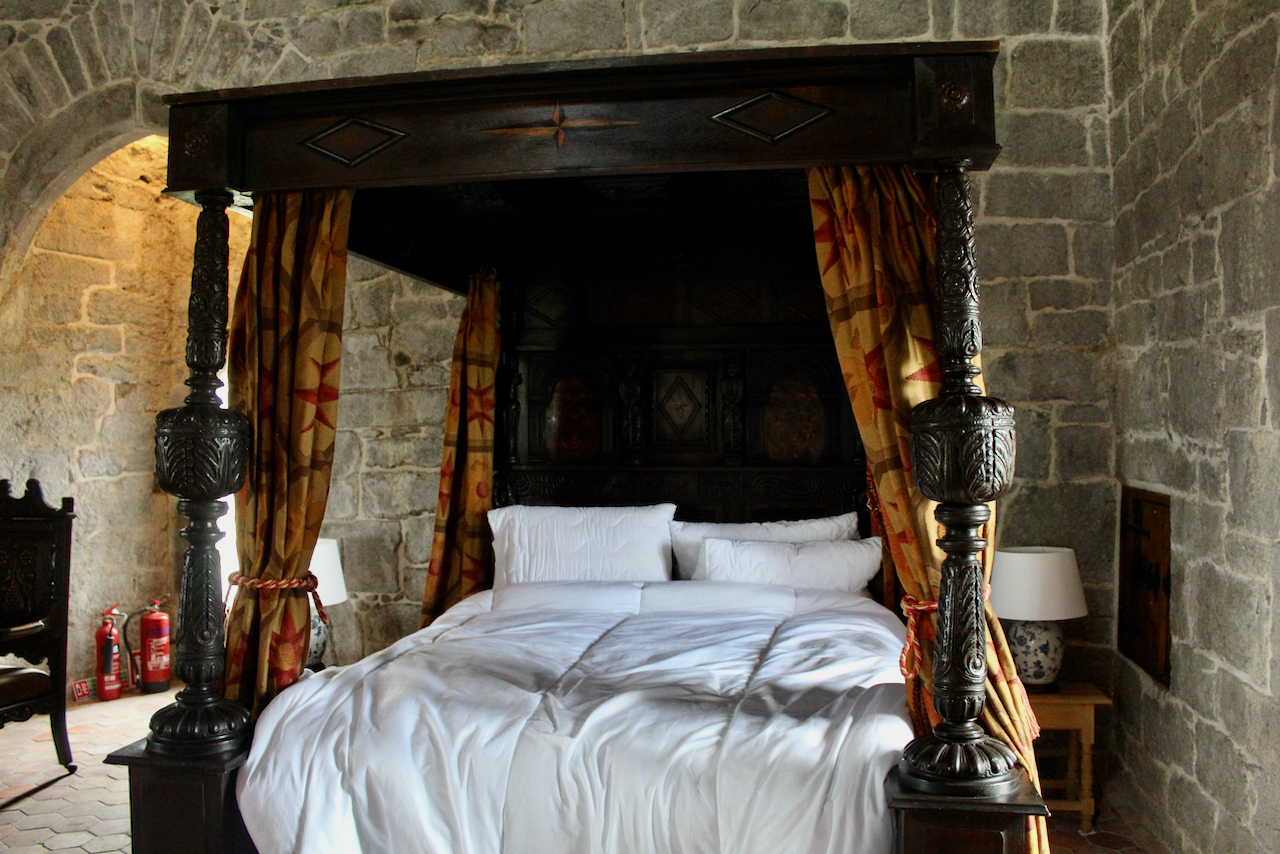
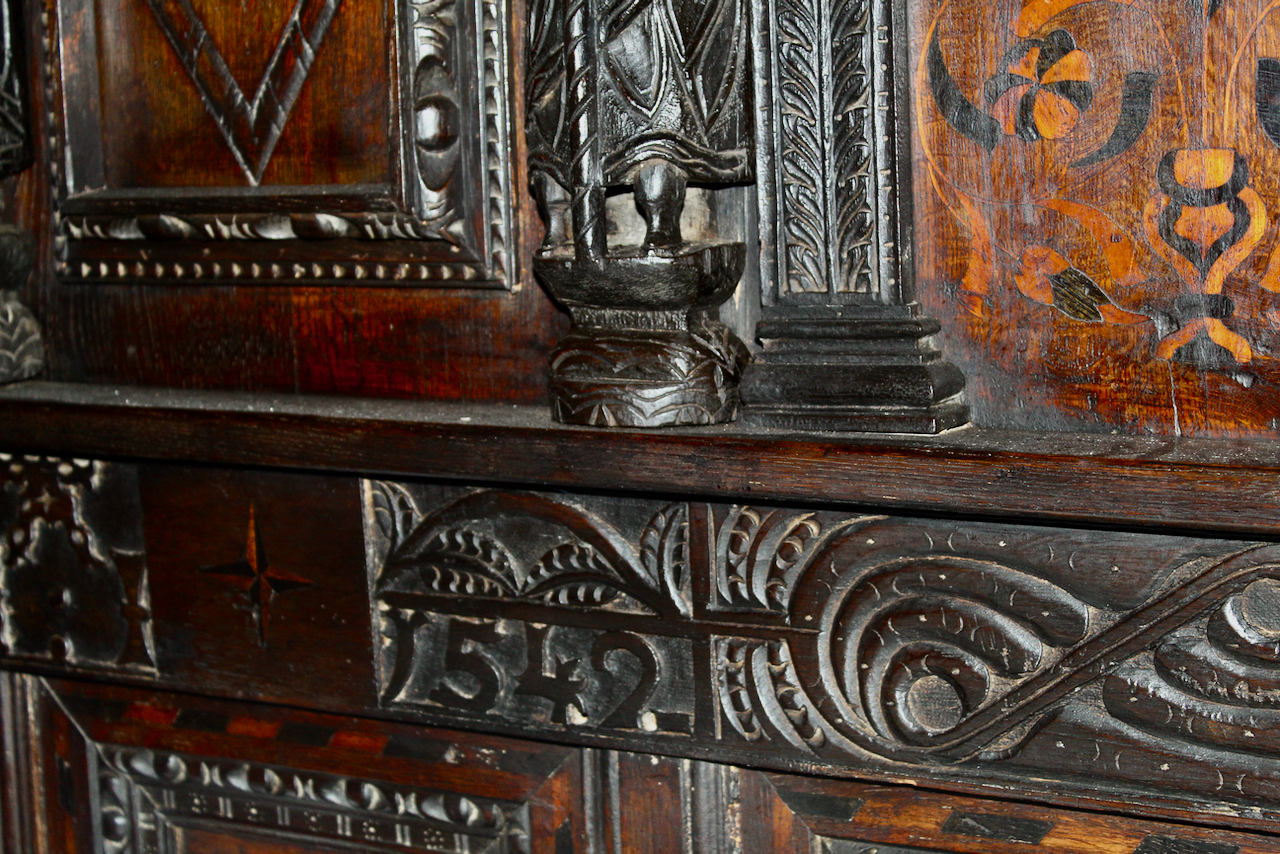
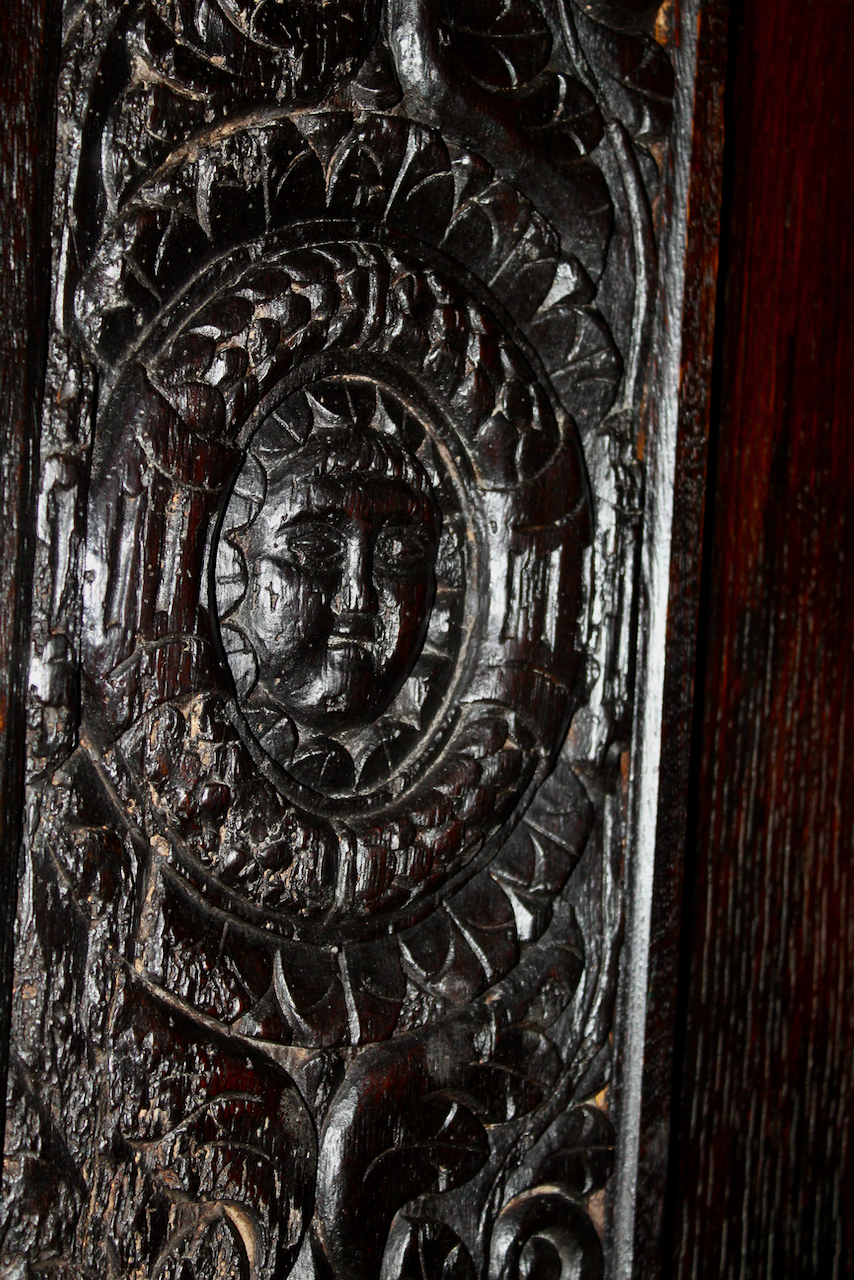
Castle Leslie, County Monaghan, where we slept in a bed carved in 1617. Now a hotel but still owned by the Leslies.

Powerscourt Townhouse, Dublin, December 2019

Powerscourt Townhouse, Dublin. I visited in order to take photographs in December 2019. Former townhouse of the Wingfields, Viscounts Powerscourt. Photograph © Jennifer Winder-Baggot, www.irishhistorichouses.com

In 2020, during Covid restrictions and even after, houses did not have to open to the public. However, some owners were kind and opened to us. We went on holiday down to County Cork during Heritage Week, and at the end of the year treated ourselves to two nights in Cabra Castle in County Cavan. My choice of Favourite House in 2020 is Ian Elliot’s Corravahan in County Cavan. Ian’s research deepened my appreciation of the house and its history. In 2020 we visited:

The Odeon, Dublin, 13th April 2020 (outside – we may have been in a lockdown at that point!)

The Odeon, formerly the Harcourt Street tram station, 13th April 2020. Photograph © Jennifer Winder-Baggot, www.irishhistorichouses.com

Old Rectory Killedmond, 1st July 2020

Old Rectory Killedmond, a five bay two storey Tudor-Gothic Revival house with three dormer windows and a loggia. We enjoyed meeting owner Mary White, a former Green politician and Irish representative to the European Union, with whom I bonded over our love of literature. Photograph © Jennifer Winder-Baggot, www.irishhistorichouses.com

Corravahan, County Cavan, 24th July 2020: My chosen Home of the Year in 2020.

Former Rectory Corravahan, County Cavan, home of the Beresfords. Owner Ian Elliot has taken great interest in the history of the house and the house is full of quirks.

Kilshannig, County Cork, 14th August 2020

Kilshannig, County Cork, which features stuccowork by Lafranchini brothers. Photograph © Jennifer Winder-Baggot, www.irishhistorichouses.com

Cappoquin, County Waterford, 15th August 2020

Cappoquin House, County Waterford, built for and still owned by the Keane family. Photograph © Jennifer Winder-Baggot, www.irishhistorichouses.com

Drishane House, County Cork, 20th August 2020

Drishane House, County Cork, former home of Edith Somerville, who wrote novels with her cousin Violet Martin, as “Somerville and Ross” – the latter the name of Violet Martin’s childhood home. Photograph © Jennifer Winder-Baggot, www.irishhistorichouses.com

Baltimore Castle, County Cork, 20th August 2020

Baltimore Castle, County Cork – it wasn’t open when we visited but I took a photograph. Photograph © Jennifer Winder-Baggot, www.irishhistorichouses.com

Cabra Castle, County Cavan, 23rd December 2020

Cabra Castle, County Cavan, formerly owned by the Pratt family and now a hotel. Photograph © Jennifer Winder-Baggot, www.irishhistorichouses.com

In 2021 the house that really blew my socks off and has to be given my Favourite Home of the Year award is Stradbally in County Laois. Again in 2021 houses did not have to be open if owners were concerned about the spread of Covid-19. We managed to visit quite a few, however, and were able to go on holidays during Heritage week, when we travelled to Sligo and Mayo and back home through County Kilkenny. Special award goes to our lovely hosts Nicola and Durcan at Annaghmore, County Sligo, where we stayed during our visits in Mayo and Sligo. Special mention also goes to Wilton Castle in County Wexford, whose owners have done a tremendous job in renovations after it lay a roofless ruin for years. In 2021 we visited:

Killruddery, County Wicklow, 24th April 2021

Killruddery House, May 2013we also visited in July 2020 and 24th April 2021. In June 2015 we were given a tour of the house as part of our membership of the Irish Decorating and Fine Arts Society, but we have yet to take another tour, since I learned about the Section 482 scheme. I look forward to it next year in 2023. Photograph © Jennifer Winder-Baggot, www.irishhistorichouses.com

Mount Usher, County Wicklow, 6th June 2021

Mount Usher, County Wicklow, an example of a “Robinsonian” garden, after William Robinson who wrote “The Wild Garden.” Photograph © Jennifer Winder-Baggot, www.irishhistorichouses.com

Stradbally Hall, County Laois, 7th June 2021, my Home of the Year 2021.

Stradbally, County Offaly. Built for the Cosby family, who still own it. Photograph © Jennifer Winder-Baggot, www.irishhistorichouses.com

Killineer, County Louth, 9th June 2021

Killineer, County Louth. Built for a wealthy merchant of Drogheda. Photograph © Jennifer Winder-Baggot, www.irishhistorichouses.com

Burtown, County Kildare, 23rd June 2021

Burtown, County Kildare. We had booked a visit with the Fennells but they were busy preparing to open the restaurant The Green Barn that day, for the first day after a prolonged lockdown, so my visit inside the house has had to be postponed. Photograph © Jennifer Winder-Baggot, www.irishhistorichouses.com

Salthill Garden, County Donegal, July 2021

Salthill Garden, County Donegal. The house, not open to the public, was formerly the house for the agent of the Conynghams of The Hall, Mountcharles, who later purchased Slane Castle. Photograph © Jennifer Winder-Baggot, www.irishhistorichouses.com

Markree Castle, County Sligo, 16th August 2021

Markree Castle, County Sligo, originaly owned by the Cooper family, it is now a hotel. Photograph © Jennifer Winder-Baggot, www.irishhistorichouses.com

Newpark, County Sligo, 16th August 2021

Newpark, County Sligo, home to the Kitchen family, descended from the O’Haras who own Annaghmore house and Coopershill. Photograph © Jennifer Winder-Baggot, www.irishhistorichouses.com

Enniscoe, County Mayo, 17th August 2021

Enniscoe, County Mayo, still in the hands of the same family, descended from the Jacksons. Photograph © Jennifer Winder-Baggot, www.irishhistorichouses.com

Coopershill, County Sligo, 18th August 2021

Coopershill, County Sligo, home to the O’Haras, descendants of the original Cooper family. Photograph © Jennifer Winder-Baggot, www.irishhistorichouses.com

Kilfane, County Kilkenny, 23rd August 2021

Kilfane, County Kilkennyonly the grounds are open, which are developed into a wonderful haven of the Picturesque, with thatched cottage and small waterfall. Photograph © Jennifer Winder-Baggot, www.irishhistorichouses.com

Wilton Castle, County Wexford, November 2021

Wilton Castle, County Wexford – the owners have done a marvellous renovation of what was previously a roofless ruin. It is available for accommodation. Photograph © Jennifer Winder-Baggot, www.irishhistorichouses.com

And this year, in 2022, we went on holiday in June to County Cork to visit some historic houses. Then we did another tour of the country during Heritage Week. My favourite, to be awarded House of the Year 2022, is Bantry House, although special mention must go to St. Mary’s Abbey House in Trim, which is a real gem. During 2022 we visited:

Springfield House, County Offaly, January 2022

Springfield, County Offaly, where Muirean and her husband kindly gave us a tour. Photograph © Jennifer Winder-Baggot, www.irishhistorichouses.com

Ballysallagh, County Kilkenny, 12th February 2022

Ballysallagh, County Kilkenny, awarded a prize in 2020 for its renovation, maintenance, and winter garden. Photograph © Jennifer Winder-Baggot, www.irishhistorichouses.com

Bewleys Cafe, Dublin, 6th March 2022

Bewleys Cafe, established by the Quaker Bewley family, home of Harry Clarke stained glass windows. Photograph © Jennifer Winder-Baggot, www.irishhistorichouses.com

Beauparc House, County Meath, 15th March 2022

Beauparc, County Meath, passed from Lambart relative to the current Marquess Conyngham of Slane. Photograph © Jennifer Winder-Baggot, www.irishhistorichouses.com

Powerscourt Estate, County Wicklow, March 2022

10th December 2009, my Dad and Stephen, when we went to Powerscourt to celebrate my birthday. Stephen and I visited again in March 2022. Photograph © Jennifer Winder-Baggot, www.irishhistorichouses.com

Martello Tower Portrane, County Dublin, 23rd April 2022

Martello Tower, Portranea former defensive tower built in the reign of Napoleon of France. Photograph © Jennifer Winder-Baggot, www.irishhistorichouses.com

Larchill, County Kildare, 8th May 2022

Larchill, County Kildare, a former Quaker home, complete with Arcadian garden. Photograph © Jennifer Winder-Baggot, www.irishhistorichouses.com

St. Mary’s Church, Dublin, May 2022

St. Mary’s Church, now a bar, it was one of the oldest parishes on the north side of the city in Dublin. Photograph © Jennifer Winder-Baggot, www.irishhistorichouses.com

St. Mary’s Abbey, Trim, County Meath, May 2022

St. Mary’s abbey house, County Meath – this may have been part of the medieval St. Mary’s Abbey next to Trim Castle. Photograph © Jennifer Winder-Baggot, www.irishhistorichouses.com

Kildrought, County Kildare, 28th May 2022

Kildrought, County Kildare, a beautifully restored home and garden on the banks of the Liffey. Photograph © Jennifer Winder-Baggot, www.irishhistorichouses.com

Bantry House, Cork, 8th June 2022. My Home of the Year 2022.

Bantry House, County Cork, a treasurehouse of culture. Photograph © Jennifer Winder-Baggot, www.irishhistorichouses.com

Blarney House, Cork, 7th June 2022

Blarney House, County Cork, belonging still to the family who lived in Blarney Castle. Photograph © Jennifer Winder-Baggot, www.irishhistorichouses.com

Blarney Castle, Cork, 7th June 2022

Blarney Castle, County Cork. Photograph © Jennifer Winder-Baggot, www.irishhistorichouses.com

Riverstown House, County Cork, June 2022

Riverstown, County Cork, home of Lafranchini plasterwork. Photograph © Jennifer Winder-Baggot, www.irishhistorichouses.com

Former Hibernian Bank, Dublin, 25th June 2022

Former Hibernian Bank, Dublin. Photograph © Jennifer Winder-Baggot, www.irishhistorichouses.com

Oakfield Park, County Donegal, 2nd July 2022

Oakfield Park gardens, County Donegal. Photograph © Jennifer Winder-Baggot, www.irishhistorichouses.com

Killeen Mill, County Meath, 16th July 2022

Killeen Mill, July 2022. We stopped by to have a look on a day we revisited Dunsany Castle. It is available for accommodation. Photograph © Jennifer Winder-Baggot, www.irishhistorichouses.com

St. George’s, Killiney, County Dublin, August 2022

St. George’s, Dublin, an Arts and Crafts house by George Ashlin for his wife Mary Pugin, daughter of the famous church architect. Photograph © Jennifer Winder-Baggot, www.irishhistorichouses.com

The Turret, County Limerick, August 2022

The Turret, County Limerick, built in 1683. Photograph © Jennifer Winder-Baggot, www.irishhistorichouses.com

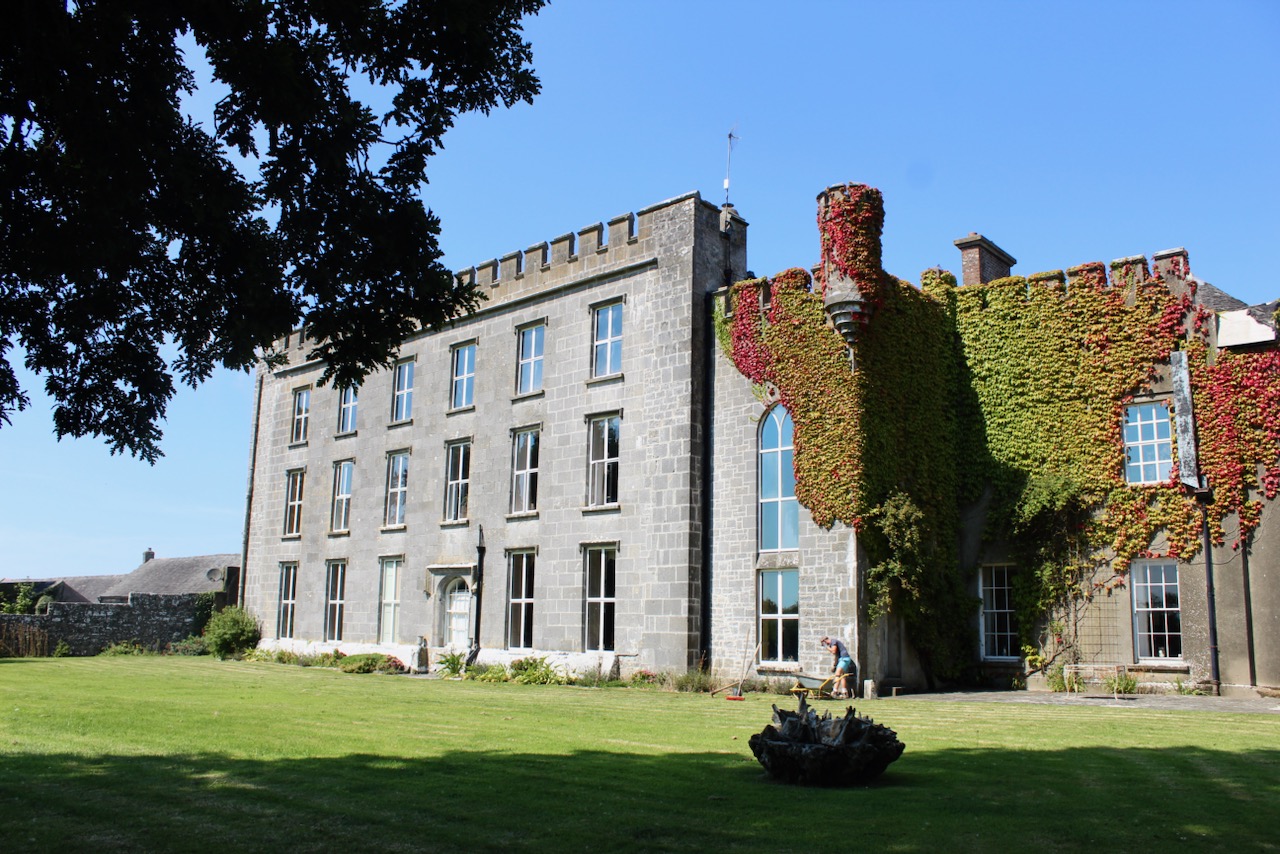
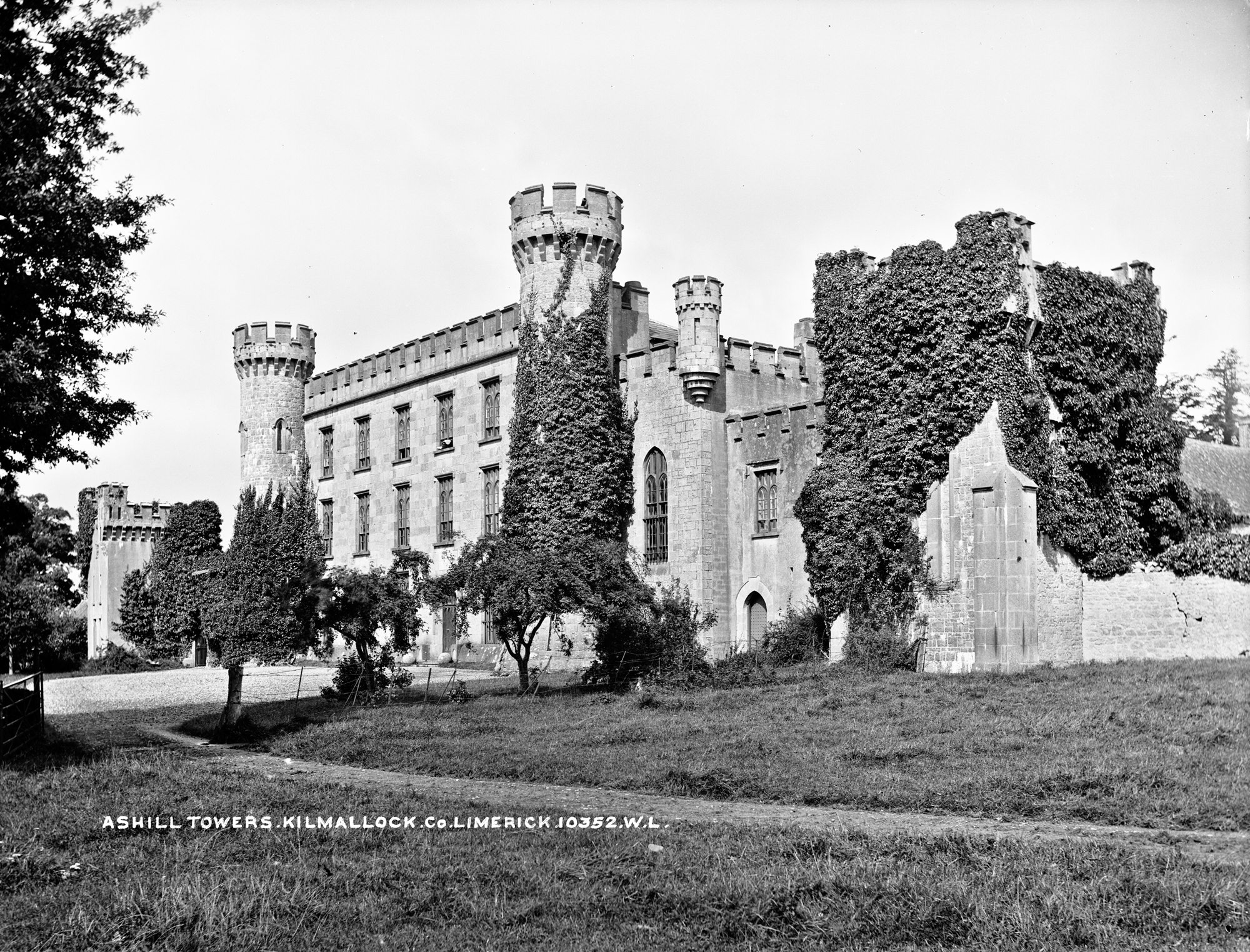
Ashill, County Limerick, 12-15th August 2022

Ashill, County Limerick, where we treated ourselves to three nights’ stay. Photograph © Jennifer Winder-Baggot, www.irishhistorichouses.com

Beechwood, County Tipperary, 13th August 2022

Beechwood, County Tipperary, August 2022 – I still have to write up about our visit to this lovely former Rectory. Photograph © Jennifer Winder-Baggot, www.irishhistorichouses.com

Glenview, County Limerick, 14th August 2022

Glenville, County Limerick, a former home of the Massey family, we enjoyed our visit with the current owners. Photograph © Jennifer Winder-Baggot, www.irishhistorichouses.com

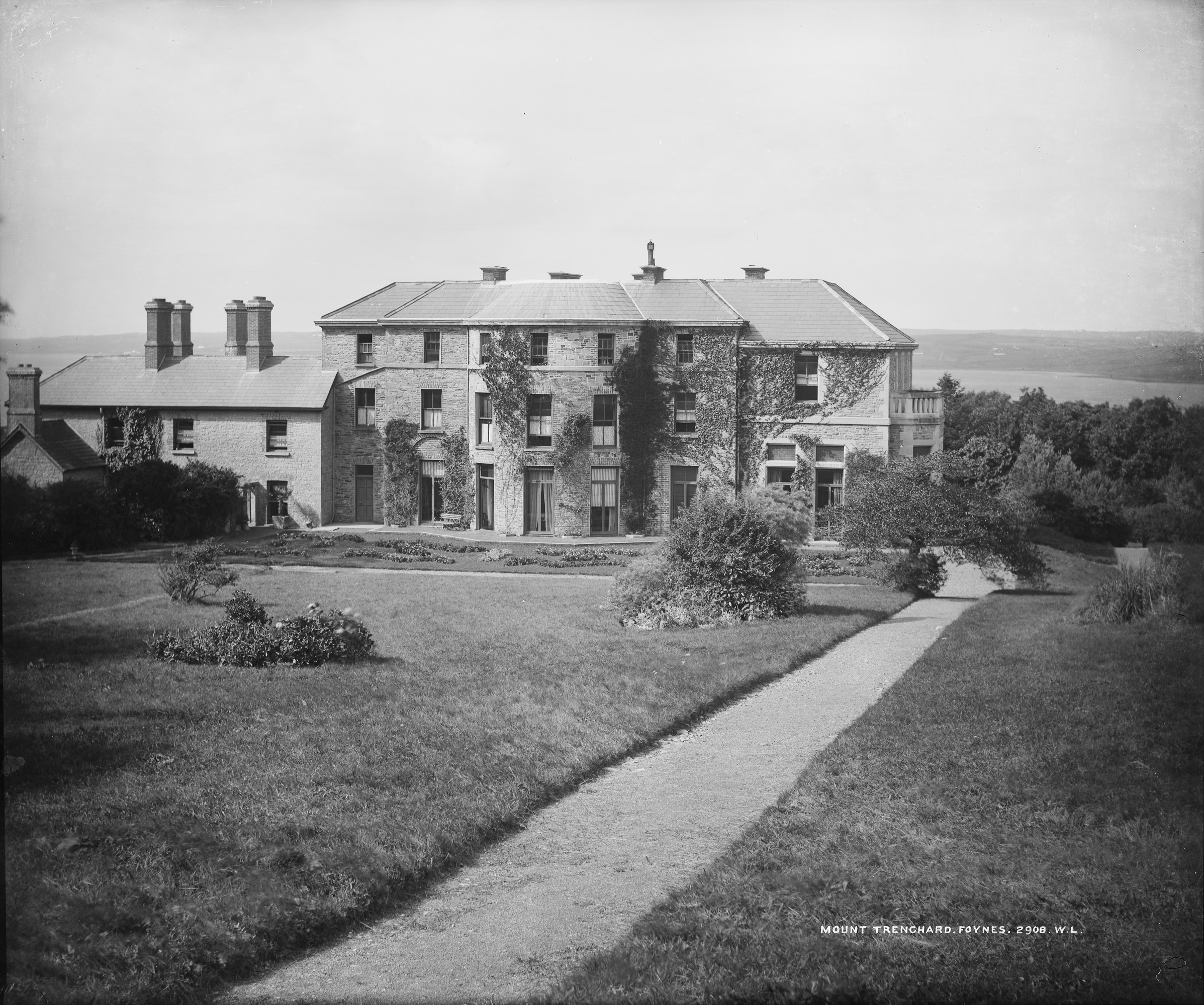
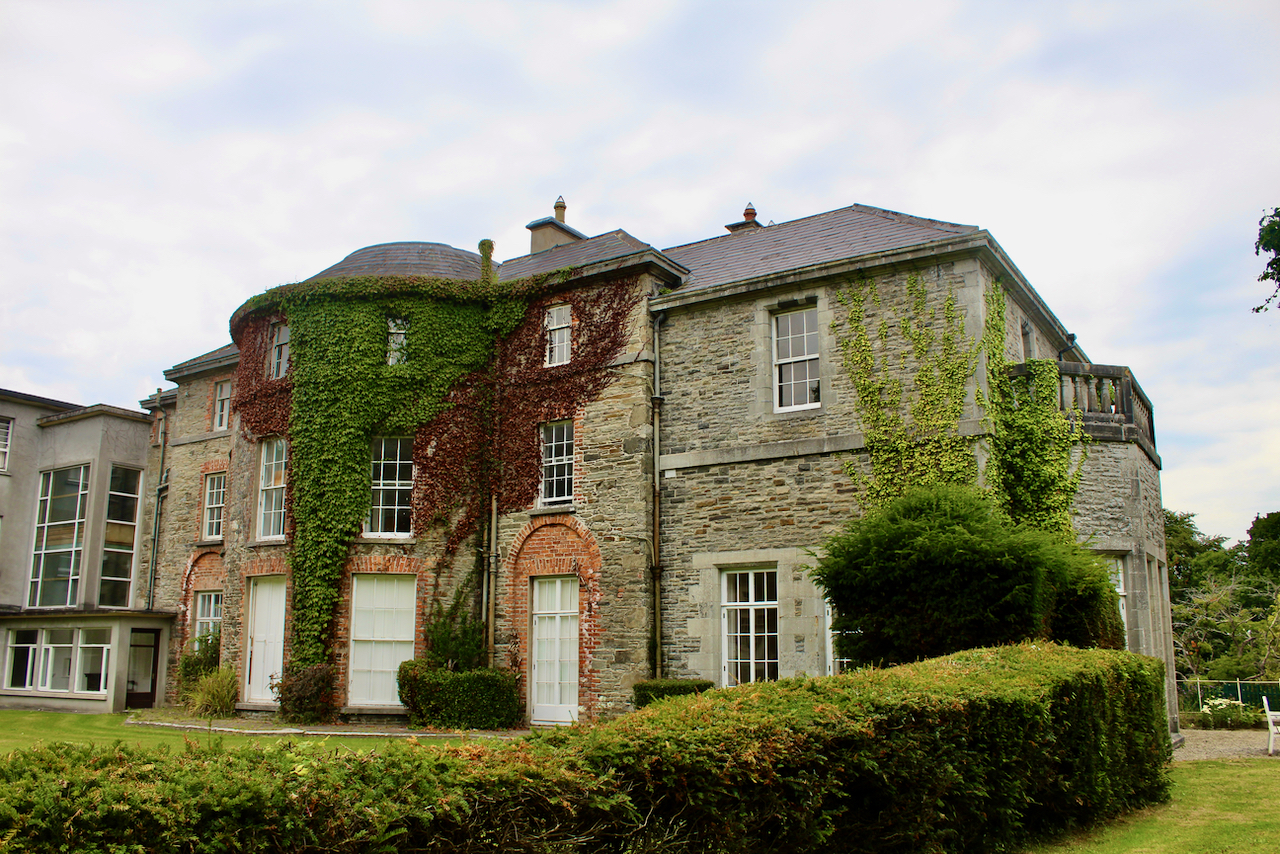
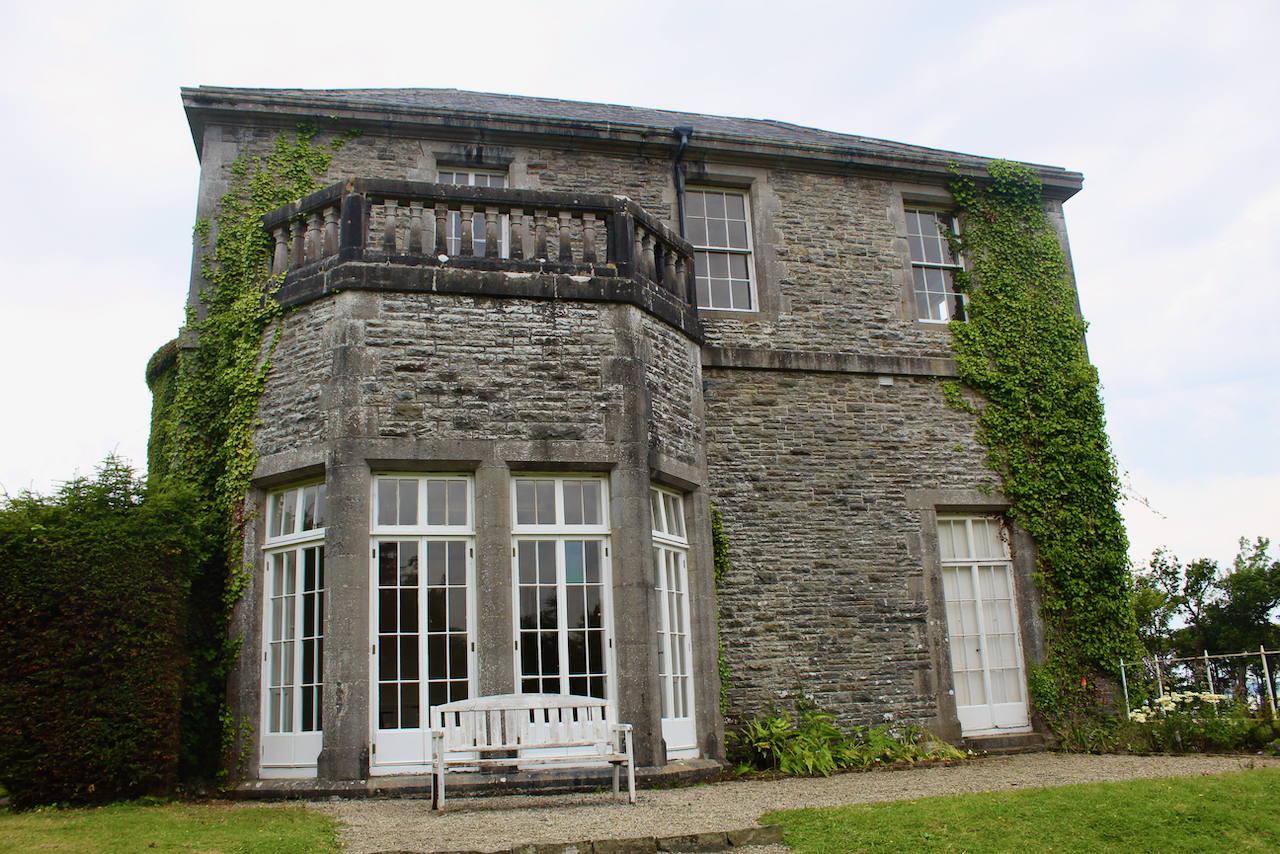
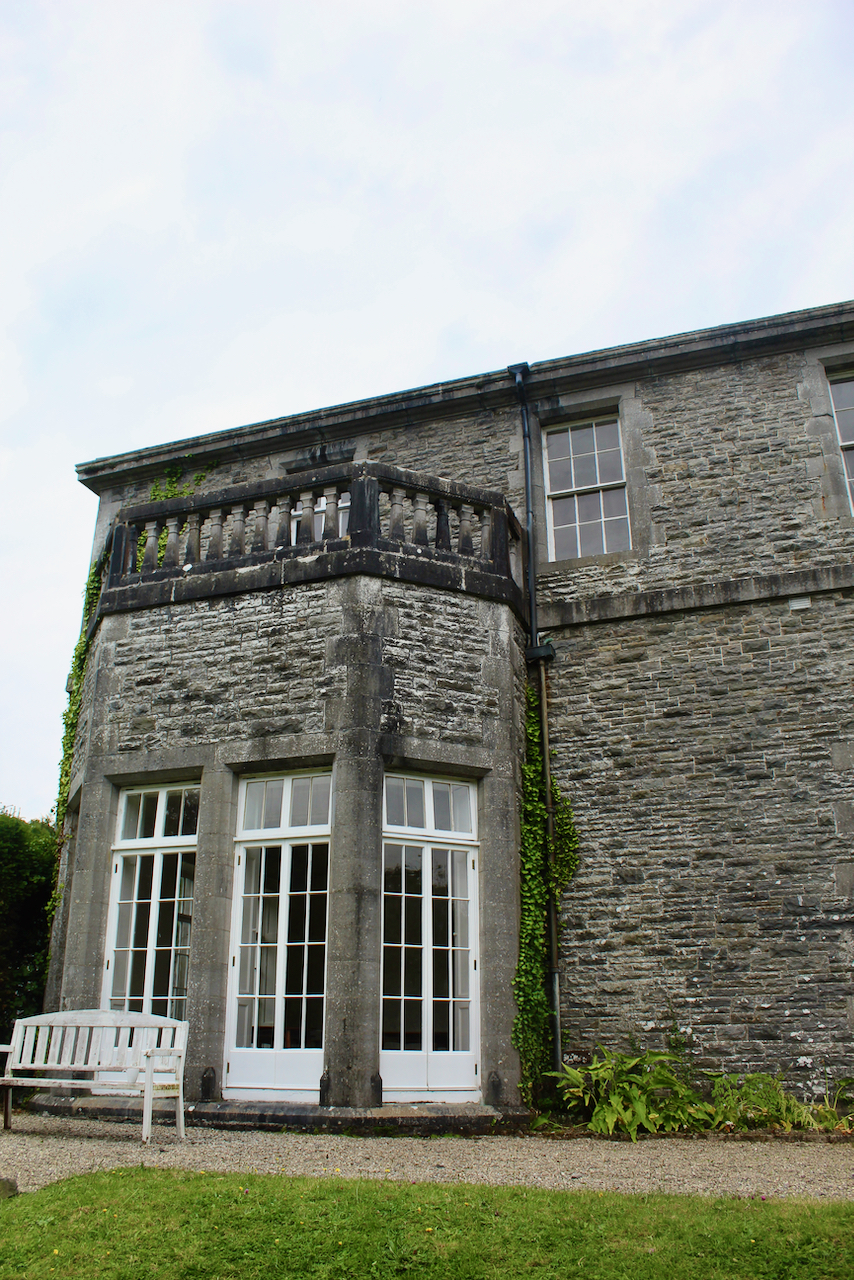
Mount Trenchard, County Limerick, 14th August 2022

Mount Trenchard, County Limerick, currently undergoing renovation. We were given a wonderful tour of the house and its grounds, including the walled garden. Photograph © Jennifer Winder-Baggot, www.irishhistorichouses.com

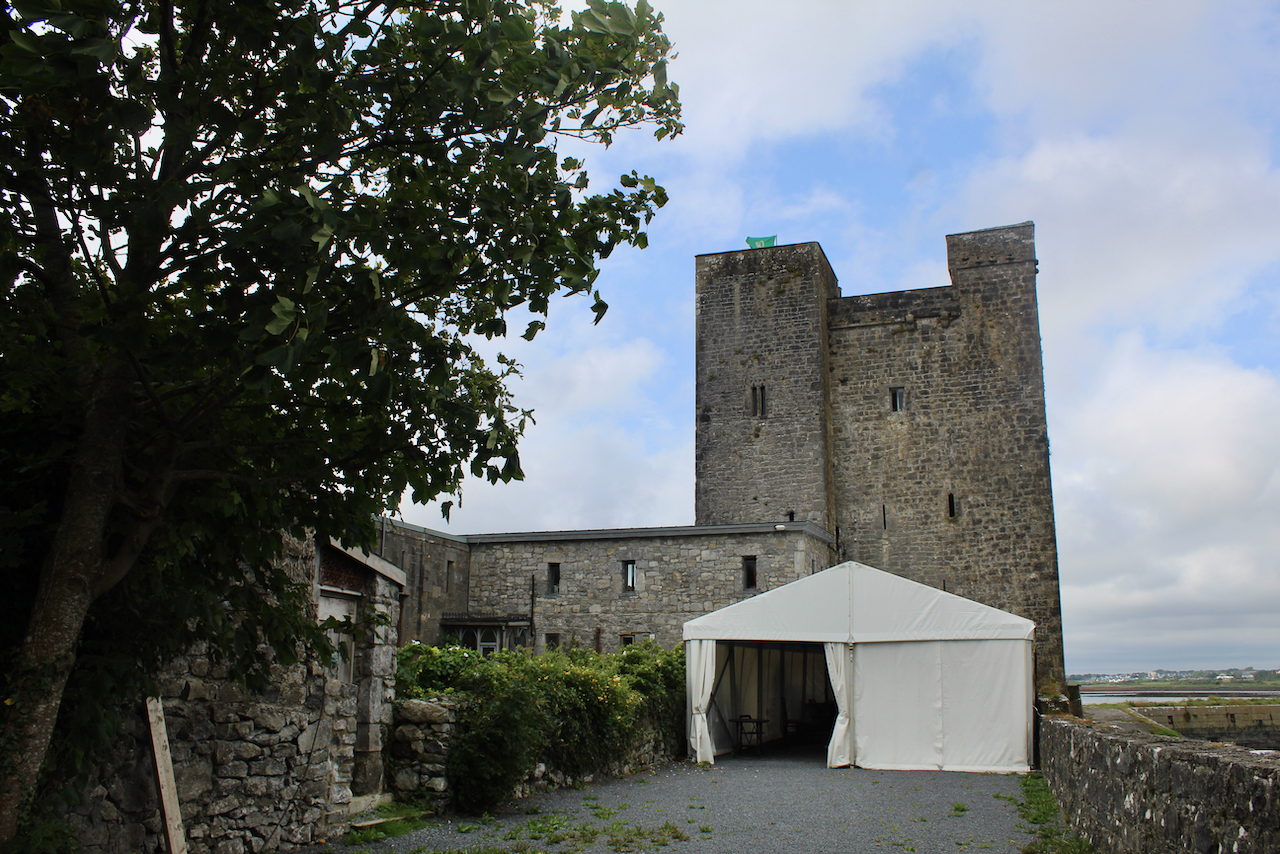
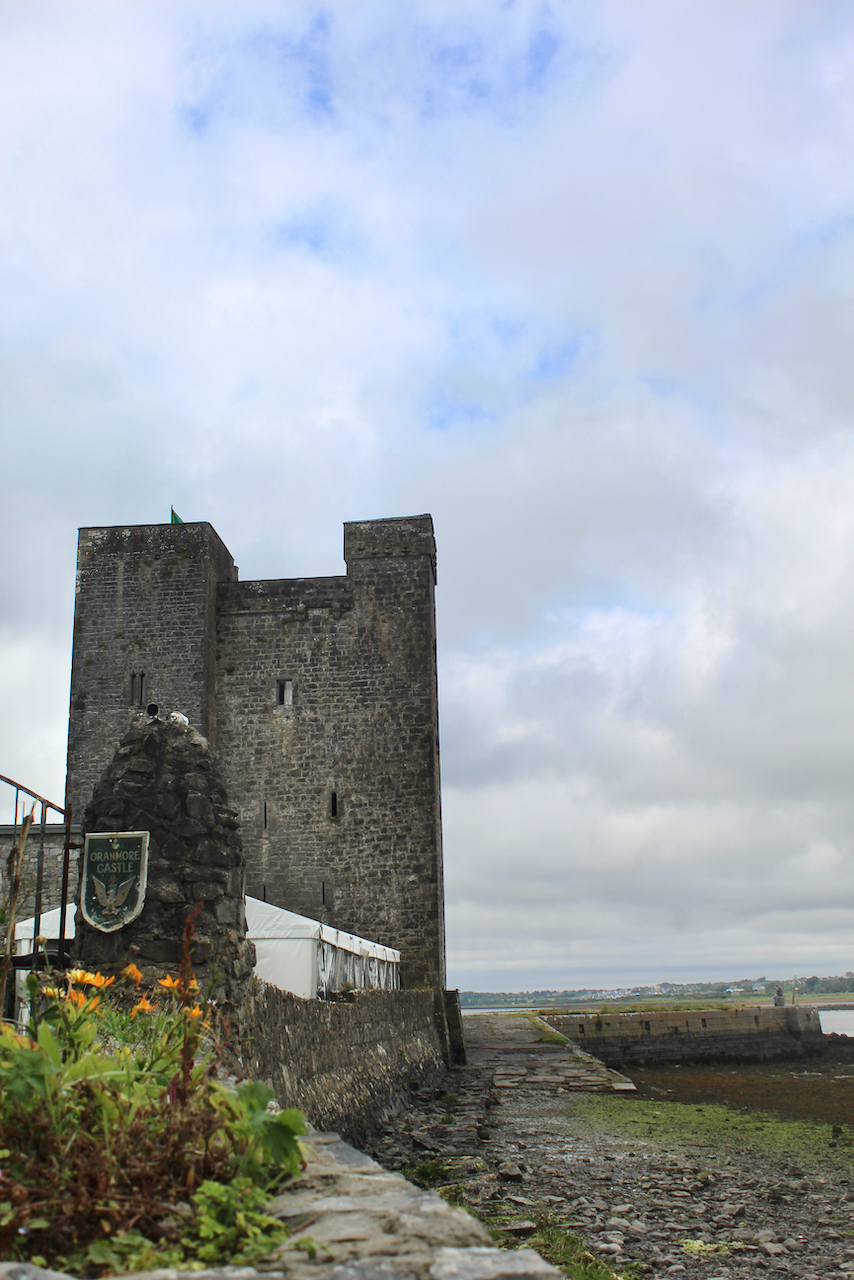
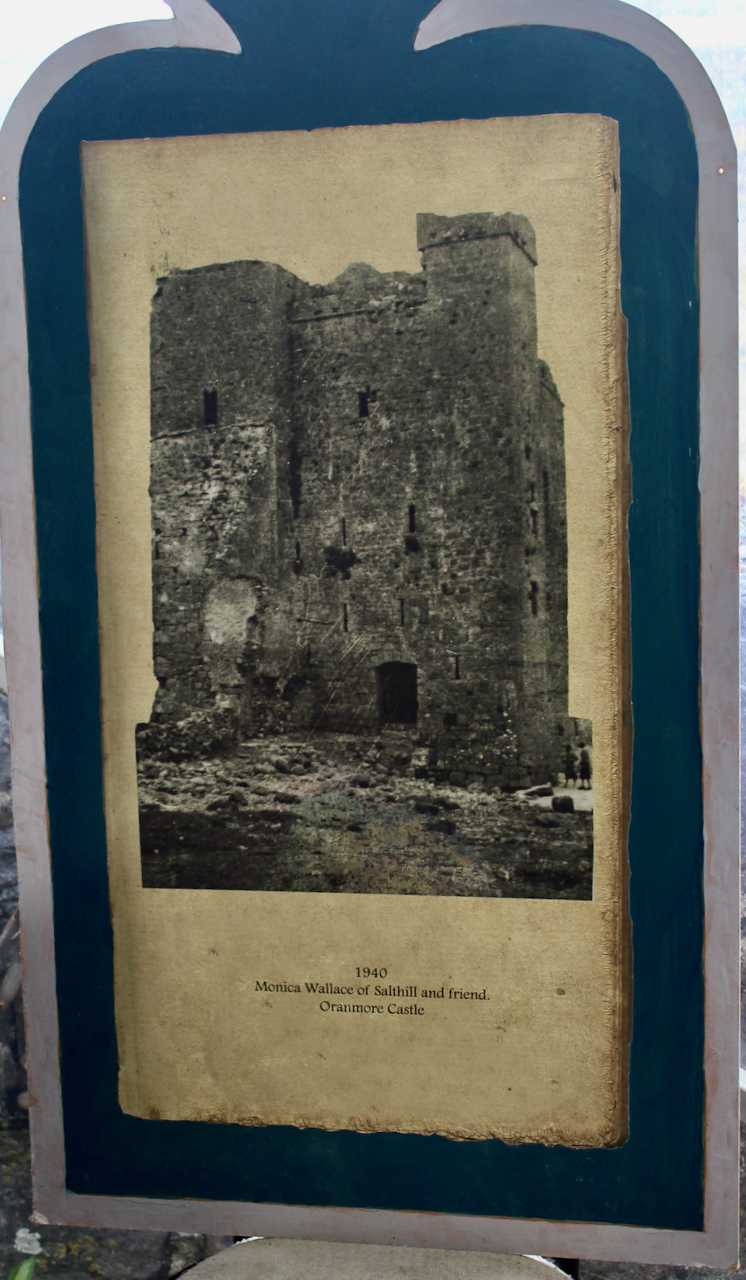
Oranmore Castle, County Galway, 15th August 2022

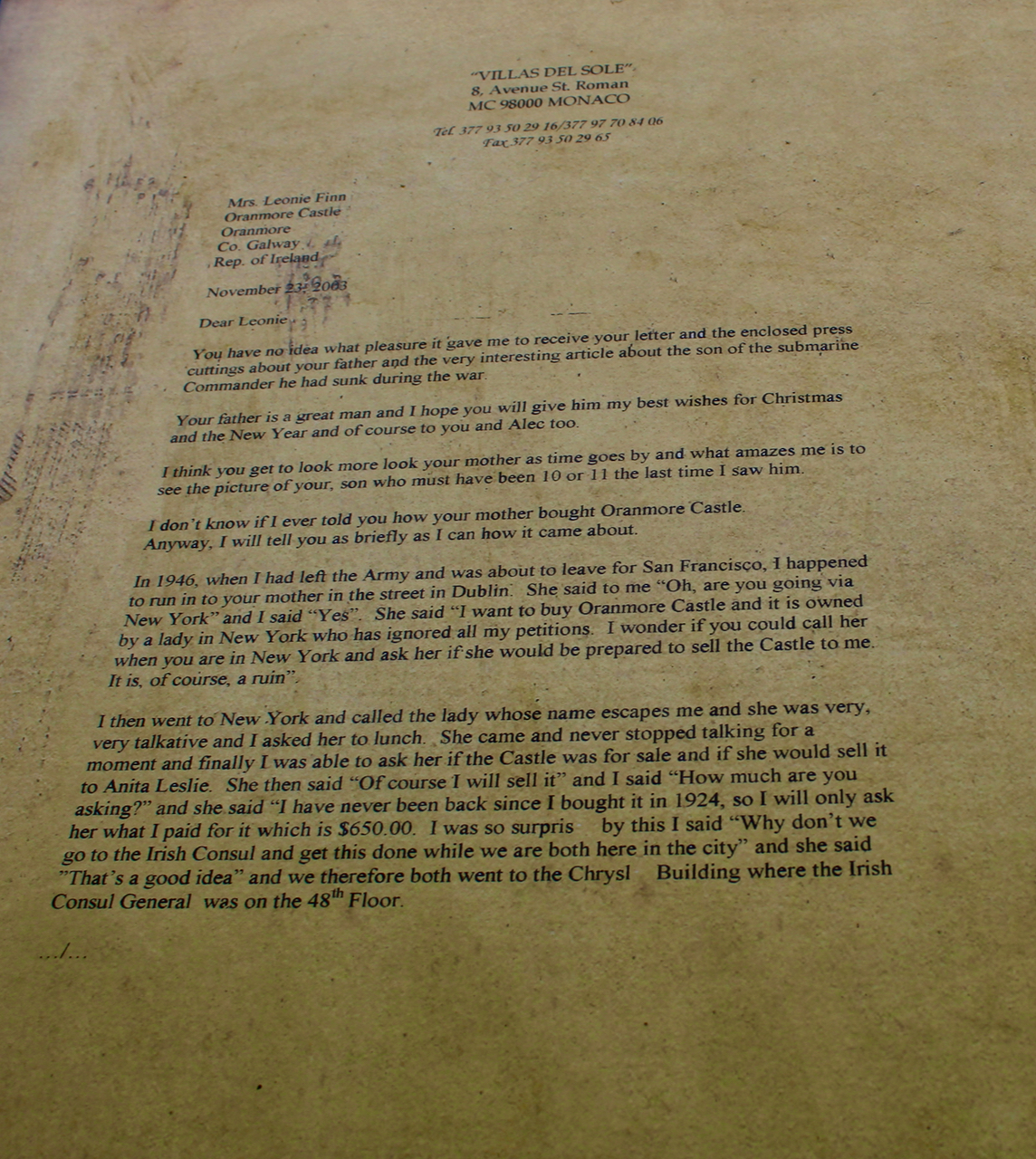
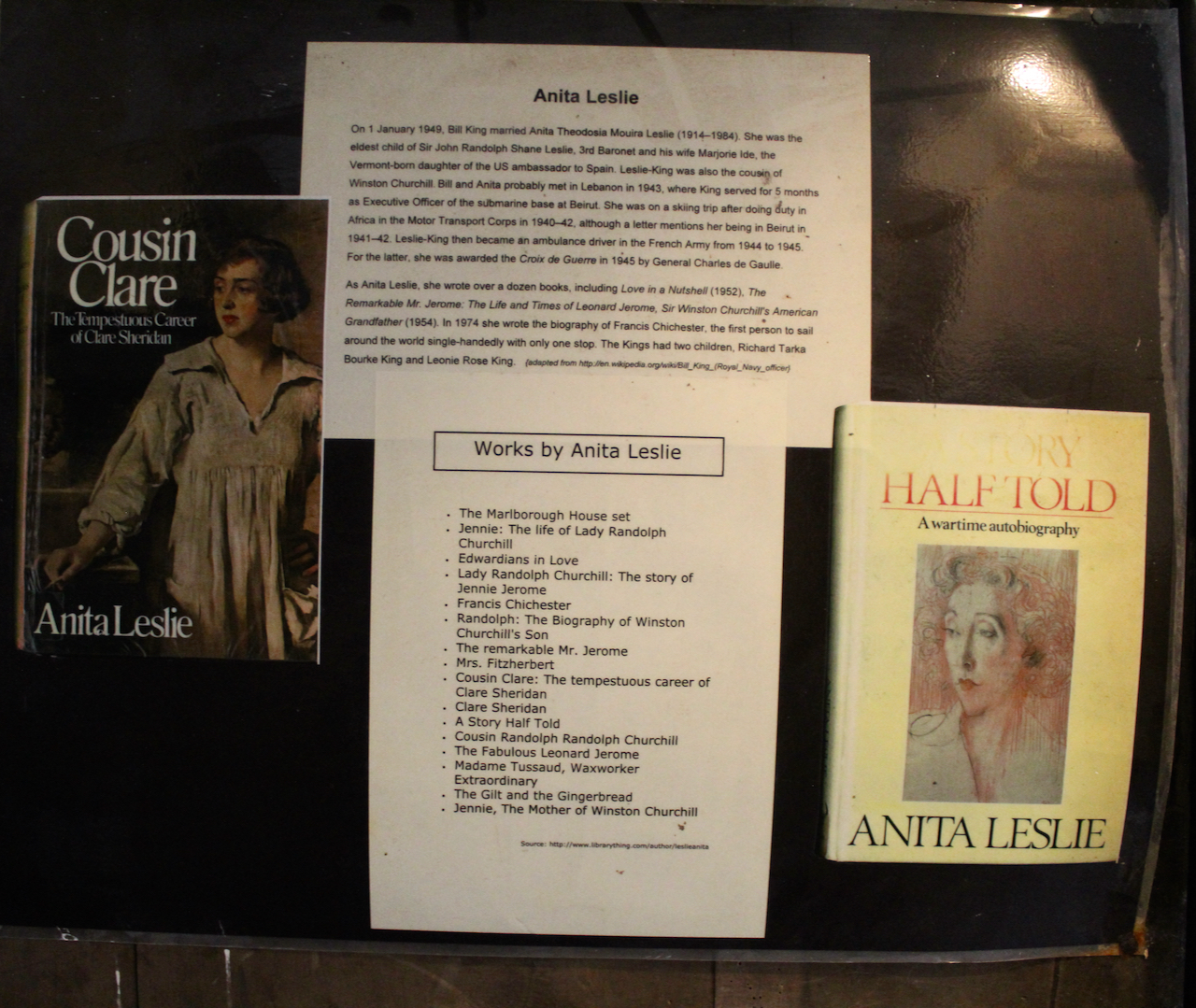
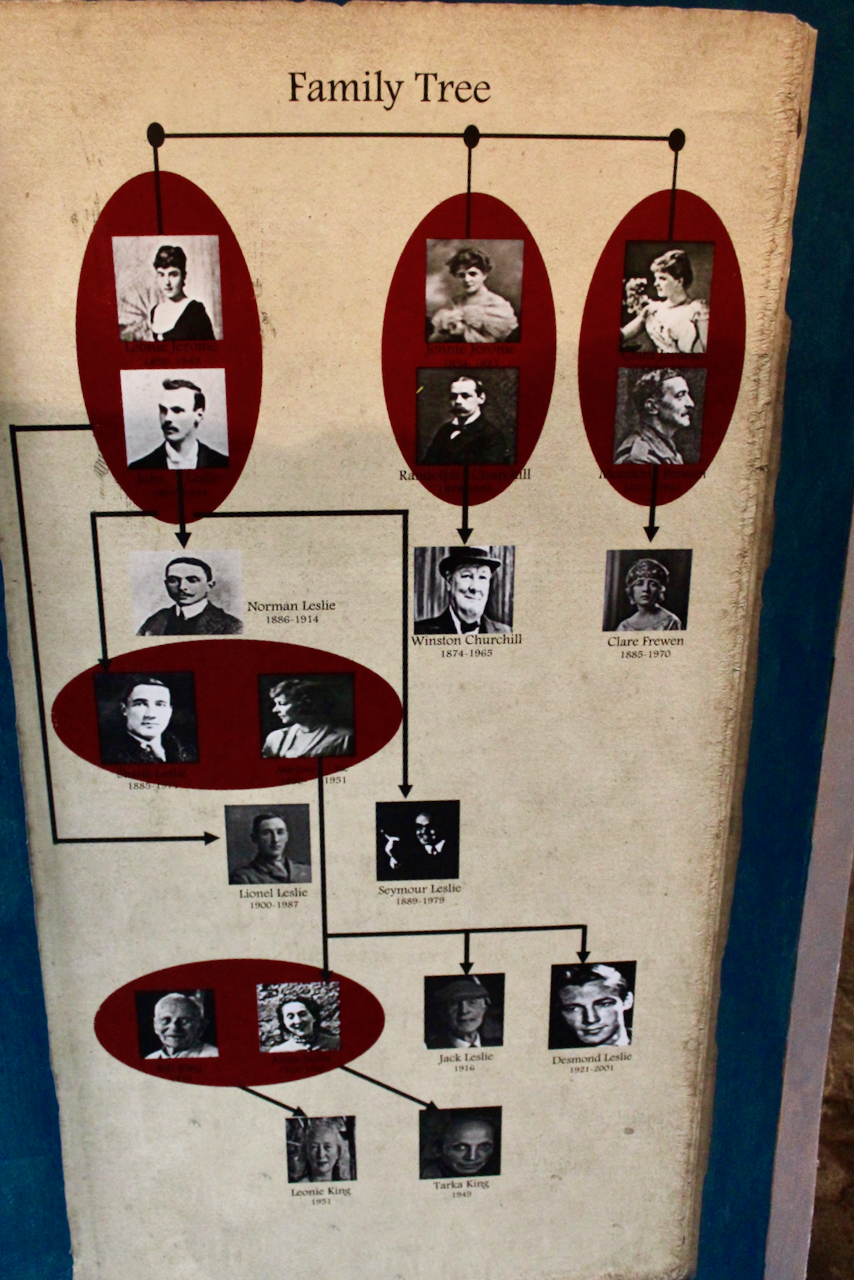
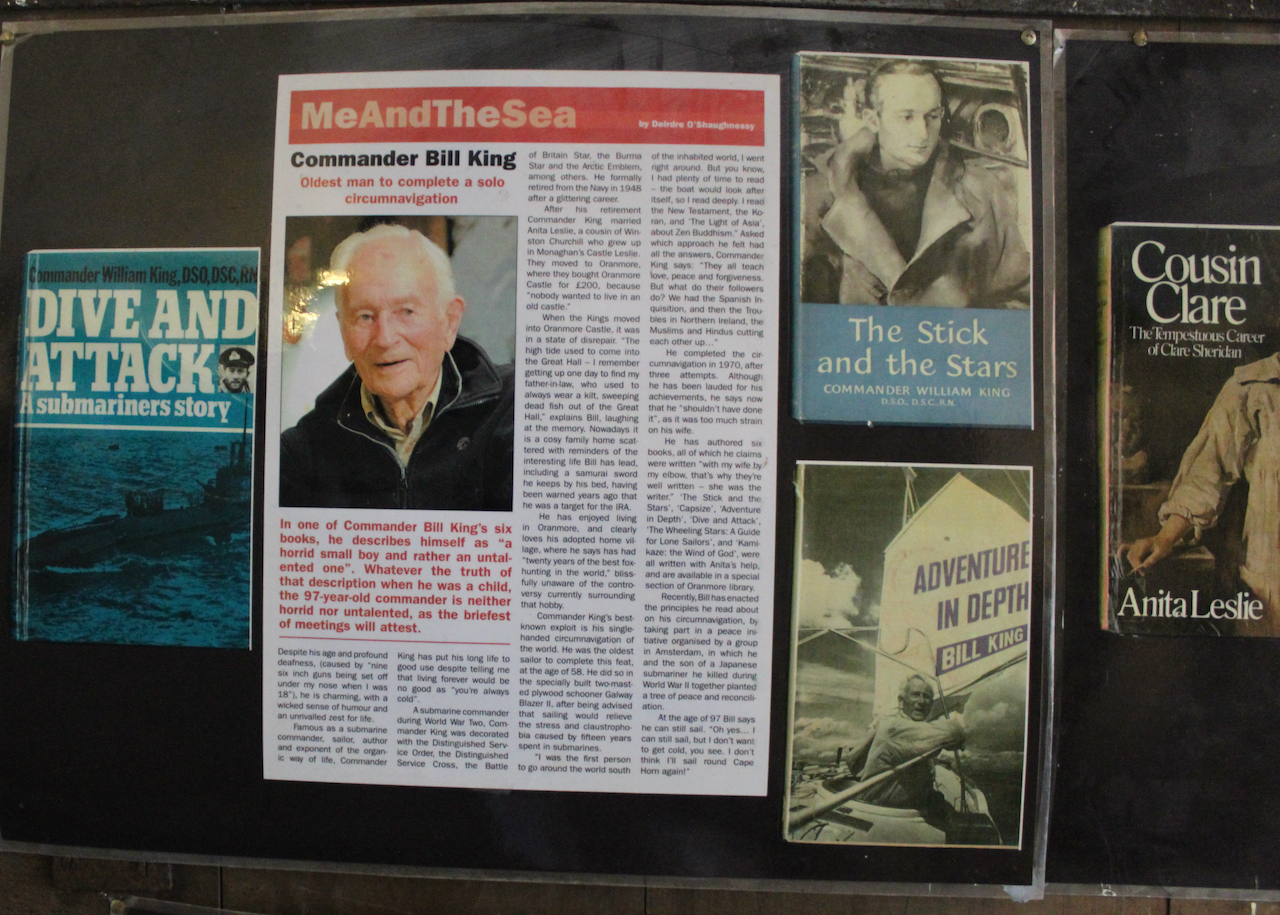
Oranmore Castle, County Galway, the gift from her mother to Anita Leslie from Castle Leslie, County Monaghan. Photograph © Jennifer Winder-Baggot, www.irishhistorichouses.com

Claregalway Castle, County Galway, 15th August 2022

Claregalway Castle, County Galway, parts of which can be booked for accommodation. Photograph © Jennifer Winder-Baggot, www.irishhistorichouses.com

King House, County Roscommon, 18th August 2022

King House, County Roscommon, once home of the King family, now a beautiful museum. Photograph © Jennifer Winder-Baggot, www.irishhistorichouses.com

Strokestown Park, County Roscommon, August 2022

Strokestown, County Roscommon – it was listed as open in Section 482 but opening was delayed due to renovations. We were lucky to get on a Heritage Week tour. Photograph © Jennifer Winder-Baggot, www.irishhistorichouses.com

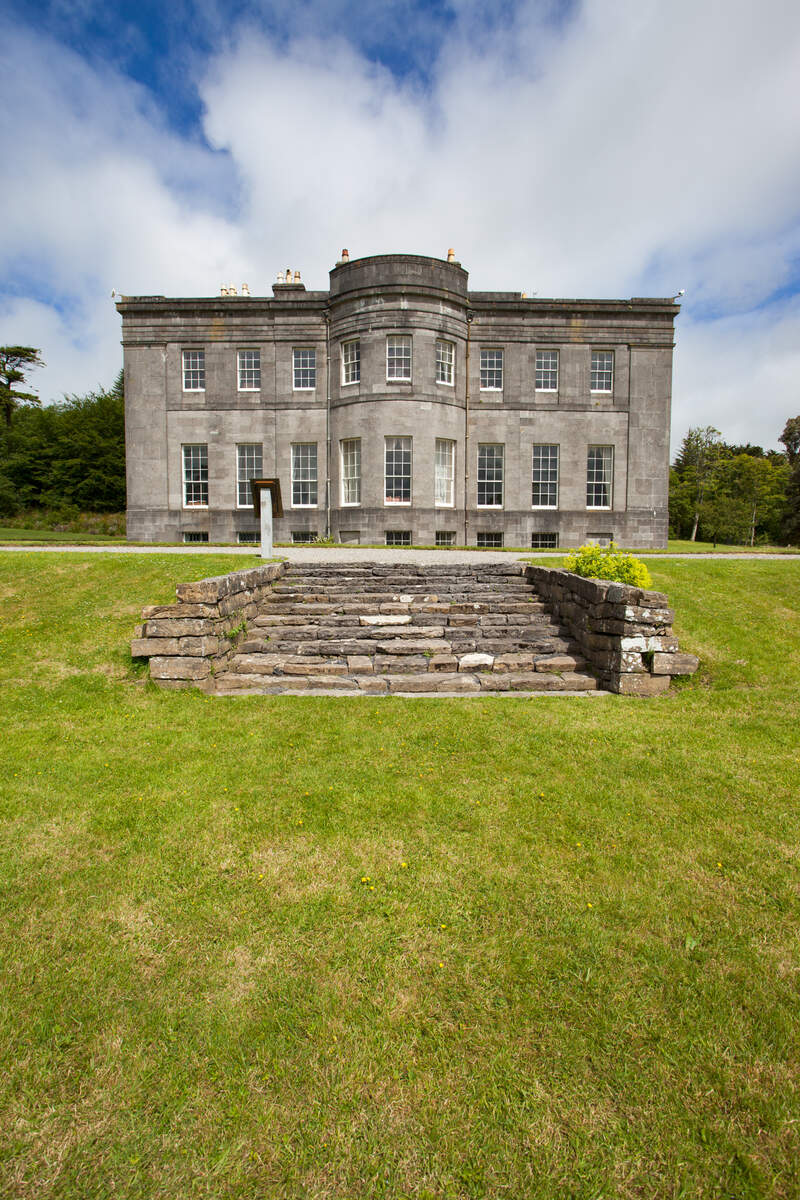
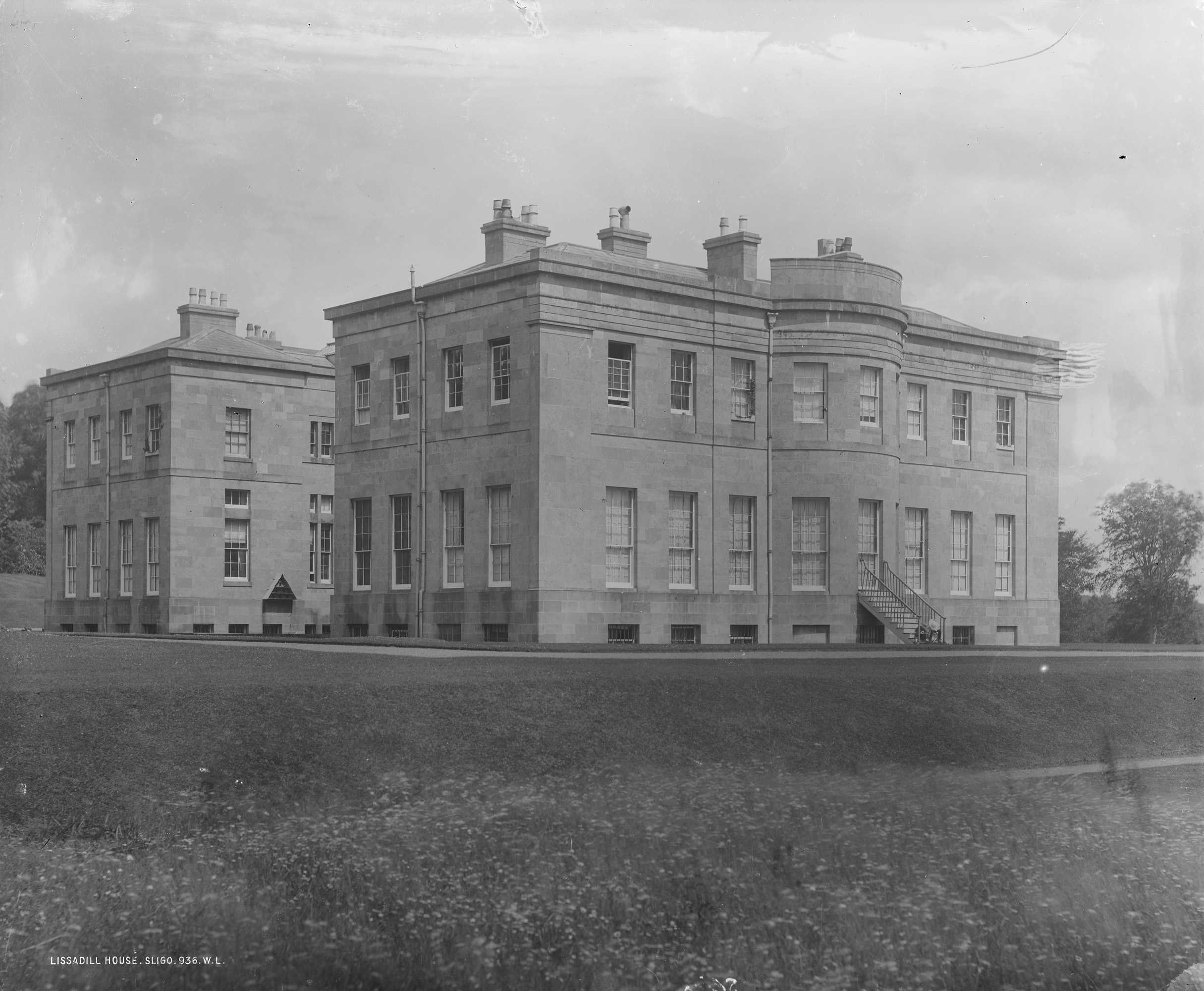
Lissadell, County Sligo, 19th August 2022

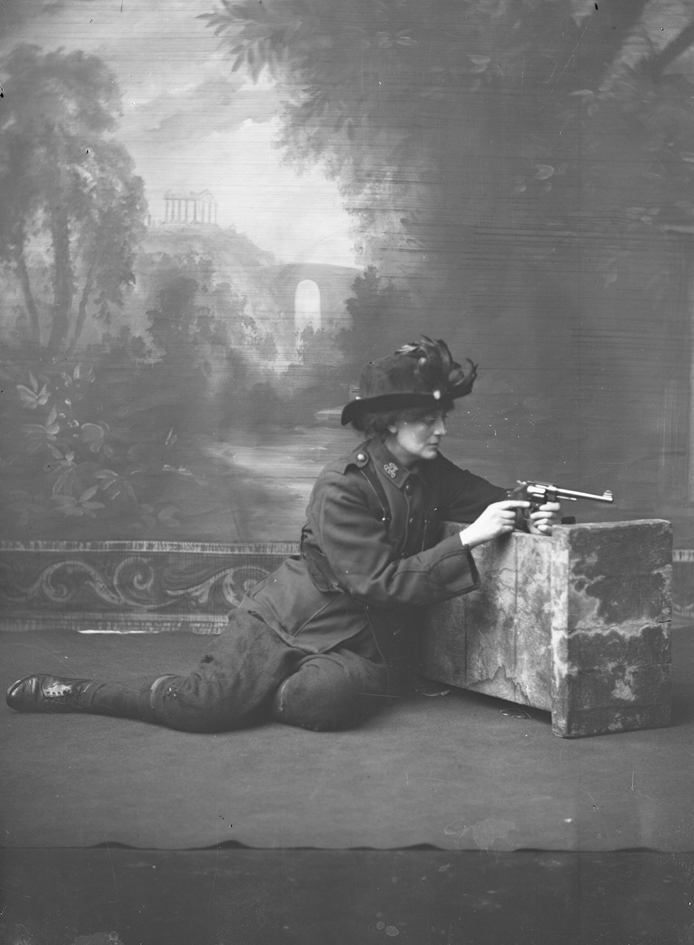
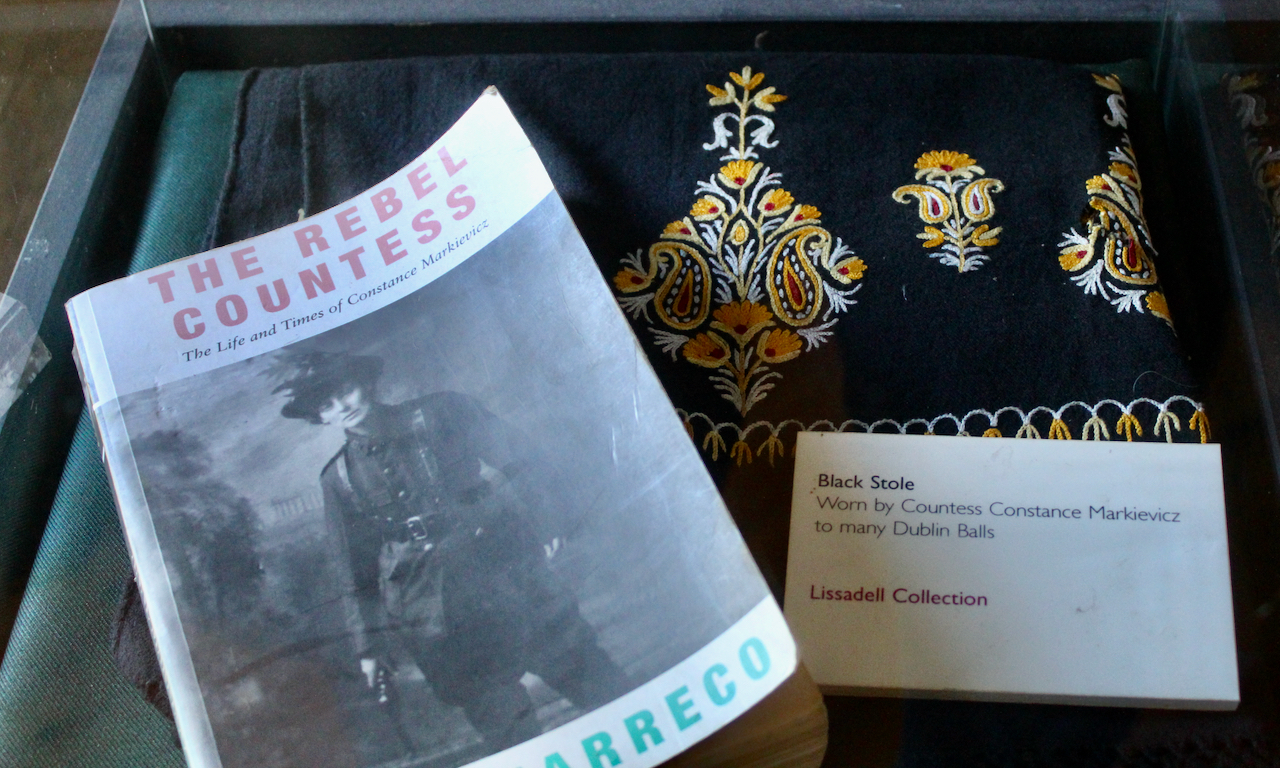
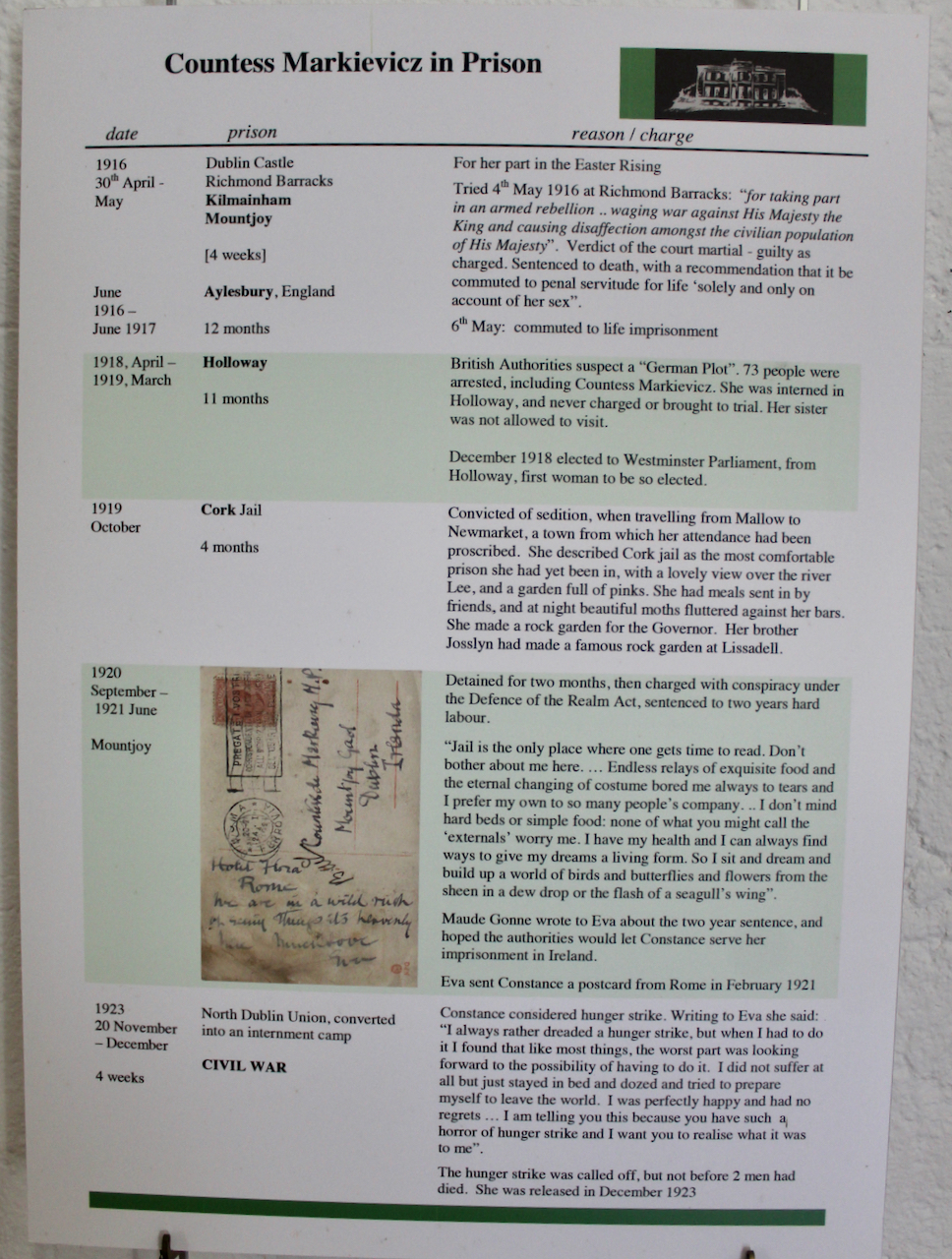
Lissadell, County Sligo, the former home of the Countess Markievicz and the Gore-Booth family. Photograph © Jennifer Winder-Baggot, www.irishhistorichouses.com

Manorhamilton, County Leitrim, 20th August 2022

Manorhamilton Castle, Leitrim. It was not open on the day we visited despite being listed as an open day during Heritage Week. Photograph © Jennifer Winder-Baggot, www.irishhistorichouses.com

Hilton Park, County Monaghan, 21st August 2022

Hilton Park, still in the ownership of the Madden family for whom it was built. Photograph © Jennifer Winder-Baggot, www.irishhistorichouses.com

After that big holiday during Heritage Week 2022 I needed a break in September!

Fahanmura, County Dublin, 11th October 2022

Fahanmura, a 1940s home in Dublin. Photograph © Jennifer Winder-Baggot, www.irishhistorichouses.com

39 North Great Georges Street, Dublin, 10th November 2022

39 North Great Georges Street, a 1771 home of Georgian splendour. Photograph © Jennifer Winder-Baggot, www.irishhistorichouses.com

Hamwood, County Meath, 14th November 2022

Hamwood House, built by and still lived in by the Hamiltons, including artists Letitia and Eva. Photograph © Jennifer Winder-Baggot, www.irishhistorichouses.com

Bantry House & Garden, Bantry, Co. Cork P75 T293 – section 482

www.bantryhouse.com
Open dates in 2025: Apr 12-30, May 1-16, 18-30, June 1-30, July 1-11, 13-24, 26-31, Aug 1-31, Sept 1-26, 28-30, 10am-5pm

Fee: adult €14, OAP/student €11.50, child €5, any other concessions groups 8-20 people €10 and groups of 21or more people €9

donation

Help me to pay the entrance fee to one of the houses on this website. This site is created purely out of love for the subject and I receive no payment so any donation is appreciated!

€15.00

Bantry House, overlooking Bantry Bay, from the top of the “Sky Steps” or 100 Steps. June 2022. © Jennifer Winder-Baggot, www.irishhistorichouses.com
Photograph from the National Library of Ireland Creative Commons. This is taken c. 1895, and the conservatory is now gone, as well, unfortunately, as the stork sculptures on the steps!

What we see today at Bantry House started as a more humble abode: a three storey five bay house built for Samuel Hutchinson in around 1690. It was called Blackrock. A wing was added in 1820, and a large further addition in 1845.

In the 1760s it was purchased by Captain Richard White (1700-1776). He was from a Limerick mercantile family and he had settled previously on Whiddy Island, the largest island in Bantry Bay. The Bantry website tells us that he had amassed a fortune from pilchard-fishing, iron-smelting and probably from smuggling, and that through a series of purchases, he acquired most of the land around Bantry including large parts of the Beare Peninsula, from Arthur Annesley, 5th Earl of Anglesey. The house is still occupied by his descendants, the Shelswell-White family.

This looks like the main entrance to the house – we came in the back way. © Jennifer Winder-Baggot, www.irishhistorichouses.com
The Visitors’ entry to the house. © Jennifer Winder-Baggot, www.irishhistorichouses.com

Driving from Castletownshend, we entered the back way and not through the town. From the car park we walked up a path which gave us glimpses of the outbuildings, the west stables, and we walked all around the house to reach the visitors’ entrance. We were lucky that the earlier rain stopped and the sun came out to show off Bantry House at its best. I was excited to see this house, which is one of the most impressive of the Section 482 houses.

We missed the beginning of the tour, so raced up the stairs to join the once-a-day tour in June 2022. Unfortunately I had not been able to find anything about tour times on the website. We will definitely have to go back for the full tour! The house is incredible, and is full of treasures like a museum. I’d also love to stay there – one can book accommodation in one wing.

Captain Richard White married Martha Davies, daughter of Rowland Davies, Dean of Cork and Ross. During his time, Bantry House was called Seafield. They had a son named Simon (1739-1776), who married Frances Hedges-Eyre from Macroom Castle in County Cork. Their daughter Margaret married Richard Longfield, 1st Viscount Longueville.

Eyre family portrait of Robert Hedges-Eyre son of Richard Hedges-Eyre of Macroom Castle Co. Cork, courtesy Purcell Auctioneers Feb 2016. Robert Hedges Eyre (d.1840) restored Macroom castle and his daughter married the 3rd Earl of Bantry. Inherited by Olive White who married Lord Ardilaun it was eventually destroyed in 1922 by Republican forces long after it had ceased to have any military significance.

The house overlooks Bantry Bay which is formative in its history because thanks to its views, Richard’s grandson was elevated to an Earldom.

View onto Bantry Bay. © Jennifer Winder-Baggot, www.irishhistorichouses.com
Bantry House, June 2022. © Jennifer Winder-Baggot, www.irishhistorichouses.com

Frances Jane and Simon had a son, Richard (1767-1851), who saw French ships sail into Bantry Bay in 1796. The British and French were at war from February 1793. It was in gratitude for Richard’s courage and foresight in raising a local militia against the French that Richard was given a title.

Bantry House, June 2022. © Jennifer Winder-Baggot, www.irishhistorichouses.com

There are four guns overlooking the bay. The two smaller ones are from 1780, and the larger one is dated 1796. One is French and dated 1795 and may have been captured from an invading French ship.

Bantry House, June 2022. © Jennifer Winder-Baggot, www.irishhistorichouses.com

United Irishman Theobald Wolfe Tone was on one of the French ships, which were under command of French Louis Lazare Hoche.

Theobald Wolfe Tone (1763–98) (named after his godfather, Theobald Wolfe) had sought French support for an uprising against British rule in Ireland. The United Irishmen sought equal representation of all people in Parliament. Tone wanted more than the Catholic Emancipation which Henry Grattan advocated, and for him, the Catholic Relief Act of 1793 did not go far enough, as it did not give Catholics the right to sit in the Irish House of Commons. Tone was inspired by the French and American Revolutions. The British had specifically passed the Catholic Relief Act in the hope of preventing Catholics from joining with the French.

Theobald Wolf Tone, who was on the ships which Richard White spotted in Bantry Bay carrying the French who were coming to support Irish Independence.

The Dictionary of Irish Biography tells us that

With the outbreak of war with France, Dublin Castle instituted a crackdown on Irish reformers who had professed admiration for the French, and by the end of the year the United Irishmen and the reform movement were in disarray. In quick succession, the Volunteers were proscribed, the holding of elected conventions was banned, and a number of United Irishmen… were hauled before the courts on charges of seditious libel.

Tone went to the U.S. and thought he might have to settle there but with others’ encouragement he continued in his work for liberating Ireland. He went to France for support. As a result 43 ships were sent to France.

In July 1796 Tone was appointed chef de brigade (brigadier-general) in Hoche’s army ... Finally, on 16 December 1796, a French fleet sailed from Brest crammed with 14,450 soldiers. On board one of the sails of the line, the Indomptable, was ‘Citoyen Wolfe Tone, chef de brigade in the service of the republic.’” [1]

Richard White had trained a militia in order to defend the area, and stored munitions in his house. When he saw the ships in the bay he raised defenses. However, it was stormy weather and not his militia that prevented the invasion. Tone wrote of the expedition in his diary, saying that “We were close enough to toss a biscuit ashore”.

Bantry House, June 2022. © Jennifer Winder-Baggot, www.irishhistorichouses.com

The French retreated home to France, but ten French ships were lost in the storm and one, the Surveillante, sank and remained on the bottom of Bantry bay for almost 200 years. 

For his efforts in preparing the local defences against the French, Richard White was created Baron Bantry in 1797 in recognition of his “spirited conduct and important service.” In 1799 he married Margaret Anne Hare (1779-1835), daughter of William the 1st Earl of Listowel in County Kerry, who brought with her a substantial dowry. In 1801 he was made a viscount, and in 1815 he became Viscount Berehaven and Earl of Bantry. He became a very successful lawyer and made an immense fortune.

Bantry House. June 2022. The entrance is under the portico, which is now glassed in. This middle section is the original house. The part on the sea facing side is the part added in 1820. The addition that appears on the left hand side is part of the fourteen bay block added to the rear of the old house in 1845 by the 2nd Earl. © Jennifer Winder-Baggot, www.irishhistorichouses.com
In this view of the house we can see the two copper domes of the stable ranges, either side of the house. The stable blocks were built in 1845 and the National Inventory tells us they are sited to appear as further lateral extensions of the house beyond its wings; when viewed from the bay they might be read as lower flanking wings in the Palladian manner. © Jennifer Winder-Baggot, www.irishhistorichouses.com

Richard was not Simon White’s only son. Simon’s son Simon became a Colonel and married Sarah Newenham of Maryborough, County Cork. They lived in Glengariff Castle. Young Simon’s sister Helen married a brother of Sarah Newenham, Richard, who inherited Maryborough. Another daughter, Martha, married Michael Goold-Adams of Jamesbrook, County Cork and another daughter, Frances, married General E. Dunne of Brittas, County Laois. Another son, Hamilton, married Lucinda Heaphy.

A wing was added to the house in 1820 in the time of the 1st Earl of Bantry. This wing is the same height as the original block, but of only two storeys, and faces out to the sea. It has a curved bow at the front and back and a six bay elevation at the side. This made space for two large drawing rooms, and more bedrooms upstairs.

The side of the house which faces the bay. This is the six bay elevation with curved bow at front a back (not visible here) which was added to the original house by the 1st Earl of Bantry. © Jennifer Winder-Baggot, www.irishhistorichouses.com
The entrance is under the Corinthian colonnade, which was built later onto the oldest part of the house. The bow in this photograph is part of the house added on during the time of the 1st Earl of Bantry. © Jennifer Winder-Baggot, www.irishhistorichouses.com

The house was greatly enlarged and remodelled in 1845 by the son of the 1st Earl, Richard (1800-1867). The 1st Earl had moved out to live in a hunting lodge in Glengariff. This son Richard was styled as Viscount Berehaven between 1816 and 1851 until his father died, when he then succeeded to become 2nd Earl of Bantry. He married Mary O’Brien, daughter of William, 2nd Marquess of Thomond, in 1836.

The 2nd Earl of Bantry and his wife travelled extensively and purchased many of the treasures in the house. The website tells us he was a passionate art collector who travelled regularly across Europe, visiting Russia, Poland, France and Italy. He brought back shiploads of exotic goods between 1820 and 1840.

To accommodate his new furnishings he built a fourteen bay block on the side of the house opposite to the 1820 addition, consisting of a six-bay centre of two storeys over basement flanked by four-storey bow end wings.

To accommodate his new furnishings, the Viscount built a fourteen bay block to the rear of the old house consisting of a six-bay centre of two storeys over a basement flanked by four-storey bow end wings. © Jennifer Winder-Baggot, www.irishhistorichouses.com

The website tells us:

.”..No doubt inspired by the grand baroque palaces of Germany, he gave the house a sense of architectural unity by lining the walls with giant red brick pilasters with Coade-stone Corinthian capitals, the intervening spaces consisting of grey stucco and the parapet adorned with an attractive stone balustrade.

Bantry House, 2022. © Jennifer Winder-Baggot, www.irishhistorichouses.com
Bantry House, County Cork. © Jennifer Winder-Baggot, www.irishhistorichouses.com
Bantry House, 2022. © Jennifer Winder-Baggot, www.irishhistorichouses.com
Bantry House, June 2022. © Jennifer Winder-Baggot, www.irishhistorichouses.com

He also lay out the Italianate gardens, including the magnificent terraces on the hillside behind the house, most of which was undertaken after he had succeeded his father as the second Earl of Bantry in 1851.

Bantry House, June 2022. © Jennifer Winder-Baggot, www.irishhistorichouses.com

After his death in 1867 the property was inherited by his brother William, the third Earl (1801-1884), his grandson William the fourth and last Earl (1854-91), and then passed through the female line to the present owner, Mr. Shelswell-White.

Mark Bence-Jones tells us: “The house is entered through a glazed Corinthian colonnade, built onto the original eighteenth century front in the nineteenth century; there is a similar colonnade on the original garden front.” [2]

The Corinthian colonnade at the entrance to the house. © Jennifer Winder-Baggot, www.irishhistorichouses.com
There is a colonnade similar to that on the front entrance on the other side of the oldest part of the house. © Jennifer Winder-Baggot, www.irishhistorichouses.com
The cafe area to the side of the house. © Jennifer Winder-Baggot, www.irishhistorichouses.com
Bantry House, 2022. © Jennifer Winder-Baggot, www.irishhistorichouses.com
Bantry House, June 2022. © Jennifer Winder-Baggot, www.irishhistorichouses.com

Unfortunately we were not allowed to take photographs inside. You can see photographs of the incredible interior on the Bantry house website, and on the Irish Aesthete Robert O’Byrne’s blog. [3]

The rooms are magnificent, with their rich furnishings, ceilings and columns. Old black and white photographs show that even the ceilings were at one time covered in tapestries. The Spanish leather wallpaper in the stair hall is particularly impressive.

Mark Bence-Jones continues: “The hall is large but low-ceilinged and of irregular shape, having been formed by throwing together two rooms and the staircase hall of the mid-eighteenth century block; it has early nineteenth century plasterwork and a floor of black and white pavement, incorporating some ancient Roman tiles from Pompeii. From one corner rises the original staircase of eighteenth century joinery.”

Staircase in Bantry House, photograph courtesy of Bantry house website.

The website tells us: “Today the house remains much as the second earl left it, with an important part of his great collection still intact. Nowhere is this more son than the hall where visitors will find an eclectic collection garnered from a grand tour, which includes an Arab chest, a Japanese inlaid chest, a Russian travelling shrine with fifteenth and sixteenth century icons and a Fresian clock. There is also a fine wooden seventeenth century Flemish overmantel and rows of family portraits on the walls. The hall was created by combining two rooms with the staircase hall of the original house and consequently has a rather muddled shape, though crisp black and white Dutch floor tiles lend the room a sense of unity.. Incorporated into this floor are four mosaic panels collected by Viscount Berehaven from Pompeii in 1828 and bearing the inscriptions “Cave Canem” and “Salve.” Other unusual items on show include a mosque lamp from Damascus in the porch and a sixteenth century Spanish marriage chest which can be seen in the lobby.

Bence-Jones continues: “The two large bow-ended drawing rooms which occupy the ground floor of the late eighteenth century wing are hung with Gobelins tapestries; one of them with a particularly beautiful rose-coloured set said to have been made for Marie Antoinette.

The Drawing Room in Bantry House, photograph courtesy of Bantry house website.

The Royal Aubusson tapestries in the Rose drawing room, comprising four panels, are reputed to have been a gift from the Dauphin to his young wife-to-be Marie Antoinette. In the adjoining Gobelin drawing room, one panel of tapestries is said to have belonged to Louis Philippe, Duc D’Orleans, a cousin of Louis XV.

The website tells us: “The most spectacular room is the dining-room, dominated by copies of Allan Ramsay’s full-length portraits of George III and Queen Charlotte, whose elaborate gilt frames are set off by royal blue walls. The ceiling was once decorated with Guardi panels, but these have long since been removed and sold to passing dealers at a fraction of their worth. The differing heights of the room are due to the fact that they are partly incorporated in the original house and in the 1845 extension, their incongruity disguised by a screen of marble columns with gilded Corinthian capitals. Much of the furniture has been here since the second Earl, including the George III dining table, Chippendale chairs, mahogany teapoy, sideboards made for the room, and the enormous painting The Fruit Market by Snyders revealing figures reputedly drawn by Rubens – a wedding present to the first Countess.

The Chippendale chairs and the George III dining table were made for the room.

King George III, a reproduction in Castletown, County Kildare.
Queen Charlotte, wife of King George III, a reproduction in Castletown, County Kildare.

The description on the website continues: “The first flight of the staircase from the hall belongs to the original early eighteenth century house, as does the half-landing with its lugged architraves. This leads into the great library, built around 1845 and the last major addition to the house. The library is over sixty feet long, has screens of marble Corinthian columns, a compartmented ceiling and Dublin-made mantelpieces at each end with overhanging mirrors. The furnishing retains a fine rosewood grand piano by Bluthner of Leipzig, still occasionally used for concerts. The windows of this room once looked into an immense glass conservatory, but this has now been removed and visitors can look out upon restored gardens and the steep sloping terraces behind.

The Library in Bantry House, photograph courtesy of Bantry house website.

The third Earl, William Henry (1801-1884), succeeded his brother, who died in 1868. On 7 September 1840 William Henry’s surname was legally changed to William Henry Hedges-White by Royal Licence, adding Hedges, a name passed down by his paternal grandmother.

His grandmother was Frances Jane Eyre and her father was Richard Hedges Eyre. Richard Hedges of Macroom Castle and Mount Hedges, County Cork, married Mary Eyre. Richard Hedges Eyre was their son. He married Helena Herbert of Muckross, County Kerry. In 1760 their daughter, Frances Jane, married Simon White of Bantry, William Henry’s grandfather. When her brother Robert Hedges Eyre died without heirs in 1840 his estates were divided and William Henry the 3rd Earl of Bantry inherited the Macroom estate. [4] Until his brother’s death in 1868, William Henry Hedges-White had been living in Macroom Castle. [5]

Macroom Castle, photograph taken 2009 by “Shiny Things,” flickr constant commons.
Macroom Castle gate house, photograph taken 2007 by Carole Waller, flickr constant commons.

William Henry Hedges-White married Jane Herbert in 1845, daughter of Charles John Herbert of Muckross Abbey in County Kerry (see my entry about places to visit in County Kerry).

In November 1853, over 33,000 acres of the Bantry estate were offered for sale in the Encumbered Estates Court, and a separate sale disposed of Bere Island. The following year more than 6,000 further acres were sold, again through the Encumbered Estates Court. Nevertheless in the 1870s the third earl still owned 69,500 acres of land in County Cork.

His son, the 4th Earl, died childless in 1891. The title lapsed, and the estate passed to his nephew, Edward Egerton Leigh (1876-1920), the son of the 4th Earl’s oldest sister, Elizabeth Mary, who had married Egerton Leigh of Cheshire, England. This nephew, born Edward Egerton Leigh, added White to his surname upon his inheritance. He was only fifteen years old when he inherited, so his uncle Lord Ardilaun looked after the estate until Edward came of age in 1897. William Henry Hedges-White’s daughter Olivia Charlotte Hedges-White had married Arthur Edward Guinness, 1st and last Baron Ardilaun. Edward Egerton’s mother had died in 1880 when he was only four years old, and his father remarried in 1889.

Lady Olivia-Charlotte White, Lady Elizabeth-Mary White and William, 4th Earl of Bantry, with a dog, Irish school c. 1860 courtesy Christies Irish Sale 2004. William Henry Hare Hedges-White (1801-1884) was the son of William Hedges-White, 3rd Earl of Bantry. His sister Olivia Charlotte Hedges-White married Arthur Edward Guinness (1840-1915), Baron Ardilaun, and they lived in Ashford Castle in County Mayo. Elizabeth Mary Gore Hedges-White, another sister, married Egerton Leigh.
Bantry House, County Cork, photograph 1989 from the National Library, flickr constant commons.

Edward Egerton married Arethusa Flora Gartside Hawker in 1904. She was a cousin through his father’s second marriage. They had two daughters, Clodagh and Rachel. In March 1916 an offer from the Congested Districts’ Board was accepted by Edward Egerton Leigh White for 61,589 tenanted acres of the estate. [6] Edward Egerton died in 1920.

Patrick Comerford tells us in his blog that during the Irish Civil War in 1922-1923, the Cottage Hospital in Bantry was destroyed by fire. Arethusa Leigh-White offered Bantry House as a hospital to the nuns of the Convent of Mercy, who were running the hospital. Arethusa only made one proviso: that the injured on both sides of the conflict should be cared for. A chapel was set up in the library and the nuns and their patients moved in for five years. [7]

In 1926, Clodagh Leigh-White came of age and assumed responsibility for the estate. Later that year, she travelled to Zanzibar, Africa, where she met and married Geoffrey Shelswell, then the Assistant District Commissioner of Zanzibar. (see [7])

Geoffrey Shelswell added “White” to his surname when in 1926 Clodagh inherited Bantry estate after the death of her father. They had a son, Egerton Shelswell-White (1933-2012), and two daughters, Delia and Oonagh.

During the Second World War, the house and stables were occupied by the Second Cyclist Squadron of the Irish Army, and they brought electricity and the telephone to the estate.

Bantry House, 2022. © Jennifer Winder-Baggot, www.irishhistorichouses.com
Bantry House, June 2022. © Jennifer Winder-Baggot, www.irishhistorichouses.com

Clodagh opened the house in 1946 to paying visitors with the help of her sister Rachel who lived nearby. Her daughter Oonagh moved with her family into the Stable Yard.

Clodagh remained living in the house after her husband died in 1962, until her death in 1978. Brigittte, wife of Clodagh’s son Egerton, writes:

As far as I know it never occurred to Clodagh to live elsewhere. She thought nothing of having her sitting room downstairs, her kitchen and bedroom upstairs and her bathroom across the landing. No en suite for her! In the winter when the freezing wing howled through the house, she more or less lived in her fur coat, by all accounts cheerful and contented. She loved bridge and held parties, which took place in the Rose Drawing Room, or in the room next to the kitchen, called the Morning Room.

Brigitte also tells of wonderful evenings of music and dance hosted by Clodagh and her friend Ian Montague, who had been a ballet dancer with the Royal Swedish Ballet. Ian put on plays and dancing in period costumes. Members of the audience were taught about eighteenth century dance and were encouraged to join in. I think we should hold such dances in the lovely octagon room of the Irish Georgian Society!

Clodagh’s son Egerton had moved to the United States with his wife Jill, where he taught in a school called Indian Springs. When his mother died he returned to Bantry. The house was in poor repair, the roof leaking and both wings derelict. Jill decided to remain in the United States with their children who were teenagers at the time and settled into their life there.

Bantry House features in Great Irish Houses, which has a foreward by Desmond FitzGerald and Desmond Guinness (IMAGE Publications, 2008). In the book, Egerton is interviewed. He tells us:

p. 68. “The family don’t go into the public rooms very much. We live in the self-contained area. I remember before the war as children we used the dining rooms and the state bedrooms, but after the war my parents moved into this private area of the house. It feels like home and the other rooms are our business. You never think of all that furniture as being your own. You think of it more as the assets of the company.

The relatively modest private living quarters were completed in 1985. Sophie Shelswell-White, Egerton’s daughter, says, “When we were younger we shied away from the main house because of the intrusion from the public. Everyone imagines we play hide and seek all day long and we did play it a bit. We also used to run around looking for secret tunnels and passageways. I used to believe one day I’d push something and it would open a secret room, but it never happened.”

Mark Bence-Jones continues his description, moving to the stables: “Flanking the entrance front is an imposing stable range, with a pediment and cupola. The house is surrounded by Italian gardens with balustrades and statues and has a magnificent view over Bantry Bay to the mountains on the far shore. The demesne is entered by a fine archway.” (see [2])

The large stable complex is to one side of the house, the East Stables. This is where the horses and carriages were kept. © Jennifer Winder-Baggot, www.irishhistorichouses.com

The National Inventory tells us about the East Stables:

A classically inspired outbuilding forming part of an architectural set-piece, the formal design of which dates to the middle of the nineteenth century when Richard White, Viscount Berehaven and later second Earl of Bantry, undertook a large remodelling of Bantry House. At this time the house was extended laterally with flanking six-bay wings that overlook the bay. This stable block and the pair to the south-west are sited to appear as further lateral extensions of the house beyond its wings; when viewed from the bay they might be read as lower flanking wings in the Palladian manner. This elaborate architectural scheme exhibits many finely crafted features including a distinguished cupola, playful sculptural detailing as well as cut stone pilasters to the façade. The survival of early materials is visible in a variety of fine timber sliding sash windows, which add to the history of the site.

View of the 1820 wing in foreground and 1845 behind, and behind that, the East Stables. © Jennifer Winder-Baggot, www.irishhistorichouses.com
Bantry House, 2022. © Jennifer Winder-Baggot, www.irishhistorichouses.com
This impressive arch with pediment topped by urns and birds, which leads toward the east stable yard, as seen behind. © Jennifer Winder-Baggot, www.irishhistorichouses.com
The East Stable yard. © Jennifer Winder-Baggot, www.irishhistorichouses.com
The east stable yard as seen from the garden. © Jennifer Winder-Baggot, www.irishhistorichouses.com

Egerton married Brigitte in 1981. They undertook many of the repairs themselves. They started a tearoom with the help of a friend, Abi Sutton, who also helped with the house. Egerton played the trombone and opened the house to musical events. They continued to open the house for tours. They renovated the went wing and opened it for bed and breakfast guests.

Coffee is served on the terrace, similar to that in the front, but only partly glazed. Unfortunately we arrived too late for a snack. Bantry House is breathtaking and its gardens and location magnify the grandeur. I like that the grandeur, like Curraghmore, is slightly faded: a lady’s fox fur worn down to the leather and shiny in places.

The balustraded area on the side of the house where tea and coffee are served overlooks a garden.

Bantry House, 2022. © Jennifer Winder-Baggot, www.irishhistorichouses.com
From the garden to one side of the house, you can see another stable complex, the West Stables. © Jennifer Winder-Baggot, www.irishhistorichouses.com
Bantry House, June 2022. © Jennifer Winder-Baggot, www.irishhistorichouses.com

Brigitte and Egerton continued restoration of the house and started to tackle the garden. They repaired the fountain and started work on the Italian parterre. In 1998 they applied for an EEC grant for renovation of the garden. They restored the statues, balustrades, 100 Steps, Parterre, Diana’s Bed and fourteen round beds overlooking the sea.

Bantry House, 2022. © Jennifer Winder-Baggot, www.irishhistorichouses.com
Looking past the fountain to the 100 Steps. © Jennifer Winder-Baggot, www.irishhistorichouses.com
Bantry House, County Cork, photograph by Chris Hill, 2016 for Tourism Ireland, Ireland’s Content Pool. Wisteria adds an extra oomph to the garden.
Bantry House, 2022. © Jennifer Winder-Baggot, www.irishhistorichouses.com
Bantry House, June 2022. © Jennifer Winder-Baggot, www.irishhistorichouses.com

It is Egerton’s daughter Sophie who now lives in and maintains Bantry House, along with her husband and children.

The family donated their archive of papers to the Boole Library of University College Cork in 1997.

Bantry House, 2022. © Jennifer Winder-Baggot, www.irishhistorichouses.com
Bantry House, June 2022. © Jennifer Winder-Baggot, www.irishhistorichouses.com

The National Inventory tells us the five-bay two-storey west stables were also built c.1845. They have a pedimented central bay with cupola above, which has a copper dome, finial, plinth and six Tuscan-Corinthian columns. [8] The West Stables were used as a workshop for outdoor maintenance and repairs. They had fallen into disrepair but were repaired to rectify deteriorating elements with the help of the Heritage Council in 2010-11.

Bantry House, 2022. © Jennifer Winder-Baggot, www.irishhistorichouses.com
These buildings, the West Stables, were used as a workshop for outdoor maintenance and repairs. They have fallen into disrepair but were repaired to rectify deteriorating element with the help of the Heritage Council in 2010-11. © Jennifer Winder-Baggot, www.irishhistorichouses.com
Bantry House, 2022. © Jennifer Winder-Baggot, www.irishhistorichouses.com
Bantry House, June 2022. © Jennifer Winder-Baggot, www.irishhistorichouses.com

[1] https://www.dib.ie/biography/tone-theobald-wolfe-a8590

[2] Bence-Jones, Mark. A Guide to Irish Country Houses (originally published as Burke’s Guide to Country Houses volume 1 Ireland by Burke’s Peerage Ltd. 1978); Revised edition 1988, Constable and Company Ltd, London.

[3] https://theirishaesthete.com/2014/09/08/when-its-gone-its-gone/

[4] https://landedestates.ie/family/1088 and https://www.dib.ie/biography/eyre-robert-hedges-a2978

See also

[5] Shelswell-White, Sophie. Bantry House & Garden, The History of a family home in Ireland. This booklet includes an article by Geoffrey Shelswell-White, “The Story of Bantry House” which had appeared in the Irish Tatler and Sketch, May 1951.

[6] https://landedestates.ie/family/1088

[7] http://www.patrickcomerford.com/2016/05/bantry-house-has-story-that-spans.html

[8] https://www.buildingsofireland.ie/buildings-search/building/20911813/bantry-house-seafield-bantry-co-cork

© Jennifer Winder-Baggot, www.irishhistorichouses.com

St. George’s, St. George’s Avenue, Killiney, Co. Dublin – section 482

Open dates in 2025: July 1-31, Aug 1-31, 9am-1pm
Fee:  adult €6, OAP/student/child €3

donation

Help me to pay the entrance fee to one of the houses on this website. This site is created purely out of love for the subject and I receive no payment so any donation is appreciated!

€15.00

St. George’s, August 2022. Photograph © Jennifer Winder-Baggot, www.irishhistorichouses.com

St. George’s is a wonderful Arts and Crafts/Gothic Revival house in the beautiful suburbs of Killiney. It was built in the 1870s by George Coppinger Ashlin, a former pupil and later partner of Edward Welby Pugin, son of Augustus Pugin who played a primary role in initiating the Gothic revival style of architecture. Augustus Pugin designed the Houses of Parliament in Westminster. He also designed the hall ceiling, staircase and gallery in Adare Manor, County Limerick.

Adare Manor staircase, photograph by Chris Brooks 2012 from flickr constant commons.

Augustus Pugin converted to Catholicism. In 1836, Pugin published Contrasts, and in it he argued for “a return to the faith and the social structures of the Middle Ages,” and this was reflected in his Gothic taste in architecture and design. In 1841 he published his illustrated The True Principles of Pointed or Christian Architecture in which he advocated medieval, “Gothic”, or “pointed”, architecture. In the work, he wrote that contemporary craftsmen seeking to emulate the style of medieval workmanship should reproduce its methods. Pugin also designed stained glass.

Edward Welby Pugin joined his father’s firm. Pugin & Pugin were mainly church architects. Pugin was invited first to work in Ireland by the Redmond family of Wexford (I think they lived in Ballytrent).

Edward Welby Pugin’s works in Ireland include a beautiful chapel at Edermine, County Wexford, which I’d love to see, as well as Cobh and Killarney cathedrals.

Edermine was built for the Power family of the firm of John Power & Son, Distillers, of Dublin. It was through John Power’s influence that Pugin was commissioned to built many churches in Ireland. Power was awarded a Baronetcy in 1841and became Sir John Power 1st Baronet of Roe Buck House, Dublin and Edermine and Sampton, Co Wexford. He was a friend and confidant of Daniel O’Connell, “the Liberator.” [1]

The Powers distillery was located at that time near Thomas Street in Dublin, and it must have been John Power’s influence that led to the commission in 1860 for the design of the Church of St. Augustine and St. John, often referred to as John’s Lane church, on Thomas Street.

St. George’s architect, George Coppinger Ashlin (1837-1921), became a pupil of Edward Welby Pugin in 1856, and was then taken into partnership by Pugin, who gave him the responsibility of establishing a Dublin branch, taking charge of Irish commissions. [2]

Church of St. Augustine and St. John, Thomas Street, photograph by Warren LeMay 2018, flickr constant commons.
The Church of St. Augustine and St. John, commonly known as John’s Lane Church, designed by Edward Welby Pugin, photograph by William Murphy, 2019, courtesy of flickr constant commons.
The chapel at Edermine, courtesy of National Inventory of Architectural Heritage.

Pugin & Ashlin designed approximately eight Catholic cathedrals and fifty Catholic churches as well as schools and convents. Ashlin did not design many private homes, but his work includes Tullira Castle in County Galway, and designs for Ashford Castle and St. Anne’s Park for the Guinness family. [3]

George Coppinger Ashlin, courtesy of Irish Architectural Archive.
Tullira Castle, County Galway, also by George Coppinger Ashlin, photograph by Fennell Photography BNPS from 2013 when the house was for sale.

George Coppinger Ashlin (1837-1921) was from Carrigrenane House in County Cork, third and youngest son of four children of John Musson Ashlin, a Corkman established as a corn merchant in London, and Dorinda Maria Ashlin (née Coppinger), from an old County Cork family. [4]

St. George’s, August 2022. Photograph © Jennifer Winder-Baggot, www.irishhistorichouses.com

The partnership of Pugin & Ashlin was dissolved in the latter months of 1868, but Ashlin married Edward Pugin’s younger sister Mary Pugin (1844-1933) in 1867. Ashlin built St. George’s in the late 1870s after his marriage, as a home for his family.

An information leaflet which owner Robert McQuillan gave us tells us that Mary Ashlin née Pugin grew up in The Grange at Ramsgate in Kent, which was situated on a cliff-top, and that the situation of St. George’s on the hill of Killiney would have reminded her of her childhood home. Shortly after the Ashlins moved to Killiney, the local railway station opened, and in 1887 Queen Victoria and Prince Albert opened Killiney Hill as a public park.

The view over Killiney Bay from a bedroom balcony upstairs in St. George’s. Photograph © Jennifer Winder-Baggot, www.irishhistorichouses.com

The Dictionary of Irish Architects gives an amusing word portrait of Ashlin:

Alfred Edwin Jones, who became a pupil in Ashlin & Coleman’s office in about 1911, remembered Ashlin as a tall, commanding figure with ‘an appearance of distinction’ and described his morning routine. Each day he would catch a fast train from Killiney to Westland Row and walk from the station to his office at 7 Dawson Street. On reaching the office door he would hand his umbrella and attaché case to an awaiting junior member of staff and mount the horse which a man held ready at the kerb. He would then canter up Dawson Street to to Stephen’s Green and ride several times round the park on the track which ran just inside the railings before returning to the office to start his day’s work. According to his obituarist in the RIAI Journal, Ashlin ‘continued in active energy until a short while before his death’ and ‘preserved his comparatively youthful bearing almost to the end of his active career’. He died, aged eighty-four, on 10 December 1921, at St George’s, Killiney, the house which he had designed for himself, and was buried in the family plot in Glasnevin Cemetery.

Ashlin wrote an article which was published in Royal Institute of British Architects Journal 9 (1902), 117-119, called ‘The Possibility of the revival of the ancient arts of Ireland and their adaptation to our modern circumstances.’ He presented this in his Presidential Address to the Royal Institute of Architects in Ireland.

The Dictionary of Irish Biography tells us that under the influence of the Celtic revival, Ashlin turned to ancient Irish architecture for inspiration. In 1877 he designed a domestic chapel for A. J. Moore of Mooresfort, Co. Tipperary, which was modelled on Cormac’s Chapel, Cashel, Co. Tipperary. This was an early example of Hiberno-Romanesque, which was to become the dominant style in Irish catholic church design.

A separate entrance leads, I believe, to the kitchen – we did not see this part of the house. Photograph © Jennifer Winder-Baggot, www.irishhistorichouses.com
St. George’s, August 2022. Photograph © Jennifer Winder-Baggot, www.irishhistorichouses.com
The front door has a leaded fanlight with the cross of St. George, and above, a stone carved tableau of St. George and the dragon. Photograph © Jennifer Winder-Baggot, www.irishhistorichouses.com

Other work listed for Ashlin in the Dictionary of Irish Architects is Enniscorthy Castle, updating it in 1869 for habitation of Isaac Newton Wallop, the 5th Earl of Portsmouth (born as Isaac Newton Fellowes, but later resumed the family surname and arms of Wallop).

Another private residence designed by Ashlin is Clonmeen House in County Cork.

Clonmeen House, County Cork, also designed by Ashlin, for Stephen Grehan in 1893. Photograph courtesy of National Inventory of Architectural Heritage.

Robert McQuillan, the current owner of St. George’s, very generously allowed me to take photographs inside. He and his wife are the fourth owners of St. George’s and have lived there for over thirty years. They have carefully restored and maintained the house.

St. George’s, August 2022. Photograph © Jennifer Winder-Baggot, www.irishhistorichouses.com

Curtains hang on the back of the front door. The use of portiére rods with drapes were extensively used in Victorian homes to keep out draughts. The wallpaper is modern, supplied by Watts of London, and it copies an original Pugin design. All of the woodwork in the house is the original pitch pine, and has many Gothic details. The ceiling beams in the main hall have moulded ribs. The door to the right before the Tudor arch leads to the dining room, and to the left, the front drawing room.

St. George’s, August 2022. Photograph © Jennifer Winder-Baggot, www.irishhistorichouses.com

The dining room has a pine ceiling similar to that in the hall. In the bow window on the left is the Ashlin crest and on the right, the Pugin crest. The Gothic designed sandstone fireplace has the Ashlin motto, “Labore et Honore.” The wallpaper design, and that of the drapes, is an original Pugin design.

The Dining Room. Photograph © Jennifer Winder-Baggot, www.irishhistorichouses.com
Stained glass in the canted bay window in the dining room: on the left is the Ashlin crest and on the right, the Pugin crest. Photograph © Jennifer Winder-Baggot, www.irishhistorichouses.com
The Portrait in the dining room is of Marguerite, Countess of Blessington. Marguerite (1789-1849) was daughter of Edmund Power, and she married first Maurice St. Leger Farmer, and secondly, Charles John Gardiner, 1st and last Earl of Blessington, son of Luke Gardiner, 1st Viscount Mountjoy. She wrote the book Confessions of an Elderly Gentleman, published 1836, and The Idler in Italy, published between 1839 and 1840, in three volumes. She sounds terrific! I must look up those books! Photograph © Jennifer Winder-Baggot, www.irishhistorichouses.com
The Gothic designed sandstone fireplace has the Ashlin motto, “Labore et Honore.” Photograph © Jennifer Winder-Baggot, www.irishhistorichouses.com
St. George’s, August 2022. Photograph © Jennifer Winder-Baggot, www.irishhistorichouses.com

The Front Drawing Room and back study, the leaflet from St. George’s tells us, are interconnecting spaces in the manner of Pugin’s design for The Grange where Ashlin’s wife grew up. Again, the wallpaper and drapes are of Pugin’s design. The fireplace has the inscribed initials of G.A. for George Ashlin. The ceiling is stencilled, which is a feature of Pugin’s domestic designs. The area beyond the arch was initially a Gothic conservatory. There are two canted bays, one with French doors out to the lawn. The stained glass panels in one depict the four seasons and in the other, figures of music, painting, poetry and architecture.

St. George’s, August 2022. Photograph © Jennifer Winder-Baggot, www.irishhistorichouses.com
The stained glass panels depict the four seasons. Photograph © Jennifer Winder-Baggot, www.irishhistorichouses.com
The ceiling is stencilled, which is a feature of Pugin’s domestic designs. The chandelier has lovely red glass. Photograph © Jennifer Winder-Baggot, www.irishhistorichouses.com
The fireplace in the drawing room had insets of pink marble and a delicate brass floral and spiral decoration, and has the inscribed initials of G.A. for George Ashlin. Photograph © Jennifer Winder-Baggot, www.irishhistorichouses.com
St. George’s, August 2022. Photograph © Jennifer Winder-Baggot, www.irishhistorichouses.com
The windows feature figures of music, painting, poetry and architecture. Photograph © Jennifer Winder-Baggot, www.irishhistorichouses.com

The front drawing room leads into the back study. The arch can be closed with a sliding intramural mirrored door.

St. George’s, August 2022. Photograph © Jennifer Winder-Baggot, www.irishhistorichouses.com
The door handles throughout the house feature an “A” for Ashlin. Photograph © Jennifer Winder-Baggot, www.irishhistorichouses.com

The Back Hall is double height, with a pitch pine staircase winding around the sides. The staircase is similar to that in Mary Pugin’s childhood home, The Grange. The stairs feature St. Brigid cross shapes and on the newels, more initials carved for George and Mary.

The stairs feature St. Brigid cross shapes. Photograph © Jennifer Winder-Baggot, www.irishhistorichouses.com
The Back Hall. The fireplace has tiles depicting various arts and crafts. Photograph © Jennifer Winder-Baggot, www.irishhistorichouses.com

The window which lights the stairs is a three light window in heavy timbered frame with vertical glazed panels. The stained glass depicts St. George, and on one side is the Ashlin crest and the other, the Pugin crest, with G. (George) and M. (Mary) initials.

St. George’s, August 2022. Photograph © Jennifer Winder-Baggot, www.irishhistorichouses.com
The stairs have the initials also, A for Ashlin, M for Mary. Photograph © Jennifer Winder-Baggot, www.irishhistorichouses.com
St. George’s, August 2022. Photograph © Jennifer Winder-Baggot, www.irishhistorichouses.com
To the left, you can see the stained glass of the chapel which is on the half landing. Photograph © Jennifer Winder-Baggot, www.irishhistorichouses.com

The chapel was built following the birth of George and Mary’s only child, their daughter Miriam. It is panelled with a timber “wagon vault.” The stained glass was designed by Mary Pugin.

St. George’s, August 2022. Photograph © Jennifer Winder-Baggot, www.irishhistorichouses.com
To the left of the Nativity scene there is a picture of George Ashlin kneeling over a crest with the symbols for architecture. Photograph © Jennifer Winder-Baggot, www.irishhistorichouses.com

Pictures of many saints are featured in stained glass in the chapel, including St. Dorothea, St. Francis Xavier, St. Joseph and St. George, and there is a beautifully carved altar. George’s mother was named Dorothea (née Coppinger).

St. George’s, August 2022. Photograph © Jennifer Winder-Baggot, www.irishhistorichouses.com

The bedrooms are placed facing the sea and to the south, with bathrooms at the back of the house. The bedroom in front was probably Mary’s, as it has the initials “M.A.” in the fireplace. The stained glass in that room contains symbols of the Ashlin-Pugin marriage.

St. George’s, August 2022. Photograph © Jennifer Winder-Baggot, www.irishhistorichouses.com

The bathrooms are modern but of a suitable Victorian style.

The bathrooms are modern but of a suitable Victorian style, which I love. Photograph © Jennifer Winder-Baggot, www.irishhistorichouses.com
St. George’s, August 2022. Photograph © Jennifer Winder-Baggot, www.irishhistorichouses.com

The bedroom next to this has “D.A.” in the fireplace, which is probably for George’s mother Dorothea.

St. George’s, August 2022. Photograph © Jennifer Winder-Baggot, www.irishhistorichouses.com
The stained glass in this room shows symbols of the Pugin-Ashlin marriage, and more initials. Photograph © Jennifer Winder-Baggot, www.irishhistorichouses.com
St. George’s, August 2022. Photograph © Jennifer Winder-Baggot, www.irishhistorichouses.com

The library is located at the top of an “elbow stairs.” It is completely covered in pitch pine and has a magnificent view of the coast. The stained glass is signed “Frampton” and dated to 1880.

St. George’s, August 2022. Photograph © Jennifer Winder-Baggot, www.irishhistorichouses.com

There is a door in the corner which leads to a spiral granite staircase up on to the turret.

St. George’s, August 2022. Photograph © Jennifer Winder-Baggot, www.irishhistorichouses.com
The view of the manicured terraced gardens of St. George’s and beyond to the sea, from the Turret. Photograph © Jennifer Winder-Baggot, www.irishhistorichouses.com
We also can see the wonderful varied roof of St. George’s from our bird’s eye view in the Turret. Photograph © Jennifer Winder-Baggot, www.irishhistorichouses.com
St. George’s, August 2022. Photograph © Jennifer Winder-Baggot, www.irishhistorichouses.com

A single bedroom, the staff bedroom, is above the back stairs and would have originally housed three staff bedrooms. Today it is beautifully decorated with an intricately carved wooden sleigh bed, and drapes hanging from a coronet.

St. George’s, August 2022. Photograph © Jennifer Winder-Baggot, www.irishhistorichouses.com

Ashlin died in 1921. His daughter Miriam married her cousin Stephen Martin Ashlin, who continued the firm of Ashlin & Coleman after Ashlin’s death.

After our tour of the house we wandered through the beautifully maintained terraced garden. The gardens cover approximately an acre. [5]

St. George’s, August 2022. Photograph © Jennifer Winder-Baggot, www.irishhistorichouses.com
St. George’s, August 2022.
St. George’s, August 2022. Photograph © Jennifer Winder-Baggot, www.irishhistorichouses.com

Another property designed by Ashlin has recently come on the market, Netterville Almshouses.

The Netterville Almshouses in County Meath, also designed by George Coppinger Ashlin, in 1877. For sale in April 2023, this photograph courtesy of myhome.ie
The splendid interior of Netterville almshouses, photograph from myhome.ie

[1] The Wexford Gentry by Art Kavanagh and Rory Murphy. Published by Irish Family Names, Bunclody, Co Wexford, Ireland, 1994. p. 168. Power of Edermine.

[2] Dictionary of Irish Architects https://www.dia.ie/architects/view/72/ASHLIN%2C+GEORGE+COPPINGER

[3] See Robert O’Byrne’s entry with beautiful photographs of Tullira, https://theirishaesthete.com/2014/10/13/the-ascetic-aesthete/

[4] https://www.dib.ie/biography/ashlin-george-coppinger-a0250

[5] https://www.irishtimes.com/life-and-style/homes-and-property/new-to-market/step-back-in-time-to-fairytale-house-on-killiney-hill-for-9-25m-1.3472893

Text © Jennifer Winder-Baggot, www.irishhistorichouses.com

Office of Public Works properties in County Tipperary

I had initially published the County Tipperary OPW sites along with Munster counties of Clare and Limerick but the entry is too long so I am dividing it.

OPW sites in County Tipperary:

1. Cahir Castle, County Tipperary

2. Damer House and Roscrea Castle, County Tipperary

3. Famine Warhouse 1848, County Tipperary

4. Holycross Abbey, County Tipperary – must prebook for tour

5. The Main Guard, County Tipperary – closed at present

6. Nenagh Castle, County Tipperary

7. Ormond Castle, Carrick-on-Suir, County Tipperary

8. Rock of Cashel, County Tipperary

see 2. Roscrea Castle and Damer House, County Tipperary

9. Swiss Cottage, County Tipperary

donation

Help me to pay the entrance fee to one of the houses on this website. This site is created purely out of love for the subject and I receive no payment so any donation is appreciated!

€15.00

Photograph © Jennifer Winder-Baggot, www.irishhistorichouses.com

1. Cahir Castle, County Tipperary:

Cahir Castle, photograph from Ireland’s Content pool, by Brian Morrison 2014 for Failte Ireland. [see 1]
Cahir Castle, June 2022. The geese are particularly picturesque! The outer walls are called the Barbican. When breached, the attacking force gains entry to this area and are vulnerable to missiles fired by defenders and it would be difficult to retreat, due to the enclosed nature of the barbican. Photograph © Jennifer Winder-Baggot, www.irishhistorichouses.com

General information: 052 744 1011, cahircastle@opw.ie

Stephen and I visited Cahir Castle in June 2022, and I was very impressed. I had no idea that we have such an old castle in Ireland with so much intact. See my entry https://irishhistorichouses.com/2024/03/29/cahir-castle-county-tipperary-an-office-of-public-works-property/

From the OPW website https://heritageireland.ie/visit/places-to-visit/cahir-castle/:

Cahir Castle is one of Ireland’s largest and best-preserved castles. It stands proudly on a rocky island on the River Suir.

The castle was was built in the thirteenth century and served as the stronghold of the powerful Butler family. [The Archiseek website tells us it was built in 1142 by Conor O’Brien, Prince of Thomond] So effective was its design that it was believed to be impregnable, but it finally fell to the earl of Essex in 1599 when heavy artillery was used against it for the first time. During the Irish Confederate Wars it was besieged twice more.

At the time of building, Cahir Castle was at the cutting edge of defensive castle design and much of the original structure remains.

Our tour guide took us through the outside of the castle, showing us its defenses. Our tour ended inside the Great Hall, or dining hall.

The Great Hall, with giant Irish elk antlers. The fireplace is not genuine – it is made of papier mache and was installed for the filming of a movie. Photograph © Jennifer Winder-Baggot, www.irishhistorichouses.com

2. Damer House and Roscrea Castle, County Tipperary

https://heritageireland.ie/places-to-visit/roscrea-castle-gardens-damer-house-black-mills/

In the heart of Roscrea in County Tipperary, one of the oldest towns in Ireland, you will find a magnificent stone motte castle dating from the 1280s. It was used as a barracks from 1798, housing 350 soldiers, and later served as a school, a library and even a sanatorium.

Sharing the castle grounds is Damer House, named for local merchant John Damer, who came into possession of the castle in the eighteenth century. The house is a handsome example of pre-Palladian architecture. It has nine beautiful bay windows. One of the rooms has been furnished in period style.

The grounds also include an impressive garden with a fountain, which makes Roscrea Castle a very pleasant destination for a day out. There is also a restored mill displaying St Crónán’s high cross and pillar stone.” See my entry https://irishhistorichouses.com/2024/10/03/damer-house-and-roscrea-castle-county-tipperary-office-of-public-works-properties/

3. Famine Warhouse 1848, Ballingarry, County Tipperary:

General information: 087 908 9972, info@heritageireland.ie

From the OPW website https://heritageireland.ie/visit/places-to-visit/famine-warhouse-1848/:

How did an ordinary farmhouse near Ballingarry, County Tipperary, become the site of a bloody siege and a monument of the Young Irelander Rebellion of 1848?

It was here that rebels, under the leadership of Protestant aristocrat William Smith O’Brien, besieged 47 police officers who had barricaded themselves into the McCormack homestead, taking 5 children hostage. After two of their number were killed, the rebels finally gave in. They were later transported to penal colonies abroad.

The Warhouse, as it became known, is now a museum. Its contents illuminate the history of the Young Irelander Rebellion, the trials of its leaders, their exile in Australia and escape to the USA. The exhibition places the rebellion in the context of the Great Famine and the upheaval that rocked Europe during that turbulent year.

Traditionally it was known as Ballingarry Warhouse or The Widow McCormack’s House.

4. Holycross Abbey, County Tipperary:

Holycross Abbey, photograph from Ireland’s Content pool, by Liam Murphy 2016 for Failte Ireland [see 1]

From the OPW website https://heritageireland.ie/visit/places-to-visit/holycross-abbey/:

As destination for pilgrims, Holy Cross Abbey, near Thurles, County Tipperary, has a rich history. Pilgrims travelled here for eight centuries to venerate the relic after which the abbey and surrounding villages are named – a piece of the True Cross of Christ’s crucifixion.

Today this working parish church is a peaceful landmark and a place for quiet contemplation and historical discovery. As well as inspecting the relic of the cross, you can marvel at the building’s ornate stonework. The chancel is possibly the finest piece of fifteenth-century architecture in the country. The abbey also houses one of the only surviving medieval wall paintings in Ireland.

5. The Main Guard, Sarsfield Street, Clonmel, County Tipperary:

The Main Guard, or Clonmel Courthouse, County Tipperary. Photograph from National Inventory of Architectural Heritage: five-bay two-storey courthouse and market house, built 1673, with arcaded ground floor to front and north gable, and pediment and cupola to roof. Until restored c.2000, building had been five-bay three-storey with triple public house front to ground floor, and timber sliding sash windows. Now in use as museum. The columns of the arcaded facades were recycled from the ruins of the Cistercian abbey of Inislounaght, to the west of the town and retain some decorative elements that testify to this fact. 

General Information: 052 612 7484, mainguard@opw.ie

From the OPW website https://heritageireland.ie/visit/places-to-visit/the-main-guard/:

In the seventeenth century County Tipperary was a palatinate, ruled by James Butler, duke of Ormond. When the duke decided he needed a new courthouse, he built one in the heart of Clonmel [built in 1673]. Later, when it was used as a barracks, it became known as the Main Guard.

A fine two-storey symmetrical building, some elements of its design were based on works by the famous Sir Christopher Wren.

In the eighteenth century it was the venue for the Clonmel Assizes. The most notable trial it witnessed was that of Father Nicholas Sheehy, the anti-Penal Laws agitator. Sheehy was hanged, drawn and quartered.

In about 1810, the ground floor was converted into shops, but the building has recently undergone an award-winning restoration. The open arcade of sandstone columns is once again an attractive feature of the streetscape, while inside you will find a fantastic exhibition and event space.

Main Guard, 1948, photograph from Dublin City Library and Archives. [2]

6. Nenagh Castle, County Tipperary

Nenagh Castle, photograph by Brian Morrison, 2017, for Tourism Ireland, Ireland’s Content Pool. [see 1]

General information: 067 33850, castlenenagh@gmail.com

The OPW doesn’t seem to have a site for this currently, but there is information at a site about Nenagh:

Nenagh Castle was built by Theobald Walter (the first of the Butlers of Ormond) around 1200. To this day the cylindrical keep adorns the town and like most keeps it formed part of the perimeter of the fortress. The walls have now almost disappeared, but fragments remain. 

Built from limestone Nenagh Castle measures fifty-five feet in external diameter at the base and rises to a height of one hundred feet. The Castle features four storeys and thanks to a recent renovation this wonderful landmark now represents the town’s premier tourist attraction.

The building and has stone spiral stairs to the top. There are 101 steps in all to the top.  Access to the tower is through a passageway within the base of the wall.  This has low head room and visitors will need to stoop to avoid hitting the stone above. All children under the age of 18 must be accompanied by an adult. [3]

Nenagh Castle, photograph by Brian Morrison, 2017, for Tourism Ireland, Ireland’s Content Pool. [see 1]

7. Ormond Castle, Carrick-on-Suir, County Tipperary:

Ormond Castle, Carrick-on-Suir, County Tipperary, May 2018. Maurice Craig tells us in The Architecture of Ireland from the earliest times to 1880 that in style Carrick-on-Suir is like hundreds of buildings in Northamptonshire or the Cotswolds, but like no other in Ireland. Photograph © Jennifer Winder-Baggot, www.irishhistorichouses.com

See my entry https://irishhistorichouses.com/2024/09/05/ormond-castle-carrick-on-suir-county-tipperary-an-opw-property/

General Information: 051 640787, ormondcastle@opw.ie

From the OPW website https://heritageireland.ie/visit/places-to-visit/ormond-castle/:

Joined on to an earlier medieval riverside castle, Ormond Castle Carrick-on-Suir is the finest example of an Elizabethan manor house in Ireland. Thomas, 10th Earl of Ormond [“Black Tom” (1531-1614)], built it in 1565 in honour of his distant cousin Queen Elizabeth. 

The magnificent great hall, which stretches almost the whole length of the building is decorated with some of the finest stucco plasterwork in the country. The plasterwork features portraits of Queen Elizabeth and her brother Edward VI and many motifs and emblems associated with the Tudor monarchy.

Ormond Castle, Carrick-on-Suir 1949, photograph from Dublin City Library and Archive. [see 2]

James Butler the 12th Earl of Ormond and 1st Duke of Ormond (1610-1688) spent much of his time here and was the last of the family to reside at the castle. On his death in 1688 the family abandoned the property and it was only handed over to the government in 1947, who then became responsible for its restoration. 

7. Rock of Cashel, County Tipperary:

Rock of Cashel, Co Tipperary photograph from Ireland’s Content pool, by Brian Morrison 2018 for Failte Ireland. [see 1]

General Information: 062 61437, rockofcashel@opw.ie

From the OPW website https://heritageireland.ie/visit/places-to-visit/rock-of-cashel/:

Set on a dramatic outcrop of limestone in the Golden Vale, the Rock of Cashel, iconic in its historic significance, possesses the most impressive cluster of medieval buildings in Ireland. Among the monuments to be found there is a round tower, a high cross, a Romanesque chapel, a Gothic cathedral, an abbey, the Hall of the Vicars Choral and a fifteenth-century Tower House.

Originally the seat of the kings of Munster, according to legend St. Patrick himself came here to convert King Aenghus to Christianity. Brian Boru was crowned High King at Cashel in 978 and made it his capital.

In 1101 the site was granted to the church and Cashel swiftly rose to prominence as one of the most significant centres of ecclesiastical power in the country.

The surviving buildings are remarkable. Cormac’s Chapel, for example, contains the only surviving Romanesque frescoes in Ireland.

Rock of Cashel, 1955, from Dublin City Library and Archives [see 2].
Rock of Cashel ca. 1901, photograph from National Library of Ireland Flickr constant commons.

8. Roscrea Castle and Damer House, County Tipperary:

Roscrea Castle, photograph from Ireland’s Content pool, by Chris Hill 2014 for Failte Ireland. [see 1]

General information: 0505 21850, roscreaheritage@opw.ie

From the OPW website https://heritageireland.ie/visit/places-to-visit/roscrea-heritage-centre-roscrea-castle-and-damer-house/:

In the heart of Roscrea in County Tipperary, one of the oldest towns in Ireland, you will find a magnificent stone motte castle dating from the 1280s. It was used as a barracks from 1798, housing 350 soldiers, and later served as a school, a library and even a sanatorium. 

Sharing the castle grounds is Damer House, named for local merchant John Damer, who came into possession of the castle in the eighteenth century. The house is a handsome example of pre-Palladian architecture. It has nine beautiful bay windows. One of the rooms has been furnished in period style.

The grounds also include an impressive garden with a fountain, which makes Roscrea Castle a very pleasant destination for a day out. There is also a restored mill displaying St Crónán’s high cross and pillar stone.

See my entry https://irishhistorichouses.com/2024/10/03/damer-house-and-roscrea-castle-county-tipperary-office-of-public-works-properties/

This was originally the site of a motte and bailey fortification known as King John’s Castle. The original wooden castle was destroyed in the late 13th century and was replaced with a stone structure built in 1274-1295 by John de Lydyard. The castle was originally surrounded by a river to the east and a moat on the other sides. [4] It was granted to the Butlers of Ormond in 1315 who held it until the early 18th Century. The castle as we see it today was built from 1332.

The castle was used as a barracks from 1798, housing 350 soldiers. It was used later as a school, a library, and a tuberculosis sanatorium. Roscrea Castle fell into disrepair in the 19th century, and when the roof collapsed extensive repairs were needed in the 1850s. It was named a national monument in 1892, and is now under the care of the OPW. 

Damer House is of three storeys and nine bays and has a scroll pediment doorway and inside, a magnificent carved staircase. The Irish Georgian Society was involved in saving it from demolition in the 1960s.

9. Swiss Cottage, Ardfinnan Road, Cahir, County Tipperary:

General Information: 052 744 1144, swisscottage@opw.ie

Swiss Cottage, June 2022. Photograph © Jennifer Winder-Baggot, www.irishhistorichouses.com

From the OPW website https://heritageireland.ie/visit/places-to-visit/swiss-cottage/:

The Swiss Cottage, just outside the heritage town of Cahir, is a cottage orné – a fanciful realisation of an idealised countryside cottage used for picnics, small soirees and fishing and hunting parties and was also a peaceful retreat for those who lived in the nearby big house.

Built in the early 1800s [around 1810] by Richard Butler, 1st Earl of Glengall, who, we believe, managed to persuade world-famous Regency architect John Nash to design it [he also designed Buckingham Palace for the Crown]. Originally, simply known as “The Cottage” it appears to have acquired its present name because it was thought to resemble an Alpine cottage.”

See my write-up https://irishhistorichouses.com/2025/03/20/swiss-cottage-ardfinnan-road-cahir-county-tipperary-office-of-public-works/

Timber rustic oak posts with triangular arch detailing between posts to verandahs and to bowed bay, having latticework rail to balcony. Photograph © Jennifer Winder-Baggot, www.irishhistorichouses.com
Photograph © Jennifer Winder-Baggot, www.irishhistorichouses.com

[1] https://www.irelandscontentpool.com/en

[2] https://repository.dri.ie/

[3] https://www.nenagh.ie/places-of-interest/details/nenagh-castle

[4] See the blog of Patrick Comerford, http://www.patrickcomerford.com/search/label/castles?updated-max=2019-03-03T14:30:00Z&max-results=20&start=27&by-date=false

[5] https://www.buildingsofireland.ie/buildings-search/building/22208107/swiss-cottage-kilcommon-more-north-tipperary-south

The Church, Junction of Mary’s Street/Jervis Street, Dublin – section 482

www.thechurch.ie
Open in 2025: Jan 1-Dec 23, 27-31, 11am-11pm

Fee: Free

donation

Help me to pay the entrance fee to one of the houses on this website. This site is created purely out of love for the subject and I receive no payment so any donation is appreciated!

€15.00

St. Mary’s Church of Ireland, June 2022. Photograph © Jennifer Winder-Baggot, www.irishhistorichouses.com

The former St. Mary’s Church of Ireland was built from 1700-1704. It is now in use as bar and restaurant, with modern glazed stair tower built to northeast, linked with an elevated glazed walkway to the restaurant at the upper level within the church. The National Inventory tells us that it was designed by William Robinson and completed by his successor, Thomas Burgh.

The church has a special place in my husband’s heart because his ancestor John Winder visited Dublin to preach a sermon here in around 1720, when he was rector at Kilroot in County Antrim, a position he obtained after Jonathan Swift. St. Mary’s parish was founded in 1697, the second parish on the north side of the River Liffey (the first must have been St. Michans). It took its name from the medieval monastery of St. Mary’s Abbey that had occupied most of the north side of the river from 1139 until its dissolution in 1539.

It was closed as a church in 1986 due to the fall of parishioners, as residents moved from the city centre. The building was used for various purposes until purchased by publican John Keating in 1997. Until it was changed for use as a bar it contained the oldest unaltered church interior in Dublin, and much of this has been preserved.

St. Mary’s Abbey, Dublin. Photograph © Jennifer Winder-Baggot, www.irishhistorichouses.com

William Robinson was made surveyor general of buildings in Ireland in 1671. He was also engineer general and master of ordinance, so was responsible for fortifications. He built Charles Fort in Kinsale, and in 1677–8 he was adviser and contractor on the construction of Essex Bridge in Dublin. In 1679 was involved in the rebuilding of Lismore cathedral, Co. Waterford, and designed the Royal Hospital, Kilmainham (1680–84). [1] In 1682 he oversaw the construction of Ormond Bridge in Dublin.

William Robinson, information board at Royal Hospital Kilmainham, 15th October 2023.

The Dictionary of Irish Biography tells us that William Robinson’s patent as surveyor general was renewed in 1684, though he now shared the post with William Molyneux (1656–98), who later oversaw the partial construction of Robinson’s design for the courtyard of Dublin castle when he and Robinson were deprived of the surveryorship by the lord deputy, the earl of Tyrconnell. Robinson went to England during Tyrconnell’s deputyship and Molyneux remained in Ireland and carried out extensive building work at Dublin castle, presumably to Robinson’s designs.

In 1689 Robinson was appointed comptroller general of provisions and commissary general of pay and provisions in the Williamite army, the latter position being shared with Bartholomew van Homrigh (the father of Jonathan Swift’s friend, whom he called “Vanessa”).

Robinson returned to Ireland, and was Elected MP for Knocktopher, Co. Kilkenny (1692–3) and Wicklow town (1695–9) and in 1702 was appointed to the Privy Council in Ireland. In 1695 he rebuilt Dublin’s Four Courts, and in 1703–4 he designed Marsh’s Library in Dublin, his last major work.
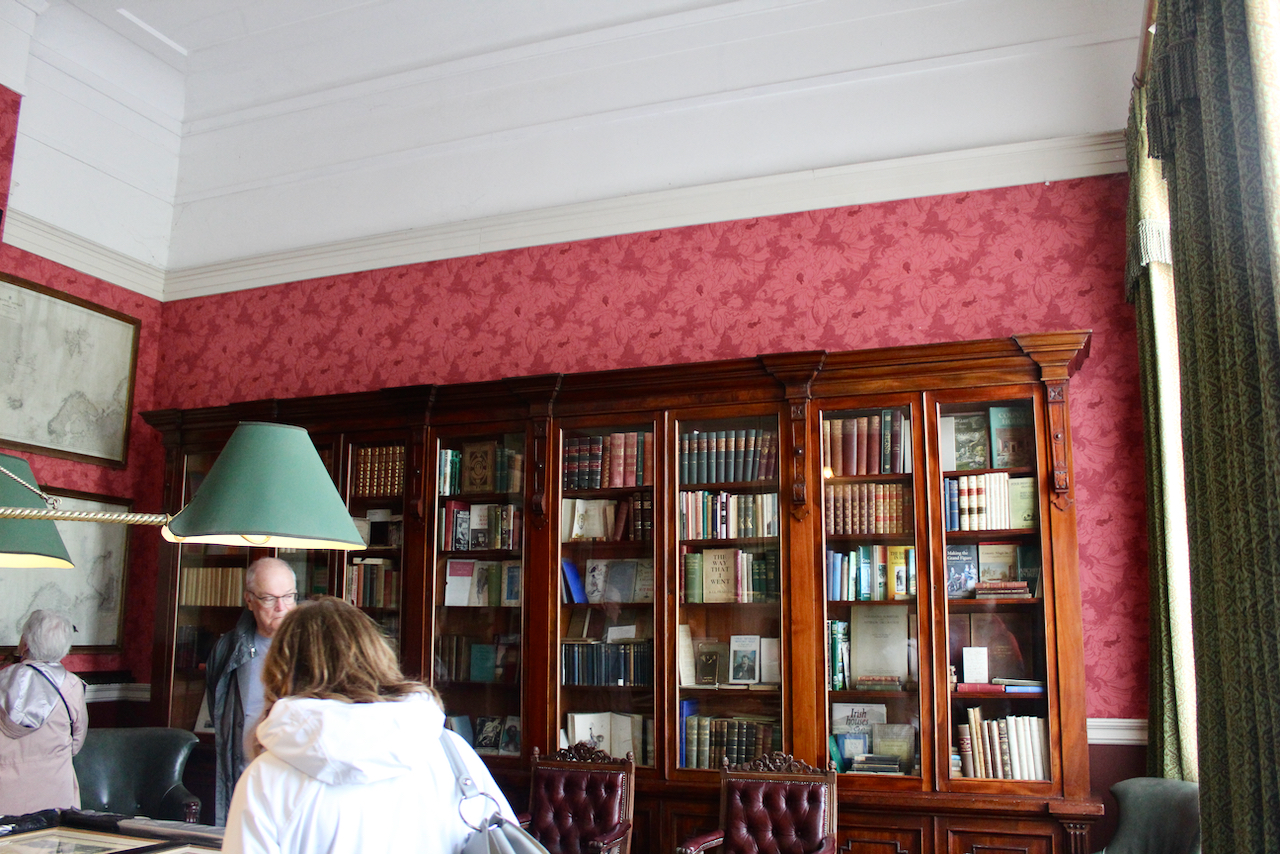
Robinson served as MP for Dublin University 1703–12, and he purchased forfeited lands in Carlow and Louth in April and June 1703. His career ended in disgrace however as he was accused of shady financial dealings and misrepresenting public accounts for which he was responsible. (see [1])
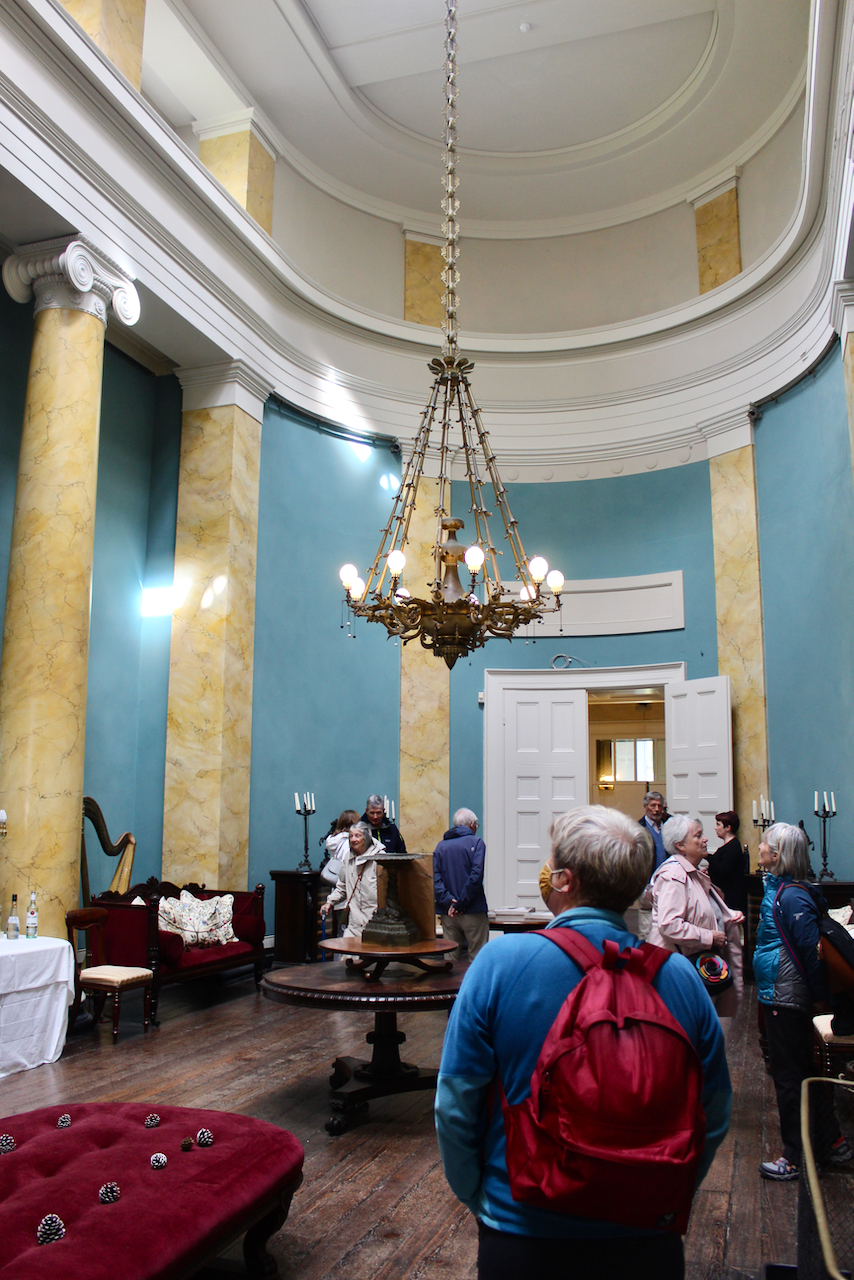
Thomas Burgh, information board at Royal Hospital Kilmainham, 15th October 2023.

Thomas Burgh (1670–1730) succeeded Molyneux and Robinson in 1700 as surveyor-general, and was also made lieutenant of the ordnance in Ireland. The rebuilding of Dublin castle, started by Robinson, advanced considerably under Burgh, but his undisputed masterpiece was to be TCD library. His work designing and building the lower part of the library began in 1712 and continued into the next decade. It was finally opened in 1732. He may have been responsible for designing Kildrought house in Celbridge, Kildare (see my entry). He too had engineering interests including navigation and coalmining. He lived in Oldtown, County Kildare, and became high sheriff of the county in 1712 and was MP for Naas 1713–30. [2]

It is difficult to photograph the church, as it is in the middle of city streets, and Christine Casey writes in her The Buildings of Ireland: Dublin (2005) that it exhibits “a curious amalgam of awkwardness and aplomb”! [3]

St. Mary’s church has four-bay double-height side elevations, with convex quadrant single-bay links to a shallow chancel which contains a lovely chancel window. It has a three-stage tower at the opposite end flanked by lower two-storey vestibules. It does not have a spire.
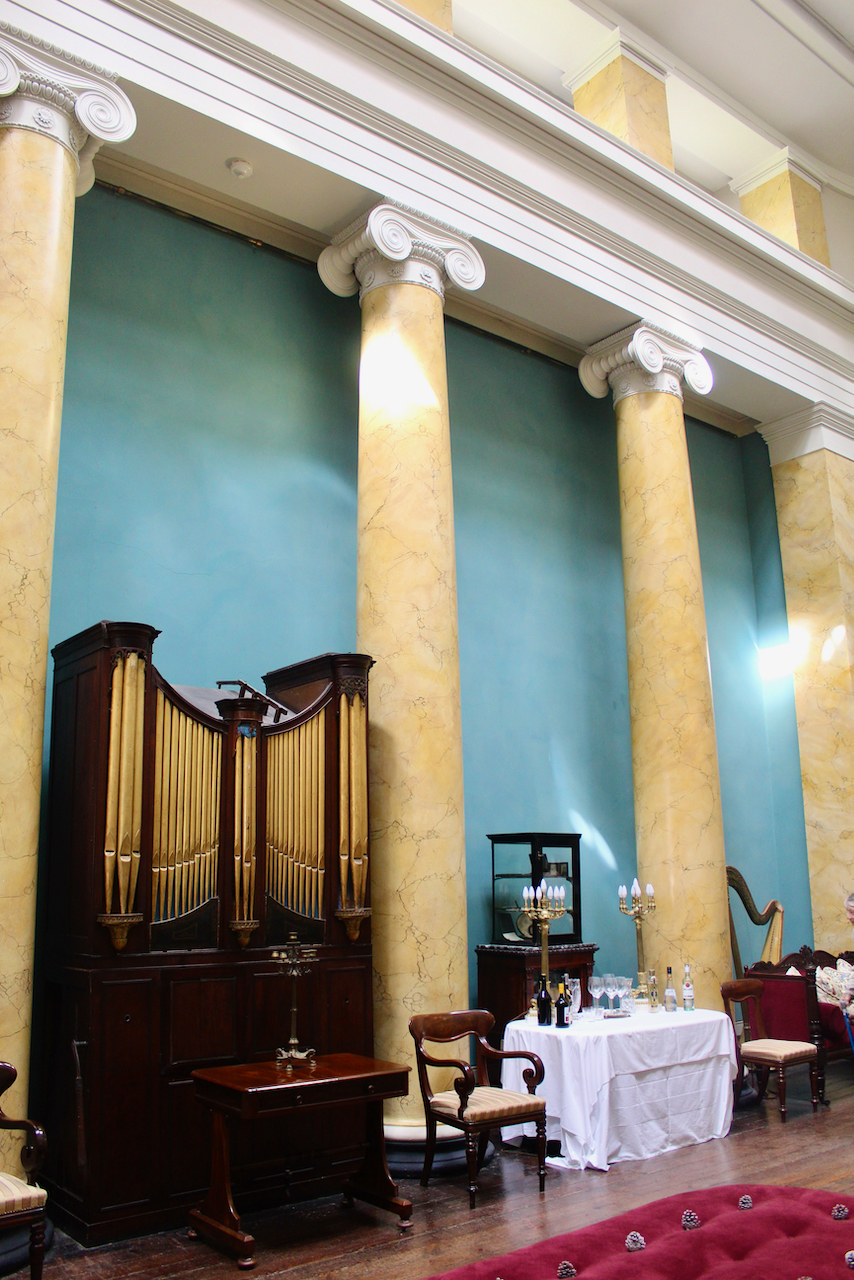
St. Mary’s Church of Ireland, June 2022. Photograph © Jennifer Winder-Baggot, www.irishhistorichouses.com

The west front has the main entrance door (no longer in use as the main door, which is on the north facade). Unfortunately I was unable to take a good photograph due to the position of outdoor tables and sheltering umbrellas. The doorcase is of Portland stone with Ionic columns and an entablature. Casey tells us that the lugged surrounds of the outer vestibule door are of brown sandstone.

The three-stage tower flanked by lower two-storey vestibules. Photograph © Jennifer Winder-Baggot, www.irishhistorichouses.com
Former St. Mary’s church. Photograph © Jennifer Winder-Baggot, www.irishhistorichouses.com
Inside the east end door. Photograph © Jennifer Winder-Baggot, www.irishhistorichouses.com
Former St. Mary’s church. Photograph © Jennifer Winder-Baggot, www.irishhistorichouses.com
The south side single bay convex quadrant between the four bays and the shallow chancel on the east end. Photograph © Jennifer Winder-Baggot, www.irishhistorichouses.com
The convex quadrant and the chancel at the east end, and to the north side, the modern stair tower encased in glass. Photograph © Jennifer Winder-Baggot, www.irishhistorichouses.com

The window frame on the east end chancel is of Portland stone, which Casey tells us “has a vigour and plasticity rare in a city by-passed by the Baroque.” She describes the window:

Above a raised granite plinth, two broad panelled pilasters support an emphatic curved scroll-topped hood-moulding with urns to centre and ends, while successive inner lugged framed have scrolled base terminals.”

Casey suggests that the gable on this end may be a later addition.

William Robinson prepared a model for this window, and may have designed the unusual plan for the church. It was completed by Thomas Burgh in 1704 and in 1863, S. Symes may have inserted new windows as well as replacing the perimeter wall with railings. The original chancel window of St. Mary’s was smashed by vandals on the result of polling at the election in 1852. The current window was set in 1910, commissioned in 1909 by John North, the proprietor of the “Hammam,” a Turkish Bath on O’Connell (then called Sackville) Street. The new window reads: “To the glory of God and in affectionate memory of his daughters Maria North (Molly) and Rosanna (Rose) wife of Joseph Armstrong also his grandchild John Hubert Armstrong (Jack) erected by John North 1909.”

Former St. Mary’s church. Photograph © Jennifer Winder-Baggot, www.irishhistorichouses.com
Memorial in St. Mary’s church for John North, who commissioned the new window installed in 1910 in the chancel. Photograph © Jennifer Winder-Baggot, www.irishhistorichouses.com
Former St. Mary’s church. Photograph © Jennifer Winder-Baggot, www.irishhistorichouses.com
St. Mary’s Church of Ireland, June 2022. Photograph © Jennifer Winder-Baggot, www.irishhistorichouses.com

Inside, it is of double height with a gallery surrounding three sides. On the fourth side is the east window. The west end has a large organ on the upper floor. The centre of the floor is taken up with an oval shaped bar which is made attractive by its arrangement of bottles and glasses. The gallery is carried on octagonal timber-clad limestone shafts. Above, the gallery reaches up to the ceiling with fluted square Ionic columns. The ceiling is barrel-vaulted. Memorial monuments still line the walls. Outside, the gravestones have been moved to one end of the public square.

Former St. Mary’s church. Photograph © Jennifer Winder-Baggot, www.irishhistorichouses.com
St. Mary’s Church of Ireland, June 2022. Photograph © Jennifer Winder-Baggot, www.irishhistorichouses.com

The east Chancel window has a lugged and scrolled surround.

Casey tells us that the building was remodelled in 2002-5 as a bar and restaurant by Duffy Mitchell Donoghue, who filled in the crypt and altered the floor level of the nave. The glazed tower holds a cylindrical elevator.

In 1761 Arthur Guinness (1725-1803), founder of the Brewery, married Olivia Whitmore in the church. His son, also named Arthur, married here also.

The National Inventory tells us: “It was the first classical parish church in the city and was the site of Arthur Guinness’s marriage in 1761. Wolfe Tone was baptized here and the church also witnessed John Wesley’s first Irish sermon... The galleried interior is one of the earliest in Dublin, and is a triumph of Classical timber design. Grand proportions combine with the set-pieces of the original organ case, east window and surviving Corinthian reredos, connected by an ornate mix of joinery and innovative modern alterations, to create a sumptuous and exuberant space. Mary Street was laid out by Humphrey Jervis from the mid-1690s and in 1697 the parish of Saint Michan’s was divided into three which precipitated the construction of Saint Mary’s. Jervis Street was named for the developer himself and was once home to seventeenth and eighteenth-century buildings. The streets are much altered now and consist largely of Victorian buildings, leaving Saint Mary’s to ground the district in its earlier historic milieu. As such, it makes a highly significant contribution to the streetscape and to Dublin’s overall architectural fabric.”

A rather simple baptismal font in the church is the font in which Theobald Wolfe Tone was baptised, and also Sean O’Casey the playwright.

Former St. Mary’s church. Photograph © Jennifer Winder-Baggot, www.irishhistorichouses.com
St. Mary’s Church of Ireland, June 2022. Photograph © Jennifer Winder-Baggot, www.irishhistorichouses.com

The organ was designed by Renatus Harris. George Frederick Handel, who wrote the famous “Messiah,” lived nearby on Abbey Street and was a regular visitor to Mary’s to play on this organ.

Former St. Mary’s church. Photograph © Jennifer Winder-Baggot, www.irishhistorichouses.com
St. Mary’s Church of Ireland, June 2022. Photograph © Jennifer Winder-Baggot, www.irishhistorichouses.com

The organ case, Casey tells us, includes the bases of three pipe-clusters with cherubim and scrolls.

Former St. Mary’s church. Photograph © Jennifer Winder-Baggot, www.irishhistorichouses.com
Thirty one memorial tablets in the church are dedicated to people formerly buried in St. Mary’s crypt and graveyard. Photograph © Jennifer Winder-Baggot, www.irishhistorichouses.com

The vestibules have early eighteenth century staircases.

Former St. Mary’s church. Photograph © Jennifer Winder-Baggot, www.irishhistorichouses.com
St. Mary’s Church of Ireland, June 2022. Photograph © Jennifer Winder-Baggot, www.irishhistorichouses.com

Below ground, is the Cellar Bar. These function rooms are located in an area that was excavated out from underneath the church, and are not part of the original building. There are six crypts in the basement of the church, and 32 skeletons were removed and reinterred elsewhere when the church was converted to its current use. Access to the crypt was by an external stairwell in the church.

Former St. Mary’s church. Photograph © Jennifer Winder-Baggot, www.irishhistorichouses.com
The crypt level. Photograph © Jennifer Winder-Baggot, www.irishhistorichouses.com
The wooden floorboards leading from the external glass tower to the upper gallery of the church were removed from the Adelphi Theatre in 1995 prior to its demolition. Some of the famous acts to perform on the stage are listed on the floor. Photograph © Jennifer Winder-Baggot, www.irishhistorichouses.com
St. Mary’s Church of Ireland, June 2022. Photograph © Jennifer Winder-Baggot, www.irishhistorichouses.com

Outside there is a public square, Wolfe Tone Park, and grave slabs are stacked up at one end of this park.

Wolfe Tone Square. Photograph © Jennifer Winder-Baggot, www.irishhistorichouses.com
The burial place of Francis Hutcheson.
Wolfe Tone Square. Photograph © Jennifer Winder-Baggot, www.irishhistorichouses.com
Former St. Mary’s church. Photograph © Jennifer Winder-Baggot, www.irishhistorichouses.com
St. Mary’s Church of Ireland, June 2022. Photograph © Jennifer Winder-Baggot, www.irishhistorichouses.com

[1] Dictionary of Irish Biography for Sir William Robinson, https://www.dib.ie/biography/robinson-sir-william-a7736

[2] https://www.dib.ie/biography/burgh-thomas-a1135

[3] p. 89-91. Casey, Christine. Buildings of Ireland: Dublin, The City within the Grand and Royal Canals and the Circular Road with the Phoenix Park. Yale University Press, New Haven and London, 2005.

Text © Jennifer Winder-Baggot, www.irishhistorichouses.com

Office of Public Works properties in Munster: Counties Kerry and Waterford.

I had so much to write about for the OPW properties in Cork that I am separating that from Counties Kerry and Waterford in Munster.

Kerry:

1. Ardfert Cathedral, County Kerry

2. The Blasket Centre, County Kerry

3. Derrynane House, County Kerry

4. Listowel Castle, County Kerry

5. Ross’s Castle, Killarney, County Kerry

6. Skellig Michael, County Kerry

Waterford:

7. Dungarvan Castle, County Waterford

8. Reginald’s Tower, County Waterford

donation

Help me to pay the entrance fee to one of the houses on this website. This site is created purely out of love for the subject and I receive no payment so any donation is appreciated!

€10.00

Kerry:

1. Ardfert Cathedral, Tralee, County Kerry

Ardfert Cathedral, 1965, photograph from Dublin City Library and Archives. [1]

General Information: 066 713 4711, ardfertcathedral@opw.ie

From the OPW website https://heritageireland.ie/visit/places-to-visit/ardfert-cathedral/:

No less a figure than St Brendan the Navigator was born in the Ardfert area in the sixth century. He founded a monastery there not long before embarking on his legendary voyage for the Island of Paradise. It was Brendan’s cult that inspired the three medieval churches that stand on the same site today.

The earliest building is the cathedral, which was begun in the twelfth century. It boasts a magnificent thirteenth-century window and a spectacular row of nine lancets in the south wall.
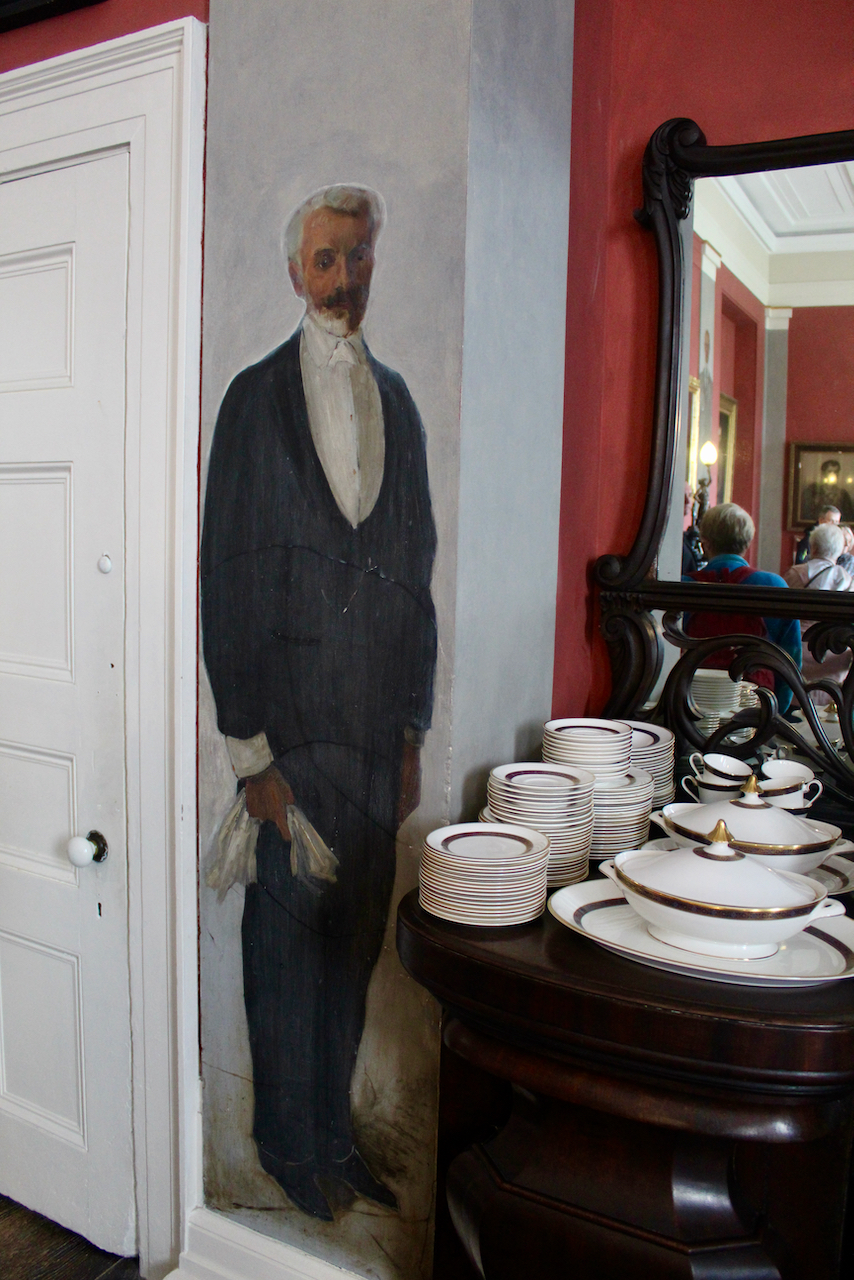
One of the two smaller churches is an excellent example of late Romanesque architecture. The other, Temple na Griffin, is named for a fascinating carving inside it – which depicts a griffin and a dragon conjoined.

Ardfert Cathedral, 1965, photograph from Dublin City Library and Archives [see 1]

2. The Great Blasket Island Visitor Centre, County Kerry:

Blasket Island Centre, Dingle, Co. Kerry. Photograph from Ireland’s Content Pool, photograph by Chris Hill, 2014, for Failte Ireland. [2]

Dun Chaoin, Dingle, County Kerry

General enquiries: 066 915 6444, blascaod@opw.ie

From the OPW website https://heritageireland.ie/visit/places-to-visit/the-blasket-centre-ionad-an-bhlascaoid/:

In Dún Chaoin, at the very tip of the Dingle Peninsula, is an utterly unique heritage centre and museum. A stunning piece of architecture in itself, the Blasket Centre tells the story of the Blasket Islands and the tiny but tenacious Irish speaking community who lived there until the mid-20th century. 

Life on the Blaskets was tough. People survived by fishing and farming and every day involved a struggle against the elements. Emigration and decline led to the final evacuation of this extraordinary island in 1953.

The island population has left a massive cultural footprint. They documented the life of their community in a series of books which are invaluable social records and classics of Irish literature. They are both a window into the past and a fascinating resource for today.

Visit Ionad an Bhlascaoid  –  the Blasket Centre – to experience the extraordinary legacy of the Blasket Islanders and delve into the heart of Irish culture, language and history.” [3]

The website has lots more information for you to learn about life on the Islands. The Great Blasket was inhabited continuously for at least 300 years. It has Ireland’s largest colony of grey seals also. During the famine, there was not a single death recorded from hunger, as fishing sustained the islanders. At its peak the population reached 160, but declined due to emigration. Two of the houses have been restored by the OPW. The visitor centre is on the mainland but one can take a privately operated passenger boat to the Island, weather permitting.

ruined village on the Blasket Islands, 1987, photograph from Dublin City Library and Archive. [see 1]

3. Derrynane House, Caherdaniel, County Kerry:

Derrynane House, County Kerry, photograph from Ireland’s Content Pool, photo by George Munday, 2014. [see 2]

General enquiries: 066 947 5113, derrynanehouse@opw.ie

From the OPW website https://heritageireland.ie/visit/places-to-visit/derrynane-house/:

At the southern tip of the Iveragh Peninsula is Derrynane House, the ancestral home of one of the greatest figures of Irish history. Daniel O’Connell, known as ‘The Liberator’, was a lawyer, politician and statesman. The demesne landscape is now included in Derrynane National Historic Park – over 120 hectares of lands rich in natural and cultural heritage with a plethora of archaeological, horticultural, botanical and ecological treasures.

Derrynane was the home of the O’Connell family for generations. The young Daniel was raised there and returned almost every summer for the rest of his life.

The house now displays many unique relics of O’Connell’s life, including a triumphal chariot presented to him by the citizens of Dublin in 1844 and the very bed in which he passed away three years later.

Derrynane comes from the Irish meaning “the oak wood of St Fionan,” Doire Fhionan. [4] Throughout Daniel O’Connell’s career, Derrynane was his country residence and the place where he and his family spent most of their summers. He inherited the house in 1825. He wrote in 1829:

This is the wildest and most stupendous scenery of nature – and I enjoy residence here with the most exquisite relish…I am in truth fascinated by this spot: and did not my duty call me elsewhere, I should bury myself alive here.” [see 4]

Derrynane House, County Kerry, photograph from Ireland’s Content Pool, photo by George Munday, 2014. [see 2]

Mark Bence-Jones writes about the house:

The house, which is believed to have been first late-roofed house in this remote and mountainous part of the country, originally consisted of two unpretentious ranges at right angles to each other, probably built at various times between ca 1700 and 1745 and somewhat altered in later years; one range being of two storeys and the other mainly of two storeys and a dormered attic, which in second half of C18, became a third storey. Between 1745 and 1825 a wing was built at what was then the back of the house, this side towards Derrynane Bay; and in 1825 the great Daniel O’Connell extended this wing in the same unpretentious style with rather narrow sash windows; so that what had previously been the back of the house became the front, with reception rooms facing the sea. O’Connell also built a square two storey block with Irish battlements at right angles to his main addition, forming at attractive three sided entrance court, the other two sides being 1745-1825 wing and one of the original ranges. The battlemented block is weather-slated, as indeed all O’Connell’s additions were originally; he also weather slated some of the older parts of the house. Finally, in 1844, O’Connell built a new chapel in thanksgiving for his release from prison. It flanks the entrance court on the side furthest from the sea and is Gothic; based on the chapel in the ruined medieval monastery on Abbey Island nearby; it was designed by O’Connell’s third son, John O’Connell, MP. The interior of the house is simple, and the ceilings are fairly low. The two principal reception rooms are the drawing-room and dining-room which are one above the other in 1825 wing; they have plain cornices; the dining room has a Victorian oak chimneypiece, the drawing room an early C19 Doric chimneypiece of white marble. The benches and communion rail of the chapel are of charmingly rustic Gothic openwork. The house is now owned by the Commissioners of Public Works, who demolished one of the original ranges 1965 [due to poor structural condition]. The rest of the structure has been restored and is open to the public, the principal rooms containing O’Connell family portraits and objects related to Daniel O’Connell’s life and career.” [5]

Derrynane, photograph 1990, Dublin City Library and Archive. [see 1]
Daniel O’Connell’s table, photograph 1941, Derrynane House, Dublin City Library and Archive. [see 1]
Daniel O’Connell (1775-1847), portrait from Mansion House, Dublin, 2015. Photograph © Jennifer Winder-Baggot, www.irishhistorichouses.com

The O’Connell family gave the house to the Derrynane Trust in 1946. Despite earlier warnings that it would not be responsible for O’Connell’s ancestral home, in late 1964 the government agreed to acquire Derrynane House from the Derrynane Trust.  David Hicks writes a good summary about Daniel O’Connell:

In the 18th and 19th centuries there was a series of restrictions placed on Catholics in Ireland – the Penal Laws – which curtailed them in many avenues of life. These restrictions extended to property ownership and education, and Catholics were also barred from holding political office. As a man of the law, O’Connell became an advocate for the abolition of the last vestiges of the Penal Laws and in 1823 brought the Catholic Church into Irish politics. He used his network of acquaintances to mobilise the people to campaign for Catholic emancipation from discrimination and to gain political rights for Catholics. Collections were taken and no matter how small the donation it was for a great cause. This led to the unification of Catholics in Ireland. In 1828, O’Connell stood for the British Parliament, the first Catholic to do so in over 100 years, and won his seat easily. While he had his supporters in the British cabinet, others such as the Duke of Wellington and Sir Robert Peel opposed Catholic emancipation. They were aware, however, that not allowing O’Connell to take his parliamentary seat would result in possible rebellion in Ireland. Another probelm arose: in order for O’Connell to take his seat in Parliament, he would have to take an Oath of Supremacy which recognised the British monarch as head of the Church and state. As the Pope in Rome is head of the Catholic church, O’Connell could not and would not swear allegiance to a British monarch as head of the Church of England. Wellington and Peel convinced the King to allow the emancipation of Catholics to prevent a possible uprising of the large Catholic population in Ireland. As a result Catholics gained political rights under the Emancipation Act of 1829 and could enter Parliament without taking the oath. O’Connell had to be re-elected before he could take his seat as the Act could not be implemented retrospectively. He was finally elected in 1829 to the British Parliament and became known as the Liberator, a moniker which is still associated with his legend.

By 1837 O’Connell had grown frustrated at how little he could achieve in Ireland in a British Parliament. He now launched a new campaign: to repeal the Act of Union between Ireland and Britain. While he did not want Ireland to leave the Empire, he did want her to have her own parliament where Catholics could exercise their own political power and ambitions. Initially, this campaign garnered a lot of support. In the 1840s, O’Connell held large meetings to campaign for the repeal of the Act of Union. These meetings were usually held in a large field, racecourse or fairground and opened with a huge procession of bands in uniform, floats, carriages and carts, with thousands of local residents on foot or horseback. Crowds gathered around a makeshift platform, on which O’Connell stood to address them. One of his largest political rallies was held at the provocative spot of the Hill of Tara, site of the residence of the former high kings of Ireland, intended to inspire the attending crowd of half a million people.  

The size of this rally was relayed to the British Parliament and within three months O’Connell was charged with conspiracy, creating discontent and disaffection, for which he was arrested and jailed. When he was released from prison he made his way through the crowded streets of Dublin on a specially made chariot which still survives at Derrynane.” [6]

Daniel O’Connell’s chariot, built to welcome him and parade him through streets when he is released from prison. Photograph taken October 2012. Photograph © Jennifer Winder-Baggot, www.irishhistorichouses.com

4. Listowel Castle, County Kerry:

General information: 086 385 7201, padraig.oruairc@opw.ie

From the OPW website https://heritageireland.ie/visit/places-to-visit/listowel-castle/:

Listowel Castle stands on an elevation overlooking the River Feale, above the location of a strategic ford. Although only half of the building survives, it is still one of Kerry’s best examples of Anglo-Norman architecture.

Only two of the original four square towers, standing over 15 metres high, remain. The towers are united by a curtain wall of the same height and linked together – unusually – by an arch on one side.

Listowel was the last bastion [of the Fitzgeralds] against the forces of Queen Elizabeth in the First Desmond Rebellion in 1569. The castle’s garrison held out for 28 days of siege before finally being overpowered by Sir Charles Wilmot. In the days following the castle’s fall, Wilmot executed all of the soldiers left inside.

5. Ross Castle, Killarney, County Kerry:

Ross Castle, Killarney, August 2007. Photograph © Jennifer Winder-Baggot, www.irishhistorichouses.com

General Enquiries: 064 6635851, rosscastle@opw.ie

From the OPW website https://heritageireland.ie/visit/places-to-visit/ross-castle/:

Ross Castle perches in an inlet of Lough Leane. It is likely that the Irish chieftain O’Donoghue Mór built it in the fifteenth century. 

Legend has it that O’Donoghue still slumbers under the waters of the lake. Every seven years, on the first morning of May, he rises on his magnificent white horse. If you manage to catch a glimpse of him you will enjoy good fortune for the rest of your life.

Ross Castle was the last place in Munster to hold out against Cromwell. Its defenders, then led by Lord Muskerry, took confidence from a prophecy holding that the castle could only be taken by a ship. Knowing of the prophecy, the Cromwellian commander, General Ludlow, launched a large boat on the lake. When the defenders saw it, this hastened the surrender – and the prophecy was fulfilled [in 1652].

Ross Castle, County Kerry, photograph from the National Library of Ireland.
Ross Castle, Killarney, August 2007. Photograph © Jennifer Winder-Baggot, www.irishhistorichouses.com

The Castle came into the hands of the Brownes who became the Earls of Kenmare and owned an extensive portion of the lands that are now part of Killarney National Park. It was leased to Valentine Browne (d. 1589), ancestor of the Earls of Kenmare, who was involved with the Plantation of Munster, surveying the land. He served as MP for County Sligo in the Irish Parliament in 1585/6. The Brownes obtained ownership of the castle and lands when it could be proven that they did not play a part in the Confederate Rebellions between 1641-1653. However, Valentine Browne (1639-1694) 1st Viscount of Kenmare (and 3rd Baronet Browne of Mohaliffe, County Kerry) was loyal to James II had to forfeit his estate. The title Earl of Kenmare comes originally from Kenmare Castle in County Limerick. His grandson, 3rd Viscount, recovered the estates, but could not get possession of Ross Castle, which had been taken over as a military barracks, so around 1726 he built a new house a little way to the north of the castle, closer to the town of Killarney, Kenmare House, which has been demolished when a later house was built.

Ross Castle, Killarney, August 2007. Photograph © Jennifer Winder-Baggot, www.irishhistorichouses.com

6. Skellig Michael, County Kerry:

Skellig islands, photograph from Ireland’s Content pool, created for Failte Ireland, 2014. [see 2]

General Information: opwskellig@opw.ie

From the OPW website https://heritageireland.ie/visit/places-to-visit/skellig-michael/:

The magnificent Skellig Michael is one of only two UNESCO World Heritage Sites in the Republic of Ireland.

On the summit of this awe-inspiring rock off the Kerry coast is St Fionan’s monastery, one of the earliest foundations in the country. The monks who lived there prayed and slept in beehive-shaped huts made of stone, many of which remain to this day.

The monks left the island in the thirteenth century. It became a place of pilgrimage and, during the time of the Penal Laws, a haven for Catholics.

Following in the monks’ footsteps involves climbing 618 steep, uneven steps. Getting to the top is quite a challenge, but well worth the effort.

As well as the wealth of history, there is a fantastic profusion of bird life on and around the island. Little Skellig is the second-largest gannet colony in the world.

Skellig Michael, 1967, photograph from Dublin City Library and Archives. [see 1]
Skellig Michael monastery, 1958, photograph from Dublin City Library and Archives. [see 1]

Waterford:

7. Dungarvan Castle, County Waterford:

Dungarvan Castle, Waterford, photograph from Ireland’s Content pool, by Chris Hill 2006 for Failte Ireland. [see 2]

General Information: 058 48144.

From the OPW website https://heritageireland.ie/visit/places-to-visit/dungarvan-castle/:

This castle dates from the early days of the Anglo-Norman settlement in Ireland. It was built c.1209 to safeguard the entrance to Dungarvan Harbour. The polygonal shell keep – a rare building type in Ireland – is the earliest structure on the site.

The castle has an enclosing curtain wall, a corner tower and a gate tower. Within the wall is a two-storey military barracks, which dates from the first half of the eighteenth century. It was used by the British Army and the Royal Irish Constabulary until 1922. During the Irish Civil War Dungarvan Castle was destroyed by the Anti-Treaty IRA.  It was subsequently refurbished and served as the Headquarters of the local Garda Síochana.

Today the Barracks and Castle grounds are open to visitors. Inside you will find a revealing exhibition on the Castle’s long and intriguing history.

8. Reginald’s Tower, The Quay, Waterford, County Waterford:

Reginald’s Tower, photograph from Ireland’s Content pool, by Mark Wesley 2016 for Failte Ireland. [see 2]

General information: 051 304220, reginaldstower@opw.ie

https://www.waterfordtreasures.com/reginalds-tower

Reginald’s Tower is named after the Viking who founded Waterford in 1914 and is home now to Viking treasures.

From the OPW website https://heritageireland.ie/visit/places-to-visit/reginalds-tower/:

Once described as ‘a massive hinge of stone connecting the two outstretched wings of the city’ this tower has never fallen into ruin and has been in continuous use for over 800 years. 

Originally the site of a wooden Viking fort, the stone tower we see today actually owes its existence to the Anglo-Normans who made it the strongest point of the medieval defensive walls. Later it was utilised as a mint under King John, before serving various functions under many English monarchs. Weapons, gunpowder and cannons have all been stored here reflecting various periods of Waterford’s turbulent history. 

Take the spiral stairs up and en route see the remains of a 19th century prison cell, artefacts from Waterford’s Viking history, and the sword of the Chief Constable whose family were the last residents of the tower.

On two floors are housed one branch of the Waterford Museum of Treasures, concentrating on the town’s thrilling Viking heritage.

[1] https://repository.dri.ie/

[2] https://www.irelandscontentpool.com/en

[3] see the website https://blasket.ie/

[4] p. 120. Living Legacies: Ireland’s National Historic Properties in the care of the OPW, Government Publications, Dublin, 2018.

[5] p. 102. Mark Bence-Jones. A Guide to Irish Country Houses (originally published as Burke’s Guide to Country Houses volume 1 Ireland by Burke’s Peerage Ltd. 1978); Revised edition 1988 Constable and Company Ltd, London.

[6] p. 107-119, Hicks, David. Irish Country Houses, Portraits and Painters. The Collins Press, Cork, 2014. 

Barntick House, Clarecastle, County Clare V95 FH00 – section 482

Contact: Ciarán Murphy

Tel: 086-1701060

Open dates in 2025: May 1-31, June 1-30, 4.30pm-8.30pm, Aug 16-24, 2pm-6pm

Fee: Free

Barntick, May 2023. © Jennifer Winder-Baggot, www.irishhistorichouses.com

donation

Help me to pay the entrance fee to one of the houses on this website. This site is created purely out of love for the subject and I receive no payment so any donation is appreciated!

€15.00

We visited Barntick in May 2023. Owner Ciarán welcomed us and showed us around. I was excited to see a house so old – it dates from 1665. [1] A date plaque has been moved to a barn and used as a lintel, upsidedown! Barntick is thought to be the oldest continuously inhabited house in County Clare, and is certainly one of the oldest houses in County Clare.

The date stone, 1665, which was probably originally a chimneypiece. © Jennifer Winder-Baggot, www.irishhistorichouses.com

The initials “T.H.” are carved into the date plaque with an interesting circular figure beside – the initials probably stand for Thomas Hickman who built the house.

The house is an important part of the history of the area, and Ciarán is working hard to maintain the house. He is doing tremendous work. There is great interest in the house: this year (2023) during Heritage Week Ciarán gave tours of the house, and he had 110 visitors!

Barntick, May 2023. © Jennifer Winder-Baggot, www.irishhistorichouses.com

Thomas Hickman, Ciarán told us, owned much land in Munster. The Landed Estates database tell us that Gregory Hickman was an English merchant in the south of England in the first half of the 17th century. He married twice, the Hickmans of “Barntic,” barony of Islands, County Clare were descended from his first marriage and the Hickmans of Ballyket, Brickhill, Kilmore and Fenloe, County Clare, from his second marriage. [2] Barntick was leased to the Hickmans from circa 1620s. [2]

In the Notes of Sheriffs of County Clare 1570-1700 By Thomas Johnson Westropp we find:

1671. Thomas Hickman of Ballyhenan, eldest son of Gregory, son of Walter Hickman of Kew (Gregory settled in Clare before 1612, and his farm of Barntick was plundered by the O’Briens, 1642). Thomas Hickman’s will dates September 12th, 1677. Proved by his son Thomas in Dublin, 28th November, same year. He was buried in the chancel of Ennis Abbey with his wife, a daughter of John Colpoys, and was ancestor of the extinct Hickmans of Barntick. Arms (as on his seal, and his son-in-law Hugh Perceval’s funeral entry at Dublin). He prays, in his will, “for the happiness of the house of Thomond, wherein I have long served, and to which I have natural respect and love.”

A Thomas Hickman of “Barntic” married Elizabeth Stratford (b. 1672), daughter of Robert, MP for County Wicklow. [2] Another record from tNotes of Sheriffs of County Clare 1570-1700 By Thomas Johnson Westropp tells us:

1678. Thomas Hickman of Barntick, son of Thomas Hickman, 1671. His settlement with his wife, Elizabeth, daughter of Edward Stratford of Belan, Kildare, dates 15th May, 1693. His will dates 1st June, 1715, and contains a voluminous settlement of estates, extending over every branch of the family. Proved by his son, Robert, 31st January, 1719, at Dublin.”

We can see that the two sources have Elizabeth Stratford as daughter of either Robert or of Edward. On The Peerage website created by Robert Lundy, Elizabeth (b. 27 Sep 1672) is daughter of Robert (d. 1698/99), and Edward Stratford (d. 23 Feb 1740) is a son of Robert. Edward also has a daughter named Elizabeth but she marries Charles Patrick Plunkett of Dillonstown, County Louth.

Robert O’Byrne tells us that Thomas Hickman was succeeded by his son, another Thomas, who died in 1719, and then the property passed to Colonel Robert Hickman, who represented Clare in the Irish House of Commons from 1745 until his death. [3]

The carved limestone “shouldered” door frame with entablature above is very impressive. There is a stringcourse between the ground and first floor. A stringcourse is a thin projecting course of brickwork or stone that runs horizontally around a building, typically to emphasize the junction between floors. © Jennifer Winder-Baggot, www.irishhistorichouses.com
The door is up several limestone steps. © Jennifer Winder-Baggot, www.irishhistorichouses.com
The outbuilding ruin to the right whose stone gable we see was originally thatched. © Jennifer Winder-Baggot, www.irishhistorichouses.com

The Landed Estates database tells us that by the mid 18th century the Hickmans owned almost 3,000 acres in the parishes of Clareabbey and Killone, barony of Islands and controlled the village of Clare. They also held land in many other parishes but by the end of the 1750s their estates were heavily mortgaged. Colonel Robert Hickman of Barntick died without heirs in 1757 and his estates were sold in 1763.

Barntick was purchased by George Peacocke who, Robert O’Byrne tells us, already owned another substantial property, Grange, County Limerick. George (d. 1773) married Mary Levett, daughter of Joseph, Alderman of Cork. Their son Joseph (d. 1812), who was Justice of the Peace and High Sheriff of County Clare, was created 1st Baronet Peacocke, of Barntic, County Clare in 1802, O’Byrne tells us that this was because he supported the Act of Union. [3]

Barntick, May 2023. © Jennifer Winder-Baggot, www.irishhistorichouses.com

Joseph married Elizabeth Cuffe, daughter of Thomas Cuffe and Grace Tilson, who married Reverend Charles Coote (1713-1796) when her husband died, and went on to have another family, so that Elizabeth’s half-brother was Charles Henry Coote (1754-1823) 2nd Baron Castle Coote. When Joseph died the estate was divided between his two sons, Nathaniel Levett Peacocke (1769-1847) 2nd Baronet and Reverend William Peacocke. [see 3]

An impressive double-height window with red brick surround in the back lights the staircase inside. © Jennifer Winder-Baggot, www.irishhistorichouses.com
Barntick, May 2023. © Jennifer Winder-Baggot, www.irishhistorichouses.com

Nathaniel married Henrietta Morris, daughter of John 1st Baronet Morris, of Clasemont, Co. Glamorgan, Wales. They had a son, Joseph Francis Peacocke (1805-1876) 3rd Baronet of Barntic. A second son, George Montagu Warren, changed his surname to Sandford in 1866, and lived in England.

By the 1820s the estate was put up for sale by the Court of Chancery.

Barntick next belonged to David Roche (1791-1865), O’Byrne tells us, who was M.P. for Limerick 1832-1844, and was created Baronet of Carass, County Limerick, in 1838. He married Frances Vandeleur, daughter of John Ormsby Vandeleur. They had several children but she died in 1841 and he married Cecilia Caroline O’Grady, daughter of Henry Deane O’Grady (1765-1847). We came across the O’Grady family before, as he sister Frances married Arthur Thomas Blennerhassett of Ballyseede Castle in County Kerry (see my entry on Ballyseede Castle, another Section 482 property).

In 1855 the house, along with 238 acres, was recorded as being leased to John Lyons and later his family bought the property. [3]

Ciarán’s grandmother Margaret was a Lyons and married into the Murphy family. She was very resourceful and Ciarán showed us many of her repairs. The estate would have been self-sufficient.

Ciarán is doing many of the repairs and maintenance of the house himself. Stephen was very impressed by the fact that he purchased a “cherrypicker” and can thus weed the roof!

The side of the house facing the outbuildings. © Jennifer Winder-Baggot, www.irishhistorichouses.com
In the centre of the roof is a lead valley that led to a cistern for water on the top floor.

Ciarán pointed out the place on the side of the house where the stonework is exposed. This part of the wall collapsed at one point and Ciarán had to fix it.

There used to be an orchard in front of the house. The view is beautiful, as the house is situated on an elevated site. In the nineteenth century, Ciarán told us, land was reclaimed from the Fergus River.

Barntick, May 2023. © Jennifer Winder-Baggot, www.irishhistorichouses.com

Robert O’Byrne describes the house:

The building is a deep square, the east-facing rendered facade of three storeys and three bays, its carved limestone entrance doorcase approached by a shallow flight of six stone steps. Inside, the front half of the house is divided into three almost equal spaces, comprising a hall with drawing room and dining room on either side. To the rear, a handsome staircase, lit by a single tall window on the return, leads to the bedroom floor. Here the space is divided by a thick central wall running north to south and with a barrel-vaulted ceiling, indicating the house’s early date of construction. The stairs then climb to the top of the building where the entire front is given over to a single room...”

The front hall, where the front door is reflected by a double door opposite with an arched fanlight. A picture rail runs sides of the hall. © Jennifer Winder-Baggot, www.irishhistorichouses.com

Ciarán pointed out in the front hall that one can see the dried rushes used for construction through a hole in the ceiling.

The dining room. © Jennifer Winder-Baggot, www.irishhistorichouses.com

Below the shutters there is a carved diamond that is a characteristic design of the seventeenth century. The ceiling dates from the 1950s as the ceiling collapsed in the dining room when Ciarán’s father was a child in the house.

Ciarán’s grandmother Margaret fixed the wall in the room. The wall was always wet due to the roof leaking. She attached sheets of plywood to the walls, attached vertically from the skirting boards. The boards remain in situ today.

The casement windows have shutters and an impressive pelmet. © Jennifer Winder-Baggot, www.irishhistorichouses.com
Barntick, May 2023. © Jennifer Winder-Baggot, www.irishhistorichouses.com

Upstairs has a wide landing with broach archway. I think the house could be described as “double pile”: “single pile” is a house with a single row of rooms and double pile has two rows of rooms, and as with this case, a corridor between the two halves. This broad corridor is on each storey in Barntick.

Barntick, May 2023. © Jennifer Winder-Baggot, www.irishhistorichouses.com

We didn’t go up to the second floor as it is too unstable at the moment. It had a ballroom to the front, and servants’ quarters in back, Ciarán told us. The ballroom could have been like that of the Ormond castle in Carrick-on-Suir, a long room on an upper storey that was used for exercise in inclement weather.

In that attic, the timbers of the oak pegged roof are numbered with Roman numerals. Ciarán told us that they denote the import tax owed on the timber at time of import!

Roman numerals on the roof beam timbers were written on the beams at the time of import and denote import taxes. Photograph courtesy of Ciarán Murphy.

We saw the similar feature in 9 Aungier Street in Dublin, another building from the 1600s, and were told that the numbers there could have helped in their placement during construction. The beams are hand-hewn, and are fixed in place by oak pegs rather than with nails.

Oak peg used to secure timbers, photograph courtesy of Ciarán Murphy.

After the roof was fixed it took about five years for the house to dry out. Seeing a house in the daunting process of repair and upkeep, one appreciates how much work it takes to maintain such a house. Although most of the bedrooms are habitable, Ciarán showed us the front bedroom which is not, due to water damage caused by water ingress from the roof.

Water damage in the front bedroom.

The basement has lovely flagstone floors.

The basement with its flagstone floors, photograph courtesy of Ciarán Murphy.

The rear entrance to the house also has flagstone floors.

Rear entrance to Barntick, photograph courtesy of Ciarán Murphy.
The building with the rounded tin roof is the coach house. The outbuildings are on old maps so are probably the same age as the house. © Jennifer Winder-Baggot, www.irishhistorichouses.com
The rounded roof of the carriage house. © Jennifer Winder-Baggot, www.irishhistorichouses.com

[1] https://www.buildingsofireland.ie/buildings-search/building/20404103/barntick-house-barntick-co-clare

[2] https://landedestates.ie/estate/1896

[3] https://theirishaesthete.com/2023/08/21/barntick/

© Jennifer Winder-Baggot, www.irishhistorichouses.com