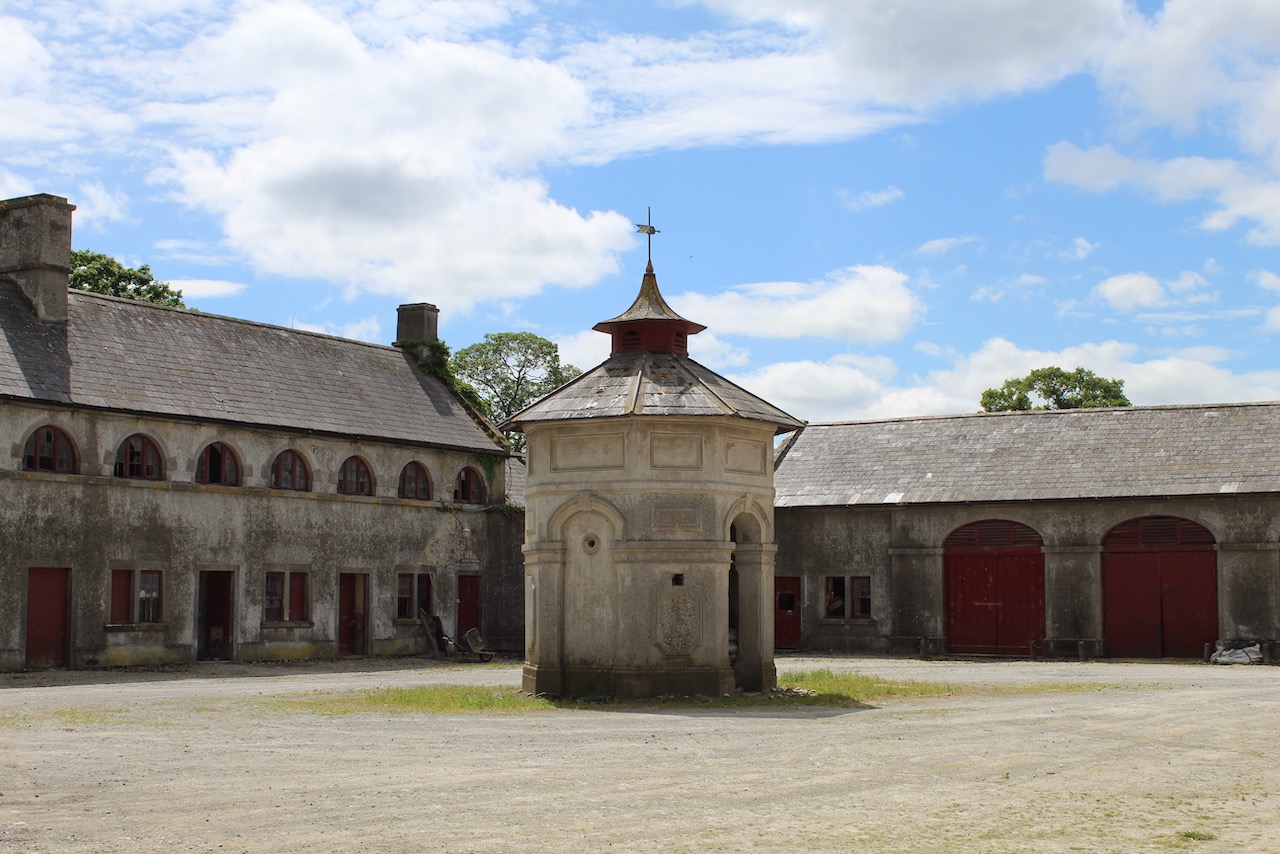
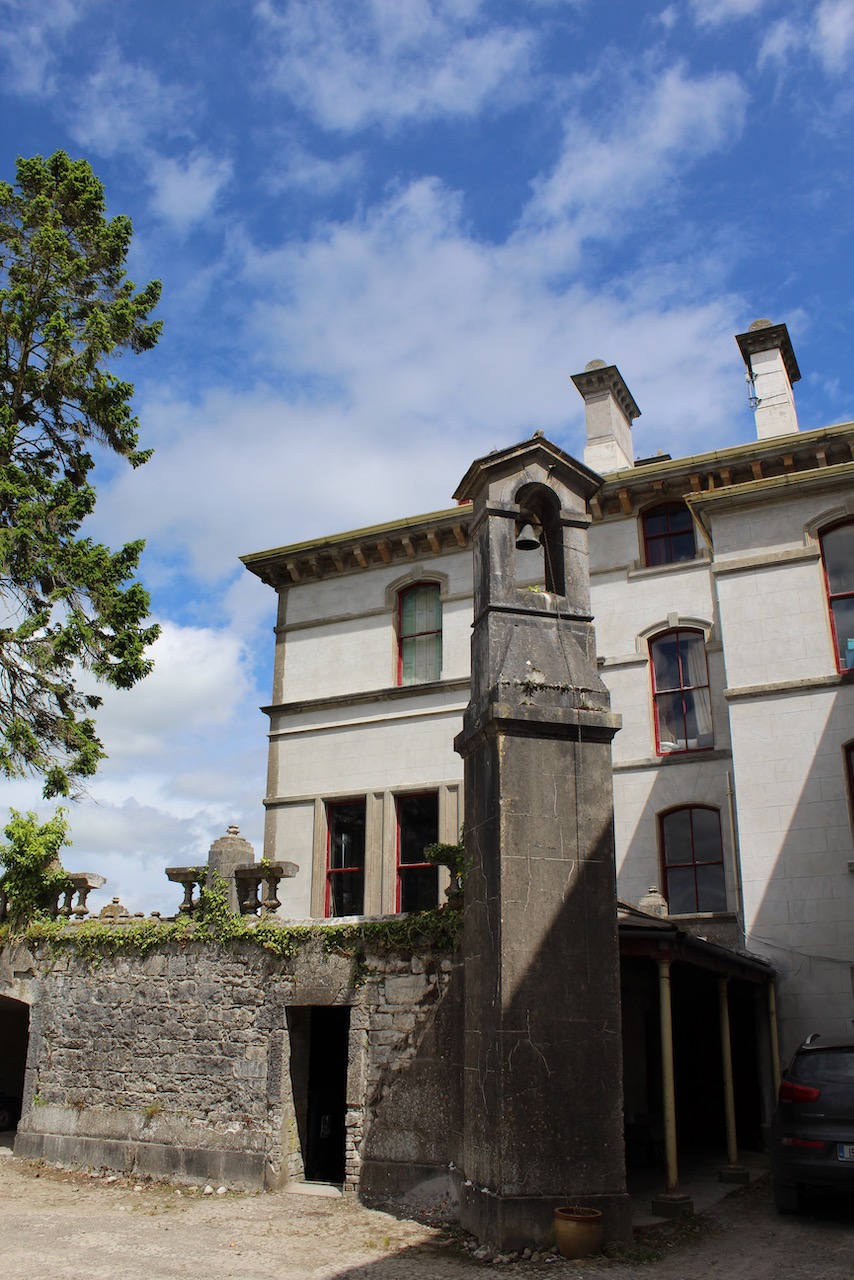
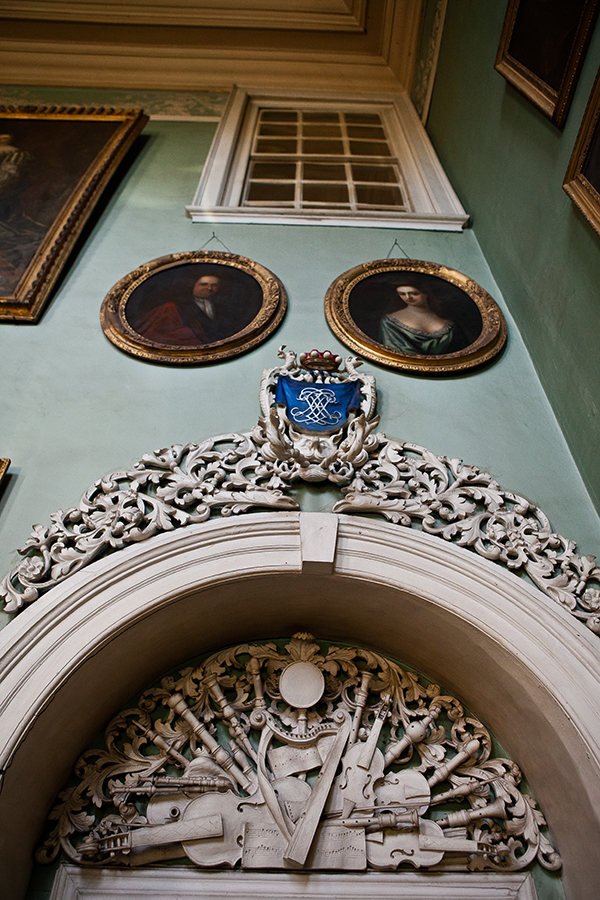
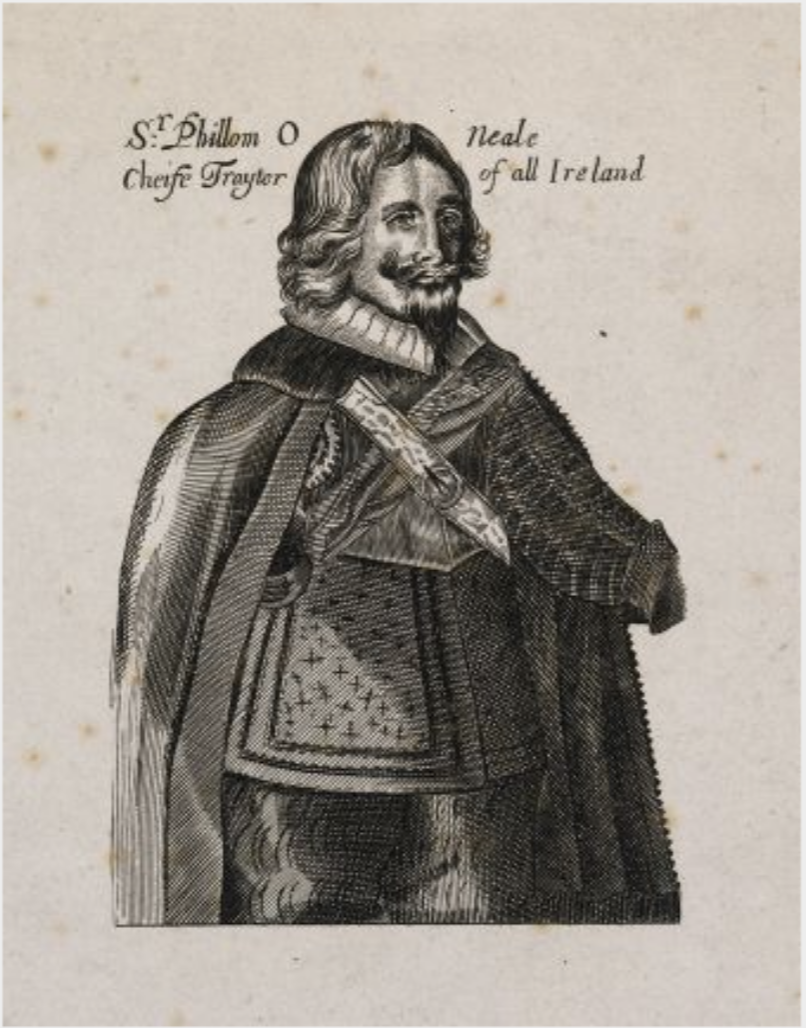
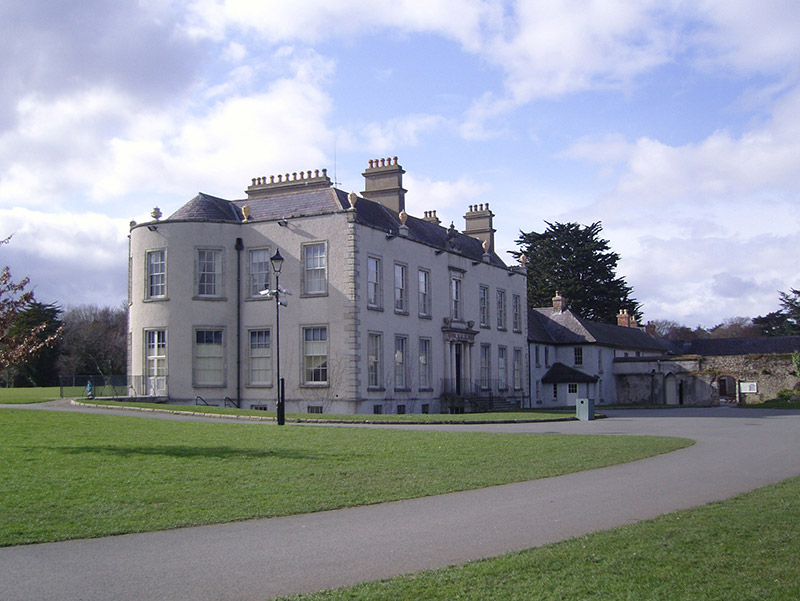
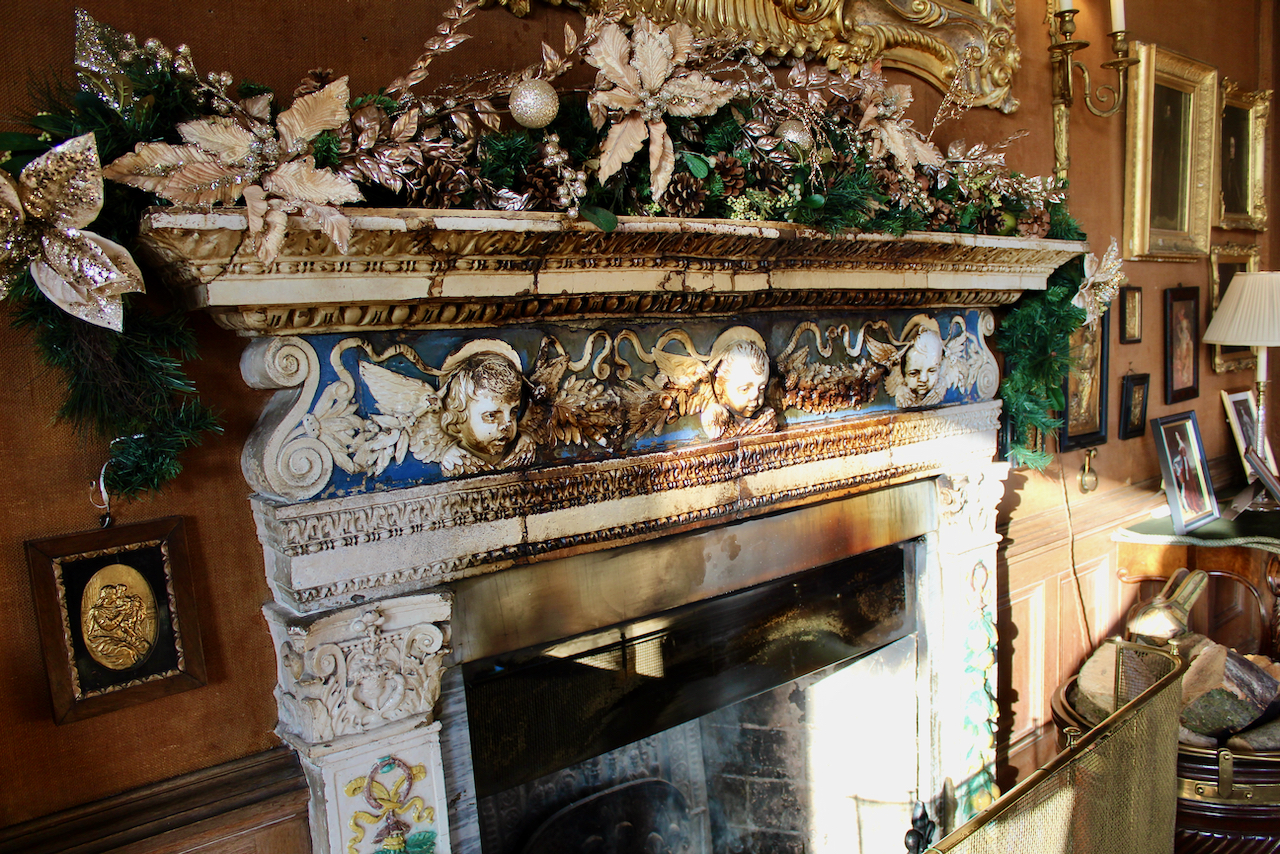
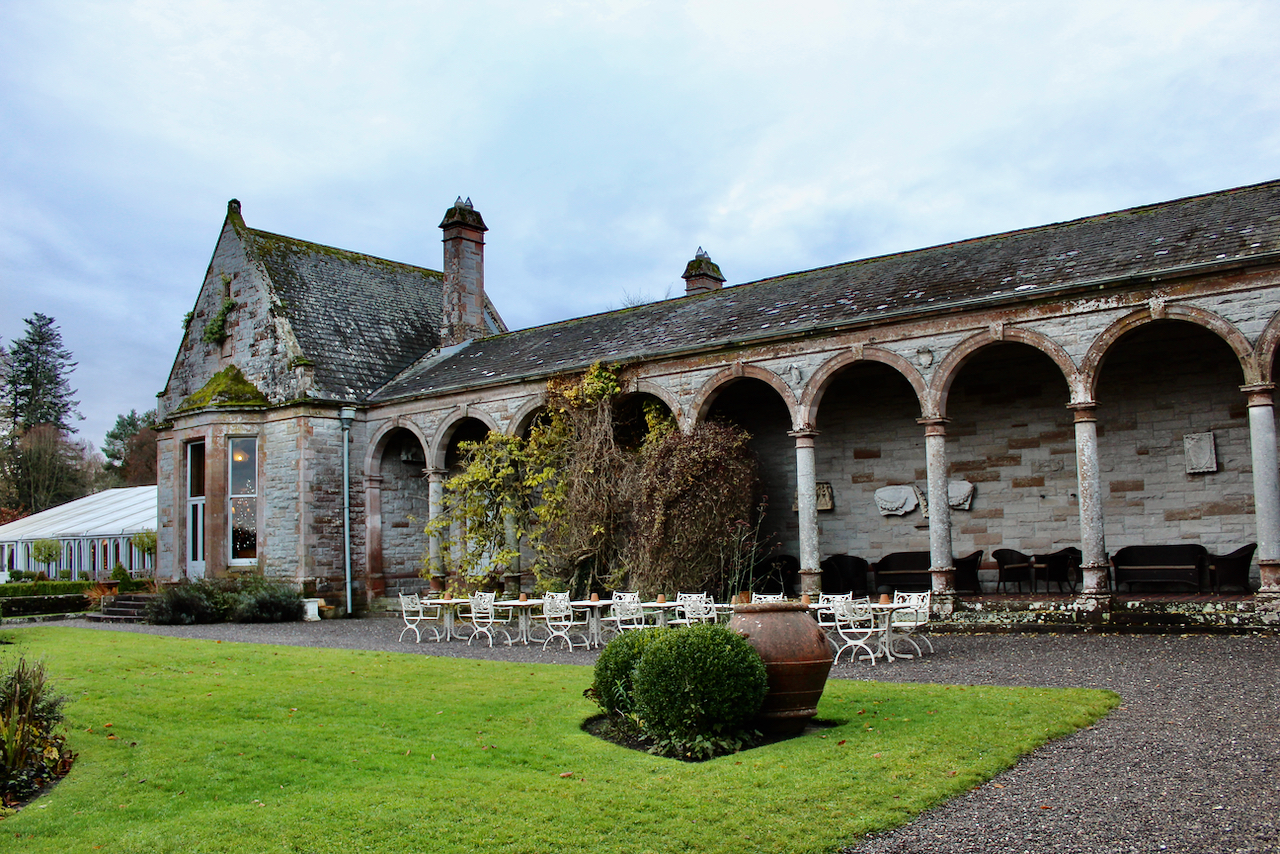
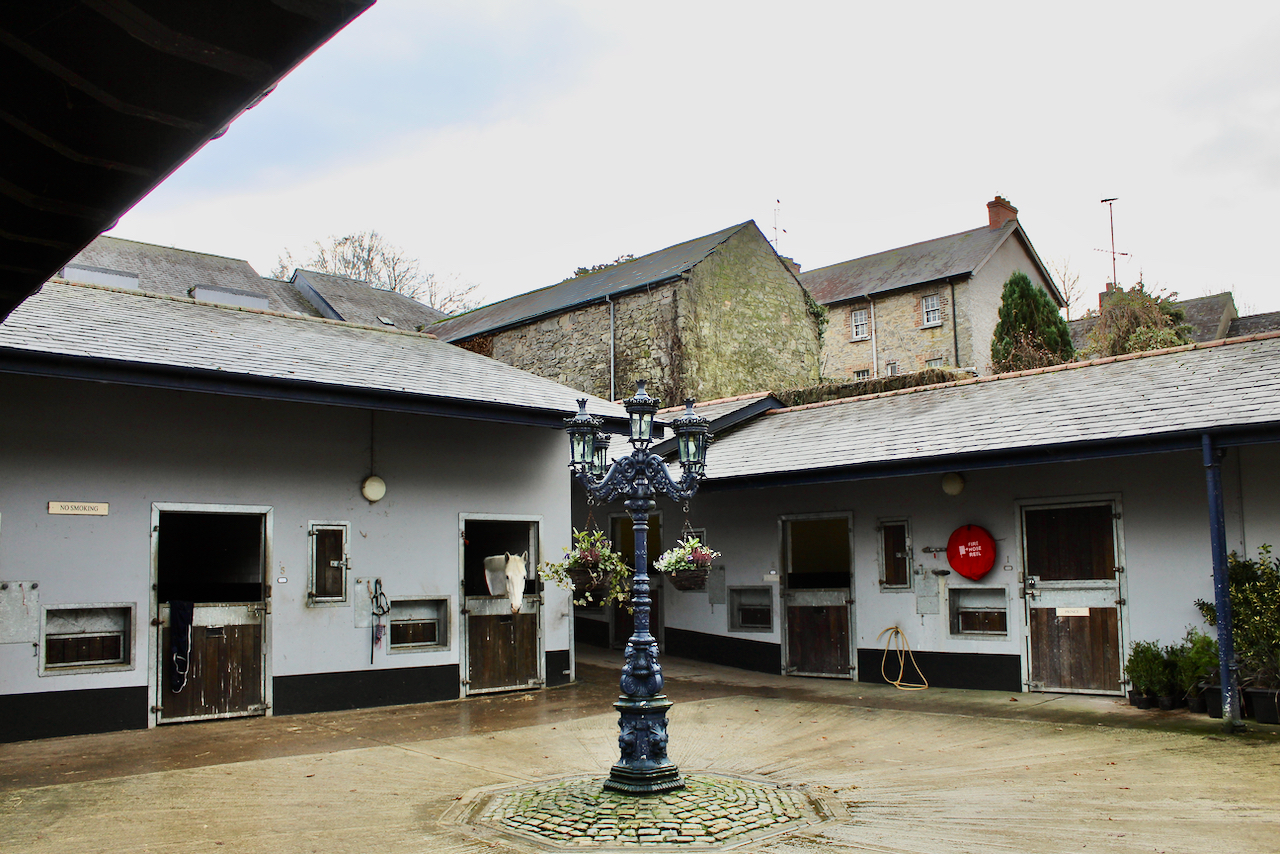
Drishane House, Castletownshend, Co. Cork – section 482

www.drishane.com

Open dates in 2026: May 1-31, Aug 15-23, Oct 3-22, 11am-3pm

Fee: adult €12, OAP €10, student/child €8, child under 6 years free

e: info@drishane.com

2026 Diary of Irish Historic Houses (section 482 properties)

To purchase an A5 size 2026 Diary of Historic Houses (opening times and days are not listed so the calendar is for use for recording appointments and not as a reference for opening times) send your postal address to jennifer.baggot@gmail.com along with €20 via this payment button. The calendar of 84 pages includes space for writing your appointments as well as photographs of the historic houses. The price includes postage within Ireland. Postage to U.S. is a further €10 for the A5 size calendar, so I would appreciate a donation toward the postage – you can click on the donation link.

€20.00

donation

Help me to pay the entrance fee to one of the houses on this website. This site is created purely out of love for the subject and I receive no payment so any donation is appreciated!

€15.00

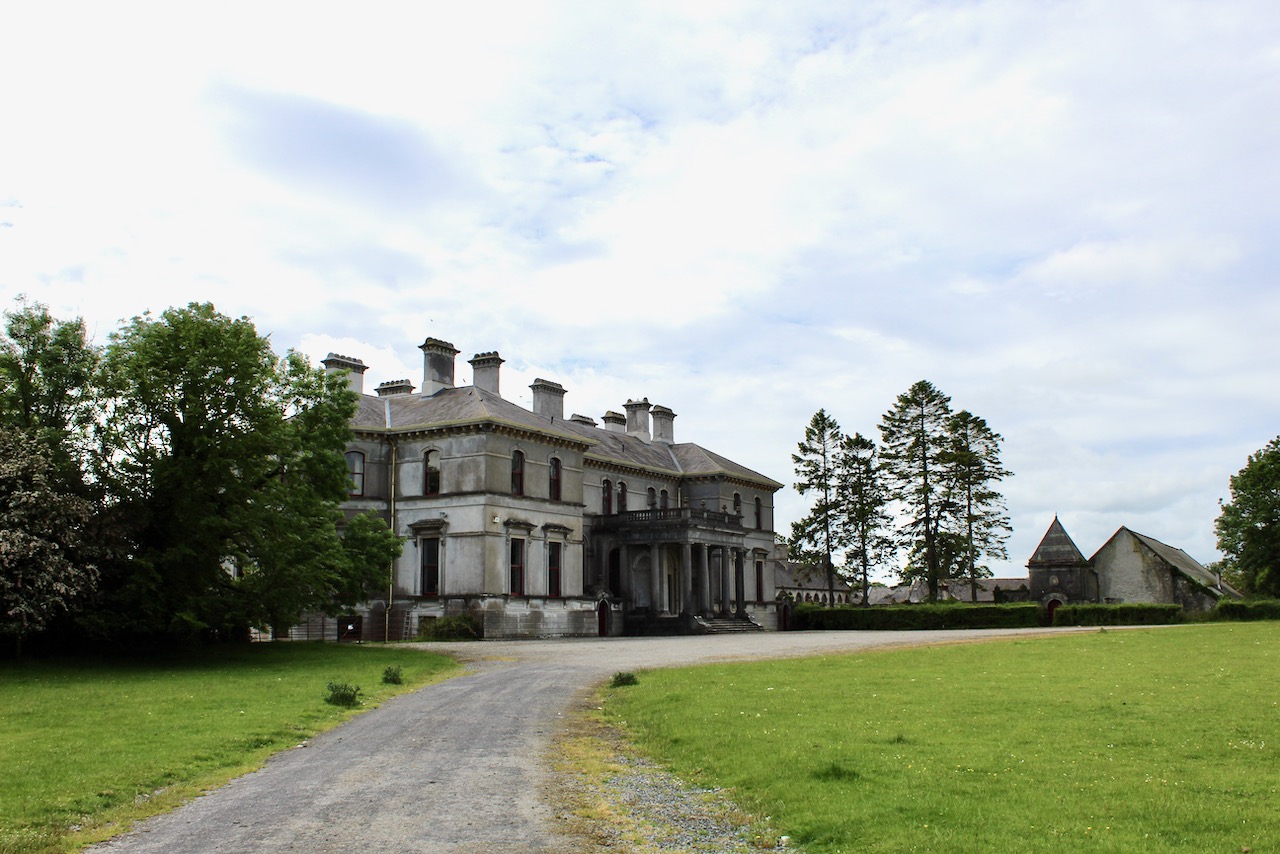
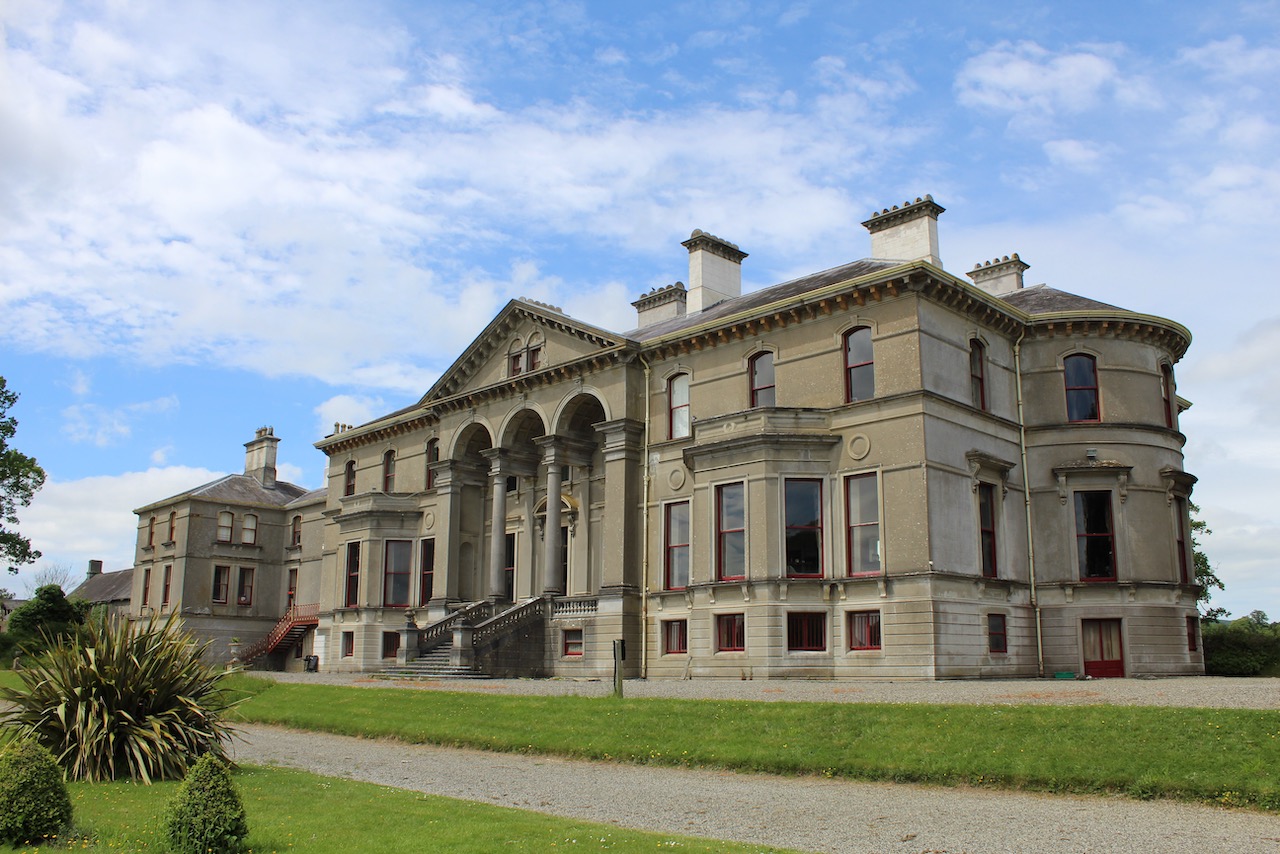
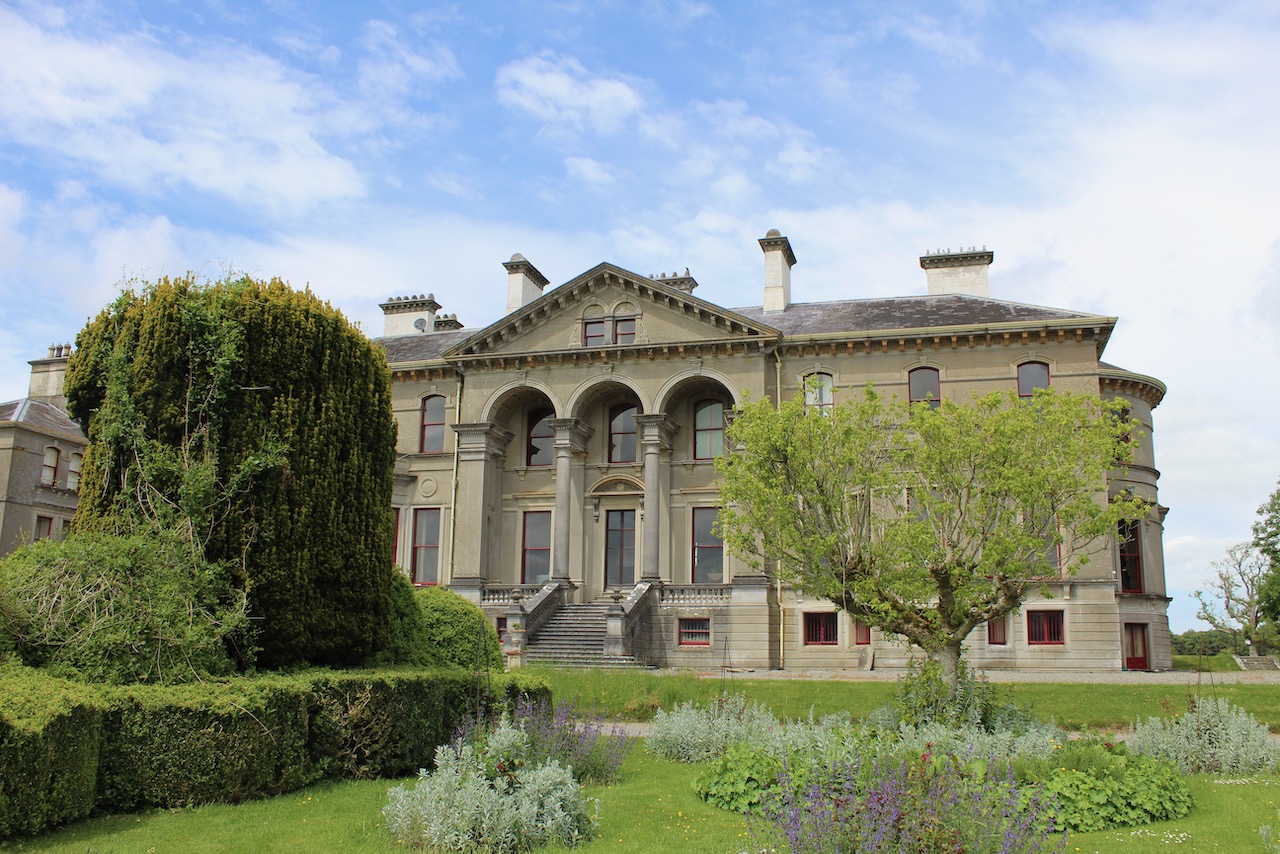
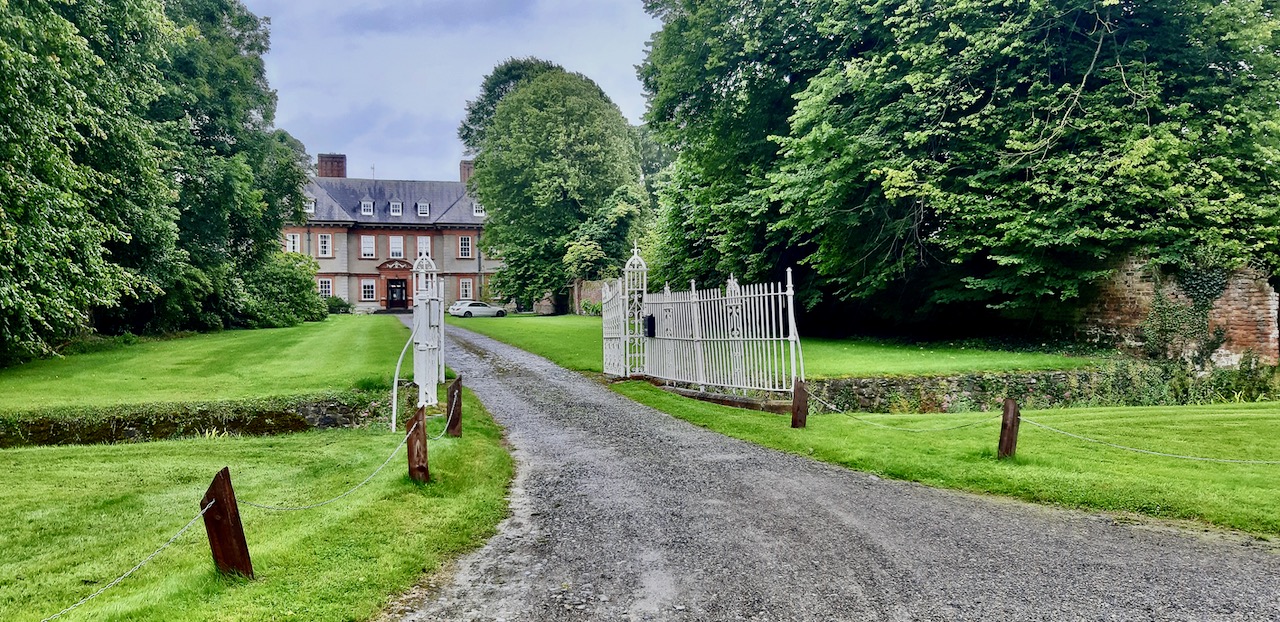
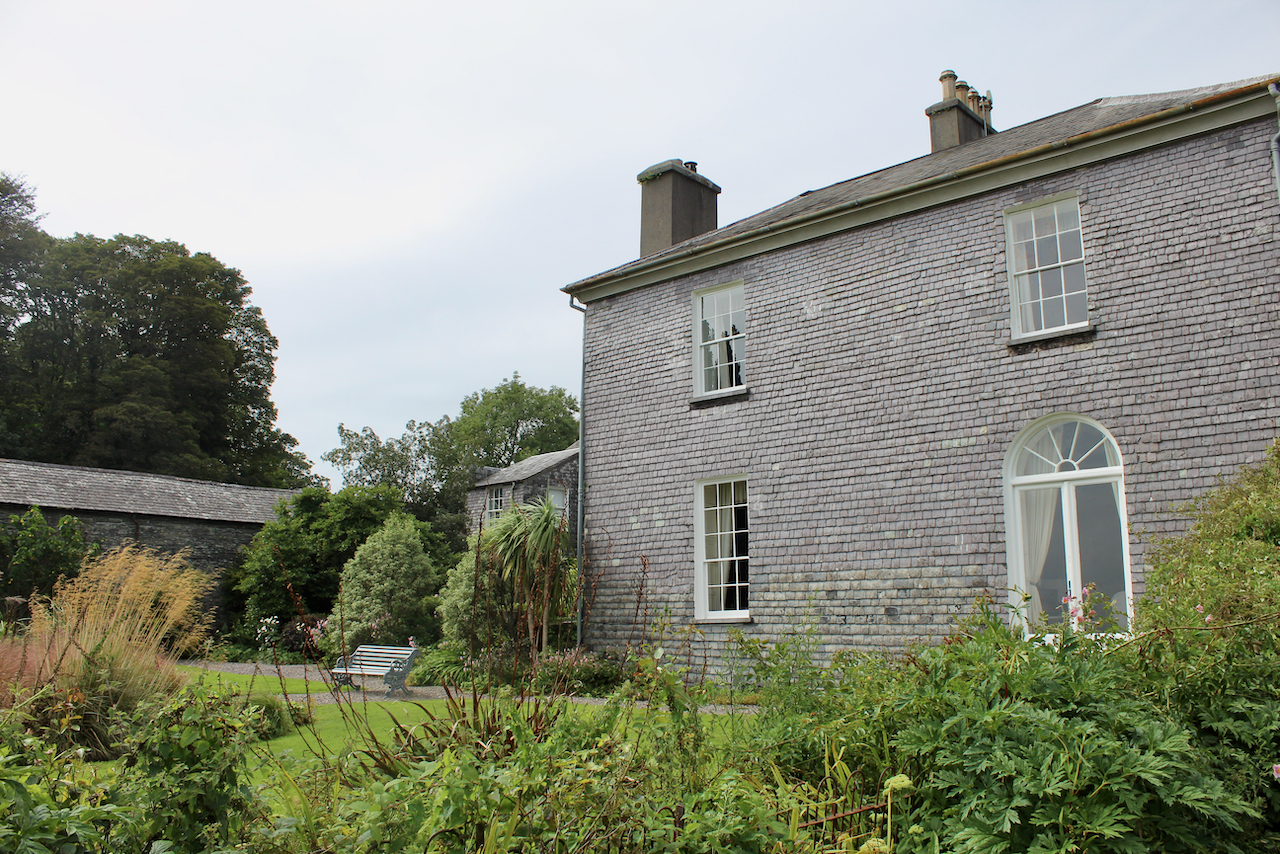
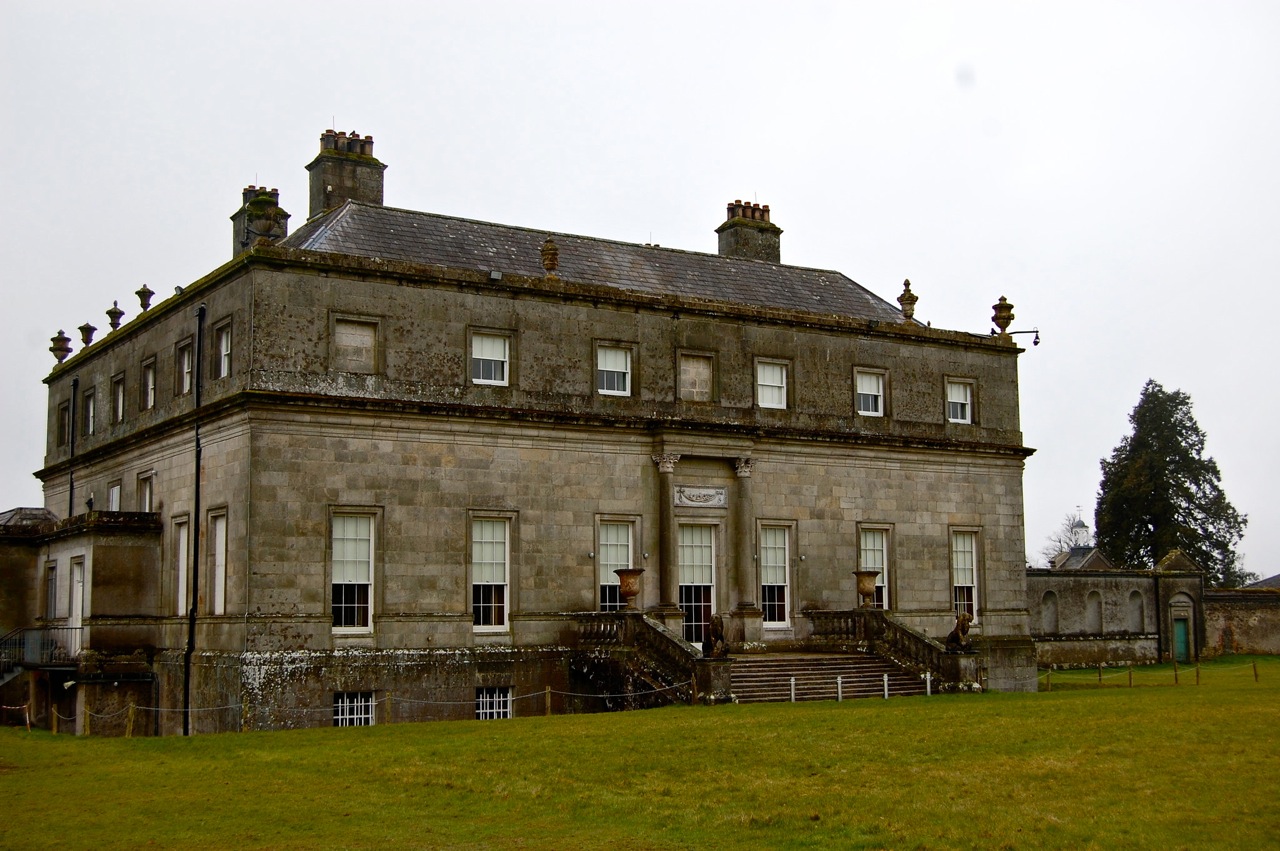
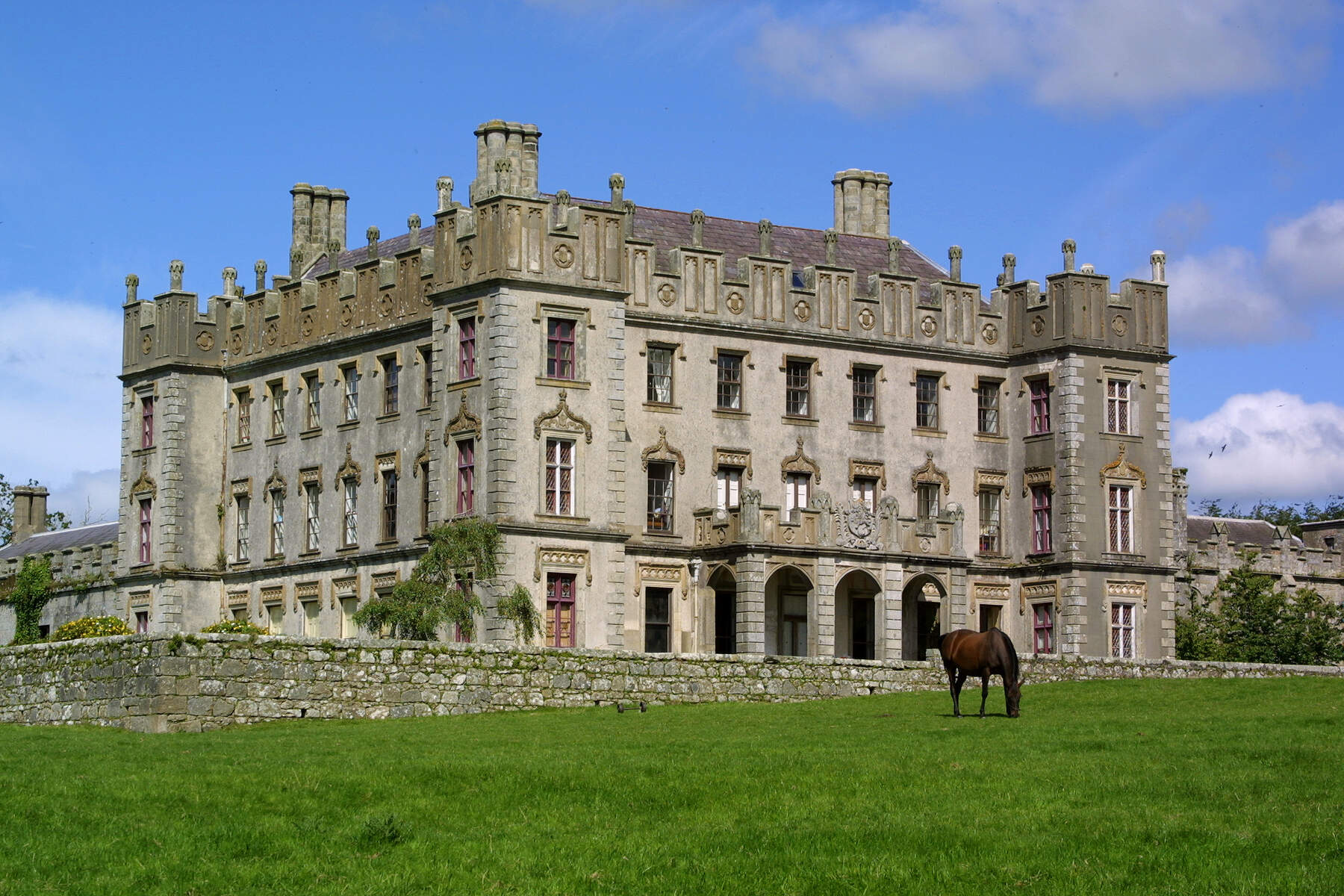
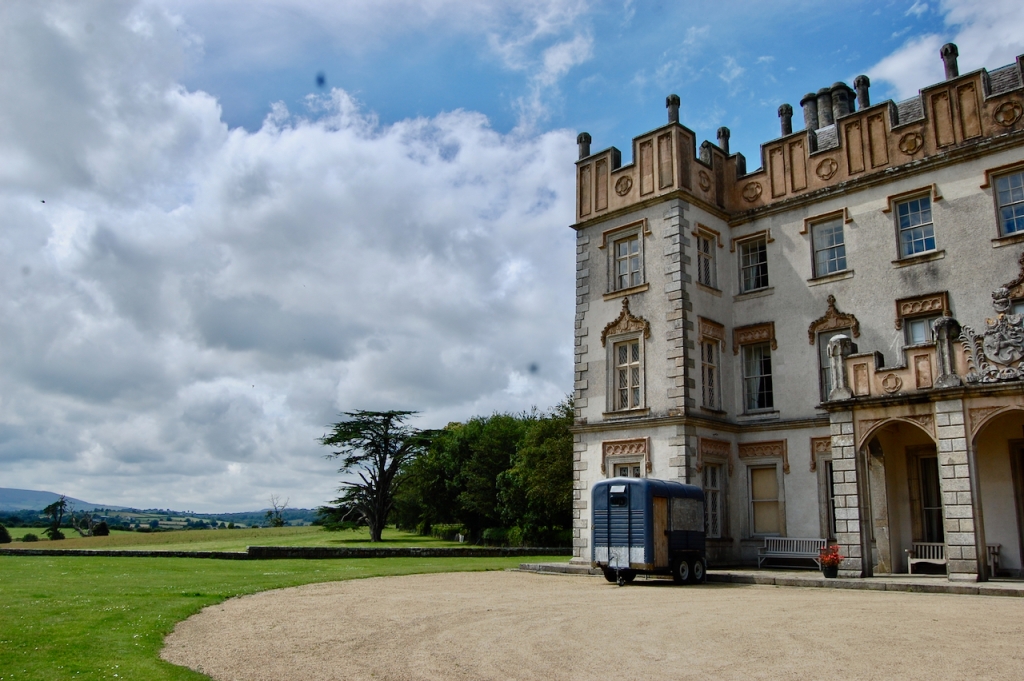
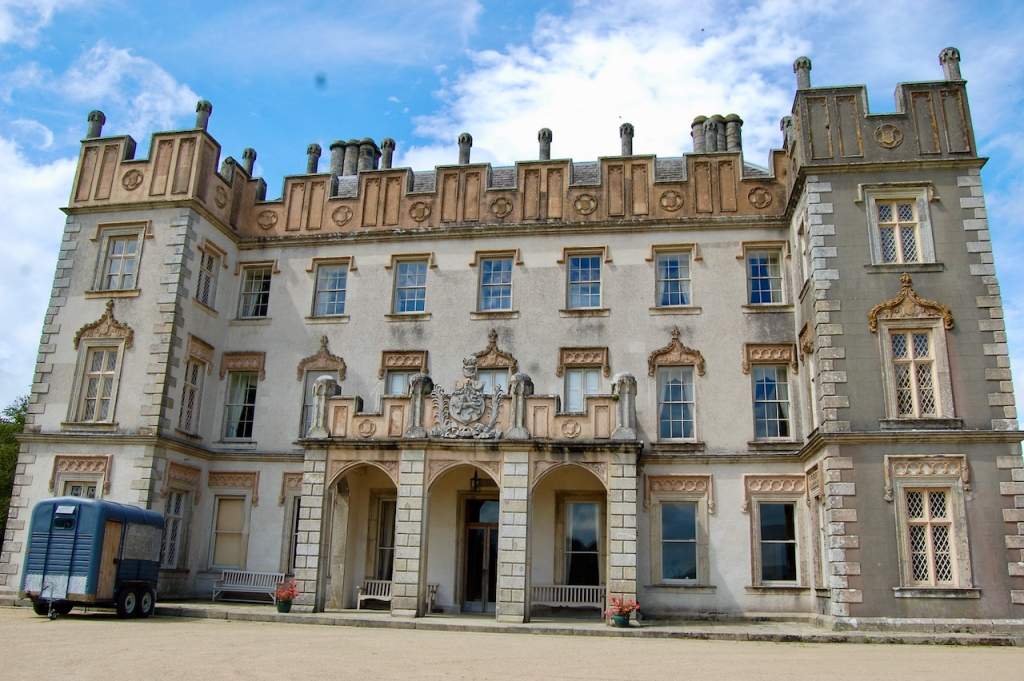
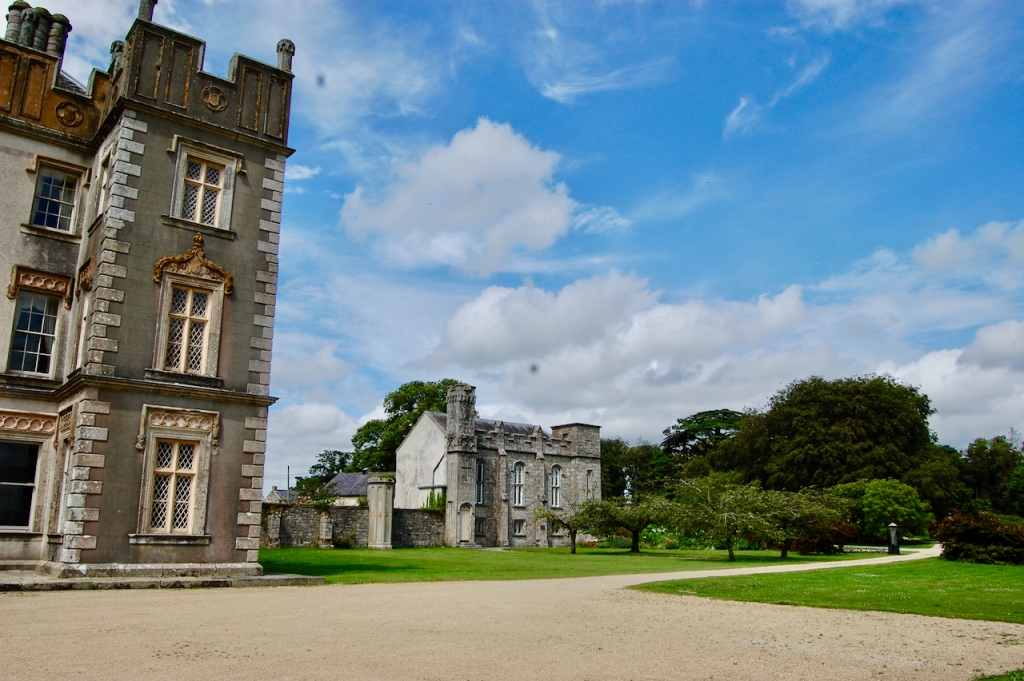
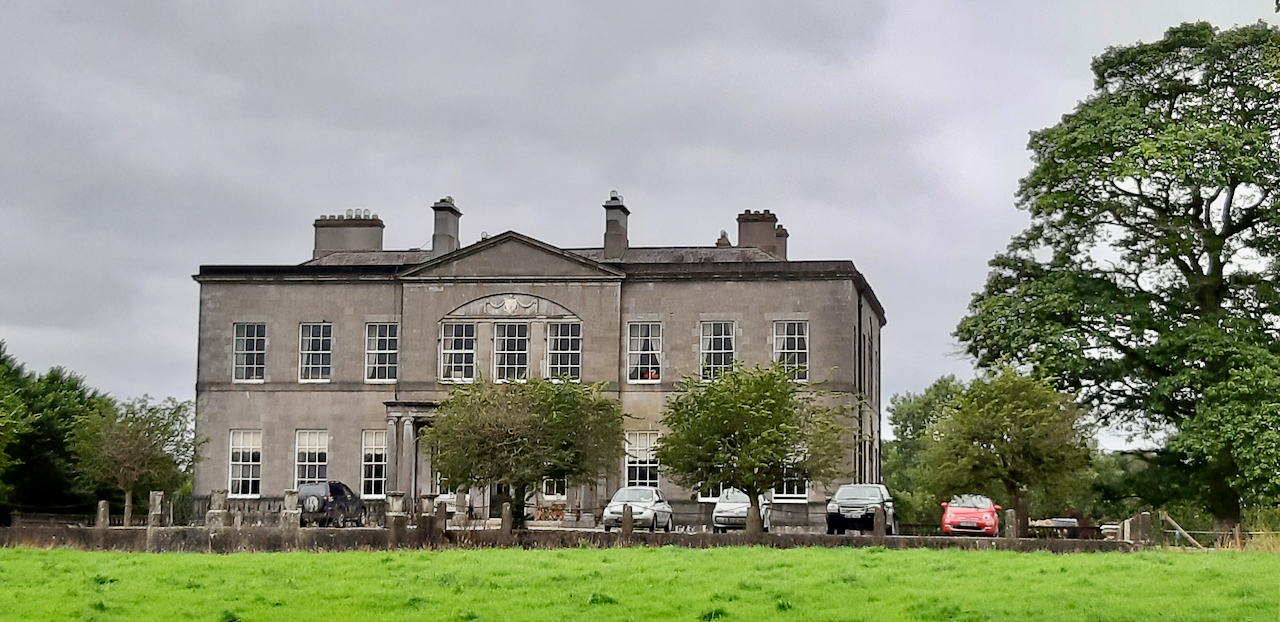
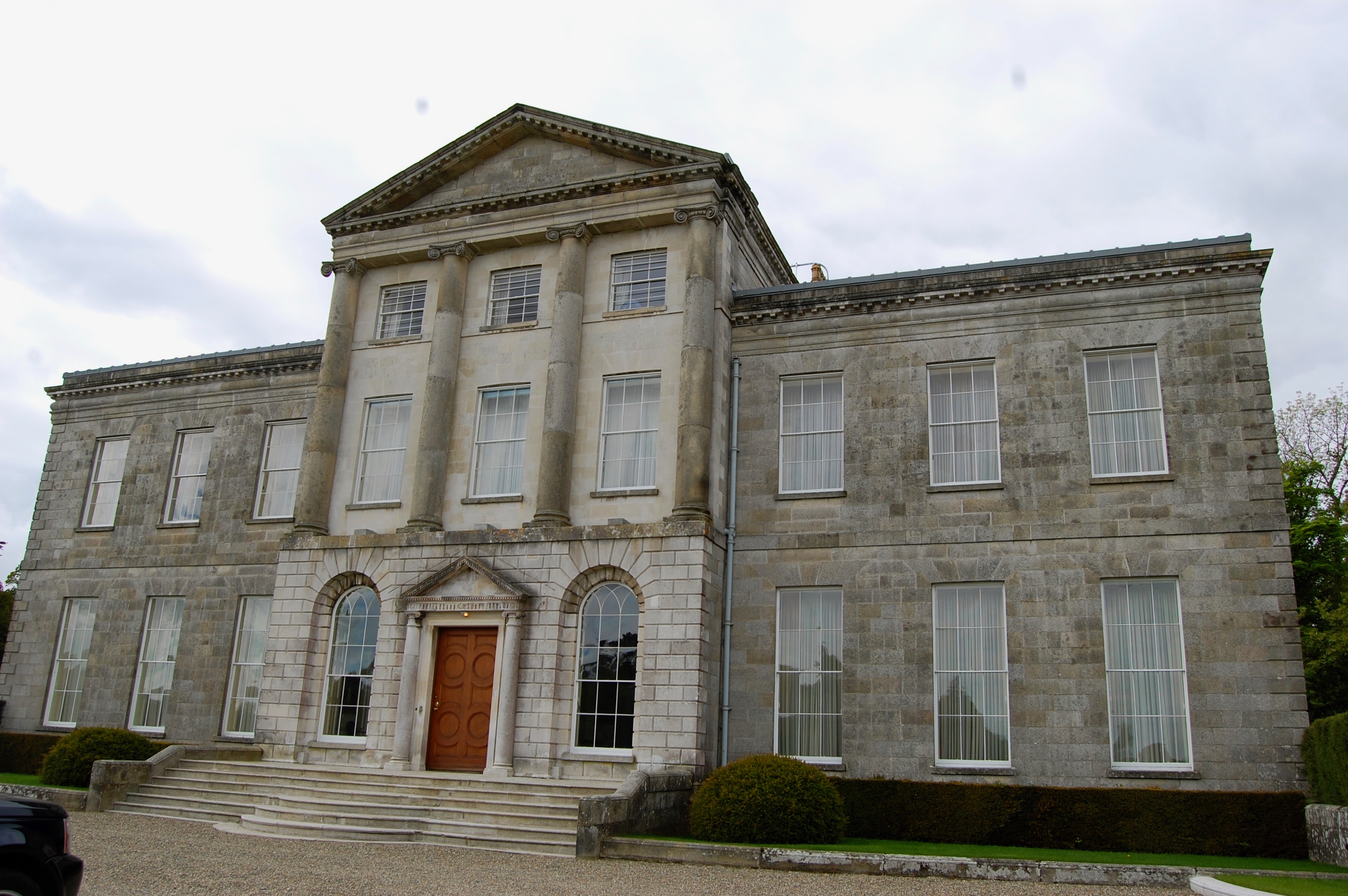
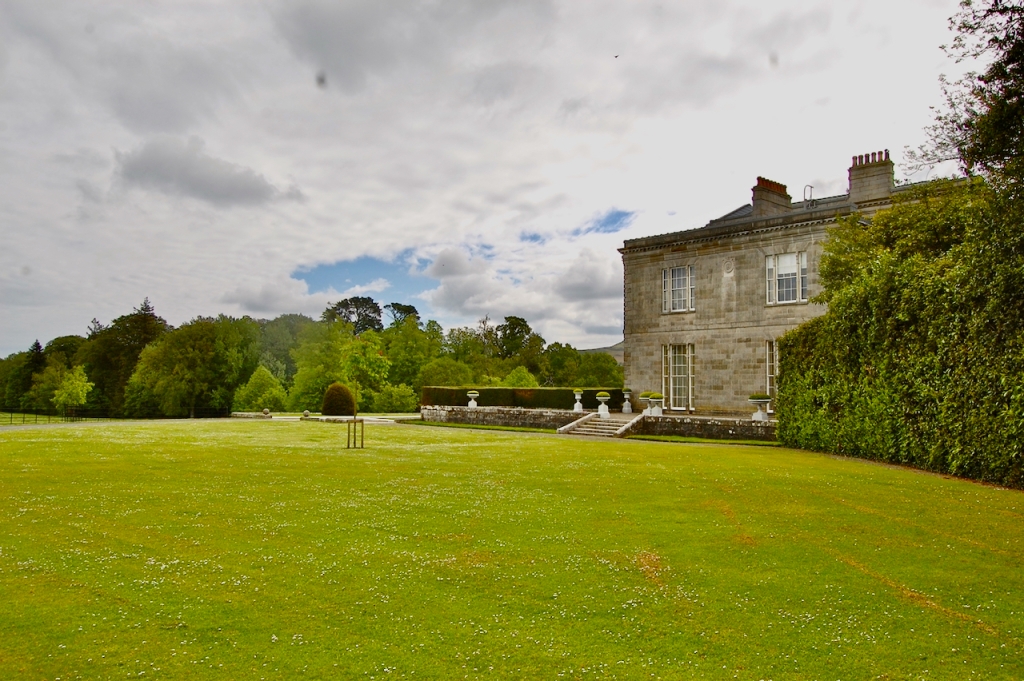
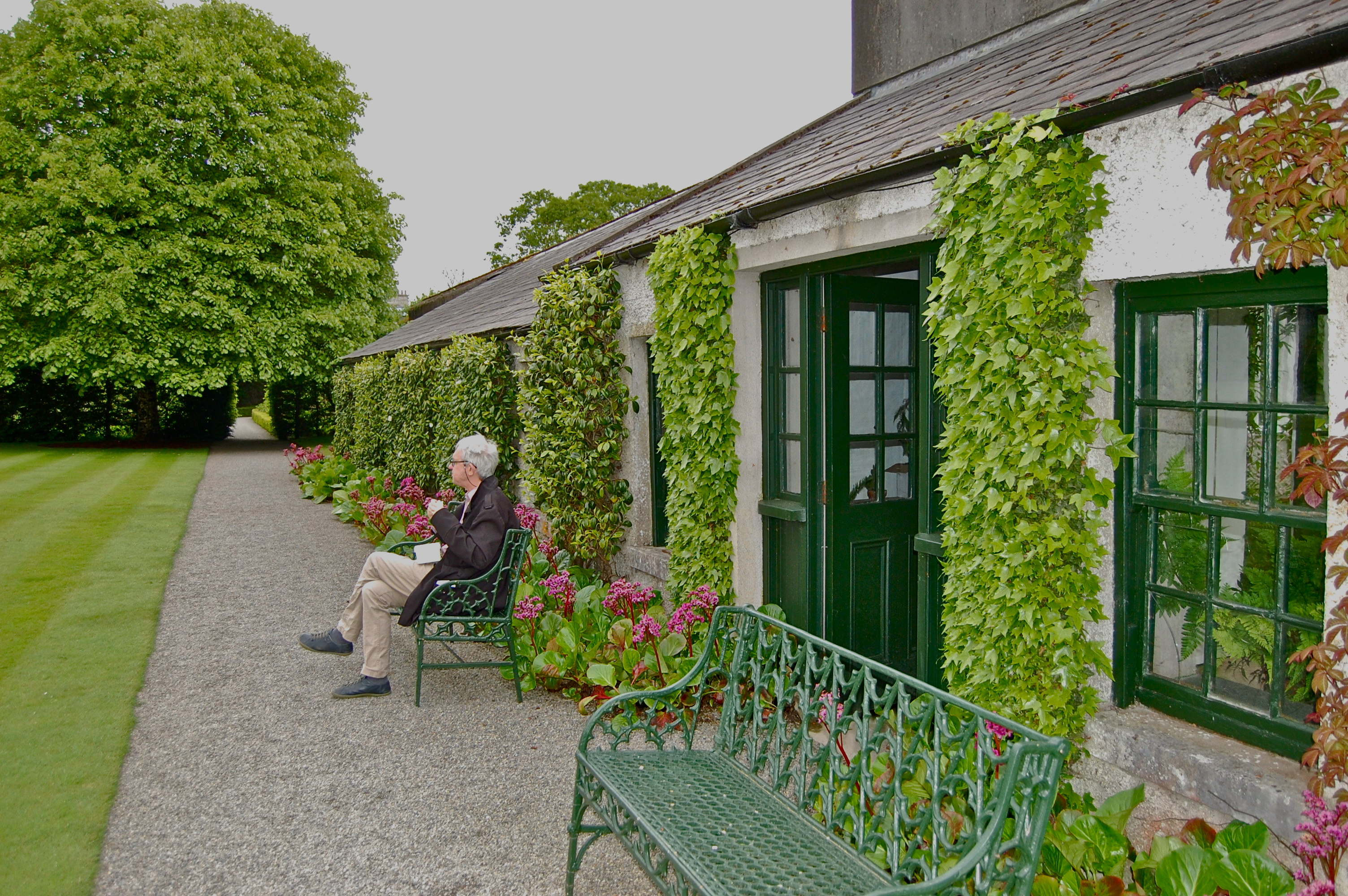
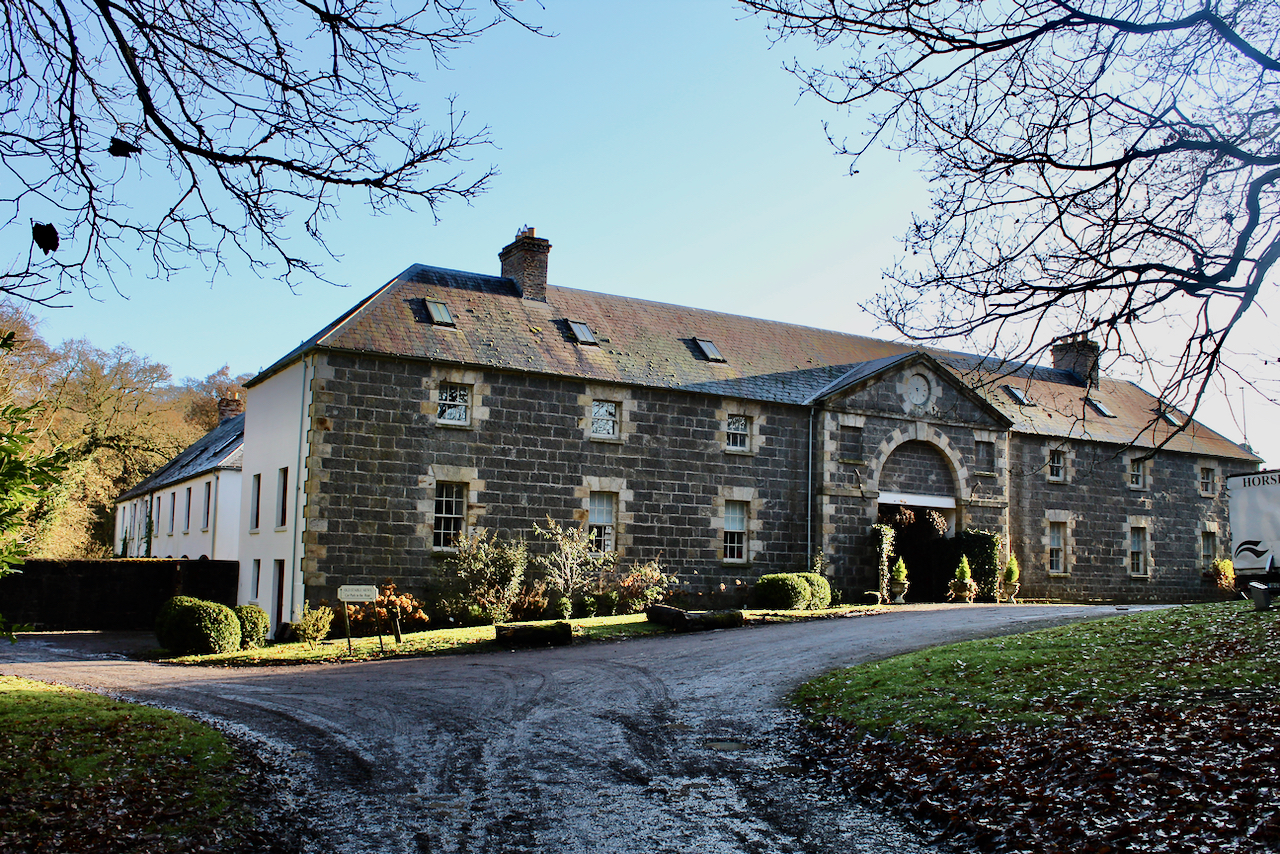
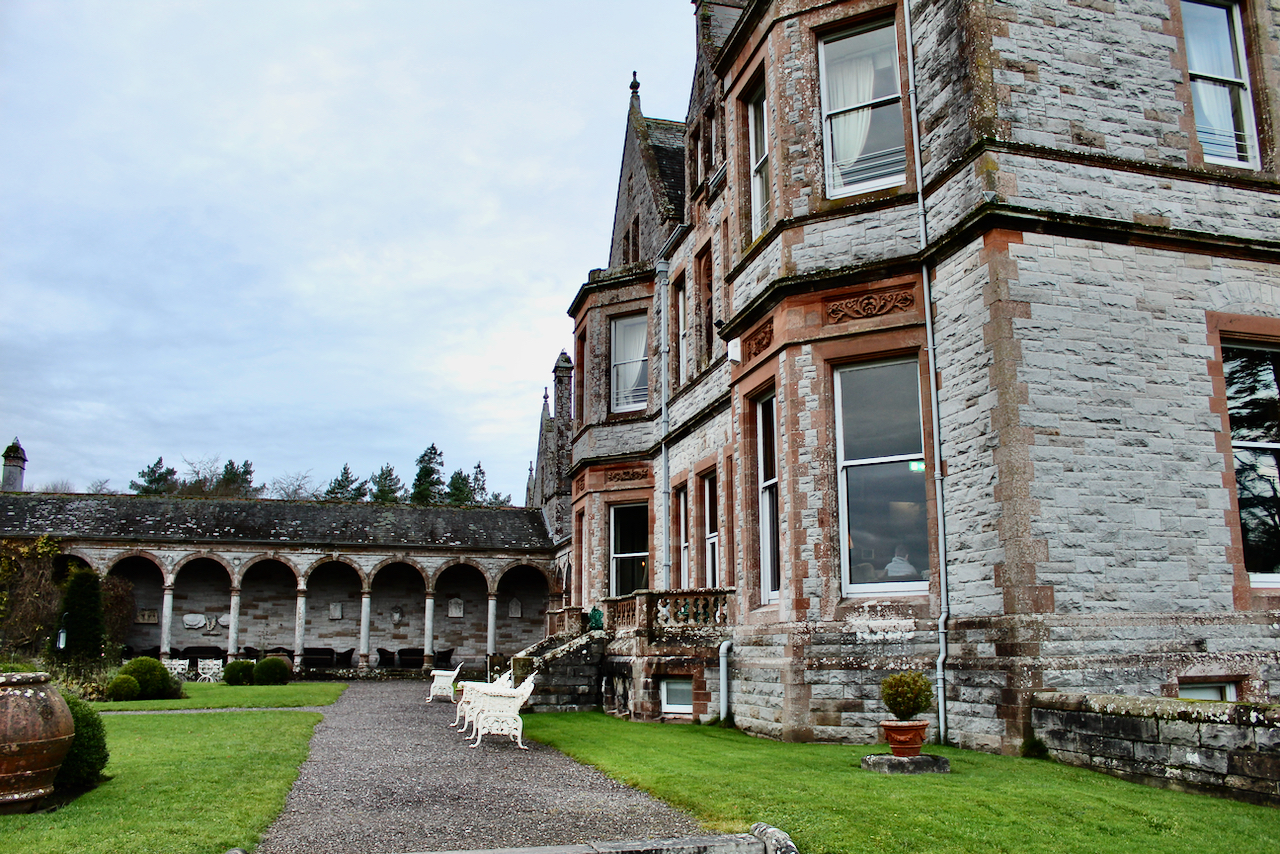
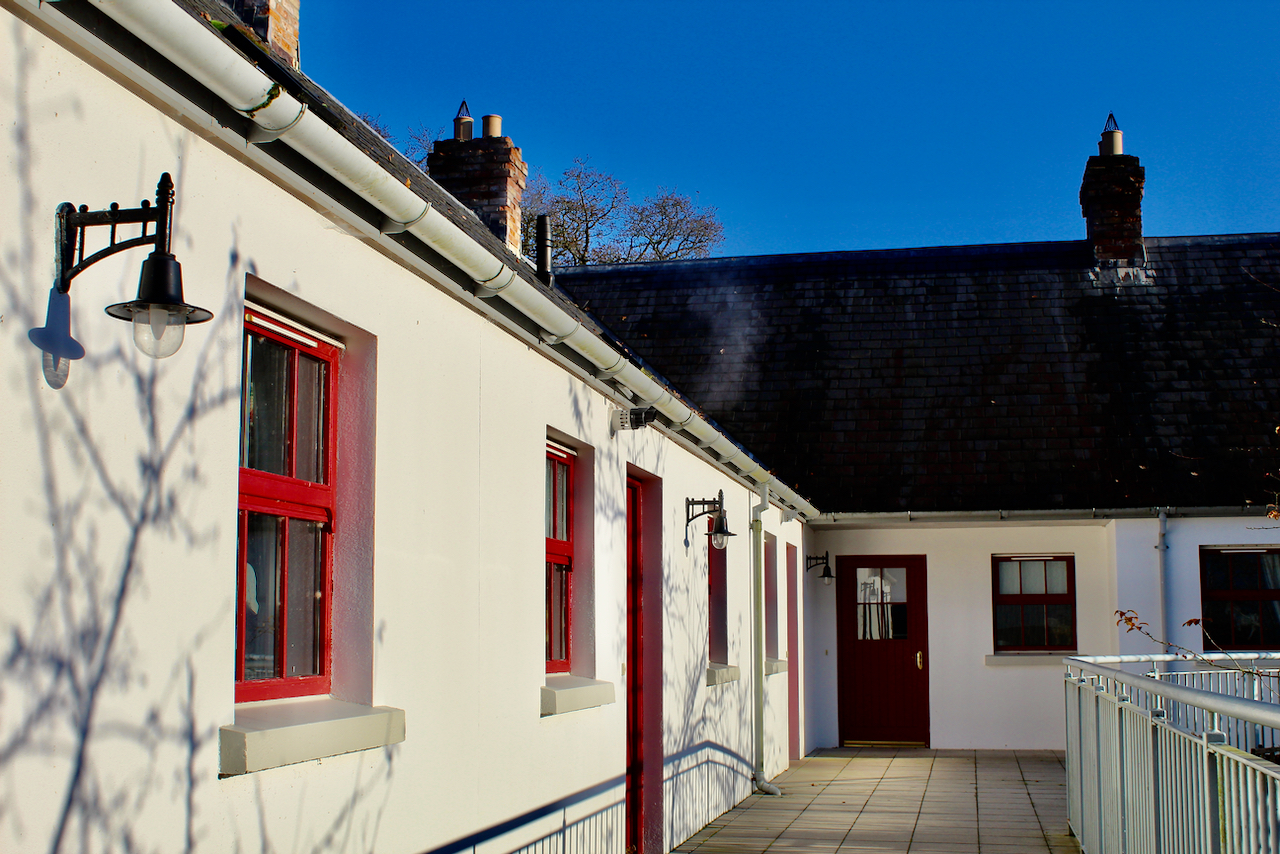
Drishane House, August 2020. Photograph © Jennifer Winder-Baggot, www.irishhistorichouses.com
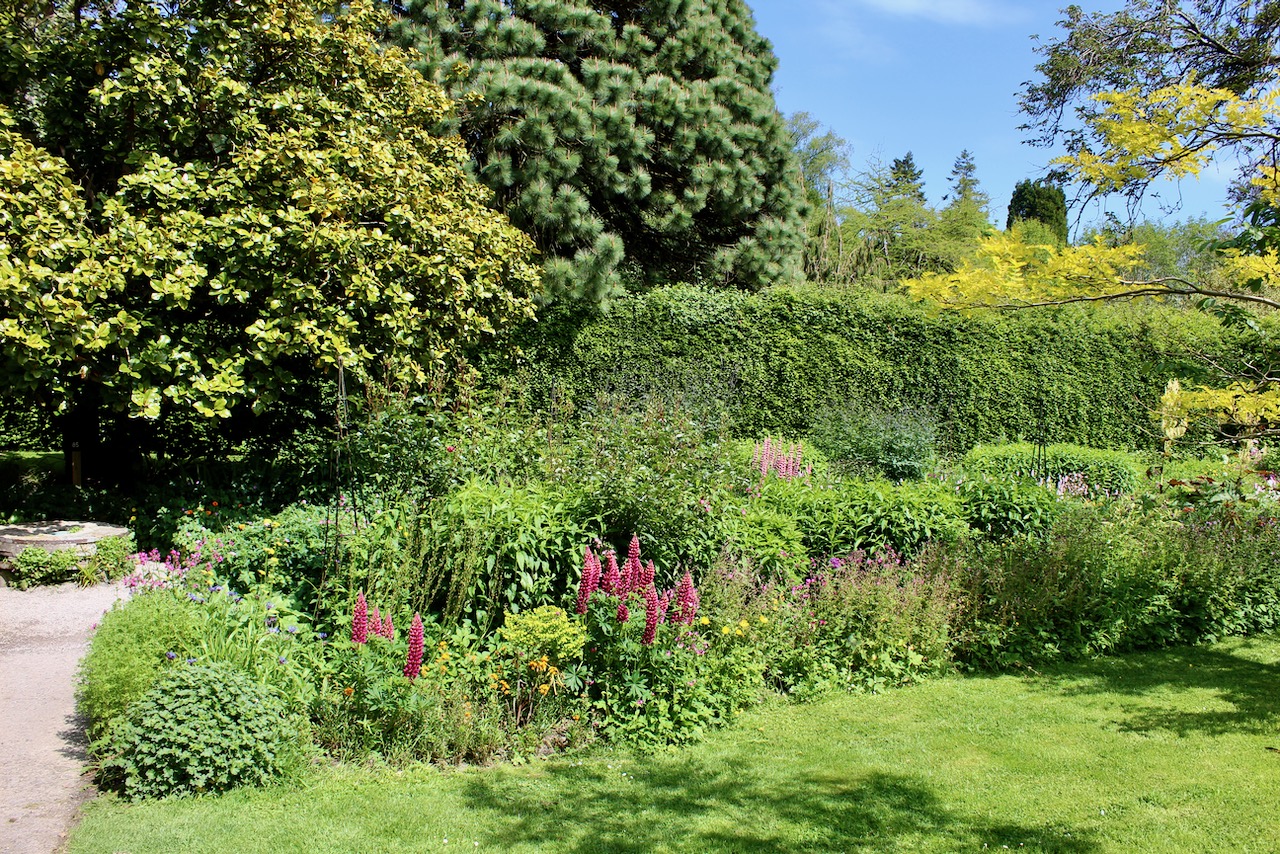
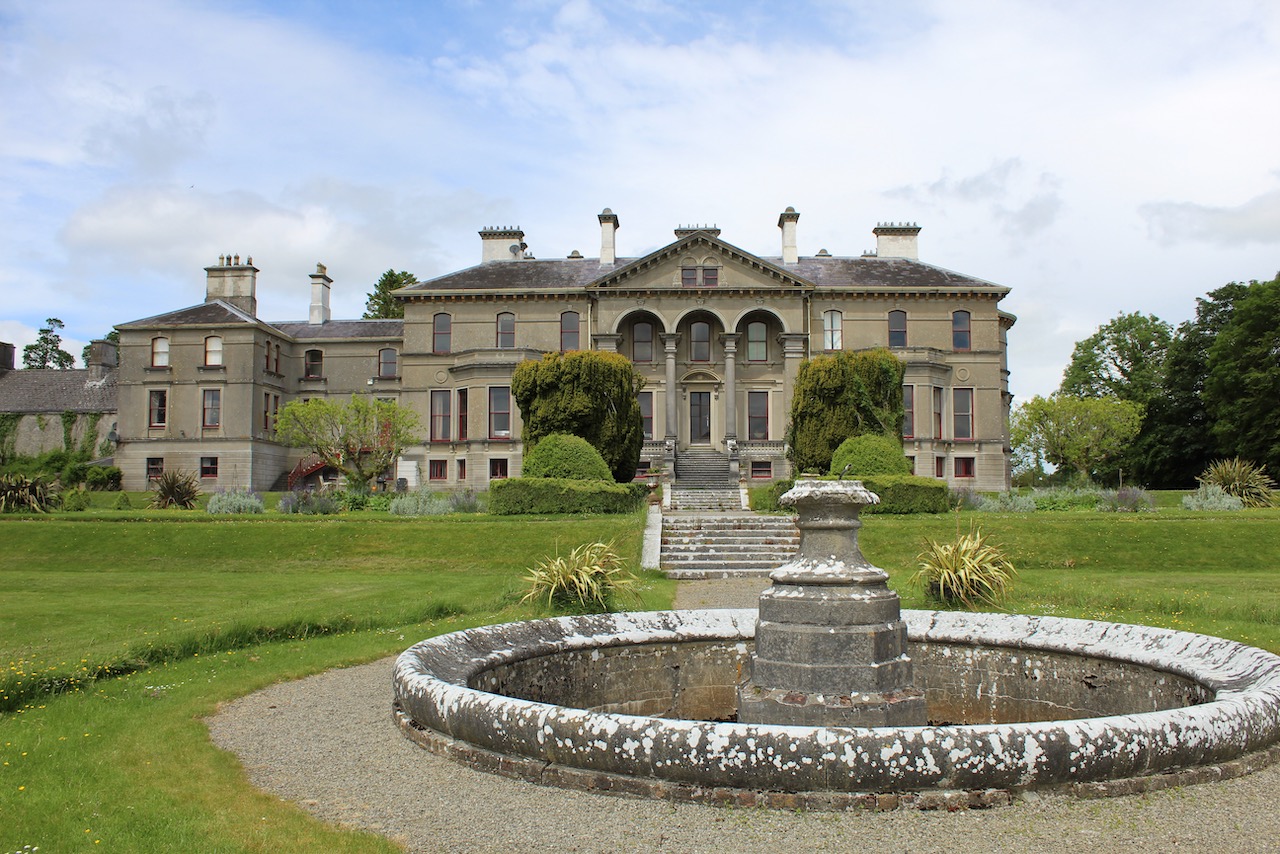
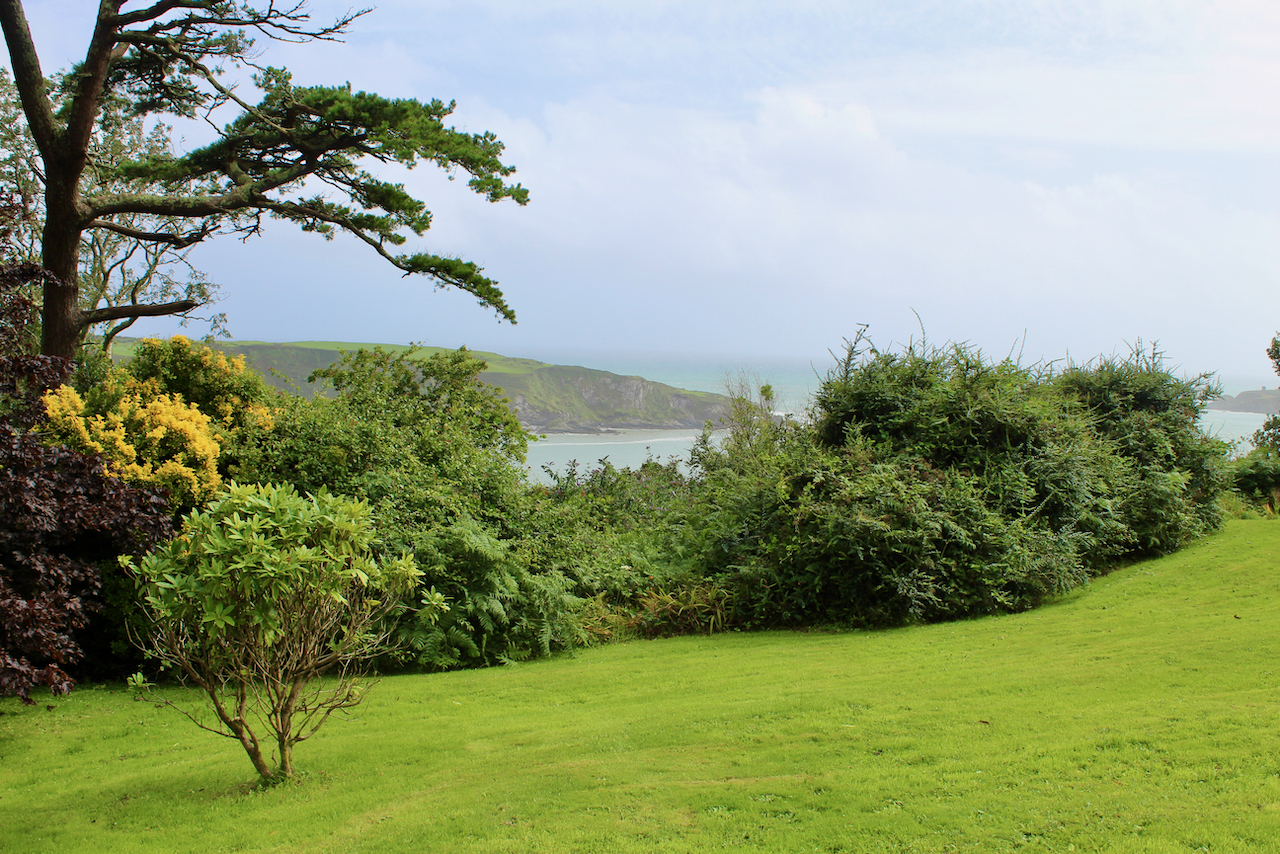
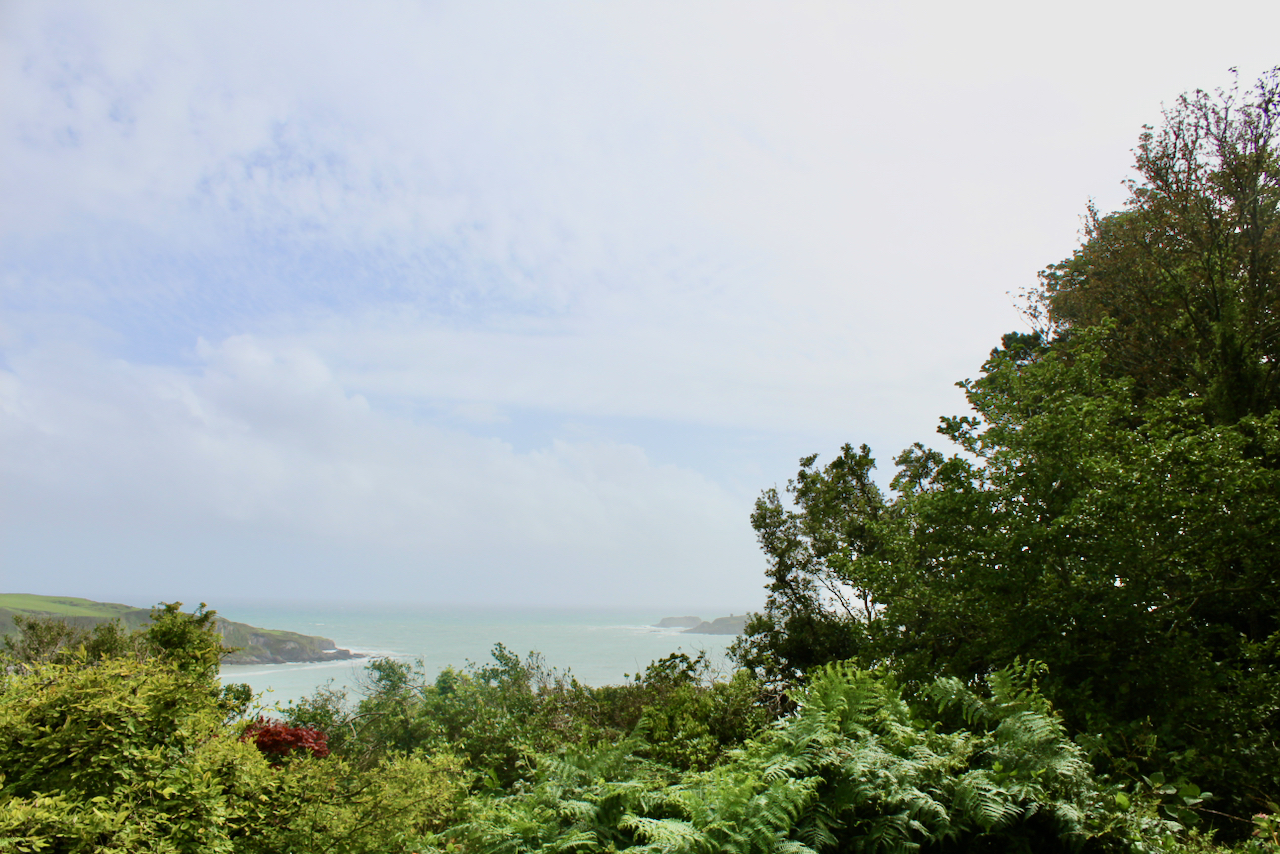
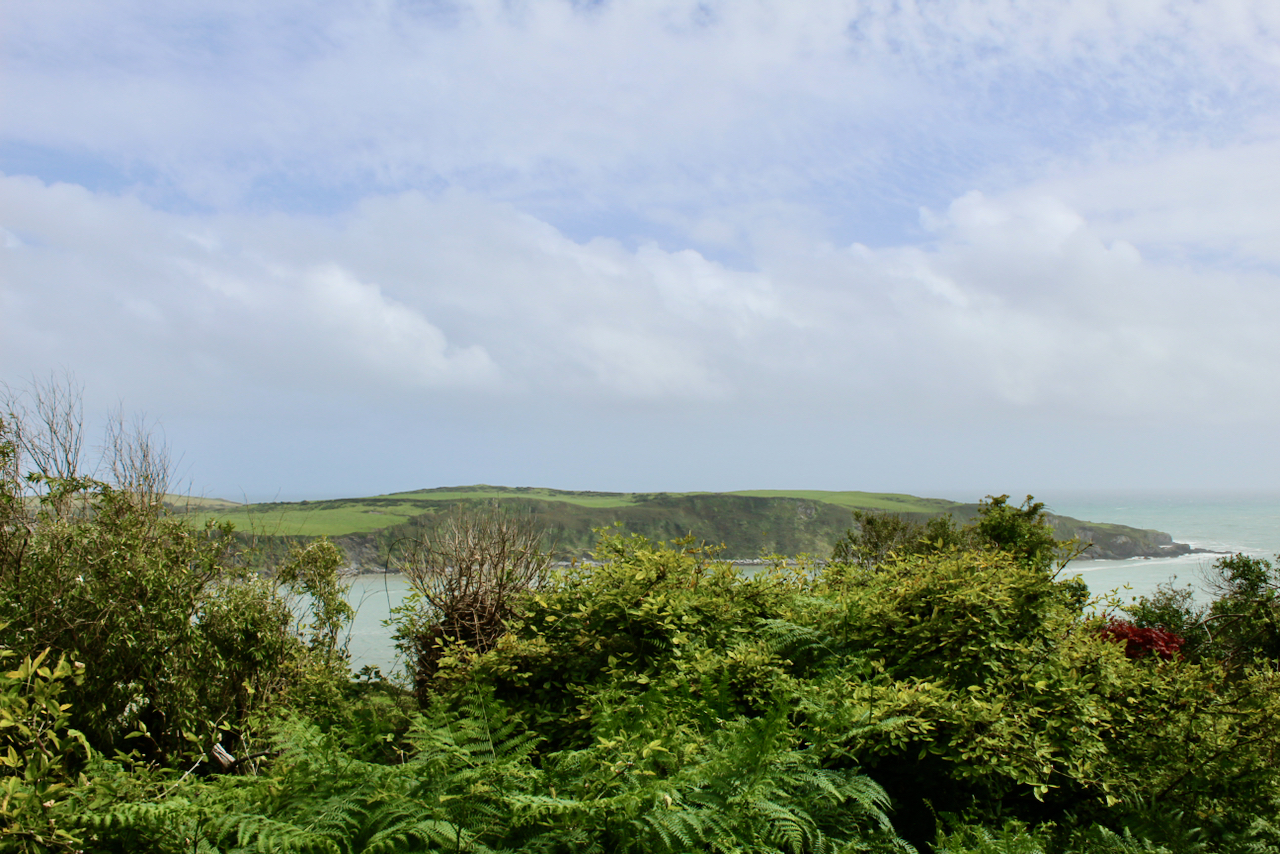
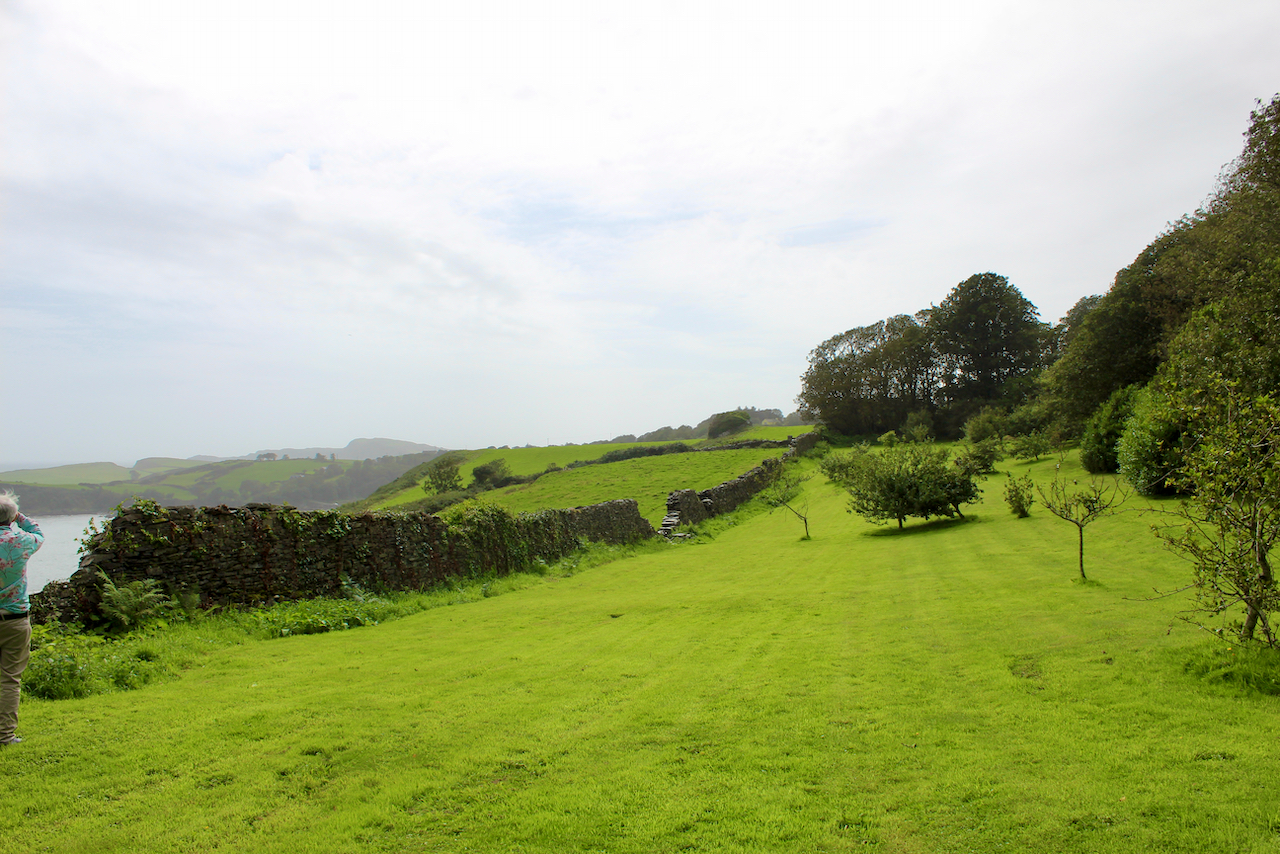
Edith Somerville, of Somerville and Ross Some Experiences of an Irish RM fame (which has been made into a television series), said “If I am ever allowed to return to earth it will be to Drishane that I shall come,” and I can see why. The estate is situated with a magnificent view over the Atlantic ocean.

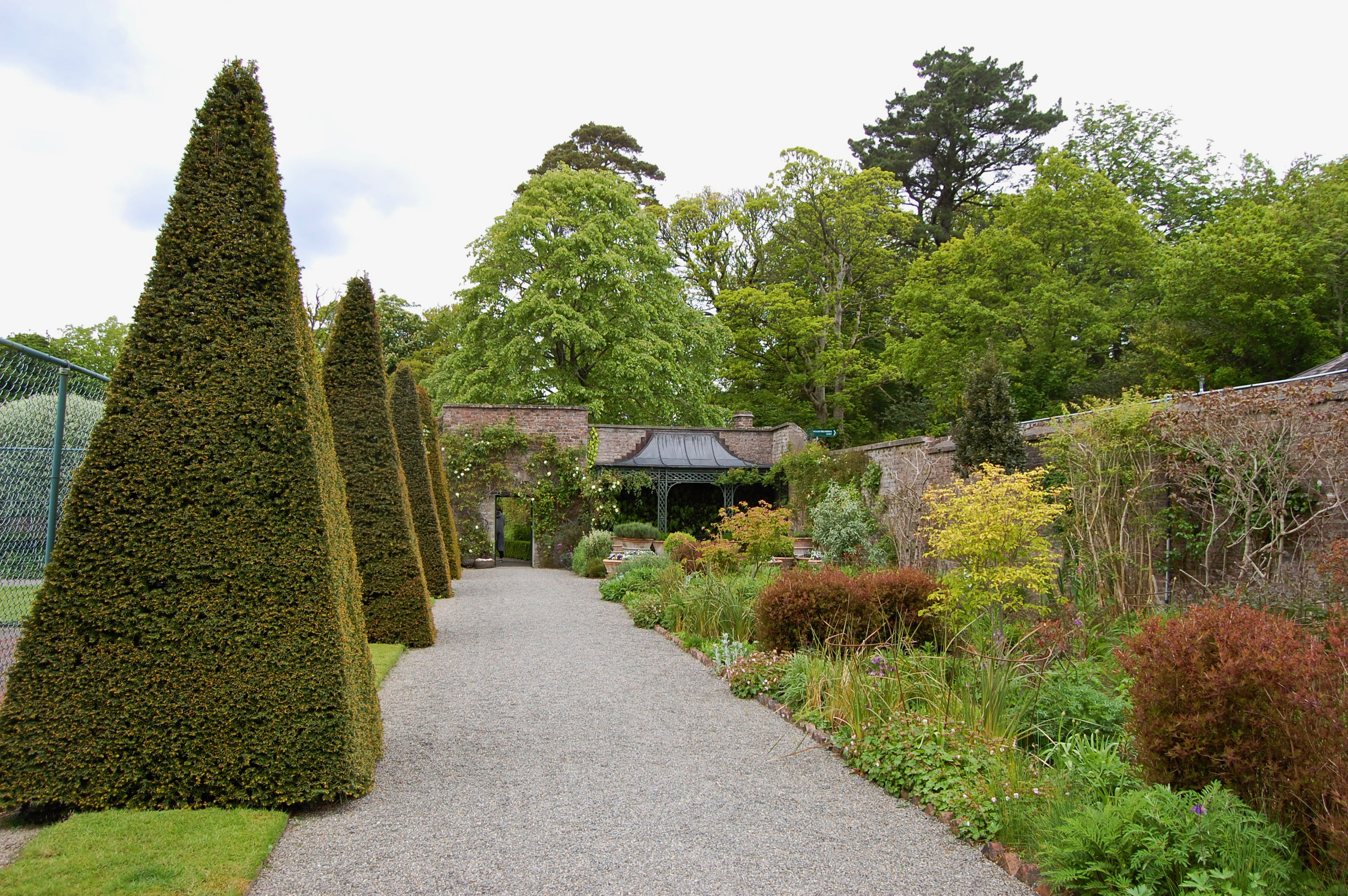
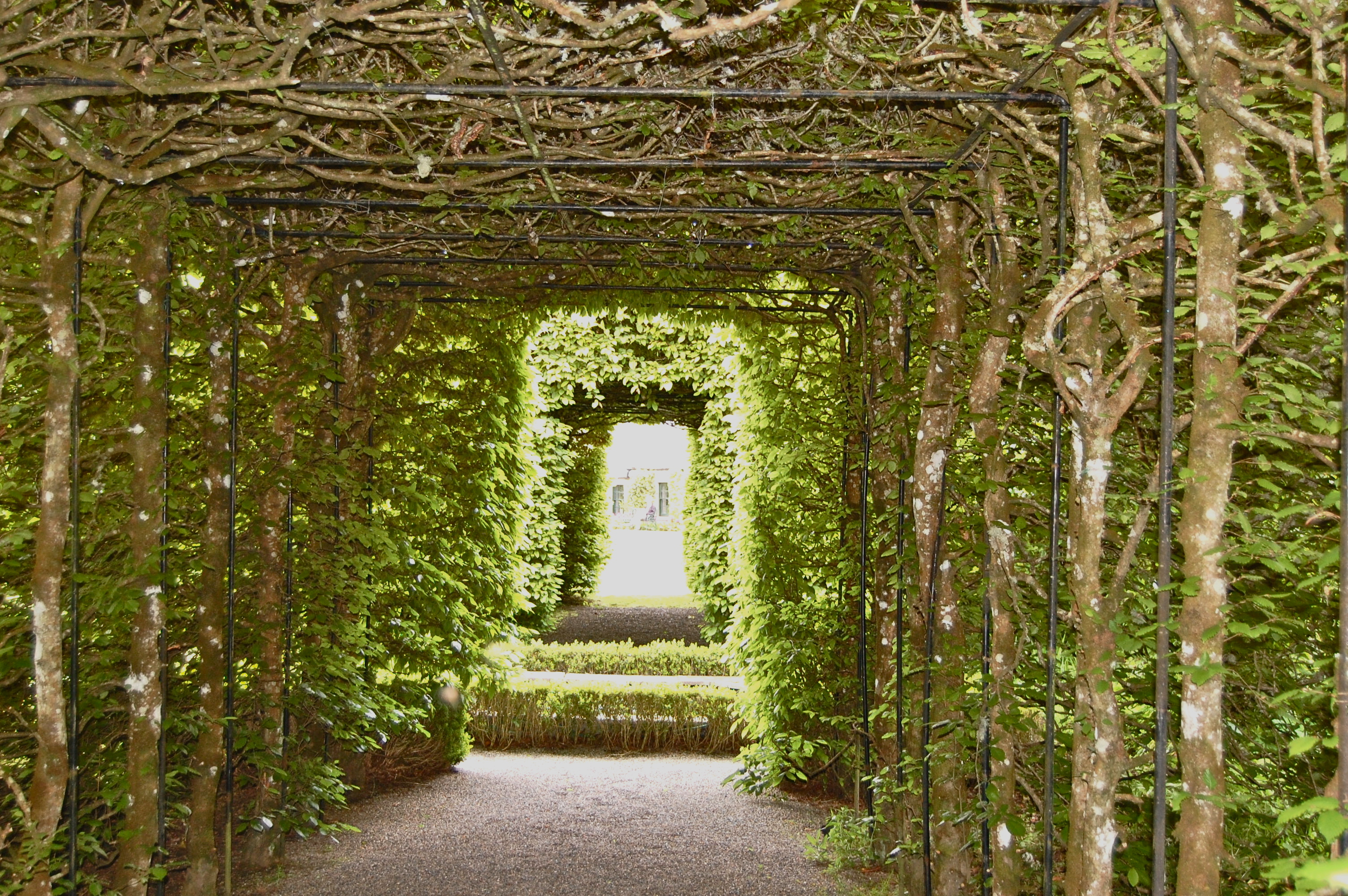
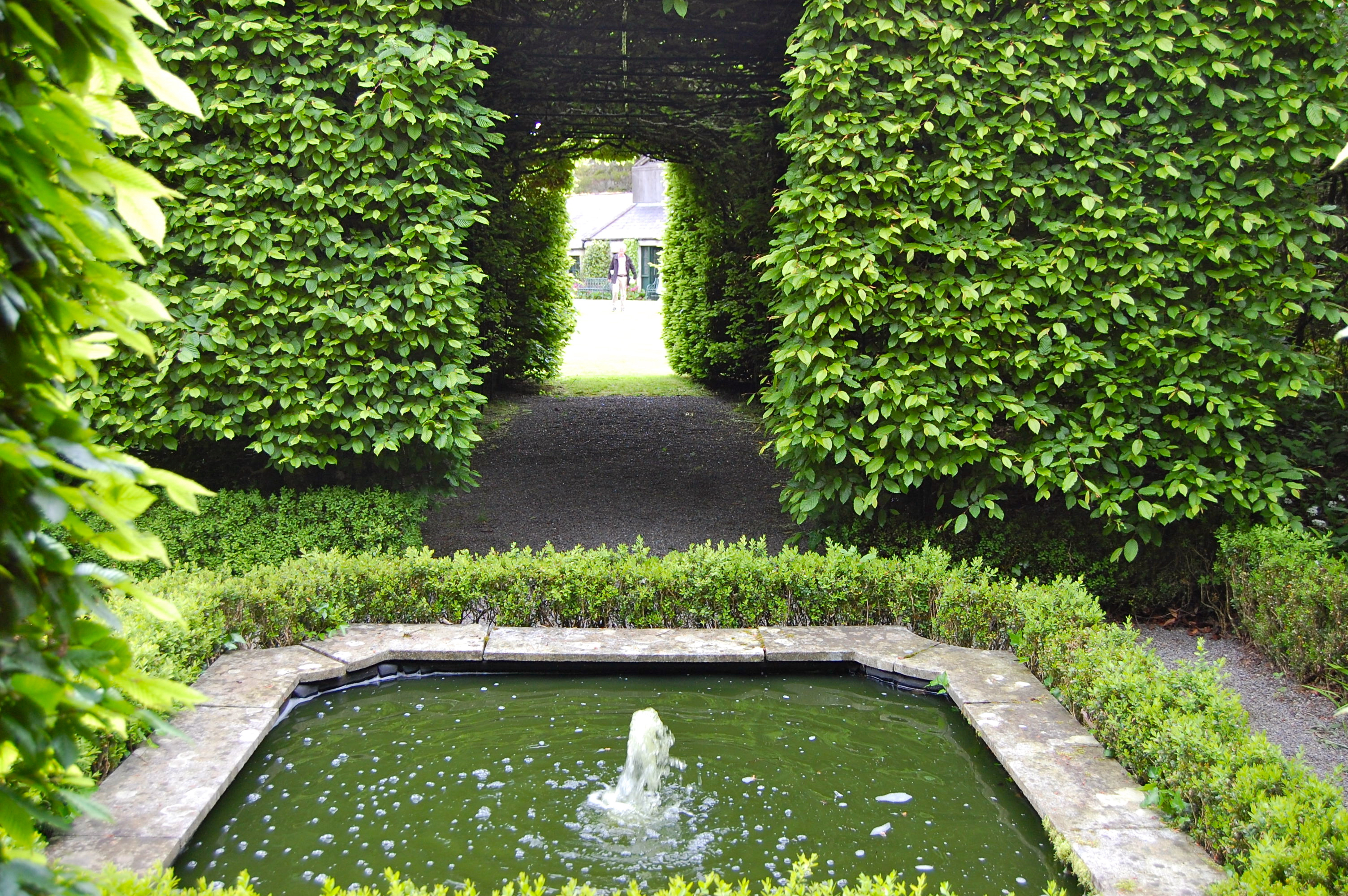
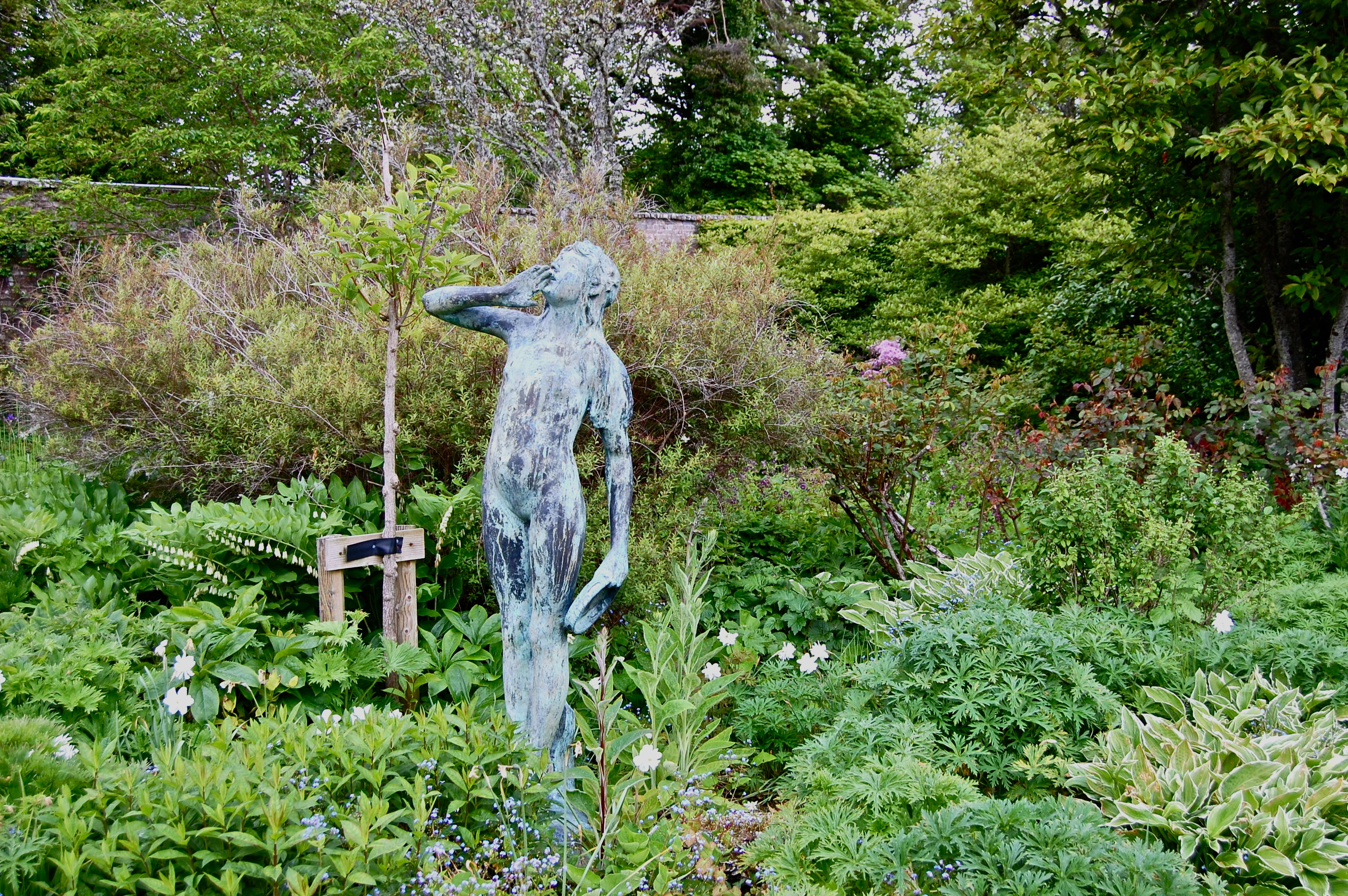
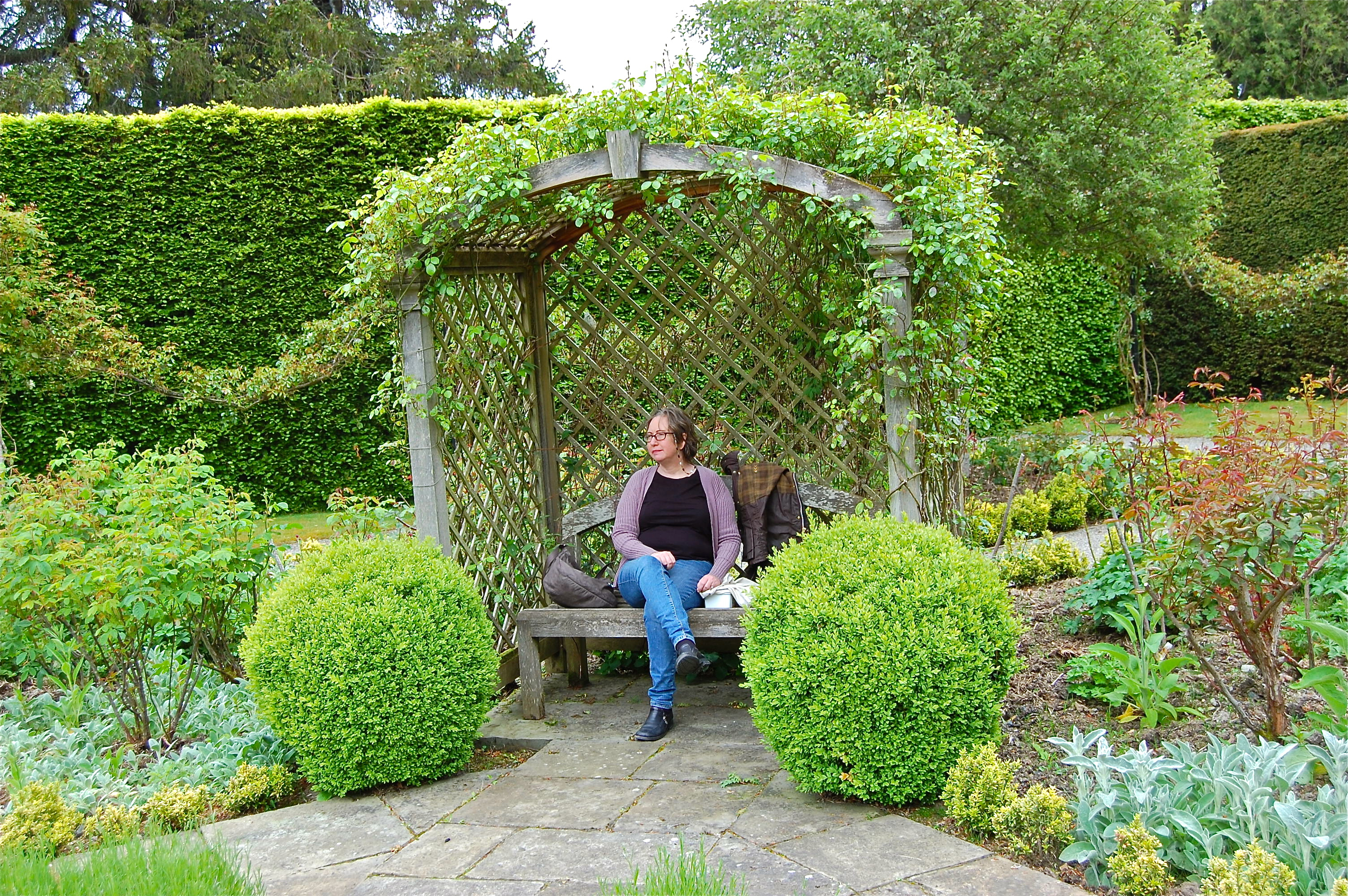
At Drishane House. Photograph © Jennifer Winder-Baggot, www.irishhistorichouses.com
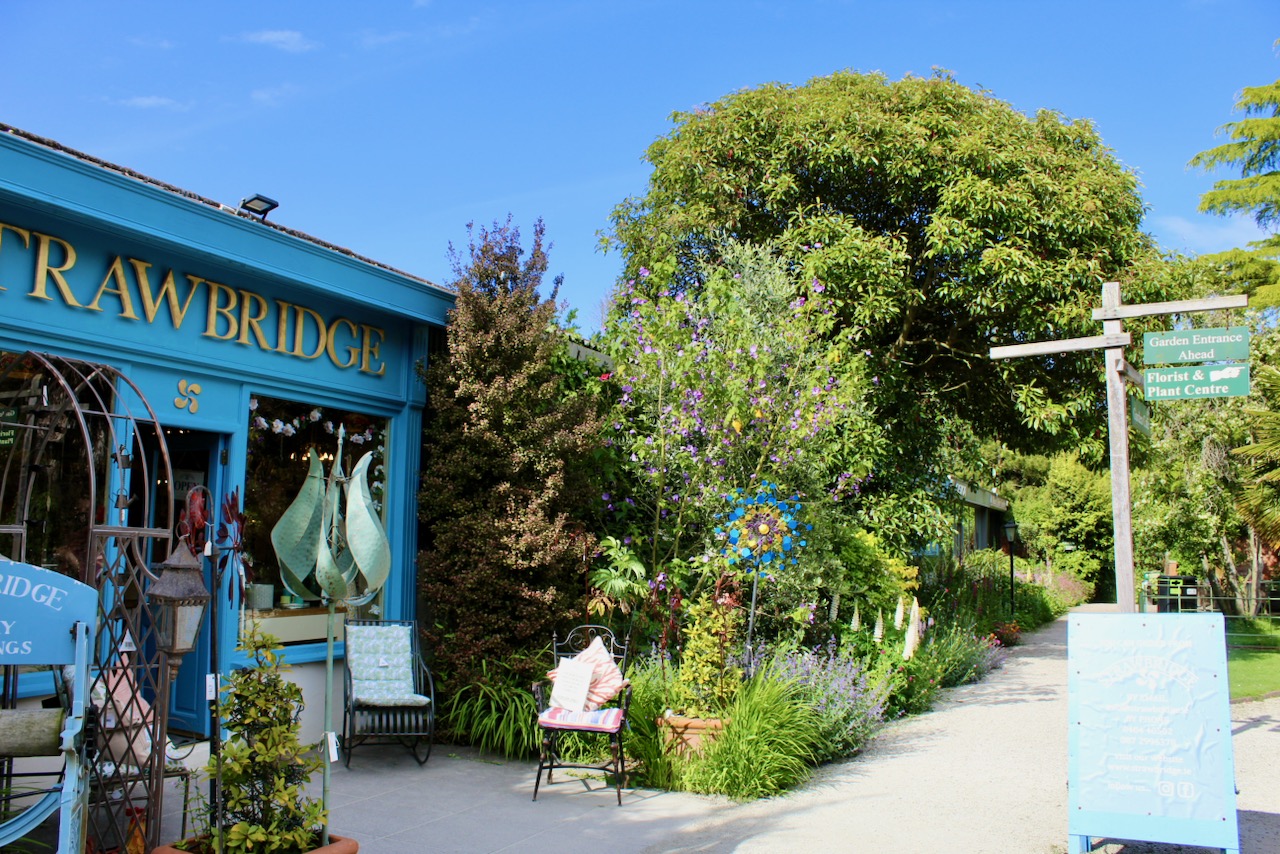
Edith’s ancestor Reverend William Somerville fled persecution in Scotland in the 1690s and moved to Ireland. [1] He was an Episcopalian Minister who feared for his life following the disestablishment of the Church of Scotland in 1690. The Drishane House website tells us that Reverend William rowed his family twenty miles across rough water to Ulster, where they found refuge with family connections. 

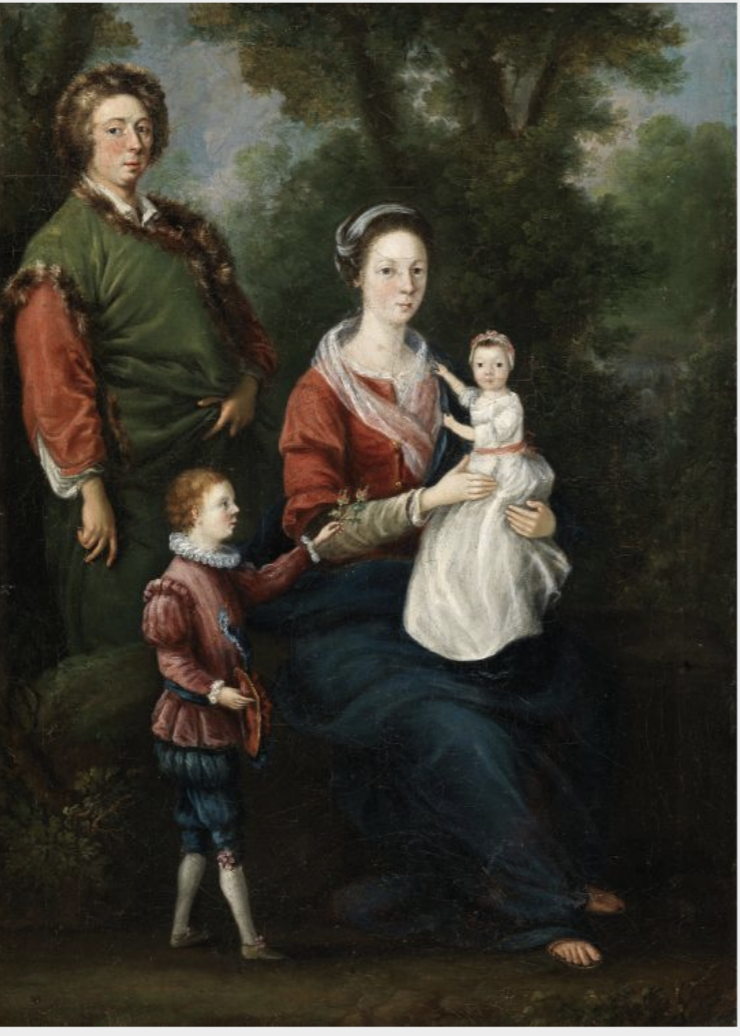
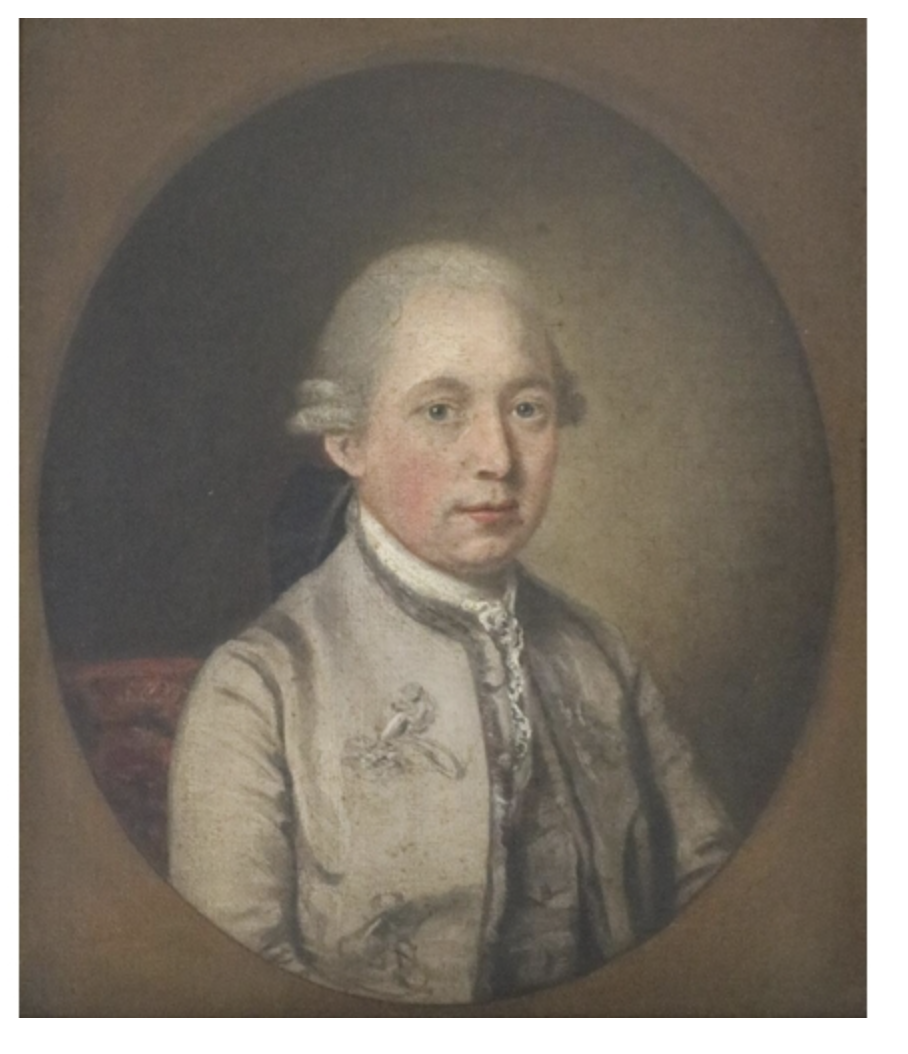
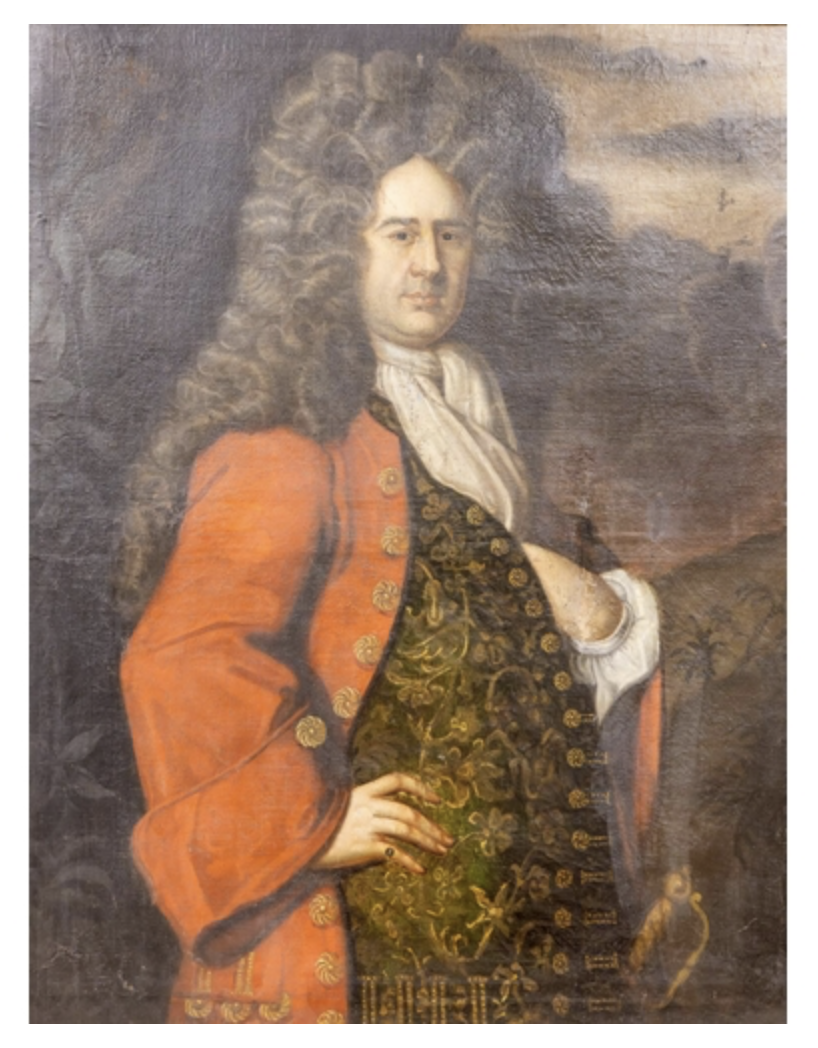
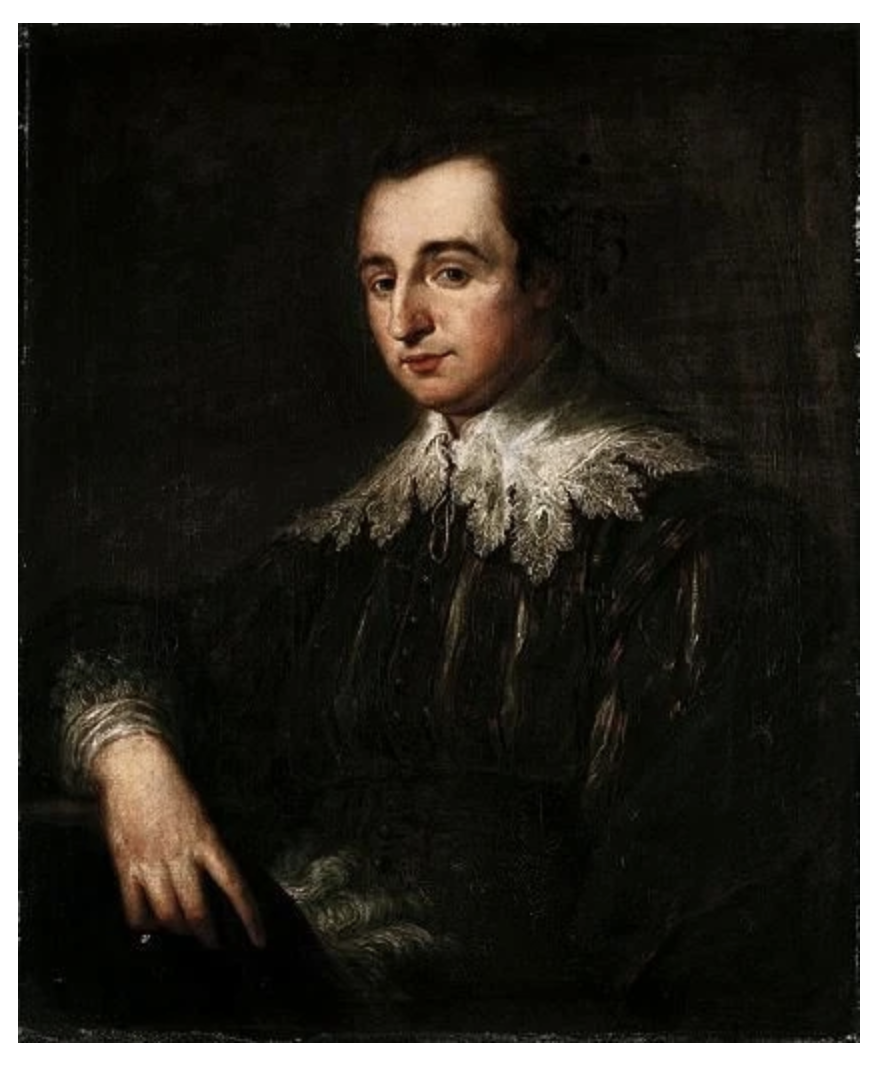
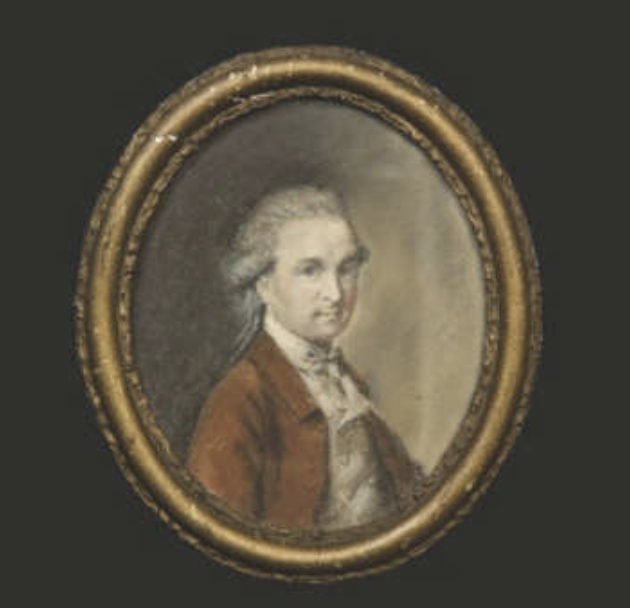
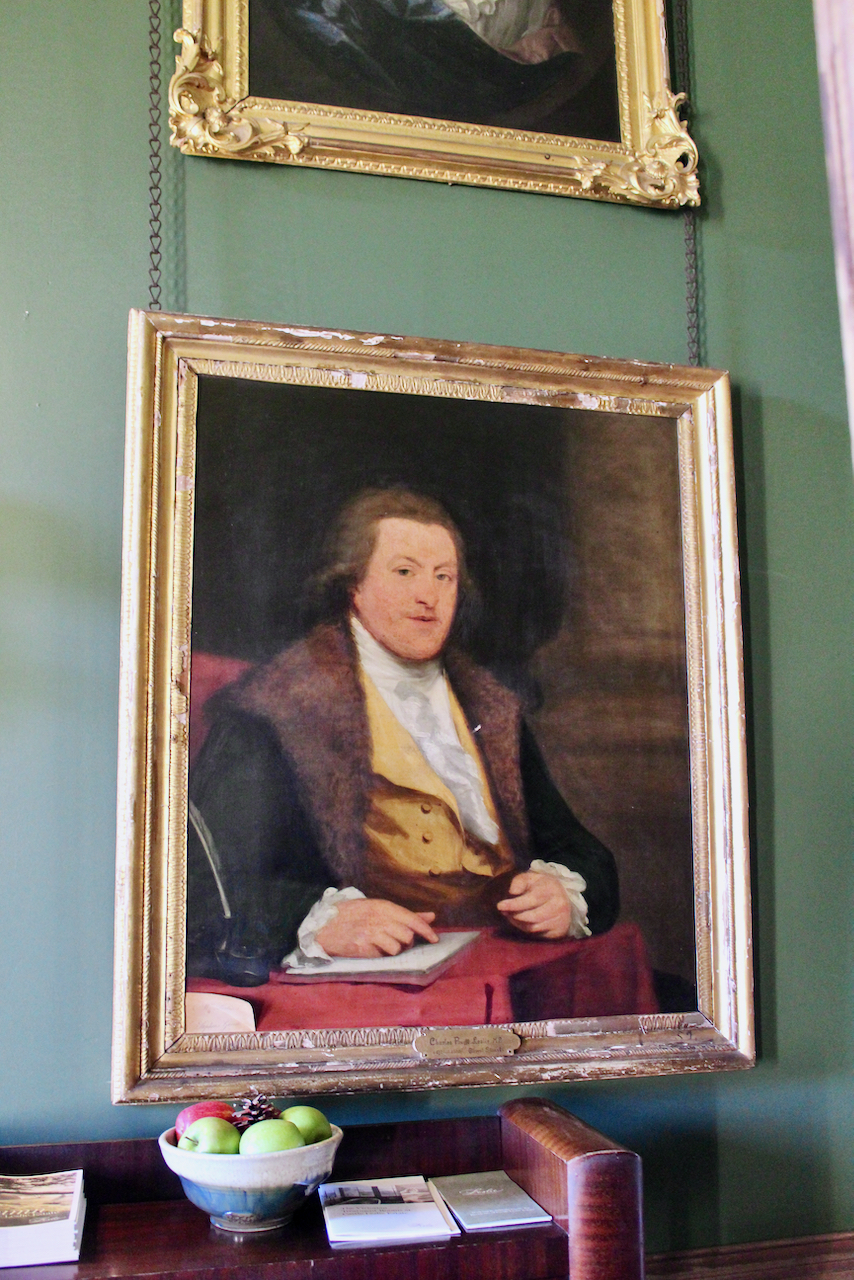
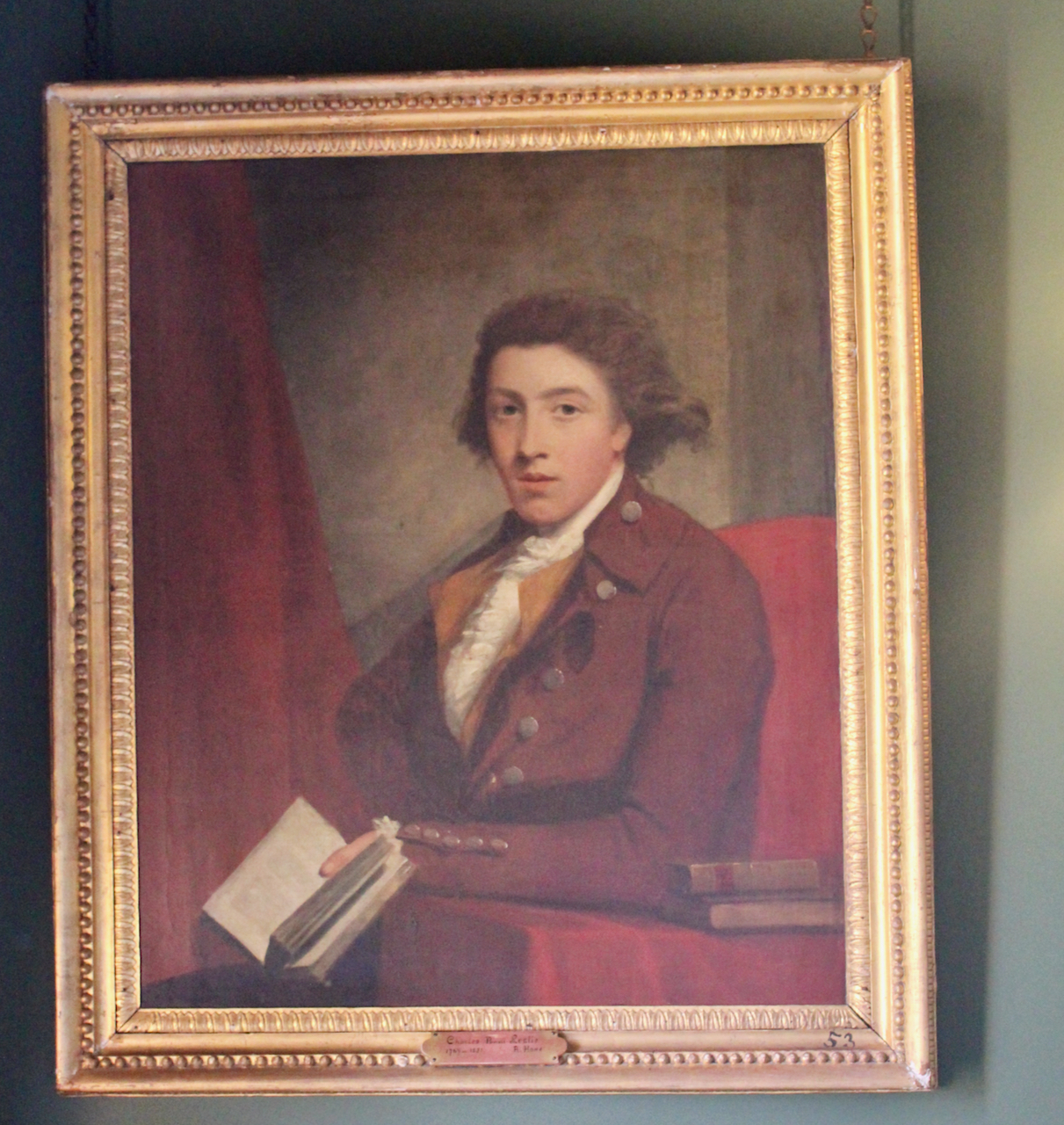
The Reverend’s younger son, Thomas, attended Trinity College Dublin and was ordained in the Church of Ireland. He married Anne Neville, of Furnace, County Kildare, a prosperous and well-connected family. Thomas obtained the position of Rector of Castlehaven and the family moved to Cork. He set up house in the old O’Driscoll castle next to the church at Castlehaven Strand. Both are now ruins. His portrait, his stick and his 1685 edition of Bedel’s Irish Bible remain in the possession of his descendants.

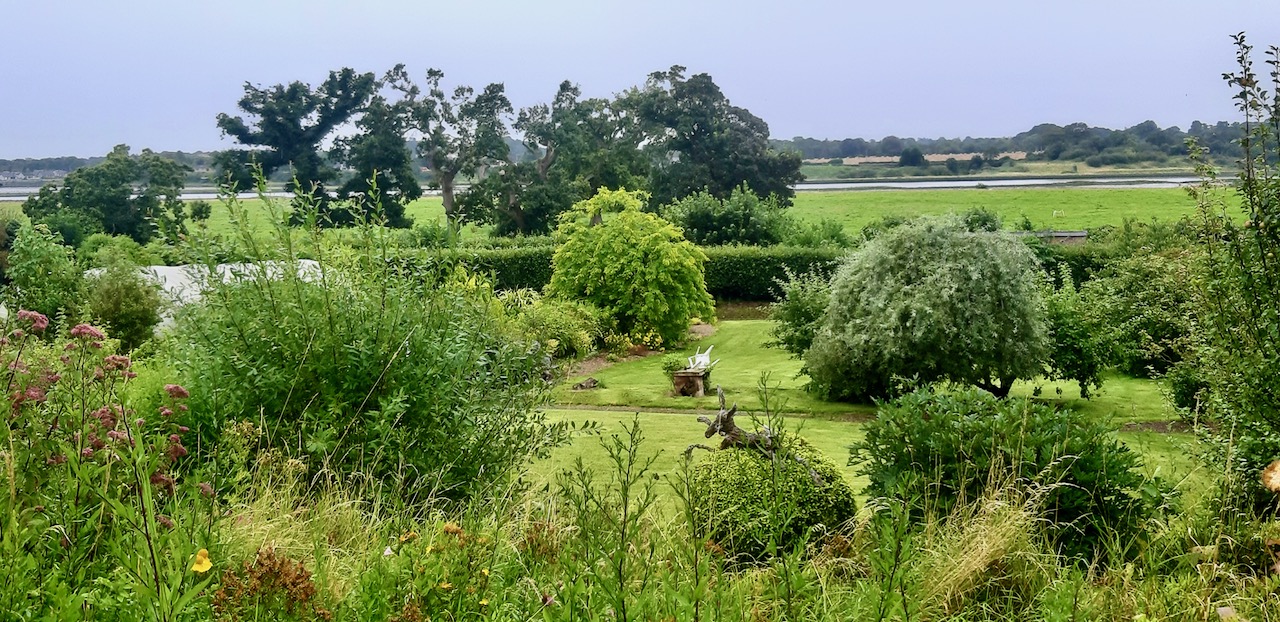
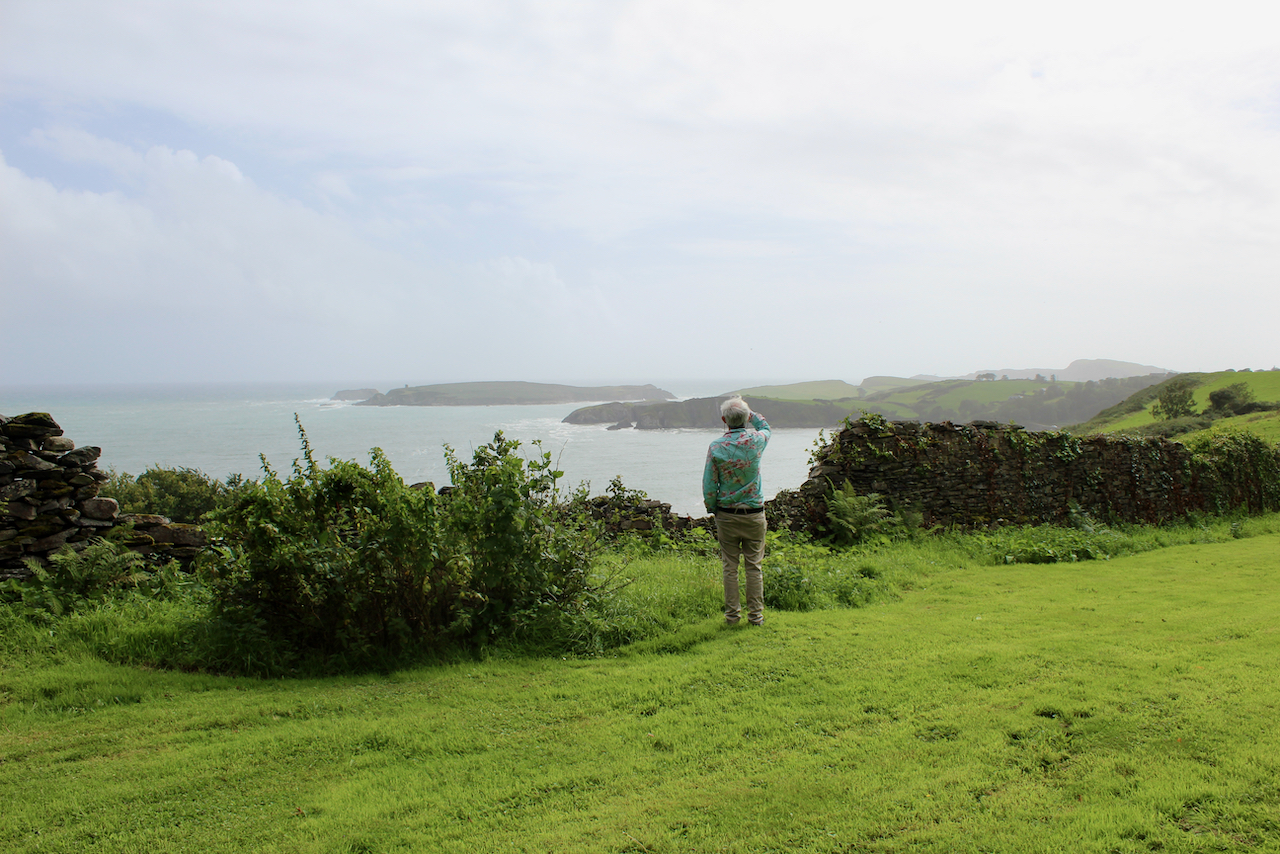
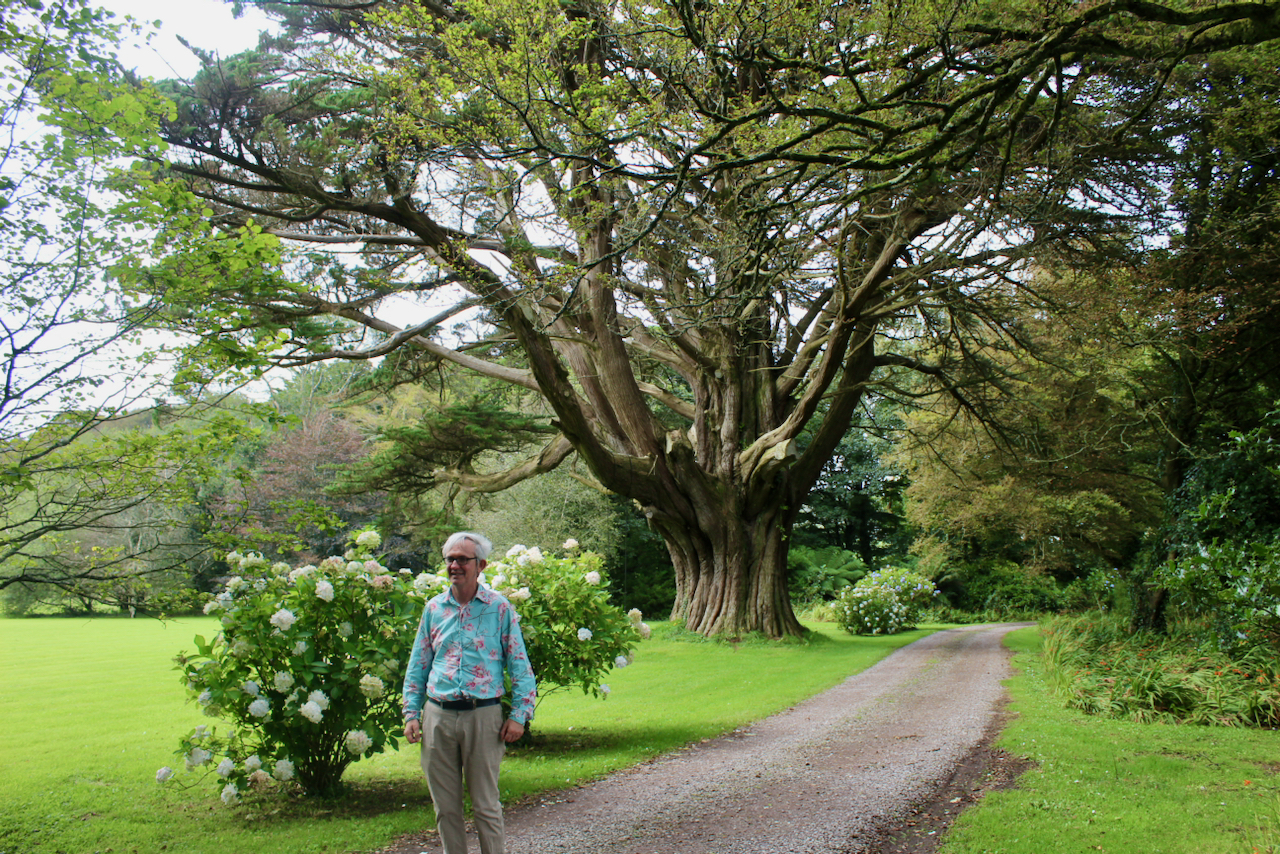
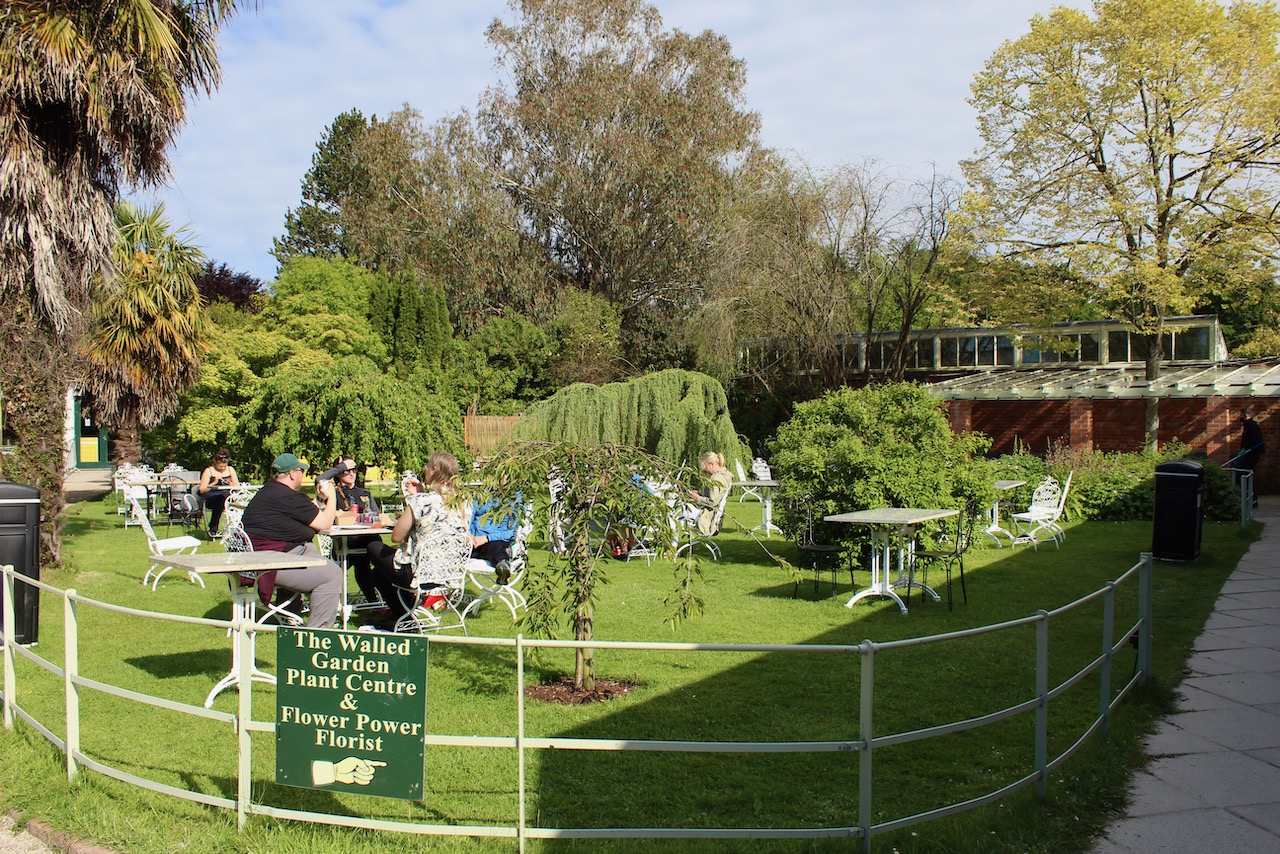
Stephen overlooking Castletown Bay from Drishane. Photograph © Jennifer Winder-Baggot, www.irishhistorichouses.com
Three of Reverend Thomas’s sons moved to America and prospered. The eldest son hoped to follow in his father’s footsteps as a clergyman but lost an eye in university, so instead became a successful shipping merchant. He’d send butter and salted provisions to the West Indies and bring back rum, sugar and timber. [2] He built his house at Drishane, on the edge of the village of Castletownshend, where he had a view of his ships in Castlehaven Bay. Among items he imported from the West Indies was the mahogany which was used to make the doors of the reception rooms in Drishane.

He married Mary Townsend, daughter of Captain Philip Townsend who lived in Derry, County Cork, great-granddaughter of Richard Townsend who was an officer in Cromwell’s army and who built the castle at nearby Castletownshend (it was only in 1860 that the family changed the spelling of their name from Townsend to Townshend [3]).

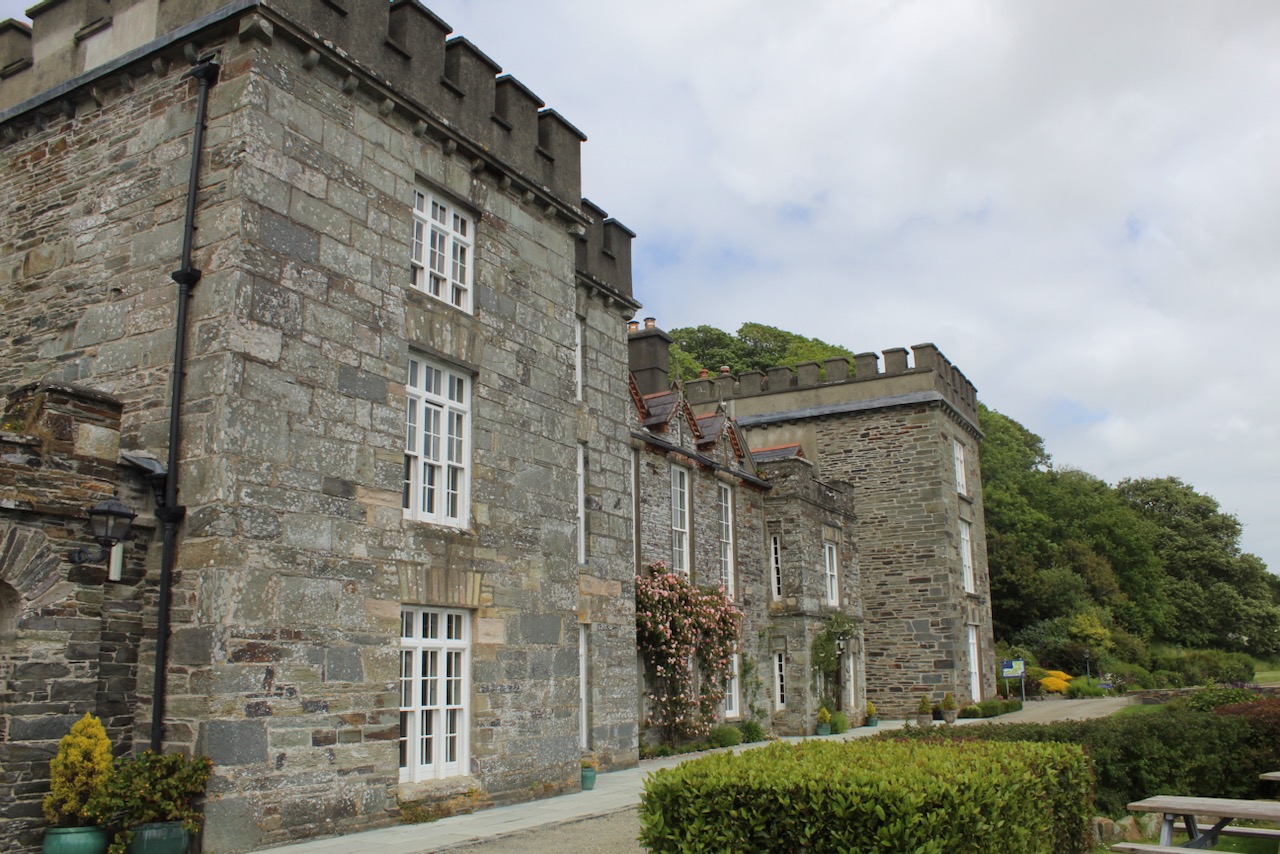
Castletownshend, County Cork. Photograph © Jennifer Winder-Baggot, www.irishhistorichouses.com
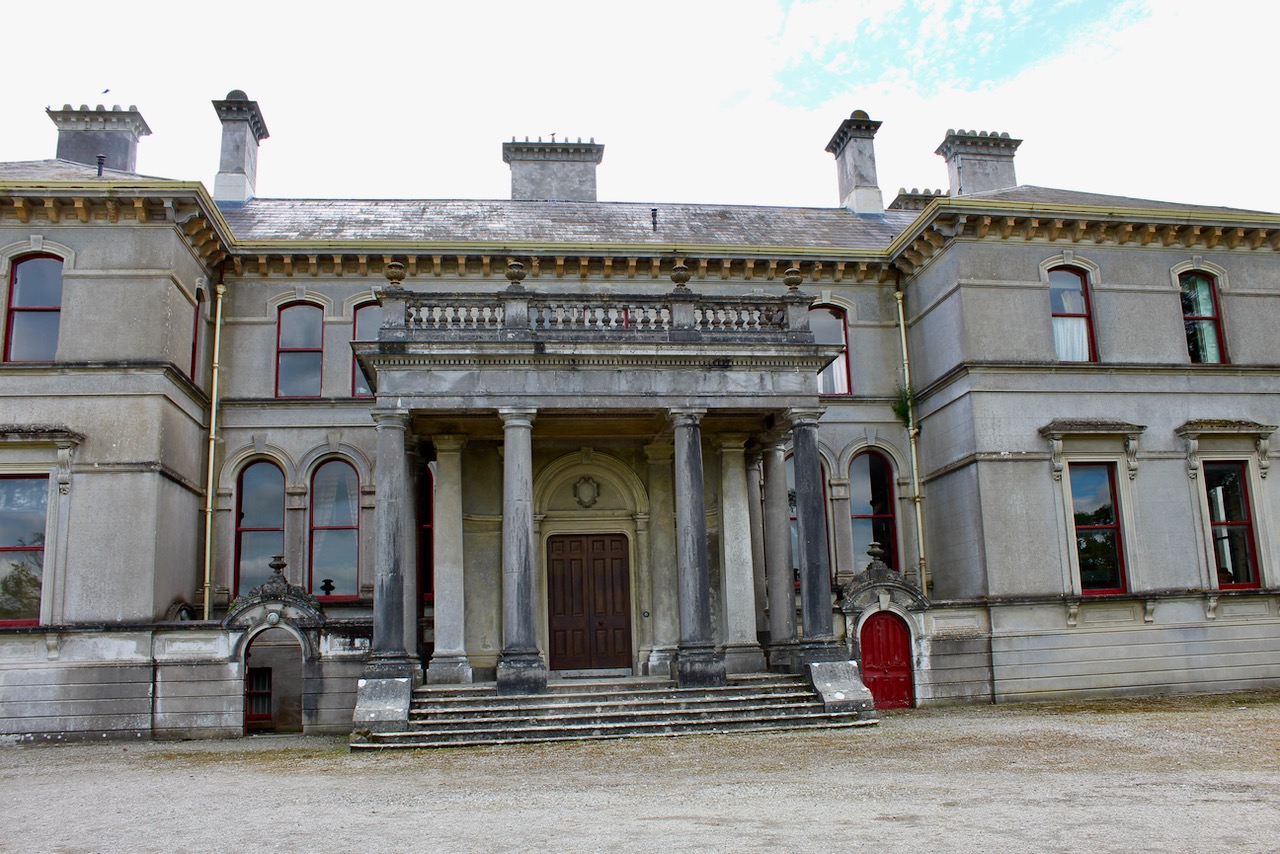
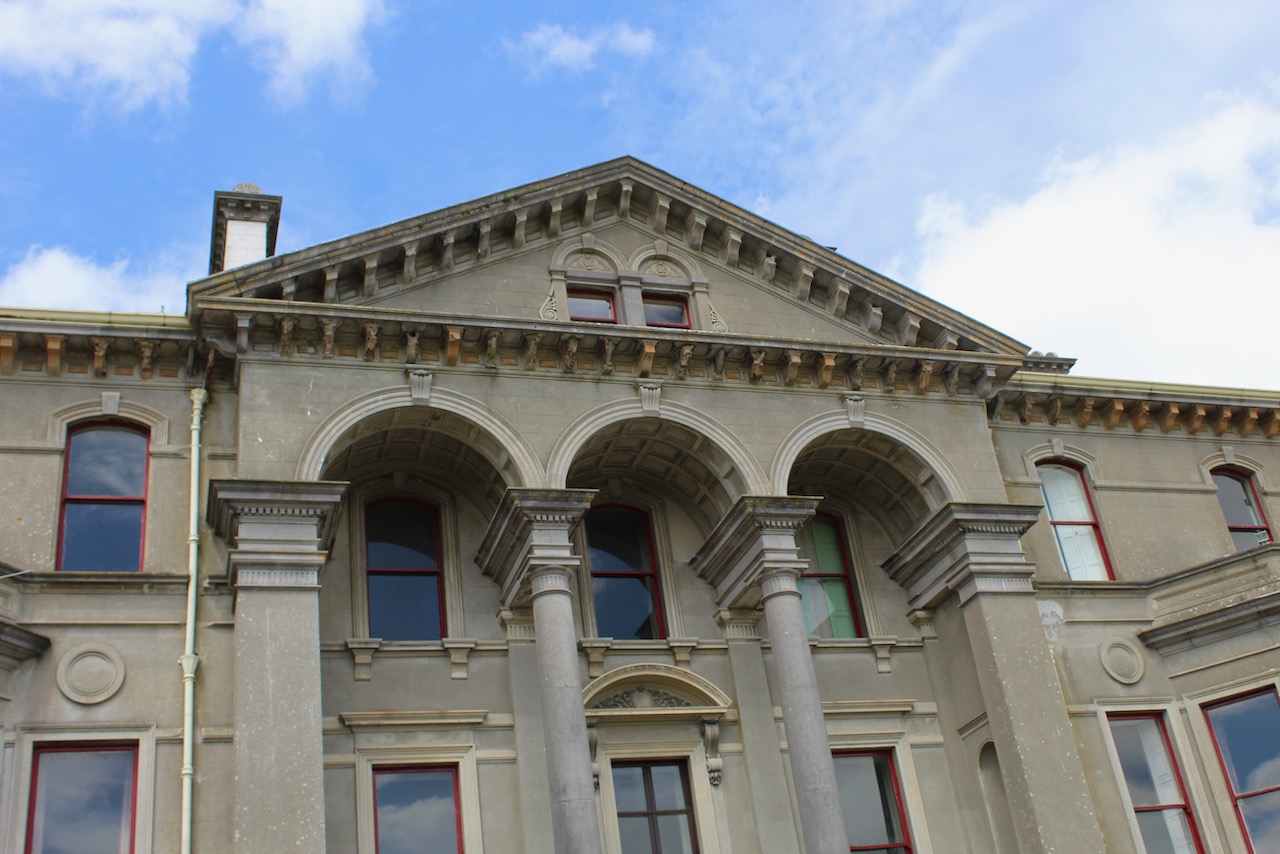
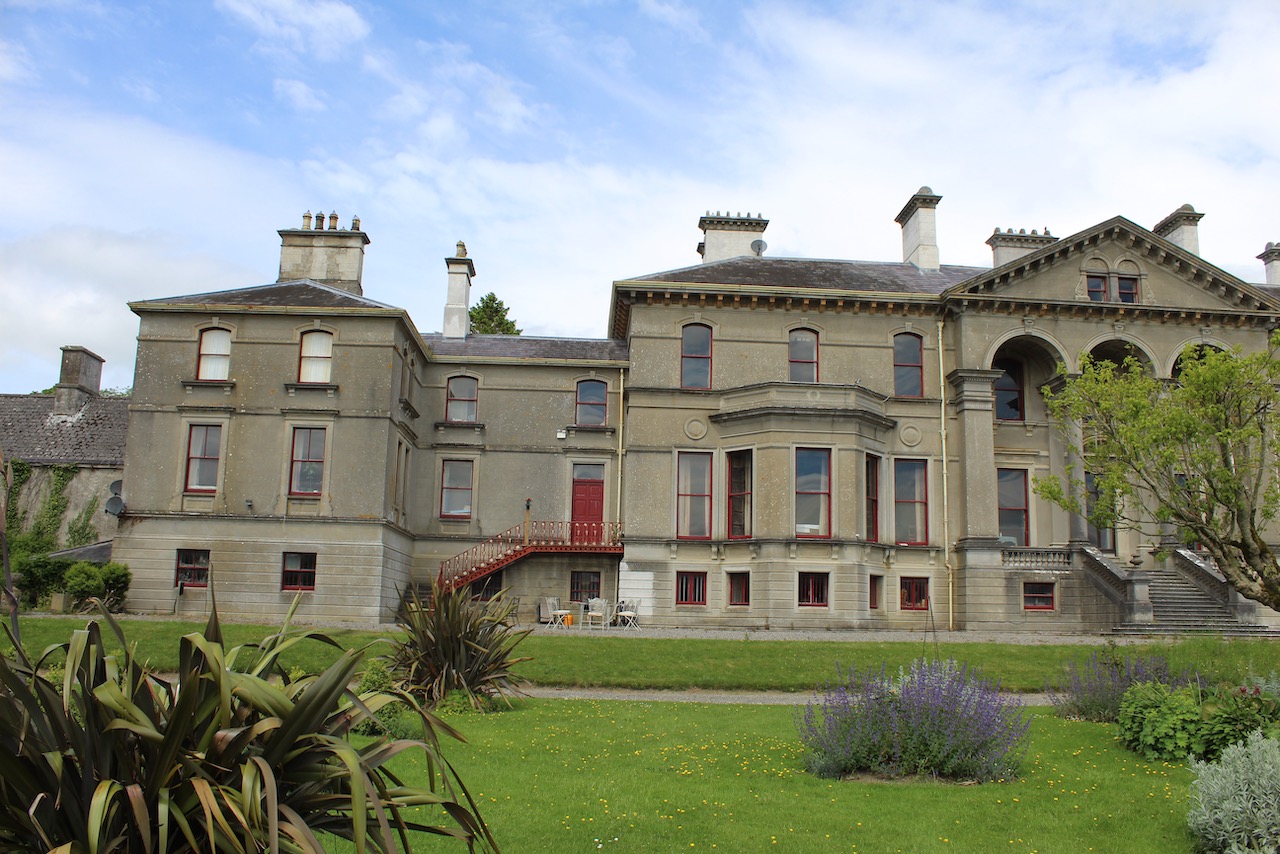
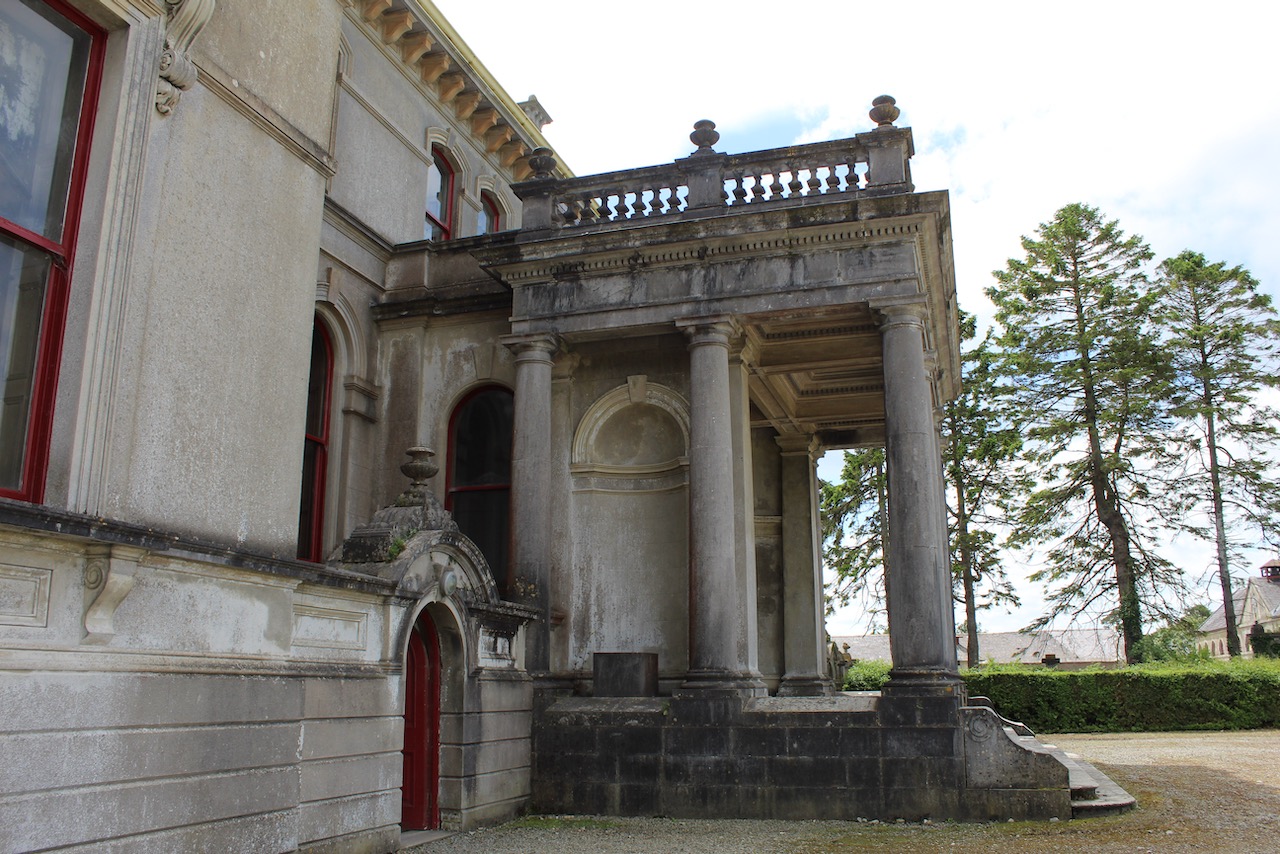
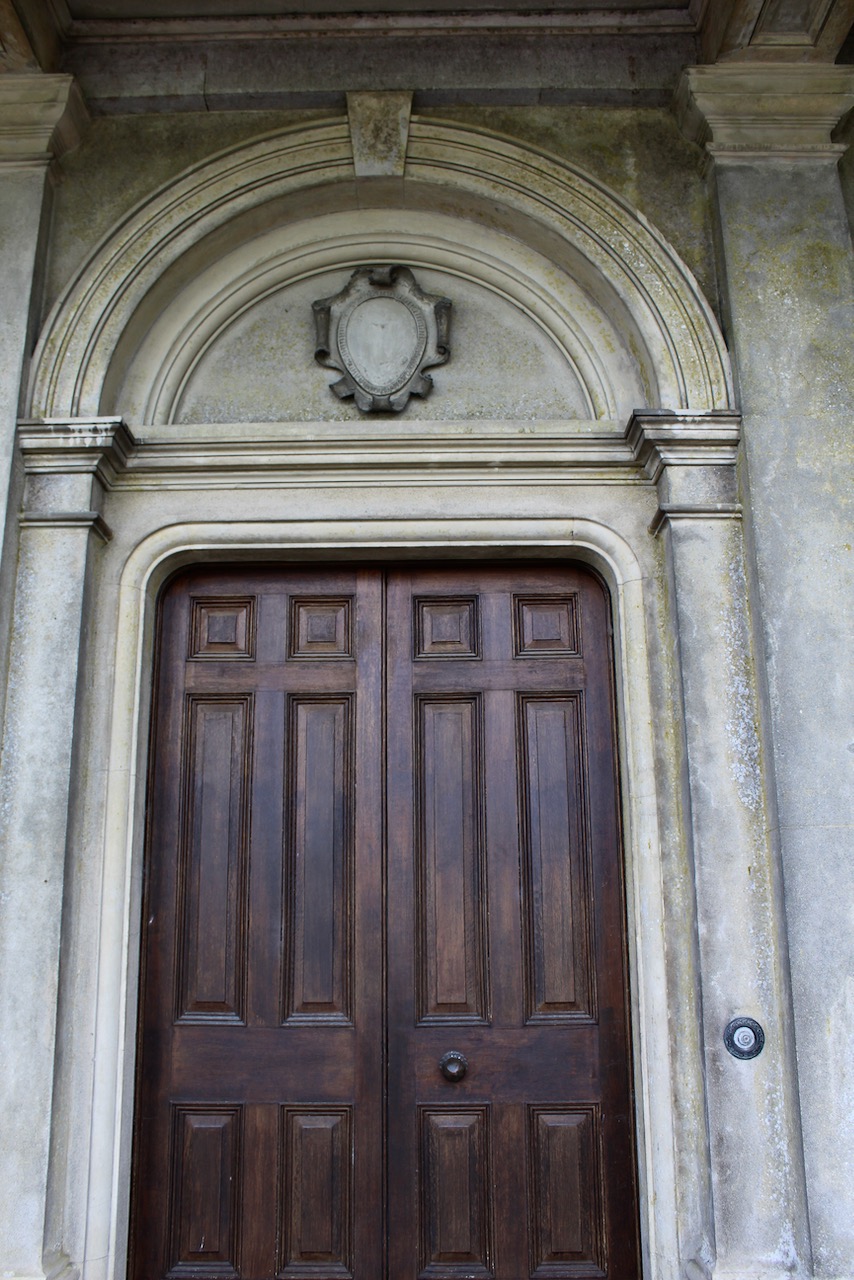
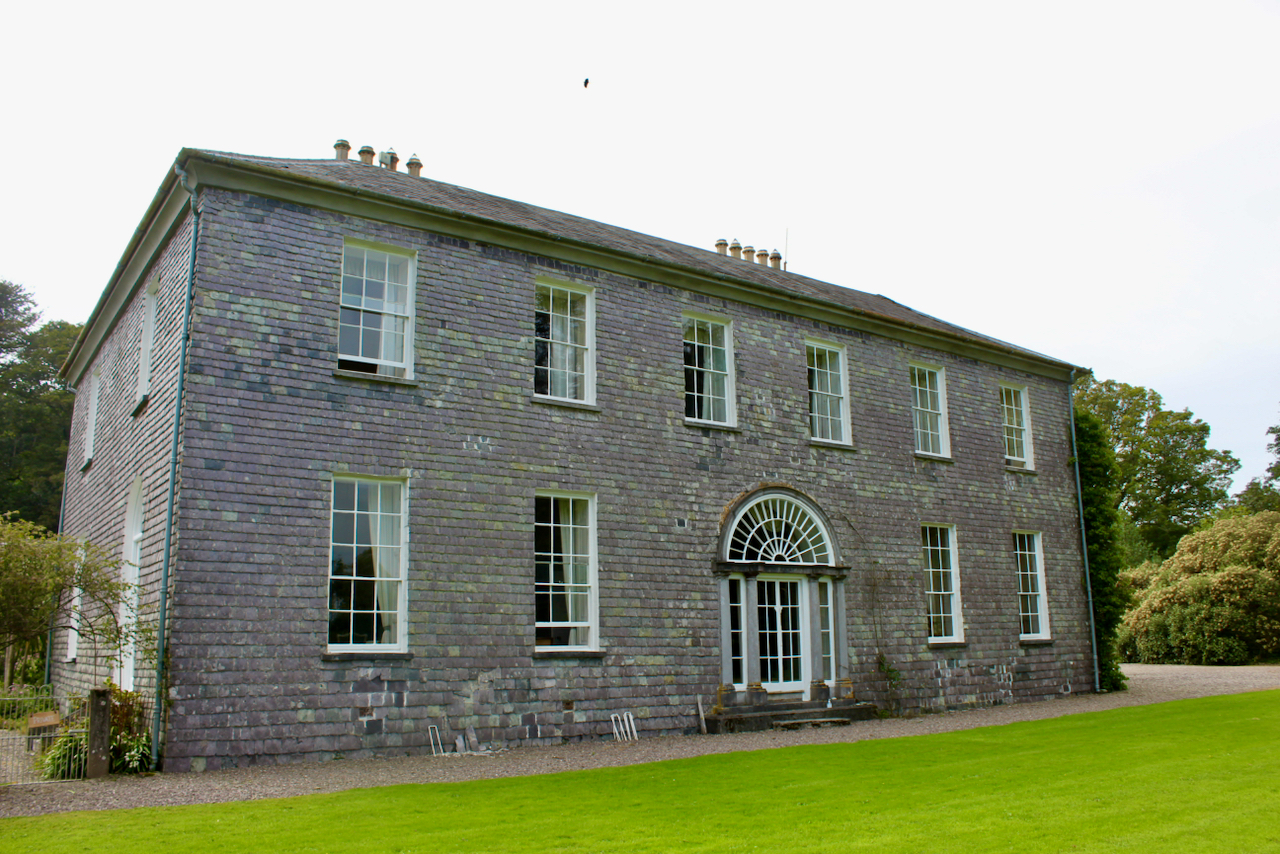
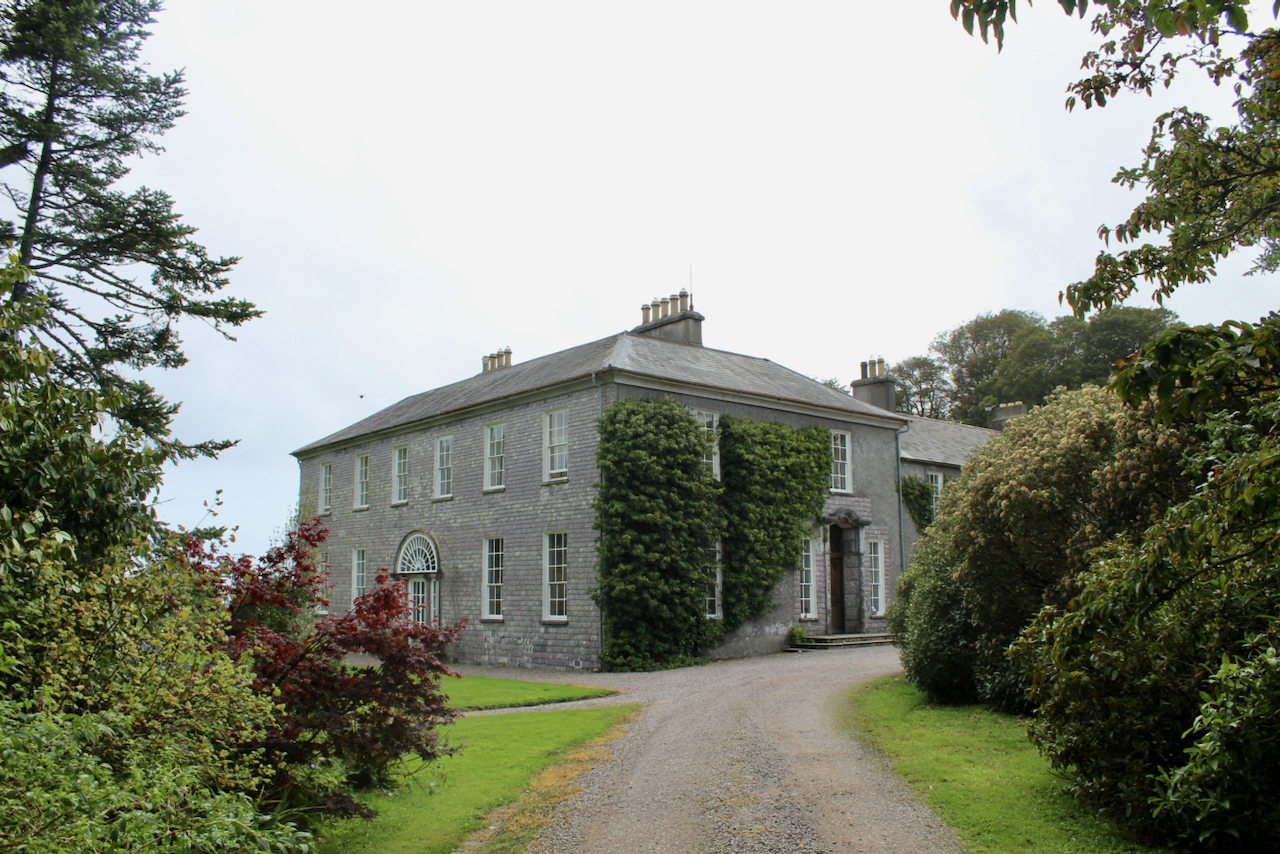
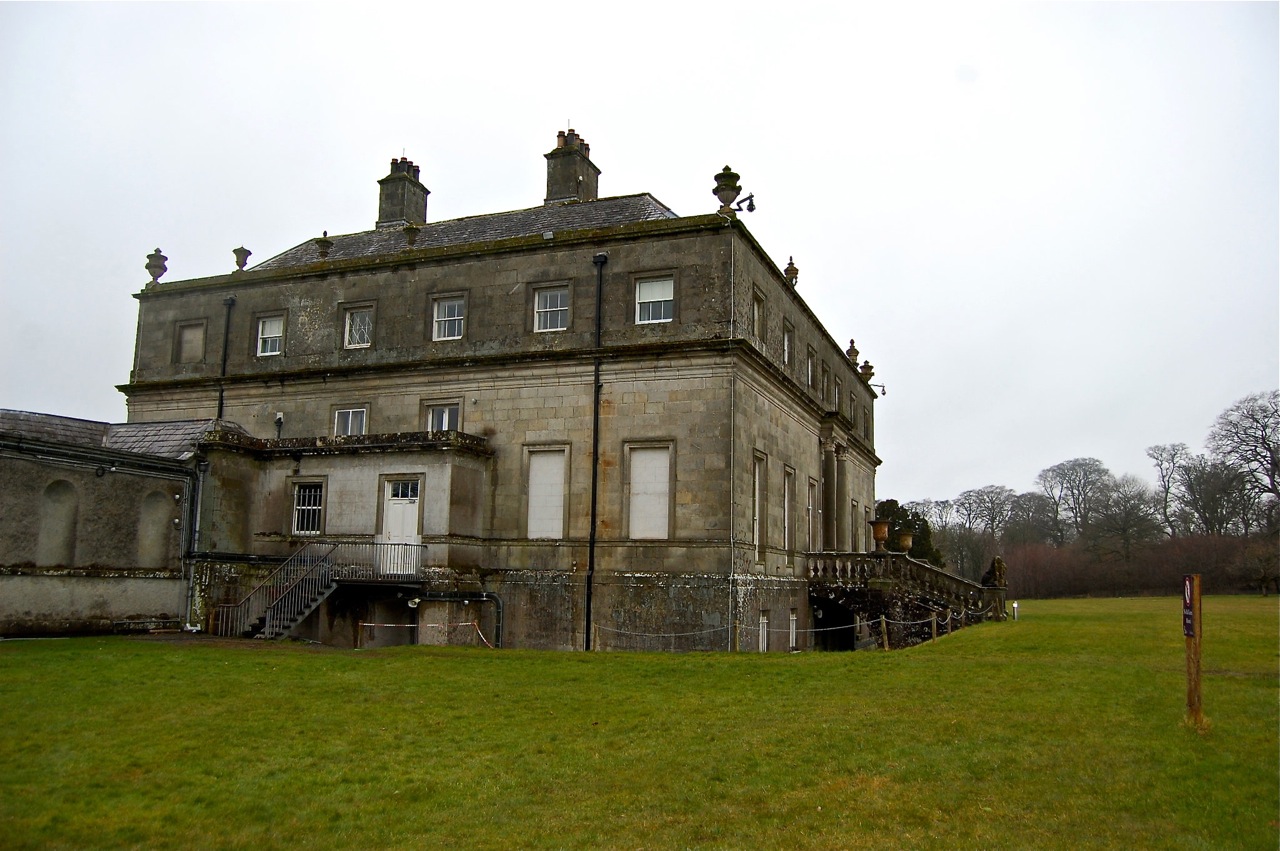
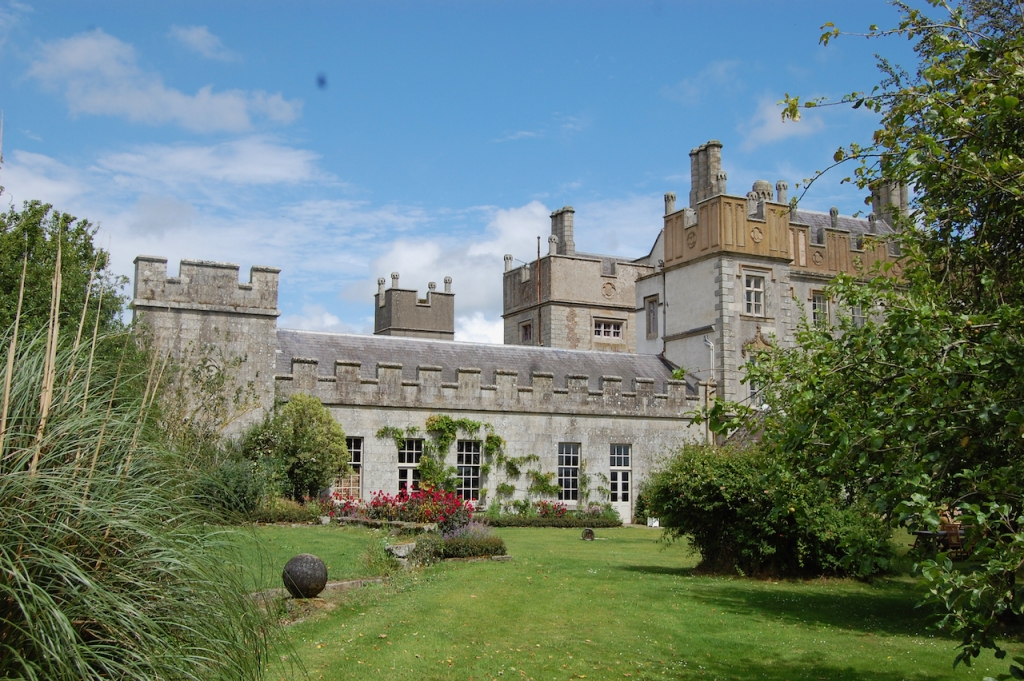
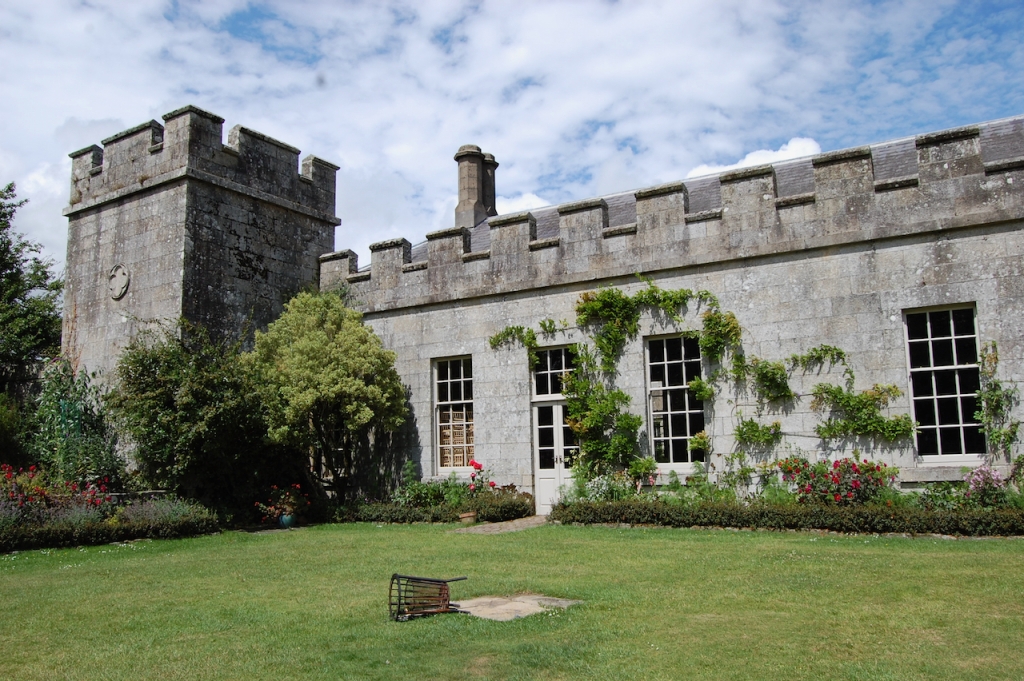
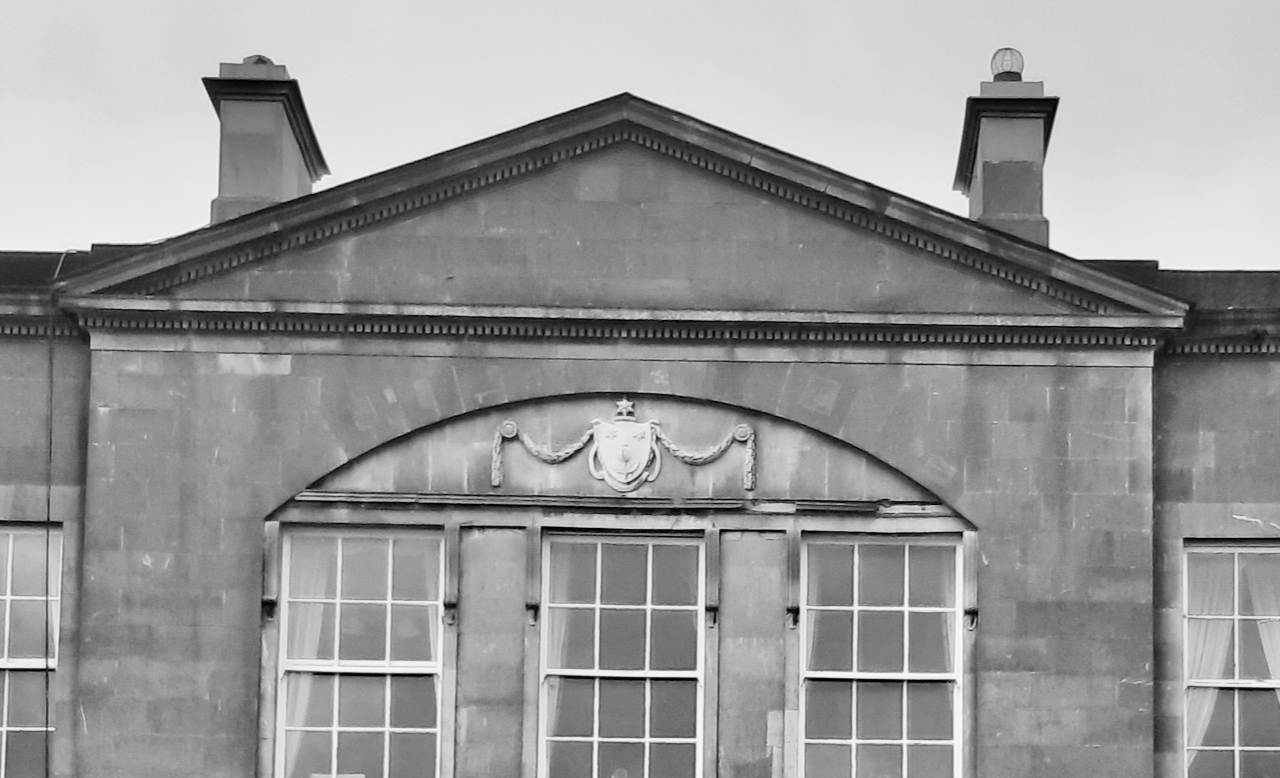
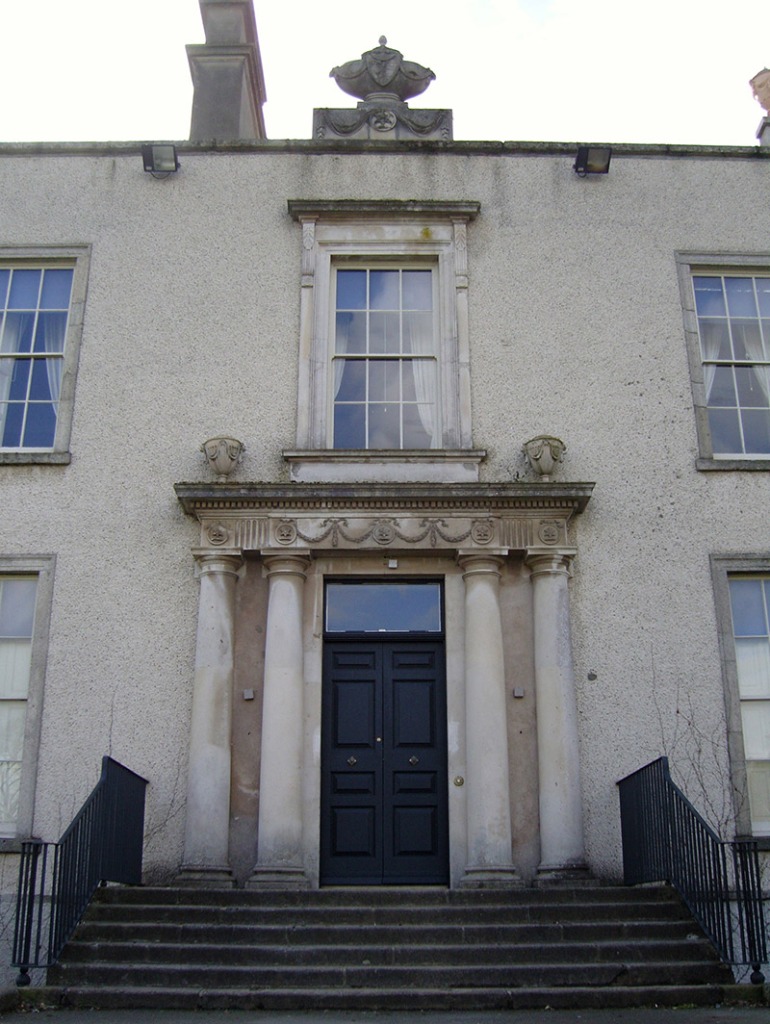
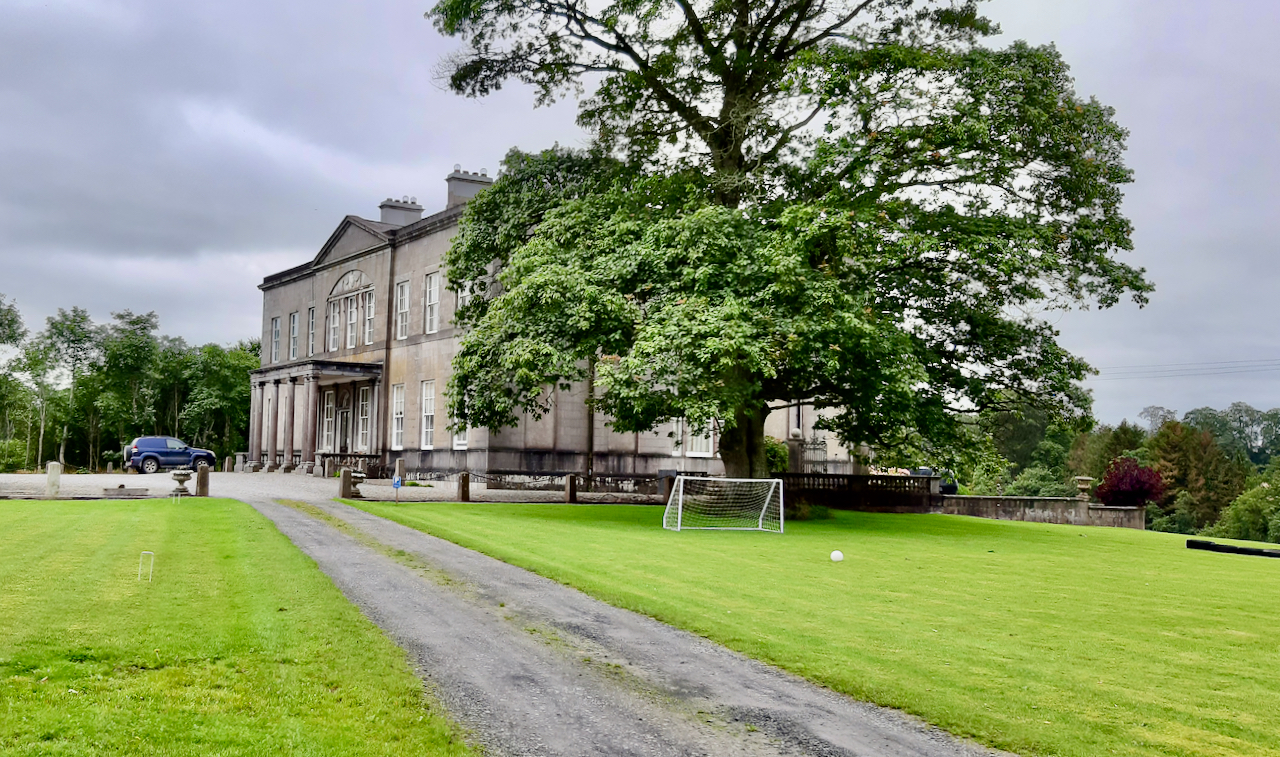
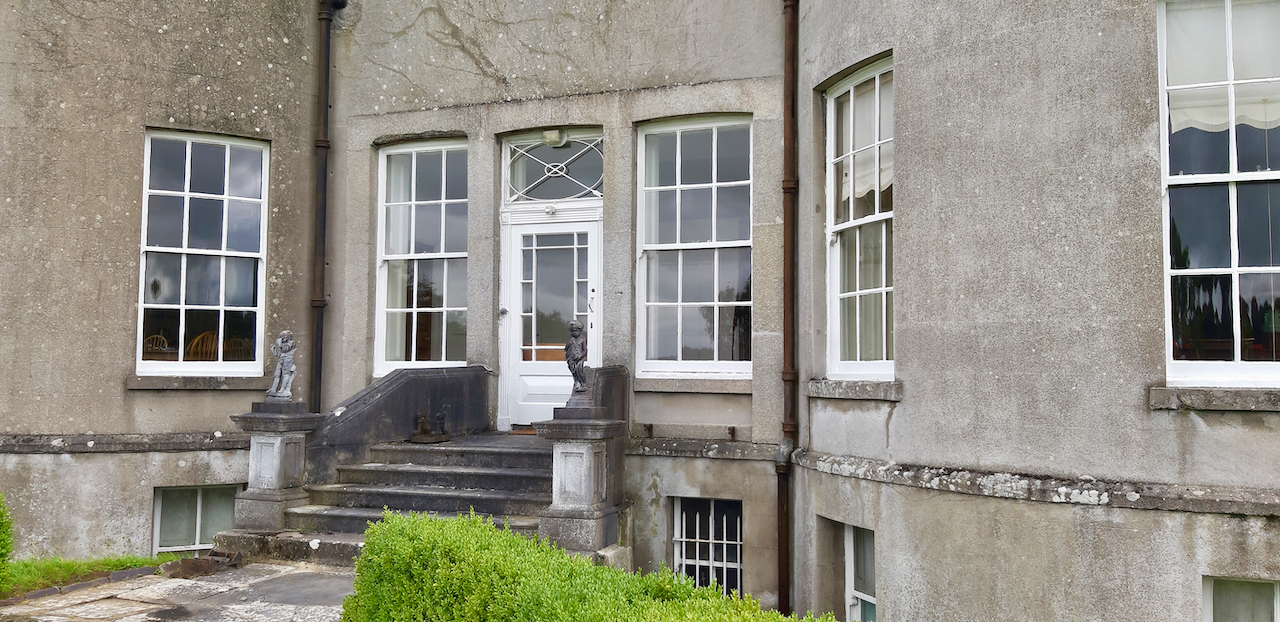
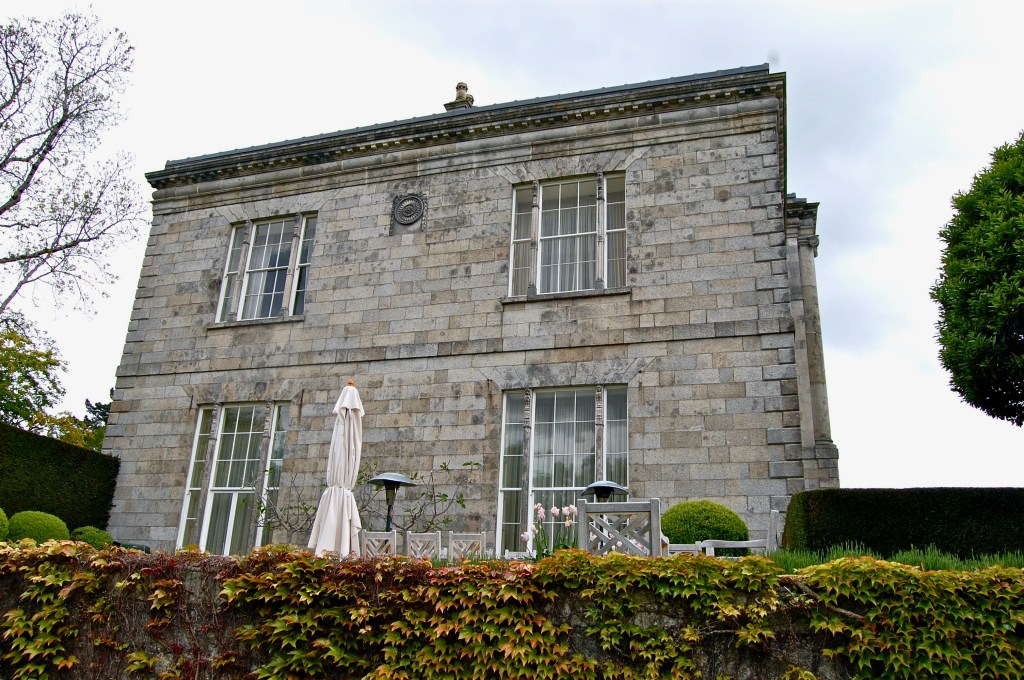
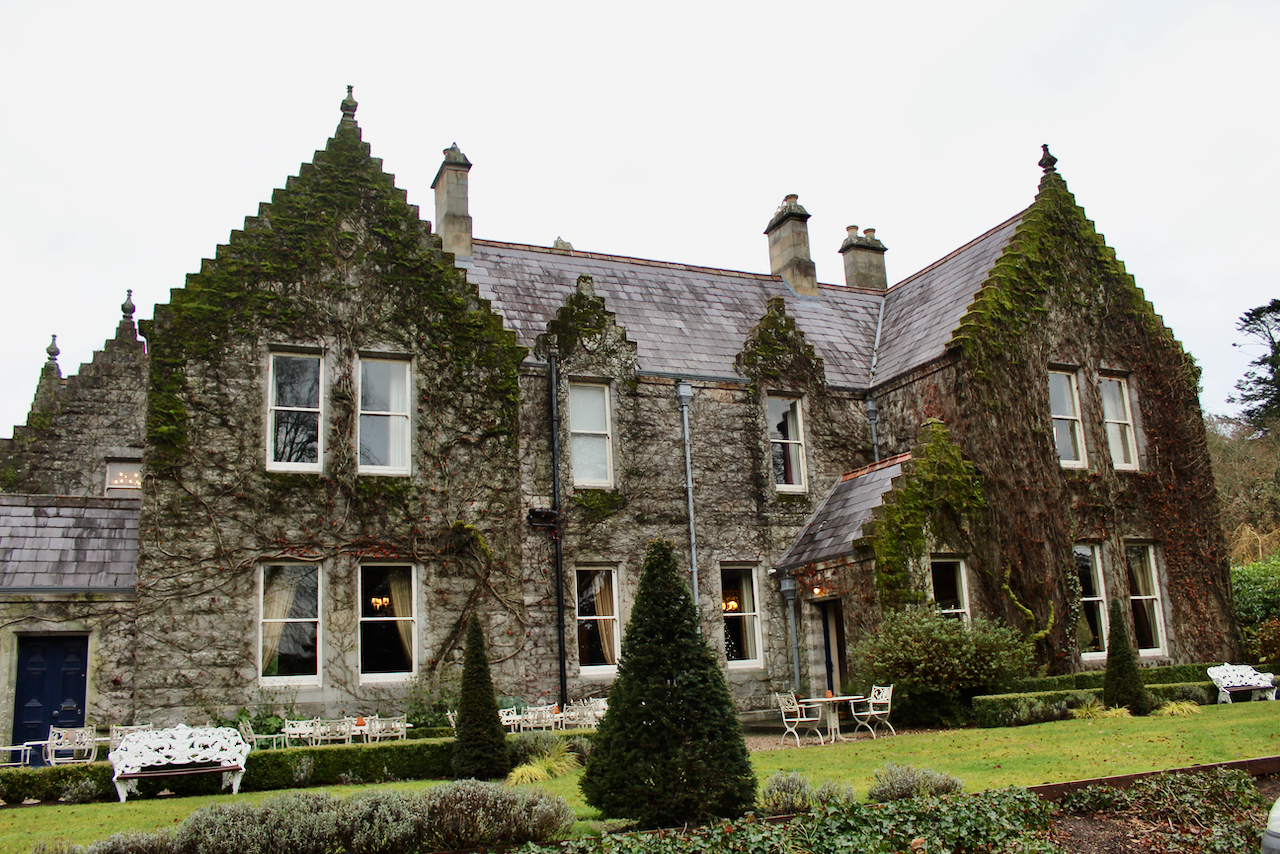
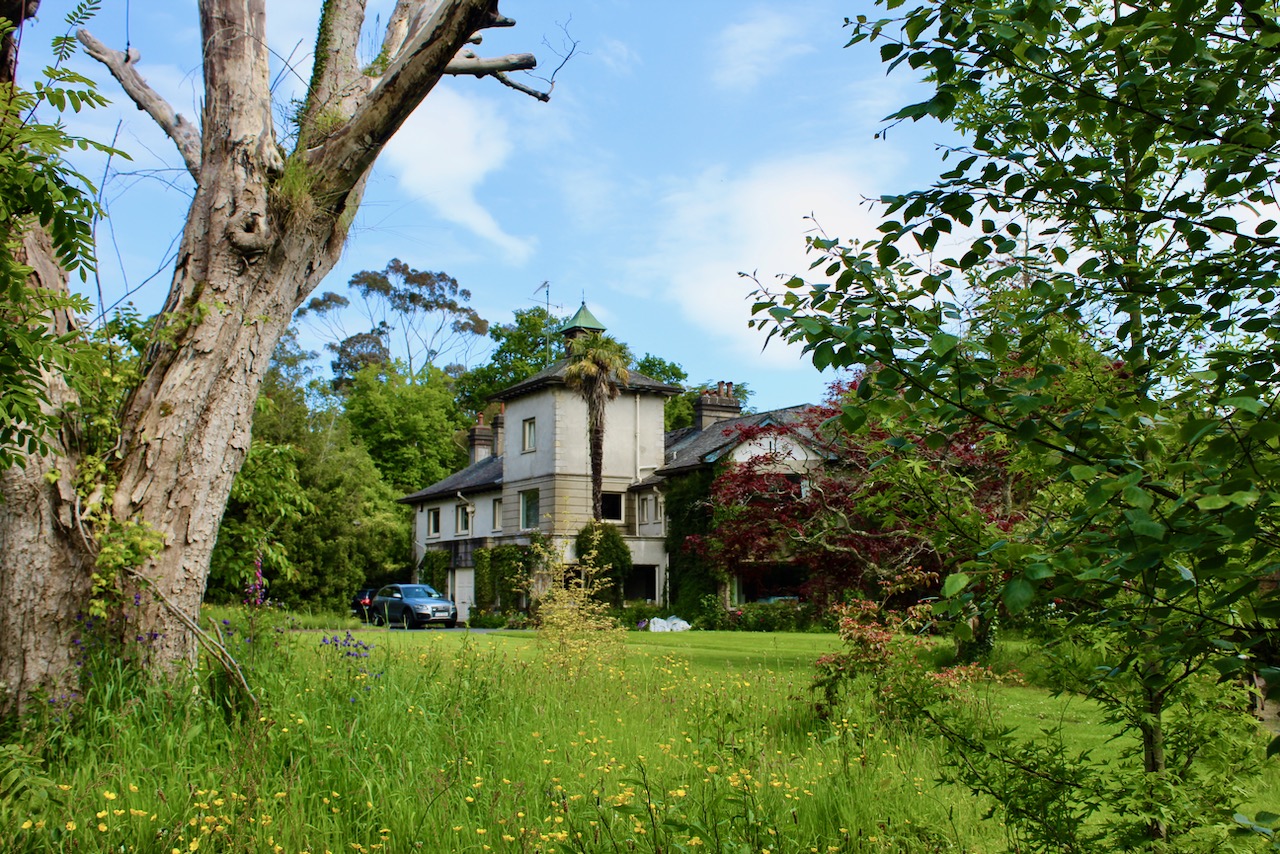
Drishane house is two storeys, six bays across, with a fanlighted doorway. This tripartite limestone doorcase, with Tuscan demi-columns, now serves as a garden entrance doorway. The newer entrance doorway, built in 1820, is on the more sheltered two bay end of the house, which is prolonged by a lower two storey wing.  The house is covered with purple Benduff weather-slating.

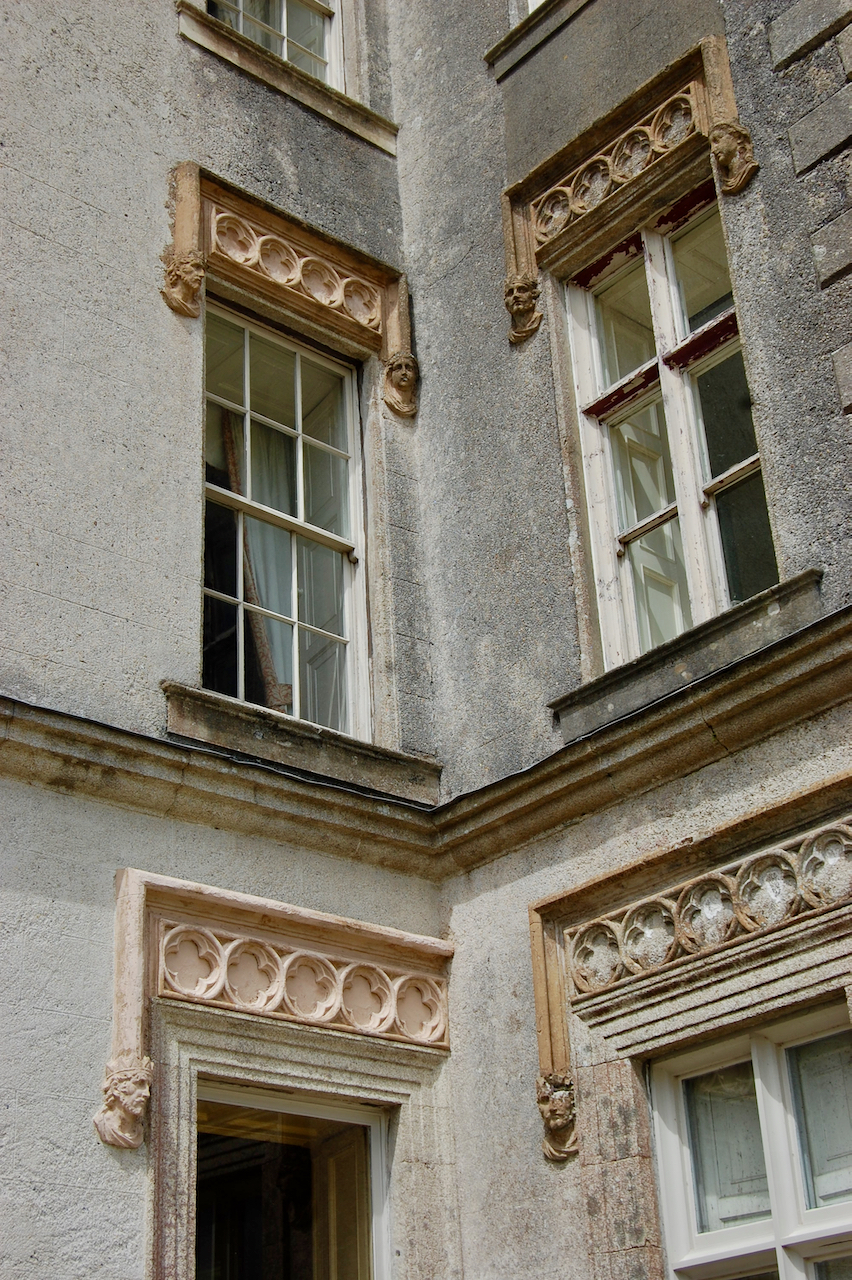
Drishane House. Photograph © Jennifer Winder-Baggot, www.irishhistorichouses.com
Drishane House, County Cork. Photograph © Jennifer Winder-Baggot, www.irishhistorichouses.com
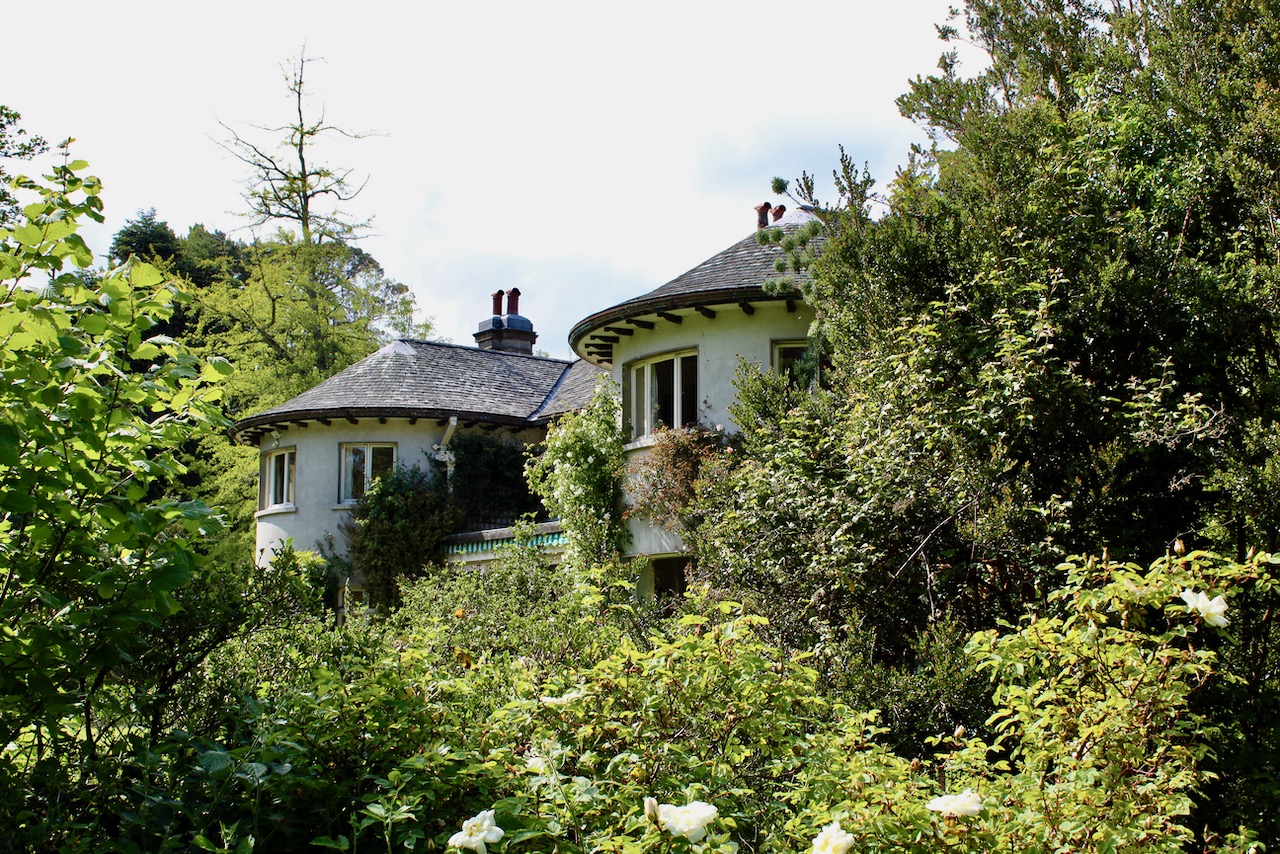
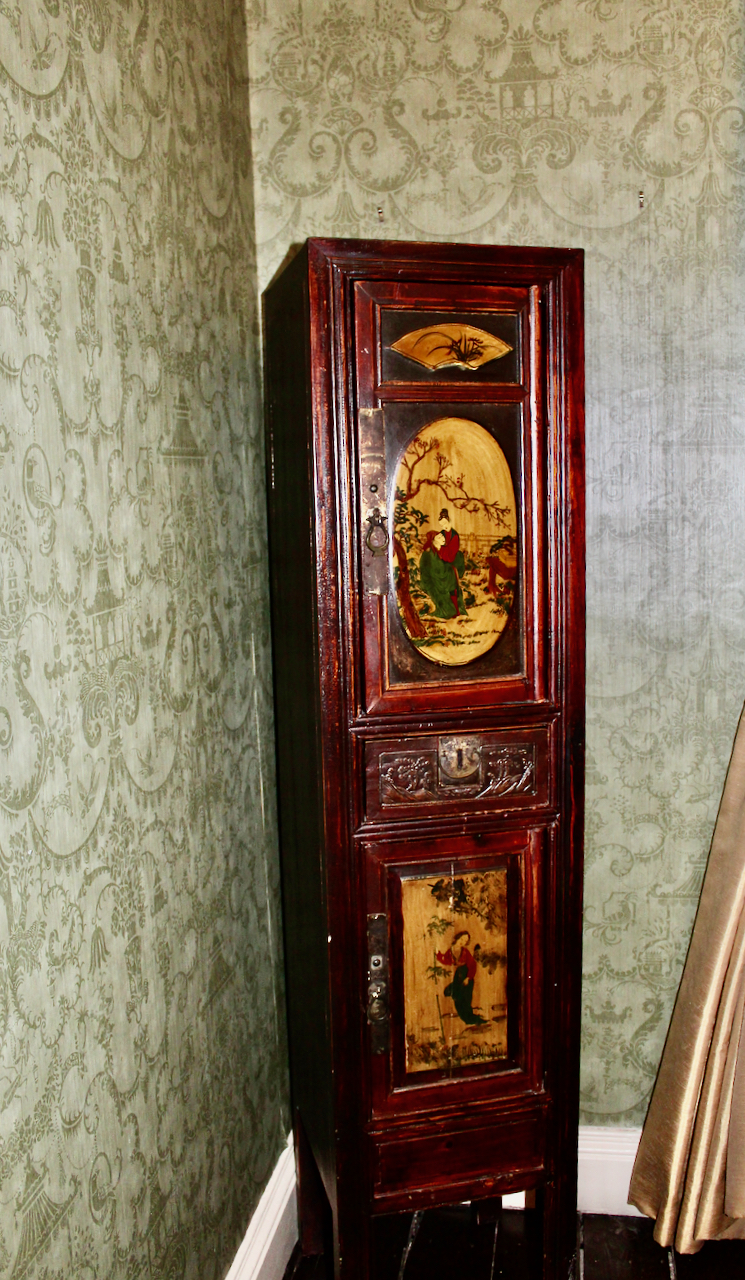
The newer entrance door, with the lower two storey wing. Frank Keohane describes this new entryway: an unusual rock-faced limestone doorcase with a scrolled pediment of vaguely Chinese appearance.” [5] Photograph © Jennifer Winder-Baggot, www.irishhistorichouses.com
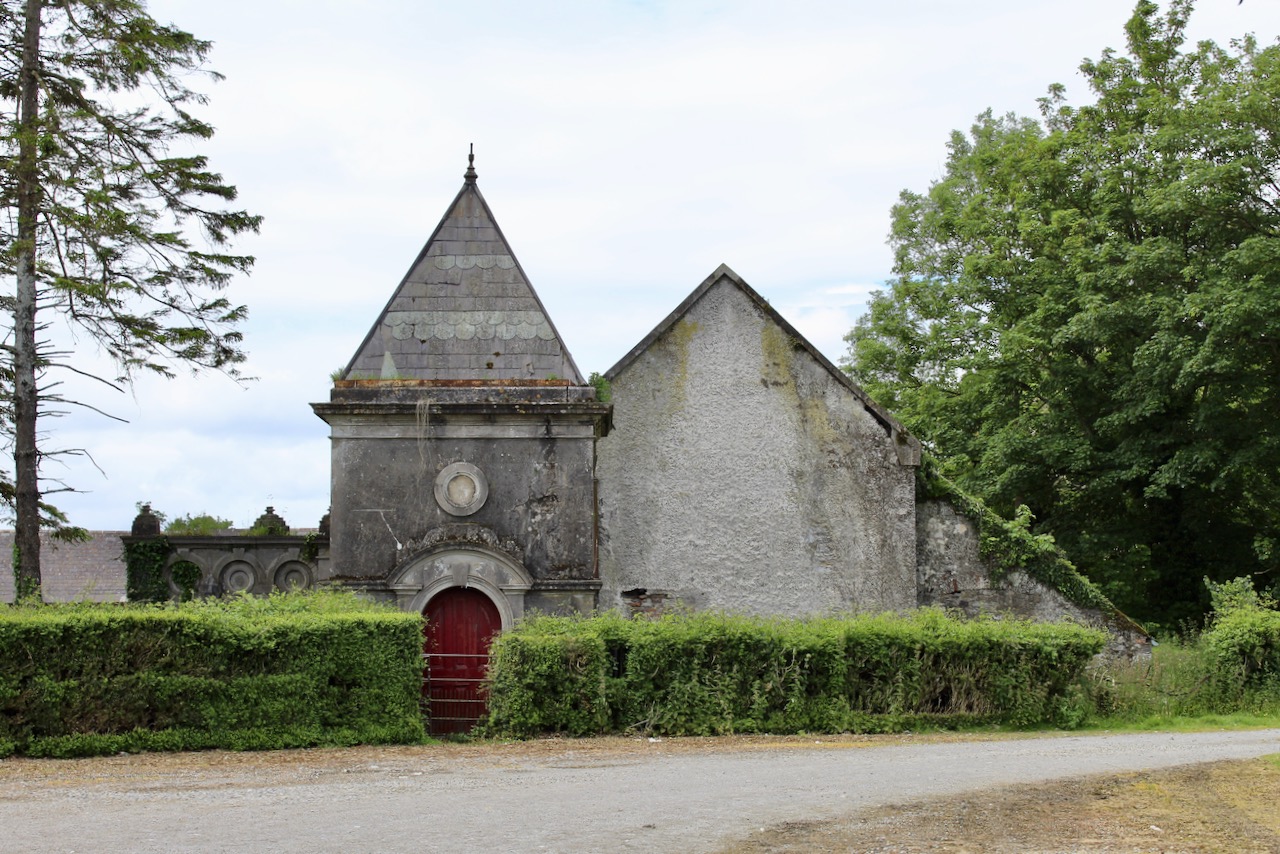
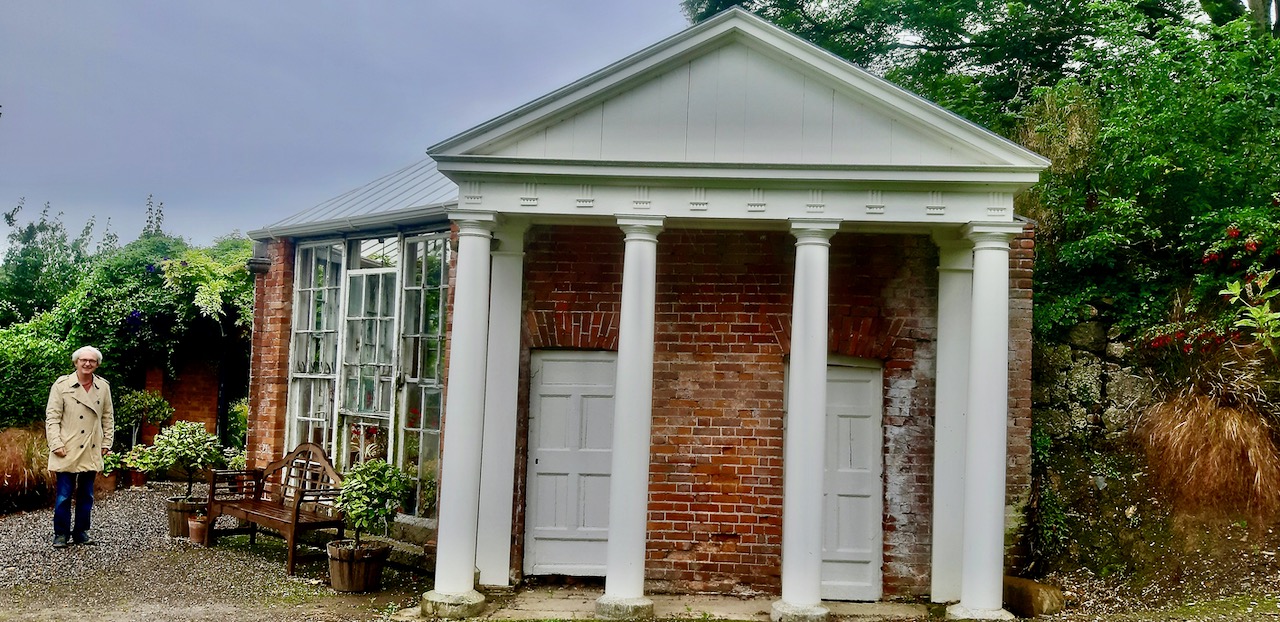
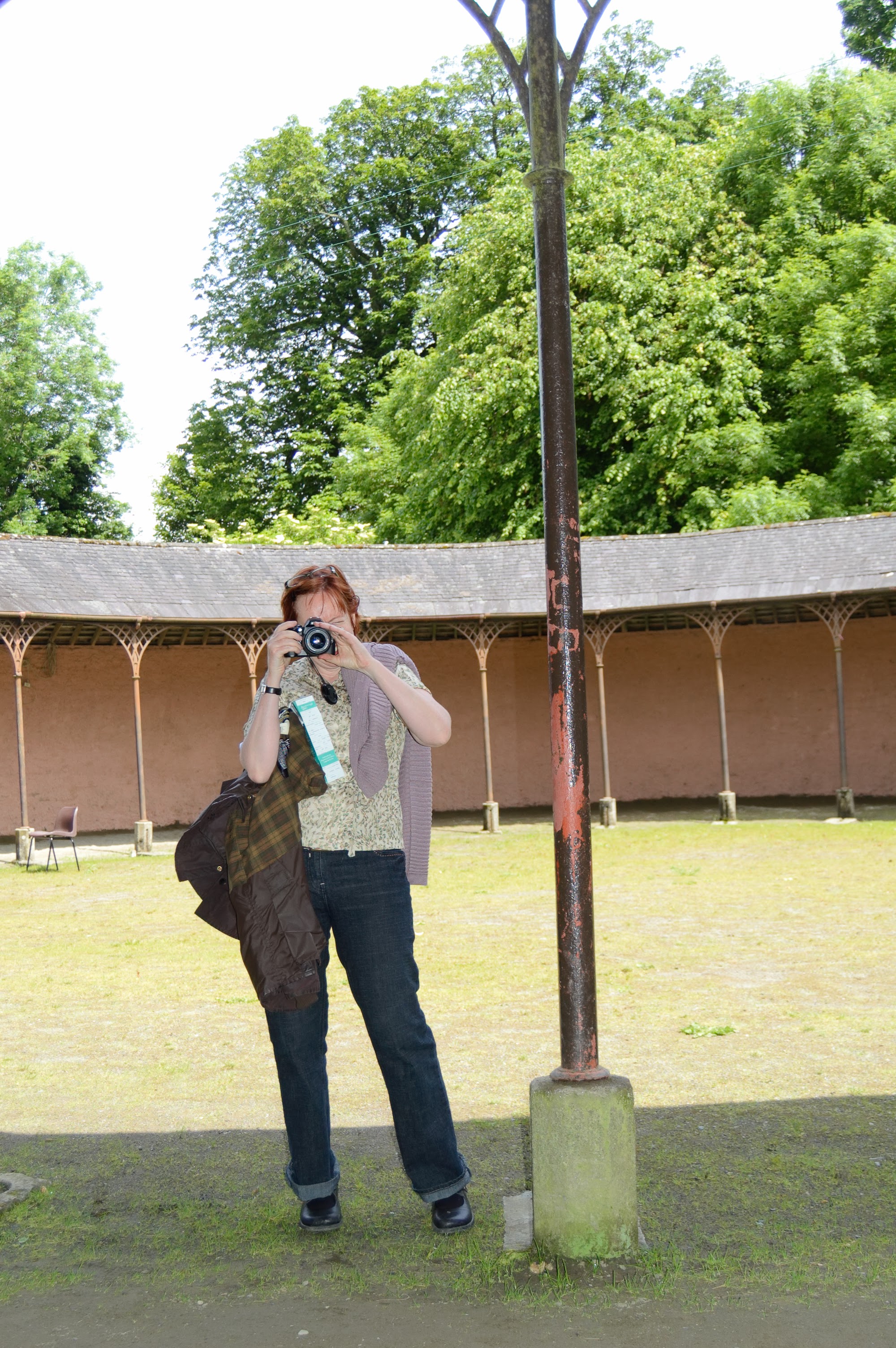
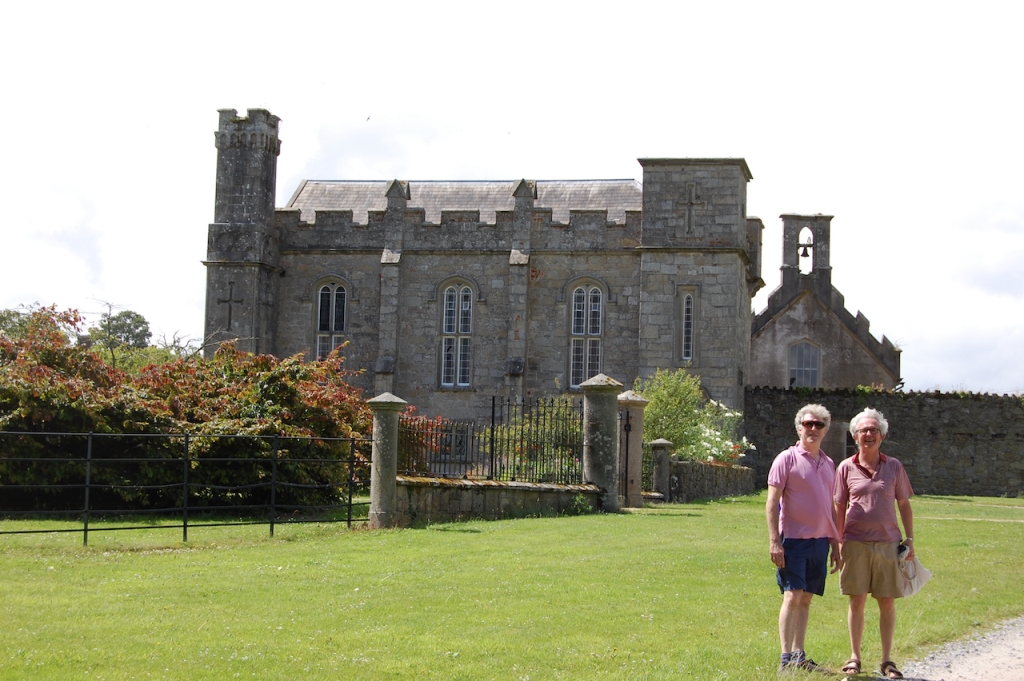
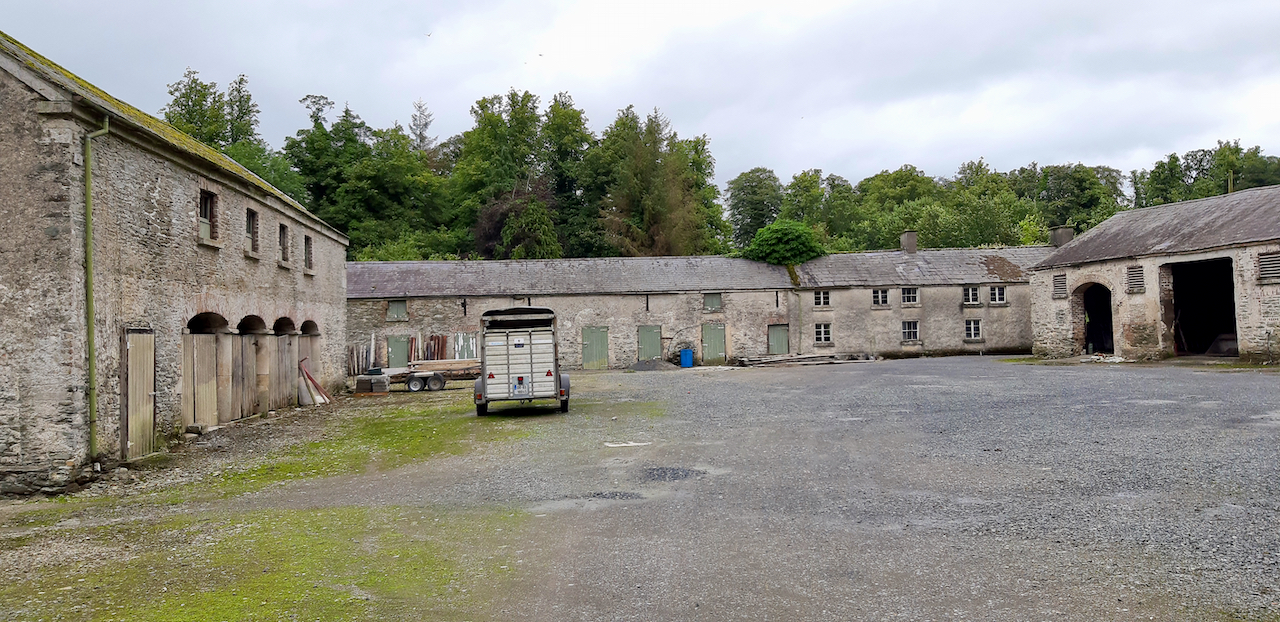
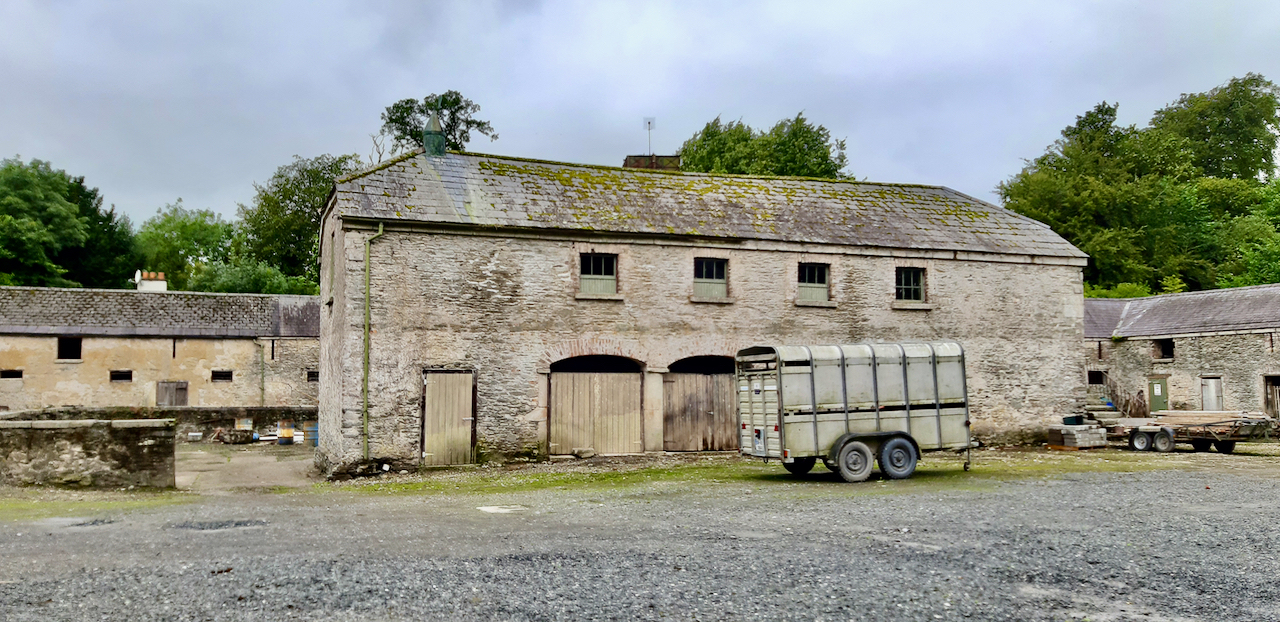
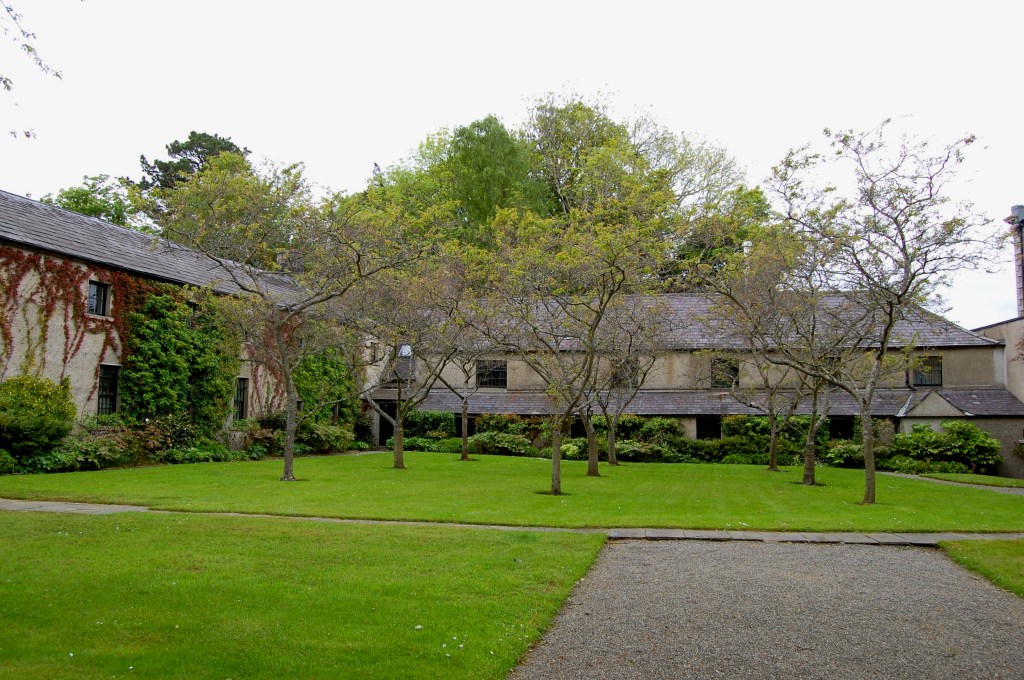
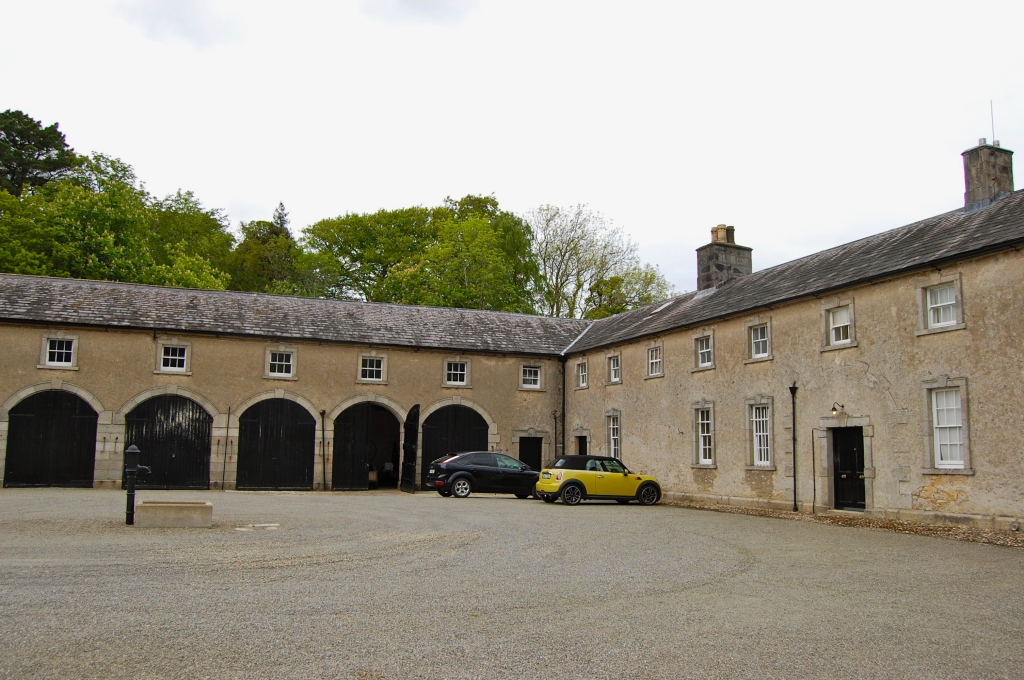
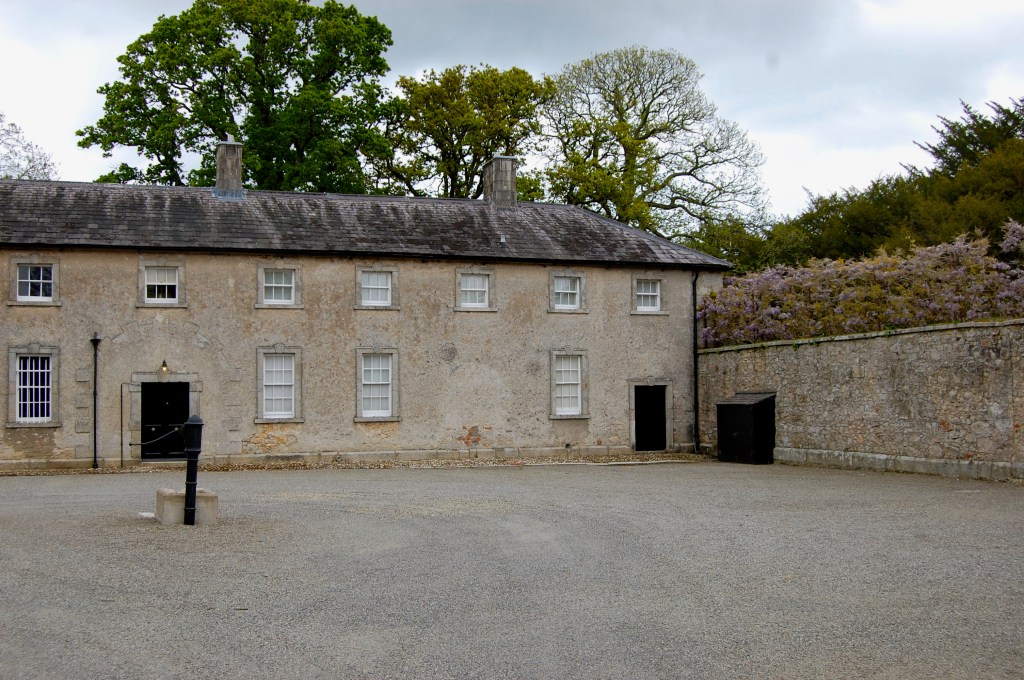
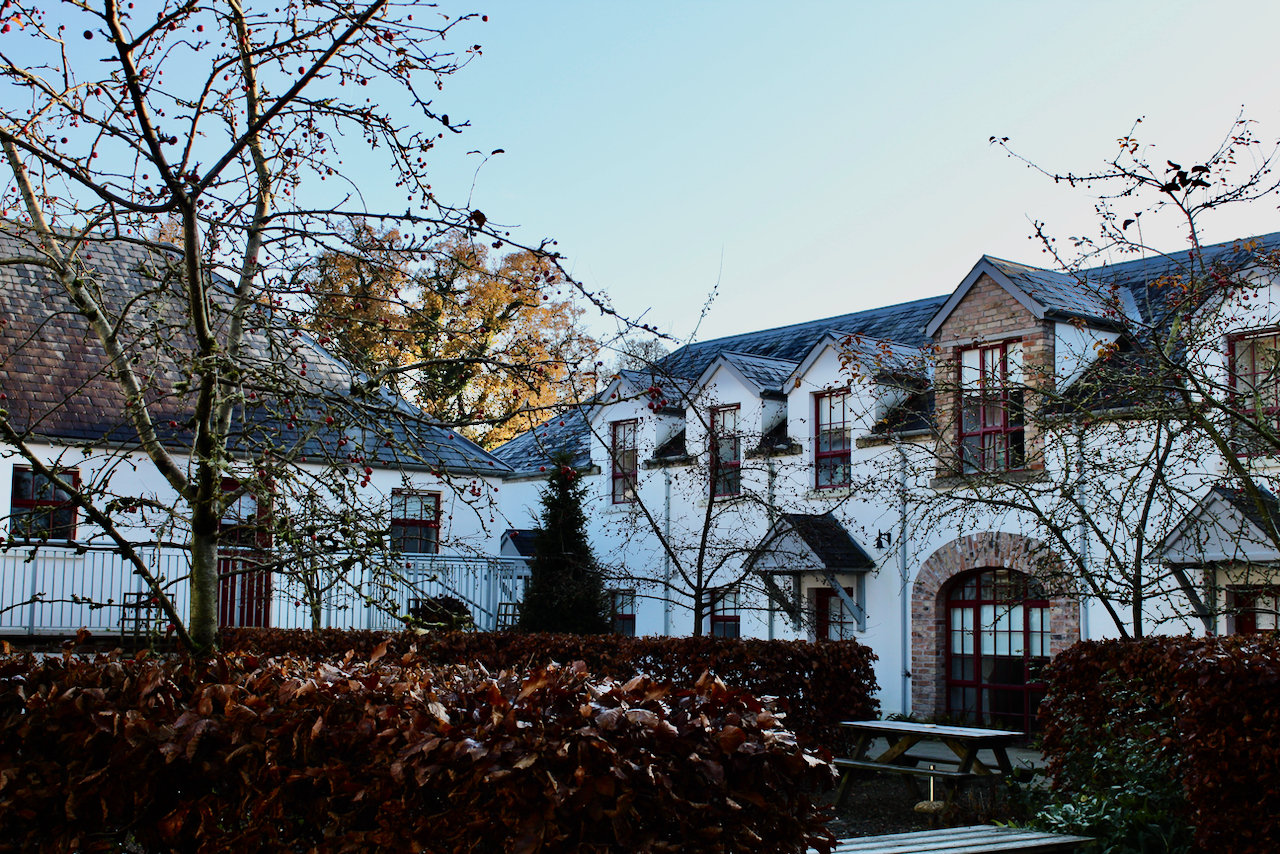
Stephen and I visited the house during Heritage Week in 2020. The current owner, another Thomas Somerville, welcomed us, and introduced us to his two sons, who gave us the tour of the house and the museum in the outbuilding which used to be Edith Somerville’s painting and writing studio. As there was already someone on a house tour, we visited the museum first.

At Drishane House. Photograph © Jennifer Winder-Baggot, www.irishhistorichouses.com
The grey door leads into the studio. Unfortunately we were not allowed to take photographs inside, but that is all the more reason for you to visit! Inside the door is a sign identifying the room as the studio, painted by Edith. Photograph © Jennifer Winder-Baggot, www.irishhistorichouses.com
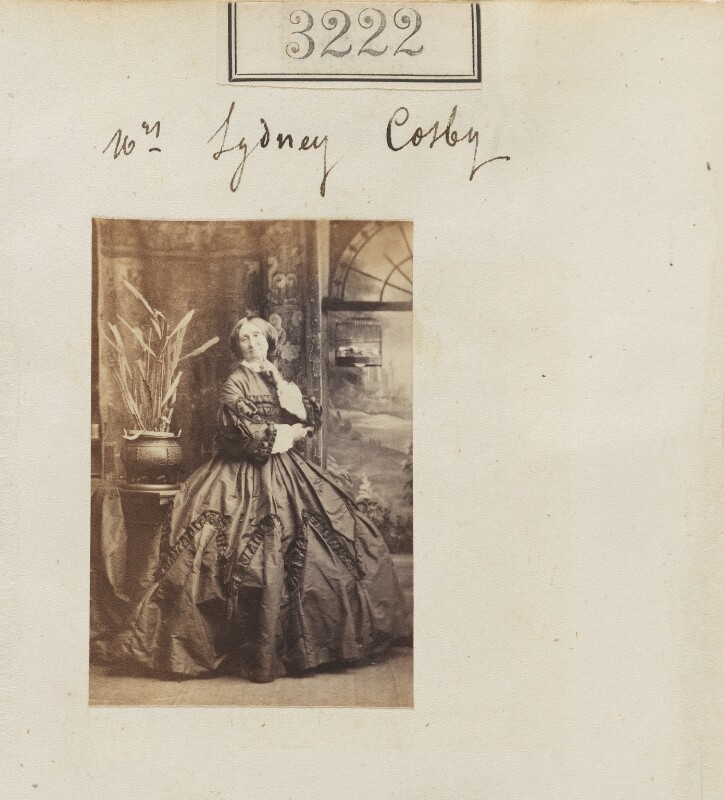
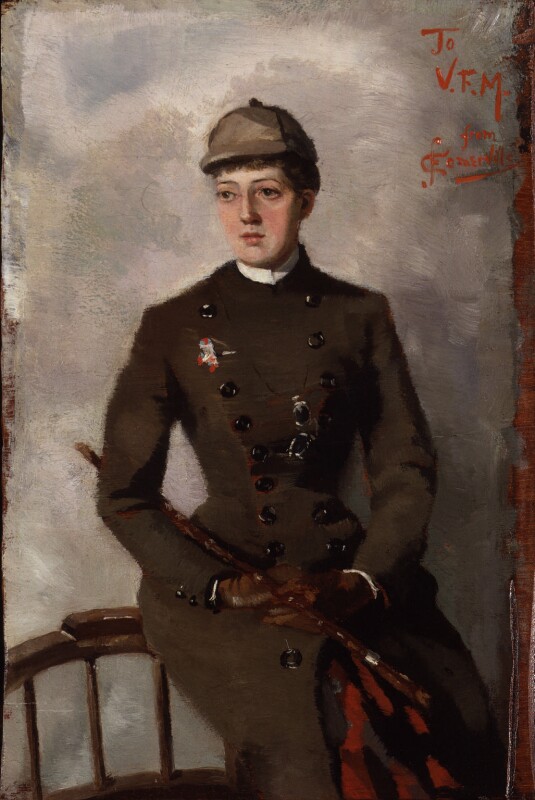
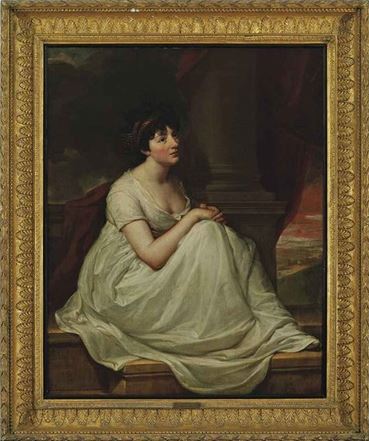
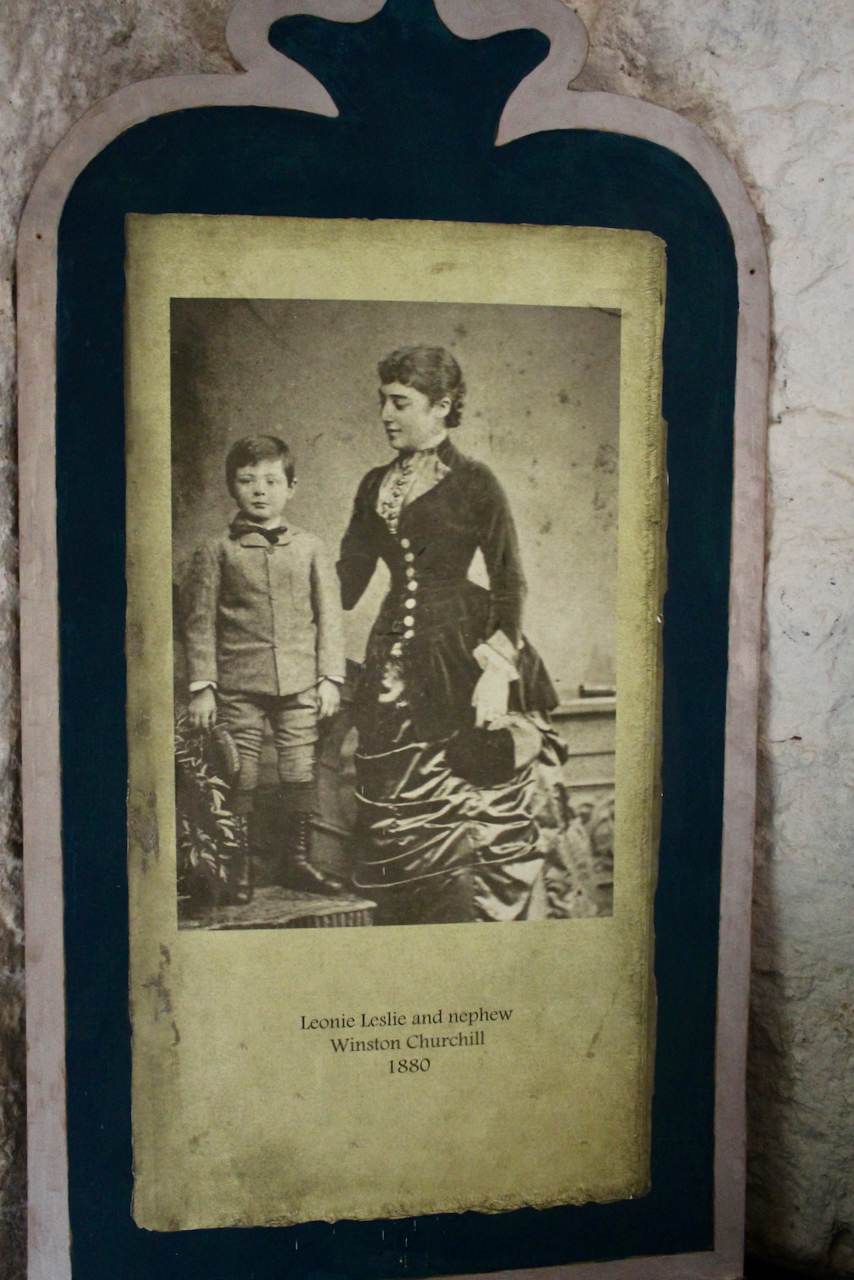
Edith Oenone Somerville (1858-1949) was given her unusual middle name because she was born in Corfu where her father was serving in the British military. She met her cousin Violet Martin (1862-1915) when they were both in their twenties, when Violet paid a visit to Drishane. They were both great-granddaughters of Lord Chief Justice Charles Kendal Bushe. Edith painted a portrait of Violet in 1886 during this visit, and the painting is now in the National Portrait Gallery in London. She painted the portrait in her studio, which at the time was inside the house – it was only later that she moved to the outbuilding. The chair in the painting is still in the studio. Violet’s first holiday at Drishane was a long one, as it was only after a month that Edith began her portrait. Violet brought the portrait with her back to Dublin when she left Drishane ten months later.

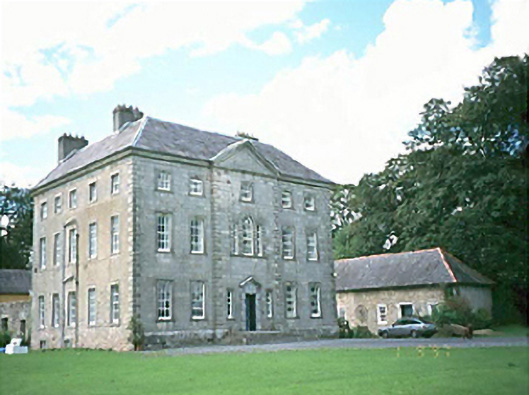
Violet’s family lived in County Galway in a three storey house called Ross House (now called Ross Castle). She was the youngest of eleven daughters. Her family had fallen into debt in the time of the Great Famine, due to the help they had given their tenants, and when her father died when she was just ten years old, her brother inherited the house and decided to let it out.

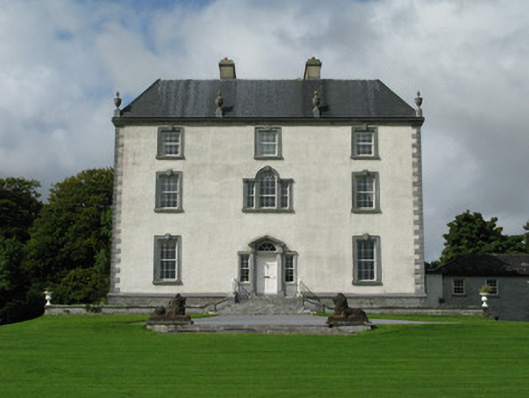
Ross House, or Castle, photograph care of National Inventory of Architectural Heritage.
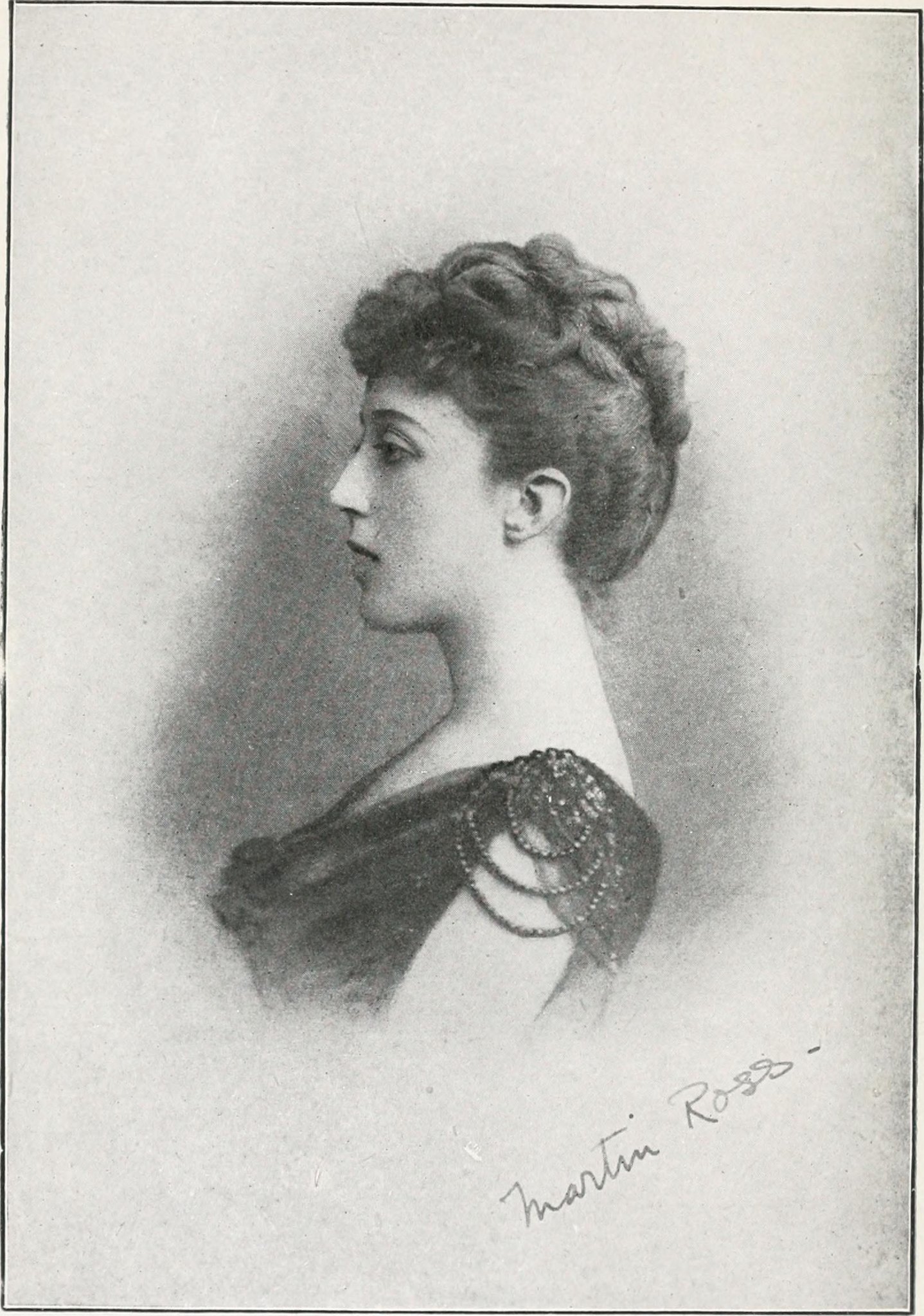
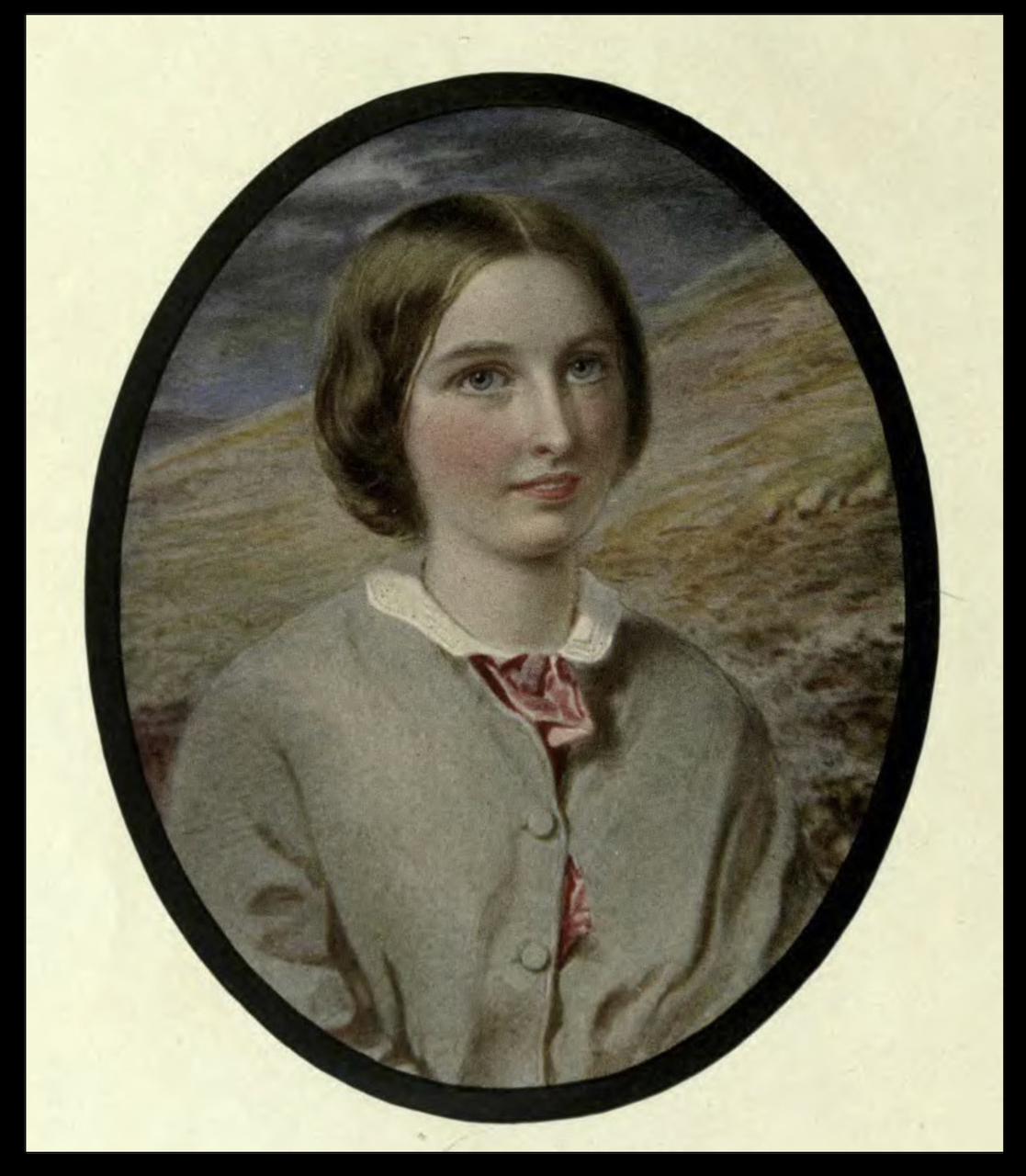
Photograph from Internet Archive Book Images. From the book Irish Memories by Edith Somerville, 1919. Publisher: New York, Longmans, Green & Co. It is interesting that the picture is signed a “Martin Ross,” rather than “Violet Martin.” A small silver case given as a gift to Edith from Violet is engraved “To Edith, Love Martin.”

She moved with her mother to Dublin and was educated at Alexandra College, where Edith also studied but as she was four years older than Violet, where they never met. Violet would have felt like a poor relation when she visited her cousins in Cork, but she was warmed by the generous welcome. Edith was surrounded by cousins: the Townshends and the Coghills lived nearby, and at first the quiet Violet must have been overwhelmed with the sociability of the house.

Violet had begun writing when she was in school and hoped to make a living by journalism. Edith studied art in London, Dusseldorf and Paris, and sold some paintings and drawings in order to finance her own art training and hoped to make a living in graphic art. When they first collaborated, Violet wrote the text which Edith illustrated, but soon they were writing the novels together. They did not want to publish under their own names, so chose “Somerville and Ross,” Violet taking the name of her home.

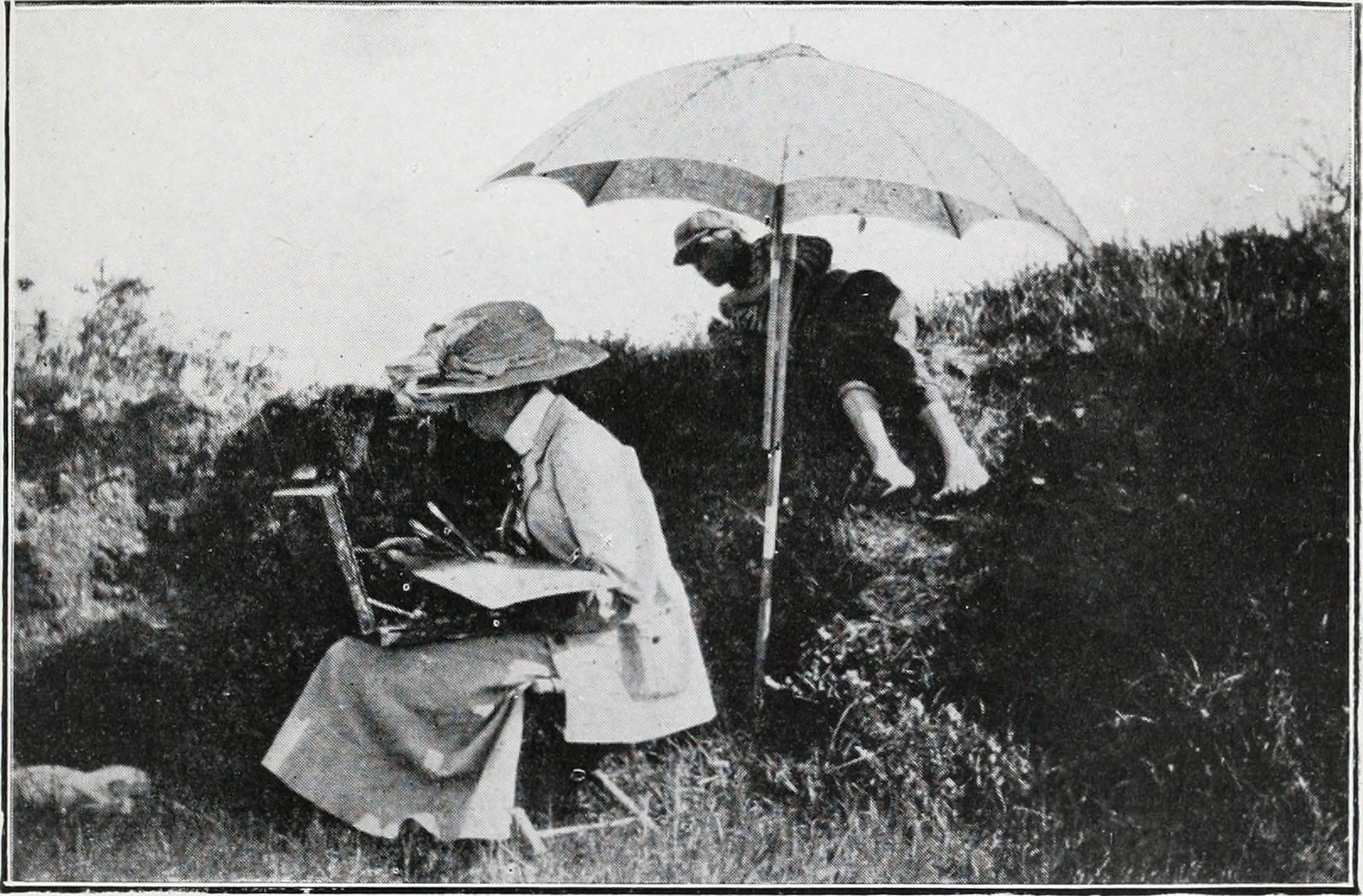
Image from page 164 of Irish Memories by Edith Somerville – I assume this is a photograph of Edith herself. Photograph care of Internet Archive Book Images.

Violet, a sister and her mother moved back to Ross House in 1888, and Violet set about trying to restore the house and gardens to their former glory. At the end of 1888, Violet and Edith received news that their first book, An Irish Cousin, was to be published. At first they had to correct proofs separately, until Edith visited Violet at Ross House. It is believed by the current owners of Ross Castle that the ladies worked on the book under the Venetian window on the first-floor landing, which now has a table and chair set up with some of their books. One can stay in the house: either whole house rental, or self-catering in cottages which are converted stables, carriage house and servants’ quarters. Drishane House is also available for whole house rental and also has holiday cottages). [6]

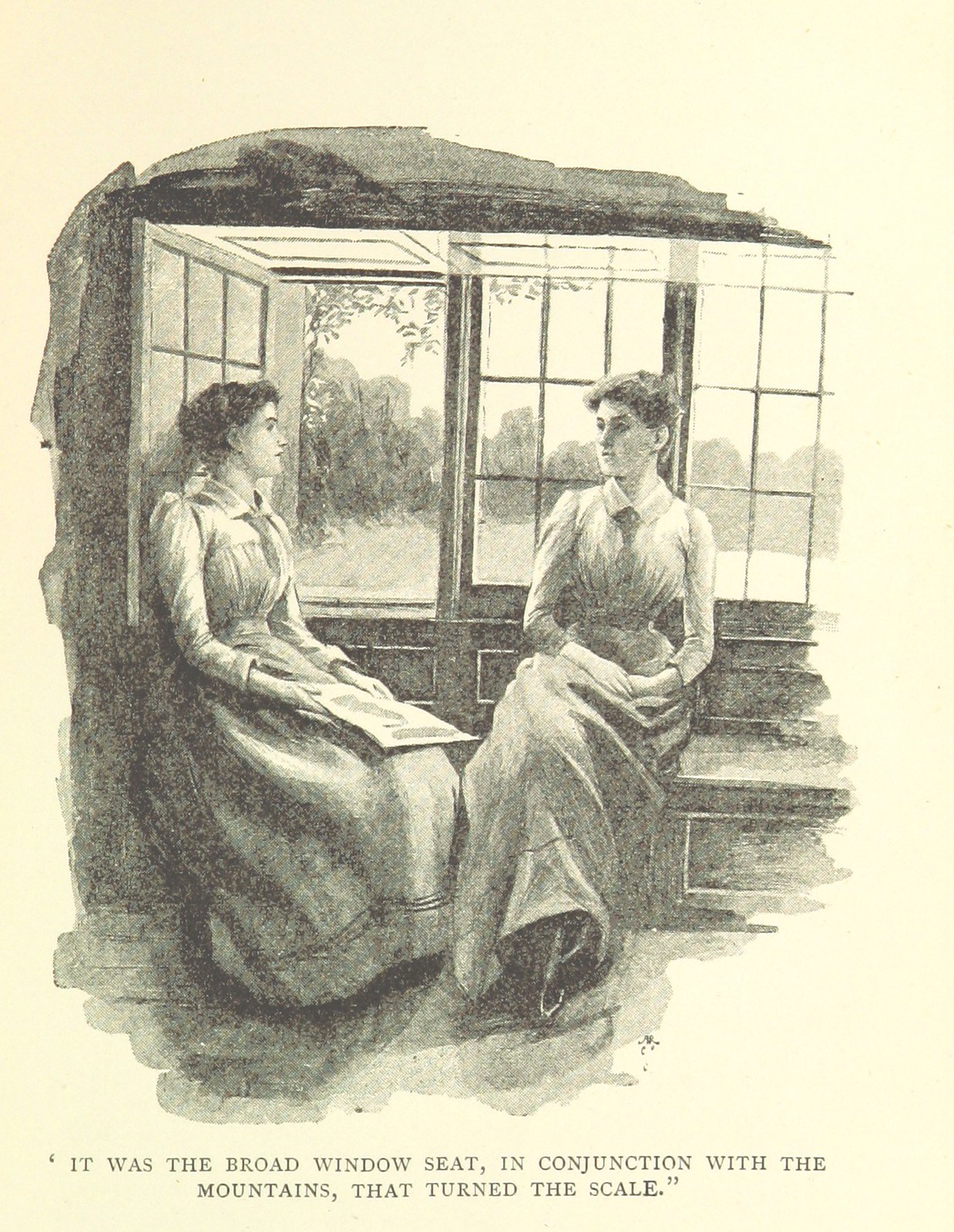
I imagine that Edith Somerville, when she illustrated their book, Through Connemara in a Governess Cart (published 1893), had herself and her cousin in mind when she drew this picture. Photograph care of the British Library.

The Museum contains copies of some of Edith’s paintings, as well as letters, drawings and photographs relating to her life. I was excited to see correspondence and music by the composer Ethel Smyth, who was a good friend of Edith and also of Virginia Woolf. Like Ethel and Virginia, Edith was also a feminist. Edith wrote: “It will be acknowledged that sport, Lawn Tennis, Bicycling, and Hunting played quite as large a part as education in the emancipation that has culminated in the Representation of the People Bill. The playing fields of Eton did not as surely win Waterloo as the hunting-fields and tennis grounds of the kingdom won the vote for women.” [quoted in the introduction by Gifford Lewis, 1999, of Somerville and Ross’s The Real Charlotte]. Edith was an enthusiast for hunting and became Master of her local hunt. She also became President of the Munster Women’s Franchise League. [7]

After Violet died, Edith wrote a further fourteen books, all published under their joint names. Edith felt that Violet continued to help to write the books after her death. Edith took to a sort of “automatic writing” to include Violet’s input. Examples of this are in the museum. Edith claimed that stormy weather made it more difficult for her to tune into Violet’s messages. [8]

There was another museum in Drishane before Edith’s studio, a collection of Indian items which Edith and her brother Jack called “Aunt Fanny’s Museum.” There is also another item which I forgot to ask about when visiting. Mark Bence-Jones tells the story of its origins:

Drishane’s most famous possession, the Fairy Shoe, was sent away to the bank for safe keeping and bad luck followed, it was wisely decided to bring the Shoe back and it has remained in the house ever since. The Shoe, which came to the Somervilles from the Coghills, was picked up on an Irish mountain early in the nineteenth century; it is exactly like the shoes worn by adults at that time and shows signs of wear, but it is only about two inches long. [9]

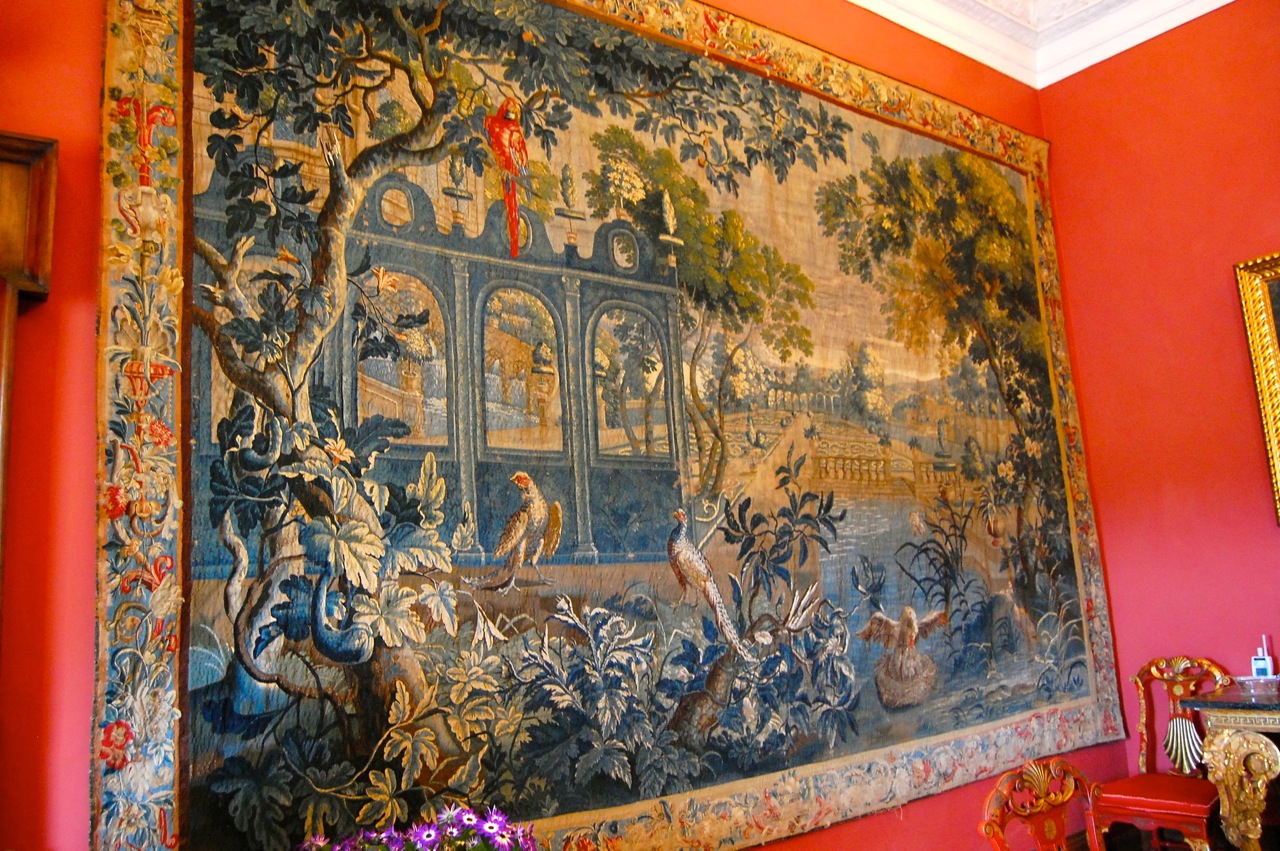
Edith had the French doors installed in 1901. Photograph © Jennifer Winder-Baggot, www.irishhistorichouses.com
Thomas the merchant’s son, also named Thomas (born about 1765), inherited Drishane from his father. Unfortunately he “was foolish enough to back a bill,” according to Mark Bence-Jones in Life in an Irish Country House, meaning he must have acted as guarantor for someone who was not able to pay their debt, and subsequently when Thomas died in 1811, the bailiffs came and stripped the house of its contents. [10] Thomas’s wife, Elizabeth Henrietta Becher Townsend, was in bed giving birth to their tenth child. According to the story, the children brought everything they could carry to their mother’s bedroom to hide it, as there was a law forbidding  bailiffs from entering the room of the lady of the house.

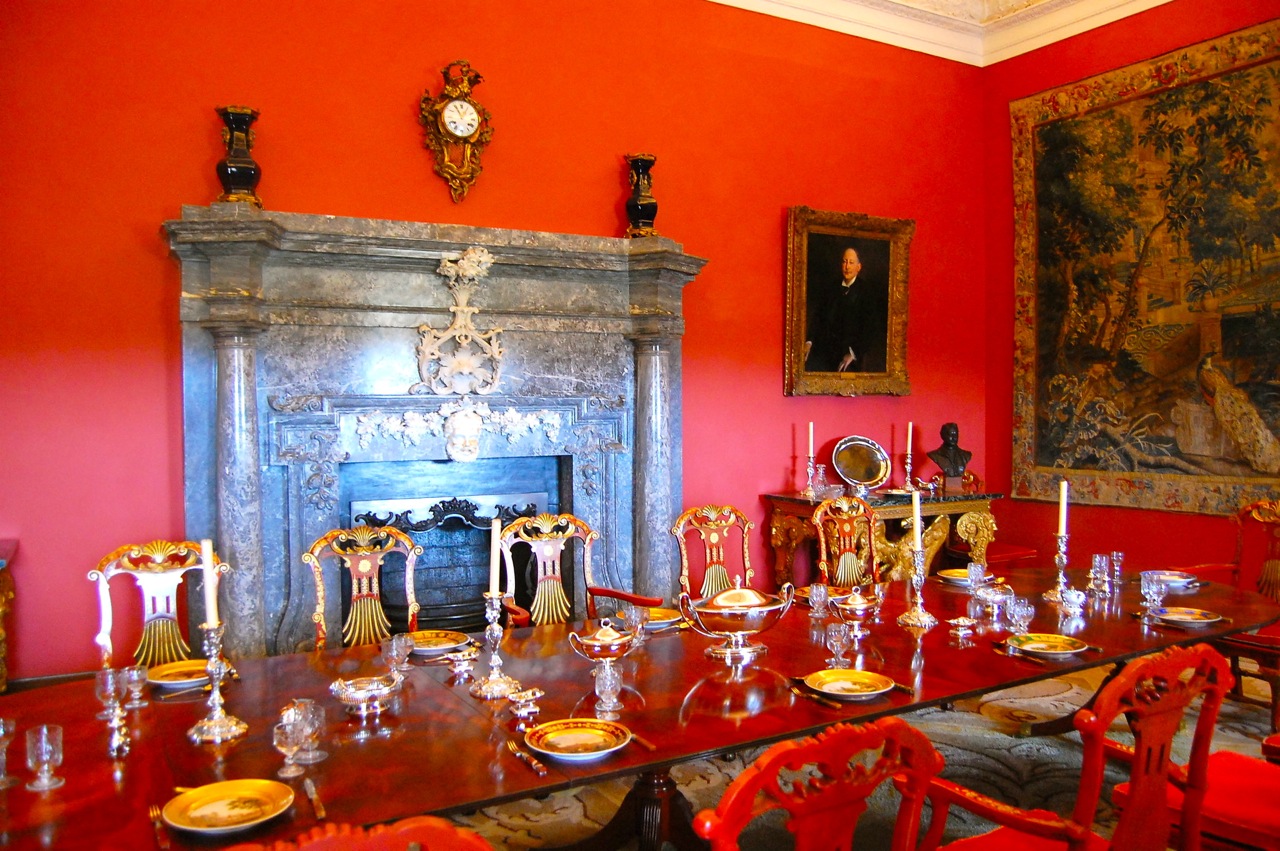
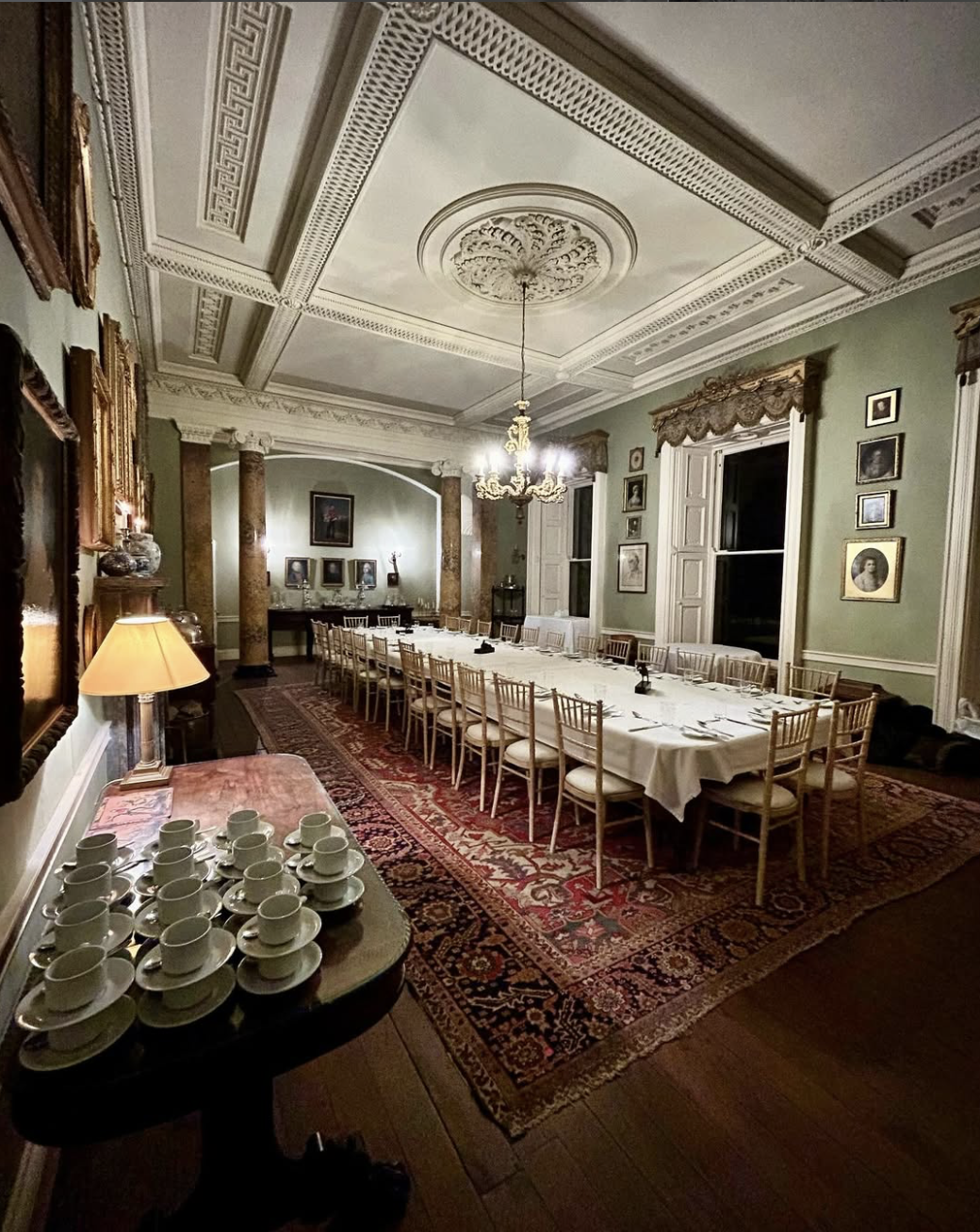
When we entered the house with young Hal, Tom Somerville’s son who was giving us the tour, he pointed out that there is no chandelier in the dining room, as it was taken by the bailiff, way back in 1811!

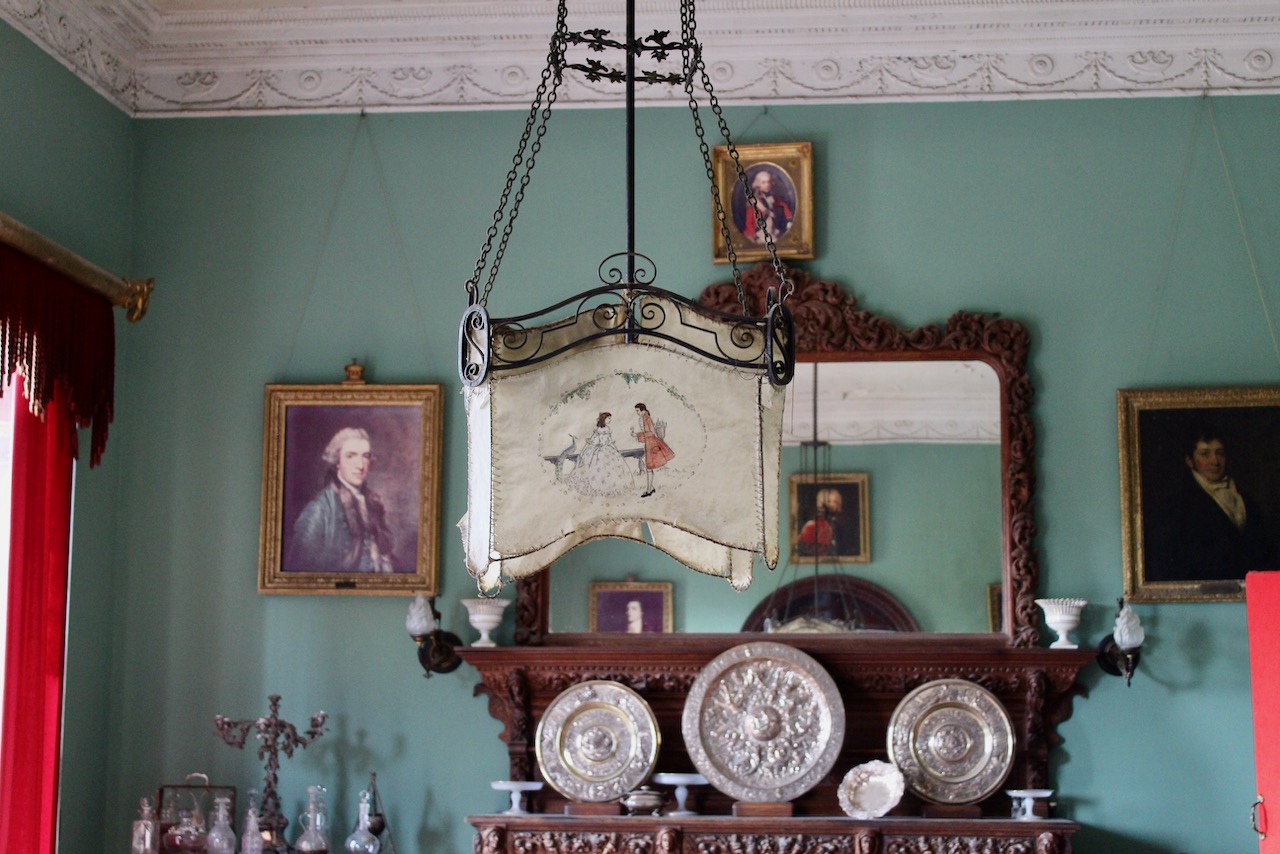
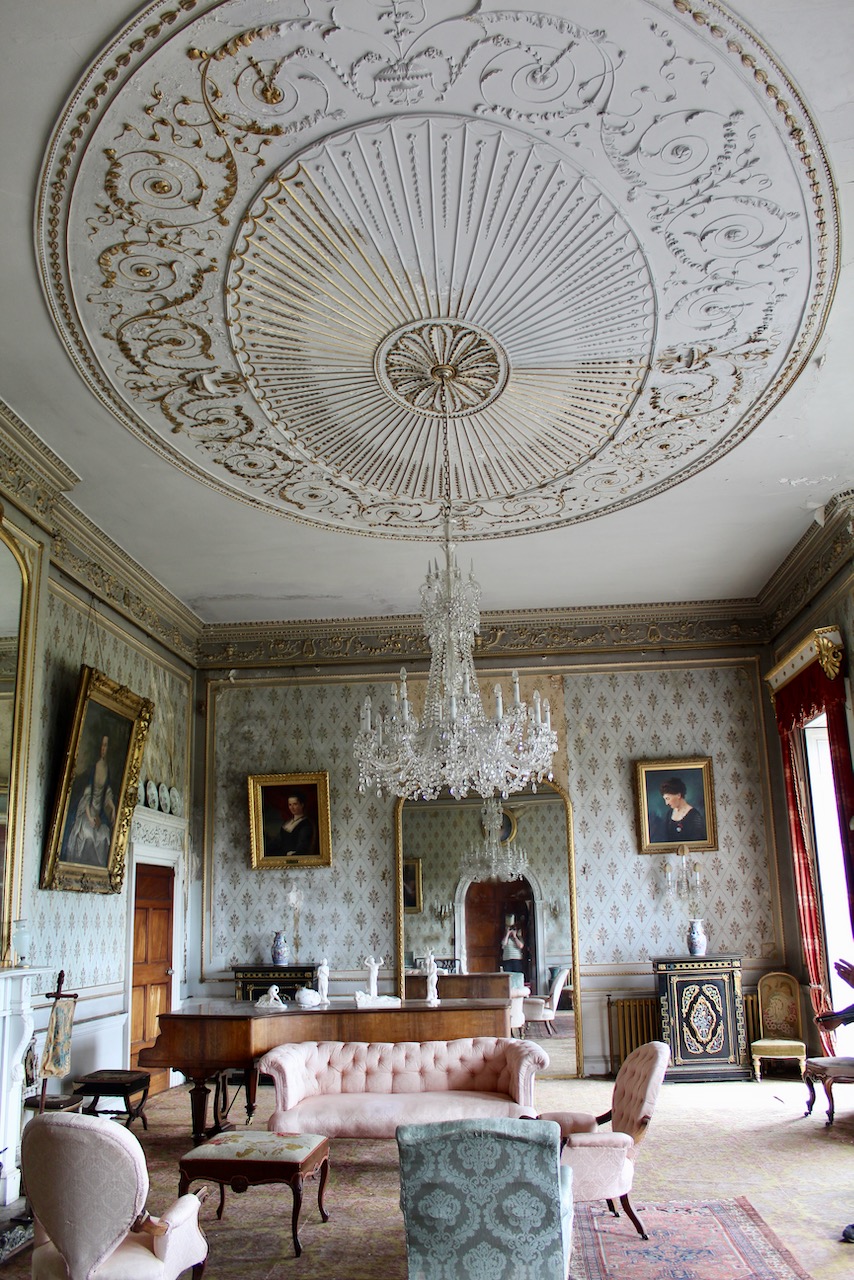
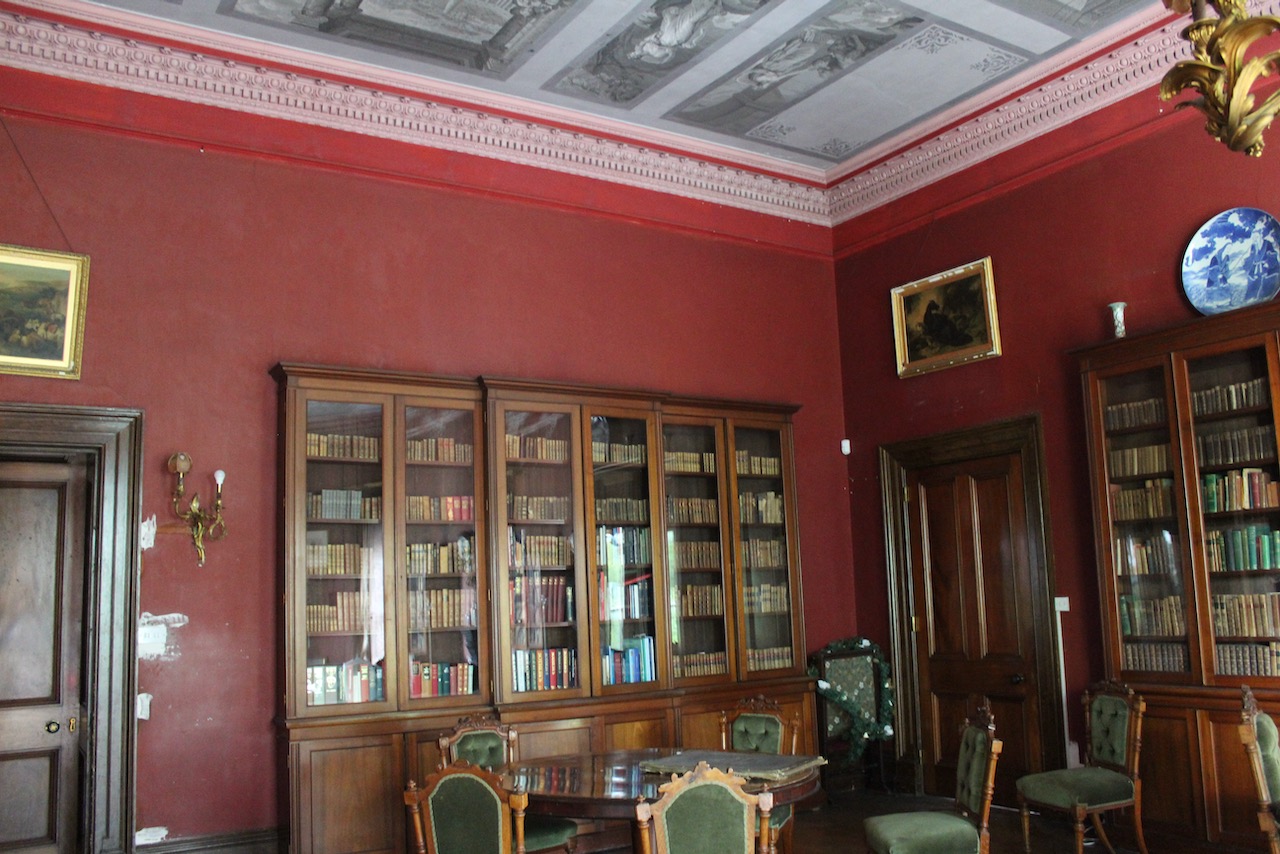
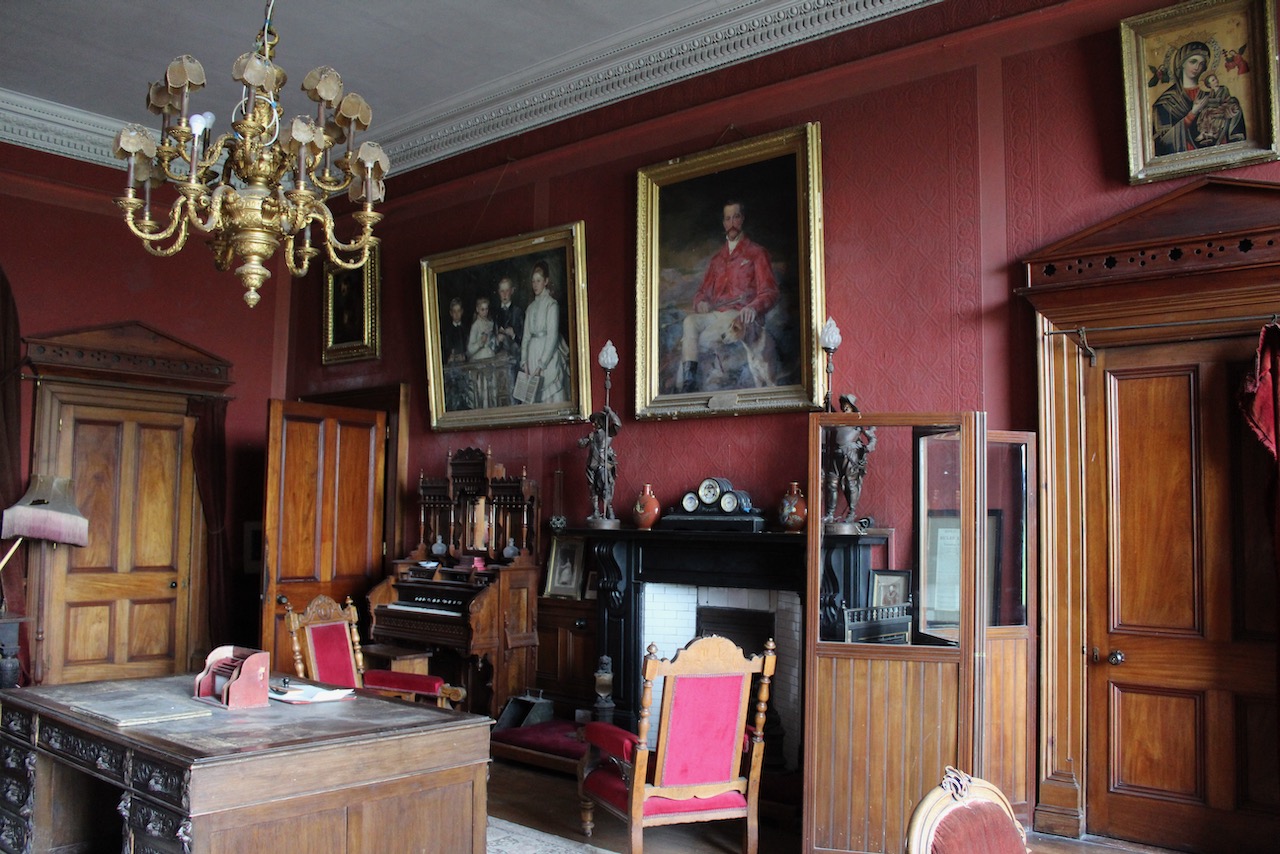
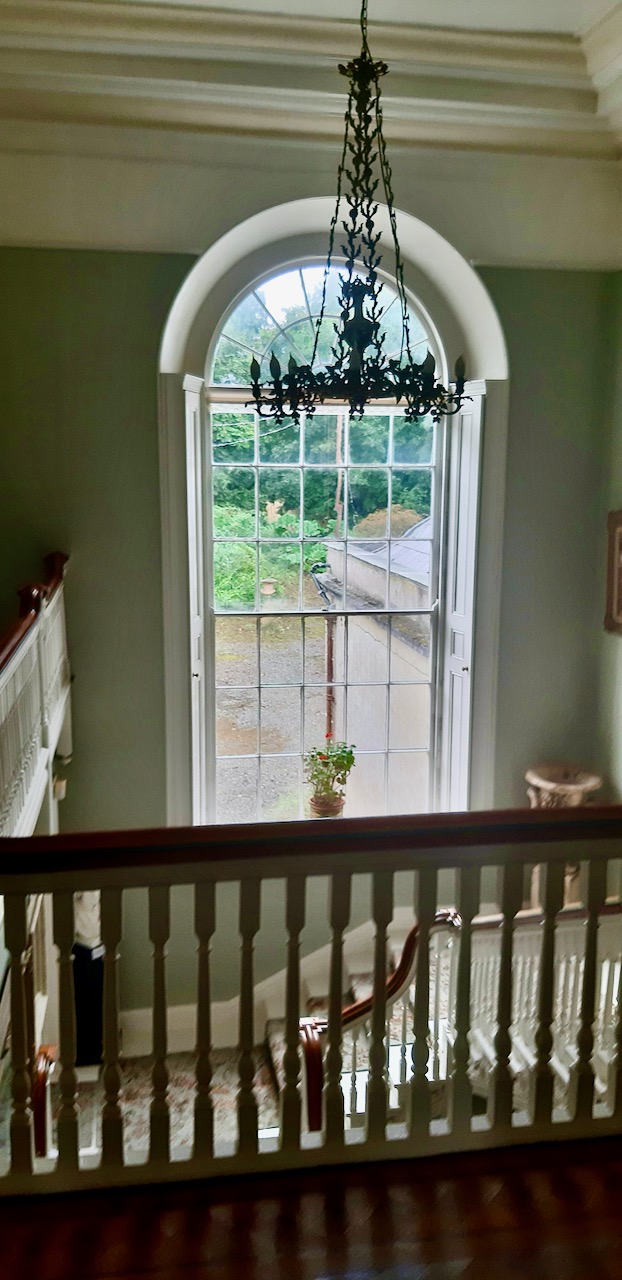
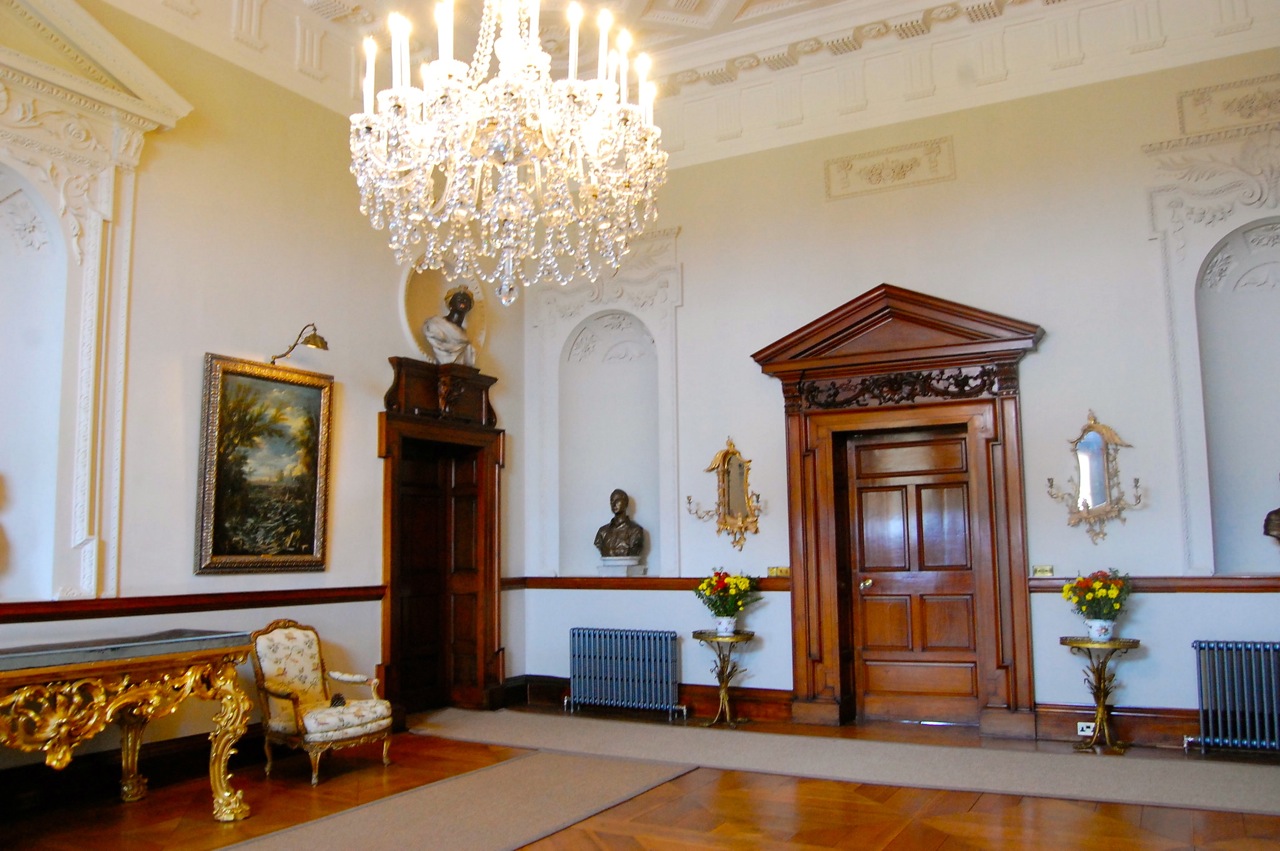
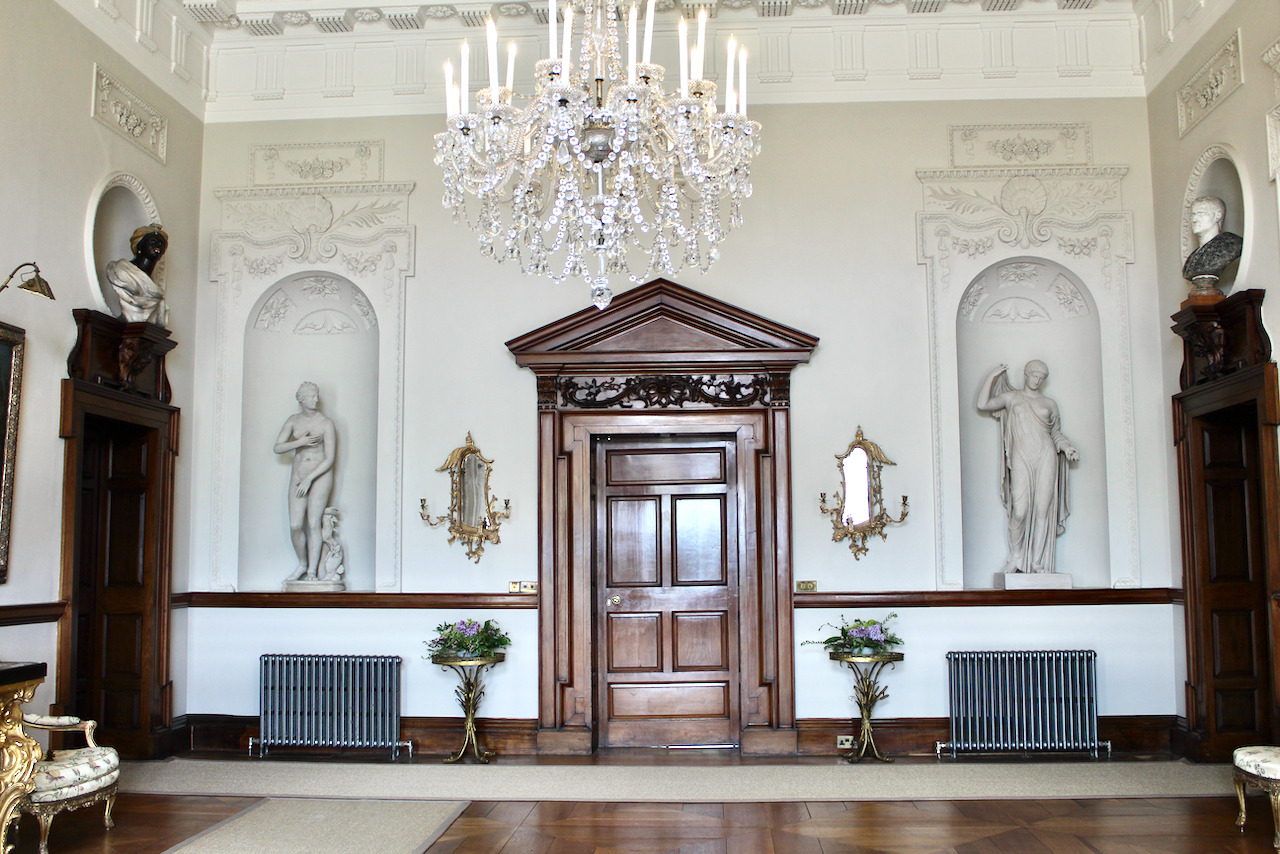
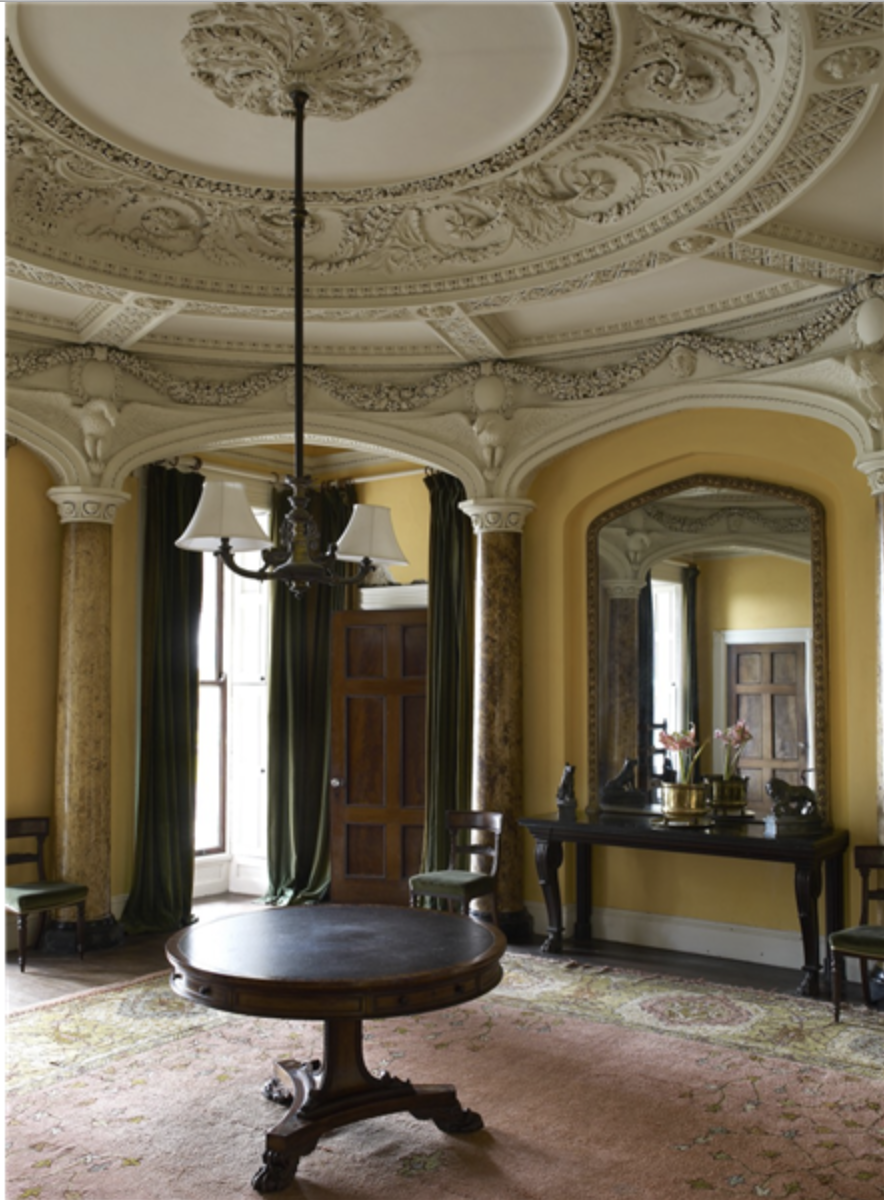
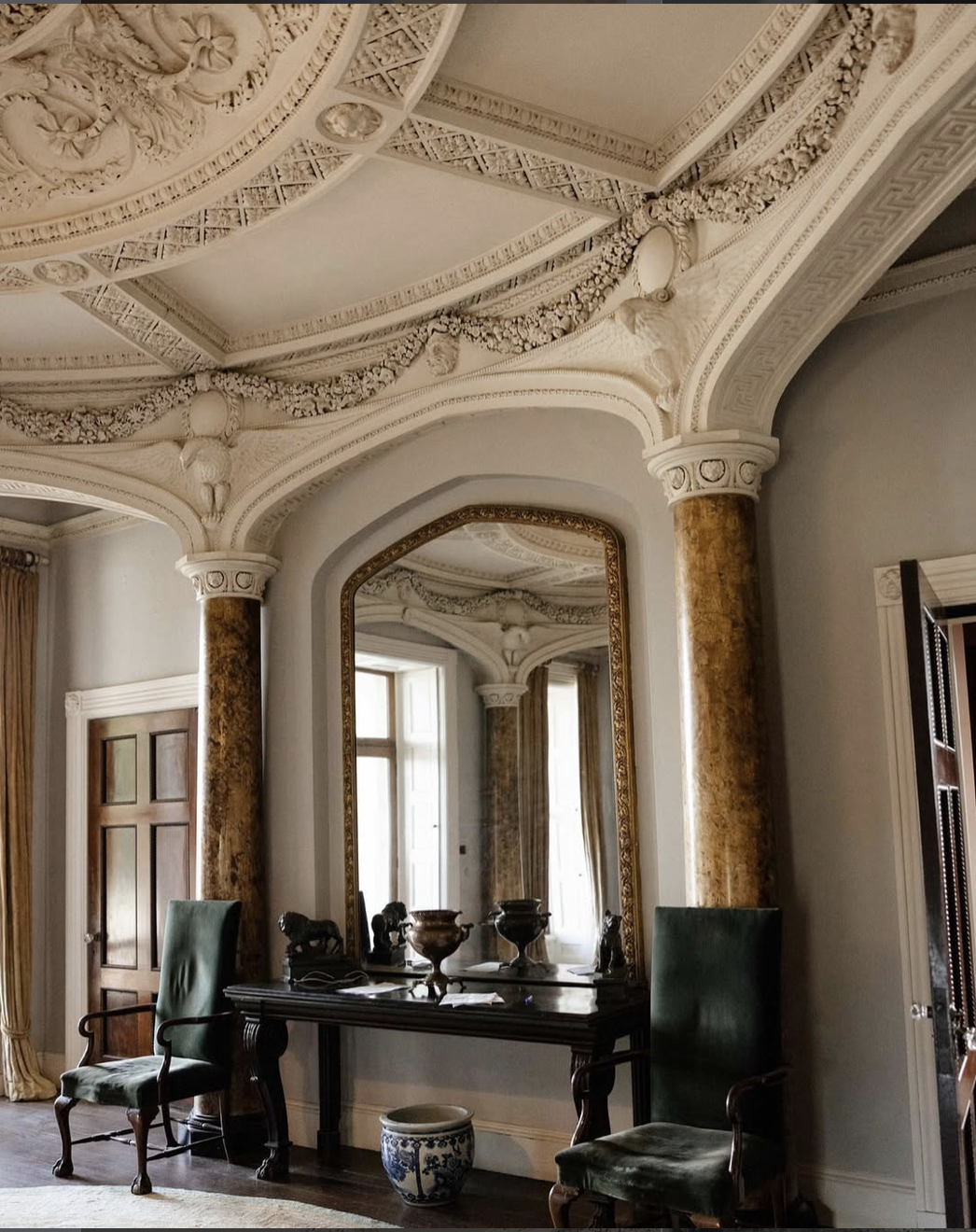
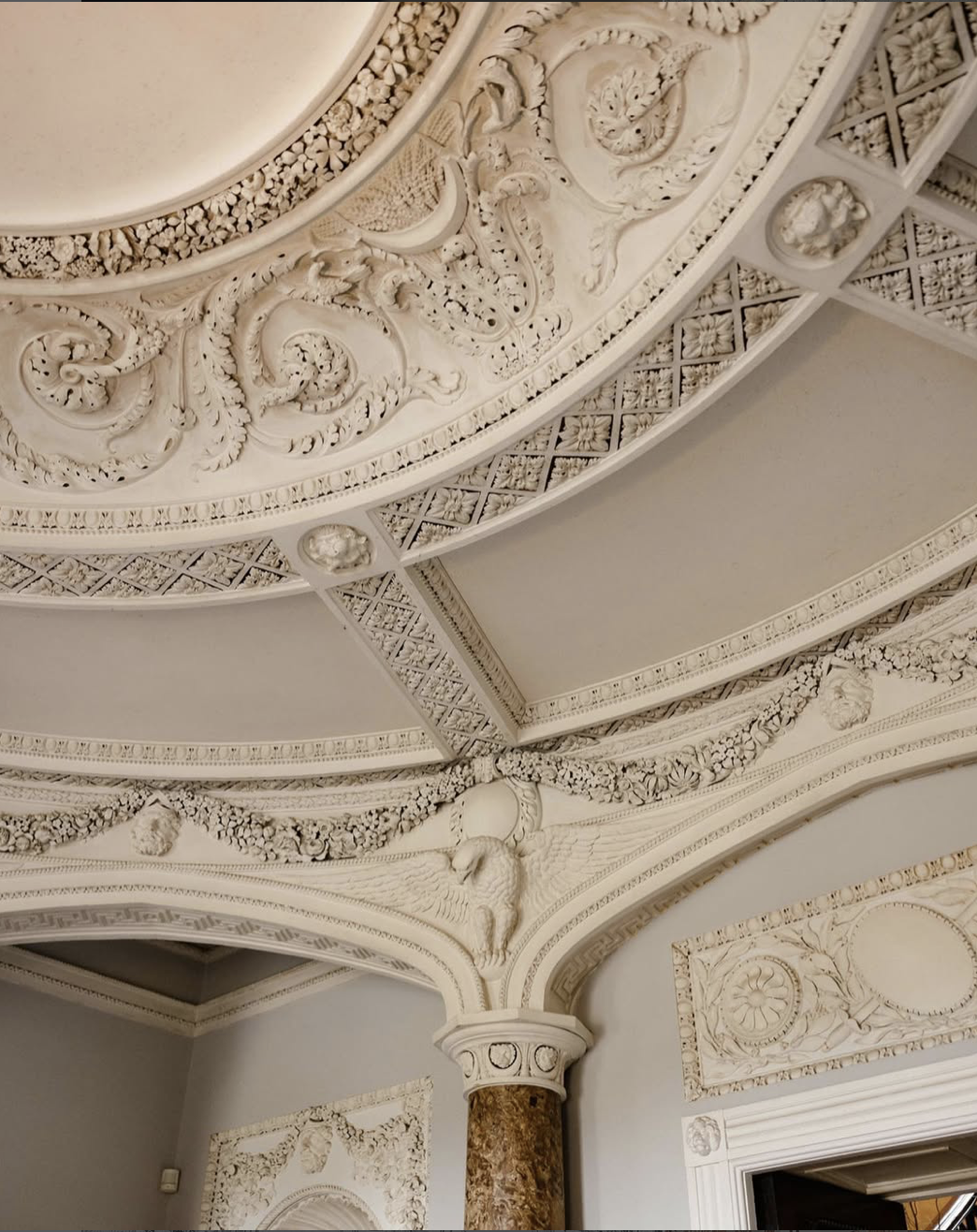
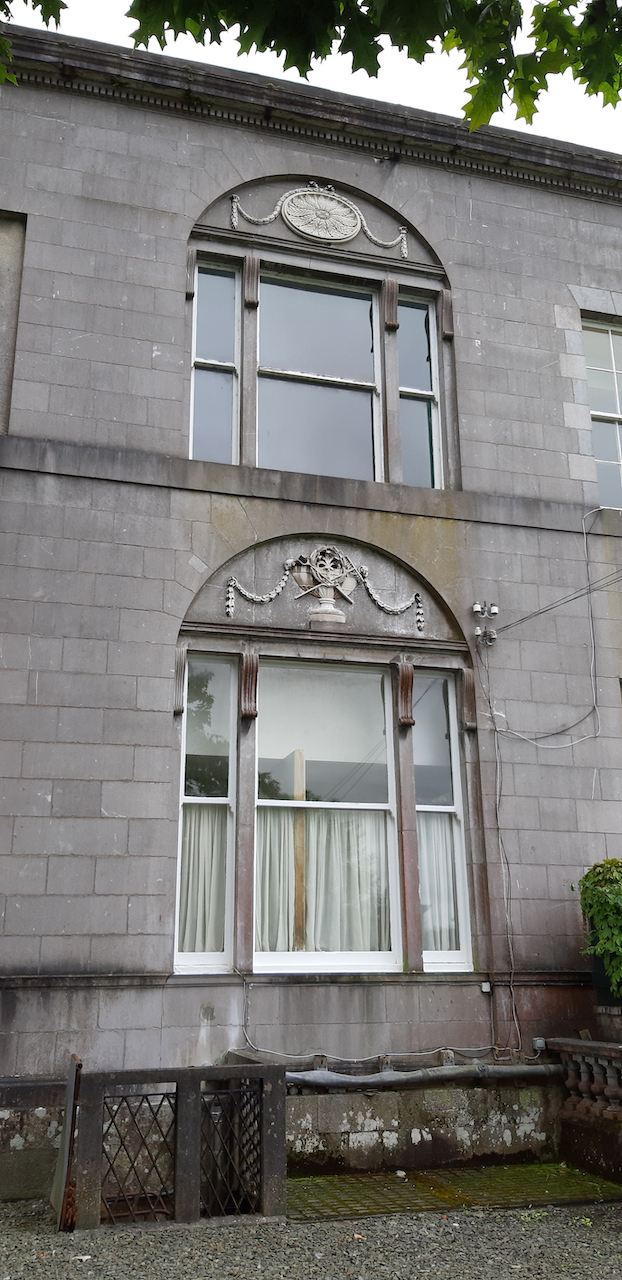
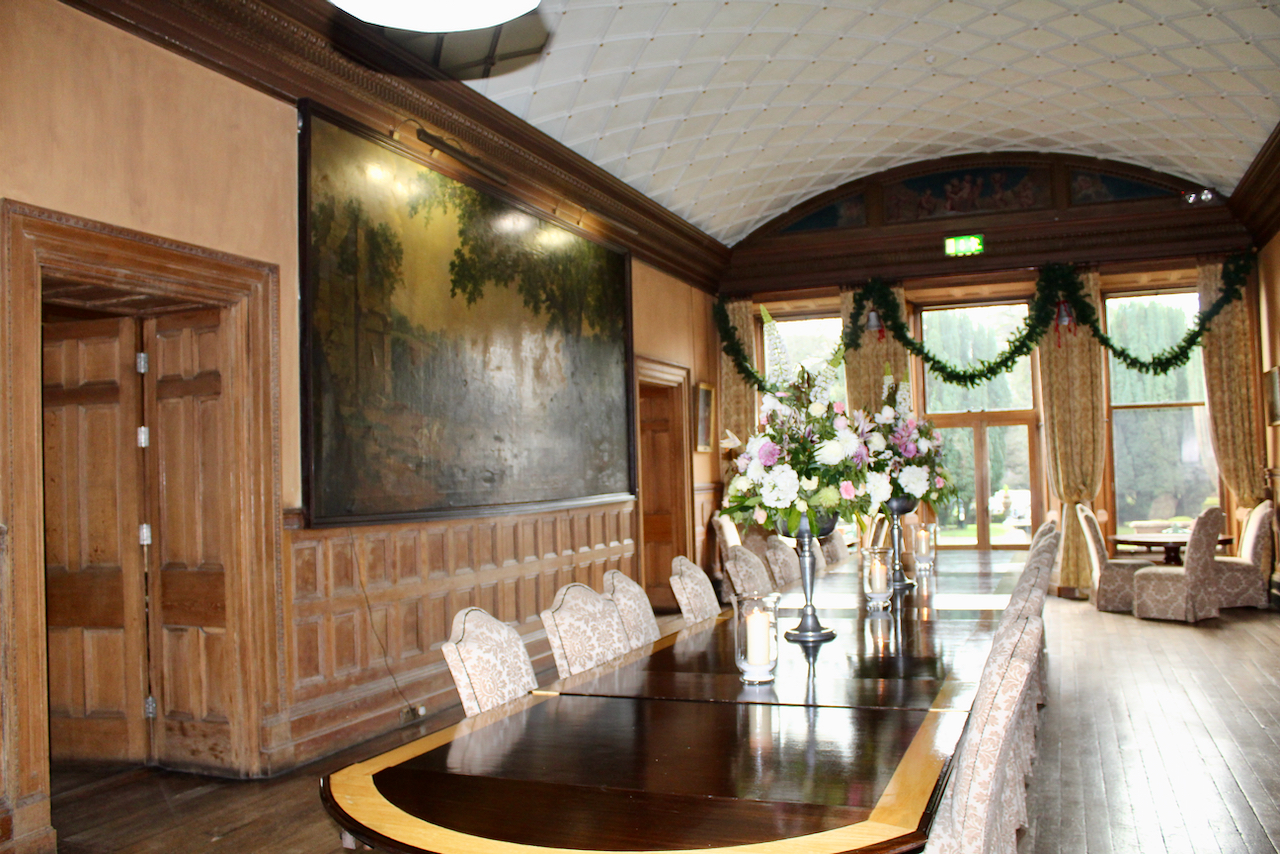
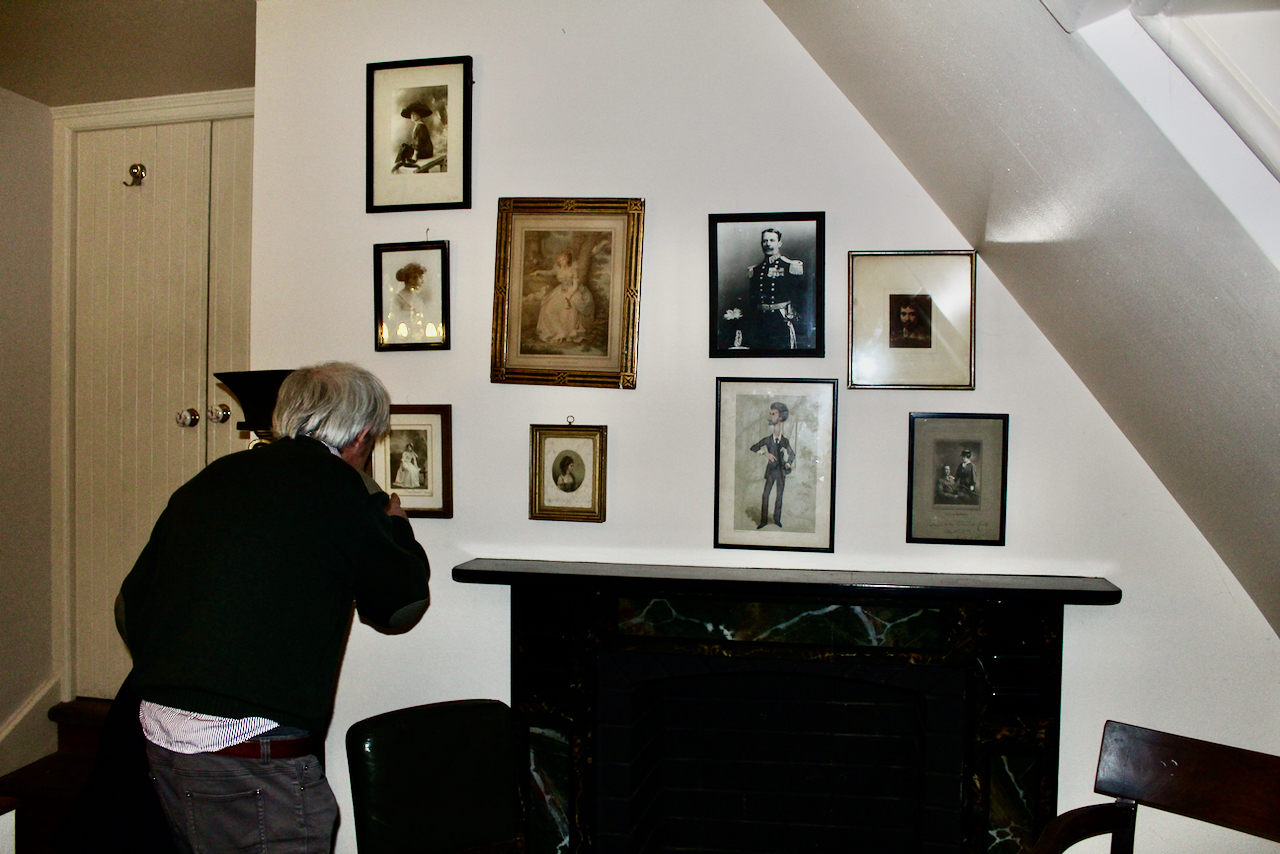
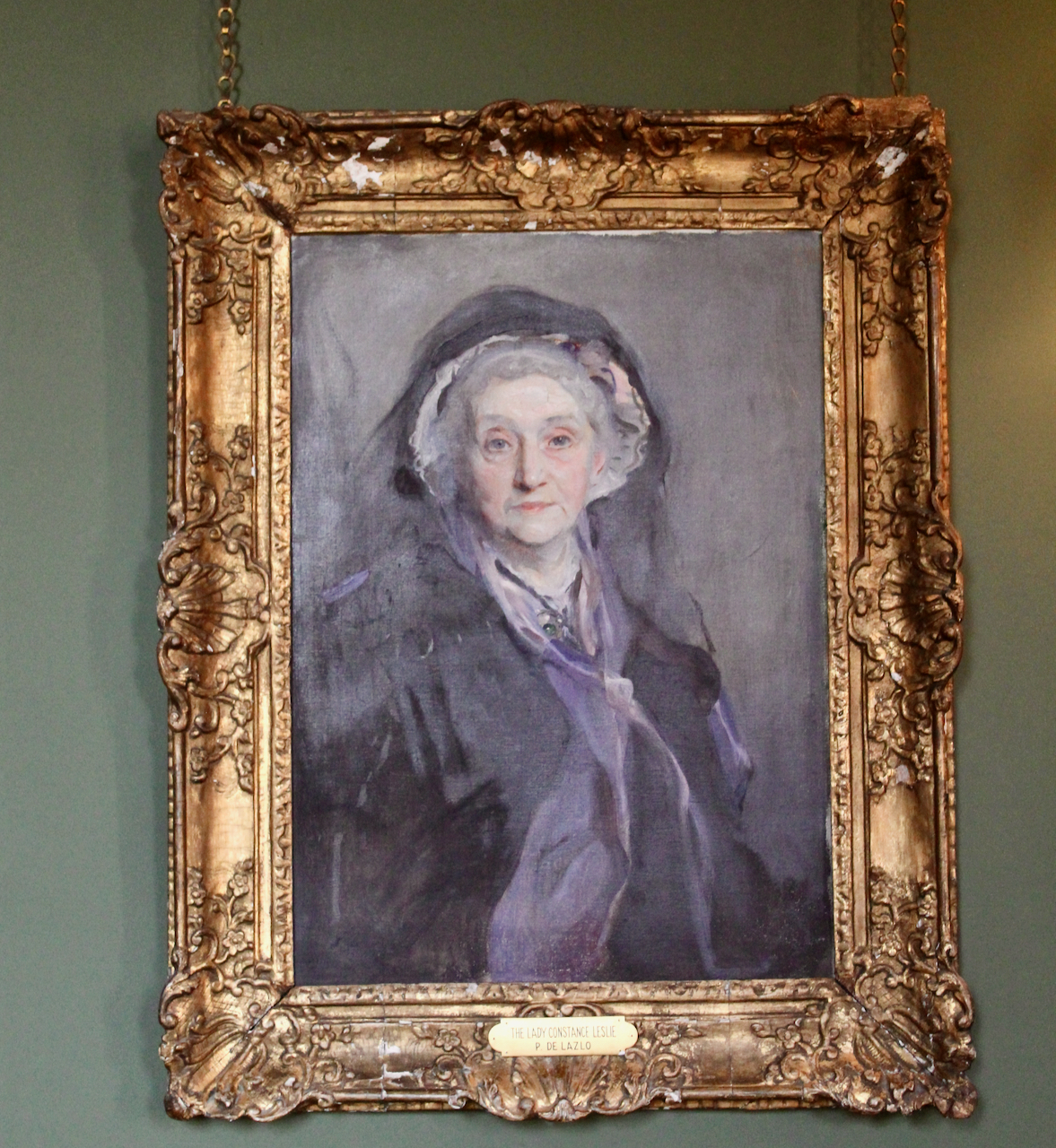
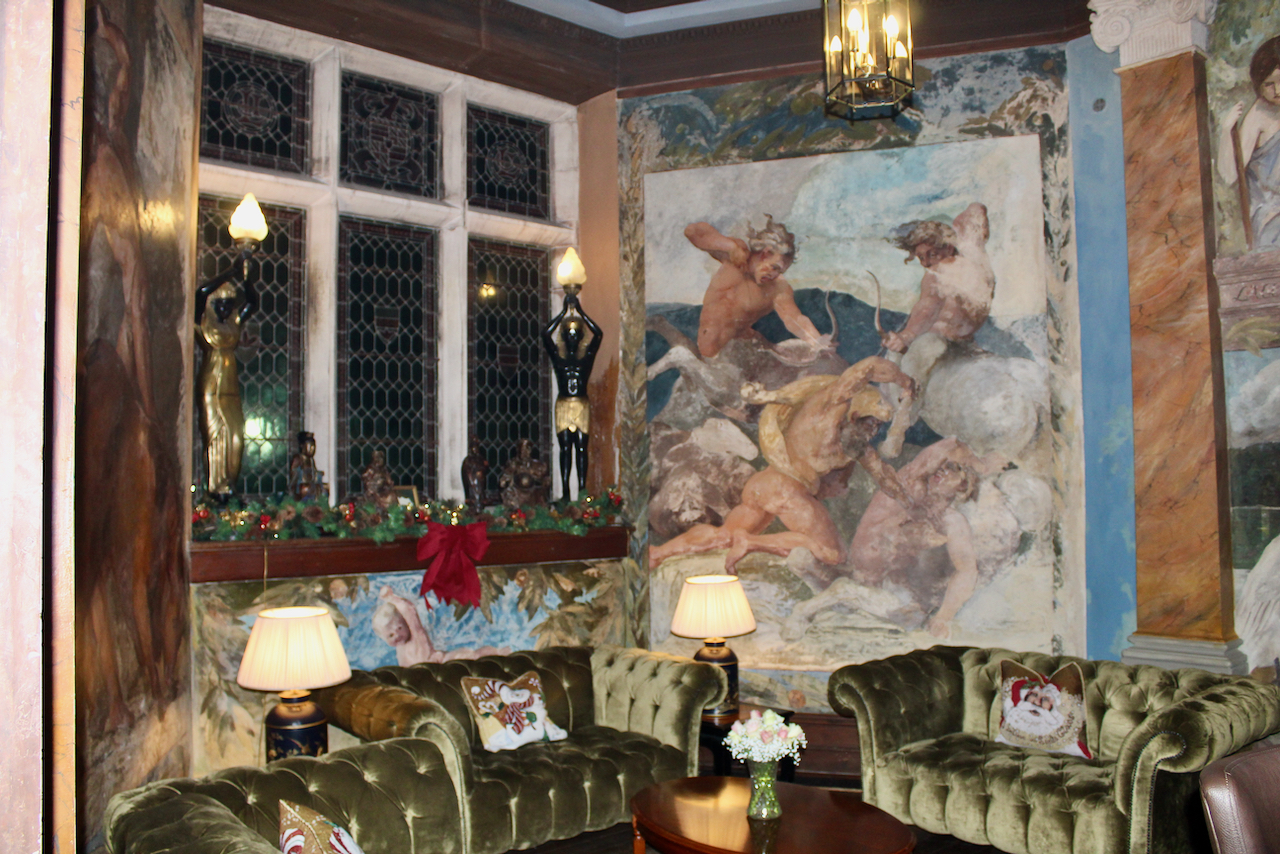
We entered through the garden door with the fanlight directly into what is now the library but was originally the entrance hall. It interlinks the staircase hall with its grand sweeping staircase and lovely striped wallpaper, dining room and drawing room. In the dining room we saw a portrait of Edith’s brother Cameron (1860-1942), along with other portraits. Hal also pointed out to us where Edith had scratched her initials into the glass of the dining room, “EOES.” Swags above the tall curtained windows date to the 1820s.

At Drishane House. Photograph © Jennifer Winder-Baggot, www.irishhistorichouses.com
David Hicks tells us more about Drishane from Edith’s time in his book Irish Country Houses, Portraits and Painters:

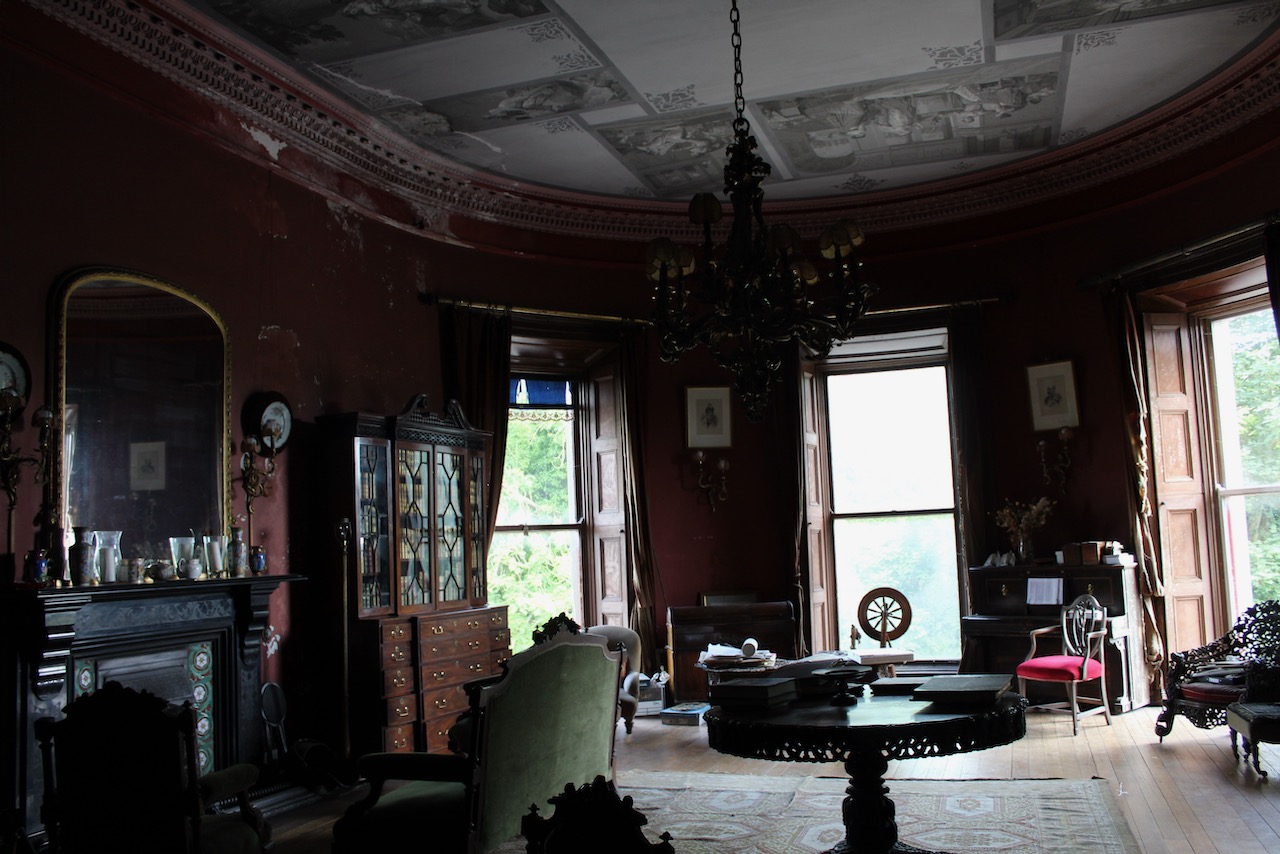
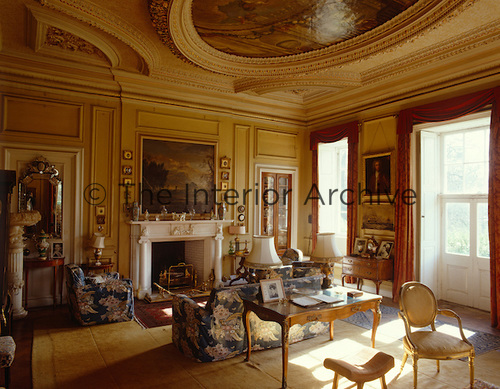
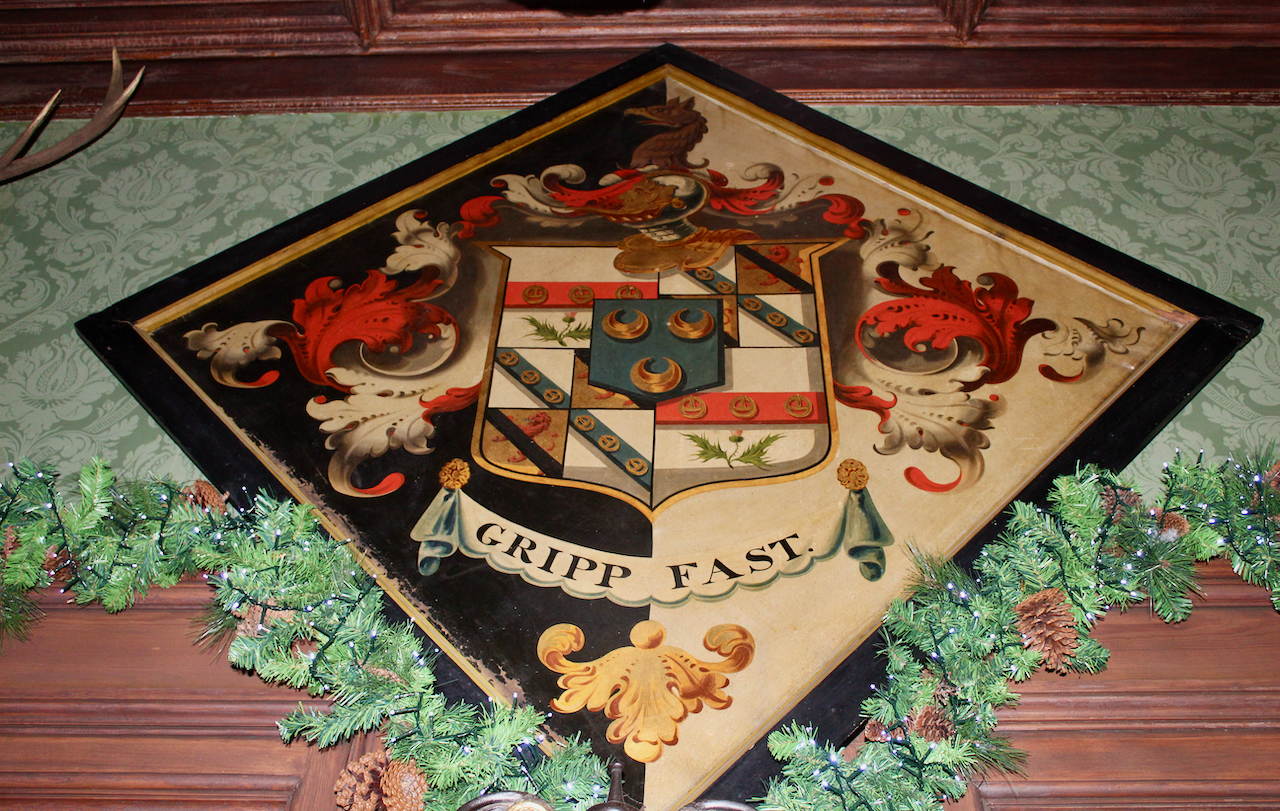
Drishane in the 19th century could not be described as homely: it was said to be cold, damp and infested with rats, which is in total contrast to the condition of the house today. When poison was put down to fend off unwanted visitors, they usually died under the floorboards. The resulting decomposition meant sometimes the drawing room could not be used for an extended period, such as in 1878, due to the smell. The drawing room also contained a large white marble fireplace that was brought from Italy by Edith’s great-grandfather. However, over the years it became the final resting place for a number of rodents and was christened the “Mouse-oleum.” This fireplace often had to be taken out for the dead mice to be removed and it became damaged. Edith’s brother Cameron was stationed in China from 1885 to 1889 and when he returned to Drishane he brought back a black marble fireplace complete with carved dragons and Chinese symbols, together with the Somerville crest and motto. This exotic-looking fireplace was installed in the drawing room to replace its damaged predecessor. [11]

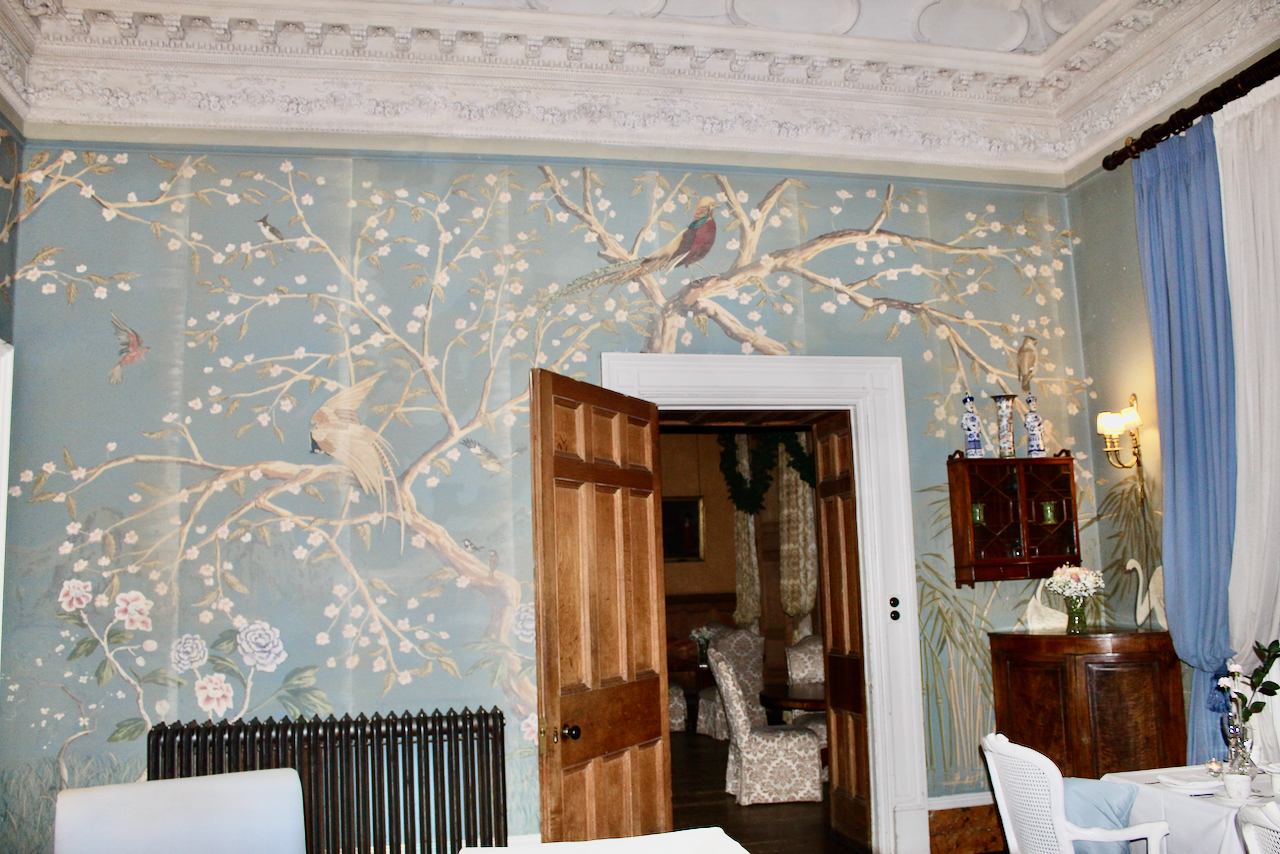
Having read Hicks’s description I was excited to see the Chinese fireplace. It is indeed very unusual. 

The oldest of the children who had hidden things in their mother’s bedroom was another Thomas (1798-1882). Mark Bence-Jones tells a lovely story about him. He was very in love with his wife, Harriet Townsend, who was a cousin who had lived up the road in Castle Townshend. [12] Bence-Jones writes:

after her death [he] would sit up for hours by his bedroom fire thinking of Harriet and grieving for her and looking for consolation in his Bible by the light of a candle in her own special candlestick. He would burn two candles every night which Mrs Kerr, the housekeeper, would leave out for him. Then he started to complain, night after night, that he could not find the second candle. Mrs Kerr told his granddaughter Edith what she believed had happened. “My dear child, the candle was there! For I always put it on the table myself! It was Herself that took it, the way your Grandpapa should go to his bed and not be sitting there all night, breaking his heart.” [13]

This Thomas inherited Drishane and died in 1882, when the estate passed to his son, another Thomas. This Thomas (1824-1898) married Adelaide Eliza Coghill, and was the father of Edith, along with six other children who survived to adulthood.

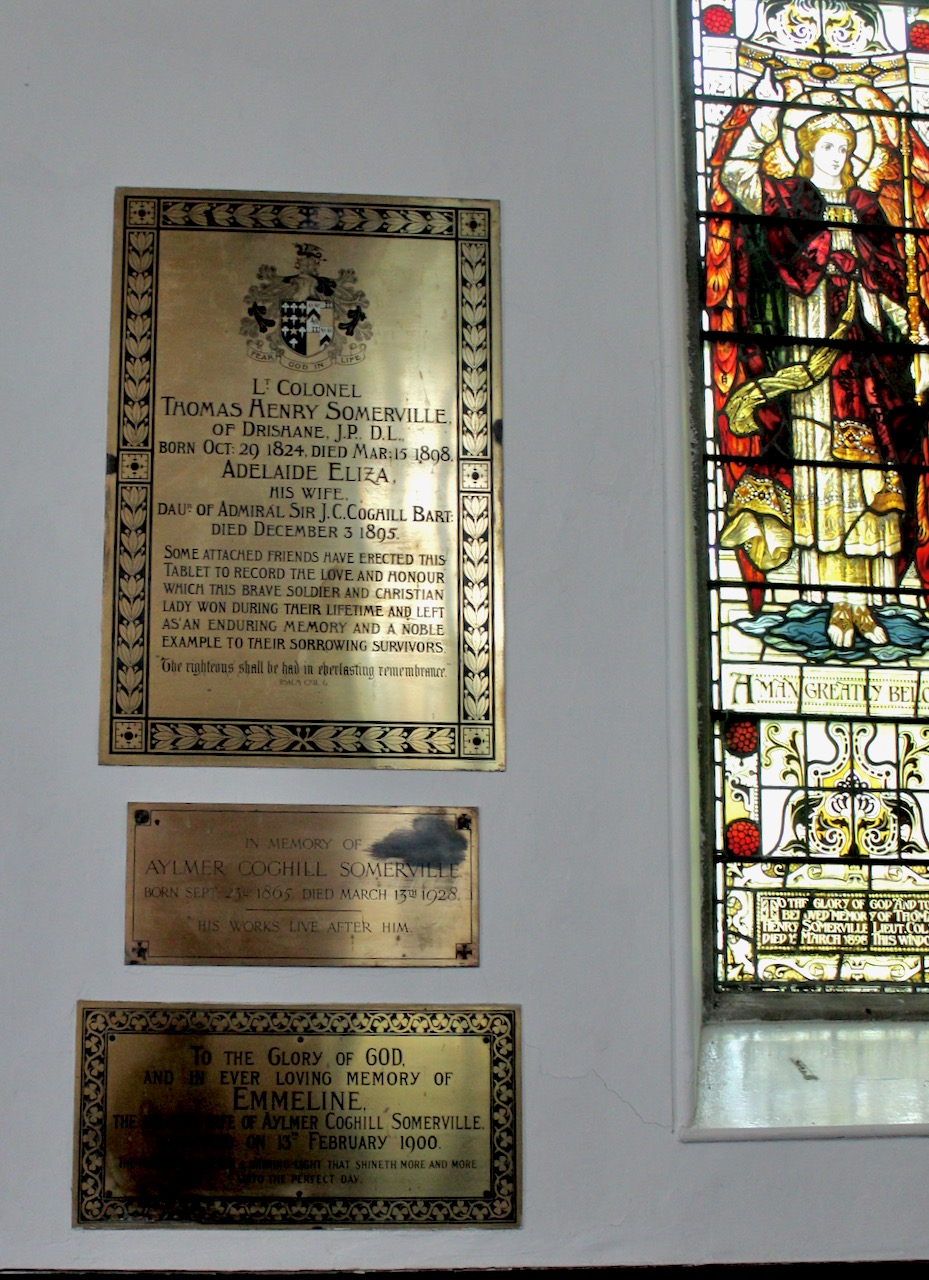
Memorial in St. Barrahane’s Church, Castletownshend, to Lt. Colonel Thomas Henry Somerville (1824-1898), who married Adelaide Eliza Coghill. Below that plaque is a memorial to his son Aylmer Coghill Somerville and Aylmer’s second wife, Emmeline Sophia Sykes. Photograph © Jennifer Winder-Baggot, www.irishhistorichouses.com
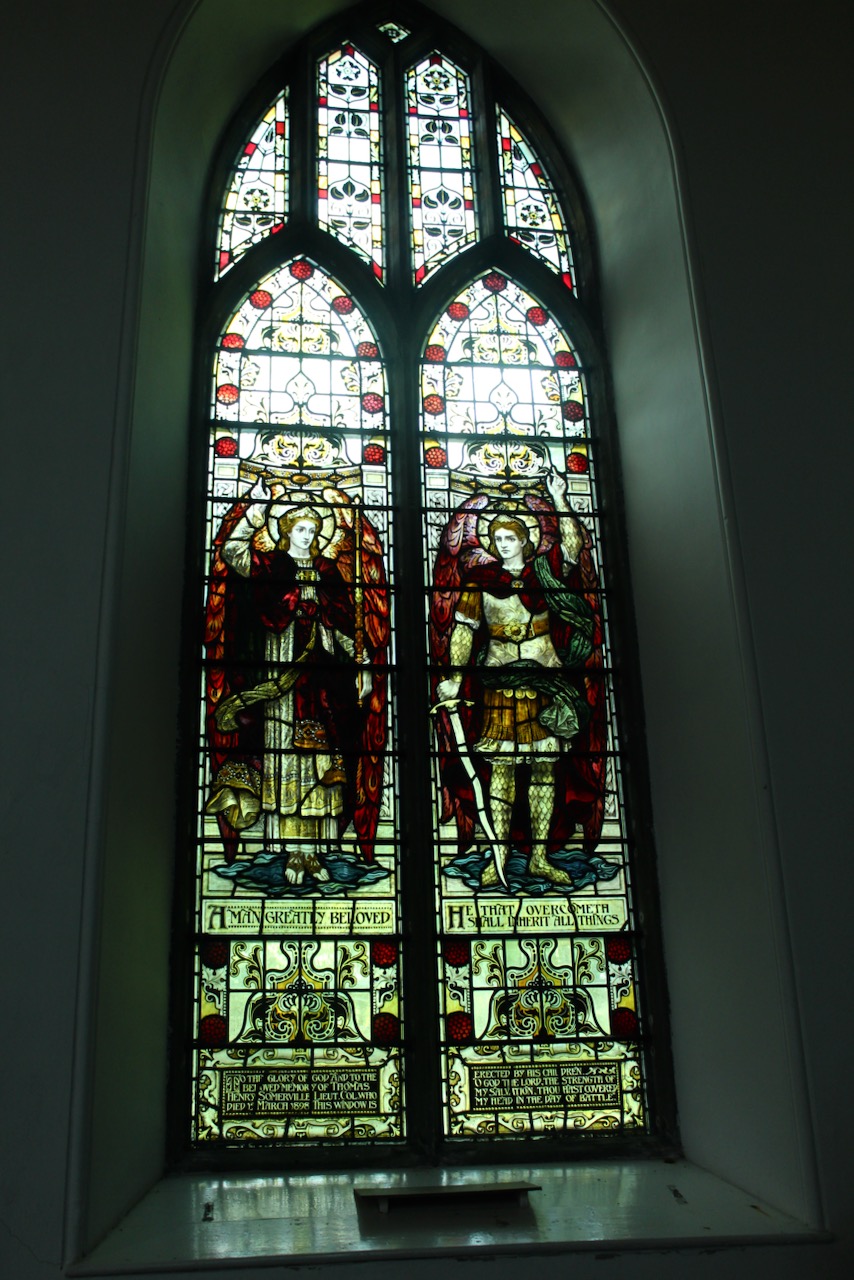
Window in St. Barrahane’s Church dedicated to Lt. Colonel Thomas Henry Somerville (1824-1898), by Harry Clarke. Photograph © Jennifer Winder-Baggot, www.irishhistorichouses.com
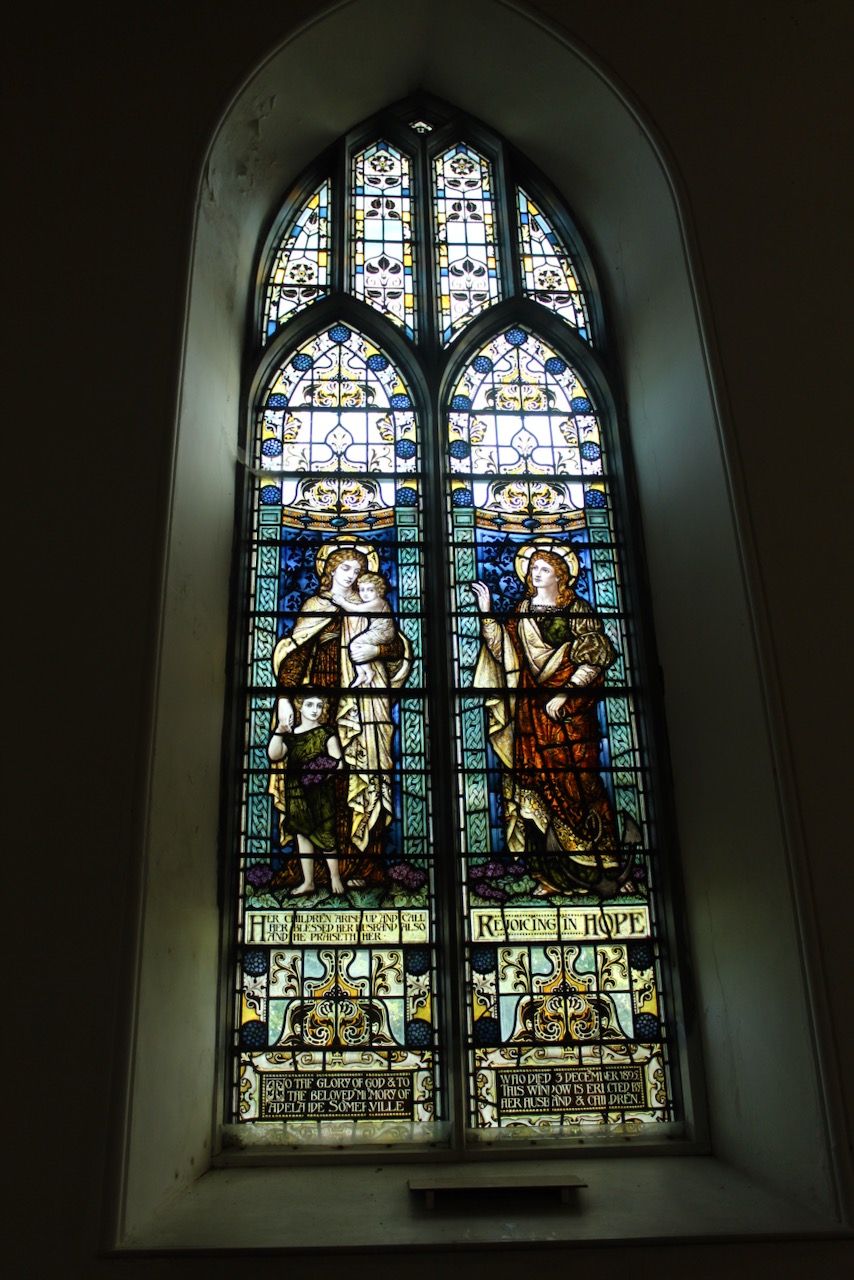
Window in St. Barrahane’s Church dedicated to the wife of Lt. Colonel Thomas Henry Somerville (1824-1898), Adelaide Eliza Coghill, by Harry Clarke. Photograph © Jennifer Winder-Baggot, www.irishhistorichouses.com
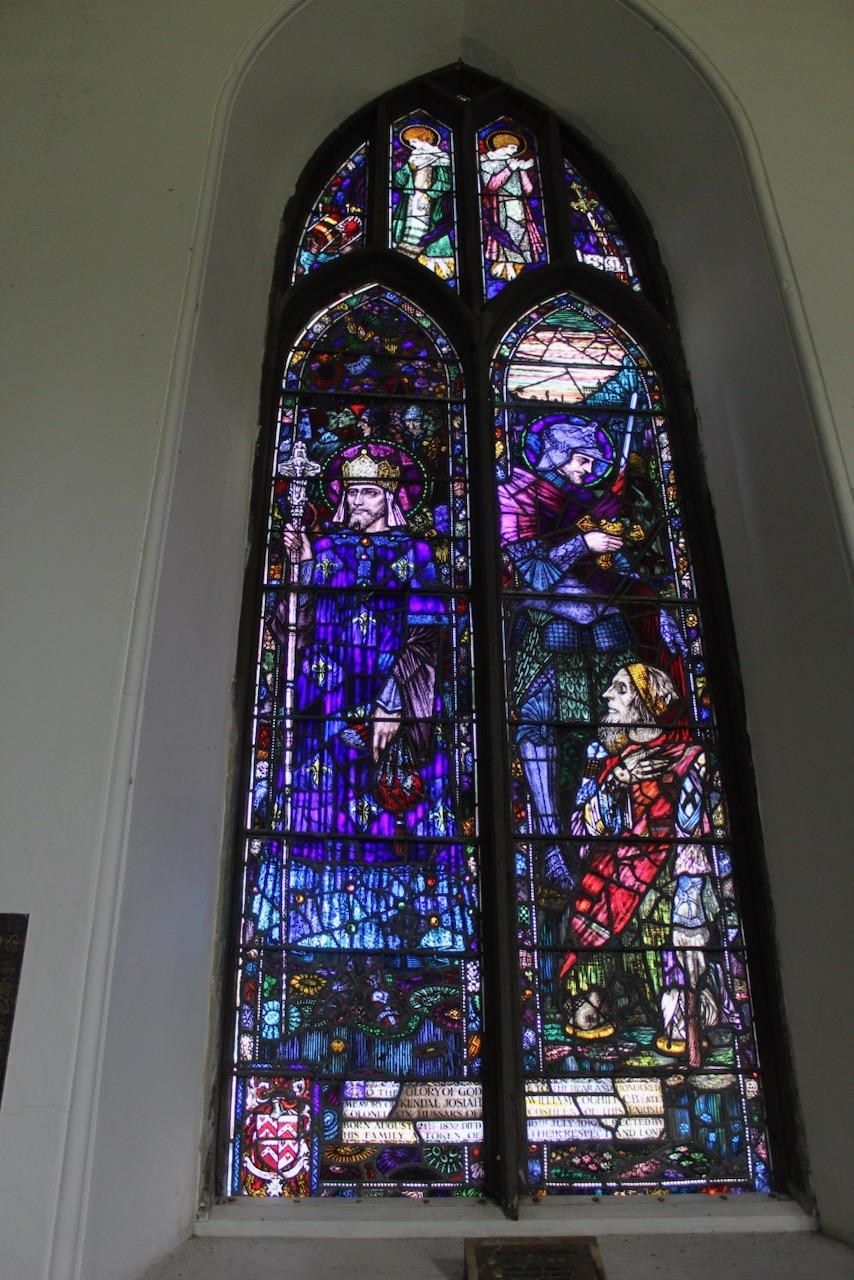
This Harry Clarke window in St. Barrahane’s Church of Ireland depicts French Saints Louis (who was Louis IX, King of Spain) and Martin and was commissioned in memory of Colonel Kendall Josiah Coghill in 1921. He was a brother of Adelaide Eliza Coghill. Photograph © Jennifer Winder-Baggot, www.irishhistorichouses.com
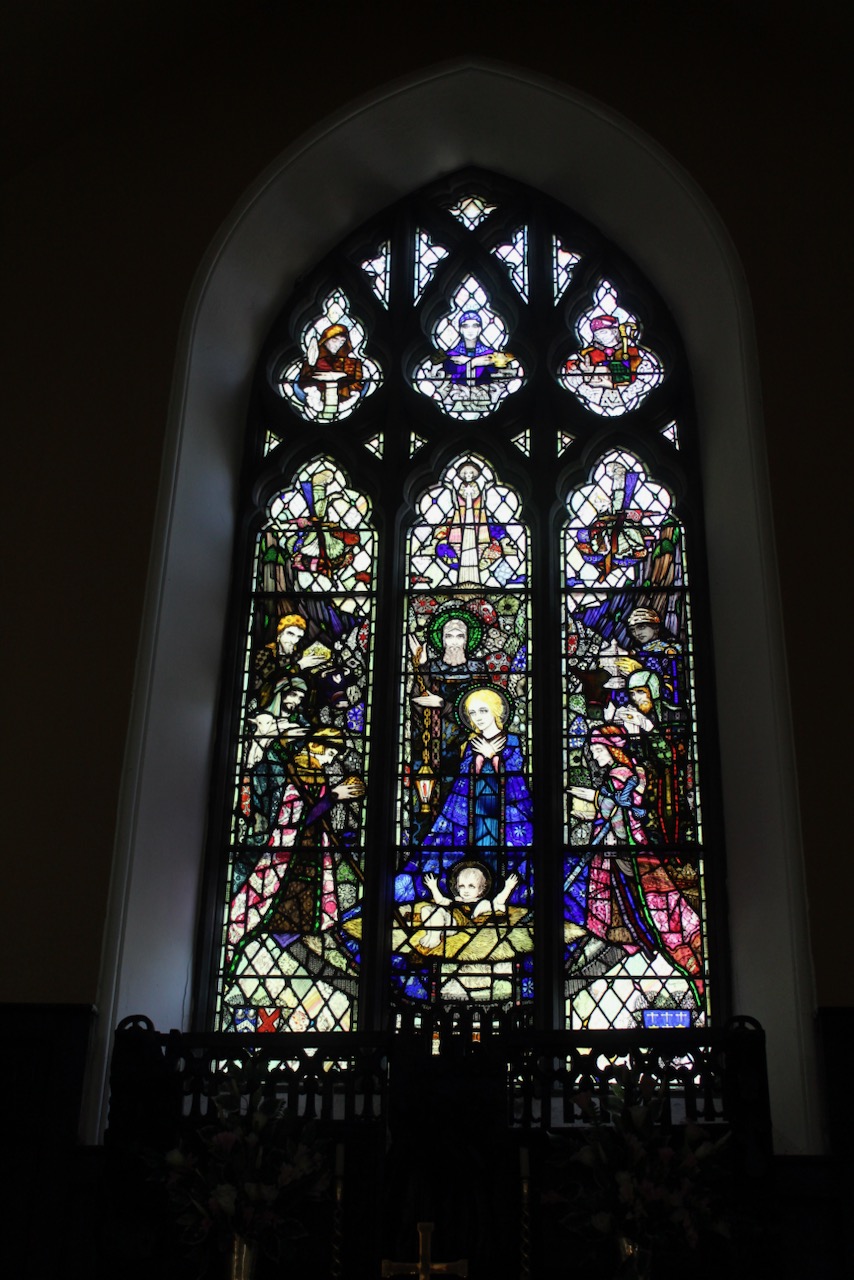
Another Harry Clarke window in St. Barrahane’s Church of Ireland in Castletownshend. Photograph © Jennifer Winder-Baggot, www.irishhistorichouses.com
Mark Bence-Jones tells us another good story, this one taken from Somerville and Ross’s book Wheel Tracks, which was published in London in 1923:

Tom Somerville [Edith’s father] was a magistrate and when the police brought cases to be summarily dealt with by him, he would swear the deponents on the Bradshaw’s Railway Guide as though it were a bible, partly through laziness [it lay on a nearby table] and partly from ‘a certain impishness of character and a love of playing on ignorance.’ [14]

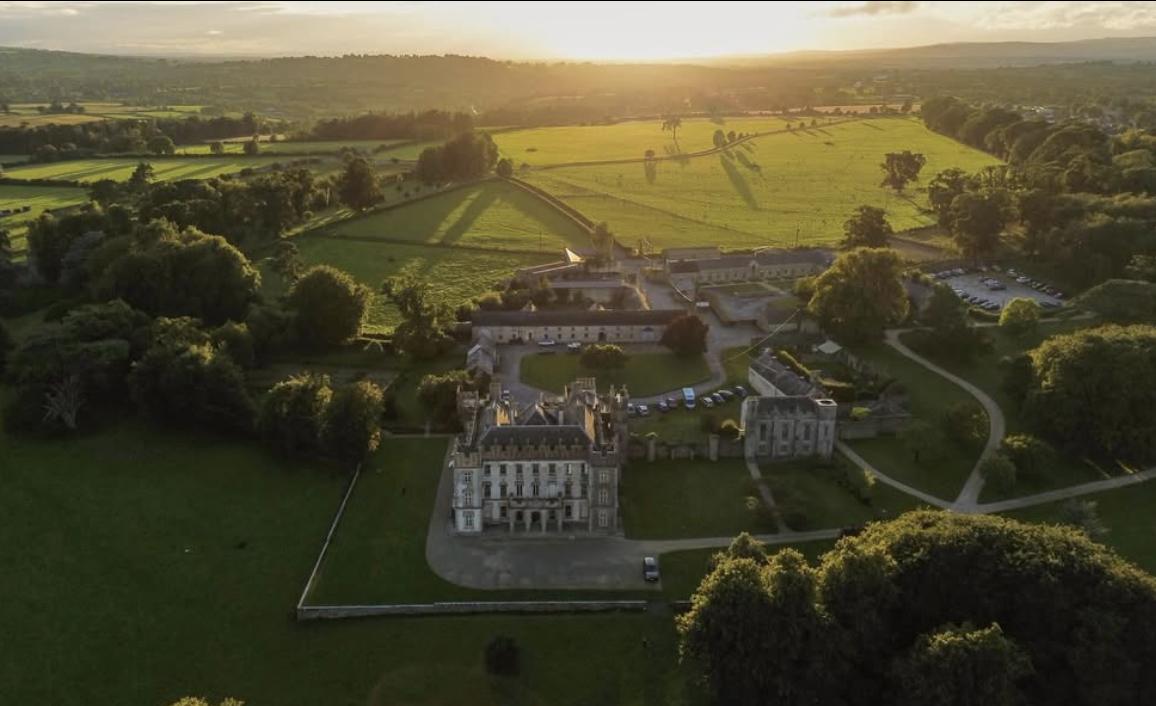
Drishane House, August 2020. Photograph © Jennifer Winder-Baggot, www.irishhistorichouses.com
Edith had suitors, but her mother sent them packing. In any case, Edith seems to have cherished her freedom, taking full advantage of her time to paint, hunt, travel and socialise. When her mother died, she took over the management of the household for her father. When her father died, her brother Cameron inherited the estate, but he, like his brothers, served in the military, and he was mostly stationed abroad, so Edith continued to run the household. 

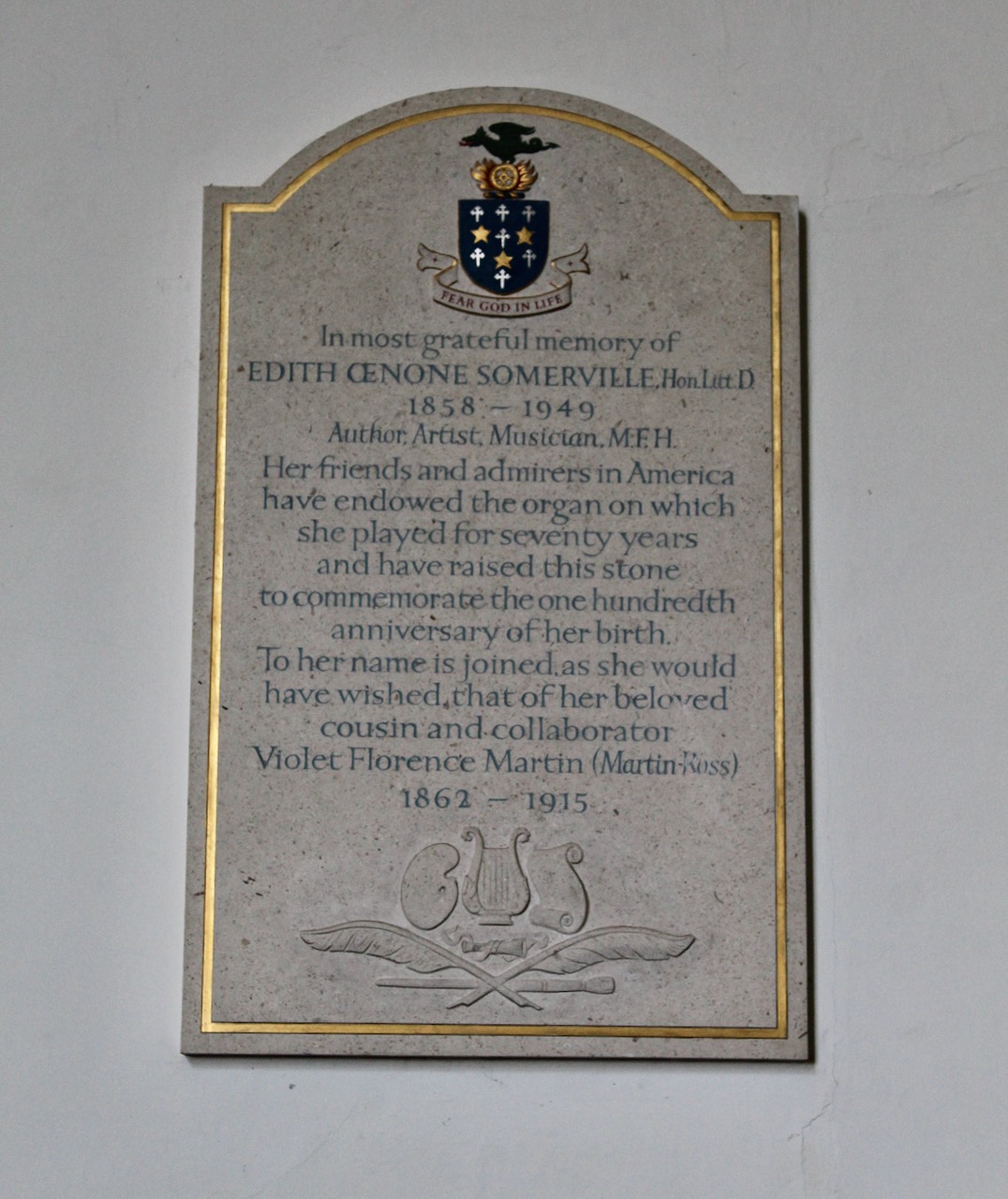
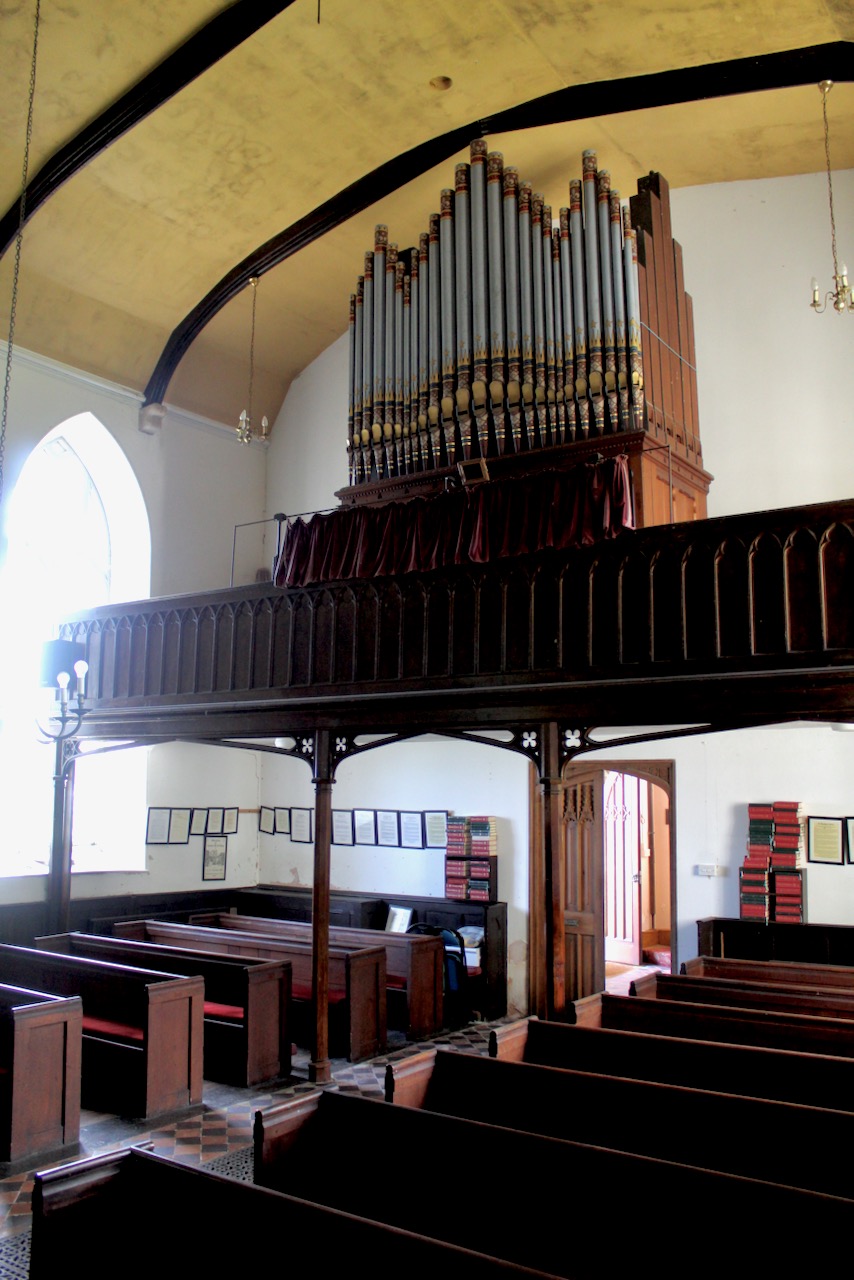
Another brother, Aylmer, and his wife, lived with Edith for a time, and helped to manage the farm which was part of the estate, and her only sister Hildegarde married their cousin Egerton Coghill, 5th Baronet Coghill, and settled nearby at Glen Barrahane house in Castletownshend [this no longer exists]. Egerton was also an artist and when he died Edith and Hildegarde commissioned Harry Clarke to create a stained glass window in their local Church of Ireland, St. Barrahane’s. The window depicts St. Luke, the Patron Saint of Painters. To the left of St. Luke’s shoulder is a depiction of St. Cecelia playing the organ, which is a tribute to Edith, as she played the organ in the church for seventy years. [15]

Among her many cousins was Charlotte Townsend, the wife of George Bernard Shaw, which visited Drishane.

Violet moved to Drishane to live with Edith permanently in 1906. In the 1901 and 1911 censuses Edith signed herself as Head of Household, and in 1911 listed her occupation as “artist, author and dairy farmer” and Violet as “author.” 

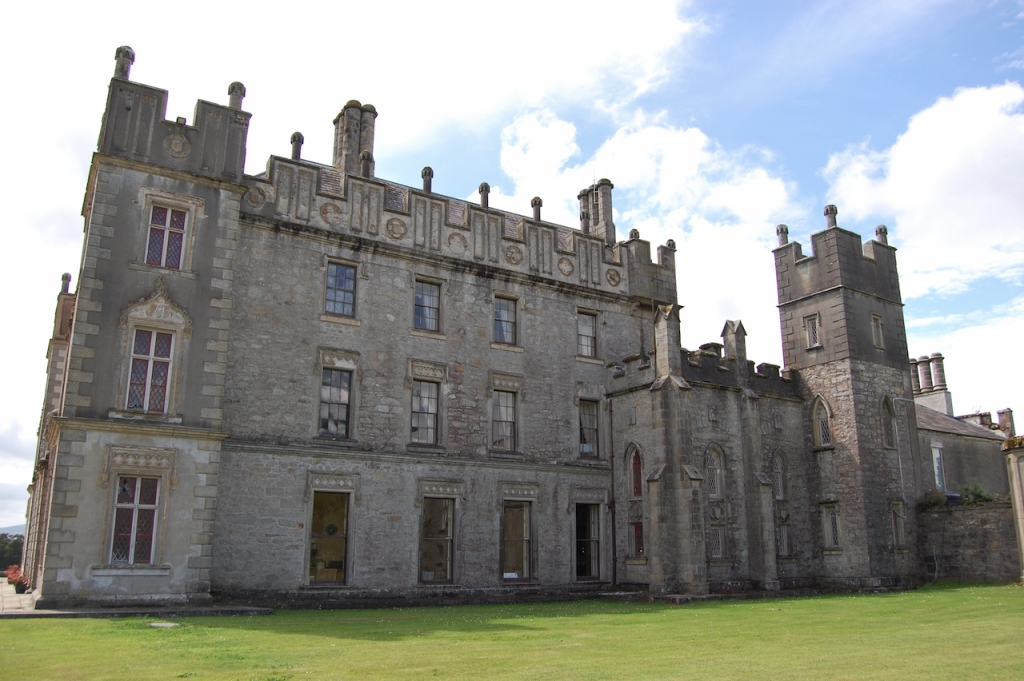
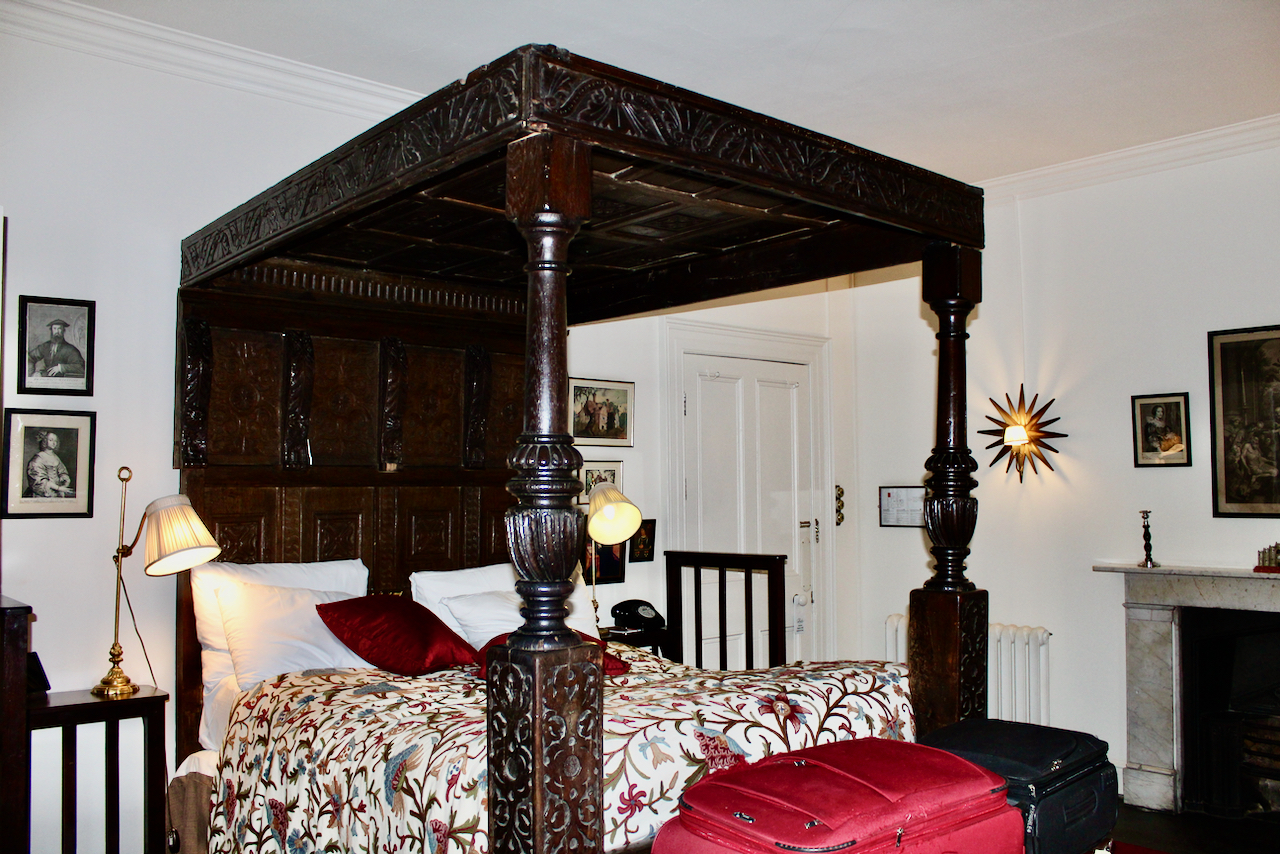
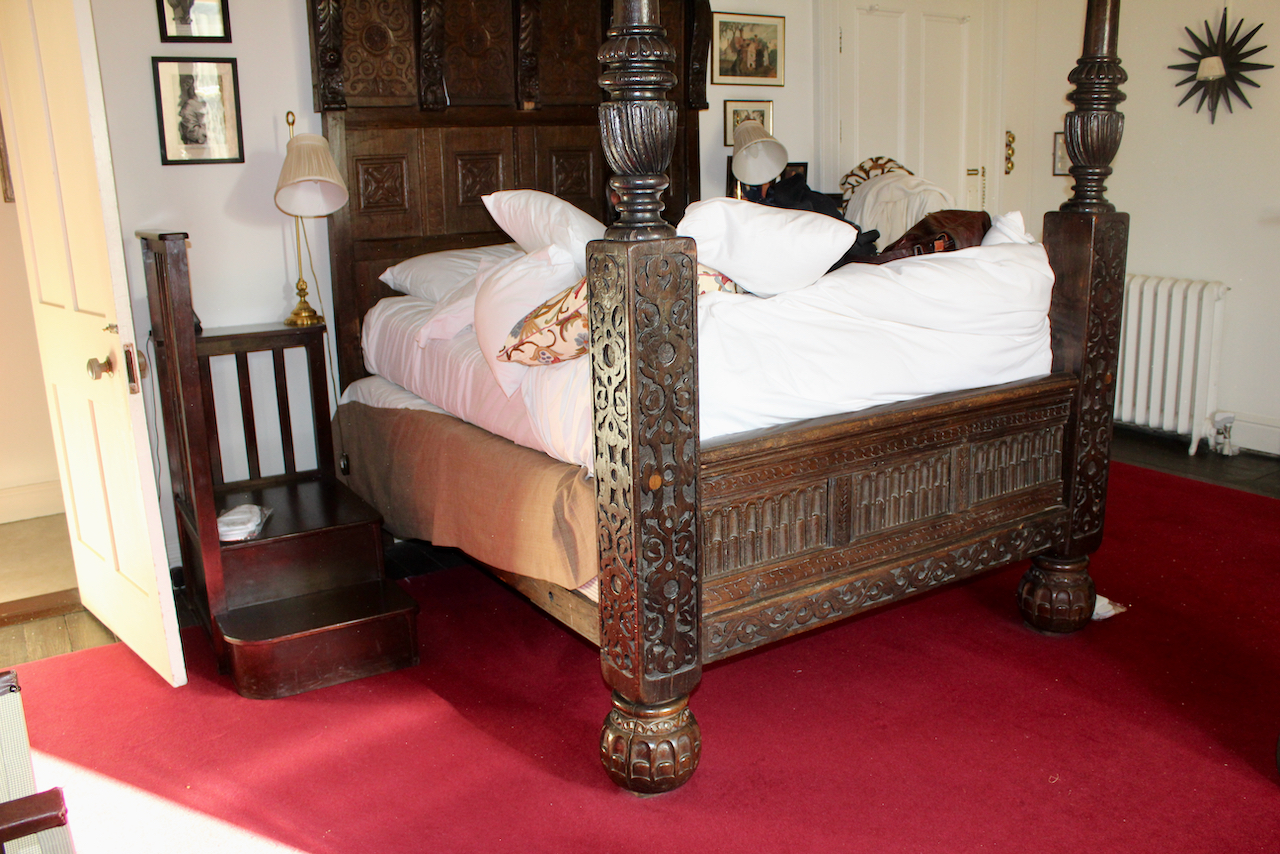
At Drishane House. Photograph © Jennifer Winder-Baggot, www.irishhistorichouses.com
Drishane House, August 2020. Photograph © Jennifer Winder-Baggot, www.irishhistorichouses.com
Edith struggled to have enough money for the upkeep of the house. She and Violet hoped to earn money from their publications but they sold the work before they became bestsellers. Desmond’s wife describes the shabbiness of the house, and yet traditions were upheld and up until the second world war, everyone “dressed for dinner.” [16] In the summer Edith would locate to a smaller house in the town and let out Drishane to earn some extra money.

Edith’s brother Boyle lived in a house nearby, called Point House. Boyle had been an admiral in the Navy, and if someone was interested in joining the Navy, they’d go to speak to Boyle. Unfortunately, the IRA saw this as recruitment for the British Army. Tom Somerville who now lives in Drishane tells the story in Jane O’Hea O’Keeffe’s book:

Below the village at Point House, overlooking the water, lived my great-great-uncle Boyle Somerville. He was a retired admiral, and local boys who were interested in joining the Royal Navy used to go to him to ask for a chit to say he knew them and that they were fit persons to join the navy. If that was what they wanted to do, he cheerfully signed the chit for them. This was interpreted by the IRA as recruiting, so on the night of 24 March 1936 they came to the front door of Point House. The admiral picked up the oil lamp from the table and went to answer their knock. They enquired, through the glass porch, if he was Mr Somerville. He answered, “I am Admiral Somerville,” whereupon they shot him through the glass, and killed him.” 

Tom continues: “of all the Somervilles, Boyle was the most nationalist. He took a great interest in the Irish language and had always been very pro-Home Rule. He made a study of all the local archaeological sites and is written up by Jack Roberts in his book Exploring West Cork. He was a remarkable man and perhaps the most talented and interesting of all the Somervilles of that generation, besides his sister Edith.” [17] 

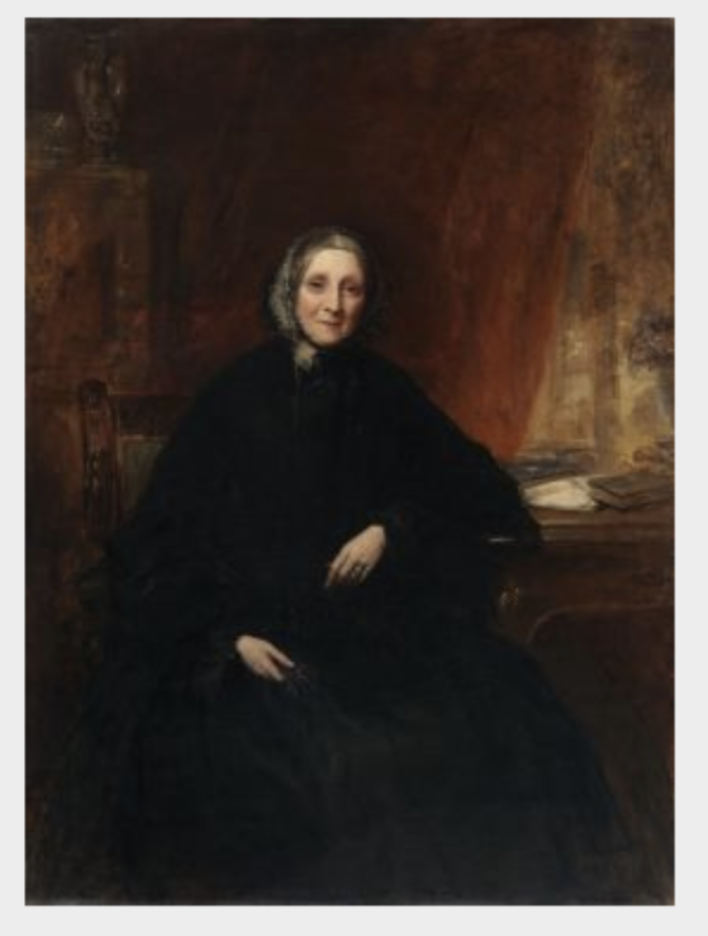
Violet Florence Martin (1862-1915) by Edith Anna Oenone Somerville, oil on panel, 1886, courtesy of National Portrait Gallery London ref. 4655.

Cameron never married and when he died in 1942 the property passed to his nephew Desmond, the son of his brother Aylmer who had predeceased him. Desmond also served in the British Army.

Desmond and his wife Moira Burke Roche invited Edith to remain at Drishane. A memoir by Moira [Moira Somerville’s Edith OE Somerville. An Intimate Recollection. Typescript in Edith Oenone Somerville Archive] describes her first visit to Drishane, as Desmond’s fiancée, and her memory of Edith: “presiding over the tea things in the hall, her little dogs on her lap, the light of the oil lamp on her thistledown hair, her china-blue eyes, so like a child’s, fixed on my face. From that moment I loved her.” [18]

Violet had died just two years before this visit, in 1915. She and Edith had gone on a holiday to Kerry. David Hicks describes Violet’s last days:

Violet began to feel unwell and when her condition worsened she was transferred to the Glen Vera Hospital in Cork. Each day Edith sat by her bedside and wrote to her brother, Cameron. In one letter she wrote, “No one but she and I know what we were to each other.” She sketched her friend as she lay in her hospital bed for the final time before Violet died in Dec 1915. Edith wrote only one sentence in her diary that day: “Only goodnight, Beloved, not farewell.” [19]

Edith lived in the house until she was finally unable to climb the stairs. She then moved to a small house nearby in the town, Tally-Ho, to live with her sister. She died three years later, in 1949.

Plaque in St. Barrahane’s Church, Castletownshend. Photograph © Jennifer Winder-Baggot, www.irishhistorichouses.com
The organ on which Edith Somerville played for seventy years, in St. Barrahane’s Church, Castletownshend. Photograph © Jennifer Winder-Baggot, www.irishhistorichouses.com
When Desmond died in 1976, Drishane passed to his son Christopher (Dan) Somerville. In Jane O’Hea O’Keeffe’s book, Dan explains how he obtained the display cases for the museum:

We managed to get display cases which had become obsolete from the Bodleian Library in Oxford. We bought a trailer in England and loaded the cases on and brought them to Drishane. They are lovely cases, late Victorian or Edwardian. We couldn’t get them in the front door when we arrived, so we had to remove a window to install them. [20]

It is Dan’s son Thomas, and his wife and two sons, who now live in Drishane and who welcomed our visit. The house retains many of the original features and contents and paintings that date from Edith’s time. It also contains memorabilia from overseas and military engagements.

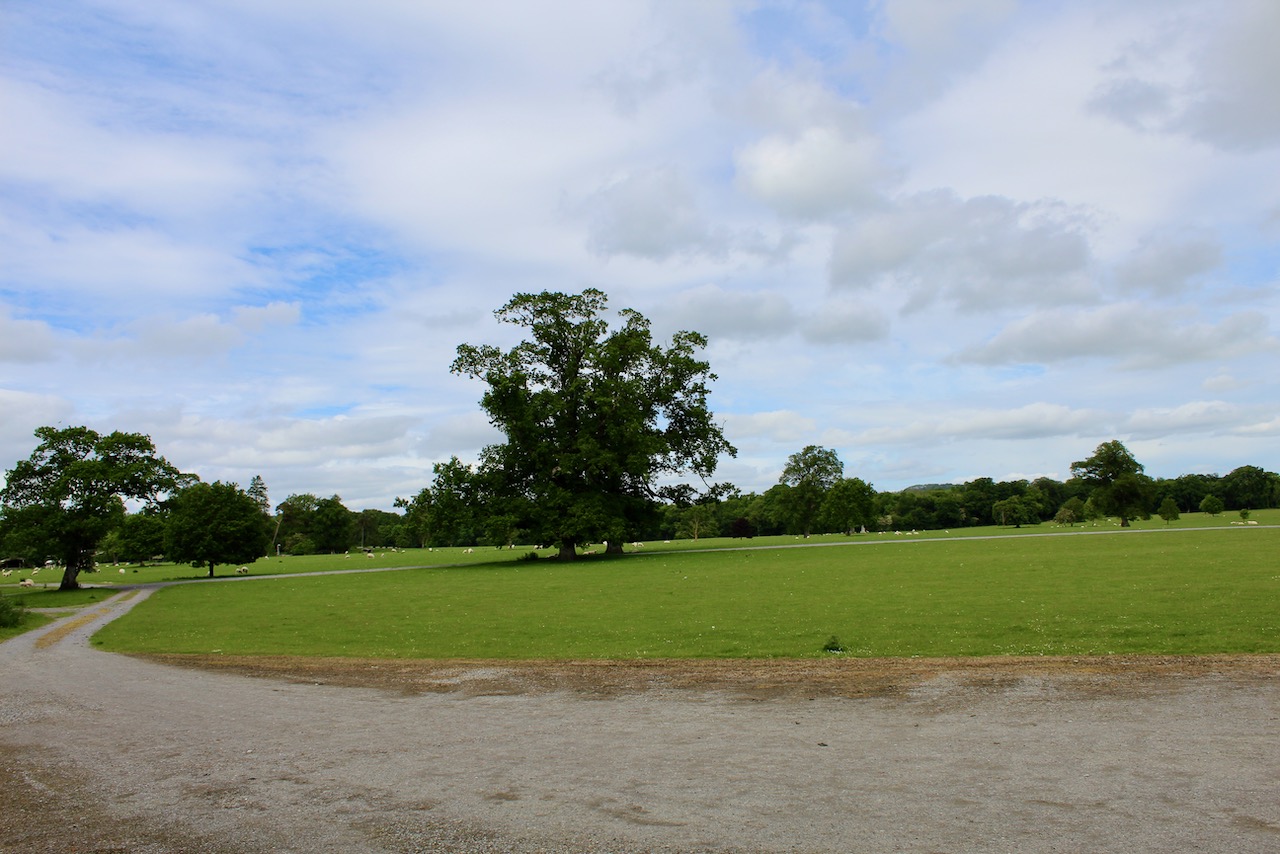
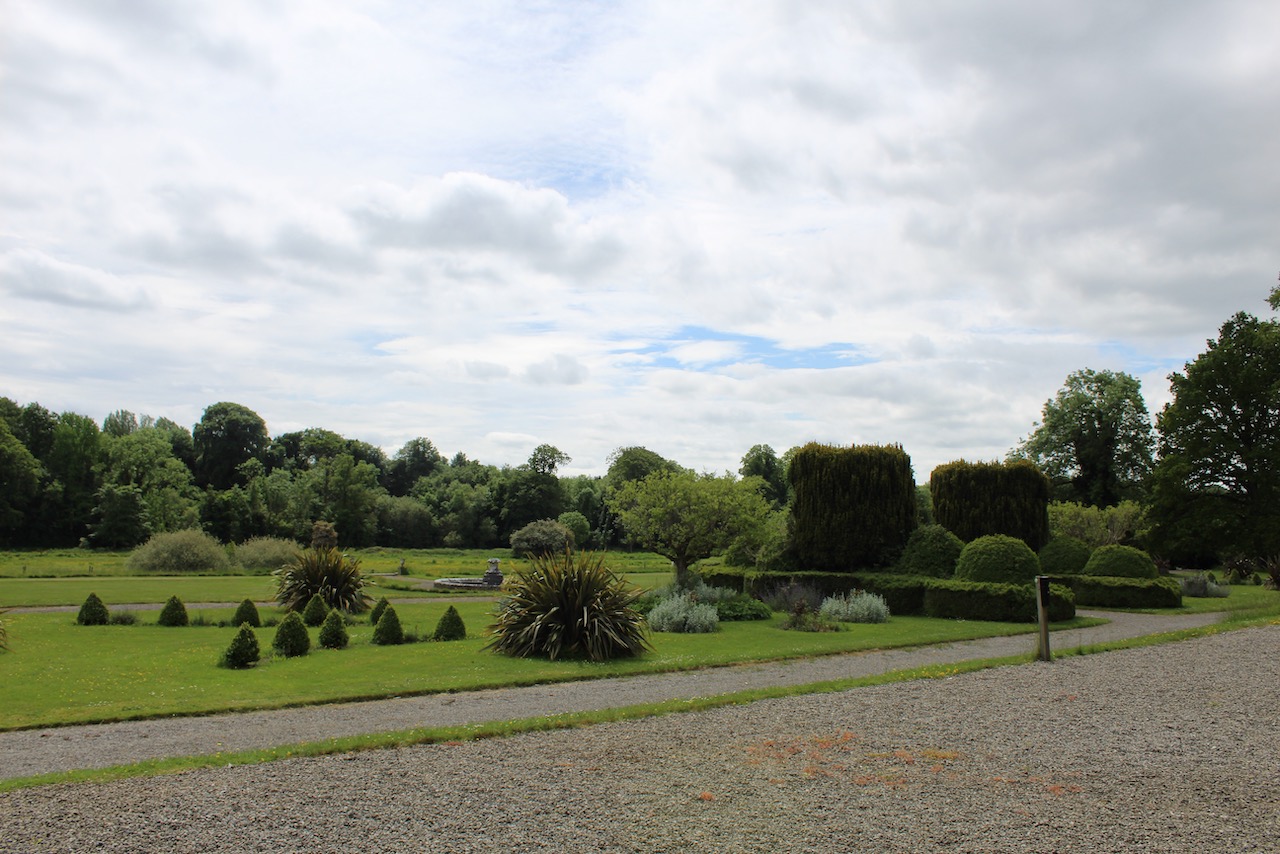
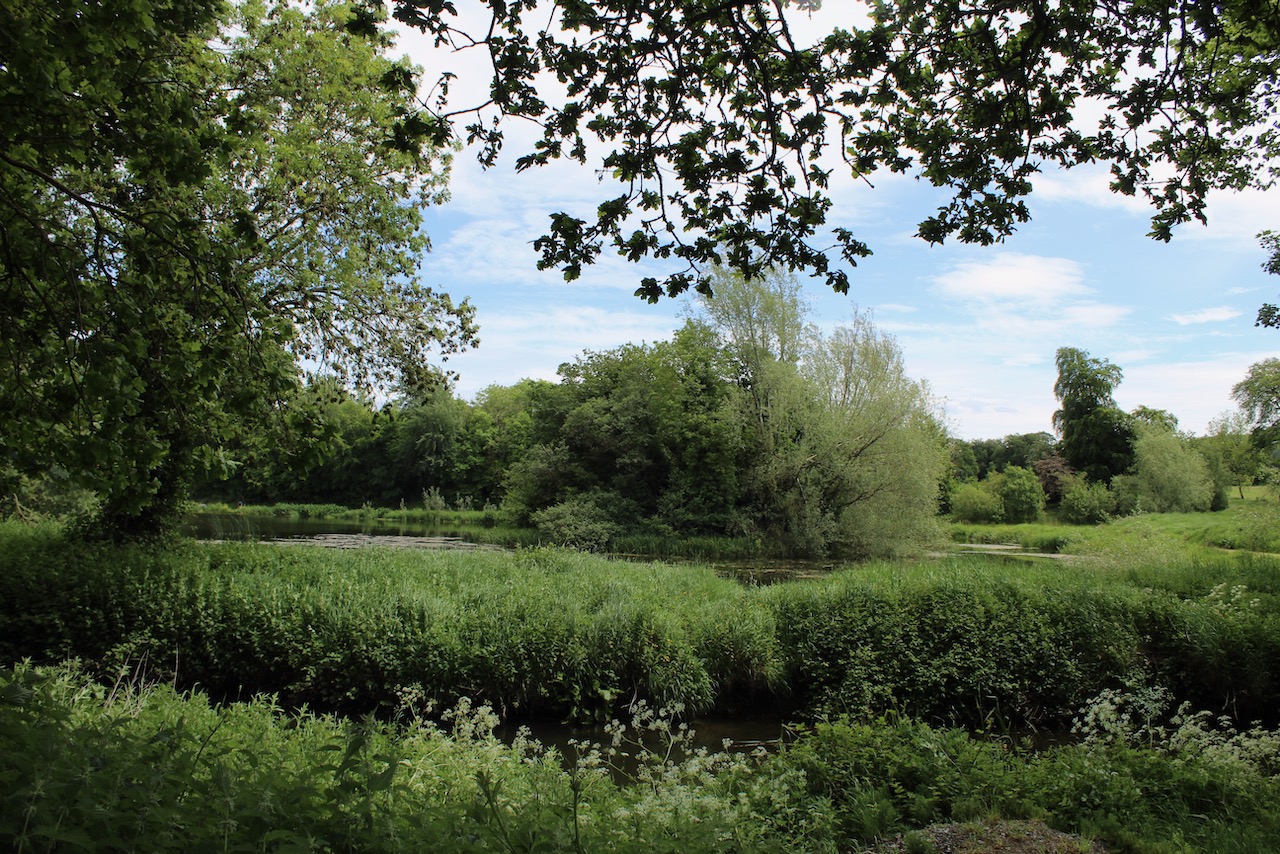
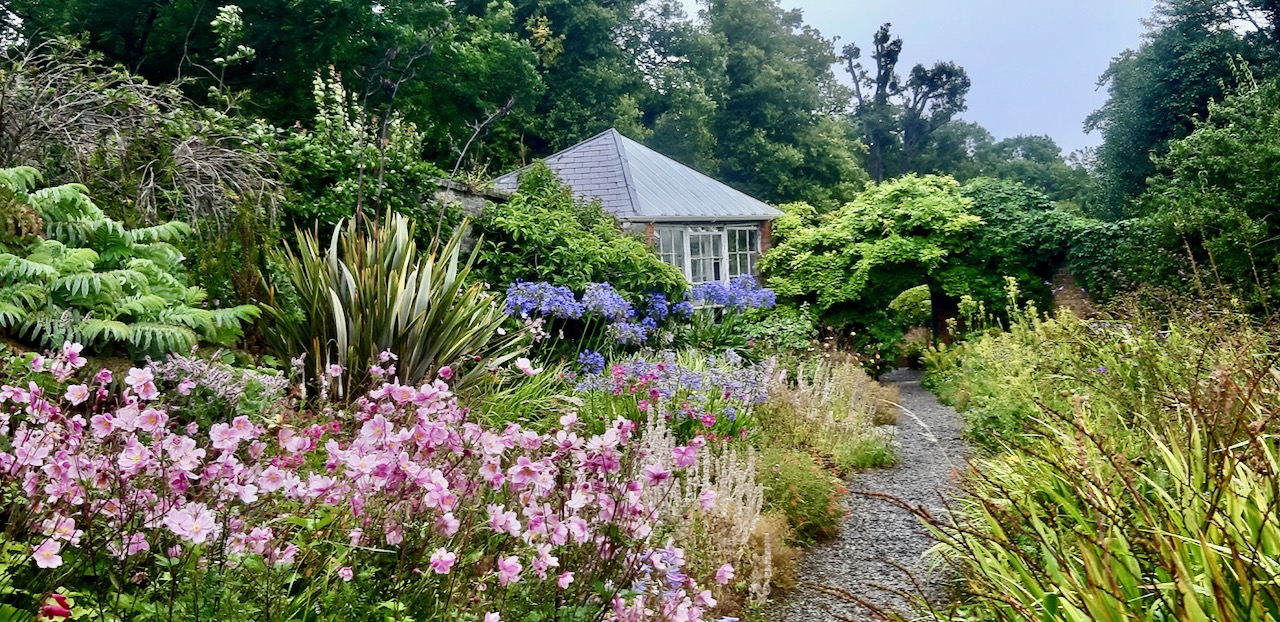
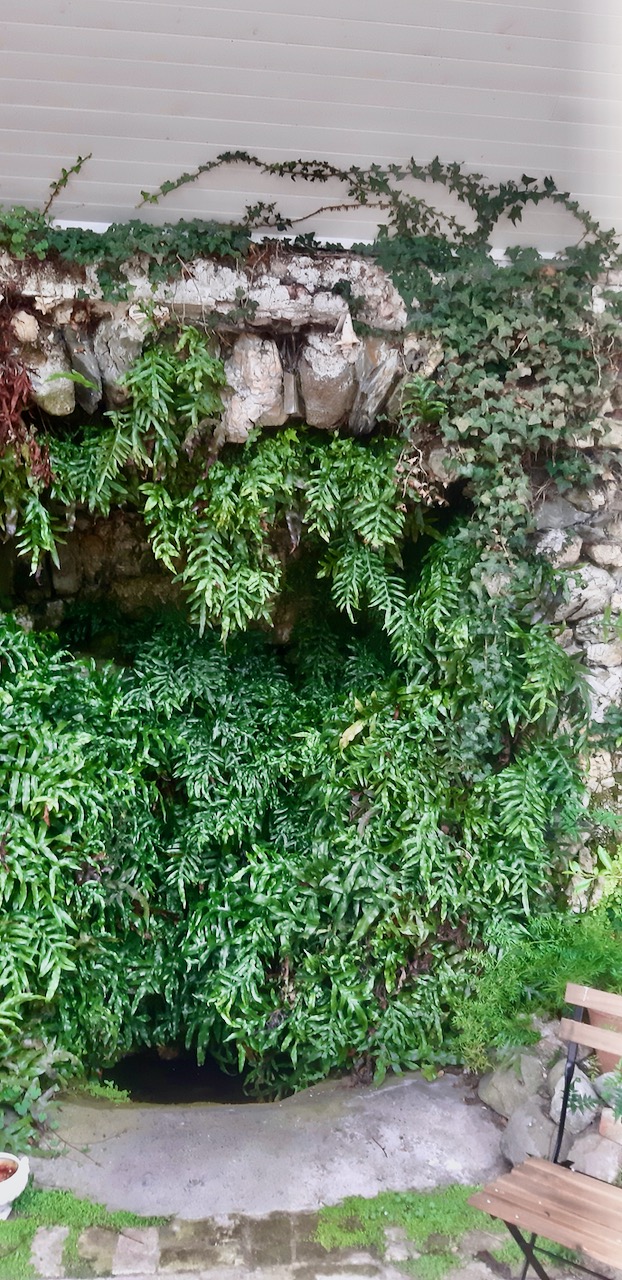
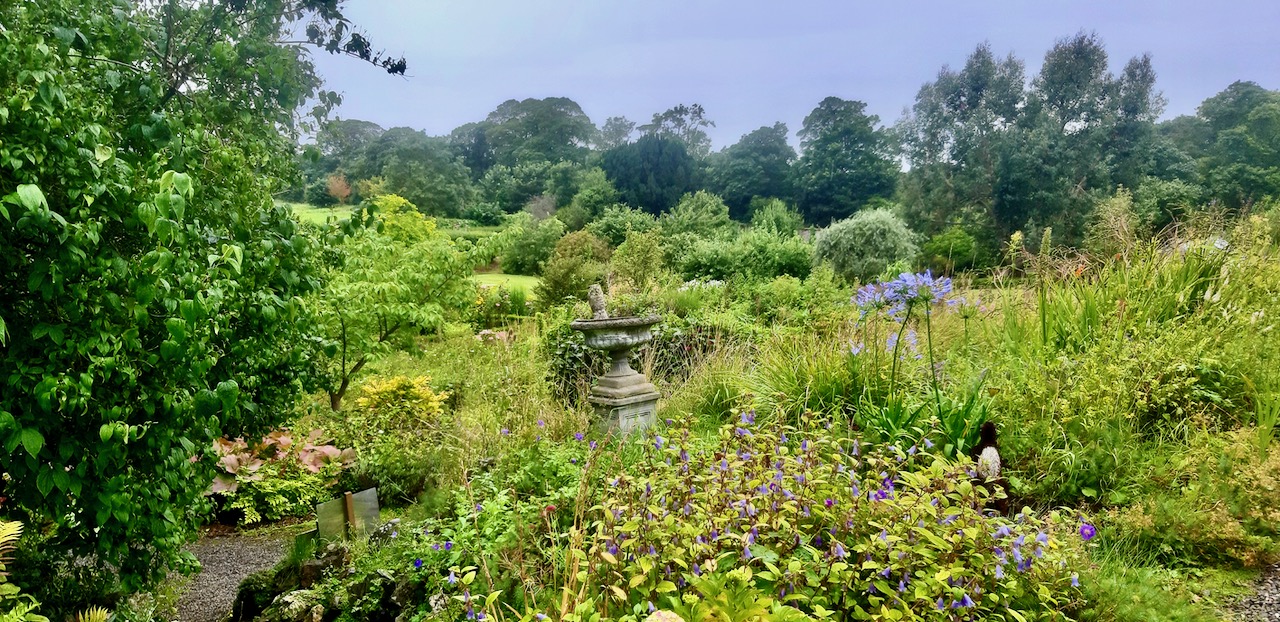
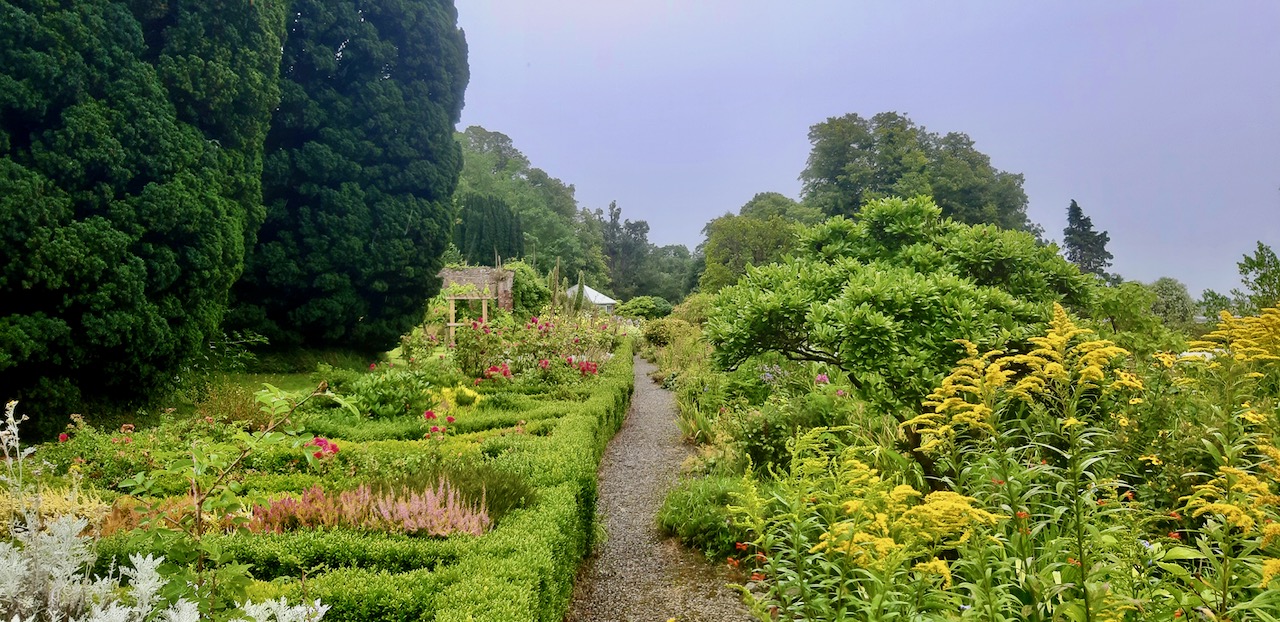
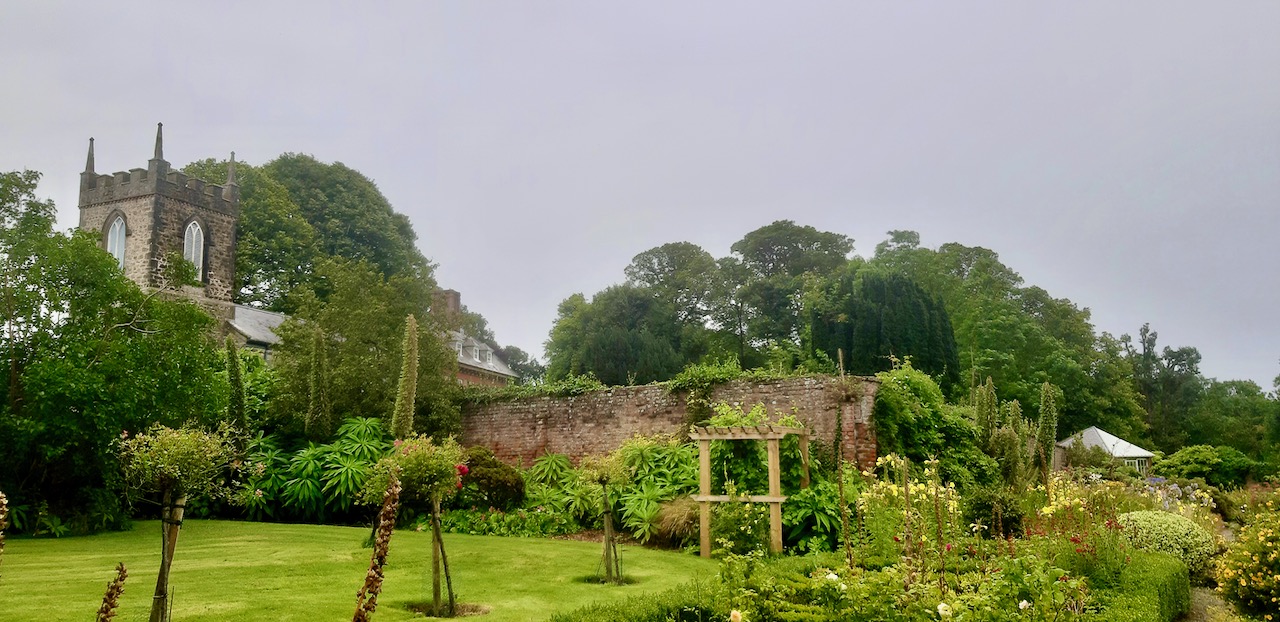
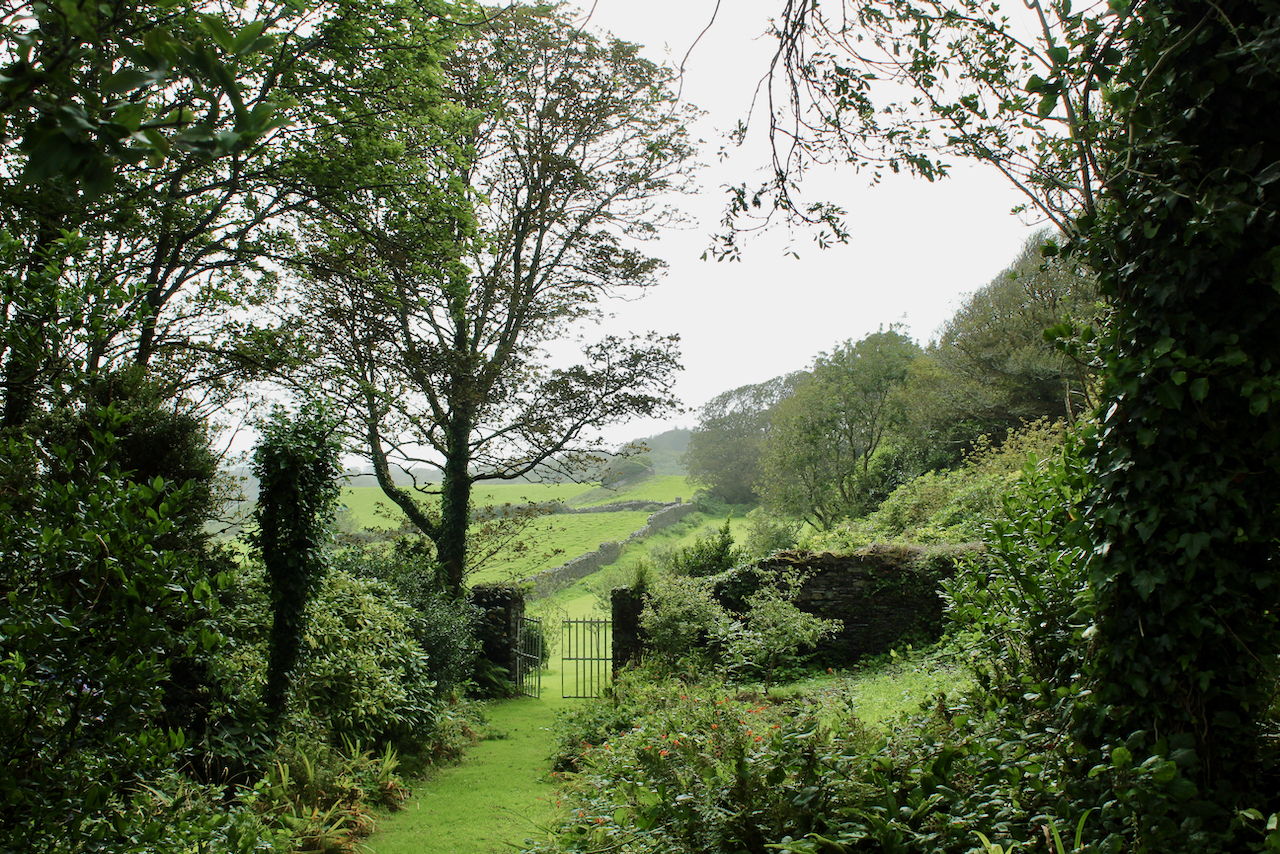
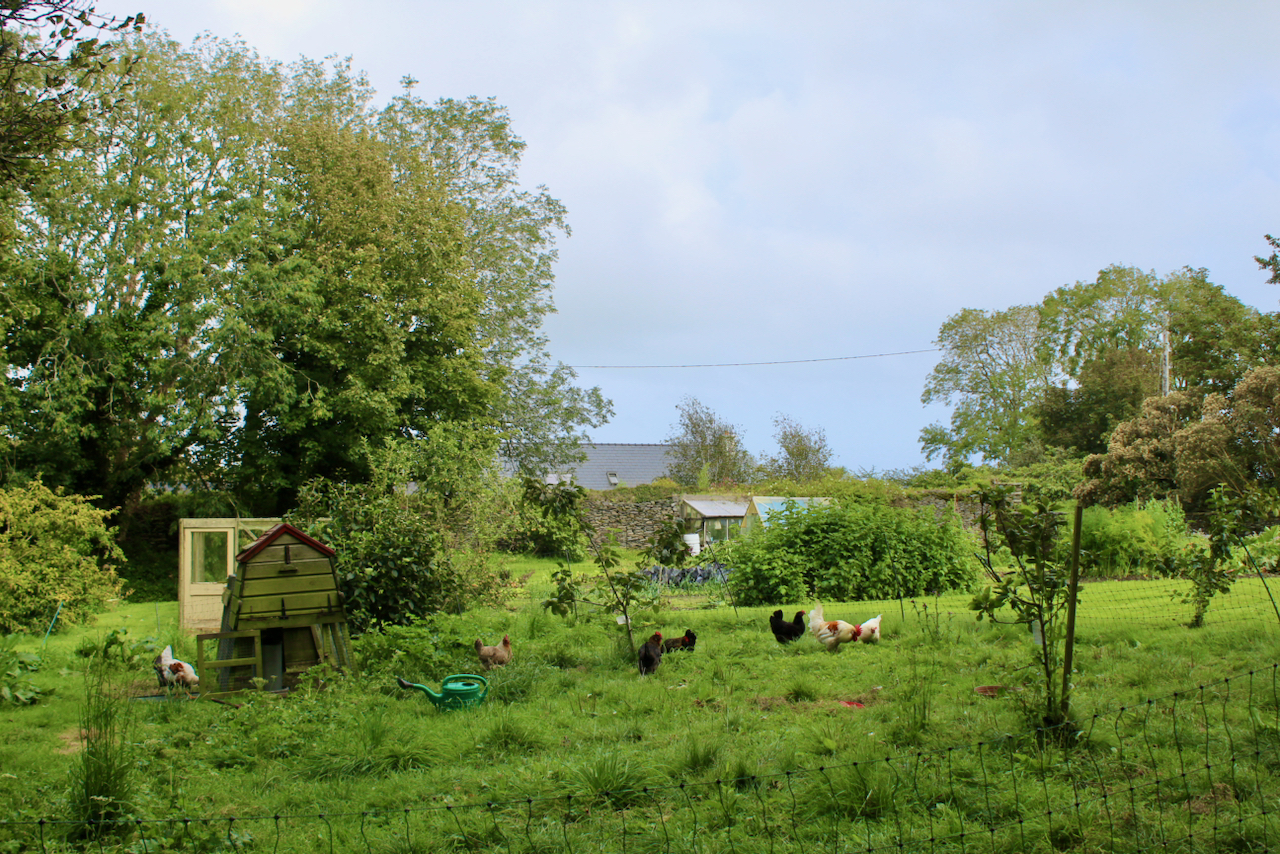
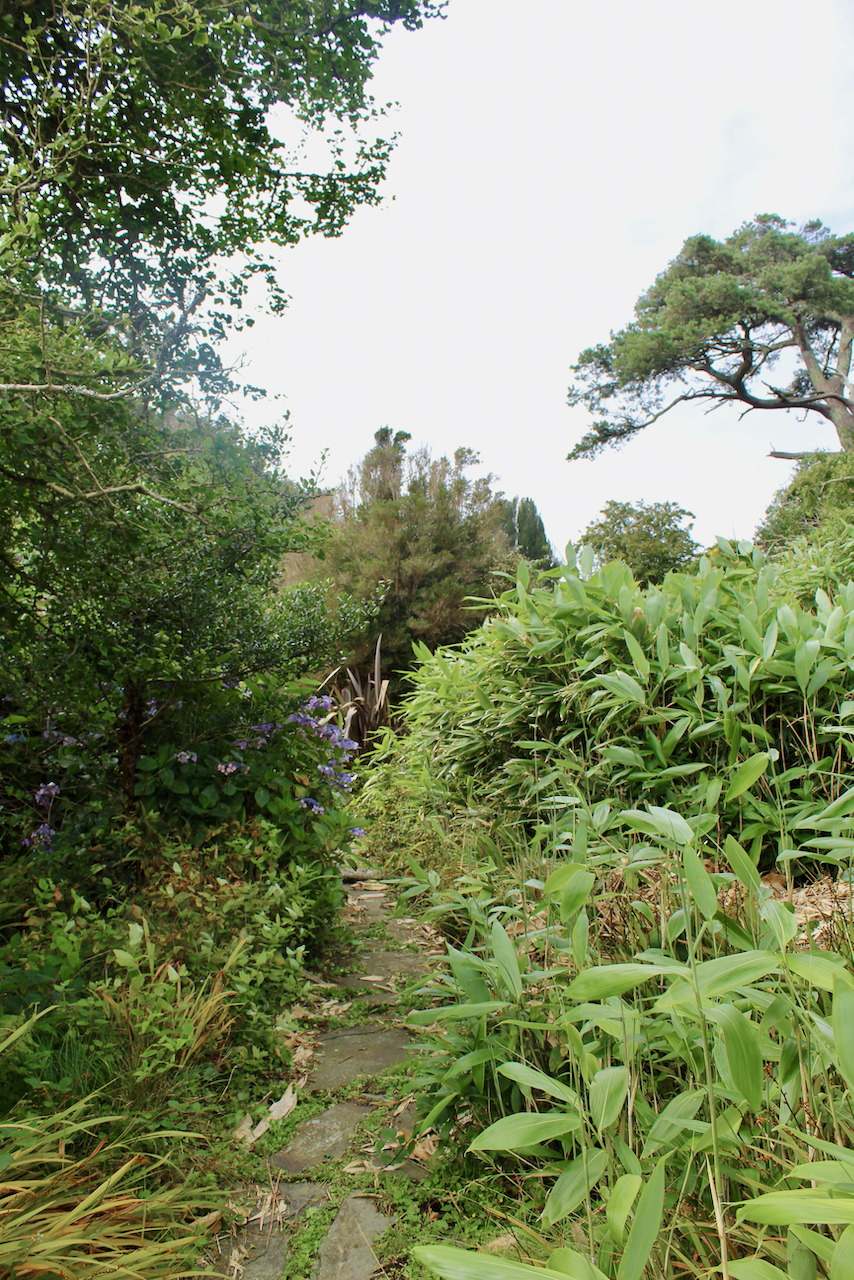
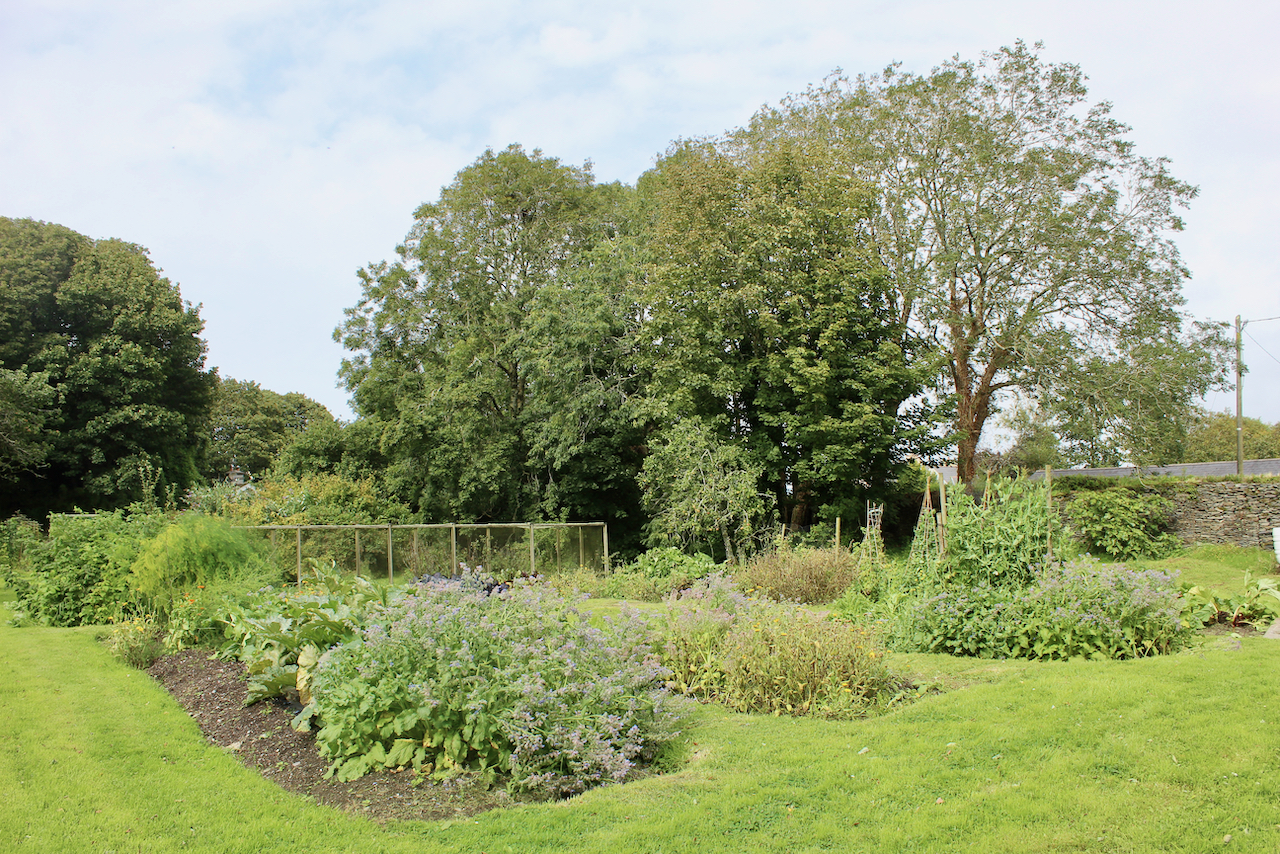
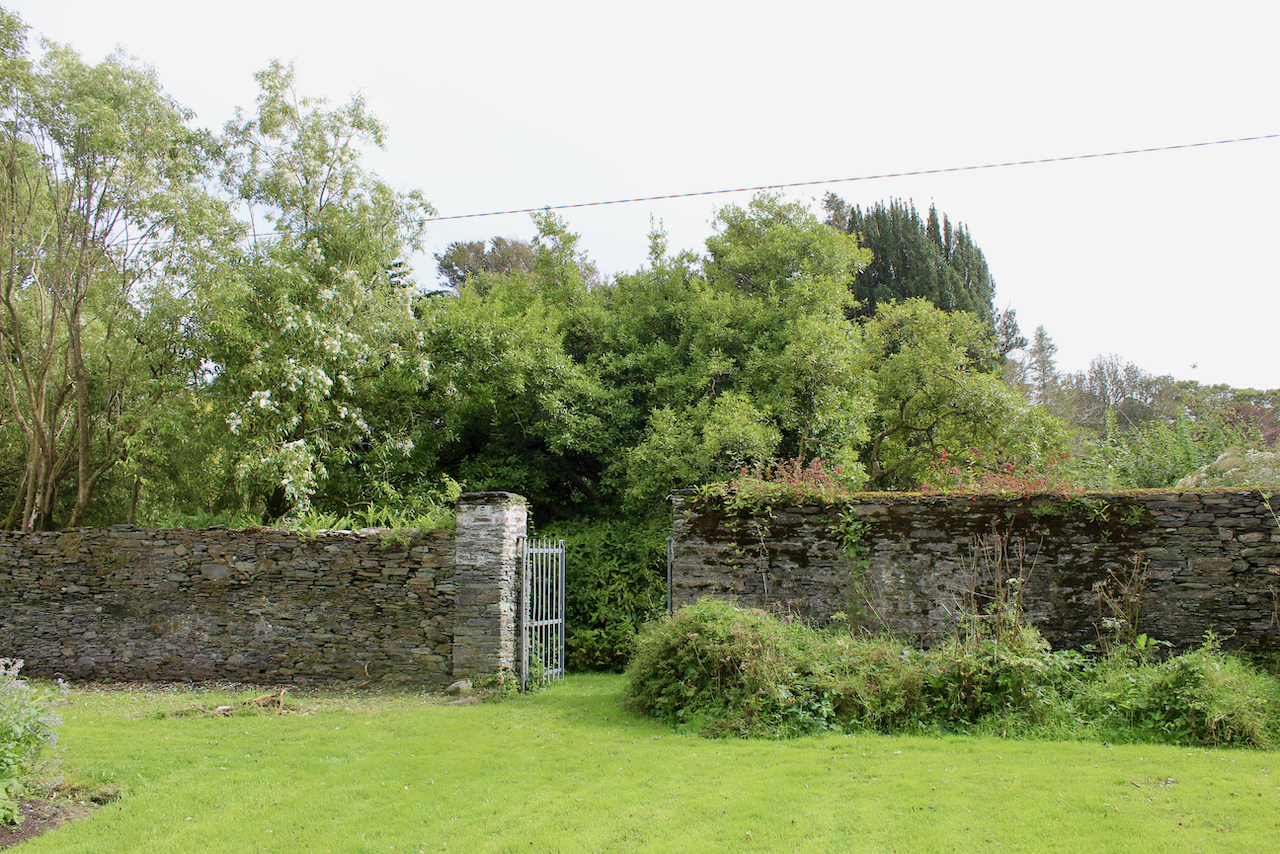
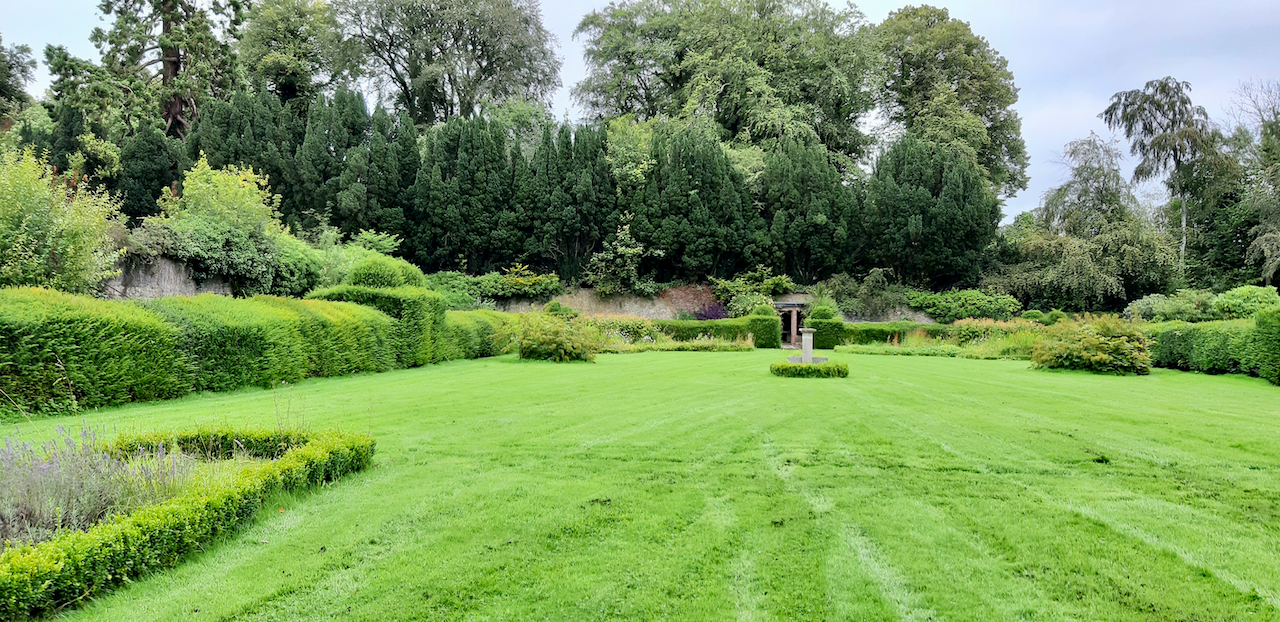
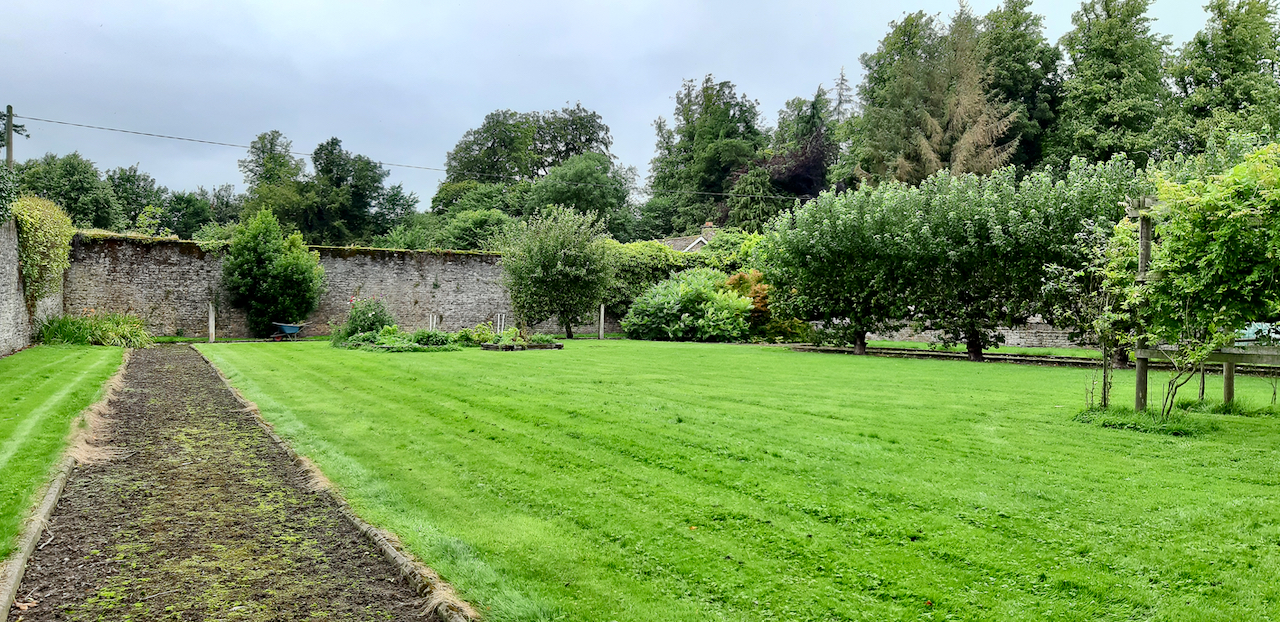
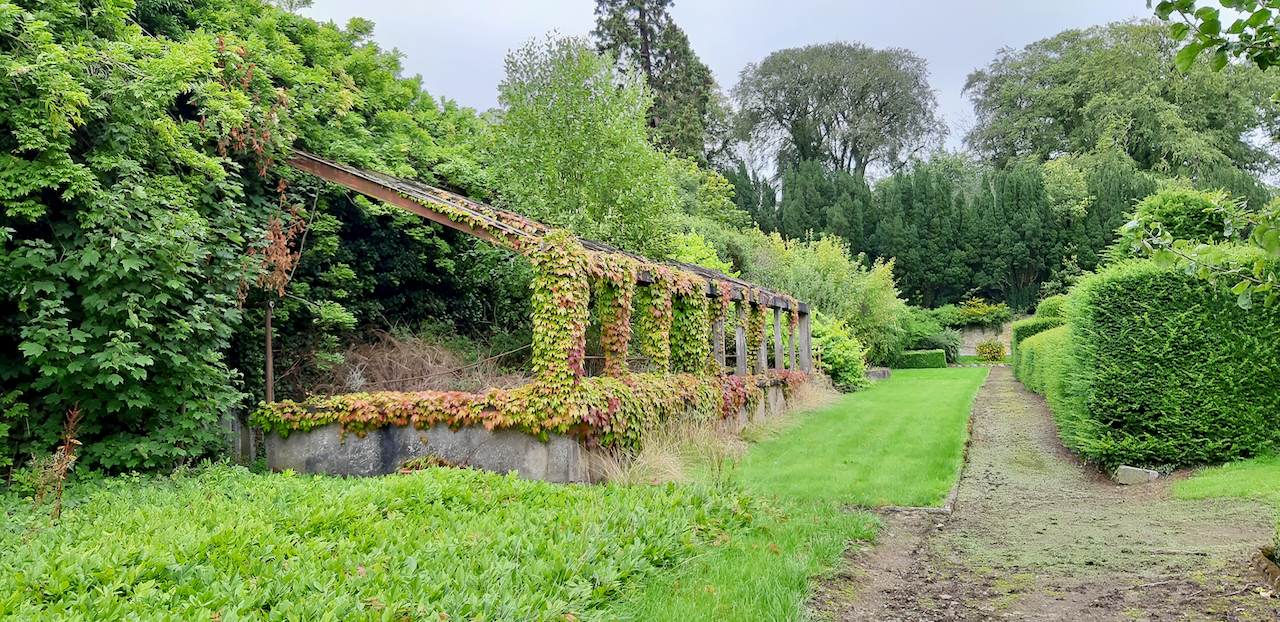
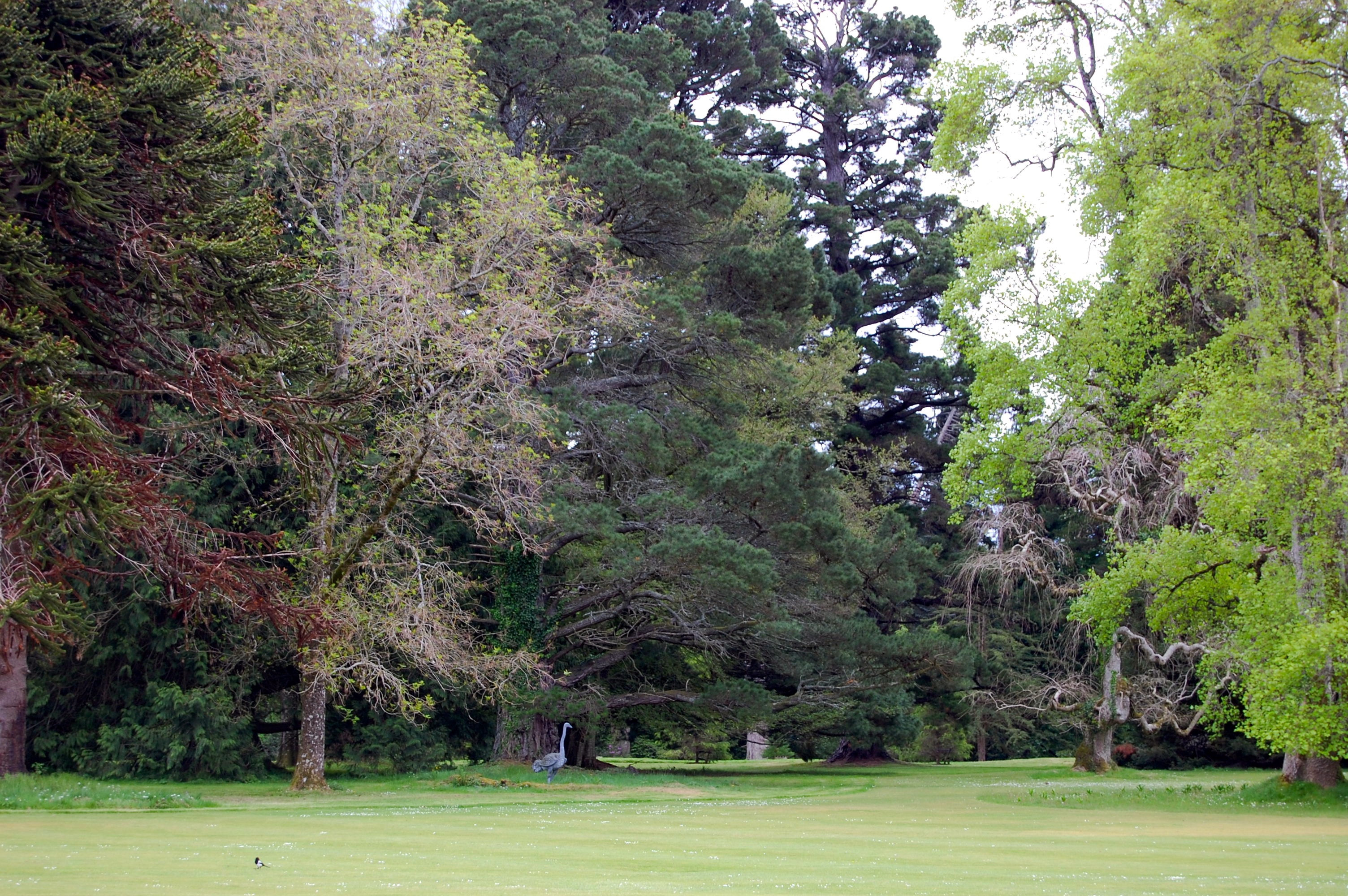
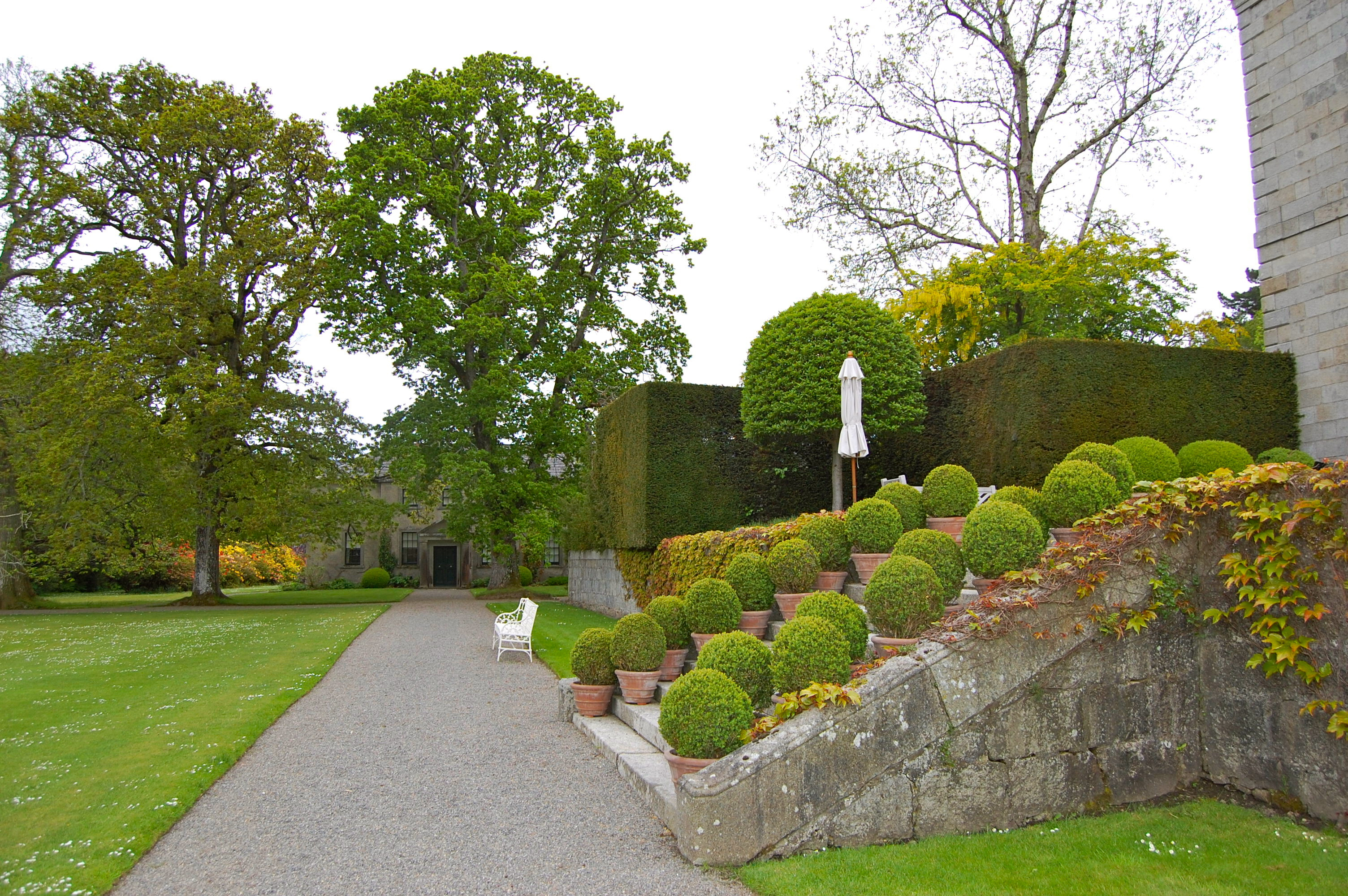
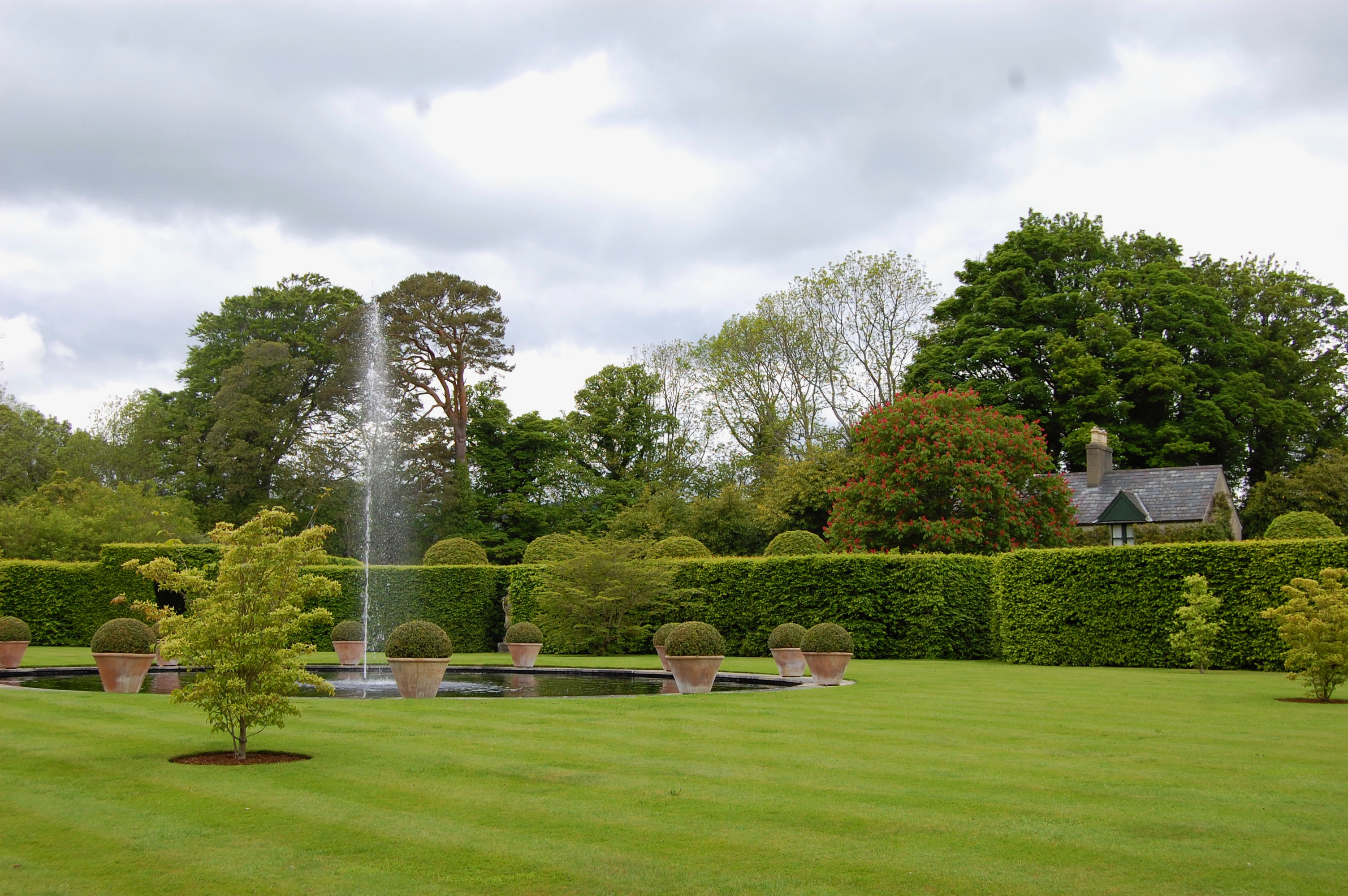
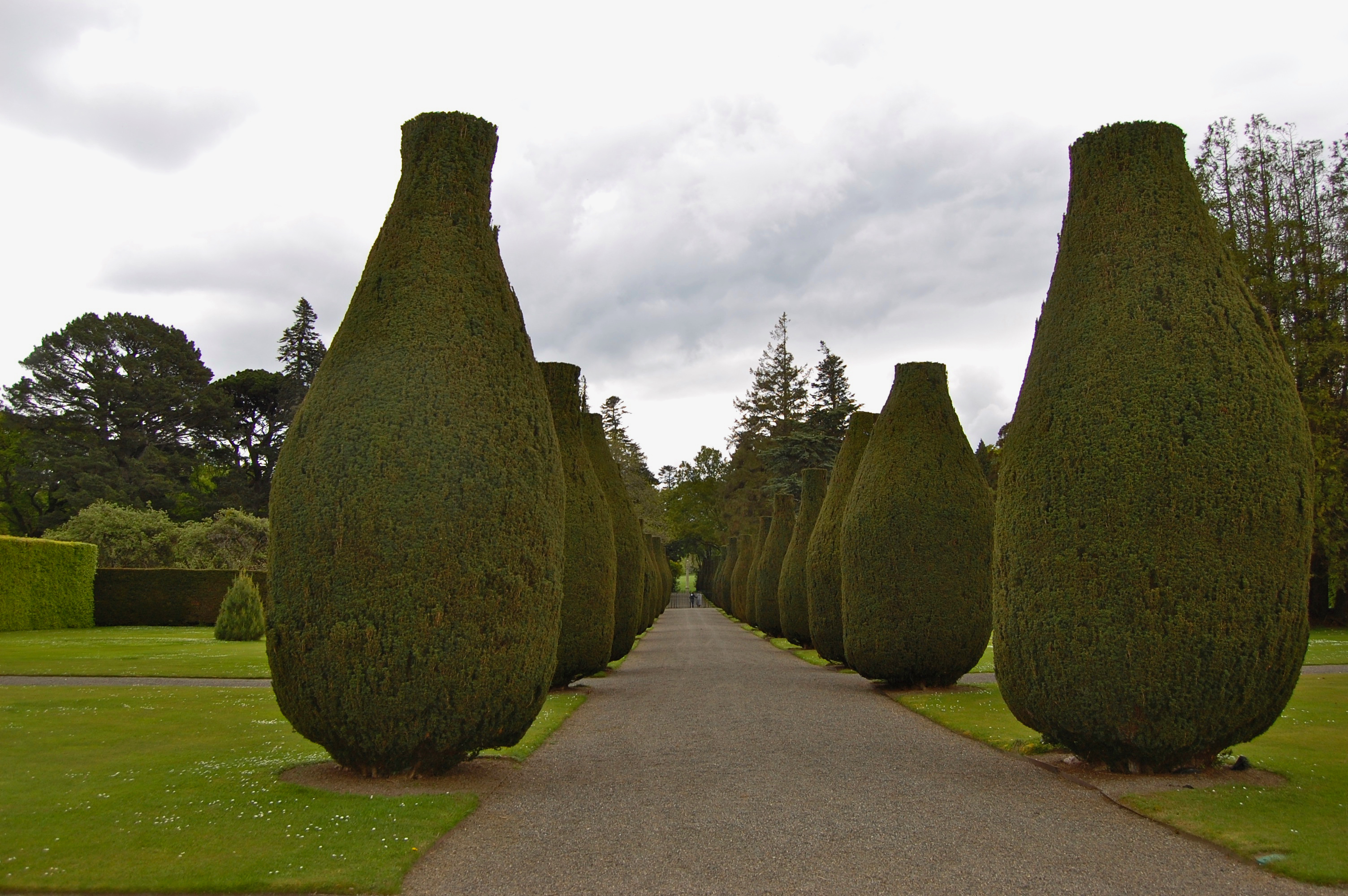
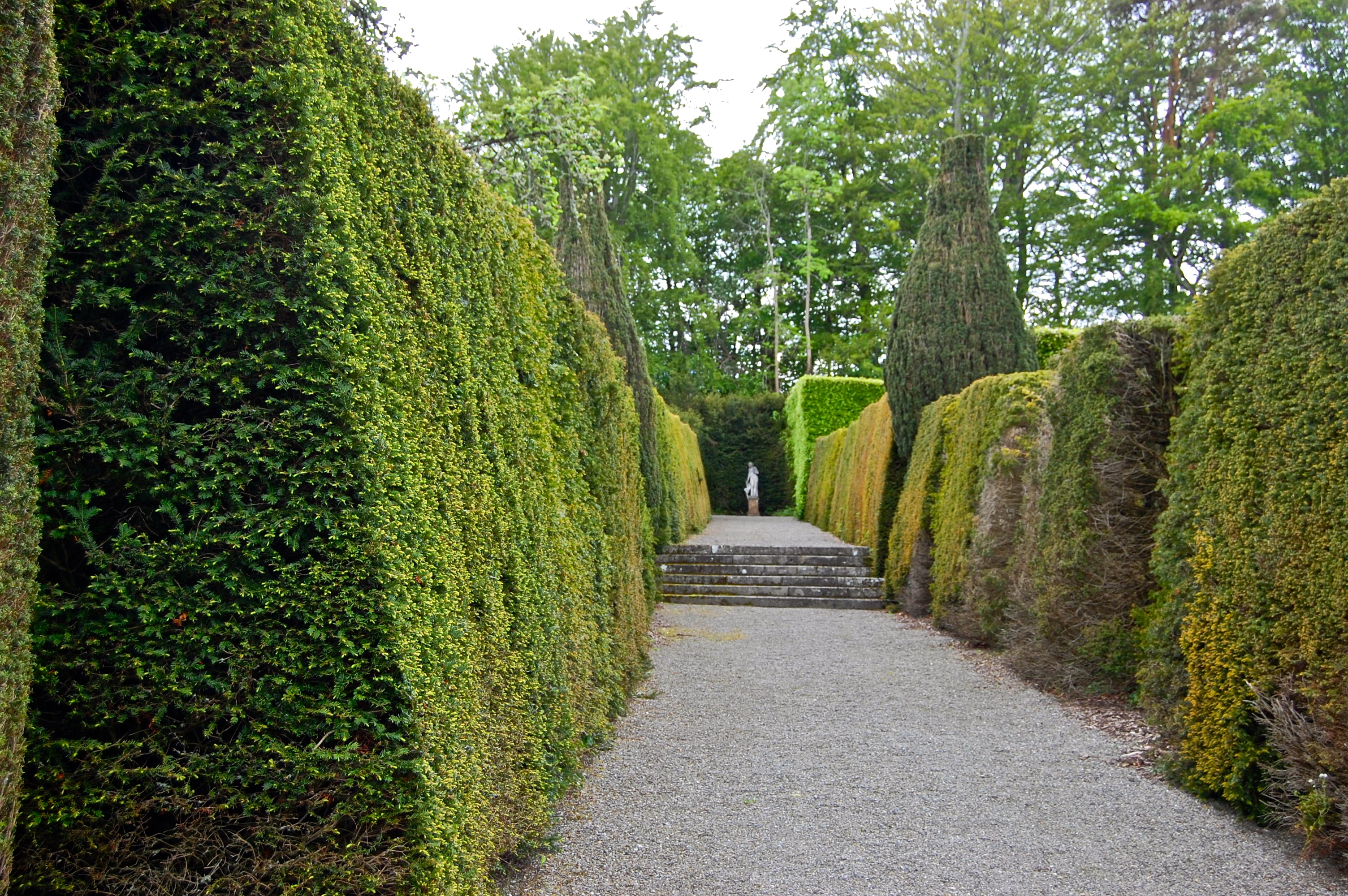
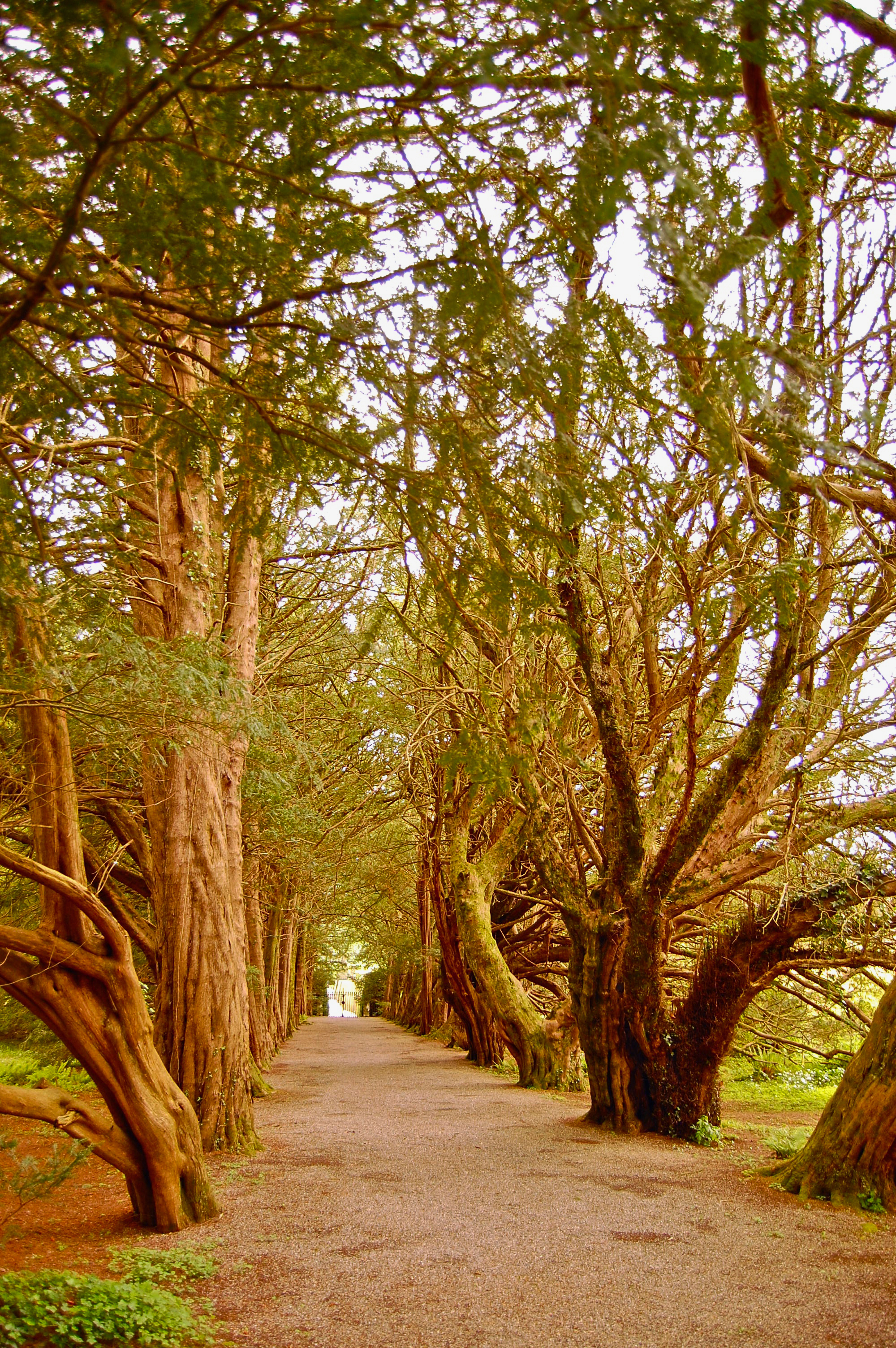
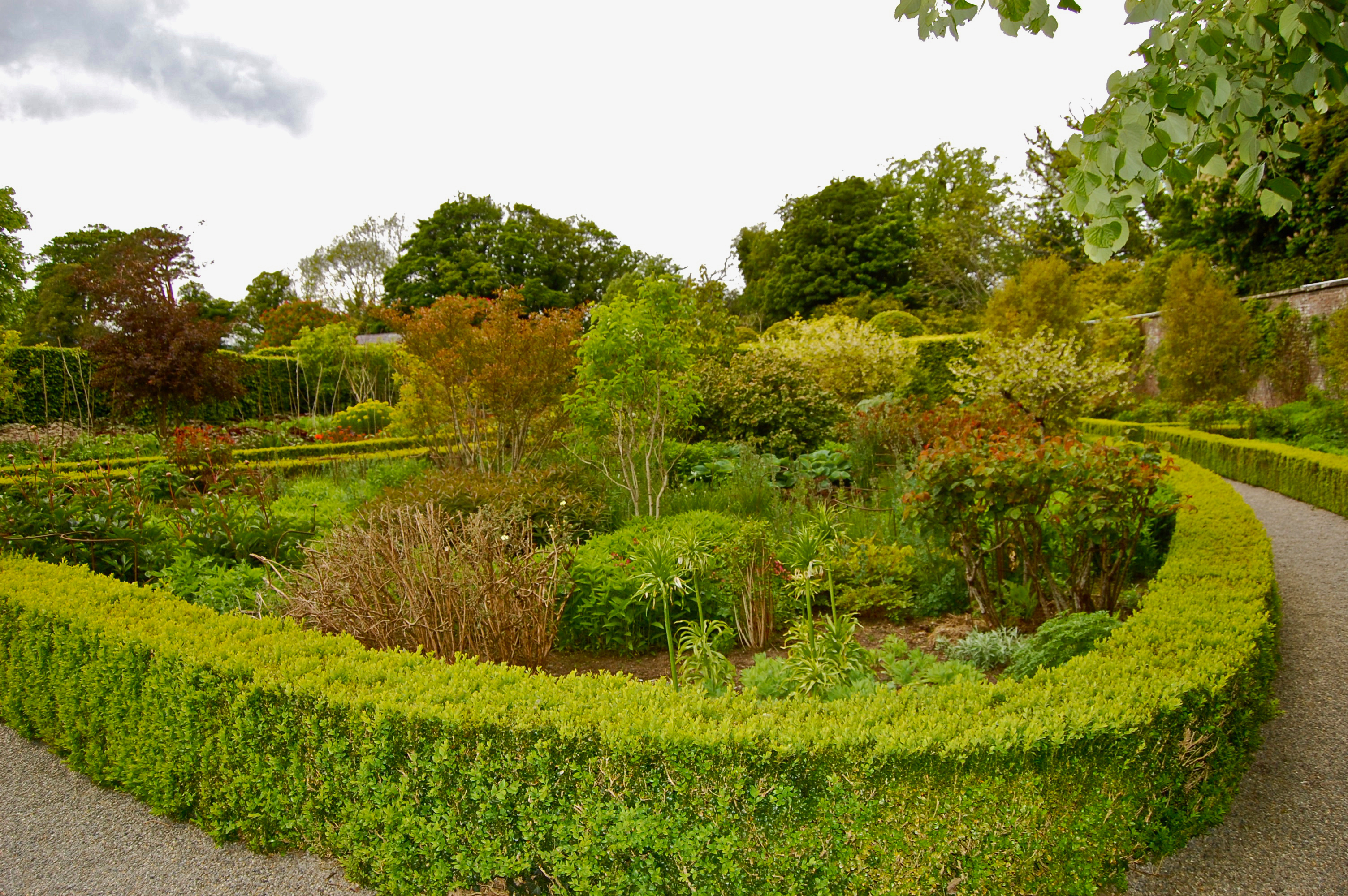
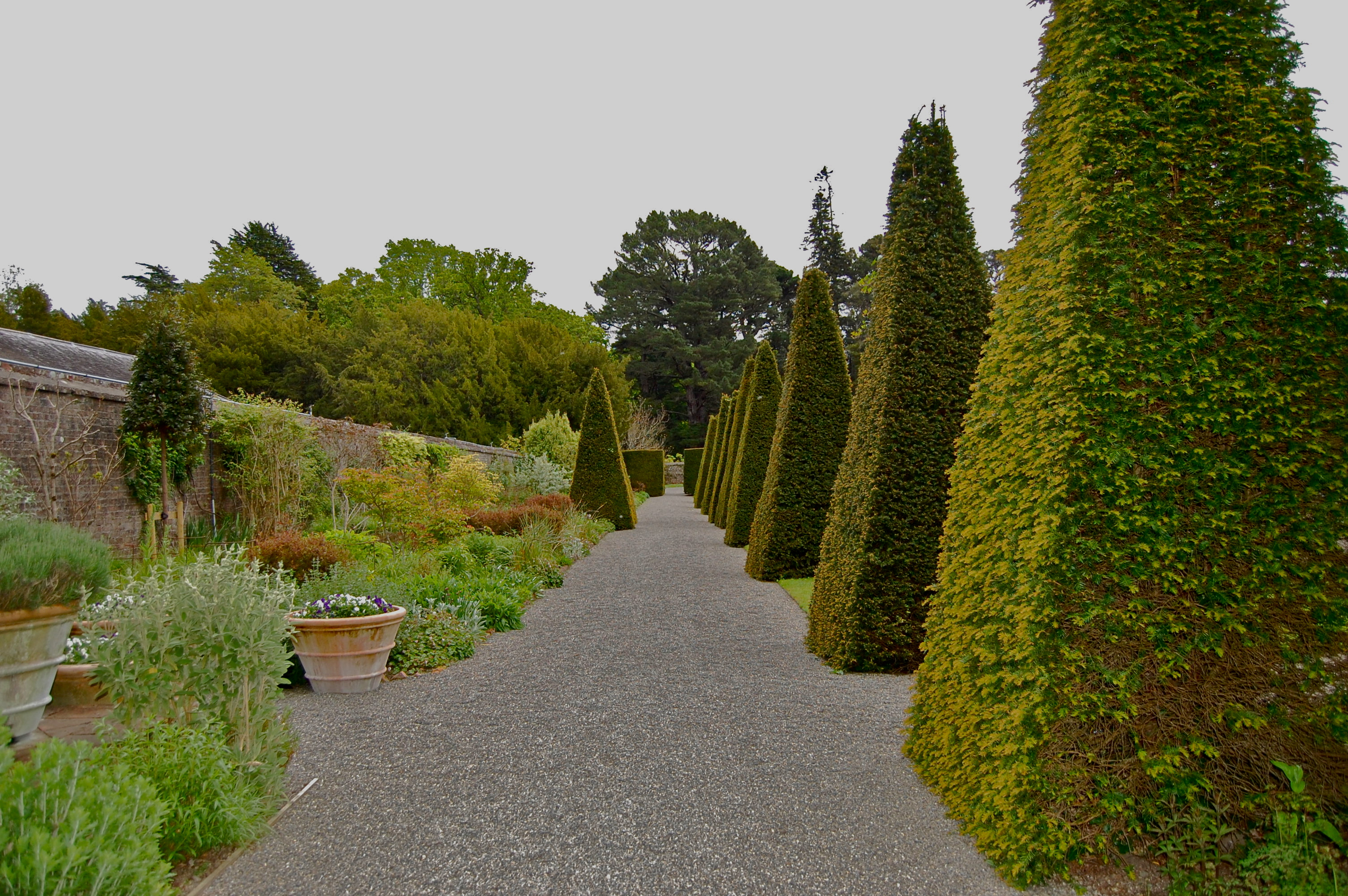
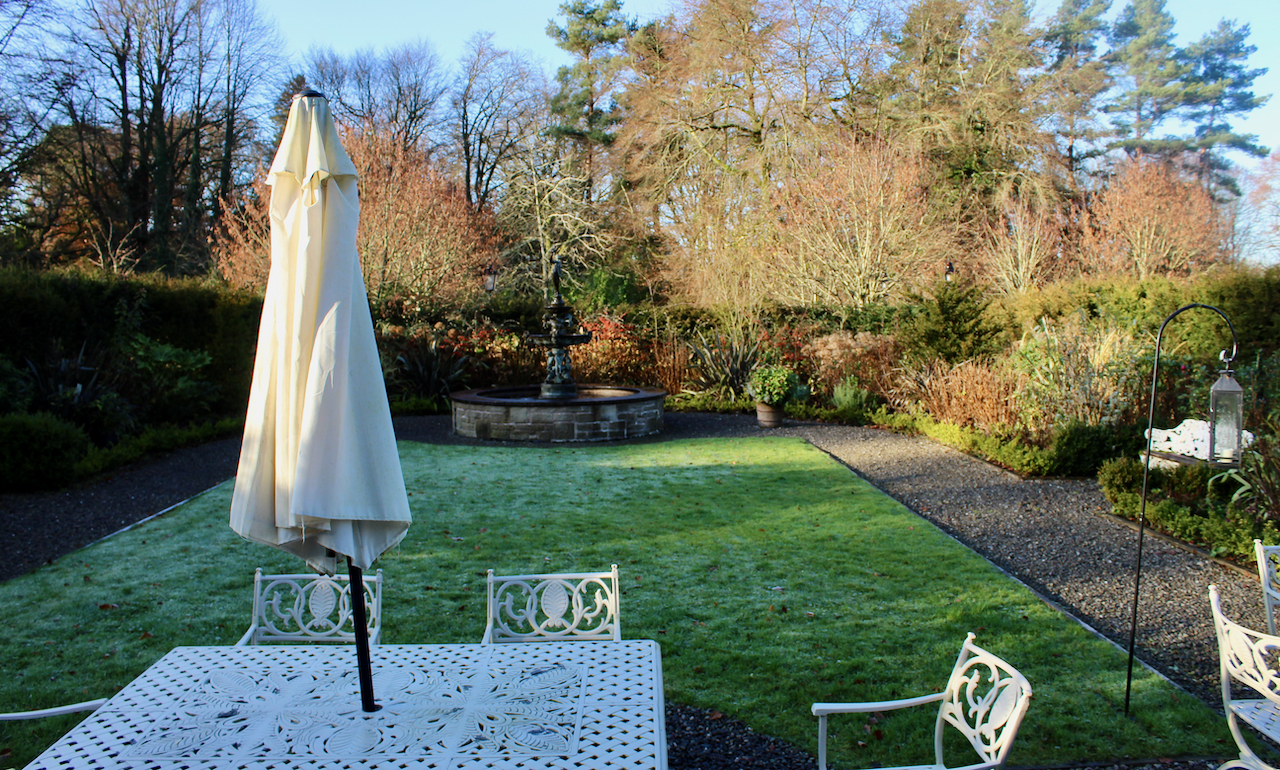
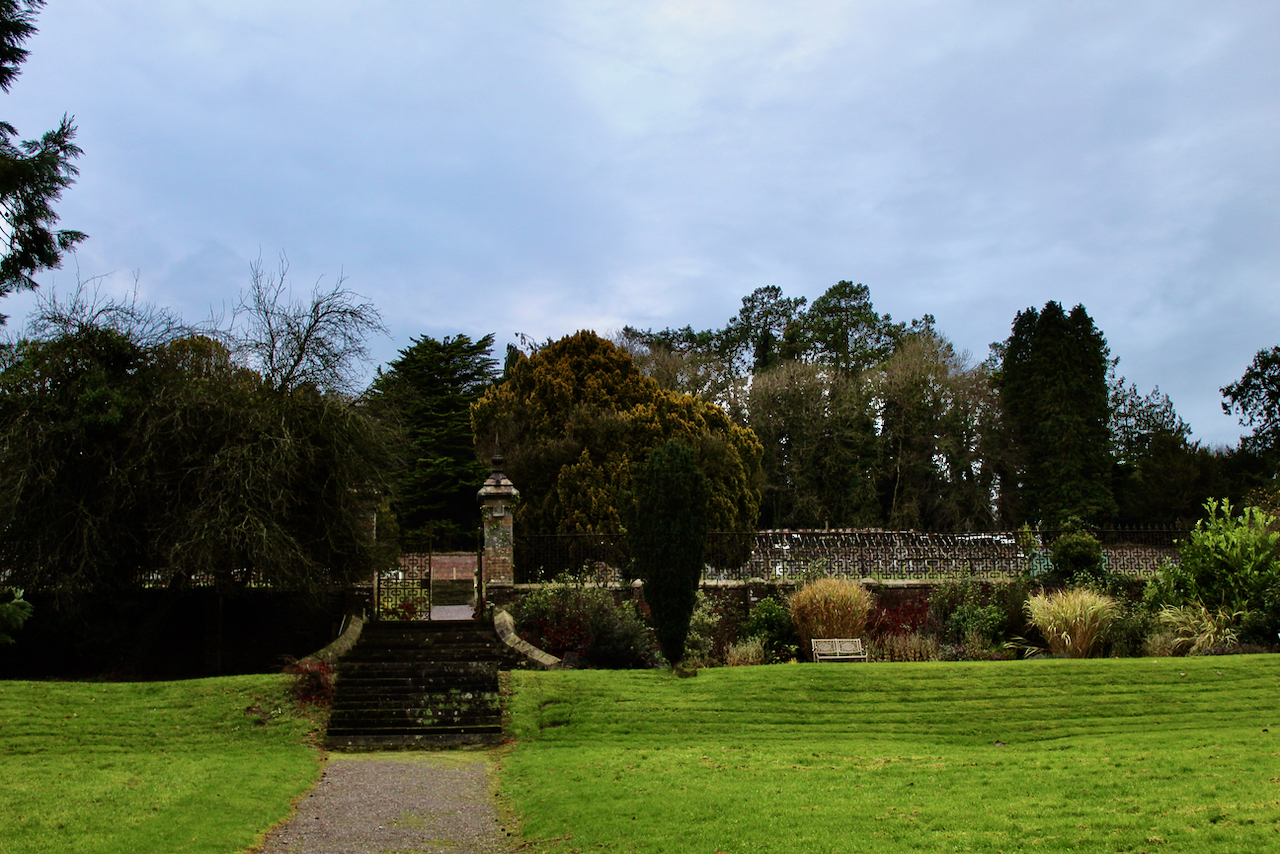
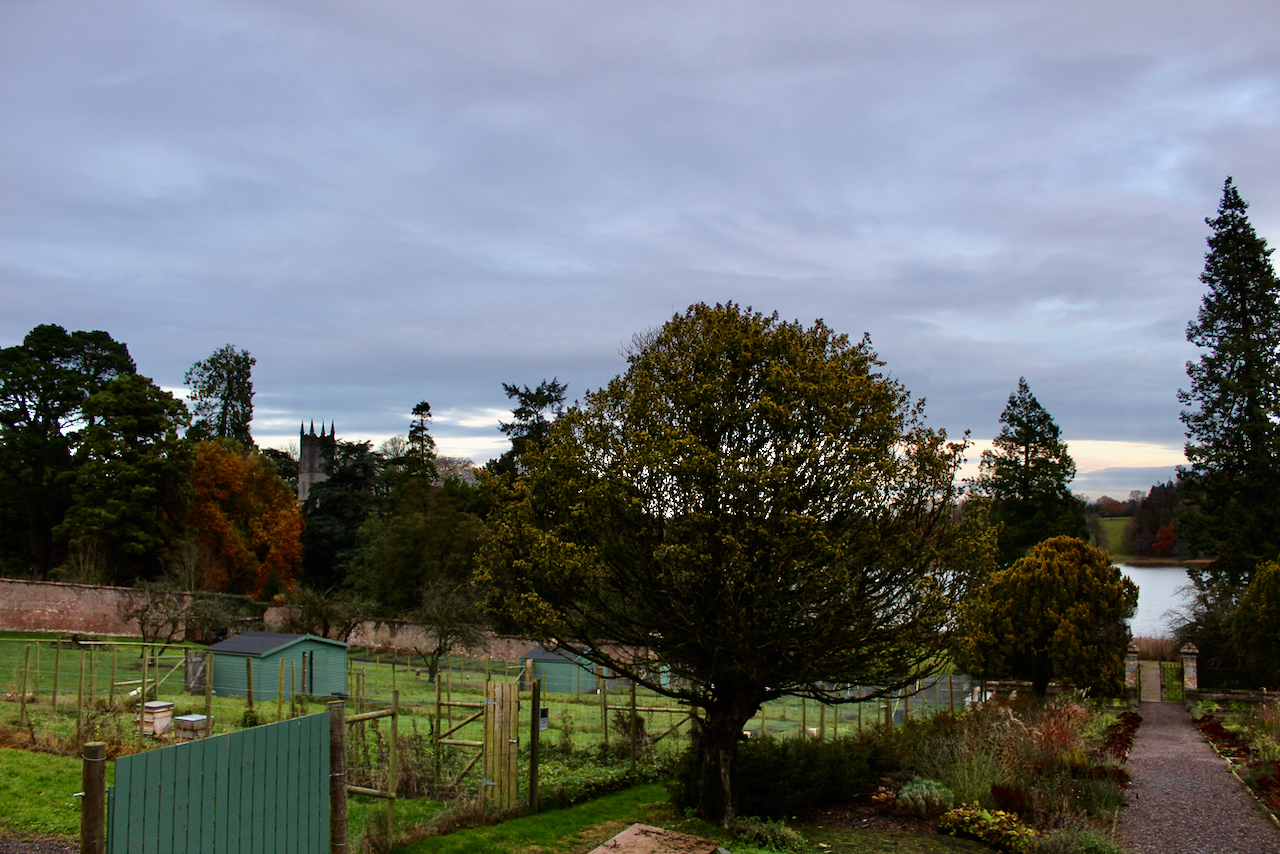
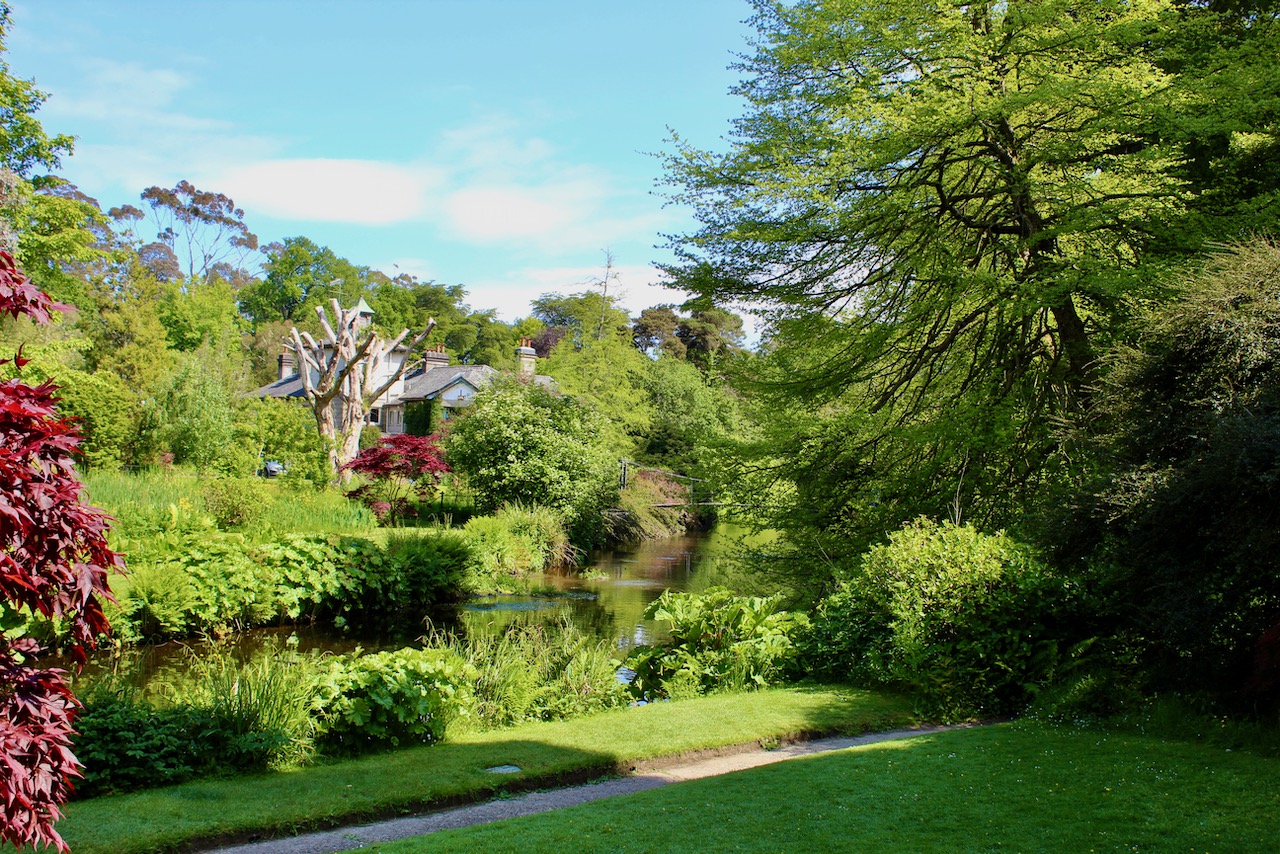
The house is set in eighteen acres of gardens and woodland. 

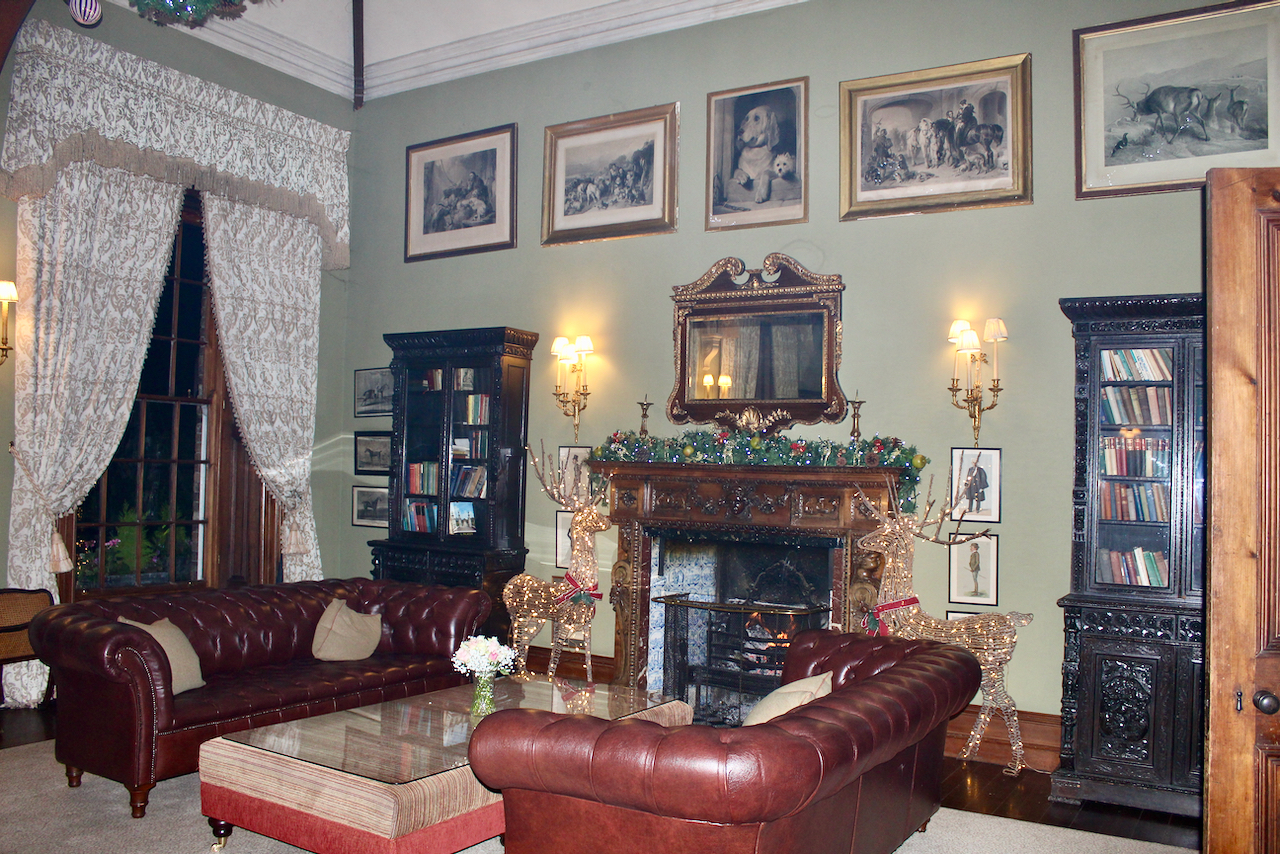
At Drishane House. Photograph © Jennifer Winder-Baggot, www.irishhistorichouses.com
At Drishane House.
At Drishane House. Photograph © Jennifer Winder-Baggot, www.irishhistorichouses.com
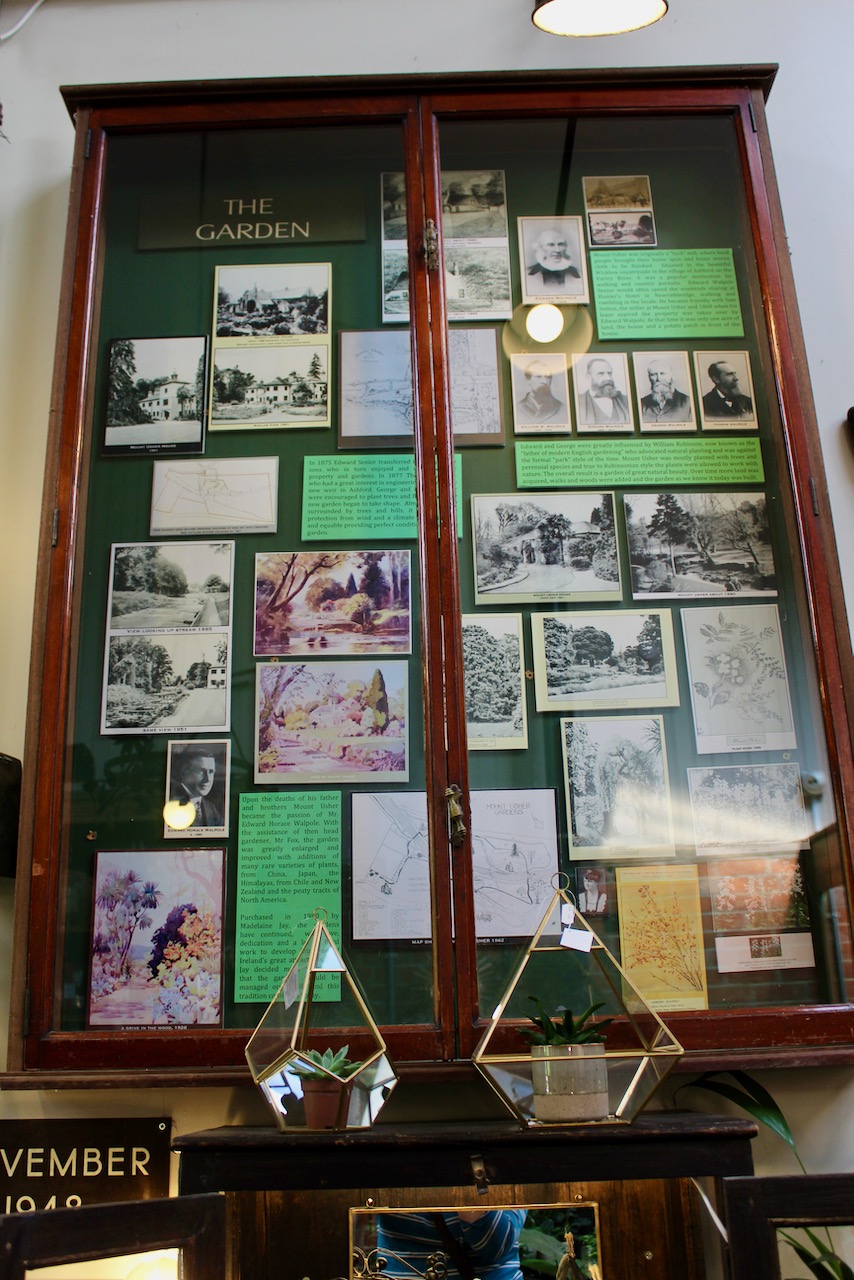
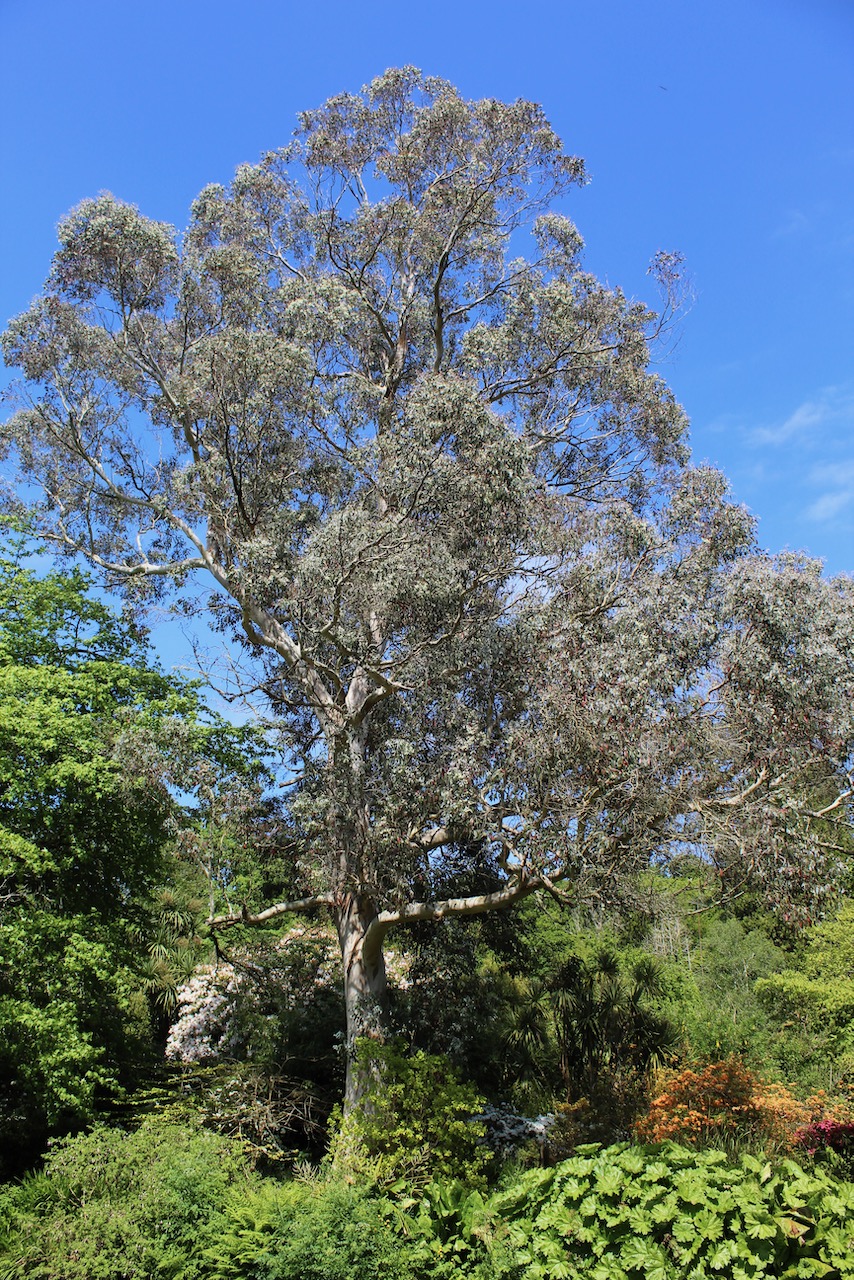
At Drishane House, August 2020. Photograph © Jennifer Winder-Baggot, www.irishhistorichouses.com
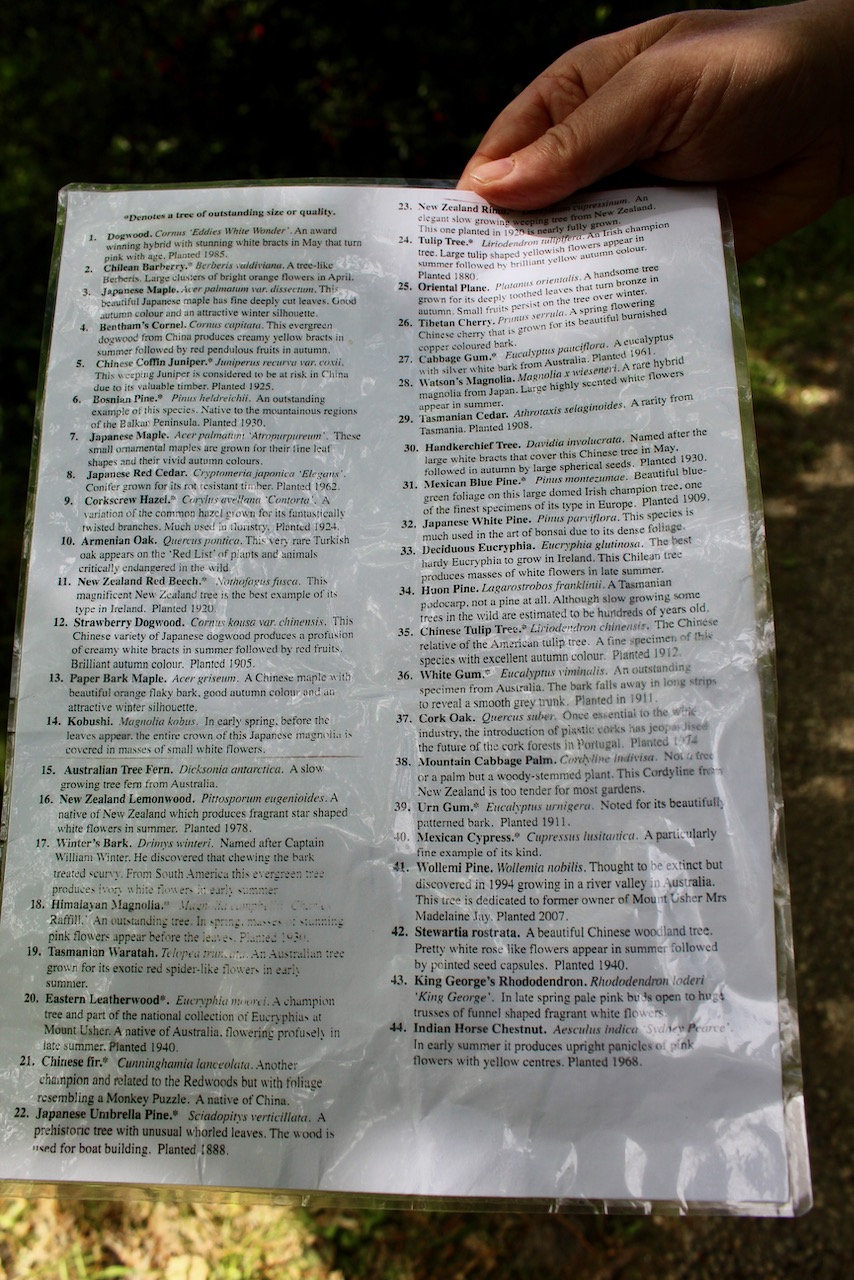
[1] p. 105. O’Hea O’Keeffe, Jane. Voices from the Great Houses: Cork and Kerry. Mercier Press, Cork, 2013.

[2] p. 121. Hicks, David. Irish Country Houses, Portraits and Painters. The Collins Press, Cork, 2014.

[3] p. 84, O’Hea O’Keeffe.

[4] https://www.buildingsofireland.ie/buildings-search/building/20836017/castle-townsend-castletownsend-castletownshend-co-cork

[5] Keohane, Frank. The Buildings of Ireland: Cork, City and County. Yale University Press, New Haven and London, 2020.

[6] https://www.rosscastle.com and www.drishane.com

[7] p. 105. Bence-Jones, Mark. Life in an Irish Country House. Constable, London. 1996. 

[8] from Moira Somerville’s Edith OE Somerville. An Intimate Recollection. Typescript in Edith Oenone Somerville Archive, referred to by Mark Bence-Jones, Life in an Irish Country House. Constable, London. 1996.

[9] p. 107. Bence-Jones, Mark. Life in an Irish Country House. Constable, London. 1996. 

[10] p. 100. Bence-Jones, Mark. Life in an Irish Country House. Constable, London. 1996. 

[11] p. 122-3, Hicks, David. Irish Country Houses, Portraits and Painters. The Collins Press, Cork, 2014.

[12] Yes indeed, another Somerville-Townshend marriage. The genealogy goes as follows:

Rev William Somerville (1641-1694) m. Agnes Agnew 

Drishane passed to his son, Rev Thomas Somerville (1689-1752), who married Anne Neville 

Drishane passed to their son Thomas Somerville (1725-1793), who married Mary Townsend, daughter of Philip Townsend and Elizabeth Hungerford; grand-daughter of Commander Bryan Townsend (1648-1726). 

Drishane passed to their son, Thomas Townsend Somerville (1725-1811). He married Elizabeth Henrietta Becher Townsend (1776-1832), daughter of John Townsend (1737-1810) [granddaughter of  Richard Townsend and Elizabeth Becher, great-granddaughter of Commander Bryan Townsend (1648-1726)] and Mary Morris.

Drishane passed to the son, Col Thomas Somerville (1798-1882). He married Henrietta Augusta Townshend, daughter of Richard Boyle Townsend (1756-1826), who is great-grandson of Commander Bryan Towsend (1648-1726). 

[ie. Richard Boyle Townsend (1756-1826) is son of Richard Townsend (1725-1783) and Elizabeth Fitzgerald, who is son of Richard Townsend (1684-1742) and Elizabeth Becher, who is son of Commander Bryan Townsend (1648-1726).] 

Drishane passed to son Lieut Col. Thomas Somerville (1824-1898), who married Adelaide Eliza Coghill. 

Drishane passed to their son, (Thomas) Cameron Somerville, the brother of Edith. He died, and Drishane passed via his younger brother Captain Aylmer Coghill Somerville to his son Desmond Somerville. 

[13] p. 100-01. Bence-Jones, Mark. Life in an Irish Country House. Constable, London. 1996.

[14] p. 102. Bence-Jones, Mark. Life in an Irish Country House. Constable, London. 1996. Stephen and I are fans of Michael Portillo’s travel shows, where he takes trains and follows his Bradshaw’s guide, so I like this detail!

[15] https://roaringwaterjournal.com/tag/church-of-st-barrahane/

[16] p. 108. Bence-Jones, Mark. Life in an Irish Country House. Constable, London. 1996. 

[17] p. 113. O’Hea O’Keeffe.

https://www.buildingsofireland.ie/buildings-search/building/20848098/point-house-point-road-crosshaven-crosshaven-co-cork

[18] p. 106. Bence-Jones, Mark. Life in an Irish Country House. Constable, London. 1996.

[19] p. 130. Hicks, David. Irish Country Houses, Portraits and Painters. The Collins Press, Cork, 2014.

[20] p. 109. O’Hea O’Keeffe.

Text © Jennifer Winder-Baggot, www.irishhistorichouses.com
Covid times, and planning ahead

Ideally I would like to continue publishing a blog entry every week but I am still catching up on places I have visited, writing and researching and seeking approval from home-owners, and am unable to keep up the pace!

Doneraile Court, County Cork. Photograph © Jennifer Winder-Baggot, www.irishhistorichouses.com
Deer in the park at Doneraile. Photograph © Jennifer Winder-Baggot, www.irishhistorichouses.com
We visited some big houses that are not on the Section 482 revenue list when we were in County Cork last year during Heritage Week, including Doneraile Court and Fota, both open to the public and well worth a visit. [1] If I run out of places to write about on the section 482 list, I will write about them! But I still have to write about our visit to Cabra Castle, County Cavan, before Christmas last year! [2] We had a wonderful treat of being upgraded to a bedroom suite in the Castle, the Bridal Suite, no less, with our own rooftop jacuzzi.

Photograph © Jennifer Winder-Baggot, www.irishhistorichouses.com
The Bridal Suite at Cabra Castle, County Cavan. Photograph © Jennifer Winder-Baggot, www.irishhistorichouses.com
The 2021 Revenue list of 482 Properties has not yet been published, and I am not sure when we will be able to visit places again, due to Covid transmissibility. I have already mapped out a year’s worth of visits, all around Ireland, and have even booked to stay in some exciting looking houses, but I don’t know what is going to be open – I have been planning around the 2020 list, assuming opening dates, once places do open, will be similar to last year.

In the meantime I can look at photographs and dream, and work on my own home (I painted the bedroom sage green) and garden (my potatoes are chitting) and research upcoming visits. I’m currently reading Turtle Bunbury’s book about the landowning families in County Kildare, and Mark Bence-Jones’s Life in an Irish Country House, and Somerville and Ross’s The Real Charlotte.

We were privileged to be able to stay in Mark Bence-Jones’s house last year for a wonderful week. [3]

Photograph © Jennifer Winder-Baggot, www.irishhistorichouses.com
Glenville Park, the home of the late Mark Bence-Jones, County Cork. Photograph © Jennifer Winder-Baggot, www.irishhistorichouses.com
I will be writing soon about more big houses and in the meantime, I hope you are able to stay safe and healthy and happy in these Covid times.

Fota House, County Cork. Photograph © Jennifer Winder-Baggot, www.irishhistorichouses.com
[1] http://doneraileestate.ie

https://fotahouse.com

[2] https://www.cabracastle.com

[3] http://www.glenvillepark.com

Russborough House, Blessington, County Wicklow W91 W284 – section 482

The Albert Beit Foundation, Blessington, Co. Wicklow

http://www.russborough.ie/

Open dates in 2026: Feb 1-Dec 23, 27-31, Feb, Oct, Nov, Dec 9am-5.30pm, Mar-Sept 9am-6pm

Fee: adult €15.50 OAP/student €13, child €750, group rates on request

donation

Help me to pay the entrance fee to one of the houses on this website. This site is created purely out of love for the subject and I receive no payment so any donation is appreciated!

€15.00

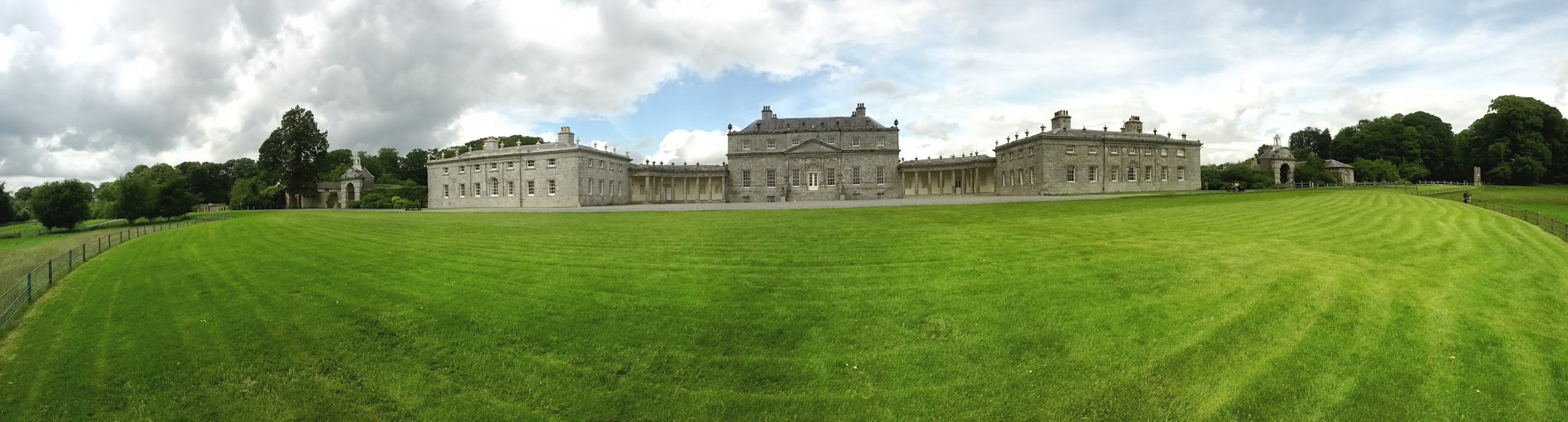
Russborough House, Photograph taken in June 2012 on a visit with my friends Tara and Jeremy and their daughters. Photograph © Jennifer Winder-Baggot, www.irishhistorichouses.com
Photo by Jeremy Hylton.

In his A Guide to Irish Country Houses, Mark Bence-Jones calls Russborough House “arguably the most beautiful house in Ireland.” [1] We are lucky that Russborough House is open to the public, thanks to the Beit Foundation. Sir Alfred and Lady Clementine Beit left the property to the state in 1978, to be cared for by a Trust established for the purpose. The Irish Aesthete Robert O’Byrne tells us about the Beits: “The couple had no immediate connection with Ireland, although Lady Beit’s maternal grandmother had been raised in this country and being a Mitford, she was first cousin of the Hon Desmond Guinness’s mother.” [2]

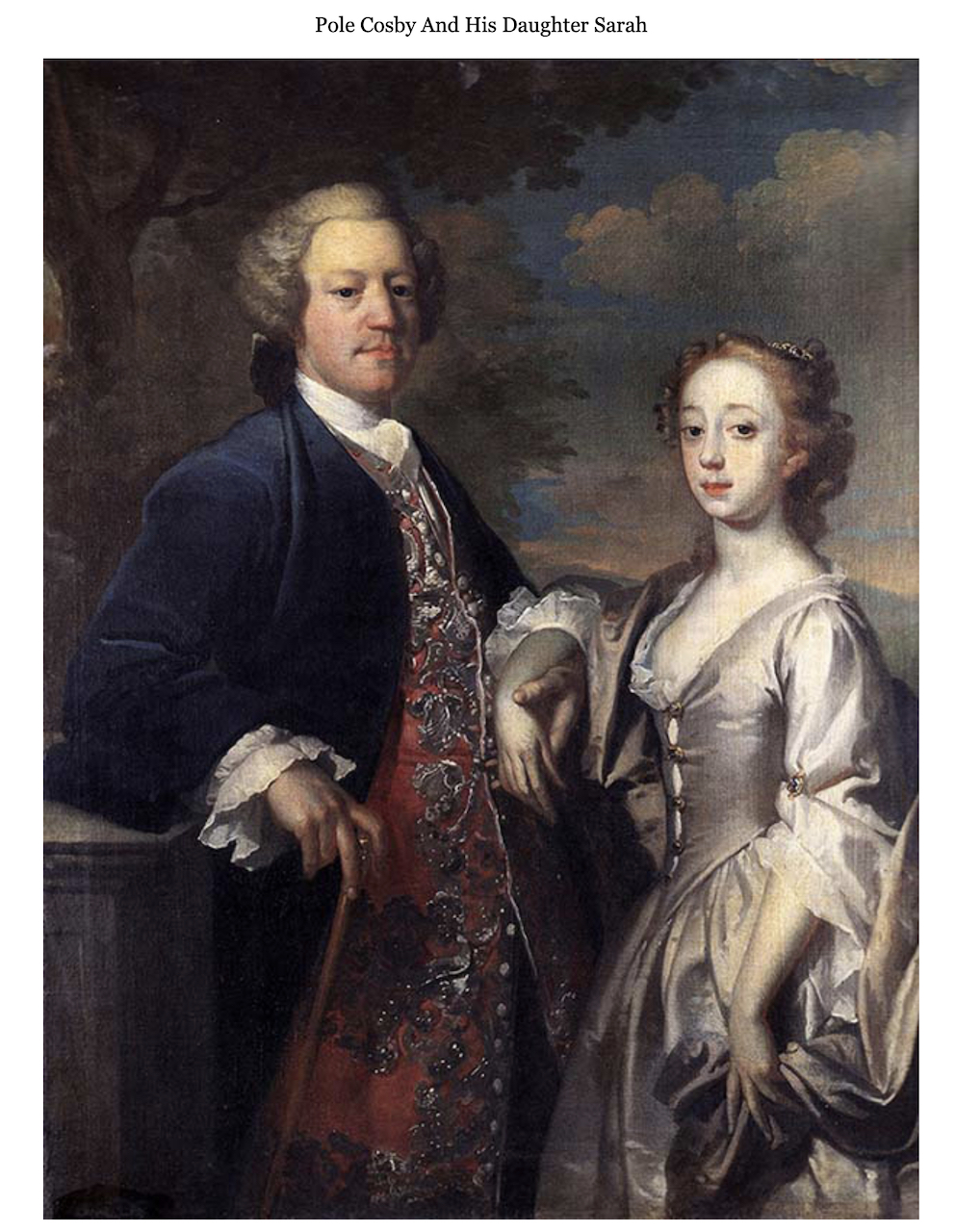
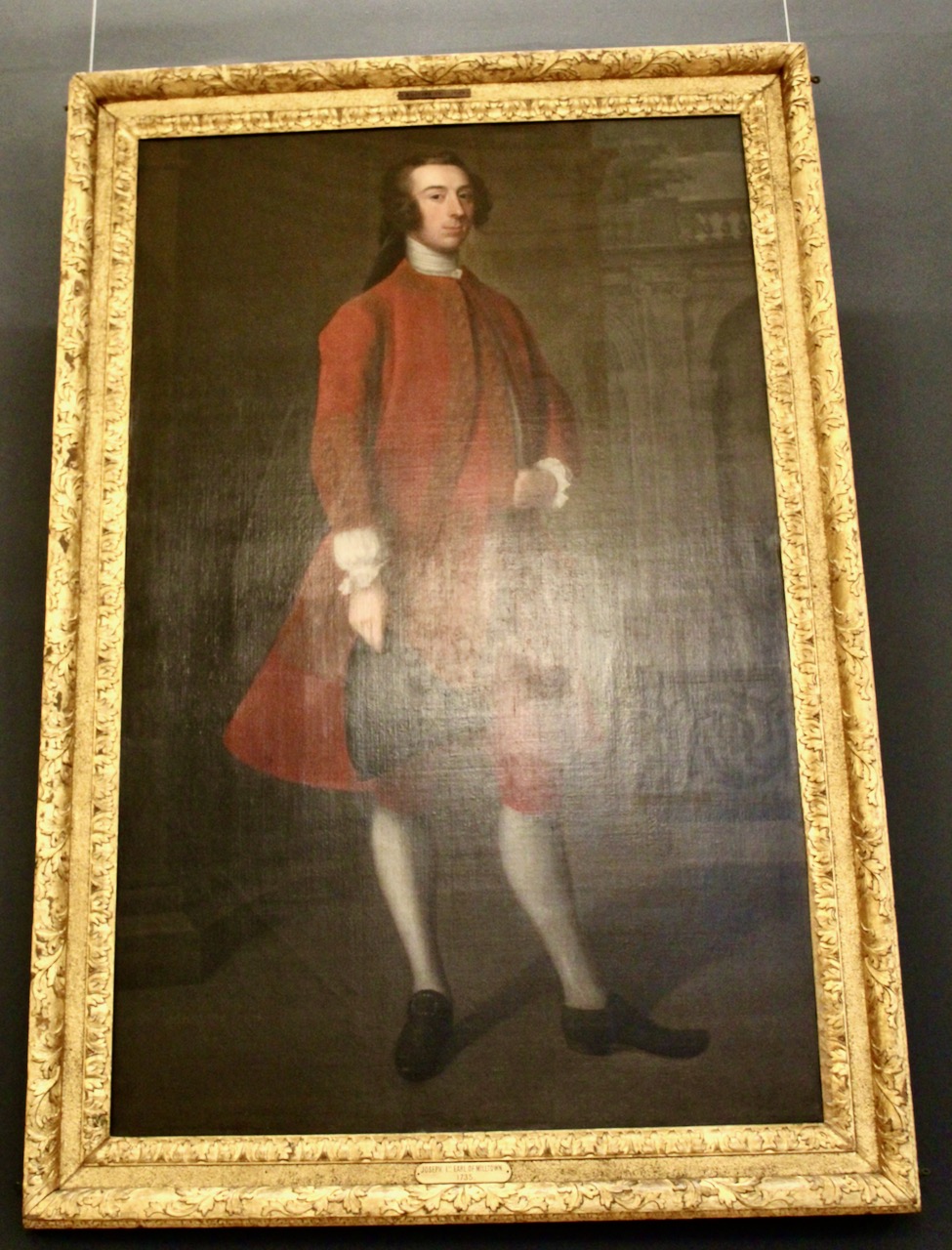
Russborough House was built for Joseph Leeson (1701-1783) in 1741 when he inherited a fortune from his father, also named Joseph (1660-c. 1741), and purchased land owned by John Graydon, and it was designed by Richard Castle.

Joseph Leeson (1660-1741) of Saint Stephen’s Green, painted posthumously around 1772 by unknown artist, courtesy of National Gallery of Ireland NGI 1648.
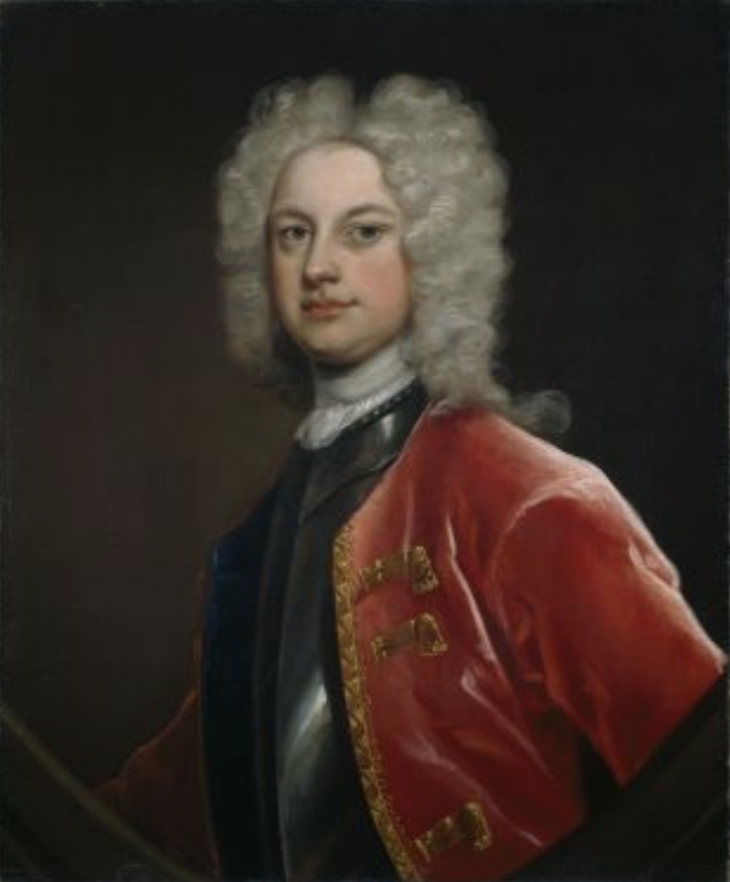
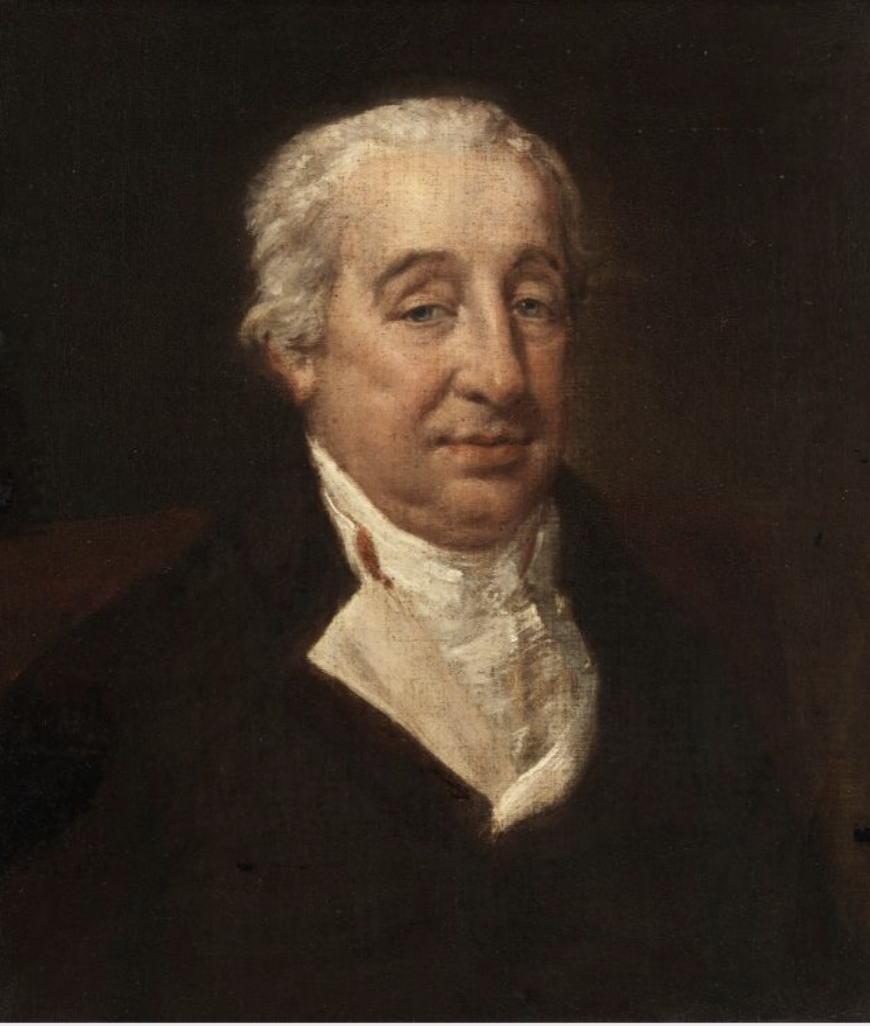
Joseph Leeson (1701-1783), painted by Anthony Lee. Portrait from the National Gallery of Ireland. Later he was created 1st Earl of Milltown. Photograph © Jennifer Winder-Baggot, www.irishhistorichouses.com
Leeson went to great expense creating the grounds for the building of his house: “Leeson’s development of the garden terraces was extravagant. The house gained its fine prominence from sitting on an embankment created by the opening of the lakes and ponds, all reputedly costing some £30,000.” [3]

Russborough, May 2024. Photograph © Jennifer Winder-Baggot, www.irishhistorichouses.com
We came across Richard Castle (c.1690-1751) (or Cassels, as his name is sometimes spelled) in Powerscourt in County Wicklow. The Dictionary of Irish Architects tells us that, oddly, he was born David Riccardo, and it is not known when or why he changed his name. [4]

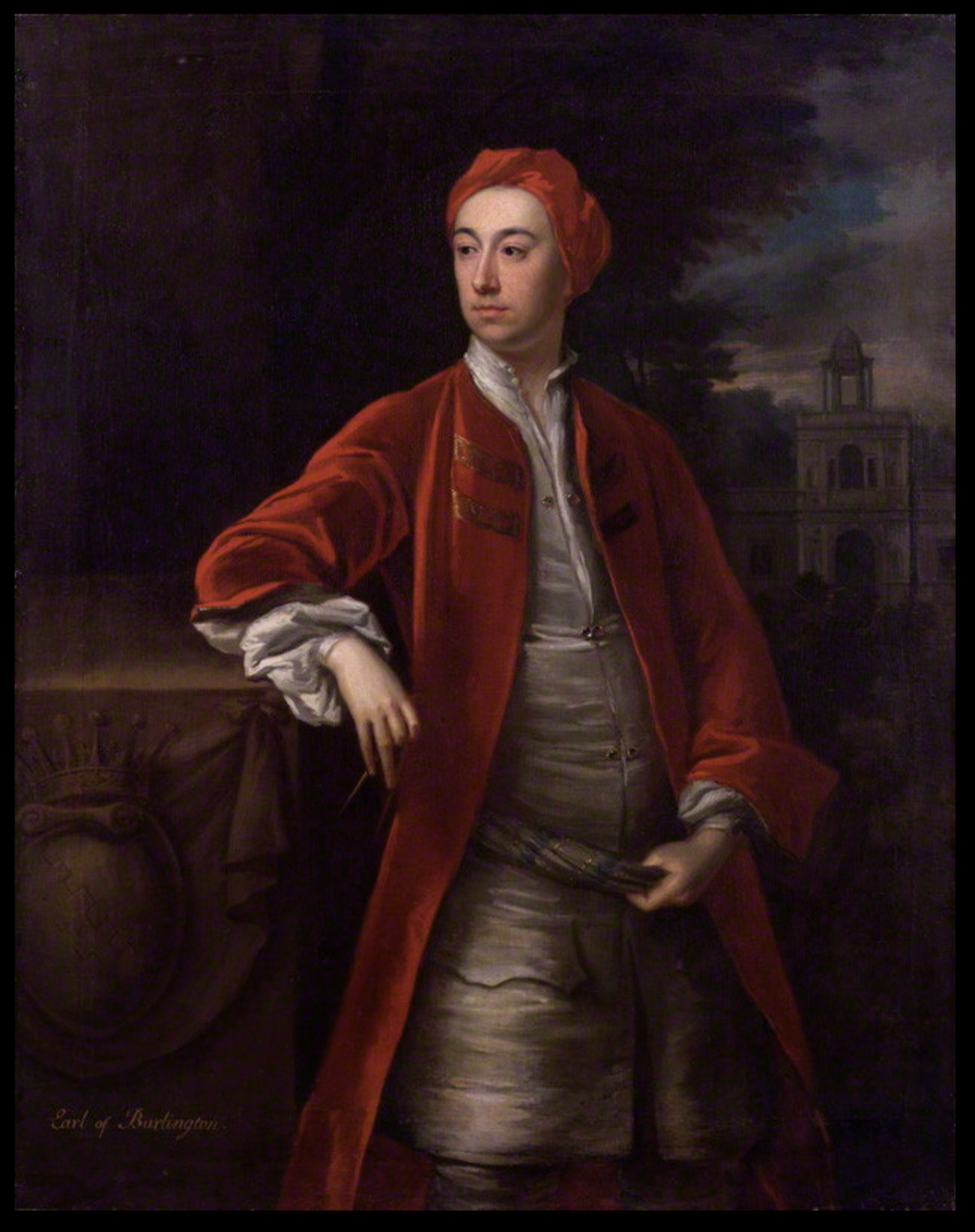
Castle originally trained as an engineer. He worked in London, where he was influenced by Lord Burlington. Richard Boyle, 3rd Earl of Burlington and 4th Earl of Cork, is credited with bringing the Palladian style of architecture to Britain and Ireland, after Grand Tours to Europe. [5] Palladian architecture is a style derived from the designs of the Venetian architect Andrea Palladio (1508-1580). Palladio’s work was strongly based on the symmetry, perspective, and values of the formal classical temple architecture of the ancient Greeks and Romans.
Portrait of Richard Boyle, 3rd Earl of Burlington (1694-1753) by Jonathan Richardson, courtesy of London’s National Portrait Gallery NPG 4818.

Castle came to the attention of Sir Gustavus Hume of County Fermanagh, who invited Castle to Ireland in 1728 to build him a home on the shores of Lough Erne, Castle Hume, which unfortunately no longer exists. [6] Castle was a contemporary of Edward Lovett Pearce, and early in his career in Dublin worked with him on the Houses of Parliament in Dublin. Both Lovett Pearce and Castle favoured the Palladian style, and when Lovett Pearce died at the tragically young age of 34, in 1733, Castle took over all of Lovett Pearce’s commissions.
Russborough House, May 2024. Photograph © Jennifer Winder-Baggot, www.irishhistorichouses.com

The Dictionary of Irish Architects gives us a flavour of what Castle was like as a person:

According to the short biography in Anthologia Hibernica for October 1793, Castle was a man of integrity, of amiable though somewhat eccentric manners, kept poor by his improvidence and long afflicted by gout resulting from intemperance and late hours. The same source states that he often pulled down those of his works which were not to his liking, ‘and whenever he came to inspect them … required the attendance of all the artificers who followed him in a long train’.

Russborough, May 2024. Photograph © Jennifer Winder-Baggot, www.irishhistorichouses.com

Castle began work on Powerscourt House in County Wicklow in 1730, finishing in 1741. He also began work on Westport House in County Mayo in 1730. He worked on Carton House, in County Kildare, which is now an upmarket hotel, from 1739-1744. In Dublin City he built Tyrone House (which now houses the Department of Education) for Marcus Beresford, Earl of Tyrone (we came across him at Curraghmore in County Waterford) [7]. He designed and built the hunting lodge called Belvedere in County Westmeath around 1740, and began to work on Russborough House around 1742. He was still working on Russborough House when he died suddenly, while at Carton House, in 1751, while writing a letter to a carpenter employed at Leinster House (begun in 1745 for James FitzGerald, the 20th Earl of Kildare, the house was at initially called Kildare House, and now houses the government in Dublin). Desmond FitzGerald, the Knight of Glin, wrote about Richard Castle and his work, and attributes another section 482 property to him, Strokestown House in County Roscommon. FitzGerald attributes many more buildings to Castle. [8]

Joseph Leeson (1711-1783) was the grandson of Hugh Leeson, who came to Ireland from England as a military officer in 1680, and settled in Dublin as a successful brewer. Hugh married Rebecca, daughter of Dublin Alderman Richard Tighe. Joseph inherited the brewing fortune from his father, another Joseph, who had married the daughter, Margaret, of a Dublin Alderman and Sheriff, Andrew Brice.

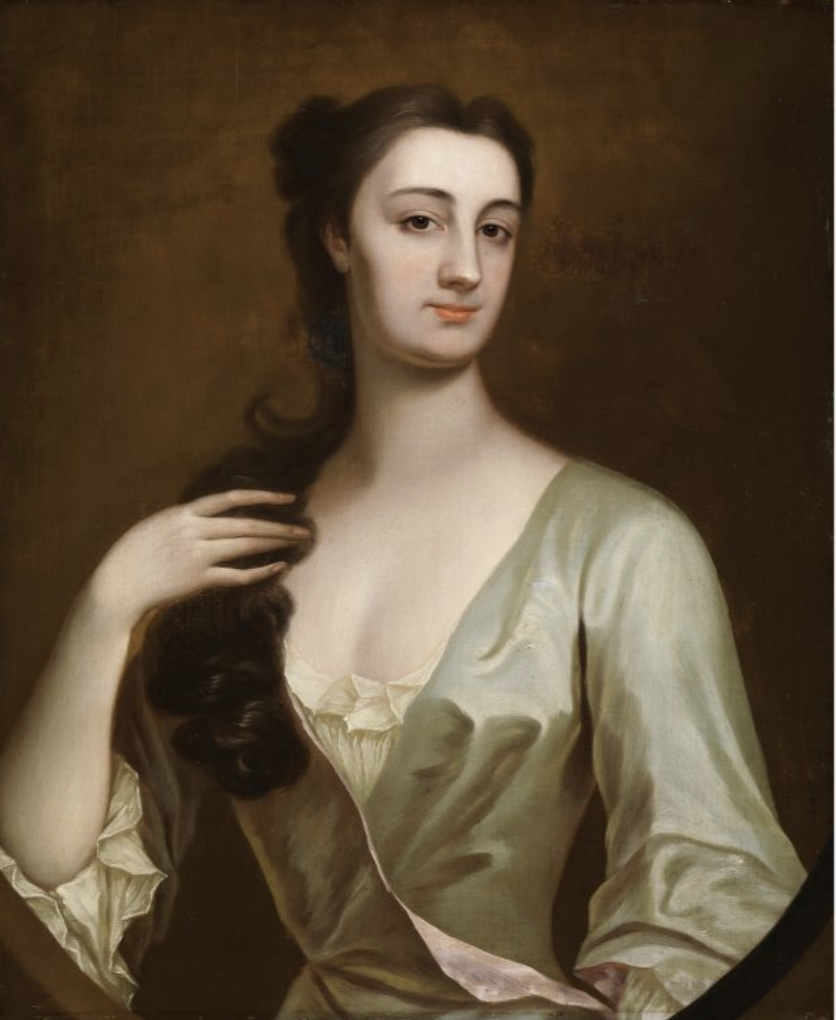
Margaret Leeson née Brice wife of Joseph Leeson (1660-1741), c. 1772 by unknown artist, courtesy of National Gallery of Ireland NGI 1649.

As well as young Joseph, his father Joseph and Margaret née Brice had a daughter, Anne, who married Hugh Henry (d. 1743) of Straffan House in County Kildare and Lodge Park in County Kildare, the latter also a section 482 property. Another daughter, Joyce, married Robert Blackwood, 1st Baronet Blackwood, of Ballyleidy, County Down.

Young Joseph Leeson entered politics and from 1743 sat in the House of Commons. By this time, he had already married, been widowed by his first wife, Cecelia Leigh, and remarried, to Anne Preston (daughter of Nathaniel Preston, ancestor of the owners of a house we have visited, Swainstown in County Meath – which was built later than the start date of Russborough, in 1750, and which Richard Castle may also have designed), and inherited his fortune from his brewer father, and started building Russborough House. He was raised to the peerage first as Baron Russborough in 1756, and as Earl of Milltown in 1763.

Cecilia Leeson (born Leigh) (d.1737) Date 1735-1737 by Anthony Lee, Irish, fl.1724-1767. First wife of Joseph Leeson. Photograph courtesy of the National Gallery of Ireland.

Anne died on 17 January 1766, and Leeson married thirdly Elizabeth French, daughter of the Very Reverend William French, Dean of Ardagh, on 10 February 1768.

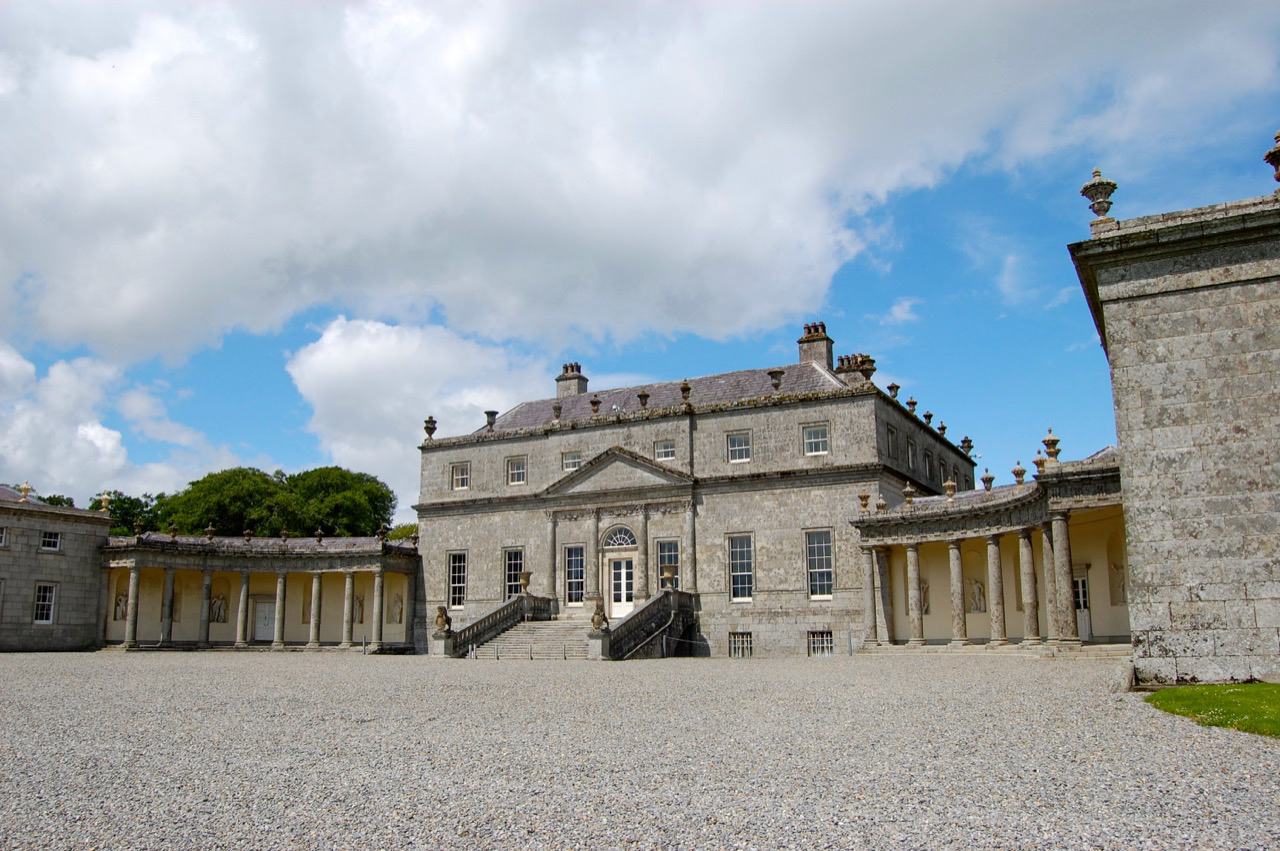
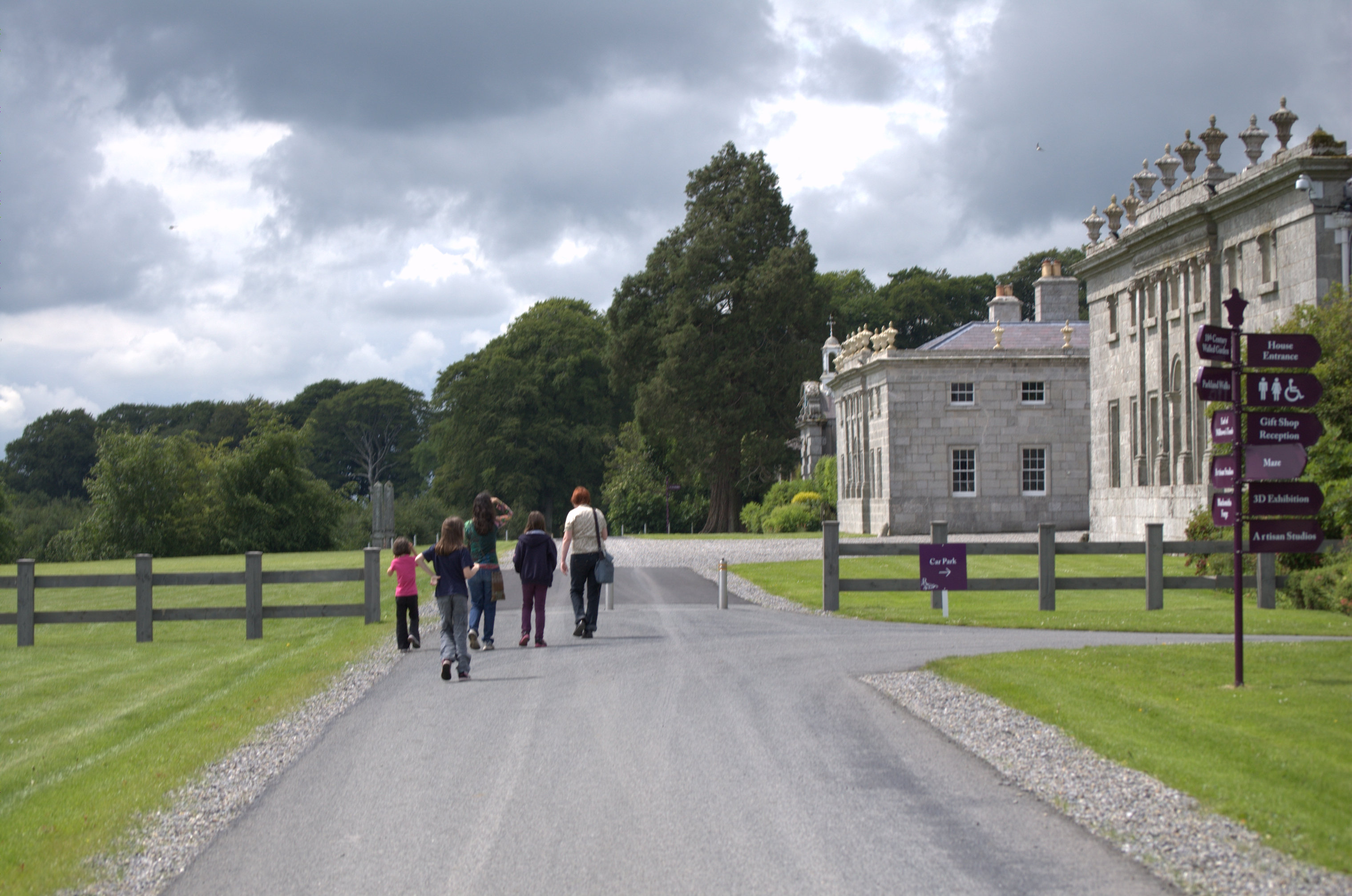
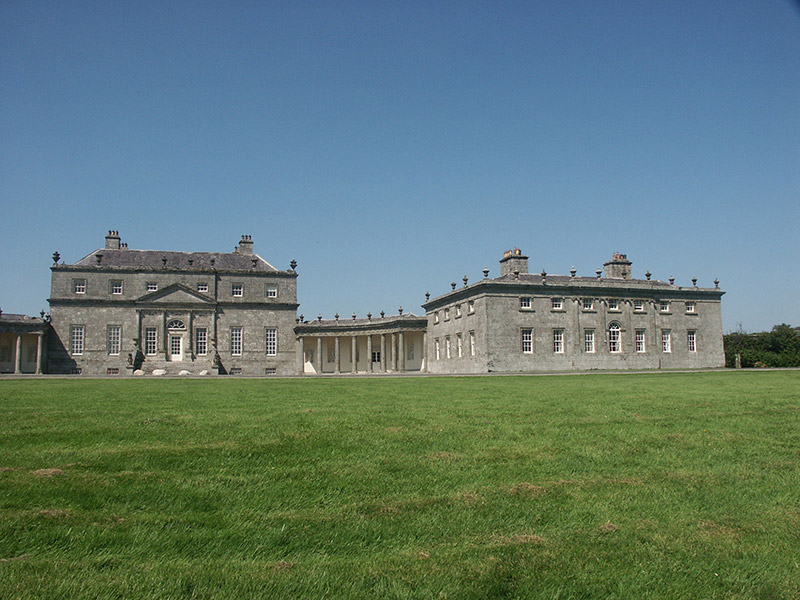
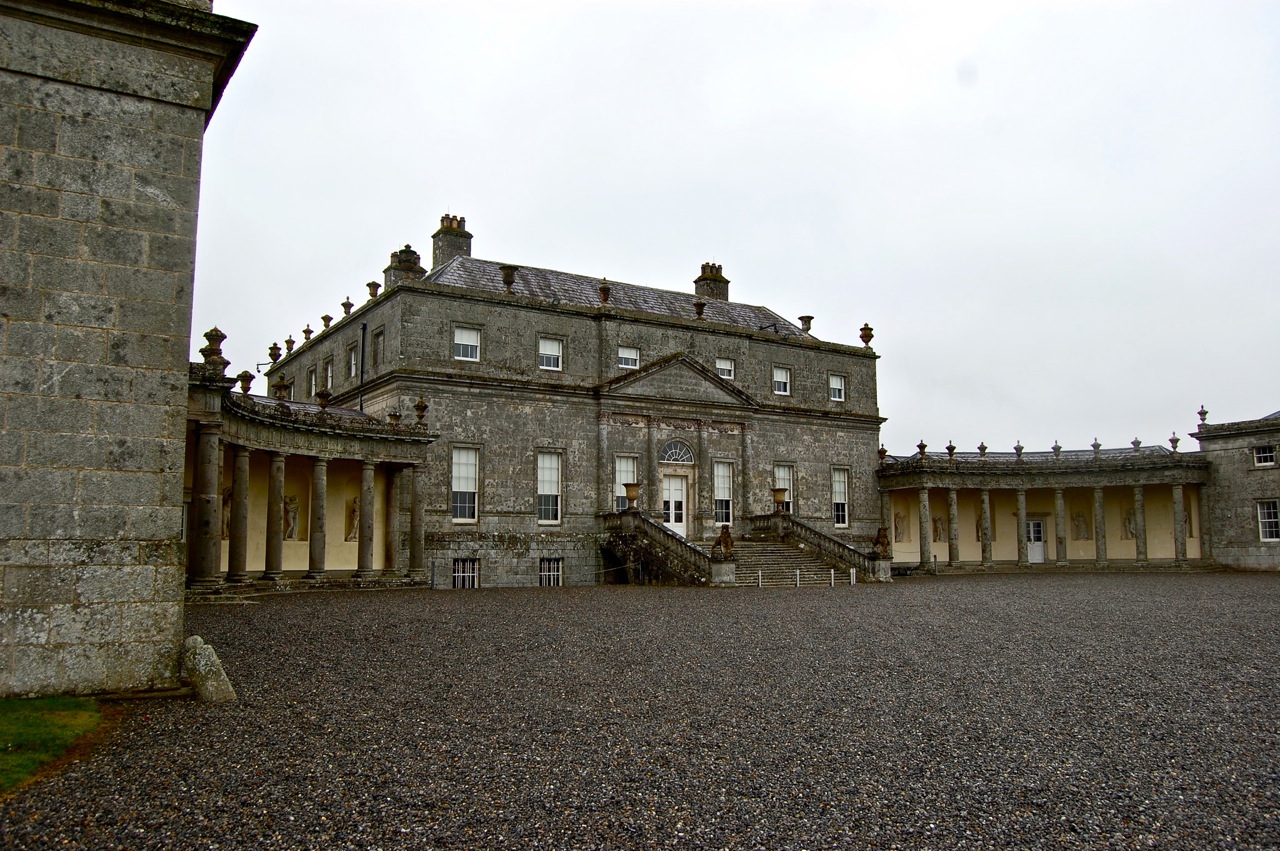
Photo taken by Jeremy Hylton, showing the extent of the centre block with the curving Doric colonnades and two-storey seven bay wings. Beyond the wings on either side of the central block, one can see the arches with cupolas. The full stretch contains kitchen and stable wings.

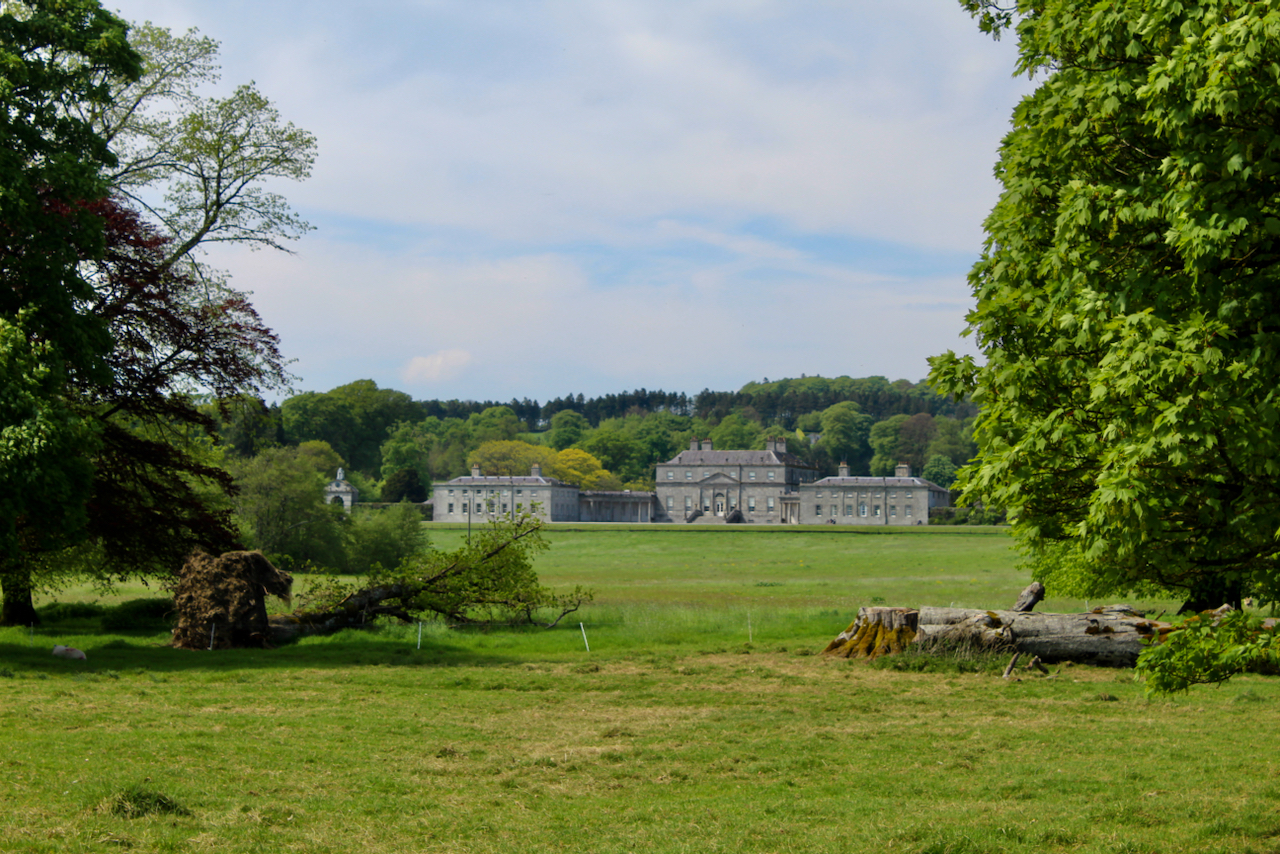
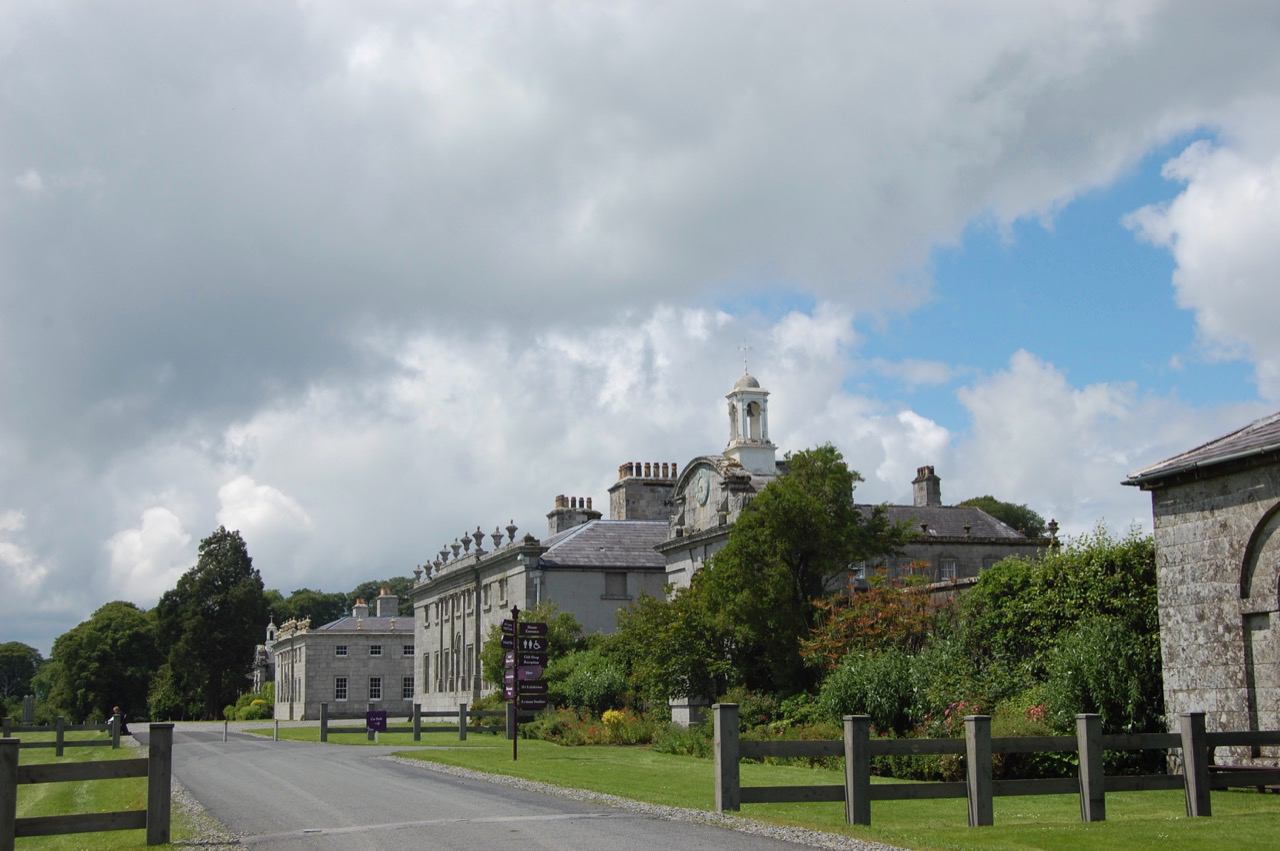
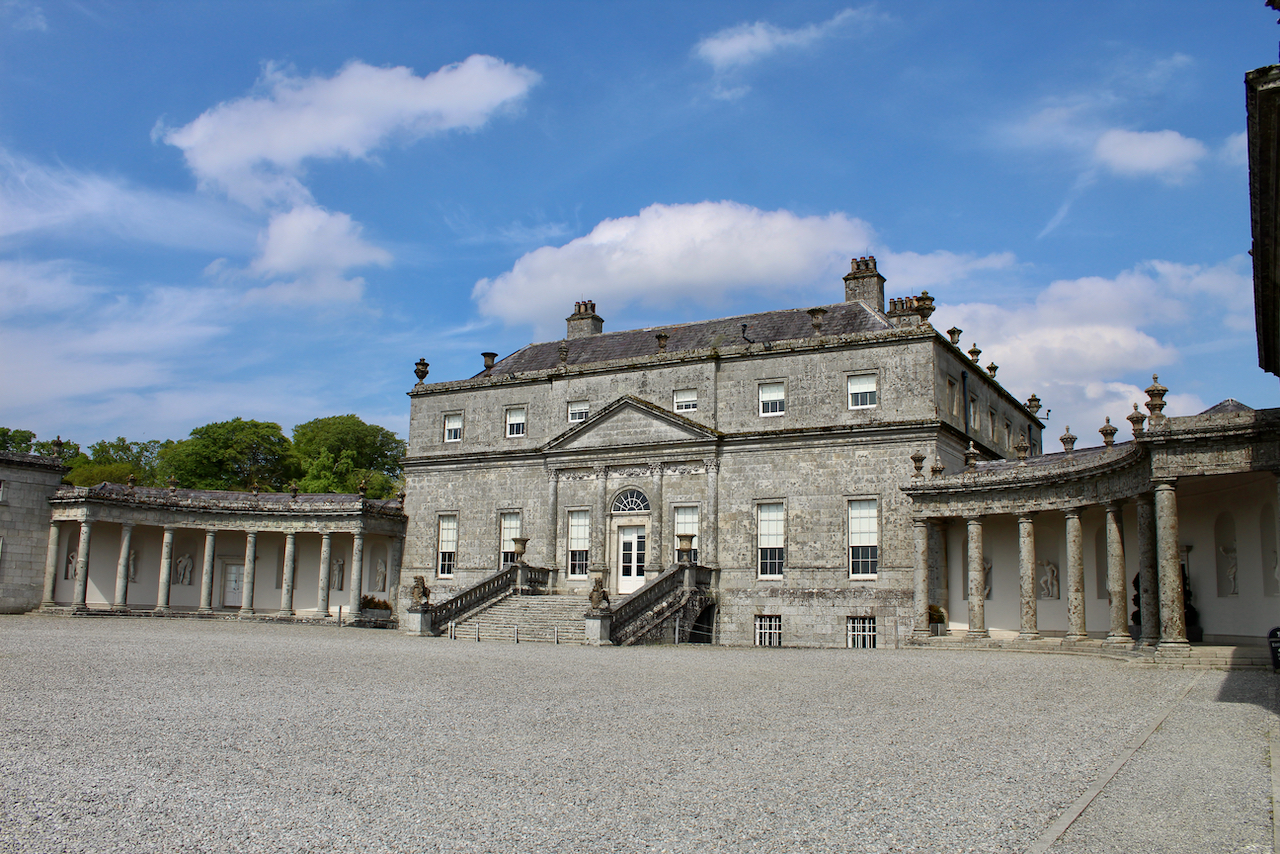
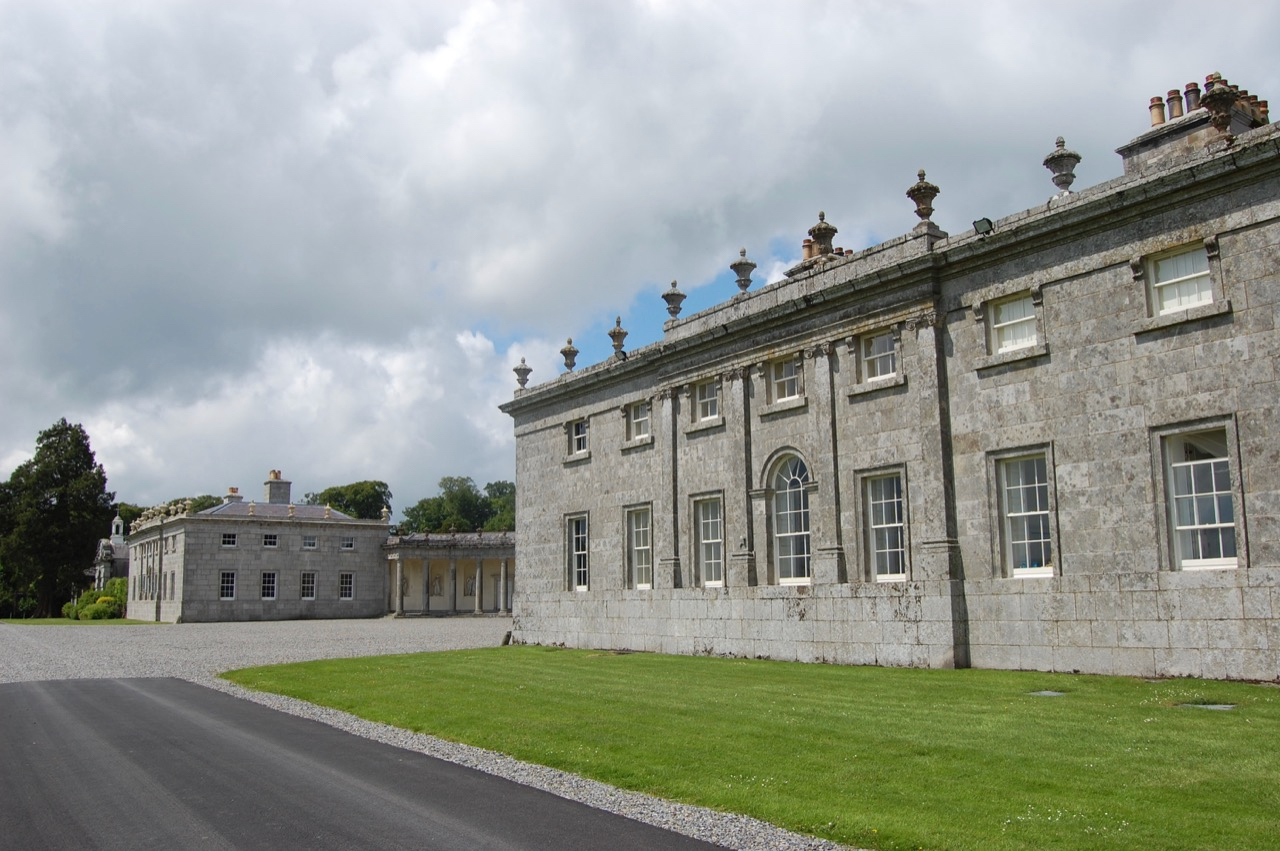
The entrance front of Russborough stretches for over 700 feet, reputedly the longest house in Ireland, consisting of a seven bay centre block of two storeys over a basement, joined by curving Doric colonnades to wings of two storeys and seven bays which are themselves linked to further outbuildings by walls with rusticated arches surmounted by cupolas. In this structure, Russborough is rather like Powerscourt nearby in Wicklow, and like Powerscourt, it is approached from the side.

Russborough, County Wicklow. Photograph © Jennifer Winder-Baggot, www.irishhistorichouses.com
Photograph from the National Inventory of Architectural Heritage, showing wing to the right of the house.
Russborough, May 2024. Photograph © Jennifer Winder-Baggot, www.irishhistorichouses.com
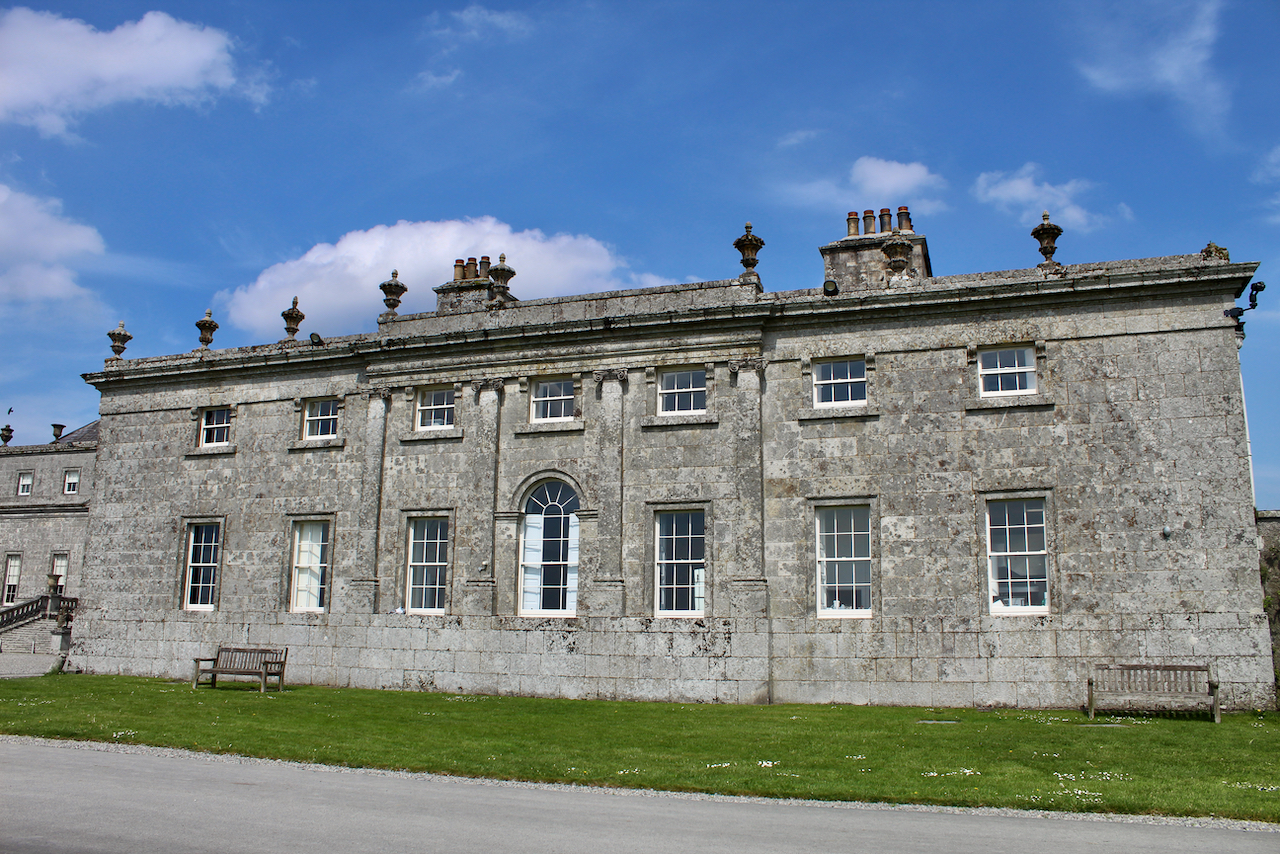
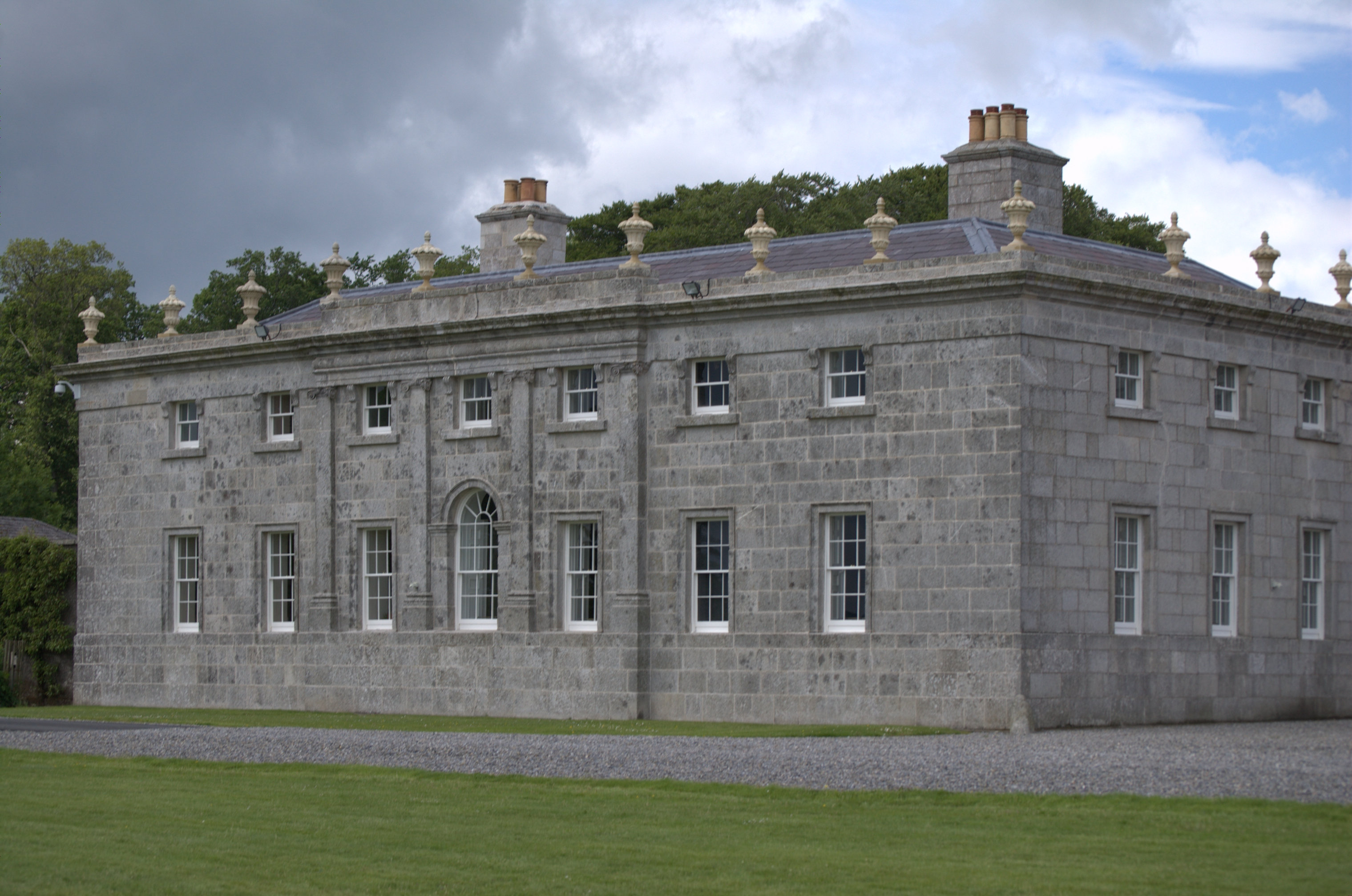
Photograph taken in May 2018 – the weather makes a difference to the appearance of the house. The roofline is topped with urns on the parapet. Photograph © Jennifer Winder-Baggot, www.irishhistorichouses.com

The residential part of the house is quite small, and is entirely housed in the central block. Of seven bays across, it houses three rooms along its front. It is made of local granite from Golden Hill quarry rather than the more expensive Portland stone often imported from Britain. In Sean O’Reilly’s discussion of the house in his Irish Houses and Gardens (from Country Life), he explains the styles used on the facade of the house:

the different functions of the building’s elements are appropriately distinguished though Castle’s frank, if unsubtle, use of the orders: Corinthian for the residence, Doric for the colonnades, Ionic for the advancing wings, and a robust astylar threatment for the ranges beyond.” [9]

The lions at the foot of the entrance steps carry the heraldic shield of the Milltowns, which must have been put in place after 1763 when Joseph Leeson was promoted to be Earl of Milltown. Photo by Jeremy Hylton.
Photograph by Jeremy Hylton of central block.

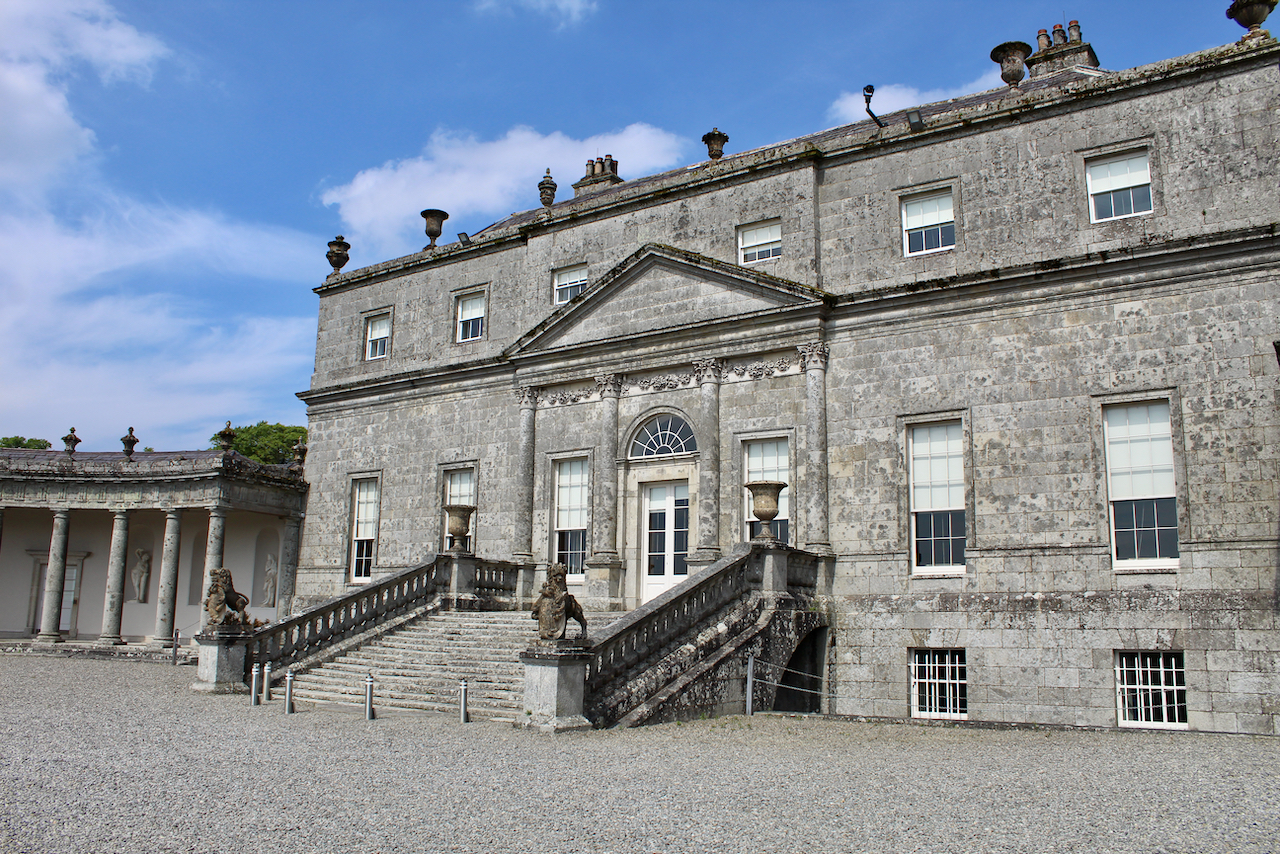
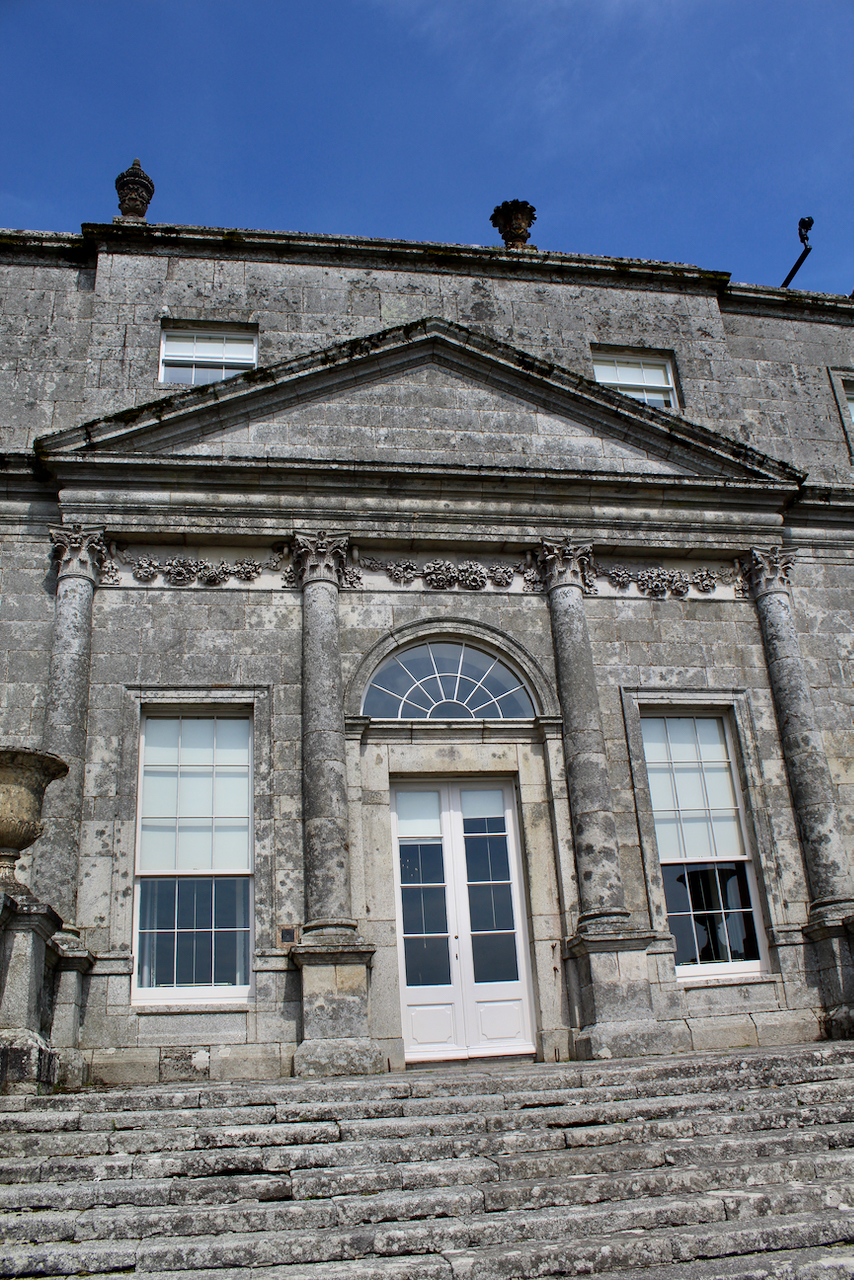
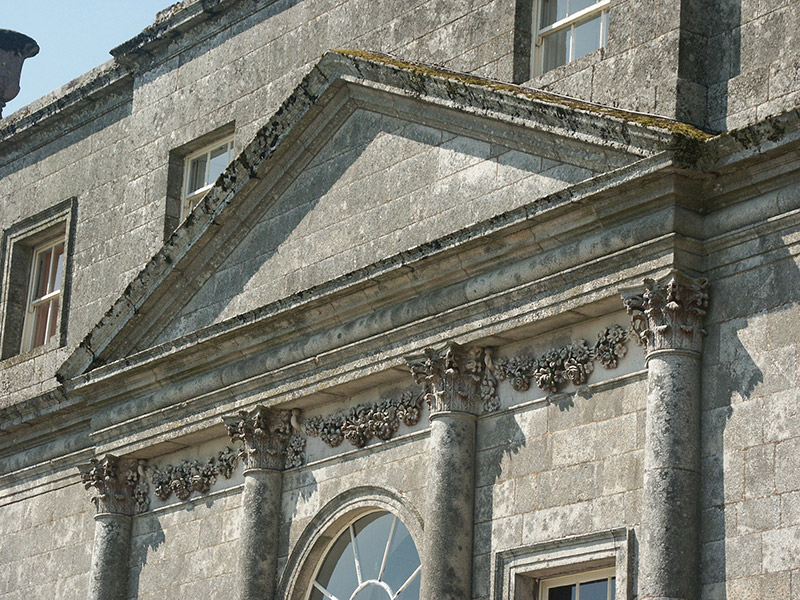
The main central block has a pediment on four Corinthian columns, with swags between the capitals of the columns. Above the entrance door is a semi-circular fanlight window.

Russborough, May 2024. Photograph © Jennifer Winder-Baggot, www.irishhistorichouses.com
Photograph from the National Inventory of Architectural Heritage, of pediment on four Corinthian columns.
Wing in foreground, with Ionic pilasters, and urns on the parapet. Photograph © Jennifer Winder-Baggot, www.irishhistorichouses.com
Russborough, wing on the right hand side, May 2024. Photograph © Jennifer Winder-Baggot, www.irishhistorichouses.com
Photograph by Jeremy Hylton, wing on left.
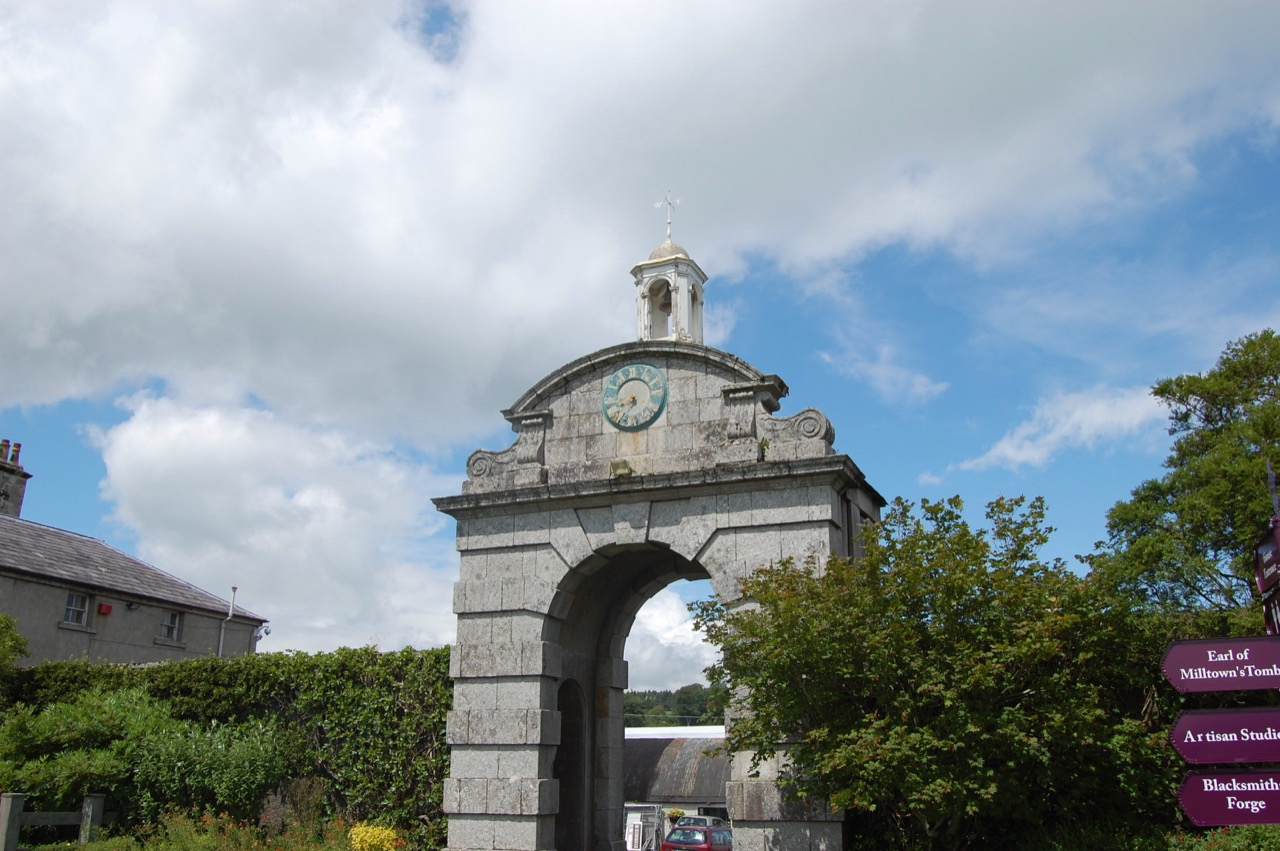
The “rusticated” arch that gives entrance to a courtyard, and is topped by a cupola. Rustication – the use of stone blocks with recessed joints and often with rough or specially treated faces; a treatment generally confined to the basement or lower part of a building [10]. Photograph © Jennifer Winder-Baggot, www.irishhistorichouses.com

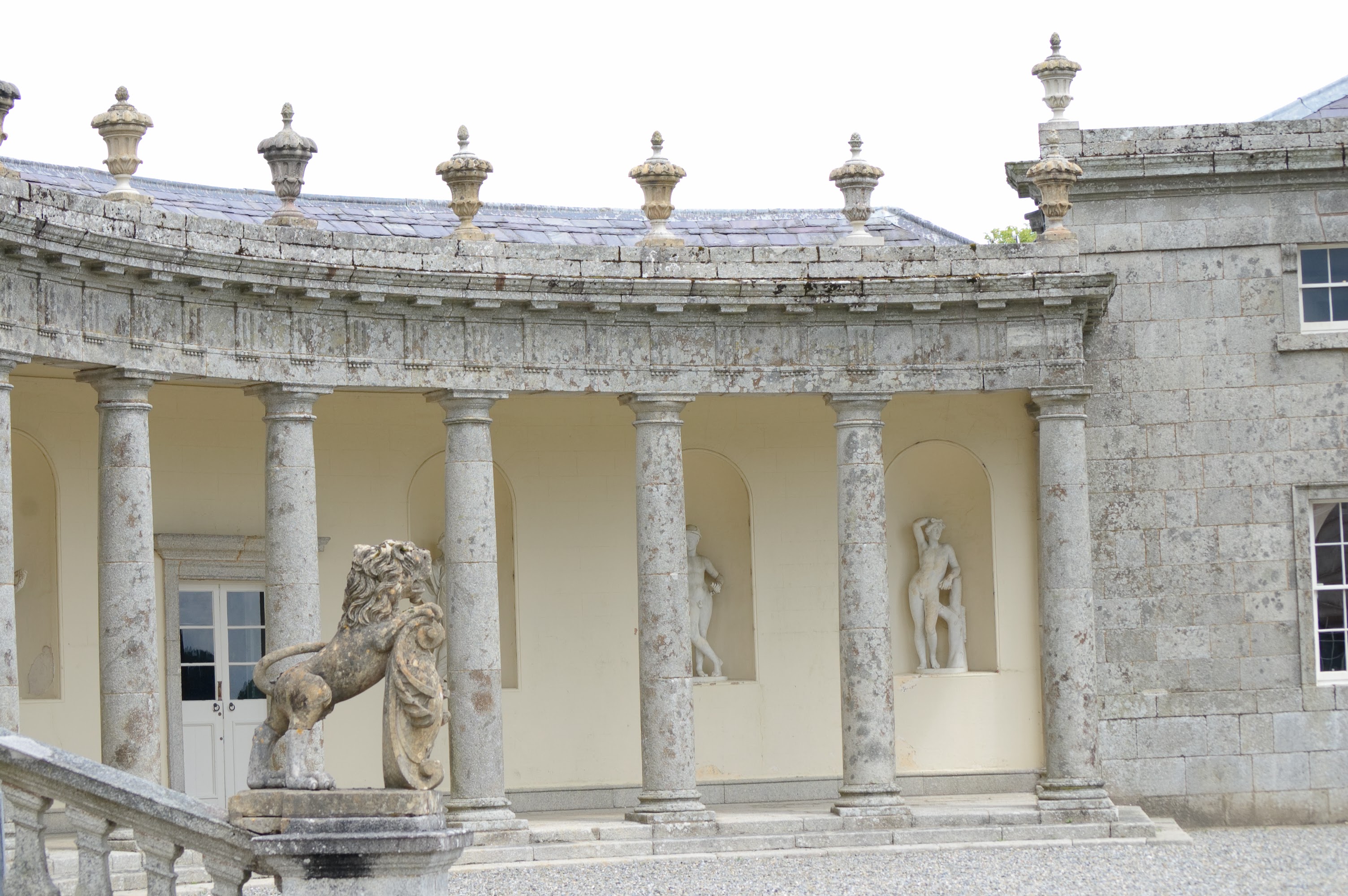
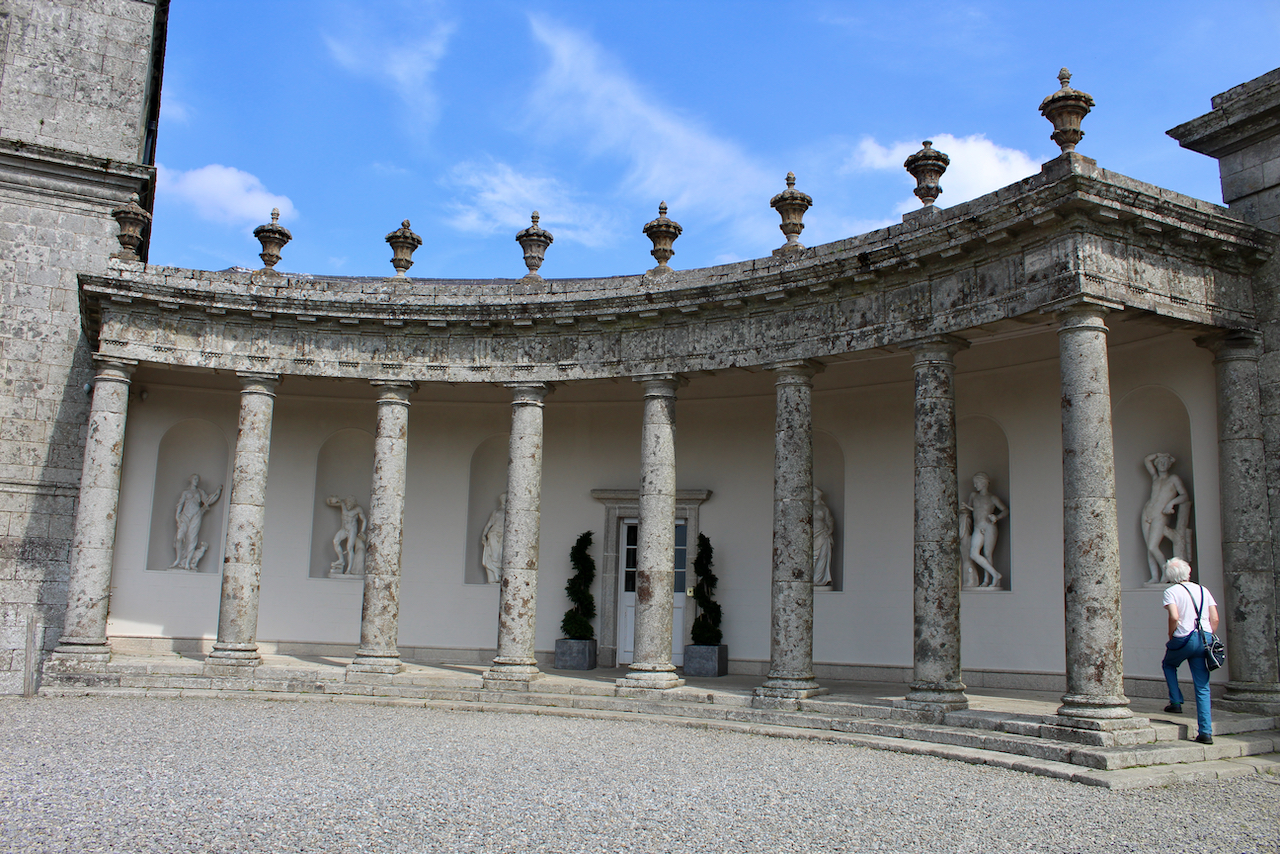
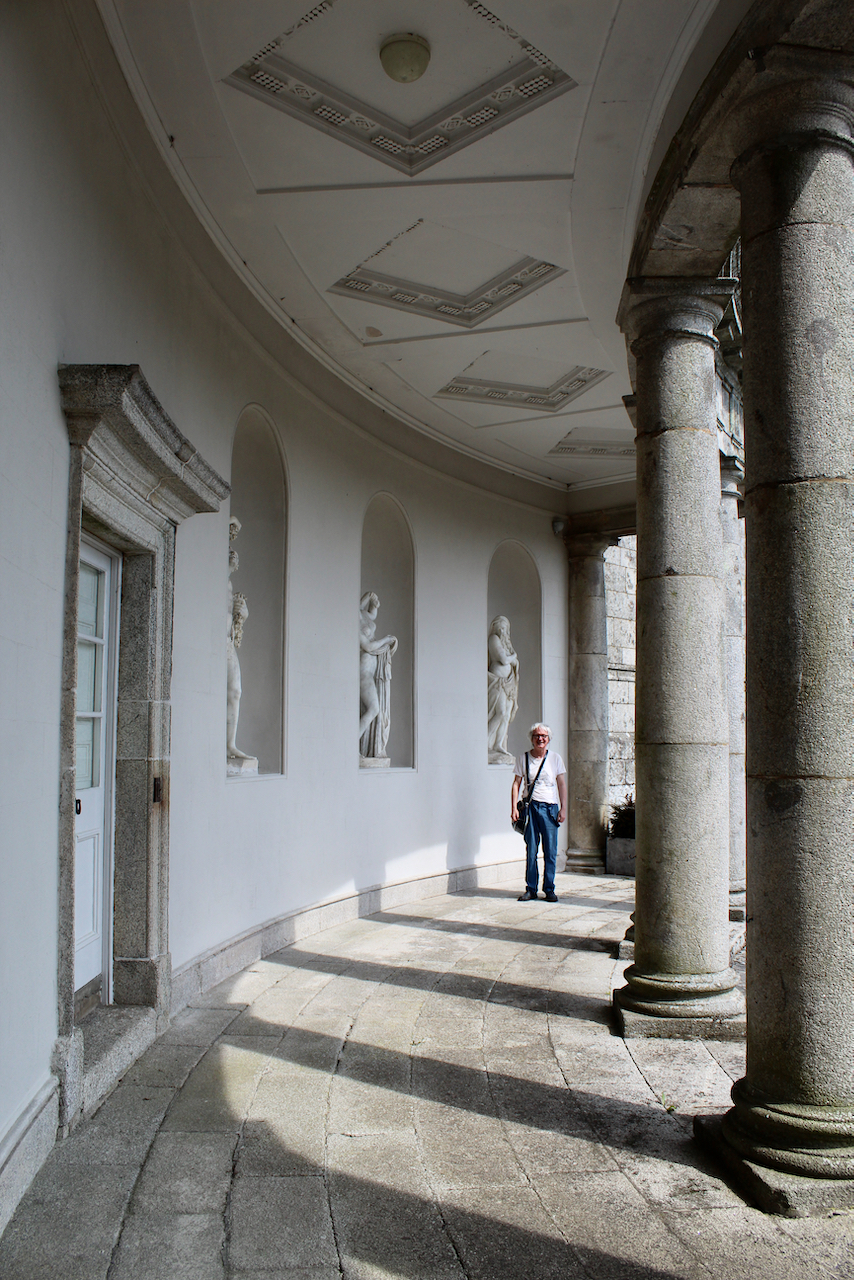
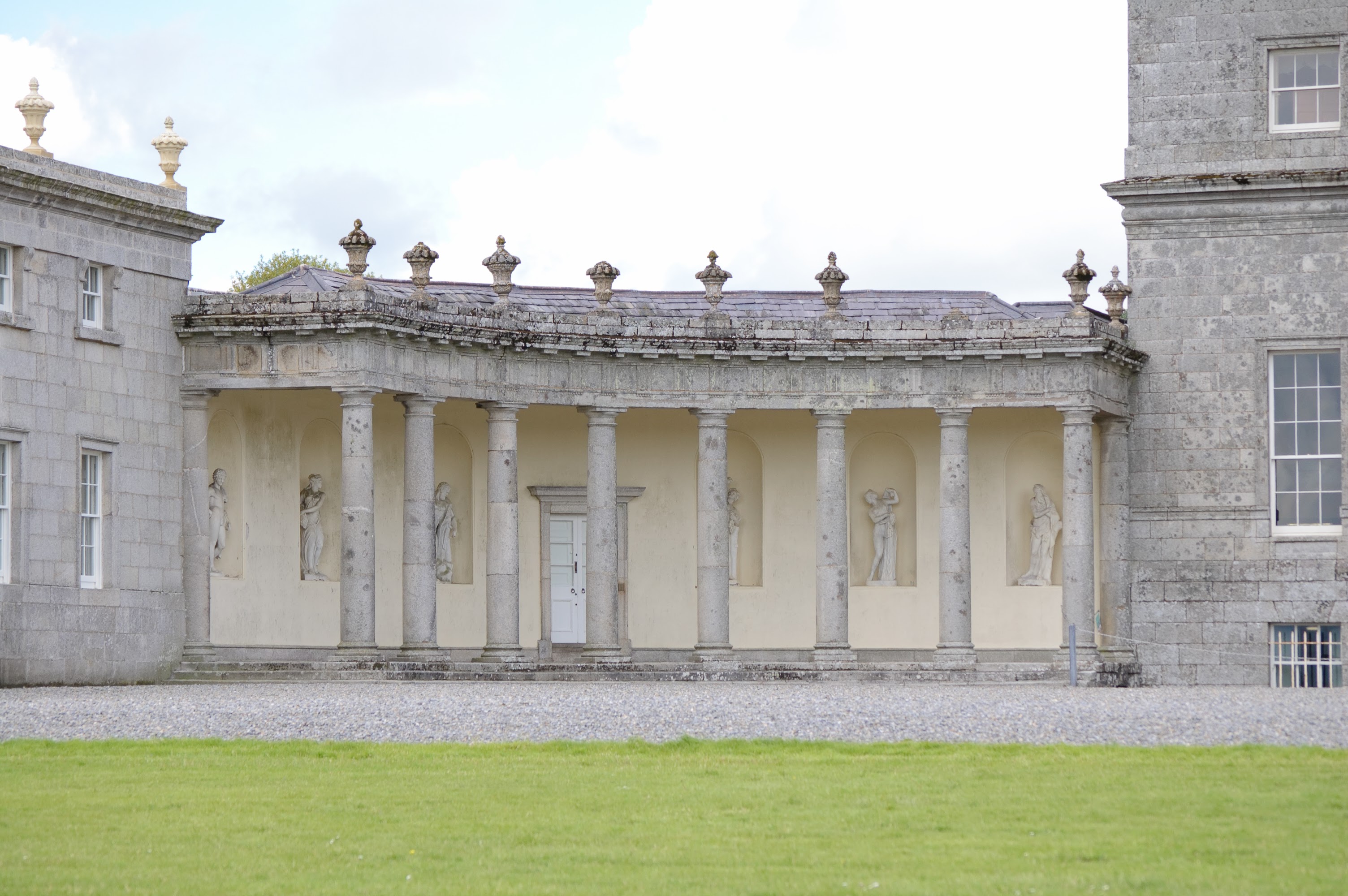
The wings have a central breakfront of three bays with Ionic pilasters. Within the colonnades are niches with Classical statues.

Russborough, May 2024. Joseph Leeson purchased the statues, which are of gods, on his trip abroad, mostly in Rome. Photograph © Jennifer Winder-Baggot, www.irishhistorichouses.com
The Colonnade at Russborough, May 2024. Photograph © Jennifer Winder-Baggot, www.irishhistorichouses.com
Colonnade with niches containing Classical statues, photograph by Jeremy Hylton.
Russborough, May 2024. Photograph © Jennifer Winder-Baggot, www.irishhistorichouses.com
The back of the house at Russborough, May 2018. Photograph © Jennifer Winder-Baggot, www.irishhistorichouses.com

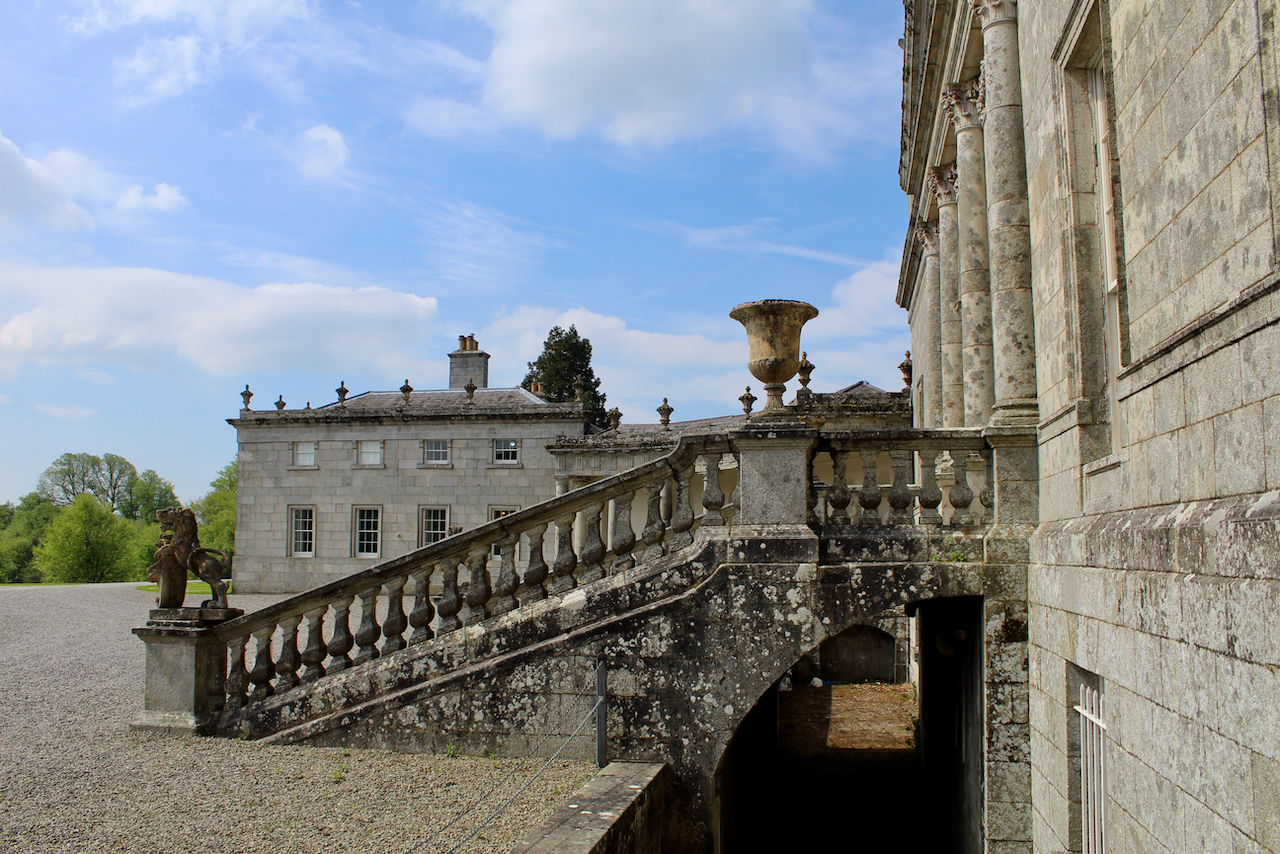
The garden front of the centre block has a few urns on the parapet, and a pair of Corinthian columns with an entablature framing a window-style door in the lower storey which opens onto broad balustraded stone steps down to the garden.

Russborough, May 2018. Photograph © Jennifer Winder-Baggot, www.irishhistorichouses.com

Inside, we see Castle’s difference from Edward Lovett Pearce, in his fondness for the Baroque, which is described in wikipedia:

The Baroque style used contrast, movement, exuberant detail, deep colour, grandeur and surprise to achieve a sense of awe. The style began at the start of the 17th century in Rome, then spread rapidly to France, northern Italy, Spain and Portugal, then to Austria, southern Germany and Russia…excess of ornamentation…The classical repertoire is crowded, dense, overlapping, loaded, in order to provoke shock effects.

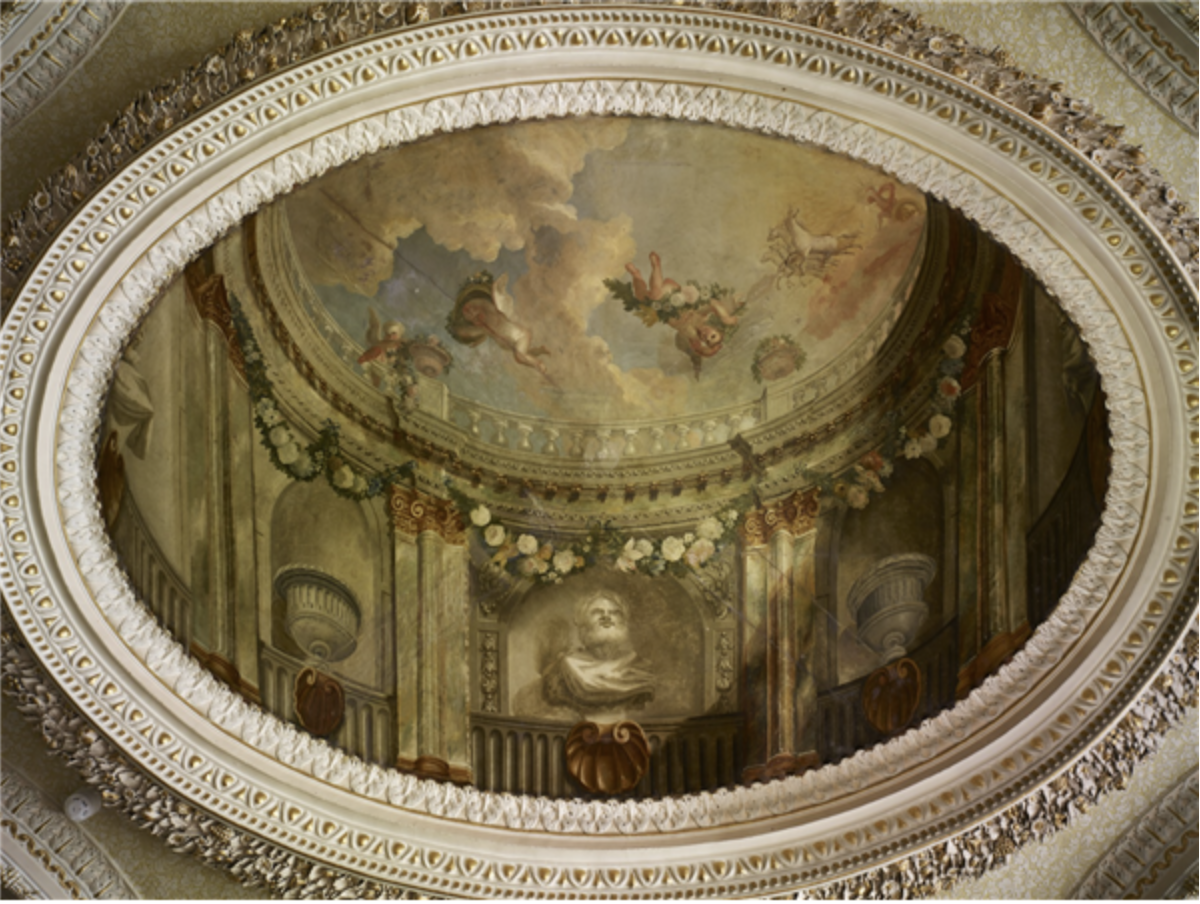
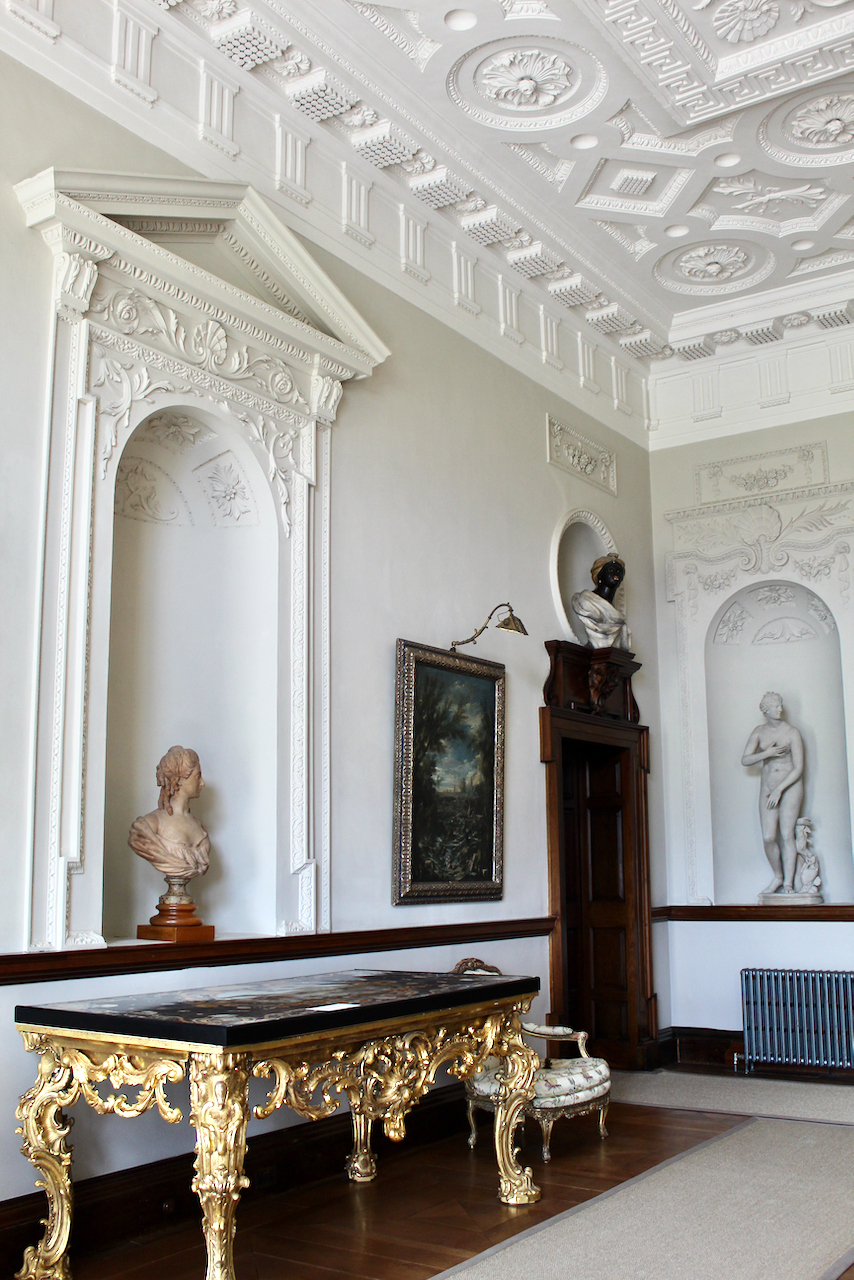
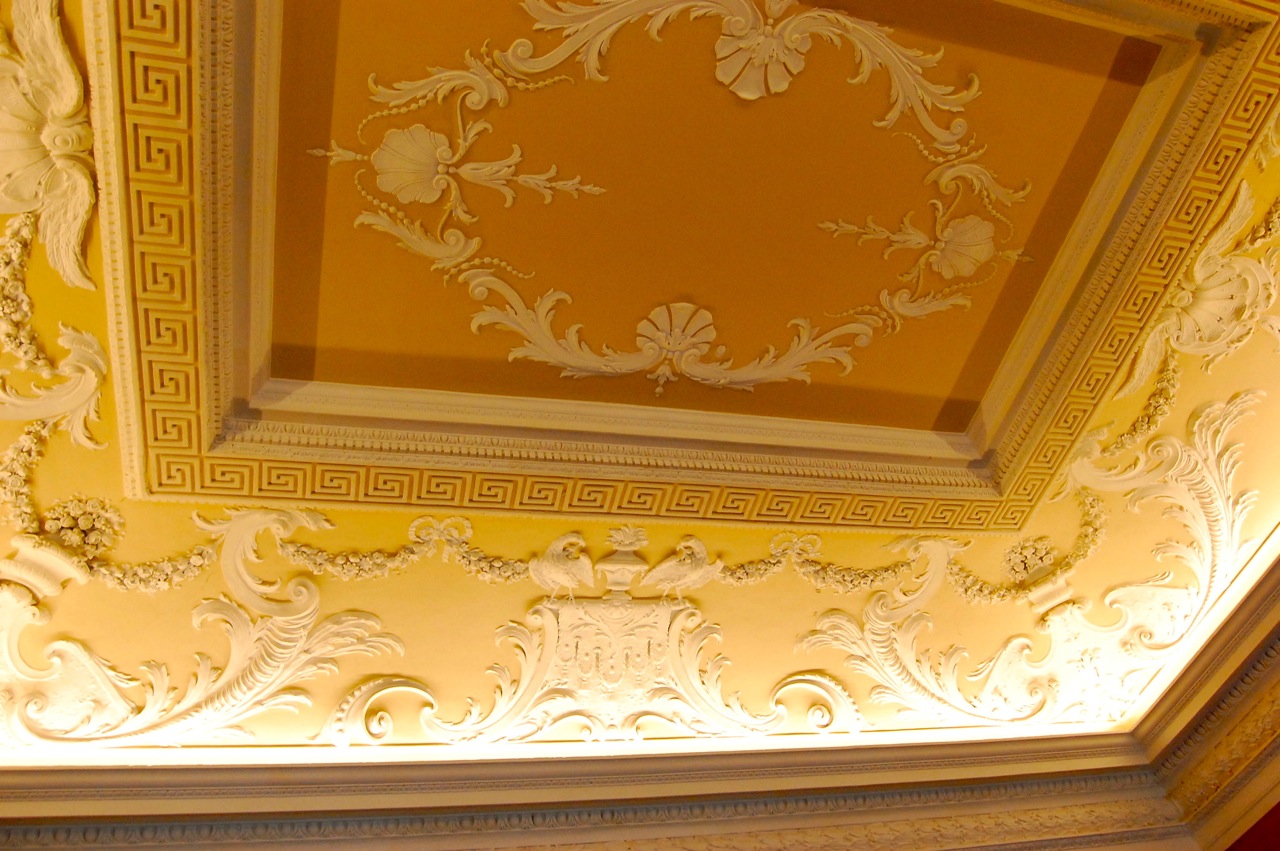
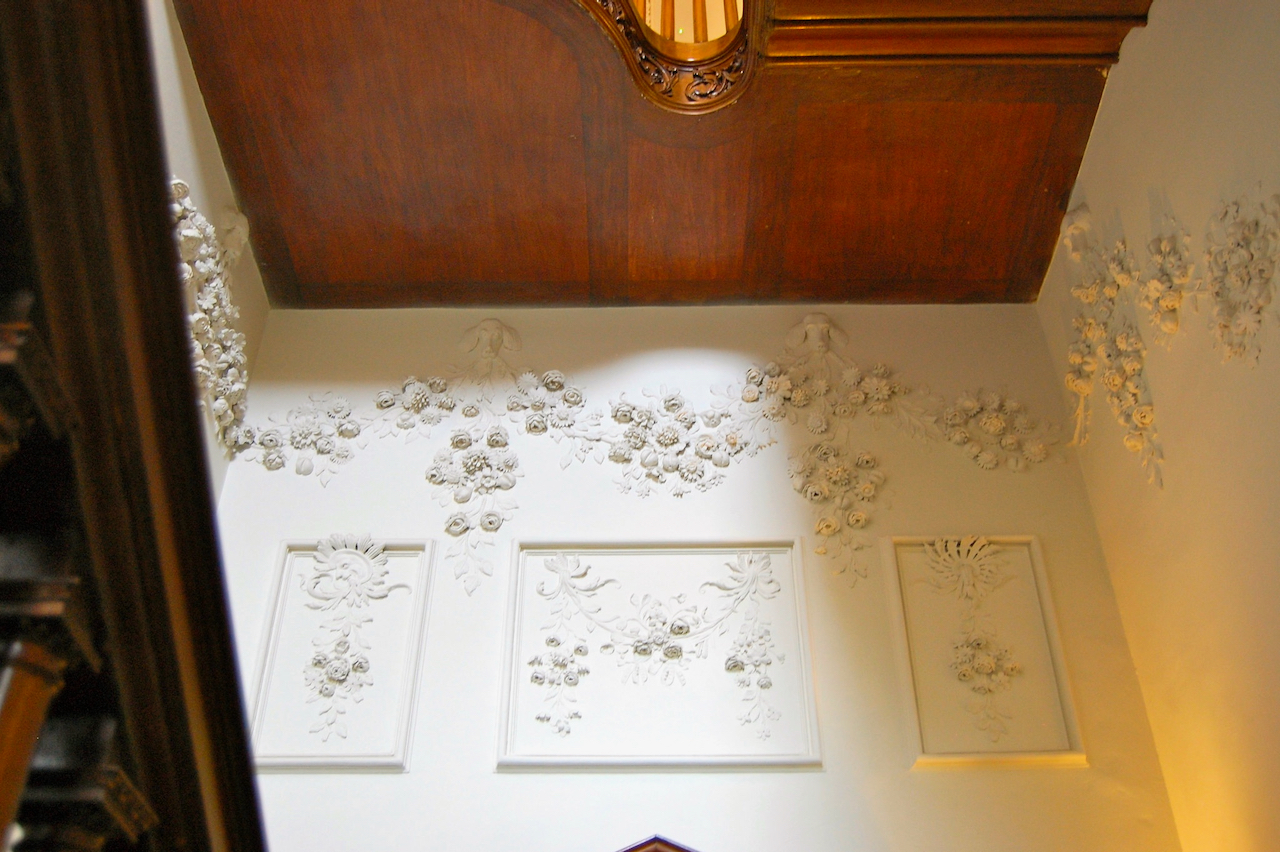
The Baroque effect is most obvious in the wonderful plasterwork. The plasterwork may be by the Francini brothers – it is not definite who carried it out but the Francini brothers certainly seem to have had a hand in some of the beautiful stucco work.

Entrance hall of Russborough House. Photograph © Jennifer Winder-Baggot, www.irishhistorichouses.com
Russborough entrance hall, May 2024. Photograph © Jennifer Winder-Baggot, www.irishhistorichouses.com
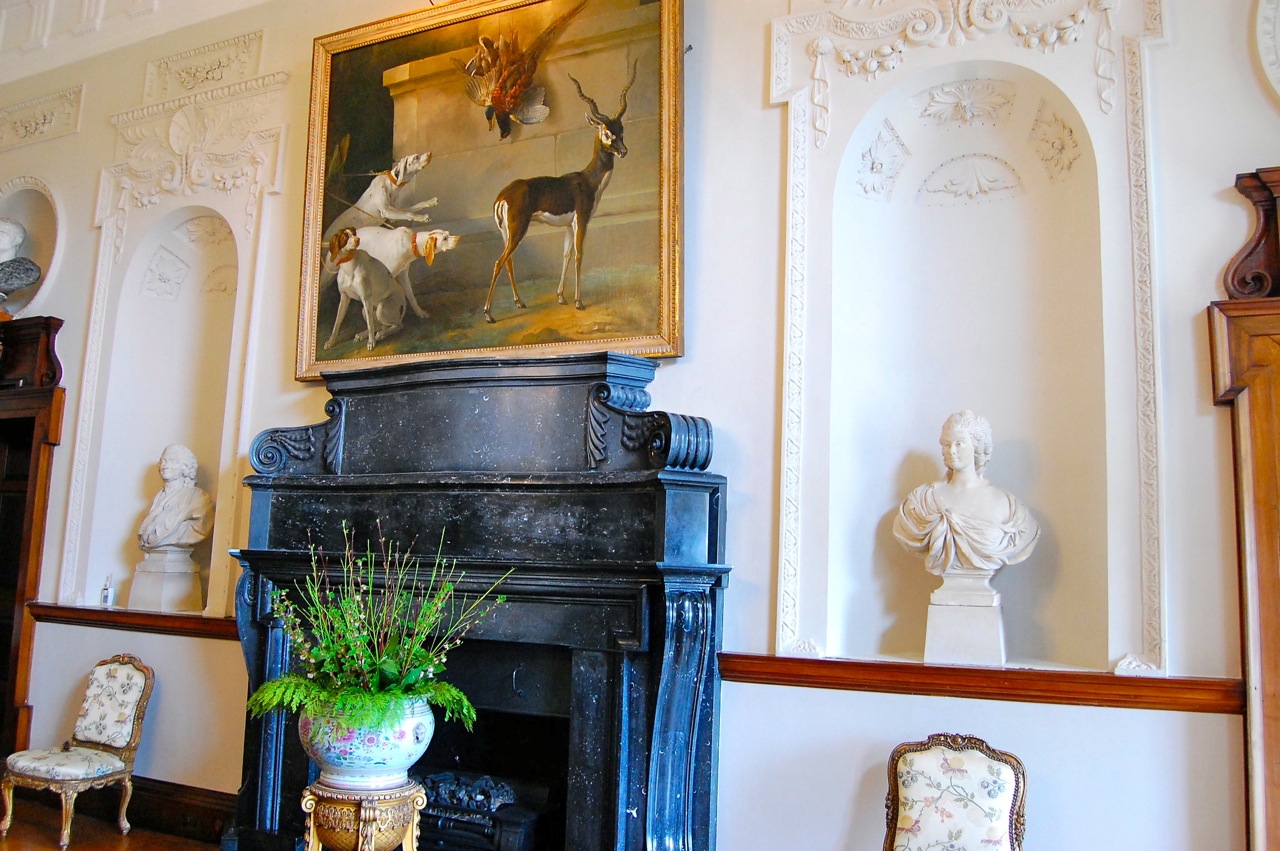
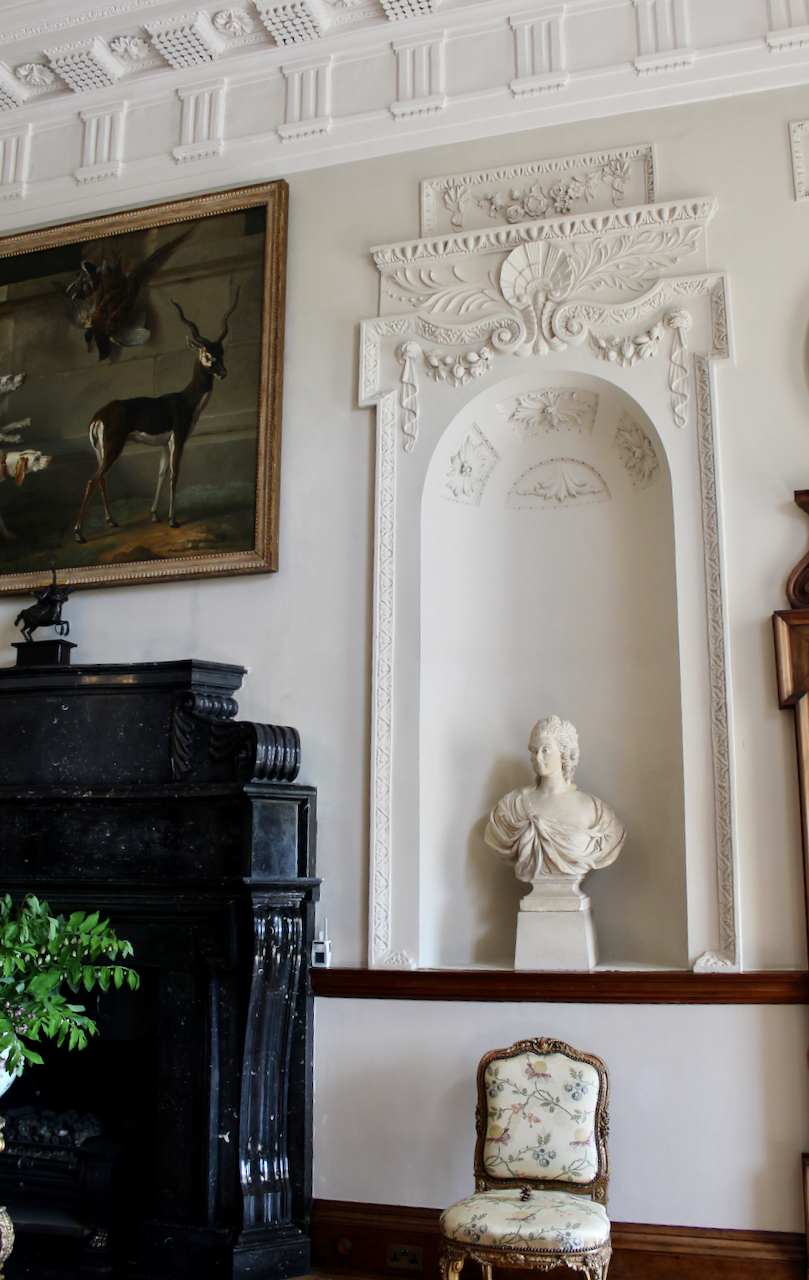
Entrance hall of Russborough House with chimneypiece is of black Kilkenny “marble,” above it hangs a striking painting by Oudry of Indian Blackbuck with Pointers and Still Life, dated 1745. Photograph © Jennifer Winder-Baggot, www.irishhistorichouses.com
Russborough entrance hall, May 2024. Photograph © Jennifer Winder-Baggot, www.irishhistorichouses.com

In his book, Big Irish Houses, Terence Reeves-Smyth describes the entrance hall:

Ascending the broad flight of granite steps guarded by a pair of carved lions, the visitor enters the front hall – a well-proportioned room with a floor of polished oak and an ornate but severe compartmental ceiling with Doric frieze quite similar to the one Castle deigned for Leinster House. The monumental chimneypiece is of black Kilkenny marble, much favoured by Castle for entrance halls, while above it hangs a striking painting by Oudry of Indian Blackbuck with Pointers and Still Life, dated 1745.” [11]

Russborough entrance hall, May 2024. Photograph © Jennifer Winder-Baggot, www.irishhistorichouses.com

The principal reception rooms lead from one to the other around the central block: the saloon, drawing-room, dining-room, tapestry room and the grand staircase. They retain their original doorcases with carved architraves of West Indian mahogany, marble chimneypieces and floors of inlaid parquetry.

Russborough, County Wicklow. Photograph © Jennifer Winder-Baggot, www.irishhistorichouses.com
Russborough, May 2018. Photograph © Jennifer Winder-Baggot, www.irishhistorichouses.com

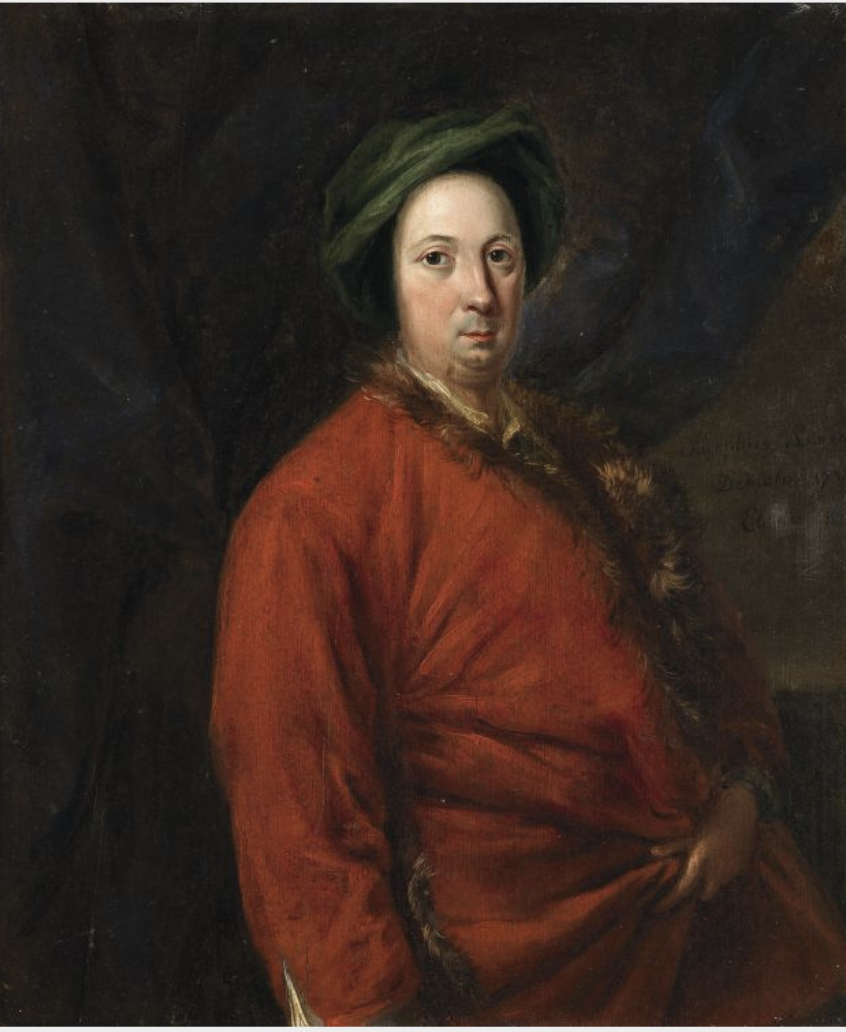
The house took ten years to complete, and development of the house followed Leeson’s trips to Europe, where he bought items to populate his house. In 1744 and in 1751 he travelled to Rome and purchased extensive Roman materials, as well as many artworks. He had his portrait painted by Pompeo Batoni, and was aided in his purchases by dealers including an Irishman named Robert Wood. A book details his collection, as well as later owners of Russborough, Russborough: A Great Irish House, its Families and Collections by William Laffan and Kevin V Mulligan.

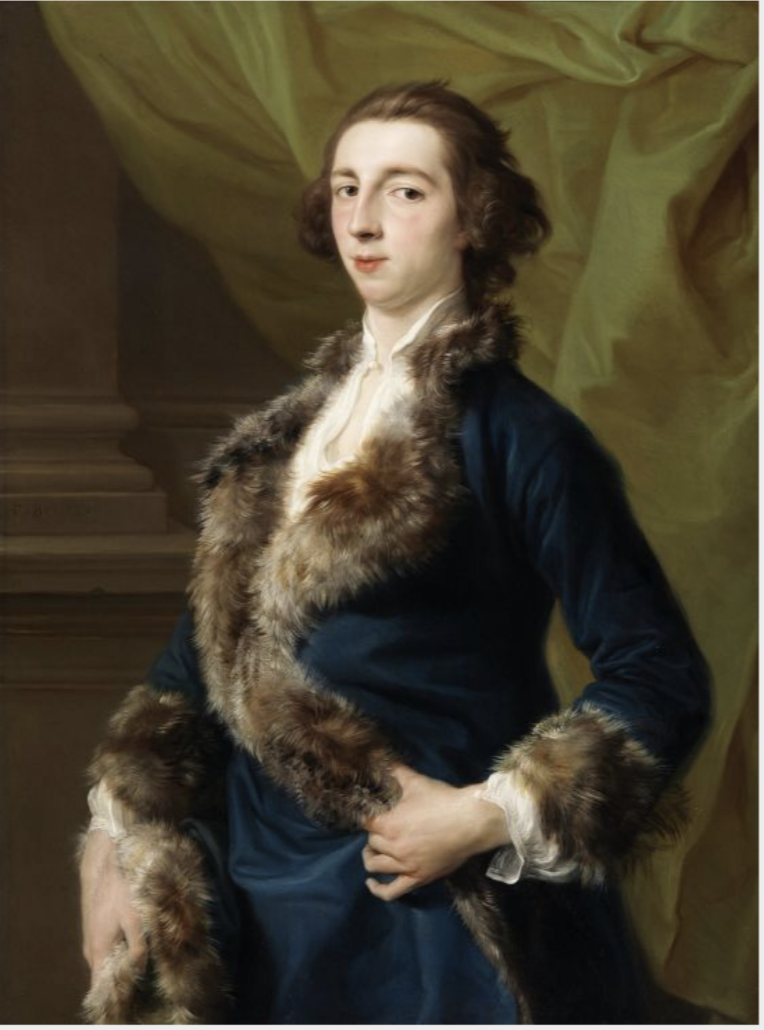
Joseph Leeson later 1st Earl of Milltown, by Pompeo Batoni, 1744. While building Russborough House he made the first of two trips to Italy to broaden his education and to acquire art. Batoni depicted him wearing a fur hat and fur-lined surcoat, in front of a cascading curtain and column base. Photograph © Jennifer Winder-Baggot, www.irishhistorichouses.com

Richard Castle died while the house was still being built, and the work was taken over by his associate, Francis Bindon.

The Saloon, Russborough House 2018, Rubens painting over fireplace, large picture on back wall is Cain and Abel. Photograph © Jennifer Winder-Baggot, www.irishhistorichouses.com

The Saloon occupies the three central bays of the north front of the house. It has a coved ceiling with rococo plasterwork incorporating flowers, garlands, swags and putti bearing emblems of the Seasons and the Elements, which on stylistic grounds can be attributed to the Francini brothers of Italy. [Rococo is the asymmetrical freely-modelled style of decoration originating in France and popular in Ireland from about 1750 to 1775. Craig, Maurice and Knight of Glin, Ireland Observed, A Handbook to the Buildings and Antiquities. Mercier Press, Dublin and Cork, 1970].  Terence Reeves-Smyth describes the room:

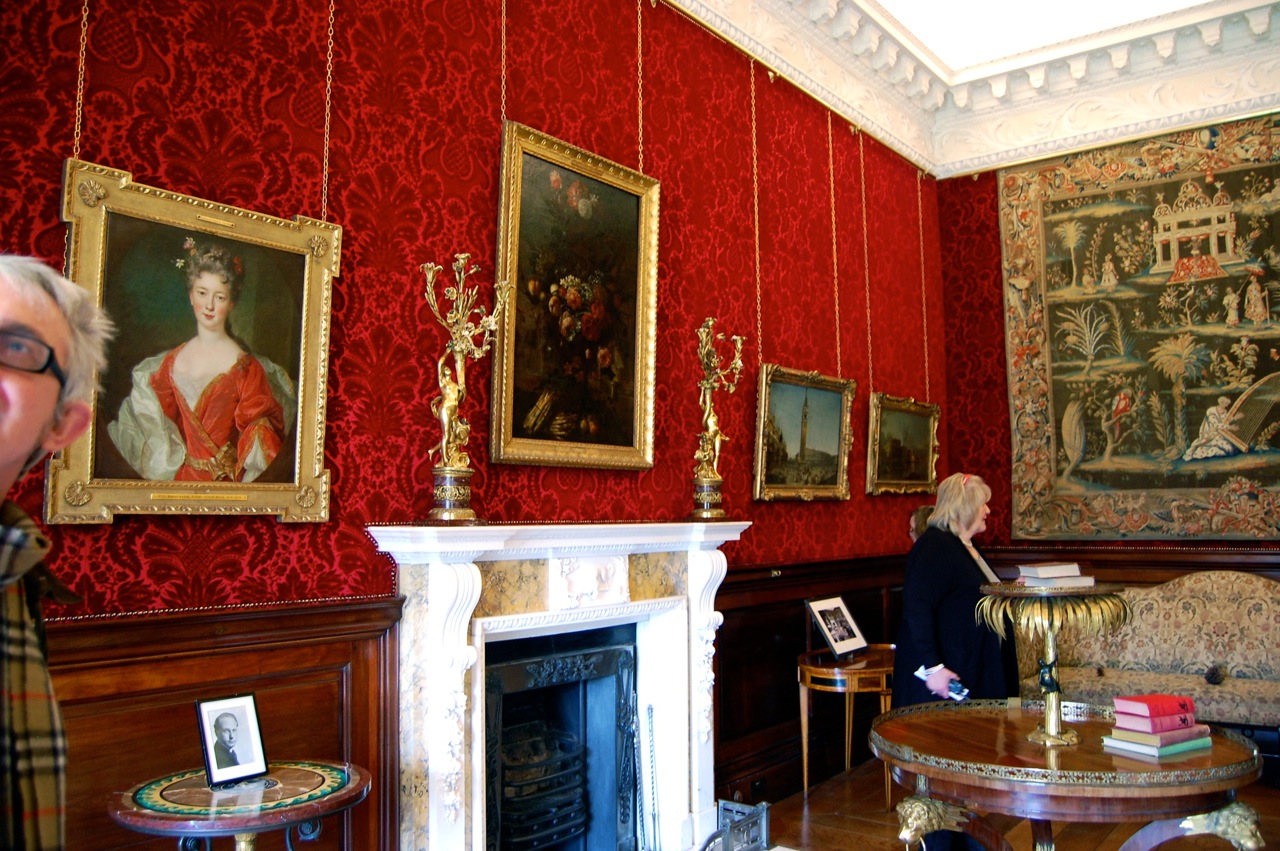
The walls are covered with a crimson cut Genoese velvet dating from around 1840 – an ideal background for paintings which include many pictures from the Beit collection. The room also has Louis XVI furniture in Gobelins tapestry signed by Pluvinet, a pair of Japanese lacquer cabinets from Harewood House and a chimney-piece identical to one at Uppark in Sussex, which must be the work of Thomas Carter (the younger) of London.

“A striking feature of the room is the inlaid sprung mahogany floor with a central star in satinwood. This was covered with a green baize drugget when the house was occupied by rebels during the 1798 rebellion. The potential of the drugget for making four fine flags was considered but rejected, lest “their brogues might ruin his Lordship’s floor.” The rebels, in fact, did virtually no damage to the house during their stay, although the government forces who occupied the building afterwards were considerably less sympathetic. It is said that the troops only left in 1801 after a furious Lord Milltown challenged Lord Tyrawley to a duel “with blunderbusses and slugs in a sawpit.” [11]

Russborough, May 2018. Photograph © Jennifer Winder-Baggot, www.irishhistorichouses.com

Next to the Saloon is the music room with another wonderful rococo ceiling, and then the library, which was formerly the dining room, both have ceilings probably by the Francini brothers. There aren’t records to tell us who created the stucco work of the house, and stylistically different parts of the house have been done by different hands.

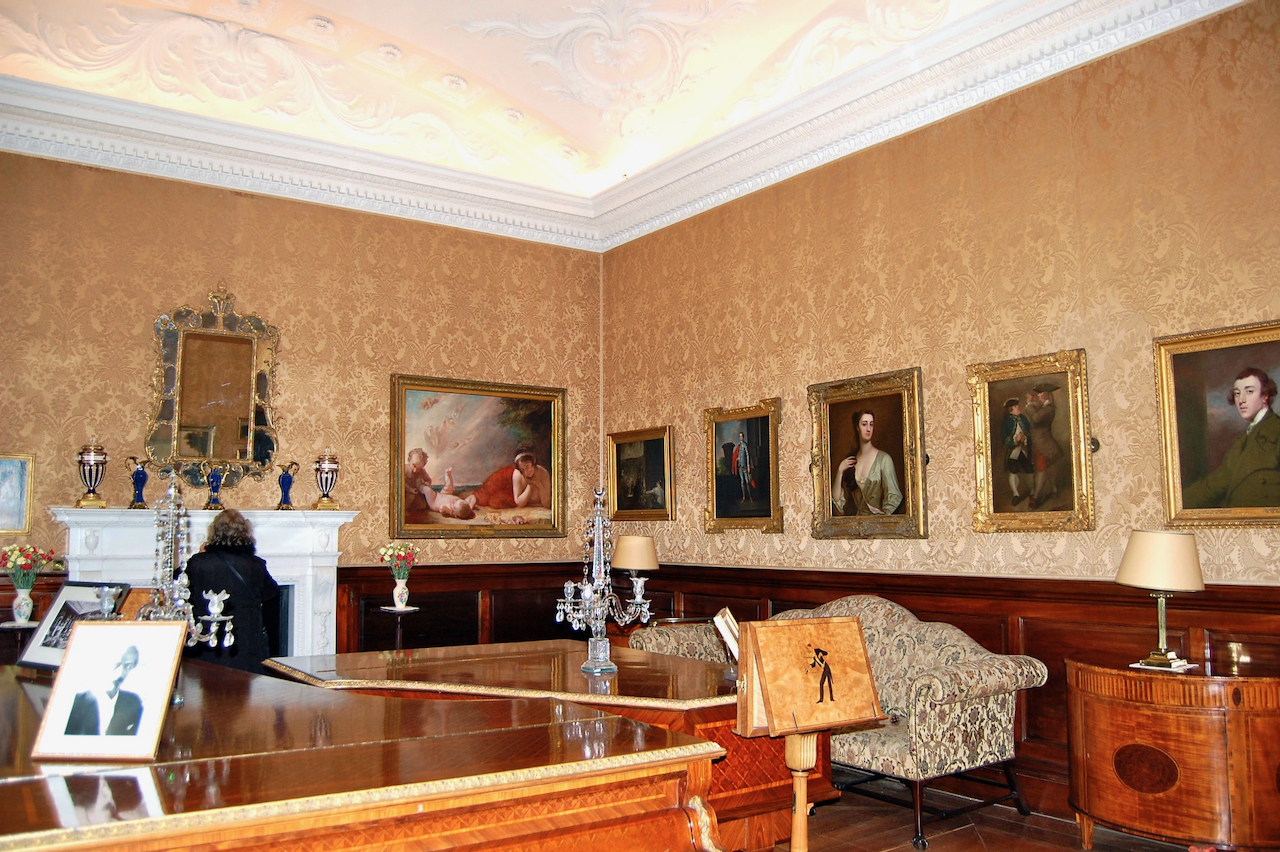
Russborough House 2018, the music room. The last portrait to the right on the wall is Lord Conolly of Castletown House. The Russborough House website tells us: “When the Beits’ art collection was stolen, Sir Alfred had many copies of the paintings made. This room showcases the replicas of the oil paintings that were infamously stolen in the 1970s and 1980s. The originals of these paintings were gifted to the National Gallery of Ireland in the 1980s for safekeeping, where they can now be seen.
Visitors can learn more about the robberies at Russborough and how most of the paintings were recovered. The exhibition also includes Sir Alfred in an interview with broadcasting legend Gay Byrne, talking about the pictures and furniture contained in the house.
Photograph © Jennifer Winder-Baggot, www.irishhistorichouses.com
The ceiling in the Music Room. Photograph © Jennifer Winder-Baggot, www.irishhistorichouses.com
The Library, Russborough House 2018. Photograph © Jennifer Winder-Baggot, www.irishhistorichouses.com
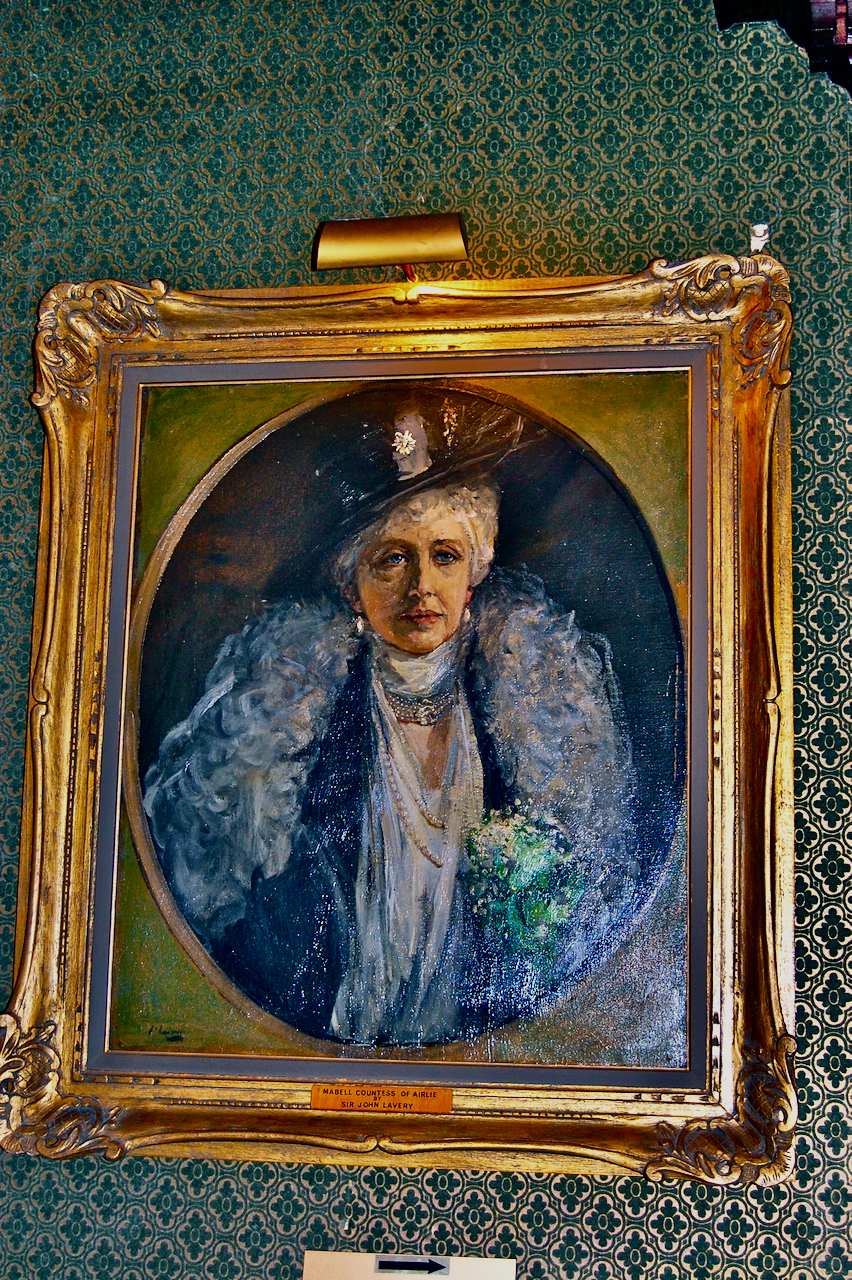
Russborough House 2018 Lady Beit’s grandmother, Mabell, Countess of Airlie, by John Lavery. Photograph © Jennifer Winder-Baggot, www.irishhistorichouses.com

Reeves-Smyth writes that:

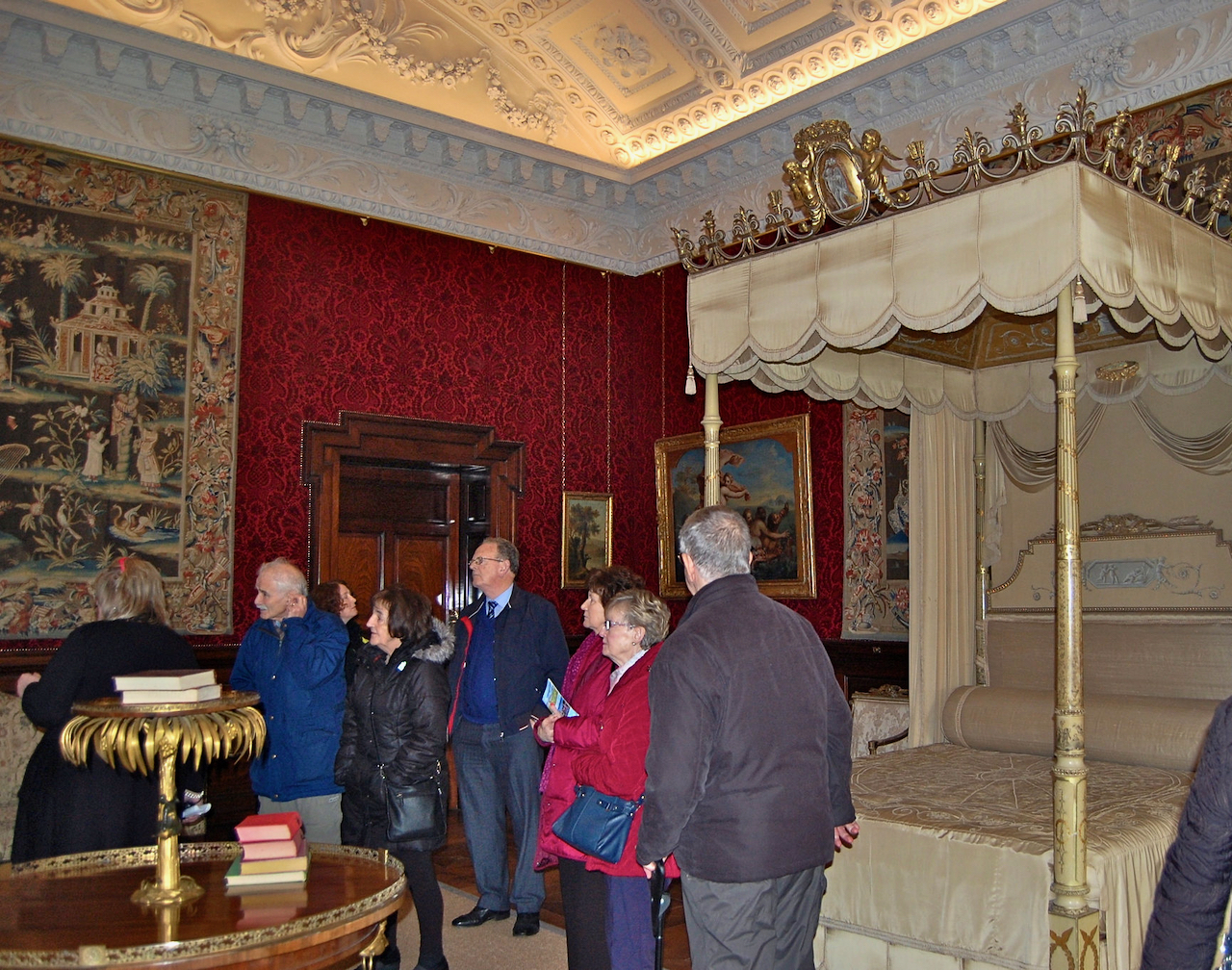
The coffered and richly decorated barrel-vaulted ceiling of the tapestry room, to the south of the music room, is by a less experienced artist, though the room is no less impressive than the others and contains an English state bed made in London in 1795 and two Soho tapestries of Moghul subjects by Vanderbank.

The Tapestry Room, Russborough House 2018. Photograph © Jennifer Winder-Baggot, www.irishhistorichouses.com
Russborough, County Wicklow. Photograph © Jennifer Winder-Baggot, www.irishhistorichouses.com
Russborough, May 2018. Photograph © Jennifer Winder-Baggot, www.irishhistorichouses.com

The Russborough website states:

Infused with a restless energy the plasterwork of the adjacent drawing-room spills onto the walls, where fantastic plaster frames surround the four oval marine scenes by Vernet representing morning, noon, evening and night. Although part of the patrimony of the house, these pictures were sold in 1926 and only after a determined search were recovered 43 years later by Sir Alfred Beit. [12]

Stucco specially designed to frame the oval Joseph Vernet paintings. Carrera marble fireplace. Photograph © Jennifer Winder-Baggot, www.irishhistorichouses.com
The Drawing Room, 2018, small painting next to the fireplace of the Beits by Derek Hill. Photograph © Jennifer Winder-Baggot, www.irishhistorichouses.com
Russborough, County Wicklow. Photograph © Jennifer Winder-Baggot, www.irishhistorichouses.com
Unusual timepiece clock from time of Louis XVIth. Photograph © Jennifer Winder-Baggot, www.irishhistorichouses.com
Russborough, May 2018. Photograph © Jennifer Winder-Baggot, www.irishhistorichouses.com

Reeves-Smyth continues his evocative description:

Beyond lies the boudoir, a charming little panelled apartment with a Bossi chimney-piece dating around 1780. From here visitors pass into the tapestry-hung corridor leading to the pavilion, formerly the bachelor’s quarters. The dining-room, formerly the library, on the opposite side of the hall has a monumental Irish chimney-piece of mottled grey Sicilian marble. The walls are ornamented both by paintings from the Beit collection and two magnificent Louis XIV tapestries.” [11]

The dining room, with a monumental Irish chimneypiece of mottle grey Sicilian marble. The walls are ornamented with two magnificent Louis XIV tapestries. Photograph © Jennifer Winder-Baggot, www.irishhistorichouses.com
Russborough, County Wicklow. Photograph © Jennifer Winder-Baggot, www.irishhistorichouses.com
Russborough, May 2018. Photograph © Jennifer Winder-Baggot, www.irishhistorichouses.com

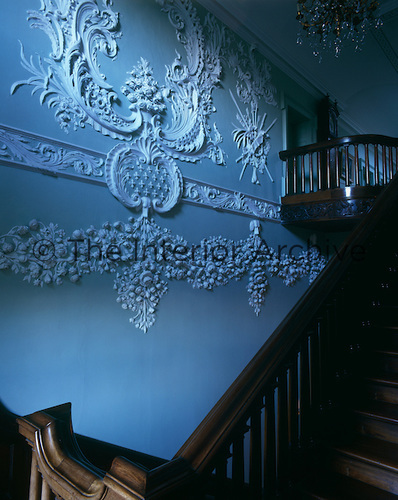
Reeves-Smyth goes on to say that “No one who visits Russborough is likely to forget the staircase with its extraordinary riot of exuberant plasterwork; there is nothing quite like it anywhere else in the British Isles.

In later years the decorator Mr. Sibthorpe is reported to have remarked that it represented “the ravings of a maniac,” adding that he was “afraid the madman was Irish.”

The Staircase Hall is decorated with a riot of exuberant Rococo plasterwork, Russborough, Copyright Christopher Simon Sykes, The Interior Archive Ltd, CS_GI24_37.
Nobody knows who did the wonderful stuccowork in the staircase hall. The stairs are of mahogany. Photograph © Jennifer Winder-Baggot, www.irishhistorichouses.com
Detail of the spectacular plasterwork in the Staircase Hall, Russborough, Copyright Christopher Simon Sykes, The Interior Archive Ltd, CS_GI24_35.
Russborough, County Wicklow. Photograph © Jennifer Winder-Baggot, www.irishhistorichouses.com
Russborough, May 2018. Photograph © Jennifer Winder-Baggot, www.irishhistorichouses.com

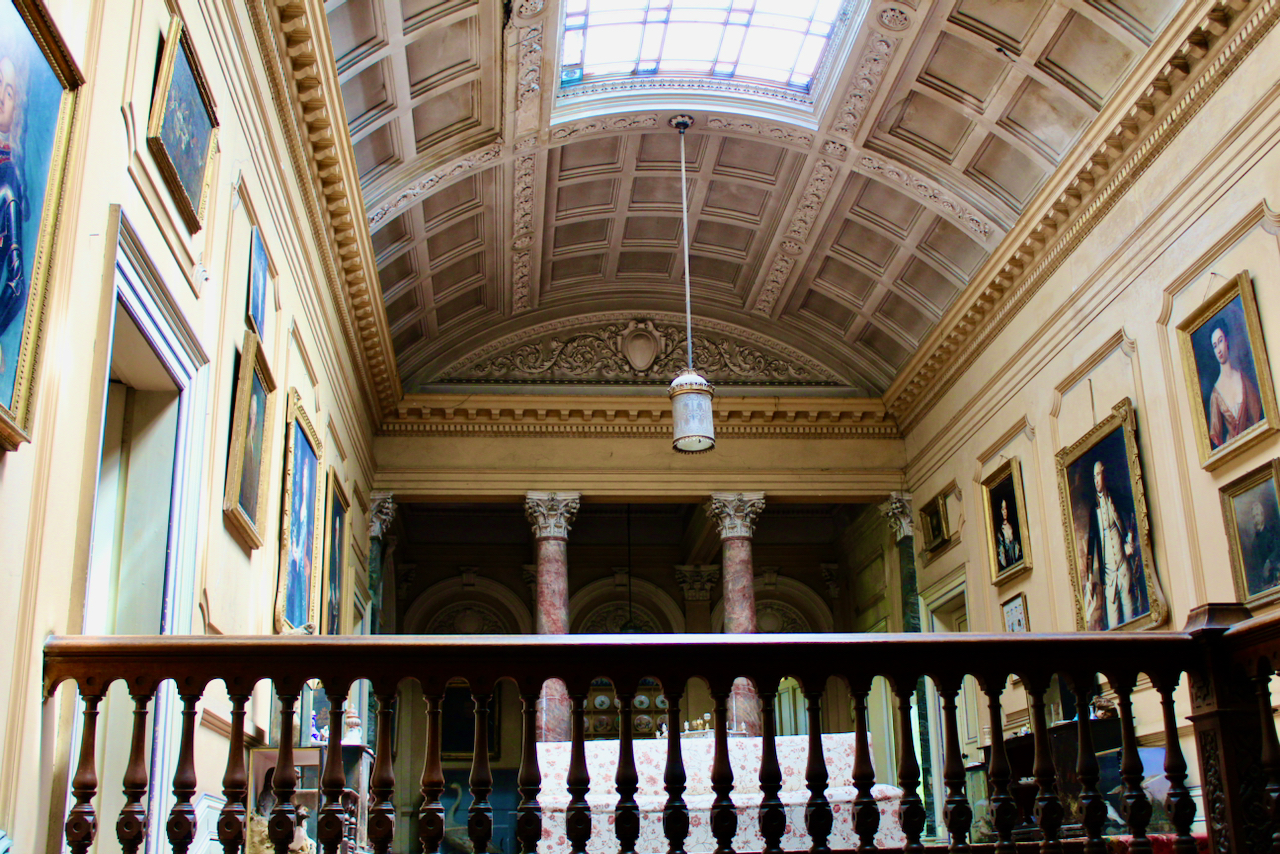
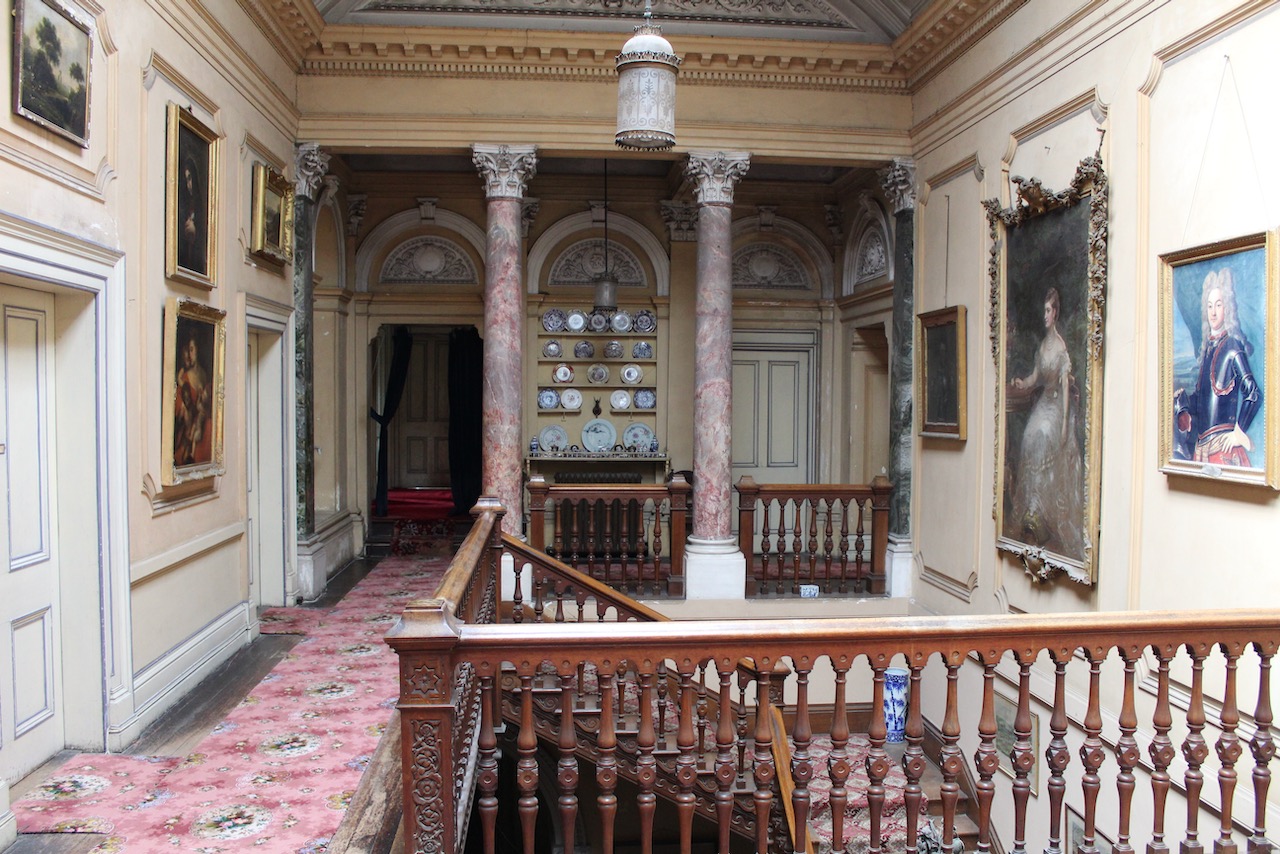
Sean O’Reilly tells us that the Knight of Glin pointed out that Castle “cribbed the idea of the balustraded upper landing lit by a lantern window at Russborough from Pearce’s superb Palladian villa of Bellamont Forest, Co Cavan, built circa 1730 for his uncle Lord Justice Coote (and recently immaculately restored by the designer John Coote from Australia)”. Sadly since this was written, John Coote has died. I did not take a photograph of the upper landing, but you can see it on the Russborough website or better yet, during a visit to the house. The rooms off the this top-lit lobby would have been the bedrooms.

Joseph the 1st Earl of Milltown and his first wife Cecelia had several children including the heir, Joseph (1730-1801), who succeeded as 2nd Earl of Milltown, and his brother Brice (1735-1807) who succeeded as 3rd Earl. They also had a daughter, Mary (1734-1794) who married John Bourke, 2nd Earl of Mayo. Joseph 1st Earl and his second wife, Anne Preston, had a daughter, also named Anne, who married her cousin Hugh Henry, son of Hugh Henry (d. 1743) and her aunt Anne Leeson.

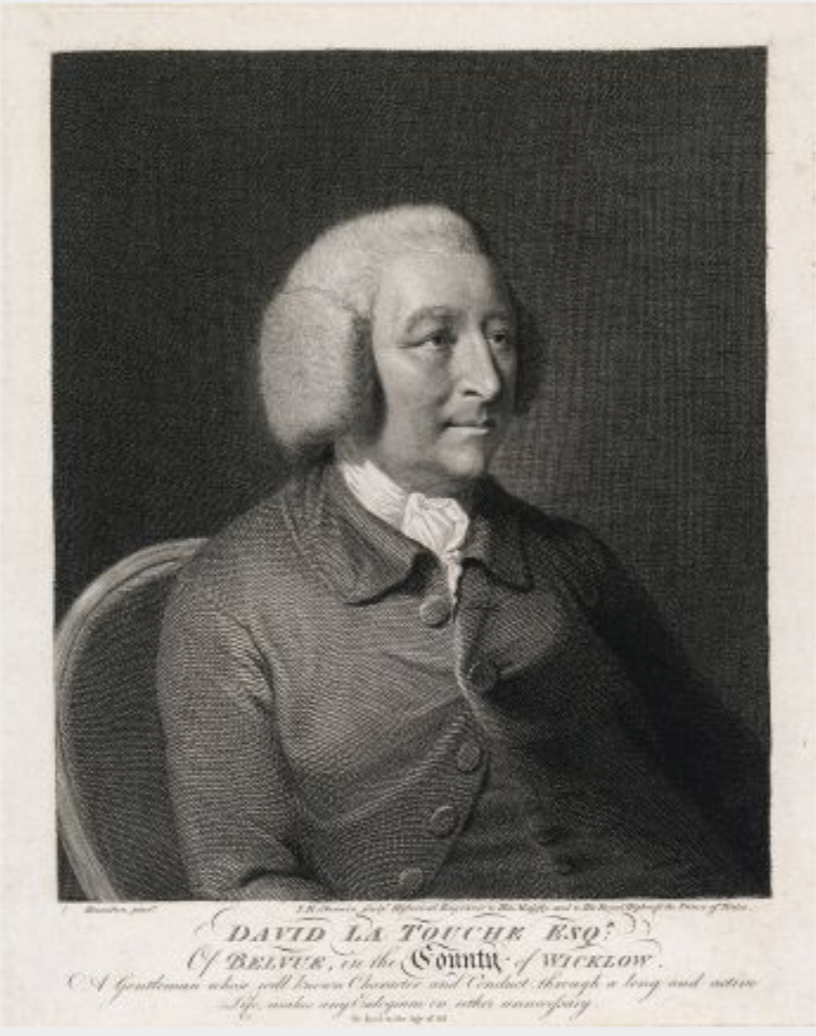
Joseph the 1st Earl of Milltown died in 1783, and his bachelor son Joseph succeeded to the peerages and to Russborough. The first Earl’s third wife and widow, Elizabeth French, lived on to a very great age until 1842. She and the 1st Earl had a daughter Cecelia who married Colonel David La Touche of Marlay. They als had a daughter Frances Arabella who married Marcus de la Poer Beresford, son of John the 1st Marquess of Waterford (of Curraghmore House, which we visited, another section 482 property). They also had sons Robert (1773-1842) and William (1770-1819).

Joseph Leeson, 1st Earl of Milltown with his third Wife Elizabeth, their daughter Cecilia and his grandson Joseph, later 3rd Earl of Milltown Date c.1772 after Pompeo Batoni. Photograph courtesy of National Gallery of Ireland.
Joseph Leeson, later 2nd Earl of Milltown (1730-1801) Date 1751 by Pompeo Batoni, Italian, 1708-1787, photograph courtesy of the National Gallery of Ireland.

When the 2nd Earl of Milltown died in 1801, his brother Brice succeeded to Russborough and to the title to become the 3rd Earl of Milltown.

Cecilia La Touche née Leeson (about 1769-1848). She was the daughter of Joseph 1st Earl of Milltown and she married Colonel David la Touche.

Russborough remained in the possession of the Earls of Milltown until after the 6th Earl’s decease – the 5th, 6th and 7th Earls of Milltown were all sons of the 4th Earl of Milltown. The 6th Earl’s widow, the former Lady Geraldine Stanhope, daughter of the 5th Earl of Harrington, Co. Northampton in England, lived on at Russborough until 1914.

Emily Douglas (d.1841) by James Dowling Herbert courtesy of National Gallery of Ireland NGI 6271. She was wife of Joseph Leeson (1766-1800) mother of 4th Earl of Milltown.
Edward Nugent Leeson, 6th Earl of Milltown (1835-1890), 1875 by Francis Grant, Courtesy of National Gallery of Ireland NGI.1036.

The family collection of pictures in the house was given by Lady Geraldine to the National Gallery of Ireland, in 1902 (the Milltown wing was thus created in the National Gallery). [13] On the death of Lady Milltown in 1914, it passed to a nephew, Sir Edmund Turton (the son of the 4th Earl’s daughter Cecelia), who rarely stayed there, as he lived in Yorkshire and was an MP in the British Parliament. After Turton’s death in 1928, his widow sold the house to Captain Denis Bowes Daly (of the Dalys of Dunsandle, County Galway – now a ruin) in 1931.

Alfred Beit, heir to a fortune made in gold and diamond mining by his uncle in South Africa, saw Russborough in an article in Country Life in 1837.  He was so impressed that he had the dining room chimneypiece copied for a chimney in his library in his home in Kensington Palace Gardens in London. [see 13] In 1952 he bought Russborough from Captain Daly to house his art collection and in 1976 established the Alfred Beit Foundation to manage the property. The foundation opened the historic mansion and its collections to the Irish public in 1978.

Sir Alfred died in 1994 but Lady Beit remained in residence until her death in 2005. [14] The Beits donated their art collection the National Gallery of Ireland in 1986, and a wing was dedicated to the Beits.

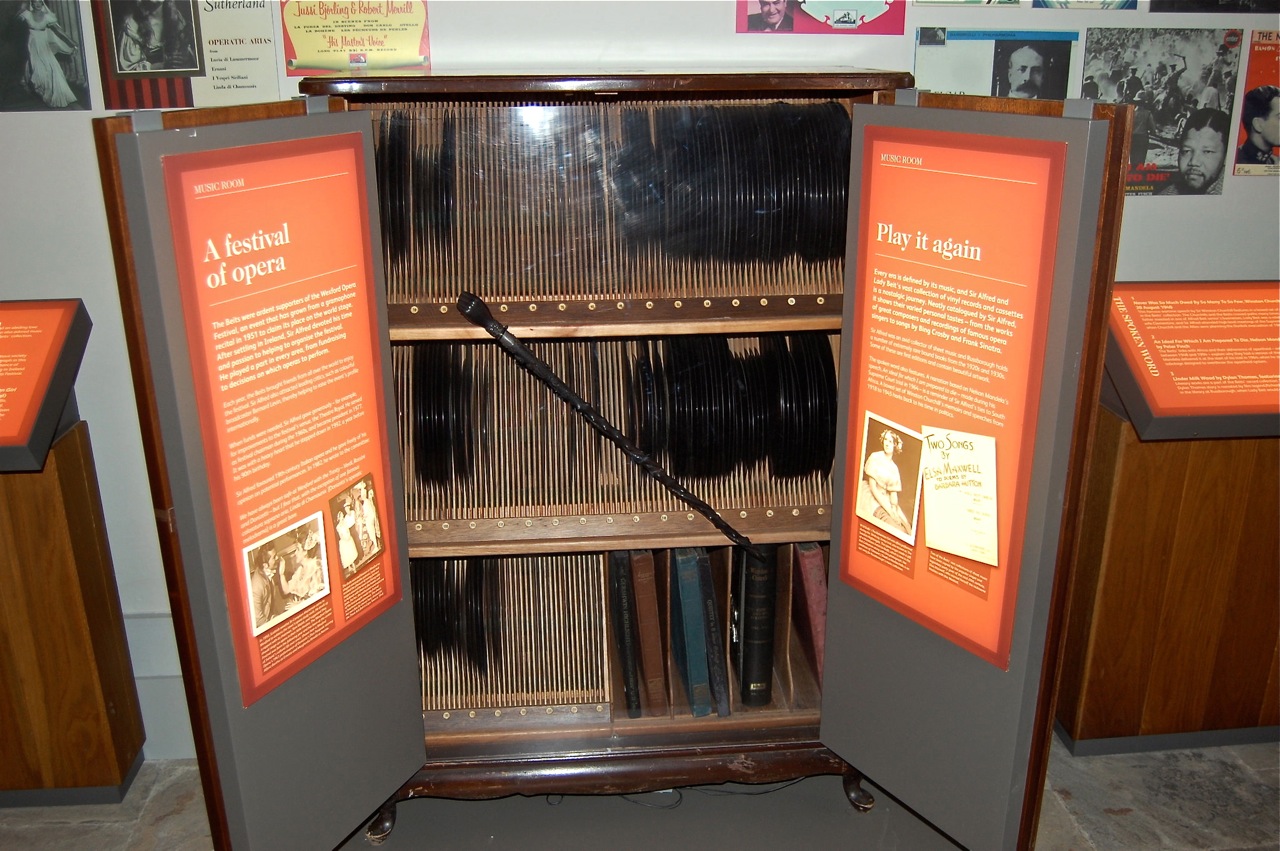
Russborough House is now a destination for all the family. Inside, rooms have been filled with information about the Beits, their life and times. They entertained many famous friends, travelled the world, and collected music, photographs and films, all now on display.

Russborough, County Wicklow. Photograph of photograph © Jennifer Winder-Baggot, www.irishhistorichouses.com
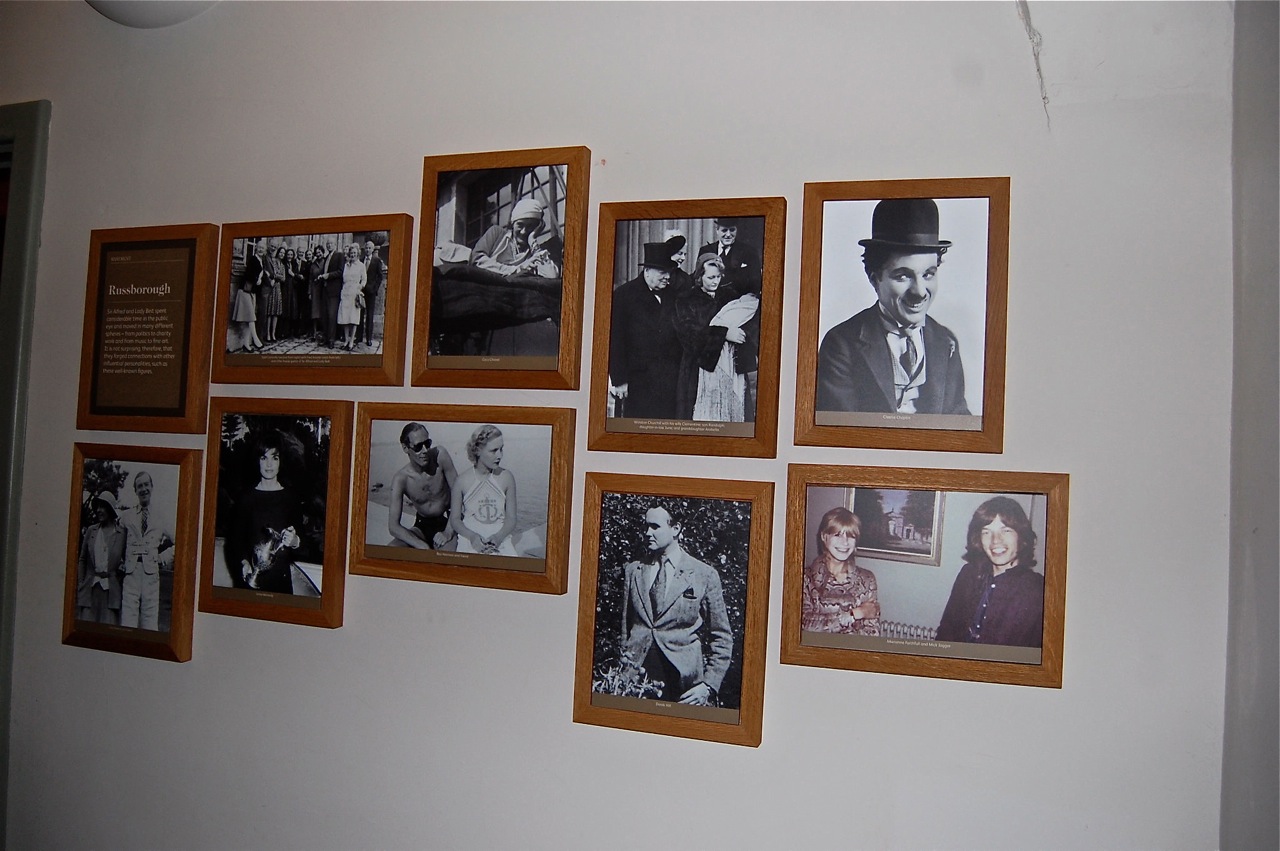
Various visitors and friends of the Beits. Photograph © Jennifer Winder-Baggot, www.irishhistorichouses.com
Russborough, County Wicklow. Photograph © Jennifer Winder-Baggot, www.irishhistorichouses.com
Russborough, May 2018. Photograph © Jennifer Winder-Baggot, www.irishhistorichouses.com

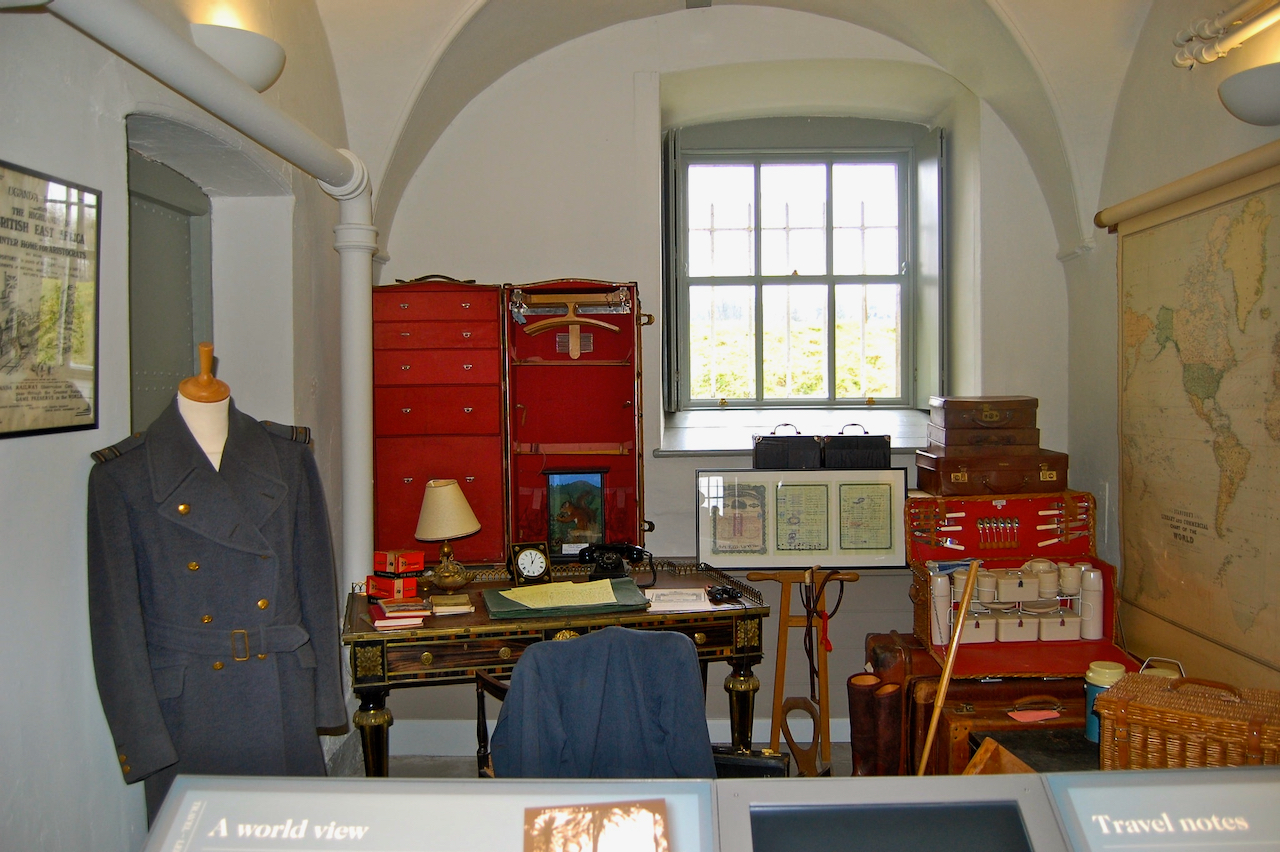
The Russborough website tells us: “In 1939 Sir Alfred joined the Royal Air Force. In this room, extracts can be heard from some of the many romantic letters that Sir Alfred Beit wrote to his wife during the Second World War.”

Russborough House 2018. Photograph © Jennifer Winder-Baggot, www.irishhistorichouses.com

“The exhibition includes a short film that starts in 2D and then moves to the third dimension. We display 3D images taken by Sir Alfred on his world travels in the 1920s and 1930s.

Russborough, May 2018. Photograph © Jennifer Winder-Baggot, www.irishhistorichouses.com

“This private auditorium is arguably one of the most interesting rooms in the house, and was created by Sir Alfred himself when he bought Russborough so that he could share his adventures with friends and enjoy movies on the silver screen. 

“Visitors can also sit and watch fascinating footage from around the world in the glamorous 1920s at the touch of a button.”

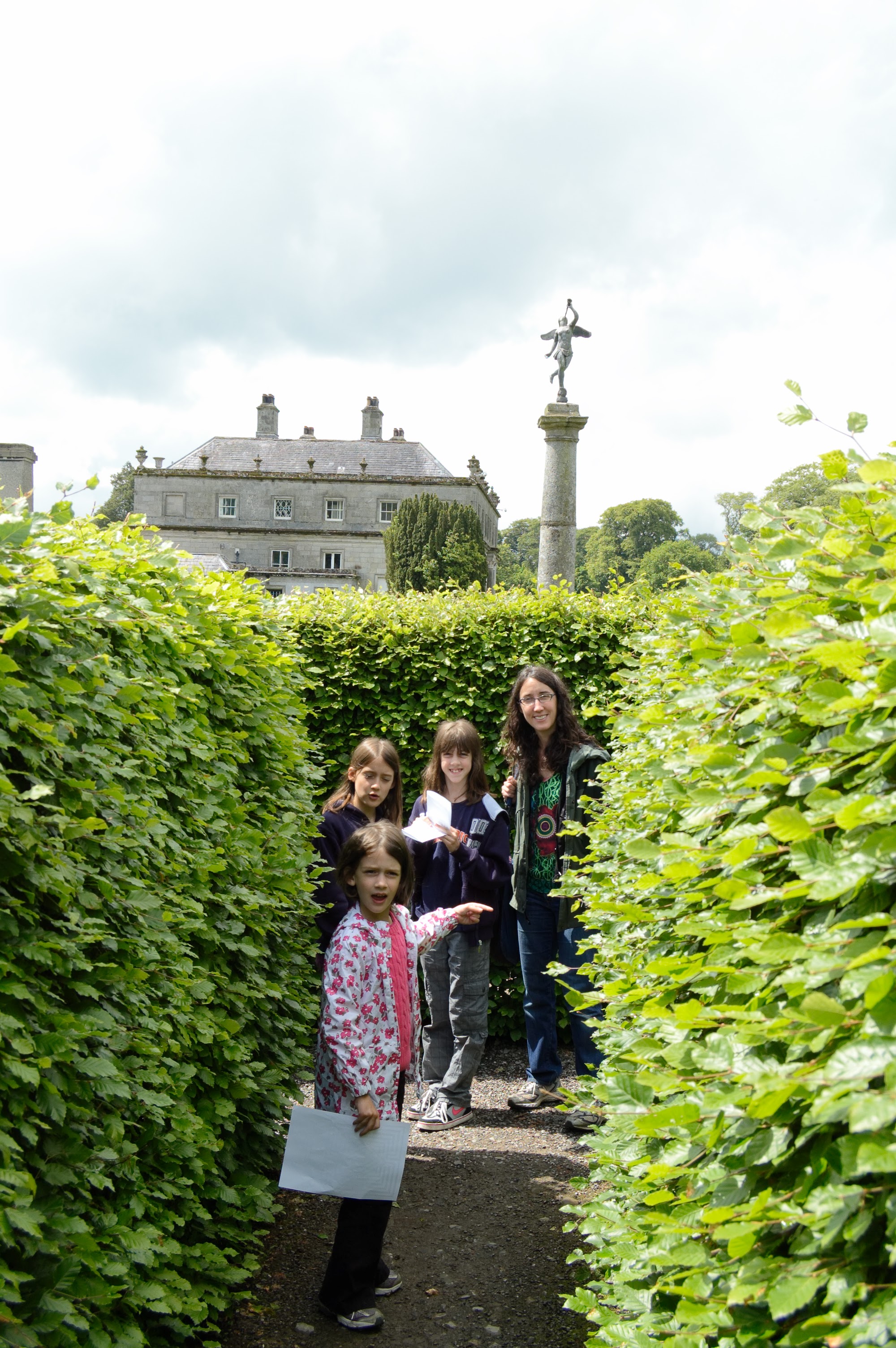
Outside near the former riding arena, hedges have been shaped into a maze.

Photo by Jeremy Hylton, 2012.
Photo by Jeremy Hylton, 2012, the former riding arena.
Woods at Russborough House 2018. Photograph © Jennifer Winder-Baggot, www.irishhistorichouses.com
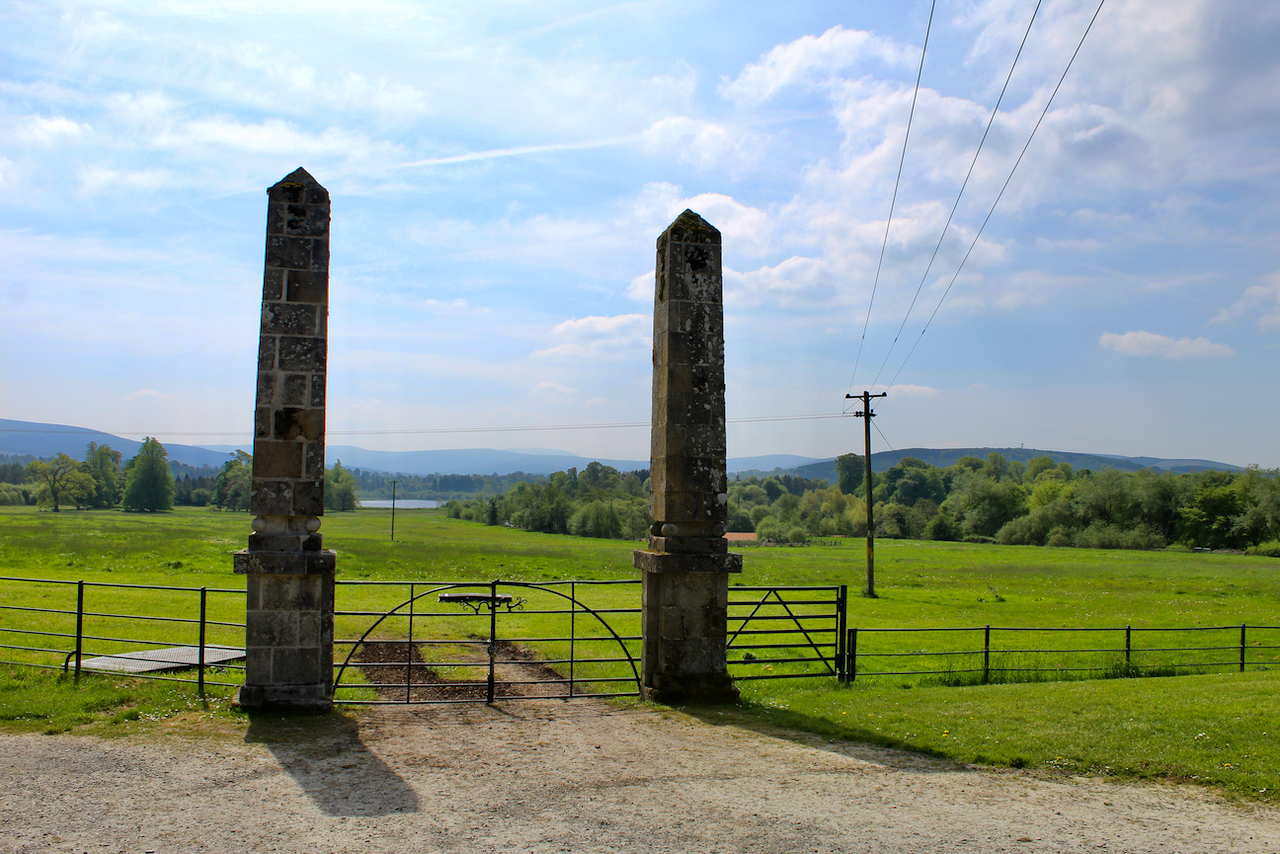
“Thank you for visiting Russborough House.” Classical gate at the eastern entrance to Russborough, built in 1745 to designs by Richard Castle.

[1] Mark Bence-Jones. A Guide to Irish Country Houses (originally published as Burke’s Guide to Country Houses volume 1 Ireland by Burke’s Peerage Ltd. 1978); Revised edition 1988, Constable and Company Ltd, London.

[2] https://theirishaesthete.com/2015/05/11/of-russborough-and-its-predicament/

[3] p. 85. O’Reilly, Sean. Irish Houses and Gardens. From the Archives of Country Life. Aurum Press Ltd, London, 1998.

[4] https://www.dia.ie/architects/view/347/CASTLE,+RICHARD

[5] https://en.wikipedia.org/wiki/Richard_Boyle,_3rd_Earl_of_Burlington

[6] https://en.wikipedia.org/wiki/Richard_Cassels

[7] https://www.buildingsofireland.ie/buildings-search/building/50010221/tyrone-house-department-of-education-marlborough-street-dublin-1-dublin-city

[8] https://www.dia.ie/architects/view/347/CASTLE,+RICHARD#tab_works

[9] p. 85. O’Reilly, Sean. Irish Houses and Gardens. From the Archives of Country Life. Aurum Press Ltd, London, 1998.

[10] https://irishhistorichouses.com/2020/04/18/architectural-definitions/

[11] Reeves-Smyth, Terence. Big Irish Houses. Appletree Press Ltd, The Old Potato Station, 14 Howard Street South, Belfast BT7 1AP. 2009

[12] http://www.russborough.ie/

Note that the website has changed since I first wrote the blog and some quotations from the website are no longer on the site.

[13] p. 147. Montgomery-Massingberd, Hugh and Christopher Simon Sykes. Great Houses of Ireland. Laurence King Publishing, 1999.

[14] http://lordbelmontinnorthernireland.blogspot.com/search/label/County%20Wicklow%20Landowners?updated-max=2018-01-05T08:13:00Z&max-results=20&start=8&by-date=false

Text © Jennifer Winder-Baggot, www.irishhistorichouses.com

Borris House, County Carlow – section 482

www.borrishouse.com
Open dates in 2026: Open: Apr 1, 2, 7-12, 14-26, 28-30, May 5-10, 19-24, June 12-14, 16-18, 23-25, 30, Aug 5, 12-23, 25, 26, Sept 1, 2, 8, 9, 22, 23, 29 12pm-4pm
Fee: adult €12, OAP/student €10, child under 12 free

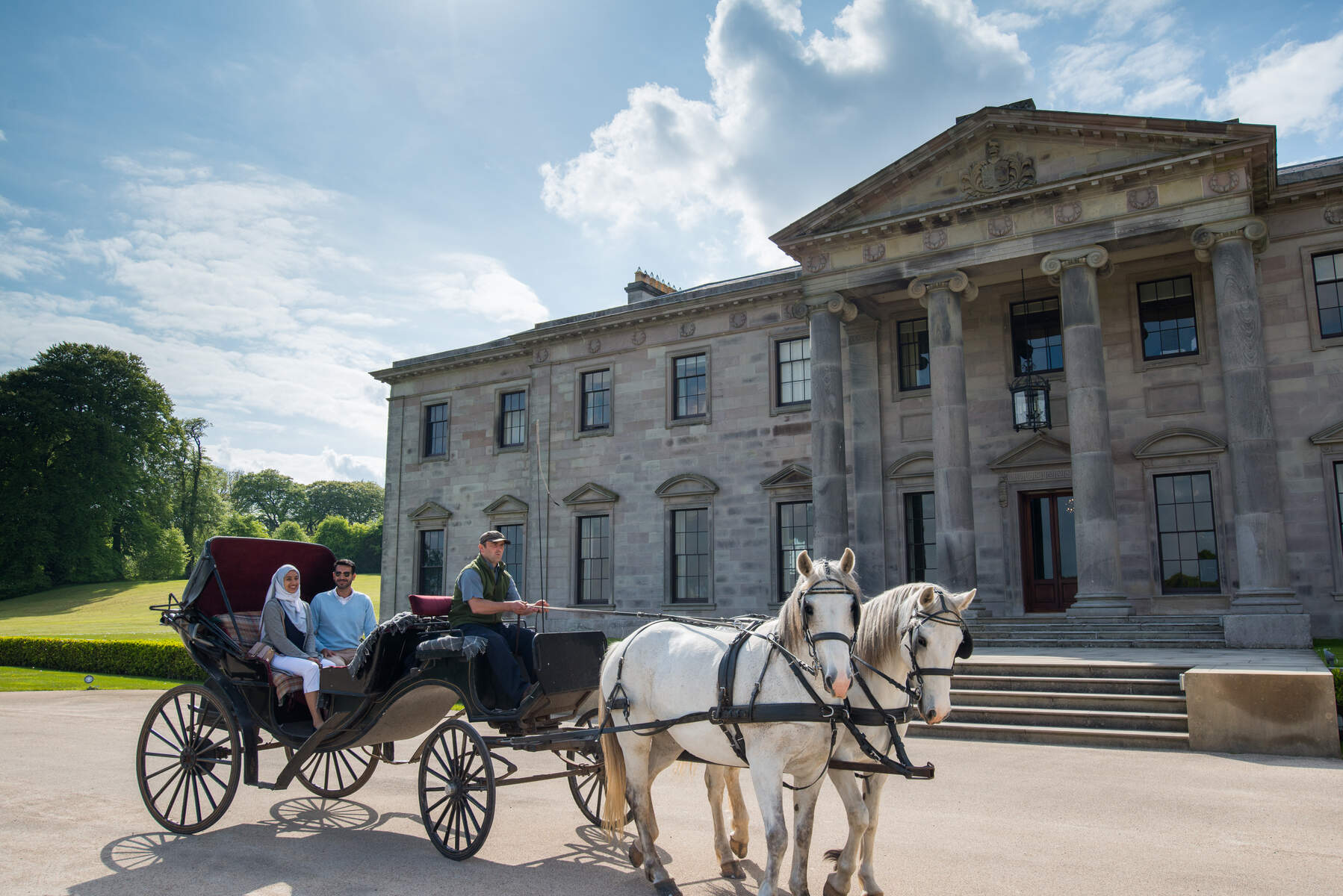
Borris House, Carlow, photograph by Suzanne Clarke, 2016 for Tourism Ireland, Ireland’s Content Pool.

donation

Help me to pay the entrance fee to one of the houses on this website. This site is created purely out of love for the subject and I receive no payment so any donation is appreciated!

€15.00

Borris House, July 2019. Photograph © Jennifer Winder-Baggot, www.irishhistorichouses.com

I had been particularly looking forward to visiting Borris House. It feels like I have a personal link to it, because my great great grandmother’s name is Harriet Cavanagh, from Carlow, and Borris House is the home of the family of Kavanaghs of Carlow, and the most famous resident of the house, Arthur MacMurrough Kavanagh, was the son of a Harriet Kavanagh! Unfortunately I don’t think there’s a connection.

We were able to park right outside on the main street of Borris, across from the entrance. My fond familial feelings immediately faded when faced with the grandeur of the entrance to Borris House. I shrank into a awestruck tourist and meekly followed instructions at the Gate Lodge to make my way across the sweep of grass to the front entrance of the huge castle of a house.

We brought our friend Damo along with us – here he is with Stephen at the entrance arch. The National Inventory of Architectural Heritage tells us that this entrance was designed by Richard Morrison, around 1813. It has an arch opening with crenellations, flanking turrets and buttressed walls. There’s a portcullis and fabulous studded door. The towers have blind arrow slits including a cruciform arrow slit, and there’s a small Gothic window with hood moulding. [1] Photograph © Jennifer Winder-Baggot, www.irishhistorichouses.com
A view of the arched entrance from inside the demesne. Photograph © Jennifer Winder-Baggot, www.irishhistorichouses.com

Unlike other section 482 houses – with the few exceptions such as Birr Castle and Tullynally – Borris House has a very professional set-up to welcome visitors as one goes through the gate lodge. The website does not convey this, as it emphasises the house’s potential as a wedding venue, but the property is in fact fully set up for daily guided tours, and has a small gift shop in the gate lodge, through which one enters to the demesne. Borris House is still a family home and is inhabited by descendants of the original owners.

Approach to the front of the house from the gate lodge. Photograph © Jennifer Winder-Baggot, www.irishhistorichouses.com
Standing at the front of the house looking to our left at the beautiful landscape. Photograph © Jennifer Winder-Baggot, www.irishhistorichouses.com

Originally a castle would have been located here on the River Barrow to guard the area. From the house one can see Mount Leinster and the Blackstairs Mountains.

The current owner Morgan Kavanagh can trace his ancestry back to the notorious Dermot MacMurrough (Diarmait mac Murchadha in Irish), who “invited the British in to Ireland” or rather, asked for help in protecting his Kingship. The MacMurroughs, or Murchadhas, were Celtic kings of Leinster. “MacMurrough” was the title of an elected Lord. Dermot pledged an oath of allegiance to King Henry II of Britain. The Norman “Strongbow,” or Richard de Clare, 2nd Earl of Pembroke, came to Ireland to fight alongside Dermot MacMurrough against Dermot’s enemies. As a reward, Dermot MacMurrough offered Strongbow the hand of his daughter Aoife. This was less a love match than a chance to become the next King of Leinster. Succeeding generations of MacMurrough family controlled the area, maintaining their Gaelic traditions.

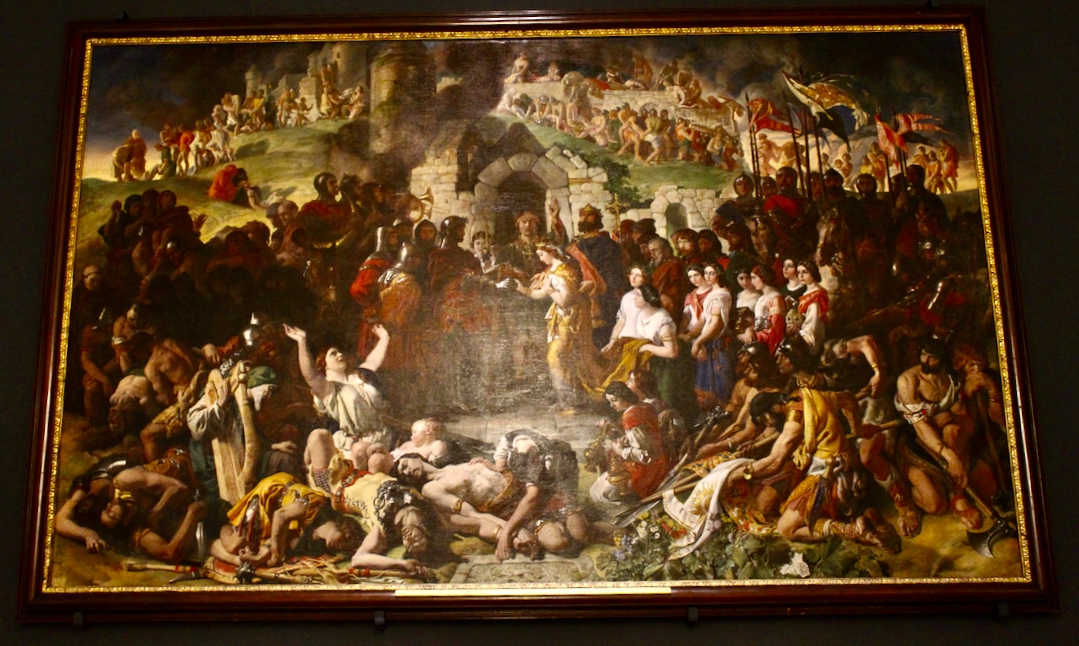
The Marriage of Aoife and Strongbow, Richard de Clare 2nd Earl of Pembroke at Waterford in 1170, by Daniel Maclise, in National Gallery of Ireland. Conceived for the decoration of the Palace of Westminster, a note tells us, the painting is an ambiguous representation of the victorious Normans and the vanquished Irish. Strongbow places his foot upon a fallen Celtic cross, King Dermot looks on in alarm, and an elderly musician slumps of his harp.

Timothy William Ferres tells us that in 1171, the name Kavanagh was given to Donell, son of Dermot MacMorrough. [1*]

In the late 14th century, Art mac Murchadha (d. around 1417) was one of the Irish kings who was offered a knighthood by King Richard II of England. In the 1500s, King Henry VIII sought to reduce the power of the Irish kings and to have them swear loyalty to him. In 1550 Charles MacMurrough Kavanagh (the Anglicised version of the name ‘Cahir MacArt’ MacMurrough Kavanagh) “submitted himself, and publicly renounced the title and dignity of MacMorrough, as borne by his ancestors.” [2] (note the various spellings of MacMorrough/MacMurrough). The head of the family was still however referred to as “the MacMorrough.”

We gathered with a few others to wait outside the front of the house for our tour guide on a gloriously sunny day in July 2019. Some of the others seemed to be staying at the house. For weddings there is accommodation in the house and also five Victorian cottages. We did not get to see these in the tour but you can see them on the website. Unfortunately our tour guide was not a member of the family but she was knowledgeable about the house and its history.

The current house was built originally as a three storey square house in 1731, incorporating part of a fifteenth century castle. We can gather that this was the date of completion of the house from a carved date stone.

According to the Borris House website, the 1731 house was built for Morgan Kavanagh, a descendant of Charles MacMurrough Kavanagh. However, I have the date of 1720 as the death for Morgan Kavanagh. Irish Aesthete Robert O’Byrne writes that the 1731 house was built by Brian Kavanagh. [3] Morgan Kavanagh has a son named Brian (d. 1741), so it could be the case that the house was commissioned by Morgan and completed by his son.

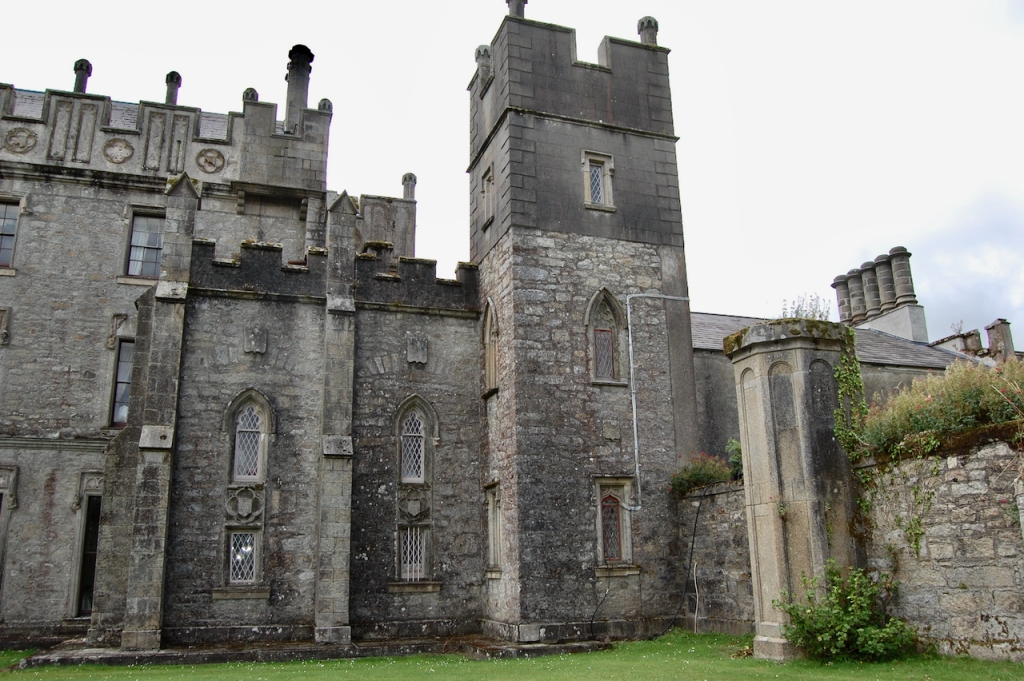
The house was damaged in the 1798 Rebellion and rebuilt and altered by Richard and William Vitruvius Morrison around 1813 into what one sees today. According to Edmund Joyce in his book Borris House, Co. Carlow, and elite regency patronage, it was Walter Kavanagh, grandson of the aforementioned Brian (d. 1741) who commissioned the work, which was taken over by brother Thomas (1767-1837) when Walter died in 1818. [4]. The Morrisons gave it a Tudor exterior although as Mark Bence-Jones points out in his Guide to Irish Country Houses, the interiors by the Morrisons are mostly Classical.

Borris House, July 2019. Photograph © Jennifer Winder-Baggot, www.irishhistorichouses.com

The Morrisons kept the original square three storey building symmetrical. Edmund Joyce references McCullough, Irish Building Traditions, writing that “The Anglo-Irish landlords at the beginning of the 19th century who wanted to establish a strong family history with positive Irish associations were beginning to use the castle form – which had long been a status of power both in Ireland and further afield – to embed the notion of a long and powerful lineage into the mindset of the audience.”

In keeping with this castle ideal, the Morrisons added battlemented parapets with finials, the crenellated arcaded porch on the entrance, as well as four square corner turrets to the house, topped with cupolas (which are no longer there). The porch has slightly pointed arches, and is unusual with its bricklike rustication, and elongated mini towers on top with tawny detailing in between, reflected in the roof parapet.

Borris House, July 2019. Photograph © Jennifer Winder-Baggot, www.irishhistorichouses.com

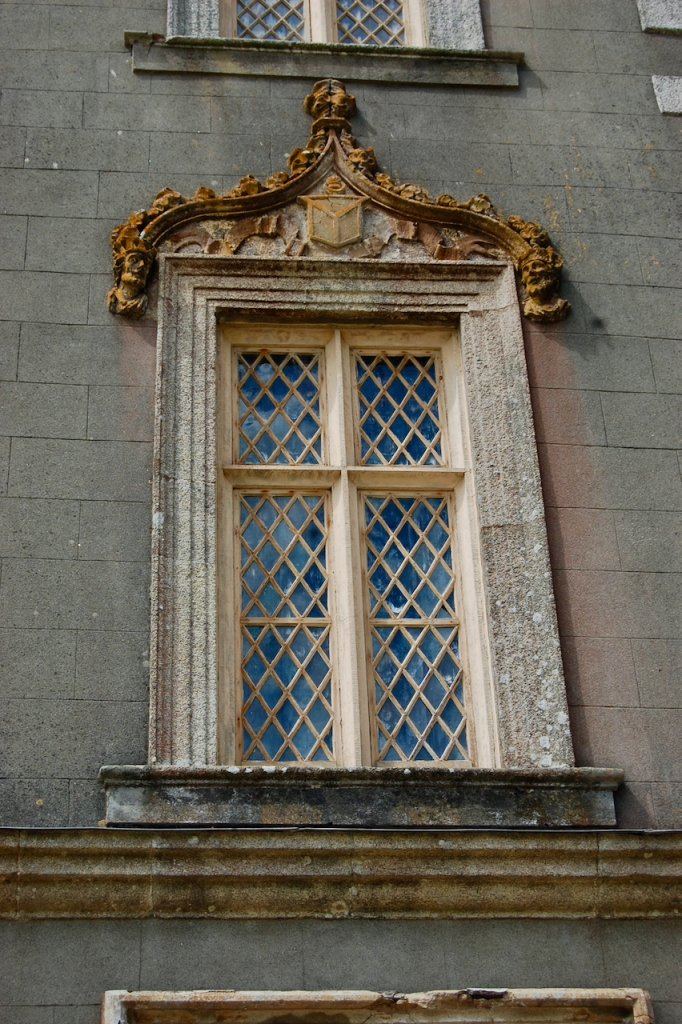
They also created rather fantastical Tudor Gothic curvilinear hood mouldings over the windows, some “ogee” shaped (convex and concave curves; found in Gothic and Gothic-Revival architecture) [5].

An ogee shaped hood moulding. Photograph © Jennifer Winder-Baggot, www.irishhistorichouses.com
Borris House, July 2019. Photograph © Jennifer Winder-Baggot, www.irishhistorichouses.com

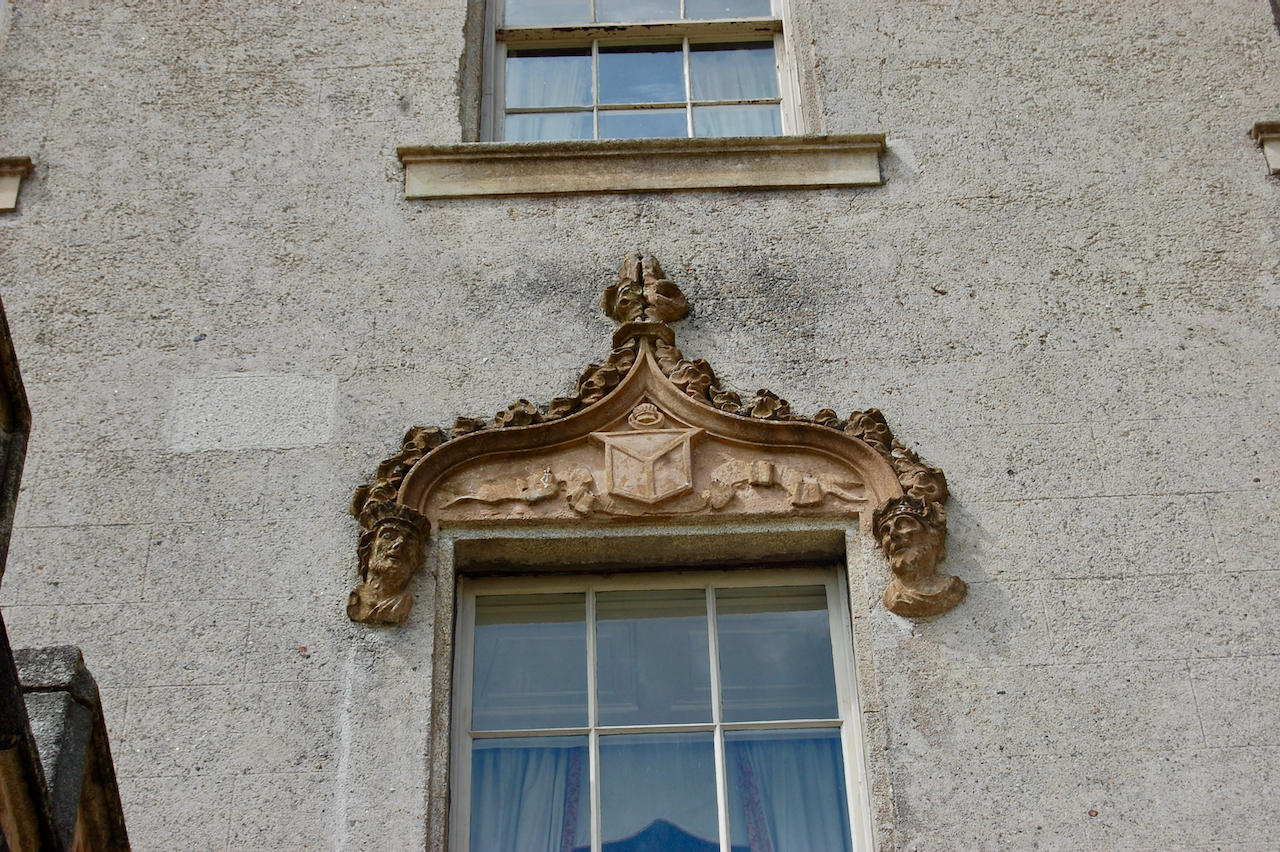
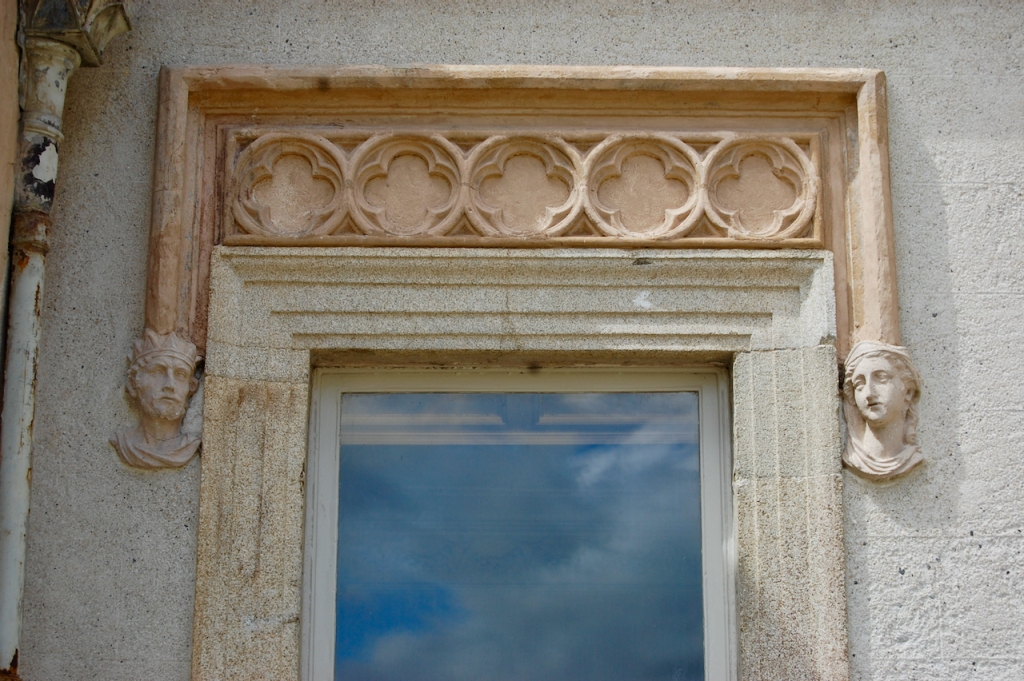
These mouldings drop down from the top of the windows to finish with sculptured of heads of kings and queens. These are not representations of anyone in particular, the guide told us, but are idealised sculptures representing royalty to remind one of the Celtic kingship of the Kavanaghs.

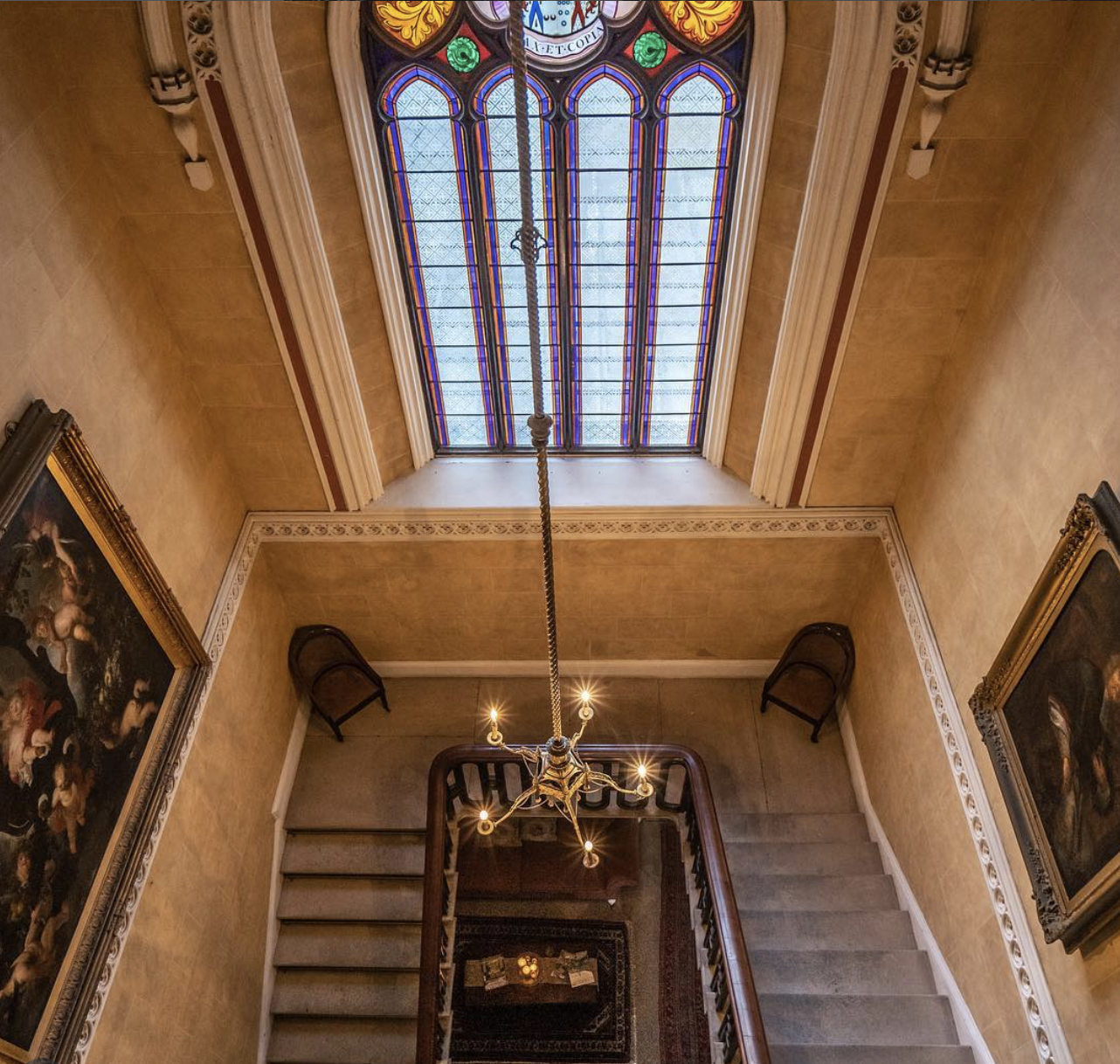
As well as illustrating their heritage in architecture, Walter Kavanagh (d. 1718) commissioned an illustrated book of the family pedigree, titled “The pedigree of the ancient illustrious noble and princely house of Kavanagh in ancient times monarchs of Ireland and at the period of the invasion by Henry the second, kings of Leinster,” which traces the family tree back to 1670 BC! The connections to the prominent families of Butlers, Fitzjohns, De Mariscos and FitzGeralds are highlighted, which are also illustrated in the stained glass window in the main stairwell at Borris.

Borris House, 2019. Photograph © Jennifer Winder-Baggot, www.irishhistorichouses.com
The stairwell in Borris House, with the stained glass window which records some of the genealogy of the Kavanaghs. Photograph courtesy of Borris House instagram, by @1darmar

The guide pointed to the many configurations of windows on the front facade of the house. They were made different deliberately, she told us, to create the illusion that the different types of windows are from different periods, even though they are not! This was to reflect the fact that various parts of the building were built at different times.

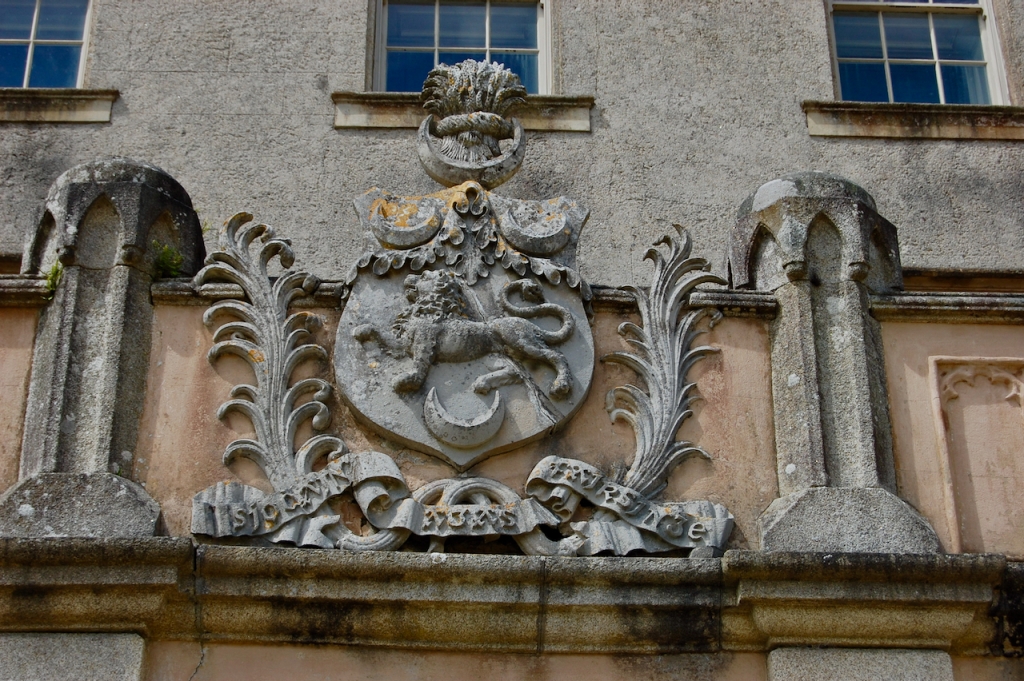
The crest of the family on the front of the house on the portico features a crescent moon for peace, sheaf of wheat for plenty and a lion passant for royalty. The motto is written in Irish, to show the Celtic heredity of the Kavanaghs, and means “peace and plenty.”

Borris House, July 2019. Photograph © Jennifer Winder-Baggot, www.irishhistorichouses.com

The Morrisons also added a castellated office wing, joining the house to a chapel. This wing has been partially demolished.

View of the chapel from the front of the house, and beyond, the path leads to the gate lodge. In between the chapel and the house you can see the wall which once housed the kitchen, with the octagonal chimney stack built into the wall. Photograph © Jennifer Winder-Baggot, www.irishhistorichouses.com

Charles MacMurrough Kavanagh married Cecilia, daughter of Gerald Fitzgerald, 9th Earl of Kildare. Charles’s son Brian (c. 1526-1576) converted to Protestantism and sent his children to be educated in England. One of them, Sir Morgan Kavanagh, acquired the estate of Borris when he was granted the forfeited estates of the O’Ryans of Idrone in County Carlow.

When Protestants were attacked in 1641 by a Catholic rebellion, when Morgan’s son Brian (1595-1662) was “The MacMorrough,” the MacMurrough Kavanaghs were spared due to their ancient Irish lineage. Later, when Cromwell rampaged through Ireland, they were spared since they were Protestant, so they had the best of both worlds during those turbulent times.

Borris House, July 2019. Photograph © Jennifer Winder-Baggot, www.irishhistorichouses.com

Brian Kavanagh (1595-1662) married twice. His first wife was Elinor, daughter of Thomas Colclough of Tintern Abbey in County Wexford. His second wife was Elinor Blancheville of Blanchevillestown in County Kilkenny.

The tour guide took us first towards the chapel. She explained the structure of the house as we trooped across the lawn. She pointed out the partially demolished stretch between the square part of the house and the chapel. All that remains of this demolished section is a wall. The octagonal towerlike structures built into the wall were chimneys and the demolished part was the kitchen.

Side of Borris House with the chapel in the foreground. Photograph © Jennifer Winder-Baggot, www.irishhistorichouses.com
In this photograph, from Shane Prunty Weddings and the Borris House instagram page, you can see the remaining wall of the extension between the house and the chapel.
Side of Borris House, with the later wing that was added, that stretches toward the chapel. Photograph © Jennifer Winder-Baggot, www.irishhistorichouses.com

The square tower that joins the house to the demolished kitchen contained the nursery. The wing was demolished to reduce the amount of rates to be paid. The house was reoriented during rebuilding, the guide told us, and a walled garden was built with a gap between the walls which could be filled with coal and heated! I love learning of novel mechanisms in homes and gardens, techniques which are no longer used but which may be useful to resurrect as we try to develop more sustainable ways of living (not that we’d want to go back to using coal).

The square tower contained the nursery, the guide told us. Photograph © Jennifer Winder-Baggot, www.irishhistorichouses.com

It is worth outlining some of the genealogy of this ancient family, as they intermarried with many prominent families of their day. Morgan Kavanagh (1668-1720) who probably commissioned the building of the 1730s house married Frances Esmonde, daughter of Laurence Esmonde (1634-1688) 2nd Baronet of Ballynastragh, County Wexford, who lived at Huntington Castle (another section 482 property I visited). After her death, he married Margaret Morres of Castle Morres in County Kilkenny.

Morgan and Frances née Esmonde’s son Brian (1699-1741) married Mary Butler, daughter of Thomas Butler (d. 1738) of Kilcash. Their son Thomas (1727-1790) married another Butler, Susanna, daughter of the 16th Earl of Ormonde.

It was the following generation, another Thomas (1767-1837), who is relevant to our visit to the chapel.

This Thomas (1767-1837) was originally a Catholic. He married yet another Butler, Elizabeth, daughter of the 17th Earl of Ormonde, in 1799. At some time he converted to Protestantism. It must have been before 1798 because in that year he represented Kilkenny City in Parliament and at that time only members of the Established Church could serve in Parliament.

As I mentioned, the house was badly damaged in 1798, when the United Irishmen rose up in an attempt to create an independent Ireland. Although the Kavanaghs are of Irish descent and are not a Norman or English family, this did not save them from the 1798 raids. The house was not badly damaged in a siege but outbuildings were. The invaders were looking for weapons inside the house, the guide told us. Robert O’Byrne the Irish Aesthete writes tells us: “Walter MacMurrough Kavanagh wrote to his brother-in-law that although a turf and coal house were set on fire and efforts made to bring ‘fire up to the front door under cover of a car on which were raised feather beds and mattresses’ [their efforts] were unsuccessful.” [6]

Edmund Joyce describes the raid in his book on Borris House (pg. 21-22):

“The rebels who had marched overnight from Vinegar Hill in Wexford…arrived at Borris House on the morning of 12 June. They were met by a strong opposing group of Donegal militia, who had taken up their quarters in the house. It seems that the MacMurrough Kavanaghs had expected such unrest and in anticipation had the lower windows…lately built up with strong masonry work. Despite the energetic battle, those defending the house appear to have been indefatigable, and the rebels, ‘whose cannons were too small to have any effect on the castle…’ the mob retreated back to their camps in Wexford.”

The estate was 30,000 acres at one point, but the Land Acts reduced it in the 1930s to 750 acres, which the present owner farms organically. The outbuildings which were built originally to house the workings of the house – abbatoir, blacksmith, dairy etc, were burnt in one of the sieges and so all the outbuildings now to be seen, the guide told us, were built in the nineteenth century.

Walter Kavanagh (1766-1813), brother of Thomas (1767-1837) (M.P.) and Morgan Kavanagh (who married Alicia Grace of Gracefield, Queens County). Courtesy Fonsie Mealy March 2019.

Thomas’s second wife, Harriet Le Poer Trench, daughter of the 2nd Earl of Clancarty, was of staunch Scottish Protestant persuasion [7]. When he converted, the chapel had to be reconsecrated as a Protestant chapel. According to legend, Lady Harriet had a statue of the Virgin Mary removed from the chapel and asked the workmen to get rid of it. The workmen, staunch Catholics, buried the statue in the garden. People believed that for this act, Lady Harriet was cursed, and it was said that one day her family would be “led by a cripple.”

The story probably came about because Harriet’s third son, Arthur, was born without arms or legs. As she had given birth to two older sons, and he had another half-brother, Walter, son of Thomas’s first wife, it seemed unlikely that Arthur would be the heir. However, the three older brothers all died before Arthur and Arthur did indeed become the heir to Borris House.

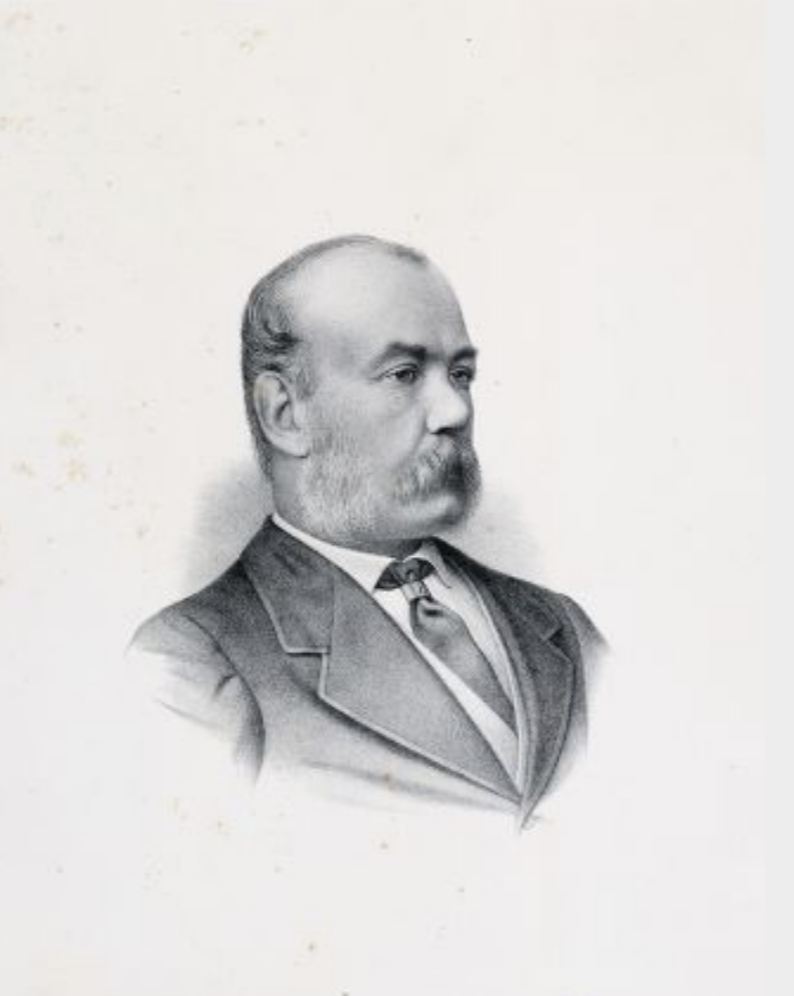
Arthur MacMorrough Kavanagh, M.P., (1831-1839), Politician and Sportsman Date after 1889 Engraver Morris & Co. Photograph courtesy of the National Gallery of Ireland.

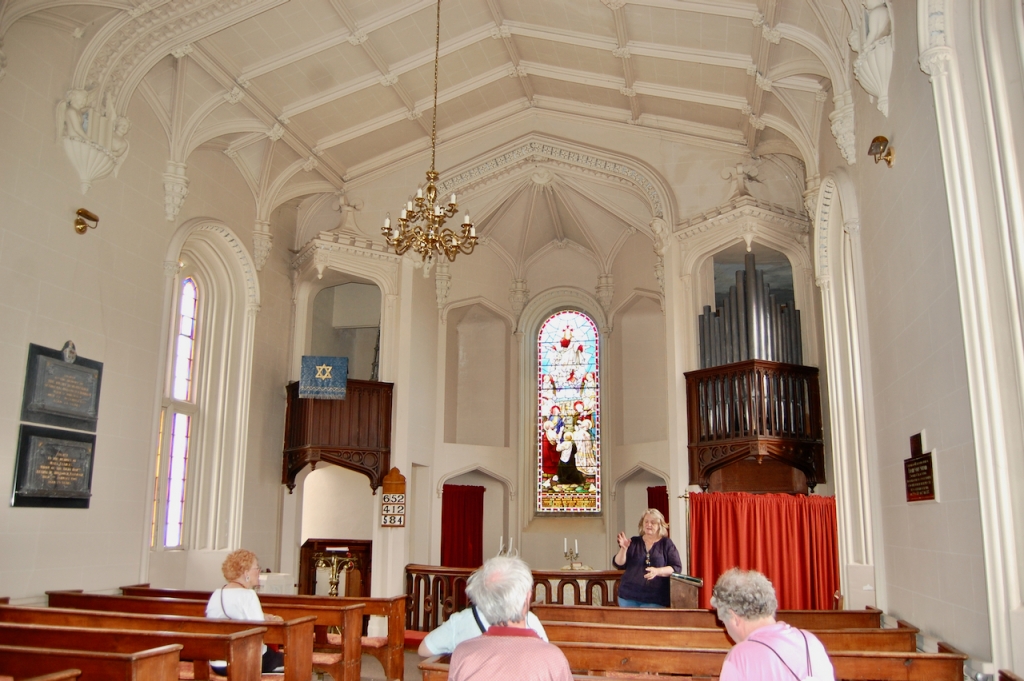
The plasterwork in the chapel, which is called the Chapel of St. Molin, is by Michael Stapleton.

Borris House, July 2019. Photograph © Jennifer Winder-Baggot, www.irishhistorichouses.com

In Jimmy O’Toole’s book The Carlow Gentry: What will the neighbours say! (published by Jimmy O’Toole, Carlow, Ireland, 1993. Printed by Leinster Leader Ltd, Naas, Kildare), he tells us of a rather miraculous finding of a Bible giving evidence of Thomas’s early Catholicism:

p. 130. “In the early 1950s, Borris House needed an electrical rewire. It was the kind of job in this rambling mansion that would take tradesmen into all sorts of unused nooks and crannies, attics untouched since the last electricians were there, and of course, there was the necessary task, dreaded by owners, the lifting of floor boards…What the electricians turned up from underneath the floor boards in the library of borris House was an 18C missal, which had been carefully wrapped and placed there by the Catholic Thomas Kavanagh either when he conformed to the Established Church, or when he married for the second time in 1825. The missal was a gift from his mother, the former Lady Suzanna Butler, bearing the hopeful inscription that he would remain faithful to the Catholic religion practised for centuries by his forebears, who could trace their ancestry back to early Christian times.” 

Jimmy O’Toole also tells us that Borris House stands on 9th century dungeons!

While we sat in the chapel, our guide told us about the amazing Arthur MacMurrough Kavanagh. When her husband Walter died, Harriet and her children went travelling. They travelled broadly, and she painted, and collected objects which she brought back to Ireland, including a collection of artefacts from Egypt now in the National Museum of Ireland. When Arthur was 17 years old his mother sent him travelling again, to get him away from his high jinks with the local girls. Arthur kept diaries, which are available for perusal in the National Library. I must have a look! I have a special interest in diaries, since I have been keeping my own since I was twelve years old. Some of Arthur’s adventures include being captured and being cruelly put on display by a tribe. He also fell ill and found himself being nursed back to health in a harem – little did the Sultan or head of the harem realise that Arthur was perfectly capable of impregnating the ladies!

Arthur’s brother and tutor died on their travels and Arthur found himself alone in India. He joined the East India Company as a dispatch rider – he was an excellent horseman, as he could be strapped in to a special saddle, which we saw inside the house, now mounted on a children’s riding horse! I was also thrilled to see his wheelchair, in the Dining Room, which is now converted into a dining chair.

Arthur MacMurrough’s saddle in mounted on the rocking horse. Photograph by Paul Barker, 2011, for Country Life.

When Arthur came home as heir, he found his mother had set up a school of lacemaking, now called Borris Lace, to help the local women to earn money during the difficult Famine years. The lace became famous and was sold to Russian and English royalty. The rest of the estate, however, was in poor shape. Arthur set about making it profitable, bringing the railway to Borris, building a nearby viaduct, which cost €20,000 to build. He also built cottages in the town, winning a design medal from the Royal Dublin Society, and he set up a sawmill, from which tenants were given free timber to roof their houses. He set up limekilns for building material, and also experimented (unsuccessfully) with “water gas” to power the crane used to built the viaduct. His mother built a fever house, dower house and a Protestant school, and Arthur’s sisters built a Catholic school. There is a little schoolhouse (with bell) behind the chapel.

Borris House, July 2019. Photograph © Jennifer Winder-Baggot, www.irishhistorichouses.com

Arthur seems to have had a great sense of humour. On one of his visits to Abbeyleix, he remarked to Lady De Vesci, “It’s an extraordinary thing – I haven’t been here for five years but the stationmaster recognised me.”

Arthur married Mary Frances Forde-Leathley and fathered six children. He became an MP for Carlow and Kilkenny, and sat in the House of Commons in England, which he reached by sailing as far as London, where he was then carried in to the houses of Parliament.

He lost when he ran again for Parliament in 1880, beaten by the Home Rule candidates. He returned from London after his defeat and saw bonfires, which were often lit by his tenants to celebrate his return. However, this time, horrifically, he saw his effigy being burned on the bonfires by tenants celebrating the triumph of the Home Rule candidates. He must have been devastated, as he had worked so hard for his tenants and treated them generously. For more about him, see the Irish Aesthete’s entry about him. [8]

Borris House, July 2019. Photograph © Jennifer Winder-Baggot, www.irishhistorichouses.com

Jimmy O’Toole’s book gives a detailed description of politics at the time of Arthur’s defeat and explains why the tenants behaved in such a brutal way. Elections grew heated and dangerous in the days of the Land League and of Charles Stewart Parnell, when tenants hoped to own their own land. In the 1841 election, tenants of the Kavanaghs were forced to vote for the Tory candidate against Daniel O’Connell Jr., despite a visit from Daniel O’Connell Sr, “The Liberator” who fought for Catholic emancipation.

The land agent for the Kavanaghs, Charles Doyne, threatened the tenants with eviction if they did not vote for his favoured candidate. In response to threats of eviction, members of the Land League forced tenants to support their cause by publicly shaming anyone who dared to oppose them. People were locked into buildings to prevent them from voting, or on the other hand, were locked in to protect them from attacks which took place if they planned to support the Tory candidate. Not all Irish Catholics supported the Land League. Labourers realised that landlords provided employment which would be lost if the land was divided for small farmers.

Borris House, July 2019. Photograph © Jennifer Winder-Baggot, www.irishhistorichouses.com

It was Arthur’s grandfather, Thomas (b. 1727), who undertook much of the renovation work at Borris in the 1800s, with money brought into the family by his wife, Susanna Butler. [9] Under her influence, Italian workmen were employed and ceilings were decorated and Scagliola pillars installed. After hearing the stories about amazing Arthur, we returned across the lawn to enter the main house.

The front hall is square but is decorated with a circular ceiling of rich plasterwork, “treated as a rotunda with segmental pointed arches and scagliola columns; eagles in high relief in the spandrels of the arches and festoons above,” as Mark Bence-Jones describes in his inimitable style [see 5, p. 45]. We were not allowed to take photographs but the Irish Aesthete’s site has terrific photographs [see 3]. The eagles represent strength and power. There are also the sheafs of wheat, crescent moons and lion heads, symbols from the family crest. Another common motif in the house is a Grecian key pattern.

Photograph by Paul Barker, 2011, from Country Life picture library.
Borris House front hall, photograph from Borris House instagram, @karinalee.studio
Photograph by Paul Barker, 2011, from Country Life picture library.

The craftwork and furnishings of the house are all built by Irish craftsmen, including mahogany doors. There is a clever vent in the wall that brings hot air from the kitchens to heat the room.

We next went into the music room which has a beautiful domed oval ceiling with intricate plasterwork. It includes the oak leaf for strength and longevity.

The drawing room has another pretty Stapleton ceiling, more feminine, as this was a Ladies’ room. It has lovely pale blue walls, and was originally the front entrance to the house. When it was made into a circular room the leftover bits of the original rectangular room form small triangular spaces, which were used as a room for preparing the tea, a small library with a bookcase, and a bathroom. The curved mahogany doors were also made by Irish craftsmen in Dublin, Mack, Williams and Gibton.

The dining room has more scagliola columns at one end, framing the serving sideboard, commissioned specially by Morrison for Borris House. It was sold in the 1950s but bought back by later owners. [10] The room has more rich plasterwork by Michael Stapleton: a Celtic design on the ceiling, and ox skulls represent the feasting of Chieftains. With the aid of portraits in the dining room, the guide told us more stories about the family. It was sad to hear how Arthur had to put an end to the tradition of the locals standing outside the dining room windows, and gentry inside, to observe the diners. He did not like to be seen eating, as he had to be fed.

The grand dining room, photograph courtesy of Borris House instagram.

We saw the portrait of Lady Susanna’s husband, whom her sister Charlotte Eleanor dubbed “Fat Thomas.” Eleanor formed a relationship with Sarah Ponsonby, and they ran away from their families to be together. As a result, Eleanor was taken to stay with her sister’s family in Borris House, and she must have felt imprisoned by her sister’s husband, hence the insulting moniker. Eleanor managed to escape and to make her way to Woodstock, the house in County Kilkenny where Sarah was staying. Finally their families capitulated and accepted their plans to live together. They set up house in Wales, in Llangollen, and were known as The Ladies of Llangollen They were visited by many famous people, including Anna Seward, William Wordsworth, Sir Walter Scott, Charles and Erasmus Darwin, Sir Arthur Wellesley and Josiah Wedgewood.

The Ladies of Llangollen, Sarah Ponsonby and Charlotte Eleanor Butler, by Richard James Lane, printed by Jérémie Graf, after Lady Mary Leighton (née Parker) courtesy of National Portrait Gallery NPG D32504.

Mark Bence-Jones describes an upstairs library with ceiling of alternate barrel and rib vaults, above a frieze of wreaths that is a hallmark of the Morrisons, which unfortunately we did not get to see. We didn’t get to go upstairs but we saw the grand Bath stone cantilevered staircase. The room was originally an open courtyard.

We then went out to the Ballroom, which was originally built by Arthur as a billiard room, with a gun room at one end and a planned upper level of five bedrooms. The building was not finished as planned as Arthur died. It is now used for weddings and entertainment.

Side of the house. Photograph © Jennifer Winder-Baggot, www.irishhistorichouses.com

In 1958 the house faced ruin when Joane Kavanagh’s husband Lieutenant Colonel Archibald Macalpine-Downie died, and she decided to move to a smaller house. However, her son, Andrew Macalpine-Downie, returned to Borris after a career as a jockey in England. with his wife Tina Murray. He assumed the name Kavanagh, and set himself the task of preventing the house from becoming a ruin. [11]

We were welcomed to wander the garden afterwards.

I was delighted with the sheep who must keep the grass down. Photograph © Jennifer Winder-Baggot, www.irishhistorichouses.com
Borris House, July 2019. Photograph © Jennifer Winder-Baggot, www.irishhistorichouses.com
View from the grounds of Borris House, July 2019. Photograph © Jennifer Winder-Baggot, www.irishhistorichouses.com

[1] https://www.buildingsofireland.ie/buildings-search/building/10400804/borris-house-borris-borris-co-carlow

[1*] http://lordbelmontinnorthernireland.blogspot.com/2013/07/borris-house.html

[2] p. 33, MacDonnell, Randal. The Lost Houses of Ireland. A chronicle of great houses and the families who lived in them. Weidenfeld and Nicolson. London, 2002.

[3] https://theirishaesthete.com/2013/11/04/an-arthurian-legend/

The Borris website claims that the 1731 house was built for Morgan Kavanagh, but the Irish Aesthete Robert O’Byrne writes that the 1731 house was built by Brian Kavanagh, incorporating part of the fifteenth century castle. I have the date of 1720 as the death for Morgan Kavanagh and he has a son, Brian, so it could be the case that the house was commissioned by Morgan and completed by his son Brian.

[4] Joyce, Edmond. Borris House, Co. Carlow, and elite regency patronage. Four Courts Press, Dublin, 2013.

[5] https://irishhistorichouses.com/2020/04/18/architectural-definitions/

and Mark Bence-Jones. A Guide to Irish Country Houses [originally published as Burke’s Guide to Country Houses volume 1 Ireland by Burke’s Peerage Ltd. 1978]; Revised edition 1988 Constable and Company Ltd, London.

[6] https://theirishaesthete.com/2013/11/04/an-arthurian-legend/

This entry also has lovely pictures of the inside of Borris House and more details about the history of the house and family.

[7] p. 130. O’Toole, Jimmy. The Carlow Gentry: What will the neighbours say! Published by Jimmy O’Toole, Carlow, Ireland, 1993. Printed by Leinster Leader Ltd, Naas, Kildare.

[8] https://theirishaesthete.com/2013/11/04/an-arthurian-legend/

[9] for more on the Butlers see John Kirwan’s book, The Chief Butlers of Ireland and the House of Ormond, An Illustrated Genealogical Guide, published by Irish Academic Press, Newbridge, County Kildare, 2018. Stephen and I went to see John Kirwan give a fascinating talk on his book at the Irish Georgian Society’s Assembly House in Dublin.

[10] p. 115. Fitzgerald, Desmond et al. Great Irish Houses. Published by IMAGE Publications Ltd, Dublin, 2008.

[11] p. 134. O’Toole, Jimmy. The Carlow Gentry: What will the neighbours say! Published by Jimmy O’Toole, Carlow, Ireland, 1993. Printed by Leinster Leader Ltd, Naas, Kildare.

Text © Jennifer Winder-Baggot, www.irishhistorichouses.com
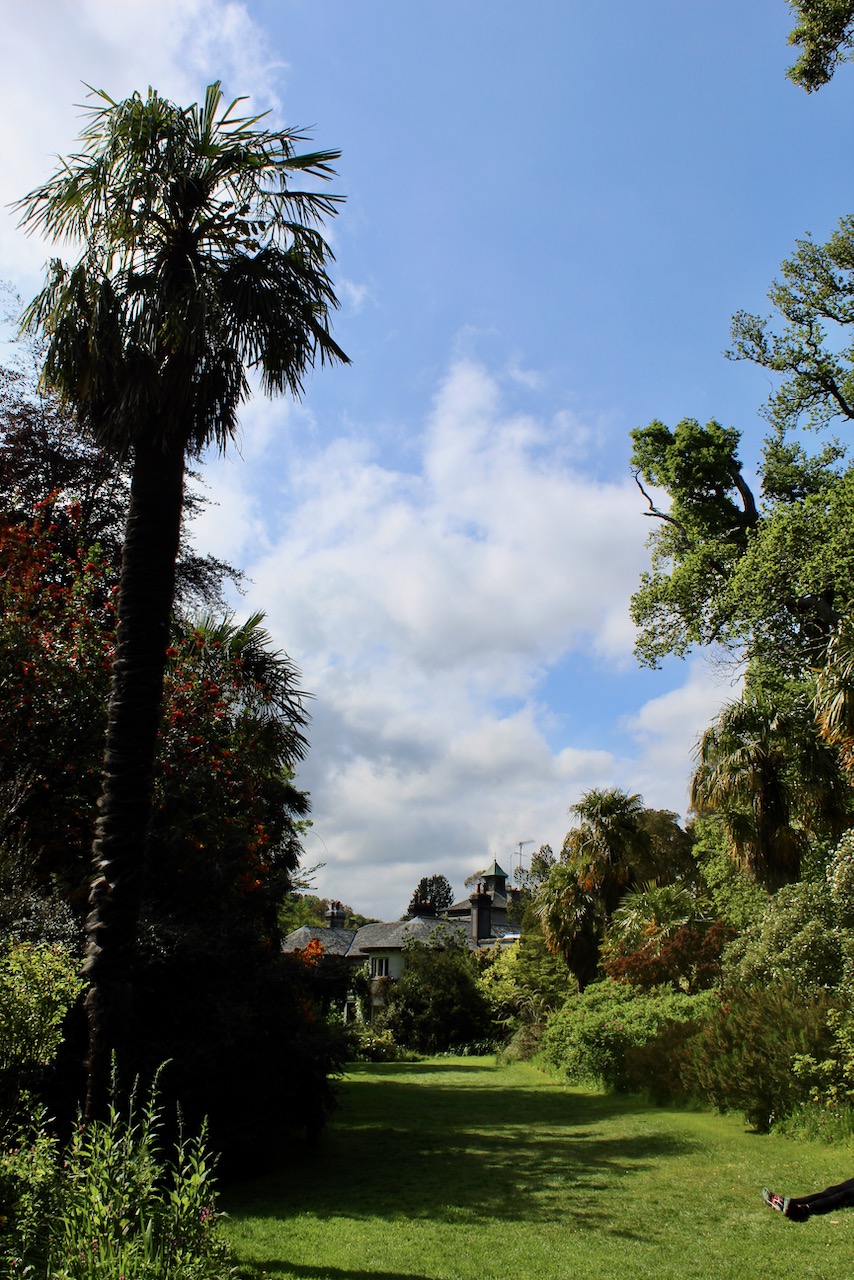
Harristown, Brannockstown, County Kildare W91 E710 – section 482

https://www.harristownhouse.ie/

Open dates in 2026: Feb 2-6, 9-13, Mar 9-13, 16-20, May 1-13, July 20-24, 27-31, Aug 4-23, 9am-1pm

Fee: adult/ OAP/student/child €10

donation

Help me to pay the entrance fee to one of the houses on this website. This site is created purely out of love for the subject and I receive no payment so any donation is appreciated!

€15.00

Harristown, August 2019. Photograph © Jennifer Winder-Baggot, www.irishhistorichouses.com

Last week I wrote about Charleville in County Wicklow, a house designed by Whitmore Davis. This week I am writing about another house by Davis, Harristown House. This house is magnificently situated at the top of a gently sloping hill, overlooking the River Liffey. I contacted the owner Hubert Beaumont, the husband of the listed contact, Noella, to arrange a visit on Thursday 22nd August 2019, during Heritage Week.

Harristown, August 2019. Photograph © Jennifer Winder-Baggot, www.irishhistorichouses.com

We drove up a very long avenue to the house, between fields, now farmed by the Beaumonts.

Harristown, County Kildare. Photograph © Jennifer Winder-Baggot, www.irishhistorichouses.com

A British Parliamentary Paper, a Royal Commission appointed to inquire into the municipal corporations in Ireland, in 1833, tells us that in the 33rd year of Charles II’s reign [he was restored to the British throne in 1660 but some would claim that his reign began with the death of his father, Charles I, in 1649], the Borough of Harristown was incorporated by a Charter which created the Manor of Harristown, which could hold a Court and make judgements, by “Seneschals” (a governor or other administrative or judicial officer) appointed by Sir Maurice Eustace and his heirs. He could also hold a market and fairs, on particular days, and have a prison. The borough could return two Members of Parliament. The Commission continues to describe the borough in the present day of 1833: the borough was the property of the La Touche family, and at the Union [1801], John La Touche obtained compensation for loss of the elective franchise. [1]

“The Piked Eustace” (painting piked in 1798) Maurice Eustace, c. 1689, by circle of James Gandy. He was Lord Chancellor of Ireland after the Restoration of Charles II. Courtesy Fonsie Mealy Aug 2023.

The Eustace family acquired the land of Harristown in the sixteenth century. The Harristown house website agrees with Mark Bence-Jones that the current house at Harristown was built by Whitmore Davis [2]. However, a website about the La Touche family claims that the present Harristown House was built in 1662, for Maurice Eustace (circa 1590-1665), but does not mention an architect [3]. Maurice Eustace became Lord Chancellor of Ireland after the Restoration of Charles II to the throne, because he was loyal to the monarchy. Wikipedia refers to Maurice Eustace’s beloved “Harristown Castle,” “which he was rebuilding after the damage it had suffered during the Civil War, and which by the time of his death was considered to be one of the finest houses in Ireland.” [4] This seems to refer to a house Eustace built near the original castle.

View from what is now the back of the house, overlooking the Liffey. Photograph © Jennifer Winder-Baggot, www.irishhistorichouses.com

After much soul-searching, Maurice left Harristown as well as a large fortune to a nephew, Maurice (d. 1703). The Lord Chancellor had an illegitimate son with a woman of, apparently, “some social standing,” also named Maurice and he promised his inheritance both to this son and to his nephews, sons of his brother William (d. 1673/4) and William’s wife Anne Netterville. He consulted a preacher as to whether his promise to his lover was binding, and the preacher cruelly advised that it was not. Sadly, Maurice the Lord Chancellor also had a daughter by this liaison, Mary.

As well as the mother of the two illegitimate children, Maurice had a wife, Cicely (or Charity) Dixon (1605-1678), daughter of the Lord Mayor of Dublin, Robert Dixon, but with her had no children. He left not only his country estates but a townhouse, named “Damask,” on the street which is now named after him, Eustace Street. He eventually left his inheritance to his nephews. The eldest son of his brother William, John, had died in 1697, so it went to the younger, Maurice (d. 1703).

Harristown, County Kildare. Photograph © Jennifer Winder-Baggot, www.irishhistorichouses.com

This nephew Maurice married Anne Colville, daughter of Robert Colville (1625-1697). After she died in 1685, he married secondly, Clotilda Parsons. He had no male heirs and his fortune was divided on his death between his three daughters. The Harristown estate went to his daughter by his first wife, also named Anne. It’s sad to me that the house was inherited by a daughter after all, when the first Maurice Eustace’s illegitimate daughter, Mary, unlike her brother, was never even considered for inheritance.

His daughter Penelope married Robert Echlin (d. 1706), MP for Downpatrick and for Newry, son of Henry Echlin 1st Baronet Echlin of Clonagh, Co. Kildare.

Anne married the Irish MP Benjamin Chetwood (or Chetwode), who served as Member of Parliament for Harristown, and her son Eustace Chetwood inherited Harristown. He became MP for Harristown but mismanaged his estates [5] and it passed to James FitzGerald, the 1st Duke of Leinster.

Anne and Benjamin’s daughter Elizabeth married Christopher Ussher of Mount Usher, County Wicklow, another Section 482 property (see my entry).

James FitzGerald’s son William, who had no need for Harristown since he had also inherited Castletown House in County Kildare, sold it to David La Touche (1703-1785) in 1768. [6]

David (Digges) La Touche of Bellevue, County Wicklow, (1703-1785) purchased Harristown in 1768.

I cannot find the original date of construction of the house – Mark Bence-Jones in his Guide to Irish Country Houses identifies it as late Georgian, which generally means 1830-1837, but the Georgian period began in 1714 so “late” could mean as early as around 1800, which is more likely, as Charleville was built in 1797. I suspect that this house was built earlier, perhaps around the time when Whitmore Davis worked for the Bank of Ireland, because the Bank of Ireland was set up in 1783, and The La Touche family were major contributors to the bank.

The La Touche family was a Huguenot family. Huguenots, who were French Protestants, fled from France due to the punishment and killing of Protestants after Louis XIV revoked the Edict of Nantes – the Edict of Nantes had promoted religious toleration. Earlier in the week, Stephen and I had a tour of another La Touche house, Marlay House in Marlay Park in Rathfarnham. Marlay House is now owned by Dun Laoghaire and Rathdown County Council and it has been restored and furnished and holds tours by arrangement. [7]

Marlay House in Marlay Park, Rathfarnham, Dublin. Photo from National Inventory of Architectural History [8] When we mentioned to Mr. Beaumont that we had been to Marlay House earlier in the week, he commented on the incongruity between the two parts of that house – the 1690 part and the later part commissioned by David La Touche. It’s true that the two parts of the house are very different.

It was David Digues La Touche, born in the Loire Valley, who fled from France after the Revocation of the Edict of Nantes. He fled to Holland, where his uncle obtained for him a commission in the army of William of Orange. He fought in the Battle of the Boyne in the regiment under General Caillemotte. [9] He left the army in Galway, where he was billeted on a weaver who sent him to Dublin to buy wool yarn (worsteds). He decided then to stay in Dublin, and with another Huguenot, he set up as a manufacturer of cambric and rich silk poplin. Where I live in Dublin is an area where many Huguenots lived and weaved – we are near “Weaver Square,” and our area is called “The Tenters” because cloth was hung out to dry and bleach in the sun and looked like tents, hung on “tenterhooks”!

The La Touches began banking when Huguenots left their money and valuables with David for safekeeping when they would travel out of the capital. He began to advance loans, and so the La Touche bank began. He had two sons, David La Touche (1703-1785) and James Digues (later corrupted to Digges) La Touche. This David La Touche purchased properties which passed to his sons: Marlay House to David (1729-1817), Harristown to John (1732-1805), and Bellevue, County Wicklow, to Peter (1733-1828). Bellevue has since been demolished, in the 1950s [10].

David La Touche of Marley, County Dublin, (1729-1817), M.P., Banker and Privy Counsellor. Photograph courtesy of National Gallery of Ireland.
Peter La Touche of Bellevue (1733-1828) Date 1775 by Robert Hunter, Irish, 1715/1720-c.1803, photograph courtesy of National Gallery of Ireland.
Elizabeth La Touche née Vicars (1756-1842), wife of Peter La Touche, by John Whitaker National Portrait Gallery of London D18415.
Mrs La Touche of Bellevue by Stephen Catterson Smith 1806-1872, courtesy of National Gallery of Ireland NGI 628.

As I mentioned last week, the biography about Whitmore Davis in the Dictionary of Irish Architects is not flattering. Descriptions include: “By 1786 he had became architect to the Bank of Ireland at St Mary’s Abbey, where he was employed on minor works, but in 1788 he was reprimanded for lack of attention to his responsibilities ….Although he was employed as architect of the new Female Orphan House in 1792-93, his performance was not judged satisfactory; the Board’s minutes register ‘much disappointment’ at his not having completed the building within the time stipulated…. his architectural practice appears to have been going into decline and by February 1797 he had been declared bankrupt. [my italics]” However, things picked up for him eventually: “by 1803 he had succeeded Richard Harman  as Surveyor of the Revenue Buildings for the Port of Dublin, a post which he still held in 1811.” [11]

The La Touches purchased Harristown and its lands in 1768, and presumably the house that was built by Maurice Eustace still stood on the land. They were involved with the establishment of the Bank of Ireland at Mary’s Abbey in 1783 and David La Touche was a major investor. It could have been at this time, when Whitmore Davis was architect for the Bank of Ireland 1786-91, that the La Touches had him build the new house at Harristown. Peter La Touche hired Whitmore Davis in 1789 to build a church in Delgany, County Wicklow, and the Orphan House on North Circular Road, also by Whitmore Davis, was commissioned by John La Touche in 1792.

Harristown House, County Kildare. Photograph © Jennifer Winder-Baggot, www.irishhistorichouses.com

Like Charleville, Harristown is ashlar faced, and has nine bays with a central breakfront of three bays, but it was originally three storey over basement. After a fire in 1890 it was rebuilt to designs by James Franklin Fuller, and was reduced to the two storeys you can see in the photograph above. As it stands now, the windows in the breakfront are grouped together under a wide “relieving” arch, as Mark Bence-Jones describes (I’m not sure what this means – if you know, please enlighten me! – perhaps it means that it is “in relief” ie. raised from the background), with a coat of arms and swags. There is a single-storey portico of Ionic columns. (see [2])

Crest with pomegranate on Harristown House. Photograph © Jennifer Winder-Baggot, www.irishhistorichouses.com

The crest on the over the portico in Harristown features the same pomegranate symbol, for fertility, as features in the La Touche crest on Marlay House on an urn over the front door, as well as a star shaped symbol. The guide at Marlay House was unable to explain the star shaped symbol to us but thought it might be the shape of the pomegranate flower. This shape features on the front pillar gates of Harristown House also, as well as a Greek key pattern.

Front of Marlay House, with crest of pomegranate on the urn on top of roof, and star symbol under urn. Photo from National Inventory of Architectural History [see 8].

The rear of Harristown has a pair of curved bows:

Harristown, County Kildare. Photograph © Jennifer Winder-Baggot, www.irishhistorichouses.com

Just a little diversion to tell you about Marlay House: David La Touche purchased the land of Marlay Park in Rathfarnham in 1764. Before La Touche, the land in Rathfarnham had belonged to St. Mary’s Abbey, until King Henry VIII dissolved the monasteries. In 1690, Thomas Taylor, one time Mayor of Dublin, acquired the land and built a house, which he called “The Grange.” He farmed the land, and both his son and grandson held key political positions in Dublin in the 1740-60s. Part of this house still stands and is incorporated into the present Marlay House. David La Touche (1729-1817) renamed the house “Marlay” in honour of his wife, Elizabeth Marlay, and her father, George Marlay (1691-1743), Bishop of Dromore.

David La Touche enlarged the Marlay house. I don’t know what architect designed the enlargement of the original Taylor house at Marlay for La Touche. If it was done in 1764 it can’t have been Whitmore Davis as he only joined the Dublin Society’s School of Drawing in Architecture in 1770. Marlay house does have bows, similar to Harristown. Turtle Bunbury claims that the enlargement was indeed by Whitmore Davis so perhaps it was done some years after purchase of the estate, which is perfectly possible as David and his wife and family would have spent much of their time in their townhouse closer to the city centre. His father had developed much of the area around St. Stephen’s Green, Aungier Street and the Liberties.

David La Touche (1729-1817), of Marlay, 1800 by Hugh Douglas Hamilton, courtesy of National Gallery of Ireland.

John La Touche (1732-1805), David’s brother, who was gifted Harristown by his father, enclosed the present Harristown desmesne and built a new road and bridge over the Liffey.

Bridge over the Liffey built by John La Touche in 1788. Photograph © Jennifer Winder-Baggot, www.irishhistorichouses.com
John La Touche (1732-1805) by Angelica Kauffmann courtesy of MutualArt.com

John represented the Borough of Harristown in Parliament. He married Gertrude Uniacke-Fitzgerald (d. 1818), daughter of Robert Uniacke-Fitzgerald. They had several children. He died in 1805.

Two of John’s sons also sat in Parliament. His son John inherited the estate. He was artistic and travelled in Italy, enriching his home with paintings and marbles. He died in 1822 and the estate passed to his brother, Robert La Touche (1773-1844), who was also an MP for Harristown.

Robert had married Lady Emily Le Poer Trench (1790-1816), daughter of William Power Keating Trench (1741-1805) 1st Earl of Clancarty of Garbally in Ballinasloe, and they had four children. They also owned a house on Merrion Square in Dublin. Their daughter Gertrude (1812-1864) married Henry Stanley McClintock (1812-1898) of Kilwarlin House, County Down.

A son, another John (1814-1904), succeeded his father in 1844, the year after he married Maria Price. John had a twin, William, but William died in the same year as his father. John was called “the Master” as he was a keen huntsman, and was Master of the Kildare Hounds 1841-45. He had a serious fall off a horse, however, and stopped hunting, and the same year, his brother Robert died tragically in a stand at the Curragh races – I think the stand collapsed.

Historic houses require constant maintenance. Mr. Beaumont told us that he had to have the entire front portico taken down to be repaired. He preferred the appearance of the house without the portico, but acknowledged that it is good for keeping off the rain! Photograph © Jennifer Winder-Baggot, www.irishhistorichouses.com
Gentleman believed to be Robert La Touche by Hugh Douglas Hamilton courtesy Christies Irish Sale 2003. Robert died when a stand collapsed at the Curragh Races.

John lived at Harristown for  sixty-two years. His wife, Maria was artistic, with a particular interest in botany, drawing, languages and poetry. She was an avid letter-writer and wrote a number of tracts on religious and social themes. She also wrote two novels, “The Clintons” (1853), and “Lady Willoughby” (1855). According to the La Touche legacy website, she had a horror of blood sports – and no wonder, with her husband’s nasty fall – and complained often about the enthusiastic hunting pursued by neighbouring gentry.

Maria La Touche née Price (1824-1906) of Harristown.

During the Famine, John initiated drastic measures in his household: “allowing no white bread or pastry to be made, and only the simplest dishes to appear on his table. The deer-park at Harristown ceased at this time to have any deer in it; all were made into food for the starving people.” He busied himself with his farm tenants, and supported Land Reform under Gladstone.

In 1857 John La Touche heard the preaching of C.H. Spurgeon, which led him to become a Baptist. In 1882, he built a Baptist Chapel and a fine Manse (minister’s house) at Brannockstown, and was a regular benefactor of Baptist work throughout Ireland. John had an interest in education, as did all the La Touches, and he knocked down the remains of Portlester Castle to build a school at Brannockstown, which opened in 1885. This school prospered for twenty years, but under his son, Percy, the pupils moved to the Carnalway National School. It re-opened in 1928 under Catholic management and it is still in use. For more on the La Touches and education and banking, see Turtle Bunbury’s chapter on the La Touches in his book The Landed Gentry & Aristocracy of County Kildare.

Maria La Touche’s friend, Louisa, Lady Waterford (whom we came across in Curraghmore, the wife of the 3rd Marquess), introduced her to the famous art critic John Ruskin, and she asked him to tutor her children, especially her daughter Rose, in art.

John Ruskin by W. & D. Downey 1863, National Portrait Gallery of London ref. x12958.

The relationship between Rose and Ruskin is fascinating and sad. They grew to be very fond of each other, and he fell in love with her when she was still a young girl. Ruskin proposed marriage but due to the fact that his first marriage, to Effie Gray (featured in the film “Effie Gray” written by Emma Thompson), was annulled due to his impotence, Rose’s parents would not allow the marriage. [12] [13] According to a wikipedia article, Rose’s parents feared that if Rose did become pregnant by Ruskin, the marriage would be invalidated since the reason for his annulment would be disproved! Ruskin proposed again, when Rose came of age. She must have had some sort of illness or unusual anatomy because doctors had told her that she was “unfit for marriage.” She said would only agree to the marriage if it could remain unconsummated. Ruskin, however, refused this, “for fear of his reputation” (again, according to wikipedia).

Rose La Touche, 1861, by John Ruskin From “Ruskin, Turner and the pre-Raphaelites”, by Robert Hewison, 2000.
We loved the aesthetic touch of the pair of peacocks in the garden. Harristown, August 2019. Photograph © Jennifer Winder-Baggot, www.irishhistorichouses.com

The La Touche legacy website is less sensationalistic about Rose – it claims that she had ill health and this was one reason that her parents were worried about a potential marriage to Ruskin, and they also didn’t like his professed atheism. Given their firm religious faith this seems a most probable reason for their disapproval. Rose went to London in January 1875 for medical care and Ruskin attended her, but she soon died.

Harristown, August 2019. Photograph © Jennifer Winder-Baggot, www.irishhistorichouses.com

According to wikipedia, Rose was placed by her parents in a Dublin nursing home in her mid-20s, and :

Various authors describe the death as arising from either madness, anorexia, a broken heart, religious mania or hysteria, or a combination of these. Whatever the cause, her death was tragic and it is generally credited with causing the onset of bouts of insanity in Ruskin from around 1877. He convinced himself that the Renaissance painter Vittore Carpaccio had included portraits of Rose in his paintings of the life of Saint Ursula. He also took solace in Spiritualism, trying to contact Rose’s spirit.

Harristown, County Kildare. Photograph © Jennifer Winder-Baggot, www.irishhistorichouses.com

Another daughter, Emily Maria (1846-1868) married Bernard Matthew Ward (1831-1918), son of Edward Southwell Ward, 3rd Viscount Bangor of Castle Ward, County Down.

In 1891 a fire gutted the three storey house. It was rebuilt to the designs of James Franklin Fuller. One storey was removed, which Mr. Beaumont pointed out to us when we were inside, makes the house brighter than it would have been with a further storey. The brightness is further aided with lantern skylights. Franklin Fuller also rebuilt the small Church of Ireland at the entrance to the estate, Carnalway church. It was done in a Hiberno Romanesque style similar to his masterpiece at Millicent. The church also has stained glass windows by Harry Clarke and Sir Ninian Comper.

When “The Master” died in 1904 in his 90th year, his son, Robert Percy (1846-1921), succeeded to the estate. He moved in the highest levels of society and was a favourite of King Edward the Seventh. He married Lady Annette Scott (1844-1920), a sister of the John Henry Reginald, 4th Earl of Clonmel, but they had no children. After his death in 1921, his sister Emily’s son succeeded, Ernest Otway Ward (1867-1965), who added La Touche to his surname upon inheritance, but he sold it soon afterwards. [14]

Harristown, County Kildare. Photograph © Jennifer Winder-Baggot, www.irishhistorichouses.com

The estate passed through two other owners before being sold to Major Michael Whitley Beaumont (1903-1958), grandfather to the present owner, Hubert Beaumont, in 1964.

Hubert’s grandfather Michael set about renovating, and shipped furniture and interiors, even panelling and wallpaper, from the home he purchased from Lord Buckingham in England in 1929, Wootton (or Wotton) House. Wotton House was later to be owned by the actor John Guilgood, and Tony and Cherie Blaire, amongst others. Major Beaumont sold Wotton House in 1947.

Hubert Beaumont inherited the house from his grandfather Michael’s widow, Doreen (the Major’s second wife, daughter of Herbert William Davis-Goff, 2nd Baronet Davis-Goff, of Glenville, Co. Waterford and of Horetown, Co. Wexford. It was his first wife, Faith Pease, daughter of the 1st Baron Gainford, who was Hubert’s grandmother). Hubert’s father, Lord Timothy Wentworth Beaumont, Baron Beaumont of Whitley, was a British politician in the Liberal Party, Liberal Democrats and Green Party, and also an Anglican clergyman. Major Michael’s father was also a politician in the Liberal Party, Hubert Beaumont (1864-1922). There’s a strong line of politicians in the family, and they are related  to George Canning, who served as Prime Minister of the UK from April 1827 until he died in August later that year.

Wotton House, Buckinghamshire, 2007, photograph courtesy of British Listed Buildings, photograph by Peter Harris.

The house is spacious, bright, and beautifully decorated with the items that the Beaumonts brought from their former home in Buckinghamshire. Wootten’s interior was designed by Sir John Soane, and Doreen Beaumont brought some of the Soanian influence to her new home. [15] The colours she used are not traditionally associated with an Irish Georgian house. You can see pictures of the interior on the website.

The front hall is a large double room which opens into the three main reception rooms: the library, drawing room and dining room. The beautiful fireplaces were brought from Wootten. A sitting room leading from the drawing room features delicate sixteenth century Chinese wallpaper, depicting birds against a sky blue background. The mounted wallpaper was imported from England, so an artist was hired to continue the pattern (although it is not a “pattern” as such as the birds are all hand-painted and none are repeated) on the remaining wall. I was particularly delighted with the little mouse painted over the skirting board – the artist found the room so full of mice as the house was being renovated, he decided to commemorate one. The artist also commemorated Doreen’s beloved dogs, and painted a Chow Chow on the wall. A portrait in the room of Mr. Beaumont’s grandmother features her standing next to a chair occupied by her chow!

Upstairs the stairs lead on to a magnificent bright landing corridor lined with long wooden bookshelves, which were also brought from Wootton, along with much of the library from that house, which also feature in the library downstairs. One bedroom is paneled in Tudor oak, brought from a sixteenth century house in England and is older than the house! This interior could be from the Jacobean Dorton House in Buckinghamshire, another house which Major Michael Beaumont had owned. The room contains a four poster bed and heavy French Empire pelmets.

A feature normally lost in old houses which Harristown retains is the servants’ tunnel under the house that leads from the basement to the yard.

One end of the tunnel, the other end originating in the basement of the house. Photograph © Jennifer Winder-Baggot, www.irishhistorichouses.com

In the basement we saw some of the vaulted storage rooms and what would have been the kitchen. The Beaumonts have opened their house to film crews and a recent film set in the house is one I’d love to see, “Vita and Virginia” about Virginia Woolf and Vita Sackville-West. The tunnel was also used in one of our favourite TV series, “Foyle’s War”!

After our tour, Mr. Beaumont invited us to explore outside. We wandered over to the farmyard first, which has marvellous old barns, and a beautiful weather vane.

Harristown, County Kildare. Photograph © Jennifer Winder-Baggot, www.irishhistorichouses.com
Harristown, August 2019. Photograph © Jennifer Winder-Baggot, www.irishhistorichouses.com

There is extra accommodation in a converted stableyard where Noella teaches English and French to live-in students. Some teenagers emerged when we were passing and we asked where we could find the walled garden. Noella followed them out, welcomed us, and pointed us in the right direction. We walked along a grassy path past a delightful henhouse – the hens also have their own portico!

Harristown, August 2019. Photograph © Jennifer Winder-Baggot, www.irishhistorichouses.com

We passed the tennis court, and an odd random gate featuring two cherubs.

Harristown, County Kildare. Photograph © Jennifer Winder-Baggot, www.irishhistorichouses.com
Harristown, August 2019. Photograph © Jennifer Winder-Baggot, www.irishhistorichouses.com

The walled garden was beyond the tennis court.

Harristown, County Kildare. Photograph © Jennifer Winder-Baggot, www.irishhistorichouses.com
Harristown, August 2019. Photograph © Jennifer Winder-Baggot, www.irishhistorichouses.com

[1] http://www.dippam.ac.uk/eppi/documents/10925/page/244850

[2] Mark Bence-Jones, A Guide to Irish Country Houses (originally published as Burke’s Guide to Country Houses volume 1 Ireland by Burke’s Peerage Ltd. 1978); Revised edition 1988 Constable and Company Ltd, London.

[3] http://latouchelegacy.com/page15.php

[4] https://en.wikipedia.org/wiki/Maurice_Eustace_(Lord_Chancellor)

[5] https://en.wikipedia.org/wiki/Benjamin_Chetwood

[6] https://en.wikipedia.org/wiki/Harristown,_Naas_South

[7] www.dlrevents.ie

[8] https://www.buildingsofireland.ie/buildings-search/building/60220011/marlay-house-grange-road-co-dun-laoghaire-rathdown

[9] Young, M.F. “The La Touche Family of Harristown,” Journal of the Kildare Archaological Society, volume 7. 1891. https://archive.org/details/journalofcountyk07coun/page/36/mode/2up

[10] p. 129. Bunbury, Turtle and Art Kavanagh, The Landed Gentry & Aristocracy of County Kildare. Published by Irish Family Names, 11 Emerald Cottages, Grand Canal St., Dublin 4 and Market Square, Bunclody, Co. Wexford, Ireland, 2004.

[11] https://www.dia.ie/architects/view/1412#tab_biography

[12] https://en.wikipedia.org/wiki/Rose_La_Touche

[13] a different view of the marriage and annulment between Ruskin and Effie Gray is discussed in the following article, a review of a book that claims that Ruskin did not consummate the marriage with Effie Gray because he learned that she married him for money and not love. https://www.theguardian.com/books/2013/mar/29/ruskin-effie-marriage-inconvenience-brownell

[14] p. 137, Bunbury, Turtle and Art Kavanagh, The Landed Gentry & Aristocracy of County Kildare. Published by Irish Family Names, 11 Emerald Cottages, Grand Canal St., Dublin 4 and Market Square, Bunclody, Co. Wexford, Ireland, 2004.

[15] https://www.harristownhouse.ie/en/our-history

Text © Jennifer Winder-Baggot, www.irishhistorichouses.com
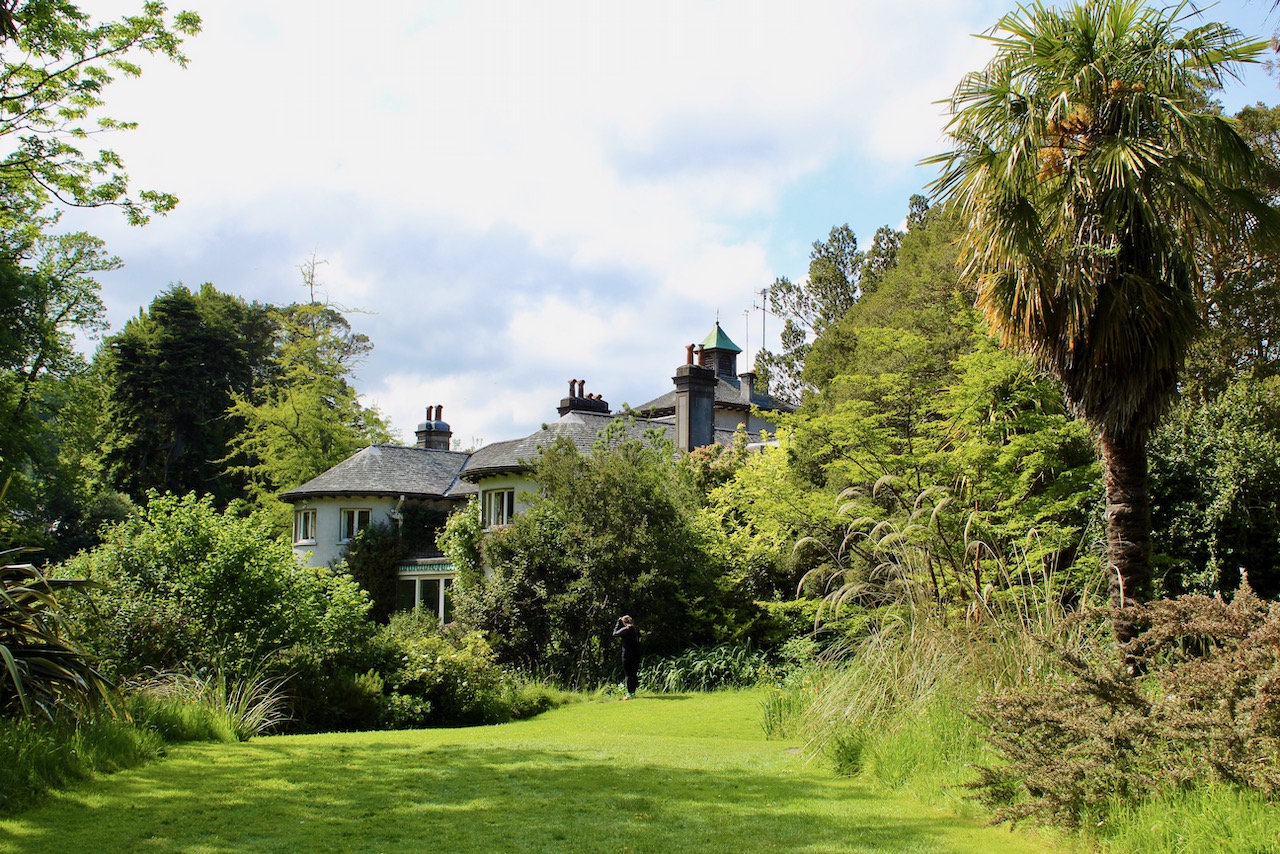
Charleville, County Wicklow A98 V293 – section 482

Open dates in 2026: Feb 3-6, 9-13, 16-20, 23-27, May 1, 5-29, June 2-5, 8,9, Aug 15-23, Mon-Fri, 1pm-5pm, May and Aug, also open Sat-Sun, 9am-1pm

Fee: house €15, gardens €6

donation

Help me to pay the entrance fee to one of the houses on this website. This site is created purely out of love for the subject and I receive no payment so any donation is appreciated!

€15.00

DSC_0654
Charleville, made of Wicklow granite, faced in ashlar. A stone string-course divides upper from lower windows. Photograph © Jennifer Winder-Baggot, www.irishhistorichouses.com

This was the least personal of our tours to date, when we went on Saturday May 18th 2019, as there was no sign of the owners, the Rohan family, living in the grand reception rooms, although it is their family home. Ken and Brenda Rohan purchased the house in 1981. A visit to a house that is no longer owned by descendants of the early occupiers resonates less history, although in this case one must admit the current owners are probably no less invested than if their ancestors had occupied it for centuries, as they have maintained it to a high standard, and have carried out sensitive restoration to both house and garden. Dublin architect John O’Connell oversaw work on the interiors.

We are told in Great Irish Houses that the demesne is intact, with the original estate walls and entrance gates surviving. [1]

The National Inventory of Architectural Heritage website tells us that Charleville is a detached nine bay two storey Palladian style mansion, built in 1797 to designs by Whitmore Davis, an architect originally from County Antrim, who was then based in Dublin [2]. He also built another Section 482 house, Harristown House in County Kildare [3].

The house has a three-storey pedimented breakfront, the pediment is carried on four Ionic columns at the second and third storey level of the house, the ground floor level of the breakfront being “rusticated” as if it were a basement. [4] The windows on the ground floor level in the breakfront are arched. The Buildings of Ireland website claims that the breakfront facade is inspired by Lucan House in County Dublin, which is indeed very similar. Lucan House was designed by its owner, Agmondisham Vesey, consulting with architect William Chambers, a British architect who also designed the wonderful Casino at Marino in Dublin, as well as Charlemont House in Dublin (now the Hugh Lane Municipal Art Gallery) and the Examination Hall and Chapel in Trinity College Dublin.

Lucan House, County Dublin, photograph from National Inventory of Architectural Heritage.
Casino at Marino in Dublin, designed by William Chambers who helped to design Lucan House, which has similar breakfront to that of Charleville. Photograph © Jennifer Winder-Baggot, www.irishhistorichouses.com

It was hard to find, as we were directed to the back entrance, and the gps gave us directions to a different entrance. However the person to whom I’d spoken, from Rohan Holdings, specified where to go. We found someone waiting to let us in. He was very friendly and when I stated my name, for him to write down along with licence plate of car, for security, he asked was I related to the Baggots of Abbeyleix! Indeed, I am the daughter of a Baggot of Abbeyleix! And are they related to the Clara Baggots, he asked? Yes indeed, they are my cousins! So that was a great welcome! He opened the gates for us and said he would see us on the way out, and he directed us down the driveway, toward visitor parking.

Charleville, County Wicklow. Photograph © Jennifer Winder-Baggot, www.irishhistorichouses.com
The side with its Wyatt window in the Morning Room overlooking the stretch of lawn. Photograph © Jennifer Winder-Baggot, www.irishhistorichouses.com

Our tour guide came outside to meet us and invited us into the house. We entered a large impressive entry room. The guide told us that George IV was due to visit the house, but never came, as he was “inebriated.” After visiting Slane Castle, we knew all about George IV’s visit, and why he did not get to Charleville – he was too busy with his mistress in Slane Castle! The marquentry wooden flooring (applying pieces of veneer to a structure to form decorative patterns, designs or pictures) in the front hall was installed at great expense in preparation for his visit to the house. It’s still in excellent condition.

The well-informed guide told us about the previous owners and shared details about the furniture and paintings. The house is perfectly suitably decorated, sumptuous and beautiful. The main reception rooms lead off the entrance hall and run the length of the facade. The house was built for Charles Stanley Monck (1754-1802), 1st Viscount Monck of Ballytrammon, County Wexford, after his former house on the property was destroyed by fire in 1792.

Charles Stanley Monck succeeded his uncle Henry Monck to the estate when his uncle died in 1787. Henry Monck had inherited from his father, Charles Monck (1678-1752). Charles Monck, a barrister who lived on St. Stephen’s Green in Dublin, came into the property of Charleville through his marriage in 1705 to Agneta Hitchcock, the daughter and heiress of Major Walter Hitchcock. [5]

Although Henry Monck had no son to inherit his estate, he had a daughter, Elizabeth, who married George de la Poer Beresford (January 1734/35-1800), 1st Marquess of Waterford, of Curraghmore.

The Honourable George de la Poer Beresford (1735–1800), 2nd Earl of Tyrone, Later 1st Marquis of Waterford by Johann Zoffany, courtesy of National Trust Images.

Charles Stanley Monck was the son of Henry’s brother Thomas Monck (1723-1772) and Judith Mason (1733-1814) from Masonbrook, County Galway. Thomas Monck was a barrister, and served as MP for Old Leighlin in County Carlow.

Charles Stanley Monck married Anne Quin in 1784, daughter of Dr. Henry Quin and Anne Monck (she was a daughter of Charles Monck and Agneta Hitchcock so was a first cousin). He rebuilt the house in the same year that he was raised to the peerage as Baron Monck of Ballytrammon, County Wexford. He served as MP for Gorey, County Wexford from 1790 to 1798. In 1801, as a reward for voting for the Union of Britain and Ireland, he was awarded a Viscountcy.

As well as having Charleville rebuilt, he had a terrace of houses built in Upper Merrion Street in Dublin. Number 22 of this terrace was known as “Monck House,” and number 24 was Mornington House (where some say the Duke of Wellington was born) – the terrace is better known today for housing the Merrion Hotel.

The Merrion Hotel, photograph by Jeremy Hylton: Charles Stanley Monck had this row of terraced houses built in Dublin.
Side view of Charleville. Photograph © Jennifer Winder-Baggot, www.irishhistorichouses.com

The large entry hall has fluted Ionic columns, a ceiling with coving and central rosette plasterwork, an impressive fireplace and several doors. It is full of portraits, including, over the fireplace, a painting of the family of the Verekers, Viscount Gort. The double-door leading to the staircase hall is topped with a decorative archway, and the passageway between the front hall and the staircase hall is vaulted.

Leading off the hallway were large double doors, “elevator style” (see Salterbridge), the guide pointed out that they are not hinged, and are held in place by the top and bottom instead, swinging on a small bolt from frame into door on top and bottom. They are extremely sturdy, smooth and effective.

The tour is limited to the outer and inner entrance halls, the morning, drawing and dining rooms.

Charles Stanley did not have long to enjoy his house as he died just a few years later in 1802. He was succeeded by his son Henry Stanley Monck (1785-1848), 2nd Viscount, who was also given the title the Earl of Rathdowne. It was this Henry who made the alterations to the house in preparation for the visit of George IV in 1821.

The Earl of Rathdowne married Frances Mary Trench, daughter of William Power Keating Trench, 1st Earl of Clancarty.

William Power Keating Trench (1741-1805) (later first Earl of Clancarty) by Hugh Douglas Hamilton (1739-1808), courtesy Adam’s 28 March 2012. He was the father of Frances Mary, who married Henry Stanley Monck, 2nd Viscount of Ballytrammon, County Wexford and 1st Earl of Rathdowne.

Mark Bence-Jones in his A Guide to Irish Country Houses tells us that the Grecian Revival plasterwork is probably designed by Richard Morrison. There are also floor length Wyatt windows to the side of the house, similar to ones added to Carton in Kildare in 1817 by Richard Morrison.

The staircase hall contains a cantilevered Portland stone staircase and a balustrade of brass banisters. Hanging prominently over the stairs is a huge portrait of George IV’s visit to Ireland, picturing the people saying goodbye to him at the quay of Dun Laoghaire. He stands tall and slim in the middle. The painter flatters the King who in reality was overweight. The other faces were all painted by the artist from life, as each went to pose for him in his studio. The scene never took place, our guide told us, as George IV was too drunk to stand on the quays as pictured!

The sitting room has a barrel-vaulted ceiling and the decorative plasterwork features musical instruments, gardening implements and sheaves of corn. Desmond Guinness pointed out that the plasterwork installed at Powerscourt for the royal visit is similar to decoration found at Charleville. [6] The dining room’s centrepiece of shamrock and foliage is probably earlier than 1820 but the acanthus frieze may have been added. The impressive gilt pelmets were purchased in the sale of the contents after fire destroyed the house at neighbouring Powerscourt. The drawing room also has impressive ceilings. It is furnished beautifully and has magnificent curtains framing views. The trellis-pattern rose-pink and red carpet was woven specially for the room, and the wallpaper replicates a found fragment. In their attention to detail, the Rohans had the wallpaper replicated by Cowtan of London.

The Library and Morning Room sit behind the front reception rooms. The regency plasterwork in Greek-Revival style contains laurel and vine leaves.

An Irish Times article sums up the continuation of the Monck family in Charleville:

“As Henry had no living sons (but 11 daughters), when he died in 1848, the Earldom went with him. His brother became 3rd Viscount for a year until his own death in 1849, and his son, Charles, became 4th Viscount for almost the remainder of the century, until 1894. Charles married his cousin—one of Henry’s 11 daughters who had lost out on their inheritance because of their gender. He was Governor General of Canada from 1861 – 1868. The last Monck to live at Charleville was Charles’ son, Henry, 5th Viscount who died in 1927. As he was pre-deceased by his two sons and his only brother, he was the last Viscount Monck. There are extensive files in the National Library for the Monck family.” [7]

Charles the 4th Viscount entertained Prime Minister Gladstone at some point in Charleville and Gladstone planted a tree near the house to mark the occasion. Later Charles fell out with Gladstone over Home Rule in 1886 as Charles maintained the strongly Unionist views of his family. He married Elizabeth Louise Mary Monck (d. 1892). Charles Monck (1819-1894) 4th Viscount served as Lord-Lieutenant of County Dublin between 1874 and 1892.

DSC_0655
I didn’t note which tree Gladstone planted – perhaps it is one of these near the ostrich! Photograph © Jennifer Winder-Baggot, www.irishhistorichouses.com

Henry Power Charles Stanley Monck, 5th Viscount Monck of Ballytrammon (1849-1927) gained the rank of Captain in the Coldstream Guards. He held the office of Vice-Lord-Lieutenant of County Wicklow, High Sheriff of County Wicklow and Justice of the Peace for County Dublin. He married Edith Caroline Sophia Scott, daughter of John Henry Scott, 3rd Earl of Clonmell.

Henry the 5th Viscount’s widow Edith continued to live in Charleville after his death. She died in 1929. Their daughter married Arthur William de Brito Savile Foljambe, 2nd Earl of Liverpool and lived in England. Their son the 6th Viscount married but predeceased his father, and his children moved away. The house was then purchased by Donald Davies. He established one of his “shirt dress” manufacturing bases in the stables.

Charleville, County Wicklow. Photograph © Jennifer Winder-Baggot, www.irishhistorichouses.com
Charleville, County Wicklow, May 2018. Photograph © Jennifer Winder-Baggot, www.irishhistorichouses.com

Davies and his family lived in the house for forty years. His only daughter, Lucy, married first, Michael Edward Lindsay-Hogg, 5th Baronet of Rotherfield Hall, Rotherfield, County Sussex, but they divorced in 1971 and she married Antony Charles Robert Armstrong-Jones, 1st Earl of Snowdon, the photographer son of Anne née Messel, Countess of Rosse of Birr Castle. He had been previously married to Princess Margaret, Queen Elizabeth II’s sister. He and Lucy later divorced, but had a daughter together.

According to the article in the Irish Times:

“before the Rohan family became owners, the place was popular for film settings. An American couple called Hawthorne were the previous owners, and filled it in summertime with orphaned children. Before the Hawthornes, it was owned by Donald Davies, famous for his handwoven, fine wool clothes, who had his workshops in the courtyard to the back of the house.”

The gardens are also beautiful. I believe they are open to the public at certain times of the year. [8]

The article goes on to mention the gardens:

“And then there are the gardens….It was wet and lovely, along the hedged walks and bowers, by the Latinate barbeque terrace where a lime tree was in fruit, in the rose garden, and orchard. Old flowers clustered in bursts of colour – lupins and peony roses, forget-me-not and hydrangea, wisteria covering a wall.

We were lucky to visit when the wisteria was in bloom. Photograph © Jennifer Winder-Baggot, www.irishhistorichouses.com

One steps out of the house and goes around one side, by the courtyard and stables, through that courtyard to the tennis courts. One passes along the tennis court to reach the central part of the garden.

DSC_0657
The exit at the side of the house. Photograph © Jennifer Winder-Baggot, www.irishhistorichouses.com
We passed this beautiful house – I am not sure when it was built, maybe at the time of the conversion of the stables by Donald Davis – on the way to the courtyard. Photograph © Jennifer Winder-Baggot, www.irishhistorichouses.com
DSC_0662
Walking by the tennis courts, by the beautiful topiary. Photograph © Jennifer Winder-Baggot, www.irishhistorichouses.com
DSC_0663
The central lawn, with a pond that forms the centre of the Radial Garden. Photograph © Jennifer Winder-Baggot, www.irishhistorichouses.com

Many elements of the original garden have been conserved, including the fan-shaped walled garden and the walk of yews.

DSC_0665
Heading in to the conservatory there are plaques commemorating previous gardeners.
DSC_0666
The conservatory, which is in the form of a temple, looking out at the rows of milk-bottle shaped yews. Photograph © Jennifer Winder-Baggot, www.irishhistorichouses.com
DSC_0667
Stephen ate a quick lunch in the central garden. Photograph © Jennifer Winder-Baggot, www.irishhistorichouses.com
DSC_0668
Walking around the Radial Garden. Photograph © Jennifer Winder-Baggot, www.irishhistorichouses.com
DSC_0669
Charleville, County Wicklow. Photograph © Jennifer Winder-Baggot, www.irishhistorichouses.com
DSC_0670
A fountain and pond hidden delightfully amongst the beech hedges in the Radial Garden. Photograph © Jennifer Winder-Baggot, www.irishhistorichouses.com
DSC_0671
Charleville, County Wicklow. Photograph © Jennifer Winder-Baggot, www.irishhistorichouses.com
DSC_0672
In the radial garden. Photograph © Jennifer Winder-Baggot, www.irishhistorichouses.com
DSC_0673
The milk-bottle shaped Irish yews, in the Yew Walk. Photograph © Jennifer Winder-Baggot, www.irishhistorichouses.com
DSC_0674
Charleville, County Wicklow. Photograph © Jennifer Winder-Baggot, www.irishhistorichouses.com
DSC_0679
Nobody mentioned the ostrich! (statue). Photograph © Jennifer Winder-Baggot, www.irishhistorichouses.com

Beyond the formal gardens is the aboretum with a comprehensive collection of trees.

DSC_0681
Charleville, County Wicklow. Photograph © Jennifer Winder-Baggot, www.irishhistorichouses.com
DSC_0682
Charleville, County Wicklow. Photograph © Jennifer Winder-Baggot, www.irishhistorichouses.com
DSC_0688
Charleville, County Wicklow. Photograph © Jennifer Winder-Baggot, www.irishhistorichouses.com
DSC_0690
I like the way the vine trails along the chain. Photograph © Jennifer Winder-Baggot, www.irishhistorichouses.com
DSC_0694
Charleville, County Wicklow. Photograph © Jennifer Winder-Baggot, www.irishhistorichouses.com
DSC_0695
Charleville, County Wicklow, May 2018. Photograph © Jennifer Winder-Baggot, www.irishhistorichouses.com

We liked the sundial especially, which in itself as a pillar was the dial in a way, though there was a proper sundial on the top also, on the sides of the pillar, on two sides.

DSC_0676
Is that the time? Photograph © Jennifer Winder-Baggot, www.irishhistorichouses.com
DSC_0675
Photograph © Jennifer Winder-Baggot, www.irishhistorichouses.com

We also loved the beech walk, with its twisting intertwined branches, some held up by strings or rods to maintain a walkway below.

DSC_0692
Charleville, County Wicklow. Photograph © Jennifer Winder-Baggot, www.irishhistorichouses.com
DSC_0691
Charleville, County Wicklow, May 2018. Photograph © Jennifer Winder-Baggot, www.irishhistorichouses.com

[1] Great Irish Houses. Forwards by Desmond FitzGerald, Knight of Glin; The Hon Desmond Guinness; photography by Trevor Hart. Image Publications Ltd, Dublin, 2008.

[2] http://buildingsofireland.ie/niah/search.jsp?type=record&county=WI&regno=16400713

[3] https://www.dia.ie/architects/view/1412#tab_biography

[4] see Achitectural definitions

[5] Charles Monck married and came into Charleville. Charles’s sister Rebecca married John Foster and had a daugther who married Bishop George Berkeley, the famous philosopher! My husband Stephen is also distantly related to the Monck family as his third great aunt, Jane Alicia Winder, married William Charles Monck Mason.

Jane Winder

Charles’s older brother, George (1675-1752) married Mary Molesworth and had a daughter, Sarah, who married Robert Mason, and they were parents of Henry Monck Mason who was the father of William Charles Monck Mason.

[6] p. 257. Montgomery-Massingberd, Hugh and Christopher Simon Sykes. Great Houses of Ireland. Laurence King Publishing, London, 1999.

[7] https://www.irishtimes.com/life-and-style/homes-and-property/charleville-estate-is-a-place-apart-1.309616

[8] https://visitwicklow.ie/private-gardens/#

Text © Jennifer Winder-Baggot, www.irishhistorichouses.com
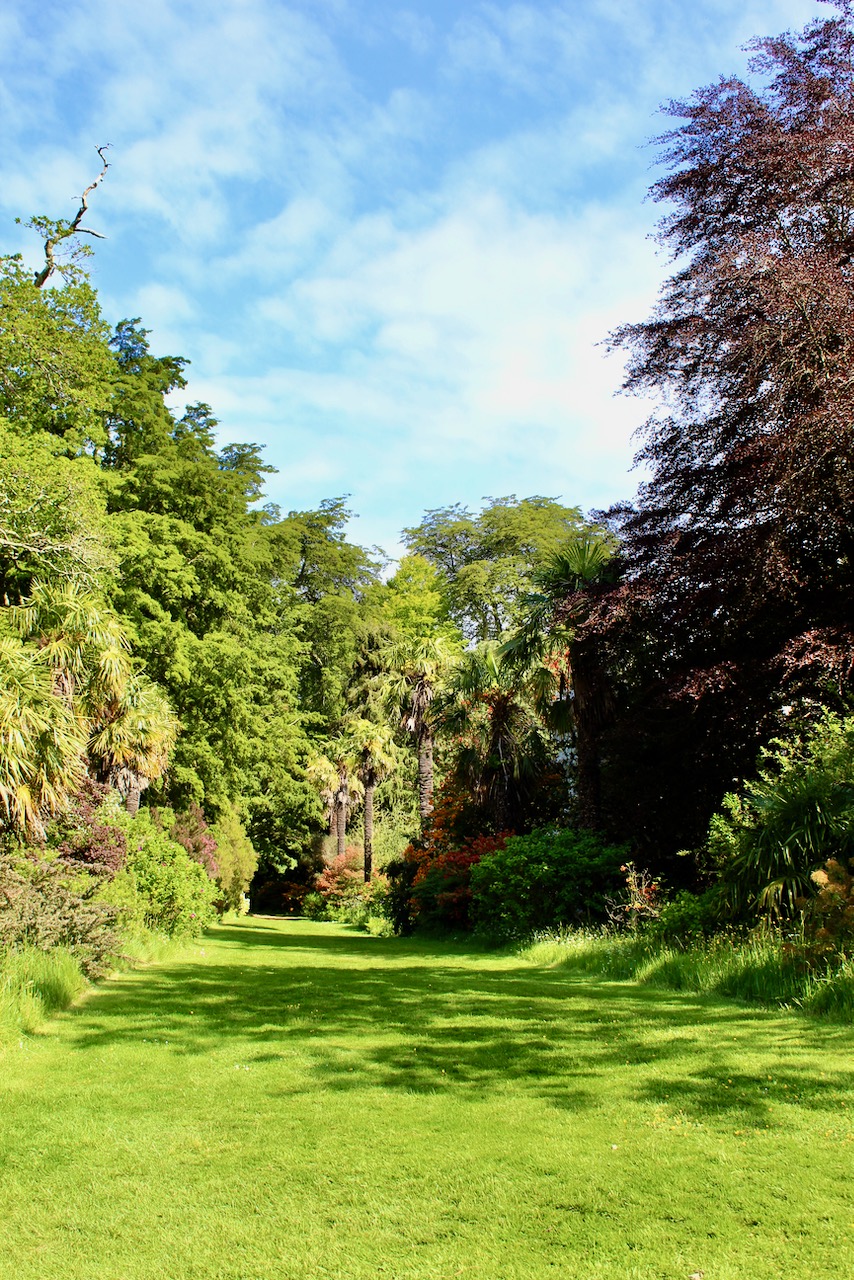
Castle Leslie, Glaslough, County Monaghan – accommodation, section 482

www.castleleslie.com

Tourist Accommodation Facility – since it is listed in Revenue Section 482 as Tourist Accommodation Facility, it does not have to open to the public.
Open for accommodation in 2026: all year, National Heritage Week events August 15-23

donation

Help me to pay the entrance fee to one of the houses on this website. This site is created purely out of love for the subject and I receive no payment so any donation is appreciated!

€15.00

Photo by Chris Hill of Tourism Ireland, Ireland’s Content Pool.
IMG_1489
A brooding pile of rock faced limestone and russet sandstone, the exterior blends the irregular massing and elongated proportions typical of the High Victorian era with details inspired by the Renaissance and Tudor periods.” [1] Photograph © Jennifer Winder-Baggot, www.irishhistorichouses.com
Castle Leslie, County Monaghan, photograph by Robert French, Lawrence Photograph Collection, National Library of Ireland.

As a treat for Stephen’s birthday we booked ourselves in to Castle Leslie for two nights at the end of November. What luxury! I assumed we could not afford it as I only heard of it when Paul McCartney married there in 2002. But it is amazingly reasonable! In Christmas regalia, its beauty and opulence took my breath away, as did the generosity of the owners, allowing us to wander every nook and cranny and to sleep in a bed that was made in the year 1617!

IMG_1650
The Drawing Room: “Among the suite of lavish reception rooms, each one a showcase for the skill of the carpenter and stuccadore, is the Italian Renaissance-style drawing room where polygonal bay windows give unsurpassed views overlooking manicured terraces and the wooded Glaslough Lake.” (see [1]) Photograph © Jennifer Winder-Baggot, www.irishhistorichouses.com
IMG_1503
Our bed from 1617. Photograph © Jennifer Winder-Baggot, www.irishhistorichouses.com

DAY 1: Our Castle Tour and the history of the Leslies

We had to make sure we left Dublin in time for the tour at 1pm, which does not run every day but several days a week. Our tour guide, Enda, shared only the tip of the iceberg of his knowledge of the castle and family in a tour that lasted an hour. We were able to mine him for even more tidbits later and still I felt we only scratched the surface!

The castle is a relative youngster at just 130 years old, a “grey stone Victorian pile” as Mark Bence-Jones calls it [2], or in Scottish Baronial style, according to Maurice Curtis and Desmond Fitzgerald [3]. It was designed by Sir Charles Lanyon and William Henry Lynn, built ca. 1870 for John Leslie, MP, incorporating part of an earlier house. William Henry Lynn (1821-71) was a Belfast based architect and the Castle is considered to be his masterpiece. It is set in a 1000 acre estate (much reduced from its original size) overlooking a lake, and the castle is near another residence, the Lodge (formerly the Hunting Lodge), which houses the bar and restaurant.

Charles Lanyon (1813-1889) courtesy of Queen’s University Belfast.

The Lodge was designed by one of the Leslies, Charles Powell Leslie II, and was built before the present castle. The hotel includes an excellent Equestrian centre on its grounds – a perfect way to explore the huge estate of lakes, forest, parkland and streams. The Estate has three lakes, Glaslough (Green Lake), Kilvey Lake and Dream Lake. [4] There is more accommodation in the restored Old Stable Mews, or in holiday cottages in the village.

IMG_1499
The Lodge, November 2019. Photograph © Jennifer Winder-Baggot, www.irishhistorichouses.com

We drove through the picturesque village of Glaslough to reach the “crow stepped gabled gate lodges” marking the entrance to the Castle Leslie estate. (see [1])

Our tour began in the front hall of the Castle, soon after we arrived, so we left our suitcases at the front desk, to check into our room afterwards. The front hall contained arms from the Leslie family.

IMG_1495
Castle Leslie. Photograph © Jennifer Winder-Baggot, www.irishhistorichouses.com
IMG_1494
Castle Leslie. Photograph © Jennifer Winder-Baggot, www.irishhistorichouses.com
IMG_1496
The bust is of Charles Powell Leslie III. The animal heads, which you can barely see at the top of the photograph, were shot by Norman Leslie, whose bedroom we slept in! Photograph © Jennifer Winder-Baggot, www.irishhistorichouses.com

Originally Hungarian, the first of the family moved to Ireland in 1633. They have lived at Castle Leslie since 1665. Our guide traced the family back to 1040. Their genealogy reaches even further back to Attila the Hun (he died in the year 453).

According to the Castle Leslie website, Bartholomew Leslie, a Hungarian nobleman, was the chamberlain and protector of Margaret Queen of Scotland, who was wife of King Malcolm III (he lived 1031-1093). One day, fleeing from enemies, Queen Margaret rode behind Bartholomew on his horse. When fording a river, the queen fell off and Bartholomew threw her the end of his belt and told her to “grip fast” the buckle. He saved the Queen’s life and from that day onwards she bestowed the motto “Grip Fast” on the Leslies. [5]

IMG_1497
Castle Leslie, November 2019. Photograph © Jennifer Winder-Baggot, www.irishhistorichouses.com

Our guide told us that King Malcolm’s sister Beatrice married Bartholomew Leslie. They moved to Aberdeenshire in Scotland.

Five hundred or so years later a descendent John Leslie was born in 1571 in Aberdeenshire. He received his Doctorate of Divinity from Cambridge and was Privy Councillor to Kings James I and Charles I. He was promoted to become Bishop of the Scottish Isles, and in 1633 transferred to Donegal to the Bishopric of Raphoe.

When Oliver Cromwell came to Ireland, John Leslie, friend of the monarchy, raised a private army to battle against Cromwell, as so he earned the moniker “The Fighting Bishop.” His troops beat Cromwell in the Battle of Raphoe. When King Charles II was restored to the throne in 1660, he rewarded the Bishop with £2000 – note that the Bishop was ninety years old by this time! Despite his age, he became Bishop of the Diocese of Clogher in 1661.

With the £2000, in 1665 Bishop Leslie bought the estate at Glaslough with an existing castle which had been built in 1608 by Sir Thomas Ridgeway. Bishop Leslie died at the age of one hundred, and left the estate to his wife, Catherine Cunningham (or Conyngham) of Mount Charles in Donegal (an ancestor of the present Lord Henry Mount Charles of Slane Castle), and children. He had married at the age of 67 the 18 year old Catherine and sired five (according to our guide) or 10 (according to Wikipedia, [6]) children! Only two of his children survived to adulthood and only one has descendants.

Due to the limitation of the tour’s length our guide jumped forward to the 1880s. I am guessing that it was he who wrote the history of the Leslies on the Castle’s website, so I will defer to that to fill in the gaps. We moved from the front hall into the hallway of the grand staircase, where our guide told us about the people in the various portraits. We then moved through a room with a large table, to the drawing room and the dining room, where the guide spoke about more of the family and their portraits.

IMG_1498
Castle Leslie. Photograph © Jennifer Winder-Baggot, www.irishhistorichouses.com
IMG_1646
The Drawing Room. Photograph © Jennifer Winder-Baggot, www.irishhistorichouses.com
IMG_1647
The Drawing Room, with the throne of Bishop John Leslie, the “fighting Bishop.” He also built the church on the estate, in 1670. Photograph © Jennifer Winder-Baggot, www.irishhistorichouses.com
IMG_1662
The Dining Room. Photograph © Jennifer Winder-Baggot, www.irishhistorichouses.com

The Bishop’s son John, another cleric, the Dean of Dromore, inherited the estate. He never married so when he died, the estate passed to his brother, Charles, at 71 years of age. Charles was a theologian and defended the Catholics, opposing the penal laws which prevented Catholics from participating in political life. King William III had him arrested for high treason, but he escaped to France. The next king, George I, pardoned him, saying “Let the old man go home to Glaslough to die.” (see [5], which provides most of my narrative)

Rev. Charles Leslie (1650-1722), Jacobite Religious Controversialist and Pamphleteer. Portrait After [i.e. print created from a portrait by] Alexis-Simon Belle, French, 1674-1734. Photograph courtesy of the National Gallery of Ireland.

Charles married Jane Griffith, daughter of the Very Reverend Richard Griffith, Dean of Ross [7] had three children: Robert, Henry, and the unusually named “Vinegar” Jane. Robert and Henry were friends with Jonathan Swift, who wrote the following about the family:

“Here I am in Castle Leslie

With rows and rows of books upon the shelves

Written by The Leslies

All about themselves.”

I’m not sure what was written at that stage, but certainly when we stayed, there were plenty of books by the Leslies! I had a good browse through them – more on them later.

Robert wedded, in 1730, Frances, daughter of Stephen Ludlow.

Lady Frances Leslie, by Hugh Douglas Hamilton (1734-1808), courtesy of Adam’s auction 11th Oct 2016. Perhaps this is Frances née Ludlow who married Robert Leslie (1680-1743). Photograph © Jennifer Winder-Baggot, www.irishhistorichouses.com

Their son Charles Powell Leslie (c. 1738-1800), took over the Estate in 1743. He devoted himself to the improvement of farming methods in the district. He was elected MP for Hillsborough in 1771 and MP for Monaghan in 1776. Like his grandfather, he supported the Catholics. At the time, due to Poynings Law, all Irish legislation had to be approved by the British Privy Council. Henry Grattan and others, including Charles Powell Leslie, sought legislative independence. Once this was achieved, Grattan fought in parliament for Catholic Emancipation from the Penal Laws, so that Catholics could be treated as equal citizens of Ireland. In his election speech of 1783, Charles Powell Leslie stated ”I desire a more equal representation of the people and a tax upon our Absentee Landlords”.

IMG_1655
Portrait of Charles Powell Leslie I. Photograph © Jennifer Winder-Baggot, www.irishhistorichouses.com

In 1765 Charles Powell married Prudence Penelope Hill-Trevor, daughter of Arthur Hill-Trevor, 1st Viscount Dungannon. They had two sons, Charles Powell II and John. After his first wife died, Charles Powell Leslie I married, in 1785, Mary Anne Tench, and had a third son. The heir, Charles Powell II, also represented Monaghan in parliament.

IMG_1657
Charles Powell Leslie II. Photograph © Jennifer Winder-Baggot, www.irishhistorichouses.com

Arthur Hill-Trevor’s elder daughter, Anne, married Garret Wesley, the 1st Earl of Mornington, of Dangan Castle County Meath, and their son grew up to be the Duke of Wellington who defeated Napolean at Waterloo. According to the website, Charles Powell Leslie gave his impoverished brother-in-law, Lord Mornington, the money to educate his son Arthur, in Eton and then military school in France (Stephen and I found it ironic that the Duke of Wellington, who beat Napoleon, hence France, received his military training in France!). Arthur, the Duke of Wellington, married Kitty Pakenham of Tullynally, County Westmeath.

Charles Powell Leslie II, an amateur architect, designed the present farm buildings and the gate lodge. (see [8] for more about Charles Powell Leslie II). He died in 1831 and his wife Christiana took over the running of the estate. She managed to feed the needy during the great famine of 1845, setting up soup kitchens, and gave employment by having a wall built around the estate. The population of County Monaghan was 208,000 before the Famine. It went down to 51,000 during and after the Famine and is now only 61,000 – still far less than its pre-Famine population. It is said that nobody perished on the Leslie estate. As well as the soup kitchen, Christiana suspended rents.

IMG_1680
Farm buildings: perhaps these are ones designed by Charles Powell Leslie II. Photograph © Jennifer Winder-Baggot, www.irishhistorichouses.com

Her son Charles Powell III (1821-71) also enjoyed architecture, and had flamboyant taste. He designed the entrance lodges at the main gates of the estate. He had many other grand building plans but died, choking on a fishbone, and it was his brother John (1822-1916) who built the new castle – to a much more modest design than Charles’s. Charles never married so John succeeded to the estate, in 1871.

John Leslie married Constance Dawson Damer, the daughter of Mary Seymour who was allegedly George IV’s daughter by Mrs. Fitzherbert.

IMG_1566
A portrait of Mrs. Maria Fitzherbert, which Stephen and I discovered upstairs on our way to the cinema room in the castle! Photograph © Jennifer Winder-Baggot, www.irishhistorichouses.com
IMG_1565
Castle Leslie, November 2019. Photograph © Jennifer Winder-Baggot, www.irishhistorichouses.com

Maria, born Smythe, was a Catholic. She married a wealthy Catholic landowner when she was just 18 years old. He died tragically, and she married a second time, but her second husband died when she was just 24! Her uncle decided to bring her out into society, and brought her to the opera. There, she met King George IV. He pursued her, and a marriage between them is recognised by the Catholic church, but not by the Monarchy. He moved her to Brighton and the Royal family took care of her, although George was married off to European Royalty, Princess Caroline.

Maria had two children, reputedly, with George IV. The daughter was adopted by a friend of George IV, Hugh Seymour. It was this Mary Seymour who married George Dawson Damer, and her daughter Constance married John Leslie. Constance burned all the evidence of her background, as it was not approved by the Royal Family. It is therefore not a definitive history, just, shall we say, rumour. Her descendant Shane Leslie wrote a biography of Mrs. Fitzherbert.

IMG_1656
A portrait of Lady Constance in later life. Photograph © Jennifer Winder-Baggot, www.irishhistorichouses.com

It was the portrait above, of Lady Constance, which a nurse, who had been attending the dying Leonie (wife of Constance and John’s heir, John), recognised as the lady who had visited Leonie’s deathbed – despite Constance having been dead for nearly twenty years!

Before his brother died, John brought Constance to live in the old castle. Constance must have wanted a place of her own so in 1860, they moved into the Hunting Lodge in order to live separately from Charles Powell III and his mother.

IMG_1537
A room inside the Lodge. Photograph © Jennifer Winder-Baggot, www.irishhistorichouses.com
49395095897_952f851fc4_o (1)
Front hall and welcoming room of the Lodge. Photograph © Jennifer Winder-Baggot, www.irishhistorichouses.com
IMG_1544
A small private dining room in the Lodge. Photograph © Jennifer Winder-Baggot, www.irishhistorichouses.com

However, once they inherited the old castle, not content with her Lodge or the old castle, it was Constance who insisted that John build the new castle. While it was being built she and her husband went on a Grand Tour and collected much of the present furniture in the house including the blue and white Della Robbia chimneypiece in the drawing room, and a mosaic floor in the hall which is a replica of a two thousand year old Roman villa floor. Constance was a connoisseur of fine art and antiques.

IMG_1645
Della Robbia chimneypiece in Drawing Room, purchased by Constance and John Leslie. Photograph © Jennifer Winder-Baggot, www.irishhistorichouses.com

Their travels influenced the style of the Castle, built by Sir Charles Lanyon and William Henry Lynn. An Italian Renaissance cloister (said to have been copied from Michaelangelo’s cloister at Santa Maria degli Angeli in Rome, according to Mark Bence Jones (see [2]) joins the main block of the castle to a single-storey wing containing the library and former billiard-room.

IMG_1594
The Italian Renaissance style Cloister. Photograph © Jennifer Winder-Baggot, www.irishhistorichouses.com
IMG_1592
Castle Leslie, November 2019. Photograph © Jennifer Winder-Baggot, www.irishhistorichouses.com
Castle Leslie, County Monaghan, photograph by Robert French, Lawrence Photograph Collection, National Library of Ireland.

Behind the cloister runs a long top-lit gallery divided by many arches, with pre-Raphaelite style frescoes of angels and other figures, including portraits of members of the family, painted by John Leslie, a talented artist. One of his paintings was hung in the Royal Academy in the same year. He later become 1st Baronet of Glaslough.

49394897816_14481f72f0_o
Castle Leslie. Photograph © Jennifer Winder-Baggot, www.irishhistorichouses.com
IMG_1525
Frescoes painted by Sir John Leslie. Photograph © Jennifer Winder-Baggot, www.irishhistorichouses.com
IMG_1526
Castle Leslie. Photograph © Jennifer Winder-Baggot, www.irishhistorichouses.com
IMG_1659
I think it was this painting that hung in the Royal Academy. Photograph © Jennifer Winder-Baggot, www.irishhistorichouses.com

The next to inherit the estate was the 2nd Baronet, Sir John Leslie (1857–1944). He married Leonie Jerome, one of the three beautiful daughters of Leonard Jerome of New York. Her sister Jenny married Lord Randolph Churchill and was the mother of Prime Minister Winston Churchill. Winston did not get on well with his mother but was very close to his aunt Leonie. The young Winston Churchill paid visits here to his uncle and aunt, except when he was temporarily banished by his uncle on account of his espousal of Home Rule! Leonie’s correspondence with Winston is in Blenheim Castle in England, the estate of the Churchills. When his beloved aunt died in August 1943, Winston couldn’t attend the funeral due to the war, but he telephoned Eamon de Valera to request permission for the flyover of an Royal Air Force Spitfire plane. It was her son, Desmond Leslie, who was in the RAF, who flew the Spitfire and dropped a huge wreath from Winston Churchill to the funeral.

Leonie Leslie née Jerome, her sister Jennie was Winston Churchill’s mother.
IMG_1648
I was touched by the presence of Winston Churchill’s christening robe in the drawing room. Photograph © Jennifer Winder-Baggot, www.irishhistorichouses.com

Sir John Leslie died in 1944 and was succeeded by his son Sir Shane Leslie (1885–1971). Shane was one of four brothers: he was christened John, and changed his name to Shane in 1921 when he embraced Irish nationalism; the other brothers were Lionel, Norman and Seymour.

Shane Leslie.

Shane grew up to be an ardent nationalist (he joined the Irish Volunteers, a group founded in response to the Ulster Volunteers in Northern Ireland who opposed Home Rule – he thus rejected the support his father gave to the Ulster Volunteers!) and Irish speaker, and converted to Catholicism, under the influence of Cardinal Henry Newman, when he was in Cambridge. He hoped to retreat to a Monastery but instead married another American beauty, Majorie Ide of Vermont. According to the history of the Leslie family recounted on the website, Majorie’s father, Henry Clay Ide, was Chief Justice of Samoa, a tropical paradise where he and his daughters became great friends of fellow islander Robert Louis Stevenson. He was also Governor General of the Philippines. Later in our stay, our guide told us that before she married, Majorie and her sister accompanied U.S. President Teddy Roosevelt’s daughter on a trade mission to China. The President considered the women to be suitable ambassadors because the current monarch of China was an Empress (the last Empress of China). There are many Chinese objects in Castle Leslie which Majorie brought with her.

IMG_1541
Castle Leslie. Photograph © Jennifer Winder-Baggot, www.irishhistorichouses.com
IMG_1547
Castle Leslie, November 2019. Photograph © Jennifer Winder-Baggot, www.irishhistorichouses.com

Sir Shane, as a poet and Nationalist, was not fond of running the estate so transferred it to his son John Norman Leslie (1916-2016), who became 4th Baronet. Shane Leslie travelled to London when Michael Collins was negotiating the Treaty granting Ireland its independence from the United Kingdom. Shane’s brother Norman on the other hand fought in the British army, and was killed by a sniper. The bedrooms in the Castle are now named after the family, and Stephen and I stayed in “Norman’s Room”!

IMG_1504
Castle Leslie, November 2019. Photograph © Jennifer Winder-Baggot, www.irishhistorichouses.com

Shane had three children: Anita, John (Jack) and Desmond. Jack transferred the estate over to his sister Anita, owing to ill health after five years in a prisoner of war camp. He had been Captain in the Irish Life Guards in WWII. He moved to Rome where he lived for forty years, finally returning to Castle Leslie in 1994. He died only a few years ago, at 99 years old, inheriting the hardy genes of the Fighting Bishop, and is obviously much missed in the castle which houses many of his mementos and memorabilia.

IMG_1589
“Jack’s bed,” in which he used to sleep, now in pride of place on the upper landing, although the bed would have been a squeeze for his over six foot frame! Photograph © Jennifer Winder-Baggot, www.irishhistorichouses.com
IMG_1591
Portraits of the family including several of Jack. Jack wrote of his life in Never a Dull Moment. Photograph © Jennifer Winder-Baggot, www.irishhistorichouses.com

Later in our stay, Enda the guide told us more about Anita, as we were admiring the paintings of Anita, Jack and Desmond at the bottom of the grand staircase.

IMG_1586
Castle Leslie, November 2019. Photograph © Jennifer Winder-Baggot, www.irishhistorichouses.com

Anita married Pavel Rodzianko, a dashing soldier from Russia, Equerry to Tsar Nicholas and Alexandra. Anita was just 23 years old but bowled over by the 47 year old Pavel. The marriage lasted only three years. This marriage explains the presence of the paintings of Nicholas and Alexandra which Stephen and I had noticed in the bar area.

IMG_1670
Tsar Nicholas and Alexandra. Photograph © Jennifer Winder-Baggot, www.irishhistorichouses.com
IMG_1669
A poignant picture of Alexandra and her children, all of whom were assassinated only two days before Pavel Rodzianko was able to rescue them. Photograph © Jennifer Winder-Baggot, www.irishhistorichouses.com

Pavel tried to rescue the Tsar and his family. He followed with other soldiers loyal to the Tsar, as the Royal family was moved from place to place by those who had overthrown the Tsar. When they caught up with the family Pavel and his companions were too late: the family had been shot in the basement and their bodies burned. Pavel found little Alexi’s dog Joy still alive. Pavel saved the dog and brought her to his home next to Windsor Castle in England, where Pavel lived after leaving Castle Leslie, where Joy lived the rest of her life. Pavel went on to train the Irish show-jumping team, who won the Agha Khan trophy in the Royal Dublin Society (RDS) Horse Show.

During World War II Anita joined the French army as an ambulance driver and married Bill King, a submarine commander. In the 1960s she moved to Oranmore in Galway (Oranmore Castle is a Section 482 property so I hope to visit it!) and transferred Glaslough to her younger brother Desmond (the Spitfire pilot). In 1991 he handed the Estate over to his five children and Castle Leslie Estate is now run by his daughter Samantha Leslie.

I mentioned earlier that many Leslies have written books. I browsed through books by Shane Leslie and Jack. Anita Leslie wrote about her time in the army in The Train to Nowhere. Desmond’s wife Agnes Bernaur is also a published writer. I copied the family tree from Shane Leslie’s book, and notice that the sister of John Leslie 2nd Baronet, Theodisia, married a Bagot! She married Josceline Fitzroy Bagot, of Levens Hall. I may be distantly related to this Bagot, as we are rumoured to be descended from the Bagots of Staffordshire! I confess I have not found the link.

After our tour, we were shown to our room. We were thrilled with it, and especially with our 1617 four poster oak bed. The bed was so high that it required steps to get up to it:

IMG_1637
Castle Leslie, November 2019. Photograph © Jennifer Winder-Baggot, www.irishhistorichouses.com

We had a table and chair, and a lovely wardrobe and chaise longue! I started writing this entry on the chaise longue.

IMG_1571
Castle Leslie, November 2019. Photograph © Jennifer Winder-Baggot, www.irishhistorichouses.com

According to the website, Sammy started her ambition of bringing the Estate back to life by establishing tea rooms in the old conservatory. This had been a painting studio for John Leslie, as it was created to have lots of light.

IMG_1665
Castle Leslie, November 2019. Photograph © Jennifer Winder-Baggot, www.irishhistorichouses.com

The website continues:

Between 1995 and 1997, Sammy refurbished fourteen of the Castle bedrooms and bathrooms, each in its own unique style, in an effort to maintain the individuality and uniqueness of the property. Dinners were served by candlelight in the original dining room, just as it had been in the old days, with pre-dinner drinks served in the Drawing Room or Fountain Garden. The Castle at Castle Leslie Estate was soon rewarded with The Good Hotel Guide Caesar Award for being ‘utterly enjoyable and mildly eccentric’.” [9]

Perhaps one of the mildly eccentric details referred to are the beautiful old fashioned porcelain toilets such as the one in our en suite:

IMG_1634
Castle Leslie, November 2019. Photograph © Jennifer Winder-Baggot, www.irishhistorichouses.com

After the tour, we still had so much of the castle to explore! The tour had only taken in a few of the rooms! We were tired after the tour and lay on our wonderful bed for a nap before dinner. While we were reading, we heard a knock on our door. The staff had brought us a much appreciated, delicious strong cup of coffee! Perfect!

We emerged for dinner. We chose to eat in the bistro rather than the fancier restaurant. The reception staff offered us a lift over to the Lodge, but we chose to walk the short distance up the drive, as it was a beautiful crisp night.

We did a little exploring back at the castle after dinner. We discovered more beautiful rooms to sit in, and a lovely library, and it was only now that we found the bar and the long painted gallery!

IMG_1512
Castle Leslie. Photograph © Jennifer Winder-Baggot, www.irishhistorichouses.com
IMG_1523
Castle Leslie. Photograph © Jennifer Winder-Baggot, www.irishhistorichouses.com
IMG_1557
Castle Leslie. Photograph © Jennifer Winder-Baggot, www.irishhistorichouses.com
IMG_1555
Castle Leslie. Photograph © Jennifer Winder-Baggot, www.irishhistorichouses.com
IMG_1558
Castle Leslie. Photograph © Jennifer Winder-Baggot, www.irishhistorichouses.com
IMG_1561
Castle Leslie, November 2019. Photograph © Jennifer Winder-Baggot, www.irishhistorichouses.com

Many new features have been added to the estate, including a spa, a bar and restaurant, and a cookery school.

A new pavilion, adjacent to the long gallery of the main house, facilitates conferences, weddings and other large events – see the pathway leading to the pavilion in the photograph below.

49394425158_9437d142b4_o
Castle Leslie. Photograph © Jennifer Winder-Baggot, www.irishhistorichouses.com
IMG_1676
Castle Leslie, November 2019. Photograph © Jennifer Winder-Baggot, www.irishhistorichouses.com

The website tells us that five new sub-ground floor bedrooms were added to the castle in 2005: the Desmond Leslie room, the Agnes Bernelle Room, the Helen Strong Room, Sir Jack’s Room and the only room in the castle not named after a family member, The Calm Room.

DAY 2: Horse riding! And exploring the Lodge

Stephen and I only saw the castle in daylight the next day, as we had been too tired to explore outside after the tour. It was only then that we saw the cloisters, and the lake! We wandered outside in the evening. Earlier in the day, we decided to avail of the Equestrian Centre, since Stephen confided that he had never sat on a horse!

We booked a one hour walking session, a gentle wander through woods on the estate, hand-led by a guide. I felt safe enough walking without a guide at the reins, as I endured two years of weekly riding lessons when I was young! I say “endured” as I was scared of the horses and fell often! The horses we rode during my lessons in Australia were a more cantankerous brood than those that bless Castle Leslie!

IMG_1574
Castle Leslie, November 2019. Photograph © Jennifer Winder-Baggot, www.irishhistorichouses.com

Below shows me in Australia at my horse riding lessons with my sister when I was young!

Caballo Stables, Jen and Siobhan riding
My sister Siobhán and I horseriding in Caballo Stables, Western Australia. Photograph © Jennifer Winder-Baggot, www.irishhistorichouses.com
Jen and Siobhan ready for riding lesson
Me and my sister Siobhan in Perth, Western Australia, ready for our riding lesson. Photograph © Jennifer Winder-Baggot, www.irishhistorichouses.com

And now:

IMG_1576
Castle Leslie. Photograph © Jennifer Winder-Baggot, www.irishhistorichouses.com
IMG_1583
Castle Leslie, November 2019. Photograph © Jennifer Winder-Baggot, www.irishhistorichouses.com

Our guide, Chris, told us a bit more about the estate as we relaxed onto the hip swinging gait of our horses, and we passed one of the lodges. I knew Stephen would be imagining himself back in the 1700s, familiarising himself with the atmosphere of the former mode of transportation. We both lost our balance as we slid off our horses, Stephen doing the full topple onto the sand, but we were elated! You can see a map of the estate on the castle website. [10]

After lunch in the Lodge, we explored. I took some photographs inside the lodge.

49394414913_6ed49b601c_o
Castle Leslie. Photograph © Jennifer Winder-Baggot, www.irishhistorichouses.com
49394417598_c00d560572_o
Castle Leslie, November 2019. Photograph © Jennifer Winder-Baggot, www.irishhistorichouses.com

Dusk fell by the time I took photographs outside behind the castle.

IMG_1596
Castle Leslie. Photograph © Jennifer Winder-Baggot, www.irishhistorichouses.com
IMG_1607
Castle Leslie. Photograph © Jennifer Winder-Baggot, www.irishhistorichouses.com
IMG_1616
Castle Leslie, November 2019. Photograph © Jennifer Winder-Baggot, www.irishhistorichouses.com

Sammy’s most recent project (begun in 2015) is renovating the walled garden. I’m sorry I reached it so late in the day, compromising my photographs. These were built in 1860 by Charles Powell Leslie III.

IMG_1620
Castle Leslie. Photograph © Jennifer Winder-Baggot, www.irishhistorichouses.com
49394965401_a85013d342_o (1)
Castle Leslie, November 2019. Photograph © Jennifer Winder-Baggot, www.irishhistorichouses.com

According to information posted in the walled garden, they cover about four acres, and contain two forty metre greenhouses heated by individual underground boilers fed by rainwater collected from the glass roofs. The flues were built originally under the paths to chimneys hidden in the surrounding garden wall! Ingenious ancestors! Charles Leslie consulted with Joseph Paxton, the Duke of Devonshire’s head gardener, who created the “Crystal Palace” of the 1851 Great Exhibition in Hyde Park in London for Queen Victoria’s consort Prince Alfred.

Outside the Walled Garden was a third large greenhouse, a Tropical House. Charles Powell Leslie III, according to the information boards in the garden, wooed an opera singer with weekly hampers of bananas, melons and mangoes sent from Castle Leslie to her dressing room in Covent Gardens in London!

The Pump House, built from approximately 1848, was one of the first water systems to be constructed for a village and estate. One can still see the ornate cast iron fountains in the village, along with the statue of Charles Powell Leslie III.

Day Three: A walk to the stables and goodbye to Castle Leslie!

The next day dawned bright, a crisp November day. We followed our map of the estate to see the Stable Mews, for a bit of exercise before we had to depart.

IMG_1681
Castle Leslie. Photograph © Jennifer Winder-Baggot, www.irishhistorichouses.com
IMG_1682
Castle Leslie, November 2019. Photograph © Jennifer Winder-Baggot, www.irishhistorichouses.com

[1] https://www.buildingsofireland.ie/places-to-visit/monaghan/glaslough-castle-leslie/

[2] Mark Bence-Jones. A Guide to Irish Country Houses.[originally published as Burke’s Guide to Country Houses volume 1 Ireland by Burke’s Peerage Ltd. 1978; Revised edition 1988 Constable and Company Ltd, London.]

[3] Curtis, Maurice and Knight of Glin, Ireland Observed. Mercier Press, Dublin and Cork 1970.

[4] http://www.britainirelandcastles.com/Ireland/County-Monaghan/Castle-Leslie.html

[5] https://www.castleleslie.com/life-the-way-its-supposed-to-be-2/historical-castle-ireland/

[6] https://en.wikipedia.org/wiki/John_Leslie_(bishop_of_Clogher)

[7] http://lordbelmontinnorthernireland.blogspot.com/search/label/County%20Monaghan%20Landowners

Note that this website states that Charles and his wife had only one child whereas the Castle Leslie website claims that they had three children.

[8] see [7]. CHARLES POWELL LESLIE II, JP (c1767-1831), Colonel, County Monaghan Militia, High Sheriff of County Monaghan, 1788, MP for County Monaghan, 1801-26, New Ross, 1830-1, who espoused firstly, Anne, daughter of the Rev Dudley Charles Ryder, and had issue, three daughters.

He married secondly, in 1819, Christiana, daughter of George Fosbery, and had further issue,

Charles Powell (1821-71);
 JOHN, his heir;
 Thomas Slingsby;
 Prudentia Penelope; Christiana; Julia; Emily.

[9] https://zs35w2fzekug05wf2mckg53k-wpengine.netdna-ssl.com/wp-content/uploads/2019/02/Regeneration-History.pdf

[10] https://zs35w2fzekug05wf2mckg53k-wpengine.netdna-ssl.com/wp-content/uploads/2018/04/E-Map-Only-2017.pdf

Text © Jennifer Winder-Baggot, www.irishhistorichouses.com
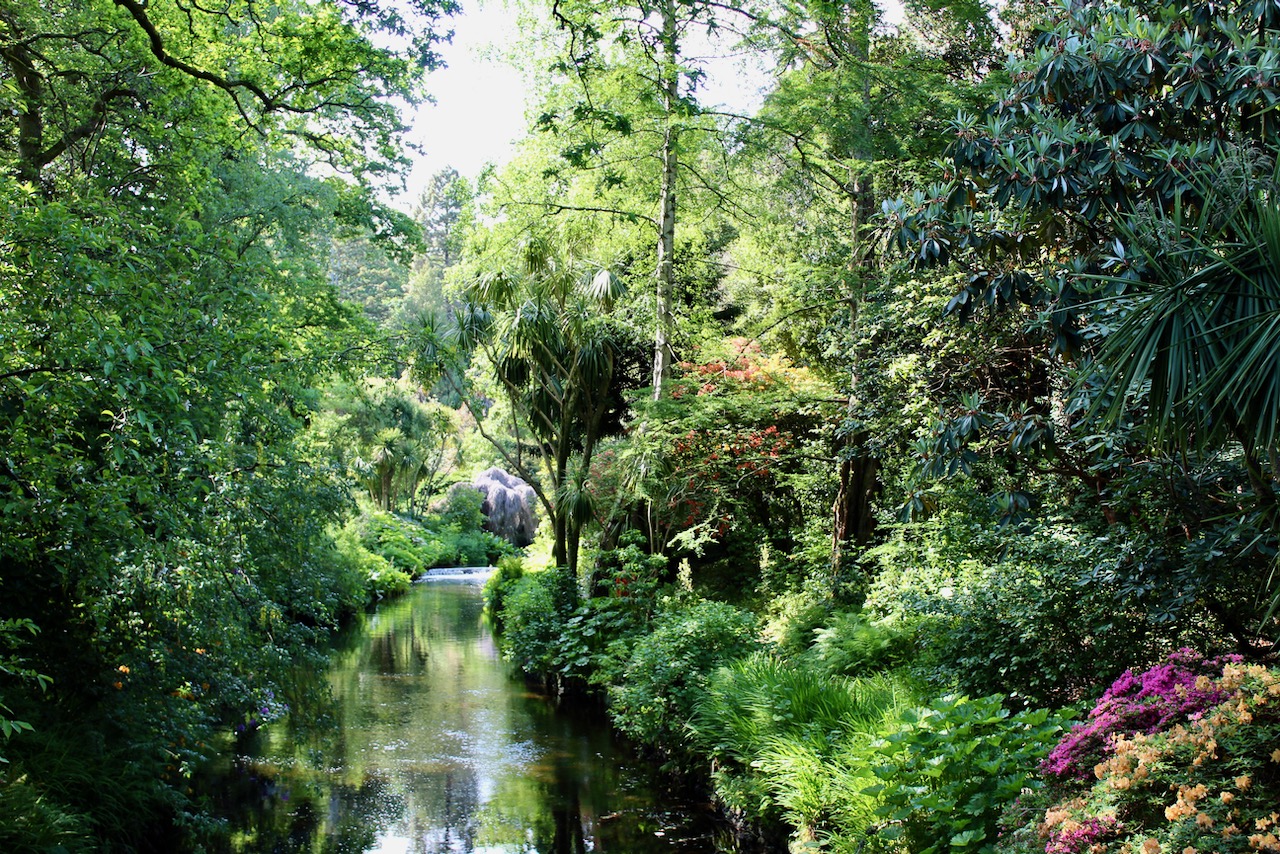
Curraghmore, Portlaw, County Waterford – section 482

www.curraghmorehouse.ie

Open dates in 2026: May 1-4, 8-10, 15-17, 22-24, 29-31, June 1, 5-7, 12-14, 19-21, 26-28, July 3-5, 10-12, 17-19, 24-26, 31, Aug 1-3, 7-9, 14-23, 28-30, 10am-4pm

Fee: adult/OAP/student, full tour €22, garden tour €8, child under12 years free

DSC_0564
Curraghmore, 5th May 2019. Photograph © Jennifer Winder-Baggot, www.irishhistorichouses.com

According to the Curraghmore website:

Curraghmore House in Waterford is the historic home of the 9th Marquis of Waterford. His ancestors (the de la Poers) came to Ireland from Normandy after a 100-year stopover in Wales around 1170, or about 320 years before Columbus ‘discovered’ the New World.

Some 2,500 acres of formal gardens, woodland and grazing fields make this the largest private demesne in Ireland and one of the finest places to visit in Ireland….

This tour takes in some of the finest neo-classical rooms in Ireland which feature the magnificent plaster work of James Wyatt and grisaille panels by Peter de Gree.” 

Curraghmore, the garden facing side of the house, designed by James Wyatt (1746-1813), 14th August 2023. Photograph © Jennifer Winder-Baggot, www.irishhistorichouses.com

The website continues: “Curraghmore, meaning great bog, is the last of four castles built by the de la Poer family after their arrival in Ireland in 1167. The Castle walls are about 12 feet thick and within one, a tight spiral stairway connects the lower ground floor with the roof above. Of the many curious and interesting features of Curraghmore, the most  striking is the courtyard front of the house, where the original Castle is encased in a spectacular Victorian mansion with flanking Georgian ranges.

We came across a link to the De La Poer family, also called Le Poer or Power, in Salterbridge, and will meet them again in Powerscourt in Wicklow and Dublin.

Curraghmore, the courtyard facing side of the house, 14th Aug 2023. Photograph © Jennifer Winder-Baggot, www.irishhistorichouses.com

The core of the house is the medieval tower, visible from the courtyard facing side of the house, built by the original owners, the La Poers, and the house is still owned by the same family today. The tower may stretch back all the way to the original La Poer occupants from 1167. When we went inside, we stood in what was the original tower, and we could see the 12 foot thick walls.

It was difficult to find Curraghmore House. We drove two kilometres up a stony track; without the reassuring directions, we would not have believed we were on the right road. The road winds along by the River Clodagh. As our guide told us later, the distance from anything else in all directions is one reason the house remains intact. There are three entrances, and all have drives of about 1.5km to the house.

The River Clodagh on the drive to Curraghmore. Photograph © Jennifer Winder-Baggot, www.irishhistorichouses.com
DSC_0563
Entering Curraghmore, via servants’ quarters either side of courtyard, 5th May 2019. Photograph © Jennifer Winder-Baggot, www.irishhistorichouses.com
Photograph courtesy of Curraghmore website.
This is the gate one drives through into the courtyard of Curraghmore. Photograph © Jennifer Winder-Baggot, www.irishhistorichouses.com

Mark Bence-Jones describes Curraghmore in A Guide to Irish Country Houses as a medieval tower with a large three storey house behind it. He writes that the “original Castle is encased in a spectacular Victorian mansion” with flanking Georgian ranges housing servants, stables, etc. [1] The house is seven bays wide (see garden front) and seven bays deep.

DSC_0612
Garden front, 5th May 2019. It has full height windows where there was the original door, I think. Photograph © Jennifer Winder-Baggot, www.irishhistorichouses.com

The guide told us that when James Wyatt added to the house, he specifically created windows and no door in the room that faces the garden, to avail of the view. However, the windows are deceptive and are actually “doors,” as they fully open to let in visitors.

Photograph courtesy of Curraghmore website.
DSC_0616
Curraghmore, 5th May 2019. Photograph © Jennifer Winder-Baggot, www.irishhistorichouses.com
The view takes in a sweeping lawns, a circular pond that once held a big fountain and a lake beyond, created by Wyatt, and the mountains in the distance. Photograph © Jennifer Winder-Baggot, www.irishhistorichouses.com
Curraghmore House and Fountain, Portlaw, Co. Waterford. Unfortunately the huge fountain has gone. Poole Collection National Library of Ireland, call no. pooleimp141.

Mark Bence-Jones writes that:

The tower survives from the old castle of the Le Poers or Powers; the house was in existence in 1654, but was rebuilt 1700 and subsequently enlarged and remodelled; it extends round three sides of a small inner court, which is closed on fourth side by the tower. The 1700 rebuilding was carried out by James Power, 3rd and last Earl of Tyrone of first creation, whose daughter and heiress, Lady Catherine Power, married Sir Marcus Beresford…The 1st Beresford Earl of Tyrone remodelled the interior of the old tower and probably had work done on the house as well.

The tower has three tiers of pilasters framing the main entrance doorway and triple windows in the two storeys above it, and is surmounted by St. Hubert’s Stag, the family crest of the Le Poers. Photograph © Jennifer Winder-Baggot, www.irishhistorichouses.com
DSC_0565
St. Hubert’s Stag on top of Curraghmore. The crown below the stag, on top of the coat of arms, is the coronet of a Marquess, 5th May 2019. Photograph © Jennifer Winder-Baggot, www.irishhistorichouses.com
Rt. Hon. Marcus Beresford, 1st Earl of Tyrone, photograph courtesy of the Beresford family and creative commons and wikipedia.

Mark Bence-Jones continues his description of the house: “The tower and the house were both refaced mid-C19. The house has a pediment in the garden front; and, like the tower, a balustraded roof parapet. The tower has three tiers of pilasters framing the main entrance doorway and triple windows in the two storeys above it, and is surmounted by St. Hubert’s Stag, the family crest of the Le Poers.” (see [1])

DSC_0613
The house is very large as it is not only seven bays wide but seven bays deep, 5th May 2019. Photograph © Jennifer Winder-Baggot, www.irishhistorichouses.com
Photograph © Jennifer Winder-Baggot, www.irishhistorichouses.com

We explored the buildings flanking the courtyard while waiting for the guided tour, and found the entrance to the gardens, through an arch, with an honesty box, in which we duly deposited our fee. We had missed the earlier house tour so had a couple of hours to wait for the next tour. We wandered out into the gardens. The gardens are amazing, in their formal arrangement.

DSC_0619
Photograph © Jennifer Winder-Baggot, www.irishhistorichouses.com

I’ll write more about the gardens later, as we learned more about them on the tour.

We gathered with others for a tour. The tour guide was excellent. She told us that the gardens only opened to the public a few years ago, when the more private father of the current (ninth) Marquess died.

As usual, we were not permitted to take photographs inside, unfortunately. You can see some on the website. There is also a new book out, July 2019, it looks terrific! [2] More on the interior later – first I will tell you of the history of the house.

POWER AND MONEY AND MARRIAGE: Don’t be put off by the complications of Titles!

The estate was owned by the la Poer (or de la Poer or Le Poer – I have seen it written several ways) family for over 500 years, during which time the family gained the titles Baron la Poer (1535), Viscount Decies and Earl of Tyrone (1673, “second creation”, which means the line of the first Earls of Tyrone died out or the title was taken from them – in this case the previous Earl of Tyrone, Hugh O’Neill, rose up against the British throne during the Nine Years War and fled from Ireland when arrest was imminent, so lost his title).

The La Poer family was Norman originally, and the name has been sometimes Anglicised to “Power.”

Piers Power (or Le Poer) of Curraghmore, who held the office of Sheriff of County Waterford in 1482, cemented the family’s influence with a strategic marriage to the House of Fitzgerald. His wife, Katherine, was a daughter of Sir Gerald Fitzgerald, Lord of the Decies.

Piers’s son and heir, Richard, further strengthened the power of the family by marrying a daughter of the 8th Earl of Ormond (Piers Butler, d. 1539), Katherine. The rival families of Butler and Fitzgerald, into both of which the Le Poers had married, effectively ran the country at this time when English influence in Ireland had been in decline for several decades. [4]

Richard was created 1st Baron le Power and Coroghmore, Co. Waterford on 13 September 1535. [5]

Richard 1st Baron le Power and Coroghmore died on 10 November 1538, killed by Conor O’Callaghan while intervening (on the Crown’s behalf) in the issue of the succession of the Earldom of Desmond.

After Richard died, his wife married James John Fitzgerald, 13th Earl of Desmond, in 1549/50, who held the office of Lord High Treasurer of Ireland.

I shall intervene here to give a summary of the rank of titles, as I’m learning them through my research on houses. They rank as follows, from lowest to highest:

Baron –  female version: Baroness

Viscount – Viscountess

Earl – Countess

Marquess – Marchioness

Duke – Duchess

In 1538 Richard was succeeded by his eldest son, Piers (1526-1545). Piers was a soldier and fought in Boulogne in France for King Henry VIII. After Piers’s premature death in 1545, he was succeeded by his younger brother, John “Mor” Power (d. 1592), 3rd Baron. In 1576, Henry Sidney, the Lord Deputy of Ireland and father of the poet Philip Sidney, stayed with John Mor at Curraghmore. He wrote:

“The day I departed from Waterford I lodged that night at Curraghmore, the house that the Lord Power is baron of. The Poerne country is one of the best ordered countries in the English Pale, through the suppression of coyne and livery. The people are both willing and able to bear any reasonable subsidy towards the finding and entertaining of soldiers and civil ministers of the laws; and the lord of the country, though possessing far less territory than his neighbour (ie: Sir James Fitzgerald of the Decies, John Mor’s cousin) lives in show far more honourably and plentifully than he or any other in that province.” [6]

Sir Henry Sidney (1529-1586), Lord Deputy of Ireland, after painter Arnold Van Brounkhorst, courtesy of National Gallery of Ireland.

“Coign and livery” was the practice of getting a ruler’s subjects to host the ruler. I think Sidney must have meant that Lord Power’s subjects were willing to participate in entertainment because they were well treated by Lord Power.

Turtle Bunbury writes of the Le Poer family history in his blog (see [4]). I wonder if I can turn my blog into a way of learning Irish history, through Irish houses? I will continue to quote Mr. Bunbury’s blog here, so I can try to see connections between various house owners as I continue my travels around the country.

DSC_0607
When one enters the garden through the arch, one walks along the side of the house to the garden front, which originally held the front door of the house. Originally visitors would drive up to the house through the courtyard and then the horse and carriage would go through the arch to the garden front, to enter through the front door facing the gardens. Photograph © Jennifer Winder-Baggot, www.irishhistorichouses.com
DSC_0623
Curraghmore, 5th May 2019. Photograph © Jennifer Winder-Baggot, www.irishhistorichouses.com

It was a common practice at the time for the aristocracy to send their sons to the English Court. It was a way to for the artistocracy to secure favour and contacts, and for the King to secure the loyalty of the aristocracy and their Protestant faith. 

John Mor the 3rd Baron married Eleanor, daughter of James FitzGerald the 13th Earl of Desmond, who bore his heir. After she died, he married Ellen MacCartie, widow of the 3rd Viscount Barry. He died in 1592 and was succeeded by his son Richard (d. 1607), 4th Baron Le Poer. The 4th Baron married his step-sister, Katherine Barry, daughter of his step-mother Ellen MacCartie and her first husband the 3rd Viscount Barry.

The oldest son of the 4th Baron, John “Og”, died young, in 1600, predeceasing his father, but not before he married Helen Barry, daughter of the 5th Viscount Barry, Viscount Buttevant, and produced an heir. John “Og” was killed by Edmond FitzGibbon (The White Knight).

The 4th Baron’s other children married well. His daughter Elizabeth married David Barry and gave birth to David, 1st Earl of Barrymore.

David Barry (1605-1642) 6th Viscount Buttevant and 1st Earl of Barrymore. Photograph © Jennifer Winder-Baggot, www.irishhistorichouses.com

His daughter Gille married Thomas Fitzmaurice, 16th Baron of Kerry and Lixnaw. His son Piers married Katherine, daughter of Walter Butler the 11th Earl of Ormond.

After the 4th Baron died, his widow Helen remarried, espousing Thomas Butler the 10th Earl of Ormond, “Black Tom” (you can read more about him in my entry about the Ormond Castle in Carrick-on-Suir, an OPW property www.irishhistorichouses.com/2022/06/26/opw-sites-in-munster-clare-limerick-and-tipperary/). She married a third time, after he died, in 1631, to 1st (and last) Viscount Thomas Somerset, of Cashell, County Tipperary.

The family were very powerful and influential, and Catholic. Despite dying young, John “Og” and Helen had daughters, Ellen, who married Maurice Roche, 8th Viscount Roche of Fermoy (the Peerage website tells us that “She died in 1652, hanged by the Commonwealth regime on a trumped up charges of murder“) and Elinor who married Thomas Butler, 3rd Baron Caher.

King James I ordered Richard the 4th Baron to send his grandson and heir, John, the 5th Baron (born circa 1584), to England for his education, in order to convert John to Protestantism. John lived with a Protestant Archbishop in Lambeth. However, John didn’t maintain his Protestant faith. Furthermore, he later suffered from mental illness.

Julian Walton, in a talk I attended in Dromana House in Waterford (another section 482 house), told us about a powerful woman, Kinbrough Pyphoe (nee Valentine). [7] She is named after a Saxon saint, Kinbrough. Her unfortunate daughter Ruth was married to John Power of the “disordered wits” (the 5th Baron). In 1642, Kinbrough Pyphoe wrote for to the Lord Justices of Ireland for protection, explaining that Lord Le Poer had “these past twelve years been visited with impediments” which had “disabled him from intermeddling with his own estate.” As a result, when Oliver Cromwell arrived in Ireland, he issued a writ on 20th September 1649 decreeing that Lord Power and his family be “taken into his special protection.” In this way, Kinbrough Pyphoe saved the family and estates from being confiscated by the Cromwellian parliament or overtaken by Cromwellian soldiers.

Despite his mental illness, John and Ruth had a son Richard (1630-1690) (along with many other children), who succeeded as the 6th Baron. One of their daughters, Catherine (1641-1660), married John Fitzgerald (1642-1664), Lord of the Decies, of Dromana, County Waterford. We will come back to her later.

Richard (1630-1690) married Dorothy Annesley, daughter of Arthur, 1st Earl of Anglesey in 1654. Richard was Governor of Waterford City and County Waterford in 1661, and MP for County Waterford from 1661-1666.

Richard (1630-1690) married Dorothy Annesley, daughter of Arthur, 1st Earl of Anglesey: portrait of Arthur Annesley (1614-1686) 1st Earl of Anglesey, after John Michael Wright based on a work of 1676, NPG 3805.

In 1672 King Charles II made Richard the 1st Earl of Tyrone, and elevated Richard’s son John to the peerage as Viscount Decies.

Turtle Bunbury writes that Richard the 1st Earl of Tyrone sat on Charles II’s Privy Council from 1667-1679. However, Richard was forced to resign when somebody implicated him in the “Popish Plot.” The “Popish Plot” was caused by fear and panic. There never was a plot, but many people assumed to be sympathetic to Catholicism were accused of treason. In 1681, Richard Power was brought before the House of Commons and charged with high treason. He was imprisoned. He was released in 1684.

DSC_0652
Photograph © Jennifer Winder-Baggot, www.irishhistorichouses.com

WHO TO SUPPORT? CATHOLIC OR PROTESTANT? JAMES II OR WILLIAM III?

James II came to the throne after the death of his brother Charles II, and he installed Richard in the Irish Privy Council in 1686.

When William of Orange and Mary came to the throne, taking it from Mary’s father James II, Richard was again charged with high treason, this time for supporting James II, and he was imprisoned in the Tower of London and died there, in 1690. He was succeeded by his son 25-year-old son John, who became 2nd Earl of Tyrone.

John married his first cousin, the orphaned heiress Catherine Fitzgerald, daughter of above-mentioned Catherine (1641-1660) who married John Fitzgerald (1642-1664), Lord of the Decies, of Dromana, County Waterford. They were married as children in 1673, in order for John to marry Catherine’s wealth. However, Catherine managed to have the marriage declared null and void, so that she could marry in March 1676 her true love, Edward Villiers, son and heir of George, 4th Viscount Grandison [I write more on this in my entry on Dromana www.irishhistorichouses.com/2021/02/06/dromana-house-cappoquin-co-waterford/].

John died aged just 28 in 1693 and was succeeded by his brother James. Before he died, it is said that John made a prediction:

One night in 1693 when Nichola, Lady Beresford [nee Hamilton, wife of 3rd Baronet Beresford of Coleraine, daughter of Hugh Hamilton, 1st Viscount of Glenawly, Co Fermanagh], was staying in Gill Hall, her schoolday friend, John Power, [2nd] Earl of Tyrone, with whom she had made a pact that whoever died first should appear to the other to prove that there was an afterlife, appeared by her bedside and told her that he was dead, and that there was indeed an after-life. To convince her that he was a genuine apparition and not just a figment of her dreams, he made various prophecies, all of which came true: noteably that she would have a son who would marry his niece, the heiress of Curraghmore and that she would die on her 47th birthday. He also touched her wrist, which made the flesh and sinews shrink, so that for the rest of her life she wore a black ribbon to hide the place.” [8]

At the time of his death, his neice was not yet born! It makes a good story. She was born eight years later in 1701 to John’s brother James.

James, the 3rd Earl of Tyrone, married Anne Rickard, eldest daughter and co-heir of Andrew Rickard of Dangan Spidoge, County Kilkenny. He had fought with the Jacobites (supporters of James II), but when William III came to the throne, the 3rd Earl of Tyrone claimed that he had only supported James II because his father had forced him to (this is the father who died in the Tower of London for supporting James II). In 1697 James Le Poer received a Pardon under the Great Seal and he served as Governor of Waterford from 1697 until his death in 1704.

DEVELOPING THE CASTLE
In 1700 the 3rd Earl, James, commissioned the construction of the present house at Curraghmore on the site of the original castle. Mark Bence-Jones writes: “the house was in existence in 1654, but was rebuilt 1700 and subsequently enlarged and remodelled; it extends round three sides of a small inner court, which is closed on fourth side by the tower.“(see [1])

nli curraghmore house waterford
Photograph from flickr commons, National Library of Ireland, by Robert French, The Lawrence Photographic Collection, between ca. 1865-1914, ref. L_CAB_04065.

In 1704 the male line of the la Poers became extinct as James had no sons.

The predictions of John the 2nd Baron of Curraghmore came true. Lady Nichola did indeed die on her 47th birthday, and her son Marcus married John’s niece, Catherine Power, or de la Poer.

Catherine de la Poer (1701-1769), the sole child of her parents, could not officially inherit the property at the time. Her Catholic mother made a deal with a Bishop that Catherine would marry a Protestant of his choosing, in order to keep her land. Fortunately, the property was kept for her and she was married to Marcus Beresford (1694-1763), in 1717. This ensured that the house stayed in her family, as Marcus joined her to live in Curraghmore.

Sir Marcus Beresford of Coleraine (born 1694) was already a Baronet by descent in his family. After he married Catherine, he became Viscount Tyrone and 1st Baron Beresford, of Beresford, County Cavan. In 1746 he was created 1st Earl of Tyrone. Proud of her De La Poer background, when her husband died in 1763, Catherine, now titled the Dowager Countess of Tyrone, requested the title of Baroness La Poer.

The block on the right contained servants’ quarters. Photograph © Jennifer Winder-Baggot, www.irishhistorichouses.com
St. Hubert’s Stag on top of Curraghmore, photograph courtesy of Curraghmore website.

The Guide told us a wonderful story of the stag on top of the house. It has a cross on its head, and is called a St. Hubert’s Stag. This was the crest of the family of Catherine de la Poer. To marry Marcus Beresford, she had to convert to Protestantism, but she kept the cross of her crest. The Beresford crest is in a sculpture on the front entrance, or back, of the house: a dragon with an arrow through the neck. The broken off part of the spear is in the dragon’s mouth.

DSC_0648
Dragon from the Beresford crest, atop the garden front of the house, 5th May 2019. Photograph © Jennifer Winder-Baggot, www.irishhistorichouses.com

The IRA came to set fire to the house at one point. They came through the courtyard at night. The moon was full, and the stag and cross cast a shadow. Seeing the cross, the rebels believed the occupants were Catholic and decided not to set fire to the house. The story illustrates that the rebels must not have been from the local area, as locals would have known that the family had converted to Protestantism centuries ago. It is lucky the invaders did not approach from the other side of the house!

When I was researching Blackhall Castle in County Kildare, I came across more information about St. Hubert’s Stag. The stag with the crucifix between its antlers that tops Curraghmore is in fact related to Saint Eustachius, a Roman centurion of the first century who converted to Christianity when he saw a miraculous stag with a crucifix between its antlers. This saint, Eustace, was probably the Patron Saint of the Le Poers since their family crest is the St. Eustace (otherwise called St. Hubert’s) stag. I did not realise that St. Eustace is also the patron saint of Newbridge College in Kildare, where my father attended school and where for some time in the 1980s and 90s my family attended mass!

IMG_0992
See the St. Eustace stag in the Newbridge College crest. Photograph © Jennifer Winder-Baggot, www.irishhistorichouses.com

I read in Irish Houses and Gardens, from the archives of Country Life by Sean O’Reilly, [Aurum Press, London: 1998, paperback edition 2008] that the St. Hubert Stag at Curraghmore was executed by Queen Victoria’s favourite sculptor, Sir Joseph Edgar Boehm. He was also responsible for the beautiful representation in the family chapel at Clonegam of the first wife of the 5th Marquess, who died in childbirth. [9]

THE INTERIOR OF THE HOUSE

The entrance hall, which is in the old tower, has a barrel vaulted ceiling covered with plasterwork rosettes in circular compartments which dates from 1750; it was one of the rooms redecorated by Marcus Beresford and his wife Catherine (see [1]). Sadleir and Dickinson tell us of the house and the Hall:

p. 49. “Careful remodelling has given to the back of the structure the lines of a complete architectural whole, but there can be no doubt from internal evidence that at least three important additions are in fact embodied; it is also probable that a portion of the centre, which differs in character from the surroundings, was rebuilt in consequence of a fire.

The entrance hall is part of the original tower house, and you can see the thickness of the walls. The hall now has a Georgian ceiling of bold, regular design. On the wall in the front hall is a huge portrait of Catherine, Marcus Beresford, and their children. Three stuffed lions stand guard, which were brought back from India by a descendant of Catherine and Marcus (more on the lions later).

Sadleir and Dickinson continue: “A flight of stone steps leads up to a corridor giving access to the spacious staircase hall, a late eighteenth century addition, with Adam ornament on the ceiling and walls. The grand staircase, which has a plain metal balustrade, is gracefully carried up along the wall to a gallery, giving access to the billiard room and bedrooms.” (see [6])

Photograph courtesy of Curraghmore website: the corridor from the front hall to the staircase hall.

The staircase hall wasn’t added until the next generation. Above the front hall in the tower house, Marcus Beresford had a magnificent room created, now the Billiard room. Unfortunately we didn’t see it on the tour, but there are photographs on the website.

It has a tremendously impressive coved ceiling probably by Paul and Philip Francini, according to Mark Bence-Jones. The ceiling is decorated with rococo foliage, flowers, busts and ribbons in rectangular and curvilinear compartments. The chimneypiece, which has a white decorative  overmantel with a “broken” pediment (i.e. split into two with the top of the triangular pediment lopped off to make room for a decoration in between) and putti cherubs, is probably by John Houghton, German architect Richard Castle’s carver. Bence-Jones describes that the inner end of the room is a recess in the thickness of the old castle wall with a screen of fluted Corinthian columns. There is a similar recess in the hall below, in which a straight flight of stairs leads up to the level of the principal rooms of the house.

The Great Room in the old tower was transformed into a billiard room and has an exquisite 18th century plasterwork ceiling, Photograph courtesy of Curraghmore website.
Photograph of Curraghmore mantel in billiard room from Georgian Mansions In Ireland by Thomas U. Sadleir and Page L. Dickinson, printed for the authors at the Dublin University Press, by Ponsonby & Gibbs, 1915. (see [6])
Photograph from Georgian Mansions In Ireland by Thomas U. Sadleir and Page L. Dickinson, printed for the authors at the Dublin University Press, by Ponsonby & Gibbs, 1915. Mark Bence-Jones writes that the ceiling in the billiards room was probably decorated by the Francini brothers. (see [6])

The entry via the servants’ quarters, which I thought odd, has indeed always been the approach to the house. Catherine had the houses in the forecourt built for her servants in 1740s or 50s. She cared for the well-being of her tenants and workers, and by having their houses built flanking the entrance courtyard, perhaps hoped to influence other landlords and employers.

The wing that contained servants’ quarters. The flanking wall has niches, and an archway leading to the garden. Photograph © Jennifer Winder-Baggot, www.irishhistorichouses.com
Stephen by the carriage entry to garden, 2023. Photograph © Jennifer Winder-Baggot, www.irishhistorichouses.com
The sculptures were purchased at the Great Exhibition in Paris in 1889. Photograph © Jennifer Winder-Baggot, www.irishhistorichouses.com

Someone asked about the sculptures in the niches in the courtyard. Why are there only some in niches – are the others destroyed or stolen? That in itself was quite a story! A visitor said they could have the sculptures cleaned up, by sending them to England for restoration. The Marquess at the time agreed, but said only take every second one, to leave some in place, and when those are back, we’ll send the remaining ones. Just as well he did this, since the helper scuppered and statues were never returned.

DSC_0584
Curraghmore, 5th May 2019. Photograph © Jennifer Winder-Baggot, www.irishhistorichouses.com

Bence-Jones writes of the forecourt approach to the house:

“[The house] stands at the head of a vast forecourt, a feature which seems to belong more to France, or elsewhere on the Continent… having no counterpart in Ireland, and only one or two in Britain… It is by the Waterford architect John Roberts, and is a magnificent piece of architecture; the long stable ranges on either side being dominated by tremendous pedimented archways with blocked columns and pilasters. There are rusticated arches and window surrounds, pedimented niches with statues, doorways with entablatures; all in beautifully crisp stonework. The ends of the two ranges facing the front are pedimented and joined by a long railing with a gate in the centre.

The courtyard, designed by John Roberts: the long stable ranges on either side are dominated by tremendous pedimented archways with blocked columns and pilasters. Photograph © Jennifer Winder-Baggot, www.irishhistorichouses.com
Pedimented archways with blocked columns and pilasters, which leads to more stables. Photograph © Jennifer Winder-Baggot, www.irishhistorichouses.com
The archway leads through to the stableyard and ancilliary buildings. Photograph © Jennifer Winder-Baggot, www.irishhistorichouses.com
The doors have arched fanlights with semicircular windows above. Photograph © Jennifer Winder-Baggot, www.irishhistorichouses.com
Inside, the ceilings are vaulted. Photograph © Jennifer Winder-Baggot, www.irishhistorichouses.com
Part of the Café. Photograph © Jennifer Winder-Baggot, www.irishhistorichouses.com
The terrace contains servants’ quarters. Photograph © Jennifer Winder-Baggot, www.irishhistorichouses.com
Number 6, closest to the house, was the Butler’s Quarters. The Butler lived in the main house until he married, when he then was given the house in the courtyard. There was a Butler in the house until just five years ago, and he lived here until he retired. Photograph © Jennifer Winder-Baggot, www.irishhistorichouses.com
The terrace of buidings on the right hand side of the house. Photograph © Jennifer Winder-Baggot, www.irishhistorichouses.com
There are niches at the ends of each terrace. Photograph © Jennifer Winder-Baggot, www.irishhistorichouses.com
DSC_0587
Barrels in the forecourt picture the St. Hubert’s Stag, 5th May 2019. Photograph © Jennifer Winder-Baggot, www.irishhistorichouses.com

Since bad weather threatened on our visit in 2019 (and in 2023!), the tour guide took us out to the Shell House in the garden first. This was created by Catherine. A friend of Jonathan Swift, Mrs. Mary Delany, started a trend for shell grottoes, which progressed to shell houses.

Mary Delany (née Granville) (1700-1788) Paper collage artist; memoir and letter writer, by John Opie, 1792, courtesy of National Portrait Gallery NPG 1030.

Catherine had the house specially built, and she went to the docks nearby to ask the sailors to collect shells for her from all over the world, who obliged since their wages were paid by the Marquess. She then spent two hundred and sixty one days (it says this in a scroll that the marble sculpture holds in her hand) lining the structure with the shells (and some coral). The statue in the house is of Catherine herself, made of marble, by the younger John van Nost (he did many other sculptures and statues in Dublin, following in his father’s footsteps). Robert O’Byrne has a lovely video about shell grottoes and tells us more about this shell house on his website. [10]

DSC_0626
The Shell Grotto, 5th May 2019. Photograph © Jennifer Winder-Baggot, www.irishhistorichouses.com
Inside the shell grotto, statue by John van Nost of Catherine Le Poer Beresford, Countess of Tyrone. Photograph © Jennifer Winder-Baggot, www.irishhistorichouses.com
DSC_0627
Inside the shell grotto, statue by John van Nost of Catherine Le Poer Beresford, Countess of Tyrone. Photograph © Jennifer Winder-Baggot, www.irishhistorichouses.com
DSC_0630
Curraghmore. Photograph © Jennifer Winder-Baggot, www.irishhistorichouses.com
The scroll in the sculpture’s hand tells us that the shells were put up in 261 days by the Countess of Tyrone. Photograph © Jennifer Winder-Baggot, www.irishhistorichouses.com
DSC_0631
All the the shells were collected before Catherine started to put them up. Photograph © Jennifer Winder-Baggot, www.irishhistorichouses.com
Catherine also designed the pattern on the floor. Photograph © Jennifer Winder-Baggot, www.irishhistorichouses.com
Photograph © Jennifer Winder-Baggot, www.irishhistorichouses.com

Catherine also adorned the interior of Curraghmore with frescoes by the Dutch painter van der Hagen, and laid out the garden with canals, cascades, terraces and statues, which were swept away in the next century in the reaction against formality in the garden. In the nineteenth century, the formal layout was reinstated. [11]

Marcus and Catherine has many children. John de la Poer Beresford (1738-1805) served as first Commissioner of the Revenue.

John Beresford (1738-1805), first commissioner of the Revenue in Ireland, engraver Charles Howard Hodges, after Gilbe, courtesy of National Gallery of Ireland.
John Beresford (1738-1805), MP by Gilbert Stuart c. 1790, courtesy of National Gallery of Ireland NGI 1133
Barbara Montgomery (?1757-1788), second wife of John Beresford (1738-1805) by Hugh Douglas Hamilton, courtesy of National Gallery of Ireland P5547. His first wife was Anne Constantia Ligondes.
John Claudius Beresford, Lord Mayor of Dublin courtesy Adam’s 8 March 2006 in style of William Cuming PRHA. He was the son of John Beresford (1738-1805).
Elizabeth Cobbe née de la Poer Beresford (1736-1806), wife of Thomas Cobbe (1733-1814) of Newbridge House, Dublin, in a costume evocative of Mary Queen of Scots, miniature, Cobbe Collection. She is the daughter of Marcus Beresford 1st Earl of Tyrone.

Marcus Beresford was succeeded by his fourth but eldest surviving son, the second Earl, George Beresford (1734-1800), who also inherited the title Baron La Poer from his mother in 1769.

The Honourable George de la Poer Beresford (1735–1800), 2nd Earl of Tyrone, Later 1st Marquess of Waterford by Johann Zoffany, courtesy of National Trust Images.

He married Elizabeth Monck, only daughter and heiress of Henry Monck (1725-1787) of Charleville, another house on the Section 482 list which we visited www.irishhistorichouses.com/2020/09/18/charleville-county-wicklow/.]  

In 1786 he was created Baron Tyrone. Three years later he was made Marquess of Waterford in the Peerage of Ireland. He was therefore the 1st Marquess of Waterford. The titles descended in the direct line until the death of his grandson, the third Marquess, in 1859.

George de la Poer Beresford (1735-1800) First Marquess of Waterford by Gilbert Stuart, courtesy of Bonhams and commons.

Note on spelling of Marquis/Marquess: on the Curraghmore website “Marquis” is used, but in other references, I find “Marquess.” According to google:

A marquess is “a member of the British peerage ranking below a duke and above an earl. … A marquis is the French name for a nobleman whose rank was equivalent to a German margrave. They both referred to a ruler of border or frontier territories; in fact, the oldest sense of the English word mark is ‘a boundary land’.”

I shall therefore use the spelling “marquess.” If quoting – I’ll use the spelling used by the source. I prefer “marquis”,  as “marquess” sounds female to me, although it refers to a male!

George the 1st Marquess had the principal rooms of the house redecorated to the design of James Wyatt in the 1780s. Perhaps this was when the van der Hagen paintings were lost! We can see more of Van der Hagen’s work in a house sometimes open to the public, Beaulieu in County Louth. At the same time, George the 1st Marquess probably built the present staircase hall, which had been an open inner court, and carried out other structural alterations.

The Staircase Hall with its impressive sweeping staircase was created by James Wyatt in the 1780s, Curraghmore, County Waterford, Copyright Christopher Simon Sykes/The Interior Archive Ltd, PhotoShelter ID/ I0000CSsOaT_f.Fk, CS_GI14_39.
Photograph from Georgian Mansions In Ireland by Thomas U. Sadleir and Page L. Dickinson, printed for the authors at the Dublin University Press, by Ponsonby & Gibbs, 1915.

As Bence-Jones describes it, the principal rooms of the house lie on three sides of the great staircase hall, which has Wyatt decoration and a stair with a light and simple balustrade rising in a sweeping curve. Our tour paused here for the guide to point out the various portraits of the generations of Marquesses, and to tell stories about each.

Photograph courtesy of Curraghmore website. The large portraits of the women at the bottom of the stairs are the Stuart sisters. Louisa Stuart was wife of Henry, 3rd Marquess of Waterford. She was the daughter of Charles Stuart 1st and last Baron Stuart de Rothesay. Her sister Charlotte married Charles John Canning, 1st Viceroy to India. On the right had side of the photograph is Christiana née Leslie, wife of the 4th Marquess, who previously lived in Castle Leslie in County Monaghan.
Elizabeth Stuart née Yorke (1789-1867). Lady Stuart de Rothesay, with her daughters Charlotte (1817-1861) and Louisa (1818-1891) by George Hayter, photograph courtesy of UK Government Art Collection.
Photograph courtesy of Curraghmore website.

Bence-Jones writes that the finest of the Wyatt interiors are the dining room and the Blue drawing room, two of the most beautiful late eighteenth rooms in Ireland, he claims.

The dining room is decorated with grisaille panels by Peter de Gree and an ornamented ceiling. Photograph courtesy of Curraghmore website.

The walls have grissaille panels by Peter de Gree, which are imitations of bas-reliefs, so are painted to look as if they are sculpture. De Gree was born in Antwerp, Holland [12]. In Antwerp he met David de la Touche of Marlay, Rathfarnham, Dublin, who was on a grand tour. The first works of de Gree in Ireland were for David de la Touche for his house in St. Stephen’s Green in Dublin. [13]

Photograph courtesy of Curraghmore website.

The dining room has delicate plasterwork on the ceiling,  incorporating rondels attributed to Antonio Zucchi (1726-1795, an Italian painter and printmaker of the Neoclassic period) or his wife Angelica Kauffman (a Swiss Neoclassical painter who had a successful career in London and Rome).

Angelica Kauffmann (1741-1807) by Angelica Kauffmann, oil on canvas, circa 1770-1775, courtesy of National Portrait Gallery NPG 430.
Photograph from Georgian Mansions In Ireland by Thomas U. Sadleir and Page L. Dickinson, printed for the authors at the Dublin University Press, by Ponsonby & Gibbs, 1915.

The Blue Drawing Room has a ceiling incorporating roundels by de Gree and semi-circular panels attributed to Zucchi.

Sadlier and Dickinson tell us: “The principal drawing room is a large apartment, somewhat low, with three windows, four doors, and Adam overdoors; there is a pretty Adam ceiling in pale green and white, the work in relief being slightly gilt.

Photograph courtesy of Curraghmore website.
Photograph from Georgian Mansions In Ireland by Thomas U. Sadleir and Page L. Dickinson, printed for the authors at the Dublin University Press, by Ponsonby & Gibbs, 1915. The circular plaques are decorated in monochrome by De Gree, while four semi-circular compartments are believed to have been painted by Zucci, the husband of Angelica Kauffman.

Sadleir and Dickinson continue: “The circular plaques are decorated in monochrome by De Gree, while four semi-circular compartments are believed to have been painted by Zucci, the husband of Angelica Kauffman. The heavy white marble mantel, of classic design, is possibly contemporary with the decoration…A door communicates with the yellow drawing room, smaller but better proportioned, which has an uncoloured Adam ceiling, and a pretty linen-fold mantel in white marble [plate XXXI]. It is lighted by three windows … 

Photograph courtesy of Curraghmore website.
“A pretty linen-fold mantel in white marble” [plate XXXI] Photograph from Georgian Mansions In Ireland by Thomas U. Sadleir and Page L. Dickinson, printed for the authors at the Dublin University Press, by Ponsonby & Gibbs, 1915.

Sadleir and Dickinson continue the tour: “A door to the right gives access from the Hall to the library, which has an Adam ceiling with circular medallion heads, and an Adam mantel with added overshelf, the design of the frieze being repeated in the mantel and bookcases. Most of the books belonged to Lord John George Beresford, Archbishop of Armagh, whose portrait hangs over the fireplace.

John George Beresford was a son of George, the 1st Marquess.

John George Beresford was a son of George, the 1st Marquess.
Photograph courtesy of Curraghmore website.
The library, Photograph courtesy of Curraghmore website.
Photograph from Georgian Mansions In Ireland by Thomas U. Sadleir and Page L. Dickinson, printed for the authors at the Dublin University Press, by Ponsonby & Gibbs, 1915.

MARQUESSES OF WATERFORD

I am aided here by the wonderfully informative website of Timothy Ferres. [14]

George, 1st Marquess of Waterford had several children including some illegitimate. His illegitimate son Admiral Sir John de la Poer Beresford was raised to the British peerage as 1st Baronet Beresford, of Bagnall, Co. Waterford. His other illegitimate son was Lt.-Gen. William Carr Beresford, created 1st and last Viscount Beresford of Beresford. His first legitimate son died in a riding accident.

Harriet Elizabeth Peirse (1790-1825) Lady Beresford, wife of Admiral Sir John de la Poer Beresford (1766-1844) 1st Bt Beresford, of Bagnall, Co. Waterford, by Thomas Lawrence, courtesy of National Trust Hatchlands. Her husband was a son of the 1st Marquess.
The first legitimate son of the 1st Marquess, Marcus Gervais de la Poer Beresford (1771-1783), killed in a riding accident. Photograph from Georgian Mansions In Ireland by Thomas U. Sadleir and Page L. Dickinson, printed for the authors at the Dublin University Press, by Ponsonby & Gibbs, 1915.
Photograph courtesy of National Portrait Gallery, London, https://artuk.org/discover/artworks/search/keyword:de-la-poer–referrer:global-search

He was succeeded by his second legitimate son, Henry, 2nd Marquess (1772-1826), who wedded, in 1805, Susanna, only daughter and heiress of George Carpenter, 2nd Earl of Tyrconnell. Henry, who was a Knight of St Patrick, a Privy Counsellor in Ireland, Governor of County Waterford, and Colonel of the Waterford Militia, was succeeded by his eldest son, Henry, 3rd Marquess.

Henry de la Poer Beresford (1772-1826) 2nd Marquess of Waterford by William Beechy courtesy of Eton College.
Thought to be Elizabeth Louisa Reynell (1783-1856) née De La Poer and formerly wife of Sir Denis Pack, courtesy of Whyte’s Nov 2011. She was the daughter of the 1st Marquess of Waterford, and she married Denis Pack of County Kilkenny and later, Thomas Reynell, 6th Baronet.
James Beresford (1816-1841), 4th son of Henry De la Poer Beresford 2nd Marquess, by Joseph Clover, courtesy of Ingestrue Hall Residential Arts Centre.

In an interview with Patrick Freyne, the current Marquess, whom the townspeople call “Tyrone,” explained that it was the third Marquess, Henry who originated the phrase “painting the town red” while on a wild night in Miltown Mowbray in 1837: he literally painted the town red! [15]

I wonder was this the Marquess who, as a boy in Eton, was expelled, and took with him the “whipping bench,” which looks like a pew, from the school. It remains in the house, in the staircase hall! We can only hope that it meant than no more boys in Eton were whipped.

In 1842, Henry the third Marquess of Waterford married Louisa Stuart, daughter of the 1st Baron Stuart de Rothesay, and settled in Curraghmore House. Sadly, when she came to Curraghmore with her husband she had an accident which prevented her from having children.

Louisa Anne Beresford née Stuart (1818-1891) by Sir Francis Grant 1859-1860, NPG 3176. The National Portrait Gallery tells us: “Louisa Stuart was brought up mostly in Paris, where her father was British Ambassador to the French court. She was taught to draw from an early age and art, along with religion and philanthropy, was one of her main interests throughout her life. A gifted amateur watercolourist, she did not exhibit at professional galleries until the 1870s. With a strong interest in the welfare of the tenants on her Northumberland estate, she rebuilt the village of Ford. She provided a school and started a temperance society in the village. Her greatest artistic achievement was the decoration of the new school with life sized scenes from the Old and New testaments that used children and adults from the village as models.”

Louisa laid out the garden. She had been raised in France and modelled the gardens on those at Versailles.

According to the website:

After Wyatt’s Georgian developments, work at Curraghmore in the  nineteenth century concentrated on the gardens and the Victorian refacing to the front of the house.

Formal parterre, tiered lawns, lake, arboretum and kitchen gardens  were all developed during this time and survive to today. At this time some of Ireland’s most remarkable surviving trees were planted in the estate’s arboretum. Today these trees frame miles of beautiful river walks  (A Sitka Spruce overlooking King John’s Bridge is one of the tallest trees in Ireland).

DSC_0635
Curraghmore, 5th May 2019. Photograph © Jennifer Winder-Baggot, www.irishhistorichouses.com
Curraghmore, 14th August 2023. Photograph © Jennifer Winder-Baggot, www.irishhistorichouses.com
DSC_0615
Curraghmore, 5th May 2019. Photograph © Jennifer Winder-Baggot, www.irishhistorichouses.com
DSC_0625 (1)
Curraghmore, 5th May 2019. Photograph © Jennifer Winder-Baggot, www.irishhistorichouses.com
Curraghmore, 14th August 2023. Photograph © Jennifer Winder-Baggot, www.irishhistorichouses.com
Photograph © Jennifer Winder-Baggot, www.irishhistorichouses.com
The Lake was designed by James Wyatt, photograph 14th August 2023. Photograph © Jennifer Winder-Baggot, www.irishhistorichouses.com
DSC_0618
Curraghmore, 5th May 2019. Photograph © Jennifer Winder-Baggot, www.irishhistorichouses.com

Tragically, The 3rd Marquess broke his neck in a fall while hunting, in 1859, and died.

He was succeed by his younger brother, John (1814-1866), who became the 4th Marquess. It was this Marquess who bought the scarey statues in the garden. The tour guide told us that perhaps the choice of statue reflected the Marquis’s personality.

DSC_0609
There were horrible scary statues flanking a path – we learned later that they were bought by the fourth Marquis of Waterford in the World Fair in Paris. Photograph © Jennifer Winder-Baggot, www.irishhistorichouses.com
DSC_0608
Curraghmore, 5th May 2019. Photograph © Jennifer Winder-Baggot, www.irishhistorichouses.com
DSC_0621
Curraghmore, 5th May 2019. Photograph © Jennifer Winder-Baggot, www.irishhistorichouses.com
Curraghmore, 14th August 2023. Photograph © Jennifer Winder-Baggot, www.irishhistorichouses.com

The 4th Marquess had studied to join the clergy. He did not want to be the heir to the estate, with all of the responsibilites that came with it. He became more religious and more forboding as he aged.

John married Christiana Leslie in 1843, daughter of Charles Powell Leslie II of Castle Leslie (we will learn more about the Leslies in my write ups for Castle Leslie www.irishhistorichouses.com/2020/08/07/castle-leslie-glaslough-county-monaghan/ and Corravahan House in County Cavan www.irishhistorichouses.com/2020/08/28/corravahan-house-and-gardens-drung-county-cavan/).

John entered the ministry and served as Prebendary of St Patrick’s Cathedral, under his uncle, Lord John (John George de la Poer Beresford, Lord Archbishop of Armagh, the brother of his father the second Marquess).

Our guide told us that John forbade his wife from horseriding, which she adored. When he died in 1866, the sons were notified. Before they went to visit the body, when they arrived home they went straight to the stables. They took their father’s best horse and brought it inside the house, and up the grand staircase, right into their mother’s bedroom, where she was still in bed. It was her favourite horse! They “gave her her freedom.” She got onto the horse and rode it back down the staircase – one can still see a crack in the granite steps where the horse kicked one on the way down – and out the door and off into the countryside!

The oldest of these sons, John Henry de La Poer Beresford (1844-1895), became 5th Marquess, and also a Member of Parliament and Lord Lieutenant of Waterford. Wikipedia tells us that W. S. Gilbert of Gilbert and Sullivan fame refers to John Henry in his opera “Patience” as “reckless and rollicky” in Colonel Calverley’s song “If You Want A Receipt For That Popular Mystery”!

The second son, Admiral Charles William de la Poer Beresford, was created the 1st and last Baron Beresford of Metemmeh and Curraghmore, County Waterford in the British peerage. His daughter Kathleen Mary married Maj.-Gen. Edmund Raoul Blacque and in 1926 she purchased Castletown Cox, a Georgian classical mansion in County Kilkenny.

Kathleen Mary married Maj.-Gen. Edmund Raoul Blacque and in 1926 she purchased Castletown Cox, County Kilkenny, photograph courtesy of Knight Frank. It was designed by Davis Duckart, built 17567-71 for Michael Cox, Archbishop of Cashel, whose father, Sir Richard Cox, Lord Chancellor of Ireland, had obtained a lease of the estate from the Duke of Ormonde.
Castletown Cox, photograph courtesy of Knight Frank.
Castletown Cox, photograph courtesy of Knight Frank. It has fancy      
Castletown Cox, photograph courtesy of Knight Frank.

The 5th Marquess eloped with Florence Grosvenor Rowley, wife of John Vivian, an English Liberal politician, and married her on 9 August 1872. She died in 1873, and he married secondly, Lady Blanche Somerset, daughter of Henry Somerset, 8th Duke of Beaufort, on 21 July 1874. The second Lady Waterford suffered from a severe illness which left her an invalid. She had a special carriage designed to carry her around the estate at Curraghmore.

Lady Waterford in her specially designed invalid carriage 1896
Lady Blanche Waterford, daughter of the 8th Duke of Beaufort, wife of the 5th Marquess, John Henry, in her specially designed invalid carriage 1896, photograph courtesy of National Library of Ireland, from Flickr constant commons.

Sadly, John Henry killed himself when he was 51, leaving his son Henry to be 6th Marquess (1875-1911).

Henry the 6th Marquess served in the military. He married Beatrix Frances Petty-Fitzmaurice. He died tragically in a drowning  accident on the estate aged only 36. His daughter Blanche Maud de la Poer Beresford married Major Richard Desiré Girouard and had a son Mark Girouard, architectural historian, who worked for Country Life magazine.

curraghmore castle guests
January 10, 1902, Group shot of guests at a Fancy Dress Ball held at Curraghmore House, Portlaw, Co. Waterford, courtesy of National Library of Ireland.

His son John Charles became the 7th Marquess (1901-34). He too  died young. He served as a Second Lieutenant in the Royal Regiment of Horse Guards but died at age 33 in a shooting accident in the gun room at Curraghmore. He married Juliet Mary Lindsay. Their son John Hubert (1933-2015) thus became 8th Marquess at the age of just one year old.

A story is told that a woman’s son was hung, and she cursed the magistrate, the Marquess, by walking nine times around the courtyard of Curraghmore and cursing the family, wishing that the Marquess would have a painful death. It seems that her curse had some effect, as tragedy haunted the family. It was the fourth son who inherited the property and titles of Marcus Beresford, all other sons having died.

Provenance Originally housed at Castletown Cox, Co. Tipperary. Reputedly the sitter was the lady who put the curse on the Beresford Family of Curraghmore. Courtesy Fonsie Mealy Oct 2018.

The obituary of the 8th Marquis of Waterford gives more details on the curse, which was described to us by our guide, with the help of the portraits:

The 8th Marquis of Waterford, who has died aged 81, was an Irish peer and a noted player in the Duke of Edinburgh’s polo team.

That Lord Waterford reached the age he did might have surprised the superstitious, for some believed his family to be the object of a particularly malevolent curse. He himself inherited the title at only a year old, when his father, the 7th Marquis, died aged 33 in a shooting accident in the gun room at the family seat, Curraghmore, in Co Waterford.

The 3rd Marquis broke his neck in a fall in the hunting field in 1859; the 5th shot himself in 1895, worn down by years of suffering from injuries caused by a hunting accident which had left him crippled; and the 6th Marquis, having narrowly escaped being killed by a lion while big game hunting in Africa, drowned in a river on his estate in 1911 when he was 36.” [16]

The lion, along with some pals, stand in the front hallway in a museum style diorama!

the Hunt, Curraghmore House
The Hunt, January 11, 1902, courtesy of National Library of Ireland.
Otter Hunt, Curraghmore
According to the National Library, this is an Otter Hunt! At Curraghmore, May 14, 1901.

It is not all fun and games at the house, as in the pictures above! The guide told us a bit about the lives of the servants. In the 1901 census, she told us, not one servant was Irish. This would be because the maidservants were brought by their mistresses, who mostly came from England. The house still doesn’t have central heating, and tradition has it that the fireplace in the front hall can only be lit by the Marquis, and until it is lit, no other fires can be lit. The maids had to work in the cold if he decided to have a lie-in!

household staff of Curraghmore House, Portlaw, Co. Waterford, ca.1905, National Library of Ireland
Household staff of Curraghmore, around 1905, courtesy of National Library of Ireland.

John Hubert served as a lieutenant in the Royal Horse Guards’ Supplementary Reserve and was a skilled horseman. From 1960 to 1985, he was captain of the All-Ireland Polo Club, and he was a member of the Duke of Edinburgh’s Windsor Park team. After retiring from the Army, John Hubert, Lord Waterford, returned to Curraghmore and became director of a number of enterprises to provide local employment, among them the Munster Chipboard company, Waterford Properties (a hotel group) and, later, Kenmare Resources, an Irish oil and gas exploration company. He was a founder patron of the Waterford International Festival of Light Opera.

In 1957 he married Lady Caroline Olein Geraldine Wyndham-Quin, daughter of the 6th Earl of Dunraven and Mount-Earl, of Adare Manor in County Limerick. The 8th Marquess and his wife Caroline carried out restoration of the Library and Yellow Drawing Room. Lord Waterford devoted much of his time to maintaining and improving the Curraghmore estate, with its 2,500 acres of farmland and 1,000 acres of woodland.

He was succeeded by his son, Henry de La Pore Beresford (b. 1958), the current Marquess. He and his wife now live in the House and have opened it up for visitors. His son is also a polo professional, and is known as Richard Le Poer.

The website tells us, as did the Guide, of the current family:

The present day de la Poer Beresfords are country people by tradition. Farming, hunting, breeding  horses and an active social calendar continues as it did centuries ago. Weekly game-shooting parties are held every season (Nov. through Feb.) and in spring, calves, foals and lambs can be seen in abundance on Curraghmore’s verdant fields. Polo is still played on the estate in summer. Throughout Ireland’s turbulent history, this family have never been ‘absentee landlords’ and they still provide diverse employment for a number of local people. Change comes slowly to Curraghmore – table linen, cutlery and dishes from the early nineteenth century are still in use.

DSC_0645
Built in 1205, this stone-arched structure, spanning the Clodagh River, is the oldest bridge in Ireland, called King John’s Bridge, a 13th-century bridge built in anticipation of a visit from King John (he never came). Photograph © Jennifer Winder-Baggot, www.irishhistorichouses.com
DSC_0646
Curraghmore, 5th May 2019. Photograph © Jennifer Winder-Baggot, www.irishhistorichouses.com

THE OUTBUILDINGS

Behind the houses and stables on one side were more buildings, probably more accommodation for the workers, as well as more stables, riding areas and workplaces such as a forge. I guessed that one building had been a school but we later learned that the school for the workers’ children was in a different location, behind a the gate lodge by the entrance gate (nearly 2 km away, I think).

DSC_0594
Photograph © Jennifer Winder-Baggot, www.irishhistorichouses.com

We were lucky to be able to wander around the outbuildings.

DSC_0606
There were some interesting looking machines in sheds. Perhaps some of this machinery is for grain, or some could be for the wool trade. Turtle Bunbury writes of the wool trade in the 18th century and of the involvement by the de la Poer family in Curraghmore. [17] Photograph © Jennifer Winder-Baggot, www.irishhistorichouses.com

Other buildings were stables, or had been occupied as accommodation in the past, and some were used for storage.

DSC_0592
Amazing vaulted ceilings for stables! 5th May 2019. Photograph © Jennifer Winder-Baggot, www.irishhistorichouses.com
DSC_0597
The buildings above are behind the stables of the courtyard. 5th May 2019. Photograph © Jennifer Winder-Baggot, www.irishhistorichouses.com
DSC_0596
Curraghmore., 5th May 2019. Photograph © Jennifer Winder-Baggot, www.irishhistorichouses.com
DSC_0602
The Forge – see the bellows in the corner of the room, 5th May 2019. Photograph © Jennifer Winder-Baggot, www.irishhistorichouses.com

Last but not least, Curraghmore is now the venue for the latest music festival, Alltogethernow. There’s a stag’s head made by a pair of Native American artists, of wooden boughs that were gathered on the estate. It was constructed for the festival last year but still stands, ready for this year (2019)! Some of my friends will be at the festival. The house will be railed off for the event.

DSC_0636
Curraghmore, 5th May 2019. Photograph © Jennifer Winder-Baggot, www.irishhistorichouses.com
DSC_0638
Curraghmore, 5th May 2019. Photograph © Jennifer Winder-Baggot, www.irishhistorichouses.com
Remnants of Alltogethernow festival August 2023. Photograph © Jennifer Winder-Baggot, www.irishhistorichouses.com

Donation

Help me to fund my creation and update of this website. It is created purely out of love for the subject and I receive no payment so any donation is appreciated!

€10.00

[1] Mark Bence-Jones, A Guide to Irish Country Houses. (originally published as Burke’s Guide to Country Houses volume 1 Ireland by Burke’s Peerage Ltd. 1978); Revised edition 1988 Constable and Company Ltd, London.

[2] https://theirishaesthete.com/2019/07/03/now-available/

[3] Thomas U. Sadleir and Page L. Dickinson. Georgian Mansions in Ireland with some account of the evolution of Georgian Architecture and Decoration. Printed for the Authors at the Dublin University Press, by Ponsonby & Gibbs, 1915. 

[4] http://www.turtlebunbury.com/history/history_family/hist_family_delapoer.html

Turtle Bunbury on his website writes of the history of the family:

“On his death on 2nd August 1521, Sir Piers was succeeded as head of the family by his eldest son, Sir Richard Power, later 1st Baron le Poer and Coroghmore…. In 1526, five years after his father’s death, Sir Richard married Lady Katherine Butler, a daughter of Piers, 8th Earl of Ormonde, and aunt of ‘Black Tom’ Butler, Queen Elizabeth’s childhood sweetheart. The marriage occurred at a fortuitous time for Power family fortunes. English influence in Ireland had been in decline for several decades and the rival Houses of Butler and Fitzgerald effectively ran the country. The Powers of Curraghmore were intimately connected, by marriage, with both.”

[5] www.thepeerage.com

As a description of the times, and the issue of the succession of the Earls of Desmond, I shall include here some history panels I came across in the Desmond Banqueting Hall in Newcastle West in Limerick (see my entry on Office of Public Works properties in County Limerick):

Information panel on the Earls of Desmond, the Desmond Banqueting Hall in Newcastle West in Limerick.

[6] Quoted p. 51, Thomas U. Sadleir and Page L. Dickinson. Georgian Mansions in Ireland with some account of the evolution af Georgian Architecture and Decoration. Printed for the Authors at the Dublin University Press, by Ponsonby & Gibbs, 1915. 

[7] https://dromanahouse.com/2019/03/20/the-drawbacks-and-dangers-of-heiress-hunting/

[8] Mark Bence-Jones describes it in his book, A Guide to Irish Country Houses (originally published as Burke’s Guide to Country Houses volume 1 Ireland by Burke’s Peerage Ltd. 1978); Revised edition 1988 Constable and Company Ltd, London.

[9] see https://theirishaesthete.com/2019/07/01/curraghmore-church/

[10] https://theirishaesthete.com/2018/03/19/in-a-shell/

[11] Hugh Montgomery Massingberd and Christopher Simon Sykes. Great Houses of Ireland. Laurence King Publishing, London, 1999.

[12] https://theirishaesthete.com/2019/11/23/to-a-de-gree/

[13] https://www.libraryireland.com/irishartists/peter-de-gree.php

[14] from http://lordbelmontinnorthernireland.blogspot.com/search/label/County%20Waterford%20Landowners

[15] https://www.irishtimes.com/life-and-style/people/oh-lord-next-generation-takes-the-keys-to-waterford-county-1.2191959

[16] https://www.independent.ie/irish-news/news/obituary-the-irish-peer-who-outlived-curse-30998942.html

[17] http://www.turtlebunbury.com/history/history_family/hist_family_delapoer.html

[5] https://www.buildingsofireland.ie/buildings-search/building/22900816/curraghmore-house-curraghmore-co-waterford

Text © Jennifer Winder-Baggot, www.irishhistorichouses.com
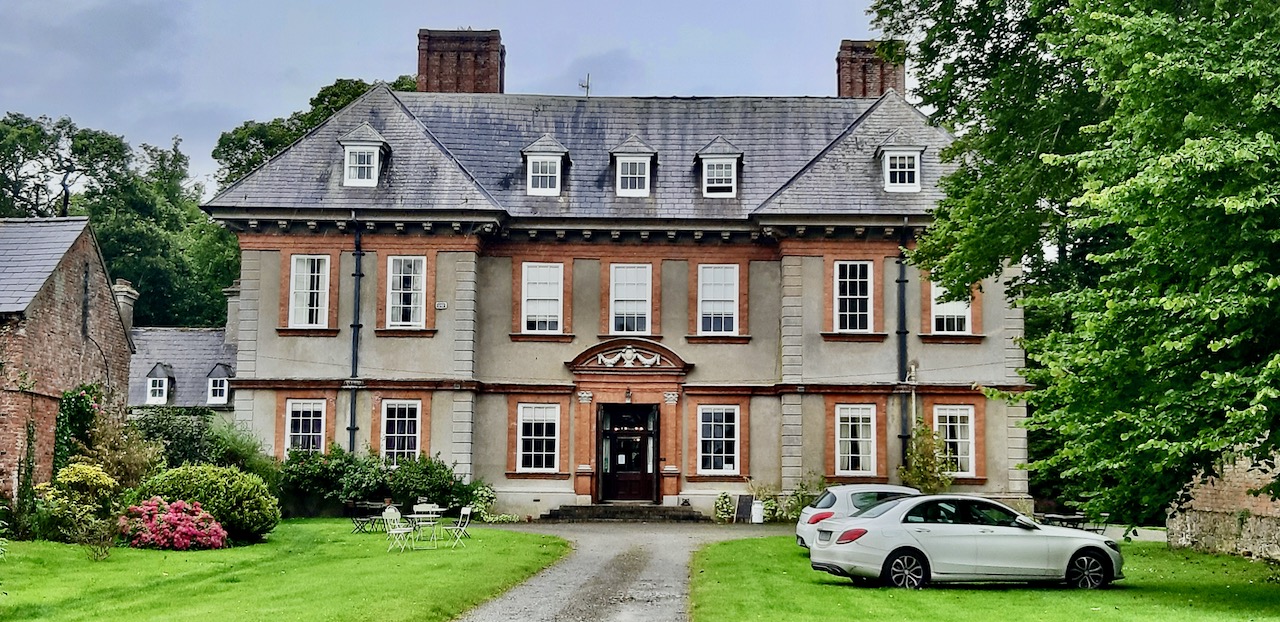
Tankardstown Estate & Demesne, Rathkenny, Slane, Co. Meath C15 D535 (hotel) – section 482

www.tankardstown.ie

Open in 2026: all year, National Heritage Week, Aug 15-23, 9am-1pm

Fee: Free to visit.

Tankardstown, 2019. Photograph © Jennifer Winder-Baggot, www.irishhistorichouses.com

Stephen and I went to Tankardstown on the way to Monaghan in 2019, where we were staying a night on our drive to Donegal to visit his Mum.

Tankardstown is now a boutique hotel, although the manager Tadhg who showed us around prefers it not to be called a hotel, as it is more like an opulent modernized seventeenth century home. Unfortunately we were not staying the night!

In his Guide to Irish Country Houses (1988) Mark Bence-Jones describes Tankardstown as a two storey late-Georgian house. According to wickipedia, the Georgian period is 1740-1837.

Tankardstown, 2019. Photograph © Jennifer Winder-Baggot, www.irishhistorichouses.com

He writes that the entrance front consists of three bays and an end bay breaking forward, as you can see in the photograph above. The entrance doorway has a pediment on consoles, not in line with the window above. [1] There are steps up to the front door.

Tankardstown, 2019. Photograph © Jennifer Winder-Baggot, www.irishhistorichouses.com

It has a three bay side elevation, with ground floor windows set in arched recesses with blocking (the use of alternating large and small blocks of stone, or of intermittent large blocks, in a doorcase, window surround or similar feature. Also known as rustication), with blocking around the first floor windows also. Bence-Jones also mentions its parapeted roof (“a low protective wall along the edge of a roof, bridge, or balcony”).

Tankardstown, County Meath. Photograph © Jennifer Winder-Baggot, www.irishhistorichouses.com
Tankardstown, 2019. Photograph © Jennifer Winder-Baggot, www.irishhistorichouses.com

John Coddington purchased nearby Oldbridge Estate from the Earl of Drogheda in 1729 (Oldbridge is now the Battle of the Boyne museum). It looks as though a nephew of John’s, Dixie Coddington, Sheriff, lived in Tankardstown at some point, perhaps with his wife Catherine de Burgh and seven daughters.

Oldbridge, County Meath, which was owned by the Coddington family, and which now houses the Battle of the Boyne museum. Photograph © Jennifer Winder-Baggot, www.irishhistorichouses.com

Coincidentally, a brother of Dixie, Henry Coddington of Oldbridge (1728 – 1816) had a daughter, Elizabeth Coddington, who married Edward Winder of Bellview in 1798. This Edward Winder is an ancestor of Stephen’s! So our relatives, by marriage, owned Tankardstown!

Tankardstown, 2019. Photograph © Jennifer Winder-Baggot, www.irishhistorichouses.com

The house, as you can see from the photographs, is incredibly opulent with many period features which I assume are original. Above, one can see the unusual black rose patterned wall panels in the inner doorway of the hall, with an arch of alternate black panelling and stuccowork. The drawing room has painted stuccowork on the ceiling and a carved marble fireplace.

Tankardstown, County Meath. Photograph © Jennifer Winder-Baggot, www.irishhistorichouses.com
Tankardstown, 2019. Photograph © Jennifer Winder-Baggot, www.irishhistorichouses.com

The plush furnishings and decor are so overwhelming that the place that touched me most, in terms of feeling a link with the former residents, feeling the house’s history,  were some worn stone stairs:

Tankardstown, 2019. Photograph © Jennifer Winder-Baggot, www.irishhistorichouses.com

The Coddingtons sold the house to Brabazon Morris. According to Ireland’s Blue Book [5], Brabazon Morris built a neo-Classical villa on the land in 1789, in part on the foundations of a tenth century castle, close to pre-existing stone yards which were built in 1745. The present Tankardstown house must be his neo-Classical villa so the house the Coddingtons inhabited was probably incorporated into this house.

Brabazon Morris married Anne Hamlin (she died before 1800 aged just 52) [3] and had a daughter Anne, who married Reverend Frederick Cavendish (1803-1875) in 1834, son of Frederick Cavendish and Eleanor Gore, sixth daughter of Arthur Gore the Second Earl of Arran [4].

Brabazon Morris mortgaged the house in 1791 until it was bought by Francis Blackburne in 1815, as his country residence.

Francis Blackburne (1782-1867), Lord Chancellor of Ireland Date 1852 Engraver George Sanders, Scottish, 1810-c.1876 After Stephen Catterson Smith, Irish, 1806-1872. Photograph courtesy of National Gallery of Ireland.

According to an article in the Irish Independent newspaper by Anthony Smith, Francis Blackburne was born in 1782 and lived to be 84 years old [6]. He married Jane Martley of Ballyfallen, County Meath. [7] He was called to the bar in 1805 and became Attorney General of Ireland in 1831. He was a devout Protestant and Unionist and prosecuted Daniel O’Connell. In 1852 he was appointed Lord Chancellor of Ireland.

Tankardstown, 2019. Photograph © Jennifer Winder-Baggot, www.irishhistorichouses.com

With his new position, Francis Blackburne must have felt he needed something more grand, and purchased Rathfarnham Castle in Dublin. However his position as Lord Chancellor ended later the same year. He obtained the position again in 1866 shortly before his death. He gave Tankardstown to his second son, Judge Francis William Blackburne (d. 1921). His older son inherited Rathfarnham Castle.

Rathfarnham Castle, which was purchased by Francis Blackburne in 1852 when he was Lord Chancellor of Ireland. He had previously purchased Tankardstown in 1815 as his country residence. Photograph © Jennifer Winder-Baggot, www.irishhistorichouses.com

Judge Francis Blackburne married Olivia Beatrice Louisa Anstruther-Thomson, and had a son Jack and two daughters, Elena and Amable. The Blackburnes carried out extensive additions, refurbishment and redecoration in the 1880s. Jack Blackburne inherited the estate and worked the farm though his first love was racing cars. (see [6])

Judge Blackburne’s daughter Elena married Charles Maurice Waddington Loftus Townshend (called Maurice) (1899-1966) of Castle Townshend, County Cork, in 1928. They moved to Zimbabwe (then Rhodesia) for a while, where two of his brothers as ex-British officers were granted free land, but returned to Ireland when WWII broke out. They lived in Tankardstown after Jack died in the 1940s. They had two children, Francis b. 1930 and Maurice born 1932 [8]. C. Maurice Townshend seems to have been a little eccentric as he believed he had a sort of second sight – he was able to point to a place on a map where his sister’s missing friend was located. He also pursued the art of water divination. [9]

Tankardstown, 2019. Photograph © Jennifer Winder-Baggot, www.irishhistorichouses.com

When Maurice Townsend died in 1966, Judge Blackburne’s other daughter, Amable, moved back to Tankardstown, and she and her sister ran the farm as best they could. Anthony Smith, writer of the Irish Times article, remembers the two elderly ladies giving him treats in the kitchen while his father serviced Jack’s Aston Martin racing car. The article does not mention Elena’s sons but one moved to Australia and the other studied agriculture and farmed in Meath.

Eventually in the 1970s the sisters Elena and Amable sold the house and moved into a smaller house built at the rear entrance to the estate. I am not sure who owned the house directly after the Blackburnes. Both sisters died in 1996. Brian Conroy bought the estate when it came on the market in 2002. [see 2]

Brian and his wife Patricia spent four years restoring the mansion from complete disrepair. It was to be their dream home.

In the lead up to the Ryder Cup golf tournament which was being held in Ireland that year, a scout contacted Trish and asked if they could rent her property for the duration of the tournament. When the scout visited Tankardstown, she noticed the stable block next to the house and proposed that if it could be refurbished in time, they would rent that out for the tournament as well! The stable block now holds self-contained accommodation.

Tankardstown, 2019. Photograph © Jennifer Winder-Baggot, www.irishhistorichouses.com

Tankardstown has a café for lunch and afternoon tea and a dining room, supplied by their own fresh farm produce.

Tankardstown, County Meath. Photograph © Jennifer Winder-Baggot, www.irishhistorichouses.com
Tankardstown, 2019. Photograph © Jennifer Winder-Baggot, www.irishhistorichouses.com

The restaurant, the Brabazon, which was originally the milking parlour, retains the old walls and arches.

The tea rooms, Tankardstown. Photograph © Jennifer Winder-Baggot, www.irishhistorichouses.com

It has a large function room, formerly the Orangerie, for weddings and events.

The house is situated on an 80 acre estate with woodland, rolling parkland and walled gardens. There is also a pampering treatment room in a “hide-out” beside the walled garden.

Tankardstown, County Meath.
Tankardstown, County Meath. Photograph © Jennifer Winder-Baggot, www.irishhistorichouses.com
Tankardstown, 2019. Photograph © Jennifer Winder-Baggot, www.irishhistorichouses.com

Brian Conroy is an entrepreneur with a successful track record in property development, restoration of heritage buildings and operation of hospitality venues. Having grown up in Monkstown, Co Dublin, he moved to the UK and built an engineering and property business before returning with his family to Tankardstown, Co Meath. He also owns another property on the section 482 register in 2019 which is also now a hotel, Boyne House, Slane (formerly known as Cillghrian Glebe). [10]

Donation

Help me to fund my creation and update of this website. It is created purely out of love for the subject and I receive no payment so any donation is appreciated! For this entry I paid for petrol to drive to our destination from Dublin.

€15.00

[1] architectural definitions

[2] https://www.tankardstown.ie

[3] https://historicgraves.com/kilberry/me-klby-0037/grave

[4] http://www.thepeerage.com/p25513.htm#i255125

[5] https://www.irelands-blue-book.ie/itinerary-detail.html/hotels-history-html

[6] https://www.independent.ie/regionals/droghedaindependent/news/pink-floyd-drummer-and-the-old-aston-martin-38038851.html

[7] https://en.wikipedia.org/wiki/Francis_Blackburne

[8] http://www.thepeerage.com/p35219.htm#i352181

[9] http://www.astro.wisc.edu/~townsend/tree/record.php?ref=5C17

[10] https://www.boynehouseslane.ie

Text © Jennifer Winder-Baggot, www.irishhistorichouses.com
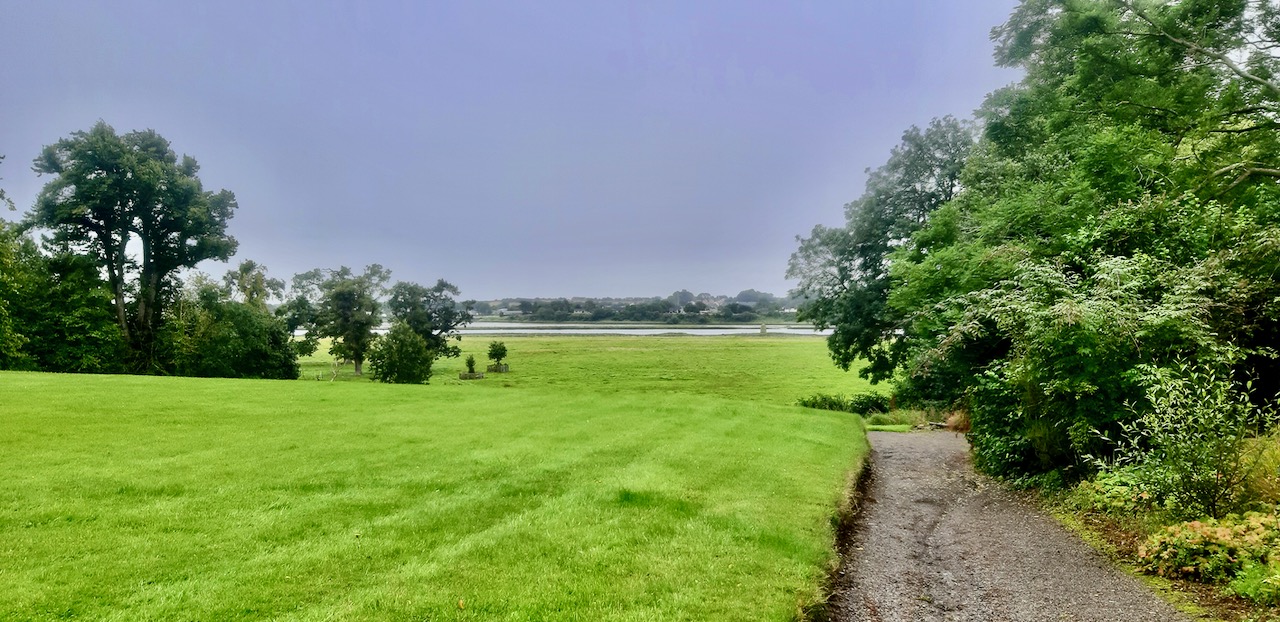
Places to Visit and Stay in County Cavan, Ulster

On the map above:

blue: places to visit that are not section 482

purple: section 482 properties

red: accommodation

yellow: less expensive accommodation for two

orange: “whole house rental” i.e. those properties that are only for large group accommodations or weddings, e.g. 10 or more people.

green: gardens to visit

grey: ruins

County Cavan

1. Cabra Castle, Kingscourt, Co. Cavan (Hotel) – section 482

2. Castle Saunderson, Co. Cavan – a ruin 

3. Clough Oughter, County Cavan 

4. Corravahan House & Gardens, Drung, Ballyhaise, Co. Cavan – section 482

Places to stay, County Cavan

1. Cabra Castle, on section 482 – hotel €€

and lodges

2. Clover Hill Gate Lodge, Cloverhill, Belturbet, Cavan

3. Farnham Estate, Farnham Estate, Cavanhotel €€

4. Killinagh House, McNean Court, Blacklion, County Cavanwhole house rental and lodge €

5. Lismore House, Co Cavan – was a ruin. Place to stay: Peacock House on the demesne €

6. Olde Post Inn, Cloverhill, County Cavan €€

7. Ross Castle, Co Cavan (address is in Mountnugent, County Meath) whole castle plus self-catering accommodation whole castle €€€ for 2, € for 10 or self-catering accommodation €

Whole house rental County Cavan:

1. Killinagh House, McNean Court, Blacklion, County Cavanwhole house rental 

2. Ross Castle, Co Cavan (address is in Mountnugent, County Meath) whole castle €€€ for 2, € for 10 or self-catering accommodation €

3. Virginia Park Lodge, Co Cavanweddings only

I set out today to do a write up of County Cavan the way I did of Dublin, of all the big houses to visit or that offer accommodation. There are only two listings in Section 482  for County Cavan and one is a hotel. It turns out that, despite multiple beautiful historic houses, there are not many to visit. I researched places to stay in Cavan as Stephen and I travel through there regularly on our way to Donegal where his mum lives.

From my research I have a list of forty historic houses in County Cavan. Of those, at least eleven no longer exist or are in ruins, and most of the rest are private. Ballyhaise House is now an agricultural college. Farnham Estate and Virginia Park’s hunting lodge are now hotels. Owendoon House is now the Jampa Ling Buddhist Centre and Dromkeen is a Loreto College. Kilnacrott House also appears to belong to a religious order.

donation

Help me to pay the entrance fee to one of the houses on this website. This site is created purely out of love for the subject and I receive no payment so any donation is appreciated!

€15.00

1. Cabra Castle, Kingscourt, Co. Cavan – section 482

This is a hotel but unlike some heritage house or castle hotels, they do allow visitors to view the building: the website states that they are open between 11am to 4pm for visitors for viewing all year round, except at Christmastime.

Cabra Castle, County Cavan, December 2020. Photograph © Jennifer Winder-Baggot, www.irishhistorichouses.com
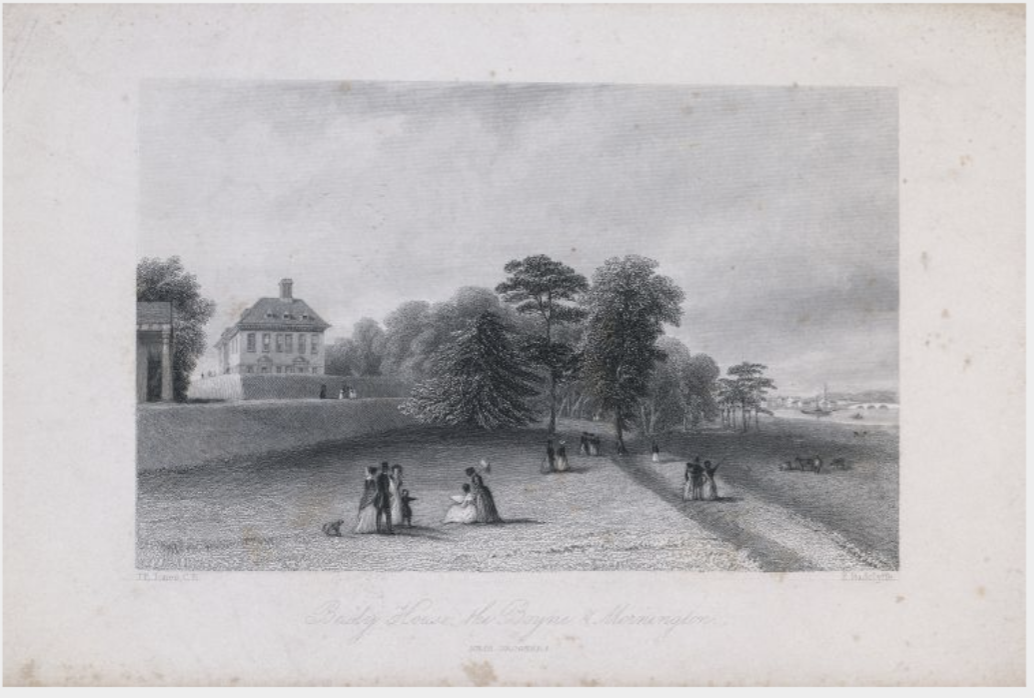
see my write-up:

https://irishhistorichouses.com/2021/03/28/cabra-castle-kingscourt-county-cavan/

www.cabracastle.com
Open in 2026: all year, except Dec 24, 25, 26, 11am-4pm
Fee: Free to visit

2. Castle Saunderson, Co. Cavan – a ruin 

Castle Saunderson, County Cavan, December 2020. Photograph © Jennifer Winder-Baggot, www.irishhistorichouses.com
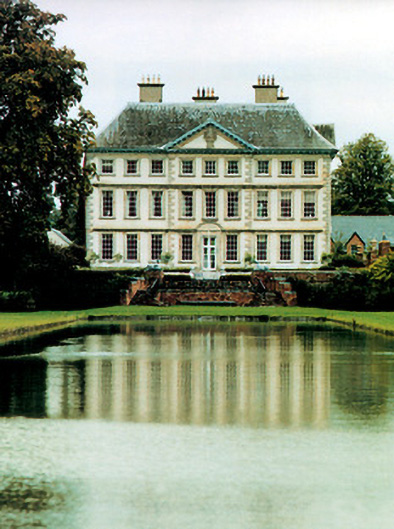
See my entry https://irishhistorichouses.com/2026/02/12/castle-saunderson-co-cavan-a-ruin/

https://www.thisiscavan.ie/fun/article/luanch-of-new-heritage-trail-at-castle-saunderson

Mark Bence-Jones writes in his A Guide to Irish Country Houses (1988):

p. 75. “(Saunderson/IFR) A large castellated mansion combining both baronial and Tudor-Revival elements, built ca 1840; from its close stylistic resemlance  to Crom Casle, about five miles away in County Fermanagh, it can be attributed to Edward Blore. Entrance front symmetrical, with a battlemented parapet, square end turrets and a tall central gatehouse tower which is unusual in having the entrance door in its side rather than in its front. The adjoining garden front is more irregular, with a recessed centre between two projecting wings of unequal size and fenestration, each having a Tudor gable; the two wings being joined at ground floor level by a rather fragile Gothic arcade. To the left of this front, a lower “L”-shaped wing with a battlemented parapet and various turrets, ending in a long Gothic conservatory. Castle Saunderson has stood empty for years and is now semi-derelict.” [1]

Castle Saunderson, County Cavan, December 2020. Photograph © Jennifer Winder-Baggot, www.irishhistorichouses.com
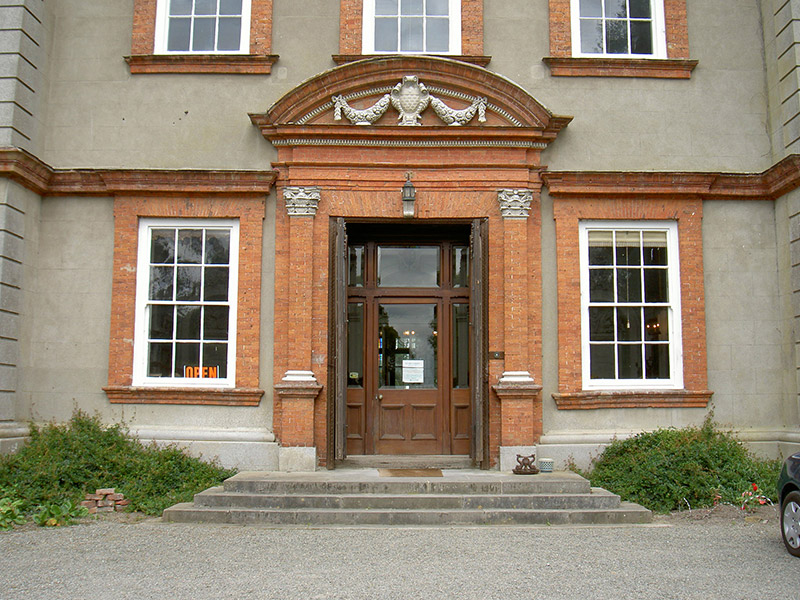
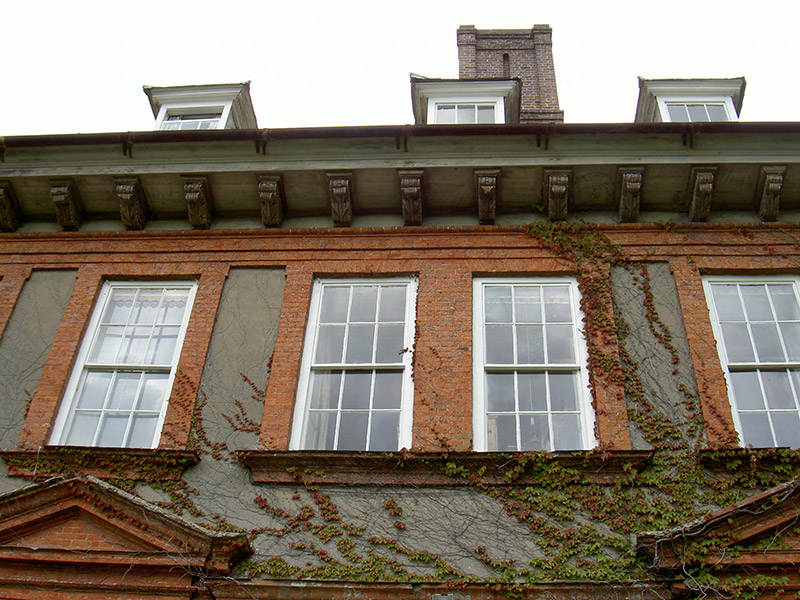
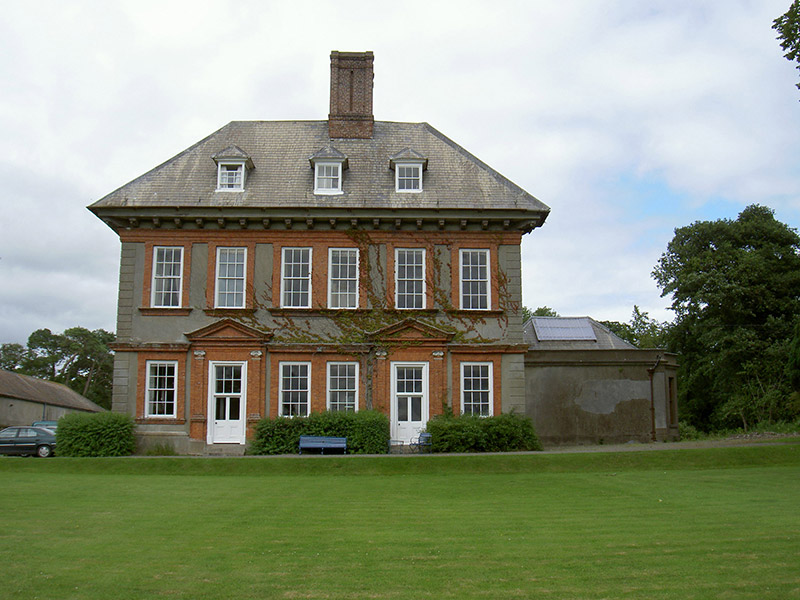
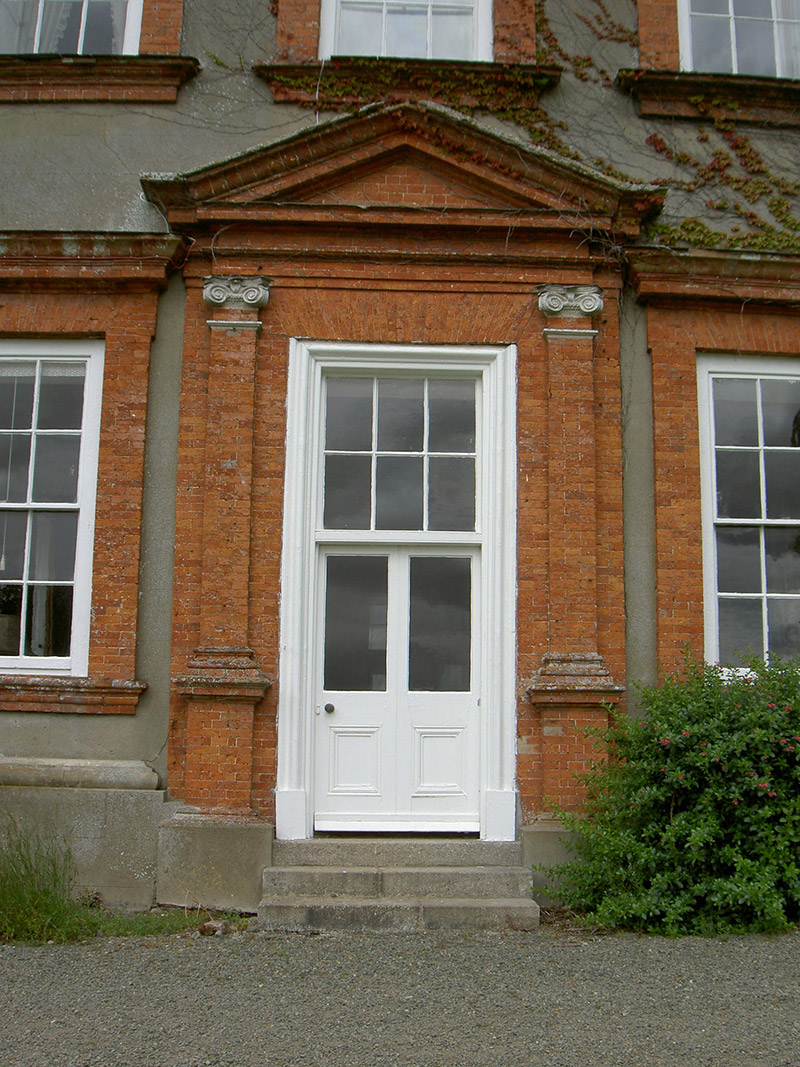
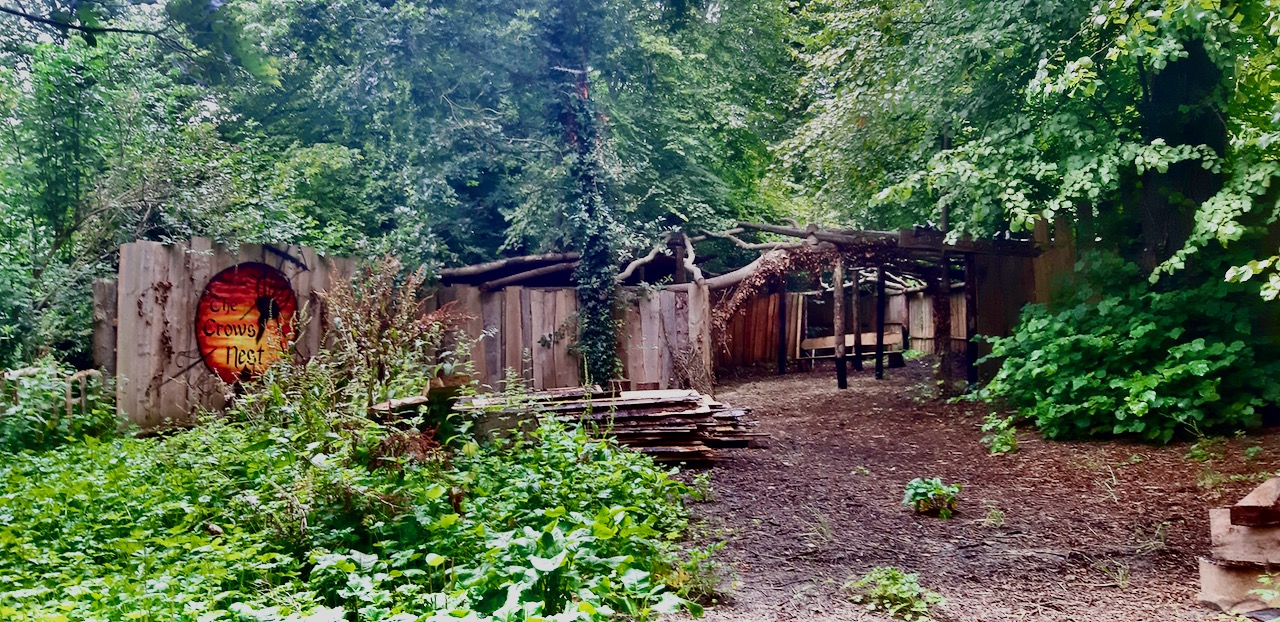
3. Clough Oughter, County Cavan

https://www.discoverireland.ie/Activities-Adventure/clough-oughter-castle/48729

Clough Oughter Castle, County Cavan, photograph by Chris Hill 2018 for Tourism Ireland, from Ireland’s Content Pool. [2]

Clough Oughter Castle is a ruined circular castle, situated on a small island in Lough Oughter, four kilometres east of the town of Killeshandra in County Cavan.

The castle is located in what was once the historic Kingdom of Breifne. In the latter part of the 12th century, it was under the control of the O’Rourkes, but it seems to have come into the hands of the Anglo-Norman William Gorm de Lacy. While the exact date construction began is unknown, it is estimated to have started in the first quarter of the 13th century.  
 
“In 1233, the O’Reilly clan took possession of the area and completed the castle. They retained it for centuries in the midst of their ongoing conflicts with the O’Rourkes and with members of their own clan. It was there that Philip O’Reilly was imprisoned in the 1360s. 
 
Lough Oughter is regarded as the best inland example of a flooded drumlin landscape in Ireland and has rich and varied wildlife. The number of whooper swans which winter in the area represents about 3% of the total European population, while the lake also houses the largest concentration of breeding great crested grebes in the Republic of Ireland. 
 

Lough Oughter is a popular angling lake and is also popular with canoeists and boating enthusiasts. The Lough Oughter complex, along with Killykeen Forest Park, is a designated Natura 2000 habitat, Special Area for Conservation (SAC), and Special Protection Area (SPA) under EU legislation. 
 
Canoes and kayaks are available for hire from Cavan Canoe Centre, which also offers guided boat trips around the lake and out to the castle.” [3]

On the Discover Belturbet website, we are told the history of Clough Oughter:

Clough is the Gaelic word for stone, so literally this is Castle of Stone. The island was made by man, and the castle which sits upon it was also made by man and one can only speculate as to what a marvellous feat of engineering it took to accomplish such a build.  

The castle would have been part of the historical kingdom of Breifne, and specifically a part of  East Breifne, (Roughly speaking the same borders as modern day Cavan).  It is likely that the Crannog itself came sometime before the castle, and in the latter part of the 12th century, it was under the control of the O’Rourke clan, but with the invasion of the Anglo Normans, the crannog came to be controlled by the Anglo-Norman  William Gorm De Lacy. No concrete dates exist for the construction of the castle, but architectural elements from the lower two storeys suggest it was begun during the early 13th century.  

In 1233, the O’Reilly clan gained possession of the castle. They seem to have retained the castle for centuries throughout ongoing conflicts with the O’Rourkes, and indeed with members of their own clan. Philip O’Reilly was imprisoned here in the 1360’s with “no allowance save a sheaf of oats for day and night and a cup of water, so that he was compelled to drink his own urine”.  

After the Ulster Plantation, the castle was given to servitor Hugh Culme. Philip O’Reilly who was a Cavan MP and leader of the rebel forces during the Rebellion of 1641  seized control of the castle and kept it as an island fortress for the next decade. During this period it was mainly used as a prison. Its most notable prisoner would have been the Anglican Bishop of Kilmore, William Bedell, who was held here and is said to have died because of the harsh winter conditions in the prison.  

Clough Oughter castle became the last remaining stronghold for the rebels during the Cromwell era, but sometime in March of 1653 the castle fell to Cromwells canons. The castle walls were breached by the canon and the castle was never rebuilt after this point.  

Visitors will be astounded to note the thickness of the walls which can now be seen because of the canon bombardment. The island and the castle have received considerable refurbishments since 1987, making it safe to visit, and well worth the visit.” [4]

4. Corravahan House & Gardens, Drung, Ballyhaise, Co. Cavan H12 D860 – section 482

Corravahan, County Cavan, photograph from Ian Elliot.

see my write-up:

https://irishhistorichouses.com/2020/08/28/corravahan-house-and-gardens-drung-county-cavan/

www.corravahan.com
Open dates in 2026: Jan 8-9, 15-16, 22-23, 29-30, Feb 5-6, 12-13, 19-20, 26-27, Mar 5-6, 12-13, May 7-10, 14-17, 21-24, Aug 6-9, 13-23, 27-30, Sept 3-6, 10-13, 17

2pm-4pm

Fee: adult €10, OAP/student/child €5

Tours on the hour, or by appointment. Last admission 1 hour before closing time. CCTV in operation

Places to stay, County Cavan

1. Cabra Castle, on section 482 – hotel

see above www.cabracastle.com

and lodges

2. Clover Hill Gate Lodge, Cloverhill, Belturbet, Cavan

https://www.airbnb.ie/rooms/4962376?source_impression_id=p3_1646316400_8H59V8wuqVzXlMog

Cloverhill House is now a ruin. Mark Bence-Jones tells us the house was built 1799-1804 for James Saunderson [1763-1842] to the design of Francis Johnston. Robert O’Byrne adds that it was in fact extended in 1799, but built originally in 1758 [thus was built for James’s father Alexander, who married Lucy Madden of the Hilton Park House Madden family, another Section 482 property. A date stone gives us the date of 1758]. [5] Mark Bence-Jones tells us that the house passed by inheritance to the Purdons, and was sold by Major J.N. Purdon ca 1958. The National Inventory of Architectural Heritage tells us that the Sanderson family were instrumental in the development of Cloverhill village with the building of the Church of Ireland church and estate workers’ houses.

The house is featured in Tarquin Blake’s Abandoned Mansions of Ireland, Collins Press, Cork, 2010. 

The house passed down through the Sanderson family until James Sanderson (1763-1842), and then passed down through the female line since the son, also named James, had no heirs. It passed first to Mary Anne, who was unmarried, and then to her sister’s son, Samuel Sanderson Winter (1834-1912), whose parents were Lucy Sanderson and Samuel Winter (1796-1867) of Agher, County Meath. Samuel Sanderson Winter married Ann, daughter of John Armytage Nicholson of Balrath Bury, County Meath (we came across this family as Enniscoe in County Mayo was inherited by Jack Nicholson, of the Balrath Bury family). Samuel Sanderson Winter’s son died young so Cloverhill passed to the son of his sister, Elizabeth Ann Winter, who married George Nugent Purdon (1819-1910). This is how the house passed to the Purdon family.

The house passed to their son, John James Purdon, who died childless so it passed to his nephew, John Nugent Purdon, son of Charles Sanderson Purdon. John Nugent Purdon sold Cloverhill demesne ca 1958 to Mr Thomas Mee. [6] 

3. Farnham Estate, Farnham Estate, Cavan €€

https://www.farnhamestate.ie

Farnham House, photograph from National Library of Ireland, flickr constant commons.

David Hicks tells us in his Irish Country Houses, A Chronicle of Change, that the wing of Farnham House that survives today is the truncated section of a much larger mansion. Dry rot led to demolition of a substantial section of the Maxwell ancestral home. The family’s connection was severed in 2001.

The estate was granted by King James I to the Waldron family in 1613. Henry Waldon named the estate after his wife’s family. The Waldrons built a castle here in 1620.

The website gives us a history of the estate:

“1664- The Waldrons of Dromellan Castle (early name of Farnham House) were forced to sell the estate to settle gambling debts. Bought by Bishop Robert Maxwell, thus beginning the Maxwell family connection that was to continue for more than 330 years (family motto is Je suis prêt – I am ready’).”

Mark Bence-Jones adds in his A Guide to Irish Country Houses (1988, p. 123):

“…A few years later the estate was sold to Robert Maxwell [1598-1672], Bishop of Kilmore, whose cathedral was nearby. The Bishop’s son, John Maxwell, built a new house here ca 1700, which was improved ca 1780 by Barry Maxwell, 3rd Lord Farnham and first Earl of Farnham of 2nd creation, who added a library designed by James Wyatt.

Timothy William Ferres tells us of the Maxwell lineage:

John Maxwell of Farnham, High Sheriff of County Cavan, 1674, who dsp 1713, was succeeded by his nephew, The Reverend Doctor Robert Maxwell; who dsp 1737 and was succeeded by his cousin, John Maxwell (1687-1759), High Sheriff of County Cavan, 1757, MP for County Cavan 1727-56, who was elevated to the peerage, in 1756, in the dignity of Baron Farnham, of Farnham, County Cavan.

In 1719 he married Judith, heiress of James Barry (1660-1725) of Newtownbarry, County Wexford. Their son Robert succeeded as 2nd Baron Maxwell, and he was created Viscount in 1760 and 1st Earl of Farnham in 1763. Robert married Henrietta Cantillon, the widow of William Matthias Stafford-Howard, 3rd Earl of Stafford.

Henrietta Diana née Cantillon (1728–1761), Dowager Countess of Stafford by Allan Ramsay courtesy of Kelvingrove Art Gallery and Museum; http://www.artuk.org/artworks/henrietta-diana-17281761-dowager-countess-of-stafford-85788 She married, first, William Matthias Stafford-Howard, 3rd Earl of Stafford, and after his death, Robert Maxwell, 2nd Baron and 1st Earl of Farnham.

See also the wonderful book by Melanie Hayes, The Best Address in Town: Henrietta Street, Dublin and its First Residents 1720-80, published by Four Courts Press, Dublin 8, 2020. She has a chapter on John Maxwell, (1687-1759) 1st Baron Farnham.

The Farnham Estate website tells us that Robert was a keen agriculturalist and agent of improvement who put the most technologically and scientifically advanced agricultural methods into action. The website tells us:

“In 1777, noted agricultural scientist and topographer Arthur Young said of Farnham; “…upon the whole Farnham is one of the finest places that I have ever seen in Ireland; the water wood and hill are all in great stile and abound in a variety of capabilities. The woodland plantations of Derrygid coupled with the lakes of Farnham and Derrygid were noted by Young who described them as being ‘uncommonly beautiful; extensive and have a shore extremely varied.” In the 1770’s, approximately 100 labourers were employed in maintaining the landscape at Farnham.

Walk on Farnham Estate, Cavan, Sept 2013. Photograph © Jennifer Winder-Baggot, www.irishhistorichouses.com
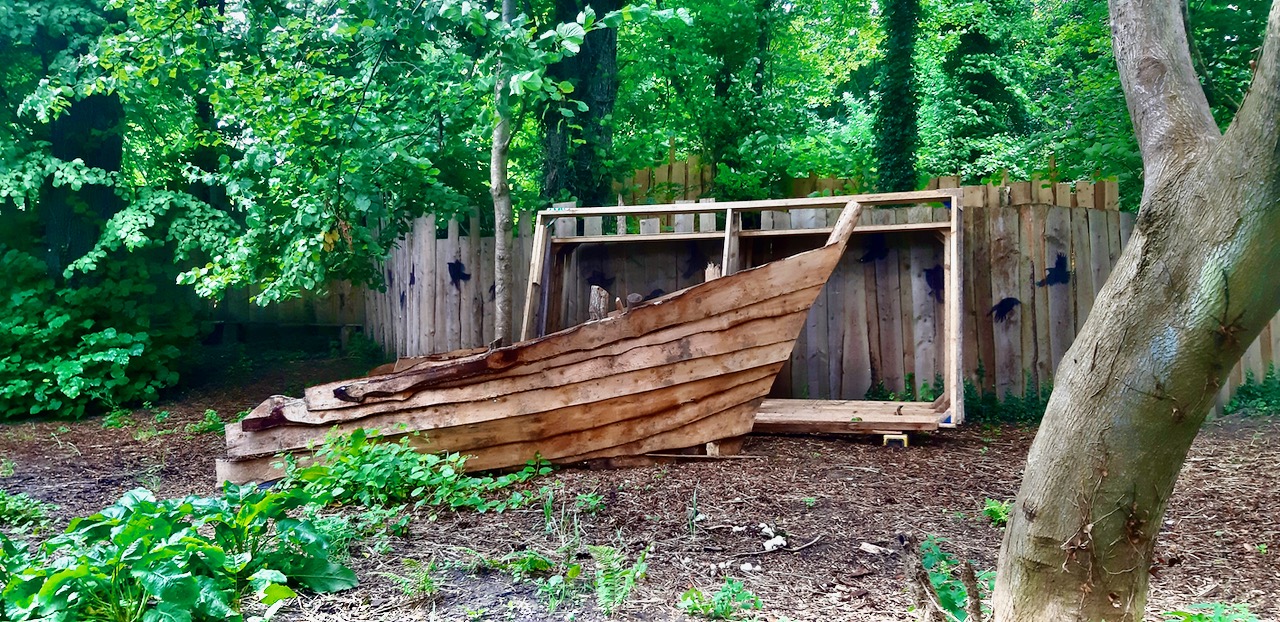
Robert 1st Earl and Henrietta’s daughter Henrietta married Denis Daly of Dunsandle, County Galway.

Denis Daly (1747-1791) of Dunsandle, County Galway, attributed to Joshua Reynolds, courtesy of Christies 2012 Mount Congreve the London Sale.

The first Earl’s son John predeceased him and didn’t marry, so the 1st Earl’s brother Barry succeeded him.

Portrait of Barry Maxwell (1723-1800) 1st Earl Farnham by George Romney courtesy of www.christies.com/en/lot/lot-4507942 He was the son of John Maxwell, 1st Baron Farnham and Judith Barry. When his mother died in 1771 he must have inherited as he changed his name to Barry Barry. Then when his elder brother Robert Maxwell, 1st and last Earl of Farnham, died in 1779, he inherited and his name was changed back to Barry Maxwell, and he succeeded as the 3rd Baron Farnham, of Farnham, Co. Cavan. He was created 1st Earl of Farnham, Co. Cavan [Ireland, of the 2nd creation] on 22 June 1785.

When Robert 1st Earl’s first wife Henrietta died, he married secondly, in 1771, Sarah, only daughter of Pole Cosby, of Stradbally Hall, Queen’s County, and sister of Lord Sydney, but they had no further children. Sarah had been previously married to Arthur Upton (d. 1763) of Castle Upton, County Antrim. After her second marriage she was known as the Countess of Farnham.

The Countess of Farnham, probably Sarah née Cosby, wife of Robert Maxwell, 1st and last Earl of Farnham (of the first creation), painted by Hugh Douglas Hamilton, courtesy of Sothebys 2001.

The first Earl had another brother Most Reverend Henry Maxwell (d. 1798), who became Bishop of Dromore and Bishop of Meath.

Right Reverend Henry Maxwell (d. 1798) Bishop of Meath Irish school courtesy of National Trust Castle Ward

Most Reverend Henry Maxwell married Margaret Foster, daughter of Rt. Hon. Anthony Foster Chief Baron of the Exchequer [Ireland] between 1766 and 1777, who lived in Collon in County Meath. Their sons became respectively John Maxwell Barry Maxwell (1767-1838) 5th Baron Farnham and Reverend Henry Maxwell (d. 1838) 6th Baron Farnham, and the Baronetcy continued to their descendants. The Earldom was recreated for the elder brother Barry, 3rd Baron (1723-1800), who obtained a viscountcy and earldom, in 1780, as Viscount Farnham, and, in 1785, Earl of Farnham (2nd creation).

The three brothers, Robert 1st Earl, Barry 1st Earl of second creation and Reverend Henry had a sister, Anne, who married Owen Wynn (1723-1789) of Hazelwood, County Sligo.

Barry Maxwell, 1st Earl of Farnham served as MP and Privy Counsellor. In 1771 his name was legally changed to Barry Barry, I am not sure why but it must have had to do with inheritance, as his mother Judith Barry died in the same year. In 1779 his name was legally changed back to Barry Maxwell, the year that he became 3rd Baron Farnham, of Farnham, Co. Cavan after his brother Robert died. He married first Margaret King of Drewstown, County Meath, who gave birth to their son and heir John James Maxwell (1759-1823) later 2nd Earl of Farnham. Barry married secondly Grace, daughter of Arthur Burdett. His son did not have children and the Earldom and Viscountcy became extinct on his death.

Photograph of Farnham House from Country Life, A Chinese Chippendale chair in the hall at Farnham House. Pub Orig CL 02/01/2003, volume CXCVII. Photographer Paul Barker. 

The website tells us of the building of Farham:

“In 1795, Earl of Farnham Barry [Barry Maxwell (1723-1800)] asked James Wyatt, one of the most fashionable architects of that time, to draw designs for three ceilings. Although there is no evidence of them being installed at Farnham, these plans are now housed in the Metropolitan Museum of Art in New York. Some work was undertaken by Wyatt though around the 1795 timeframe and to this day, a library case where his design has been noted stands inserted in an alcove on the staircase landing.

In the early 1800s, a coat of arms was incorporated onto the façade of the house. Comprised of the arms of the Maxwell and Barry family, they are supported by two bucks, with a buck’s head on top of the Baron’s coronet as the crest.

The South Front of Farnham House. Photograph from National Inventory of Architectural Heritage.

Barry’s son James John Barry 2nd Earl engaged Francis Johnston to build. The website tells us:

In 1802 Francis Johnston, architect for Dublin’s famous GPO building, was engaged to complete an extension of the existing house to provide an edifice to the southwest garden front. This is the latter day surviving Farnham House, which is now incorporated as the centrepiece of the hotel complex design.

Mark Bence-Jones describes the house as built by Francis Johnston:

“Johnston produced a house consisting of two somewhat conservative three storey ranges at right angles to one another; one of them, which incorporated part of the earlier house, including Wyatt’s library, having a front of eight bays, with a die over a two bay breakfront, and a single-storey Doric portico; the other having a front of nine bays with a three bay pedimented breakfront; prolonged by one bay in the end of the adjoining range. The interior was spacious but restrained, the principal rooms having simple ovolo or dentil cornices. Elliptical staircase hall, with simple geometrical design in the ceiling; stone stair with elegant metal balustrade.

The staircase at Farnham House designed by Francis Johnston. Pub Orig Country Life 02/01/2003, volume CXCVII. Photographer Paul Barker.
Farnham Estate, County Cavan. Photograph from National Inventory of Architectural Heritage.

The website continues: “In the depths of the earth beneath Farnham lies a myriad of passages. These passages were constructed to allow food, supplies and heating fuels to be brought into the mansion house by the servants. Such underground passages kept the servants out of sight from Lords and Ladies Farnham and their guests and no doubt were used by the servants to enjoy some activities of their own, which they would not have wanted Lord and Lady Farnham to witness!

When James John died childless in 1823, a cousin, John Maxwell Barry Maxwell (1767-1838), son of Rt. Rev. Henry Maxwell, became 5th Baron Farnham.

The website tells us: “In 1823, a new system of management for the Farnham estate was introduced, employing persons as inspectors of districts, buildings, bog and land and a moral agent! The main duties of the moral agent were to encourage the tenantry to adhere to the main principles contained in Lord Farnham’s address to them. These included: keeping of the Sabbath, responsibility towards the education of their children, imbuing within their children a strict moral sense and to ensure that they abstained from all evil habits, including cursing and the distillation or consumption of alcohol.

The 5th Baron Farnham died childless in 1838, so his brother Reverend Henry Maxwell became the 6th Baron Farnham. He married Anne Butler, daughter of the 3nd Earl of Carrick. Their son Henry became the 7th Baron Farnham (1799-1868). Their daughter Sarah Juliana married Alexander Saunderson of Castle Saunderson. The other sons Somerset and James became 8th and 9th Baron and then the son of their brother Richard Thomas Maxwell, Somerset Henry Maxwell, became the 10th Baron.

Mark Bence-Jones tells us: “In 1839, 7th Lord Farnham (a distinguished scholar and genealogist who, with his wife, was burnt to death 1868 when the Irish mail train caught fire at Abergele, North Wales), enlarged the house by building new offices in the re-entrant between the two ranges. Also probably at this time the main rooms were changed around; the library becoming the dining room, and losing any Wyatt decoration it might have had; Wyatt’s bookcases being moved to the former drawing room.

The drawing room at Farnham House. The portrait to the right is of thr Rt Hon John, 5th Baron Farnham by Sir Thomas Lawrence. Pub Orig Country Life 02/01/2003, volume CXCVII. Photographer Paul Barker.
Photograph of Farnham House from Country Life, Pub Orig Country Life 02/01/2003, volume CXCVII. Photographer Paul Barker.
Farnham Estate, County Cavan. Photograph from National Inventory of Architectural Heritage.

Somerset Henry Maxwell, 10th Baron, married Florence Jane Taylour, daughter of Thomas Taylour, 3rd Marquess of Headfort. Their son, Arthur Kenlis Maxwell (1879-1957), became 11th Baron in 1900.

The website continues the timeline:

“1911- Records mention a staff of 11: butler, cook, governess, nursery maid, nurse, footman, ladies’ maid and several house and kitchen maids. Some 3,000 of Farnham’s then 24,000 statute acres were sold off.

1914-1918- Lord Farnham rejoined the military; he was captured, imprisoned and released after the Armistice. His political efforts failed to prevent the exclusion of three counties from the jurisdiction of Northern Ireland.

1921-1931- Lord and Lady Farnham left for England. They emptied the house of its furniture, due to widespread burning and looting of country houses. The 1923 Land Act would ultimately end landlordism in Ireland: by 1931, Lord Farnham retained only his demesne lands at Farnham, which he operated in a more intensive fashion in order to increase much-needed revenue.

Arthur Kenlis Maxwell managed to escape from a prisoner of war camp during the first world war. He and his family returned to Farnham estate in 1926 and began to renovate the house. His son and heir died in the second world war aged just 37, and the title passed to his grandson, Barry Owen Somerset Maxwell. Barry Owen’s mother died in a plane crash when he was just 21.

1950- Economic decline had by now affected the demesne. A Farnham Tintorreto ’Christ Washing the Feet of His Disciples’ was sold in 1955; the Canadian National Art Gallery in Ontario paid some $100,000. 1956- Barry Owen Somerset Maxwell, 12th Baron Farnham became the last member of the Maxwell family to reside at Farnham House.

In 1961, dry rot was discovered within the Farnham house and in an attempt to alleviate it, the oldest part of the house looking across the parkland, and the additions made to the house in 1839, were demolished.”

Mark Bence-Jones describes the changes: “Ca 1960, the present Lord Farnham, finding the house to be badly infested with dryrot, demolished the range where the entrance had formerly been situated, as well as the additions of 1839; and remodelled the surviving Johnston range to form a house in itself; being assisted in the work by Mr Philip Cullivan. The pedimented front is still the garden front, as it was formerly; the back of the range being now the entrance front, with the portico re-erected at one end of it; so that the entrance is directly into the staircase hall. The surviving range contains Johnston’s dining room, which has been the drawing room since 19C rearrangement; as well as the boudoir and the former study, now the dining room. One of Wyatt’s bookcases is now in the alcove of the former staircase window. The demesne of Farnham has long been famous for its beauty; a landscape of woods, distant mountain views and lakes, which are part of the great network of loughs and islands stretching southwards from Upper Lough Erne.

The entrance front of Farnham House, as remodelled in 1961. In an attempt to alleviate dry rot, the oldest part of the house was demolished. Pub Orig Country Life 02/01/2003, volume CXCVII. Photographer Paul Barker.
The dining room at Farnham House. Pub Orig Country Life 02/01/2003, volume CXCVII. Photographer Paul Barker. With portrait of Right Reverend Henry Maxwell (d. 1798) Bishop of Meath.
Photograph of Farnham House from Country Life, Pub Orig Country Life 02/01/2003, volume CXCVII. Photographer Paul Barker.
The fireplace in Lady Farnham’s bedroom at Farnham House. The pastels of the family arranged over the chimneypiece are by Hugh Douglas Hamilton and the portrait in the centre is by Sir Francis Grant. Pub Orig Country Life 02/01/2003, volume CXCVII. Photographer Paul Barker.

The website continues:

1995 – 2001 – Lord Farnham abandoned farming and leased the agricultural lands to local farmers. One of his last acts on the Farnham demesne was the planting of a group of trees to mark the New Millennium. Lord Farnham died in March 2001 and his wife, Diana, Baroness Farnham now resides in England where she is a current Lady in Waiting to Queen Elizabeth II. Farnham House estate was sold to a local entrepreneur who developed it into a hotel resort.

Present Day – The resort is owned by Mr. Thomas Röggla and along with his team at the resort, every effort is made to provide genuine hospitality in this new phase in the evolution of this magnificent location. Thus, the indelible-mark made by the Maxwell family, as far back as 1664 on the landscape of Farnham Estate will continue to be appreciated by future generations.”

The multimillion refurbishment and extension was headed by architect Des Mahon of Gilroy McMahon, who had previously worked on the National Museum at Collins Barracks and the Hugh Lane Gallery extension.

Photograph from National Inventory of Architectural Heritage.
The portico that was on the original entrance front was moved to the rear of the garden front to form a new entrance when part of the house was demolished in 1942. It is now incorporated into the interior of Farnham Estate hotel. Photograph from National Inventory of Architectural Heritage.
As former Radisson Blu, Farnham Estate, Cavan 2013. Photograph © Jennifer Winder-Baggot, www.irishhistorichouses.com
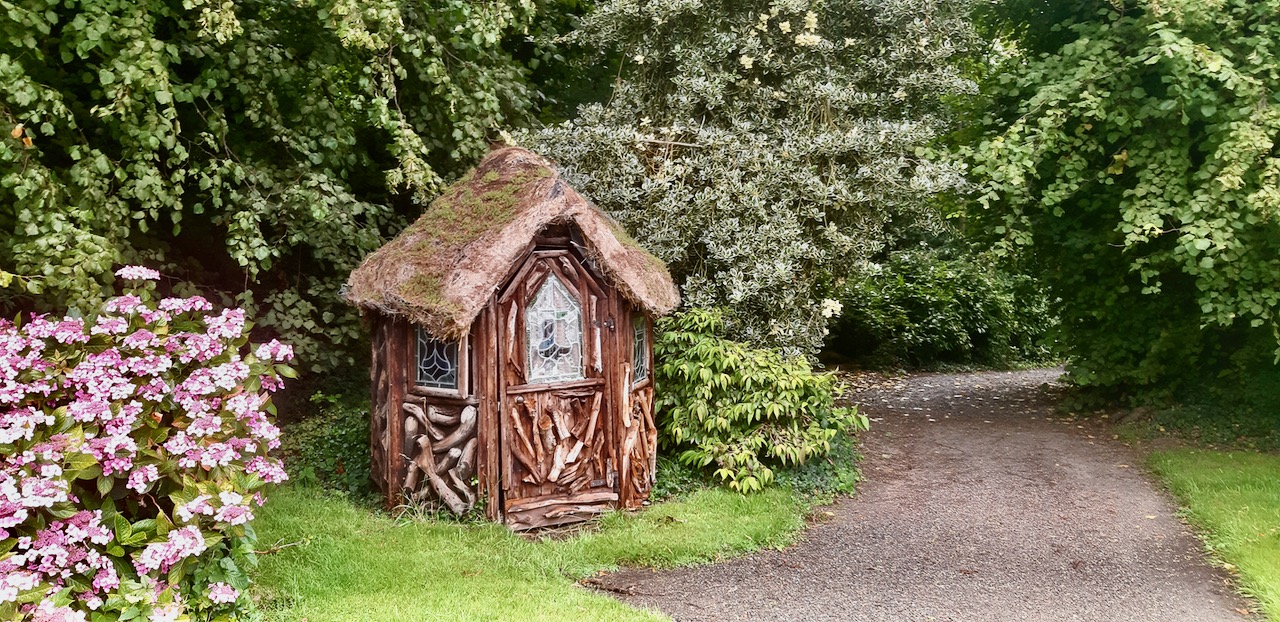
Farnham estate. Photograph © Jennifer Winder-Baggot, www.irishhistorichouses.com
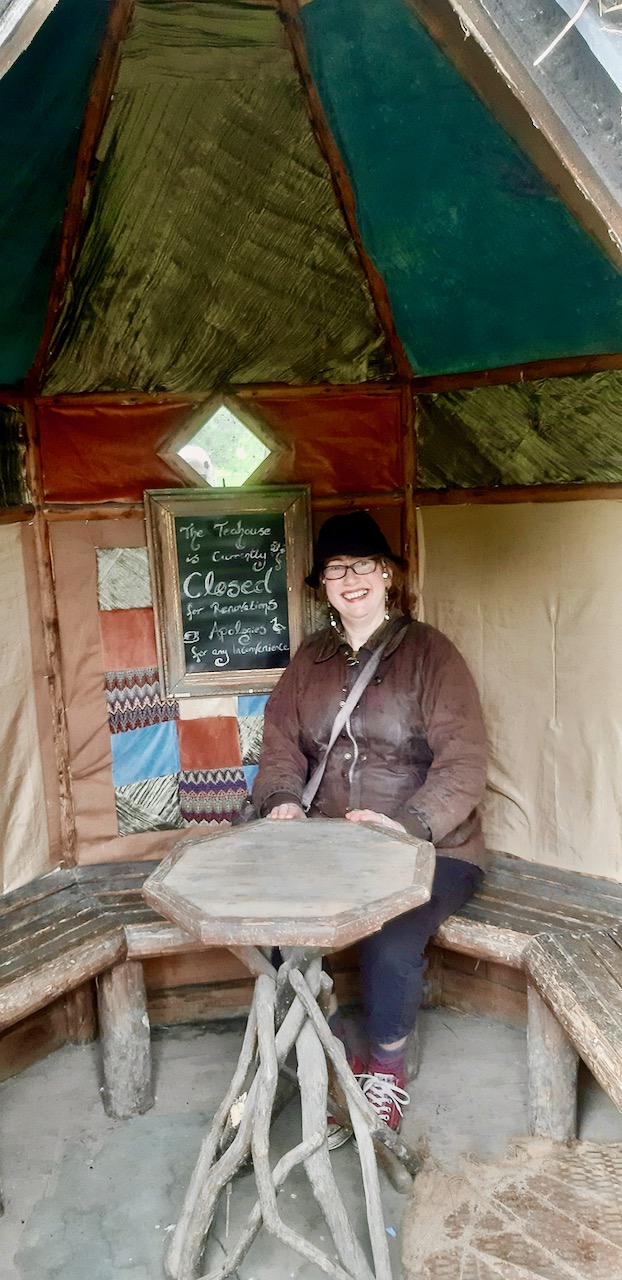
Walk on Farnham Estate, Cavan, Sept 2013. Photograph © Jennifer Winder-Baggot, www.irishhistorichouses.com
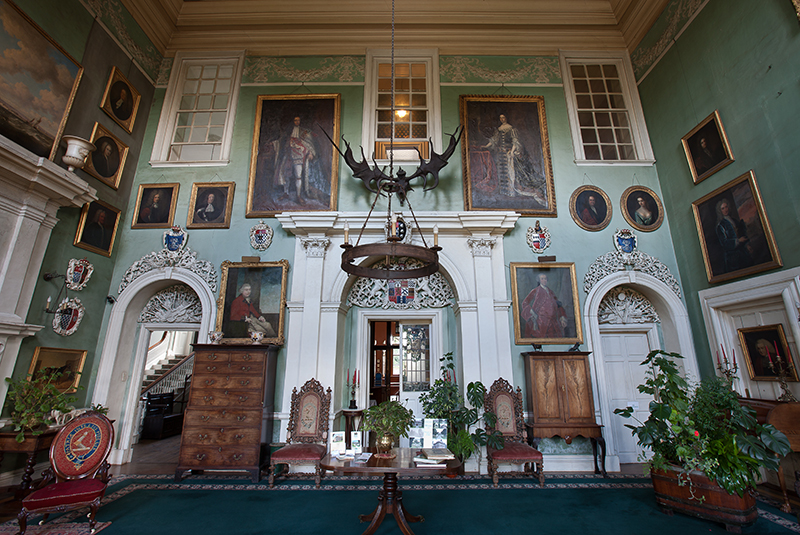
Farnham estate. Photograph © Jennifer Winder-Baggot, www.irishhistorichouses.com
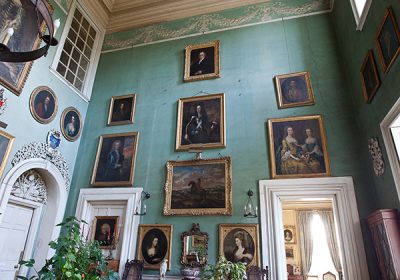
Walk on Farnham Estate, Cavan, Sept 2013. Photograph © Jennifer Winder-Baggot, www.irishhistorichouses.com
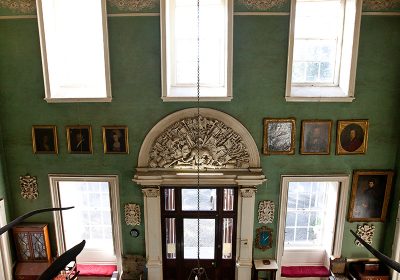
4. Killinagh House, McNean Court, Blacklion, County Cavanwhole house rental and a lodge €

Killinagh House, County Cavan, built 1827, a former Glebe House, three-bay two-storey over basement. Photograph from National Inventory of Architectural Heritage.

https://www.discoverireland.ie/accommodation/killinagh-house

and Killinagh Lodge, https://killinaghlodge.com/facilities.html on the grounds of Killinagh House:

Killinagh Lodge is situated within 1 mile from the village of Blacklion in the picturesque grounds of Killinagh House, a former Church of Ireland manse dating back to Georgian times.

Set in the courtyard, Killinagh Lodge offers luxurious, purpose built, self catering accommodation on the shores of Lough MacNean. Boasting its own private access to the Lough, Killinagh Lodge is set in one of the most beautiful and tranquil locations where you can enjoy the grounds of the wider Estate.

The house website tells us:

Killinagh House is a unique, Georgian Country House, situated in the heart of the Marble Arch Global Geo Park, in west County Cavan. The perfect getaway for peace and relaxation. We cater for customer comforts, special requests and reasonable prices.

The perfect retreat to unwind and recharge the batteries. Peaceful and quiet with relaxed garden views. Killinagh House is at the heart of Marble Arch Global Geo Park, ideally located for outdoor pursuits, including golf, fishing and nature walks.”

Killinagh House, County Cavan,Photograph from National Inventory of Architectural Heritage.

The National Inventory further describes it: “Roughcast rendered lime-washed walls with string course above basement. Three-over-six timber sash windows to first floor and six-over-six to ground floor all with stone sills and timber internal window shutters. Front door set in smooth-rendered segmental-arched recess, having four-panelled door in classical surround of slender Doric pilasters, metope frieze and cobweb fanlight above. Basement well to east, north and west side. Stone steps leading to entrance with recent metal railings.

Killinagh House, County Cavan,Photograph from National Inventory of Architectural Heritage.

5. Lismore House, Co Cavan – was a ruin. Place to stay: Peacock House on the demesne

Lismore House, Co Cavan – restored house (believed to have been the agent’s house) and a place to stay, Peacock House, available on airbnb. Of the original Lismore House, attributed to Edward Lovett Pearce (1699-1733), only the two wings and tower survive.

https://www.airbnb.ie/rooms/27674042?source_impression_id=p3_1646316758_vwGIKKMTwiWKK%2FB7

Lismore House, County Cavan, Photograph from National Inventory of Architectural Heritage. The Inventory tells us it is: “Symmetrical pair of detached six-bay two-storey flanking wings to former Lismore House, built c.1730, having advanced outermost end bays to each block, single-bay two-stage flanking tower formerly attached to south corner of house having single-bay extension to north…Rubble stone walls having red brick quoins, eaves course, and string course. Red brick surrounds to oculi at first floor over round-headed ground-floor windows and central segmental-headed door.
Lismore House, County Cavan, Photograph from National Inventory of Architectural Heritage: “Blind lunette and oculus to gables facing former house.”
Lismore House, County Cavan, Photograph from National Inventory of Architectural Heritage: “Tower having mansard slate roof, rubble stone walls with cut-stone platbands, cut-stone surrounds to window openings, round-headed openings with raised keystone and impost blocks to former ground floor, and segmental-headed openings to former basement level.”

The house was restored by Richard and Sonya Beer. [8]

It was probably built for Thomas Nesbitt, (c1672-1750), of Grangemore, County Westmeath, High Sheriff of County Cavan, 1720, MP for Cavan Borough, 1715-50 [7].

Mark Bence-Jones writes about Lismore House in A Guide to Irish Country Houses (1988), p. 186:

Originally the seat of the Nesbitts, passed to the Burrowes through the marriage of Mary [Mary Anne, born 1826, daughter of John Nesbitt and Elizabeth Tatam] Nesbitt to James Burrowes [1820-1860, of Stradone House, County Cavan] in 1854; Lismore passed to the Lucas-Clements family through the marriage of Miss Rosamund Burrowes to the late Major Shuckburgh Lucas-Clements in 1922.

Mary Anne and James had a son, Thomas Cosby Burrowes (1856-1925). He married in 1885 Anna 
Frances, daughter of Richard Thomas Maxwell, and grand-daughter of the sixth Baron Farnham (of Farnham Estate), by whom he has issue two daughters. One daughter, Rosamund Charlotte Cosby Burrowes, of Lismore, married, in 1922, Major Shuckburgh Upton Lucas-Clements in 1922. [9] The main house was vacated c.1870 when the family relocated to Lismore Lodge, formerly the agent’s house. 
 
Mark Bence-Jones continues: “Having stood empty for many years, the house fell into ruin and was demolished ca 1952, with the exception of the “tower” wings. The office wings are now used as farm buildings, and the family now live in the former agent’s house, an early house with a Victorian wing and other additions.” 

Photograph from National Inventory of Architectural Heritage.

6. Olde Post Inn, Cloverhill, County Cavan €€

https://www.theoldepostinn.com
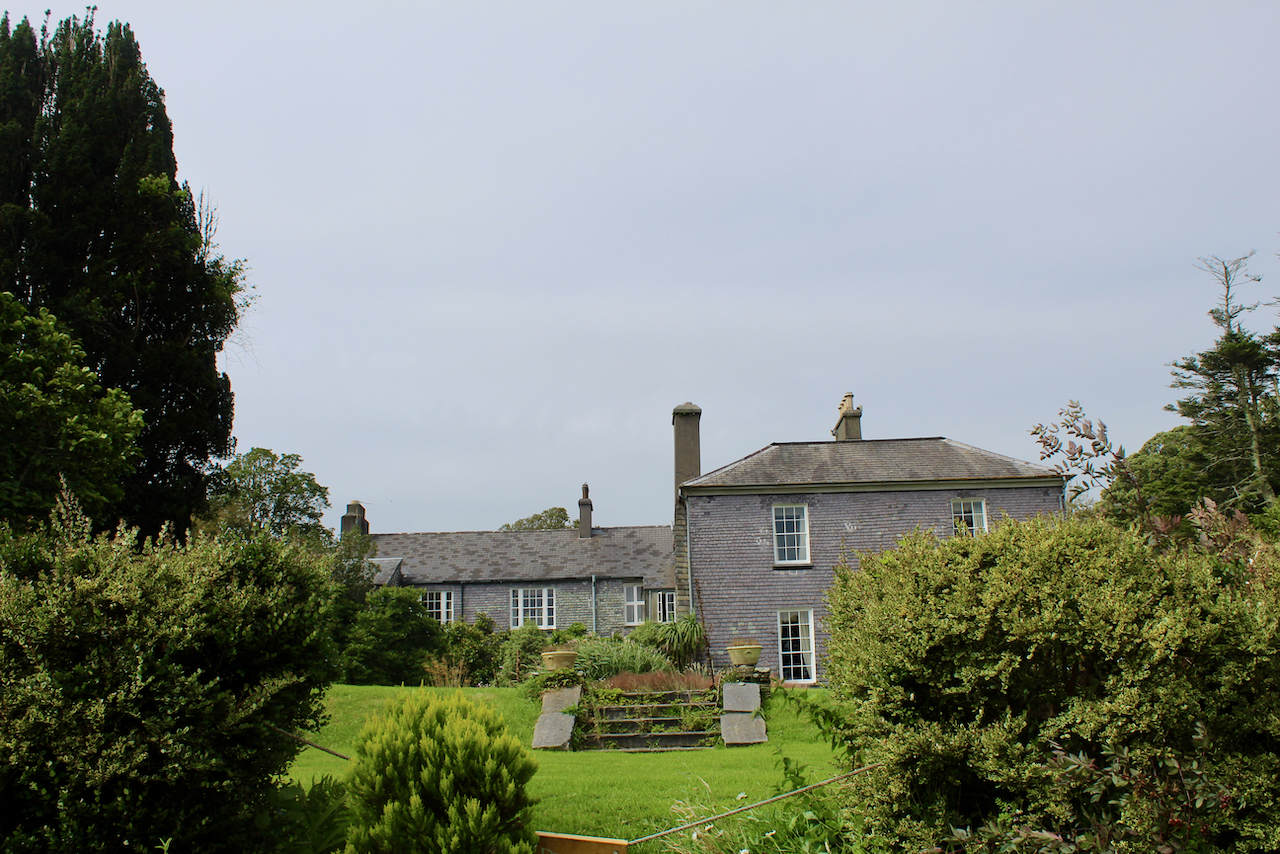
The website tells us: “The Olde Post inn was built in the 1800s. It opened as a post office in 1884, grocery & residence. It had a number of owners and was for some time derelict before it was renovated into a restaurant with accommodation in early 1990s. It has been run as a restaurant since and was taken over by Gearoid & Tara Lynch in November 2002. Since then it has gone under further refurbishment and been extended to include two Hampton Conservatories.

7. Ross Castle, Co Cavan (address is in Mountnugent, County Meath, A82HF89, on the border of Cavan) whole castle plus self-catering accommodation whole castle €€€ for 2, € for 10 or self-catering accommodation €

https://www.ross-castle.com
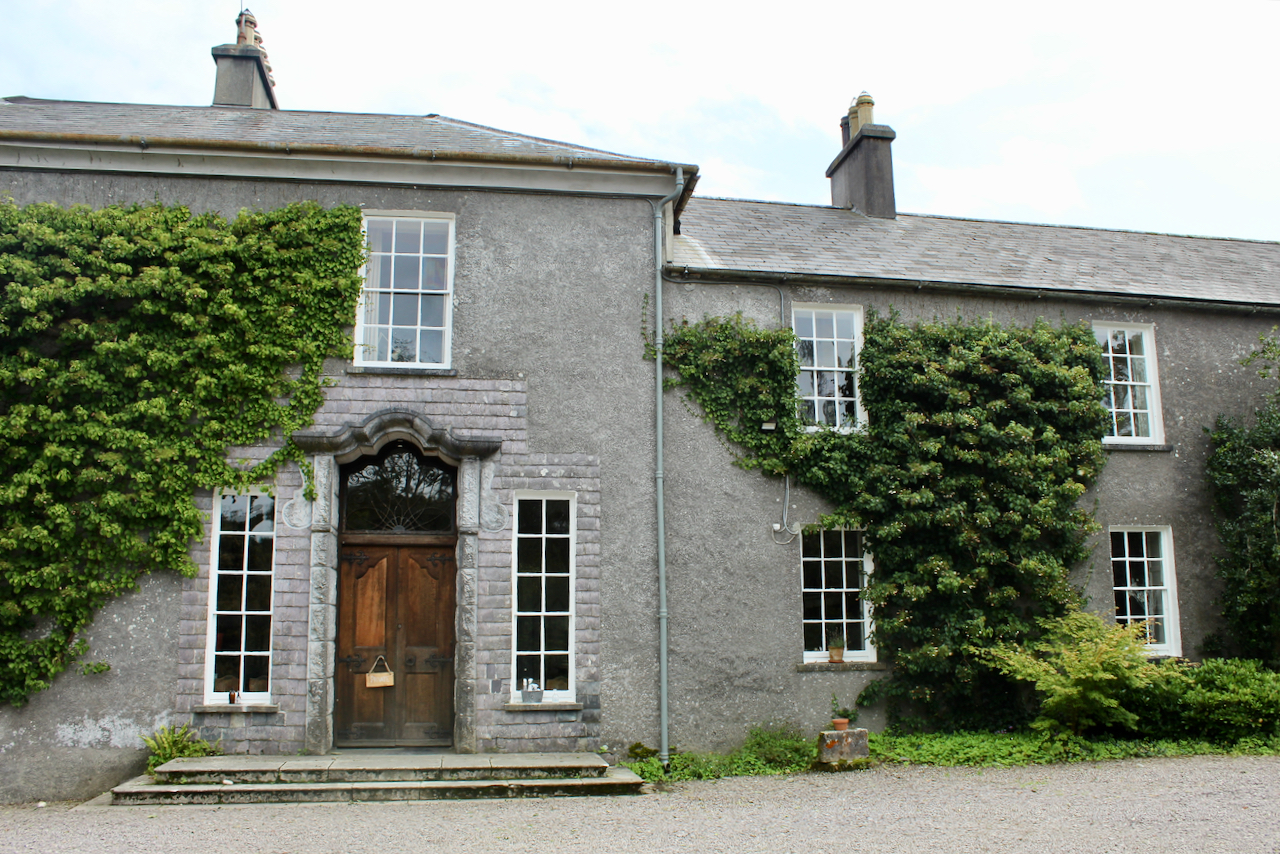
Whole castle rental, or nearby Castle Cottage, Quarry House or Tea Rose Cottage.

The website tells us:

Ross Castle is situated on the shores of Lough Sheelin in the rolling countryside of County Meath. The Norman Tower House was strategically built in 1520 commanding views of Cavan, Westmeath, Longford, Meath and Lough Sheelin for the Nugent Family. 500 years later Ross Castle has retained its medieval charm while also providing the comforts of today’s world. The Castle is an ideal venue for conferences, small weddings, family get togethers, tour groups and private parties. 
With the new addition of the Great Room and the Bishop’s Suite bedroom at the Castle, combined with our two cottages and Farm House, you now have the option of booking the combined properties for up to 31 guests. Individual property rentals for smaller groups are also possible. While Ross Castle was a Bed & Breakfast in the past, it can now only be booked for groups and events
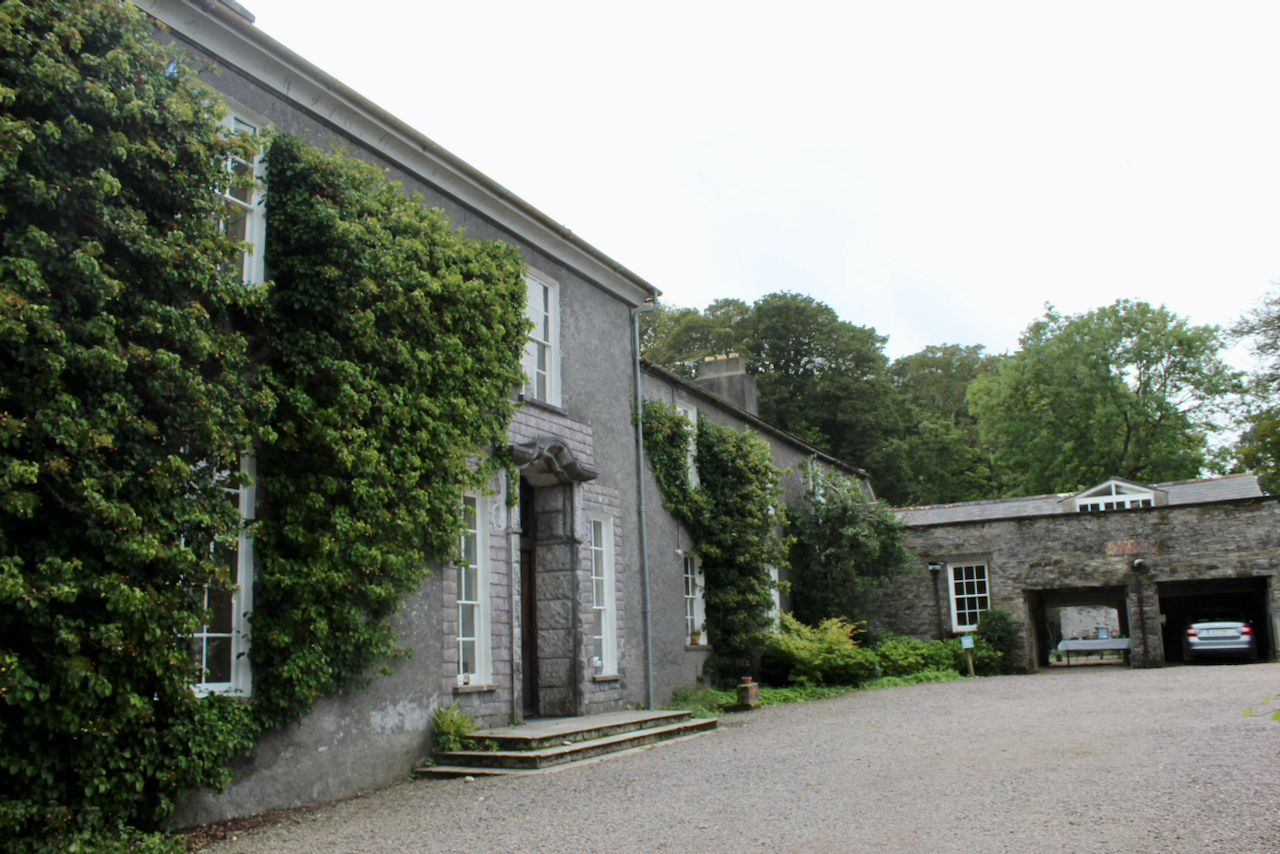
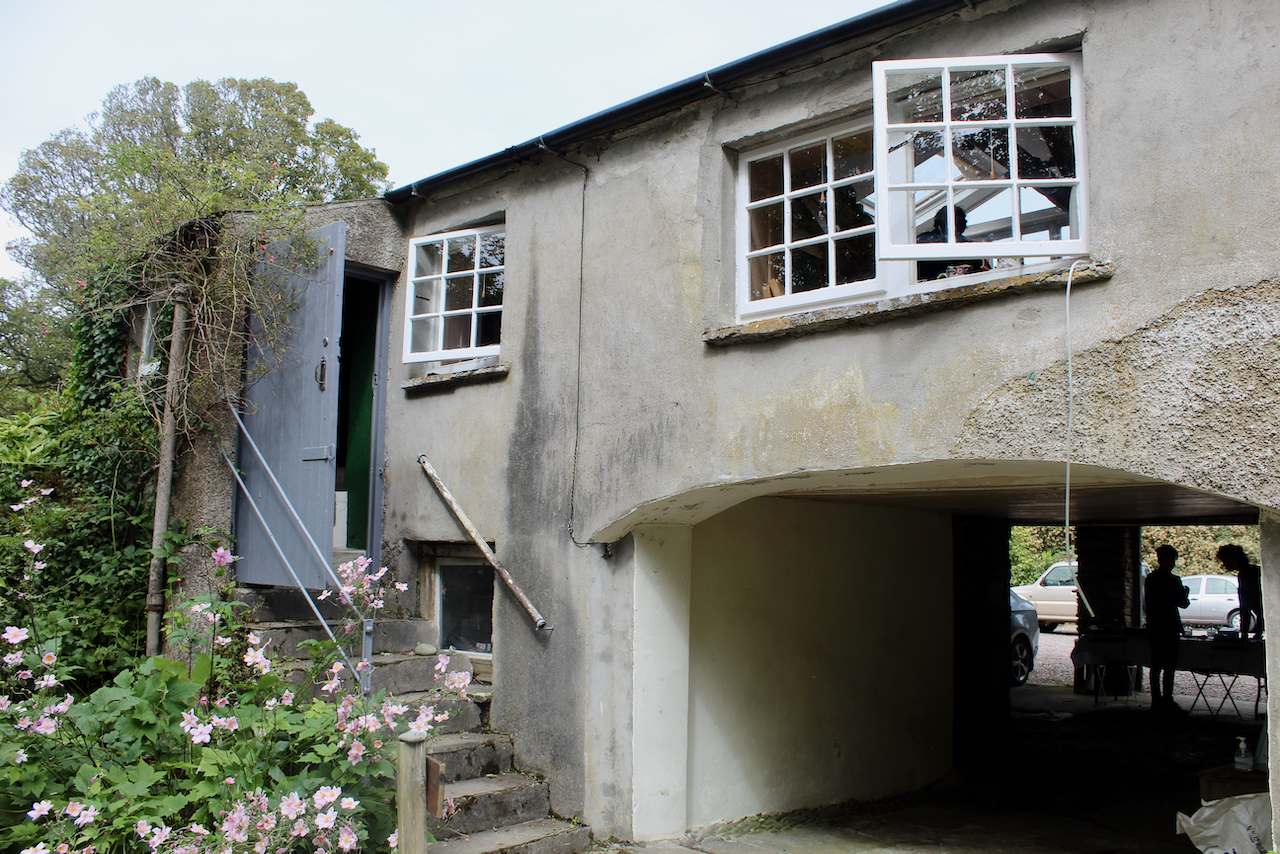
.”

8. Virginia Park Lodge, Co Cavan

WWW.VIRGINIAPARKLODGE.COM

This was formerly the hunting lodge of the Taylours, Marquess Headfort, who also owned Headfort House in County Meath. It was built for the First Earl of Bective, Thomas Taylour (1724-1795), son of Thomas Taylor 2nd Baronet Taylor, of Kells, co. Meath, who served as MP for Kells and as a Privy Counsellor in Ireland. His mother was Sarah Graham from Platten, County Meath. Thomas the 1st Earl of Bective also served as Privy Counsellor. He married Jane Rowley, from Summerhill, County Meath.

It was their one of their younger sons, Reverend Henry Edward Taylour (1768-1852), who lived at Ardgillan Castle in Dublin. Their son Thomas the second earl became the 1st Marquess of Headfort, and added to Virginia Park Lodge and imported plants to create the parkland surrounding the Lodge. He married Mary Quin, from Quinsborough, County Clare. The Lodge passed through the family to the 4th Marquess, Geoffrey Thomas Taylour, son of the second wife of the 3rd Marquess. He married a music hall star, Rosie Boote, which scandalised society, but they moved to the Lodge and lived happily and had many children.

The Lodge was bought by chef Richard Corrigan in 2014, and he has undertaken much work to restore it to its former glory.

*************************

[1] Bence-Jones, Mark. A Guide to Irish Country Houses (originally published as Burke’s Guide to Country Houses volume 1 Ireland by Burke’s Peerage Ltd. 1978); Revised edition 1988 Constable and Company Ltd, London.

[2] Ireland’s Content Pool, https://www.irelandscontentpool.com/en

[3] https://www.discoverireland.ie/Activities-Adventure/clough-oughter-castle/48729 

[4] http://www.discoverbelturbet.ie/unesco-geopark/clough-oughter/

[5] https://theirishaesthete.com/2015/09/09/a-mere-shell/

[6]  see Timothy William Ferres: http://lordbelmontinnorthernireland.blogspot.com/2013/09/cloverhill-house.html

[7] ibid.

[8] https://www.anglocelt.ie/news/roundup/articles/2018/06/17/4157489-bringing-lismore-back-from-the-dead/ 

[9] https://nisbetts.co.uk/archives/nesalx.htm

Text © Jennifer Winder-Baggot, www.irishhistorichouses.com