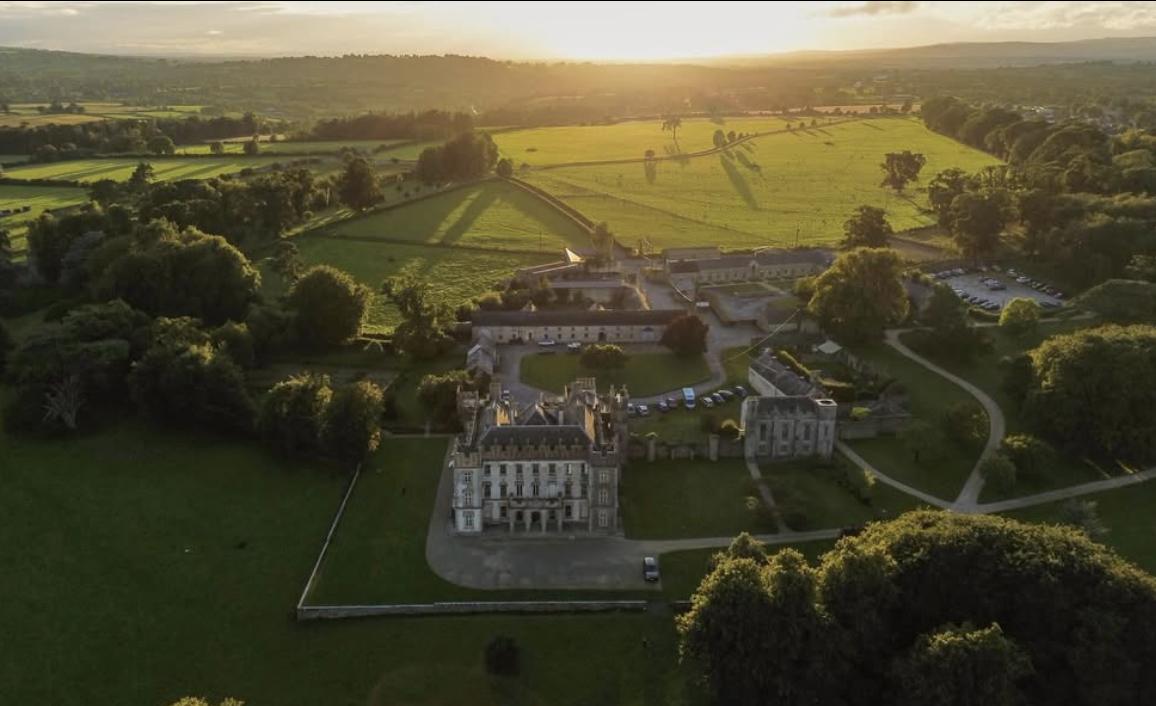
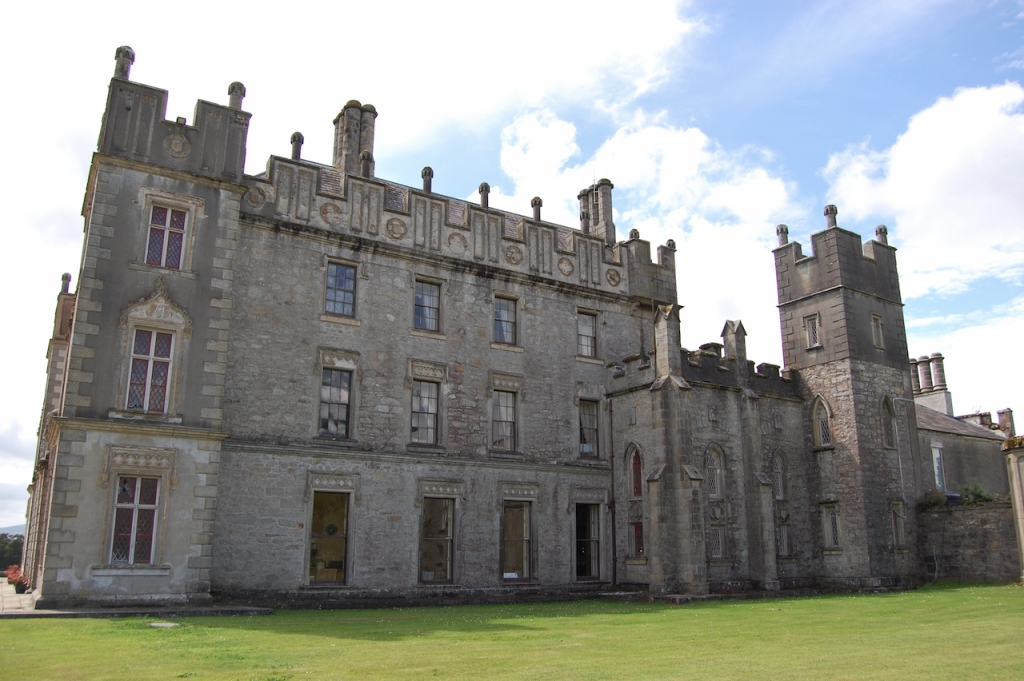
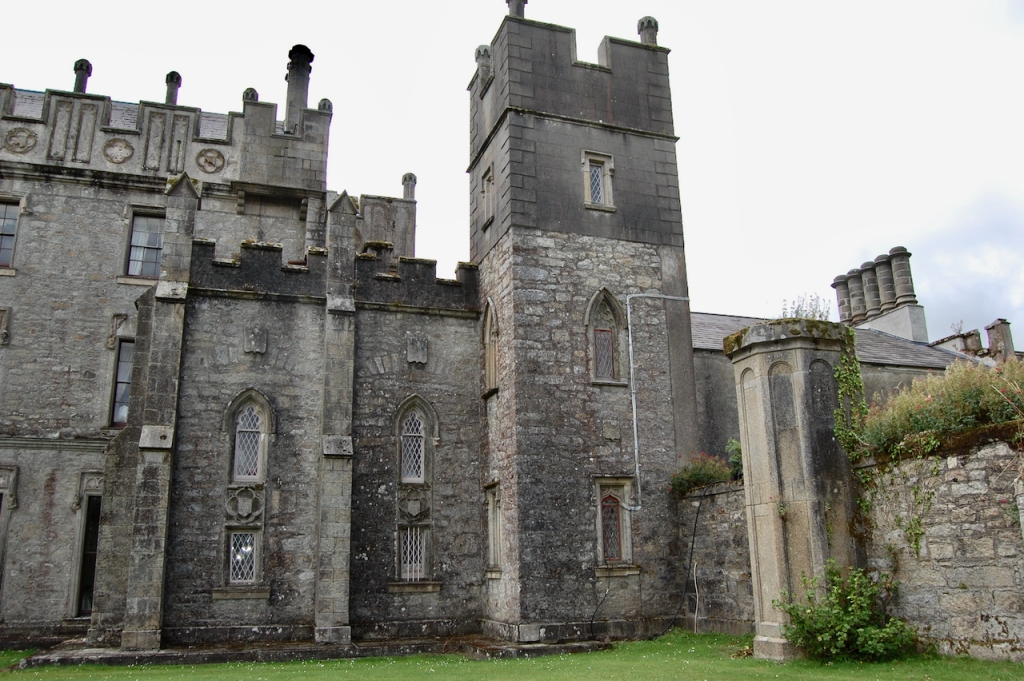
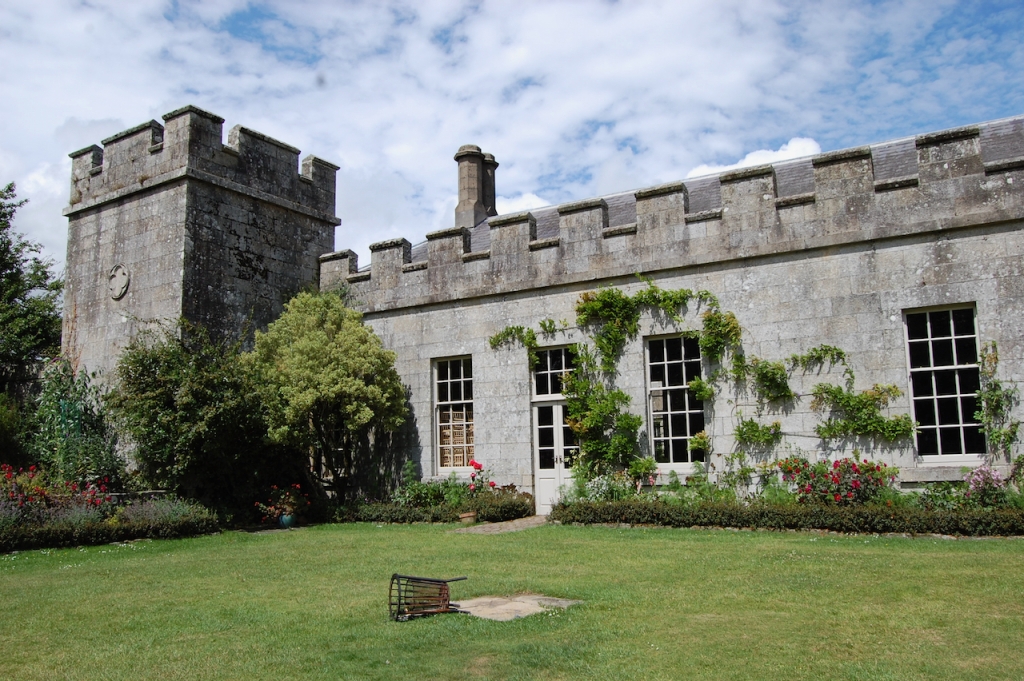
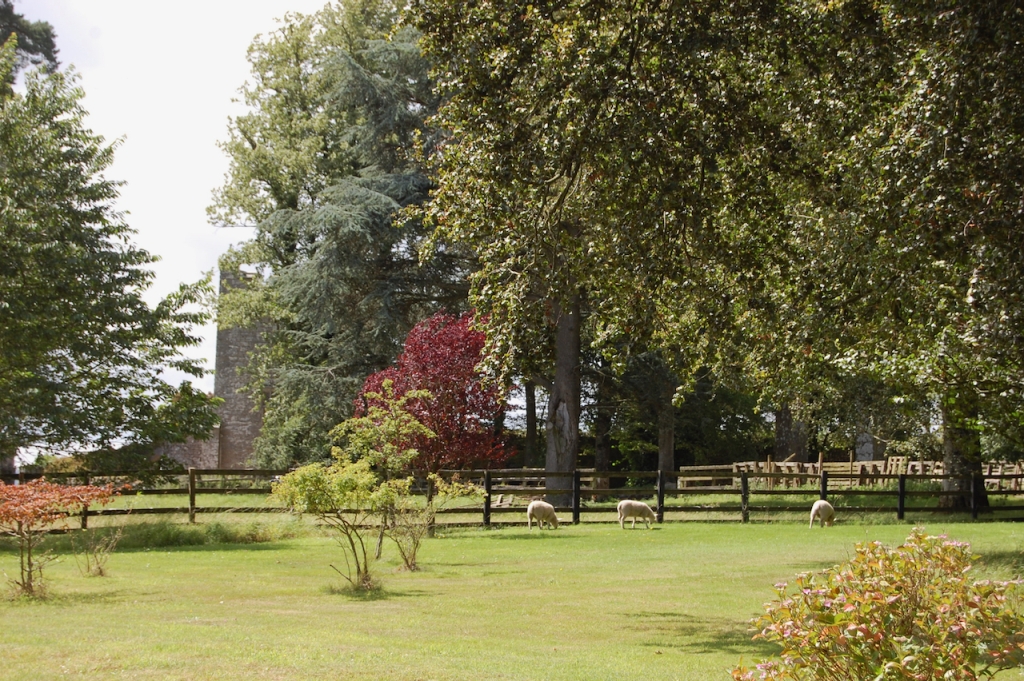
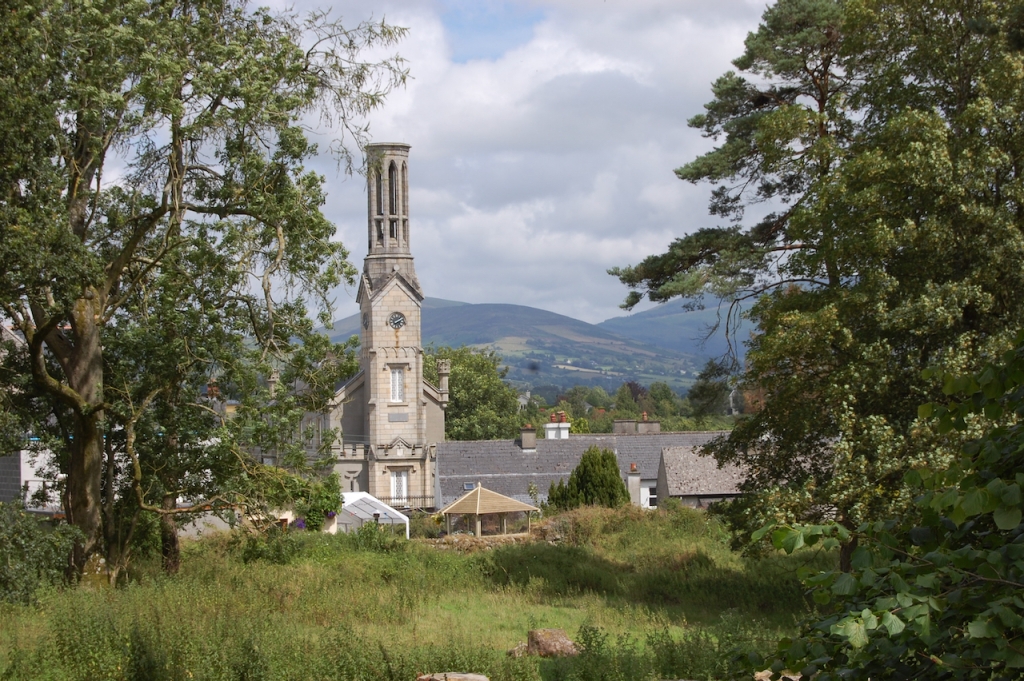
Shanbally Castle, Clogheen, County Tipperary

Shanbally Castle, Clogheen, County Tipperary

Shanbally Castle, County Tipperary, garden front during demolition c. 1957. Vanishing Country Houses of Ireland by The Knight of Glin, David J. Griffin and Nicholas K. Robinson, published by The Irish Architectural Archive and The Irish Georgian Society, 1988.

Mark Bence-Jones. A Guide to Irish Country Houses (originally published as Burke’s Guide to Country Houses volume 1 Ireland by Burke’s Peerage Ltd. 1978); Revised edition 1988 Constable and Company Ltd, London.

p. 257. “[O’Callaghan, Lismore, V/PB1898; Butler, sub Ormonde, M/PB; Pole-Carew, sub Pole, Bt/pb] The largest of John Nash’s Irish castles, built ca 1812 for Cornelius O’Callaghan, 1stViscount Lismore. Long and irregular, of smooth silver-grey ashlar; with round and octagon towers, battlements and machicolations. ..2nd and last Viscount Lismore left Shanbally to his cousins, Lady Beatrice Pole-Carew and Lady Constance Butler, daughters of 3rd Marquess of Ormonde; it was sold by Major Patrick Pole-Carew 1954. After a valiant but unsuccessful attempt by Hon Edward Sackville-West (5th Lord Sackville), the author and music critic, to rescue it, the house was demolished 1957 and its ruin dynamited.”

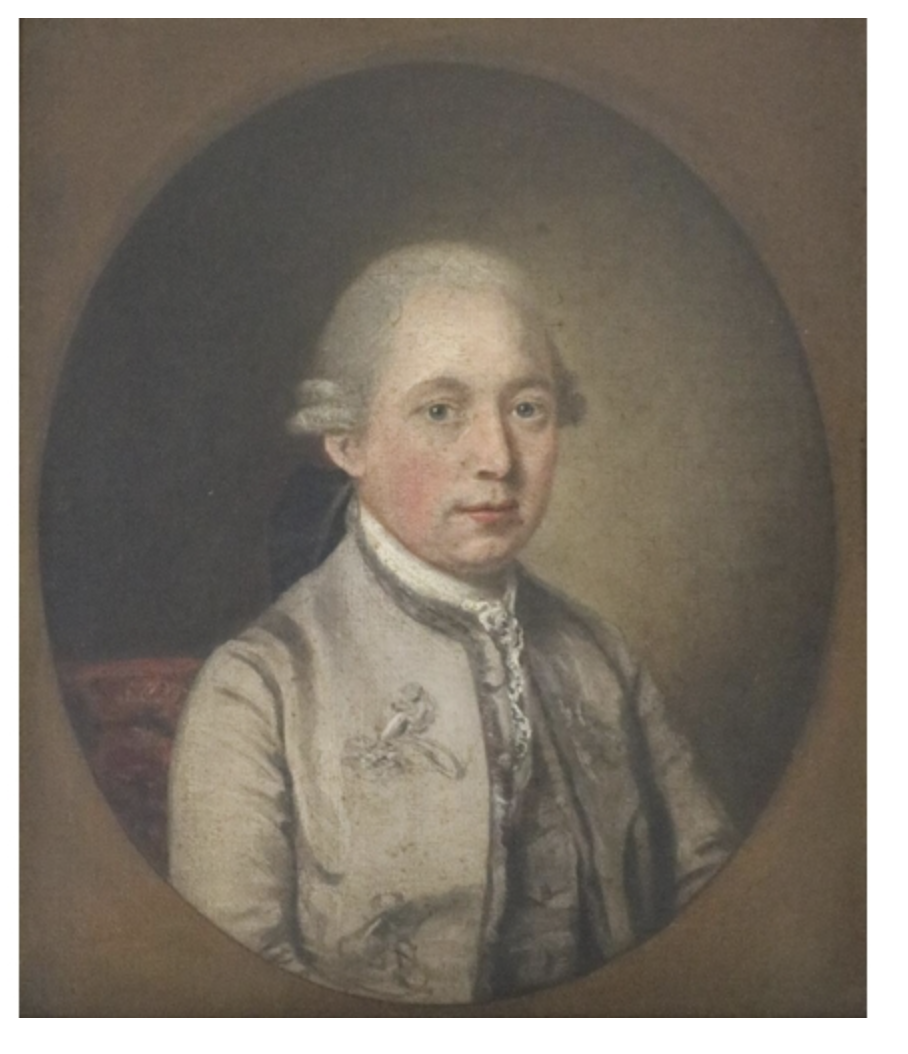
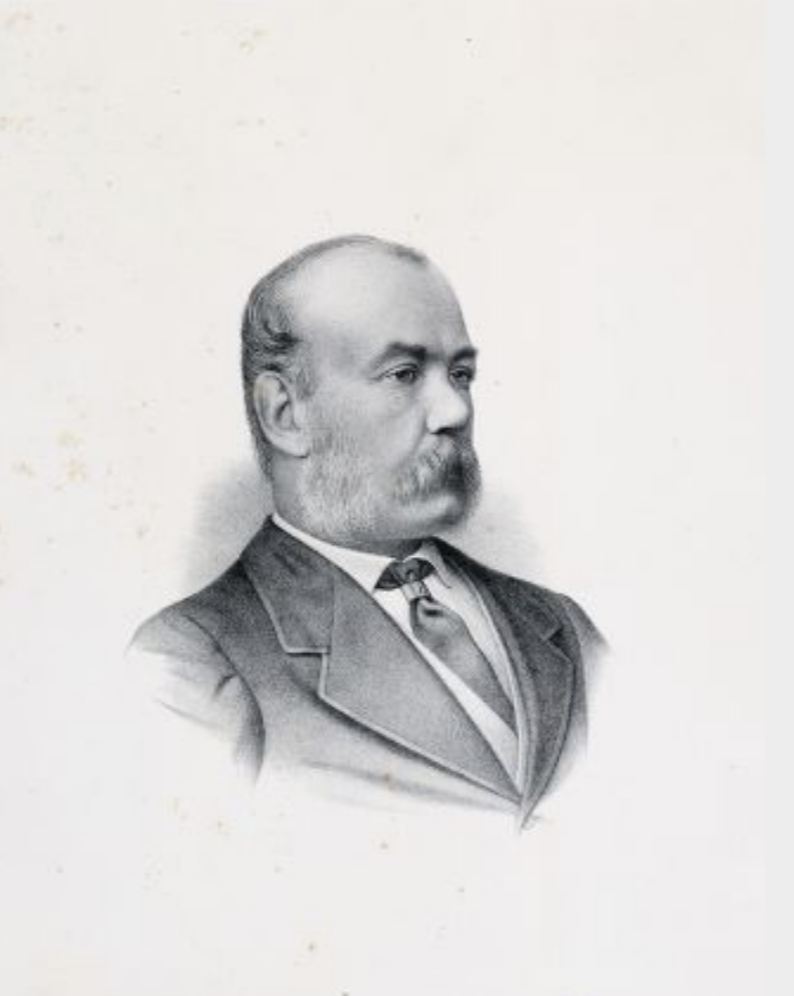
Cornelius O’Callaghan (d. 1797) 1st Baron Lismore by Hugh Douglas Hamilton courtesy Christies British Watercolours.
Shanbally Castle, County Tipperary, photograph by Robert French, (between ca. 1865-1914), Lawrence Photograph Collection, National Library of Ireland.

Listed in Vanishing Country Houses of Ireland by The Knight of Glin, David J. Griffin and Nicholas K. Robinson, published by The Irish Architectural Archive and The Irish Georgian Society, 1988. 

p. 136. “John Nash’s most important and largest Irish castle. Built c. 1806 for Cornelius O’Callaghan 1st Viscount Lismore. The very fine interior included a vaulted entrance hall lit by a series of glass skylights, a splendid oak imperial main staircase and an oval drawing-room.

The castle in good repair was sold in 1954 and despite protests in the press was demolished in 1957. Its destruction was one of Ireland’s great architectural losses this century.”

entry in MacDonnell, Randal. The Lost Houses of Ireland. A chronicle of great houses and the families who lived in them. Weidenfeld and Nicolson. London, 2002

p. 191 “The largest of John Nash’s four Irish castles, Shanbally was in excellent condition when the protectors of Ireland’s heritage in the Irish civil service decided to allow its demolition. Roofed and in good repair at the time it was pulled down, Shanbally’s destruction was one of the most pointless acts of official vandalism in the history of the Irish state.”

p. 192. Nash’s other castles in Ireland were Ravensworth, Caerbays and Aqualate. Shanbally also had the distinction that it was built, not for the descendent o some Cromwellian carpetbagger, but for the scion of an old Irish famiy, Cornelius O’Callaghan.

[pages ripped out]

The Tipperary Gentry. Volume 1. By William Hayes and Art Kavanagh. Published by Irish Family Names, c/o Eneclann, Unit 1, The Trinity Enterprise Centre, Pearse St, Dublin 2, 11 Emerald Cottages, Grand Canal St, Dublin 4 and Market Square, Bunclody, Co Wexford, Ireland. 2003.

O’Callaghan of Shanbally.

p. 163. Cornelius O’Callaghan [1693-1741] was a small county Cork landowner and successful Dublin lawyer. He was Sir Redmond Everard’s solicitor and facilitated him in getting mortgages. Like Redmond he was a convert. In 1713 he and Redmond represented Fethard in Parliament. It is probably that O’Callaghan’s political advancement was paid for by a reduction in Everard’s debts. In 1721 Everard sold his property in Iffa and Offa and centred on Clogheen to O’Callaghan for £11,500. The O’Callaghan family built upon this base and extended their holdings during the next 150 years so that by the mid-19C they were the county’s largest landholders. In 1883 the Lismore estates totalled a staggering 42,000 acres. In Tipperary they owned almost 35,000 acres, while they owned 6000 acres in Cork and over 1000 acres in Limerick. The rent roll was valued at over £16,000 per annum.

…Lord Lismore in his will of 1787 stipulated that his younger son lay out £9,999 in the purchase of lands, and in 1803 his heir bought an estate in Co Laois for £43,620.

p. 164. …the O’Callaghans were noted for their sympathetic approach to the Catholic Relief movement.

The O’Callaghans spent considerable sums over the decades of the 18C improving their estates, building Clogheen village (where Protestant artisans and craftsmen were brought in), drainage schemes, and large scale remodelling of the landscape. These works were facilitated by the appointment of agents. …

p. 160. [Cornelius O’Callaghan 1st Viscount Lismore divorced his wife, Eleanor Butler.] It would seem from the evidence that the marriage ran into trouble shortly after the fourth child was born when Lady Lismore began the habit of chastising her husband, both verbally and physically. According to her brother, the Duke of Ormond, she was a lady who frequently lost her temper. George O’Callaghan gave evidence that he had seen her strike her husband on more than one occasion. In addition she frequently taunted him by stating that Shanbally might be fit for the wife of Lord Lismore but was not fit for Eleanor the sister of the Duke of Ormonde.

p. 161. One of the most startling facts to emerge was that, at the time of the separation, Lord Lismore was in extreme financial difficulty. Although he owned over 40,000 acres of land and despite having received almost £40,000 as a dowry with Eleanor he was reduced to dire straits in the period from 1816-1825. His brother stated that he had only one servant in Shanbally and owned only one carriage and no carriage horse. He also said that in 1817 Lord Lismore was so financially embarressed that he could not travel over to London to see his wife….

The couple was separated in 1819 and Lady Lismore, on the advice of her doctors, decided to travel to a southern country where the climate might be good for her asthma….while in Italy the second time she took a lover, Richard Bingham…[p. 162] It was on the grounds of this adultery that Lord Lismore sought the divorce…. The children were reared by their father.

The seat of the O’Callaghans was at Shanbally Castle, near Clogheen village, where they built a mansion around 1735. There was over 1200 acres of land in the demesne. After the peerage was obtained in 1785 their house was renewed as a castle in 1812. [the castle was unfortunately demolished in 1957]. The new neo-classical house was designed by John Nash….

p. 166. 1st Baron Lismore of Shanbally died in 1797 at a relatively young age. His widow moved to Tunbridge Wells where she remained for the rest of her life until her death in 1827. They had at least two sons, Cornelius and robert William

[the son Cornelius] took his seat in the House of Lords nd voted against the Act of Union in 1800.

[Robert William had an active military career]

In 1806 Cornelius was created Viscount Lismore of Shanbally and in 1838 he was created Baron Lismore of Shanbally Castle. This was one of the Coronation Peerages of Queen Victoria…. Baron Lismore was Lord Lieutenant for Tipperary from 1851 until his death.

p. 167. During the Famine the Lismores worked extremely hard to alleviate the sufferings of the poor. Lord Lismore reduced their rents and provided a soup kitchen at hte gates of his castle. He was describedd as one of Ireland’s benevolent landlords and the town of Clogheen grew and prospered after the Famine.

[His son George outlived both his sons]

http://lordbelmontinnorthernireland.blogspot.com/2013/10/shanbally-castle.html

THE VISCOUNTS LISMORE WERE THE LARGEST LANDOWNERS IN COUNTY TIPPERARY, WITH 34,945 ACRES

This was one of the very few native families which had been dignified by the Peerage of Ireland. The O’Callaghans were formerly princes of the province of Munster, and were seated at Dromaneen Castle. Their Chief, CORNELIUS O’CALLAGHAN, enjoyed very extensive territorial possessions in 1594, according to an inquisition taken by Sir Thomas Norris, Vice-President of Munster, in that year.
From this Cornelius descended 

CORNELIUS O’CALLAGHAN (c1681-c1742), a very eminent lawyer, MP for Fethard, 1713-14, who married Maria, daughter of Robert Jolly, and had three sons, the youngest of whom,

THOMAS O’CALLAGHAN, wedded, in 1740, Sarah, daughter of John Davis, and had, with a daughter (married to Robert Longfield, of Castle Martyr), an only son,

CORNELIUS O’CALLAGHAN (1741-97), MP for Fethard, 1768-85, who was elevated to the peerage, in 1785, in the dignity of Baron Lismore, of Shanbally, County Tipperary.

His lordship married, in 1774, Frances, second daughter of Mr Speaker Ponsonby, of the Irish House of Commons, and niece, paternally, of William, Earl of Bessborough, and niece, maternally, of William, 3rd Duke of Devonshire, and had issue,

CORNELIUS, his heir;
Robert William (Sir), GCB, lieutenant-general;
George;
Louisa; Elizabeth; Mary.

He was succeeded by his eldest son,

CORNELIUS, 2nd Baron (1775-1857), who was created, in 1806, VISCOUNT LISMORE, of Shanbally, County Tipperary.

He married, in 1808, the Lady Eleanor Butler, youngest daughter of John, 17th Earl of Ormonde, and sister of the Marquess of Ormonde, by which lady he had issue,

Cornelius;
William Frederick;
George Ponsonby;
Anne Maria Louisa.

His lordship, Privy Counsellor, 1835, Lord-Lieutenant of County Tipperary, 1851-57, was succeeded by his second son,

GEORGE PONSONBY, 2nd Viscount (1815-98), an officer in the 17th Lancers, High Sheriff of County Tipperary, 1853, Lord-Lieutenant of County Tipperary, 1857-85, who wedded, in 1839, Mary, daughter of George Norbury, and had issue,

George Cornelius Gerald (1846-85);
William Frederick Ormonde (1852-77).

His lordship’s sons both predeceased him, when the titles became extinct.

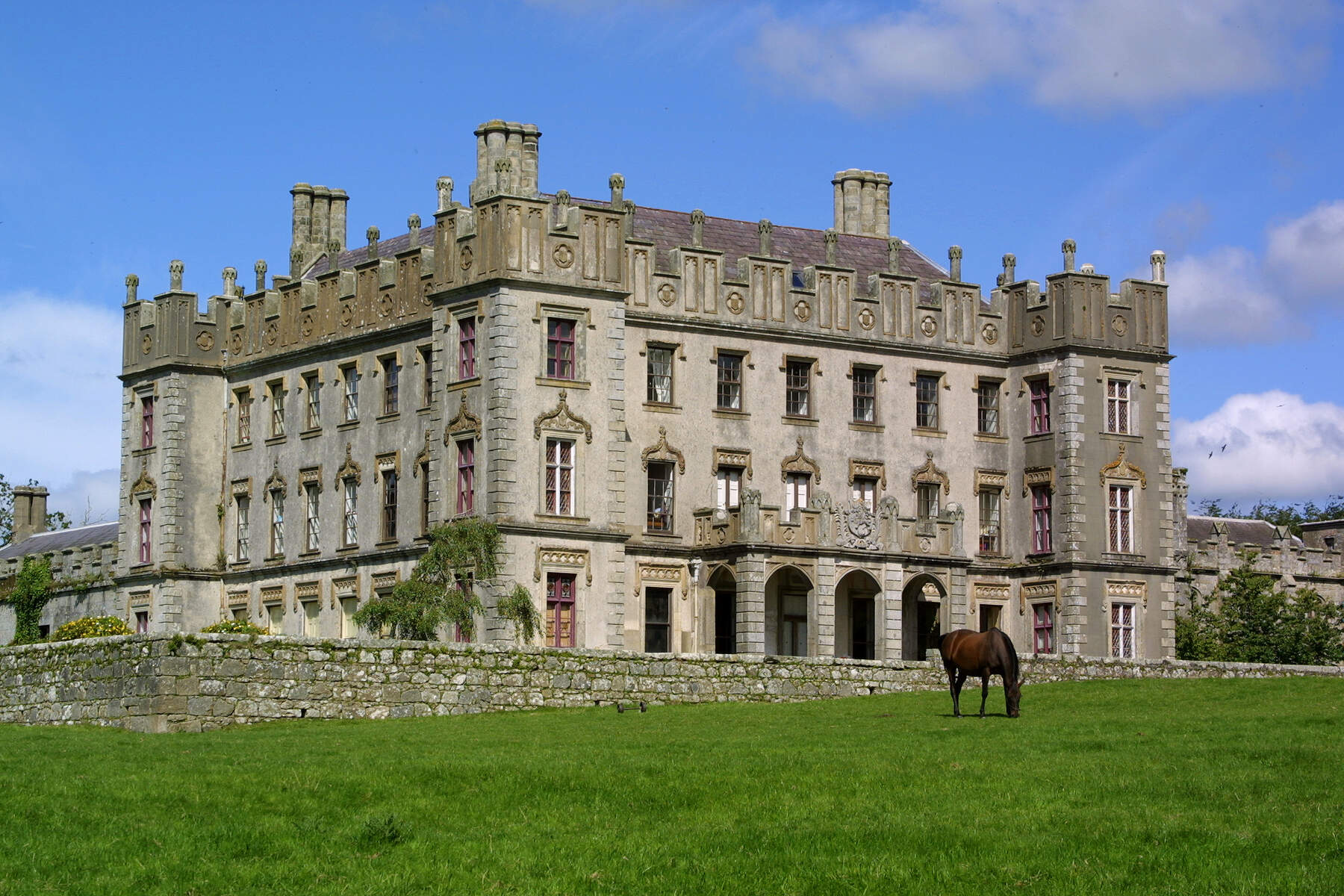
SHANBALLY CASTLE, near Clogheen, County Tipperary, was built about 1812 for Cornelius O’Callaghan, 1st Viscount Lismore.

It was said to have been the largest of John Nash’s Irish castles.
Shanbally was long and irregular, of a silver-grey ashlar.

This great mansion was 281 feet above sea-level, and about 80 feet above the level of the adjacent brook.

Shanbally Castle had numerous machicolations, towers and battlements.

The entrance front was pointed-arched, with a vaulted porte-cochere under a porch-tower.

The garden front had a round tower at one end and an octagonal tower at the other, with a central feature boasting two square turrets.

There was a stylish Gothic veranda.

Shanbally demesne is beautifully situated on low ground, in the centre of the valley, between the Galtee mountains on the north and the Knockmealdown mountains on the south.

It commands the most magnificent views of the slopes, escarpments, summits, and groupings of both of these alpine ranges.


Shanbally Castle was situated in a picturesque landscape, bounded to the north and south by two mountain ranges, the Galtees and the Knockmealdowns.

It is said that Shanbally bore a remarkable resemblance to Nash and Repton’s joint venture, Luscombe Castle in Devon, though Shanbally was considerably larger.

The 2nd and last Viscount left Shanbally to his cousins, the Lady Beatrice Pole-Carew and the Lady Constance Butler, daughters of the 3rd Marquess of Ormonde.

Shanbally was sold in 1954 by Major Patrick Pole-Carew. 

Following attempts by the Hon Edward Sackville-West (5th Lord Sackville) to rescue the Castle, it was demolished in 1957 and its ruin was blown up.

The following is a composition by Bill Power of the Mitchelstown Heritage Society:

Few acts of official vandalism rival the decision by the Irish Government in 1957 to proceed with plans to demolish Shanbally Castle.

Built for Cornelius O’Callaghan, 1st Viscount Lismore, ca 1810, the mansion was the largest house built in Ireland by the famous English architect, John Nash. 


When the Irish Land Commission purchased the Shanbally estate in 1954, one of the immediate questions which it addressed was what should become of the castle.

For a brief period it seemed that a purchaser could be found in the form of the London theatre critic Edward Sackville-West, 5th Lord Sackville, who had a tremendous love of the Clogheen area, which he had known since childhood.

He agreed to buy the castle, together with 163 acres, but pulled out of the transaction when the Irish 
Land Commission refused to stop cutting trees in the land he intended to buy. 

Consequently, by 1957, the fate of the mansion was sealed.

The Irish Land Commissioners, with Irish Government approval, decided to proceed with plans to demolish the castle on the grounds that they had no use for it and that it was in poor condition.

They ignored suggestions that a religious community might be found for the building, and also 
rejected its suitability as a forestry school.

In that year, Professor Denis Gwynn, wrote an article in the Cork Examiner in which he exhorted the authorities to reverse their decision:

“Shanbally Castle has been well known for years as one of the most graceful and original examples in Ireland of late Georgian architecture,” he said. “Its formal gardens, which have run wild, could easily be brought back to order.”

The Professor pointed out that Shanbally Castle was designed by one of the most famous of all modern architects, who also planned all the well known terraces that surround Regent’s Park in London, and so many other celebrated buildings in England, `What conceivable justification can there be for incurring the great expense of demolishing this unique Irish mansion,’ he asked.

“All around the house, with its long avenues, the land has been admirably laid out and planted with fine trees in groups to enhance the views and to produce valuable timber,’ he continued. `More recently there has been wholesale clearance of the timber. Last summer I saw cutting in progress at many places, and big gaps had been made in the boundary walls to assist removal of the felled trees.

Describing the order to demolish the castle as an `act of vandalism,’ Professor Gwynn called for an inquiry into the circumstances of the decision. There is no sense whatever in squandering public money on the destruction of a beautiful house which is well known to students of Nash’s domestic architecture,’ he added.

But Professor Gwynn’s article was already too late: Despite some local opposition and widespread critical comment, the roof was removed and some of its impressive cut stones were being removed by hand and broken into smaller pieces for use in road building.

The house, with its twenty stately bedrooms, extensive drawing rooms, dining room, library, marble fireplaces and mahogany staircase was rapidly reduced to a state of ruin. 

In 1960, The Nationalist newspaper reported the final end of a building which was once the pride of the neighbourhood: “A big bang yesterday ended Shanbally Castle, where large quantities of gelignite and cortex shattered the building”, it said. 

In the weeks prior to the explosion, demolition workers bored 1,400 holes, 18 inches above ground, into the cut stone of the castle.

Each hole was then filled with explosives which were detonated on the 21st March, 1960.

Almost all of this material was used for road building. 

The protests against the demolition of Shanbally Castle came from some local sources, An Taisce and a few academics such as Professor Gwynn.

Politically, the  Fianna Fail Government had no love for houses of the ascendancy.

However, remarkably, it was from within the ranks of Fianna Fail that the only political voices were raised against the demolition plans, albeit privately.

One was Senator Sean Moylan, the Irish Minister for Agriculture until his death in 1957, and the other was his close friend and TD from Mitchelstown, John W Moher.

They were over-ruled by the Cabinet and failed to get wider political support, even from opposition deputies.

When the explosion finally came, the Irish Government saw fit to issue a terse public statement in response to protests favouring the retention of Shanbally Castle for the nation.
“Apart from periods of military occupation the castle remained wholly unoccupied for 40 years,” said the statement.

First published in October, 2011.

https://archiseek.com/2012/1806-shanbally-castle-clogheen-co-tipperary

1806 – Shanbally Castle, Clogheen, Co. Tipperary 

Architect: John Nash 

Shanbally Castle was built for Cornelius O’Callaghan, the first Viscount Lismore and was the largest house built in Ireland by the noted English architect John Nash. Acquired by the Irish Land Commission in 1954. On 21 March 1960 the castle, after much controversy, was demolished.  

It was widely felt that the castle was in habitable condition, having been sold to the government in good repair. The house had ranges of Gothic windows and was flanked by towers at either end. The interiors were reportedly well-detailed with ornate plasterwork. 

For a time it seemed that a purchaser could be found in the form of the London theatre critic Edward Charles Sackville-West, 5th Baron Sackville. He agreed to buy the castle, together with 163 acres, but pulled out of the transaction when the Irish Land Commission refused to stop cutting trees in the land he intended to buy. A statement from the Irish Government released after the demolition of the Castle said in response to protests favouring the retention of ShanballyCastle for the nation: “Apart from periods of military occupation the castle remained wholly unoccupied for 40 years”. 

Oak Park, (Painestown), Co Carlow

Oak Park, (Painestown), Co Carlow

Bence-Jones, Mark. A Guide to Irish Country Houses (originally published as Burke’s Guide to Country Houses volume 1 Ireland by Burke’s Peerage Ltd. 1978); Revised edition 1988, Constable and Company Ltd, London.

p. 226. “(Bruen/IFR) A large early C19 classical mansion by William Vitruvius Morrison. 

It has two storeys, the entrance front having a five-bay central block with a pedimented portico of four huge Ionic columns, prolonged by wings of the same height, at first set back behind short colonnades of coupled columns and then returning forwards with pedimented Wyatt windows in their ends. Rather dull and amorphous thriteen bay garden front, inadequately relieved by having four separate bays breaking forward wiht Wyatt windows, and bay a pair of somewhat paltry single-storey balustraded curved bows. Rich interior plasterwork in Morrison’s characteristic style. Hall with Ionic columns, free-standing, coupled and engaged; frieze of swags; ceiling of geometrical ribs. Damaged by fire ca1910 and afterwards restored; sold ca 1957; now an agricultural research centre.” 

https://www.buildingsofireland.ie/buildings-search/building/10300206/oak-park-house-oak-park-demesne-oakpark-or-painestown-co-carlow

Detached five-bay two-storey Classical style country house, c. 1760, with ashlar façade, tetrastyle pedimented Ionic portico and balustraded parapet. Redesigned (externally and internally), c. 1832, with two-storey lateral wings and pavilion blocks added. Designed by the Morrisons. Tripartite windows added, c. 1876. Now in use as school. Group of detached outbuildings to site including two-storey cut stone stable complex, c. 1760, with blind arcade. 

https://www.buildingsofireland.ie/buildings-search/building/10300204/oak-park-house-oak-park-demesne-oakpark-or-painestown-co-carlow

Remains of freestanding granite ashlar Greek Revival temple style mausoleum on a raised base, c. 1841, with Doric pilasters and lugged doorcases. Now in ruins. Designed by J. B. Keane.

Protected Structures of Ireland: 
The mausoleum dates from circa 1841 and was never completed. It was designed by J.B.Keane, the Morrison’s assistant, and consists of a Greek-revival temple with massive, granite ashlar walls on a raised base. This possibly the largest mausoleum in Ireland. Designs for the mausoleum were exhibited in the Royal Hibernian academy in 1841. The mausoleum has been cleaned recently and is in good order. 

https://www.buildingsofireland.ie/buildings-search/building/10300209/oak-park-house-oak-park-demesne-oakpark-or-painestown-co-carlow

Gateway, c. 1835, comprising Classical style triumphal arch with flanking paired giant Ionic columns on pedestals carrying blocked entablature and walled carriage turn to front. Designed by the Morrisons. 

Record of Protected Structures: 

Oak Park House, Oak Park Demesne, Oak Park. 

Townland: Oakpark or Painestown. 

An opulent neo-classical composition dating from circa 1832 designed by Sir Richard and William Vitruvius Morrison. Their work completely remodelled a house of circa 1760 and encased it in granite ashlar. The façade is of five bays and two storeys and has a magnificent, ionic portico, cornice and balustrade. The garden front has a pair of single-storey, balustraded bows. Laterally-placed wings, which are connected by colonnades of square-plan piers, were added by McCurdy and Mitchell between 1876 and 1879. Further alterations were carried out after a fire in 1902. The detailing on the house is superb with crisp, granite carving of the Morrison designs maintained by the remodelling in the 1870s when plate-glass sash windows were inserted.  

Importance: 

National, architectural, interior, social, artistic. 

Record of Protected Structures: 

Oak Park Walled Garden  

And Buildings,  

Oak Park Demesne,  

Oak Park  

The walled garden has a high, stone wall. One side of the wall is next to the avenue leading to the house. On the North side of the garden is a composition with two, gable-fronted buildings which have square-headed doorcases and sidelights on the ground floor and a pair of pointed windows with chamfered, granite dressings on the first floor. The first-floor windows cut a string course which marks the base of the gable. The walls are built of rubble-stone rendered with lime rendering and the roofs are of natural slate with granite coping to the front. The two buildings are linked by a single-storey section. The buildings probably date from the 1830s. This is a very interesting and unusual design which shows the architect engaged in a playful composition.  

The Dairy,  

Oak Park Demesne,  

Carlow  

An estate cottage, probably designed by the Morrisons, in tudor-gothic style. It is built of coursed-rubble granite with gables, bow-windows, stair’s turret and single-storey wing. The windows have granite mullions with chamfered dressings as does the square-headed doorcase. The stairs turret has a pointed, stone roof. The roof is covered with natural slate. The house has been closed up for some years  

The Old Stable Block,  

Oak Park Demesne,  

Oak Park  

A U-plan stable block with a seven-bay, two-storey façade having a three-bay, recessed centre, painted, smooth-rendered walls, carriage arches on the ground floor, a string-course at impost level and small windows on the first floor. The roof is hipped and covered with natural slates. The return walls have wide, blank arches with the string course running along at impost level so that the head of the arch is glazed and looks like a Diocletian window. The stables appear to date from circa 1820 and because of their sophisticated design could be by the Morrisons at a time that they were working in Borris.  

Iron Bridge,  

Oak Park Demesne,  

Oak Park  

A cast-iron, single-arch bridge with serpentine, entwined ornamentation, banded, granite piers and dating from circa 1835. It was designed by George Papworth. A very important iron bridge of unusual design.  

Jimmy O’Toole, The Carlow Gentry: What will the neighbours say! Published by Jimmy O’Toole, Carlow, Ireland, 1993. Printed by Leinster Leader Ltd, Naas, Kildare. 

Chapter: Bruen of Oak Park 

p. 53 [p. 51-2 ripped out] :As a result of Captain Bruen’s objection to his daughter’s match, local rector Canon Ridgeway refused to marry the couple, who then eloped to England, but when they returned to Carlow some weeks later, still not married, Canon Ridgeway relented, ignored the Captain’s protests, and performed the wedding ceremony in 1939…. Now he was alone in Oak Park (formerly Painstown), a property first purchased in 1775, by Henry Bruen I, grandson of James Bruen of Tarvin, County Chester, who came to Ireland with the army of Oliver Cromwell, and was granted land at Abbeyboyle, County Roscommon. Henry came to Carlow after a career in the Quarter Master General’s office in the U.S. army, where he made his fortune. The story – embellished, no doubt, by political enemies of the family later – was that while responsible for supplying coffins, he had them designed with false bottoms, which facilitated recycling! 

Whatever its source, Bruen certainly had a fortune, and during the last decade of the 1790s, he took full advantage of the forced sales of poart of the Bagenal, Whaley and Grogan estates in County Carlow. He bought 3,702 acres from Thomas “Buck” Whaley of Castletown, who had gambled away his fortune. …Land ownership meant political muscle and in 1790, Henry Bruen I was returned to parliament with William Burton of Burton Hall, in an uncontested election. … Sir Richard Butler, living at Garryhundon at the time, [p. 55] withdrew… in favour of Bruen…. Sir Richard had the “family seat” back within five years following the sudden death fo Colonel Bruen at his Dublin home in North Great George’s Street in 1795…. 

It was Henry Bruen II who was to put the Bruen stamp firmly on Carlow politics. He was at Harrow with George Gordon Byron, later the poet Lord Byron, and Robert Peel, with whom he would later run shoulders as fellow Tory MPs. Sir Robert was Home Secretary when Catholic Emancipation was granted, a Bill supported by Henry Bruen. He opposed the Tithe system, which he described a “badly devised and tending towards the production of much evil…” He was first elected, unopposed in 1812, at the age of 22 – the first of 13 elections in which he was involved over forty years. …Prior to the 1830s, party politics as we know them today did not exist, and when polling took place, the choice was between Tory candidates of varying political views. Where there were agreed candidates for the two county seats MPs were returned without a contest. 

But politics were about to change dramatically in County Carlow – albeit for a relatively short period – following Catholic emancipation and the leadership of Daniel O’Connell. However, with the exception of two brief periods, Bruen survived the political trauma and turmoil of the 1930s, and held a seat continuously btween 1840 and his death in 1852… The campaign had been so intense in 1831, that Bruen and his running mate Horace Rochfort, withdrew the night before the poll. 

But it was the election of 1841 that was to make Henry Bruen II a hero among Conservative voters throughout the country. He partnered Thomas Bunbury of Moyle, to defeat the high profile Daniel O’Connell (Jr), the son of the Liberator, and John Ashton Yates…Intimidation was an acceptable weapon. At a meeting in Carlow town, Daniel O’Connell Jr suggested the use of cribs or pens in churches where Catholic voters, who refused to come onto the Liberal side, [p. 56] could be corralled during mass, to underline their support for landlords. O’Connell could hardly have been unaware of the fact that such actions would lead to violence, and among Catholics at that. “Cooping” was another practice on both sides, where voters, for their own protection, were locked up dring thedays preceding polling to prevent them being intimidated, or physically attacked. Abduction too was practised to prevent voters getting to the polls. 

On June 26th – five days before the election – more than 250 Catholic voters armed to a man, were under the protection of a squadron of cavalry at Borris House. Few of these abductions were reported to the police, suggesting most of them were of theirown free will, but whether it was out of fear of their landlord, and clan loyalty, in this case to the Kavanaghs, would be impossible to determine. 

The Liberals kept their captured voters in a disused brewery in Kilkenny where they were looked after by the local liberal organisation, the Kilkenny Citizens Club. Atone stage, there were 120 voters in the brewery, consuming enormous quantities of food, and being entertained by the teetotal bands. A Tory pamphlet entitled “The Reign of Terror in Carlow” reported that on Juen 27th “A boatload of voters was brought along the canal from Leighlibridge to Bagenalstown. The teetotal band at Leighlinbridge played sacred music to drown the groans of the imprisoned electors in the lumberboat. The miserable electors were tied, guarded by armed men, and commanded by two priests, Fr Murphy and Fr Mahon.” 

p. 57….Bruen called the Catholics ‘savages’ during a parliamentary debate. The liberal Leinster Reformer attacked the St. Mullins voters – mostly tenants and supporters of Kavanagh’s – proclaiming “thre are some vile traitors for lucre among he wretched serfs of Lady Harriet Kavanagh, or rather the wretched serfs of Doyne (Charles “Silky” Doyne), for hie is lord and master.” Onn the eve of the election , the St. Mullins voters were lodged at Strawhall House, where they were visited by O’Connell in a last ditch effort to persuade them to change sides – he did not succeed.” 

“The clergy in most parishes, lad by Bishop James Doyle, threw their considerable weight behind the Liberal cause, and it was because of this support that Daniel O’Connell could advocate the use of cribs in churches as a form of punishment…a crib was erected in Tinryland church for what were termed “the black sheep who voted Tory.”… 

On the same Sunday, James Prendergast, whose brother voted Tory, was turned out of Clonegal church…children were turned out of school due to parents votes… Immediately after the election, unprecendented persecution of Bruenite voters commenced, according to P.J. Kavanagh… Andrew Marshall, a Bruen tenant,, was beaten by a mob at the Royal Oak, and in Hacketstown, Brian Kelly, who was rescued from a mob before the election, was stoned afterwards by a mob of thirty. In Leighlinbridge, William Bergin was attacked by 300 people because he voted Tory. 

P.J. Kavanagh claims there was no proof of any landlord vengeance having taken place after the election… 

p. 59. Henry III (1828-1912) was back in the House of Commons in 1857, and held his seat until 1880, whe, with Arthur McMurrough-Kavanagh, both sitting MPs, they were heavily defeated by Home Rule candidates E.D. Gray and D.H. MacFarlane. That election was a key bench mark… it ended the stranglehold of landlords on the national political system in Ireland.” 

Just as the influence of the Bruens had grown both economically and politically over the years from 1775, so too did their mansionhome at Oak Park. The present house is the result of four periods of enlargement and remodelling carried out between 1797 and 1902. 22 years after he arrived, Henry I …decorated the house previously occupied by the Cookes. In 1832, Henry II commissioned William Morrison to remodel the house, and in 1876 builder Samuel Bolton signed a contract for a major extension, which took three years to complete… in 1902, the house was gutted by fire, and when the outbreak was brought under control eight hours later, all that remained intact was the north wing. Head housemaid Lucy Fleming, who raised the alarm, said she was awakened by what appeared to be the noise of intruders – suggesting that the fire may have been deliberate…. The house was rebuilt under the supervision of architect William Mitchell, who was responsible for extensive interior re-design work. The family moved to the dower house at Strawhall during the rebuilding. 

p. 60. After WWI, sometimes as many as 6-8 planes would land in thefield, army officers coming to Oak Park from Dubil for a party. 

In 1922 Henry Bruen IV leased the deer park to Carlow golf club and an 18 hole course was developed. 

http://www.igp-web.com/Carlow/oak_park.htm 

Oak Park House in Carlow town is probably the finest 18th/19th Century house in south east Ireland. The house itself is of huge architectural and historical significance. There are 700 acres of woodland and open pasture including a lake.  

The history of Oak Park (once known as Painestown) has been known since 1775 when the park was in the possession of the Bruen family, until the death of Arthur Bruen in 1954. In 1960 it was sold to the Irish Land Commission and opened the National Teagasc Tillage Research Centre there. Farmers from the west of Ireland bought small pieces of land to farm, thanks to loans. So every year the farmers had to pay back the Land Commission a sum on the size of their holding.  

The Bruen Family purchased Oak Park, formerly known as Painestown around the year 1775. In 1832, Henry Bruen commissioned William Vitruvius Morrison to redesign the house. It is remodelled in the classical style and retains the existing house as its central component. The front façade features a two-storey Ionic portico set on a pedestal. Today Oak Park House and demesne is the property of Teagasc – the agricultural research body. It has recently become the administrative headquarters for Teagasc.  

Stable complex, built c1765, comprising two-storey cut stone building with round-headed blind arches and three-bay gable-fronted buildings opposite. Renovated, c1985, with openings remodelled.  

The Mausoleum 

The Mausoleum is a large structure located in the woods, approximately 500 metres north-west of Oak Park House. It was designed in 1841 by the architect John B. Keane in the style of a Greek Peripteral Temple. Keane was initially a draughtsman with the Morrisons and probably got the commission because of this. The exact purpose for its construction is unknown but it is possible that Henry Bruen II commissioned it as a memento of his victory over Daniel O‟ Connell Jnr. In the Westminster election of 1841. The Temple was never completed and it was later used as a Mausoleum. The last two Henry Bruens and their wives are buried in the Mausoleum. 

The Graveyard and Church are located in the Farmyard about 400 metres south of Oak Park House. The origin of the small ruined Church is uncertain. It is most likely that some stage it was used as a private Chapel for early Coke (or Cooke) landlords who were Catholic. An engraved stone slab with the date 1670 was found during a clean-up but according to some experts there are indications that part of the ruins date to an earlier period. Two table-tombs within the ruins contain the remains of some of the Coke who owned Oak Park.  

The Arch, Oak Park, designed by William Vitruvius Morrison which is at the entrance to Oak Park House and demesne. It remains to this day a magnificent example of a Triumphal Arch. The arch is flanked by paired Ionic columns on the front elevation with Doric columns on the back flank of the Arch. The columns are raised on pedestals. Both sides of the Arch carry a full entablature. On the approach from the Carlow side, is a carriage turn surrounded by a high granite wall. 

Revealing the story of Oak Park House 

By Suzanne Render 

This item was previously published in the Nationalist 10th March 2000. 

ONE NEVER fails but to be impressed by the grandeur and splendour of Oak Park House. Imposing itself on the landscape amid hundreds of the country’s most fertile agricultural acres, its reputation as a centre for agricultural research is unrivalled. 

But what of the origins of Oak Park House? 

Continuing in its series of fascinating lectures, the Old Carlow Society will host an evening devoted to Oak Park House and lands on March 15 at 8pm. 

The lecture will be given by Paddy Comeford, a retired station manager at Oak Park who will discuss the building itself, the families that live there and the house’s progression from the seat of a landlord’s family to a modern research centre run by Teagasc. An interesting aspect of the lecture is that it will be held in 

Oak Park House itself, thus adding atmosphere to the occasion. 

Having worked in Oak Park House from 1961 to 1998, Paddy’s interest in the building’s rich history quickly developed. Over the years he has extensively researched the families who lived in the house and the development of the estate which originally consisted of approx. 1600 acres. 

Paddy will guide those who attend the lecture through the history of Oak Park House, first lived in by the Cooke family and from 1775 onwards five generations of the family of Henry Bruen. 

The original Oak Park property purchased by the first Bruen consisted of 6000 acres, by 1843 this had increased to 21,000 acres. 

Paddy will reveal that when the last Henry Bruen died in 1954 he left the property to his first cousin Francis Bruen, a move zealously contested legally by his daughter. 

A court case ordered everything to be sold and the proceeds divided evenly between both parties, thus leading to the end of Oak Park House at a residence. 

At the auction the land was purchased by Brownshill Farms which a number of years later was taken over by the Land Commission. In the division that followed, An Foras Taluntais purchased the building. In subsequent years An Foras Taluntais joined with Acot to form Teagasc. 

Today the exterior of Oak Park House remains the same as when it was occupied by the Bruens. The inside, however, has changed substantially, with most of the upstairs converted into offices and laboratories. 

Source: The Nationalist 10th March 2000. & Michael Purcell

http://lordbelmontinnorthernireland.blogspot.com/2015/04/oak-park.html

THE BRUENS WERE THE LARGEST LANDOWNERS IN COUNTY CARLOW, WITH 16,477 ACRES  


JAMES BRUEN, said to have been of Tarvin, Cheshire, went to Ireland in Cromwell’s Army and settled at Abbeyboyle, County Roscommon. 

He was administrator to his brother, Henry Bruen, of Dublin, in 1700. 

 
His son, 

MOSES BRUEN, of Boyle, County Roscommon, purchased land and property in counties Carlow and Wexford from the Beaucamp, Grogan and Whaley families. 

Thereafter, the family settled at Oak Park, County Carlow, and Coolbawn, County Wexford. 

This Moses, who died in 1757, left issue, 

Moses; 
HENRY, of Oak Park
Bridget; Mary; Elinor Catherine; Margaret; Elizabeth. 

The second son, 

COLONEL HENRY BRUEN MP (1741-95), of Oak Park, MP for Jamestown, 1783-90, County Carlow, 1790-95, removed, about 1775, to estates which he purchased in County Carlow. 

He married, in 1787, Harriette Dorothea, daughter of Francis Knox, of Rappa Castle, County Mayo, and had issue, 

HENRY, his heir

John, of Coolbawn; 

Francis, of Coolbawn; 

Maria; Margaret; Harriett. 

The son and heir, 

COLONEL HENRY BRUEN (1789-1852), of Oak Park, and Coolbawn, County Wexford, married, in 1822, Anne Wandesforde, daughter of Thomas Kavanagh MP, of Borris House, County Carlow, by Lady Elizabeth his wife, daughter of John, 17th Earl of Ormonde, and had issue, 

HENRY, of Oak Park

Elizabeth; Harriet; Anne. 

Colonel Bruen was succeeded by his only son, 

THE RT HON HENRY BRUEN JP DL (1828-1912), of Oak Park and Coolbawn, MP for Carlow, 1857-80, High Sheriff of County Carlow, 1853, Privy Counsellor, who married, in 1854, Mary Margaret, third daughter of Colonel Edward M Conolly MP, of Castletown, County Kildare, and had issue, 

HENRY, his heir
Edward Francis, Captain RN; 
John Richard; 
Arthur Thomas; 
Charles; 
Katherine Anne; Mary Susan; Elizabeth; Eleanor; Helen; Grace. 

Mr Bruen was succeeded by his eldest son, 

HENRY BRUEN (1856-1927), of Oak Park, and Coolbawn, Lieutenant, Royal Artillery, High Sheriff of County Carlow, 1886, Wexford, 1909, who wedded, in 1886, Agnes Mary, youngest daughter of the Rt Hon Arthur M Kavanagh, of Borris, County Carlow, and had issue, 

HENRY ARTHUR BRUEN (1887-1954), of Oak Park, Captain, 15th Hussars, who wedded, in 1913, Jane Catherine Gladys, daughter of Arthur George Florence McClintock, and had issue, 

GLADYS PATRICIA BREUN (1914-), of Oak Park, who married, in 1939, Mervyn Anthony Arthur Rudyerd Boyse, son of Major Henry Thomas Arthur Shapland Hunt Boyse. They had four sons. 

She lived in 1976 at Maryvale, Church Road, Ballybrack, County Dublin. 

OAK PARK, near Carlow town, is a large Victorian classical house by W V Morrison. 

It has two storeys, the entrance front having a five-bay central block with a pedimented portico of four huge Ionic columns. 

 
The main block is prolonged by wings of the same height, initially set back though returning forwards with Wyatt windows at their ends. 

The garden front of thirteen bays is duller in appearance. 

 
The interior has splendid plasterwork in the style of Morrison; while the Hall boasts giant, free-standing Ionic columns. 

Part of the former Oak Park estate, once the home of the Bruen Family, from 1775 to 1957, is now the 127 acre Oak Park Forest Park

The Oak Park demesne was bought by Colonel Henry Bruen in 1775, after making his fortune in the American Army. 

He was the grandson of James Bruen, of Tarvin, Cheshire, who came to Ireland with Oliver Cromwell and received land at Abbeyboyle, County Roscommon. 

 
The Bruens intermarried with the County Mayo families, Knox of Rappa and Ruttledge of Bloomfield. 

HMS Drake, the wreck of which lies at Church Bay, Rathlin Island, was torpedoed in 1917. One of her Captains was Edward Bruen, son of the MP. He was Captain when the ship was flagship on the Australian station circa 1912/13. 

 
The Senior Naval Officer in Australia at the time was Admiral King-Hall (Admiral Sir George Fowler King-Hall KCB CVO) who had a very strong Ulster connection. Captain Edward Bruen RN was married to Olga Ker, one of the Montalto and Portavo family. 

 
Captain Bruen later went on to command HMS Bellerophon at the Battle of Jutland. 

 
The Bruen estate was mainly in the counties of Carlow and Wexford where they had houses at Oakpark in Carlow and at Coolbawn, Enniscorthy. 

Francis Bruen was married to Catherine Anne Nugent, daughter of the Earl of Westmeath. 

Three townlands in the barony of Athenry were offered for sale in the Landed Estates court in 1866. 

 
All this land gave the Bruen family political power and, in 1790, Henry Bruen was returned to Parliament, winning the seat of a neighbouring family, the Butlers. 

 
However, the Butlers reclaimed their seat five years later with the sudden death of the Colonel in December, 1795. 

This allowed his son, also called Henry, to assume control of the estate. 

 
The Bruen estate in County Galway amounted to over 700 acres in the 1870s but was part of an estate of almost 25,000 acres in total. 

Manuscripts in the Irish Genealogical Office would suggest that the family held lands at Boyle, County Roscommon, in the 18th century. 

These lands seem to have been at the centre of a legal case between the Bruen family and Richard St George. 

 
Henry Bruen attended Harrow School alongside the poet Lord Byron and Robert Peel, with whom he would later serve as a Conservative MP. 

Peel was Home Secretary at the time of Catholic Emancipation, a Bill which Henry Bruen supported. 

 
Bruen quickly amassed the land surrounding Oak Park. 

In 1841, a survey of every Bruen farm revealed that the family’s estates in County Carlow covered 20,089 acres. 

 
In the 1841 election, Henry defeated the Liberal candidate, Daniel O’Connell, Jnr., son of “The Liberator”. 
However, the Bruen hold on the seat lapsed with the death of Henry in 1852; but his son, also confusingly called Henry, returned to the House of Commons in 1857 and held his seat until 1880, which marked the end of the family’s 90-year history of political involvement over three generations. 

The current mansion house at Oak Park is the result of four periods of expansion and remodelling carried out between 1797 and 1902. 

Twenty-two years after he arrived, Henry employed Michael Boylan to redecorate the house. 

 
In 1832, the second Henry Bruen commissioned William Morrison to re-model the house and in 1876 Samuel Bolton, a builder, signed a contract for a major extension, which took three years to complete. 

 
However, on 22nd February, 1902, the house was gutted by fire. 

After eight hours of fighting the blaze, all that remained was the north wing. Fortunately, a large number of paintings, furniture and books were saved by the workers. 

 
The house was rebuilt under the supervision of William Mitchell. 

 
The last male Bruen, the fifth Henry, died in 1954. 

By then, the estate had reduced in size to a relatively small 1,500 acres. 

He left nothing to his estranged daughter Gladys, who had several years earlier marriedPrince Milo of Montenegro

 
The remainder of the estate was bequeathed to a cousin in England, minus a weekly income for life of £6 to his daughter, Patricia. 

 
In 1957, the estate was purchased at auction for £50,555 by Brownes Hill Estates, who already owned the nearby estate in which a Norfolk farmer was principal partner. 

However, within three years the property was back on the market after fierce protest from smaller farmers in opposition to the purchase by the Norfolk farmer. 

 
The estate was bought by the Irish Land Commission for £68,000, and seven hundred acres were divided up among small holders, while the house and the remaining land were taken over as a research centre for the Irish Agricultural Institute (Teagasc)

 
The last member of the Bruen family to be buried in the family’s private burial ground at the Mausoleum was Gladys, the estranged wife of Henry (d 1969).  

The Beauties of Ireland, Being Original Delineations, Topographical, Historical, and Biographical, of Each County – James Norris Brewer 

“…The family of Coke was seated at Paynestown through many generations. Thomas Coke, Esq. dying without legitimate male issue, his estates passed to the late Earl of Kenmare, by whom this place was sold to the father of the present owner.”  

https://theirishaesthete.com/2020/10/03/oak-park-2/

The façade of Oak Park, County Carlow, designed by William Vitruvius Morrison in the early 1830s for Colonel Henry Bruen. The building incorporates an earlier house and was originally a grand villa, of two storeys and five bays, one on either side of the giant tetrastyle portico. The latter, featuring four Ionic columns with wreaths in the frieze above, is almost identical to that at Ballyfin, County Laois and can also be seen at Barons Court, County Tyrone and Mount Stewart, County Down, on all of which buildings the Morrisons, father and son, worked. Oak Park was greatly extended in the 1870s and also extensively restored after a fire in 1902, but some of the original interior decoration survives, notably in the entrance hall and the former library. The last of the Bruen family to live in the house died in 1954; some time earlier his wife had run away with an impoverished Montenegran prince, Milo Petrovic-Njegos.  After various legal disputes and changes of ownership had occurred, Oak Park and several hundred acres was acquired by the Irish State; today it serves as the headquarters of Teagasc, the Agriculture and Food Development Authority.

Borris House, County Carlow – section 482

www.borrishouse.com
Open dates in 2026: Open: Apr 1, 2, 7-12, 14-26, 28-30, May 5-10, 19-24, June 12-14, 16-18, 23-25, 30, Aug 5, 12-23, 25, 26, Sept 1, 2, 8, 9, 22, 23, 29 12pm-4pm
Fee: adult €12, OAP/student €10, child under 12 free

Borris House, Carlow, photograph by Suzanne Clarke, 2016 for Tourism Ireland, Ireland’s Content Pool.

donation

Help me to pay the entrance fee to one of the houses on this website. This site is created purely out of love for the subject and I receive no payment so any donation is appreciated!

€15.00

Borris House, July 2019. Photograph © Jennifer Winder-Baggot, www.irishhistorichouses.com

I had been particularly looking forward to visiting Borris House. It feels like I have a personal link to it, because my great great grandmother’s name is Harriet Cavanagh, from Carlow, and Borris House is the home of the family of Kavanaghs of Carlow, and the most famous resident of the house, Arthur MacMurrough Kavanagh, was the son of a Harriet Kavanagh! Unfortunately I don’t think there’s a connection.

We were able to park right outside on the main street of Borris, across from the entrance. My fond familial feelings immediately faded when faced with the grandeur of the entrance to Borris House. I shrank into a awestruck tourist and meekly followed instructions at the Gate Lodge to make my way across the sweep of grass to the front entrance of the huge castle of a house.

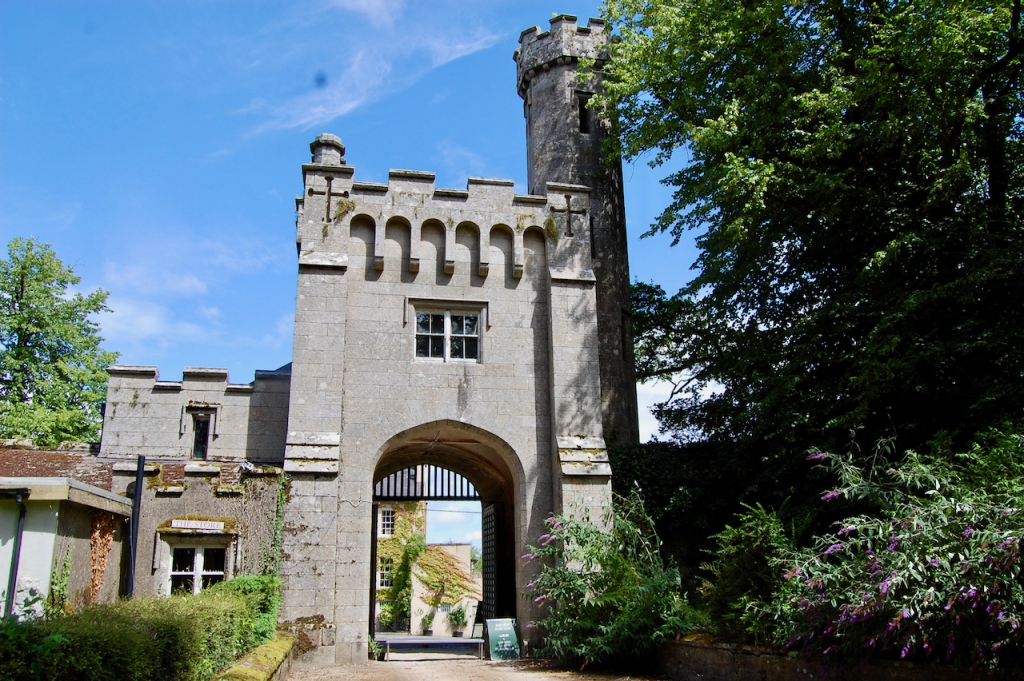
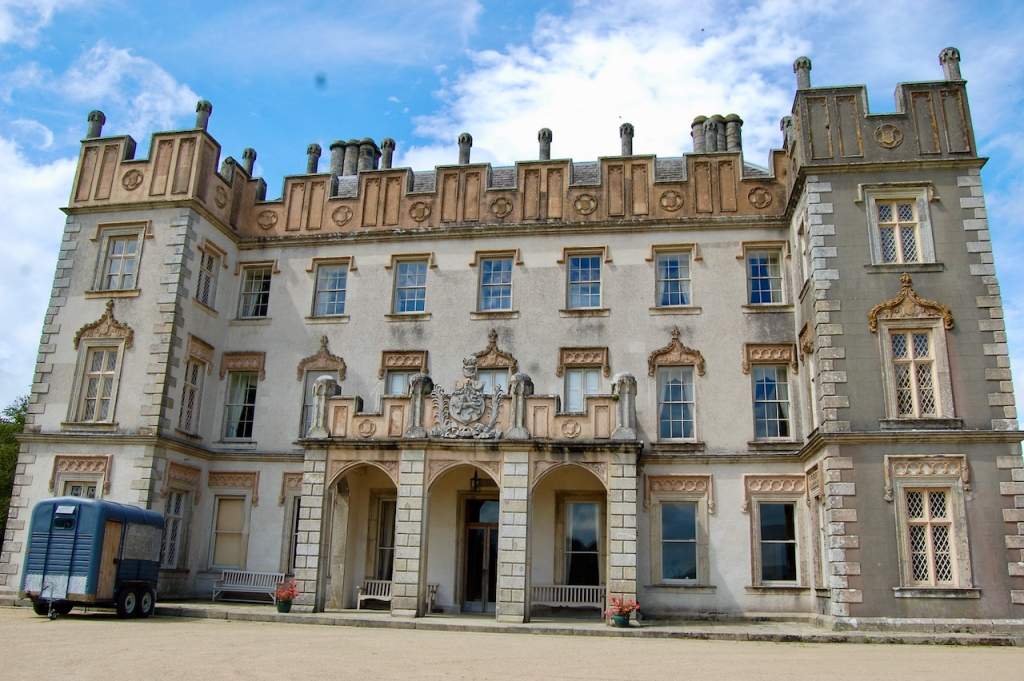
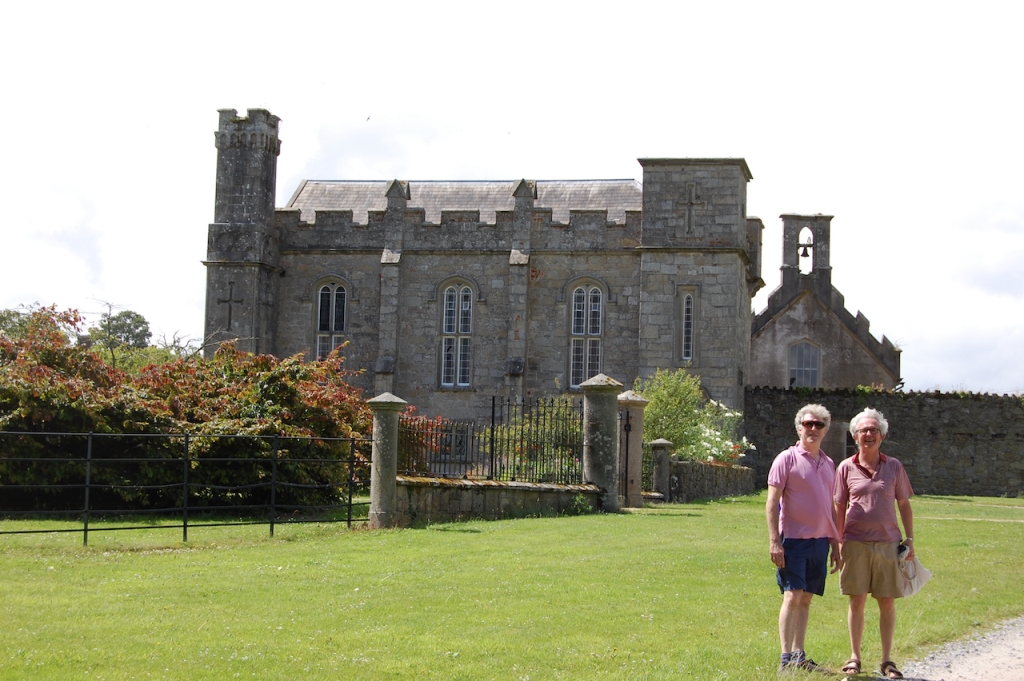
We brought our friend Damo along with us – here he is with Stephen at the entrance arch. The National Inventory of Architectural Heritage tells us that this entrance was designed by Richard Morrison, around 1813. It has an arch opening with crenellations, flanking turrets and buttressed walls. There’s a portcullis and fabulous studded door. The towers have blind arrow slits including a cruciform arrow slit, and there’s a small Gothic window with hood moulding. [1] Photograph © Jennifer Winder-Baggot, www.irishhistorichouses.com
A view of the arched entrance from inside the demesne. Photograph © Jennifer Winder-Baggot, www.irishhistorichouses.com

Unlike other section 482 houses – with the few exceptions such as Birr Castle and Tullynally – Borris House has a very professional set-up to welcome visitors as one goes through the gate lodge. The website does not convey this, as it emphasises the house’s potential as a wedding venue, but the property is in fact fully set up for daily guided tours, and has a small gift shop in the gate lodge, through which one enters to the demesne. Borris House is still a family home and is inhabited by descendants of the original owners.

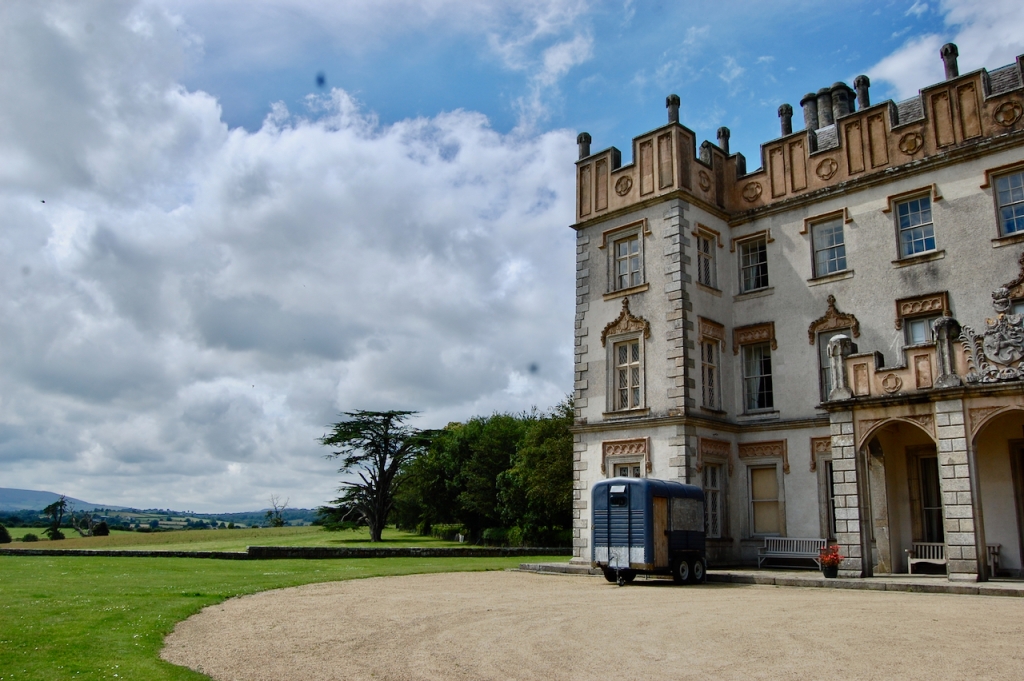
Approach to the front of the house from the gate lodge. Photograph © Jennifer Winder-Baggot, www.irishhistorichouses.com
Standing at the front of the house looking to our left at the beautiful landscape. Photograph © Jennifer Winder-Baggot, www.irishhistorichouses.com

Originally a castle would have been located here on the River Barrow to guard the area. From the house one can see Mount Leinster and the Blackstairs Mountains.

The current owner Morgan Kavanagh can trace his ancestry back to the notorious Dermot MacMurrough (Diarmait mac Murchadha in Irish), who “invited the British in to Ireland” or rather, asked for help in protecting his Kingship. The MacMurroughs, or Murchadhas, were Celtic kings of Leinster. “MacMurrough” was the title of an elected Lord. Dermot pledged an oath of allegiance to King Henry II of Britain. The Norman “Strongbow,” or Richard de Clare, 2nd Earl of Pembroke, came to Ireland to fight alongside Dermot MacMurrough against Dermot’s enemies. As a reward, Dermot MacMurrough offered Strongbow the hand of his daughter Aoife. This was less a love match than a chance to become the next King of Leinster. Succeeding generations of MacMurrough family controlled the area, maintaining their Gaelic traditions.

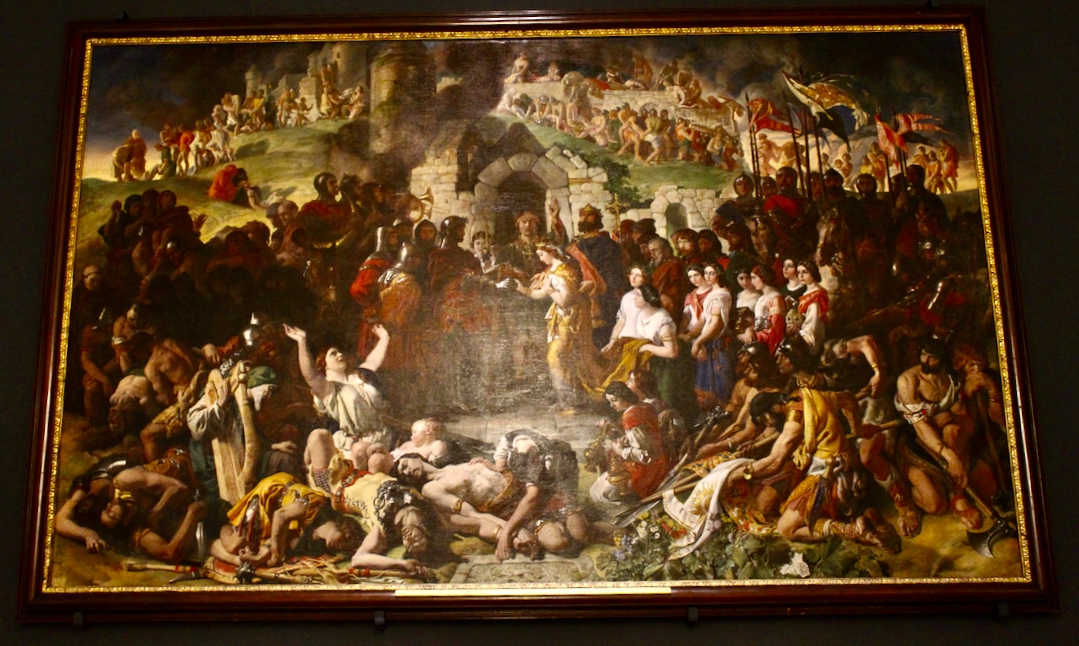
The Marriage of Aoife and Strongbow, Richard de Clare 2nd Earl of Pembroke at Waterford in 1170, by Daniel Maclise, in National Gallery of Ireland. Conceived for the decoration of the Palace of Westminster, a note tells us, the painting is an ambiguous representation of the victorious Normans and the vanquished Irish. Strongbow places his foot upon a fallen Celtic cross, King Dermot looks on in alarm, and an elderly musician slumps of his harp.

Timothy William Ferres tells us that in 1171, the name Kavanagh was given to Donell, son of Dermot MacMorrough. [1*]

In the late 14th century, Art mac Murchadha (d. around 1417) was one of the Irish kings who was offered a knighthood by King Richard II of England. In the 1500s, King Henry VIII sought to reduce the power of the Irish kings and to have them swear loyalty to him. In 1550 Charles MacMurrough Kavanagh (the Anglicised version of the name ‘Cahir MacArt’ MacMurrough Kavanagh) “submitted himself, and publicly renounced the title and dignity of MacMorrough, as borne by his ancestors.” [2] (note the various spellings of MacMorrough/MacMurrough). The head of the family was still however referred to as “the MacMorrough.”

We gathered with a few others to wait outside the front of the house for our tour guide on a gloriously sunny day in July 2019. Some of the others seemed to be staying at the house. For weddings there is accommodation in the house and also five Victorian cottages. We did not get to see these in the tour but you can see them on the website. Unfortunately our tour guide was not a member of the family but she was knowledgeable about the house and its history.

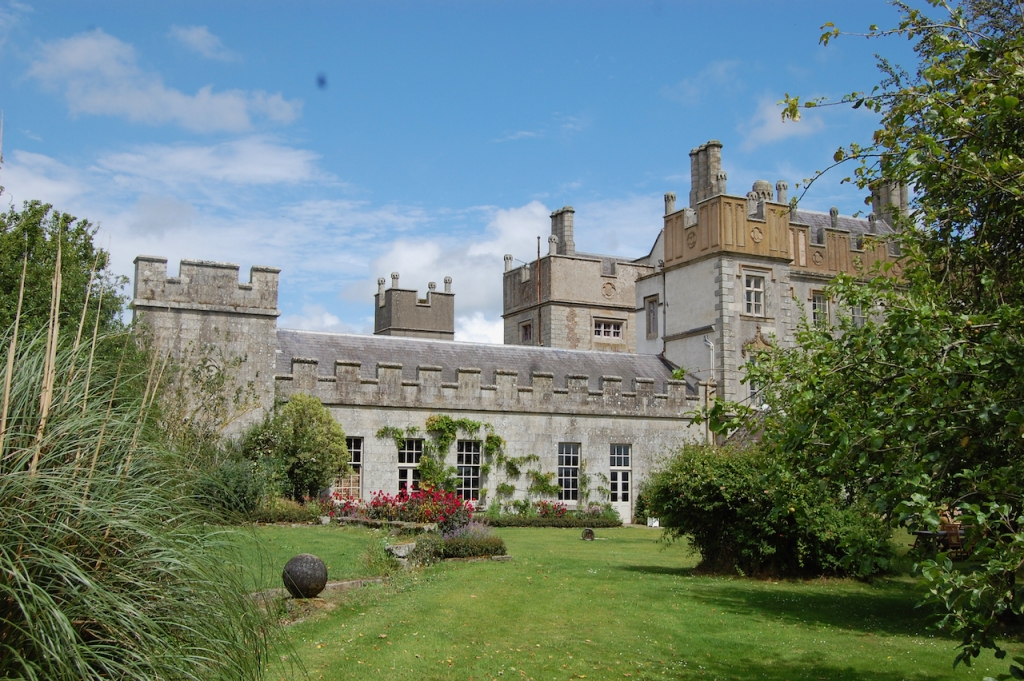
The current house was built originally as a three storey square house in 1731, incorporating part of a fifteenth century castle. We can gather that this was the date of completion of the house from a carved date stone.

According to the Borris House website, the 1731 house was built for Morgan Kavanagh, a descendant of Charles MacMurrough Kavanagh. However, I have the date of 1720 as the death for Morgan Kavanagh. Irish Aesthete Robert O’Byrne writes that the 1731 house was built by Brian Kavanagh. [3] Morgan Kavanagh has a son named Brian (d. 1741), so it could be the case that the house was commissioned by Morgan and completed by his son.

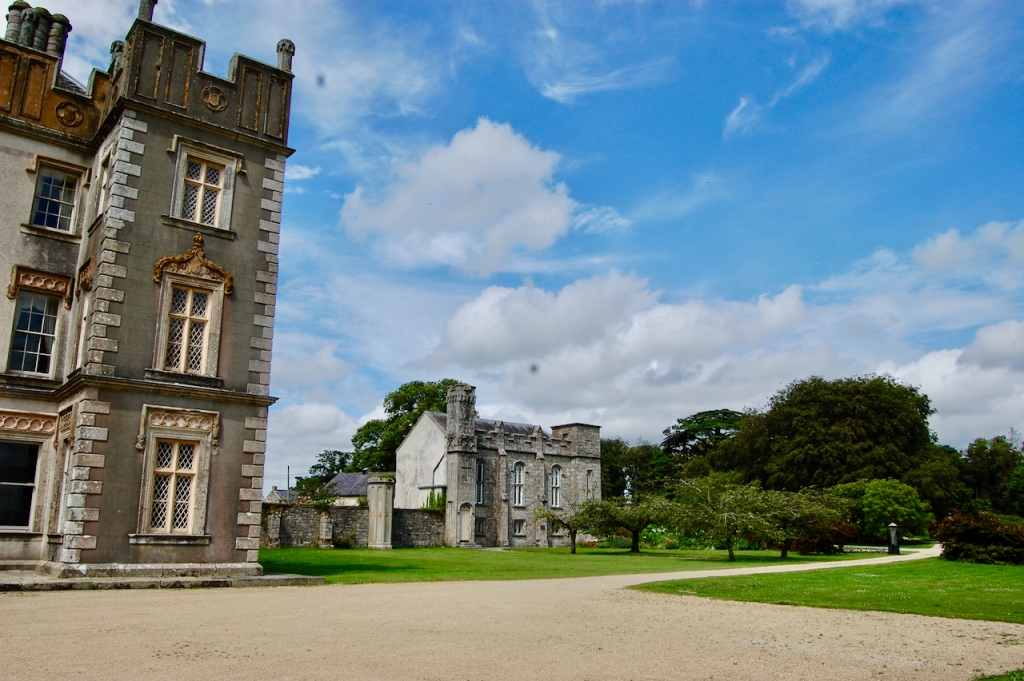
The house was damaged in the 1798 Rebellion and rebuilt and altered by Richard and William Vitruvius Morrison around 1813 into what one sees today. According to Edmund Joyce in his book Borris House, Co. Carlow, and elite regency patronage, it was Walter Kavanagh, grandson of the aforementioned Brian (d. 1741) who commissioned the work, which was taken over by brother Thomas (1767-1837) when Walter died in 1818. [4]. The Morrisons gave it a Tudor exterior although as Mark Bence-Jones points out in his Guide to Irish Country Houses, the interiors by the Morrisons are mostly Classical.

Borris House, July 2019. Photograph © Jennifer Winder-Baggot, www.irishhistorichouses.com

The Morrisons kept the original square three storey building symmetrical. Edmund Joyce references McCullough, Irish Building Traditions, writing that “The Anglo-Irish landlords at the beginning of the 19th century who wanted to establish a strong family history with positive Irish associations were beginning to use the castle form – which had long been a status of power both in Ireland and further afield – to embed the notion of a long and powerful lineage into the mindset of the audience.”

In keeping with this castle ideal, the Morrisons added battlemented parapets with finials, the crenellated arcaded porch on the entrance, as well as four square corner turrets to the house, topped with cupolas (which are no longer there). The porch has slightly pointed arches, and is unusual with its bricklike rustication, and elongated mini towers on top with tawny detailing in between, reflected in the roof parapet.

Borris House, July 2019. Photograph © Jennifer Winder-Baggot, www.irishhistorichouses.com

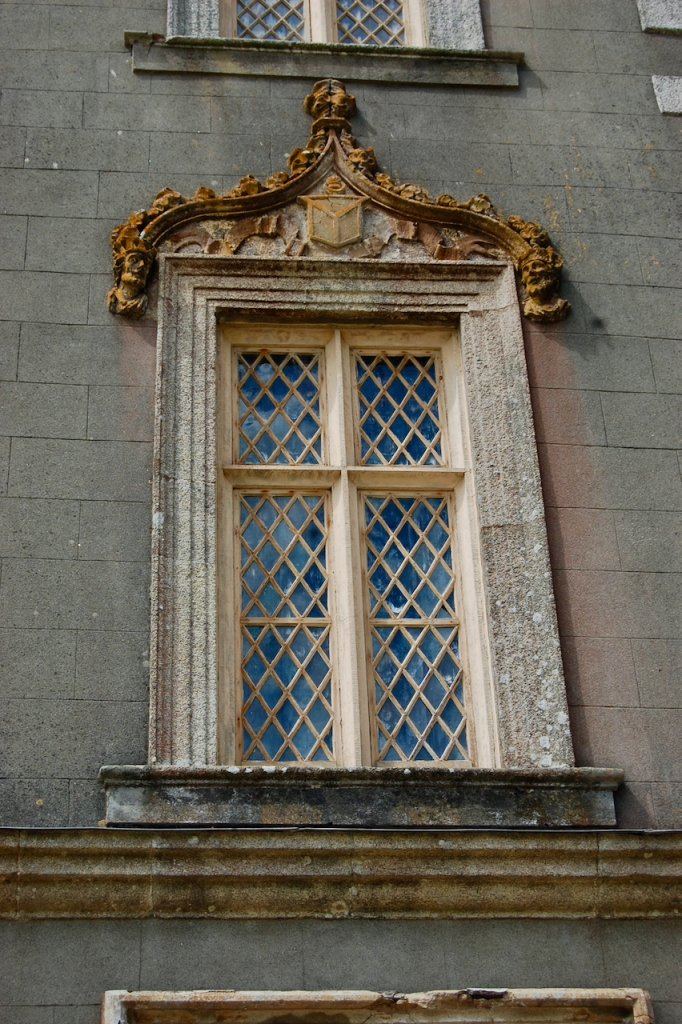
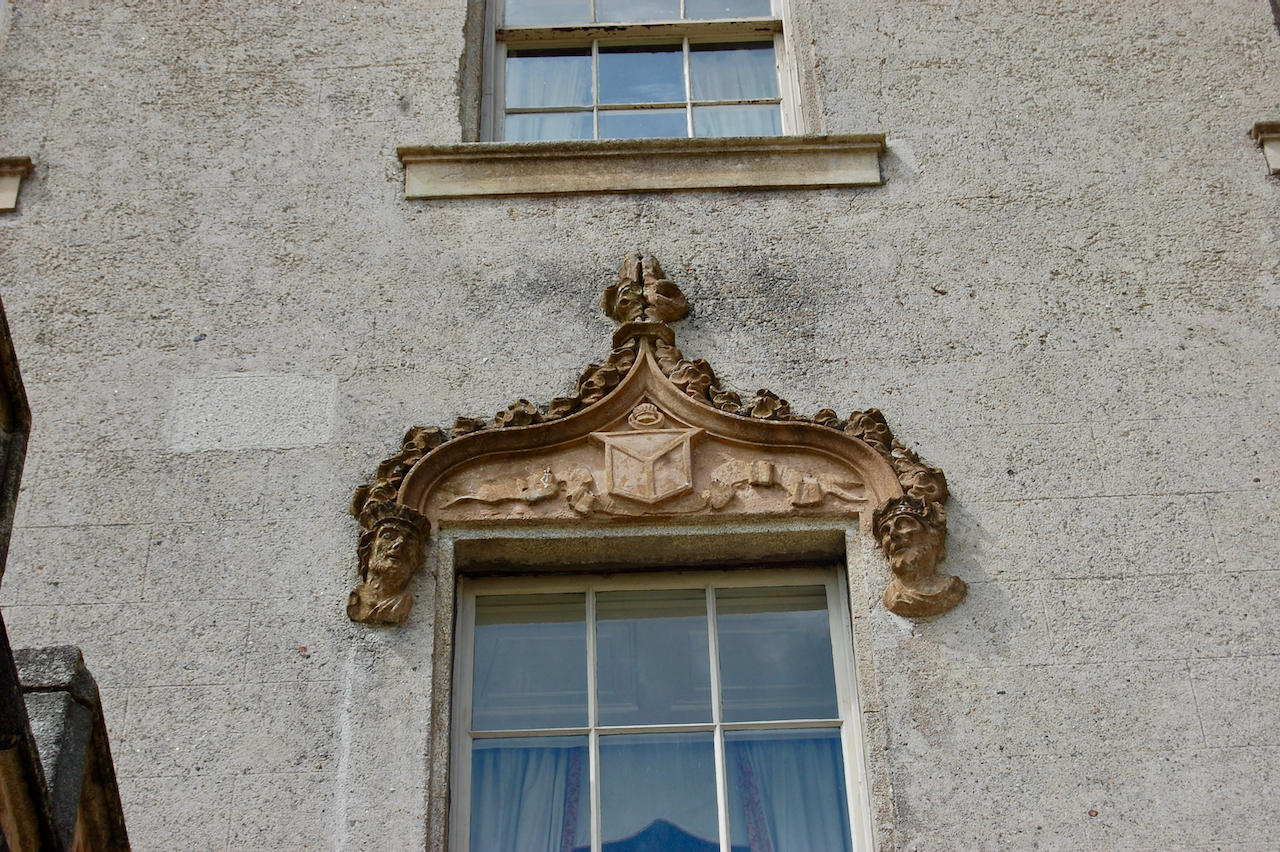
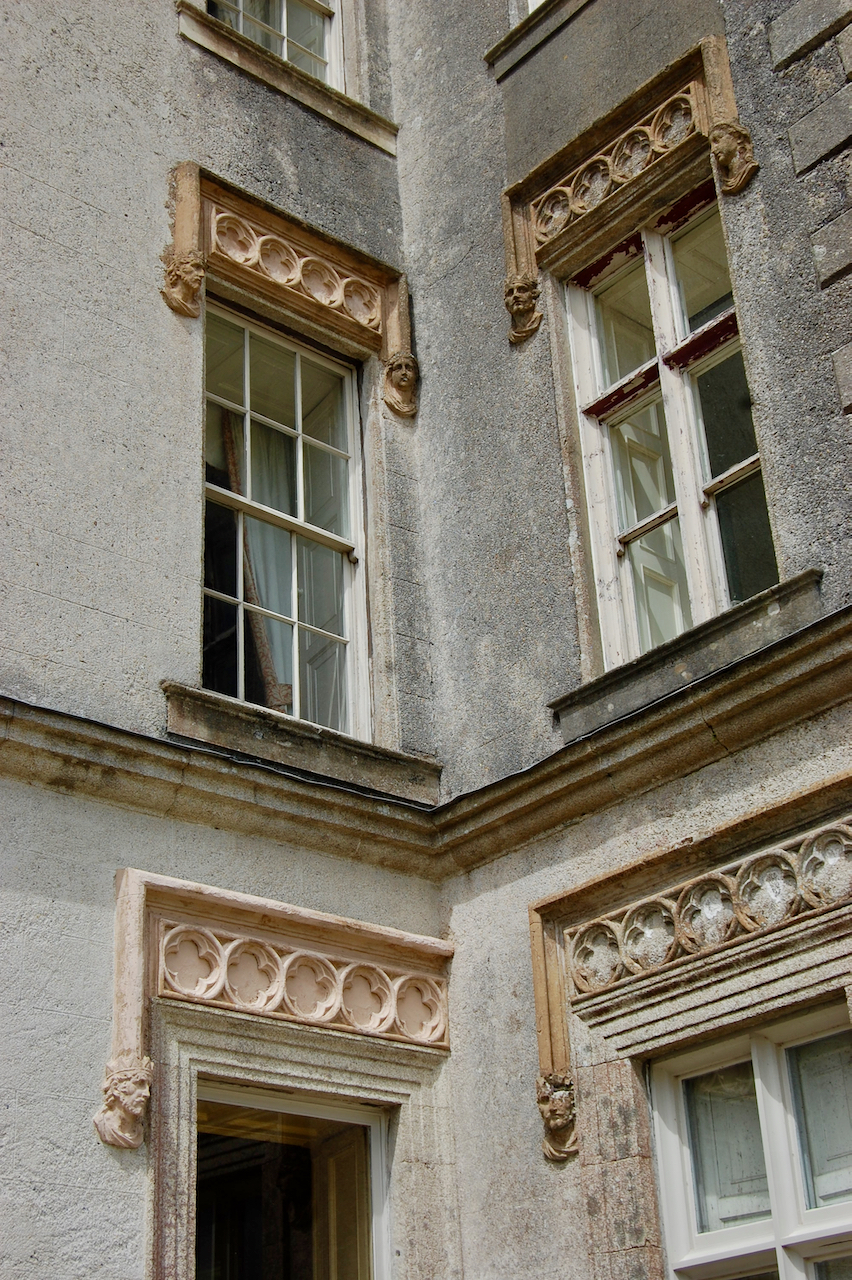
They also created rather fantastical Tudor Gothic curvilinear hood mouldings over the windows, some “ogee” shaped (convex and concave curves; found in Gothic and Gothic-Revival architecture) [5].

An ogee shaped hood moulding. Photograph © Jennifer Winder-Baggot, www.irishhistorichouses.com
Borris House, July 2019. Photograph © Jennifer Winder-Baggot, www.irishhistorichouses.com

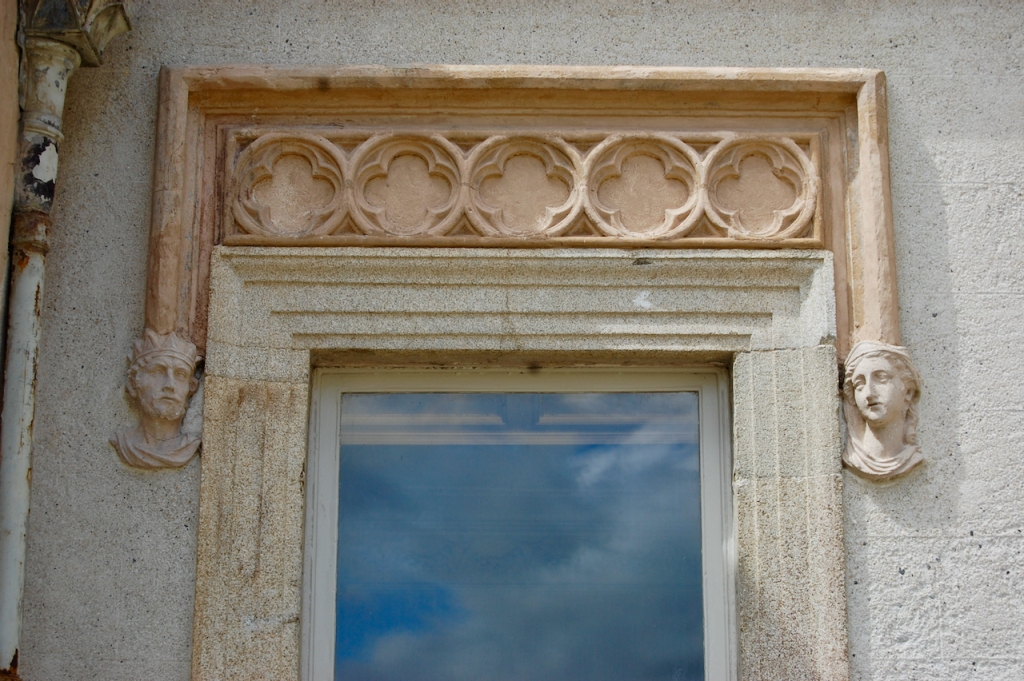
These mouldings drop down from the top of the windows to finish with sculptured of heads of kings and queens. These are not representations of anyone in particular, the guide told us, but are idealised sculptures representing royalty to remind one of the Celtic kingship of the Kavanaghs.

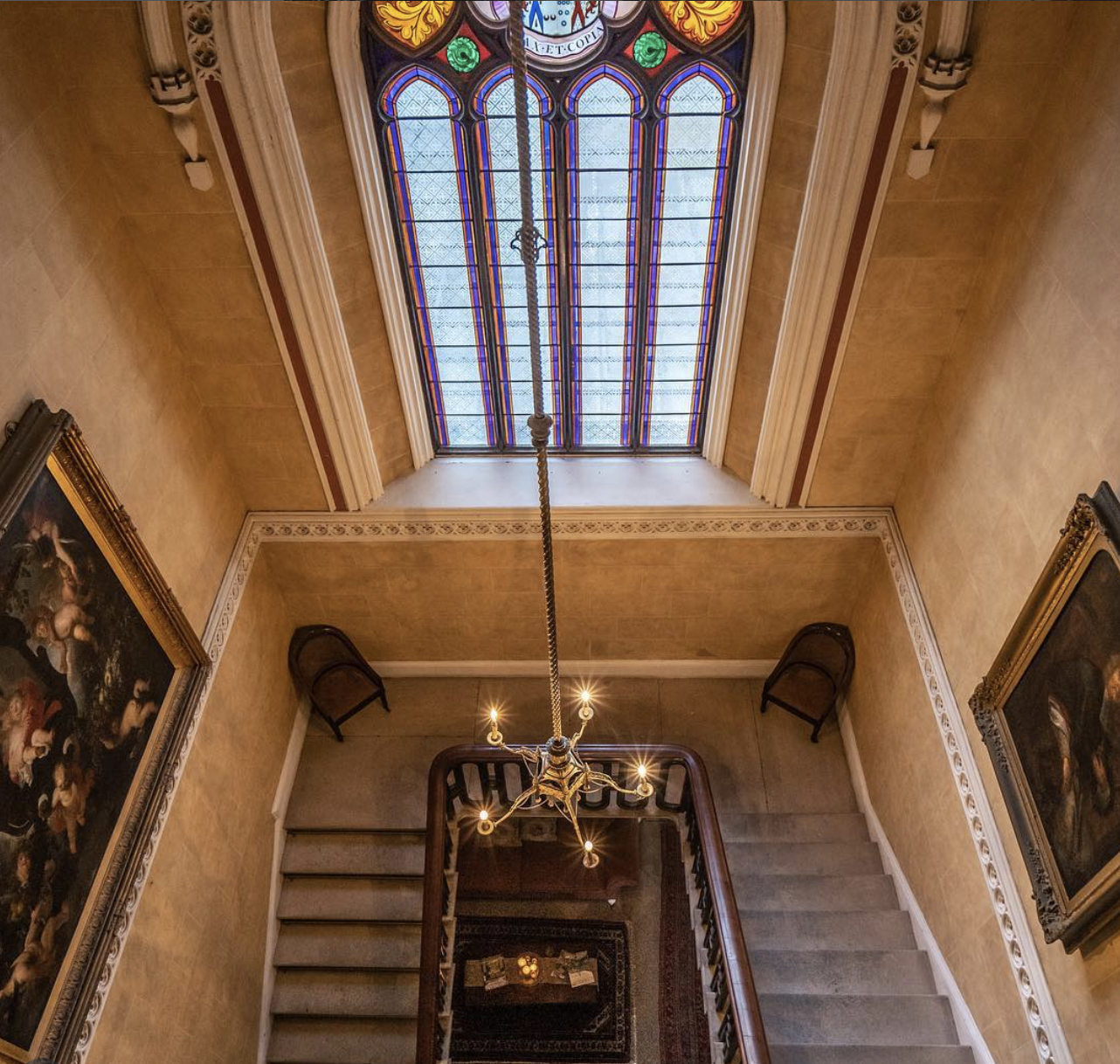
As well as illustrating their heritage in architecture, Walter Kavanagh (d. 1718) commissioned an illustrated book of the family pedigree, titled “The pedigree of the ancient illustrious noble and princely house of Kavanagh in ancient times monarchs of Ireland and at the period of the invasion by Henry the second, kings of Leinster,” which traces the family tree back to 1670 BC! The connections to the prominent families of Butlers, Fitzjohns, De Mariscos and FitzGeralds are highlighted, which are also illustrated in the stained glass window in the main stairwell at Borris.

Borris House, 2019. Photograph © Jennifer Winder-Baggot, www.irishhistorichouses.com
The stairwell in Borris House, with the stained glass window which records some of the genealogy of the Kavanaghs. Photograph courtesy of Borris House instagram, by @1darmar

The guide pointed to the many configurations of windows on the front facade of the house. They were made different deliberately, she told us, to create the illusion that the different types of windows are from different periods, even though they are not! This was to reflect the fact that various parts of the building were built at different times.

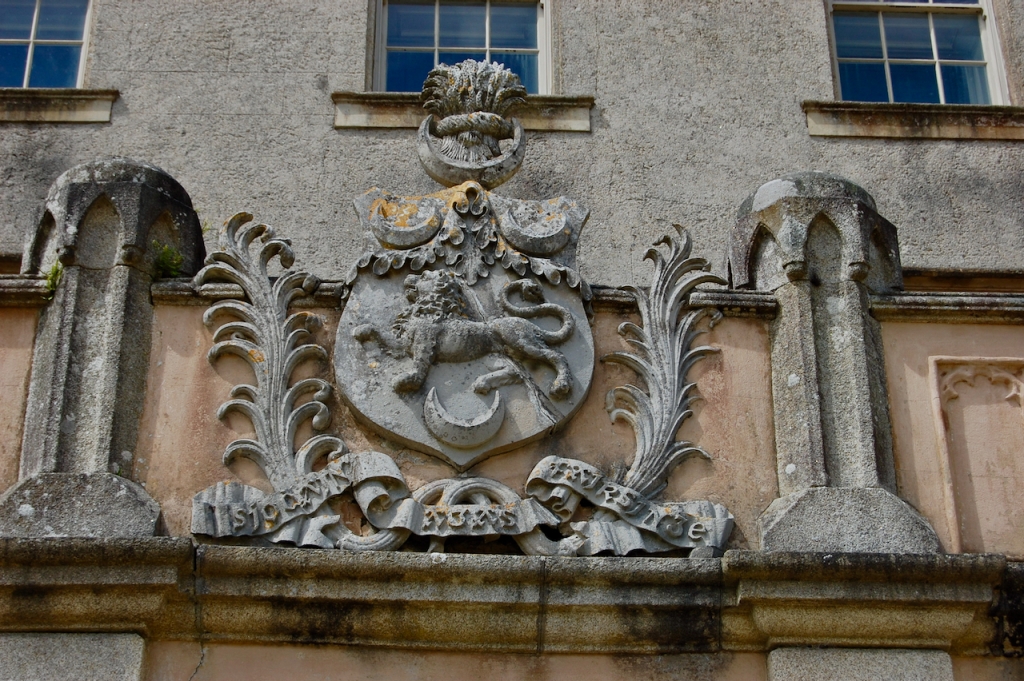
The crest of the family on the front of the house on the portico features a crescent moon for peace, sheaf of wheat for plenty and a lion passant for royalty. The motto is written in Irish, to show the Celtic heredity of the Kavanaghs, and means “peace and plenty.”

Borris House, July 2019. Photograph © Jennifer Winder-Baggot, www.irishhistorichouses.com

The Morrisons also added a castellated office wing, joining the house to a chapel. This wing has been partially demolished.

View of the chapel from the front of the house, and beyond, the path leads to the gate lodge. In between the chapel and the house you can see the wall which once housed the kitchen, with the octagonal chimney stack built into the wall. Photograph © Jennifer Winder-Baggot, www.irishhistorichouses.com

Charles MacMurrough Kavanagh married Cecilia, daughter of Gerald Fitzgerald, 9th Earl of Kildare. Charles’s son Brian (c. 1526-1576) converted to Protestantism and sent his children to be educated in England. One of them, Sir Morgan Kavanagh, acquired the estate of Borris when he was granted the forfeited estates of the O’Ryans of Idrone in County Carlow.

When Protestants were attacked in 1641 by a Catholic rebellion, when Morgan’s son Brian (1595-1662) was “The MacMorrough,” the MacMurrough Kavanaghs were spared due to their ancient Irish lineage. Later, when Cromwell rampaged through Ireland, they were spared since they were Protestant, so they had the best of both worlds during those turbulent times.

Borris House, July 2019. Photograph © Jennifer Winder-Baggot, www.irishhistorichouses.com

Brian Kavanagh (1595-1662) married twice. His first wife was Elinor, daughter of Thomas Colclough of Tintern Abbey in County Wexford. His second wife was Elinor Blancheville of Blanchevillestown in County Kilkenny.

The tour guide took us first towards the chapel. She explained the structure of the house as we trooped across the lawn. She pointed out the partially demolished stretch between the square part of the house and the chapel. All that remains of this demolished section is a wall. The octagonal towerlike structures built into the wall were chimneys and the demolished part was the kitchen.

Side of Borris House with the chapel in the foreground. Photograph © Jennifer Winder-Baggot, www.irishhistorichouses.com
In this photograph, from Shane Prunty Weddings and the Borris House instagram page, you can see the remaining wall of the extension between the house and the chapel.
Side of Borris House, with the later wing that was added, that stretches toward the chapel. Photograph © Jennifer Winder-Baggot, www.irishhistorichouses.com

The square tower that joins the house to the demolished kitchen contained the nursery. The wing was demolished to reduce the amount of rates to be paid. The house was reoriented during rebuilding, the guide told us, and a walled garden was built with a gap between the walls which could be filled with coal and heated! I love learning of novel mechanisms in homes and gardens, techniques which are no longer used but which may be useful to resurrect as we try to develop more sustainable ways of living (not that we’d want to go back to using coal).

The square tower contained the nursery, the guide told us. Photograph © Jennifer Winder-Baggot, www.irishhistorichouses.com

It is worth outlining some of the genealogy of this ancient family, as they intermarried with many prominent families of their day. Morgan Kavanagh (1668-1720) who probably commissioned the building of the 1730s house married Frances Esmonde, daughter of Laurence Esmonde (1634-1688) 2nd Baronet of Ballynastragh, County Wexford, who lived at Huntington Castle (another section 482 property I visited). After her death, he married Margaret Morres of Castle Morres in County Kilkenny.

Morgan and Frances née Esmonde’s son Brian (1699-1741) married Mary Butler, daughter of Thomas Butler (d. 1738) of Kilcash. Their son Thomas (1727-1790) married another Butler, Susanna, daughter of the 16th Earl of Ormonde.

It was the following generation, another Thomas (1767-1837), who is relevant to our visit to the chapel.

This Thomas (1767-1837) was originally a Catholic. He married yet another Butler, Elizabeth, daughter of the 17th Earl of Ormonde, in 1799. At some time he converted to Protestantism. It must have been before 1798 because in that year he represented Kilkenny City in Parliament and at that time only members of the Established Church could serve in Parliament.

As I mentioned, the house was badly damaged in 1798, when the United Irishmen rose up in an attempt to create an independent Ireland. Although the Kavanaghs are of Irish descent and are not a Norman or English family, this did not save them from the 1798 raids. The house was not badly damaged in a siege but outbuildings were. The invaders were looking for weapons inside the house, the guide told us. Robert O’Byrne the Irish Aesthete writes tells us: “Walter MacMurrough Kavanagh wrote to his brother-in-law that although a turf and coal house were set on fire and efforts made to bring ‘fire up to the front door under cover of a car on which were raised feather beds and mattresses’ [their efforts] were unsuccessful.” [6]

Edmund Joyce describes the raid in his book on Borris House (pg. 21-22):

“The rebels who had marched overnight from Vinegar Hill in Wexford…arrived at Borris House on the morning of 12 June. They were met by a strong opposing group of Donegal militia, who had taken up their quarters in the house. It seems that the MacMurrough Kavanaghs had expected such unrest and in anticipation had the lower windows…lately built up with strong masonry work. Despite the energetic battle, those defending the house appear to have been indefatigable, and the rebels, ‘whose cannons were too small to have any effect on the castle…’ the mob retreated back to their camps in Wexford.”

The estate was 30,000 acres at one point, but the Land Acts reduced it in the 1930s to 750 acres, which the present owner farms organically. The outbuildings which were built originally to house the workings of the house – abbatoir, blacksmith, dairy etc, were burnt in one of the sieges and so all the outbuildings now to be seen, the guide told us, were built in the nineteenth century.

Walter Kavanagh (1766-1813), brother of Thomas (1767-1837) (M.P.) and Morgan Kavanagh (who married Alicia Grace of Gracefield, Queens County). Courtesy Fonsie Mealy March 2019.

Thomas’s second wife, Harriet Le Poer Trench, daughter of the 2nd Earl of Clancarty, was of staunch Scottish Protestant persuasion [7]. When he converted, the chapel had to be reconsecrated as a Protestant chapel. According to legend, Lady Harriet had a statue of the Virgin Mary removed from the chapel and asked the workmen to get rid of it. The workmen, staunch Catholics, buried the statue in the garden. People believed that for this act, Lady Harriet was cursed, and it was said that one day her family would be “led by a cripple.”

The story probably came about because Harriet’s third son, Arthur, was born without arms or legs. As she had given birth to two older sons, and he had another half-brother, Walter, son of Thomas’s first wife, it seemed unlikely that Arthur would be the heir. However, the three older brothers all died before Arthur and Arthur did indeed become the heir to Borris House.

Arthur MacMorrough Kavanagh, M.P., (1831-1839), Politician and Sportsman Date after 1889 Engraver Morris & Co. Photograph courtesy of the National Gallery of Ireland.

The plasterwork in the chapel, which is called the Chapel of St. Molin, is by Michael Stapleton.

Borris House, July 2019. Photograph © Jennifer Winder-Baggot, www.irishhistorichouses.com

In Jimmy O’Toole’s book The Carlow Gentry: What will the neighbours say! (published by Jimmy O’Toole, Carlow, Ireland, 1993. Printed by Leinster Leader Ltd, Naas, Kildare), he tells us of a rather miraculous finding of a Bible giving evidence of Thomas’s early Catholicism:

p. 130. “In the early 1950s, Borris House needed an electrical rewire. It was the kind of job in this rambling mansion that would take tradesmen into all sorts of unused nooks and crannies, attics untouched since the last electricians were there, and of course, there was the necessary task, dreaded by owners, the lifting of floor boards…What the electricians turned up from underneath the floor boards in the library of borris House was an 18C missal, which had been carefully wrapped and placed there by the Catholic Thomas Kavanagh either when he conformed to the Established Church, or when he married for the second time in 1825. The missal was a gift from his mother, the former Lady Suzanna Butler, bearing the hopeful inscription that he would remain faithful to the Catholic religion practised for centuries by his forebears, who could trace their ancestry back to early Christian times.” 

Jimmy O’Toole also tells us that Borris House stands on 9th century dungeons!

While we sat in the chapel, our guide told us about the amazing Arthur MacMurrough Kavanagh. When her husband Walter died, Harriet and her children went travelling. They travelled broadly, and she painted, and collected objects which she brought back to Ireland, including a collection of artefacts from Egypt now in the National Museum of Ireland. When Arthur was 17 years old his mother sent him travelling again, to get him away from his high jinks with the local girls. Arthur kept diaries, which are available for perusal in the National Library. I must have a look! I have a special interest in diaries, since I have been keeping my own since I was twelve years old. Some of Arthur’s adventures include being captured and being cruelly put on display by a tribe. He also fell ill and found himself being nursed back to health in a harem – little did the Sultan or head of the harem realise that Arthur was perfectly capable of impregnating the ladies!

Arthur’s brother and tutor died on their travels and Arthur found himself alone in India. He joined the East India Company as a dispatch rider – he was an excellent horseman, as he could be strapped in to a special saddle, which we saw inside the house, now mounted on a children’s riding horse! I was also thrilled to see his wheelchair, in the Dining Room, which is now converted into a dining chair.

Arthur MacMurrough’s saddle in mounted on the rocking horse. Photograph by Paul Barker, 2011, for Country Life.

When Arthur came home as heir, he found his mother had set up a school of lacemaking, now called Borris Lace, to help the local women to earn money during the difficult Famine years. The lace became famous and was sold to Russian and English royalty. The rest of the estate, however, was in poor shape. Arthur set about making it profitable, bringing the railway to Borris, building a nearby viaduct, which cost €20,000 to build. He also built cottages in the town, winning a design medal from the Royal Dublin Society, and he set up a sawmill, from which tenants were given free timber to roof their houses. He set up limekilns for building material, and also experimented (unsuccessfully) with “water gas” to power the crane used to built the viaduct. His mother built a fever house, dower house and a Protestant school, and Arthur’s sisters built a Catholic school. There is a little schoolhouse (with bell) behind the chapel.

Borris House, July 2019. Photograph © Jennifer Winder-Baggot, www.irishhistorichouses.com

Arthur seems to have had a great sense of humour. On one of his visits to Abbeyleix, he remarked to Lady De Vesci, “It’s an extraordinary thing – I haven’t been here for five years but the stationmaster recognised me.”

Arthur married Mary Frances Forde-Leathley and fathered six children. He became an MP for Carlow and Kilkenny, and sat in the House of Commons in England, which he reached by sailing as far as London, where he was then carried in to the houses of Parliament.

He lost when he ran again for Parliament in 1880, beaten by the Home Rule candidates. He returned from London after his defeat and saw bonfires, which were often lit by his tenants to celebrate his return. However, this time, horrifically, he saw his effigy being burned on the bonfires by tenants celebrating the triumph of the Home Rule candidates. He must have been devastated, as he had worked so hard for his tenants and treated them generously. For more about him, see the Irish Aesthete’s entry about him. [8]

Borris House, July 2019. Photograph © Jennifer Winder-Baggot, www.irishhistorichouses.com

Jimmy O’Toole’s book gives a detailed description of politics at the time of Arthur’s defeat and explains why the tenants behaved in such a brutal way. Elections grew heated and dangerous in the days of the Land League and of Charles Stewart Parnell, when tenants hoped to own their own land. In the 1841 election, tenants of the Kavanaghs were forced to vote for the Tory candidate against Daniel O’Connell Jr., despite a visit from Daniel O’Connell Sr, “The Liberator” who fought for Catholic emancipation.

The land agent for the Kavanaghs, Charles Doyne, threatened the tenants with eviction if they did not vote for his favoured candidate. In response to threats of eviction, members of the Land League forced tenants to support their cause by publicly shaming anyone who dared to oppose them. People were locked into buildings to prevent them from voting, or on the other hand, were locked in to protect them from attacks which took place if they planned to support the Tory candidate. Not all Irish Catholics supported the Land League. Labourers realised that landlords provided employment which would be lost if the land was divided for small farmers.

Borris House, July 2019. Photograph © Jennifer Winder-Baggot, www.irishhistorichouses.com

It was Arthur’s grandfather, Thomas (b. 1727), who undertook much of the renovation work at Borris in the 1800s, with money brought into the family by his wife, Susanna Butler. [9] Under her influence, Italian workmen were employed and ceilings were decorated and Scagliola pillars installed. After hearing the stories about amazing Arthur, we returned across the lawn to enter the main house.

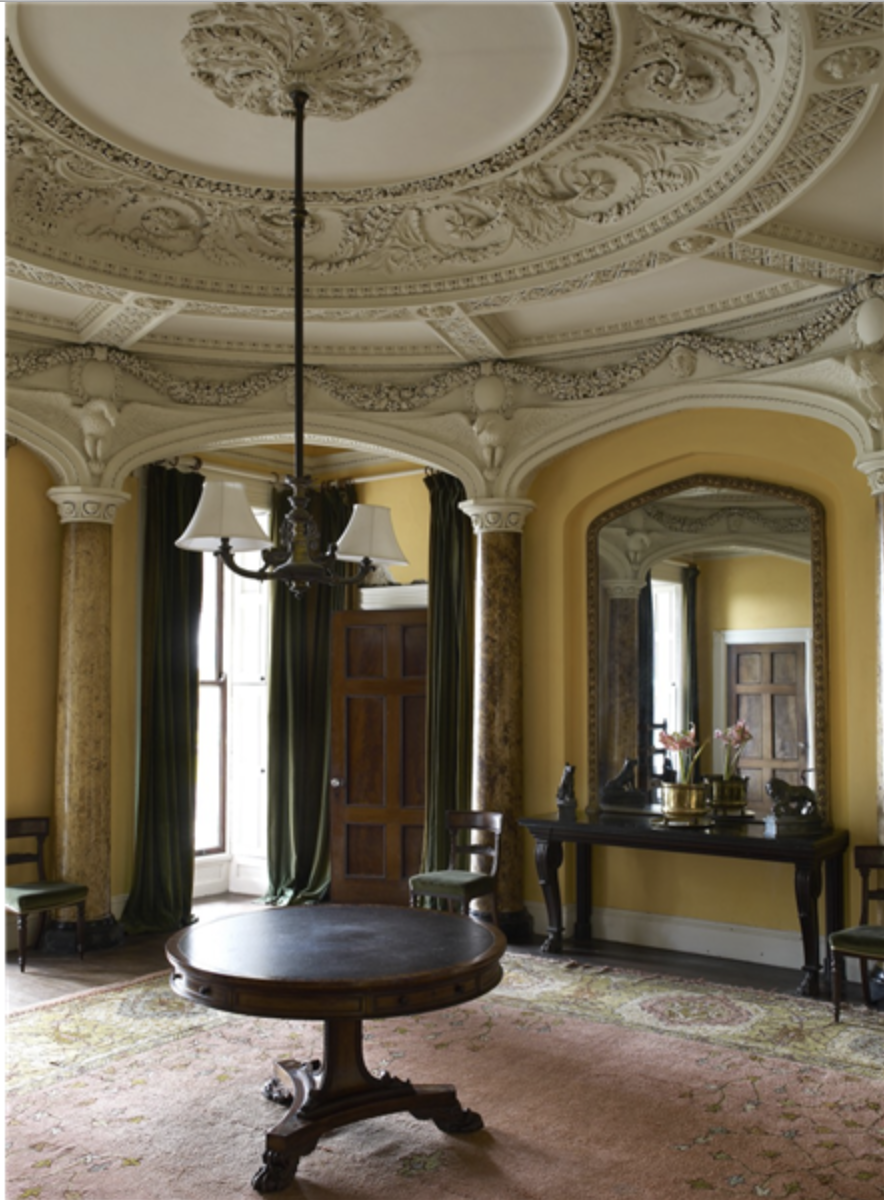
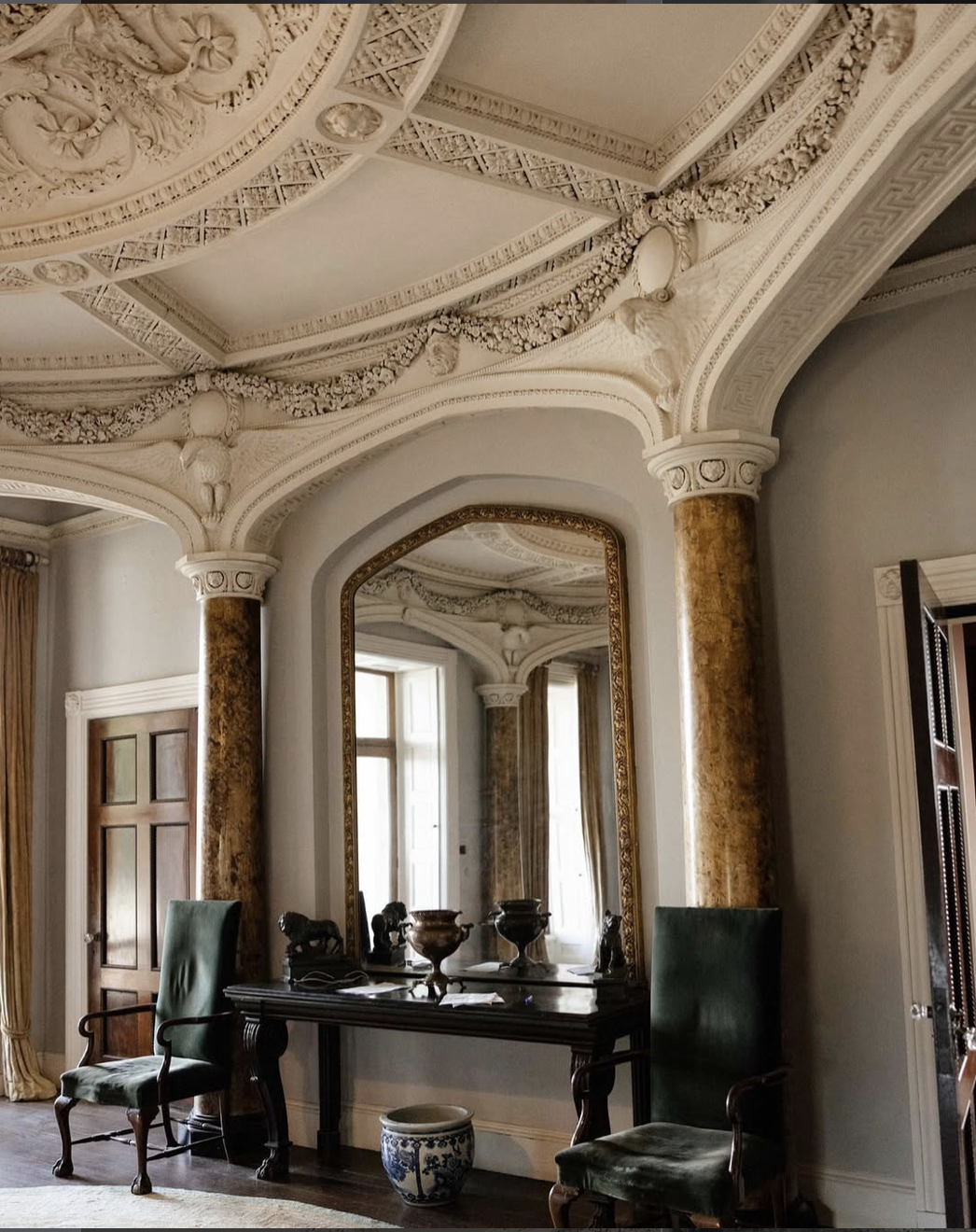
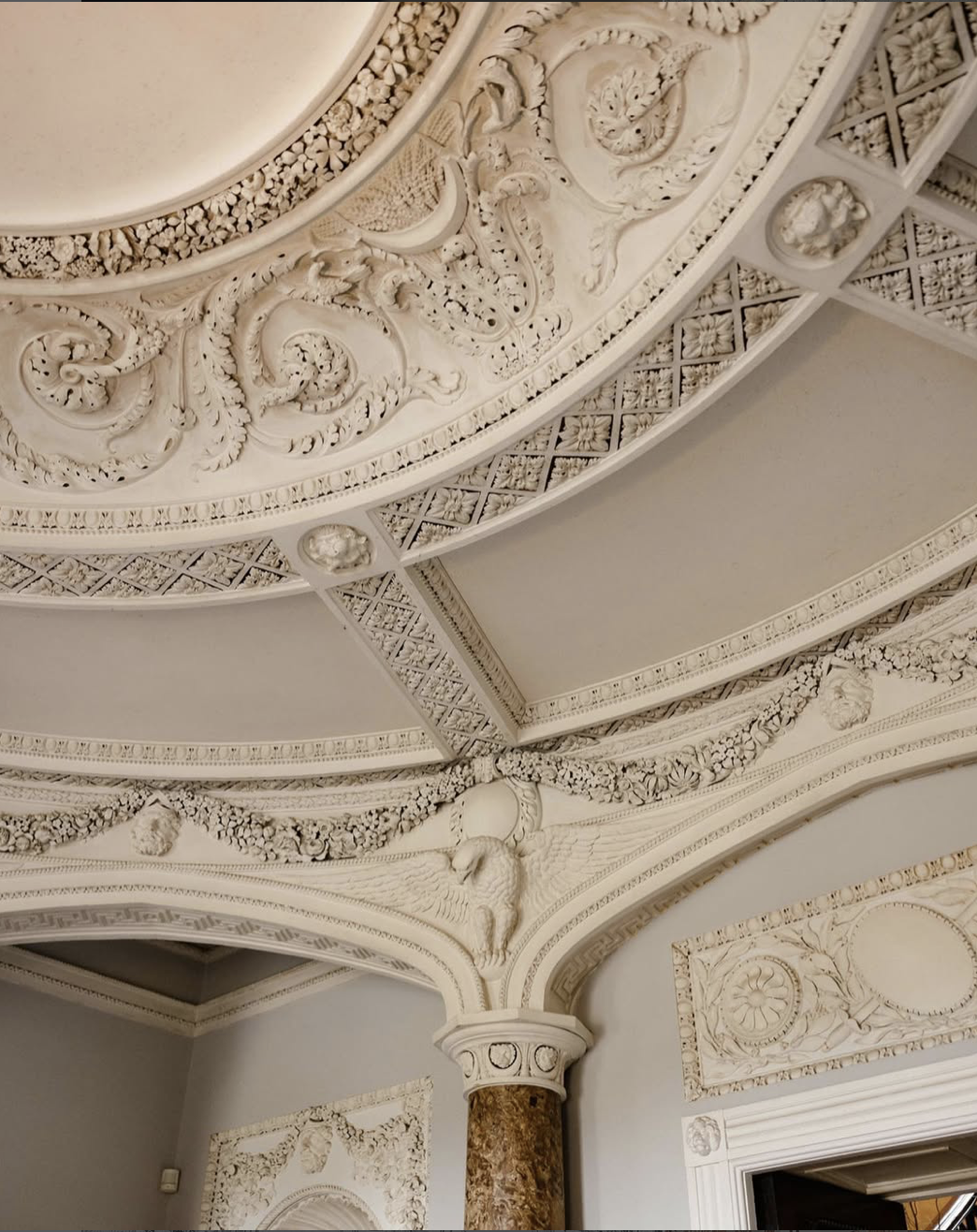
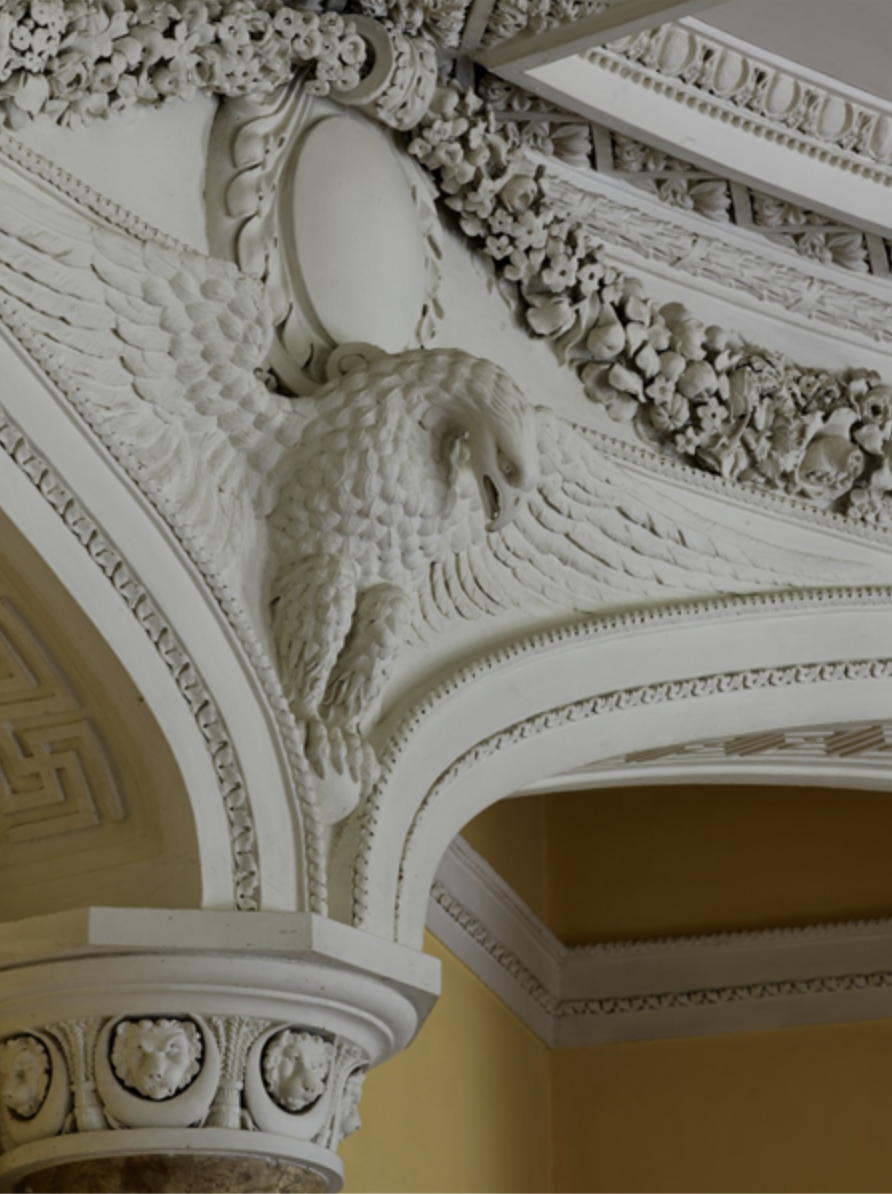
The front hall is square but is decorated with a circular ceiling of rich plasterwork, “treated as a rotunda with segmental pointed arches and scagliola columns; eagles in high relief in the spandrels of the arches and festoons above,” as Mark Bence-Jones describes in his inimitable style [see 5, p. 45]. We were not allowed to take photographs but the Irish Aesthete’s site has terrific photographs [see 3]. The eagles represent strength and power. There are also the sheafs of wheat, crescent moons and lion heads, symbols from the family crest. Another common motif in the house is a Grecian key pattern.

Photograph by Paul Barker, 2011, from Country Life picture library.
Borris House front hall, photograph from Borris House instagram, @karinalee.studio
Photograph by Paul Barker, 2011, from Country Life picture library.

The craftwork and furnishings of the house are all built by Irish craftsmen, including mahogany doors. There is a clever vent in the wall that brings hot air from the kitchens to heat the room.

We next went into the music room which has a beautiful domed oval ceiling with intricate plasterwork. It includes the oak leaf for strength and longevity.

The drawing room has another pretty Stapleton ceiling, more feminine, as this was a Ladies’ room. It has lovely pale blue walls, and was originally the front entrance to the house. When it was made into a circular room the leftover bits of the original rectangular room form small triangular spaces, which were used as a room for preparing the tea, a small library with a bookcase, and a bathroom. The curved mahogany doors were also made by Irish craftsmen in Dublin, Mack, Williams and Gibton.

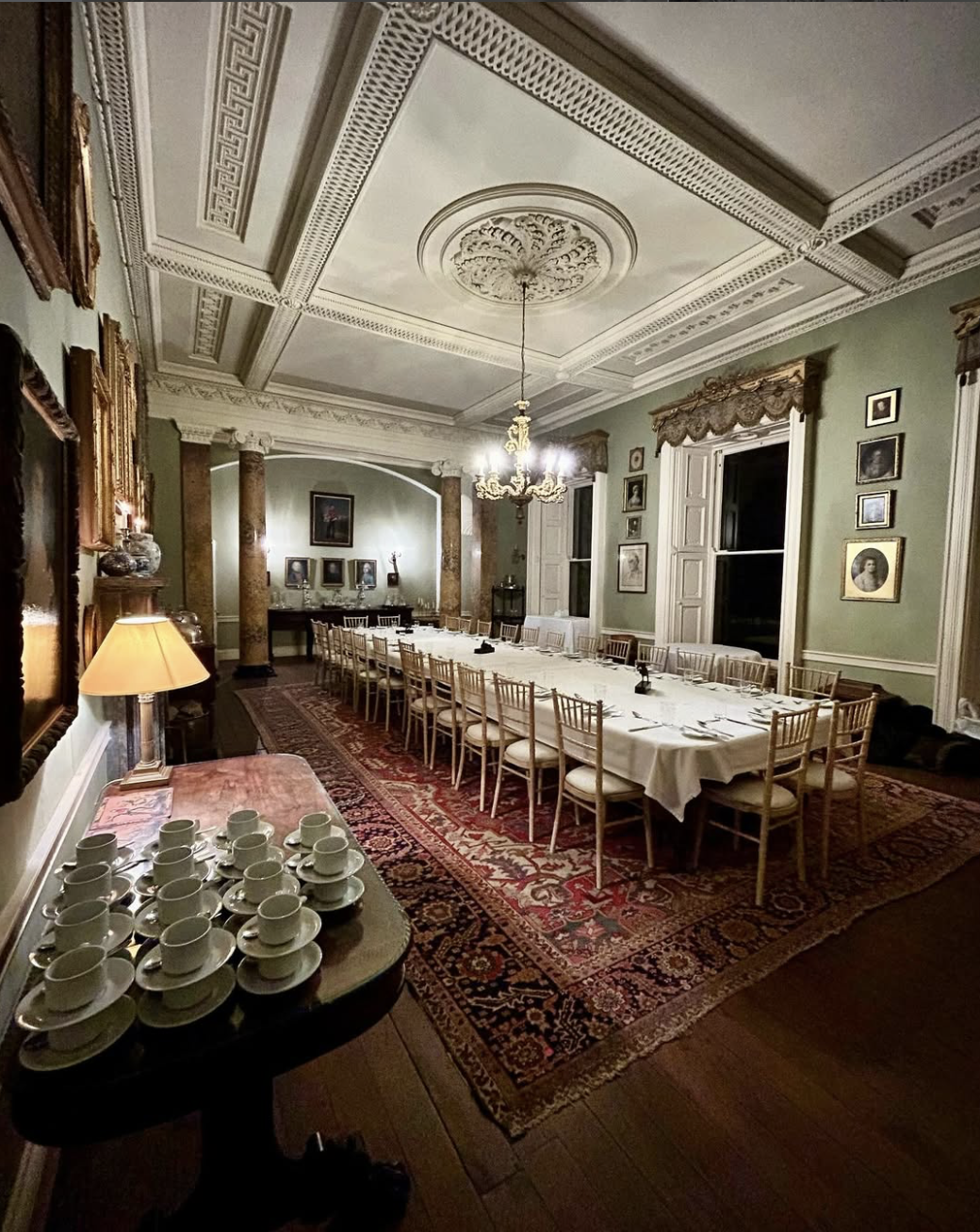
The dining room has more scagliola columns at one end, framing the serving sideboard, commissioned specially by Morrison for Borris House. It was sold in the 1950s but bought back by later owners. [10] The room has more rich plasterwork by Michael Stapleton: a Celtic design on the ceiling, and ox skulls represent the feasting of Chieftains. With the aid of portraits in the dining room, the guide told us more stories about the family. It was sad to hear how Arthur had to put an end to the tradition of the locals standing outside the dining room windows, and gentry inside, to observe the diners. He did not like to be seen eating, as he had to be fed.

The grand dining room, photograph courtesy of Borris House instagram.

We saw the portrait of Lady Susanna’s husband, whom her sister Charlotte Eleanor dubbed “Fat Thomas.” Eleanor formed a relationship with Sarah Ponsonby, and they ran away from their families to be together. As a result, Eleanor was taken to stay with her sister’s family in Borris House, and she must have felt imprisoned by her sister’s husband, hence the insulting moniker. Eleanor managed to escape and to make her way to Woodstock, the house in County Kilkenny where Sarah was staying. Finally their families capitulated and accepted their plans to live together. They set up house in Wales, in Llangollen, and were known as The Ladies of Llangollen They were visited by many famous people, including Anna Seward, William Wordsworth, Sir Walter Scott, Charles and Erasmus Darwin, Sir Arthur Wellesley and Josiah Wedgewood.

The Ladies of Llangollen, Sarah Ponsonby and Charlotte Eleanor Butler, by Richard James Lane, printed by Jérémie Graf, after Lady Mary Leighton (née Parker) courtesy of National Portrait Gallery NPG D32504.

Mark Bence-Jones describes an upstairs library with ceiling of alternate barrel and rib vaults, above a frieze of wreaths that is a hallmark of the Morrisons, which unfortunately we did not get to see. We didn’t get to go upstairs but we saw the grand Bath stone cantilevered staircase. The room was originally an open courtyard.

We then went out to the Ballroom, which was originally built by Arthur as a billiard room, with a gun room at one end and a planned upper level of five bedrooms. The building was not finished as planned as Arthur died. It is now used for weddings and entertainment.

Side of the house. Photograph © Jennifer Winder-Baggot, www.irishhistorichouses.com

In 1958 the house faced ruin when Joane Kavanagh’s husband Lieutenant Colonel Archibald Macalpine-Downie died, and she decided to move to a smaller house. However, her son, Andrew Macalpine-Downie, returned to Borris after a career as a jockey in England. with his wife Tina Murray. He assumed the name Kavanagh, and set himself the task of preventing the house from becoming a ruin. [11]

We were welcomed to wander the garden afterwards.

I was delighted with the sheep who must keep the grass down. Photograph © Jennifer Winder-Baggot, www.irishhistorichouses.com
Borris House, July 2019. Photograph © Jennifer Winder-Baggot, www.irishhistorichouses.com
View from the grounds of Borris House, July 2019. Photograph © Jennifer Winder-Baggot, www.irishhistorichouses.com

[1] https://www.buildingsofireland.ie/buildings-search/building/10400804/borris-house-borris-borris-co-carlow

[1*] http://lordbelmontinnorthernireland.blogspot.com/2013/07/borris-house.html

[2] p. 33, MacDonnell, Randal. The Lost Houses of Ireland. A chronicle of great houses and the families who lived in them. Weidenfeld and Nicolson. London, 2002.

[3] https://theirishaesthete.com/2013/11/04/an-arthurian-legend/

The Borris website claims that the 1731 house was built for Morgan Kavanagh, but the Irish Aesthete Robert O’Byrne writes that the 1731 house was built by Brian Kavanagh, incorporating part of the fifteenth century castle. I have the date of 1720 as the death for Morgan Kavanagh and he has a son, Brian, so it could be the case that the house was commissioned by Morgan and completed by his son Brian.

[4] Joyce, Edmond. Borris House, Co. Carlow, and elite regency patronage. Four Courts Press, Dublin, 2013.

[5] https://irishhistorichouses.com/2020/04/18/architectural-definitions/

and Mark Bence-Jones. A Guide to Irish Country Houses [originally published as Burke’s Guide to Country Houses volume 1 Ireland by Burke’s Peerage Ltd. 1978]; Revised edition 1988 Constable and Company Ltd, London.

[6] https://theirishaesthete.com/2013/11/04/an-arthurian-legend/

This entry also has lovely pictures of the inside of Borris House and more details about the history of the house and family.

[7] p. 130. O’Toole, Jimmy. The Carlow Gentry: What will the neighbours say! Published by Jimmy O’Toole, Carlow, Ireland, 1993. Printed by Leinster Leader Ltd, Naas, Kildare.

[8] https://theirishaesthete.com/2013/11/04/an-arthurian-legend/

[9] for more on the Butlers see John Kirwan’s book, The Chief Butlers of Ireland and the House of Ormond, An Illustrated Genealogical Guide, published by Irish Academic Press, Newbridge, County Kildare, 2018. Stephen and I went to see John Kirwan give a fascinating talk on his book at the Irish Georgian Society’s Assembly House in Dublin.

[10] p. 115. Fitzgerald, Desmond et al. Great Irish Houses. Published by IMAGE Publications Ltd, Dublin, 2008.

[11] p. 134. O’Toole, Jimmy. The Carlow Gentry: What will the neighbours say! Published by Jimmy O’Toole, Carlow, Ireland, 1993. Printed by Leinster Leader Ltd, Naas, Kildare.

Text © Jennifer Winder-Baggot, www.irishhistorichouses.com