Shanbally Castle, Clogheen, County Tipperary

Mark Bence-Jones. A Guide to Irish Country Houses (originally published as Burke’s Guide to Country Houses volume 1 Ireland by Burke’s Peerage Ltd. 1978); Revised edition 1988 Constable and Company Ltd, London.
p. 257. “[O’Callaghan, Lismore, V/PB1898; Butler, sub Ormonde, M/PB; Pole-Carew, sub Pole, Bt/pb] The largest of John Nash’s Irish castles, built ca 1812 for Cornelius O’Callaghan, 1stViscount Lismore. Long and irregular, of smooth silver-grey ashlar; with round and octagon towers, battlements and machicolations. ..2nd and last Viscount Lismore left Shanbally to his cousins, Lady Beatrice Pole-Carew and Lady Constance Butler, daughters of 3rd Marquess of Ormonde; it was sold by Major Patrick Pole-Carew 1954. After a valiant but unsuccessful attempt by Hon Edward Sackville-West (5th Lord Sackville), the author and music critic, to rescue it, the house was demolished 1957 and its ruin dynamited.”


Listed in Vanishing Country Houses of Ireland by The Knight of Glin, David J. Griffin and Nicholas K. Robinson, published by The Irish Architectural Archive and The Irish Georgian Society, 1988.
p. 136. “John Nash’s most important and largest Irish castle. Built c. 1806 for Cornelius O’Callaghan 1st Viscount Lismore. The very fine interior included a vaulted entrance hall lit by a series of glass skylights, a splendid oak imperial main staircase and an oval drawing-room.
The castle in good repair was sold in 1954 and despite protests in the press was demolished in 1957. Its destruction was one of Ireland’s great architectural losses this century.”
entry in MacDonnell, Randal. The Lost Houses of Ireland. A chronicle of great houses and the families who lived in them. Weidenfeld and Nicolson. London, 2002
p. 191 “The largest of John Nash’s four Irish castles, Shanbally was in excellent condition when the protectors of Ireland’s heritage in the Irish civil service decided to allow its demolition. Roofed and in good repair at the time it was pulled down, Shanbally’s destruction was one of the most pointless acts of official vandalism in the history of the Irish state.”
p. 192. Nash’s other castles in Ireland were Ravensworth, Caerbays and Aqualate. Shanbally also had the distinction that it was built, not for the descendent o some Cromwellian carpetbagger, but for the scion of an old Irish famiy, Cornelius O’Callaghan.
[pages ripped out]
The Tipperary Gentry. Volume 1. By William Hayes and Art Kavanagh. Published by Irish Family Names, c/o Eneclann, Unit 1, The Trinity Enterprise Centre, Pearse St, Dublin 2, 11 Emerald Cottages, Grand Canal St, Dublin 4 and Market Square, Bunclody, Co Wexford, Ireland. 2003.
O’Callaghan of Shanbally.
p. 163. Cornelius O’Callaghan [1693-1741] was a small county Cork landowner and successful Dublin lawyer. He was Sir Redmond Everard’s solicitor and facilitated him in getting mortgages. Like Redmond he was a convert. In 1713 he and Redmond represented Fethard in Parliament. It is probably that O’Callaghan’s political advancement was paid for by a reduction in Everard’s debts. In 1721 Everard sold his property in Iffa and Offa and centred on Clogheen to O’Callaghan for £11,500. The O’Callaghan family built upon this base and extended their holdings during the next 150 years so that by the mid-19C they were the county’s largest landholders. In 1883 the Lismore estates totalled a staggering 42,000 acres. In Tipperary they owned almost 35,000 acres, while they owned 6000 acres in Cork and over 1000 acres in Limerick. The rent roll was valued at over £16,000 per annum.
…Lord Lismore in his will of 1787 stipulated that his younger son lay out £9,999 in the purchase of lands, and in 1803 his heir bought an estate in Co Laois for £43,620.
p. 164. …the O’Callaghans were noted for their sympathetic approach to the Catholic Relief movement.
The O’Callaghans spent considerable sums over the decades of the 18C improving their estates, building Clogheen village (where Protestant artisans and craftsmen were brought in), drainage schemes, and large scale remodelling of the landscape. These works were facilitated by the appointment of agents. …
p. 160. [Cornelius O’Callaghan 1st Viscount Lismore divorced his wife, Eleanor Butler.] It would seem from the evidence that the marriage ran into trouble shortly after the fourth child was born when Lady Lismore began the habit of chastising her husband, both verbally and physically. According to her brother, the Duke of Ormond, she was a lady who frequently lost her temper. George O’Callaghan gave evidence that he had seen her strike her husband on more than one occasion. In addition she frequently taunted him by stating that Shanbally might be fit for the wife of Lord Lismore but was not fit for Eleanor the sister of the Duke of Ormonde.
p. 161. One of the most startling facts to emerge was that, at the time of the separation, Lord Lismore was in extreme financial difficulty. Although he owned over 40,000 acres of land and despite having received almost £40,000 as a dowry with Eleanor he was reduced to dire straits in the period from 1816-1825. His brother stated that he had only one servant in Shanbally and owned only one carriage and no carriage horse. He also said that in 1817 Lord Lismore was so financially embarressed that he could not travel over to London to see his wife….
The couple was separated in 1819 and Lady Lismore, on the advice of her doctors, decided to travel to a southern country where the climate might be good for her asthma….while in Italy the second time she took a lover, Richard Bingham…[p. 162] It was on the grounds of this adultery that Lord Lismore sought the divorce…. The children were reared by their father.
The seat of the O’Callaghans was at Shanbally Castle, near Clogheen village, where they built a mansion around 1735. There was over 1200 acres of land in the demesne. After the peerage was obtained in 1785 their house was renewed as a castle in 1812. [the castle was unfortunately demolished in 1957]. The new neo-classical house was designed by John Nash….
p. 166. 1st Baron Lismore of Shanbally died in 1797 at a relatively young age. His widow moved to Tunbridge Wells where she remained for the rest of her life until her death in 1827. They had at least two sons, Cornelius and robert William
[the son Cornelius] took his seat in the House of Lords nd voted against the Act of Union in 1800.
[Robert William had an active military career]
In 1806 Cornelius was created Viscount Lismore of Shanbally and in 1838 he was created Baron Lismore of Shanbally Castle. This was one of the Coronation Peerages of Queen Victoria…. Baron Lismore was Lord Lieutenant for Tipperary from 1851 until his death.
p. 167. During the Famine the Lismores worked extremely hard to alleviate the sufferings of the poor. Lord Lismore reduced their rents and provided a soup kitchen at hte gates of his castle. He was describedd as one of Ireland’s benevolent landlords and the town of Clogheen grew and prospered after the Famine.
[His son George outlived both his sons]
http://lordbelmontinnorthernireland.blogspot.com/2013/10/shanbally-castle.html
THE VISCOUNTS LISMORE WERE THE LARGEST LANDOWNERS IN COUNTY TIPPERARY, WITH 34,945 ACRES
This was one of the very few native families which had been dignified by the Peerage of Ireland. The O’Callaghans were formerly princes of the province of Munster, and were seated at Dromaneen Castle. Their Chief, CORNELIUS O’CALLAGHAN, enjoyed very extensive territorial possessions in 1594, according to an inquisition taken by Sir Thomas Norris, Vice-President of Munster, in that year.
From this Cornelius descended
CORNELIUS O’CALLAGHAN (c1681-c1742), a very eminent lawyer, MP for Fethard, 1713-14, who married Maria, daughter of Robert Jolly, and had three sons, the youngest of whom,
THOMAS O’CALLAGHAN, wedded, in 1740, Sarah, daughter of John Davis, and had, with a daughter (married to Robert Longfield, of Castle Martyr), an only son,
CORNELIUS O’CALLAGHAN (1741-97), MP for Fethard, 1768-85, who was elevated to the peerage, in 1785, in the dignity of Baron Lismore, of Shanbally, County Tipperary.
His lordship married, in 1774, Frances, second daughter of Mr Speaker Ponsonby, of the Irish House of Commons, and niece, paternally, of William, Earl of Bessborough, and niece, maternally, of William, 3rd Duke of Devonshire, and had issue,
CORNELIUS, his heir;
Robert William (Sir), GCB, lieutenant-general;
George;
Louisa; Elizabeth; Mary.
He was succeeded by his eldest son,
CORNELIUS, 2nd Baron (1775-1857), who was created, in 1806, VISCOUNT LISMORE, of Shanbally, County Tipperary.
He married, in 1808, the Lady Eleanor Butler, youngest daughter of John, 17th Earl of Ormonde, and sister of the Marquess of Ormonde, by which lady he had issue,
Cornelius;
William Frederick;
George Ponsonby;
Anne Maria Louisa.
His lordship, Privy Counsellor, 1835, Lord-Lieutenant of County Tipperary, 1851-57, was succeeded by his second son,
GEORGE PONSONBY, 2nd Viscount (1815-98), an officer in the 17th Lancers, High Sheriff of County Tipperary, 1853, Lord-Lieutenant of County Tipperary, 1857-85, who wedded, in 1839, Mary, daughter of George Norbury, and had issue,
George Cornelius Gerald (1846-85);
William Frederick Ormonde (1852-77).
His lordship’s sons both predeceased him, when the titles became extinct.
SHANBALLY CASTLE, near Clogheen, County Tipperary, was built about 1812 for Cornelius O’Callaghan, 1st Viscount Lismore.
It was said to have been the largest of John Nash’s Irish castles.
Shanbally was long and irregular, of a silver-grey ashlar.
This great mansion was 281 feet above sea-level, and about 80 feet above the level of the adjacent brook.
Shanbally Castle had numerous machicolations, towers and battlements.
The entrance front was pointed-arched, with a vaulted porte-cochere under a porch-tower.
The garden front had a round tower at one end and an octagonal tower at the other, with a central feature boasting two square turrets.
There was a stylish Gothic veranda.
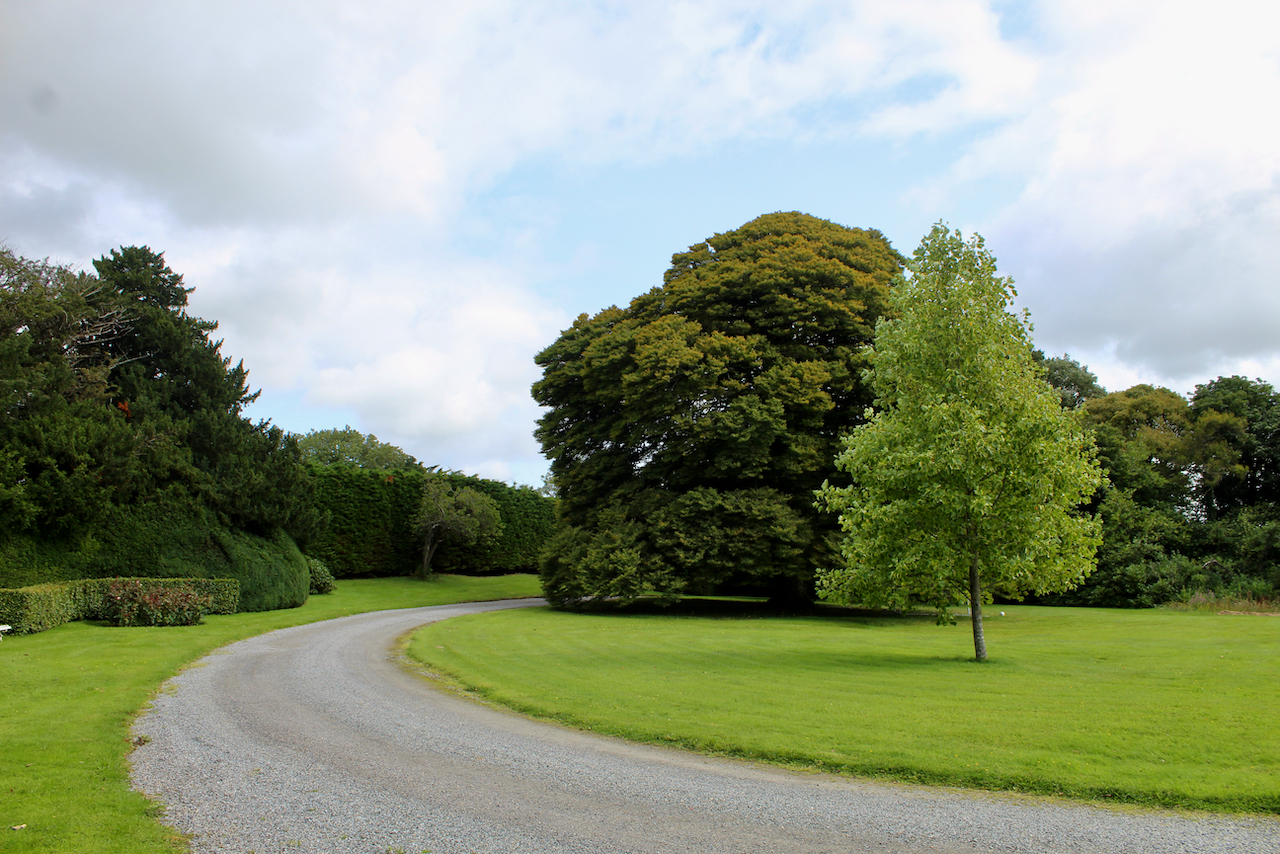
Shanbally demesne is beautifully situated on low ground, in the centre of the valley, between the Galtee mountains on the north and the Knockmealdown mountains on the south.
It commands the most magnificent views of the slopes, escarpments, summits, and groupings of both of these alpine ranges.
Shanbally Castle was situated in a picturesque landscape, bounded to the north and south by two mountain ranges, the Galtees and the Knockmealdowns.
It is said that Shanbally bore a remarkable resemblance to Nash and Repton’s joint venture, Luscombe Castle in Devon, though Shanbally was considerably larger.
The 2nd and last Viscount left Shanbally to his cousins, the Lady Beatrice Pole-Carew and the Lady Constance Butler, daughters of the 3rd Marquess of Ormonde.
Shanbally was sold in 1954 by Major Patrick Pole-Carew.
Following attempts by the Hon Edward Sackville-West (5th Lord Sackville) to rescue the Castle, it was demolished in 1957 and its ruin was blown up.
The following is a composition by Bill Power of the Mitchelstown Heritage Society:
Few acts of official vandalism rival the decision by the Irish Government in 1957 to proceed with plans to demolish Shanbally Castle.
Built for Cornelius O’Callaghan, 1st Viscount Lismore, ca 1810, the mansion was the largest house built in Ireland by the famous English architect, John Nash.
When the Irish Land Commission purchased the Shanbally estate in 1954, one of the immediate questions which it addressed was what should become of the castle.
For a brief period it seemed that a purchaser could be found in the form of the London theatre critic Edward Sackville-West, 5th Lord Sackville, who had a tremendous love of the Clogheen area, which he had known since childhood.
He agreed to buy the castle, together with 163 acres, but pulled out of the transaction when the Irish
Land Commission refused to stop cutting trees in the land he intended to buy.
Consequently, by 1957, the fate of the mansion was sealed.
The Irish Land Commissioners, with Irish Government approval, decided to proceed with plans to demolish the castle on the grounds that they had no use for it and that it was in poor condition.
They ignored suggestions that a religious community might be found for the building, and also
rejected its suitability as a forestry school.
In that year, Professor Denis Gwynn, wrote an article in the Cork Examiner in which he exhorted the authorities to reverse their decision:
“Shanbally Castle has been well known for years as one of the most graceful and original examples in Ireland of late Georgian architecture,” he said. “Its formal gardens, which have run wild, could easily be brought back to order.”
The Professor pointed out that Shanbally Castle was designed by one of the most famous of all modern architects, who also planned all the well known terraces that surround Regent’s Park in London, and so many other celebrated buildings in England, `What conceivable justification can there be for incurring the great expense of demolishing this unique Irish mansion,’ he asked.
“All around the house, with its long avenues, the land has been admirably laid out and planted with fine trees in groups to enhance the views and to produce valuable timber,’ he continued. `More recently there has been wholesale clearance of the timber. Last summer I saw cutting in progress at many places, and big gaps had been made in the boundary walls to assist removal of the felled trees.
Describing the order to demolish the castle as an `act of vandalism,’ Professor Gwynn called for an inquiry into the circumstances of the decision. There is no sense whatever in squandering public money on the destruction of a beautiful house which is well known to students of Nash’s domestic architecture,’ he added.
But Professor Gwynn’s article was already too late: Despite some local opposition and widespread critical comment, the roof was removed and some of its impressive cut stones were being removed by hand and broken into smaller pieces for use in road building.
The house, with its twenty stately bedrooms, extensive drawing rooms, dining room, library, marble fireplaces and mahogany staircase was rapidly reduced to a state of ruin.
In 1960, The Nationalist newspaper reported the final end of a building which was once the pride of the neighbourhood: “A big bang yesterday ended Shanbally Castle, where large quantities of gelignite and cortex shattered the building”, it said.
In the weeks prior to the explosion, demolition workers bored 1,400 holes, 18 inches above ground, into the cut stone of the castle.
Each hole was then filled with explosives which were detonated on the 21st March, 1960.
Almost all of this material was used for road building.
The protests against the demolition of Shanbally Castle came from some local sources, An Taisce and a few academics such as Professor Gwynn.
Politically, the Fianna Fail Government had no love for houses of the ascendancy.
However, remarkably, it was from within the ranks of Fianna Fail that the only political voices were raised against the demolition plans, albeit privately.
One was Senator Sean Moylan, the Irish Minister for Agriculture until his death in 1957, and the other was his close friend and TD from Mitchelstown, John W Moher.
They were over-ruled by the Cabinet and failed to get wider political support, even from opposition deputies.
When the explosion finally came, the Irish Government saw fit to issue a terse public statement in response to protests favouring the retention of Shanbally Castle for the nation.
“Apart from periods of military occupation the castle remained wholly unoccupied for 40 years,” said the statement.
First published in October, 2011.
https://archiseek.com/2012/1806-shanbally-castle-clogheen-co-tipperary
1806 – Shanbally Castle, Clogheen, Co. Tipperary
Architect: John Nash
Shanbally Castle was built for Cornelius O’Callaghan, the first Viscount Lismore and was the largest house built in Ireland by the noted English architect John Nash. Acquired by the Irish Land Commission in 1954. On 21 March 1960 the castle, after much controversy, was demolished.
It was widely felt that the castle was in habitable condition, having been sold to the government in good repair. The house had ranges of Gothic windows and was flanked by towers at either end. The interiors were reportedly well-detailed with ornate plasterwork.
For a time it seemed that a purchaser could be found in the form of the London theatre critic Edward Charles Sackville-West, 5th Baron Sackville. He agreed to buy the castle, together with 163 acres, but pulled out of the transaction when the Irish Land Commission refused to stop cutting trees in the land he intended to buy. A statement from the Irish Government released after the demolition of the Castle said in response to protests favouring the retention of ShanballyCastle for the nation: “Apart from periods of military occupation the castle remained wholly unoccupied for 40 years”.










 Irish Historic Houses