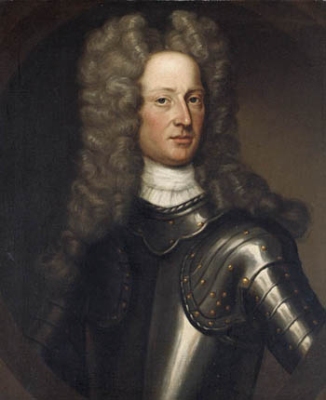
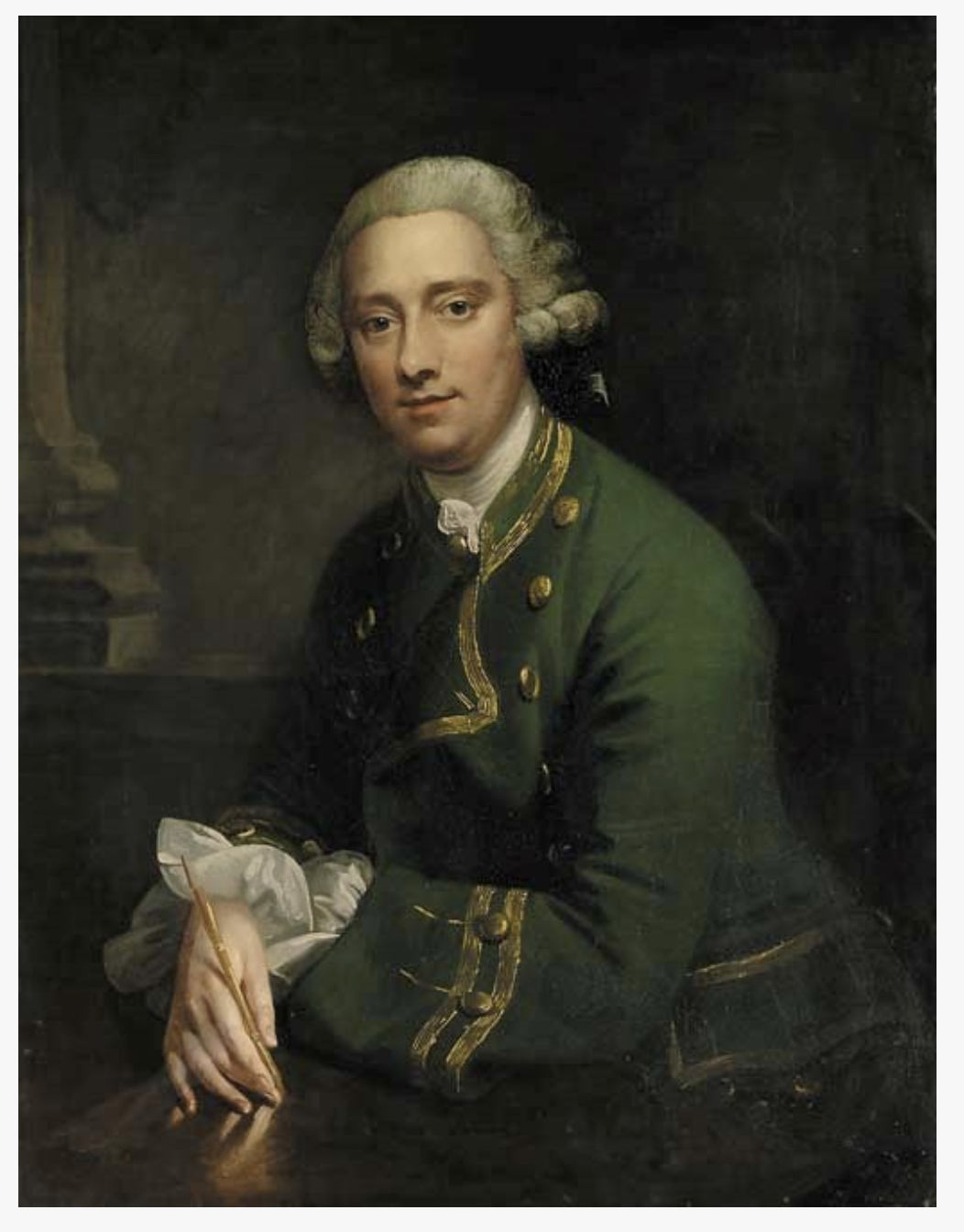
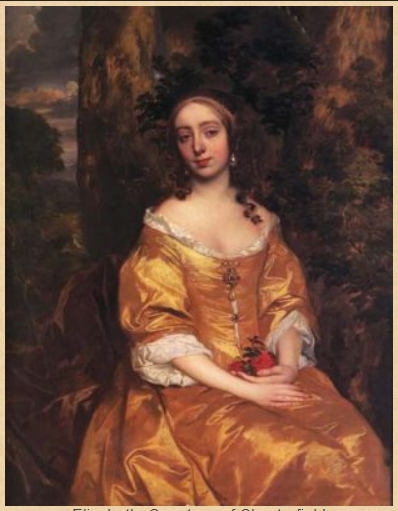
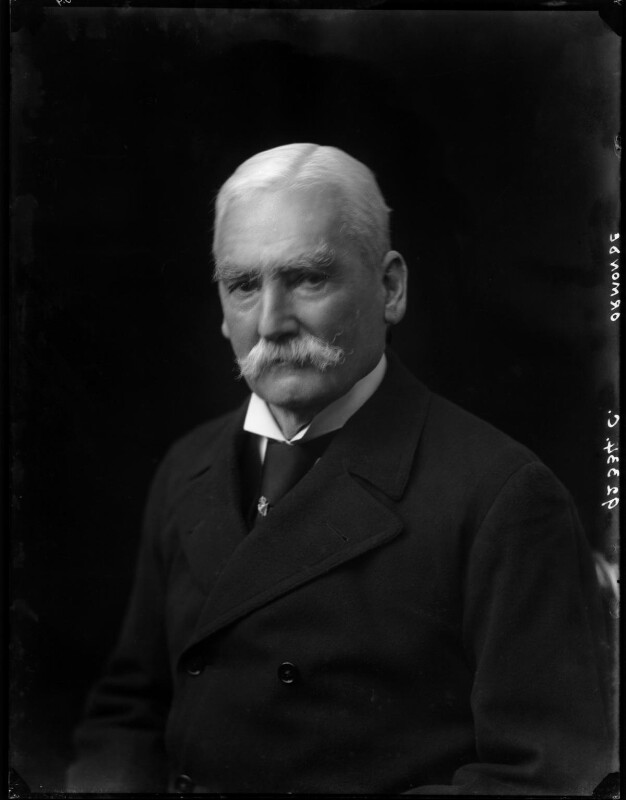
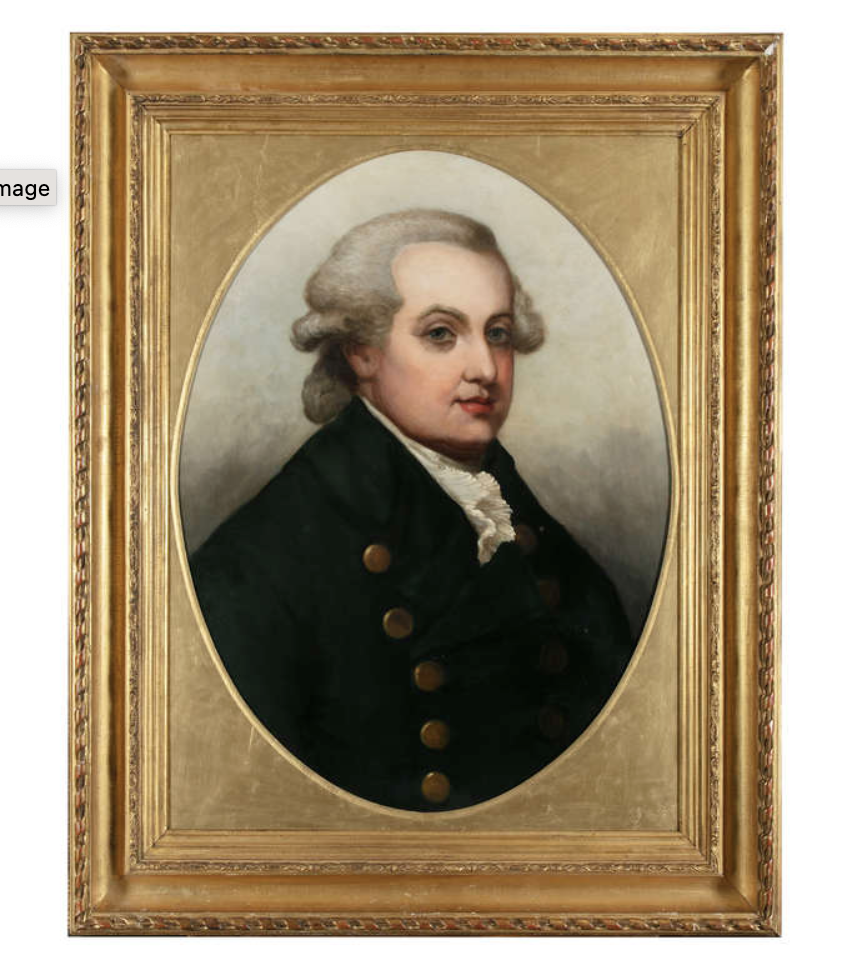
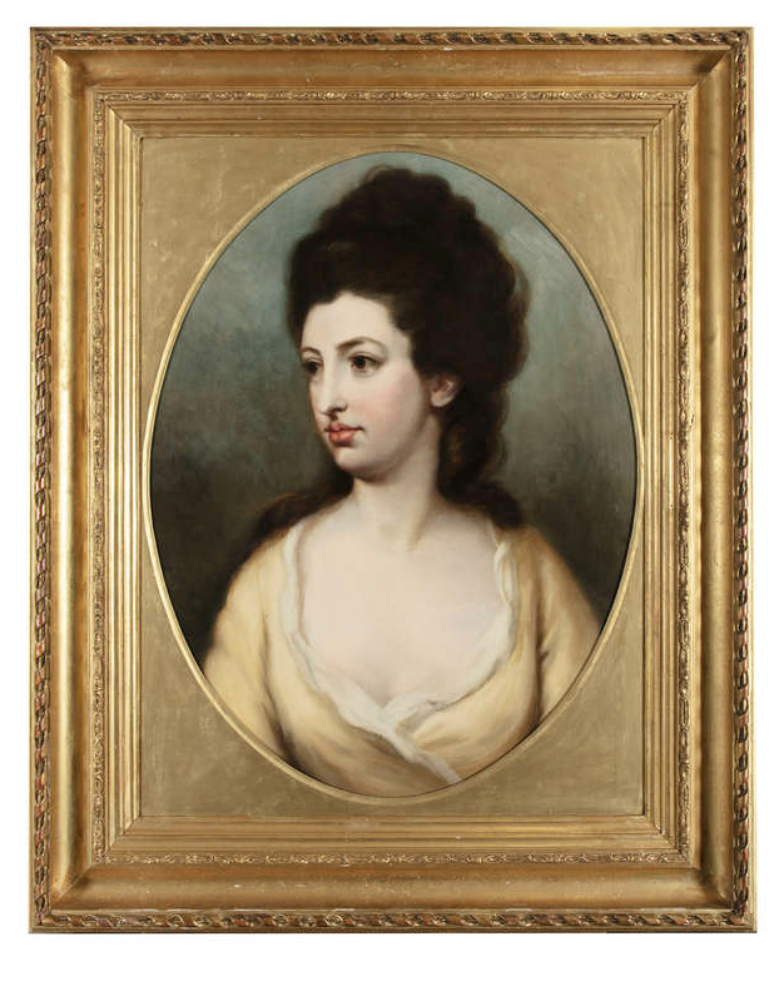
Portraits B

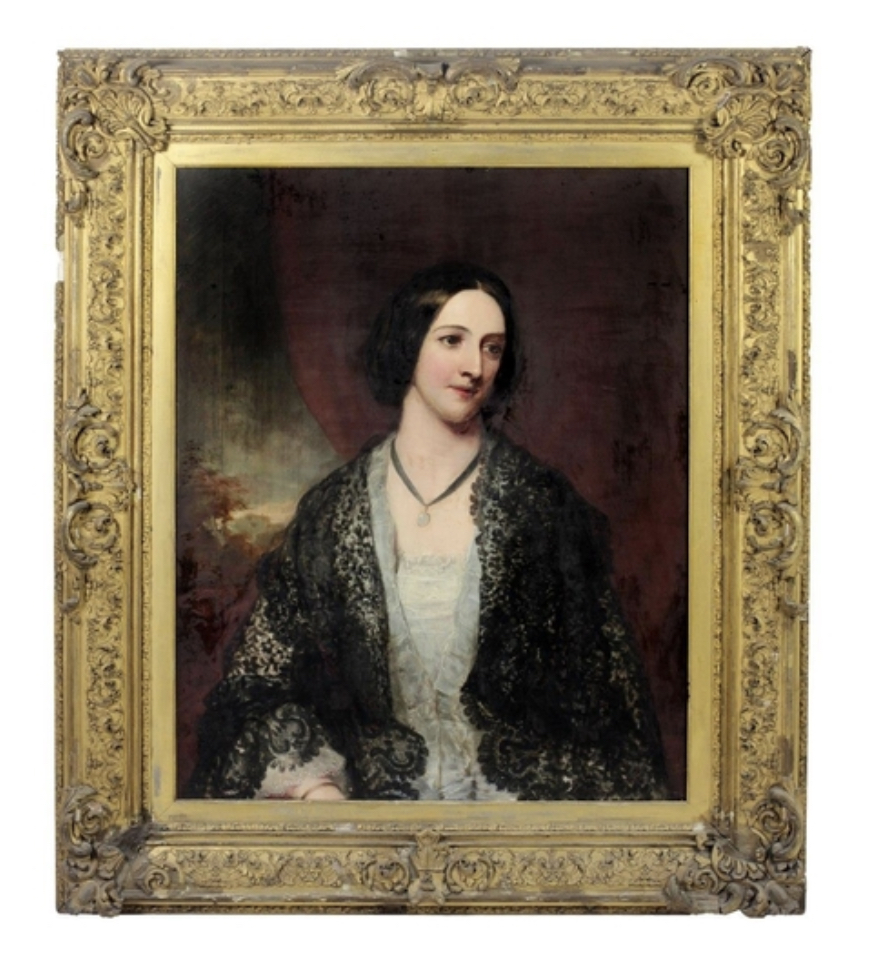
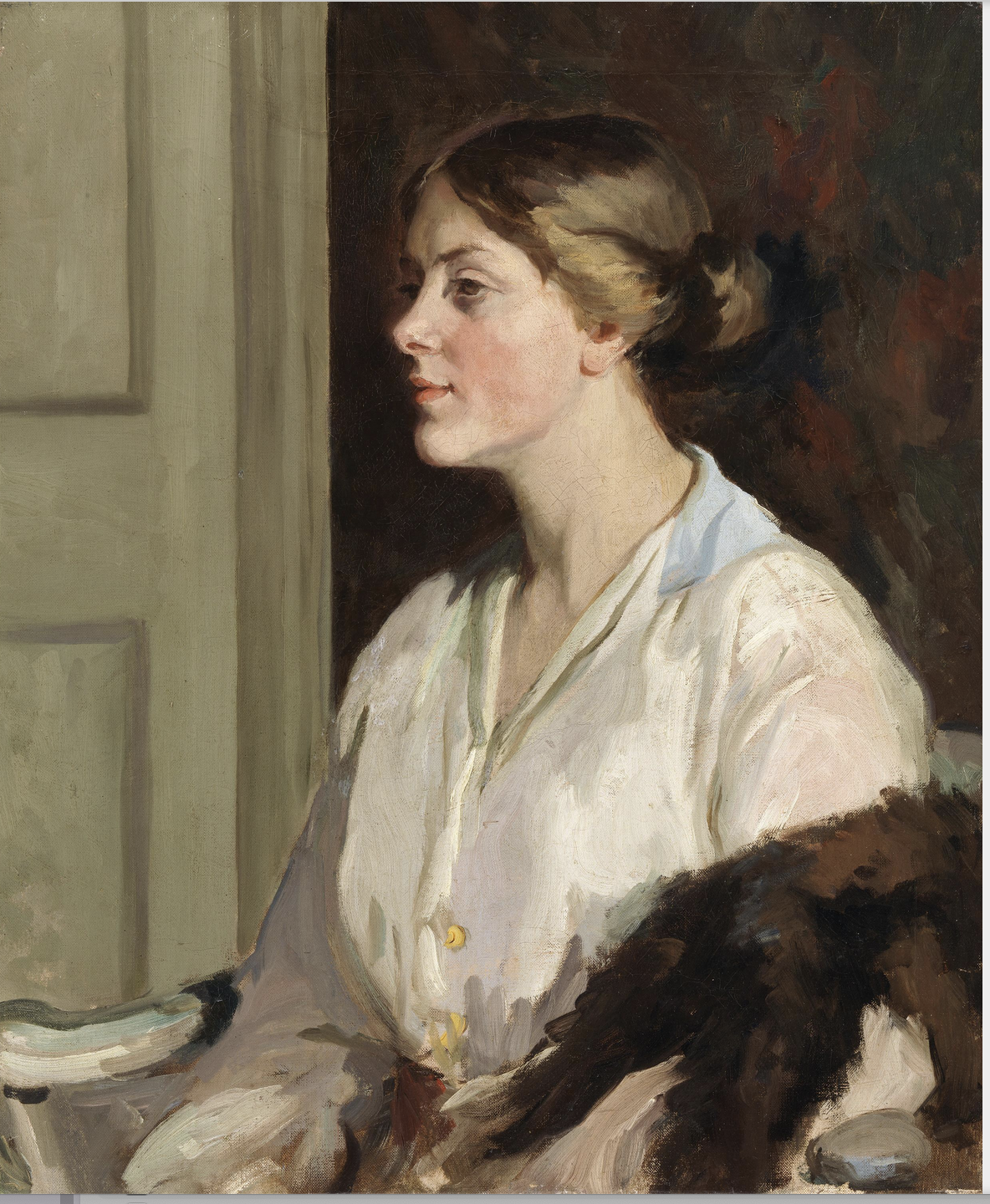
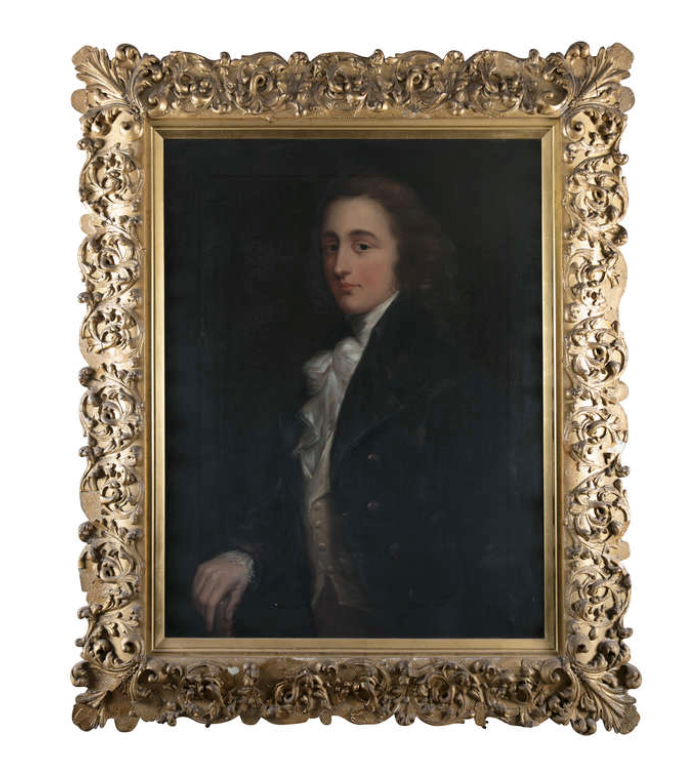
I am going to start collating a portrait gallery, as I love to put a name to the faces. I will add to these pages as I go.

I’ll be collecting them from my house entries and put them in alphabetical order by surname. I’ve also been going through the National Gallery collection and will also look at the National Portrait Gallery in London’s collection! It will be an ongoing project and a resource. I do think Ireland should have a National Portrait gallery! It would be a place where home owners could loan portraits for safekeeping also.

I have an editorial decision to make regarding women. Do I put them under their married name or under their maiden name? I think for now I’ll put them under both, as it’s nice to see them in relation to their fathers as well as in relation to their husband!

B

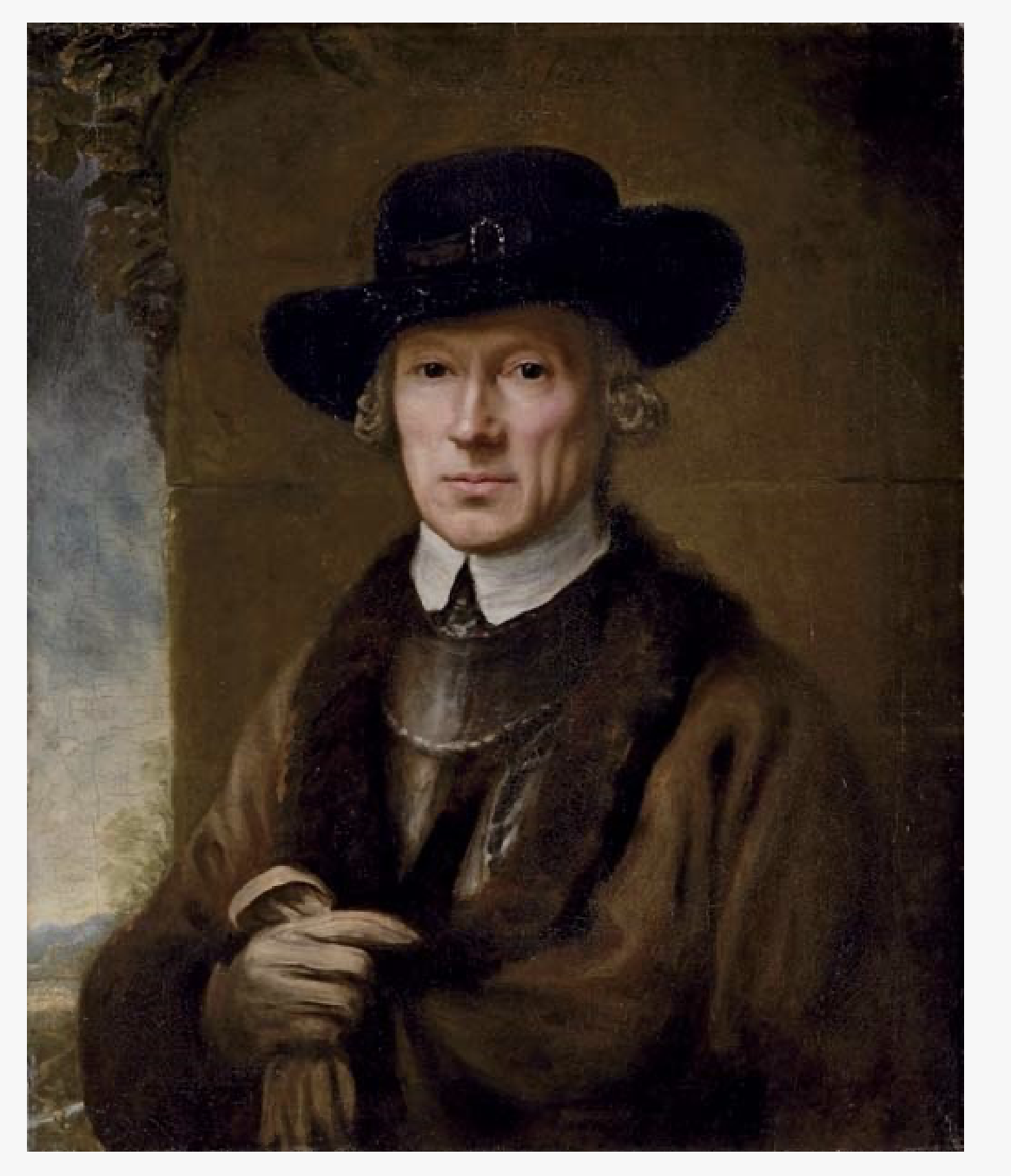
Captain William Baillie (1723-1810), engraver William Baillie, after Nathaniel Hone the Elder, courtesy of National Gallery of Ireland. He was from Kildrought, County Kildare.
Captain William Baillie (1723-1810) by Nathaniel Hone courtesy Christies Old Master and British Pictures.
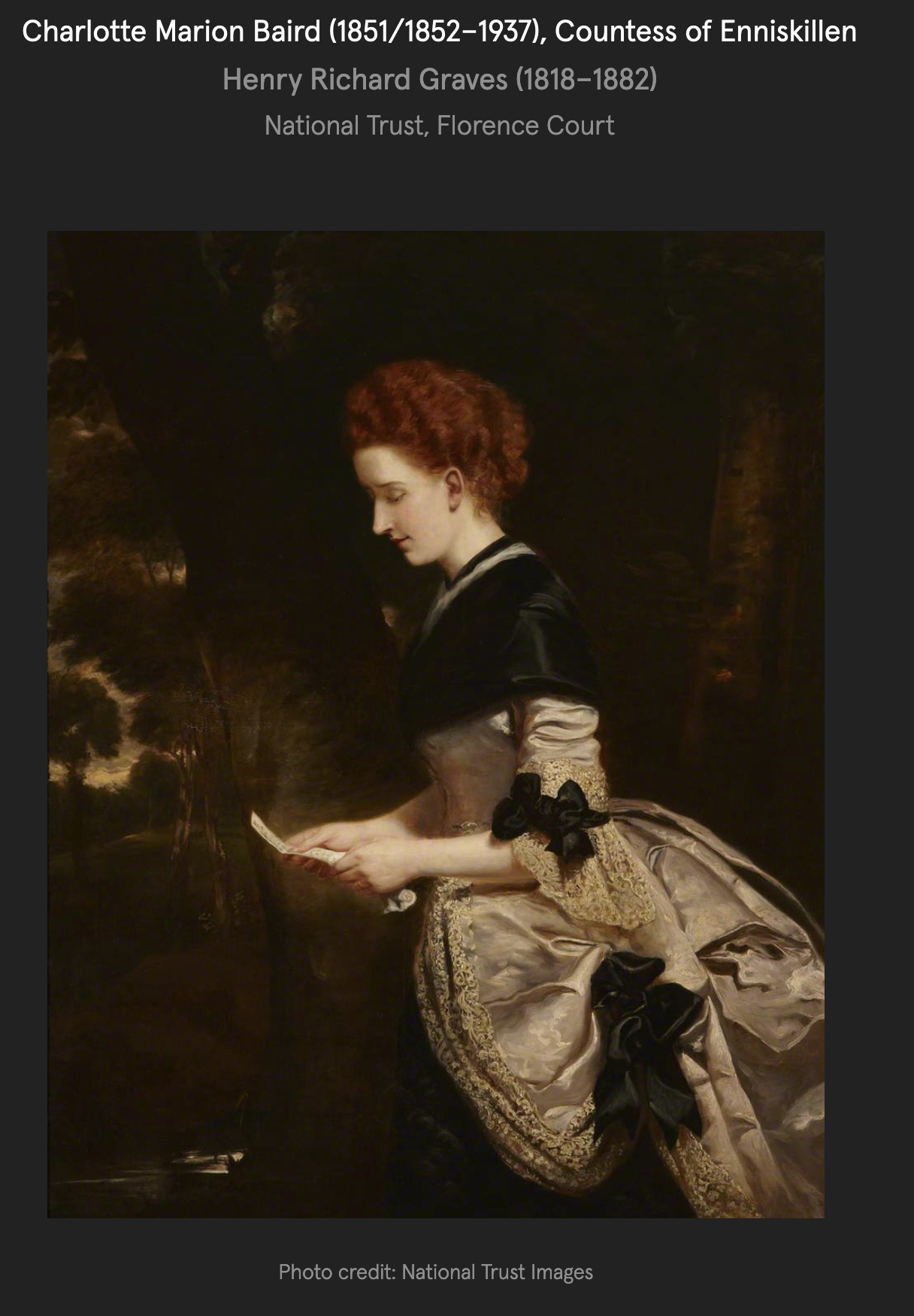
Charlotte Marion Baird (1851/2-1937) Countess of Enniskillen, by Henry Richard Graves, courtesy os National Trust, Florence Court, County Fermanagh. She married Lowry Egerton Cole, 4th Earl of Enniskillen.
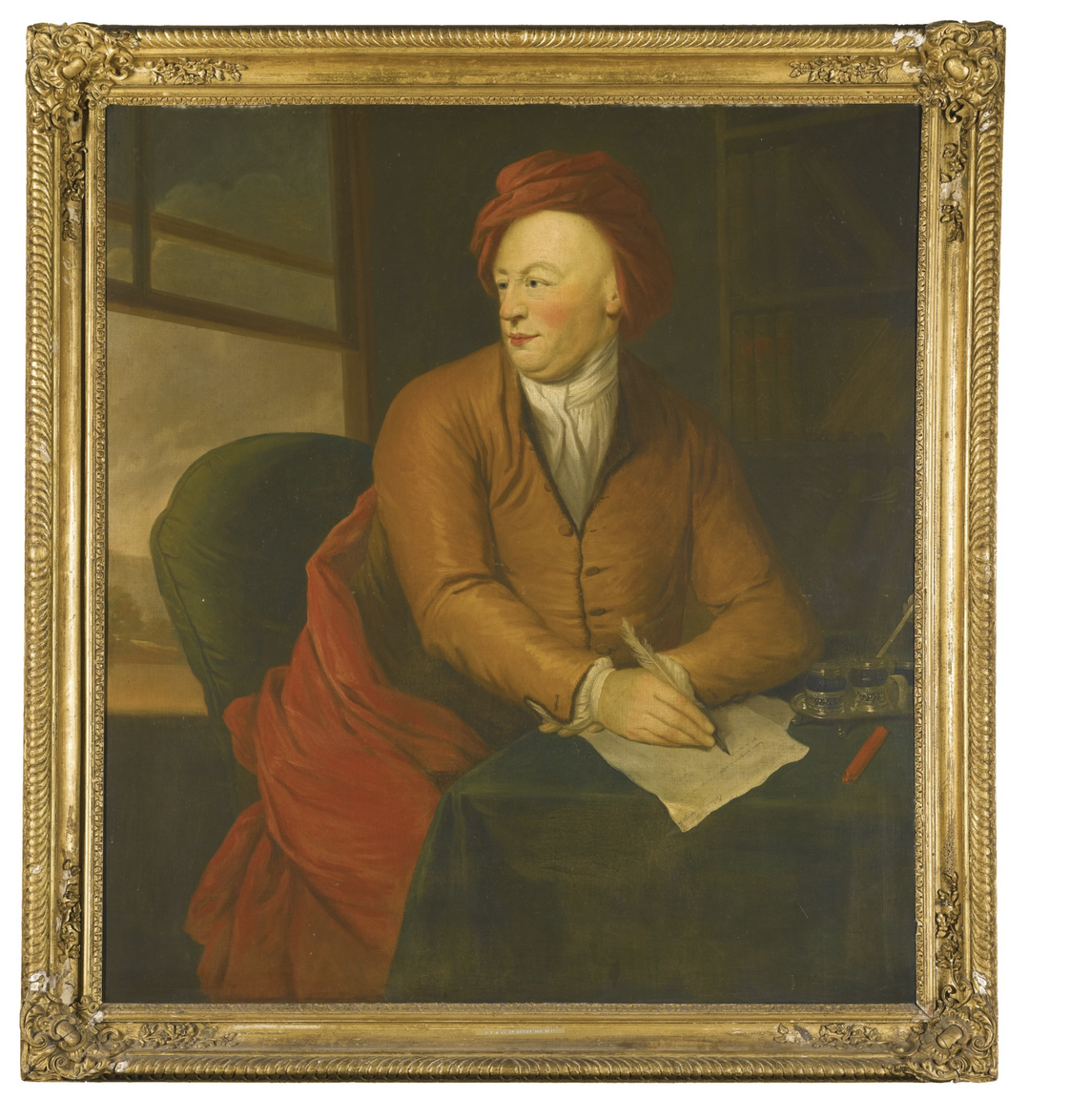
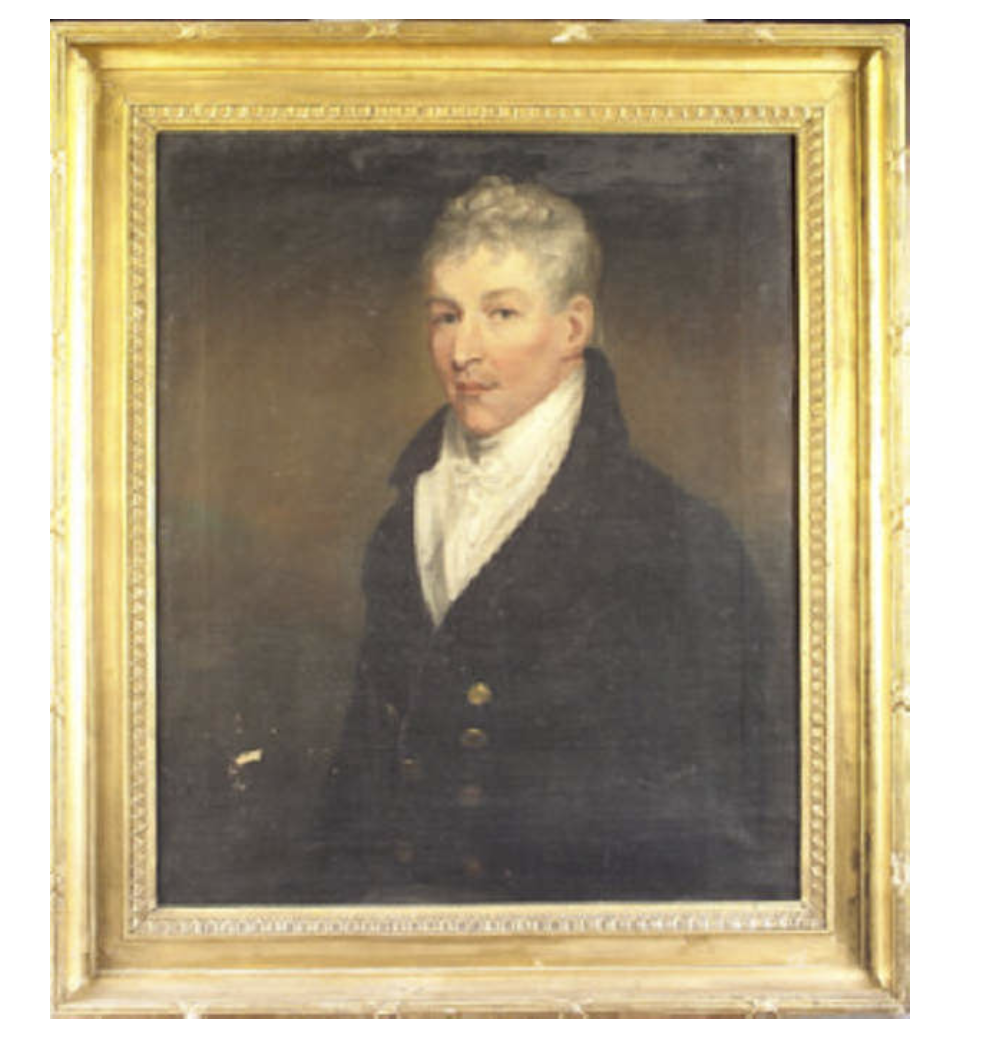
William Barker, 3rd Bt. (1704–1770), of Bocking Hall, Essex, and Kilcooley Abbey, Tipperary attributed to John Lewis, courtesy of Sothebys L11304.
Sir Jonah Barrington, (1760-1834), Judge and Author. Date: 1811, Engraver James Heath, English, 1757-1834 After Hugh Douglas Hamilton, Irish, 1740-1808 Copyist: John Comerford, Irish, 1770-1832 Publisher: G. Robinson, photograph courtesy of National Gallery. of Ireland.
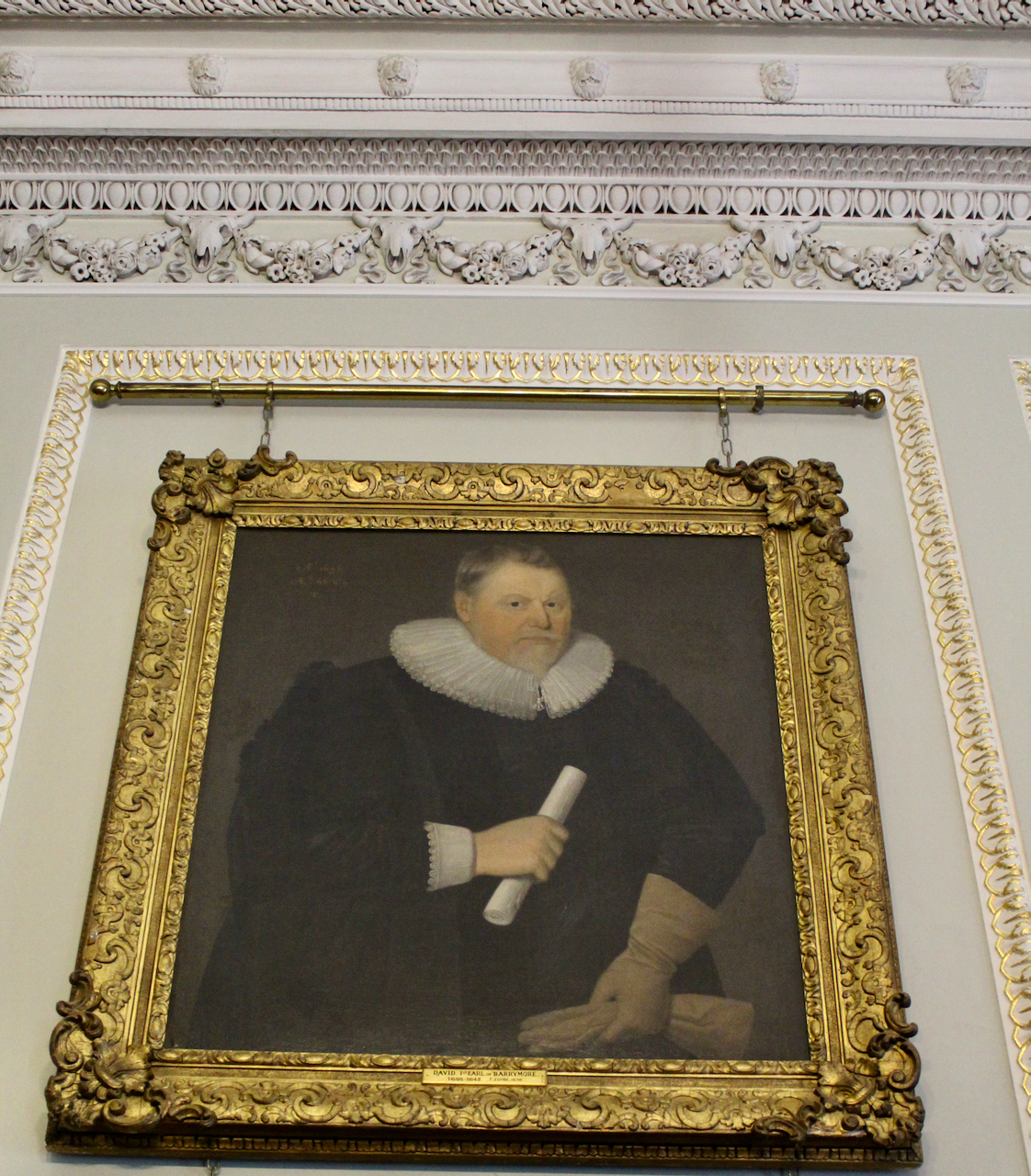
David Barry (1605-1642) 6th Viscount Buttevant and 1st Earl of Barrymore. Photograph © Jennifer Winder-Baggot, www.irishhistorichouses.com

Barons Barry (c. 1261)

  • David de Barry, 1st Baron Barry (died 1278). In 1267, King Henry III of England appointed Lord David de Barry as Chief Justice of Ireland.
  • John Barry, 2nd Baron Barry (died 1285)
  • David FitzDavid Barry, 3rd Baron Barry (died 1290)
  • John Barry, 4th Baron Barry (died 1330)
  • David Barry, 5th Baron Barry (died 1347)
  • David Barry, 6th Baron Barry (died 1392)
  • John Barry, 7th Baron Barry (died 1420)
  • William Barry, 8th Baron Barry (died 1480)
  • John Barry, 9th Baron Barry (died 1486)
  • Thomas de Barry, 10th Baron Barry (died 1488)
  • William Barry, 11th Baron Barry (died 1500)
  • John Barry, 12th Baron Barry (died 1530)
  • John Barry, 13th Baron Barry (died 1534)
  • John FitzJohn Barry, 14th Baron Barry (1517–1553) (created Viscount Buttevant in 1541)

Viscounts Buttevant (1541)

  • John FitzJohn Barry, 1st Viscount Buttevant (1517–1553)
  • Edmund FitzJohn Barry, 2nd Viscount Buttevant (died 1556)
  • James FitzJohn Barry, 3rd Viscount Buttevant (died 1557)
  • James de Barry, 4th Viscount Buttevant (c. 1520–1581) 1st wife: Elizabeth Boyle, daughter of Charles Boyle, 3rd Viscount Dungarvan; 2nd wife: Elizabeth née Savage (d. 1714), daughter and heir of Richard Savage 4th Earl Rivers; 3rd wife: Anne Chichester, daughter of Major-General Arthur Chichester, 3rd Earl of Donegall (1666-1706), she was the mother of James Smith-Barry of Fota, County Cork.
  • David de Barry, 5th Viscount Buttevant (died 1617)
  • David Barry, 6th Viscount Buttevant (1604–1642) (created Earl of Barrymore in 1627/28)

Earls of Barrymore (1627/28)

  • David Barry, 1st Earl of Barrymore (1604–1642)
  • Richard Barry, 2nd Earl of Barrymore (1630–1694)
  • Laurence Barry, 3rd Earl of Barrymore (1664–1699)
  • James Barry, 4th Earl of Barrymore (1667–1747)
  • James Barry, 5th Earl of Barrymore (1717–1751)
  • Richard Barry, 6th Earl of Barrymore (1745–1773)
  • Richard Barry, 7th Earl of Barrymore (1769–1793)
  • Henry Barry, 8th Earl of Barrymore (1770–1823) [1]
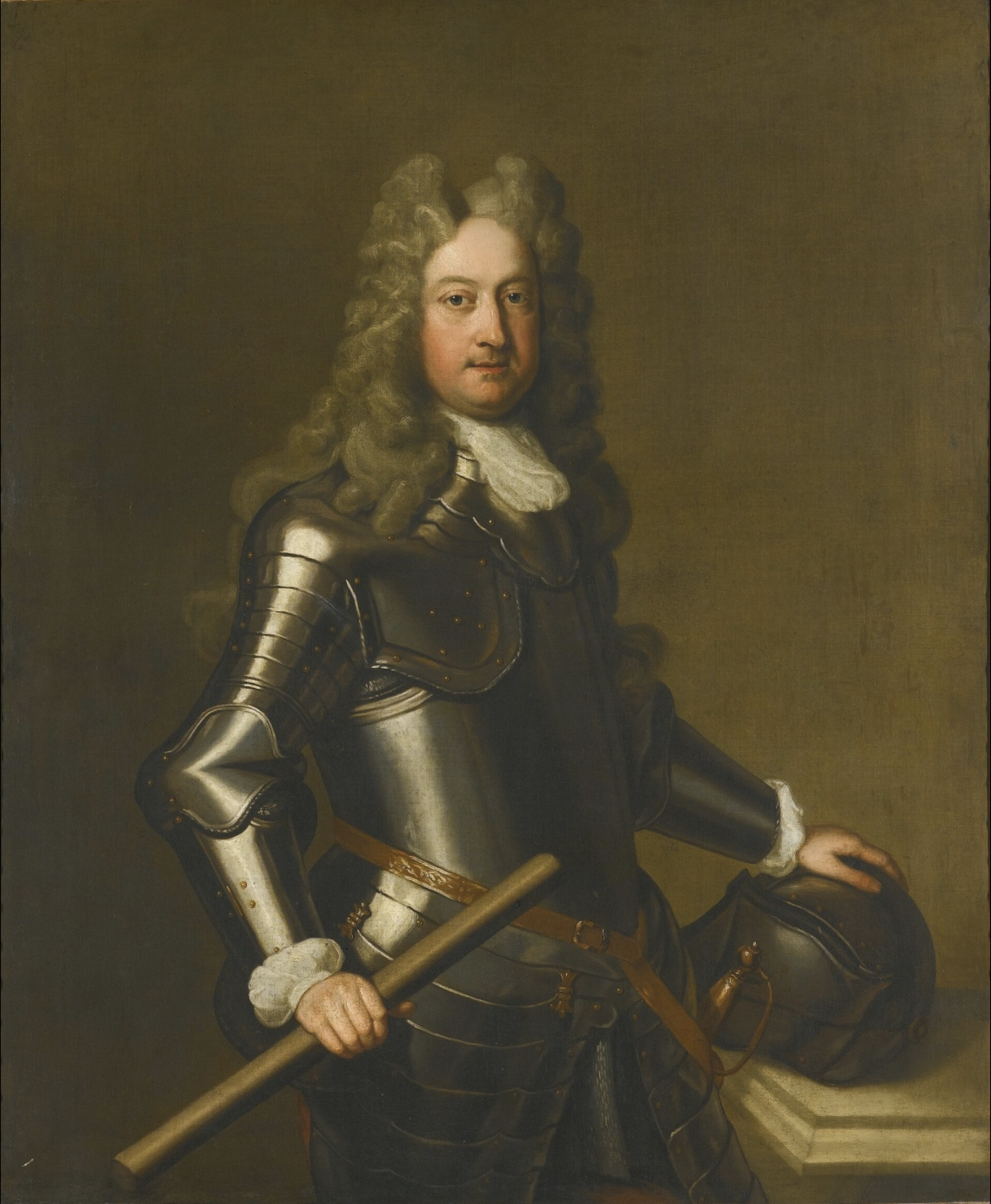
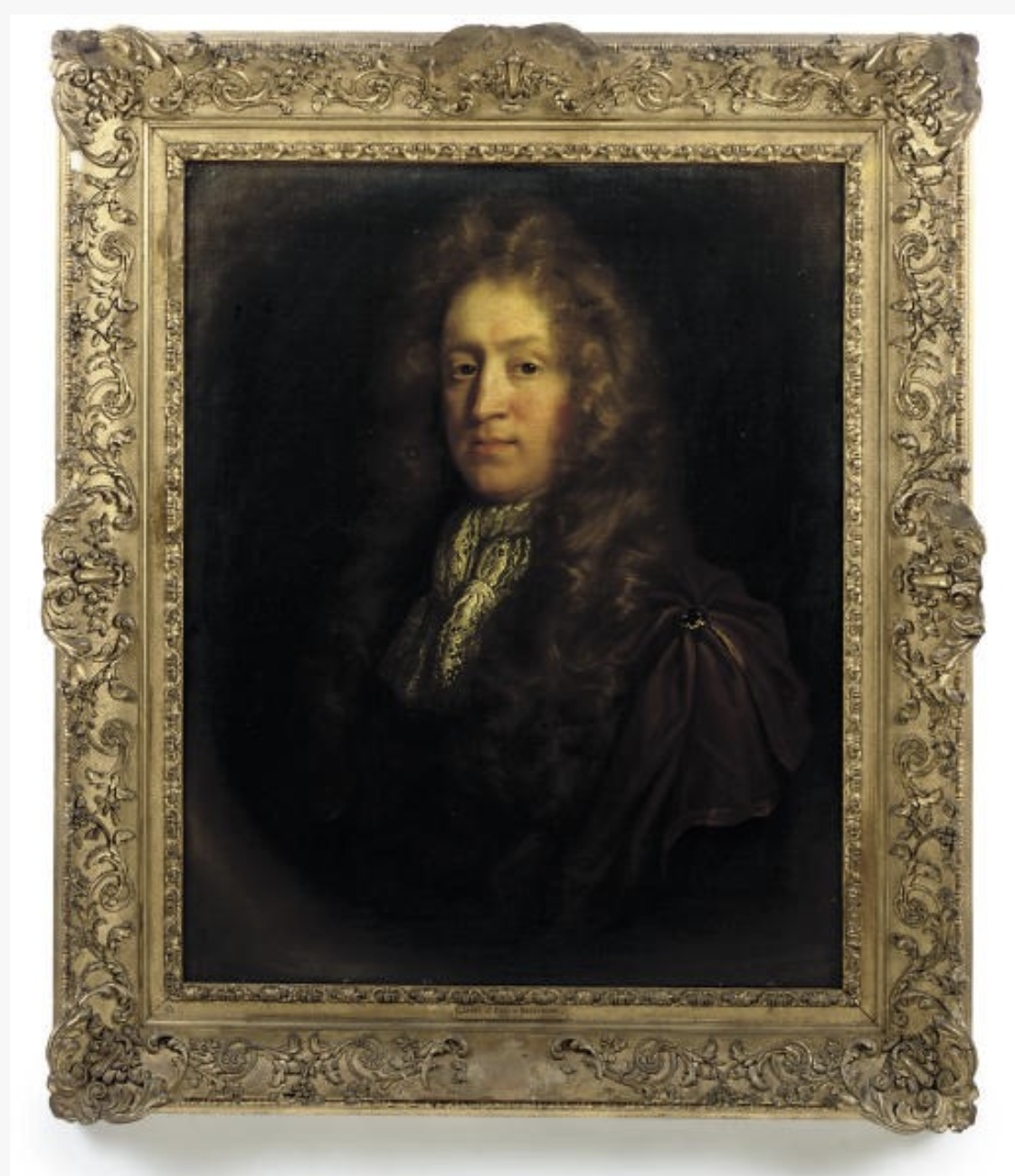
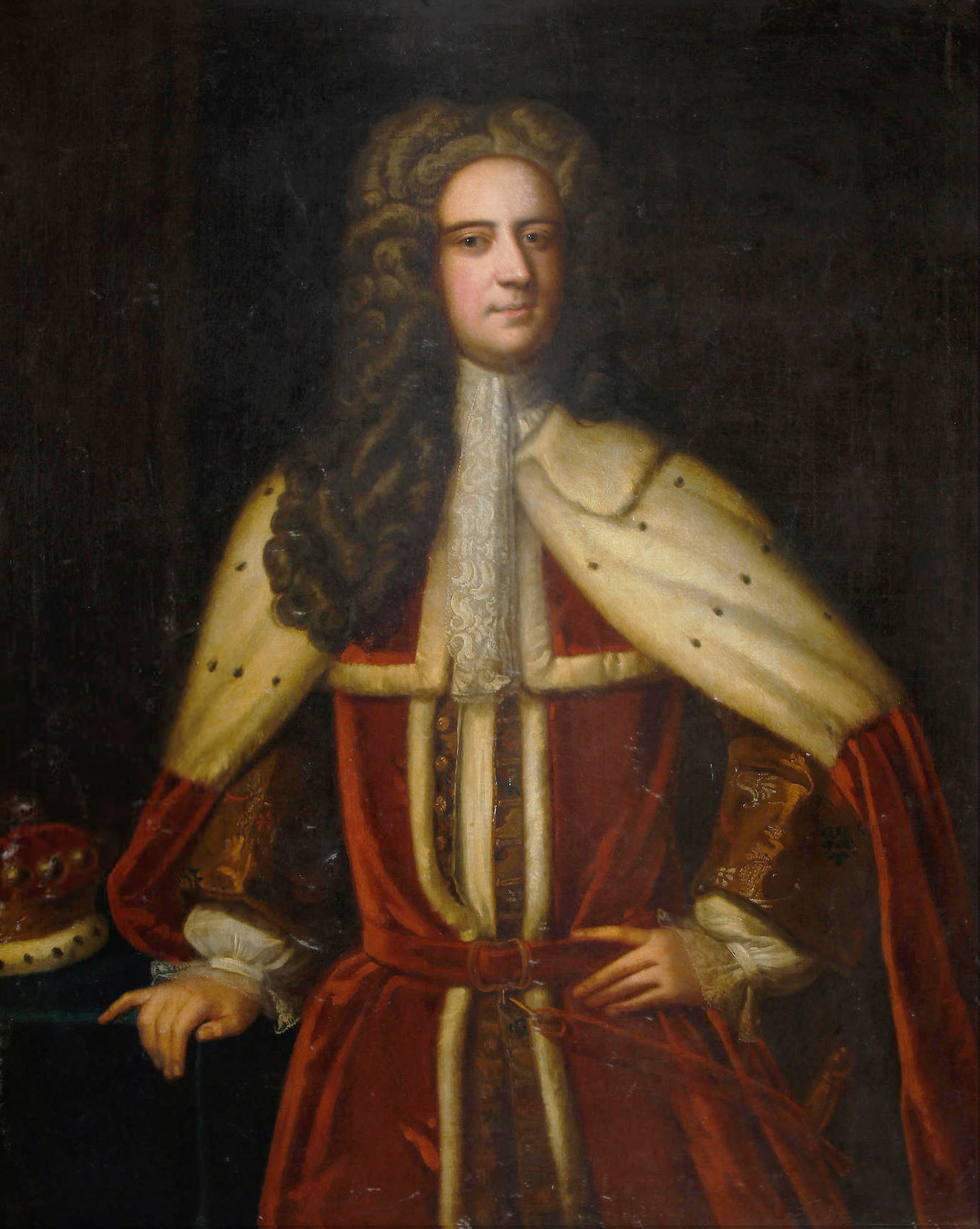
James Barry, 4th Earl of Barrymore (1667-1748) (Lieutenant-General), Studio of Sir Godfrey Kneller courtesy of Sothebys 2013 collection l13304 lot 95.
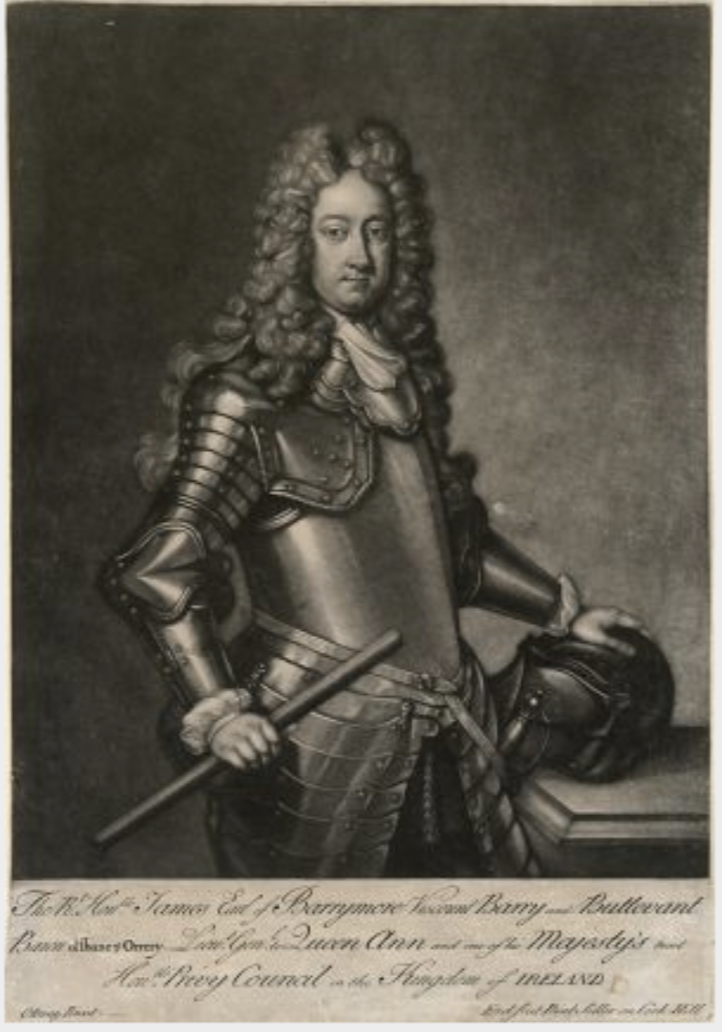
James Barry, 4th Earl of Barrymore, (1667-1747), Soldier and Politician Date c. 1753 by Engraver Michael Ford, Irish, d. 1765 After Thomas Ottway, courtesy of National Gallery of Ireland.
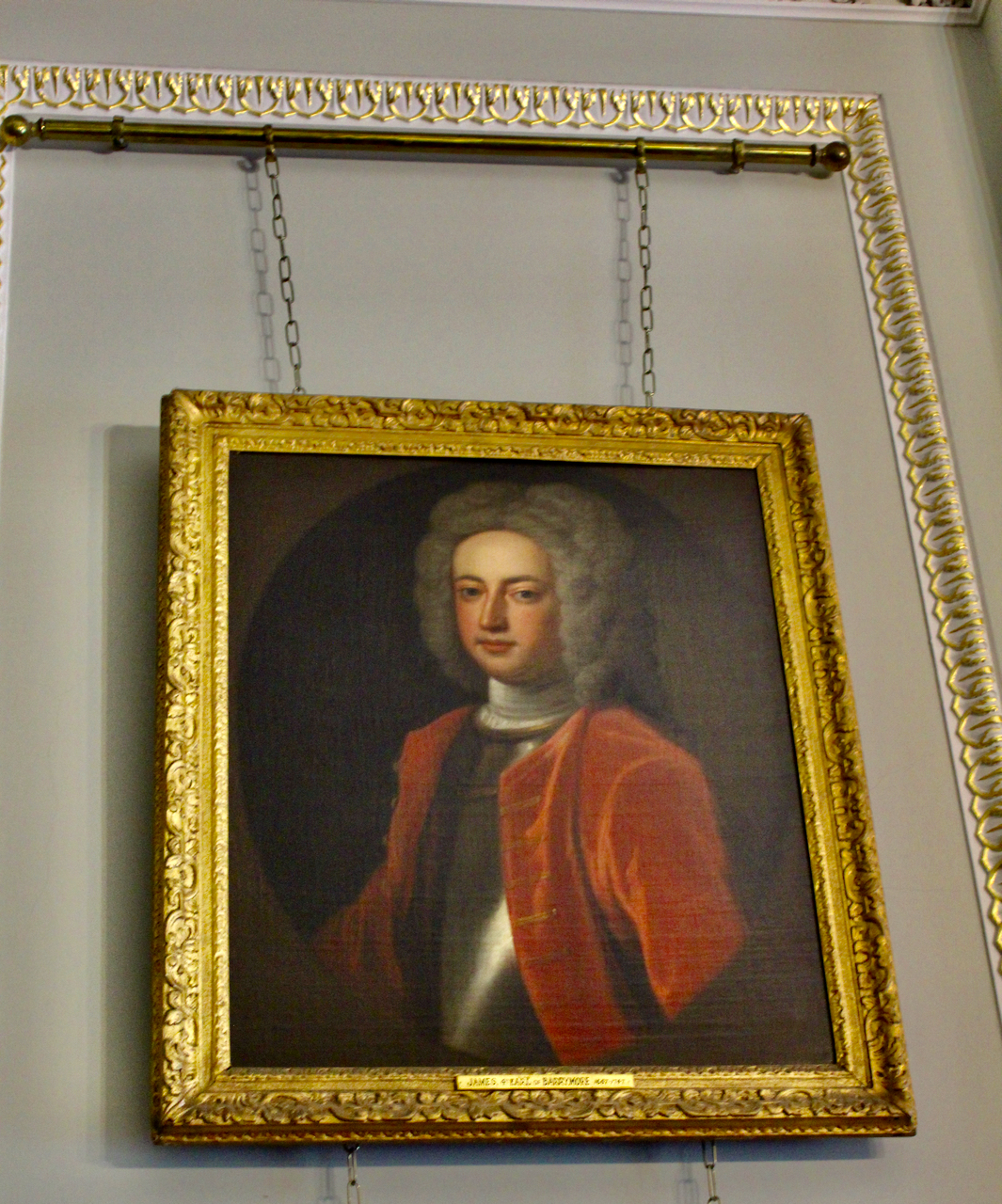
James Barry, 4th Earl of Barrymore, (1667-1747). Photograph © Jennifer Winder-Baggot, www.irishhistorichouses.com
James Barry (1667-1747) Lieutenant Colonel and 4th Earl of Barrymore, National Trust, Public domain, via Wikimedia Commons.
Lt. Gen. James Barry, 4th Earl of Barrymore, (1667-1747) attributed to John Riley, courtesy of Christie’s The Sunday Sale, property of Smith-Barry estates removed from Old Priory Gloucestershire.
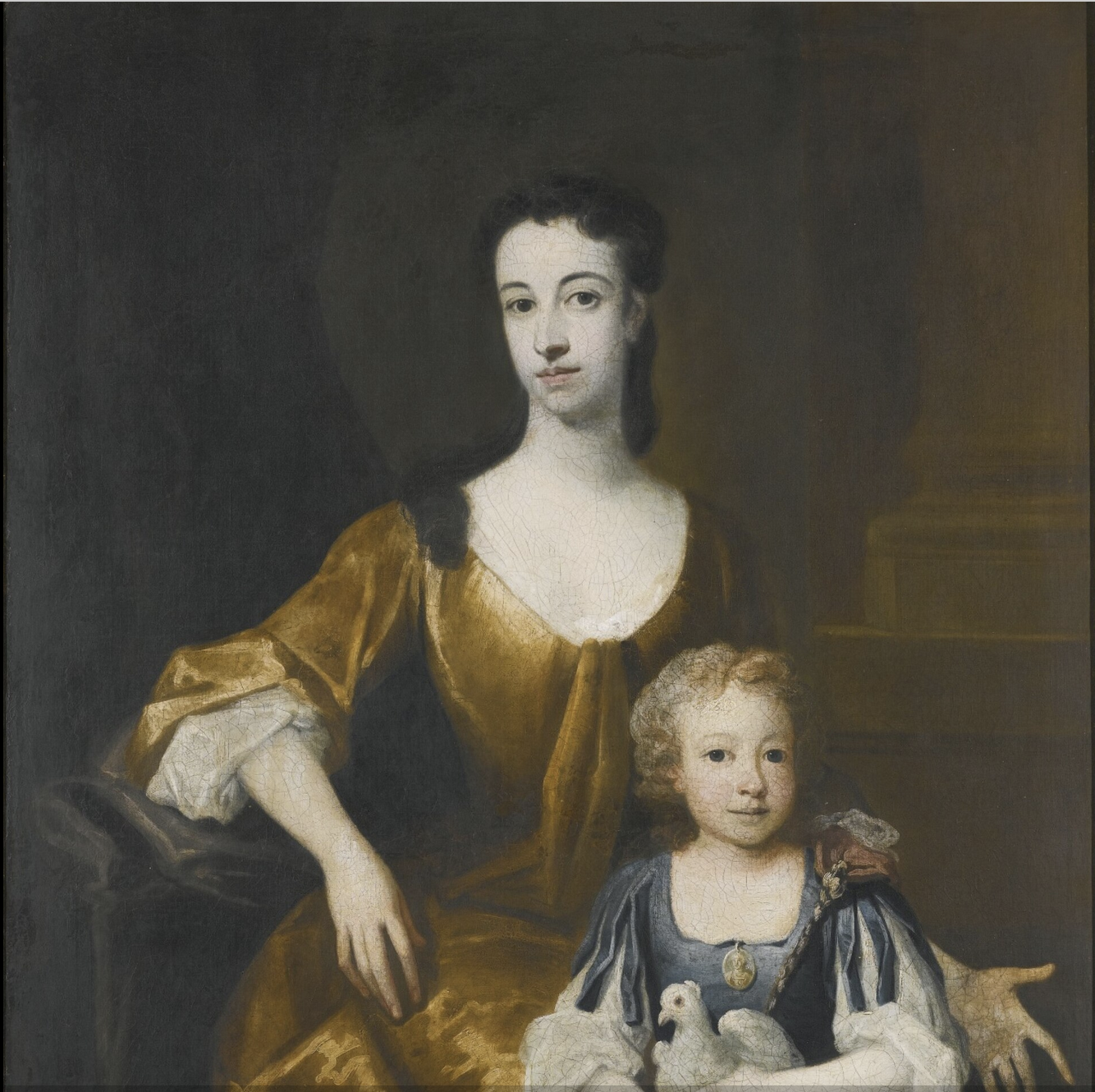
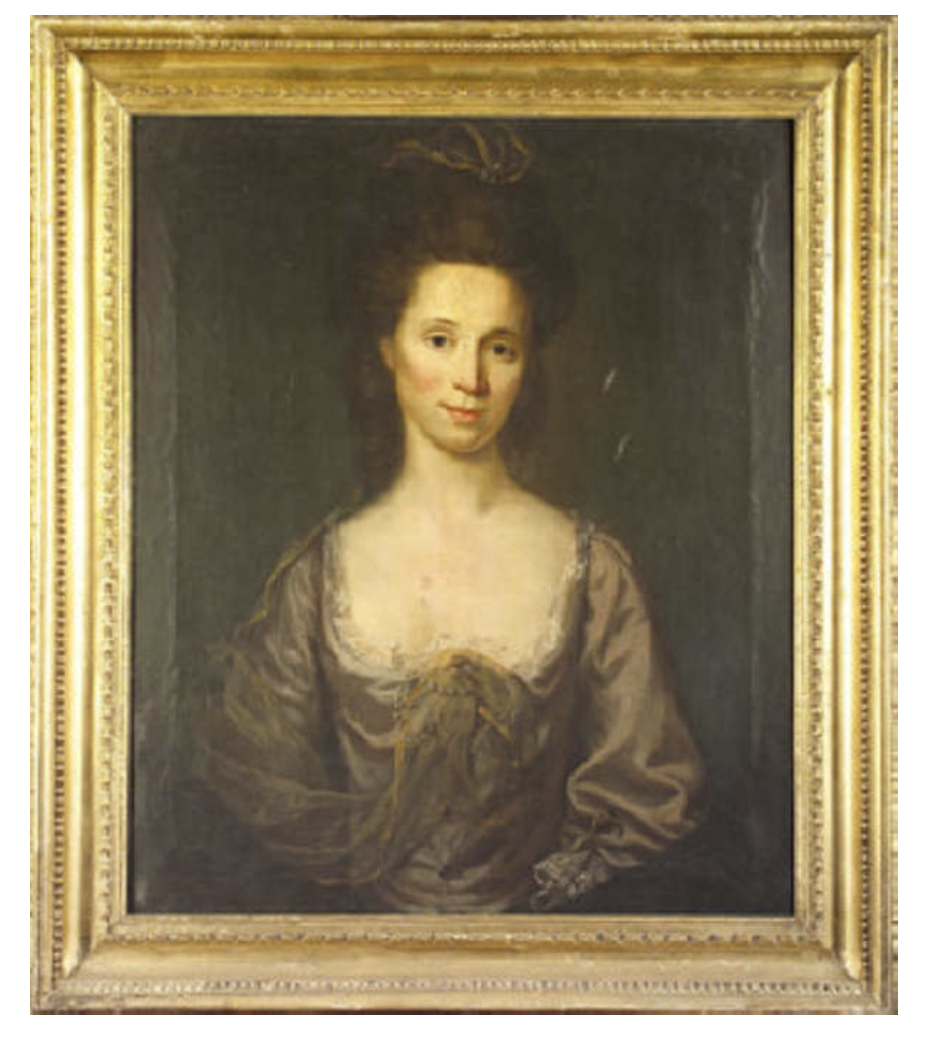
Elizabeth Barry née Savage (d. 1714) wife of James Barry 4th Earl of Barrymore, daughter and heir of Richard Savage 4th Earl Rivers and Penelope Downes, seated with her daughter Penelope. This painting is attributed by Sotheby’s to Thomas Worldige.
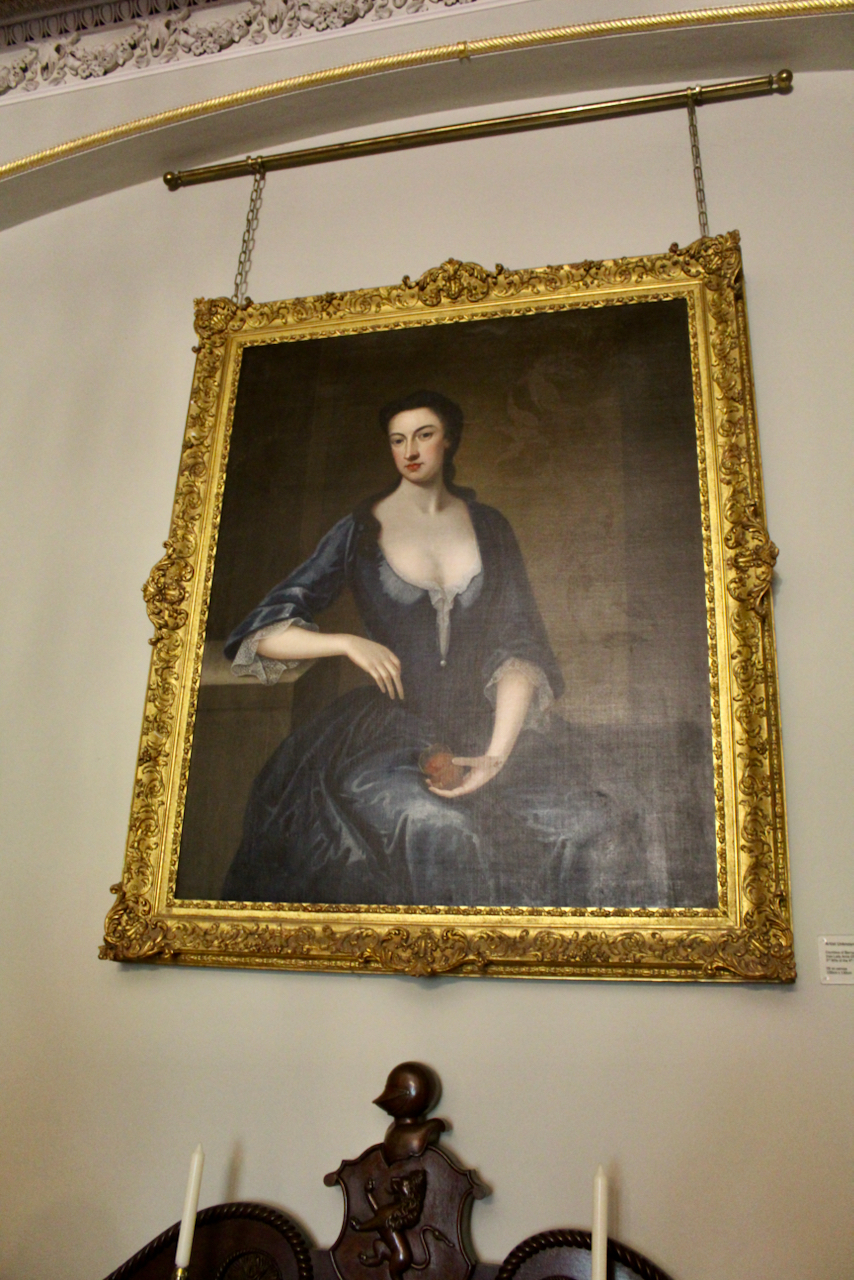
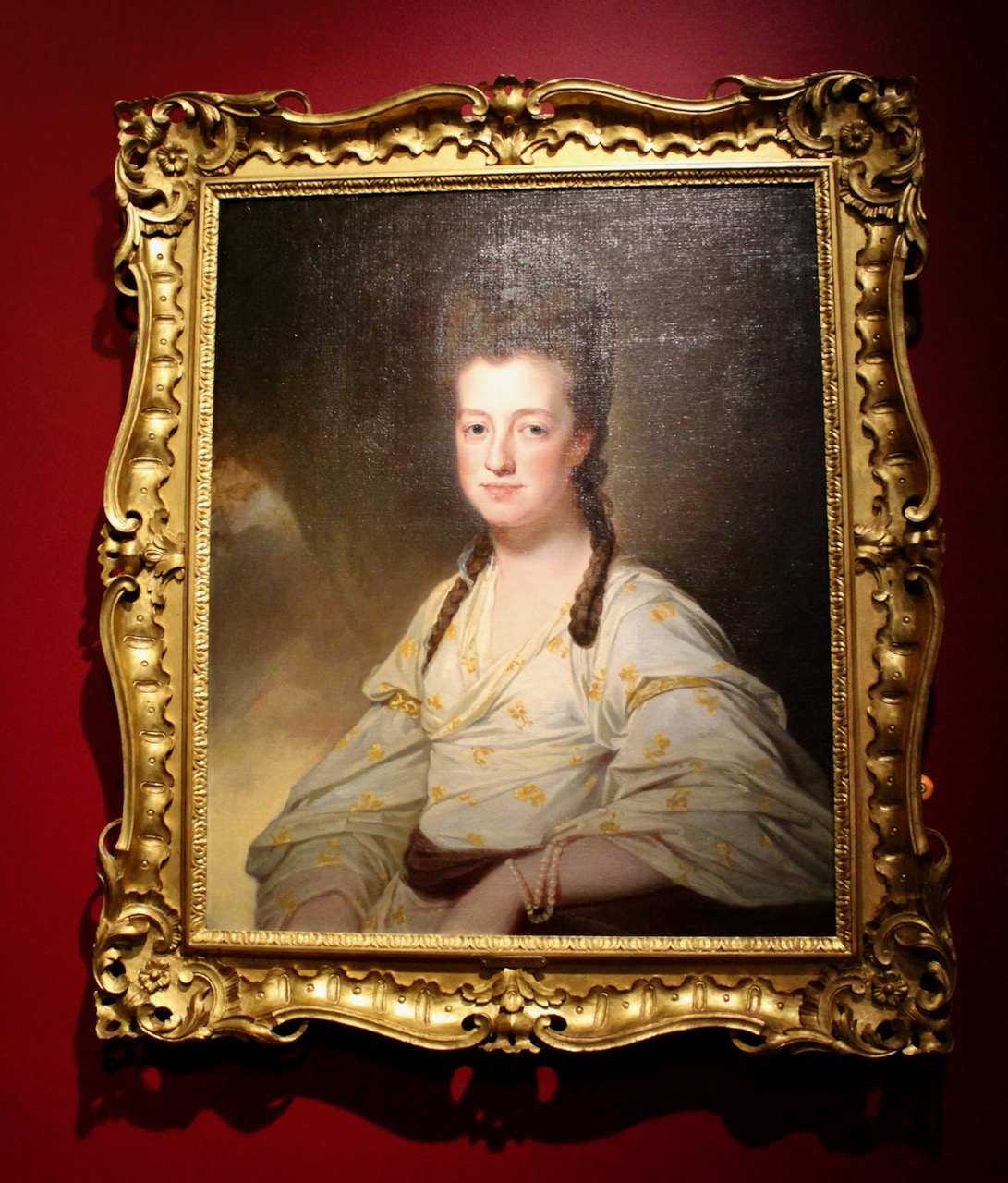
Elizabeth Barry née Savage (d. 1714), 2nd wife of James 4th Earl of Barrymore. She and the 4th Earl had three daughters, and a son who died in his first year. She was the daughter of Richard Savage, 4th Earl Rivers. Photograph © Jennifer Winder-Baggot, www.irishhistorichouses.com
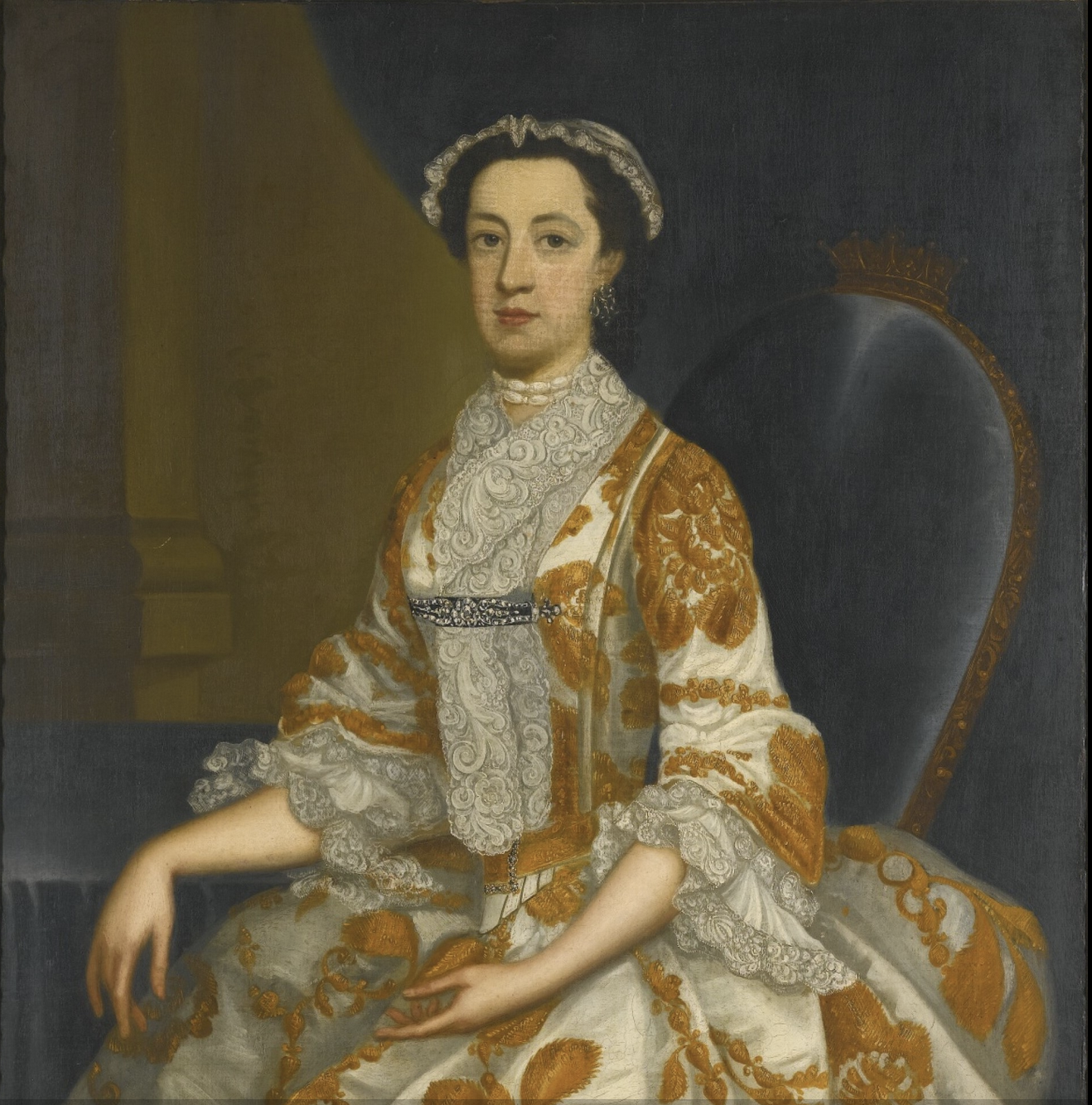
Anne Barry née Chichester (1697-1753) Countess of Barrymore, 3rd wife of James Barry 4th Earl of Barrymore. Photograph © Jennifer Winder-Baggot, www.irishhistorichouses.com
Lady Anne Chichester, Countess of Barrymore (d. 1753) Attributed to Philip Hussey, she was daughter of Major-General Arthur Chichester, 3rd Earl of Donegall (1666-1706) and his wife Lady Catherine Forbes (d. 1743), and she married James Barry 4th Earl of Barrymore, and was the mother of James Smith-Barry.
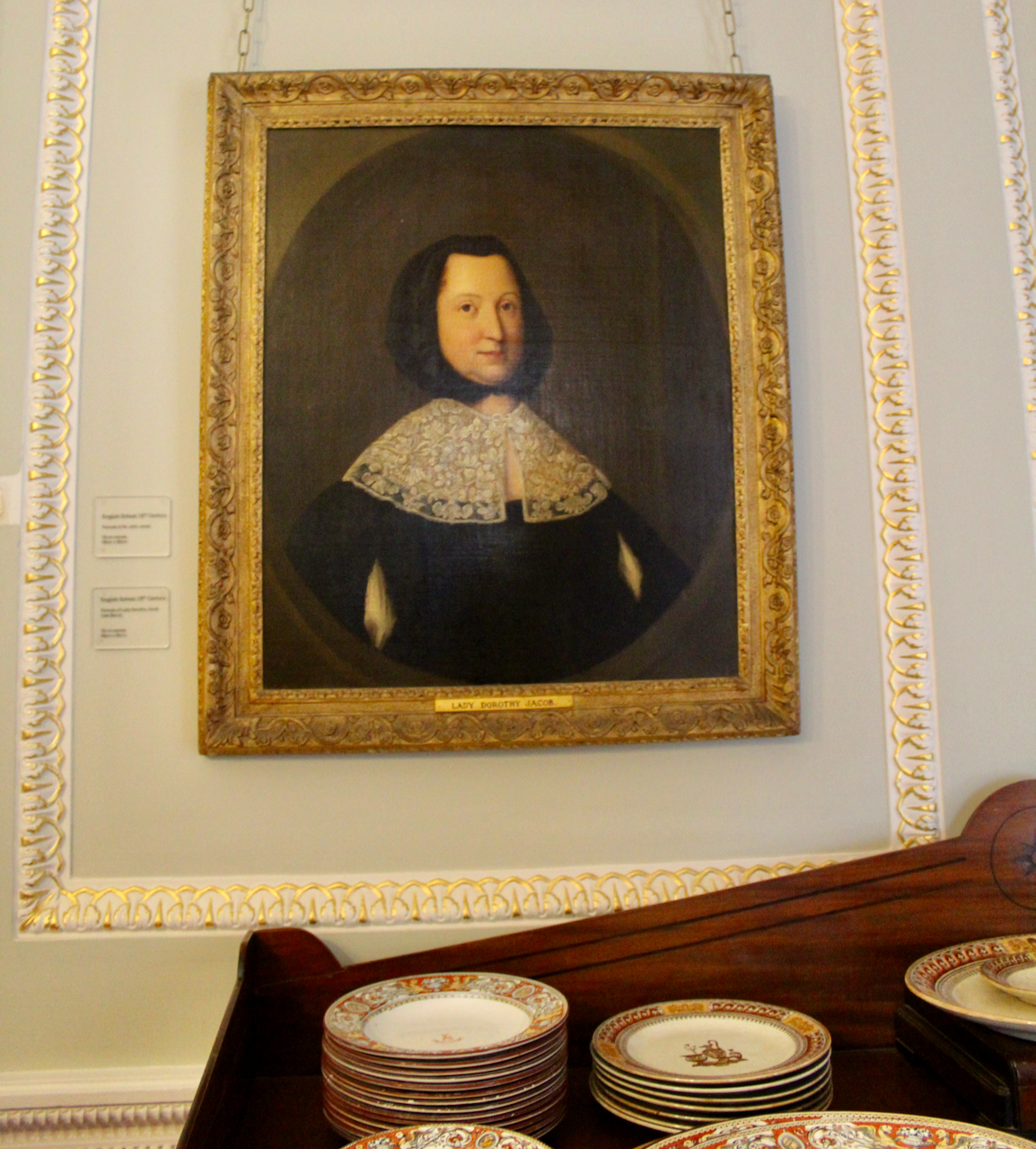
Dorothy née Barry (1670-1748), married John Jacob 2nd Bt. She was the daughter of Richard Barry 2nd Earl of Barrymore. Photograph © Jennifer Winder-Baggot, www.irishhistorichouses.com
Captain the Hon. Richard Barry R.N. (1721-1787), with his spaniel by John Lewis, second son of James Barry 4th Earl of Barrymore. This portrait is also courtesy of Sotheby’s L11304. This portrait belonged to the Smith-Barry family and was sold in an auction at Sotheby’s in 2013. We can see it in the old photograph of the library of Fota House.
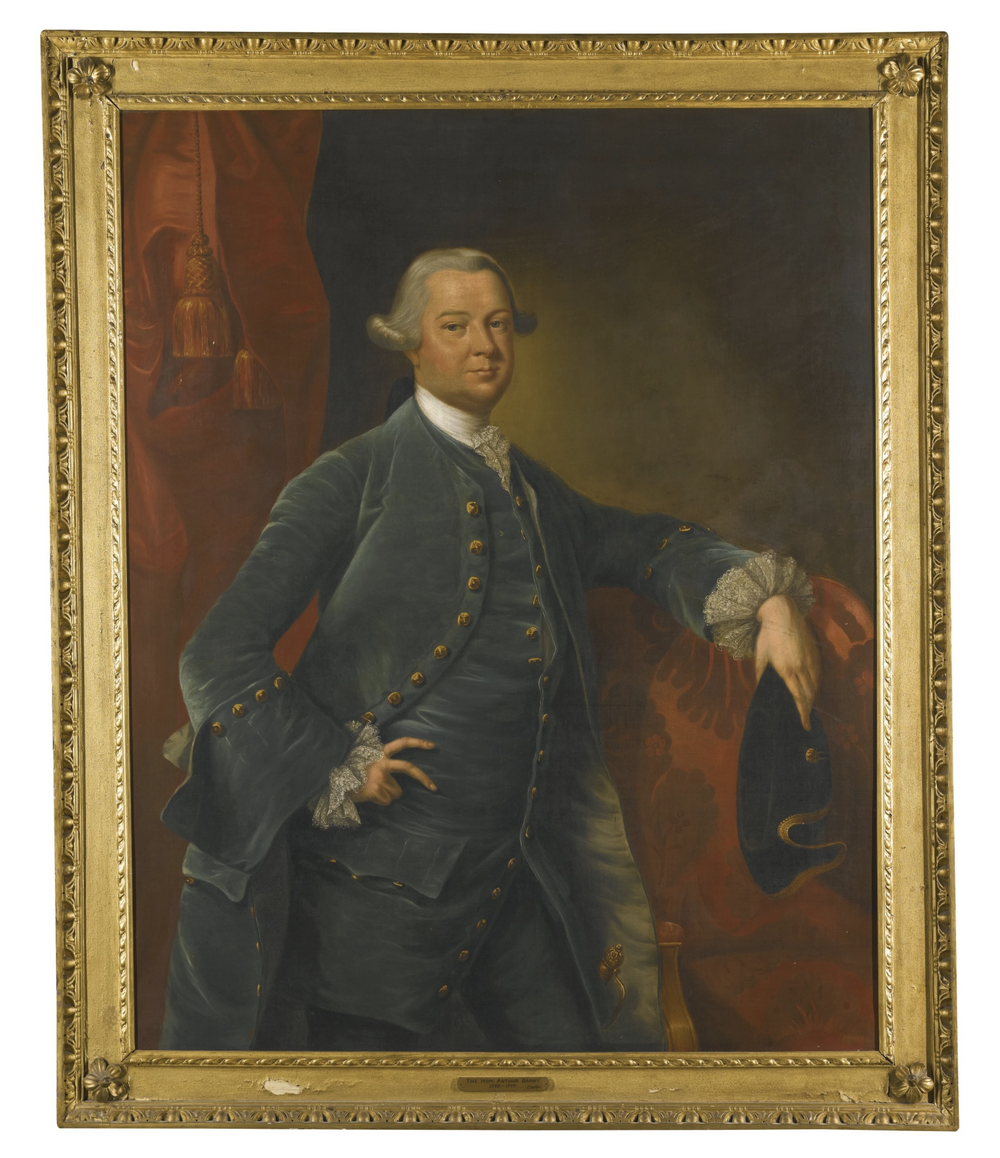
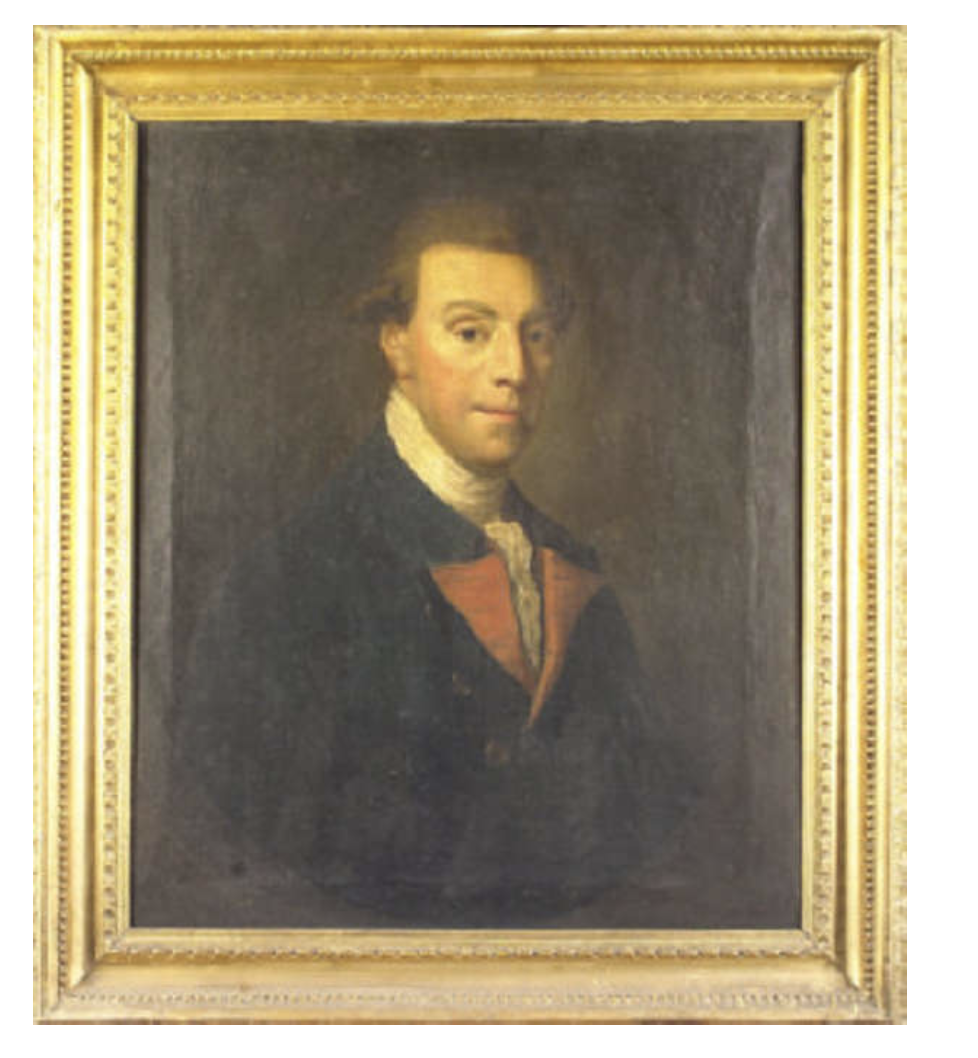
Arthur Barry (1723-1770) by Francis Cotes courtesy of Sotheby’s L11304. This portrait belonged to the Smith-Barry family and was sold in an auction at Sotheby’s in 2013. Arthur was another son of James Barry, 4th Earl of Barrymore, he died unmarried and his property went to the Smith-Barry family.
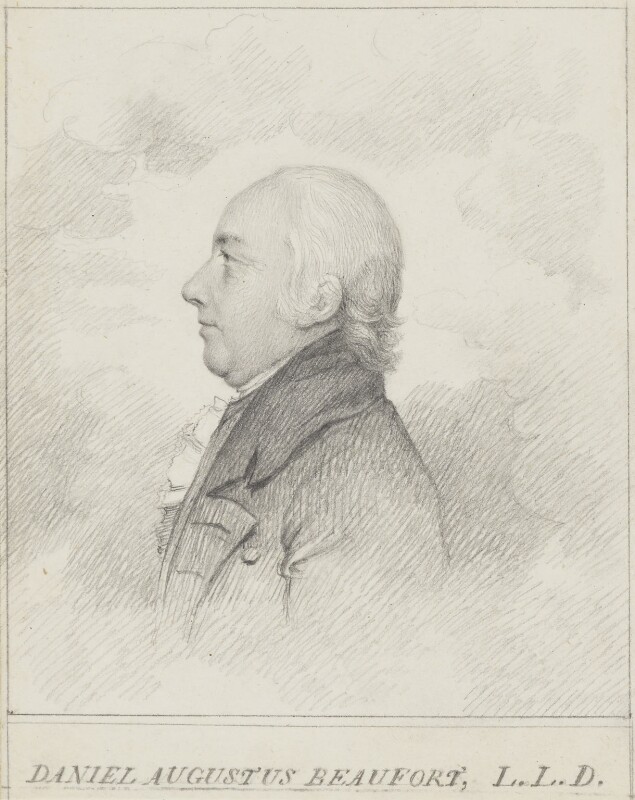
Daniel Augustus Beaufort (1739-1821), Geographer, by unknown artist circa 1800-1805, courtesy of National Portrait Gallery NPG 5255.
Alfred Beit (1903-1994), 2nd Baronet and his wife Clementine née Freeman-Mitford (b. 1915), of Russborough House, County Wicklow.
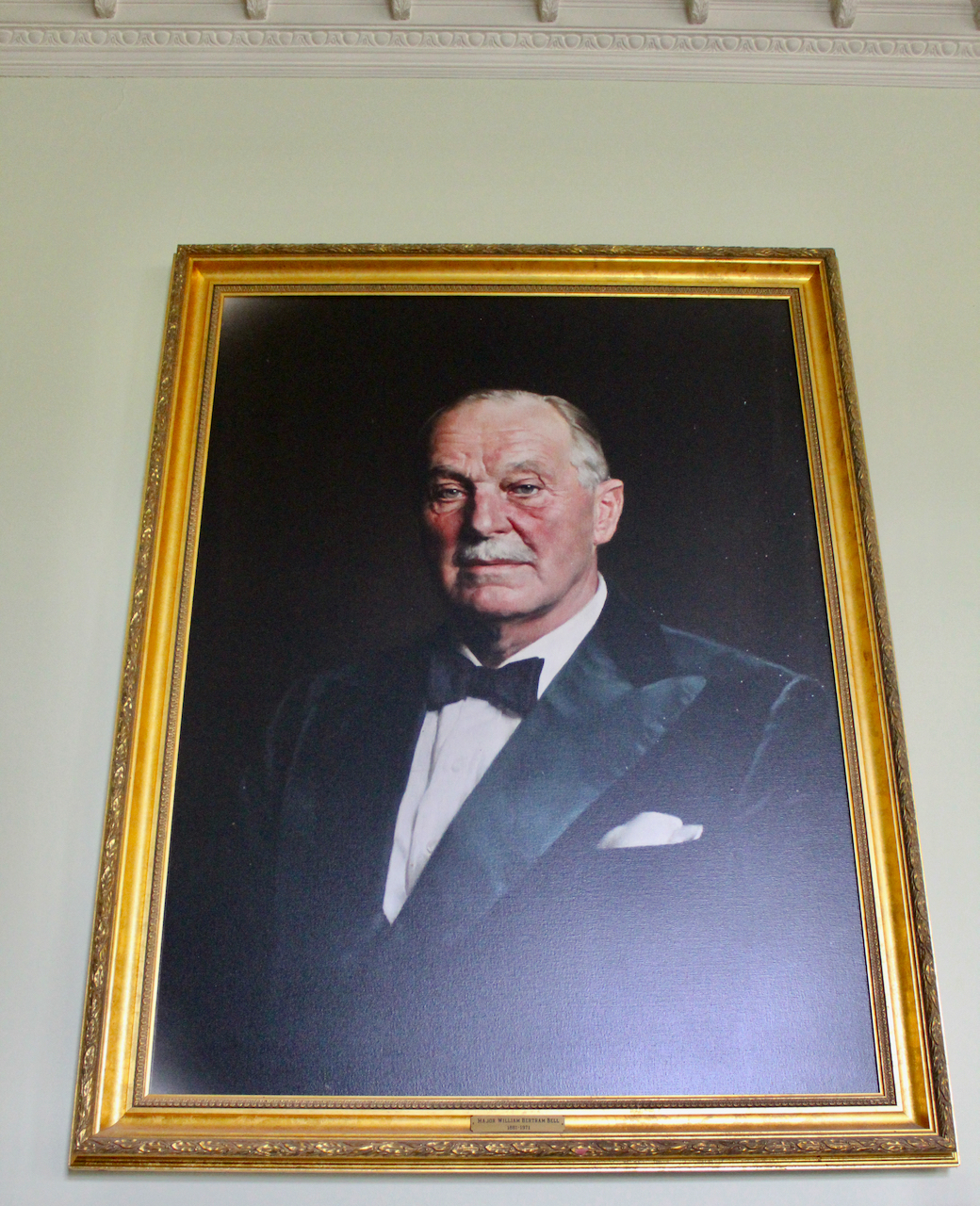
Major William Bertram Bell (1881-1971). Photograph © Jennifer Winder-Baggot, www.irishhistorichouses.com
John Bellew 1st Baron (d. 1691) by Garrett Morphy, courtesy of http://www.galleryofthemasters.com . He commanded a regiment of infantry in Ireland and was a Roman Catholic peer who sat in James II’s Parliament of 1689. He died of wounds received in the Battle of Aughrim.
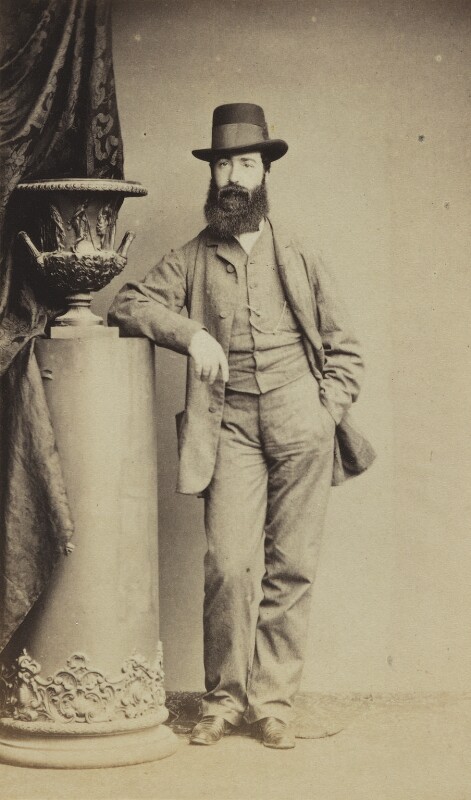
Edward Joseph Bellew (1830-1895) 2nd Baron Bellew by unknown photographer 1860s courtesy of National Portrait Gallery NPG Ax196758.
Henry Grattan Bellew, 3rd Baronet, b.1860, married Sophia Forbes, daughter of the Earl of Granard, by Dermod O’Brien, courtesy of Adam’s auction 10 Oct 2017.
Dorothy Bentinck née Cavendish, Duchess of Portland (1750-1794) by George Romney, c. 1772, daughter of William Cavendish, 4th Duke of Devonshire. She married William Henry Bentinck 3rd Duke of Portland, who added Cavendish to his name to become Cavendish-Bentinck. Photograph © Jennifer Winder-Baggot, www.irishhistorichouses.com

Timothy William Ferres tells us of the Beresfords of Curraghmore: http://lordbelmontinnorthernireland.blogspot.com/search/label/County%20Waterford%20Landowners

SIR TRISTRAM BERESFORD (1595-1673), who was created a baronet in 1665, designated of Coleraine, County Londonderry. He married firstly, Anne, eldest daughter of John Rowley, of Castleroe, County Londonderry, by whom he had one son, RANDAL, his heir, and two daughters; and secondly, Sarah Sackville, and had three sons and three daughters: Tristram; Michael; Sackville; Susanna; Sarah; Anne.
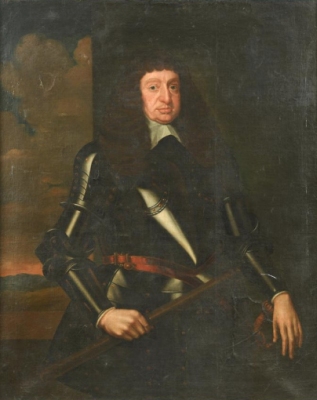
Tristram Beresford (d. 1673), 1st Bt of Coleraine

Sir Tristram was succeeded by his eldest son, SIR RANDAL BERESFORD, 2nd Baronet (c. 1636-81), MP for Coleraine, 1661-68, who married Catherine Annesley, younger daughter of Francis, 1st Viscount Valentia, and dying in 1681, left issue, TRISTRAM, his heir; Jane; Catherine.

Sir Randal was succeeded by his eldest surviving son, SIR TRISTRAM BERESFORD, 3rd Baronet (1669-1701), MP for Londonderry County, 1692-99, who commanded a foot regiment against JAMES II, and was attainted by the parliament of that monarch. Sir Tristram wedded, in 1687, Nichola Sophia, youngest daughter and co-heiress of  Hugh Hamilton, 1st Viscount Glenawly.

He was succeeded by his son, SIR MARCUS BERESFORD, 4th Baronet (1694-1763), MP for Coleraine, 1715-20, who espoused, in 1717, Catherine, BARONESS LE POER, daughter and heiress of James, 3rd Earl of Tyrone, and in consequence of that alliance, was elevated to the peerage, in 1720, in the dignity of Baron Beresford and Viscount Tyrone. His lordship was further advanced to an earldom, in 1746, as EARL OF TYRONE.

Rt. Hon. Marcus Beresford (1694-1763) 4th Baronet and 1st Earl of Tyrone, photograph courtesy of the Beresford family and creative commons and wikipedia.

Marcus Beresford (1694-1763) 1st Earl of Tyrone had surviving issue: GEORGE DE LA POER (1735-1800) his successor who became 2nd Earl of Tyrone;
John (1737/38-1805);
William (1743-1819) (Most Rev), created BARON DECIES;
Anne; Jane; Catherine; Aramintha; Frances Maria; Elizabeth.

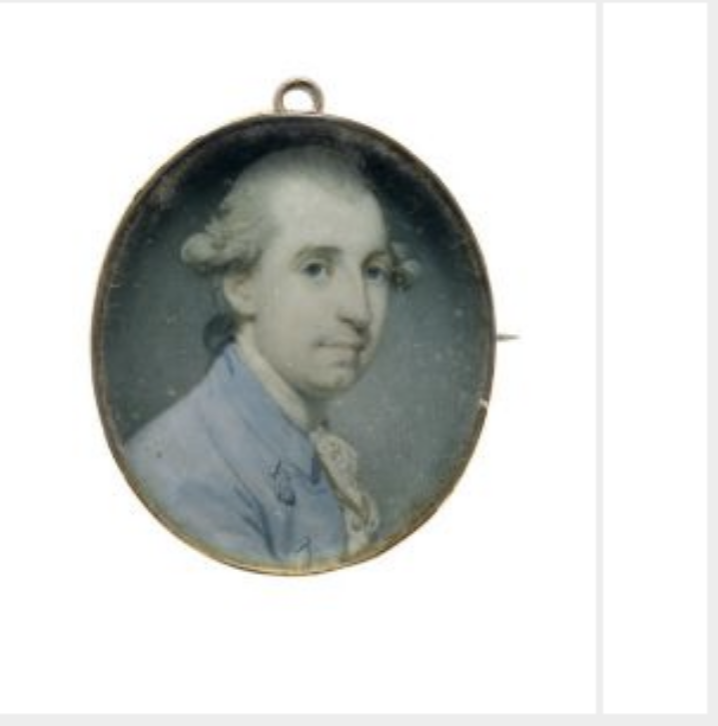
George de la Poer Beresford (1735-1800) 2nd Earl of Tyrone, later 1st Marquess of Waterford, by Johann Zoffany, courtesy of National Trust Hatchlands.
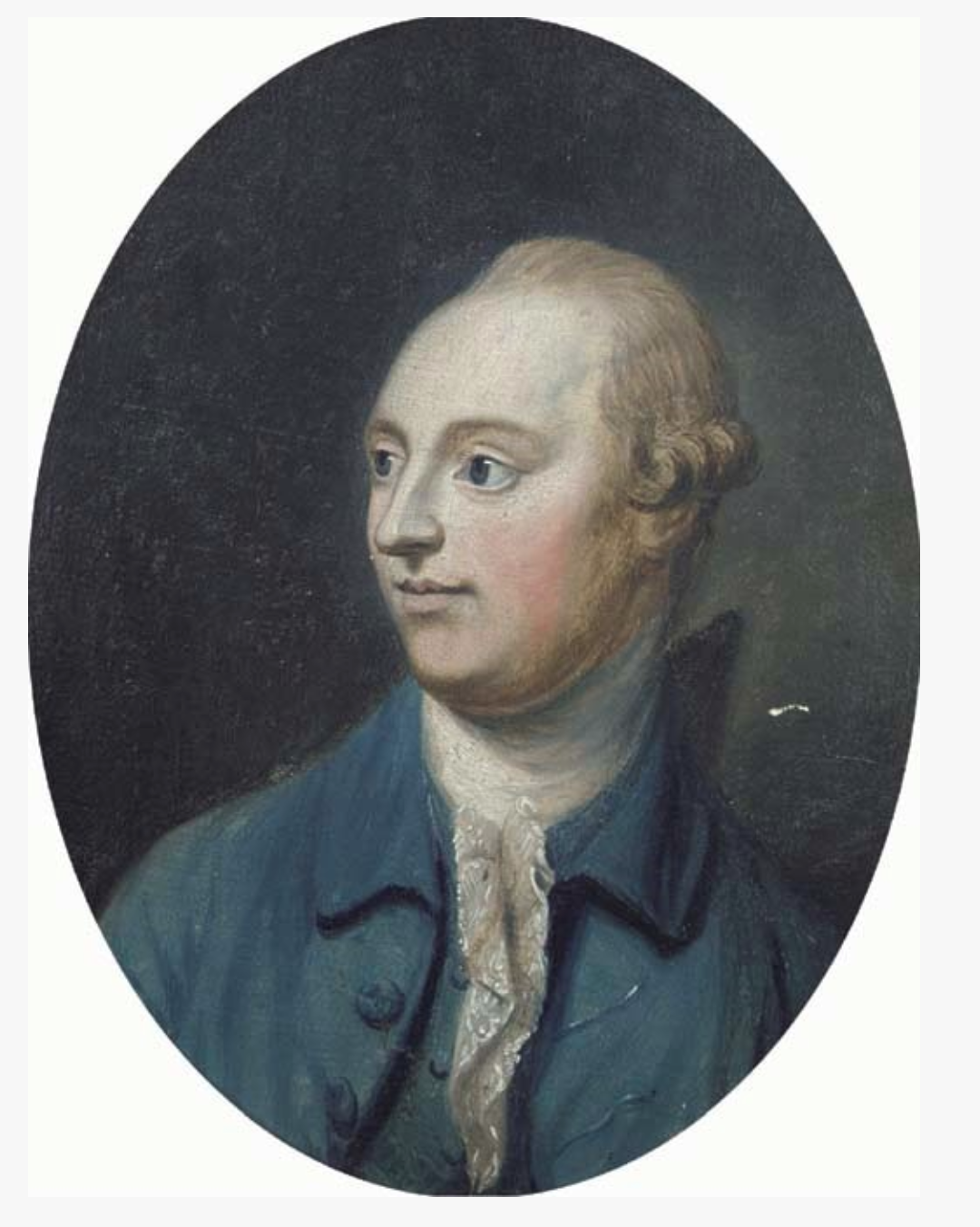
John Beresford, M.P. (1738-1805), son of of Marcus Beresford 1st Earl of Tyrone, miniature by Richard Crosse, British, 1742-1810.
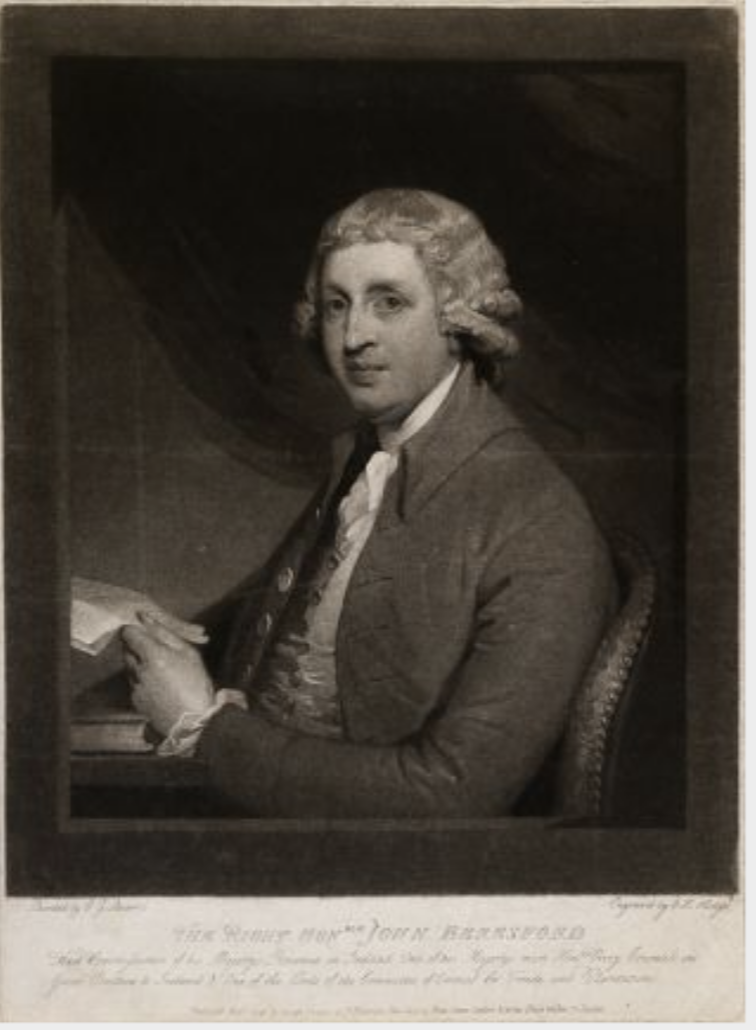
John Beresford (1738-1805), first commissioner of the Revenue in Ireland, engraver Charles Howard Hodges, after Gilbert Smith, courtesy of National Gallery of Ireland.
John Beresford (1738-1805), MP by Gilbert Stuart c. 1790, courtesy of National Gallery of Ireland NGI 1133.
Right Honourable John Beresford by Thomas Hickey (fl.1756-1816) courtesy Chrisites 2005. I’m not sure if this is John Beresford (1738-1805).
Barbara Montgomery (?1757-1788), second wife of John Beresford (1738-1805) by Hugh Douglas Hamilton, courtesy of National Gallery of Ireland P5547. His first wife was Anne Constantia Ligondes.
Marcus Gervais Beresford (1801-1885), Archbishop of Armagh, painting as Prelate of Order of St. Patrick, by engraver John Richardson Jackson, after painting by Stephen Catterson Smith, courtesy of National Gallery of Ireland. He was grandson of John Beresford (1738-1805). His father was Rt. Rev. George de la Poer Beresford (1765-1841).
George John Beresford (1807-1864) of Woodhouse, County Waterford. He was also a grandson of John Beresford (1738-1805). His father was Reverend Charles Cobbe Beresford (b. 1770).
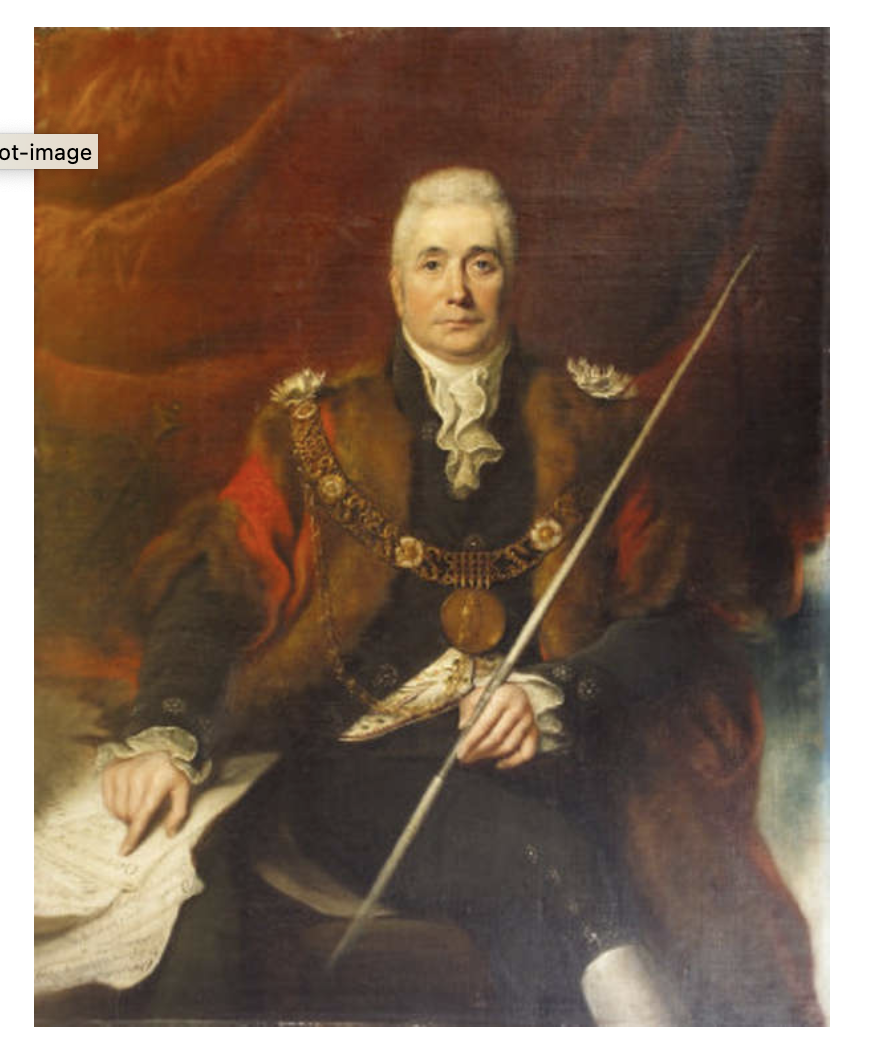
John Claudius Beresford, Lord Mayor of Dublin courtesy Adam’s 8 March 2006 in style of William Cuming PRHA. He was the son of John Beresford (1738-1805).
Elizabeth de la Poer Beresford (1736-1806), daughter of Marcus Beresford 1st Earl of Tyrone, wife of Thomas Cobbe of Newbridge House, in a costume evocative of Mary Queen of Scots, miniature, Cobbe Collection.

George de la Poer Beresford, 2nd Earl of Tyrone (1735-1800) inherited the ancient Barony of de la Poer at the decease of his mother in 1769. His lordship was enrolled amongst the peers of Great Britain, in 1786, as Baron Tyrone; and created, in 1789, MARQUESS OF WATERFORD.
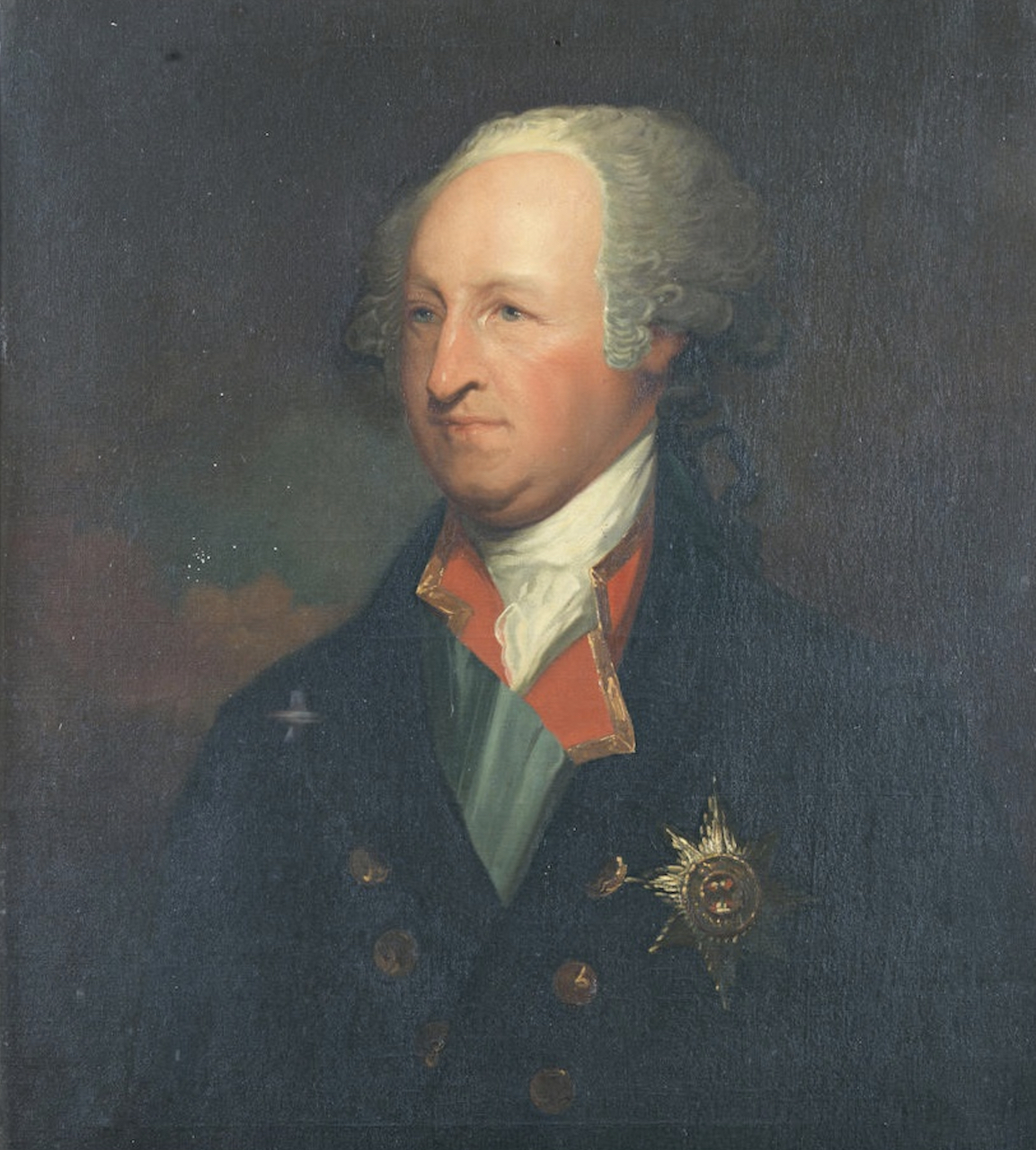
George de la Poer Beresford (1735-1800) First Marquess of Waterford by Gilbert Stuart, courtesy of Bonhams and commons.

He married, in 1769, Elizabeth, only daughter and heiress of Henry Monck, of Charleville. They had issue:

Marcus, died at 8 years old; Henry de la Poer Beresford (1772-1826) his successor who became 2nd Marquess of Waterford; John George (1773-1862) (Most Rev), Lord Archbishop of Armagh;
George Thomas (1781-1839) (Rt Hon), Lt-Gen, GCH; Isabella Anne; Catherine; Anne; Elizabeth Louisa (1783-1856).
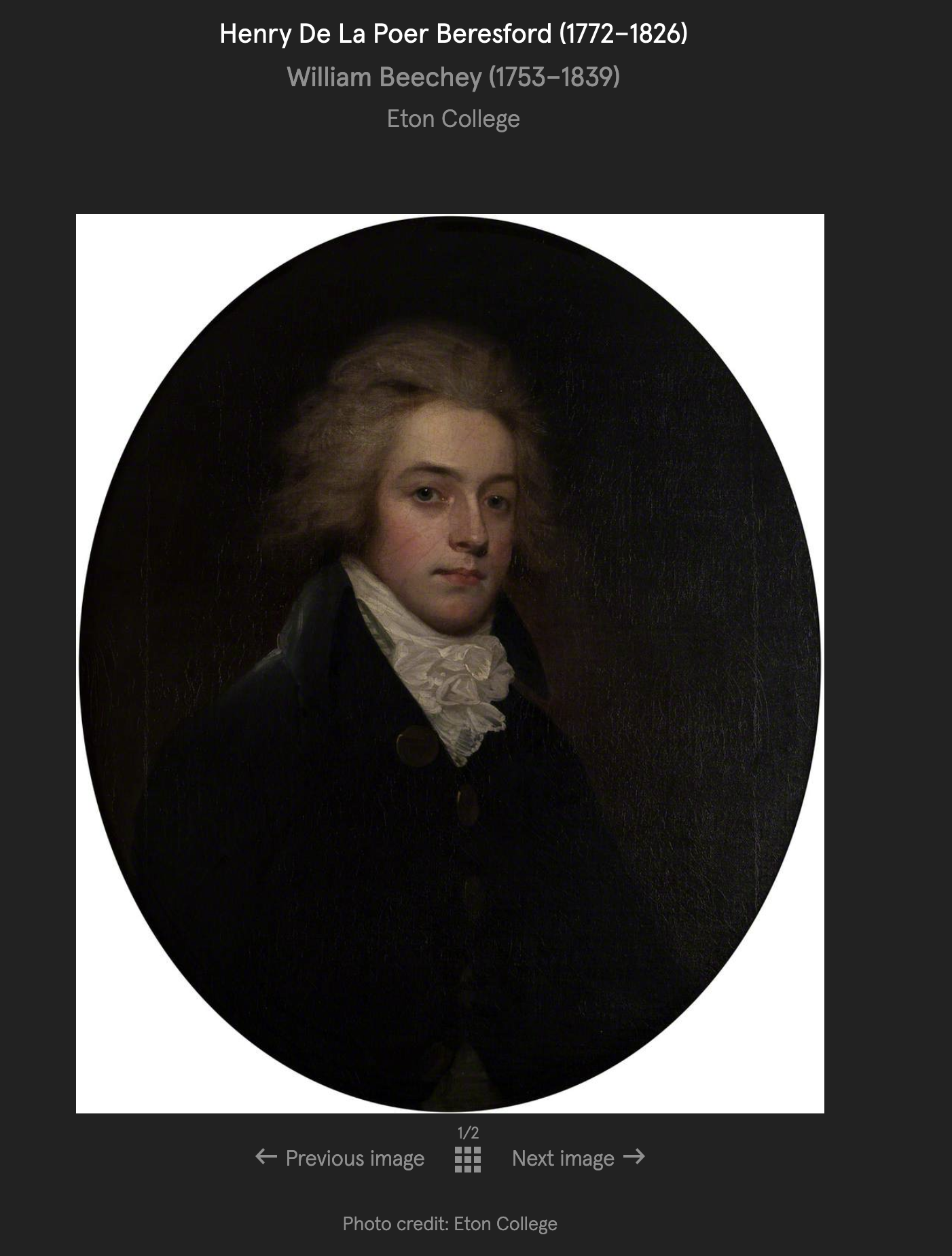
Henry de la Poer Beresford (1772-1826) 2nd Marquess of Waterford by William Beechy courtesy of Eton College.
John George Beresford (1773-1862), Archbishop of Armagh, after Thomas Lawrence, by Charles Turner, courtesy of Armagh County Museum. He was son of George de la Poer Beresford, 2nd Earl of Tyrone.
Thought to be Elizabeth Louisa Reynell (1783-1856) née De La Poer and formerly wife of Sir Denis Pack, courtesy of Whyte’s Nov 2011. She was the daughter of the 1st Marquess of Waterford, and she married Denis Pack of County Kilkenny and later, Thomas Reynell, 6th Baronet.

He had an illegitimate son Admiral Sir John de la Poer Beresford (1766-1844) 1st Bt Beresford, of Bagnall, Co. Waterford, and also Lt.-Gen. William Carr Beresford (1768-1854) 1st and last Viscount Beresford of Beresford.
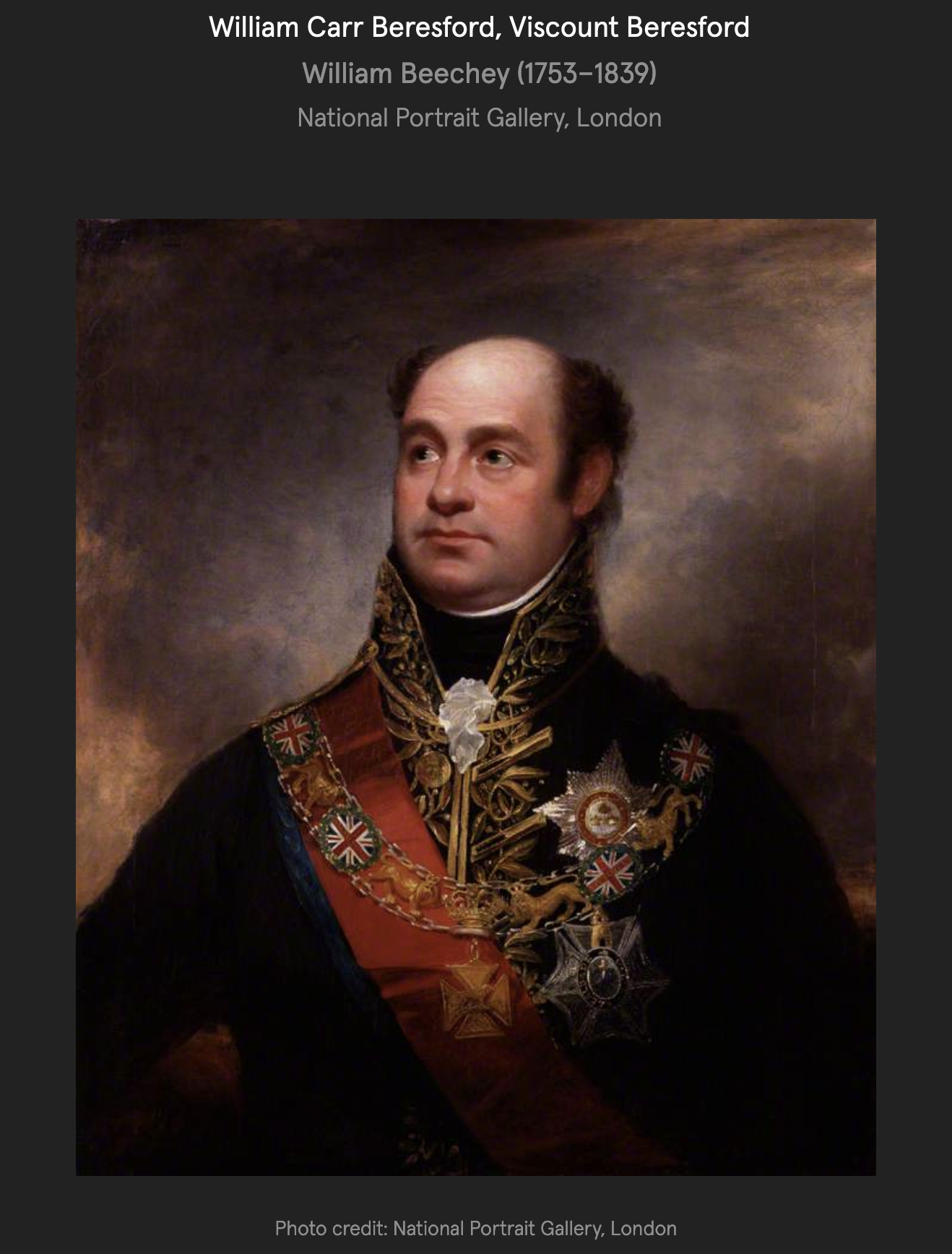
William Carr Beresford (1768-1854) Viscount Beresford, by William Beechey, Photograph courtesy of National Portrait Gallery, London.
Harriet Elizabeth Peirse (1790-1825) Lady Beresford, wife of Admiral Sir John de la Poer Beresford (1766-1844) 1st Bt Beresford, of Bagnall, Co. Waterford, by Thomas Lawrence, courtesy of National Trust Hatchlands.

Henry de la Poer Beresford 2nd Marquess (1772-1826) wedded, in 1805, Susanna Carpenter, only daughter and heiress of George Carpenter 2nd Earl of Tyrconnell, and had issue,

HENRY de la Poer Beresford (1811-1859) his successor who became 3rd Marquess of Waterford;
William;
John (1814-1866) who became 4th Marquess of Waterford;
James;
Sarah Elizabeth (1807-1854) who married Henry John Chetwynd-Talbot, 18th Earl of Shrewsbury.

James Beresford (1816-1841) by Joseph Clover, courtesy of Ingestre Hall Residential Arts Centre.

Henry de la Poer Beresford 3rd Marquess married Louisa Anne Stuart (1818-1891), daughter of Charles Stuart, 1st and last Baron Stuart de Rothesay. They did not have children.
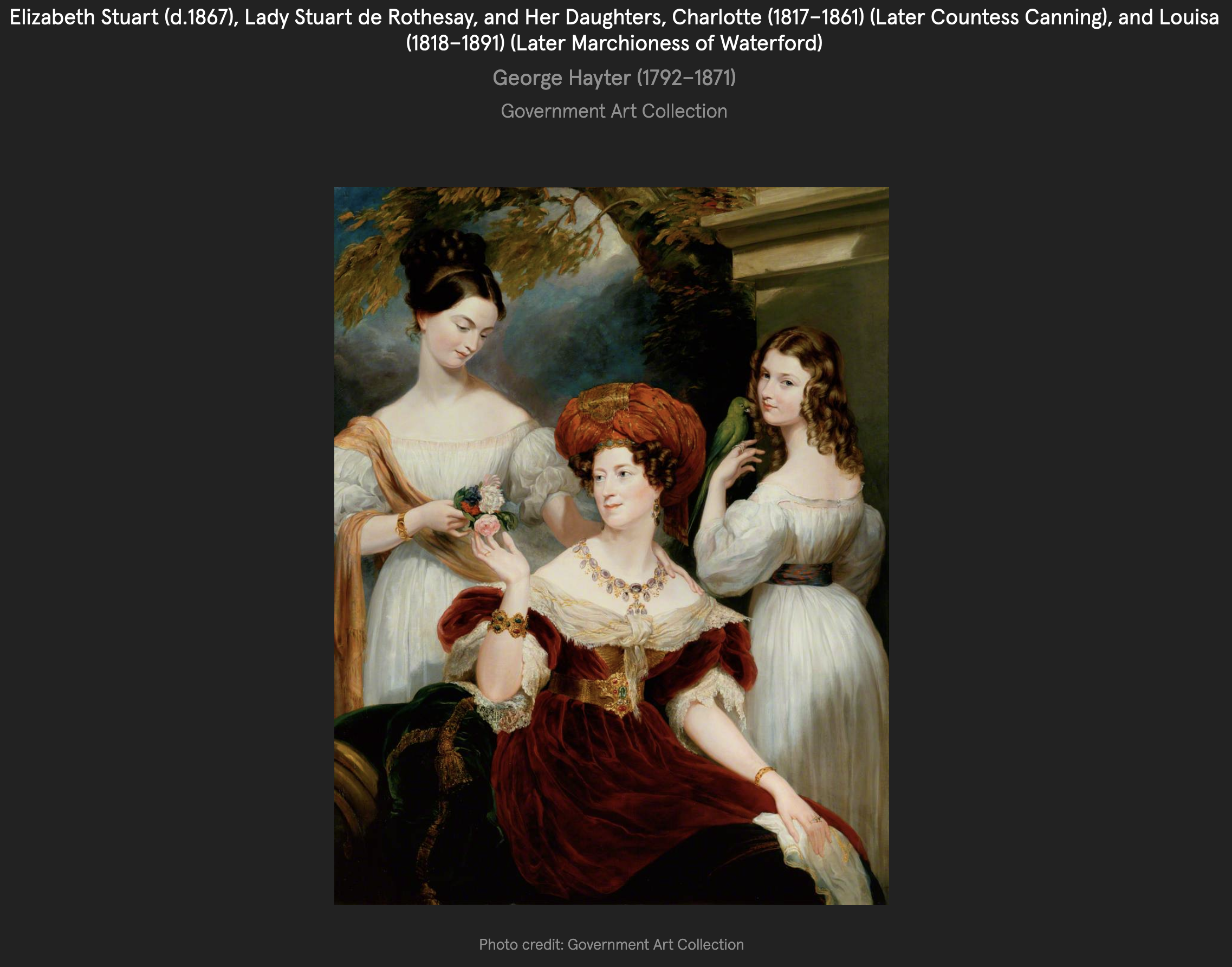
Elizabeth Stuart née Yorke (1789-1867). Lady Stuart de Rothesay, with her daughters Charlotte (1817-1861) and Louisa (1818-1891) by George Hayter, photograph courtesy of UK Government Art Collection. Elizabeth was the daughter of Philip Yorke 3rd Earl of Hardwicke; Louisa married Henry de la Poer Beresford 3rd Marquis of Waterford; Charlotte married Charles John Canning 1st Viceroy of India, 2nd Viscount Canning, 1st Earl Canning.
Louisa Anne Beresford née Stuart (1818-1891), wife of Henry de la Poer Beresford, 3rd Marquess of Waterford, daughter of Charles Stuart, 1st and last Baron Stuart de Rothesay, by Sir Francis Grant 1859-1860, NPG 3176. The National Portrait Gallery tells us: “Louisa Stuart was brought up mostly in Paris, where her father was British Ambassador to the French court. She was taught to draw from an early age and art, along with religion and philanthropy, was one of her main interests throughout her life. A gifted amateur watercolourist, she did not exhibit at professional galleries until the 1870s. With a strong interest in the welfare of the tenants on her Northumberland estate, she rebuilt the village of Ford. She provided a school and started a temperance society in the village. Her greatest artistic achievement was the decoration of the new school with life sized scenes from the Old and New testaments that used children and adults from the village as models.”

When the 3rd Marquess died, his brother John became the 4th Marquess. The 4th Marquess married Christiana, daughter of Charles Powell Leslie of Castle Leslie in County Monaghan.
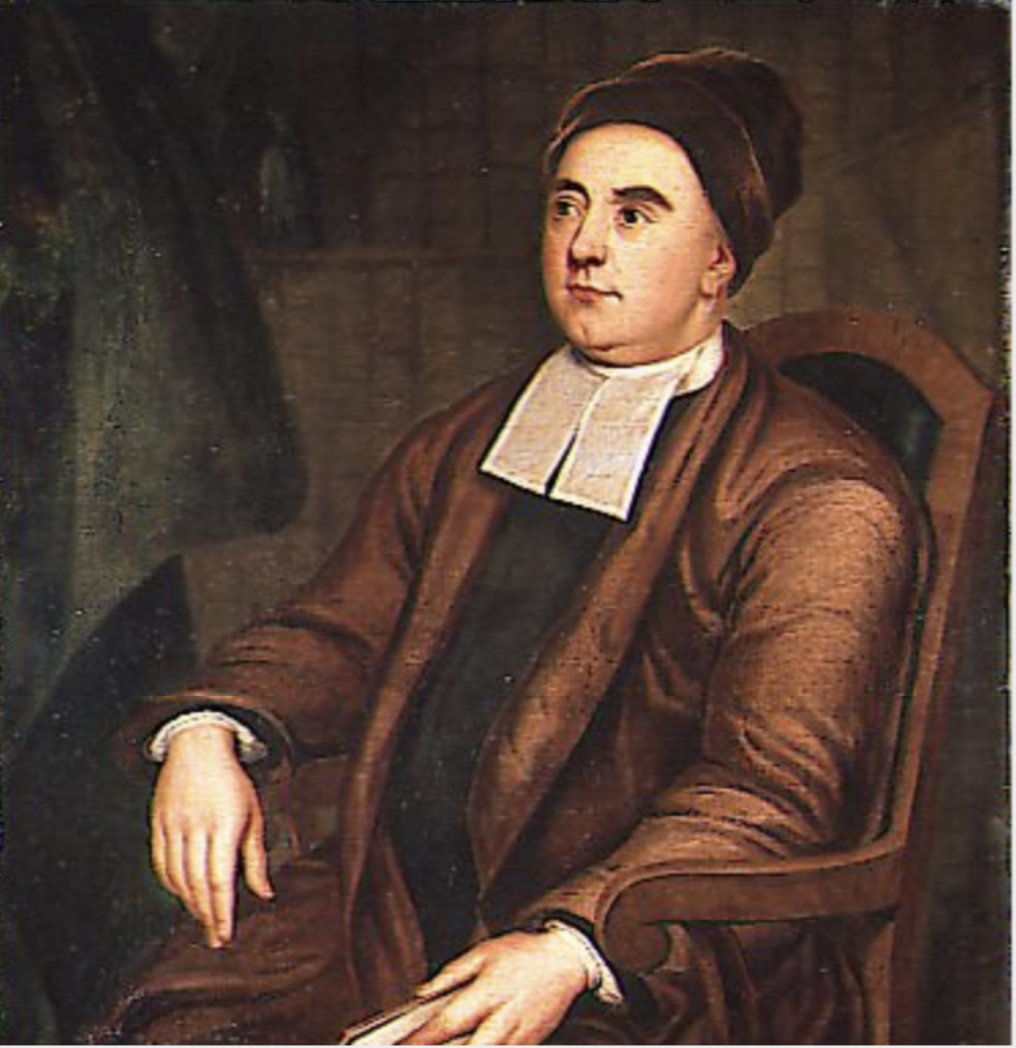
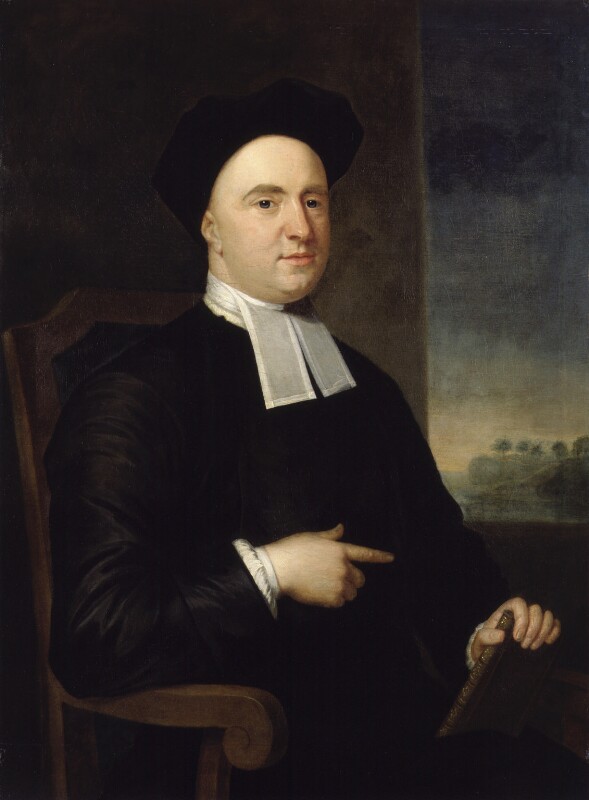
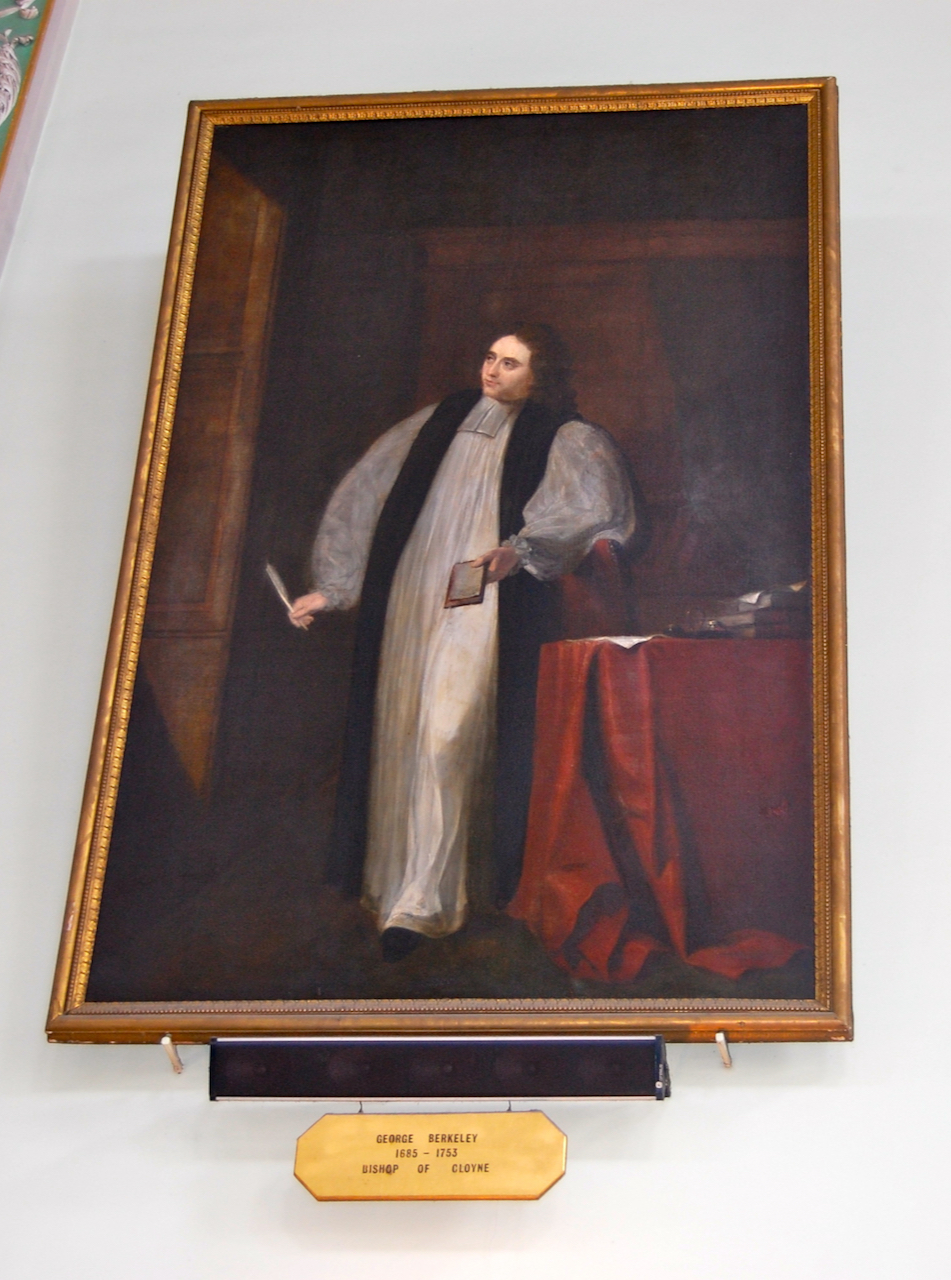
George Berkeley (1685-1753) Protestant Bishop of Cloyne and Philosopher by John Smibert, American, 1688-1751, courtesy of National Gallery of Ireland.
George Berkeley (1685-1753), Philosopher; Bishop of Cloyne, by John Smibert 1730 courtesy of National Portrait Gallery NPG 653.
George Berkeley (1685-1753) Bishop of Cloyne, portrait in Trinity College Dublin exam hall. Photograph © Jennifer Winder-Baggot, www.irishhistorichouses.com
The painting is a portrait by William Hogarth of the 1st Earl of Charlemont, James Caulfeild (1728-1799) aged 13, with his mother, Elizabeth Caulfeild née Bernard (1703-1743)(portrait painted in 1741). She was the daughter of Judge Francis Bernard of Castle Mahon County Cork and Alice Ludlow of Dublin. Photograph © Jennifer Winder-Baggot, www.irishhistorichouses.com
Thomas Bernard (1816-1882), son of Catherine née Hely Hutchinson and Thomas Bernard (d. 1834).
Richard Wellesly Bernard (1822-1877) of Castle Bernard, County Offaly, in early 1860s, National Portrait Gallery of London Ax196557
George Bingham, 4th Baronet of Castlebar, County Mayo.
John Bingham, 5th Bt., of Castlebar Attributed to Robert Hunter courtesy Christie’s Irish Sale 2001. He was the father of Charles Bingham, 1st Baron of Lucan (1735-1799), later 1st Earl of Lucan. He married Anne Vesey
Believed to be John Bingham, 5th Baron Clanmorris, 19th Century Irish School, courtesy Adam’s 5 Oct 2010.
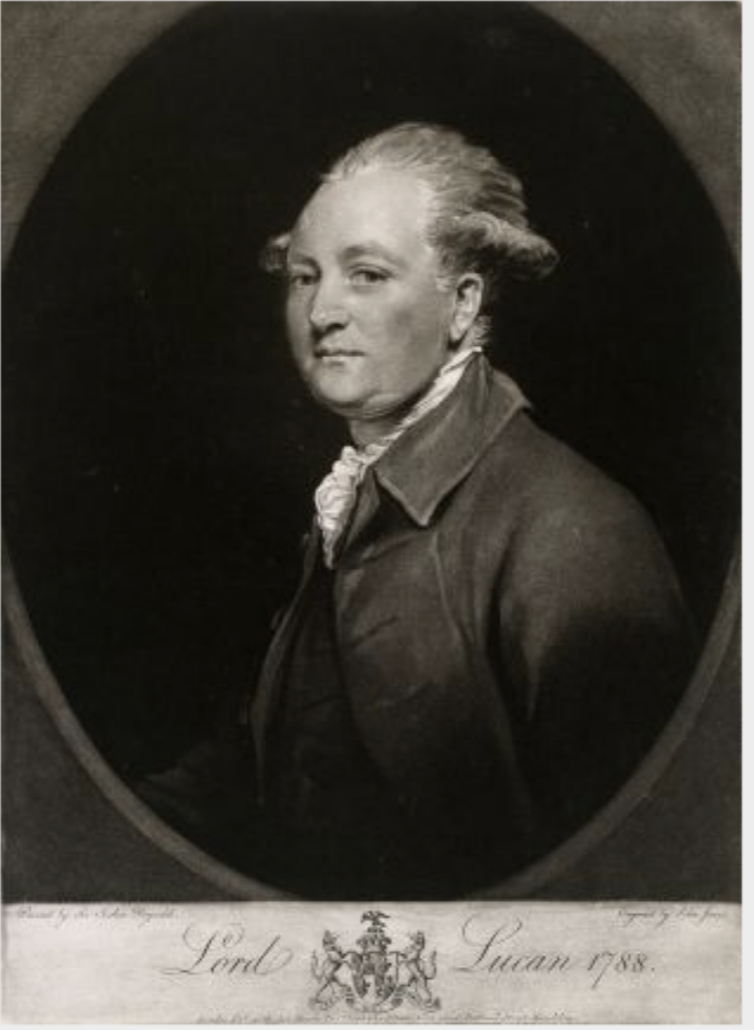
Charles Bingham, 1st Baron of Lucan (1735-1799), later 1st Earl of Lucan, Engraver John Jones, After Joshua Reynolds, courtesy of National Gallery of Ireland.
Miss Bingham by T. Richardson (mid 18th Century) courtesy Adam’s 5th Oct 2010.
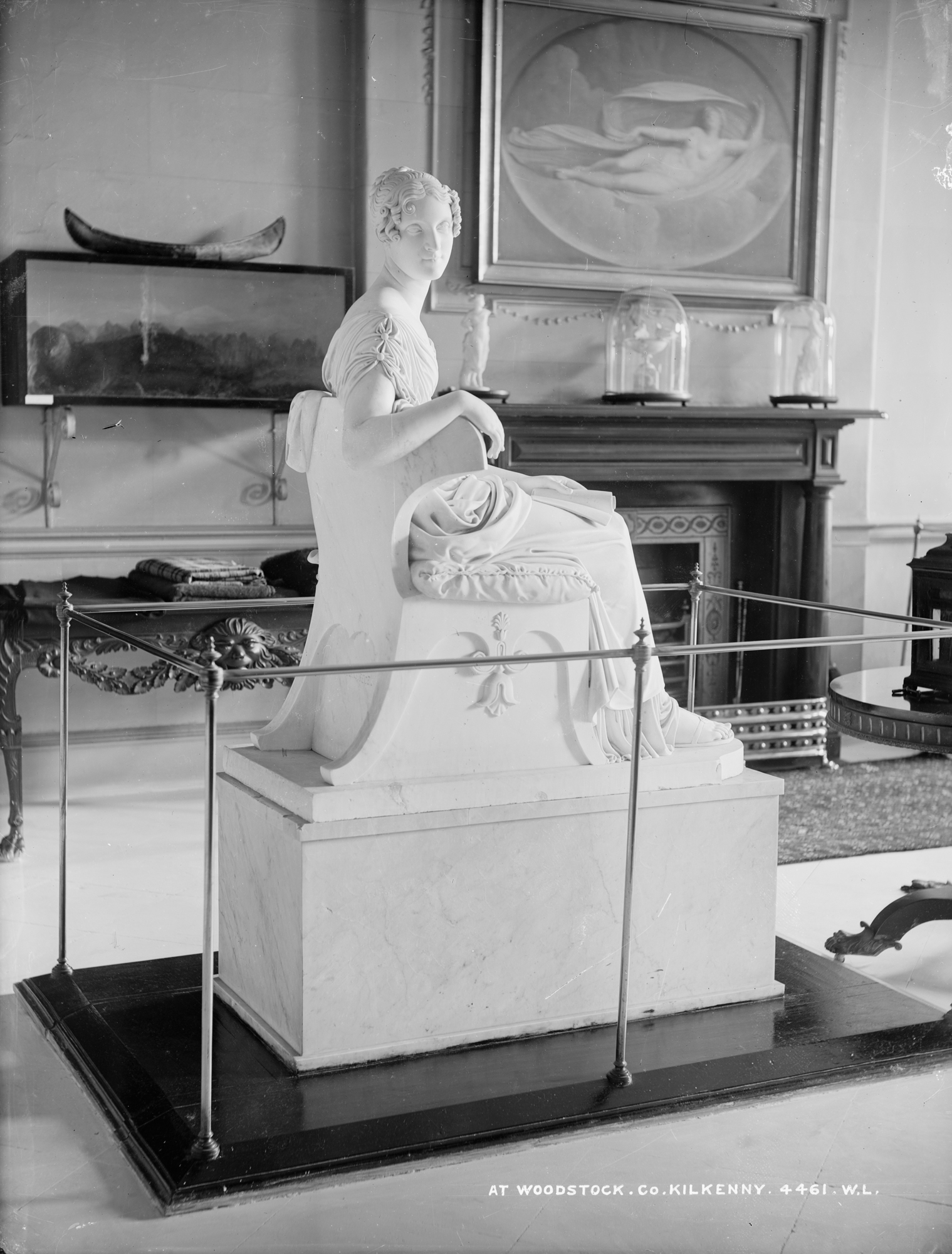
Mary Tighe née Blachford (1772-1810) as sculpted by Lorenzo Bartolini ca. 1820, photograph courtesy of National Library of Ireland.
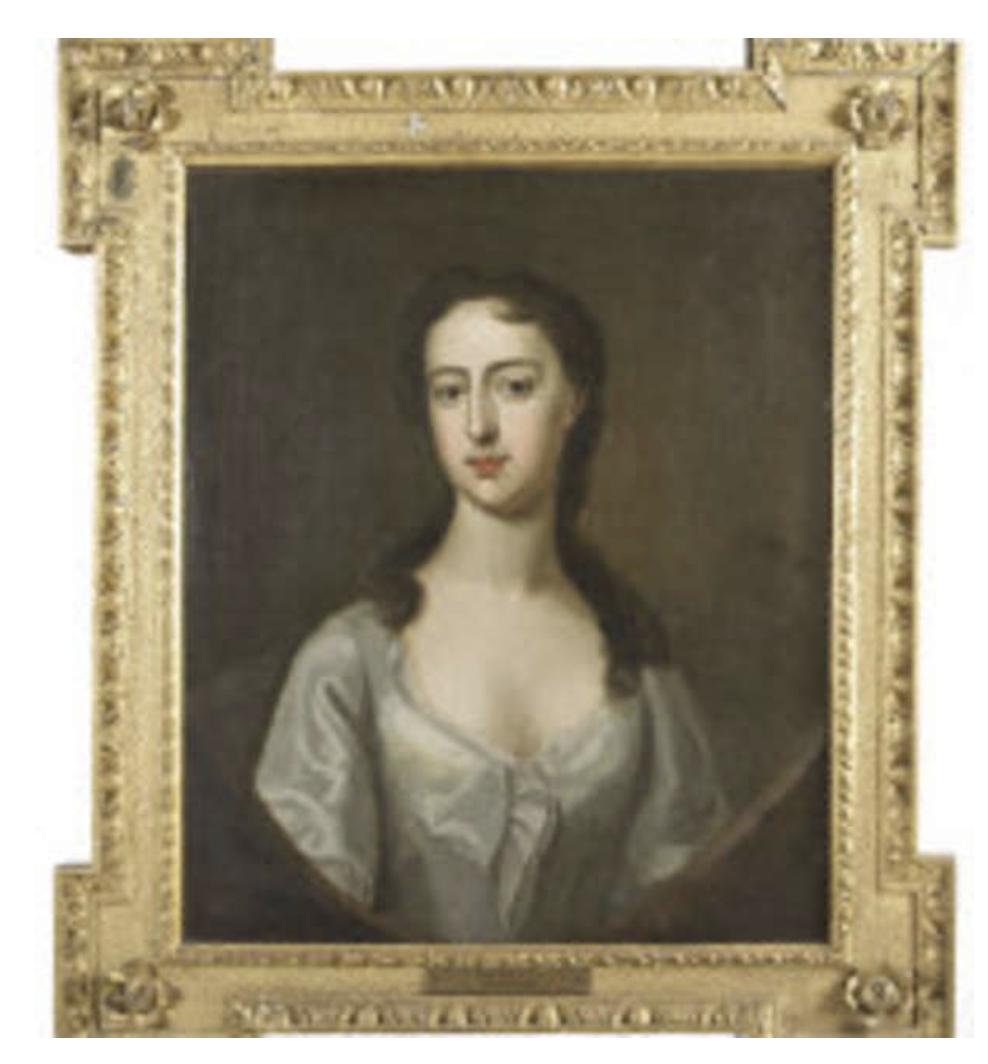
Mary Tighe née Blachford (1747-1791), courtesy of National Gallery of Ireland.
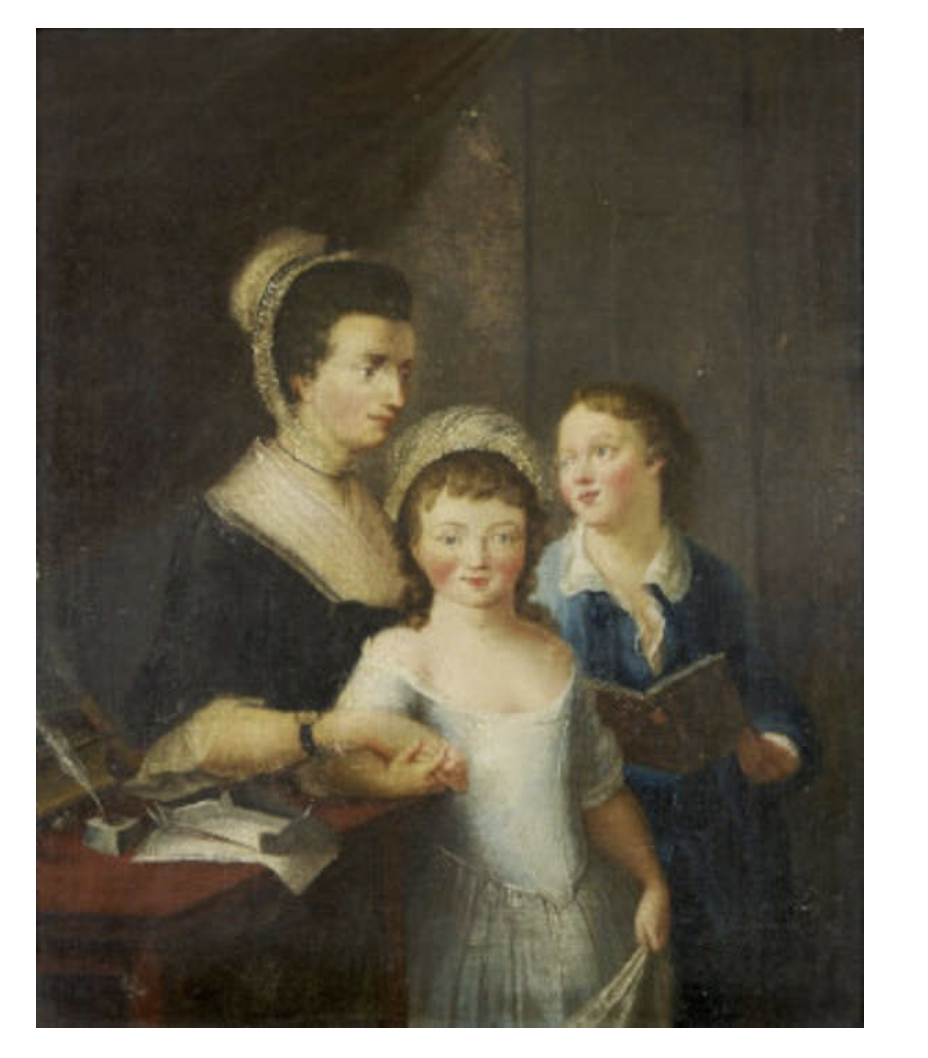
Theodosia Blachford née Tighe (c.1780) A self portrait, seated three-quarter length, with her children, Mary (1772-1810, she married Henry Tighe 1771-1836 of Woodstock) and John (1771-1817) courtesy of Adam’s 2 April 2008. Theodosia was married to William Acton Blachford (1729-1773) of Altidore, County Wicklow, and she was the daughter of William Tighe (1710-1766) of Rosanna, County Wicklow.
Francis Blackburne (1782-1867), Lord Chancellor of Ireland, 1852 by engraver George Sanders, after Stephen Catterson Smith, courtesy of National Gallery of Ireland.
Helena Selina Blackwood née Sheridan (1807-1867), Writer, Wife of 4th Baron Dufferin and Clandeboye, later Countess of Gifford Date 1849 Engraver John Henry Robinson, English, 1796 – 1871 After Frank Stone, English, 1800-1859.
Nathaniel Bland (1695-1760), Vicar General of Diocese of Ardfert and Aghadoe, Picture from The Story of Dorothy Jordan by Clare Jerrold, 1914, courtesy of Teresa Stokes, flickr
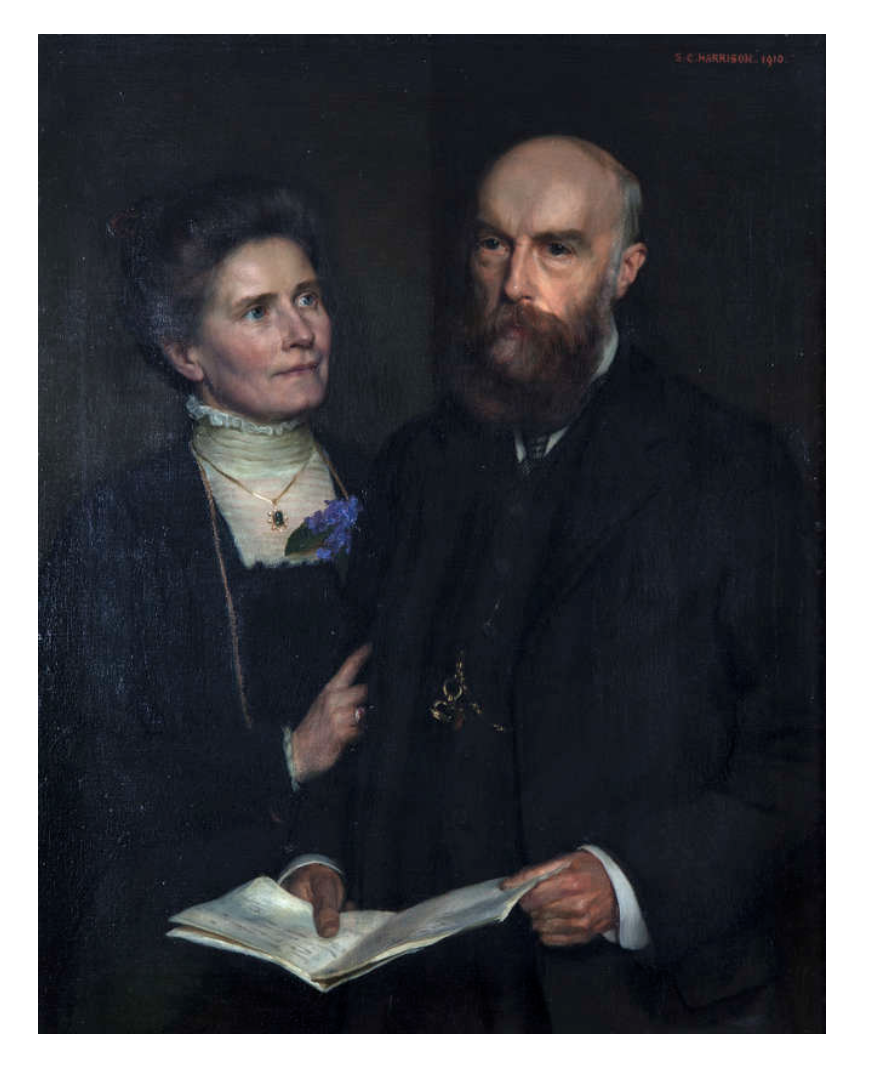
Blayney R.J. Townley- Balfour and Madeline née Kells-Ingram, his Wife, of Townley Hall, Drogheda by Sarah Cecilia Harrison, courtesy of Adam’s auction 31 May 2017.
Lady Blennerhassett, Ballyseedy Castle, Tralee, Co. Kerry, Irish school 18 century Adams auction 19 Oct 2021
Theodosia Bligh (1722-1777), Countess of Glandore, attributed to James Latham, courtesy of Adam’s 5 Oct 2010.
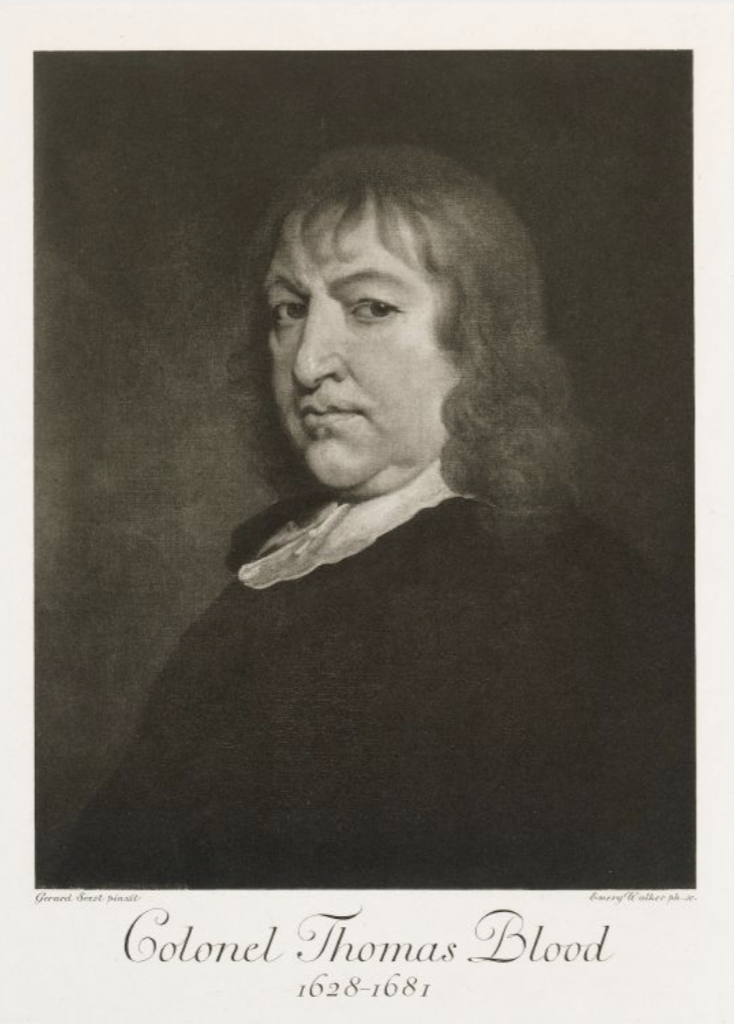
Colonel Thomas Blood (1618-1680), Adventurer Engraver Emmery Walker After Gerard Soest, Dutch, c.1600-1681, courtesy of National Gallery of Ireland.
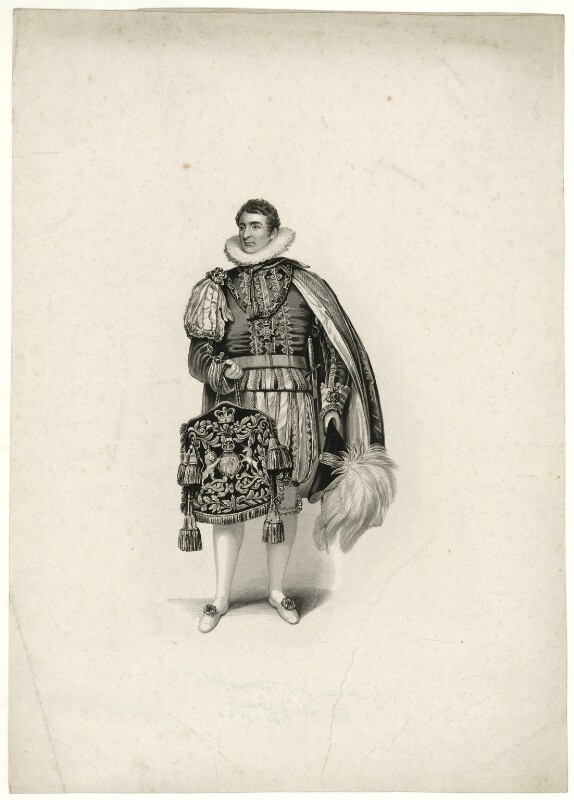
Benjamin Bloomfield (1768-1846) 1st Baron Bloomfield as Keeper of His Majestys Privy Purse at the Coronation of George IV, by Henry Meyer, after Philip Francis Stephanoff 1826, NPG D31893. He lived in Loughton House, County Offaly.
Benjamin Bloomfield (1768-1846) 1st Baron Bloomfield, by John Lilley, from Loughton house auction catalogue, 2016, Shepphards.
Benjamin Bloomfield (1768-1846) 1st Baron Bloomfield), Irish school, 19th c, from Loughton house sale, 2016, Shepphards.
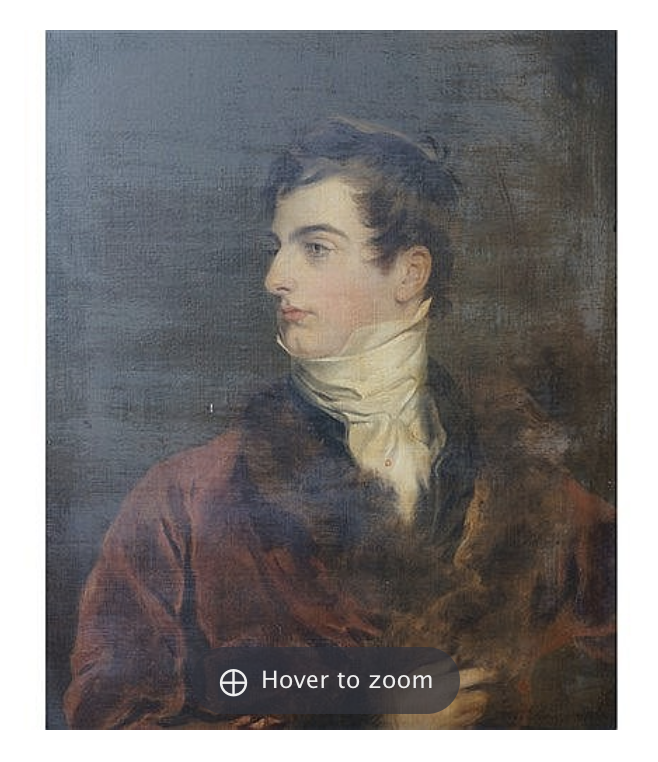
John Arthur Douglas Bloomfield (1802-1879), 2nd Baron Bloomfield of Oakhampton and Redwood, 1st Baron Bloomfield of Ciamhaltha, County Tipperary, wearing a burgundy red jacket and fur collar, Painting After Sir Thomas Lawrence, from Loughton house auction catalogue, 2016, Shepphards
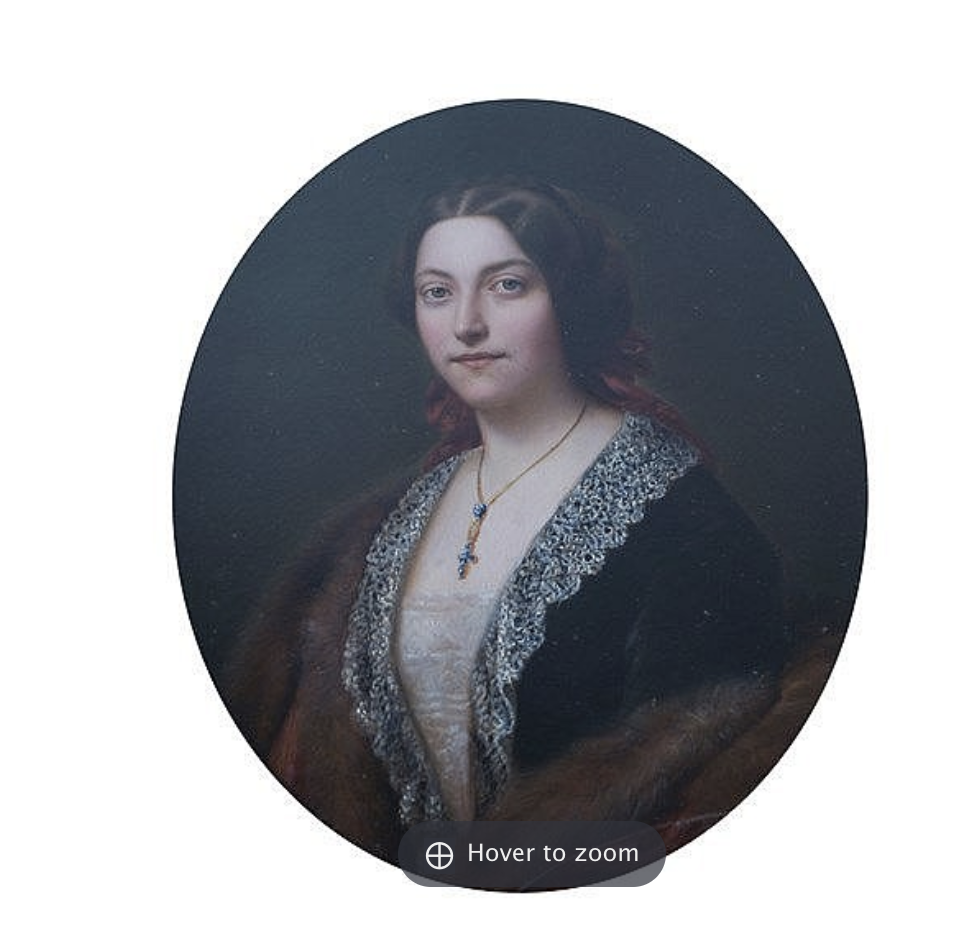
Georgiana Bloomfield née Liddell, Lady Bloomfield from Loughton house auction catalogue, 2016, Shepphards. She was the wife of John Arthur Douglas Bloomfield 1st Baron Bloomfield of Ciamhaltha, County Tipperary.
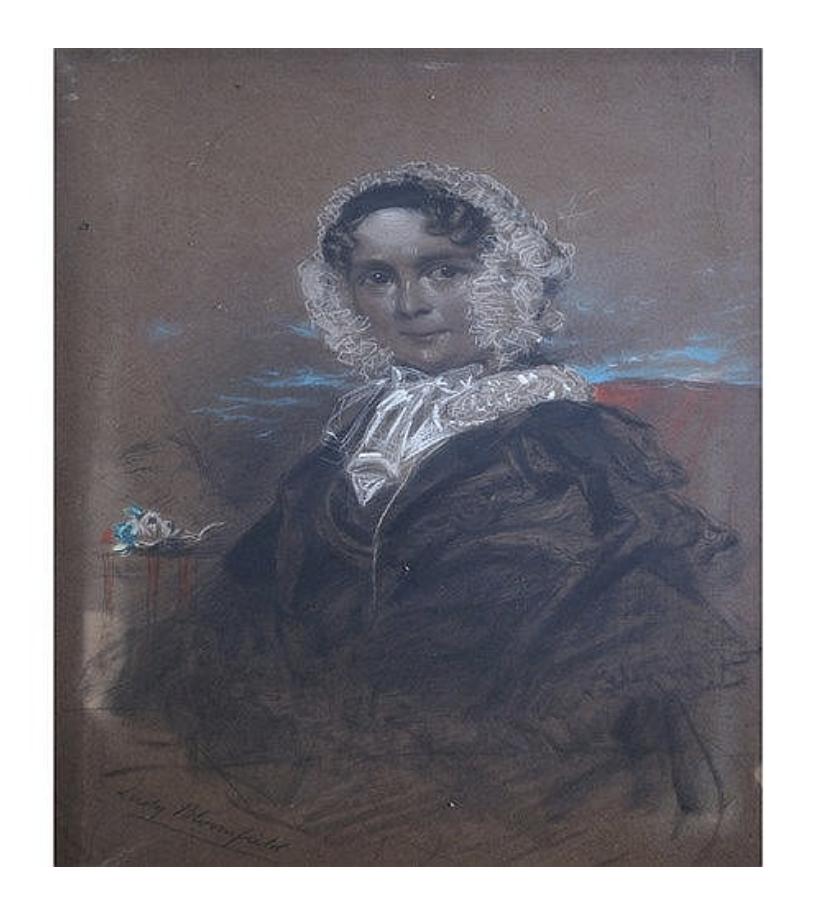
Portrait of Lady Bloomfield, from Loughton house sale, 2016, Shepphards. I’m not sure which Lady Bloomfield she is. I suspect she is Georgiana née Liddell (1822-1905)
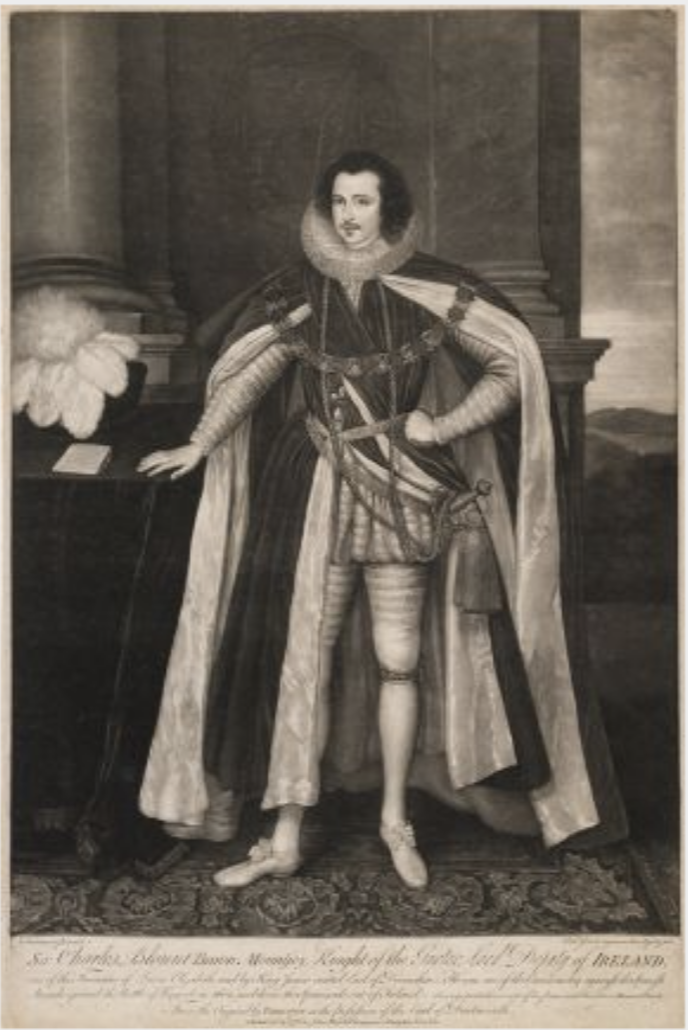
Charles Blount (1563-1606), 8th Baron Mountjoy, Lord Deputy of Ireland, 1775, engraver Valentine Green after Paulus Van Somer; photograph courtesy of National Gallery of Ireland.
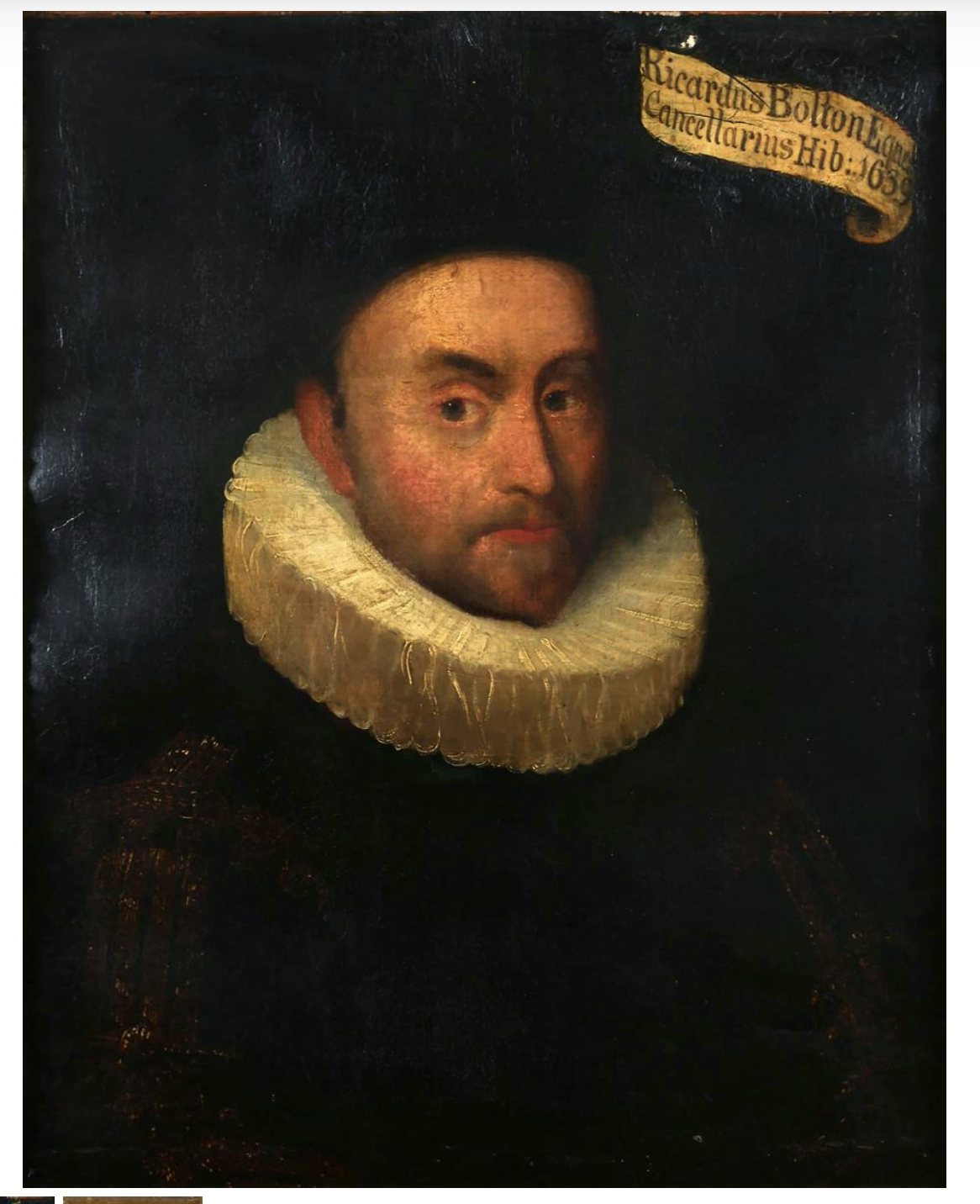
Richard Bolton (circa 1570-1648) Lord Chancellor of Ireland, courtesy of Whyte’s Oct 2018. Bolton Street in Dublin was named after him.
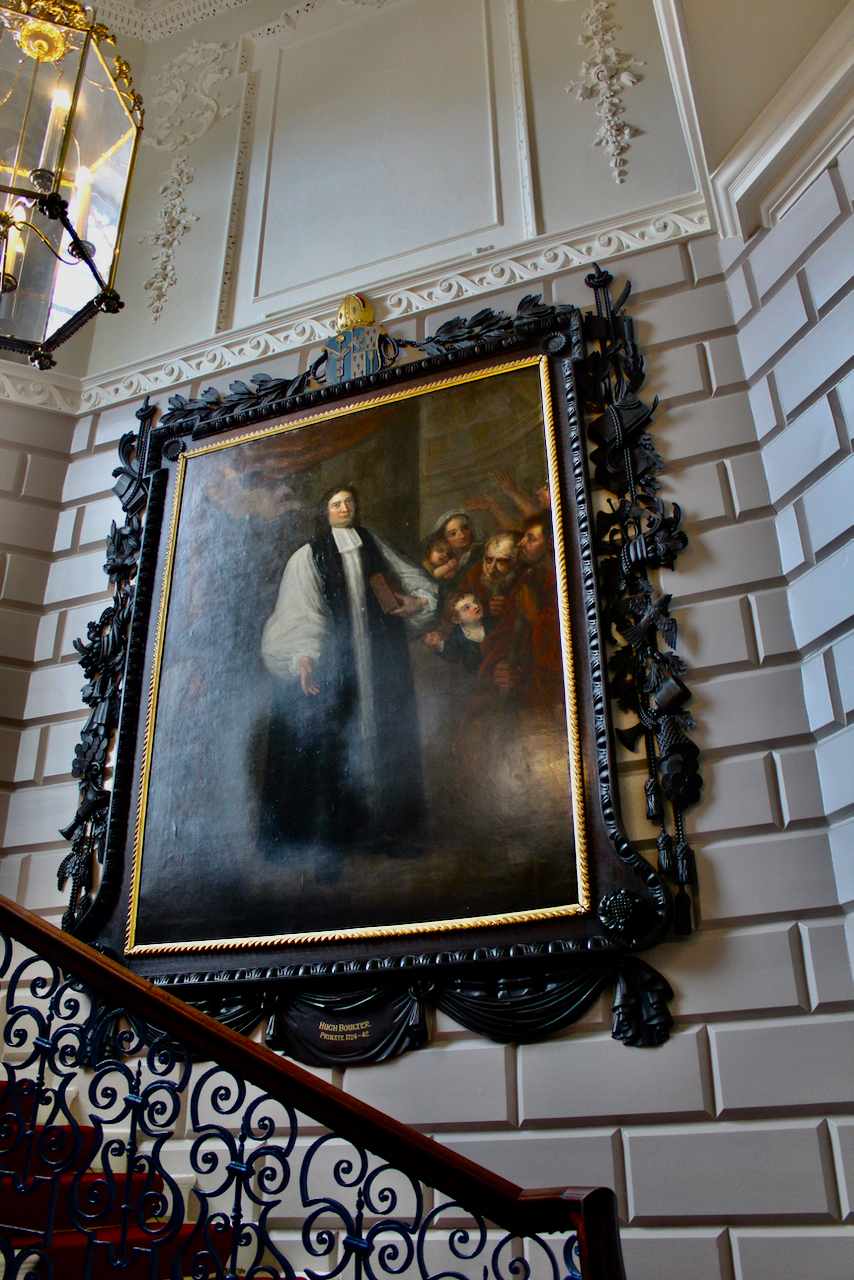
Hugh Boulter, Protestant Archbishop of Armagh and then Primate of Ireland 1724-1742. He was also Chaplain to King George I. The Dictionary of National Biography tells us that by a statute enacted through Boulter’s influence, Catholics were excluded from the legal profession and disqualified from holding offices connected with the administration of law. Under another act passed through Boulter’s exertions, they were deprived of the right of voting at elections for members of parliament or magistrates—the sole constitutional right which they had been allowed to exercise. He helped to set up the Charter School system and sought to convert Catholics to Protestantism, but did good work trying to alleviate hunger during the Famine – though perhaps he only advocated feeding those who converted to Protestantism! I’m not sure of that though. Provost’s House, Trinity College Dublin. Photograph © Jennifer Winder-Baggot, www.irishhistorichouses.com
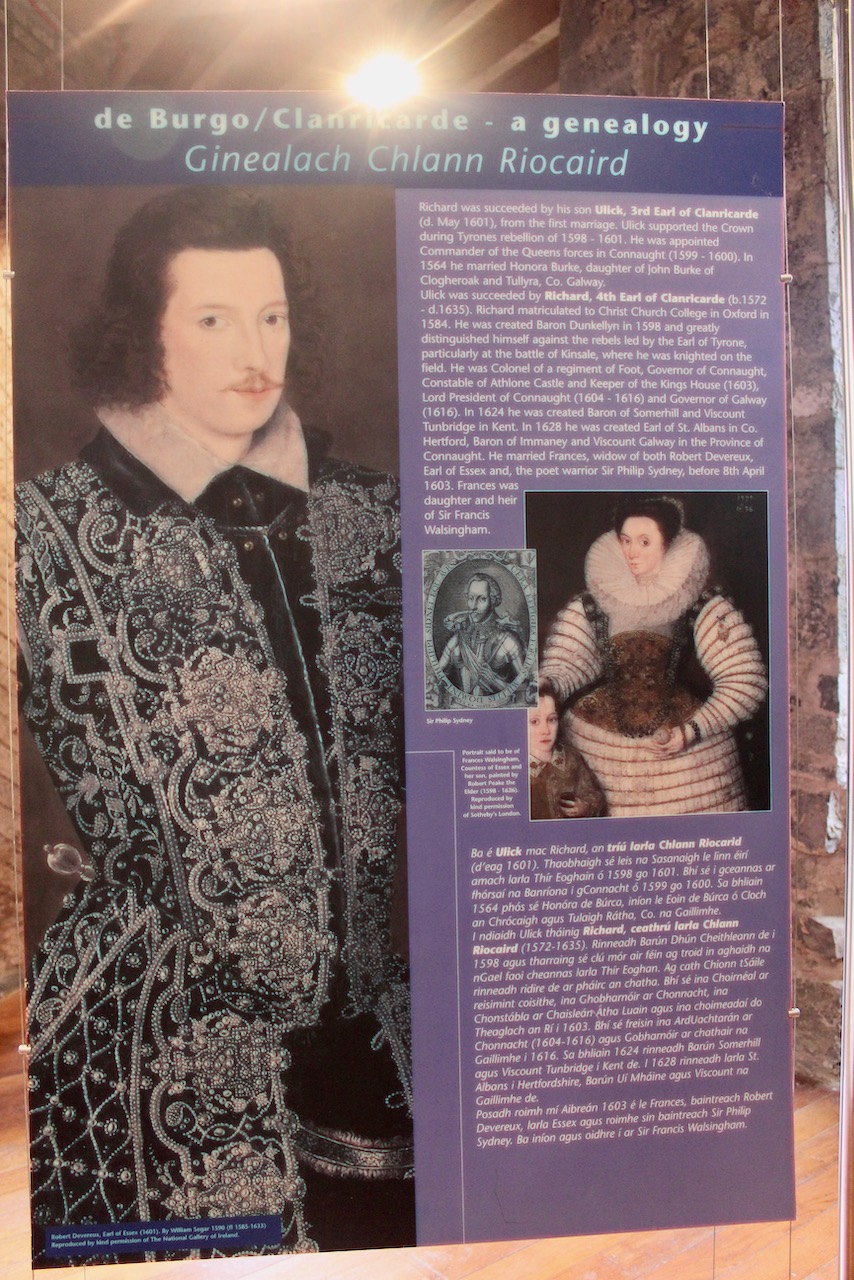
Portrait of Frances Walsingham, along with her husband Robert Devereux, 2nd Earl of Essex, and in the small picture, Sir Philip Sydney, her first husband. Her third husband was Richard Bourke 4th Earl of Clanricarde. Photograph © Jennifer Winder-Baggot, www.irishhistorichouses.com
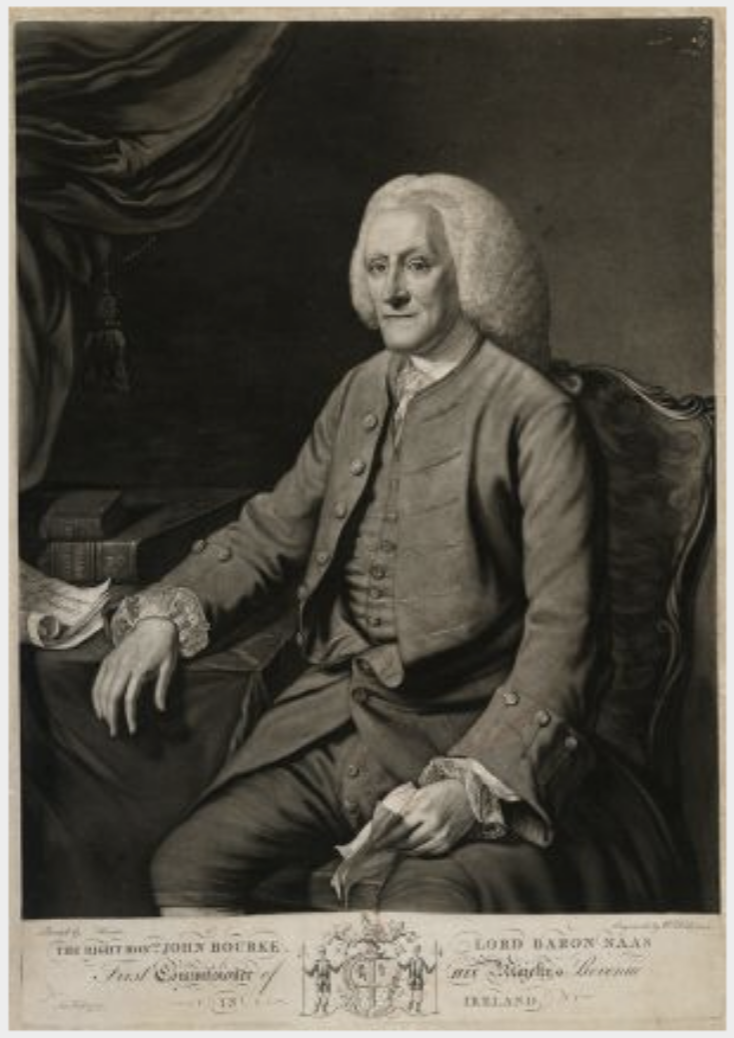
John Bourke, 1st Baron Naas, (1705-1790), later 1st Earl of Mayo, Engraver William Dickinson, English, 1746-1823 After Robert Hunter, Irish, 1715/1720-c.1803, photograph courtesy of National Gallery of Ireland.
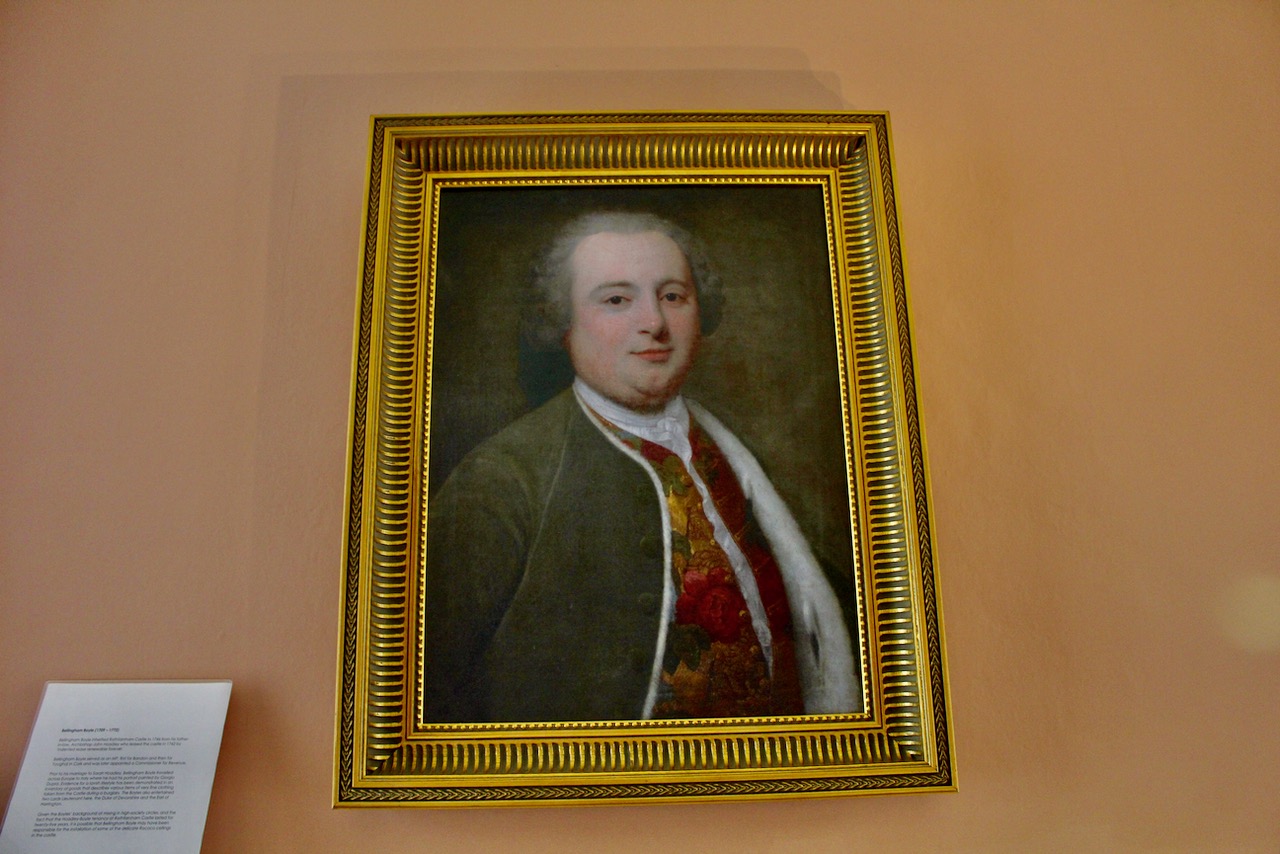
Bellingham Boyle (1709-1772), of Rathfarnham Castle, County Dublin. Photograph © Jennifer Winder-Baggot, www.irishhistorichouses.com
Richard Boyle, 1st Earl of Cork (1566-1643) Date c.1630, courtesy of National Gallery of Ireland.

Timothy William Ferres tells us of the family of the Boyles, Earls of Cork:

Richard Boyle (1566-1643) 1st Earl of Cork married firstly, in 1595, Joan, daughter and co-heiress of William Apsley, of Limerick, without surviving issue; and secondly, Catherine, daughter of Sir Geoffrey Fenton, Knight, principal secretary of state for Ireland, and had issue (with eight daughters):

Roger (1606-15);

RICHARD (1612-98) his successor; Geoffrey d. 1 year old; Lewis (1619-1642) created Viscount Boyle of Kinalmeaky;

ROGER (1621-1679) created 1st Earl of Orrery; ancestor of John, 5th Earl of Cork;

Francis (1623-1699) created Viscount Shannon;

Robert (1626/1627-1691), the philosopher.

Robert Boyle (1626/1627-1691) the philosopher. Photograph © Jennifer Winder-Baggot, www.irishhistorichouses.com
Robert Boyle F. R. S. (1627-1691) by Johann Kerseboom, 1689, courtesy of Science History Institute. He was the brother of the 2nd Earl of Cork.

The 1st Earl of Cork’s daughter Alice (1607-1666) married David Barry 1st Earl of Barrymore. His other daughters were Sarah (1609-1633) who married first Thomas Moore son of Garret Moore 1st Viscount of Drogheda, and then second, Rober Digby 1st Baron Digby; Lettice who married Lord Goring; Joan who married George Fitzgerald 16th Earl of Kildare; Catherine (1615-1691) who married Arthur Jones 2nd Viscount Ranelagh; Dorothy (1617-1668) who married Arthur Loftus and second, Gilbert Talbot son of William Talbot 1st Baronet; Mary (1625-1678) who married Charles Rich 4th Earl of Warwick;

The 1st Earl of Cork was succeeded by his eldest son, RICHARD, 2nd Earl (1612-98); who, having wedded, in 1635, the Lady Elizabeth Clifford, daughter and heiress of Henry, 5th Earl of Cumberland, was created a Peer of England, 1644, in the dignity of Baron Clifford of Londesborough, Yorkshire; and, in 1664, EARL OF BURLINGTON.
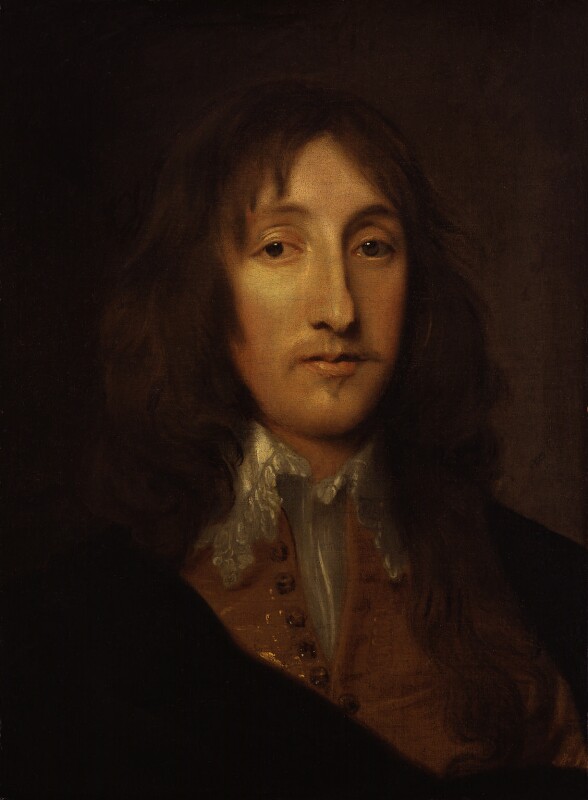
Richard Boyle (1612-1698) 1st Earl of Burlington and 2nd Earl of Cork, possibly after Sir Anthony van Dyck c.1640, NPG 893.
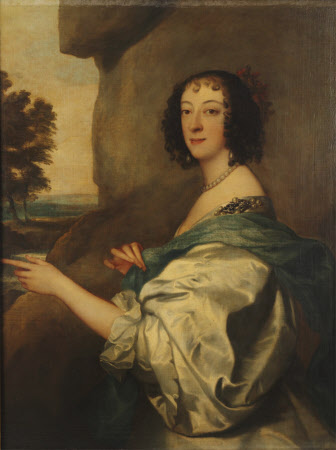
Oil painting on canvas, Lady Elizabeth Clifford, Countess of Burlington (1621 – 1698) by Sir Anthony Van Dyck (Antwerp 1599 – London 1641). Three-quarter length portrait, profile to left, head facing, wearing wbite satin dress and blue scarf, pointing with her left hand in a landscape. She married Richard Boyle, 2nd Earl of Cork and 1st Earl of Burlington.

The 2nd Earl of Cork had issue:

Charles, 3rd Viscount Dungarvan (1639-94); father of the 3rd Earl of Cork; Richard, who died in 1665 at the battle of Lowestoft; and daughters Frances who married Colonel Francis Courtenay, 3rd Bt. then second, Wentworth Dillon, 4th Earl of Roscommon; Anne who married Edward Montagu, 2nd Earl of Sandwich; Elizabeth who married Nicholas Tufton, 3rd Earl of Thanet; Mary; Henrietta who married Laurence Hyde, 1st Earl of Rochester.

His lordship’s eldest son Charles, 3rd Viscount Dungarvan (1639-94) having predeceased him, was succeeded by his grandson, CHARLES (c. 1662-1704), 3rd Earl of Cork and 2nd Earl of Burlington.

Charles Boyle (c. 1662-1704) 3rd Earl of Cork and 2nd Earl of Burlington, by Godfrey Kneller, courtesy of National Trust Hardwick Hall.

Charles, 3rd Viscount Dungarvan (1639-94) had a daughter Elizabeth (1662-1703) who married Lt.-Gen. James Barry, 4th Earl of Barrymore.

The 3rd Earl of Cork, 2nd Earl of Burlington espoused Juliana, daughter and heiress of the Hon Henry Noel, of Luffenham, Rutland, by whom he had surviving issue, RICHARD (1694-1753) his successor, 3rd Earl of Burlington.
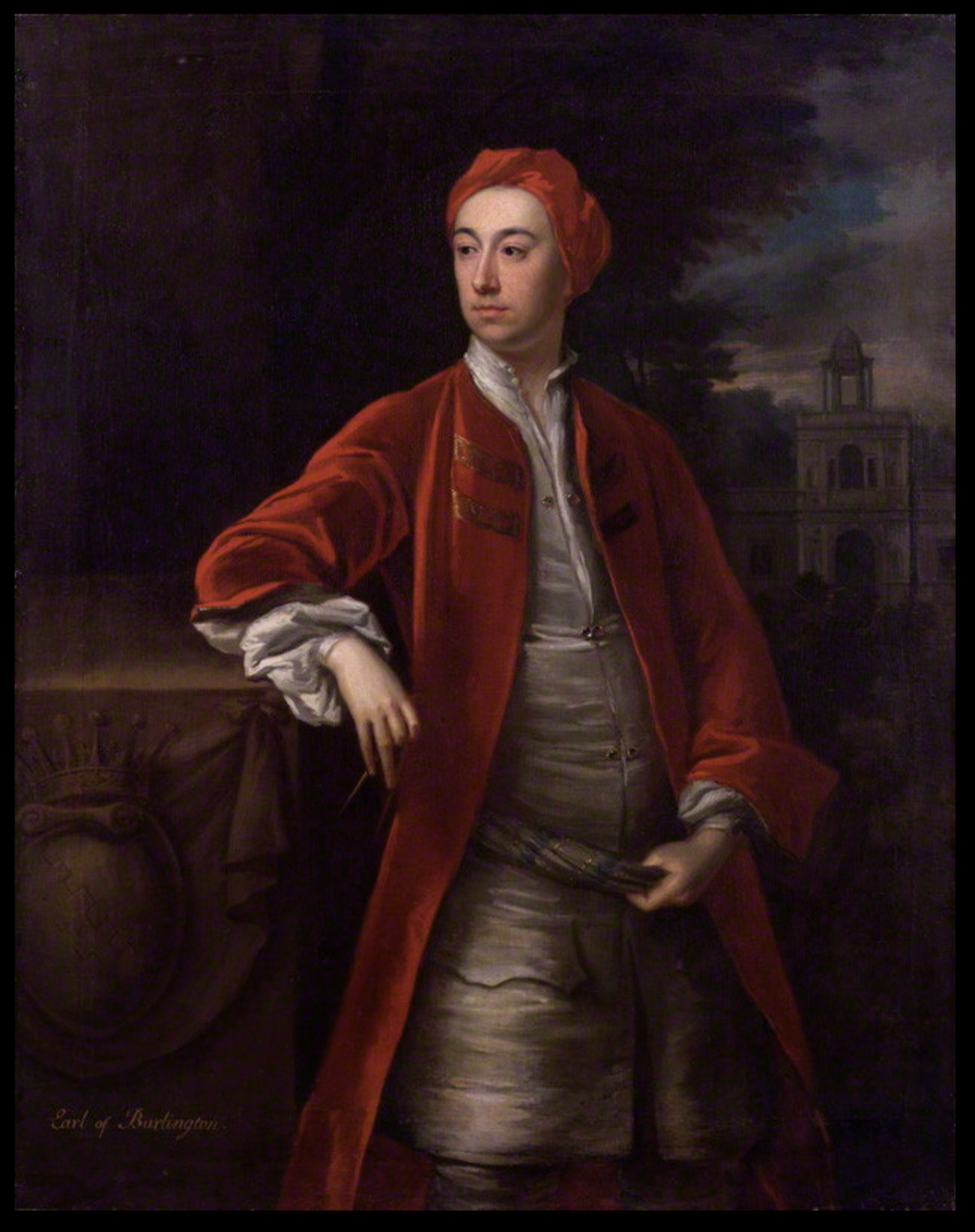
Richard Boyle, 3rd Earl of Burlington (1694-1753) by Jonathan Richardson, courtesy of London’s National Portrait Gallery NPG 4818.

The 3rd Earl of Cork, 2nd Earl of Burlington had daughters Elizabeth; Juliana; Jane; Henrietta (1700-1746) who married Henry Boyle, 1st Earl of Shannon.

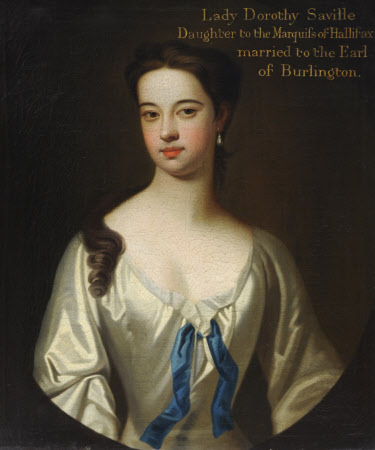
The 3rd Earl of Cork, 2nd Earl of Burlington was succeeded by his only son, RICHARD (1694-1753), 4th Earl of Cork and 3rd Earl of Burlington, KG, who married, in 1720, the Lady Dorothy Savile, elder daughter and co-heiress of William, 2nd Marquess of Halifax, by which lady he had three daughters, Dorothy; Juliana; Charlotte Elizabeth, m William Cavendish, Marquess of Hartington.

His lordship claimed, in 1727, the barony of Clifford, as great-grandson of the Lady Elizabeth Clifford, daughter and heiress of Henry, Lord Clifford, and the house of peers acknowledged and confirmed his lordship’s right thereto.

This nobleman was eminent as a munificent encourager of literature and the fine arts, and as a friend of Alexander Pope he will always be remembered.

His lordship died in 1753, and leaving an only surviving daughter, Lady Charlotte, who had wedded William, 4th Duke of Devonshire, and inherited the barony of Clifford; all his lordship’s other English honours ceased, while those of Ireland devolved upon his kinsman, JOHN BOYLE (1707-62), 5th Earl of Orrery, in Ireland; Baron Boyle of Marston, in Great Britain; succeeded as 5th EARL OF CORK (refer to Roger, third son of the first Earl of Cork).

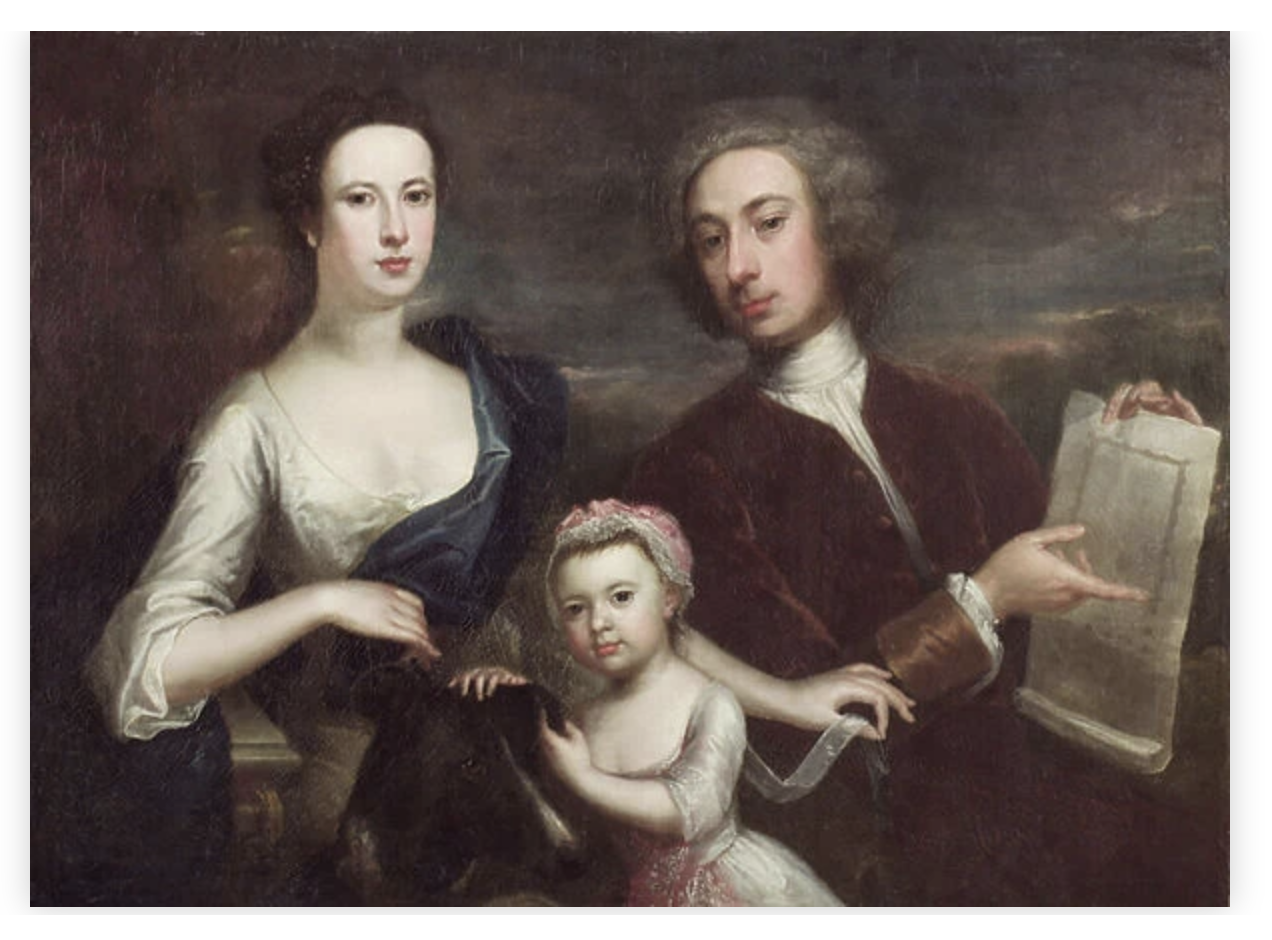
Charlotte Boyle (1731-1754) daughter of Richard Boyle (1694-1753) 3rd Earl of Burlington 4th Earl of Cork. She married William Cavendish (1720-1764) 4th Duke of Devonshire and brought Lismore Castle, County Waterford, into the Cavendish family. Painting after style of George Knapton, courtesy of Chiswick House collection.
Richard Boyle 4th Earl of Cork and 3rd Earl of Burlington and Dorothy Savile attributed to Aikman, William Aikman (1682-1731).
Oil painting on canvas, Possibly Lady Dorothy Savile, Countess of Burlington and Countess of Cork (1699-1758) by Michael Dahl, circa 1720. Inscribed top right in gold: Lady Dorothy Saville / Daughter to the Marquis of Halifax / married to the Earl of Burlington. A half-length portrait of a young woman, facing, wearing white decollete dress with blue ribbon. Courtesy of National Trust Hardwick Hall
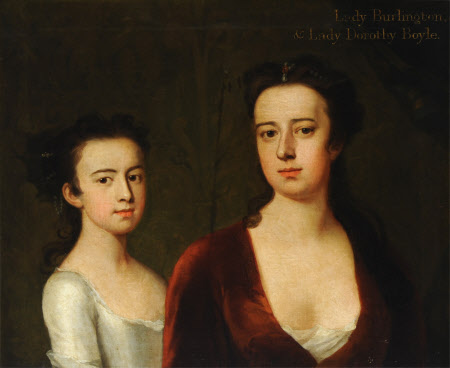
Lady Dorothy Savile, Countess of Burlington (1699-1758) with her Daughter Lady Dorothy Boyle, later Countess of Euston (1724-1742) by Michael Dahl courtesy of National Trust Hardwick Hall. She married Richard Boyle 4th Earl of Cork and 3rd Earl of Burlington.

The 1st Earl of Cork’s son ROGER (1621-1679) was created 1st Earl of Orrery.

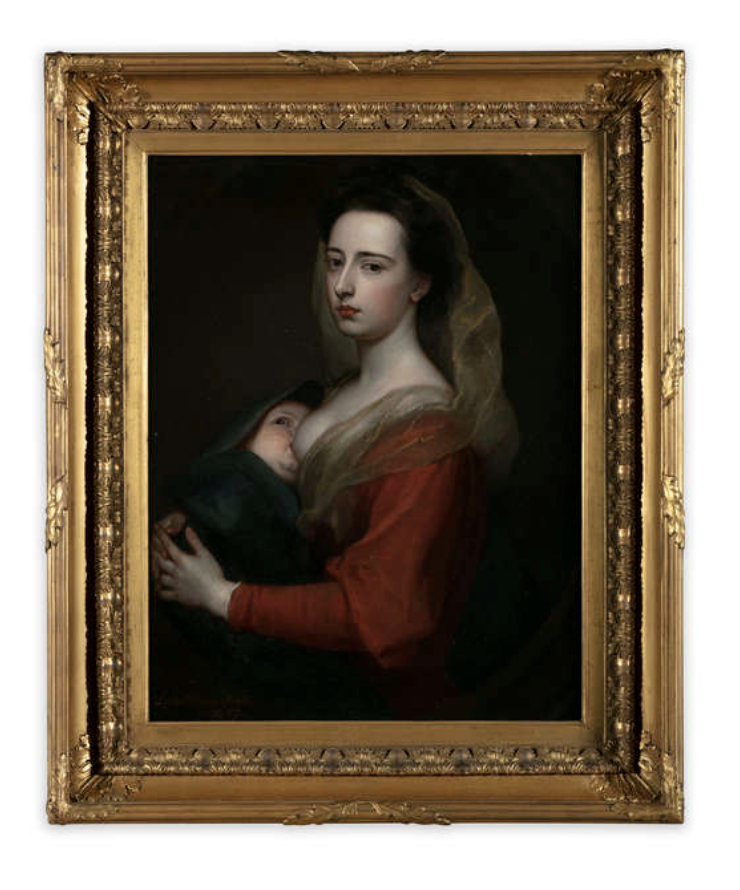
Lady Mary Boyle nursing her son Charles, by Godfrey Kneller (1646-1723) Adams auction 18 Oct 2022. I think this could be Mary née Sackville (1637-1679) who married Roger Boyle 2nd Earl of Orrery. Her son Charles Boyle (1674-1731) became the 4th Earl of Orrery.
Charles Boyle 4th Earl of Orrery, possibly a copy, based on painting by Charles Jervas.

JOHN BOYLE (1707-62), 5th Earl of Orrery, in Ireland; Baron Boyle of Marston, in Great Britain; succeeded as 5th EARL OF CORK (refer to Roger, third son of the first Earl of Cork).
His lordship wedded firstly, in 1728, the Lady Henrietta Hamilton, youngest daughter of George, 1st Earl of Orkney KT, and had issue: Charles, Viscount Dungarvan (1729-1759); HAMILTON, his successor; Elizabeth.
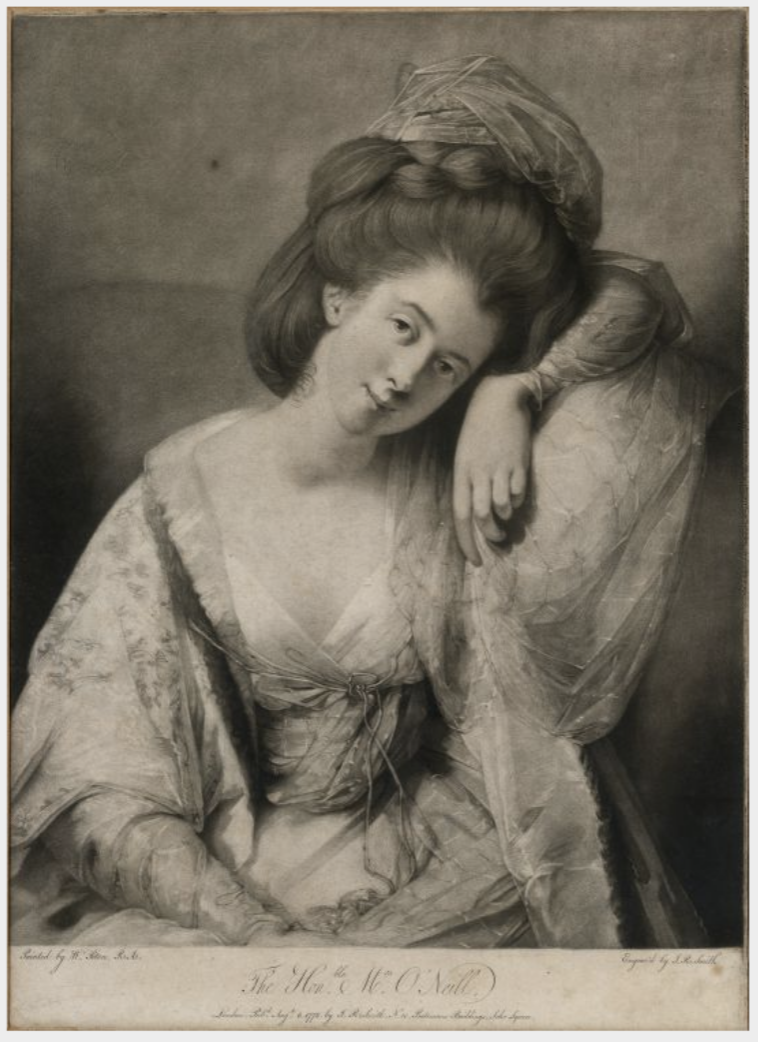
Mrs John O’Neill (née Henrietta Boyle) (1756-1793), Poet and Patron of Mrs Siddons, Engraver John Raphael Smith, English, 1752-1812 After Matthew William Peters, English, 1742-1814, courtesy of National Gallery of Ireland. She was the wife of John O’Neill (1740-1798), 1st Viscount, of Shane’s Castle, County Antrim, and the daughter of Charles Boyle, Viscount Dungarvan, who was the son of John Boyle 5th Earl of Orrery and 5th Earl of Cork.

He espoused secondly, Margaret, daughter and sole heiress of John Hamilton, by whom he had further issue: EDMUND, 7th Earl of Cork; Catherine Agnes; Lucy. He was a writer.

He was succeeded by his eldest surviving son, HAMILTON (1729-64), 6th Earl of Cork and Orrery, who died unmarried, in little more than a year after his father, when the honours devolved upon his brother, EDMUND (1742-98), 7th Earl of Cork and Orrery, who married firstly, in 1764, Anne, daughter of Kelland Courtenay, and had issue: John Richard, Viscount Dungarvan (1765-8); EDMUND, of whom hereafter; Courtenay (the Hon Sir), Vice-Admiral in the Royal Navy; Lucy Isabella.
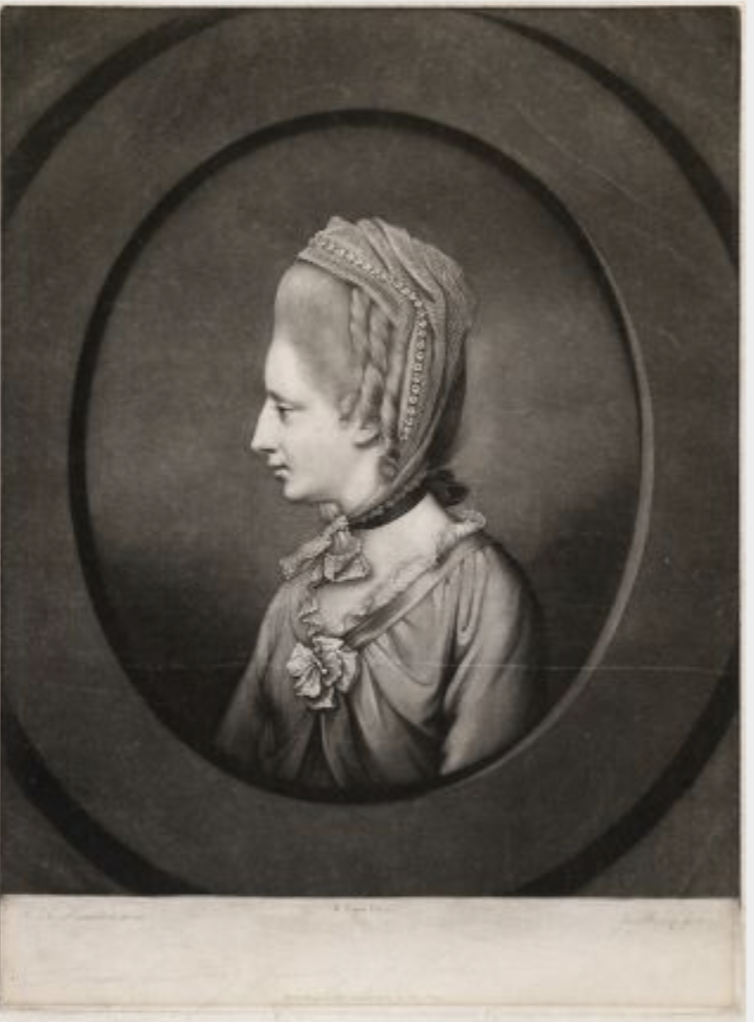
Anne Boyle née Courteney, Countess of Cork and Orrery (1742-1785) Engraver James Watson, Irish, c.1740-1790 After Hugh Douglas Hamilton, Irish, 1740-1808, courtesy of National Gallery of Ireland. She married Edmund Boyle 7th Earl of Cork and Orrery.

His lordship espoused secondly, in 1786, Mary, youngest daughter of John, 1st Viscount Galway, without further issue.

He was succeeded by his eldest surviving son, EDMUND (1767-1856), 8th Earl of Cork and Orrery, KP, a General in the Army, who married, in 1795, Isabella Henrietta, third daughter of William Poyntz, of Midgam house, Berkshire, and had issue: Edmund William, Viscount Dungarvan (1798-1826); George Richard (1799-1810); CHARLES, of whom presently; John, ancestor of the 12th and 13th Earls; Robert Edward; Richard Cavendish; Isabella Elizabeth; Lucy Georgina; Louisa.

His lordship’s eldest surviving son CHARLES (1800-34), styled Viscount Dungarvan, wedded, in 1828, the Lady Catherine St Lawrence, daughter of William, 2nd Earl of Howth, and had issue:

RICHARD EDMUND ST LAWRENCE, his successor;

William George;

Edmund John;

Louisa Caroline Elizabeth; Mary Emily.

His lordship predeceased his father, and the family honours devolved upon his eldest son,

RICHARD EDMUND ST LAWRENCE (1829-1904), as 9th Earl of Cork and Orrery, KP, who married, in 1853, the Lady Elizabeth Charlotte de Burgh, daughter of Ulick John, 1st Marquess of Clanricarde, and had issue: CHARLES SPENCER CANNING, his successor; ROBERT JOHN LASCELLES, 11th Earl; Emily Harriet Catherine; Grace Elizabeth; Isabel Lettice Theodosia; Honora Janet; Dorothy Blanche.

Anne Boyle née Courteney, Countess of Cork and Orrery (1742-1785) Engraver James Watson, Irish, c.1740-1790 After Hugh Douglas Hamilton, Irish, 1740-1808, courtesy of National Gallery of Ireland. She married Edmund Boyle 7th Earl of Cork, 7th Earl of Orrery.

The 1st Earl of Cork’s son Francis (1623-1699) was created 1st Viscount Shannon.
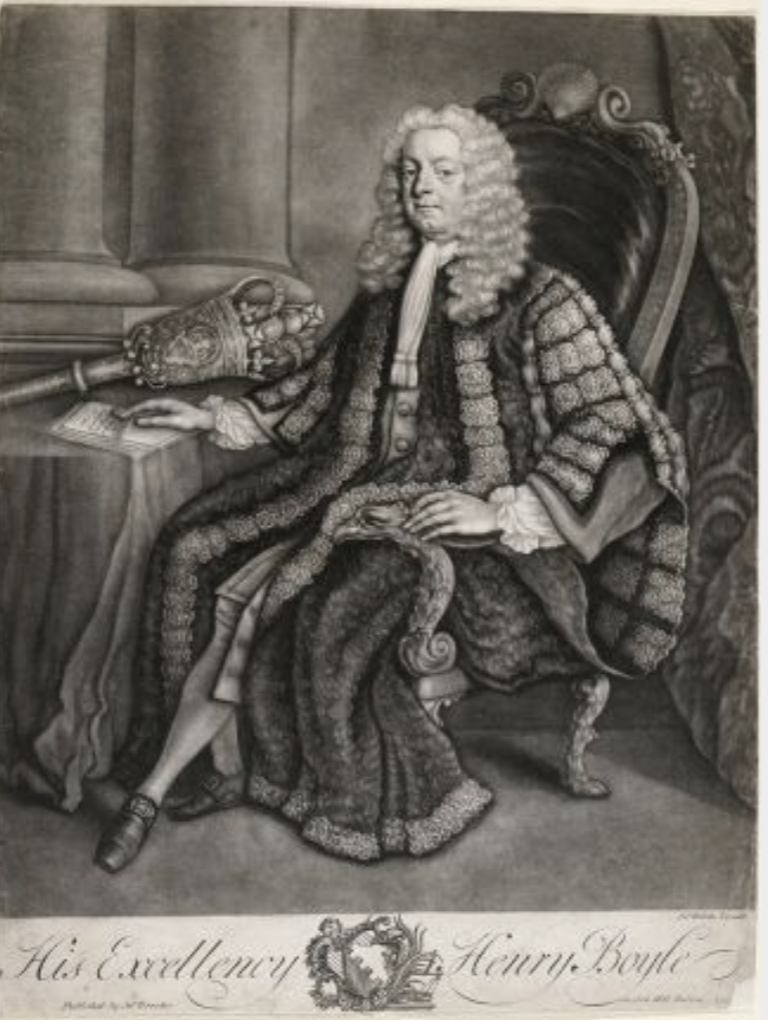
Henry Boyle, M.P. (1682-1764), Speaker of the Irish House of Commons, later 1st Earl of Shannon Date: 1742, Engraver John Brooks, Irish, fl.1730-1756 After Unknown Artist, England, 18th century, English, courtesy of National Gallery of Ireland.
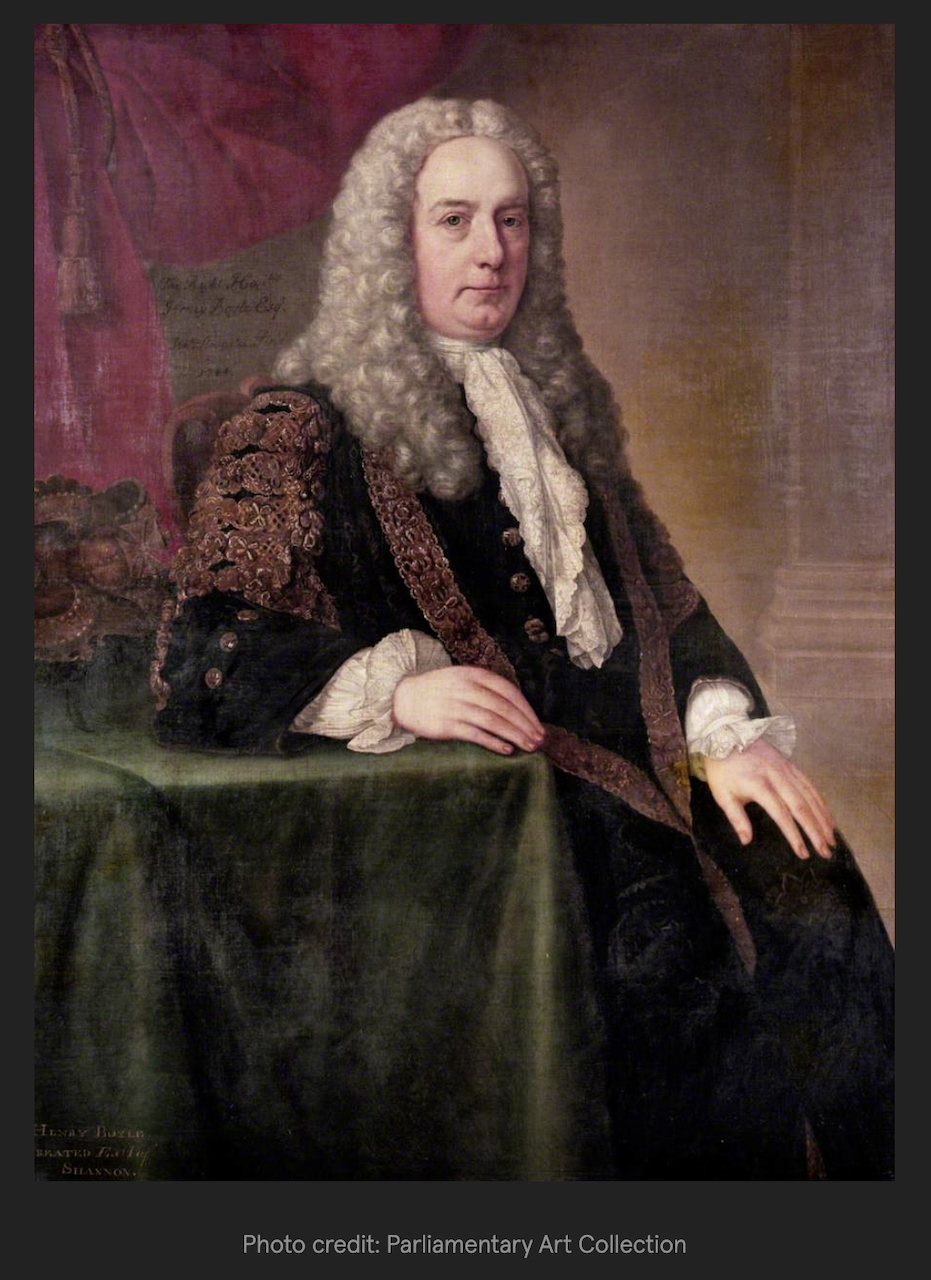
Henry Boyle 1st Earl of Shannon by Stephen Slaughter, in Ballyfin Demesne, courtesy of Parliamentary Art Collection.
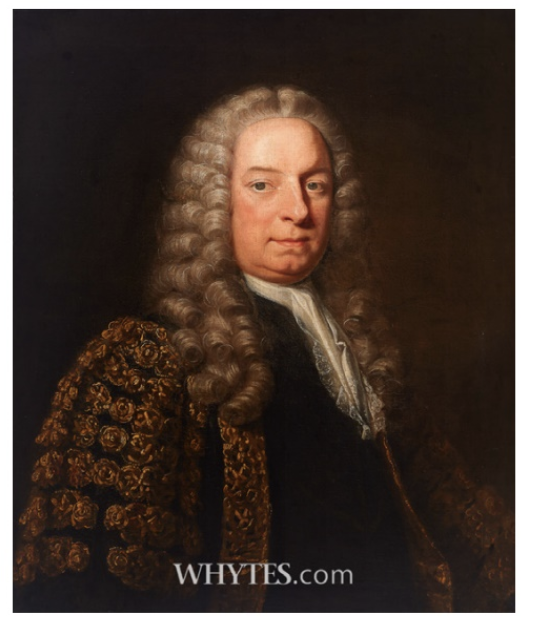
Henry Boyle, 1st Earl of Shannon (1682-1762), Speaker of the Irish House of Commons, 1733 by William Hoare. Courtesy of Whytes.
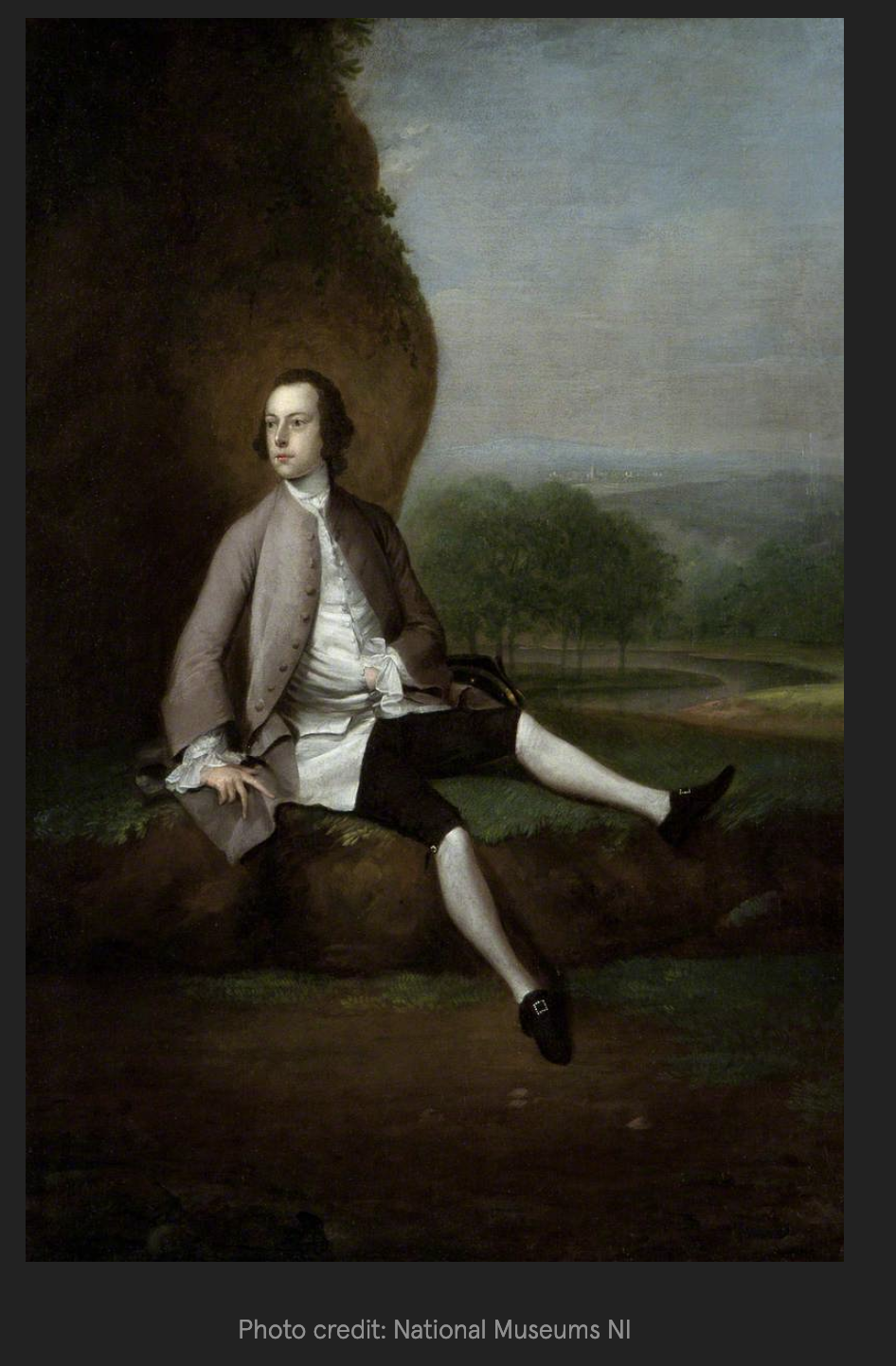
Richard Boyle, 2nd Earl of Shannon by Arthur Devis, courtesy of National Museums of Northern Ireland.
Richard Boyle, 2nd Earl of Shannon (1727–1807) (Joshua Reynolds, 1759 or later).
Anne Boyle (1700-1742) 2nd Lady Mountjoy, wife of William Stewart 2nd Viscount Mountjoy by Garrett Morphy courtesy of Adams auction 19 Oct 2021. She was the daughter of Murrough Boyle, 1st Viscount of Blessington.
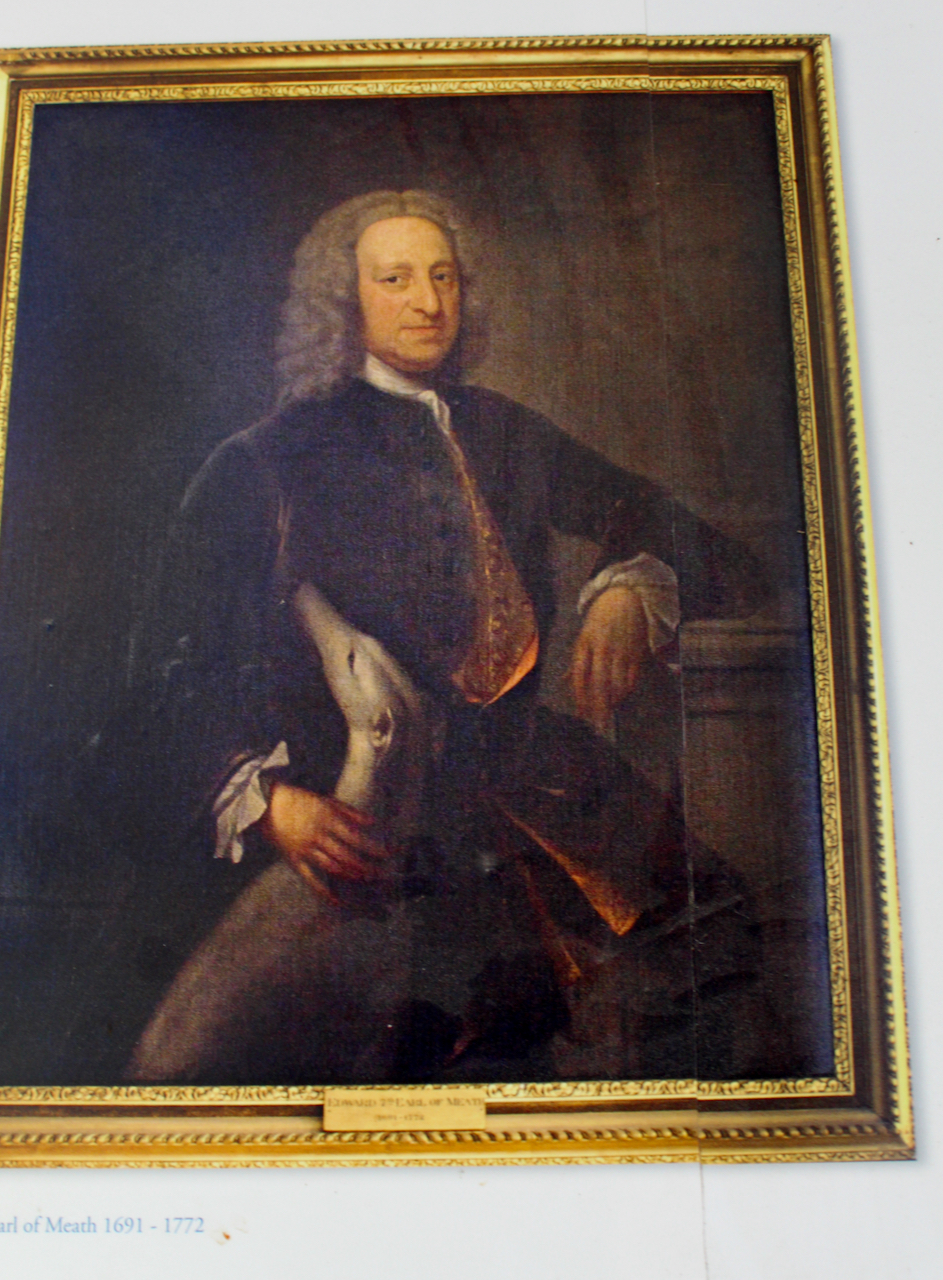
Edward Brabazon 7th Earl of Meath (1691-1772).
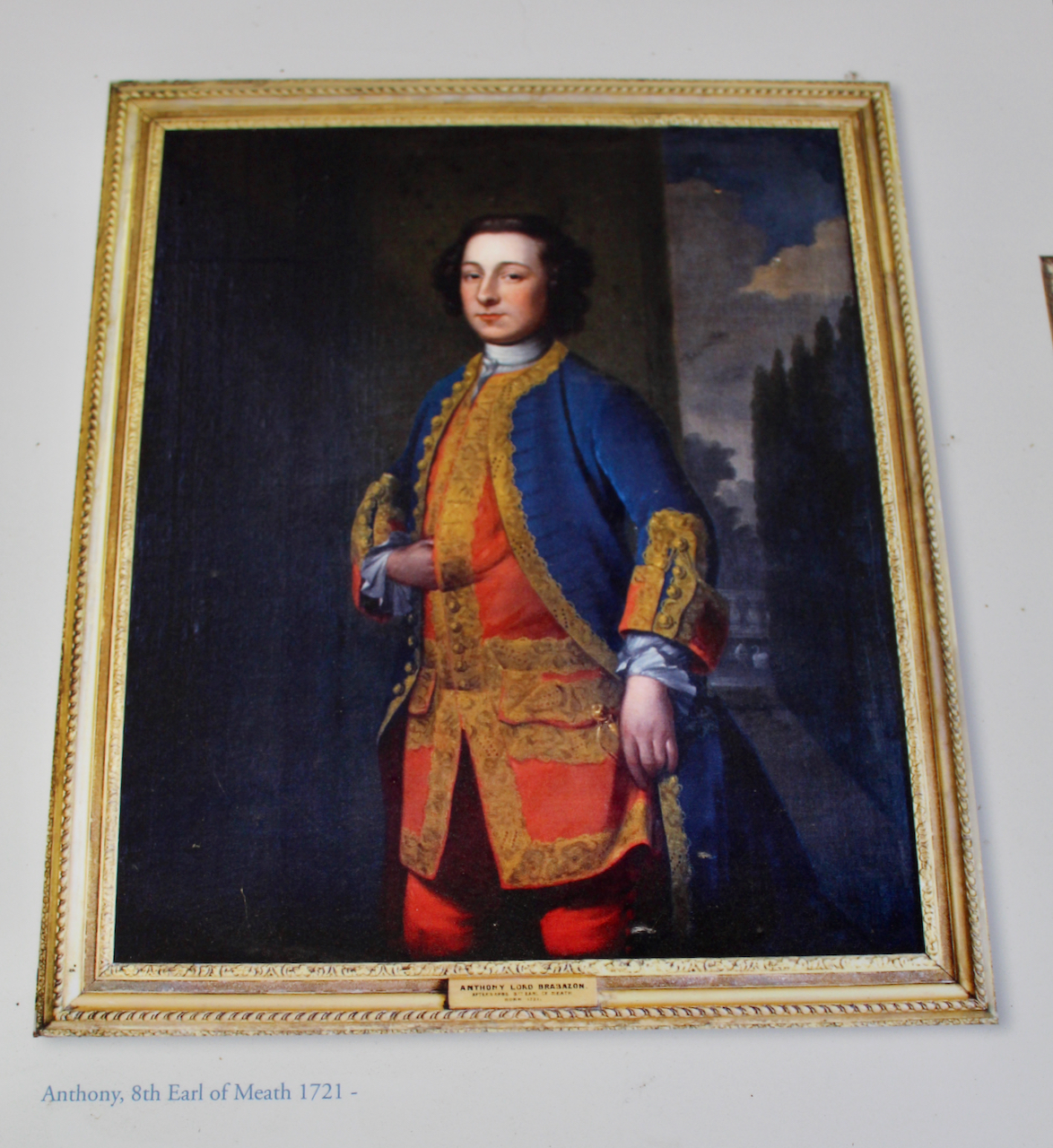
Anthony Brabazon 8th Earl of Meath (1721-1790).
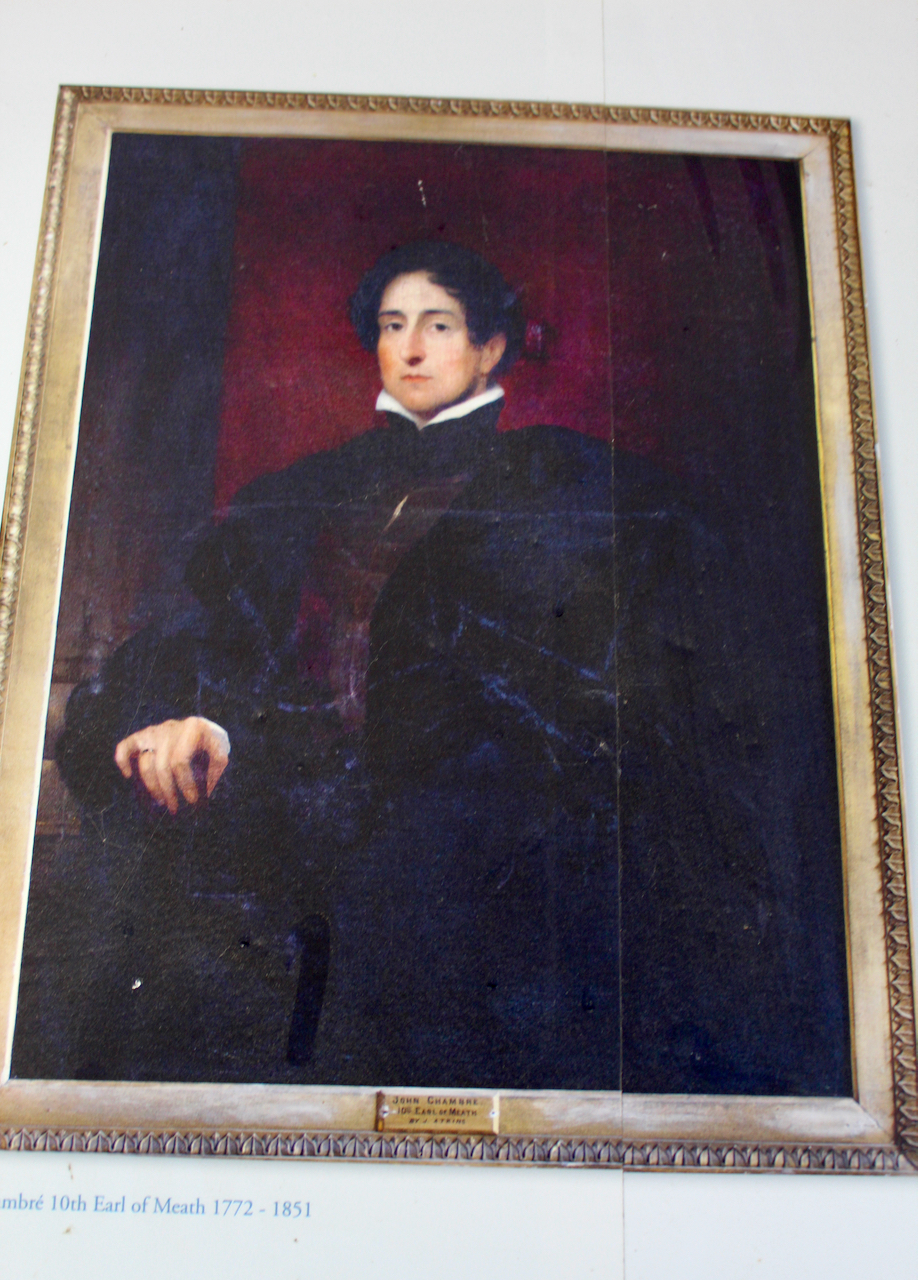
John Chambé Brabazon 10th Earl of Meath (1772-1851).
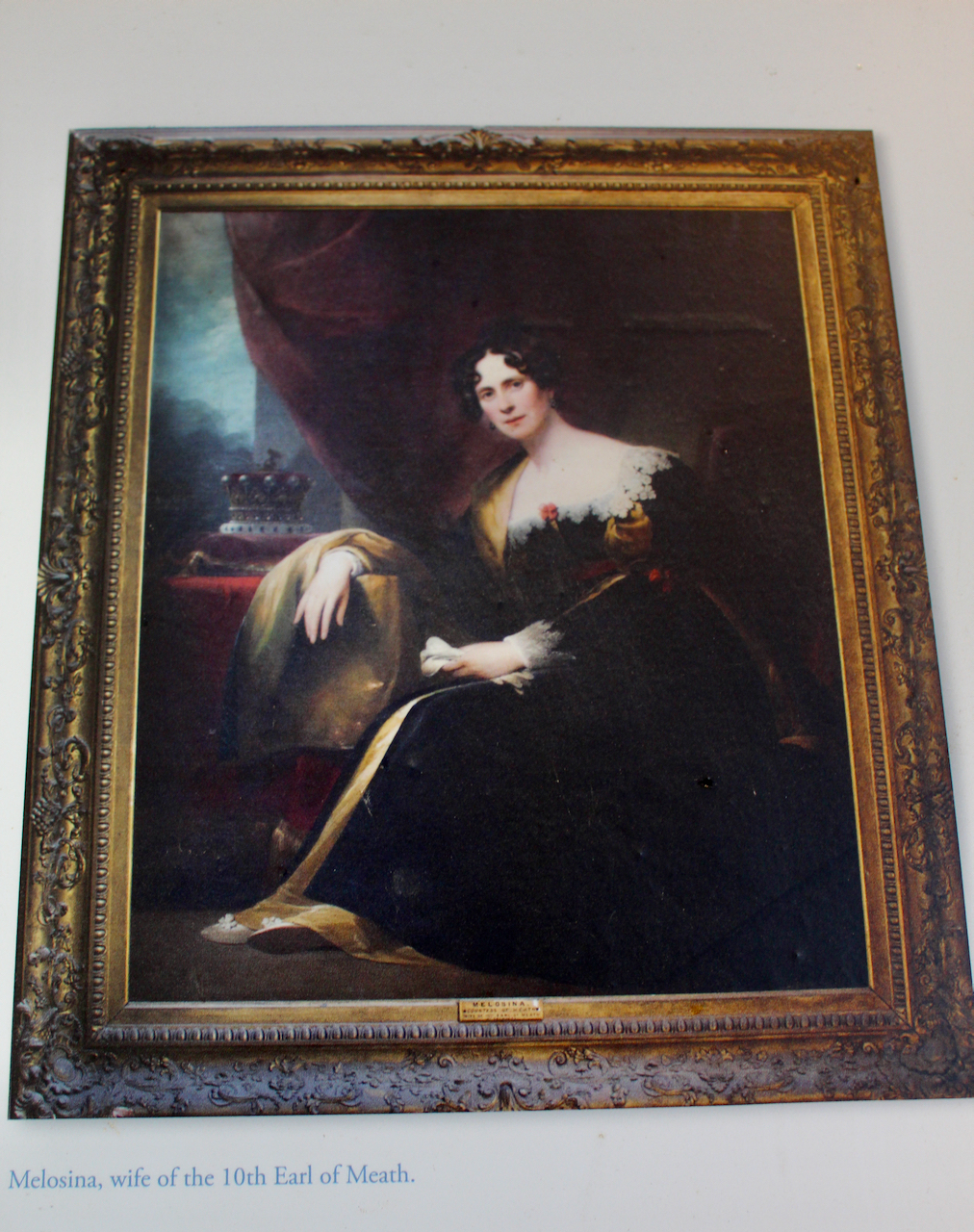
Melosina Adelaide Brabazon née Meade (1780-1866), wife of 10th Earl of Meath.
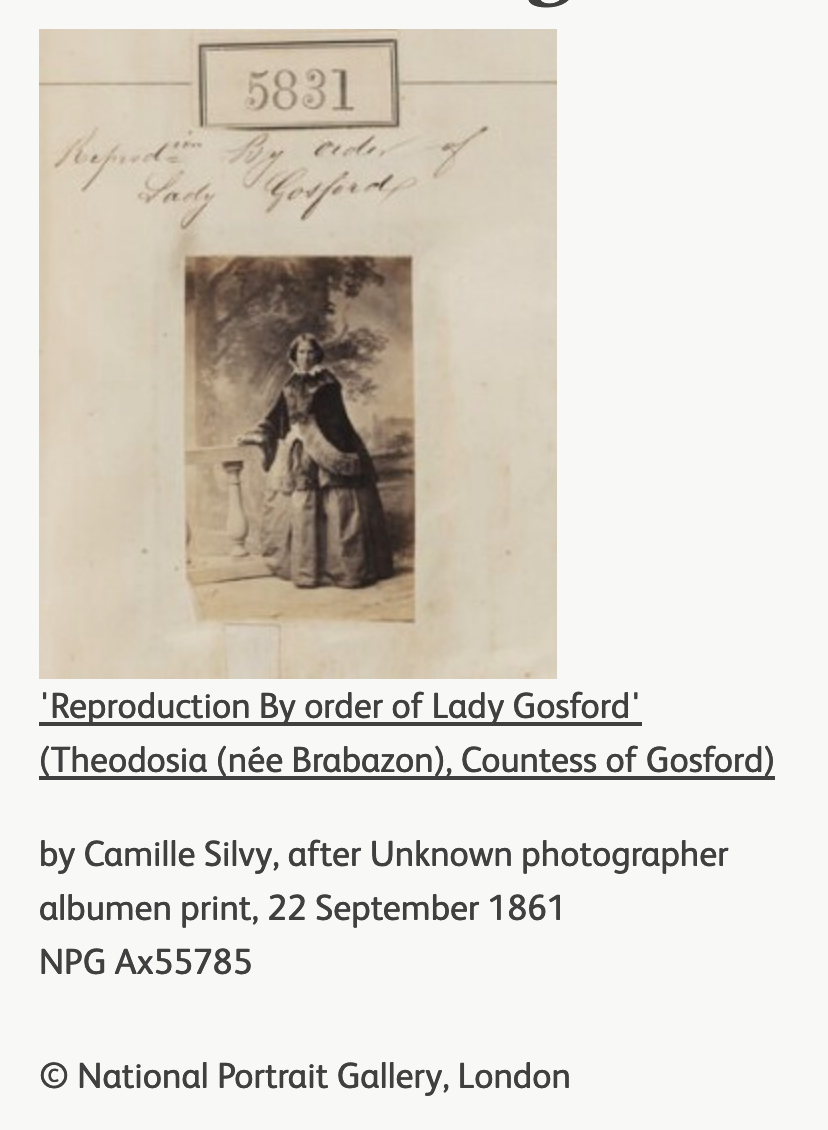
Theodosia née Brabazon (1811-1876), daughter of John Chambre Brabazon 10th Earl of Meath, she married Archibald French Acheson, 3rd Earl of Gosford.
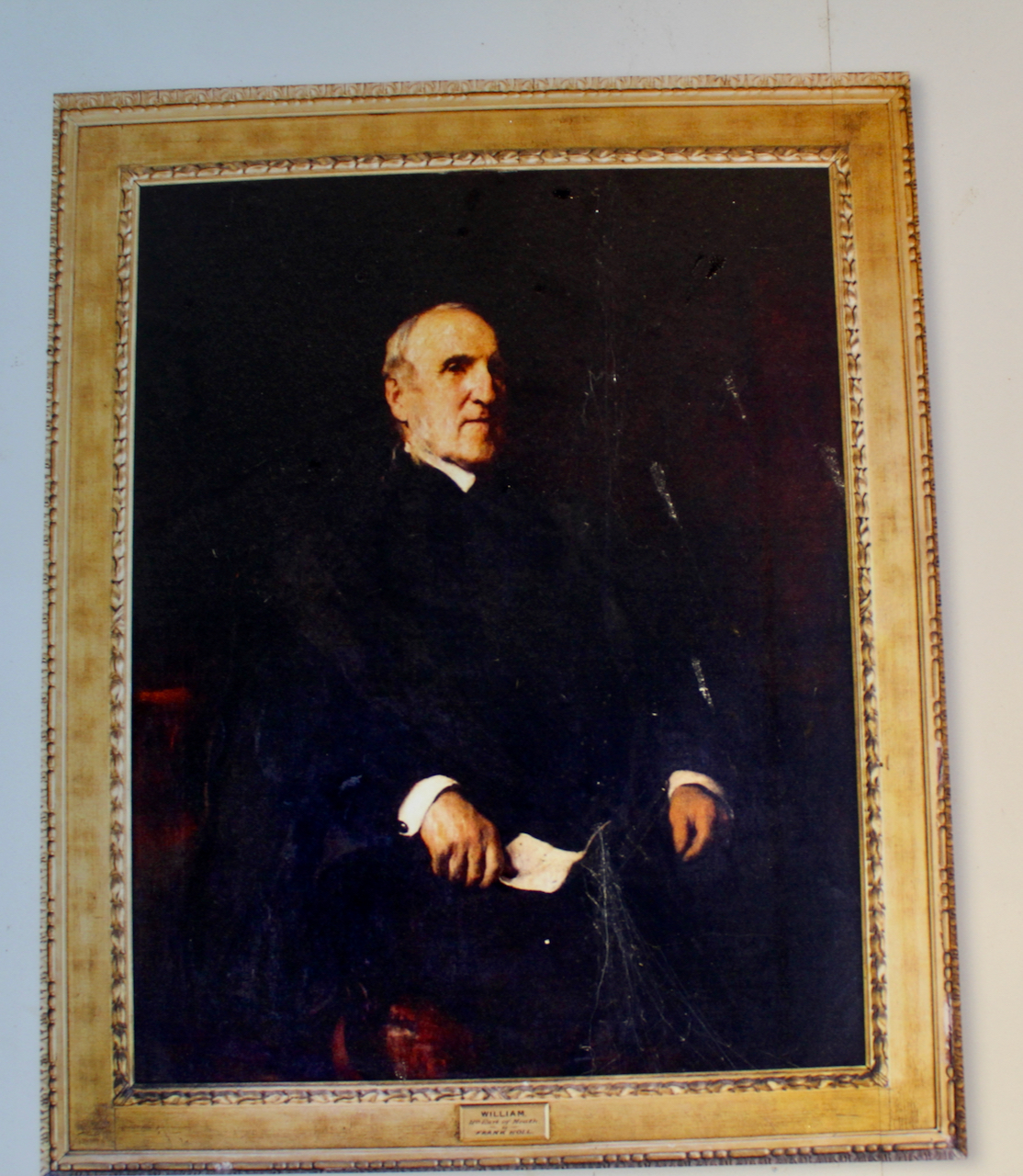
William Brabazon, 11th Earl of Meath (1803-1887).
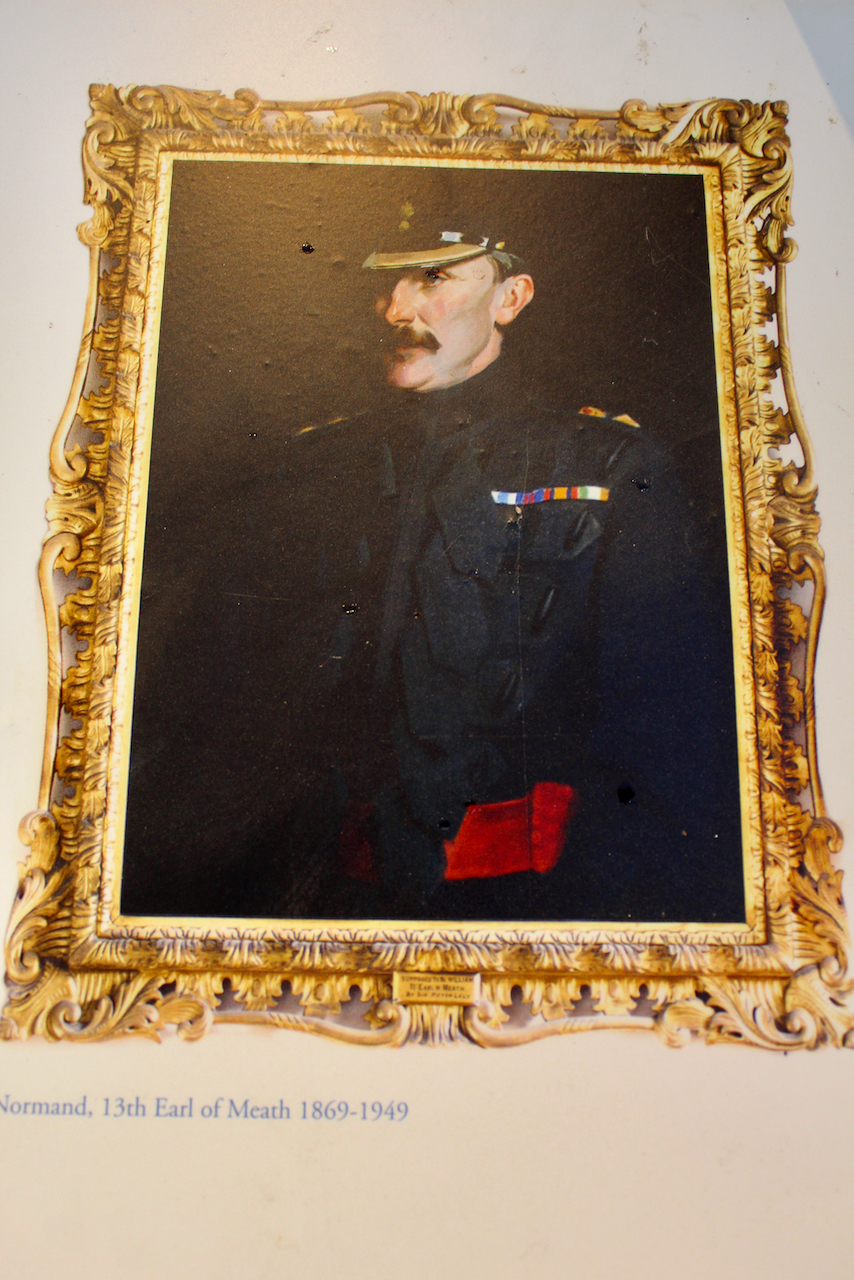
Normand Brabazon 13th Earl of Meath (1869-1949).
Lambert Brabazon, 18th Century School, courtesy Adam’s 17th May 2005. This could be Lambert Brabazon b. 1742 d. 1811, of Rath House, Termonfeckin, County Louth. He had a brother Henry (1739-1811) who had a son Henry (1771-1815).
Henry Brabazon in a blue coat, 19th Century School, courtesy Adam’s 17 May 2005. I’m not sure which Henry Brabazon this is.
Henry Brabazon in a green coat courtesy, 18th Century School, Adam’s 17 May 2005 – again, I’m not sure which Henry Brabazon this is.
Hilary Brabazon in a mauve dress, Irish School, 18th Century, courtesy Adam’s 17 May 2005.
Sidney Brabazon in a blue dress, Irish School, 18th Century, courtesy Adam’s 17 May 2005.
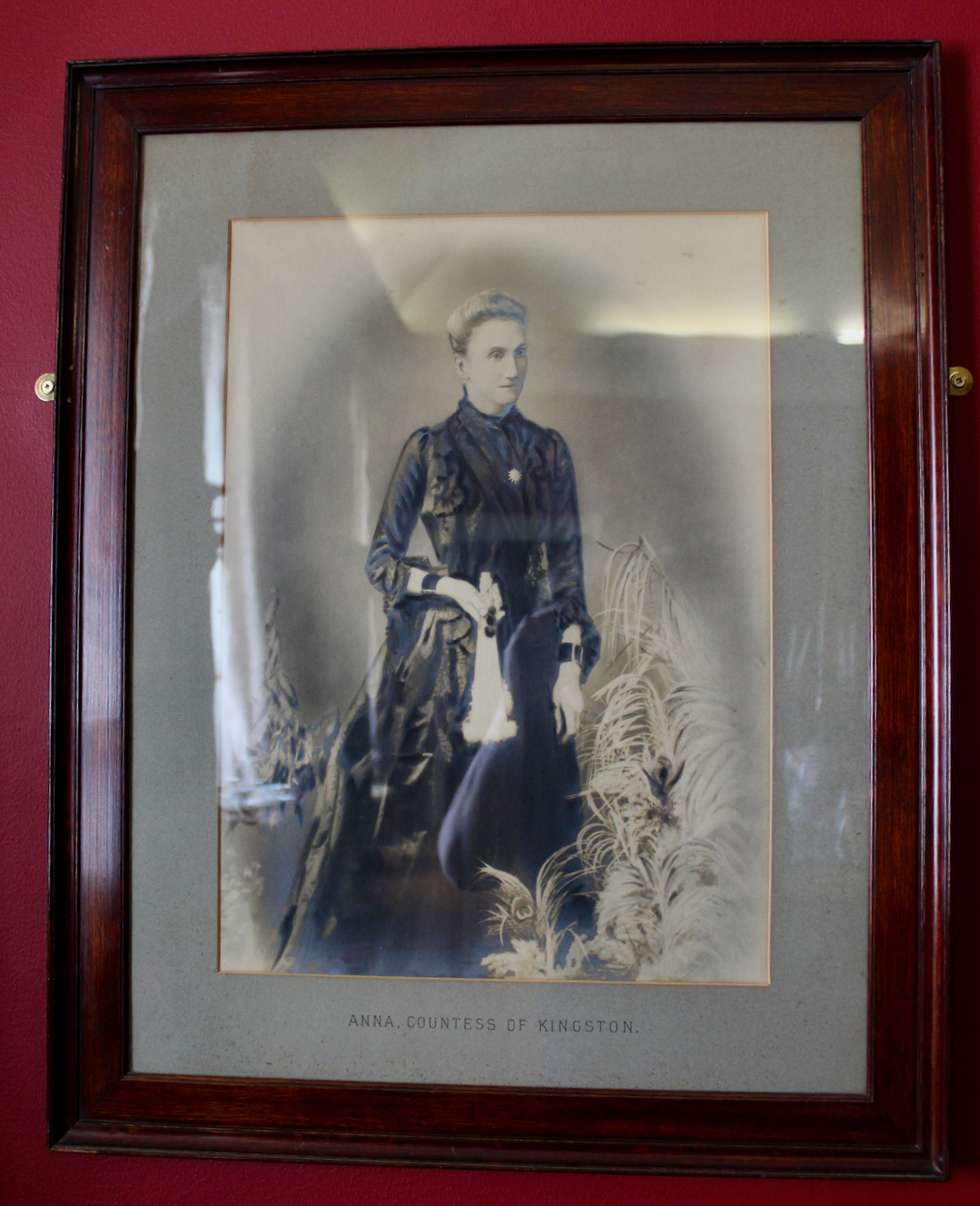
Anna King née Brinkley, wife of James King (1800-1869) 5th Earl of Kingston, who lived in Mitchelstown. She was daughter of Matthew Brinkly of Parsonstown House, County Meath. Photograph © Jennifer Winder-Baggot, www.irishhistorichouses.com
Esther née Brinkley (d. 1901), wife of John Alexander, High Sheriff of Carlow 1824, MP for Carlow 1853-1859, by Stephen Catterton Smith, courtesy of Fonsie Mealy auction. Daughter of Matthew Brinkly of Parsonstown House, County Meath. She married John Alexander on 18 Oct 1848 and he first brought electricity to Milford. He was high sheriff of County Carlow 1824 and MP for Carlow 1853-1859.
Rose Dorothy Brooke, cousin of the artist, 1913 by Eva Henrietta Hamilton, photograph courtesy of National Gallery of Ireland.
With inscription verso ‘Sir Henry Brooke Bart Son of Francis Brooke, Major of 18th… of Hannah, Sister of 1st Lord Dunally. He married Harriott Butler, granddaughter of Earl Lainsborough. He rebuilt the House of Colebrooke in 1822. Died at Colebrooke, 24th March 1834, aged 63 years.‘ Courtesy of Adam’s auction 10 Oct 2017. Henry Brooke (1770-1834) Bt.of Colebrooke, Co Fermanagh.
Charles Robert Hamilton (1846-1913), photograph courtesy of Hamwood house website. He is probably seated with his wife Louisa Caroline Elizabeth née Brooke (1850-1922).
“Capability” Launcelot Brown (1716-1783), Landscape gardener, painting by Nathaniel Dance (later Sir Nathaniel Holland, Bt), c. 1773, courtesy of National Portrait Gallery NPG 6049
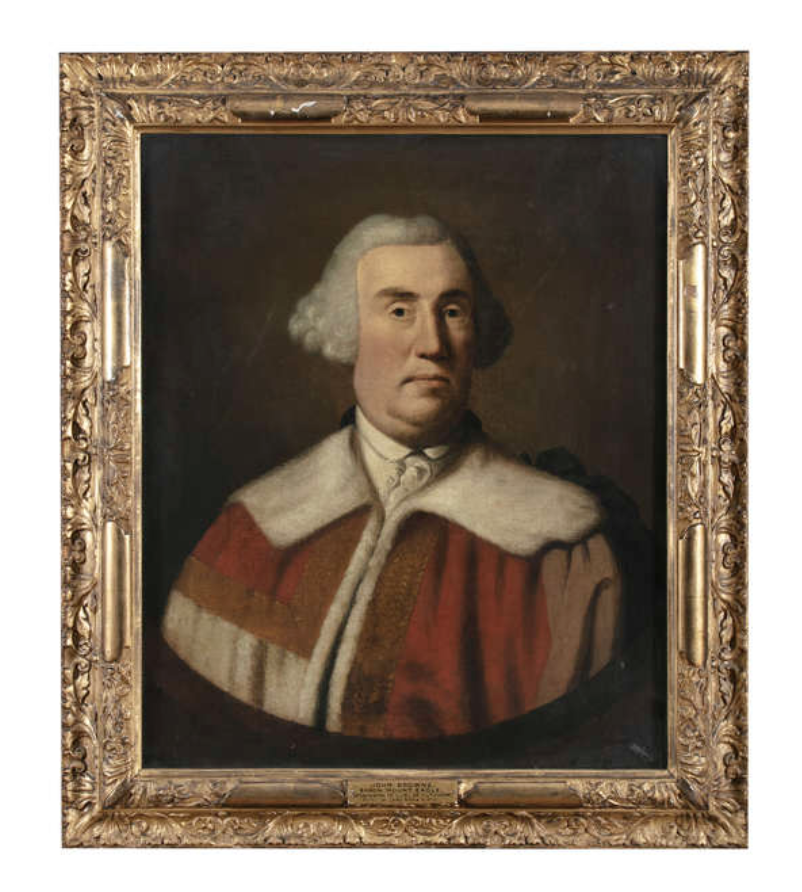
John Browne (1709-1776), Baron Mount Eagle, 1st Earl of Altamont, of Westport, County Mayo, after Joshua Reynold, Adams auction 18 Oct 2022

Timothy William Ferres tells us of the Earls of Kenmare, County Kerry: http://lordbelmontinnorthernireland.blogspot.com/2013/08/kenmare-house.html

THE RT HON SIR VALENTINE BROWNE (d 1589) in 1583, received instruction, jointly with Sir Henry Wallop, for the survey of several escheated lands in Ireland. He was subsequently sworn of the Privy Council, and represented County Sligo in parliament in 1585. In the same year, Sir Valentine purchased from Donald, Earl of Clancare, all the lands, manors, etc in counties Kerry and Cork, which had been in the possession of Teige Dermot MacCormac and Rorie Donoghoemore.

Sir Valentine married firstly, Alice or Elizabeth, daughter of Robert Alexander, of London, and had issue, a son. He wedded secondly, Thomasine, sister of the Lord Keeper of the Great Seal, Sir Nicholas Bacon, and had further issue (with a daughter), two sons.

Sir Valentine’s eldest surviving son, SIR NICHOLAS BROWNE, Knight, of Ross, County Kerry, who wedded Sicheley Sheela, daughter of O’Sullivan Beare, and had issue: VALENTINE, his heir;
Anne.

Sir Nicholas died in 1616, and was succeeded by his son, VALENTINE BROWNE, High Sheriff of County Kerry, 1623, who was created a baronet in 1622, designated of Molahiffe, County Kerry.

Sir Valentine, after his father’s decease, presented a petition to JAMES I, praying an abatement of the yearly rent reserved on the estate which he held from the Crown, as an undertaker, at the annual sum of £113 6s 8d, in regard of the small profit he made of it, being set out in the most barren and remote part of County Kerry; which request was complied with, and he received a confirmation, by patent, of all his lands at a reduced rent.

He married Elizabeth, fifth daughter of Gerald, Earl of Kildare [I’m not sure if this – JWB], and was succeeded by his grandson, THE RT HON SIR VALENTINE BROWNE, 3rd Baronet (1638-94); who was sworn of the Privy Council of JAMES II, and created by that monarch, subsequently to his abdication, in 1689, Baron Castlerosse and Viscount Kenmare.

His lordship, who was Colonel of Infantry in the army of JAMES II, forfeited his estates by his inviolable fidelity to that unfortunate monarch. He wedded Jane, only daughter and heir of Sir Nicholas Plunket [of Balrath], and niece of Lucas, Earl of Fingall, and had five sons and four daughters.

The 1st Viscount was succeeded by his eldest son, SIR NICHOLAS BROWNE, 4th Baronet (called 2nd Viscount); an officer of rank in the service of JAMES II, and attainted in consequence, who espoused, in 1664, Helen, eldest daughter and co-heir of Thomas Brown, by whom he obtained a very considerable fortune, but which, with his own estates, became forfeited for his life. The crown, however, allowed his lady a rent-charge of £400 per year for the maintenance of herself and her children. Sir Nicholas died in 1720, leaving four daughters and his son and successor,

SIR VALENTINE BROWNE, 5th Baronet (called 3rd Viscount) (1695-1736), who continued outlawed by the attainder of his father and grandfather. [The 4th Baronet’s daughter Frances married Edward Herbert (1693-1770 of Muckross, County Kerry]
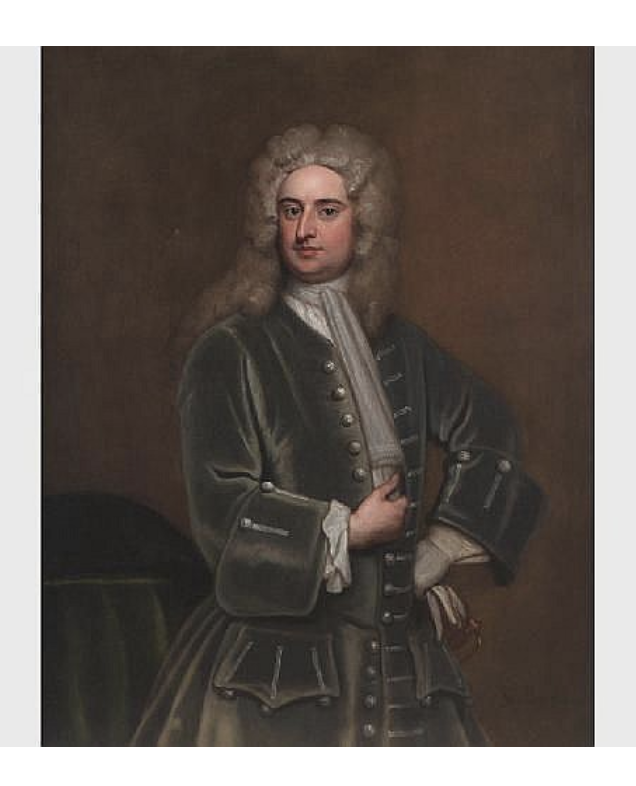
Portrait of a Gentleman by Follower of Kneller, traditionally identified as Valentine Browne (1695-1736), 3rd Viscount Kenmare courtesy of https://www.bonhams.com/auctions/19056/lot/278/.jpg

He married, in 1720, Honora, second daughter of Colonel Thomas Butler [of Kilcash (1671-1738)], and great-grandniece of James, Duke of Ormonde, by whom he had issue, Thomas, his successor, and two daughters.

Sir Valentine espoused secondly, in 1735, Mary, Dowager Countess of Fingall, by whom he left a posthumous daughter, Mary Frances. [Mary née Fitzgerald (1716-1741/2) was the daughter of Maurice Fitzgerald, 5th Baronet of Castle Ishen, County Cork; Mary was first married to Justin Plunkett, 5th Earl of Fingall. She married thirdly John Bellew, 4th Baron Bellew of Duleek]

He was succeeded by his only son, SIR THOMAS BROWNE, 6th Baronet (called 4th Viscount) (1726-95), who wedded, in 1750, Anne, only daughter of Thomas Cooke, of Painstown, County Carlow, by whom he had a son and a daughter, Catherine, married to Count de Durfort-Civrac.

“He was succeeded by his son, SIR VALENTINE BROWNE, 7th Baronet (called 5th Viscount) (1754-1812), who was created (the viscountcy of JAMES II never having been acknowledged in law), in 1798, Baron Castlerosse and Viscount Kenmare.

“His lordship was further advanced to the dignity of an earldom, in 1800, as EARL OF KENMARE.”
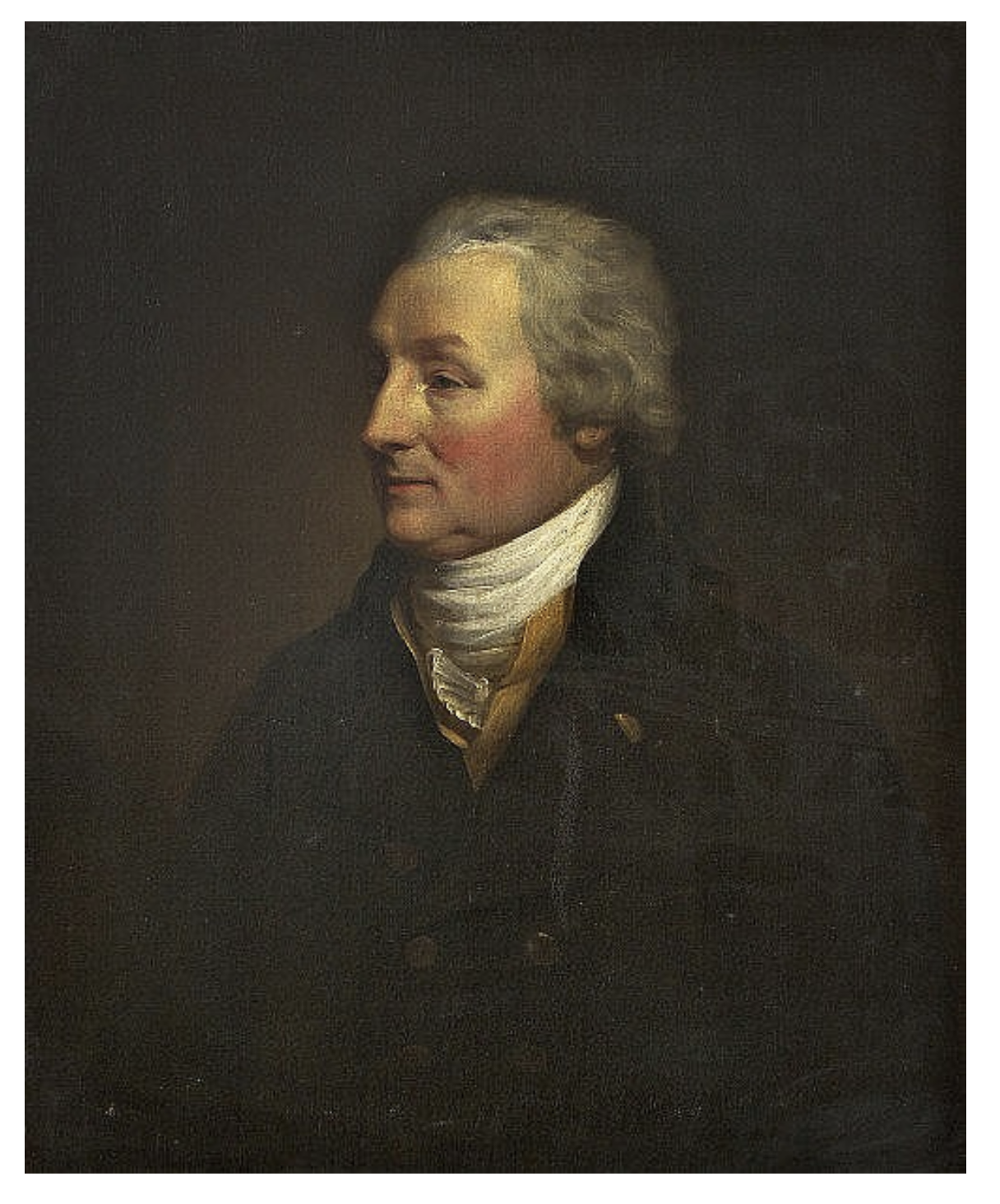
Valentine Browne (1754-1812), 1st Earl of Kenmare by Hugh Douglas Hamilton courtesy of Country House Collections at Slane Castle by Adam’s 2012.

He married firstly, in 1777, Charlotte, daughter of Henry, 11th Viscount Dillon [of Costello-Gallin], and had an only daughter, Charlotte. [She married George Goold, 2nd Bt of Old Court, Co. Cork.]

His lordship wedded secondly, in 1785, Mary, eldest daughter of Michael Aylmer, of Lyons, County Kildare, and had issue,

VALENTINE (1788-1853) his successor as 2nd Earl;
Thomas (1789-1871) who became 3rd Earl;
William;
Michael;
Marianne; Frances.

His lordship was succeeded by his eldest son, VALENTINE, 2nd Earl (1788-1853), PC, who espoused, in 1816, Augusta, daughter of Sir Robert Wilmot, 2nd Baronet, though the marriage was without issue, when the family honours devolved upon his brother,

THOMAS, 3rd Earl (1789-1871), who married, in 1822, Catherine, daughter of Edmond O’Callaghan [d. 1791. Another daughter of Edmond O’Callaghan, Ellen, married James John Bagot of Castle Bagot, Rathcoole. His daughter Elizabeth married Gerald Dease of Turbotstown, a Section 482 property].
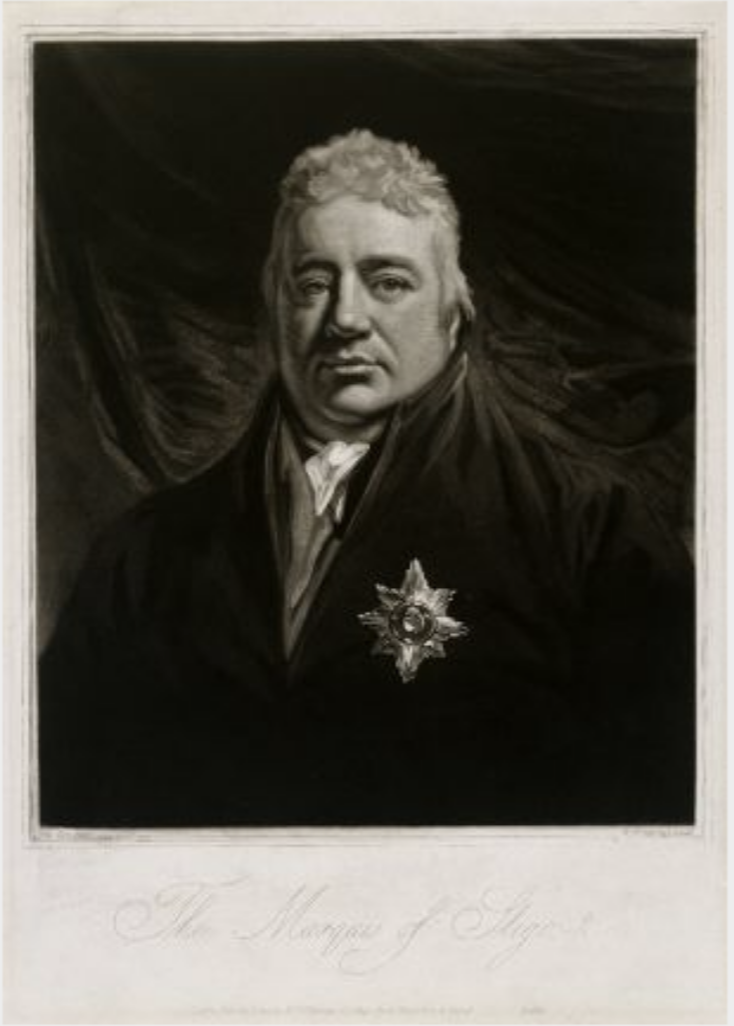
John Denis Browne (1756-1809), 1st Marquess of Sligo, 1806 by engraver William Whiston Barney after John Opie, courtesy of National Gallery of Ireland.
Robert Brown, 1720 by Godfrey Kneller from Coolattin house sale, 2016, Shepphards.
The Reverend Jemmet Browne (of Riverstown, County Cork) at a meet of foxhounds, by Peter Tillemans, courtesy of Yale Centre for British Art.
A portrait of Alice Waterhouse (1700-1782), wife of Bishop Jemmett Browne. (1703-1782), Bishop of Cork and Archbishop of Tuam. They lived at Riverstown, County Cork. Photograph © Jennifer Winder-Baggot, www.irishhistorichouses.com
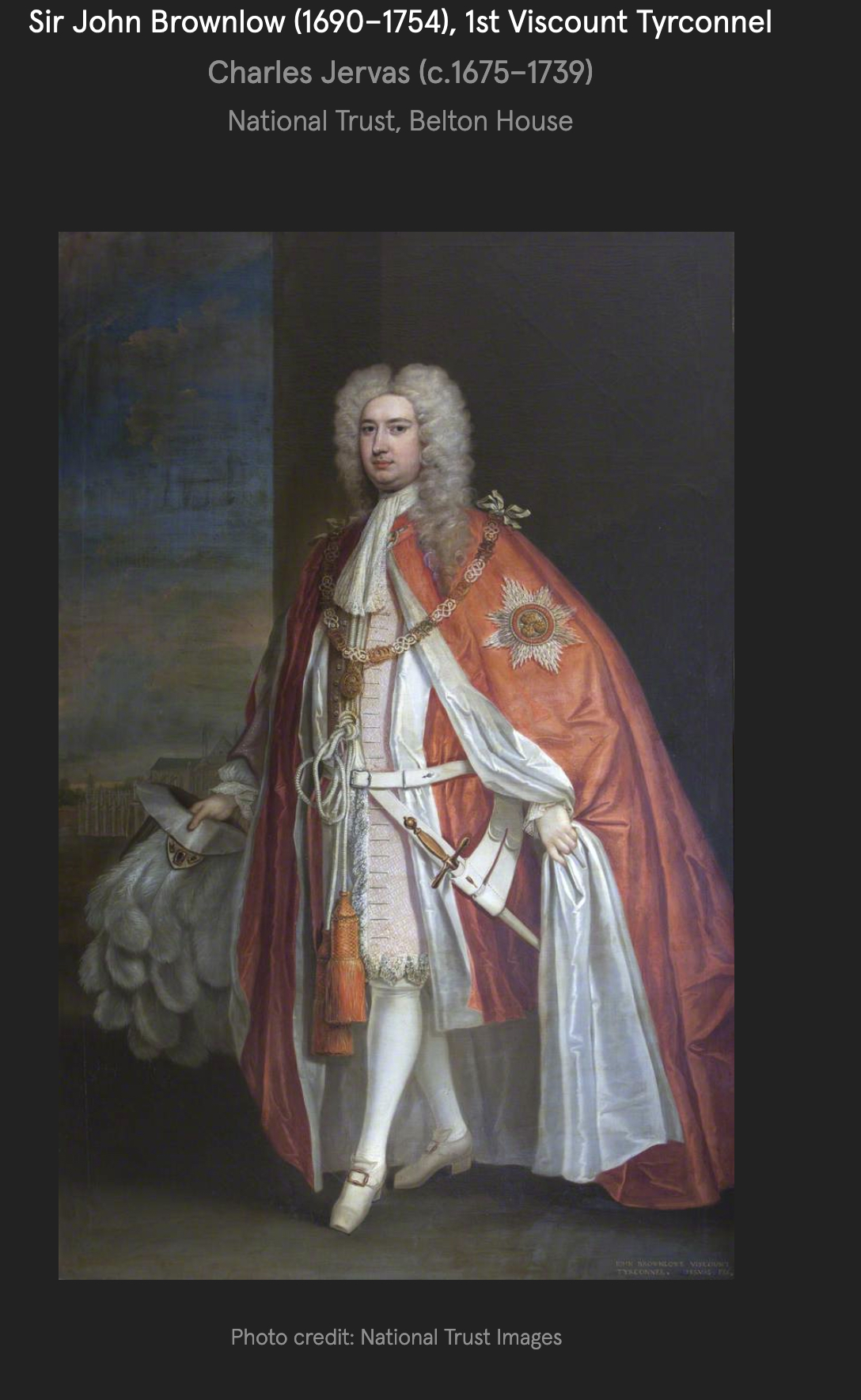
John Brownlow (1690-1754) 1st Viscount Tyrconnell.
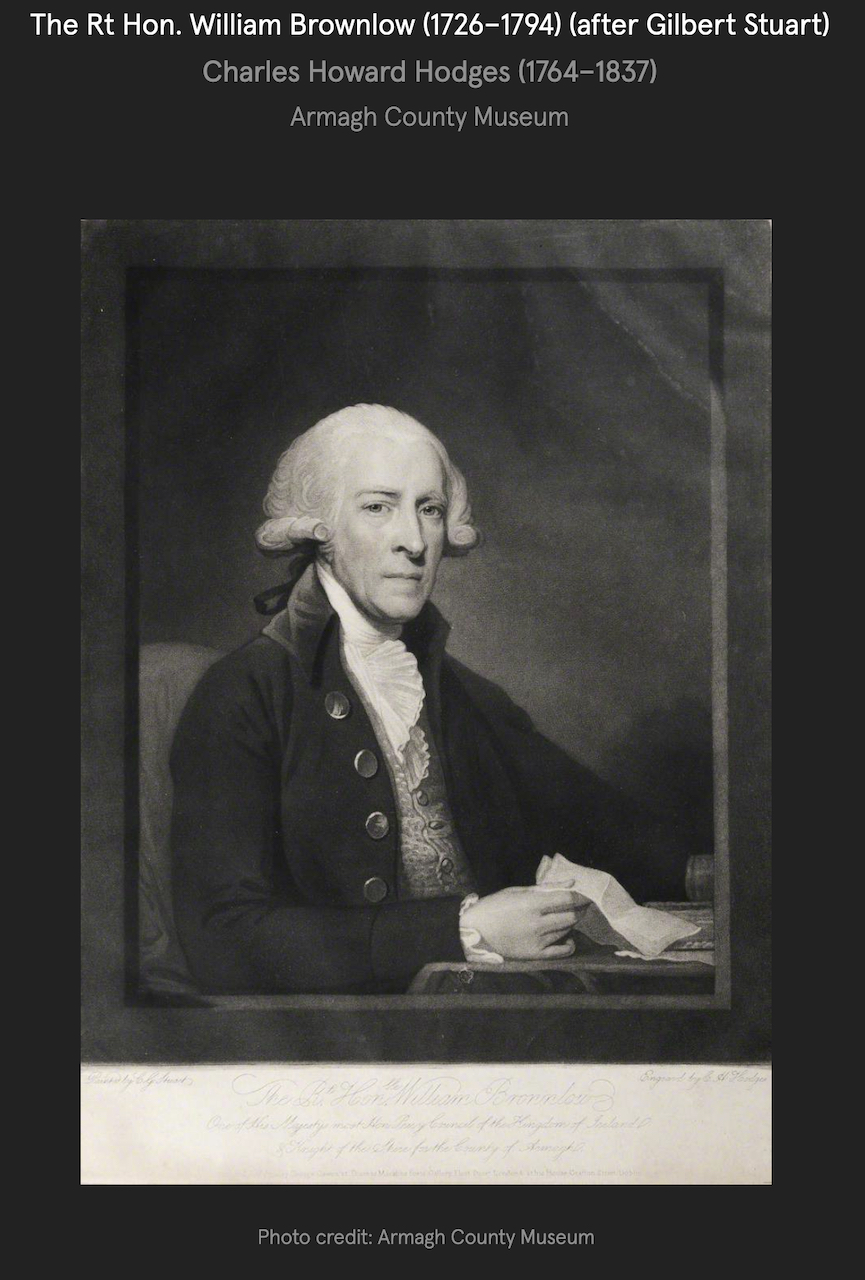
William Brownlow (1726-1794) (after Gilbert Stuart) by Charles Howard Hodges courtesy of Armagh County Museum.
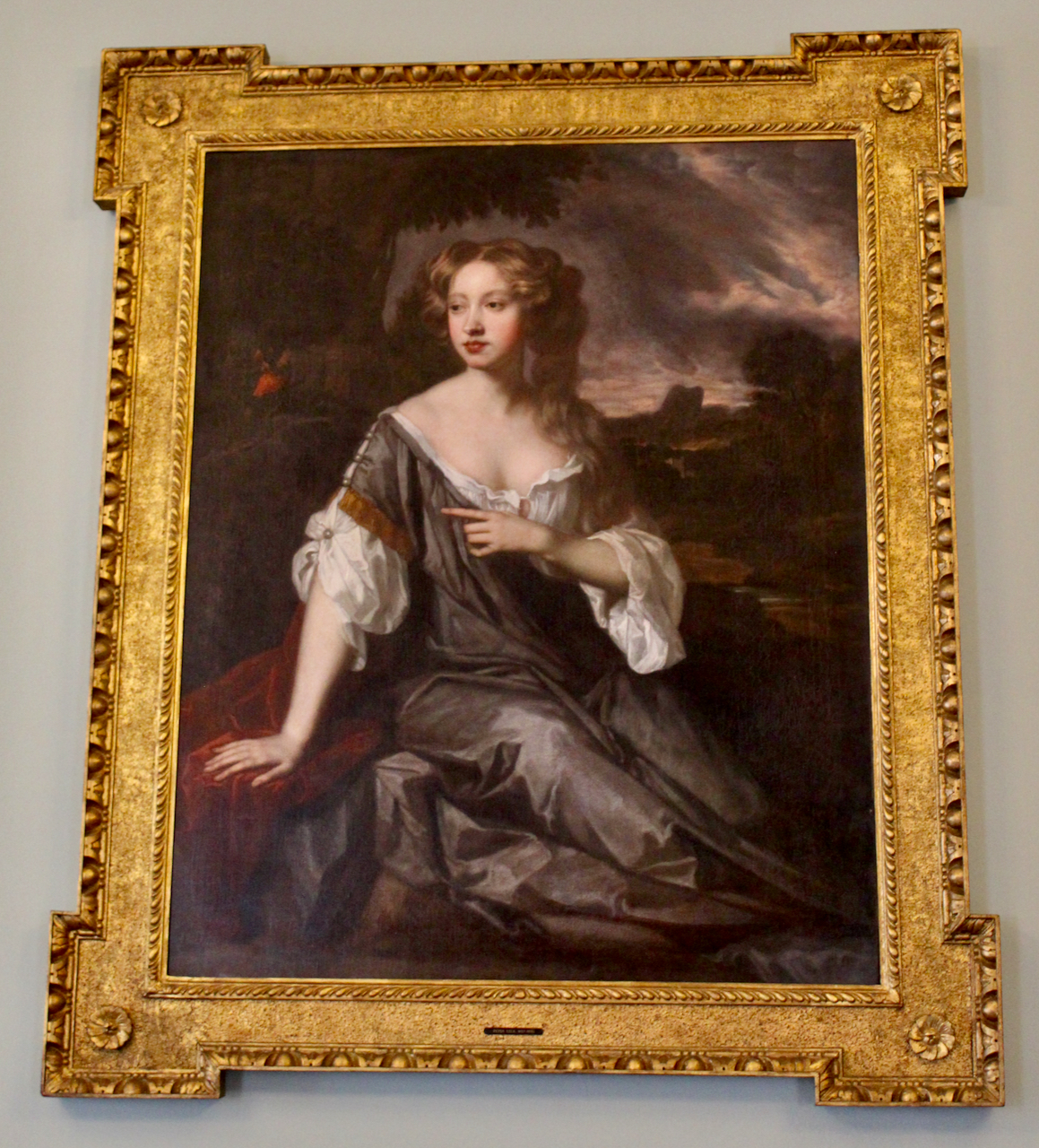
Lucy Loftus née Brydges (1654-1681? or 1646-1689?) of Sudeley Manor, Gloucestershire, England, by Peter Lely, wife of Adam Loftus (1632-1691), 1st and last Viscount Lisburne. Photograph © Jennifer Winder-Baggot, www.irishhistorichouses.com
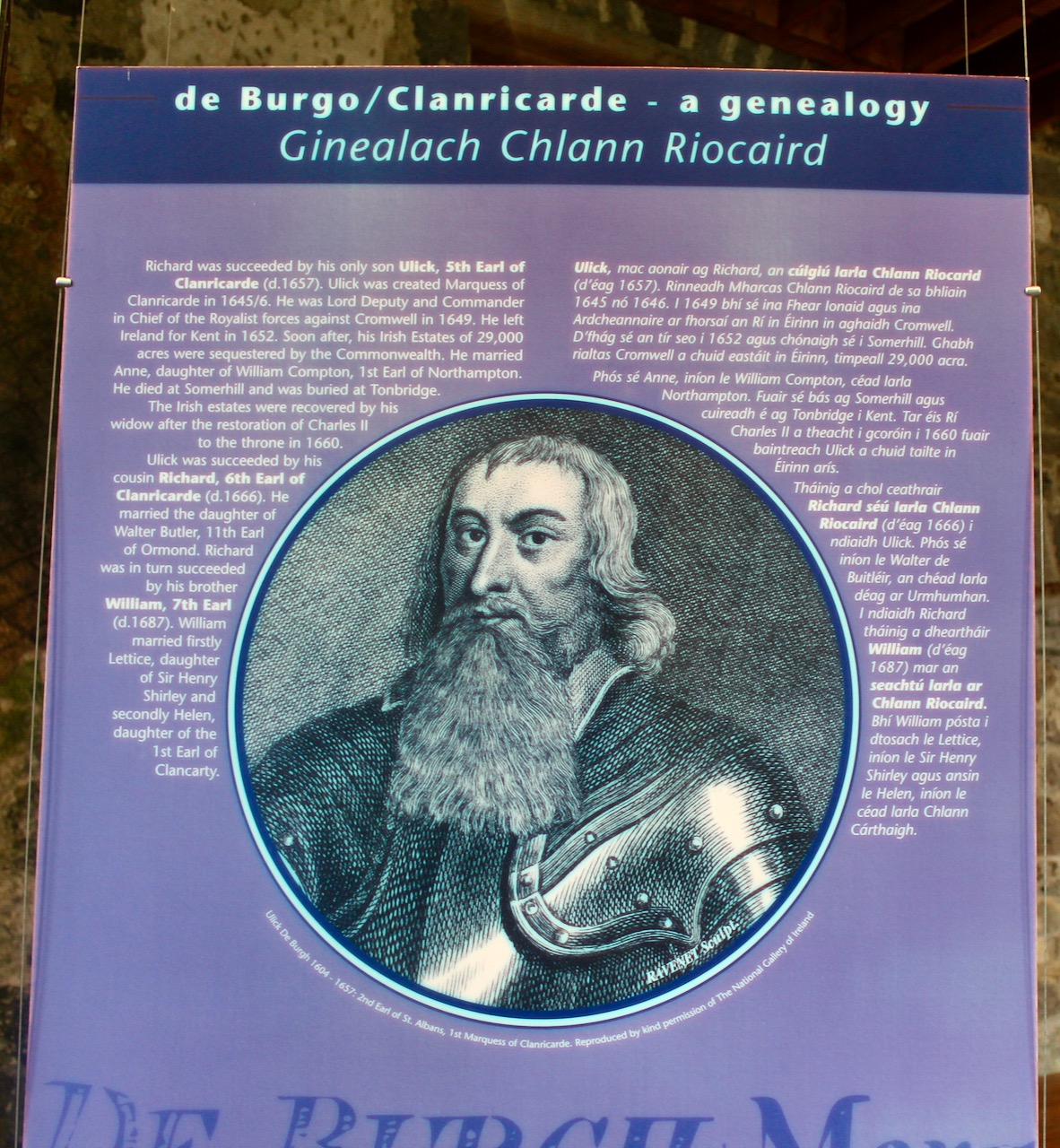
Portrait of Ulick de Burgo or Bourke, 5th Earl of Clanricarde (d. 1657). He was created Marquess of Clanricarde. He was Lord Deputy and Commander in Chief of Royalist forces against Cromwell in 1649. His Irish estates were lost but then recovered by his widow after the restoration of Charles II to the throne.
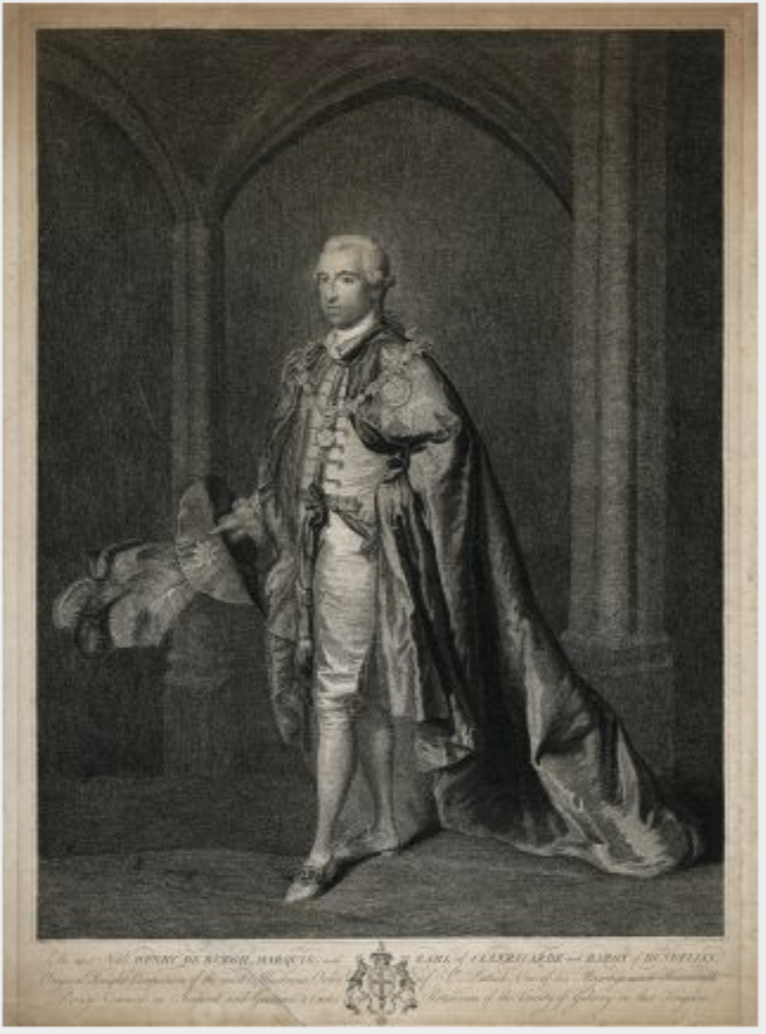
Henry de Burgh, (1743-1797) 1st Marquess of Clanricarde 2nd creation, as Knight of St. Patrick, by engraver William Sedgewick, after Robert Hunter, courtesy of National Gallery of Ireland.
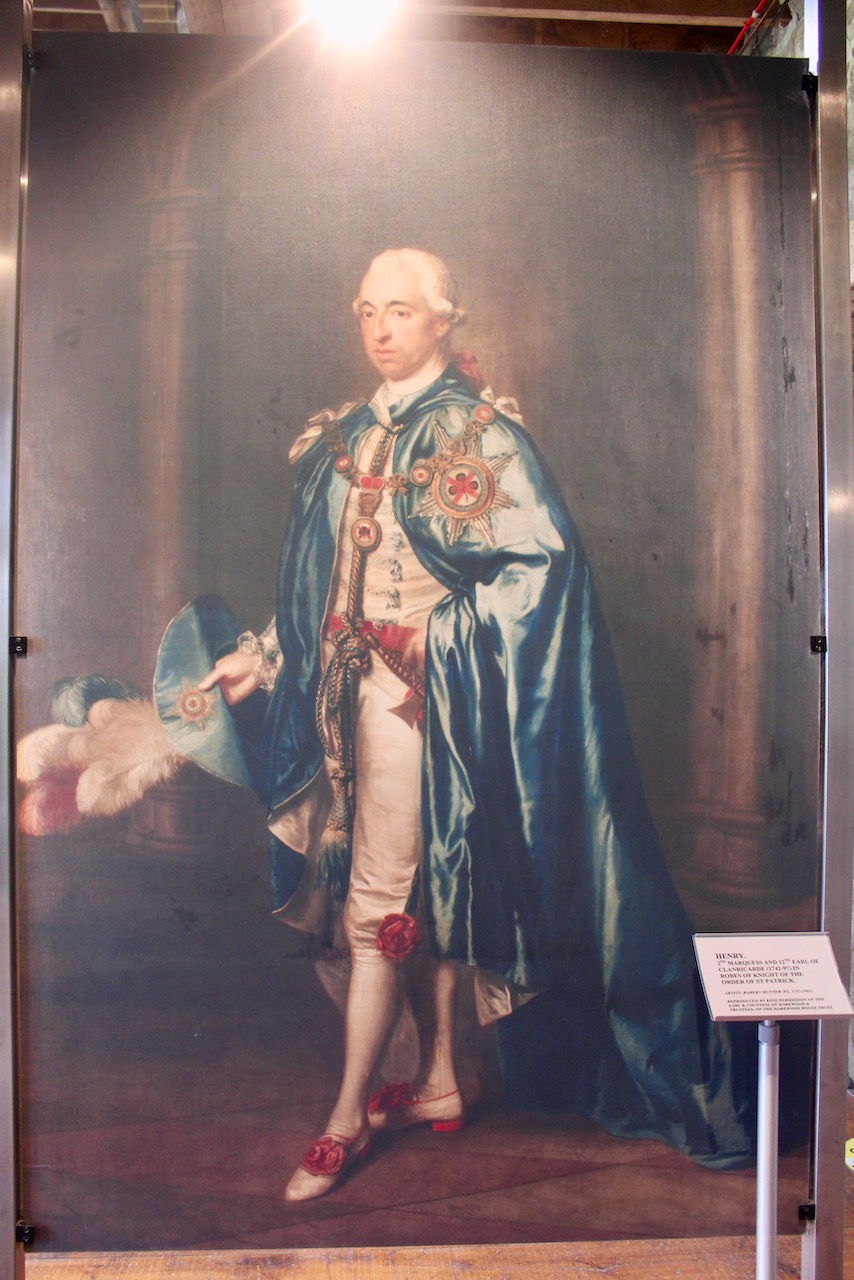
Henry de Burgh (1742/3-97) 2nd Marquess and 12th Earl of Clanricarde in robes of Knight of the Order of St. Patrick.
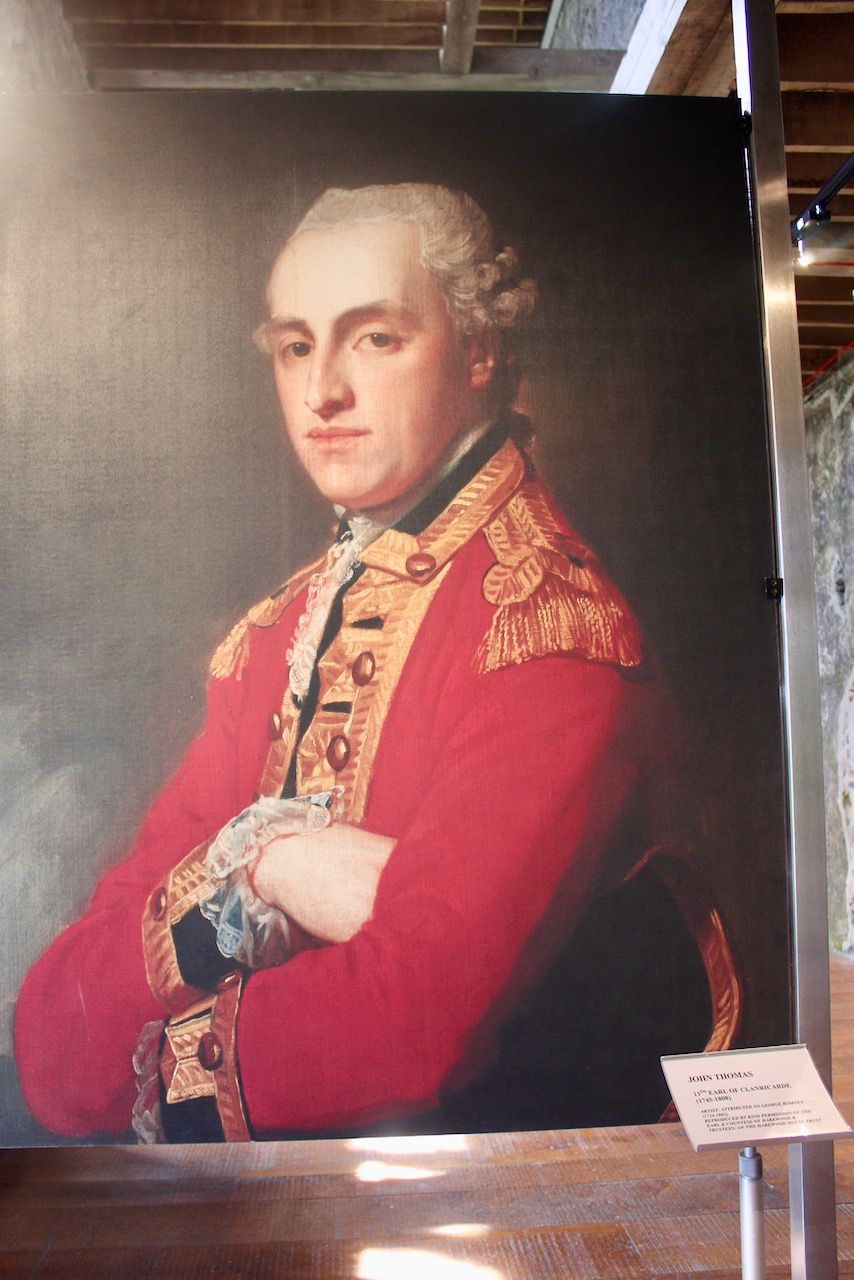
John Thomas De Burgh (1744-1808) 13th Earl of Clanricarde was created 1st Earl of Clanricarde, Co. Galway.
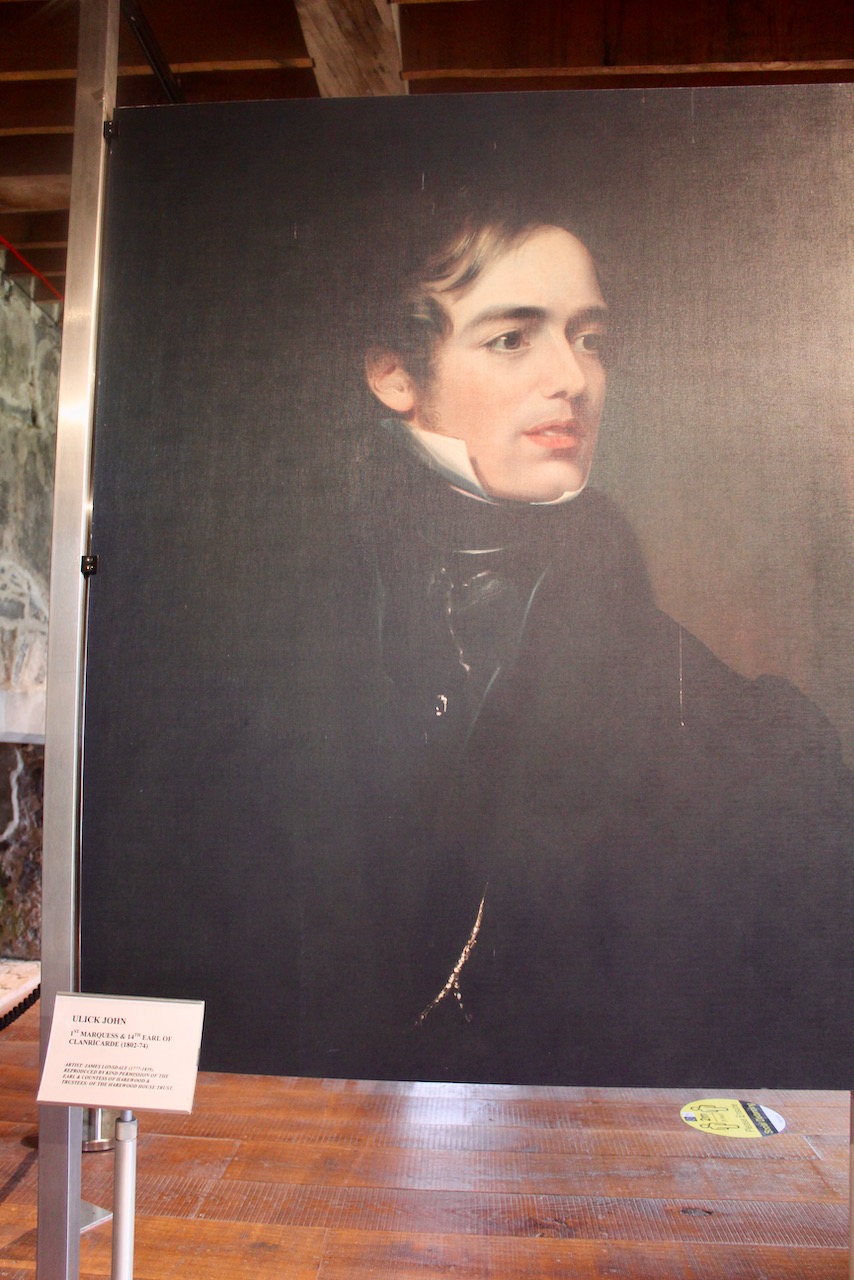
Ulick John De Burgh (1802-1874), 14th Earl and 1st Marquess of Clanricarde (3rd creation).
The 2nd Marquess, Hubert George De Burgh-Canning (1832-1916), “the notorious miser and eccentric who spent his life in squalid rooms in London and dressed like a tramp.”
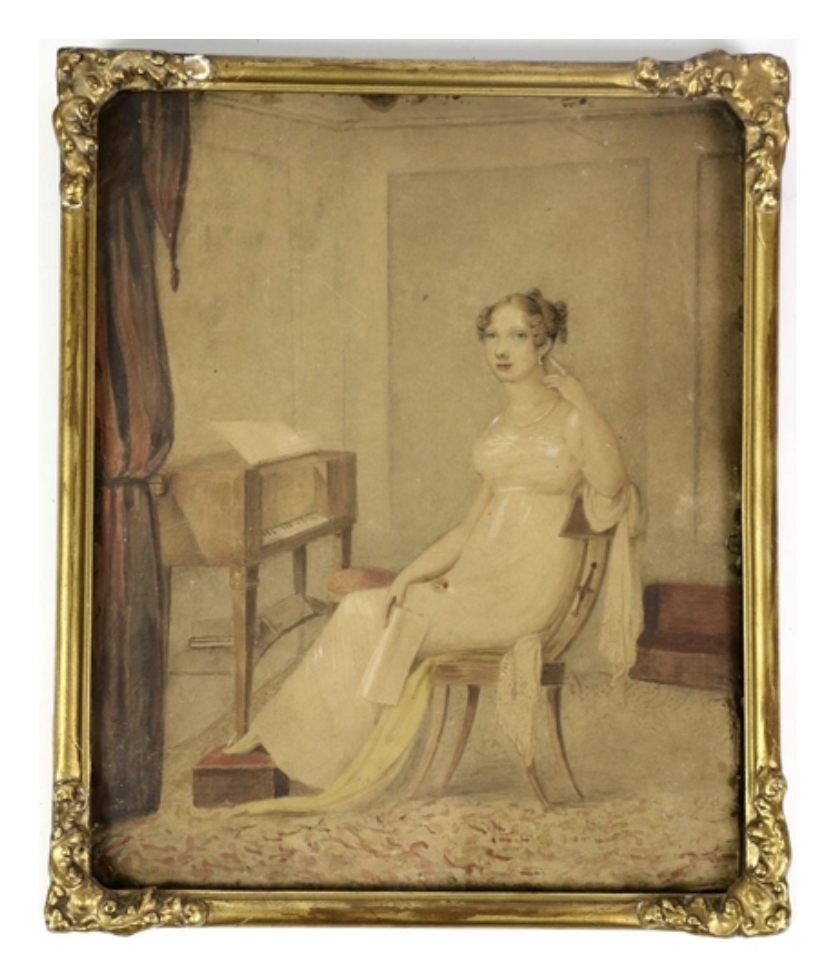
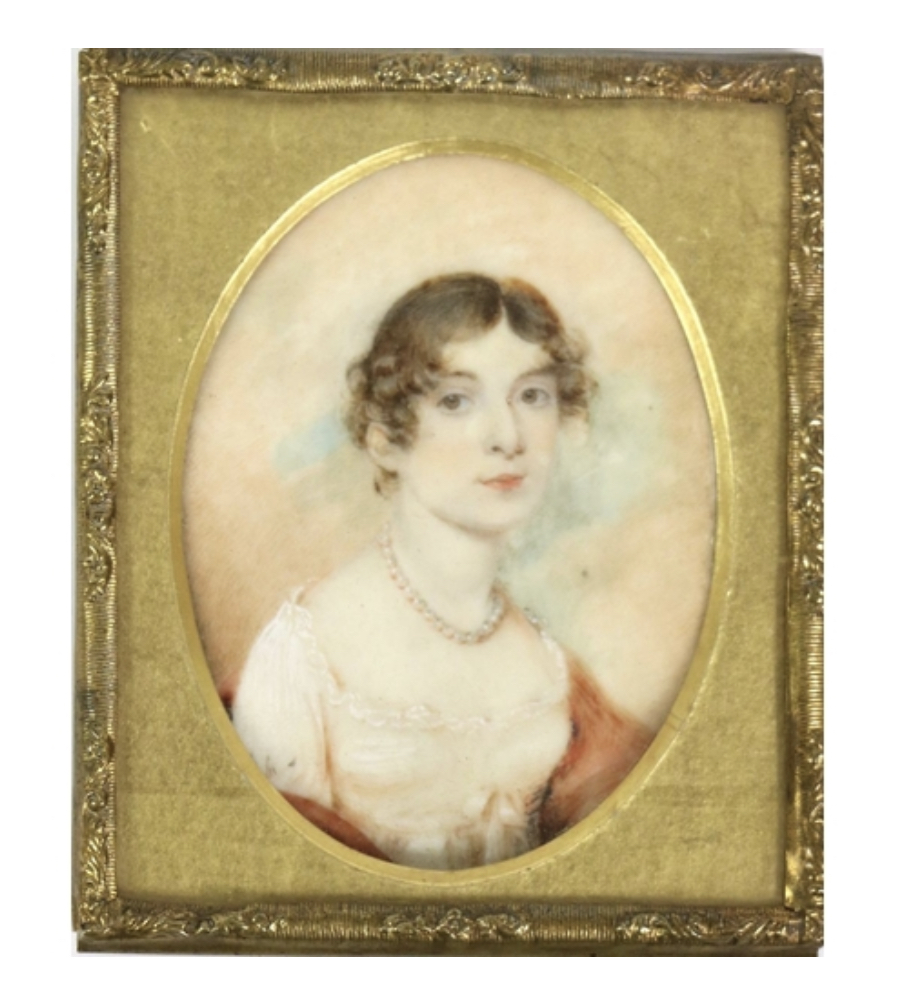
Maria De Burgh, Lady Downes (1788-1842) of Bert House, County Kildare, attributed to Adam Buck, only child and heiress of Walter Bagenal of Duckleckney and Mount Leinster Lodge, Co Carlow, courtesy of Fonsie Mealy auction.
Maria de Burgh, Lady Downes (1788-1842), only child and heiress of Walter Bagenal of Dunleckney Manor, and Mount Leinster Lodge, Killedmond, County Carlow, courtesy of Fonsie Mealy auction.
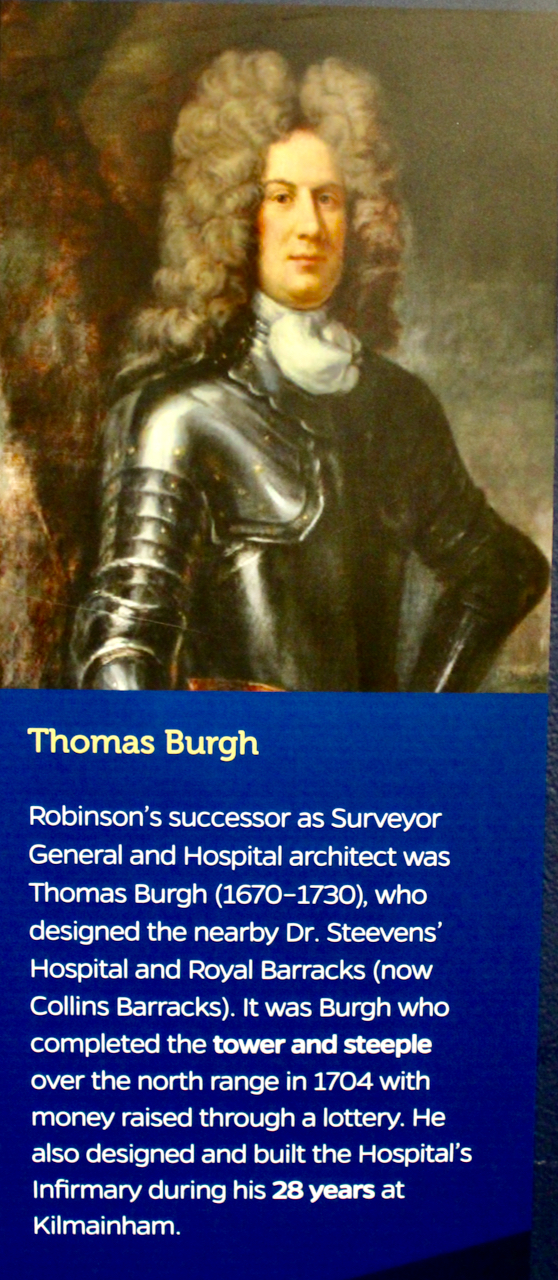
Thomas Burgh, Royal Hospital Kilmainham, 15th October 2023.
Charles William Bury (1801-1851), 2nd Earl of Charleville by Alfred, Count D’Orsay 1844, courtesy of National Portrait Gallery NPG 4026(12).
Charles William Bury, 2nd Earl of Charleville, seated in red cloak before a curtain, portrait by Henry Pierce Bone, 1835.
Humphrey Butler, 4th Viscount and later 1st Earl of Lanesborough, (c.1700-1768) Engraver John Brooks, Irish, fl.1730-1756 After C. Brown, courtesy of National Gallery of Ireland.
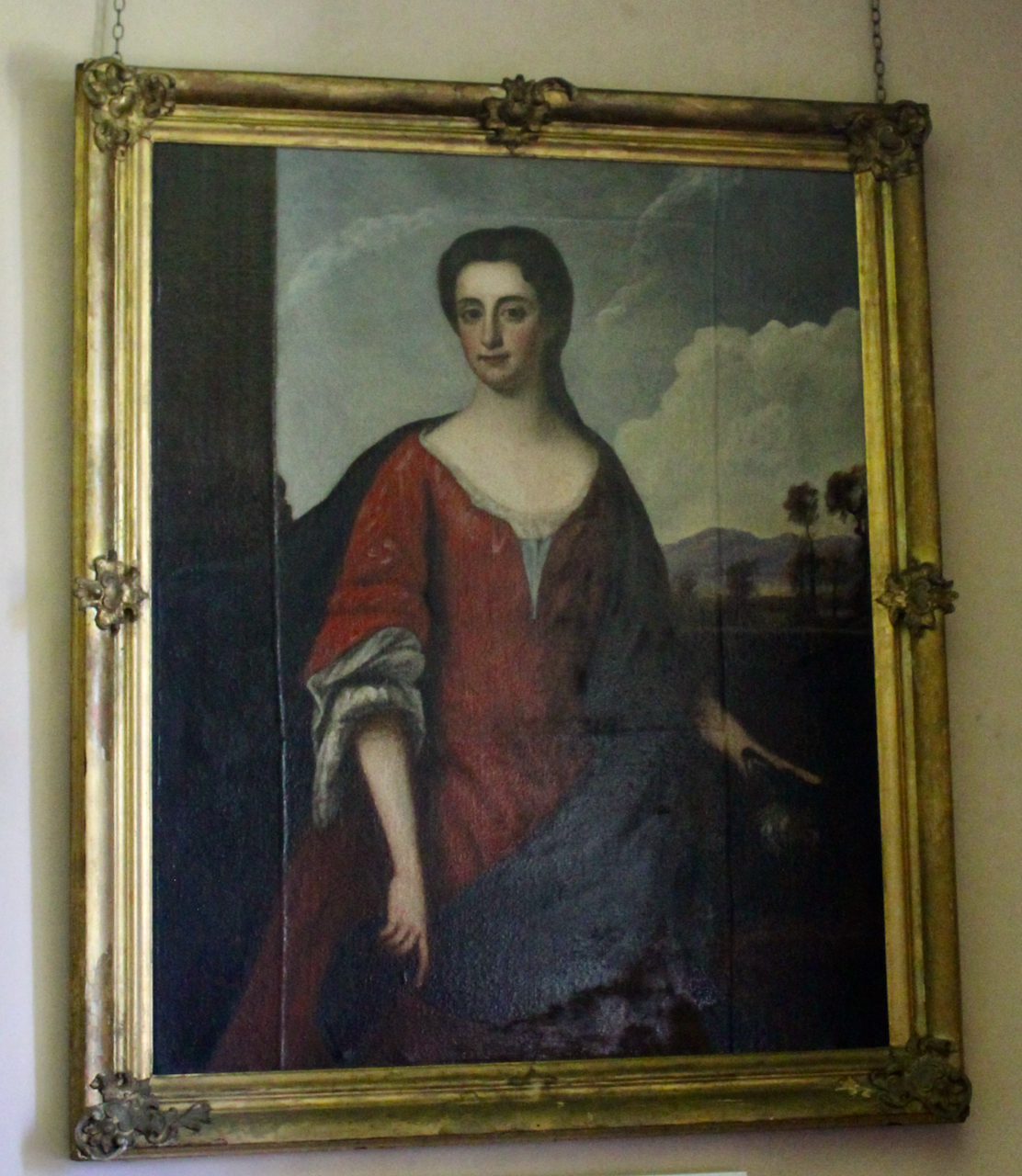
Female member of Butler family, Cahir Castle, courtesy of Fonsie Mealy auction
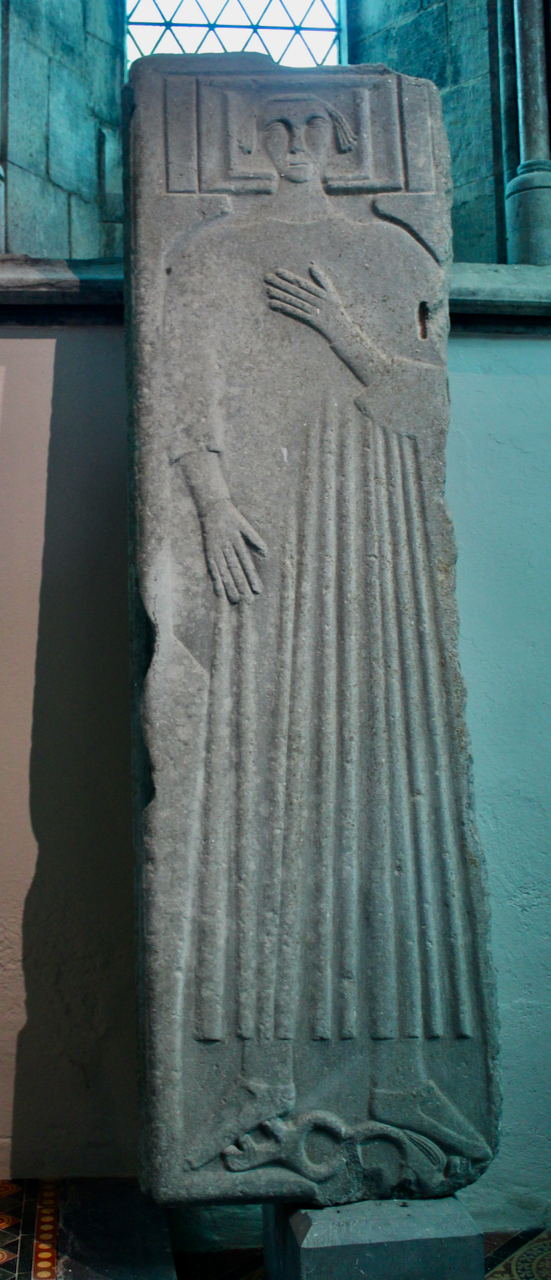
Probably James Butler (c. 1305-1337), the 1st Earl of Ormond. Photograph © Jennifer Winder-Baggot, www.irishhistorichouses.com
Probably Eleanor de Bohun (c. 1304-1363), the wife of James Butler the 1st Earl of Ormond, in St. Mary’s Church, Gowran, County Kilkenny. Photograph © Jennifer Winder-Baggot, www.irishhistorichouses.com
Robert Butler(d.1788) of Ballyragget Castle and Ballyragget Lodge, County Kilkenny by Joseph Highmore. Brother of James Butler Archbishop of Cashel, courtesy Fonsie Mealy Oct 2024.

The Butlers of Ormonde

Piers Butler (d. 1539) 8th Earl of Ormonde married Margaret Fitzgerald, daughter of Gerald Fitzgerald 8th Earl of Kildare.

They had daughters Ellen (d. 1597) who married Donough O’Brien (d. 1553) 1st Earl of Thomond; Margaret married Barnaby FitzPatrick, 1st Baron of Upper Ossory; Joan married James Butler, 10th Baron Dunboyne; Eleanor married Thomas Butler 1st Baron Caher; Katherine married Richard Power, 1st Baron le Power and Coroghmore first and secondly, James FitzJohn FitzGerald, 13th Earl of Desmond; Ellice married Gerald FitzJohn FitzGerald (d. 1553, father of 1st Viscount Decies).

They had sons John Butler (d. 1570) who lived in Kilcash, County Tipperary and was father of Walter (1569-1632) 11th Earl of Ormond; Richard Butler (d. 1571) 1st Viscount Mountgarret; Thomas who died in 1532; and James Butler (d. 1546) 9th Earl of Ormonde.

James Butler (1504-1546), Soldier, 9th Earl of Ormond and Ossory by Francesco Bartolozzi, published by John Chamberlaine, after Hans Holbein the Younger publ. 1797, courtesy of National Portrait Gallery NPG D39383.

James Butler (d. 1546) 9th Earl of Ormonde married Joan Fitzgerald, daughter of James FitzMaurice FitzGerald, 10th Earl of Desmond. She gave birth to Thomas Butler (1531-1614) who became 10th Earl of Ormond.
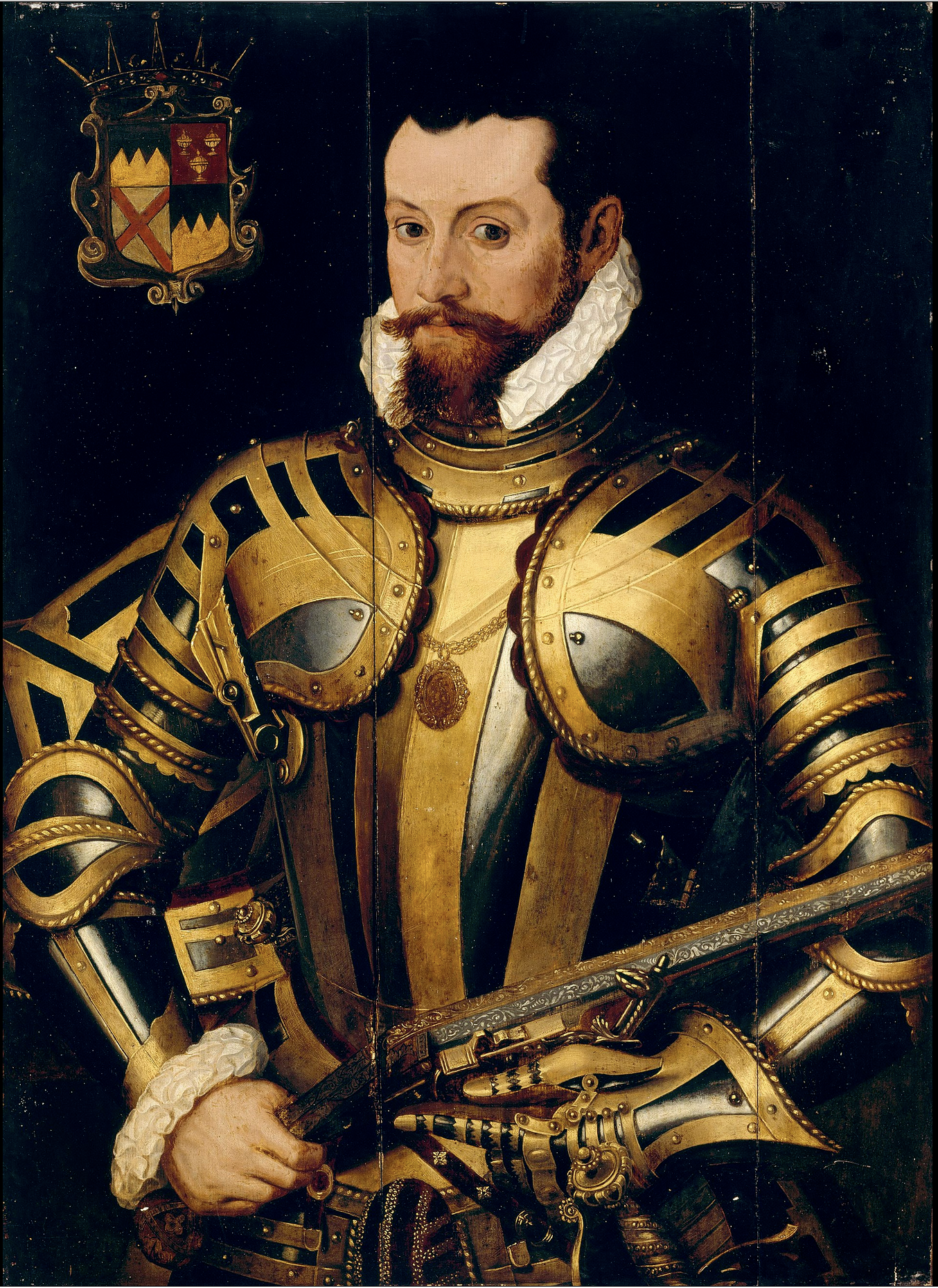
Portrait of Thomas Butler, 10th Earl of Ormond (1531-1614) in three-quarter armour holding a wheelock pistol, with his coat of arms at upper left, by Steven van der Meulen.

The 9th Earl also had a son Edmond (d. 1602) who lived in Cloughgrenan, County Carlow, who gave rise to the Baronets of Cloughgrenan.

The 10th Earl of Ormond, “Black Tom,” had no direct heir so the Earldom passed to his nephew, Walter, a son of Sir John Butler (d. 1570) of Kilcash. Unlike his uncle, who had been raised at Court and thus reared a Protestant, Walter the 11th Earl of Ormond was a Catholic. See my entry about the Ormond Castle at Carrick-on-Suir for more on “Black Tom.” https://irishhistorichouses.com/2022/06/26/opw-sites-in-munster-clare-limerick-and-tipperary/

Walter Butler’s claim to the family estates was blocked by James I. The latter orchestrated the marriage of Black Tom’s daughter and heiress Elizabeth to a Scottish favourite Richard Preston, Baron Dingwall. The King gave Preston the title Earl of Desmond (after the Fitzgeralds lost the title, due to their Desmond Rebellion), and awarded his wife most of the Ormond estate, thus depriving Walter of his inheritance. Walter refused to submit and was imprisoned for eight years in the Fleet, London. He was released 1625. Walter’s nine-year-old grandson, James, became the heir to the titles but not the estates.

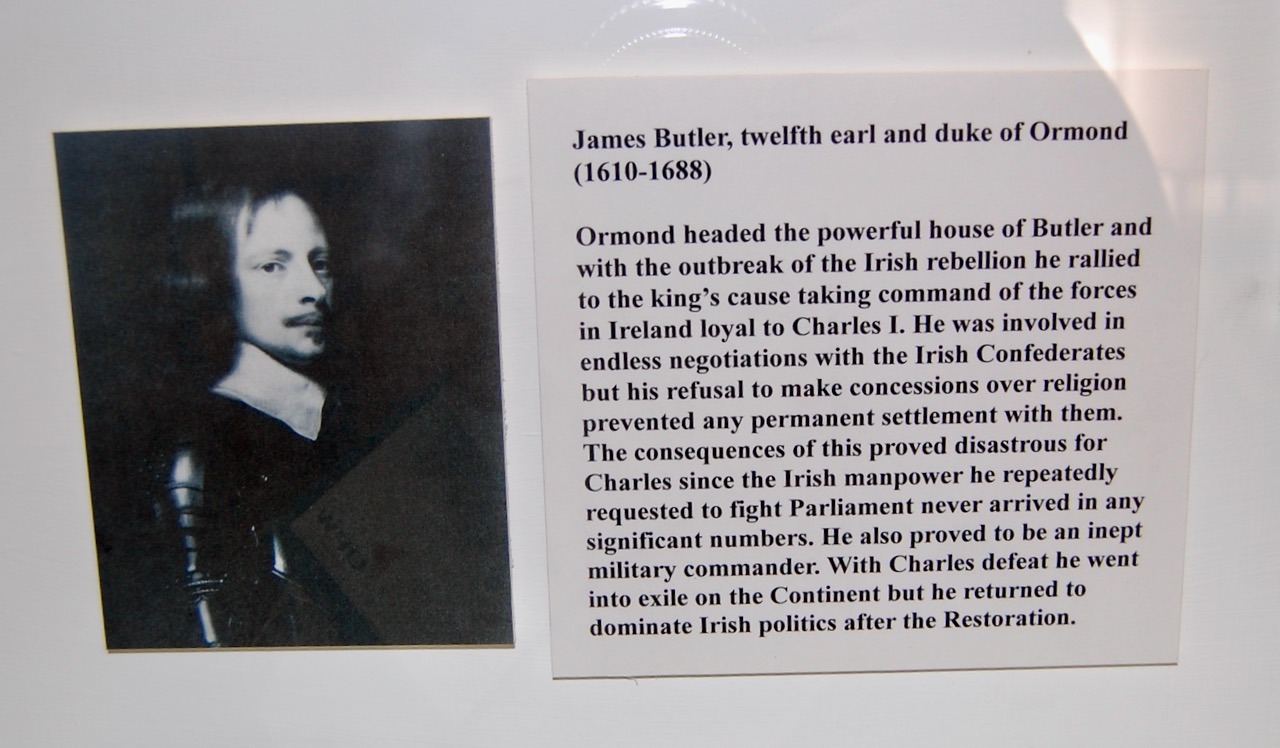
James (1610-1688) 12th Earl of Ormond (later 1st Duke of Ormond) was the son of Thomas Butler (d. 1619) Viscount Thurles, and Elizabeth Poyntz. Following his father’s death in 1619, 9-year-old James became direct heir to the Ormond titles. He was made a royal ward and was educated at Lambeth Palace under the tutelage of George Abbot, Archbishop of Canterbury.

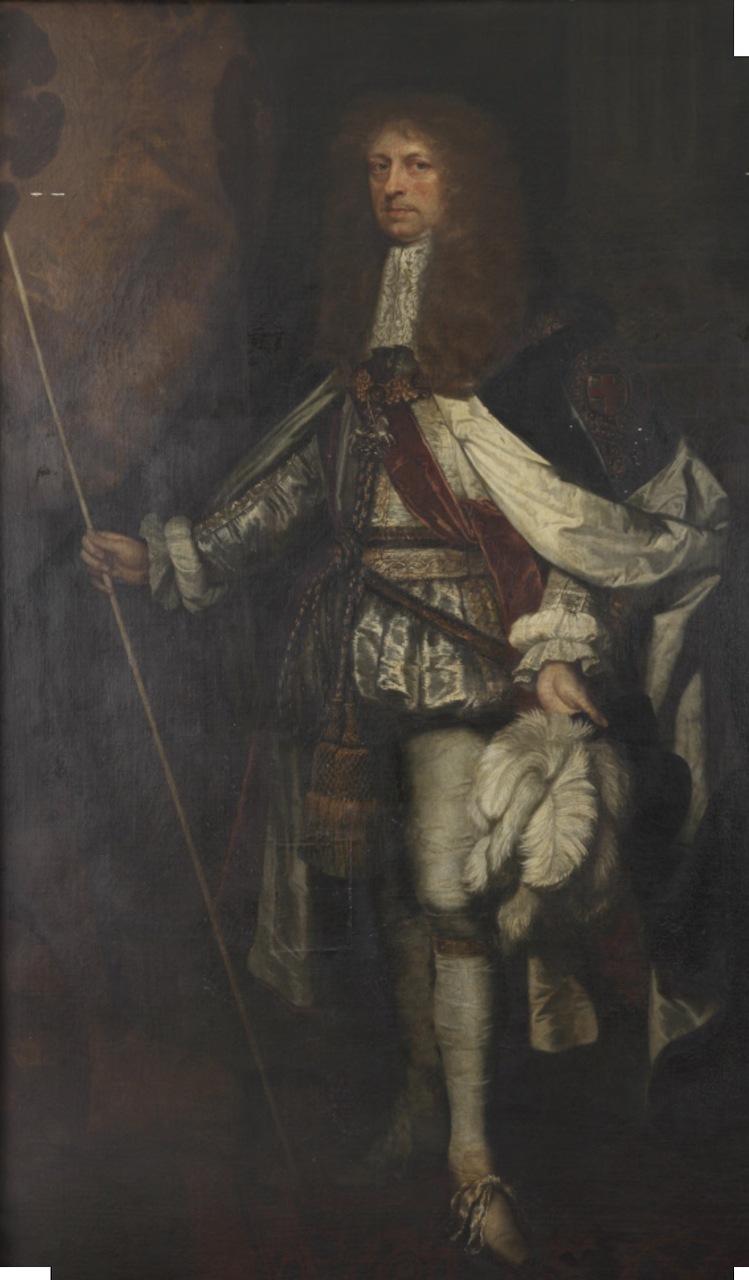
James Butler (1610-1688), 1st Duke of Ormond, Viceroy from 1643, on and off until he died in 1688, Dublin Castle, painting by Sir Peter Lely, circa 1665. Photograph © Jennifer Winder-Baggot, www.irishhistorichouses.com
James Butler, 1st Duke of Ormonde (1610–1688) after John Michael Wright courtesy of National Trust images.

Another son of Thomas Butler (d. 1619) Viscount Thurles, and Elizabeth Poyntz was Richard Butler (d. 1701) of Kilcash, County Tipperary.

In order to reunite the Ormond title with the estates, plans were made for a marriage between James and the daughter of the Prestons, Elizabeth, to resolve the inheritance issue. In 1629 James married his cousin Elizabeth Preston and reunited the Ormond estates.
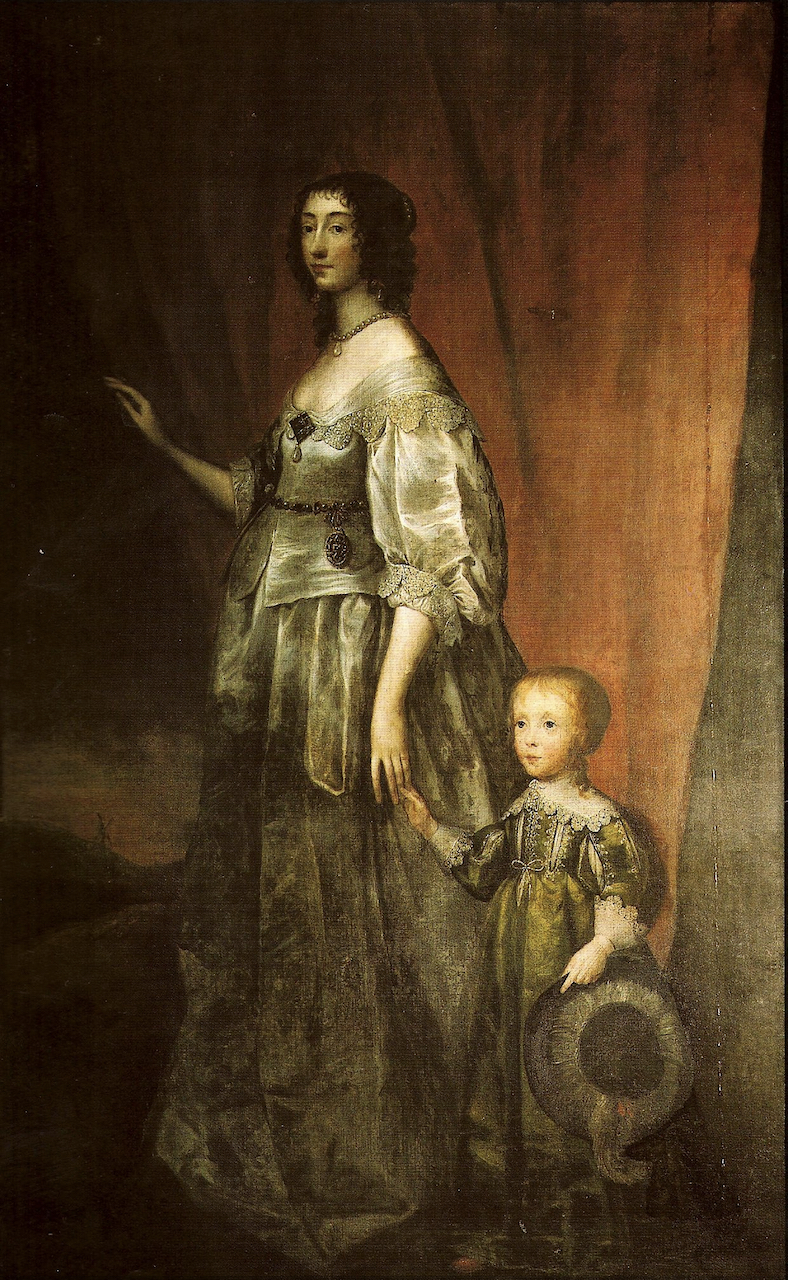
Elizabeth Butler née Preston (1615-1684) Baroness Dingwall, Countess of Ormond later Duchess, with her son Thomas, Lord Ossory (1634-1680) attributed to David des Granges. She was the daughter of Black Tom’s daughter and heiress Elizabeth and Richard Preston, Baron Dingwall.
James Butler of Kilkenny Castle, courtesy of Fonsie Mealy auction. It was in a Florentine style gilt frame and is by the 18th century English school.
James Butler (1610-1688) 1st Duke of Ormonde by Willem Wissing circa 1680-1685, courtesy of National Portrait Gallery NPG 5559.
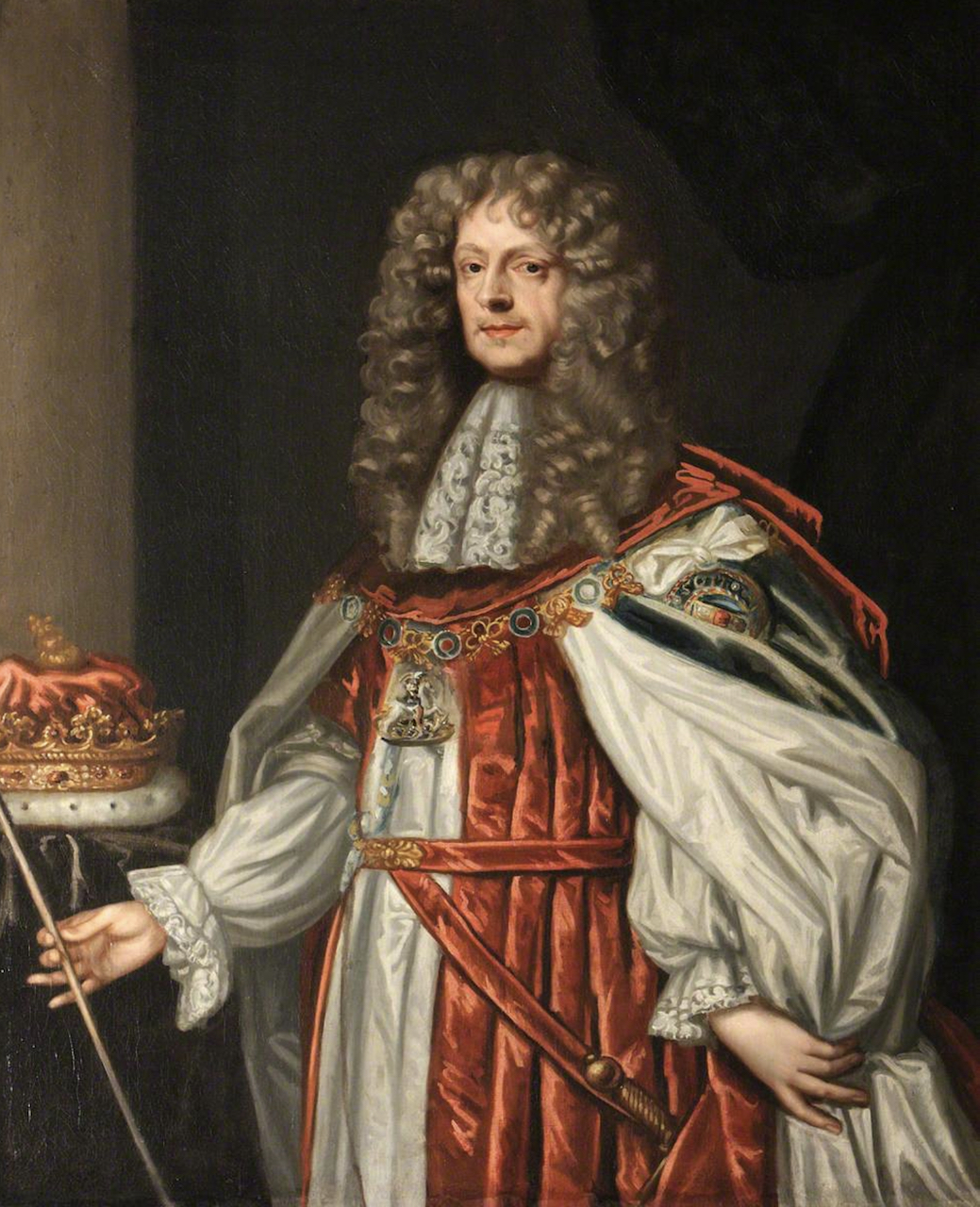
James Butler (1611–1688), 1st Duke of Ormonde, in Garter Robes, Peter Lely (1618-1680) (style of), 1171123 National Trust.

The 1st Duke of Ormond had three sons: Thomas (1634-1680), 6th Earl of Ossory; Richard (1639-1686), 1st and last Earl of Arran; and John (1634-1677), 1st and last Earl of Gowran. He had two daughters, Elizabeth (1640-1665) and Mary (1646-1710). Mary married William Cavendish, 1st Duke of Devonshire and Elizabeth, the 2nd Earl of Chesterfield.
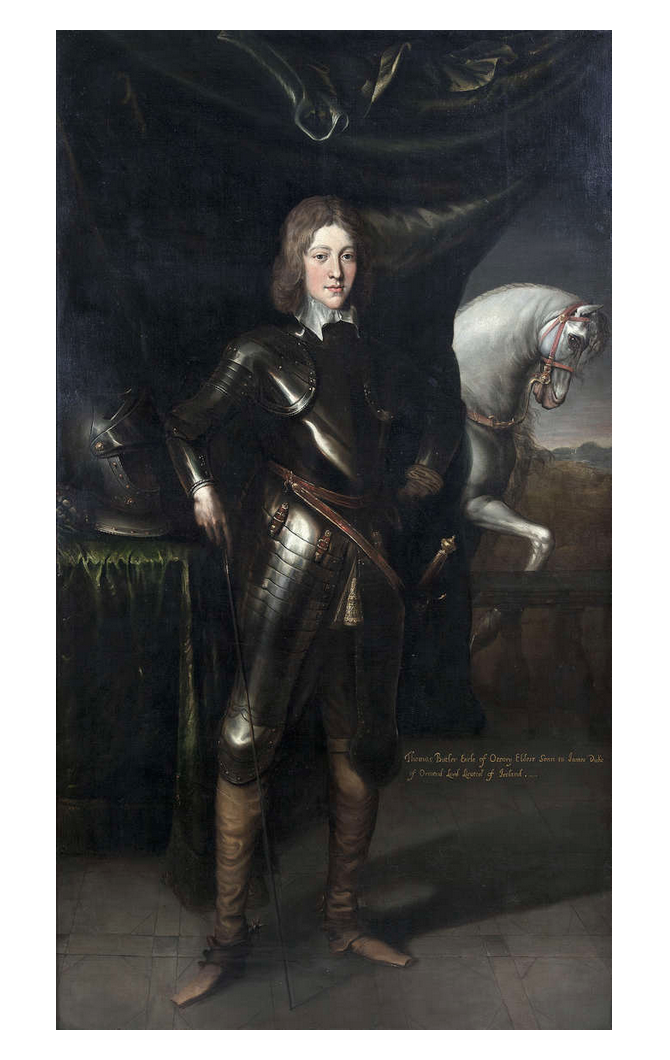
Thomas Butler (1634-1680) 6th Earl of Ossory, Eldest son of James, Duke of Ormond, in armour standing near his charge, attributed to Van Dyck, courtesy of Adam’s auction 11 Oct 2016. Provenance: Formerly in the collection of the Earl of Fitzwilliam, 1948.

Thomas Butler, 6th Earl of Ossory, (1634-1680) was born at Kilkenny Castle, the eldest son of James Butler, 1st Duke of Ormonde and Lady Elizabeth Preston.
His early years were spent in Ireland and France. He was an accomplished athlete and a good scholar. In 1661 Butler became a member of both the English and Irish houses of Commons, representing Bristol in the former and Dublin University in the latter House. In 1665 he was appointed lieutenant-general of the army in Ireland and in 1666 was created an English peer as Lord Butler.

Having proven himself as an expert military strategist, and whilst visiting France in 1672, he rejected the liberal offers made by Louis XIV to induce him to enter the service of France, and returning to England he added to his high reputation by his conduct during the Battle of Texel in August 1673. From 1677 until 1679, he served alongside his father as a Lord of the Admiralty.

The earl was chosen to William, Prince of Orange, and in 1677 he joined the allied army in the Netherlands, commanding the British section and winning great fame at the siege of Mons in 1678. He acted as deputy for his father, who was lord-lieutenant of Ireland, and in parliament he defended Ormonde’s Irish administration with great vigour. In 1680 he was appointed governor of English Tangier, but his death prevented him from taking up his new duties.

Ossory had eleven children, including James Butler who became the 2nd Duke of Ormonde in 1688. A Portrait of Thomas Butler by Lely, painted in 1678 is in the National Portrait Gallery, London and a portrait by the same hand as his father, the 1st Duke is in the ownership of the National Trust at Kedleston Hall.
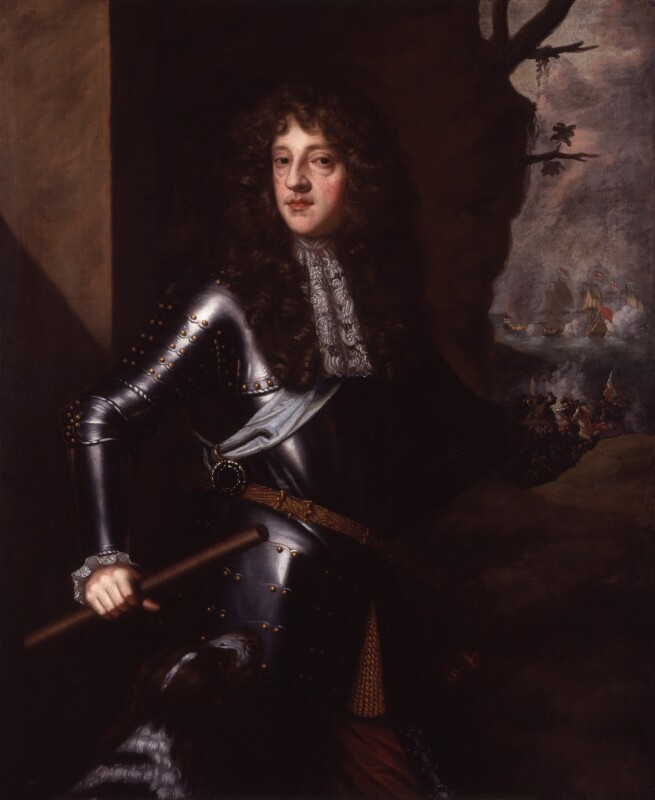
Thomas Butler (1634-1680) 6th Earl of Ossory, studio of Sir Peter Lely, circa 1678, courtesy of National Portrait Gallery NPG 371. Second son of the Duke and Duchess of Ormond and father of 2nd Duke of Ormonde.
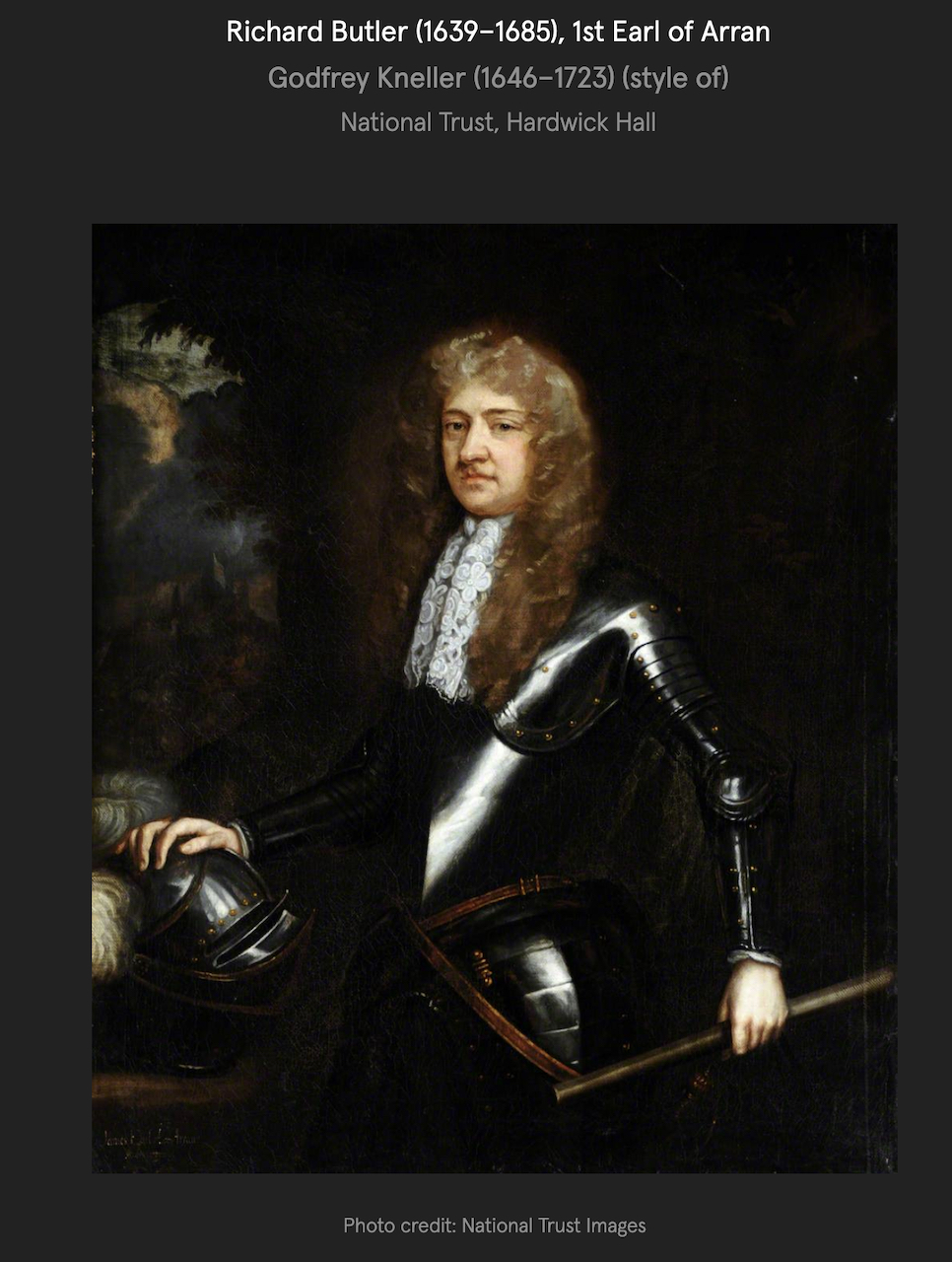
Richard Butler (1639-1685) 1st Earl of Arran, son of the Duke of Ormonde, by Godfrey Kneller, courtesy of National Trust Hardwick Hall.
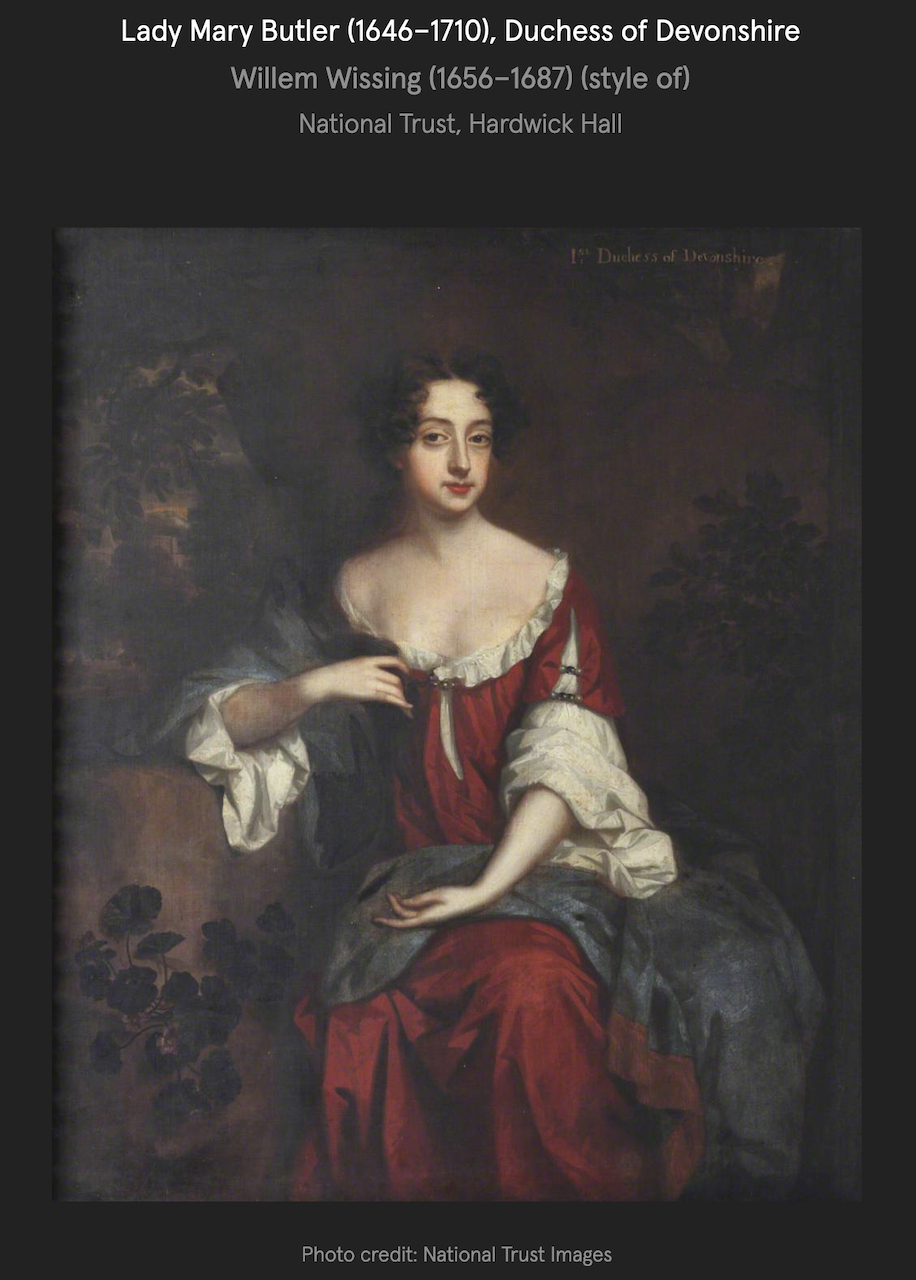
Mary Cavendish née Butler (1646-1710) Duchess of Devonshire in the style of Willem Wissing courtesy of National Trust Hardwick Hall. She was the daughter of James, 1st Duke of Ormond.
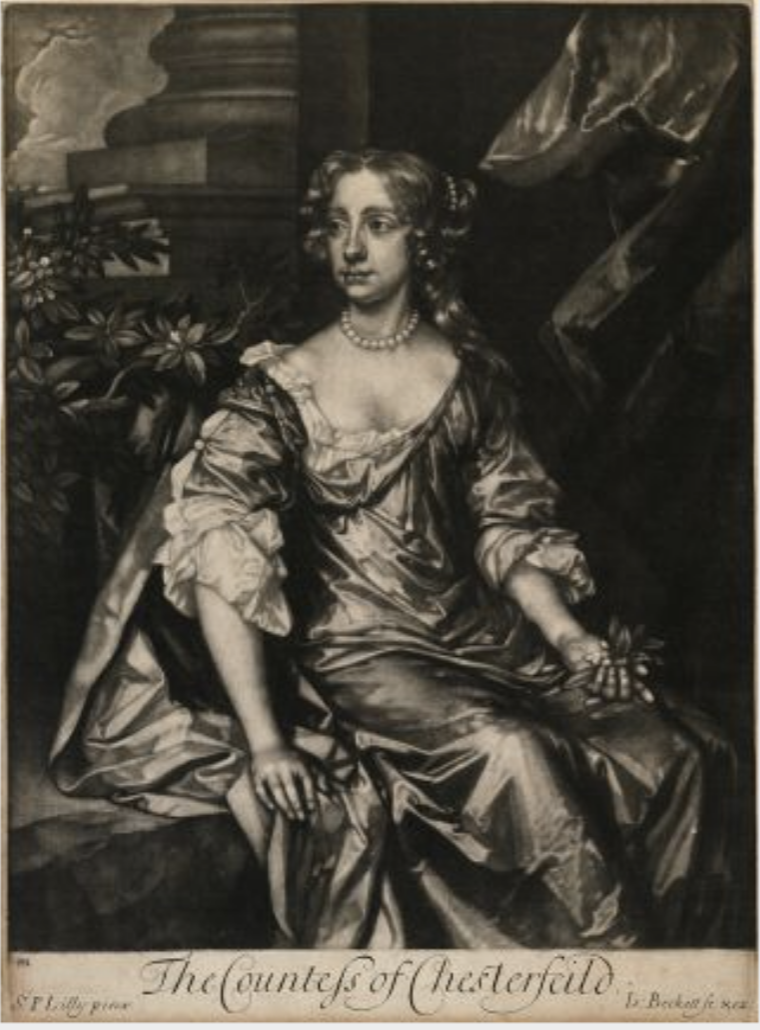
Elizabeth Stanhope née Butler (1640-1665), daughter of the 1st Duke of Ormonde and 2nd wife of Philip Stanhope 2nd Earl of Chesterfield Date: 1681/1688 Engraver: Isaac Beckett, English, c.1653-c.1715/19 After Peter Lely, Dutch, 1618-1680, courtesy of National Gallery of Ireland.
Elizabeth Stanhope née Butler Countess of Chesterfield By Peter Lely – http//:www.thepeerage.com/p951.htm#i9503, Public Domain, https//:commons.wikimedia.org

Thomas Butler (1634-1680) 6th Earl of Ossory and his wife Amelia of Nassau were the parents of James Butler (1665-1745) 2nd Duke of Ormonde. Another son was Lt.-Gen. Charles Butler, 1st Earl of Arran (1671-1758).

James Butler (1665-1745) 2nd Duke of Ormond, studio of Michael Dahl, oil on canvas, circa 1713 courtesy of National Portrait Gallery NPG 78.
James Butler (1665-1745) 2nd Duke of Ormonde courtesy of National Maritime Museum, Greenwich, London.
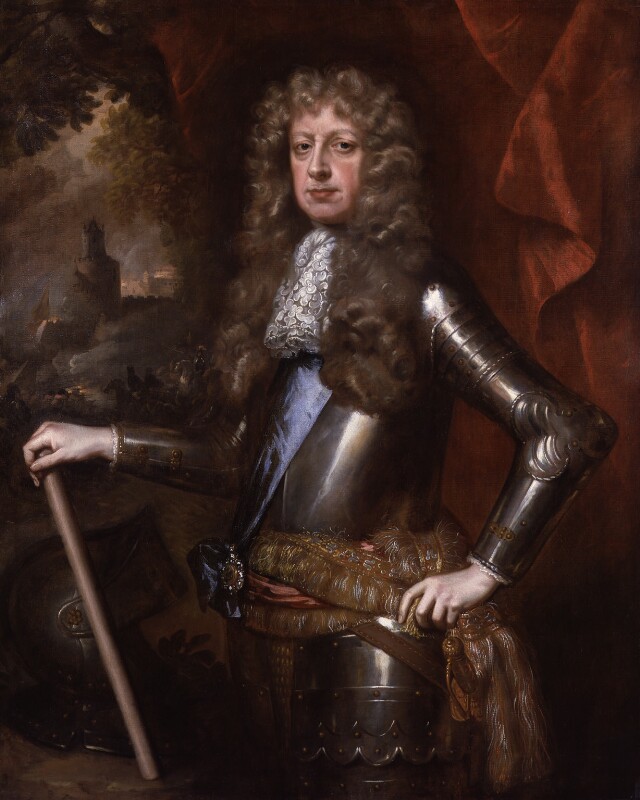
Oil painting on canvas, James Butler, 2nd Duke of Ormonde (1665-1745) by Sir Godfrey Kneller (Lubeck 1646/9 – London 1723). A three-quarter length portrait, turned slightly to the right, facing, gazing at spectator, wearing armour, blue sash and white jabot, a baton in his right hand, his left on his hip, his helmet placed at the left; cavalry in the distance, right. Photograph courtesy of National Trust Images.

James Butler (1665-1745) 2nd Duke of Ormond married, first, Anne Hyde, and second, Mary Somerset.

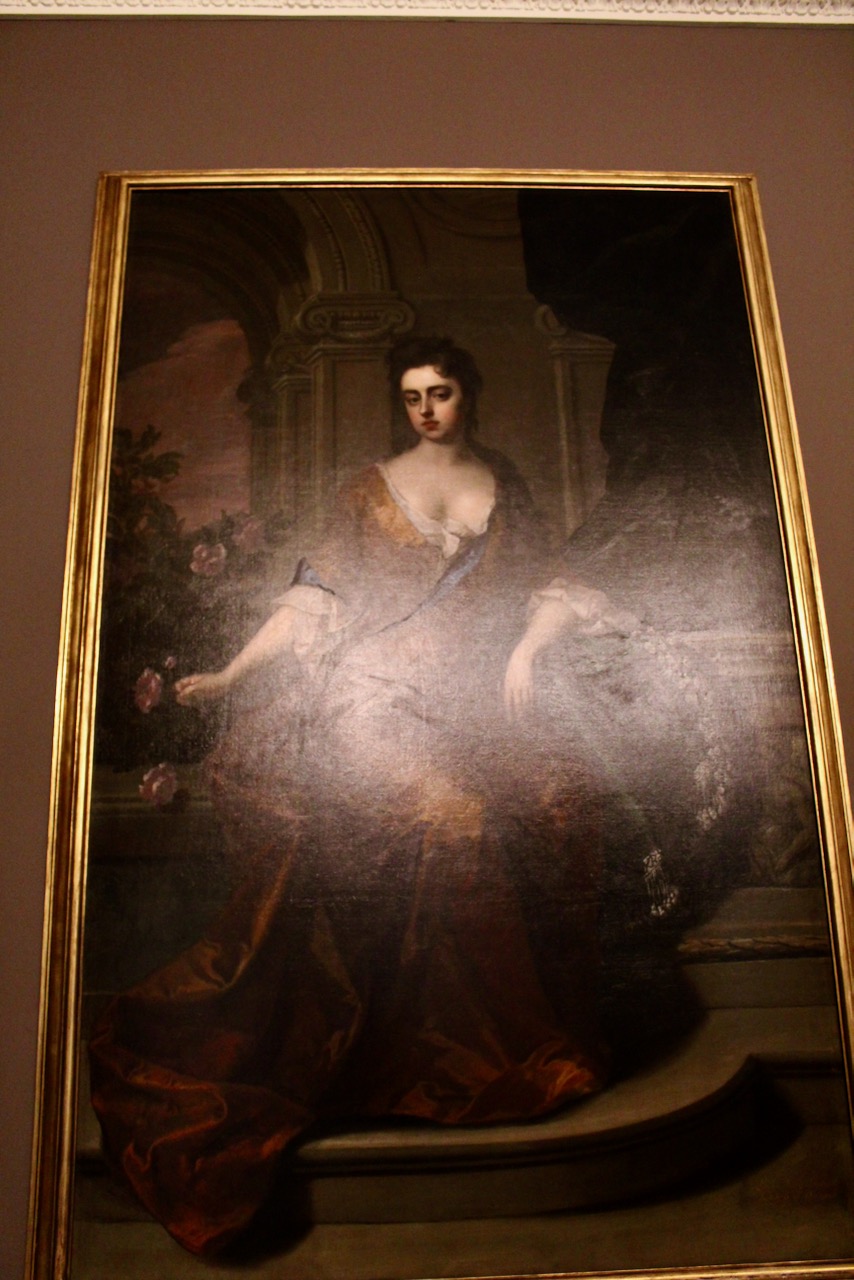
Anne Hyde (1669-1685), Countess of Ossory, first wife of James Butler 2nd Duke of Ormonde. Painting by William Wissing
Mary Somerset (1665-1733), Duchess of Ormond, wife of James Butler 2nd Duke of Ormond (1665-1745), painted by Michael Dahl. Photograph © Jennifer Winder-Baggot, www.irishhistorichouses.com

James the 2nd Duke had no son, so the title passed to his brother Charles Butler (1671-1758) 1st Earl of Arran. He was enabled by an Act of Parliament in 1721 to recover his brother’s forfeited estates, but the dukedom ended with him. He was, however, also the 14th Earl of Ormonde and this title continued. He had no children, however, so the title passed to a cousin.
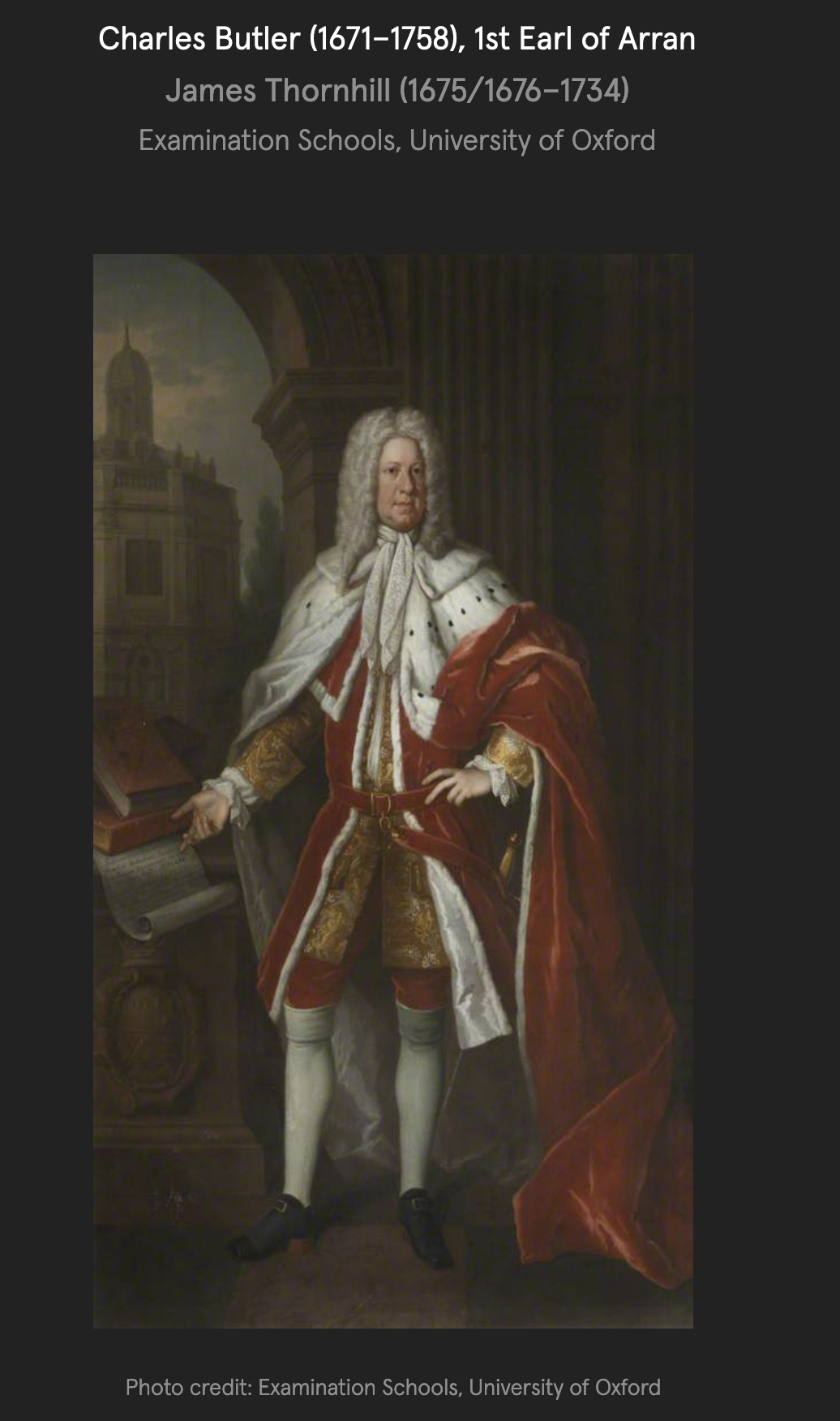
Charles Butler (1671-1758) 1st Earl of Arran by James Thornhill, courtesy of Examination Schools, University of Oxford.

John Butler (d. 1766) of Kilcash and Garryricken became 15th Earl of Ormonde. He was a descendant of Walter Butler the 11th Earl.

Colonel Thomas Butler of Kilcash (c. 1738) by James Latham, father of John Butler (d. 1766) of Kilcash and Garryricken who became 15th Earl of Ormonde.

Richard Butler (d. 1701) of Kilcash, County Tipperary was a younger brother of James the 1st Duke of Ormond. There is a castle ruin still in Kilcash, under the protection of the Office of Public Works but not open to the public. His son was Walter Butler of Garryricken (1633-1700). Walter had sons Christopher (the Catholic Archbishop) and Thomas (d. 1738).
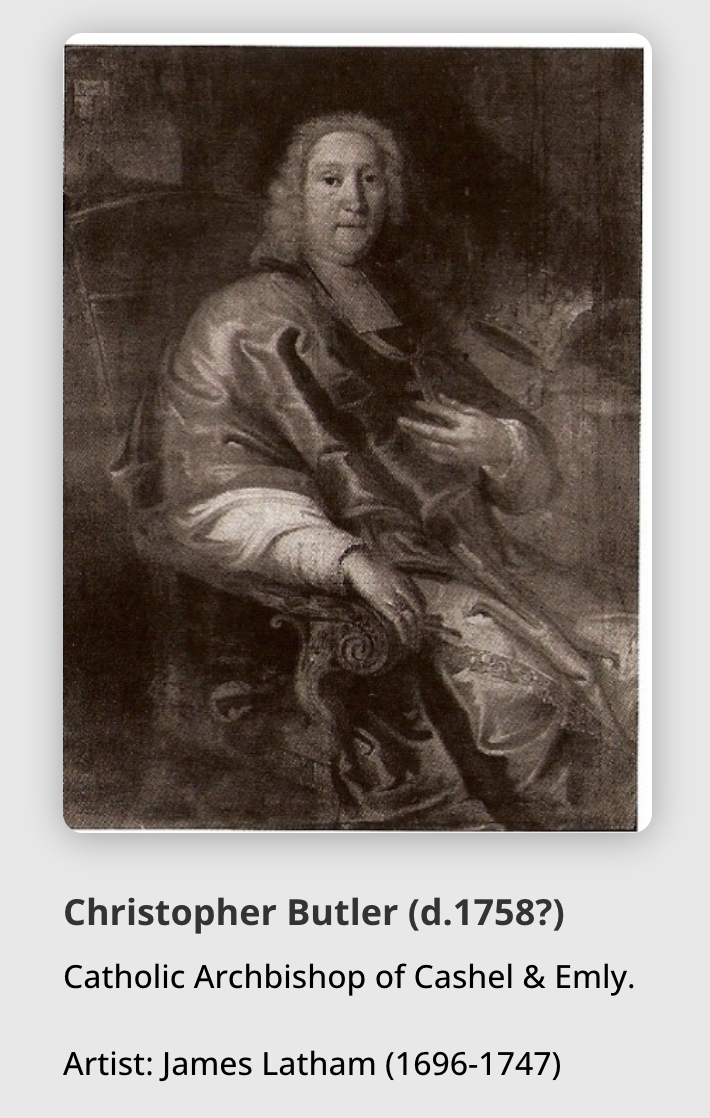
Christopher Butler (d. 1758?) Catholic Archbishop of Cashel and Emly, by James Latham. Christopher Butler was Catholic archbishop of Cashel and Emly, son of Walter Butler of Garryricken and brother of Colonel Thomas Butler of Kilcash.

The 15th Earl had no children so the title then passed to a cousin, Walter Butler (1703-1783), 16th Earl, another of the Garryricken branch, who also became the 9th Earl of Ossory. He took up residence at Kilkenny Castle. Walter, a Catholic, was unable to exercise a political role.

John Butler 17th Earl of Ormonde, nicknamed “Jack of the Castle,” was son of the 16th Earl. He in turn was father of Walter Butler (1770-1820) 18th Earl of Ormonde, 1st And Last Marquess of Ormonde (of the 2nd creation).

Susan Frances Elizabeth Wandesford (1754-1830) Duchess of Ormonde. She was the daughter of John Wandesford 1st and last Earl Wandesford and 5th Viscount Castlecomer, and wife of John Butler 17th Earl of Ormonde. Painting by Hugh Douglas Hamilton.
Walter Butler (1770-1820) became the 18th Earl and 1st Marquess of Ormonde.

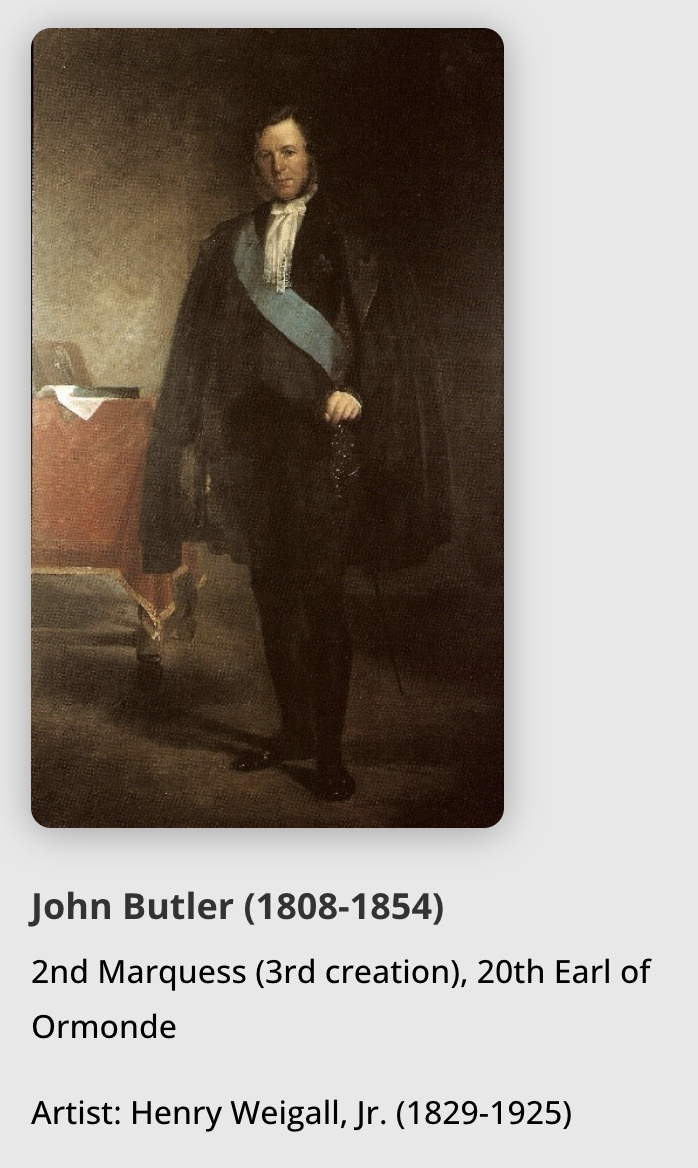
His younger brother James Wandesford Butler (1777-1838) was later created 1st Marquess of Ormonde of the third creation, 19th Earl of Ormonde. He was the father of John Butler (1808-1854) 2nd Marquess (3rd creation) and 20th Earl of Ormonde, who was the father of James Edward William Theobald Butler (1844-1919) 3rd Marquess of Ormonde and also James Arthur Wellington Foley Butler (d. 1943) 4th Marquess of Ormonde, who was father of 5th and 6th Marquesses.
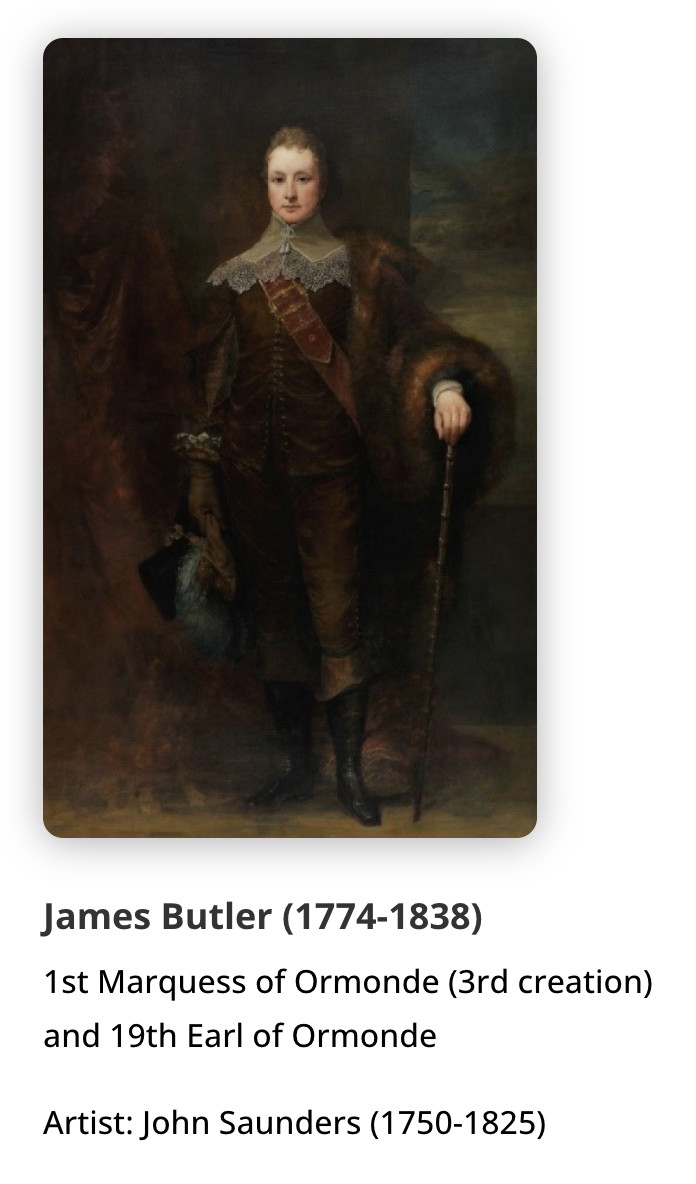
James Wandesford Butler (1777-1838) 1st Marquess of Ormonde
John Butler (1808-1854) 2nd Marquess (3rd creation) and 20th Earl of Ormonde, by Henry Weigall Jr.
Frances Jane Paget (1817-1903) Marchioness of Ormonde with her son James Earl of Ossory, by Richard Bruckner. She was the wife of the 2nd Marquess of Ormonde.
James Edward William Theobald Butler (1844-1919) 3rd Marquess of Ormonde by Walter Stoneman 1917, courtesy of National Portrait Gallery NPG x43817.
Edmund Butler 11th Viscount Mountgarret (1745-1793) in the style of Hugh Douglas Hamilton, Adams auction 19 Oct 2021.
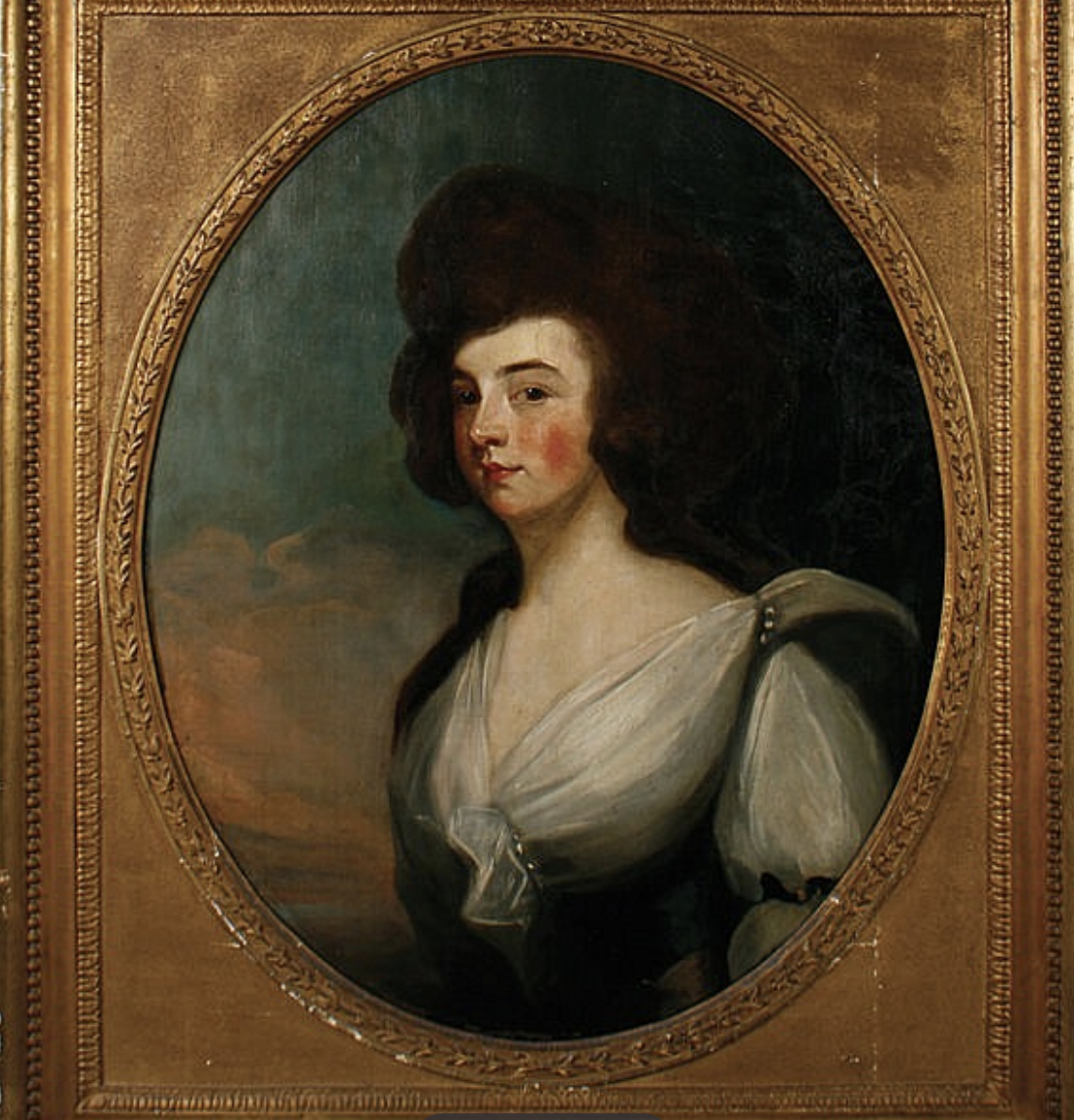
Henrietta Butler (1750-1785) Viscountess Mountgarret in the style of Hugh Douglas Hamilton, Adams auction 19 Oct 2021. She was the daughter of Somerset Hamilton Butler, 1st Earl of Carrick, 6th Viscount of Ikerrin and wife of Edmund Butler 11th Viscount Mountgarret (1745-1793).
Mildred Butler née Fowler (c. 1770-1830) Countess of Kilkenny, wife of Edmond 12th Viscount Mountgarret and 1st Earl of Kilkenny and daughter of Robert, Archbishop of Dublin (1724-1801) by Thomas Hickey, courtesy of Sheppards auction Nov 26 2013.
Elizabeth Butler (1674-1708), wife of Peter Aylward, daughter of Richard Butler, 2nd Baronet of Paulstown (or Poulstown), County Kilkenny. Photograph © Jennifer Winder-Baggot, www.irishhistorichouses.com
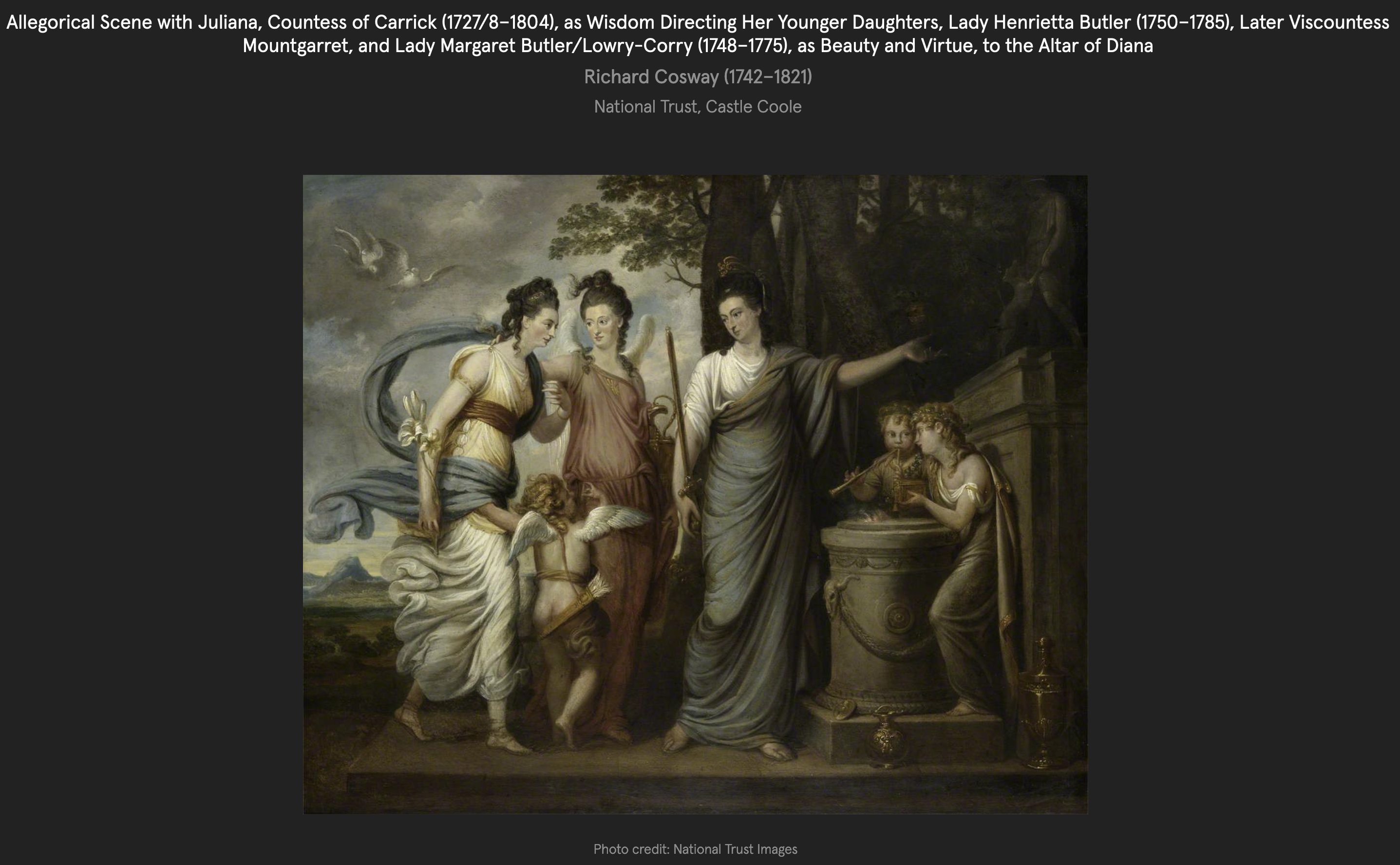
Juliana Butler (1727/8-1804) Countess of Carrick (wife of Somerset Hamilton Butler 1st Earl of Carrick) with her younger daughters Lady Henrietta Butler (1750-1785), later Viscountess Mountgarret, wife of 11th Viscount, and Lady Margaret Butler/Lowry-Corry (1748-1775), by Richard Cosway, courtesy of National Trust, Castle Coole, County Fermanagh.
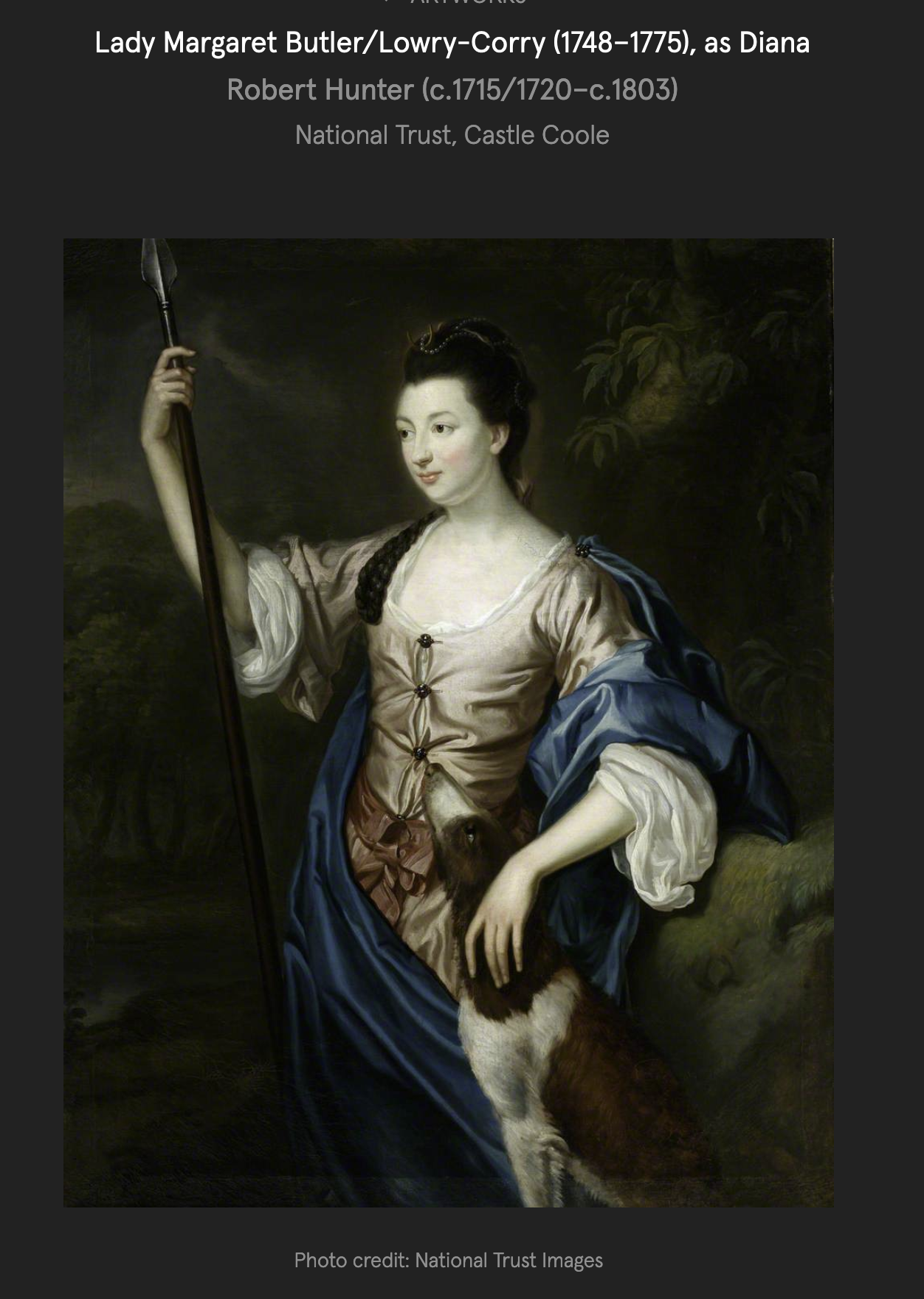
Margaret Lowry-Corry née Butler (1748-1775) by Robert Hunter, courtesy of National Trust, Castle Coole, County Fermanagh. She married Armar Lowry-Corry 1st Earl of Belmore. She was the daughter of Somerset Hamilton Butler, 8th Viscount Ikerrin, 1st Earl of Carrick, County Tipperary.
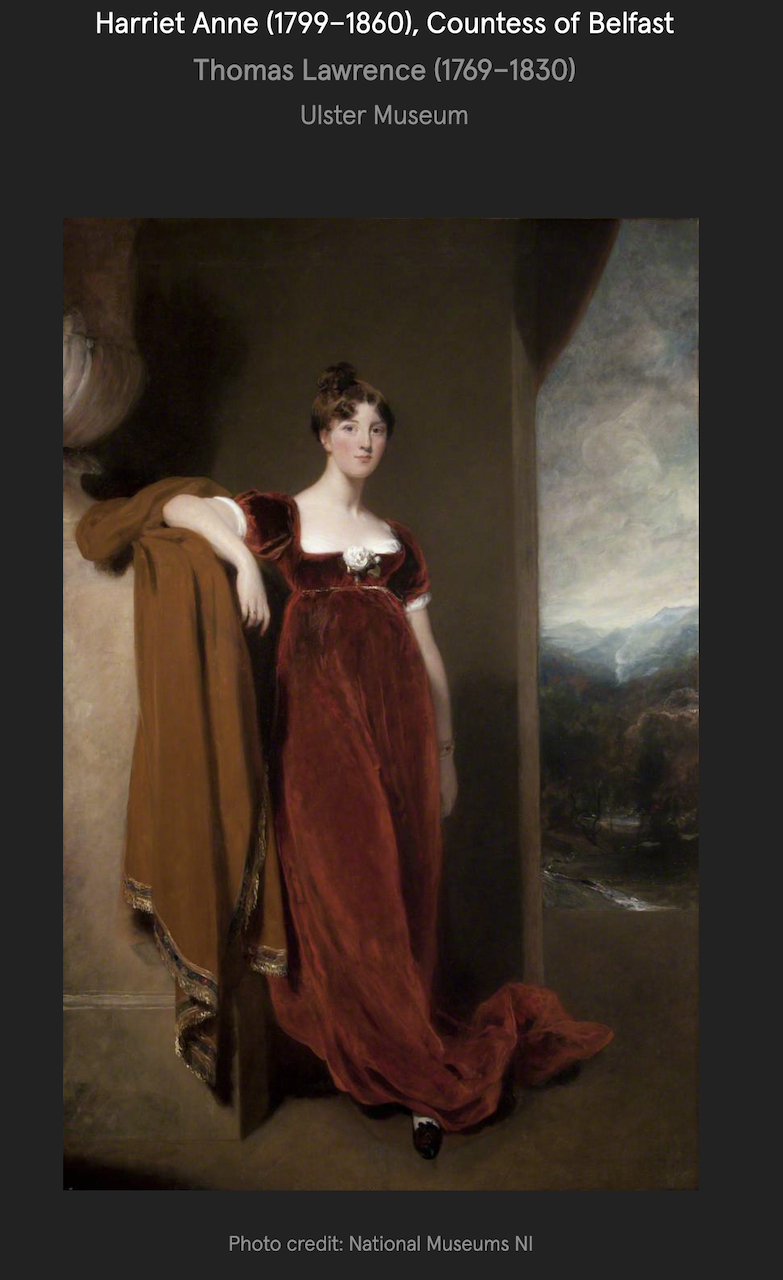
Harriet Anne née Butler (1799-1860) Countess of Belfast, wife of George Hamilton Chichester 3rd Marquess of Donegal and daughter of Richard Butler, 1st Earl of Glengall.
Richard Butler (1794-1858) 2nd Earl of Glengall, by Richard James Lane, lithograph, 1854, National Portrait Gallery of London D22384.
Margaret Lauretta Butler (née Mellish), Countess of Glengall by Richard James Lane courtesy of National Portrait Gallery London NPG D22383.
Elizabeth, Countess of Lanesborough (née La Touche), (1764-1788), wife of Robert Henry Butler 3rd Earl of Lanesborough. Date 1791 Engraver Francesco Bartolozzi, Italian, 1725-1815 After Horace Hone, English, 1756-1825, photograph courtesy of National Gallery of Ireland.

[1] https://en.wikipedia.org/wiki/Earl_of_Barrymore

Places to visit and stay in County Kilkenny

On the map above:

blue: places to visit that are not section 482

purple: section 482 properties

red: accommodation

yellow: less expensive accommodation for two

orange: “whole house rental” i.e. those properties that are only for large group accommodations or weddings, e.g. 10 or more people.

green: gardens to visit

grey: ruins

donation

Help me to pay the entrance fee to one of the houses on this website. This site is created purely out of love for the subject and I receive no payment so any donation is appreciated!

€15.00

Places to visit in County Kilkenny:

1. Aylwardstown, Glenmore, Co Kilkenny – section 482 

2.  Kilfane Glen & Waterfall Garden, Thomastown, County Kilkenny – 482 – garden only

3. Kilkenny Castle, Kilkenny – OPW

4. Kilrush House, County Kilkenny, ihh member, by appt. 

5. Rothe House, Kilkenny, County Kilkenny – open to the public  

6. Shankill Castle, Paulstown, Co. Kilkenny – section 482 

7. Tybroughney Castle, Piltown, Co Kilkenny – section 482 

8. Woodstock Gardens and Arboretum, Woodstock, Inistioge, Kilkenny

Places to stay, County Kilkenny

1. Ballyduff, Thomastown, Co Kilkenny – wedding venue, B&B 

2. Blanchville Coachyard, Dunbell, County Kilkenny – courtyard accommodation

3. Butler House, Kilkenny, co Kilkenny – accommodation 

4. Clomantagh Castle, Co Kilkenny – tower house accommodation

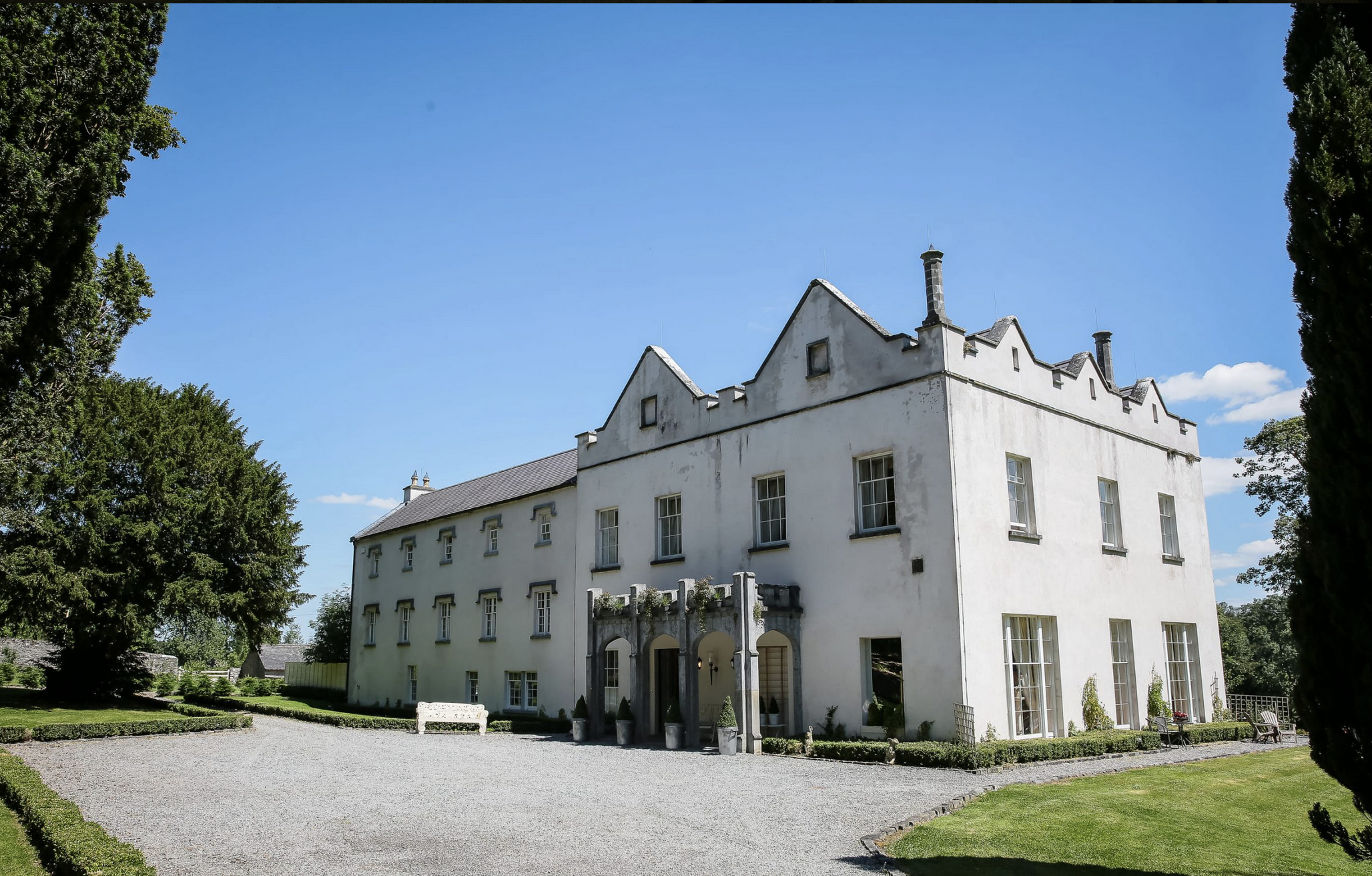
6. Lyrath House, near Kilkenny, County Kilkenny – hotel 

7.  Mount Juliet, Thomastown, County Kilkenny – hotel 

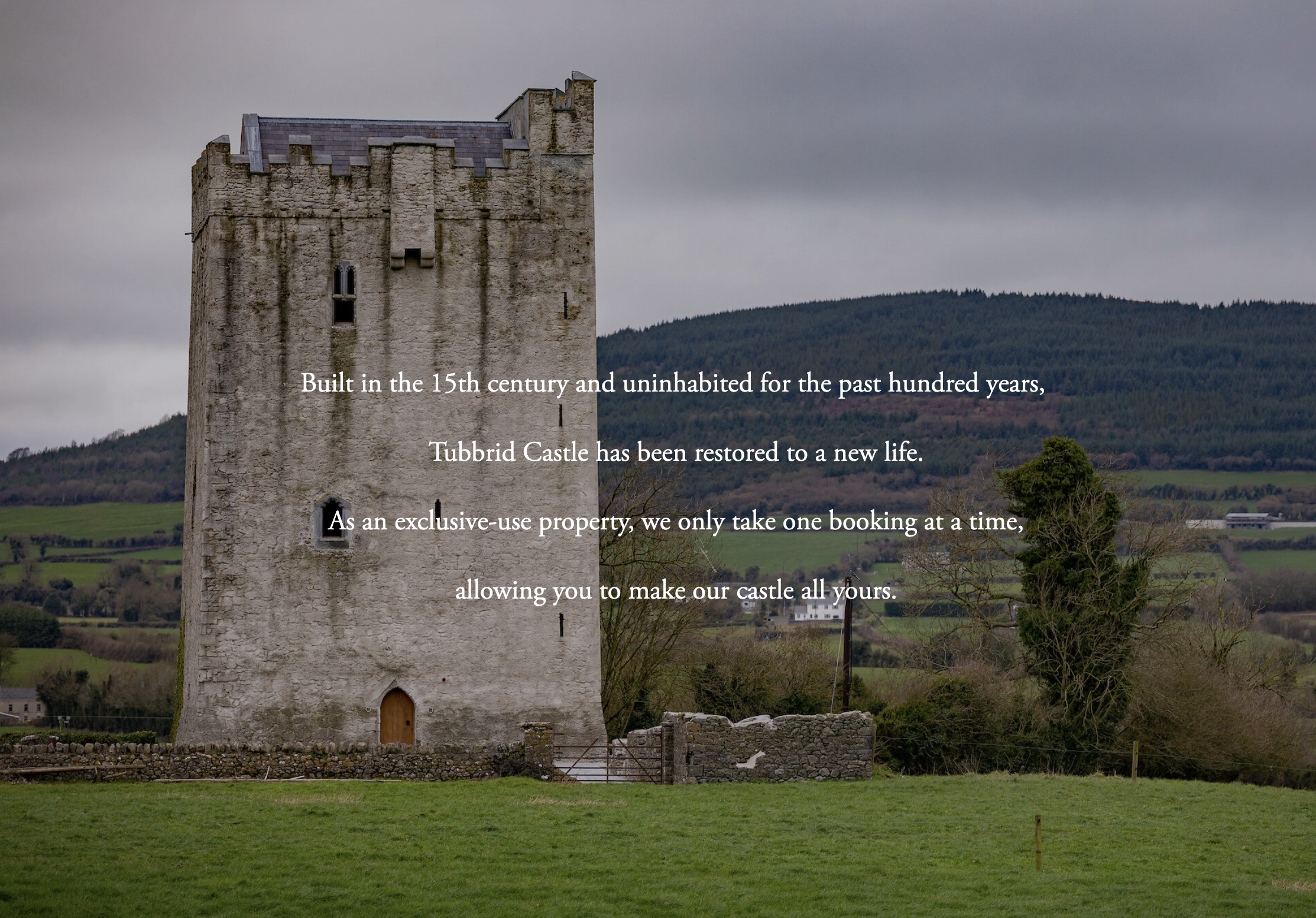
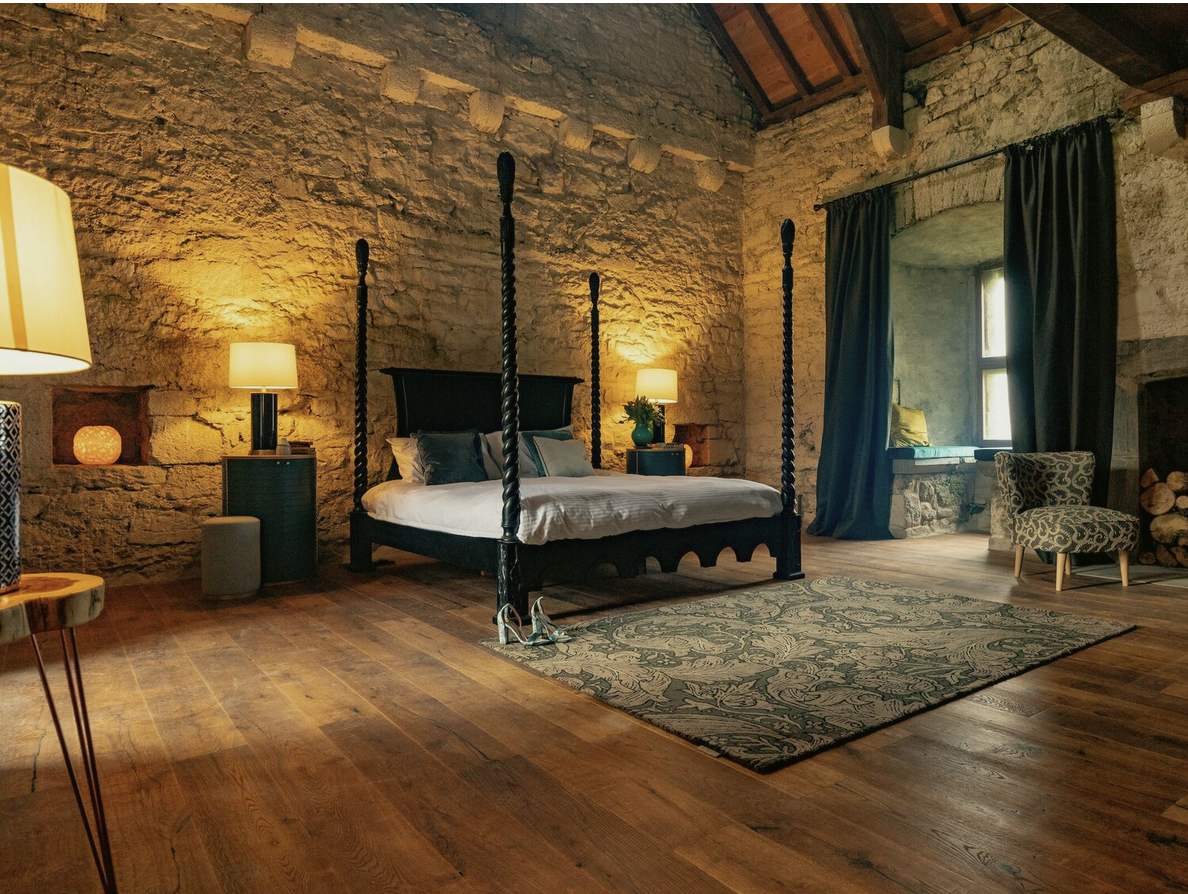
8. Tubbrid Castle, County Kilkenny – tower house accommodation

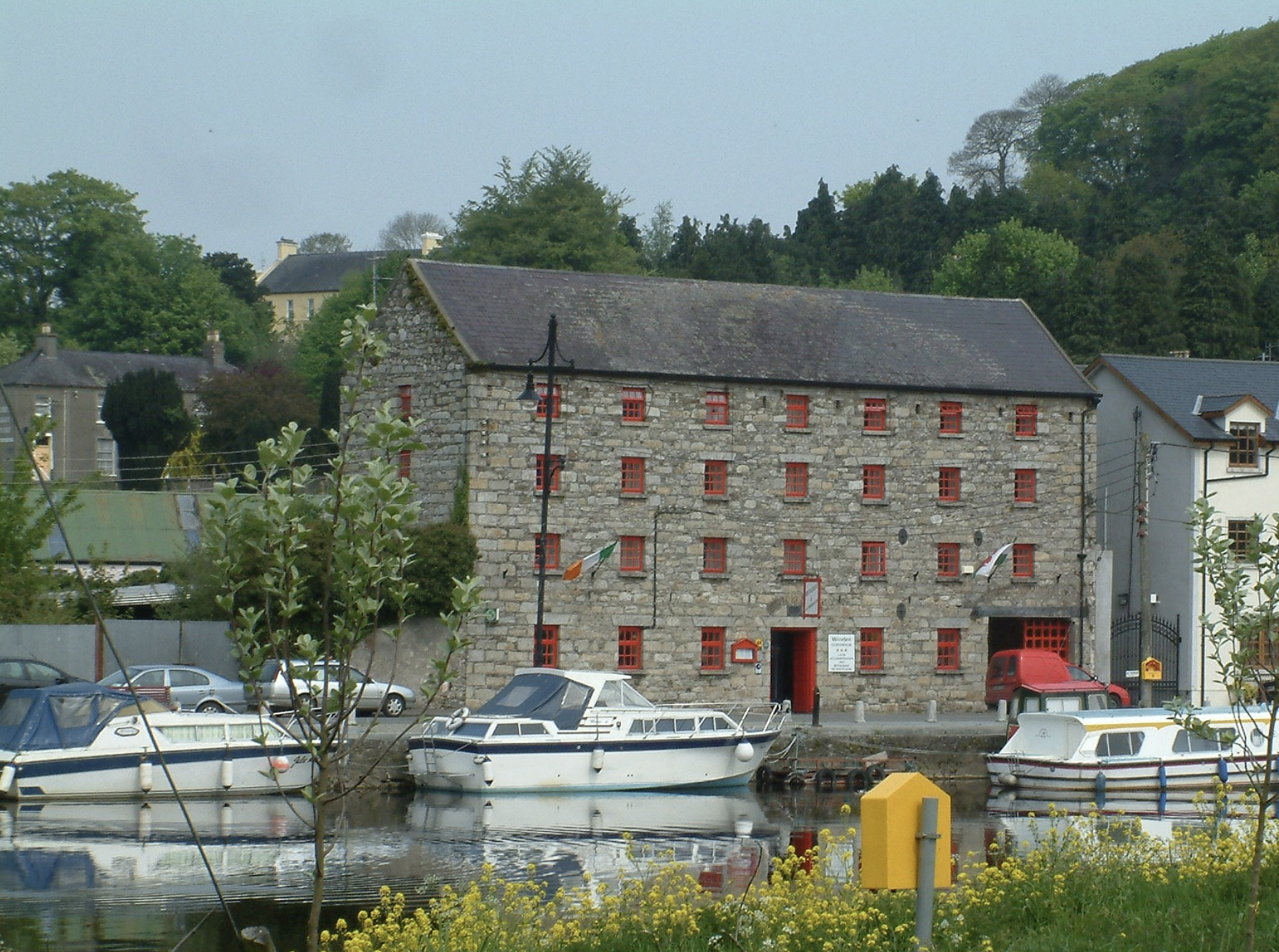
9. Waterside Guest House, Graiguenamanagh, County Kilkenny

Whole House Rental County Kilkenny:

1. Annamult House, Bennettsbridge, Co Kilkenny – whole house accommodation

2. Ballybur Castle, County Kilkenny – castle accommodation

3. Castle Blunden, County Kilkenny – whole house accommodation

Places to visit in County Kilkenny:

1. Aylwardstown, Glenmore, Co Kilkenny – section 482 

Open dates in 2026: Aug 1-31, Sept 1-30, 10am-5pm

Fee: adult €5, OAP/student €3, child free

2.  Kilfane Glen & Waterfall Garden, Thomastown, County Kilkenny R95 RXO5 – 482 – garden only

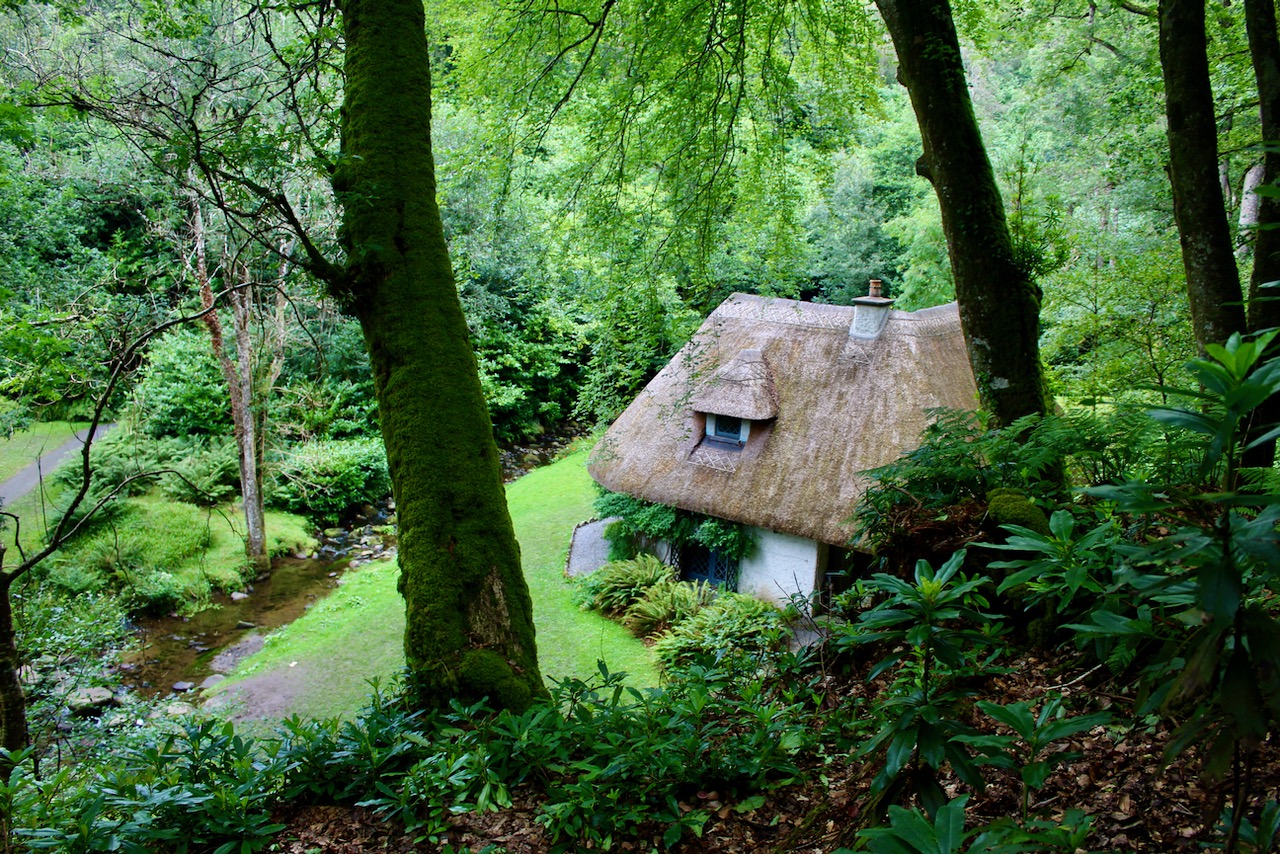
Kilfane, County Kilkenny, August 2021. Photograph © Jennifer Winder-Baggot, www.irishhistorichouses.com

See my entry:

https://irishhistorichouses.com/2021/12/16/kilfane-glen-waterfall-kilfane-thomastown-co-kilkenny/

www.kilfane.com

Open dates in 2026: July 1-31, Aug 1-31, 11am-6pm
Fee: adult €9, OAP/student €7, child €6

3. Kilkenny Castle, Kilkenny – OPW

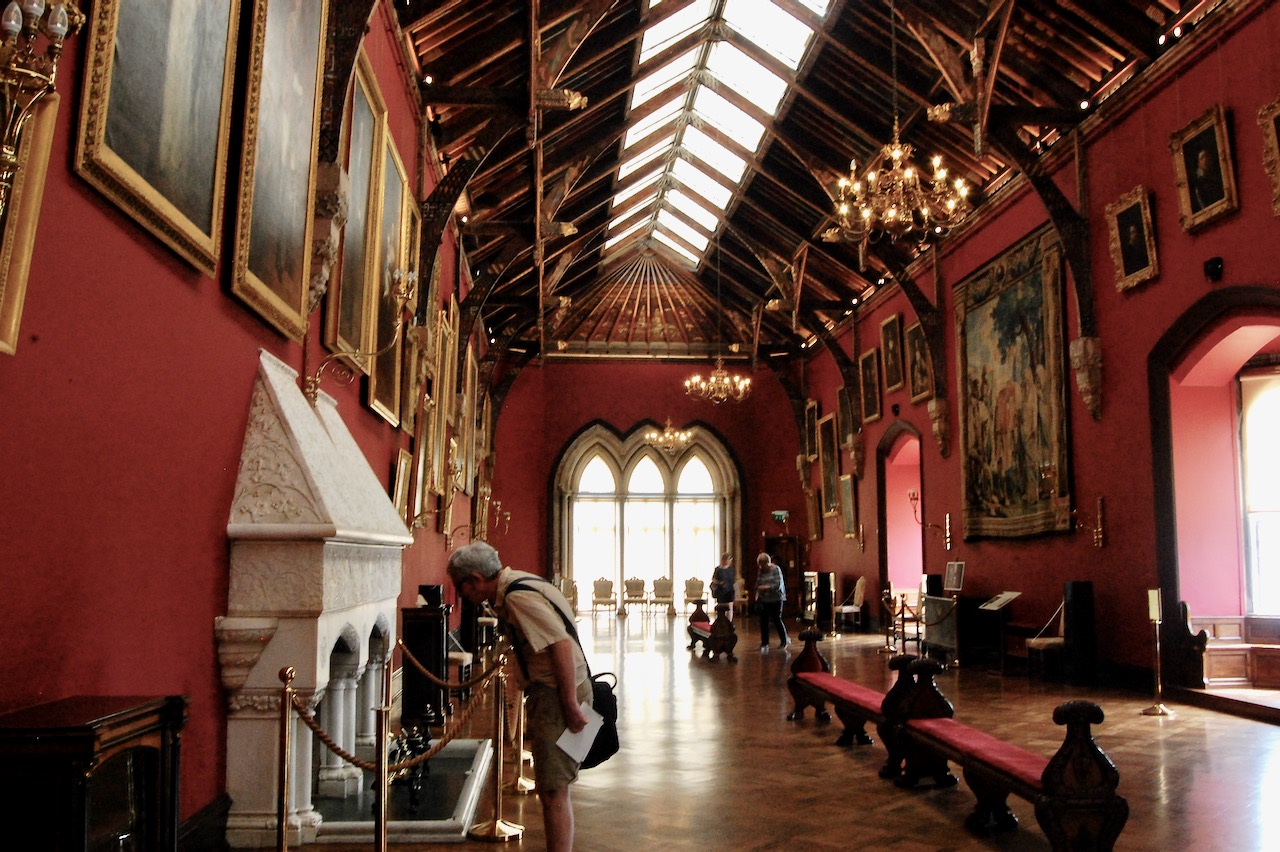
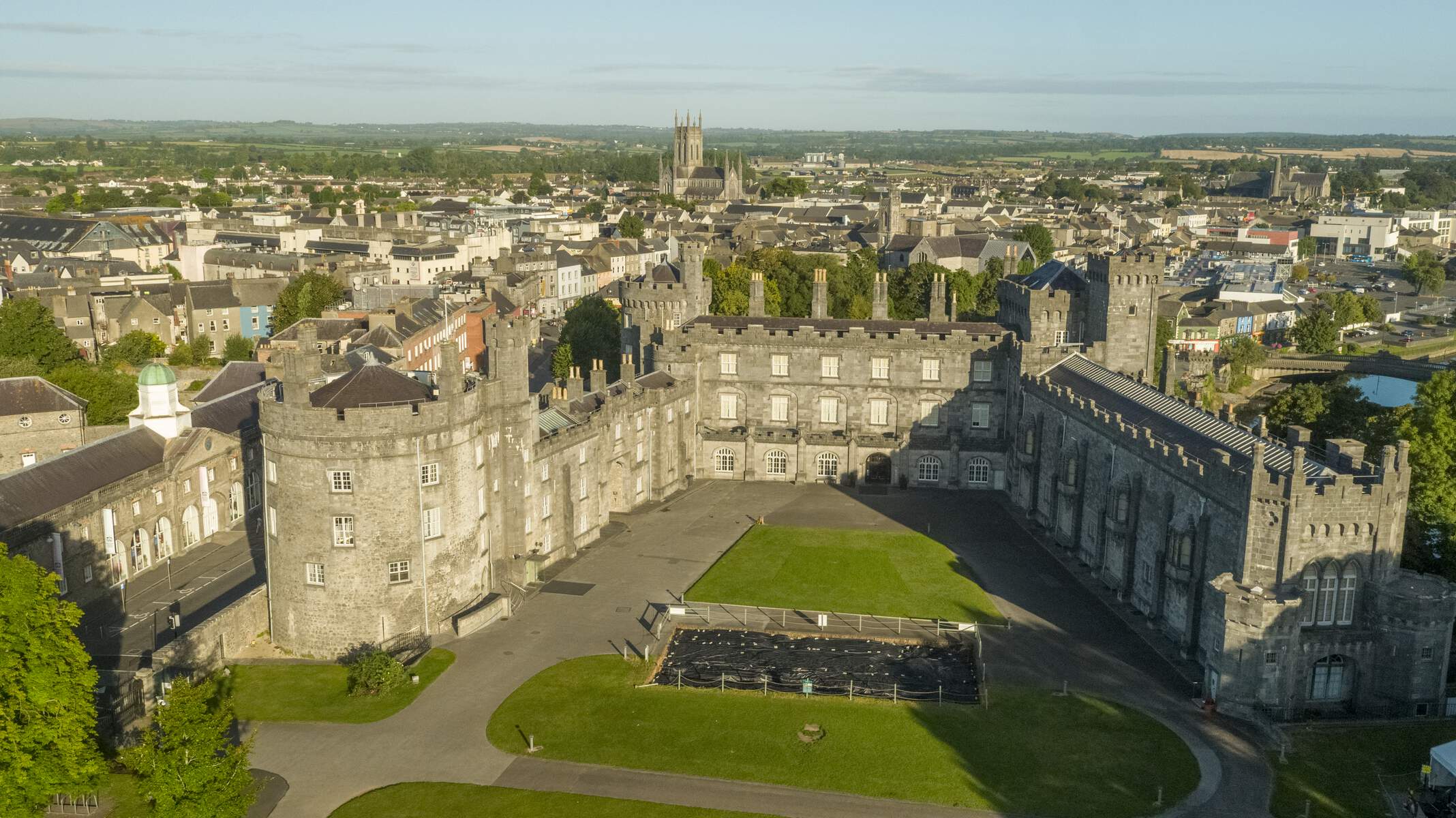
Kilkenny Castle, May 2018. Photograph © Jennifer Winder-Baggot, www.irishhistorichouses.com
Kilkenny Castle, Kilkenny City by Sonder Visuals for Failte Ireland 2014.

see my entry https://irishhistorichouses.com/2024/04/08/kilkenny-castle-county-kilkenny-an-office-of-public-works-property/

4. Kilrush House, County Kilkenny, ihh member, by appt. 

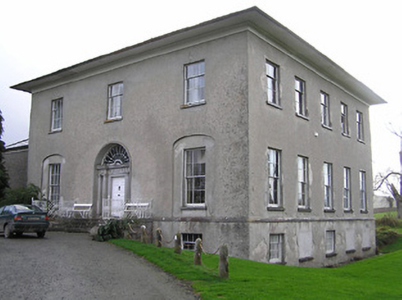
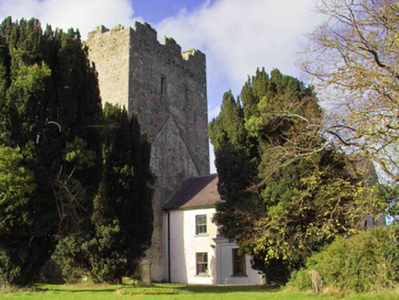
Kilrush House, photograph courtesy of National Inventory of Architectural Heritage
Kilrush House, photograph courtesy of National Inventory of Architectural Heritage.

The Historic Houses of Ireland website tells us:

William Robertson (1777 – 1850) was a native of Kilkenny where the patronage of Lord Ormonde stood him in good stead, since most of his work can be found in Kilkenny and the neighbouring counties of Laois, Tipperary and Waterford. When Richard St. George wished to move from his medieval castle at Kilrush near Freshford in 1820, Robertson was the obvious choice. His work is less exuberant than that of his namesake Daniel but he was a talented architect and produced an interesting early nineteenth century reinterpretation of the typical late-Georgian country house. 

The St Georges are a Norman family who ‘came over to England with the Conqueror’ and arrived in Ireland in the sixteenth century. They quickly became established here, with several branches in County Kilkenny and others in Galway, Leitrim and Roscommon.

The St Georges of Kilrush were active in political and cultural circles in the seventeenth and eighteenth centuries. Richard St George was an M.P. in the Irish Parliament, with a town house at No. 8 Henrietta Street, while his cousin St George Ashe was the Provost of Trinity College and a close friend of Dean Swift. St. George was also a founding member of the Dublin Philosophical Society, which encouraged his numerous publications of scientific and national interest.

Richard considered moving out of his tower-house at Kilrush in the middle of the eighteenth century but this decision was left to his heirs, who built the existing house in the early nineteenth century. Kilrush has a three bay façade, a five bay garden front, a hipped roof with widely overhanging eaves, a single very large, central chimney-stack into which all the flues are diverted, and an interesting ground plan.

The cut-stone door case is a handsome arrangement of Doric half-columns and pilasters, supporting a deep entablature with swags beneath a semi-circular leaded fanlight. The ground floor windows to either side are set in shallow recesses with elliptical heads; otherwise the elevations are quite plain.

The most interesting internal space is the landing, a perfect Doric rotunda supporting a delicately glazed dome. This partly lights the inner hall below through a circular well in the floor. The dining and drawing rooms are both finely proportioned apartments, with many original fittings and furnishings, and their original wallpaper.

Kilrush looks out over mature parkland to a large mill, almost half a mile off.  The gardens contain a stupendous collection of snowdrops, there is a tower house, the former residence of the family in the attached yard, while an interesting early garden layout with connected canals has recently been identified and is currently in the course of restoration.” [1]

5. Rothe House, Kilkenny, County Kilkenny  

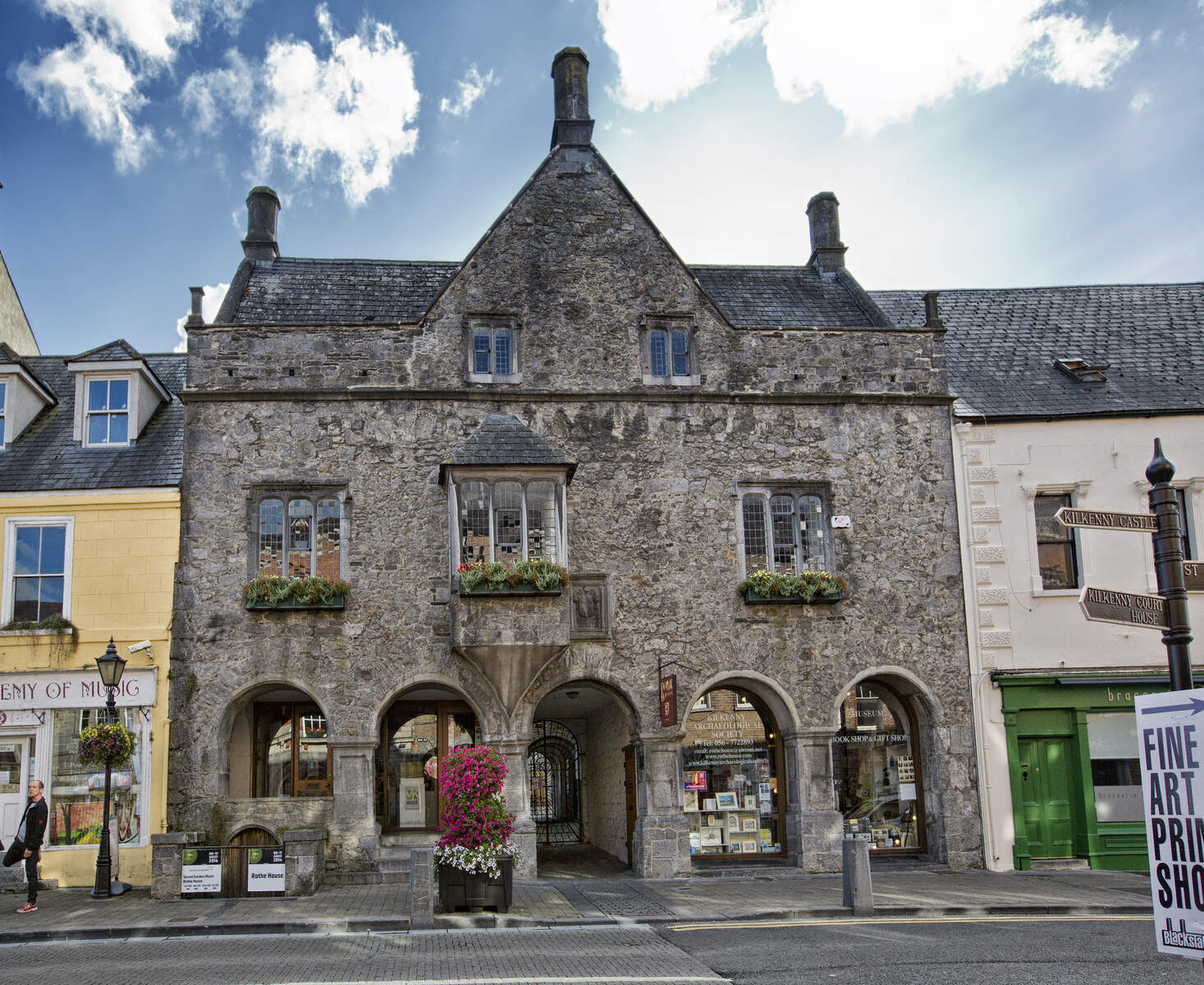
Rothe House, Kilkenny, photograph by Brian Morrison 2015 for Tourism Ireland [2]

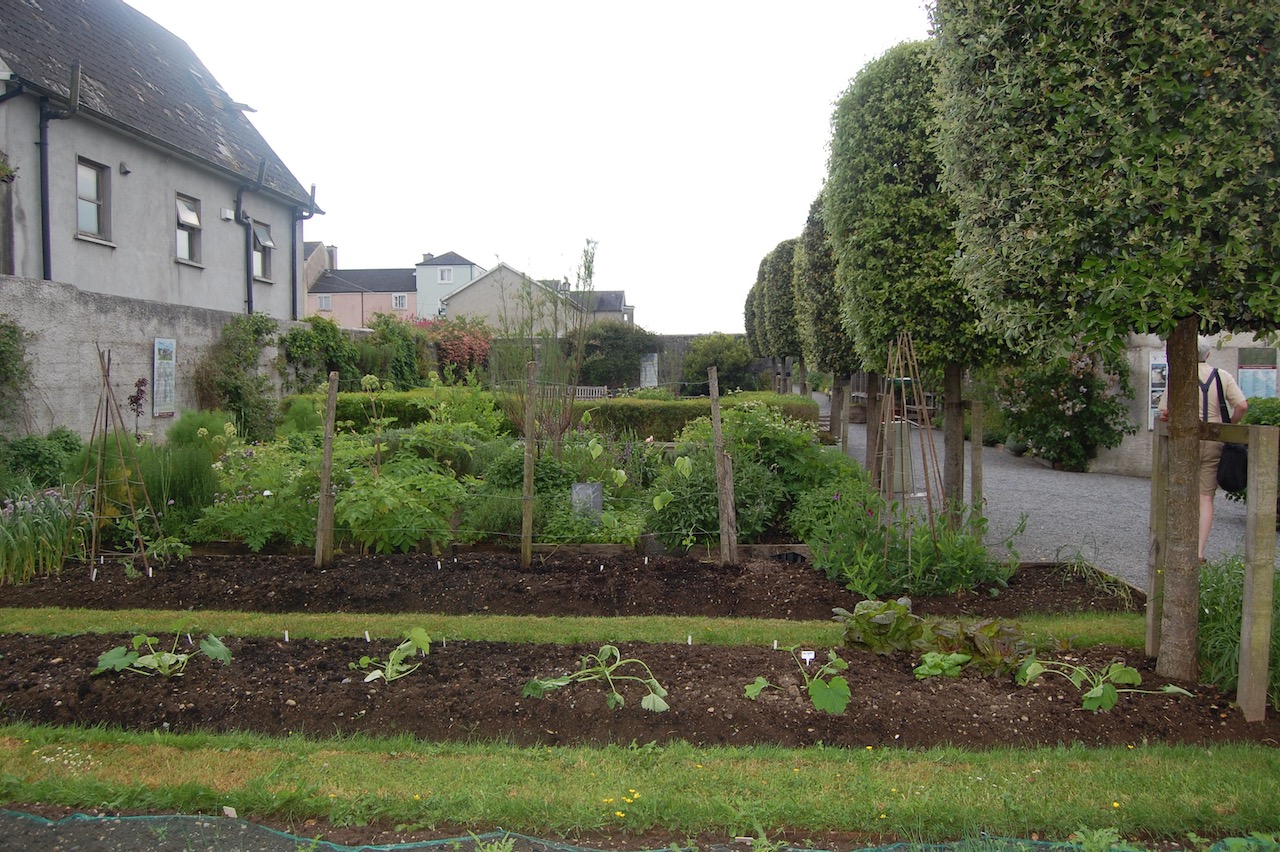
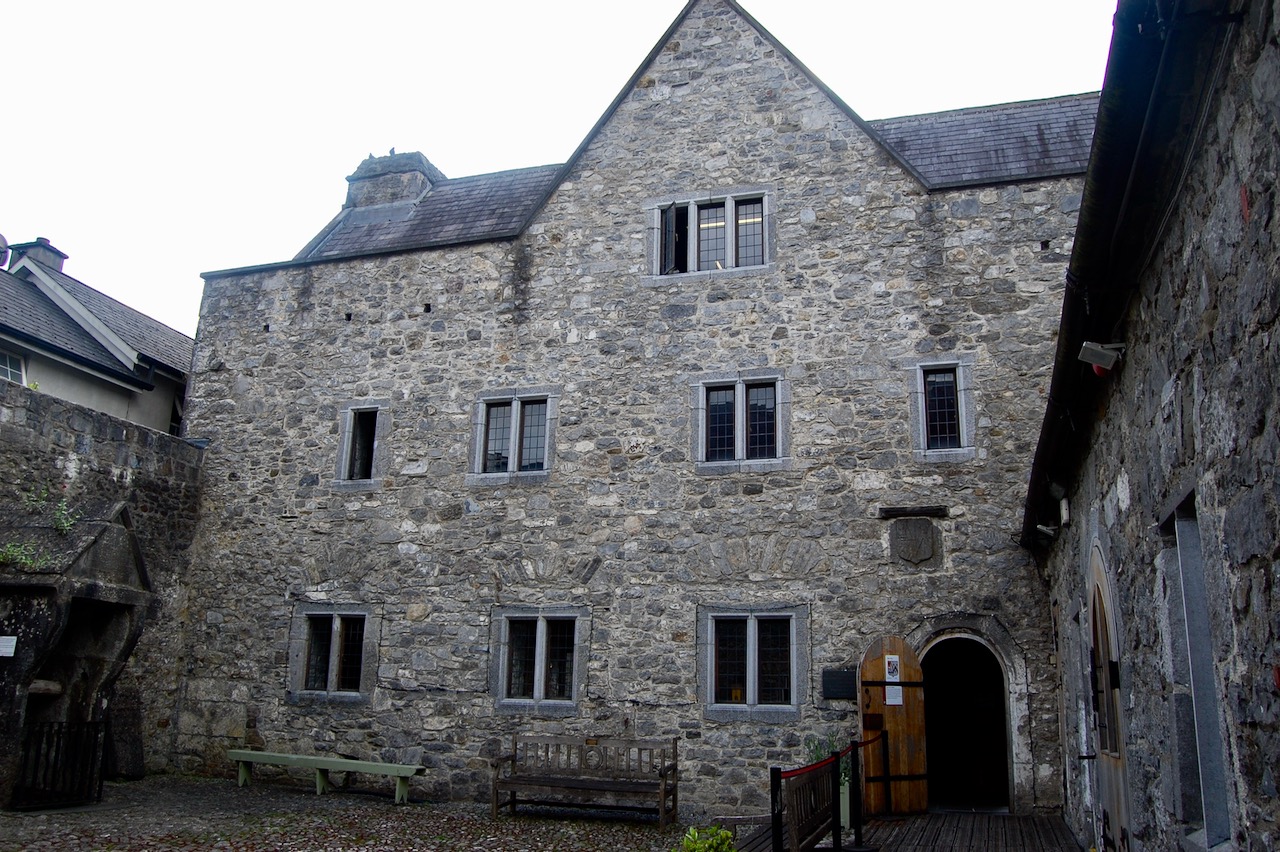
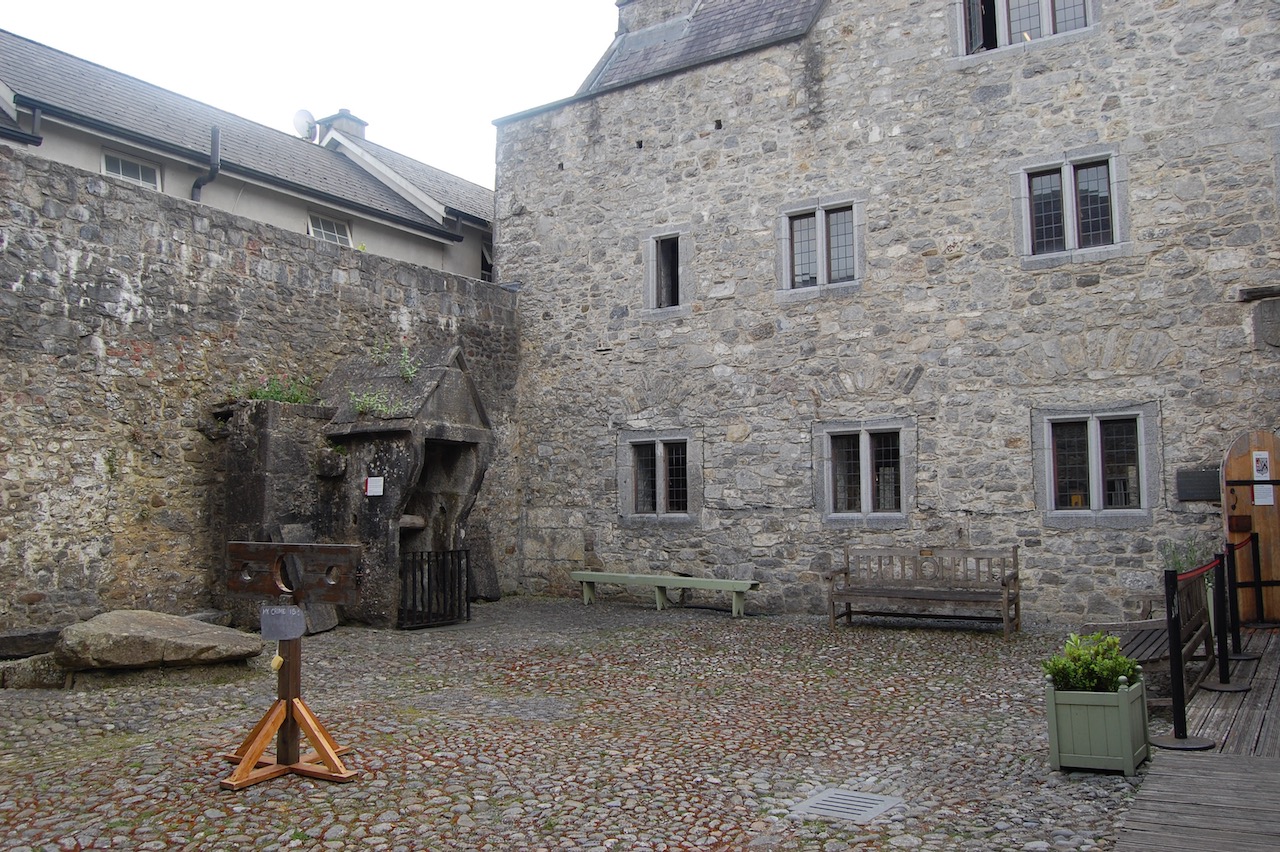
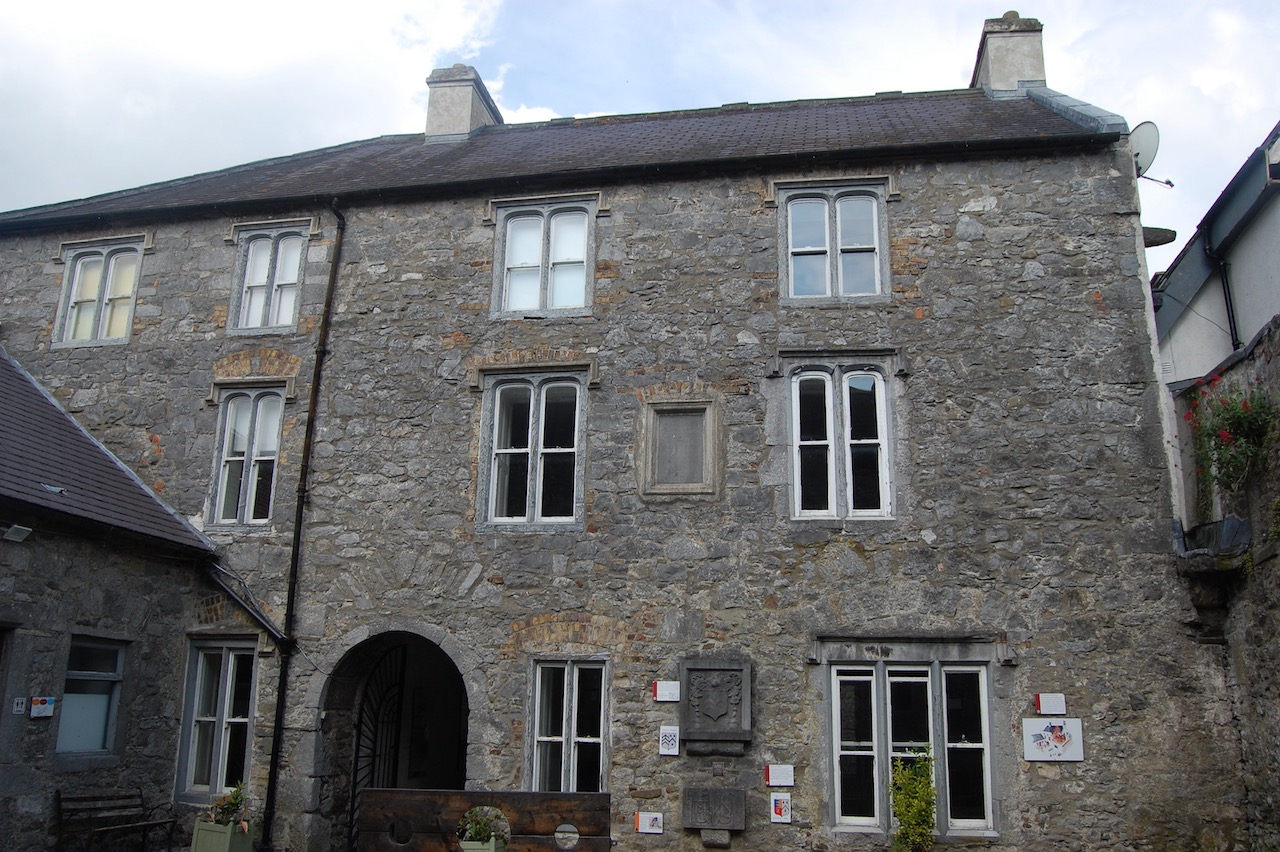
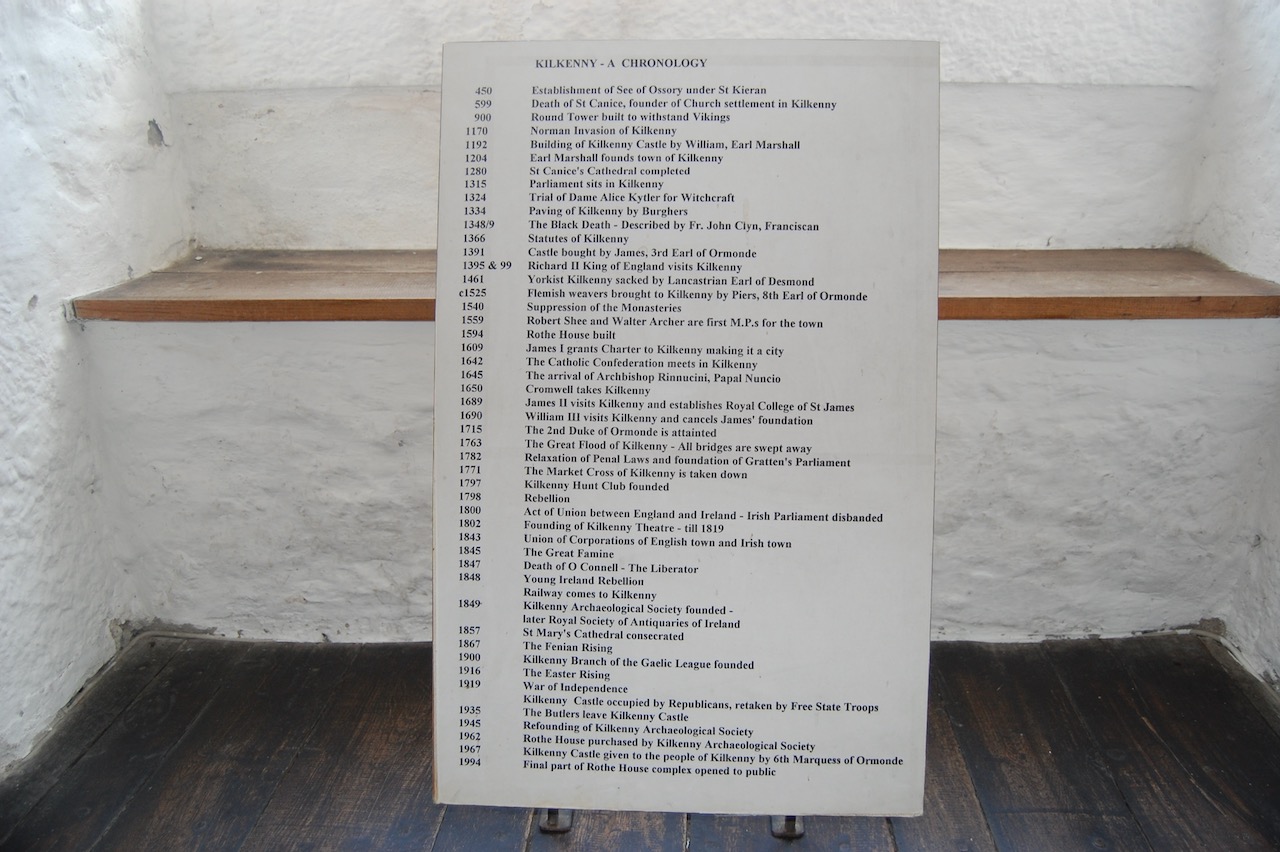
Rothe House is a treasure, older than any house in Dublin! It was built around 1594-1610, by John Rothe FitzPiers (1560-1620) for his wife Rose Archer, and is the last merchant’s townhouse in Kilkenny surviving from the early post-medieval period. [3] The house, purchased by Kilkenny Archaeological Society in 1962, is open to the public as a museum displaying a selection of the historic artefacts collected by the Society since its founding in 1947.  The artefacts relate to Kilkenny heritage throughout the ages and some date from prehistoric times.  The adjoining garden has since 2008 been open to the public and is a faithful reconstruction of an early seventeenth-century urban garden. 

Garden at Rothe House, May 2018. Photograph © Jennifer Winder-Baggot, www.irishhistorichouses.com
Rothe House, May 2018. Photograph © Jennifer Winder-Baggot, www.irishhistorichouses.com

The National Inventory describes it:

Terraced five-bay two-storey over basement house with dormer attic on a U-shaped plan about a stone cobbled (east) courtyard with two-bay two-storey gabled central bay having jettied box oriel window to first floor, series of five round-headed openings to ground floor forming arcade, single-bay three-storey linking range to north-west, and three-bay three-storey parallel range to west (completing U-shaped plan about a courtyard) originally three-bay two-storey having round-headed carriageway to right ground floor. In use as school, c.1750. Restored, 1898, to accommodate use as Gaelic League house. Converted to use as museum, 1963-5. Restored, 1983. Restored, 1999, to accommodate use as offices.”

Rothe House, May 2018. Photograph © Jennifer Winder-Baggot, www.irishhistorichouses.com

The Archiseek website tells us:

In 1594 a wealthy merchant called John Rothe built this magnificent Tudor mansion. Second and third generation houses were built around the cobelled courtyards and a well dating to 1604. The façade houses shops, one of them was John Rothe’s own. During the Confederation of Kilkenny, many dignitaries were entertained here by John Rothe and his cousin, the Bishop of Ossory. The building has been restored magnificently and is now home to Kilkenny Archaeological Society.” [4]

Rothe House, May 2018. Photograph © Jennifer Winder-Baggot, www.irishhistorichouses.com
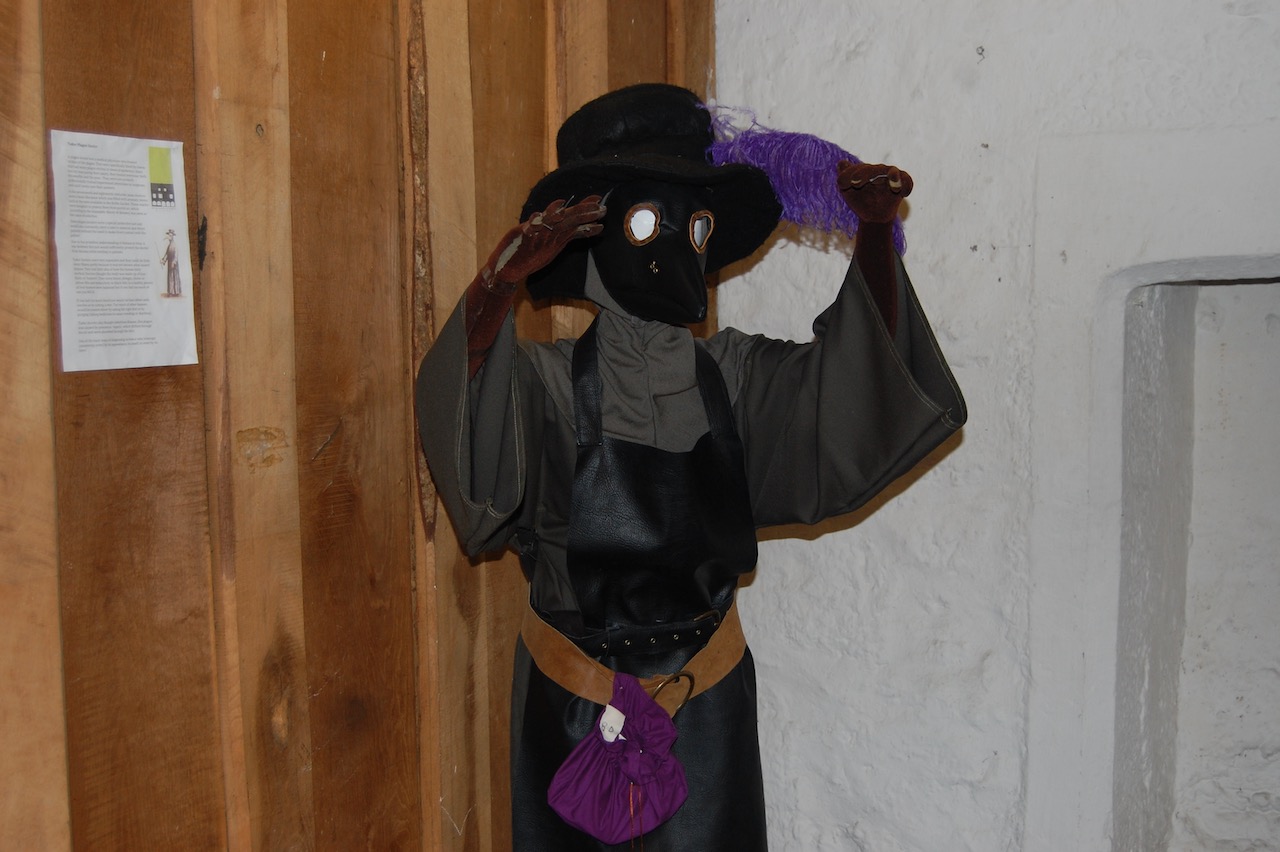
Plague Doctor! In 1348 there was Plague in Kilkenny. Friar John Clyn in the Franciscan Abbey across the road  recorded the effect of the plague on the town and the friary. He himself fell victim to the epidemic.  Photograph © Jennifer Winder-Baggot, www.irishhistorichouses.com
Rothe House, May 2018. Photograph © Jennifer Winder-Baggot, www.irishhistorichouses.com
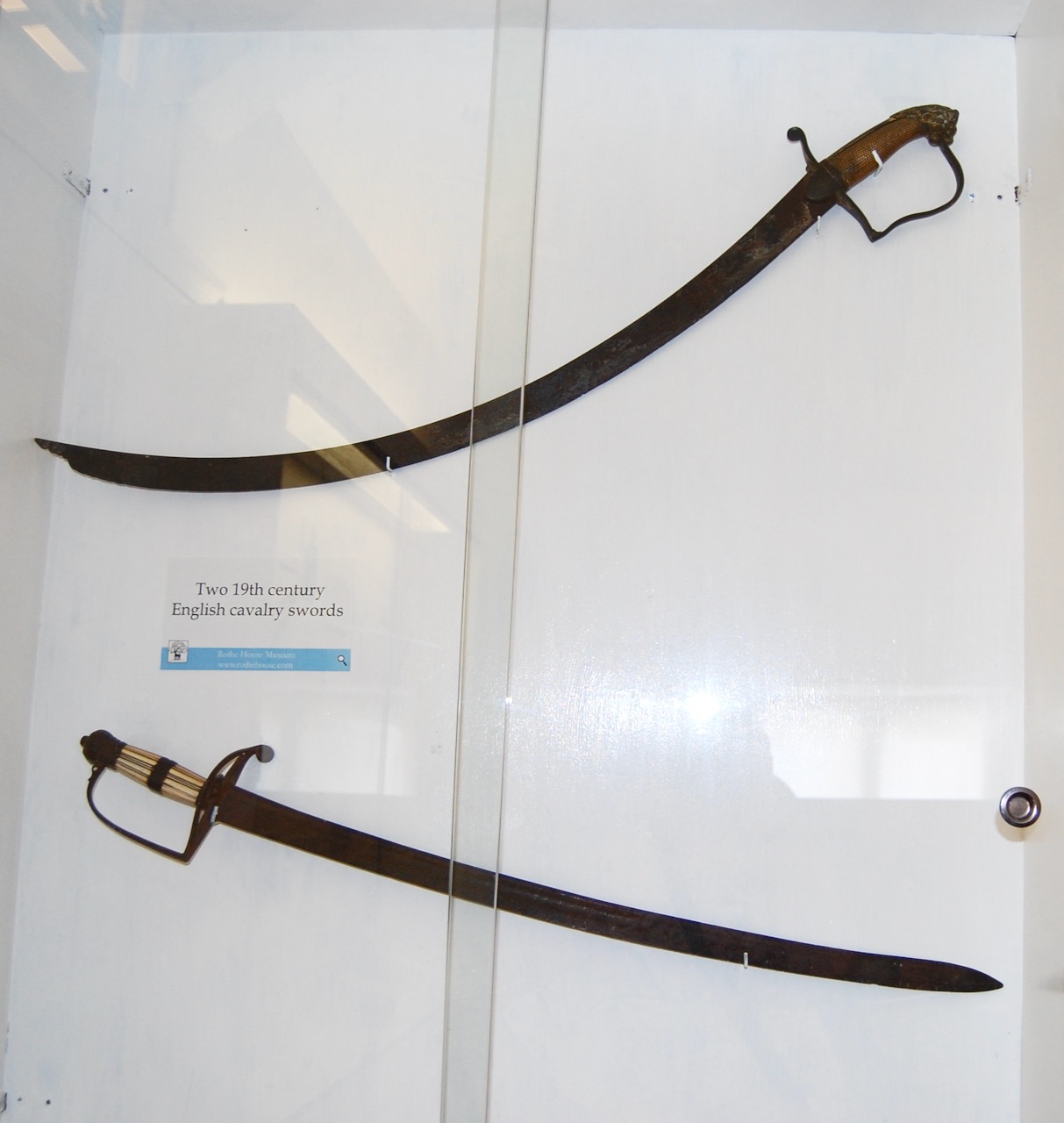
Artefacts from the Confederation of Kilkenny. Photograph © Jennifer Winder-Baggot, www.irishhistorichouses.com
Rothe House, May 2018.
Rothe House, May 2018. Photograph © Jennifer Winder-Baggot, www.irishhistorichouses.com
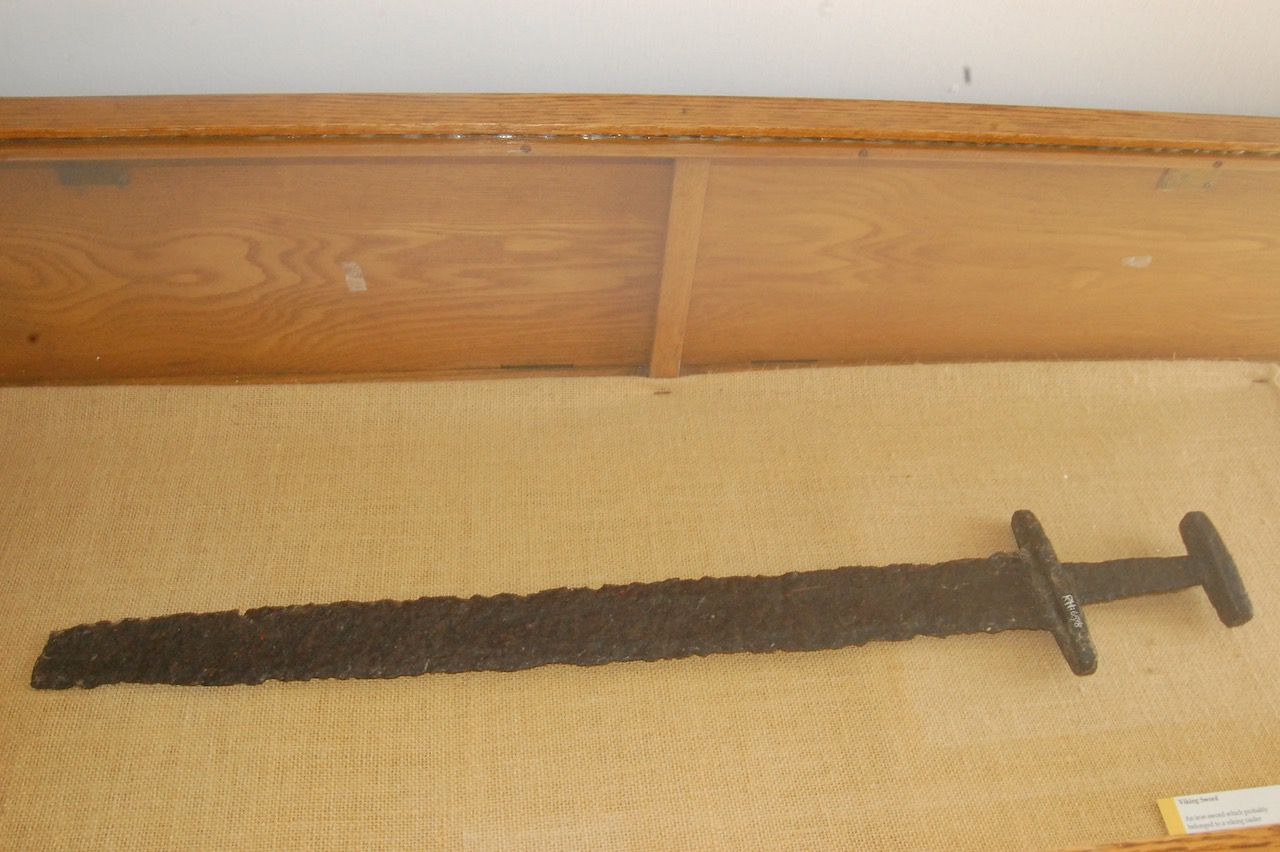
Viking Sword. Photograph © Jennifer Winder-Baggot, www.irishhistorichouses.com
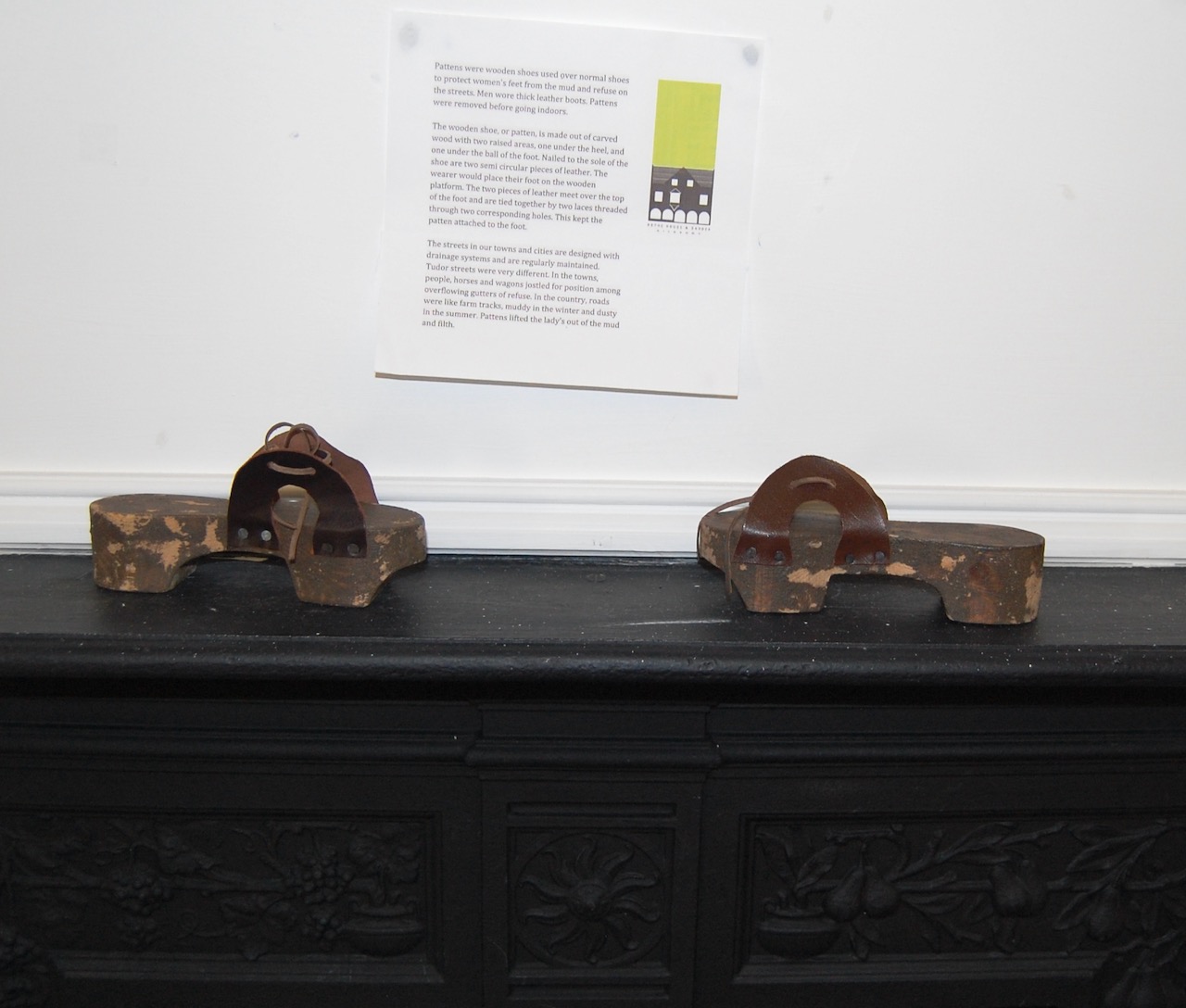
“Pattens” – wooden shoes worn by women over their regular shoes to protect from mud. Photograph © Jennifer Winder-Baggot, www.irishhistorichouses.com

6. Shankill Castle, Paulstown, Co. Kilkenny R95 T8X7 – section 482 

www.shankillcastle.com

Open dates in 2026: Feb 7-8, 14-15, 21-22, 28, Mar 1, Apr 3-5, 10-12, 17-19, 24-26, May 1-3, 8-10, 15-17, 22-24, 29-31, June 5-7, 12-14, 19-21, 26-28, July 3-5, 10-12, 17-19, 24-26, 29, 31, Aug 1-2, 7-9, 14-23, 28-30, Sept 4-6, 11-13, 18-20, 25-27, Oct 2-4, 9-11, 16-18, 23-25, 30-31, 11am-5pm

Fee: adult €14 house & garden, €6 garden, OAP/student €10 house & garden, €4 garden, child house & garden €6, €3 garden

See my entry https://irishhistorichouses.com/2023/11/30/shankill-castle-paulstown-county-kilkenny-r95-t8x7/

Shankill Castle County Kilkenny 3rd June 2023. Photograph © Jennifer Winder-Baggot, www.irishhistorichouses.com

7. Tybroughney Castle, Piltown, Co Kilkenny E32 NV 32  – section 482 and castle accommodation 

Tybroughney, photograph courtesy of National Inventory of Architectural Heritage.

https://www.tybroughneycastle.com/

Open dates in 2026: Mar 1-20, May 1-31, Aug 15-23,11am-3pm

Fee: adult €5, student €3, child/OAP free

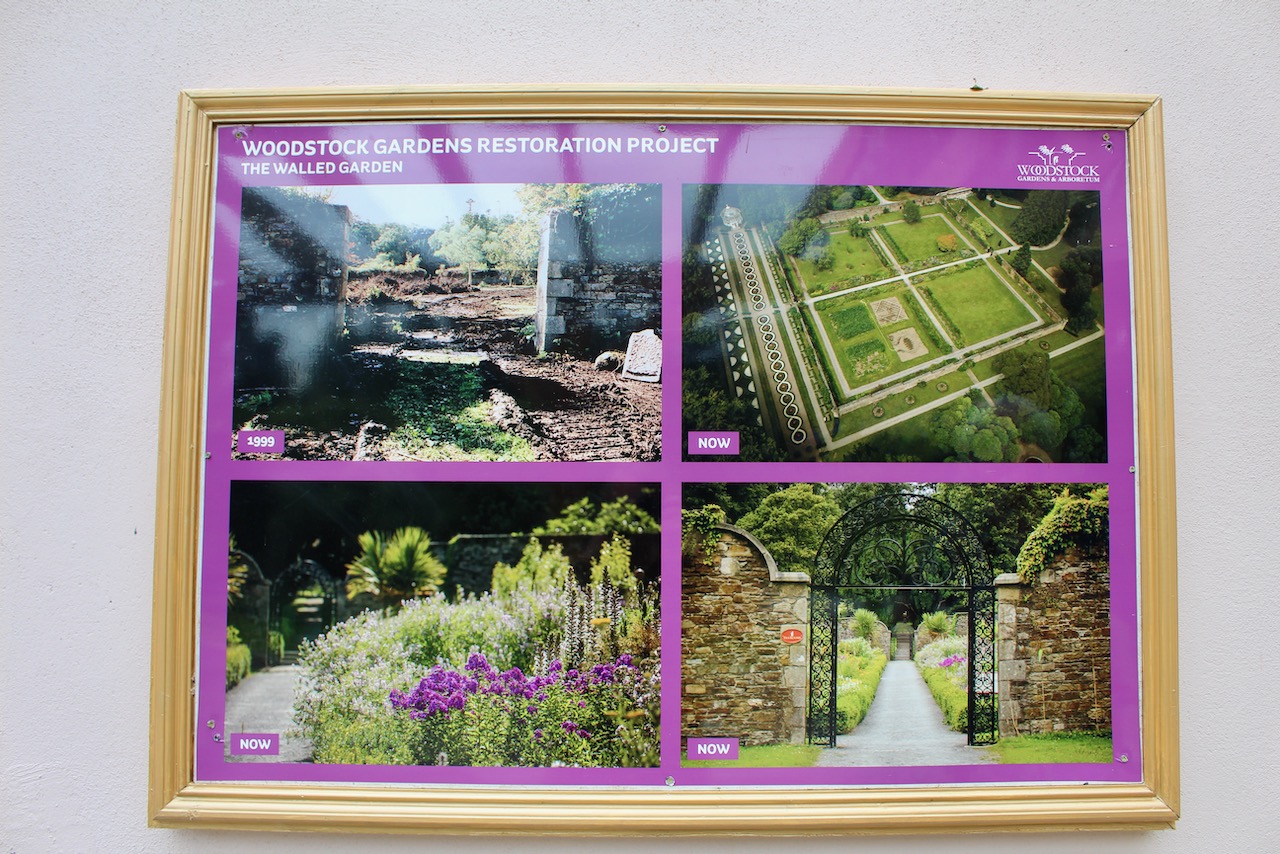
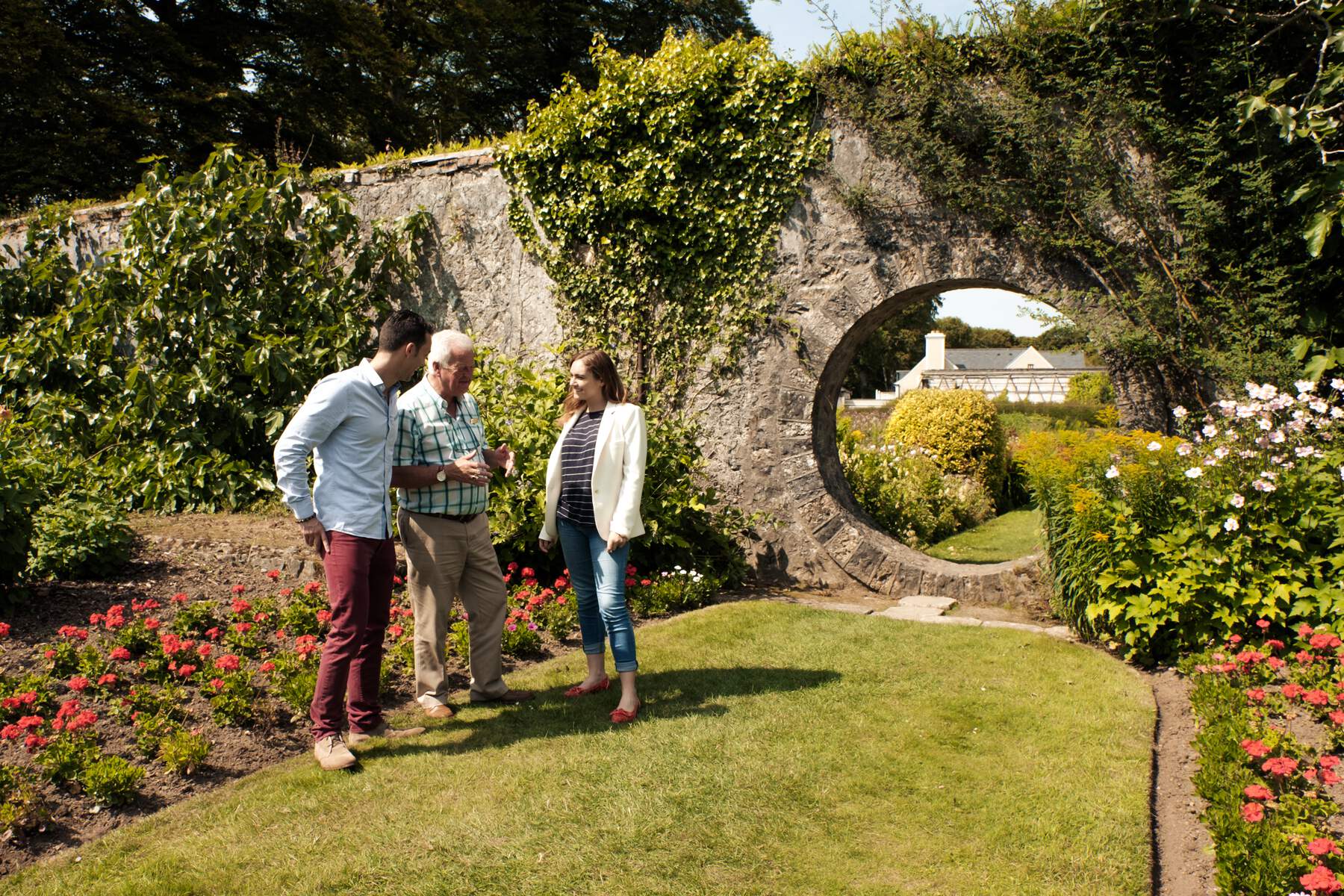
8. Woodstock Gardens and Arboretum, Woodstock, Inistioge, Kilkenny, maintained by Kilkenny County Council

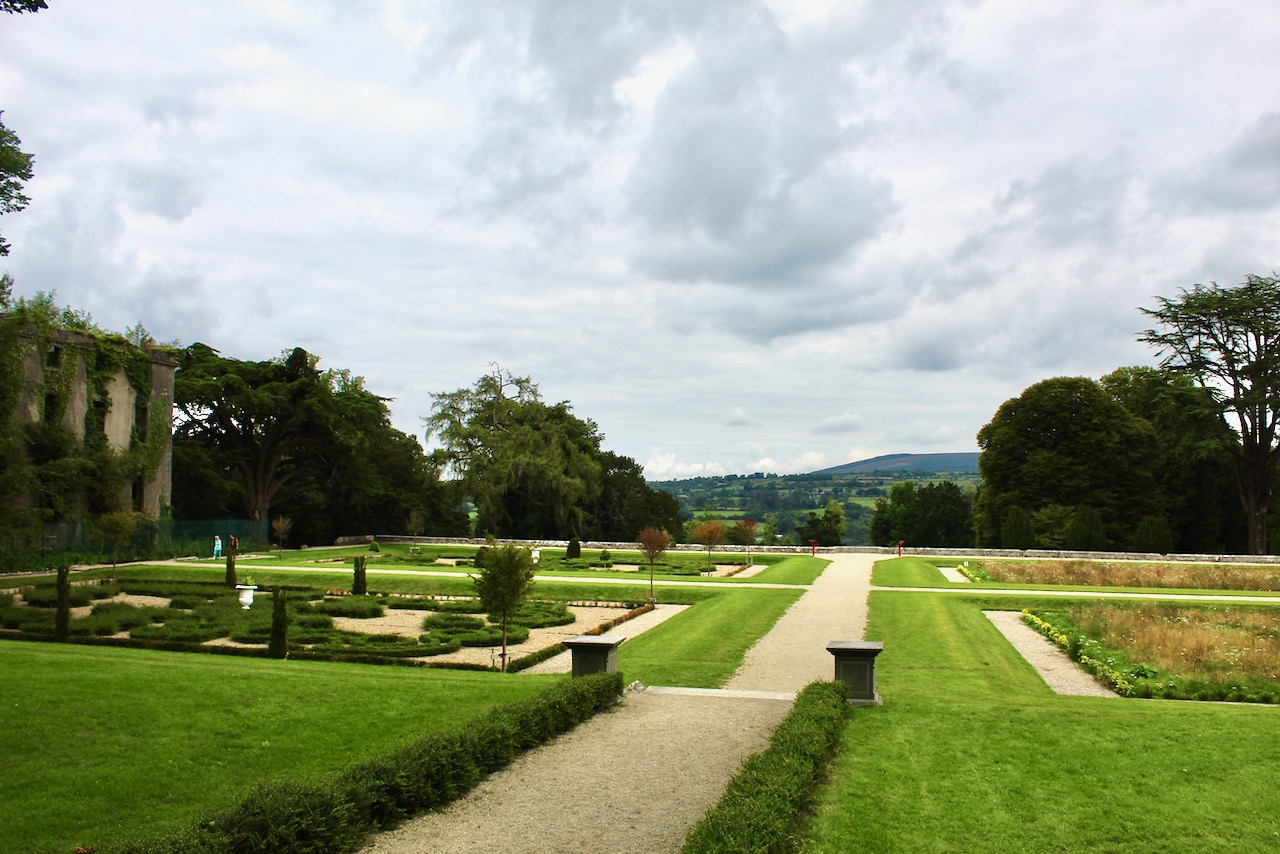
Woodstock, County Kilkenny. Photograph © Jennifer Winder-Baggot, www.irishhistorichouses.com

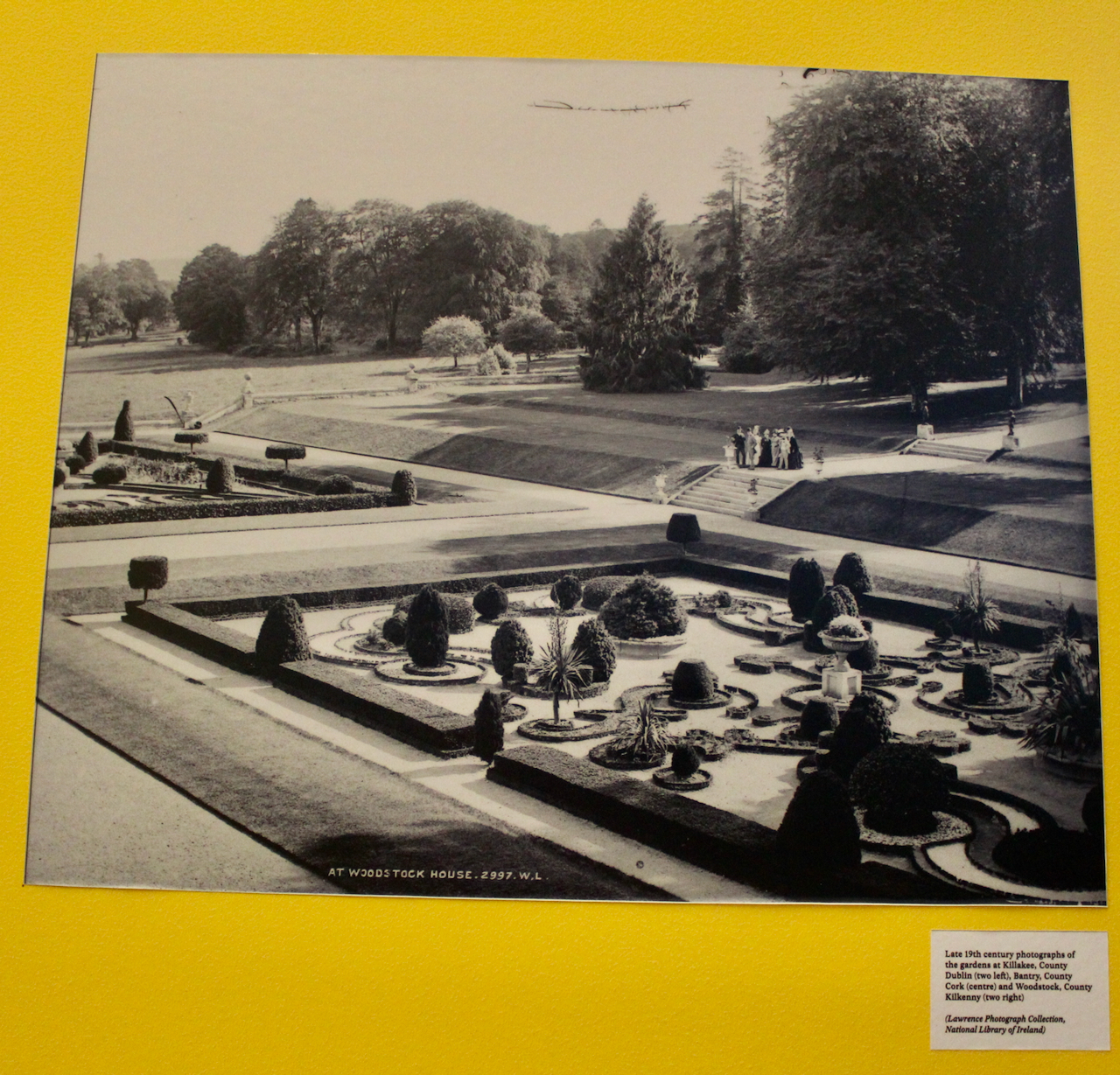
Woodstock Gardens, photograph from Lawrence Photograph Collections, National Library of Ireland, photograph from “In Harmony with Nature” exhibition at the Irish Georgian Society curated by Robert O’Byrne.

Mark Bence-Jones writes about Woodstock (1988):

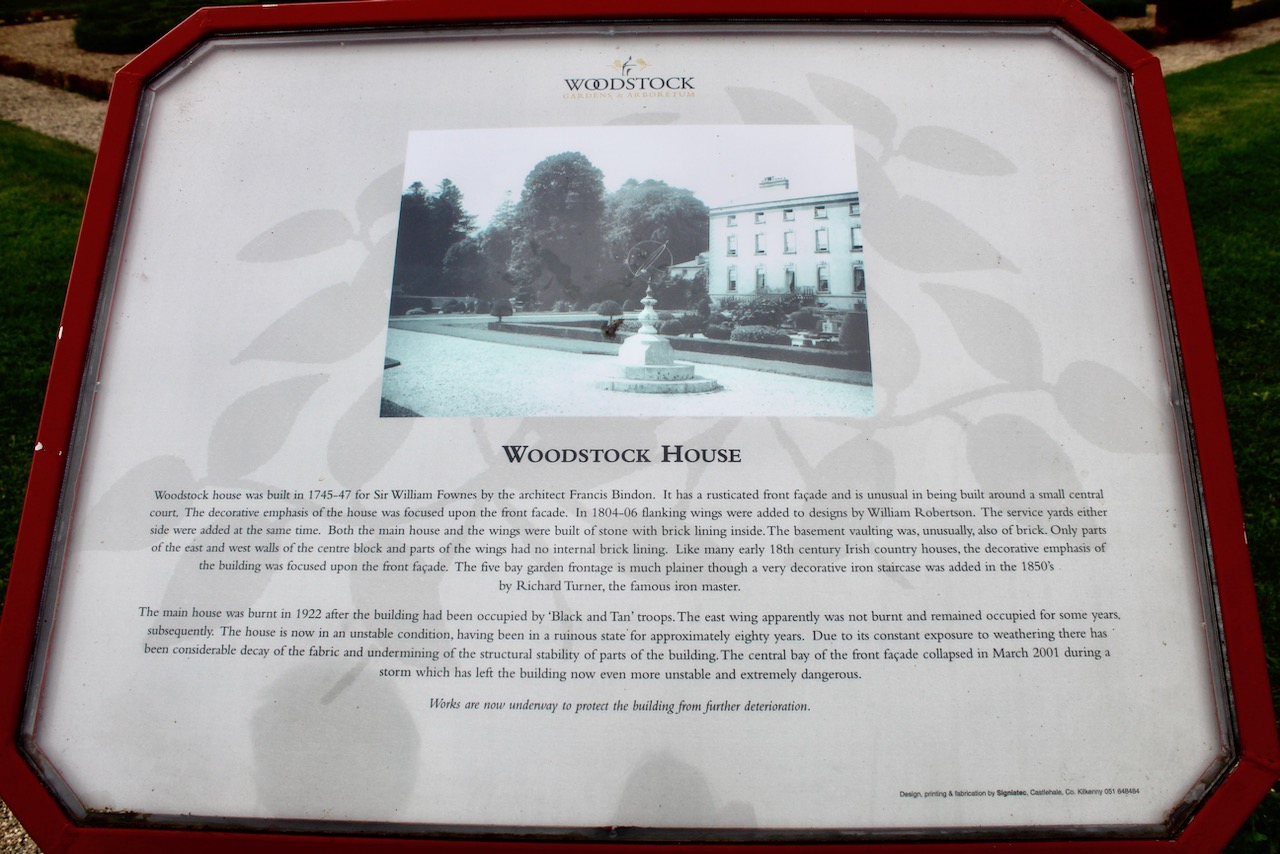
p. 286. “(Fownes, Bt/EDB; Tighe/IFR) A house by Francis Bindon [for William Fownes, 2nd Baronet], probably dating from 1740s, which is unusual in being built round a small inner court, or light-shaft. Three storeys; handsomely rusticated entrance front of six bays with a central niche and statue above the entrance doorway…In 1770s Sarah Ponsonby lived here with her cousins, Sir William and Betty Fownes [born Elizabeth Ponsonby]; her friend, Eleanor Butler, having escaped from Borris, co Carlow, where she was being kept in disgrace, was let into Woodstock through a window, hiding herself in Sarah’s room for 24 hours before being discovered; shortly afterwards, the two friends left for Wales, where they subsequently became famous as the “Ladies of Llangollen.” Woodstock passed to the Tighes with the marriage of the daughter and heiress of Sir William Fownes to William Tighe, whose daughter-in-law was Mary Tighe, the poet, author of Psyche; she died at Woodstock 1810 aged 37, and Flaxman’s monument to her is in a small neo-Classical mausoleum behind the Protestant church in the village of Inistioge, at the gates of the demesne. There was also a statue of her in one of the rooms in the house. Woodstock was burnt ca 1920, and is now a ruin, but the demesne, with its magnificent beechwoods, still belongs to the Tighes.” [6]

The information board tells us that in 1804 flanking wings were added to designs by William Robertson (1770-1850). The house was burned in 1922 after being occupied by the Black and Tans.
The gardens at Woodstock, County Kilkenny, August 2021. The gardens at Woodstock, gloriously situated above the River Nore, were conceived on a grand scale by Colonel William Tighe (1794-1878) and Lady Louisa Lennox (1803-1900) as the centrepiece of a great estate. Photograph © Jennifer Winder-Baggot, www.irishhistorichouses.com
The Ladies of Llangollen, Sarah Ponsonby and Charlotte Eleanor Butler, by Richard James Lane, printed by Jérémie Graf, after Lady Mary Leighton (née Parker) courtesy of National Portrait Gallery NPG D32504.
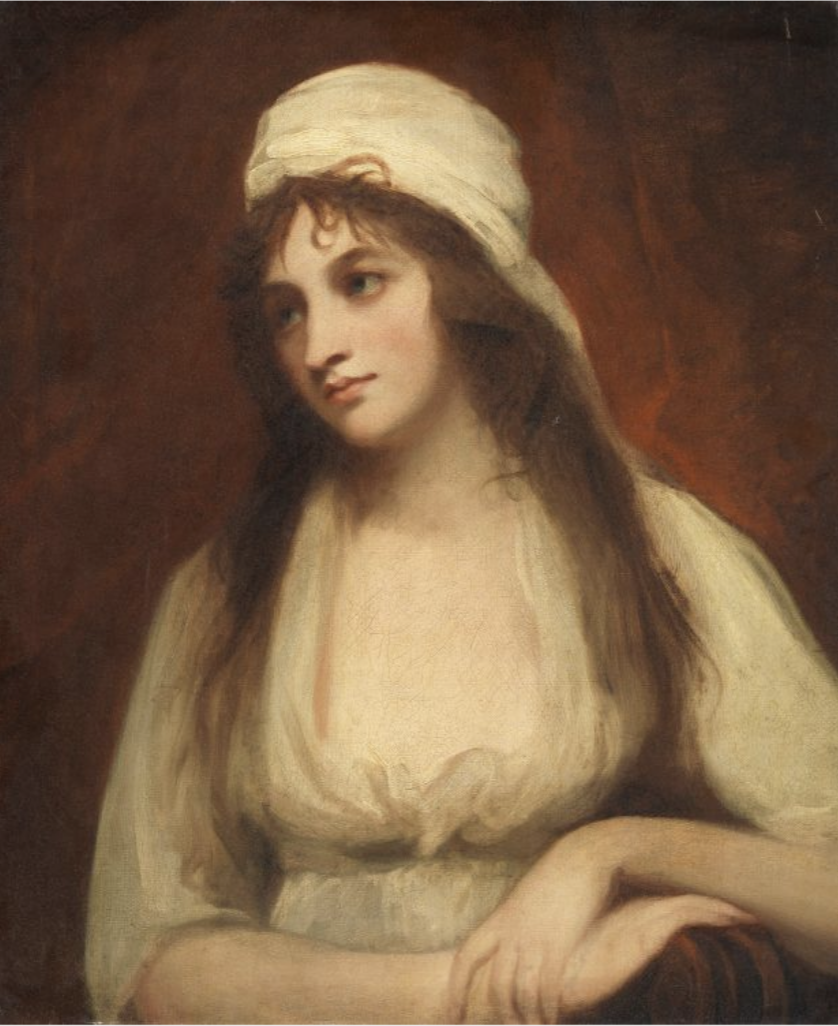
Mary Tighe née Blachford (1747-1791), courtesy of National Gallery of Ireland.

The formal parterres were created in the 1860s by a Scotsman, Charles McDonald, for Colonel William Tighe (1794-1878) and his wife Lady Louisa née Lennox (1803-1900, daughter of Charles, 4th Duke of Richmond – she is not to be confused with Louisa Lennox (1743-1817) daughter of Charles 2nd Duke of Richmond, who married Thomas Conolly of Castletown, County Kildare). The parterre incorporates a shamrock motif. Robert O’Byrne tells us in his exhibition “In Harmony with Nature” at the Irish Georgian Society July 2022 that creating the parterres involved removing 200,000 cubic yards of earth and retention by a wall of cut granite quarried on the estate and ornamented by local craftsmen with stone finials, balls and vases.
Woodstock Gardens, photograph from Lawrence Photograph Collections, National Library of Ireland, photograph from “In Harmony with Nature” exhibition at the Irish Georgian Society July 2022 curated by Robert O’Byrne.

The estate passed to the daughter, Sarah, of William Fownes and Elizabeth Ponsonby, and Sarah married William Tighe (1738-1872) of Rossana, County Wicklow.

William Tighe of Rosanna! Portrait by by Charles Jervas (c.1675-1739), courtesy of Adams auction 19 Oct 2021.
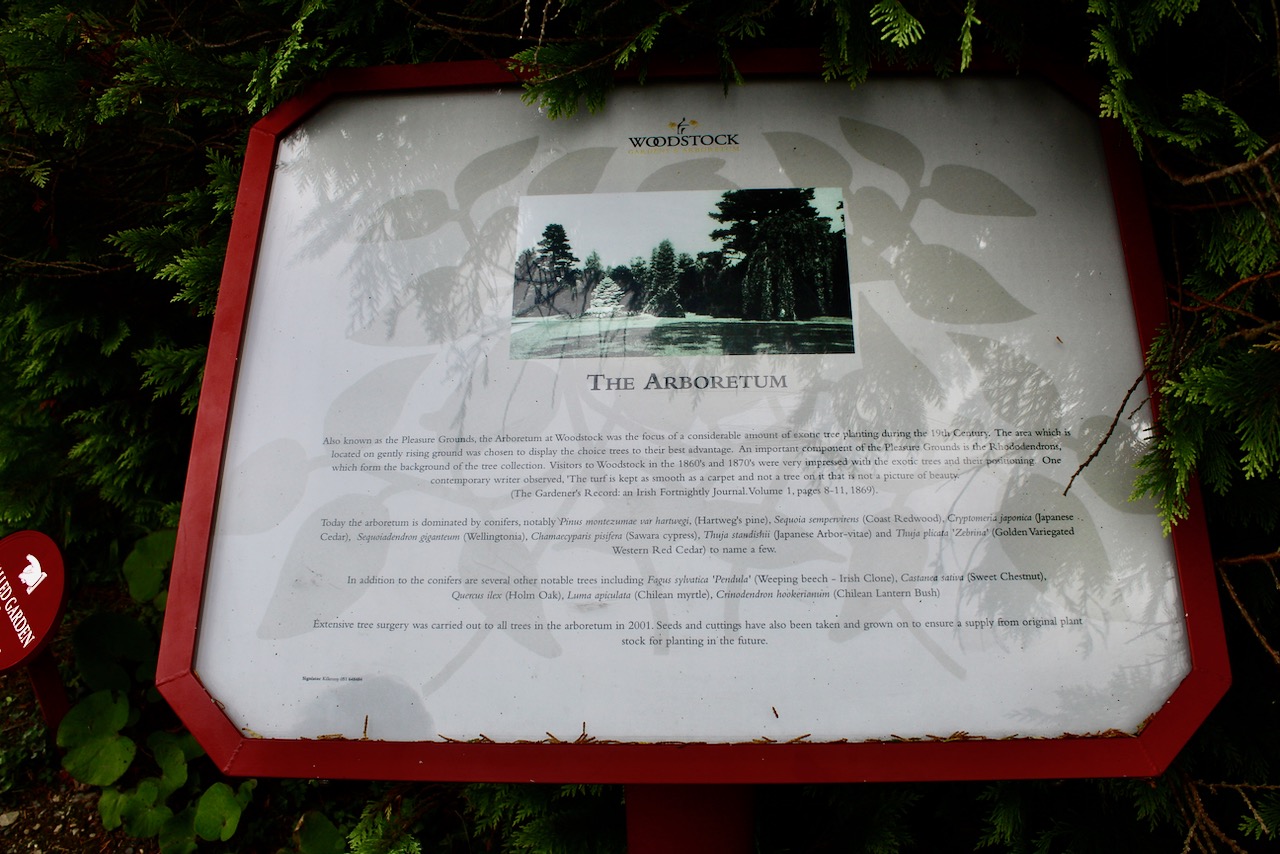
This information board tells us about the Arboretum at Woodstock, where a number of exotic trees were planted in the nineteenth century.
Woodstock, County Kilkenny.
Entrance to walled garden at Woodstock. Photograph © Jennifer Winder-Baggot, www.irishhistorichouses.com
Gardens at Woodstock, with reproduction Turner glasshouse. Photograph © Jennifer Winder-Baggot, www.irishhistorichouses.com
“Turner bench” which matches the glasshouse at Woodstock. Photograph © Jennifer Winder-Baggot, www.irishhistorichouses.com
The longest and oldest Monkey Puzzle Walk in Europe, at Woodstock. Photograph © Jennifer Winder-Baggot, www.irishhistorichouses.com

Places to stay, County Kilkenny

1. Ballyduff, Thomastown, Co Kilkenny – wedding venue, B&B 

http://ballyduffhouse.ie/booking-enquiries/ 

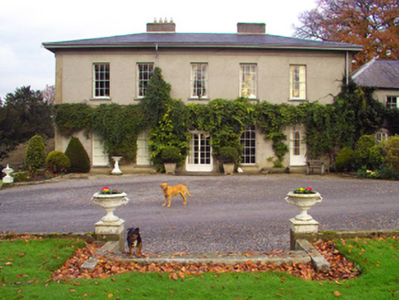
Ballyduff House, courtesy of National Inventory of Architectural Heritage.

The website tells us:

Ballyduff House is a classic Georgian country house with a 14th century castle, steeped in Irish history and full of the warmest of welcomes.
The River Nore sparkles as it runs along Ballyduff’s riverbank while sheep and cattle graze the pasture either side.

Open fires, the book lined library and the comfortable bedrooms furnished with Irish antiques capture an early 18th century experience tempered by discreet 21st century comfort.

This is real Ireland – calm, green and beautiful, set alongside the picturesque village of Inistioge with Dublin only an hour away.

The National Inventory tells us:

A country house representing an important component of the mid eighteenth-century domestic built heritage of County Kilkenny with the architectural value of the composition, one abutting a “roofed down” tower house, confirmed by such attributes as the deliberate alignment maximising on panoramic vistas overlooking broad parkland and the wooded River Nore; the compact rectilinear plan form centred on a restrained doorcase showing a simple radial fanlight; the diminishing in scale of the openings on each floor producing a graduated visual impression with the principal “apartments” or reception rooms defined by Wyatt-style tripartite glazing patterns; and the slightly oversailing roofline. Having been well maintained, the elementary form and massing survive intact together with substantial quantities of the original fabric, both to the exterior and to the interior, including crown or cylinder glazing panels in hornless sash frames: meanwhile, contemporary joinery; restrained chimneypieces; and sleek plasterwork refinements, all highlight the artistic potential of the composition. Furthermore, an adjacent farmyard complex ; and a walled garden (extant 1839), all continue to contribute positively to the group and setting values of a self-contained estate having historic connections with the Coghill family including Sir Josiah Coghill (1773-1850), third Baronet (Lewis 1837 II, 18); the Connellans of nearby Coolmore House (see 12403210); and Lieutenant-Colonel Frederick William John Shore (1844-1916), fourth Baron Teignmouth (NA 1901; NA 1911). NOTE: Given as the birthplace of Sir John Joscelyn Coghill (1826-1905) of Glen Barrahane in Castletownshend, County Cork (Dod’s Peerage Baronetage and Knightage 1865, 186); and George Leopold Bryan (1828-80) of Jenkinstown (Dod’s Parliamentary Companion 1875, 174).

2. Blanchville Coachyard, Dunbell, County Kilkenny – coachyard accommodation

https://blanchville.ie/

Blanchville Coachyard, Dunbell, County Kilkenny, photograph from website https://blanchville.ie/

The Coach Houses & Gardener’s Cottage are, as the name suggests, part of the beautiful old stone building that was originally the Coach House at Blanchville. The building has been sensitively and extensively refurbished and now offers guests comfortable and inviting Self-Catering Accommodation in three self-contained Holiday Homes.
These Heritage Holiday Lets feature a cosy woodburning stove or open fire, fully fitted modern kitchen and relaxing bedrooms – the perfect requisite for an enjoyable weekend break or holiday in Kilkenny.

3. Butler House, Kilkenny, co Kilkenny – accommodation 

https://www.butler.ie

View to Butler House and Garden, Kilkenny Leo Byrne Photography 2015. (see [2])

The National Inventory tells us about Butler house: “Semi-detached three-bay three-storey over basement house, built 1786, with pair of three-bay full-height bowed bays to rear (east) elevation. Extended, 1832, comprising two-bay three-storey perpendicular block to right. Renovated, 1972. Now in use as hotel. One of a pair…An elegantly-composed Classically-proportioned substantial house built either by Walter Butler (1713-83), sixteenth Earl of Ormonde or John Butler (1740-95), seventeenth Earl of Ormonde as one of a pair of dower houses…Distinctive attributes including the elegant bowed bays to the Garden (east) Front contribute positively to the architectural design value of the composition while carved limestone dressings with particular emphasis on the well-executed doorcase displaying high quality stone masonry further enliven the external expression of the house in the streetscape.”

The house was home to Lady Eleanor Butler who lived here after the death of her husband Walter in 1783. Lady Eleanor Butler was the mother of John, the 17th Earl of Ormonde and her daughter, also Eleanor, was one of the famous “Ladies of Langollen”.

James, Earl of Ormonde (1777-1838, and 1st Marquess) resided in the house while the Castle was under reconstruction in 1831. A soup kitchen was run from here during the cholera epidemic of 1832.

The Royal Historical and Archaeological Association of Ireland held their meetings in Butler House in 1870. Kilkenny Design, the state design agency, restored Butler House in 1972. The decor and furnishings reflect a certain 1970s Art Deco style, which because of the muted colours and natural fabrics used, proved sympathetic to the original features of the house. In 1989, the Kilkenny Civic Trust acquired both Butler House and the Castle Stables. 

4. Clomantagh Castle, Co Kilkennytower house accommodation

Clomantagh Castle, courtesy of National Inventory of Architectural Heritage.

https://www.airbnb.ie/rooms/29346656?federated_search_id=050f383f-6e5e-45b5-9989-b166bfe7e70d&source_impression_id=p3_1650104926_er%2FjFSqCgEWzQLW5

The National Inventory tells us it is a farmhouse erected by John Shortal (d. 1857) or Patrick Shortal (d. 1858) representing an integral component of the mid nineteenth-century domestic built heritage of County Kilkenny with the architectural value of the composition, one occupying the site of a hall adjoining the fifteenth-century Clomantagh Castle.

Clomantagh Castle - was home to the [8th] Earl of Ormond, Pierce Ruadh (1467-1539). When he died in 1539 the castle along with other properties was passed to his son Richard Butler, first Viscount Mountgarret (1500-1571). The castle and its estate stayed in the Butler family until it was forfeited during the war with Cromwell to Lieutenant Arthur St. George [ancestor of the Kilrush family]. After the war the castle changed hands twice more and a farmhouse was added by the Shortall family, the owners in the 1800’s, before its last owner  Willie White a local vet. The property is now owned by a non profit making charity called the Landmark Trust who preserve historic buildings. 

The Landmark site tells us:

The name Clomantagh comes from the Irish “cloch mantaigh”, meaning missing tooth or gappy smile. Locals gave this name to the castle as the irregular castellation reminded them of someone smiling with missing teeth.  

“It has been established that the tower and bawn were built in the 15th century (c.1430). The tower house has been modified and extended over the centuries, and in the early 19th century a farmhouse was added providing accommodation with comfort, rather than defence, in mind. In recent times, the bawn walls have sheltered the buildings of a 20th century working farm. It also has a rare clochán (small dome-roomed structure) knit into the bawn walls. Five other tower houses can be seen from the roof of Clomantagh Castle, and they were all strategically aligned for defence purposes.

Clomantagh followed mainstream castle design, emerging as an almost square building, six storeys high, with massive walls built from local limestone, and a corner staircase. Inserted high on the south wall is a Sheela-na-Gig. This pagan symbol was adopted by medieval builders and incorporated as the building was erected. High up the remains of the stepped battlement walls, the merlons can be seen – a specifically Irish feature whose inspiration is considered to be Venetian. Inside the battlements a wide walkway gave access to all sides of the building. In the north east corner, a high watchtower has been built. This is knows as Moll Gearailt’s Chair, after the particularly ferocious original mistress of the house, Maighréad nhee Gearóid, who used to sit watching over her fields to ensure that her labourers were not slacking at their work. The walkway, or Alure, was sloped outward to allow run off water through drainage holes and stone spouts. Generally, battlement walls have not survived well, their thinner construction and unstable sloping bases have contributed to their disappearance from tower houses.” [6]

You can stay in the main house or in smaller private accommodation https://cullintrahouse.com

The website tells us: “A countryside retreat in the heart of Co Kilkenny, Ireland – surrounded by acres of woodland, farmland and secret places to explore, Cullintra House offers guests a unique accommodation experience.

The house is furnished with your host Patricia Cantlon’s artistic style to the fore – each room has unique pieces of furniture or bespoke decorative touches that make Cullintra House a special find in Co Kilkenny.

6. Lyrath House, near Kilkenny, County Kilkenny – hotel

Lyrath Estate by Colin Whittaker 2009, flickr creative commons.

https://www.lyrath.com

Mark Bence-Jones writes:

p. 184. “(Wheeler-Cuffe, Bt/PB1934; Tupper/LGI1958) Originally a Tobin castle, acquired by the Wheeler family C17. By 1826, the house here consisted of a simple two storey five bay pedimented front facing west, with two wings running back from it to enclose a small three sided office court; the entrance door being on the south side; under a Regency veranda. In 1861, Sir Charles Wheeler-Cuffe, 2nd Bt, married Pauline Villiers-Stuart, daughter of Lord Stuart de Decies [of Dromana House, County Waterford – see my entry], whose parents did not regard this house as grand enough for her; so in that same year he rebuilt the main western block on a larger scale and in a rich Italianate style, while leaving the two storey wings more of less as they were.; his architect being John McCurdy. The entrance was moved from the south side to the new west front, which is pedimented and of five bays like its predecessor, but not entirely symmetrical; having a pair of windows on the ground floor to the left of centre, but a single window on the right. Entrance door framed by Ionic columns carrying a balustrade, above which is a Venetian window framed by an aedicule with a segmental pediment. All the ground floor windows have semi-circular heads, while the heads of the windows of the upper storey – apart from the central Venetian windows – are cambered. The garden front to the north has two single-storey balustraded curved bows, the windows of which are treated as arcades supported by Romanesque columns of sandstone. There is another Romanesque column separated the pair of windows in the centre of the front. The windows in the bow are glazed with curved glass. The roof is carried on a deep bracket cornice and there are prominent string courses, which give the elevations a High Victorian character. Hall with imposing imperial staircase, the centre ramp of which rises between two fluted Corinthian columns. There is a similarity between the staircase here and that at Dromana, Co Waterford, Pauline Lady Wheeler-Cuffe’s old home; except that the Dromana staircase was of stone, whereas that at Leyrath is of wood, with ornate cast-iron balustrades. On the centre ramp of the staircase there is still a chair with its back legs cut down to fit the steps; this was put there in 1880s for Pauline when she became infirm. Hall has a ceiling cornice of typical C19 plasterwork in a design of foliage, and door with entablatures which still have their original walnut graining. To the left of the hall, in the garden front, are the drawing room, ante-room and dining room, opening into each other with large double doors’ they have ceiling cornices similar to that in the hall, and good C19 white chimneypieces, enriched with carving; the drawing room and ante-room keep their original white and gold wallpaper. In the south wing there are smaller and lower rooms surviving from before the rebuilding; while first floor rooms in this wing have barrel ceilings throughout and contain some C18 chimneypieces of black marble.” 

The website tells us more about the history:

The name Lyrath is thought to date back to Norman times when “Strongbow” settled in Ireland during the Norman invasion. The area was originally called Le Rar or Le Rath by the French speaking De Ponte family who during the 12th century lived in the Monastery which was once located within the grounds. There is also a mention of a castle which was once said to have been situated within the grounds.

Prior to 1653 the lands were owned by the Shortall family, who then rented the ‘old castle in repair’ and land to Thomas Tobin, Constable of the Barony of Gowran. In 1664, a gentleman named Thomas Mances, paid a sum of 4s ‘hearth money’ for the old castle.

Later in the Seventeenth Century the property was acquired by Richard Wheeler through his kinship to Jonah Wheeler the Bishop of Ossary. By then the original ‘Tobin’ castle had been demolished.

Richard Wheeler’s son, Jonah Wheeler, married Elisabeth Denny-Cuffe, a descendant of the Desart-Cuffe family who had extensive landed property in the Counties of Carlow and Kilkenny, on his marriage Jonah decided to adopt the name Cuffe.

In 1814 the grandson of Jonah, also named Jonah, was living in the house with his with Elisabeth Browne, from Brownes Hill in neighbouring Carlow. Sir Jonah died in 1853 and his elder son, Sir Charles Denny Wheeler-Cuffe succeeded him.

To redesign the house Sir Charles engaged the services of John McCurdy, a Dublin born Architect, whose other commissions with his partner, William Mitchell, include Kilkenny’s Knocktopher Abbey, Dublin’s famous ‘Shelbourne Hotel’ and the South City Markets.

The current house is one of the most important surviving country houses built by John McCurdy.

Sir Charles and Pauline had no children, so on the death of Sir Charles, his nephew Sir Ottway Fortesque Luke Wheeler-Cuffe inherited the baronetcy and demesne of Lyrath and became the primary resident. Sir Ottaway married Charlotte Isabel Williams in 1897. Lady Charlotte was the earliest known botanical explorer to reach the remote areas Burma and it was during these trips that she discovered several plants including two new species of Rhododendrons, Burmanicum, and Cuffianum (named after her). Cuffianum, the white rhododendron is extremely rare and has not been collected by any botanist since Lady Wheeler-Cuffe found in 1911.

Sir Ottway and Lady Charlotte stayed in Burma until Sir Ottway’s retirement in August 1921 when they finally returned to live at Lyrath. On her return to Lyrath, Lady Charlotte redesigned the gardens. The Conservatory adjacent to Tupper’s Bar in the new Hotel overlooks the Victorian garden designer by her which has been carefully restored to her original design (based on family records and drawings), they are also home to the ancient yew trees which are now protected by a preservation order.

Lady Charlotte lived in the house until her death in 1966 in her 100th year.

Following the death of Lady Charlotte, in 1967 the property was inherited by Lieutenant-Colonel G.W. Tupper whose grandfather had married Sir Charles’ sister in 1846. Reginald’s great nephew, Captain Anthony Tupper and his wife moved into the house and ran it as a traditional estate farm with a herd of Jersey cows, hens, and geese in the yard, calves in the haggard field and a big old-fashioned kitchen with dogs and cats which rambled in and out at will.

The Tuppers remained in the house until 1997.

When the Tuppers left, there was an auction at the house of all the furniture and the bits and pieces accumulated over several lifetimes laid out and labelled for sale. Fortunately, Xavier McAuliffe managed to obtain many of the items on auction that day, these items are now on display in the house and include to original large portraits hanging in the hallway and other paintings on display.

Xavier purchased the Estate in 2003 and developed the house into Lyrath Estate Hotel and Convention Centre, which opened its doors to the public in 2006.

7. Mount Juliet, Thomastown, County Kilkenny – hotel

Mount Juliet Gardens, Thomastown, Co Kilkenny, photograph by Finn Richards 2015 for Tourism Ireland, Ireland’s Content Pool. (see [2])
Drawing room of Mount Juliet, County Kilkenny, Date 2 November 1920 courtesy of National Library of Ireland NLI Ref. P_WP_2886.

https://www.mountjuliet.ie/

Mark Bence-Jones writes of Mount Juliet:

p. 214. “(Butler, Carrick, E/PB; McCalmont/IFR) A mid to late C18 house built by the 1st Earl of Carrick [Somerset Hamilton Butler, 8th Viscount Ikerrin and 1st Earl of Carrick (1719-1774)] across the River Nore from the former family seat, Ballylinch Castle on an estate which he had bought ca 1750 from Rev Thomas Bushe [1727-1795], of Kilmurry; traditionally named by him after his wife [Juliana Boyle, daugher of the 1st Earl of Shannon]. Of three storeys over basement, front of seven bays between two shallow curved bows, each having three windows. One bay central breakfront, with Venetian windows in the two upper storeys above tripartite pedimented and fanlighted doorway. Centre window in two lower storeys of bows roundheaded. Perron and double steps in front of entrance door, with iron railings. High pitched roof and massive stacks. Sold 1914 by 6th Earl of Carrick to the McCalmonts who had leased the house for some years. Major Dermot McCalmont made a new entrance in what had formerly been the back of the house, where the main block is flanked by two storey wings, extending at right angles from  it to form a shallow three sided court, and joined to it by curved sweeps. The interior of the house was richly decorated by 2nd Earl of Carrick 1780s with plasterwork in the manner of Michael Stapleton. The hall, which is long and narrow, is divided by an arcade carried on fluted Ionic columns, beyond which rises a bifurcating staircase with a balustrade of plain slender uprights; the present entrance being by way of a porch built out at the back of the staircase. The rooms on either side of the hall in what was formerly the entrance front and is now the garden front have plasterwork ceilings; one with a centre medallion of a hunting scene, another with a medallion of a man shooting. One of these rooms, the dining room, also has plasterwork on the walls, incorporating medallions with Classical reliefs. One of the wings flanking the present entrance front contains a ballroom made by Major Dermot McCalmont 1920s, with a frieze of late C18 style plasterwork; it is reached by way of a curving corridor. The demesne of Mount Juliet is one of the finest in Ireland, with magnificent hardwoods above the River Nore ; it includes the Ballylinch demesne across the river. There is a series of large walled gardens near the house Mount Juliet is famous for its stud, founded by Major Dermot McCalmont 1915. Sold 1987.” 

Reverend Thomas McCalmont, 2nd Son of Hugh McCalmont, of Abbey Lands, Belfast. Born 1809, Died 1872, courtesy Sheppard’s Nov 7 2023.

8. Tybroughney Castle, Piltown, Co Kilkenny E32 NV 32  – section 482 and castle accommodation 

Tybroughney, photograph courtesy of National Inventory of Architectural Heritage.

https://www.tybroughneycastle.com/

Open dates in 2026: Mar 1-20, May 1-31, Aug 15-23,11am-3pm

Fee: adult €5, student €3, child/OAP free

9. Tubbrid Castle, County Kilkenny – castle rental accommodation

https://www.tubbridcastle.com/

Tubbrid Castle, photograph courtesy of https://www.tubbridcastle.com/

and https://www.airbnb.ie/rooms/29598290?adults=2&category_tag=Tag%3A8047&children=0&infants=0&search_mode=flex_destinations_search&check_in=2022-06-05&check_out=2022-06-10&federated_search_id=6eebbe51-3470-4008-be61-4228d4019473&source_impression_id=p3_1652359358_O%2F1m3ENyNNeiOZ%2Bf

The entry tells us:

Tubbrid Castle is a unique 15th-century tower house, uninhabited for the last century and now restored to its former glory. We’ve highlighted original features to let you step back in time and added luxury touches so you can indulge your inner prince or princess.

Heritage

Tubbrid Castle stands at an important point on the borders of the ancient kingdoms of Laighean and Mumhan. Built as a defensive structure to protect the territory of the Butlers of Ormond, the tower house was home to generations of families allied to the Butlers of Kilkenny Castle. The architectural significance of Tubbrid Castle is denoted by its designation as a National Monument and a Protected Structure.

In 942 AD, Muircheartach, King of modern-day Ulster, marched his army of 1000 Leather Cloaks south to avenge his allies, who had been attacked by Callaghan, King of Cashel. Muircheartach’s bard, Colmanach, recorded the journey in an epic poem, Circuit of Ireland, in which he praised the beauty of Osraí (now Kilkenny), and the hospitality of its people. At the edge of enemy territory and on the cusp of battle, Muircheartach’s army set up camp in Tubbrid, on a plain that a millennium later is still called Bán an Champa (the Field of the Encampment). The King himself is thought to have slept at the fort where Tubbrid Castle now stands. A thousand years later, the people of Kilkenny still pride ourselves on our warm hospitality and from the top floor bedroom of Tubbrid Castle you can survey Bán an Champa and enjoy lodgings befitting a king.

Tubbrid Castle, photograph courtesy of https://www.tubbridcastle.com/

The website tells us that Margeret Fitzgerald, 8th Countess of Ormond, is supposed to have had the castle built. When the Countess visited Tubbrid, she is said to have slept at the castle’s highest point, to keep her safe from enemy attackers. She is buried with her husband Piers Butler (8th Earl of Ormond) under elaborate effigies at St Canice’s Cathedral, in Kilkenny City.

A detailed written description of the castle comes from James Mease in 1851, writing for the Transactions of the Kilkenny Archaeological Society. Mease claims that, according to locals at the time, there were three ditches surrounding the castle, which had been dug away for manure. Supposedly a cannon ball was found during these works. No trace of these outer fortifications survives today. Mease believed that the castle may have been built on an ancient mound or rath, and perhaps at an old habitation site that might have been the location where the King of Aileach, mentioned in the poem of 971 camped. The ground and second floor were wicker-vaulted and at the time this paper was written, some of the wicker was still in place. We know from the Griffith Valuation that this castle was owned at the time by Arthur St. George, Esq. and leased to Catherine Campion.

Around the turn of the 19th century, the roof was removed from Tubbrid Castle, leaving it open to the elements and accelerating structural decay. By the turn of the millenium, the corners were crumbling and floors were sagging.

John Campion Snr began working on the tower house, aiming at first simply to prevent its collapse. Over several years he repointed the facade and applied a traditional lime mortar, known as harling. The tower house was re-roofed in green oak, in the same style as the original, with no nails or screws.

“In 2016, John Campion Jnr took over the restoration of Tubbrid Castle. Following archaeological impact reports, and with input from the National Monuments Office, John completed the restoration and fit-out of the tower house, turning it into a three-bedroom home.”

9. Waterside Guest House, Graiguenamanagh, County Kilkenny

https://www.watersideguesthouse.com

Phone: (059) 9724246

Email: info@watersideguesthouse.com

Waterside Guesthouse Graiguenamanagh, County Kilkenny, photograph courtesy of website.

This is set in a beautiful old 19th century granite corn store on the River Barrow in Graiguenamanagh.

Whole House rental, County Kilkenny:

1. Annamult House, Bennettsbridge, Co Kilkenny – whole house rental 

Annamult House, courtesy of Annamult website.

https://annamultcountryhouseestate.com

Annamult House, courtesy of Annamult website.

The website tells us:

Annamult County House Estate is a lovely Grade I listed ancient Manor House in the heart of the countryside in Kilkenny with parts dating back to the 16th century. But unlike other grand old homes, Annamult Country House Estate is warm, friendly and welcoming with unlimited hot water, central heating and log fires throughout with beautiful antiques. A uniquely beautiful Country Estate. It’s light, bright and airy. And the moment you step through the door it feels like home.

The website describes the accommodation as 7 Bedrooms, 1 on the lower ground floor, 1 wheelchair accessible bedroom on the ground floor and 4 very large formal bedrooms upstairs and our Japanese Bedroom at the heart of the house . 4 Bedrooms are ensuite with the Bed 1 and 2 sharing a Bathroom nestled between them

Annamult House, courtesy of Annamult website.

The National Inventory describes Annamult: “Detached four-bay two-storey double gable-fronted Tudor-style country house, c.1825, incorporating fabric of earlier house, pre-1771, with three-bay single-storey flat-roofed projecting open porch to centre ground floor, three-bay two-storey side elevations, and five-bay three-storey lower wing to left having single-bay (two-bay deep) two-storey connecting return to east...Forming a picturesque landmark rising above a mature wooded setting on a bank at the confluence of the Kings River and the River Nore a large-scale country house exhibiting a robust Tudor theme represents an important element of the architectural heritage of County Kilkenny. Having origins in an eighteenth-century range the architectural design value of the composition is identified by elegant attributes including the porch displaying high quality stone masonry reminiscent of a similar treatment at the contemporary (c.1825) Shankill Castle (12306002/KK-16-06-02), the Classically-inspired Wyatt-style tripartite openings, the enriched parapet, and so on: the wing incorporating minimal surface detailing is comparatively demure in quality. Having been carefully maintained to present an early aspect the house makes a significant contribution to the character of the locality. The house remains of additional importance for the associations with the Prim, the Nevill (Neville), and the Bayley families.

Annamult House, courtesy of Annamult website.

“You can dine inside or outside in luxury
you can picnic on the island , the riverside or in the woods .
You can relax or play on the lawns .
Climb trees
Boules on the lawns
Croquet on the lawns
You can swim in the river
You can fish in the river
You can walk in the woods
You can relax in the silence
You can star gaze at the firepit
You can play loud music
Great exploration for kids
you can birdwatch and spot some fab wildlife like our buzzards and hawks .
You may come across the deer in the woods
Watch out for badgers … Its ok they are nocturnal only .
Various local suppliers will run group activities on the grounds from yoga to tag archery.”

Annamult House, courtesy of Annamult website.

2. Castle Blunden, County Kilkenny – whole house rental

hhiref@castleblunden.com https://www.castleblunden.com/

Castle Blunden courtesy of National Inventory of Architectural Heritage.

The Historic Houses of Ireland website tells us:

A few miles from the cathedral city of Kilkenny, Castle Blunden stands on an elevated site in the midst of mature parkland. Dating from the 1750s, and still owned by the Blunden family, this pretty seven-bay building is typical of County Kilkenny houses from the mid-Georgian period. The house is rendered, with a profusion of cut limestone decoration and details, and a handsome sprocketed roof, while the later Doric porch compliments the symmetry of the facade. The basement is concealed by a ramped gravel approach, which makes the house appear both lower and wider than is actually the case, while the small lakes to either side add to the overall air of enchantment.” [7]

The National Inventory tells us:

Representing an important element of the mid eighteenth-century architectural legacy of County Kilkenny a Classically-composed substantial country house built to designs attributed to Francis Bindon (c.1698-1765) in a manner reminiscent of the contemporary (1737) Bonnettstown Hall (12401909/KK-19-09) nearby has been very well maintained to present an early aspect with the original composition attributes surviving in place together with most of the historic fabric both to the exterior and to the interior. Sparsely-detailed the external expression of the house is enlivened by limestone dressings including a somewhat squat portico displaying high quality stone masonry. Forming the centrepiece of a large-scale estate the resulting ensemble having long-standing connections with the Blunden family makes a pleasant contribution to the visual appeal of the local landscape.”

[1] https://www.ihh.ie/index.cfm/houses/house/name/Kilrush%20House

[2] https://www.irelandscontentpool.com/en

[3] https://www.buildingsofireland.ie/buildings-search/building/12000025/rothe-house-15-16-parliament-street-gardens-st-johns-par-kilkenny-co-kilkenny

[4] https://archiseek.com/2010/1594-rothe-house-kilkenny-co-kilkenny/

[5] Bence-Jones, Mark. A Guide to Irish Country Houses (originally published as Burke’s Guide to Country Houses volume 1 Ireland by Burke’s Peerage Ltd. 1978); Revised edition 1988 Constable and Company Ltd, London.

[6] https://www.irishlandmark.com/wp-content/uploads/2013/06/Clomantagh_castle.pdf

and http://kilkennyarchaeologicalsociety.ie

[7] https://www.ihh.ie/index.cfm/houses/house/name/Castle%20Blunden

Text © Jennifer Winder-Baggot, www.irishhistorichouses.com