Cahir Castle, County Tipperary, an Office of Public Works property

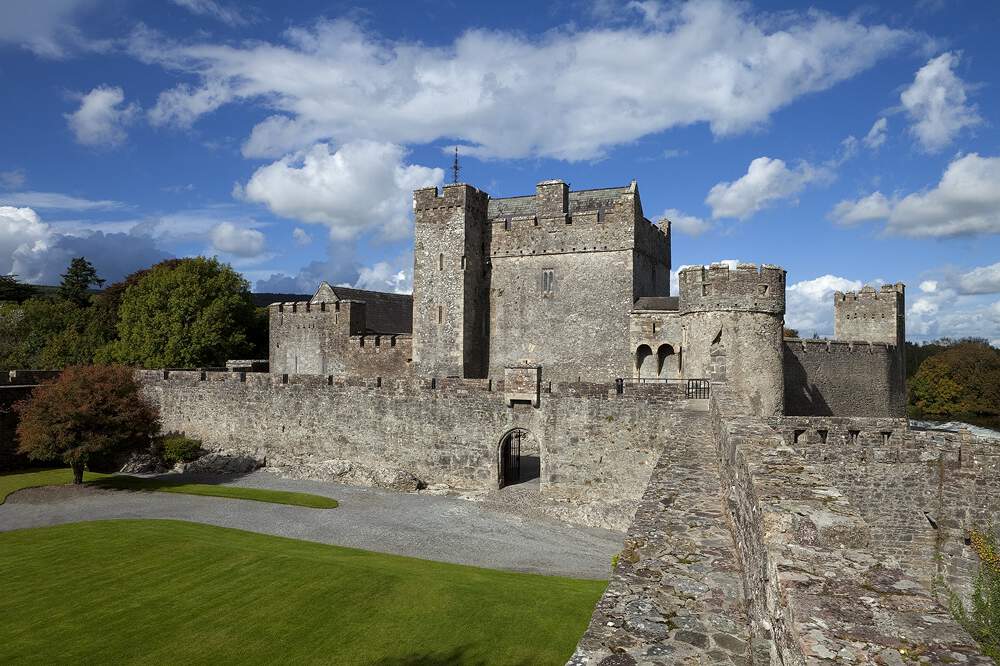
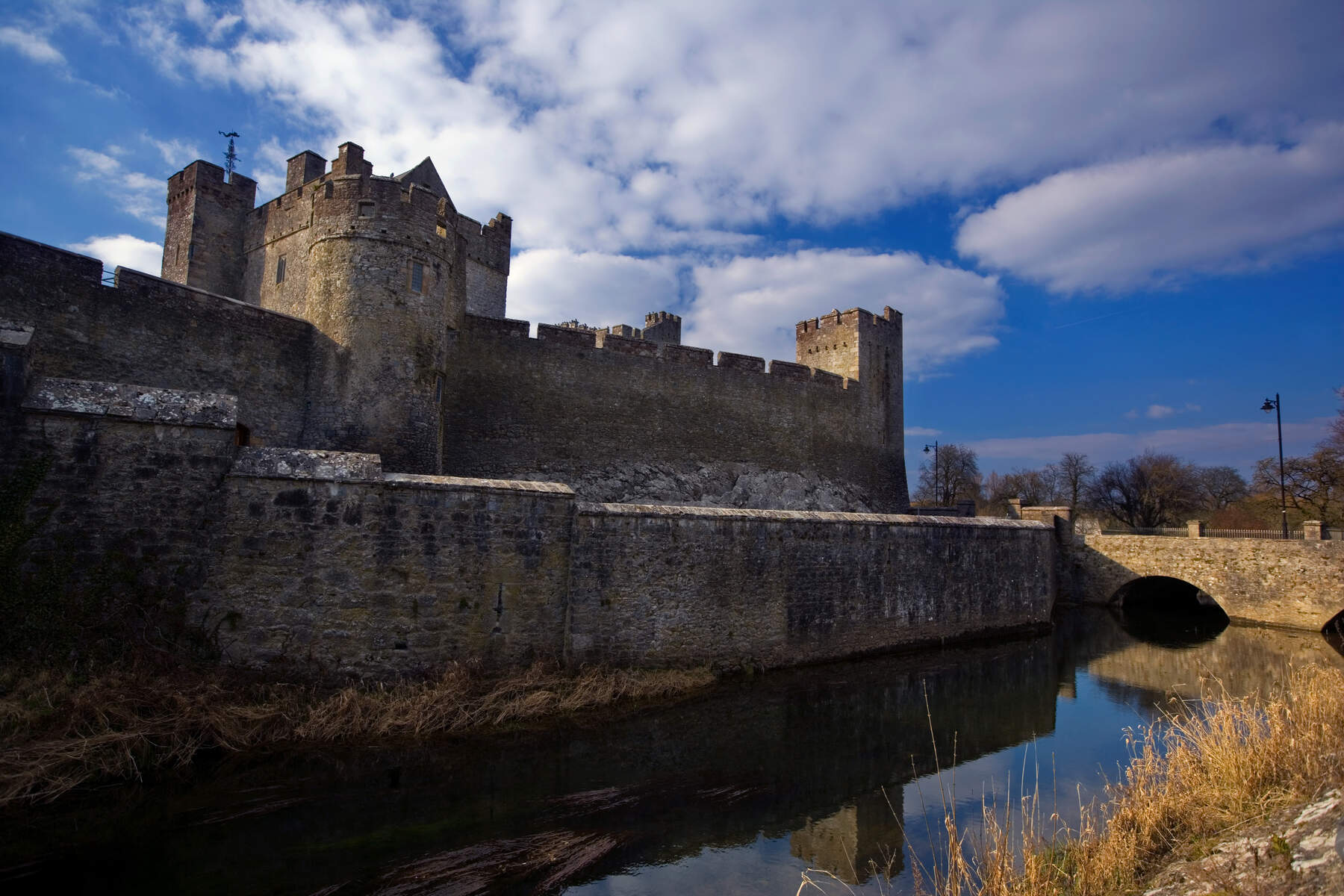
Cahir Castle, photograph from Ireland’s Content pool, by Brian Morrison 2014 for Failte Ireland. [see 1]
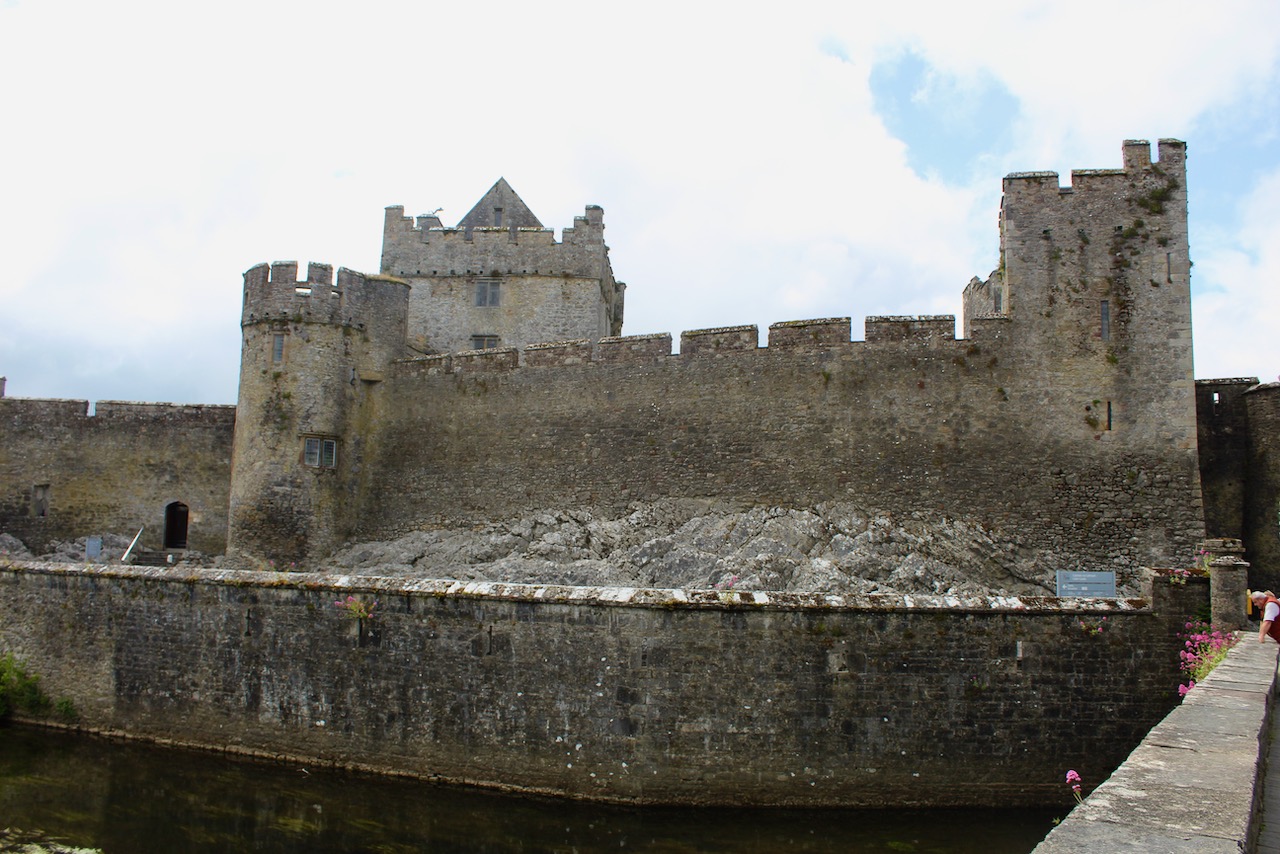
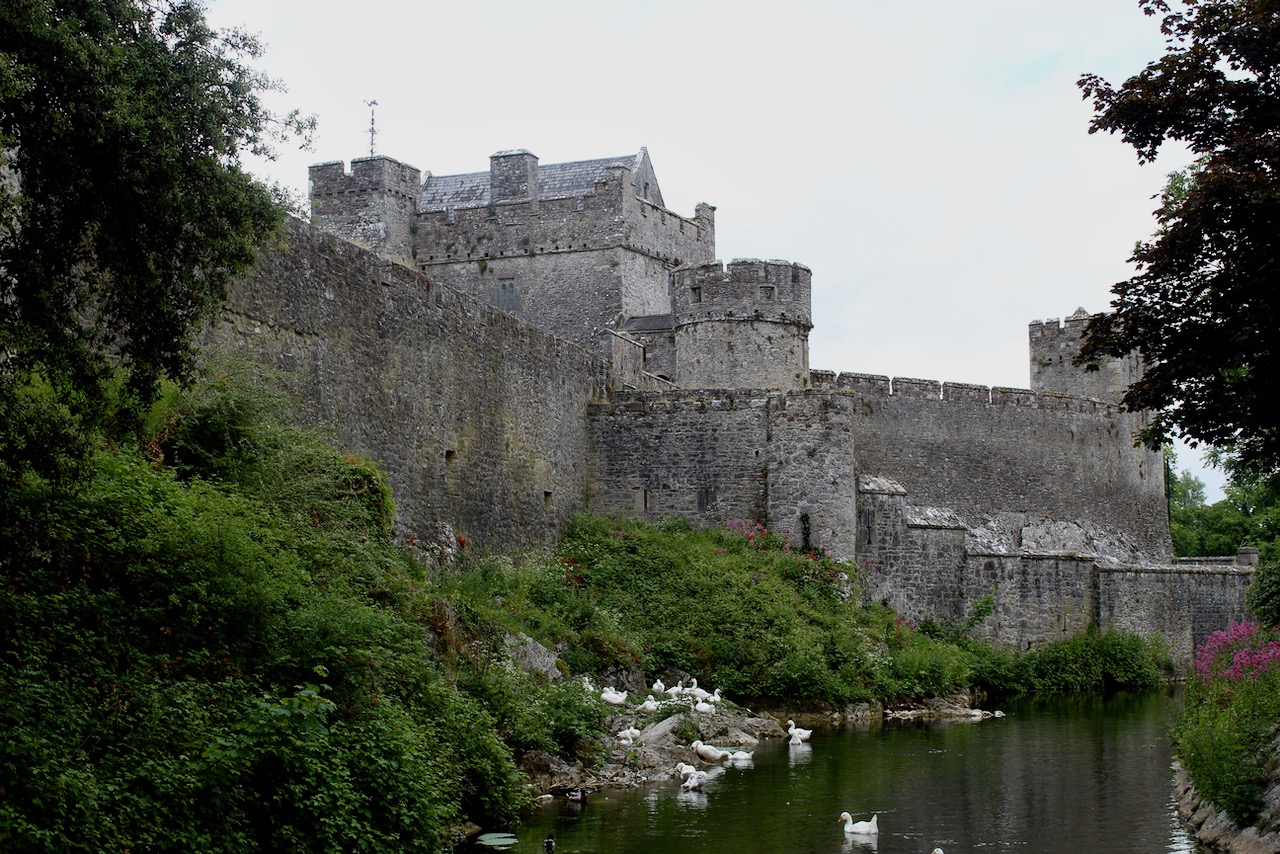
Cahir Castle, June 2022. The geese are particularly picturesque! The outer walls are called the Barbican. When breached, the attacking force gains entry to this area and are vulnerable to missiles fired by defenders and it would be difficult to retreat, due to the enclosed nature of the barbican. Photograph © Jennifer Winder-Baggot, www.irishhistorichouses.com

General information: 052 744 1011, cahircastle@opw.ie

Stephen and I visited Cahir Castle in June 2022, and I was very impressed. I had no idea that we have such an old castle in Ireland with so much intact.

From the OPW website https://heritageireland.ie/visit/places-to-visit/cahir-castle/:

Cahir Castle is one of Ireland’s largest and best-preserved castles. It stands proudly on a rocky island on the River Suir.

The castle was was built in the thirteenth century and served as the stronghold of the powerful Butler family. [The Archiseek website tells us it was built in 1142 by Conor O’Brien, Prince of Thomond] So effective was its design that it was believed to be impregnable, but it finally fell to the earl of Essex in 1599 when heavy artillery was used against it for the first time. During the Irish Confederate Wars it was besieged twice more.

At the time of building, Cahir Castle was at the cutting edge of defensive castle design and much of the original structure remains.

Cahir Castle, photograph from Ireland’s Content pool, by George Munday 2014 for Failte Ireland. [see 1] Barbican wall, courtyard, and gate with overhead machicolation, and the castle keep.
Cahir Caste, County Tipperary, June 2022. Photograph © Jennifer Winder-Baggot, www.irishhistorichouses.com

Our tour guide took us through the castle as if we were invaders and showed us all of the protective methods used. We were free then to roam the castle ourselves.

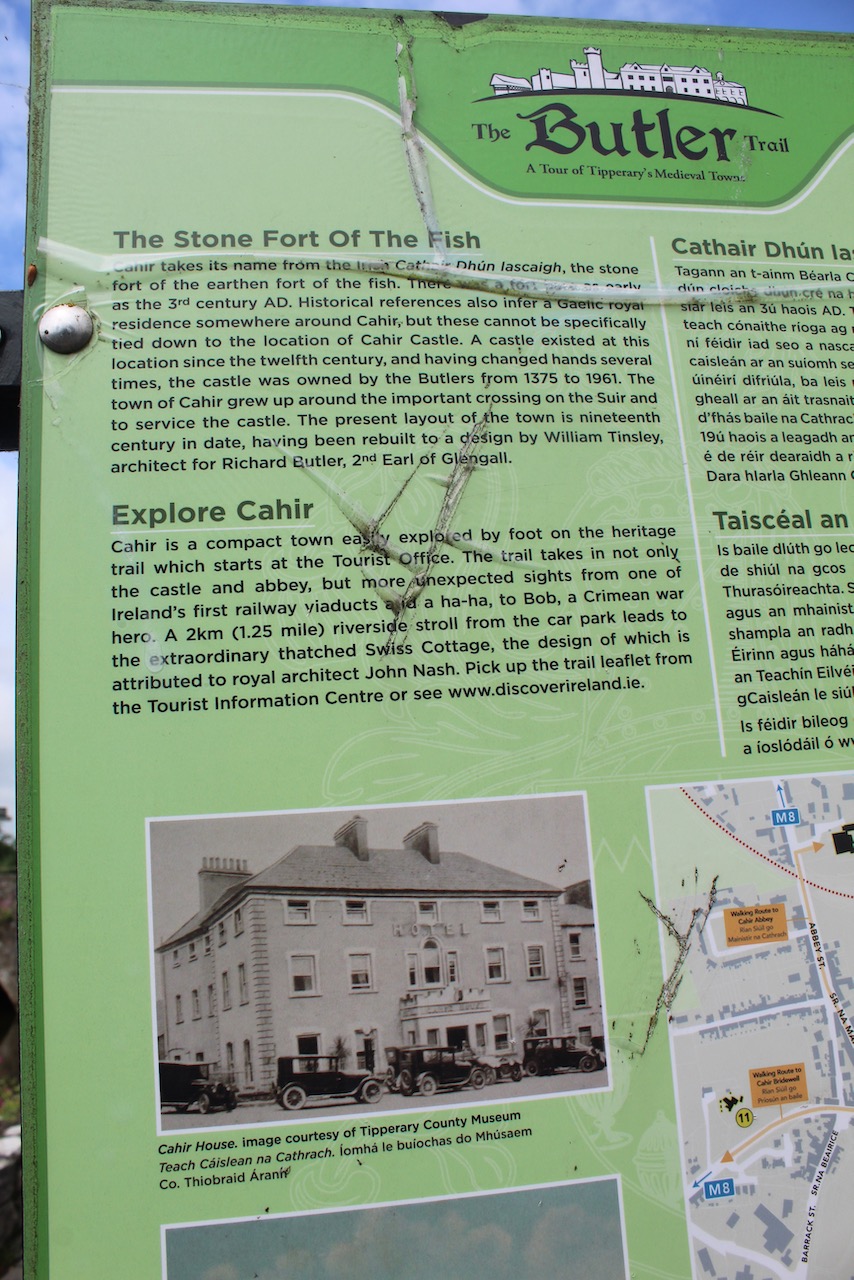
The name derives from the Irish ‘an Chathair Dhun Iascaigh’ meaning stone fort of the earthen fort of the fish.

Cahir Caste, County Tipperary, June 2022. The view of the castle from the parkland beyond. See how it seems to grow out of the rocks! Photograph © Jennifer Winder-Baggot, www.irishhistorichouses.com
Cahir Caste, County Tipperary, June 2022. Photograph © Jennifer Winder-Baggot, www.irishhistorichouses.com
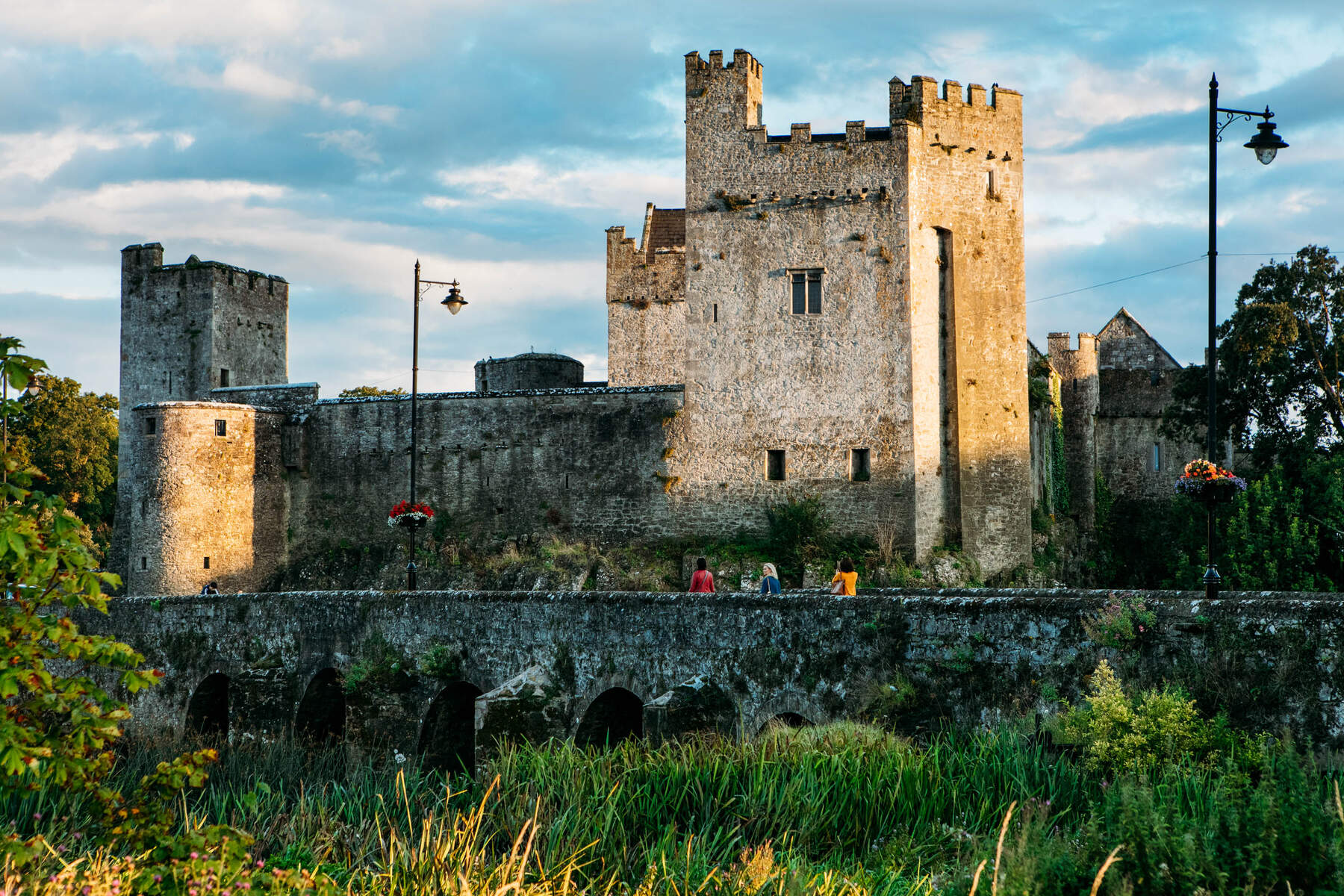
Cahir Castle, photograph from Ireland’s Content pool, by Liam Murphy 2016 for Failte Ireland. [see 1] The large square tower in the foreground was built later than the keep, for housing prisoners.
Cahir Castle, June 2022.

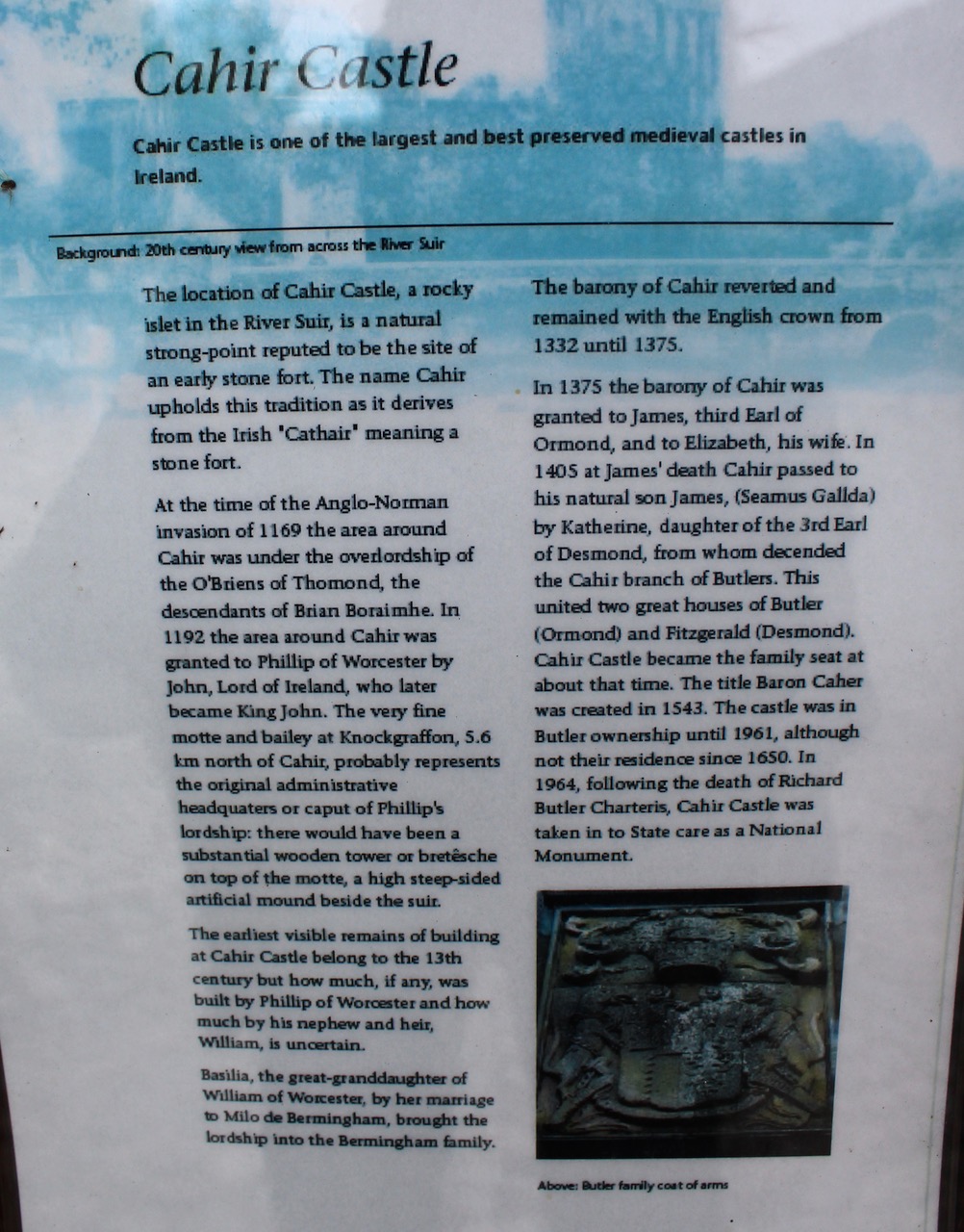
The information leaflet tells us that the area was owned by the O’Briens of Thomond in 1169 at the time of the Anglo-Norman invasion. The area around Cahir was granted to Phillip of Worcester in 1192 by John, Lord of Ireland, who later became King John. His nephew William was his heir – I’m not sure of his surname! But then his great-granddaughter, Basilia, married Milo (or Meiler) de Bermingham (he died in 1263). They lived in Athenry and their son was the 1st Lord Athenry, Piers Bermingham (died 1307).

Edward III (1312-1377) granted the castle to the James Butler 3rd Earl of Ormond in 1357 and also awarded him the title of Baron of Cahir in recognition of his loyalty. The 3rd Earl of Ormond purchased Kilkenny Castle in c. 1392. Cahir Castle passed to his illegitimate son James Gallda Butler. James Gallda was loyal to his mother’s family, the Desmonds, who were rivals to his father’s family, the Butlers.
Cahir Castle, June 2022.
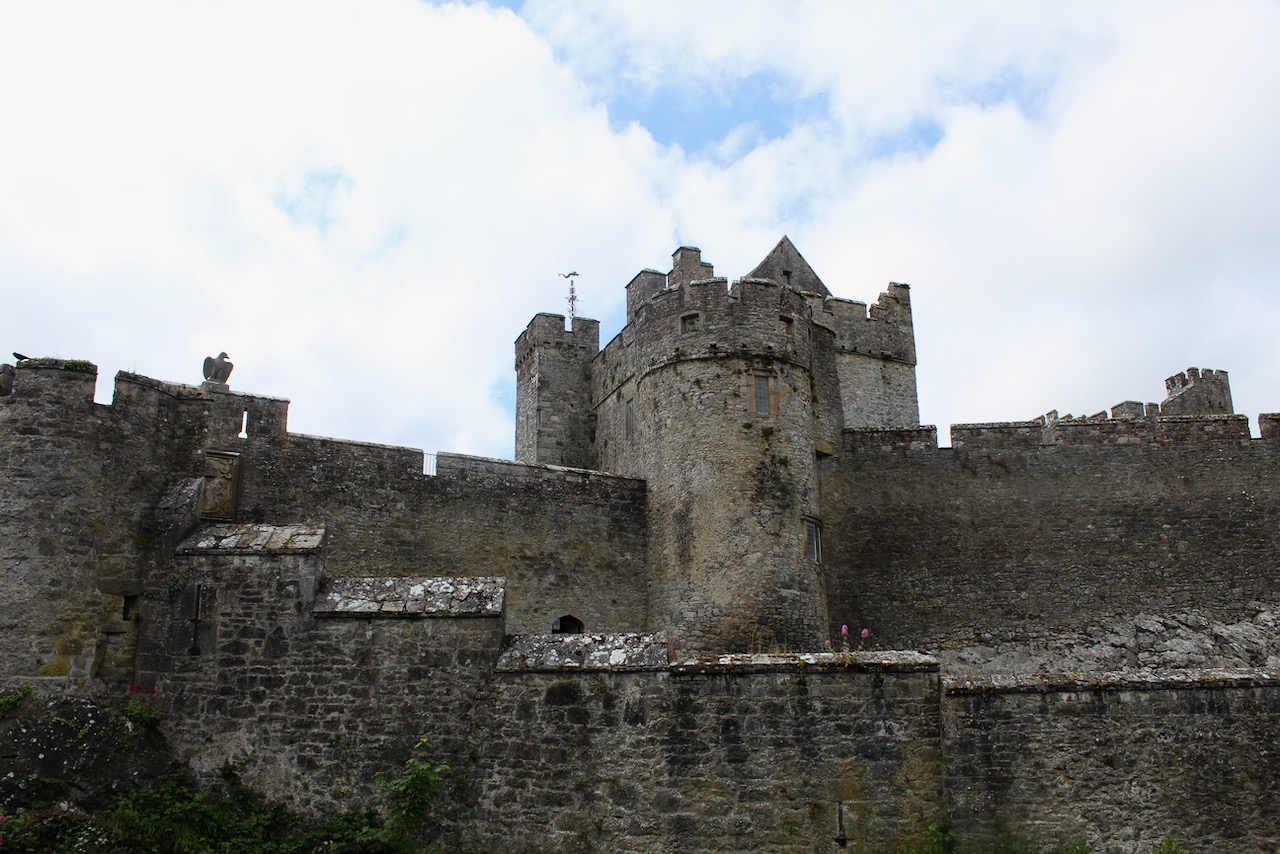
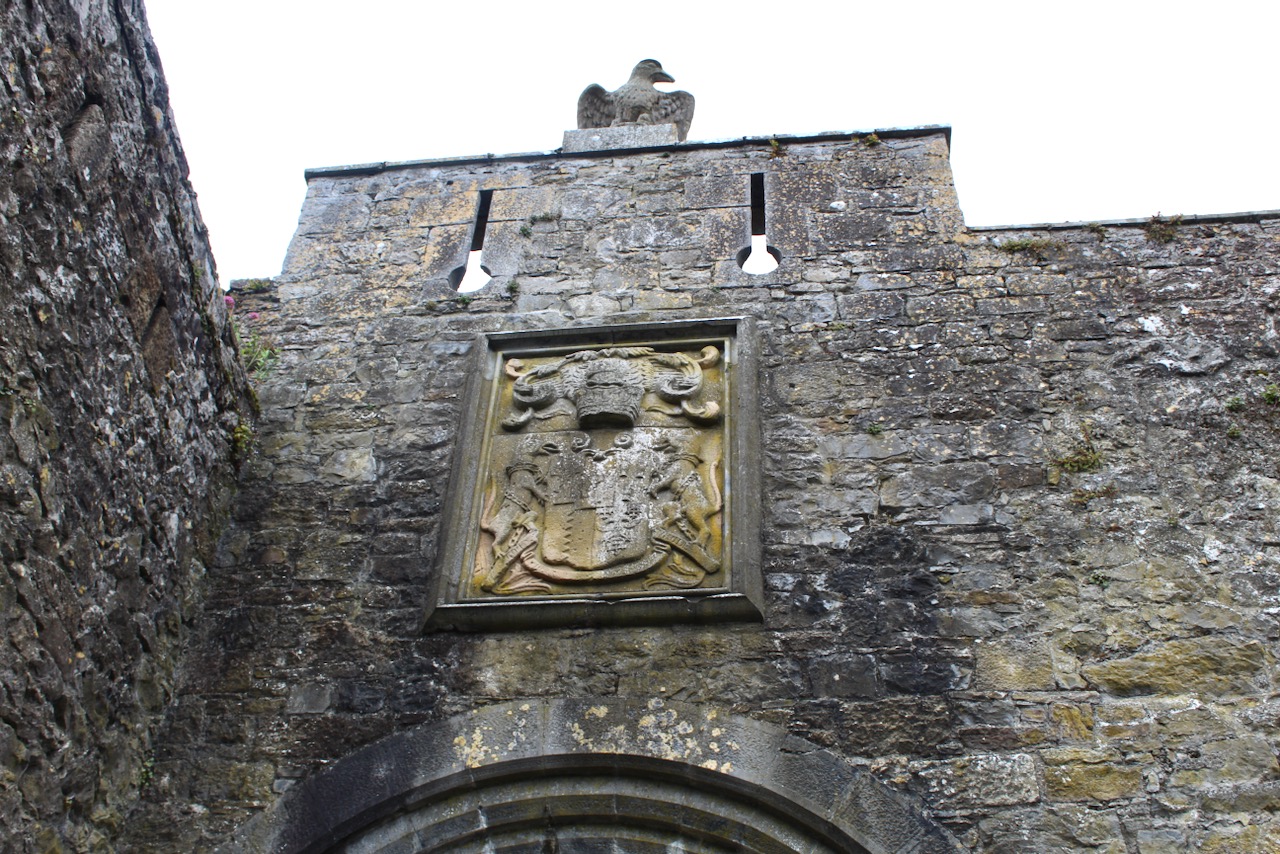
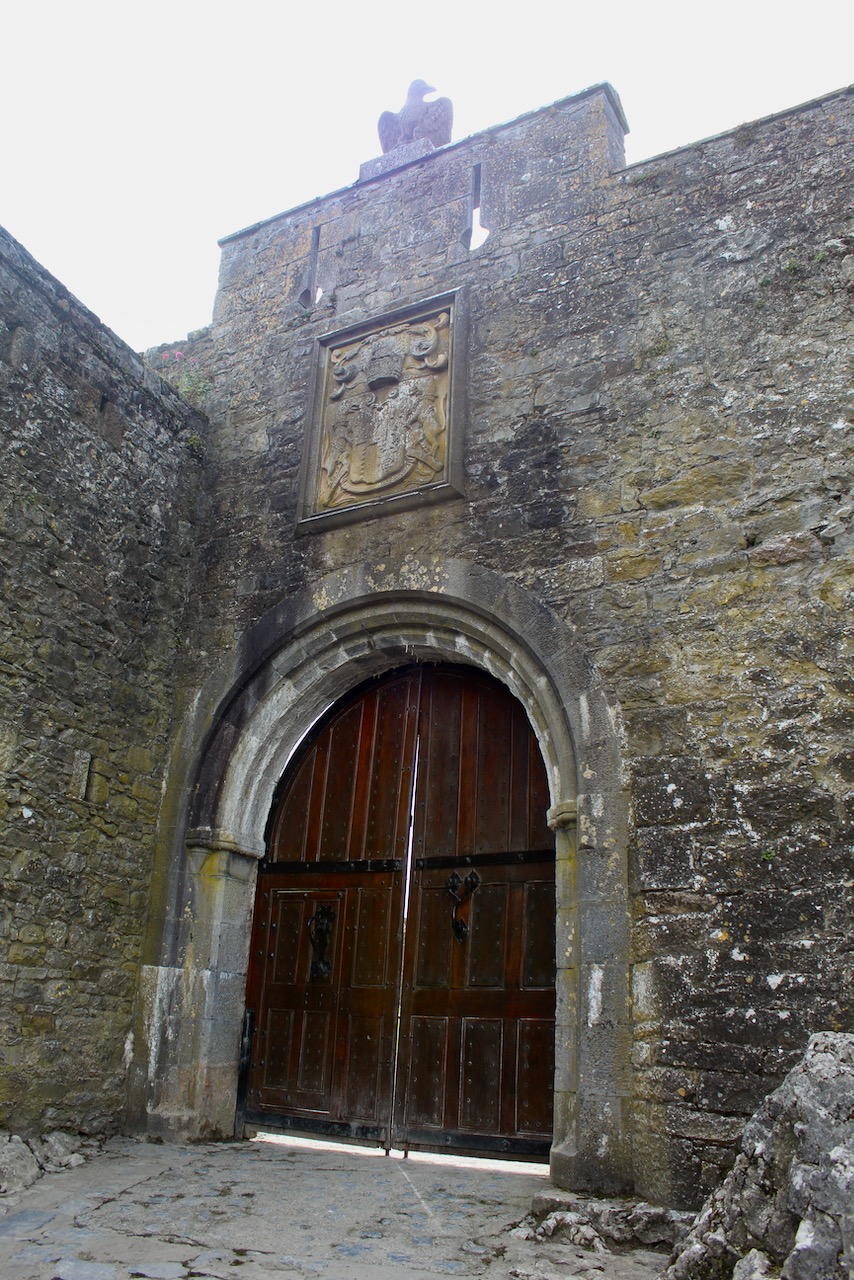
The first entrance gates, to the bawn (walled courtyard or outer enclosure) of Cahir Castle. Above the door on the top of the wall an eagle is perched, symbol of power. Below that is the crest of the Butlers of Cahir. Photograph © Jennifer Winder-Baggot, www.irishhistorichouses.com
Cahir Castle, June 2022. Photograph © Jennifer Winder-Baggot, www.irishhistorichouses.com

In their book The Tipperary Gentry, William Hayes and Art Kavanagh tell us that the rivalry between the Butlers of Ormond and the Fitzgeralds of Desmond turned to enmity when the War of the Roses broke out in England, with the Ormonds supporting the House of Lancaster and the Desmonds the House of York. The enmity found expression in the battle at Pilltown in 1462. The enmity continued for over a century, and the last private battle between the Ormonds and the Desmonds was the Battle of Affane, County Waterford, in 1565. [2]

A descendant of James Gallda Butler, Thomas Butler (d. 1558) was elevated to the peerage of Ireland, on 10 November 1543, by the title of Baron of Caher (of the second creation). He married Eleanor, a daughter of Piers Butler, 8th Earl of Ormond (d. 1539) and Margaret Fitzgerald, daughter of Gerald FitzGerald, 8th Earl of Kildare (d. 1513). His son Edmund became the 2nd Baron (d. 1560) but as there were no legitimate male heirs the title died out.

It was Piers Rua Butler, the 8th Earl of Ormond (c. 1467–1539), who brought peace between the warring factions of Fitzgeralds of Desmond and the Butlers of Ormond. He married Margaret Fitzgerald, daughter of Gerald (or Garret) Fitzgerald (1455-1513) 8th Earl of Kildare. His efforts culminated in a treaty called the Composition of Clonmel. It stated that Edmund Butler of Cahir should receive the manor of Cahir on condition that he and all his heirs “shall be in all things faithful to the Earl [of Ormond] and his heirs.” The Barons of Cahir were not allowed to keep their own private army nor to exact forced labour for the building or repair of their castle or houses. (see [2]).
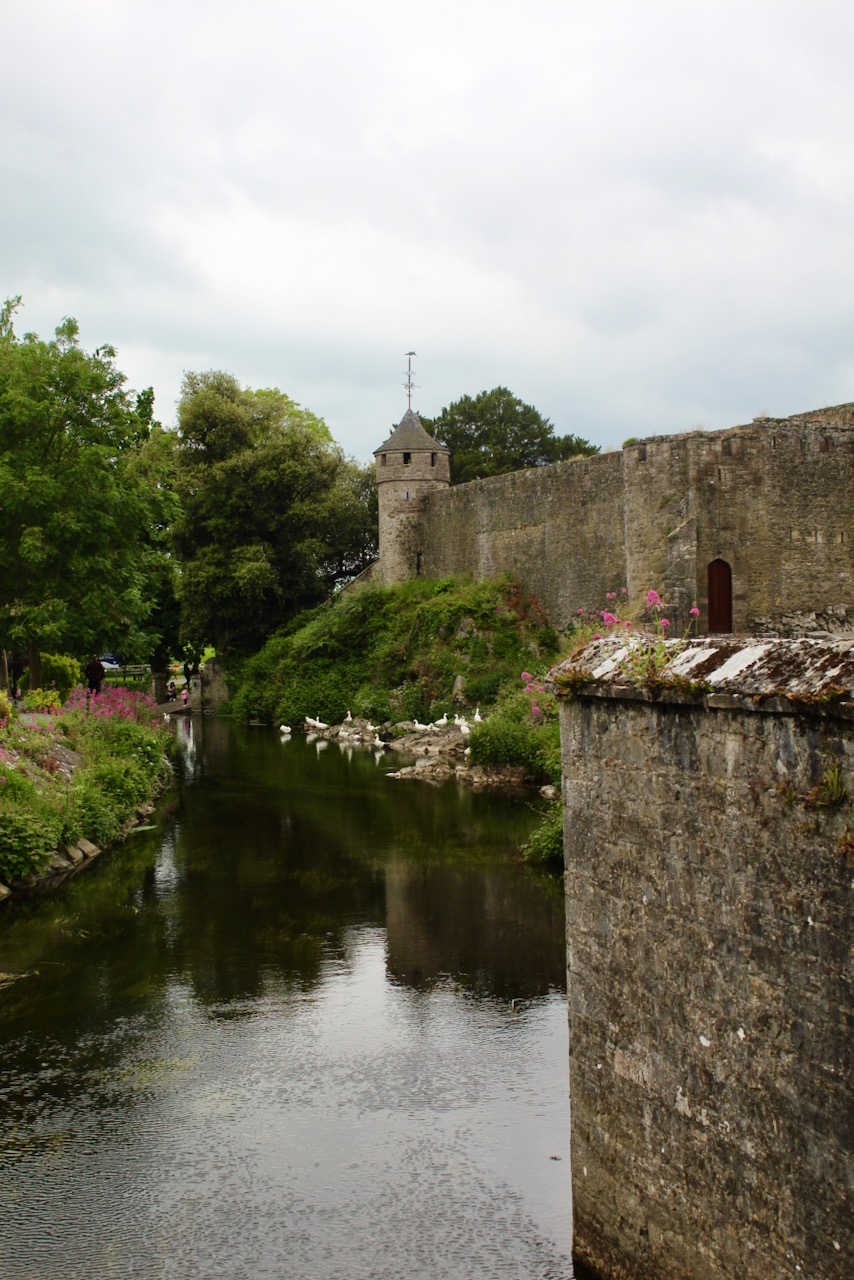
Cahir Castle, June 2022. Photograph © Jennifer Winder-Baggot, www.irishhistorichouses.com

The brother of Thomas 1st Baron Caher, Piers Butler (d. after February 1567/68) had a son Theobald (d. 1596) who was then created 1st Baron Caher (Ireland, of the 3rd creation) in 1583. [3]

There’s an excellent history of Cahir on the Cahir Social and Historical Website:

Throughout the reigns of Elizabeth I and Charles I, Cahir Castle appears as a frequent and important scene in the melancholy drama of which Ireland was a stage. The Castle was taken and re-taken, but rarely damaged and through it all remained in the hands of the Roman Catholic Butlers of Cahir. By this time Cahir had become a great centre of learning for poets and musicians. Theobald, Lord Cahir [I assume this was 1st Baron Cahir of second creation who died in 1596] was said by the Four Masters “to be a man of great benevolence and bounty, with the greatest collection of poems of any of the Normans in Ireland”. [4]

Cahir Castle, June 2022.

This storyboard tells us that Ireland was dramatically different from Renaissance England in its language, customs, religion, costume and law. It was divided into 90 or so individual “lordships” of which about 60 were ruled by independent Gaelic chieftains. The rest were ruled by Anglo-Irish lords. Queen Elizabeth saw Ireland as a source of much-needed revenue. She did not have sufficient resources nor a strong enough army to conquer Ireland so she encouraged her authorities in Dublin to form alliances between the crown and any local chieftains who would submit to her authority. Many chieftains who submitted did so in order to assist them in their own power struggles against their neighbours. Elizabeth especially needed this support in order to ensure that if Spain invaded Ireland she would be able to quell rebellion.
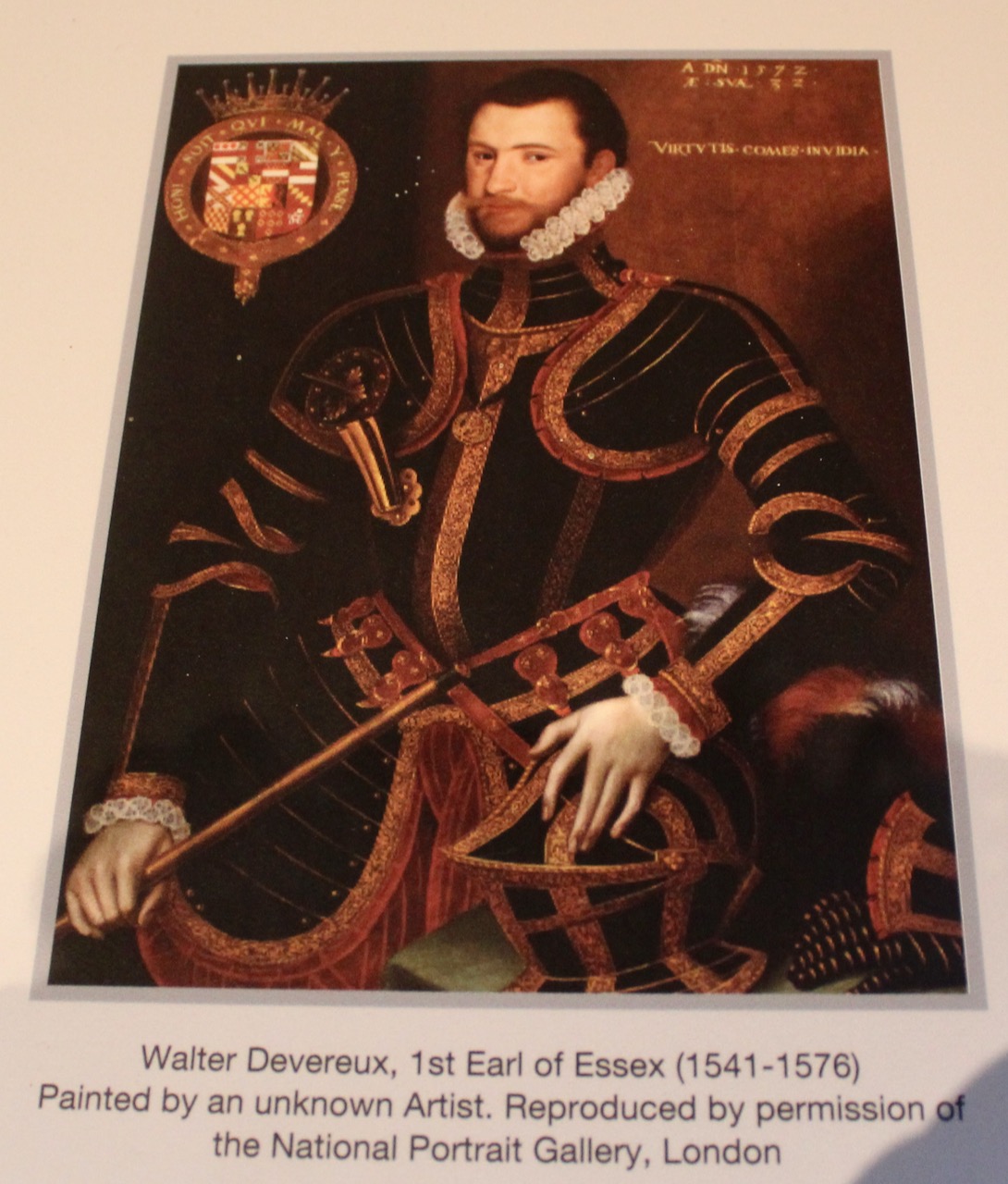
Walter Devereux (1541-1576) 1st Earl of Essex, courtesy of National Portrait Gallery, London.

Walter Devereux, 1st Earl of Essex, travelled to Ireland to subjugate Ulster and Shane O’Neill (“The O’Neill) in 1573. He failed, and had to sell of much of his land in England to pay debts accrued from raising an army. He died in Dublin of typhoid in 1576.

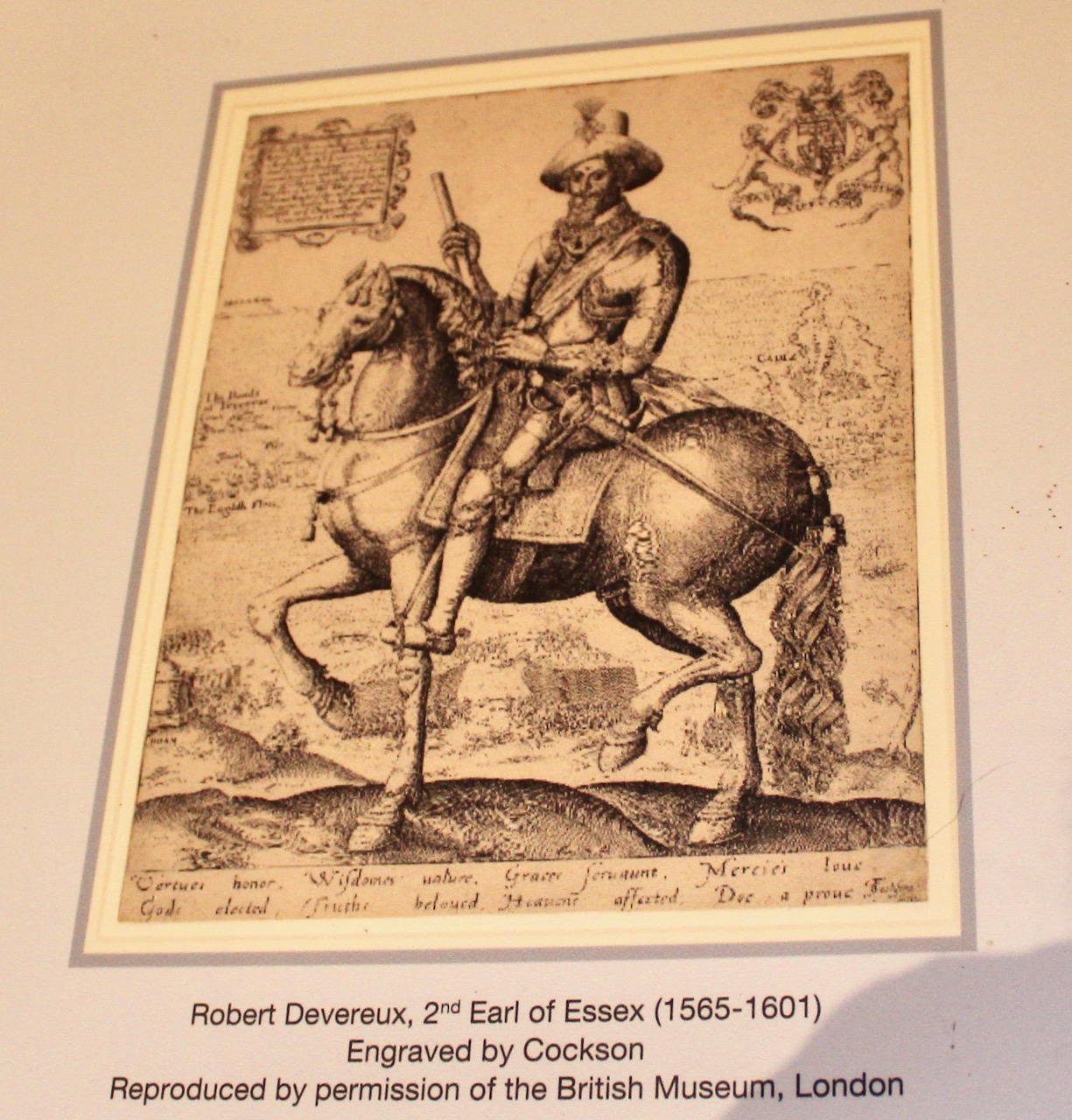
His son, the 2nd Earl of Essex came to Ireland to quell a rebellion which included the rise of Hugh O’Neill, 2nd Earl of Tyrone (1550-1616), cousin of Shane O’Neill.
Cahir Castle, June 2022.

The storyboard tells us that Hugh O’Neill fought alongside the 1st Earl of Essex in Ulster between 1573 and 1575. He also fought for Queen Elizabeth in 1580 against the rebel Gerald Fitzgerald, 14th Earl of Desmond (circa 1533, d. 11 November 1583), and as thanks he was made Earl of Tyrone. However, he turned against the crown in 1594 and formed an alliance with Red Hugh O’Donnell to fight against the Queen’s troops, in the Nine Years War.

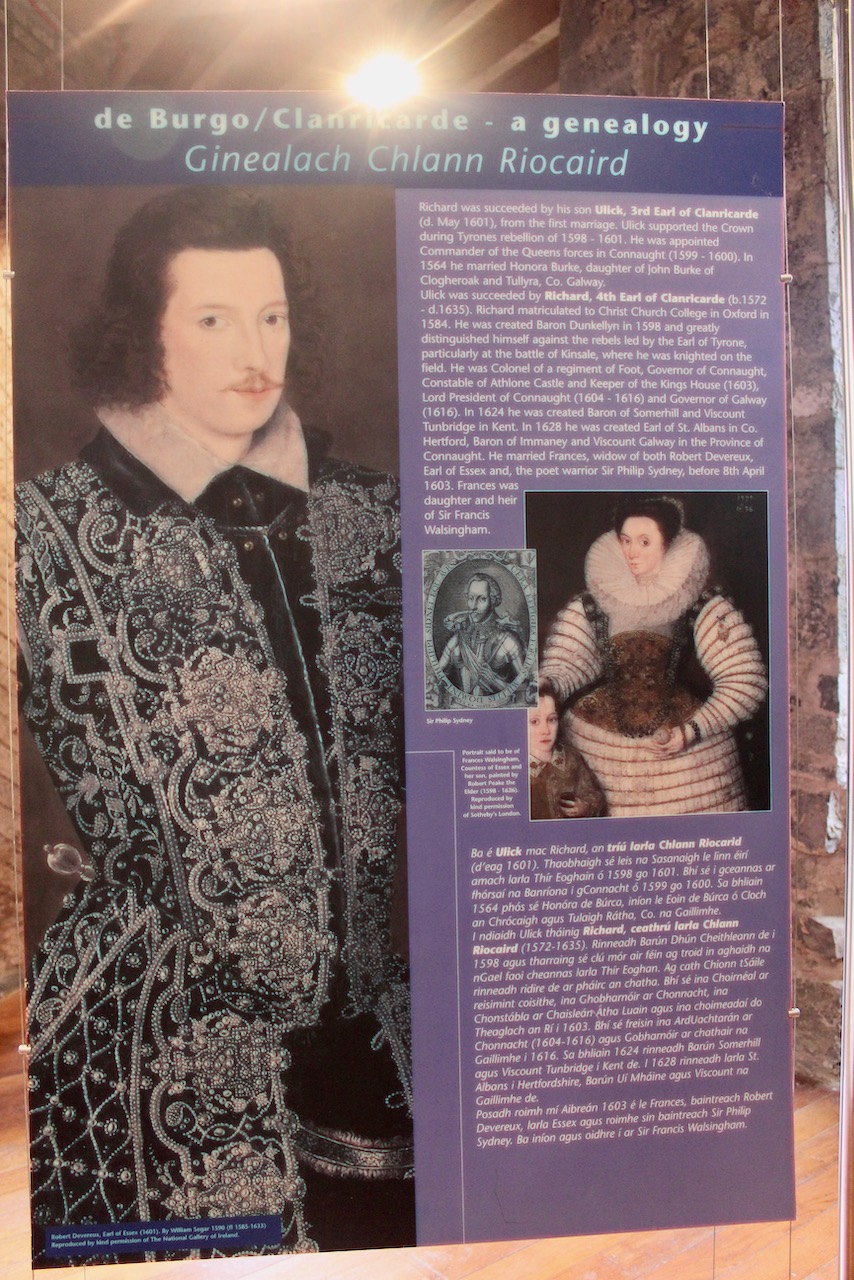
The ties between the Earls of Essex and Queen Elizabeth I are complicated. When Walter Devereux the 1st Earl died in Ireland, his wife, Lettice Knollys, remarried. She and Queen Elizabeth’s favourite, Robert Dudley Earl of Leicester, married secretly, a fact which enraged the disappointed Queen. It was Robert Dudley who introduced his stepson Robert Devereux 2nd Earl of Essex to Elizabeth and he subsequently became her favourite, alongside Walter Raleigh. However, Elizabeth was to be angered again when this next favourite, Devereux, also secretly married, this time to Frances Walsingham, who was the widow of Sir Philip Sidney. We came across her before when we visited Portumna Castle as she later married Richard Bourke 4th Earl of Clanricarde. Philip Sidney was the son of Henry Sidney (or Sydney) who had been Lord Deputy of Ireland.
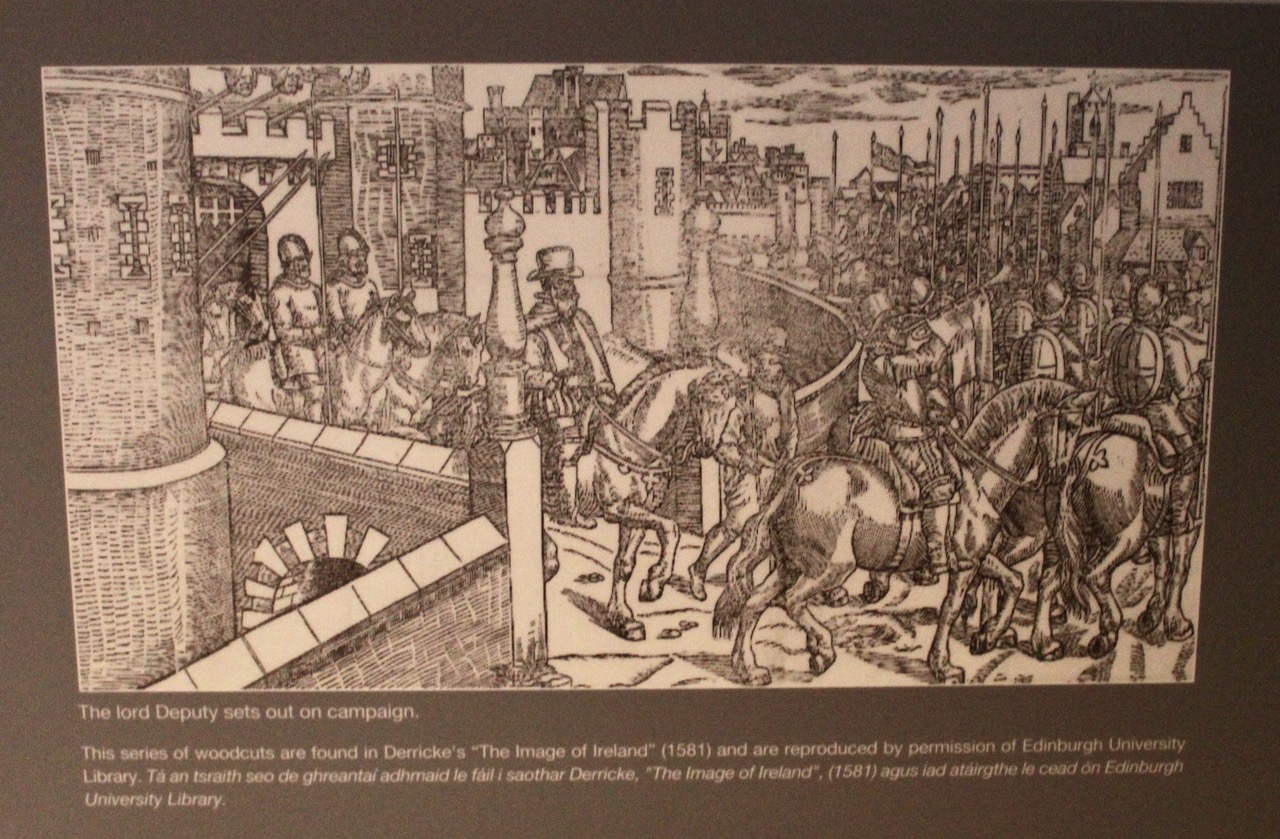
Lord Deputy Henry Sidney is shown crossing a moat leaving Dublin Castle, setting out on a campaign. Above the gate are a number of severed heads!
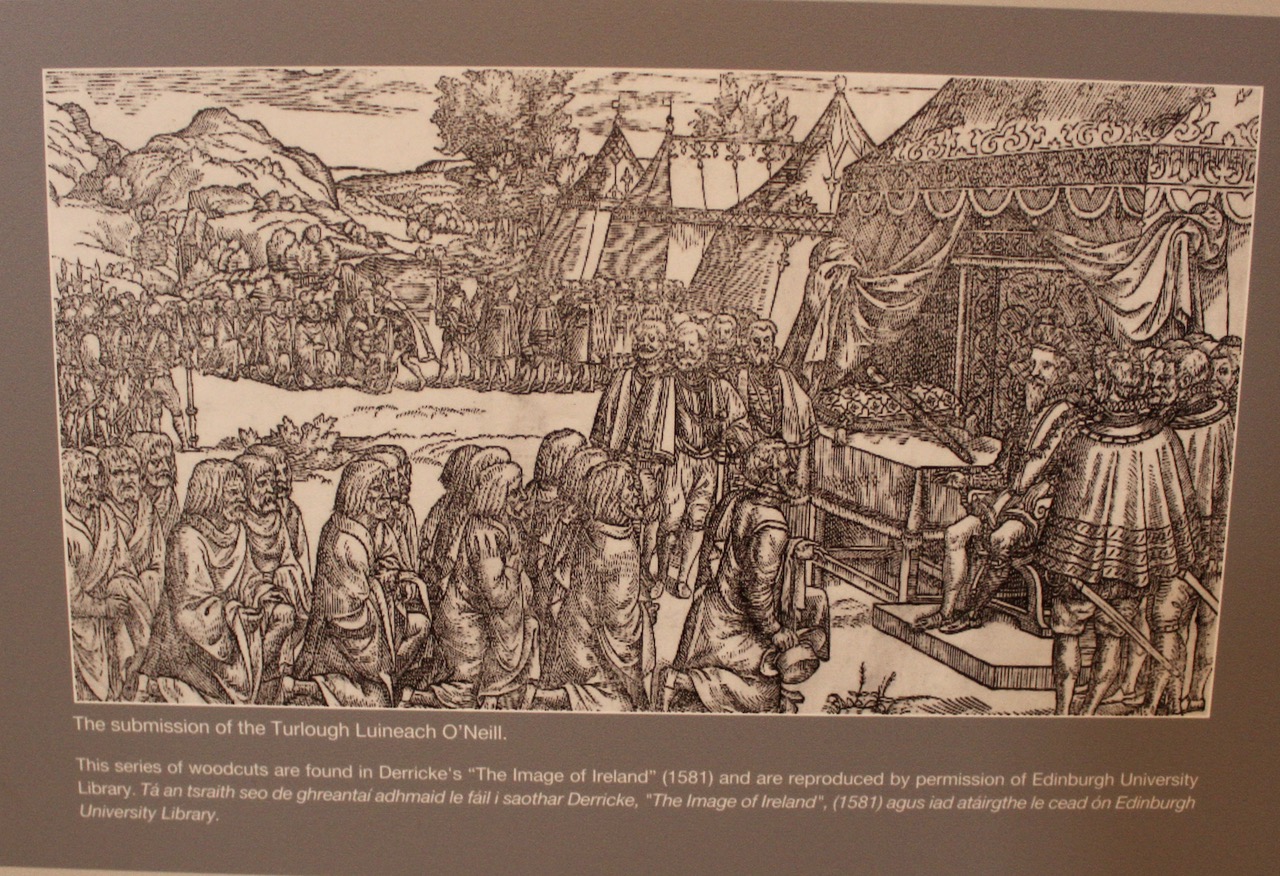
The submission of Turlough Luineach O’Neill to Lord Deputy Sir Henry Sidney in 1575.
Sir Henry Sidney (1529-1586), Lord Deputy of Ireland, after painter Arnold Van Brounkhorst, courtesy of National Gallery of Ireland.
Portrait of Frances Walsingham, along with her husband Robert Devereux, 2nd Earl of Essex, and in the small picture, Sir Philip Sydney, from information board in Portumna Castle.

Robert Devereux the 2nd Earl of Essex sought to re-win courtly favour by going to fight in Ireland, following the footsteps of his father, and persuaded Elizabeth to name him Lord Lieutenant of Ireland.

In May 1599, Essex and his troops besieged Cahir Castle. He arrived with around two to three thousand men, a cannon and a culverin, a smaller and more accurate piece of heavy artillery.

Thomas Butler the 10th Earl of Ormond, who owned the castle in Carrick-on-Suir and was another favourite of the Queen, as he had grown up with her in the English court. However, the storyboards tell us that he at first rebelled, alongside Thomas Butler 2nd Baron Cahir (or Caher – they seem to be spelled interchangeably in historical records) and Edmond Butler, 2nd Viscount Mountgarret (1540-1602), another titled branch of the Butler family.
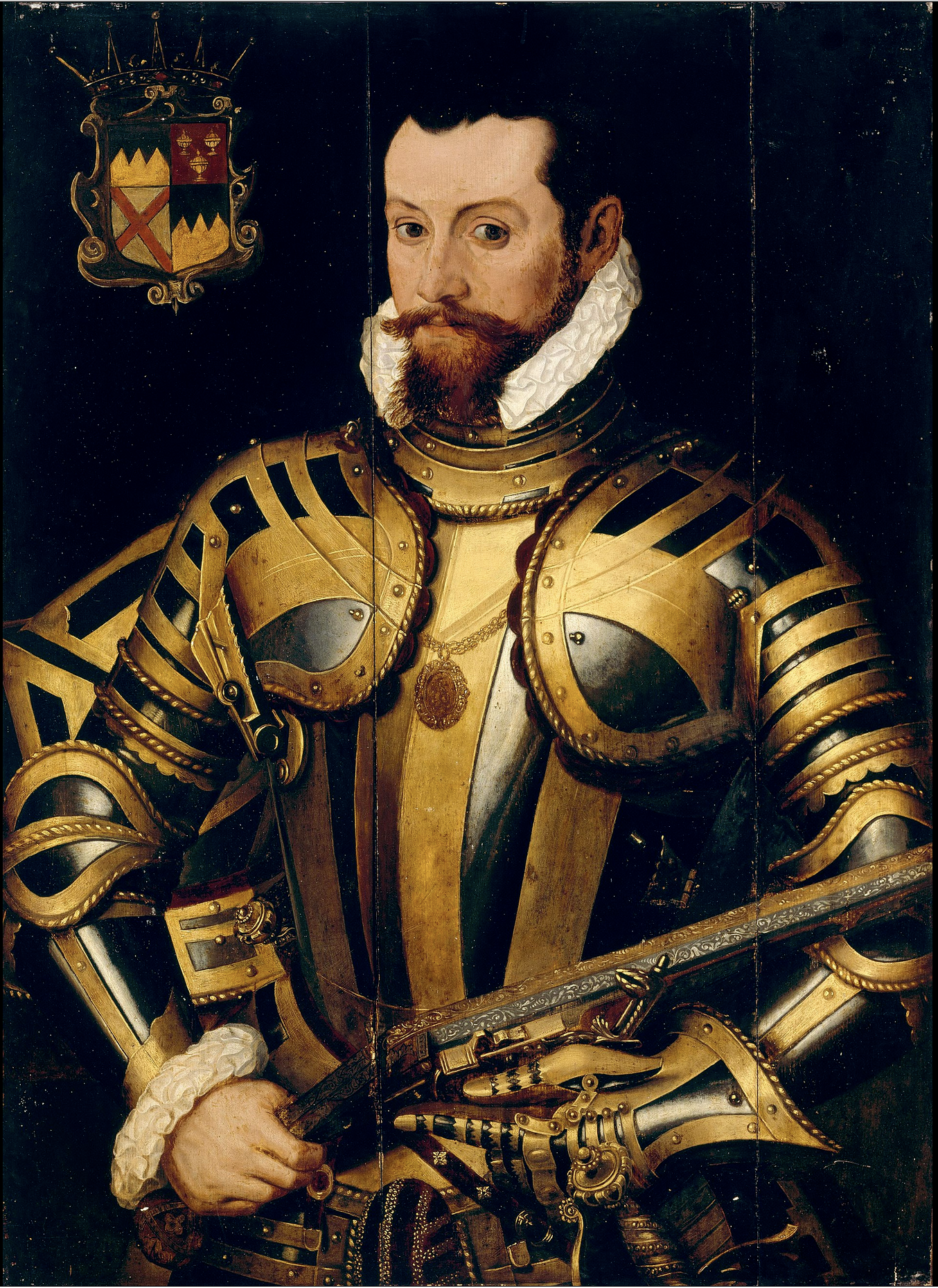
Thomas Butler 10th Earl of Ormond by Steven Van der Meulen. He is holding a wheelcock pistol with his coat of arms in the upper left corner.

By the time of the 1599 siege, the Earl of Ormond was fighting alongside Essex, and Cahir Castle was held by rebels, including Thomas Butler’s brother James Gallada Butler (not to be confused with the earlier James Galda Butler who died in 1434). Thomas Butler 2nd Baron Cahir travelled with Essex toward the castle. Baron Cahir sent messengers to ask his brother to surrender the castle but the rebels refused. Thomas Butler 2nd Baron Cahir was suspected of being involved with the rebels. Thomas was convicted of treason but received a full pardon in 1601 and occupied Cahir Castle until his death in 1627. James Gallada Butler claimed that he had been forced by the rebels to fight against Essex. Essex and his men managed to capture the castle.

During the three days of the siege, the castle incurred little damage, mostly because the larger cannon broke down on the first day! Eighty of the defenders of the castle were killed, but James Gallada Butler and a few others escaped by swimming under the water mill. This siege was to be the only time that castle was taken by force. James Gallada recaptured the castle the following year and held it for some months. The Butlers regained possession of the castle in 1601.
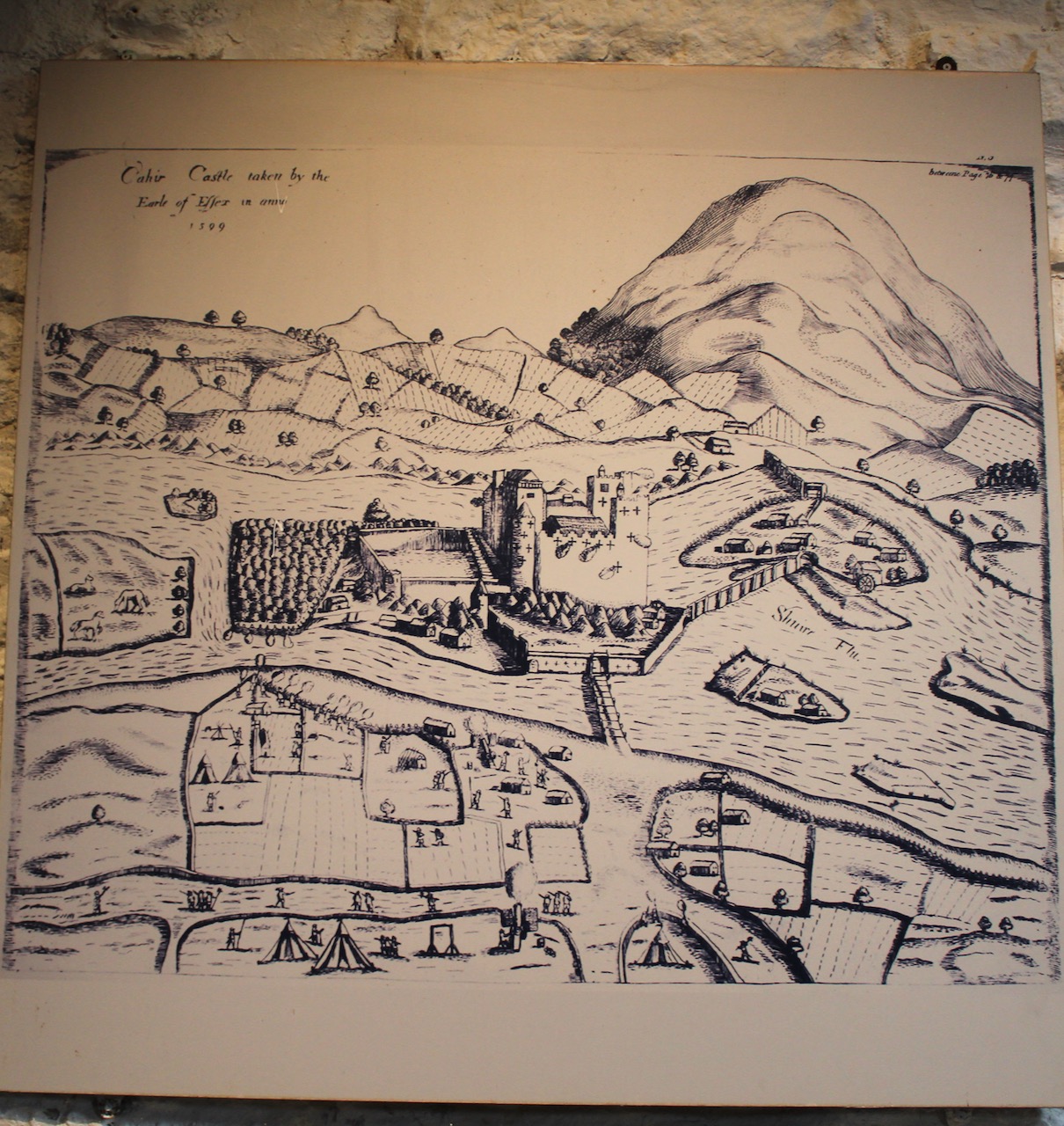
Cahir Castle taken by the 2nd Earl of Essex in 1599.
Cahir Castle, June 2022.

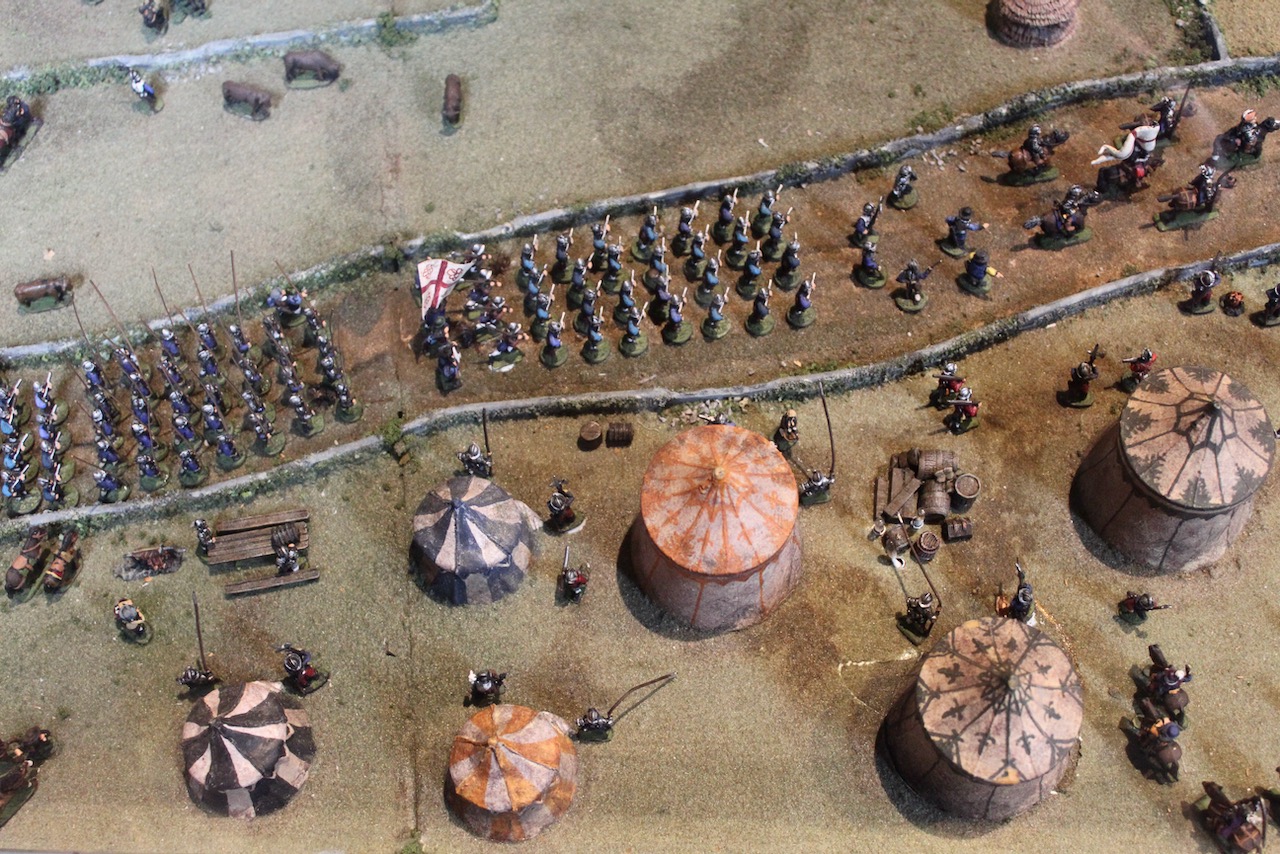
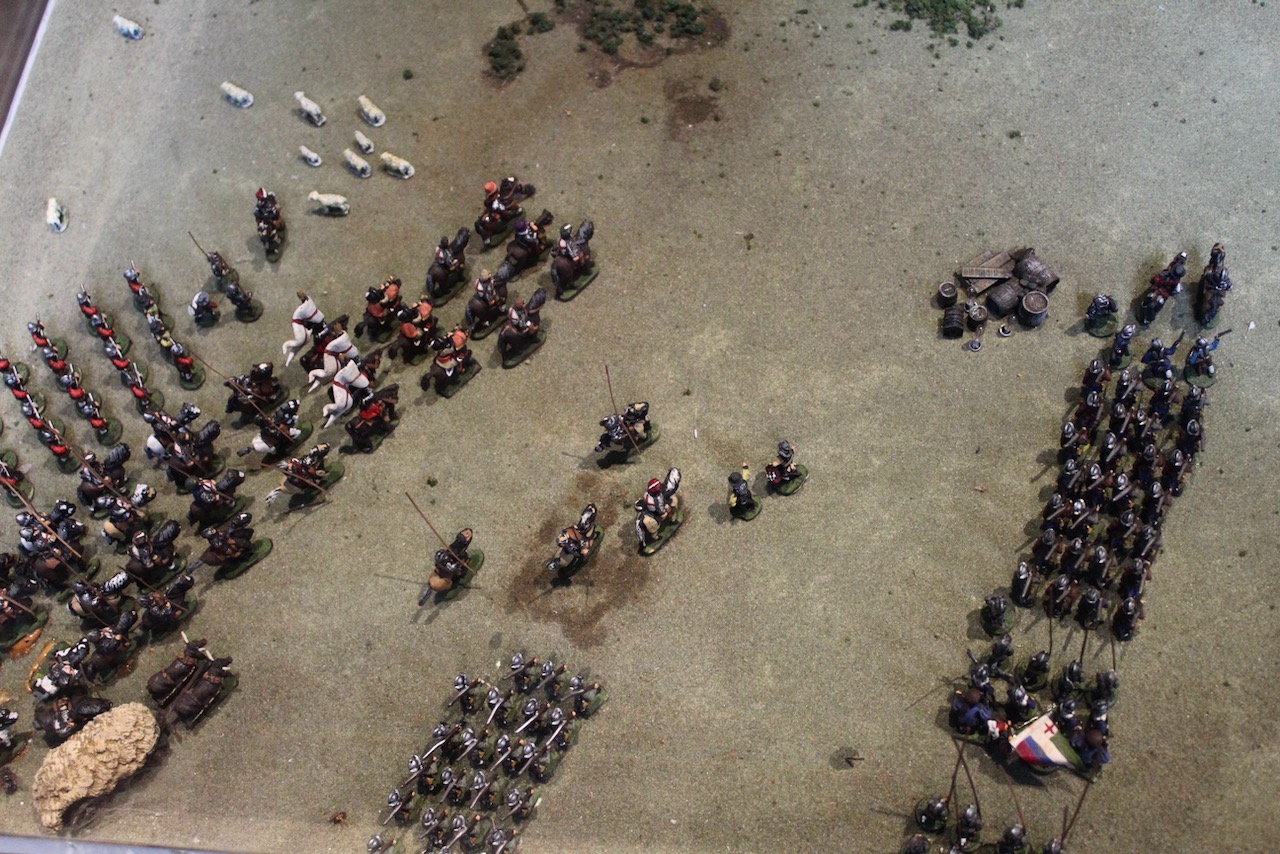
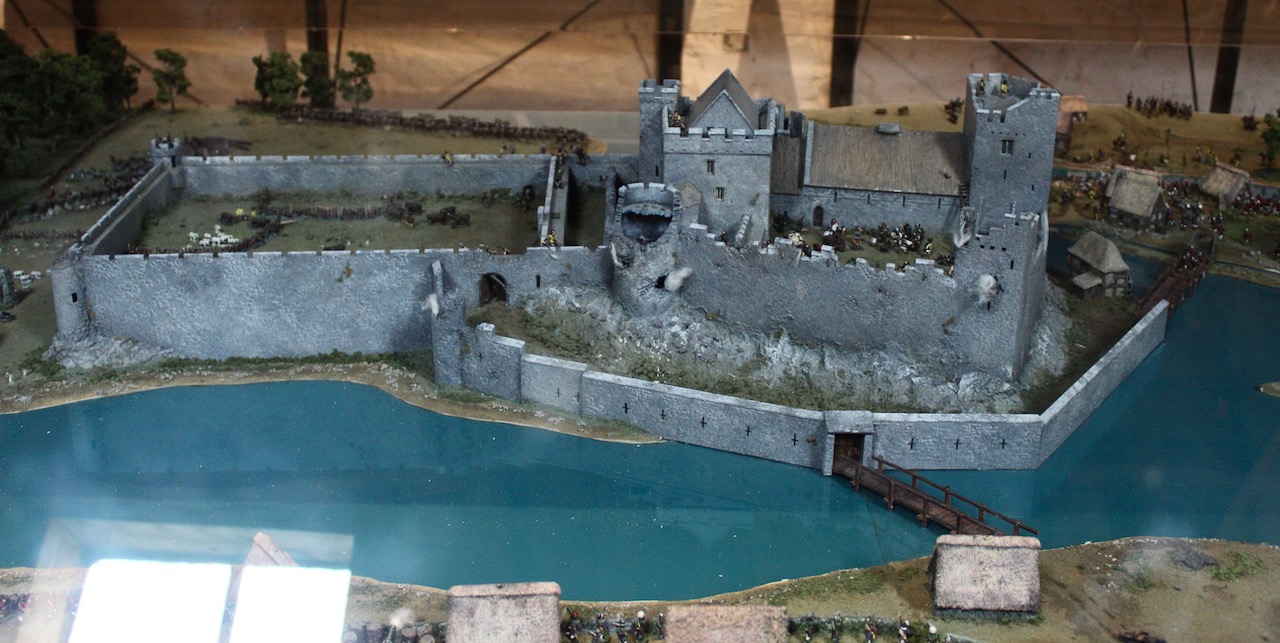
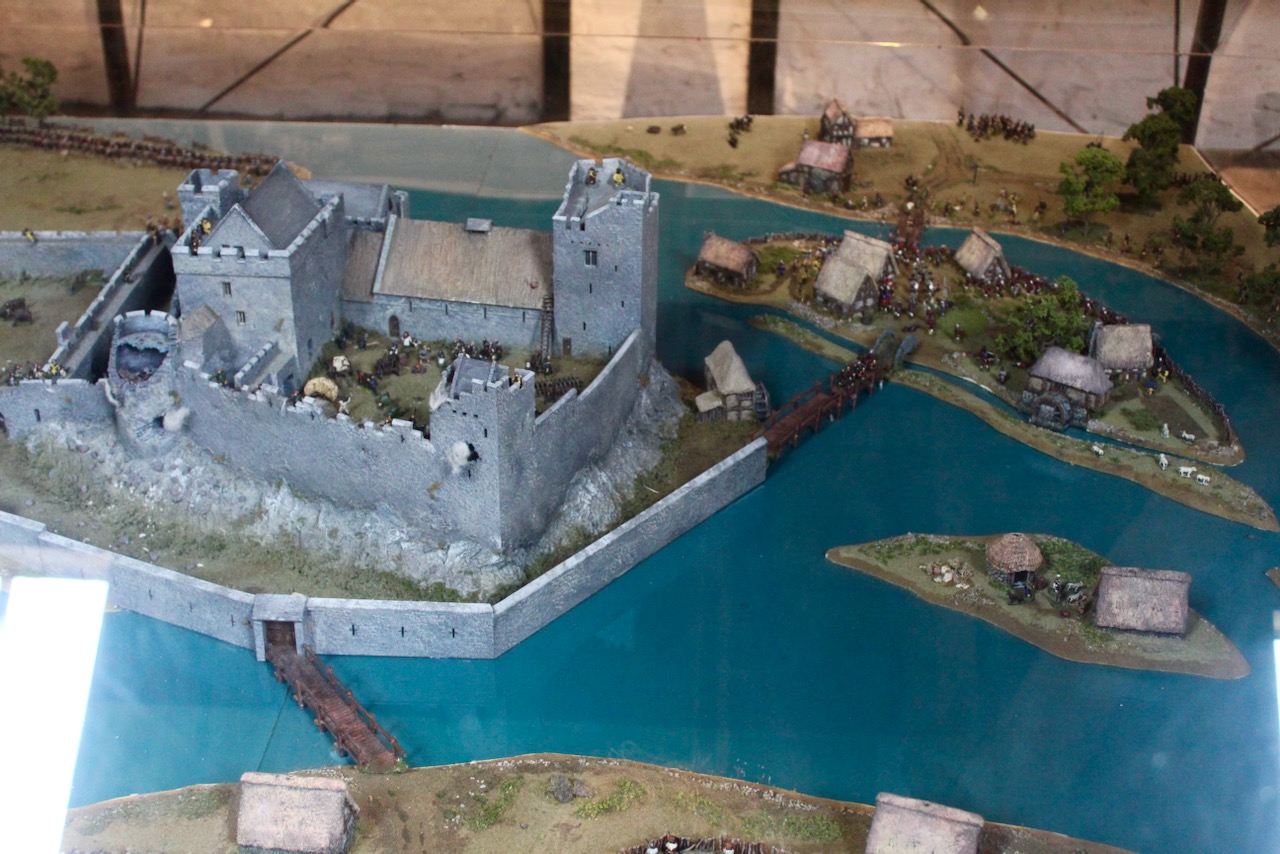
Inside the castle in one room was a wonderful diorama of this siege of Cahir Castle, with terrifically informative information boards.
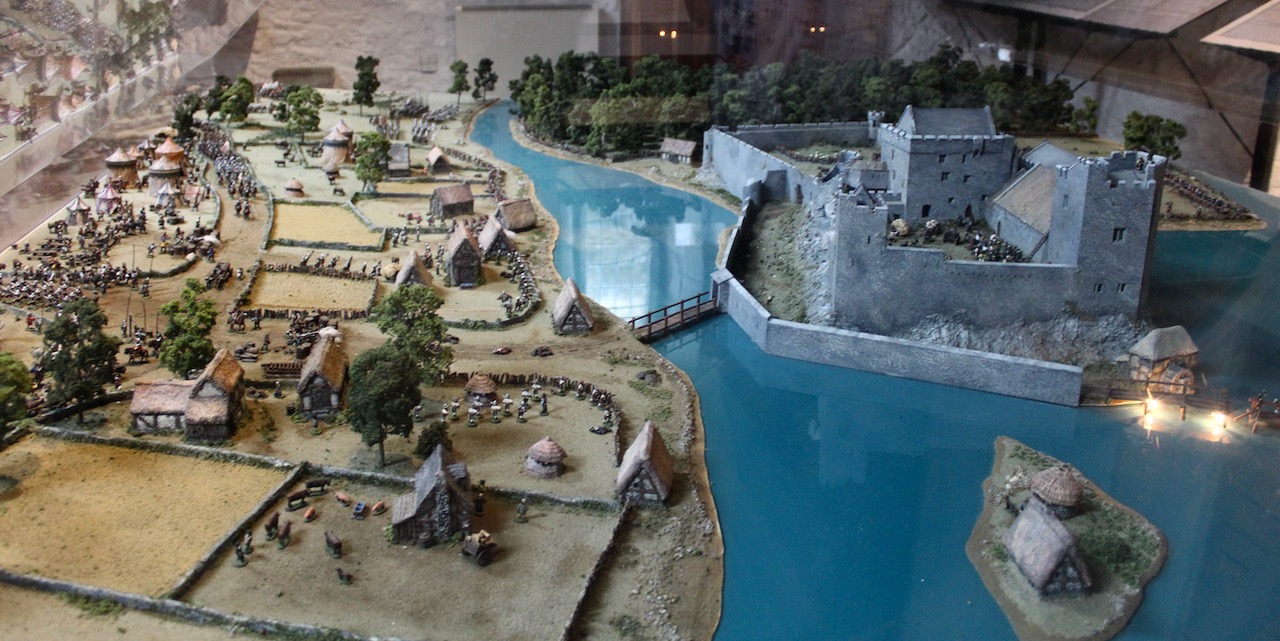
The Diorama of the 1599 Siege.
The Diorama of the 1599 Siege. The siege map and diorama show the wall of the barbican extending further than it does now, to the bridge across to the island. The plan also shows a number of buildings in the inner ward that no longer exist. The shape of the islands and riverbanks changed following construction of a weir.
The Diorama of the 1599 Siege.
Someone must have had great fun setting up the little toy soldiers in their fight formations in the diorama.
The Diorama of the 1599 Siege.

Failing to win in his battles in Ireland, however, Essex made an unauthorised truce with Hugh O’Neill. This made him a traitor. The Queen did not accept the truce and forbid Essex from returning from Ireland. He summoned the Irish Council in September 1599, put the Earl of Ormond in command of the army, and went to England. He tried to raise followers to oust his enemies at Elizabeth’s court but in doing so, he brought a small army to court and was found guilty of treason and executed.

The Cahir Social and Historical Website continues:

A study of the Butler Family in Cahir in the sixteenth and seventeenth centuries reveals the rise and fall of one of the minor branches of the House of Ormond. At the end of the fifteenth century, they possessed extensive powers, good territorial possessions and a tenuous link with the main branch of the Butler family. During the sixteenth century, their possession was strengthened by the grant of the title of Baron of Cahir with subsequent further acquisition of land, but they came under closer central government control.”

The Cahir website continues: “A complete reversal in their relations with the Earls of Ormond occurred, strengthened by various marriage alliances. They also participated in political action, both in the Liberty of Tipperary and at National Level. In the late sixteenth and early seventeenth centuries their position was affected by their adherence to Roman Catholicism, which resulted in their revolt during the Nine Years War, and subsequent exclusion from power by the Central Administration. They formed part of the Old English Group and as such, suffered from the discriminatory politics practiced by the Government. From 1641 they became minor landowners keeping their lands by virtue of the favour of their relative, the Duke of Ormond. In 1647 the Castle was surrendered to Lord Inchiquin for Parliament but re-taken in 1650 by Cromwell himself, whose letter describing acceptable terms of surrender still survives.

Murrough O’Brien (1614-1674) 1st Earl of Inchiquin by John Michael Wright courtesy of Manchester Art Gallery.

Murrough O’Brien fought on the side of the Crown – his ancestor Murrough O’Brien was created 1st Baron Inchiquin in 1543 by the Crown in return for converting to Protestantism and pledging allegiance to the King (Henry VIII). Since he took the castle for the crown, it implies that at this time Lord Caher fought against the crown again – and since the information boards tell us that the 1599 siege was the only time it was taken by force, force must not have been used at this later time.

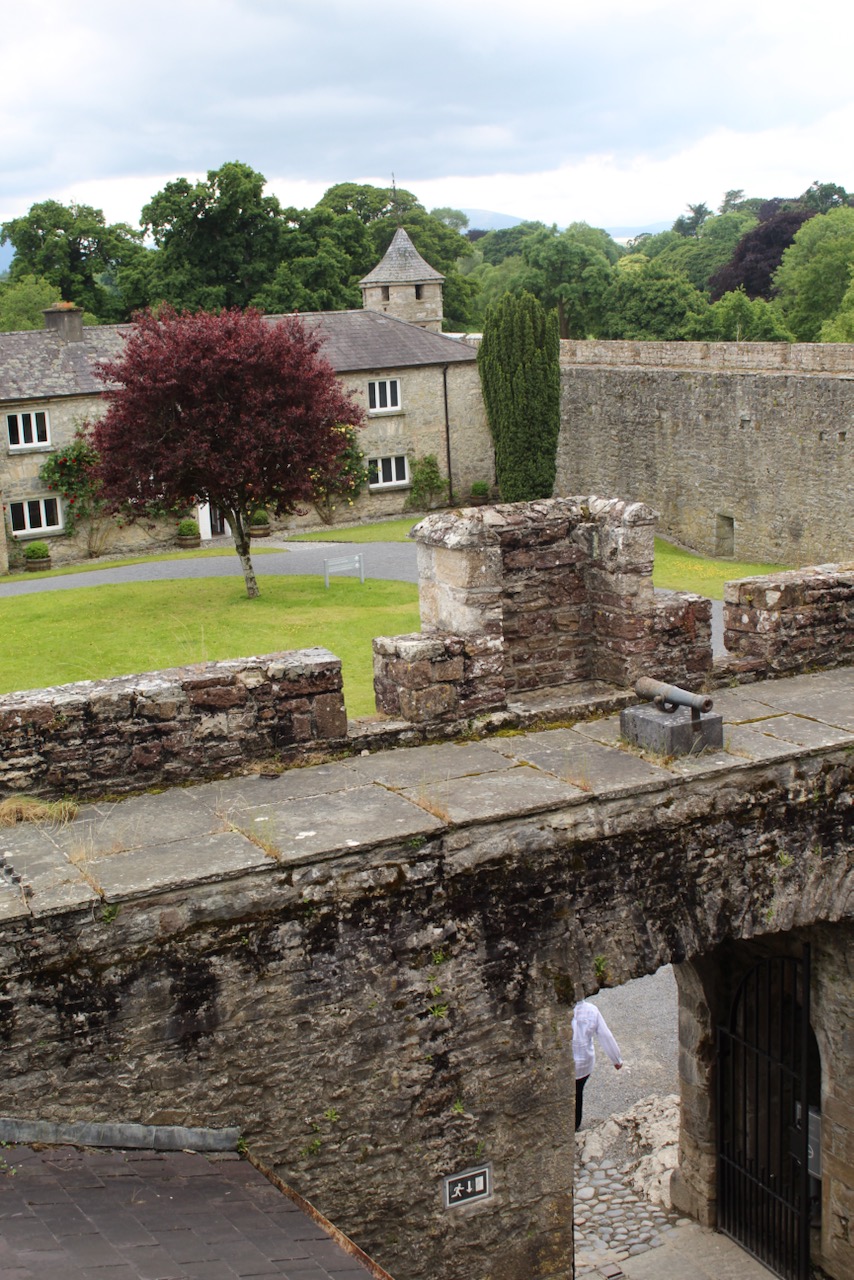
Round flaking towers are positioned at the outside corners acting as guard towers, accessed by wall walks that surmount the walls surrounding the courtyard. Photograph © Jennifer Winder-Baggot, www.irishhistorichouses.com
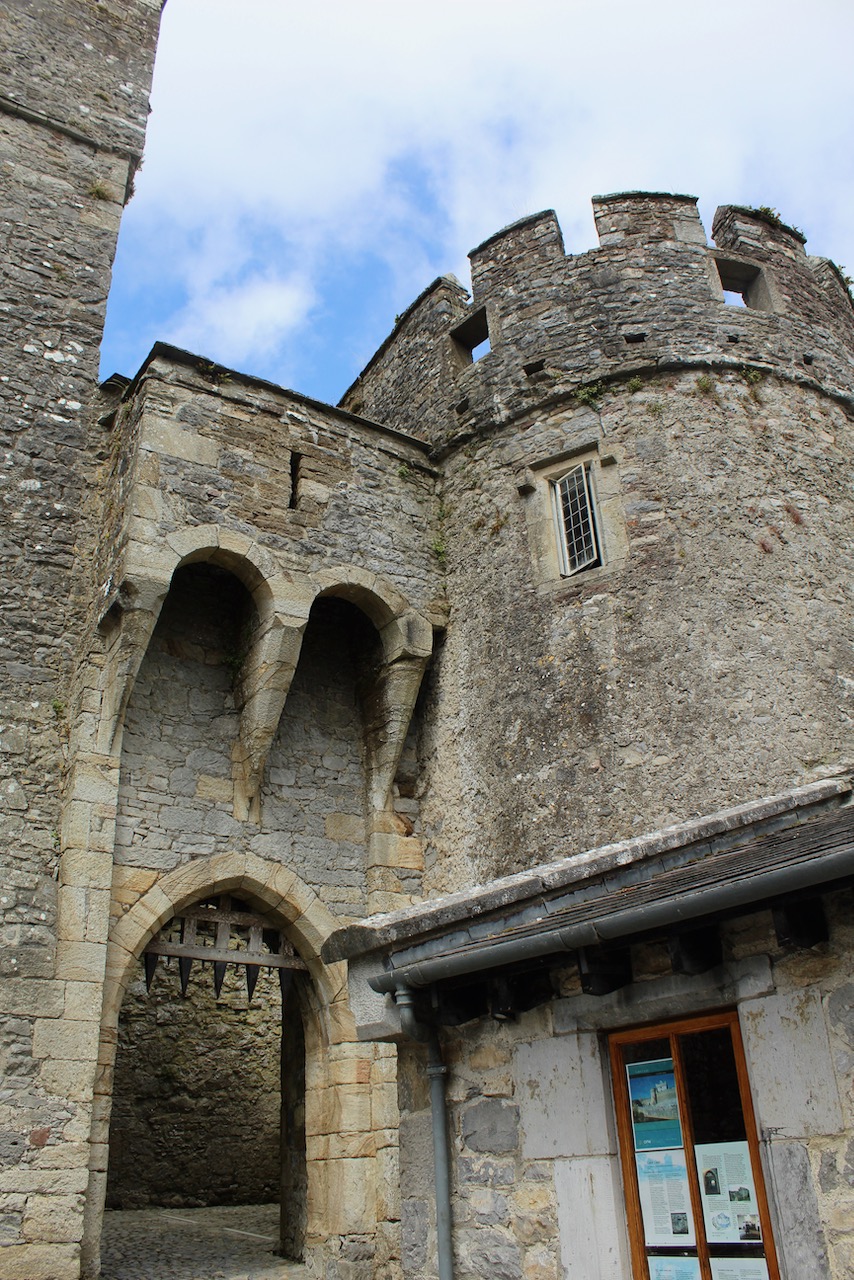
Once over the surrounding moat and river, and through the outer gate into the inner courtyard or bawn, one has another gate to go through, which is protected by a machicolation above the gate, through which things could be dropped on the invader, such as rocks, boiling water or hot sand. Photograph © Jennifer Winder-Baggot, www.irishhistorichouses.com
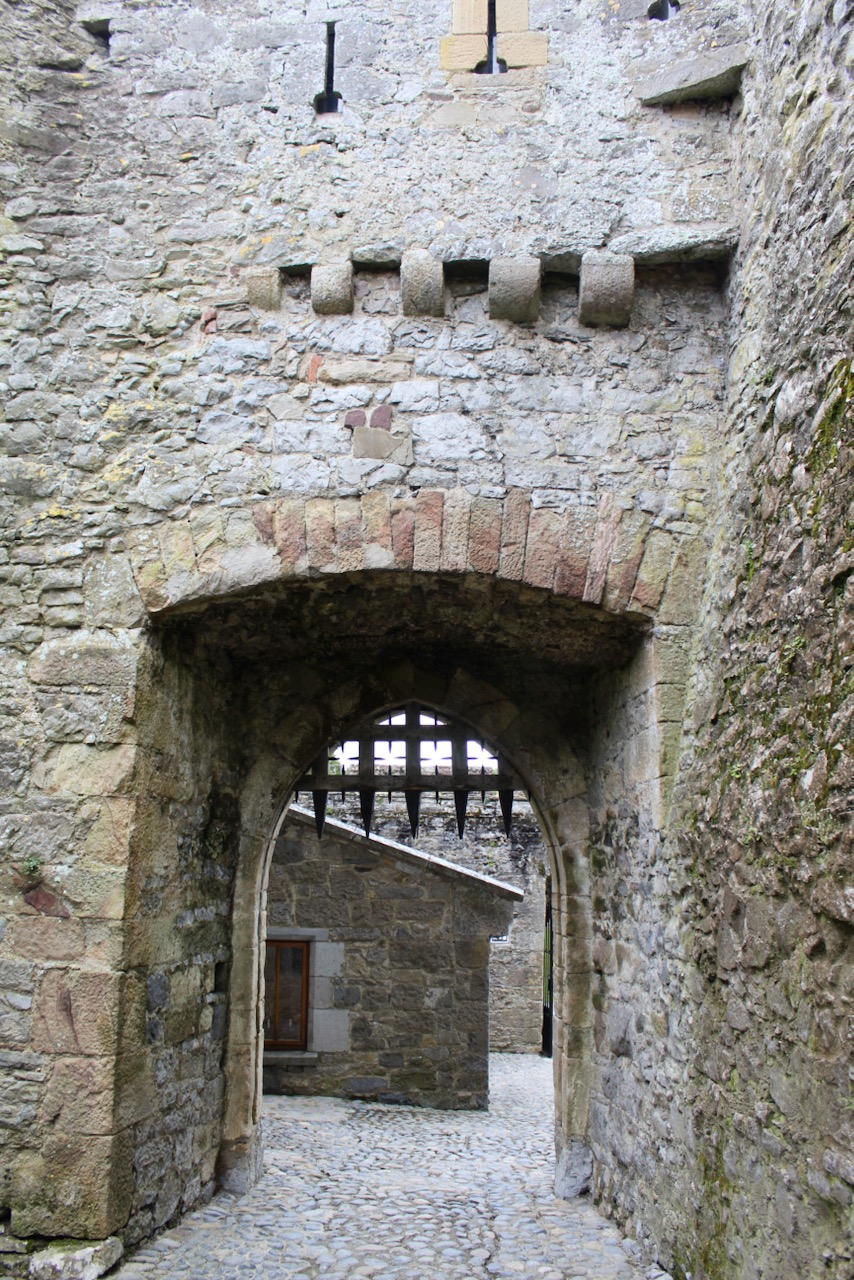
Once one gets through the second gate, the invader would have to get through the portcullis, pictured here. Photograph © Jennifer Winder-Baggot, www.irishhistorichouses.com
The portcullis, from the other side. Photograph © Jennifer Winder-Baggot, www.irishhistorichouses.com
The mechanism for working the portcullis. Photograph © Jennifer Winder-Baggot, www.irishhistorichouses.com

Once invaders get through the portcullis they are trapped in a small area, where defenders can fire arrows and stones at them. The walls of this area slope outwards towards the bottom, known as a base batter, so falling rocks bounce off them to hit the invaders.

The core of the castle is the keep.

The square central keep of Cahir Castle, with watch tower, and river as moat, and entrance gate topped by eagle. Photograph © Jennifer Winder-Baggot, www.irishhistorichouses.com
Cahir Castle, June 2022. Photograph © Jennifer Winder-Baggot, www.irishhistorichouses.com
The Castle Keep. The door is protected by a machicolation, and through the door you can see a cross shaped gun loop so the defenders can shoot invaders. Inside the door is the spiral staircase. Photograph © Jennifer Winder-Baggot, www.irishhistorichouses.com

Oliver Cromwell took the castle in 1650 and the occupants, under the 4th Baron Caher Piers Butler (d. 1676), surrendered peacefully.

The Butlers of Ormond also had to forfeit their land in the time of Oliver Cromwell’s Protectorate. Both branches of the Butlers had their lands restored with the restoration of the monarchy with Charles II in 1662.

The Cahir website continues: “At the restoration of Charles II, in 1660, George Matthews, (as Warden of Cahir Castle and half-brother to the Duke of Ormond), retained the Cahir lands for the Lord Cahir, then a minor.” [4] George Matthew (or “Mathew,” 1645-1735) was married to Eleanor Butler, daughter of Edmond Butler, 3rd/13th Baron Dunboyne. She seems to have married twice: first to Edmond Butler son of 3rd Baron Cahir, then to to George Matthew. Her son was Piers Butler, 4th Baron Cahir, who was just seven when his father died.

Piers Butler 4th Baron Cahir (1641-1676) married George Mathew’s niece, Elizabeth Mathew (1647-1704). They had no male issue, but two daughters. His daughter Margaret married Theobald Butler, 5th Baron Cahir (d. 1700), great-grandson of the 1st Baron Cahir.

Margaret Butler daughter of the 4th Baron Cahir was the 5th Baron Cahir’s second wife. His first wife, Mary Everard, gave birth to his heir, Thomas (1680-1744), 6th Baron Cahir. Thomas had several sons, who became 7th (d. 1786) and 8th Barons Cahir (d. 1788), but they did not have children, so that title went to a cousin, James Butler (d. 1788), who became 9th Baron Cahir.
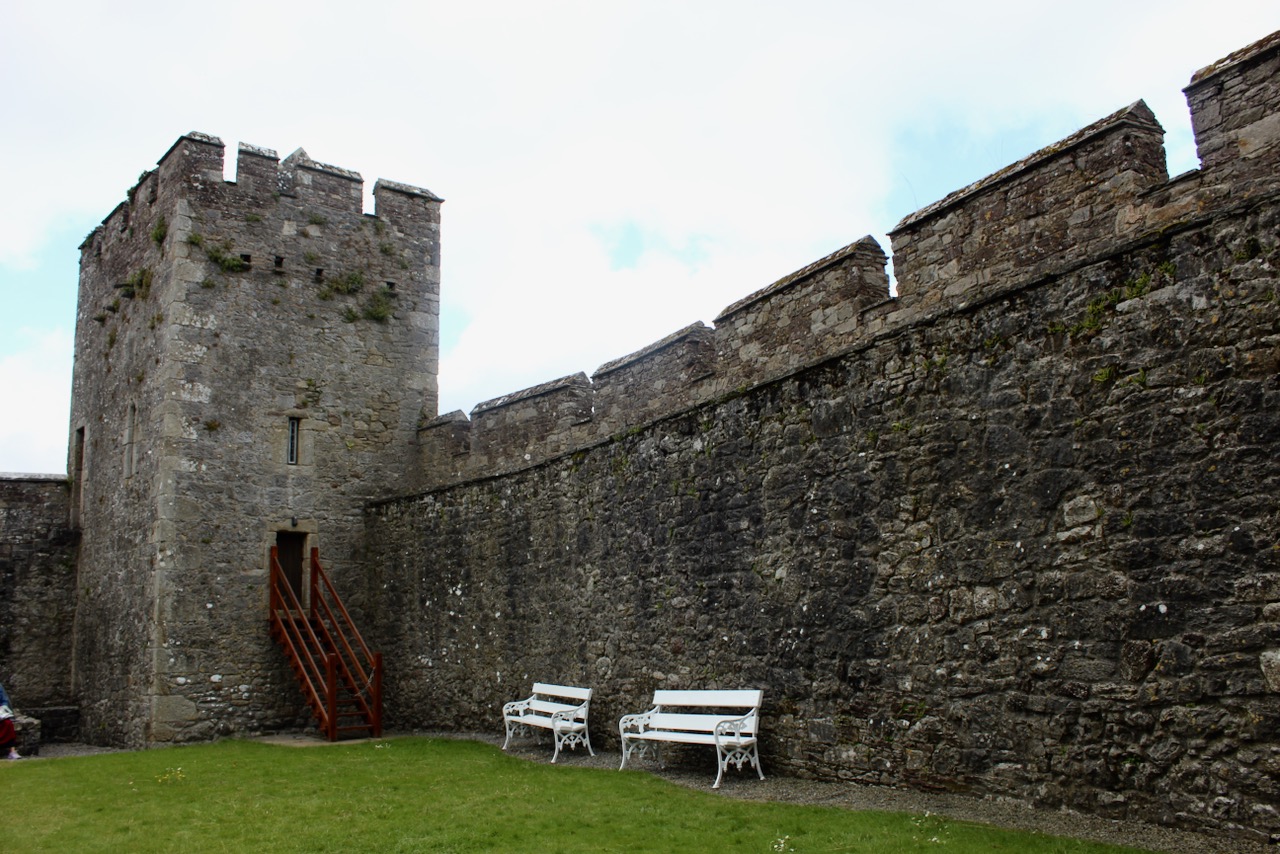
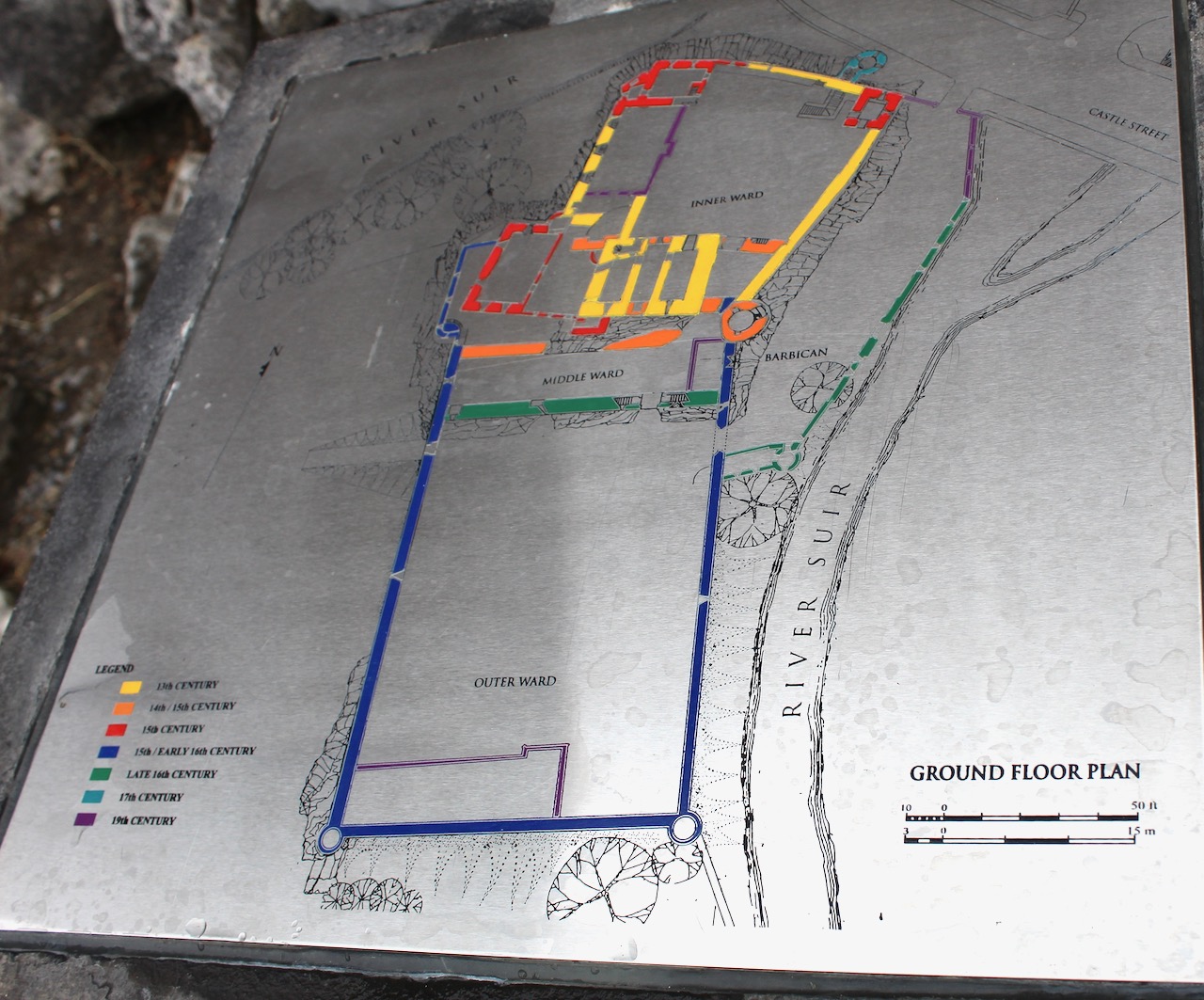
Prisoners’ tower at Cahir Castle. Photograph © Jennifer Winder-Baggot, www.irishhistorichouses.com
Cahir Castle, June 2022.
Cahir Castle, June 2022. Photograph © Jennifer Winder-Baggot, www.irishhistorichouses.com
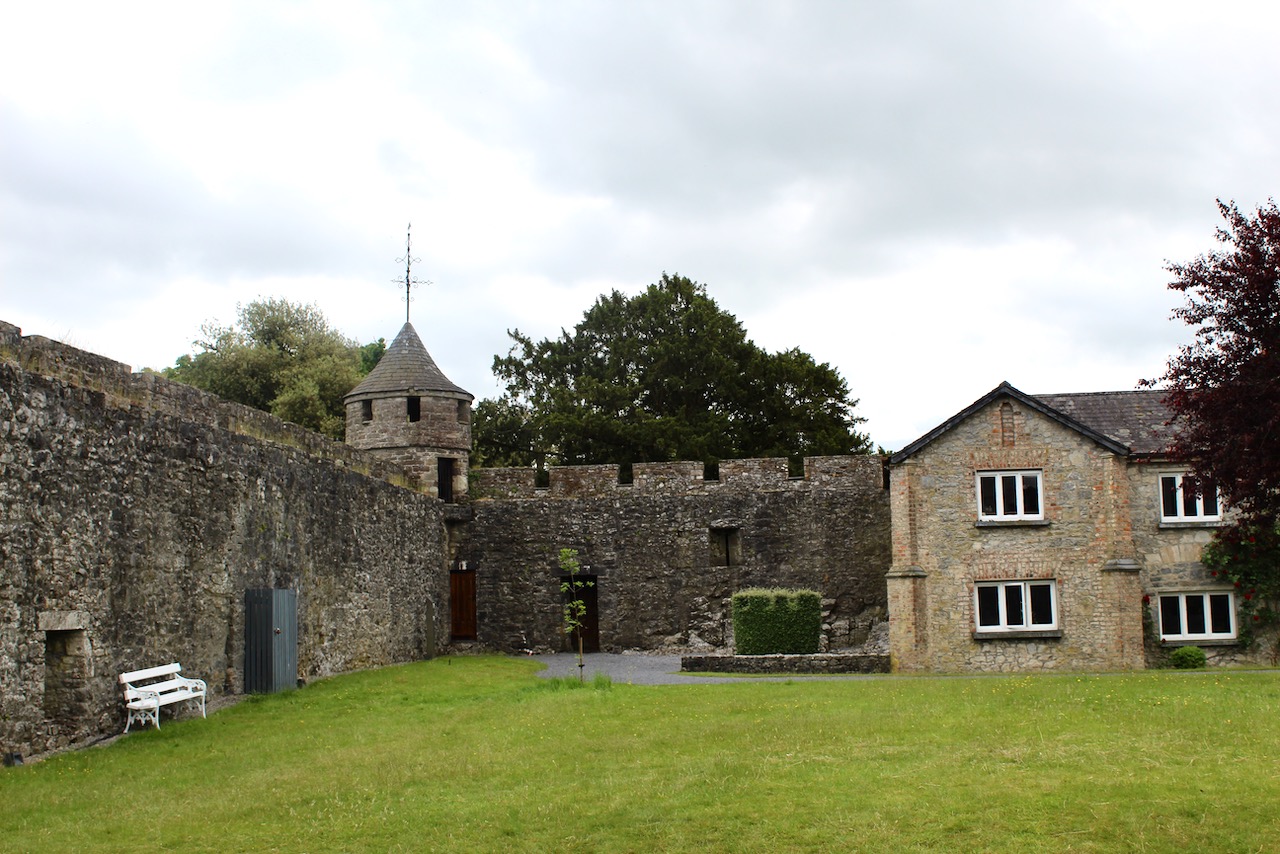
Inside the barbican walls, Cahir Castle. Cahir Cottage was built by the Butler family in the 19th century. Photograph © Jennifer Winder-Baggot, www.irishhistorichouses.com

The Cahir website tells us: “Despite embracing the Jacobite Cause in the Williamite Wars, the Cahir estate remained relatively intact. However, the Butlers never again lived at Cahir Castle but rather at their country manor, Rehill House, where they lived in peace and seclusion from the mid-seventeenth century, when not living abroad in England and France.

“…By 1700 a sizeable town had grown around the Castle, although hardly any other buildings survive from this period. Agriculture, milling and a wide range of trades would have brought quite a bustle to the muddy precursors of our present streets. At this time, the Castle was quite dilapidated and was let to the Quaker William Fennell, who resided and kept a number of wool combers at work there.” [4]

The castle layout was changed considerably and enlarged during work to repair some of the damage caused by the battles, but was then left abandoned until 1840 when the partial rebuilding of the Great Hall took place. [4]
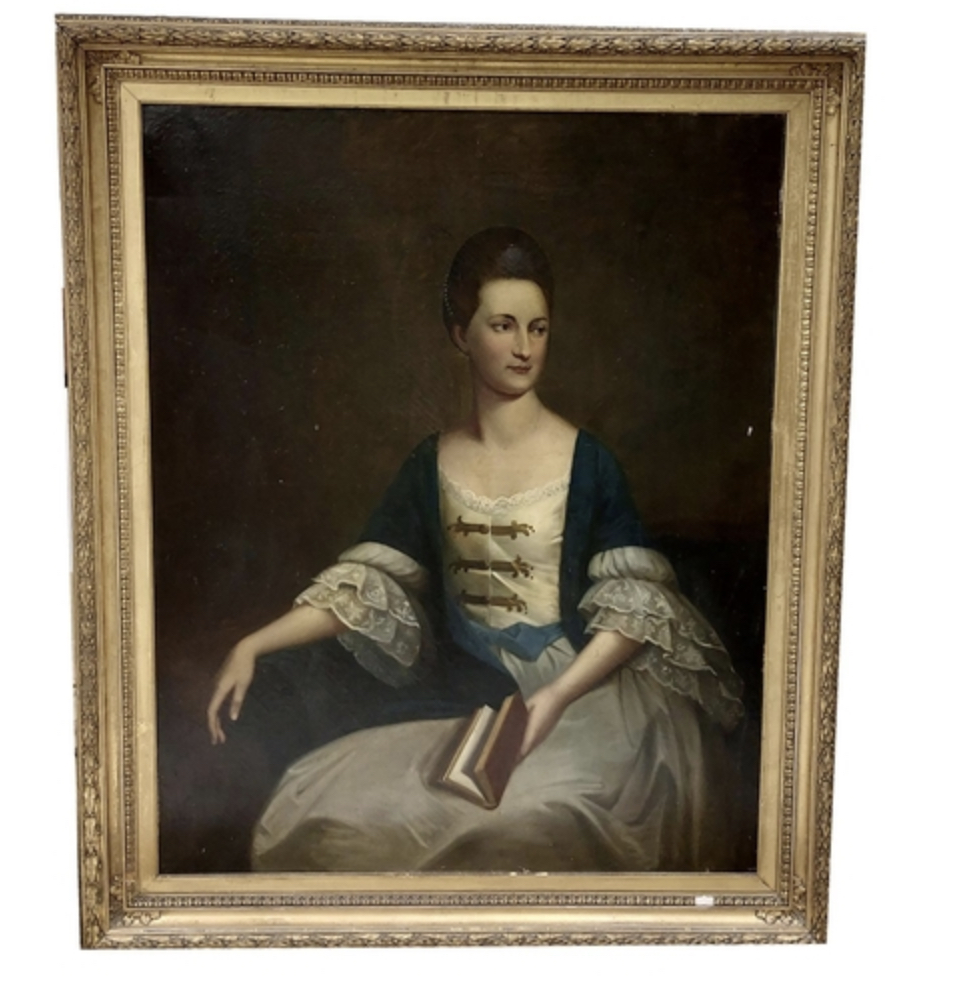
Female member of Butler family, Cahir Castle, courtesy of Fonsie Mealy auction.

The Cahir website tells us: “On the completion of Cahir House [in the town, now Cahir House Hotel] in the later 1770’s, Fennell rented Rehill House from Lord Cahir and lived there over half a century. [The Barons moved to Cahir House.] A strong Roman Catholic middle class emerged. James [d. 1788], 9th Lord Cahir [d. 1788], practiced his religion openly. He maintained strong links with Jacobite France, and paid regular visits to England. While not a permanent resident, he kept his Cahir Estates in impeccable order and was largely responsible for the general layout of the Town of Cahir. Under his patronage, some of the more prominent buildings such as Cahir House, the Market House and the Inn were built during the late 1770s and early 1780s. In addition, the Quakers built the Manor Mills on the Bridge of Cahir, the Suir Mills (Cahir Bakery), and the Cahir Abbey Mills in the period 1775-90.” [4]

The son of the 9th Baron Cahir, Richard (1775-1819), became 10th Baron and 1st Earl of Glengall. It was he and his wife who had the Swiss Cottage built outside Cahir.
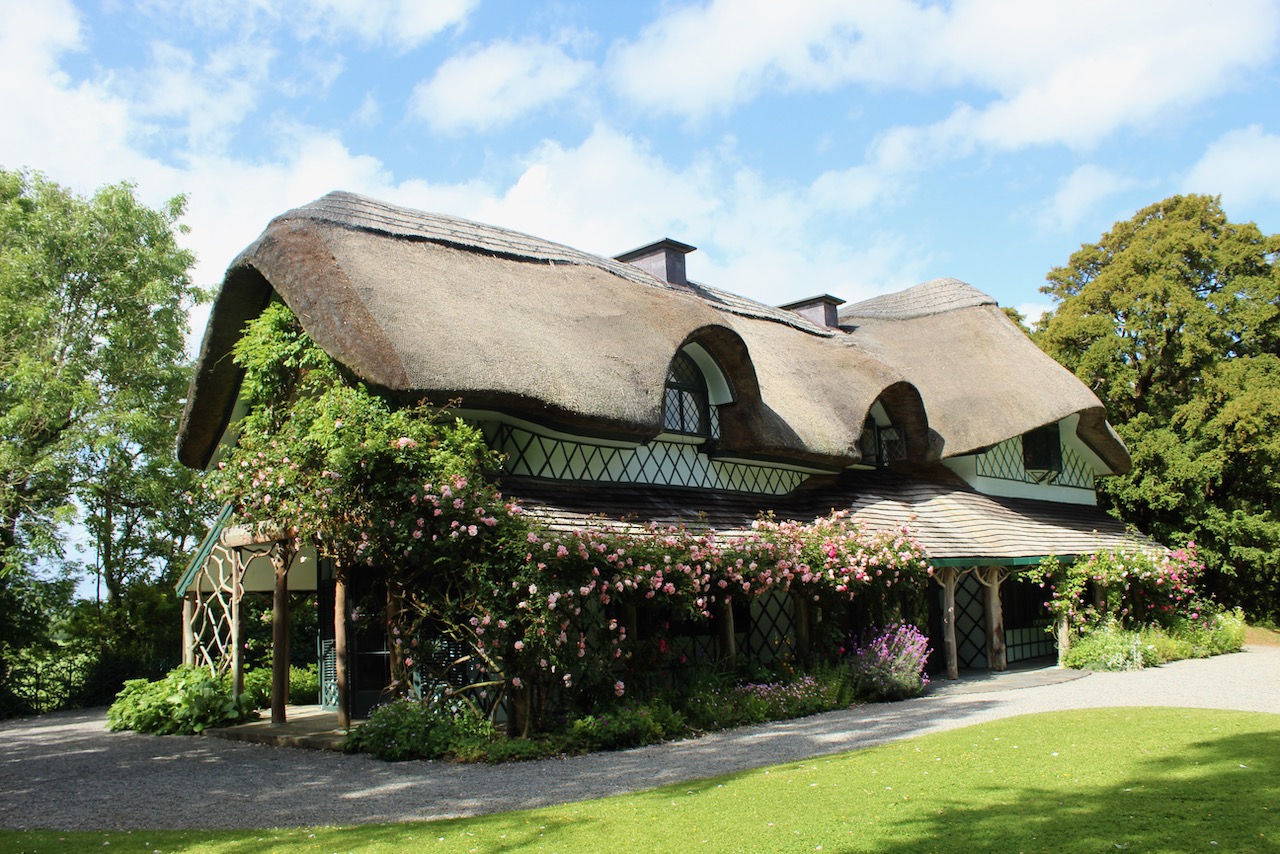
Swiss Cottage, County Tipperary. Photograph © Jennifer Winder-Baggot, www.irishhistorichouses.com

… The young Lord Cahir married Miss Emily Jeffereys of Blarney Castle and together they led Cahir through the most colourful period of its development…Richard, Lord Cahir, sat in The House of Lords as one of the Irish Representative Peers, and in 1816 was created Earl of Glengall, a title he enjoyed for just 3 years. He died at Cahir House of typhus in January 1819, at the age of 43 years. Richard, Viscount Caher, (now 2nd Earl of Glengall), had already taken his place in political circles while his mother, Emily, ran the Estate with an iron fist.” [4]

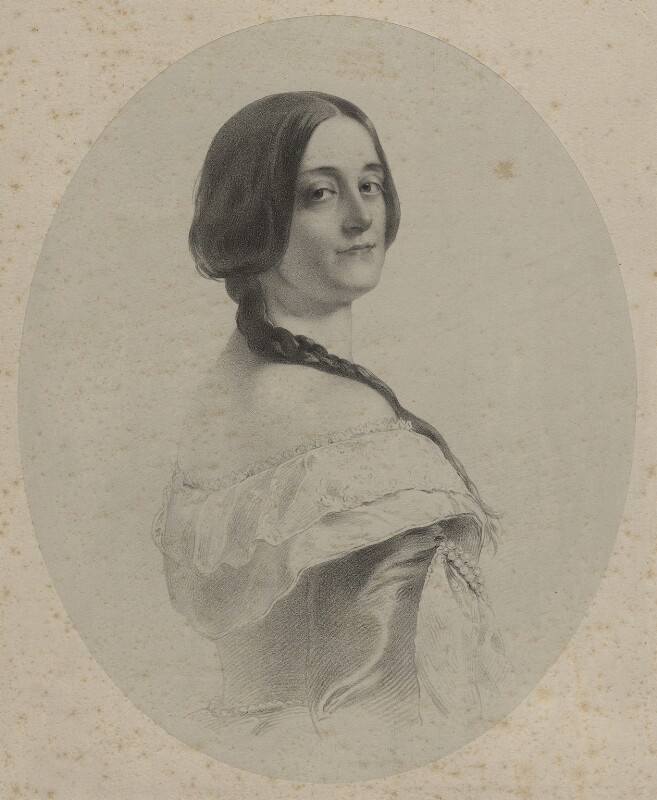
Richard Butler (1794-1858) 2nd Earl of Glengall, by Richard James Lane, lithograph, 1854, National Portrait Gallery of London D22384.
Margaret Lauretta Butler (née Mellish), Countess of Glengall, wife of the 2nd Earl of Glengall by Richard James Lane courtesy of National Portrait Gallery London NPG D22383.
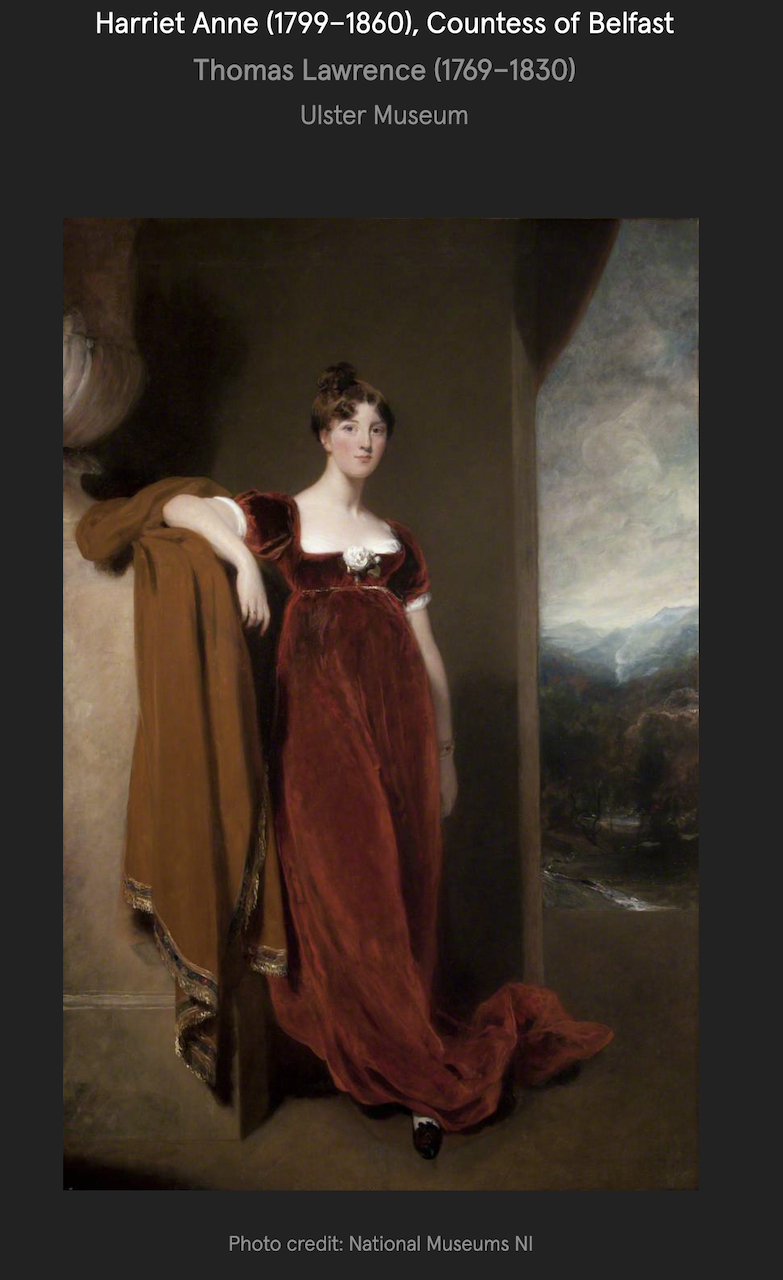
Harriet Anne née Butler (1799-1860) Countess of Belfast, wife of George Hamilton Chichester 3rd Marquess of Donegal and daughter of Richard Butler, 1st Earl of Glengall.
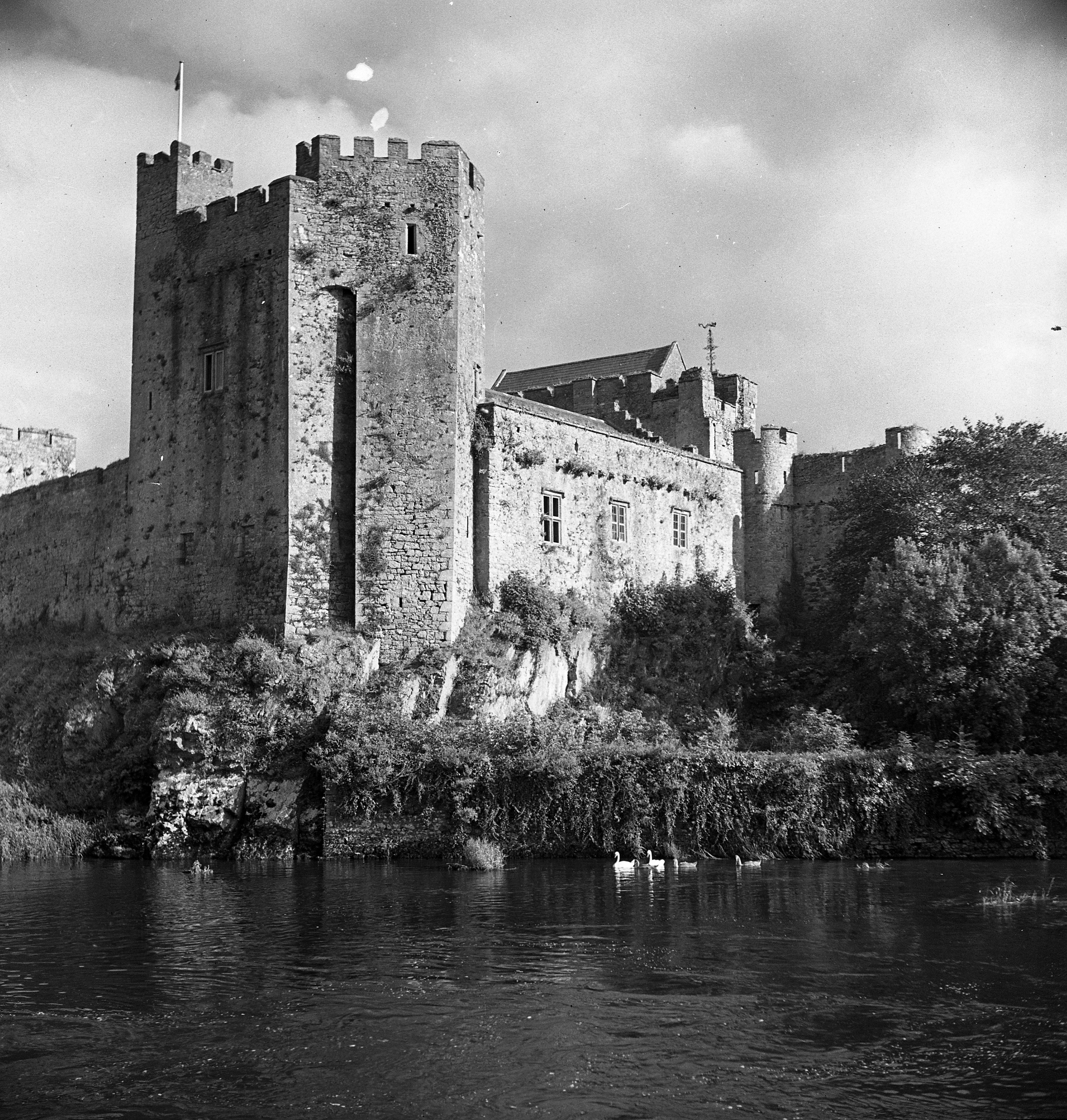
Cahir Castle 1943, photograph from Dublin City Library archives. [5]

During the Great Famine (1846-51), Lord and Lady Glengall did much for the relief of the poor and the starving. Lord Glengall’s town improvement plan was shelved in 1847 due to a resulting lack of funds and his wife’s fortune being tied up in a Trust Fund. The Cahir Estates were sold in 1853, the largest portion being purchased by the Trustees of Lady Glengall. This sale came about due to Lord Glengall being declared bankrupt. The Grubbs had by now become the most important Quaker family in the district and bought parts of the Cahir Estate during the 1853 sale...

In the interim, Lady Margaret Butler (elder daughter and heir of Lord Glengall) had married Lieut. Col. Hon. Richard Charteris, 2nd son of the 9th Earl of Wemyss & March. Using a combination of her mother’s Trust and Charteris funds, Cahir Town and Kilcommon Demesne were repurchased.  

Lady Margaret, although an absentee landlord, resident in London, kept a close watch on her Cahir Estates through two excellent managers, Major Hutchinson and his successor William Rochfort… Her son, Richard Butler Charteris took over her role in 1915 and remained resident in Cahir from 1916 until his death in 1961. In 1962, the House, and circa 750 acre estate core (within the walls of Cahir Park and Kilcommon Demesne) were auctioned…And so ended the direct line of Butler ownership in Cahir, almost 600 years. [4]

The castle became the property of the state after the death of Lord Cahir in 1961; it was classified as a national monument and taken into the care of the Office of Public Works. [6]
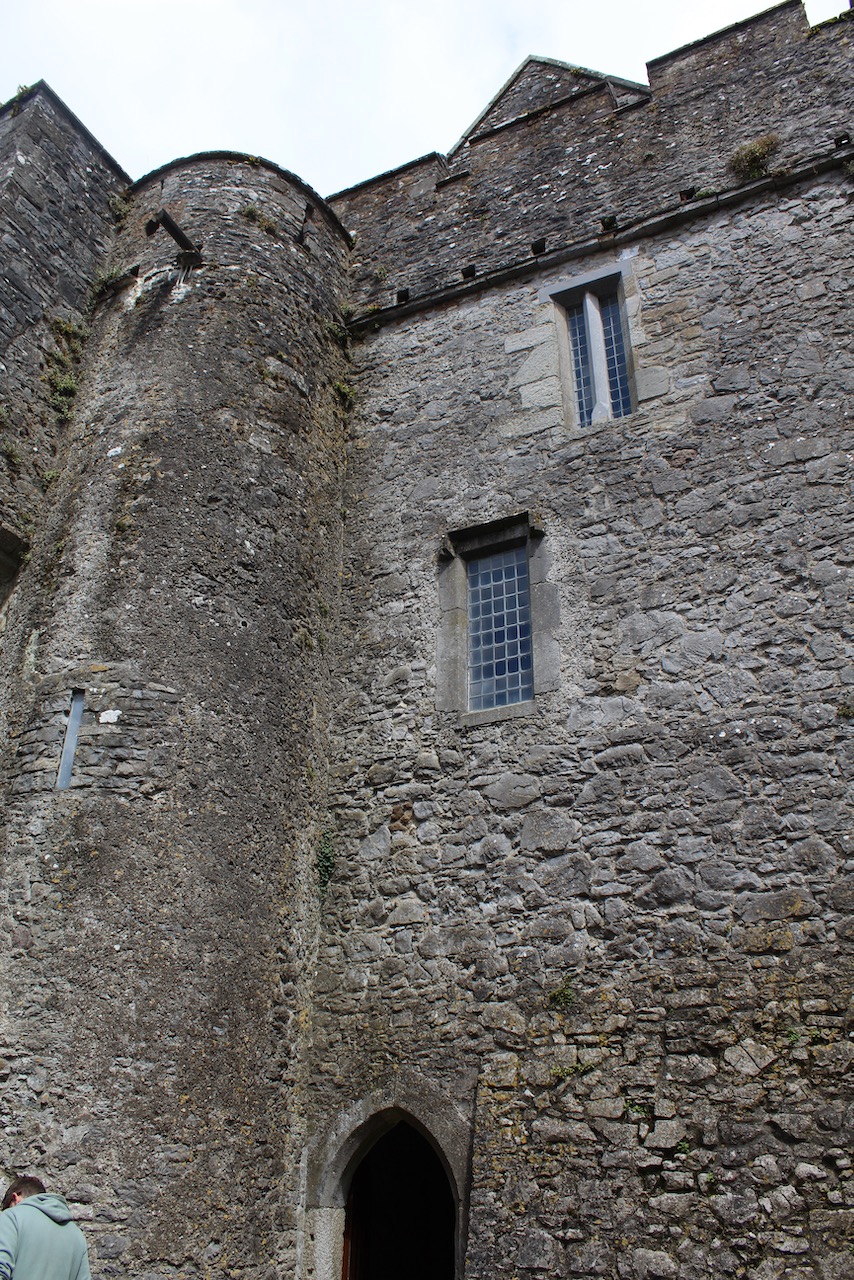
Cahir Castle, June 2022. Photograph © Jennifer Winder-Baggot, www.irishhistorichouses.com
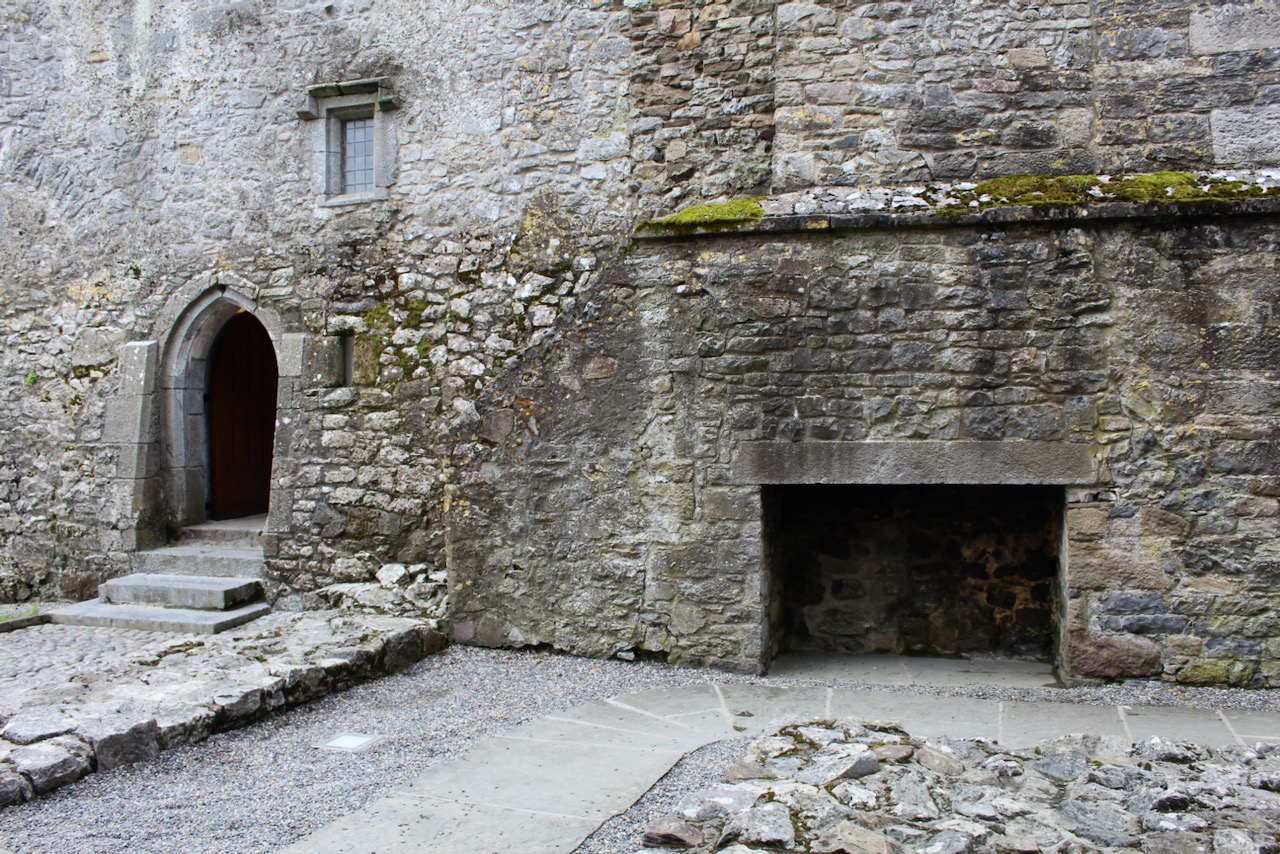
The great hall, and adjoining guest accommodation in the northwest tower. This 13th century building was attached to the keep, but in 1840 it was shortened, leaving the original fireplace in the open outside. Photograph © Jennifer Winder-Baggot, www.irishhistorichouses.com
Great Hall and northwest tower of Cahir Castle. Photograph © Jennifer Winder-Baggot, www.irishhistorichouses.com
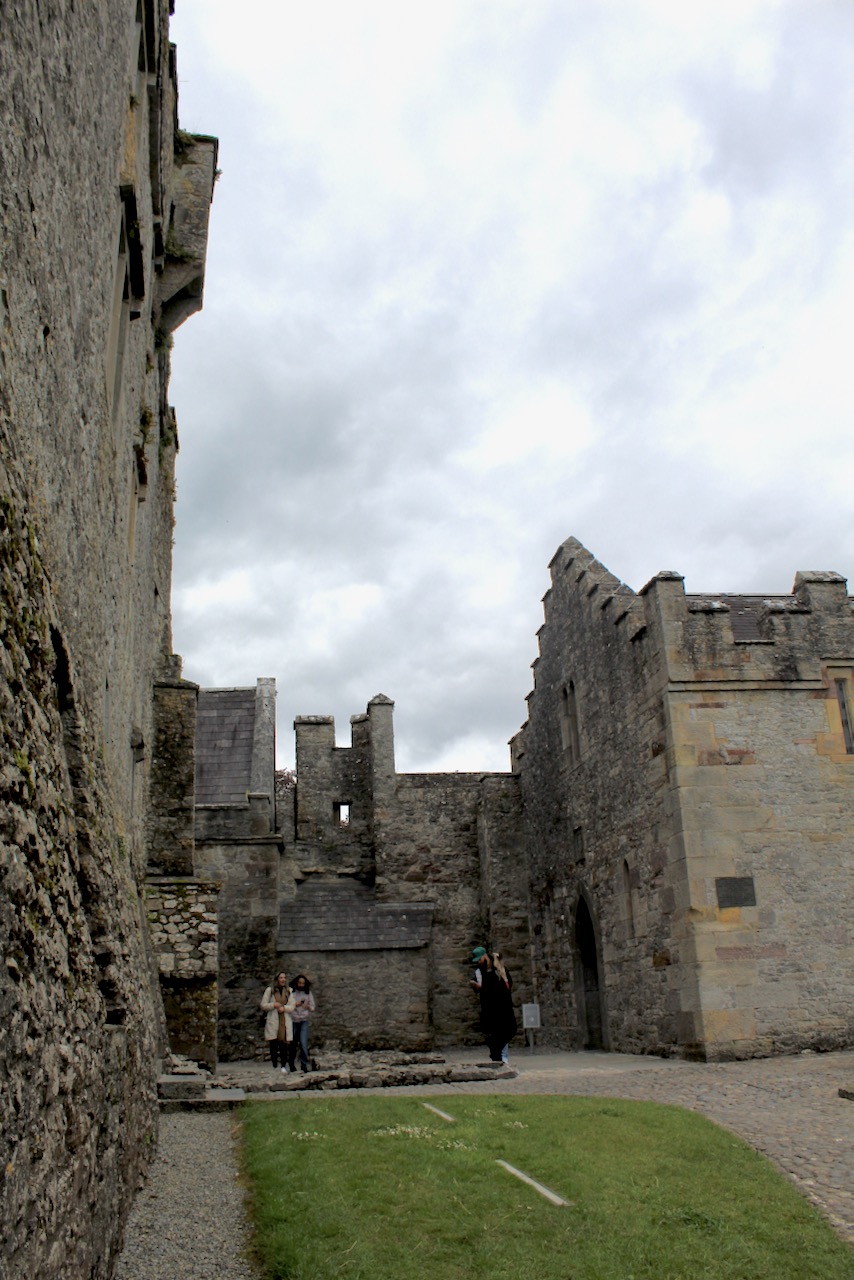
The end of the Great Hall, with its stepped gable. It was originally attached to the keep, pictured on the left. Photograph © Jennifer Winder-Baggot, www.irishhistorichouses.com
This is the exposed fireplace, which was in the now foreshortened Great Hall. Photograph © Jennifer Winder-Baggot, www.irishhistorichouses.com

Our tour guide took us through the outside of the castle, showing us its defenses. Our tour ended inside the Great Hall, or dining hall.

The Great Hall, with giant Irish elk antlers. The fireplace is not genuine – it is made of papier mache and was installed for the filming of a movie. Photograph © Jennifer Winder-Baggot, www.irishhistorichouses.com p.s. we saw a movie recently filmed in Cahir Castle, “The Last Duel” with Matt Damon, Adam Driver and Jodie Comer, and it was brilliant! I highly recommend it.

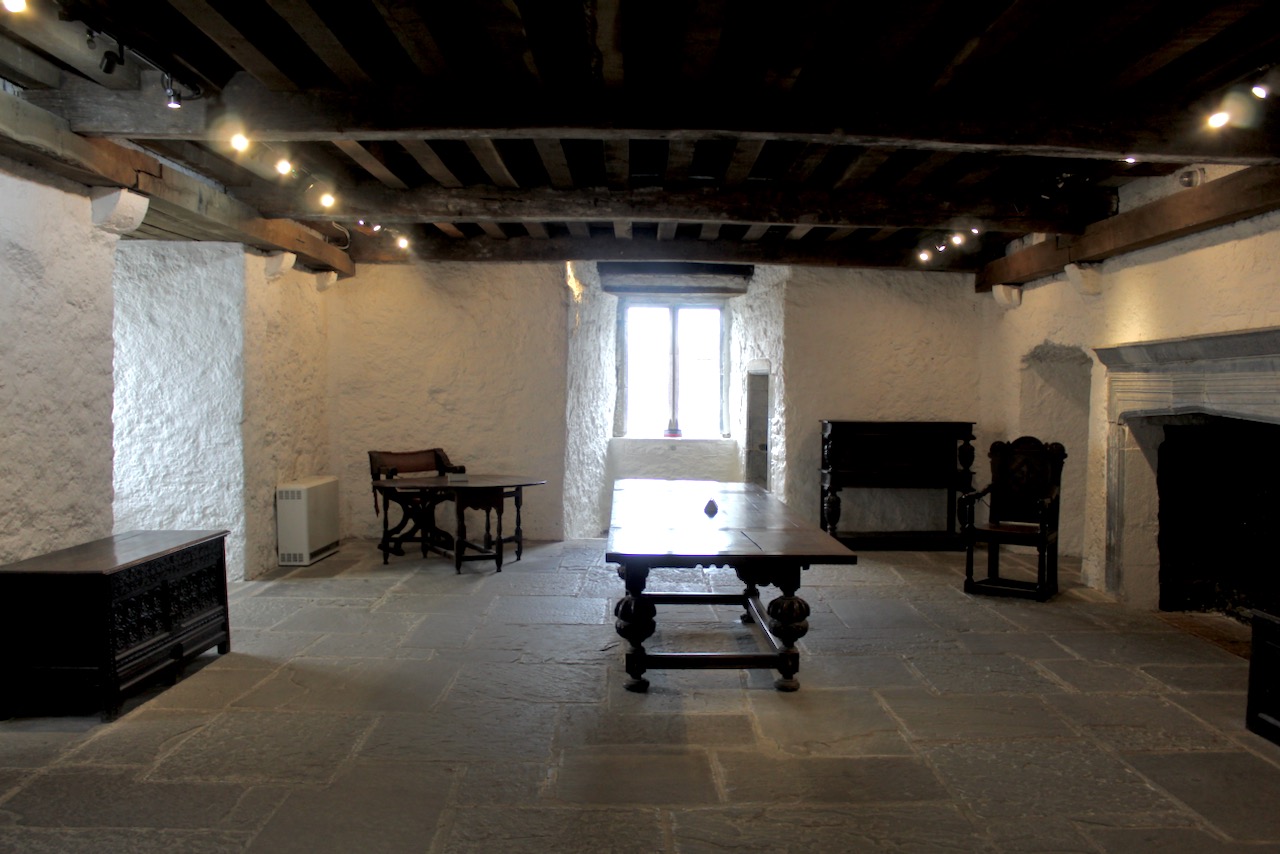
The dining hall has a magnificent ceiling. The building would have originally been of two storeys, and taller. The appearance today owes much to restoratation work carried out by William Tinsley in 1840, when the building was converted into a private chapel for the Butler family. The hammer-beam roof and the south and east wall belong to this period. The external wall dates from the 13th century.

Ceiling of the Great Hall, Cahir Castle. Photograph © Jennifer Winder-Baggot, www.irishhistorichouses.com
Inside the northwest tower of Cahir Castle. Photograph © Jennifer Winder-Baggot, www.irishhistorichouses.com
Upstairs in the northwest tower. It is fitted with fifteenth century windows and has a Tudor fireplace inserted where the original portcullis machinery was housed. Photograph © Jennifer Winder-Baggot, www.irishhistorichouses.com
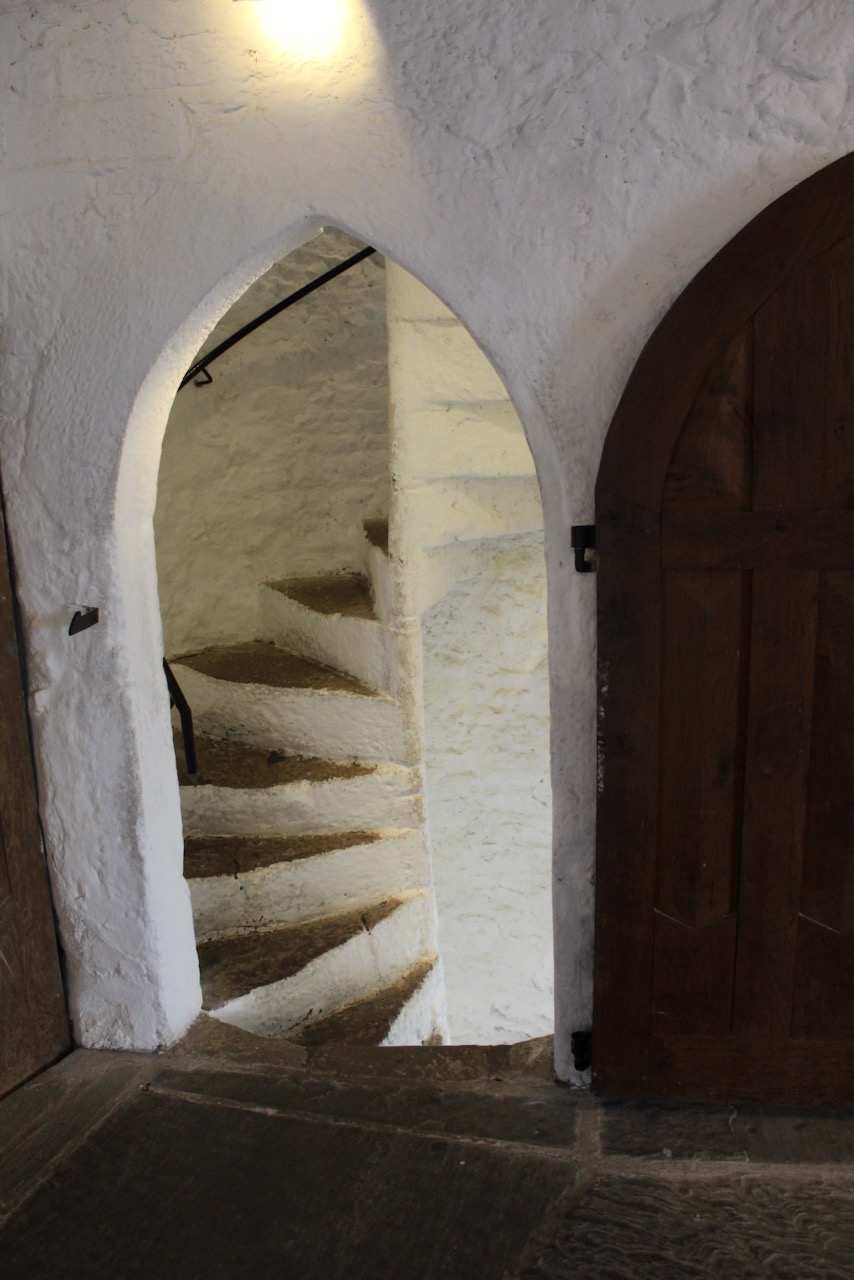
The stairs to the upper level of the northwest tower are spiral. Photograph © Jennifer Winder-Baggot, www.irishhistorichouses.com
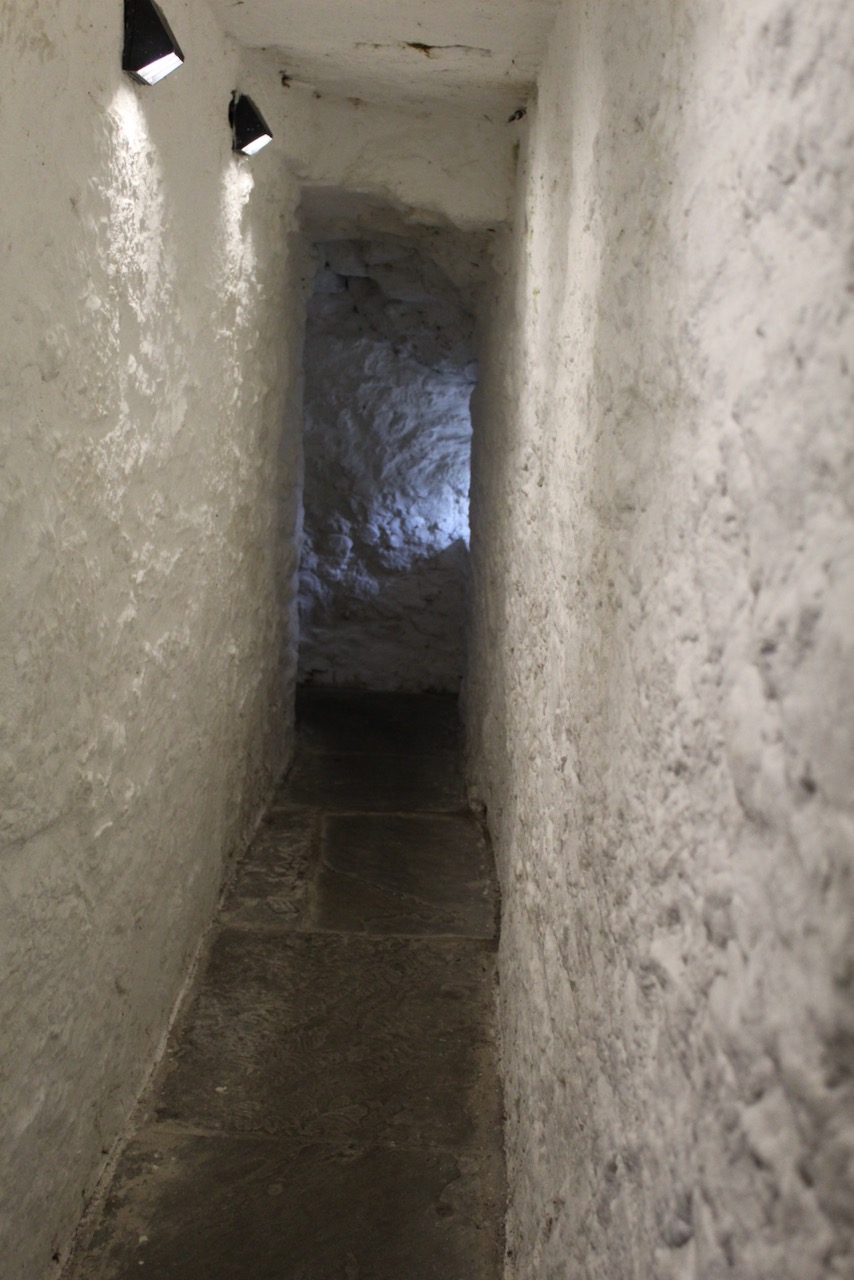
I love the passageways between the walls of the castle. Photograph © Jennifer Winder-Baggot, www.irishhistorichouses.com
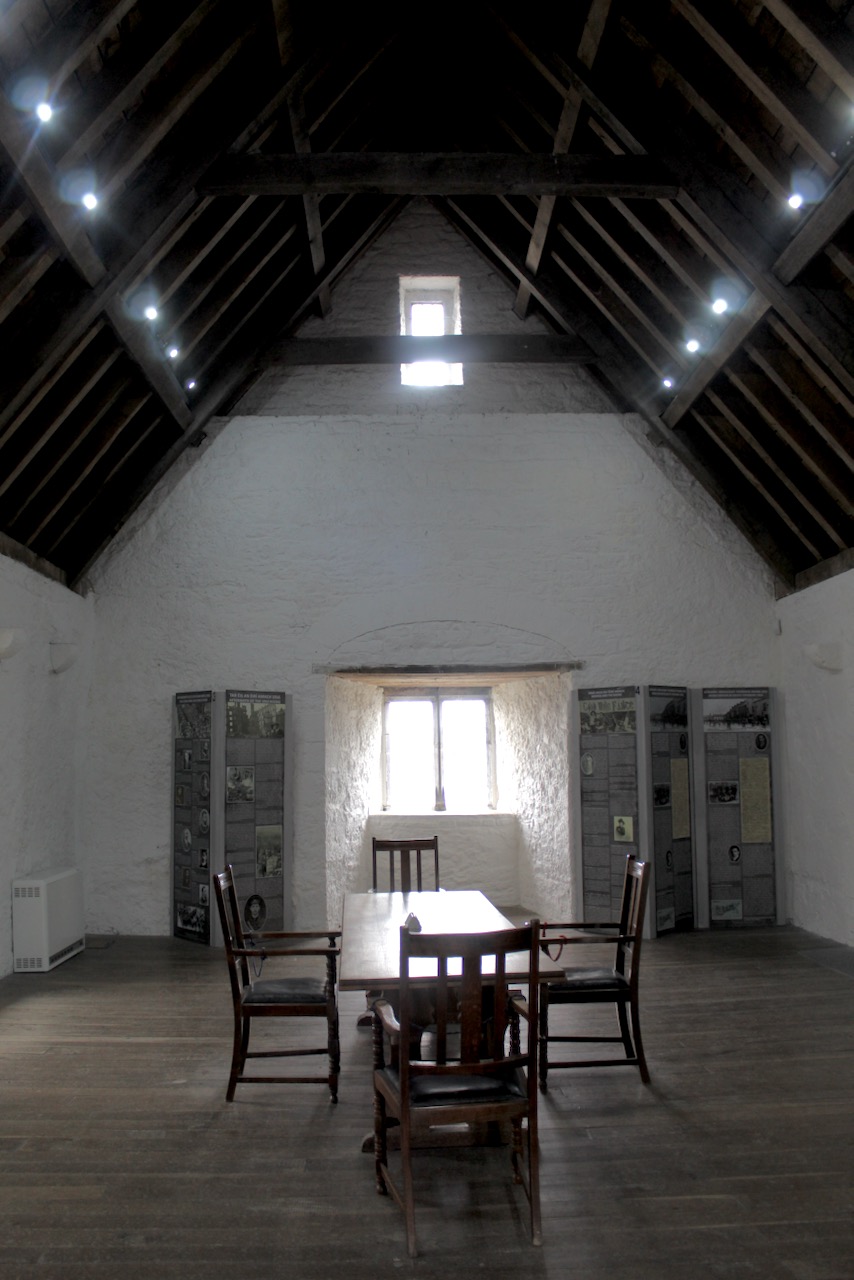
Top floor of the northwest tower. Photograph © Jennifer Winder-Baggot, www.irishhistorichouses.com

Next we explore the keep building.
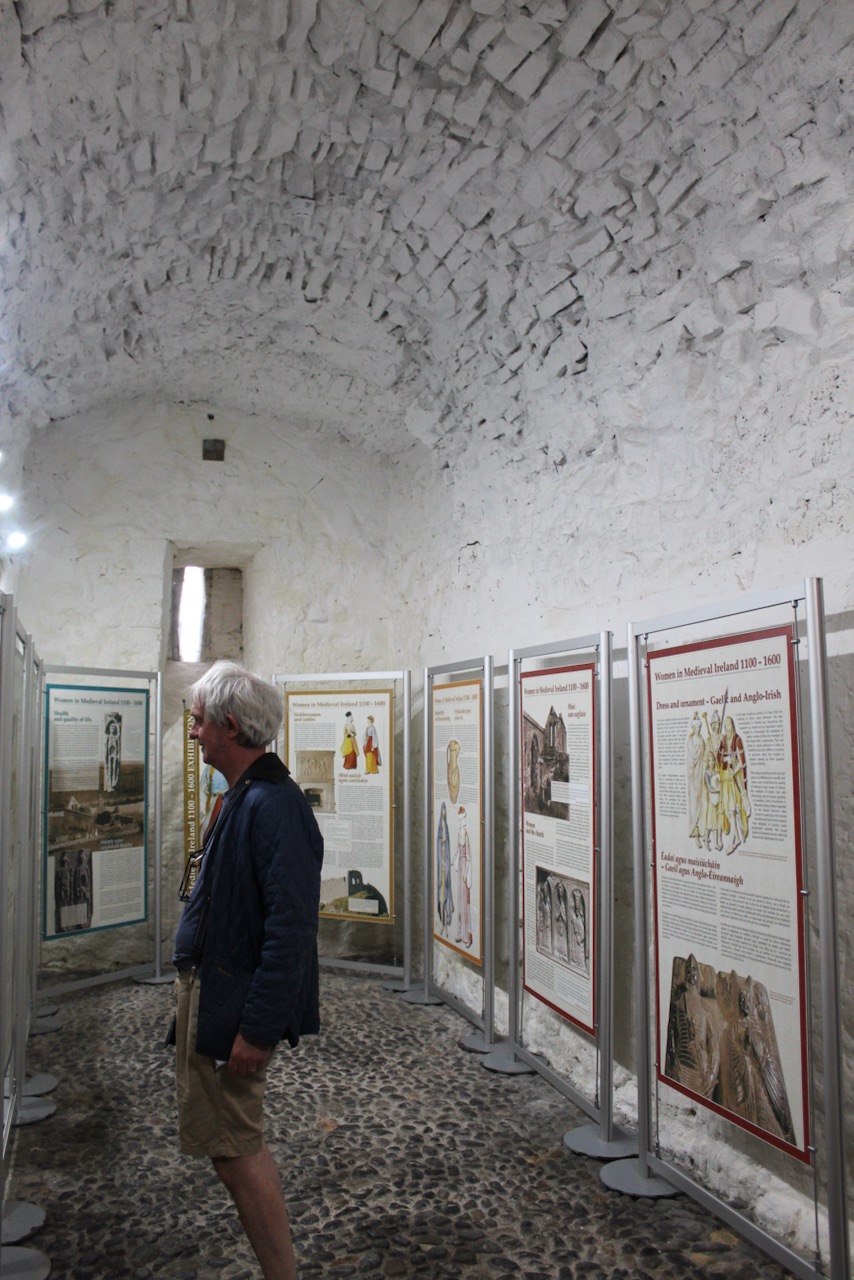
Cahir Castle, June 2022. Photograph © Jennifer Winder-Baggot, www.irishhistorichouses.com
One can descend these steps and up again on the other side for a view over the river. Photograph © Jennifer Winder-Baggot, www.irishhistorichouses.com

[1] https://www.irelandscontentpool.com/en

[2] p. 58. Hayes, William and Art Kavanagh, The Tipperary Gentry volume 1 published by Irish Family Names, c/o Eneclann, Unit 1, The Trinity Enterprise Centre, Pearse Street, Dublin 2, 2003.

[3] http://www.thepeerage.com/index.htm and G.E. Cokayne; with Vicary Gibbs, H.A. Doubleday, Geoffrey H. White, Duncan Warrand and Lord Howard de Walden, editors, The Complete Peerage of England, Scotland, Ireland, Great Britain and the United Kingdom, Extant, Extinct or Dormant, new ed., 13 volumes in 14 (1910-1959; reprint in 6 volumes, Gloucester, U.K.: Alan Sutton Publishing, 2000), volume IX, page 440.

[4] http://www.cahirhistoricalsociety.com/articles/cahirhistory.html

[5] https://repository.dri.ie/

[6] http://www.britainirelandcastles.com/Ireland/County-Tipperary/Cahir-Castle.html

Text © Jennifer Winder-Baggot, www.irishhistorichouses.com

Wilton Castle, Bree, Enniscorthy, Co. Wexford Y21 V9P9 – section 482

Tourist Accommodation Facility – not open to visitors, overnight guests only

www.wiltoncastleireland.com
Open for accommodation: all year

Wilton Castle. Photograph © Jennifer Winder-Baggot, www.irishhistorichouses.com
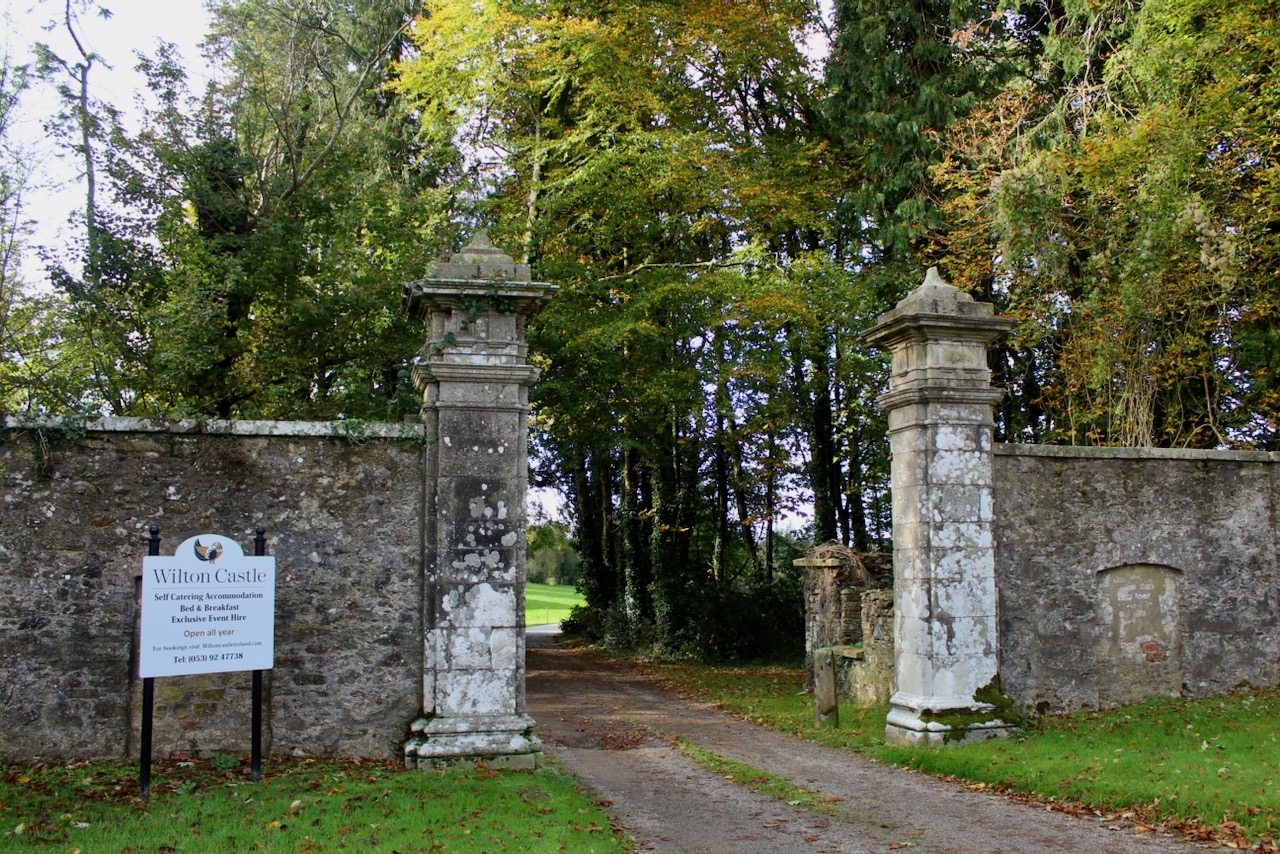
Wilton Castle, November 2021. Photograph © Jennifer Winder-Baggot, www.irishhistorichouses.com

We treated ourselves to a stay in Wilton Castle in November in 2021. Having been gutted in a fire in 1923, it stood as a dramatic ruin until the Windsors purchased and began to refurbish it into luxurious accommodation. The current restoration was completed in 2014. So far just half of it has been rebuilt, the rest has been stabilised but remains empty and without a roof. The work which has been done by the Windsors is incredible – it seems to have been rebuilt to a very high standard. I’m not sure if they intend to continue to rebuild the rest of the castle.

Wilton Castle was designed for Harry Alcock (1792-1840) by Daniel Robertson (d. 1849) in 1836-38, subsuming parts of an earlier castle and house.

The area was previously known as Clogh na Kayer (The Castle of the Sheep). Herbert Hore writes in History of the Town and County of Wexford that an ancient Castle of Cloghnakayer was built in the fourteenth century. The De Dene family owned the land until 1354, when an only daughter married Philip Furlong whose descendant, Sir Fulke Furlong, knight, of Horetown, built a castle around 1410. 

The land then passed to the Butlers of Mountgarret. Edward Butler, Baron of Kayer (eldest son of Pierce, second son of Richard 1st Viscount Mountgarret) rebuilt and restored the ancient Castle, and added a mansion house to it in 1599. [1]

The view from our suite. Photograph © Jennifer Winder-Baggot, www.irishhistorichouses.com
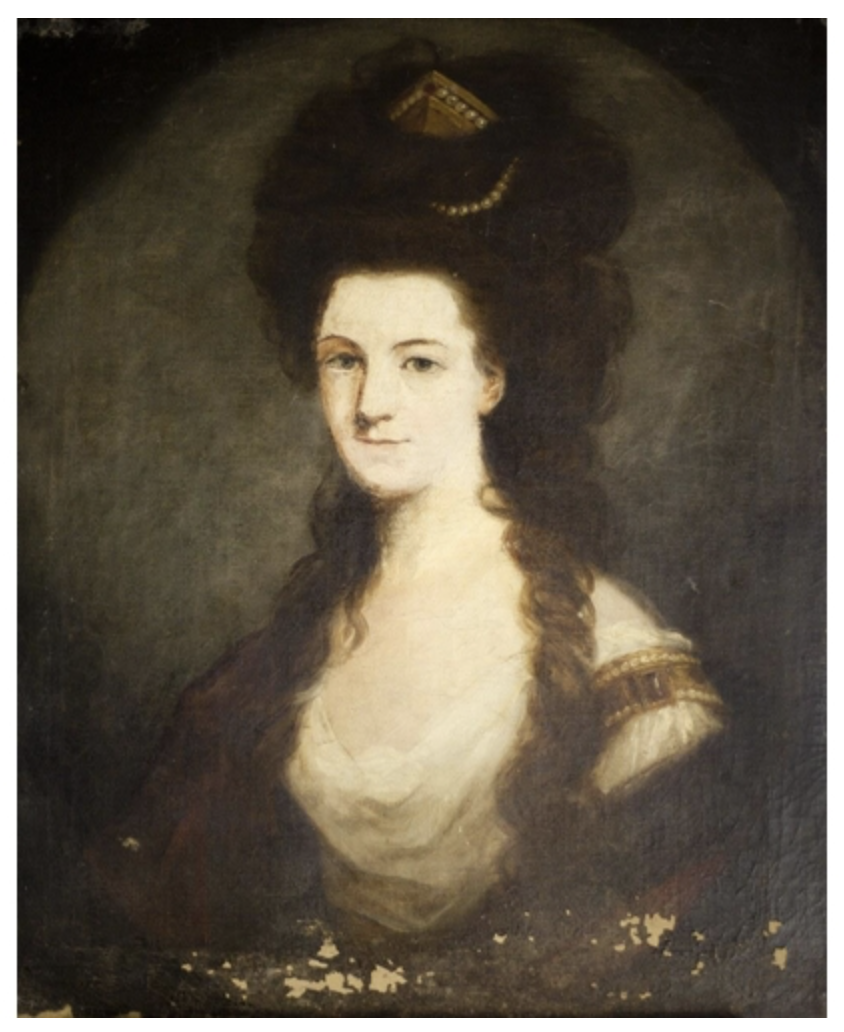
Edward Butler’s son, Pierce, inherited. Pierce Butler was a Catholic and a supporter of the monarchy and his land was confiscated by the Cromwellian parliament in 1655 and granted to a Cromwellian soldier, Captain Robert Thornhill. Captain Robert’s son sold the estate in 1695 to William Alcock (d. 1705) of Downpatrick, County Down. [2]

Herbert Hore tells us that William Alcock rebuilt the castle, and called it Wilton. It was this castle that was subsumed in Daniel Robertson’s design for Harry Alcock. Herbert Hore writes that “the late Colonel Alcock [Harry, (1821-93)] told me that some of the walls of the ancient Castle of the Butlers are incorporated in the present building.”

Robert O’Byrne writes: “William Alcock built a new residence for himself on the site of an old castle, and this was occupied by his descendants for several generations. A handsome classical doorcase of granite with segmental pediment above fluted pilasters survives on the façade of the former steward’s house at Wilton to indicate the appearance of the original Alcock house, dismissed by Martin Doyle in his 1868 book on the county as being ‘in the dull style of William and Mary.’ ” [3]

A handsome classical doorcase of granite with segmental pediment above fluted pilasters survives on the façade of the former steward’s house at Wilton to indicate the appearance of the original Alcock house.” Photograph © Jennifer Winder-Baggot, www.irishhistorichouses.com
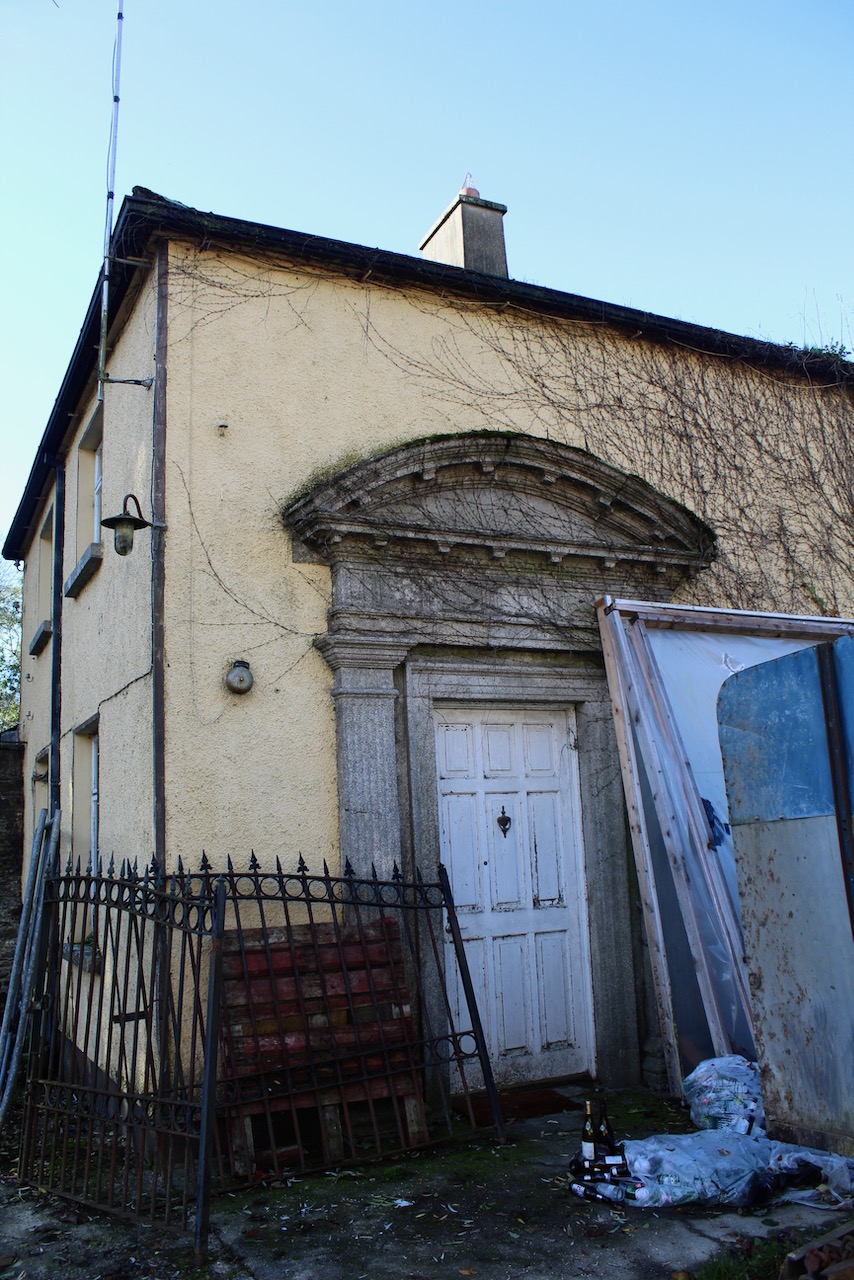
The former steward’s house, in the stable yard below Wilton Castle. Photograph © Jennifer Winder-Baggot, www.irishhistorichouses.com

A daughter of William and his wife Jane nee Bamber of Bamber Hall of Lancaster, England, married Patrick Lattin and was the mother of the famous Jack Lattin of Morristown Lattin, County Kildare, who danced himself to death!

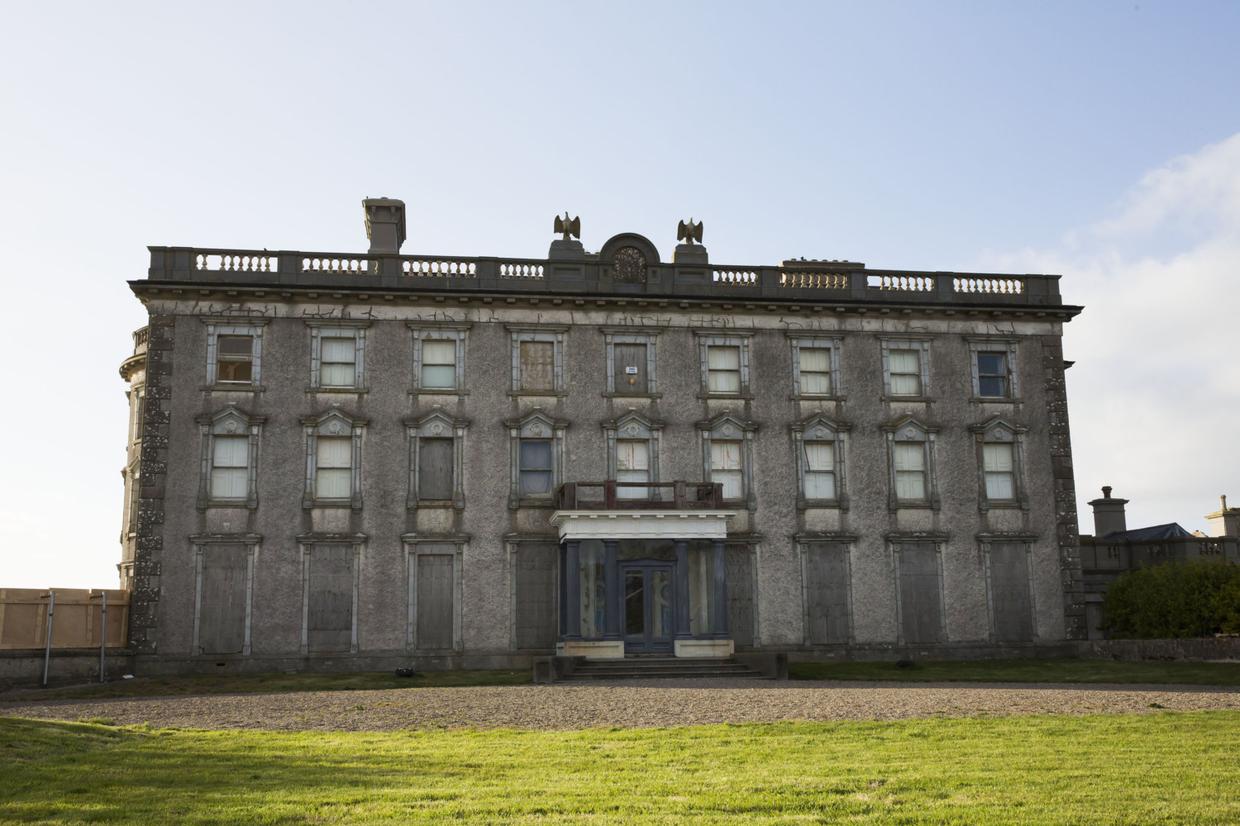
The estate passed to William Alcock’s son, another William Alcock (1681-1739), then to his son, Col. William Alcock (d. 1779) (Colonel in the Waterford Militia). He married Mary Loftus of Loftus Hall, County Wexford, daughter of Nicholas Loftus, 1st Viscount Loftus of Ely and his wife Anne Ponsonby, daughter of William Ponsonby, 1st Viscount Duncannon.

Loftus Hall, the home of Mary Loftus, wife of William Alcock (d. 1779). Photograph from the National Inventory of Architectural Heritage.

Wilton then passed to his son, Henry Alcock (d. 1811). Henry Alcock married Elizabeth Katherine Ussher, daughter of Beverly Ussher of Kilmeadon, County Waterford, who was a long term MP for County Waterford. Henry Alcock also served as an MP for Waterford. Elizabeth Katherine’s sister Mary also married an MP, John Congreve of Mount Congreve in Waterford (which has beautiful gardens open to the public, although temporarily closed – I wonder if the house is to be opened also?).

The estate then passed to his son, William Congreve Alcock (1771-1812). William competed in the general election of 1807 against John Colclough of Tintern Abbey (son of Vesey Colclough, MP for County Wexford). Unfortunately they decided to settle a dispute by a duel, and William shot and killed John. John had been engaged to a sister of William’s. William was tried for murder but acquitted. He never got over the incident however and it affected his mental health and he died five years later. [4] Thus Wilton Castle passed to his brother, Harry Alcock (1792-1840).

In 1818 Harry Alcock married Margaret Elinor Savage, daughter of James Savage of Kilgibbon, County Wexford (this house is now a ruin). He then engaged Daniel Robertson in 1837 to renovate Wilton House, which became Wilton Castle. The newer house was built in front of the older Wilton House.

The older Wilton House, covered in weather-slating, is visible at the back of Wilton Castle. Photograph © Jennifer Winder-Baggot, www.irishhistorichouses.com
The details of Daniel Robertson’s training are not known. He struggled with bankruptcy for a large part of his life and moved from working in Oxford in England to Ireland, at the urging of his father-in-law. The Dictionary of Irish Architects tells us:

From the early 1830s he did no further work in Britain but received a series of commissions in Ireland, mainly for country house work in the south eastern counties. Most of these houses or additions were in the Tudor style, which, he asserted in a letter to a client, Henry Faulkner, of Castletown, Co. Carlow, was ‘still so new and so little understood in Ireland’. For some of them he used Martin Day as his executant architect. In spite of his success in attracting commissions, when he was working at Powerscourt in the early 1840s he was, in the words of Lord Powerscourt, ‘always in debt and…used to hide in the domes of the roof of the house’ to escape the Sheriff’s officers who pursued him. By then he was crippled with gout and in an advanced state of alcoholism; at Powerscourt he ‘used to be wheeled out on the terrace in a wheelbarrow with a bottle of sherry, and as long as that lasted he was able to design and direct the workmen, but when the sherry was finished he collapsed and was incapable of working till the drunken fit had evaporated.’ In at least two instances – at Powerscourt and at Lisnavagh – he lived on the premises while work was in progress, and it seems that from the 1830s until the year of his death his wife and family never settled for any time in Ireland… Robertson was overseeing the completion of Lisnavagh, Co. Carlow, where he had been living intermittently since the start of building in 1846, when he fell seriously ill in the spring of 1849” and died in September of that year. [5]

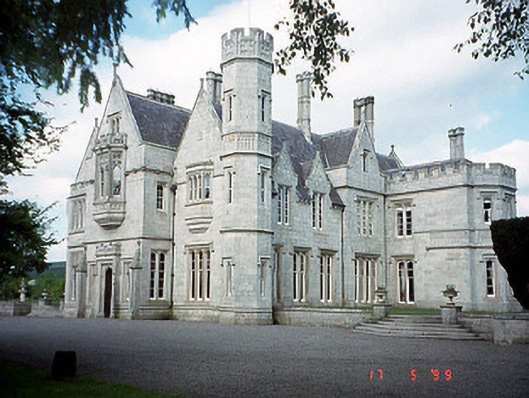
Ballydarton House, County Carlow, also designed by Daniel Robertson, in 1830. Photograph from the National Inventory of Architectural Heritage.
Dunleckney Manor, County Carlow, by Daniel Robertson, 1835. Photograph from the National Inventory of Architectural Heritage.

Daniel Robertson also designed the nearby Johnstown Castle in County Wexford. We visited Johnstown Castle also but unfortunately it was closed the only day we were in Wexford, as they were taking down Hallowe’en decorations from a special event! Such a pity we weren’t able to see the inside of the castle yet, but we shall certainly visit again.

Johnstown Castle is described in the National Inventory of Architectural Heritage: “the construction in a blue-green rubble stone offset by glimmering Mount Leinster granite dressings not only demonstrating good quality workmanship, but also producing a sober two-tone palette.” [6] Wilton Castle also has Mount Leinster granite dressings. It was covered however in white lime plaster – which has been reinstated on the renovated part of the castle.

The lakeside facade of Johnstown Castle, County Wexford, built 1836-72 for Hamilton Knox Grogan Morgan (1808-54), MP, also by Daniel Robertson – it has remarkable similarities to Wilton Castle. It envelops a seventeenth-century house (perhaps by Thomas Hopper) [7] remodelled (1810-4) by James Pain (1779-1877) of Limerick. Photograph © Jennifer Winder-Baggot, www.irishhistorichouses.com
Johnstown Castle overlooks a beautiful lake. Photograph © Jennifer Winder-Baggot, www.irishhistorichouses.com

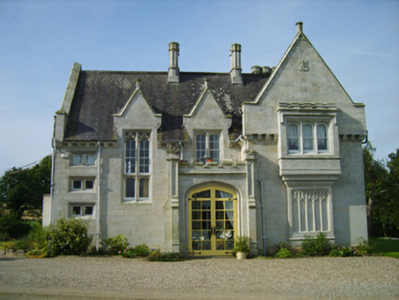
Harry’s daughter Henrietta married William Russell Farmar who also had a house built by Daniel Robertson: Bloomfield in County Wexford.

Bloomfield, a country house erected for William Russell Farmar JP (1802-71) to a design by Daniel Robertson. Photograph from National Inventory of Architectural Heritage.

Another daughter, Sarah, married Thomas John Fetherston, 5th Baronet, of Ardagh, County Longford (the house is now in use as training college, St. Brigid’s Training College, by the Sisters of Mercy).

Harry’s son, another Harry Alcock (1821-93), inherited Wilton Castle and the estate. He served as High Sheriff of Wexford in 1846 and was Lt-Col. of the Wexford Militia.  He continued the building work, which finished in 1844, adding the large square four storey tower with its elaborate balconies. He also improved the surrounding estate. He increased the plantation of trees and implemented a programme of road construction, fence building and draining of land which was carried out as Famine relief work. [8]

Wilton Castle, November 2021. Photograph © Jennifer Winder-Baggot, www.irishhistorichouses.com
Wilton Castle, when designed by Daniel Robertson, consisted of a three-storey main block and two-storey wing, all dominated by a tall square tower at one end and a tall polygonal tower and turret at the other, and it is heavily machicolated and battlemented. It is the two storey wing which has been renovated for accommodation.

The tall square tower is at one end of Wilton Castle, on the three storey section. Photograph © Jennifer Winder-Baggot, www.irishhistorichouses.com

Harry Alcock died unmarried in 1893 and the estate (some 7,000 acres in the 1870s) passed to his nephew, Philip Clayton Alcock (1861-1949), son of Harry’s brother Philip Savage Alcock (1828-86) of Park House on the Wilton estate and his wife Katherine Annette Browne-Clayton of Carrickbyrne Lodge in County Wexford. Philip Clayton Alcock was a Captain in the Gloucestershire Regiment, and in 1900 High Sheriff of Wexford, but by 1922 he felt it was too dangerous to remain at Wilton and moved to England. In 1923 his fears about his Irish property were justified when Wilton Castle was burned by arsonists. [9]

A contemporary account in the Irish Times, 7 March 1923 tells us about the burning: “Wilton Castle, the residence of Captain P.C. Alcock, about three miles from Enniscorthy, was burned by armed men on Monday night. Nothing remains of the beautiful building but smoke-begrimed, roofless walls, broken windows, and a heap of smouldering debris. The Castle was occupied by a caretaker – Mr. James Stynes – the owner, with his wife and family, having gone to England about a year ago. Shortly after 9 o’clock on Monday night the caretaker was at the Steward’s residence…when he was approached by armed men, who demanded the keys to the Castle. When he asked why they wanted the keys, one of the armed men said: “We have come to burn the place. We are sorry”. The raiders told the caretaker that he could remove his personal belongings from the part of the Castle that he occupied, but they would not allow him to remove the furniture. Fearing that the Castle might be burned, however, Captain Alcock had removed the most valuable portion of his furniture some weeks ago, but a good many rooms were left furnished. When the caretaker had removed his property he was ordered back to the Steward’s house. Soon the noise of breaking glass was heard. It appears that the armed men broke all the windows on the ground floor, and having sprinkled the floors with petrol, set them alight. They did not hurry over their work of destruction, and they did not leave the Castle until near 12 o’clock, when the building was enveloped in flames. About thirty men took part in the raid. After the raiders left, the caretaker and Steward, with what help they could procure, tried to extinguish the flames, but their effort was hopeless”. [10]

Photograph from the National Inventory of Architectural Heritage of Wilton Castle before renovation.
The tall polygonal tower and telescoping turret at the other end of Wilton Castle, on the two storey section of the castle, which has been renovated and faced in a creamy white lime plaster to distinguish it from the section which remains a ruin. Photograph © Jennifer Winder-Baggot, www.irishhistorichouses.com

Wilton Castle was built on a moated platform surrounded by parapet walls and sham fortifications.

The moated area, in front of the castle. Photograph © Jennifer Winder-Baggot, www.irishhistorichouses.com
One of the little fortification towers along the moat in front of the castle. Photograph © Jennifer Winder-Baggot, www.irishhistorichouses.com
Area in front of the castle, with another of the fortification towers and the moated area (not filled with water) lies on the far side of the low wall. Photograph © Jennifer Winder-Baggot, www.irishhistorichouses.com
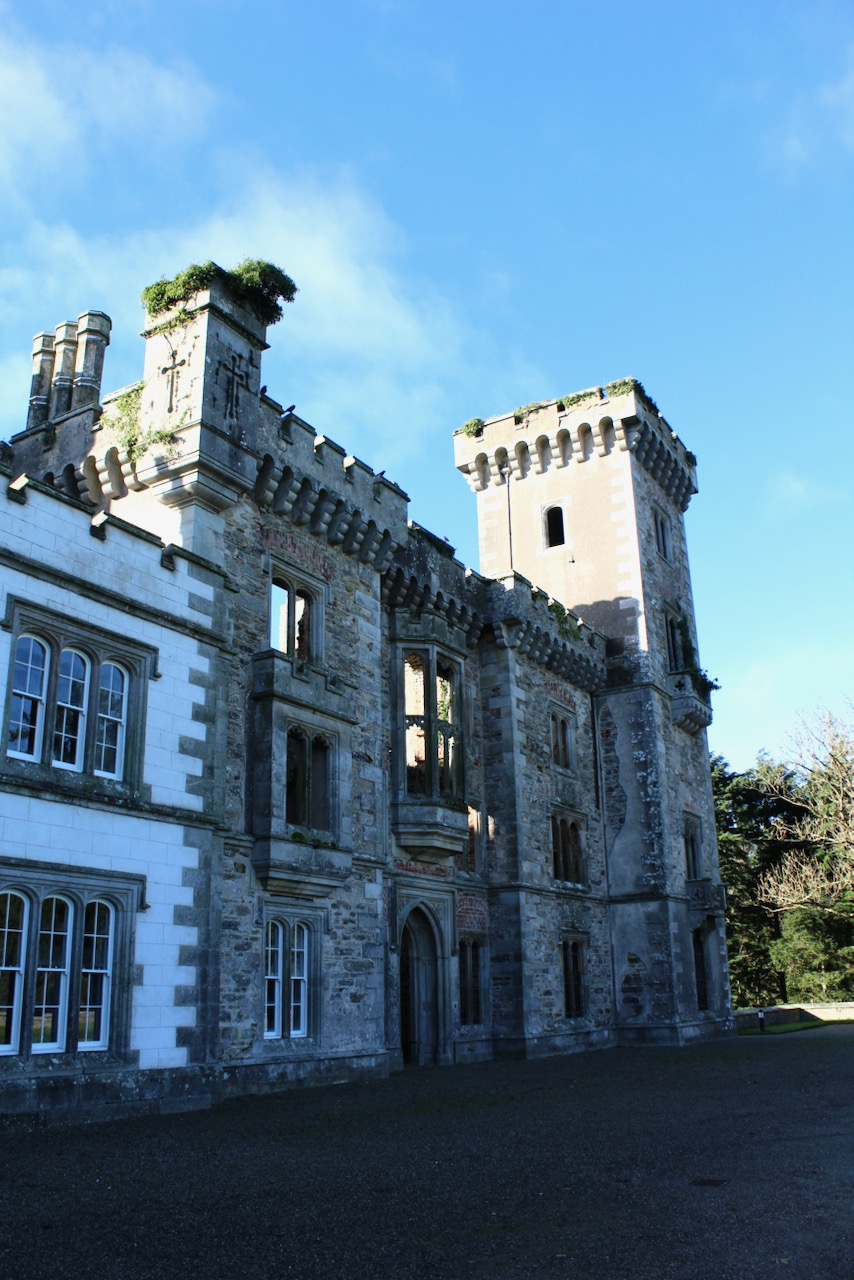
The windows of Wilton Castle are arched and paired and have hood mouldings; the roof has crenellations. Photograph © Jennifer Winder-Baggot, www.irishhistorichouses.com
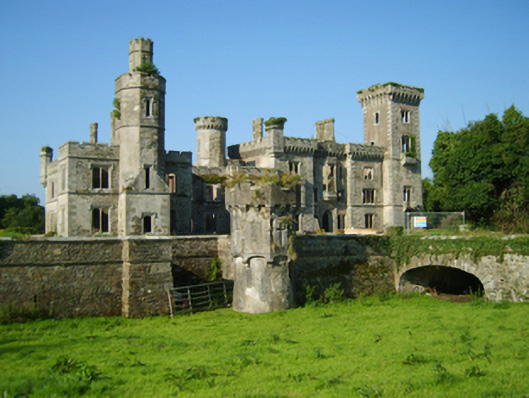
The side of Wilton Castle. Note the fine stone chimneys. The octagonal turret on the south west corner of Wilton Castle is built entirely of Mount Leinster granite and contains 182 cubic ft of stone or approx 13.5 ton in weight. [11] Photograph © Jennifer Winder-Baggot, www.irishhistorichouses.com
Wilton Castle, November 2021. Photograph © Jennifer Winder-Baggot, www.irishhistorichouses.com

In the three storey section of the castle, there is a beautiful carved doorcase, and an oriel window over it with delicate stone tracery and crenellations on top of the windowframe. Mark Bence-Jones defines an oriel window as “a large projecting window in Gothic, Tudor, Gothic-Revival and Tudor-Revival architecture; sometimes rising through two or more storeys, sometimes in an upper storey only and carried on corbelling.” [12] There is a similar oriel window at Johnstown Castle, which is only one storey high.

The beautifully carved Tudor-style doorcase at Wilton Castle. Photograph © Jennifer Winder-Baggot, www.irishhistorichouses.com
The carved doorcase and oriel window of Wilton Castle. Photograph © Jennifer Winder-Baggot, www.irishhistorichouses.com
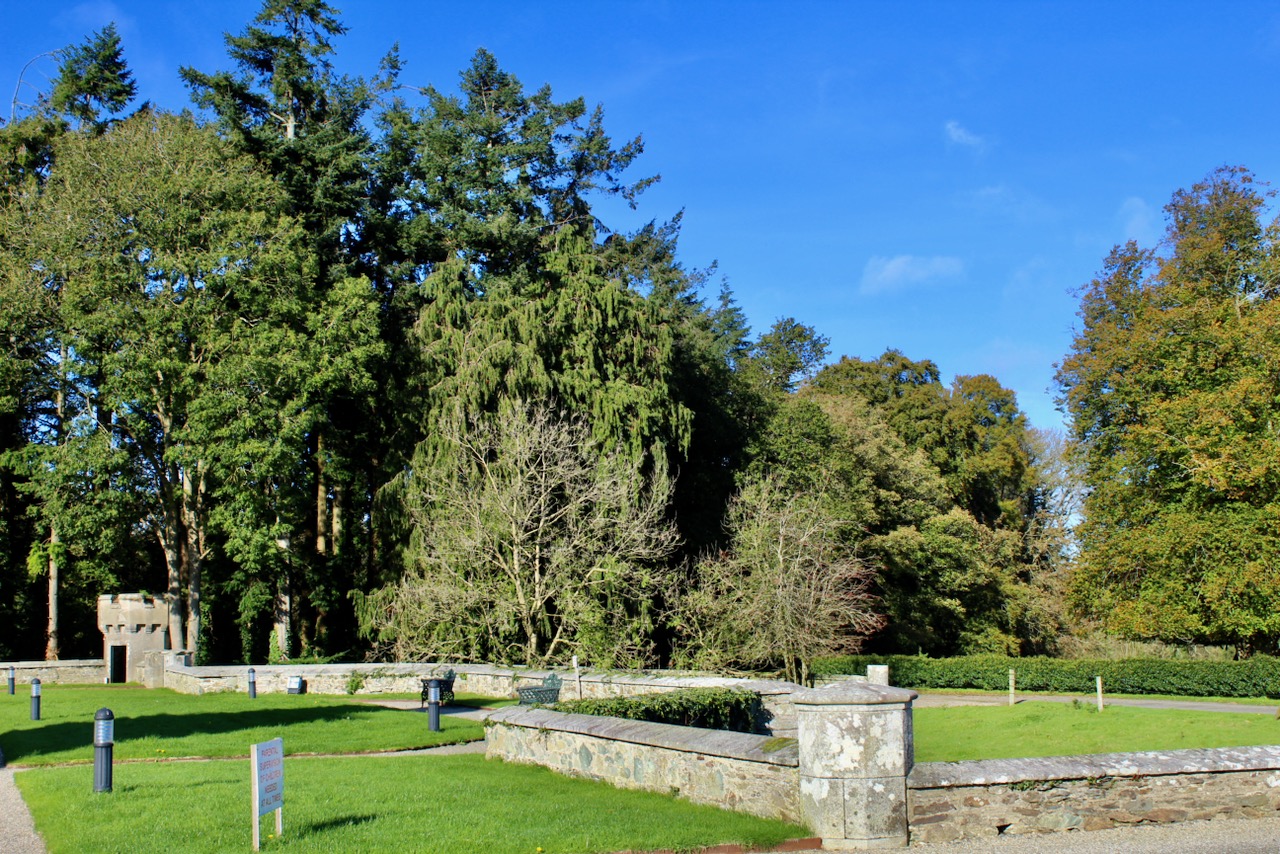
At Wilton Castle there are double sets of sidelight windows either side of the doorcase, with arched carved window frames.

The Oriel window at Johnstown Castle, similar to that at Wilton Castle though the one at Wilton Castle is double-height. Photograph © Jennifer Winder-Baggot, www.irishhistorichouses.com

I was most excited to discover that we could explore the ruined part of the castle as it has been stabilised securely. It was wonderful to explore the detail.

The tower of the ruined part of Wilton Castle. It has wonderful balconies on heavy stone corbels with Gothic tracery windows. Photograph © Jennifer Winder-Baggot, www.irishhistorichouses.com
The oriel window and doorcase as seen from inside Wilton Castle. Photograph © Jennifer Winder-Baggot, www.irishhistorichouses.com
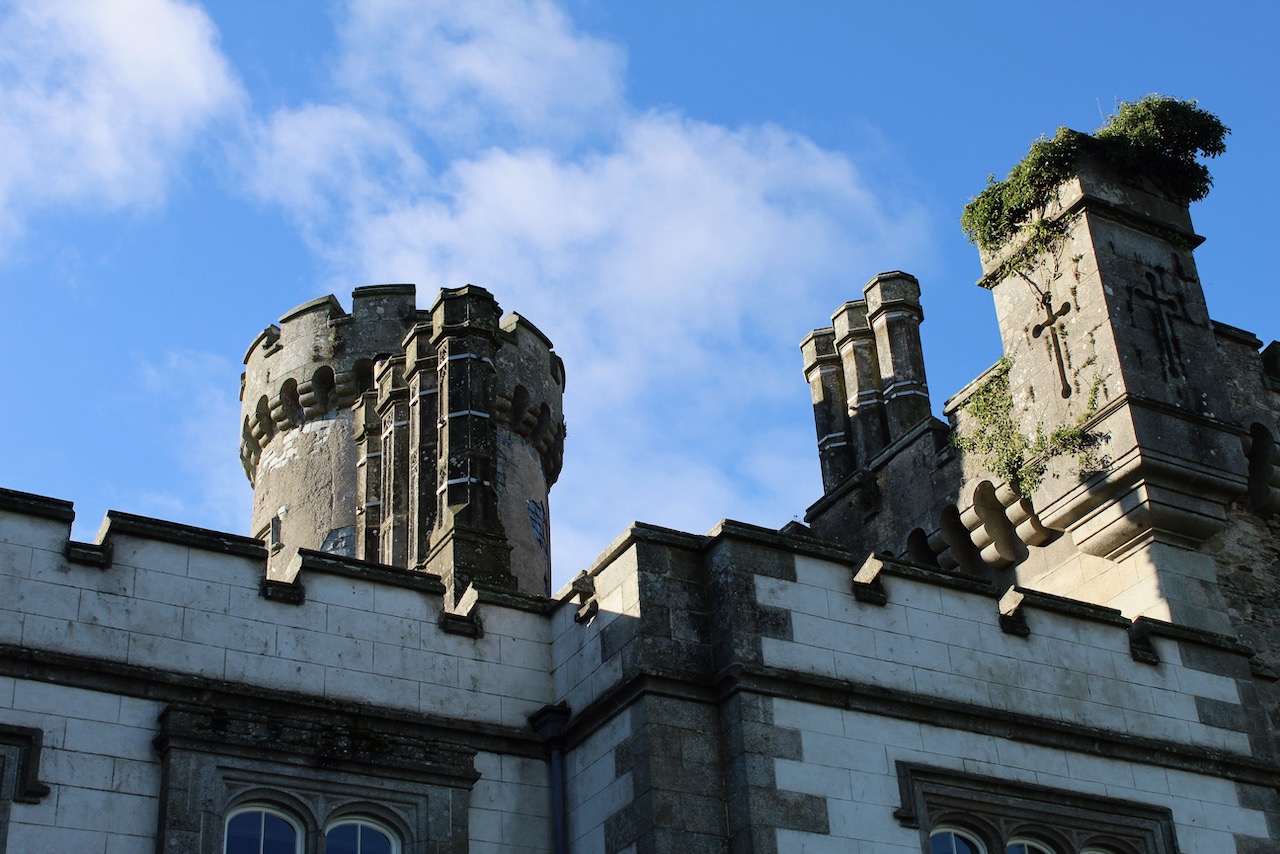
Wilton Castle. Photograph © Jennifer Winder-Baggot, www.irishhistorichouses.com
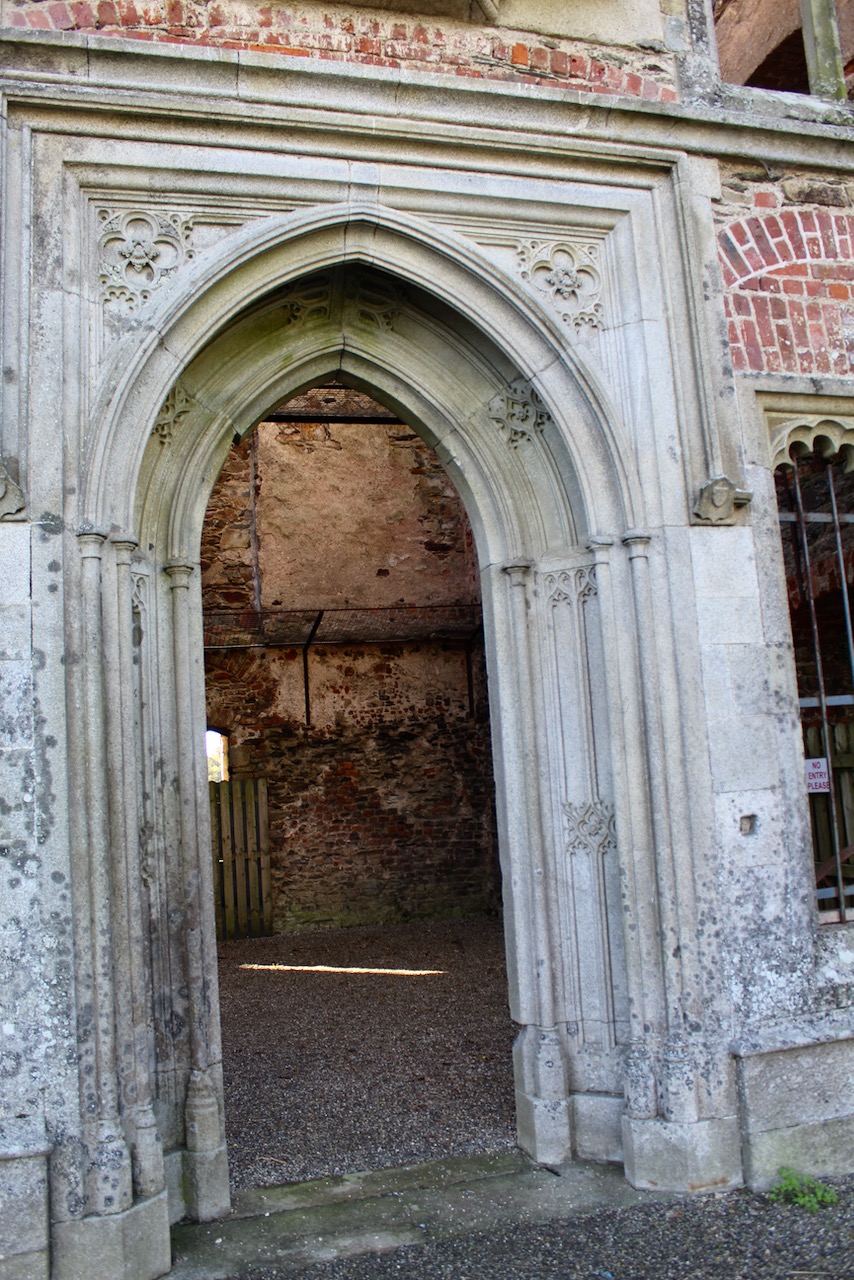
Wilton castle. Photograph © Jennifer Winder-Baggot, www.irishhistorichouses.com
Wilton Castle, November 2021. Photograph © Jennifer Winder-Baggot, www.irishhistorichouses.com

We kept discovering more. Pictures from the front of the castle do not do it justice. The land drops down behind the castle to the River Boro, to reveal beautiful pastoral views from the back windows of the castle.

The view over the river from inside the ruin of Wilton Castle. Photograph © Jennifer Winder-Baggot, www.irishhistorichouses.com
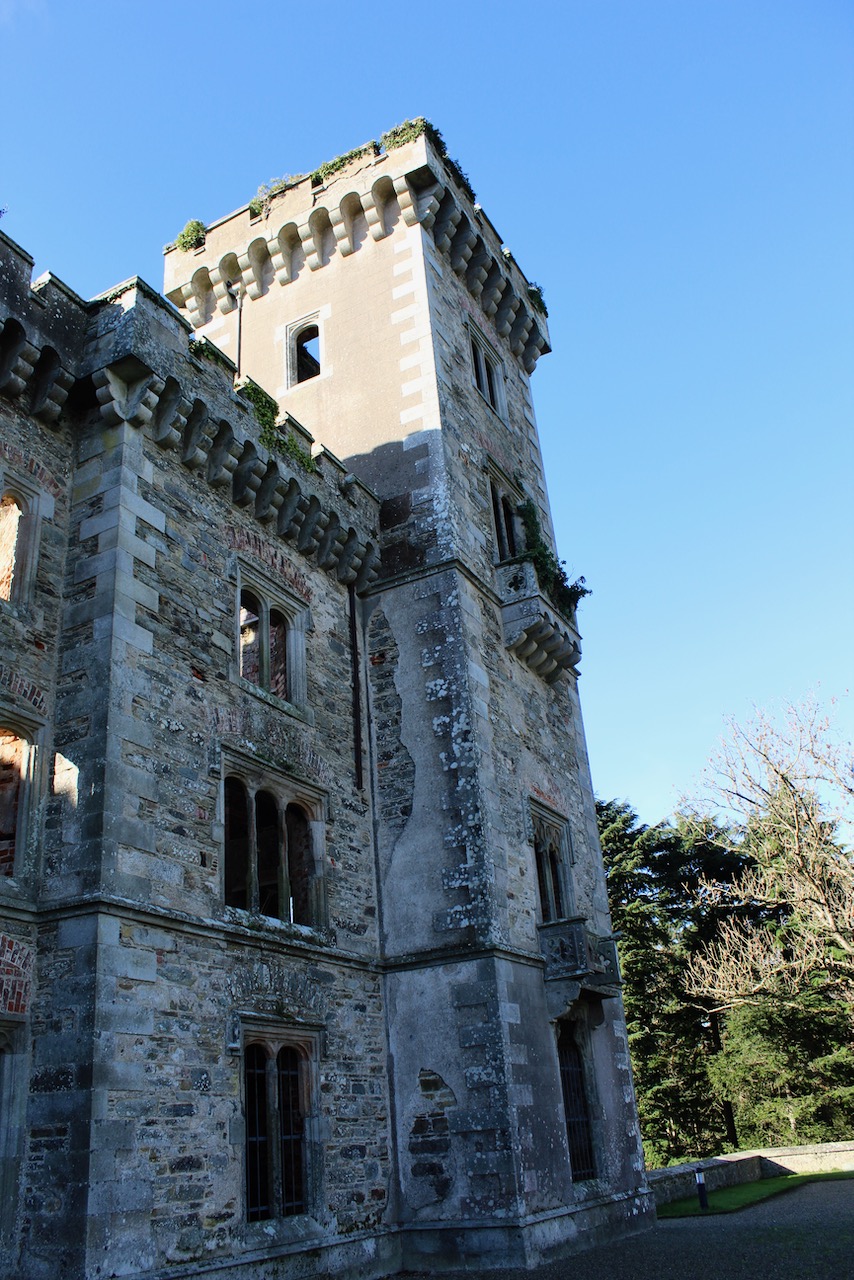
Wilton Castle. Photograph © Jennifer Winder-Baggot, www.irishhistorichouses.com
The River Boro running along the back of Wilton Castle. Photograph © Jennifer Winder-Baggot, www.irishhistorichouses.com
There are lots of stone corbels. Photograph © Jennifer Winder-Baggot, www.irishhistorichouses.com
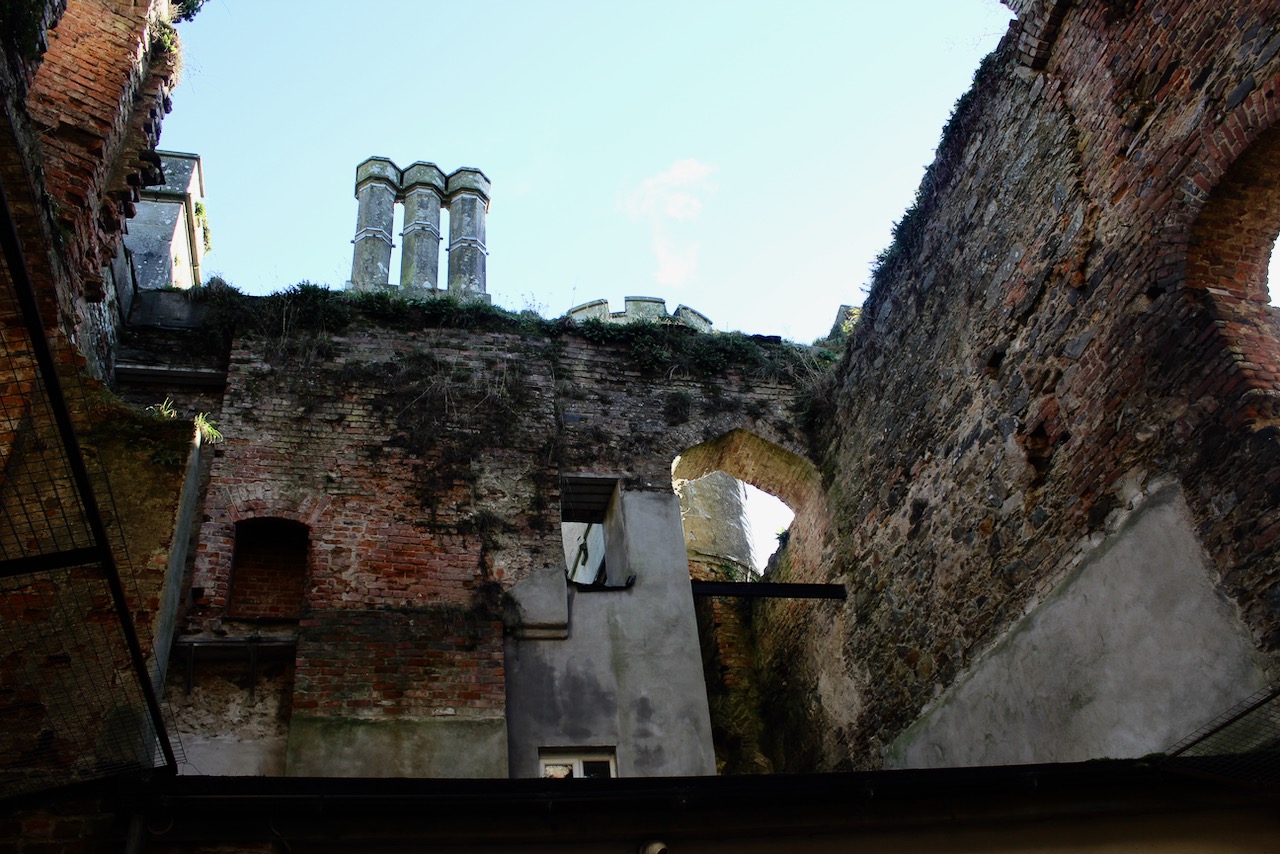
The spiral staircase inside the round tower at the back of the castle which joins the older Wilton House to the rest of the Castle. Photograph © Jennifer Winder-Baggot, www.irishhistorichouses.com
The view from the interior spiral staircase inside the ruin, of the river side of the castle and down toward the steward’s house. Photograph © Jennifer Winder-Baggot, www.irishhistorichouses.com

One can walk down to the river and more of the detail of the castle is revealed from behind. We found a warren of tunnels to one side on a level below the castle.

The tunnel from the castle level down to the farmyard. Photograph © Jennifer Winder-Baggot, www.irishhistorichouses.com
In this photograph you can see the side of the castle, and the path below. The river lies below that. Photograph © Jennifer Winder-Baggot, www.irishhistorichouses.com
The tunnels to the side of Wilton Castle, at the lower level. Photograph © Jennifer Winder-Baggot, www.irishhistorichouses.com

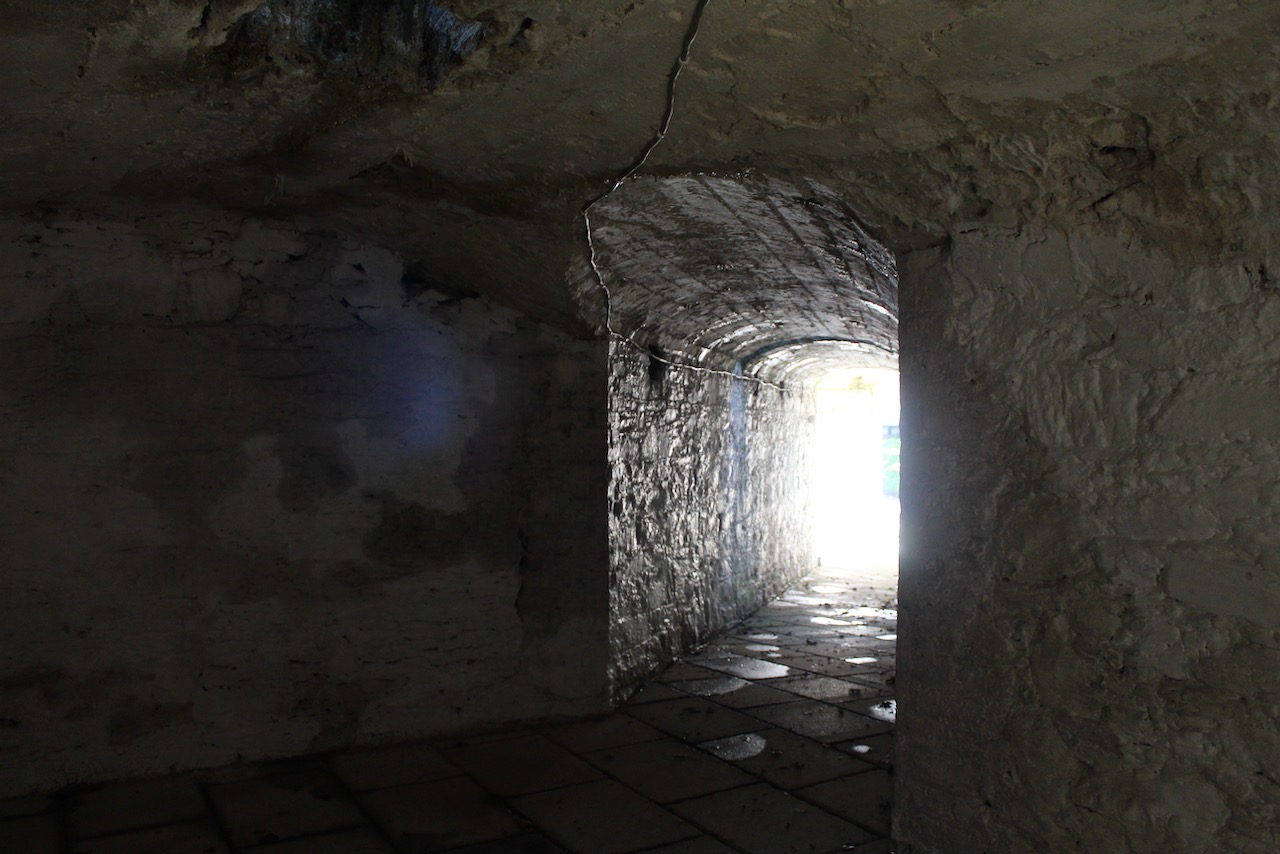
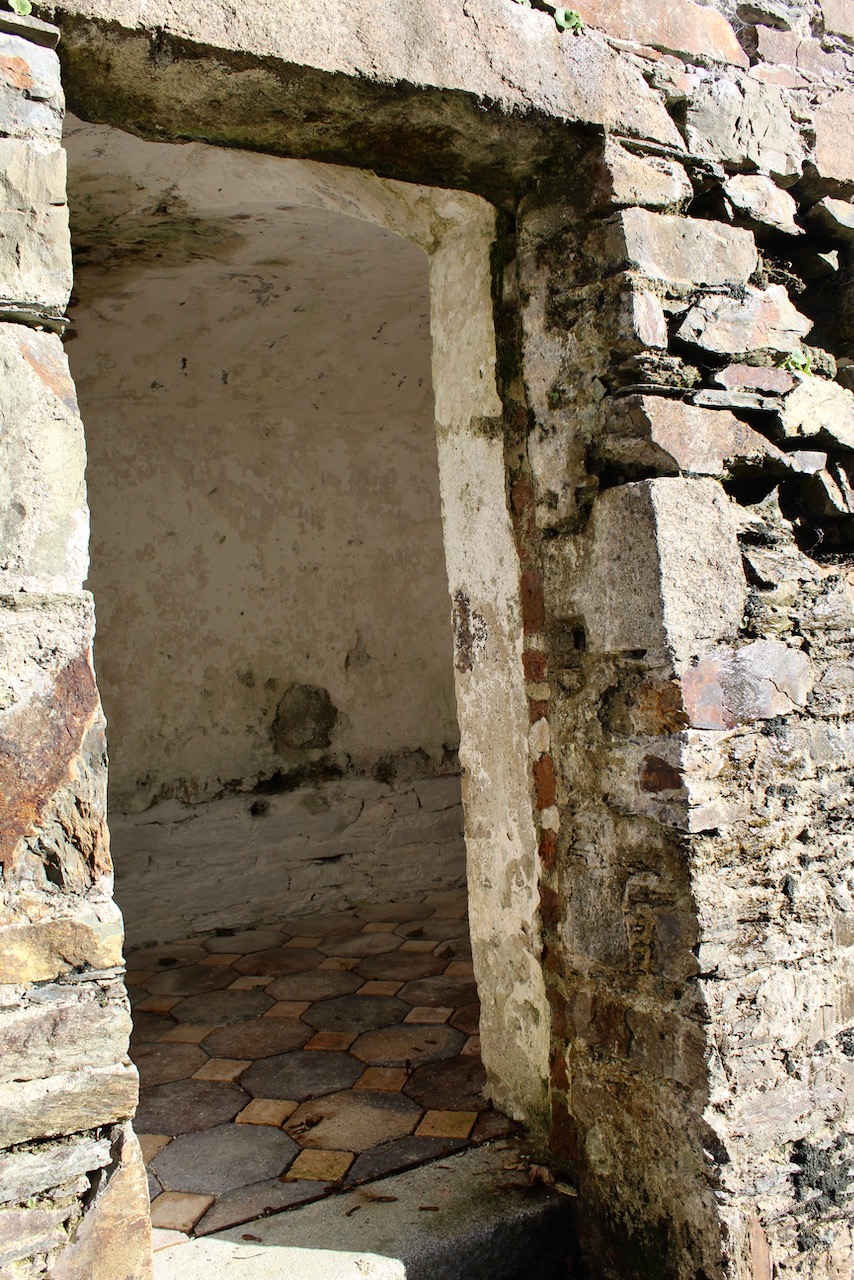
The tunnels provided quick access for servants to different parts of the castle, stable yard and grounds. There were cellars for wine and storage areas for food. Cast iron grilles let natural light and air into the tunnels. [13]

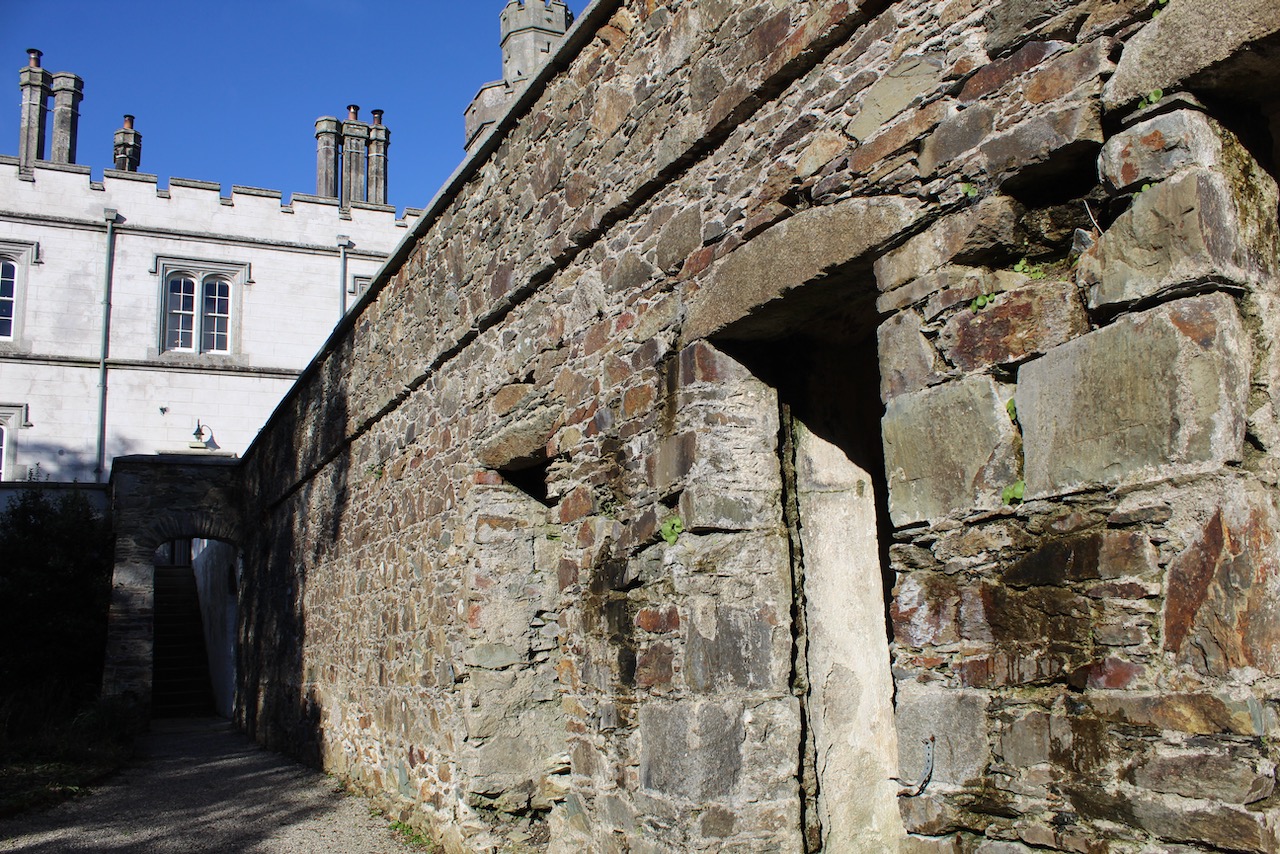
The entrances to the tunnels are in this stone wall. Photograph © Jennifer Winder-Baggot, www.irishhistorichouses.com
Entrances to the tunnels, in the stone wall. Photograph © Jennifer Winder-Baggot, www.irishhistorichouses.com
Wilton Castle. Photograph © Jennifer Winder-Baggot, www.irishhistorichouses.com
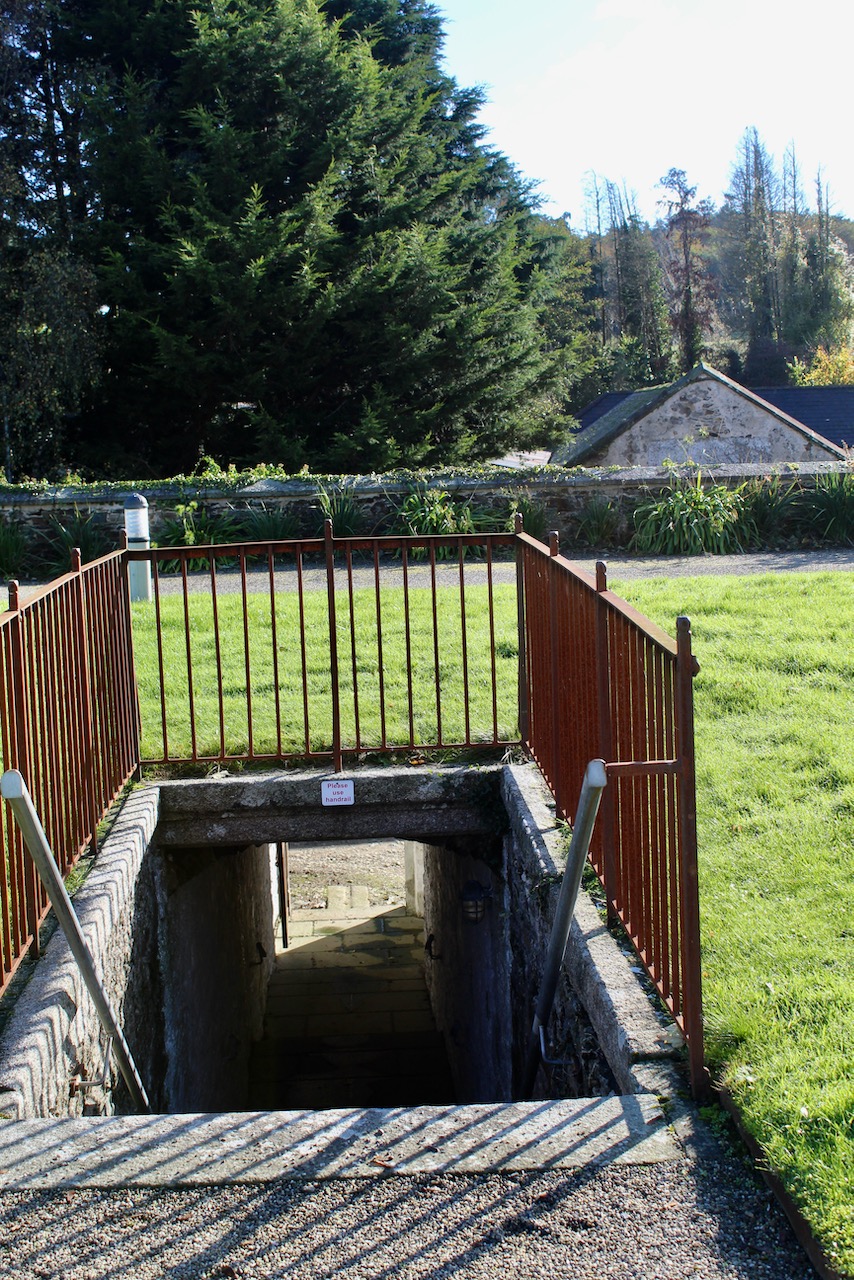
The riverside facade of Wilton Castle. The three storey section in the back – which is part of the older Alcock house – is covered in weather-slating tiles. The round tower contains the spiral staircase which I climbed inside the ruin. Photograph © Jennifer Winder-Baggot, www.irishhistorichouses.com
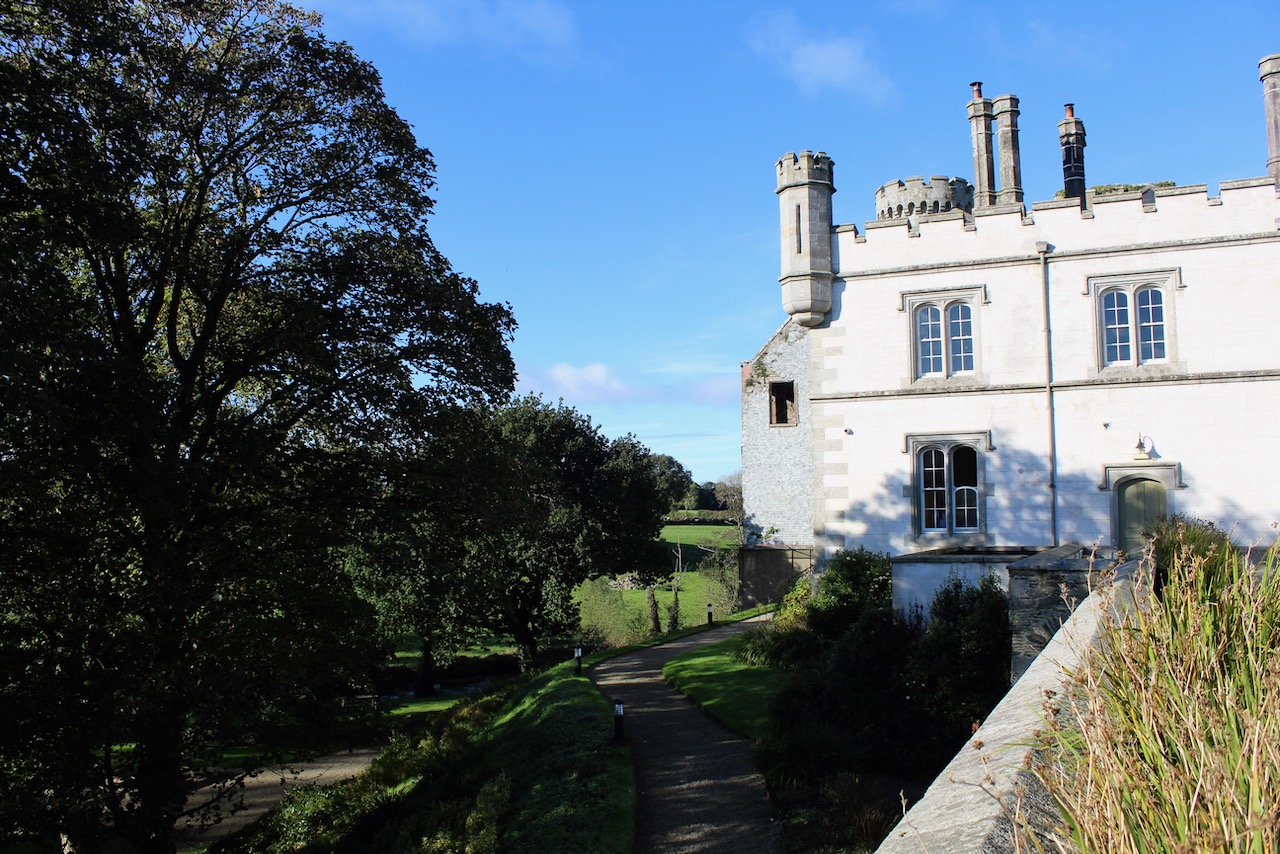
It was only when we explored around the river side of Wilton Castle that we realised the extent of its size and the beauty of its surroundings. Photograph © Jennifer Winder-Baggot, www.irishhistorichouses.com
Wilton Castle. Photograph © Jennifer Winder-Baggot, www.irishhistorichouses.com
The older section of Wilton Castle, formerly Wilton House. Photograph © Jennifer Winder-Baggot, www.irishhistorichouses.com
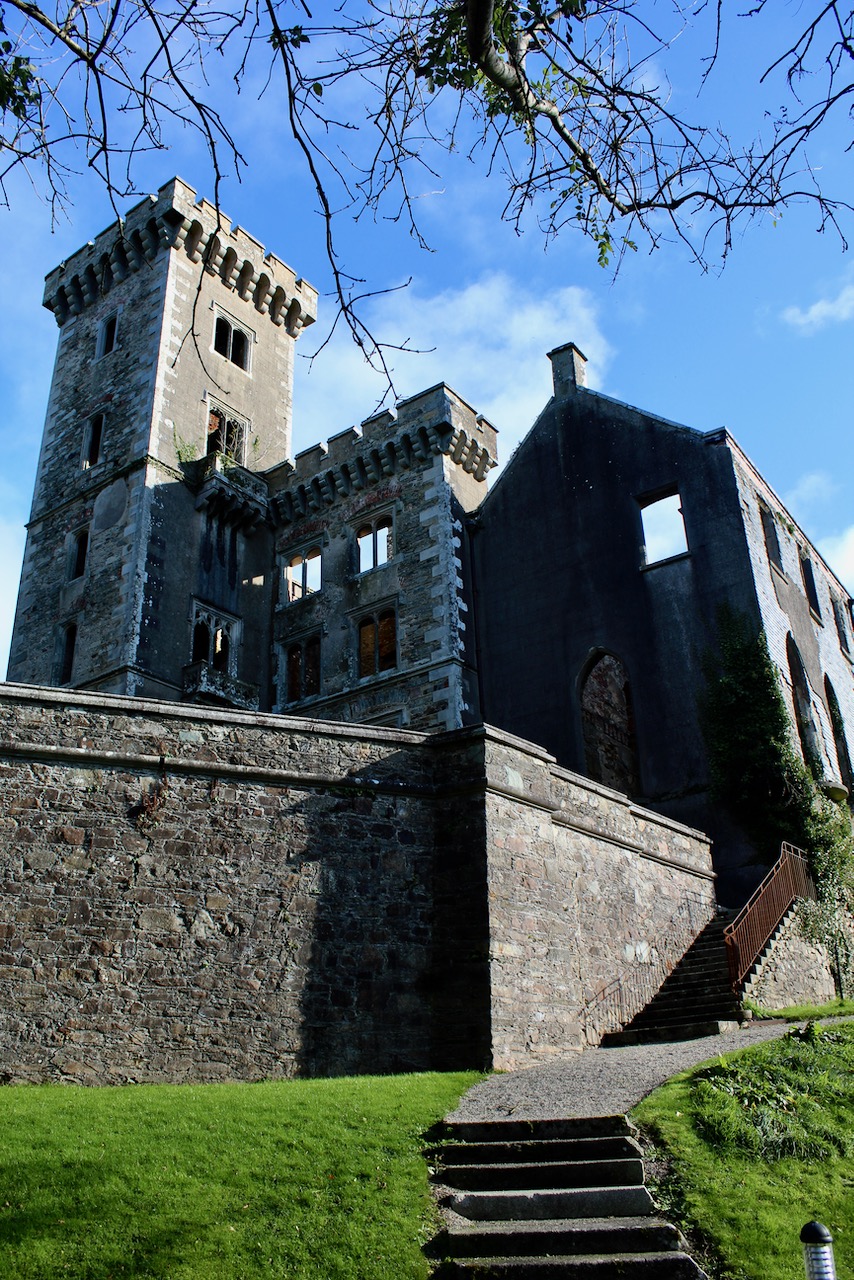
From the path along the river side of the castle, one can climb back up these stairs, to discover a picnic area! Photograph © Jennifer Winder-Baggot, www.irishhistorichouses.com
The picnic area. Photograph © Jennifer Winder-Baggot, www.irishhistorichouses.com
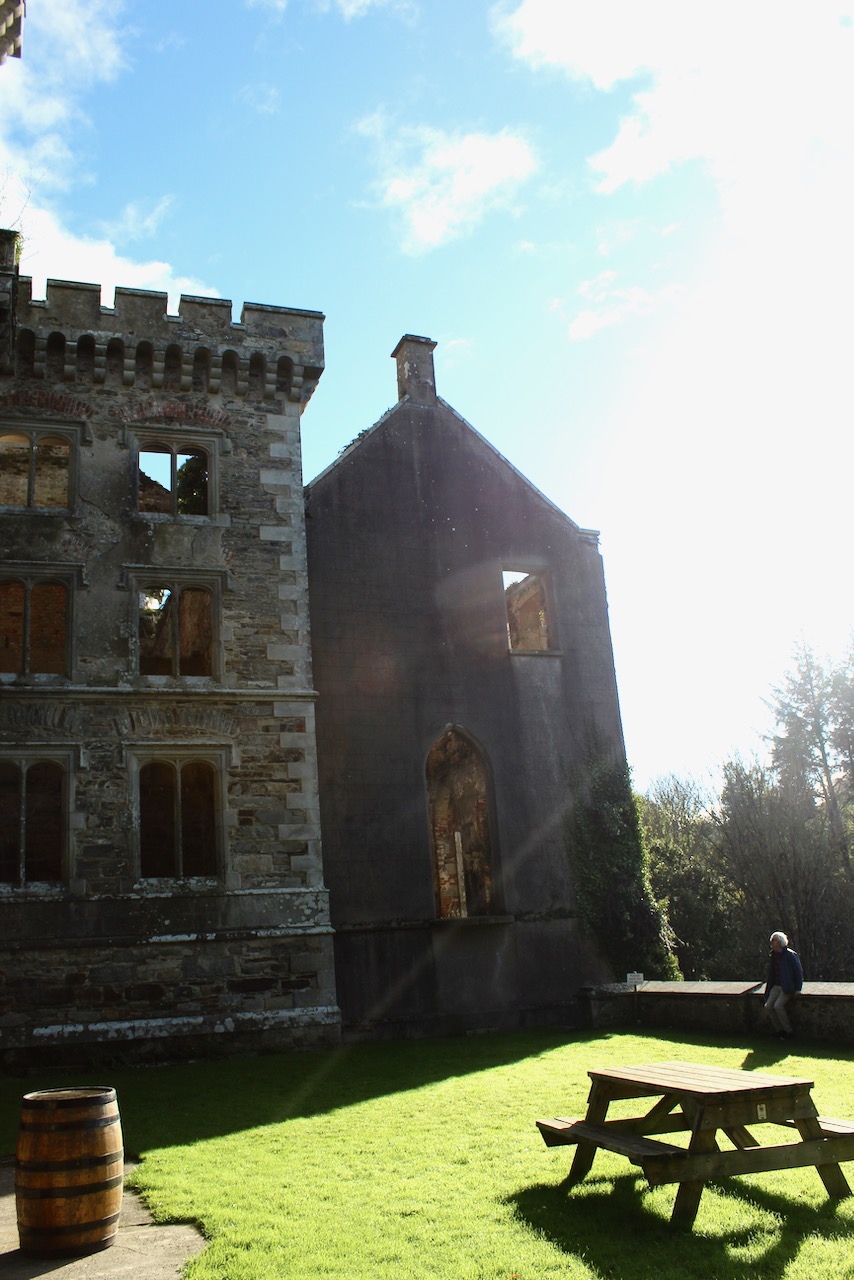
Wilton Castle. Photograph © Jennifer Winder-Baggot, www.irishhistorichouses.com
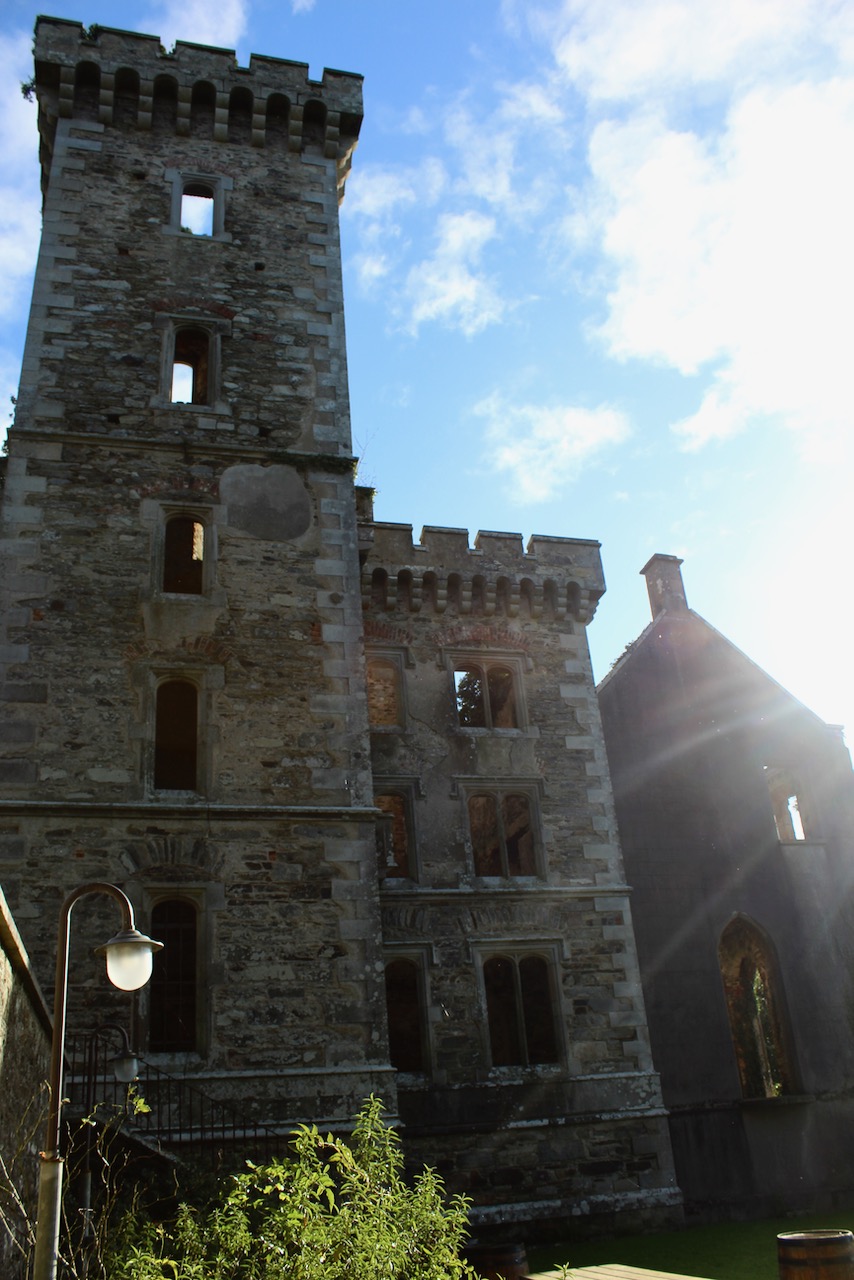
From the picnic area, you can see the full height of the square tower. Photograph © Jennifer Winder-Baggot, www.irishhistorichouses.com
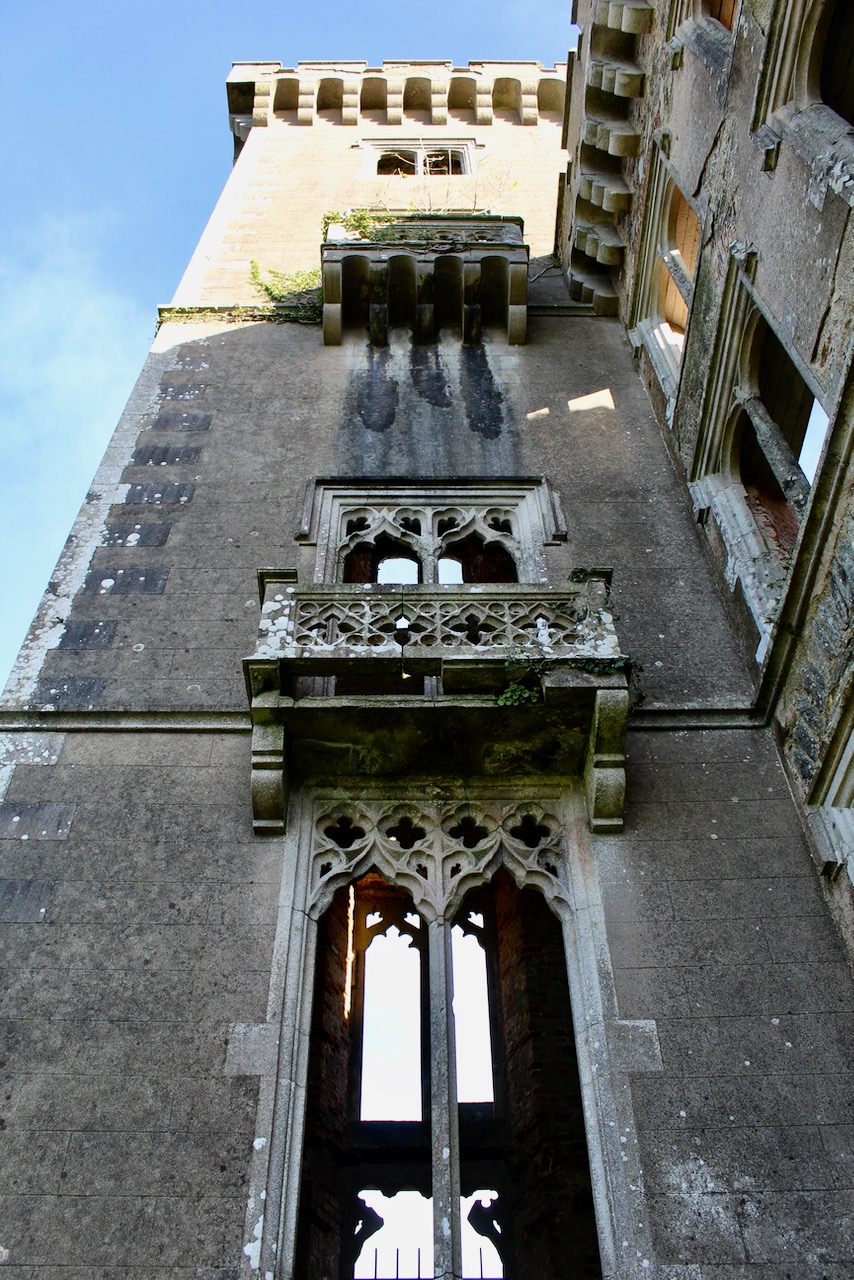
More wonderful balconies and tracery windows in the square tower, seen from the river side. Photograph © Jennifer Winder-Baggot, www.irishhistorichouses.com
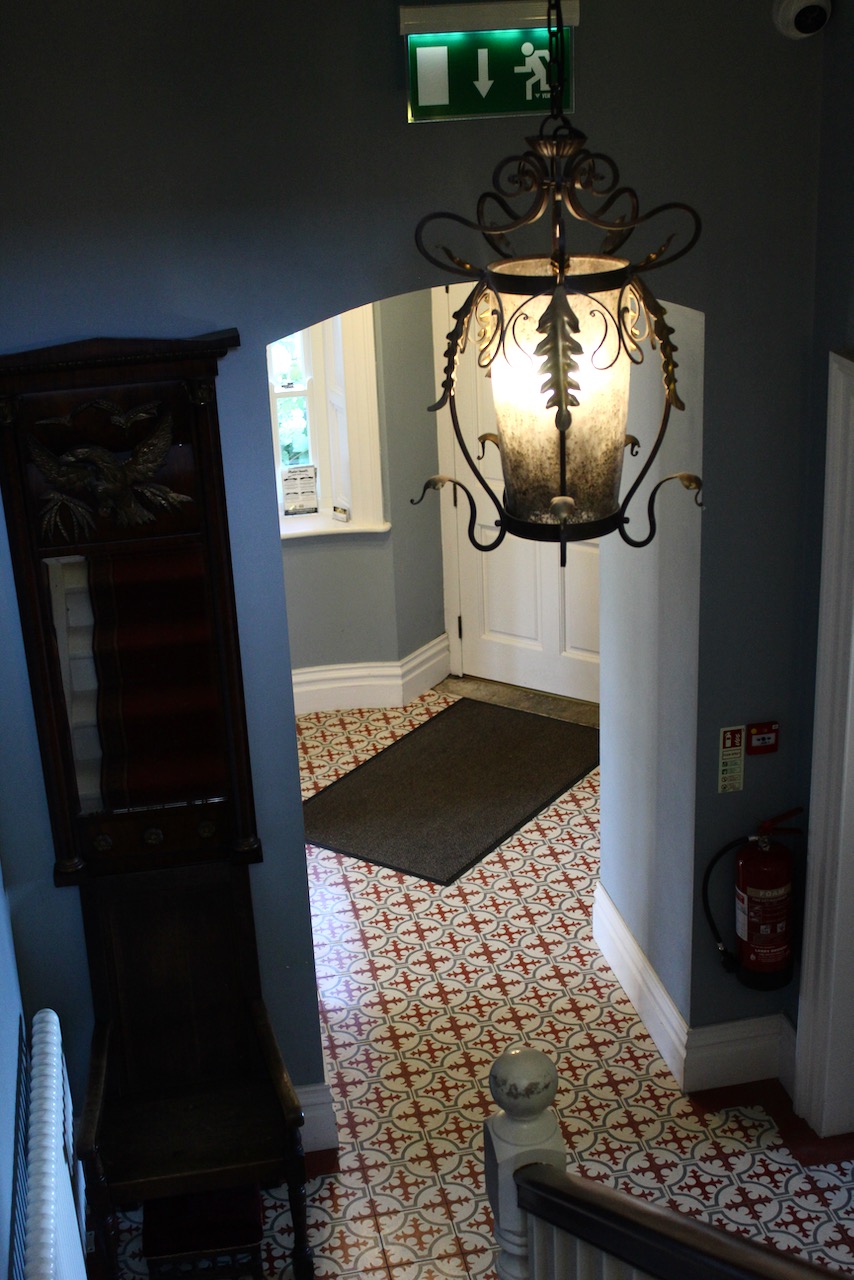
After the fire, the Alcocks were unable to rebuild as the house had not been insured. The lands were redistributed by the Irish Lands Commission, and the castle and land was purchased by local farmer, Sean Windsor.

When we arrived we were welcomed and brought inside the renovated section of the castle. It opens into a nicely tiled hallway.

Wilton Castle, November 2021. Photograph © Jennifer Winder-Baggot, www.irishhistorichouses.com
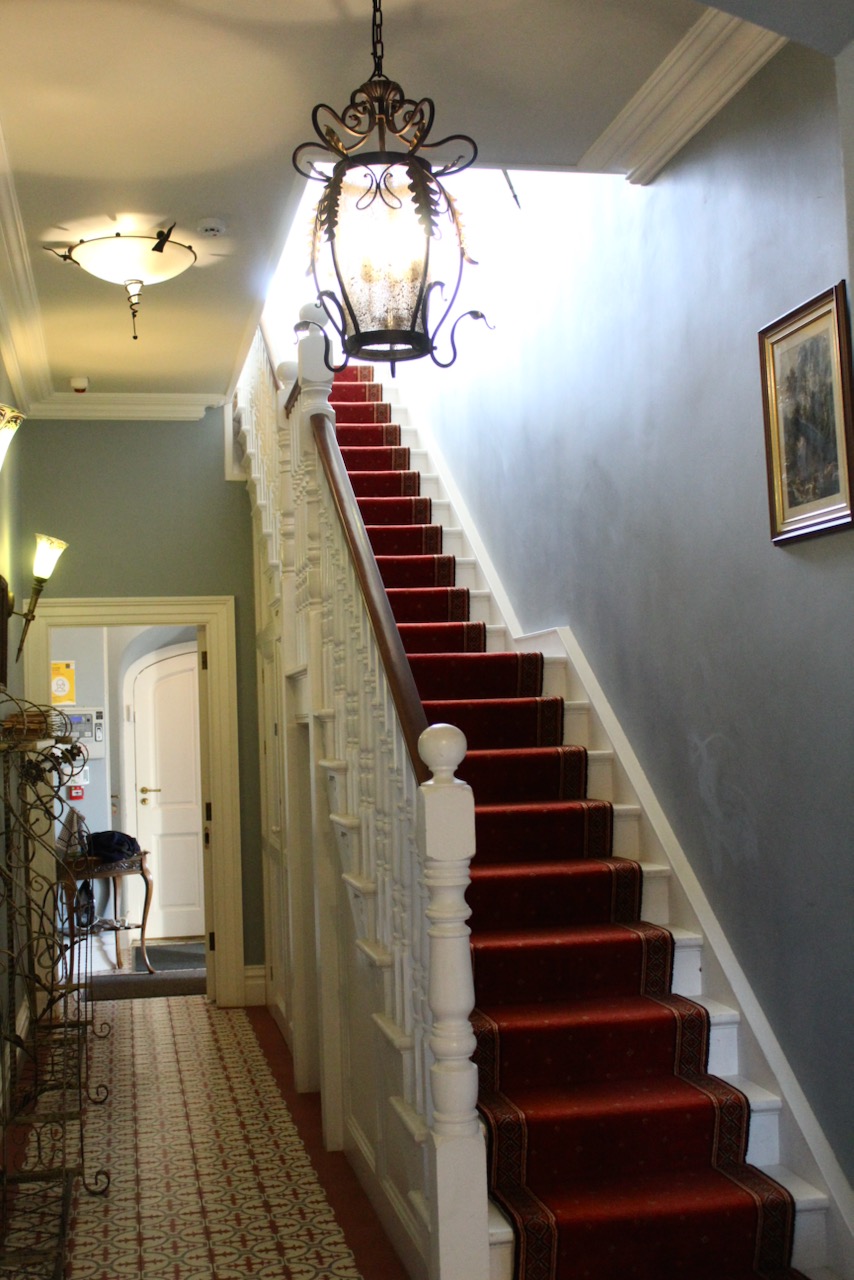
The accommodation consists of four suites, one of which has a large entertaining space. Two suites are upstairs and two downstairs, with the large one being downstairs. Our accommodation was upstairs.

Wilton castle. Photograph © Jennifer Winder-Baggot, www.irishhistorichouses.com
The upstairs hallway. Photograph © Jennifer Winder-Baggot, www.irishhistorichouses.com

Our accommodation was a suite, with sitting room, fully stocked kitchen, bathroom with walk-in shower, and bedroom. The sitting room and bedroom have beautiful wallpaper.

Wilton castle. Photograph © Jennifer Winder-Baggot, www.irishhistorichouses.com
Wilton Castle. Photograph © Jennifer Winder-Baggot, www.irishhistorichouses.com
Our bedroom had a lovely Chinese style wallpaper. Photograph © Jennifer Winder-Baggot, www.irishhistorichouses.com
Wilton Castle. Photograph © Jennifer Winder-Baggot, www.irishhistorichouses.com
Wilton Castle, November 2021. Photograph © Jennifer Winder-Baggot, www.irishhistorichouses.com

Our bathroom was in the round tower of the castle!

Wilton Castle. Photograph © Jennifer Winder-Baggot, www.irishhistorichouses.com
While our suite had a walk-in shower, the suite in the floor below has a bath. Photograph © Jennifer Winder-Baggot, www.irishhistorichouses.com

Our host showed us the larger suite downstairs that has room for a party. The double doors in the room open up to the view of the river below, onto a fine sweep of steps.

Wilton Castle. Photograph © Jennifer Winder-Baggot, www.irishhistorichouses.com
The double doors from the entertainment suite. Photograph © Jennifer Winder-Baggot, www.irishhistorichouses.com
The larger entertainment suite. Photograph © Jennifer Winder-Baggot, www.irishhistorichouses.com
Wilton Castle, November 2021. Photograph © Jennifer Winder-Baggot, www.irishhistorichouses.com

The accommodation is more pricey than we can usually afford but for a romantic getaway it is hard to beat! It’s very quiet. There seemed to be one other suite occupied when we were there, but we never saw or heard the inhabitants. The Windsors live in a house next door. We chose to have breakfast provided, which was brought to us on a tray in the morning. We used the kitchen facilities one evening to make our dinner, and the next night, ordered a delivery from nearby Enniscorthy, which was delivered to the castle!

donation

Help me to pay the entrance fee to one of the houses on this website. This site is created purely out of love for the subject and I receive no payment so any donation is appreciated!

€15.00

[1] p.560-561, Hore, Herbert. History of the Town and County of Wexford, Volume 6, ed. Philip Hore, pub. 1901-1911. Reference from http://butlerancestryireland.blogspot.com/2012/11/butlers-co-wexford-ch1-richard-1stviscount-mountgarrett.html

There is also an excellent history of the early days of the area on the Bree Heritage website, https://breeheritage.com/2015/02/27/the-early-history-of-wilton-castle-bree-co-wexford/

[2] https://landedfamilies.blogspot.com/search/label/Wexford

[3] https://theirishaesthete.com/2018/05/21/wilton-castle/

[4] For more on this, see the chapter in The Wexford Gentry by Art Kavanagh and Rory Murphy. Published by Irish Family Names, Bunclody, Co Wexford, Ireland, 1994.

[5] https://www.dia.ie/architects/view/4570/ROBERTSON%2C+DANIEL#tab_biography

[6] https://www.buildingsofireland.ie/buildings-search/building/15704226/johnstown-castle-johnstown-fo-by-co-wexford

[7] https://www.archiseek.com/2014/johnstown-castle-county-wexford/

[8] p. 130, Hicks, David. Irish Country Houses: A Chronicle of Change. The Collins Press, Cork, 2012.

[9] https://landedfamilies.blogspot.com/search/label/Wexford

[10] https://www.archiseek.com/2015/1838-wilton-castle-co-wexford/

[11] Note taken from the Wilton Castle facebook page, where you can see the progress of restoration that took place. https://www.facebook.com/WiltonCastleIreland

[12] Bence-Jones, Mark. A Guide to Irish Country Houses (originally published as Burke’s Guide to Country Houses volume 1 Ireland by Burke’s Peerage Ltd. 1978); Revised edition 1988, Constable and Company Ltd, London.

[13] p. 130, Hicks, David. Irish Country Houses: A Chronicle of Change. The Collins Press, Cork, 2012.

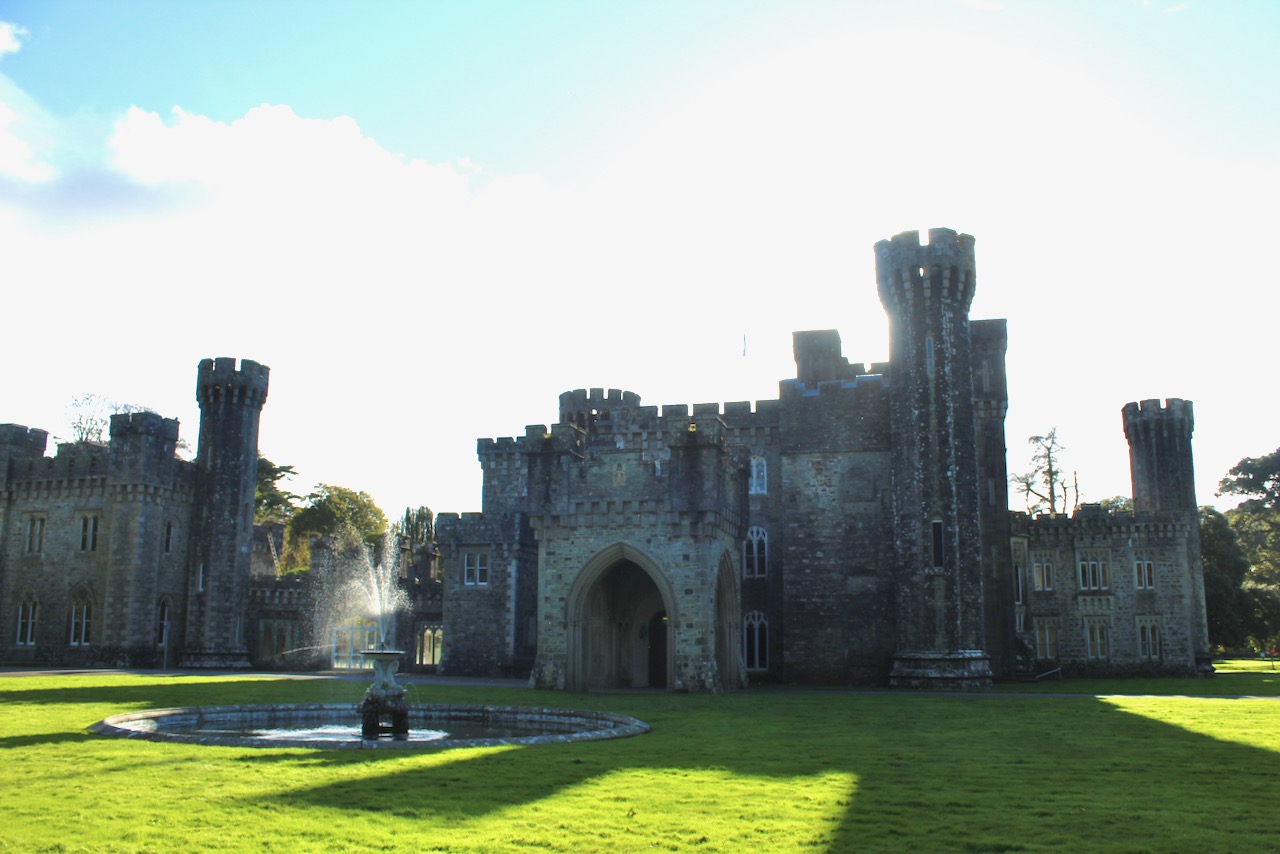
Here are more photographs from our visit to Johnstown Castle, also designed by Daniel Robertson.

The clock tower side of Johnstown Castle. Photograph © Jennifer Winder-Baggot, www.irishhistorichouses.com
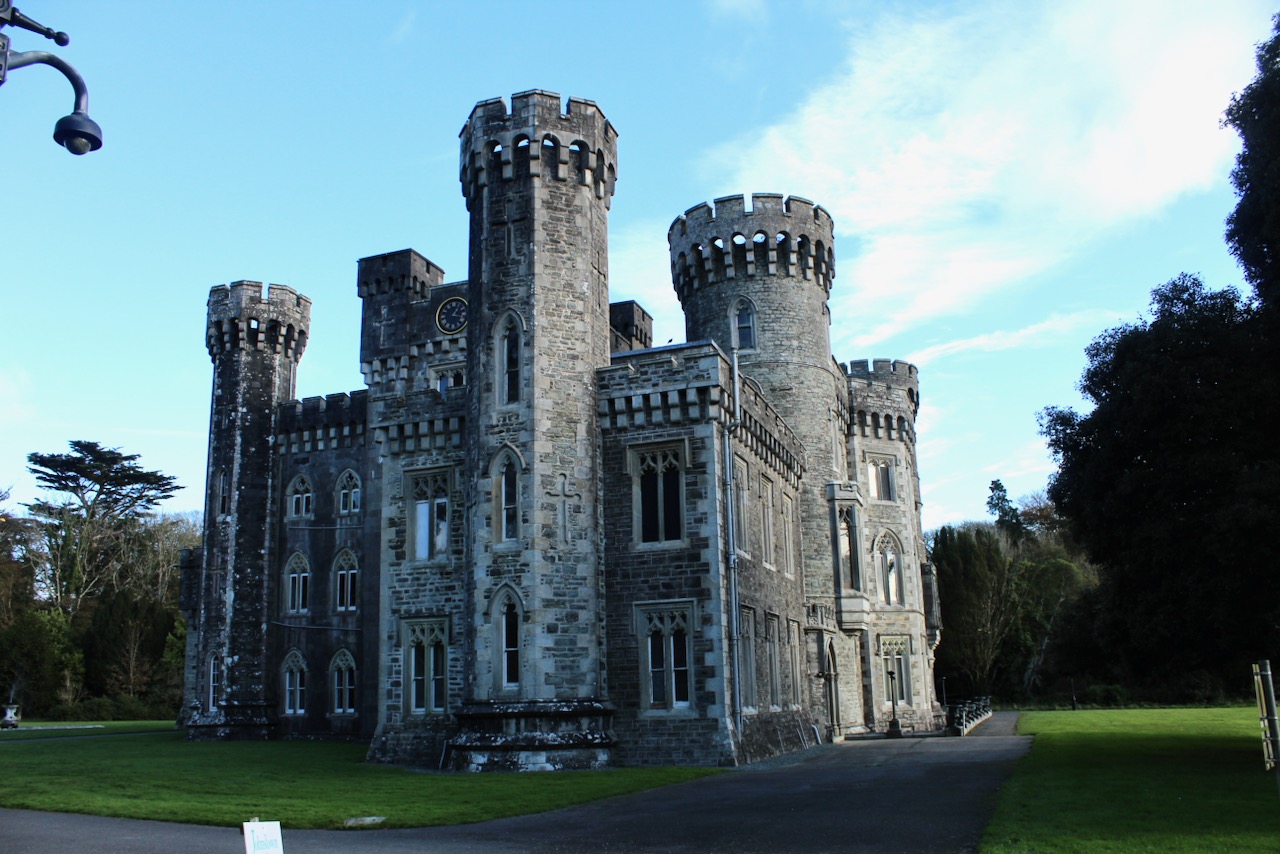
The front entrance of Johnstown Castle – clock tower side on the right. Photograph © Jennifer Winder-Baggot, www.irishhistorichouses.com
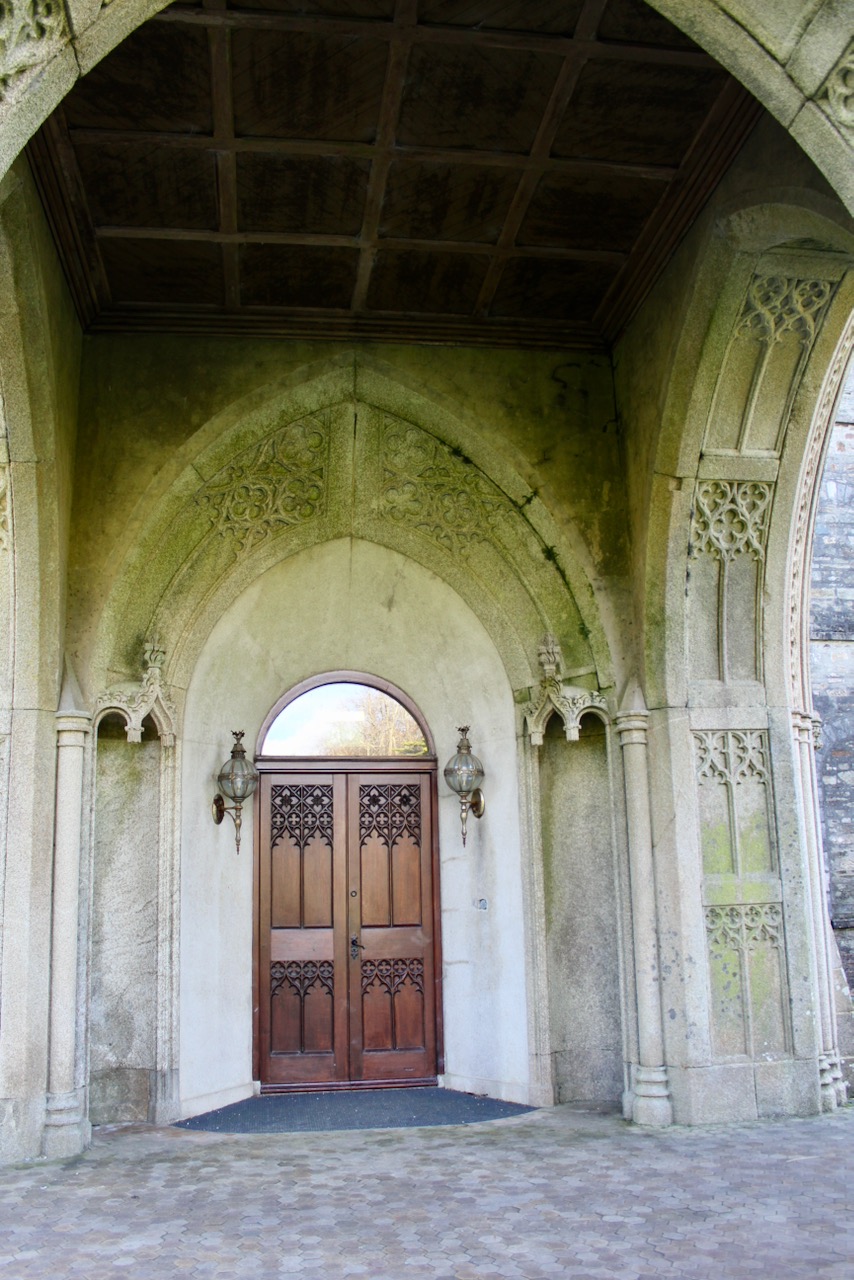
Inside the front arch of Johnstown Castle. Photograph © Jennifer Winder-Baggot, www.irishhistorichouses.com
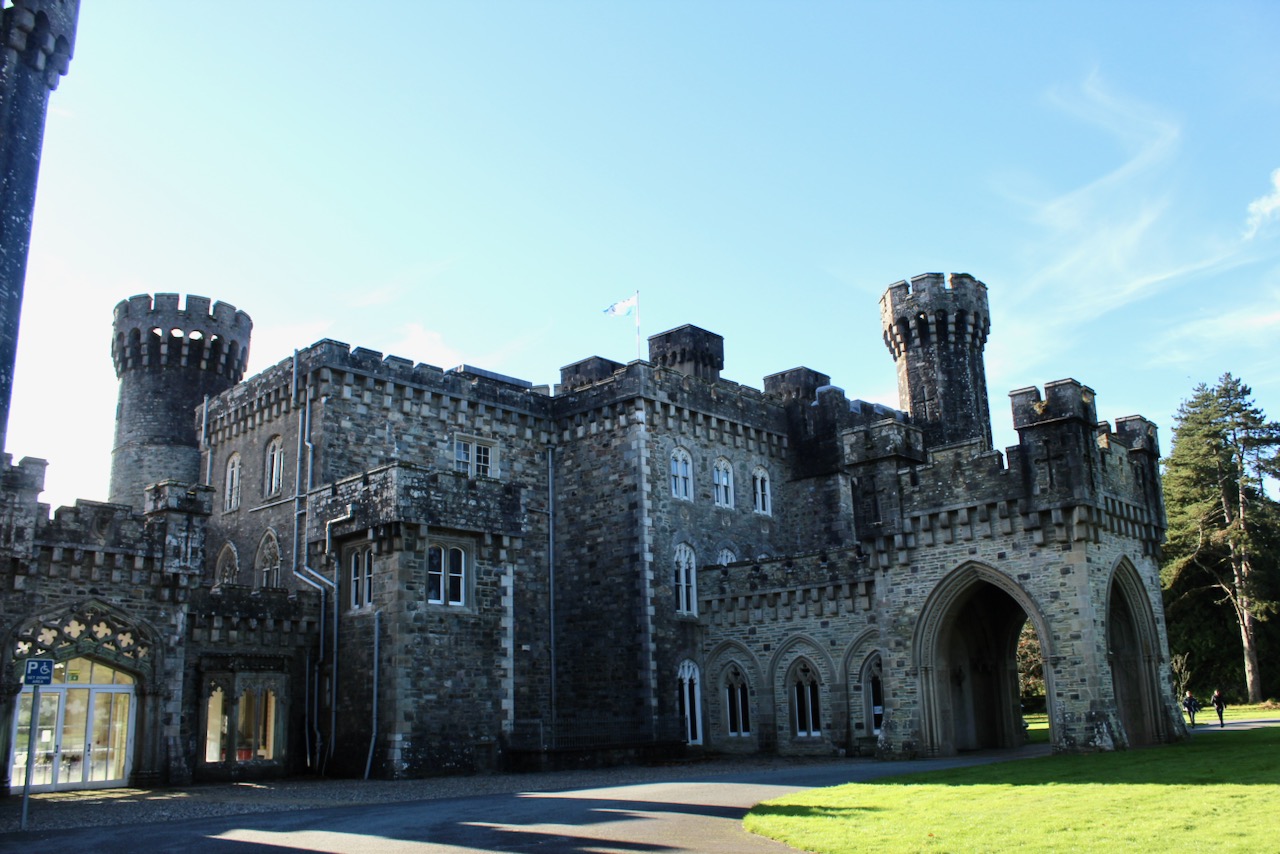
The front entrance of Johnstown Castle. Photograph © Jennifer Winder-Baggot, www.irishhistorichouses.com
Spectacular doorway arch to one side of Johnstown Castle. Photograph © Jennifer Winder-Baggot, www.irishhistorichouses.com
The doorway arch at Johnstown Castle features a border of carved stone heads. Photograph © Jennifer Winder-Baggot, www.irishhistorichouses.com
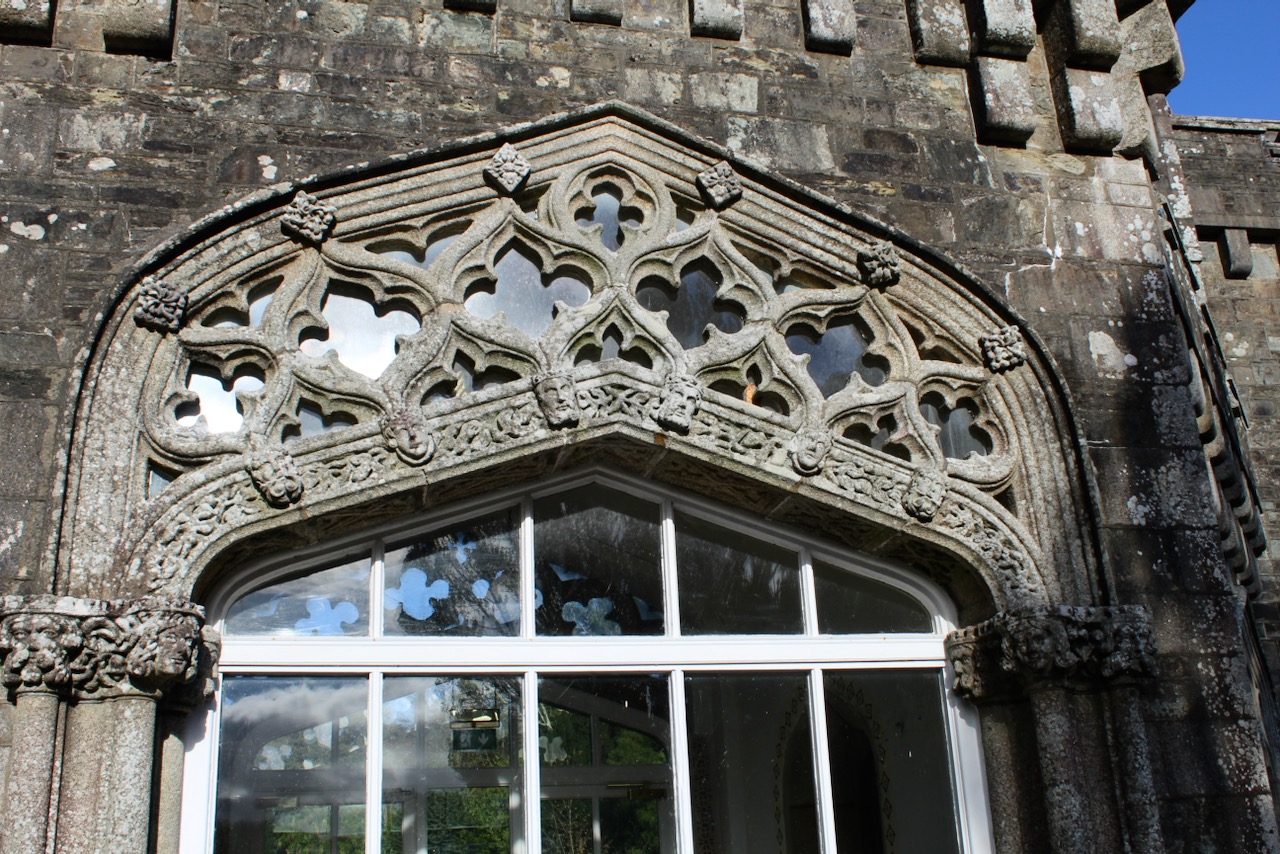
Carved stone heads at Johnstown Castle. Photograph © Jennifer Winder-Baggot, www.irishhistorichouses.com
Window surround detail and tracery at Johnstown Castle. Photograph © Jennifer Winder-Baggot, www.irishhistorichouses.com
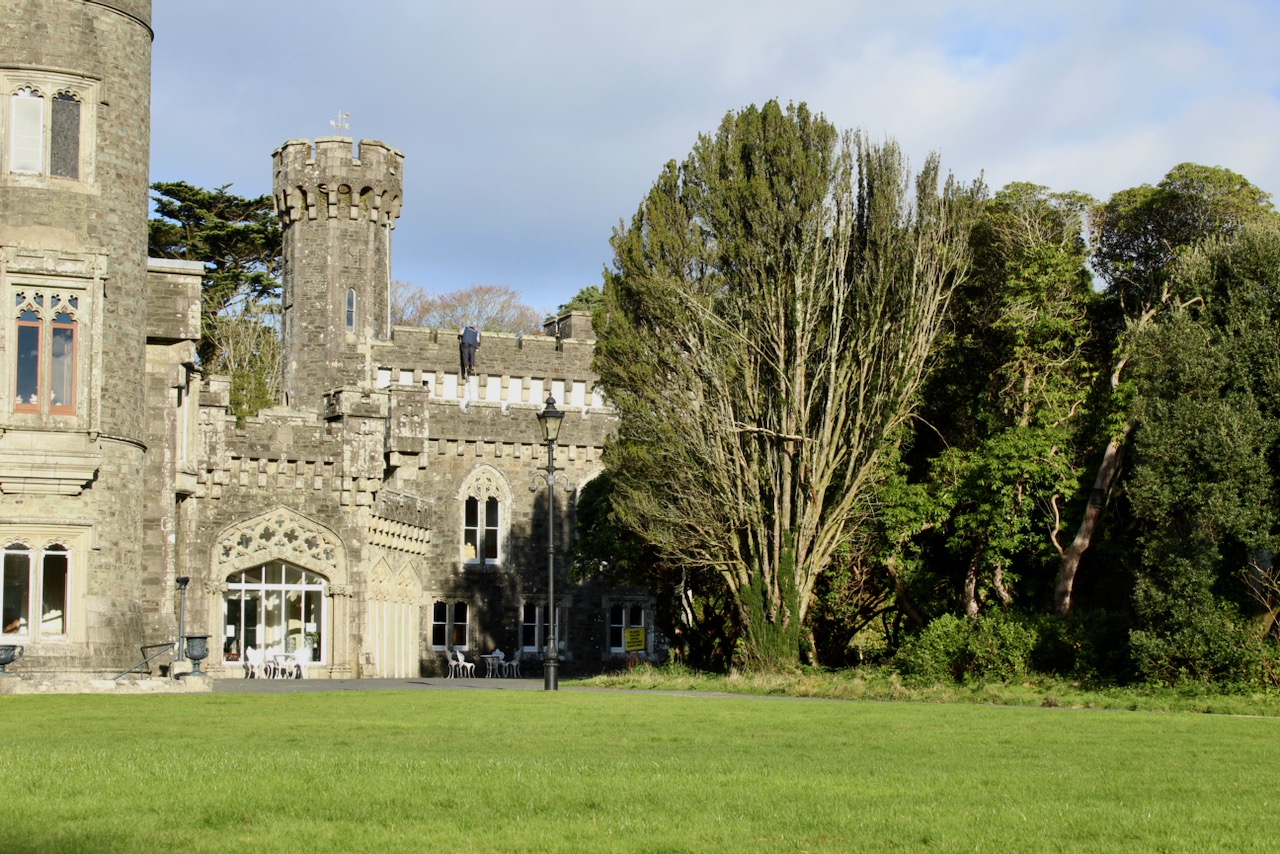
A workman at Johnstown Castle. Photograph © Jennifer Winder-Baggot, www.irishhistorichouses.com
Text © Jennifer Winder-Baggot, www.irishhistorichouses.com