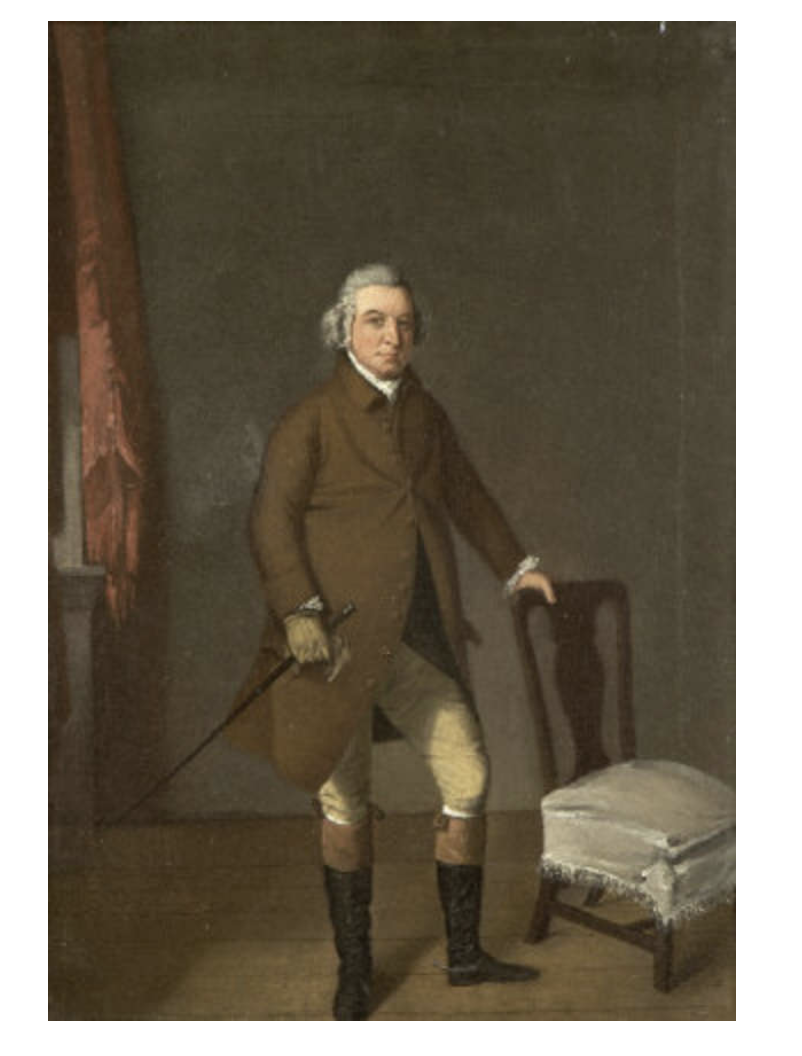
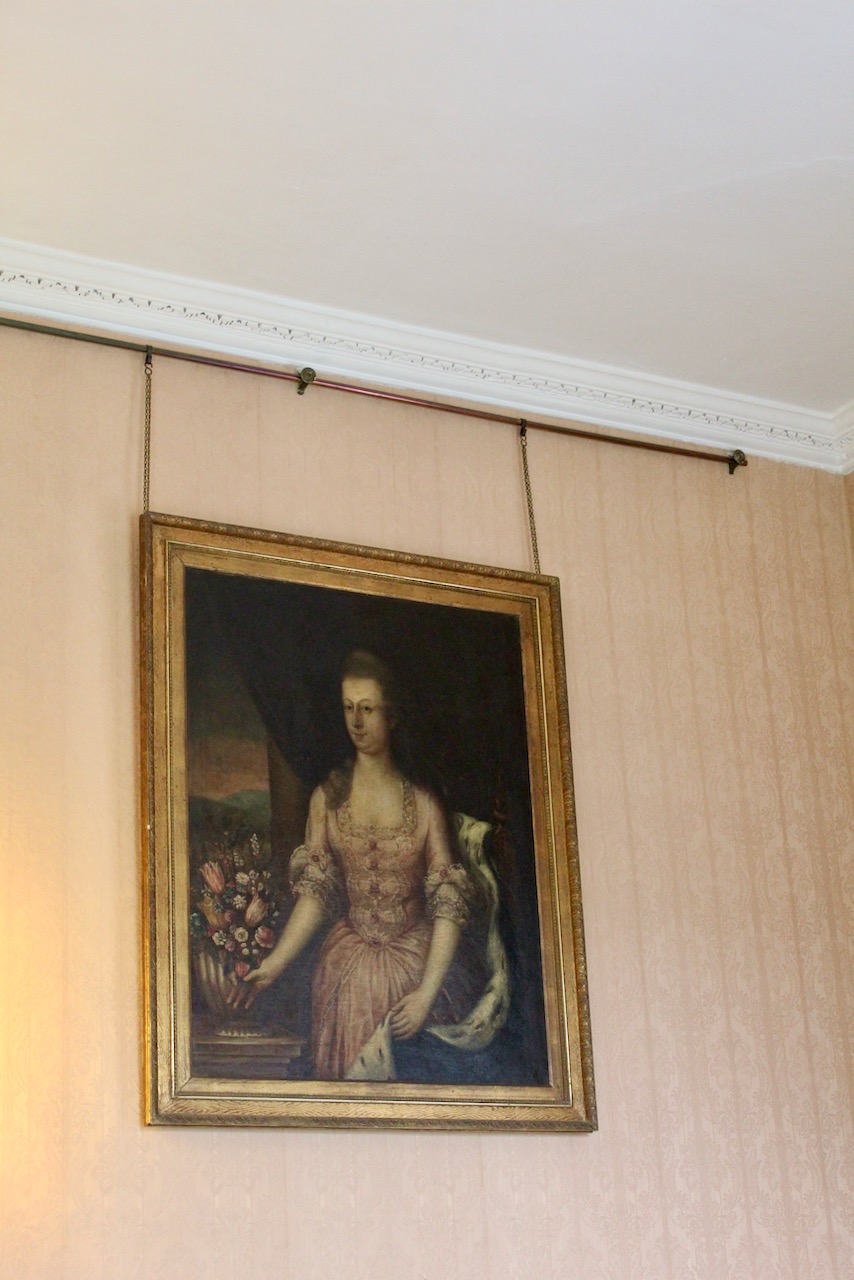
Arthur Chichester, 4th Earl of Donegall (1695–1757)
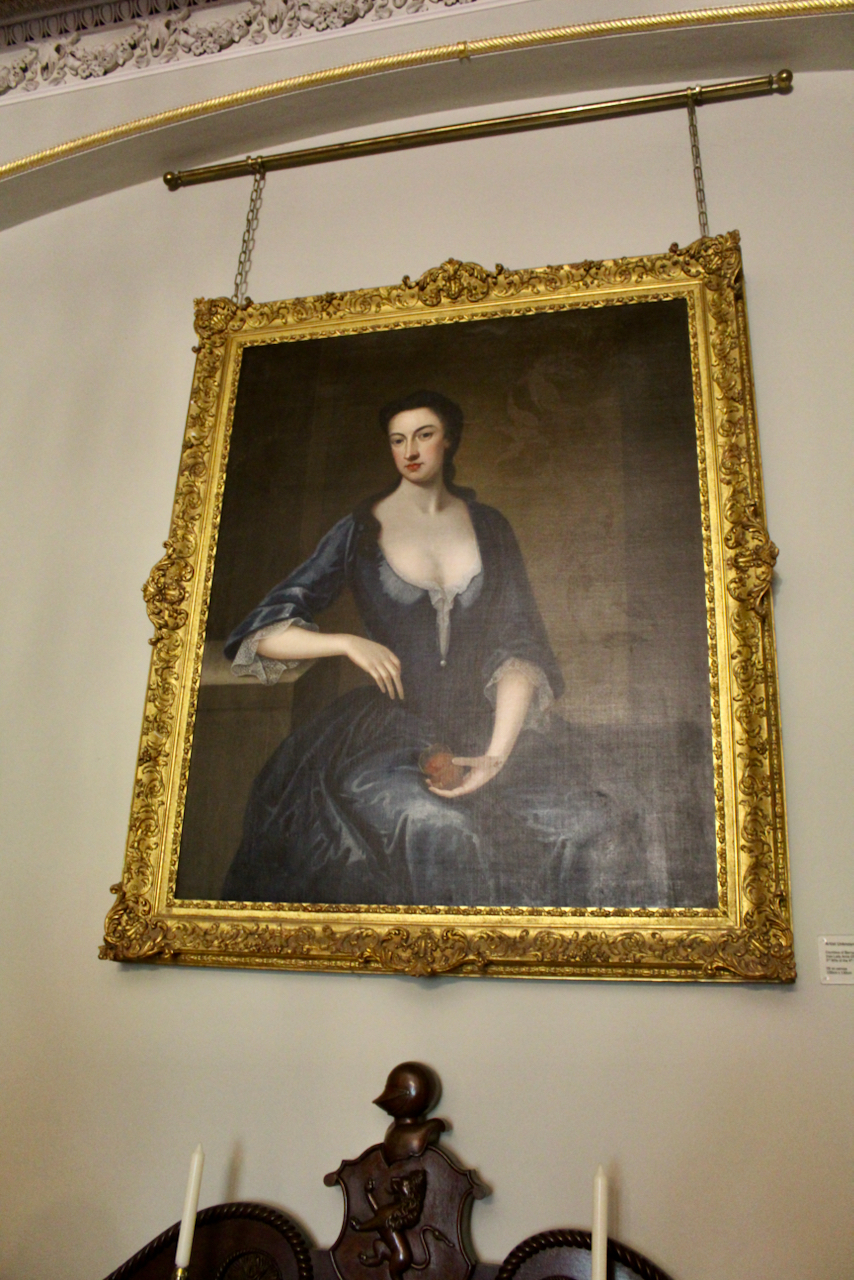
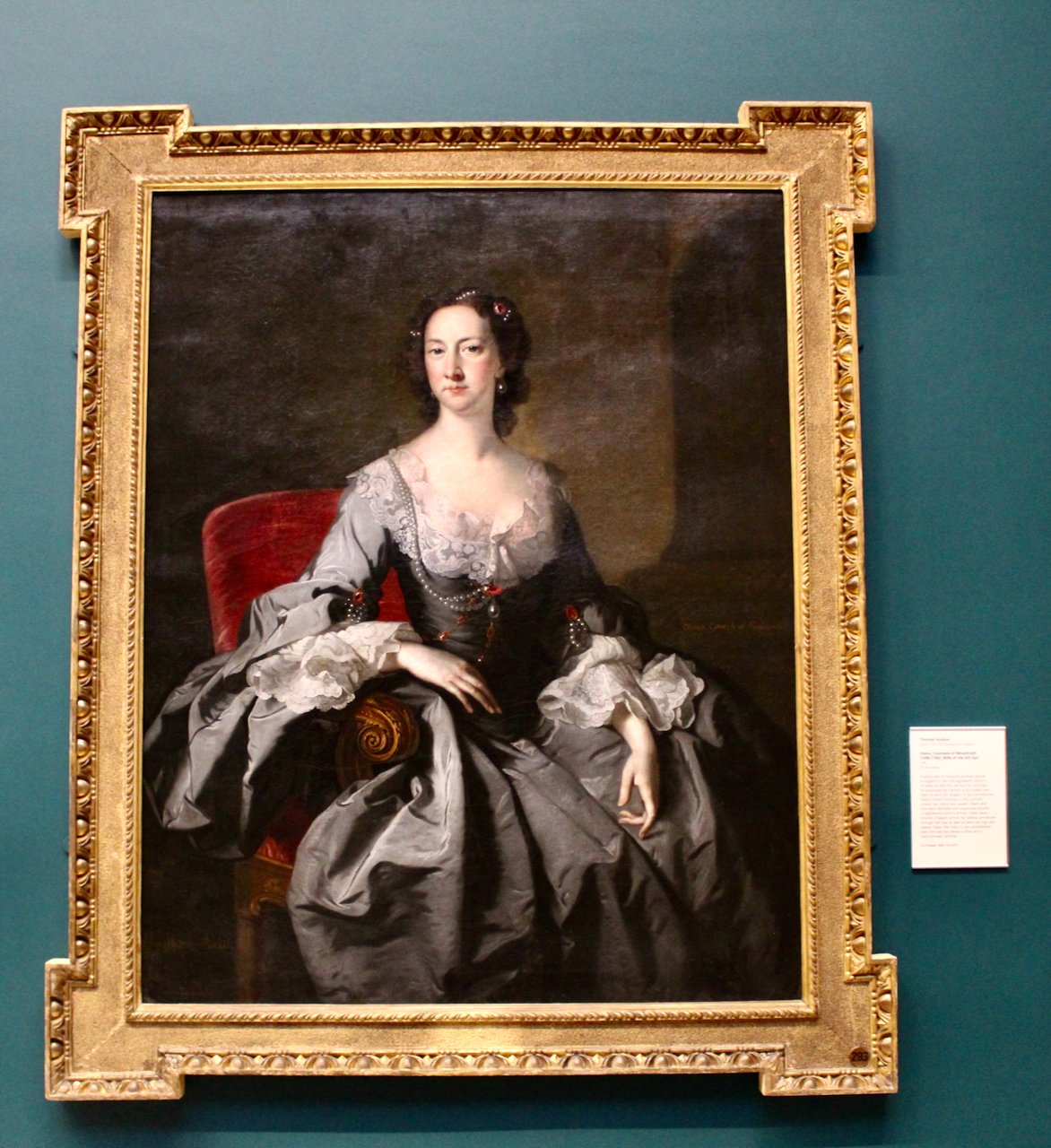
Lady Lucy Ridgeway was the eldest daughter and co-heir of Robert Ridgeway, 4th Earl of Londonderry (d. 1713/14), she married Arthur Chichester, 4th Earl of Donegal (1695-1757), by Jonathan Richardson courtesy of Sothebys L11304.
Arthur Chichester, 5th Earl of Donegall (1739–1799; created Baron Fisherwick in 1790 and Earl of Belfast and Marquess of Donegall in 1791). He married Anne née Hamilton (1731-1780) who was the daughter of James Brandon Douglas Hamilton 5th Duke of Hamilton, Scotland. Arthur the 5th Earl of Donegall was the son of John Chichester (1700-1746), who was the son of Arthur 3rd Earl of Donegall.
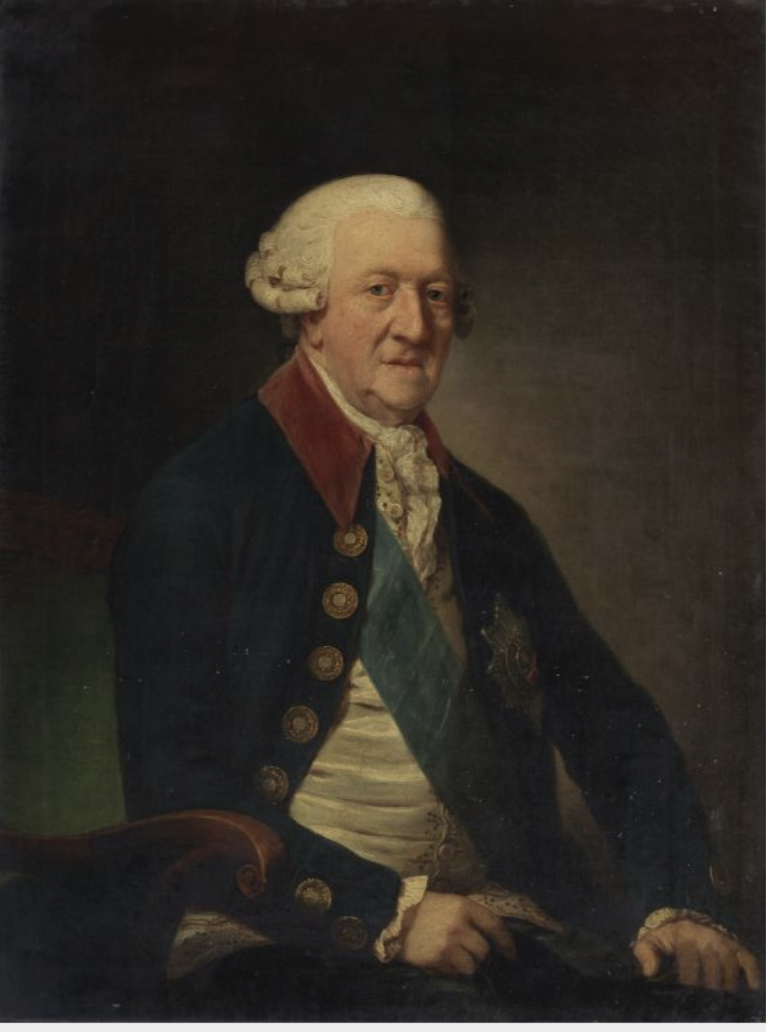
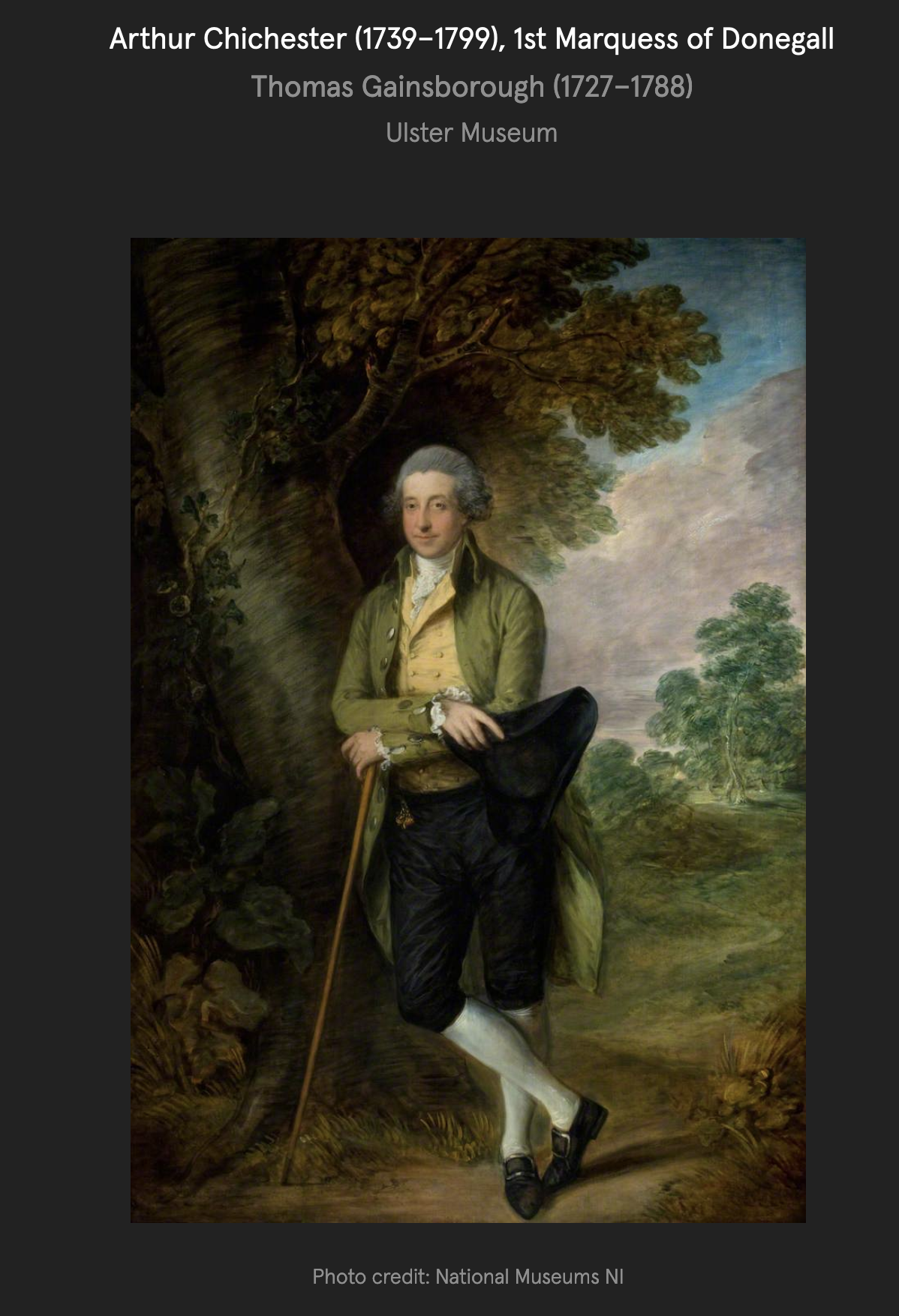
Arthur Chichester, 1st Marquess of Donegall (1739–1799)
Arthur Chichester (1739-1799) 1st Marquess of Donegall, by Thomas Gainsborough, courtesy of Ulster Museum.
George Augustus Chichester, 2nd Marquess of Donegall (1769–1844)
George Augustus Chichester (1769-1844) 2nd Marquess of Donegall, courtesy of Belfast Castle.
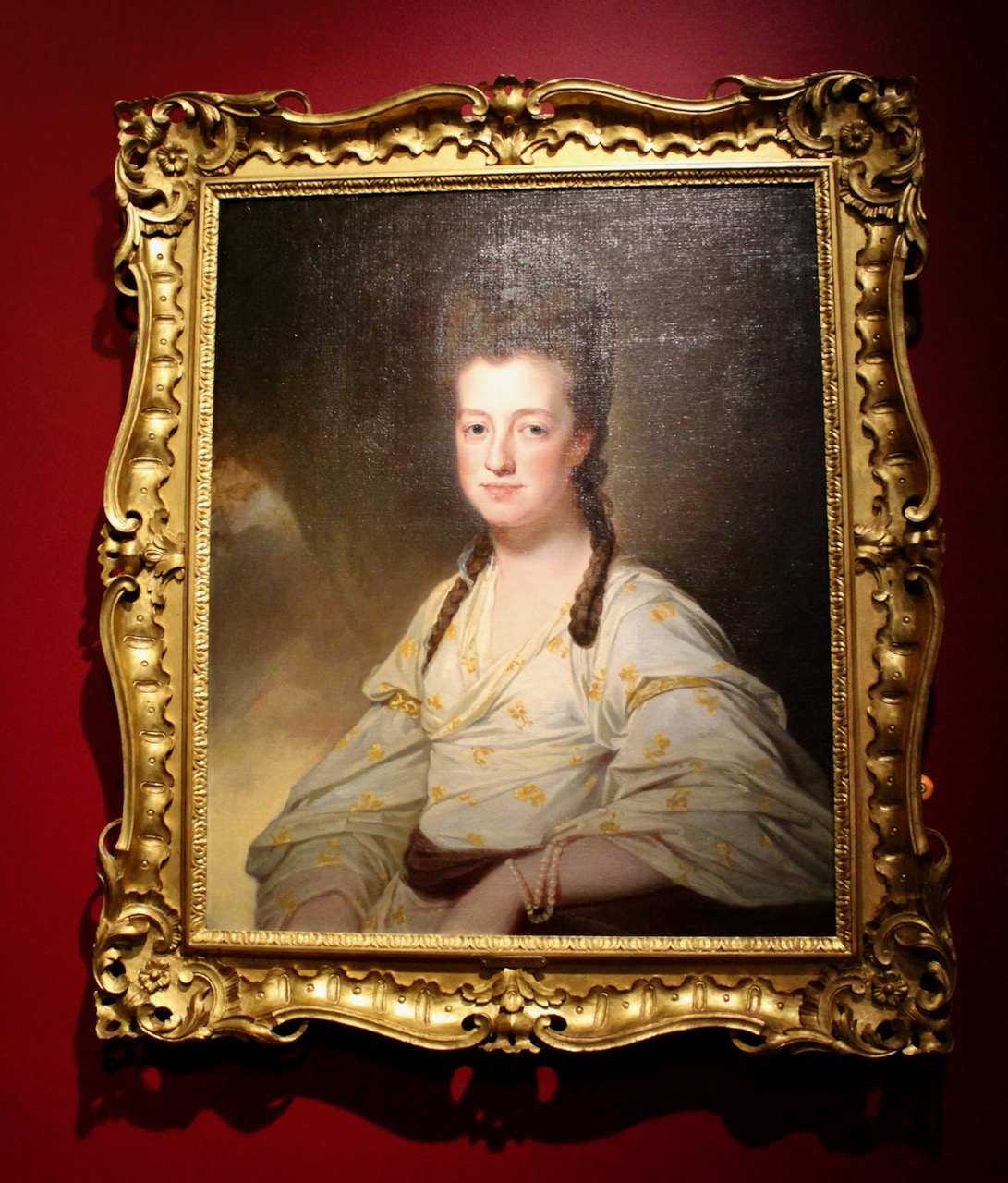
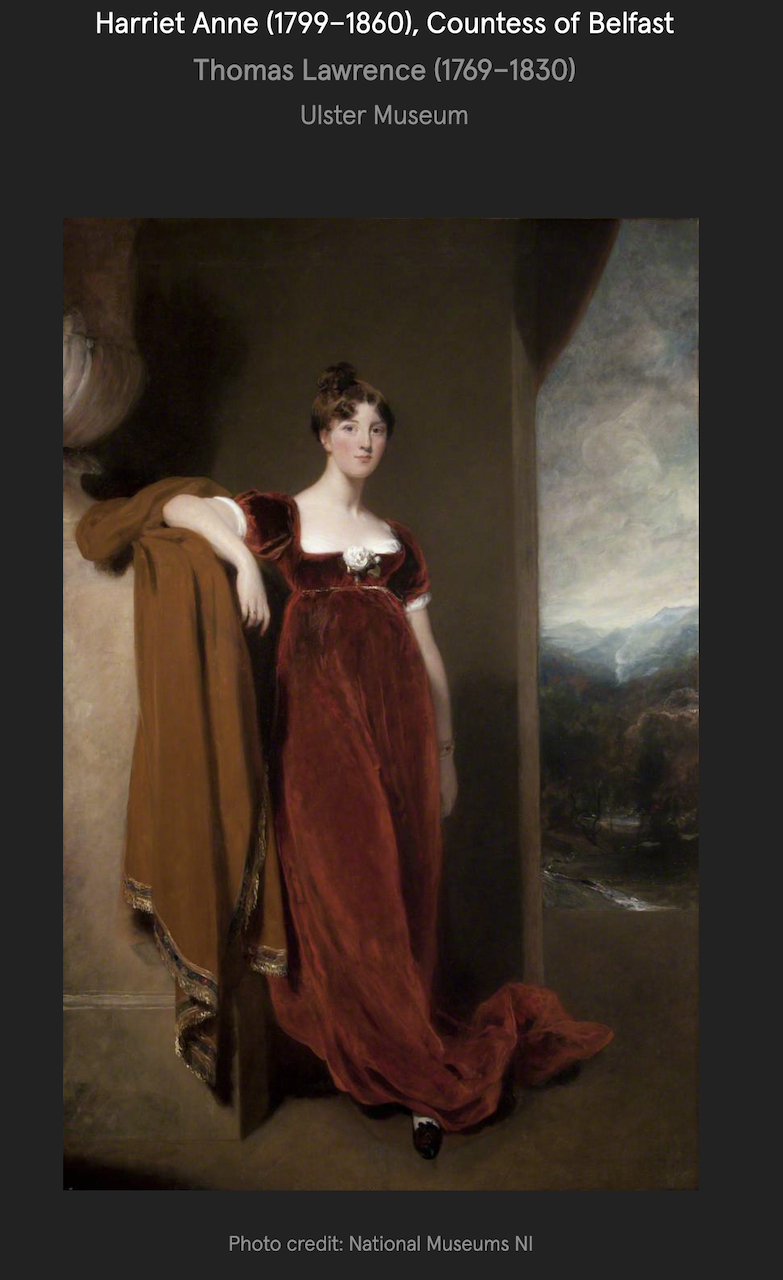
George Hamilton Chichester, 3rd Marquess of Donegall, Baron Ennishowen and Carrickfergus (1797–1883). He married Harriet Anne née Butler (1799-1860), daughter of Richard Butler, 1st Earl of Glengall.
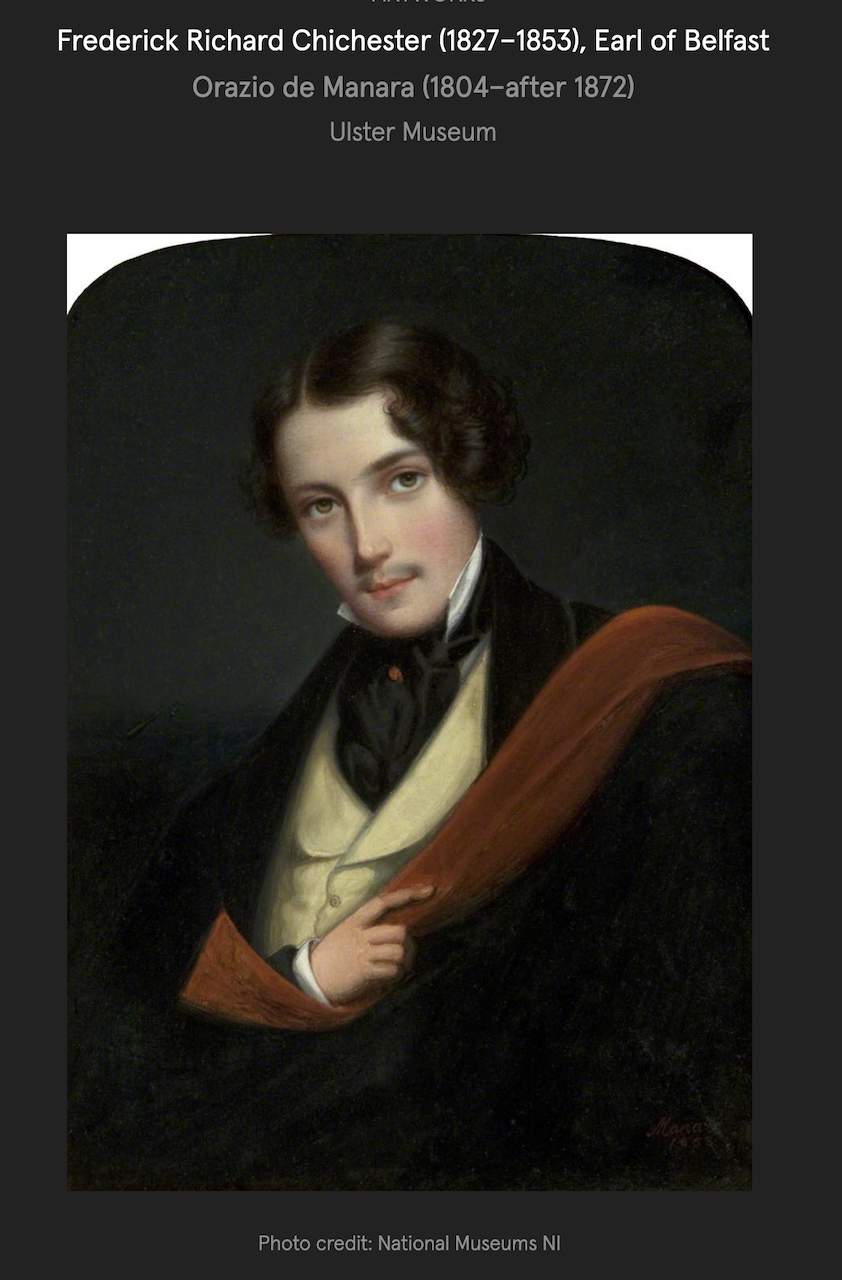
Harriet Anne née Butler (1799-1860) Countess of Belfast, wife of George Hamilton Chichester 3rd Marquess of Donegal and daughter of Richard Butler, 1st Earl of Glengall.Frederick Richard Chichester (1827-1853), Earl of Belfast, Courtesy of Ulster Museum.He was the son of the 3rd Marquess of Donegall.Frederick Richard Chichester (1827-1853) Earl of Belfast courtesy of Ulster Museum.
Edward Chichester, 4th Marquess of Donegall (1799–1889)
George Augustus Hamilton Chichester, 5th Marquess of Donegall (1822–1904)
Edward Arthur Donald St George Hamilton Chichester, 6th Marquess of Donegall (1903–1975)
Dermot Richard Claud Chichester, 7th Marquess of Donegall (5th Baron Templemore) (1916–2007)
Arthur Patrick Chichester, 8th Marquess of Donegall (b. 1952) [1]
I refer to Timothy William Ferres’s terrific blog to look at the Cole family of Florence Court in County Fermanagh, a National Trust property.
William Cole married Susannah, daughter and heir of John Croft, of Lancashire, and widow of Stephen Segar, Lieutenant of Dublin Castle, by whom he left at his decease in 1653,
MICHAEL, his heir; John, of Newland, father of Arthur, 1st BARON RANELAGH; Mary; Margaret.
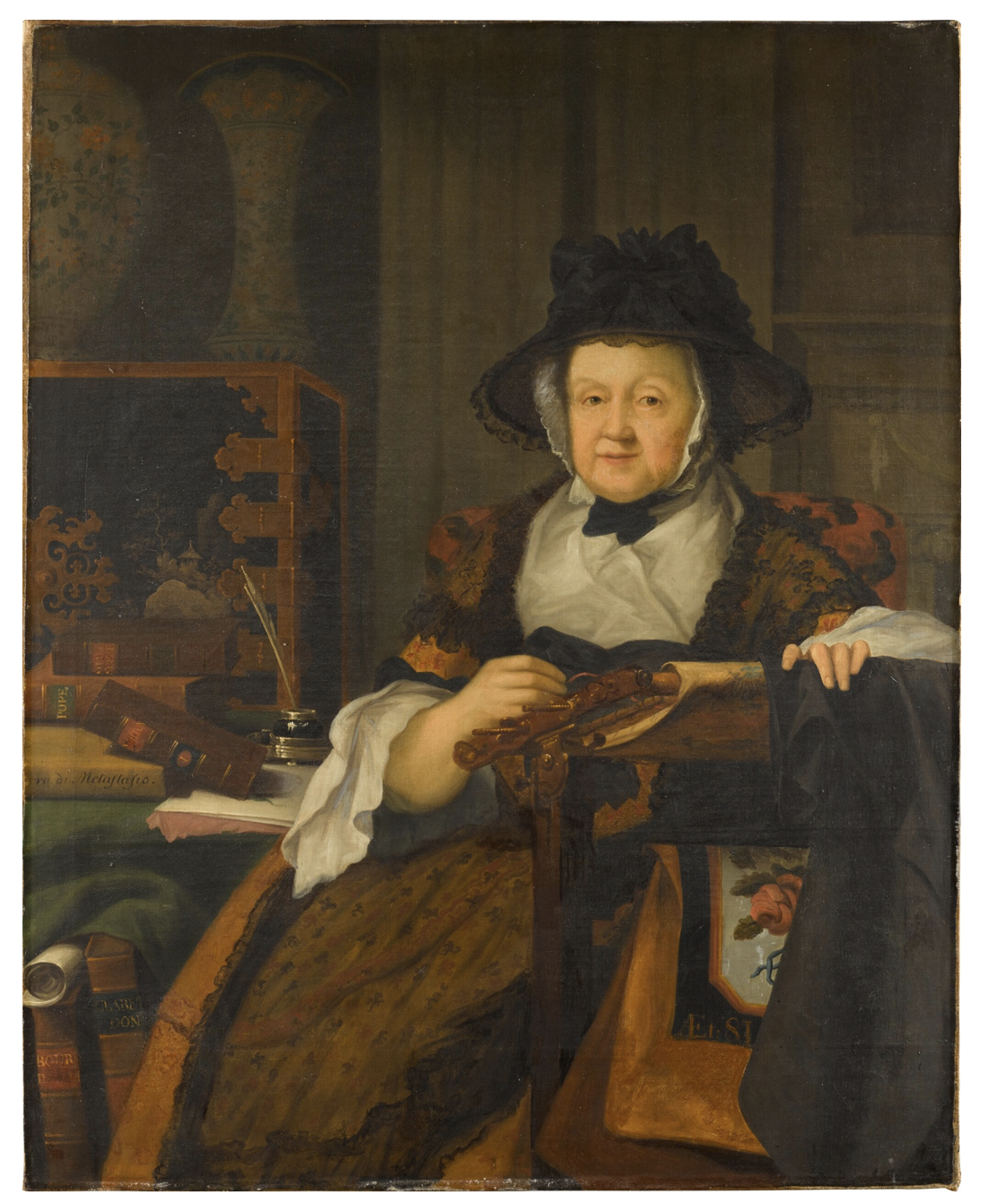
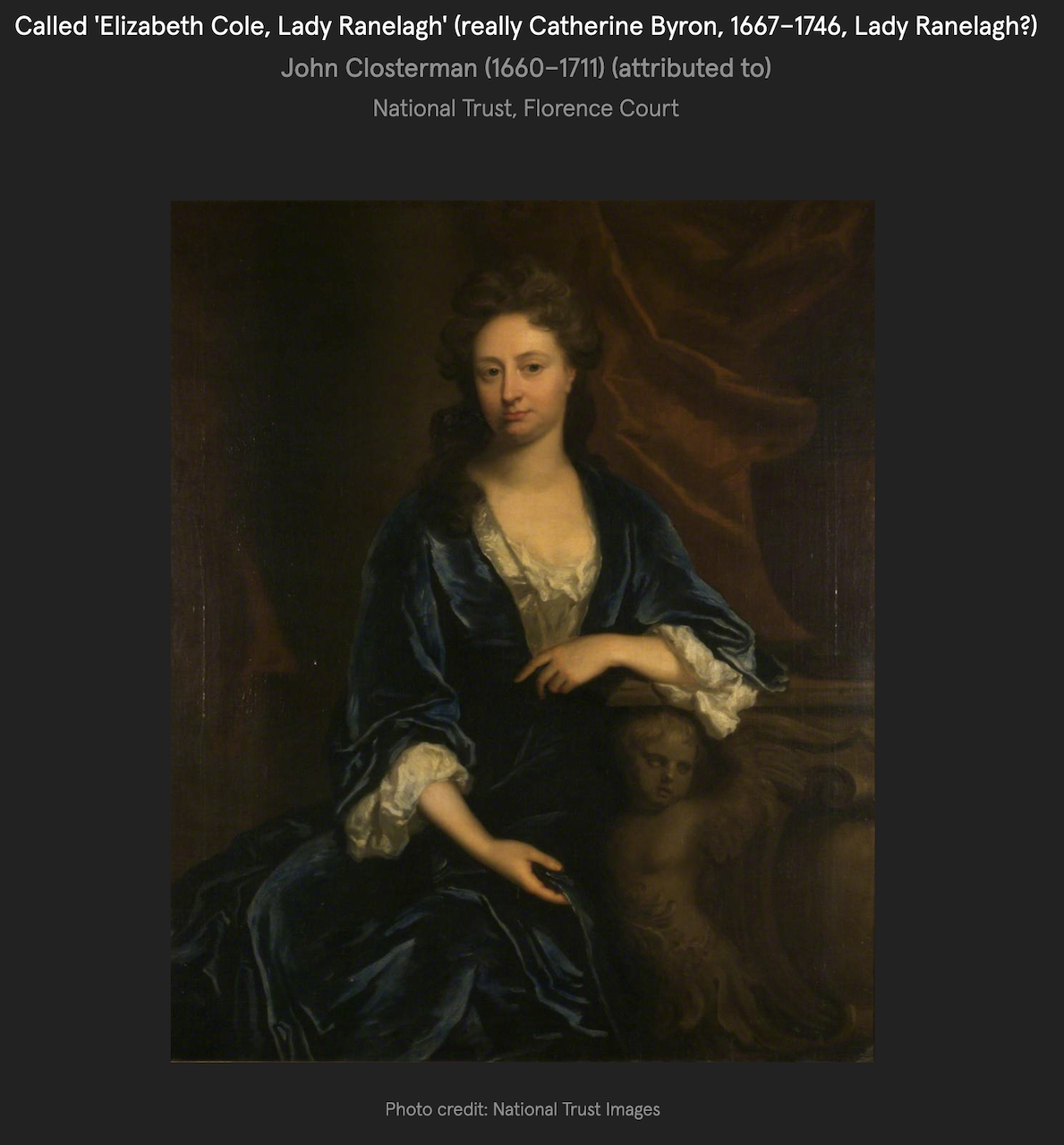
Called Elizabeth Cole Lady Ranelagh, probably really Catherine Cole née Byron (1667-1746) Lady Ranelagh attributed to John Closterman courtesy of National Trust Florence Court. She married Arthur Cole, 1st Baron Ranelagh.
The elder son,
MICHAEL COLE, wedded, in 1640, Catherine, daughter of Sir Laurence Parsons, of Birr, 2nd Baron of the Irish Exchequer, and dvp, administration being granted 1663 to his only surviving child,
SIR MICHAEL COLE, Knight (1644-1710), of Enniskillen Castle, MP for Enniskillen, 1692-3, 95-9, 1703-11, who espoused firstly, Alice (dsp 1671), daughter of Chidley Coote, of Killester; and secondly, 1672, his cousin, Elizabeth (d 1733), daughter of Sir J Cole Bt.
Sir Michael was succeeded by his only surviving child,
JOHN COLE (1680-1726), of Florence Court, MP for Enniskillen, 1703-26, who espoused, in 1707, Florence, only daughter of Sir Bourchier Wrey Bt, of Trebitch, in Cornwall.
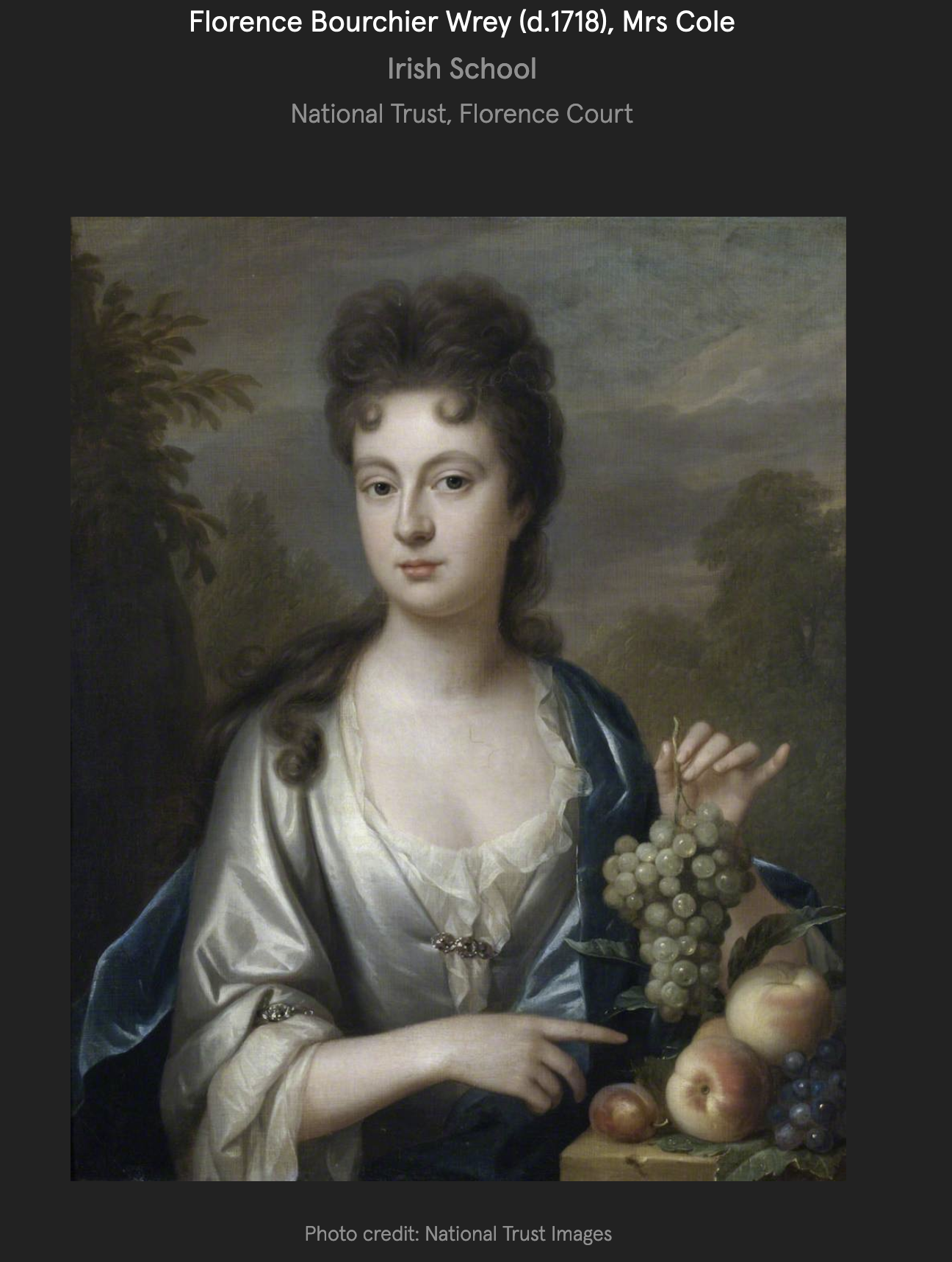
Florence Bourchier Wrey (d. 1718), courtesy of National Trust, Florence Court, County Fermanagh.She married John Cole (1680-1726) who built Florence Court, and named it after her.
John and Florence had the following children:
Henry (Rev); JOHN (1709-67) his heir; Letitia; Florence.
Mr Cole was succeeded by his younger son, John Cole (1709-67) MP for Enniskillen, 1730-60. John married in 1728 Elizabeth, daughter of Hugh Willoughby Montgomery, of Carrow, County Fermanagh. Mr Cole was elevated to the peerage, in 1760, in the dignity of Baron Mountflorence, of Florence Court, County Fermanagh.
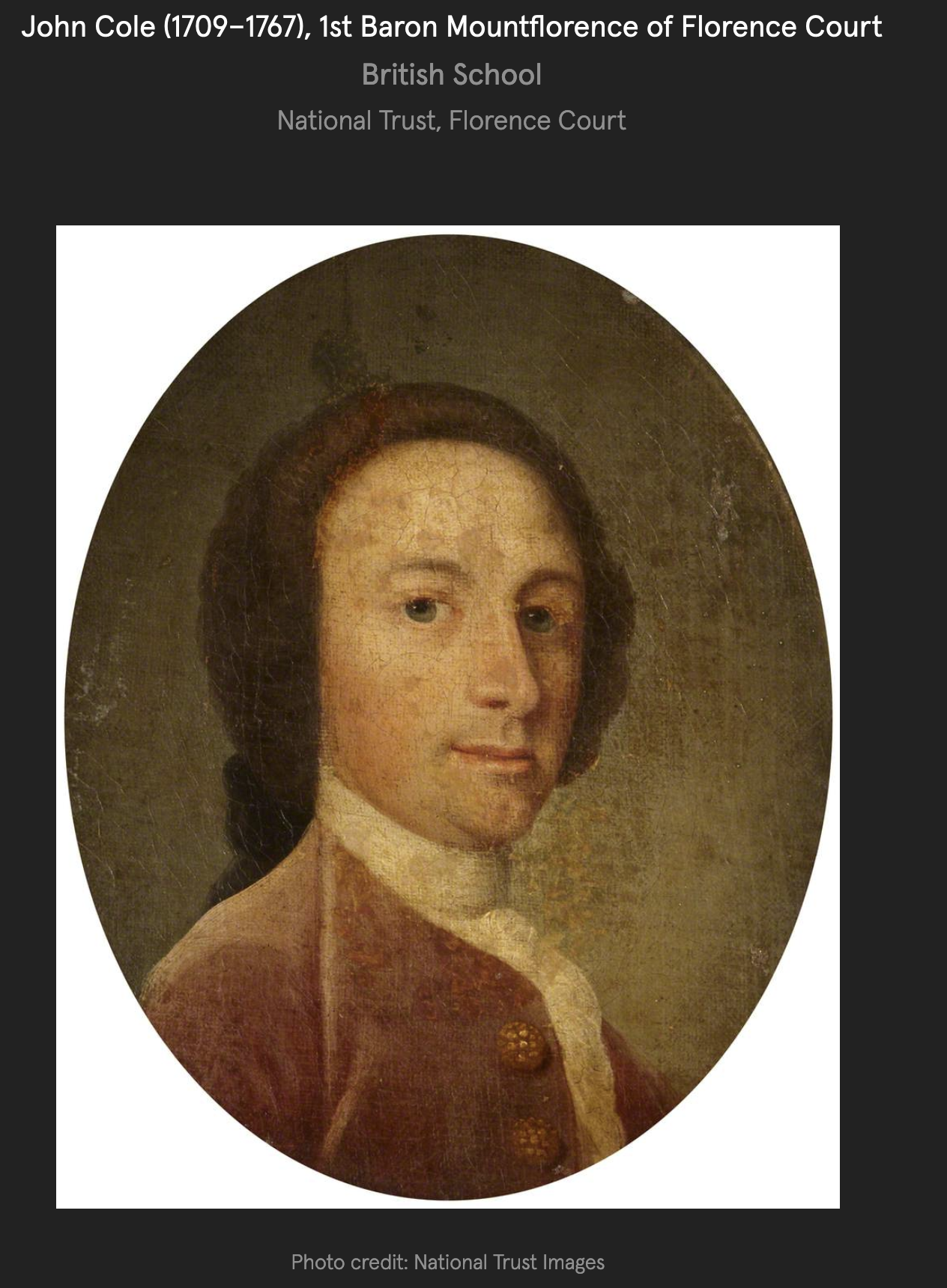
John Cole (1709-1767) 1st Baron Mountflorence of Florence Court, County Fermanagh, courtesy of National Trust, Florence Court, County Fermanagh.
John and Elizabeth had the following children:
WILLIAM WILLOUGHBY (1736-1803) his heir; Arthur, m in 1780 Caroline Hamilton; Flora Caroline; Catherine.
His lordship was succeeded by his elder son, WILLIAM WILLOUGHBY, 2nd Baron (1736-1803), MP for Enniskillen, 1761-7, who was created Viscount Enniskillen in 1776; and advanced to the dignity of an earldom, in 1789, as EARL OF ENNISKILLEN.
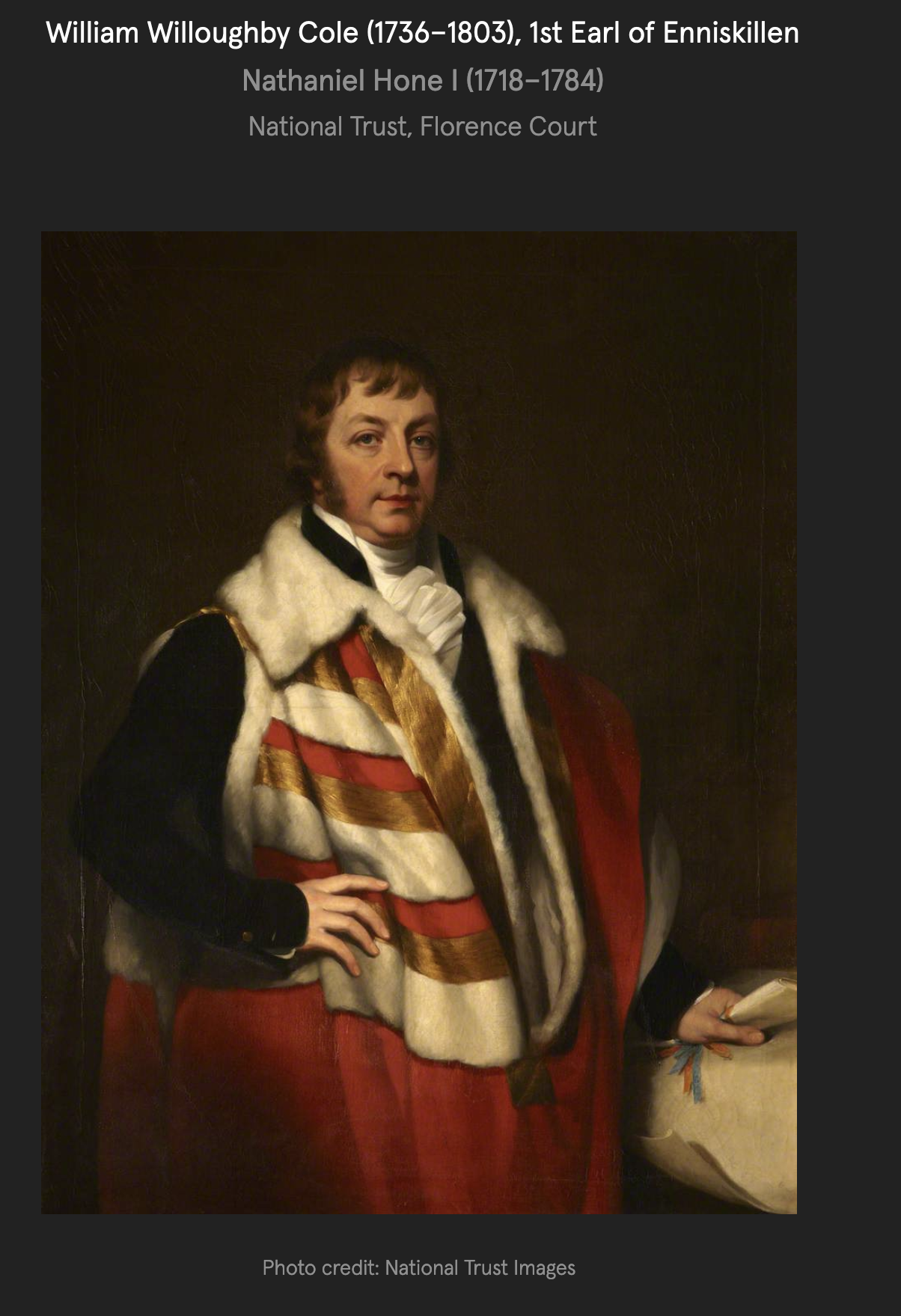
William Willoughby Cole (1736-1803) 1st Earl of Enniskillen, by Nathaniel Hone, courtesy of National Trust, Florence Court, County Fermanagh.He was the son of John Cole 1st Baron Mountflorence.Anne Lowry-Corry, Countess of Enniskillen (1742-1802) by Horace Hone c.1785, watercolour painting on ivory, courtesy National Trust Florence Court. Sister of Armar Lowry-Corry (1740-1802) 1st Earl Belmore and wife of William Willoughby Cole 1st Earl of Enniskillen.
William Willoughby Cole married, in 1763, Anne, daughter of Galbraith Lowry Corry, of Ahenis, County Tyrone, and sister of Armar Corry, Earl of Belmore, and had issue,
JOHN WILLOUGHBY (1768-1840) his successor, who became 2nd Earl; Galbraith Lowry (Sir), GCB, a general in the army; William Montgomery (Very Rev), Dean of Waterford; Arthur Henry, MP for Enniskillen; Henry, died young; Sarah; Elizabeth Anne; Anne; Florence; Henrietta Frances.
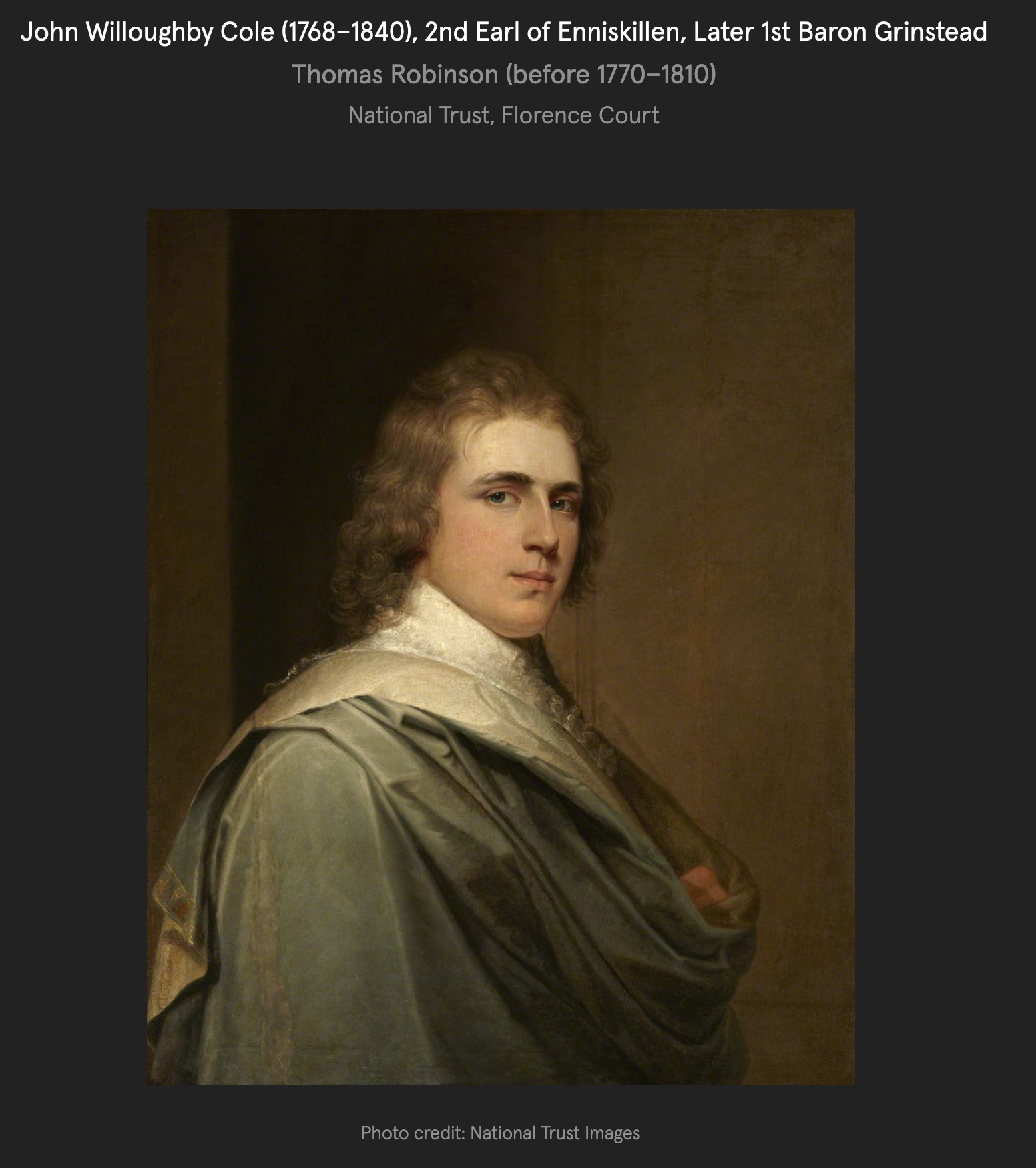
JOHN WILLOUGHBY Cole 2nd Earl (1768-1840) married, in 1805, the Lady Charlotte Paget, daughter of Henry, 1st Earl of Uxbridge. The 2nd Earl of Charlotte had the following children:
WILLIAM WILLOUGHBY (1807-86) his successor, who became the 3rd Earl of Enniskillen.
Henry Arthur; John Lowry; Lowry Balfour; Jane Anne Louisa Florence.
William Willoughby Cole (1807-1886) 3rd Earl of Enniskillen, by William Robinson, courtesy of National Trust, Florence Court, County Fermanagh.
WILLIAM WILLOUGHBY, 3rd Earl (1807-86), Honorary Colonel, 3rd Battalion, Royal Inniskilling Fusiliers, married firstly, in 1844, Jane, daughter of James Casamaijor, and had issue,
John Willoughby Michael, styled Viscount Cole (1844-50);
LOWRY EGERTON, 4th Earl;
Arthur Edward Casamaijor;
Florence Mary; Alice Elizabeth; Charlotte June; Jane Evelyn.
He wedded secondly, in 1865, Mary Emma, daughter of Charles, 6th Viscount Midleton.
His lordship was succeeded by his eldest surviving son,
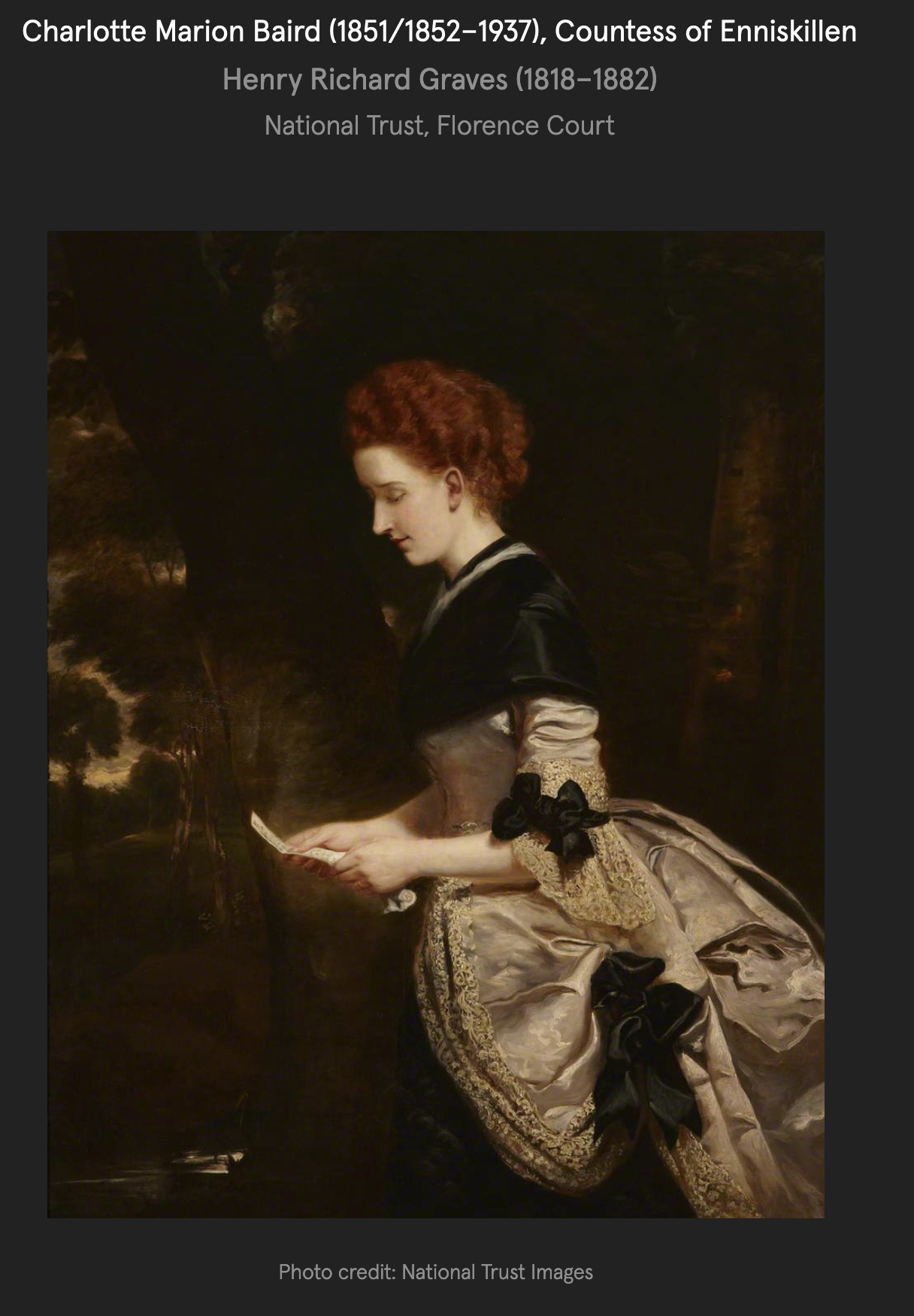
LOWRY EGERTON, 4th Earl (1845-1924), KP JP DL MP, who wedded, in 1869, Charlotte Marion, daughter of Douglas Baird.
Charlotte Marion Baird (1851/2-1937) Countess of Enniskillen, by Henry Richard Graves, courtesy of National Trust, Florence Court, County Fermanagh. She married Lowry Egerton Cole, 4th Earl of Enniskillen.
Nicholas Conway Colthurst (1789-1829) 4th Baronet of Ardrum, County Cork, by Martin Arthur Shee, courtesy of Eton College.He was Member of Parliament (M.P.) for the City of Cork between 1812 and 1829. His son the 5th Earl married Louisa Jane Jefferyes, through whom he acquired Blarney Castle.Ambrose Congreve reading a newspaper at Clonbrock House, Ahascragh, Co. Galway, National Library of Ireland Ref. CLON422.
Timothy William Ferres tells us of the line of the Conolly family who owned Castletown House in County Kildare. [2] It was built by William Conolly (1662-1729), Speaker of the House of Commons in Ireland during the reign of Queen Anne, First Lord of the Treasury until his decease during the reign of GEORGE II, and ten times sworn one of the Lords Justices of Ireland.
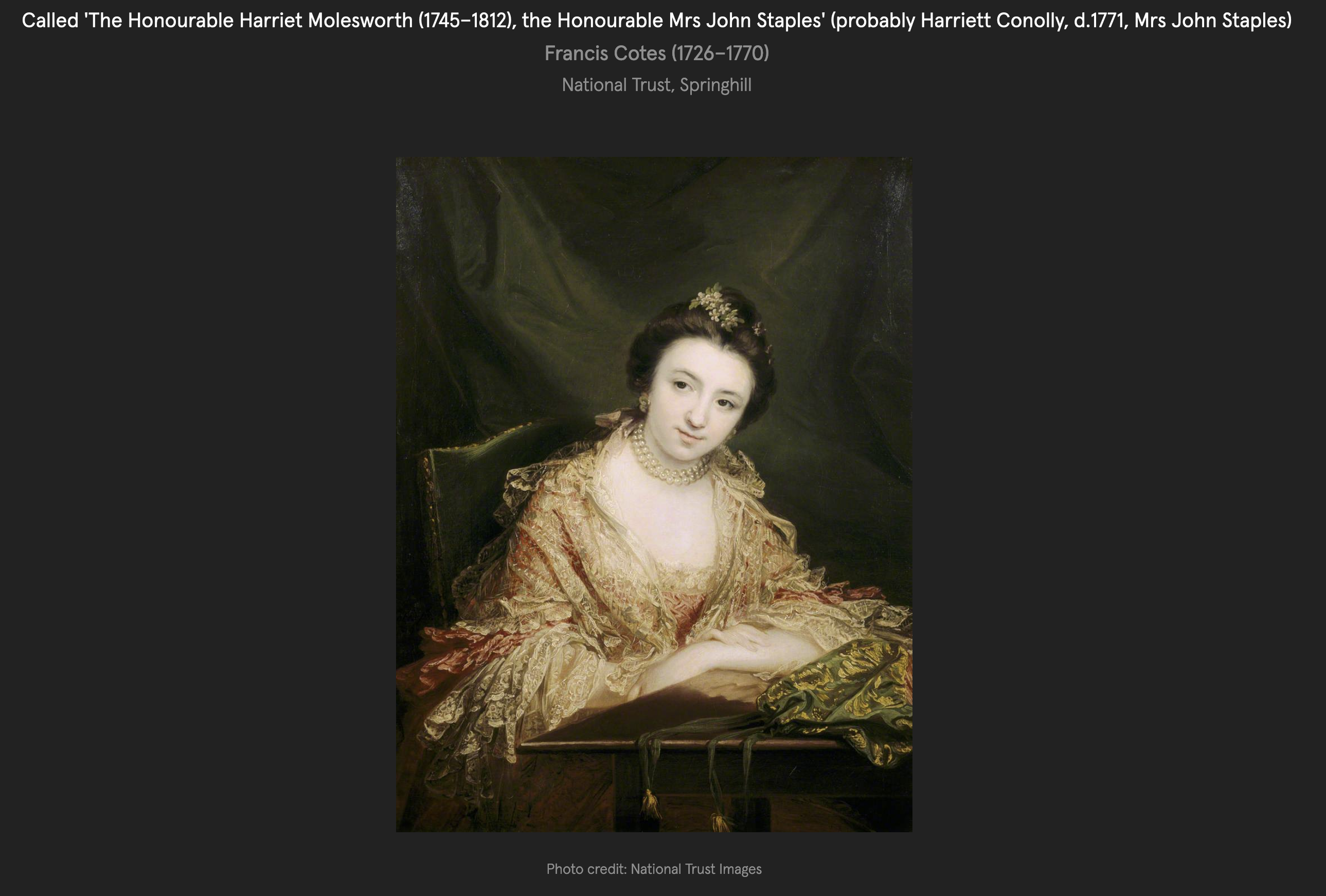
THOMAS (1734-1803) his heir; Katherine, m. Ralph, Earl of Ross; Anne, m. G. Byng; mother of Earl of Strafford; Harriet, m. Rt Hon John Staples, of Lissan; Frances, m. 5th Viscount Howe; Caroline, m. 2nd Earl of Buckinghamshire;
Ferres continues, telling us that Thomas Conolly, MP for County Londonderry, 1761-1800, wedded, in 1758, Louisa Augusta Lennox, daughter of Charles, 2nd Duke of Richmond and Lennox.
Thomas and Louisa had no children so the estate passed to a grand-nephew, Edward Michael Pakenham (1786-1849) who assumed the surname Conolly in 1821. Now Edward Michael Conolly of Castletown, County Kildare, and Cliff, County Donegal, Lieutenant-Colonel, Donegal Militia, MP for County Donegal, 1831-49, he married in 1819, Catherine Jane, daughter of Chambré Brabazon Ponsonby-Barker, by the Lady Henrietta Taylour his wife, daughter of Thomas, Earl of Bective. They had issue,
THOMAS (1823-1876) his heir; Chambré Brabazon, d 1835; Frederick William Edward, d 1826; Arthur Wellesley, 1828-54; John Augustus, VC; Richard, d 1870; Louisa Augusta; Henrietta; Mary Margaret; Frances Catherine.
Thomas (1870-1900), killed in action at S Africa; William, 1872-95; EDWARD MICHAEL, of whom hereafter; CATHERINE, Baroness Carew, mother of 6th BARON CAREW.
Mr Conolly was succeeded by his eldest surviving son,
EDWARD MICHAEL CONOLLY CMG (1874-1956), of Castletown, Major, Royal Artillery, who died unmarried, when Castletown passed to his nephew,
William Francis (Conolly-Carew), 6th Baron Carew. [2]
On his terrific website, Timothy William Ferres tells us about the Conyngham family of Springhill, County Derry in Northern Ireland: [3]
Colonel William Cunningham, of Ayrshire settled in the townland of Ballydrum, in which Springhill is situated, in 1609.
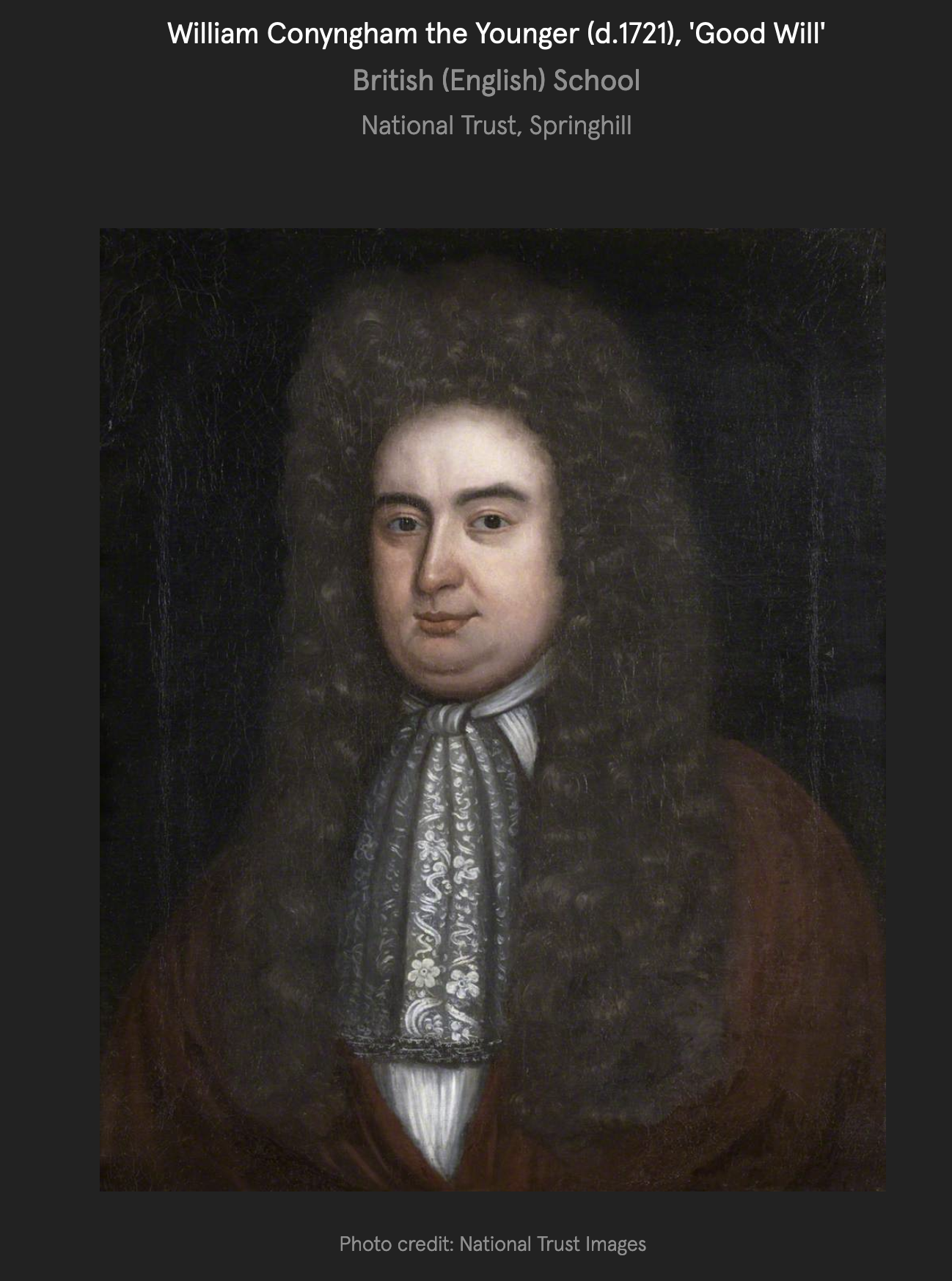
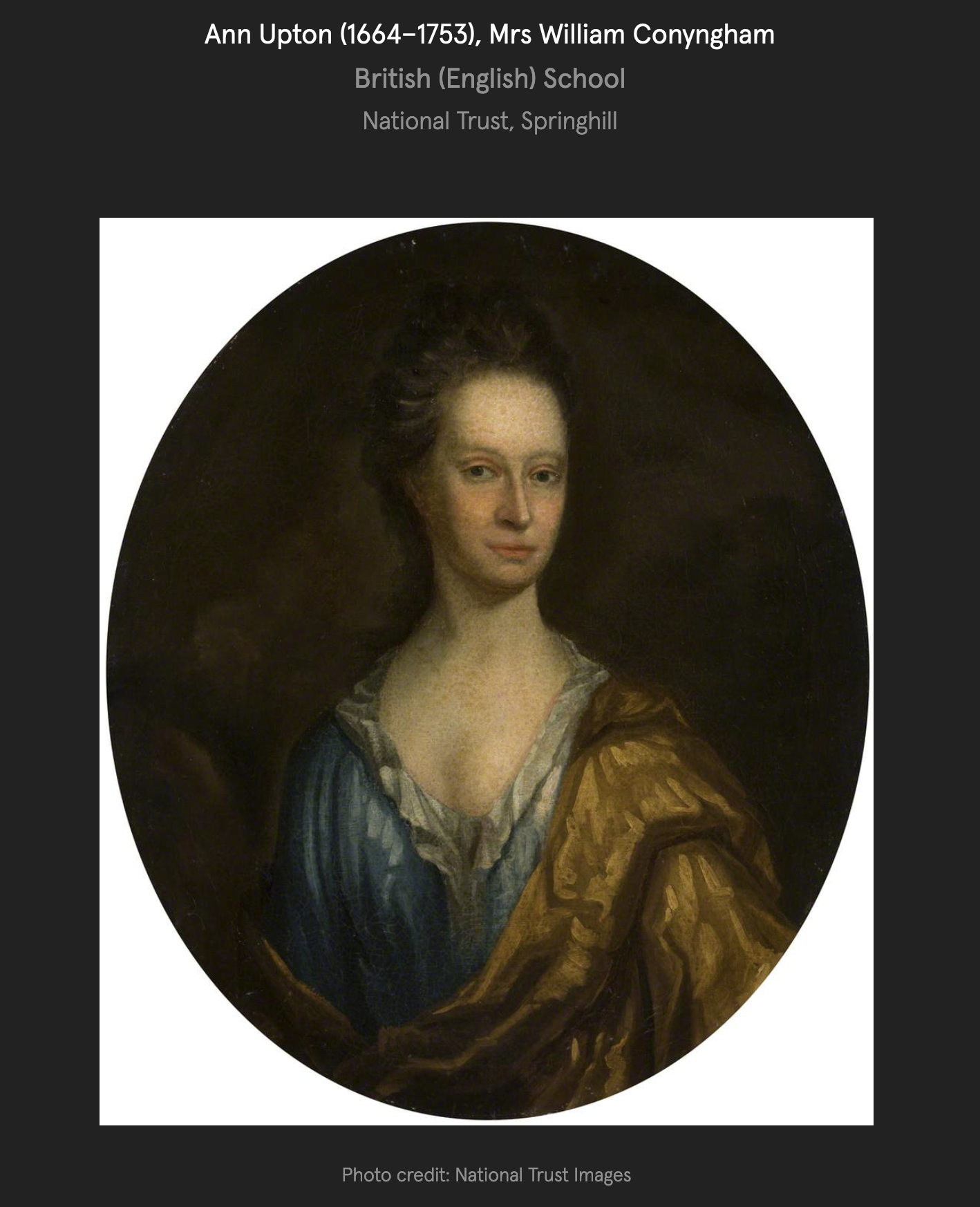
Colonel Cunningham’s son, William Conyngham, known as “Good Will” (d. 1721) married Ann, daughter of Arthur Upton, of Castle Norton (later Castle Upton), County Antrim, by his wife Dorothy, daughter of Colonel Michael Beresford, of Coleraine. William “Good Will” Conyngham died in 1721, and was succeeded by his nephew,
William Conyngham (d. 1721), “Good Will”, courtesy of National Trust. Springhill, County Derry.Ann Upton (1664-1753) wife of William “Goodwill” Conyngham (1660-1721), daughter of Arthur Upton (1623-1706) of Castle Upton, County Antrim, courtesy of National Trust. Springhill, County Derry.
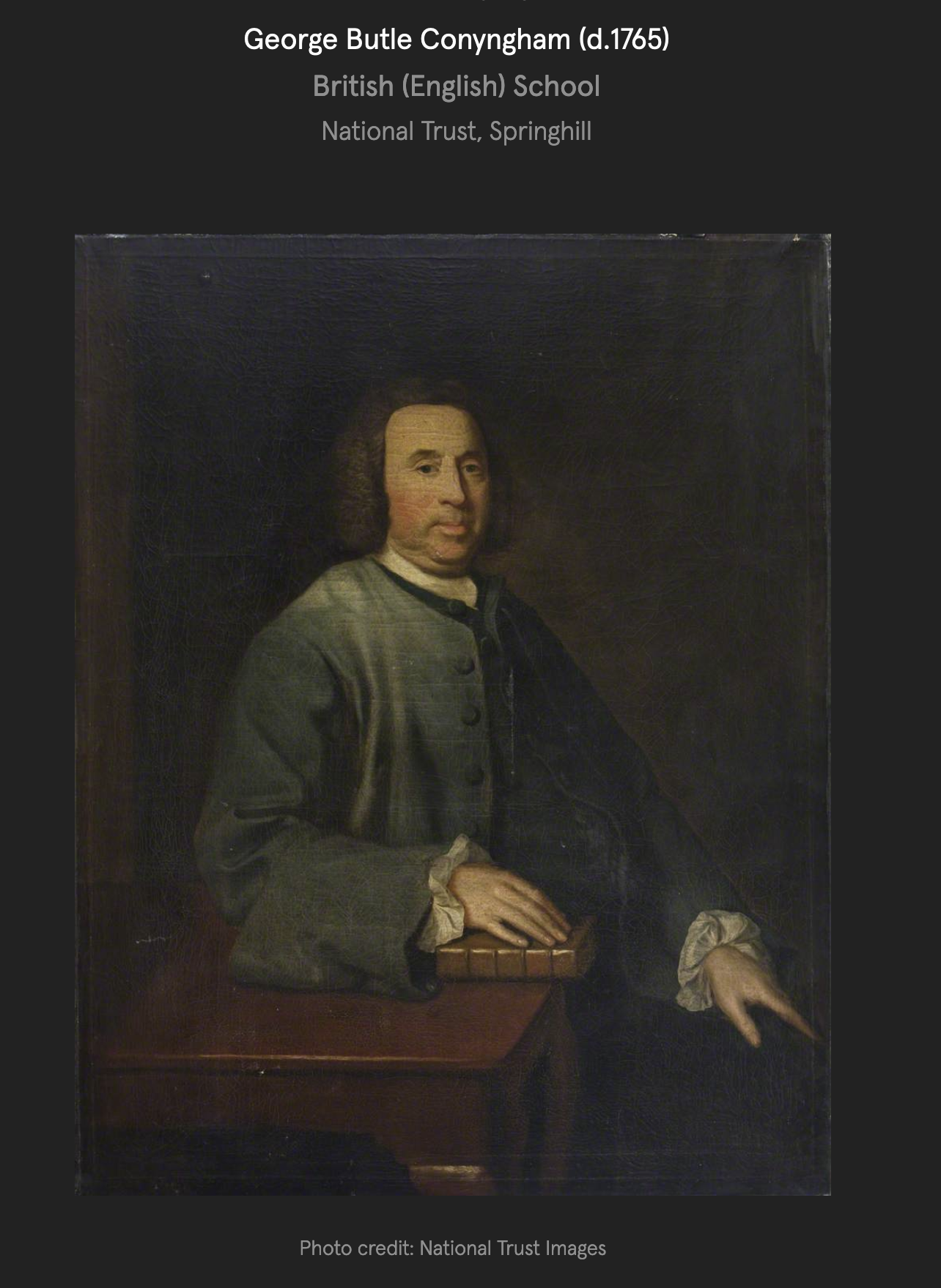
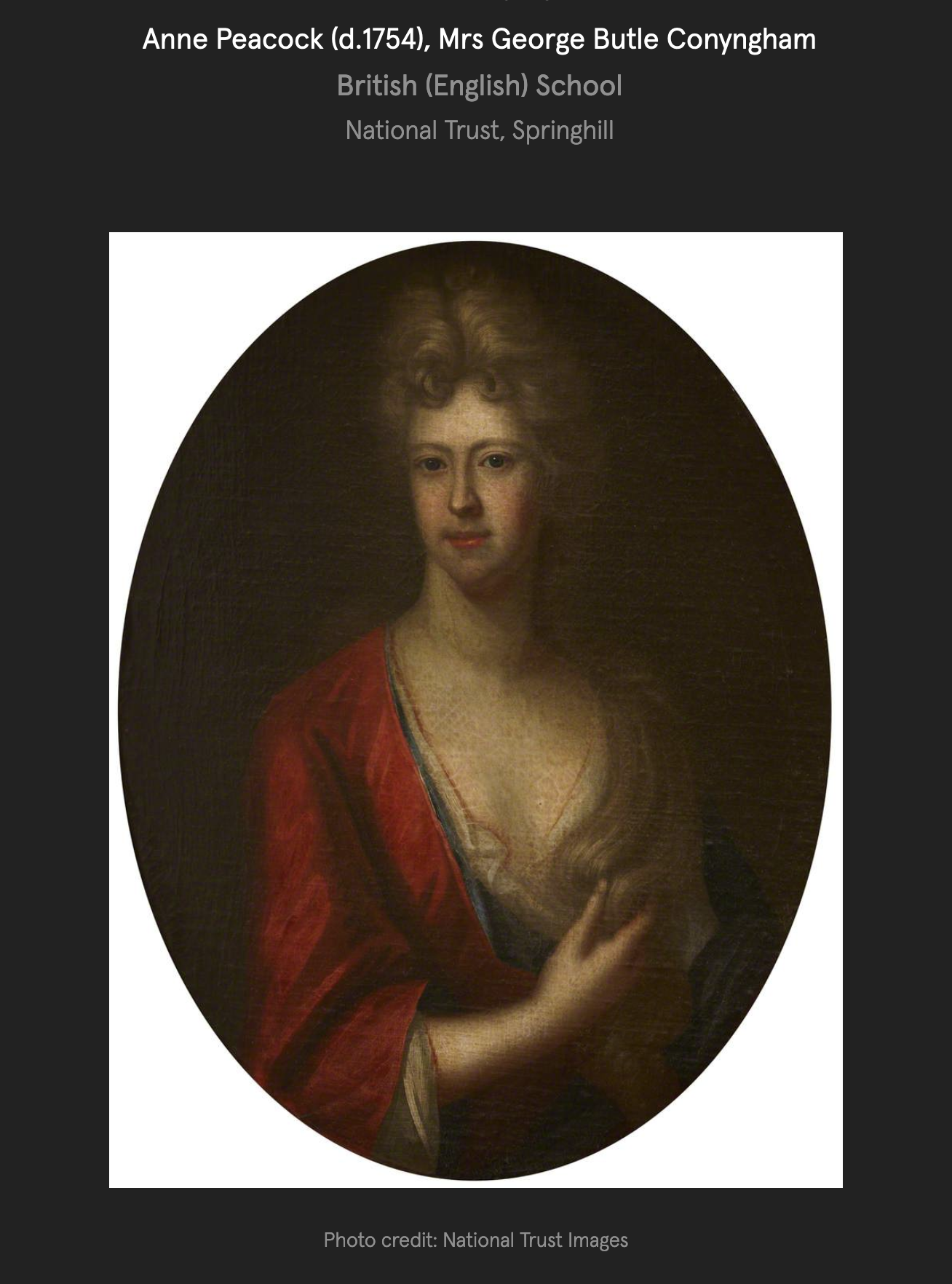
William “Goodwill” Conyngham was succeeded by his nephew George Butle Conyngham (d. 1765). He married , in 1721, Anne, daughter of Dr Upton Peacocke, of Cultra.
George Butle Conyngham (d. 1765), courtesy of National Trust, Springhill, County Derry.Anne Peacocke (d. 1754), Mrs George Butle Conyngham, courtesy of National Trust, Springhill, County Derry.
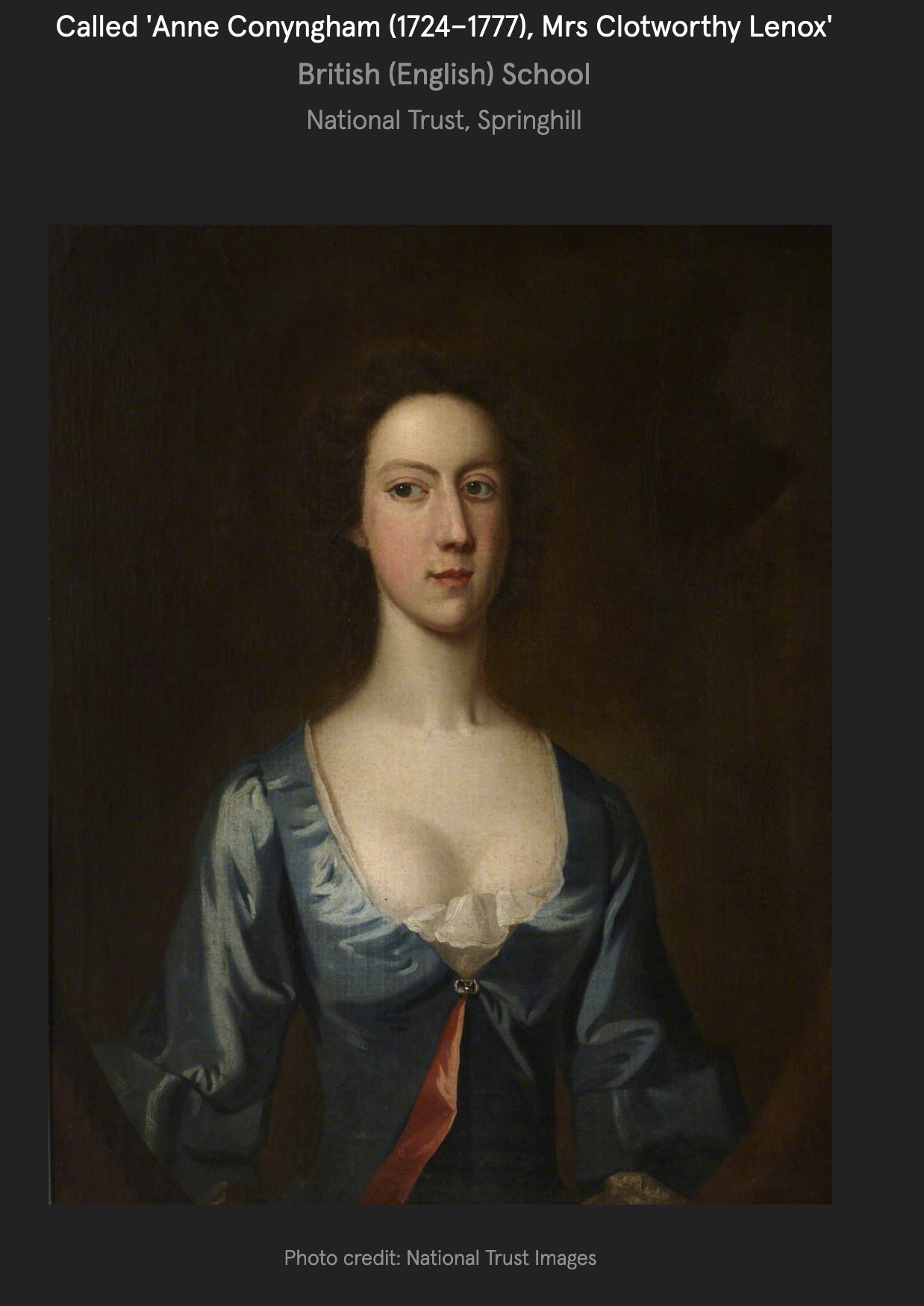
George Butle Conyngham and Anne née Peacocke had children William (1723-84), the heir to Springhill, and David, successor to his brother, John who died unmarried in 1775 and a daughter Anne (1724-1777) who married in 1745 Clotworthy Lenox.
Called Anne Conyngham (1724-1777) Mrs Clotworthy Lenox, courtesy of National Trust. Springhill, County Derry. She was the daughter of George Butle Conyngham.
David who succeeded his brother William died without issue so Springhill passed to his nephew George Lenox (1752-1816), son of his sister Anne, and George adopted the surname of Conyngham. George married, first, Jean née Hamilton (d. 1788), daughter of John Hamilton of Castlefin. They had a son, William Lenox-Conyngham (1792-1858).
Jean Hamilton (d. 1788), wife of William Conyngham (1723-1774) by Joshua Reynolds, courtesy of National Trust. Springhill, County Derry.
George married, second, in 1794, Olivia, fourth daughter of William Irvine, of Castle Irvine, County Fermanagh.
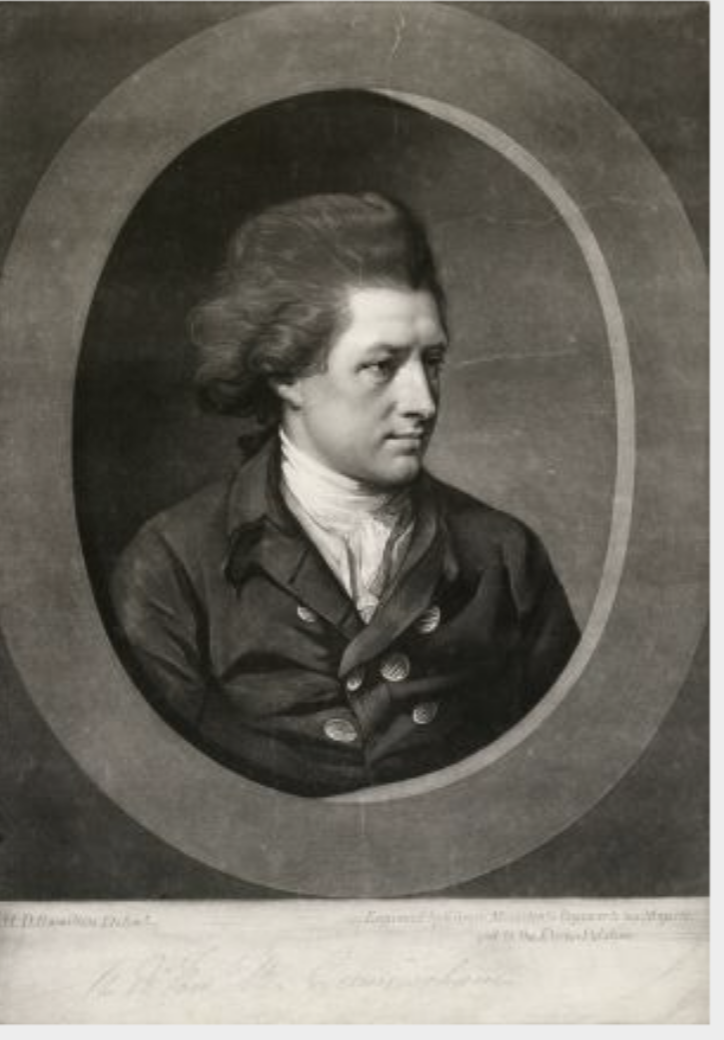
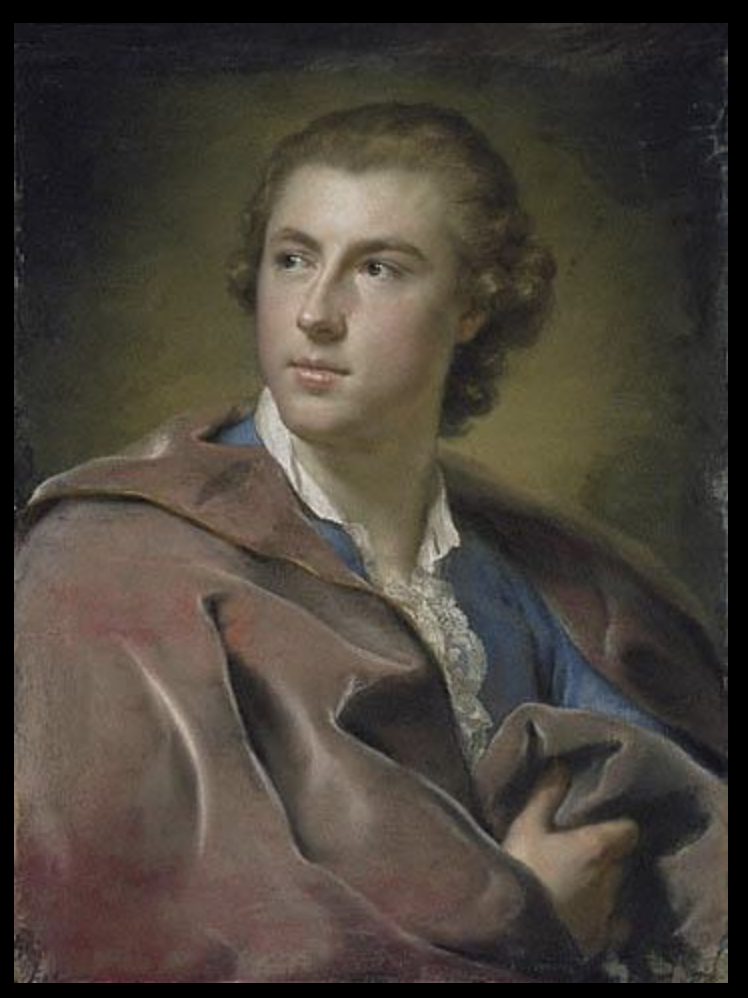
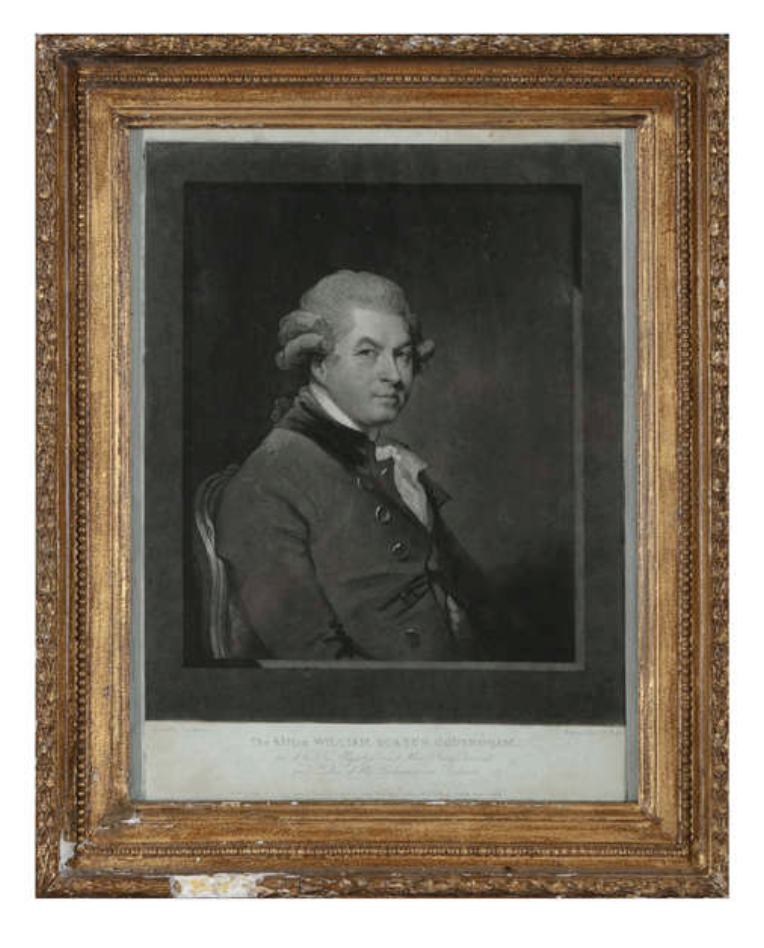
William Burton Conyngham (1733-1796), teller of the Irish Exchequer and treasurer of the Royal Irish Academy, 1780 engraver Valentine Green, after Hugh Douglas Hamilton, courtesy of National Gallery of Ireland.William Burton Conyngham (1733–1796) by Anton Raphael Mengs c. 1754-58, courtesy of wikipedia.He was the son of Francis Burton and Mary Conyngham, and he inherited Slane Castle as well as Donegal estates from his uncle William Conyngham who died in 1781.William Burton Conyngham, engraving After GILBERT STUART courtesy of Adams Country House Collections auction Oct 2023.
Slane Castle passed to William Burton Conyngham’s nephew Henry Conyngham (1766-1832) 1st Marquess Conyngham. Henry married Elizabeth Denison.
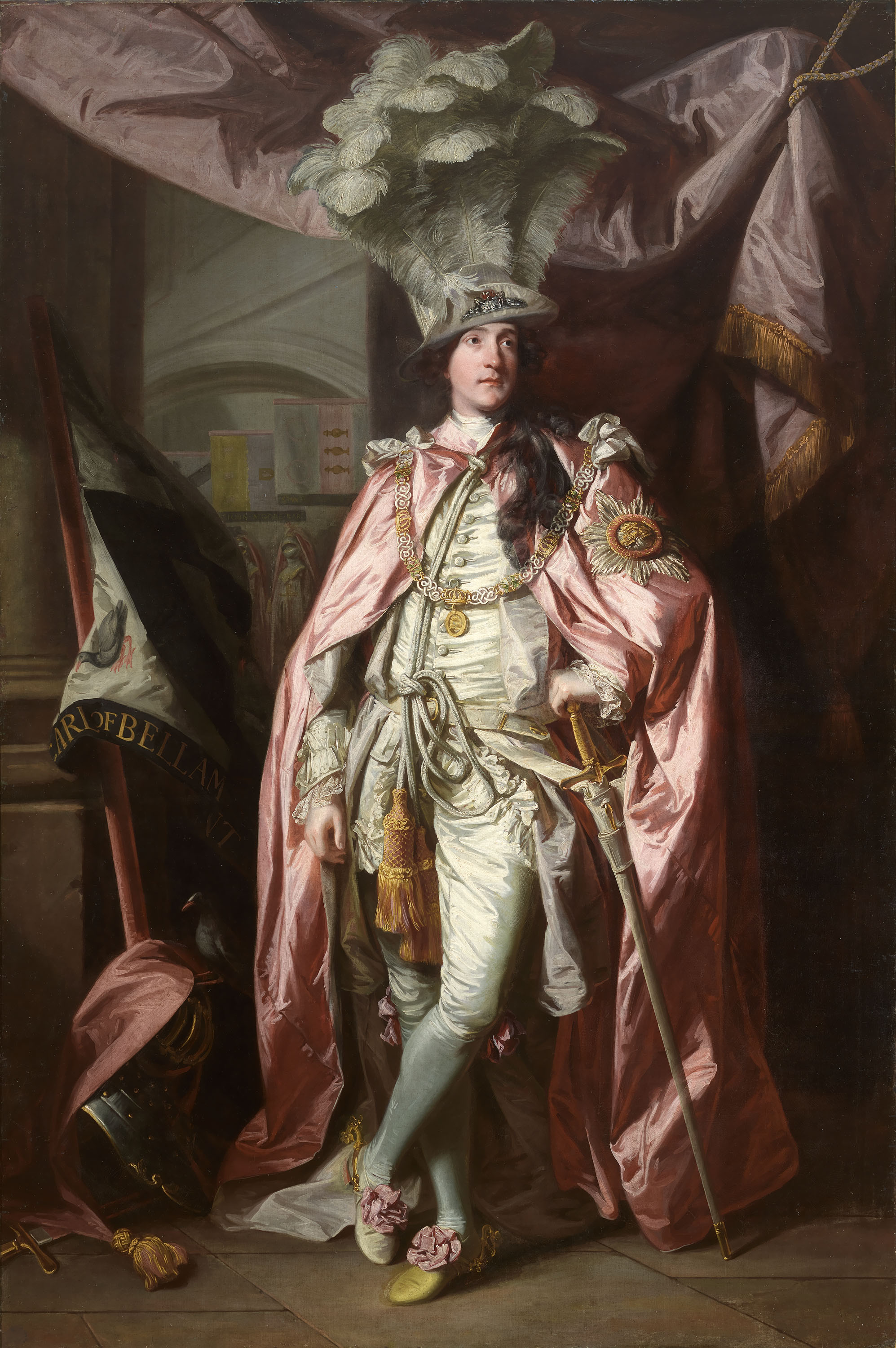
Timothy William Ferres also tells us of the Coote family. Charles Coote (1581-1642), 1st Baronet of Castle Cuffe, Queen’s County (Laois): “The Peerage” website tells us that in 1600 he went to Ireland as Captain of 100 Foot under 8th Lord Mountjoy, Queen Elizabeth I’s Lord Deputy of Ireland. He fought in the siege of Kingsale in 1602. He held the office of Provost Marshal of Connaught between 1605 and 1642, for life. He held the office of General Collector and Receiver of the King’s Composition Money for Connaught in 1613, for life. He held the office of Vice-President of Connaught in 1620. He was appointed Privy Counsellor (P.C.) in 1620. He was created 1st Baronet Coote, of Castle Cuffe, Queen’s Co. [Ireland] on 2 April 1621. He held the office of Custos Rotulorum of Queen’s County in 1634. He held the office of Member of Parliament (M.P.) for Queen’s County [Ireland] in 1639. Before 1641 he held Irish lands, mostly in Conaught, worth £4,000 a year. He held the office of Governor of Dublin in 1641. In 1642 he helped relieve Birr, King’s County (now County Offaly), during the Uprising by the Confederation of Kilkenny, his successful operations there and elsewhere in the area, which was called Mountrath, suggesting the title by which his son was ennobled.
He married Dorothea, youngest daughter and co-heir of Hugh Cuffe, of Cuffe’s Wood, County Cork, and had issue, Charles (c.1610 –1661)1st Earl of Mountrath; Chidley (d. 1688) of Killester, Co Dublin and Mount Coote, County Limerick; RICHARD (1620-83) 1st Baron Coote of Colloony, County Sligo, ancestor of the EARL OF BELLAMONT (1st Creation); Thomas, of Coote Hill; Letitia (married Francis Hamilton, 1st Bt of Killaugh, co. Cavan).
Charles Coote 1st Earl of Mountrath (c.1610 –1661), 2nd Baronet, ca. 1642, before he was ennobled, Circle of William Dobson. By Christina Keddie – Own work, Public Domain, https://commons.wikimedia.org/w/index.php?curid=42002789
Charles Coote (c.1610 –1661), 1st Earl of Mountrath married first, Mary Ruish, who gave birth to his heir, Charles Coote (d. 1672) 2nd Earl of Mountrath, Queen’s County. The 1st Earl of Mountrath, Queen’s County, also had the titles 1st Baron Coote of Castle Cuffe, in Queen’s Co. [Ireland] and 1st Viscount Coote of Castle Coote, Co. Roscommon [Ireland].
Charles Coote (c.1610 –1661), 1st Earl of Mountrath married secondly Jane Hannay, and she had a son Richard (1643-1700), who married Penelope, daughter of Arthur Hill of Hillsborough, County Down. Their daughter Penelope Rose married Charles Boyle (d. 1732) 2nd Viscount Blesington. Another daughter, Jane (d. 1729) married William Evans, 1st and last Baronet of Kilcreene, County Kilkenny.
Charles Coote, 2nd Earl of Mountrath married Alice, daughter of Robert Meredyth of Greenhills, County Kildare. His daughter Anne (d. 1725) married Murrough Boyle, 1st Viscount Blesington (d. 1718). His son Charles (1656-1709) succeeded as 3rd Earl of Mountrath, and he was father to the 4th, 5th and 6th Earls.
The son of Algernon Coote (1689-1744) 6th Earl of Mountrath, Charles Henry Coote (d. 1802) 7th Earl of Mountrath had no legitimate male issue and the earldom and its associated titles created in 1660 died with him. The barony of Castle Coote passed according to the special remainder to his kinsman, Charles Coote. The baronetcy of Castle Cuffe also held by the Earl passed to another kinsman, Sir Charles Coote, 9th Baronet.
Let us return now to Charles Coote (1581-1642), 1st Baronet of Castle Cuffe, Queen’s County (Laois) and trace the line of his younger son, RICHARD COOTE (1620-83), for his hearty concurrence with his brother, SIR CHARLES, 2nd Baronet, in promoting the restoration of CHARLES II, was rewarded with the dignity of a peerage of the realm; the same day that his brother was created Earl of Mountrath, Richard Coote was created, in 1660, Baron Coote, of Colloony.
In 1660, Richard was appointed Major to the Duke of Albemarle’s Regiment of Horse; and the same year he was appointed one of the commissioners for executing His Majesty’s declaration for the settlement of Ireland. He was, in 1675, appointed one of the commissioners entrusted for the 49 Officers. In 1676, the 1st Baron resided at Moore Park, County Meath, and Piercetown, County Westmeath. He married Mary, second daughter of George, Lord St. George, and had issue: RICHARD (1636-1701) his successor; Thomas (d. 1741) Lætitia (married Robert Molesworth, 1st Viscount Molesworth of Swords); Mary (married William Stewart, 1st Viscount Mountjoy); Catherine (married Ferdinando Hastings); Elizabeth (married Lt.-Gen. Richard St. George).
Following his decease, in 1683, he was interred at Christ Church Cathedral, Dublin. He was succeeded by his eldest son,
RICHARD, 2nd Baron (1636-1701), Governor of County Leitrim, 1689, Treasurer to the Queen, 1689-93, MP for Droitwich, 1689-95, who was, in 1688, one of the first to join the Prince of Orange. In 1689, he was attainted in his absence by the Irish Parliament of JAMES II. His lordship was created, in 1689, EARL OF BELLAMONT, along with a grant of 77,000 acres of forfeited lands.
Richard Coote (1636-1700/01) 1st Earl Bellomont By Samuel Smith Kilburn (d. 1903) – New York Public Library digital libraryhttp//:digitalgallery.nypl.org/nypldigital/id?423861, Public Domain, https//:commons.wikimedia.org/w/index.php?curid=13014278
Richard 1st Earl of Bellomont was Governor of Massachusetts, 1695, and Governor of New York, 1697-1701. The King had sent Lord Bellomont to New York to suppress the “freebooting.” Unfortunately he was responsible for outfitting the veteran mariner William Kidd, who turned into “Captain Kidd,” who terrorised the merchants until his capture in 1698.
According to Cokayne “he was a man of eminently fair character, upright, courageous and independent. Though a decided Whig he had distinguished himself by bringing before the Parliament at Westminster some tyrannical acts done by Whigs at Dublin.”
The 1st Earl of Bellomont wedded, in 1680, Catharine, daughter and heir of Bridges Nanfan, of Worcestershire, and had issue, NANFAN (1681-1708) his successor as 2nd Earl of Bellomont, and RICHARD (1682-1766), who succeeded his brother.
NANFAN, 2nd Earl (1681-1708) married Lucia Anna van Nassau (1684-1744), daughter of Henry de Nassau, Lord Overkirk, in 1705/6 at St Martin-in-the-Fields Church, London. Nanfan died at Bath, Somerset, from palsy, without male issue, when the family honours devolved upon his brother, RICHARD, 3rd Earl (1682-1766), who, in 1729, sold the family estate of Colloony, County Sligo, for nearly £17,000.
In 1737, he succeeded his mother to the estates of Birtsmorton, Worcestershire. Macaulay described him as “of eminently fair character, upright, courageous and independent.” On his death the earldom expired.
The last Earl was succeeded in the barony of Coote by his first cousin once removed, CHARLES, 5th Baron (1736-1800), KB PC, son of Charles Coote [1695-1750] High Sheriff of County Cavan, 1719, MP for Granard, 1723-27, Cavan County, 1727-50MP for County Cavan, 1761-6, who was son of the HON THOMAS COOTE (c. 1655-1741) a Justice of the Court of the King’s Bench of Ireland, younger son of the 1st Baron. This Thomas’s daughter Elizabeth married Mervyn Pratt (1687-1751) of Cabra Castle.
Sir Charles succeeded his cousin, Richard, in 1766, as 5th Baron Coote; and was created, in 1767, EARL OF BELLAMONT (3rd creation). His lordship was created a baronet, in 1774, designated of Donnybrooke, County Dublin, with remainder to his natural son, Charles Coote, of Dublin.
SIR CHARLES COOTE (1736-1800), KB PC, of Coote Hill (afterwards renamed Bellamont Forest) had an illegitimate son, Charles Coote (1765-1857) who despite his illegitimacy became 2nd Baronet of Bellamont). Charles 1st Earl married, in 1774, the Lady Emily Maria Margaret FitzGerald, daughter of James, 1st Duke of Leinster, and had issue, Charles, Viscount Coote (died age seven, 1778-86); Mary; Prudentia; Emily; Louisa. Following his death in 1800, the titles became extinct as he left no legitimate male issue, though he was succeeded in the baronetcy according to the special remainder by his illegitimate son Charles, 2nd Baronet.
Finally, let us return now to Charles Coote (1581-1642), 1st Baronet of Castle Cuffe, Queen’s County (Laois) and trace the line of his son Chidley Coote (d. 1668). Chidley lived in Mount Coote, County Limerick (later called Ash Hill, a section 482 property, see my entry). He had a son, Chidley (d. 1702) who married Catherine Sandys. They had a daughter Catherine (d. 1725) who married Henry Boyle 1st Earl of Shannon. Another daughter, Anne, married Bartholomew Purdon, MP for Doneraile and later Castlemartyr of County Cork. They had a son Reverend Chidley Coote (1678-1730) who inherited Ash Hill in County Limerick. He married Jane Evans (d. 1763) and it was their grandson Charles Henry Coote (1754-1823) who succeeded as 2nd Baron Castle Coote in 1802. He was the son of Reverend Charles Coote (1713-1796) and Grace Tilson (d. 1766). Another son was Lt.-Gen. Sir Eyre Coote (1762-1823).
Major General Eyre Coote (1762-1823), Governor of Jamaica, 1805 by engraver Antoine Cordon after J.P.J. Lodder, courtesy of National Gallery of Ireland.He was son of Reverend Charles Coote (1713-1796) and Grace Tilson (d. 1766).Eyre Coote (1726-1783) attributed to Henry Robert Morland, c. 1763, National Portrait Gallery of London NPG124. He was the son of Reverend Chidley Coote (1678-1730) who inherited Ash Hill in County Limerick and Jane Evans (d. 1763).Lieutenant General Sir Eyre Coote (1726-1783) Commander-in-Chief in the East Indies (1777-1783) by John Thomas Seton, courtesy of the British Library.He was the son of Reverend Chidley Coote (1678-1730) who inherited Ash Hill in County Limerick and Jane Evans (d. 1763).
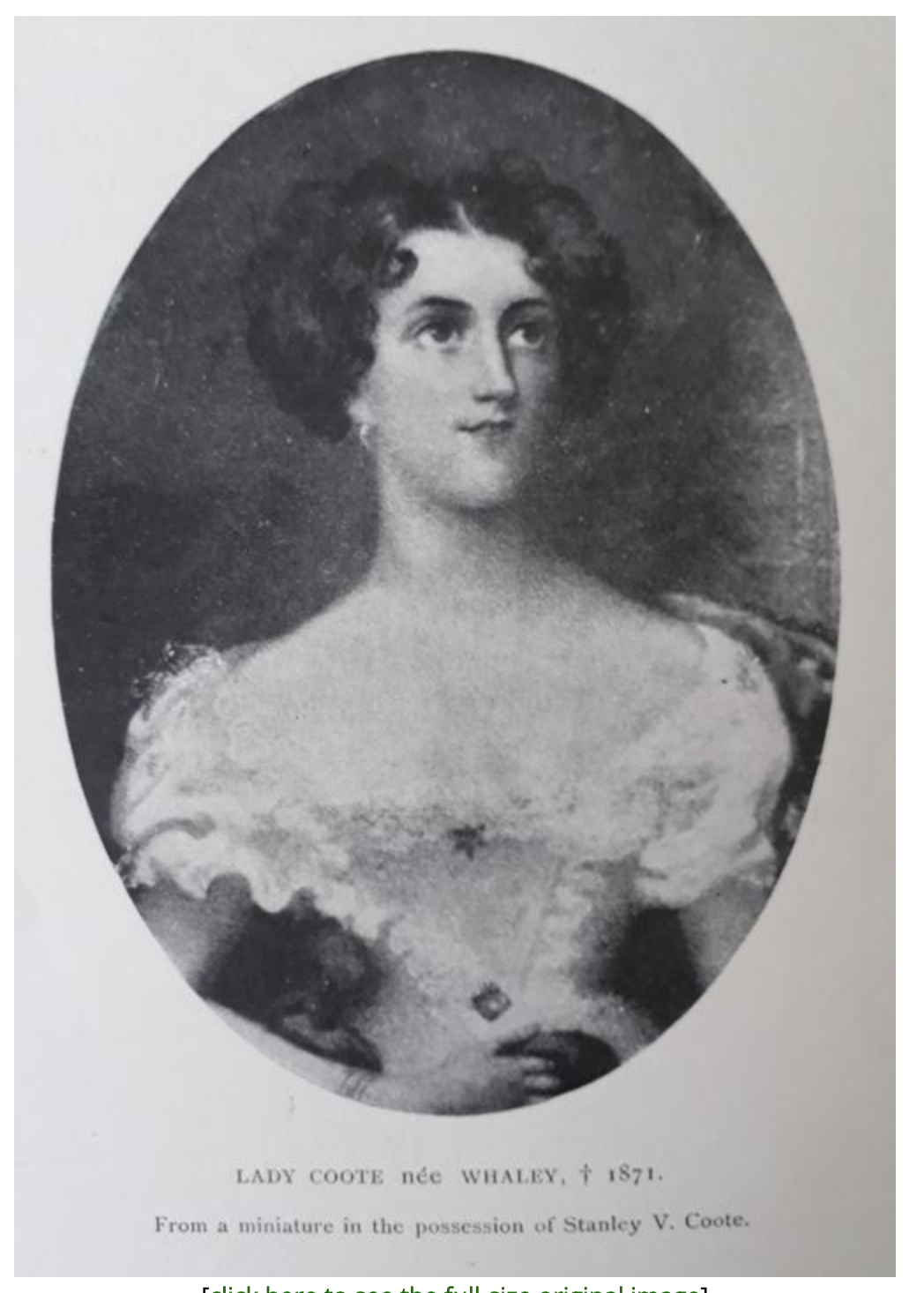
Reverend Chidley Coote (1678-1730) who inherited Ash Hill and Jane Evans (d. 1763) had a daughter Elizabeth who married John Bowen. Reverend Childley Coote and Jane Evans’s son Robert (d. 1745) inherited Ash Hill and married his cousin Anne Purdon, daughter of Bartholomew Purdon and Anne Coote. Robert Coote and Anne Purdon’s grandson was Charles Henry Coote (1792-1864) who succeeded as 9th Baronet of Castle Cuffe, Queen’s County, who married Caroline Elizabeth Whaley (d. 1871), daughter of John Whaley (d. 1847) of Dublin.
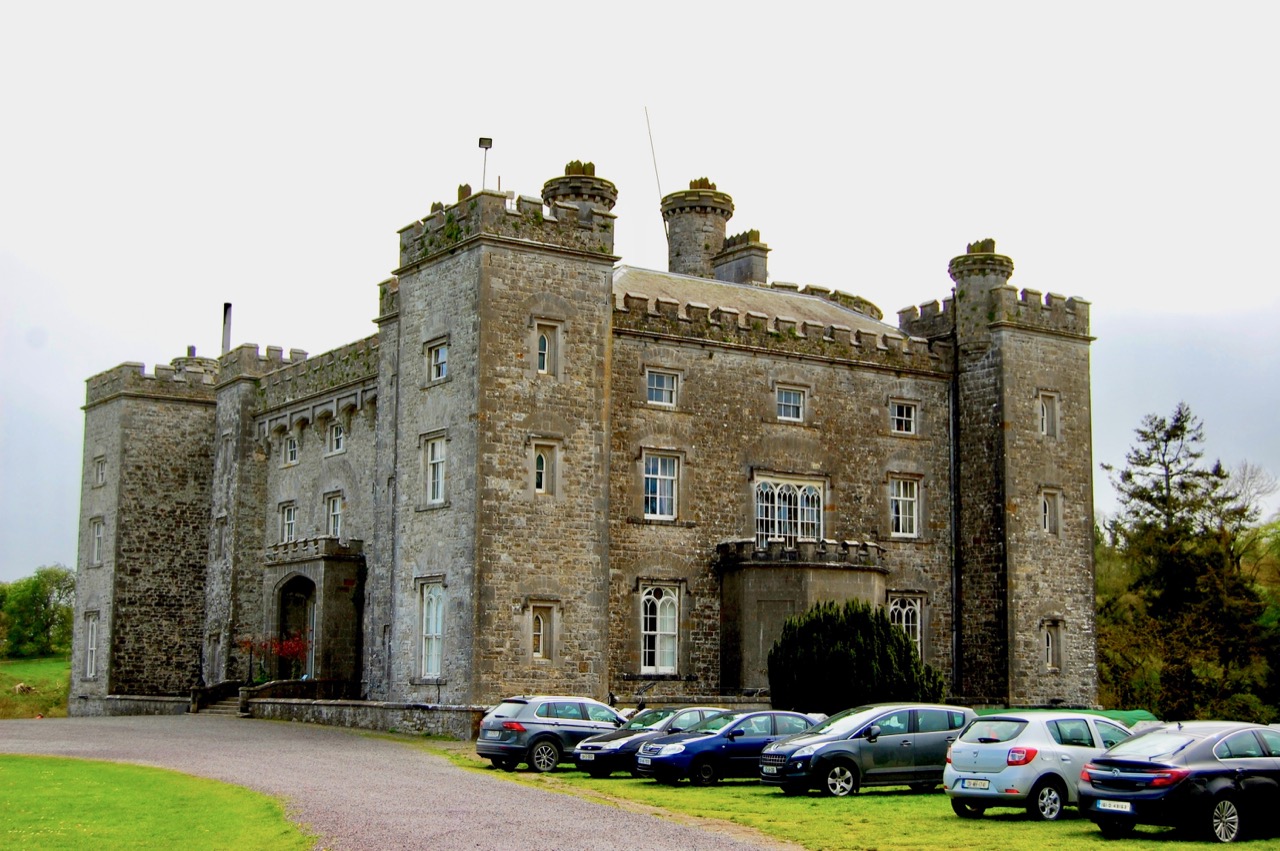
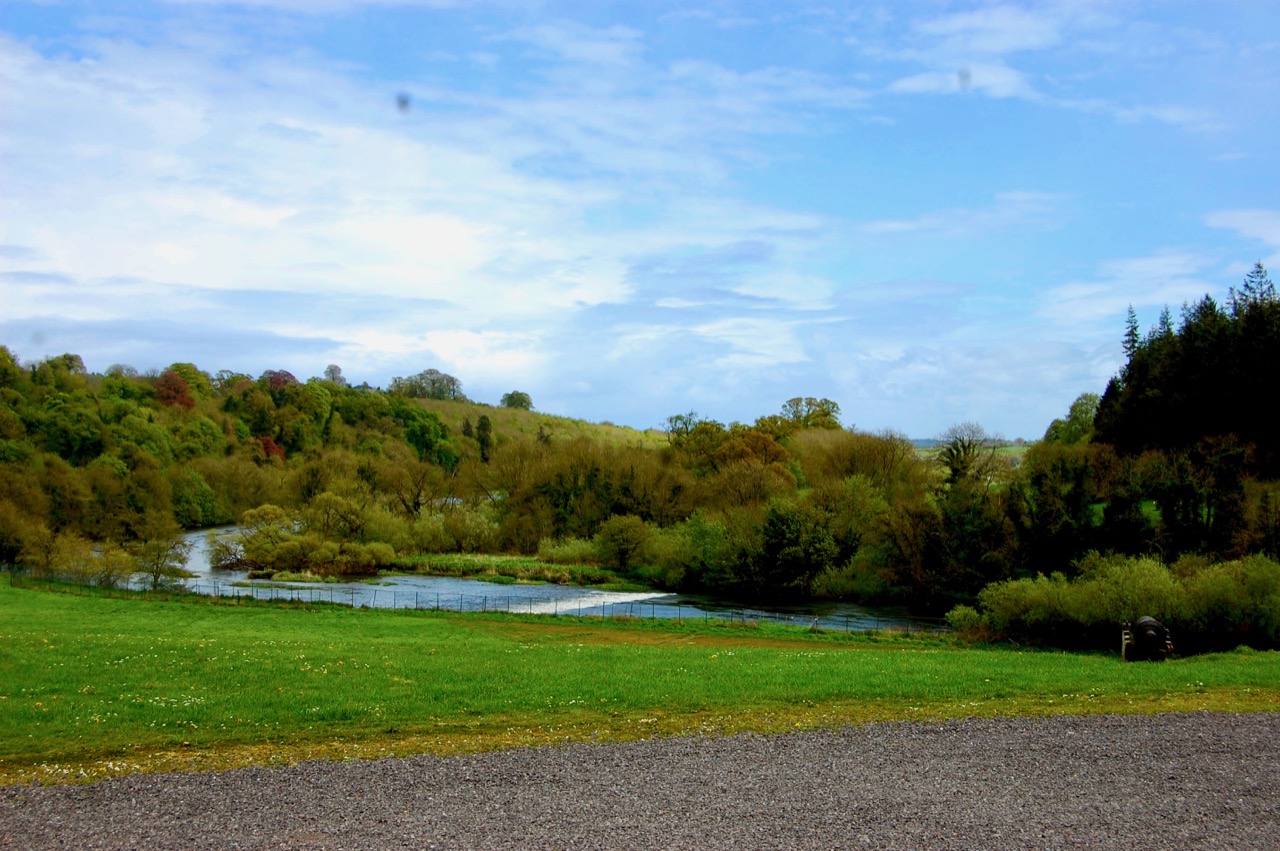
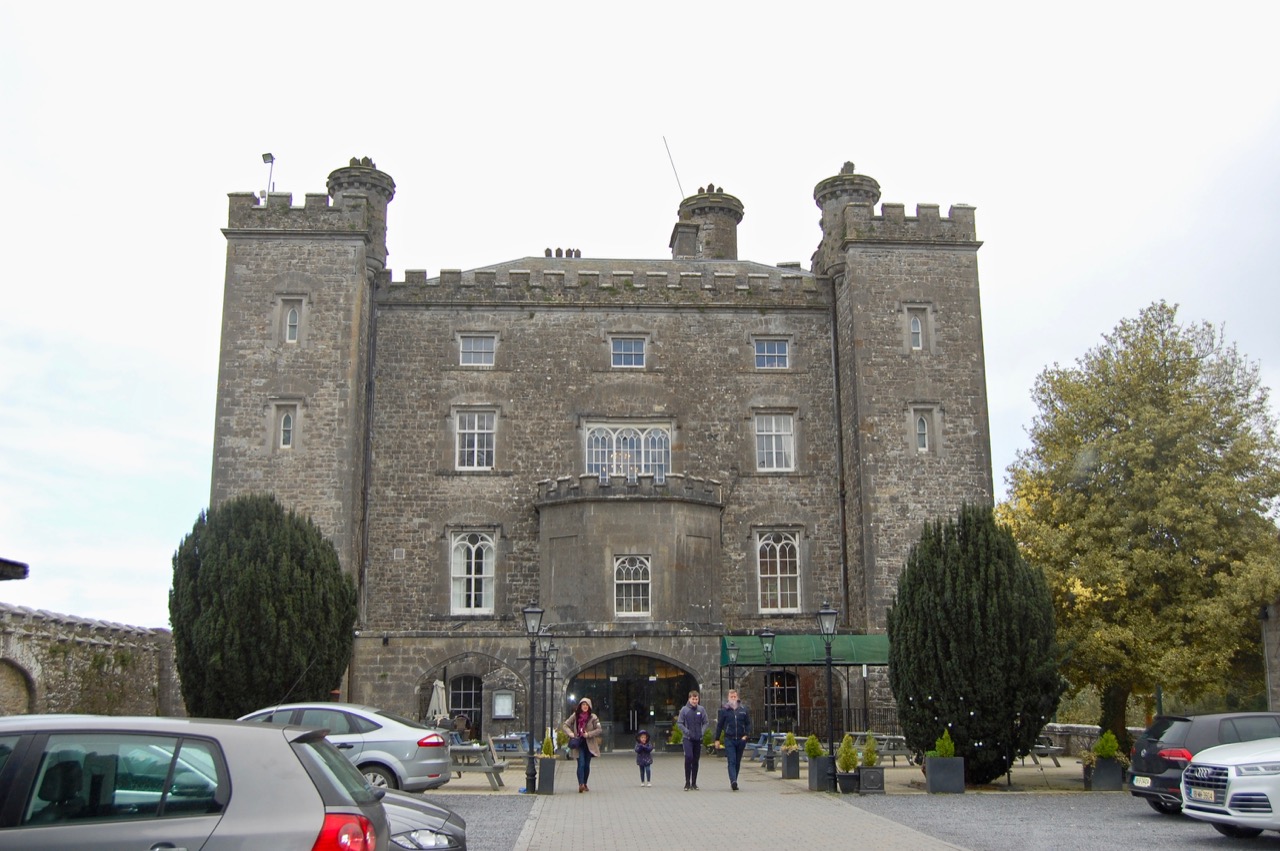
Today (Saturday 27th April 2019) my husband Stephen and I made our first official blog trip. We started in the “ancient east,” going to Slane Castle in County Meath. The land around the Boyne River is beautiful, rolling and fertile. It took almost exactly one hour to drive from our home in Dublin, taking the M1 which I find easier than the M2 through the city’s north side, with which I’m less familiar. Our timing was perfect, we arrived at 2:10pm, in time for the 2:15 tour – there are tours every hour on the quarter hour. [1]
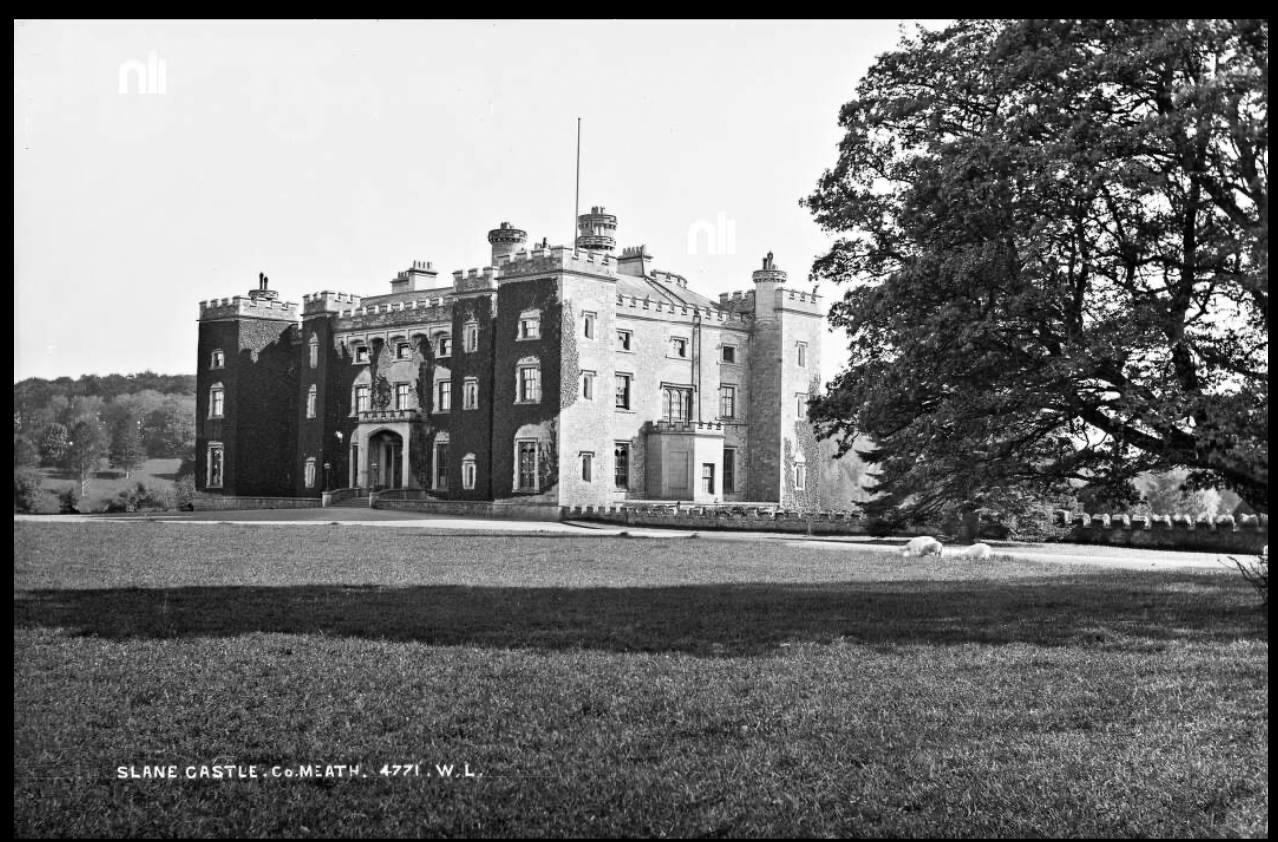
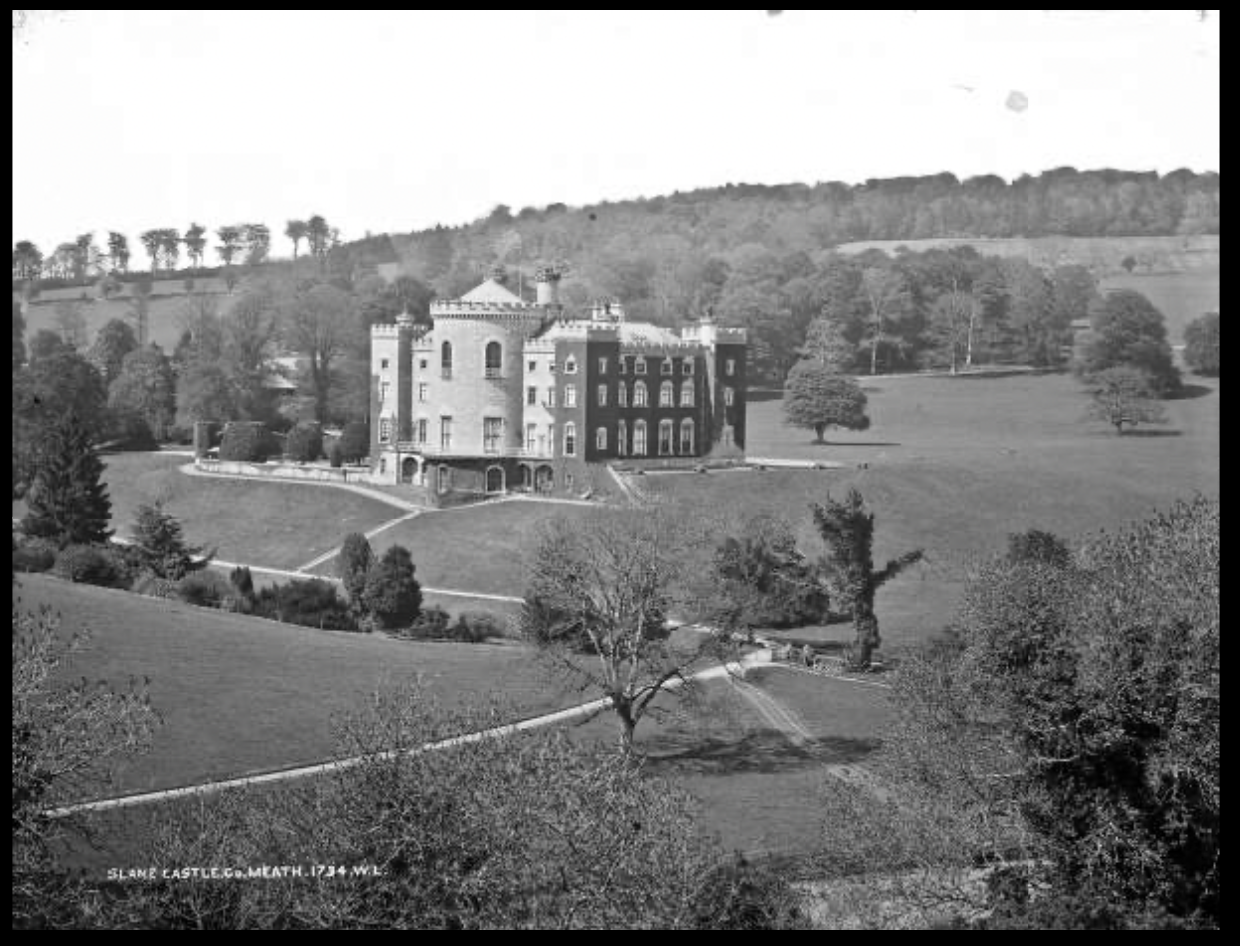
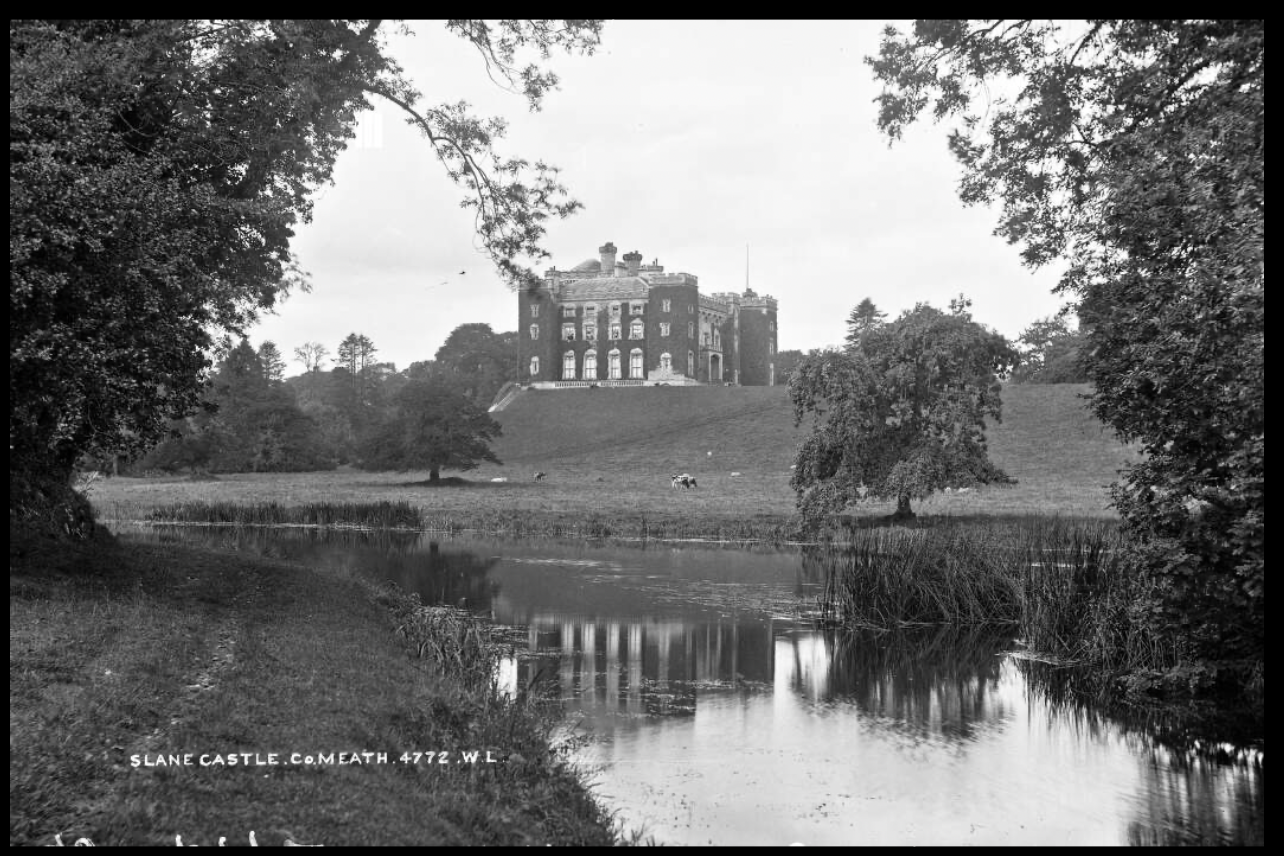
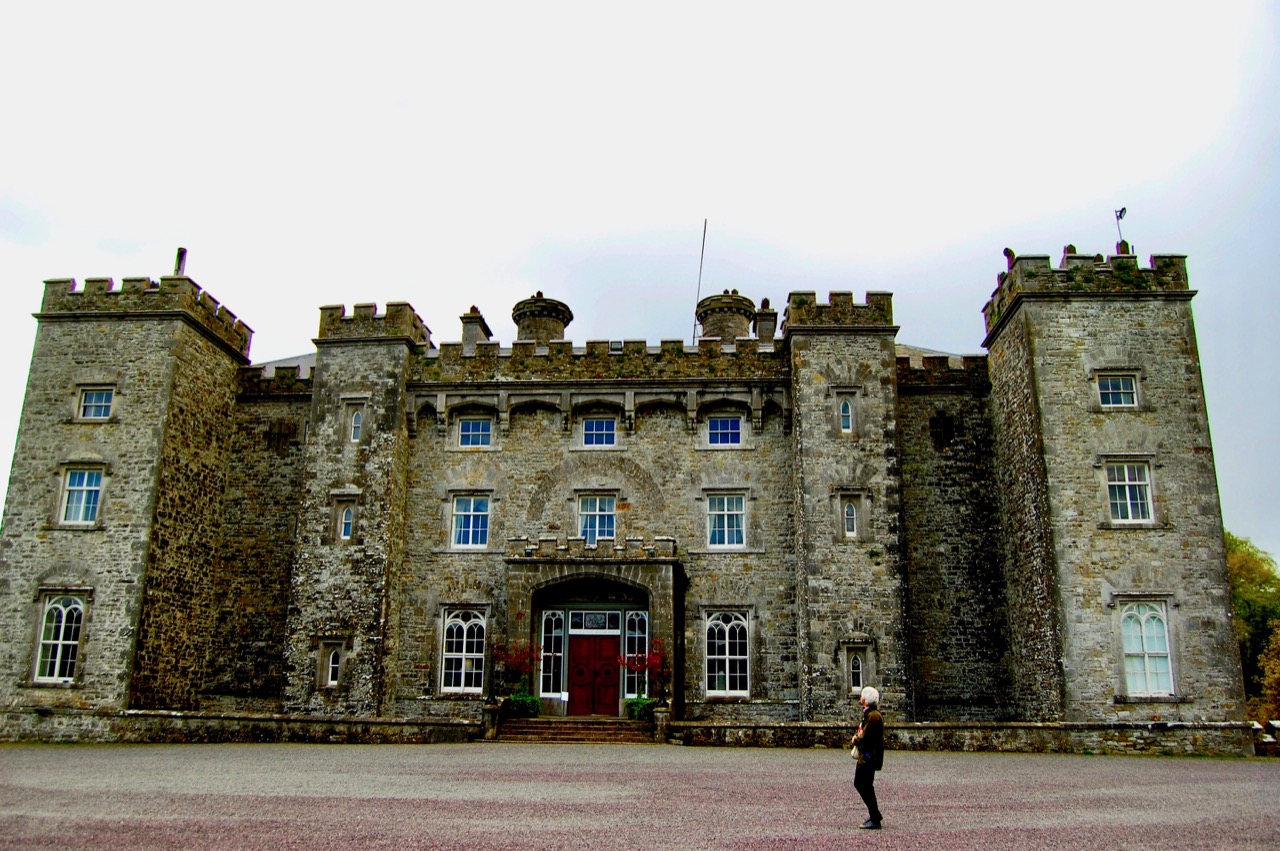
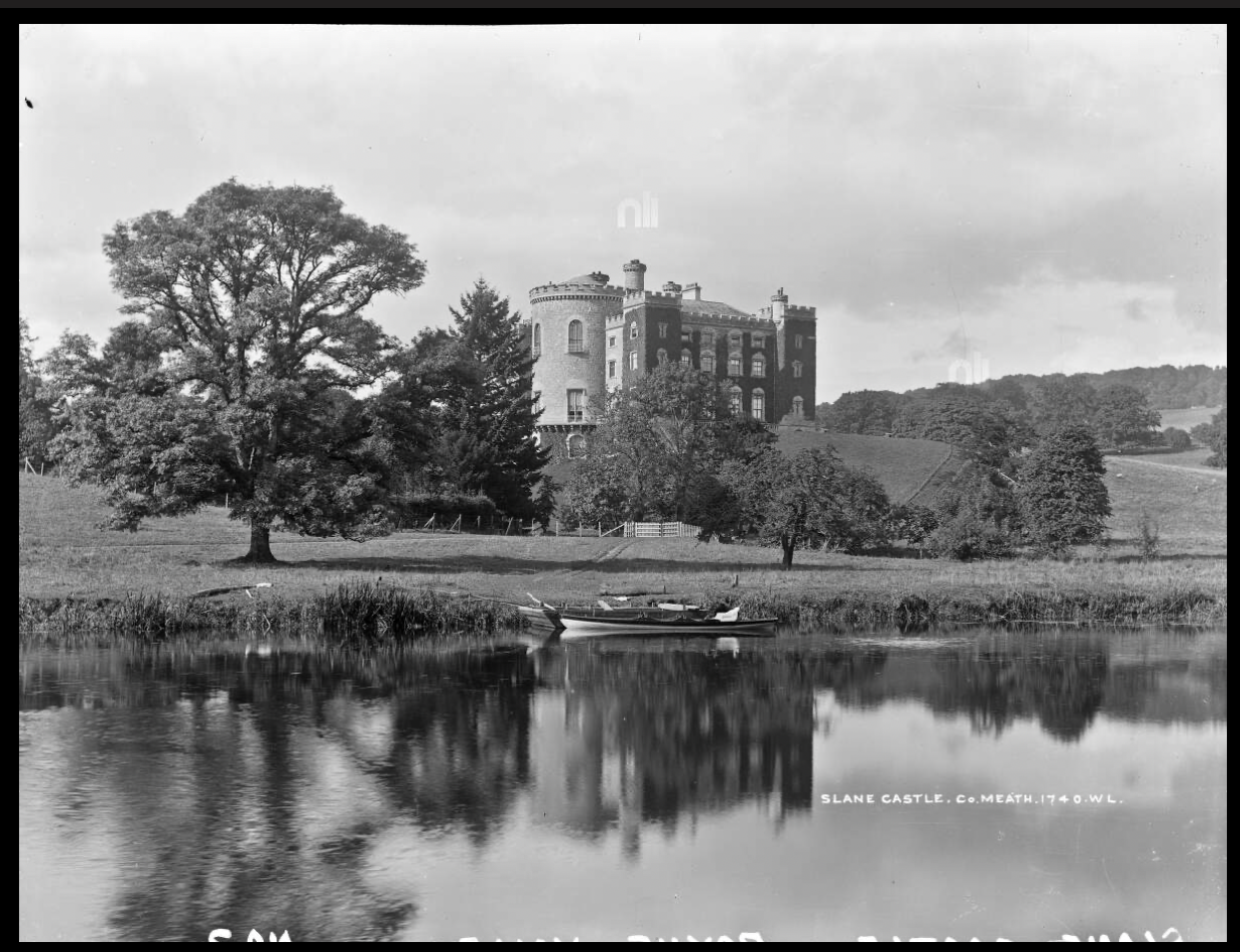
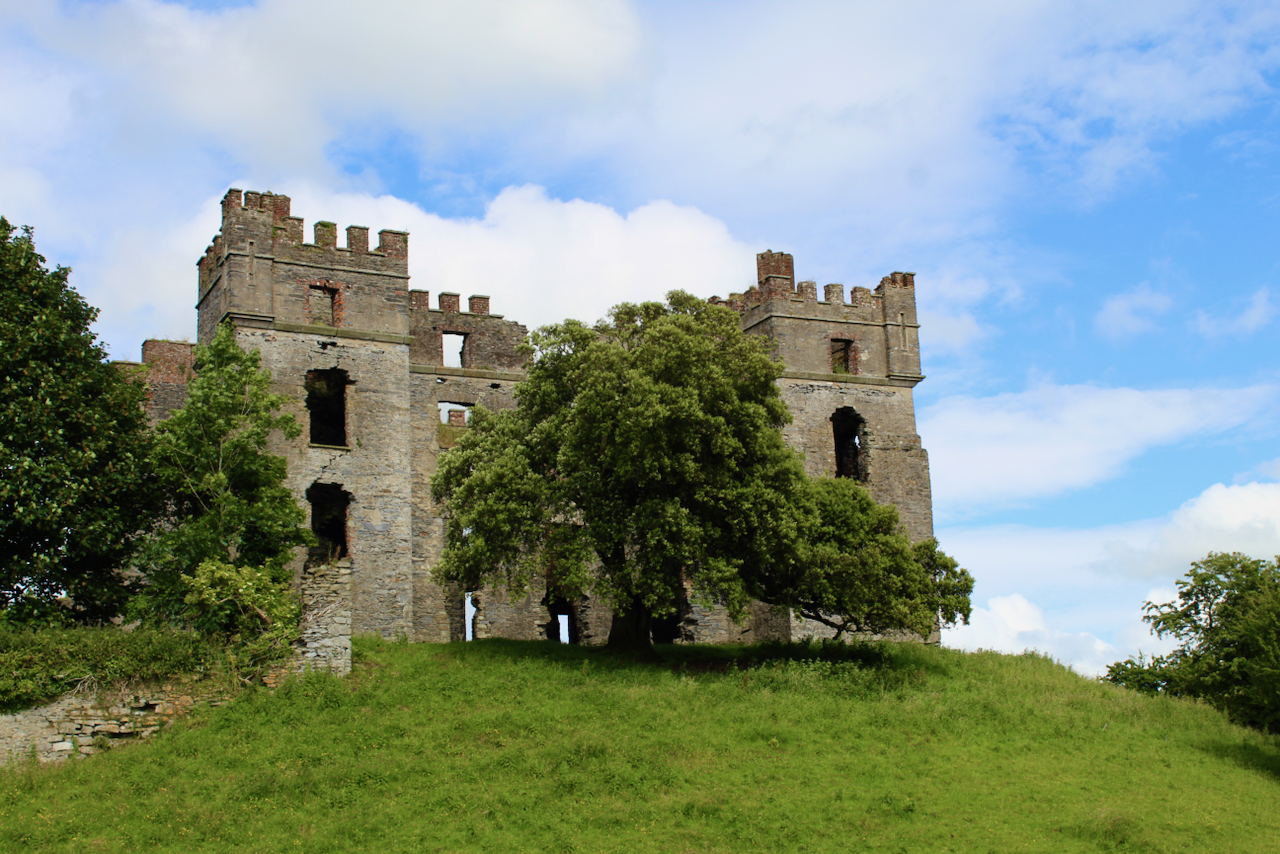
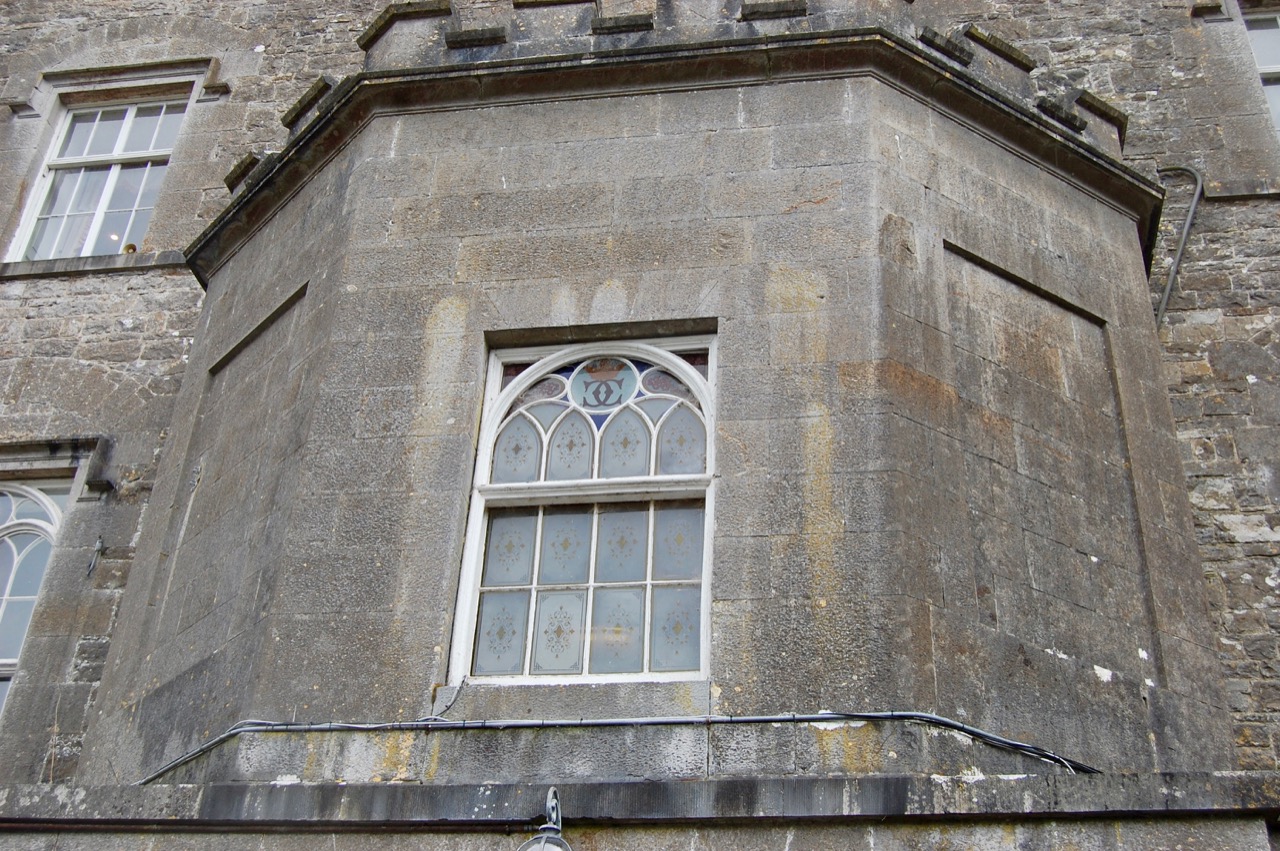
The castle is three storeys over basement, in the Gothic Revival style. There is a bow on the back side of the castle, facing the river, and the basement serves as the ground floor on this side due to the steep slope down to the River Boyne. The bow forms a round tower, but you cannot see it as you approach the castle as the river is behind.
Our guide Matthew told us that the castle was reconstructed and enlarged by William Burton Conyngham (1733-1796). It was built on the foundations of a medieval castle of the Fleming family, replacing an earlier house.
William Burton Conyngham was a classicist and the front hall features Greek columns and key patterns on the walls and many marble Greek sculptures, including a sculpture of King George IV of England, donated by the king himself.
William Burton Conyngham (1733–1796) by Anton Raphael Mengs c. 1754-58, courtesy of wikipedia.
William Burton Conyngham argued with his architects, Matthew told us, so ended up having three architects for his castle: James Gandon, James Wyatt and Francis Johnston. According to Mark Bence-Jones in A Guide to Irish Country Houses, Francis Johnston completed the house for the the second Lord Conyngham’s son, nephew of William Burton Conyngham, Henry (1766-1832), who later became the 1st Marquess Conyngham.
Other architects were consulted at various times, including James Gandon, who most famously designed the Custom House and the Four Courts in Dublin, and Emo in County Laois. Francis Johnston designed the General Post Office in Dublin, and Townley Hall, County Louth. Another architect consulted was a favourite of King George IV, the English Thomas Hopper.
William Burton Conyngham, (1733-1796), Teller of the Irish Exchequer and Treasurer of the Royal Irish Academy Date 1780 Engraver Valentine Green, English, 1739 – 1813 After Hugh Douglas Hamilton, Irish, 1740-1808.
In 1785 the castle was remodelled to the design of James Wyatt (1746 – 1813). Wyatt also designed another house on the section 482 list this year, Curraghmore in County Waterford, and a house not on the list, unfortunately, as I would love to see inside, Abbeyleix House (incidentally, my father grew up in Abbeyleix and we used to enjoy the gardens which used to be open and which were reknowned for the bluebells. Also, coincidentally, according to wikipedia, Wyatt spent six years in Italy, 1762–68, in company with Richard Bagot of Staffordshire, who was Secretary to the Earl of Northampton’s embassy to the Venetian Republic. My family is rumoured to be descended from the Staffordshire Bagots, although I have not found the connection!).
The Conyngham family have owned the castle since 1703.
Slane Castle, County Meath, photograph by Robert French, (between ca. 1865-1914), Lawrence Photograph Collection, National Library of Ireland.
The Flemings of Slane
The Conynghams bought the land in Slane after it was confiscated from the Flemings. In 1175, Richard Le Fleming built a castle at the western end of Slane hill and, three generations later, Simon Fleming was created Baron of Slane. [4]
The Conynghams did not acquire Slane directly after it was confiscated from the Flemings – Terry Trench of the Slane History and Archaeology Society writes that the estate changed hands, at least on paper, seven times between 1641 and 1703. The estate was taken from the Flemings in 1641, when William Fleming, the 14th Baron Slane, joined the Catholic Irish forces in rebellion against the British. He remained loyal to the king, but objected to the laws that the British parliament passed to make the Irish parliament subservient to the British parliament. The estate was restored to William’s son Randall under the Act of Settlement and Distribution of Charles II’s reign, by decree dated 27th March 1663. [5] Many estates that had been confiscated by Cromwell’s parliament were restored when Charles II was restored to the throne in 1660.
The Flemings had their land confiscated again as Christopher, 17th Baron Slane (1669-1726), backed James II in his battles against William of Orange. He served in the Irish Parliament of King James II in 1689, and as colonel in James’s army in Ireland 1689-91, fighting in both the Battle of the Boyne and in Aughrim, where he was taken prisoner by William’s forces. Released, he emigrated and fought in the French and Portuguese armies, as did many of James II’s followers who were attainted and lost their estates, as they needed to be able to earn a living. He was later reconciled with Queen Anne of England (daughter of James II) and returned to Ireland, to live in Anticur, County Antrim. In 1703, Henry Conyngham purchased the estate of Slane.
The Conynghams of Slane
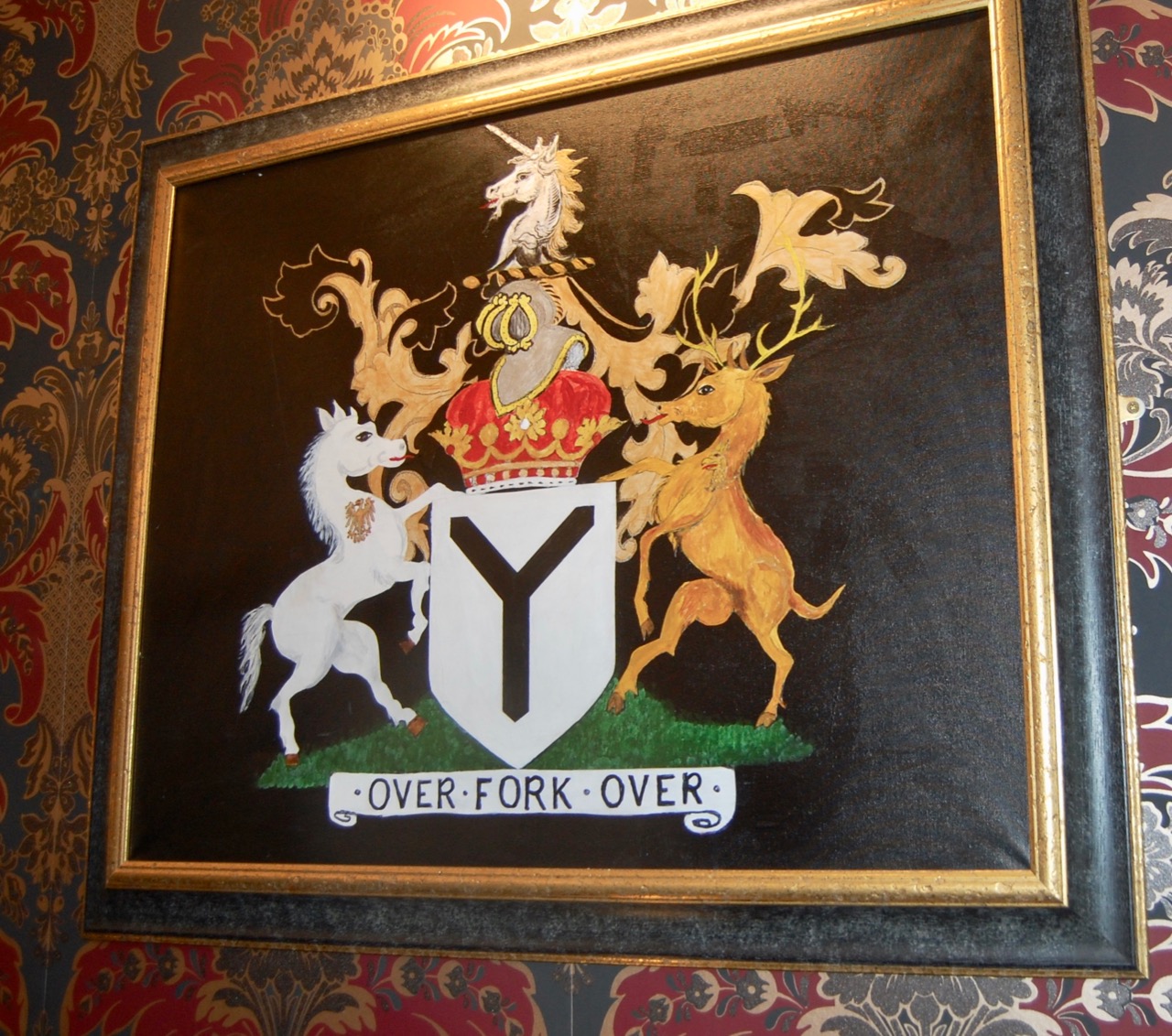
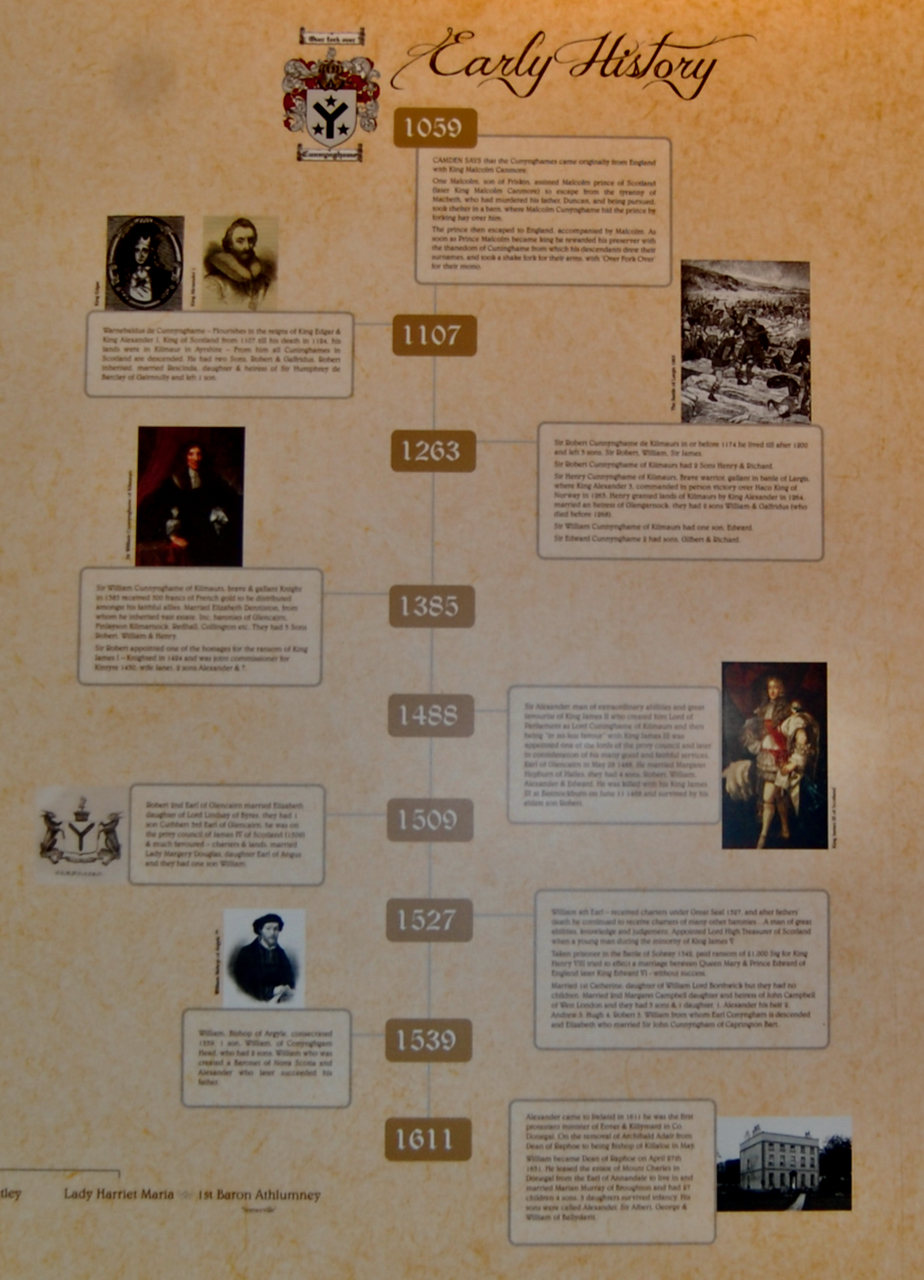
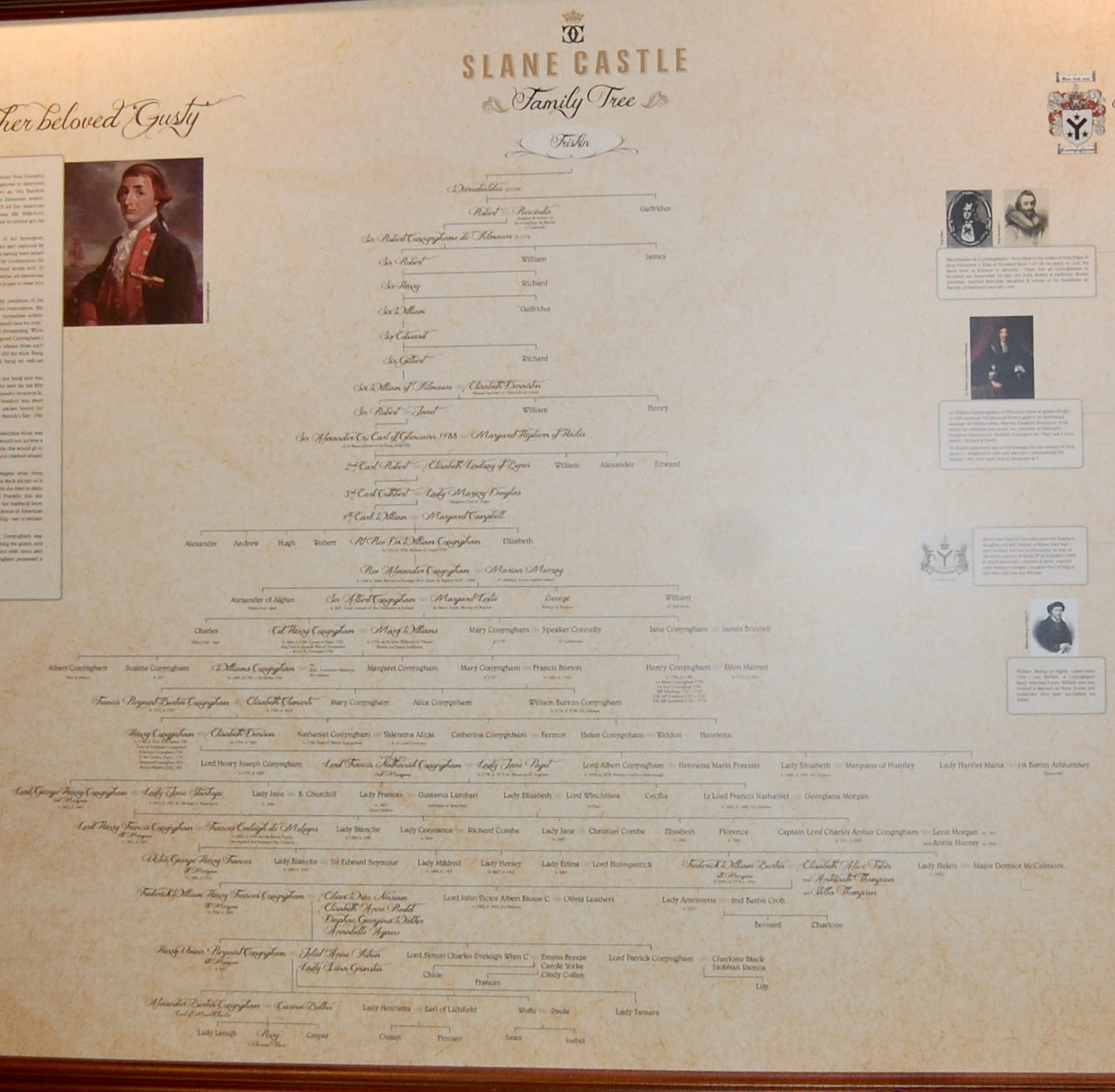
The Conyngham motto, Over Fork Over, recounts the way Duncan hid from Macbeth (familiar to us from Shakespeare). Matthew told us that Duncan hid in straw in a barn, having it forked over him. After that, he managed to defeat Macbeth and to become king. So the Conynghams are descendants of a Scottish king!
Alexander Conyngham moved from Scotland to Ireland when he was appointed in 1611 to be the first Protestant minister to Enver and Killymardin the diocese of Raphoe, County Donegal. [3] He was appointed dean of Raphoe in 1631.
He settled at Mount Charles, County Donegal, on an estate he leased from John Murray, earl of Annandale, the owner of ‘a vast estate’ in Scotland. Conyngham subsequently acquired the Mount Charles property through his marriage to the earl’s grand-neice, Marian, daughter of John Murray of Broughton, in Scotland (see [3]).
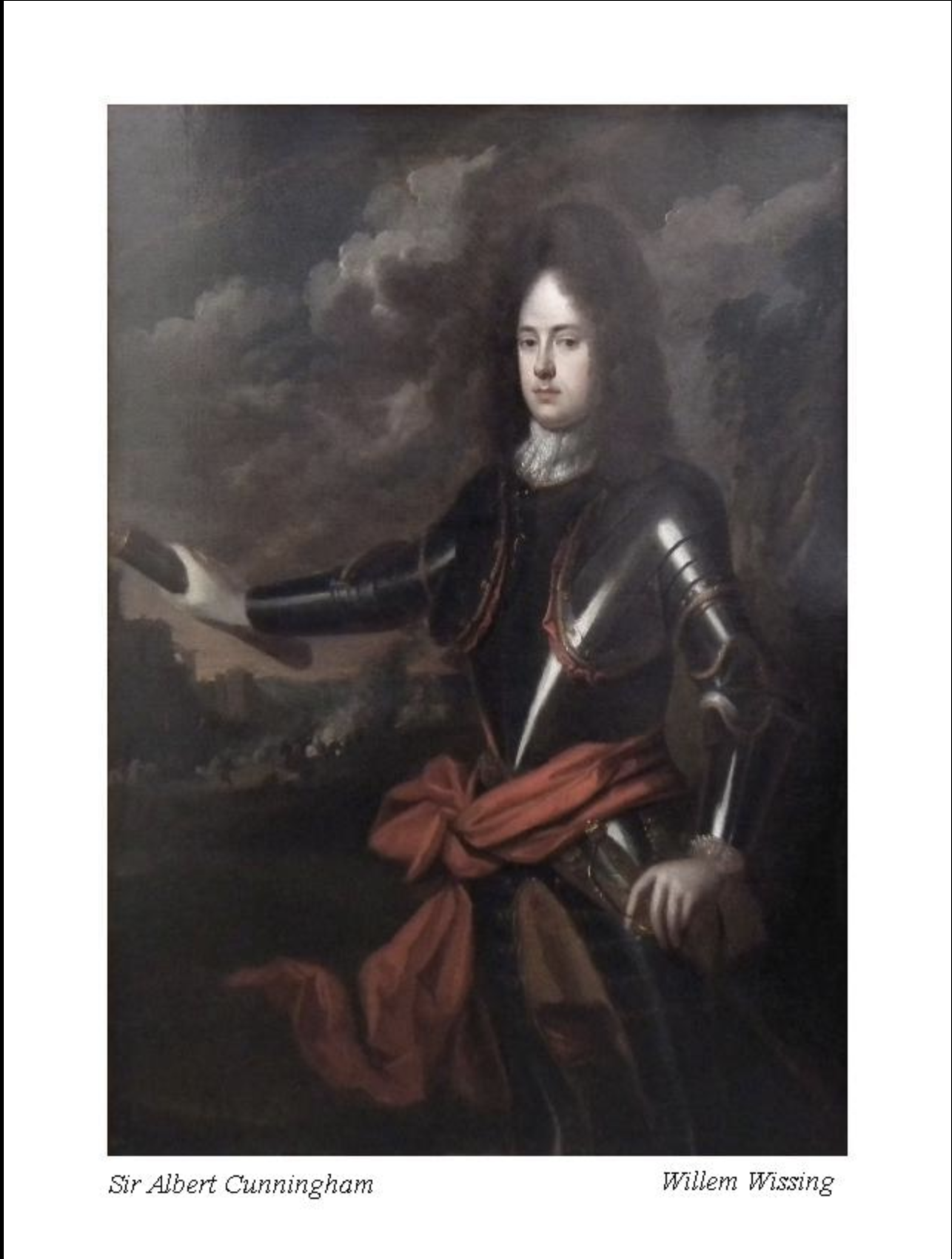
Alexander’s son Albert lived at Mountcharles. [2] Albert had fought with William III’s troops in the Battle of the Boyne, against Fleming and James II’s troops.
Albert Cunningham (d. 1691) first colonel of the 6th (Inniskilling) Dragoons, by Willem Wissing c. 1690, courtesy of British Cavalry Regiments website and wikipedia.
Albert married Mary, daughter of the Right Reverend Robert Leslie, Bishop of Raphoe – this Bishop is the ancestor of the Leslie family of Castle Leslie in County Monaghan, another property on the Section 482 list that I will be visiting. Albert was killed by Irish Royalist rebels, and succeeded by his only surviving son, Henry (1664-1705).
Henry, a military man who also served as MP for County Donegal, purchased the land in Slane in 1703.
He built himself a residence, which he called Conyngham Hall, on the foundations of an older castle formerly belonging to the Flemings.
Henry Conyngham (d. 1705) fought first in James II’s army, but then persuaded his regiment to transfer their loyalty to William III.
Henry’s son Henry (1705-1781) inherited the Slane estate. Henry became an Member of the Irish Parliament and was raised to the peerage in 1753 to the title of Baron Conyngham of Mount Charles, and later became Viscount and eventually, Earl. He died without a son so the Barony passed to his nephew, William Burton (his sister Mary had married Francis Burton).
William Burton (1733-1796) took the name of Conyngham upon inheriting the estate in 1781. It was he who rebuilt Slane Castle.
William Burton Conyngham, engraving After GILBERT STUART courtesy of Adams Country House Collections auction Oct 2023.
His brother Francis Pierpoint Burton also who then took the name of Conyngham in 1781 as he inherited the title to become 2nd Baron Conyngham of Mount Charles, Co. Donegal. He died six years later, in 1787. [see 3]. In 1750 he had married Elizabeth, the daughter of amateur architect Nathaniel Clements, whose work we will see later in other houses on the section 482 list of heritage properties. For himself, Nathaniel Clements built what is now the Áras an Uachtaráin, the residence of our President, Michael D. Higgins, in Phoenix Park in Dublin.
The castle and estate passed to Francis 2nd Baron Conyngham’s son Henry (1766-1832). Henry succeeded as the 3rd Baron Conyngham of Mount Charles, Co. Donegal in 1787. He served as a politician and moved quickly up the ranks of the peerage and was Lord Steward of the Royal household between 1821-30. He married Elizabeth Denison in 1794.
Elizabeth née Denison, Marchioness Conyngham (1769-1861), wife of Henry 1st Marquess.
In 1821 King George IV visited Ireland, and he spent time in the Castle with his lover, Elizabeth, wife of Frances Pierpoint Burton Conyngham. “In return,” as our guide told us, the king made Conyngham a Marquess, although this isn’t quite true as he became Marquess in 1816. [6].
Elizabeth Conyngham (née Denison), Marchioness Conyngham (1769–1861) by George Chinnery, English, 1774-1852.Elizabeth Conyngham née Denison, wife of Henry 1st Marquess by Thomas Lawrence 1821 courtesy of Calouste Gulbenkian Museum.Maria Conyngham (died 1843), daughter of 1st Marquess of Slane by Sir Thomas Lawrence courtesy of Metropolitan museum.
One of the rooms of the castle, the Smoking Room, has two cartoons from the period mocking the King and his consort Elizabeth, drawing them as overweight. In one, she aids her son when he has to move from the Castle of Windsor where he was Royal Chamberlain. It was he who announced to Victoria that she was Queen, upon death of the previous monarch. He was let go from his position when he tried to move his lover into his rooms in Windsor. His mother came to fetch him, with several wheelbarrows, the story goes, and she took all the furniture from his rooms. Somehow she brought a grand piano back from Windsor to Slane Castle where it sat in a specially made arbor for music in the Smoking room, until it was destroyed by a fire in Slane Castle in the 1990’s. One of the Punch style cartoons is of Elizabeth with a wheelbarrow fetching her son from Windsor. I can’t quite remember the other – it had King George IV and herself in a carriage. The Irish were very annoyed that when he came to Ireland he spent his entire time at Slane Castle!
“Neither the king nor his inamorata were in the first flush of youth, and both were equally corpulent. These circumstances however did nothing to dampen their ardour. As was written of them at the time, ‘Tis pleasant at seasons to see how they sit/ First cracking their nuts, and then cracking their wit/ Then quaffing their claret – then mingling their lips/ Or tickling the fat about each other’s hips.’ And according to one contemporary observer, Lady Conyngham ‘lived exclusively with him during the whole time he was in Ireland at the Phoenix Park. When he went to Slane, she received him dressed out as for a drawing-room; he saluted her, and they then retired alone to her apartments.’” [7]
Our tour started with a video of Charles Conyngham, now known as Lord Mount Charles, telling of his childhood in the Castle, growing up in a very old-world upper class manner. He did not join his parents at the dining table until he was twelve years old, dining until then in the Nursery. His nurse, Margaret Browne, came to the Castle at 16 years old, and he held her in such regard that he named his bar after her.
The menu in Browne’s Bar, which gives an explanation of the name, telling of the housekeeper.
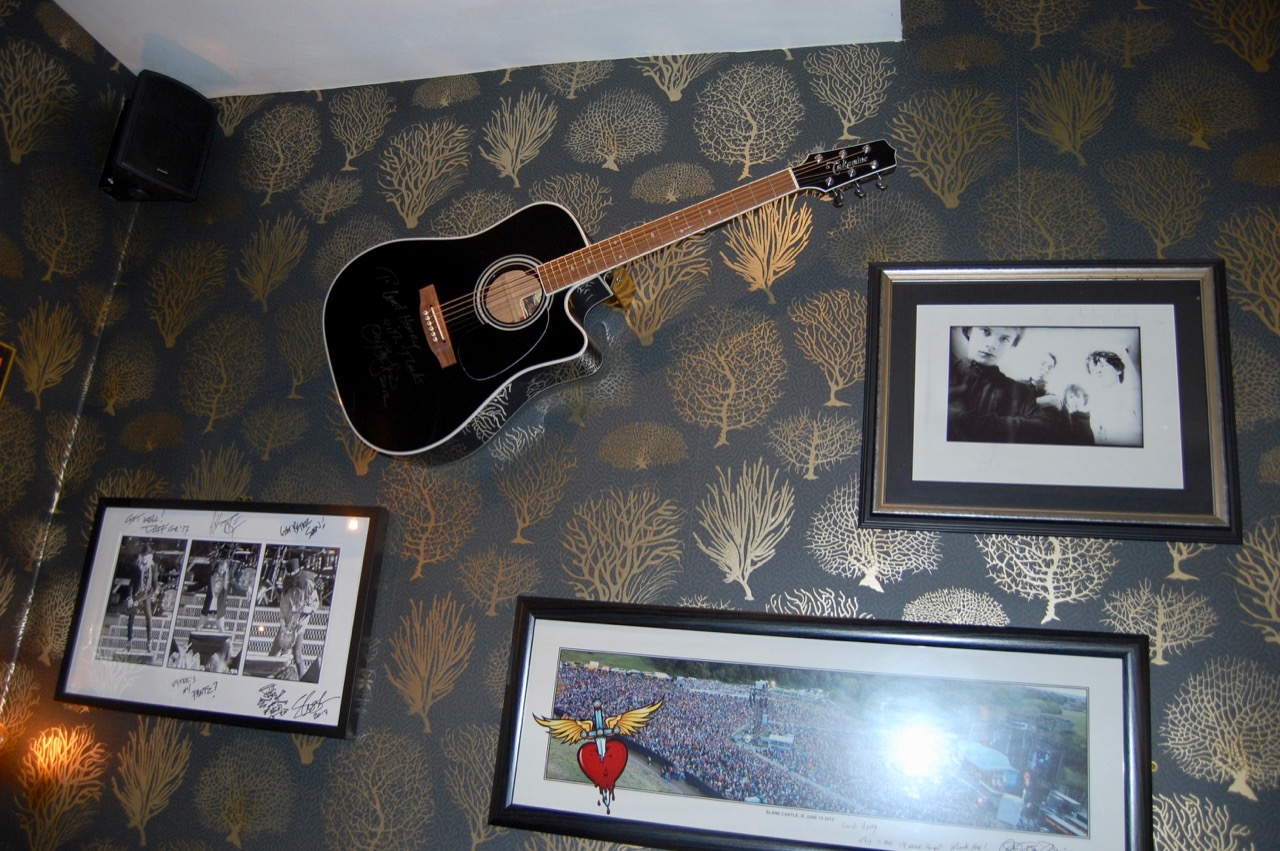
Lord Mount Charles described how he started out, when he had to take over the Castle, with a restaurant, which is now the Gandon Restaurant. To further fund the Castle maintenance, Lord Mount Charles started concerts at the venue, beginning with Thin Lizzy in 1981. To seal the deal, the next show was the Rolling Stones! With such august imprimateur, the Castle’s concerts became world-famous and featured many top performers including David Bowie, Bob Dylan, Neil Young and Queen.
Lovely picture of Phil Lynnott of Thin Lizzy carrying a child at Slane.
Henry 1st Marquess Conyngham’s son, Francis Nathaniel Burton Conyngham (1797-1876) inherited the property and the title, to become 2nd Marquess Conyngham. His daughter Frances Caroline Maria married Gustavus William Lambart (1814-1886), who we will come across later as the owner of Beauparc in County Meath, another Section 482 property https://irishhistorichouses.com/2022/07/22/beauparc-house-beau-parc-navan-co-meath/ . The current owner of Slane inherited Beauparc from the Lambarts.
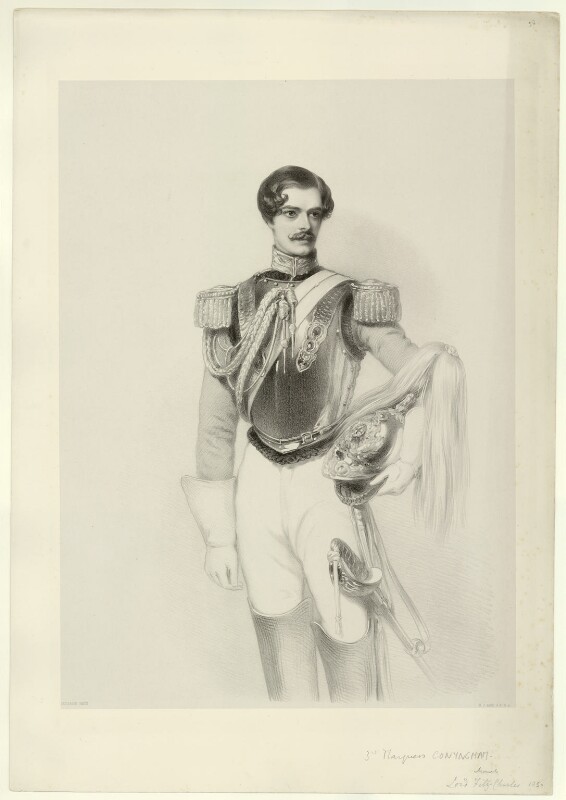
A son, George Henry (1825-1882) became 3rd Marquess Conyngham, and his son, Henry Francis the 4th Marquess. He married the daughter of the 4th Baron Mollens of Ventry, County Kerry. Their son the 5th Marquess died unmarried, so the title passed to his brother, Frederick William Burton, 6th Marquess. The current Marquess is the 8th, who is known as Lord Henry Mount Charles, but is officially 8th Marquess Conyngham since 2009.
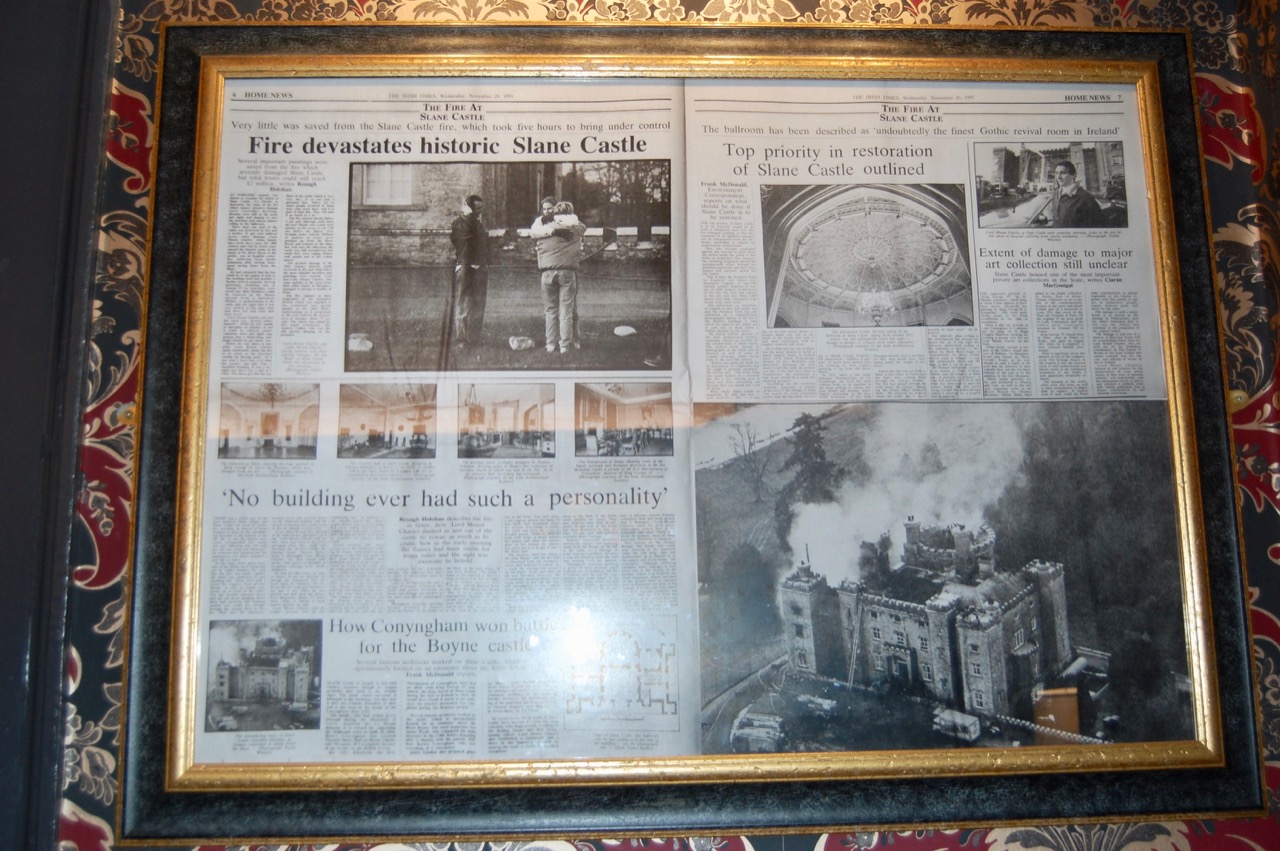
A disasterous fire in the castle in 1991 destroyed the roof and one third of the castle.
Newspaper clippings about the fire, in the entry to pub and restaurant.At Slane, April 2019.
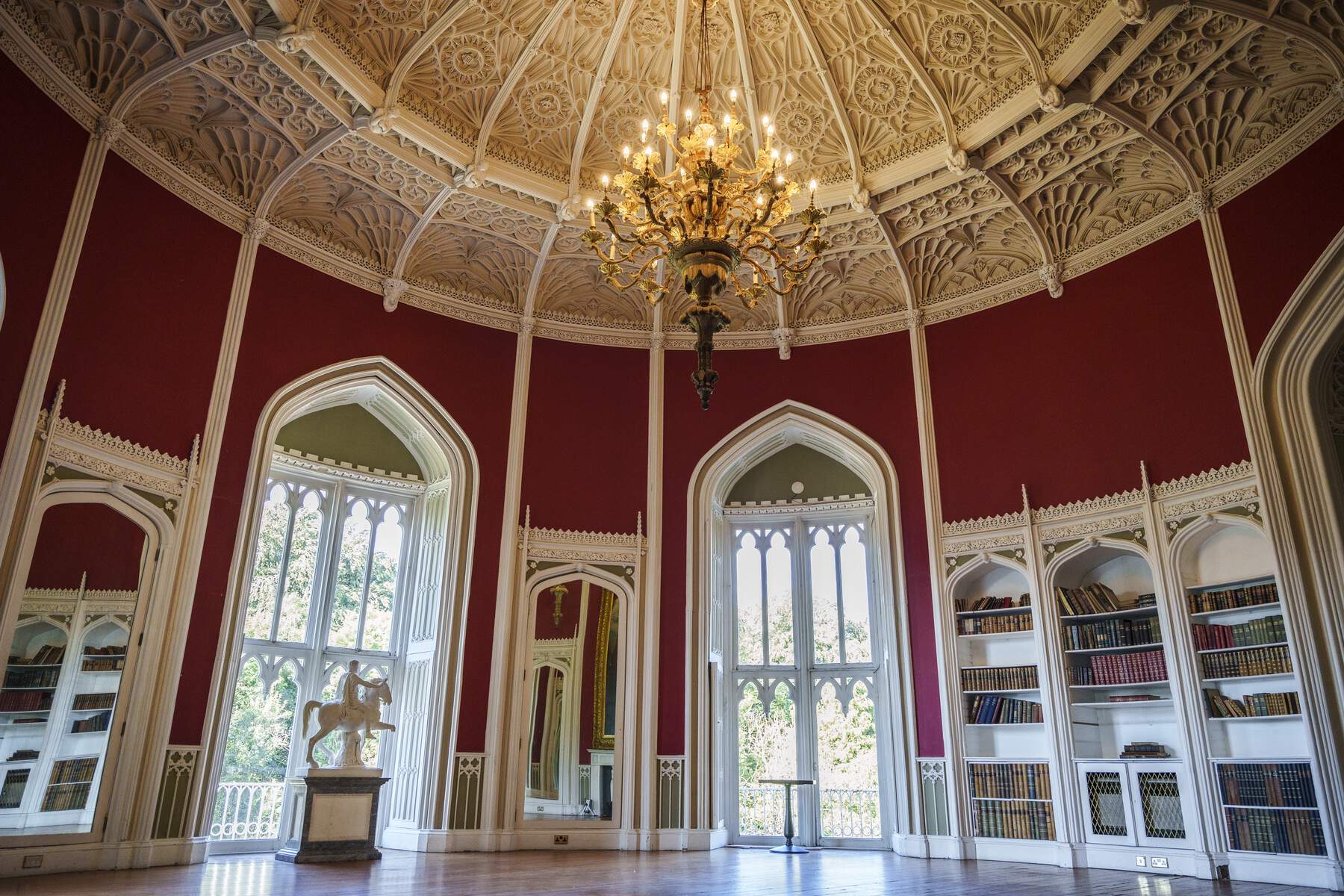
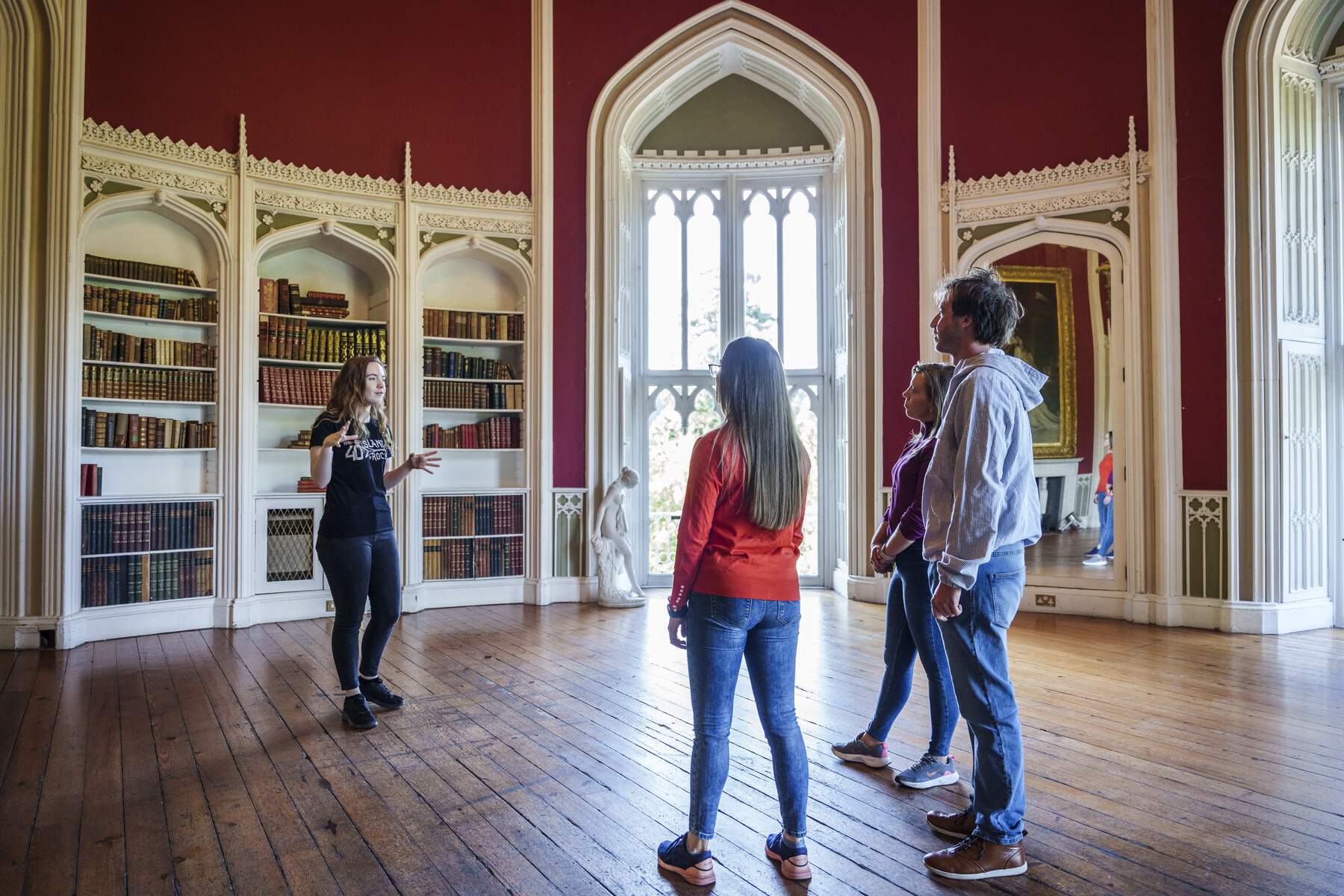
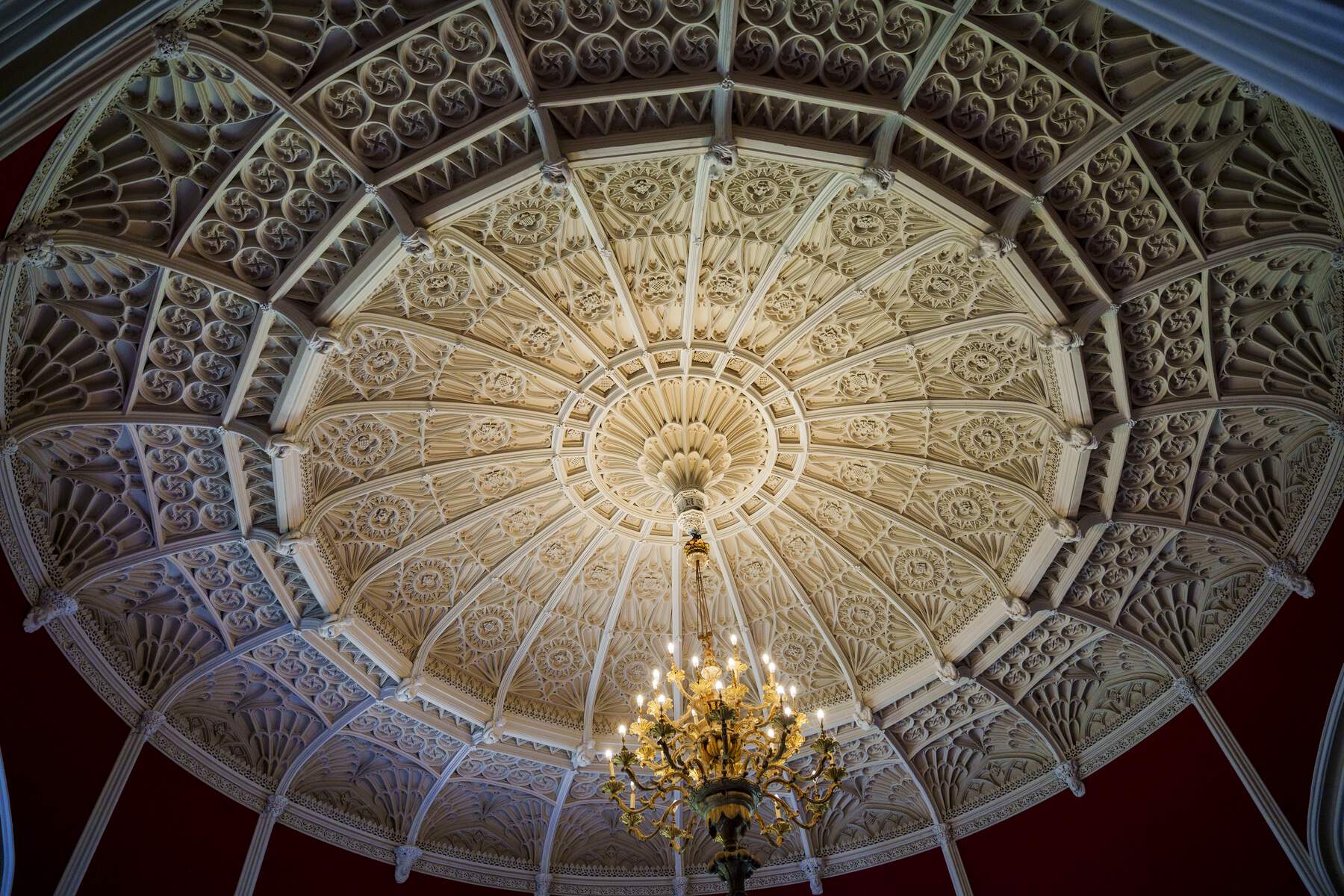
The magnificent library with its intricate ceiling and impressive wooden chandelier was saved by two firemen fighting the fire from within the room, battling for nine hours. The smoke was so thick that one couldn’t see the ceiling. I think they deserve a plaque in the room to recognise their effort! Meanwhile the family saved as many priceless historic paintings and antiques as they could, including a huge portrait of King George IV that is now hanging again in the library, by cutting it from its giant gilt frame then taking the frame apart into four pieces in order to get it out through the doors. Lord Mount Charles now suffers with his lungs, probably partially as a result of long exposure to the flames and smoke. It took ten years to reconstruct the castle, but it has been done excellently so traces of the fire barely remain.
Portrait of George IV which was saved from the fire, Slane Castle Tour, Slane, Co Meath, photograph by Nomos Productions, 2022, Courtesy Failte Ireland.
We weren’t allowed to take pictures inside, as usual with these properties. There is a picture of the ornate roof in the library on the wonderful blog of the Irish Aesthete [8].
Mark Bence-Jones describes the room in his 1988 book (published before the fire, but this room remained intact!), A Guide to Irish Country Houses:
“…the great circular ballroom or library which rises through two storeys of the round tower and is undoubtedly the finest Gothic Revival room in Ireland; with a ceiling of Gothic plasterwork so delicate and elaborate that it looks like filigree. Yet this, too, is basically a Classical room; the Gothic ceiling is, in fact, a dome; the deep apses on either side of the fireplace are such as one finds in many of Wyatt’s Classical interiors, except that the arches leading into them are pointed; they are decorated with plasterwork that can be recognised as a very slightly Gothicized version of the familiar Adam and Wyatt fan pattern.“
Slane Castle Tour, Slane, Co Meath, photograph by Nomos Productions, 2022, Courtesy Failte Ireland.Slane Castle Tour, Slane, Co Meath, photograph by Nomos Productions, 2022, Courtesy Failte Ireland.Slane Castle, Slane, Co Meath, photograph by Nomos Productions, 2022, Courtesy Failte Ireland
Of the tales on the tour, I especially enjoyed the story of the funeral of a soldier’s leg. Apparently it was quite the custom to have funerals for body parts – his leg had to be amputated on the field of battle and the soldier brought it back to be buried with a full-scale military funeral. It must have been to do with the fact that a person’s body is to be resurrected on the Last Day, so it’s good to know where all the parts are! Cremation used to be forbidden in the Catholic church, as somehow it would be too difficult for God to put the ashes back together – never mind a disintegrated body!
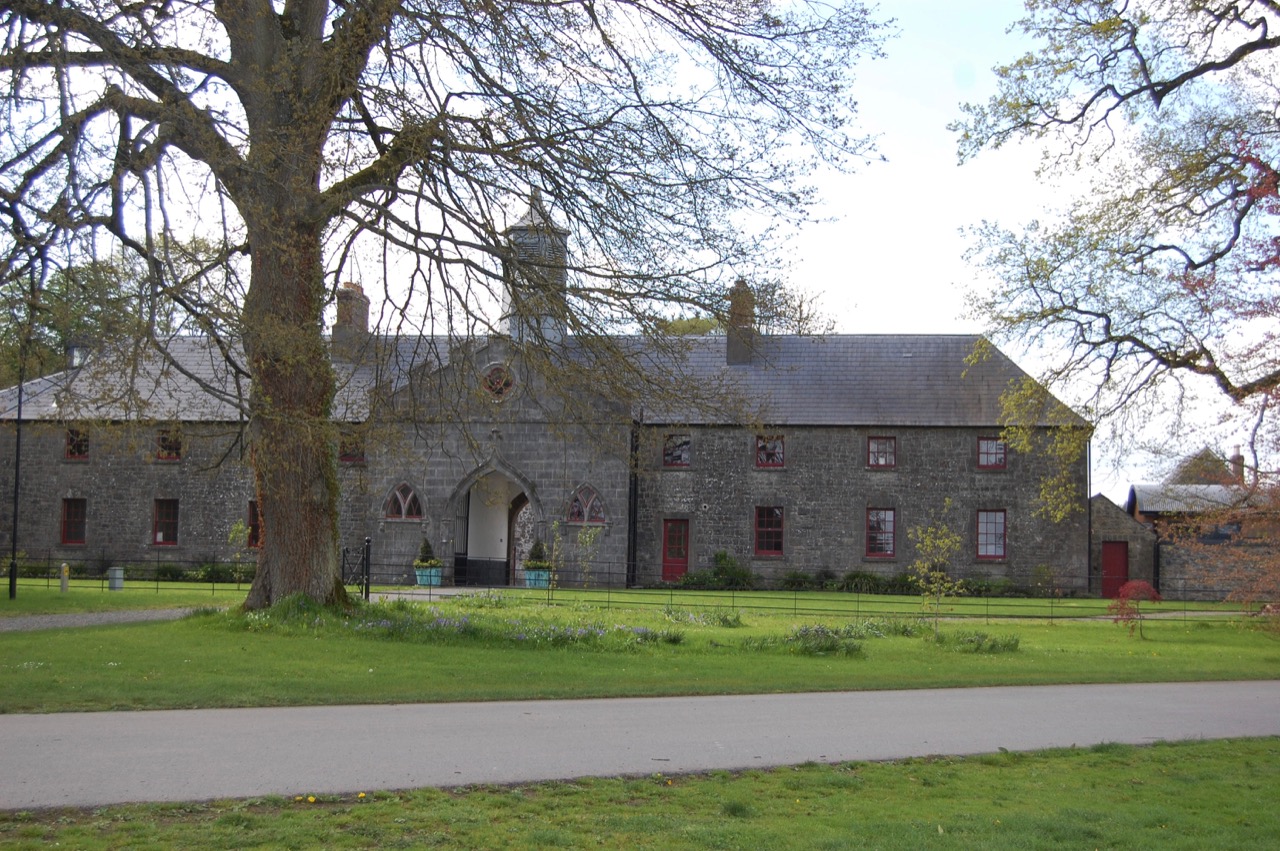
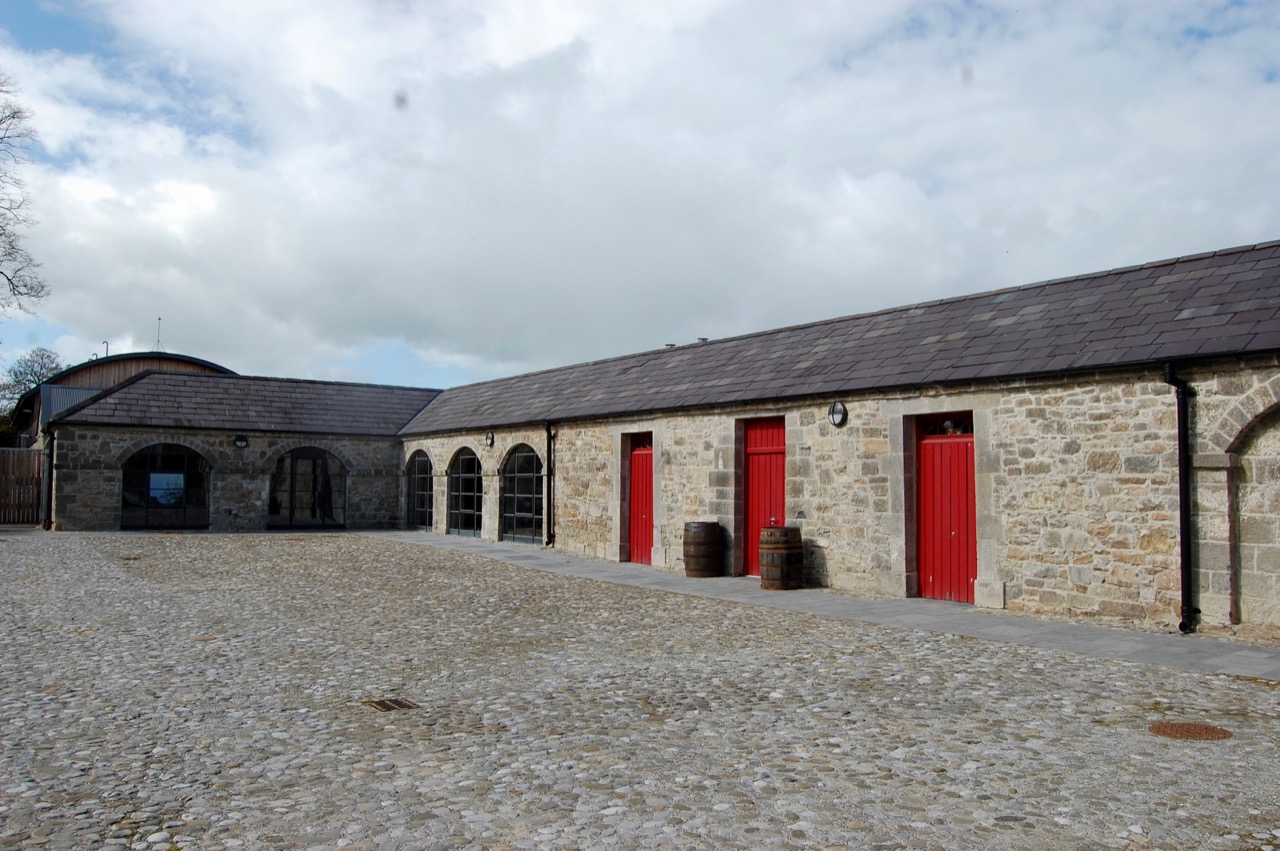
There is an adjoining distillery in what used to be the stables, and a tour of that can be purchased in combination if desired. Lord Charles’s mother bred horses before the stables were converted. The stables were designed by Capability Brown.
“Henry Conyngham, grandson of General Henry Conyngham who purchased the property, around 1770 invited Capability Brown around 1770 to produce a design both for the landscaping of the parkland at Slane, and also for a new stable block. In the collection of the Irish Architectural Archive in Dublin a drawing survives of Brown’s proposal for the latter. It is not unlike the finished building, but more elaborate than what we see today.” [9]
I found a blog by the Irish Aesthete on a portrait now in Slane, of Lady Elizabeth wife of the first Marqess’s daughter, Lady Maria Conyngham. Reportedly Lady Elizabeth looked very like her daughter – which one would not guess from the unflattering cartoons of her! [10]
Donation
Help me to fund my creation and update of this website. It is created purely out of love for the subject and I receive no payment so any donation is appreciated! For this entry I paid for petrol and entrance fee for myself and Stephen.
“She probably became his [George IV’s] lover in 1819, when he was Prince Regent, but finally supplanted her predecessor, Isabella Seymour-Conway, Marchioness of Hertford, after he became king in 1820. He became besotted with her, constantly “kissing her hand with a look of most devoted submission.” While his wife Caroline of Brunswick was on trial in 1820 as part of efforts to divorce her, the king could not be seen with Lady Conyngham and was consequently “bored and lonely.” During his coronation, George was constantly seen “nodding and winking” at her. “Lady Conyngham’s liaison with the king benefited her family. Her husband was raised to the rank of a marquess in the Peerage of the United Kingdom and sworn to the Privy Council, in the coronation honours of 1821. He was also given several other offices, including Lord Steward of the Household and the lieutenancy of Windsor Castle. Her second son was made Master of the Robes and First Groom of the Chamber.”





















































 Irish Historic Houses