Accommodation and wedding venues in County Cavan

Places to stay, County Cavan

1. Cabra Castle, on section 482 – hotel and lodges

2. Clover Hill Gate Lodge, Cloverhill, Belturbet, Cavan

3. Farnham Estate, Farnham Estate, Cavanhotel

4. Killinagh House, McNean Court, Blacklion, County Cavanwhole house rental and lodge

5. Lismore House, Co Cavan – was a ruin. Place to stay: Peacock House on the demesne

6. Olde Post Inn, Cloverhill, County Cavan

Whole house rental County Cavan:

1. Killinagh House, McNean Court, Blacklion, County Cavanwhole house rental 

3. Virginia Park Lodge, Co Cavanweddings

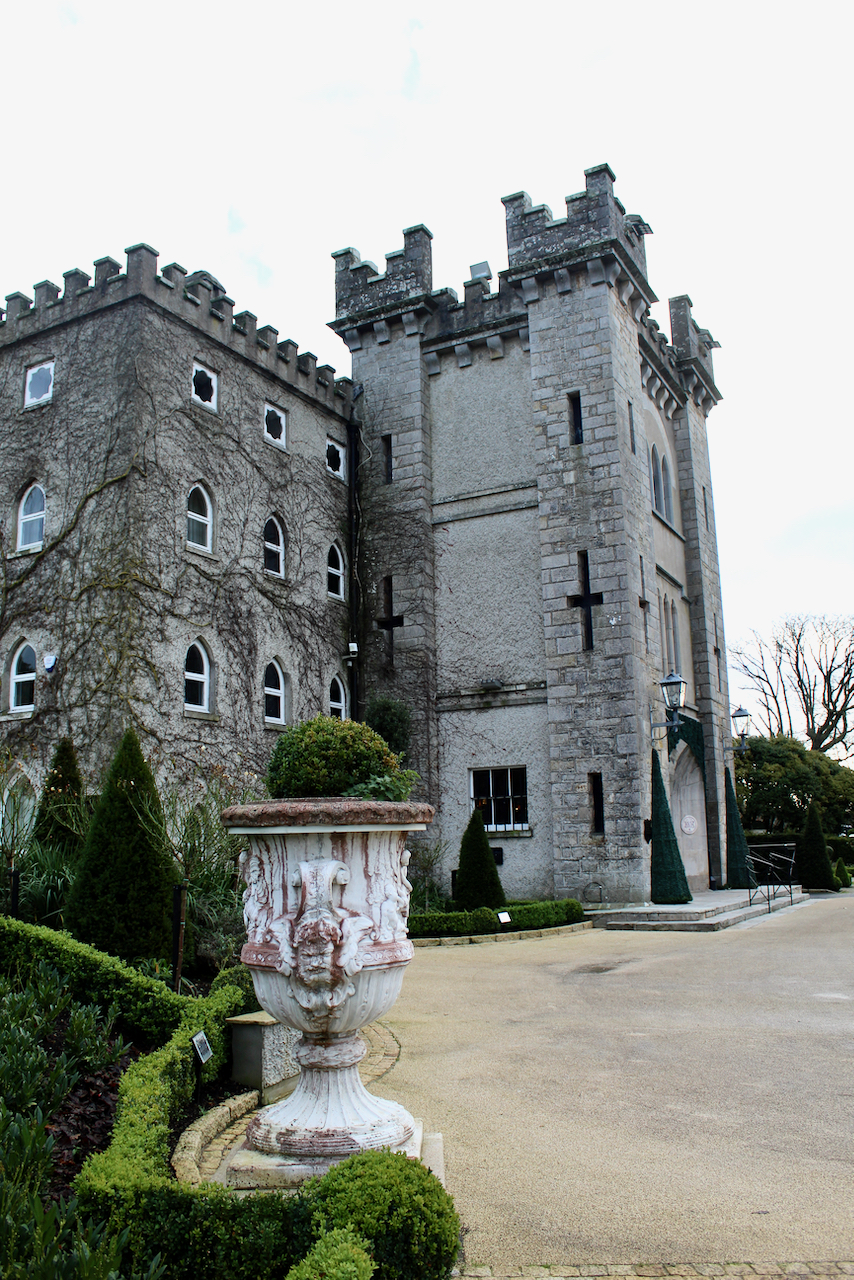
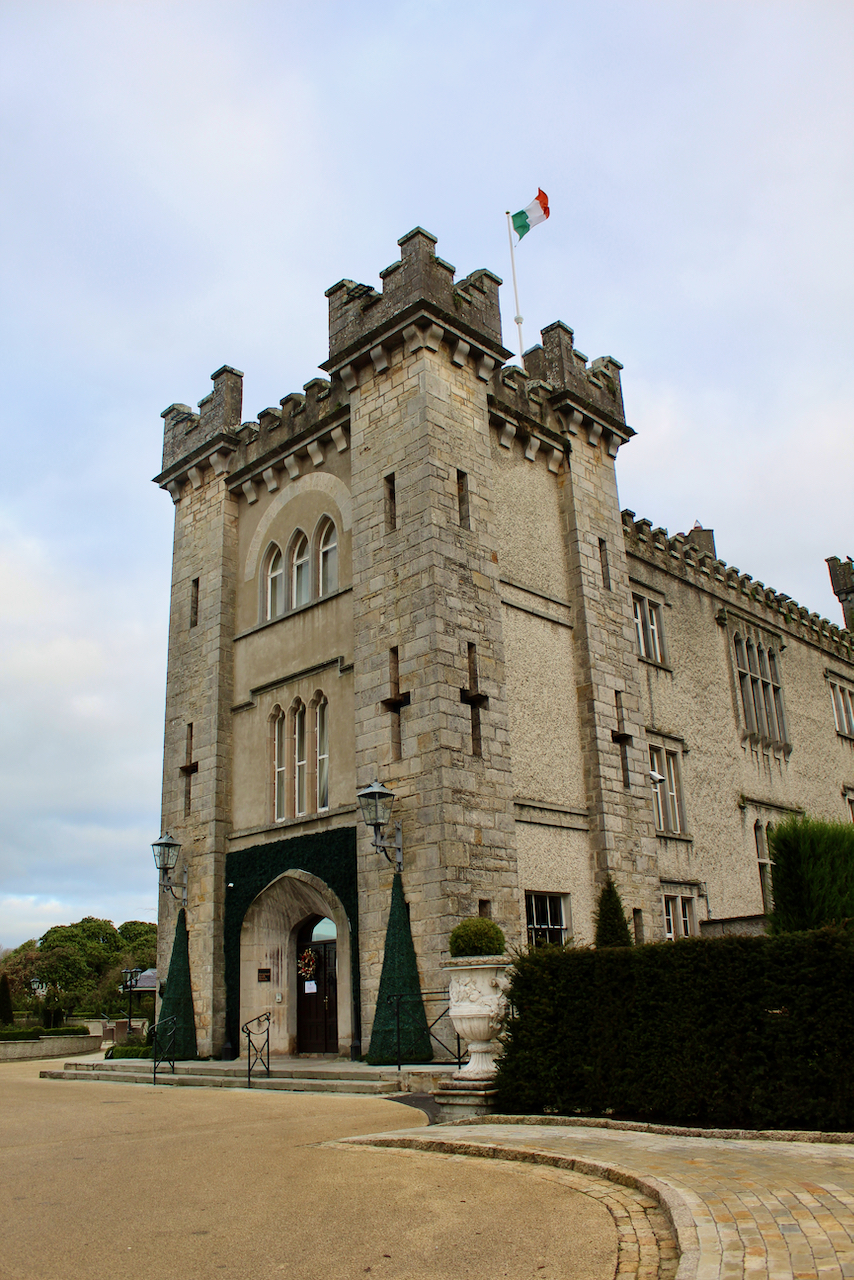
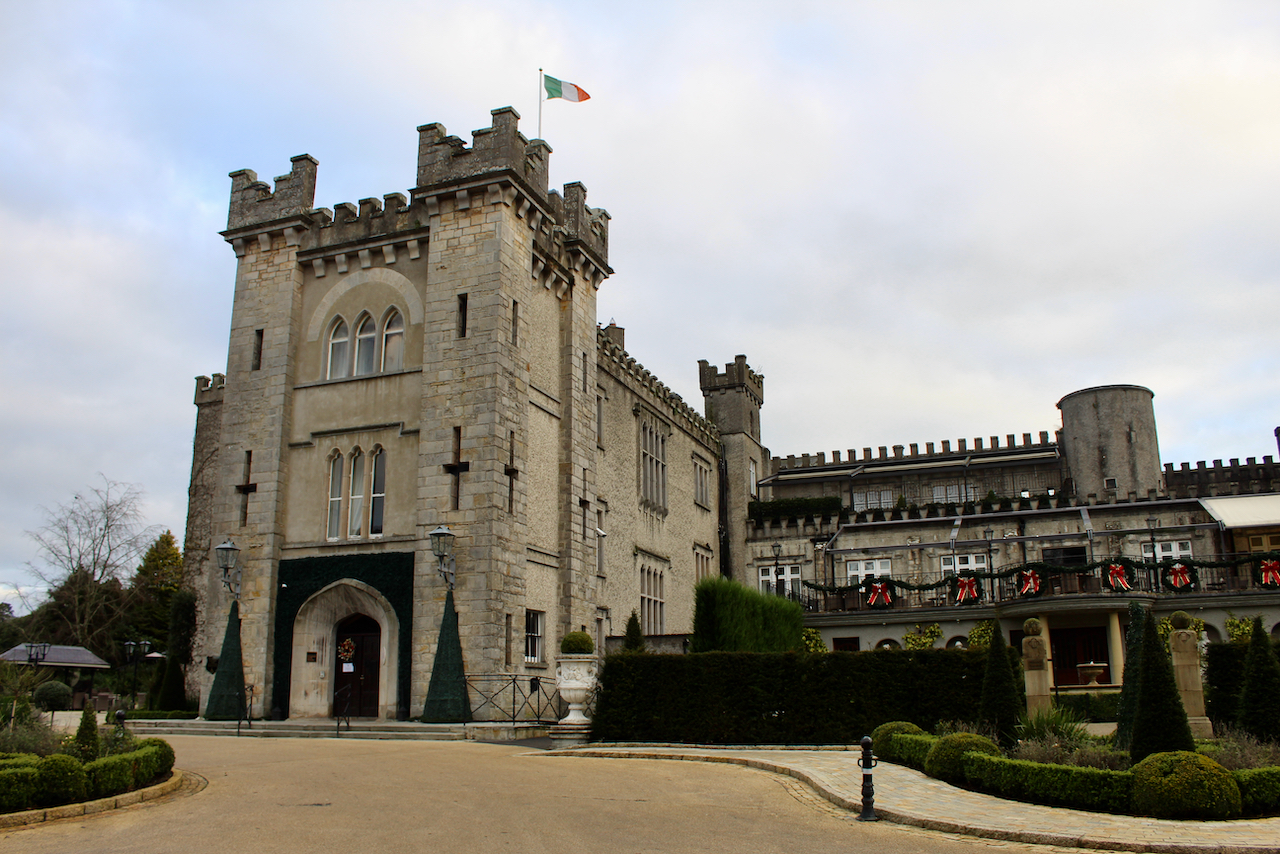
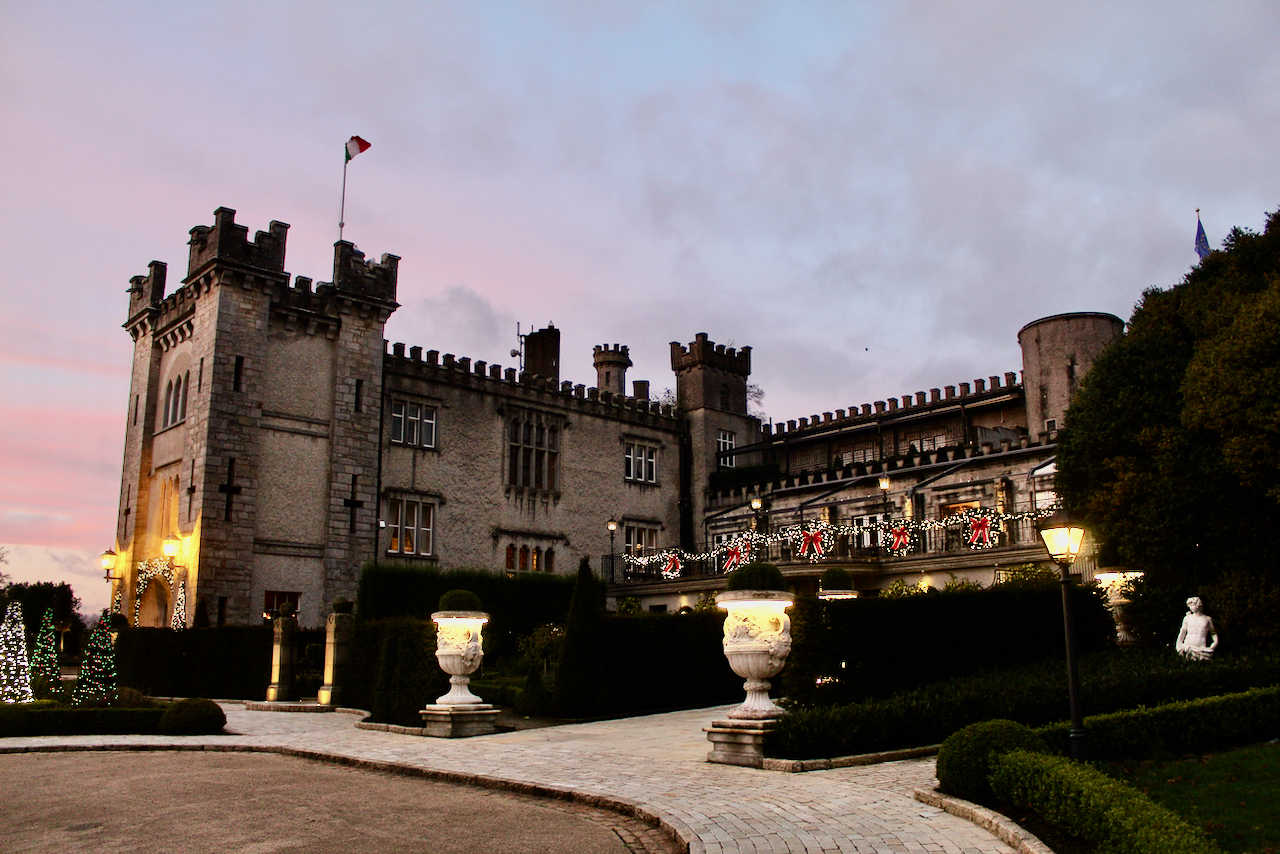
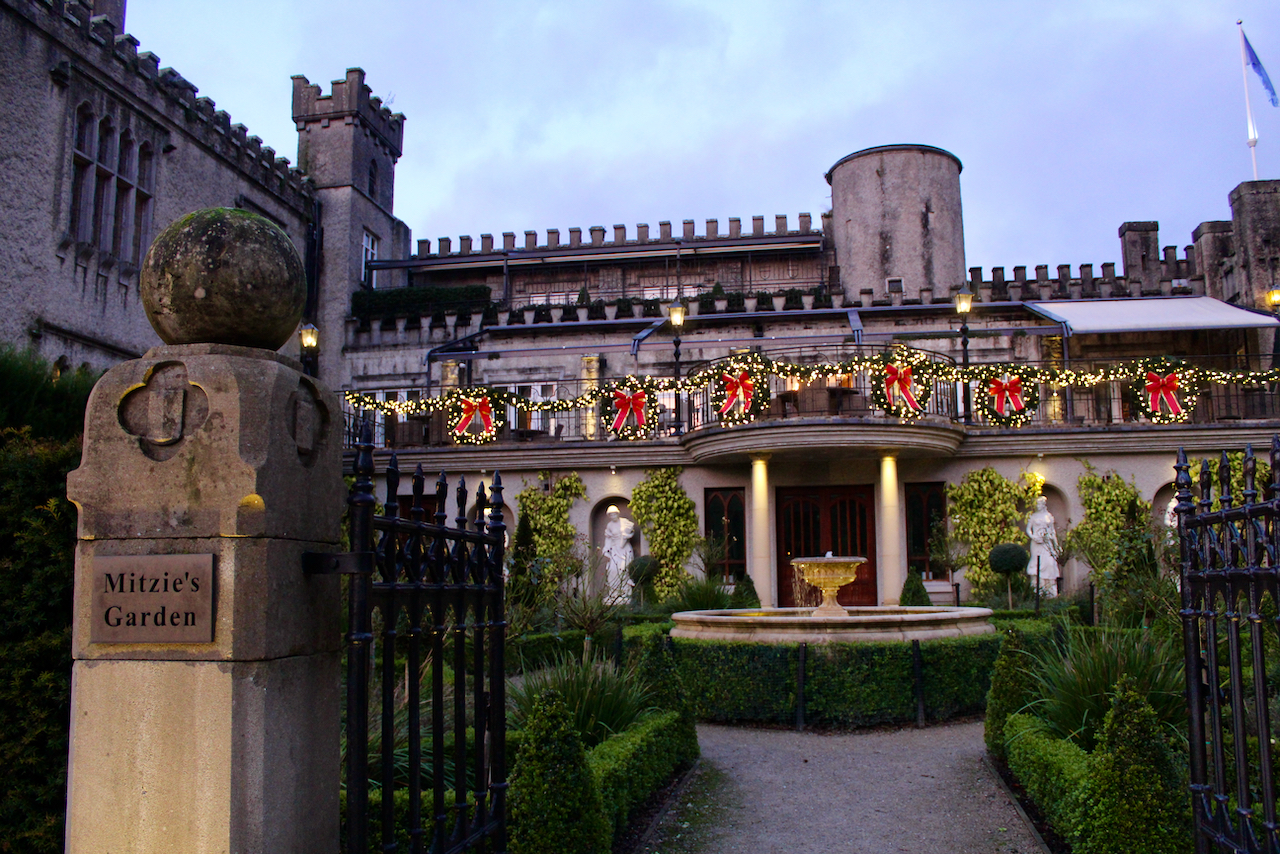
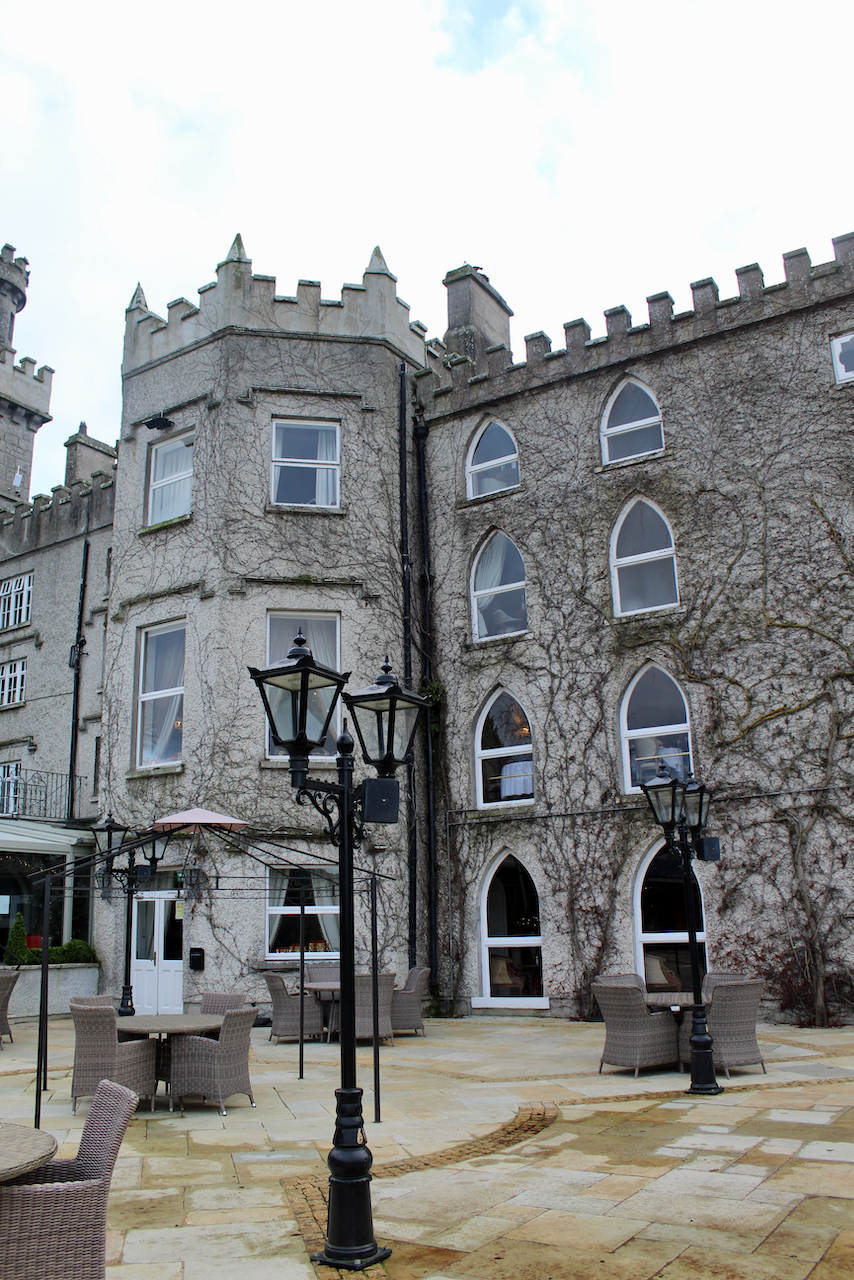
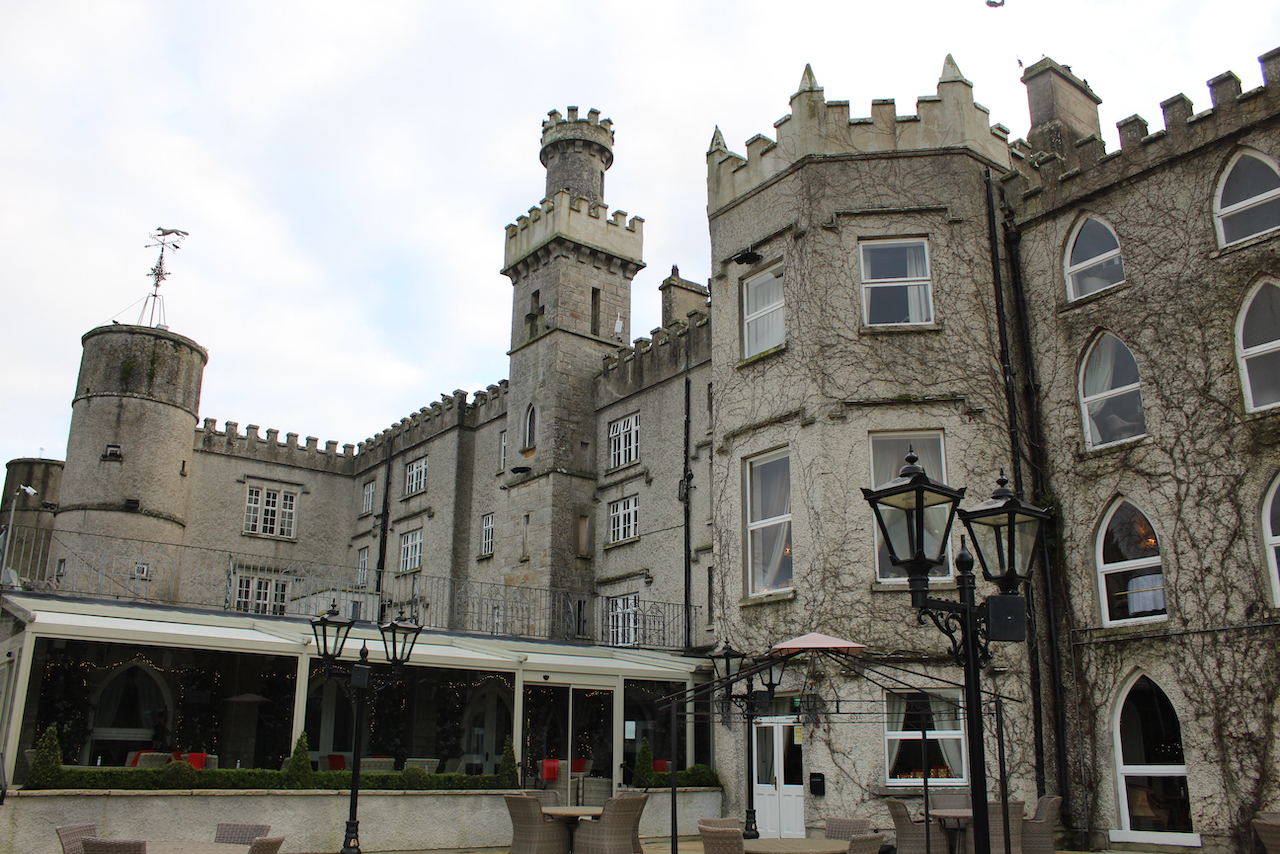
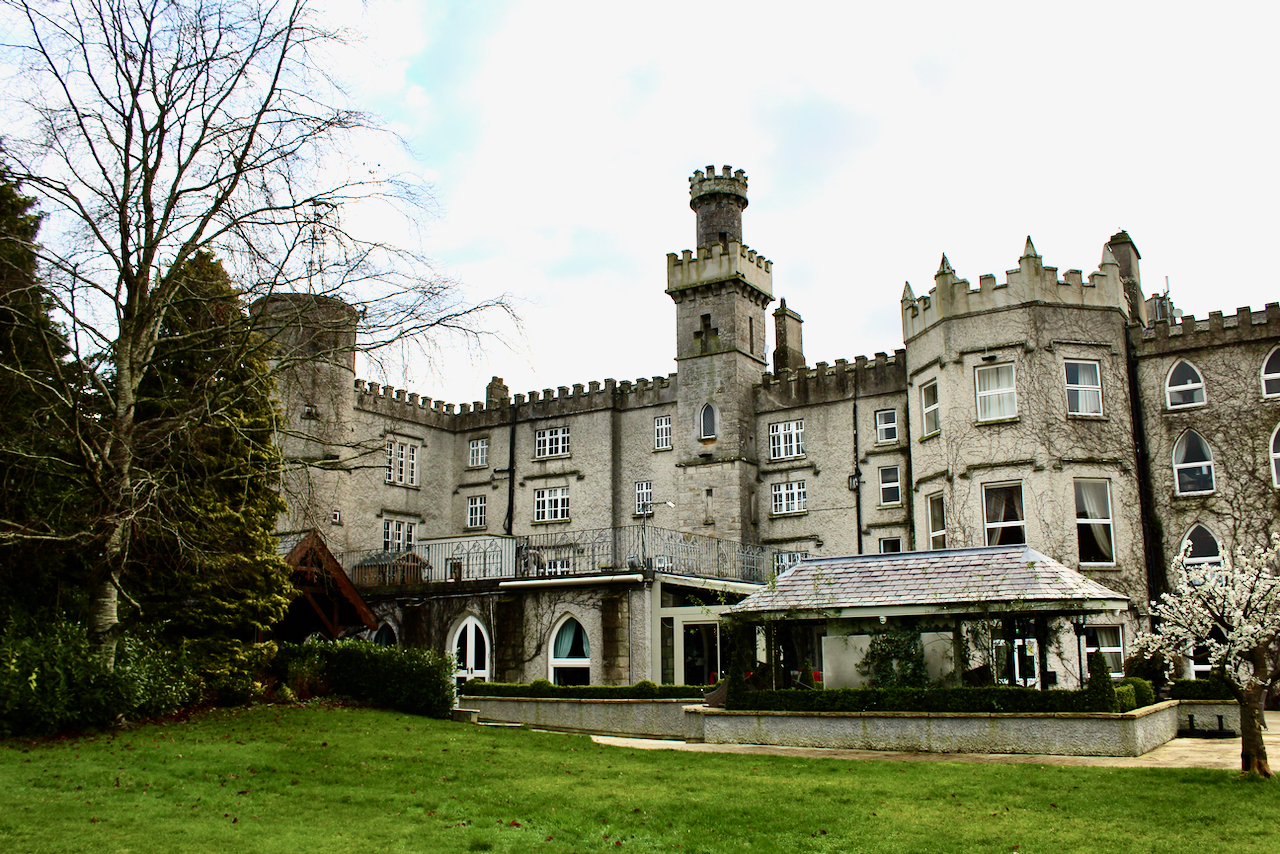
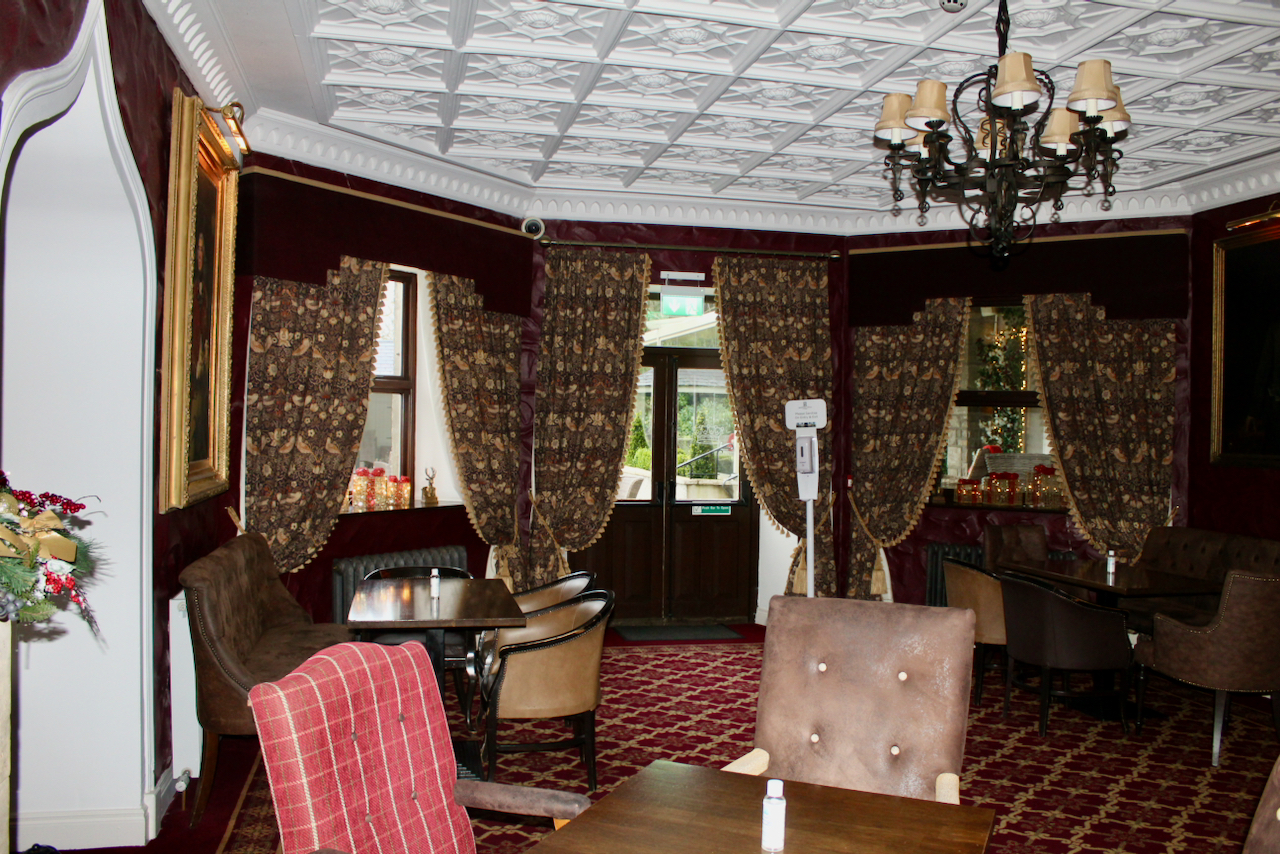
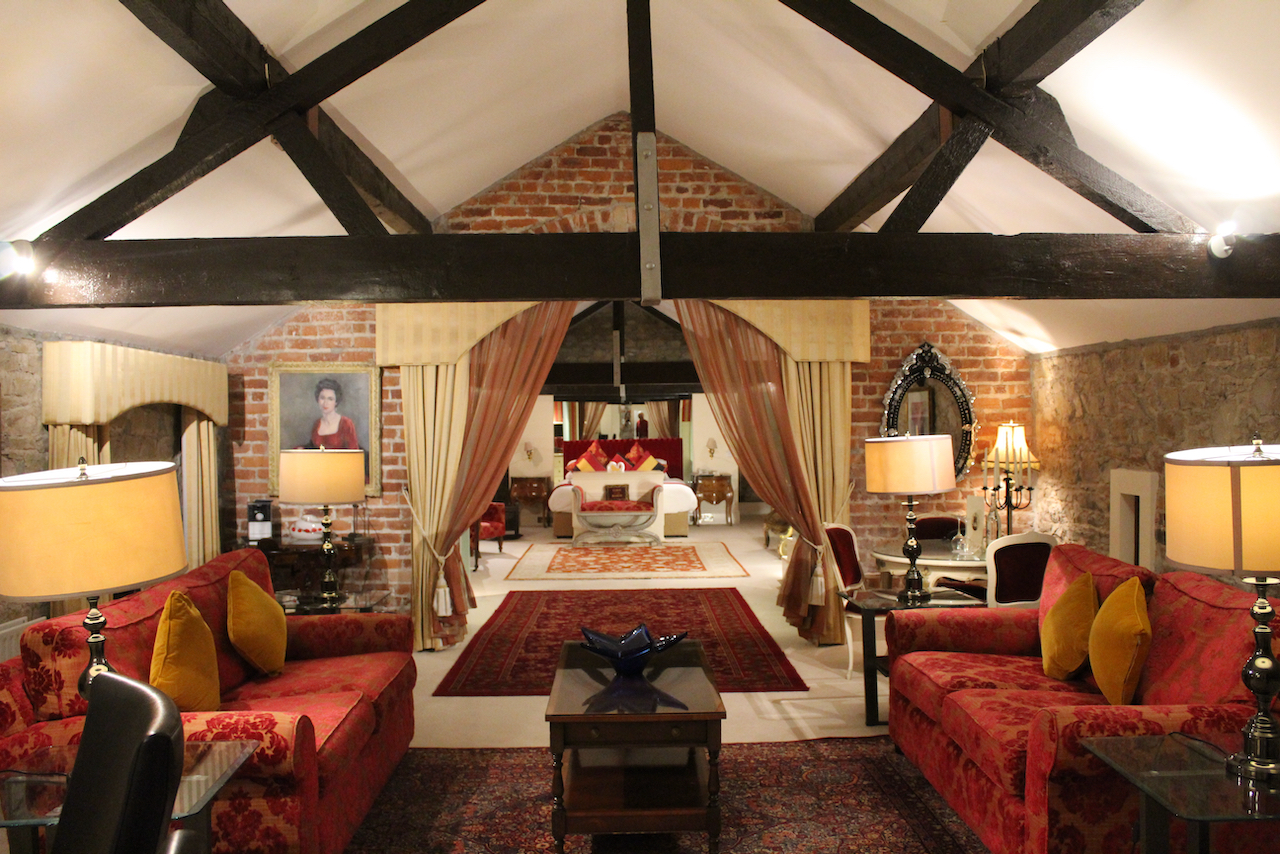
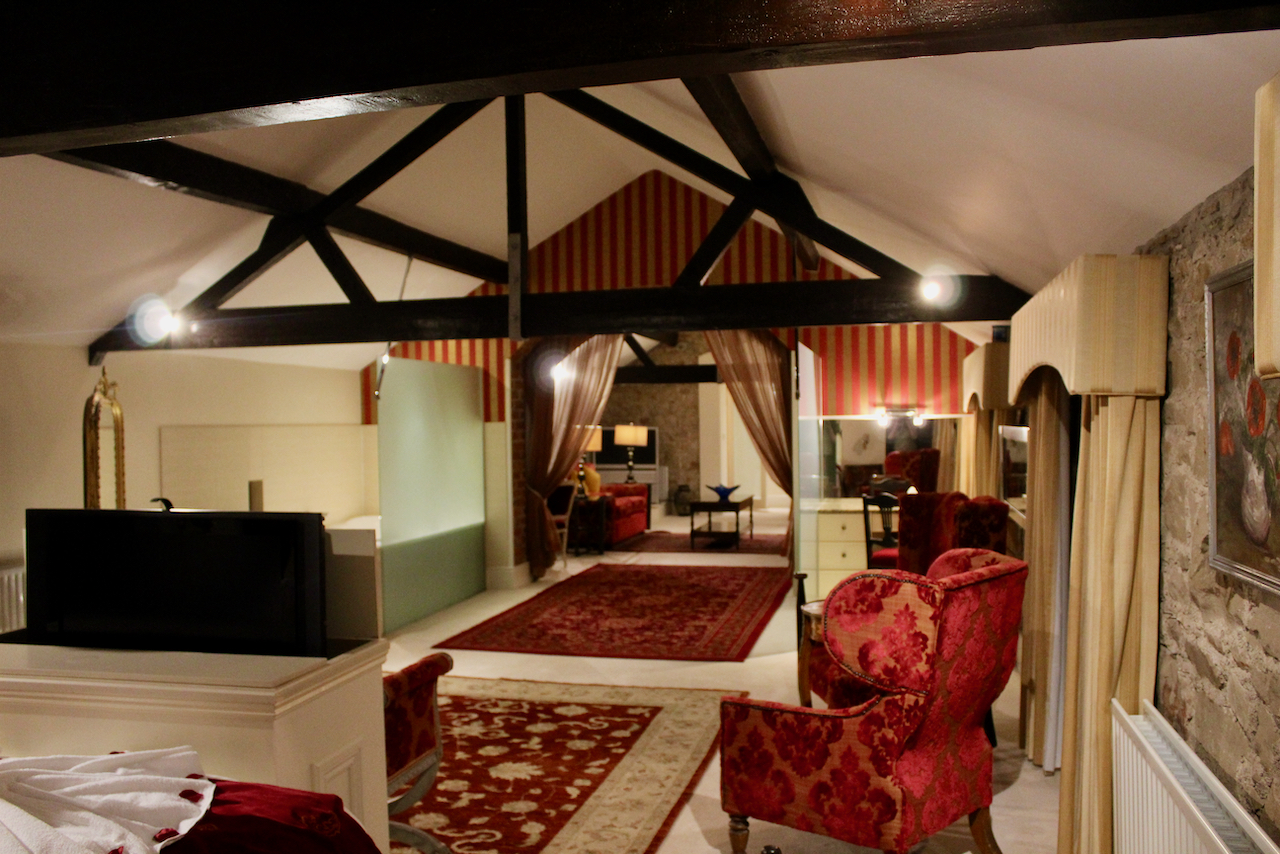
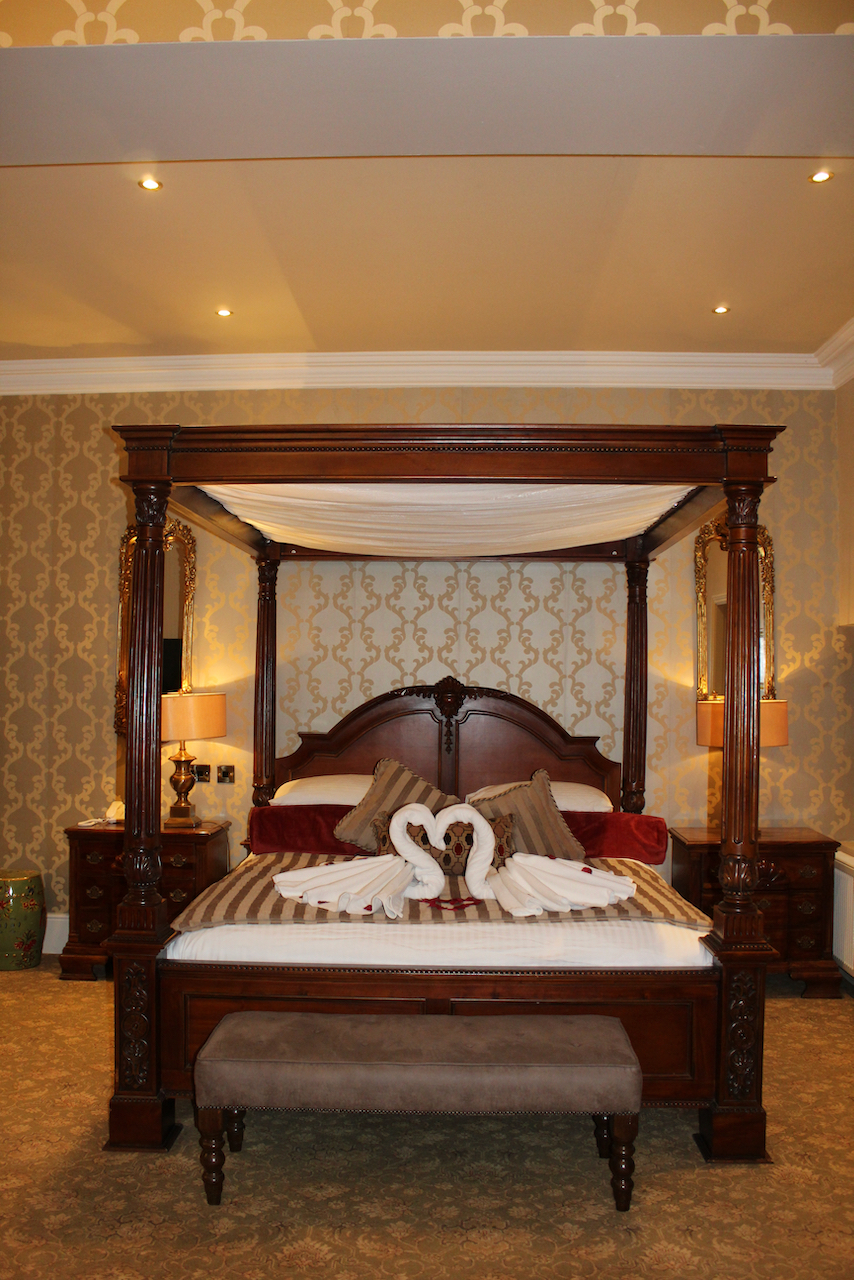
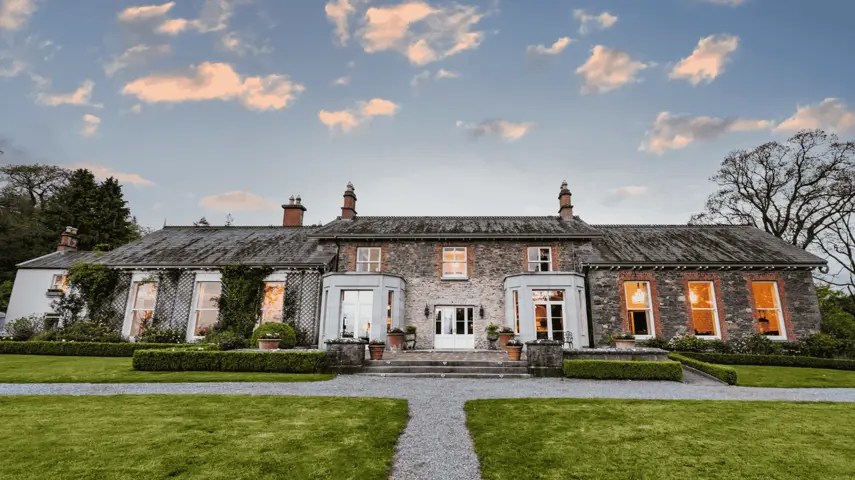
1. Cabra Castle, Kingscourt, Co. Cavan – section 482, hotel

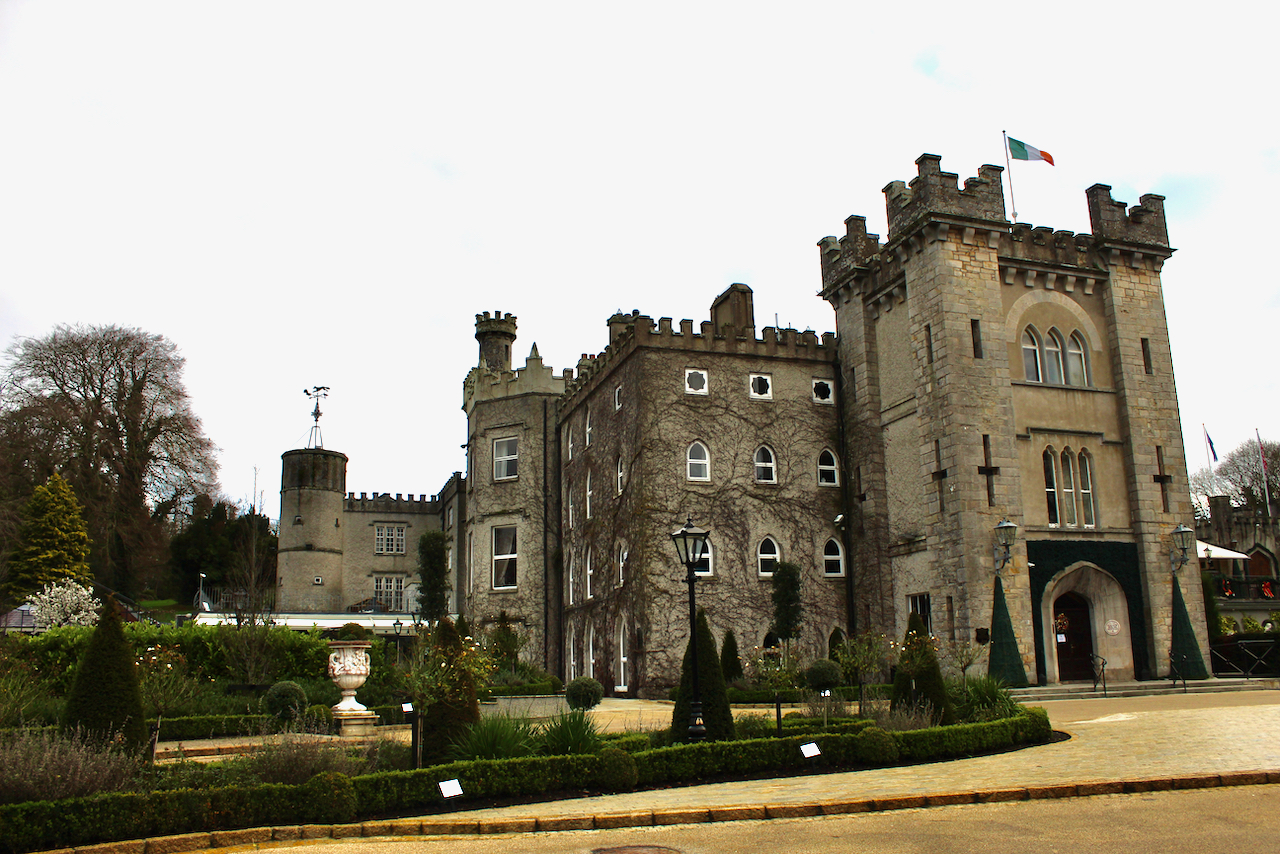
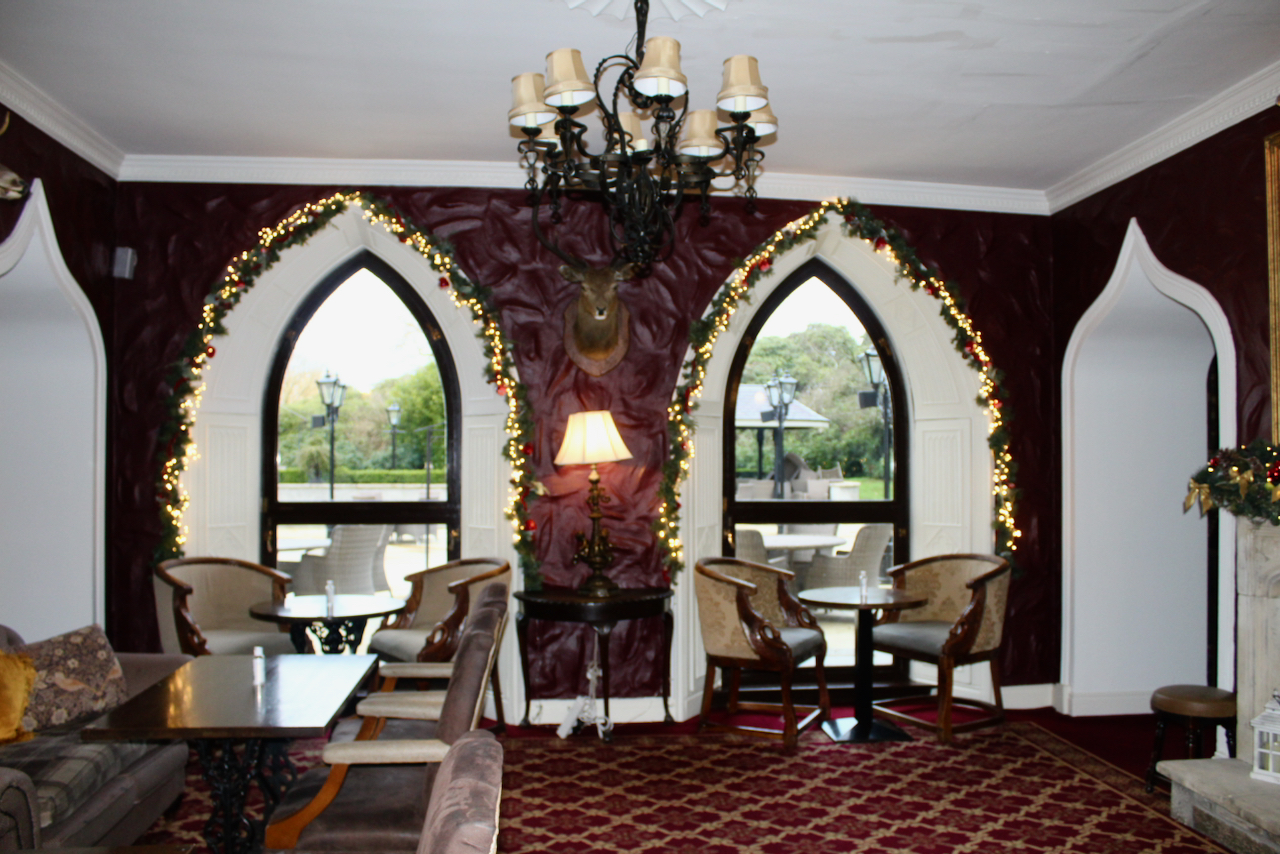
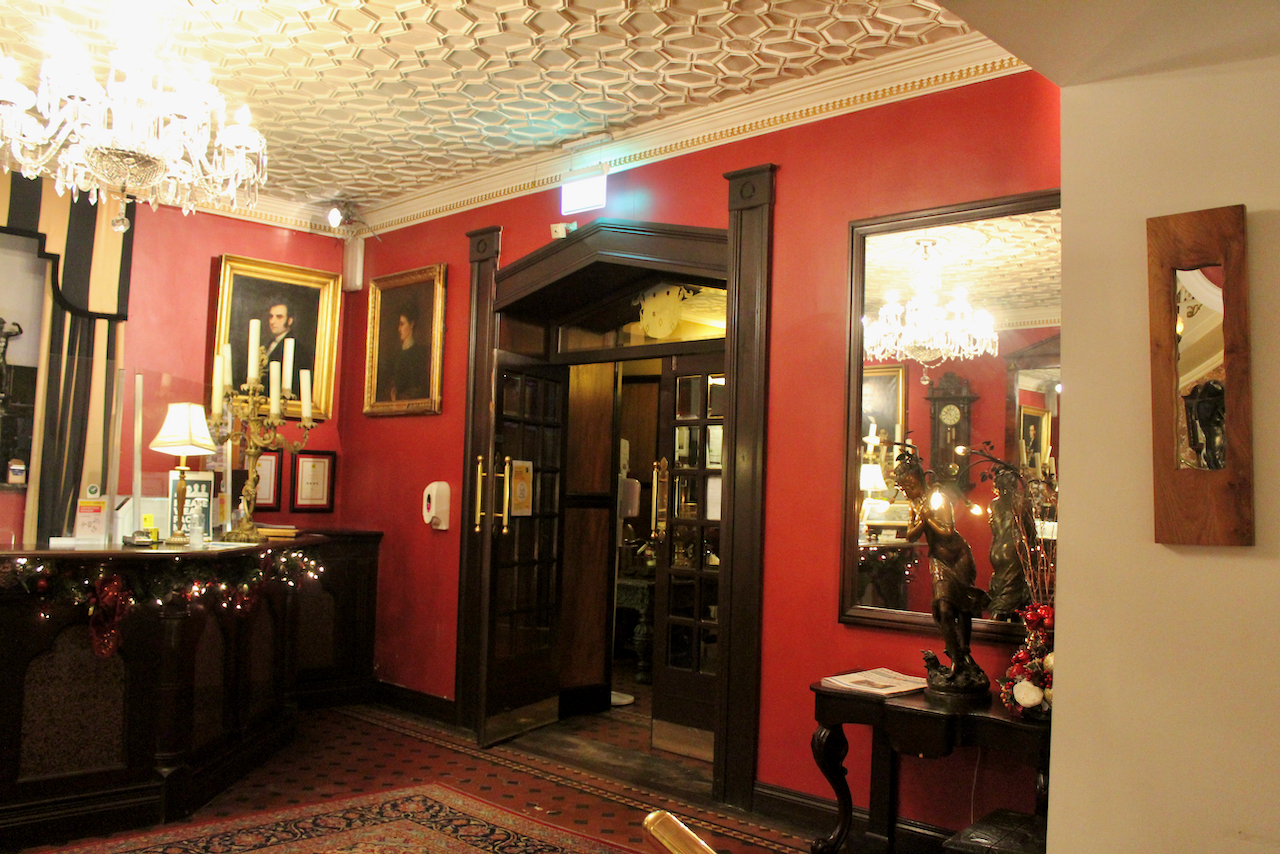
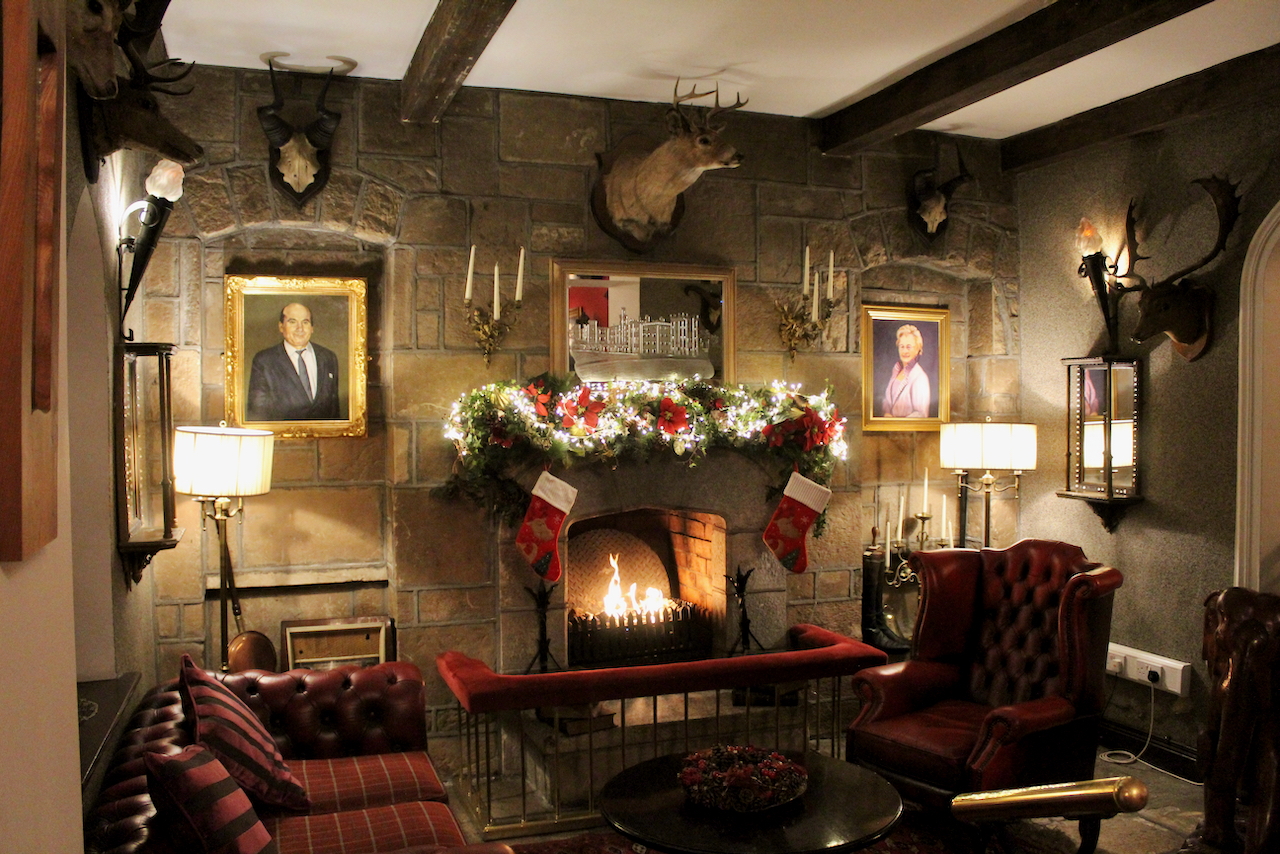
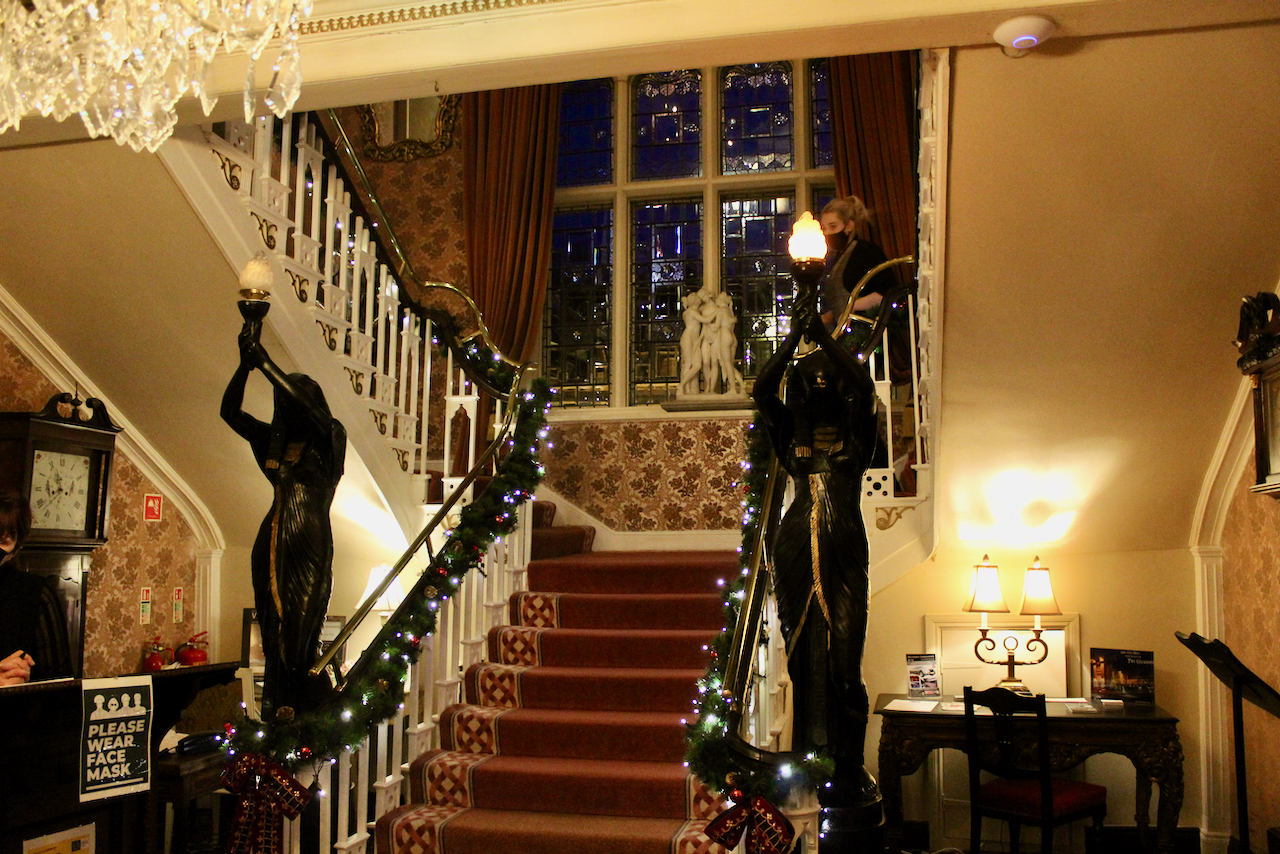
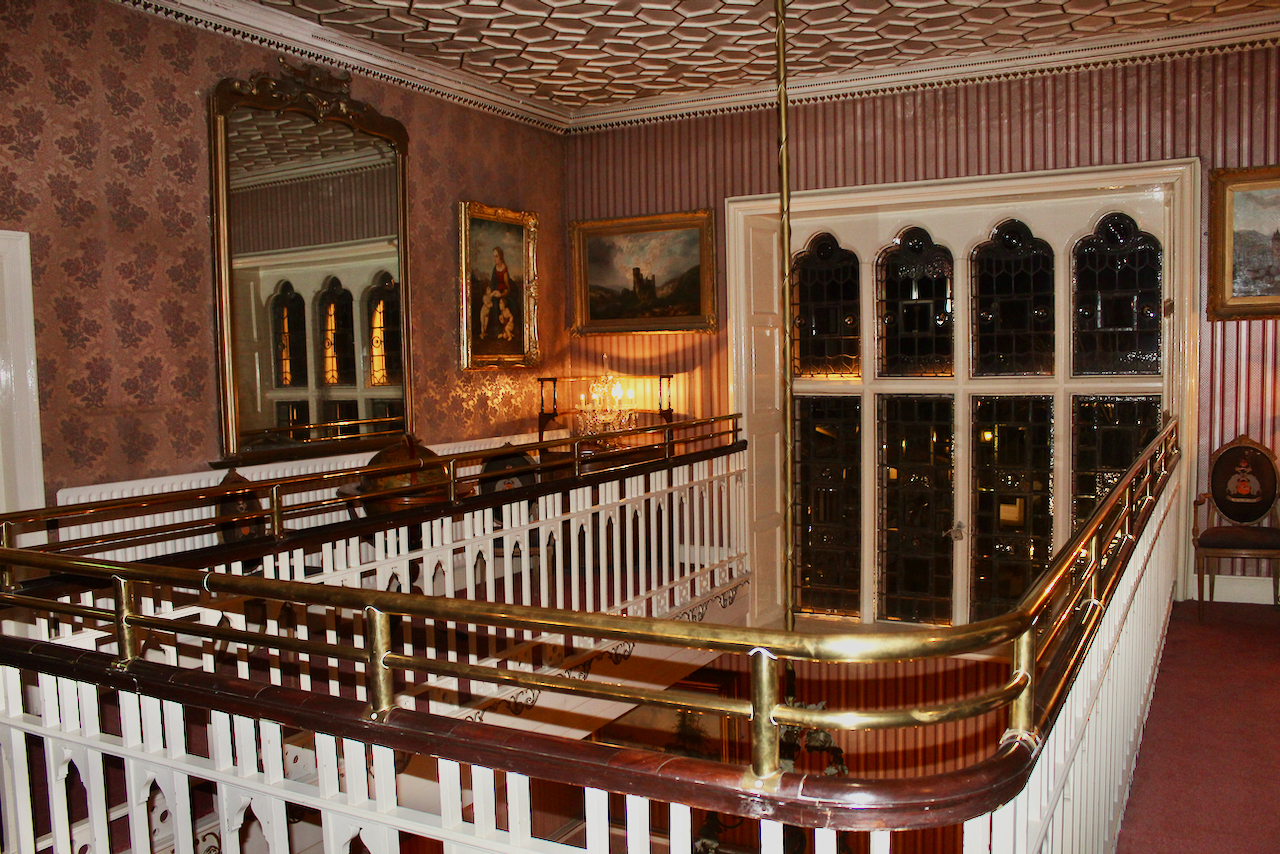
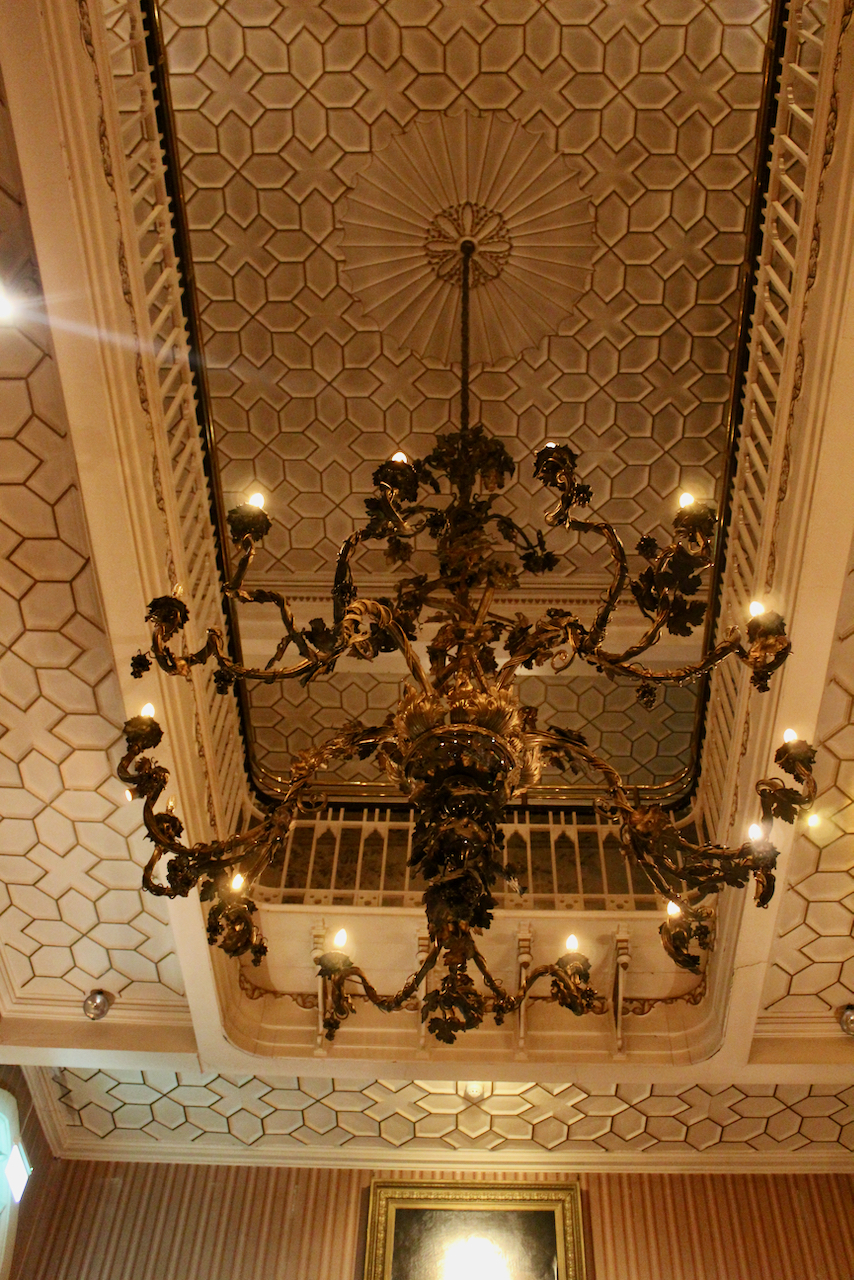
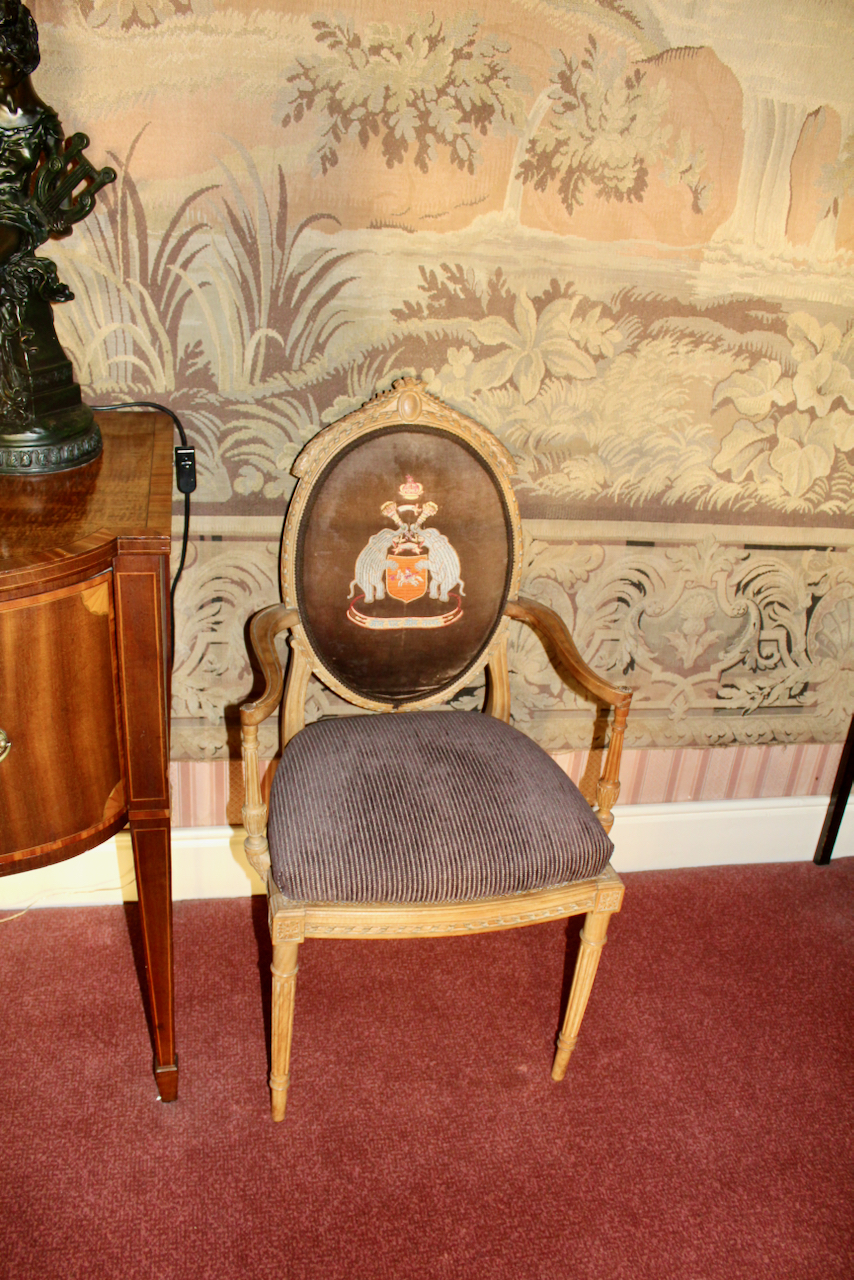
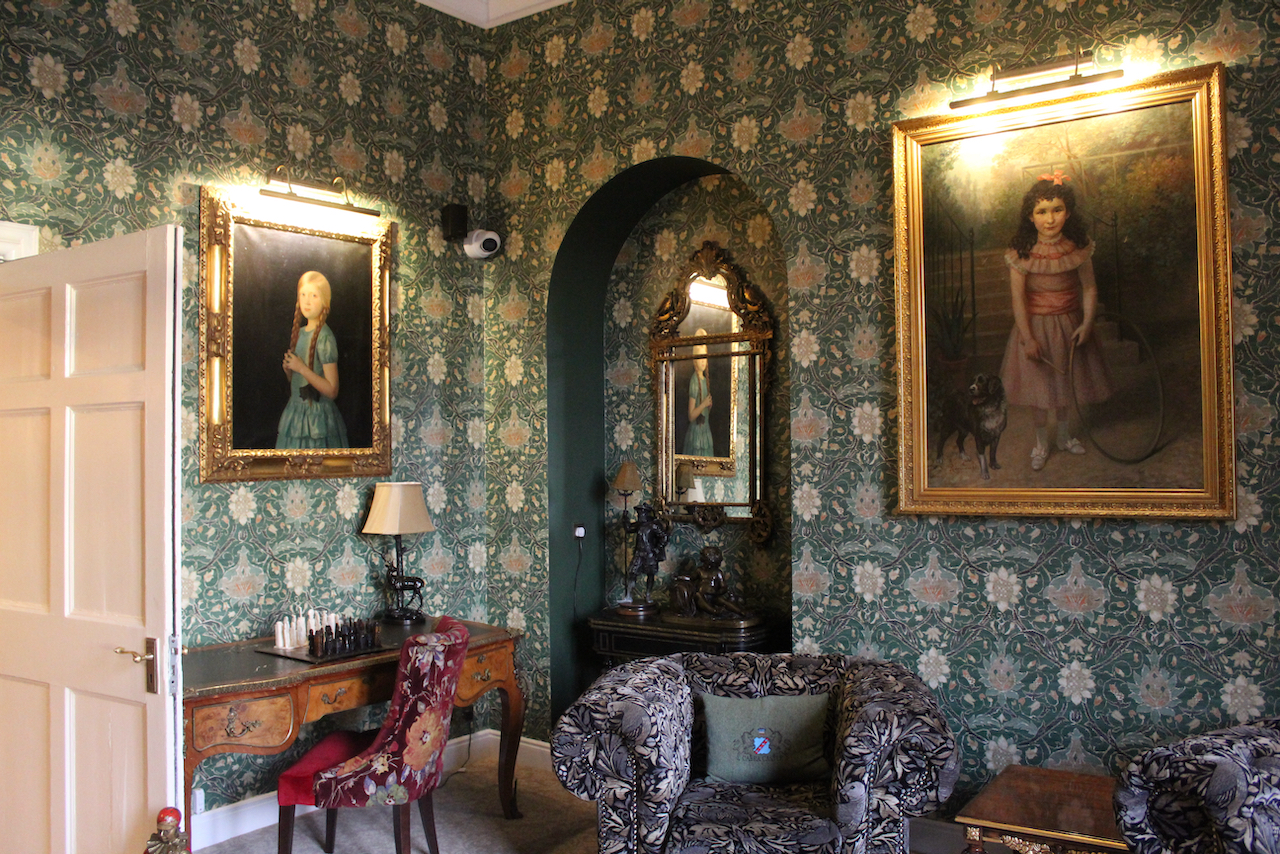
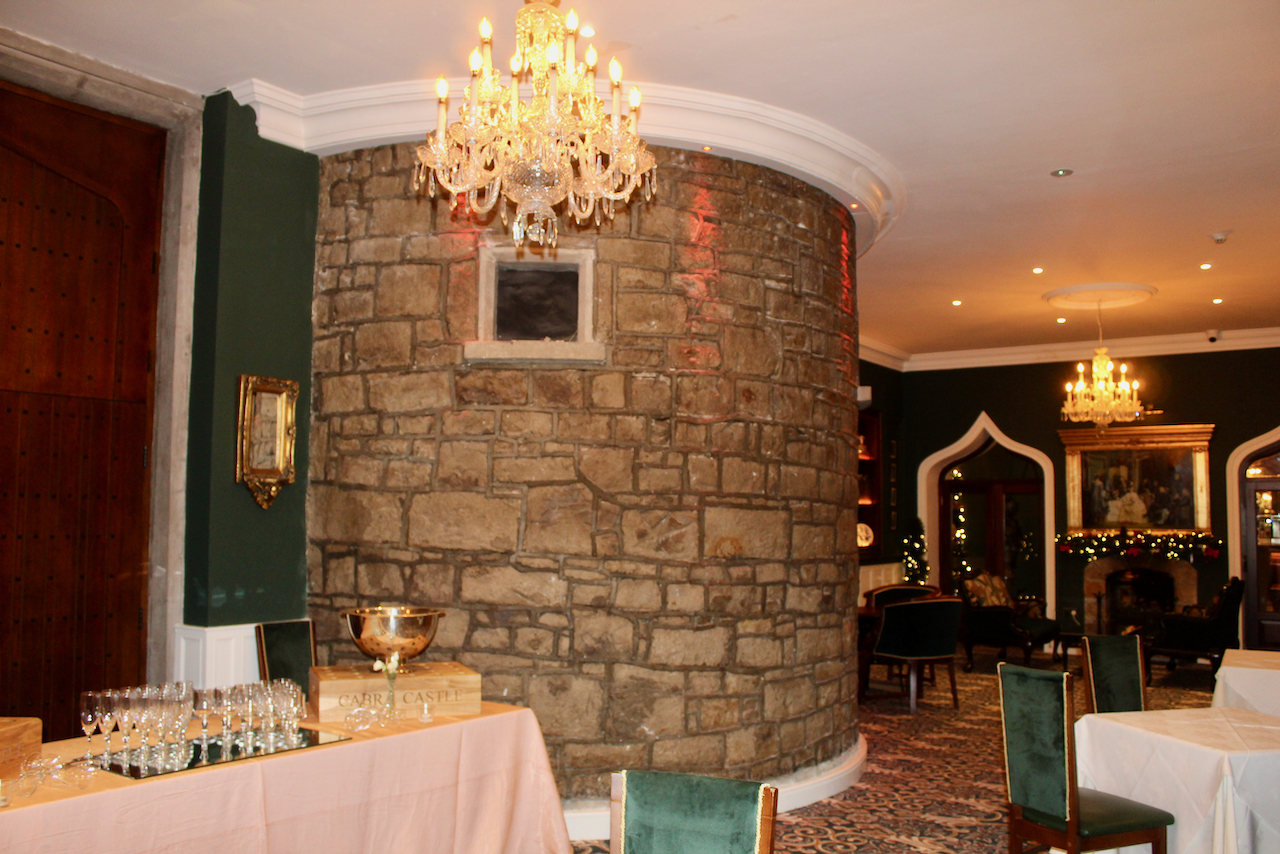
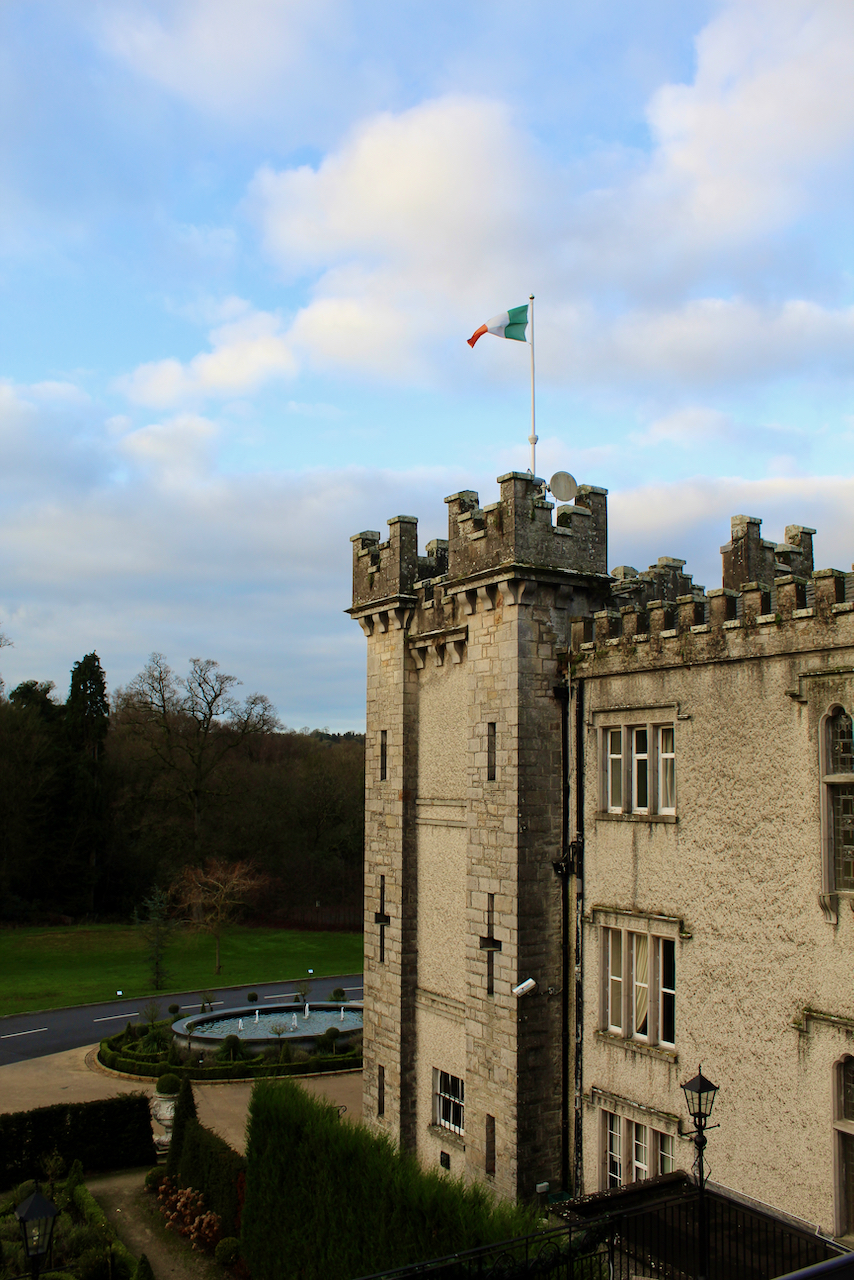
This is a hotel but unlike some heritage house or castle hotels, they do allow visitors to view the building: the website states that they are open between 11am to 4pm for visitors for viewing all year round, except at Christmastime.
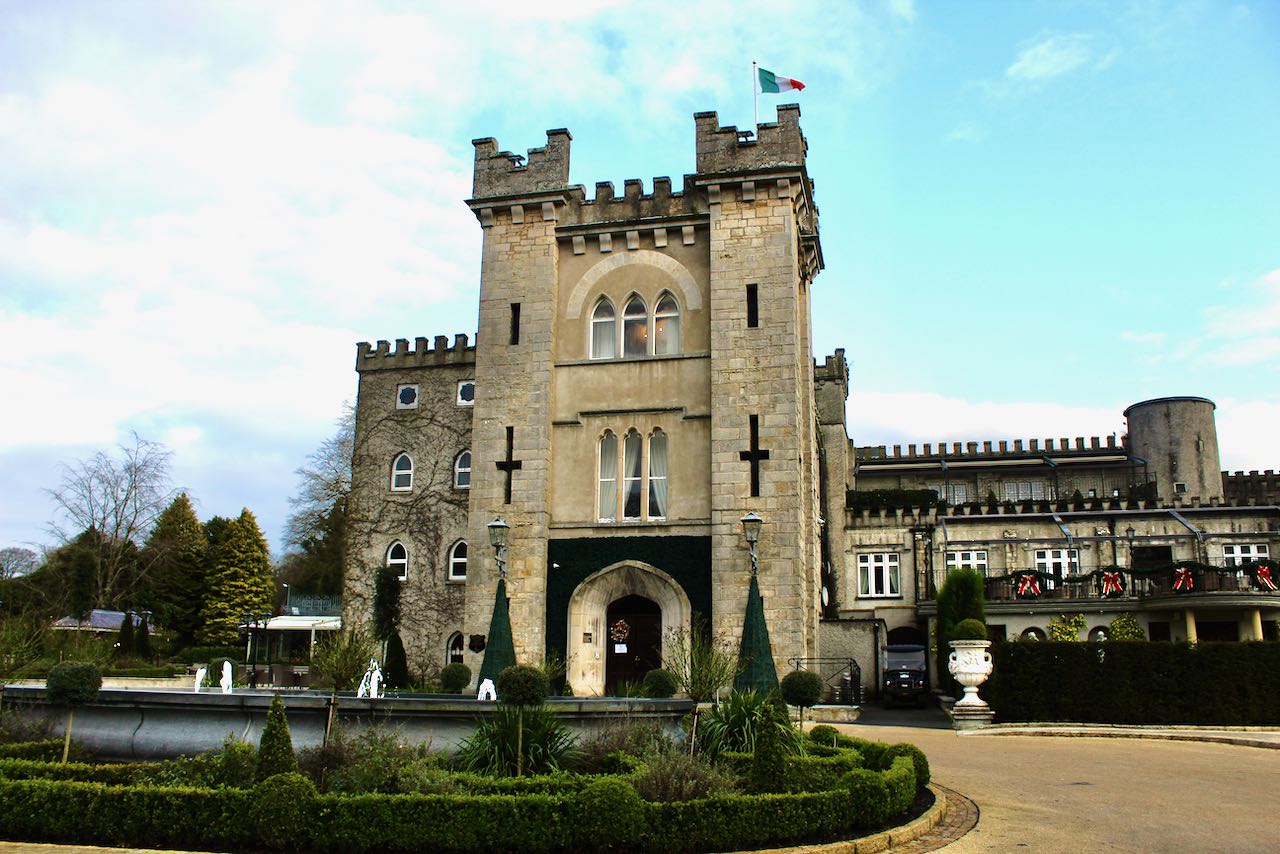
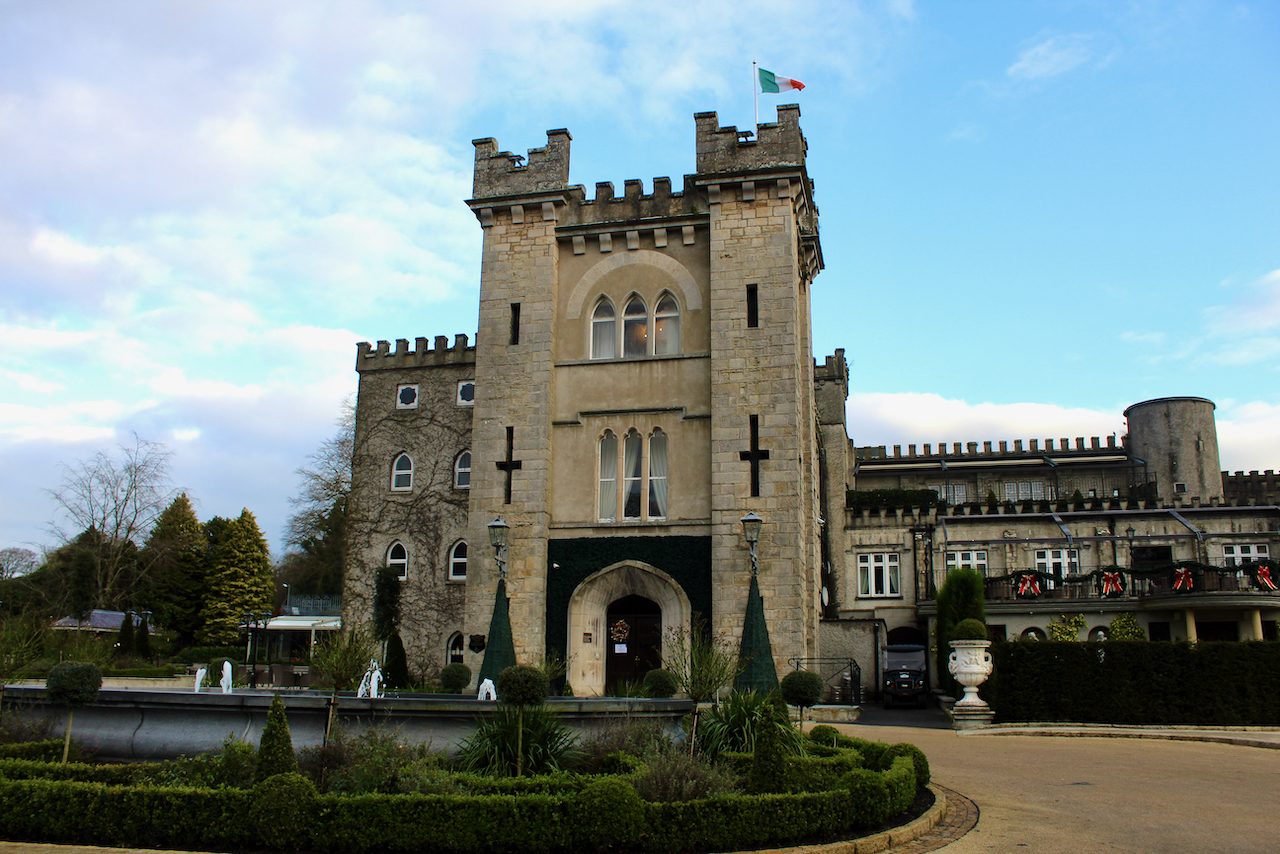
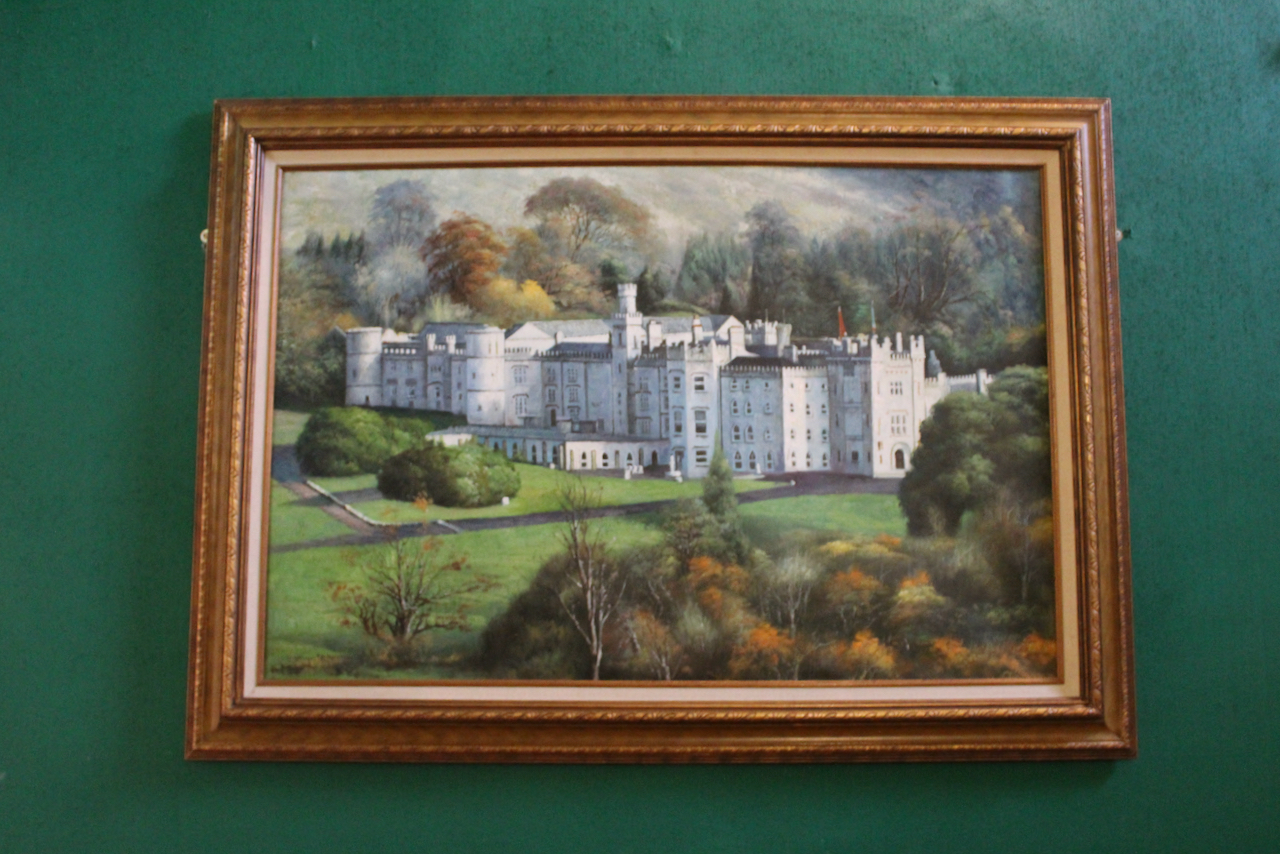
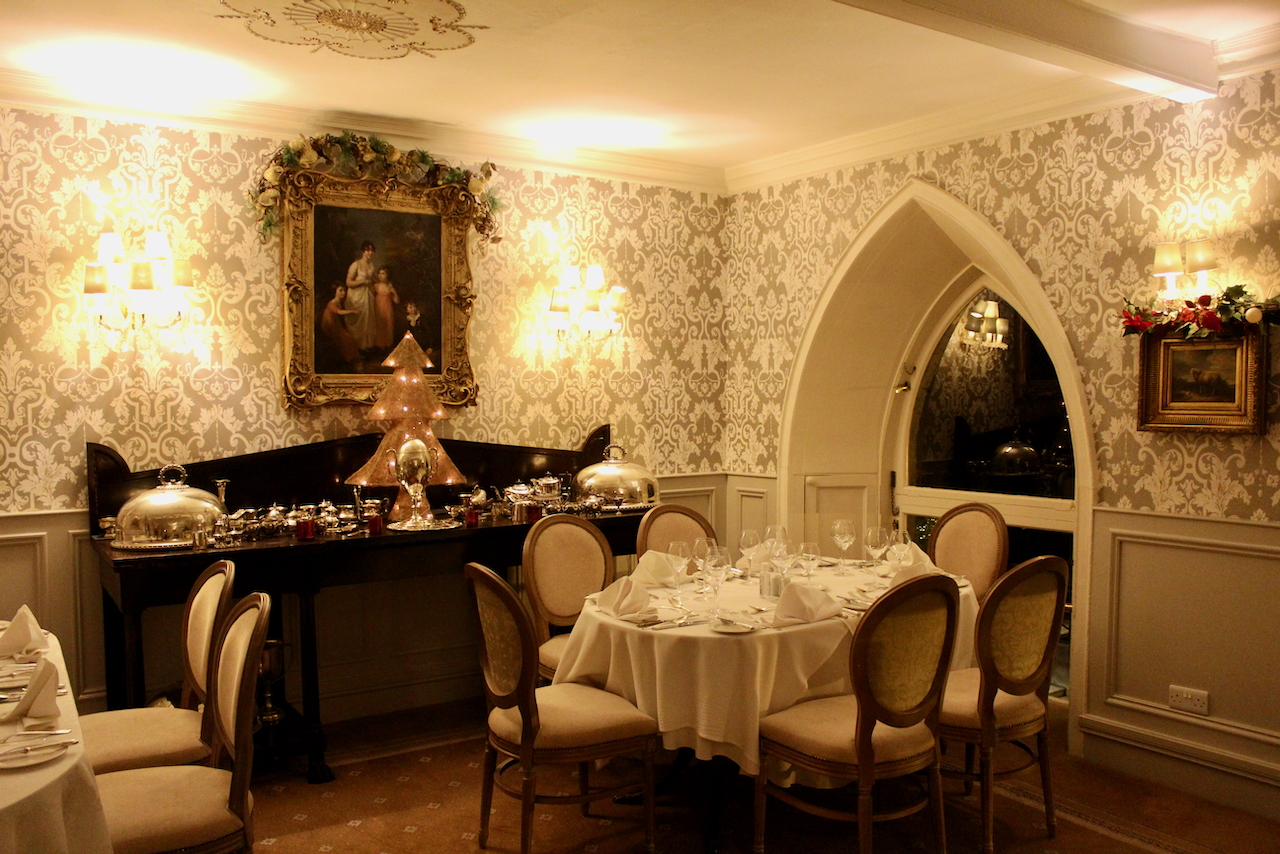
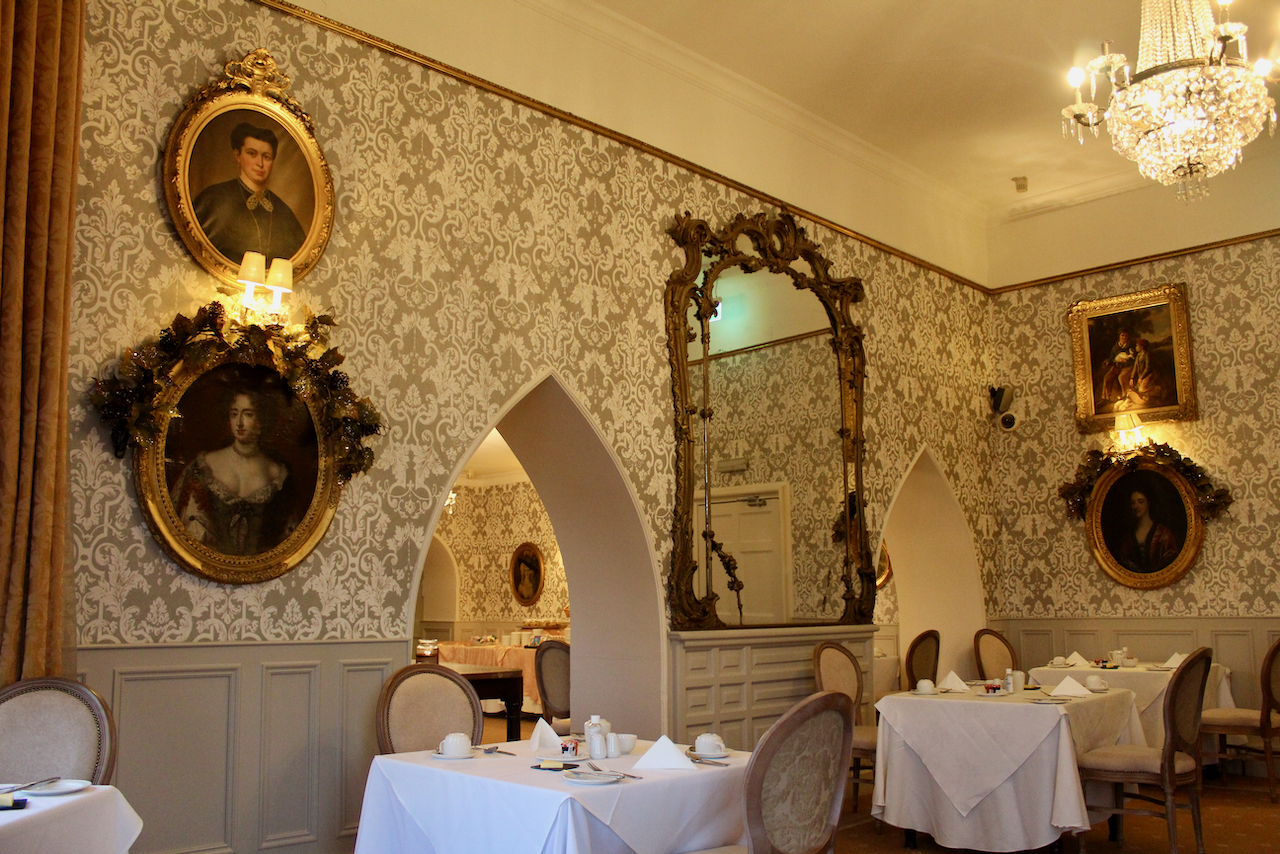
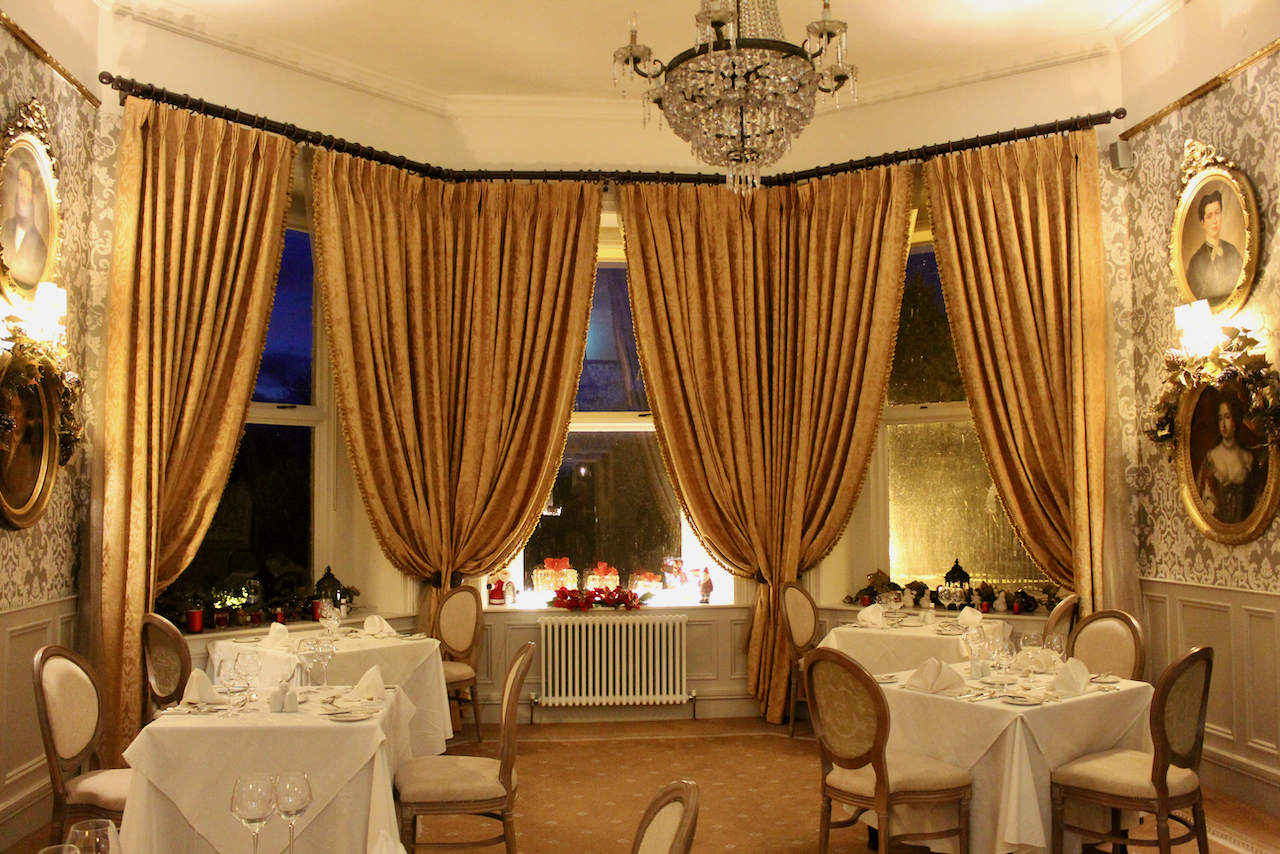
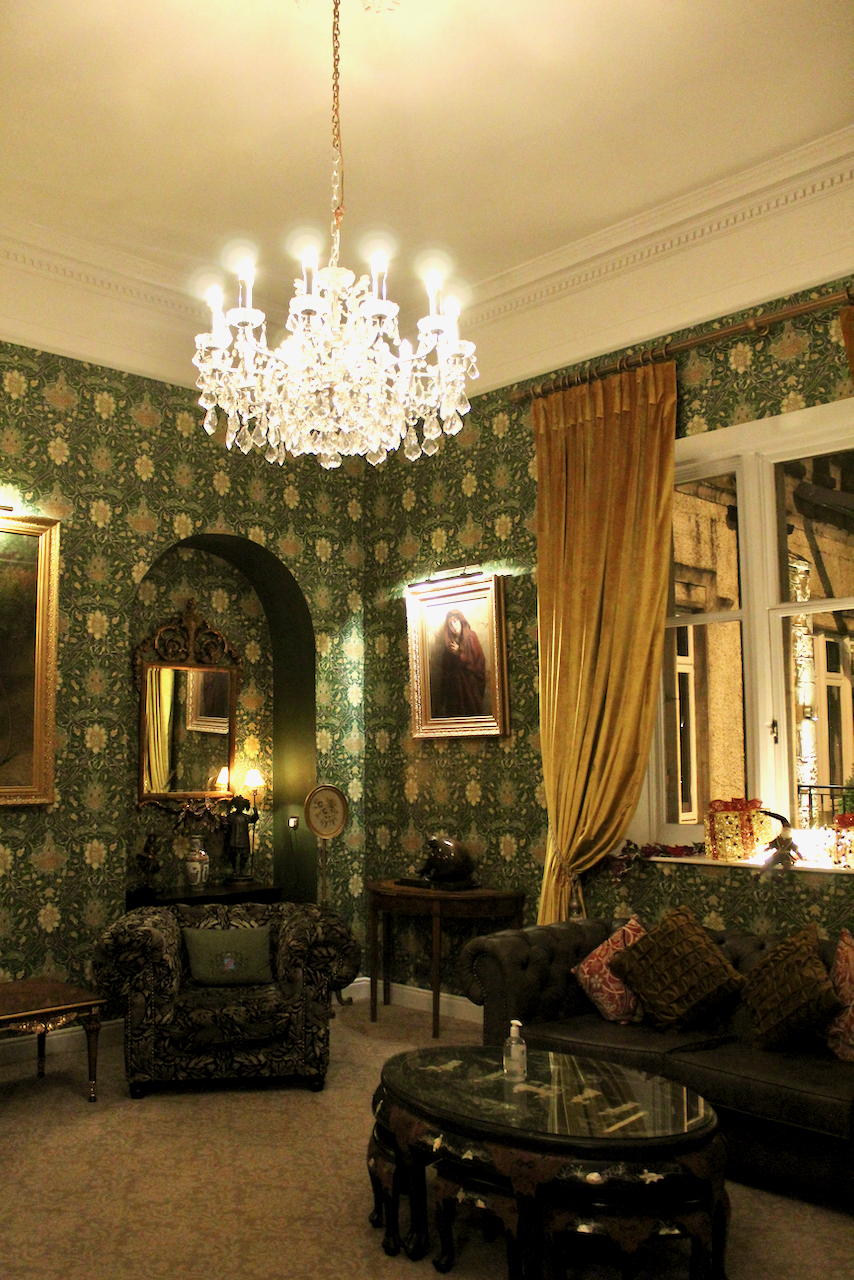
Cabra Castle, County Cavan, December 2020. Photograph © Jennifer Winder-Baggot, www.irishhistorichouses.com

see my write-up:

https://irishhistorichouses.com/2021/03/28/cabra-castle-kingscourt-county-cavan/

www.cabracastle.com
Open in 2026: all year, except Dec 24, 25, 26, 11am-4pm
Fee: Free to visit

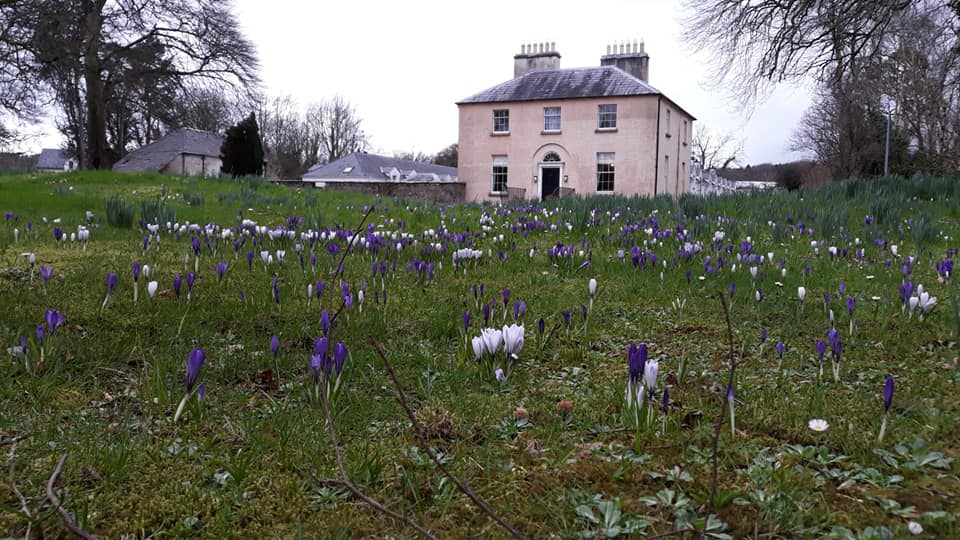
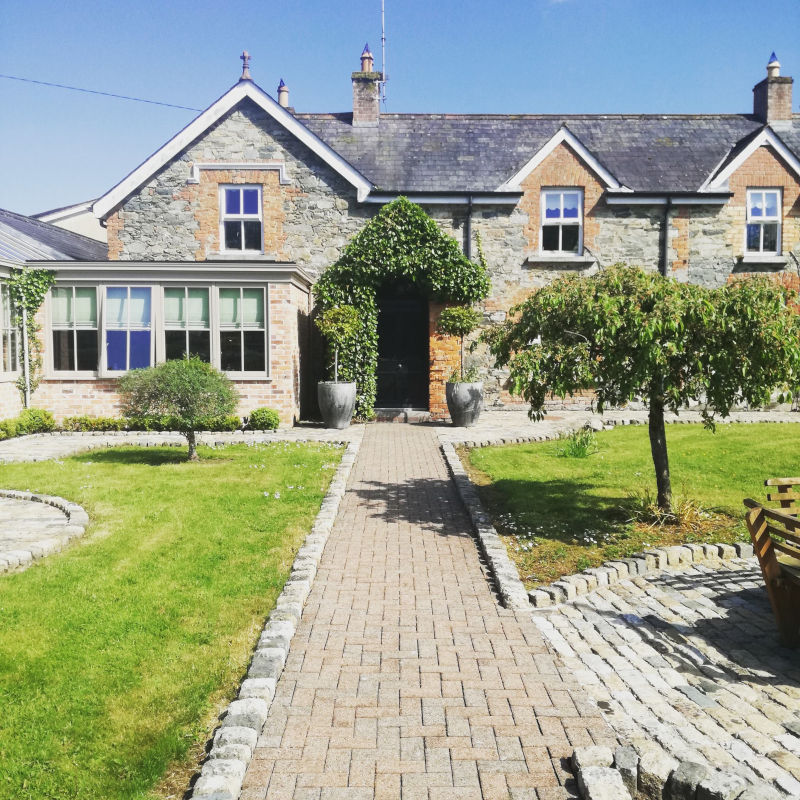
2. Clover Hill Gate Lodge, Cloverhill, Belturbet, Cavan – airbnb accommodation
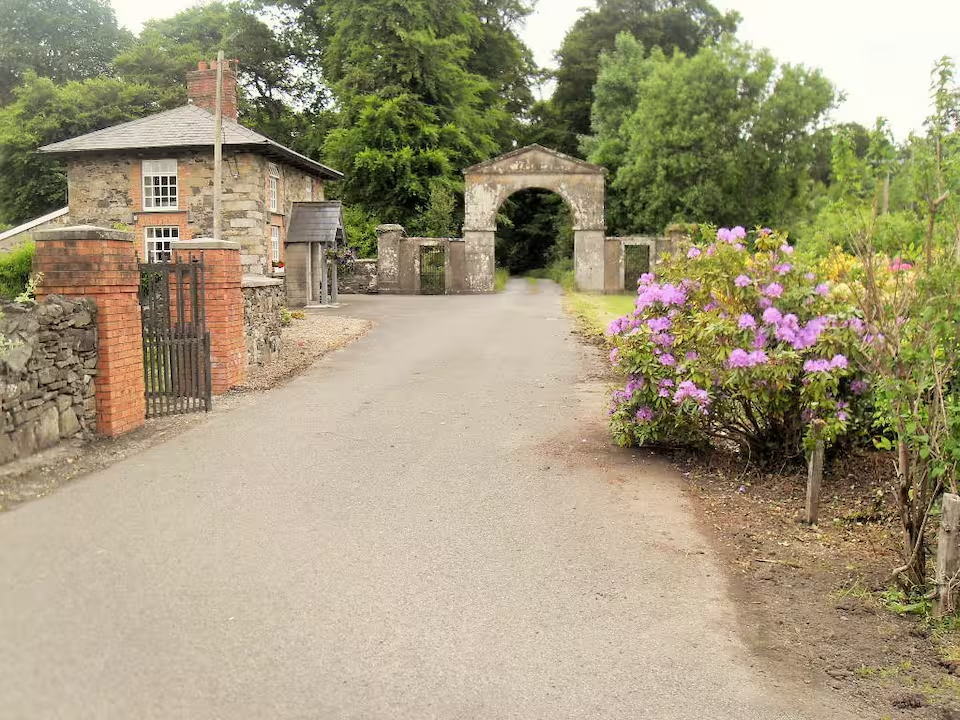
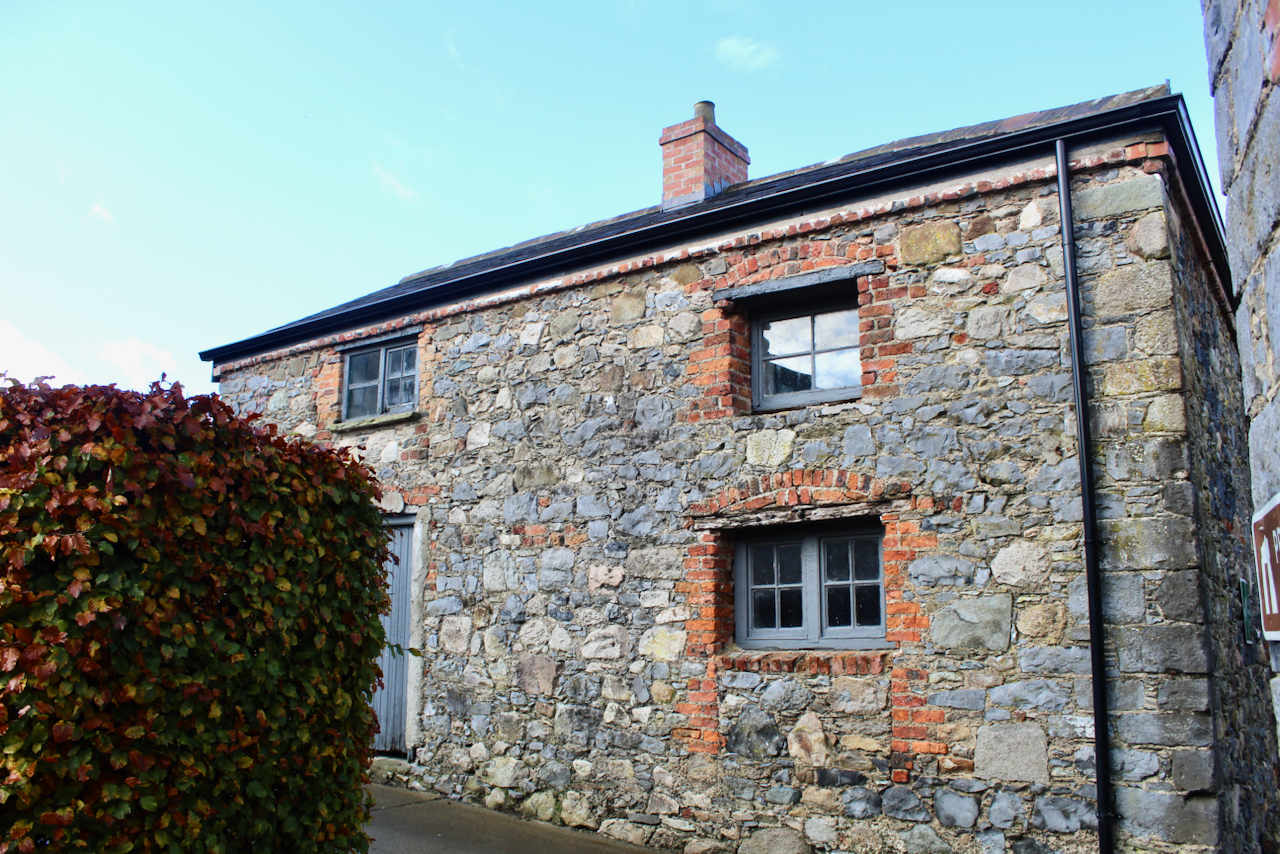
Cloverhill Gate Lodge, County Cavan, photograph courtesy airbnb website.

https://www.airbnb.ie/rooms/4962376?c=.pi0.pk314483168_127445633672&gclsrc=aw.ds&gad_source=1&gad_campaignid=314483168&gbraid=0AAAAADz55LkoVf9TCwAanNAoWG2eWN0AE&gclid=CjwKCAjwspPOBhB9EiwATFbi5CSHSojOSXZPWiu5LFh4sZKMByjLtZpuu_3AzyBVf60HB2uG0_JsNRoCwBwQAvD_BwE&source_impression_id=p3_1774518517_P3JcPlhtI0hbO-oV

The airbnb description tells us:

This old stone cottage built between 1830 -1850 is tucked away at the archway entrance to the Cloverhill Estate. This cottage is surrounded by gardens and woodland. The magic of this cottage is undeniable. Originally built for the Gate Keeper this cottage reflects heritage with rustic simplicity. Though some features and fittings have been replaced, the survival of historic features, including the label mouldings and timber bargeboards add to its character and charm.

Cloverhill House is now a ruin. Mark Bence-Jones tells us the house was built 1799-1804 for James Saunderson (1763-1842) to the design of Francis Johnston. [1] Robert O’Byrne adds that it was in fact extended in 1799, but built originally in 1758 (thus was built for James’s father Alexander, who married Lucy Madden of the Hilton Park House Madden family, another Section 482 property. A date stone gives us the date of 1758.) [2] Mark Bence-Jones tells us that the house passed by inheritance to the Purdons, and was sold by Major J.N. Purdon ca 1958. The National Inventory of Architectural Heritage tells us that the Sanderson family were instrumental in the development of Cloverhill village with the building of the Church of Ireland church and estate workers’ houses.
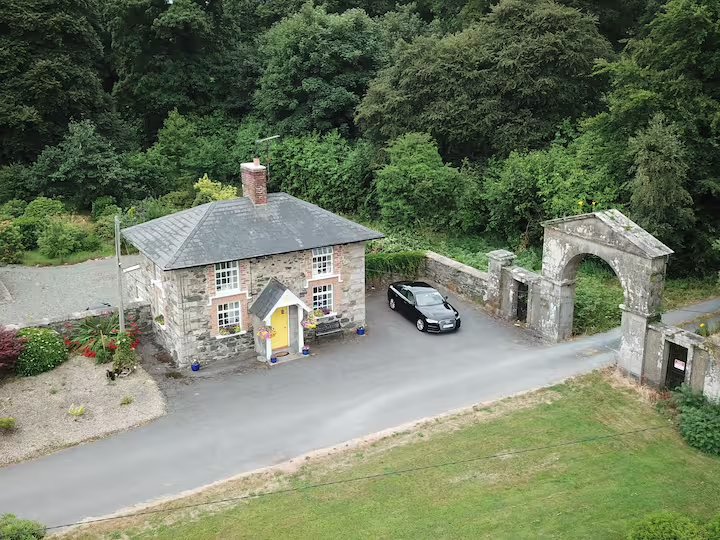
Cloverhill Gate Lodge, County Cavan, photograph courtesy airbnb website.

The house is featured in Tarquin Blake’s Abandoned Mansions of Ireland, Collins Press, Cork, 2010. 

From James Sanderson (1763-1842) the property passed down through the female line since the son, also named James, had no heirs. It passed first to Mary Anne, who was unmarried, and then to her sister’s son, Samuel Sanderson Winter (1834-1912), whose parents were Lucy Sanderson and Samuel Winter (1796-1867) of Agher, County Meath. Samuel Sanderson Winter married Ann, daughter of John Armytage Nicholson of Balrath Bury, County Meath (we came across this family before as Enniscoe in County Mayo was inherited by Jack Nicholson, of the Balrath Bury family). Samuel Sanderson Winter’s son died young so Cloverhill passed to the son of his sister, Elizabeth Ann Winter, who married George Nugent Purdon (1819-1910). This is how the house passed to the Purdon family.

The house passed to their son, John James Purdon, who died childless so it passed to his nephew, John Nugent Purdon, son of Charles Sanderson Purdon. John Nugent Purdon sold Cloverhill demesne  ca 1958 to Mr Thomas Mee. [3] 

3. Farnham Estate, Farnham Estate, Cavan – hotel
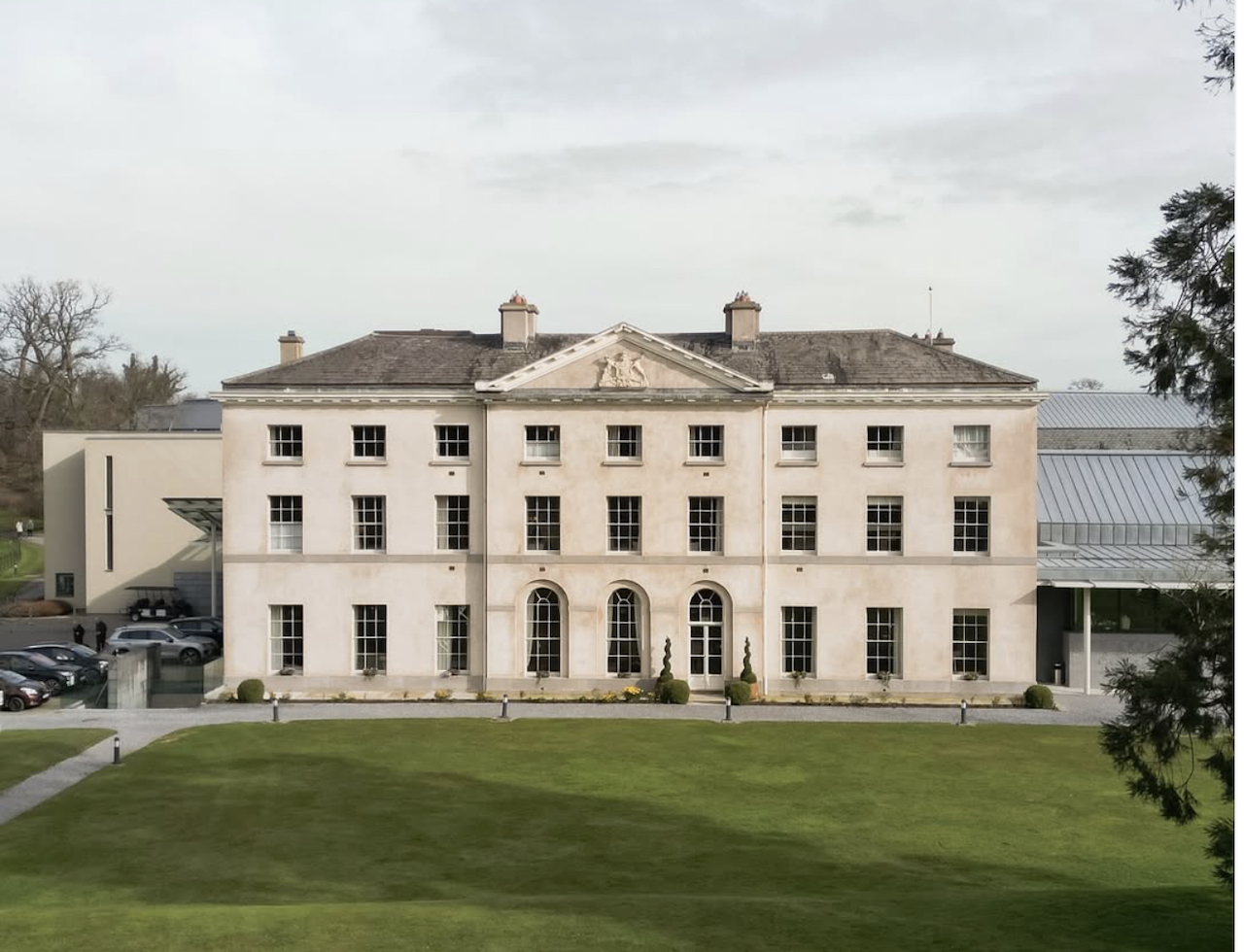
https://www.farnhamestate.ie

Farnham Estate, County Cavan, photograph courtesy of hotel Instagram page.
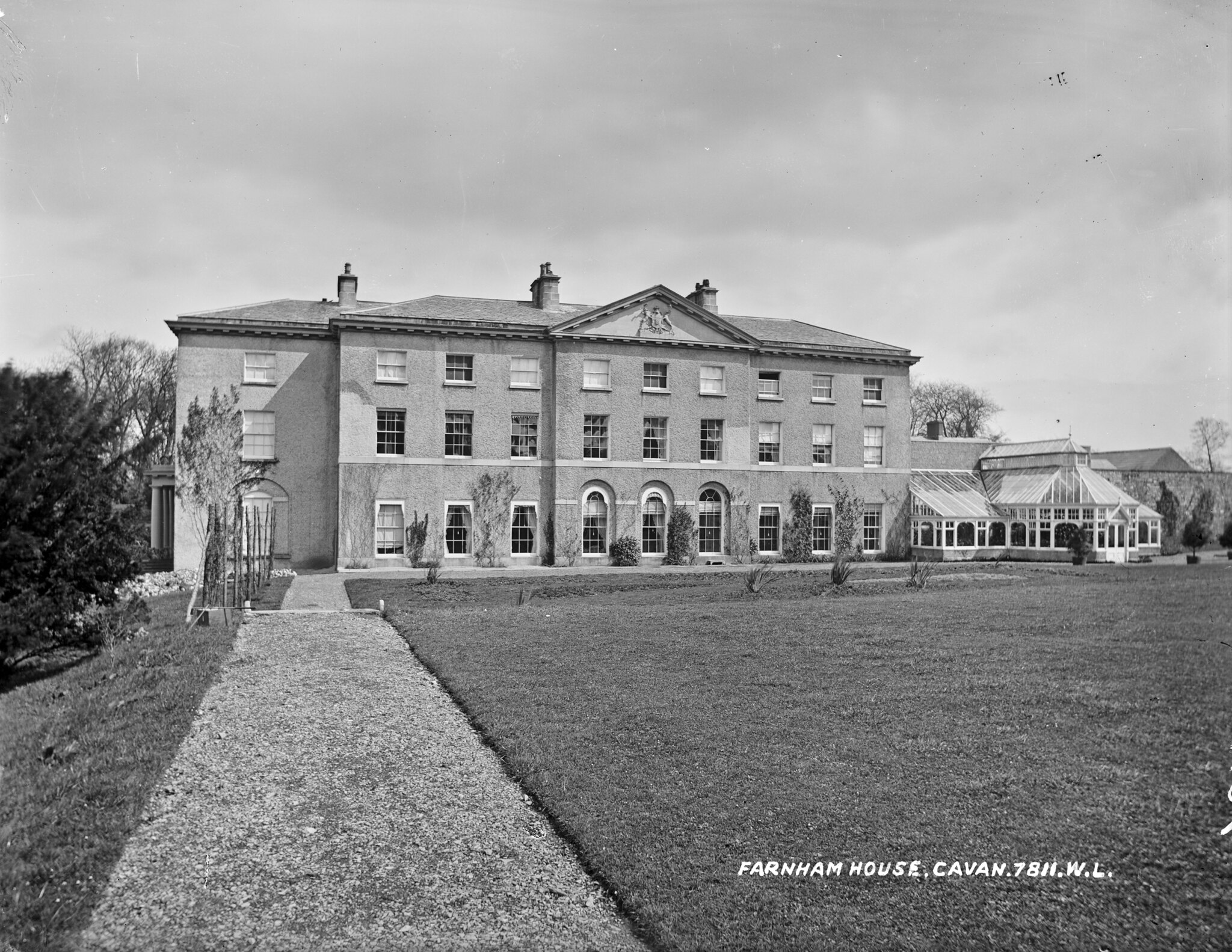
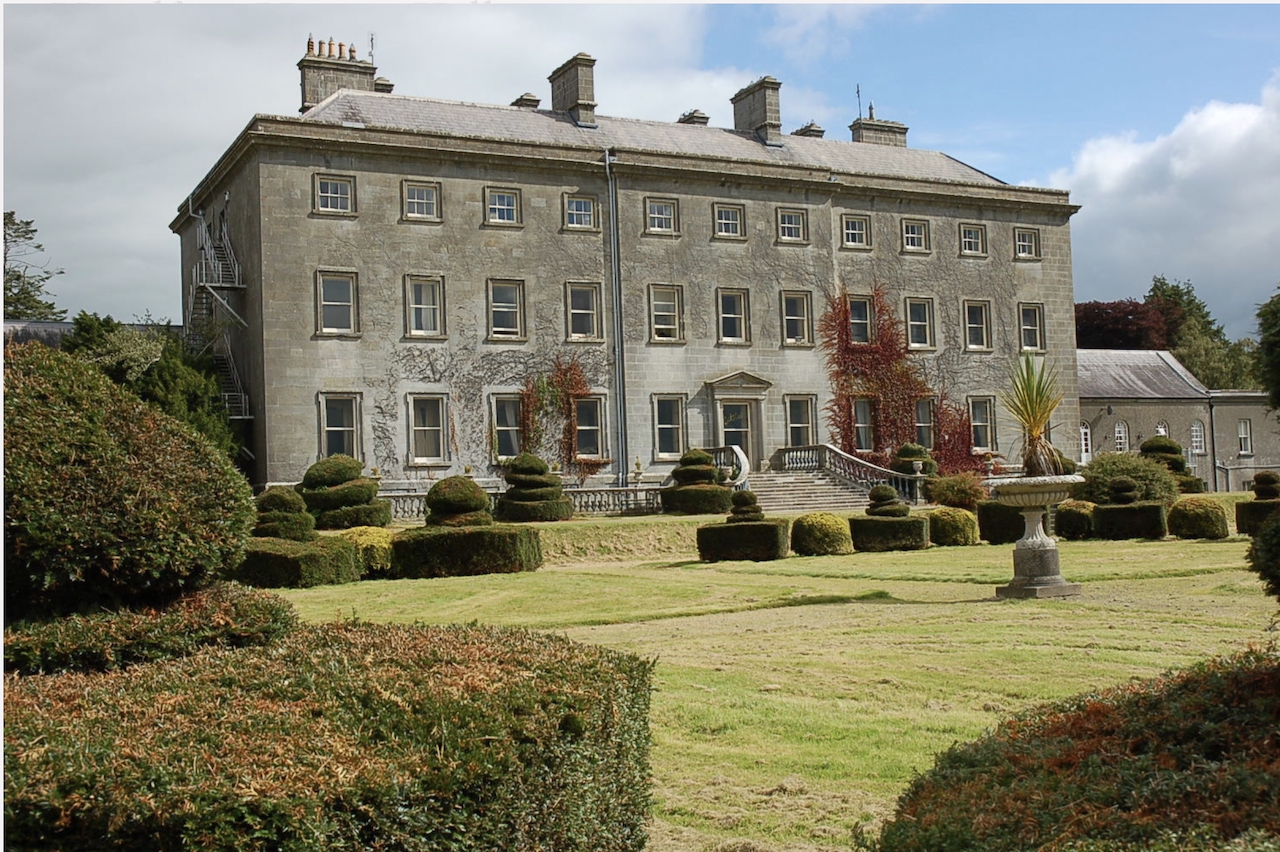
Farnham House, photograph from National Library of Ireland, flickr constant commons.

David Hicks tells us in his Irish Country Houses, A Chronicle of Change that the wing of Farnham House that survives today is the truncated section of a much larger mansion. Dry rot led to demolition of a substantial section of the Maxwell ancestral home. The family’s connection was severed in 2001.
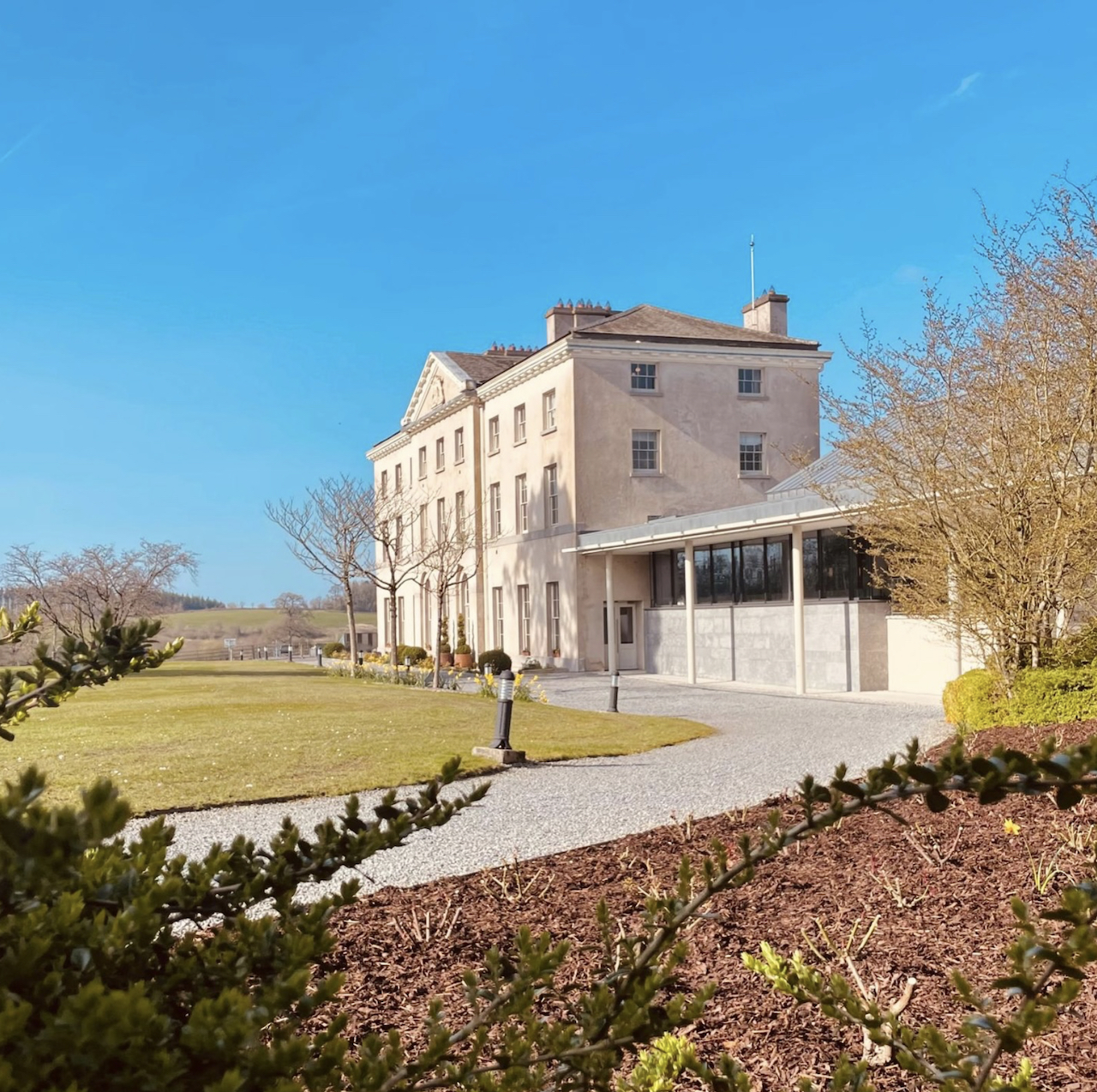
Farnham Estate, County Cavan, photograph courtesy of hotel Instagram page.

The estate was granted by King James I to the Waldron family in 1613. Henry Waldron named the estate after his wife’s family. The Waldrons built a castle here in 1620.

The website gives us a history of the estate:

“1664- The Waldrons of Dromellan Castle (early name of Farnham House) were forced to sell the estate to settle gambling debts. Bought by Bishop Robert Maxwell, thus beginning the Maxwell family connection that was to continue for more than 330 years (family motto is Je suis prêt – I am ready’).”
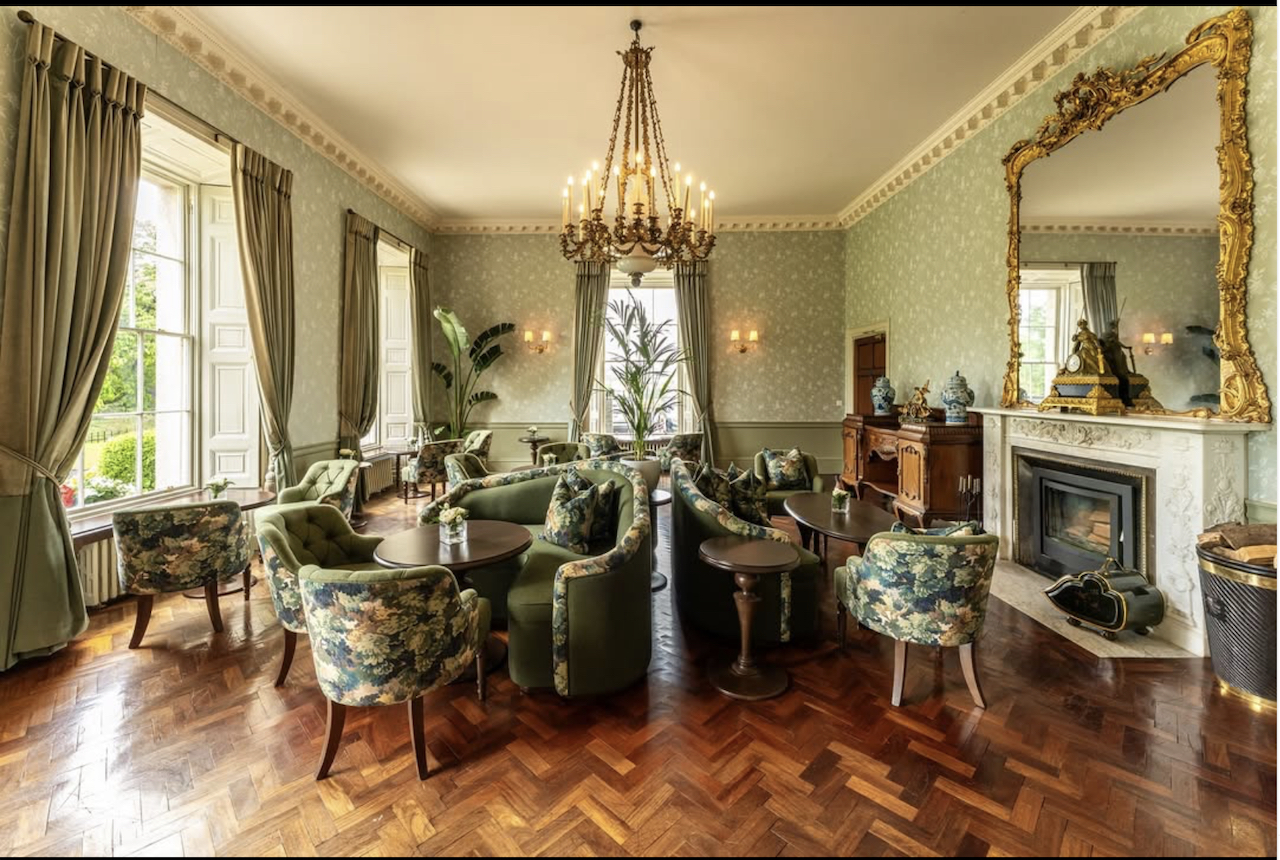
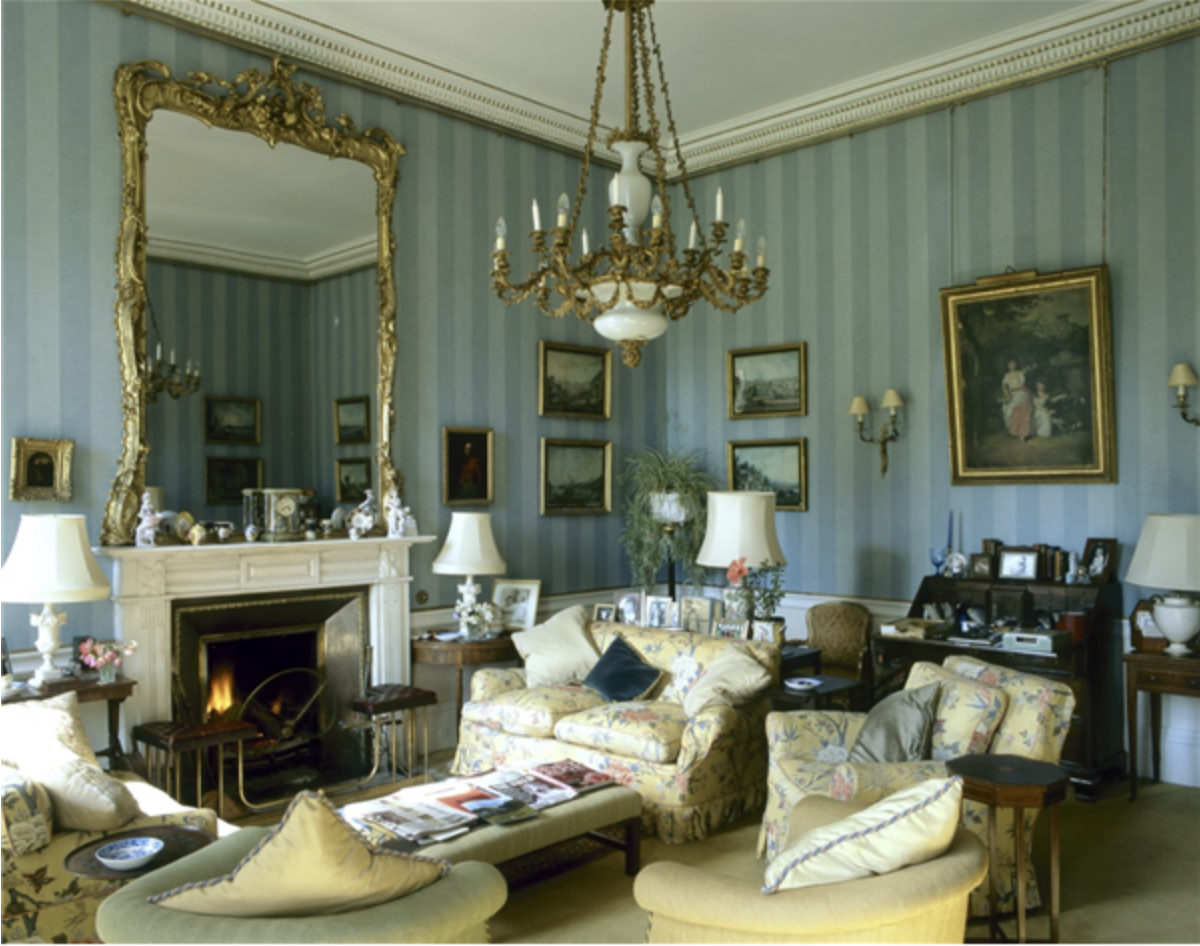
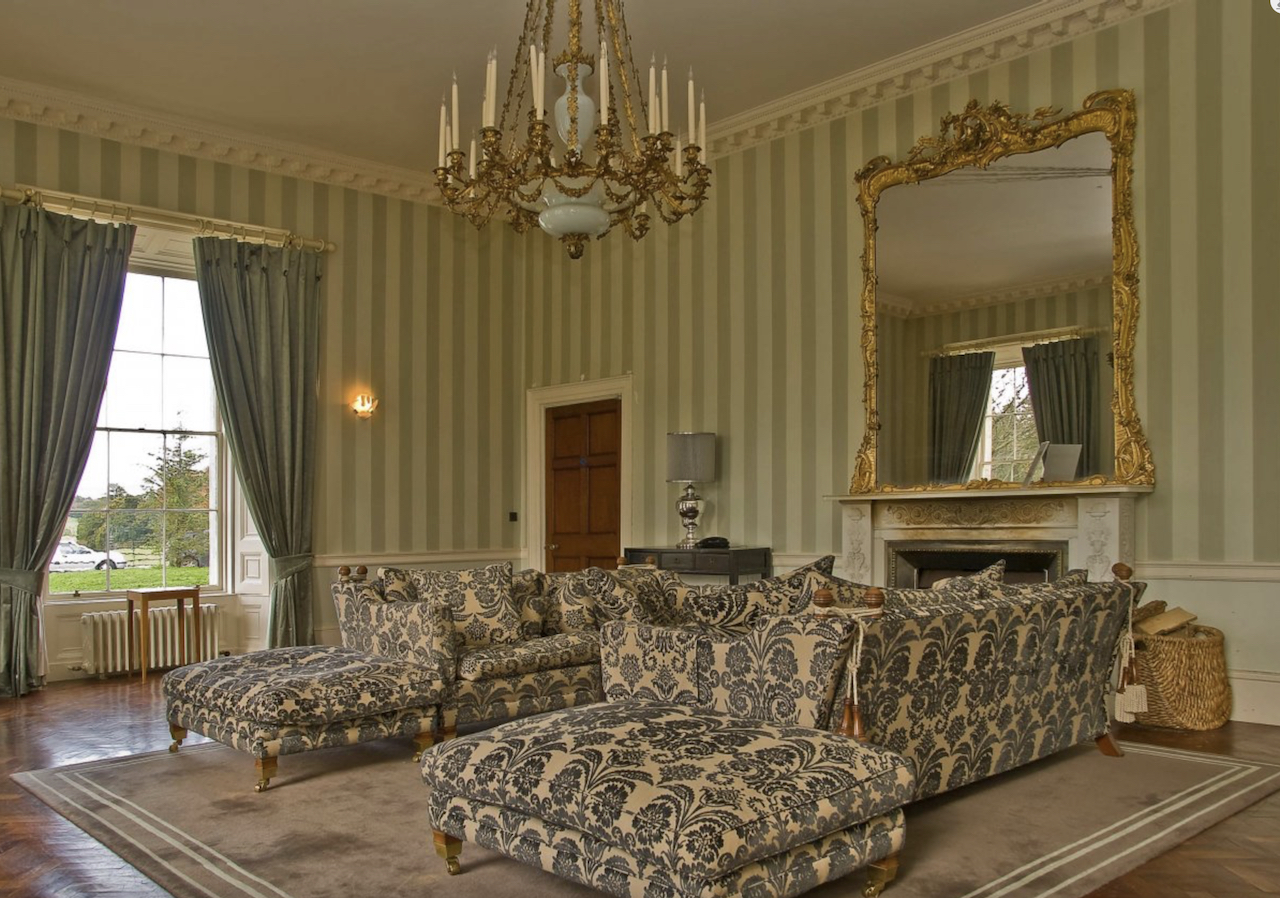
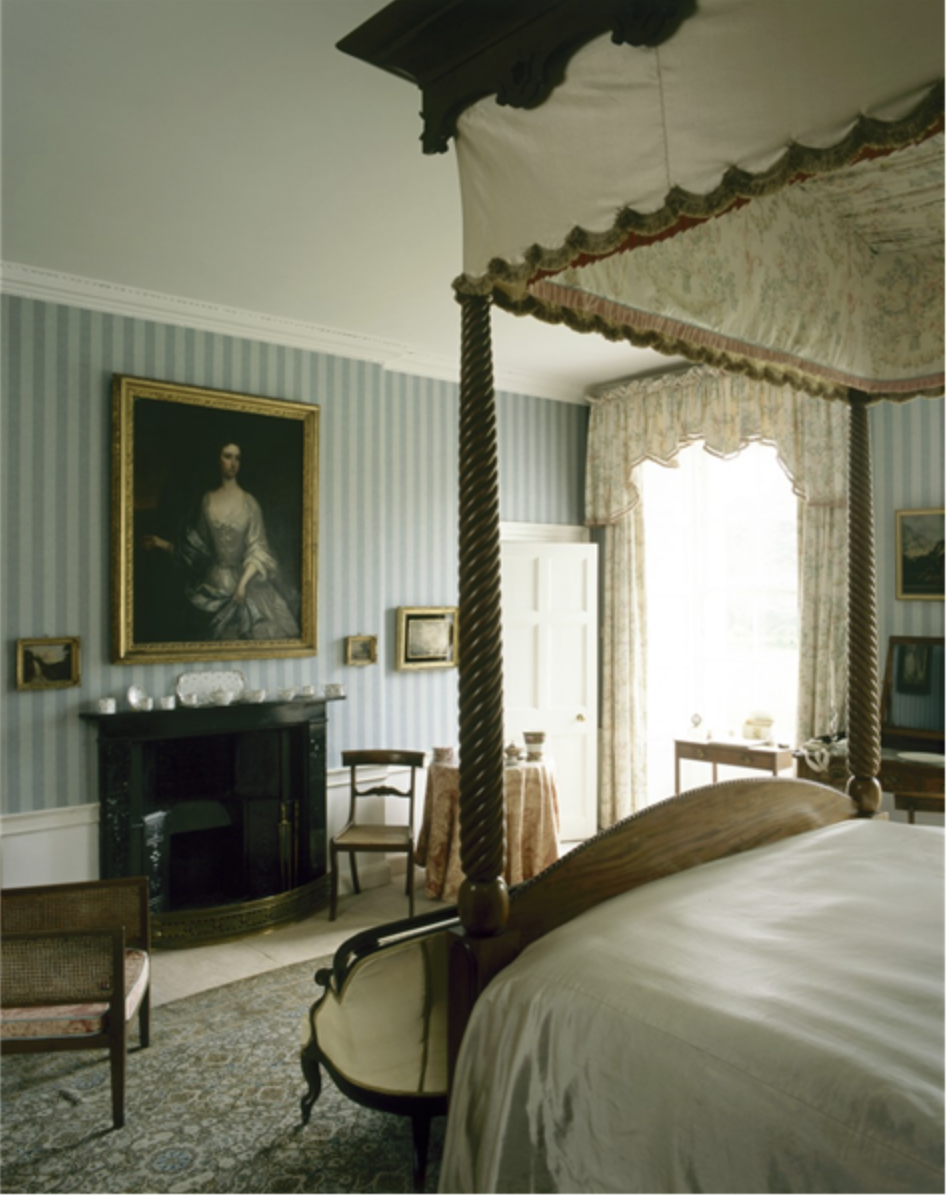
Farnham Estate drawing room, County Cavan, photograph courtesy of hotel Instagram page.

Mark Bence-Jones adds in his  A Guide to Irish Country Houses (1988, p. 123):

“…A few years later the estate was sold to Robert Maxwell [1598-1672], Bishop of Kilmore, whose cathedral was nearby. The Bishop’s son, John Maxwell, built a new house here ca 1700, which was improved ca 1780 by Barry Maxwell, 3rd Lord Farnham and first Earl of Farnham of 2nd creation, who added a library designed by James Wyatt.

Timothy William Ferres tells us of the Maxwell lineage:

John Maxwell of Farnham, High Sheriff of County Cavan, 1674, who dsp 1713, was succeeded by his nephew, The Reverend Doctor Robert Maxwell; who dsp 1737 and was succeeded by his cousin, John Maxwell (1687-1759), High Sheriff of County Cavan, 1757, MP for County Cavan 1727-56, who was elevated to the peerage, in 1756, in the dignity of Baron Farnham, of Farnham, County Cavan.

In 1719 he married Judith, heiress of James Barry (1660-1725) of Newtownbarry, County Wexford. Their son Robert succeeded as 2nd Baron Maxwell, and he was created Viscount in 1760 and 1st Earl of Farnham in 1763. Robert married Henrietta Cantillon, the widow of William Matthias Stafford-Howard, 3rd Earl of Stafford.
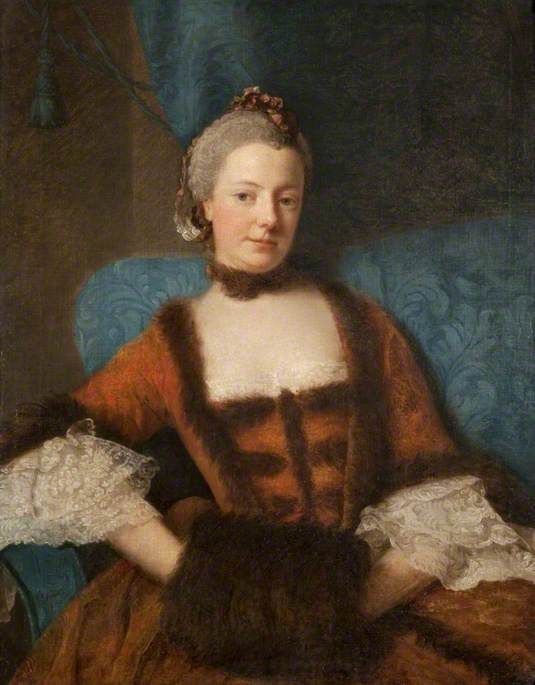
Henrietta Diana née Cantillon (1728–1761), Dowager Countess of Stafford by Allan Ramsay courtesy of Kelvingrove Art Gallery and Museum; http://www.artuk.org/artworks/henrietta-diana-17281761-dowager-countess-of-stafford-85788 She married, first, William Matthias Stafford-Howard, 3rd Earl of Stafford, and after his death, Robert Maxwell, 2nd Baron and 1st Earl of Farnham.

See also the wonderful book by Melanie Hayes, The Best Address in Town: Henrietta Street, Dublin and its First Residents 1720-80, published by Four Courts Press, Dublin 8, 2020. She has a chapter on John Maxwell, (1687-1759) 1st Baron Farnham.

The Farnham Estate website tells us that Robert was a keen agriculturalist and agent of improvement who put the most technologically and scientifically advanced agricultural methods into action. The website tells us:

“In 1777, noted agricultural scientist and topographer Arthur Young said of Farnham; “…upon the whole Farnham is one of the finest places that I have ever seen in Ireland; the water wood and hill are all in great stile and abound in a variety of capabilities. The woodland plantations of Derrygid coupled with the lakes of Farnham and Derrygid were noted by Young who described them as being ‘uncommonly beautiful; extensive and have a shore extremely varied.” In the 1770’s, approximately 100 labourers were employed in maintaining the landscape at Farnham.

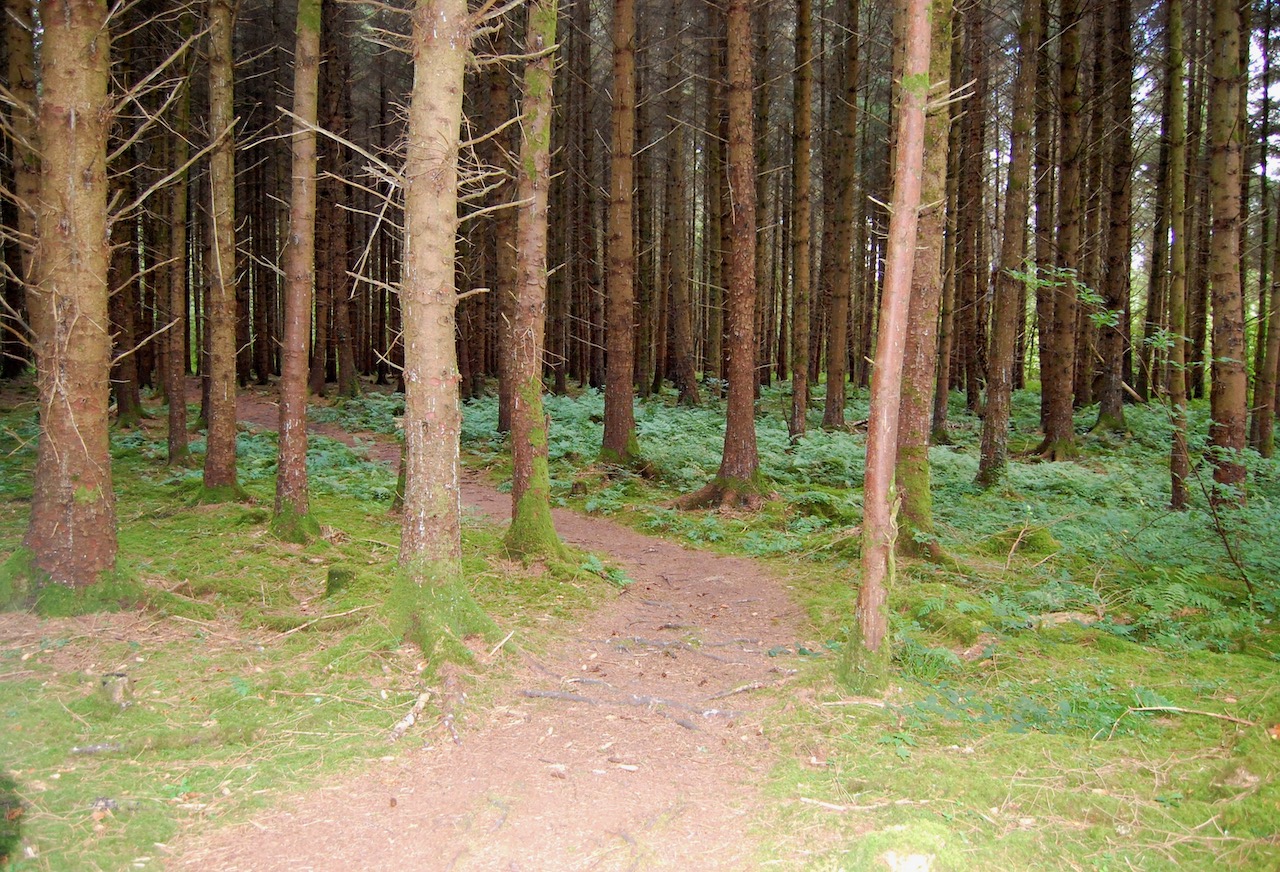
Walk on Farnham Estate, Cavan, Sept 2013. Photograph © Jennifer Winder-Baggot, www.irishhistorichouses.com

Robert 1st Earl and Henrietta’s daughter Henrietta married Denis Daly (1747-1791) of Dunsandle, County Galway.

Denis Daly (1747-1791) of Dunsandle, County Galway, attributed to Joshua Reynolds, courtesy of Christies 2012 Mount Congreve the London Sale.

The first Earl’s son John predeceased him and didn’t marry, so the 1st Earl’s brother Barry succeeded him. Barry Maxwell was a barrister and MP for County Cavan and later for Armagh city. When his mother Judith née Barry died in 1771 he must have inherited as he changed his name to Barry Barry. Then when his elder brother Robert Maxwell, 1st and last Earl of Farnham, died in 1779, he inherited and his name was changed back to Barry Maxwell, and he succeeded as the 3rd Baron Farnham, of Farnham, Co. Cavan. He was created 1st Earl of Farnham, Co. Cavan (Ireland, of the 2nd creation) on 22 June 1785.
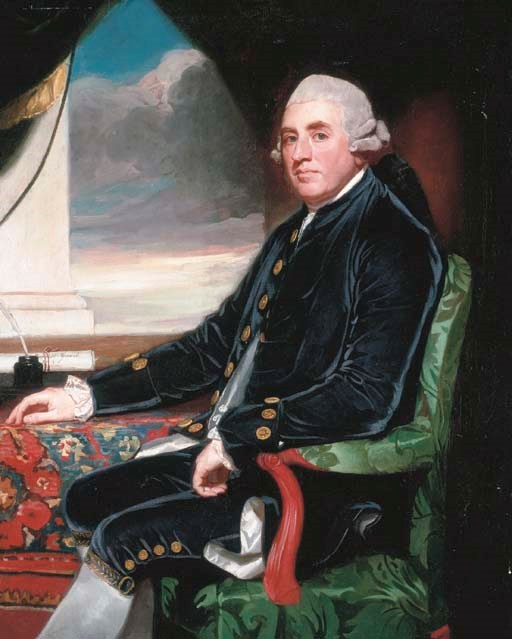
Portrait of Barry Maxwell (1723-1800) 1st Earl Farnham by George Romney courtesy of www.christies.com/en/lot/lot-4507942 He was the son of John Maxwell, 1st Baron Farnham and Judith Barry.

When Robert 1st Earl’s first wife Henrietta died, he married secondly, in 1771, Sarah, only daughter of Pole Cosby, of Stradbally Hall, Queen’s County, and sister of Lord Sydney, but they had no further children. Sarah had been previously married to Arthur Upton (d. 1763) of Castle Upton, County Antrim. After her second marriage she was known as the Countess of Farnham.
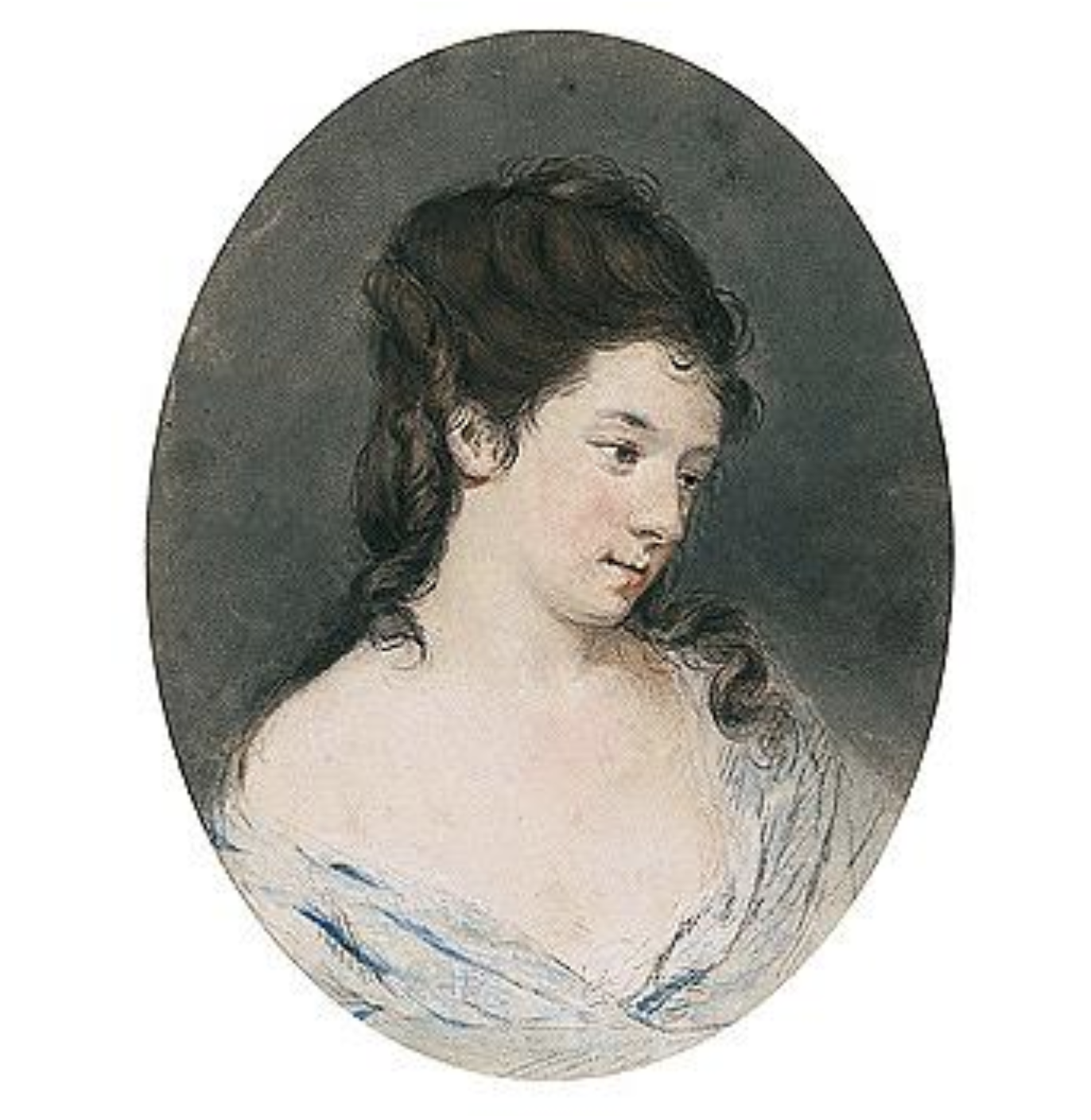
The Countess of Farnham, probably Sarah née Cosby, wife of Robert Maxwell, 1st and last Earl of Farnham (of the first creation), painted by Hugh Douglas Hamilton, courtesy of Sothebys 2001.

The first Earl had another brother Most Reverend Henry Maxwell (d. 1798), who became Bishop of Dromore and Bishop of Meath.
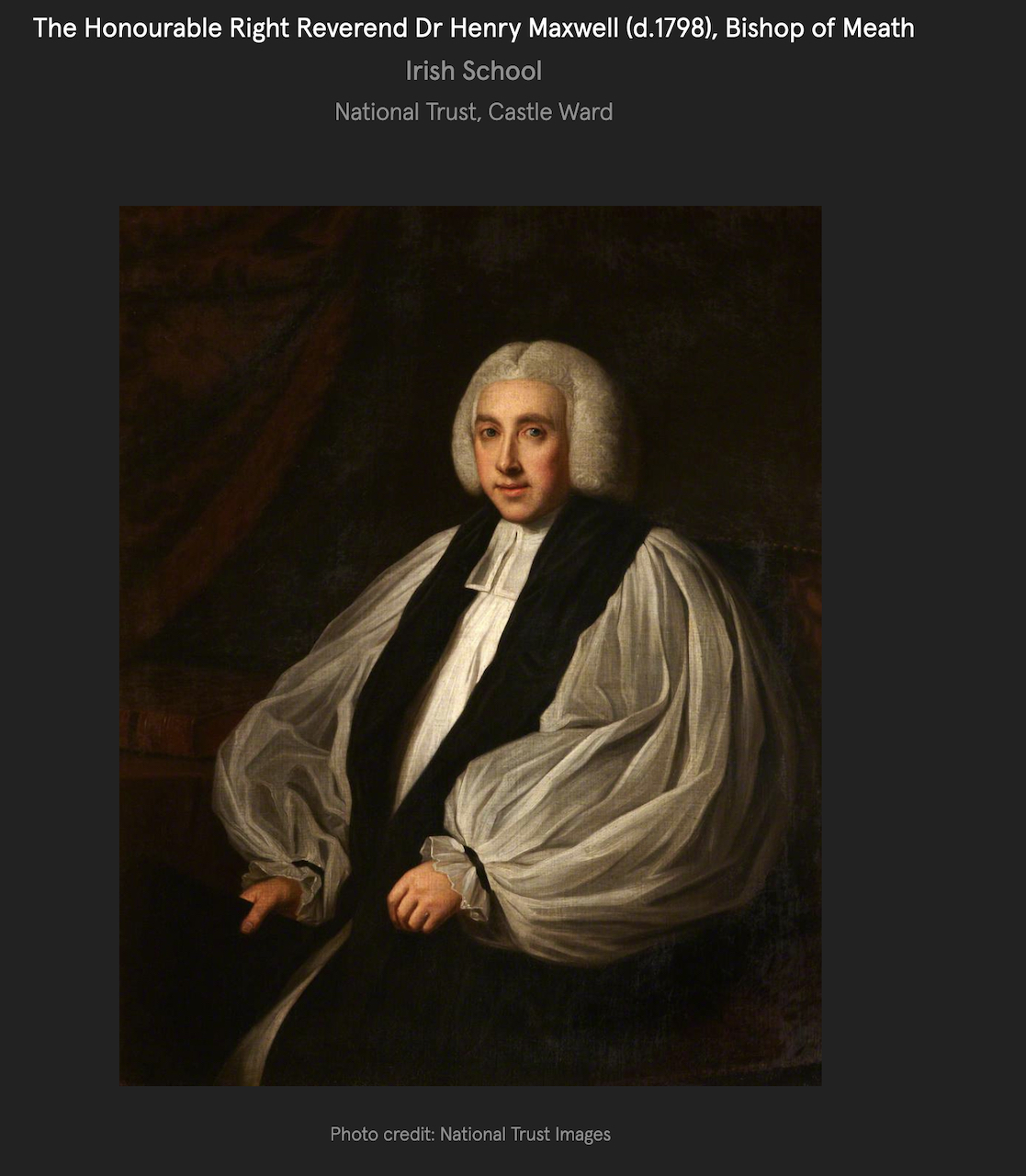
Right Reverend Henry Maxwell (d. 1798) Bishop of Meath, Irish school courtesy of National Trust Castle Ward

Reverend Henry Maxwell married Margaret Foster, daughter of Rt. Hon. Anthony Foster Chief Baron of the Irish Exchequer between 1766 and 1777, who lived in Collon in County Meath.

Their sons became respectively John Maxwell Barry Maxwell (1767-1838) 5th Baron Farnham and Reverend Henry Maxwell (d. 1838) 6th Baron Farnham, and the Baronetcy continued to their descendants. The Earldom was recreated for the elder brother Barry, 3rd Baron (1723-1800), who obtained a viscountcy and earldom, in 1780, as Viscount Farnham, and, in 1785, Earl of Farnham (2nd creation).
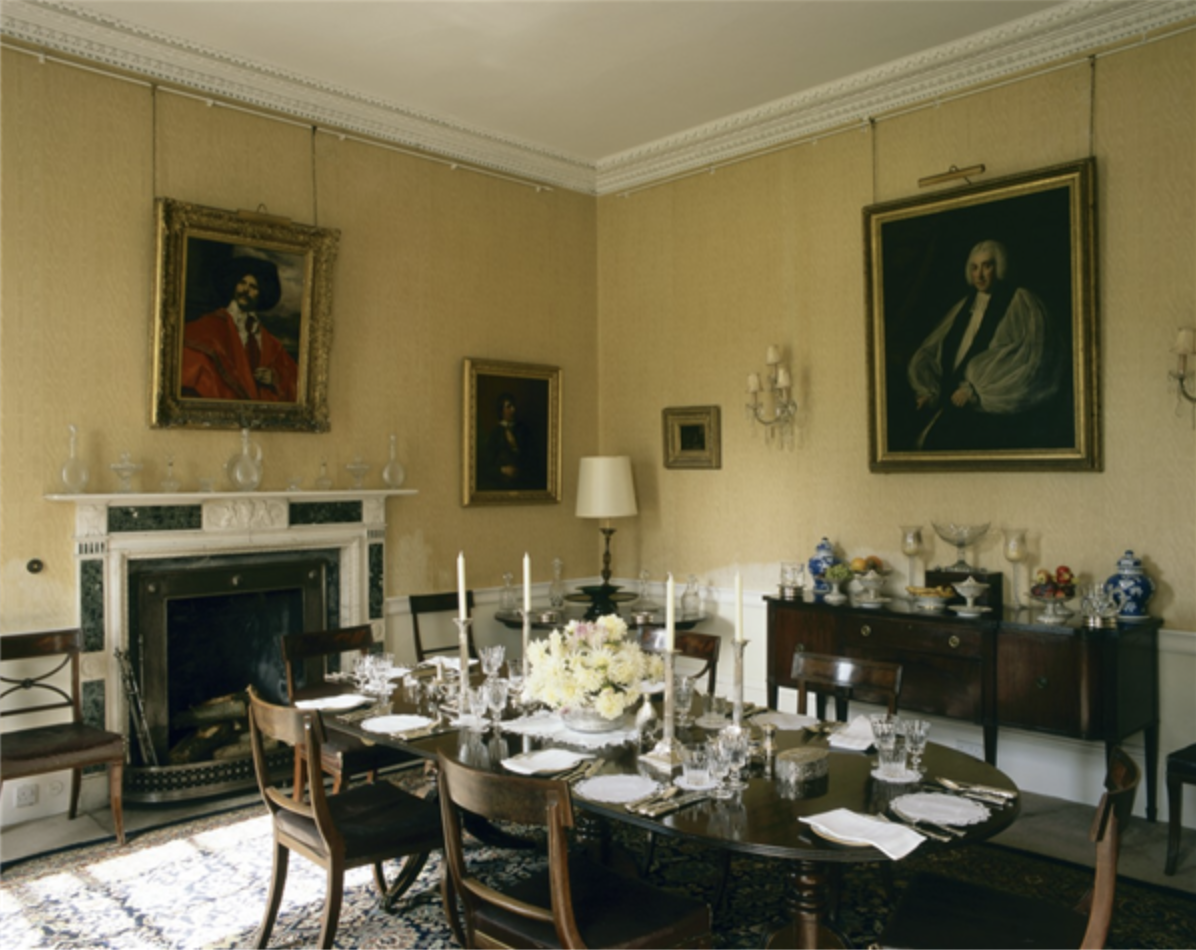
The dining room at Farnham House. Pub Orig Country Life 02/01/2003, volume CXCVII. Photographer Paul Barker. With portrait of Right Reverend Henry Maxwell (d. 1798) Bishop of Meath.

The three brothers, Robert 1st Earl, Barry 1st Earl of second creation and Reverend Henry had a sister, Anne, who married Owen Wynn (1723-1789) of Hazelwood, County Sligo.

Barry Maxwell, 1st Earl of Farnham served as MP and Privy Counsellor. He married first Margaret King of Drewstown, County Meath, who gave birth to their son and heir John James Maxwell (1759-1823) later 2nd Earl of Farnham. Barry married secondly Grace, daughter of Arthur Burdett. His son did not have children and the Earldom and Viscountcy became extinct on his death.
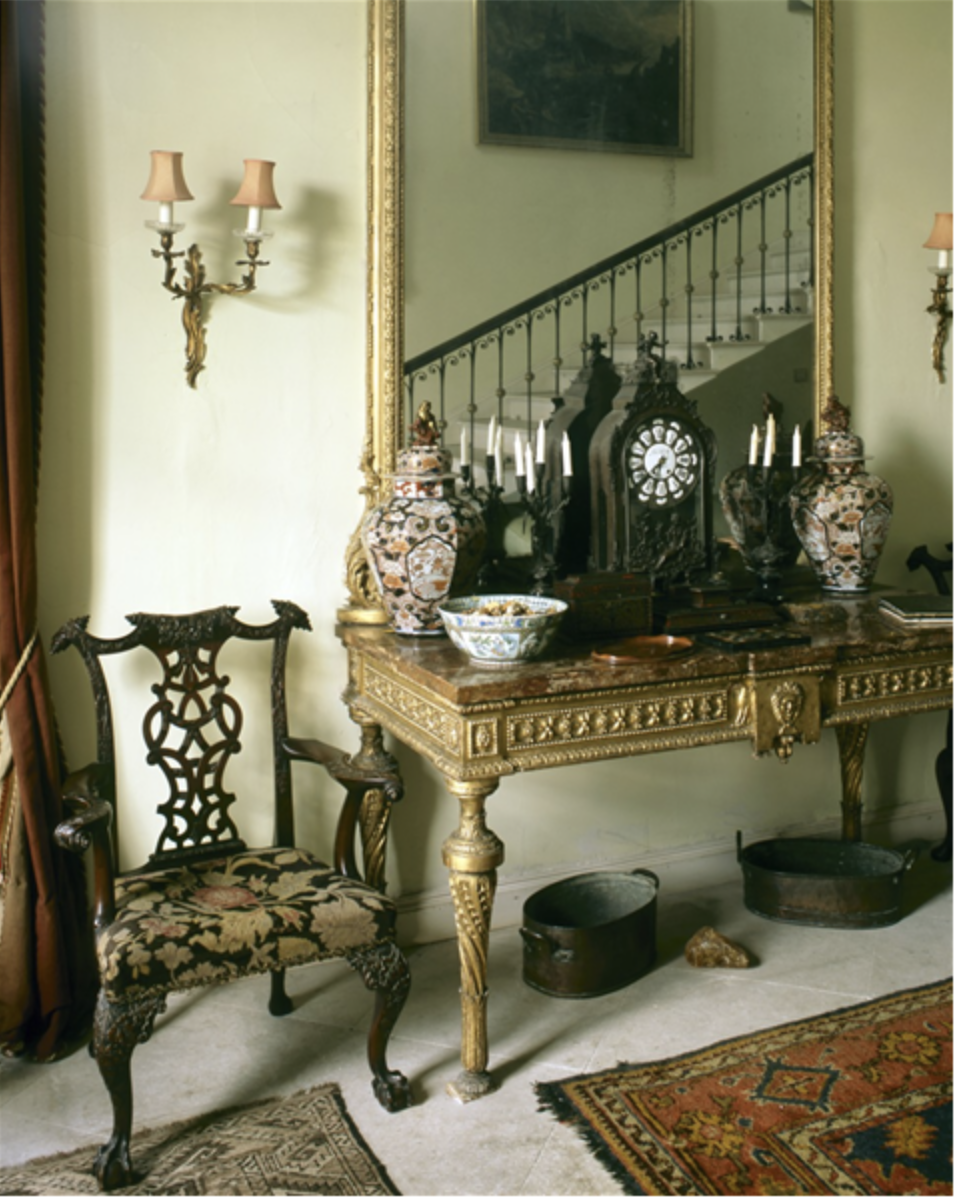
Photograph of Farnham House from Country Life, A Chinese Chippendale chair in the hall at Farnham House. Pub Orig CL 02/01/2003, volume CXCVII. Photographer Paul Barker. 

The website tells us of the building of Farham:

“In 1795, Earl of Farnham Barry [Barry Maxwell (1723-1800)] asked James Wyatt, one of the most fashionable architects of that time, to draw designs for three ceilings. Although there is no evidence of them being installed at Farnham, these plans are now housed in the Metropolitan Museum of Art in New York. Some work was undertaken by Wyatt though around the 1795 timeframe and to this day, a library case where his design has been noted stands inserted in an alcove on the staircase landing.

In the early 1800s, a coat of arms was incorporated onto the façade of the house. Comprised of the arms of the Maxwell and Barry family, they are supported by two bucks, with a buck’s head on top of the Baron’s coronet as the crest.

Barry’s son James John Barry 2nd Earl engaged Francis Johnston to build. The website tells us:

In 1802 Francis Johnston, architect for Dublin’s famous GPO building, was engaged to complete an extension of the existing house to provide an edifice to the southwest garden front. This is the latter day surviving Farnham House, which is now incorporated as the centrepiece of the hotel complex design.

Mark Bence-Jones describes the house as built by Francis Johnston:

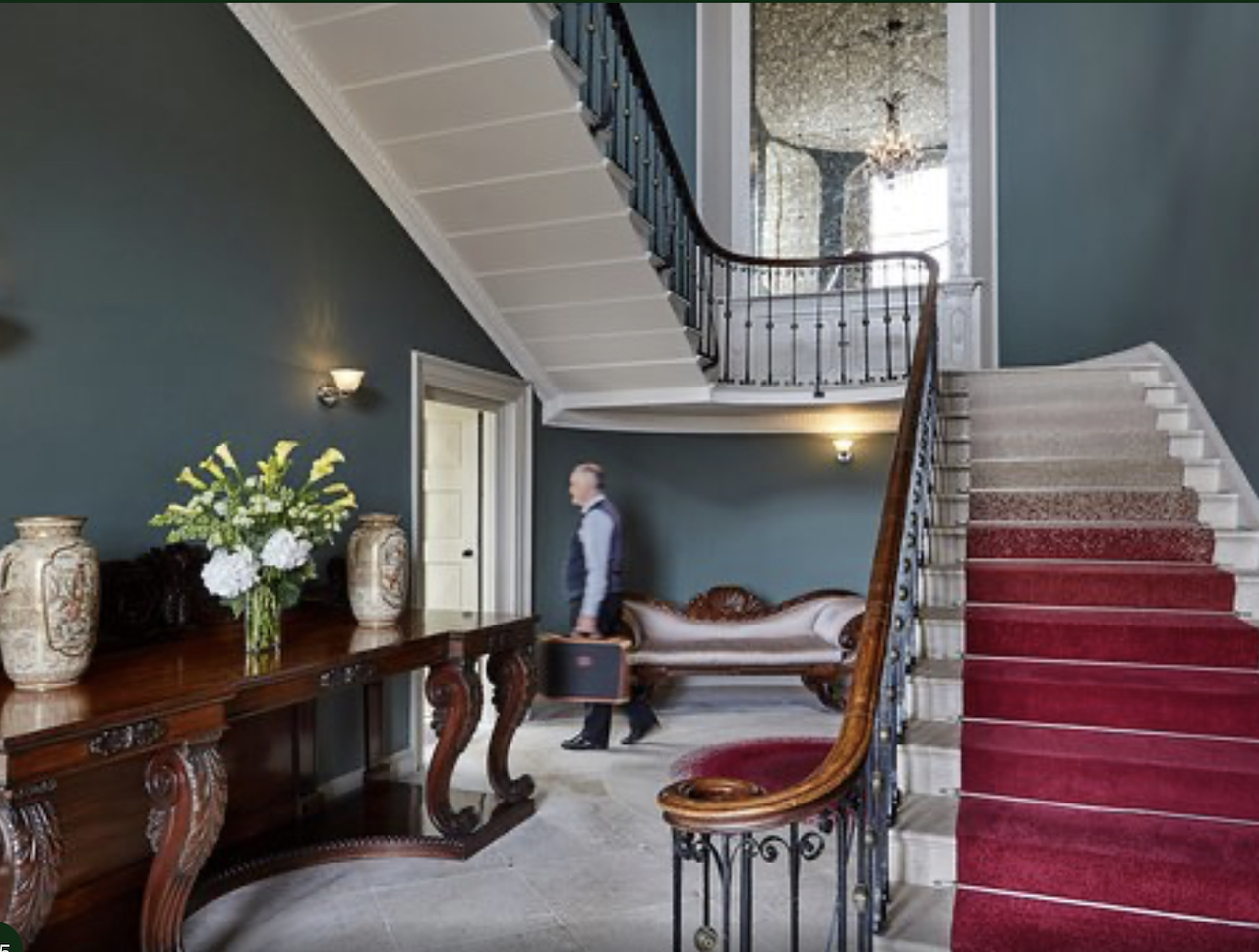
“Johnston produced a house consisting of two somewhat conservative three storey ranges at right angles to one another; one of them, which incorporated part of the earlier house, including Wyatt’s library, having a front of eight bays, with a die over a two bay breakfront, and a single-storey Doric portico; the other having a front of nine bays with a three bay pedimented breakfront; prolonged by one bay in the end of the adjoining range. The interior was spacious but restrained, the principal rooms having simple ovolo or dentil cornices. Elliptical staircase hall, with simple geometrical design in the ceiling; stone stair with elegant metal balustrade.

The staircase at Farnham House designed by Francis Johnston. Pub Orig Country Life 02/01/2003, volume CXCVII. Photographer Paul Barker.
Farnham Estate, County Cavan, photograph courtesy hotel.

The website continues: “In the depths of the earth beneath Farnham lies a myriad of passages. These passages were constructed to allow food, supplies and heating fuels to be brought into the mansion house by the servants. Such underground passages kept the servants out of sight from Lords and Ladies Farnham and their guests and no doubt were used by the servants to enjoy some activities of their own, which they would not have wanted Lord and Lady Farnham to witness!

When James John died childless in 1823, a cousin, John Maxwell Barry Maxwell (1767-1838), son of Rt. Rev. Henry Maxwell, became 5th Baron Farnham.

The website tells us: “In 1823, a new system of management for the Farnham estate was introduced, employing persons as inspectors of districts, buildings, bog and land and a moral agent! The main duties of the moral agent were to encourage the tenantry to adhere to the main principles contained in Lord Farnham’s address to them. These included: keeping of the Sabbath, responsibility towards the education of their children, imbuing within their children a strict moral sense and to ensure that they abstained from all evil habits, including cursing and the distillation or consumption of alcohol.

The 5th Baron Farnham died childless in 1838, so his brother Reverend Henry Maxwell became the 6th Baron Farnham. He married Anne Butler, daughter of the 3nd Earl of Carrick. Their son Henry became the 7th Baron Farnham (1799-1868). Their daughter Sarah Juliana married Alexander Saunderson of Castle Saunderson. The other sons Somerset and James became 8th and 9th Baron and then the son of their brother Richard Thomas Maxwell, Somerset Henry Maxwell, became the 10th Baron.

Mark Bence-Jones tells us: “In 1839, 7th Lord Farnham (a distinguished scholar and genealogist who, with his wife, was burnt to death 1868 when the Irish mail train caught fire at Abergele, North Wales), enlarged the house by building new offices in the re-entrant between the two ranges. Also probably at this time the main rooms were changed around; the library becoming the dining room, and losing any Wyatt decoration it might have had; Wyatt’s bookcases being moved to the former drawing room.

The drawing room at Farnham House. The portrait to the right is of thr Rt Hon John, 5th Baron Farnham by Sir Thomas Lawrence. Pub Orig Country Life 02/01/2003, volume CXCVII. Photographer Paul Barker.
Photograph of Farnham House from Country Life, Pub Orig Country Life 02/01/2003, volume CXCVII. Photographer Paul Barker.
Farnham Estate, County Cavan, photograph courtesy Bennett Contruction website.

Somerset Henry Maxwell, 10th Baron, married Florence Jane Taylour, daughter of Thomas Taylour, 3rd Marquess of Headfort. Their son, Arthur Kenlis Maxwell (1879-1957), became 11th Baron in 1900.

The website continues the timeline:

“1911- Records mention a staff of 11: butler, cook, governess, nursery maid, nurse, footman, ladies’ maid and several house and kitchen maids. Some 3,000 of Farnham’s then 24,000 statute acres were sold off.

1914-1918- Lord Farnham rejoined the military; he was captured, imprisoned and released after the Armistice. His political efforts failed to prevent the exclusion of three counties from the jurisdiction of Northern Ireland.

1921-1931- Lord and Lady Farnham left for England. They emptied the house of its furniture, due to widespread burning and looting of country houses. The 1923 Land Act would ultimately end landlordism in Ireland: by 1931, Lord Farnham retained only his demesne lands at Farnham, which he operated in a more intensive fashion in order to increase much-needed revenue.

Arthur Kenlis Maxwell managed to escape from a prisoner of war camp during the first world war. He and his family returned to Farnham estate in 1926 and began to renovate the house. His son and heir died in the second world war aged just 37, and the title passed to his grandson, Barry Owen Somerset Maxwell. Barry Owen’s mother died in a plane crash when he was just 21.

1950- Economic decline had by now affected the demesne. A Farnham Tintorreto ’Christ Washing the Feet of His Disciples’ was sold in 1955; the Canadian National Art Gallery in Ontario paid some $100,000. 1956- Barry Owen Somerset Maxwell, 12th Baron Farnham became the last member of the Maxwell family to reside at Farnham House.

In 1961, dry rot was discovered within the Farnham house and in an attempt to alleviate it, the oldest part of the house looking across the parkland, and the additions made to the house in 1839, were demolished.”

Mark Bence-Jones describes the changes: “Ca 1960, the present Lord Farnham, finding the house to be badly infested with dryrot, demolished the range where the entrance had formerly been situated, as well as the additions of 1839; and remodelled the surviving Johnston range to form a house in itself; being assisted in the work by Mr Philip Cullivan. The pedimented front is still the garden front, as it was formerly; the back of the range being now the entrance front, with the portico re-erected at one end of it; so that the entrance is directly into the staircase hall. The surviving range contains Johnston’s dining room, which has been the drawing room since 19C rearrangement; as well as the boudoir and the former study, now the dining room. One of Wyatt’s bookcases is now in the alcove of the former staircase window. The demesne of Farnham has long been famous for its beauty; a landscape of woods, distant mountain views and lakes, which are part of the great network of loughs and islands stretching southwards from Upper Lough Erne.

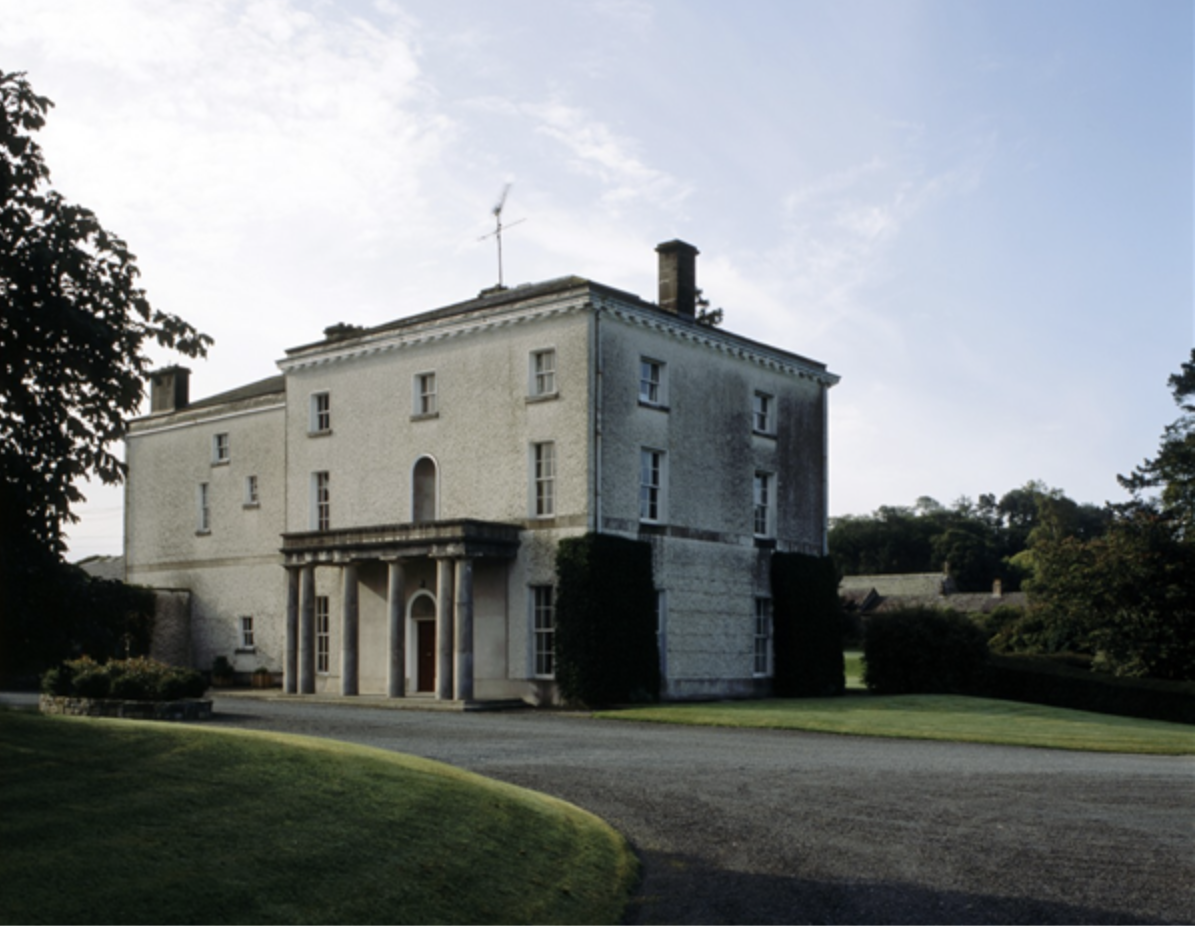
The entrance front of Farnham House, as remodelled in 1961. In an attempt to alleviate dry rot, the oldest part of the house was demolished. Pub Orig Country Life 02/01/2003, volume CXCVII. Photographer Paul Barker.
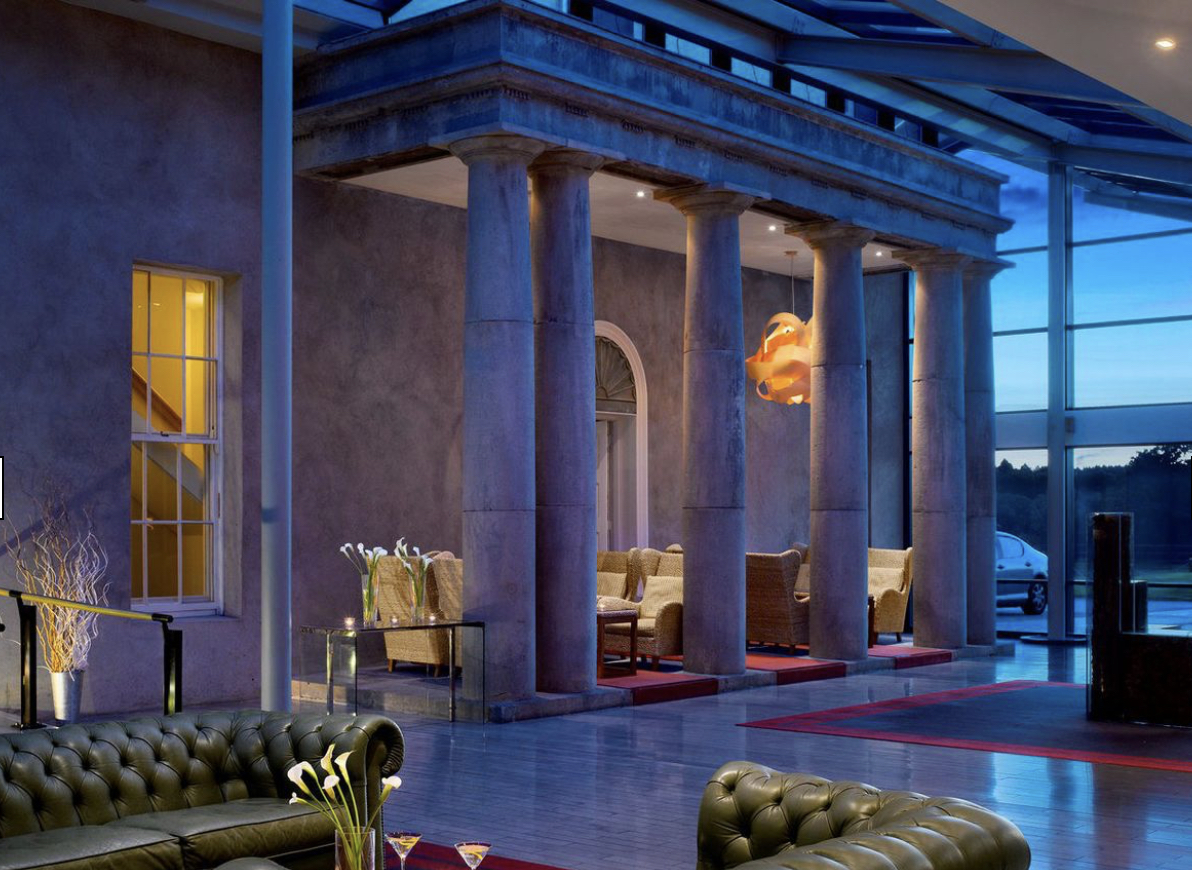
The portico that was on the original entrance front was moved to the rear of the garden front to form a new entrance when part of the house was demolished in 1942. It is now incorporated into the interior of Farnham Estate hotel. Photograph courtesy hotel.
Photograph of Farnham House from Country Life, Pub Orig Country Life 02/01/2003, volume CXCVII. Photographer Paul Barker.

The website continues:

1995 – 2001 – Lord Farnham abandoned farming and leased the agricultural lands to local farmers. One of his last acts on the Farnham demesne was the planting of a group of trees to mark the New Millennium. Lord Farnham died in March 2001 and his wife, Diana, Baroness Farnham now resides in England where she is a current Lady in Waiting to Queen Elizabeth II. Farnham House estate was sold to a local entrepreneur who developed it into a hotel resort.

Present Day – The resort is owned by Mr. Thomas Röggla and along with his team at the resort, every effort is made to provide genuine hospitality in this new phase in the evolution of this magnificent location. Thus, the indelible-mark made by the Maxwell family, as far back as 1664 on the landscape of Farnham Estate will continue to be appreciated by future generations.”

The multimillion refurbishment and extension was headed by architect Des Mahon of Gilroy McMahon, who had previously worked on the National Museum at Collins Barracks and the Hugh Lane Gallery extension.

As former Radisson Blu, Farnham Estate, Cavan 2013. Photograph © Jennifer Winder-Baggot, www.irishhistorichouses.com
Farnham estate. Photograph © Jennifer Winder-Baggot, www.irishhistorichouses.com
Walk on Farnham Estate, Cavan, Sept 2013. Photograph © Jennifer Winder-Baggot, www.irishhistorichouses.com

4. Killinagh House, McNean Court, Blacklion, County Cavanwhole house rental and a lodge

Killinagh House, County Cavan, built 1827, a former Glebe House, three-bay two-storey over basement. Photograph courtesy of Killinagh House facebook page.

https://www.discoverireland.ie/accommodation/killinagh-house

and Killinagh Lodge, https://killinaghlodge.com/facilities.html on the grounds of Killinagh House:

Killinagh Lodge is situated within 1 mile from the village of Blacklion in the picturesque grounds of Killinagh House, a former Church of Ireland manse dating back to Georgian times.

Set in the courtyard, Killinagh Lodge offers luxurious, purpose built, self catering accommodation on the shores of Lough MacNean. Boasting its own private access to the Lough, Killinagh Lodge is set in one of the most beautiful and tranquil locations where you can enjoy the grounds of the wider Estate.

The house website tells us:

Killinagh House is a unique, Georgian Country House, situated in the heart of the Marble Arch Global Geo Park, in west County Cavan. The perfect getaway for peace and relaxation. We cater for customer comforts, special requests and reasonable prices.

The perfect retreat to unwind and recharge the batteries. Peaceful and quiet with relaxed garden views. Killinagh House is at the heart of Marble Arch Global Geo Park, ideally located for outdoor pursuits, including golf, fishing and nature walks.”
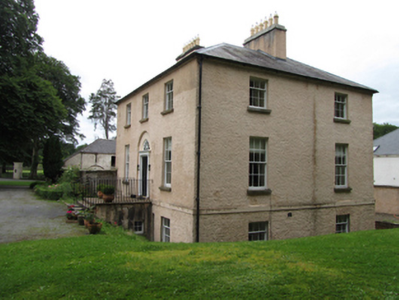
Killinagh House, County Cavan,Photograph from National Inventory of Architectural Heritage.

The National Inventory further describes it: “Roughcast rendered lime-washed walls with string course above basement. Three-over-six timber sash windows to first floor and six-over-six to ground floor all with stone sills and timber internal window shutters. Front door set in smooth-rendered segmental-arched recess, having four-panelled door in classical surround of slender Doric pilasters, metope frieze and cobweb fanlight above. Basement well to east, north and west side. Stone steps leading to entrance with recent metal railings.

5. Lismore House, Co Cavan – was a ruin. Place to stay: Peacock House on the demesne

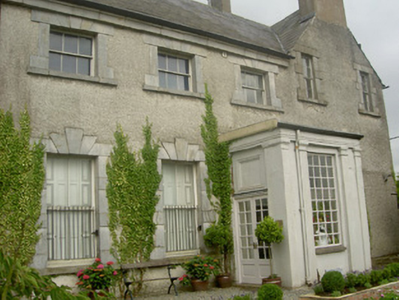
Lismore House, Co Cavan – restored house (believed to have been the agent’s house) and a place to stay, Peacock House, available on airbnb. Of the original Lismore House, attributed to Edward Lovett Pearce (1699-1733), only the two wings and tower survive.

https://www.airbnb.ie/rooms/27674042?source_impression_id=p3_1646316758_vwGIKKMTwiWKK%2FB7
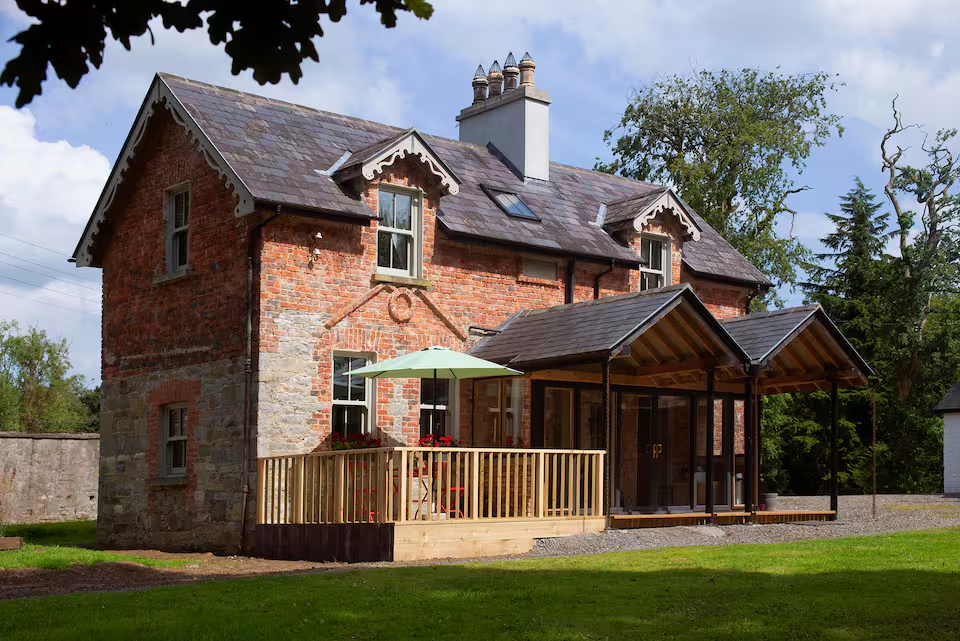
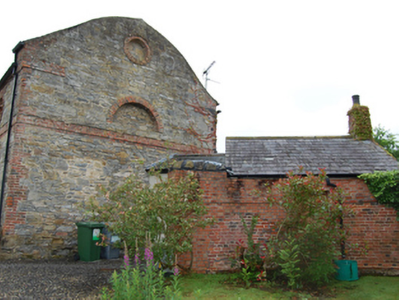
The Peacock House, workers cottage on Lismore Desmese, County Cavan. Photograph courtesy airbnb website.

The airbnb entry tells us of The Peacock House: “The Peacock House is located within the Lismore Demesne. It was once the dairy and workers cottage. From the 1980s onwards it was used to house peacocks, giving the cottage its name. After being left dormant for 80 years it was lovingly restored.” It has two bedrooms.

Lismore House, County Cavan, Photograph from National Inventory of Architectural Heritage. The Inventory tells us it is: “Symmetrical pair of detached six-bay two-storey flanking wings to former Lismore House, built c.1730, having advanced outermost end bays to each block, single-bay two-stage flanking tower formerly attached to south corner of house having single-bay extension to north…Rubble stone walls having red brick quoins, eaves course, and string course. Red brick surrounds to oculi at first floor over round-headed ground-floor windows and central segmental-headed door.

It was probably built for Thomas Nesbitt, (c. 1672-1750), of Grangemore, County Westmeath, High Sheriff of County Cavan, 1720, MP for Cavan Borough, 1715-50 [4].

The house was restored by Richard and Sonya Beer. [5]

Mark Bence-Jones writes about Lismore House in  A Guide to Irish Country Houses (1988), p. 186:

Originally the seat of the Nesbitts, passed to the Burrowes through the marriage of Mary [Mary Anne, born 1826, daughter of John Nesbitt and Elizabeth Tatam] Nesbitt to James Burrowes [1820-1860, of Stradone House, County Cavan] in 1854; Lismore passed to the Lucas-Clements family through the marriage of Miss Rosamund Burrowes to the late Major Shuckburgh Lucas-Clements in 1922.

Lismore House, County Cavan, Photograph from National Inventory of Architectural Heritage: “Blind lunette and oculus to gables facing former house.”

Mary Anne and James had a son, Thomas Cosby Burrowes (1856-1925). He married in 1885 Anna Frances, daughter of Richard Thomas Maxwell, and grand-daughter of the sixth Baron Farnham (of Farnham Estate), by whom he has issue two daughters. One daughter, Rosamund Charlotte Cosby Burrowes, of Lismore, married, in 1922, Major Shuckburgh Upton Lucas-Clements in 1922. [6] The main house was vacated c.1870 when the family relocated to Lismore Lodge, formerly the agent’s house. 
 
Mark Bence-Jones continues: “Having stood empty for many years, the house fell into ruin and was demolished ca 1952, with the exception of the “tower” wings. The office wings are now used as farm buildings, and the family now live in the former agent’s house, an early house with a Victorian wing and other additions.” 

Lismore House, County Cavan, Photograph from National Inventory of Architectural Heritage: “Tower having mansard slate roof, rubble stone walls with cut-stone platbands, cut-stone surrounds to window openings, round-headed openings with raised keystone and impost blocks to former ground floor, and segmental-headed openings to former basement level.”

6. Olde Post Inn, Cloverhill, County Cavan – accommodation, restaurant and wedding venue

https://www.theoldepostinn.com

The website tells us: “The Olde Post inn was built in the 1800s. It opened as a post office in 1884, grocery & residence. It had a number of owners and was for some time derelict before it was renovated into a restaurant with accommodation in early 1990s. It has been run as a restaurant since and was taken over by Gearoid & Tara Lynch in November 2002. Since then it has gone under further refurbishment and been extended to include two Hampton Conservatories.

The Old Post Inn, County Cavan, photograph courtesy of website.

8. Virginia Park Lodge, Co Cavan – wedding venue
WWW.VIRGINIAPARKLODGE.COM

Virginia Park Lodge, County Cavan, photograph courtesy website.

This was formerly the hunting lodge of the Taylours, Marquess Headfort, who also owned Headfort House in County Meath. It was built for the First Earl of Bective, Thomas Taylour (1724-1795), son of Thomas Taylor 2nd Baronet Taylor, of Kells, County Meath, who served as MP for Kells and as a Privy Counsellor in Ireland. His mother was Sarah Graham from Platten, County Meath. Thomas the 1st Earl of Bective also served as Privy Counsellor. He married Jane Rowley, from Summerhill, County Meath.

Thomas Taylour (1724-1795) 1st Earl of Bective wearing the star and sash of the Order of St. Patrick by Gilbert Stuart and studio, courtesy of Sotheby’s. He built Virginia Park Lodge.
Headfort, County Meath, photograph courtesy of Irish Georgian Society.

It was their one of their younger sons, Reverend Henry Edward Taylour (1768-1852), who lived at Ardgillan Castle in Dublin. Their son Thomas the second earl became the 1st Marquess of Headfort, and added to Virginia Park Lodge and imported plants to create the parkland surrounding the Lodge.

Thomas Taylour (1757-1829) 1st Marquess of Headfort by Pompeo Batoni courtesy of Google Art Project Public Domain, https//:commons.wikimedia.org/w/index.php?curid=29800995
Ardgillan Castle, Dublin. Photograph © Jennifer Winder-Baggot, www.irishhistorichouses.com

The Marquess of Headfort married Mary Quin, from Quinsborough, County Clare. The Lodge passed through the family to the 4th Marquess, Geoffrey Thomas Taylour, son of the second wife of the 3rd Marquess. He married a music hall star, Rosie Boote, which scandalised society, but they moved to the Lodge and lived happily and had many children.

The Lodge was bought by chef Richard Corrigan in 2014, and he has undertaken much work to restore it to its former glory.

*************************

[1] Bence-Jones, Mark. A Guide to Irish Country Houses (originally published as Burke’s Guide to Country Houses volume 1 Ireland by Burke’s Peerage Ltd. 1978); Revised edition 1988 Constable and Company Ltd, London.

[2] https://theirishaesthete.com/2015/09/09/a-mere-shell/

[3]  see Timothy William Ferres: http://lordbelmontinnorthernireland.blogspot.com/2013/09/cloverhill-house.html

[4] ibid.

[5] https://www.anglocelt.ie/news/roundup/articles/2018/06/17/4157489-bringing-lismore-back-from-the-dead/ 

[6] https://nisbetts.co.uk/archives/nesalx.htm

Text © Jennifer Winder-Baggot, www.irishhistorichouses.com

Places to visit and stay in County Louth, Leinster

On the map above:

blue: places to visit that are not section 482

purple: section 482 properties

red: accommodation

yellow: less expensive accommodation for two

orange: “whole house rental” i.e. those properties that are only for large group accommodations or weddings, e.g. 10 or more people.

green: gardens to visit

grey: ruins

donation

Help me to pay the entrance fee to one of the houses on this website. This site is created purely out of love for the subject and I receive no payment so any donation is appreciated!

€15.00

Places to visit in County Louth

1. Barmeath Castle, Dunleer, Drogheda, Co. Louth – section 482

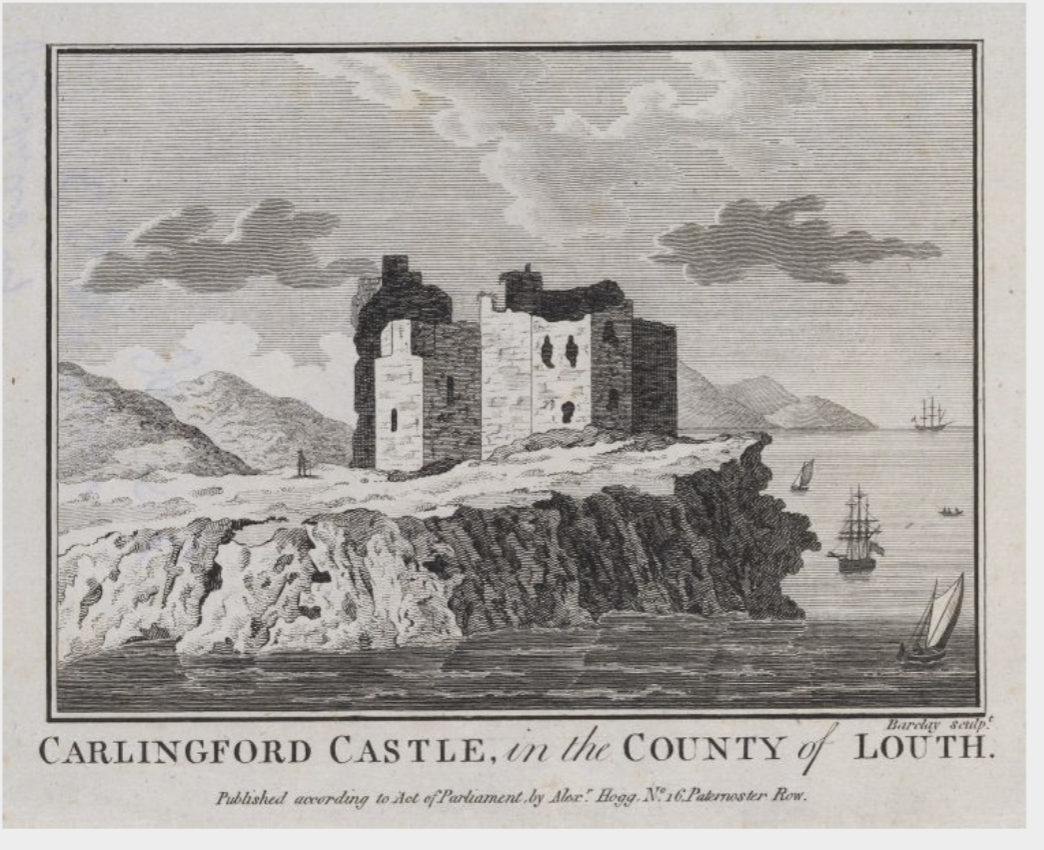
2. Carlingford Castle, County Louth – OPW

3. Castle Bellingham, Co. Louth – sometimes open for a visit

4. Collon House, County Louth – can book a tour

5. Killineer House & Garden, Drogheda, Co. Louth – section 482

6. Old Mellifont Abbey, County Louth – OPW

7. Rokeby Hall, Grangebellew, Co. Louth – section 482

Places to stay, County Louth:

1. Ballymascanlon House, Louth  – hotel 

2. Collon House, Ardee Street, Collon, Louth (also Oriel Temple) – B&B, plus guided tours 

3. Ghan House, Co Louth – accommodation 

Whole House Rental, County Louth:

1. Barmeath Castle, Dunleer, Drogheda, Co. Louth – section 482 and guest house rental

2. Bellurgan Park, County Louth – weddings and events

3. Castle Bellingham, Co. Louth – weddings

4. Darver Castle, County Louth – wedding and event venue

Places to visit in County Louth

1. Barmeath Castle, Dunleer, Drogheda, Co. Louth A92 P973 – section 482

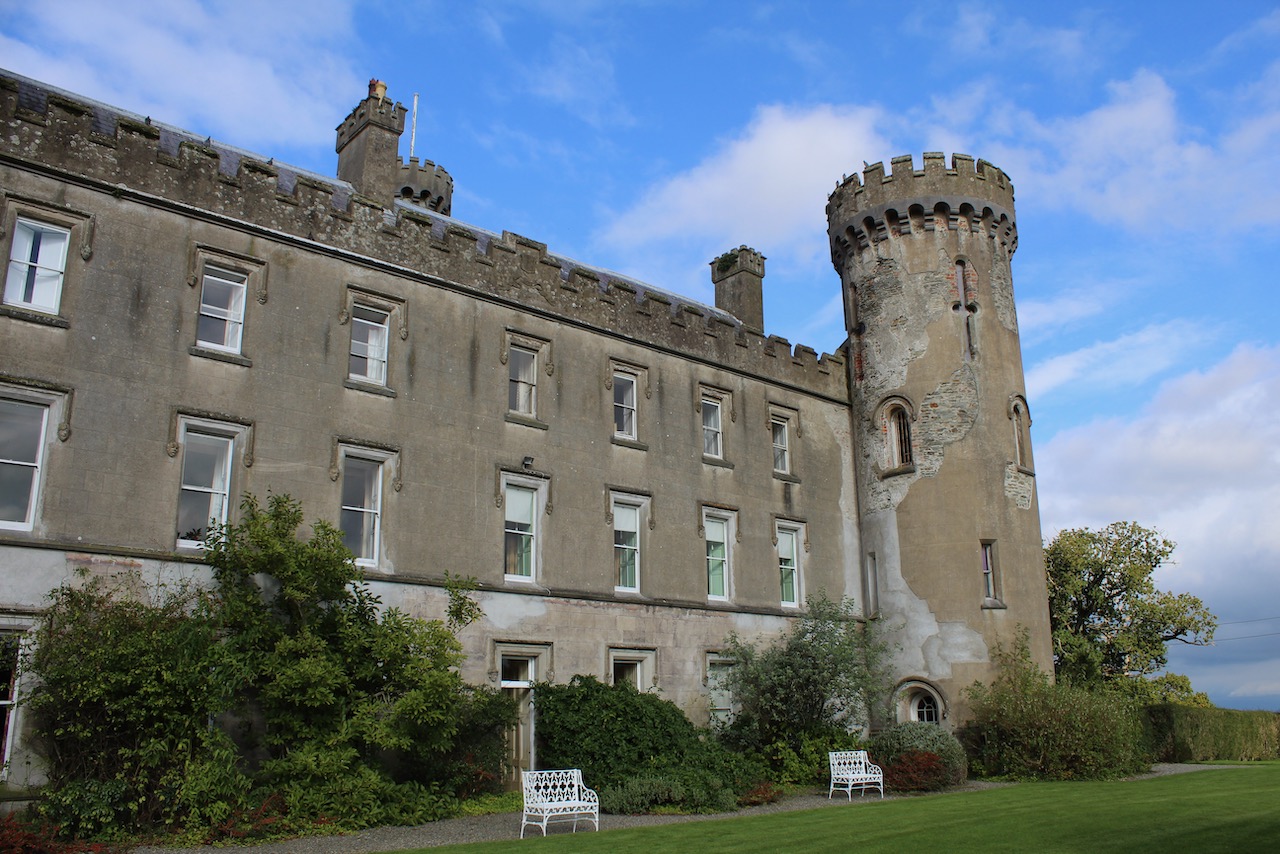
Barmeath, County Louth, October 2019. Photograph © Jennifer Winder-Baggot, www.irishhistorichouses.com
See my entry:

https://irishhistorichouses.com/2020/10/23/barmeath-castle-dunleer-drogheda-county-louth/

Open dates in 2026: May 1-31, June 1-10, Aug 15-23, Oct 1-20, 9am-1pm

Fee: house, adult/OAP/student €5, garden, adult/OAP/student €5, child free

2. Carlingford Castle, County Louth – OPW

See my entry https://irishhistorichouses.com/2022/02/07/office-of-public-works-properties-leinster-laois-longford-louth-meath-offaly-westmeath-wexford-wicklow/

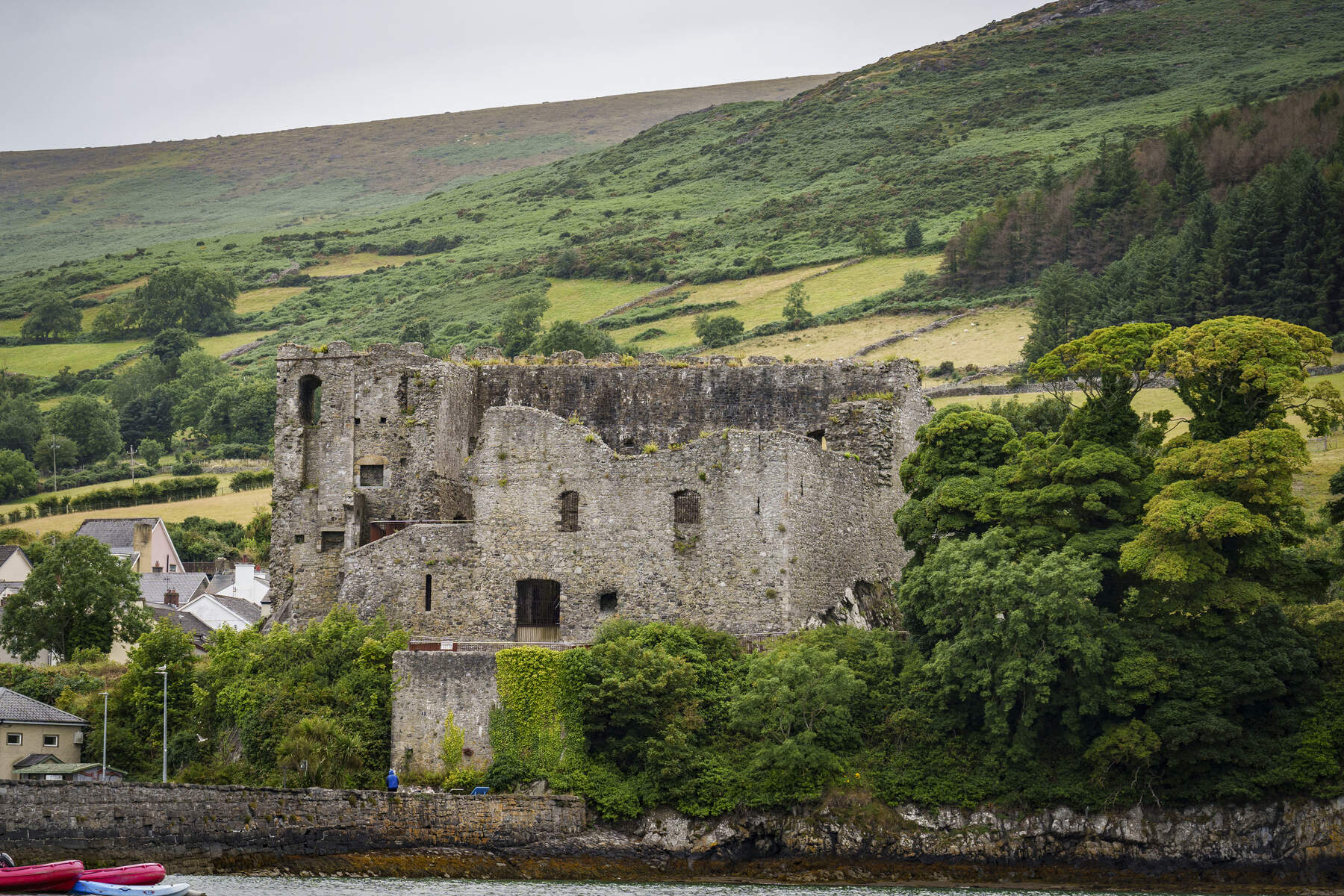
King John’s Castle, Carlingford, Co Louth, photograph by Nomos Production for Failte Ireland 2022.
Carlingford Castle, Carlingford Lough, County Louth, photograph courtesy of National Gallery of Ireland.

3. Castle Bellingham, Co. Louth – for weddings, and open to public for visits:

Open to the public viewing, see website.

https://www.bellinghamcastle.ie

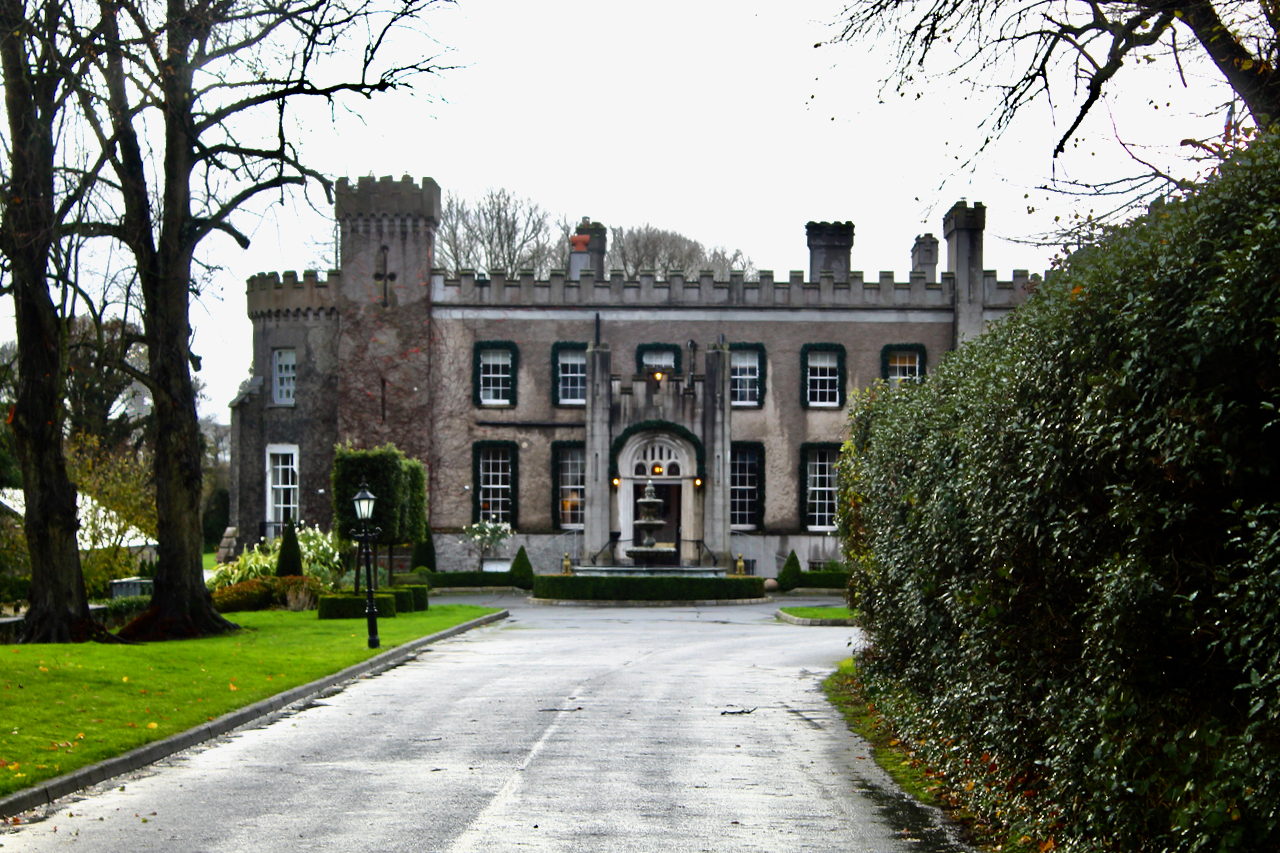
Castle Bellingham, County Louth, November 2022. Photograph © Jennifer Winder-Baggot, www.irishhistorichouses.com
We visited Castle Bellingham in November 2022, and Mr. Corscadden gave us a tour. It’s a beautiful castle venue, for weddings or events, and is sometimes available for accommodation.

It was a rainy November day and the castle is long so I didn’t capture the whole front facade in one shot, so I include to older photograph from the National Inventory of Architectural Heritage.

Castle Bellingham in November 2022. Photograph © Jennifer Winder-Baggot, www.irishhistorichouses.com
The Castle is owned by the Corscadden family, who also own Cabra Castle in County Cavan, Markree in County Sligo, and the other we have yet to visit, Ballyseede in County Kerry.

The website tells us:

At Bellingham Castle, the welcome is warm, the facilities luxurious and the memories, eternal. Nestled in the medieval village of Castlebellingham in County Louth along Ireland’s Ancient East, Bellingham Castle is an elegant and spacious 17th Century authentic Irish Castle available for exclusive hire, to allow you become King or Queen of your very own castle for a truly memorable experience. The Castle opens for overnight stays on select dates throughout the year, but is predominantly a venue for spectacular Weddings, conferences or events.

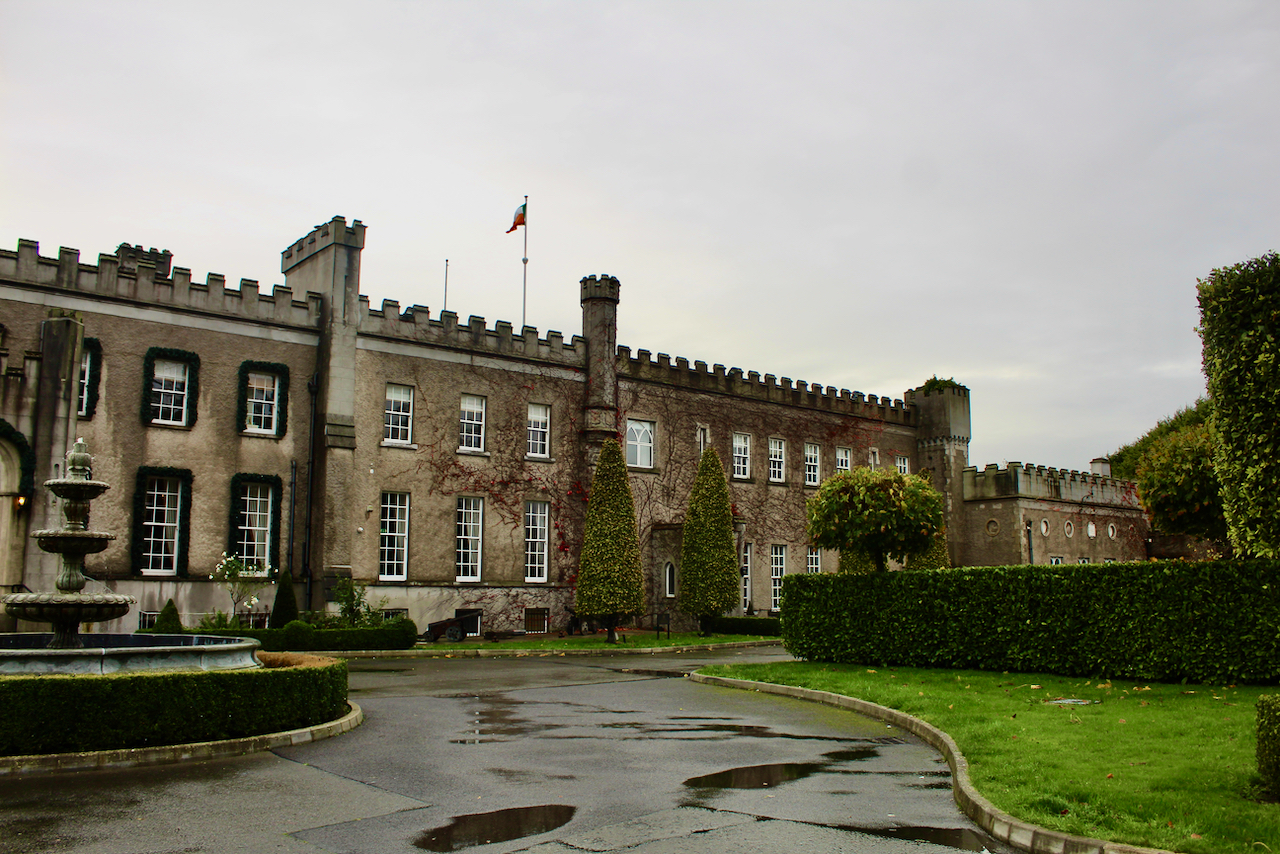
Castle Bellingham in November 2022. Photograph © Jennifer Winder-Baggot, www.irishhistorichouses.com
Set at the gateway to the Cooley mountains and on the banks of the glistening River Glyde, Bellingham Castle is the centrepiece of a 17-acre estate that includes a weir and man-made river island where you can create memories that last a lifetime. The opulent 17th Century Irish castle is bursting with rich history, splendour and old-world luxury.

Fully refurbished, yet retaining all of its character and charm, Bellingham Castle prides itself on elegance and sophistication, intimacy and cosiness, luxury and exclusivity – all just 50 minutes from both Dublin and Belfast.

Castle Bellingham in November 2022. Photograph © Jennifer Winder-Baggot, www.irishhistorichouses.com

We wanted to create something different at Bellingham Castle, an exquisite combination of a welcoming atmosphere and luxury castle experience. From dreamy and palatial bedrooms, to magnificent reception rooms and meticulously manicured gardens, we ensure each guest enjoys high-quality, bespoke service in an idyllic and inspirational location.

Castle Bellingham, County Louth, photograph from National Inventory of Architectural Heritage [1]

Mark Bence-Jones writes of Castle Bellingham (1988):

p. 62. “The original castle here, called Gernonstown, which was acquired by Henry Bellingham [1622-1676] mid C17, was burnt by King James’s soldiers before the Battle of the Boyne, when its then owner, Colonel Thomas Bellingham [1645-1721], was fighting for King William. Col Bellingham built a new house 1690/1700 [the National Inventory says 1712] and named it Castle Bellingham; it had a high-pitched roof and is said to have resembled Beaulieu, in the same county. Mrs Delany described it (1745) as “one of the prettiest places I have seen in Ireland.”

Castle Bellingham, County Louth, November 2022. Photograph © Jennifer Winder-Baggot, www.irishhistorichouses.com
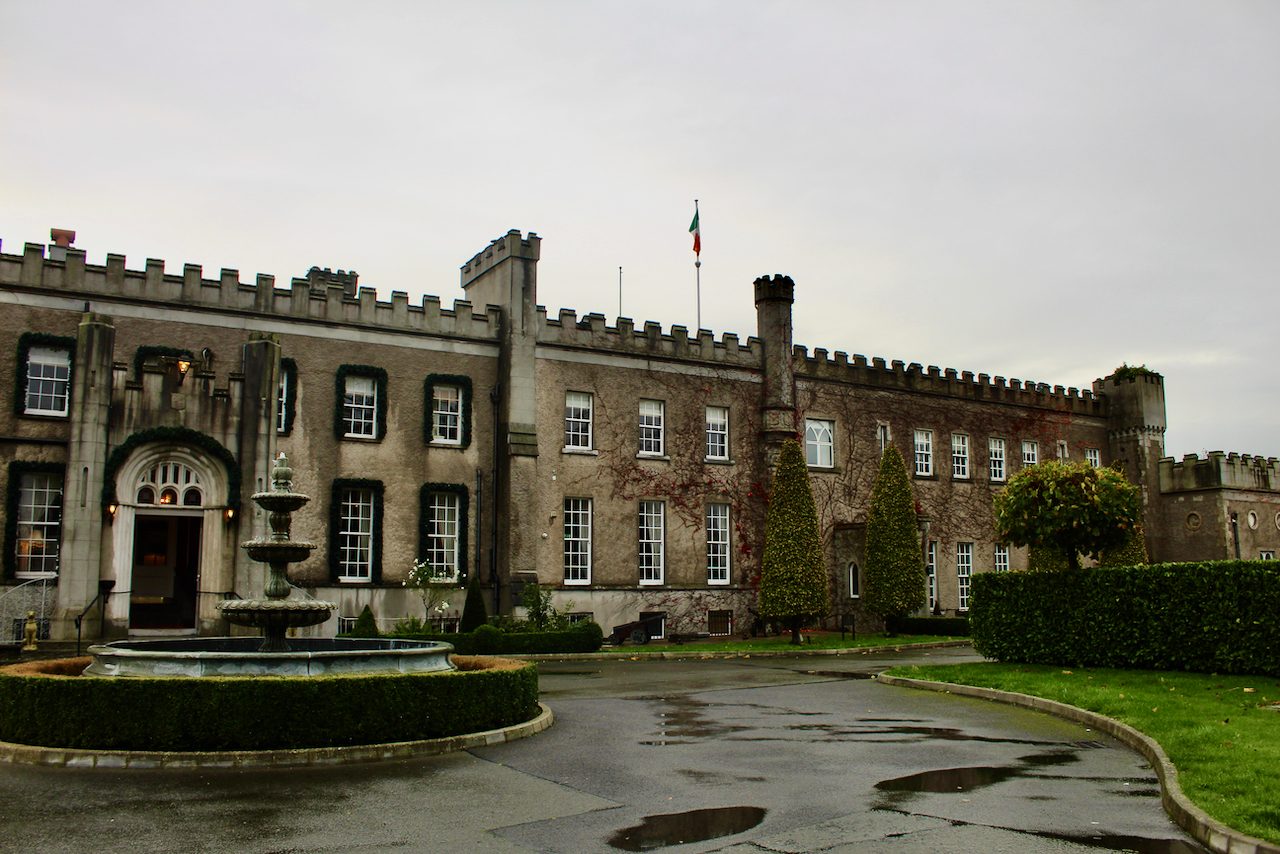
The house was remodelled in later C18, when a third storey was added, and again in early C19, when it was given a battlemented parapet, some turrets and a few other mildly medieval touches. The final result was not so much a castle as a castellated house, with plain Georgian sash windows. The nine bay entrance front, which appears to be only of two storeys owing to the higher ground on this side; the entrance, through a Gothic porch not centrally placed, is, in fact, on the first floor, where the principal rooms are situated. The opposite front, which also just misses being symmetrical – with three bays on one side of a shallow, curving bow and two bays and a turret on the other – also has a curved bow. Simple, pleasant rooms; a small staircase in a narrow hall at right angles to the entrance. Garden with terraces overlooking the river Glyde, formerly adorned with statues brought from Dubber Castle, the seat of another branch of the Bellinghams; vista to shrine of the Virgin Mary, erected by Henry Bellingham, a convert to Catholicism during the later years of the Oxford Movement. Straight avenue aligned on the entrance front of the house, terminated at the opposite end by a castellated gatehouse facing the village green. Having been sold by the Bellinghams ca 1956, Castle Bellingham is now an hotel.” [2]

Castle Bellingham, County Louth, November 2022. Photograph © Jennifer Winder-Baggot, www.irishhistorichouses.com
The website gives a further history of the castle:

Bellingham Castle served as one of the ancestral homes for the Bellingham family from the 17th Century until the 1950s. The original castle was built around 1660 by Sir Henry Bellingham [1622-1676], who was a cornet in the Army during the Civil War.

He purchased the lands of Gernonstowne, Co. Louth, from a fellow soldier who had been granted them in lieu of arrears of pay. The purchase was confirmed by King Charles II.

There is some variation on the spelling of Gernonstowne. On various maps and other documents, it is spelled Gernonstowne, Gernonstown, Gernon’s-Town, Gormanstown, Germanstown, Garlandstown and Garland.

Irish road signs show the English as Castlebellingham, while the Irish translation still refers to Baile an Ghearlanaigh – or Gernonstown. It was not called Castlebellingham for at least 40 years after the purchase. The name does not appear on any document before the year 1700. Around 1710, it began to appear in journals and other sources as Castlebellingham.

The castle was occupied by troops and burned down in the autumn of 1689 by King James II, in revenge for Colonel Thomas Bellingham [1645-1721] being a guide for William III, prior to the Battle of the Boyne. It is said that King William’s armies camped the night before the Battle of the Boyne in the grounds of the castle.

Thomas Bellingham had a son, Henry. The estate passed Henry’s son Henry, but he had no children so when he died in 1755 it passed to his brother Alan Bellingham (1709-1796).

Alan’s son O’Bryen Bellingham (d. 1798) set up a brewery on site around 1770. The website tells us:

The website continues: “Over time, Castlebellingham became an important gathering point in the county. Fairs were held there every year and a church was constructed next door to the castle, along with a graveyard that houses the Bellingham family vault. The Bellinghams became one of the most powerful and influential families in the county; for over 100 years, a Bellingham held the seat in Parliament for County Louth.

Records also note Castlebellingham for having ‘the best malt liquor’ in Ireland. A brewery was built on site about 1770 and belonged to an O’Bryen Bellingham [d. 1798, a son of Alan Bellingham]. For a number of years, a brewery partnership ran their liquor business. The brewery is still there but now houses the ‘button factory’ or Smallwares Ltd. The brewery was the main supplier of drink to the Boer War troops.

Alan’s son William married  Hester Frances Cholmondeley, daughter of Reverend Robert Cholmondeley and was created 1st Baronet Bellingham, of Castle Bellingham, Co. Louth. He did not have any children and the title passed to his brother Alan’s son, another Alan (1740-1800), who became 2nd Baronet Bellingham of Castle Bellingham, County Louth.

The website continues: “A history of the parish, dated 1908, states that the impressive Calvary standing at the entrance to Bellingham Castle was erected by Sir [Alan] Henry Bellingham [4th Baronet]as a monument to the memory of his first wife, Lady Constance.

A collection of inset religious panels can be seen on the upper facades of many of the village buildings. These are also a reflection of Sir Henry’s religious sentiments, and they are unique in Ireland. In addition to the many panels, there are biblical quotations cut into the stone window sills of some buildings. North of the castle is a carefully preserved group of ‘widows’ dwellings’, built from charitable motives by Sir Henry.

In 1905, Bellingham Castle was the venue for the romantic wedding celebrations of Augusta Mary Monica Bellingham, daughter of Sir Alan Bellingham [1846-1921], 4th Baronet to the 4th Marquis of Bute, John Crichton-Stuart.

The Marquis, who was one of the wealthiest men in the British Isles at the time, spared no expense and treated his bride and guests to a lavish celebration, including chartering the Princess Maud steamer to take their guests and the Isle of Bute pipe band across the Irish Sea to Bellingham Castle for the wedding. As the society event of the year, the wedding attracted worldwide media attention, from California to New Zealand.

Footage from the wedding celebrations still exists. This remarkable film is believed to be the one of the earliest wedding films in the world. Bellingham Castle is clearly depicted in the footage, together with scenes at nearby Kilsaran Church and the village of Annagassan, from where the wedding party and their guests arrived and departed by steamer.

Castlebellingham was the ancestral home of the Baronetcy until the late 1950s. The last Bellingham to live there was Brigadier General Sir Edward Bellingham [5th Baronet], born in 1879, who was the last Lord Lieutenant and Guardian of the Rolls (Custos Rotulorum).

It was purchased by Dermot Meehan in 1958 from the Irish Land Commission for £3,065.00. Mr Meehan spent several years converting the house into a hotel. The Meehan family sold the hotel and 17 acres in 1967 for £30,636.61 to Mr John Keenan and under the Keenan family stewardship, the castle prospered over the following four decades.

In December 2012, the castle – including the 17 acres – was acquired by the Corscadden family. The family also own Ballyseede Castle in Tralee, Co. Kerry; Cabra Castle, Kingscourt, Co. Cavan, and Markree Castle, Co. Sligo.

“The next chapter in the history of Bellingham Castle has begun, as an exclusive venue for private weddings, civil ceremonies, conferences, meetings and corporate events.

Bellingham Castle is a building of intrinsic historical and architectural interest and is open to the public between the hours of 1pm and 3pm, Monday to Friday for viewing year-round. Please call in advance to ensure there is somebody at the castle to show you around! (Closed December 24, 25 and 26).

4. Collon House, County Louth

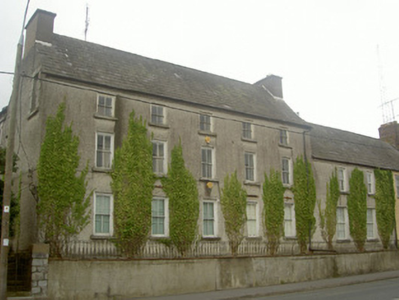
Collon House, County Louth, photograph from National Inventory of Architectural Heritage [3]

https://www.collonhouse.com

The website tells us:

Collon House, steeped in history, is full of character and charm; its gracious rooms are exquisitely furnished with period antiques and paintings, retaining the atmosphere of early Georgian living, making this a rare opportunity to experience less than one hour from Dublin City Centre, thirty minutes from Dublin Airport and just five miles from historic Slane.

Collon House is a perfect location from which to enjoy the wonderful treasures of the Boyne Valley. Bru na Boinne (Newgrange) prehistoric megalithic sites, The Battle of the Boyne visitors centre at Oldbridge, Slane Castle, Old Mellifont Abbey and Monasterboice High Crosses are all less than twenty minutes drive from Collon House.

The Historic Houses of Ireland (HHI) website tells us:

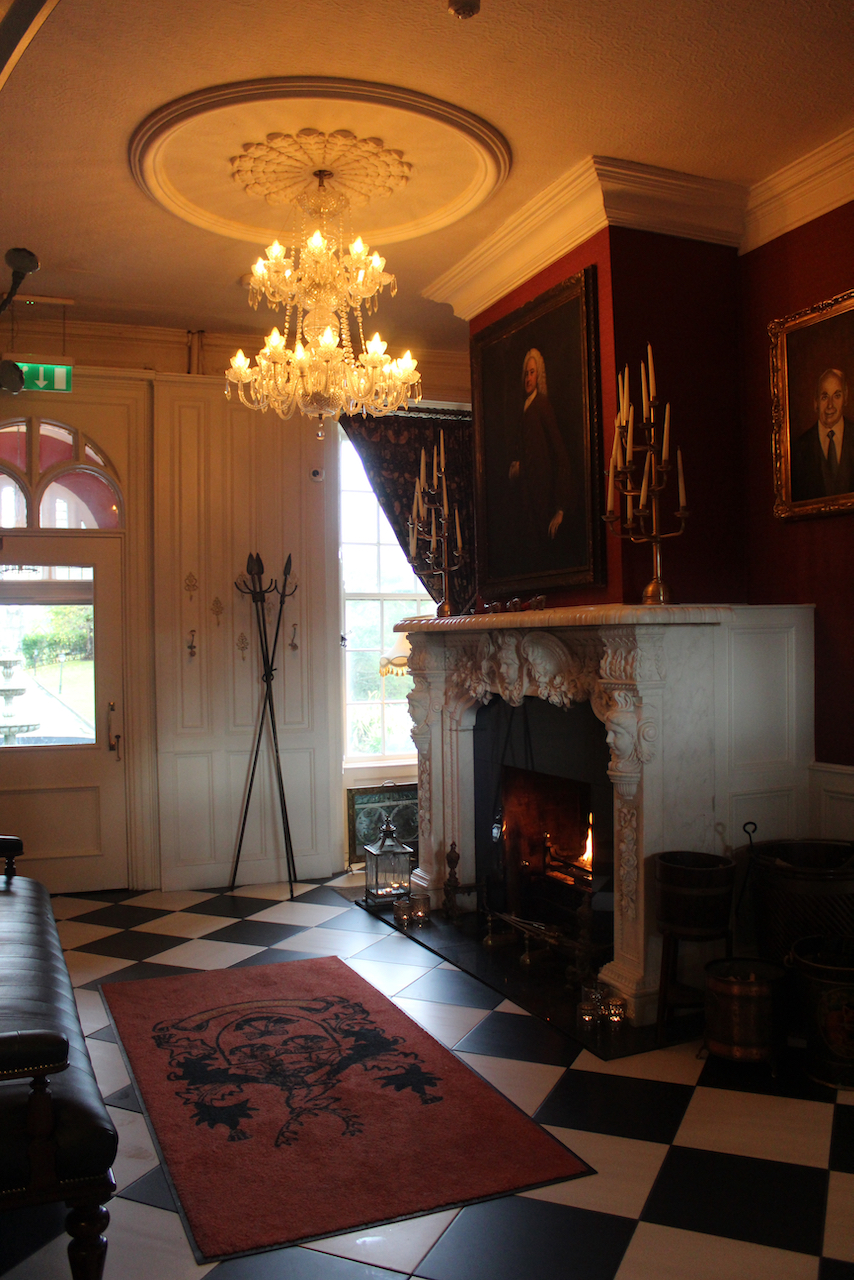
Anthony Foster [1705-1778], Lord Chief Baron of the Exchequer, purchased the Collon estate in 1740 and chose to build in the centre of the County Louth village, now a market town on the road from Dublin to Derry. His early Georgian house was extended in the 1770s to form a substantial L-shaped dwelling, set back from the street at the central crossroads. The original dwelling is long and low but the later building is taller and more generous in scale with more elaborate interiors and a “handsome half-turn stair” that gives access to the upper floors.” [4]

Anthony Foster married Elizabeth Burgh of Bert House (now called de Burgh Manor, available as a whole house rental, see my entry www.irishhistorichouses.com/2022/04/27/places-to-visit-and-to-stay-leinster-kildare-kilkenny-laois/), County Kildare.

The HHI website continues: 

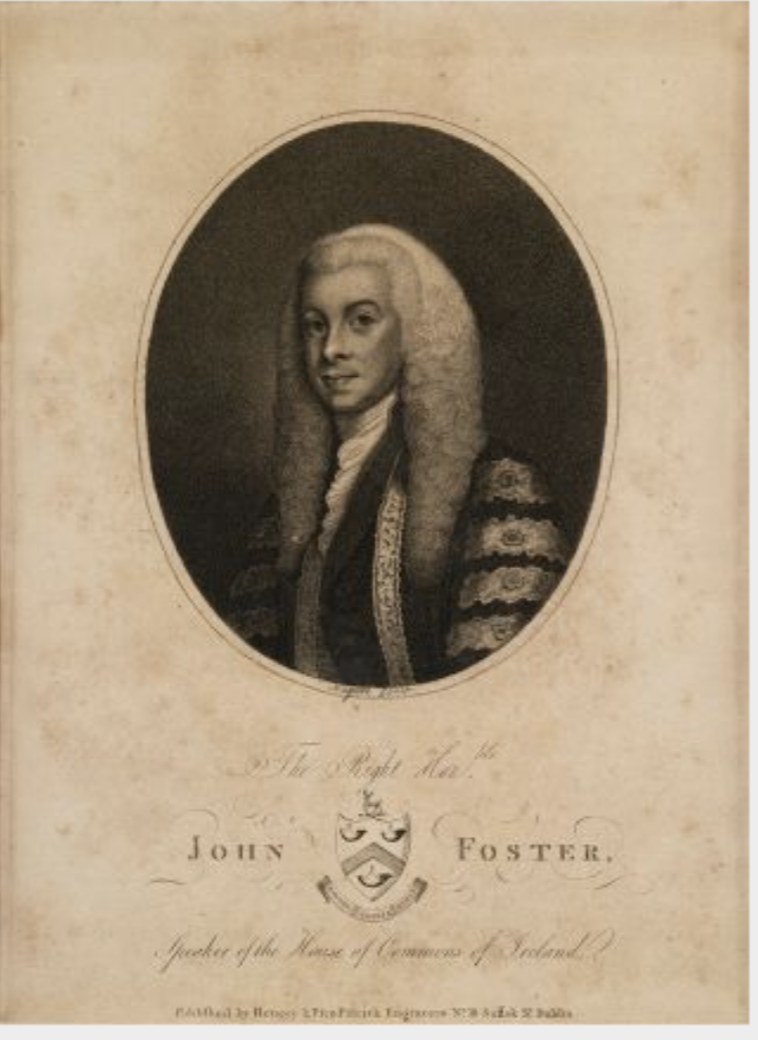
Anthony’s son John [1740-1828] was elected to the family borough of Dunleer and became the member for Louth in 1768 at the age of twenty-one. Considered ‘the best informed man in the house’ he was briefly Chancellor of the Irish Exchequer before his election as Speaker of the Irish Commons. He held office from 1785 until 1800, when Parliament was dissolved for ever under the Act of Union, a measure which Foster had strenuously opposed. As Speaker he pronounced the final words at the closing session, choosing to retain his official mace ‘for future contingencies’. Mr. Speaker Foster was returned to Westminster after the Union and was finally rewarded with a UK peerage in 1821 (his wife had previously been granted two Irish titles) after an illustrious political career that spanned more than sixty years. 

In ‘A Tour of Ireland published in 1780, the agronomist Arthur Young mentions Foster whose improvements on the Collon estate “were of a magnitude that I have never heard of before.” These included Oriel Temple, an elaborate and chastely classical lakeside folly, which was subsequently enlarged to form the principal family seat. Foster’s son Thomas married an heiress, Harriet Skeffington, and the family moved to Antrim Castle when she succeeded as Viscountess Massereene.”

John Foster, (1740-1828), Last Speaker of the Irish House of Commons, later 1st Baron Oriel Date 1799 Engraver Patrick Maguire, Irish, fl.1783-1820 After Gilbert Stuart, American, 1755-1828. Photograph courtesy of the National Gallery of Ireland.

For more about the Foster family see my Cabra Castle entry, www.irishhistorichouses.com/2021/03/28/cabra-castle-kingscourt-county-cavan/ 

The HHI website continues: “Collon House has been altered over the intervening years but the building retains many fine Georgian interiors, now greatly enhanced by sympathetic restoration, fine furniture, glass, porcelain, pictures and objects. Their rich decoration makes a striking contrast with the plain exterior.

The gardens have also been restored with inspired and authentic planting. The entrance overlooks a sunken garden with an intricate box parterre, while the herbaceous border in the ornamental garden leads to a classical summer house in the Grecian style.” [4]

Collon House, County Louth, photograph from National Inventory of Architectural Heritage [3]

The National Inventory tells us it is a: “Corner-sited attached five-bay three-storey house, built c. 1770. Rectangular-plan, extended by two-bays into two-storey terrace to east, three-bay two-storey wing to north, extended former mews buildings surrounding courtyard to north, single-storey flat-roofed entrance porch to west elevation…This imposing house, the principal home of the Foster family, at the heart of Collon, has historical associations with John Foster, the last man to speak in the Irish House of Commons. It contains many details of interest, such as stone window dressings. Its prominence at the heart of the village is of intrinsic importance to the architectural heritage of Collon.” (see [3])

5. Killineer House & Garden, Drogheda, Co. Louth A92 P8K7 – section 482

Killineer, Drogheda, County Louth, June 2021. Photograph © Jennifer Winder-Baggot, www.irishhistorichouses.com
See my entry:

https://irishhistorichouses.com/2021/08/10/killineer-house-county-louth/

www.killineerhouse.ie

Open dates in 2026: Feb 1-20, May 1-31, Aug 15-23, 9am-1pm

Fee: house and garden, adult/OAP/child/student, €12, house €5, garden €7

6. Old Mellifont Abbey, County Louth – OPW

See my entry https://irishhistorichouses.com/2022/02/07/office-of-public-works-properties-leinster-laois-longford-louth-meath-offaly-westmeath-wexford-wicklow/

7. Rokeby Hall, Grangebellew, Co. Louth – section 482

Rokeby, County Louth, September 2019. Photograph © Jennifer Winder-Baggot, www.irishhistorichouses.com
See my entry:

https://irishhistorichouses.com/2020/08/17/rokeby-hall-grangebellew-county-louth/

www.rokeby.ie

Open dates in 2026: June 1-30, Aug 1-31, 10am-2pm

Fee: adult/OAP €10, child/student €5

Places to stay, County Louth:

1. Ballymascanlon House, Louth  – hotel

 https://www.ballymascanlon.com

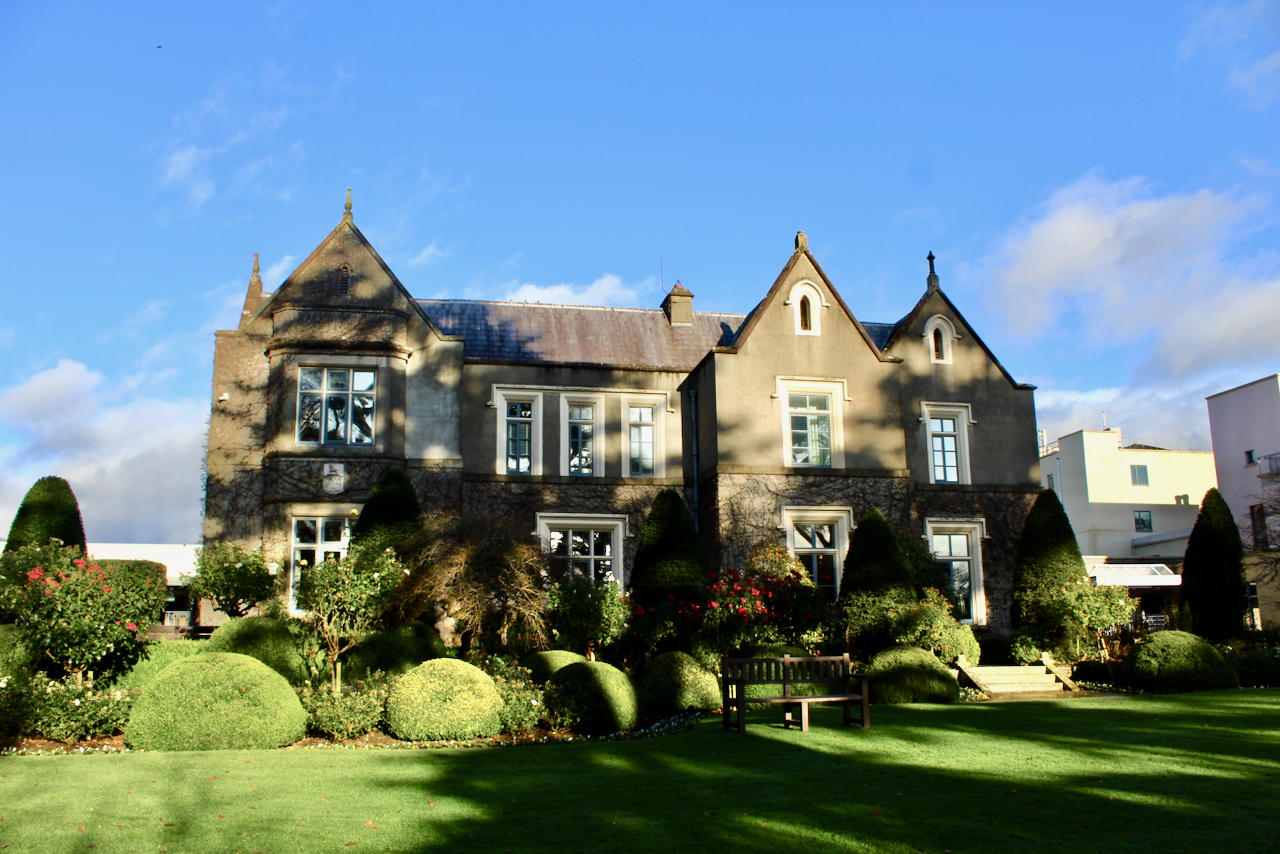
Ballymascanlon House, County Louth, November 2022. Photograph © Jennifer Winder-Baggot, www.irishhistorichouses.com

We treated ourselves to a stay in Ballymascanlon House hotel in November 2022.

The website tells us: “The Ballymascanlon House is set on 130 acres of beautiful parkland, this impressive Victorian House forms the heart of this Hotel. It is one of the most remarkable historical estates in Ireland dating back to 833 A.D. Steeped in history, Ballymascanlon estate is located in Ireland’s North East on the Cooley Peninsula in close proximity to the Irish Sea and Mourne Mountains. Less than 1 hour from Dublin and Belfast, and 20 minutes from the medieval town of Carlingford. We are delighted to welcome you to our beautiful luxurious venue, ideal for both Business and Leisure.”

Ballymascanlon House, County Louth, November 2022. Photograph © Jennifer Winder-Baggot, www.irishhistorichouses.com
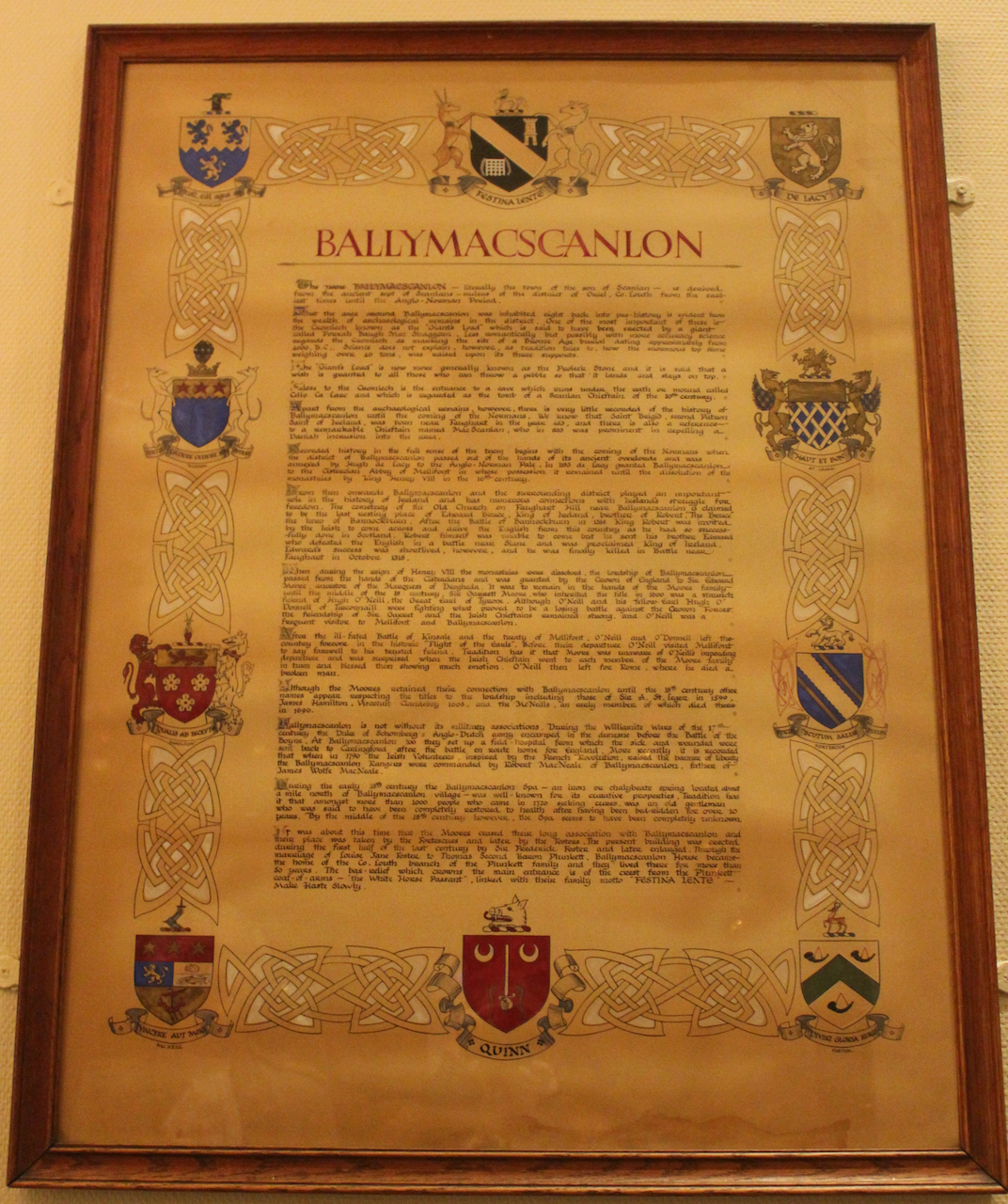
Ballymascanlon means the town of the son of Scanlan, and was part of the ancient Sept of Scanlan. I noticed that locals call it “Ballymac” and it would seem the “mac” would be correct if it’s “son of” though the name now skips that “c” – it’s not named “Ballymac scanlan” any longer. A document in the front hall tells us of its history. The area is full of ancient archaeological features including the Proleek Dolmen which dates to approximately 4000 BC. The information tells us that a chieftain, MacScanlan, expelled a Danish incursion into the area, before the Anglo-Normans came to Ireland.

Ballymascanlon House, County Louth, November 2022. Photograph © Jennifer Winder-Baggot, www.irishhistorichouses.com
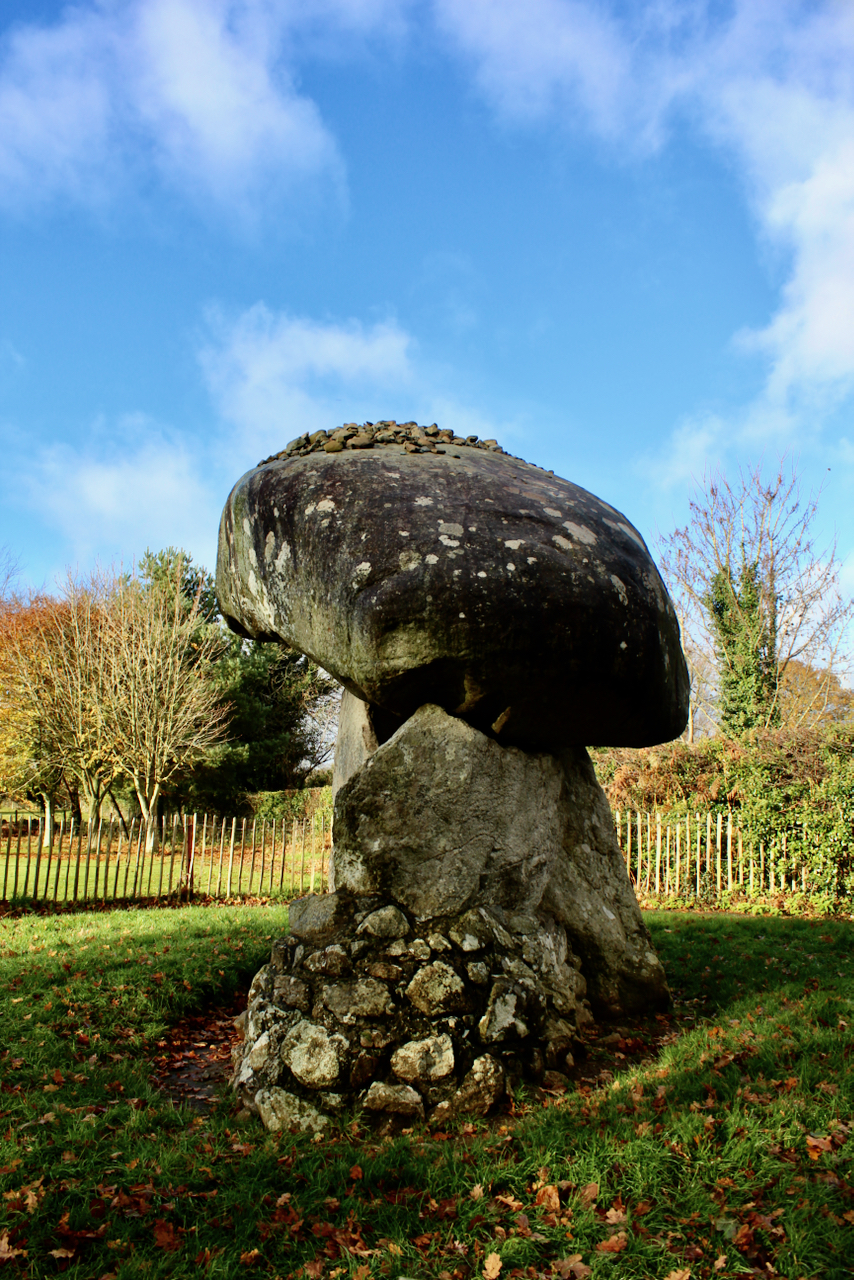
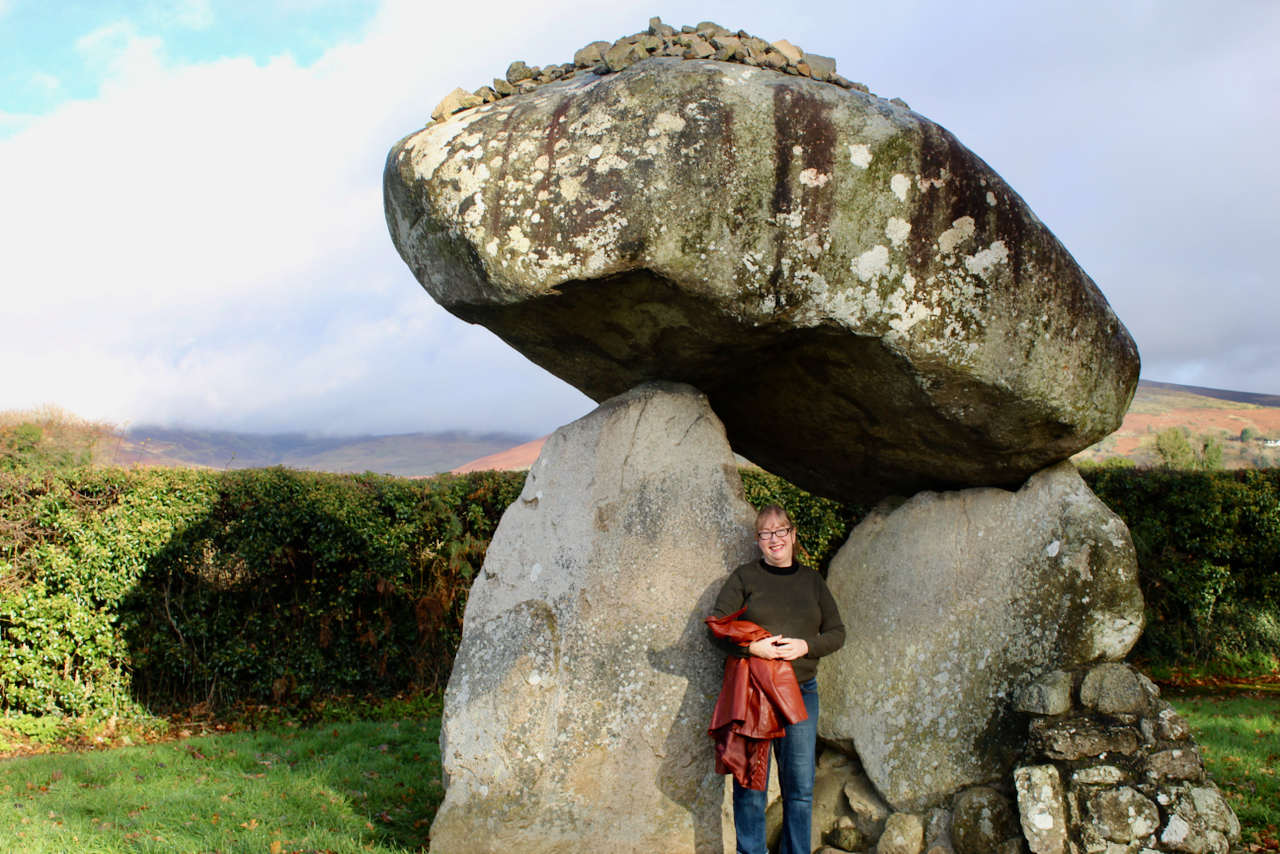
The Proleek Dolmen, on the grounds of Ballymascanlon. Legend has it if you toss a stone and it stays on top, you can make a wish. Despite not wanting to desecrate a grave, Stephen and I took part in the tradition – I had no luck but Stephen managed! It’s an unfortunate tradition though, I think, not the right way to treat a sacred site. Photograph © Jennifer Winder-Baggot, www.irishhistorichouses.com
Ballymascanlon House, County Louth, November 2022. Photograph © Jennifer Winder-Baggot, www.irishhistorichouses.com
Ballymascanlon House, County Louth, November 2022.
A smaller dolmen grave near the Proleek Dolman. Photograph © Jennifer Winder-Baggot, www.irishhistorichouses.com
When the Anglo-Normans came, Hugh de Lacy gave this area to the Cistercian Mellifont Abbey. After the dissolution of the monastery by King Henry VIII the land was given to Edward Moore (1540-1601), ancestor of the Marquess of Drogheda.

The document also tells us that the Duke of Schomberg camped here before the Battle of the Boyne, and that a field hospital was set up. Later the Irish Volunteer branch, the Ballymascanlon Rangers, were led by Robert MacNeale of Ballymascanlon, father of James Wolf MacNeil, who built the building we see today.

Ballymascanlon House is a multiple-bay two-storey over basement with attic Tudor-Revival house, built in 1863 for James Wolfe MacNeil, incorporating fabric of earlier building which had been built for Frederick Foster, with gables, mullioned windows, hood-mouldings and a recessed doorway. [5] MacNeil owned the nearby corn mills. There may be been a house previously located on the site, David Hicks tells us in Irish County Houses, A Chronicle of Change. [6]

Hicks tells us that the house was sold and further improved by architect P.J. Byrne for Frederick Foster. The red brick gate lodge was added at this time. Frederick Foster (1799-1888) married Isabella Vere. He was the son of John William Foster (1745-1809). Frederick had no children. His sister Louisa Jane married Thomas Span Plunkett, 2nd Baron Plunket of Newton.

Further building works were carried out in 1904 and 1919 for Katherine Plunkett, daughter of Louisa Jane and Thomas Span Plunkett, who then owned the house. The house has high pitched gables and projecting bays. The Plunkett coat of arms over the front door depicts and horse and the Plunkett motto, Festina Lente, or Make Haste Slowly.

Ballymascanlon House, County Louth, November 2022. Photograph © Jennifer Winder-Baggot, www.irishhistorichouses.com
Ballymascanlon in the late 1800s.

Hicks continues his description:

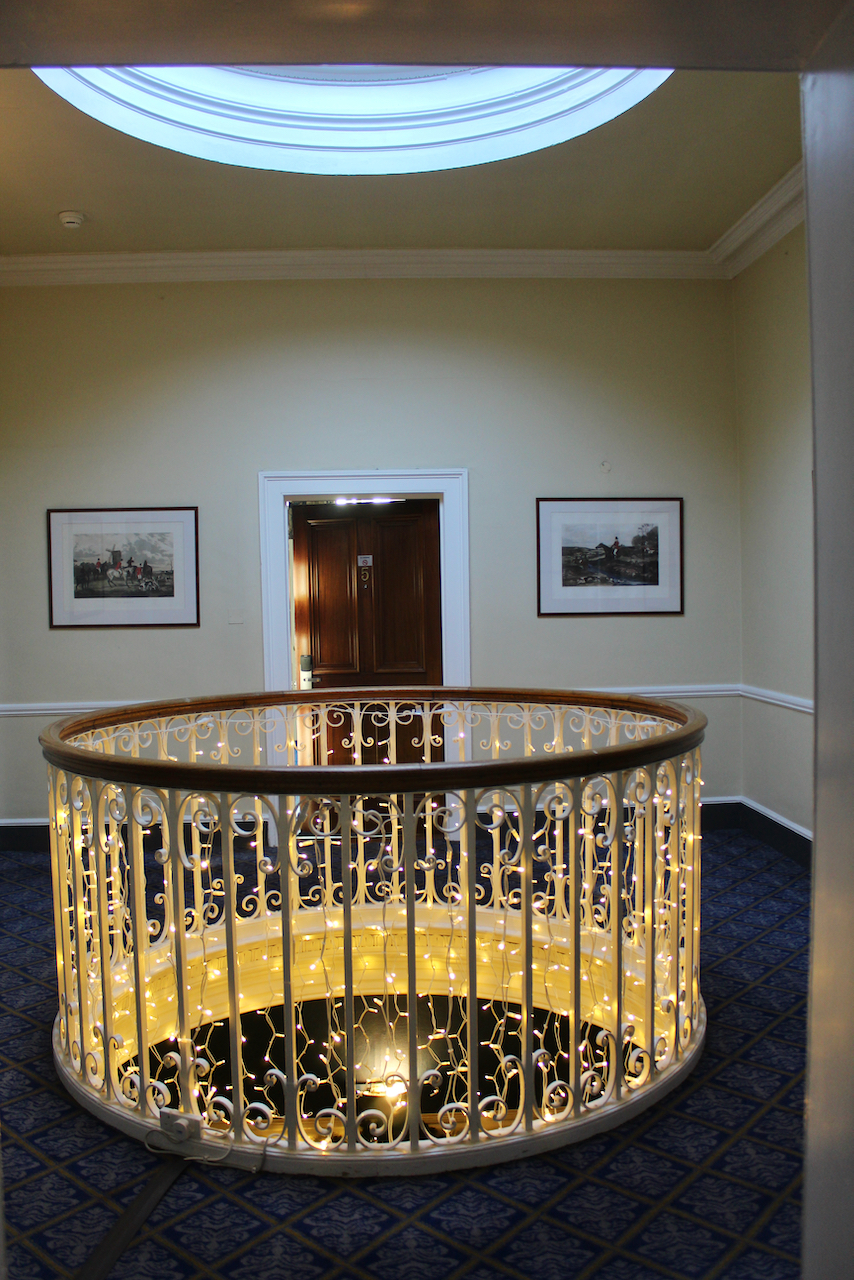
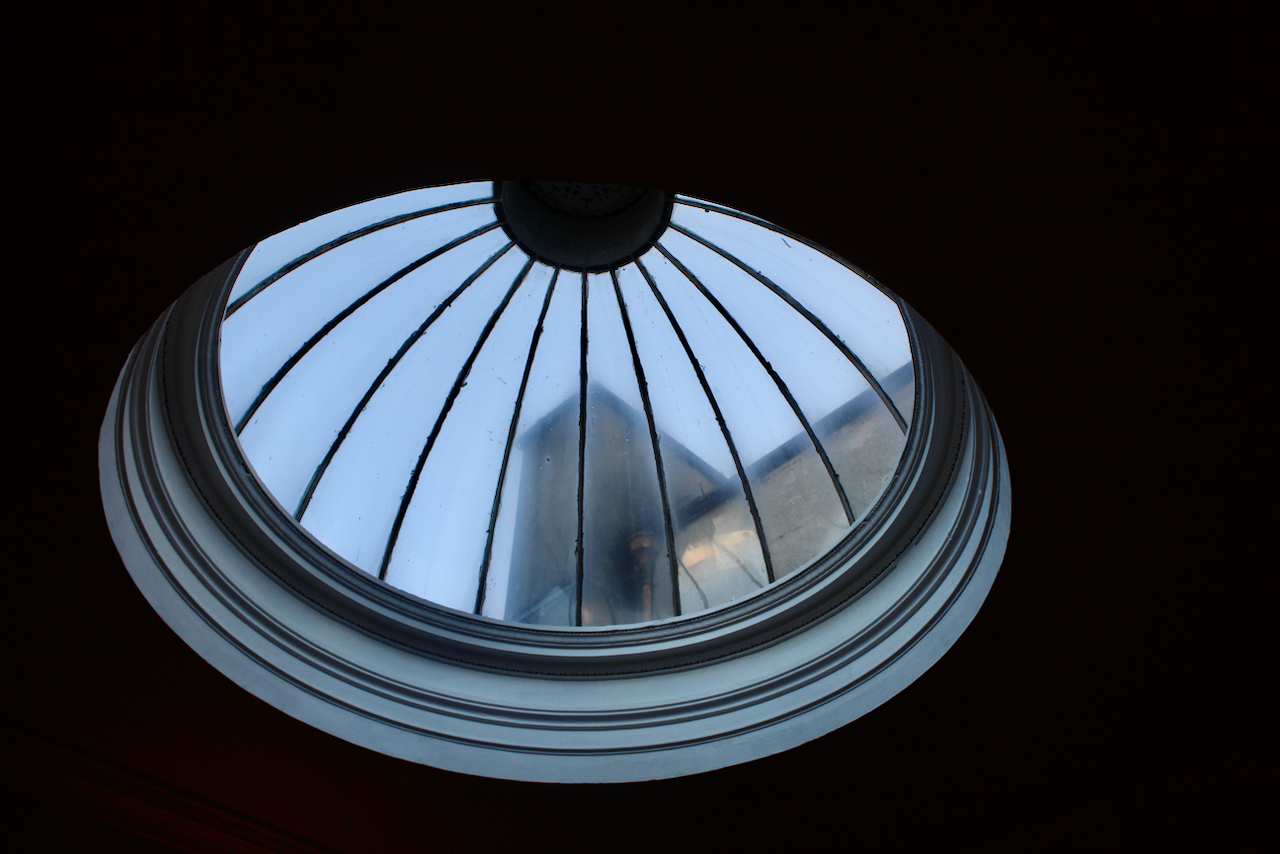
Inside, a spine corridor leads past the various reception rooms that overlook the gardens through mullioned windows. This corridor provided ample space for family portraits and landscapes that once decorated the walls. One of the most interesting features of the interior is the glazed dome that provides light to the inner hall at the centre of the house where the hotel reception is. The various reception rooms of the house are tastefully decorated and have retained much of their old world charm.

Ballymascanlon House, County Louth, November 2022. Photograph © Jennifer Winder-Baggot, www.irishhistorichouses.com
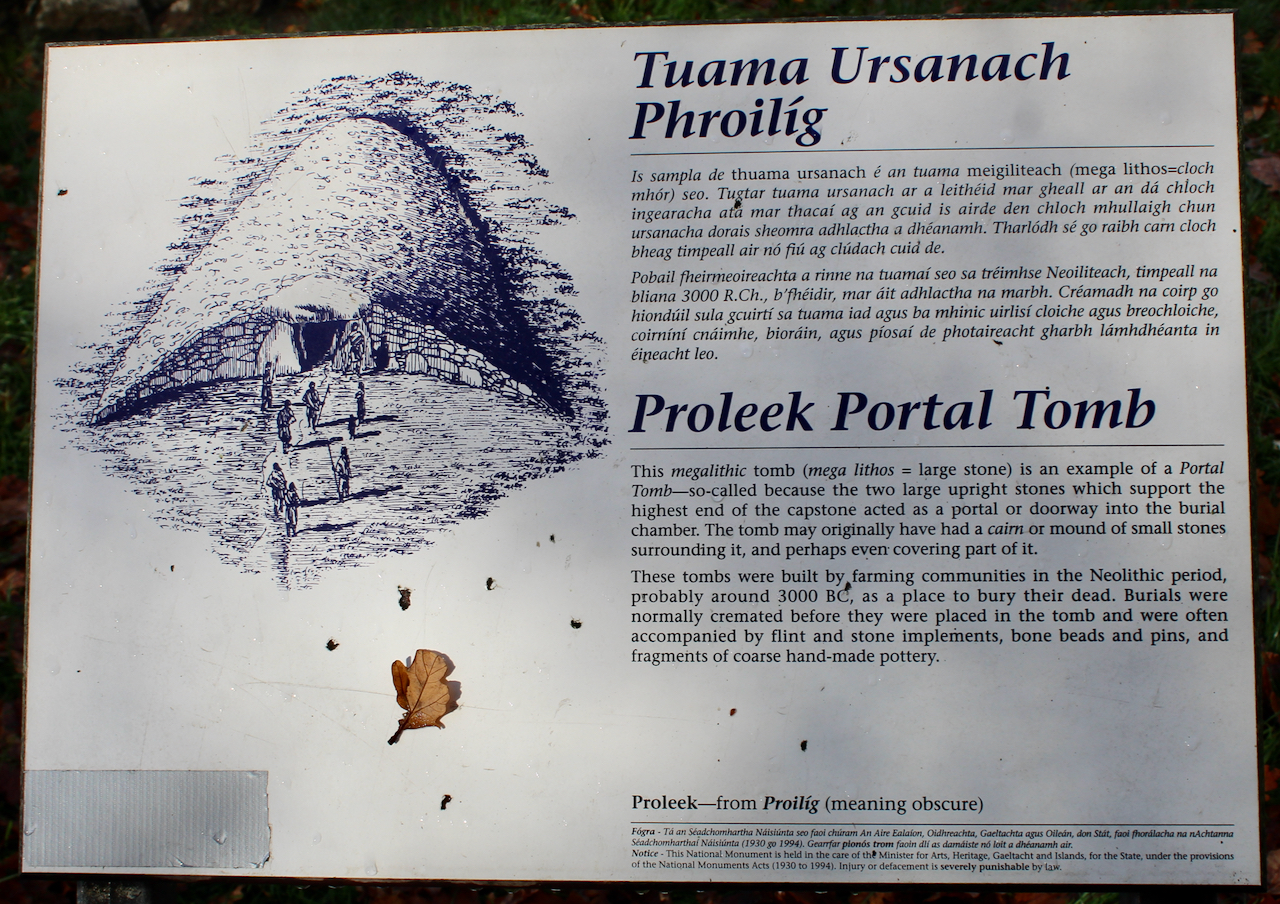
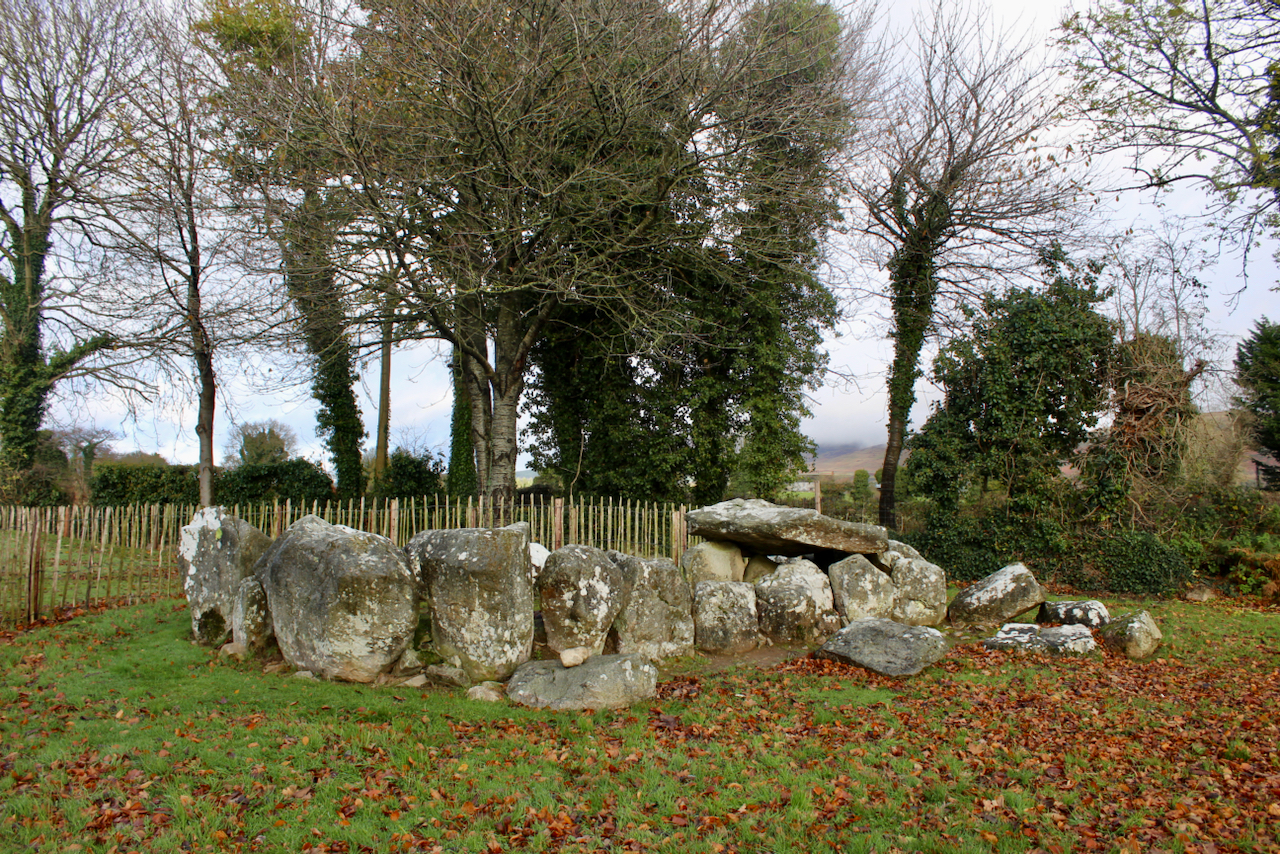
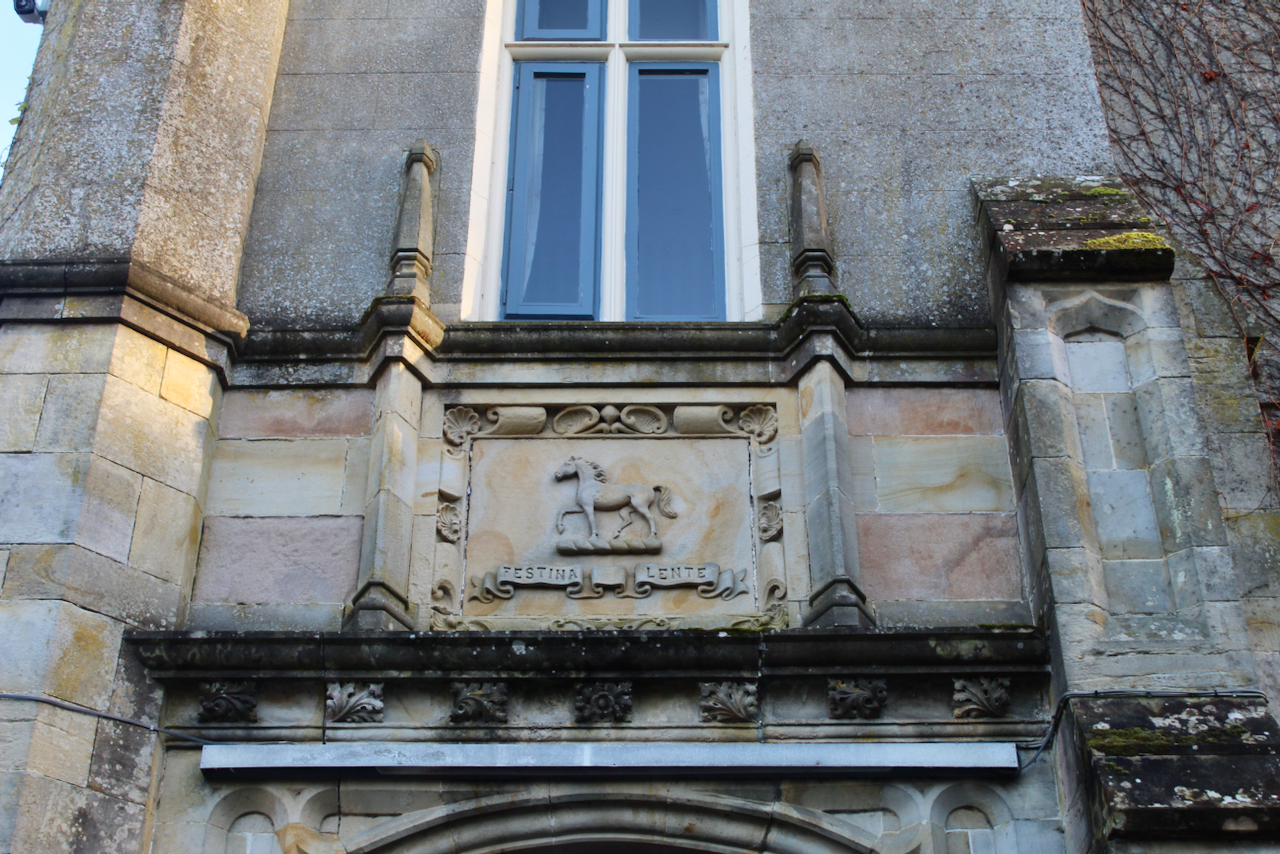
One of the most interesting features of the interior is the glazed dome that provides light to the inner hall at the centre of the house where the hotel reception is located. Photograph © Jennifer Winder-Baggot, www.irishhistorichouses.com
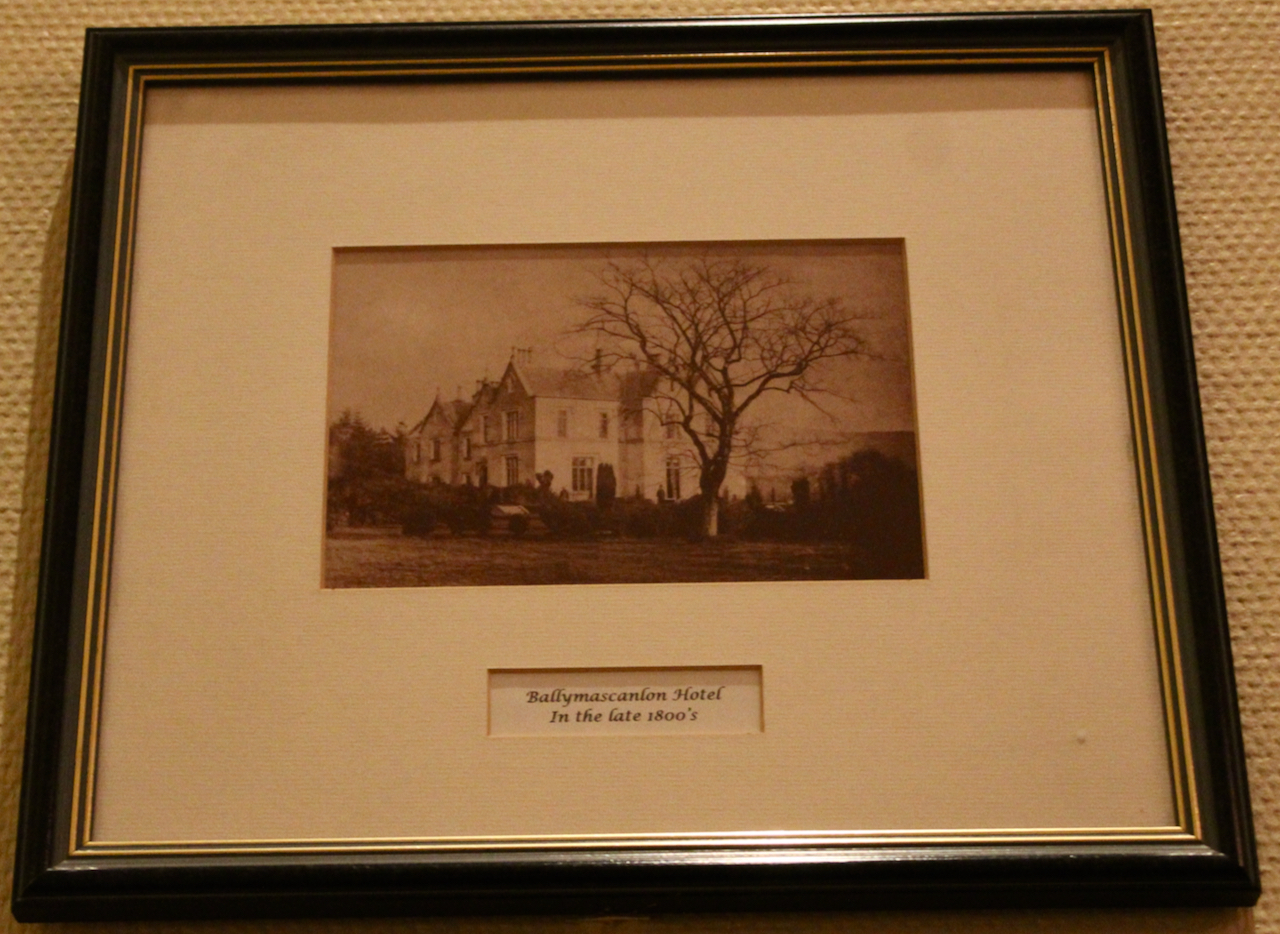
Ballymascanlon House, County Louth, November 2022. Photograph © Jennifer Winder-Baggot, www.irishhistorichouses.com
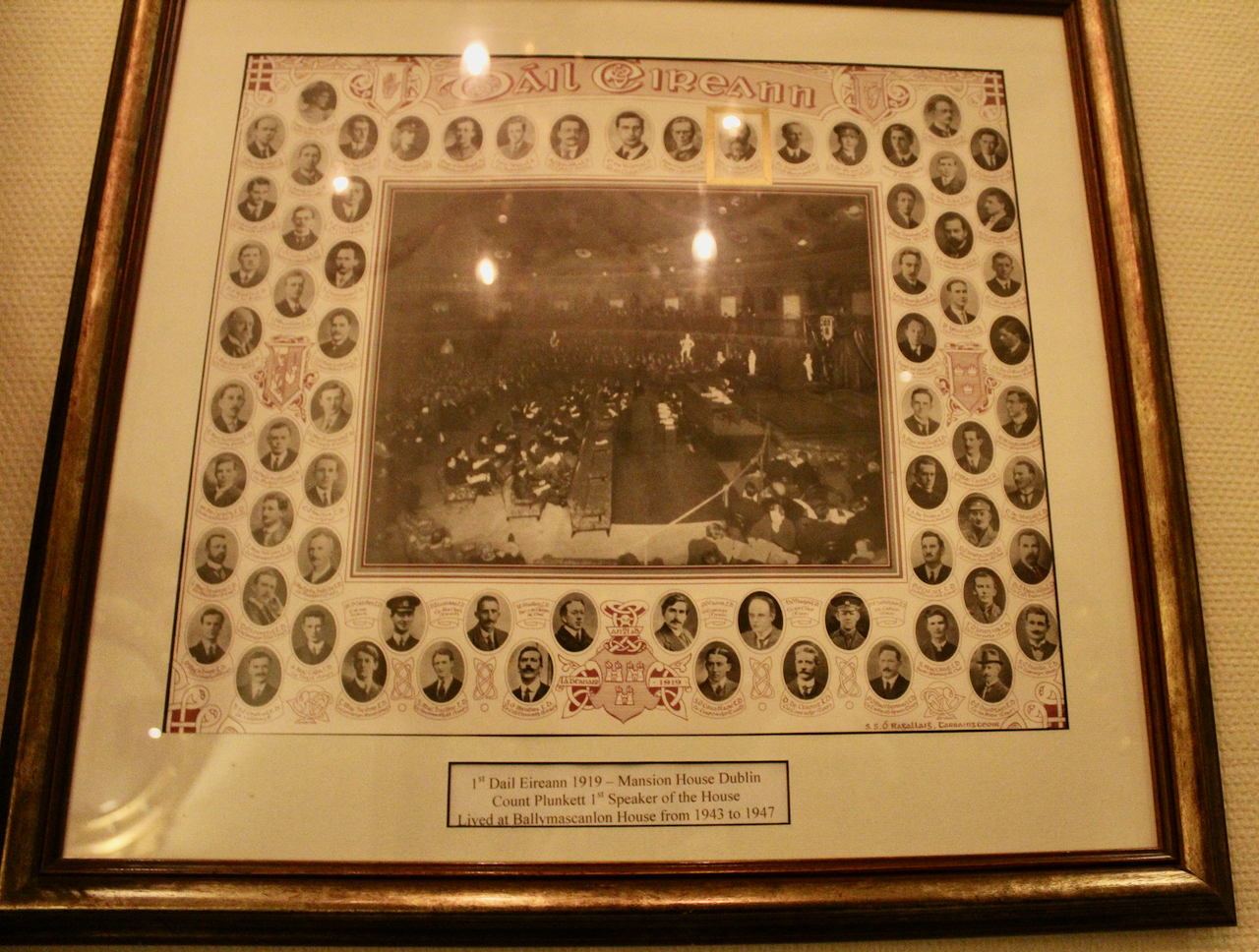
The house was offered for sale in 1943 and purchased by George Noble Plunkett, a Papal court who received his title from Pope Leo XIII for donating money to Catholic charities. He was the father of Joseph Mary Plunkett, one of the signatories of the Proclamation of the Irish Republic, who was executed for his part in the 1916 Rising.

Dáil Eireann 1919.

George Noble Plunkett and his wife Josephine Cranny were children of Pat Plunkett and Pat Cranny, two successful property developers who built many of the red brick Victorian houses in Dublin. Count Plunkett began his professional life as the director of the National Museum. After his son was killed he entered politics. After his wife died, he sold the house to the Quinn family, who turned it into a hotel.

Ballymascanlon House, County Louth, November 2022. Photograph © Jennifer Winder-Baggot, www.irishhistorichouses.com
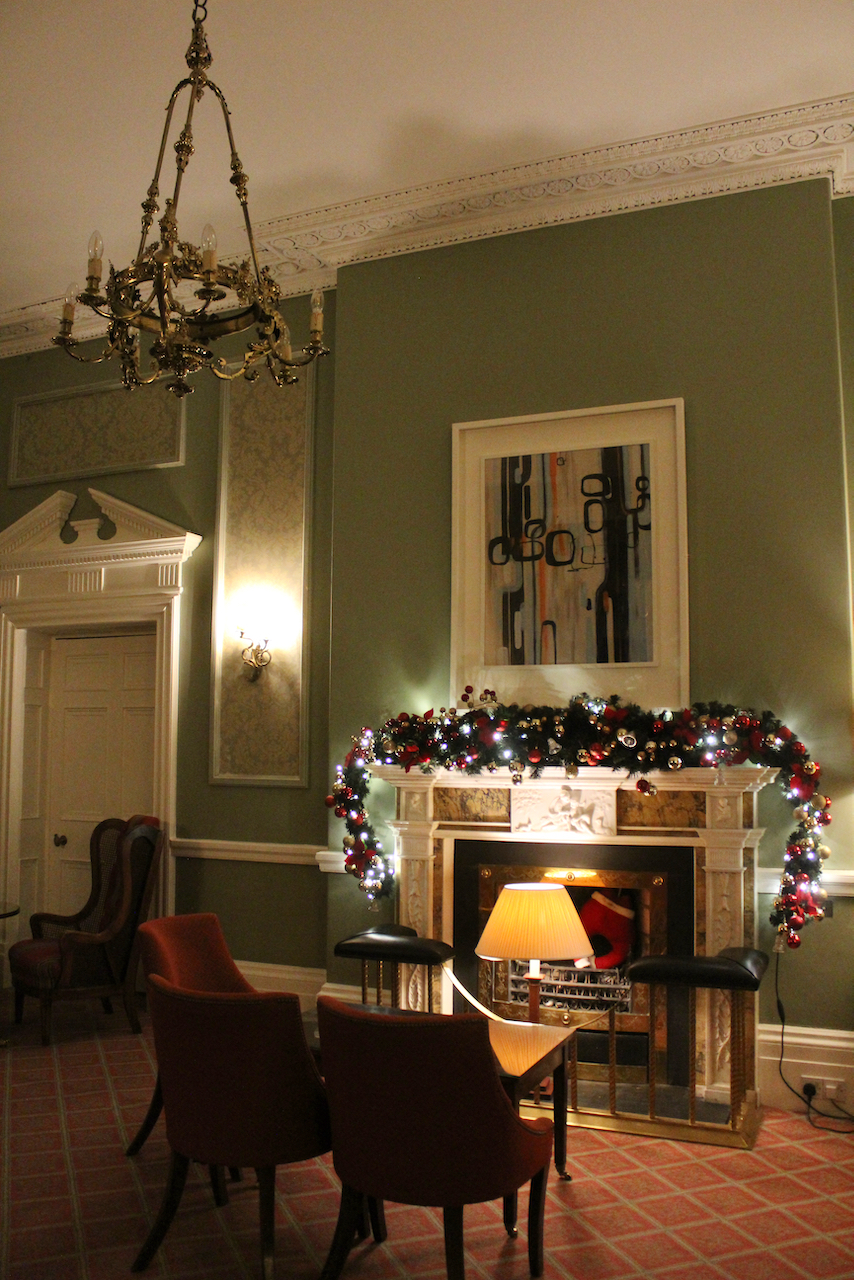
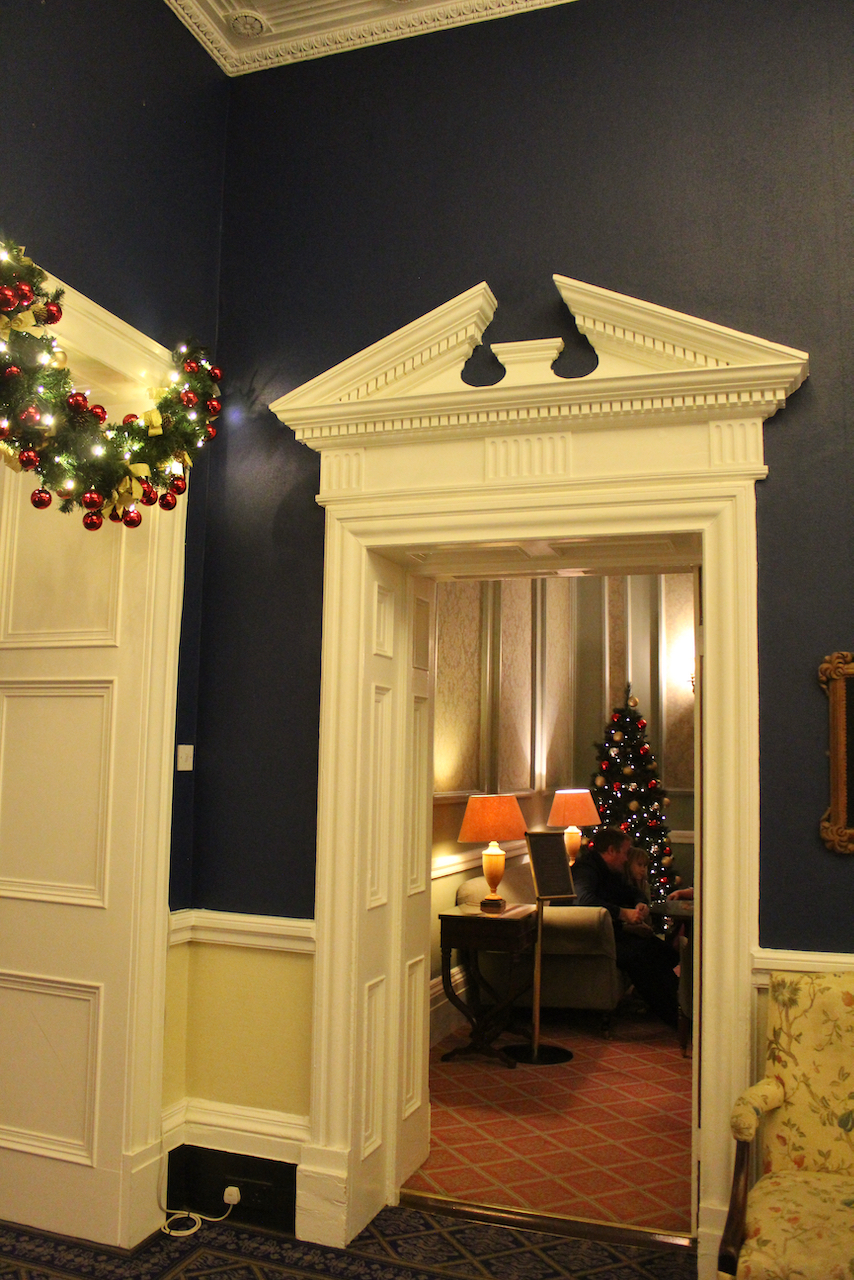
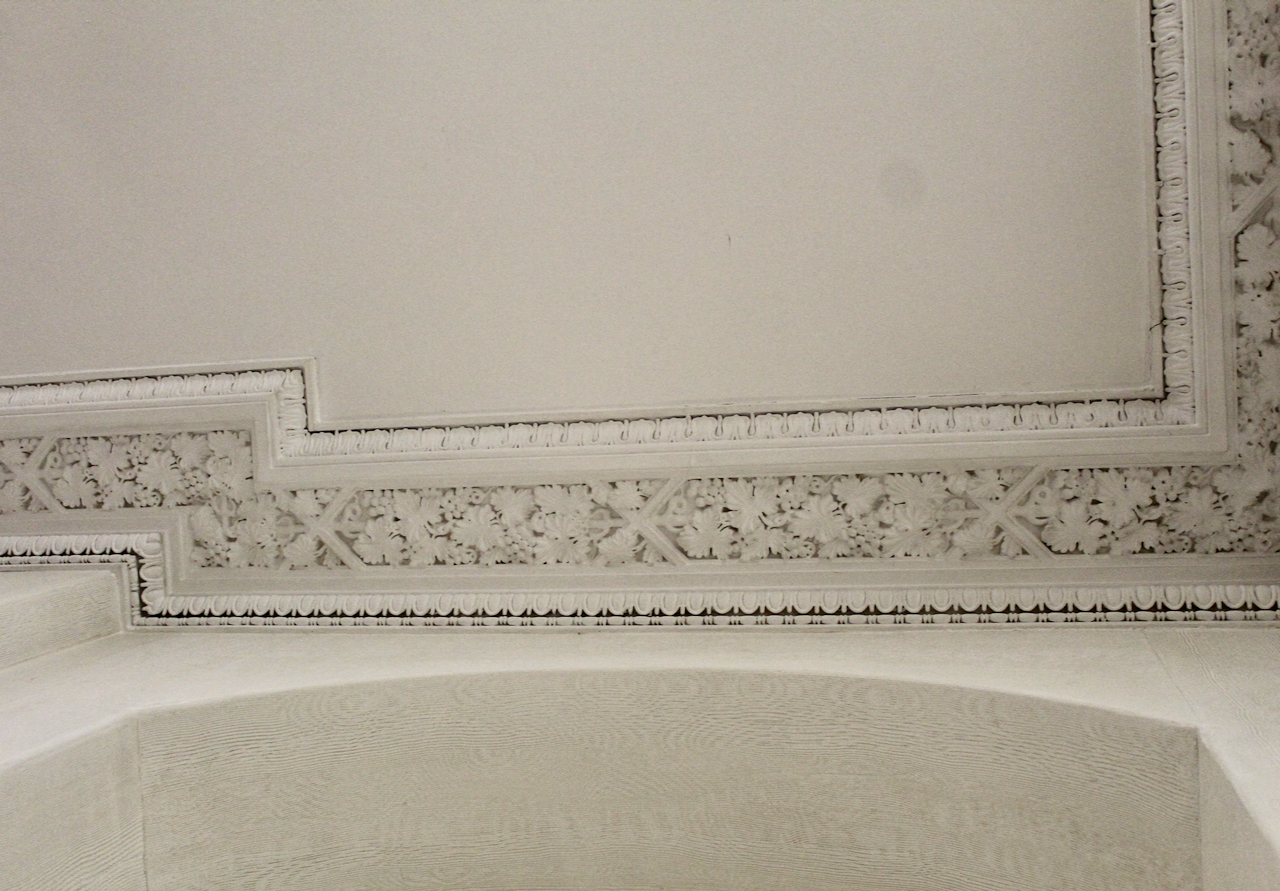
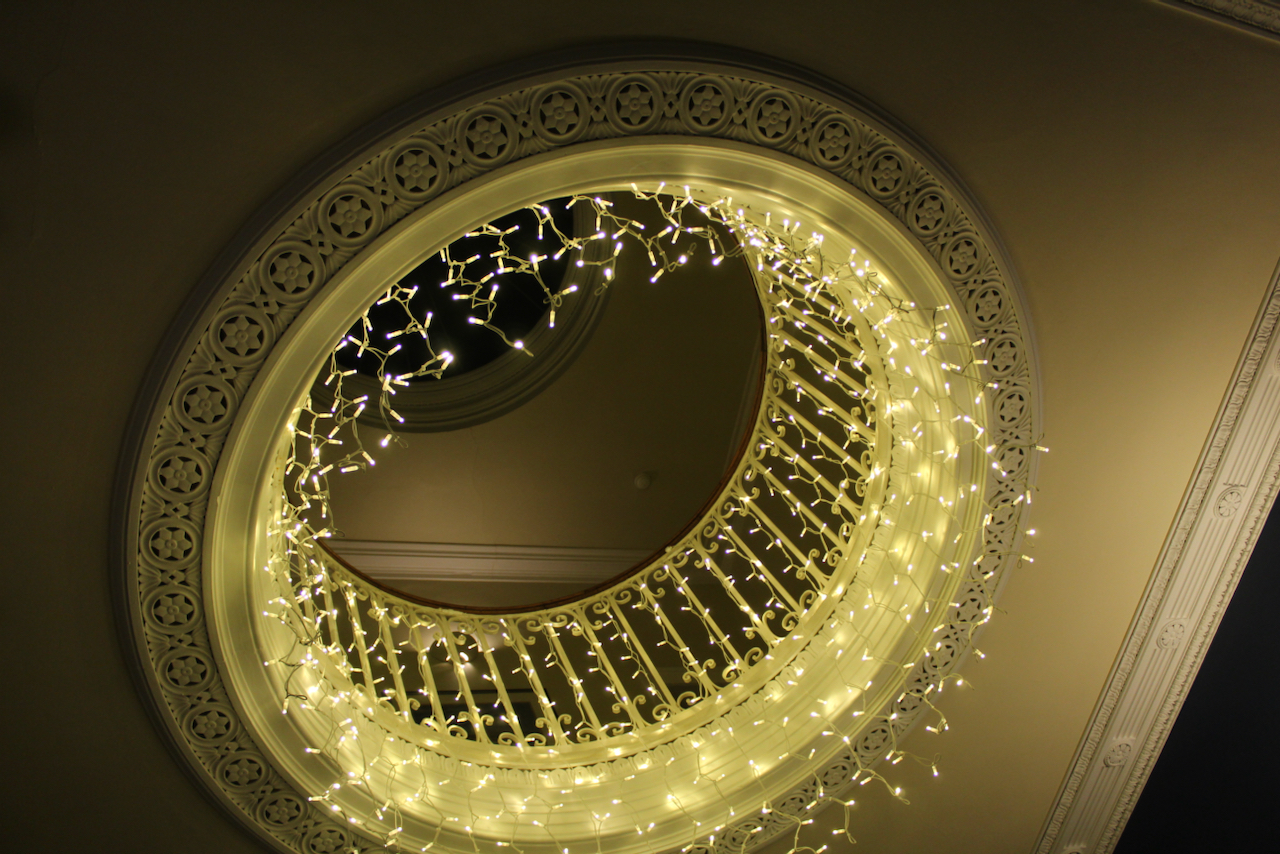
Outbuildings at Ballymascanlon House, County Louth, November 2022 Photograph © Jennifer Winder-Baggot, www.irishhistorichouses.com
Bridge on the grounds of Ballymascanlon. Photograph © Jennifer Winder-Baggot, www.irishhistorichouses.com
2. Collon House, Ardee Street, Collon, Louth – B&B accommodation

https://www.collonhouse.com
The website tells us:

Collon House, steeped in history, is full of character and charm; its gracious rooms are exquisitely furnished with period antiques and paintings, retaining the atmosphere of early Georgian living, making this a rare opportunity to experience less than one hour from Dublin City Centre, thirty minutes from Dublin Airport and just five miles from historic Slane.

Collon House is a perfect location from which to enjoy the wonderful treasures of the Boyne Valley. Bru na Boinne (Newgrange) prehistoric megalithic sites, The Battle of the Boyne visitors centre at Oldbridge, Slane Castle, Old Mellifont Abbey and Monasterboice High Crosses are all less than twenty minutes drive from Collon House.

4. Ghan House, Co Louth – accommodation

 https://www.ghanhouse.com
The National Inventory tells us: “Built in 1727 by William Stannus, this building, with its unadorned façade and finely-balanced elegant classical proportions, is a handsome representative of architectural developments during the Georgian era. It retains a large amount of original and early fabric, including handsome boundary walls, corner tower and carriage arch.”

Whole House Rental, County Louth:

1. Barmeath Castle, Dunleer, Drogheda, Co. Louthsection 482, guest house rental

2. Bellingham Castle, Co. Louth – weddings

https://www.bellinghamcastle.ie

See above

3. Bellurgan Park, County Louth -weddings and whole house rental

https://www.bellurganpark.ie/

4. Darver Castle, County Louth – luxury weddings, events and accommodation

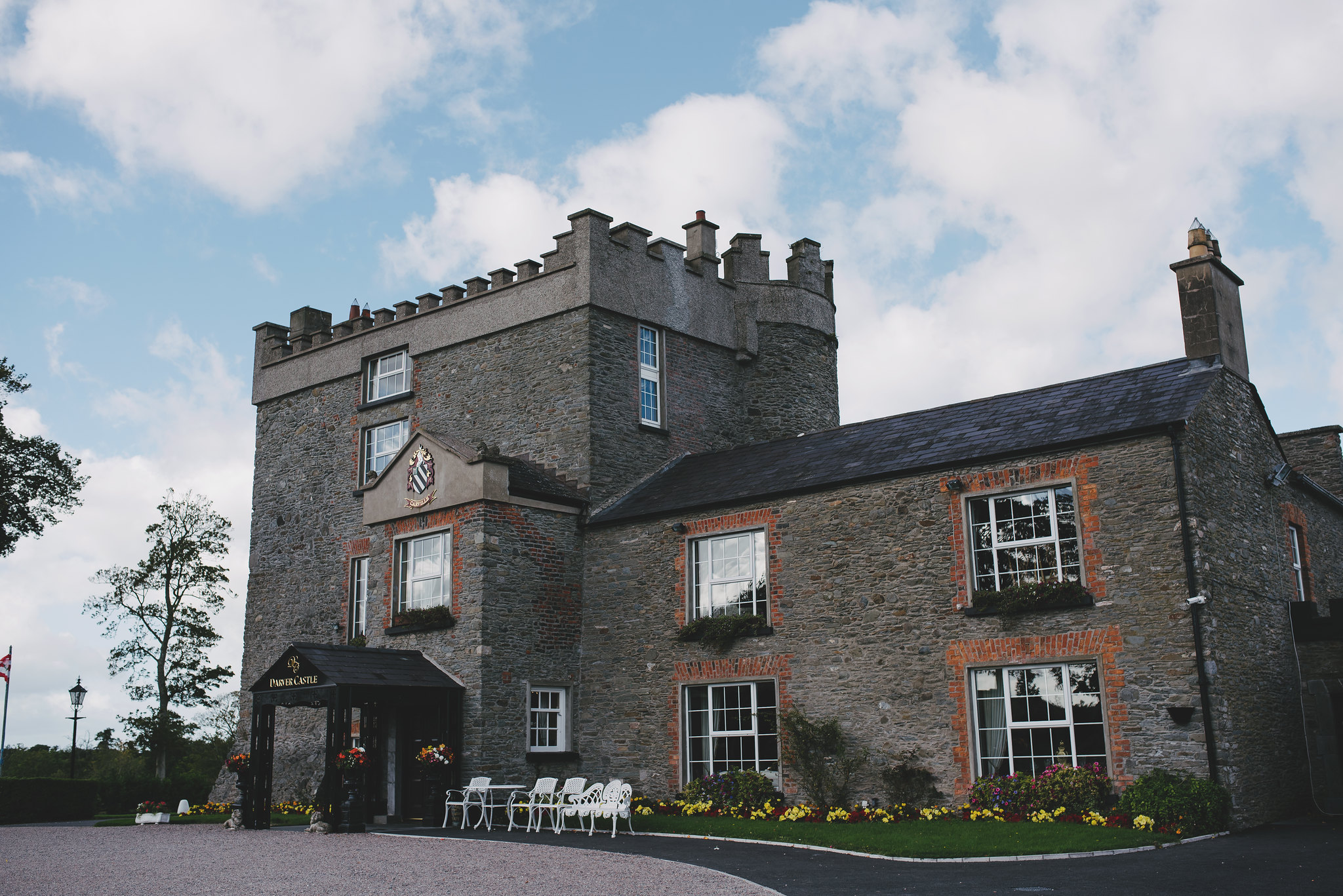
Darver Castle by Barry McGee 2016 courtesy of Flickr constant commons.

https://www.darvercastle.ie/home/

The website tells us:

The Castle, dating from the 15th century is situated in a fine parkland setting and surrounded by mature trees. The courtyard, approached through a medieval arched gateway has lofted stone faced buildings while the outer yard has very impressive stone faced buildings with stabling for 20 horses. Also included is an outdoor manège, partly walled garden and orchard. The lands, all in old pasture, have excellent road frontage and are renowned for their fattening qualities. In the early 12th Century a man named Patrick Babe was given 500 acres of land in the parish of Derver by King James II. He built a castle for himself and his family to live in on the grounds formerly owned by the church. The castle was built on the north side of the hill north of the cave and on the edge of the deep slope that led to the banks of two rivers, which provided fish and eels for the family food.The rivers acted as security from the enemy advancing from the north. With a large yard wall to the east 12 feet high and 20 acres of woodland to the west helped keep the enemy out. But a problem arose on the southside of the hill as it sloped to a deep valley and joined the high hill of newtown Darver. As the top of this hill is just 4 feet higher than the level of the top of the castle. So the soldiers were unable to see the enemy approaching from the south. Patrick Babe had a round tower built on the very top of the hill and placed soldiers into this garrison which gave them a clear view for 40 miles away so no enemy ever got near Darver Castle Estate during all the wars.
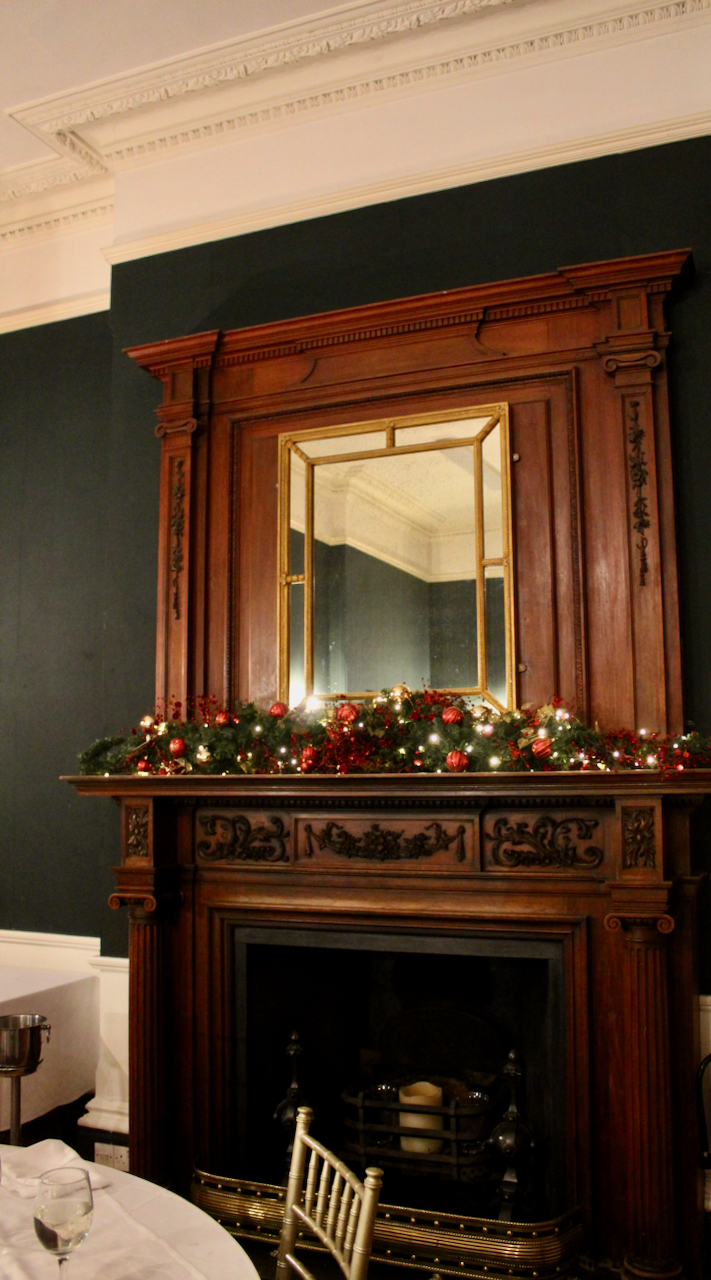
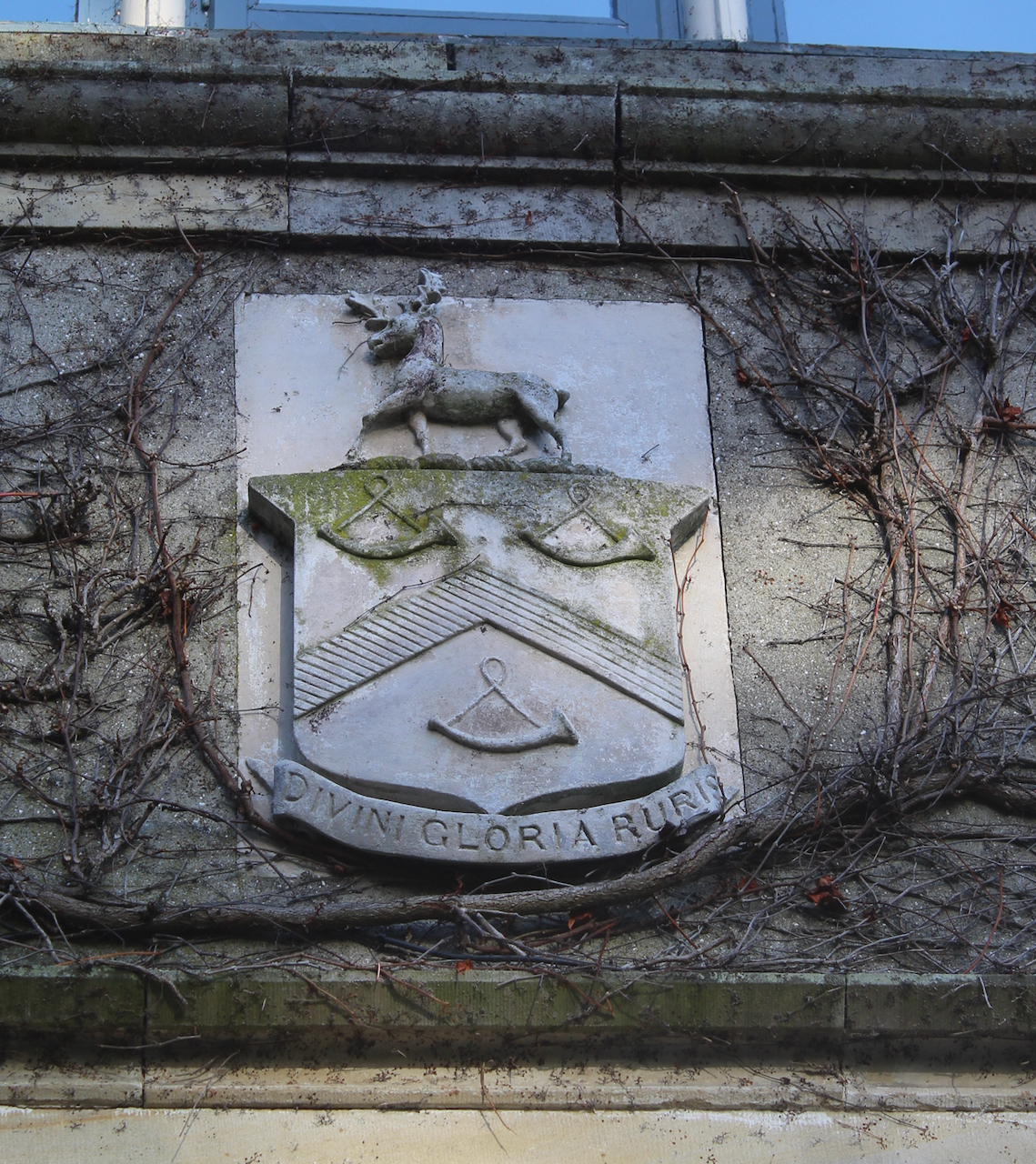
The church was never reached by Cromwell because of the protection from the hilltower. When the wars were over, Patrick Babe had wings put on the front of the tower and converted it into a windmill, and used it to ground corn for himself and his tenants. This continued for 150 years until large mills were built on the edge of the rivers, powered by the water, so that the use of the towermill ended and it was later demolished and the land around made arable. The hill is still known as windmill hill. 12thC Patrick Babe built the castle. Later he built 14 tenant houses. 1385 John Babe was given the advocasy of the church 1655 The Babes rented the castle to Abraham Ball. He died in 1742. 1740 James Babe sold the castle and 500 acres of land to Richard Fiscall Dublin for $4,000 1777 According to a survey done by Taylor and Skinner. The castle was idle. 1789 John Booth bought the castle. He died in 1840. 1840 Joseph Booth appears. He added the new wing and porch. 1857 John Filgate Booth died there. 1890 Frances Rutherford died there. 1894 Elizabeth Booth died there. 1906 Charles Rutherford died there. 1921 Zane Booth died there. 1980 John Booth died there. 1993 McCormack family took over and shortly afterwards Aidan and his wife Mary took ownership. Through a lot of hard-work and love for the castle, they have transformed it into the castle wedding venue it is today. The Carville family still continue to care for the castle, with improvements happening endlessly.

[1] https://www.buildingsofireland.ie/buildings-search/building/13826003/bellingham-castle-castlebellingham-castlebellingham-castlebellingham-louth

[2] Bence-Jones, Mark. A Guide to Irish Country Houses (originally published as Burke’s Guide to Country Houses volume 1 Ireland by Burke’s Peerage Ltd. 1978); Revised edition 1988 Constable and Company Ltd, London.

[3] https://www.buildingsofireland.ie/buildings-search/building/13828001/collon-house-drogheda-street-ardee-street-collon-collon-louth

[4] https://www.ihh.ie/index.cfm/houses/house/name/Collon%20House

[5] https://www.buildingsofireland.ie/buildings-search/building/13900756/ballymascanlon-house-ballymascanlan-ballymascanlon-louth

[6] p. 147. Hicks, David. Irish County Houses: Chronicle of Change. Collins Press, Cork, 2012. 

Text © Jennifer Winder-Baggot, www.irishhistorichouses.com
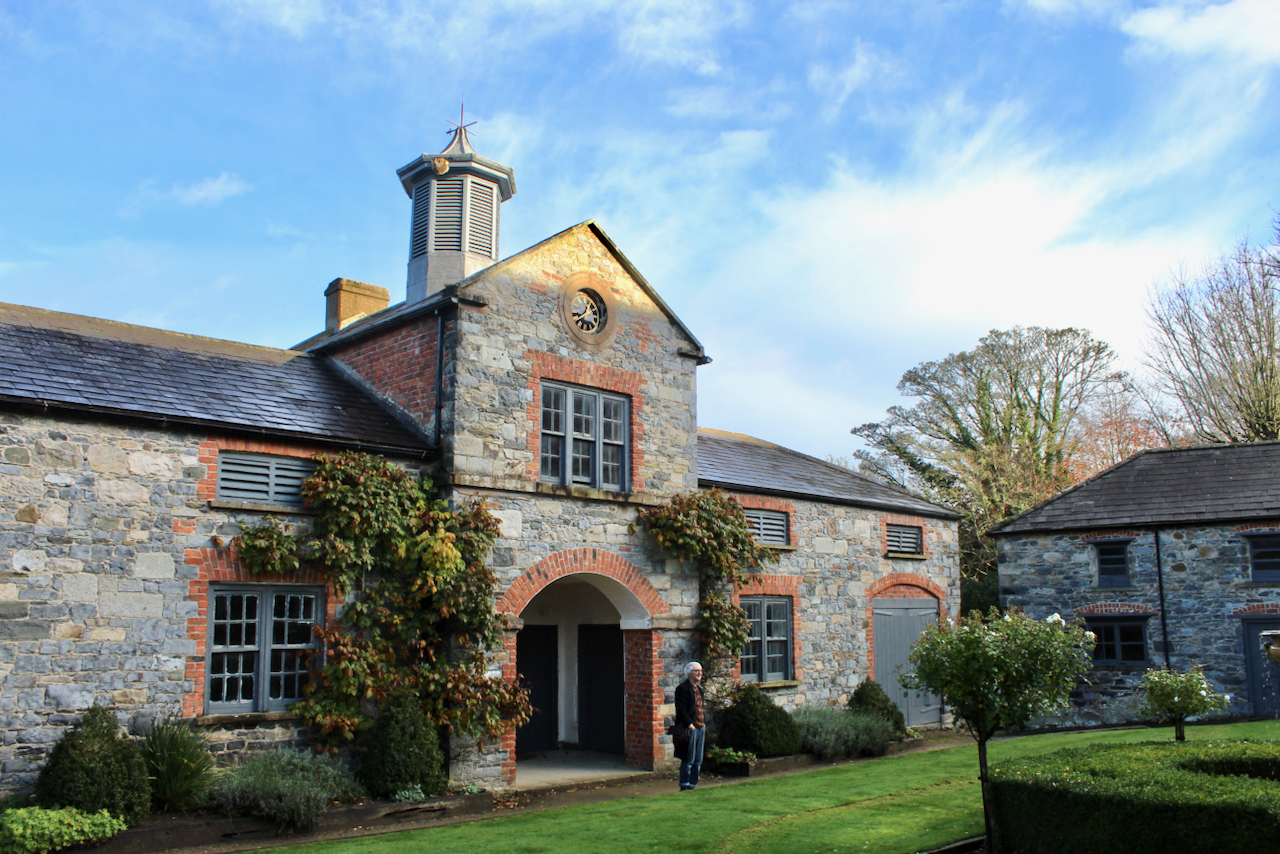
Cabra Castle, Kingscourt, County Cavan A82EC64 (hotel) – section 482

www.cabracastle.com
Open in 2026: all year, except Dec 24, 25, 26, 11am-4pm
Fee: Free to visit

donation

Help me to pay the entrance fee to one of the houses on this website. This site is created purely out of love for the subject and I receive no payment so any donation is appreciated!

€15.00

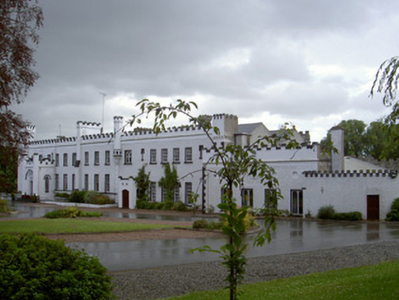
Cabra Castle, December 2020. Photograph © Jennifer Winder-Baggot, www.irishhistorichouses.com
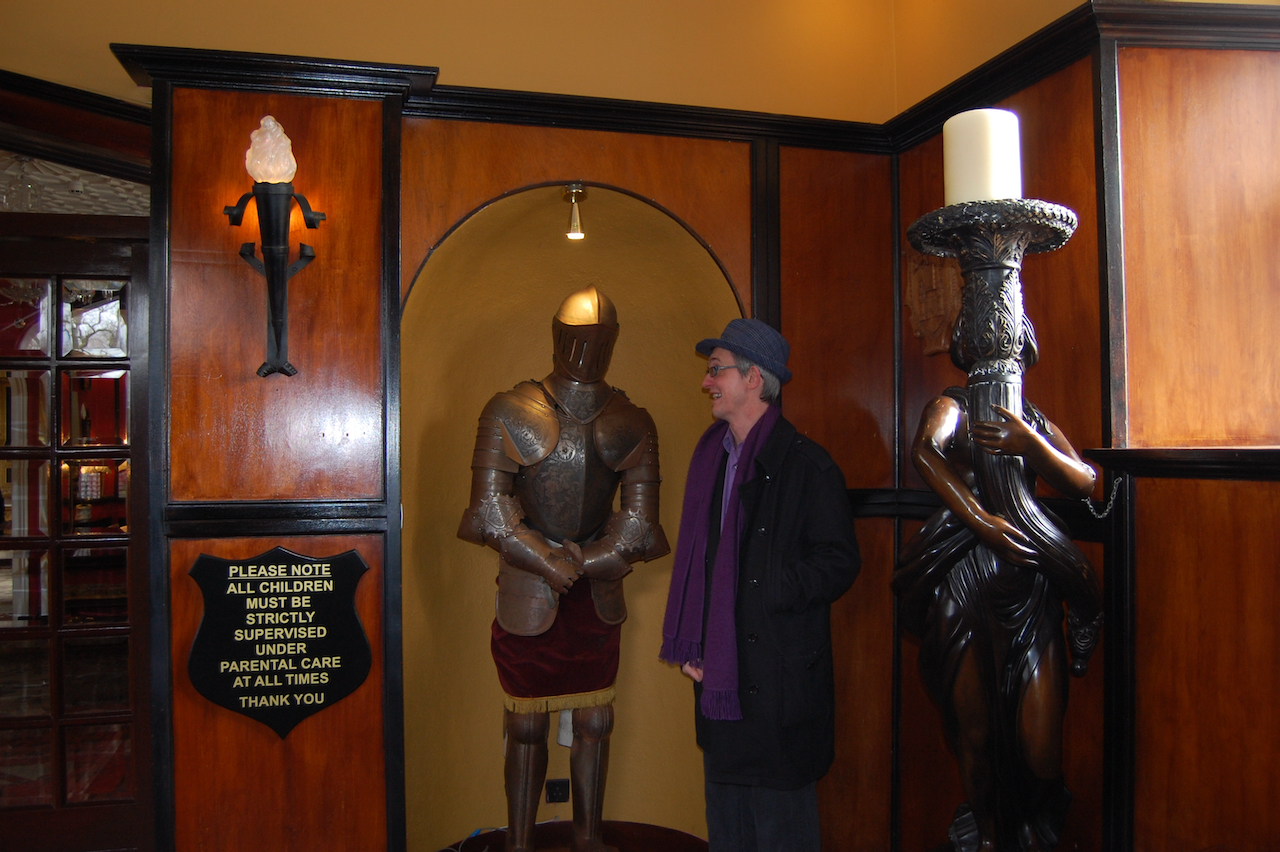
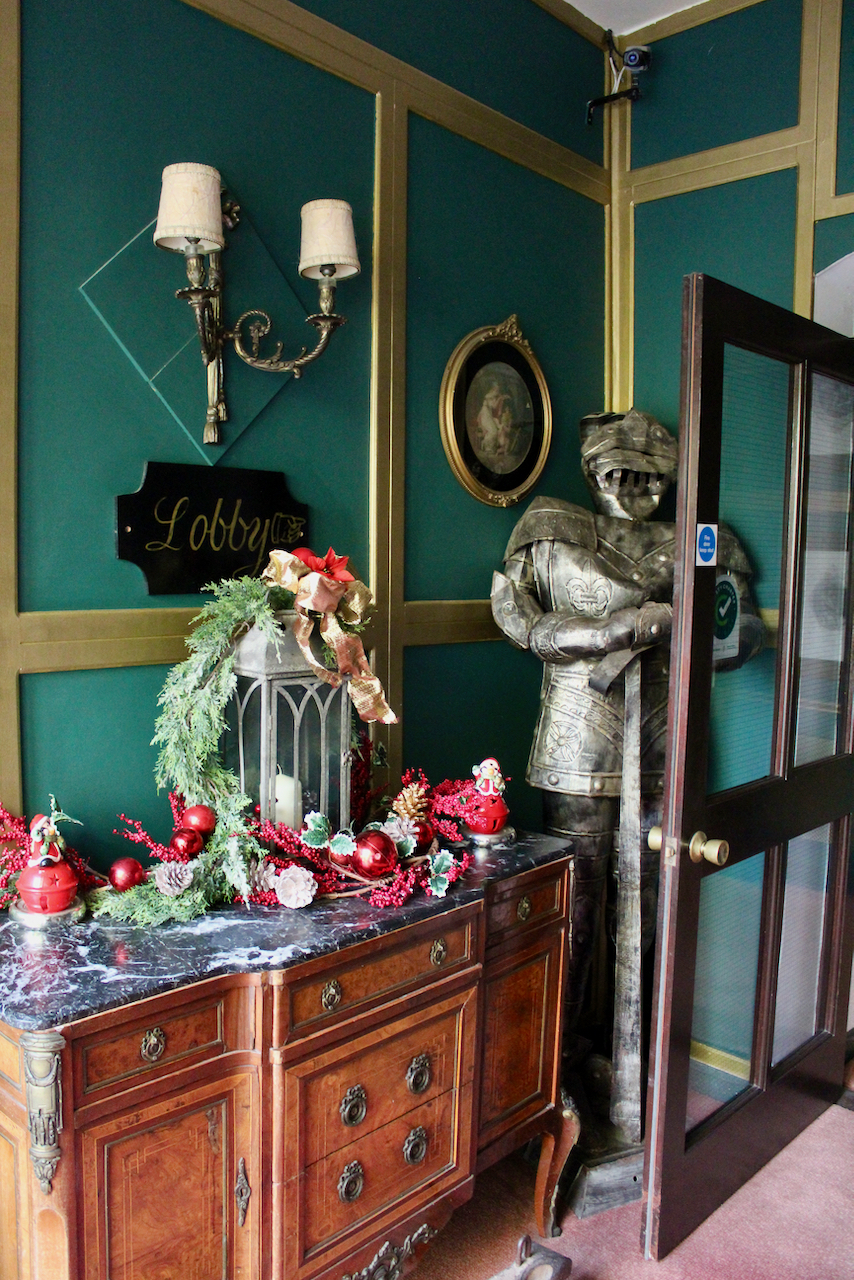
Stephen and the Knight have a heart to heart. We attended a wedding in Cabra Castle in 2011 and I took this photograph. Photograph © Jennifer Winder-Baggot, www.irishhistorichouses.com

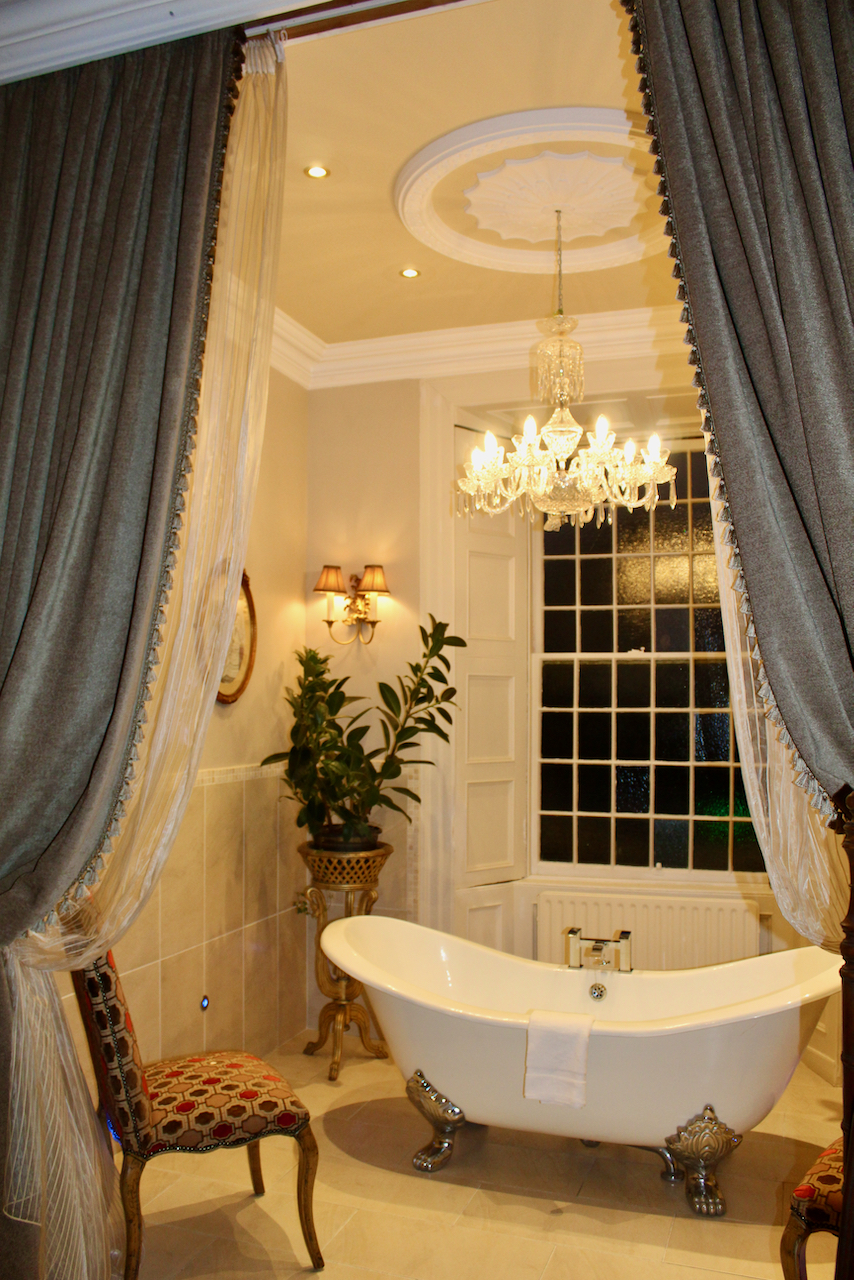
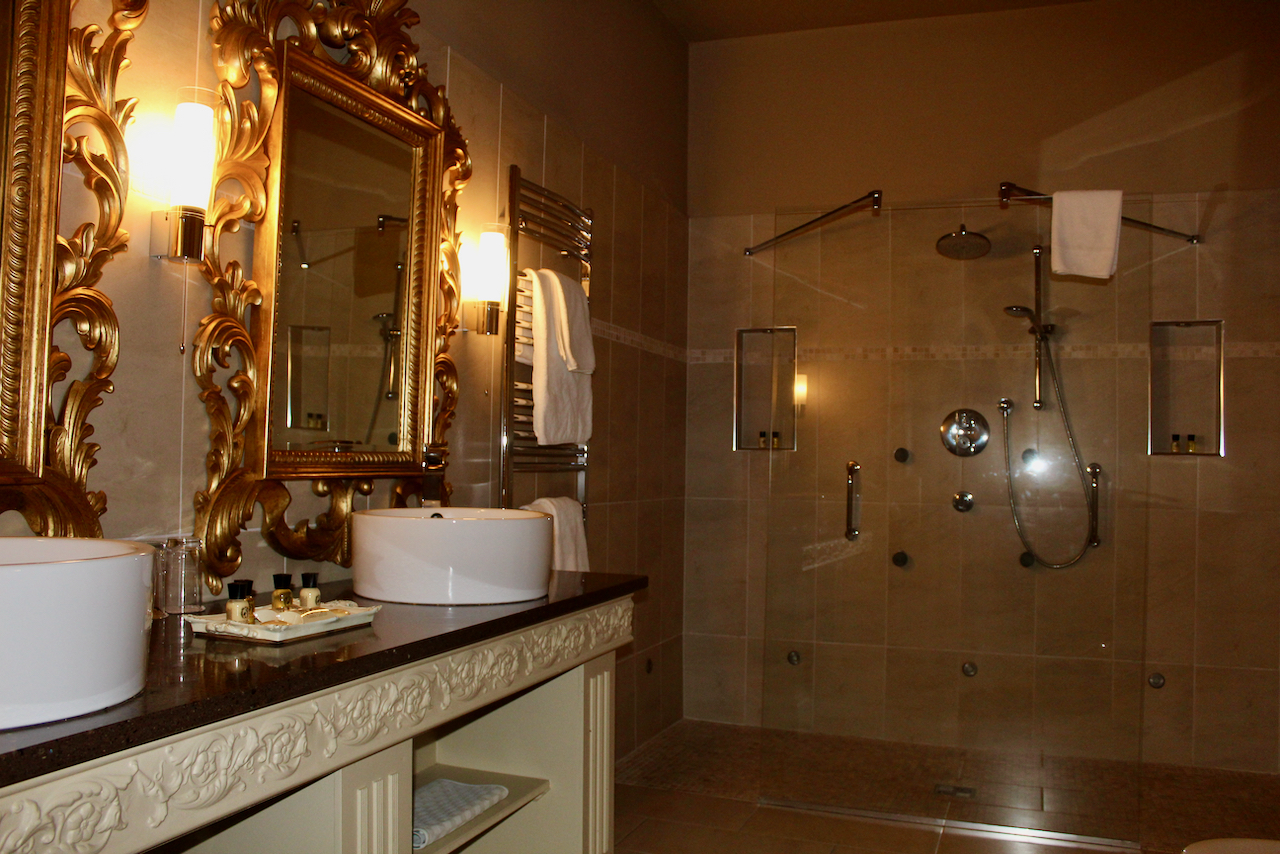
Stephen and I visited Cabra Castle in December 2020. I contacted the owner, Howard Corscadden, in advance, to request a tour of the castle. The Corscadden family own several beautiful Irish properties which provide unique castle accommodation. As well as Cabra Castle, they own Markree Castle in County Sligo and Ballyseede Castle in County Kerry, both of which are on the Section 482 list, as well as Bellingham Castle in County Louth. They are all hotels except the latter which is available as a four star venue for weddings and events, with accommodation. Howard’s parents and grandparents were also in the hotel business in Ireland, as are his siblings – Ballyseede is run by his sister Marnie, Castle Bellingham by his brother Patrick and Markree Castle by his sister Patricia. Howard worked in the Waldorf hotel in Switzerland and in Dromoland Castle in Ireland before purchasing Cabra Castle in 1991. [1] It had been converted to a hotel in 1964 by the local Brennan family. In 1986 it was sold to become a private house once more, but with a change in fortune the family sold to Howard Corscadden.

Cabra Castle, December 2020.

The early history of the castle is the history of two land-owning families, the Fosters and the Pratts. The building now known as Cabra Castle was originally known as Cormy Castle. At that time, an adjacent property was called “Cabra.” Cormy Castle was named after the townland of Cormy.

In 1795 the land, which contained an old round tower castle called Cormy Castle, belonged to John Thomas Foster (1747-1796), who had been MP for Dunleer, County Louth, and for Ennis, County Clare. The main building of Cormy Castle was in ruins, destroyed during the Cromwellian War, but its adjacent courtyard remained in good repair.

The Foster family owned large amounts of land in County Louth and their family seat was in Dunleer. The family produced many members of the Irish Parliament. John Thomas’s grandfather John Foster (1665-1747) had been MP for Dunleer. His father, Reverend Thomas Foster (1709-1784) was Rector at Dunleer. His uncle Anthony Foster (1705-1778) had also been MP for Dunleer and for County Louth, and was Chief Baron of the Exchequer, and lived at Collon, County Louth. [2] Anthony’s son John Foster (1740-1828) was Speaker of the Irish House of Commons, created 1st Baron Oriel of Ferrard, and also owned property which is now part of University College Dublin and the adjacent road Foster Avenue is named after him.

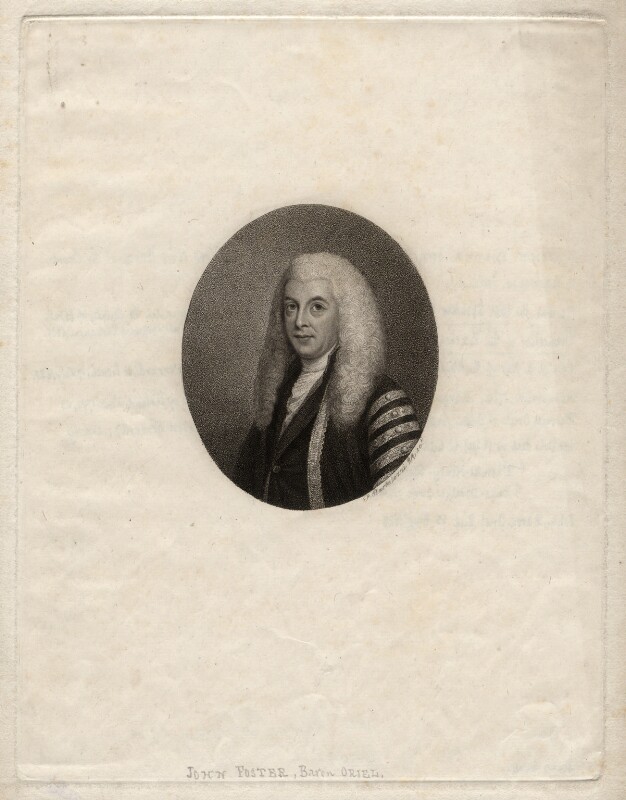
John Foster, 1st Baron Oriel, by Francesco Bartolozzi, after Unknown artist, stipple engraving, late 18th century. Photograph from National Portrait Gallery, London.

Turtle Bunbury tells us that John Thomas Foster’s father Reverend Thomas, the rector of Dunleer, acquired land in County Louth in the 1750s and 1760. He then acquired the 700 acre manor of Killany, County Louth, from 1763 on a series of long leases from the Provost and Fellows of Trinity College Dublin. He purchased Stonehouse, Dunleer, around 1787. [3]

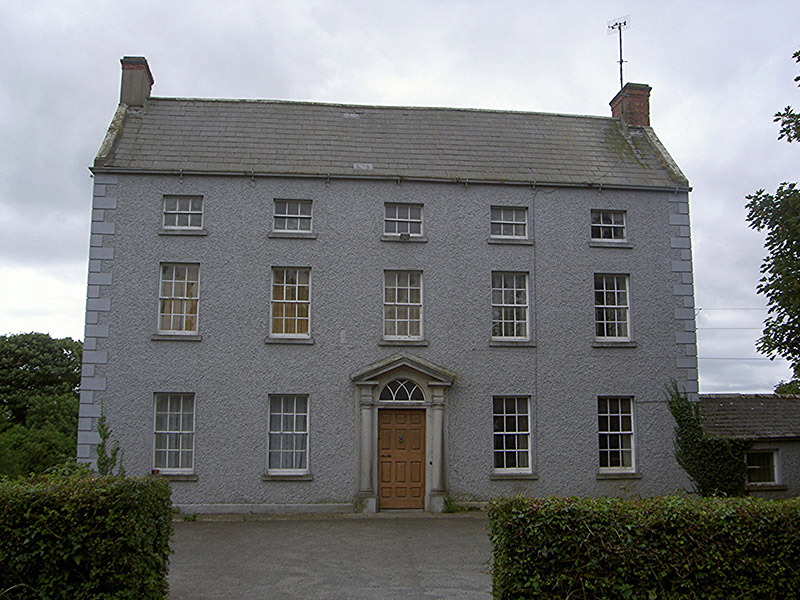
Stone House, County Louth, built around 1760 and purchased by Reverend Thomas Foster in around 1787. Photograph from National Archive of Architectural Heritage.

In 1776 John Thomas Foster married Elizabeth Christina Hervey, daughter of the 4th Earl of Bristol. After the marriage they lived with her father in Suffolk. They had two sons: Frederick Thomas (1777-1853) and Augustus John (1780-1848). [4] 

The marriage of John Thomas and Elizabeth Christina was not a success, and they separated after five years. Foster took the sons, and she did not see them for fourteen years. [5]

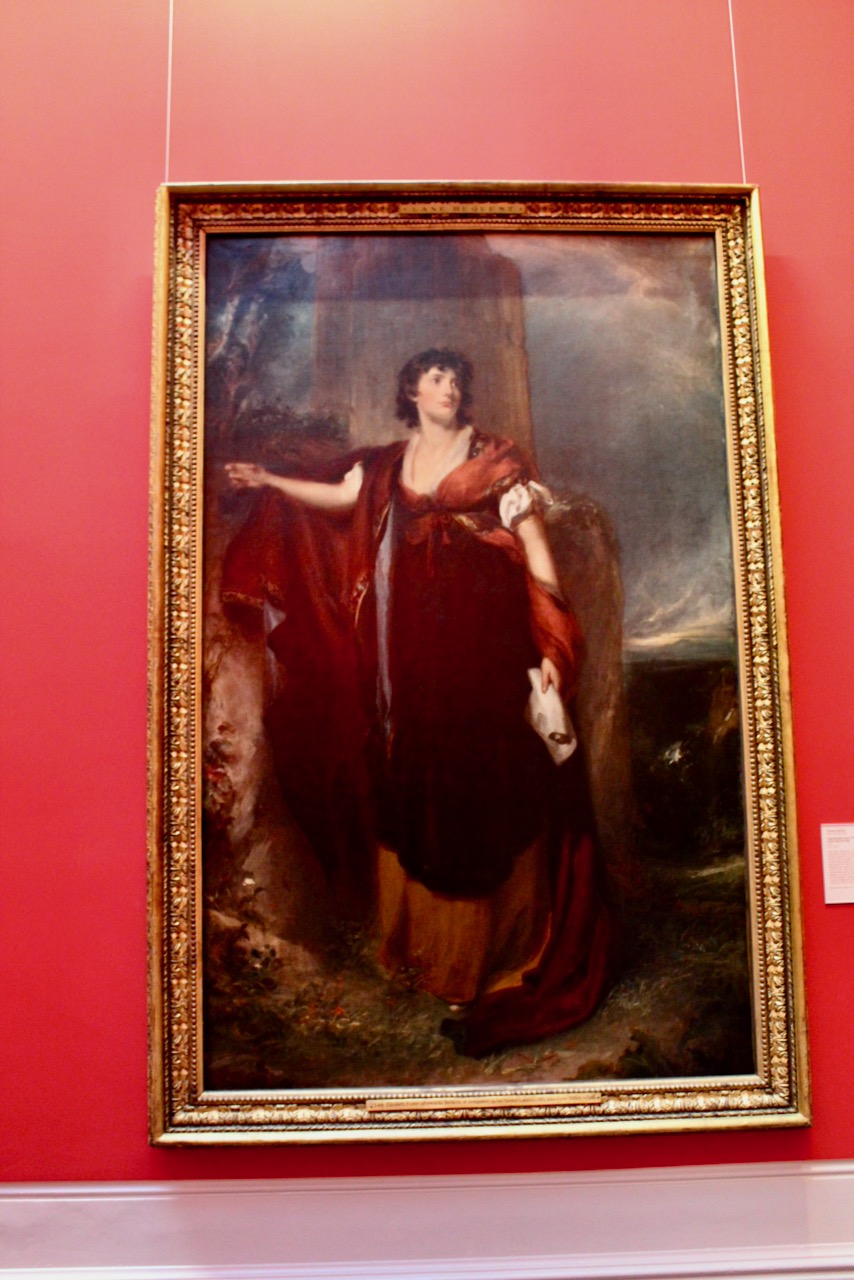
Elizabeth Christina Hervey, Lady Foster, painted by Thomas Lawrence in around 1805, as the Tiburtine Sybil, the Roman prophetess who foretold the coming of Christ. In 1782 she became the lover of the 5th Duke of Devonshire, and they lived together at Chatworth, Derbyshire, with his wife Georgiana. Following the birth of a number if illegitimate children, she married the Duke in 1809. Portait in the National Gallery of Ireland. Photograph © Jennifer Winder-Baggot, www.irishhistorichouses.com

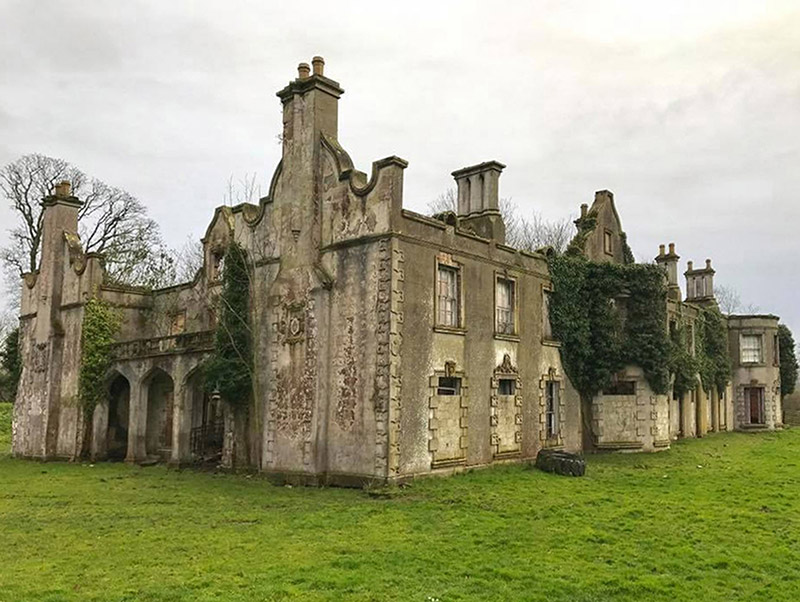
In 1783 John Thomas Foster inherited a property named Rosy Park in Louth from his uncle, John William Foster. In 1820 it was renamed Glyde Park by his son, Augustus. [6] It is unfortunately now a ruin.

The ruin of Glyde Court, County Louth, built around 1780. Photograph from National Inventory of Architectural Heritage.

John Thomas died in 1796, when his sons were still minors. They moved back to England to live with their mother, who by this time was living with William Cavendish, the 5th Duke of Devonshire, along with his wife, Georgiana, and had born him two children. A film starring Keira Knightly, “The Duchess,” is based on their story. [7] She married him in 1809 when his wife died.

Meanwhile, a cousin of John Thomas Foster, Henry Foster (c. 1747-1838), was appointed Trustee and Executor of the property of Cormy. He lived at Cormy Castle while acting as Trustee for his wards. According to Turtle Bunbury, he was a magistrate for Meath, Cavan and Louth. There is a record in the National Library of Ireland of a Grant of Arms to Henry Foster of Cormy Castle from March 13th 1806, when he was about to be created a baronet, but “the creation did not eventuate” (i.e. he was not made baronet). The National Library also has a map of the demesne of Cormy Castle from 1810, named as the seat of Henry Foster. In 1808 he began to rebuild and enlarge the castle. However, he exhausted the personal estate of his wards in doing so, and incurred debts, and the castle and land had to be sold. In about 1813 his wards sold the estate to Colonel Joseph Pratt, who lived on the adjacent property. [8]

John Thomas Foster’s son Frederick Thomas Foster may have remained in England, as he served as MP for Bury St. Edwards between 1812 and 1818. His brother Augustus John Foster became a politician and diplomat. Between roughly 1802 and 1804 he was Secretary to the British Legion in Naples. He held the office of Envoy Extraordinary and Minister Plenipotentiary to the U.S.A. in 1812. He wrote about his American experiences in Notes on the United States of America.

From 1814-1824 he held the office of Minister Plenipotentiary to Denmark. He was created 1st Baronet Foster of Glyde Court in 1831, and was appointed Privy Counsellor. His final posting was to Turin, in the Kingdom of Sardinia. 

Colonel Joseph Pratt, who owned the adjacent Cabra estate, continued the enlargement of Cormy Castle, and the work was completed in 1837. In 1820 he renamed it Cabra Castle. [9]

Before we examine the development of Cabra Castle, let’s look at the history of the property of Cabra across the road from the current Cabra Castle. 

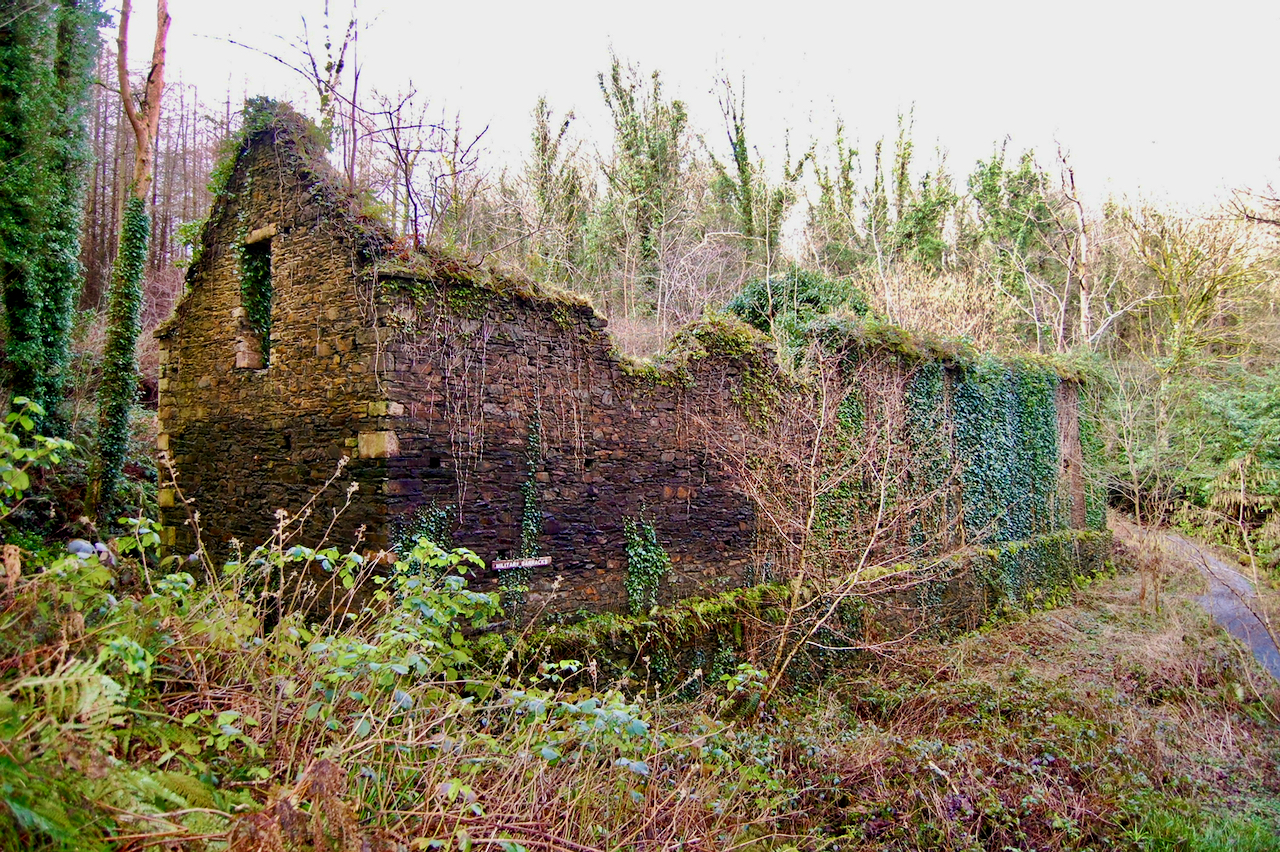
Old Cabra, in Dun Na Ri Forest Park. Photograph © Jennifer Winder-Baggot, www.irishhistorichouses.com
The former stable block of Old Cabra, popularly known as “The Barracks,” in Dun Na Ri Forest Park. Photograph © Jennifer Winder-Baggot, www.irishhistorichouses.com

According to the Cabra Castle website, this area belonged to the O’Reilly family. In 1607 Gerald Fleming, who had been granted territory by King James I, built a castle on the property. He lost his lands, however, when he supported James II against William III, and Colonel Thomas Cooch (1632-1699) acquired the property. [10]

Colonel Thomas Cooch married Elizabeth Mervyn, (sister of Audley Mervyn, Speaker of the Irish House of Commons), and they had an only daughter and heiress, Elizabeth. 

Elizabeth’s first husband (Nathaniel Pole, who lived in County Meath) died in 1685, before they had any children, and Elizabeth then married Joseph Pratt, who lived not far off at Garadice, Co. Meath, a property which his father received for his support of Oliver Cromwell. [11] This marriage (which was also Joseph Pratt’s second) took place in 1686 and a son, Mervyn Pratt, was born in 1687. Joseph Pratt held the office of High Sheriff of County Meath in 1698. He and Elizabeth had several other children.

Cabra Castle, December 2020. Photograph © Jennifer Winder-Baggot, www.irishhistorichouses.com

Colonel Thomas Cooch left his Cabra property to his grandson Mervyn. 

Mervyn Pratt was only 12 years old when his grandfather died. He graduated from Trinity College, Dublin and married Elizabeth Coote, daughter of Sir Thomas Coote, Judge, of Bellamont, Coote Hill, County Cavan. Mervyn and Elizabeth lived at Cabra near the Wishing Well. He followed in his father’s footsteps and held the office of High Sheriff, but of County Cavan rather than Meath. He was also an MP for County Cavan.

The Fleming castle was modernised by Mervyn Pratt. The new villa may have been designed by Edward Lovett Pearce, who was a cousin of Elizabeth Coote. The Irish Aesthete quotes a visitor to Mervyn Pratt in Cabra:

On August 25th 1732, the future Mrs Delany (then the merrily widowed Mrs Pendarves) embarked on a journey from Navan, County Meath to Cootehill, County Cavan. She wrote in her journal, ‘travelled through bad roads and a dull, uninhabited country, till we came to Cabaragh, Mr Prat’s house, an old castle modernized, and made very pretty: the master of it is a virtuoso, and discovers whim in all his improvements. The house stands on the side of a high hill; has some tall old trees about it; the gardens are small but neat; there are two little terrace walks, and down in a hollow is a little commodious lodge where Mr Prat lived whilst his house was repairing. But the thing that most pleased me, was a rivulet that tumbles down from rocks in a little glen, full of shrub-wood and trees; here a fine spring joins the river, of the sweetest water in the world.’” [12]

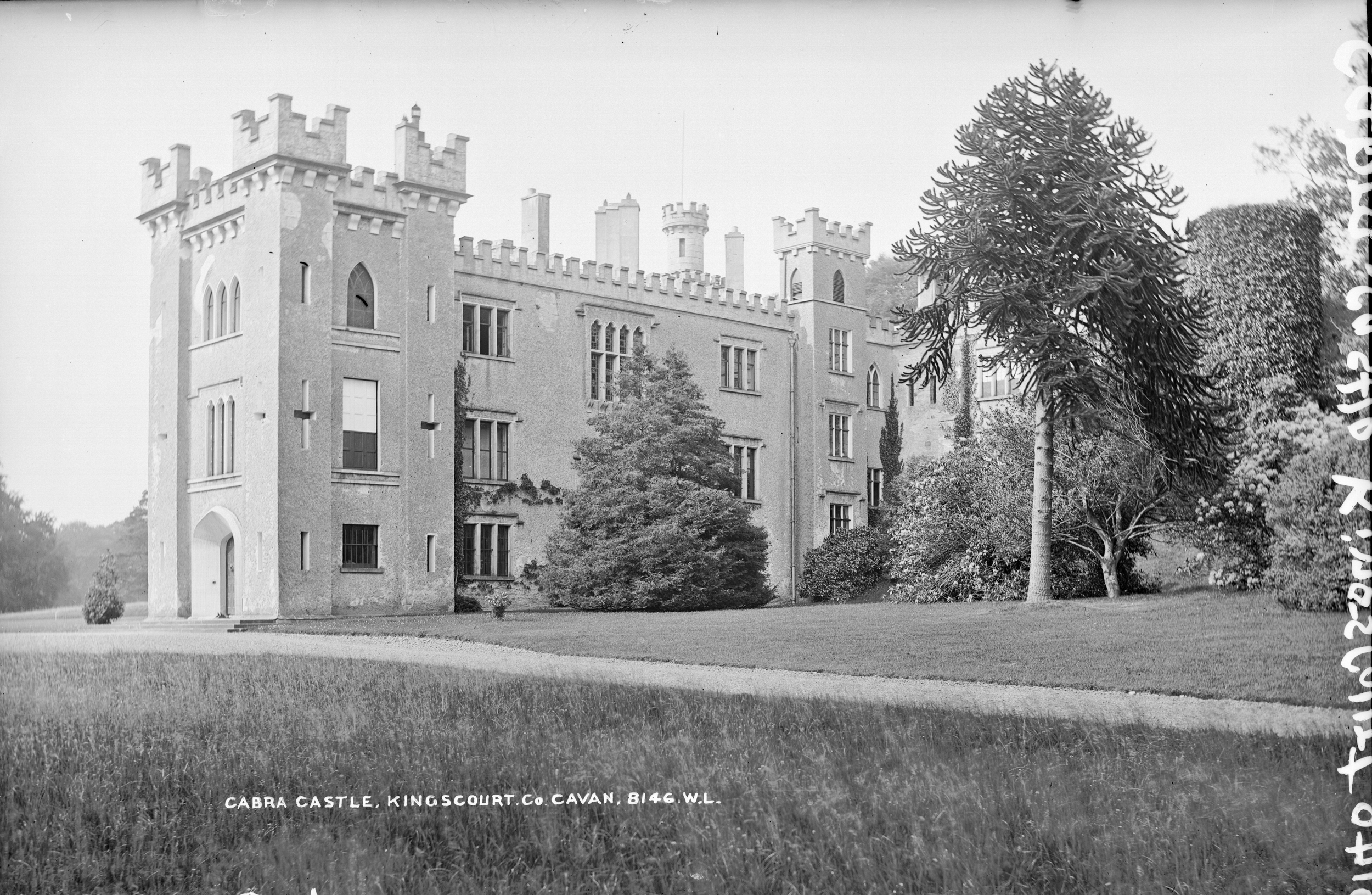
Cabra Castle by Robert French, Lawrence Photograph Collection NLI flickr constant commons.

Mervyn and Elizabeth Pratt had three daughters and one son. Their son Joseph joined the clergy. Reverend Joseph married Elizabeth Chetwood and had five children.

Of the five children of Reverend Joseph Pratt, a daughter Anne married her neighbour Henry Foster the trustee for Cormy Castle. [13] A son, James Butler Pratt, married a sibling of Henry Foster, Margaret. Another son entered the clergy, Reverend Joseph Pratt (1738-1831).

This second Reverend Joseph Pratt married Sarah Morres, daughter of the 1st Viscount Mountmorres, of Castle Morres, County Kilkenny (which has been demolished). Their son, Colonel Joseph Pratt (1775-1863), purchased Cormy Castle from Henry Foster. Their other son, Hervey Randall Saville Pratt inherited the property of Castle Morres through his mother.

The house at Cabra was destroyed by fire in the 1950s, and is now part of Dun na Ri Forest Park, a lovely place to explore, owned by Coillte. After Joseph Pratt moved to Cormy Castle and created a new seat for his family, his former property became known as Old Cabra. [14] 

Now let us travel back across the road to the former Cormy Castle, now Cabra Castle. Cabra Castle is a mixture of Norman and Gothic styles.

The entrance is in a Norman-style “donjon” or square tower house, with corner turret. The door is in a deeply recessed pointed arch.

Cabra Castle, December 2020. Photograph © Jennifer Winder-Baggot, www.irishhistorichouses.com

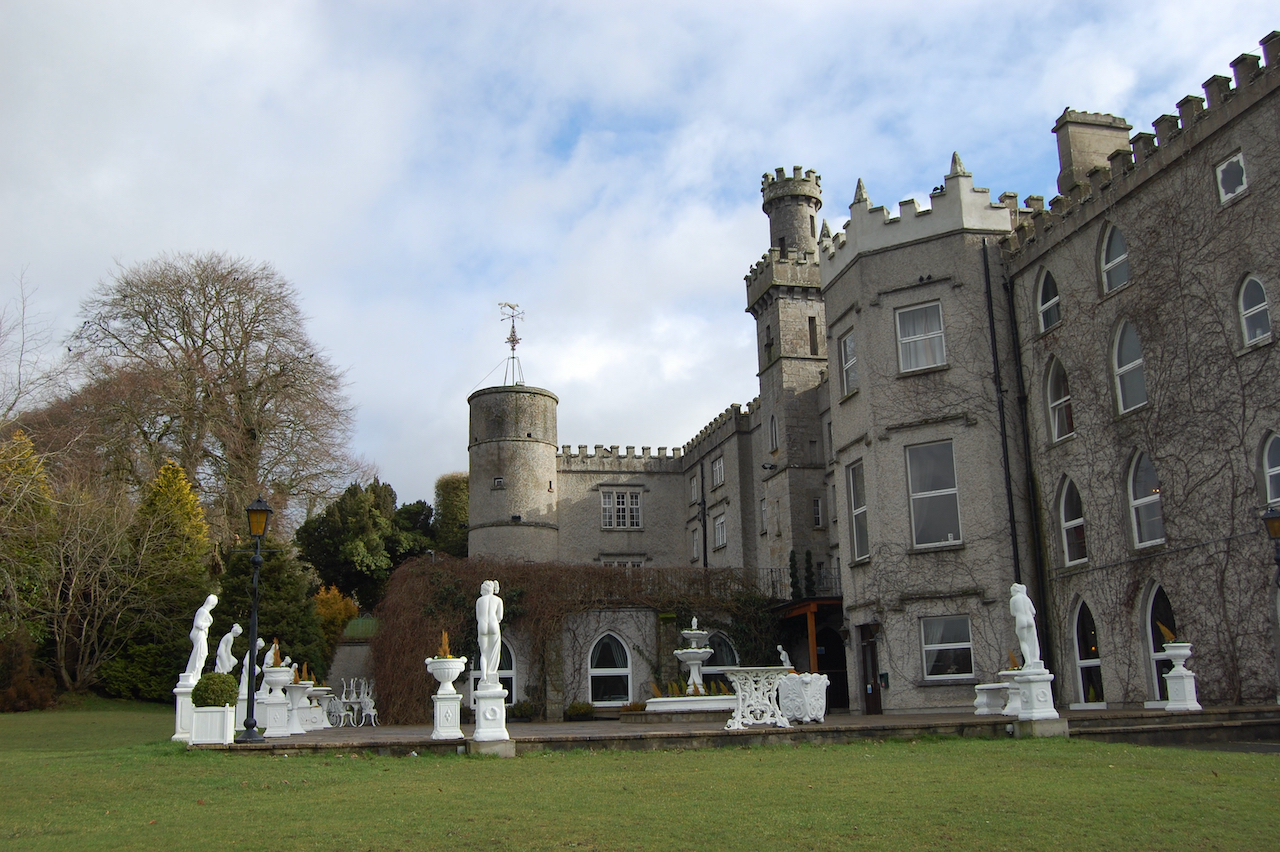
The building has two, three and four story sections over a basement. The building, including outbuildings, is castellated, and has several round and square towers.

Cabra Castle, December 2020. Photograph © Jennifer Winder-Baggot, www.irishhistorichouses.com

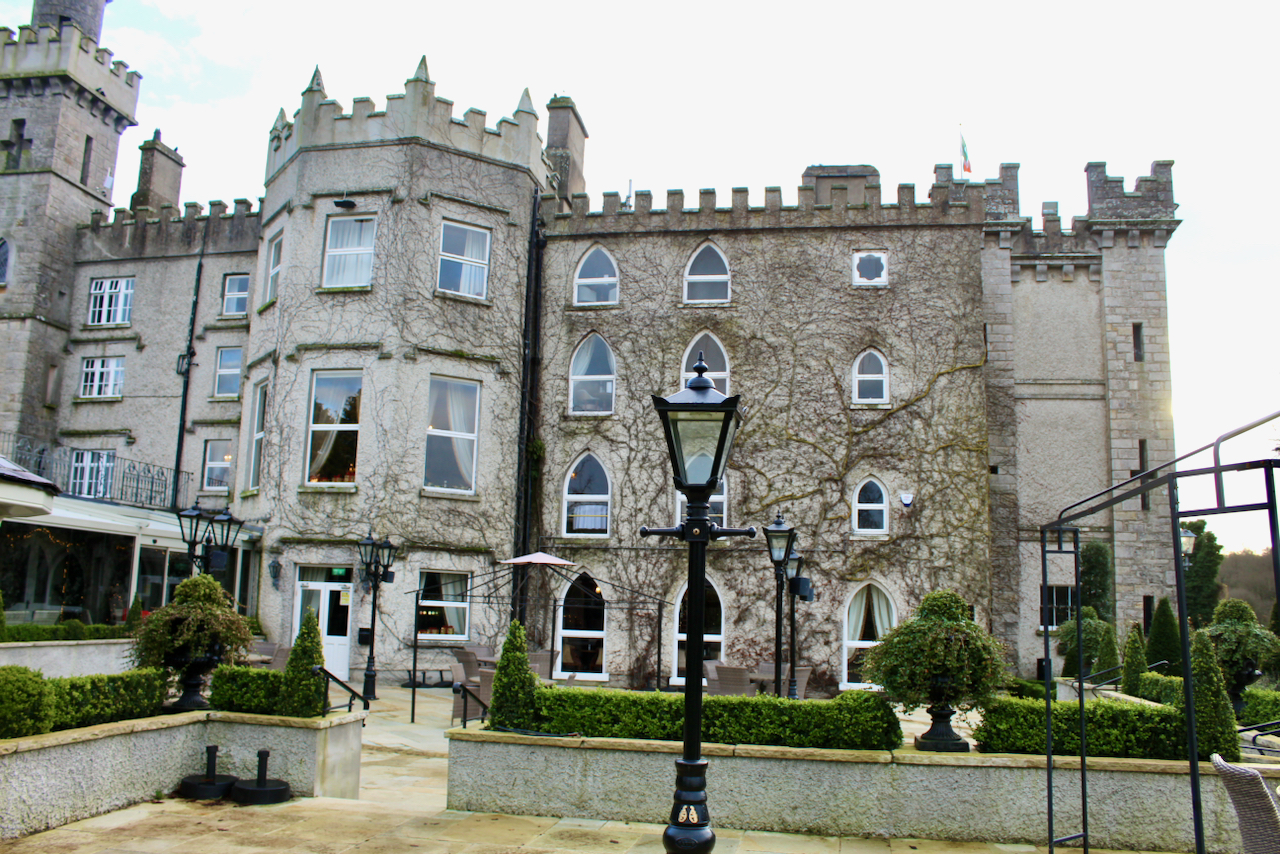
The windows are of various shape, some with hood mouldings. 

Cabra Castle, December 2020. Photograph © Jennifer Winder-Baggot, www.irishhistorichouses.com

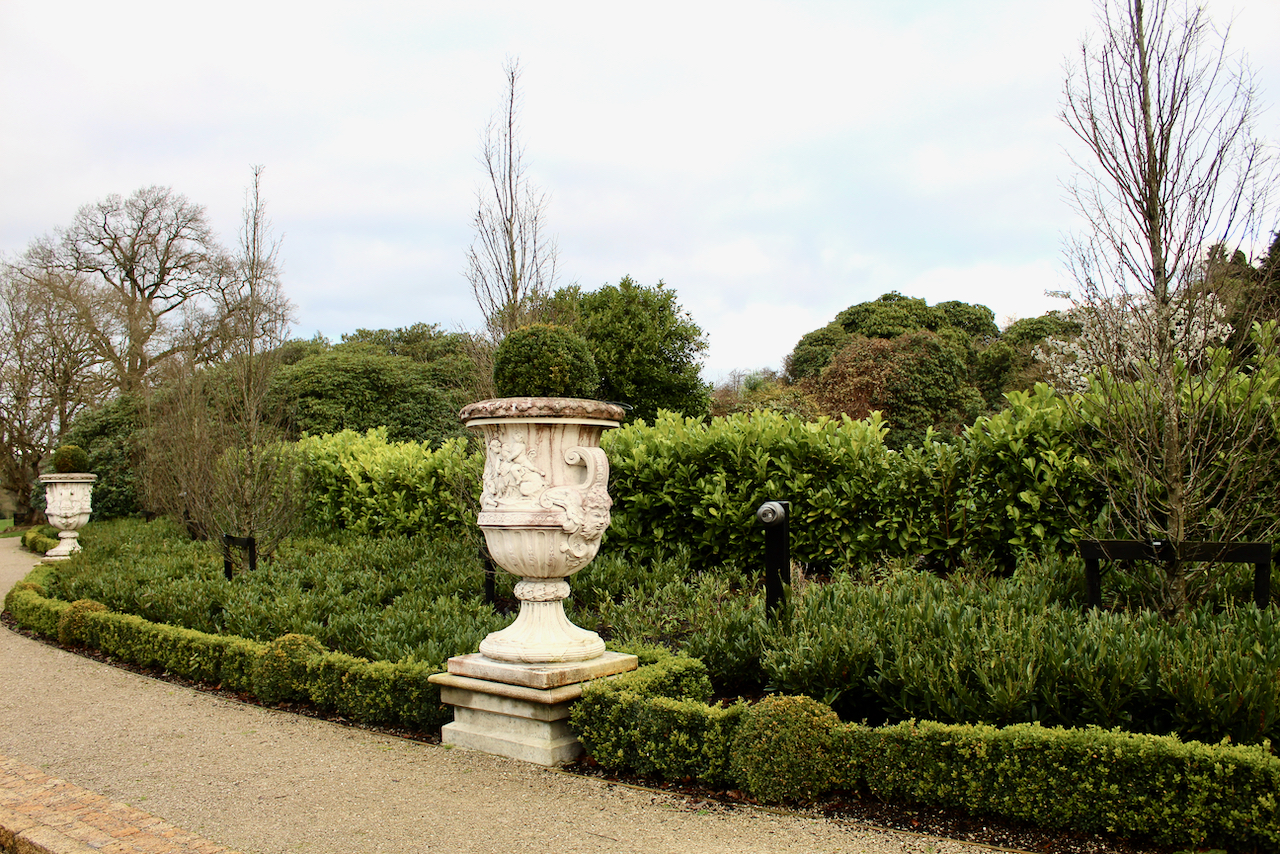
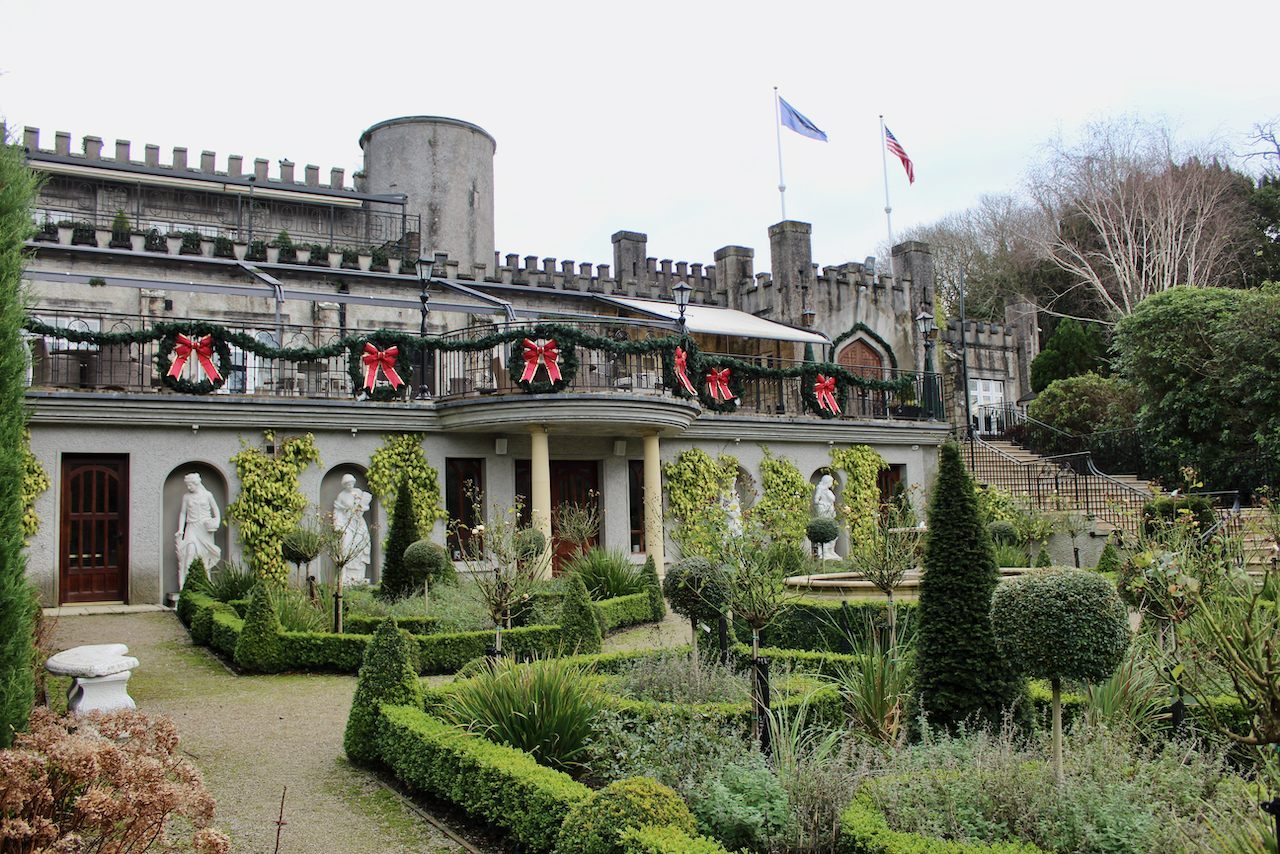
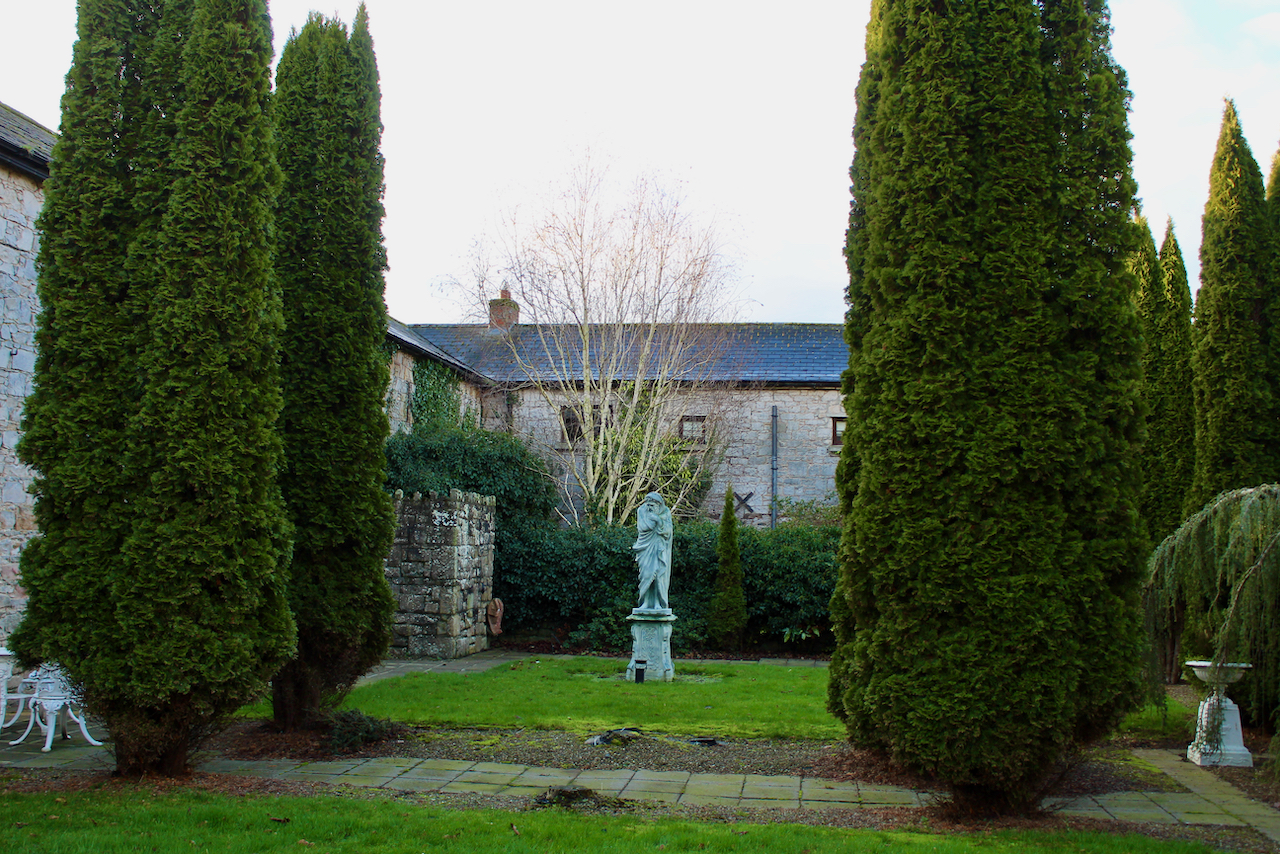
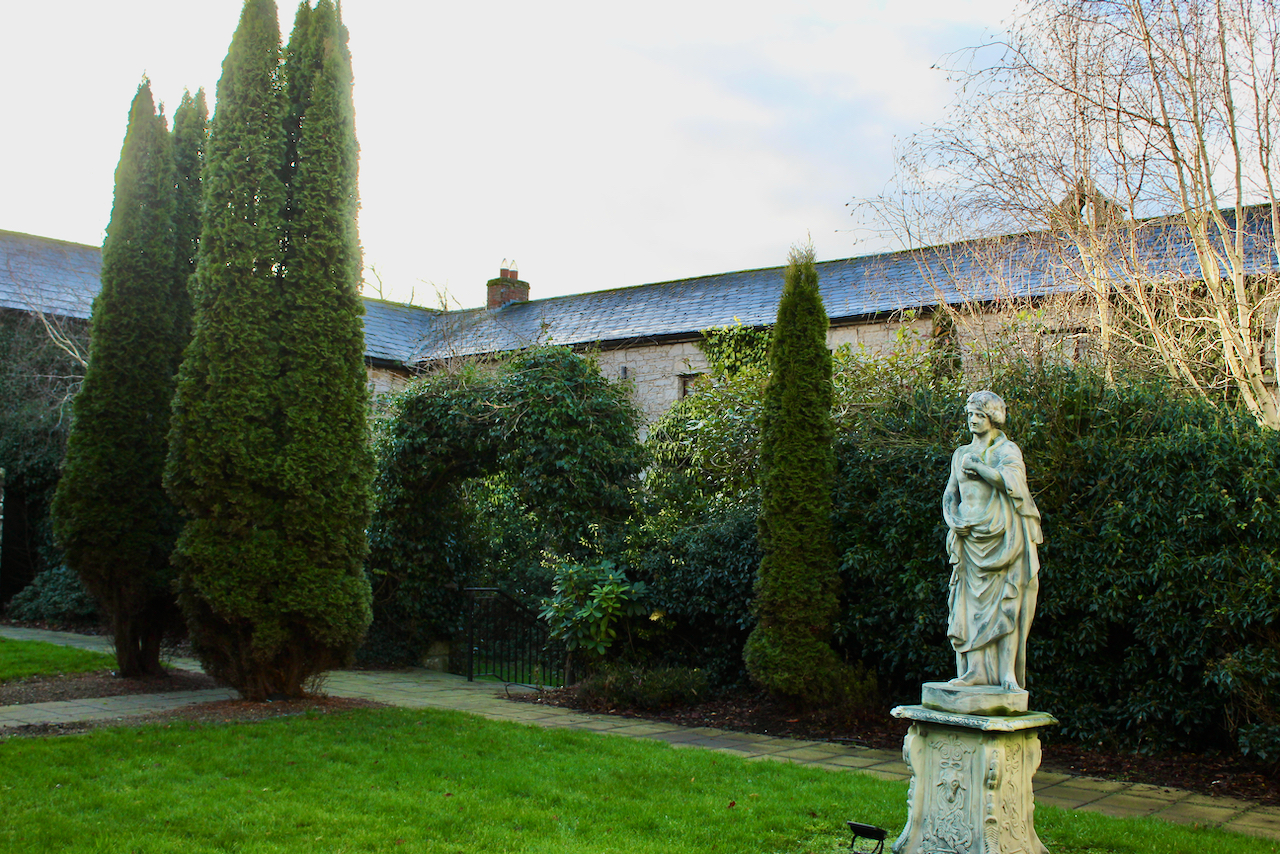
A recent creation to one side of the tower is “Mitzi’s garden,” a formal garden with fountain, tribute to the mother of the current generation of Corscaddens, who is nicknamed Mitzi. This area used to be used for parking. 

Cabra Castle, December 2020. Photograph © Jennifer Winder-Baggot, www.irishhistorichouses.com
View of Mitzi’s Garden from the balcony above. Photograph © Jennifer Winder-Baggot, www.irishhistorichouses.com

There are statue-filled niches, and a side entrance, up a flight of steps, leads to the recently refurbished ballroom.

Cabra Castle, December 2020. Photograph © Jennifer Winder-Baggot, www.irishhistorichouses.com
The steps leading to the entry to the Ballroom. Photograph © Jennifer Winder-Baggot, www.irishhistorichouses.com

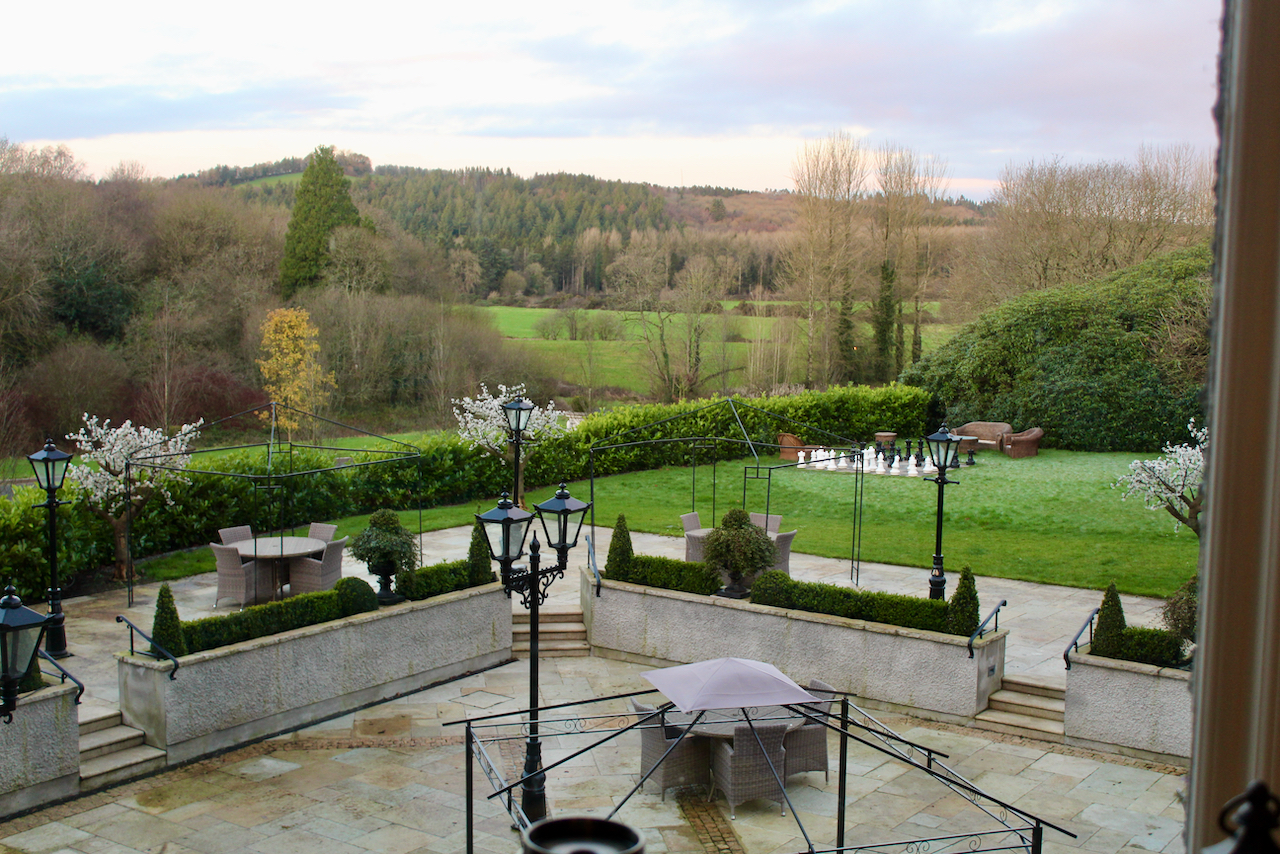
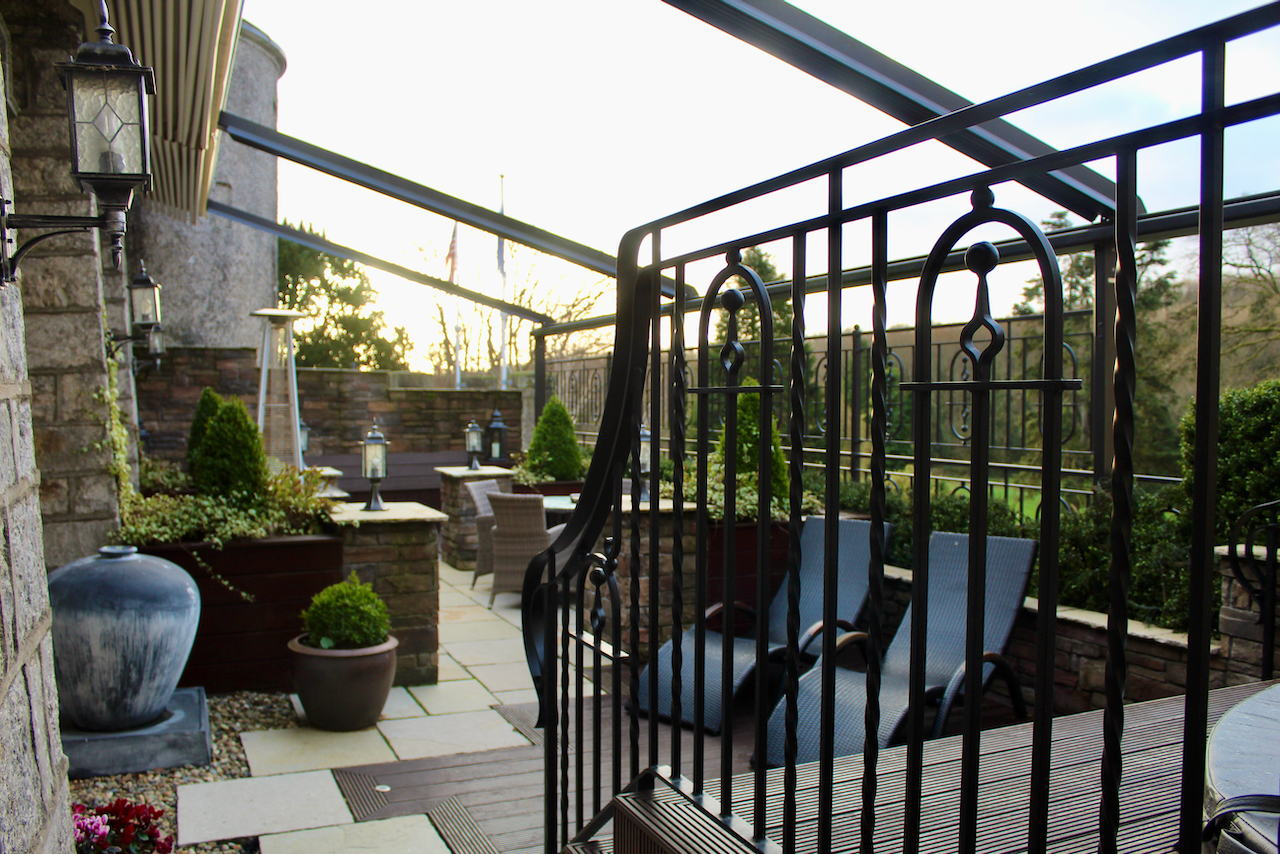
The other side of the building has a terrace which contains a seating area outside the bar, which also serves food.

This is a photograph of the terrace from 2011, which has been altered slightly, as you can see in the photograph below. Photograph © Jennifer Winder-Baggot, www.irishhistorichouses.com
Cabra Castle, December 2020. Photograph © Jennifer Winder-Baggot, www.irishhistorichouses.com
The bar on the ground floor. Photograph © Jennifer Winder-Baggot, www.irishhistorichouses.com
The ogee arched shaped windows and doors mirror those of the entrance. Photograph © Jennifer Winder-Baggot, www.irishhistorichouses.com

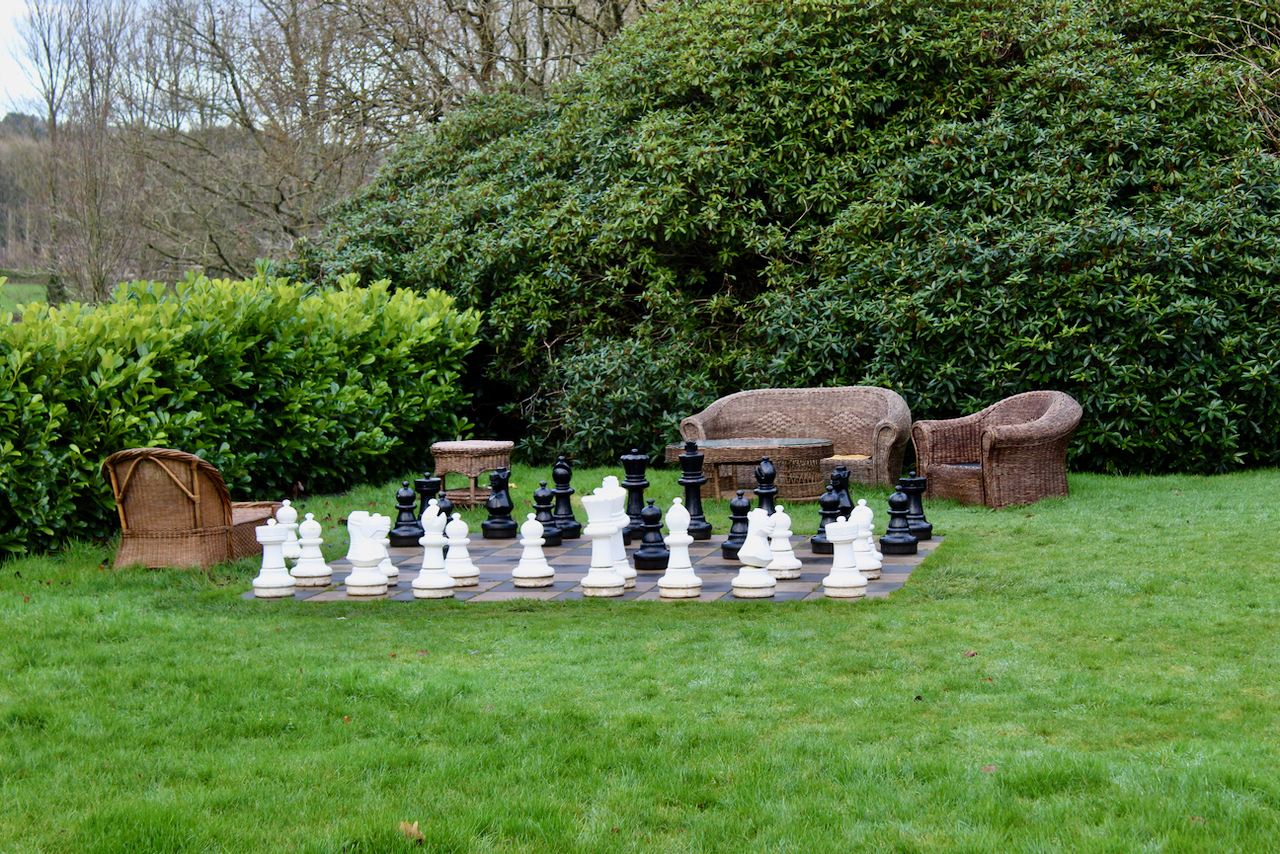
This courtyard looks out to a lawn area that has a giant chess set and places to sit.

Cabra Castle, December 2020. Photograph © Jennifer Winder-Baggot, www.irishhistorichouses.com
This path leads out to a golf course. Photograph © Jennifer Winder-Baggot, www.irishhistorichouses.com
The castle is permanently inhabited by some beautiful Irish wolf hounds, who make a picturesque and atmospheric addition to wedding photographs. Photograph © Jennifer Winder-Baggot, www.irishhistorichouses.com
This is the area beyond the courtyard and bar, and is the outer walls of the courtyard to the rear of the castle. Photograph © Jennifer Winder-Baggot, www.irishhistorichouses.com
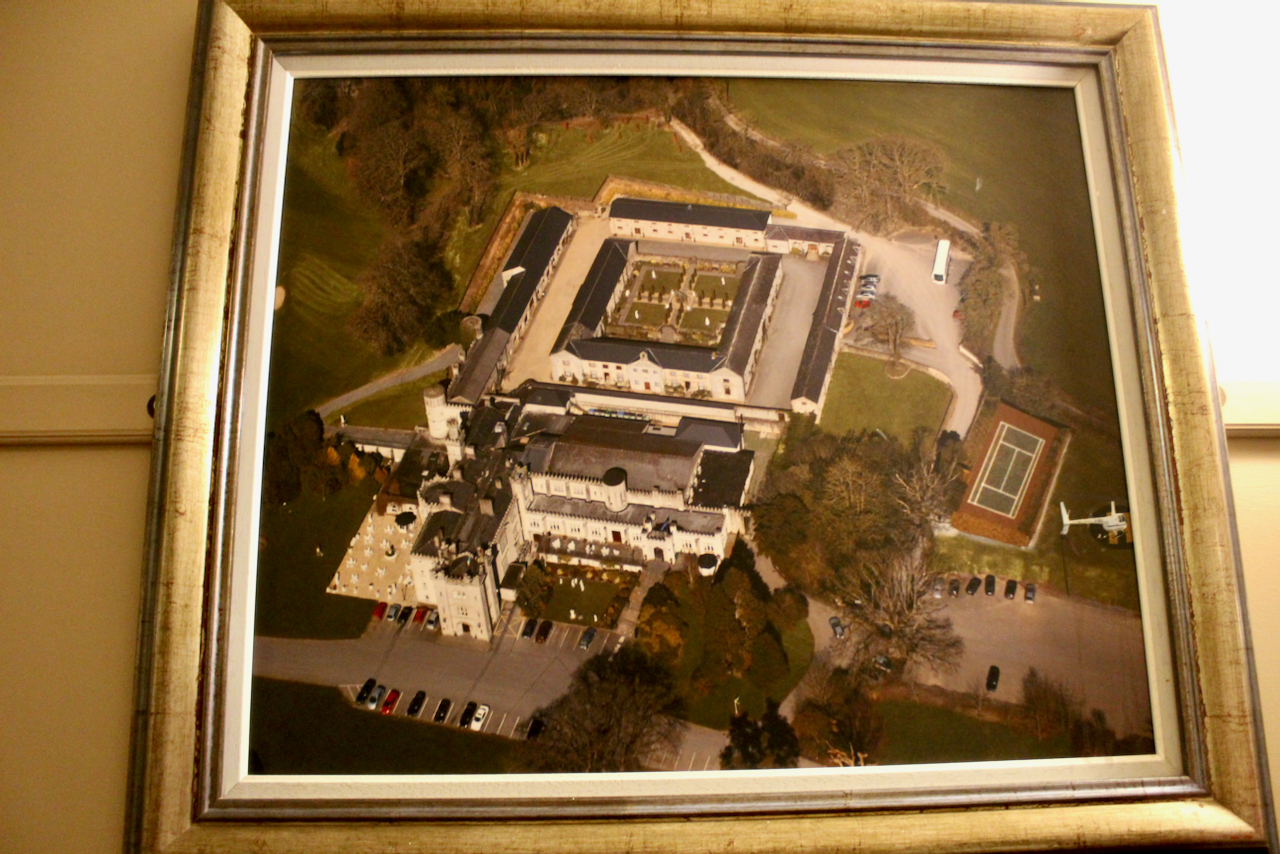
This arial photograph was taken before Mitzi’s Garden was developed. The square turret in the inside corner of the L bend of the castle contains our en suite. The courtyard with further accommodation, of one square within a larger square, is at the rear.

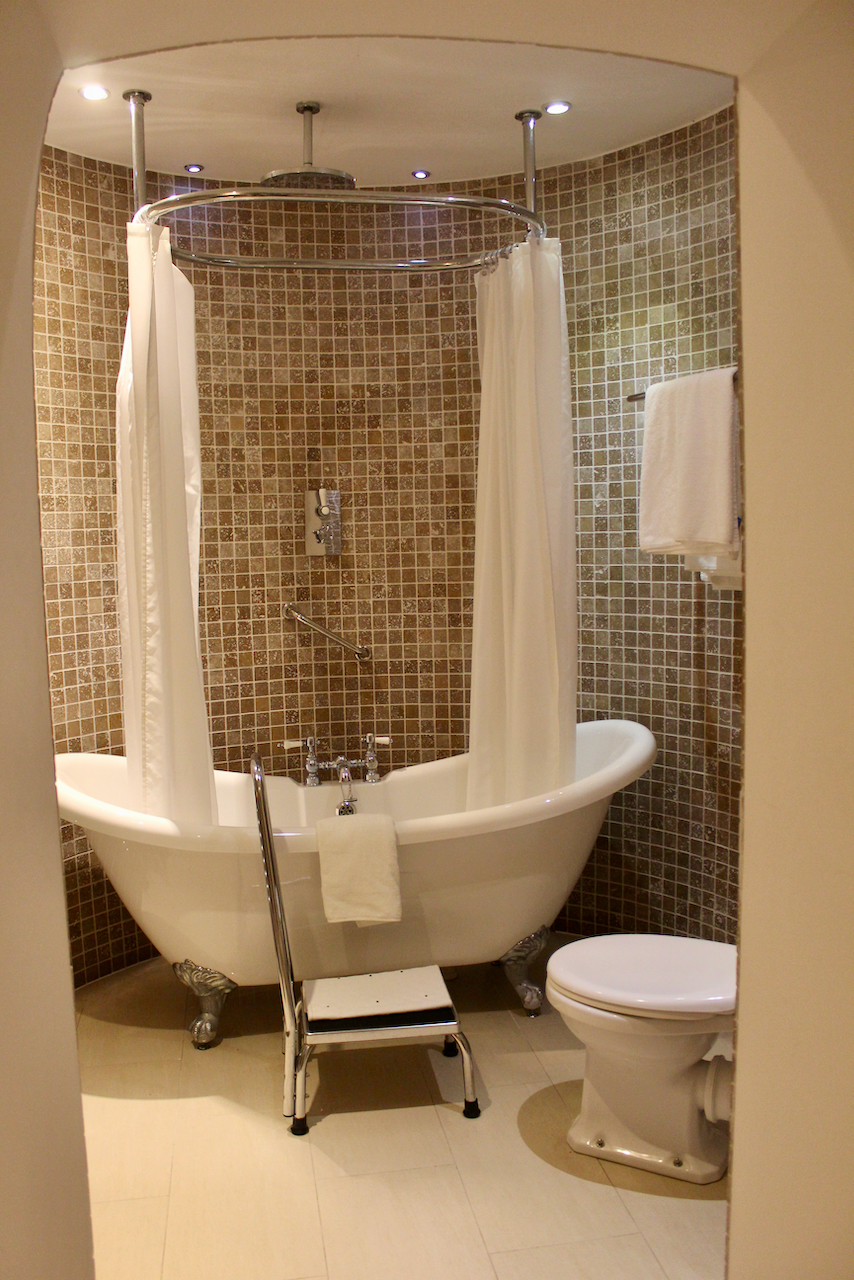
The oldest part of the castle can be pinpointed in the aerial view. According to the National Inventory of Architectural Heritage the “earlier house of c.1750 [is] embedded within northern section of south-east side concealed behind extension of c.1990, junction marked by square-plan rendered turret corresponding to north-west side in simplified form.” This square plan turret actually contains our bathroom!

Beyond Mitzi’s Garden a path leads to the car park and further self-catering accommodation, beyond the tennis court. A branch of this path and driveway curves around to the courtyard at the back of the castle. One can also enter this courtyard through the castle. The courtyard originally contained the stables, but these have been converted into more hotel accommodation. There are about sixty rooms in the courtyard.

The outside of the courtyard buildings. Photograph © Jennifer Winder-Baggot, www.irishhistorichouses.com
Cabra Castle, December 2020. Photograph © Jennifer Winder-Baggot, www.irishhistorichouses.com

Some of the buildings in the courtyard have been newly constructed. My amateur eye cannot distinguish the new from the old.

In the middle of the courtyard is Karl’s Garden, named after a former groundsman. 

Cabra Castle, December 2020. Photograph © Jennifer Winder-Baggot, www.irishhistorichouses.com
Photograph © Jennifer Winder-Baggot, www.irishhistorichouses.com

The Cabra Castle website tells us:

“Colonel Joseph Pratt had married Jamima, daughter of Sir James Tynte [of Tynte Park, County Wicklow – the beautiful house that stands there today wasn’t built until around 1820; Jamima married in 1806], and had ten children. The eldest – Mervyn, born in 1807 – married Madeline Jackson, only daughter and heiress of Colonel Jackson of Enniscoe, Co. Mayo. They inherited this property when Colonel Pratt died. 

“He succeeded his father, Col. Joseph Pratt, as owner of Cabra in 1863, but from this time onwards, the interests of the Pratt Family were divided between Cabra in Co. Cavan and Enniscoe in Co. Mayo. Mervyn Pratt died in 1890 and was succeeded on his death by his eldest son – Major Mervyn Pratt, in 1927.”

Enniscoe, by the way, is another Section 482 property which I look forward to visiting, which also provides accommodation. The house was completed in 1798. [15] 

Mervyn Pratt (1807-1890) who married into Enniscoe had several brothers. Joseph Pratt took the name of Tynte in 1836 from his mother and lived in Tynte Park. Mervyn held the offices of High Sheriff of County Cavan in 1841 and High Sheriff of County Mayo in 1843. He was also Justice of the Peace for County Cavan and High Sheriff for County Meath in 1875. His son Joseph Pratt (1843-1929) inherited Enniscoe and Cabra Castle, and then Joseph’s son Mervyn (1873-1950) lived at Enniscoe and left Cabra Castle unoccupied. He served in the military, and was a Justice of the Peace, and never married. He bequeathed Cabra to his nearest male relative, Mervyn Sheppard (1905-1994), a Malayan Civil Servant. [16] According to the Cabra Castle website, death duties and taxes, rates, the cost of repairs, and farm losses, meant he could not afford to live there, and he had to sell it. It was sold in 1964 to the Brennans and turned into a 22 bedroom hotel.

The manager of the hotel, Johnny, took us on a tour. While we waited for him we sat by an open fire in a small sitting room off the reception hall.

Reception area within the front entrance. Photograph © Jennifer Winder-Baggot, www.irishhistorichouses.com
Small room off the reception area, where we waited for the Manager for our tour. Photograph © Jennifer Winder-Baggot, www.irishhistorichouses.com
Cabra Castle, December 2020. Photograph © Jennifer Winder-Baggot, www.irishhistorichouses.com

Beyond the reception area is the staircase hall with a bifurcating staircase with metalwork balustrade ascending to the first floor. Two statues very similar to the ones that were recently removed from outside the Shelbourne Hotel in Dublin while the owners determined whether they represented slave girls or not (they do not) adorn the staircase. [17]

Cabra Castle, December 2020. Photograph © Jennifer Winder-Baggot, www.irishhistorichouses.com

On the second floor the staircase hall is surrounded by a gallery, and has ceiling work of thin fretting.

Cabra Castle, December 2020. Photograph © Jennifer Winder-Baggot, www.irishhistorichouses.com

At the top of the stairs on the first floor is a Victorian drawing room with an original gilt wallpaper.

Cabra Castle, December 2020. Photograph © Jennifer Winder-Baggot, www.irishhistorichouses.com

The ceiling has matching gilt decoration. Next to this room, facing the staircase, is the dining area – a suite of several rooms. The arches between the rooms reflect the entrance arch to the castle and the arched windows.

Cabra Castle, December 2020. Photograph © Jennifer Winder-Baggot, www.irishhistorichouses.com
This is the bay window we can see as the canted three storey tower outside. Photograph © Jennifer Winder-Baggot, www.irishhistorichouses.com
Cabra Castle, December 2020.

The historic elegance of the rooms is maintained with original fireplace, antique mirrors, portraits and chandeliers.

Cabra Castle, December 2020. Photograph © Jennifer Winder-Baggot, www.irishhistorichouses.com

On the second floor is more cosy sitting room, decorated in dark green William Morris style wallpaper, making it more like a den or library.

Cabra Castle, December 2020. Photograph © Jennifer Winder-Baggot, www.irishhistorichouses.com

This den overlooks an outdoor seating area. This is the seating area overlooking Mitzi’s Garden.

Cabra Castle, December 2020. Photograph © Jennifer Winder-Baggot, www.irishhistorichouses.com
Beautiful antiques adorn the rooms. I love these porcelain cranes on the  fine desk. Photograph © Jennifer Winder-Baggot, www.irishhistorichouses.com
I can’t find this Cecil Pratt in the family tree. I would love to identify all the sitters in the portraits. Most, however, were bought after the Pratts’ belongings went elsewhere.
Cabra Castle, December 2020. Photograph © Jennifer Winder-Baggot, www.irishhistorichouses.com

The manager then took us through to the most recent piece de resistance, the Ballroom. It has been sensitively built and decorated to reflect the style of the older parts of the castle, and I loved the ceiling, which is quite amazing and looks like heavy medieval carved wood but is actually manufactured using a modern technique. In the hallway leading to the ballroom, our guide pointed out that the original round stone tower of the castle has been incorporated.

The original round stone tower of the castle has been incorporated into the newer wing. A pair of ogee arched doorways lead to the bar. Photograph © Jennifer Winder-Baggot, www.irishhistorichouses.com
A tripartite stone window is also incorporated into the newer area. Photograph © Jennifer Winder-Baggot, www.irishhistorichouses.com
I asked our guide whether this door was a genuine old one, and he told me it is not, but was carefully crafted. Photograph © Jennifer Winder-Baggot, www.irishhistorichouses.com
 

The ballroom includes a large “minstrels’ gallery.”

Cabra Castle, December 2020. Photograph © Jennifer Winder-Baggot, www.irishhistorichouses.com
Tipperary crystal chandelier. Photograph © Jennifer Winder-Baggot, www.irishhistorichouses.com
The tower has been incorporated to form a little nook for a wedding cake. Photograph © Jennifer Winder-Baggot, www.irishhistorichouses.com
Cabra Castle, December 2020. Photograph © Jennifer Winder-Baggot, www.irishhistorichouses.com
The cake tower room comes complete with a sword to cut the cake! Photograph © Jennifer Winder-Baggot, www.irishhistorichouses.com
Cabra Castle, December 2020. Photograph © Jennifer Winder-Baggot, www.irishhistorichouses.com

Off the ballroom is a small kitchen, called Josephine’s Kitchen after one of the staff who worked here for thirty years.

Cabra Castle, December 2020. Photograph © Jennifer Winder-Baggot, www.irishhistorichouses.com

In Josephine’s kitchen, guests can help themselves to tea and coffee. A painting of Cormy Bridge, near where Old Cabra was located, is by Josephine herself!

Cabra Castle, December 2020.

Our guide told us that Howard Corscadden likes to pick up antiques to add to the décor. I love these additions, making me feel like I was a visitor in the days of the Pratts when the castle must have boasted its full glory. After our tour, I explored the nooks and crannies, enjoying the irregularity of the stairways and corridors.

Cabra Castle, December 2020. Photograph © Jennifer Winder-Baggot, www.irishhistorichouses.com

There was a great photograph of Michael Collins and Kitty Kiernan on the way up to our bedroom.

Cabra Castle, December 2020: Michael Collins and Kitty Kiernan.
Cabra Castle, December 2020. Photograph © Jennifer Winder-Baggot, www.irishhistorichouses.com

Even the back corridors have wonderful artworks. I love this series of portraits. I wonder who they are?

Cabra Castle, December 2020.

I also really like these Arabic scenes:

Cabra Castle, December 2020.
Cabra Castle, December 2020. Photograph © Jennifer Winder-Baggot, www.irishhistorichouses.com

Our guide showed us to one of his favourite bedrooms, which has a ceiling recently adorned with plasterwork. He particularly loves the use of the round tower, renovated into a gorgeous bathroom.

Cabra Castle, December 2020. Photograph © Jennifer Winder-Baggot, www.irishhistorichouses.com
Cabra Castle, December 2020. The bathroom is round as it is in a round tower. Photograph © Jennifer Winder-Baggot, www.irishhistorichouses.com

He then took us outside to the courtyard, and showed us the Bridal Suite in the courtyard area.

Cabra Castle, December 2020. Photograph © Jennifer Winder-Baggot, www.irishhistorichouses.com
I loved the detail of the fish tank built into the wall. Photograph © Jennifer Winder-Baggot, www.irishhistorichouses.com

The room has its own jacuzzi.

Cabra Castle, December 2020. Photograph © Jennifer Winder-Baggot, www.irishhistorichouses.com

There is another Bridal Suite, inside the castle. I have saved the best until last, because this was our room! It used to be three bedrooms, a hallway and an office, all now incorporated into a luxurious suite. It has a canopied four poster bed, a comfortable seating area with fireplace, and a beautiful clawfoot bath.

Cabra Castle, December 2020. Photograph © Jennifer Winder-Baggot, www.irishhistorichouses.com
I love the antique desk.
Cabra Castle, December 2020.
I wonder who is in the portraits?  Photograph © Jennifer Winder-Baggot, www.irishhistorichouses.com
Cabra Castle, December 2020. Photograph © Jennifer Winder-Baggot, www.irishhistorichouses.com

The ensuite bathroom has the largest walk-in shower that I’ve ever seen, and the muted lighting feels particularly luxurious.

Cabra Castle, December 2020. Photograph © Jennifer Winder-Baggot, www.irishhistorichouses.com

The bathroom has a door to a large private patio, with stunning views over Mitzi’s Garden and the landscape beyond. And best of all, we had our own private outdoor jacuzzi!

Cabra Castle, December 2020. Photograph © Jennifer Winder-Baggot, www.irishhistorichouses.com
The view from our balcony. Photograph © Jennifer Winder-Baggot, www.irishhistorichouses.com
Stephen prepares to soak in the jacuzzi, under the tower which is attached to the oldest part of the castle. Photograph © Jennifer Winder-Baggot, www.irishhistorichouses.com

There are self-catering cottages where one can also stay. It is a beautiful part of the country. Before heading home, we availed of the opportunity to visit the impressive remnants nearby of Castle Saunderson.

Cabra Castle, December 2020. Photograph © Jennifer Winder-Baggot, www.irishhistorichouses.com
Castle Saunderson, County Cavan. Photograph © Jennifer Winder-Baggot, www.irishhistorichouses.com

[1] http://audrey.ie/wp-content/uploads/2018/07/cabra-castle.pdf

See also Ballyseede Castle: https://www.ballyseedecastle.com

Markree Castle: https://www.markreecastle.ie

Castle Bellingham: https://www.bellinghamcastle.ie

[2] Collon House now runs a B&B and you can also request a tour. www.collonhouse.com

[3] http://www.turtlebunbury.com/family/bunburyfamily_related/bunbury_family_related_foster.html

It is interesting to note that his neighbour, Dr. Benjamin Pratt, son of Joseph Pratt and Elizabeth Cooch, was a Provost of Trinity College Dublin in 1710.

[4] http://www.thepeerage.com/p957.htm#i9561

[5] Chapman, Caroline & Jane Dormer, Elizabeth and Georgiana: The Duke of Devonshire and his Two Duchesses, John Wiley & Sons Inc., 2002

[6] https://theirishaesthete.com/2015/04/20/the-scattering/

[7] Hicks, David. Irish Country Houses, Portraits and Painters. The Collins Press, Cork, 2014.

[8] https://archiseek.com/2020/1808-cabra-castle-kingscourt-co-cavan/

[9] https://www.buildingsofireland.ie/buildings-search/building/40403506/cabra-castle-cormey-co-cavan

Also http://www.dunari.ie/history.html

[10] www.cabracastle.com

[11] http://www.bomford.net/IrishBomfords/Chapters/Chapter20/Chapter20.htm

[12] https://theirishaesthete.com/2020/04/20/cabra-demesne/

[13] http://www.thepeerage.com/p38140.htm#i381397

[14] Mark Bence-Jones. A Guide to Irish Country Houses. Originally published as Burke’s Guide to Country Houses volume 1 Ireland by Burke’s Peerage Ltd. 1978; Revised edition 1988 Constable and Company Ltd, London.

[15] https://www.buildingsofireland.ie/buildings-search/building/31303803/enniscoe-house-originally-inishcoe-house-prospect-co-mayo

and https://www.enniscoe.com

[16] Imagine inheriting a castle from a distant relative! Mervyn Pratt died in 1950 and his siblings had predeceased him and had no children. Louisa Catherine Hannah Pratt was his aunt. It was through her line that Mervyn Sheppard inherited.

Louisa Pratt was the sister of Joseph Pratt (1843-1929), who lived at Enniscoe, the father of Mervyn Pratt. Louisa Pratt married Thomas Rothwell. Thomas Rothwell served in County Meath militia, and was High Sheriff of County Meath in 1867, and also served as Justice of the Peace for County Meath. He lived at Rockfield, County Meath. 

Louisa and Thomas had four daughters. Louisa Frances Rothwell must have been the oldest of the daughters, as it was through her son that Mervyn Sheppard inherited. Mervyn Sheppard was the son of Canon James William ffrank Sheppard and Louisa Frances Rothwell. Mervyn probably grew up in England where father was rector. He had a twin, Frank Baden ffrank Sheppard, who served in the military, and a younger brother. 

[17] An Irish Times article by Ronan McGreevy from Thursday Sept 24th 2020  explains the origin of the Shelbourne hotel statues. They were designed and sculpted by Mathurin Moreau (1822-1912) and were cast in a foundry in Paris. The statues represent Egyptian and Nubian women.

Text © Jennifer Winder-Baggot, www.irishhistorichouses.com
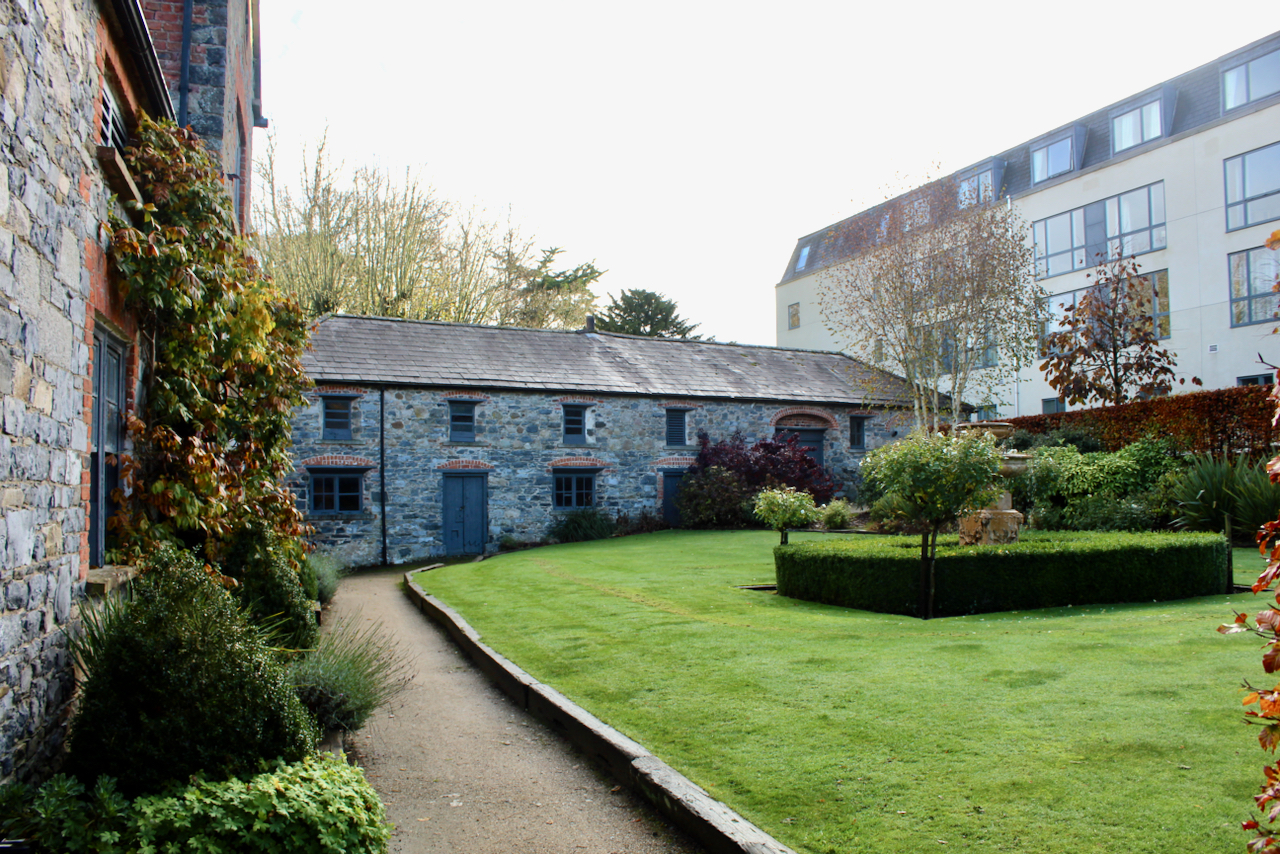
Donation towards accommodation

I receive no funding nor aid to create and maintain this website, it is a labour of love. I travel all over Ireland to visit Section 482 properties and sometimes this entails an overnight stay. A donation would help to fund my accommodation.

€150.00