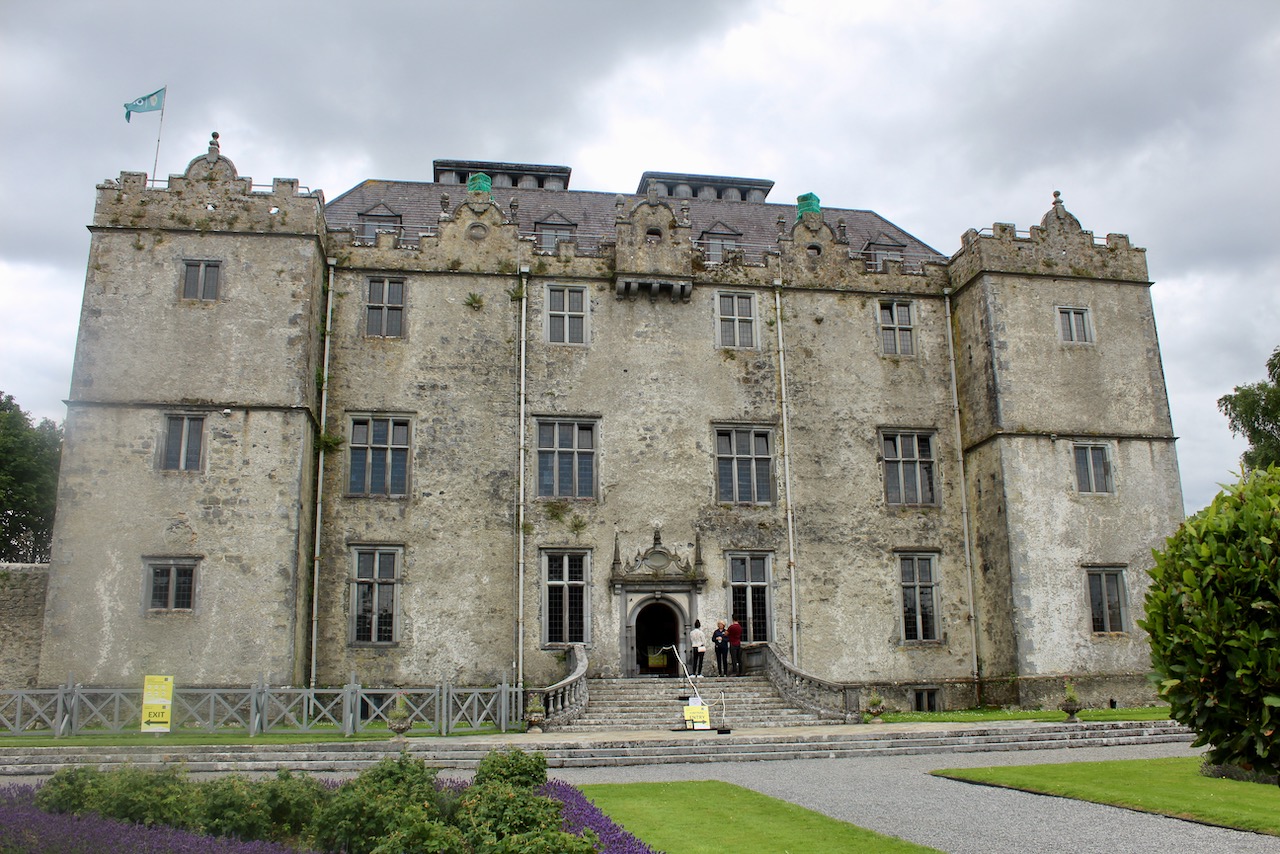
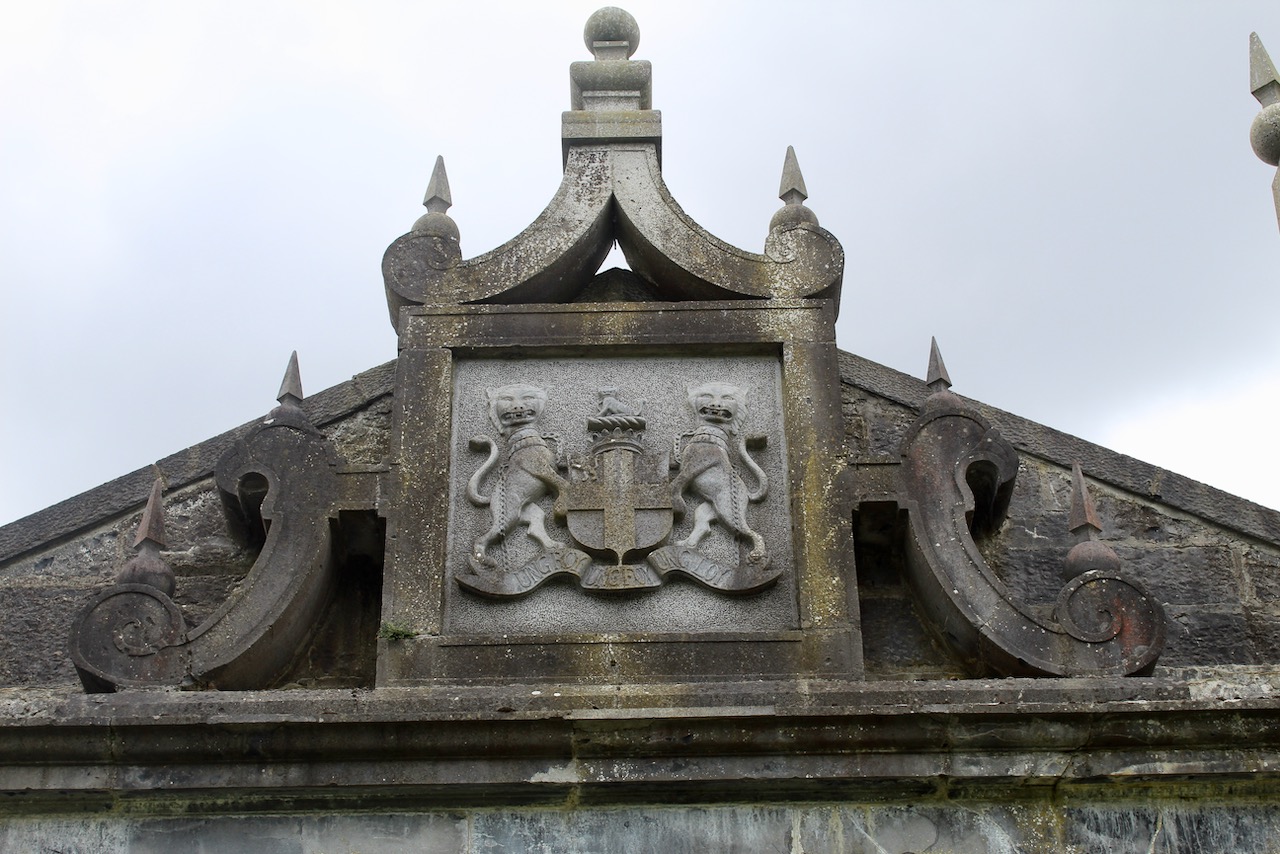
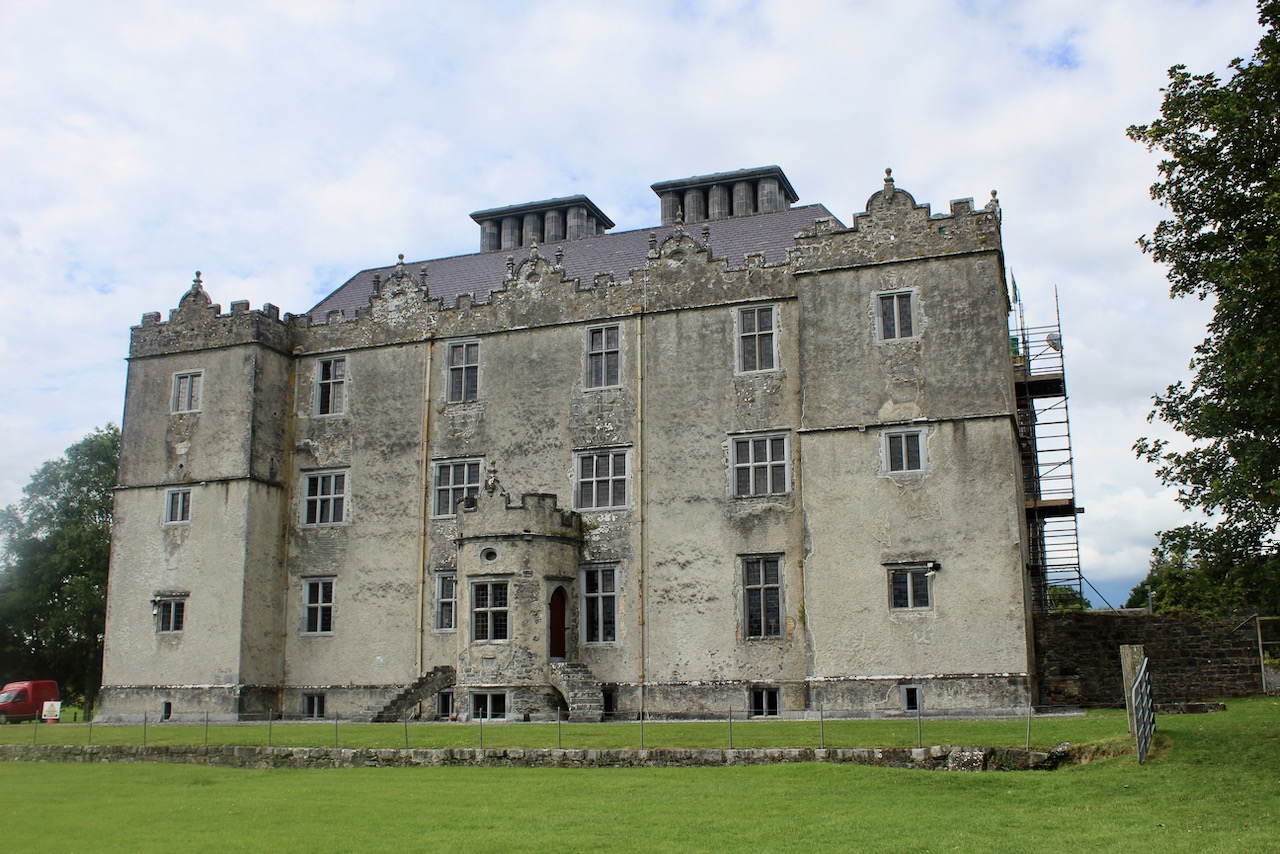
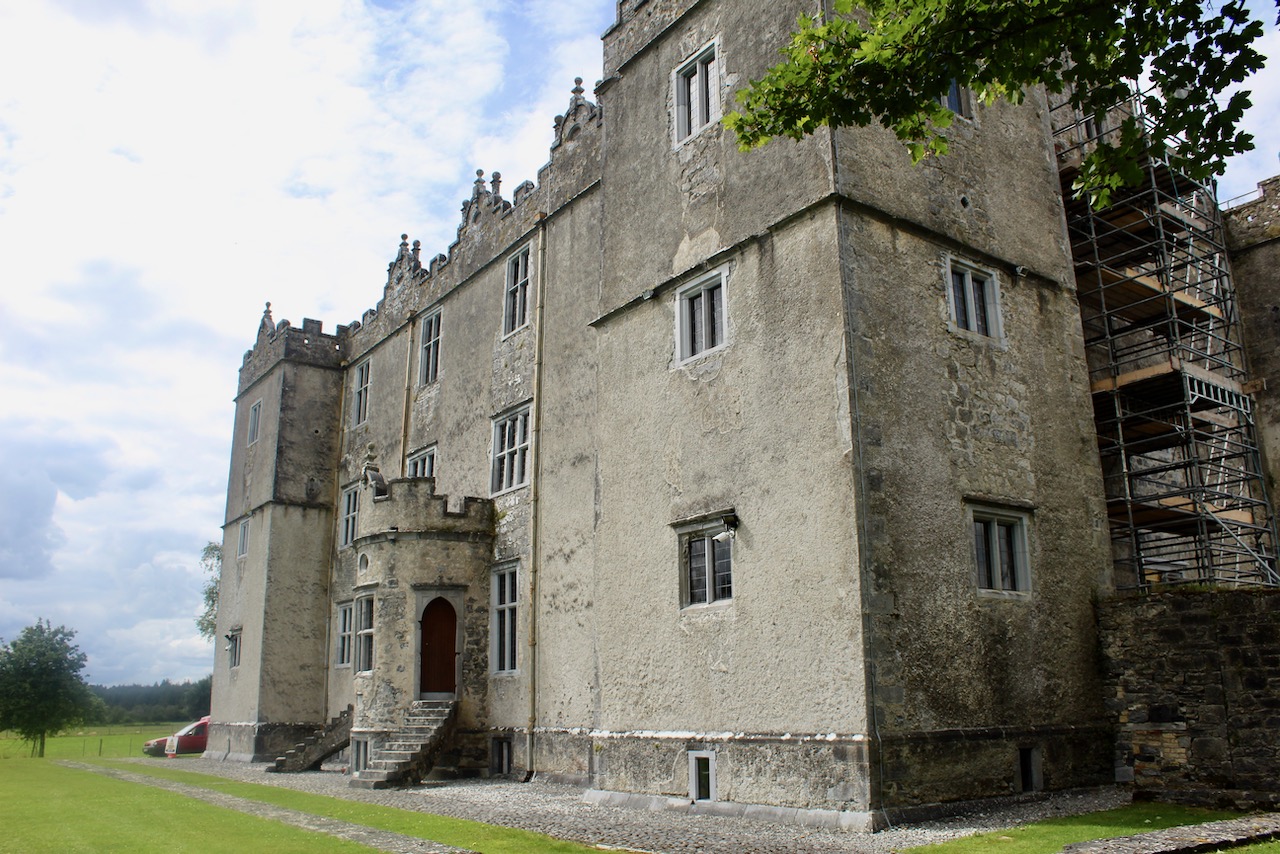
“Built by [Richard Bourke 1572-1635] the fourth earl of Clanricarde, Portumna Castle was the de Burgo family power base for centuries.
“The castle is a unique example of the transitional Irish architecture of the early 1600s. Its bold design combines elements of medieval and Renaissance style that complement each other perfectly.
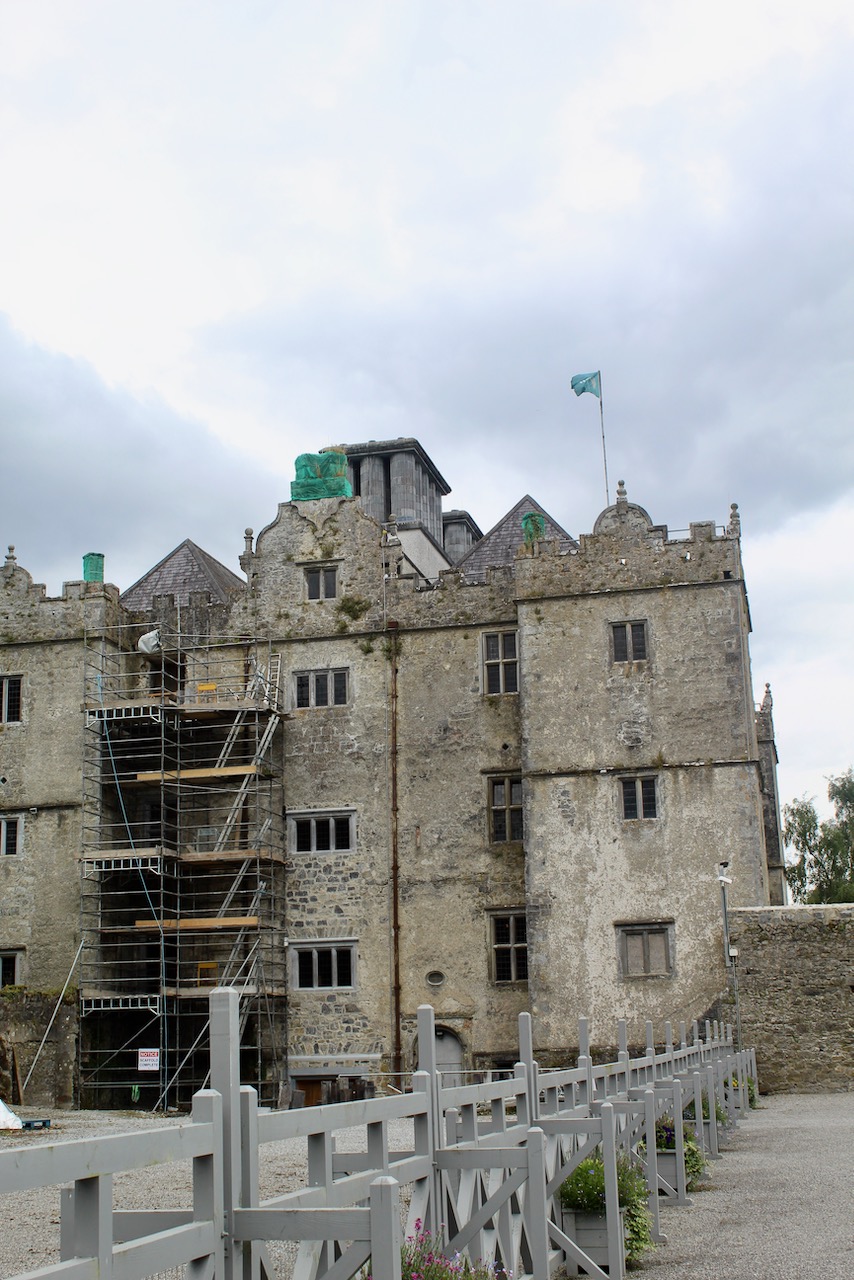
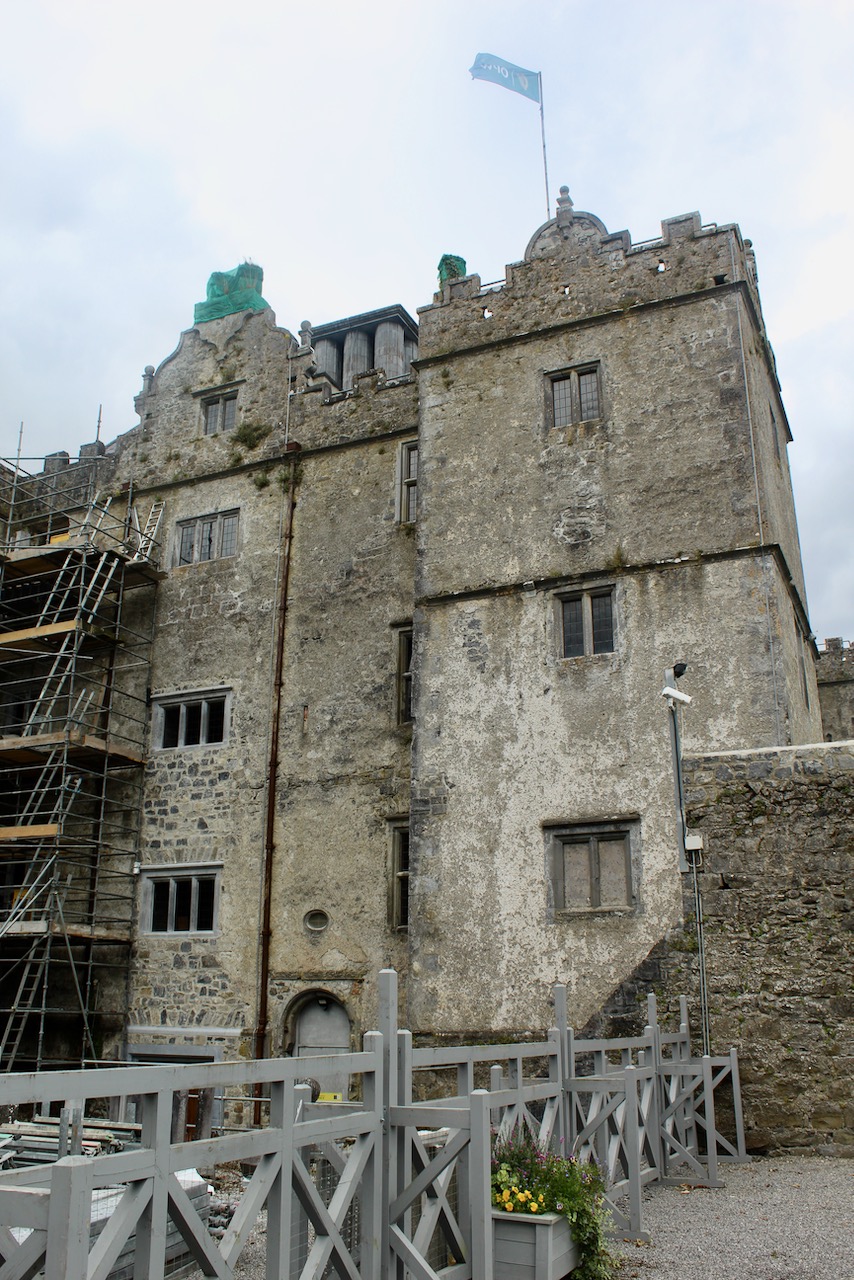
“A major fire in 1826 left the castle a roofless shell, but the state began to bring it back from ruin in the 1960s. Restoration work continues to this day.
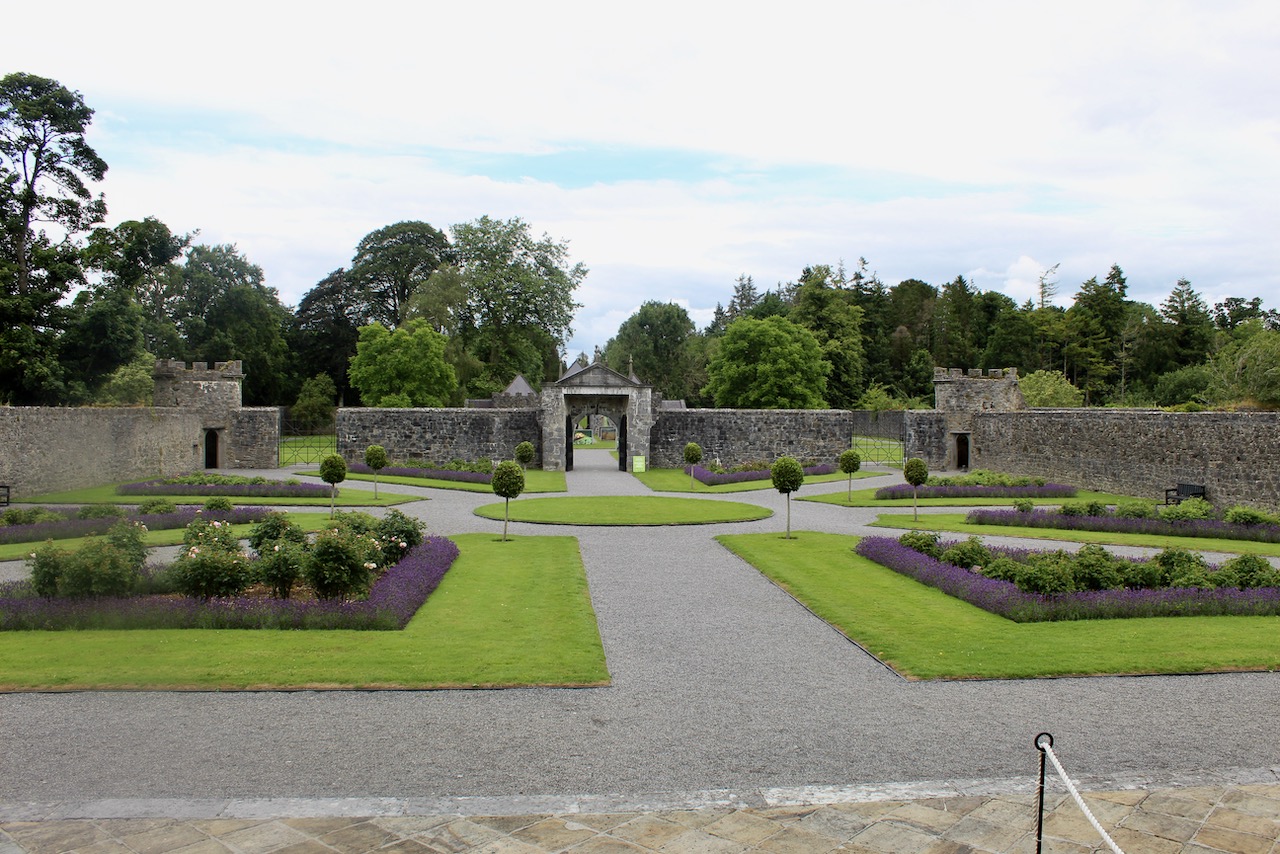
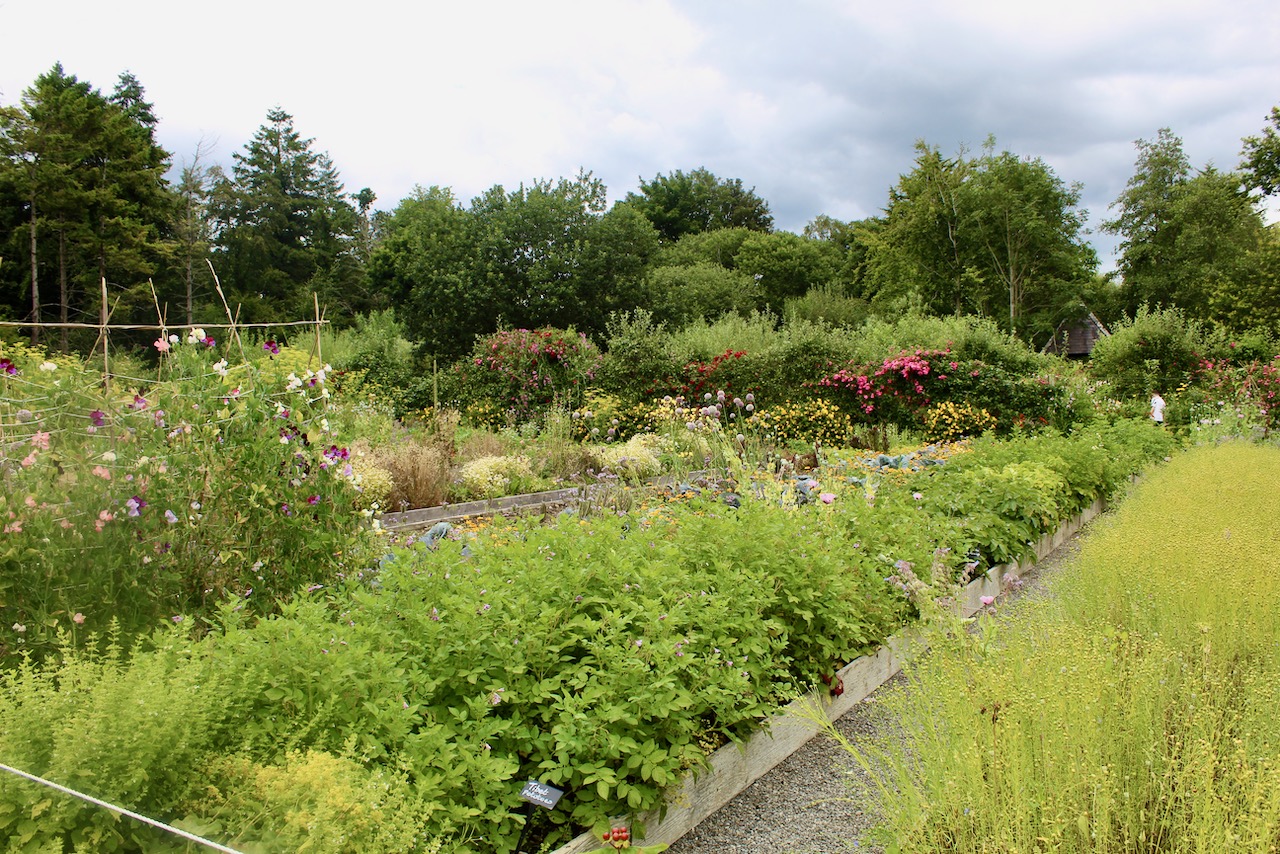
“The dramatic walk up to the building includes charming formal gardens, which create an enchanting sense of the original seventeenth-century setting. The walled kitchen garden is particularly memorable.
“The castle enjoys a sensational view of Lough Derg. The ground floor is open to the public and houses an exhibition that brings the story of the castle and the de Burgo family to life. It is right beside the River Shannon and Portumna Forest Park, which makes it a great choice for a delightful day out.“
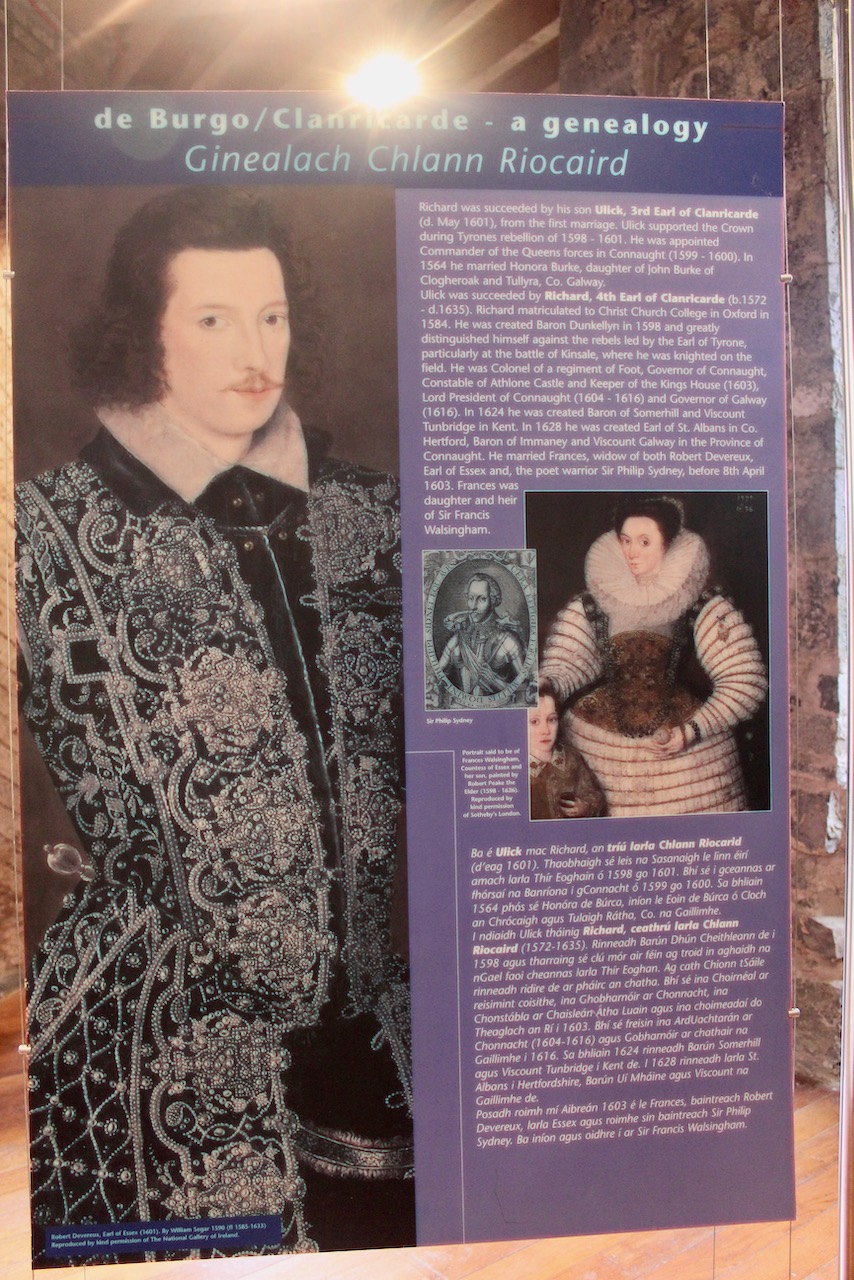
Richard Bourke 4th Earl of Clanricarde was brought up and educated in England. He fought on the side of the English against Hugh O’Neill, Earl of Tyrone, and was knighted on the field at the battle of Kinsale. He was a protege of Robert Devereux, 2nd Earl of Essex, and married Frances Walsingham, who was the widow of the poet Philip Sydney (1554-1586) and of Robert Devereux, the 2nd Earl of Essex (1566-1601), favourite of Queen Elizabeth I.
Portrait of Frances Walsingham, along with her husband Robert Devereux, 2nd Earl of Essex, and in the small picture, Sir Philip Sydney.
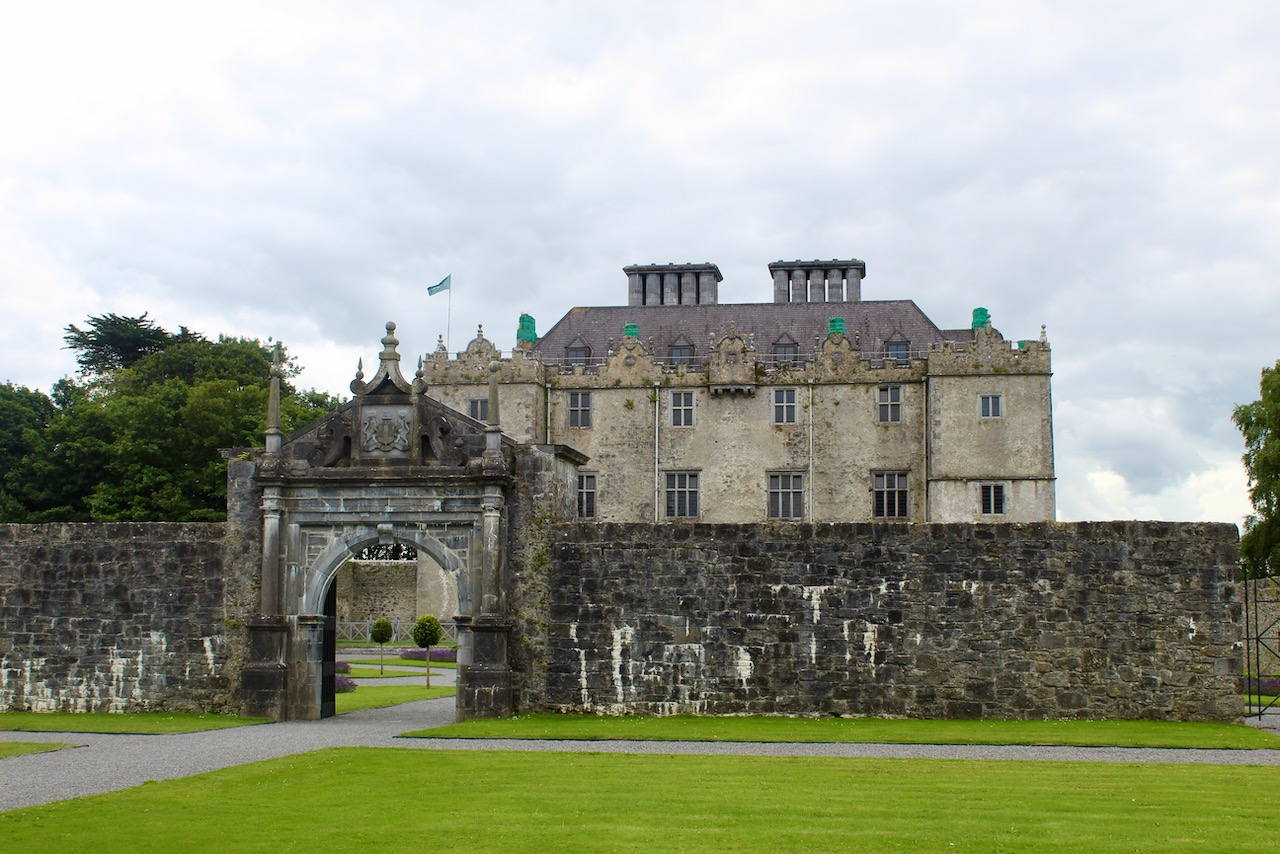
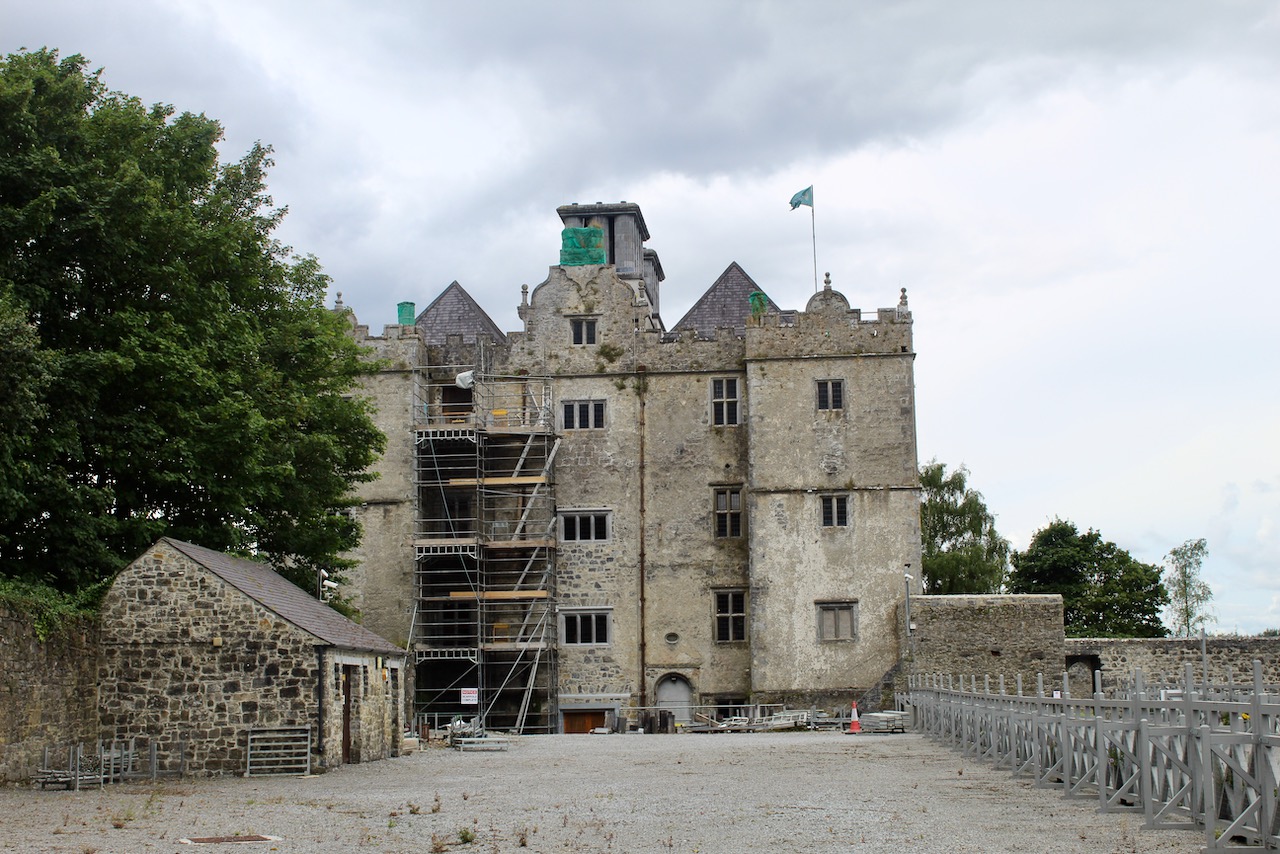
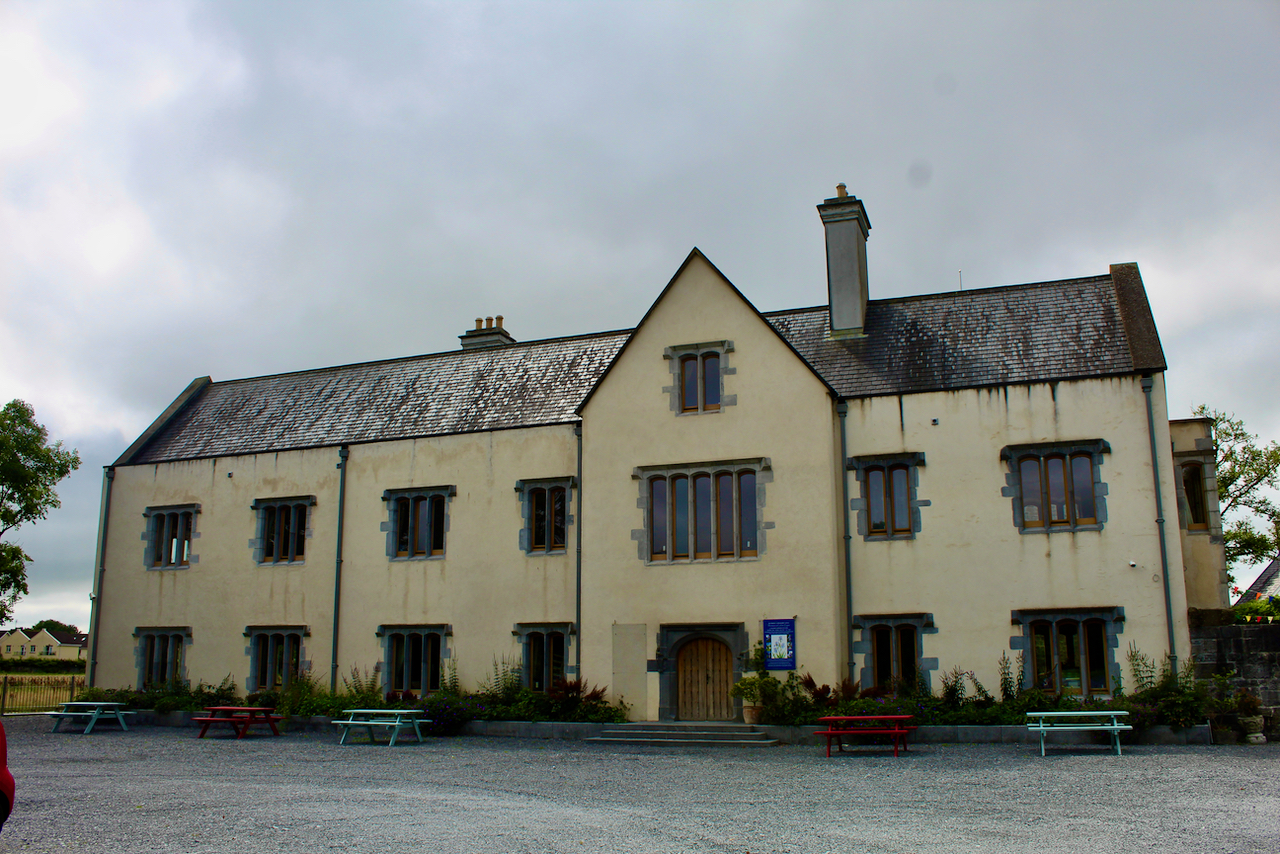
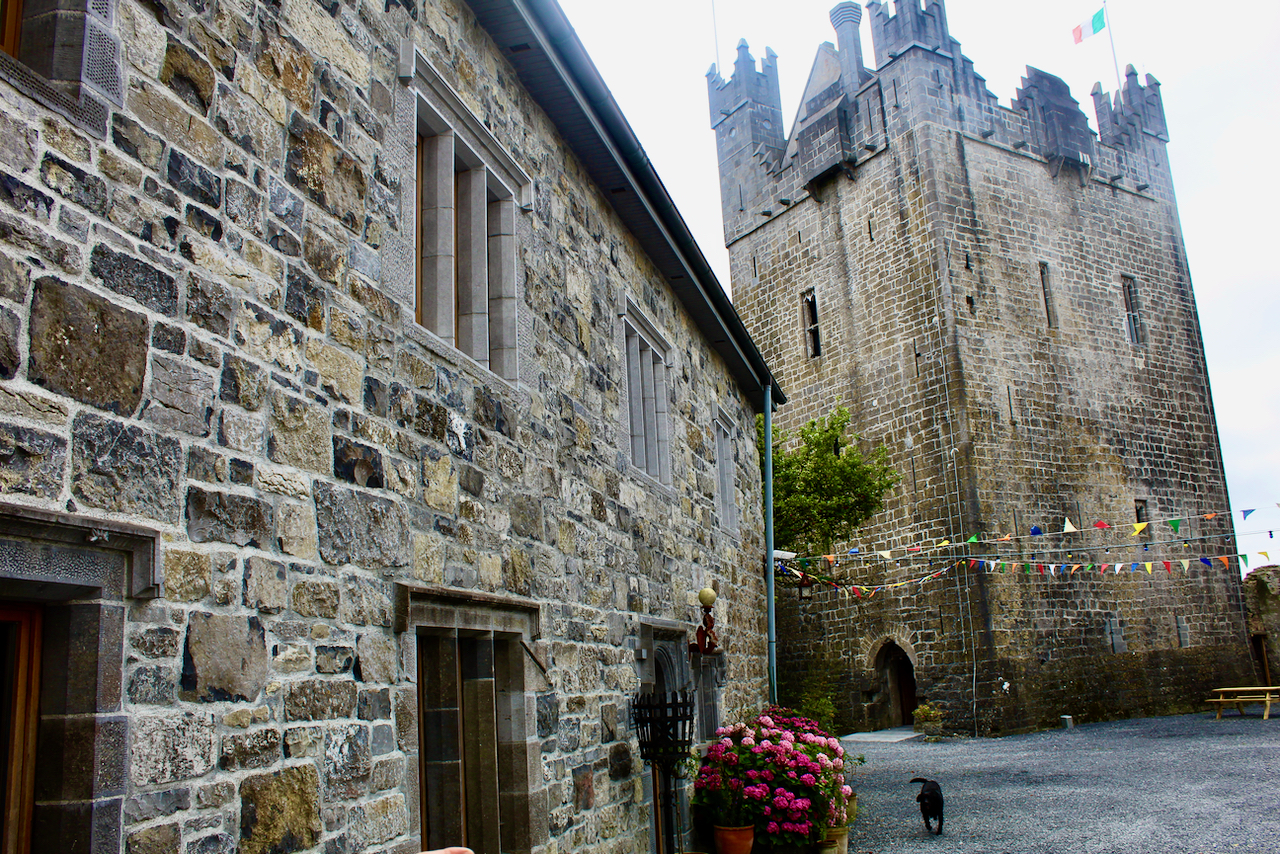
The castle was built around 1616 and is a mixture of defensive Elizabethan/Jacobean building and a manor house, marking the transition in building styles. In this is it similar to Rathfarnham Castle in Dublin, which was built around 1583. It retains defensive structures such as machicolations (floor openings in the battlements, through which stones, or other objects, could be dropped on attackers), shot holes, and strong corner towers, and surrounding walls with gunloops and crenellated towers.
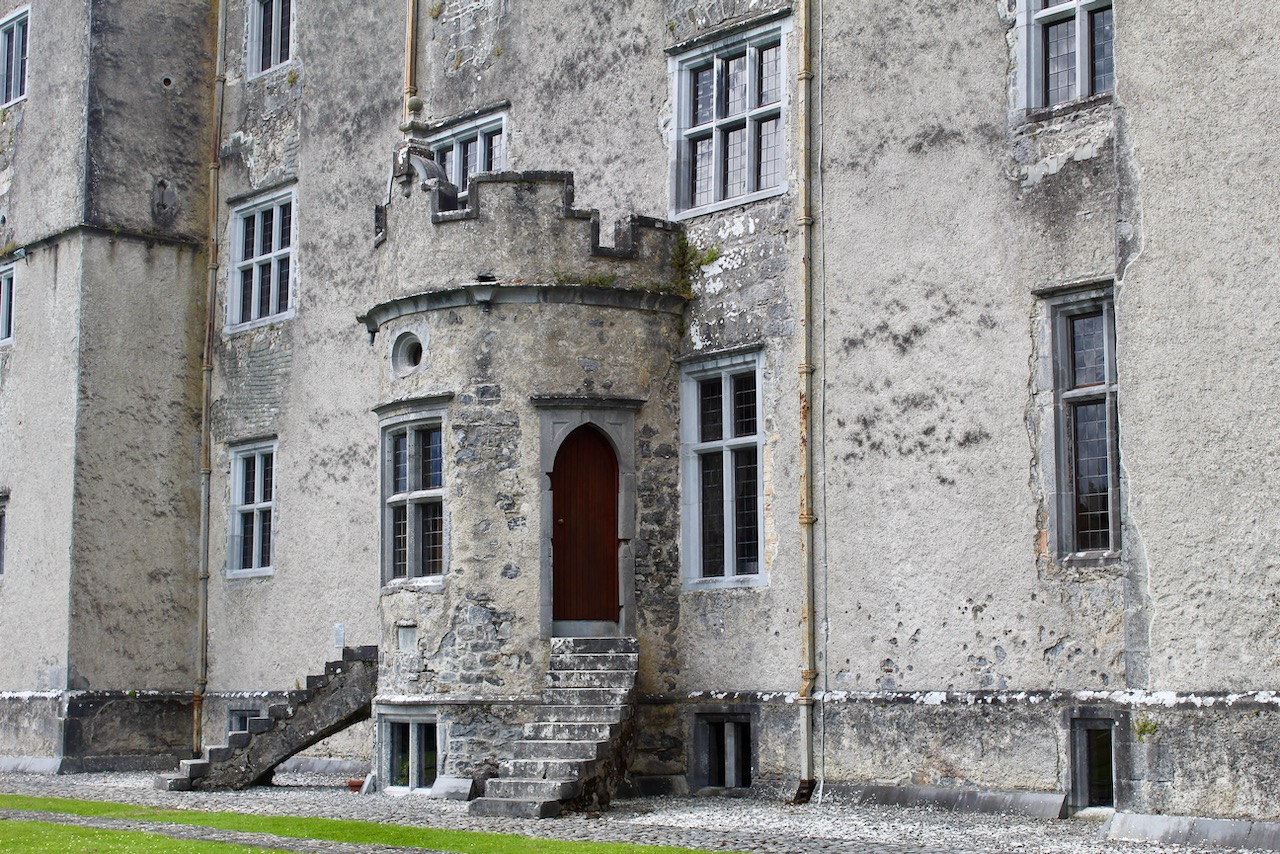
The back is similar to the front, except for the addition in around 1797 of a curved porch of Jacobean style in the middle of the garden front (probably in the time of the 12th Earl of Clanricarde who died in December 1797 and was elevated to be a Marquess). I loved the curving steps up to this round door entrance.
Before building Portumna Castle, the principal seat of the Earls of Clanricarde was a castle in Loughrea. As well as building Portumna, the 4th Earl refurbished the castles at Aughnanure and Athenry, amongst others. The Clanricarde earls also owned Clarecastle, Oranmore and Kilcolgan castles.
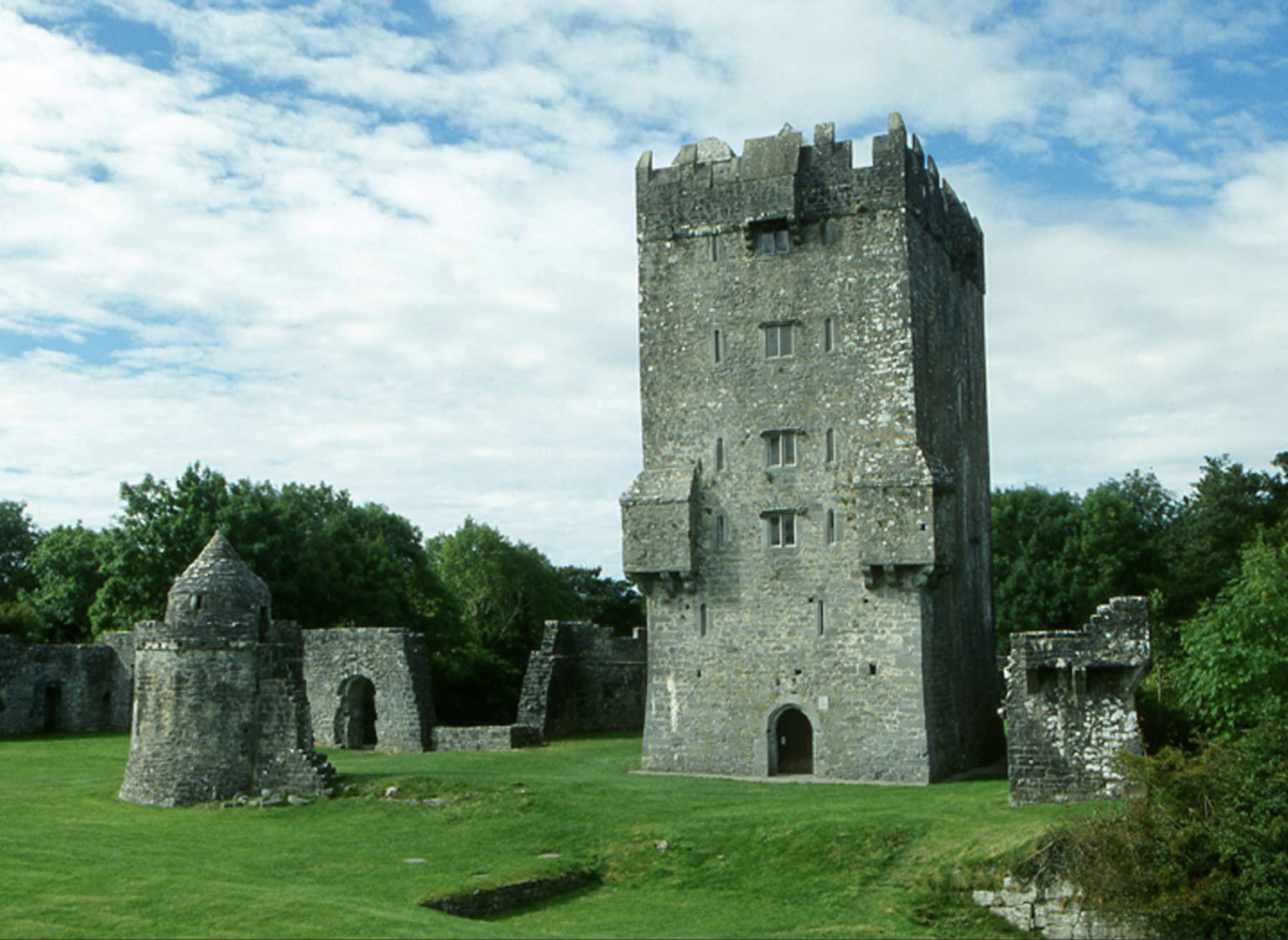
Aughnanure Castle County Galway, photograph courtesy of OPW website.This was also refurbished by the 4th Earl of Clanricarde.Athenry Castle, County Galway, photograph courtesy of OPW website. This was also refurbished by the 4th Earl of Clanricarde.
The descendants of William de Burgo adopted Irish customs and clothing. Ulick Burke of Clanricarde (d. 1544) became Earl of Clanricarde and Baron of Dunkellin, and was one of the earliest Irish Chiefs to accept Henry VIII’s policy of “surrender and regrant,” accepting Henry VIII as his sovereign.
Ulick’s son Richard, 2nd Earl of Clanricarde, fought the Irish for the British crown.
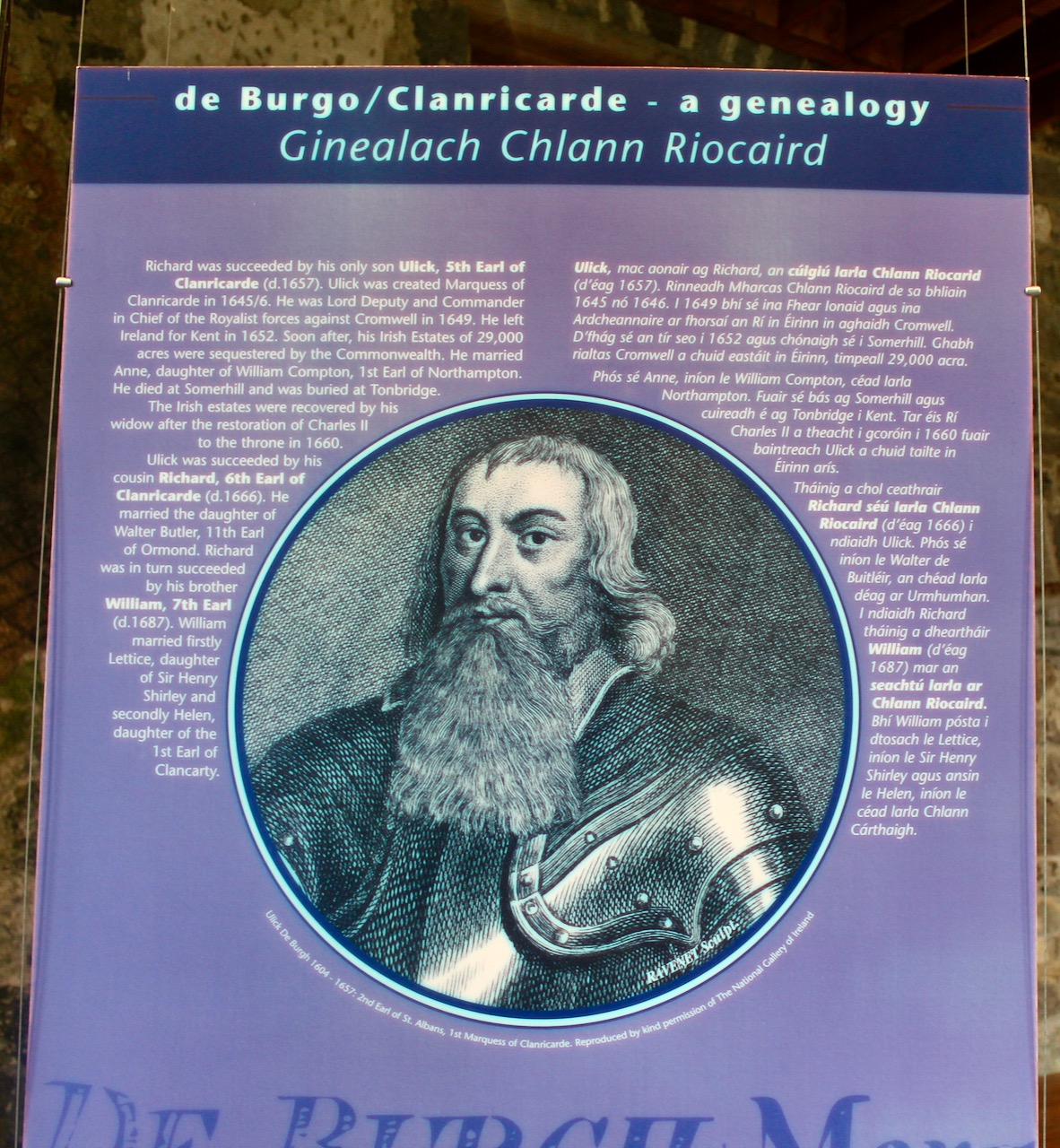
The castle passed to the 4th Earl’s son Ulick who succeeded as 5th Earl of Clanricarde (d. 1657) and who was created 1st Marquess of Clanricarde. and then to a cousin, Richard (d. 1666), who became 6th Earl of Clanricarde.
Portrait of Ulick, 5th Earl of Clanricarde (d. 1657). He was created Marquess of Clanricarde. He was Lord Deputy and Commander in Chief of Royalist forces against Cromwell in 1649. His Irish estates were lost but then recovered by his widow after the restoration of Charles II to the throne.
The 6th Earl married Elizabeth Butler, daughter of Walter Butler, 11th Earl of Ormond and had daughters so the title passed to his brother William (d. 1687), 7th Earl of Clanricarde.
The 7th Earl’s son Richard the 8th Earl (died 1708) succeeded his father and despite marrying several times had no male heirs, so was succeeded by his brother John, 9th Earl (d. 1722). John was created Baron Burke of Bophin, County Galway, by King James II. He fought on the Jacobite side and was taken prisoner at the Battle of Aughrim in 1691. He was declared an outlaw and the Clanricarde estates were forfeited to the King, but the outlawry was reversed twelve years later on the payment of a whopping £25,000. His son Michael the 10th Earl succeeded him (d. 1726) and fortunately he married well, to Anne Smith daughter of John Smith, Chancellor of the Exchequer, widow of Hugh Parker of Meldford Hall, Sussex, whose income helped to restore the family fortunes.
The 11th Earl, John Smith de Burgh (1720-1782) changed his surname from Bourke to De Burgh.
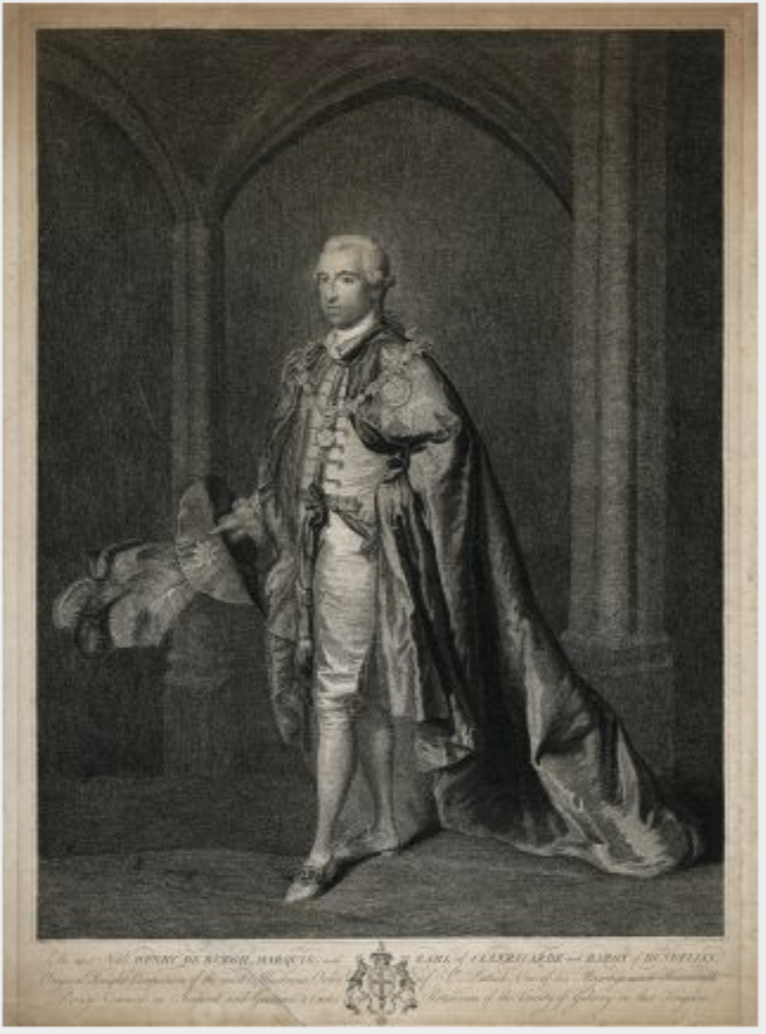
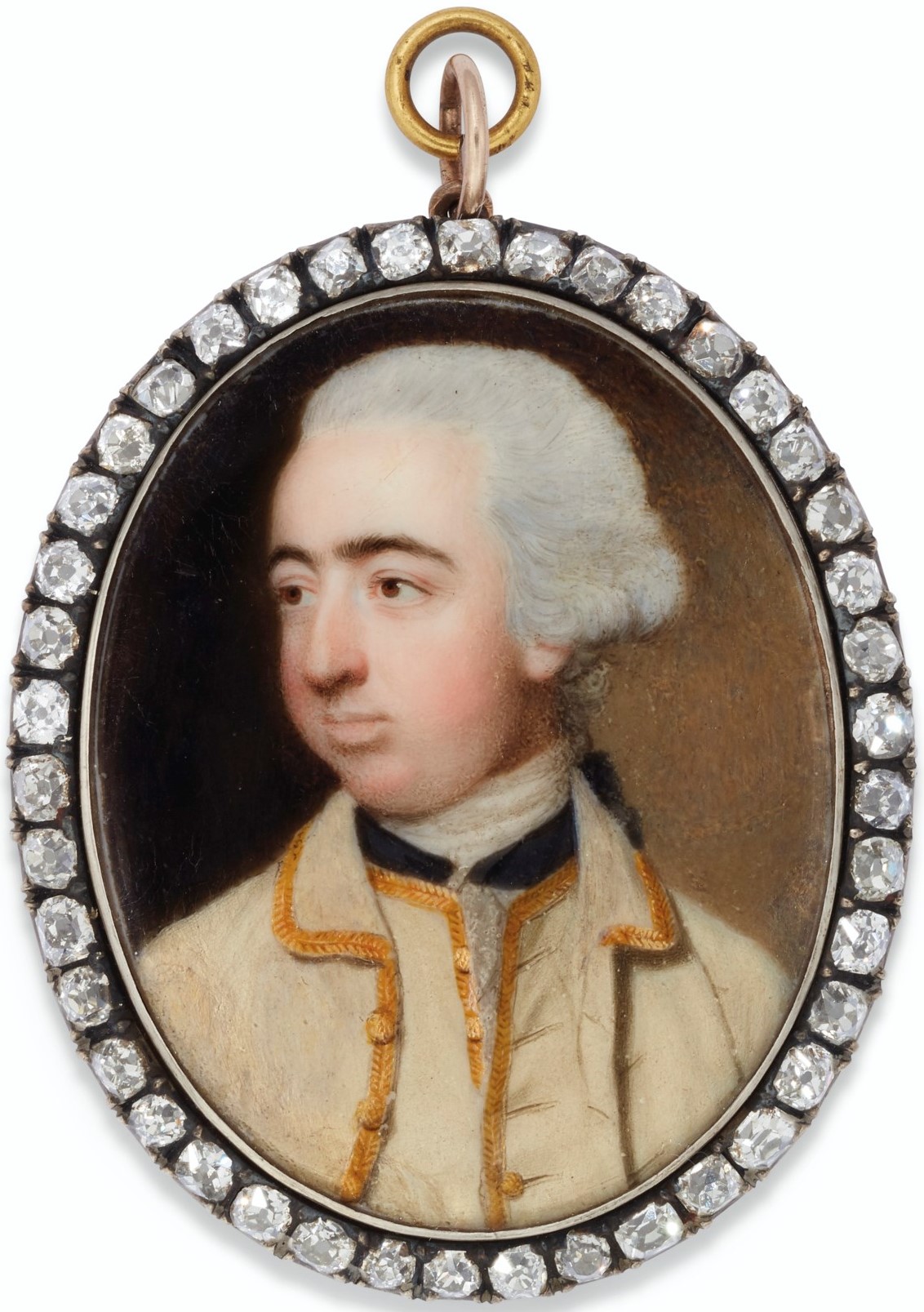
Henry de Burgh, 12th Earl and 1st Marquess of Clanricarde (1742 – 1797), Attributed to John Smart (British, 1741-1811) courtesy of https://www.christies.com/en/lot/lot-6249637Henry de Burgh, (1743-1797) 1st Marquess of Clanricarde 2nd creation, as Knight of St. Patrick, by engraver William Sedgewick, after Robert Hunter, courtesy of National Gallery of Ireland.
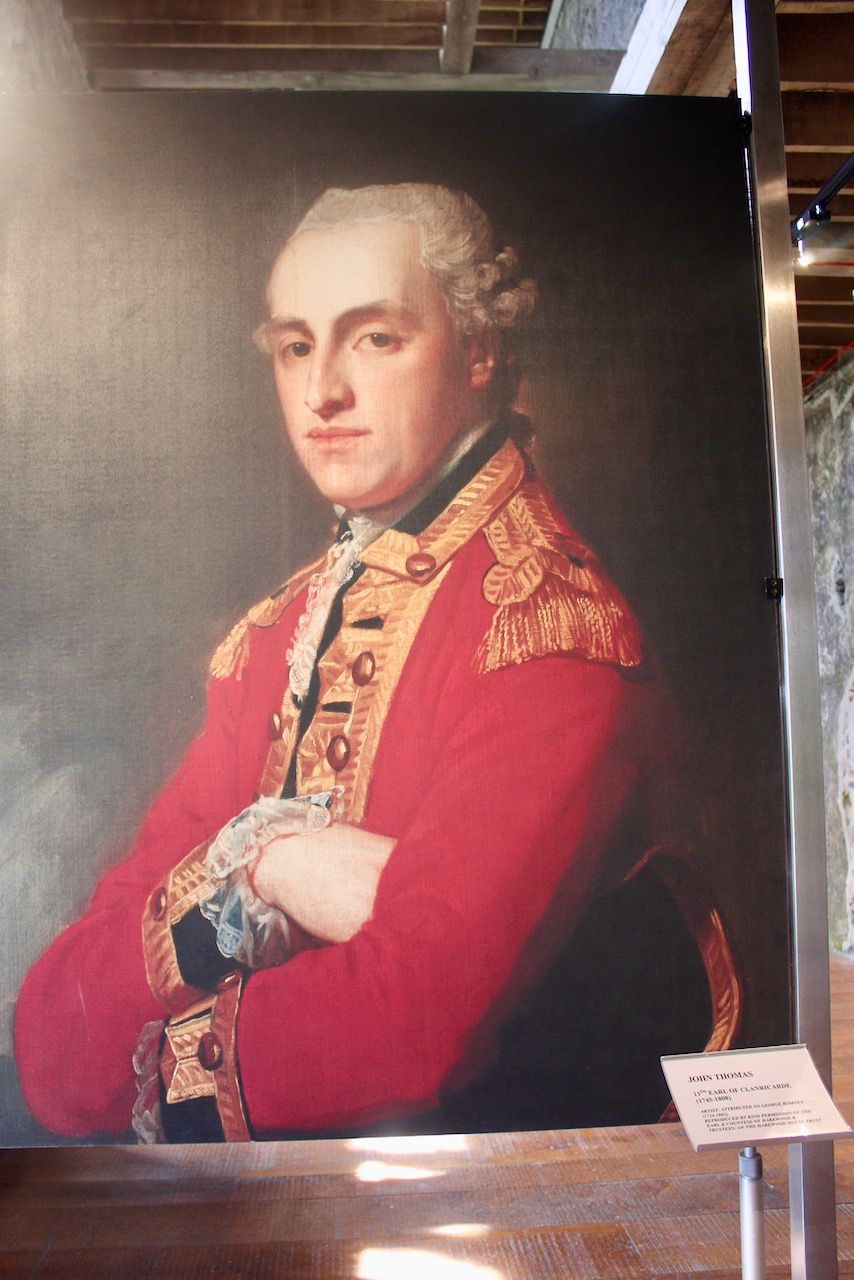
The 13th Earl, John Thomas De Burgh (1744-1808), brother of the 12th Earl, was created again 1st Earl of Clanricarde, an Irish Peer, on 29 December 1800, with special remainder to his daughters, if he had no male heir. One daughter, Hester, married Howe Peter Browne, 2nd Marquess of Sligo, and the other, Emily, married Thomas St Lawrence, 3rd Earl of Howth.
John Thomas De Burgh (1744-1808) 13th Earl of Clanricarde was created 1st Earl of Clanricarde, Co. Galway.
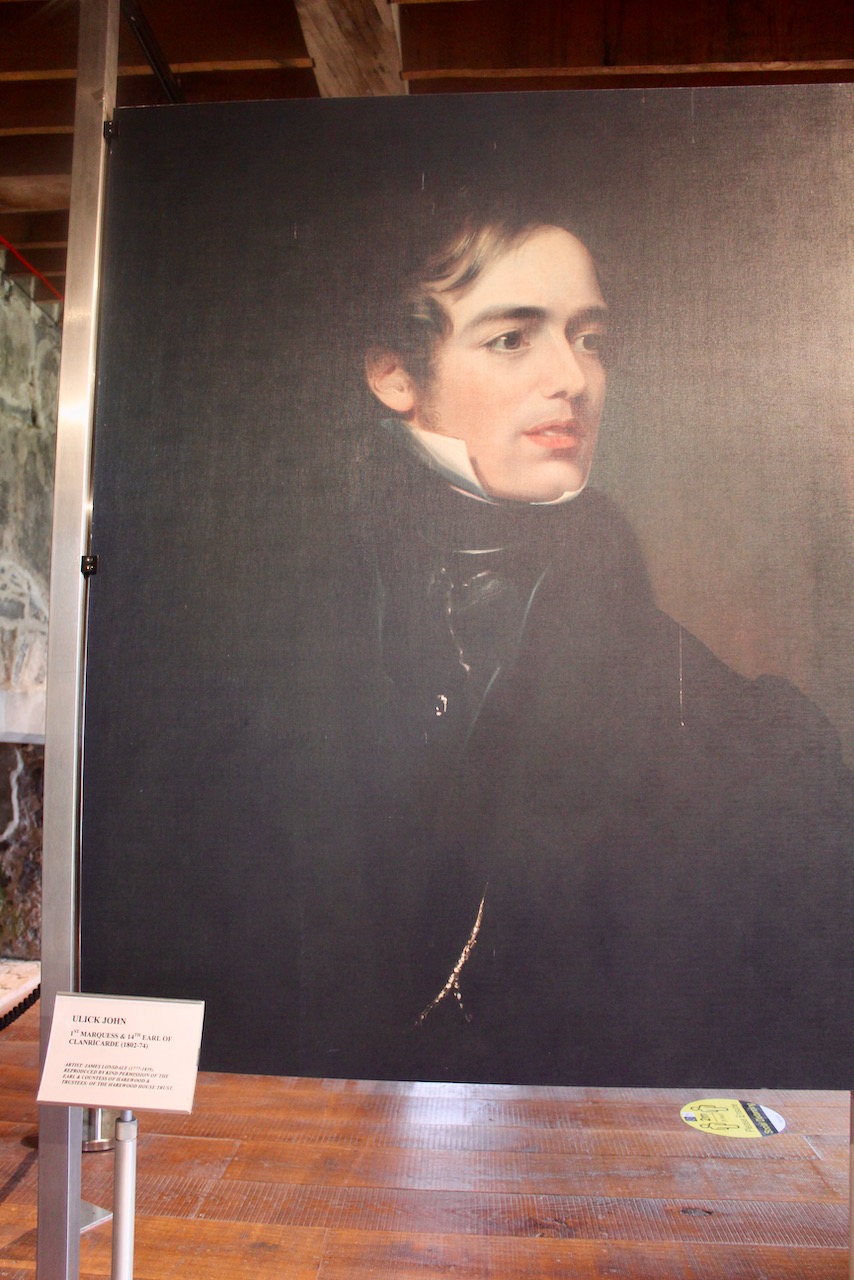
His son, Ulick (1802-1874), became the 1st Marquess Clanricarde (of the 3rd creation), and also Baron of Somerhill, Kent. It was during his tenure that the fire occurred. He married Harriet Canning, daughter of Prime Minister George Canning. Ulick was described as being immensely rich.
Ulick John De Burgh, 14th Earl and 1st Marquess of Clanricarde (1802-1874).Harriet Canning, Countess of Clanricarde (1804-1876), married to Ulick John De Burgh, 14th Earl and 1st Marquess of Clanricarde (1802-1874).
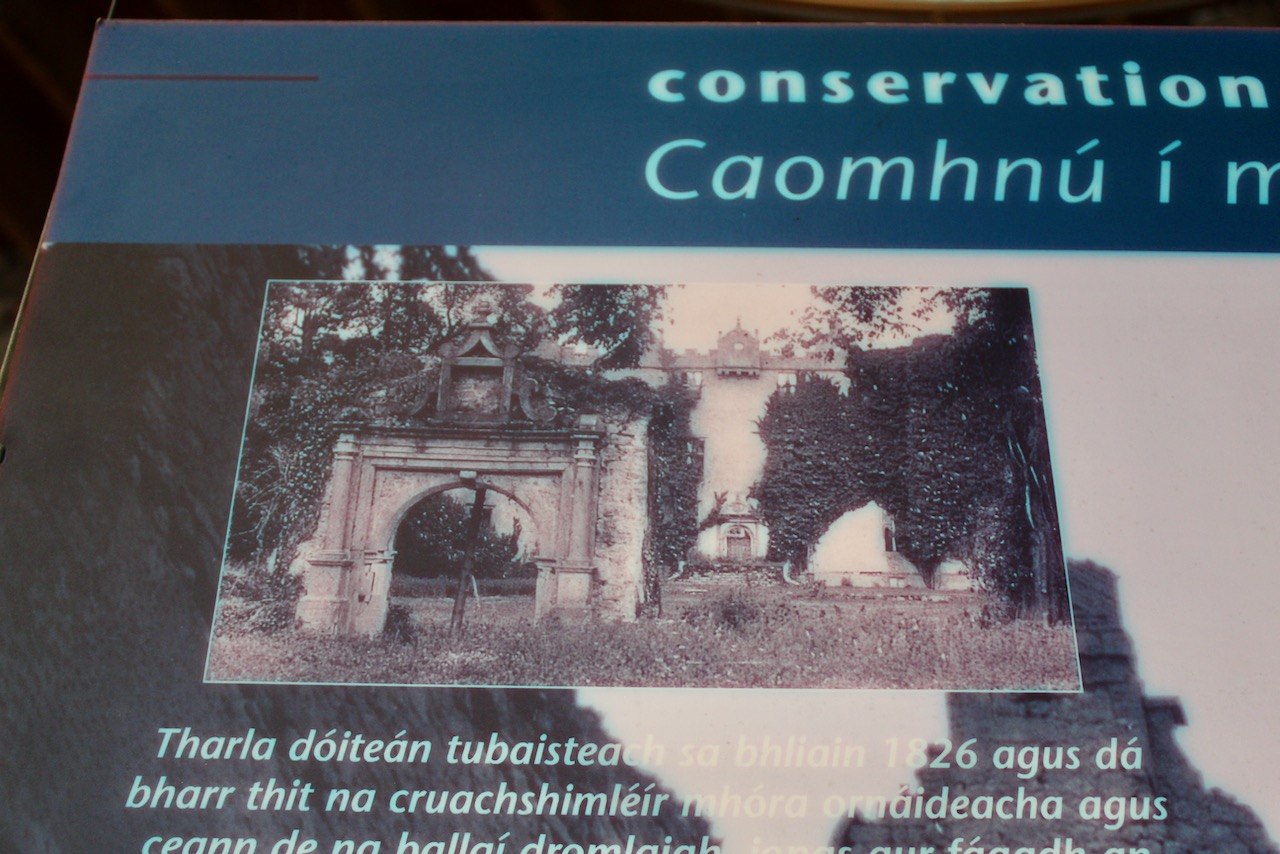
Amazing work has been done to reconstruct the castle after the fire. The Commissioners of Public Works acquired the castle in 1968 for preservation as a national monument.
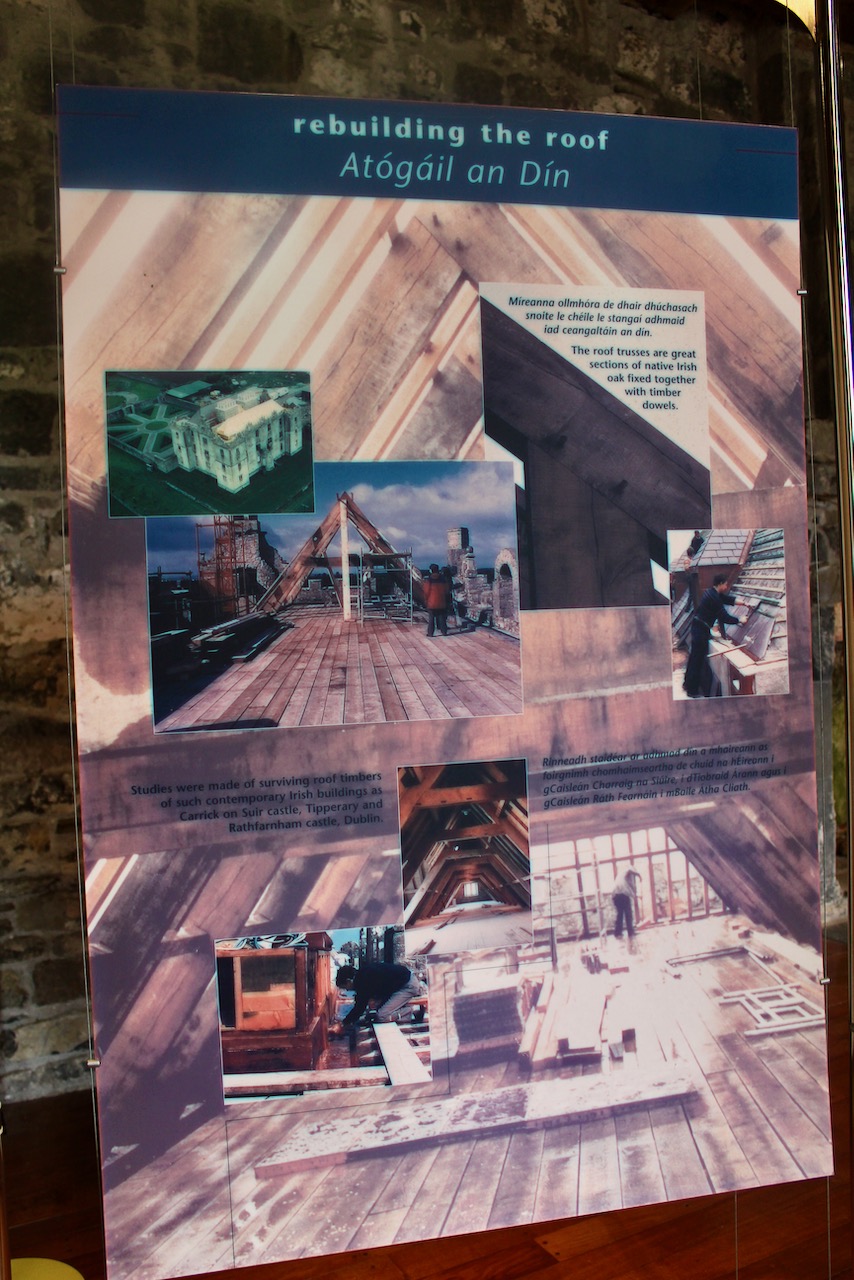
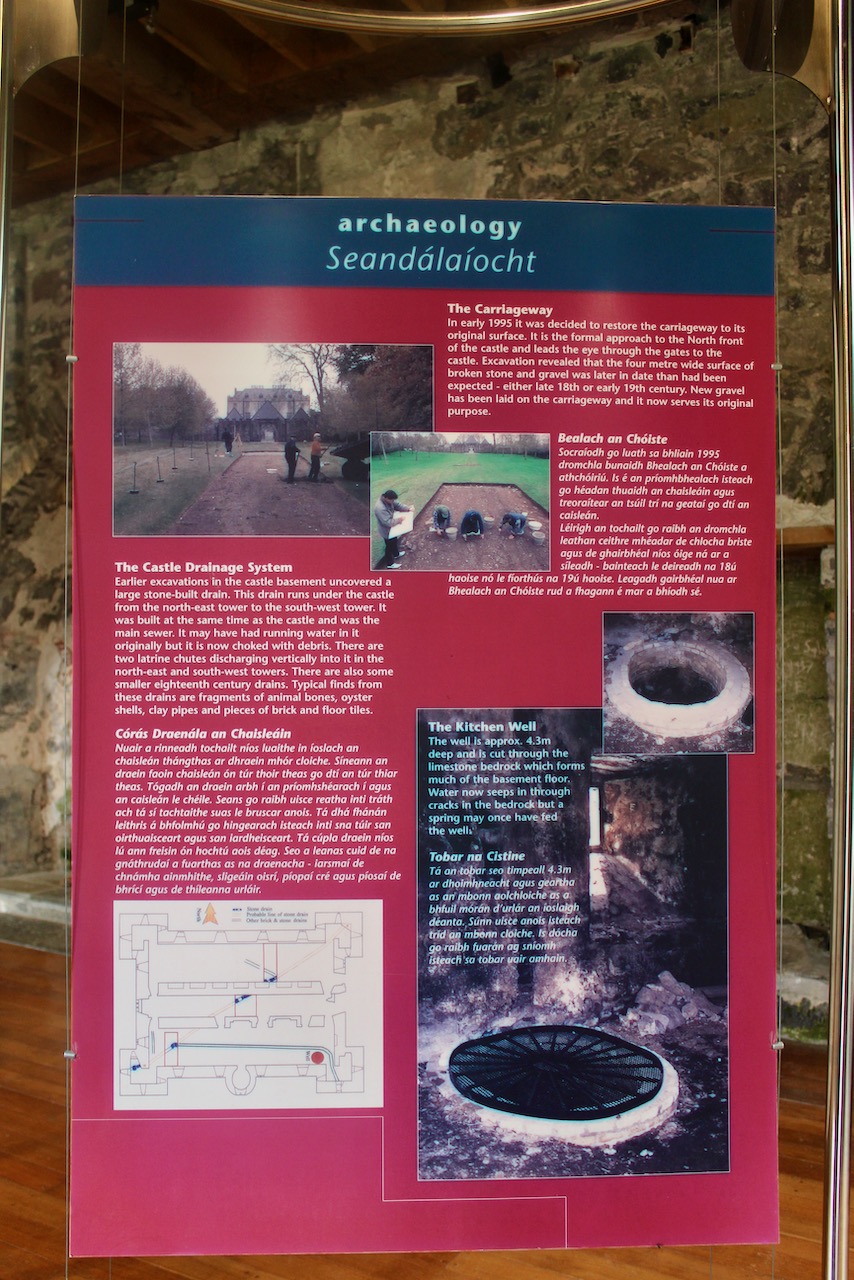
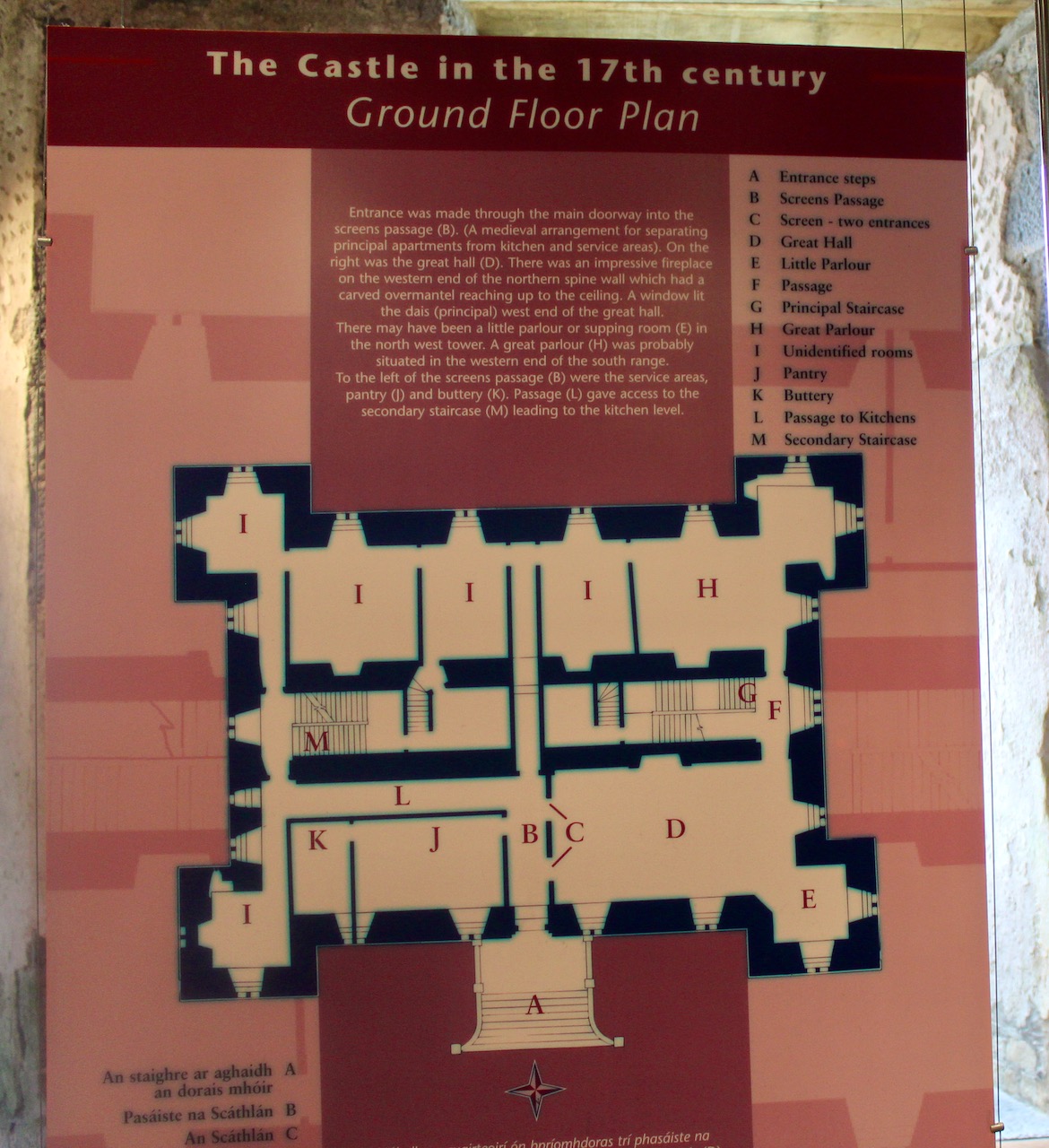
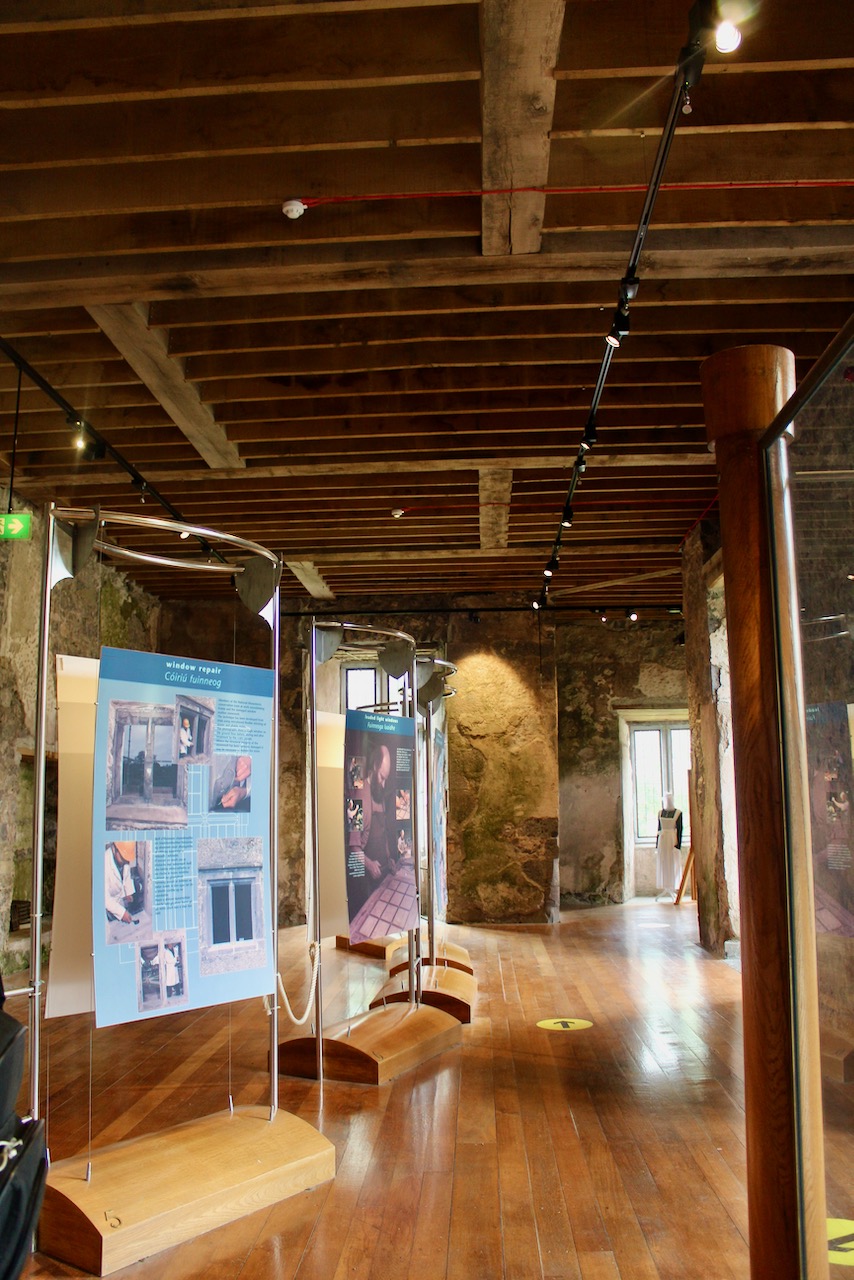
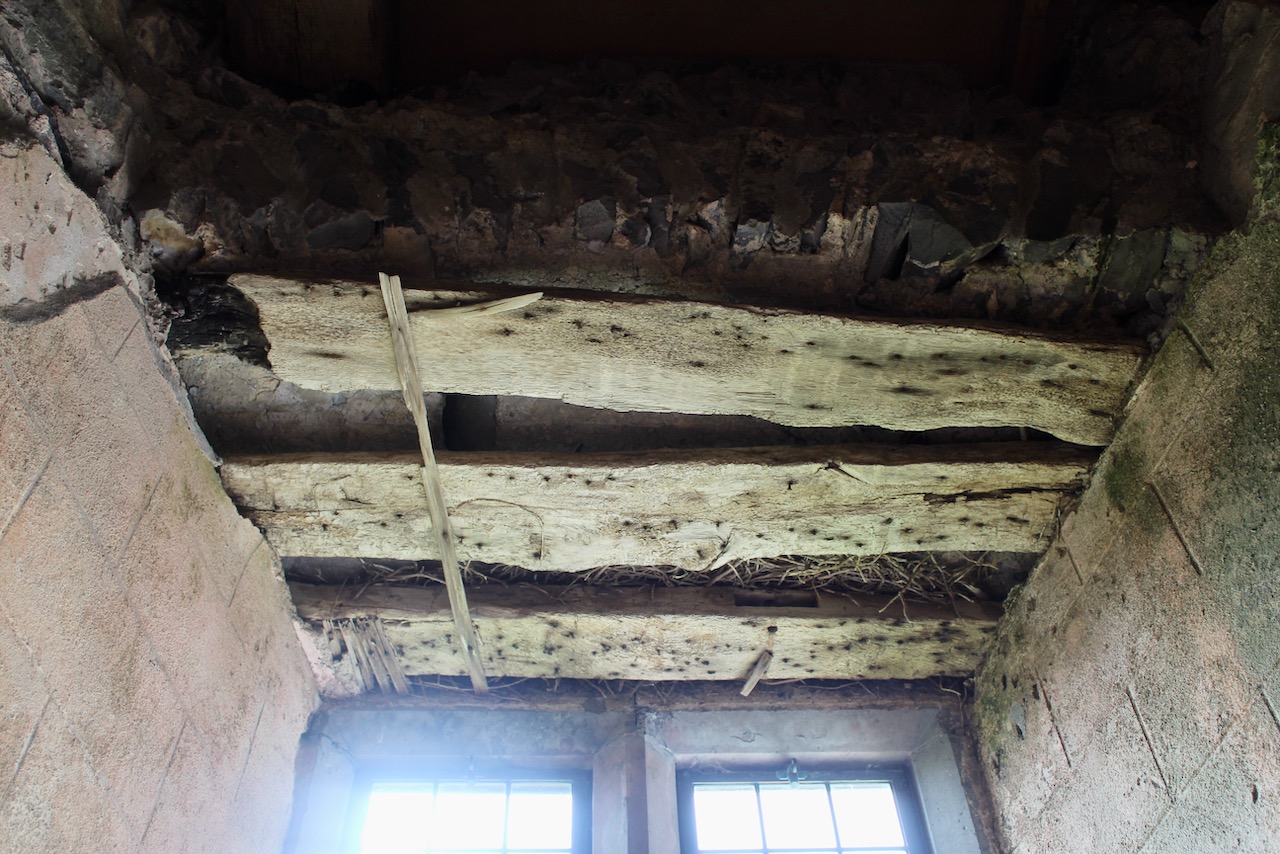
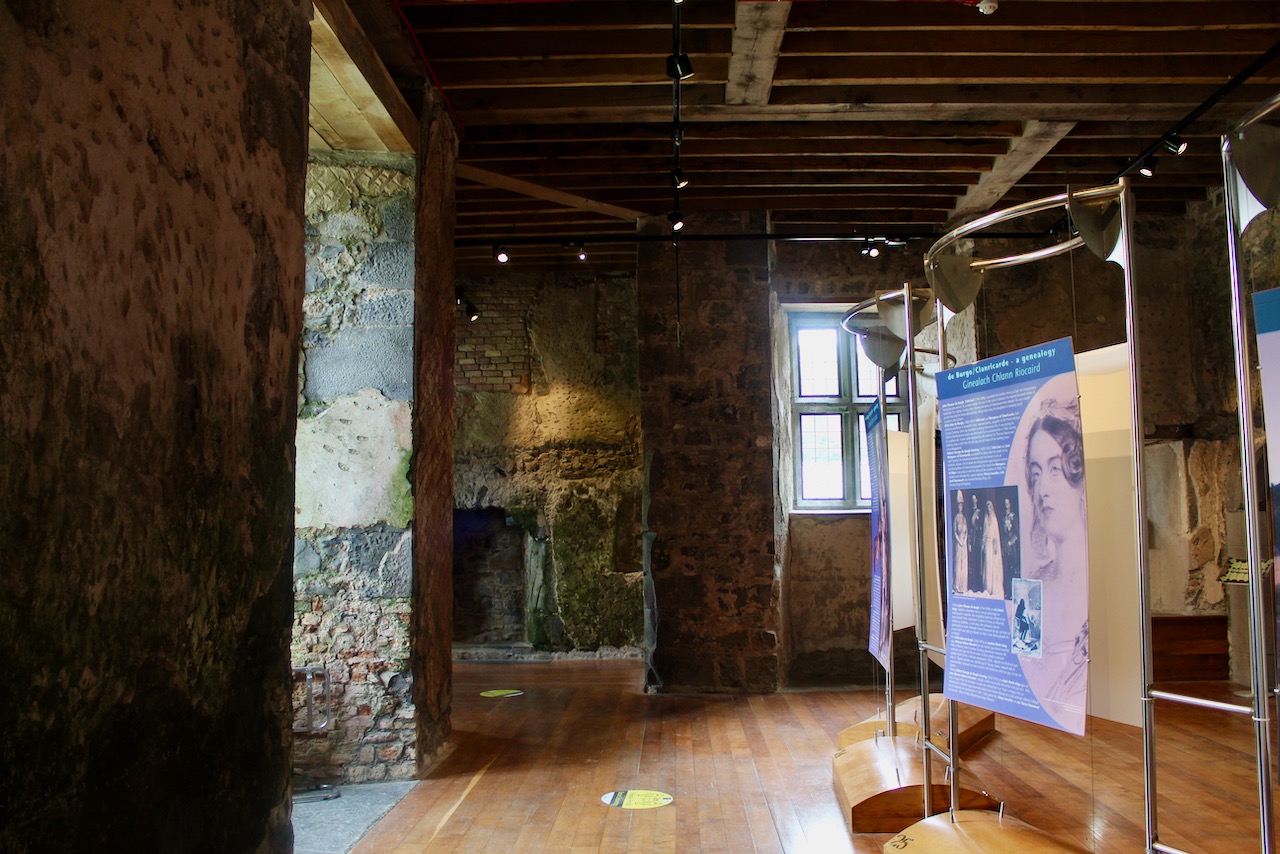
Portumna Castle 1946, photograph from Dublin City Archives and Library. [3]Portumna Castle, County Galway, July 2021.The sign board tells us that the Commissioners of Public Works acquired the castle in 1968 for preservation as a National Monument.Portumna Castle, County Galway, July 2021.Portumna Castle, County Galway, July 2021.The information board tells us that the collapsed spine wall and oak floor beams were reinstated to the original design, based on detailed survey work of surviving features and documentary evidence, including early floor layout plans. The limestone handrail in front of the building was reinstated based on one surviving fragment.Portumna Castle, County Galway, July 2021.The board tells us that the roof trusses are Irish oak. Studies were made of surviving roof timbers of buildings that would have been built around the same time, such as Carrick-on-Suir castle and Rathfarnham Castle.Portumna Castle, County Galway, July 2021.Window mullions were repaired with resin.There was a carriageway road built in either the late 19th or early 19th century, and a well in what was the kitchen.
After the fire the family built a Ruskinian Gothic mansion by Sir Thomas Newenham Deane at the opposite end of the park. Mark Bence-Jones tells us that the new house was not much lived in by the family, for 2nd and last Marquess of Clanricarde, who succeeded 1874, was “the notorious miser and eccentric who spent his life in squalid rooms in London and dressed like a tramp.”
The 2nd Marquess, Hubert George De Burgh-Canning, “the notorious miser and eccentric who spent his life in squalid rooms in London and dressed like a tramp.”
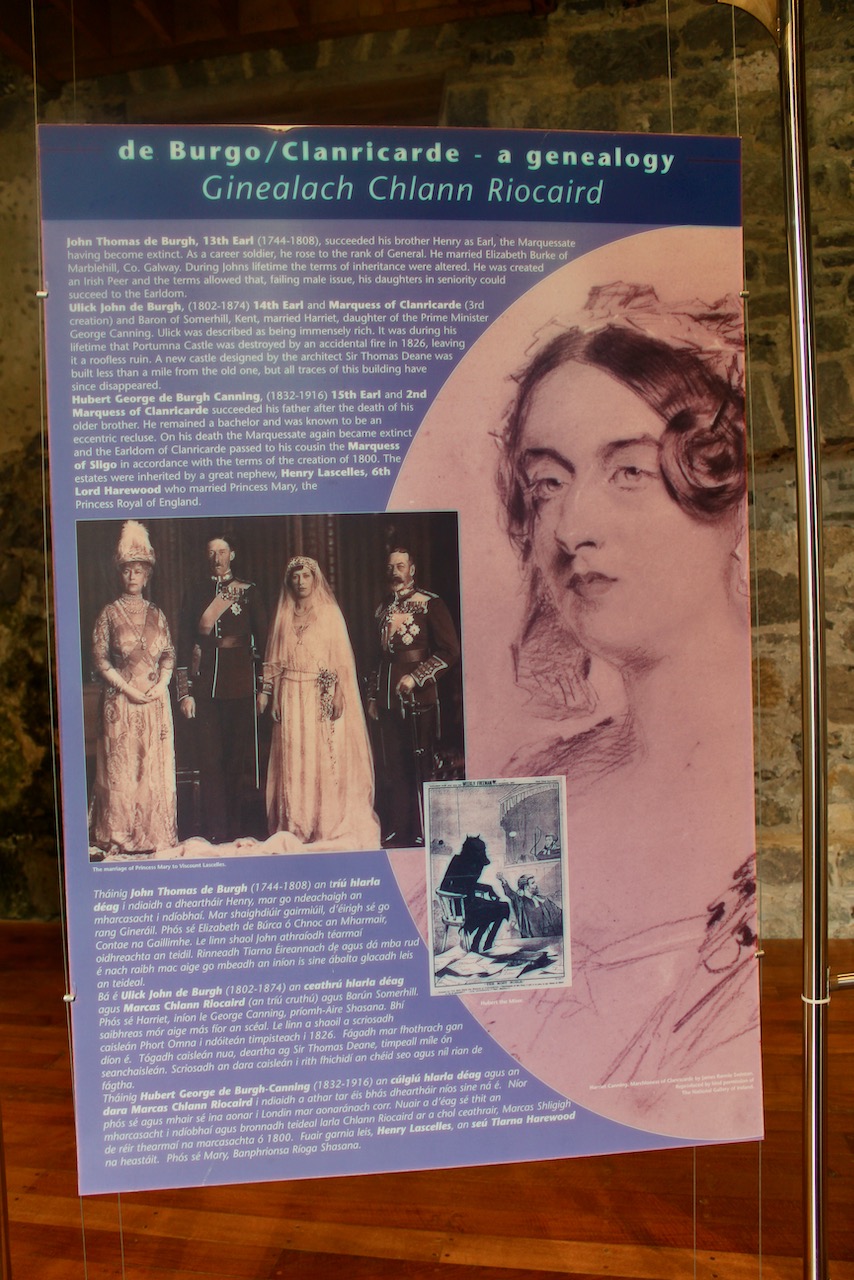
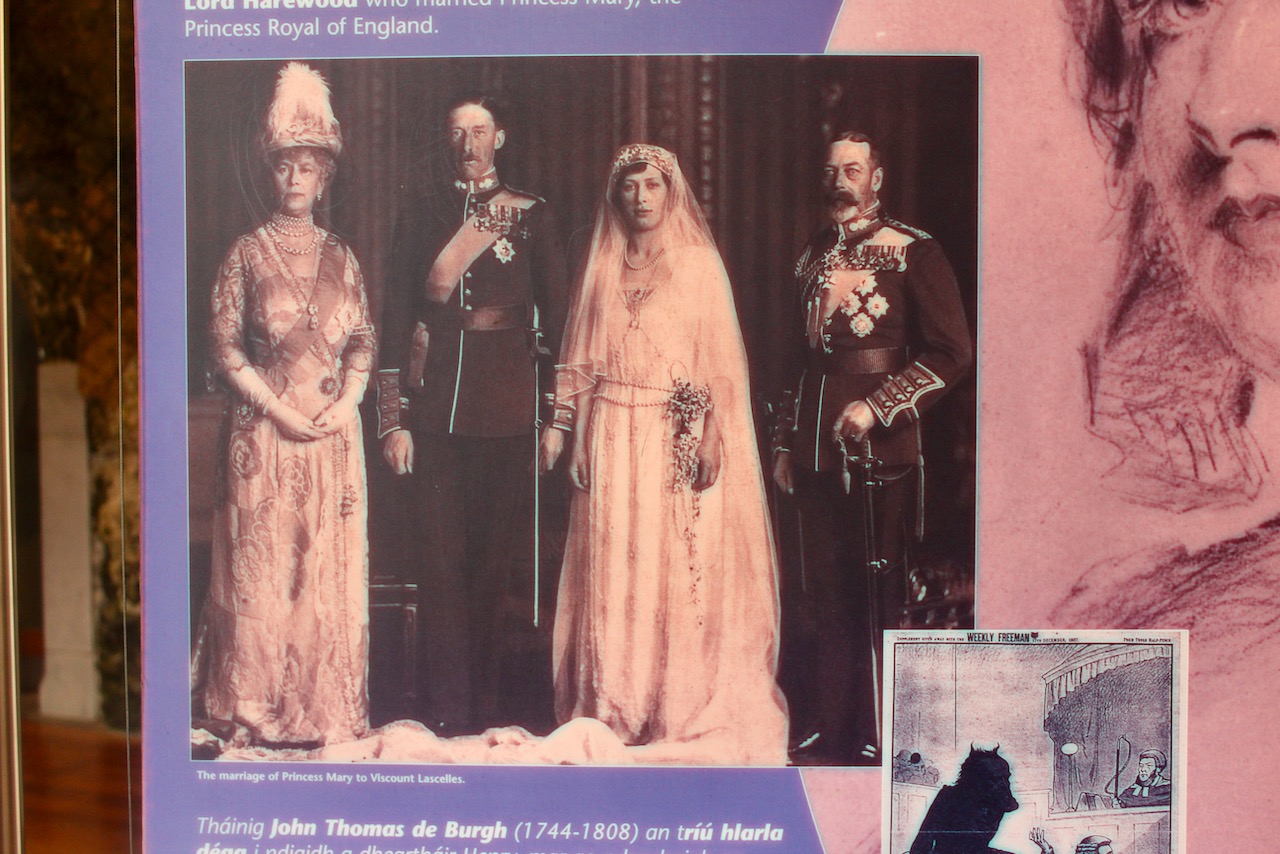
The 2nd Marquess, Hubert George De Burgh-Canning, who died 1916, left Portumna to his great-nephew, Viscount Henry George Charles Lascelles, afterwards 6th Earl of Harewood and husband of Princess Mary (daughter of King George V), because it was said that he was the only member of his family who ever went to see him. The 1862 house was burnt 1922; after which Lord Harewood, when he came here, occupied a small house on the place. Portumna was sold when he died in 1947. [4]
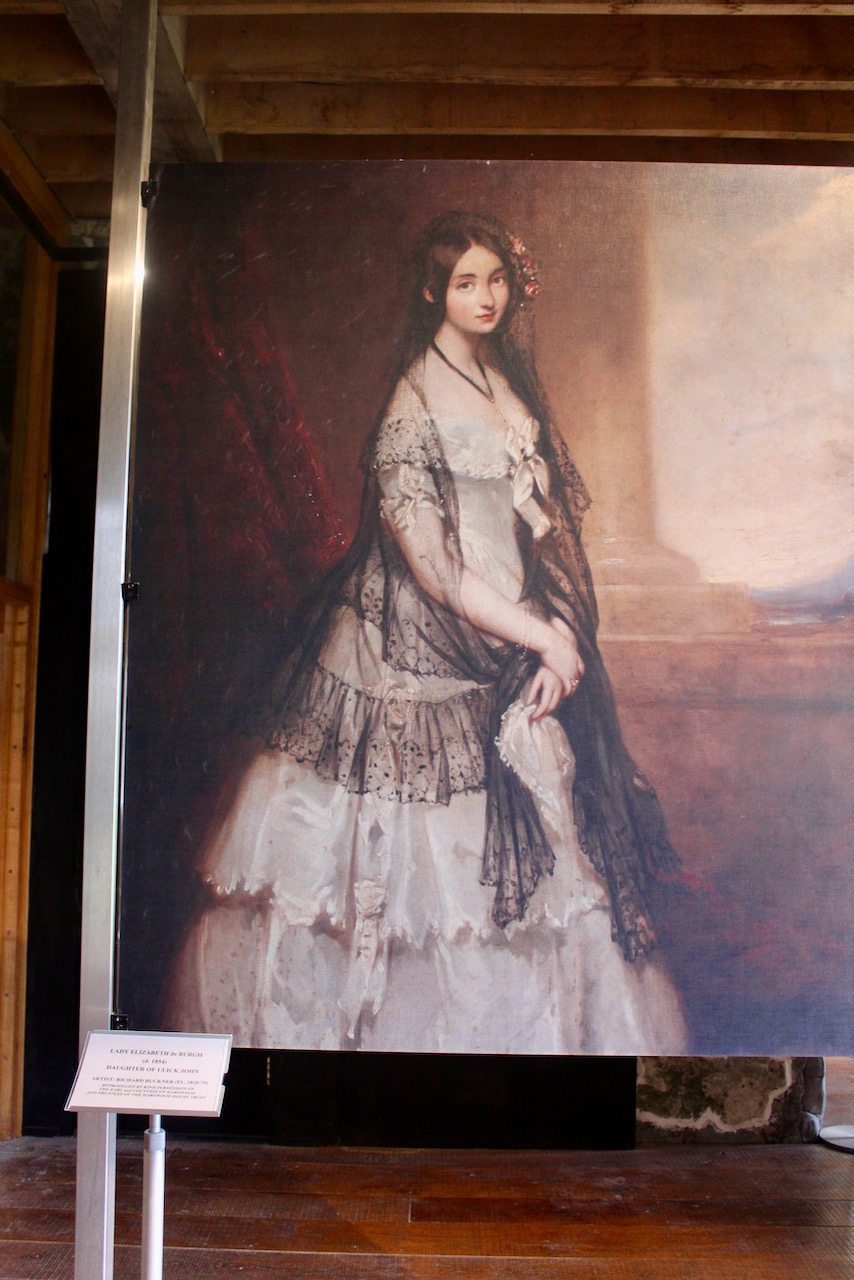
Elizabeth de Burgh, who married Henry Thynne Lascelles, 4th Earl of Harewood. She was the sister ofthe 2nd Marquess, Hubert George De Burgh-Canning.Pictured, the marriage of Princess Mary to Viscount Lascelles.
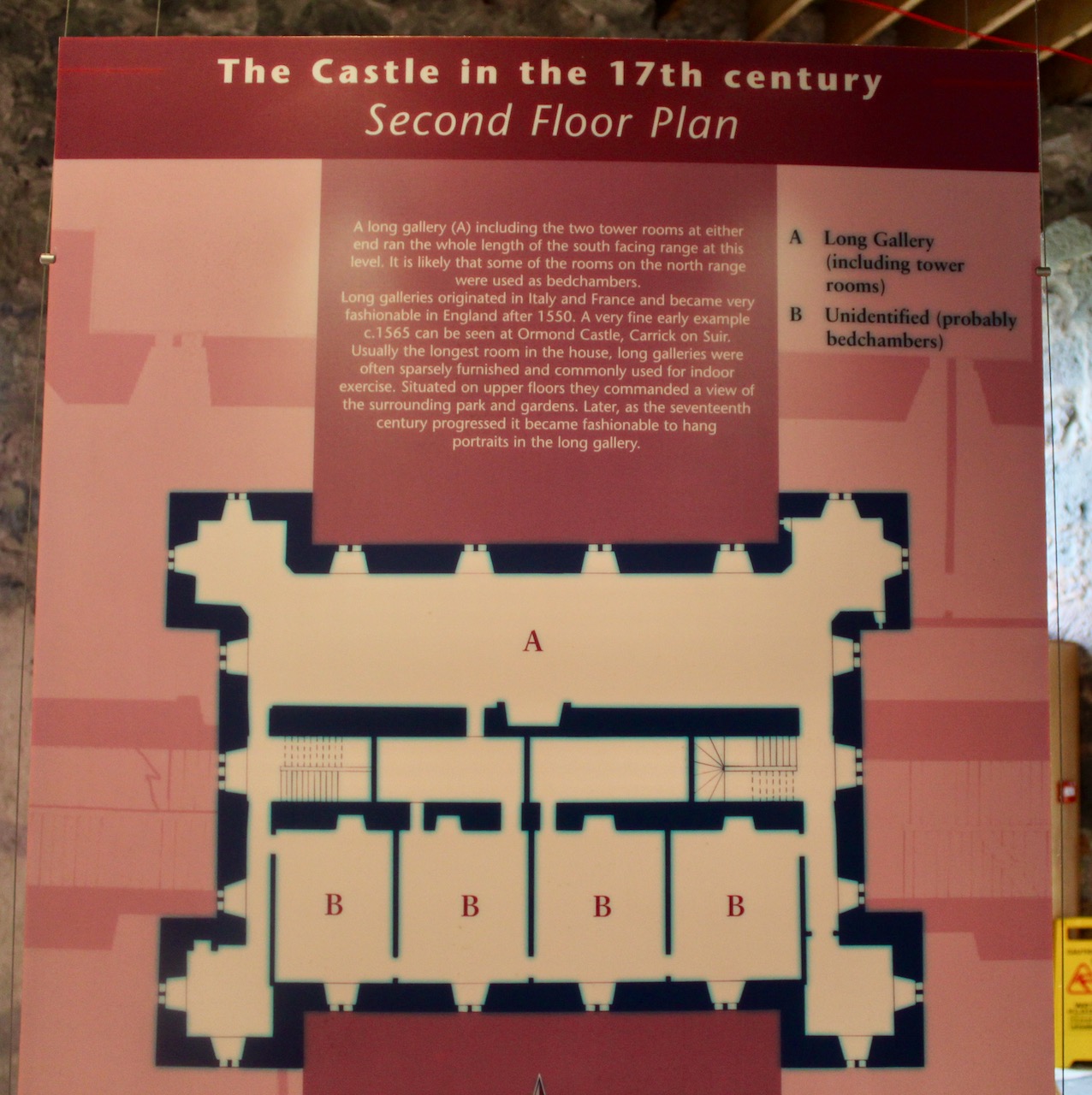
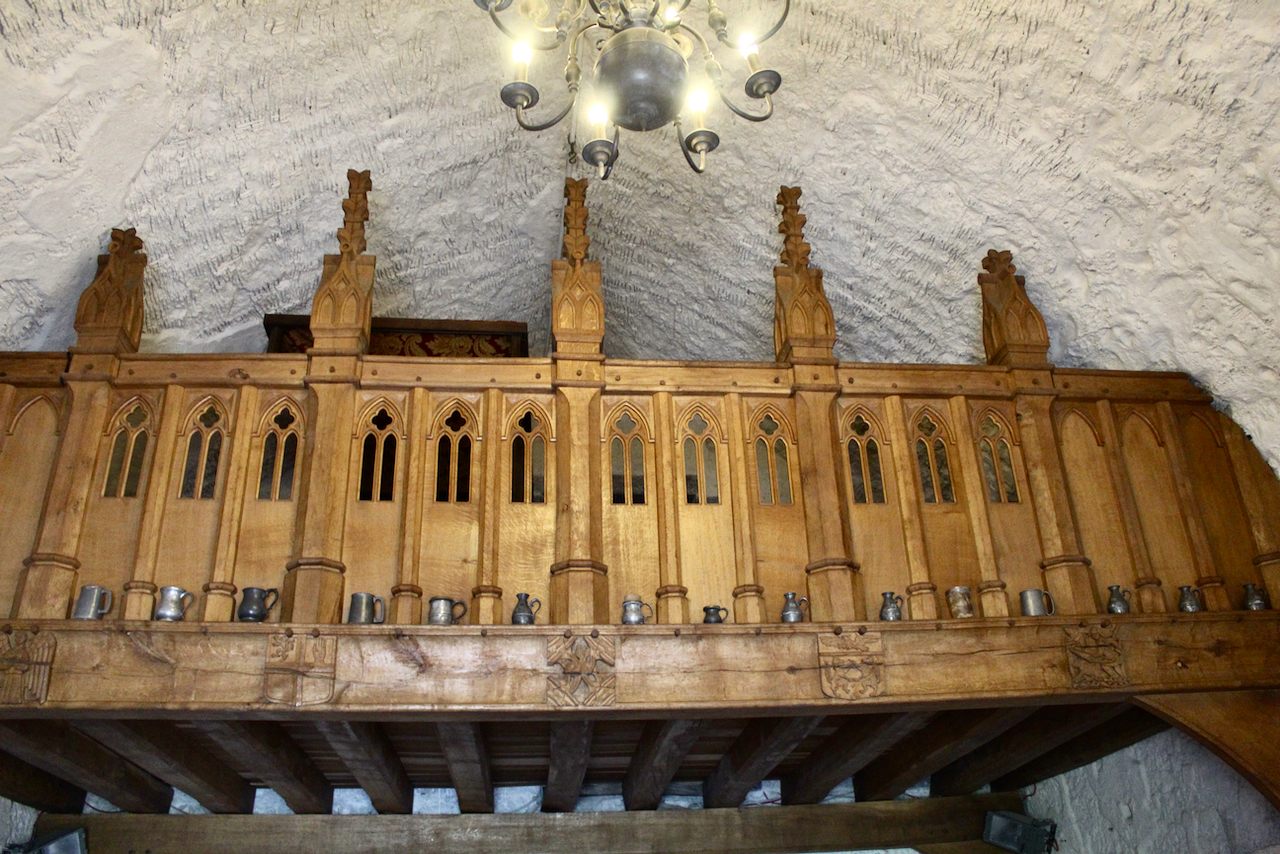
The castle had a long gallery on the second storey, similar to that in the Ormond Castle in Carrick-on-Suir. Long galleries originated in Italy and France and became fashionable in England after 1550. They were often sparsely furnished and were used for indoor exercise.
The exhibition tells us about various positions of servants in a castle. I was amused by the description of the job of a footman. We are told that they were kept largely for “ornamental” purposes and had to be fairly tall and good-looking, and their wages even rose with their height! Some padded their silk stockings to make their calves look more shapely!
Tourist Accommodation Facility – not open to the public Open for accommodation in 2026: January 2-December 24
donation
Help me to pay the entrance fee to one of the houses on this website. This site is created purely out of love for the subject and I receive no payment so any donation is appreciated!
In 2023 Claregalway is listed in Section 482 as accommodation and is no longer open to the public, unfortunately! We were lucky to visit during Heritage Week in 2022. I am sure it will continue to host events and tours – keep an eye on the website. Accommodation is in the auxiliary buildings in the bawn but one may have access inside the tower house itself.
The tower house dates to the early half of the fifteenth century, according to radio carbon dating [1]. Across the road is the Franciscan Friary of Claregalway, built in 1240. The tower of the Abbey was built 200 years later, around 1440.
The castle is part of the Barony of Clare, an administrative barony formed in the sixteenth century. The other major castle in this territory is Corofin. Before being designated a barony the area was part of the kingdom of Magh Seóla (“the level plain.” It was Clanricarde Burke territory, and the castle was damaged in battles between the Burkes of Clanricarde and the Burkes of Mayo.
The castle website tells us:
“Located on a low crossing point of the River Clare, the castle controlled water and land trade routes, exacted tolls, and maintained Clanricarde Burke authority in the surrounding countryside, a region known in pre-Norman times as Magh Seóla (the level plain). By 1580, there was a network of Clanricarde Burke castles stretching from Lough Corrib to the River Shannon. The castle once had a six metre high bawn/defensive wall, an imposing gate-house, a moat as well as other buildings including a dining hall.“
An article in the Galway Review from July 8th 2010 by Declan Varley tells us that the castle belongs to an eye surgeon Mr Eamon O Donoghue who has funded and overseen the restoration of the castle for the past decade, bringing in some of Europe’s top stonemasons and conservationists to ensure that the castle is returned to its original state. A major reconstruction programme was planned by conservation architect David Johnson, a former inspector of national monuments with The Office of Public Works, and and archaeologist Leo Swan was also involved.
When he purchased the castle, Eamon tells us in a lecture that one can view online, there were trees growing out of the top! [2] Mr. O’Donoghue studied archaeology in Maynooth for a few years, so this probably influenced him to make the decision to buy the castle.
The ancillary buildings also influenced O’Donoghue’s decision to purchase the castle and its surrounds. Evidence for a bawn was discovered, including the base of bawn turrets, and a mill pond, a gatehouse and a moat. A tower house was generally surrounded by an enclosed space called a bawn, which would contain ancillary buildings such as a bakehouse, brewhouse, chapel, storehouses, guard accommodation, and in the case of Claregalway, a mill. Farmers and fishermen would have lived outside the bawn.
The castle was owned by John Buckley Jr (formerly of Spiddal House), then living in Indonesia, who agreed to sell. When purchased, the tower was roofless and had no upper floors at all, it was just a shell. The roof of the castle had been removed in 1653, following the Siege of Galway by Cromwellian forces. When restoring, Mr. O’Donoghue did research to determine what sort of turret the castle would have had, and determined from what remained that it was probably similar to Isert Kelly Castle. Isert Kelly Castle was the principal seat of the MacHubert Burkes from the early 1400s. The three storey tower house was stronghold to the MacHuberts, later passing hands to the MacRedmonds, both of whom were branches of the De Burgo (Burke) family. [3]
O’Donoghue engaged many architects including Rory Sherlock. He had stonemasons from the Companions Guild in France, including Jean Baptise Maduit, the now current master mason from Chartres, who believed the belfry of the abbey, built in 1433, was built by the same person who built the tower house. The stonemasons in the Companions Guild in France have a seven year apprenticeship.
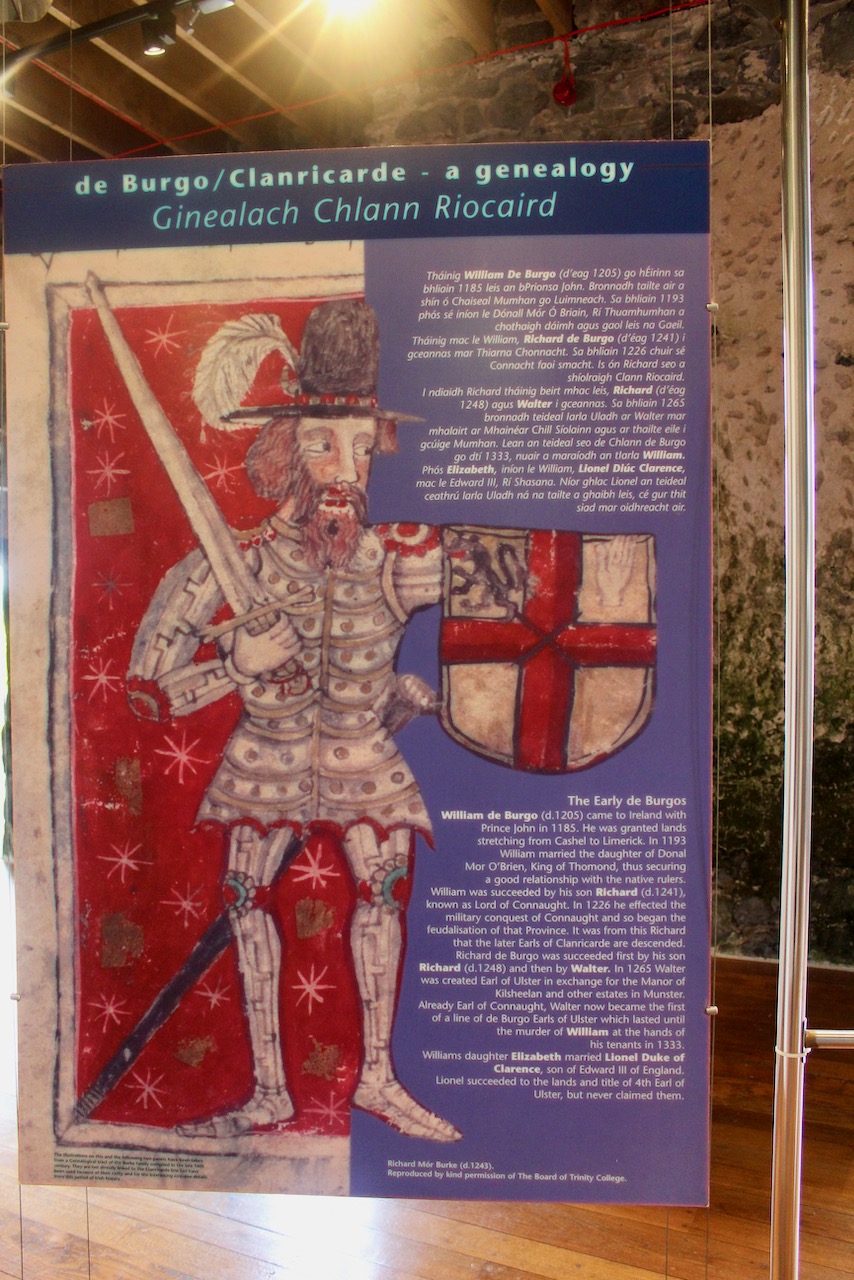
We came across the Claricarde Burkes on our visit to Portumna Castle in County Galway. William de Burgo (d. 1205) came to Ireland with Prince John in 1185, and was granted lands stretching from Cashel to Limerick. His brother Hubert, the castle website tells us, was a Justiciar of England. In 1193 William married the daughter of Donal Mor O’Brien, King of Thomond, thus securing a good relationship with the native rulers. His son Richard (d. 1241) suceeded him and was known as Lord of Connaught. Richard began the feudalisation of Connaught after military conquest. Richard was suceeded by his son Richard (d. 1248) and then Walter, who was created 1st Earl of Ulster.
Information board from Portumna Castle in County Galway.
The descendants of William de Burgo adopted Irish customs and clothing.
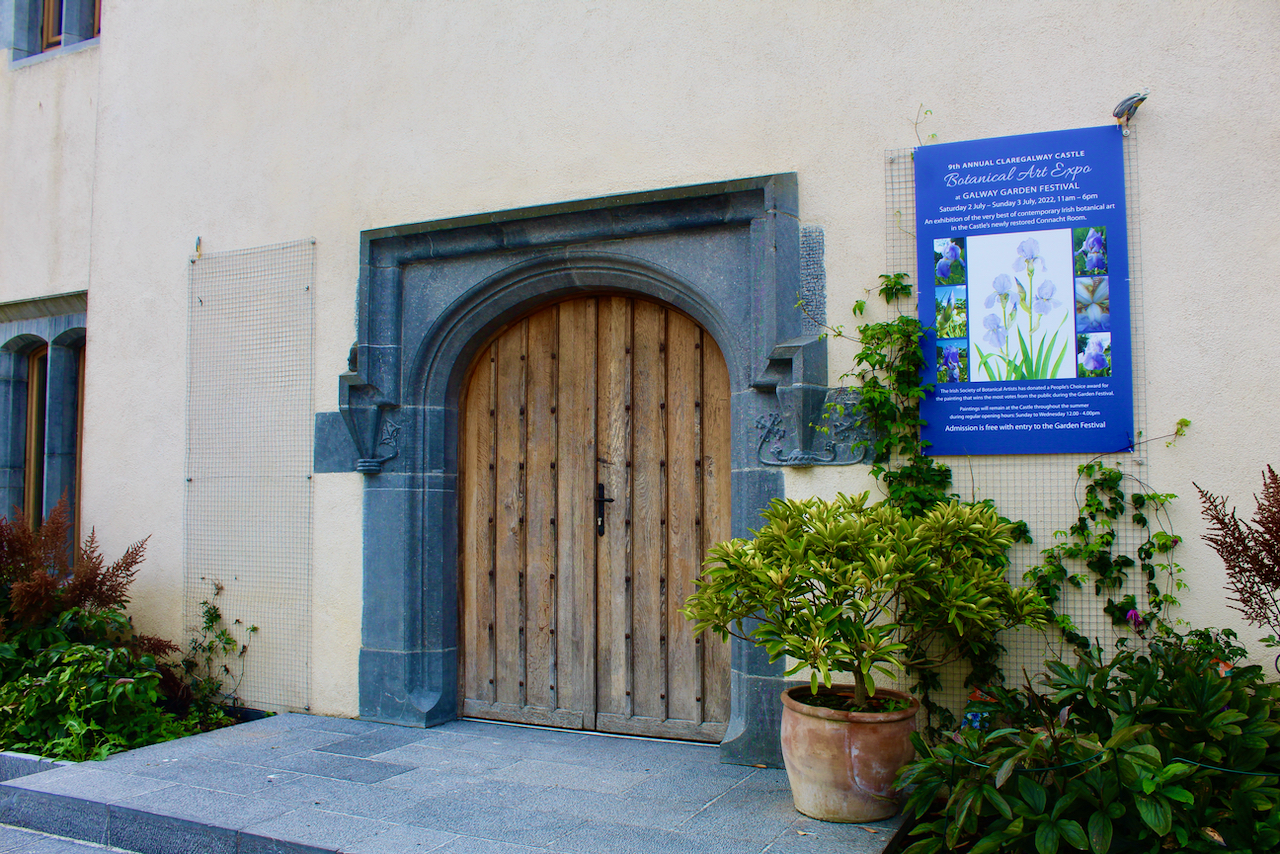
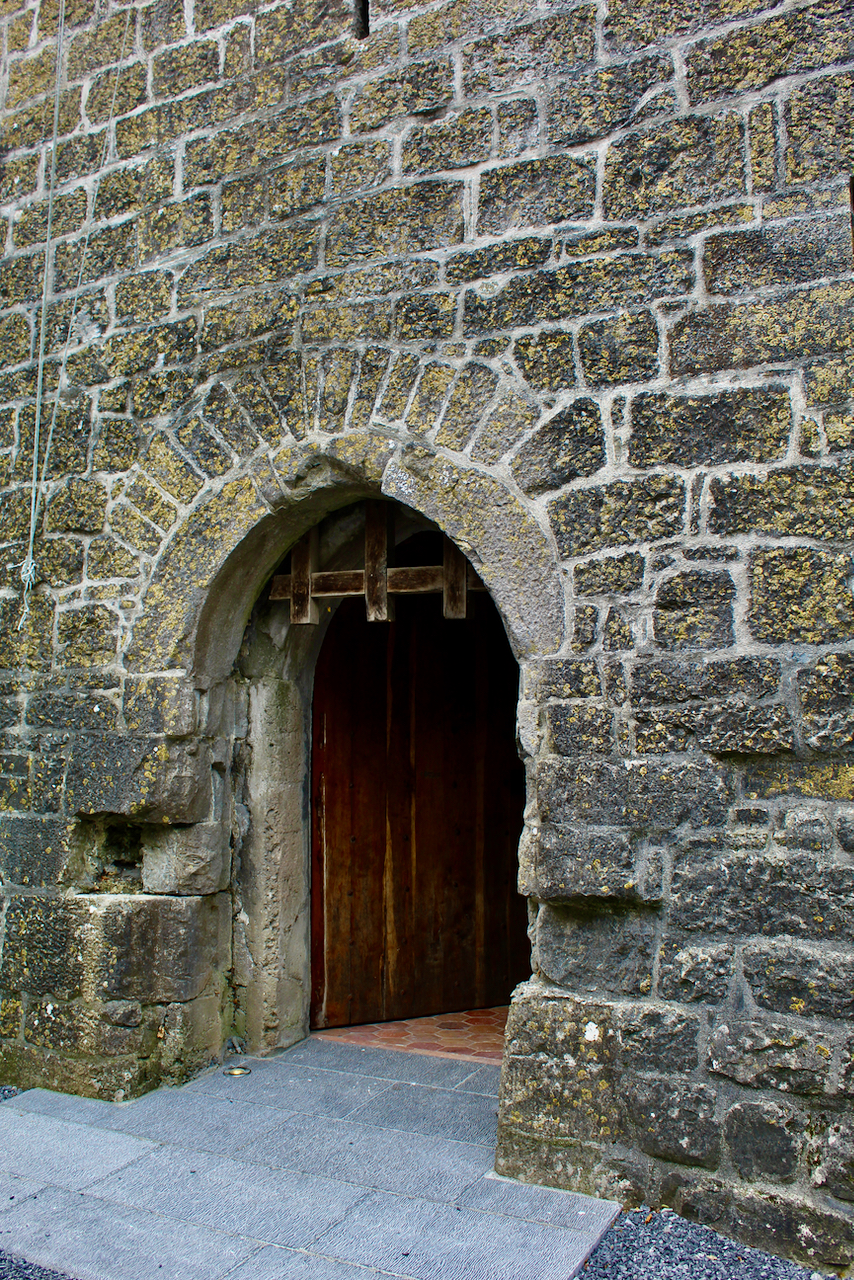
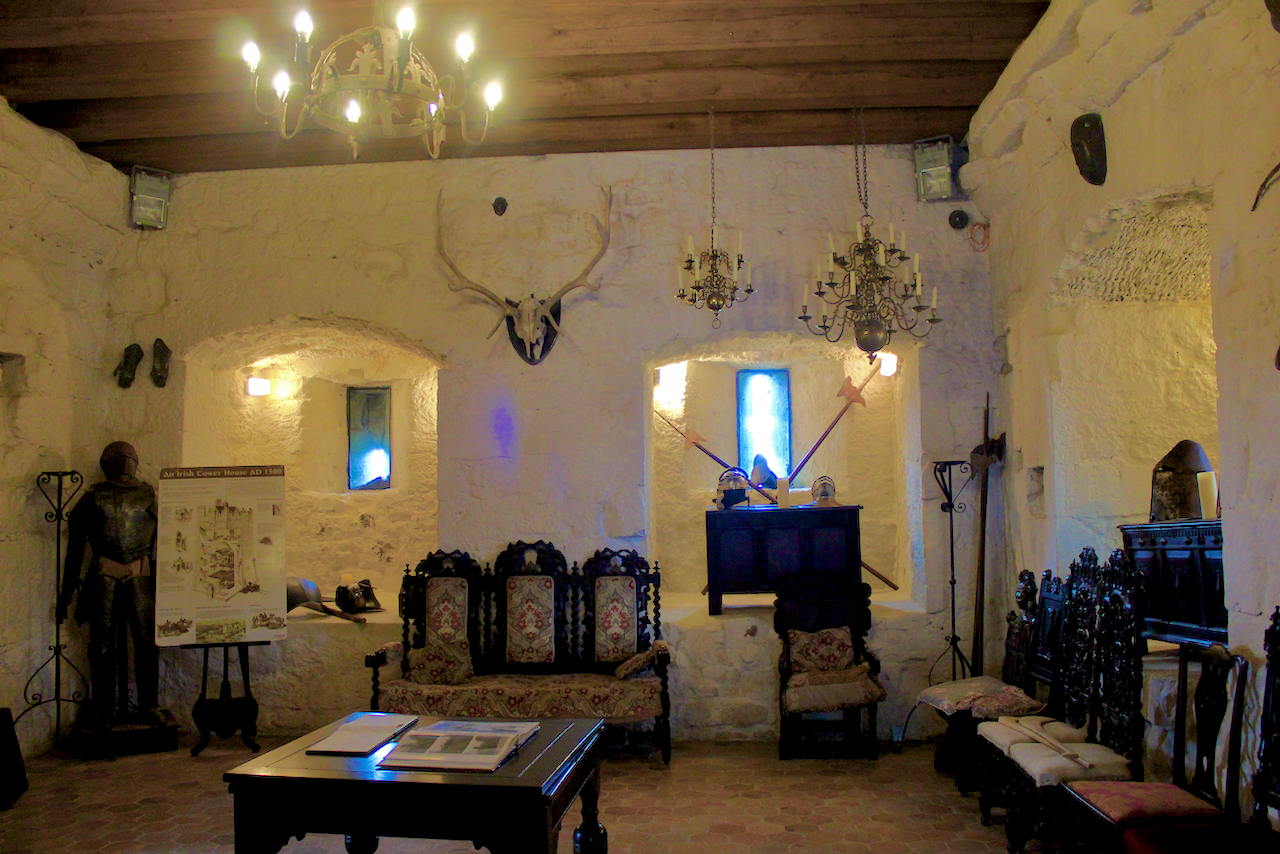
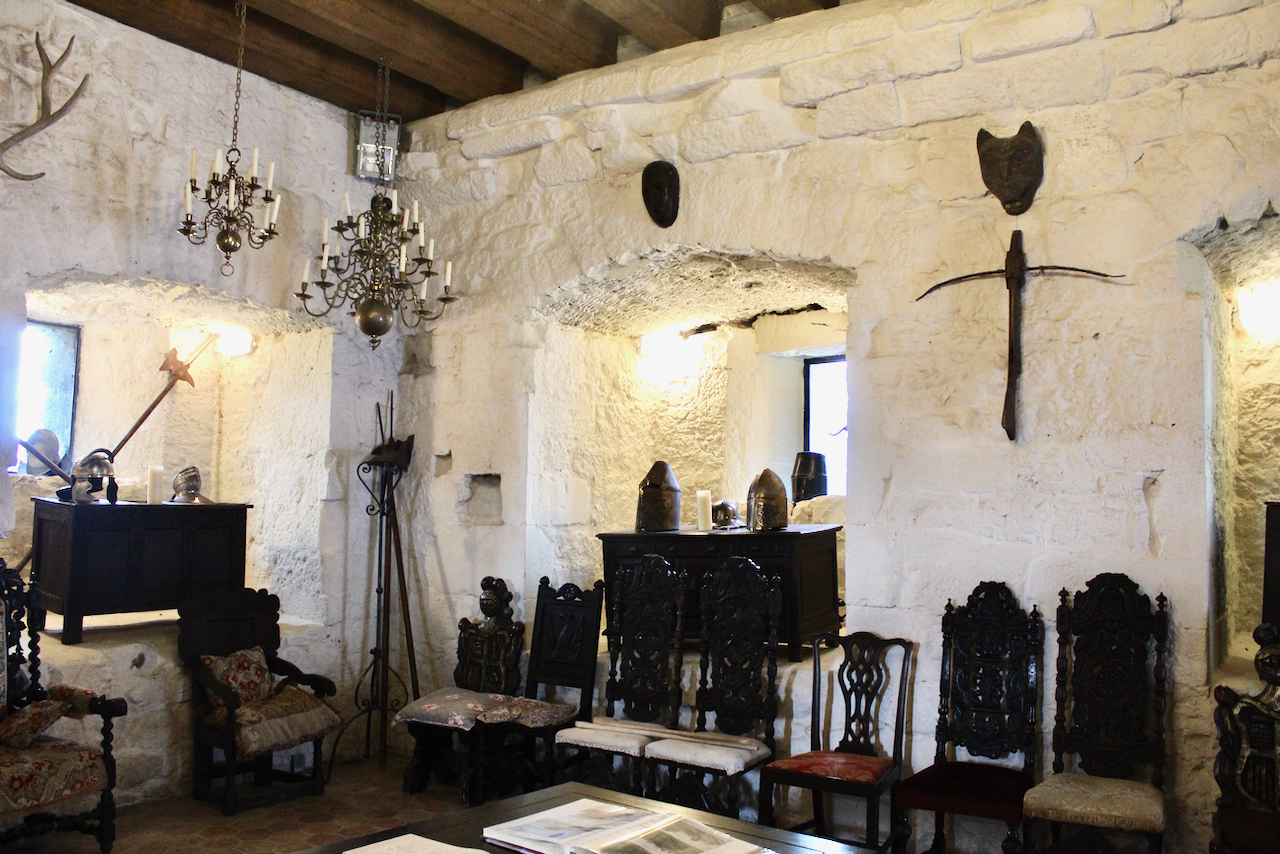
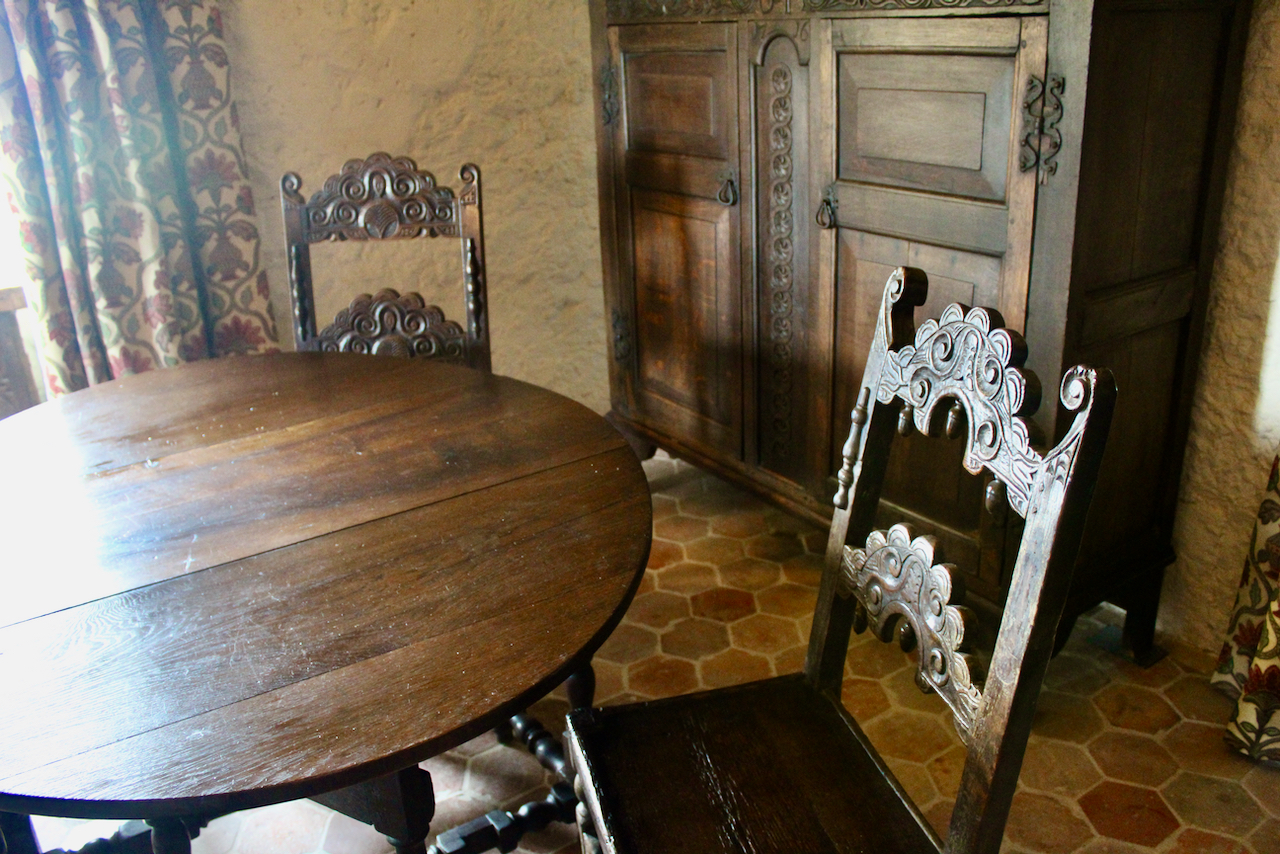
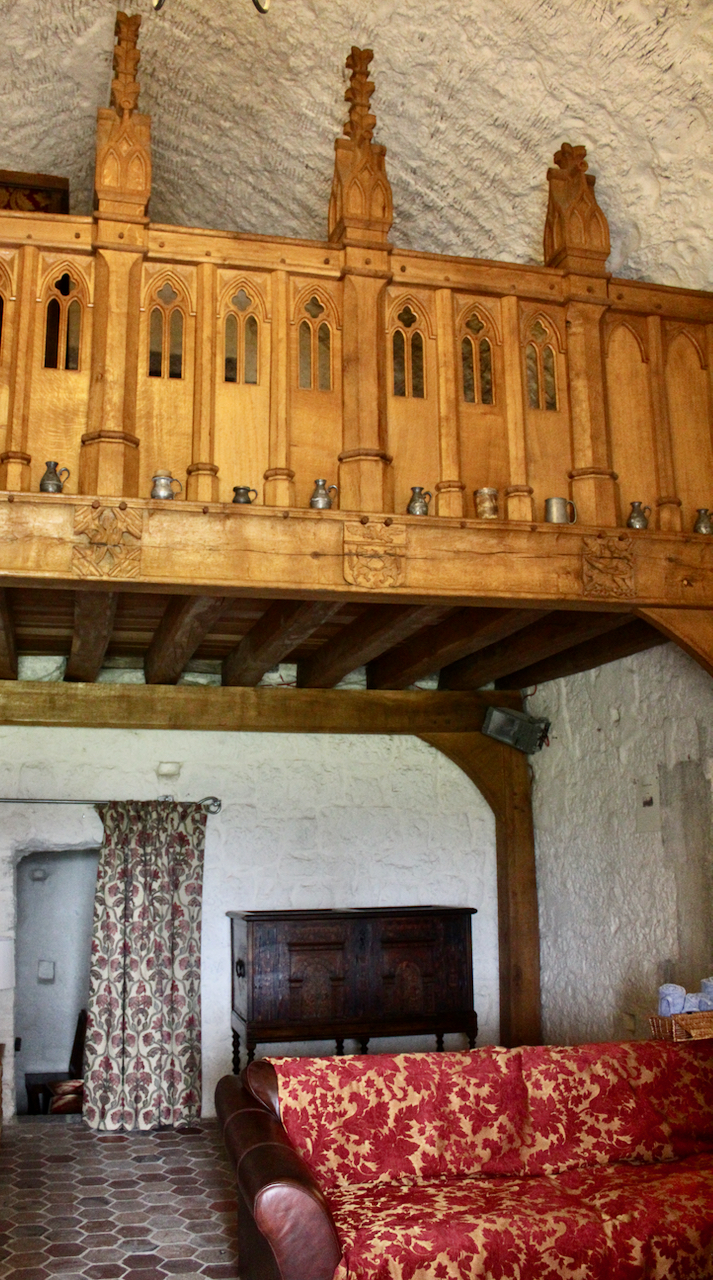
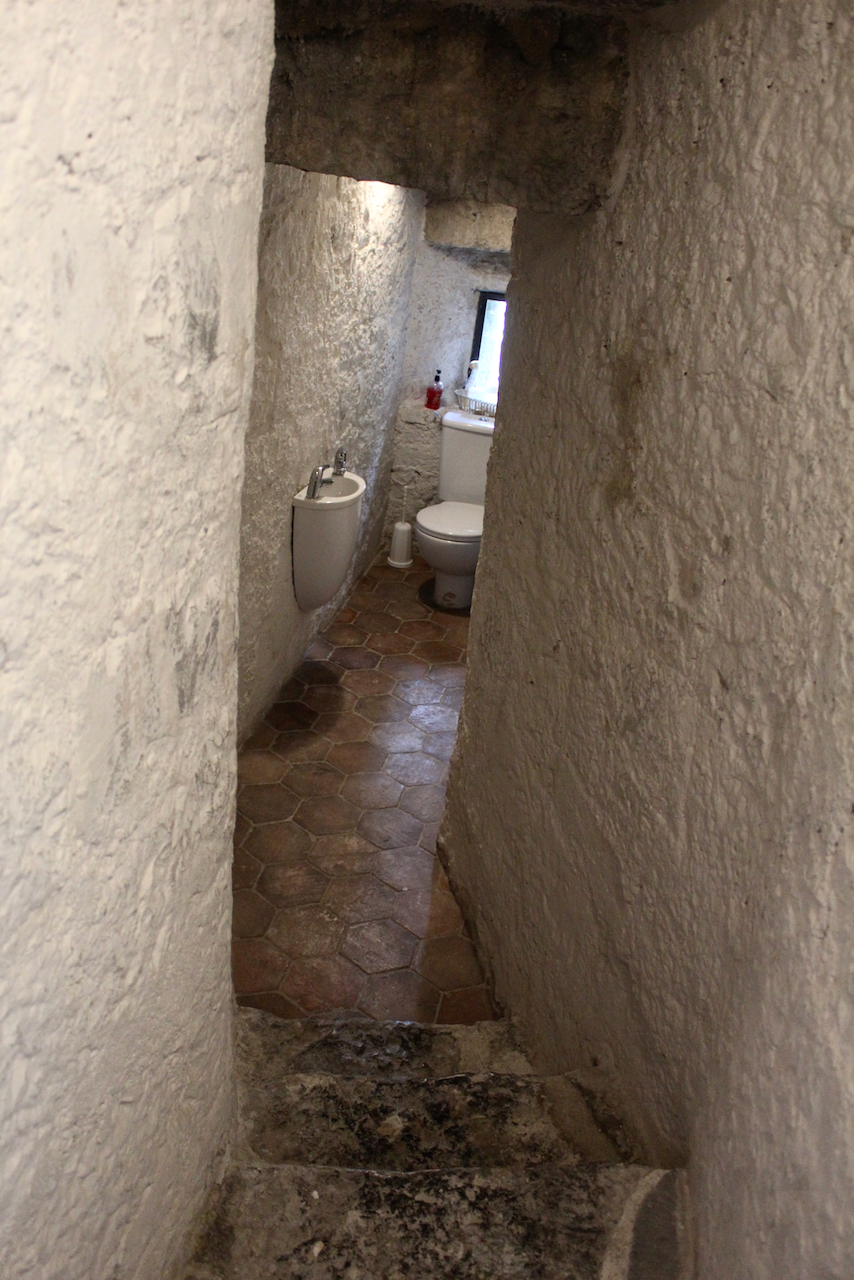
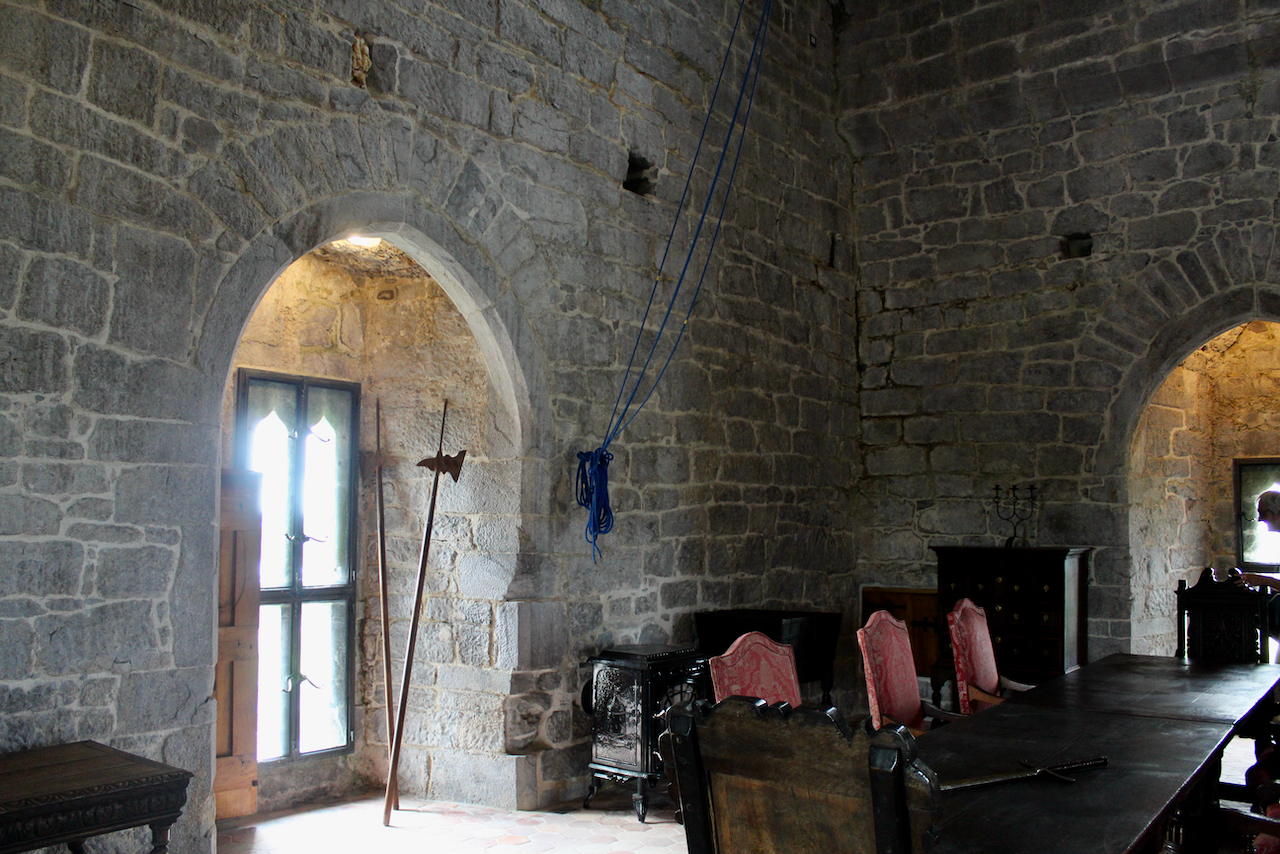
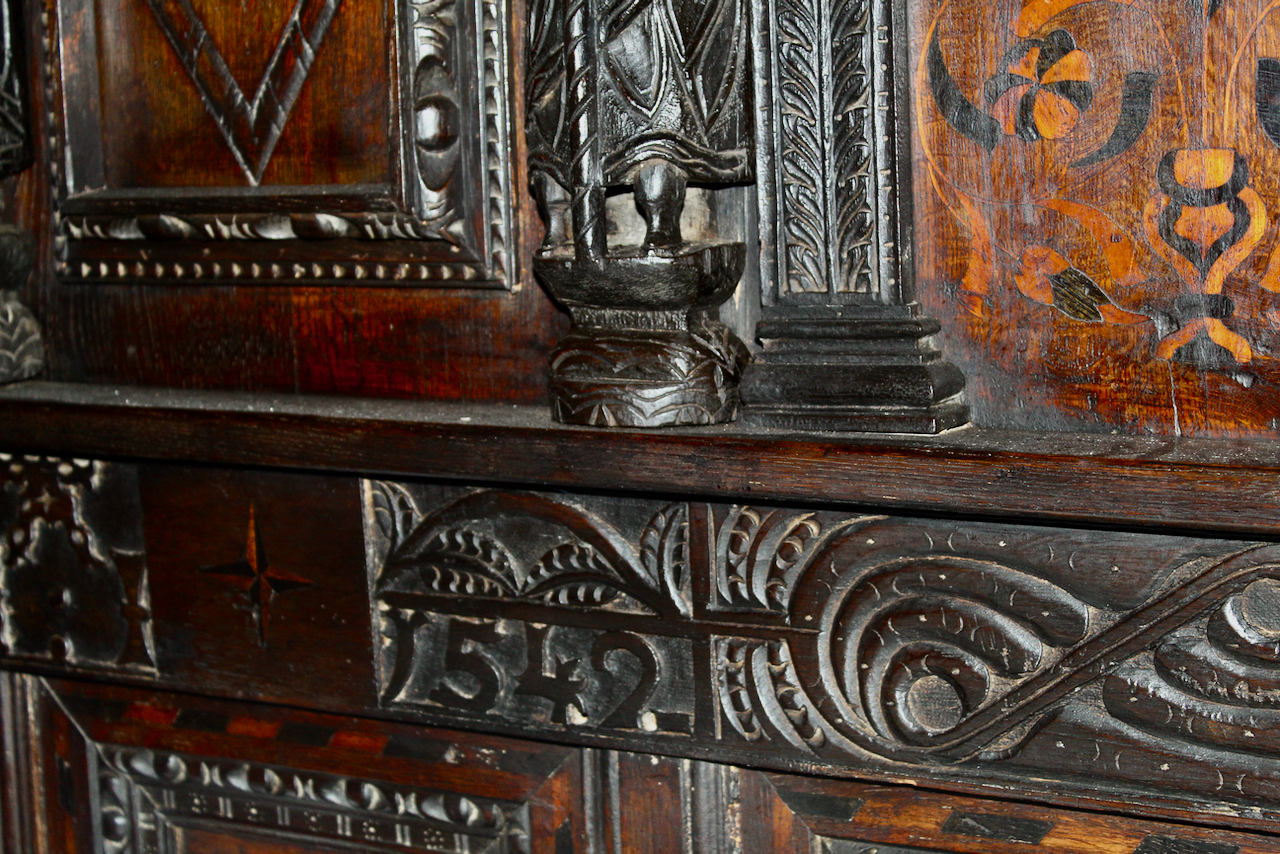
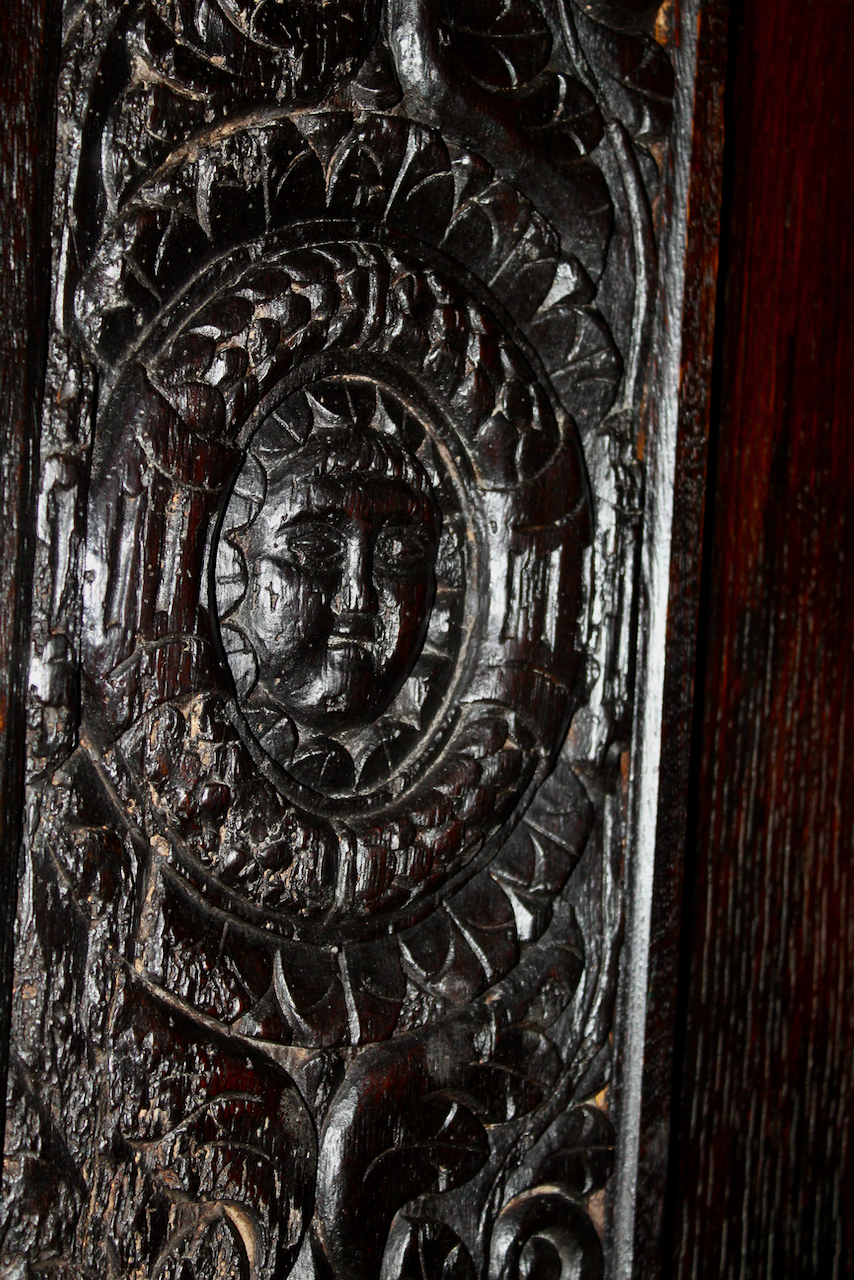
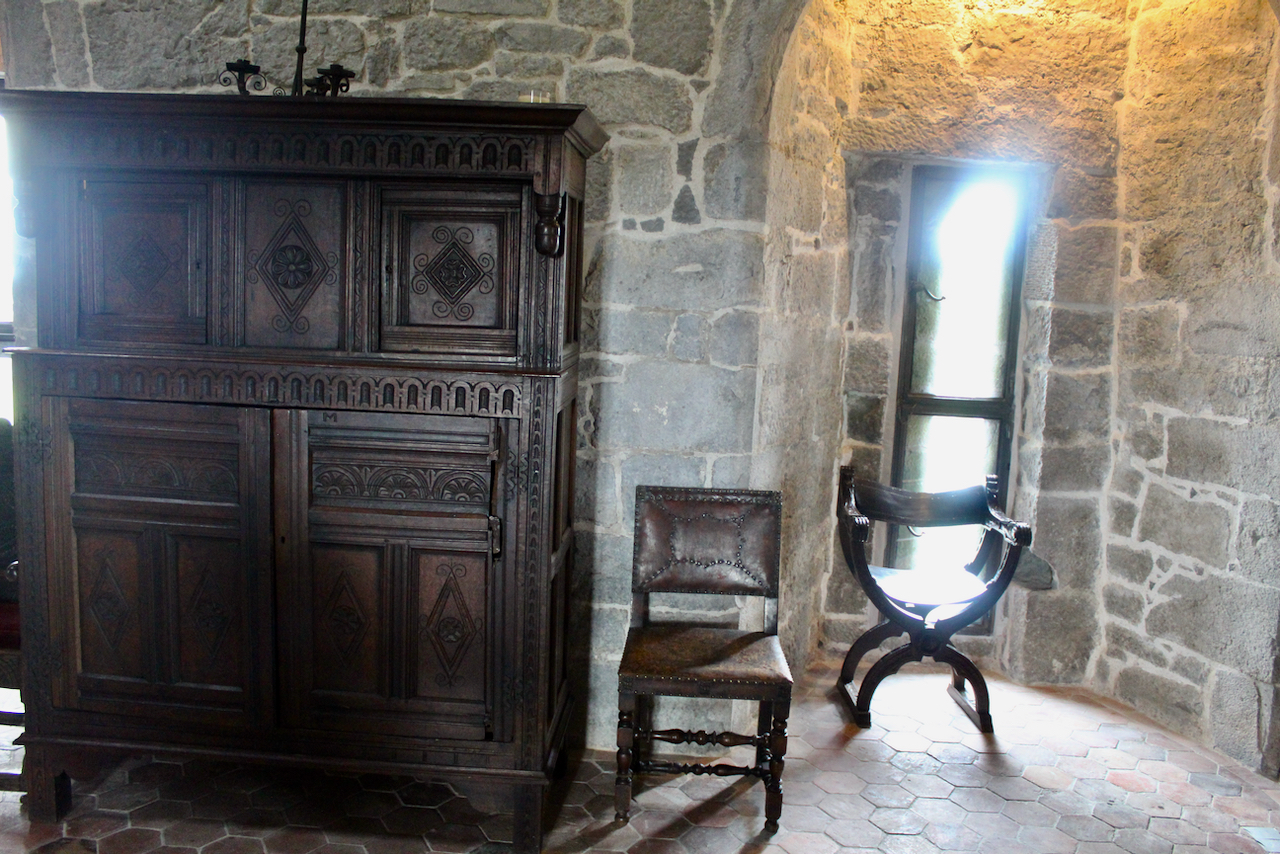
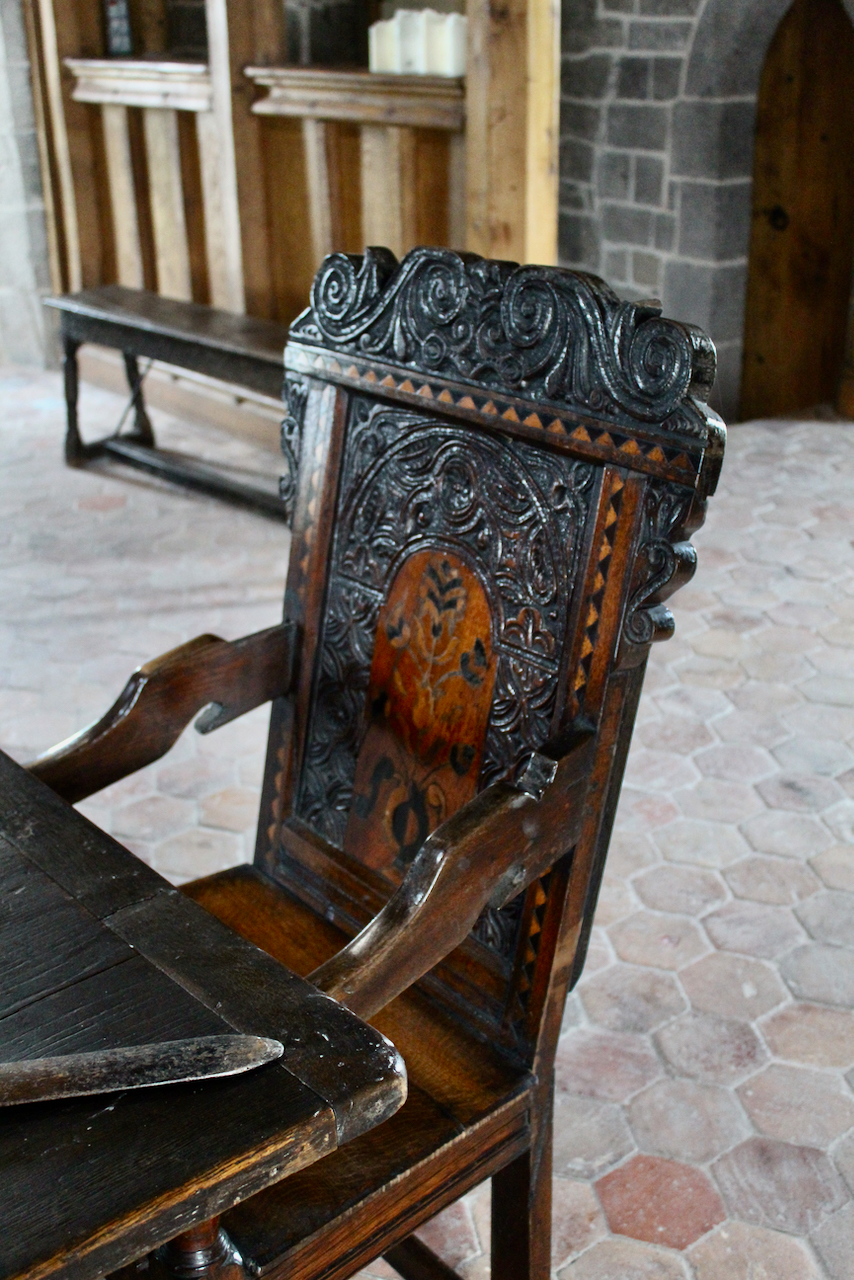
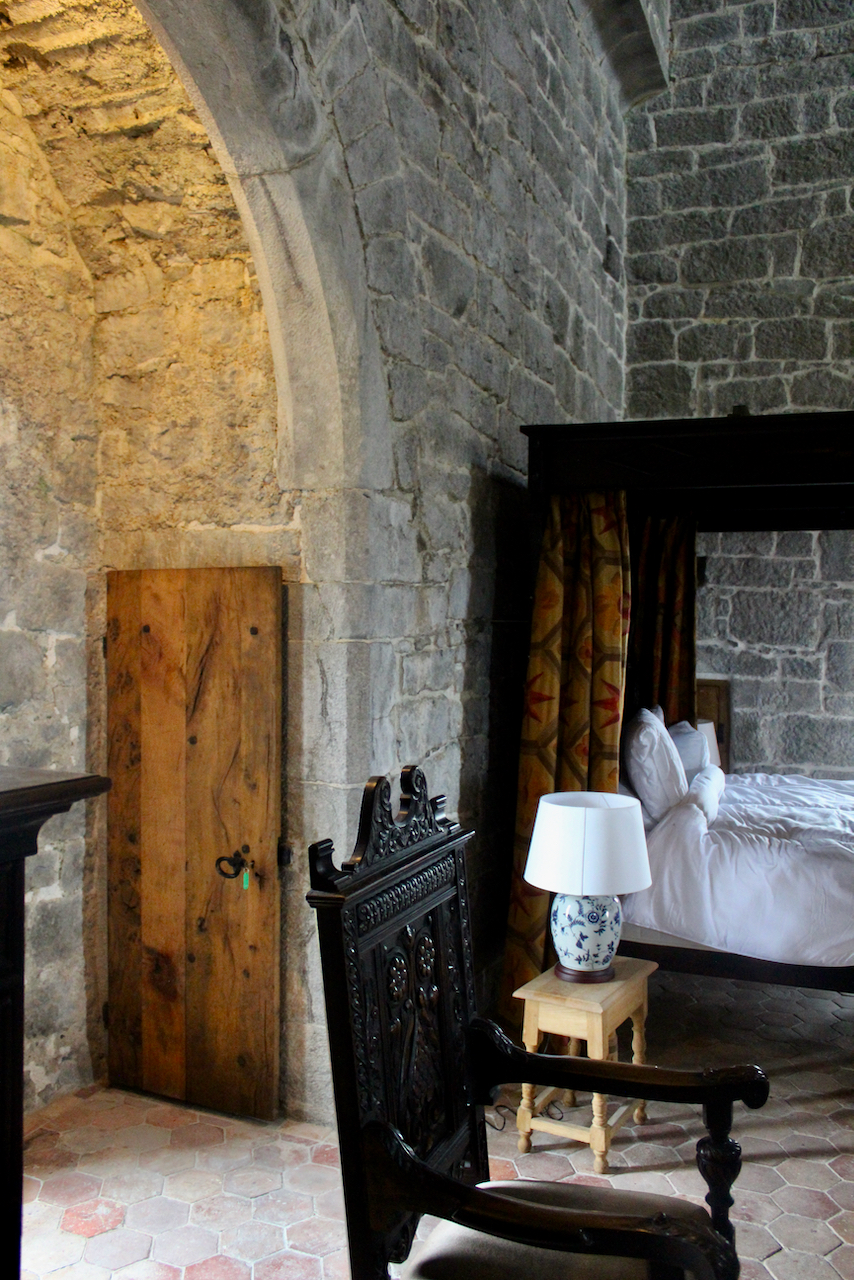
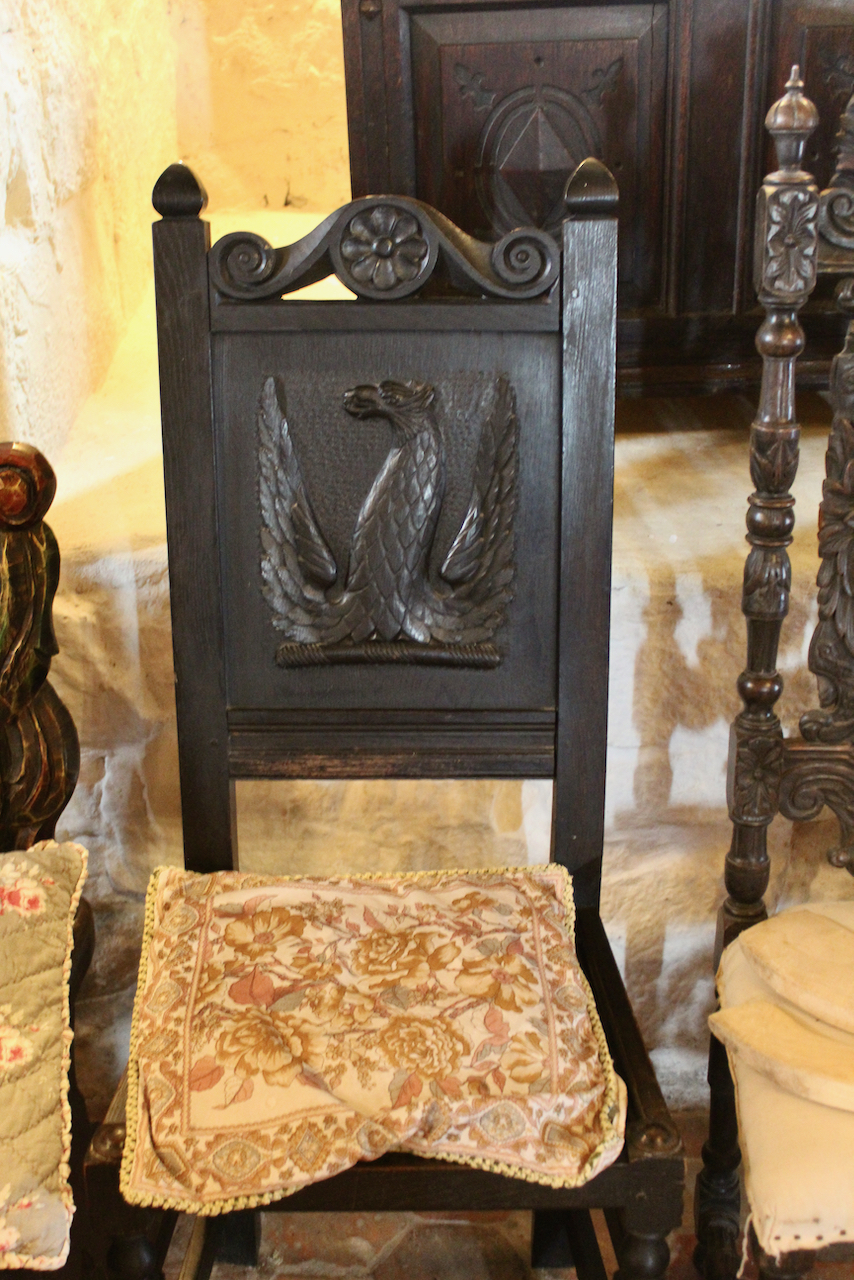
The pointed doorway is in the SE wall near the east corner. It opens into a small lobby with a guardroom on the left and a spiral stairway on the right. The tower is vaulted above the second floor. There are several mural passages and mural chambers at different levels and fireplaces at first and second floors. The presence of some corbels at parapet level indicate that there was a machicolation. When one enters the tower house, one sees just how much renovation work has been accomplished. It has been furnished with a collection of wonderful antique oak furniture.
The website tells us of a battle which took place nearby in 1504, the Battle of Knockdoe (Knockdoe in Irish is “cnoc tuagh”, literally “the hill of axes”). The military axe was the traditional weapon of the Irish Galloglass, the professional military caste in medieval Ireland. Literally meaning foreign young men or foreign young warriors, the galloglass had first come into Ireland from the Scottish Isles as early as the 13th century. Over the following centuries these men had established themselves under the patronage of different Gaelic Lords, first in Ulster but soon spread to other parts of the country. [5]
The battle was fought between the Clanricarde Burkes, led by Ulick, who had become the lord of Clanricard in 1485, and a combined force headed by the 8th Earl of Kildare, Gearóid Mór Fitzgerald. The official reason for this battle was that Ulick Burke had aggressively overstepped his authority in Connacht. He also married a sister or daughter of the Earl of Kildare, Eustacia, and she returned home claiming to have been mistreated. Furthermore, Burke was traditionally an ally of the Ormonds, who were enemies of the Fitzgeralds. The Fitzgeralds supported the royal House of York whereas the Ormonds were loyal to King Henry VII.
Near-contemporary accounts of the battle are found in the Annals of Loch Cé, the Annals of Ulster, the Annals of Connacht and the Annals of the Four Masters, as well as in The Book of Howth, a chronicle about the St. Lawrence family, who were represented in the Earl of Kildare’s army. The Book of Howth depicts the battle as an Old English victory over the Gaelic Irish. Interestingly, it portrays Clanricard as a full member of the Gaelic Irish community. The Clanricard de Burgos also used the alternative name of “McWilliam.”
The Garret Mór Fitzgerald (1455-1513), 8th Earl of Kildare, was at the time the crown’s lord deputy in Ireland. He held this office until his death in 1513. Between 1496 and his death Garret Mór did much to uphold and even extend royal power in Ireland and the campaign that led to Knockdoe arguably represents the height of Garret Mór Fitzgerald’s political and military power in Ireland. Although it has been described as a battle between Old English and the Irish, Fitzgerald’s army had many Irish as well, including Hugh Roe O’Donnell of Tyrconnell, some of the O’Neills, the O’Conor Roe, the McDermots of Moylurg, the McMahons from modern-day county Monaghan, the Magennises, the O’Reillys of Cavan, the O’Farrells of Longford, the O’Hanlons of Armagh, the Mayo McWilliam Burkes, and the O’Kellys. (see [5])
The website tells us that this battle took place five kilometres from Claregalway Castle and was one of the largest pitched battles in medieval Irish history, involving an estimated 10,000 combatants.
There was terrible slaughter and Burke’s army was defeated, though he himself survived. At least 3,000 men died in close, hand-to-hand combat.
Afterwards, the website tells us, Fitzgerald captured Claregalway Castle, taking some of Burke’s children as hostages. He then proceeded to Galway city whose mayor provided over 7,000 gallons of wine for the victors to celebrate with.
Ulick Burke of Clanricarde (d. 1544) became Earl of Clanricarde and Baron of Dunkellin, and was one of the earliest Irish Chiefs to accept Henry VIII’s policy of “surrender and regrant,” accepting Henry VIII as his sovereign. The website tells us that he was called in Irish Uileag na gCeann (‘Ulick of the heads/the beheader’), so he had quite a reputation!
The website tells us:
“…known as Ulick of the heads because of his having taken many heads of defeated enemies. This charismatic figure travelled to meet Henry VIII at Greenwich Palace, London. There, as part of Henry’s ‘Surrender and Regrant’ policy in Ireland, Ulick knelt before Henry, accepting his claim as King of Ireland. In return, Ulick was granted the title of Earl of Clanricarde, along with lands and property near Dublin. Prior to visiting England, Ulick married Dame Marie Lynch, a rich widow from Galway city. Marie helped Ulick prepare for English court etiquette, and also taught him some English since Ulick spoke only Gaelic and Latin. Unfortunately, Ulick already had two other wives; Grainne O’ Carroll and his cousin Honora De Burgo. In the following generation, there were bitter wars of succession between the sons from these different marriages, and Connacht suffered as a consequence.“
The website adds that “While at Greenwich, King Henry presented Burke with a gift of the so-called Irish Harp, the national symbol of Ireland, now held at Trinity College Dublin. Tradition says that Ulick brought this famous instrument back to Claregalway Castle with him, where its music likely echoed through the castle’s great hall.“
Ulick’s son Richard, 2nd Earl of Clanricarde, fought the Irish for the British crown. The website tells us that Claregalway castle was the chief fortress of the powerful Clanricard de Burgo or Burke family from the early 1400s to the mid-1600s.
Richard Burke (1572-1635)the 4th Earl of Clanricarde built Portumna Castle which then became the Irish base for the de Burgo, or Burke, family.
Richard Bourke 4th Earl of Clanricarde was brought up and educated in England. He fought on the side of the English against Hugh O’Neill, Earl of Tyrone, and was knighted on the field at the battle of Kinsale. He was a protege of Robert Devereux, 2nd Earl of Essex, and married Frances Walsingham, who was the widow of the poet Philip Sydney (1554-1586) and of Robert Devereux, the 2nd Earl of Essex (1566-1601), favourite of Queen Elizabeth I.
The website tells us that Ulick Burke (1604-57), 5th Earl of Clanricarde, spent time at the castle during the late 1640s/early 1650s. He was the Royalist commander in Ireland for King Charles II in the closing stages of the English Civil War which had also extended into Ireland. Correspondence written by Burke from Claregalway Castle to the King survives.
The website tells us: “In 1651 Claregalway Castle was captured by Oliver Cromwell’s commander for Connacht, the brutal Sir Charles Coote (later Earl of Mountrath), who made the castle his headquarters. The English Civil Wars combined with the Irish Rebellion were by then nearly over. Galway, a staunch Royalist stronghold, was the last town in Ireland to yield to Cromwellian forces but only after a dreadful nine month siege prosecuted by Coote. On 5April 1652, Galway’s leaders surrendered the town to Coote at Claregalway Castle. It is probably sometime after this that the castle was slighted, meaning that its battlements and bawn walls were demolished. In the centuries after this, the castle fell into disrepair.“
We learned about this battle for Galway when we visited Oranmore Castle in Galway.
Claregalway Castle, 2022.Claregalway Castle, August 2022.
The ground and first floors are both constructed under a vaulted arched ceiling. We saw a similar ceiling in Oranmore Castle, which did not have the wooden floored upper room within the space.
We then went upstairs to the first floor. Tower houses built in the fifteenth century had complex internal layouts to distinguish the private from the public space.
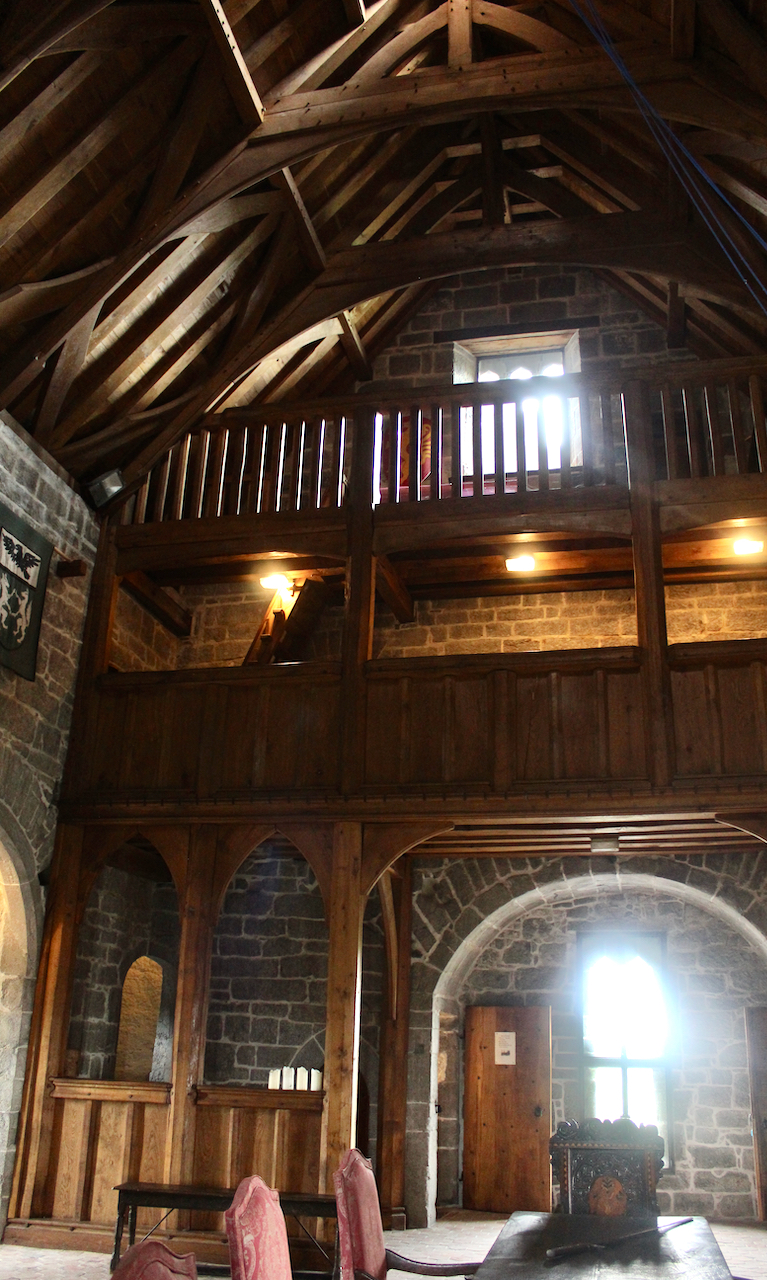
Typical of tower houses of this period, Claregalway Castle has a great hall on the second floor, which is carried by a principal vault, and this great hall is very tall and open to the underside of the roof. The principal stair ends at the level of the hall, and a second stair rises from that level. Often in the case of towers of this type, this second stair gives access to a wall walk, as well as to lesser upper chambers. Tower houses of this type are heated by a central hearth, and often have window seats and window embrasures with carved rear arches and the windows often have multiple opes and ornate heads.
The tower houses of this type often have ornate arches and arcades on the end wall of the hall, and finely carved corbel courses. Tower houses of this type are found in Galway, Limerick, Cork and Tipperary, and include Barryscourt in County Cork (an OPW property which one can visit, the OPW website tells us that Barryscourt Castle was the seat of the great Anglo-Norman Barry family and is one of the finest examples of a restored Irish Tower House. Dating from between 1392 and 1420, the Castle has an outer bawn wall and largely intact corner towers).
The Great Hall is on the second floor and rises to the underside of the roof. Smoke from the hearth can rise to the open roof space which can be opened by a louver or vent. The apex of the restored roof of Claregalway is 10.74 metres from the floor of the hall, and it was built to impress.
In 1620 Luke Gernon wrote about a visit to a tower house. He writes that the hall is the uppermost room, and once you go up to it, you won’t come down until the next day! You would first be presented by the lady of the house to the drinks of the house: first ordinary ale, then sack, then “olde ale” which you must not refuse. You would then wait by the hearth until dinner was served, and then housed in a chamber for sleep. Next morning you are woken with “aquae vitae.”
The website tells us thatthere was an English military garrison stationed at the castle in the early 1700s. In 1791, a French diplomat, Coquebert de Montbert, passed through Claregalway while on a tour of Connacht. De Montbert described the castle as being in good condition, but without its roof and battlements.
The website tells us that at some point, either in the late 1700s or early 1800 centuries, there was a water-wheel and flax mill in operation at the castle. An etching by Samuel Lover in 1831, and an engraving by the artist William Henry Bartlett from about 1841, show the ruined castle, with the water-wheel, the original eleven-arched bridge beside the castle and the nearby Franciscan Friary.
“Stay in one of our five beautiful rooms (River, Old Mill, Salmon Pool & Abbey) at the Old Mill & Manor House beside the Castle, a peaceful medieval gem on the banks of the River Clare in the village of Claregalway. Just 10km from Galway City Centre and within walking distance of a bus stop, restaurants/bars and the stunning Abbey. The room is very comfortable with under-floor heating and luxurious bedding. Includes complimentary wine, tea/coffee and a generous continental breakfast.
This room is directly adjacent to the Castle tower and you will have access to the tower and the delightful castle grounds.“
Several of the ancilliary buildings contain the rental accommodation. You would be in august company, as in 1931, the actor Orson Welles, then a 16 year old unknown, stayed at the castle for a time as part of his travels in Ireland.
The castle was used by the British as a garrison and as a prison for I.R.A. soldiers during War of Independence, 1919-21. The first Garda Siochána (Irish police force) station in the area was based at the castle for a short time.
Tourist Accommodation Facility – since it is listed in Revenue Section 482 as Tourist Accommodation Facility, it does not have to open to the public. Open for accommodation in 2026: all year, National Heritage Week events August 15-23
donation
Help me to pay the entrance fee to one of the houses on this website. This site is created purely out of love for the subject and I receive no payment so any donation is appreciated!
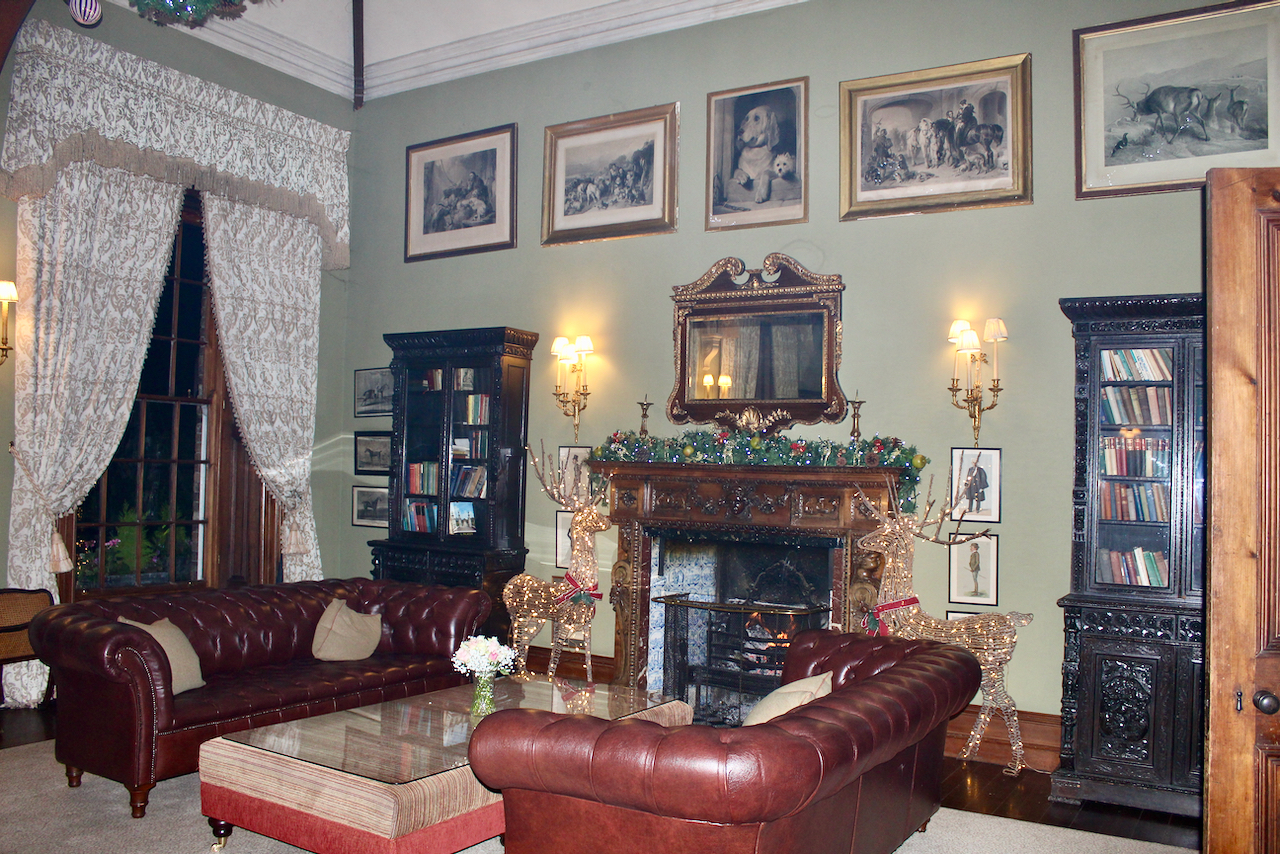
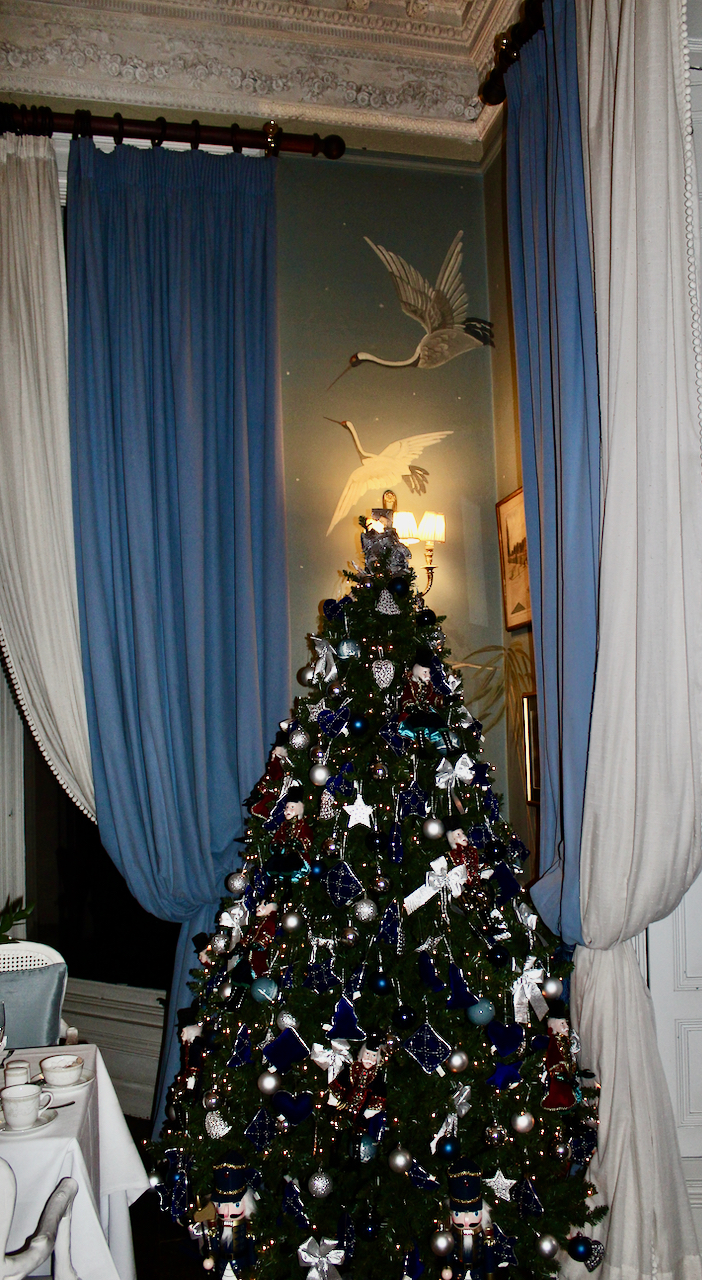
As a treat for Stephen’s birthday we booked ourselves in to Castle Leslie for two nights at the end of November. What luxury! I assumed we could not afford it as I only heard of it when Paul McCartney married there in 2002. But it is amazingly reasonable! In Christmas regalia, its beauty and opulence took my breath away, as did the generosity of the owners, allowing us to wander every nook and cranny and to sleep in a bed that was made in the year 1617!
DAY 1: Our Castle Tour and the history of the Leslies
We had to make sure we left Dublin in time for the tour at 1pm, which does not run every day but several days a week. Our tour guide, Enda, shared only the tip of the iceberg of his knowledge of the castle and family in a tour that lasted an hour. We were able to mine him for even more tidbits later and still I felt we only scratched the surface!
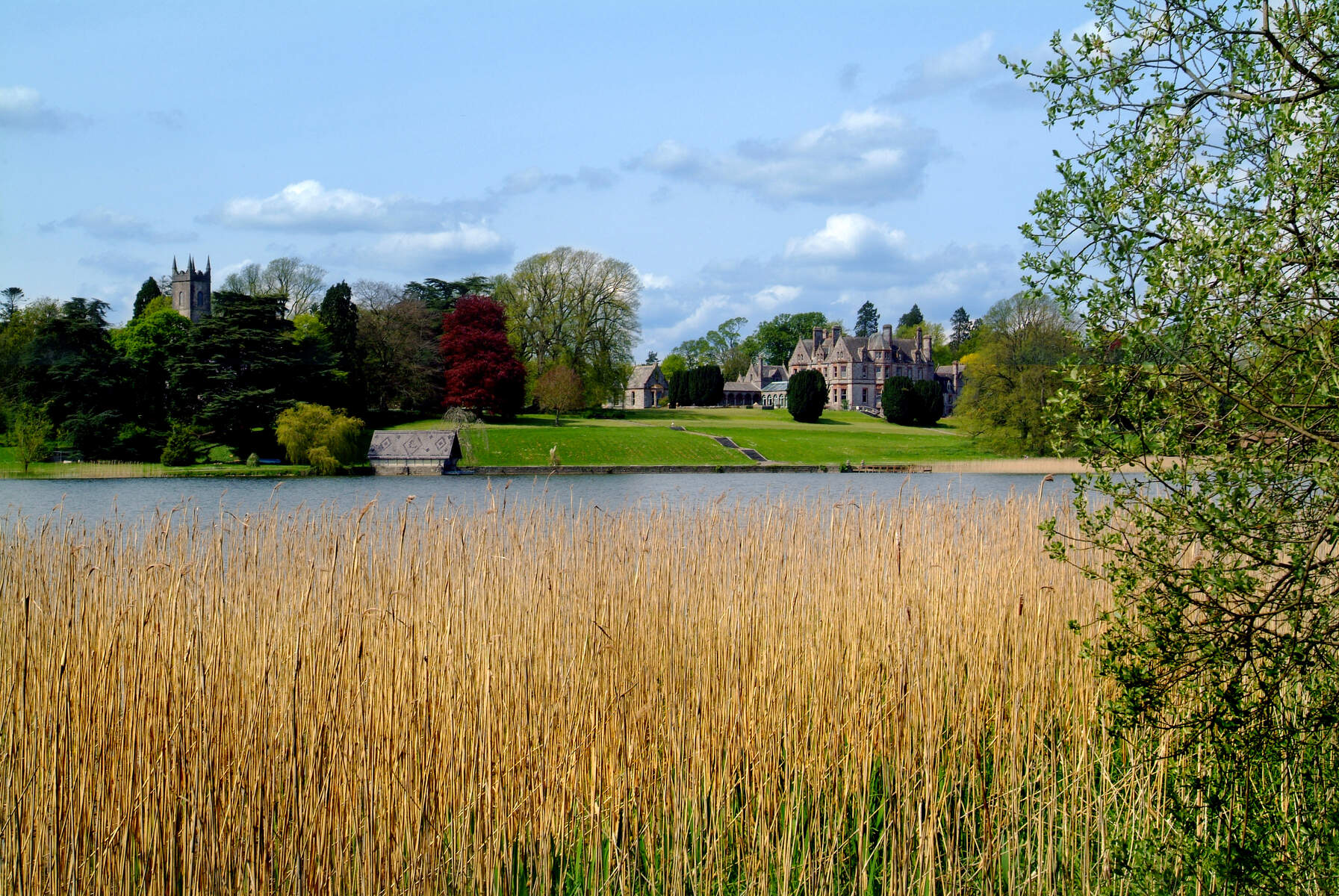
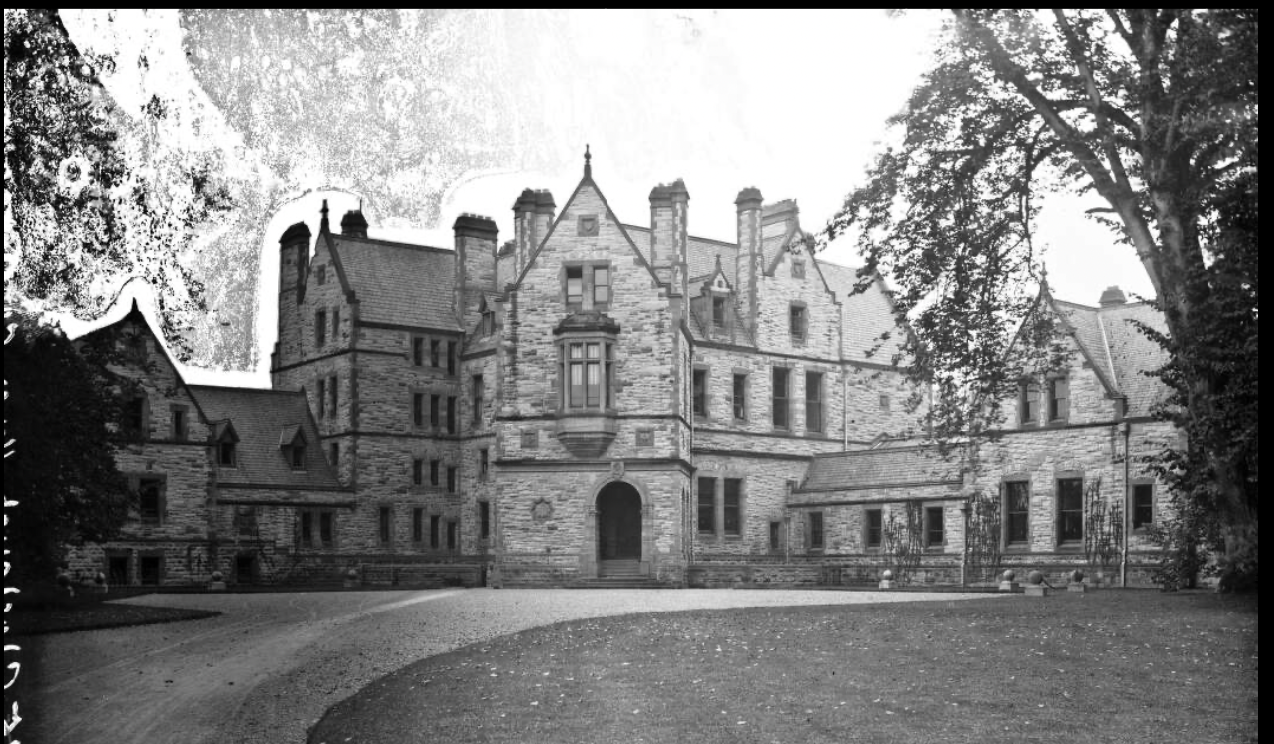
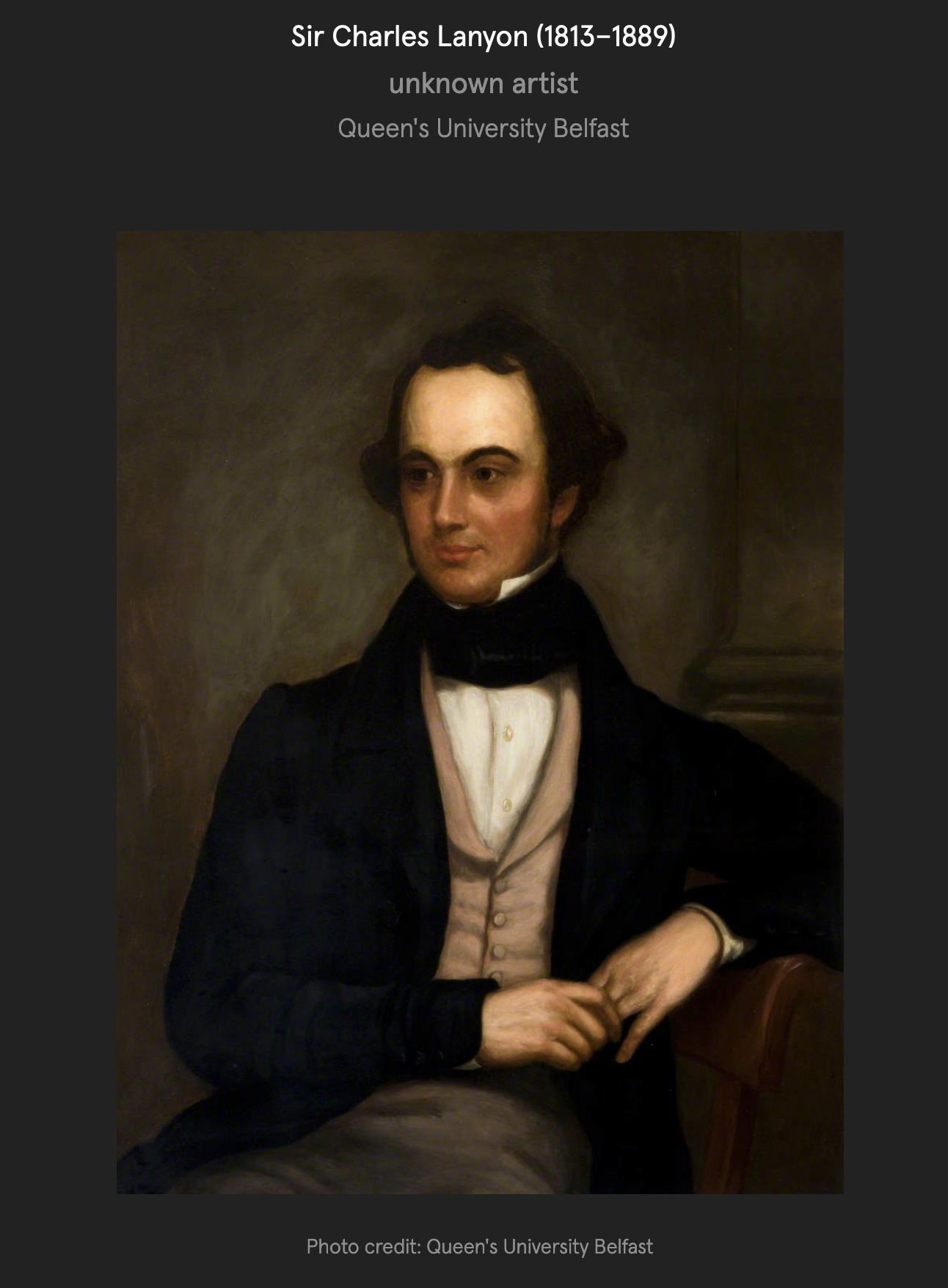
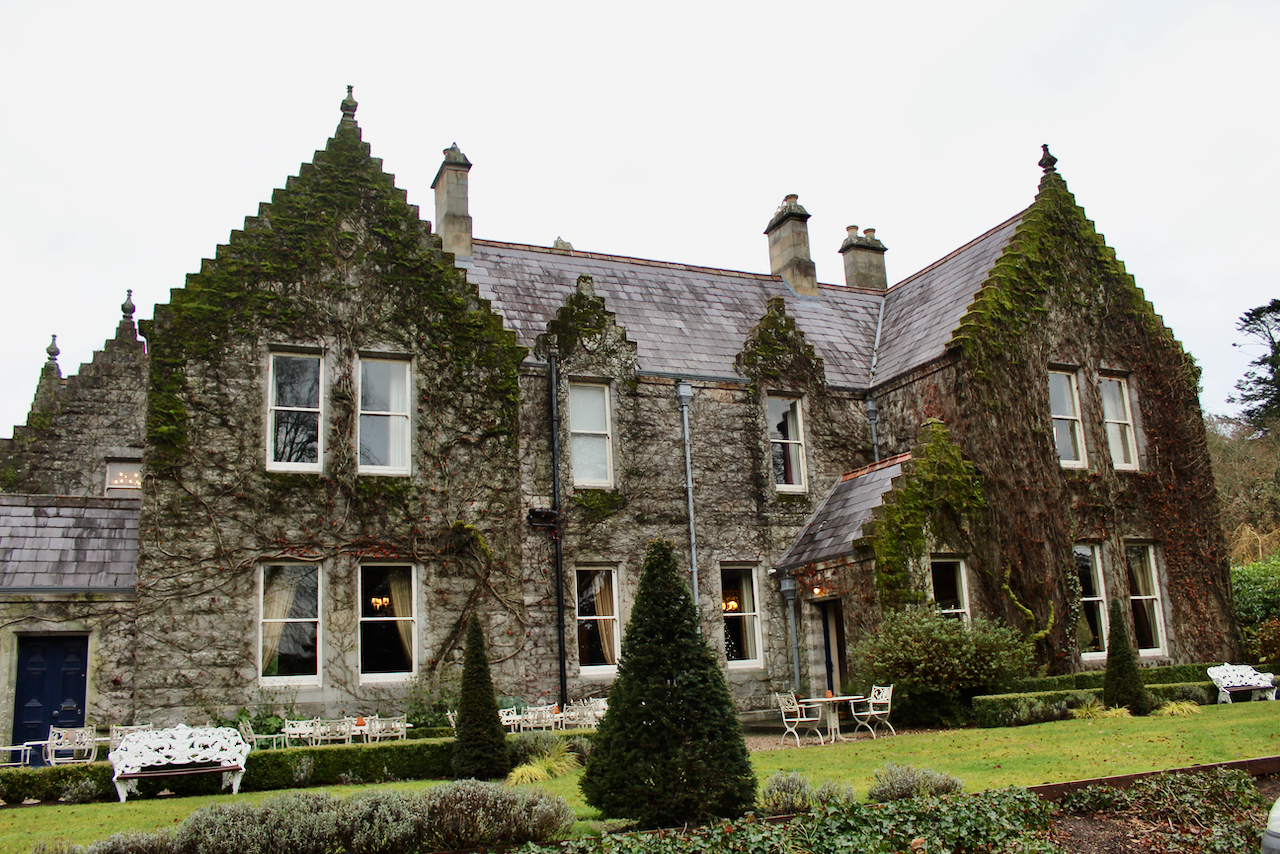
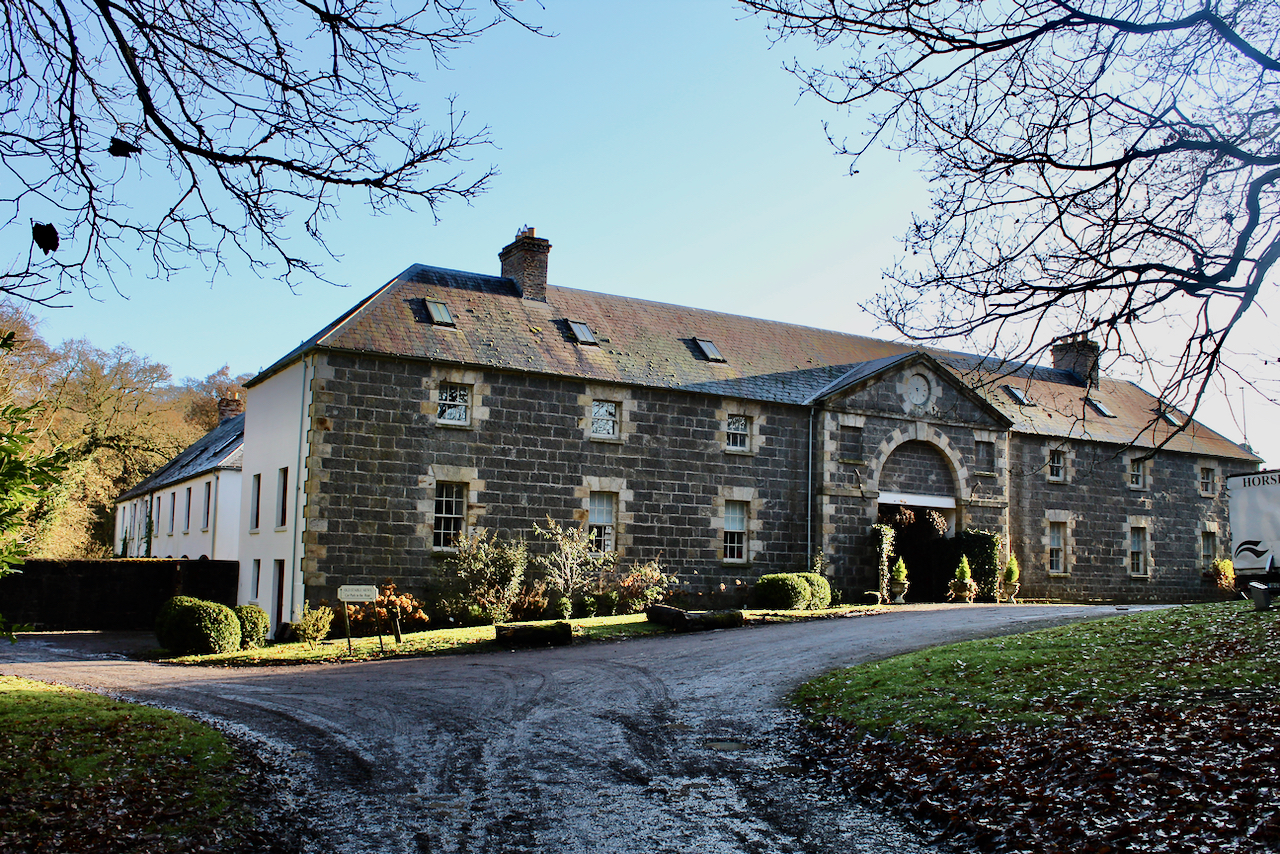
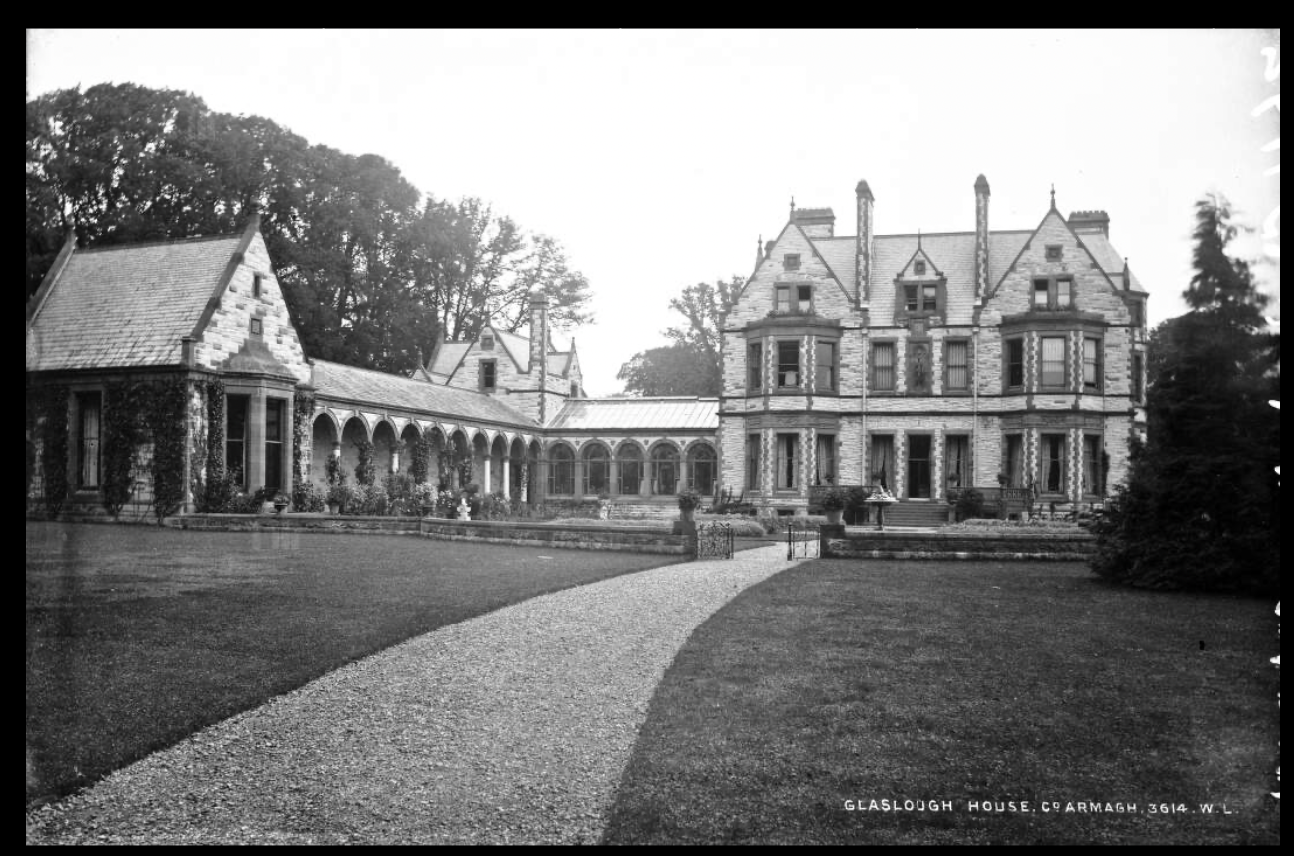
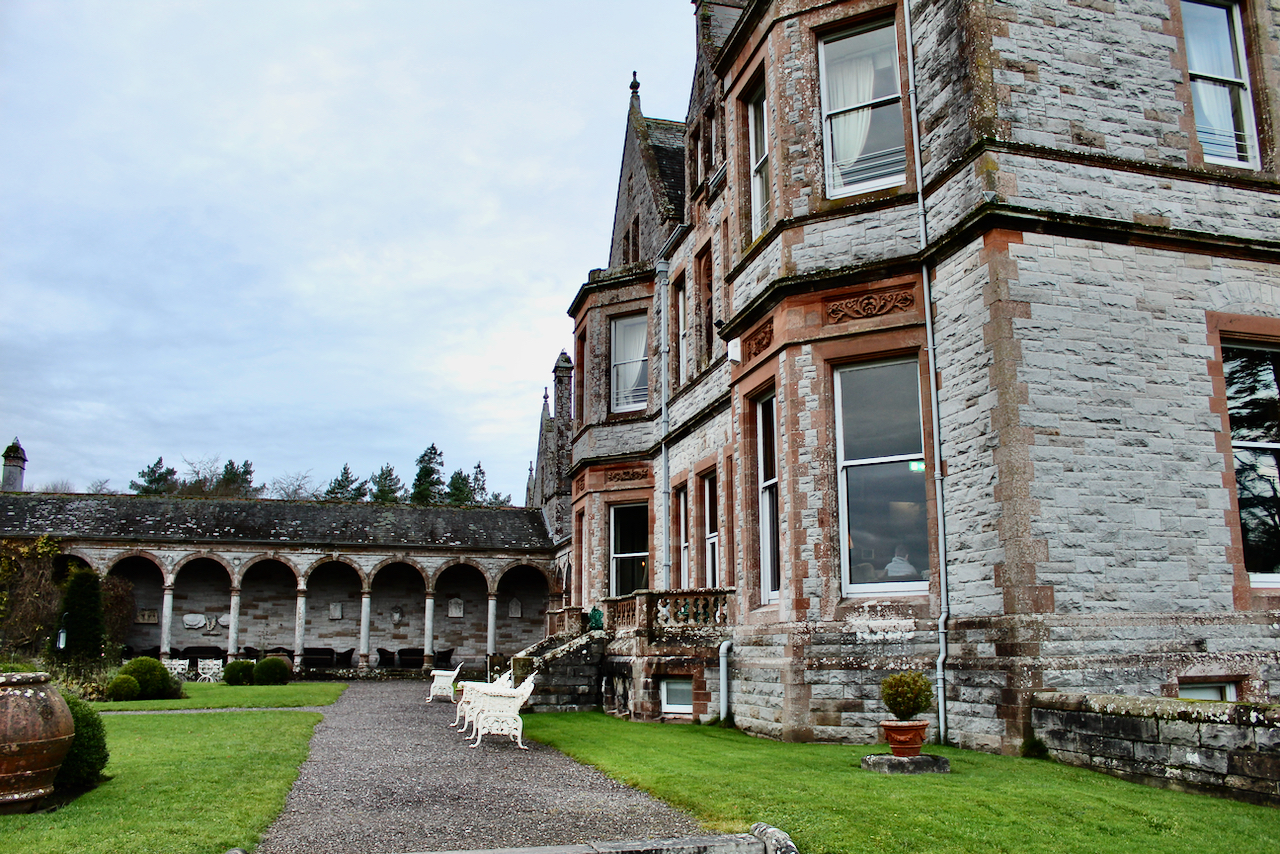
The castle is a relative youngster at just 130 years old, a “grey stone Victorian pile” as Mark Bence-Jones calls it [2], or in Scottish Baronial style, according to Maurice Curtis and Desmond Fitzgerald [3]. It was designed by Sir Charles Lanyon and William Henry Lynn, built ca. 1870 for John Leslie, MP, incorporating part of an earlier house. William Henry Lynn (1821-71) was a Belfast based architect and the Castle is considered to be his masterpiece. It is set in a 1000 acre estate (much reduced from its original size) overlooking a lake, and the castle is near another residence, the Lodge (formerly the Hunting Lodge), which houses the bar and restaurant.
Charles Lanyon (1813-1889) courtesy of Queen’s University Belfast.
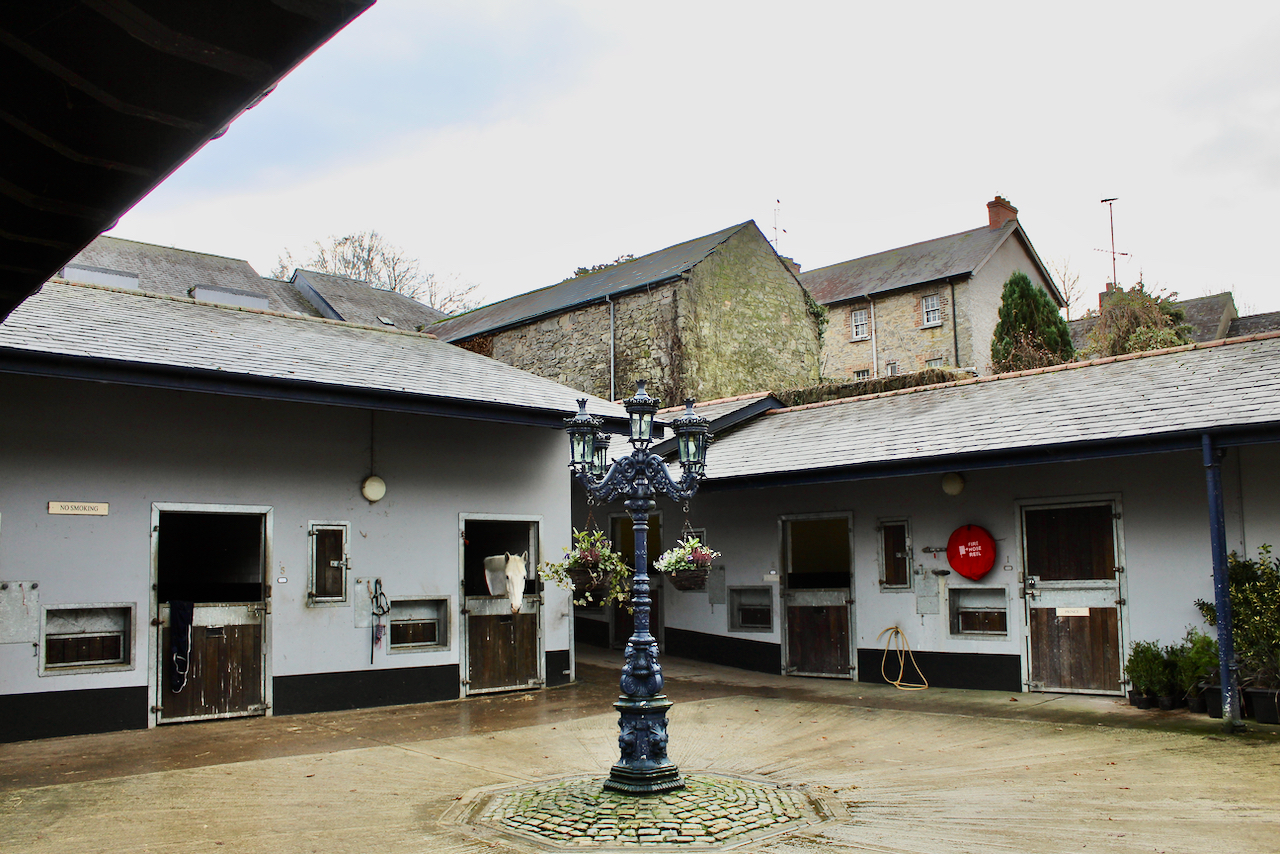
The Lodge was designed by one of the Leslies, Charles Powell Leslie II, and was built before the present castle. The hotel includes an excellent Equestrian centre on its grounds – a perfect way to explore the huge estate of lakes, forest, parkland and streams. The Estate has three lakes, Glaslough (Green Lake), Kilvey Lake and Dream Lake. [4] There is more accommodation in the restored Old Stable Mews, or in holiday cottages in the village.
We drove through the picturesque village of Glaslough to reach the “crow stepped gabled gate lodges” marking the entrance to the Castle Leslie estate. (see [1])
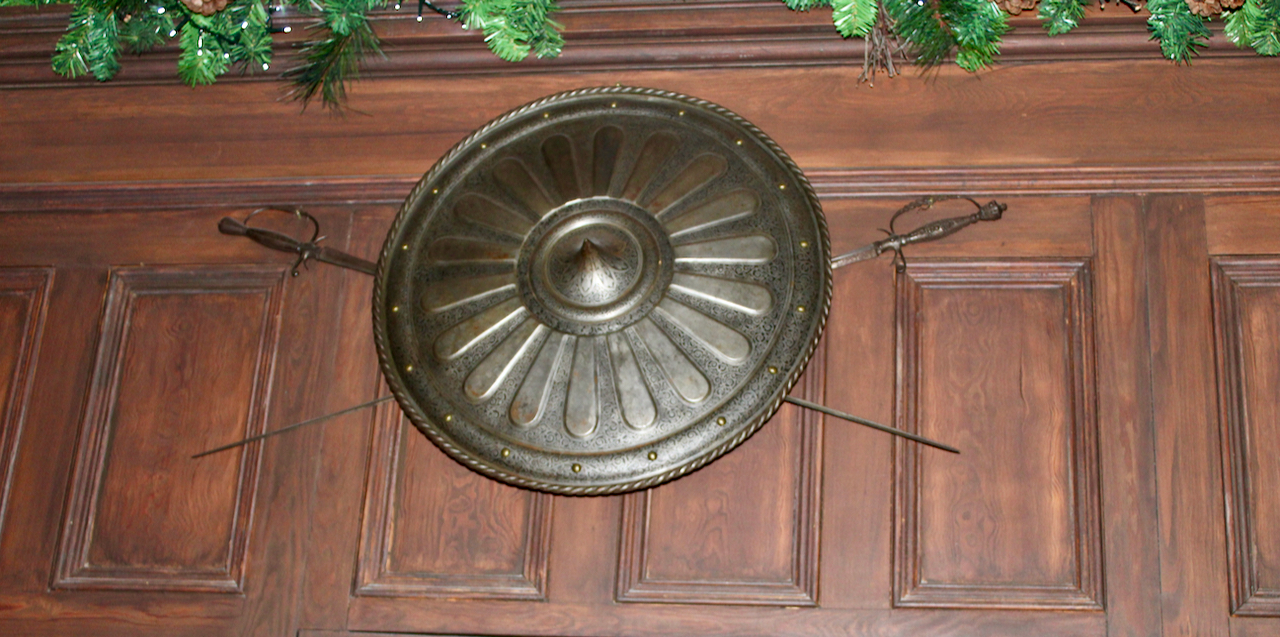
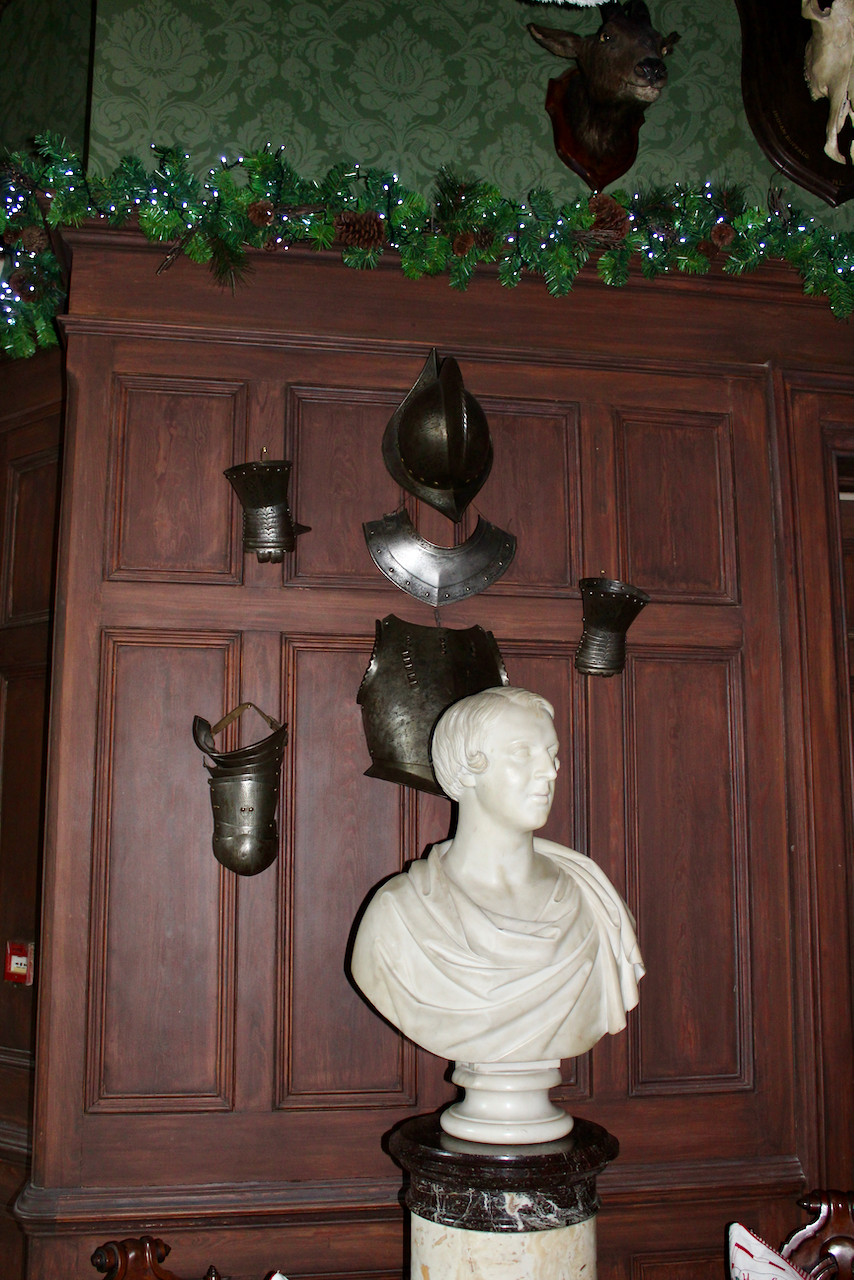
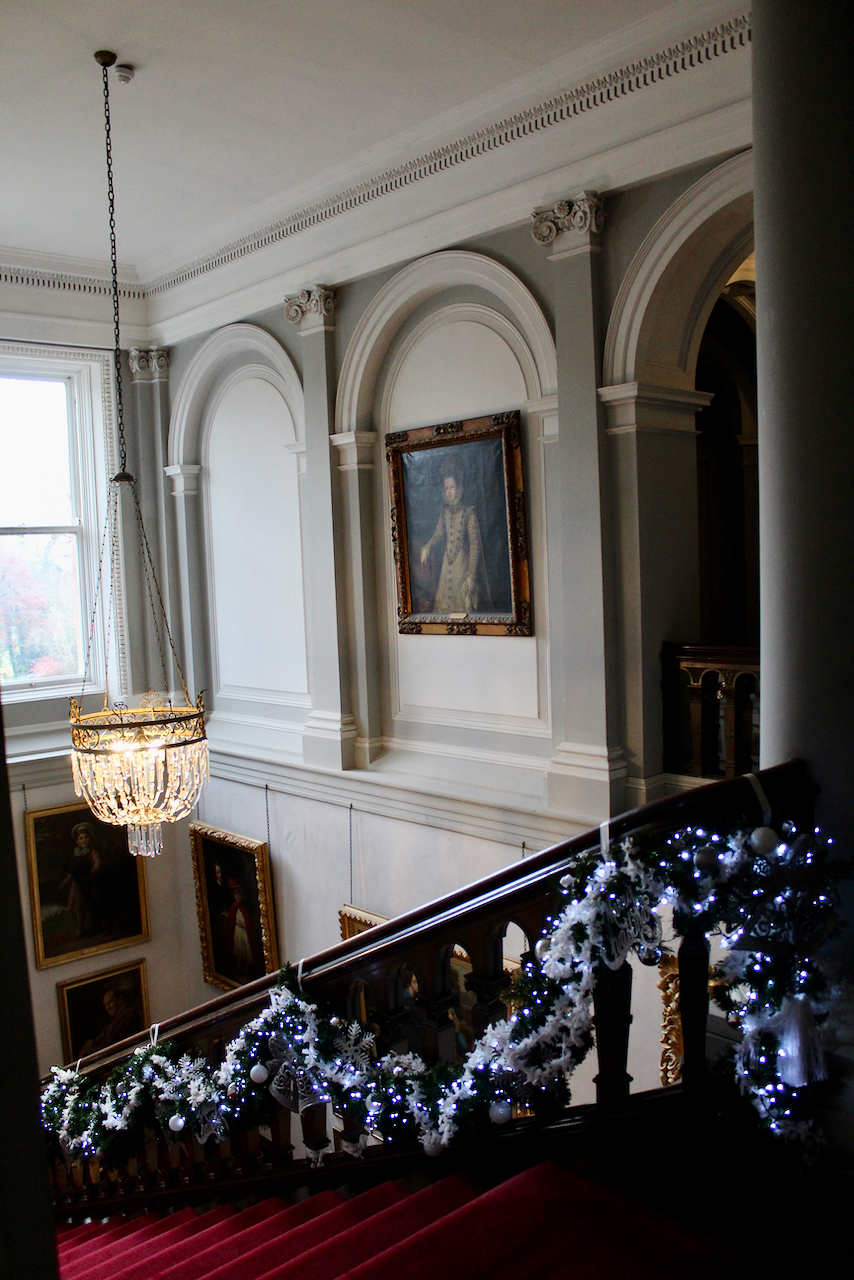
Our tour began in the front hall of the Castle, soon after we arrived, so we left our suitcases at the front desk, to check into our room afterwards. The front hall contained arms from the Leslie family.
Originally Hungarian, the first of the family moved to Ireland in 1633. They have lived at Castle Leslie since 1665. Our guide traced the family back to 1040. Their genealogy reaches even further back to Attila the Hun (he died in the year 453).
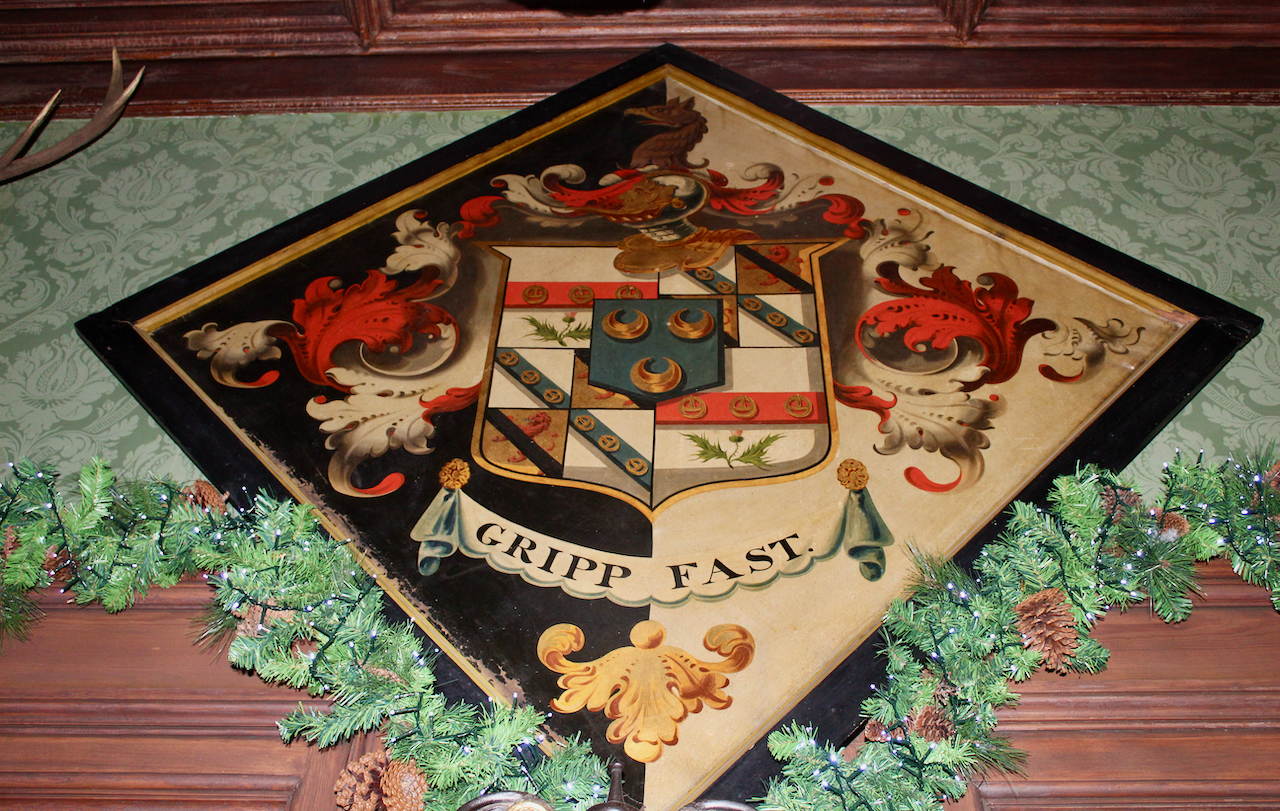
According to the Castle Leslie website, Bartholomew Leslie, a Hungarian nobleman, was the chamberlain and protector of Margaret Queen of Scotland, who was wife of King Malcolm III (he lived 1031-1093). One day, fleeing from enemies, Queen Margaret rode behind Bartholomew on his horse. When fording a river, the queen fell off and Bartholomew threw her the end of his belt and told her to “grip fast” the buckle. He saved the Queen’s life and from that day onwards she bestowed the motto “Grip Fast” on the Leslies. [5]
Our guide told us that King Malcolm’s sister Beatrice married Bartholomew Leslie. They moved to Aberdeenshire in Scotland.
Five hundred or so years later a descendent John Leslie was born in 1571 in Aberdeenshire. He received his Doctorate of Divinity from Cambridge and was Privy Councillor to Kings James I and Charles I. He was promoted to become Bishop of the Scottish Isles, and in 1633 transferred to Donegal to the Bishopric of Raphoe.
When Oliver Cromwell came to Ireland, John Leslie, friend of the monarchy, raised a private army to battle against Cromwell, as so he earned the moniker “The Fighting Bishop.” His troops beat Cromwell in the Battle of Raphoe. When King Charles II was restored to the throne in 1660, he rewarded the Bishop with £2000 – note that the Bishop was ninety years old by this time! Despite his age, he became Bishop of the Diocese of Clogher in 1661.
With the £2000, in 1665 Bishop Leslie bought the estate at Glaslough with an existing castle which had been built in 1608 by Sir Thomas Ridgeway. Bishop Leslie died at the age of one hundred, and left the estate to his wife, Catherine Cunningham (or Conyngham) of Mount Charles in Donegal (an ancestor of the present Lord Henry Mount Charles of Slane Castle), and children. He had married at the age of 67 the 18 year old Catherine and sired five (according to our guide) or 10 (according to Wikipedia, [6]) children! Only two of his children survived to adulthood and only one has descendants.
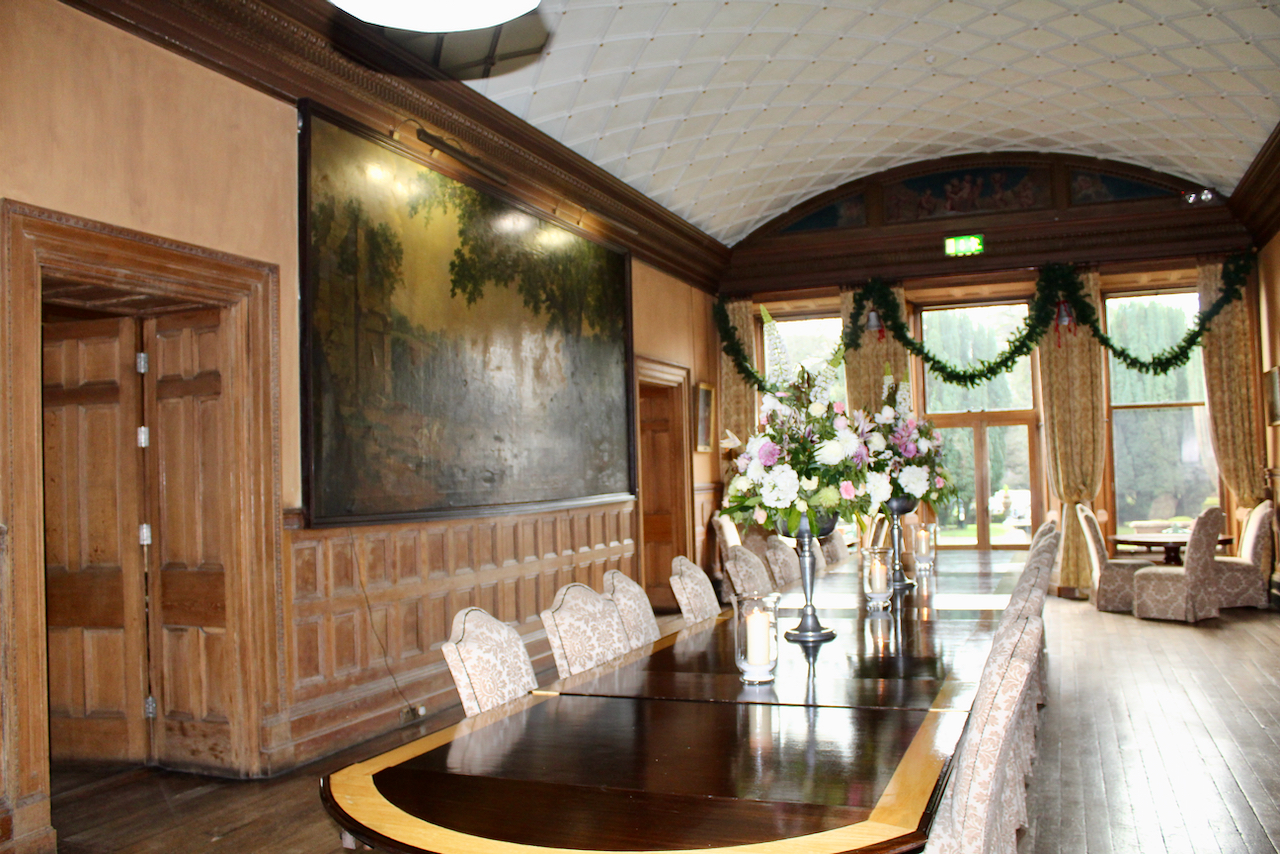
Due to the limitation of the tour’s length our guide jumped forward to the 1880s. I am guessing that it was he who wrote the history of the Leslies on the Castle’s website, so I will defer to that to fill in the gaps. We moved from the front hall into the hallway of the grand staircase, where our guide told us about the people in the various portraits. We then moved through a room with a large table, to the drawing room and the dining room, where the guide spoke about more of the family and their portraits.
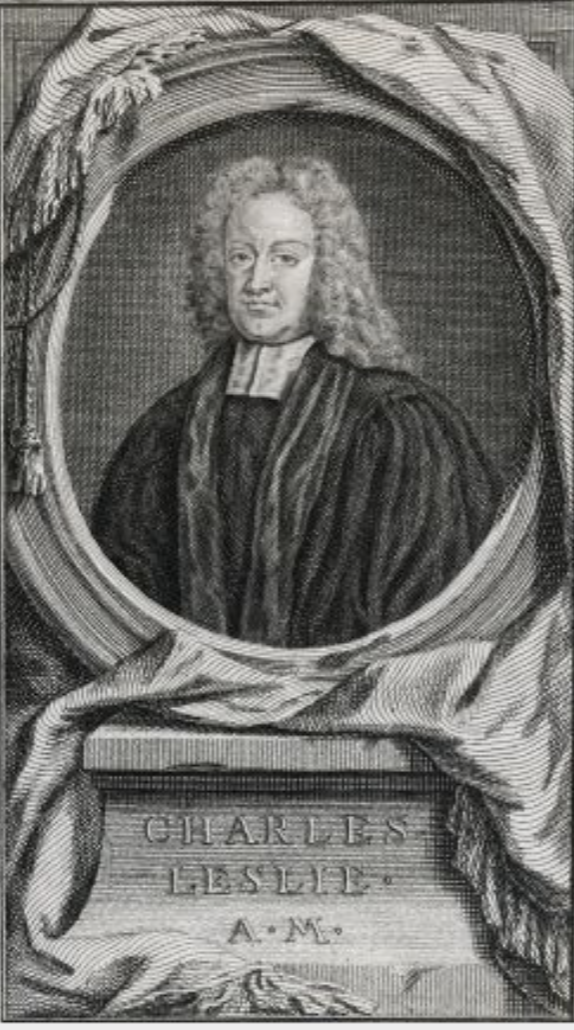
The Bishop’s son John, another cleric, the Dean of Dromore, inherited the estate. He never married so when he died, the estate passed to his brother, Charles, at 71 years of age. Charles was a theologian and defended the Catholics, opposing the penal laws which prevented Catholics from participating in political life. King William III had him arrested for high treason, but he escaped to France. The next king, George I, pardoned him, saying “Let the old man go home to Glaslough to die.” (see [5], which provides most of my narrative)
Rev. Charles Leslie (1650-1722), Jacobite Religious Controversialist and Pamphleteer. Portrait After [i.e. print created from a portrait by] Alexis-Simon Belle, French, 1674-1734. Photograph courtesy of the National Gallery of Ireland.
Charles married Jane Griffith, daughter of the Very Reverend Richard Griffith, Dean of Ross [7] had three children: Robert, Henry, and the unusually named “Vinegar” Jane. Robert and Henry were friends with Jonathan Swift, who wrote the following about the family:
“Here I am in Castle Leslie
With rows and rows of books upon the shelves
Written by The Leslies
All about themselves.”
I’m not sure what was written at that stage, but certainly when we stayed, there were plenty of books by the Leslies! I had a good browse through them – more on them later.
Robert wedded, in 1730, Frances, daughter of Stephen Ludlow.
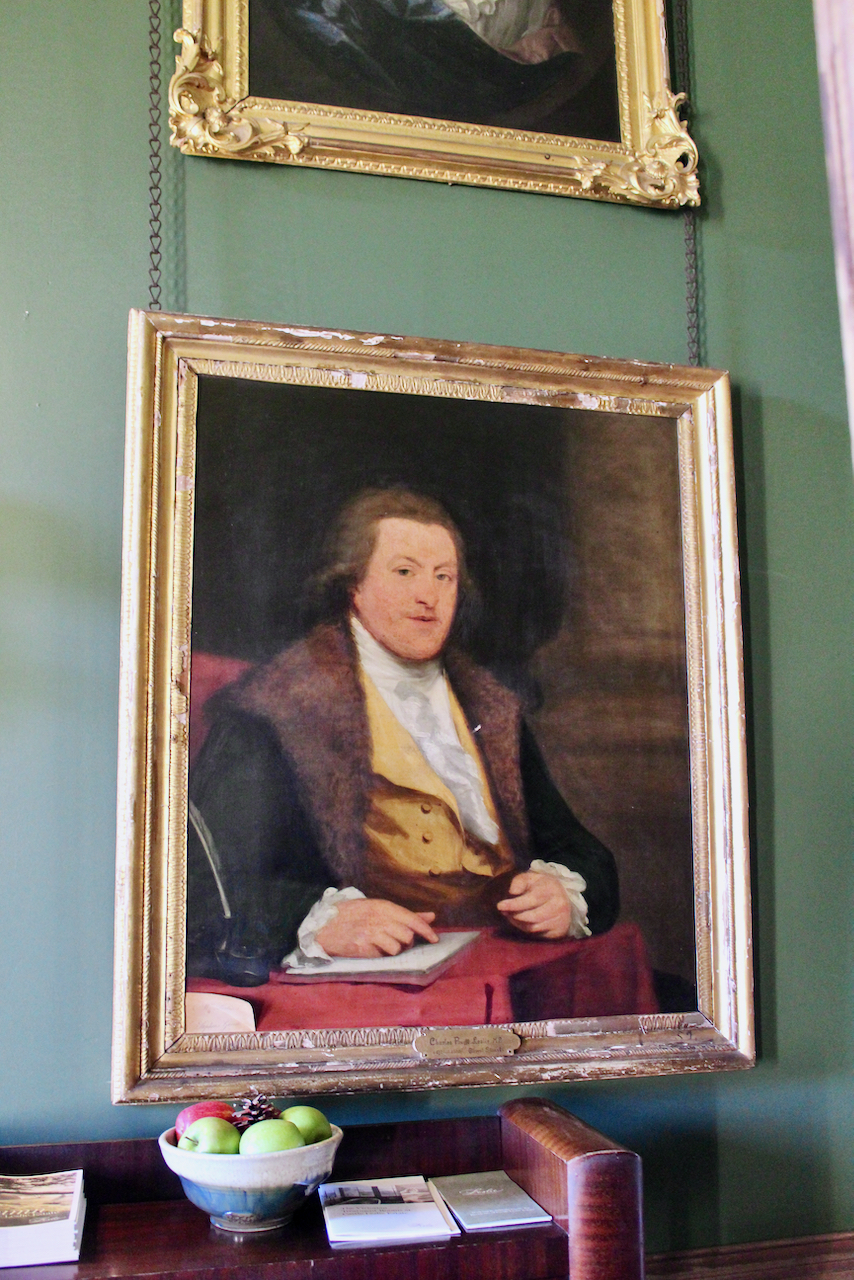
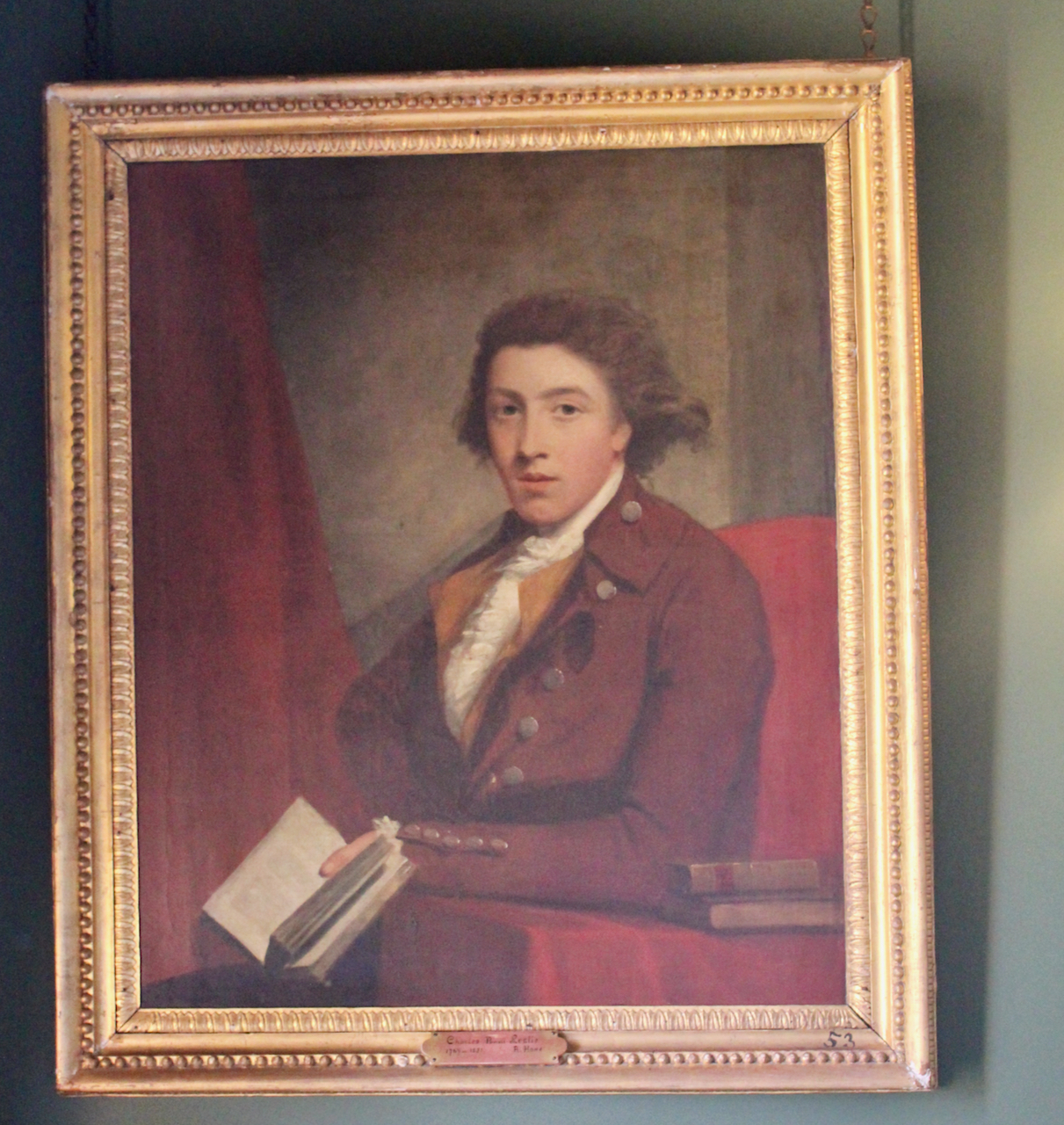
Their son Charles Powell Leslie (c. 1738-1800), took over the Estate in 1743. He devoted himself to the improvement of farming methods in the district. He was elected MP for Hillsborough in 1771 and MP for Monaghan in 1776. Like his grandfather, he supported the Catholics. At the time, due to Poynings Law, all Irish legislation had to be approved by the British Privy Council. Henry Grattan and others, including Charles Powell Leslie, sought legislative independence. Once this was achieved, Grattan fought in parliament for Catholic Emancipation from the Penal Laws, so that Catholics could be treated as equal citizens of Ireland. In his election speech of 1783, Charles Powell Leslie stated ”I desire a more equal representation of the people and a tax upon our Absentee Landlords”.
In 1765 Charles Powell married Prudence Penelope Hill-Trevor, daughter of Arthur Hill-Trevor, 1st Viscount Dungannon. They had two sons, Charles Powell II and John. After his first wife died, Charles Powell Leslie I married, in 1785, Mary Anne Tench, and had a third son. The heir, Charles Powell II, also represented Monaghan in parliament.
Arthur Hill-Trevor’s elder daughter, Anne, married Garret Wesley, the 1st Earl of Mornington, of Dangan Castle County Meath, and their son grew up to be the Duke of Wellington who defeated Napolean at Waterloo. According to the website, Charles Powell Leslie gave his impoverished brother-in-law, Lord Mornington, the money to educate his son Arthur, in Eton and then military school in France (Stephen and I found it ironic that the Duke of Wellington, who beat Napoleon, hence France, received his military training in France!). Arthur, the Duke of Wellington, married Kitty Pakenham of Tullynally, County Westmeath.
Charles Powell Leslie II, an amateur architect, designed the present farm buildings and the gate lodge. (see [8] for more about Charles Powell Leslie II). He died in 1831 and his wife Christiana took over the running of the estate. She managed to feed the needy during the great famine of 1845, setting up soup kitchens, and gave employment by having a wall built around the estate. The population of County Monaghan was 208,000 before the Famine. It went down to 51,000 during and after the Famine and is now only 61,000 – still far less than its pre-Famine population. It is said that nobody perished on the Leslie estate. As well as the soup kitchen, Christiana suspended rents.
Her son Charles Powell III (1821-71) also enjoyed architecture, and had flamboyant taste. He designed the entrance lodges at the main gates of the estate. He had many other grand building plans but died, choking on a fishbone, and it was his brother John (1822-1916) who built the new castle – to a much more modest design than Charles’s. Charles never married so John succeeded to the estate, in 1871.
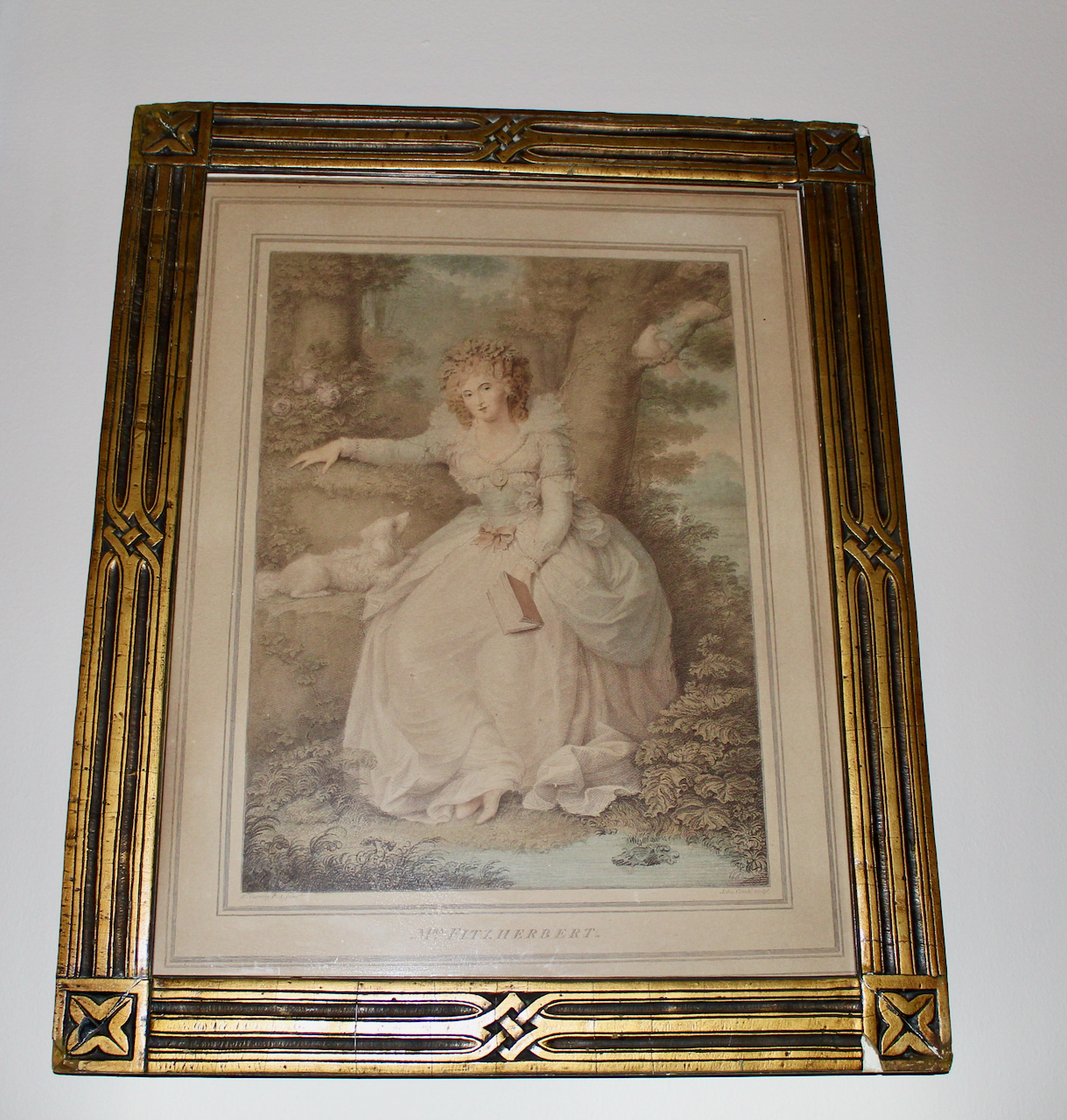
John Leslie married Constance Dawson Damer, the daughter of Mary Seymour who was allegedly George IV’s daughter by Mrs. Fitzherbert.
Maria, born Smythe, was a Catholic. She married a wealthy Catholic landowner when she was just 18 years old. He died tragically, and she married a second time, but her second husband died when she was just 24! Her uncle decided to bring her out into society, and brought her to the opera. There, she met King George IV. He pursued her, and a marriage between them is recognised by the Catholic church, but not by the Monarchy. He moved her to Brighton and the Royal family took care of her, although George was married off to European Royalty, Princess Caroline.
Maria had two children, reputedly, with George IV. The daughter was adopted by a friend of George IV, Hugh Seymour. It was this Mary Seymour who married George Dawson Damer, and her daughter Constance married John Leslie. Constance burned all the evidence of her background, as it was not approved by the Royal Family. It is therefore not a definitive history, just, shall we say, rumour. Her descendant Shane Leslie wrote a biography of Mrs. Fitzherbert.
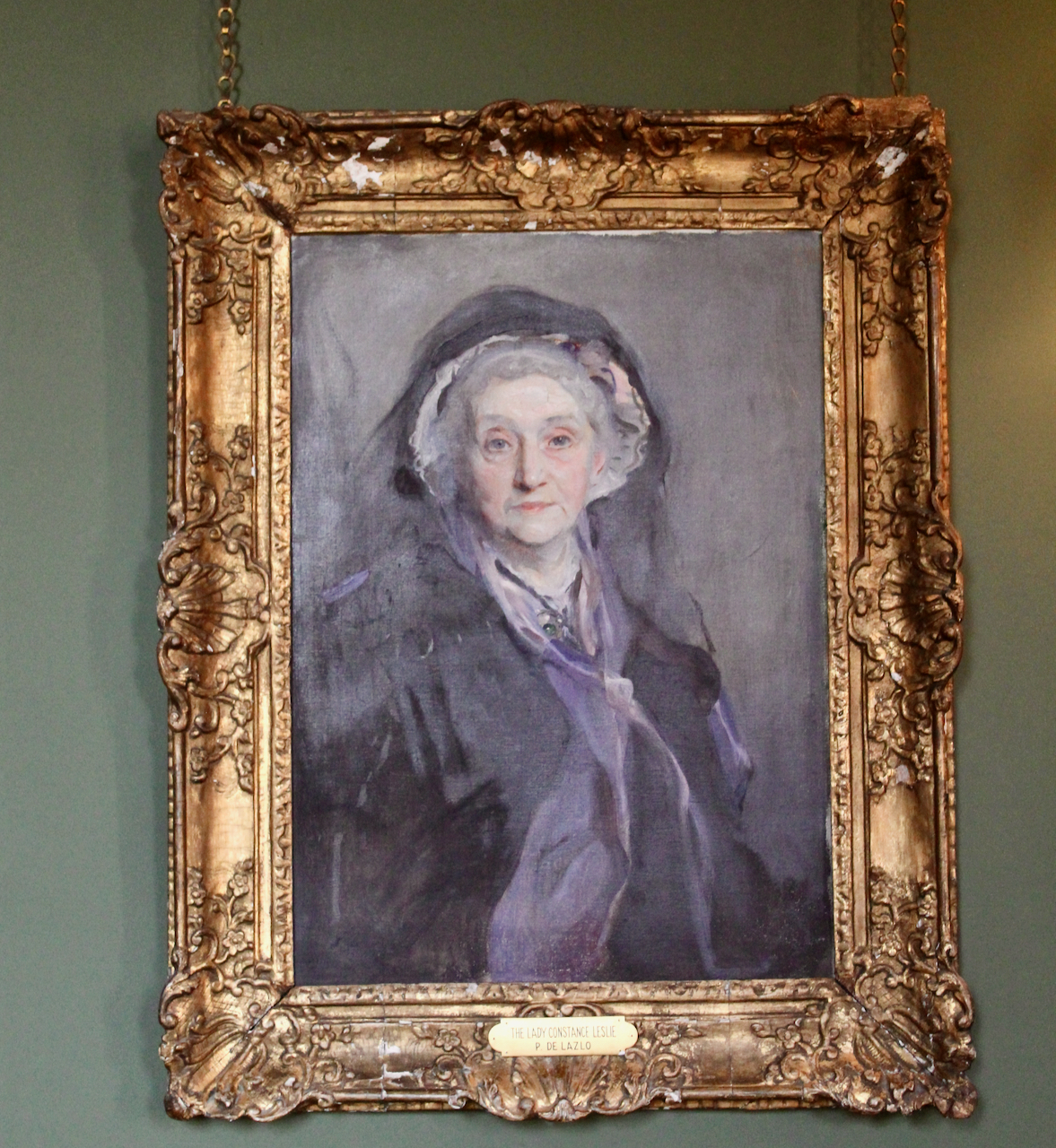
It was the portrait above, of Lady Constance, which a nurse, who had been attending the dying Leonie (wife of Constance and John’s heir, John), recognised as the lady who had visited Leonie’s deathbed – despite Constance having been dead for nearly twenty years!
Before his brother died, John brought Constance to live in the old castle. Constance must have wanted a place of her own so in 1860, they moved into the Hunting Lodge in order to live separately from Charles Powell III and his mother.
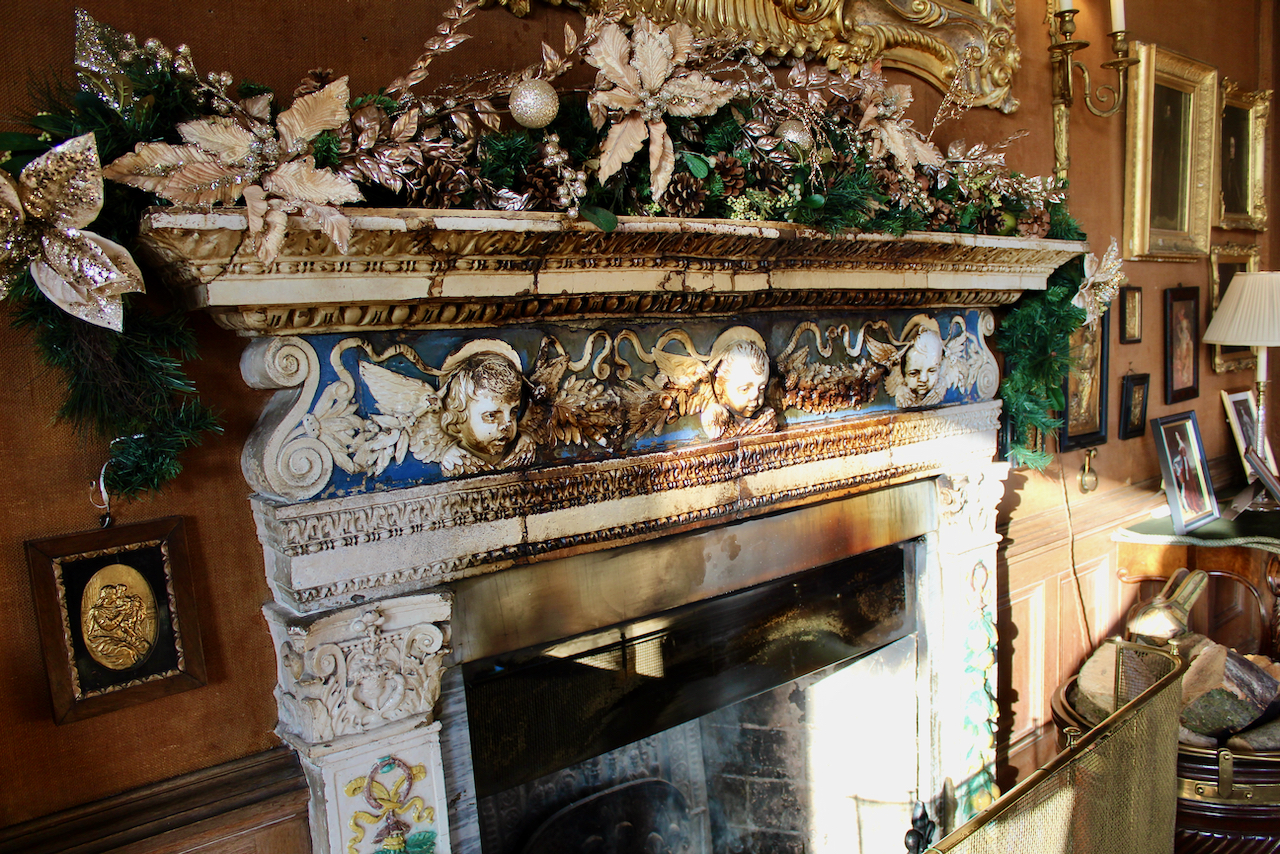
However, once they inherited the old castle, not content with her Lodge or the old castle, it was Constance who insisted that John build the new castle. While it was being built she and her husband went on a Grand Tour and collected much of the present furniture in the house including the blue and white Della Robbia chimneypiece in the drawing room, and a mosaic floor in the hall which is a replica of a two thousand year old Roman villa floor. Constance was a connoisseur of fine art and antiques.
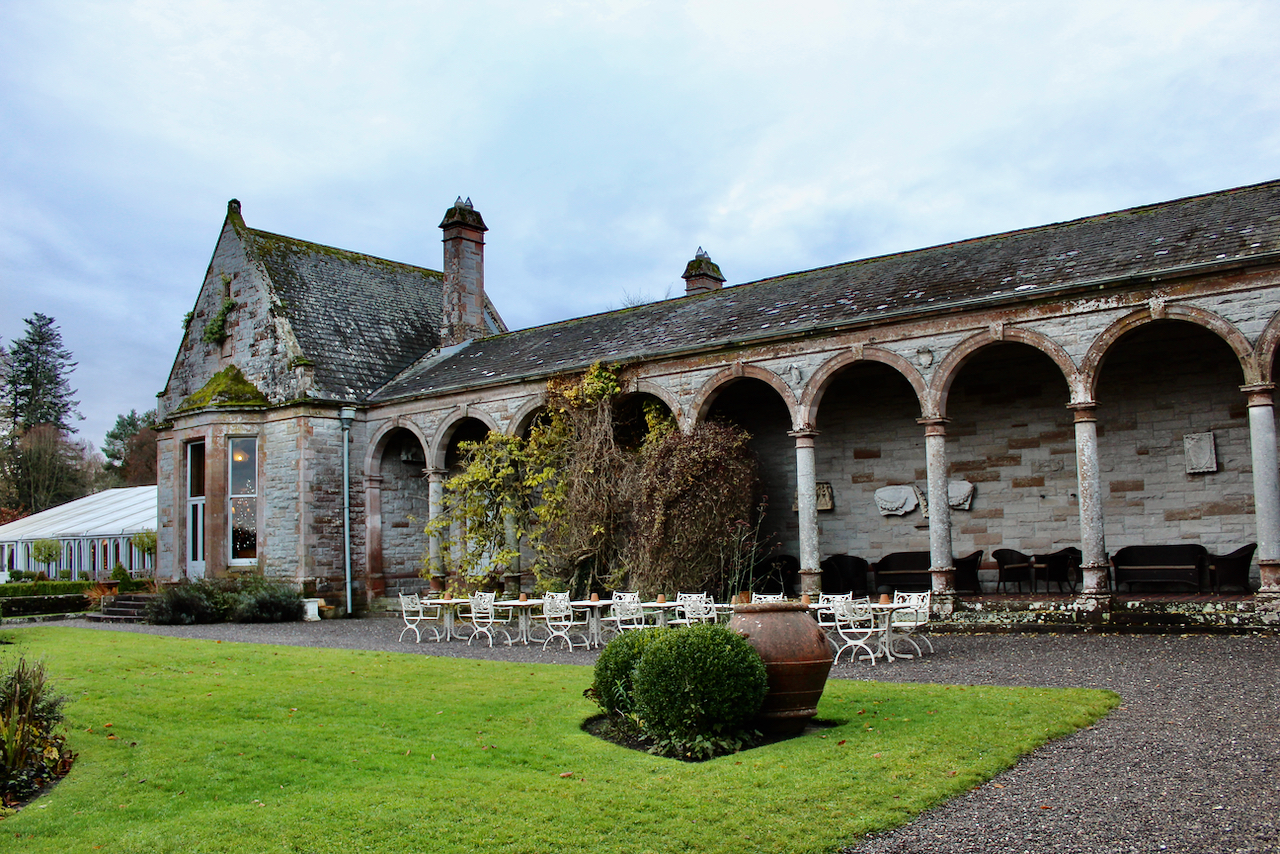
Their travels influenced the style of the Castle, built by Sir Charles Lanyon and William Henry Lynn. An Italian Renaissance cloister (said to have been copied from Michaelangelo’s cloister at Santa Maria degli Angeli in Rome, according to Mark Bence Jones (see [2]) joins the main block of the castle to a single-storey wing containing the library and former billiard-room.
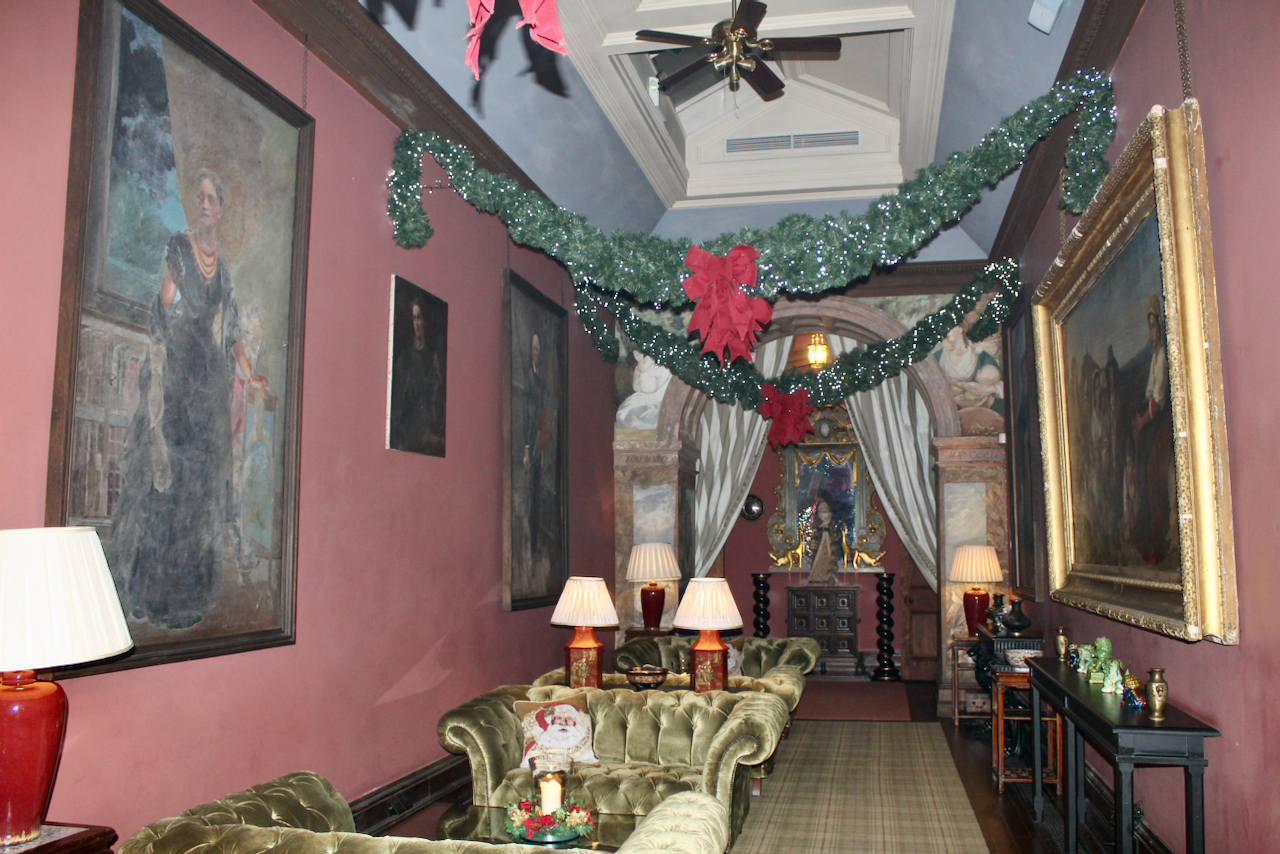
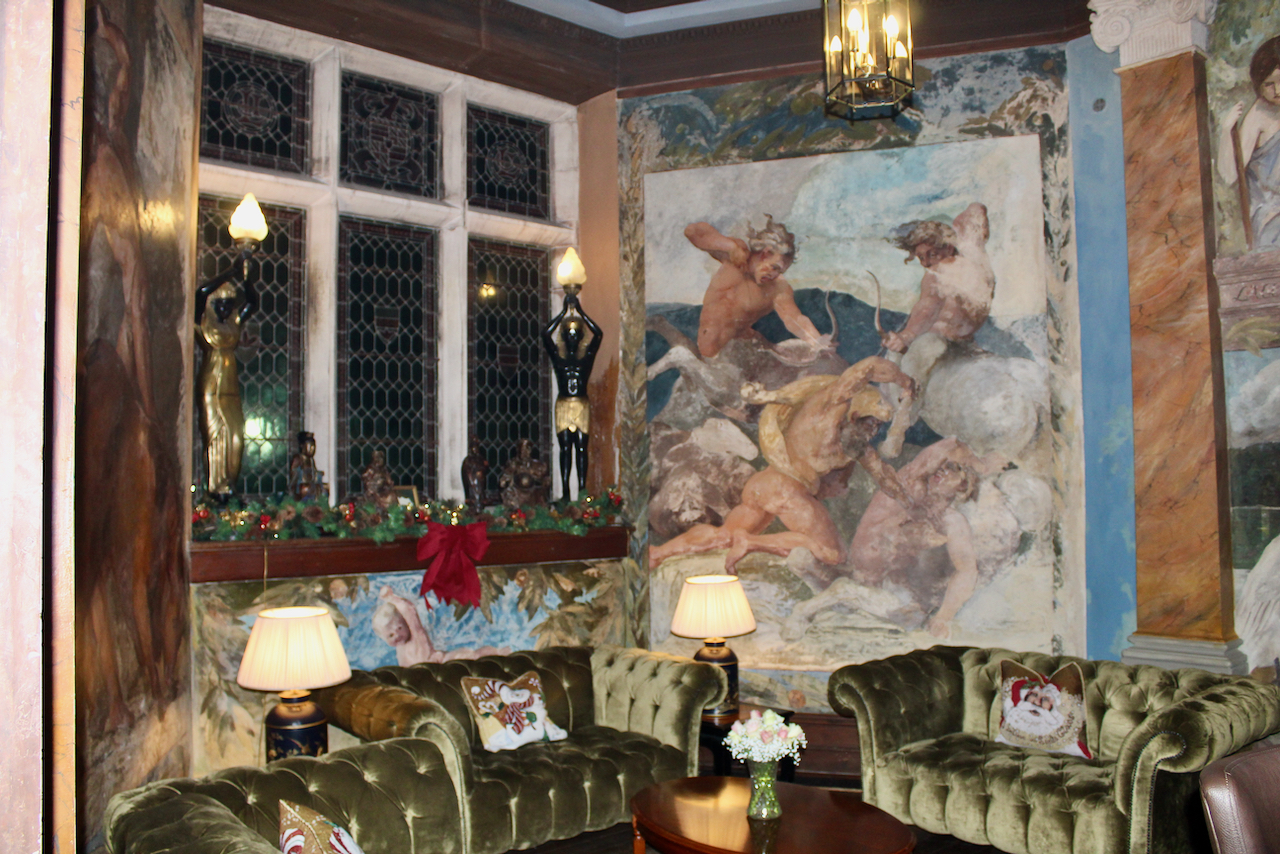
Behind the cloister runs a long top-lit gallery divided by many arches, with pre-Raphaelite style frescoes of angels and other figures, including portraits of members of the family, painted by John Leslie, a talented artist. One of his paintings was hung in the Royal Academy in the same year. He later become 1st Baronet of Glaslough.
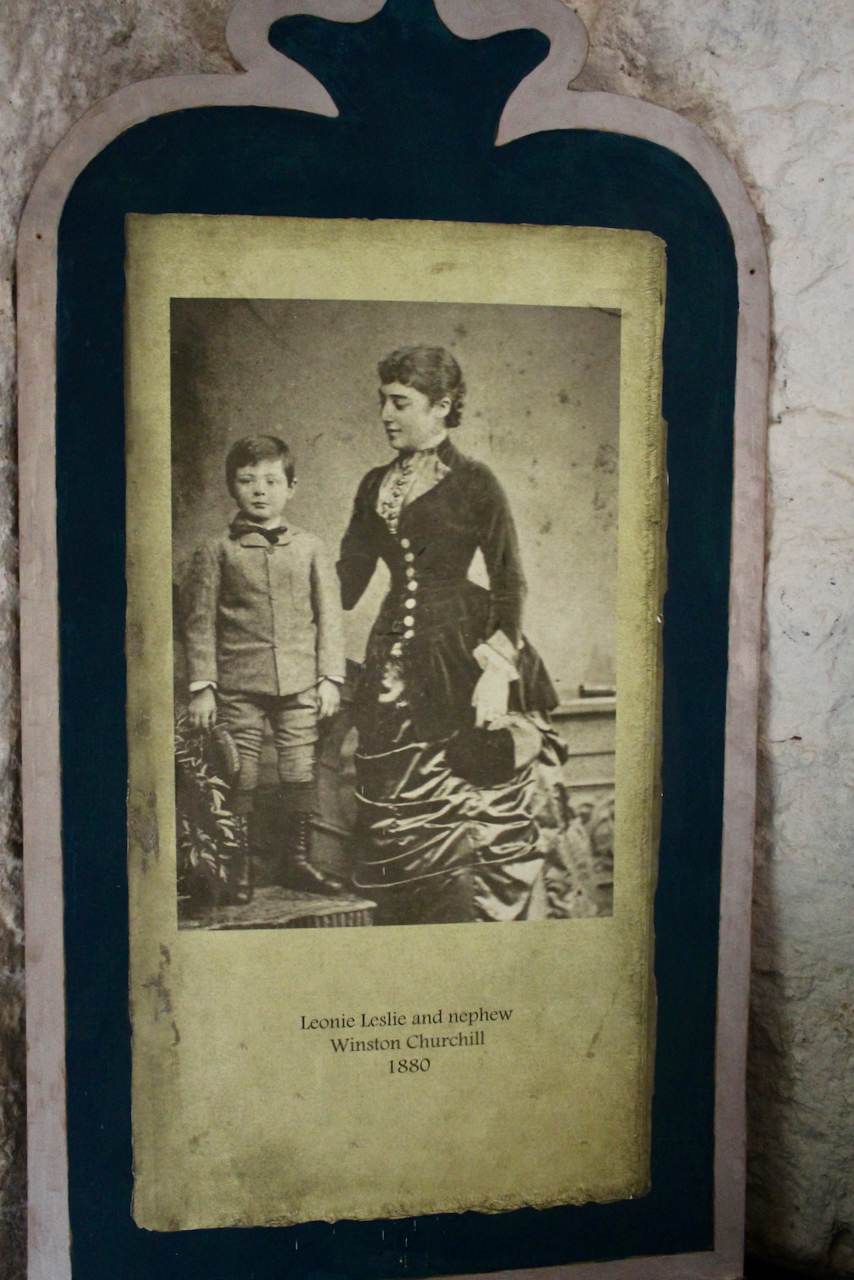
The next to inherit the estate was the 2nd Baronet, Sir John Leslie (1857–1944). He married Leonie Jerome, one of the three beautiful daughters of Leonard Jerome of New York. Her sister Jenny married Lord Randolph Churchill and was the mother of Prime Minister Winston Churchill. Winston did not get on well with his mother but was very close to his aunt Leonie. The young Winston Churchill paid visits here to his uncle and aunt, except when he was temporarily banished by his uncle on account of his espousal of Home Rule! Leonie’s correspondence with Winston is in Blenheim Castle in England, the estate of the Churchills. When his beloved aunt died in August 1943, Winston couldn’t attend the funeral due to the war, but he telephoned Eamon de Valera to request permission for the flyover of an Royal Air Force Spitfire plane. It was her son, Desmond Leslie, who was in the RAF, who flew the Spitfire and dropped a huge wreath from Winston Churchill to the funeral.
Sir John Leslie died in 1944 and was succeeded by his son Sir Shane Leslie (1885–1971). Shane was one of four brothers: he was christened John, and changed his name to Shane in 1921 when he embraced Irish nationalism; the other brothers were Lionel, Norman and Seymour.
Shane Leslie.
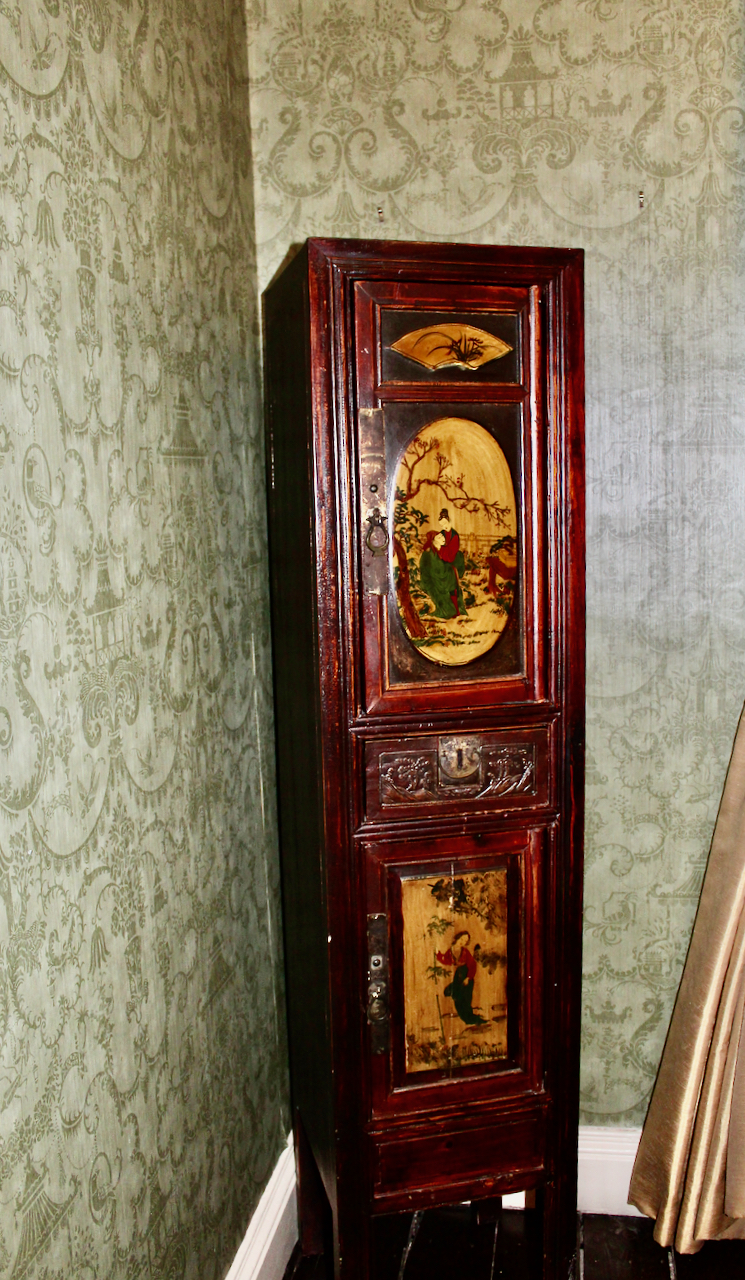
Shane grew up to be an ardent nationalist (he joined the Irish Volunteers, a group founded in response to the Ulster Volunteers in Northern Ireland who opposed Home Rule – he thus rejected the support his father gave to the Ulster Volunteers!) and Irish speaker, and converted to Catholicism, under the influence of Cardinal Henry Newman, when he was in Cambridge. He hoped to retreat to a Monastery but instead married another American beauty, Majorie Ide of Vermont. According to the history of the Leslie family recounted on the website, Majorie’s father, Henry Clay Ide, was Chief Justice of Samoa, a tropical paradise where he and his daughters became great friends of fellow islander Robert Louis Stevenson. He was also Governor General of the Philippines. Later in our stay, our guide told us that before she married, Majorie and her sister accompanied U.S. President Teddy Roosevelt’s daughter on a trade mission to China. The President considered the women to be suitable ambassadors because the current monarch of China was an Empress (the last Empress of China). There are many Chinese objects in Castle Leslie which Majorie brought with her.
Sir Shane, as a poet and Nationalist, was not fond of running the estate so transferred it to his son John Norman Leslie (1916-2016), who became 4th Baronet. Shane Leslie travelled to London when Michael Collins was negotiating the Treaty granting Ireland its independence from the United Kingdom. Shane’s brother Norman on the other hand fought in the British army, and was killed by a sniper. The bedrooms in the Castle are now named after the family, and Stephen and I stayed in “Norman’s Room”!
Shane had three children: Anita, John (Jack) and Desmond. Jack transferred the estate over to his sister Anita, owing to ill health after five years in a prisoner of war camp. He had been Captain in the Irish Life Guards in WWII. He moved to Rome where he lived for forty years, finally returning to Castle Leslie in 1994. He died only a few years ago, at 99 years old, inheriting the hardy genes of the Fighting Bishop, and is obviously much missed in the castle which houses many of his mementos and memorabilia.
Later in our stay, Enda the guide told us more about Anita, as we were admiring the paintings of Anita, Jack and Desmond at the bottom of the grand staircase.
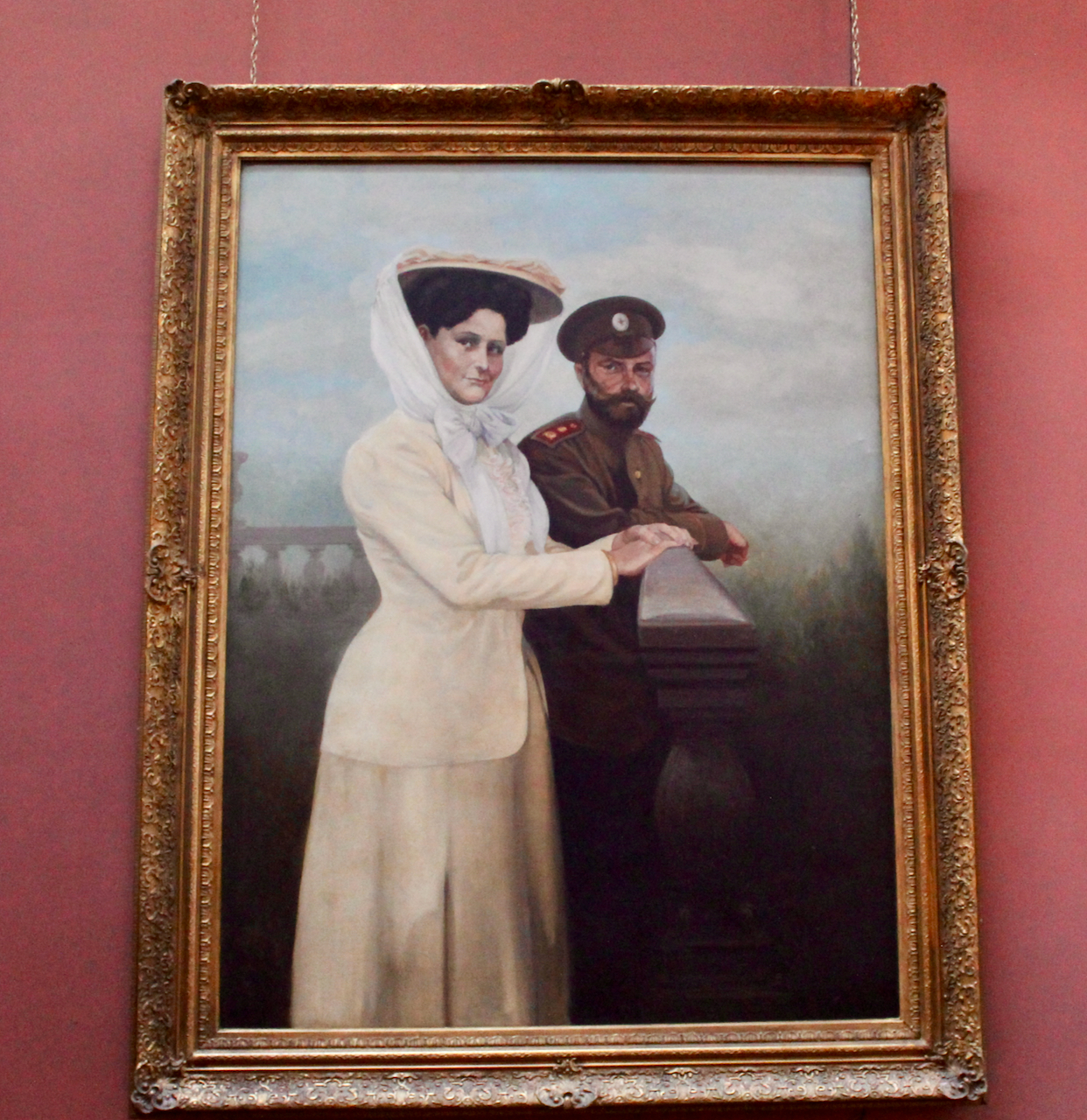
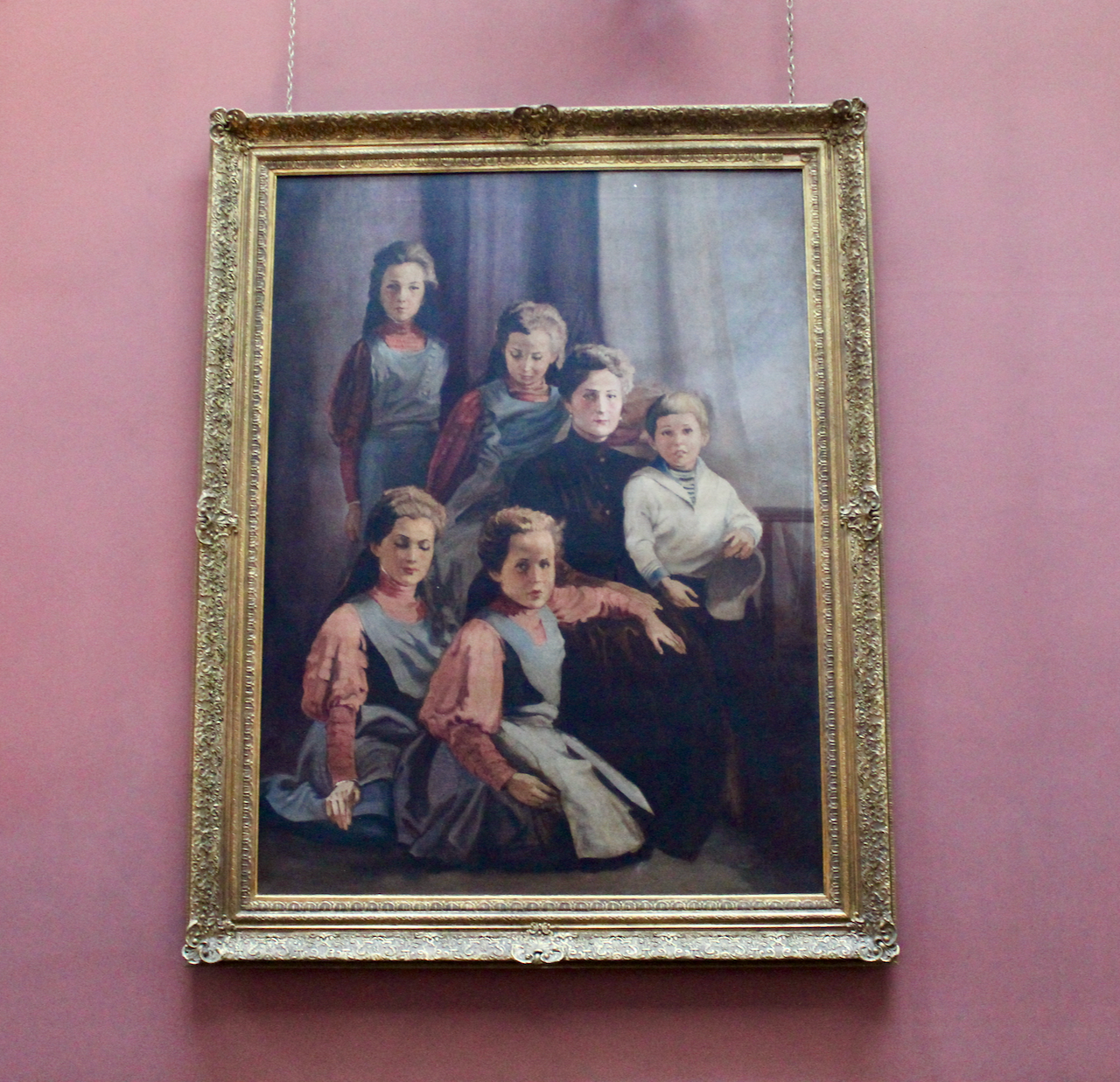
Anita married Pavel Rodzianko, a dashing soldier from Russia, Equerry to Tsar Nicholas and Alexandra. Anita was just 23 years old but bowled over by the 47 year old Pavel. The marriage lasted only three years. This marriage explains the presence of the paintings of Nicholas and Alexandra which Stephen and I had noticed in the bar area.
Pavel tried to rescue the Tsar and his family. He followed with other soldiers loyal to the Tsar, as the Royal family was moved from place to place by those who had overthrown the Tsar. When they caught up with the family Pavel and his companions were too late: the family had been shot in the basement and their bodies burned. Pavel found little Alexi’s dog Joy still alive. Pavel saved the dog and brought her to his home next to Windsor Castle in England, where Pavel lived after leaving Castle Leslie, where Joy lived the rest of her life. Pavel went on to train the Irish show-jumping team, who won the Agha Khan trophy in the Royal Dublin Society (RDS) Horse Show.
During World War II Anita joined the French army as an ambulance driver and married Bill King, a submarine commander. In the 1960s she moved to Oranmore in Galway (Oranmore Castle is a Section 482 property so I hope to visit it!) and transferred Glaslough to her younger brother Desmond (the Spitfire pilot). In 1991 he handed the Estate over to his five children and Castle Leslie Estate is now run by his daughter Samantha Leslie.
I mentioned earlier that many Leslies have written books. I browsed through books by Shane Leslie and Jack. Anita Leslie wrote about her time in the army in The Train to Nowhere. Desmond’s wife Agnes Bernaur is also a published writer. I copied the family tree from Shane Leslie’s book, and notice that the sister of John Leslie 2nd Baronet, Theodisia, married a Bagot! She married Josceline Fitzroy Bagot, of Levens Hall. I may be distantly related to this Bagot, as we are rumoured to be descended from the Bagots of Staffordshire! I confess I have not found the link.
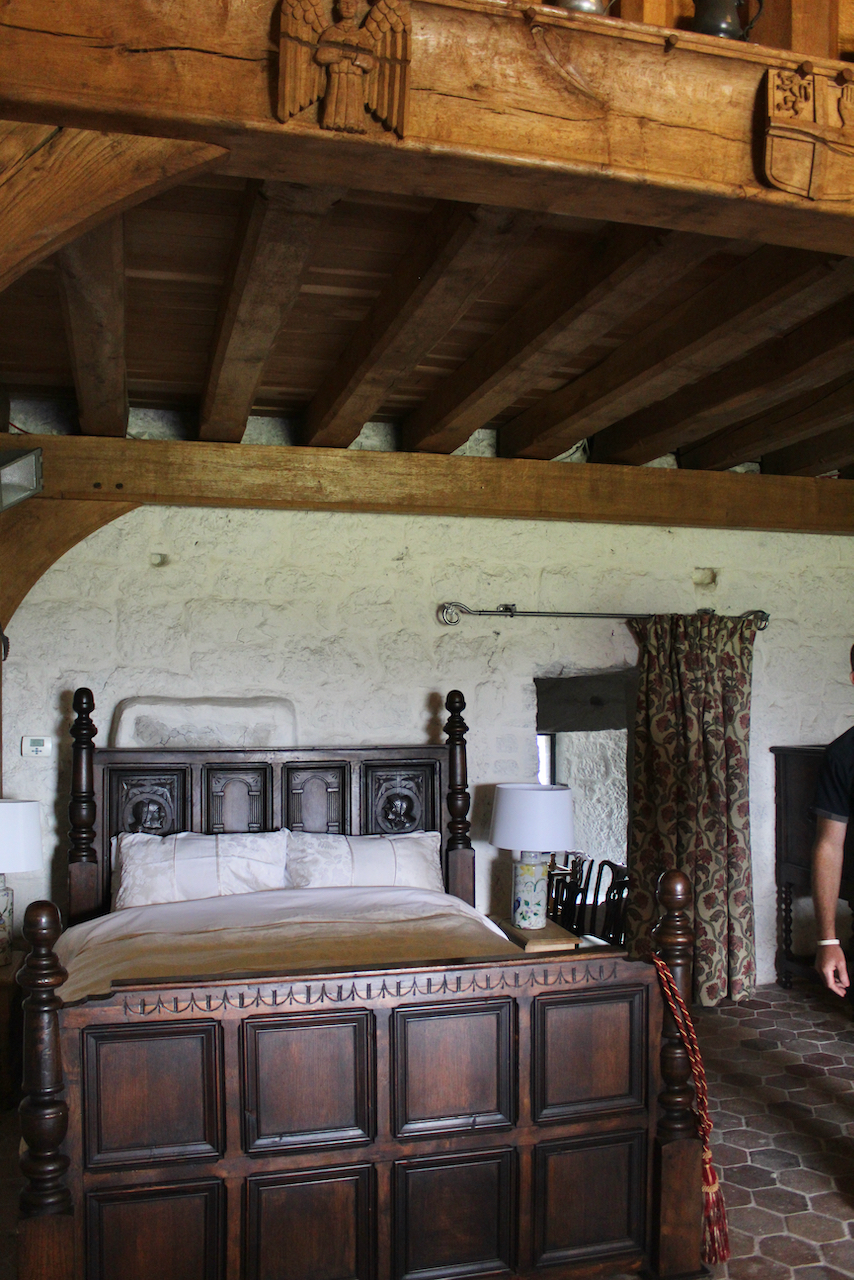
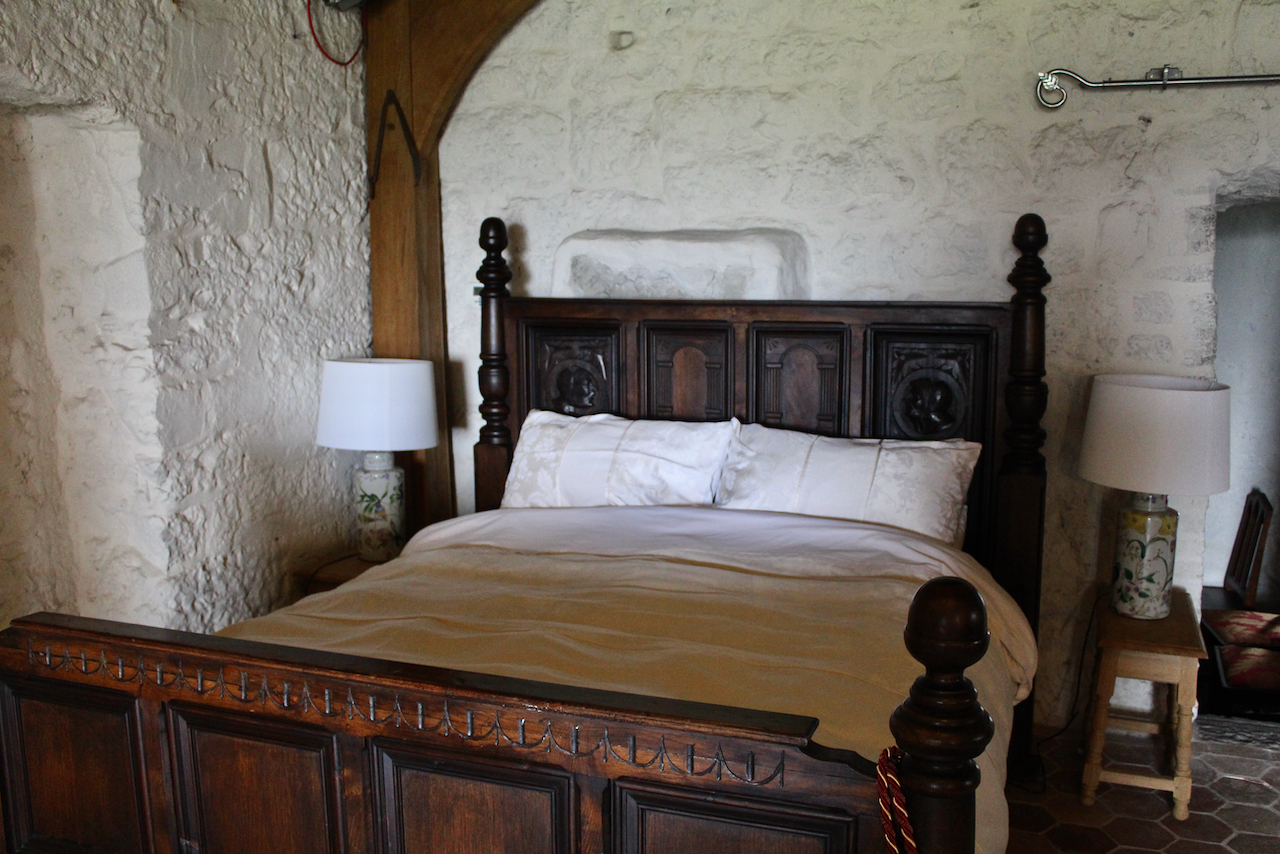
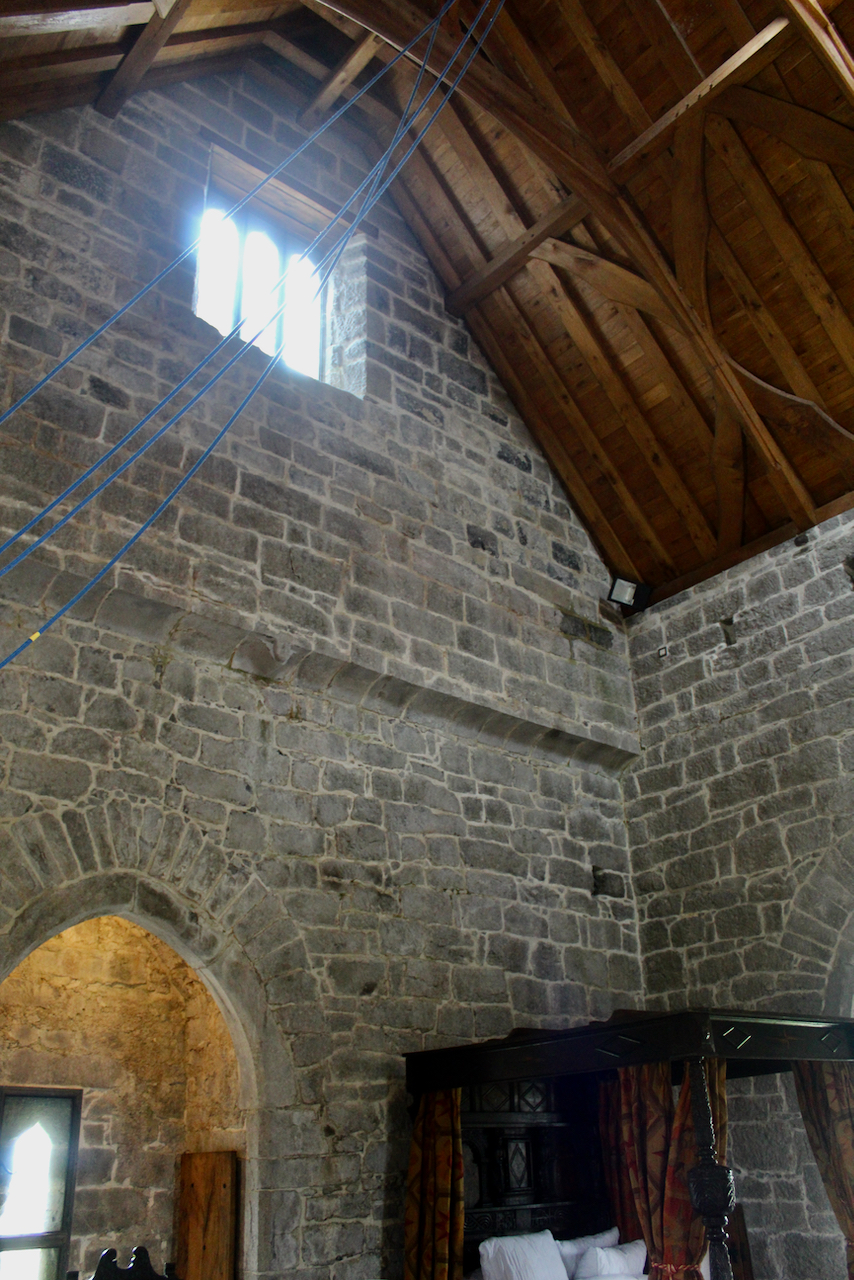
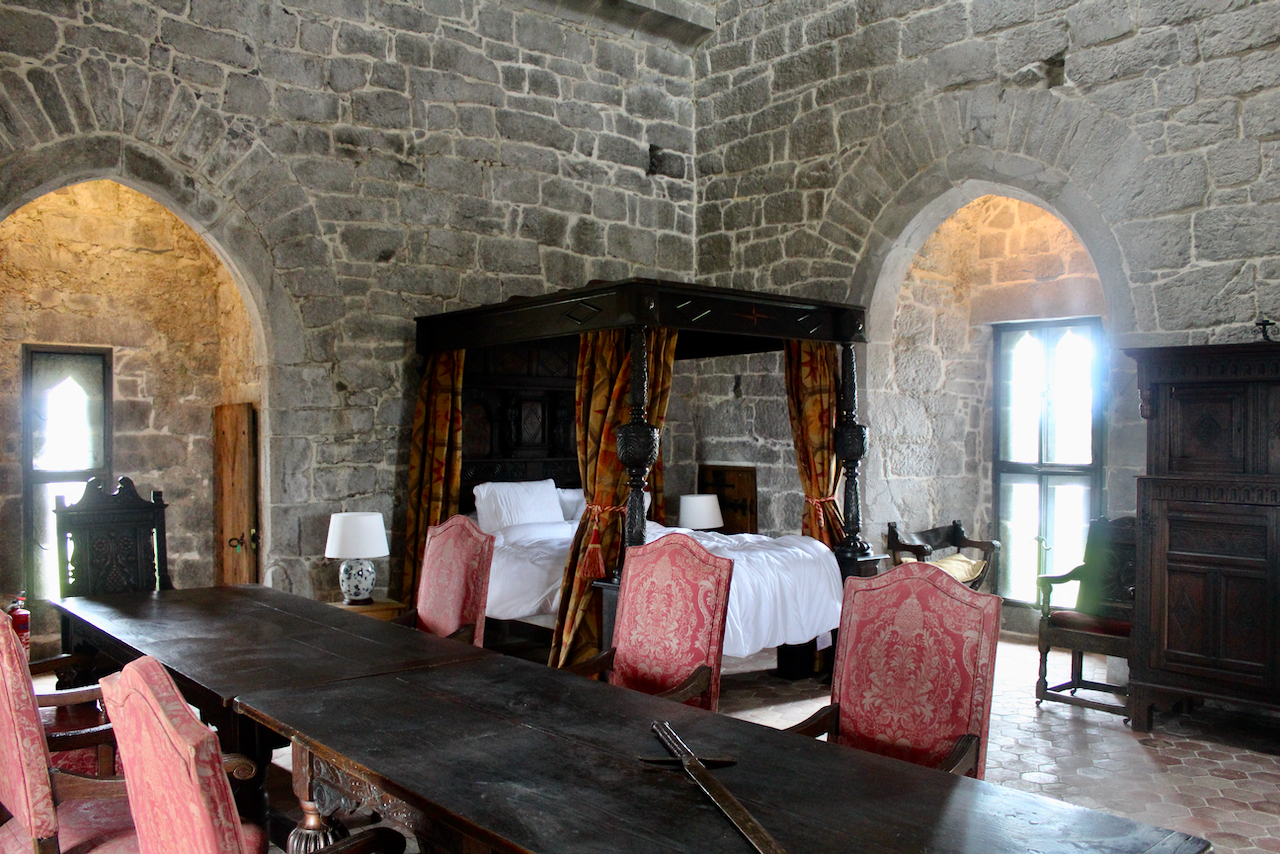
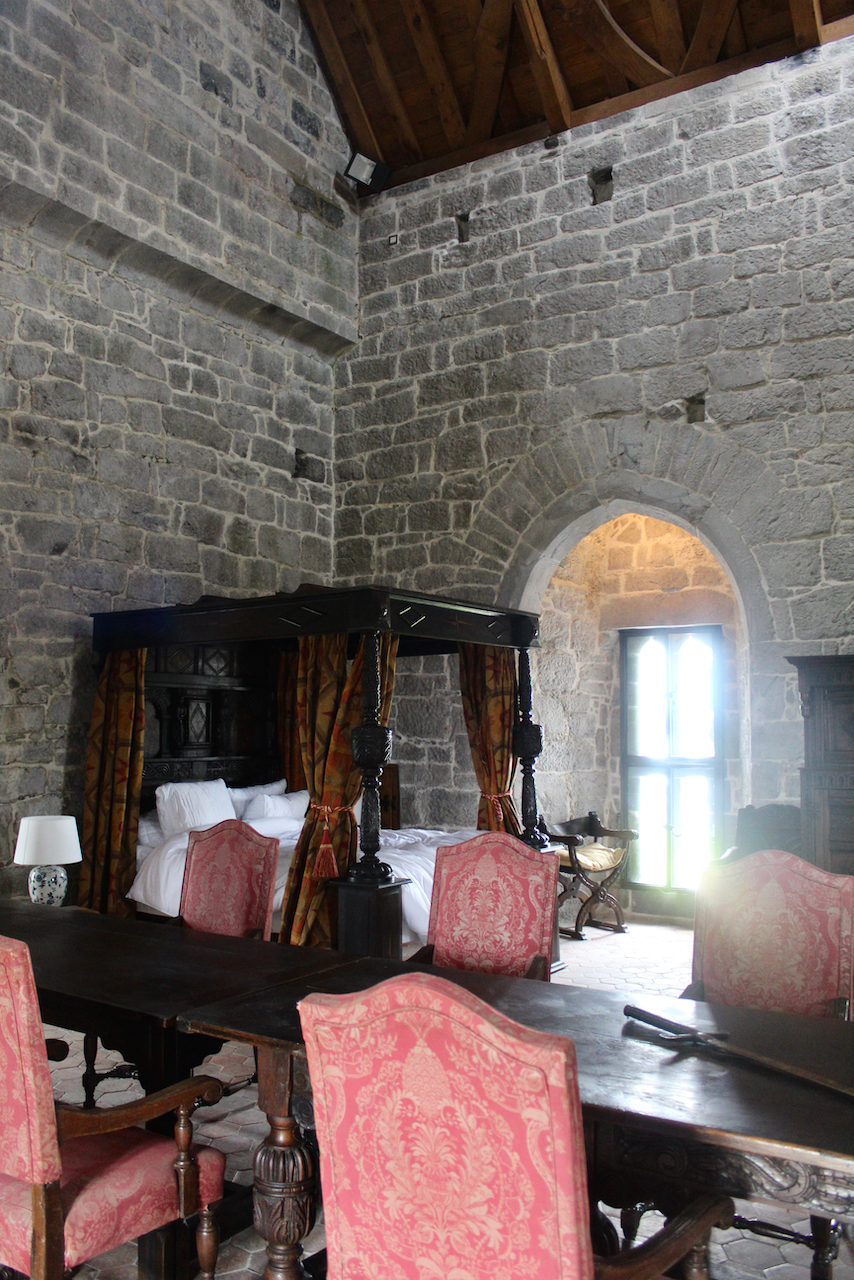
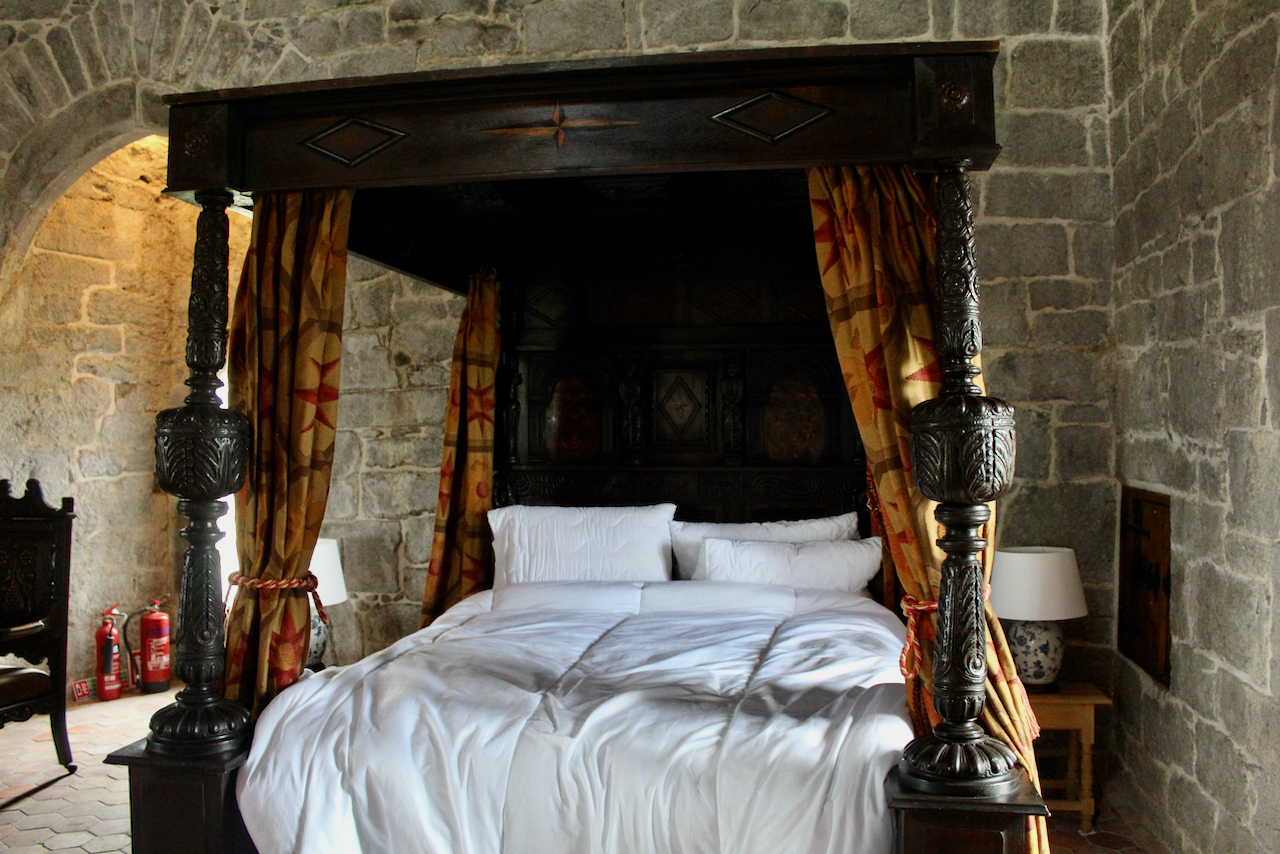
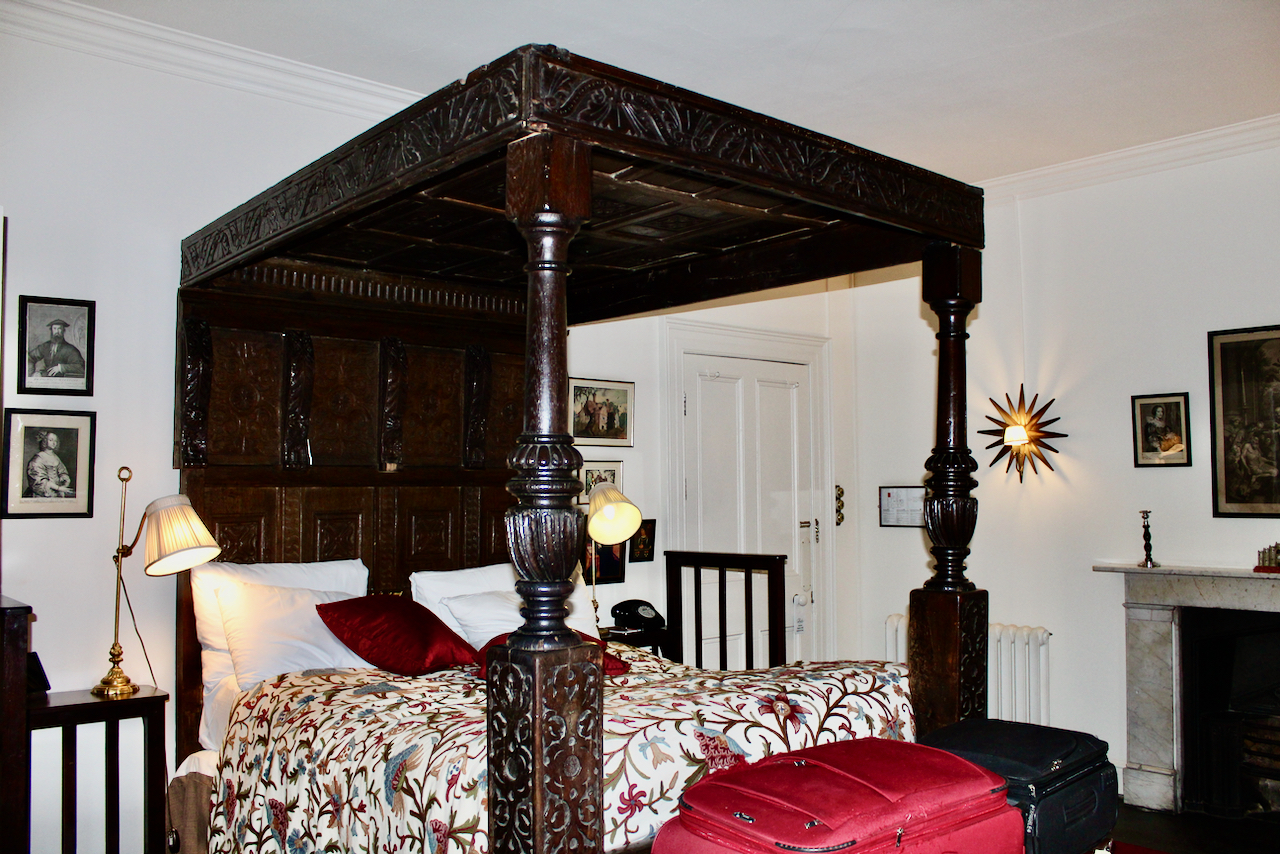
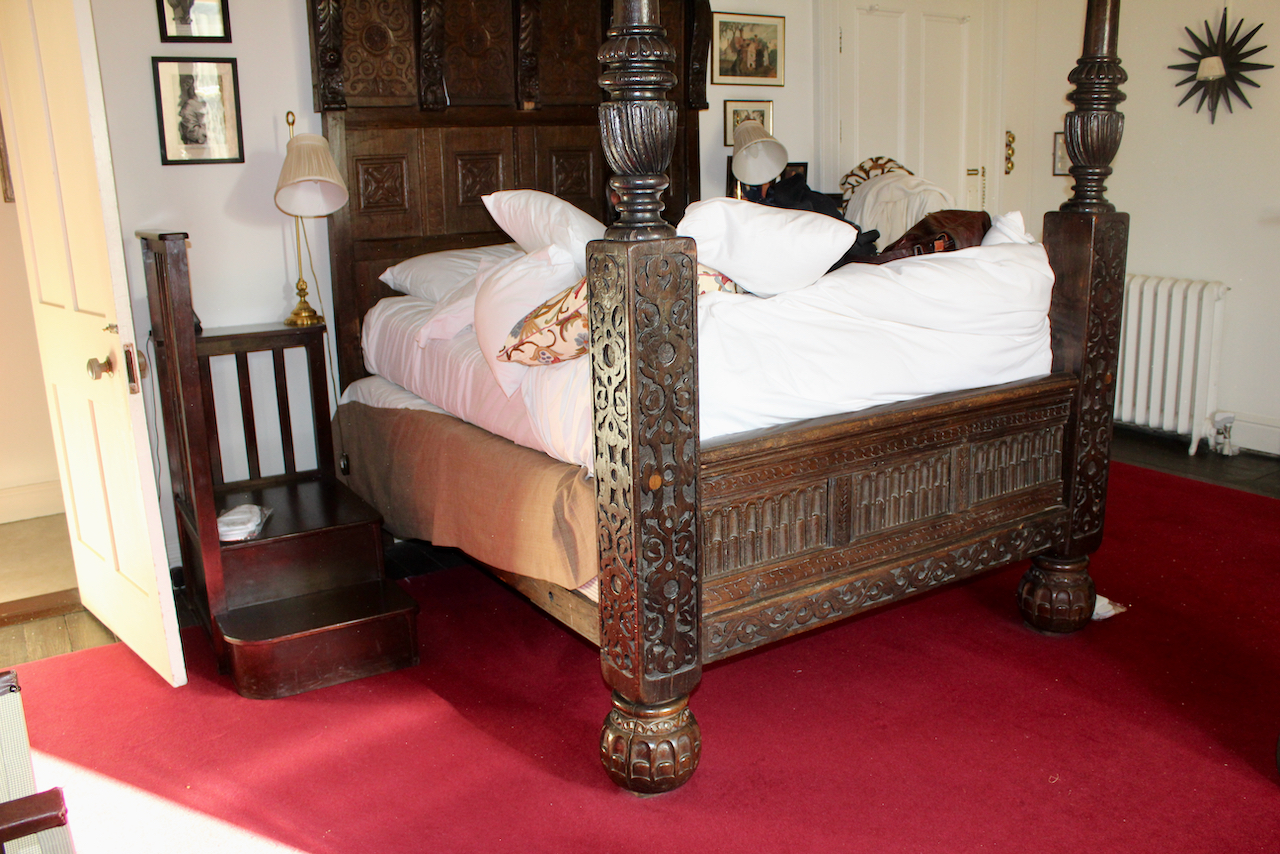
After our tour, we were shown to our room. We were thrilled with it, and especially with our 1617 four poster oak bed. The bed was so high that it required steps to get up to it:
According to the website, Sammy started her ambition of bringing the Estate back to life by establishing tea rooms in the old conservatory. This had been a painting studio for John Leslie, as it was created to have lots of light.
“Between 1995 and 1997, Sammy refurbished fourteen of the Castle bedrooms and bathrooms, each in its own unique style, in an effort to maintain the individuality and uniqueness of the property. Dinners were served by candlelight in the original dining room, just as it had been in the old days, with pre-dinner drinks served in the Drawing Room or Fountain Garden. The Castle at Castle Leslie Estate was soon rewarded with The Good Hotel Guide Caesar Award for being ‘utterly enjoyable and mildly eccentric’.” [9]
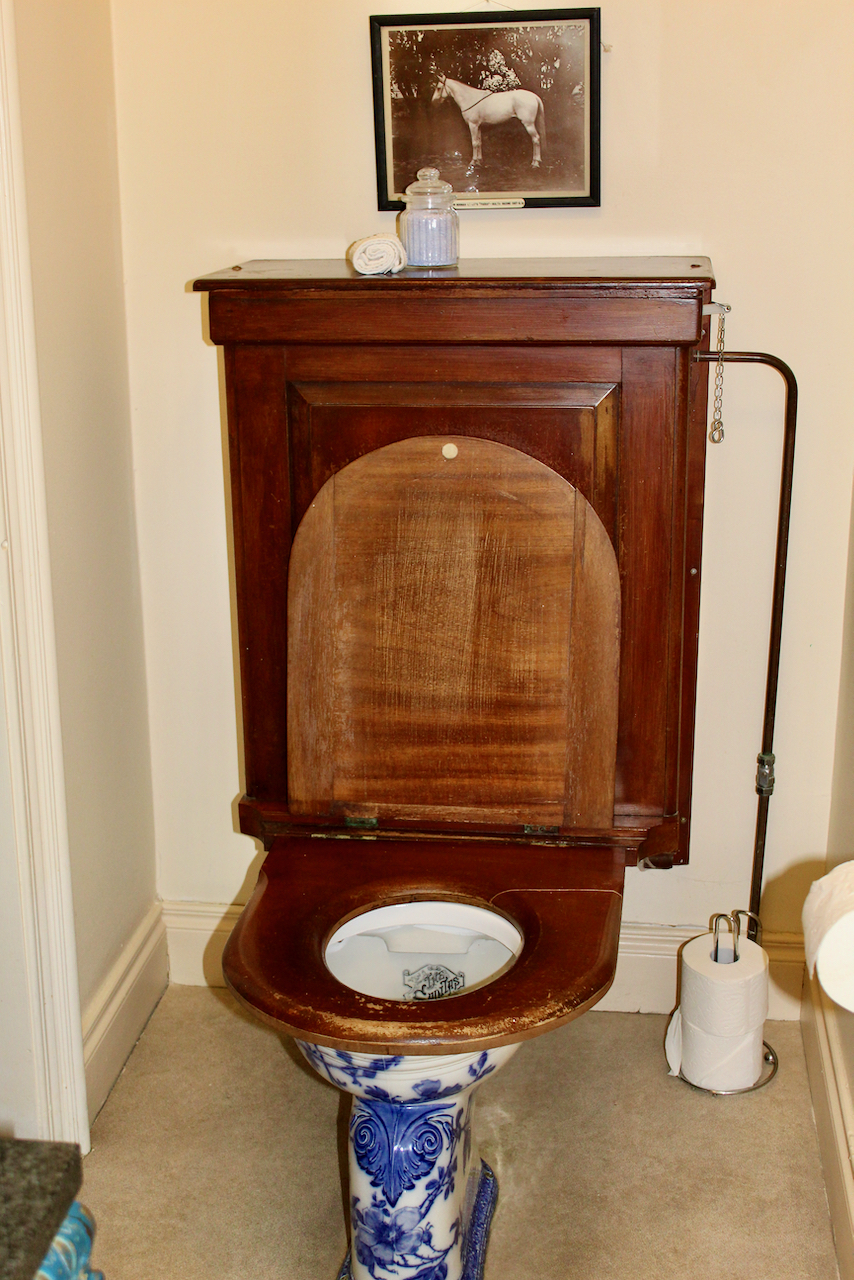
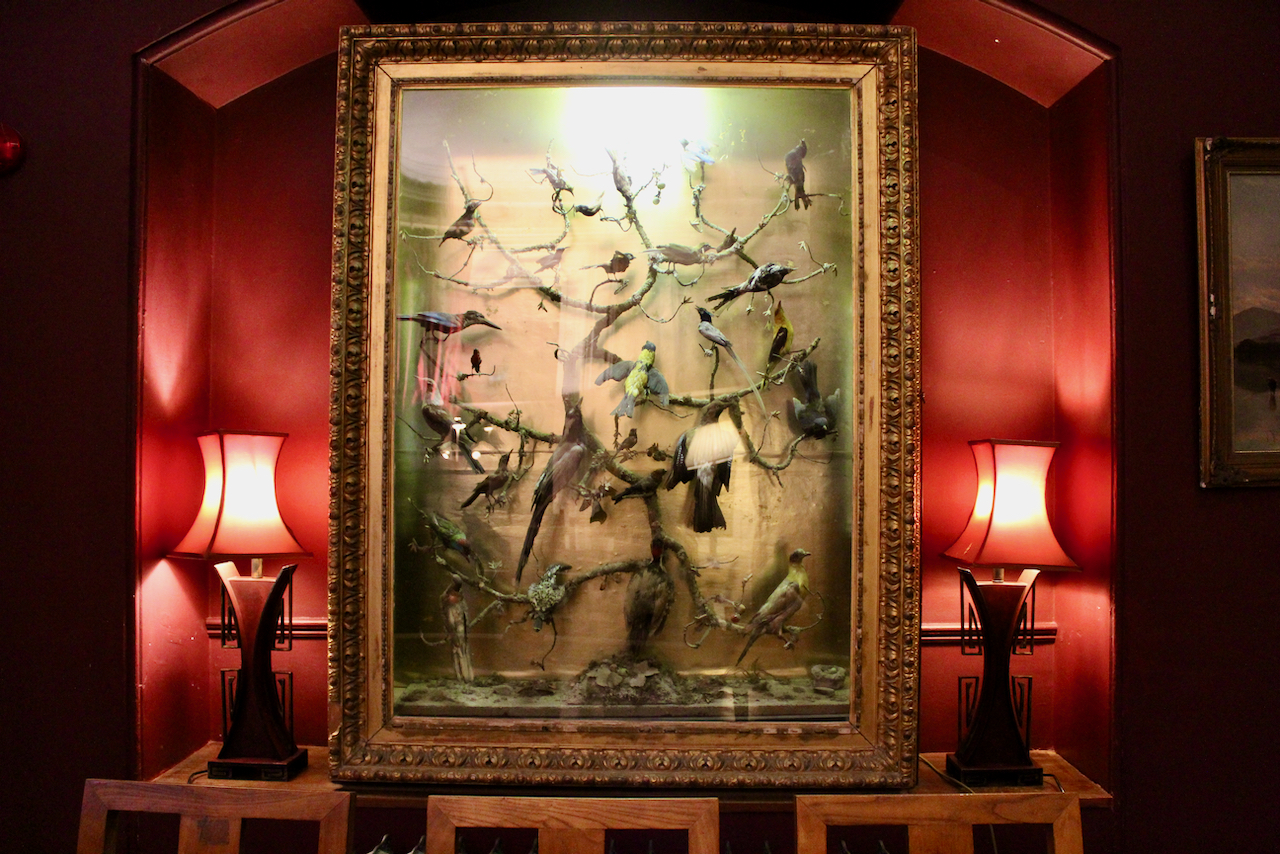
Perhaps one of the mildly eccentric details referred to are the beautiful old fashioned porcelain toilets such as the one in our en suite:
After the tour, we still had so much of the castle to explore! The tour had only taken in a few of the rooms! We were tired after the tour and lay on our wonderful bed for a nap before dinner. While we were reading, we heard a knock on our door. The staff had brought us a much appreciated, delicious strong cup of coffee! Perfect!
We emerged for dinner. We chose to eat in the bistro rather than the fancier restaurant. The reception staff offered us a lift over to the Lodge, but we chose to walk the short distance up the drive, as it was a beautiful crisp night.
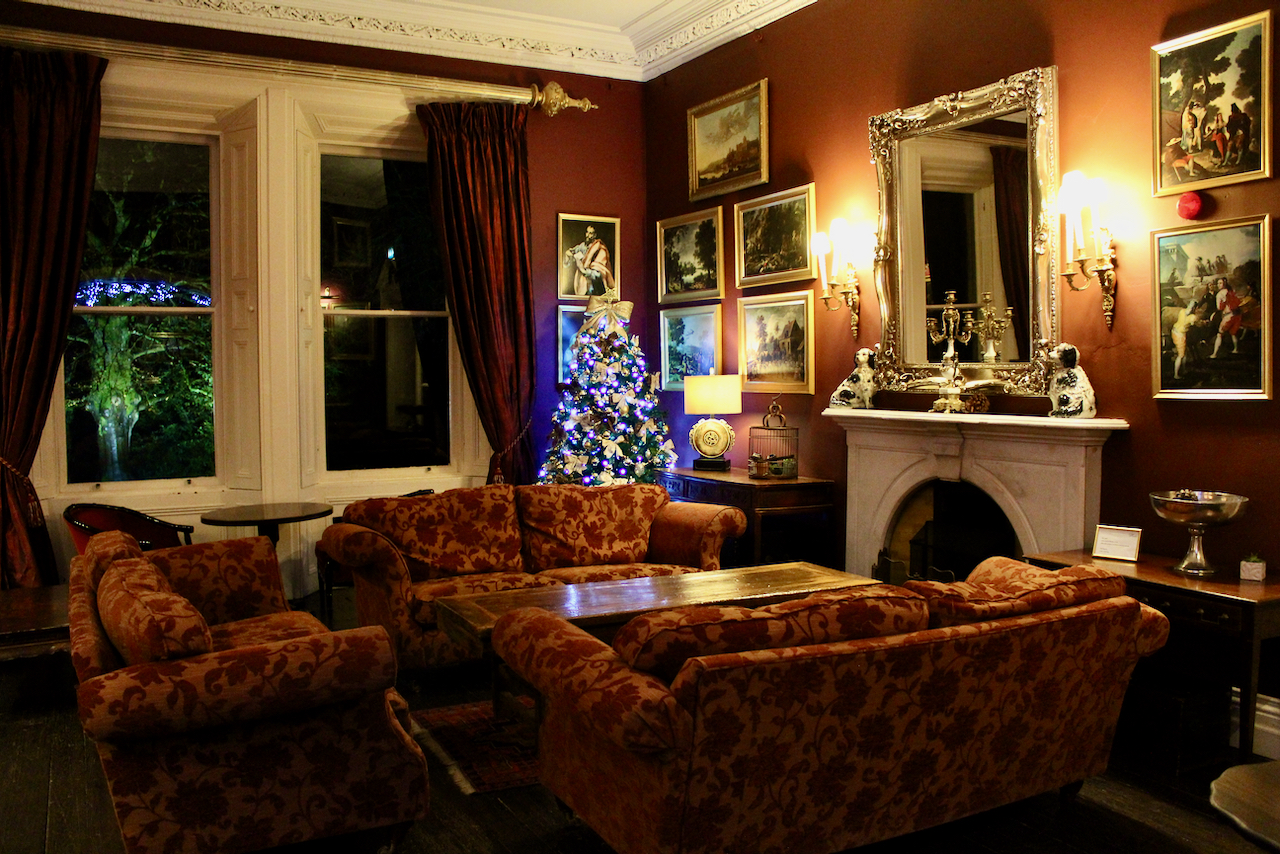
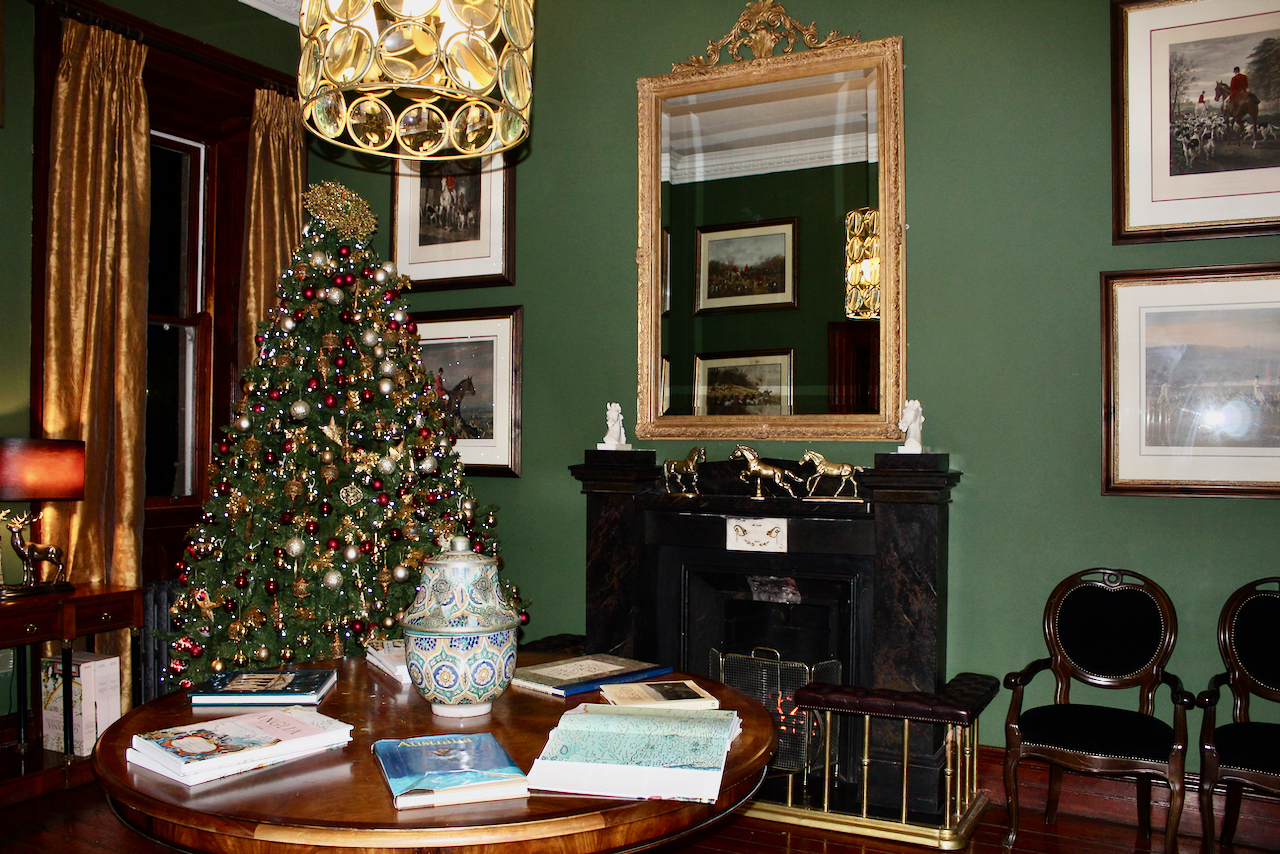
We did a little exploring back at the castle after dinner. We discovered more beautiful rooms to sit in, and a lovely library, and it was only now that we found the bar and the long painted gallery!
Many new features have been added to the estate, including a spa, a bar and restaurant, and a cookery school.
A new pavilion, adjacent to the long gallery of the main house, facilitates conferences, weddings and other large events – see the pathway leading to the pavilion in the photograph below.
The website tells us that five new sub-ground floor bedrooms were added to the castle in 2005: the Desmond Leslie room, the Agnes Bernelle Room, the Helen Strong Room, Sir Jack’s Room and the only room in the castle not named after a family member, The Calm Room.
DAY 2: Horse riding! And exploring the Lodge
Stephen and I only saw the castle in daylight the next day, as we had been too tired to explore outside after the tour. It was only then that we saw the cloisters, and the lake! We wandered outside in the evening. Earlier in the day, we decided to avail of the Equestrian Centre, since Stephen confided that he had never sat on a horse!
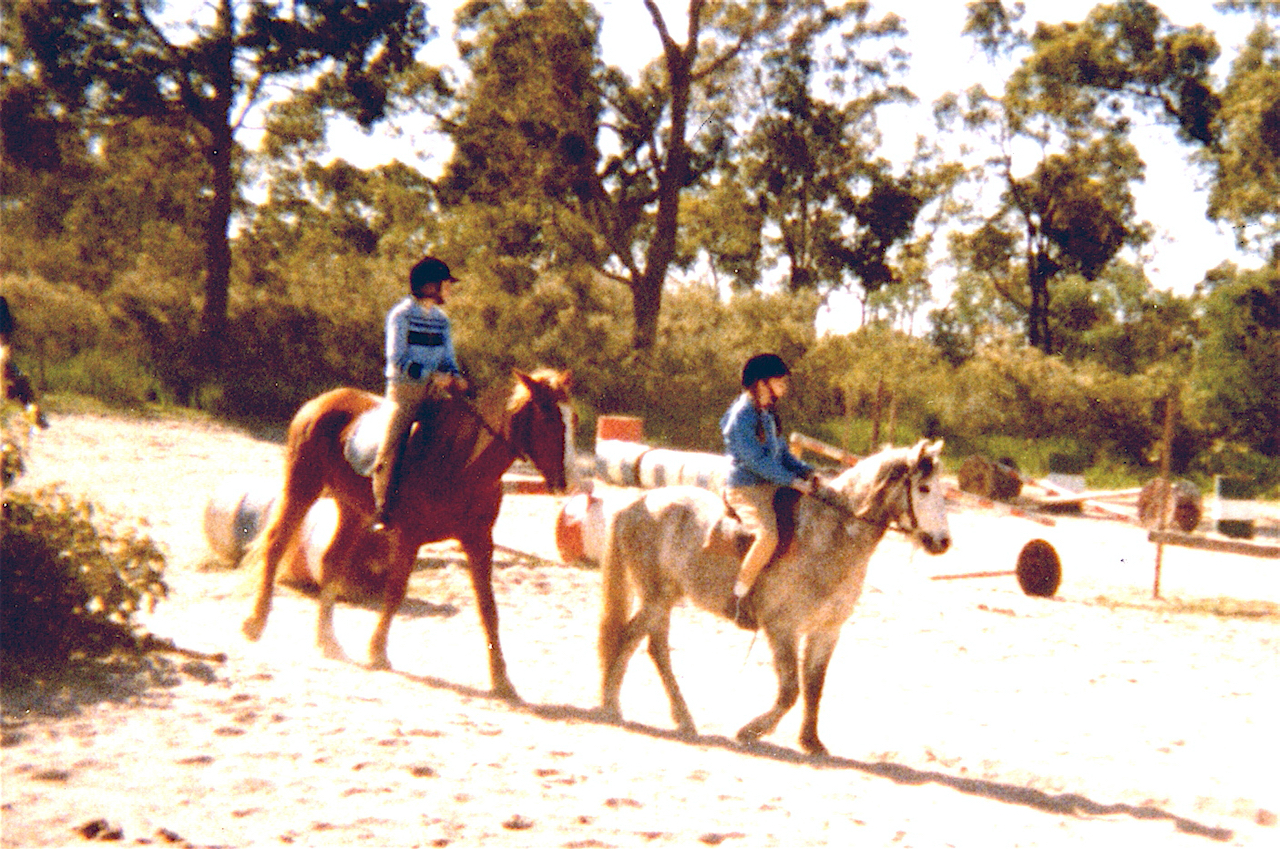
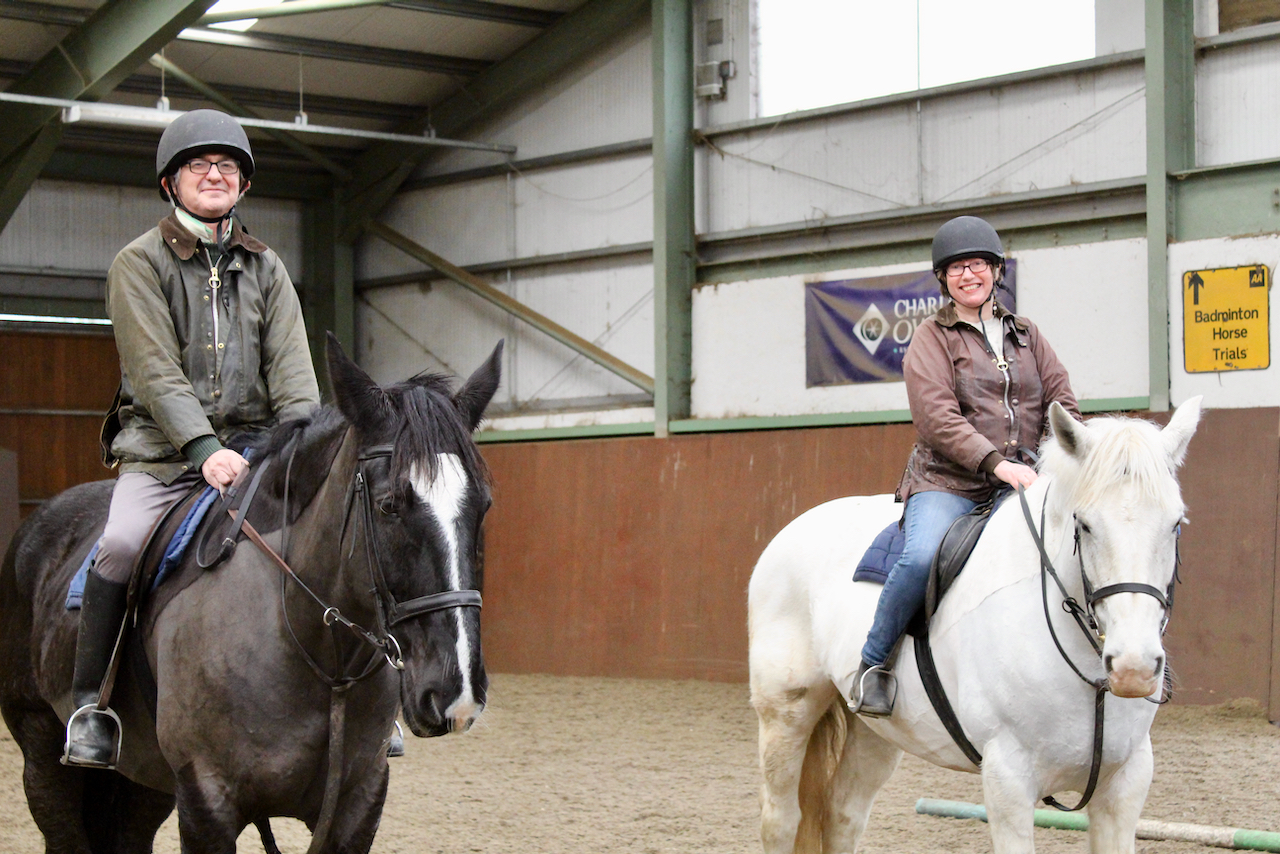
We booked a one hour walking session, a gentle wander through woods on the estate, hand-led by a guide. I felt safe enough walking without a guide at the reins, as I endured two years of weekly riding lessons when I was young! I say “endured” as I was scared of the horses and fell often! The horses we rode during my lessons in Australia were a more cantankerous brood than those that bless Castle Leslie!
Our guide, Chris, told us a bit more about the estate as we relaxed onto the hip swinging gait of our horses, and we passed one of the lodges. I knew Stephen would be imagining himself back in the 1700s, familiarising himself with the atmosphere of the former mode of transportation. We both lost our balance as we slid off our horses, Stephen doing the full topple onto the sand, but we were elated! You can see a map of the estate on the castle website. [10]
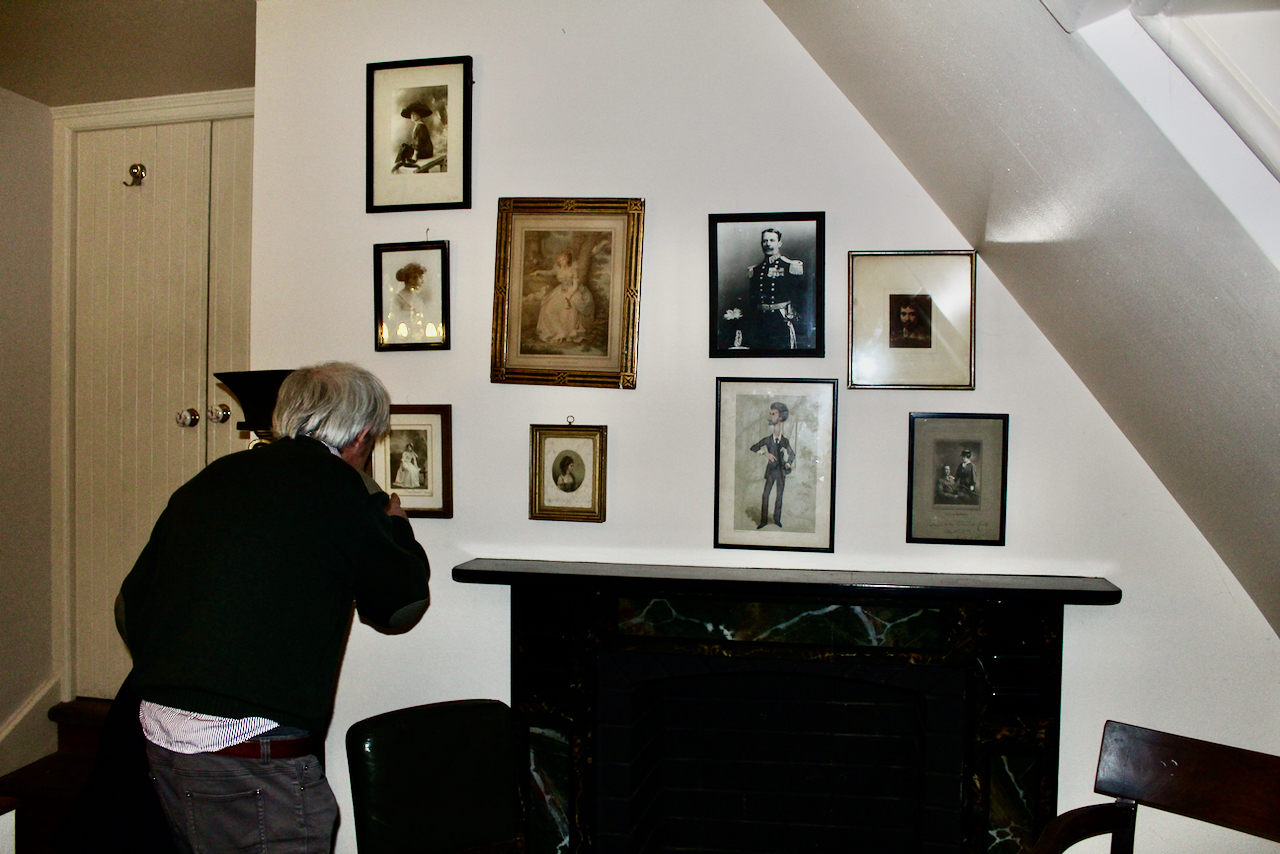
After lunch in the Lodge, we explored. I took some photographs inside the lodge.
Sammy’s most recent project (begun in 2015) is renovating the walled garden. I’m sorry I reached it so late in the day, compromising my photographs. These were built in 1860 by Charles Powell Leslie III.
According to information posted in the walled garden, they cover about four acres, and contain two forty metre greenhouses heated by individual underground boilers fed by rainwater collected from the glass roofs. The flues were built originally under the paths to chimneys hidden in the surrounding garden wall! Ingenious ancestors! Charles Leslie consulted with Joseph Paxton, the Duke of Devonshire’s head gardener, who created the “Crystal Palace” of the 1851 Great Exhibition in Hyde Park in London for Queen Victoria’s consort Prince Alfred.
Outside the Walled Garden was a third large greenhouse, a Tropical House. Charles Powell Leslie III, according to the information boards in the garden, wooed an opera singer with weekly hampers of bananas, melons and mangoes sent from Castle Leslie to her dressing room in Covent Gardens in London!
The Pump House, built from approximately 1848, was one of the first water systems to be constructed for a village and estate. One can still see the ornate cast iron fountains in the village, along with the statue of Charles Powell Leslie III.
Day Three: A walk to the stables and goodbye to Castle Leslie!
The next day dawned bright, a crisp November day. We followed our map of the estate to see the Stable Mews, for a bit of exercise before we had to depart.
[2] Mark Bence-Jones. A Guide to Irish Country Houses.[originally published as Burke’s Guide to Country Houses volume 1 Ireland by Burke’s Peerage Ltd. 1978; Revised edition 1988 Constable and Company Ltd, London.]
[3] Curtis, Maurice and Knight of Glin, Ireland Observed. Mercier Press, Dublin and Cork 1970.
Note that this website states that Charles and his wife had only one child whereas the Castle Leslie website claims that they had three children.
[8] see [7]. CHARLES POWELL LESLIE II, JP (c1767-1831), Colonel, County Monaghan Militia, High Sheriff of County Monaghan, 1788, MP for County Monaghan, 1801-26, New Ross, 1830-1, who espoused firstly, Anne, daughter of the Rev Dudley Charles Ryder, and had issue, three daughters.
He married secondly, in 1819, Christiana, daughter of George Fosbery, and had further issue,
Charles Powell (1821-71); JOHN, his heir; Thomas Slingsby; Prudentia Penelope; Christiana; Julia; Emily.























































 Irish Historic Houses