Timothy William Ferres tells us in his wonderful blog [1]:
THE RT HON THOMAS TAYLOR (1662-1736), who was created a baronet, 1704, designated of Kells, County Meath, and sworn of the Privy Council in 1726. Sir Thomas wedded Anne, daughter of Sir Robert Cotton Bt, of Combermere, and had issue, THOMAS (1657-96) his heir; Robert (Very Rev) (d. 1744), Dean of Clonfert; Henry; James (1700-1747); Henrietta; Salisbury (married first William Fitzgerand, Bishop of Clonfert and second, Brig.-Gen. James Crofts, son of James Scott, 1st and last Duke of Monmouth); Anne.
Sir Thomas was succeeded by his eldest son, THE RT HON SIR THOMAS TAYLOR (1657-96), 2nd Baronet, MP for Maidstone, 1689-96, Privy Counsellor, who married Mary, daughter of John Graham, of Platten, County Meath, and left, with a daughter, Henrietta (who married Richard Moore of Barne, County Tipperary), an only son,
THE RT HON SIR THOMAS TAYLOR, 3rd Baronet (1724-95), KP, MP for Kells, 1747-60, who wedded, in 1754, Jane, eldest daughter of the Rt Hon Hercules Langford Rowley, by Elizabeth, Viscountess Langford, and had issue,
THOMAS (1757-1829) his successor; Robert, a general in the army; Clotworthy (1763-1825) created 1st Baron Langford of Summerhill, he took the surname Rowley when his wife Frances Rowley inherited her uncle Lord Langford’s estate; Henry Edward, in holy orders; Henrietta (married Chambré Brabazon Ponsonby-Barker (1762-1834) of Kilcooley Abbey, County Kilkenny).
Sir Thomas was elevated to the peerage, in 1760, in the dignity of Baron Headfort; and advanced to a viscountcy, in 1762,as Viscount Headfort. His lordship was further advanced, in 1766, to the dignity of an earldom, as Earl of Bective.
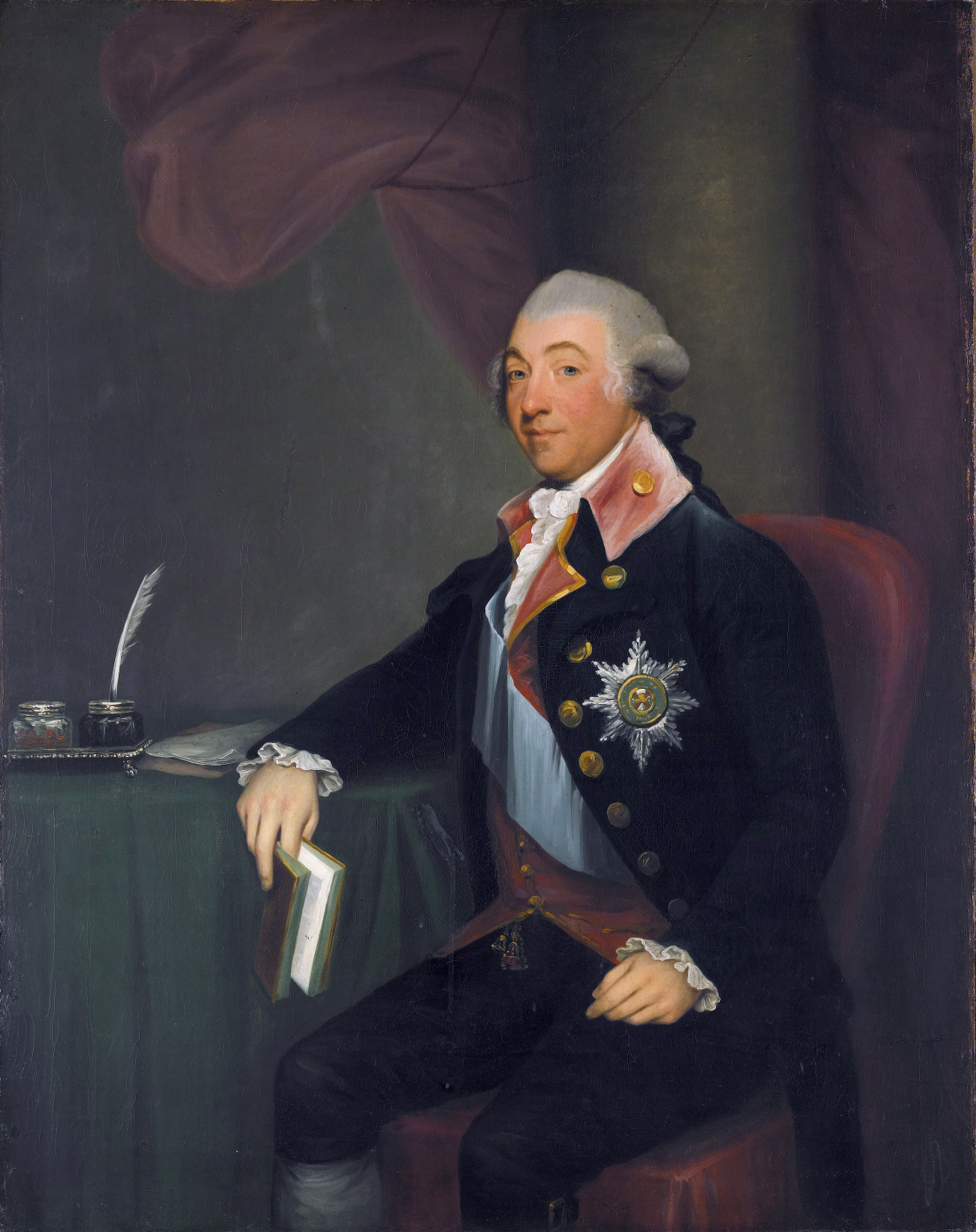
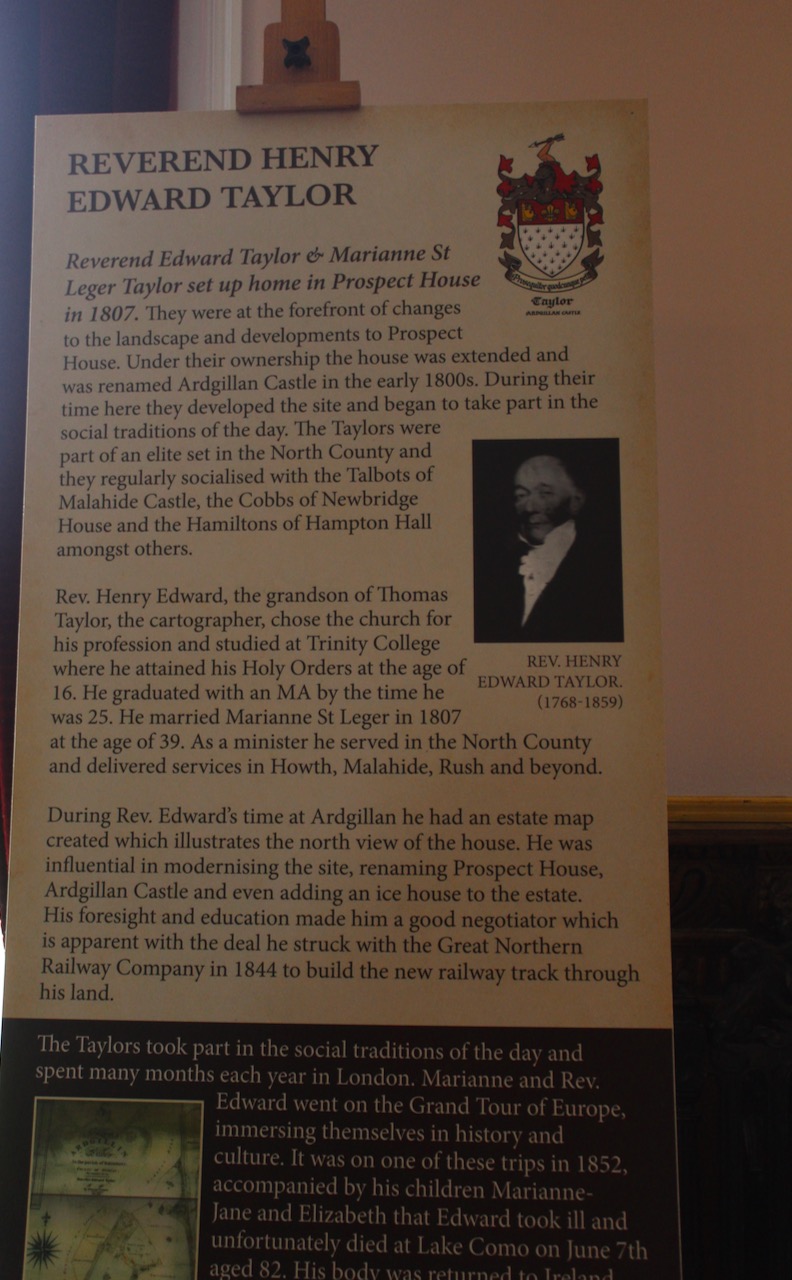
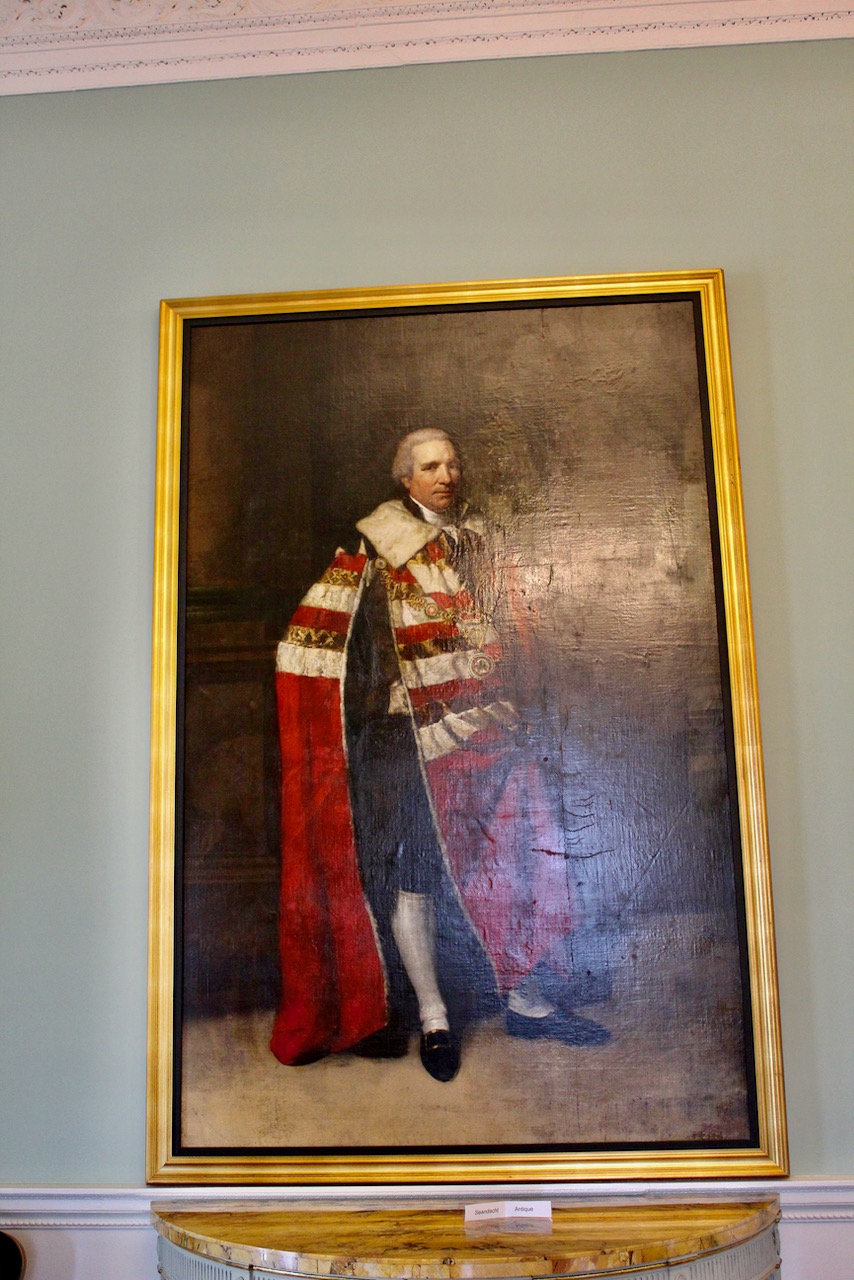
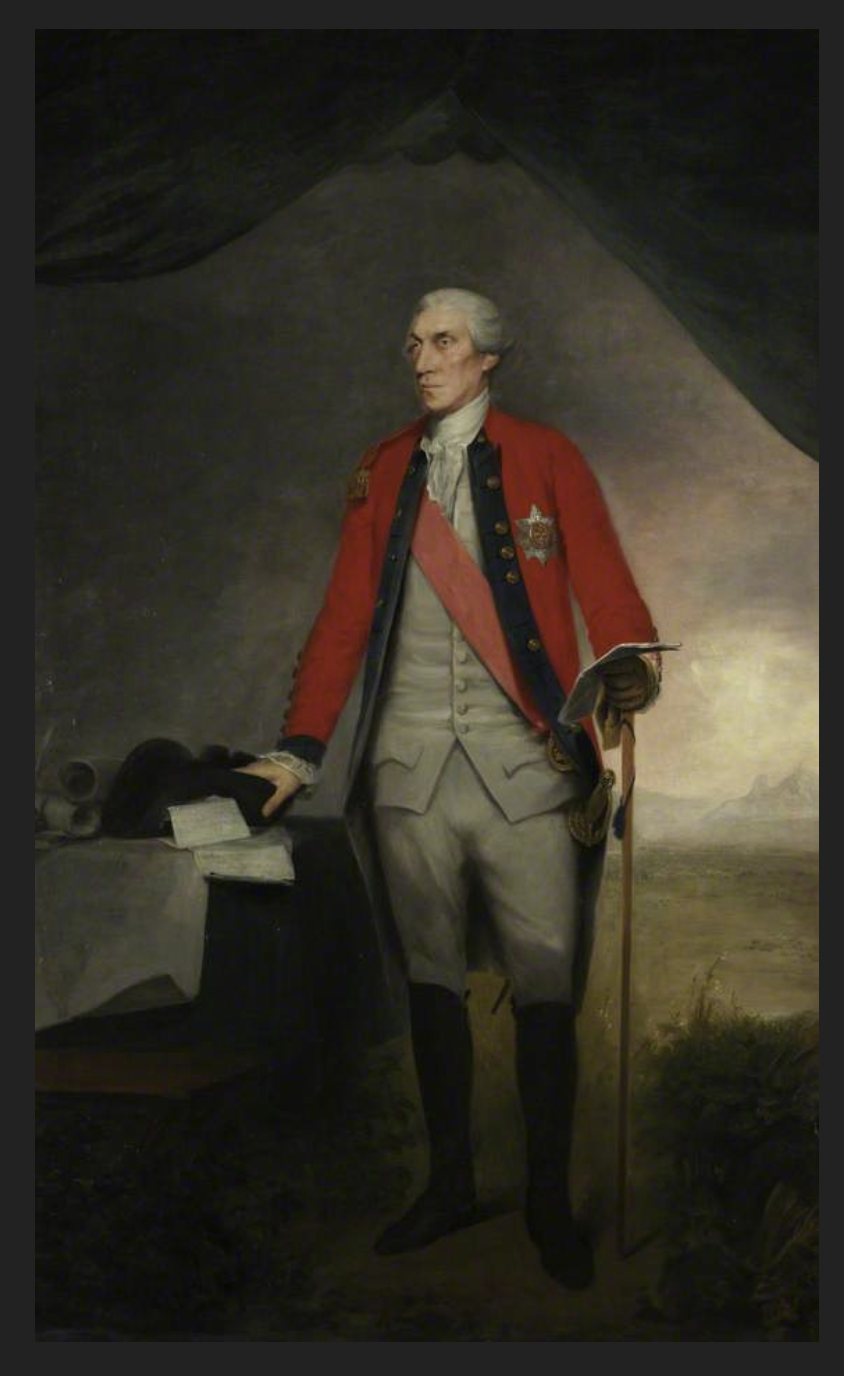
Thomas Taylour (1724-1795) 1st Earl of Bective wearing the star and sash of the Order of St. Patrick by Gilbert Stuart and studio courtesy of Sotheby’s, Public Domain,https//:commons.wikimedia.org/w/index.php?curid=27947645.jpgReverend Henry Edward Taylor of Ardgillan Castle, County Dublin, who was a son of Thomas Taylour (1724-1795) 1st Earl of Bective.
In 1783 he was installed as a Founder Knight of St Patrick (KP), and sworn of the Privy Council of Ireland. His lordship was succeeded by his eldest son, THOMAS, 2nd Earl (1757-1829), who espoused, in 1778, Mary, only daughter and heir of George Quin, of Quinsborough, County Clare, and had issue: THOMAS (1787-1870) his successor; George; Mary; Elizabeth Jane.
Thomas Taylour (1757-1829) 1st Marquess of Headfort by Pompeo Batoni courtesy of Google Art Project By Pompeo Batoni – 9QE_ZzFPQzDZiQ at Google Cultural Institute, Public Domain, https//:commons.wikimedia.org/w/index.php?curid=29800995
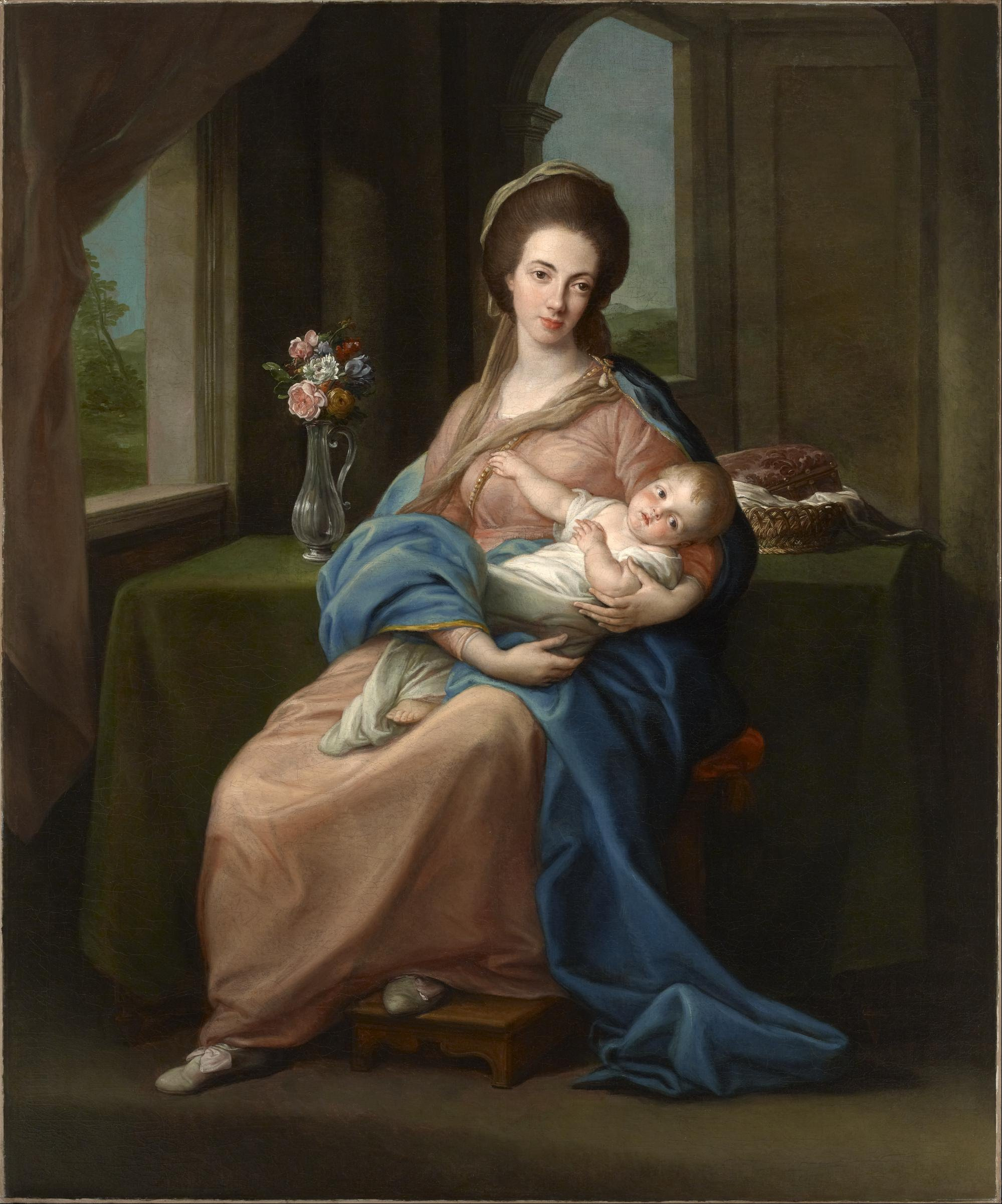
Mary née Quin (the daughter of George Quin and Caroline Cavendish) The Marchioness of Headfort, wife of Thomas Taylour (1757-1829) 1st Marquess of Headfort, holding her Daughter Mary, 1782, by Pompeo Batoni, Google_Art_Project 6wGvrQuQJ1yERA at Google Cultural Institute, Public Domain,https//:commons.wikimedia.org/w/index.php?curid=29801821.jpg
His lordship was created, in 1800, MARQUESS OF HEADFORT.
The Taylour family became very much involved in the political life of the locality, and several members of the family served as MPs for Kells and the county of Meath. [1]
Open dates in 2026: May 11-24, June 12-21, July 6-19, Aug 9-30, 1pm-5pm
Fee: adult €7, student/OAP €5, child free with adult, group €5 per person
donation
Help me to pay the entrance fee to one of the houses on this website. This site is created purely out of love for the subject and I receive no payment so any donation is appreciated!
€15.00
2026 Diary of Irish Historic Houses (section 482 properties)
To purchase an A5 size 2026 Diary of Historic Houses (opening times and days are not listed so the calendar is for use for recording appointments and not as a reference for opening times) send your postal address to jennifer.baggot@gmail.com along with €20 via this payment button. The calendar of 84 pages includes space for writing your appointments as well as photographs of the historic houses. The price includes postage within Ireland. Postage to U.S. is a further €10 for the A5 size calendar, so I would appreciate a donation toward the postage – you can click on the donation link.
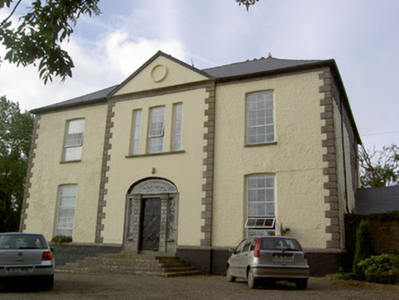
Number 39 North Great Georges Street, a three bay four storey over basement house, was built in 1790 by Henry Darley (1721-1798) on land leased from the Archdall family. Darley also built numbers 41 and 42, and may have built number 43 for Theophilus Clements. We visited the street before when we saw another Section 482 property, number 11 (see my entry).
The land was owned at the beginning of the 18th century by John Eccles (1664-1727), Lord Mayor of Dublin in 1710, for whom Eccles Street was named, the street where Leopold Bloom lives in James Joyce’s Ulysses. The North Great Georges Street specially dedicated website with a history of the street written by Conor Lucey tells us that Eccles’ mansion of the same name survived into the first decades of the twentieth-century, and stood on the site now occupied by the diminutive two-storey building situated between the present Nos.43 and 46. [1]
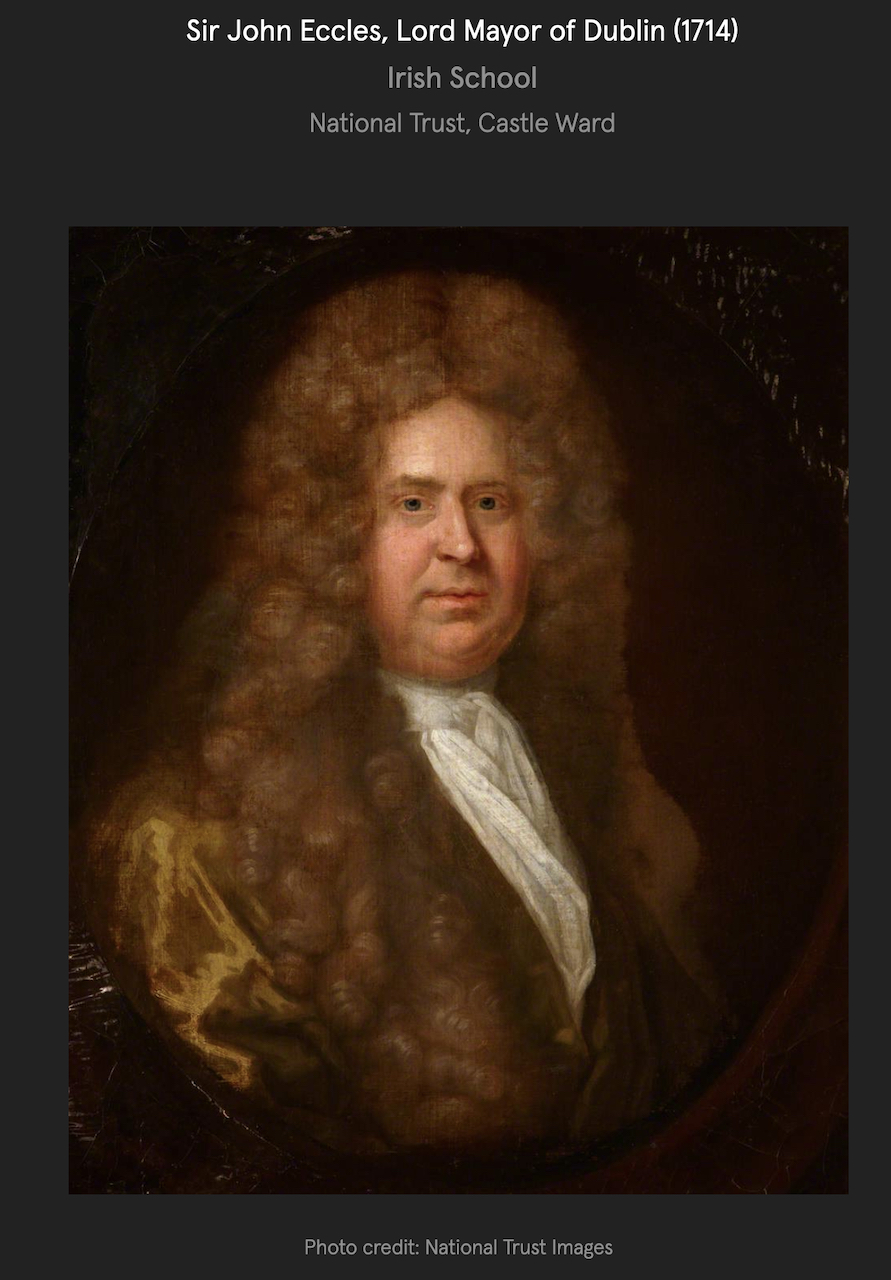
John Eccles (1664-1727) Lord Mayor of Dublin (1714), Irish school, courtesy of National Trust Castle Ward.
The lease for the estate was purchased by Nicholas Archdall for a term of 999 years beginning on 1st August 1749. The North Great Georges Street website tells us:
“Nicholas Archdall, an MP for Co. Fermanagh and one of the first ‘Home Rulers’, had in fact been born Nicholas Montgomery, assuming the name of Archdall upon his marriage in 1728 to the heiress Angel Archdall, a descendant of one of the foremost County Fermanagh families since the days of the Ulster Plantation. Following Angel Archdall’s death in 1748, Nicholas married Sarah Spurling, originally of London, and by her had eight children, one of whom, Edward, would later become a property developer, involved in the building of Nos.19 and 20 North Great George’s Street in the late 1780s. Nicholas Archdall died at Mount Eccles in 1763, and some years later his widow petitioned Parliament for the heads of a bill to enable her ‘to grant long leases for building on the said Premises.’ This decision to set out the ground as a commercial venture may have been inspired by the eminently fashionable, and ever-expanding, Gardiner estate, and motivated in particular by the opening up of Gardiner’s Row (adjoining the north west side of the Mount Eccles estate) in 1765. Sarah Archdall’s formal request was presented to the House of Commons on 12 February 1766 and stated:
“That the said Grounds and Premises lie contiguous to the City of Dublin, and from their Situation will be taken by Persons in Lots for building upon, if Power to make Building Leases thereof can be obtained. That all the Petitioners…are Minors, and the youngest about six Years of Age, and until they all come of age no Building Leases can be granted, and it will greatly tend to the Benefit of the Petitioner Sarah, and her Children, to have Power to grant Building Leases.”
“The Journals of the House of Commons records that Royal Assent was granted on 7 June 1766 and the leasehold interest in the first building lots were advertised the following year, the notices highlighting both the advantage of the location and its proximity to established residential districts:
“To be Let in Lots for Building, the Lands of Mount Eccles, in Great Britain-street, opposite Marlborough-street, joining Palace-row and Cavendish-street, containing seven Acres, which for Situation, Air and Prospect, cannot be exceeded by any in or about Dublin, subject to no Manner of Tax, Hearth Money excepted. For further Particulars, enquire of Mrs. Archdale, at Mount Eccles, where a Plan of the whole may be seen.”
“While building at the southern end of North Great George’s Street began from the mid-1770s, including Nos.22–27 (all now demolished) and Nos.33–35 (of which only No.35 survives), the majority date from the mid-1780s, including Nos.12–21 and Nos.36–43. In many cases, these later houses were built by some of the leading figures from Dublin’s late eighteenth-century building and house-decorating community, among them the renowned stuccodor Charles Thorp (Nos. 37 and 38), and Henry Darley, from the celebrated family of stonecutters (Nos.39 and 41–42).“
Darley worked with James Gandon on the new Custom House in Dublin, from 1781-1791, before working on North Great Georges Street. The plasterwork inside may be by Charles Thorp (abt. 1772-1820), as he owned the house next door to number 39.
Conor Lucey describes the typical layout of the houses on the street:
“By far the most common plan type is the ‘two room’ plan, composed of an axially- aligned entrance hall and stair hall, and flanked by front and rear parlours, the latter typically serving as the formal dining room. The principal staircase, customarily of timber open-string construction, is situated at the back of the house and rises from the ground floor – by way of the piano nobile or ‘drawing room storey’ – to the ‘attic’ or bedroom storey, with admittance to the ‘garret’ alone acquired by a smaller, subordinate stair.“
The first occupant of the house was Thomas Taylour (1757-1829), later created 1st Marquess of Headfort, of Headfort House in County Meath, in 1800 at the time of the Act of Union.
Thomas Taylour (1757-1829) 1st Marquess of Headfort by Pompeo Batoni courtesy of Google Art Project By Pompeo Batoni – 9QE_ZzFPQzDZiQ at Google Cultural Institute, Public Domain, https://commons.wikimedia.org/w/index.php?curid=29800995Mary née Quin (the daughter of George Quin and Caroline Cavendish) The Marchioness of Headfort, wife of Thomas Taylour (1757-1829) 1st Marquess of Headfort, holding her Daughter Mary, 1782, by Pompeo Batoni, Google_Art_Project 6wGvrQuQJ1yERA at Google Cultural Institute, Public Domain, https//:commons.wikimedia.org/w/index.php?curid=29801821.jpg
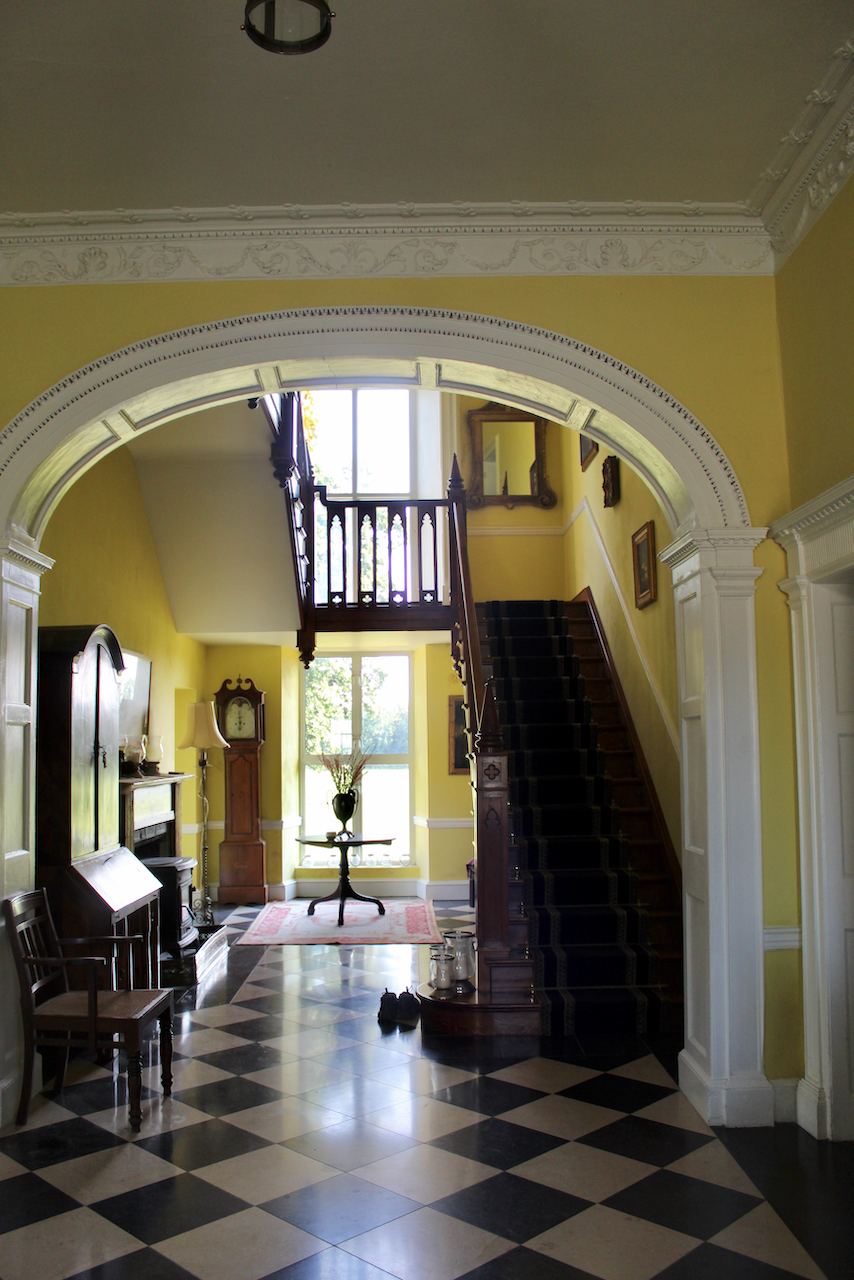
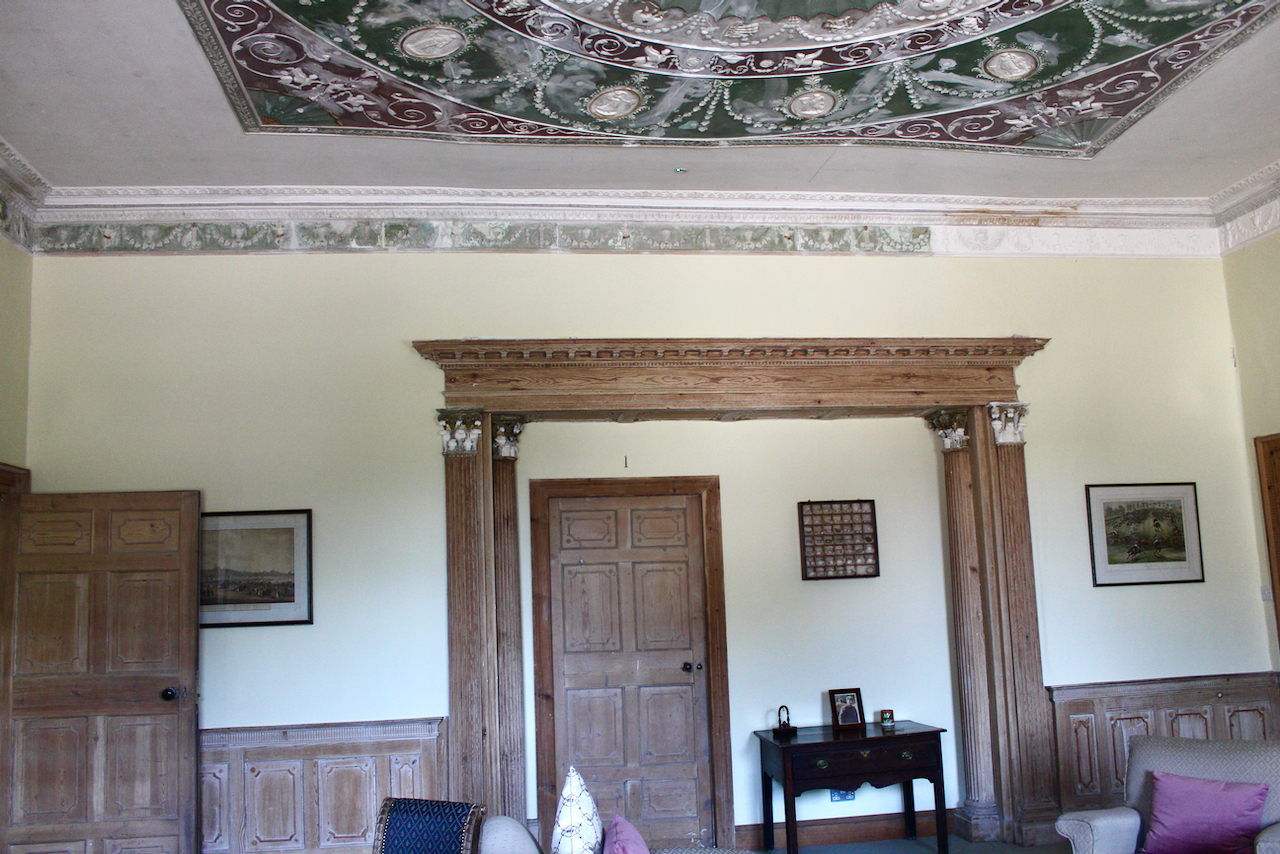
The front hall has an archway, built by Darley, and The Marquess of Headfort had him put in double doors and a fanlight.
The website for the house tells us that it was then occupied by Thomas Taylour’s first cousin, Stephen Moore of Barne Park, Clonmel, County Tipperary. [2] Thomas Taylour probably moved to Rutland Square (now Parnell Square), where his family had a townhouse which he inherited.
Thomas Taylour’s aunt Henrietta Taylour married Richard Moore (1714-1771) of Barne Park. They had a son Stephen (about 1748-1800), who married Salisbury Moore, and they had a son, Stephen Moore of Barne Park, who married Eleanor Westry. They had a son, Stephen Charles Moore (1808-1873). In 1833 Stephen Charles Moore of Barne married Anna, eldest daughter of Colonel Kingsmill Pennefather of Newpark, County Tipperary. Stephen Charles Moore was Justice of the Peace, High Sheriff and Deputy Lieutenant of County Tipperary. Mrs. Mary Moore of Barne Park is listed as living in the house in 1840.
Tom welcomed us to his home. He told us that the house was purchased by a Bishop who put it in trust for life. The house was continually let until the mid twentieth century. The house’s website tells us that:
“By 1850, the house, now held in trust, was let to a barrister, Patrick Owen Cogan and in 1909, was being run as a boarding house by a Mrs. Hill, who lived there with her husband and daughters. It was afterwards occupied by a rector of St. Georges Church, and later by a doctor from the Childrens Hospital in Temple Street. In the 18th.c. when this house was built, there was no plumbing or sanitary facilities and it was probably towards the end of the 19th.c. that it became fashionable to install a bathroom, usually by thrusting out an extension from the 2nd. half landing on the stairs, hence the name “thrust out.” Such a bathroom was installed in No.39. This would have been the height of sophistication in the Edwardian era.“
The National Inventory tells us it was run as a hotel called the “Windsor hotel” in the early 1900s, perhaps in the time of Mrs. Hill. The census in 1901 tells us it was divided in two parts, with the Hill family, Joseph and his wife Catherine, who are members of the Church of Ireland, and their daughters, in one part and boarders in the rest of the house – one of whom, Stephen Dawson, an engineering student, lists his religion as “free thinker”! In 1911 it was no longer occupied by the Hills, but by a family named Greer, a Rev. Fergus Greer who was rector of St. George’s church. He moved to no. 38, next door, after John Pentland Mahaffy vacated that house.
The website continues with the history of the house:
“In 1939 the trust let the house to a builder, giving him permission to let it out in rooms. This was the final stage in a downward spiral that almost ended in its demolition. It had probably not been well maintained throughout the 19th.c. but the intensive use it was now subjected to led to a rapid deterioration and it soon became an “open door tenement,” with no lock on the front door and the interior common areas open to all. In 1948, there were 11 families living in the house, mostly one family per room. Many of these were large families. There were no services in any of the rooms, and with only the single bathroom off the half landing and a second wc at the door to the back yard conditions were grim. A sink had been installed outside the bathroom and leakage from this caused extensive rot on the staircase. Leaking rainwater downpipes caused further rot, and the roof slating had failed and been replaced with a temporary covering of chipboard and green mineral felt. In 1966 the trust sold the house for £200. It again changed hands in 1973, to an owner interested in its preservation. He had the remaining tenants rehoused and upgraded the house as offices and flats.
The present owners bought the house in 1976.“
The present owners, the Kiernans, have done wonderful repairs to the house. They outline the repairs on the website. The roof was repaired and reslated, and the third floor bow wall in the back rebuilt. The owners had to contend with dry rot, and much work was done in the upper drawing room and the upper floors. They bought back the mews house, which had been sold previously, and they renovated that also. You can see photographs of various stages of the repair work on the website.
Tom Kiernan has been repairing the skirting, architraves and other woodwork, and also, I was delighted to learn, the plasterwork.
A house built c. 1730 but possibly incorporating a seventeenth-century house, it is very impressive. It was built for Stephen Moore (1689-1747).
The house went up for sale in 2023! Here are some photographs courtesy of myhome.ie:
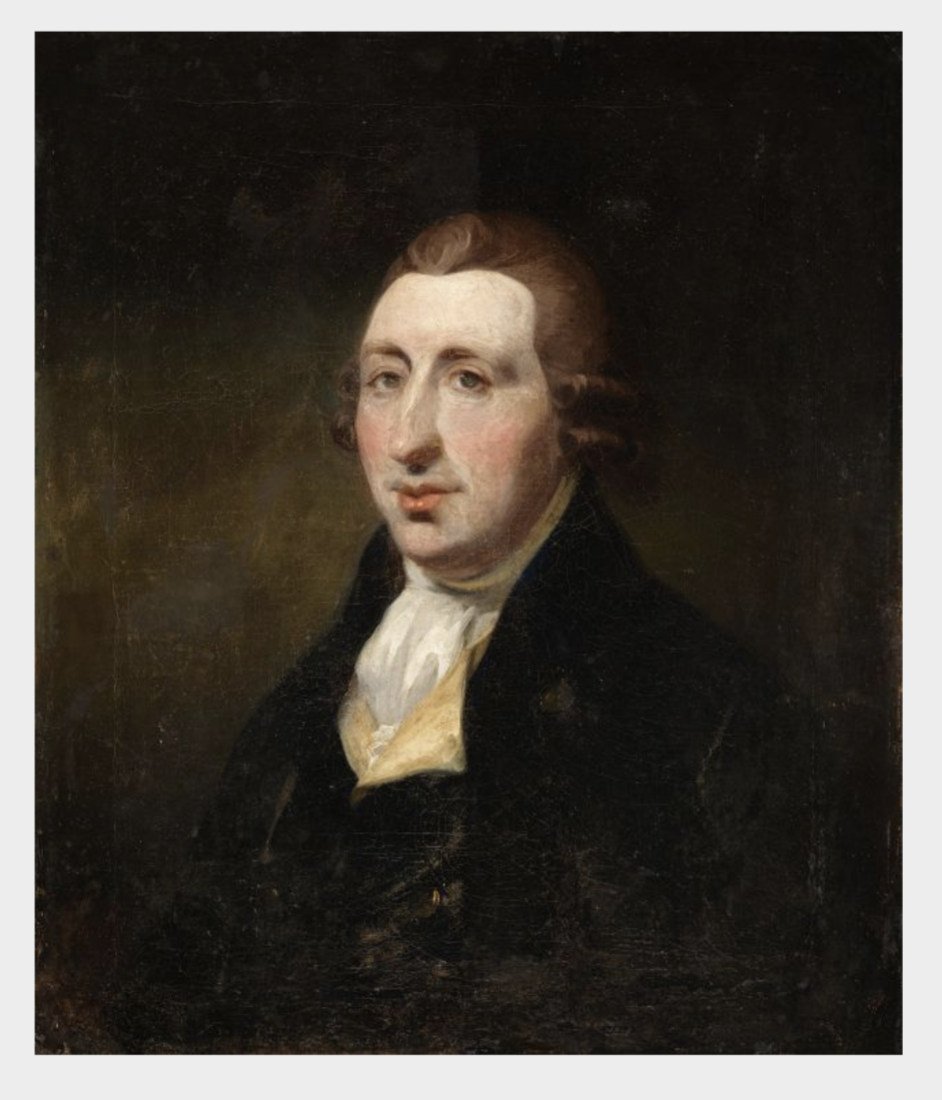
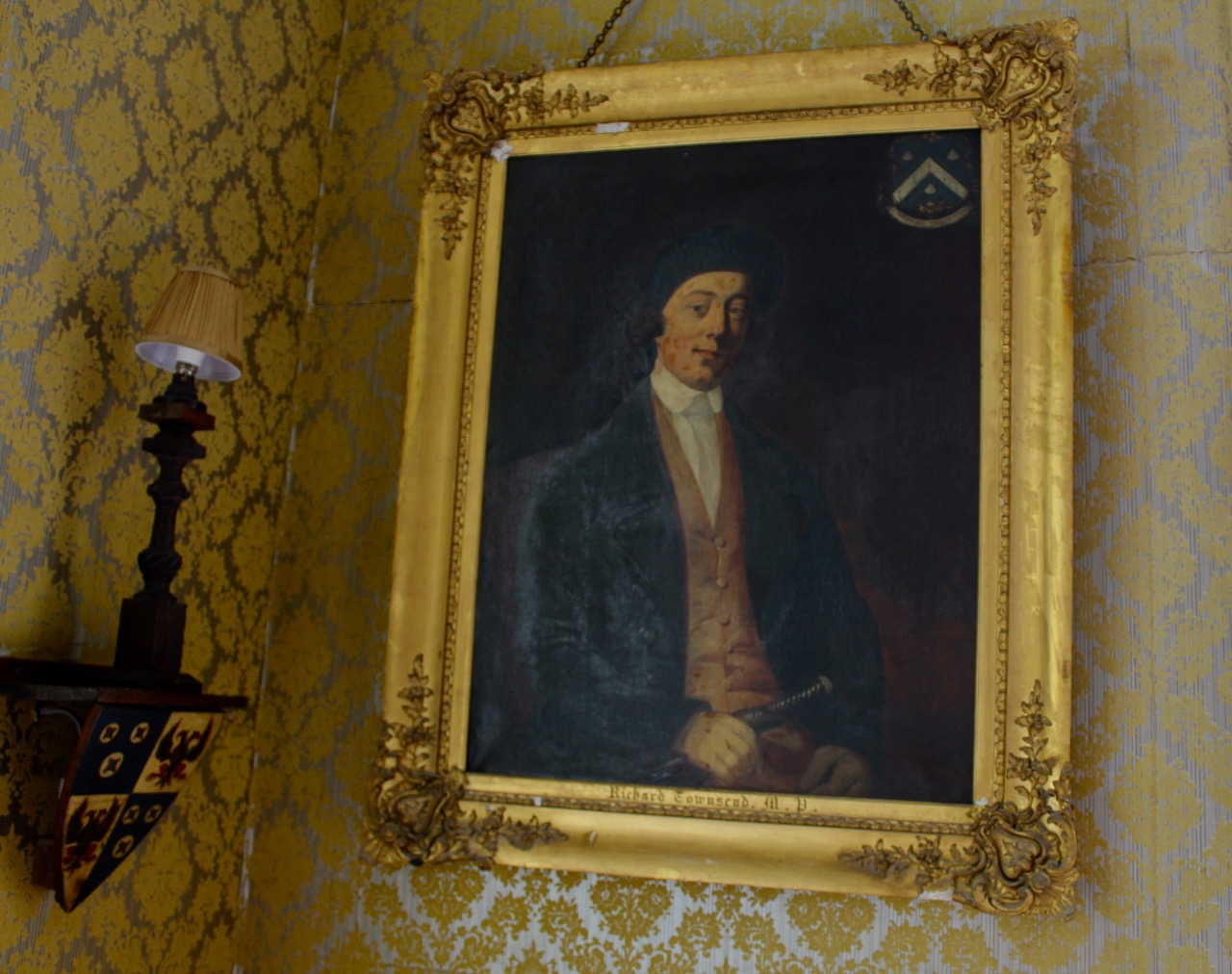
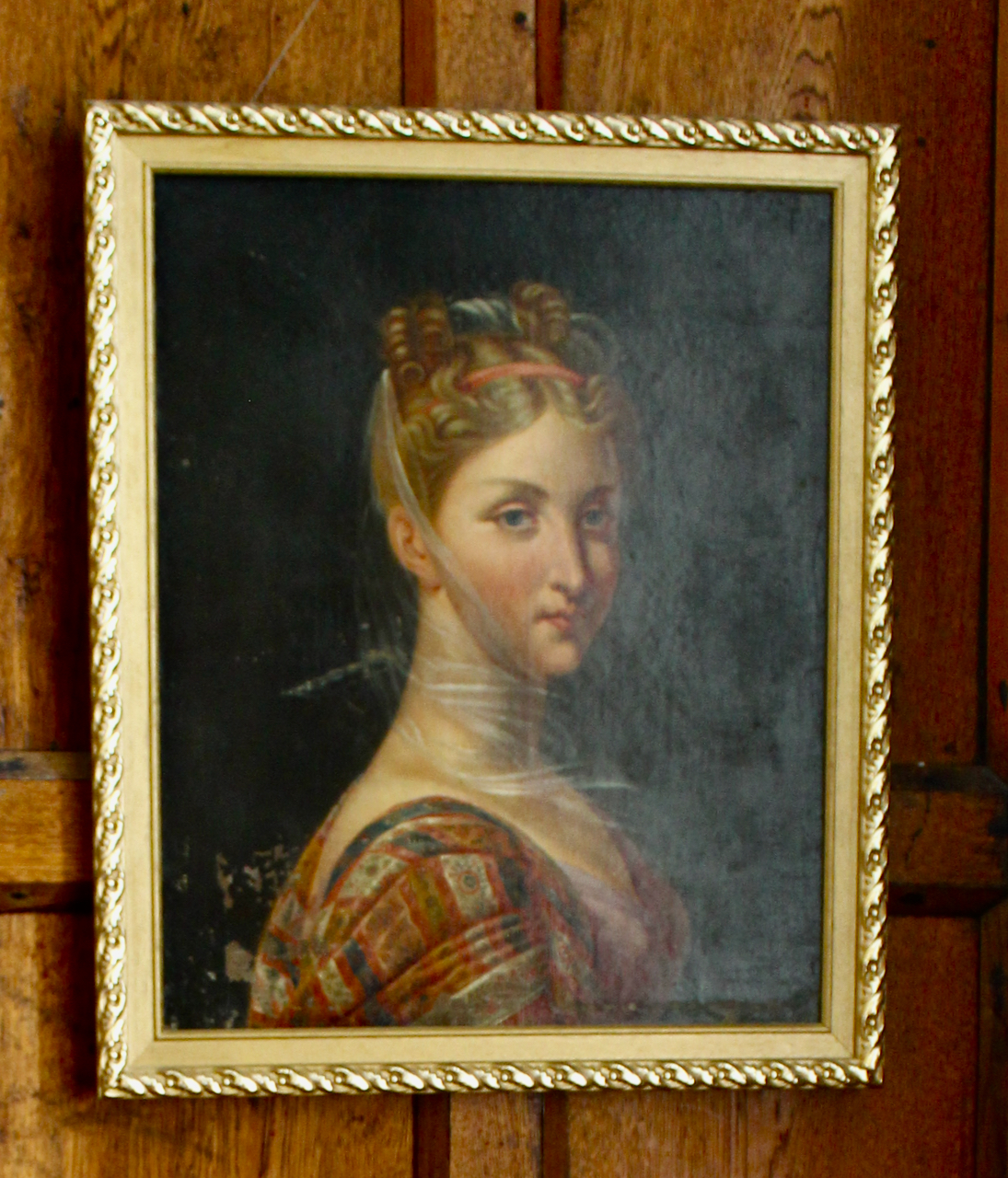
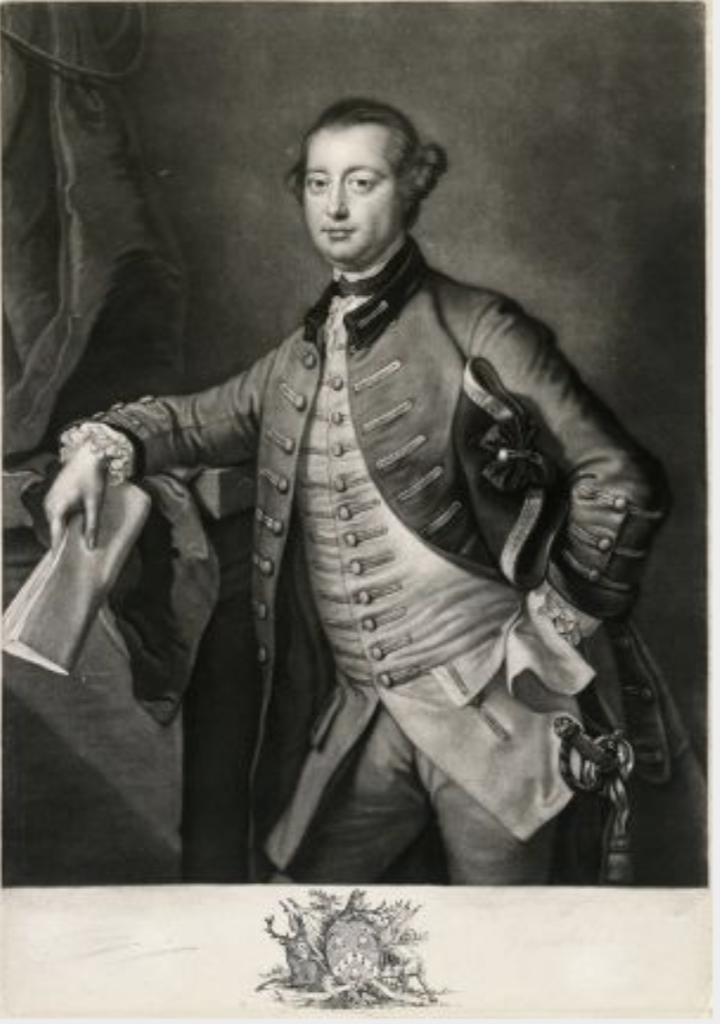
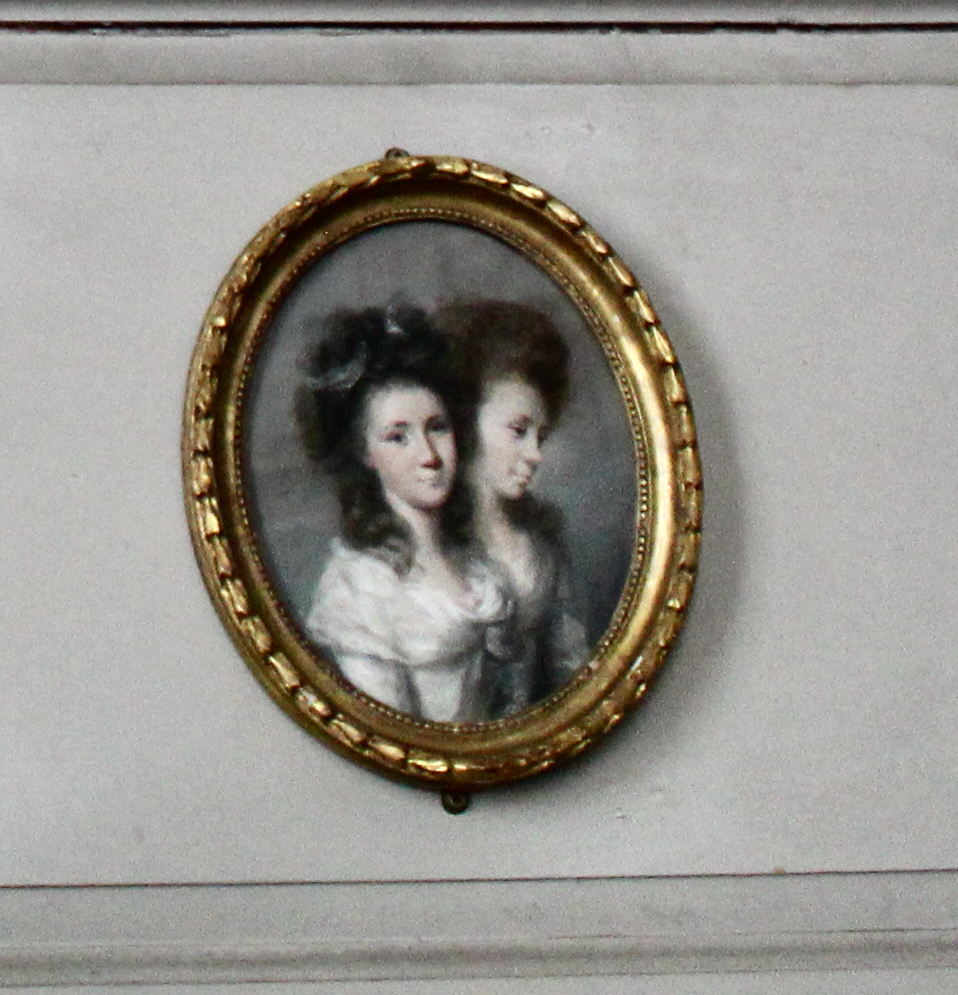
Barne, County Tipperary, photograph courtesy of myhome.ie in July 2023.Barne, County Tipperary, photograph courtesy of myhome.ie in July 2023.The use of drones really helps in advertising a property for sale.Barne, County Tipperary, photograph courtesy of myhome.ie in July 2023. I don’t know if the Moores still own it – it would be wonderful if those weapons and trophies are from the Moore family.Barne, County Tipperary, photograph courtesy of myhome.ie in July 2023.Barne, County Tipperary, photograph courtesy of myhome.ie in July 2023.I wonder who is painted in the portraits?Thomas Taylour (1724-1795) 1st Earl of Bective wearing the star and sash of the Order of St. Patrick by Gilbert Stuart and studio courtesy of Sotheby’s. I see this portrait in the photograph from Barne!Thomas Moore of Barne, courtesy of Adam’s auction 15th Oct 2019Barne, County Tipperary, photograph courtesy of myhome.ie in July 2023.Barne, County Tipperary, photograph courtesy of myhome.ie in July 2023.What a beautiful cabinet!Barne, County Tipperary, photograph courtesy of myhome.ie in July 2023.The pelmets match the bed. I wonder if they are original to the house, and whose crest that is?
Help me to pay the entrance fee to one of the houses on this website. This site is created purely out of love for the subject and I receive no payment so any donation is appreciated!
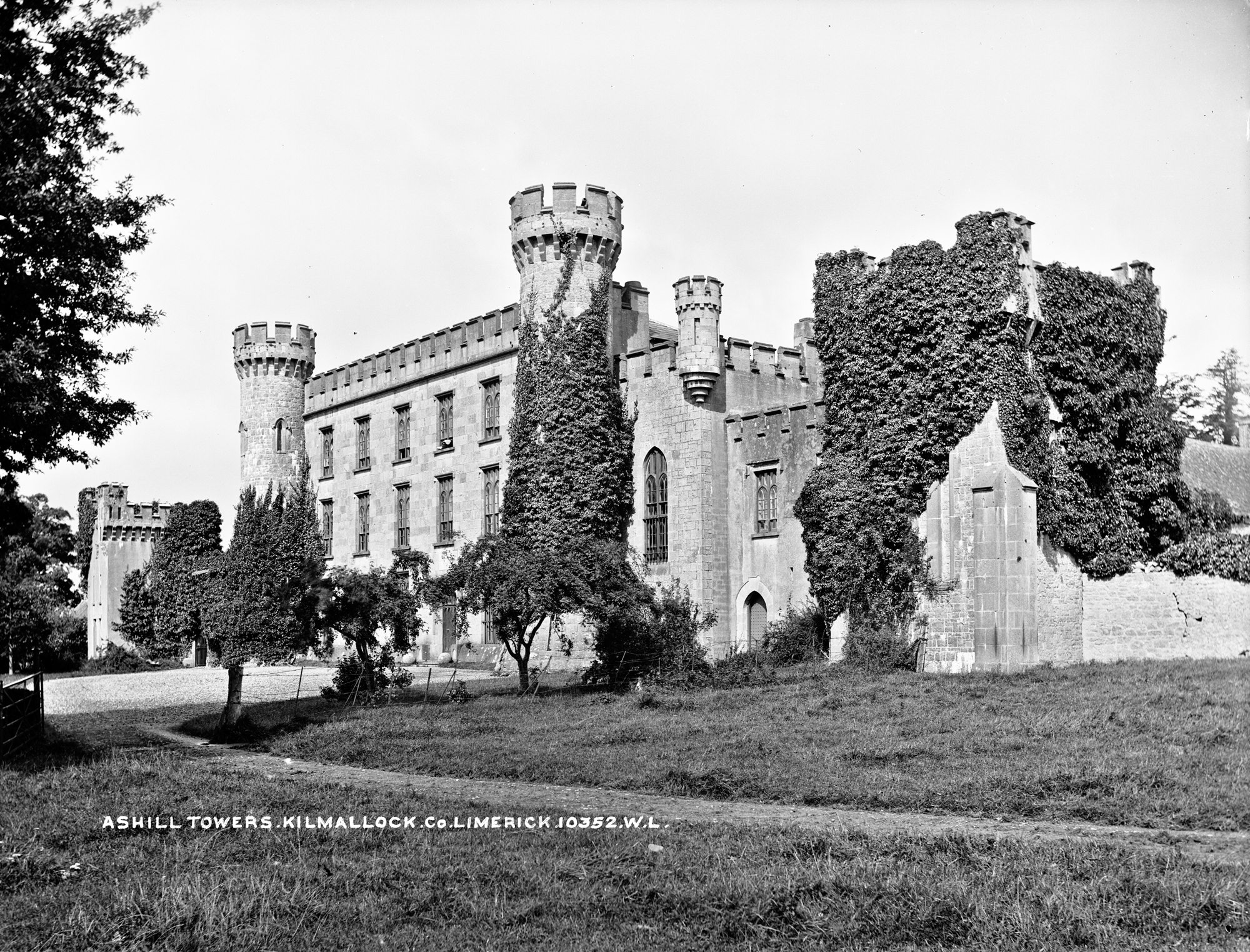
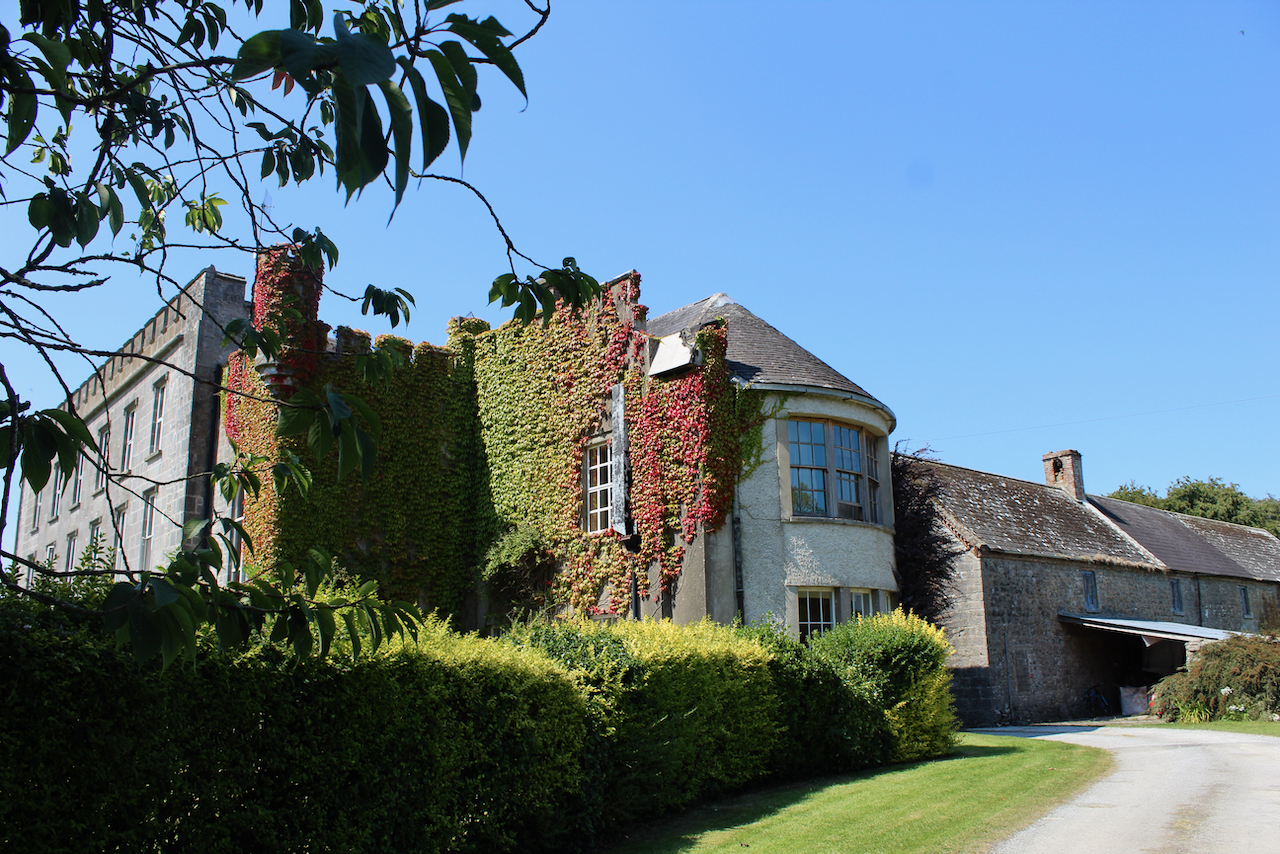
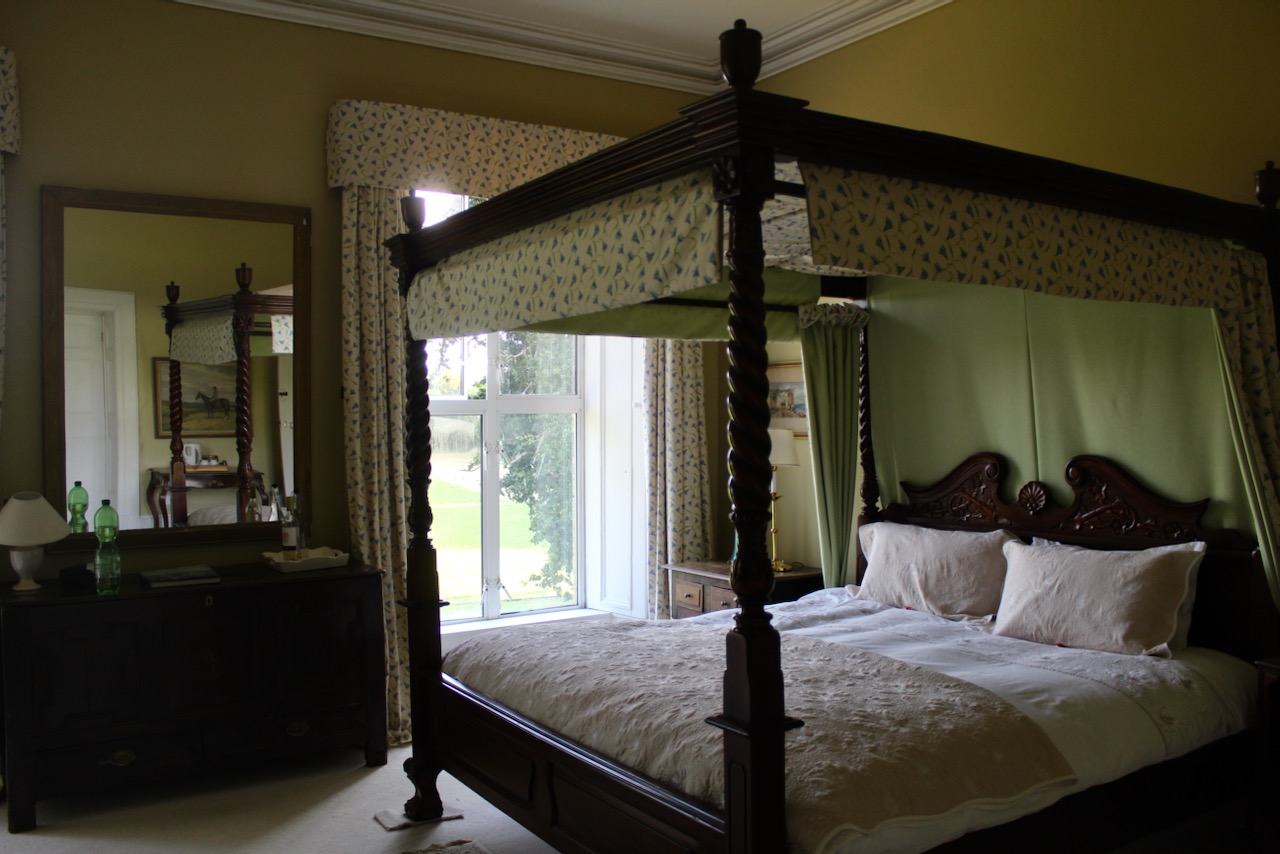
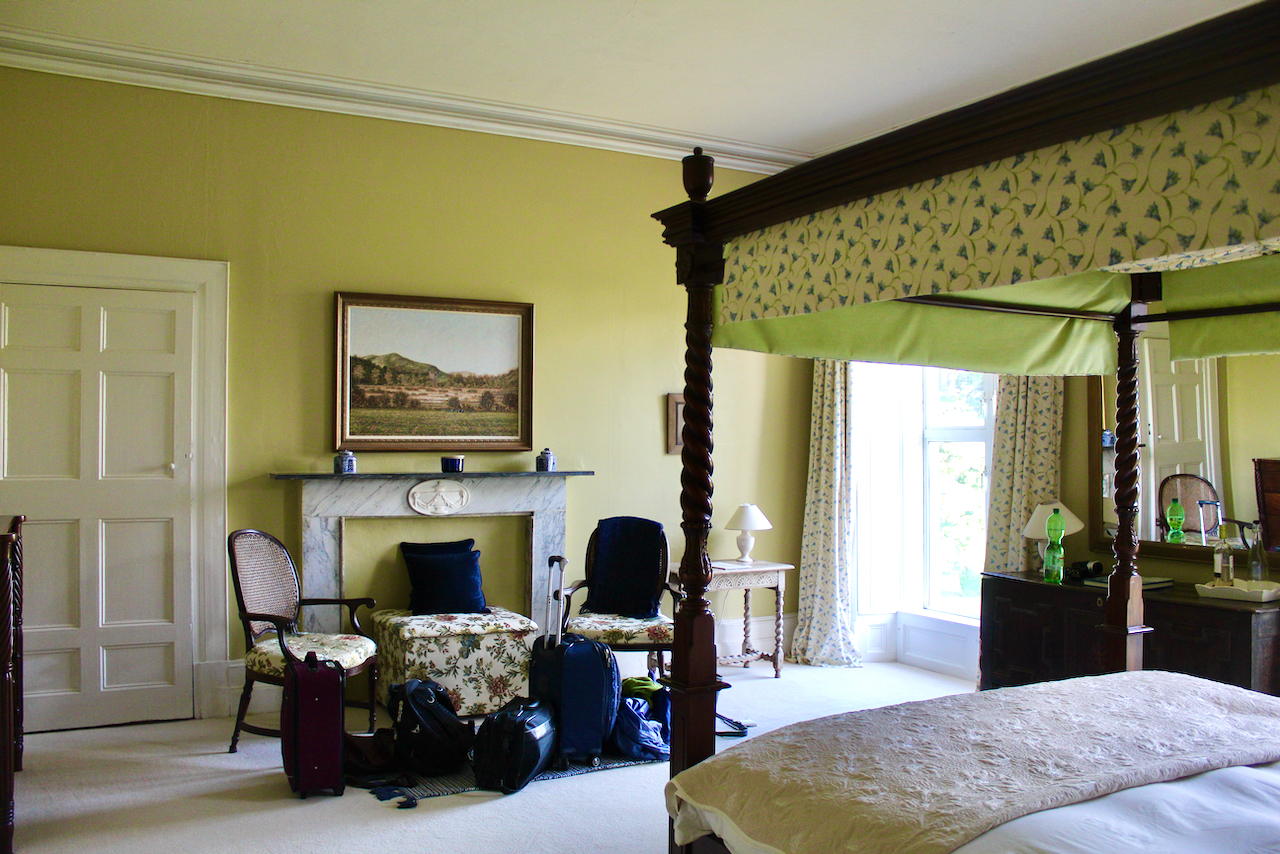
We treated ourselves to a stay during Heritage Week 2022! We had a lovely stay for three nights. It was formerly called Ashill Towers, but since the towers were taken down in the 1960s it is now called Ash Hill.
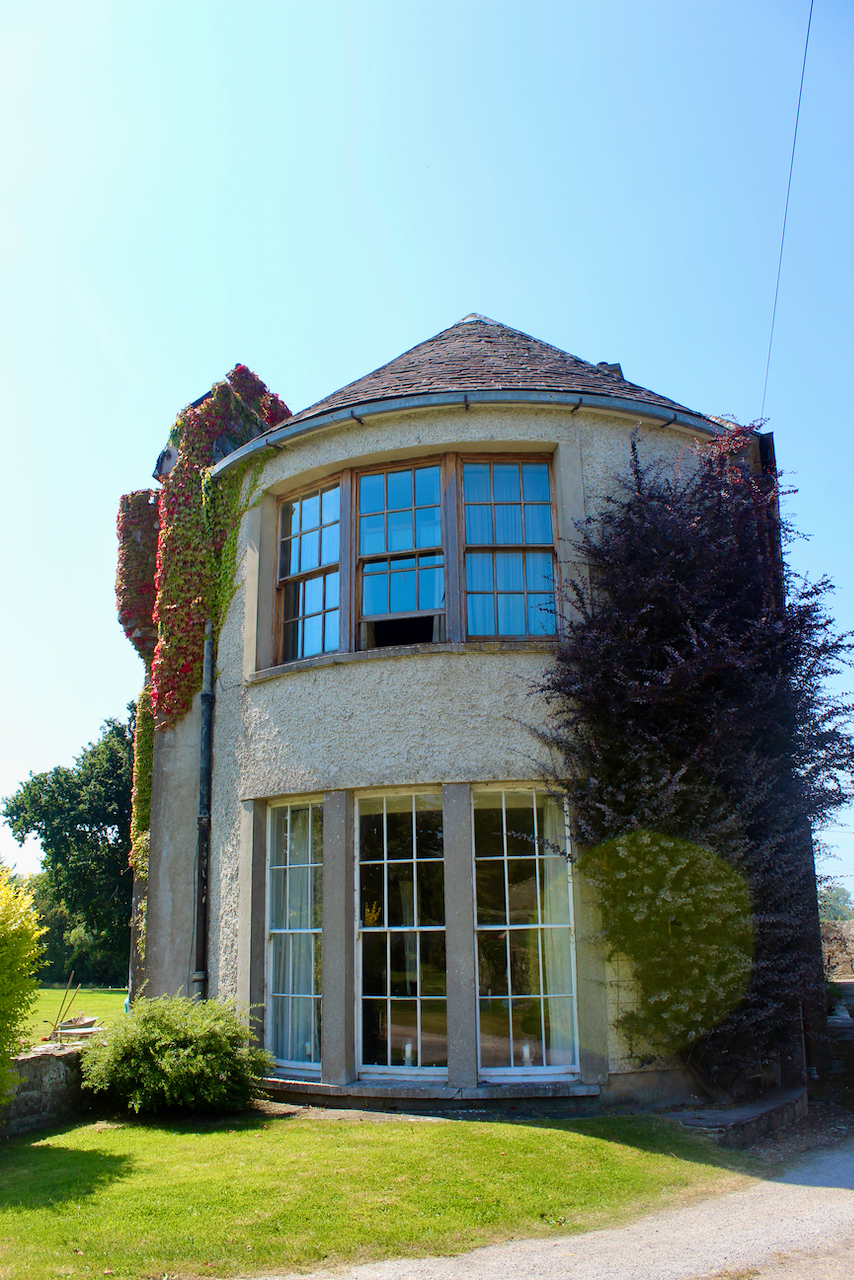
The website tells us: “Ash Hill is a large, comfortable Georgian estate, boasting many fine stucco ceilings and cornices throughout the house. For guests wishing to stay at Ash Hill, we have three beautifully appointed en-suite bedrooms, all of which can accommodate one or more cots…Open to the public from January 15th through December 15th. Historical tours with afternoon tea are easily arranged and make for an enjoyable afternoon. We also host small workshops of all kinds, upon request…For discerning guests, Ash Hill can be rented, fully staffed, in its entirety [comfortably sleeps 10 people]. Minimum rental 7 days.”
Mark Bence-Jones writes in his Guide to Irish Country Houses (1988):
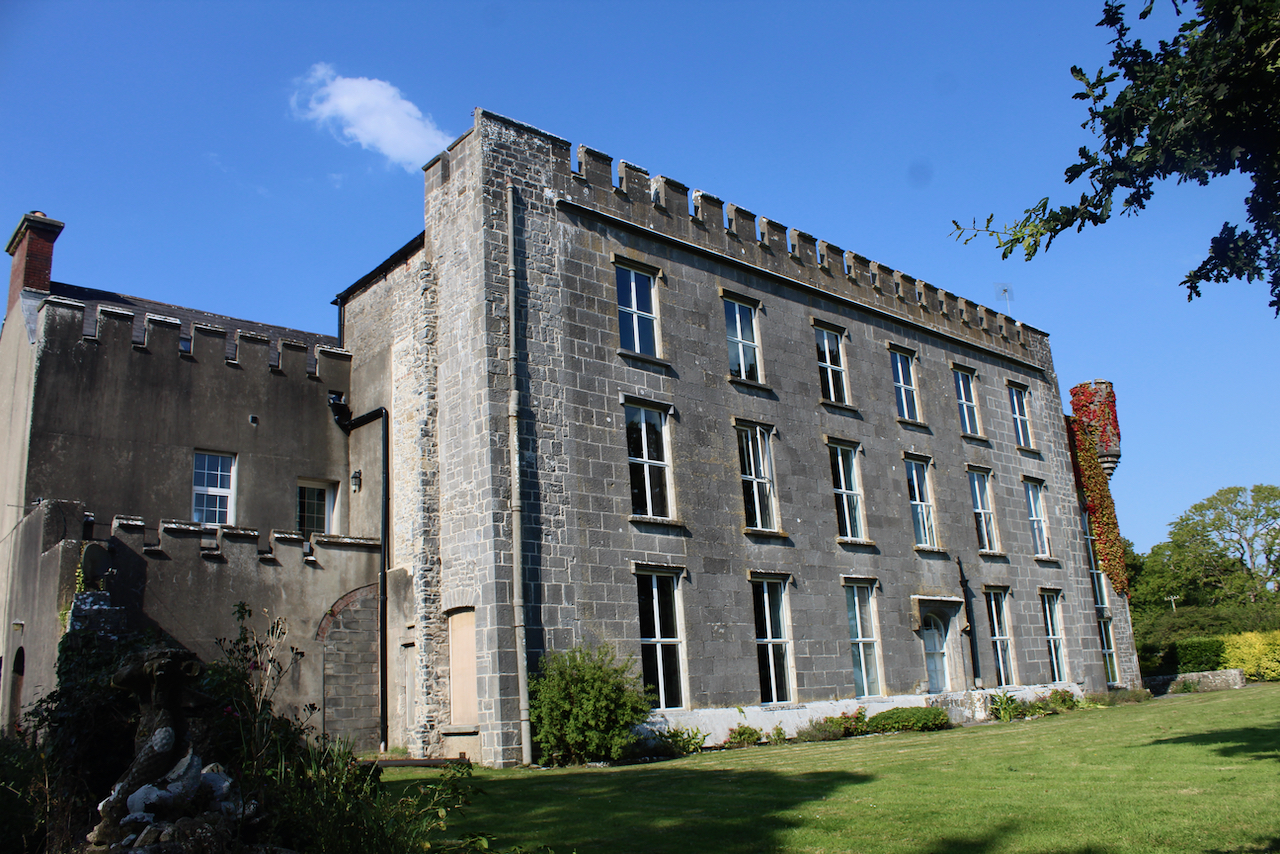
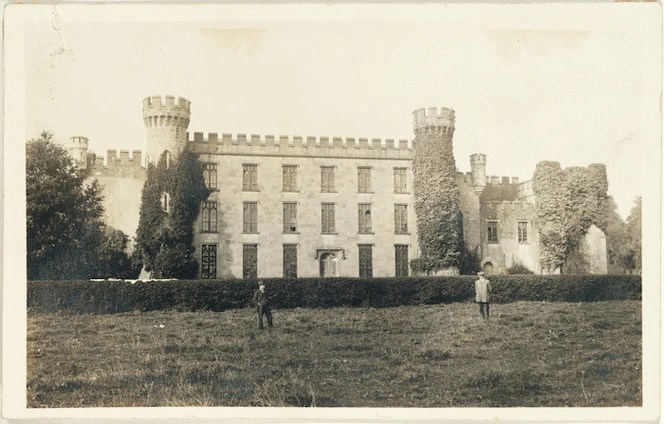
“(Evans/Carbery/ Johnson/ Harrington) A C18 pedimented house [the National Inventory tells us it was built in 1781], the back of which was rebuilt in Gothic 1833, probably to the design of James and George Richard Pain [the National Inventory corrects this – it was designs by Charles Frederick Anderson], with two slender round battlemented and machicolated towers. Rectangular windows with wooden tracery. Good plasterwork in upstairs drawing room in the manner of Wyatt and by the same hand as the hall at Glin Castle; saloon with domed ceiling. The towers have, in recent years, been removed. Originally a seat of the Evans family; passed in the later C19 to John Henry Weldon. Now the home of Major Stephen Johnson.” [1]
The website tells us: “In the 1830’s, Eyre Evans employed Charles Anderson, an architect, to build the front of the house in a Gothic style with two large towers on it. There are various Gothic features in this part of the house. Unfortunately, due to excessive rates (a valuation based property tax), some parts of the house, including the towers, were removed in the early 1960s.”
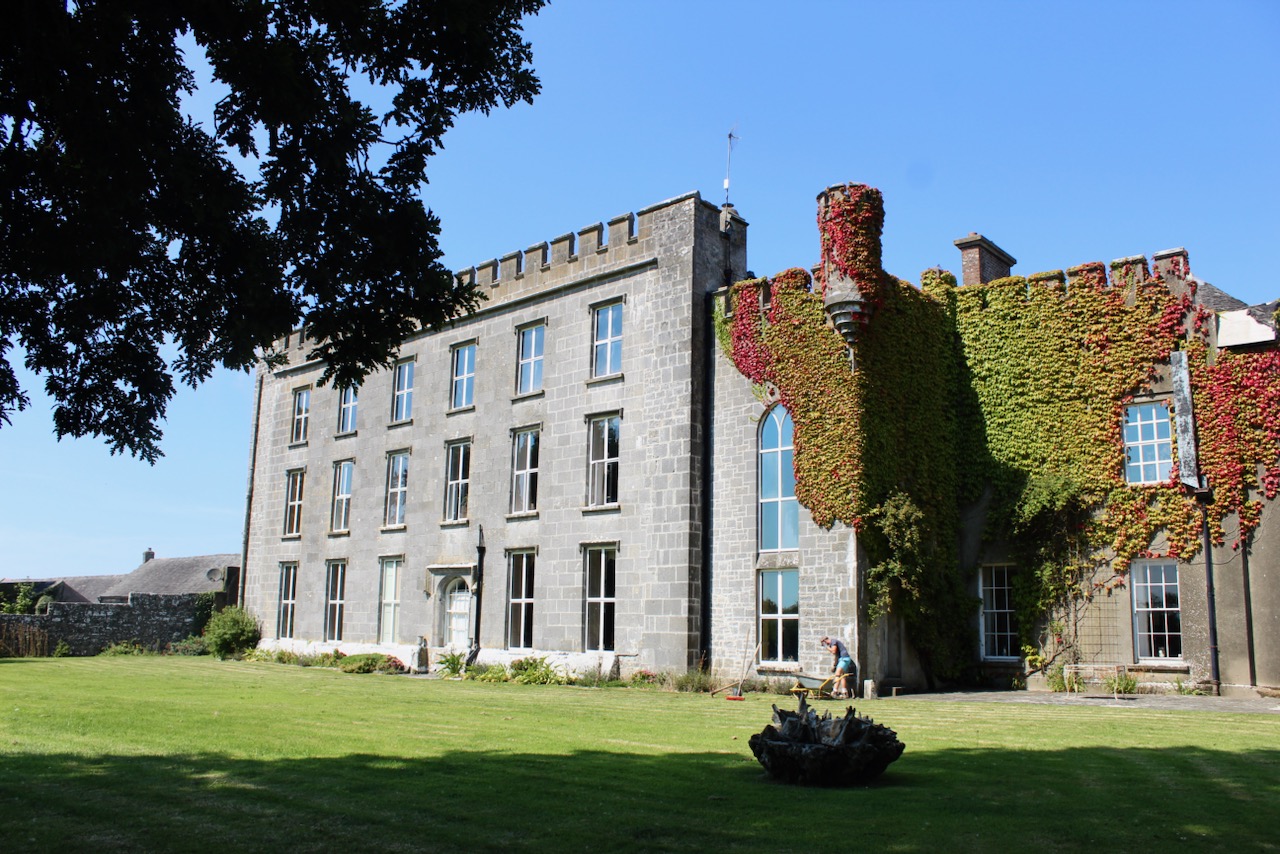
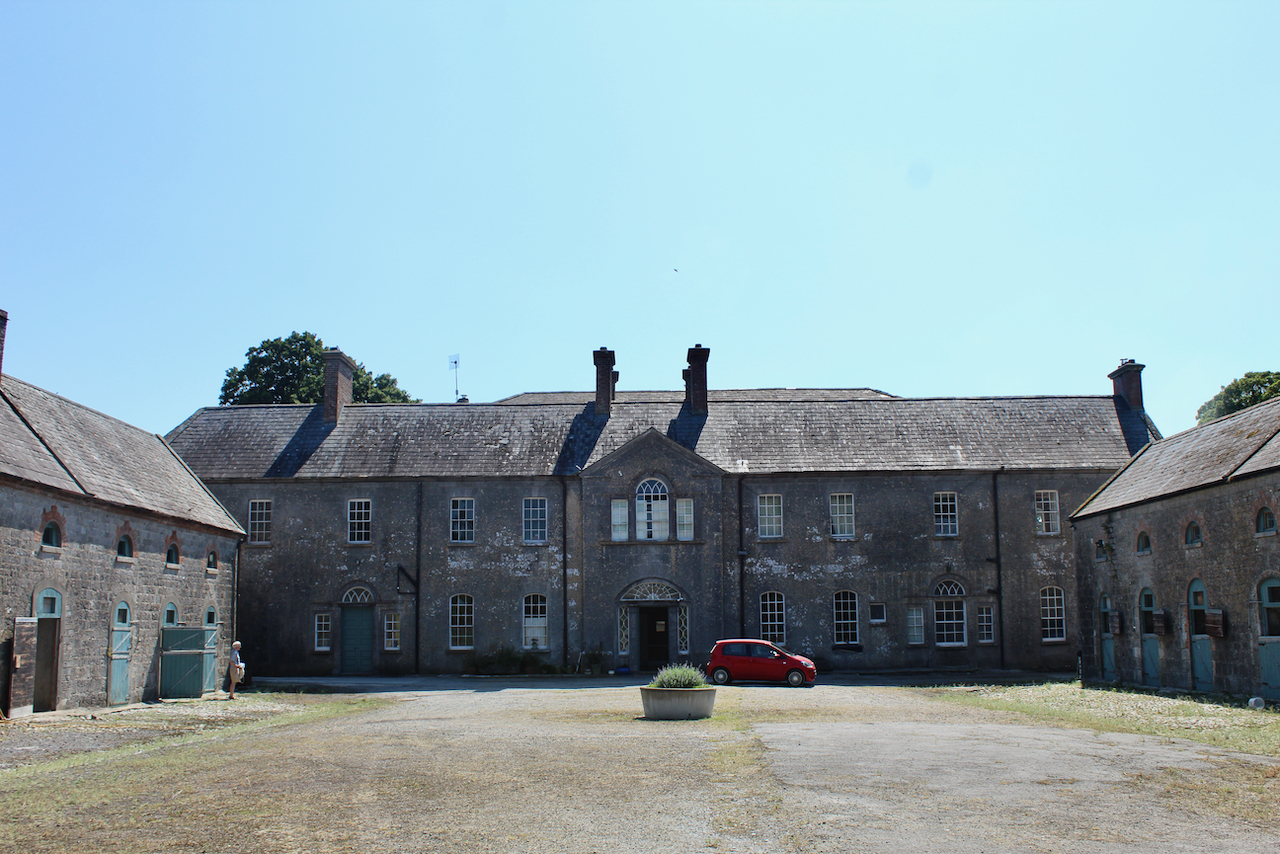
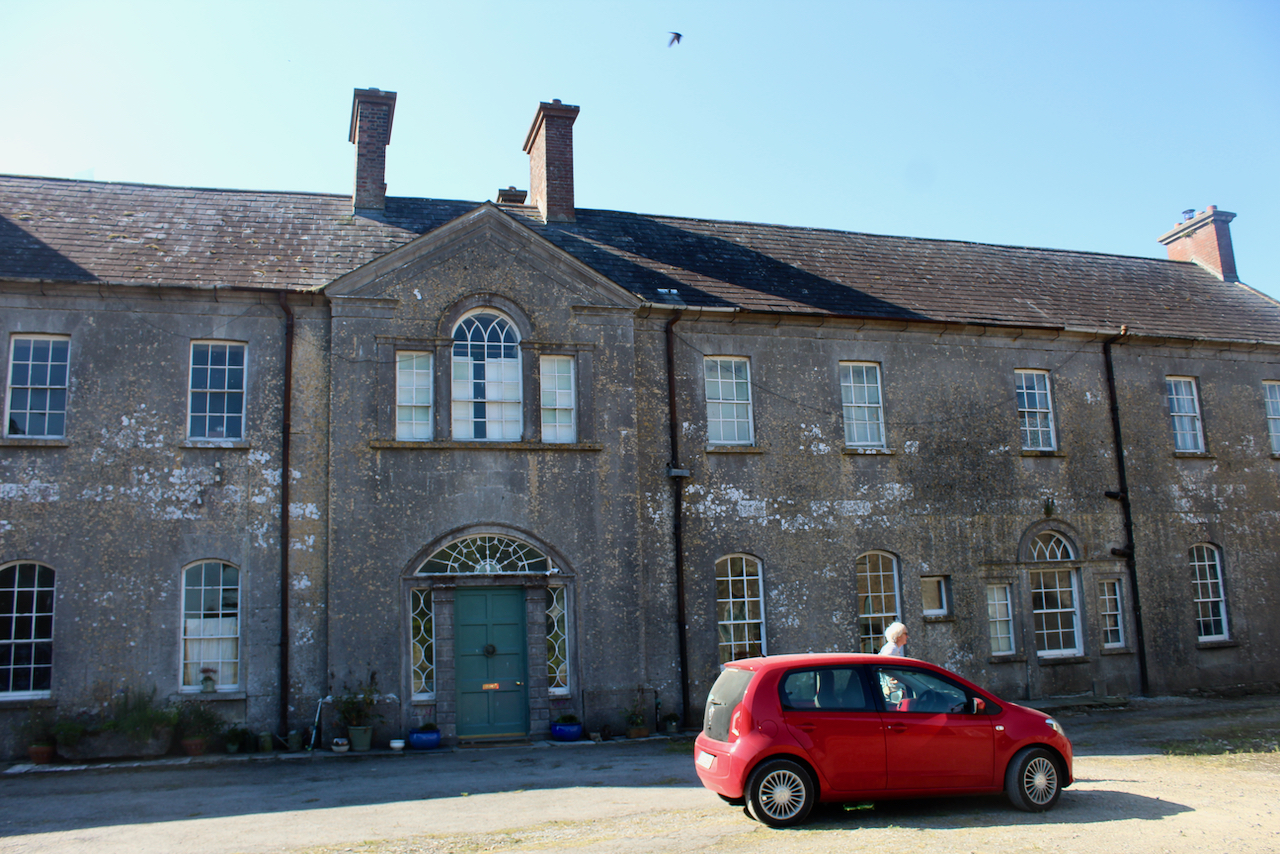
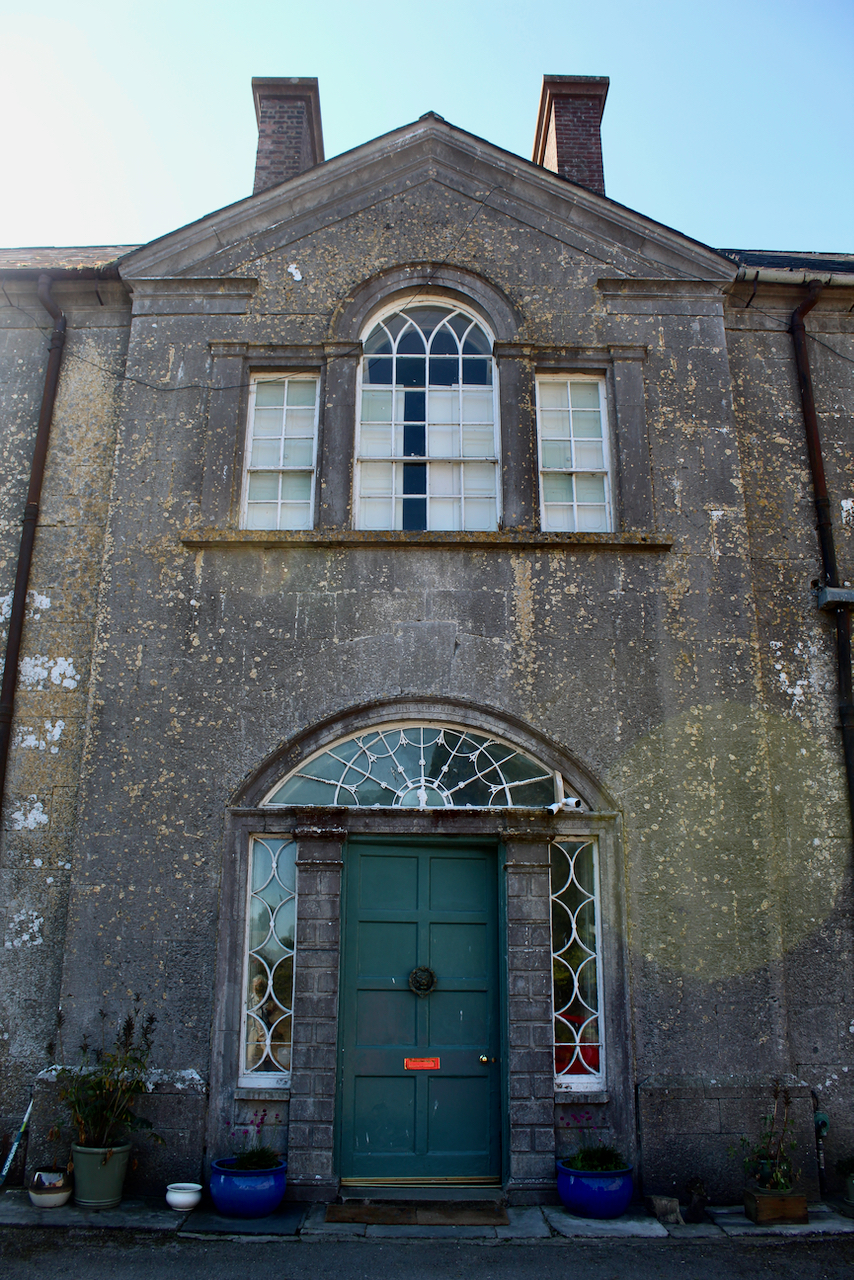
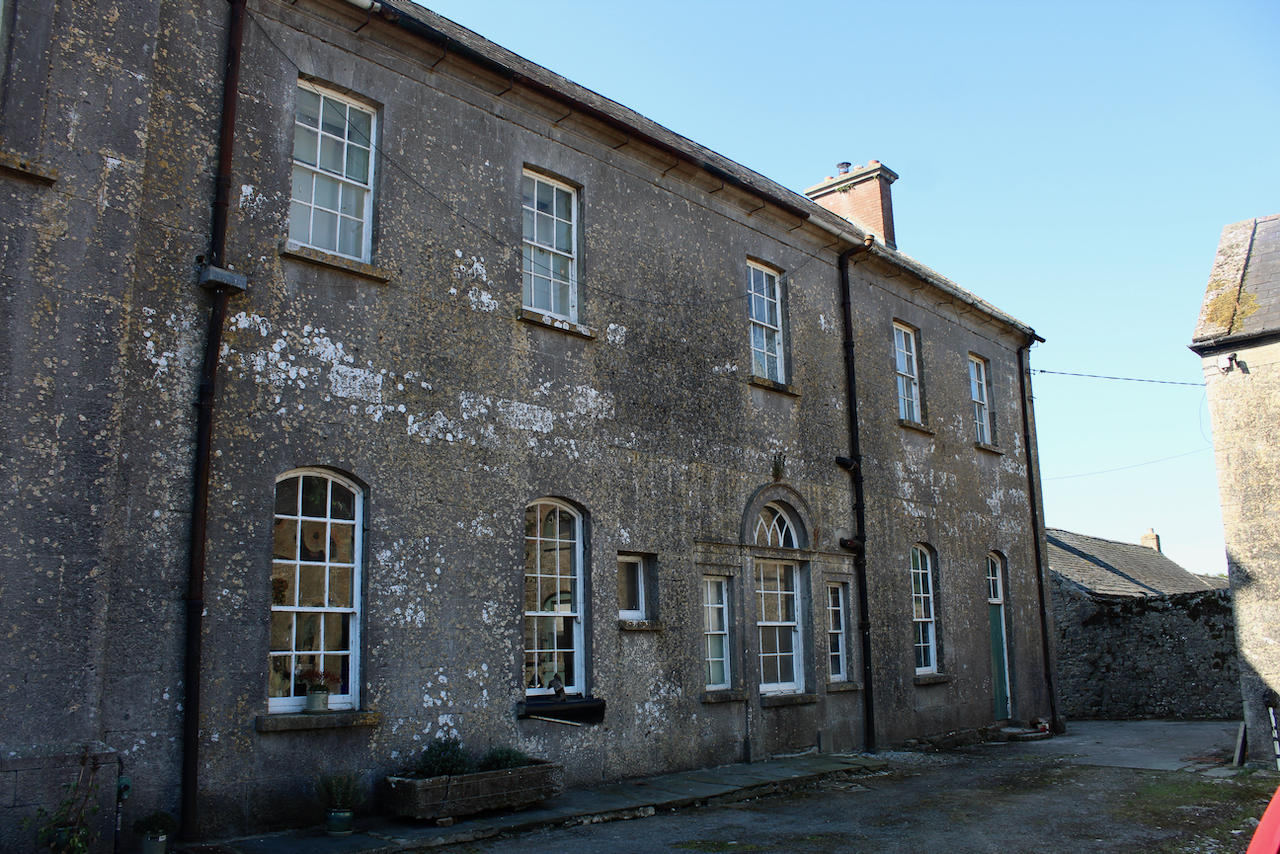
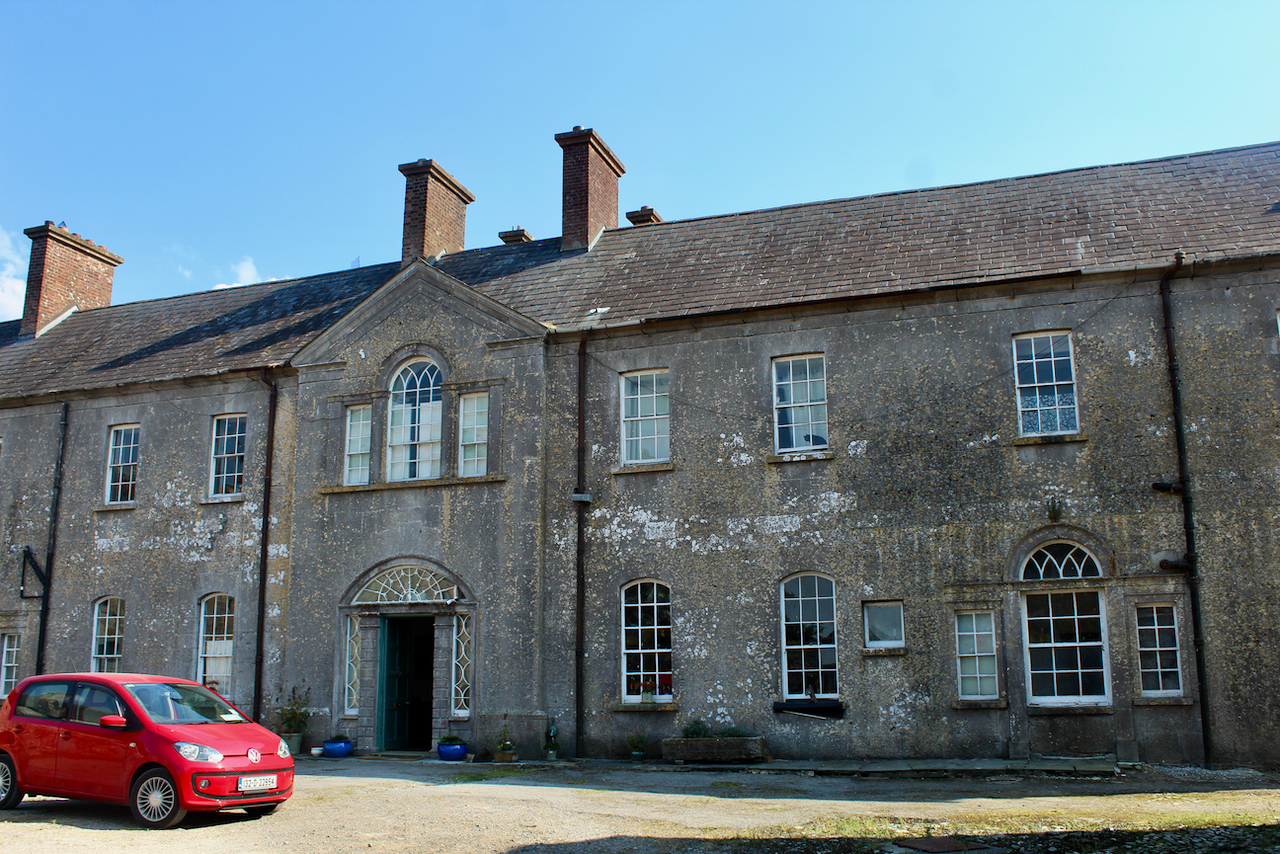
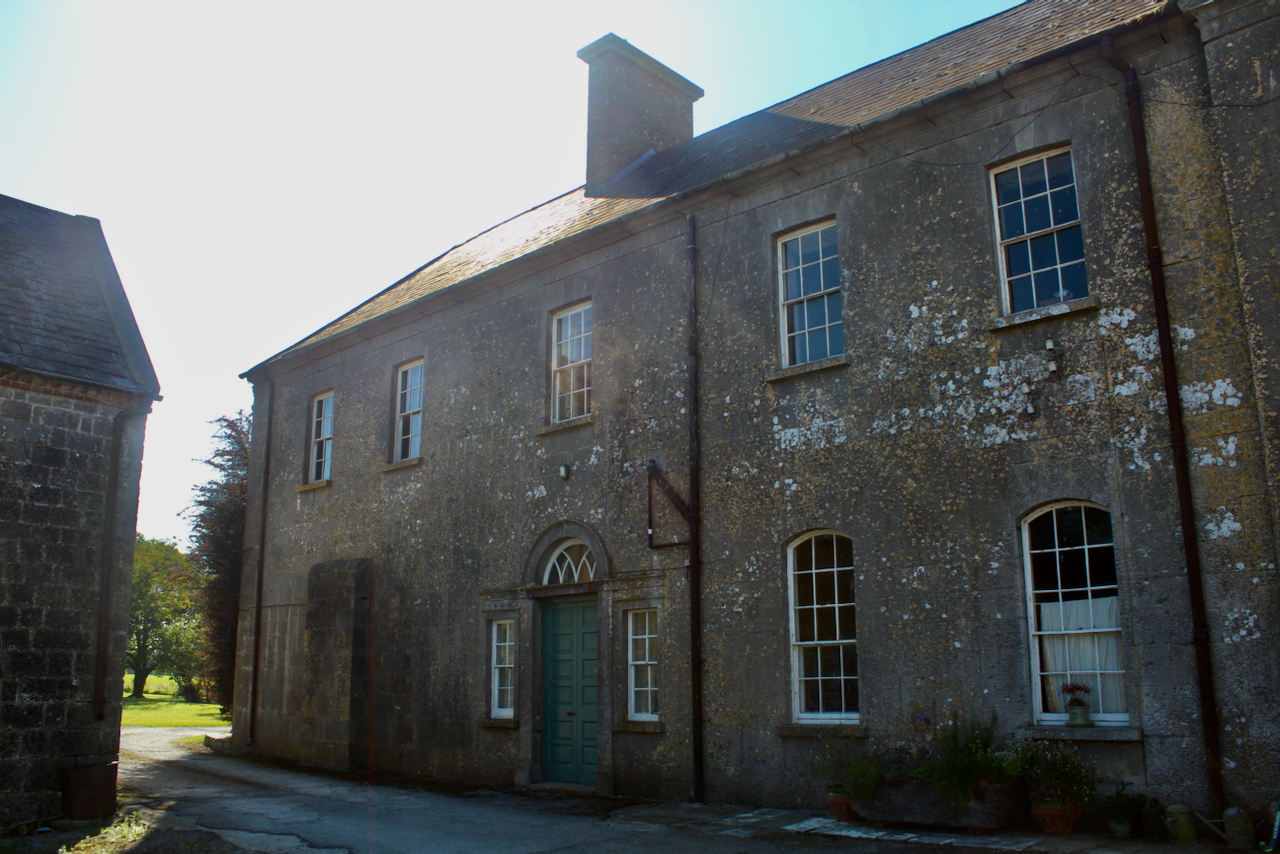
Above is the facade facing in to the courtyard. Mark Bence-Jones refers to this side as the front and the other side as the “back,” the Gothic side with its crenellated roof and limestone hood mouldings over windows and door. The National Inventory refers to this side as the “rear,” it is the north side of the house. It has a central pedimented breakfront and a Venetian window over the door, which is now the main entrance to the house. The doorway has side windows and a fanlight above with cobweb pattern and the door is set between two limestone pilasters. A second door also has similar tripartite setting of fanlight and sidelights. On the other side of the entrance door instead of the second door there is another Venetian window. [2]
“The oldest evidence of habitation at Ash Hill is what is believed to be a long barrow grave dating somewhere between 4000 and 2000 B.C. This was described in letters written by Eileen Foster, an American visiting her ancestral home, Ash Hill, in 1908. Miss Foster wrote “close to the avenue, as they call it, although there are trees on only one side of the road, is a large green mound which is supposed to mark the burial place of one of the Irish chieftains and a number of his followers. It was the custom in those days to bury a dozen or so of his slaves with every chieftain. Father says he would like to explore the spot, but not a man could be found who would put a spade into the sacred earth”.
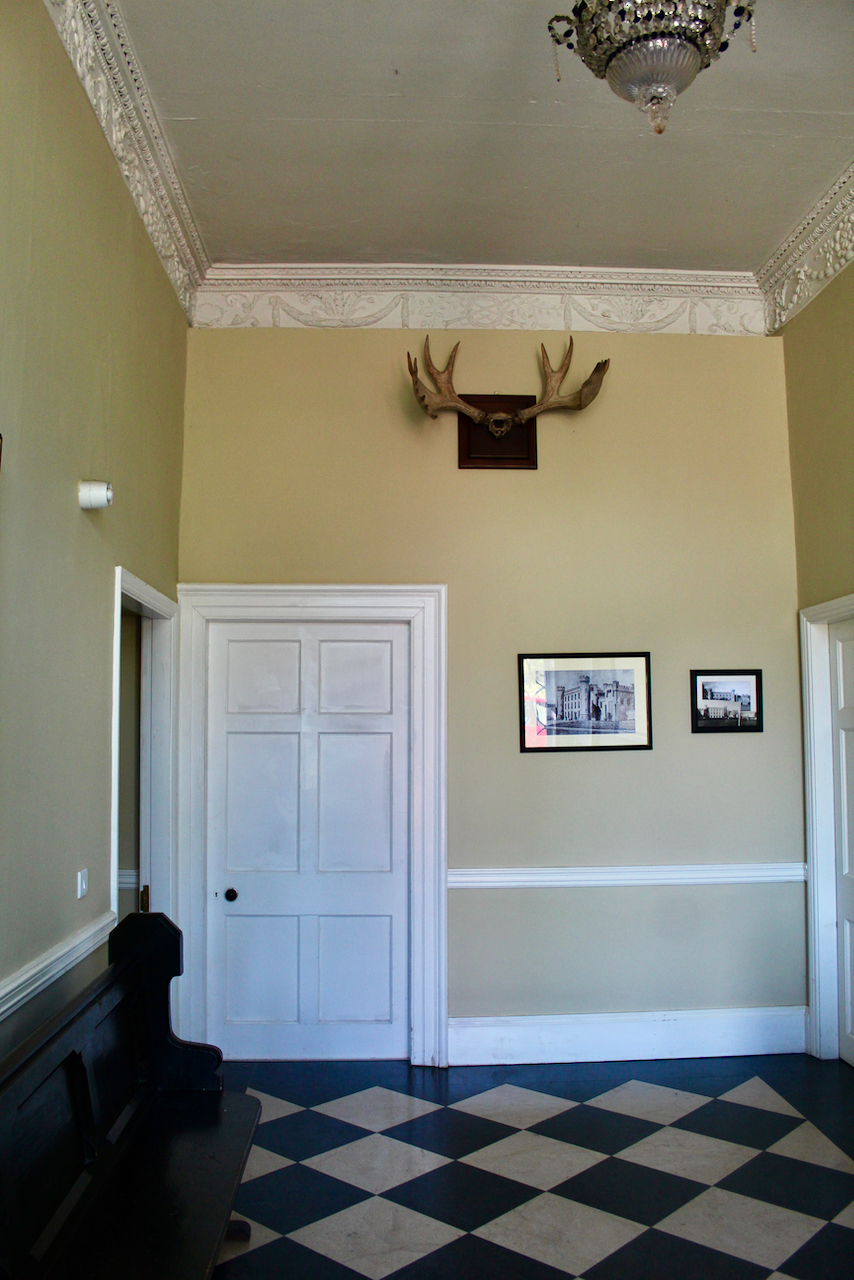
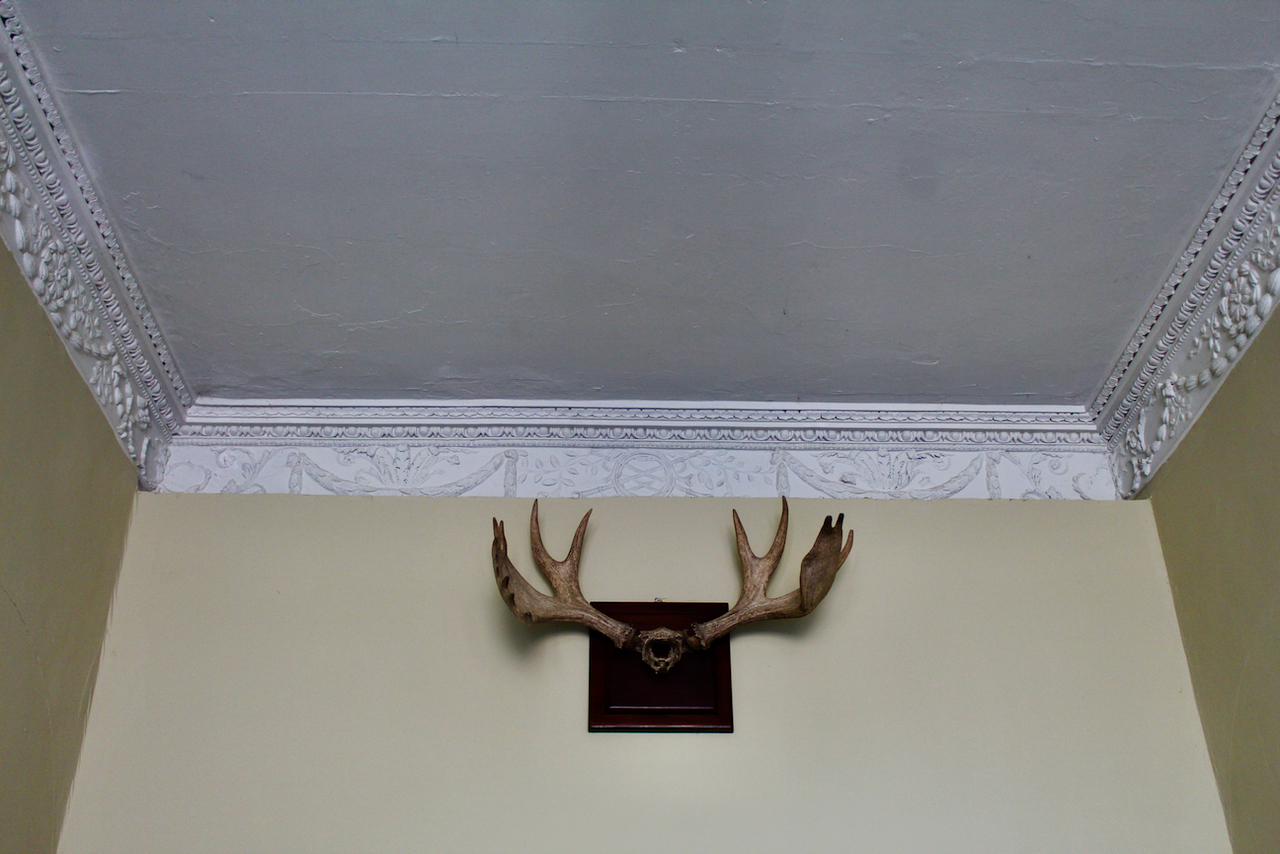
“Also on the estate, beside the site of an old lake, there are the remains of a crannog (an Irish house built on a small island) usually dating prior to 1000 A.D. The lake was drained in the 1915 and during this process, the remains of numerous Irish Elk (deer from the interglacial period) were discovered.
“Close to the lake, overlooking the town, is the site of Castle Coote, birthplace of Lieutenant General Sir Eyre Coote, conqueror of India. This castle was demolished in the later half of the eighteenth century.
“The courtyard to the main house was built sometime between 1720 and 1740 and it was sympathetically restored in the 1950’s by the late Mrs. Denny Johnson. The present house, which overlooks this courtyard, was built by Chidley Coote in 1781.“
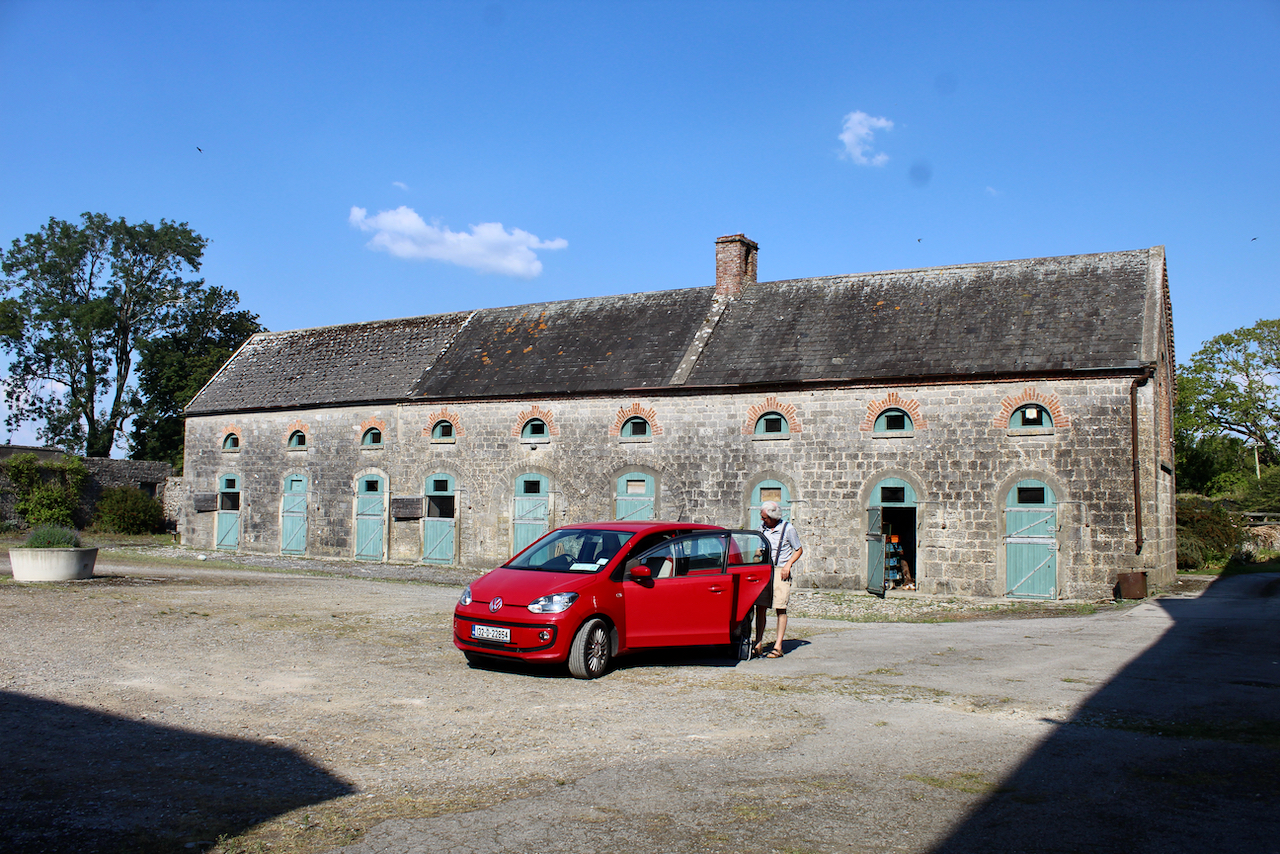
The entrance door faces on to a stable courtyard. The stables have lovely lunette half-moon windows surrounded in red brick.
There are two entrance halls, one for each of the doors facing into the stable yard. Both have beautiful plasterwork.
The website tells us: “The first recorded ownership of Ash Hill was in 1667 when Chidley Coote acquired the property from Catherine Bligh.” [3]
Lt-Col. Chidley Coote (c. 1644-1702) married Catherine Sandys and had a son, who became Reverend Chidley Coote (1678-1730). He lived at Ash Hill. He married Jane Evans, daughter of George Evans (1658-1720) of Bulgaden Hall, County Limerick, MP for Limerick. Jane’s mother was Mary Eyre, of Eyrecourt, County Galway, and it is thanks to her that the name “Eyre” entered the family.
A daughter of Lt.-Col. Chidley Coote and Catherine née Sandys, Catherine, married Henry Boyle, 1st Earl of Shannon.
Henry Boyle, 1st Earl of Shannon by Stephen Slaughter.
Reverend Chidley Coote (1678-1730) and Jane née Evans had a son in 1726, Eyre Coote (ca. 1726-1783), born at Ash Hill which was known as Castle Coote at that time. Castle Coote in County Limerick is not to be confused with Castlecoote in County Roscommon, another Section 482 property. See my entry https://irishhistorichouses.com/2025/09/17/castlecoote-house-castlecoote-co-roscommon/ .
The Ash Hill website tells us: “General [Eyre] Coote went on to become one of the greatest military tacticians of the eighteenth century with numerous victories to his credit, including winning India from the French in the Seven Years’ War and defeating Hyder Ali despite being outnumbered by almost twenty to one. This same victorious pattern was to be repeated in battles throughout the war.“
Lieutenant General Sir Eyre Coote (1726-1783) Commander-in-Chief in the East Indies (1777-1783) by John Thomas Seton, courtesy of the British Library.Eyre Coote (1726-1783) attributed to Henry Robert Morland, c. 1763, National Portrait Gallery of London NPG124.
I am currently reading a book about George Macartney (1737-1806), Earl of Lissanoure, County Antrim, an ancestor of my husband Stephen. He worked for the East India Company for a few years in India and himself and Lieut. Gen. Eyre Coote disagreed with each other and took a dislike to each other!
George Macartney (1737-1806) 1st Earl, by Joshua Reynolds, courtesy of National Trust Petworth House.
As well as Lt-Col Eyre Coote (1726-1783) there were three sons of Reverend Chidley Coote (1678-1730) and Jane Evans: Robert Coote (d. 1745) who married Anne Purdon of Ballyclough, County Cork (now partly demolished); Reverend Charles Coote (1713-1796) who married Grace Tilson; and Thomas Coote who married Eleanor White of Charleville, County Cork.
Reverend Charles Coote (1713-1796) had a son Charles Henry Coote (1754-1823) who became 2nd Baron Castle Coote on 2 March 1802. Another son of Reverend Charles was Lt-Gen. Eyre Coote (1762-1823) who was Governor of Jamaica.
The website continues: “Coote’s nephew, Sir Eyre Coote, who was born at Ash Hill in the late eighteenth century, became the Lieutenant Governor of Jamaica between 1806 and 1808. It has been said that Coote, while living in Jamaica, had a relationship with a slave girl. Although unconfirmed, it is thought that Colin Powell, hero of the Gulf War, may be a descendant of this relationship.“
Major-General Sir Eyre Coote, Governor of Jamaica, date 1805, Engraver Antoine Cardon, After W. P. J. Lodder, Publisher A. Cardon, photograph courtesy of National Gallery of Ireland.
Robert Coote (d. 1745) and Anne Purdon lived in Ash Hill. They had a son, Chidley Coote (1735-1799) who also lived in Ash Hill. He married twice. By his second wife, Elizabeth Anne Carr, he had several children. His oldest son, Charles Henry Coote (1792-1864) inherited the title of 9th Baronet Coote, of Castle Cuffe, Queen’s County on 2 March 1802.
The Landed Estates database tells us about Ash Hill: “The residence of a branch of the Coote family in the 18th century, possibly held from the Barons Carbery. Ash Hill is referred to by Wilson as the seat of Chudleigh Coote in 1786. Bought by Eyre Evans from Chidley Coote in 1794 (see sale rental 6 July 1878). Eyre Evans held the property in fee throughout the first half of the 19th century.” [4]
The Evans family who purchased the property in 1794 were related to the Cootes:
Jane Evans who married Reverend Chidley Coote was the sister of George Evans, 1st Baron Carbery. She also had a brother named Thomas Evans (d. 1753), of Millltown Castle in County Cork. Thomas Evans married Mary Waller of County Limerick, and they had a son, Eyre Evans (1723-1773). Eyre of Milltown Castle married a county Limerick heiress, Mary Williams (d. 1825).
Milltown Castle in Charleville, County Cork, photograph courtesy of National Inventory, home of the Evans family.
Eyre and Mary had a son also named Eyre Evans (1773-1856). It was he who purchased Ash Hill Towers, and who hired Charles Frederick Anderson to renovate. He married Anna Maunsell of Limerick. This Eyre Evans was Justice of the Peace and Deputy Lieutenant of County Limerick.
Eyre Evans (1773-1856) and Anna Maunsell had many children. Their son, another Eyre (1806-1852), lived at Ash Hill, and married Sophia Crofton, daughter of Edward Crofton, 3rd Baronet Lowther-Crofton of The Moate, County Roscommon.
Eyre and Sophia’s son Elystan Eyre Evans (1845-1888) inherited Ash Hill. His father died when he was just seven years old.
The Landed Estates database tells us “Elystan Eyre Evans of Ash Hill Towers owned 2,148 acres in county Cork and 264 acres in county Limerick in the 1870s. Over 500 acres in counties Cork and Limerick including Ashhill Towers and demesne were advertised for sale in June 1877.” [5]
Elystan Eyre Evans married Isabella Smith in 1876, widow of Richard Beardsley, U.S. Consul General in Egypt, but they had no children.
The Ash Hill website continues: “At about the time of the Famine, ownership of the estate passed out of the Evans family and, in 1858, part of the estate was acquired by Thomas Weldon. In 1860, another part of the estate was acquired by Captain Henry Frederick Evans. In 1880, Evans’ widow sold her interest in the estate to John Henry Weldon, a son of Thomas Weldon.
“The Evans family was a large family with many branches that emigrated to New Zealand, Australia, South Africa, England, Canada and U.S.A. One of the branch that emigrated to New Zealand was a prolific writer and much or possibly all of his writings were donated to the Alexander Turnbull library in Wellington, New Zealand.
“The estate passed out of the Weldon family to P.M. Lindsay in 1911. Captain Lindsay sold Ash Hill to Mrs. Denny Johnson in 1946.
“After Denise Johnson bought the property in 1946 she ran it as a successful stud, and she was a successful point-to-point rider with over 50 wins to her name. In 1956 she married Stado Johnson. After many falls she was told to “take up a safer sport then point-to point riding” by her doctor, she took up 3-day eventing and represented Ireland at an international level.
“Today, Ash Hill has been opened to the public and sees a great many people of varied interests. From architects to historians interested in taking a peek at Ireland’s unique past, all are welcome. Ash Hill is still owned by the Johnson family who enjoy sharing their love of history and the outdoors with the public. Most days, Simon and Nikki Johnson can be found wandering around the estate tending to the garden and pastures. For those interested, Simon can be happily talked into a full tour.“
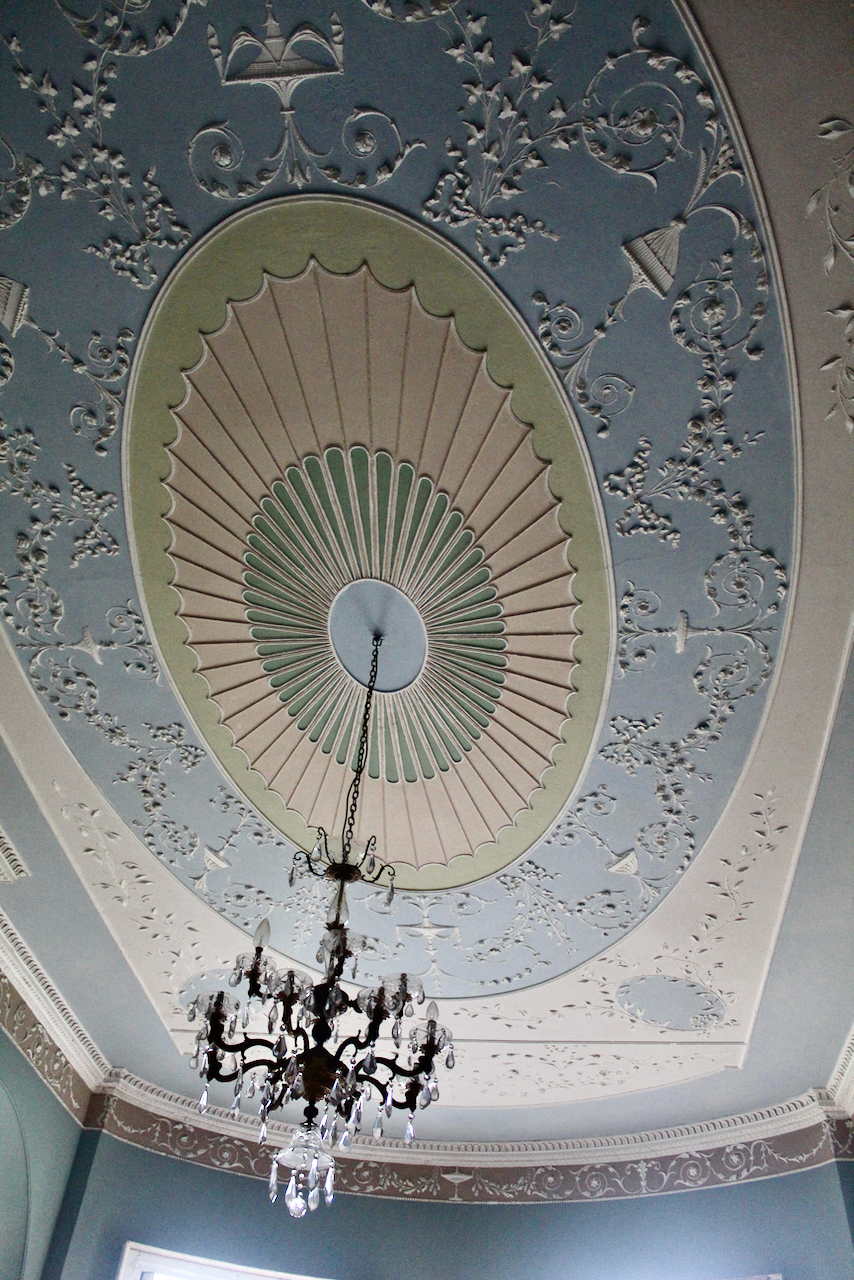
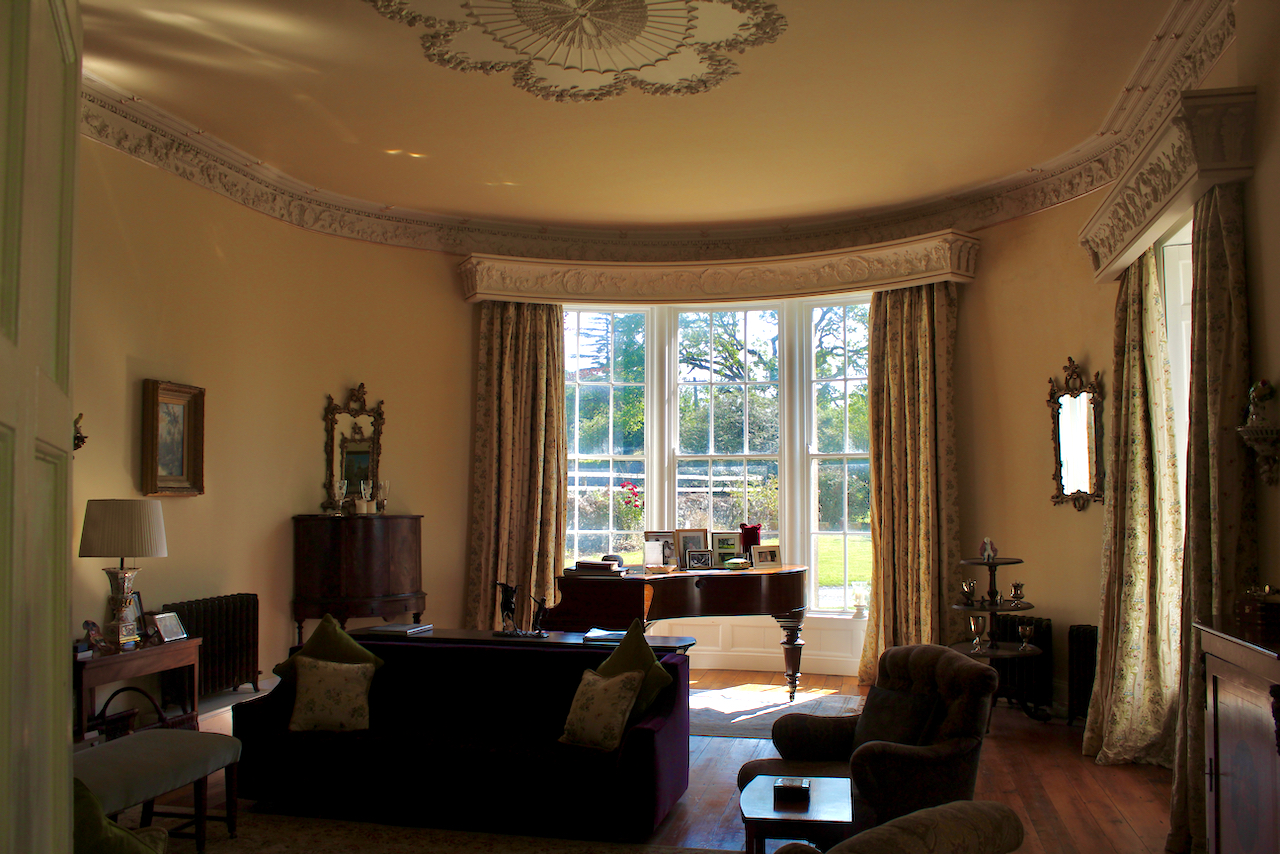
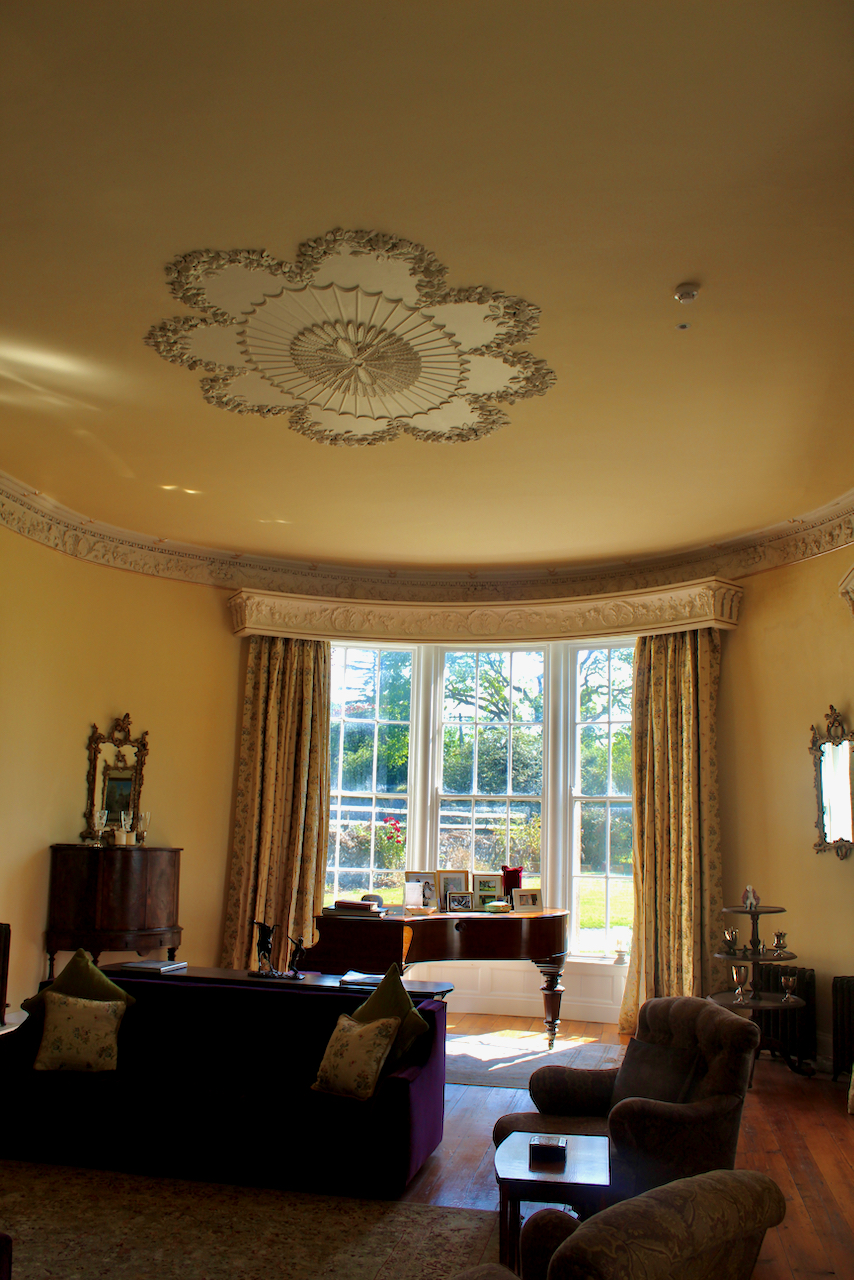
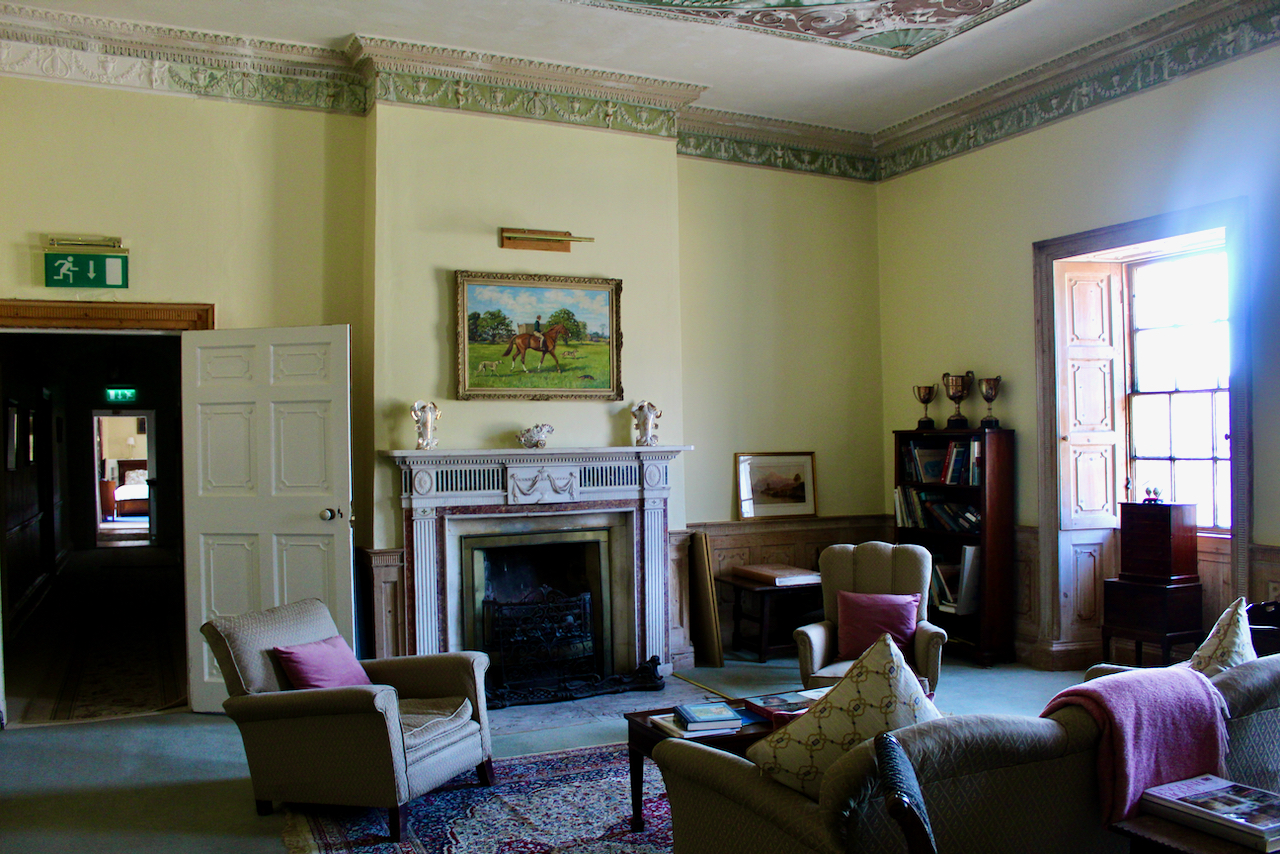
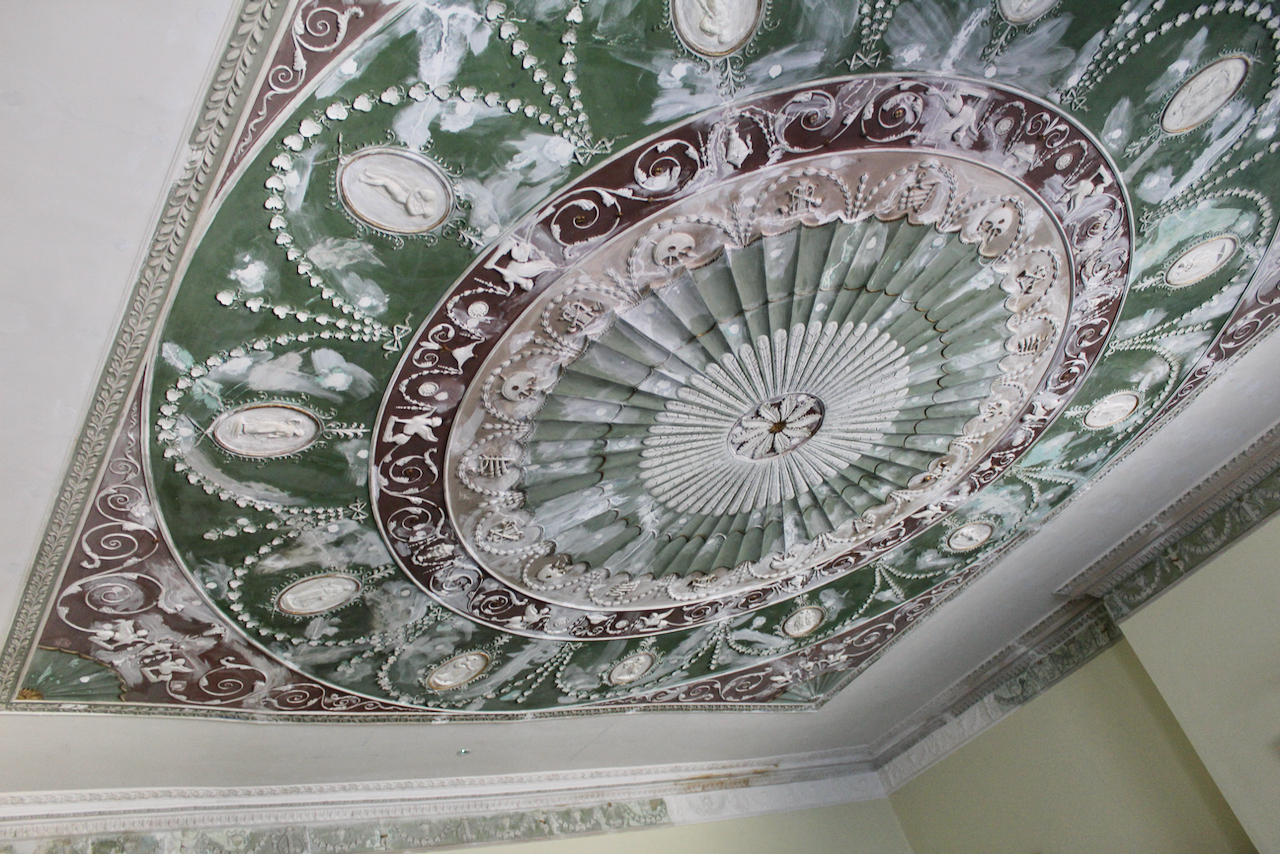
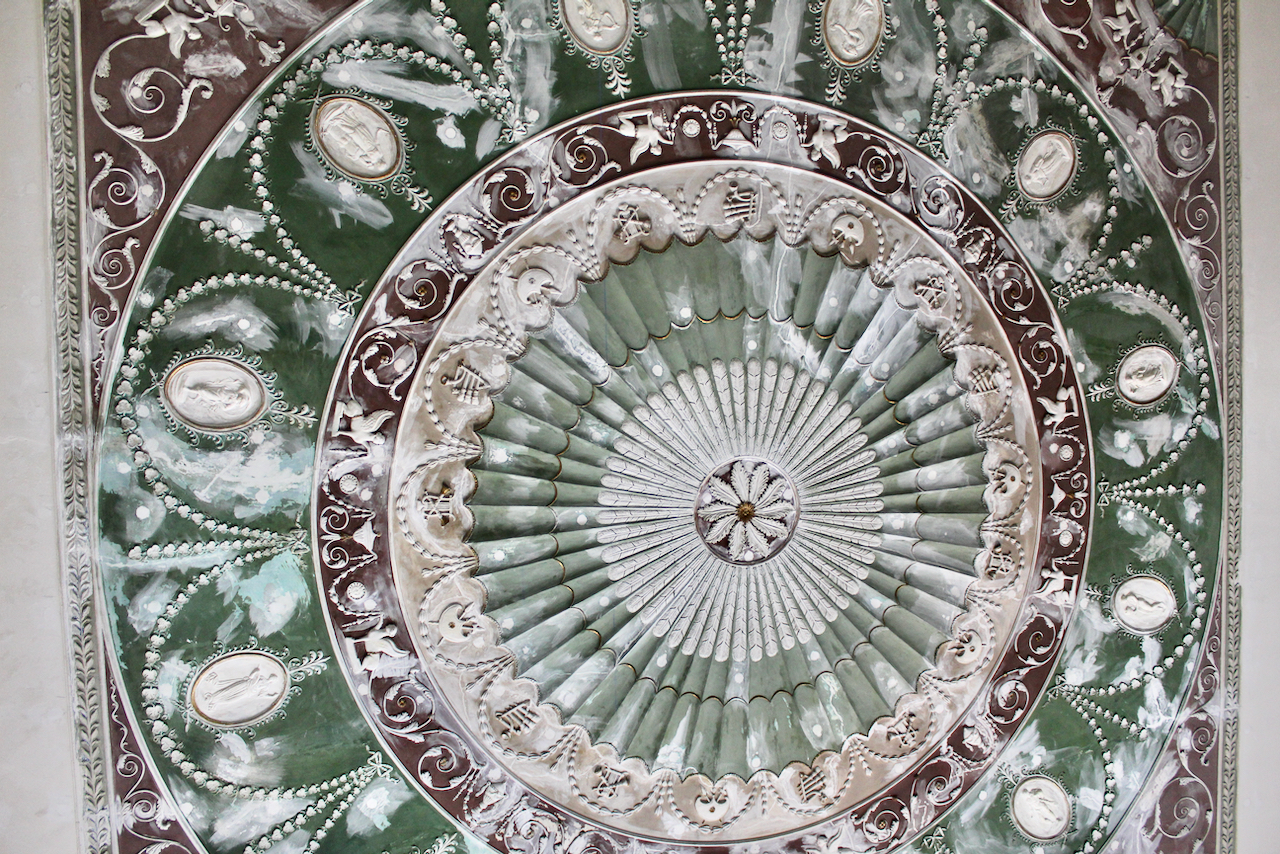
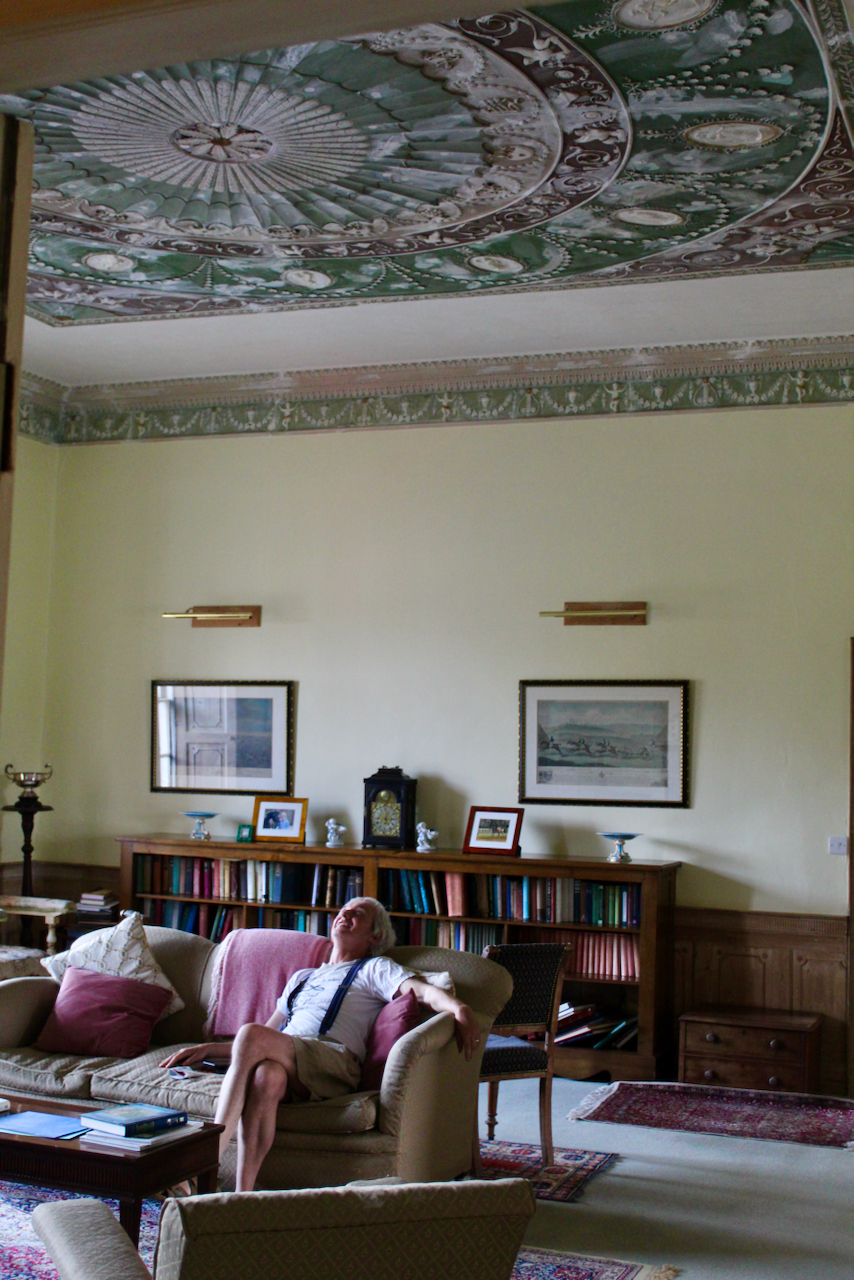
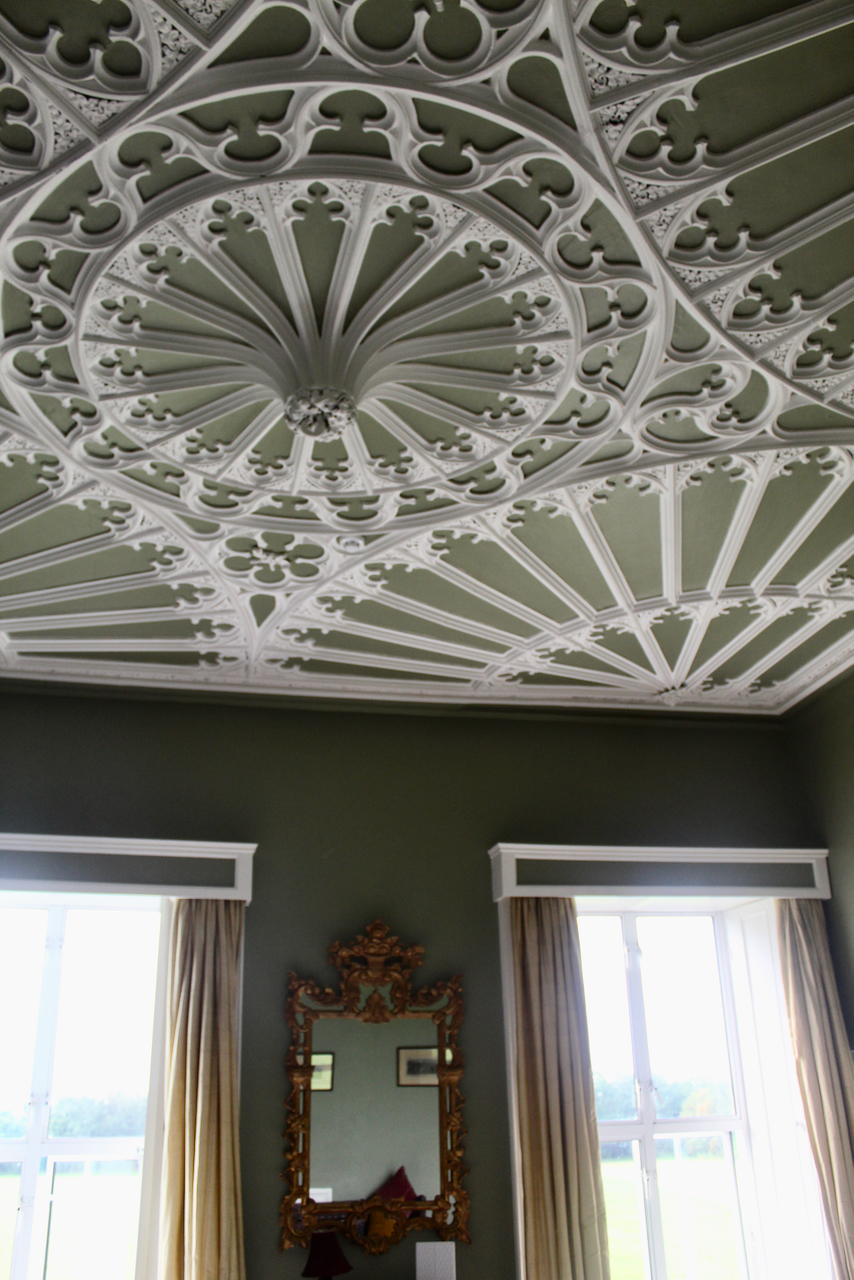
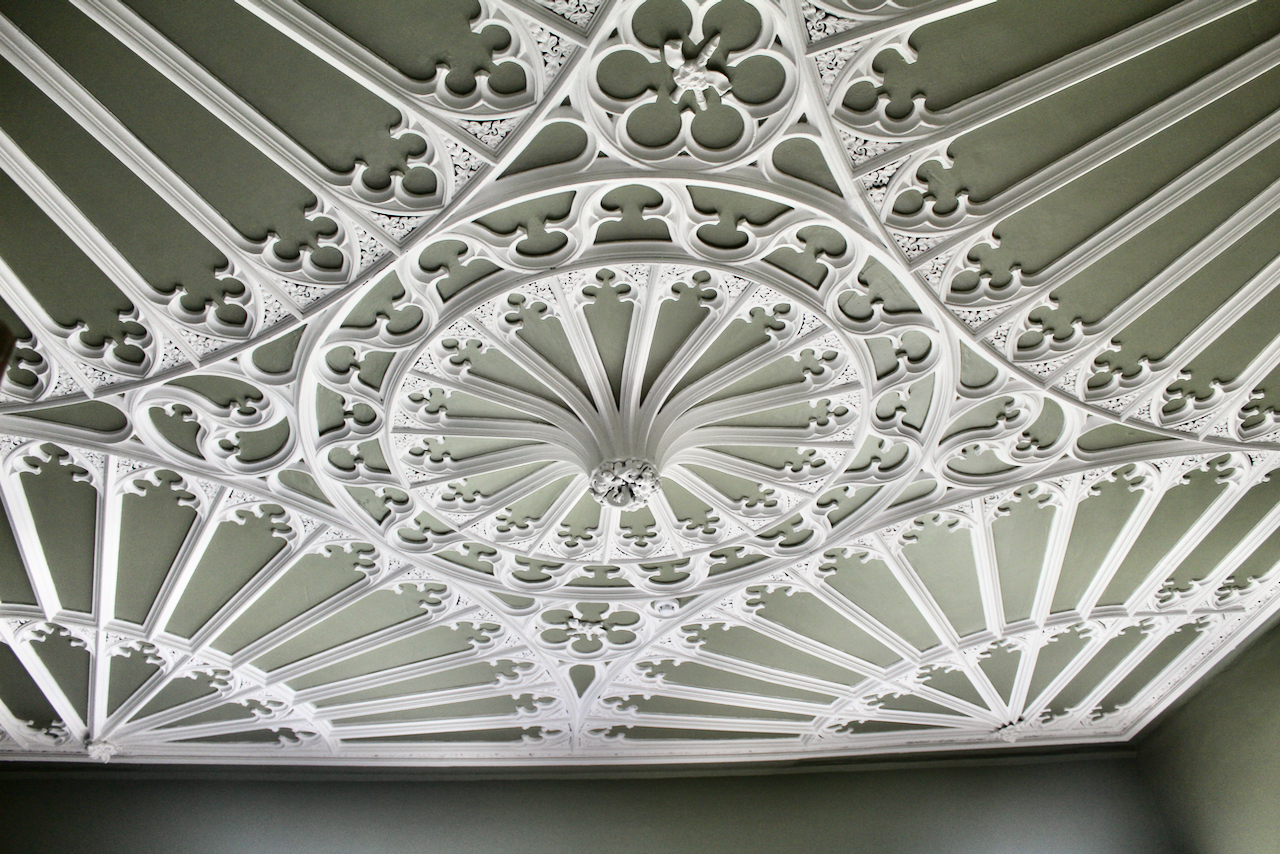
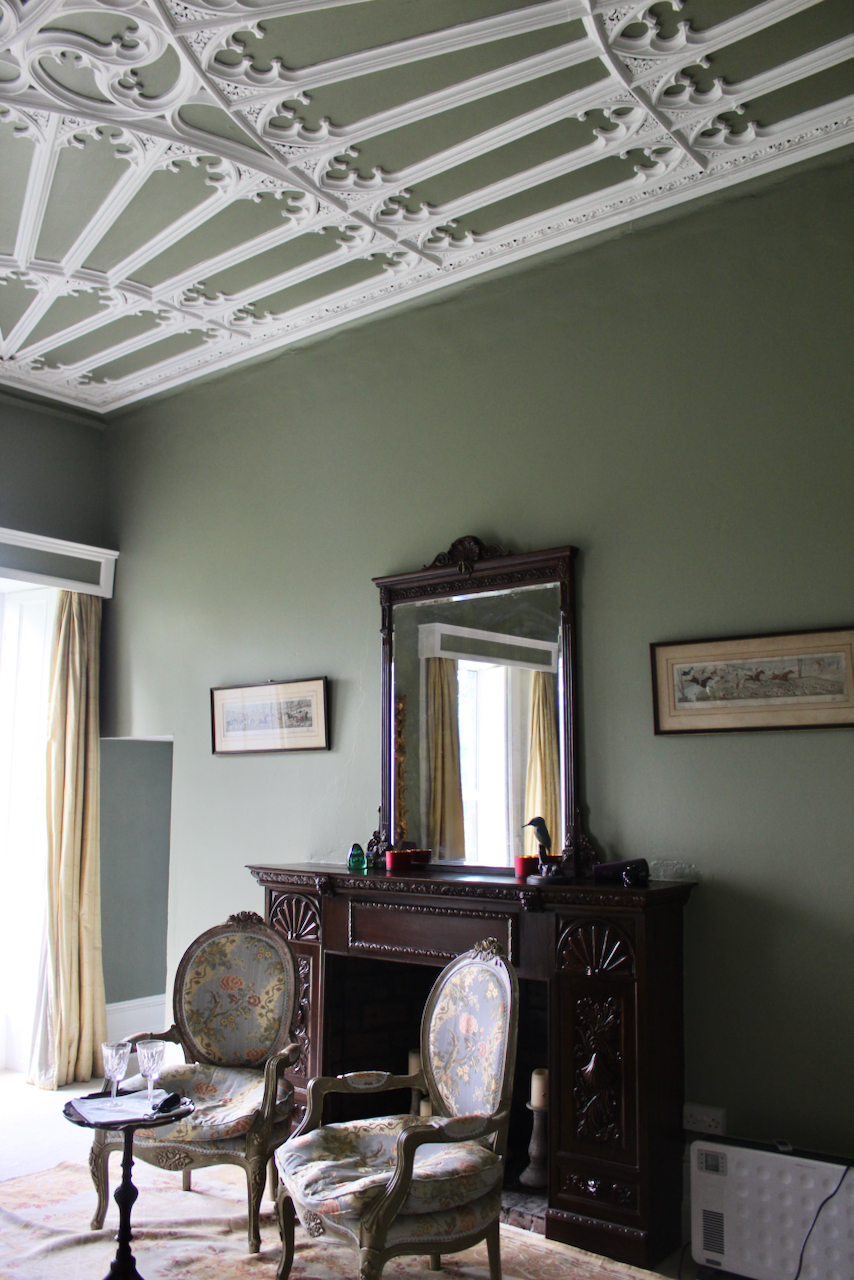
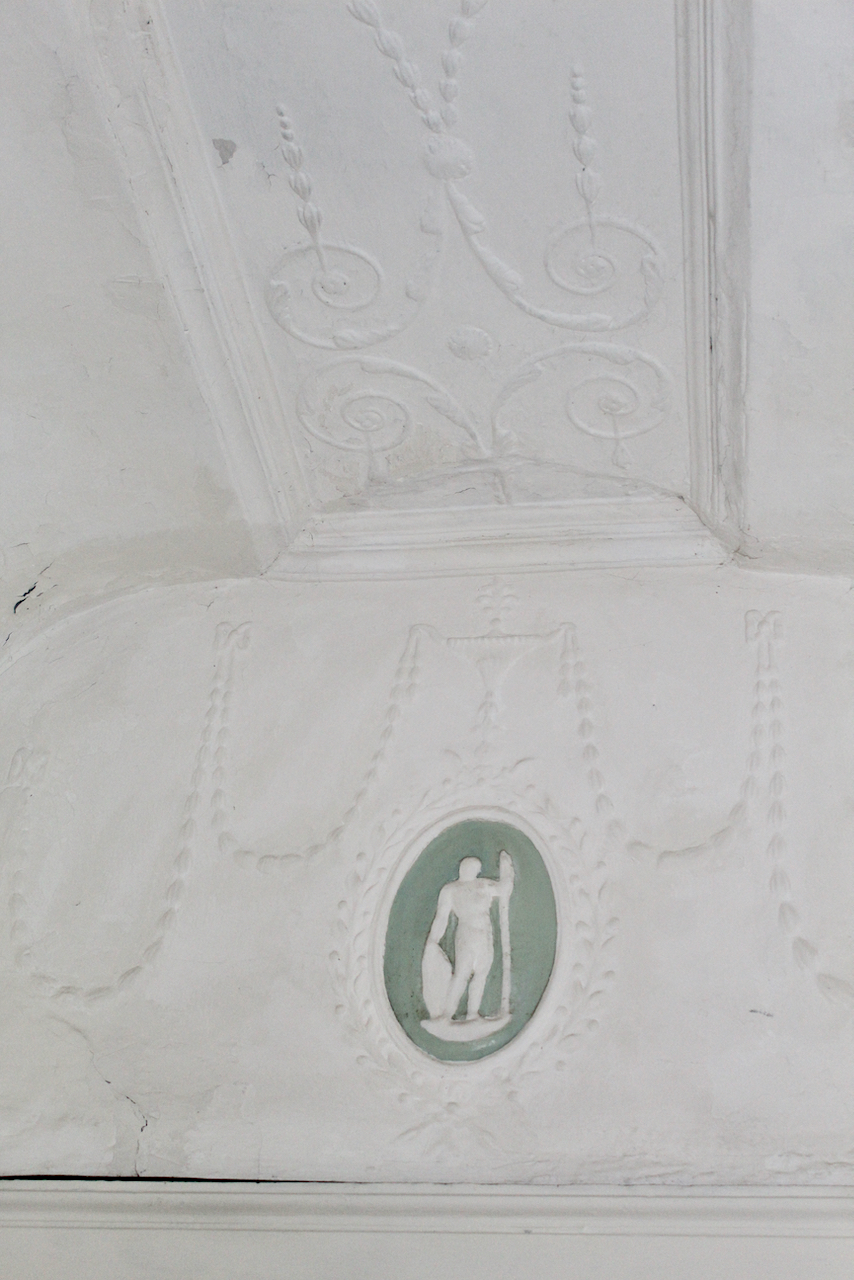
Upstairs, there is another sitting room with another impressive ceiling – this one currently in a state of repair. Mark Bence-Jones says the ceiling is by the same hand as the one in Glin Castle. This is said to be possibly attributable to the Dublin stuccodores Michael Stapleton or Charles Thorpe and dates from 1780s. [6]
The website tells us: “During the “troubled times” the house was occupied by three sets of troops who looted and vandalized the property, using ancient family portraits for target practice. As these “troubled times” were ending, Michael Collins, the Irish leader at the time, visited the house on his way south to what would be his violent and untimely demise at the hands of his enemies. There is a considerable amount of graffiti left on the walls of the top floor rooms which were occupied by both troops and prisoners.” We didn’t see this graffitti!
We had a beautiful stay – you can see how relaxing it is in the surroundings. Nicole was very hospitable and one evening we sat in the drawing room downstairs and shared a great chat. It is a wonderful base for explorations of the countryside.
[1] Bence-Jones, Mark. A Guide to Irish Country Houses (originally published as Burke’s Guide to Country Houses volume 1 Ireland by Burke’s Peerage Ltd. 1978); Revised edition 1988, Constable and Company Ltd, London.
[3] “The first recorded ownership of Ash Hill was in 1667 when Chidley Coote acquired the property from Catherine Bligh.” I think this was either Chidley Coote (d. 1668) son of Charles Coote (d. 1642), 1st Baronet Coote, of Castle Cuffe, Queen’s County, or his son Chidley Coote who died in 1702.
Charles Coote (1581-1642) was born in England and joined the military, held command of an infantry company in Munster from 1601 until some time after 1603. He was granted a reversion to the post of provost marshal of Connacht in June 1605. He built up land possession in Leitrim, Roscommon and Sligo. By 1617 he had married Dorothea, probably the younger daughter of Hugh Cuffe, plantation undertaker in Co. Cork, who brought property in Co. Cork and in Queen’s County to the marriage. He was created 1st Baronet Coote, of Castle Cuffe, Queen’s Co. [Ireland] on 2 April 1621. He had four sons and one daughter; the eldest son, also Charles (c. 1605-1661), became 1st earl of Mountrath.
He had another son, named Chidley (c. 1608-1668). Chidley married a daughter of Francis Willoughby, and secondly, married Alice Philips, by whom he had a son, Lt-Col Chidley Coote (c, 1644-1702), and another son, Philips Coote (b. 10 March 1658).
Lt-Col Chidley Coote (c. 1644-1702) married Catherine Sandys and had a son, who became Reverend Chidley Coote (1678-1730). He lived at Ash Hill. He married Jane Evans, daughter of George Evans (1658-1720) of Bulgaden Hall, County Limerick, MP for Limerick. Jane’s mother was Mary Eyre, of Eyrecourt, County Galway, and it is thanks to her that the name “Eyre” entered the family.









































 Irish Historic Houses