Bence-Jones, Mark. A Guide to Irish Country Houses (originally published as Burke’s Guide to Country Houses volume 1 Ireland by Burke’s Peerage Ltd. 1978); Revised edition 1988 Constable and Company Ltd, London.
p. 228. “(Deane, Muskerry, B/PB; Williamson, sub Heard/LG1969) Originally a house built ca 1750 by Sir Matthew Deane, 4th Bt, MP. Of stucco with cut-stone facings, and with a Venetian window and door in one of its fronts. A new and larger house was built by Sir Robert Deane, 6th Bt, ca 1781, the year in which he became 1st Lord Muskerry; but dismantled almost immediately afterwards. According to the story, he was so horrified by its cost that he ordered it to be dismantled and the material sold after he had inhabited it for only one night. A plain square two storey late-Georgian house with a five bay front was subsequently built here. In C19, Old Dromore became the seat of the Williamson family.”
Bence-Jones, Mark. A Guide to Irish Country Houses (originally published as Burke’s Guide to Country Houses volume 1 Ireland by Burke’s Peerage Ltd. 1978); Revised edition 1988 Constable and Company Ltd, London
p. 164. “(Stawell/LGI1912) A C16 tower-house of the MacCarthys, protected by a turret boawn, incorporated in a C18 house built ante 1750 by Jonas Stawell, which was rebuilt as a castle in mid-C19. Of two storeys over a high basement, and faced in random ashlar; with a battlemented parapet, corner-bartizans and a square tower at one end. Mullioned windows, more of less regularly disposed; pointed entrance doorway opening onto a perron with long twin flights of steps. The castle stands on top of a hill, with wide views over surrounding countryside and down a valley to the sea. The entrance front faces over a bawn, on one side of which there was formerly a less heavily castellated C18 range with a Venetian window. The castle was burnt in early 1920s and stood for nearly half a century as a spectacular ruin; parts of it, including the range with the Venetian window, being demolished. Then, from 1968 onwards, the surviving main building of the castle was restored by Mr Russell Winn.”
Ballyvonare (also called Ballinavonear), Buttevant, Co Cork
Bence-Jones, Mark. A Guide to Irish Country Houses (originally published as Burke’s Guide to Country Houses volume 1 Ireland by Burke’s Peerage Ltd. 1978); Revised edition 1988 Constable and Company Ltd, London.
p. 28. “(Harold-Barry/IFR) A three storey C18 block. 5 bay entrance front; fanlighted doorway with blocking and coat-of-arms.”
Detached five-bay three-storey house over basement, built c. 1750, having two-bay two-storey over basement return to north end of rear, and two lean-to additions with recent single-storey extension also attached to rear. Hipped slate roof, rendered chimneystacks and cast-iron rainwater goods. Roughcast rendered walls with cut limestone cornice and chamfered quoins. Square-headed window openings throughout, with limestone sills, having two-over-two pane timber sliding sash windows to ground and first floors, and smaller square-headed openings to second floor having six-over-three-pane timber sliding sash windows. Nine-over-six pane and six-over six pane timber sliding sash windows to return. Square-headed entrance doorway with Gibbsian limestone surround and moulded cornice, having timber panelled double-leaf doors and rectangular overlight with fanlight tracery, flanked by blind sidelights and approached by limestone steps. Inserted armorial limestone plaque over door dated 1595 and 1693. Additional plaque adjacent, taken from Pennywell house, Limerick. Set in mature parkland landscape. Tree-lined avenue with remains of entrance to south. Former school and derelict row of single-storey houses opposite entrance.
Appraisal
This is an appealing example of a well-proportioned mid-eighteenth-century country house, built by the Harold Barry family. Its substantial size and classical style give this building an imposing presence enhanced by its setting in a mature parkland and planting. It retains much historic fabric such as its sash windows and cut limestone details, and panelled timber door. The continuity of ownership by the Harold Barry family adds to its important as part of the historical landscape of the area. The attendant farm buildings to the north add context to the house.
Farmyard complex, built c. 1820, comprising two-storey ranges of buildings enclosing two yards. Situated to north of Ballinvonear House. Yard to north comprising ten-bay range to north side with pitched slate roof, coursed rubble sandstone and limestone walls, square-headed window and door openings with roughly dressed limestone voussoirs, and elliptical-arch vehicular entrances with cut-stone voussoirs. Yard to south having L-plan range to north and east sides, with hipped corrugated-metal roof, roughly dressed sandstone walls, square-headed window openings to ground floor with roughly-dressed stone voussoirs, round-headed openings to first floor having red brick voussoirs, and segmental-arch vehicular entrances having cut-stone voussoirs. Rubble stone boundary wall and house to south. House is two-storey, having one bay to first floor and two bays to ground floor, pitched corrugated-iron roof, rendered chimneystack, rendered rubble stone and red brick walls, six-over-six pane timber sliding sash windows with metal railings and timber battened door.
Appraisal
This is an attractive well-built farmyard complex associated with Ballinvonear House. The combination of red sandstone and limestone used along with the high quality of the stonework gives the buildings distinctive character.
In O’Hea O’Keeffe, Jane. Voices from the Great Houses: Cork and Kerry. Mercier Press, Cork, 2013.
p. 32. M.F. Cusack writes in The History of Cork that Buttevant derived its name from the war cry of the Barrys, “boutez en avant!’ which roughly translates as “push through!”
The fine old house at Ballyvonare, built in the 1740s, is now occupied by Charles and Catherine Harold-Barry and their daughter Phoebe. Charles has lived at Ballyvonare since 1987, after it came to him with the estate in 1986, and Catherine arrived there on their marriage in 2004. It is believed that an earlier family home stood in a wooded area to the east of the present building.
[Charles Harold-Barry:] “My great-grandfather was Harold Philip Harold-Barry, who married Helen Riddle of Hermeston Hall in Doncaster in 1895. Their children were my grandfather Basil, my grand-uncles Charlie, and Peter who lived in Skibbereen, my great-aunts Hilda and Ethel, and Great-Aunt Eileen, who moved to the Harold-Barry house at nearby Ballyellis.”
According to family papers, Philip Barry, brother of John Barry of Ballyvonare, obtained a lease on Lower Ballyellis in 1781 from Westropp Watkins of Oldcourt in Doneraile. Historian Dr. John O’Donovan (1806-61) wrote that the name Ballyellis may be translated as “Eliza’s Town.”
“My grandfather Basil had three children,” continues Charles Harold-Barry. “They are my father Robin, my uncle John, who lives at Cordangen in County Tipperary, and my uncle David, who is a Jesuit priest in Zimbabwe…. I was born in Ghana in west Africa, where my father Robin Harold-Barry worked as a civil engineer. Three months later, the family moved back to the north of England and later to Buckinghamshire, where I grew up. After school I went to the Royal College of Agriculture at Cirencester where I spent two years until [p. 33], following the death of my great-uncle Charlie Harold-Barry in 1986, I came to live at Ballyvonare and took over the running of the family farm.”
Charlie Harold-Barry was a brother of Charles’s grandfather, Basil.
Following the [first world] war, Charlie Harold-Barry returned once more to Ballyvonare. “My grandfather Basil Harold-Barry went off to Canada. He worked his passage on a boat to Alberta, and later was employed as a lumberjack and cowboy. The story goes that when he was leaving the house here, an uncle gave him £10, and before he had gone as far as the railway station, somebody from the house was instructed to go after him and retrieve the £10, as money was very tight!”
Charlie signed over the farm to his nephew Robin Harold-Barry, Charles’s father [p. 34], in 1973. The property was entailed (a legal instrument whereby only specific heirs could inherit) and on Charlie’s death it would automatically have passed to his brother, Basil Harold-Barry. However, because of the problems with death duties and taxes that this would have created, it was decided that the entail would be broken, and as a result, Ballyvonare came to Charles’s father Robin instead. Robin continued to live in England, while Charlie still farmed the land at Ballyvonare.”
“When I was a child, we would visit Ireland at least once a year, and I really loved it,” Charles declares. “My grandfather had a place in south Tipperary, Cordangen Manor, which now belongs to my uncle, John Harold-Barry. We would stay there and would also visit Ballyvonare. …I liked the idea of taking over and trying to restore the family farm here at Ballyvonare, and keep it going.”
When Charles was eleven years old, his father gave him the option of taking over Ballyvonare when he was an adult. Folloying the death of his great-uncle Charlie Harold-Barry in 1986, Charles came to Ballyvonare.
p. 35. [Charlie’s] wife, Mary “Molly” Sherlock, was a relative of Sir John Nugent of Ballinlough Castle in County Meath. She was a little younger than her husband, and a year after his death, some months following my arrival at Ballyvonare, she moved to a bungalow in Doneraile which she had previously purchased.
“I took over the house and a portion of the land without any livestock and without any money. The house was quite run down. There was a small parcel of land on conacre [rented out] and that was the first money I got in. Then I had to borrow money to buy stock, and nothing could be invested in the house at that time. Even today it is an uphill battle…”
Until his marriage to Catherine Reid in 2004, Charles lived alone at Ballyvonare. SEveral people worked on the farm and the house was run by Mary Lane, who was employed there for over fifty years, most of that time in the employ of Charlie and his wife Molly.
Catherine Harold-Barry, who comes from Birr in Co Offaly, was introduced to her future husband by a mutual friend at the Dublin Horse Show. When she came to Ballyvonare on her marriage in 2004, the condition of the house was quite poor.
p. 36. “After we married, the first thing that had to be tackled was the roof, as a lot of water was coming in adn there were buckets and pans everywhere to try to catch it! We’ve gradually started a programme of renovation. The work on the roof is now finished, and we’ve begun to work on the windows.”
The long avenue leading to the old house is lined with ancient beech trees, though which the summer sun dapples the grass beneath, just as it has done for generations past.
“Quite a few of the trees are nearing maturity now, as beeches have a life span of about 250 years,” Charles explains.
The Harold-Barry family has lived undisturbed and unhindered at Ballyvonare through difficult times in Irish history, and charles has his own theories abotu the reasons for this positive experience. “We’re a Catholic family, and we are konwn to have looked after the people during the Famine in the 1840s, when the family kept four hundred people going. We still have a 250 gallon cauldron, or “famine pot,” used here for cookign food to keep the starving people alive.
Another consideration is that we were never landlords, as such. We have always farmed our own land. In famine times, John Harold-Barry employed local people to work on projects such as building a lake on the grounds, and also on building part of the demesne wall. Trees were planted, and roads and stone-faced banks were built. A third consideration is the fact taht John Harold-Barry had testified at the Doneraile Conspiracy trial of 1829 in favour of an employee who was falsely accused, and saved him from transportation or execution. Daniel O’Connell of Derrynane was involved in that trial.”
p. 37. The Doneraile Conspiracy originated with the secret oath-bound “Whiteboys,” whose activities had begun in 1761 wiht the levelling of ditches erected by landlords around common land that had previously been used for free grazing. Later, they turned their attentions to rents and tithes payable by tenants. They wore white shirts, hence the Whiteboys name by which they wer known. A conspiracy by the Doneraile Whiteboys to assassinate three prominent landowners resulted in shots being fired in an attempt to carry the plan to fruition. Members of the Whiteboys were put on trial in 1829 and John Harold-Barry gave testimoney in favour of an employee at Ballyvonare. In his testimony he said that “no honourable man would act as the police would have me act with regard to the Whiteboys.” The Harold-Barry family had been visited by the Whiteboys in the 1820s, when they came seekign guns. The famliy had hidden the firearms in a tunnel near the house, so the raid was unsuccessful, though some disturbances did occur.
A map of the estate dating from 1857, when the property was in the hands of John Harold-Barry, outlines in detail the boundaries and the acreage. “It looks the same today,” charles explains. “The main estate of 450 acres is Ballyvonare. Later on, lands at Kilcolman Middle were purchased by the family.”
On the Ballyvonare estate are the remains of Kilcolman Castle, where the poem Edmund Spenser lived for some time in the late 1500s, and where he laboured on his defining work The Faerie Queen.
Harold-Barry of Ballyvonare House and Ballyellis House
This branch of the extensive and consistently Roman Catholic Barry family have probably held lands near Buttevant since medieval times, but I have been unable to trace their lineage with any certainty further back than John Barry (d. 1793), who lived at Ballyvonare in the late 18th century and may have built the present house there. At his death in 1793 he left an only daughter and heiress, Mary (fl. 1788-1824), who married in 1788 Richard Harold of Limerick, whose family claimed Viking origins and was certainly prominent in Limerick and before that in County Dublin over several centuries. John Barry left his estate to Richard and Mary’s second son, John (c.1790-1867), on condition that he took the additional name Barry, which he did on coming of age in 1811. During his long minority, Richard and Mary occupied the house, but when John Harold-Barry came of age and came into his inheritance they moved out. John married twice but had children only by his short-lived first wife, and of these only one survived infancy. This was John Harold-Barry (1823-98), to whom the elder John seems to have handed over the estate soon after his marriage in 1860, retiring to a slightly smaller house called Castle View at Buttevant, which he may have rented from the Croft family.
The younger John Harold-Barry had fourteen children, of whom only eleven survived infancy, while two more of his sons died unmarried in early manhood while serving as soldiers. The boys were all educated at Catholic boarding schools in England, establishing a family tradition. In about 1875 he bought Ballyellis House from the Langley family and a few years later he inherited the lease of lands adjoining it from Barry cousins who had held them from the Doneraile Court estate since the 18th century; he later bought the freehold of these lands to consolidate and secure the property as part of the estate. When he died in 1898, he left Ballyvonare to his eldest surviving son, Harold Philip Harold-Barry (1865-1944). His second surviving son, Edward Daniel Harold-Barry (1872-1950) having become a Catholic priest, Ballyellis was left to the next eldest surviving son, Philip James Harold-Barry (1874-1940), who lived at Ballyellis until his death but never married.
Harold Philip Harold-Barry (1865-1944) was married in 1895 and over the next fourteen years he and his wife produced four sons and four daughters. His eldest son was killed in the First World War, in which his second son, Charles William Harold-Barry (1897-1986) also fought. Although wounded in a valiant action for which he was awareded the Military Cross, Charles survived the war and was the eventual heir to Ballyvonare. The two younger sons were too young for the war. Basil Harold-Barry (1901-92) went first to Canada, where he worked as a cowboy and lumberjack for several years, but with the Great Depression the jobs dried up and he decided to try rubber planting in Sumatra instead. He married in Malaya in 1933, but his wife found the climate in Indonesia intolerable so he returned to Ireland to farm, eventually settling at Drangan (Co. Tipperary).
Creagh House, Skibbereen
The youngest of the four sons, Peter Harold-Barry (1909-94) settled at Creagh House, Skibbereen, where he and his wife made a remarkable garden and formed a fine collection of Irish art and antiques. Of the four sisters, one died in infancy, but the other three lived together at Ballyellis, which they seem to have inherited on the death of their uncle Philip Harold-Barry in 1940. In the same year, the youngest sister, Aileen Harold-Barry (1908-2006) married, and she and her husband, Capt. John Esmonde RN (1907-83) brought up their family at Ballyellis, which is now the home of their eldest son, Peter Esmonde (b. 1945), an international charity and development worker.
In 1944 Charles Harold-Barry (1897-1986) inherited Ballyvonare, where he lived until his death in 1986. Having no children to inherit the property, in 1973 he made a lifetime gift of it for tax reasons to his brother Basil’s son, Robin Harold-Barry (b. 1934), a civil engineer living in England. Since Robin’s elder son, Charles (b. 1964) showed an early passion for farming and the estate, it was agreed that he would take over Ballyvonare House and its land on his great-uncle’s death, and Robin conveyed the estate to him in two parts, in 1986 and 1999. Charles married in 2004 and since then he and his wife have made considerable progress with the restoration of the house, which was in poor condition when he inherited it.
Finally, in 1968, Basil’s younger brother, John Harold-Barry (b. 1936), purchased Cordangan Manor near Tipperary with around a hundred acres. This property, which was once the agent’s house for the very large estate of the Smith-Barry family, has now been passed on to John’s son, Mark Harold-Barry (b. 1967), who farms it organically.
Ballyvonare House (also known as Ballinavonear House), Buttevant, Co. Cork
Ballyvonare House: entrance front in 2014.
A handsome five-bay three-storey house, usually said to have been built around 1750, but perhaps likely to be fifteen or twenty years later than that on stylistic grounds. It has roughcast walls, a hipped slate roof, and a stone eaves cornice and quoins. In the centre is a chunky Gibbsian doorcase with narrow sidelights (now blocked) and a fanlight. The sash windows on the ground and first floors of the front elevation lost their original glazing bars in the 19th century when the fashion for plate glass began, but happily these have recently been restored. Set above the front door is an armorial plaque which is said to come from the Harold family’s house called Pennywell at Limerick. At the rear is a two-storey service wing built over a basement, as well as a more recent single-storey extension. The principal rooms have enriched plaster cornices with cast mouldings applied to the surface of the cornice, a detail which supports a slightly later date for the house than is normally given. The drawing room of the house was used as a set for some scenes in the film The Wind that Shakes the Barley (2006).
Descent: John Barry (d. 1793); to grandson, John Harold (later Harold-Barry) (c.1790-1867); to son, John Harold-Barry (1823-98); to son, Harold Philip Harold-Barry (1865-1944); to son, Charles William Harold-Barry (1897-1986); given 1973 to nephew, Harold Robin Harold-Barry (b. 1934); given 1986 to son, Charles Anthony Harold-Barry (b. 1964).
Ballyellis, Buttevant, Co. Cork
Ballyellis House: entrance front of 1807. Image: National Inventory of Architectural Heritage.
A well-preserved five bay late Georgian house of two storeys over a basement, built in 1807 for Henry Langley. The house has rendered walls and chimneystacks and preserves its sliding sash windows with their original glazing bars. The entrance front has a round-headed doorcase with engaged limestone columns and a fanlight, and above it is a plaque with the arms of the Harold-Barry family. At the rear of the hall an archway opens onto the staircase, which is lit by a round-headed sash window in the rear wall. On the rear elevation, the staircase projection is now flanked by symmetrical two-bay two-storey additions of 1905-06, made for Philip Harold-Barry, one of which has a canted bay window on its side elevation. Inside, the principal rooms have simple early 19th century plasterwork. A new stable block was also built in 1905-06.
Descent: built 1807 for Henry Langley (d. 1829); to son, Christopher Langley who sold to his brother Henry Langley (d. 1874); sold to John Harold-Barry (1823-98), who also bought the freehold of some adjacent lands formerly occupied by Barry cousins and leased from the Doneraile Court estate; to son, Philip Harold-Barry (1875-1940); to niece, Aileen Mary Harold-Barry (1908-2006), wife of Capt. John William Esmonde; to son, Peter Esmonde (b. 1945).
Cordangan Manor, Co. Tipperary
Cordangan Manor: the entrance front and side elevation. (Image: National Inventory of Architectural Heritage)
The house consists of a rendered two-storey five-bay centre with projecting two-storey two-bay wings on each side. It was apparently built about 1840 for the Cooke family (who were tenants of the Smith-Barrys) and later functioned as the home of the Smith-Barry’s agents. The windows are still rectangular double-hung sashes, which may always have had plate glass in them. The generally late Georgian appearance of the house is challenged by the steep pitch of the roof and the gabled dormers of the central block, which may be due to a remodelling of c.1860 or later. Behind the north wing is a long single-storey addition, perhaps of the same date. The Smith-Barrys were unpopular landlords, and when Sir Leopold Cust (agent 1857-78) died in 1878 there were celebrations across the estate with bonfires and the Tipperary Brass Band ‘playing airs of a rejoiceful character’. The Smith-Barrys sold the property to the Land Commission after an incident in 1928 when shots were fired into the house. It was sold by the Commission with 99 acres in 1930 and passed into the ownership of the Harold-Barry family in 1968.
Descent: sold to Land Commission, which sold 1930 to John Carroll-Pearse (d. 1967); sold 1968 to John Francis Joseph Harold-Barry (b. 1936); given to son, Mark Harold-Barry.
Harold-Barry family of Ballyvonare and Ballyellis
Barry, John (d. 1793). He married and had issue, perhaps with other children who died young:
(1) Mary Barry (fl. 1788-1824) (q.v.).
He inherited Ballyvonare and perhaps rebuilt the house. At his death he left it to his grandson, John Harold, on condition that he took the additional name Barry.
His will was written in 1792 and proved in 1793.
Barry, Mary (fl. 1788-1824). Only child and heiress of John Barry (d. 1793). She married, October 1788, Richard Harold (fl. 1814) of Singland and Pennywell (Co. Limerick), brewer and an officer in the Doneraile Yeomanry, son of Richard Harold (d. 1768) of Pennywell, brewer and tanner, and had issue, possibly among others:
(1) Daniel Harold (fl. 1860), who inherited Pennywell;
(2) John Harold (later Harold-Barry) (c.1790-1867) (q.v.);
(3) Jane Harold (d. 1866); died 24 October 1866;
(4) Edward Harold (c.1801-84); died 12 January 1884.
She and her husband lived at Ballyvonare from about 1793 until 1811.
She was living in 1824 but probably died soon afterwards. Her husband was living in 1814.
Harold (later Harold-Barry), John (c.1790-1867). Second son of Richard Harold (fl. 1814) and his wife Mary, daughter of John Barry of Ballyvonare, born about 1790. He assumed the additional name of Barry on coming of age and inheriting Ballyvonare from his maternal grandfather in 1811. It is said that during the Famine in the 1840s he employed over 300 people on relief works around the estate. He married 1st, 1 October 1822 at Ballyhay (Co. Cork), Eliza (d. 1826), elder daughter of Henry Harrison of Castle Harrison (Co. Cork), and 2nd, 15 November 1843 at Ballinastragh (Co. Wexford), Margaret Cecilia (d. 1878), only daughter of Dr. John Esmonde MD and widow of Peter Warren Locke (c.1769-1833) of Athgoe Park (Co. Dublin), and had issue:
(1.1) John Harold-Barry (1823-98) (q.v.);
(1.2) Richard Harold-Barry; died young;
(1.3) Henry Harold-Barry; died young;
(1.4) Margaret Harold-Barry; died young.
He inherited Ballyvonare from his maternal grandfather in about 1794 and came into possession on coming of age in 1811.
He died at Castle View, Buttevant (Co. Cork), 30 July 1867; administration of his goods was granted to his son, 31 January 1868 (effects under £1,500). His first wife died 17 March 1826. His widow became an honorary canoness of the Order of St. Anne of Bavaria and died without issue, 25 December 1878.
Harold-Barry, John (1823-98). Only surviving child of John Harold (later Harold-Barry) (c.1790-1867), and his first wife Eliza, elder daughter of Henry Harrison of Castle Harrison (Co. Cork), born August 1823. JP and DL for Co. Cork; High Sheriff of Co. Cork, 1880-81. He was a keen hunting man and was Joint-Master of the Duhallow Hounds, 1863-69. He married, 29 October 1860 in Dublin, Margaret Josephine (1840-1922), daughter of William Gibson of Roebuck (Co. Dublin) and Belvedere Place, Dublin, and had issue:
(1) Marcella Josephine Mary Harold-Barry (1861-1954), born in Dublin, 11 October, and baptised at Westland Row RC chapel, Dublin, 17 October 1861; married, 14 December 1882, Garrett Thomas Nagle JP (1855-1937) of Clogher (Co. Cork) and had issue; died aged 92 in Chelsea (Middx), Jul-Sept 1954;
(2) John Harold-Barry (1863-64), born 19 July and baptised at Doneraile, 23 July 1863; died in infancy, Jan-Mar 1864;
(3) Eliza Harold-Barry (1864-1958), born at Ballyvonare, 17 October and baptised at Doneraile, 21 October 1864; a nun; died unmarried aged 94 on 21 October 1958;
(4) Harold Philip Harold-Barry (1865-1944) (q.v.);
(5) Margaret Josephine Harold-Barry (1866-1950), born 6 December and baptised at Doneraile, 11 December 1866; a nun at St Mary’s Convent, Wanstead (Essex); died 14 March 1950;
(6) Anne Mary Harold-Barry (1868-1952), born 2 September and baptised at Doneraile, 7 September 1868; married, 1888, Thomas Joseph Carroll-Leahy JP (1850-1919) of Woodfort, Mallow (Co. Cork) and had issue; died 16 July 1952; will proved 23 December 1952 (estate £424);
(7) William John Harold-Barry (1869-96), born 8 September 1869; served with Royal Munster Fusiliers and South African police force, and died at Krugersdorp (South Africa), 2 February 1896, from wounds received in action during the Jameson Raid;
(8) Richard Harold-Barry (b. & d. 1871), born 8 January 1871; died in infancy, 1 August 1871;
(9) Fr. Edward Daniel* Harold-Barry (1872-1950), born 31 August 1872; educated at Woburn College (later St George’s College), Addlestone (Surrey); an RC priest (ordained 1907), later on staff of St George’s College (bursar, 1922-38; novice master, 1938-45); died unmarried, 3 January 1950, and was buried at Addlestone Cemetery (Surrey);
(10) Philip James Harold-Barry (1874-1940) of Ballyellis, born 14 March 1874; educated at Woburn College (later St George’s College), Addlestone (Surrey); farmer; died unmarried, 26 July 1940;
(11) Henry Alan Harold-Barry (1876-1952), born 10 April 1876; educated at Woburn College (later St George’s College), Addlestone (Surrey); bank clerk; married, 7 September 1915 at Mount Mellory RC chapel, Cappoquin (Co. Waterford), Marion (d. c.1949), daughter of John J. Russell of Cashel, bank manager, but had no issue; died 20 July 1952; administration of goods granted 14 November 1952 (effects £54);
(12) Isabella Mary Harold-Barry (1877-1967), born 15 September and baptised at Doneraile, 23 September 1877; married, 1913, Col. Robert Henry Haseldine DSO OBE (1879-1955), son of Robert Parker Haseldine of Wellingborough (Northants), and had issue two daughters; died 18 May 1967;
(13) Thomas Stephen Harold-Barry (1879-80), born 26 December 1879; died in infancy, 21 January 1880;
(14) John Harold-Barry (1883-1915), born 3 August 1883; an officer in Royal Dublin Fusiliers (Lt., 1902; Capt., 1910); unmarried when he was wounded and missing presumed killed in action in France, 24 May 1915; administration of goods (with will annexed) granted to his mother, 11 April 1917 (estate £2,057).
He inherited Ballyvonare from his father in 1867.
He died 5 May 1898; his will was proved 7 July 1898 (effects £8,512). His widow died 15 August 1922; her will was proved in Cork and sealed in London, 25 April 1923 (estate in England, £286).
* Some sources give his second forename as Edmond.
Harold-Barry, Harold Philip (1865-1944), Second but eldest surviving son of John Harold-Barry (1823-98) and his wife Margaret Josephine, daughter of William Gibson of Roebuck (Co. Dublin) and Belvedere Place, Dublin, born 19 November and baptised at Doneraile (Co. Cork), 23 November 1865. Educated at Prior Park School, Bath (Som.). He married, 30 April 1895, Helen Frances Mary (1865-1958), second daughter of John Gerard Riddell of Hermeston Hall and Hodsock Park (Notts), and had issue:
(1) (John) Gerard Harold-Barry (1896-1916), born 28 January 1896; educated at St. George’s College, Weybridge (Surrey); an officer in Royal Munster Fusiliers (2nd Lt., 1914); died unmarried when he was killed in action in France, 7 July 1916;
(2) Charles William Harold-Barry (1897-1986) (q.v.);
(3) Hilda Mary Philomena Harold-Barry (b. 1900), born 25 May 1900; educated at New Hall School, Boreham (Essex); living, unmarried, at Ballyellis House in 1976; date of death not traced;
(4) (Edward) Basil Harold-Barry (1901-92) (q.v.);
(5) Mary Patricia Harold-Barry (b. & d. 1904), born 6 March 1904 and died July 1904;
(6) Etheldreda Mary Harold-Barry (b. 1906), born 9 August 1906; living, unmarried, at Ballyellis House in 1976; date of death not traced;
(7) Aileen Mary Harold-Barry (1908-2006) (q.v.);
(8) Peter James Harold-Barry (1909-94), born 5 November 1909; educated at St. George’s College, Weybridge; bought Creagh House, Skibbereen (Co. Cork) in the late 1930s; was an avid collector of antiques, Irish silver, and impressionist and contemporary art; transformed the Italianate gardens of his home into a romanic wild garden; married, 8 November 1938, Gwendoline (d. 1991), only child of Sir Edmond Browne of London, and had issue one daughter; died 24 April 1994; will proved 19 October 1994 (estate in England & Wales, £329,527).
He inherited Ballyvonare from his father in 1898.
He died 17 November 1944. His widow died 22 March 1958; her will was proved 29 May 1958 (estate in England, £154).
Harold-Barry, Charles William (1897-1986). Second, but eldest surviving, son of Harold Philip Harold-Barry (1865-1944) and his wife Helen Frances Mary, second daughter of John Gerard Riddell of Hermeston Hall and Hodsock Park (Notts), born 21 May 1897. Educated at St. George’s College, Weybridge (Surrey). Served in First World War with Machine Gun Corps of Royal Munster Fusiliers (2nd Lt., 1914; Lt., 1917; Capt., 1917; wounded); awarded MC, 1918. He married, 30 November 1944, Mary Kathleen (1910-88), second daughter of David Thomas Joseph Sherlock MBE QC of Balreask, Kells (Co. Meath), but had no issue.
He inherited Ballyvonare from his father in 1944. In 1973 he handed over the estate to his nephew, Harold Robin Harold-Barry, but he continued to live at Ballyvonare until his death.
He died 24 January 1986; will proved July 1987 (estate in England, Wales and Ireland, £163,523). His widow died 16 June 1988; her will was proved 19 January 1989 (estate in England & Wales, £18,775).
Harold-Barry, (Edward) Basil (1901-92). Third son of Harold Philip Harold-Barry (1865-1944) and his wife Helen Frances Mary, second daughter of John Gerard Riddell of Hermeston Hall and Hodsock Park (Notts), born 1 September 1901. Educated at St. George’s College, Weybridge (Surrey). As a young man he worked his passage to Canada, and worked as a lumberjack and cowboy in Alberta until the Great Depression caused him to try rubber planting in Sumatra (Indonesia) instead, but finding the climate injurious he returned to Ireland. He married, 6 July 1933 in Malaya, Amy Mary (1902-92), eldest daughter of William Frewen of Archnacree (Co. Tipperary), and had issue:
(1) (Harold) Robin Harold-Barry (b. 1934) (q.v.);
(2) John Francis Joseph Harold-Barry (b. 1936) (q.v.);
(3) Fr. David Anthony Harold-Barry (b. 1939), born 15 August 1939; educated at Ampleforth, Heythrop College and Campion Hall, Oxford (MA 1966; STL 1972); Roman Catholic (Jesuit) priest in Zimbabwe.
He lived at Ballybrado, Cahir (Co. Tipperary), 1936-47 and later at Priestown House, Drangan, Thurles (Co. Tipperary), 1949-90.
He died aged 90 on 1 February, and was buried at Drangan, 5 February 1992. His widow died aged 90 in July 1992.
Harold-Barry, (Harold) Robin (b. 1934). Eldest son of Edward Basil Harold-Barry (1901-92) and his wife Amy Mary, eldest daughter of William Frewen of Archnacree (Co. Tipperary), born 1 May 1934. Educated at St. George’s College, Weybridge (Surrey) and Loughborough College. Civil engineer (MICE, 1961; Member of American Society of Civil Engineers, 1963); managing director of Concrete Consultancy Ltd, 1993-2002 (retired). He married 1st, 16 September 1961 (div.), Marjorie Isabel Forbes, only daughter of Duncan Hector Urquhart of Edinburgh, and 2nd, Jan-Mar 1989, Jennifer S. McBride, and had issue:
(1.1) Pauline Cecilia Harold-Barry (1962-2010), born 15 September 1962; married, Jul-Sep 1993, Michael J. Grant-Adamson; died before June 2010;
(1.2) Charles Anthony Harold-Barry (b. 1964) (q.v.);
(1.3) John Andrew Harold-Barry (b. 1965), born 8 April 1965; married, Jan-Mar 1997, Juliet M. Burdge;
(1.4) Peter Duncan Harold-Barry (b. 1966), born 11 July 1966.
He lived at Rickmansworth (Herts). In 1973 the Ballyvonare estate was made over to him by his uncle, but the latter continued to occupy the house and farm the estate. He handed the estate over to his son, partly in 1986 and partly in 1999.
Now living. His first wife married 2nd, Apr-Jun 1987, David J. Nisbett. His second wife is now living.
Harold-Barry, Charles Anthony (b. 1964). Eldest son of (Harold) Robin Harold-Barry (b. 1934) and his wife Marjorie Isabel Forbes, only daughter of Duncan Hector Urquhart of Edinburgh, born in Ghana, 12 January 1964. Educated at Royal Agricultural College, Cirencester. He married, 2004, Catherine Reid (b. 1966) from Birr (Co. Offaly).
He was given Ballyvolane House and half the estate by his father in 1986 and the remainer of the estate in 1999.
Now living.
Harold-Barry, Aileen Mary (1908-2006). Fourth and youngest daughter of Harold Philip Harold-Barry (1865-1944) and his wife Helen Frances Mary, second daughter of John Gerard Riddell of Hermeston Hall and Hodsock Park (Notts), born 6 October 1908. She married, 29 October 1940, Capt. John Witham Esmonde OBE DSC RN (1907-83), son of Dr John Joseph Esmonde MP of Drominagh (Co. Tipperary), and had issue:
(1) Peter Witham Esmonde (b. 1945), born 4 August 1945; educated at Worth School (Sussex); trained for the RC priesthood and was ordained, but after serving a curacy in Zambia left the priesthood in 1976 and retrained as a teacher (BA; MSc; PGCE); worked with Oxfam, Action Aid and the Lutheran World Federation, chiefly in Africa; married 1st, 1976, Mary M. Esmonde and 2nd, 1982, Tsehai Berhane Selassie, a social anthropologist, historian and civil rights activist;
(2) Kevin Harold Esmonde (1948-2001), born 28 May 1948; educated at Worth Junior School, Downside and Oxford; social worker and trade unionist; member of Social Work Qualifications Board, 1997-2001; lived at Ballyellis House; married Mary [surname unknown]; died 2001;
(3) Helen Mary Karin Esmonde (b. 1950), born 29 July 1950; educated at Sussex University and taught at schools in London and Toronto; later a commissioning editor with McGraw-Hill International and then founded her own publishing and stationary company in London, which she sold in 2012, remaining as managing director of the business as a division of the new owners; director of Hoopers Gallery, 2003-11 and trustee of Hooper’s Africa Trust since 2006; a member of the worshipful company of stationers (Master, 2015-16); married 1st, 1976, Paul Douglas Clark of Toronto (Canada), but had no issue; married 2nd, 1985, Lt-Col. Robert Charles Couldrey, only son of C.J. Couldrey of Limpsfield Common (Surrey) and had issue one son and one daughter.
Aileen and her sisters inherited Ballyellis House from her father in 1944.
She died aged 97 on 14 May 2006; her will was proved in England, 4 February 2013. Her husband died 28 March 1983; his will was proved 16 August 1983 (estate in England & Wales, £12,997).
Harold-Barry, John Francis Joseph (b. 1936). Second son of Edward Basil Harold-Barry (b. 1901) and his wife Amy Mary, eldest daughter of William Frewen of Archnacree (Co. Tipperary), born 29 July 1936. Educated at Ampleforth and Trinity College, Dublin (BA; MVB). Veterinary surgeon (MRCVS) from 1960. He married, 11 July 1962, Grace Anne (k/a Dinkie) (fl. 1997), daughter of Toby Peter Downes of Boardstown, Mullingar (Co. Westmeath), and had issue:
(1) Patricia Frances Harold-Barry (b. 1963), born 7 April 1963;
(2) Juliet Anne Harold-Barry (b. 1966), born 12 March 1966;
(3) Mark Edward Harold-Barry (b. 1967), born 20 December 1967; given Cordangan Manor by his father, where he farms organically;
(4) twin, Robin Gerald Harold-Barry (b. 1970), born 3 September 1970;
(5) twin, Philip Peter Harold-Barry (1970-2016) of Adare (Co. Limerick), born 3 September 1970; married Mary O’Mahony, but had no issue; died 17 December 2016.
He purchased Cordangan Manor, Tipperary, in 1968, and later handed it on to his eldest son.
Now living.
Principal sources
Burke’s Irish Family Records, 1976, pp. 75-76; J. Grove White, Historical and topographical notes, etc. on Buttevant, Castletownroche, Doneraile, Mallow, and places in their vicinity, Cork Historical & Archaeological Society, 1905-07; Irish Manuscripts Commission, Analecta Hibernica 15: Survey of Documents in Private Keeping: First Series, 1944, pp. 129-33 ;J. O’Keeffe (ed.), Voices from the Great Houses of Ireland: Life in the Big House – Cork and Kerry, 2013, ch. on Ballyvonare; F. Keohane, The buildings of Ireland: Cork, 2020, p. 280.
Location of archives
Harold-Barry of Ballyvonare: deeds, estate and family papers, 1700-20th cent. [Private Collection]
Coat of arms
Gules, a pall flory argent between three plates, one and two, each charged with an estoile of six points of the field.
Mark Bence-Jones writes of Lota Lodge (1988): p. 191. “(Sharman-Crawford/LGI1912) A two storey Regency house with circular projections and iron veranda. Eaved roof. Partly destroyed by fire 1902, rebuilt 1903.”
The website tells us:
“Cork’s Vienna Woods Country House Hotel has a history as dramatic as the rich mustard tone that sets the building apart from the surrounding woodlands on the peaks of Glanmire, Co. Cork.
“The building, perched on a height overlooking the Glashaboy River, has stood proudly since 1756. Built by Davis Ducart as a summer leisure lodge for Lord Barrymore, the building was designed in the Regency Style, a style that was very popular in the latter part of the 18th century.
“Characteristic traits of the Regency Style include an emphasis on the classical form, and the forging of a close relationship between structure and the landscape, evident in The Vienna Woods Country House Hotel, which nestles in to the surrounding mountainous woodlands.
“Vienna Woods, or Lota Lodge as it was originally titled, forms part of a collection of grand country houses in the Glanmire area of Cork, like; Dunkathel House, Glenkeen, Glyntown House, Lauriston House and Brooklodge House.
“The house was home to AF Sharman Crawford and his family from 1875-1946, who was thankfully here to restore the house to its original glory after a fire in the early 1900s destroyed some of the original building. Crawford was a managing director of the Beamish and Crawford Brewery, (which was founded by his uncle, William Crawford II), and the city of Cork benefited from his philanthropic disposition, particularly in the arts; in fact the Crawford family funded the establishment of the Crawford Art Gallery and the Crawford School of Art.
“As with so many other grand houses in 20th century Ireland, the building was purchased by a religious order in 1951, and was used as a seminary for 13 years, until it was converted into a hotel in 1964 by Joan Shubuek renamed the building ‘Vienna Woods’, because of the parallels she drew between the area, and the Austrian capital city where she had lived for a number of years.
“The Fitzgerald family along with Michael Magner, bought the hotel in 2006 and renamed it ‘The Vienna Woods Country House Hotel’. Michael Magner, one of the co-owners, is also the General Manager of the hotel, and this close level of personal care and involvement is most evident in the building’s most dramatic makeover to date, which has taken almost fifteen years to complete. The Fitzgeralds/Magners have lovingly and painstakingly restored much of the original protected features of the building.“
The website tells us: “Barnabrow Country House: in idyllic East Cork is discreet – it is like a secret garden that beckons. Visitors may happen upon it nestled in the rolling hills of East Cork with distant but tantalising glimpses of Ballycotton Bay. At first glance it appears contained – its banqueting hall, high on the hill, is not obvious, the twenty-two bedrooms are tucked away in various courtyards and the cottages are not apparent.
“The meandering passages entice the curious to explore, its various decks with their pleasing views invite others to relax while the menagerie of animals offers solace. Combined, these elements make Barnbrow Country House an atmospheric, intimate setting where memories, that last a lifetime, are created.
“Barnabrow Country House in East Cork is one of the most idyllic locations for romantic weddings, corporate events, special celebrations and group gatherings.
“The family and staff at Barnabrow are proud to act as caretaker of this lovingly-restored manor house and 30-acre estate which dates back to the 17th century. A recurrent comment of our guests is an appreciation of the relaxed and warm atmosphere here. Primarily we wish to share this great house with you.
“For the past four years, Head Chef, Stuart Bowes, who is Michelin Star-trained, has ensured a new level of excellence in our food: jus is prepared over three days, handmade sweets are on the pillows, herbal aromas pervade the air.
“Mary Russell’s discerning eye adds an artistic dab here and there to enhance the visual feast that Barnabrow has gradually become. Liam Irwan, our steadfast gardener, preserves its organic nature and tends to the donkeys, goats and fowl that so add to its ambiance.“
Mark Bence-Jones writes in A Guide to Irish Country Houses (1988):
p. 32. “A three storey 3 bay double gable-ended C18 house with single-storey 2 bay C19 wings. Wyatt windows in 2 lower storeys of C18 block. In 1814 the residence of Timothy Lane; in 1837, of J.R. Wilkinson; in recent years, of Lt-Cmdr and Mrs Whitehouse.”
Detached double-pile three-bay three-storey former country house built c. 1750, with two-bay single-storey slightly projecting wings with pitched slate roofs attached to east and west gables, and having flat-roofed single-bay two-storey extension to rear (north) of east wing, and lean-to single-bay single-storey extension to rear of west wing. Now in use as house and guest house. Pitched slate roofs with rendered end chimneystacks render eaves course and recent rooflights. Rendered walls with render quoins and render string courses to wings, render removed to rear elevation of main block. Square-headed openings with timber sliding sash windows to main block, two-over-two pane to second floor, to porch, and to rear and side elevations, tripartite with two-over-two pane flanked by one-over-one pane to ground and first floor front elevations. Square-headed window opening to lean-to extension with small pane fixed timber window. Round-headed window openings to east and west wings with two-over-two pane timber sliding sash windows with bipartite overlights. Square-headed door opening with half-glazed timber panelled double-leaf doors with one-over-one pane timber sliding sash windows as sidelights to porch. Square-headed opening with double-leaf half-glazed timber panelled doors within porch. Square-headed door openings to rear with half-glazed timber panelled door and double-leaf doors. Two ranges of converted outbuildings to rear of house, having pitched slate roofs with dormers, rendered and rubble stone walls, square-headed openings with replacement timber fittings. Recent restaurant building to rear of house. Dressed limestone steps with rubble limestone retaining walls to west of site. Remains of walled garden to east. Rubble stone entrance walls and square-profile piers with pointed arch niches, and wrought-iron double-leaf gates. Four-bay single-storey gate lodge, having hipped slate roof, rendered walls with render quoins, and pointed arch openings with fixed windows with Y-tracery and timber battened door.
Appraisal
Combination of simple geometric forms creating large imposing structure. Timber sash windows add depth and texture to façade. Main block flanked by lower wings, all with pitched roofs, reminiscent of other houses in the locality such as Ballyannan House, Bridgefield House and Kilbree House. Makes interesting group with converted outbuildings, incidental features such as steps, walls and gates, and the gate lodge.
Stewart’s Lodge (or Steuart’s or Steward Lodge), Leighlinbridge, Co Carlow
Bence-Jones, Mark. A Guide to Irish Country Houses (originally published as Burke’s Guide to Country Houses volume 1 Ireland by Burke’s Peerage Ltd. 1978); Revised edition 1988, Constable and Company Ltd, London.
p. 265. “(Steuart/LG1863; Duckett-Steuart, sub Eustace-Duckett/IFR) A house of late-Georgian appearance, of two storeys with a large deep curved bow in the centre of one of its fronts rising a third storey. One bay on either side of the bow.”
Detached three-bay two-storey over basement house with dormer attic, c. 1750, with pedimented central bay and granite dressings including quoins and lugged architraves to openings. Renovated, c. 1835, with ashlar projecting porch added having Tuscan portico and full-height bow added to rear. Renovated internally, c. 1880. Group of detached outbuildings to site. Freestanding gazebo and gateway to site.
A small, three-bay, two-storey country house with a basement, dating from circa 1750. The façade has a steep-pitched, floating pediment containing an oculus. The walls are rough-cast with granite dressings including raised coigns, a base-mould, string-course on the first-floor level, a cornice and windows with lugged architraves and triple keystones. The windows on the front façade have six-pane sashes while those on the rere have been altered in the early 19th century to mullions. A tetrastyle, Doric porch in granite ashlar was added about 1835 as well as a full-height bow at the rere. The roof is hipped with natural slates and a pair of chimney-stacks. There is a gazebo in the grounds and the grounds are entered through an arch.
Sherwood Park, Ballon, [Bence-Jones says Tullow] Co Carlow
Sherwood Park House, Kilbride, Ballon, Co. Carlow courtesy Will Coonan Estate Agent.
Bence-Jones, Mark. A Guide to Irish Country Houses (originally published as Burke’s Guide to Country Houses volume 1 Ireland by Burke’s Peerage Ltd. 1978); Revised edition 1988, Constable and Company Ltd, London.
Detached five-bay two-storey over basement Classical style house with dormer attic, c. 1750, with ashlar façade having pedimented breakfront with Gibbsian doorcase, sidelights, Venetian and lunette window openings to upper floors, slate-hung side and rear elevations and gable ends. Now in use as guesthouse. Detached Palladian style flanking wings. Interior retains original joinery. Gateway comprising piers with urns having gates.
Gateway, c. 1750, comprising cut stone piers with urn finials having decorative wrought iron gates.
Record of Protected Structures:
Sherwood Park, Ballon. Townland: Sherwood Park
Sherwood Park is an important, Palladian composition of circa 1750, with a house flanked by barns. The façade is of five bays and two storeys over a basement, of granite ashlar with a pedimented breakfront, pedimented doorcase with a blocked architrave and the original raised, fielded panel door, sidelights which are the same height as the other windows on the ground floor, Venetian grouping on the first floor and a small, half-moon window in the pediment. The windows have late-19th century sashes with large panes of glass. The façade has raised coigns and a cornice. The house has a high basement and high ceilings thereby giving the façade noble proportions. The rere façade and the East, gable walls are slate hung. The roof is high pitched and has end stacks which are cemented and cut down from their original height. The wings are built of coursed-rubble stone with small stones fitted between the larger stones for decorative effect. They are of three bays with blank Venetian windows in the centre, blank oculi and blank windows. The wings have recently been reroofed
By Jimmy O’Toole quoted from his book ‘The Carlow Gentry’ p. 19 Jimmy O’Toole, The Carlow Gentry: What will the neighbours say! Published by Jimmy O’Toole, Carlow, Ireland, 1993. Printed by Leinster Leader Ltd, Naas, Kildare.
A period Georgian residence built circa 1700 [1750?] by Arthur Bailie. Robert Baillie had an all-consuming passion for acceptance as a country squire. From a financial base created through a successful business, he set his sights on establishing a seat in the country, and along the way, he hoped to win the approval and respect of the upper echelons of the gentry’, through a no less august body than the members of the two houses of parliament in Dublin. It was a grand plan that went seriously wrong. Baillie ended up in bankruptcy and the family moved to live in County Carlow where his youngest son, Arthur, financed the building of Sherwood Park, with a combined dowry and legacy of £450 left to his wife.
The Baillie story started in Dublin where the family had a prosperous upholstery business in Abbey Street and Capel Street. William Conolly had a fine town house in Capel Street which he occupied while the Castletown mansion was being built on the estate bought by the Conollys in 1709. As a result of their acquaintance in the city, Baillie decided, around 1718, to rent property from Conolly in Celbridge and, by 1720, Robert had completed the building of his new country home, Kildrought House. He was regarded as one of the estate’s most improving tenants, and eventually became middleman on several pieces of land and houses in the area.
William Conolly was impressed with the enterprise and success of his new tenant, and when Baillic decided to ask his landlord, then Speaker of the Irish House of Commons, to support a proposal that he be given a commission for six tapestries for the new parliament building then under construction, he was confident his proposal would win Government approval. On 4th April, 1728. the commission was approved for two tapestries, depicting the Battle of the Boyne and the Siege of Derry. The quoted price of £3 each – not a great deal even in those days – was based on an understanding that Baillie would get the contract to furnish the new building. He was given four years to complete the tapestries, a commission it seems that had more to do with prestige than profits.
Bureaucracy got to work (a contradiction in terms), and two years later. Robert was still waiting for the dimensions of the two pieces. At the same time, costs were mounting because he had engaged the services of designer Johann van der Hagen, a landscape, marine and scene painter working in Dublin, and weaver John van Beaver. Eventually, the tapestries were completed and placed in position on 10th September, 1733, in the House of Lords, where they can still be seen. Financially, the project was a fiasco. Baillie did not get the contract for the furniture, and in lieu of reducing the number of tapestries from six to two, the M.P.s voted an additional payment of £200. The final balance of £136.6s.3d was not paid until September, 1735.
Within five years, Baillie was facing financial difficulties, and by 1749, after several judgements had been obtained against him, he had sold Kildrought House, and some of his land to Dublin brewer Thomas Welsh for £300. The family then moved to Carlow, where in 1751, Arthur Baillie leased 1,402 acres at Kilbride from John Palmer of St. Ultan-in-the-Fields, Middlesex, for an annual rent of £70, and on a renewable 21-year-lease. In 1753, Arthur married Williamina Katherina Finey, daughter of his next door neighbour in Celbridge, George Finey, who was Conolly’s agent. When Mrs. Katherine Conolly died in 1752, she left Williamina a legacy of £150; her father died the same year leaving her £300. It was to his youngest son that the task of sorting out Robert Baillie’s financial affairs fell. Robert died in 1761, and his wife Suzanna died in 1767.
On his Sherwood Park estate, The Freeman’s Journal reported that Arthur Baillie was a vast improver and employed a greater number of poor folk than any other gentleman in that county. His employees proclaimed him to be a kind master and a most fair magistrate. Matters in dispute were for the most part amicably settled before the disputing parties left the yard. Williamina also got the approval of the ‘Journal’ – “Mrs. Baillie is a fine woman, abounding with every generous and sympathetic virtue, and is avowedly allowed to be the standard of politeness; none of that stupid insipid ceremony prevails.”
Two of Robert Baillies five sons, Richard and William, pursued military careers. But it was as a result of his hobby as an engraver that Captain William Baillie won international fame. The second eldest of the family, William, born 5th June, 1723, was eighteen when he entered the Middle Temple in London to study law, but he dropped out after a short time and accepted a commission in the army, against his father’s wishes. He fought as an ensign in the 13th Regiment of Foot at the Battle of Culloden; he served in Germany and in 1756, he was a captain in the 51st Regiment of Foot at the Battle of Minden. In failing health, he later sold his army commission and took the office of Commissioner of Stamps, a post from which he retired in 1795.
Captain William Baillie (1723-1810), engraver William Baillie, after Nathaniel Hone the Elder, courtesy of National Gallery of Ireland.
In an article in Carloviana in 1969, Hilary Pyle said Baillie seemed to have regarded himself as an amateur, and undertook his work through sheer enthusiasm and without any pretensions to genius. He even described his engravings on his book-plate as “amusements of Captain Will Baillie”. He published over one hundred plates, including engravings depicting the works of such masters as Rembrandt. Frans Hals, and Rubens. He died at his Lisson Green home in Paddington, London, on 22nd December. 1810, at the age of eighty-eight.
A large part of the Baillie estate was sold in 1833, to George Rous K’eogh. following the death of Mrs. Jane Baillie, widow of George Baillie, who died in 1827. In the 1871 census, a John M. Bailey (presumably a descendant) was listed as owning 603 acres at Sherwood Park. Another variation on the spelling of the name was Bayly. The house and part of the land was sold about 1890 to the Webster family, who lived there until the late 1960s. After a year in the ownership of the Crowley family, Sherwood Park was sold to its present owners. Paddy and Maureen Owens
For sale Sept 2022
AMV €1,950,000
Sherwood Park House, Kilbride, on approx. 90 acres, Ballon, Co. Carlow
Eircode: R93 W3F6
Sherwood Park House, Kilbride, Ballon, Co. Carlow courtesy Will Coonan Estate Agent.Sherwood Park House, Kilbride, Ballon, Co. Carlow courtesy Will Coonan Estate Agent.Sherwood Park House, Kilbride, Ballon, Co. Carlow courtesy Will Coonan Estate Agent.
A stunning Georgian three storey over basement period property approached through a significant gated entrance on approx. 90 acres with extensive road frontage of over 1km � Beautiful views over the rolling parklands towards Altamont Gardens � Sherwood Park House is in a delightful private setting, well set back off the road through a fabulous entrance � The lands spilt by a public road, are of top quality with extensive road frontage and are mainly in tillage � It is a perfect hideaway from city life, and yet remarkably close to all the amenities of Dublin and its surrounds Type of Transaction For Sale by Public Auction Thursday, 20th October 2022 at 3pm at the Mount Wolseley Hotel, Tullow, Co. Carlow and will be offered in the following lots: � Lot 1 – Period residence and yard on approx. 16 acres (6.5 ha) – Excess 800,000 � Lot 2 – Derelict cottage on approx. 74 acres (29.9 ha) – Excess 1,150,000 � Lot 3 – The entire on approx. 90 acres (36.4 ha) – Excess 1,950,000 Description Sherwood Park House is an enchanting period property which is nestled in a rural location that offers stunning views of the County Carlow countryside. It is a detached five-bay, three-storey over basement property brimming with original features and steeped in history. It was built c. 1750 by Arthur Baillie, a Kildare man and son of renowned Robert Baillie, whose tapestries depicting the Battle of the Boyne and the Siege of Derry have hung in Parliament House in Dublin’s College Green for centuries. He was also the brother of William Baillie, an engraver considered one of the most accomplished of his time. Ingenuity, creativity, and good taste ran in the Baille family, and nobody could disagree once they cross the threshold of Sherwood Park House. This classical beauty is approached via a tree lined gravel drive and proudly sits in all its Palladian glory. The symmetrical style of architecture was very popular in the mid 1700’s and gives the property a noble appearance. Once you step into the main entrance hall however, what greets you is a beautiful, warm, and luxurious home. The feature staircase is the first thing to greet you and is a fine example of what is to come. The property has lofty ceilings throughout. Sash windows, cast iron fireplaces and original joinery are also to be found, as are picture rails, paneled archways, and cornicing. The list is plentiful and makes for a phenomenal listing. Accommodation itself in Sherwood Park House is superb. There is a large drawing room, dining room, breakfast room, kitchen, and utility. There are also five extremely generous bedrooms in all and a host of bathrooms available. The basement has good ceiling height, in keeping with the style of the property and is divided into five separate rooms. There is so much choice in this property you may need to take a minute. If you do, we suggest the feature landing on the first floor, which has views for miles across the landscape and is truly formidable. Outside the property there is a beautiful garden with lawn. There are two yards to the rear with various outhouses. This breathtaking residence offers a real chance to own a piece of history and yet build a fantastic future in County Carlow. Location Sherwood Park House is located in the townland of Kilbride approx. 23km from Carlow town and a short distance from the village of Ballon. There are a number of amenities available in Ballon including Ballon National School, church and community hall on the Main Street. The village is served by Bus Éireann route 132, several times a day to Dublin via Tullow and Tallaght. In the other direction the route serves Kildavin and Bunclody. A number of Ring a Link and Wexford Local Link buses also serve the village. Both Carlow railway station and Muine Bheag railway station are approximately 18km away. Carlow town is also easily accessible from Sherwood Park House and has fantastic connections to the rest of the country due to its excellent position off the M9 Motorway. Dublin City Centre can be reached by car in just over an hour, as can Dublin Airport. Rosslare is also only an hour and twenty minutes away on the N80, giving superb access to Rosslare Europort. Carlow is extremely well serviced by train to Heuston Station as it is on the Dublin Carlow Waterford line, and for travel by bus there are a number of Bus Eireann and private bus routes to Dublin and many other towns. Grounds and Gardens The property is entered through a stunning recessed gate way and also has a separate entrance to the yard and lands. The main gates lead you to mature gardens surrounding the house with many mature specimen trees. Off the secondary entrance there is a walled in garden which frames the paddock fronting the road and yard access. The top quality lands are laid out in grass and (mainly tillage) and have extensive frontage extending to over a kilometre. The lands are split by L6060 and to the section east of this road there is a derelict cottage and small woodland area. Additional information � Ground floor ceilings approx. 3.7 metres � 1st floor ceilings approx. 2.5 metres � Dual oil fired central heating and solid fuel central heating � Small carport, accessible from back door � Mains electricity, mains water, septic tank for foul drainage, solid fuel central heating plus private water supplies with well. Inclusions in the sale The carpets and curtains will be included in the sale. BER Exempt Viewings By appointment only at any reasonable hour. Directions: Eircode: R93 W3F6 Solicitor: Michael Crowley of Patrick F. O’Reilly & Co. Solicitors, 9 – 10 South Great George’s Street, Dublin 2. Tel: 01 679 3565 Contact Selling Agent: Will Coonan T: 01 628 6128 E: willc@coonan.com Philip Byrne T: 01 628 6128 E: philipb@coonan.com
Accommodation
Note: Please note we have not tested any apparatus, fixtures, fittings, or services. Interested parties must undertake their own investigation into the working order of these items. All measurements are approximate and photographs provided for guidance only.
Features
BER Details
BER: Exempt
Negotiator
Coonan Maynooth
Sherwood Park House, Kilbride, Ballon, Co. Carlow courtesy Will Coonan Estate Agent.Sherwood Park House, Kilbride, Ballon, Co. Carlow courtesy Will Coonan Estate Agent.Sherwood Park House, Kilbride, Ballon, Co. Carlow courtesy Will Coonan Estate Agent.Sherwood Park House, Kilbride, Ballon, Co. Carlow courtesy Will Coonan Estate Agent.Sherwood Park House, Kilbride, Ballon, Co. Carlow courtesy Will Coonan Estate Agent.Sherwood Park House, Kilbride, Ballon, Co. Carlow courtesy Will Coonan Estate Agent.Sherwood Park House, Kilbride, Ballon, Co. Carlow courtesy Will Coonan Estate Agent.Sherwood Park House, Kilbride, Ballon, Co. Carlow courtesy Will Coonan Estate Agent.Sherwood Park House, Kilbride, Ballon, Co. Carlow courtesy Will Coonan Estate Agent.Sherwood Park House, Kilbride, Ballon, Co. Carlow courtesy Will Coonan Estate Agent.Sherwood Park House, Kilbride, Ballon, Co. Carlow courtesy Will Coonan Estate Agent.Sherwood Park House, Kilbride, Ballon, Co. Carlow courtesy Will Coonan Estate Agent.Sherwood Park House, Kilbride, Ballon, Co. Carlow courtesy Will Coonan Estate Agent.Sherwood Park House, Kilbride, Ballon, Co. Carlow courtesy Will Coonan Estate Agent.Sherwood Park House, Kilbride, Ballon, Co. Carlow courtesy Will Coonan Estate Agent.Sherwood Park House, Kilbride, Ballon, Co. Carlow courtesy Will Coonan Estate Agent.Sherwood Park House, Kilbride, Ballon, Co. Carlow courtesy Will Coonan Estate Agent.Sherwood Park House, Kilbride, Ballon, Co. Carlow courtesy Will Coonan Estate Agent.Sherwood Park House, Kilbride, Ballon, Co. Carlow courtesy Will Coonan Estate Agent.Sherwood Park House, Kilbride, Ballon, Co. Carlow courtesy Will Coonan Estate Agent.Sherwood Park House, Kilbride, Ballon, Co. Carlow courtesy Will Coonan Estate Agent.Sherwood Park House, Kilbride, Ballon, Co. Carlow courtesy Will Coonan Estate Agent.Sherwood Park House, Kilbride, Ballon, Co. Carlow courtesy Will Coonan Estate Agent.Sherwood Park House, Kilbride, Ballon, Co. Carlow courtesy Will Coonan Estate Agent.
This delightful Georgian farmhouse next to the famous Altamont Gardens is listed by Maurice Craig, the foremost authority on Ireland’s architectural history, and beautifully located, with sweeping views over the countryside.
Bence-Jones, Mark. A Guide to Irish Country Houses (originally published as Burke’s Guide to Country Houses volume 1 Ireland by Burke’s Peerage Ltd. 1978); Revised edition 1988, Constable and Company Ltd, London.
p. 22. “(Crosbie/IFR) The original house of the Crosbies here was long, low and thatched, facing onto an enclosed bawn or countyard, in the corner of which was a strong stone tower, part of an old castle of the De Cantillons. It was in this tower that, in 1730, Thomas Crosbie placed the chests of silver which he had rescued from the Danish East Indian Golden Lyon when that vessel was lured into Ballyheigue Bay by wreckers and wrecked; his exertions in saving the treasure and the crew of the ship proved too much for him, and he died from exposure and fatigue. Some months later the castle was attacked by rapparees and the treasure carried off; it was alleged that the attack was organised by Thomas Crosbie’s widow, who subsequently obtained the bulk of the treasure. A new house appears to have been built ca 1758, which Col James Crobie turned into a romantic castle ca 1809. His architects were Richard and William Vitruvius Morrison, the design being produced by the latter though he was only 15 at the time. Like other Gothic and Tudor-Revival houses by the Morrisons, it was intended to represent a building dating from two different periods: the entrance front, in the words of Neale, “exhibiting the rich and ornamental style of teh early part of the reign of Henry VIII”; whereas the elevation towards the sea had “the character and appearance of the castellated mansions of King Henry VI.” In fact, the seaward elevation betrays itself very much as a two storey Georgian house which has been battlemented and had round and square towers and other pseudo-medieval features added to it; while the adjoining entrance front is a not very inspired gabled affair. And whereas Neale’s well-known view shows the castle dramatically situated at the edge of a sheer cliff above the sea, it stands less spectacularly at teh top of a gently sloping lawn, quite some way from the water’s edge. A castellated outbuilding is joined to the castle by a long wall. Peirce Crosbie, the son of Co James Crosbie, had trouble with his wife, who eloped to the Continent with a groom – having previously bestowed her favours on stable-lads – and was never heard of again. The castle was burnt 1921 and is now a ruin.”
Listed in Vanishing Country Houses of Ireland by The Knight of Glin, David J. Griffin and Nicholas K. Robinson, published by The Irish Architectural Archive and The Irish Georgian Society, 1988.
p. 81. “A large Tudor Revival house designed by Richard and William Vitruvius Morrison for James Crosbie c. 1809, incorporating an earlier house. The house was burnt in 1921 and one wing was recently restored.”
Remains of detached two- and three-storey Tudor Gothic Revival style country house, built 1809, incorporating fabric of earlier house, 1758. Comprising six-bay two-storey side (south) elevation of entrance block with battlemented parapet, single-bay three-storey battlemented corner turrets on circular plans and nine-bay two-storey lower wing (originally return) to west having battlemented parapet and corner machicolation. Burnt, in 1840, later used as prison, burnt, in 1921 and now mostly collapsed. Wing reconstructed and remodelled, c. 1975, to accommodate use as apartments with remainder of building now ruinous. Castellated parapets with one cast-iron hopper having floral motif. Snecked sandstone walls with grey limestone string courses and plinth, castellated machicolations, blind arrow loops and having render to parts of side wall with imitation ashlar. Square-headed openings with limestone sills, surrounds, hood mouldings and having sandstone relieving arches. Timber window frames in side openings. Four-centred arch to doorway in double-height arch having window above with carved spandrels. Detached nine-bay two-storey Tudor Gothic Revival style former stable complex, built c. 1810, to east on an L-shaped plan about a courtyard with battlemented parapet, with single-bay two-storey corner turret on a circular plan and three-bay side elevations. Extensively renovated in latter part of twentieth century with pair of single-bay single-storey gabled projecting porches added to accommodate use as apartments. Detached six-bay single-storey rubble stone-built outbuilding, built c. 1810, to east on an L-shaped plan with series of elliptical-headed integral carriage arches, now disused. Section of rubble stone boundary wall to east with series of arrow loops possibly originally part of walled garden.
Gateway to Ballyheige Castle, built c. 1830, comprising pair of single-bay two-storey lodge towers with cross apertures and battlemented parapets having elliptical-headed carriage arch to centre and single-bay single-storey flat-roofed end bay to south with battlemented parapet. Lodge to north now disused. Castellated parapet walls with sandstone copings. Sandstone ashlar facing to front and rear facades with rubble stone side walls and blind arrow loops. Pointed sandstone arches with limestone profiled sills and replacement windows. Three-centred recessed carriage arch.
Architect: Richard Morrison & William Vitruvius Morrison
Long rambling castle sited across a hillside. Burnt during 1921, a wing was recently restored. The grounds are now a golf course. Interestingly while both illustrations are a reasonable representation of the castle, both exaggerate the landscape. In reality the castle is sited on top of a rolling hillside.
THE CROSBIES WERE MAJOR LANDOWNERS IN COUNTY KERRY, WITH13,422 ACRES
This is a branch of the CROSBIES OF ARDFERT, extinct Earls of Glandore, themselves scions of a family long settled in the Queen’s County and in County Kerry, and latterly represented by the Crosbie Baronets, of Maryborough.
The common ancestor of the Baronet’s family and the two branches of Ardfert and Ballyheigue was
The Queen’s letter to the Lord Deputy of Ireland, Lord Mountjoy, dated from the manor of Oatland, in 1600, directing his appointment, describes him as “a graduate in schools, of English race, skilled in the English tongue, and well disposed in religion.”
The Bishop was previously Prebendary of Disert, in the Diocese of Limerick.
He married Winifred O’Lalor, of the Queen’s County, and had, with four daughters, six sons,
Walter (Sir), 1st Baronet, of Maryborough; DAVID, of whom presently; John (Sir), of Tullyglass, County Down; Patrick; William; Richard.
The Lord Bishop of Ardfert died in 1621.
His second son,
DAVID CROSBIE, of Ardfert, Colonel in the army, Governor of Kerry, 1641, stood a siege in Ballingarry Castle for more than twelve months.
He was afterwards Governor of Kinsale for CHARLES I; and in 1646 he inherited a portion of the estate of his cousin, Sir Pierce Crosbie Bt, son of Patrick Crosbie, who had been granted a large portion of The O’More’s estate in Leix.
Mr Crosbie wedded a daughter of the Rt Rev John Steere, Lord Bishop of Ardfert, and had, with four daughters, two sons,
THOMAS, his heir; Patrick.
Colonel Crosbie died in 1658, and was succeeded by his elder son,
SIR THOMAS CROSBIE, Knight, of Ardfert, High Sheriff of County Kerry, 1668, knighted by His Grace the Duke of Ormonde, in consideration of the loyalty of his family during Oliver Cromwell’s rebellion.
He was MP for County Kerry in the parliament held in Dublin by JAMES II in 1688, and refused to take the oath of allegiance to WILLIAM III.
Sir Thomas married firstly, Bridget, daughter of Robert Tynte, of County Cork, and had issue,
DAVID, ancestor of THE EARLS OF GLANDORE; William; Patrick (Rev); Walter; Sarah; Bridget.
He wedded secondly, Elizabeth, daughter of Garrett FitzGerald, of Ballynard, County Limerick, by whom he had no issue; and thirdly, in 1680, Elizabeth, daughter of William Hamilton, of Liscloony, King’s County, and had issue,
THOMAS, of whom hereafter; John; Charles; Pierce; Ann.
By a very peculiar, probably unique, settlement, executed on the marriages of Sir Thomas Crosbie and his eldest son respectively, to the two sisters, on the same day (1680), a new settlement and redistribution of all the family estates was made, by which those of Ballyheigue were appointed to the issue of the last marriage.
Under this settlement Ballyheigue passed to the eldest son of his third marriage,
THOMAS CROSBIE, of Ballyheigue, MP for County Kerry, 1709, High Sheriff of County Kerry, 1712 and 1714, who espoused, in 1711, the Lady Margaret Barry, daughter of Richard, 2nd Earl of Barrymore, and had issue,
JAMES, his heir; Anne Dorothy; Harriet Jane.
Mr Crosbie died in 1731, and was succeeded by his son and heir,
JAMES CROSBIE, of Ballyheigue, High Sheriff of County Kerry, 1751, who married Mary, daughter of Pierce Crosbie, of Rusheen, and had issue,
PIERCE, his heir; James; Catherine; Henrietta.
Mr Crosbie died in 1761, and was succeeded by his eldest son,
PIERCE CROSBIE, of Ballyheigue, High Sheriff of County Kerry, 1797, who wedded Frances, daughter of Rowland Bateman, of Oak Park, and had issue,
JAMES, his heir; Pierse; Elizabeth; Frances Anne.
The elder son,
JAMES CROSBIE (c1760-1836) of Ballyheigue, High Sheriff of County Kerry, 1792, MP for County Kerry, 1797-1800, espoused, in 1785, his cousin Elizabeth, daughter of Rowland Bateman, of Oak Park, and had issue,
PIERCE, his heir; James; Francis; Thomas; Letitia; Frances.
Colonel Crosbie died in 1836, and was succeeded by his eldest son,
PIERCE CROSBIE (1792-1849), of Ballyheigue, High Sheriff of County Kerry, 1815, who espoused firstly, Elizabeth, daughter of General John Mitchell. She dsp.
He married secondly, in 1831, Elizabeth, daughter of Thomas William Sandes DL, of Sallow Glen, County Kerry, and had issue,
JAMES, his heir; Margaret Catherine.
Mr Crosbie wedded thirdly, Margaret, daughter of Leslie Wren, and had further issue,
William Wren; Pierce; Leslie Wren; George Wren; Francis; Elizabeth Margaret; Alice Julia.
Mr Crosbie was succeeded by his eldest son,
JAMES CROSBIE JP DL (1832-79), of Ballyheigue, High Sheriff of County Kerry, 1862, Colonel, Kerry Militia, who espoused, in 1860, Rosa, daughter of Sir John Lister Lister-Kaye Bt, of Denby Grange, Yorkshire, and had issue,
Piers Lister (1860-78), died at Harrow; JAMES DAYROLLES, of whom hereafter; Kathleen Matilda; Rosa Marguerite; Marcia Ellen.
Mr Crosbie was succeeded by his eldest surviving son,
BRIGADIER-GENERAL JAMES DAYROLLES CROSBIE CMG DSO JP DL (1865-1947), of Ballyheigue, High Sheriff of County Kerry, 1894, who married, in 1894, Maria Caroline, daughter of Major James Leith VC, Scots Greys, and granddaughter of Sir Alexander Leith, of Glenkindie, and had issue, an only child, OONAGH MARY.
BALLYHEIGUE CASTLE, near Tralee, County Kerry, was originally low, long and thatched, facing on to an enclosed courtyard, where there was a stone tower, part of an ancient castle.
The original house on this site was constructed about 1758, but was renovated and enlarged to the design of Richard Morrison ca 1809.
The last member of the family, Brigadier Crosbie, sold Ballyheigue Castle in 1912.
The building was used as a prison at the time of the Irish civil war in 1920.
It was burnt in 1921.
Very little of the original remains, but some renovation has taken place and there is holiday accommodation at the site, now surrounded by the Golf Course.
A wing was reconstructed and remodelled about 1975, to accommodate use as apartments, with the remainder of the building now ruinous.
In 1680 two sisters from County Offaly, Elizabeth and Jane Hamilton, were married on the same day. While Elizabeth married Sir Thomas Crosbie, Jane married Sir Thomas’s eldest son (from an earlier marriage), David. Thus the latter’s heir Maurice, future first Baron Branden, was both nephew and cousin of Sir Thomas and Elizabeth Crosbie’s eldest son, also called Thomas. While David inherited the family’s main estate at Ardfert, County Kerry (see An Incomplete Story « The Irish Aesthete), Thomas Crosbie was left another estate further north in the same county at Ballyheigue. The ancient family formerly in occupation here were the Cantillons who supposedly occupied some kind of fortified building; they were displaced in the 17th century by the Crosbies (who, in turn, had been moved by the English government from their own traditional lands in Offaly). The younger Thomas died in late 1730, supposedly after he suffered from exposure and fatigue involved in rescuing the crew and cargo of a Danish vessel, the Golden Lion, which had become stranded on the local coast: the cargo happened to include 12 chests of silver valued at £20,000. A complex drama involving the disappearance of at least some of this silver, and the possible involvement of Thomas’s widow, Lady Margaret Barry (a daughter of the second Earl of Barrymore) then followed; what exactly happened and who benefitted from the theft has never been clearly established. In any case, a new residence was built at Ballyheigue c.1758 by Colonel James Crosbie, heir to the younger Thomas. Seemingly this was a long, low thatched property, by then somewhat old-fashioned in style, and surrounded by an orchard, gardens and bowling green. It was his grandson, another colonel also called James and an MP, first of the Irish Parliament and then, after the 1800 Act of Union, of the Westminster Parliament, who gave the house, renamed Ballyheigue Castle, its present – albeit now semi-ruinous – appearance. …[see website]
Detached five-bay two-storey farmhouse with dormer attic, c. 1750, with door opening having lugged granite doorcase, sidelights, Venetian window to central bay and gable ends. Refenestrated and extended to rear with double-pitched and lean-to roofs. Interior retains original joinery including open-well staircase.
Janeville, Fennagh. Townland: Janeville or Kilgarron.
A mid-18th century, gable-ended house with a façade of five bays and two storeys, a lugged, granite doorcase with a finely carved architrave and sidelights. Over the doorcase is a plain, Venetian window. The ground-floor windows were lengthened in the early 19th century and all the windows have been replacement glazing-bars. There is a string-course over the ground floor and a granite cornice under the high-pitched, slated roof. The house was extended at the rear with a further, pitched roof and a lean-to roof.
Tynan Abbey, County Armagh, photograph by Robert French, (between ca. 1865-1914), Lawrence Photograph Collection, National Library of Ireland.
Mark Bence-Jones. A Guide to Irish Country Houses (originally published as Burke’s Guide to Country Houses volume 1 Ireland by Burke’s Peerage Ltd. 1978); Revised edition 1988 Constable and Company Ltd, London.
p. 279. “(Stronge, Bt/PB) A house built 1750 by Rev James Stronge; remodelled and enlarged in Tudor-Gothic ca 1820-30 by Sir James Stronge, 2nd Bt. Imposing two storey entrance front, battlemented and pinnacle; battlemented central tower with entrance doorway below corbelled oriel. Pointed Gothic windows; end of front canted, with very Gothic tracery windows of Perpendicular style rising through both storeys in the end and angle walls. Long side elevation; range with many steep dormer-gables recessed between the end of the entrance front, and a balancing, but not similar, projection; which ends with a church-like tower and spire. The two projections are joined at ground level by a cloister of segmental-pointed arches, interrupted in the centre by a three sided battlmented and gabled bow. Some alterations and extensions were carried out later in C19 to the design of William J. Barre. The seat of Sir Norman Stronge, 8th Bt, former Speaker of the Northern Ireland House of Commons.”
Tynan Abbey, County Armagh, photograph by Robert French, (between ca. 1865-1914), Lawrence Photograph Collection, National Library of Ireland.
TYNAN ABBEY, County Armagh (AP ARMAGH, BANBRIDGE and CRAIGAVON 03) A/035 REGISTERED GRADE A* Outstanding demesne parkland of 585 acres (237ha), noted for its fine trees. Its house is now gone, having been gutted by fire in 1981 and subsequently demolished in 1988. The demesne lies over a mile (2km) south Caledon Village on the east bank of the River Blackwater, contagious to the south-east side of Caledon demesne and south of the Cortynan Road and the former railway line (Portadown and Cavan Branch Line, GNR). There are at least two crannogs in the lake (formerly 16 acres/6.6ha extent) at Tynan suggesting an importance in medieval times, but there was no abbey here, the name being an early 19th century romantic invention. The first recorded house here, which belonged to a Captain Manson, dates to the 1680s and was known as ‘Fairview’; it was described by Ashe in 1703 as a modest two-storey “very pritty house, well tymber’d and regularly built”. The property passed through marriage into the Stronge family in 1747 and is believed on the basis of a datestone to have been re-modelled in 1750. No relics of this house or of an associated early formal landscape have been identified. Some of the present naturalised landscape park may belong to the later 18th century, but for the most part it evidently belongs to the late Regency, 1810-22, when the house was remodelled for Sir James Stronge, 2nd Bt. (1786-1864) in a Tudor-Gothic style, almost certainly by English architect, John Nash, (1752- 1835) who was also involved at Caledon at this time. That house faced east, while on the north side it looked out onto a shrubbery laid out in geometric patterns, removed by the 1850s; a ballaun stone of possible Early Christian date (ARM 015:045) may have originally been moved here to form a focal point of this garden. The south or garden front of the house, which boasted a conservatory and an open loggia of the kind often favoured by Nash, looked down upon a series of grass terraces with the parkland and its lake beyond. These terraces were later planted (probably in the 1840s) with box edged beds, planted annually for colour (geraniums and begonias), and clipped yews (in domes) running the whole terrace length with fastigiate Irish yews at each end; these yews still remain. At the west end of these terraces an Early Christian High Cross, c.700-900 AD was moved here in 1844 from Tynan Churchyard (scheduled ARM 015:001); it originally came from the nearby Glenarb monastic site. In the mid-1860s the Newry architect W.J. Barre (1830-67) undertook further ‘extensive alterations and additions’ to Tynan Abbey for Sir James Stronge, 3rd Bt. (1811-85), notably removing Nash’s orangery and raising that section on the south elevation with gables; in 1877 W.H. Lynn did some further work to the house. The stable yard (Listed HB 15/11/001), which lies detached from the house, 100m (330ft) north-west, is a collection of four, largely stone-built early 19th century ranges, possibly by Nash, mostly with slated hipped roofs, linked to form an attractive quadrangle. Since the 1981 loss of the main house this yard has served as the residence, the latter being focussed in the south range where it incorporates the former head gardener’s house, a tall cube-like three-storey dwelling house with an almost pyramidal oversailing roof rising to a central brick chimneystack. This building was flanked by glasshouses; to its east a lean-to conservatory and to its west a vinery, 82 ft/25m long which contained hot wall flues, demolished in the 1990s. This area is now occupied by a modern house conservatory and a storage building. These face south onto the original 18th century walled garden (not listed), a short-rectangular area (1acre/0.4ha) with enclosing stone walls, stepped to accommodate the slope on the south side, with internal brick lining (garden Flemish Bond) with ashlar block coping on the west side only. This enclosure, which in the late 19th century/early 20th century appears to have contained an ornamental garden, is now covered by a mowed lawn, save for a gravel terrace in front of the residence. To the west lies a second adjoining walled garden, rectangular in shape (0.9 acres/0.35ha) added in the 1840s (replacing an orchard) and this
Register of Parks, Gardens and Demesnes of Special Historic Interest (NI) – November 2020 garden was originally devoted entirely to fruit, flowers and vegetable produce. It has uncoursed stone walls with no internal brick lining and is now entirely under grass; a few apple, pear and plum trees remain. The north facing wall of this enclosure boasted a lean-to orchard house (100ft/32m long), now demolished, close to which, an attractive horse-shoe shaped entrance with cut-stone surround, leads to the former frame yard to the north. To the north-west of the main house site in the woods is an ice house, probably of early 19th century date (not listed). The walled garden and yards appear to have been designed as an integral part of the parkland design, and it is this parkland rather than any buildings that makes Tynan Abbey of outstanding heritage value. The parkland was professionally designed, possibly by the landscape gardener John Sutherland, who was responsible for the adjoining park at Caledon. No doubt the trees were supplied by a large nursery on the south side of the demesne in Coolkill; covering 17 acres (7ha) this was operated from at least 1806 by one Robert Neilson, but by 1844 had been taken over by George Clarke, a Drogheda nurseryman, but must have closed within ten years for by 1858 the area was integrated into the parkland. This parkland comprises thick woodland belts enclosing expansive open meadows dotted with clumps and isolated trees in the fashion of the Reptonian Picturesque. The ground undulates and there are excellent views to the lake in the centre of the park and beyond to distant woodland. To provide enjoyment of these views, the park was traversed by circuit drives and aside from a separate entrance to the stable yard, it was also crossed by three entrance carriage drives, one from the north; one from the south (disused) and one from the south-east off the Coolkill Road. The latter entrance ensemble (Listed HB 15/11/002), known as the Ballindarrang or Castle Lodge, is one of the most dramatic demesne entrance gates in Ulster. Probably designed by John Nash, c.1810, it comprises a large battlemented structure incorporating a square turret, polygonal tower and a double ‘portcullis’ gate in Tudor archway, The Lemnagore Lodge on the north (Listed HB 15/11/030) is a gabled one- and-half-storey ‘stockbroker Tudor’ lodge in the Picturesque manner, rebuilt c.1850 with adjacent limestone piers, the latter probably designed by Lynn in 1877 (Listed HB 15/11/031). The south lodge (Abbey Lodge), which lies close to the former nursery, is a two-storey gabled limestone building, probably designed by Barre in the 1860s (not listed). The park contains an unusually large number of mature deciduous trees both in the woodlands, screens and open parkscape. These include many oaks, mostly Quercus robur, some of which are of very considerable size; one of these in the park is currently designated the Irish height champion (77m x 5.90m girth); some others measure 26.5m x 7.25m and 24m x 8m girth. The park also boasts some large ash trees (Fraxinus excelsior) including the largest in Ireland (27.8m x 7.20m girth); another very close to the latter measures 17m x 6.03m. There are also some very large European larch (Larix decidua), one measuring 28.5m x 4.52m girth. Other large trees in the park include a Morinda Spruce (Picea smithiana) 30.5m x 3.55m; a Sitka Spruce (Picea sitchensis) 44.3m x 4.72m; a Giant Sequoia (Sequoiadendron giganteum) 42m x 7.92m; an Indian Bean Tree (Catalpa bignonioides) 8.2m x 1.62m and the largest Phellodendron in Ireland (Phellodendron amurense var. sachalinense), 13m x 1.64m girth. There is also an enormous Portugal Laurel (Prunus lusitanica) 13m x 2.67m, reckoned the Irish girth champion and second tallest in Ireland. In the early 1840s the Ulster Canal was built through the western fringe of the demesne and a decade later the Portadown and Cavan Branch Railway (later part of Great Northern Railway) was built through the north part of the demesne (closed 1953). Along the bank of the disused canal is a row of twelve very impressive Sweet Chestnut trees (Castanea sativa), one of which 18m high with girth of 6.66m; no doubt these were planted shortly after the canal was dug. The building of the canal may have been the stimulus to undertake further improvements in the park, for around this time an additional network of demesne paths was laid out, notably in the area south and south-west of the walled garden; one of these, immediately south of the walled garden, known as the ‘Abbot’s Walk’ is lined on one side with Irish fastigiate yews which have grown to enormous sizes. On the south side is beech backed by laurel and along the western wall of the garden is a row of large lime trees. The Early Christian High Crosses were also brought into the park at this time; one of
Register of Parks, Gardens and Demesnes of Special Historic Interest (NI) – November 2020 these from the ecclesiastical site of Glenarb, Co. Tyrone, was placed on the main avenue north of the house known as the ‘Well Cross’ as it is set on a vault over a spring (scheduled ARM 11:013). Another stone cross, also from Glenarb, known as the ‘Island Cross’ (scheduled ARM 15: 002), is placed on what was an island in the lake, but due to the lowering of the water level is no long an island. There was a boat house on the south shore of this lake in late Victorian times, but generally from the mid-19th century onwards, the park remained remarkably unaltered. Like many demesnes it was occupied by troops during World War Two and several structures from this period have survived, including a small Nissen hut just north of the stable yard, and several larger Nissen type buildings east of the drive, possibly used for vehicles. Tynan Abbey itself was gutted by fire in January 1981 in the wake of a terrorist attack which witnessed the murder of its owner, Sir Norman Stronge, and his son, James. Its ruined shell stood until November 1998, when, for reasons of public safety, it was demolished. The foundations of the house remain, along with a small section of the south side wall, a courtyard gateway to the north, and the (partially reconstructed) main entrance. Designated an ASSI in March 2010 with Caledon. SMR ARM 11:13 cross (not in situ), 11:15 Platform rath; 15:1 cross; 15:2 cross; 15:33 ?crannog and 15:47 crannog. Private.


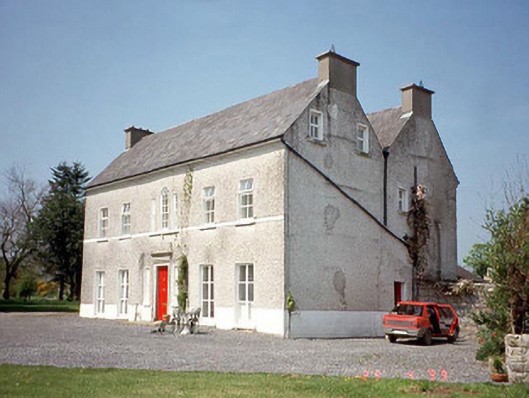


 Irish Historic Houses