This morning (Saturday 4th May 2019) we headed out to Salterbridge. We took an extremely scenic wrong turn, going up hairpin bends on a road, around county roads and back down via further hairpin bends! I never knew that Waterford is so beautiful! I joked with Stephen that everyone who lives in Waterford has to swear to keep it a secret how beautiful it is! Everyone I mention it to here says it’s the hidden county! Thank goodness for gps. We found Salterbridge with the gps, and turned into a long driveway.
I had emailed in advance and they knew we were coming. We were greeted by Susie and her son Edward. Susie gave us a quick run down as to why there are many estate houses in the area: it’s because of the Blackwater River. It runs in from the sea and Cappoquin is strategically situated. Salterbridge and Tourin, nearby, were owned by a pair of brothers, the Musgraves. The original house on this site was built in about 1750 by Richard Musgrave on land which had been acquired from the Lismore Castle Estate, from the Earls of Cork. [1] Richard was the elder son of Richard Musgrave of Wortley, Yorkshire, who settled in Ireland, whose younger son was Christopher (1715-1787) who settled at Tourin. We visited Tourin later that afternoon.
Mark Bence Jones describes Salterbridge in A Guide to Irish Country Houses as a two storey house of 1849, built onto the front of an earlier house. [2] It is not known how much of the original house has been retained.
Richard Musgrave died in 1785 (an information leaflet which Susie’s husband Philip gave us, tells us that Richard Musgrave’s memorial, by William Paty of Bristol, can be seen in Lismore Cathedral). Musgrave’s daughter Janet, who had married Anthony Chearnley (d. around 1786 [3]) of Affane (County Waterford), inherited the property.
Anthony Chearnley was an amateur architect and artist. The Dictionary of Irish Architects tells us that he was the architect of Burnt Court, Co. Tipperary, a house which he built for himself in front of the ruins of Burntcourt Castle. He later moved to Spring Park in Affane. Engravings after his topographical drawings appear in Grose’s Antiquities of Ireland, Ledwich’s Antiquities, Smith’s History of Waterford and Smith’s History of Cork; one of the plates in the latter work was engraved by him, and more of his engravings appear in The Compleat Irish Traveller (London, 1788).
Anthony Chearnley was a widow when he married Janet Musgrave. He was previously married to Ann Gervais, daughter of the Rev. Isaac Gervais, Dean of Tuam, and they had a son, Thomas.
The house, which in the nineteenth century was at the centre of an estate of over 18,000 acres, passed to the son of Anthony and Janet née Musgrave, Richard Chearnley, and it remained in the ownership of the Chearnley family until 1947, when it was bought by Susie’s husband’s family, the Wingfields of Suffolk.
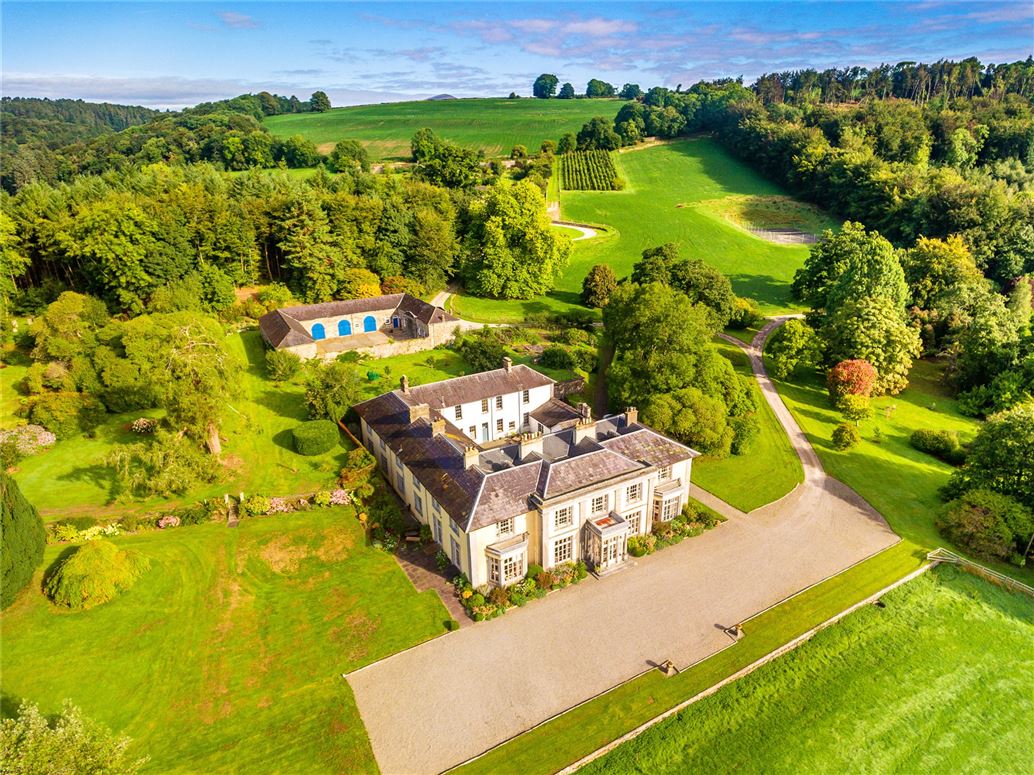
Salterbridge, photograph courtesy of myhome.ie
An older son, Samuel, lived at Burntcourt. Anthony Chearnley left Salterbridge to his son, Richard. Richard died childless in 1791, so the estate passed to his brother, Anthony (1762-1842).
Anthony (1762-1842) was High Sheriff of County Waterford. He married first Julia Browne of Gaulstown, County Meath, but she died and he married Isabella, daughter of William Newcome, Archbishop of Armagh. Anthony’s first son died unmarried and his second son, Richard (1807-1863), succeeded to the estate in 1842 and also followed in his father’s footsteps to become High Sheriff of County Waterford. He married Mary, daughter of Henry Cotton, Archdeacon of Cashel. It is this Richard who built the addition to Salterville.
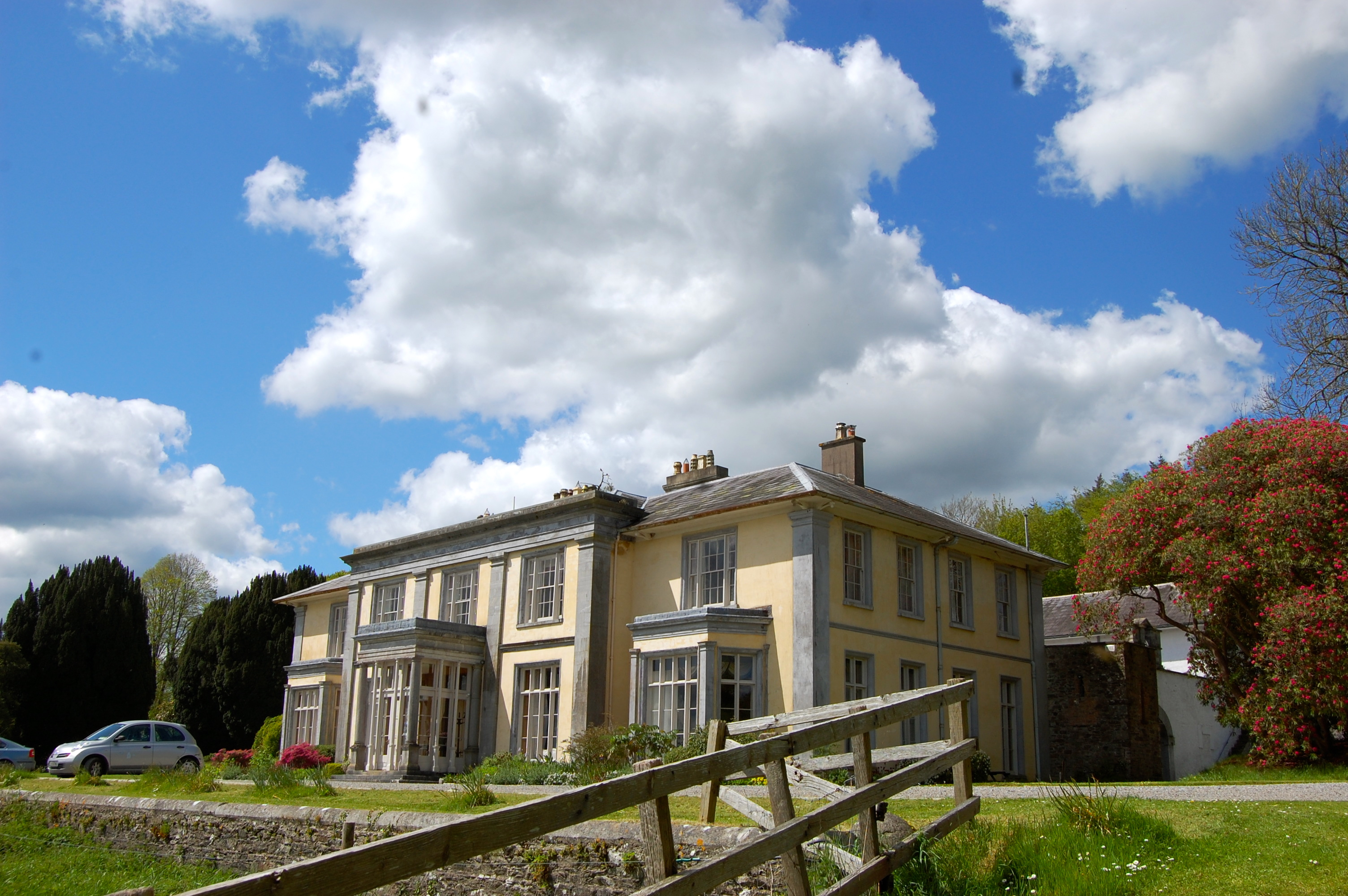
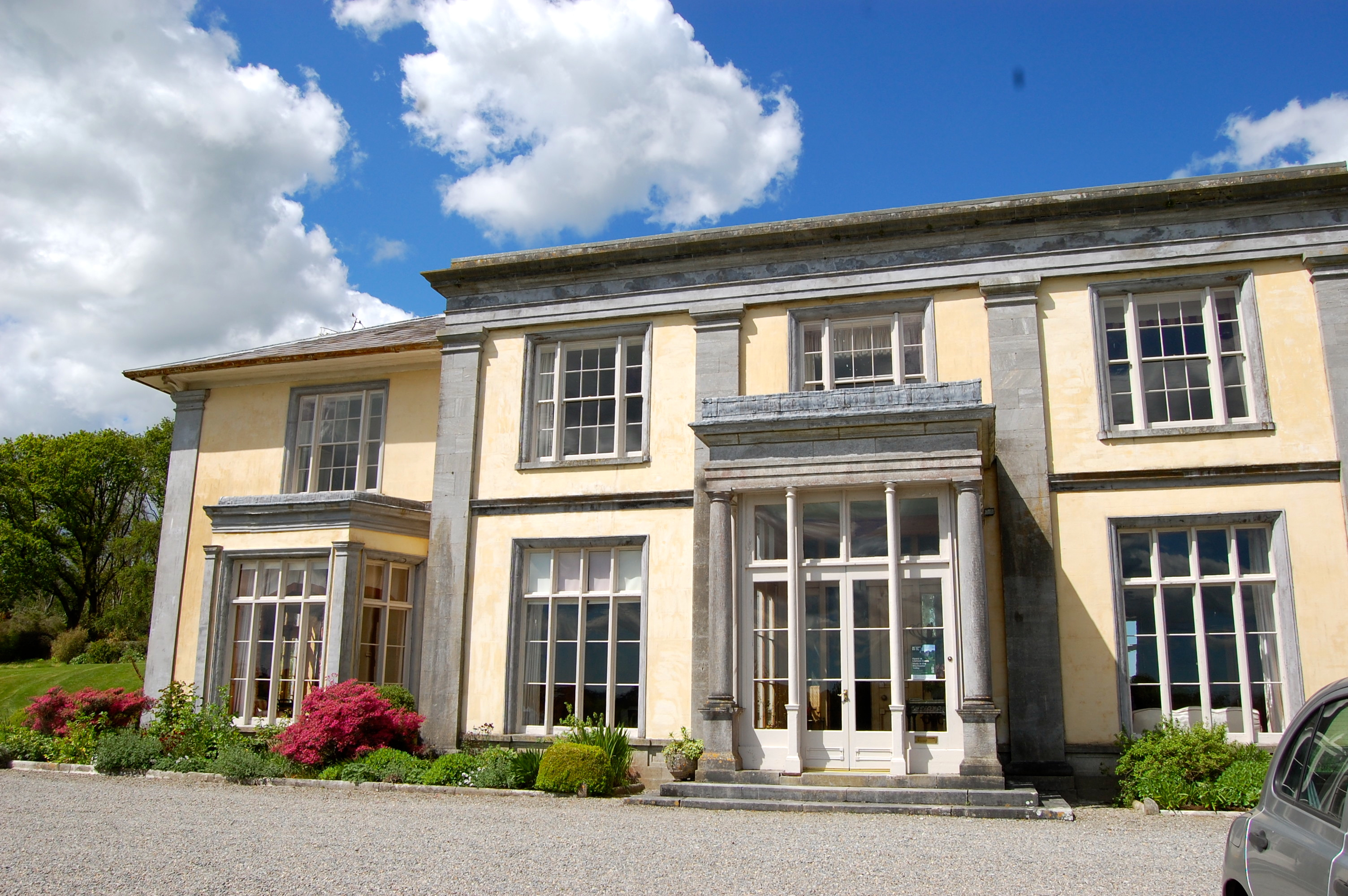
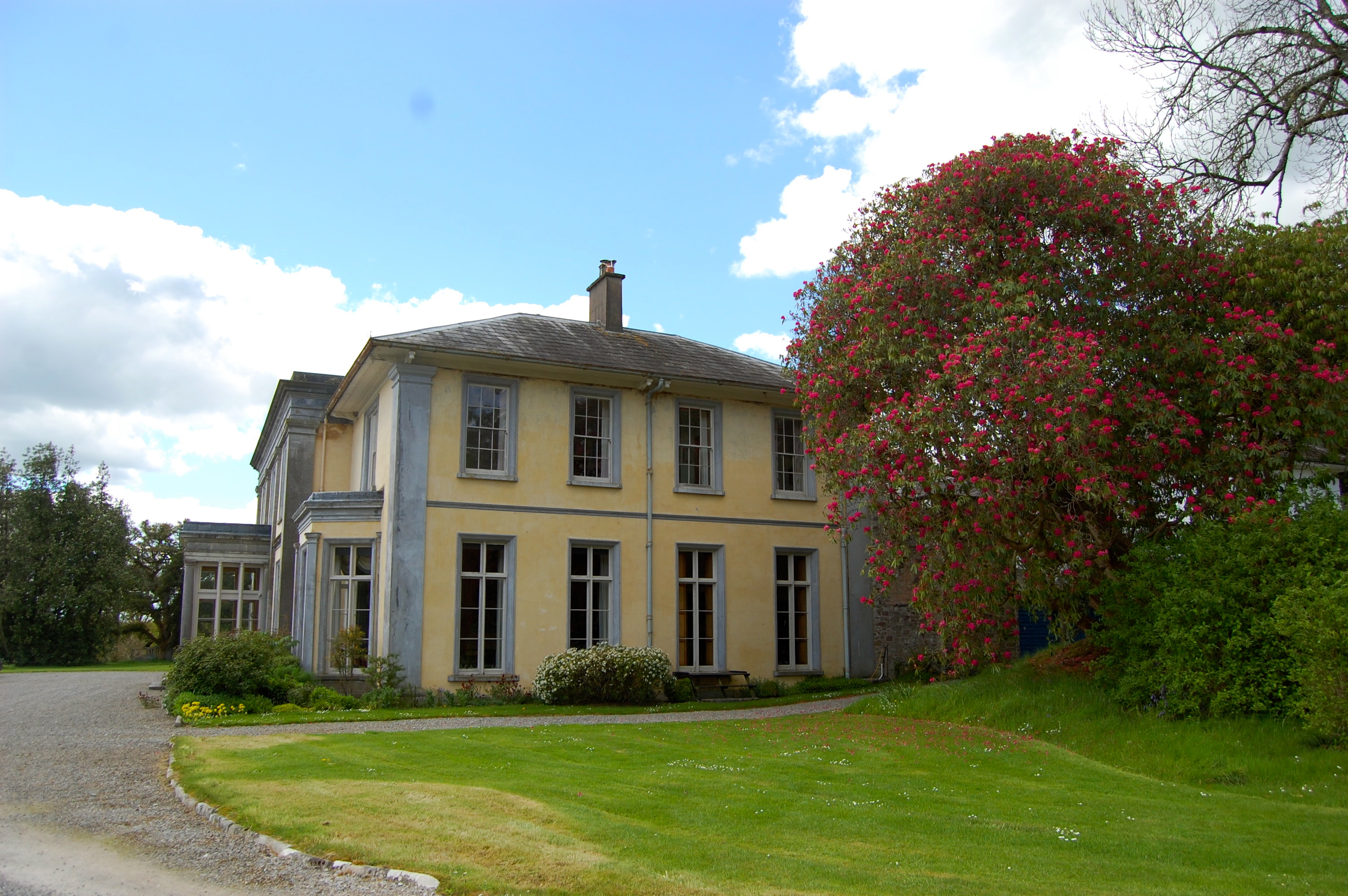
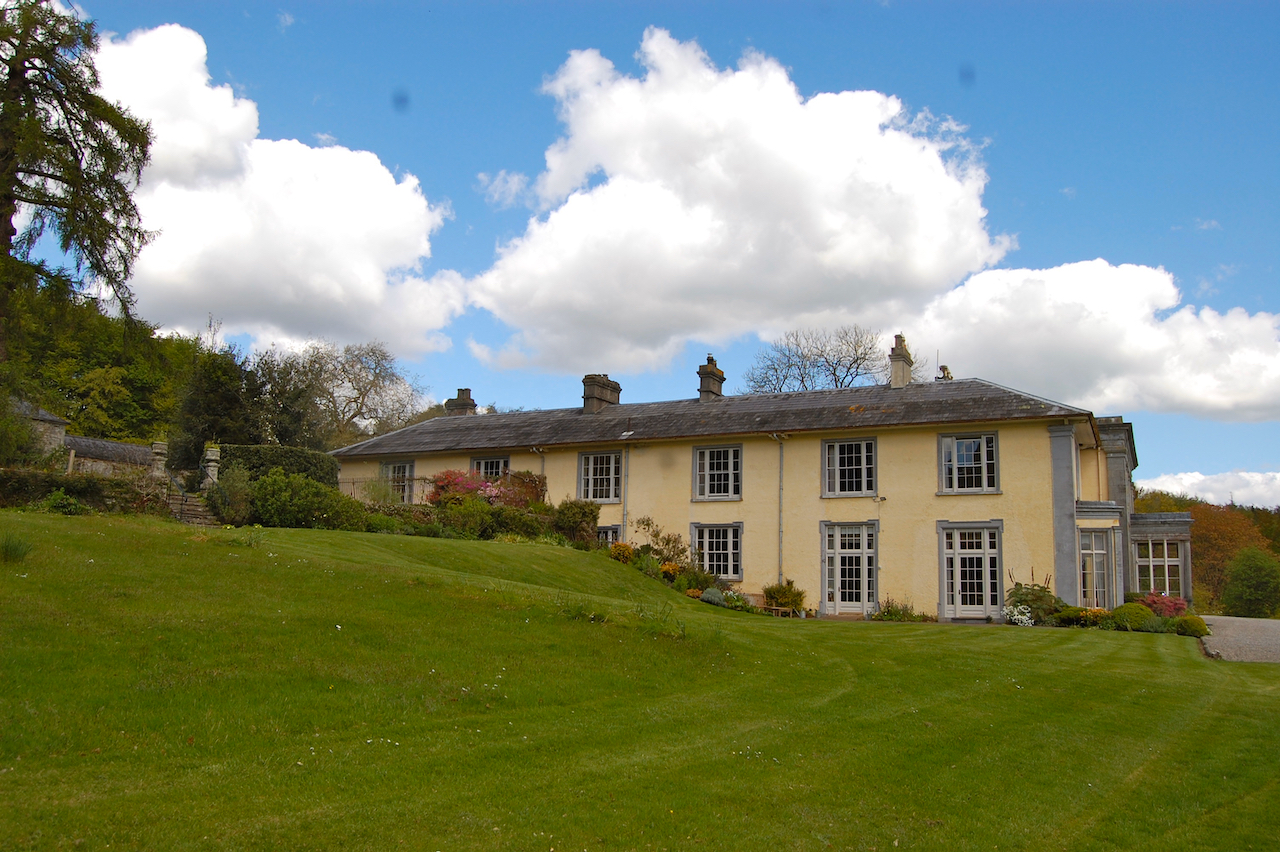
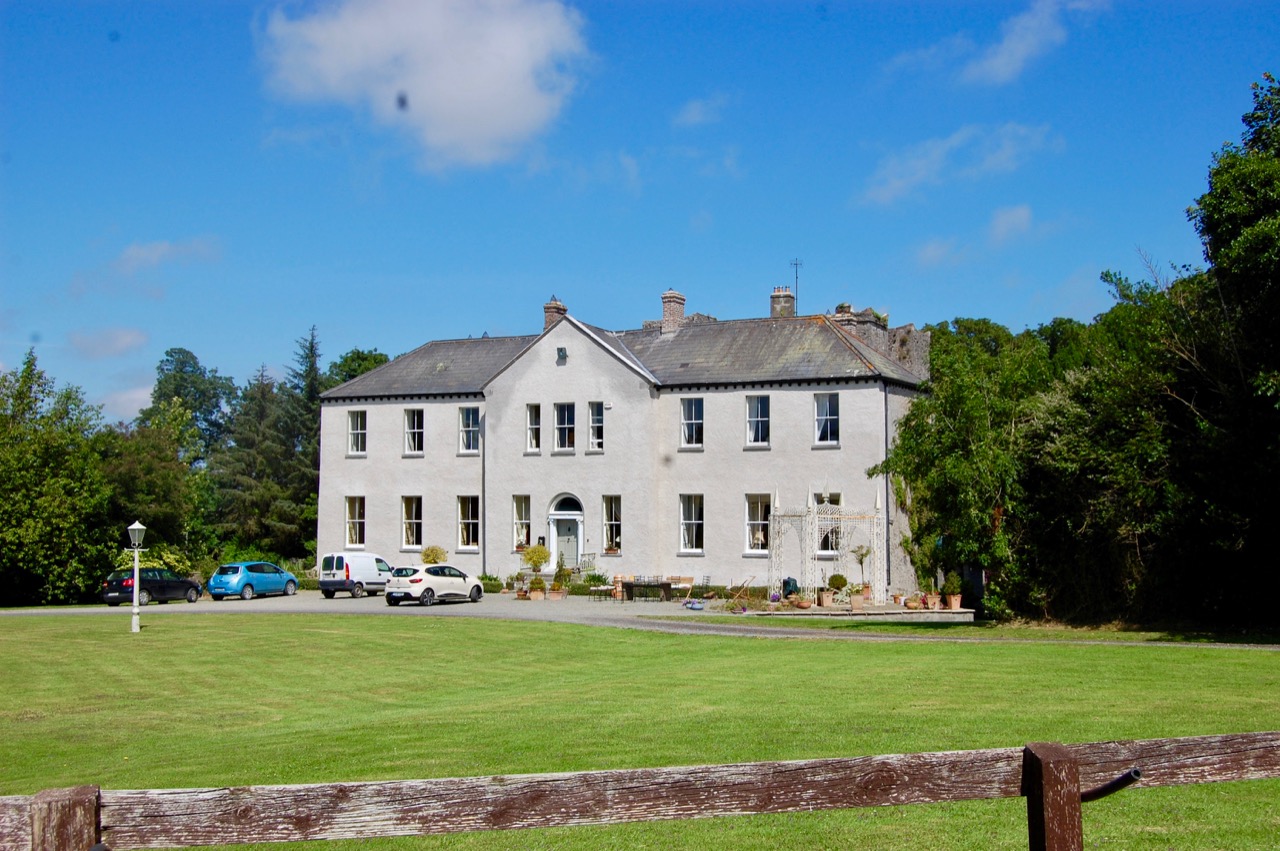
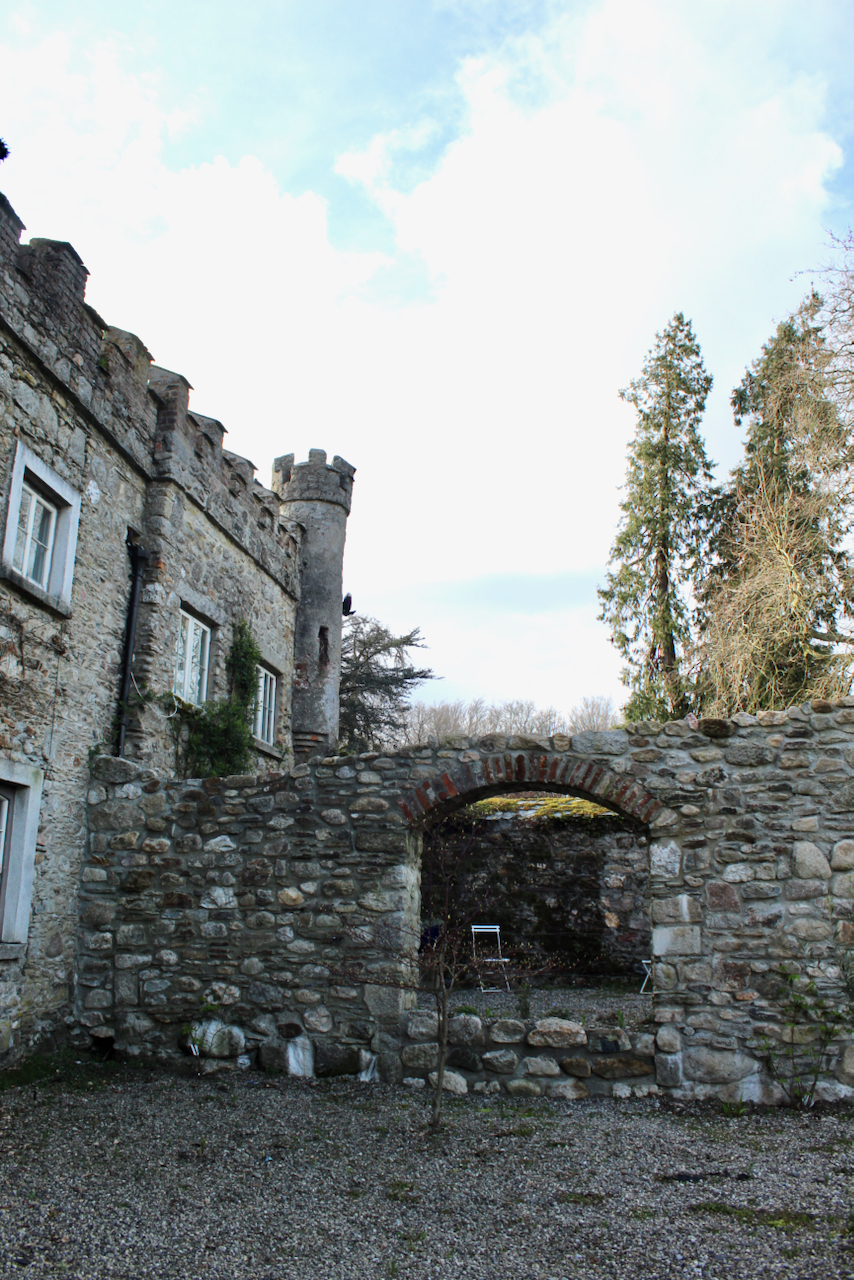
The 1849 front was built for Richard Chearnley (1807-1863), but the builder or architect is not known. The house is in the “Regency Picturesque” style. Bence-Jones writes that the house extends around three sides of a courtyard, enclosed on the fourth side by a screen wall with an arch. I wouldn’t have been able to tell that the house forms a u-shape, it’s not obvious from the ground.
The 1849 front consists of a three bay centre, with a parapet (a low protective wall along the edge of a roof, bridge, or balcony) and tall grey limestone pilasters between the bays (a pilaster is a flat rectangular pier or column projecting slightly from the wall – the Irish Aesthete describes these ones as Tuscan) [4][5]. There are three cut limestone steps up to the projecting front door porch, which is single bay, single storey with a flat roof. The house has two storey one bay wings with eaved roofs and single storey three sided bows, as Bence-Jones describes, and Wyatt windows were installed. A Wyatt window, according to Bence-Jones, a rectangular triple window, named after the English architect, James Wyatt (1747-1813). The porch is glazed and in the Classical style. The wings have pilasters at their front end similar to the four limestone pilasters of the centre block and the bow parapets match parapet of the central porch and block.
The National Inventory website tells us that one side has six bays (west) and the other, four bays. [6]
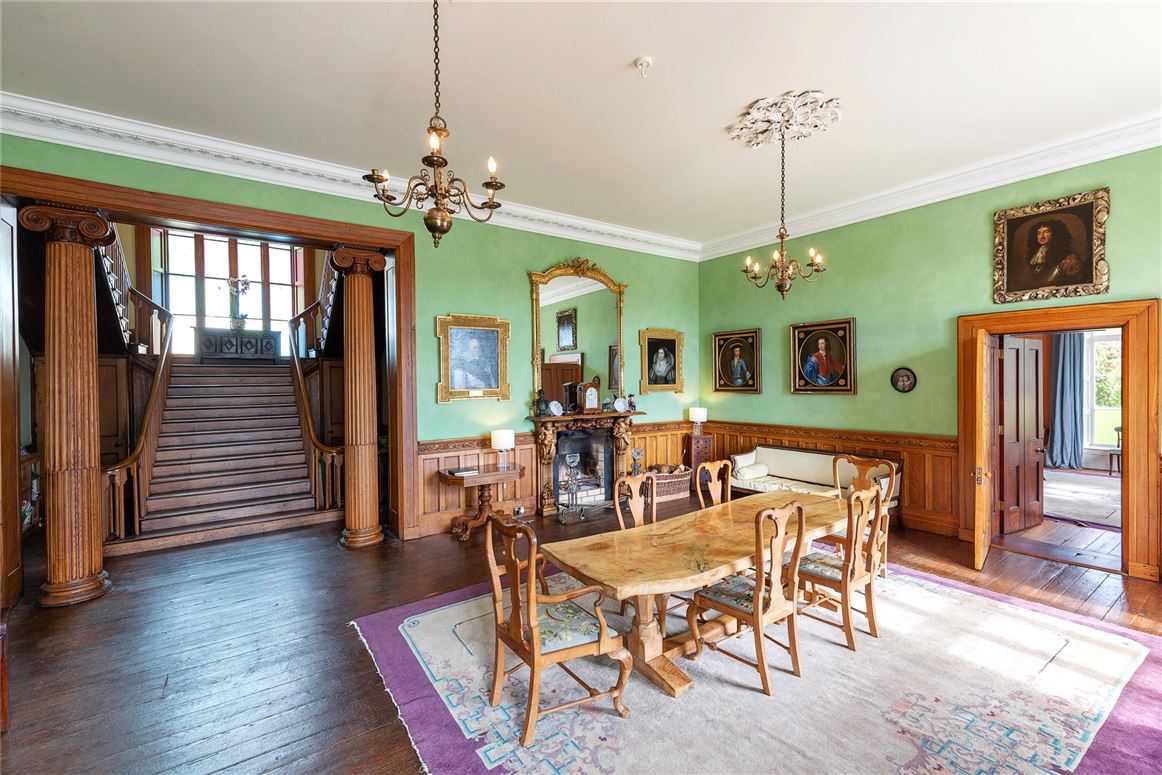
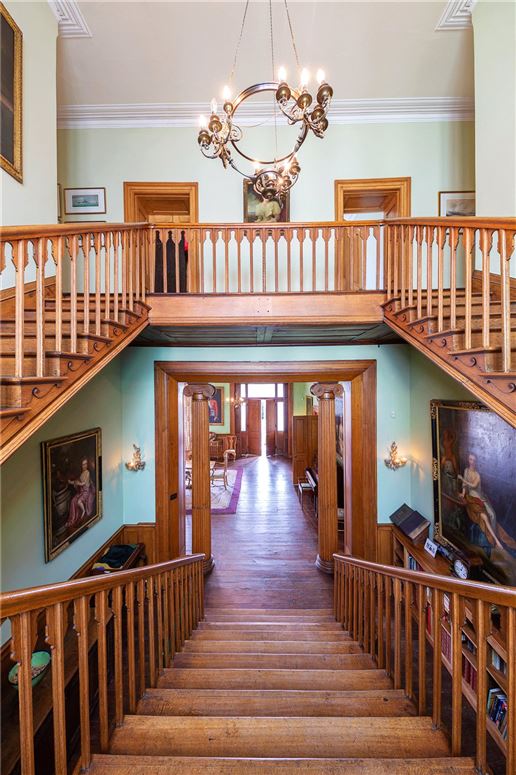
The interior shows its early Victorian origin. The date 1884 is carved into the oak panels in the hall. You can see the carved oak panel with the date, and the marvellous wooden carved fireplace complete with cherub, on the Irish Aesthete’s website [7] The hall has a bifurcating oak staircase behind a screen of dark wood Corinthian columns.
The hall has a bifurcating oak staircase behind a screen of dark wood Corinthian columns. Photograph courtesy of myhome.ie
Susie showed us a quirky feature : the rooms were panelled and there’s a gap between two doors, which her children called “the elevator.” That is, on leaving one room you can close the door behind you, and the room you are entering has another door, so if both are closed, you stand in a little space like an elevator! We first entered the dining room, and her husband Philip then joined us. His parents, the Wingfields, bought Salterbridge House. They came from England, and were cousins of the Wingfields of Powerscourt Estate in Enniskerry. [8] Philip pronounced it “Poerscourt” because apparently it was initially named after the de la Poer family, who lived in Wicklow.
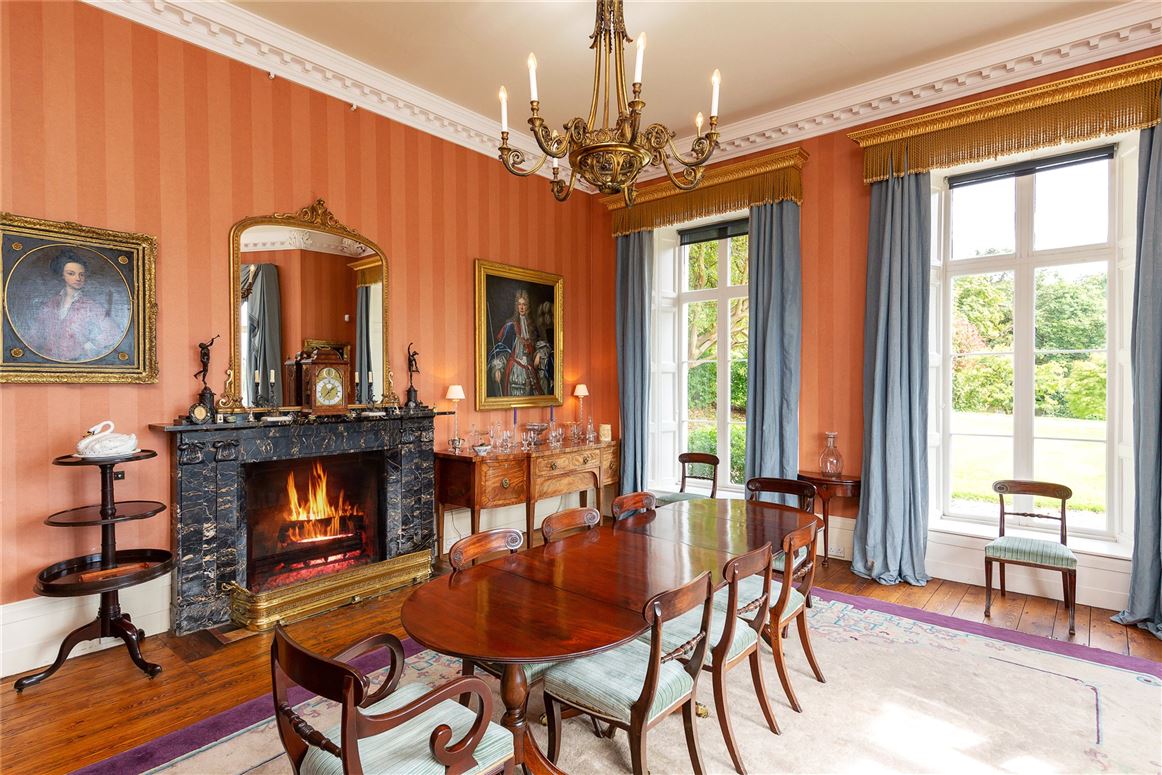
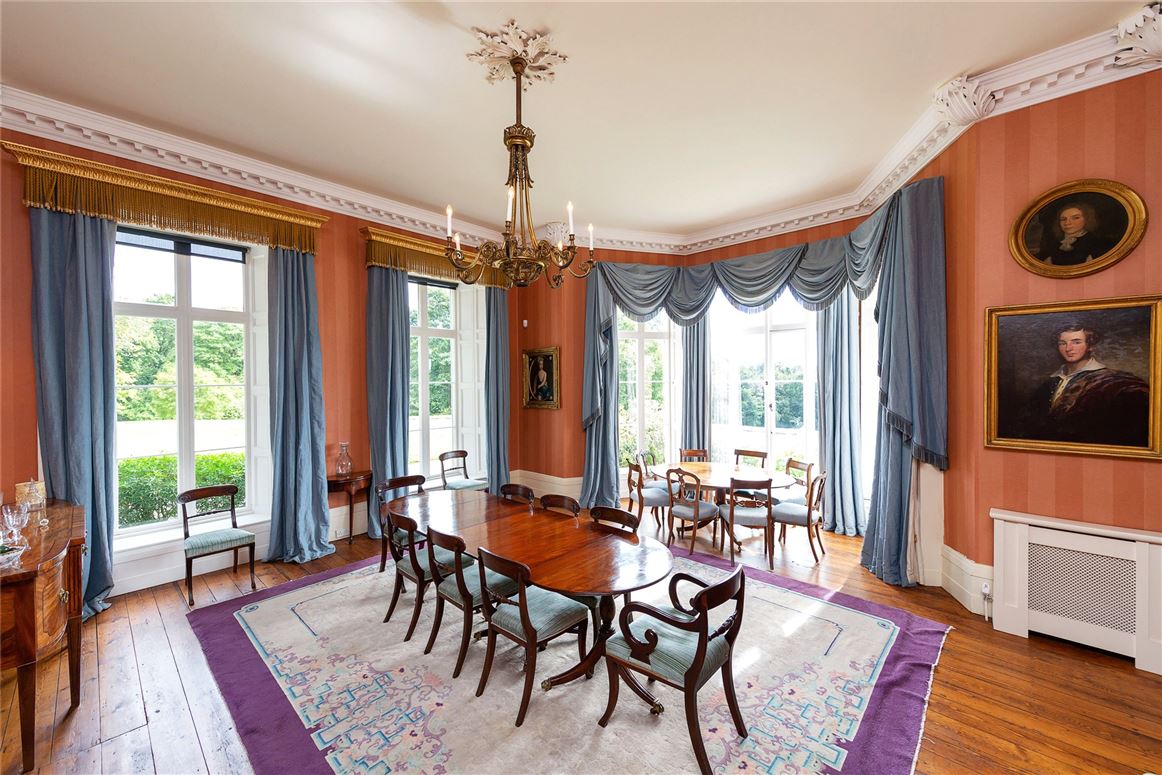
The dining room, photograph courtesy of myhome.ieIn the dining room there was a portrait of Richard Wingfield (1815-1844) 6th Viscount Powerscourt, portrait, now on display at the Irish Georgian Society.
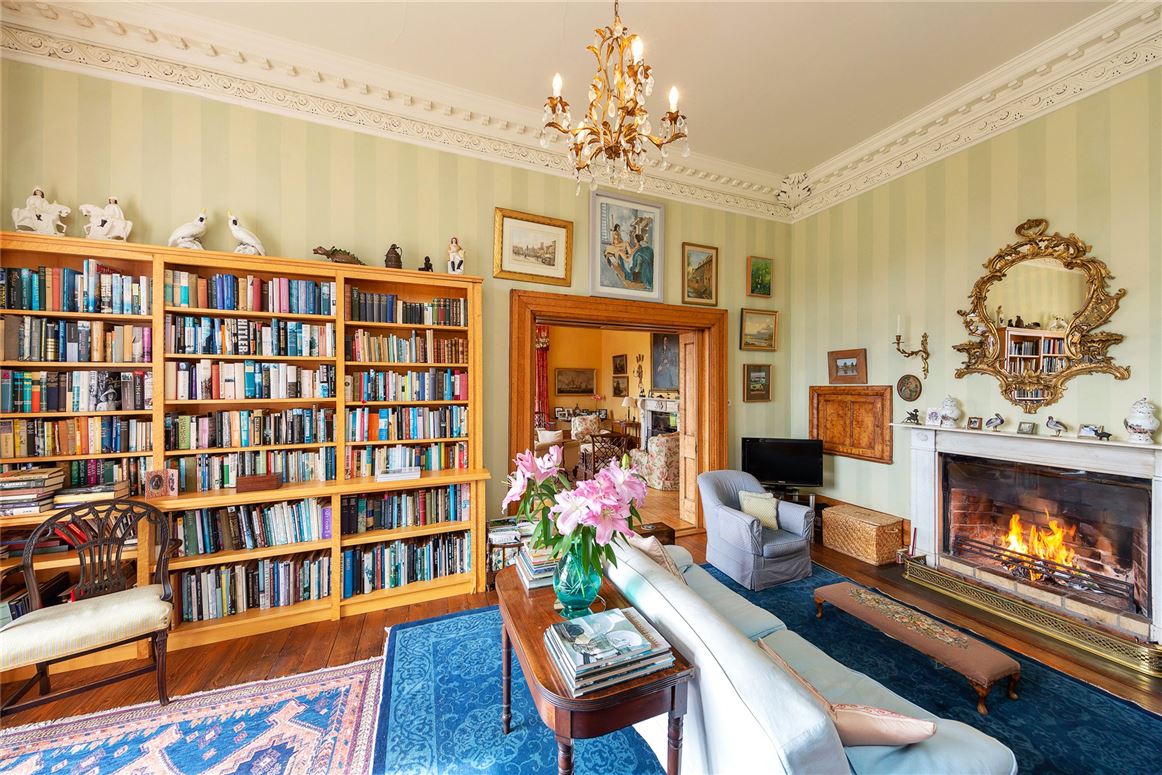
We next entered the drawing room, which has ceiling decoration of scrolls and shields.
The Drawing Room, courtesy of myhome.ie
Richard and Mary née Cotton’s oldest son, Richard Anthony Chearnley, died young, and was only thirteen years old when he inherited the property. He died at the age of 29 in 1879, and was succeeded by his younger brother, Henry Philip Chearnley (1852-1916). He too was High Sheriff of County Waterford and a Major in Waterford Artillery Militia.
Henry Philip Chearnley married Anne Elizabeth, daughter of John Palmer of Tralee. He was succeeded by his son, Henry John Chearnley, who died in 1935.
In 1940, Philip told us, the house was requisitioned for the army: being in such a strategic position made it vulnerable to an invasion by the Germans. At that time, Henry John’s second wife, Ruby née Burstall, and a son, Philip, lived in the house. Mrs. Chearnley and her son were given just twenty-four hours notice to leave the house. In 1947, it was sold to the Wingfields.
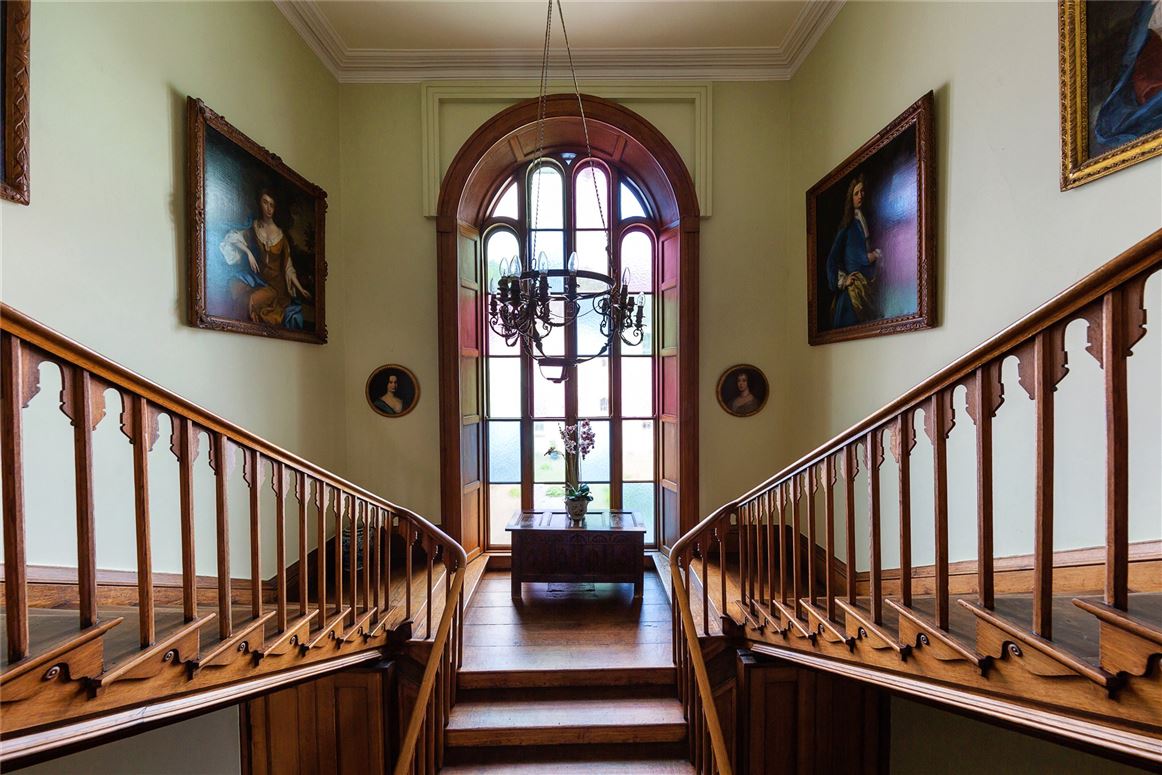
The staircase hall, photograph courtesy of myhome.ie
Philip showed us features of the house. I told him of my blog. He told us of the history of the house and of his family, the Wingfields. We were delighted to learn that he is distantly related to Thomas Cromwell (see my Powerscourt townhouse entry)! Naturally this current indirect descendant Philip read Hillary Mantel’s books, Wolf Hall and its sequel, and he told us a third is to follow! Fantastic! I can’t wait, as I read and loved them too, after watching the brilliant rendition of Cromwell by Mark Ryland! [9]
The staircase hall, photograph courtesy of myhome.iePhotograph courtesy of myhome.ie
Another ancestor of Philip’s, on his paternal grandmother’s side, the Paulets, or Pouletts as they later spelled it, from Somerset, was involved in the unification of Scotland with England in the time of Queen Anne. “Not under James I?” I asked. No, I learned, they were still two separate countries then. It was under Anne that the Scots agreed to unification, as they had run out of money, Philip told us. It’s lovely to learn history in such a conversational way, chatting with home owners about their ancestors. We were shown some beautiful rooms upstairs, then we headed out to explore the gardens.
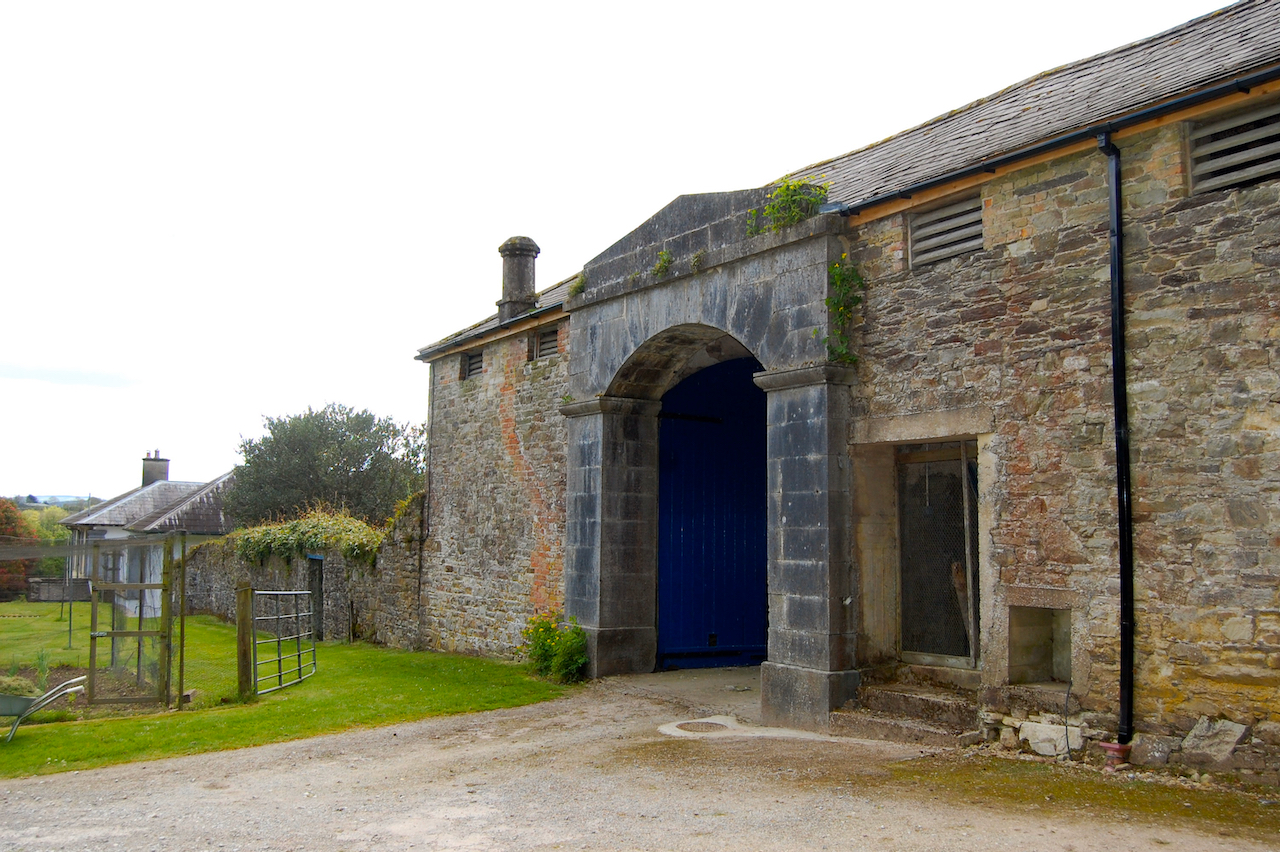
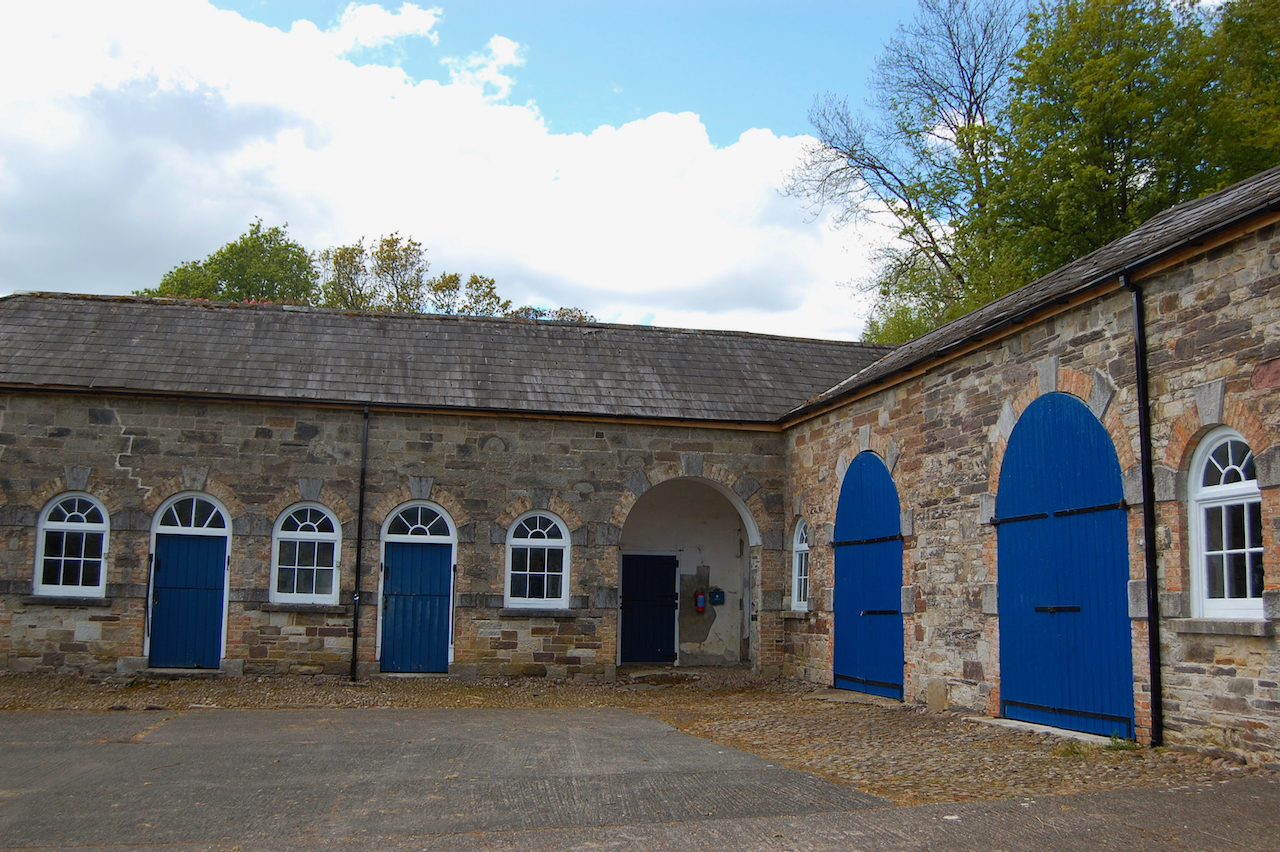
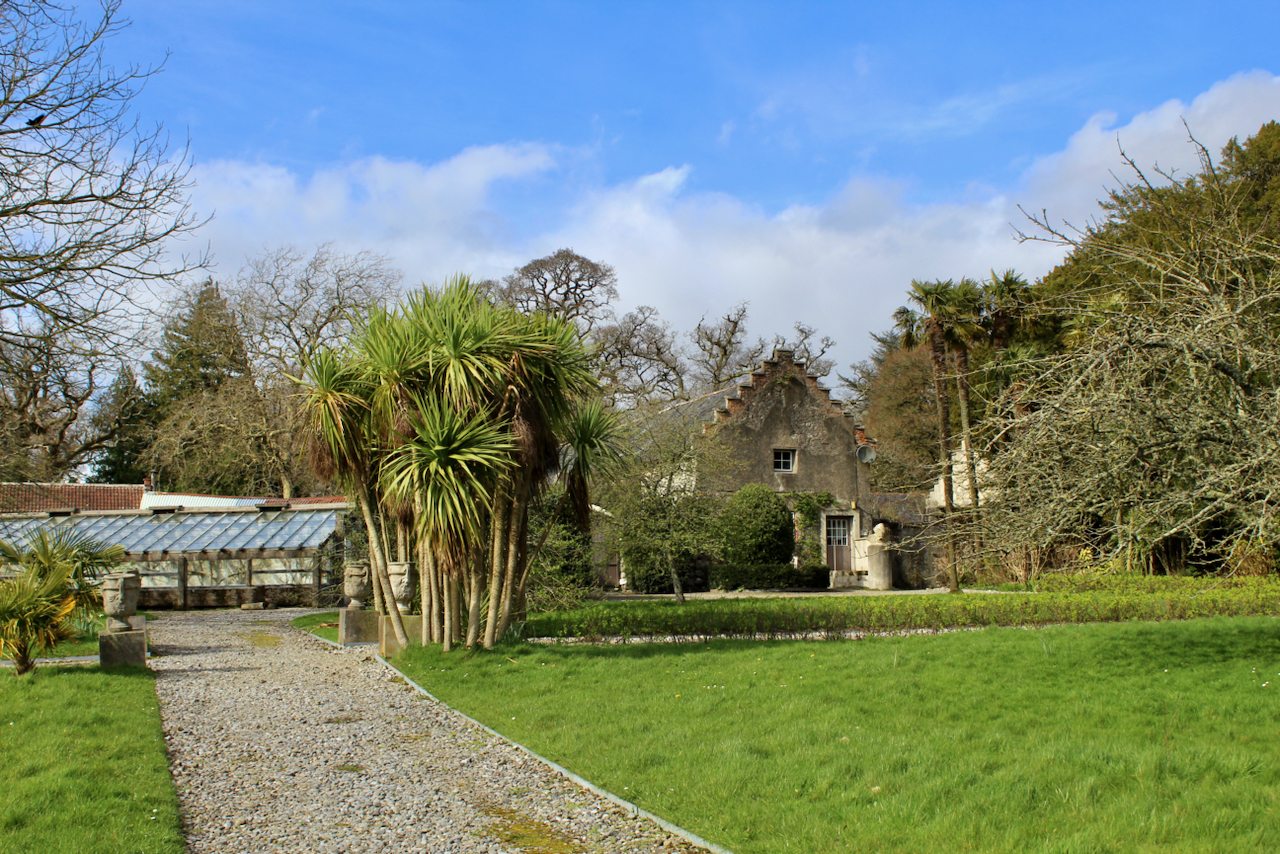
We went around the side after our house tour, to see the courtyard and arch. The arch shows the date of 1849, seen when looked at from inside the courtyard.
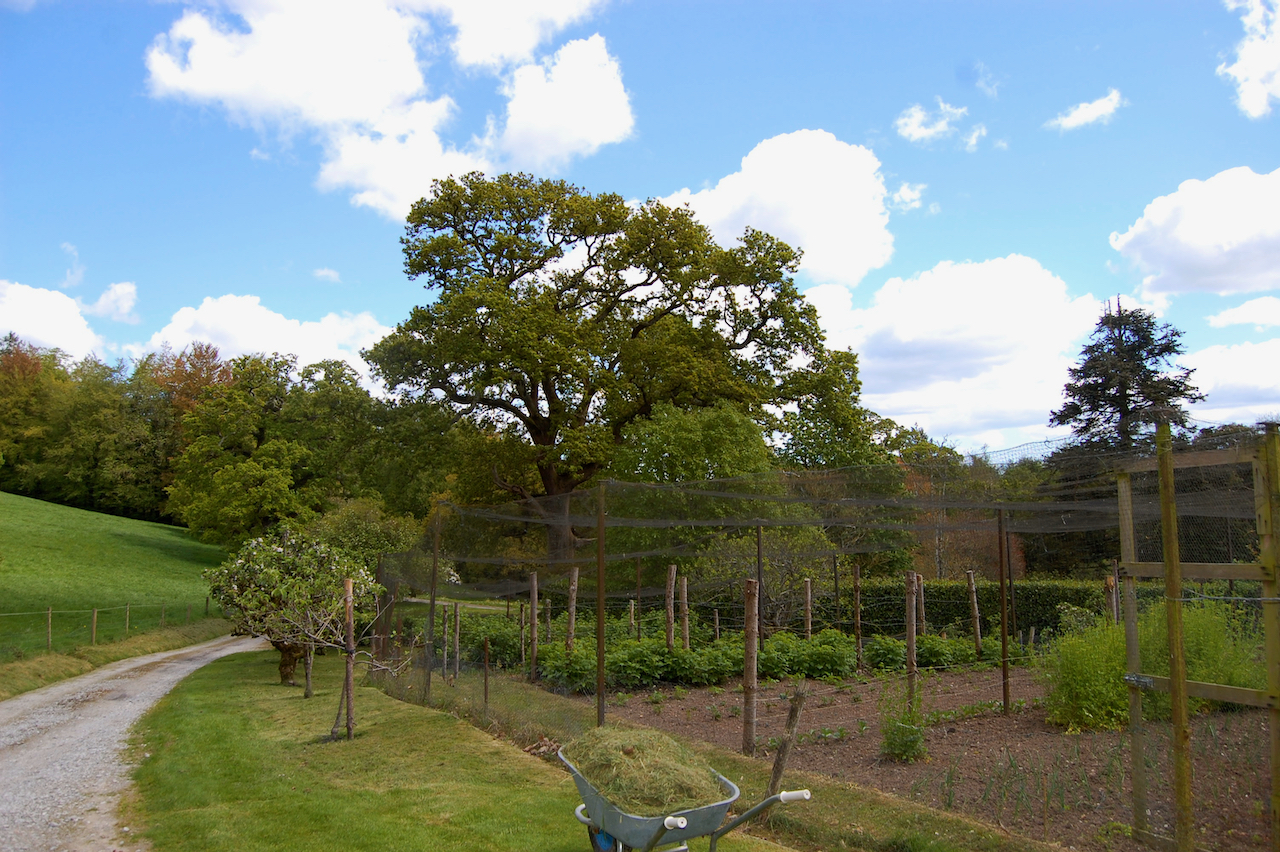
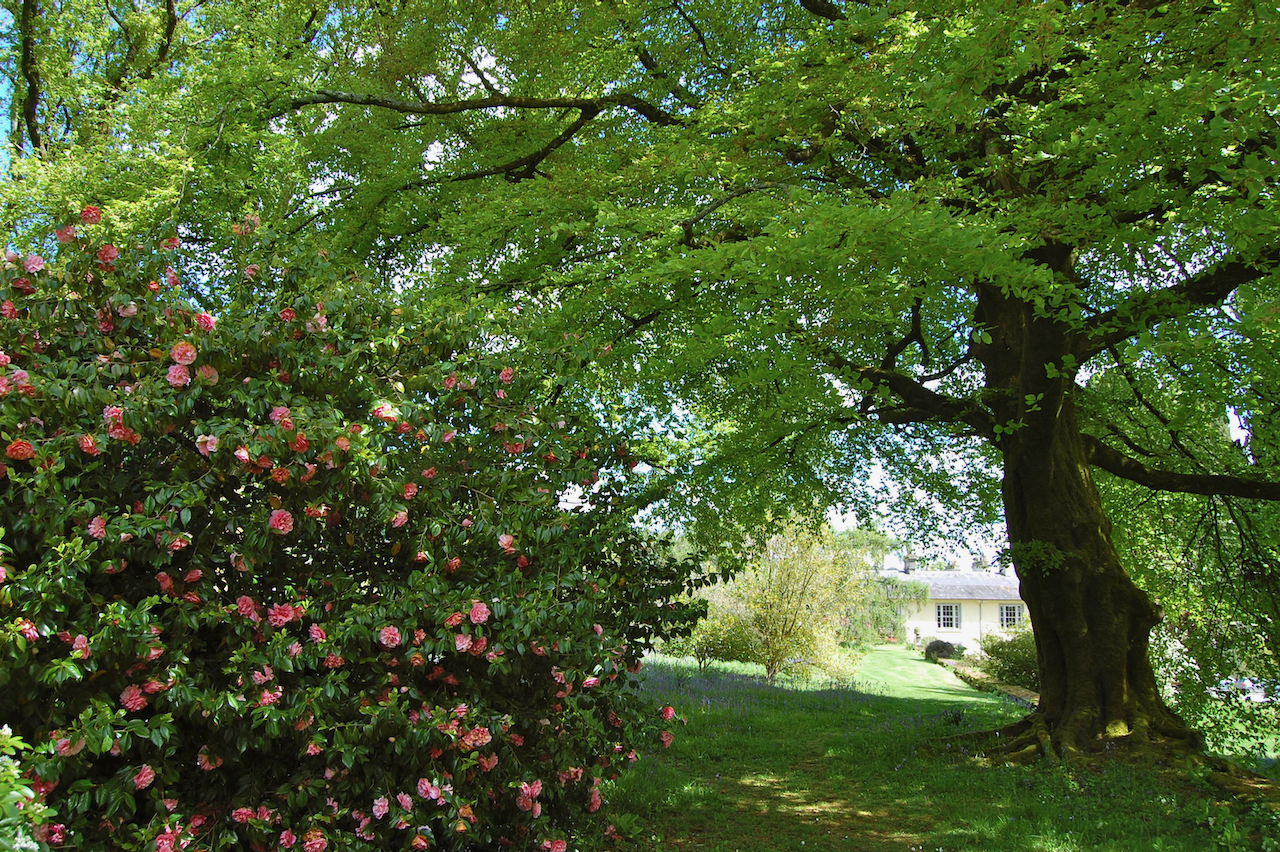
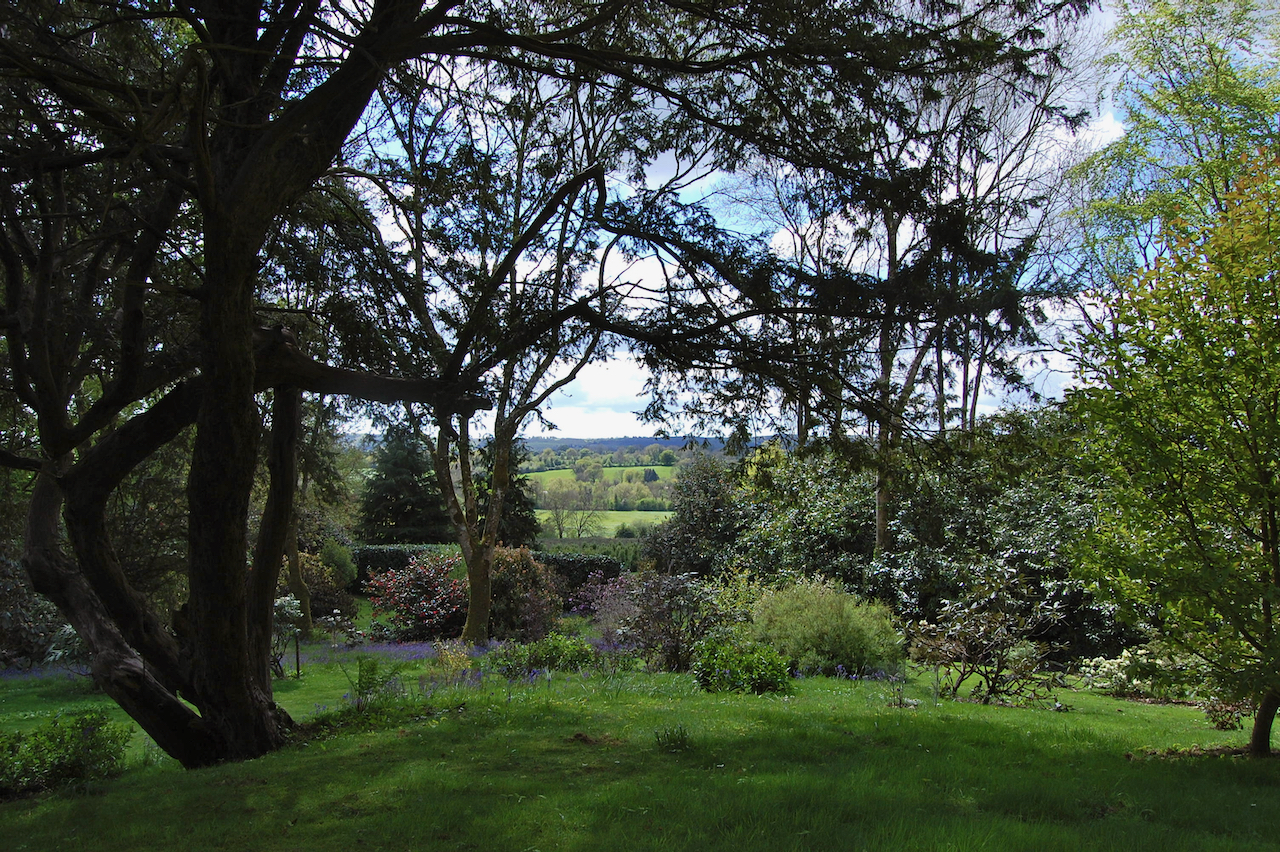
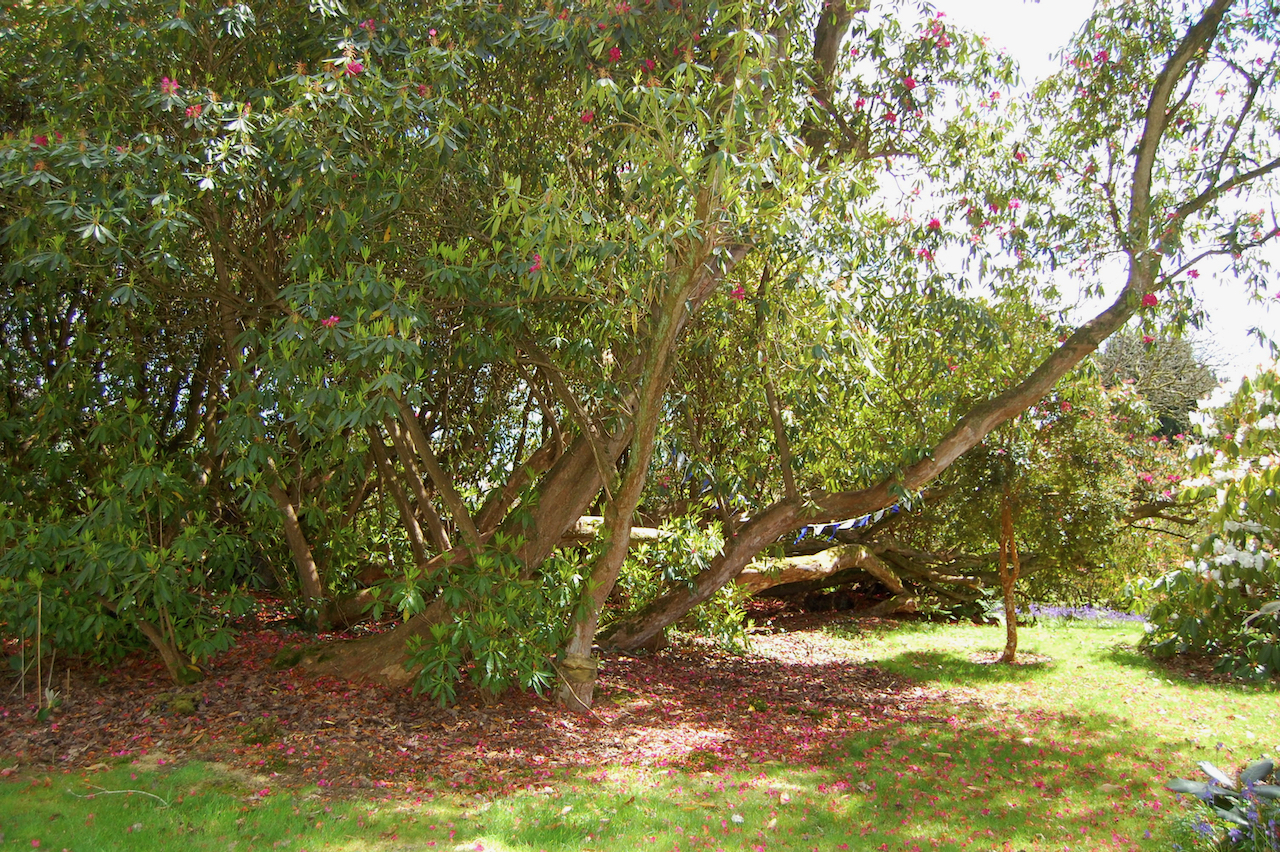
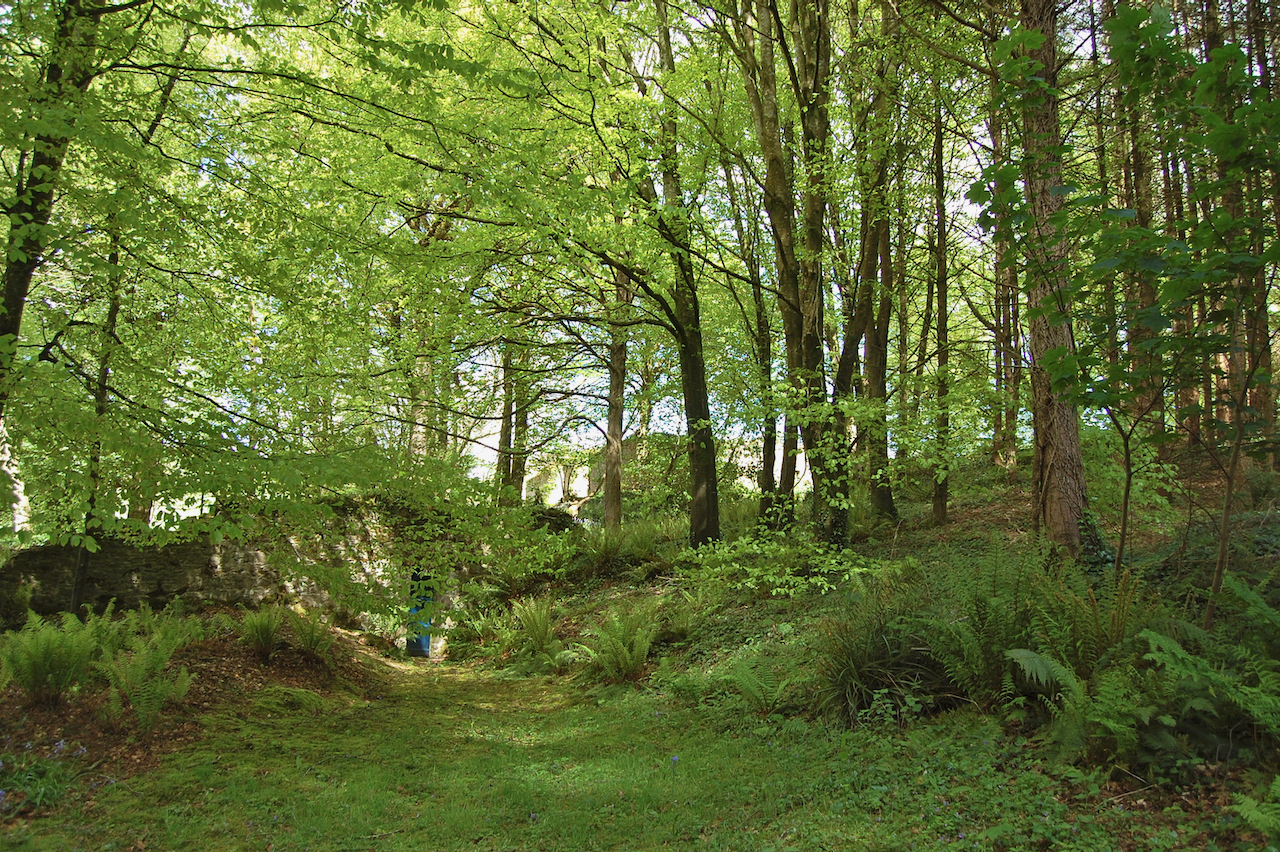
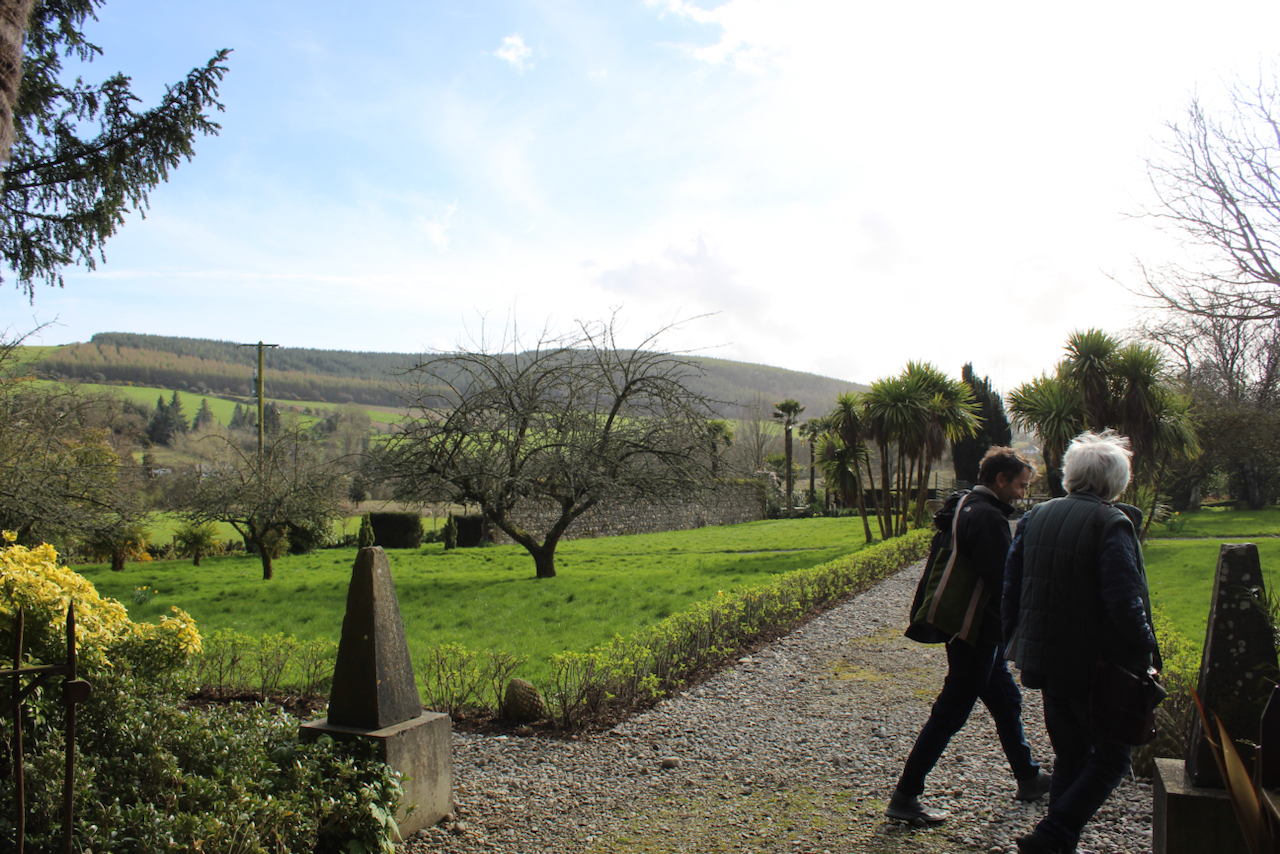
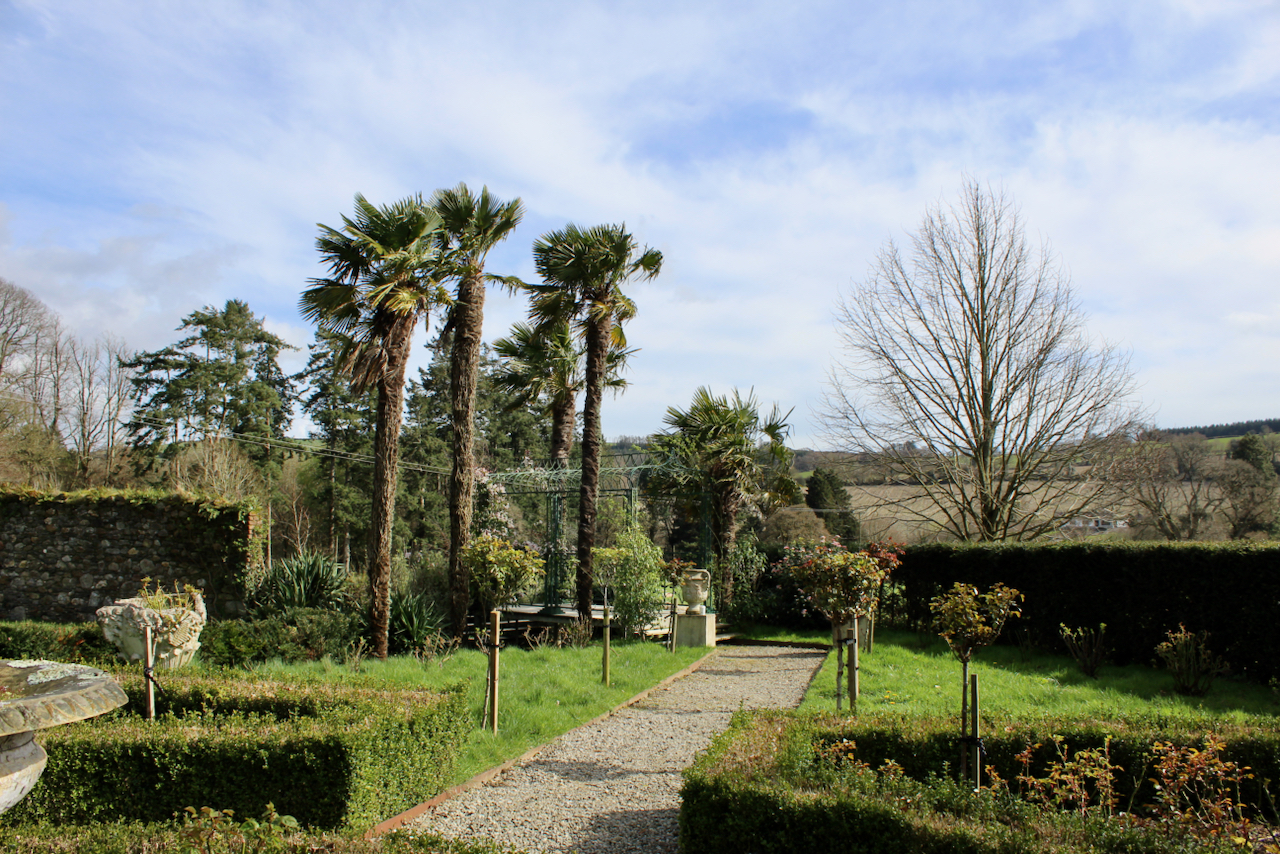
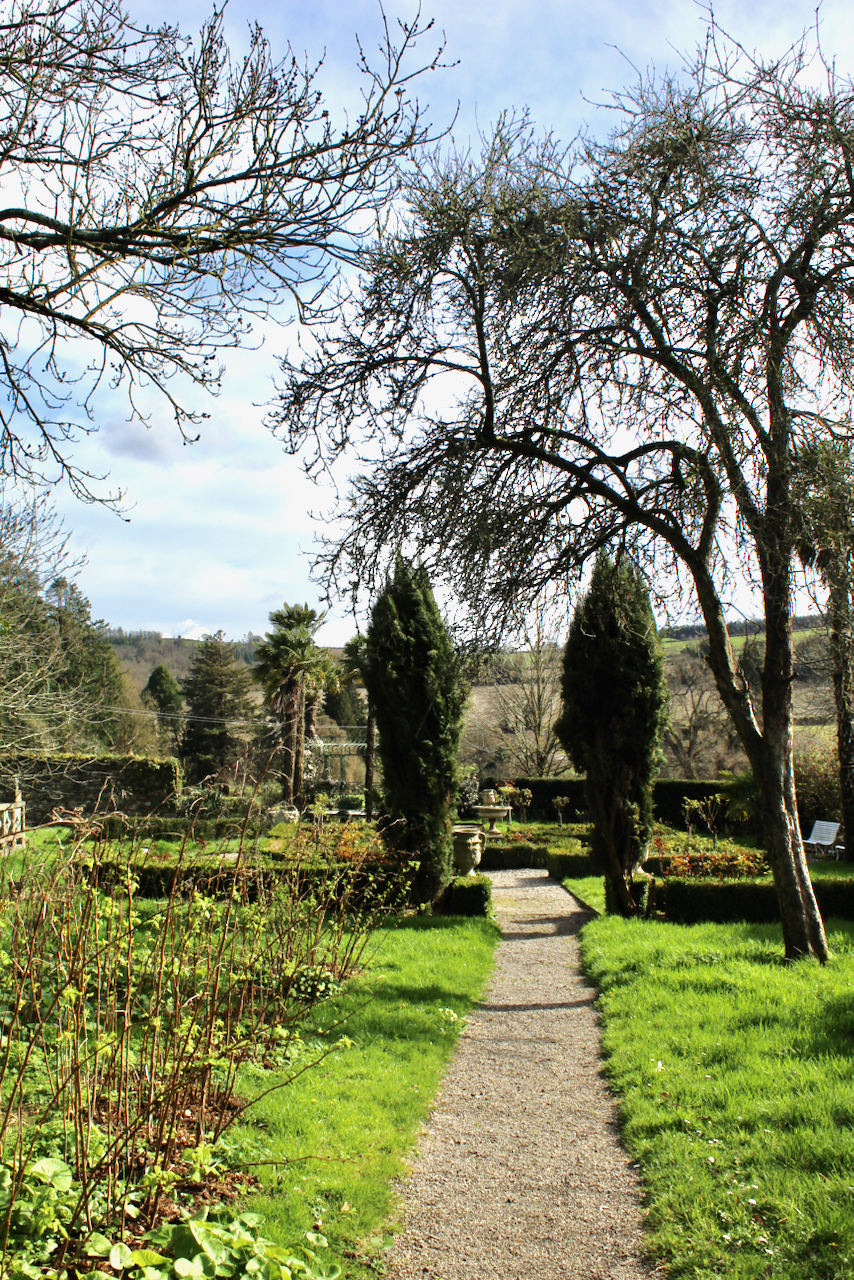
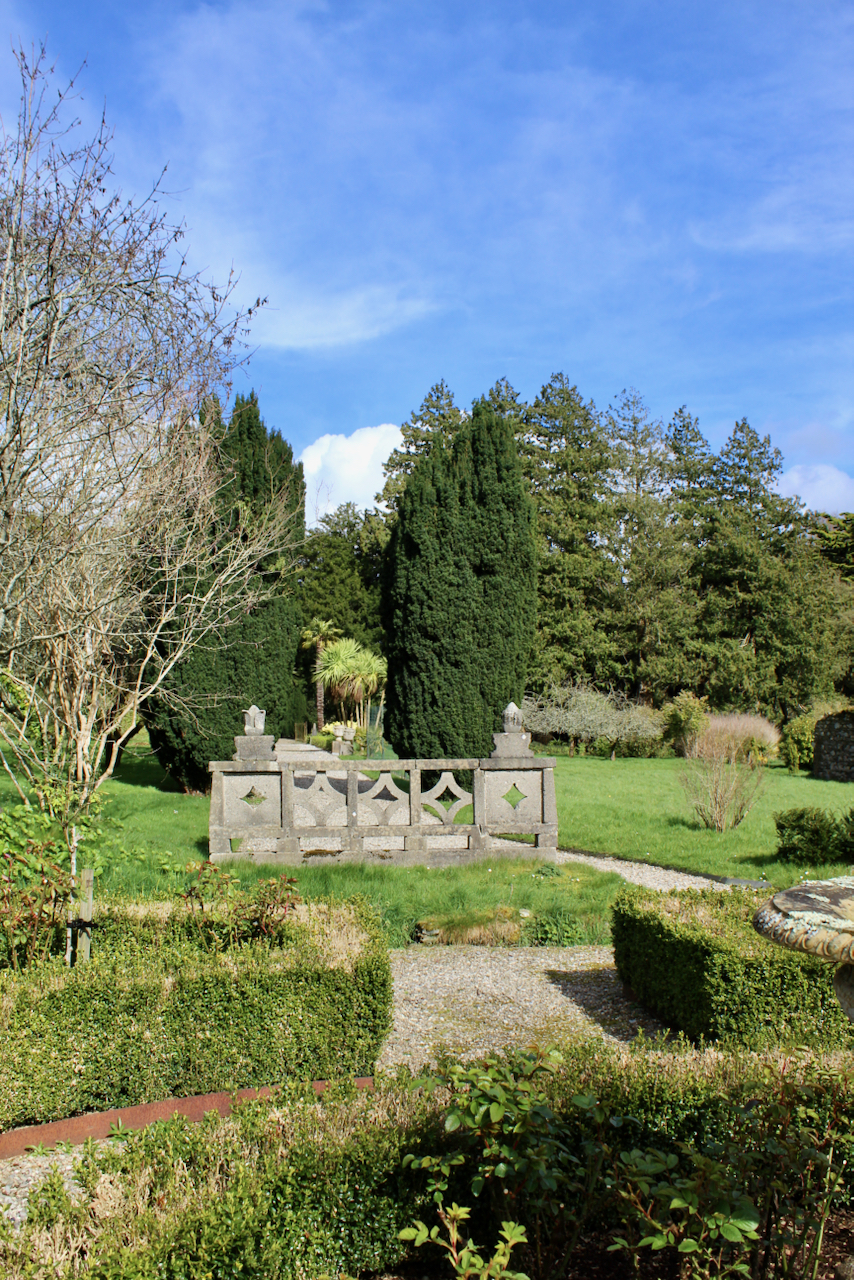
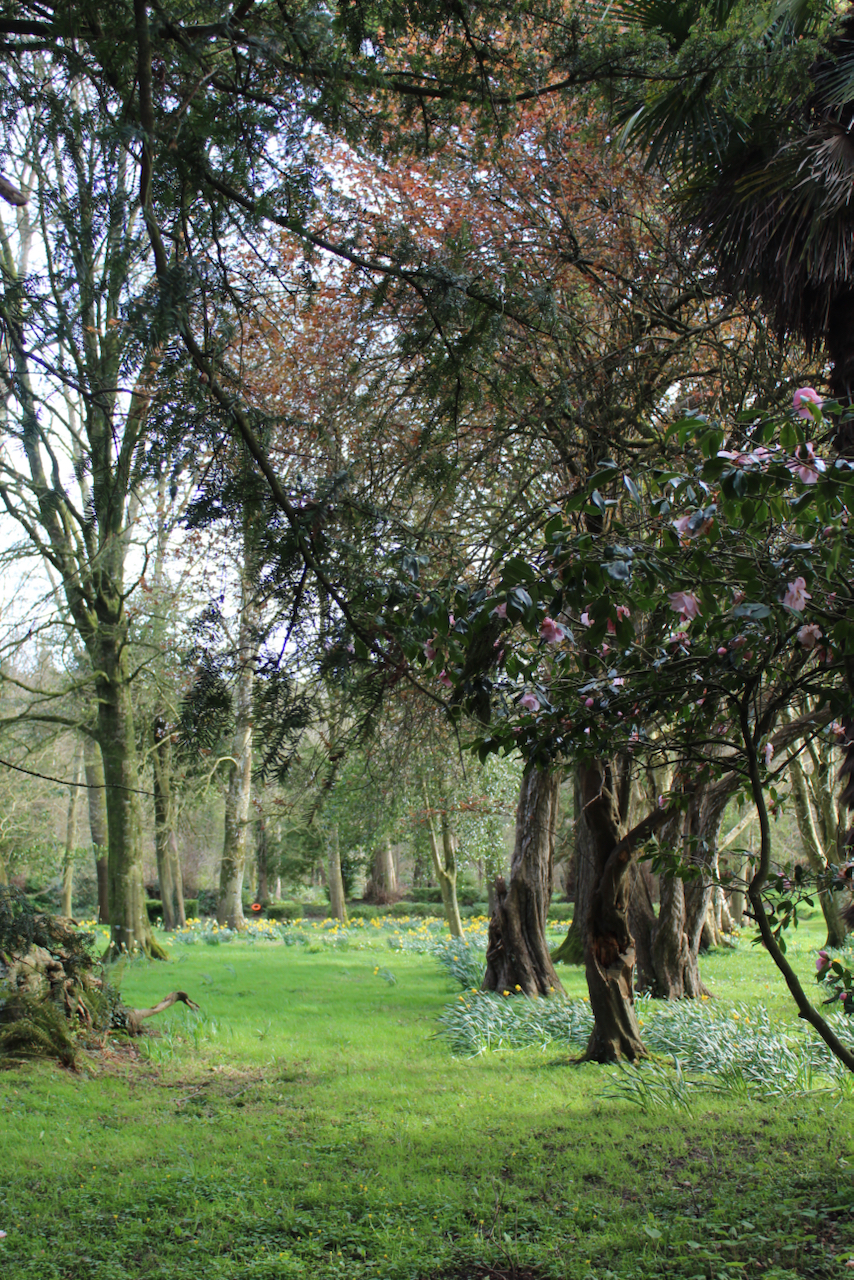
We have been blessed with the weather. We admired the flowering rhododendrons, magnolias and camelias. According to a website, the trees include most notably four splendid Irish yews, a cork oak, an Indian horse chestnut and a single leaved ash.
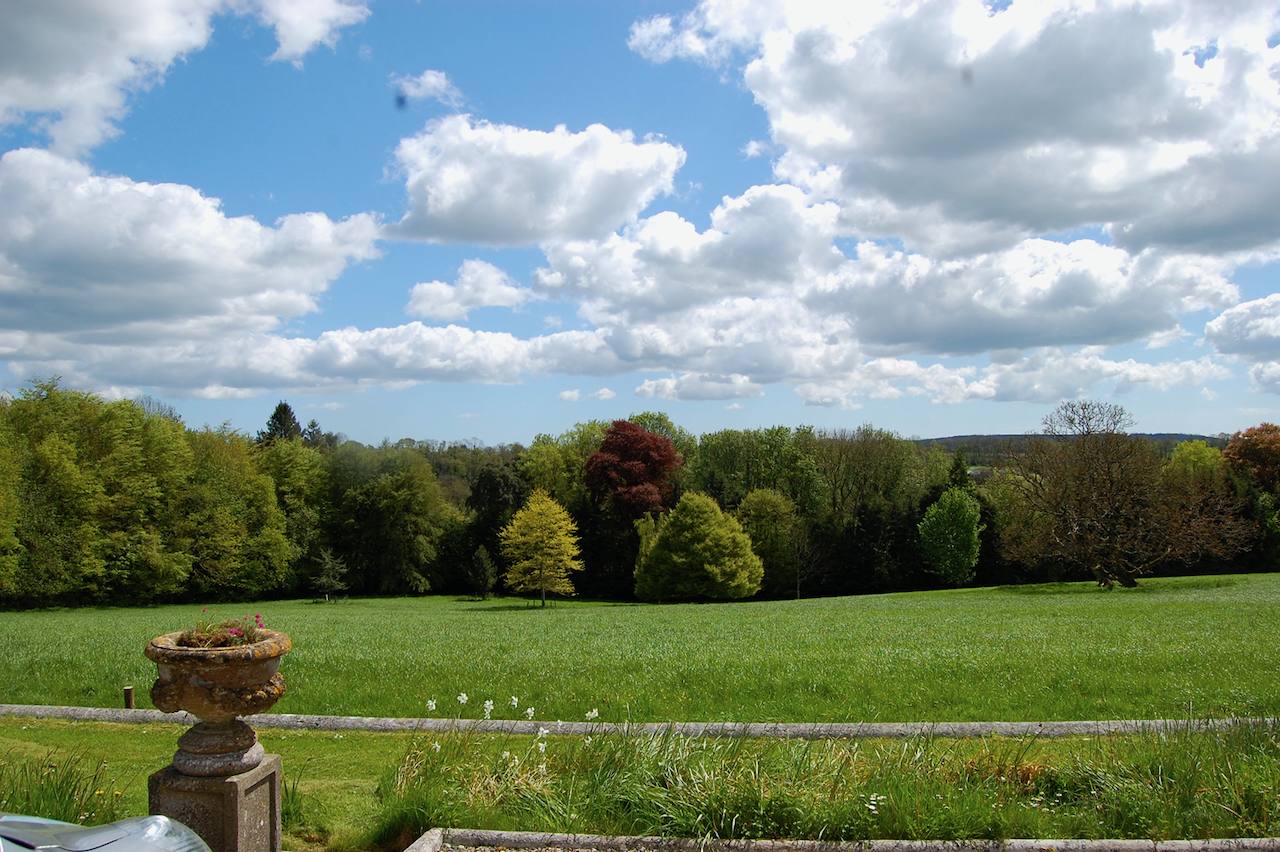
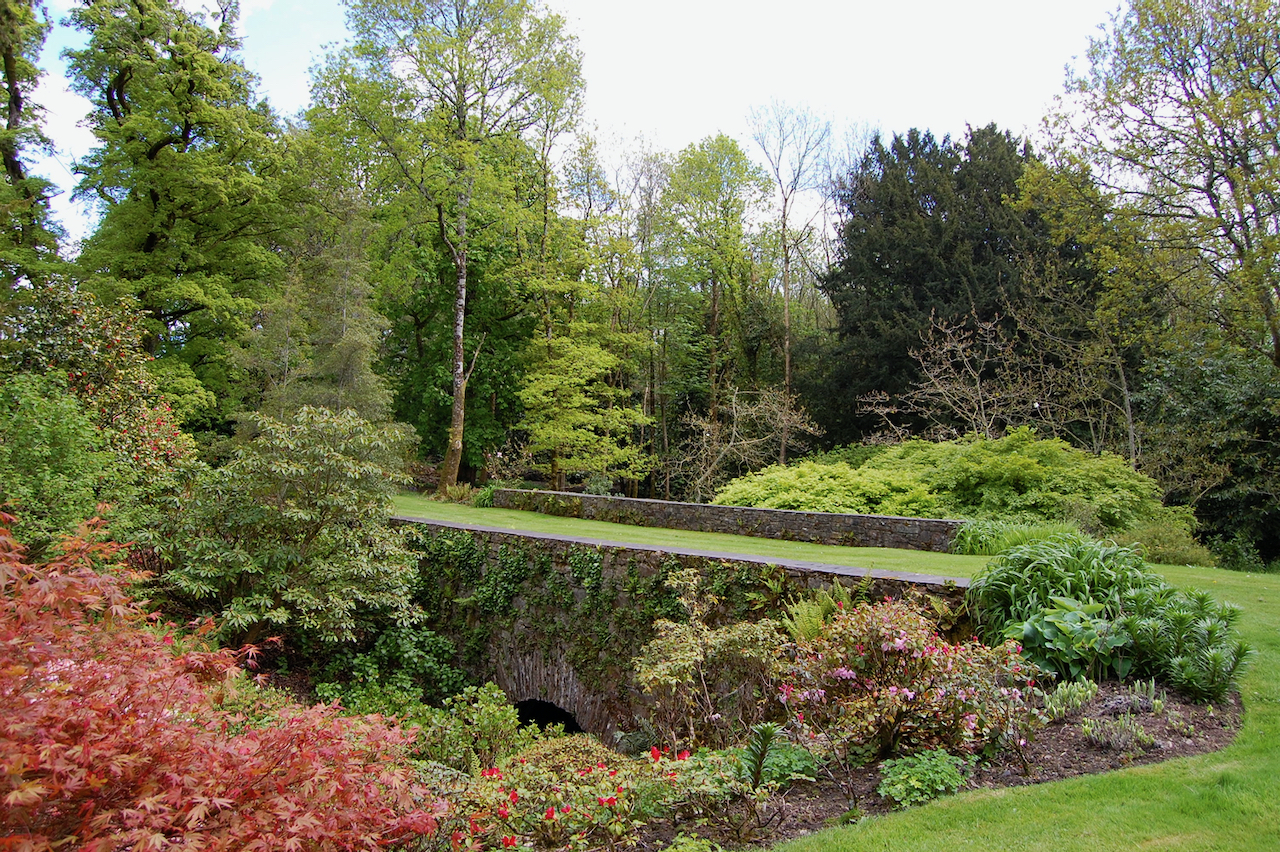
The house has a gorgeous view, and a road used to run along the front of the house, as one can see by the fantastic bridge to one side of the front of the house – the bridge for which Salterbridge was named.
It was nearly 2pm at this stage so we fetched our bagels from the car, sat on the bridge to lunch. Stephen rang ahead to Tourin House to let them know that we were coming for a visit.
Donation
Help me to fund my creation and update of this website. It is created purely out of love for the subject and I receive no payment so any donation is appreciated! For this entry, I paid for petrol and nearby accommodation.
[2] Mark Bence-Jones. A Guide to Irish Country Houses. (originally published as Burke’s Guide to Country Houses volume 1 Ireland by Burke’s Peerage Ltd. 1978); Revised edition 1988 Constable and Company Ltd, London.
I visited 11 North Great George’s Street in 2012 during Open House, run by the Irish Architectural Foundation. I went with my husband Stephen and my Dad, Desmond. There is a video of the day on the website and I am excited to see myself in it! [1]
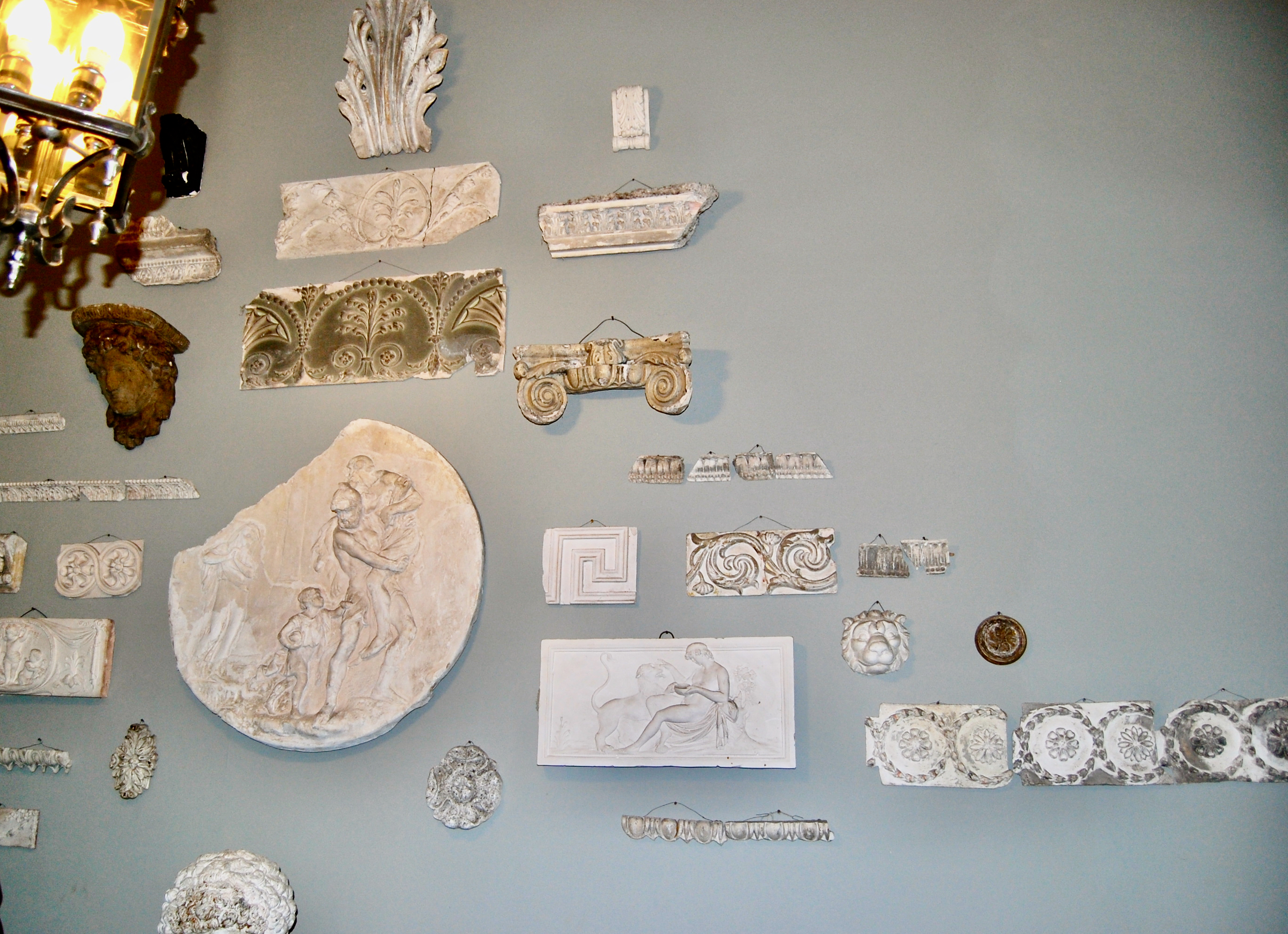
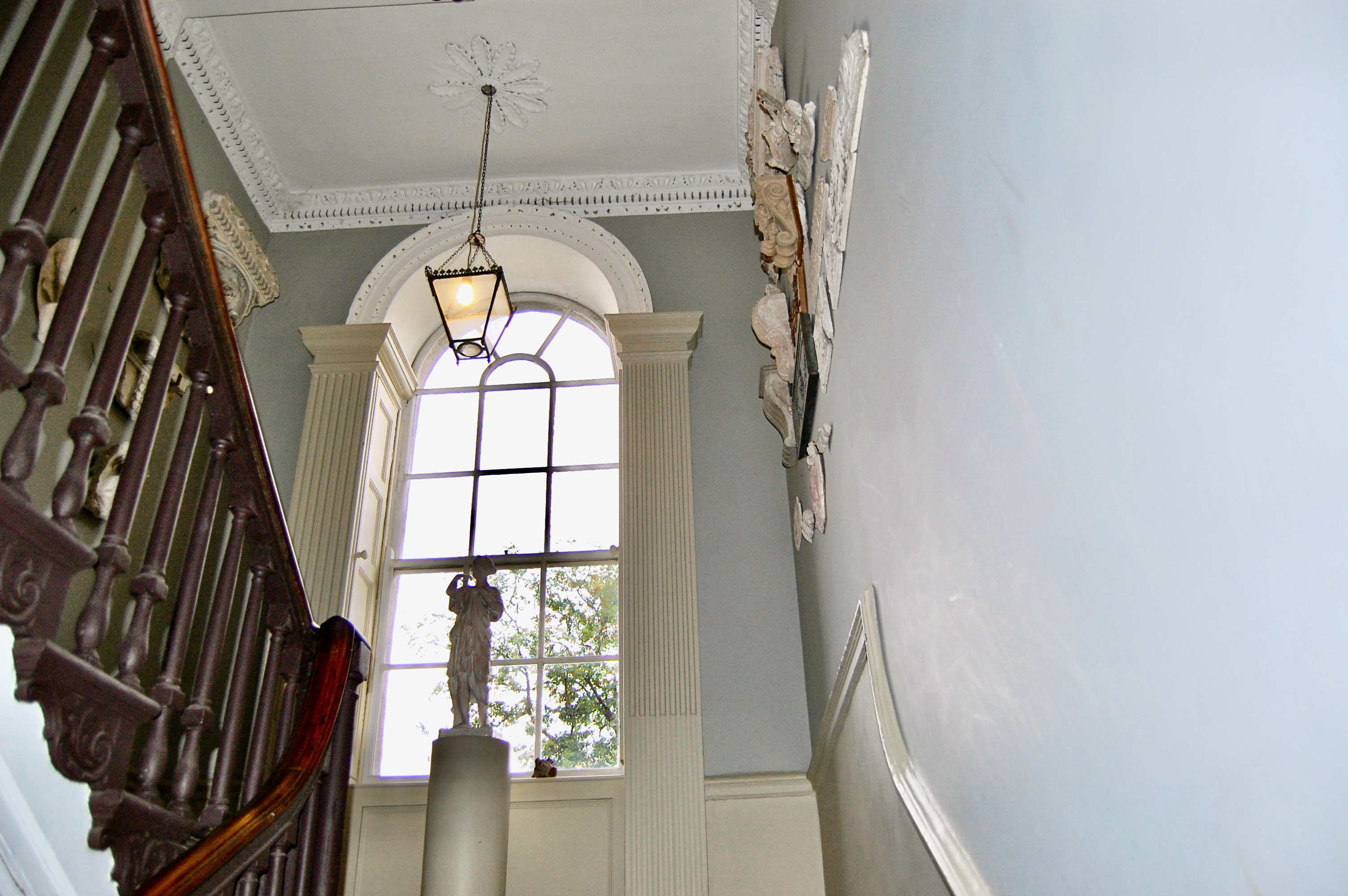
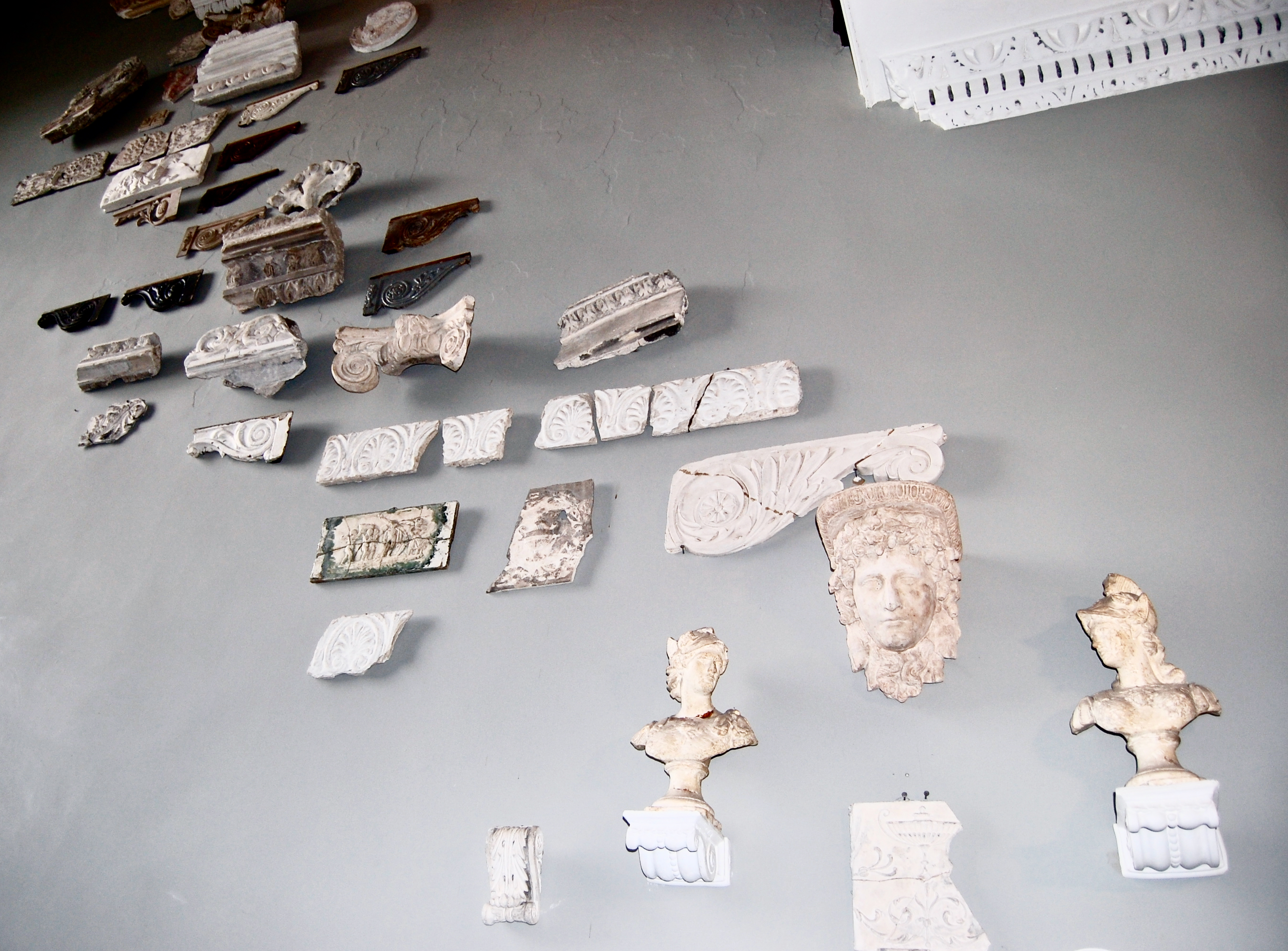
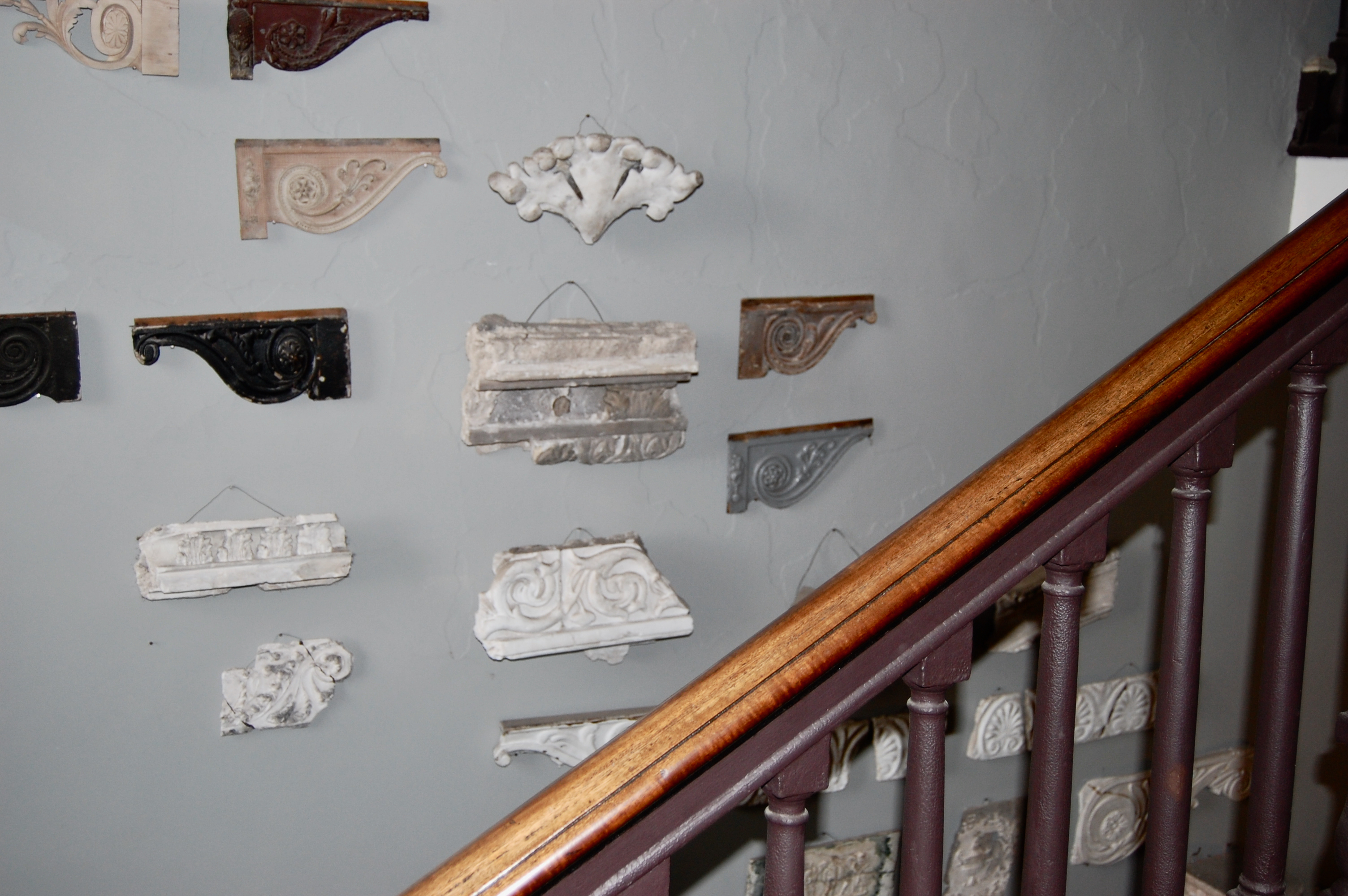
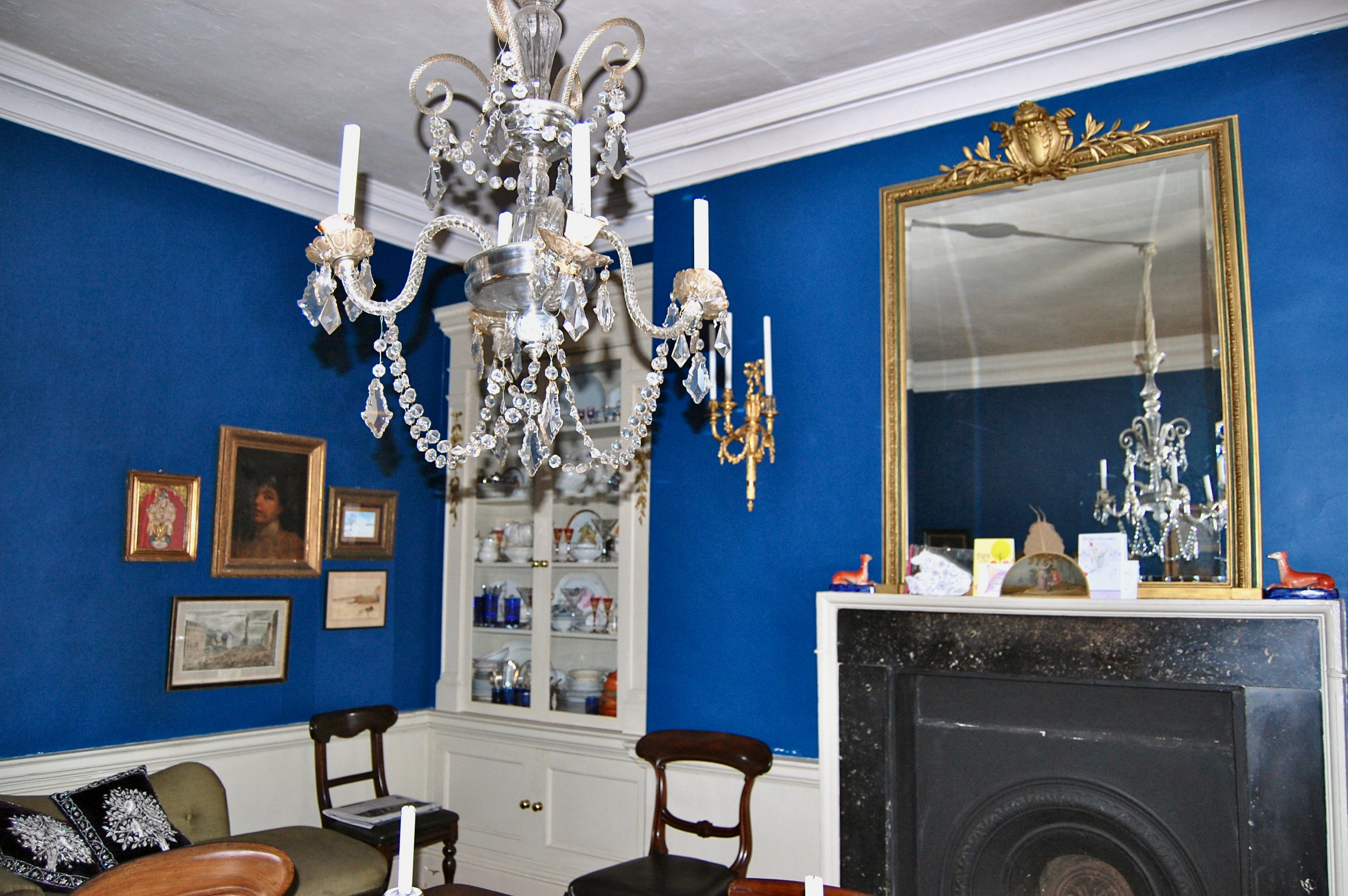
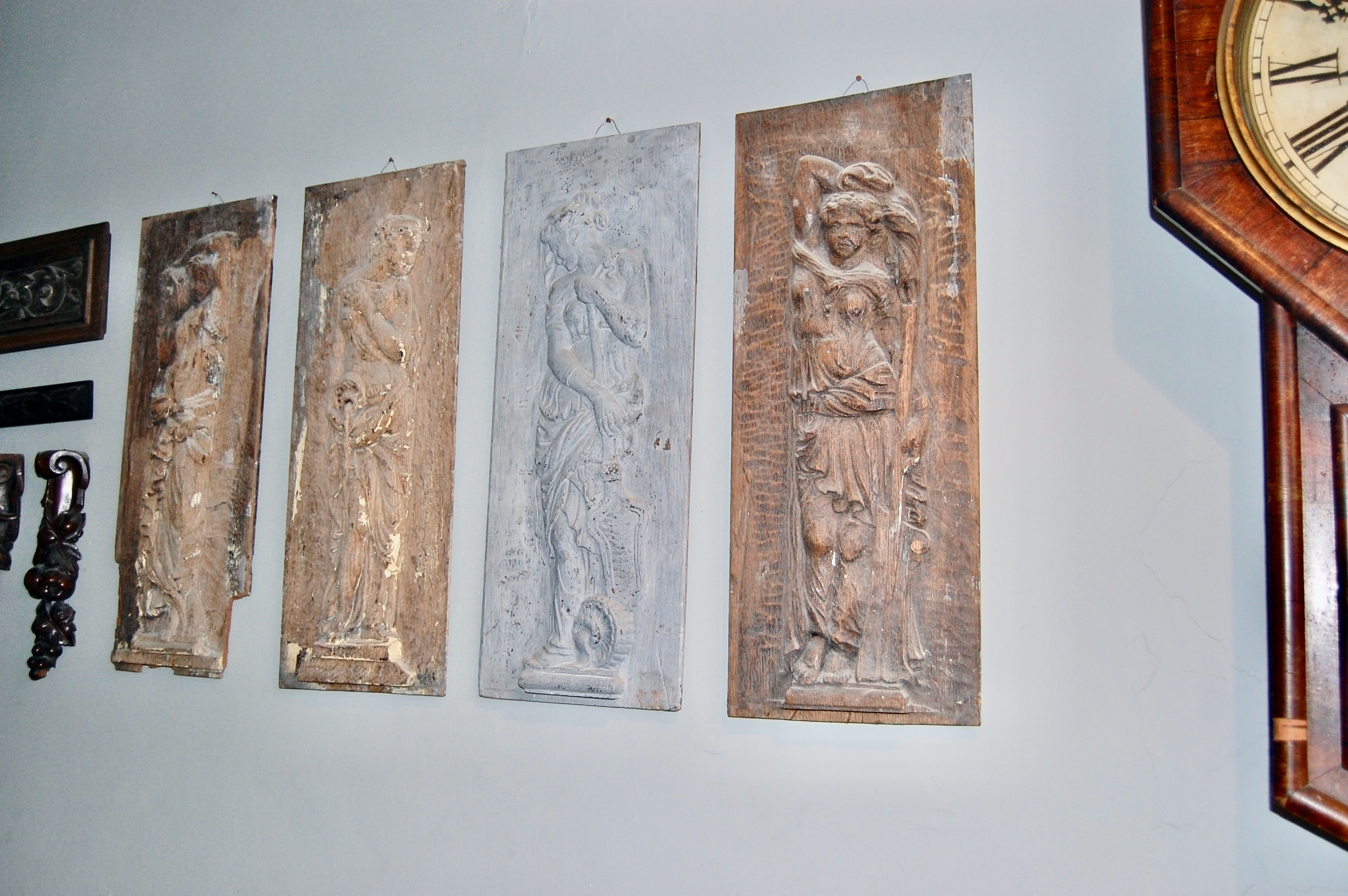
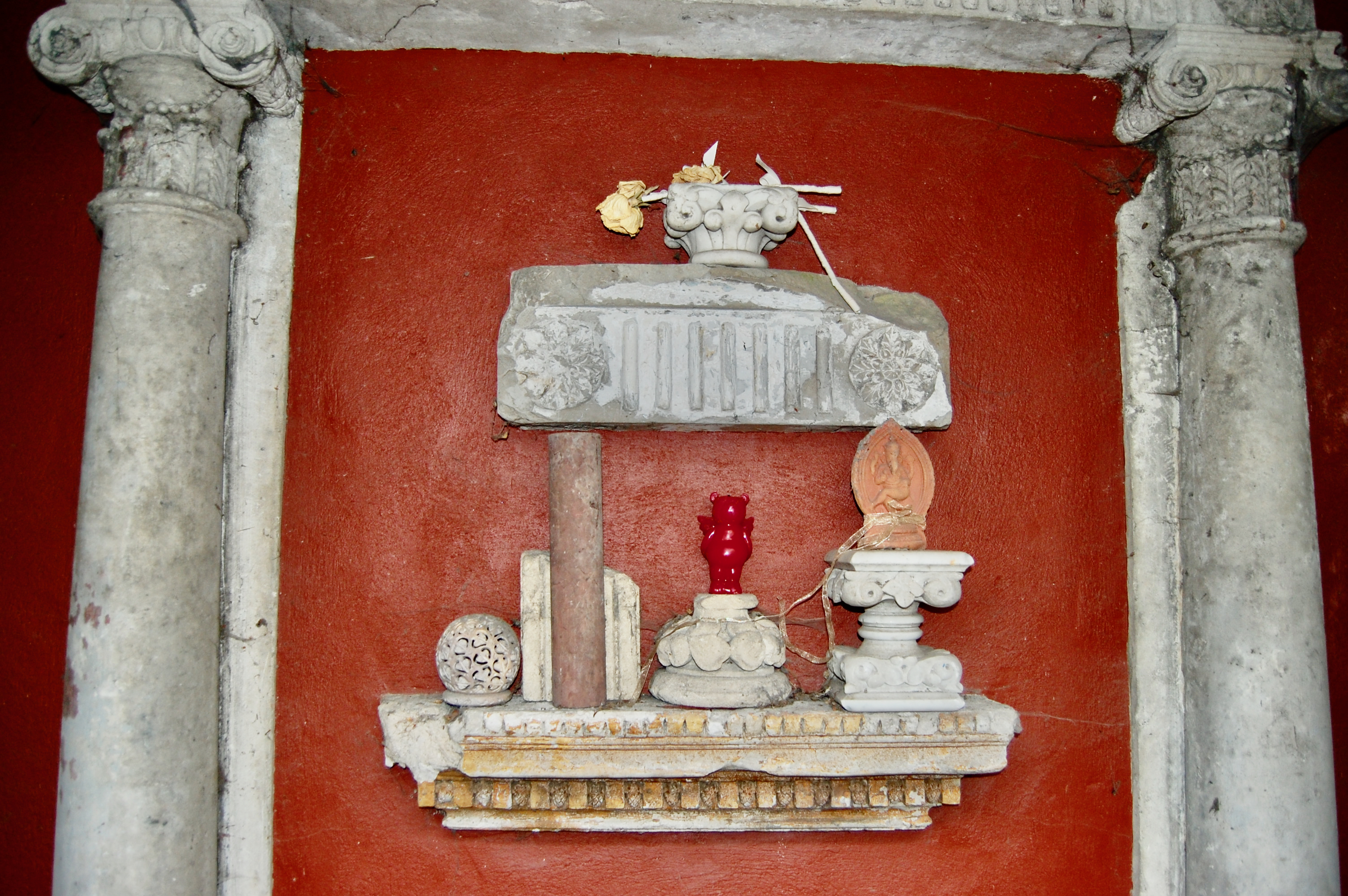
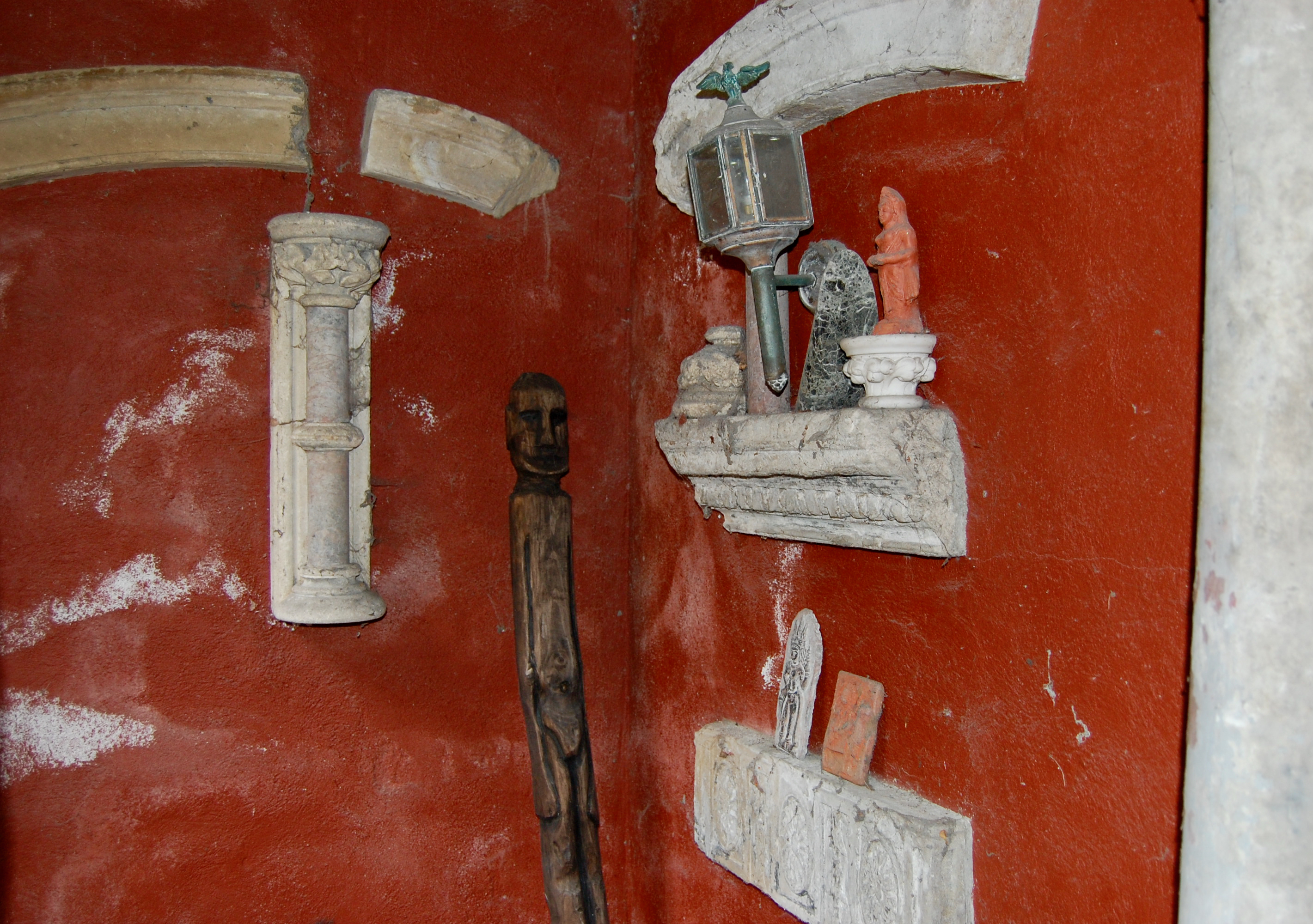
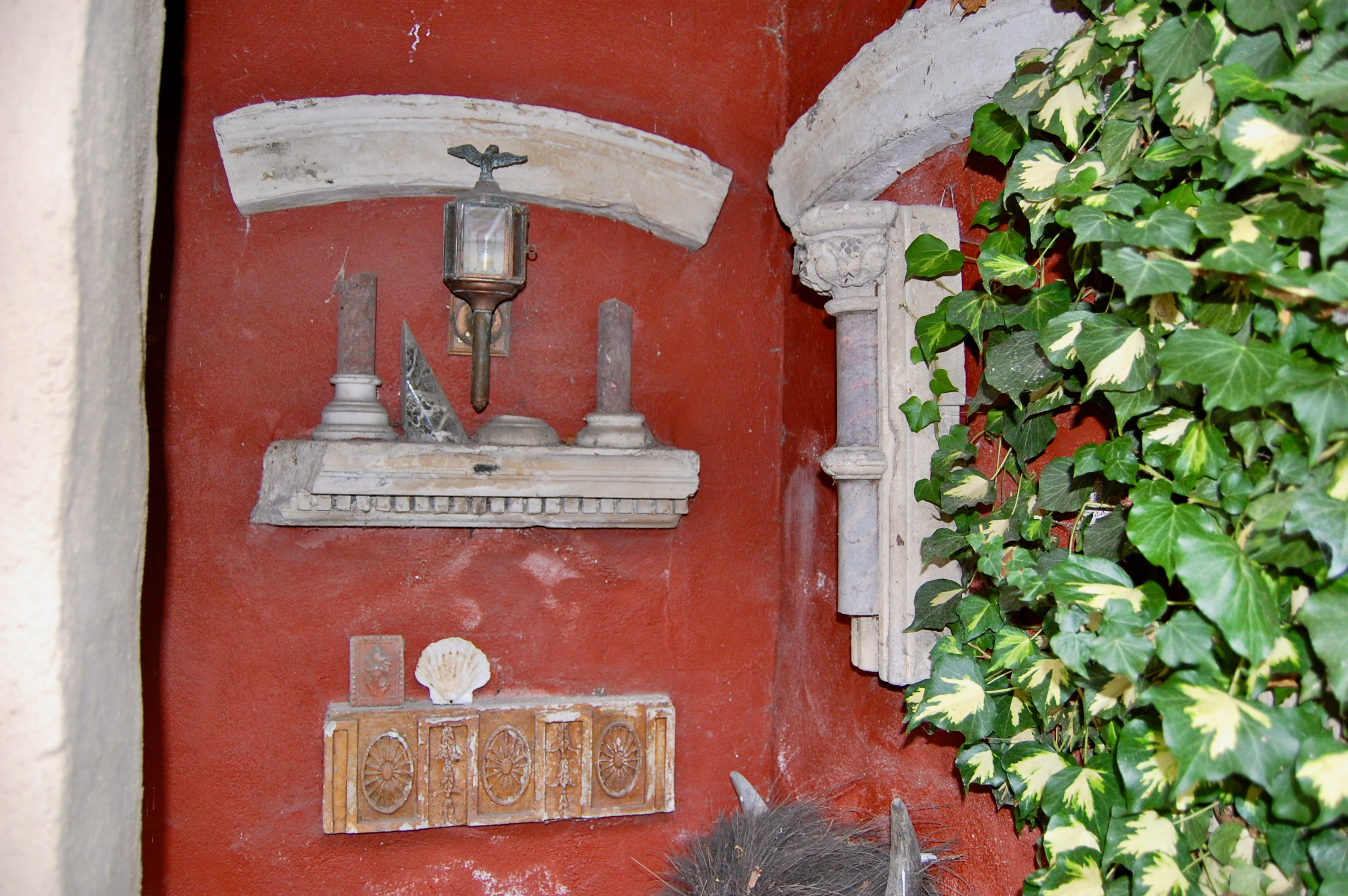
We loved this house! It’s wonderfully decorated and we had a tour with owner John Aboud. The decor is very quirky and full of character. I loved the plaster decoration on the walls, “John Soane’s Museum” style. Like Peter Pearson, the occupant has rescued parts of old houses which are being discarded. How I’d love to come across such a skip!
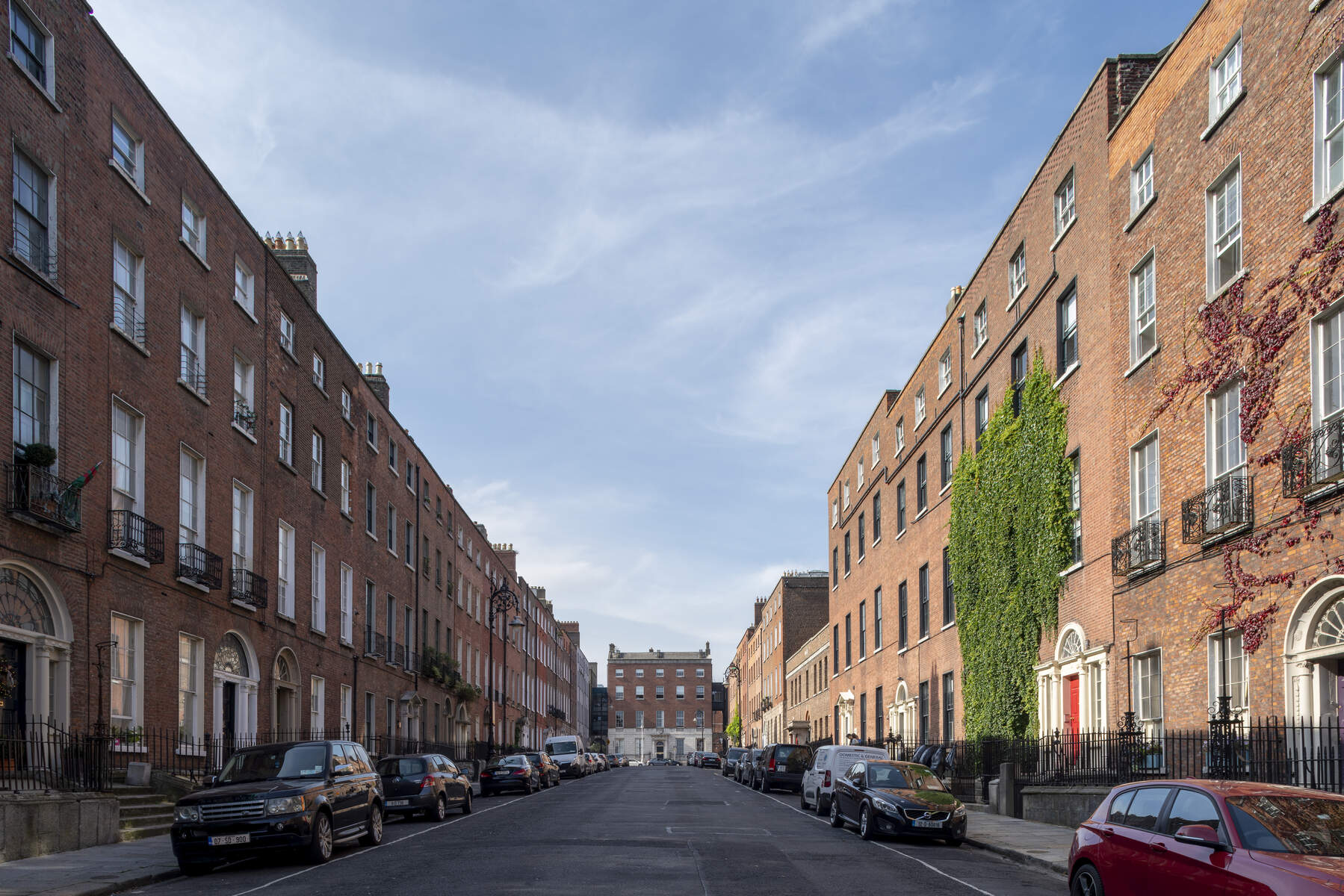
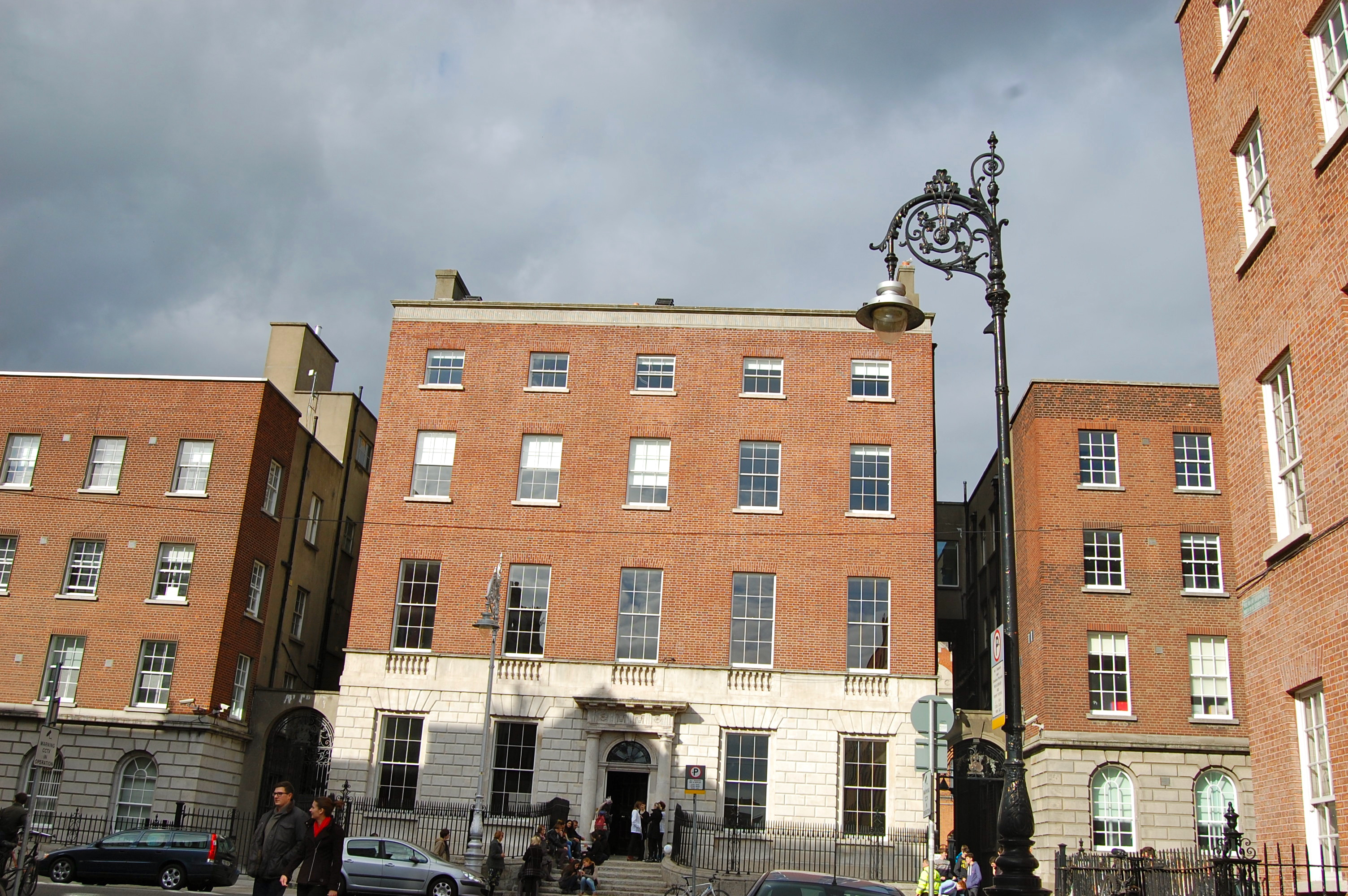
According to the Buildings of Ireland website, this house was one of the first to be built on North Great George’s Street, a street of stepped terraces built after 1768 as a result of commercial leases granted on the avenue leading to the Mount Eccles Estate and in response to the expansion of the Gardiner Estate [2]. The houses were built as townhouses for the gentry. Number 11 was completed in 1774.
The street has its own North Great George’s Street Preservation Society, which has an excellent website with a history of the street written by Conor Lucey. [3] The Preservation Society began in 1979, according to its website, by a group of resident house-owners who had become concerned about the fate of the street, which had survived almost alone amid the surrounding dereliction of North Central Dublin. The Association was formed more recently to represent the views and interests of the many long-term residents in the street.
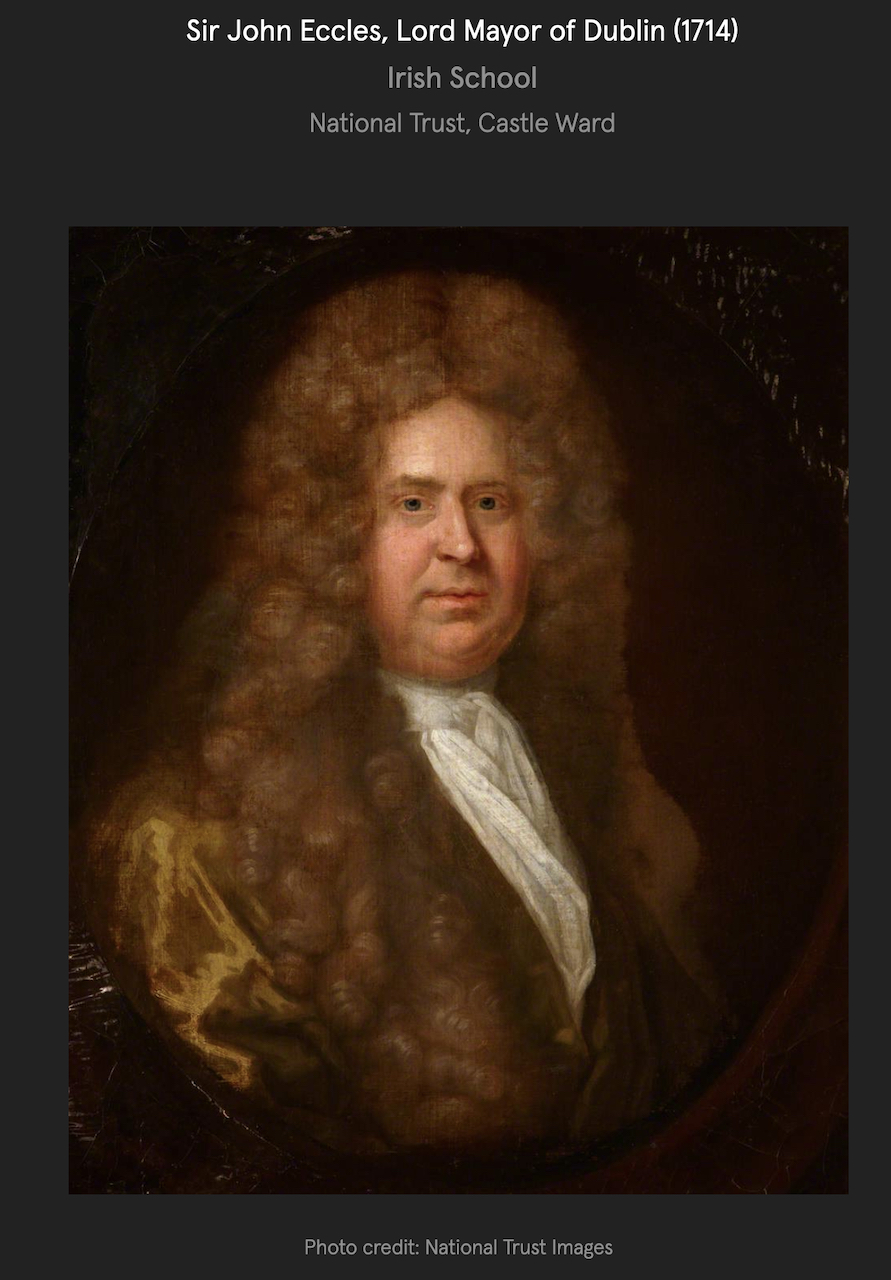
Sir John Eccles was Lord Mayor of Dublin in 1710. He owned an extensive private estate, which contained the area which is now North Great George’s Street. Unfortunately his mansion has gone and the site where it stood is now occupied by a small two-storey building situated between the present numbers 43 and 46 North Great George’s Street.
Conor Lucey tells us that Mount Eccles is clearly visible on John Rocque’s map of Dublin published in 1756, but it is labelled with the name of Nicholas Archdall Esq. Nicholas Archdall had purchased the lease for the Mount Eccles estate for 999 years, beginning 1st August 1749.
Nicholas Archdall was MP for County Fermanagh. His son, Edward Archdall, became a property developer. He built numbers 19 and 20 North Great George’s Street in the late 1780s. Nicholas Archdall’s widow Sarah (nee Spurling) petitioned the Irish Parliament in 1766 for permission to grant long leases on premises on her property. She may have been inspired by the new Gardiner estate and Gardiner’s Row. Permission was granted, and the advertisement read:
“To be Let in Lots for Building, the Lands of Mount Eccles, in Great Britain-street, opposite Marlborough-street, joining Palace-row and Cavendish-street, containing seven Acres, which for Situation, Air and Prospect, cannot be exceeded by any in or about Dublin, subject to no Manner of Tax, Hearth Money excepted. For further Particulars, enquire of Mrs. Archdale, at Mount Eccles, where a Plan of the whole may be seen.“
Lucey tells us that the leases for North Great George’s Street contain no covenants or specifications regarding the form of the house, except for the provision of an eight foot wide ‘area’ intended to be ‘in the front of the houses which is to be built on the said ground over and above the flagged passage which is to be 6 ft and 6 in wide’. Other developments, such as Merrion Square and Fitzwilliam square, had much more detailed specifications for the houses to be built.
Lucey describes the typical layout of the houses on the street:
“By far the most common plan type is the ‘two room’ plan, composed of an axially- aligned entrance hall and stair hall, and flanked by front and rear parlours, the latter typically serving as the formal dining room. The principal staircase, customarily of timber open-string construction, is situated at the back of the house and rises from the ground floor – by way of the piano nobile or ‘drawing room storey’ – to the ‘attic’ or bedroom storey, with admittance to the ‘garret’ alone acquired by a smaller, subordinate stair. A distinctive decorative feature of the garret storey stair is the ‘Chinese Chippendale’ balustrade, popular from mid-century and exemplified by surviving examples at Nos.4, 11, 36 and 50.”
Other properties on the street were leased to Emilia, Dowager Viscountess Powerscourt (the widow of Richard Wingfield, 3rd Viscount Powerscourt, who built Powerscourt Townhouse in Dublin – see my entry on Powerscourt Townhouse) and Valentine Browne, 1st Earl of Kenmare.
The Act of Union of 1800, however, meant that there was no longer a Parliament in Dublin and many gentry left Ireland. The house’s website states:
“Despite the drain from the city of power and money after the Act of Union in 1800, North Great George’s Street managed to hold onto some grandees till the very end of the 19th Century. In the case of no. 11, these included in 1821 a George Whitford, High Sheriff of Dublin, who was knighted in that year by George IV at the Mansion House. No doubt to celebrate his new status, he had the front doorcase re-modelled to accommodate a large new fanlight, and also had the Salon joinery replaced in the fashionable neo-classical style.”
The No.11 website tells us more about former inhabitants.
Dr. Charles Orpen lived in the house in the 1830s. He played a significant part in the development of sign language, and in the education of deaf children, founding Ireland’s first school for deaf children, in 1816, in Brunswick Street (now Pearse Street). It became The Claremont Institution for the Deaf and Dumb when it moved to a large demesne called Claremont in Glasnevin. Dr. Orpen worked at the Workhouse at the House of Industry in Dublin, where he noticed that there were 21 deaf children. He took one of the children, Thomas Collins, home to educate him, and based on his learnings about the conditions of being deaf, he gave several popular lectures in the Rotunda, which led to a public interest in the condition and of education of deaf and dumb children. [4]
Another former inhabitant of number 11 in the 1850s was a barrister named Patrick Blake. He had Nationalist leanings, and the no.11 website tells us that it is believed that Michael Davitt, one of the leaders of the Irish Republican Brotherhood and the Land League, was hidden in the house for some time before his arrest and imprisonment in 1870. By this time, and for the rest of the century, the domestic quarters of the house had retreated to the top two floors, and the rest of the house was given over to office space for barristers and land agents.
As the wealthy left the city centre for houses in the suburbs, in 1910 a Mr. Kelly bought the house and turned it into a tenement. The No.11 website tells us that unlike many houses, the landlord lived on the premises and so the house survived many of the ravages that other houses suffered at this time. Between the 1930s and 1970s every room in the house was used as a family flat.
By the early 1980s the historic centre of Dublin had been all but abandoned. The house was largely derelict with a roof that was on the point of collapse. The website tells us that a great deal of the house was saturated and pigeons inhabited the upper floors. Despite this, the last tenant, Mrs. Margaret Howard, who had moved into the house in 1921, struggled to maintain an old fashioned gentility in her tenement rooms.
The National Inventory of Architectural Heritage Buildings of Ireland website describes number 11 as a terraced three-bay four-storey house over exposed basement. It’s made of handmade red bricks and granite window sills. The website describes:
“Round-headed door opening with painted stone Doric doorcase. Original ten-panelled painted timber door flanked by engaged Doric columns on stone plinth blocks supporting deep cornice, and replacement peacock fanlight with moulded surrounds and scrolled keystone.”
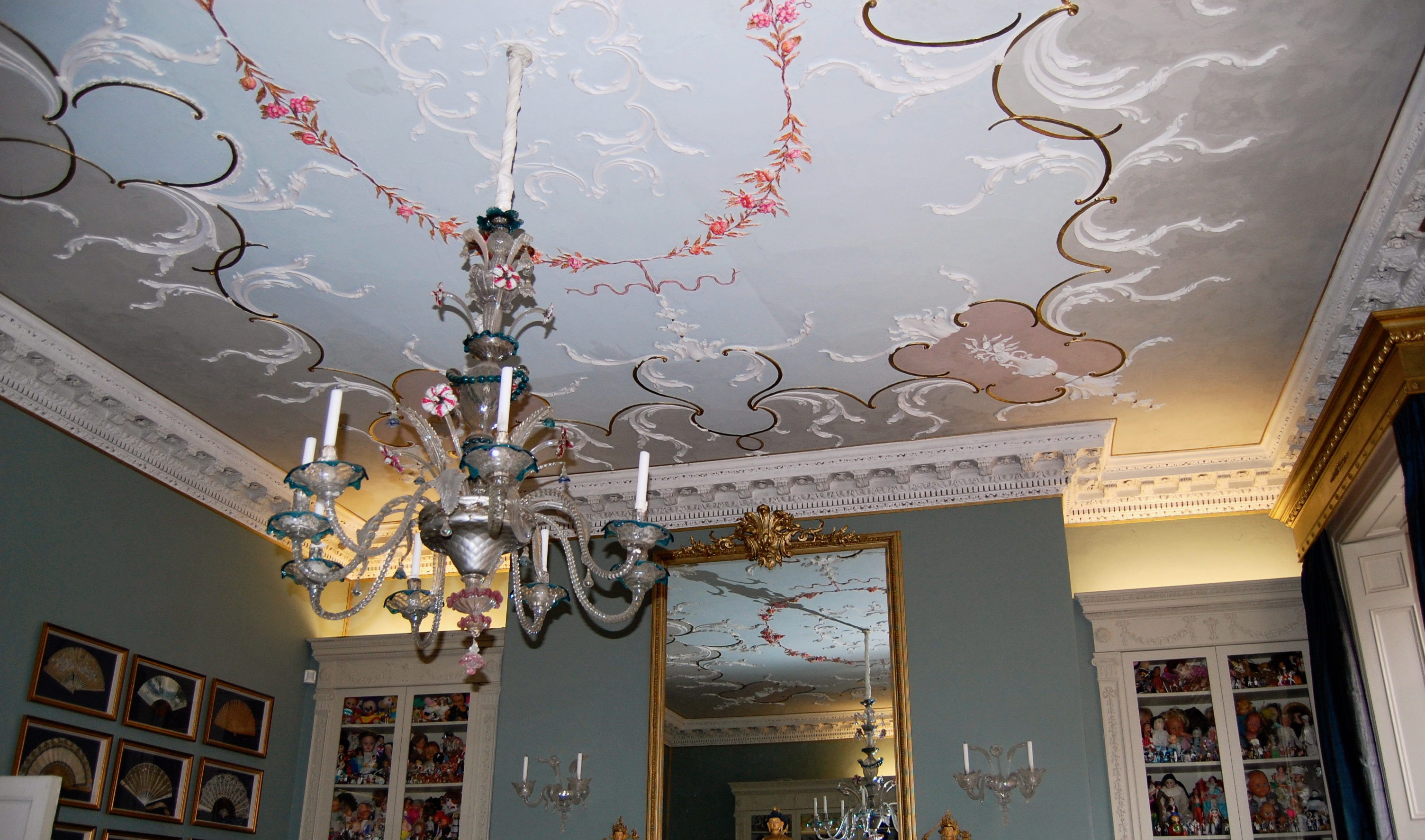
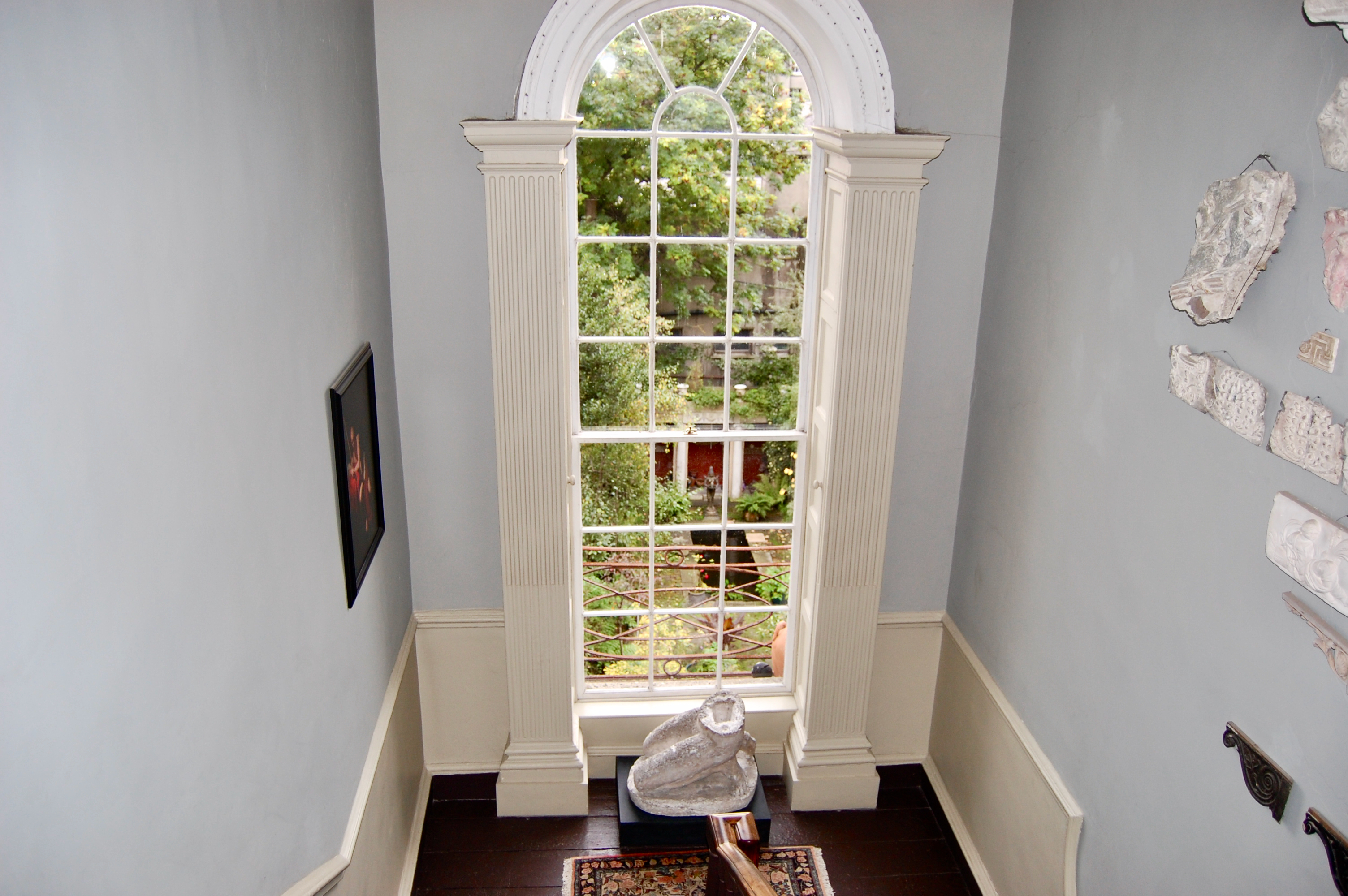
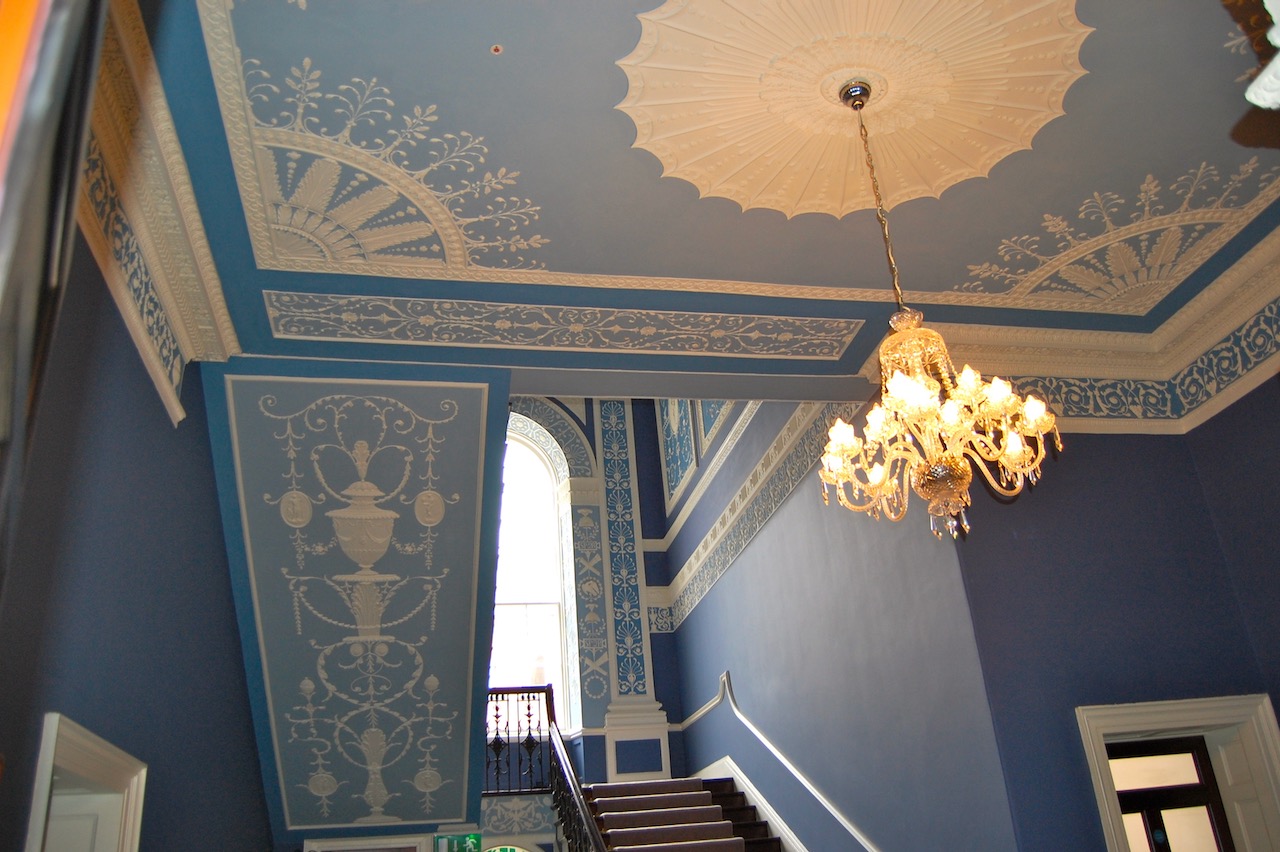
The website also mentions the original plaster walls and ceiling, as well as original timber joinery and flooring. The ceilings seemed overly colourful, but the owner assured us that this is how such a ceiling would have looked originally.
“Upper floors having large amounts of surviving late Rococo plasterwork with projecting birds, acanthus leaves and flower-baskets to rear rooms. First floor saloon having ceiling with flower vases, acanthus pendants and cartouches. Neo-classical over-doors and friezes with urns and festoons. Lugged architraves throughout and moulded joinery [“lugged” is a moulded frame with horizontal projections at the top, according to wikipedia]. Imposing fluted Doric architraves to round-headed windows at each half-landing. Chinese Chippendale stair to garret floor.” [5]
The Rococo plasterwork, the number 11 website tells us, “must be amongst the very last flings of the renowned Robert West School of Rococo plasterwork.” We came across Robert West plasterwork also in Colganstown[6].
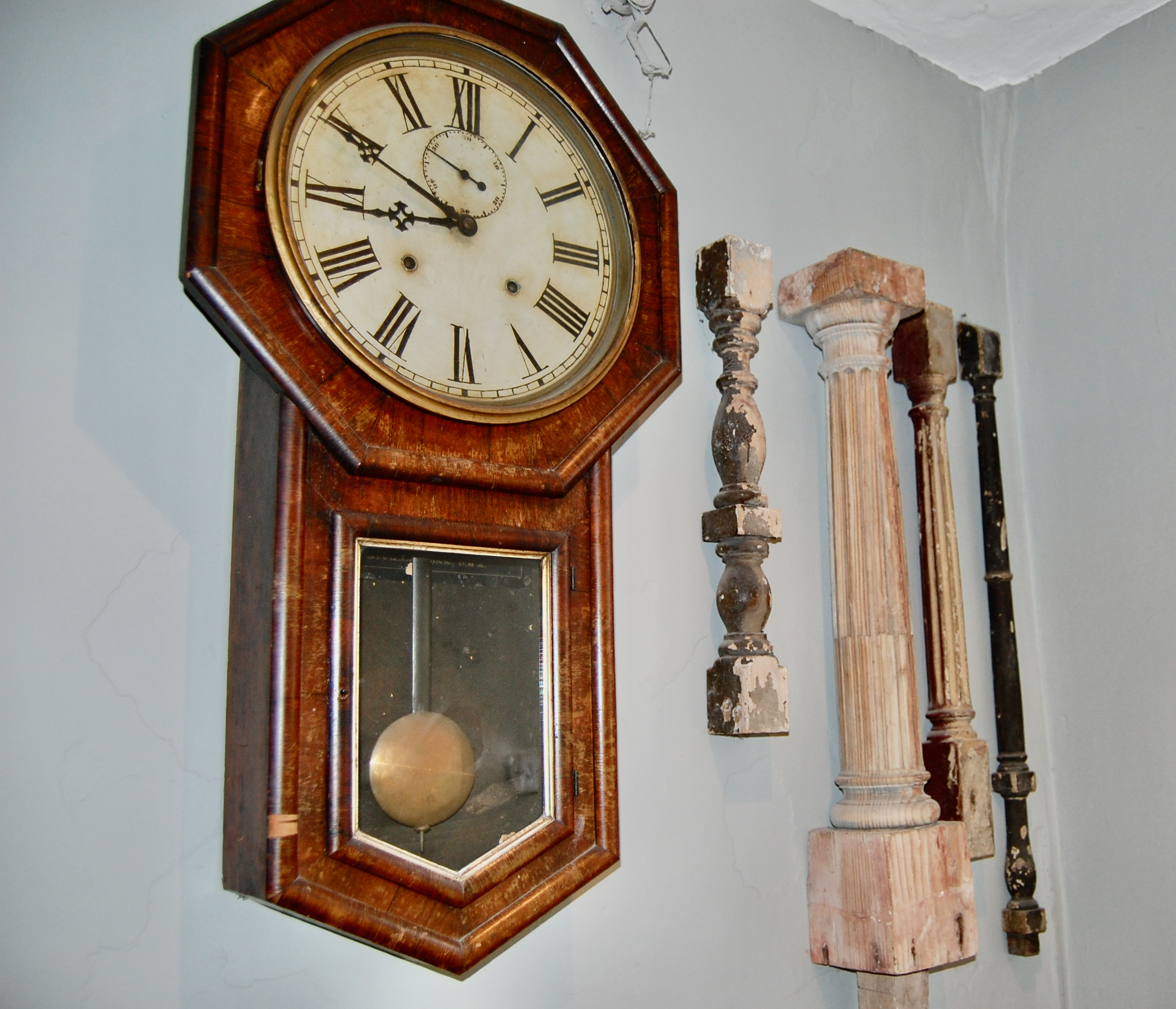
Some of the architectural pieces are from, I believe, a church that was demolished, St. Peter’s Church on Aungier Street. These banisters might have been altar rails:
In its appraisal the National Inventory website states:
“Largely dilapidated by the early 1980s, it was carefully conserved by the owner and is now a residence and venue for weddings and other events. The surviving early plasterwork is a fine example of the traditional ‘Dublin school’ Rococo style and its juxtaposition with the Neo-classical embodies the stylistic developments of the late eighteenth century. The oversailing lintel of c.1820 is one of few on the street and the restored light posts add a further element of interest in the public realm of the street. The retention of timber sash windows and of the granite and iron work to the entrance and basement enhances the architectural heritage quality of this house and of the street in general.”
The website for number 11 has a link to airbnb accommodation available in the house.
At the top of North Great George’s Street, on Denmark Street, is Belvedere House, now part of Belvedere College, a boys’ secondary school. I visited this on another Open Day. Its splendid stucco work is of the Neoclassical or “Adam” style popular in Dublin in mid 1770s to 1800, designed by Michael Stapleton. Conor Lucey writes:
“The neoclassical style is also well represented by Belvedere House. Built for George Augustus Rochfort, 2nd Earl of Belvedere, and completed by 1786, it is one of the finest city mansions built during the latter part of the century. The interiors of this house represent a text-book model of how Irish stuccodors invented freely within the Adamesque idiom, deriving their decorative vocabulary from architectural treatises, builder’s manuals and pattern books.”
Help me to fund my creation and update of this website. It is created purely out of love for the subject and I receive no payment so any donation is appreciated!
[5] According to Craig, Maurice and Knight of Glin, Ireland Observed, A Handbook to the Buildings and Antiquities. Mercier Press, Dublin and Cork, 1970, Rococo is the asymmetrical freely-modelled style of decoration originating in France and popular in Ireland from about 1750 to 1775. See also Architectural Definitions:
On Sunday July 14th Stephen and I went to see Dardistown Castle, in County Meath. I contacted the owners beforehand, Ken and Lizanne Allen. www.dardistowncastle.ie Open dates in 2025: Feb 3-8, 10-15, 17-22, 24-25, May 31, June 2-7, 9-14, 16-17, 21, 28, August 1-2, 4-9, 11-30, 10am-2pm
Dardistown has some links to our most recent visit, to Dunsany Castle, as it was enlarged by Dame Jenet Sarsfield (1500-1597), who was the widow of Robert Plunkett, the 5thBaron of Dunsany.
She is worth writing about, but first let me backtrack.
During the Hundred Years War, 1337-1453 (that’s more than one hundred!), in which the English fought the French for the right to rule France, the English military were mostly withdrawn from Ireland. To compensate for their military absence, a limited number of government grants of £10 each were made available to landowners in the “The Pale” for the building of fortified houses. John Cornwalsh (or Thomas? Drogheda Museum blog writes that it was built by Thomas Cornwalsh, and that Thomas Cornwalsh was related to the Talbot family of Malahide Castle by marriage, which explains how the castle came into the Talbot family later [1]) obtained a £10 grant in 1465 for the building of Dardistown Castle. According to wikipedia, John Cornwalsh was Chief Baron of the Irish Exchequer.
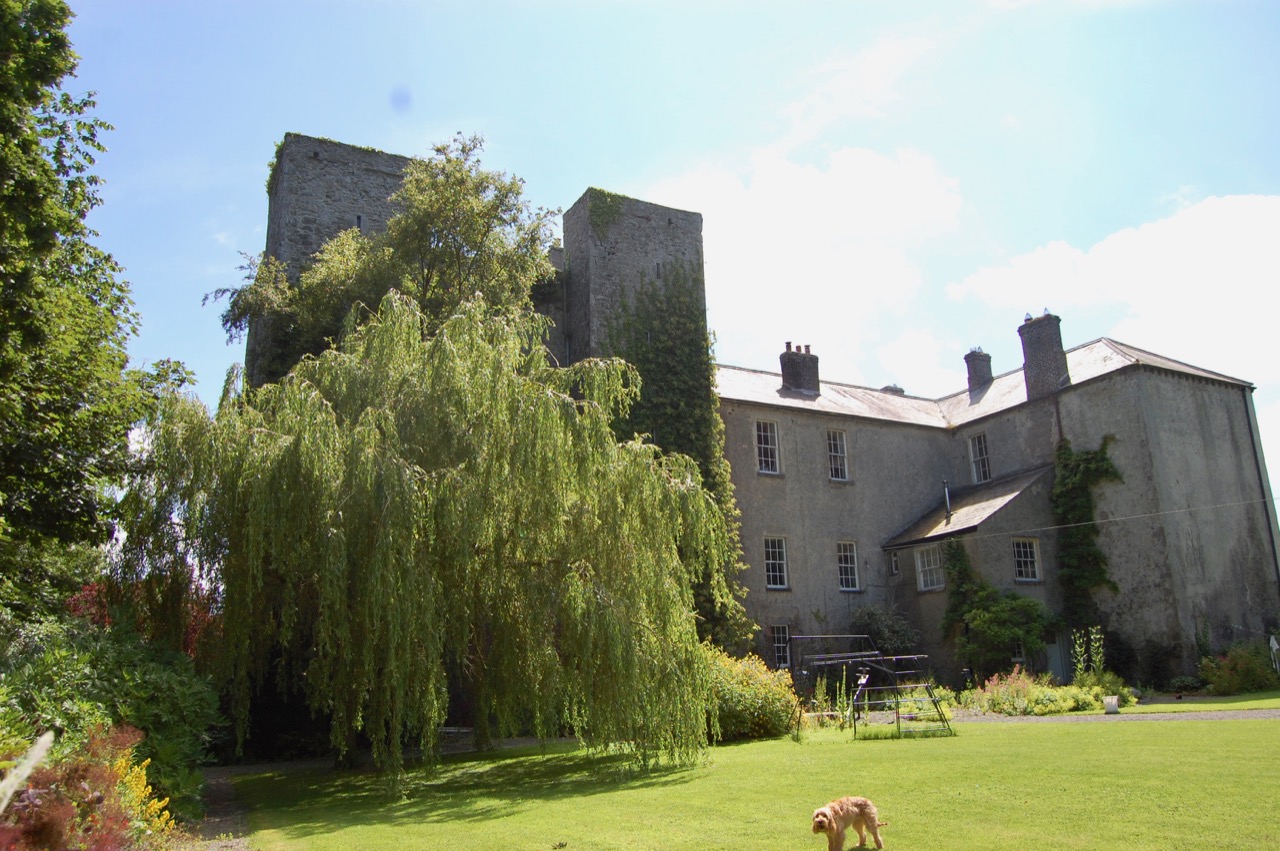
Driving up the driveway, one cannot see the tower. We drove up in front of the house, which has a lovely square trellis outside.
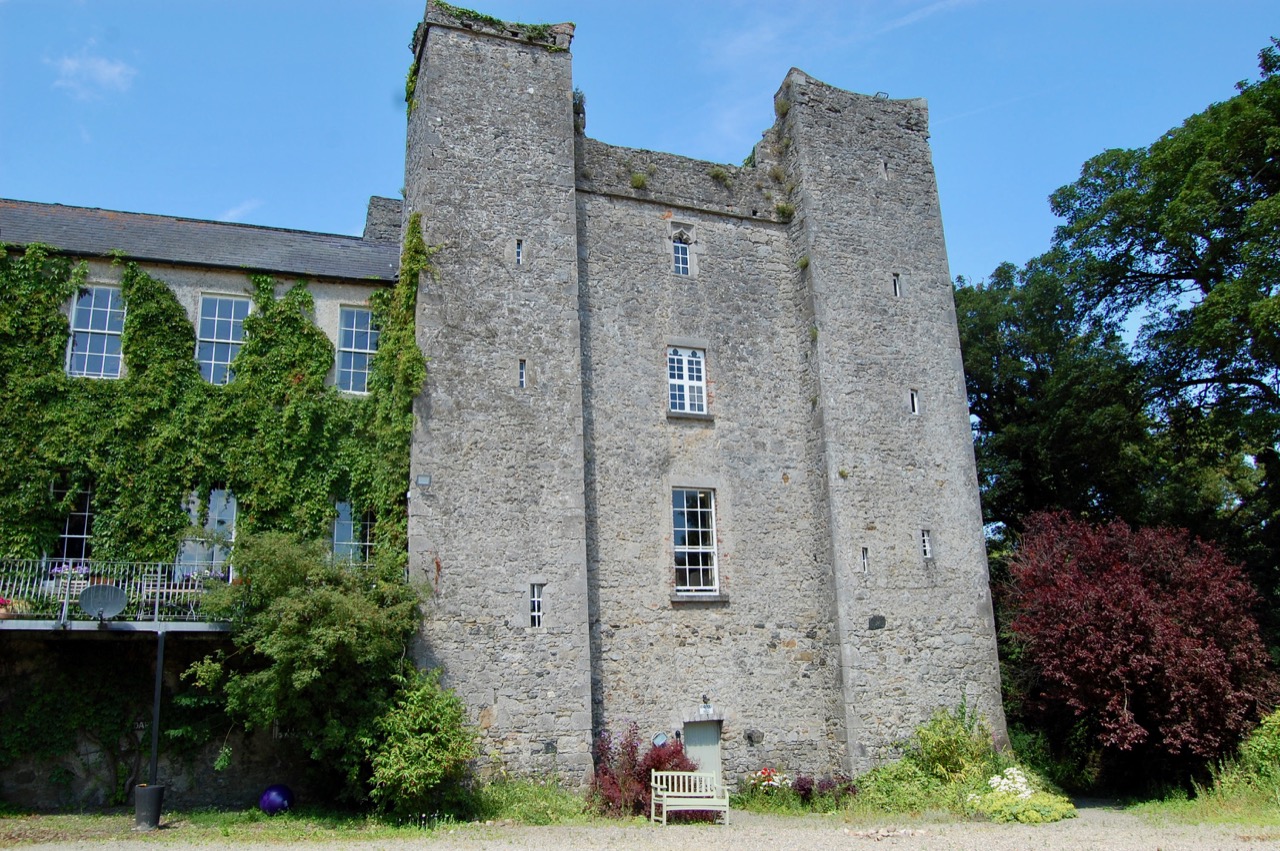
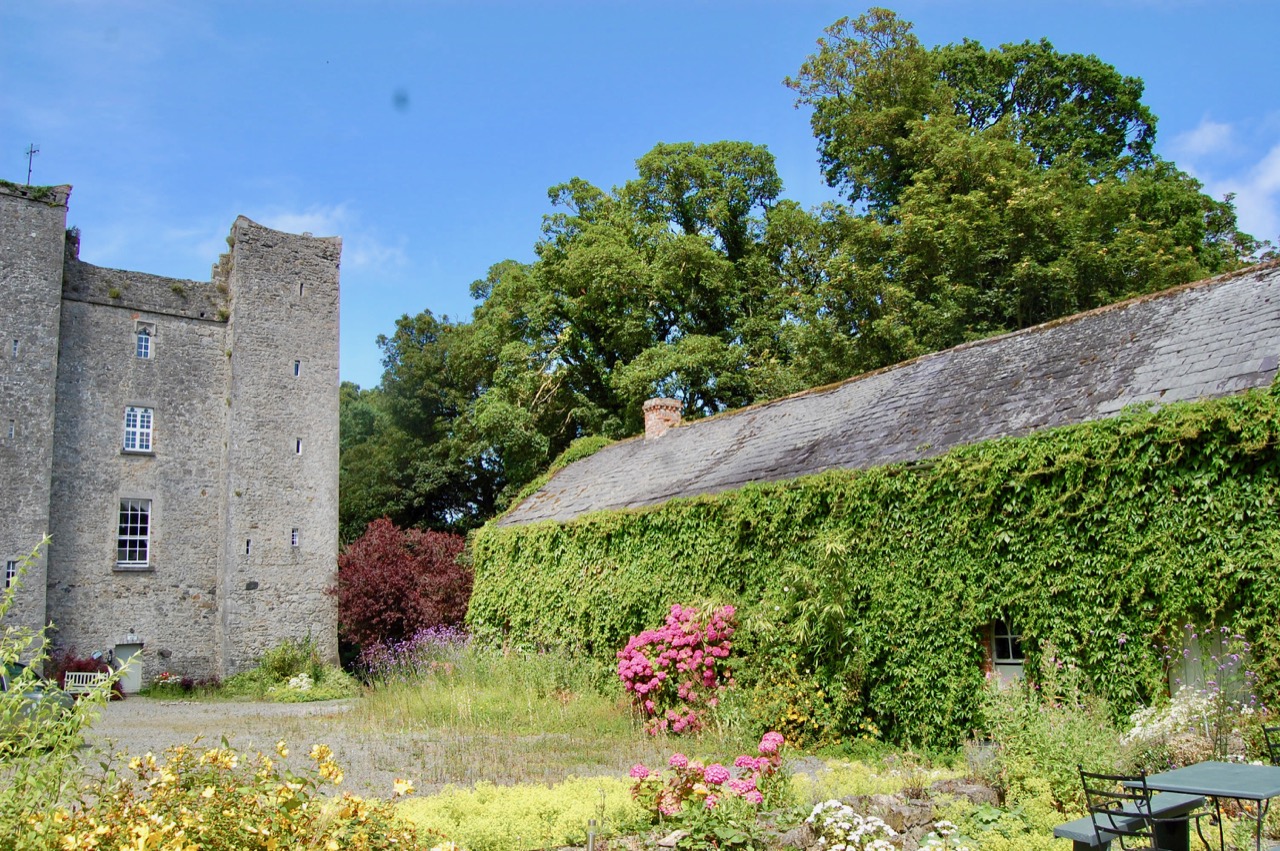
Ken was sitting outside waiting for visitors. He took us around to the back of the house. We went around the side, and only then saw the impressive tower.
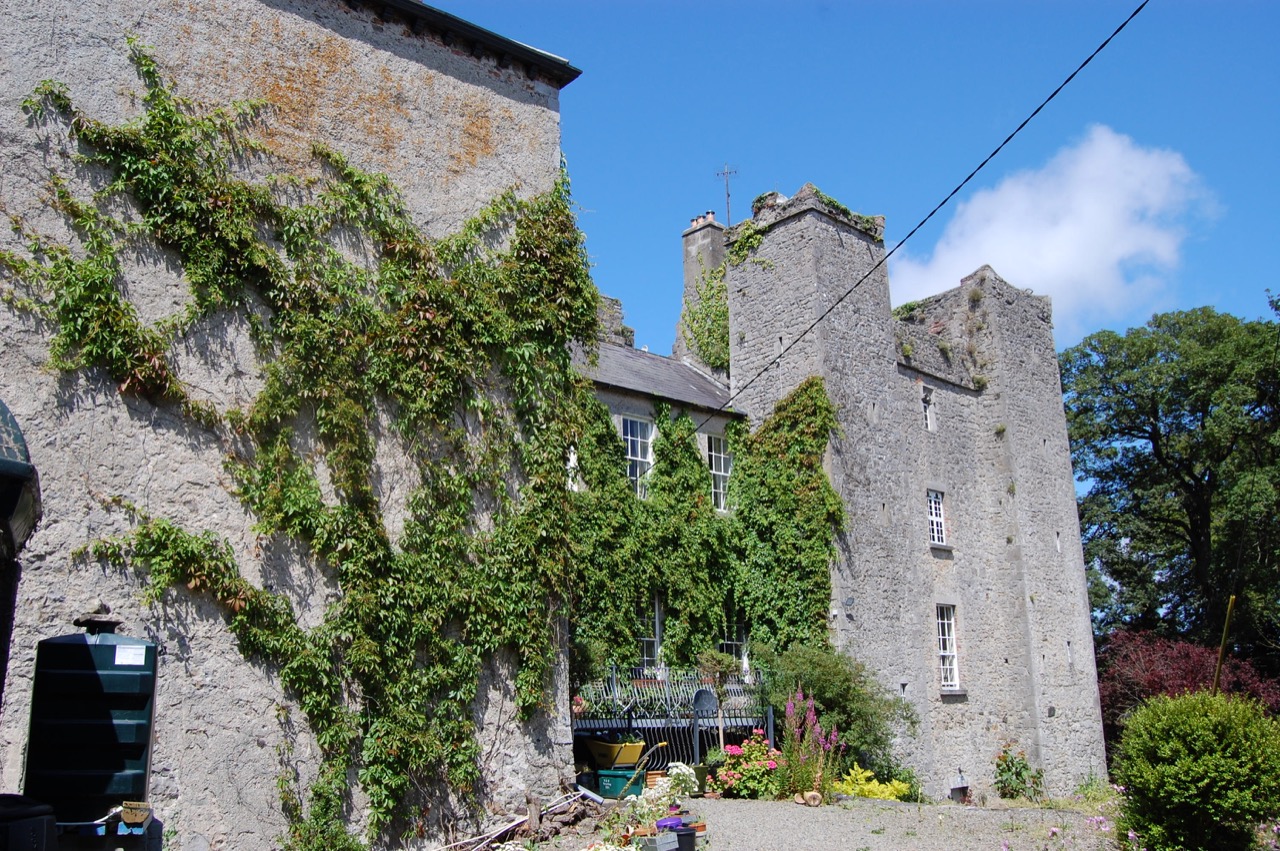
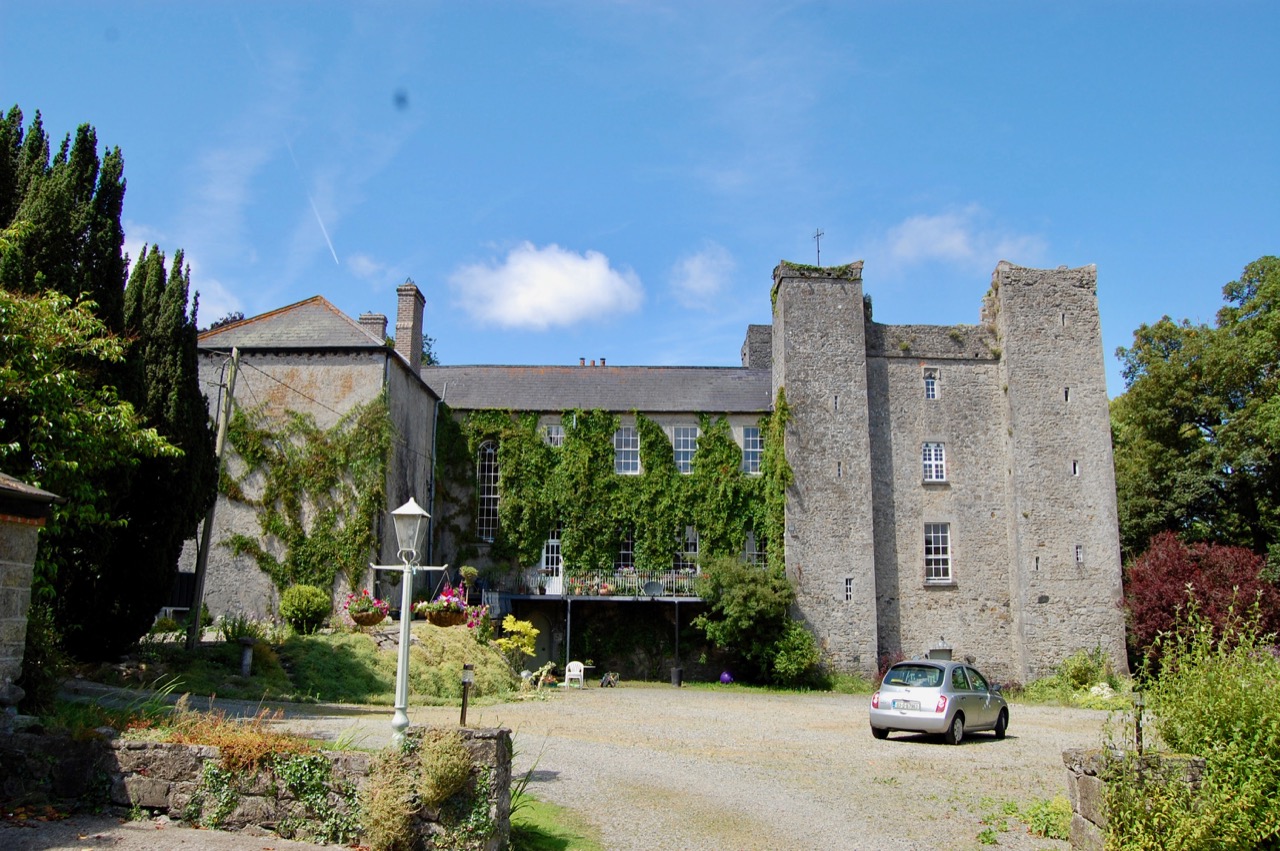
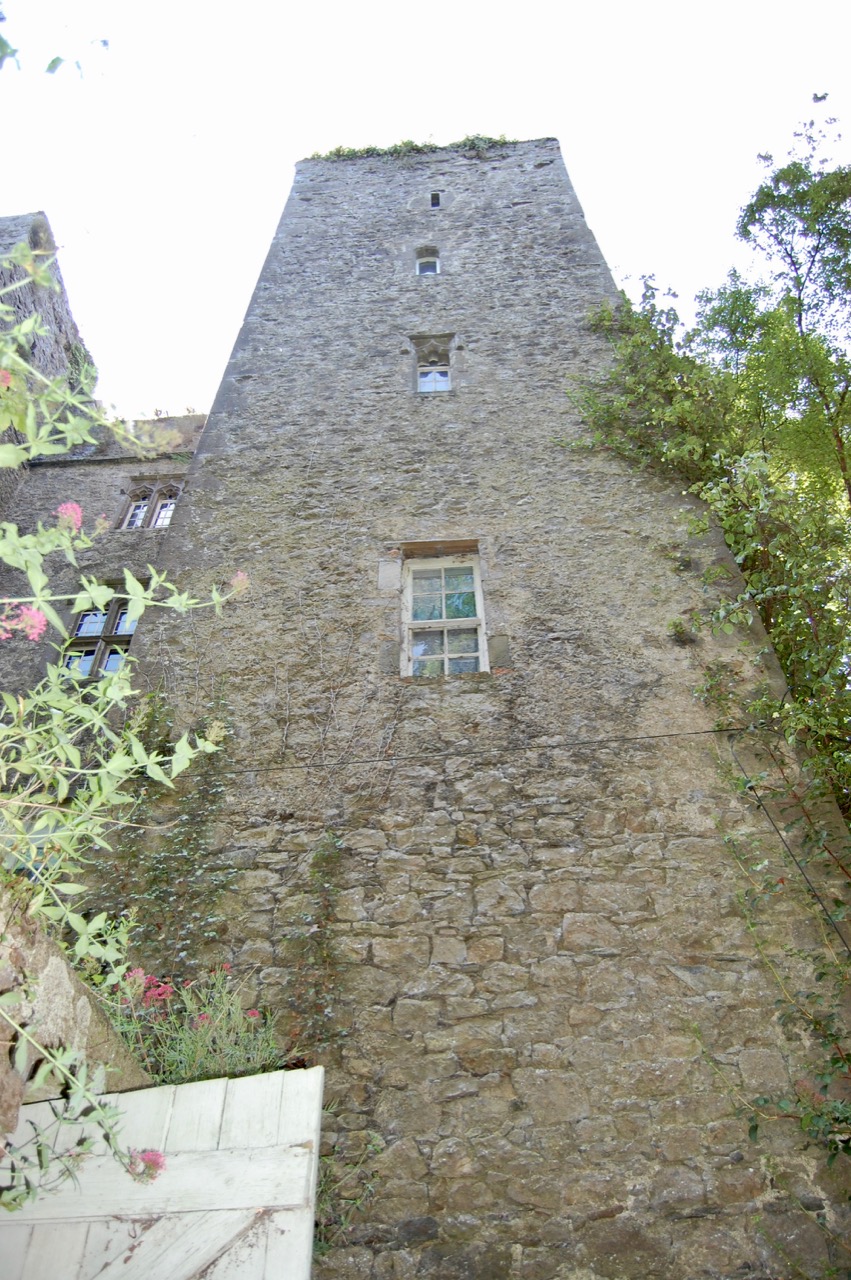
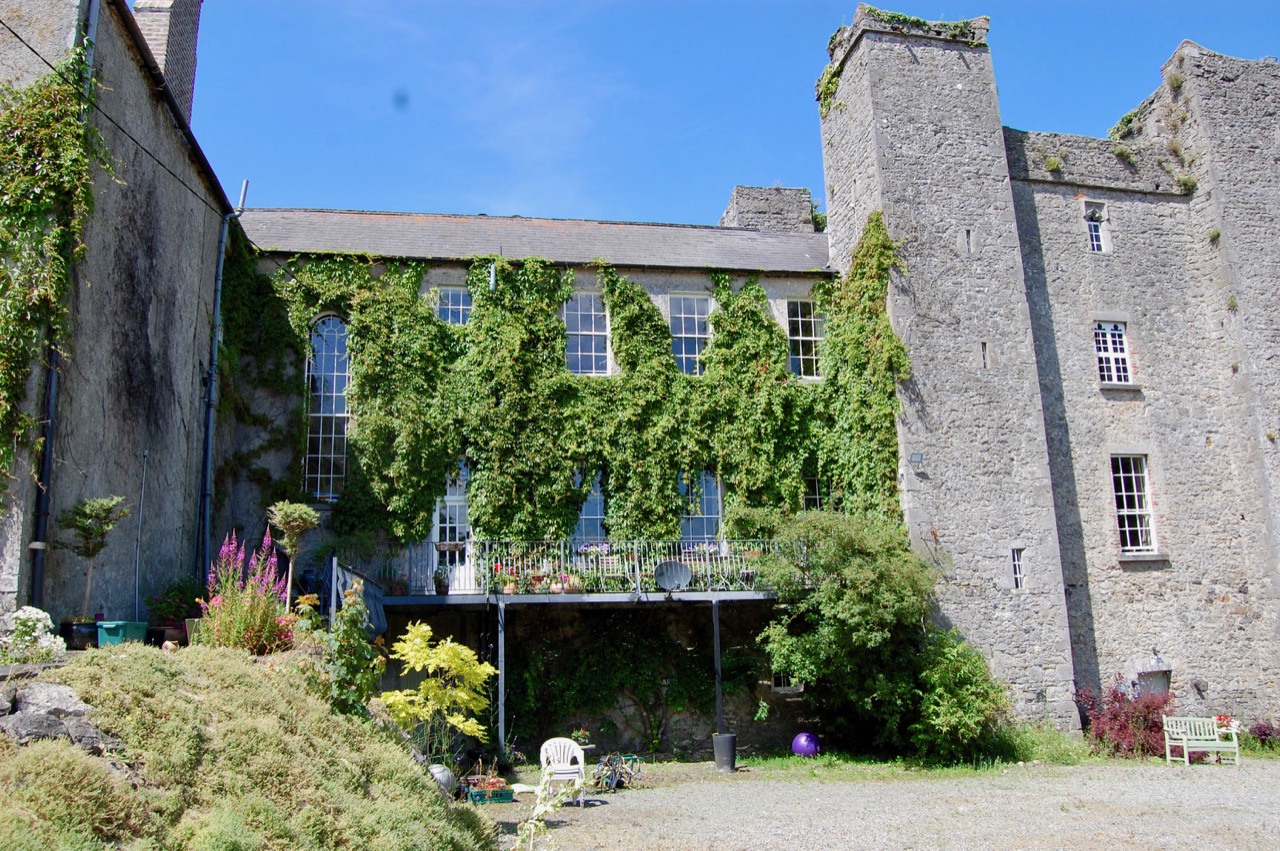
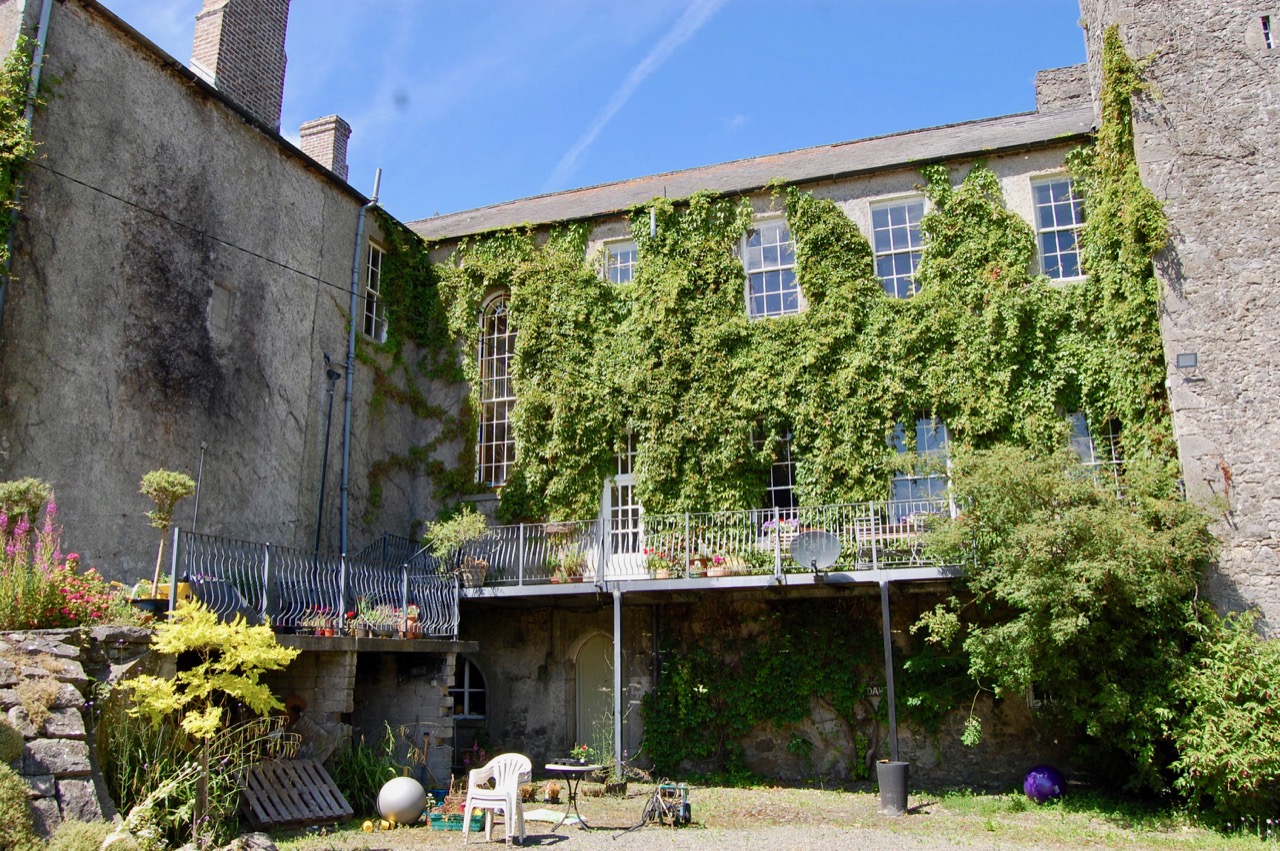
It’s a four storey medieval tower, extended with the addition of a Victorian frontage. The tower is square with sides about 44 feet long and a square turrret at each corner. The turrets are of different sizes. The main arched entrance to the tower is now blocked and the main entrance is now on the south side. The tower is fifty feet high.
According to the website, fifty years after the castle was built, the Castle and lands were rented for £4 a year by John and Thomas Talbot, who supplied three armed horsemen for the royal army.
The Talbot family remained in Dardistown Castle until 1690, when they lost possession of the Castle and lands at Dardistown after the Battle of the Boyne. The castle became the residence of the Osborne family, who remained there until 1970. Francis Osborne of Dardistown was M. P. for Navan Borough in 1692 and 1695, and the Osborne family continued to occupy Dardistown until the death of the last member of the family. Henry Osborne (died May 10, 1828) also owned Cooperhill Brickworks. The castle passed via Samuel Henry Osborne to Henry St. George Osborne, who died in 1899, and then to his son Henry Ralph Osborne, who died in the 1970s.
It was then taken over by the Armstrong family until 1987, and then the Allen family, who are from the Drogheda area, and it was Ken Allen who showed us around. He has restored the castle tower beautifully.
The tower was a ruin when the Allens acquired the castle and attached house.
The first extension to the Castle, forming part of the present house, was built before 1582, when Dame Genet (or Jenet) Sarsfield came to reside here, and made a new entrance doorway and built a further addition (commemorated by two stone tablets on the house).
The house was further added to in around 1770, and an extension built in 1800, with an upper storey added around 1860.
Dame Jenet Sarsfield was the not only the widow of Robert Plunkett. She was married six times! She was also the widow of Sir John Plunket of Dunsoghly Castle in Dublin.
She was the daughter of a merchant, John Sarsfield, of Sarsfieldstown in County Meath. She was born in around 1500. Her brother William was an alderman of Dublin. She must therefore have mixed in rather elite circles, as she married Robert Shilyngford (or Shillingford), who became Lord Mayor of Dublin in 1534 for the usual one year term. They had one daughter who survived to adulthood – the only offspring of Jenet who lived into adulthood [5]. Jenet was also reputed to be the tallest lady living in Ireland in the 1500s, as testified by the tall door built at Dardistown! (it must be this pale green door under the balcony). [6]
After Robert’s death, Jenet married James Luttrell. He was also prominent in Dublin administration as he was the High Sheriff of County Dublin in 1556, and his father was Chief Justice. He died in 1557.
It was after James Luttrell’s death that Jenet married Robert Plunkett (1520-1559), 5thBaron of Dunsany. She was his second wife. He died only two years after her previous husband died, in 1559. After that marriage, she continued to be referred to as the Dowager Lady Dunsany. She next married Sir Thomas Cusack (1490-1571) of Cushinstown. He had previously been Lord Chancellor of Ireland. He was about thirty years older than her. She was his third wife (!), although he refused to acknowledge his first wife. His second wife was reputed to have murdered her first husband, but she had a happy marriage to Thomas Cusack. Jenet had around eleven years as Thomas Cusack’s wife before he died.
Jenet inherited most of Cusack’s personal property, which was unusual at that time. Normally the firstborn son would be the heir. Sir Robert, Thomas’s son, had acquired the Abbey of Lismullen after the Dissolution of the Monasteries. Sir Robert’s son Edward pursued litigation to obtain his father’s property. Lady Dunsany married Sir John Plunket then, of Dunsoghly Castle, who was an influential judge and Privy Councillor. She eventually vacated Lismullen but Edward Cusack complained that she had removed most of the valuables. Lady Dunsany lived with her husband Sir John Plunket in Dunsoghly Castle. He died in 1582.
Her sixth and final marriage was to John Bellew, and she lived for her last years in Dardistown Castle. She died in 1598 and chose not to be buried with any of her husbands, but in a tomb of her own, in Moorchurch in County Meath. Her last husband outlived her. Dardistown Castle passed to her son-in-law Thomas Talbot after her death. Her daughter Katherine Shillingford married Thomas Talbot, who lived in Dardistown Castle. Jenet Sarsfield/Lady Dunsany was John Bellew’s third wife. John Bellew (1522-1600) was of Bellewstown and Castletown. Dardistown Castle came into the family due to Katherine’s marriage to Thomas Talbot. [6]
The historic battle of Julianstown of 1641 is said to have taken place on the front lawn of Dardistown, though at that time it was separated from the House by the road [in1800 the road (main Drogheda – Dublin road at that time) was moved so that, instead of passing the front door, it now curved several hundred yards from the Castle, enclosing the area which is now picturesque parkland.] Richard Talbot was then in occupation of the Castle. The battle was fought by insurgents led by Sir Phelim O’Neill, against an English garrison on their way to Drogheda. Three new rooms were added to the Castle about this time.
As I mentioned earlier, the Talbot family remained in Dardistown Castle until 1690, when they lost possession of the Castle and lands at Dardistown after the Battle of the Boyne. The castle became the residence of the Osborne family, who remained there until 1970.
In the main house, the drawing room and dining room date from around 1750. The upper floors were added in two stages, the back about 1800 and the front in 1860. We did not get to see inside the main house, as the Allen family live there.
Ken led us in to the ground floor, which was originally the basement. This room is quite empty, and has been used for parties and gatherings so has a bar installed. It is described on the website as a games room. It is surprisingly large – this is by far the largest most spacious tower I have seen. There are vaulted smaller rooms in three of the four turrets off the main ground floor room. One turret would have been the toilet, where everything dropped down to the ground. There is a fireplace in the west wall of each main room on every level.
This room has the remains of a very unusual looking ceiling, “barrel vaulted.” [2] We can still see the sticks, in what looks like a wattle and daub type construction. I had never seen anything like it in a tower, but it is part of the original tower! [I have since seen this in several castles, such as in Blarney Castle in County Cork and in the basement of St. Mary’s Abbey house in Trim, County Meath] The website states:
“Following a native Irish technique, woven wicker mats resting on timber beams were used to support the vaults during their construction and at Dardistown bits of the wickerwork may still be seen embedded in the undersides of the vaults.”
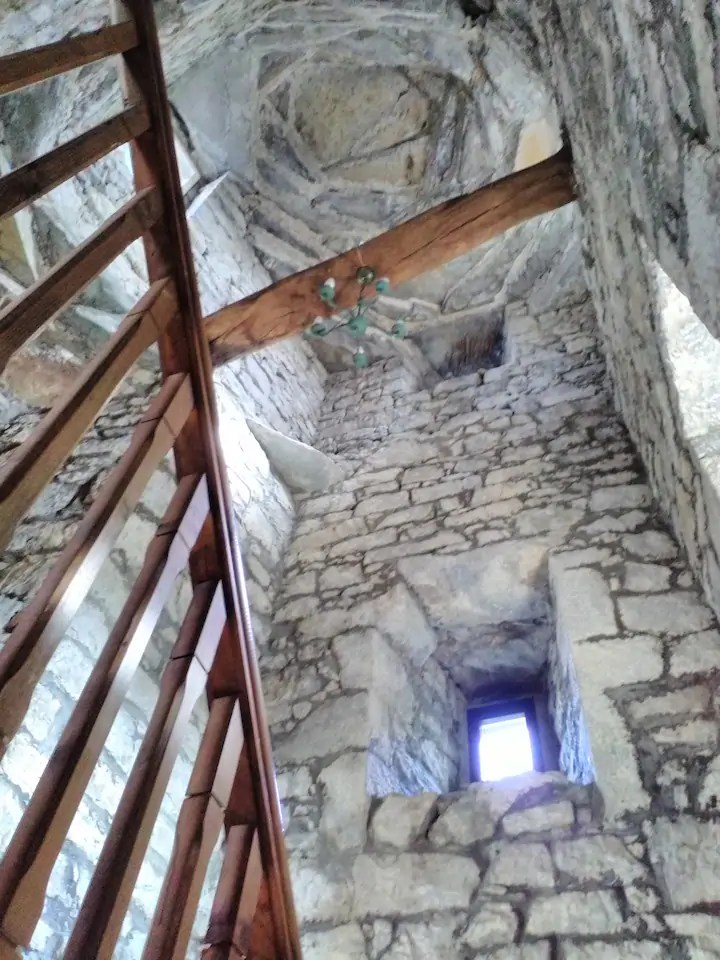
We went up the original stone staircase in the southwest turret, unusual because it spirals to the left, or anticlockwise, rather than the right – Stephen is fascinated how the direction in most towers was determined to give the advantage to the owner, so that on descent, he (it was usually a male, I presume, wielding the sword, although surely not always!) could more easily wield his sword than an intruding coming up the stairs. Perhaps the person who designed these stairs was left-handed, Stephen speculated.
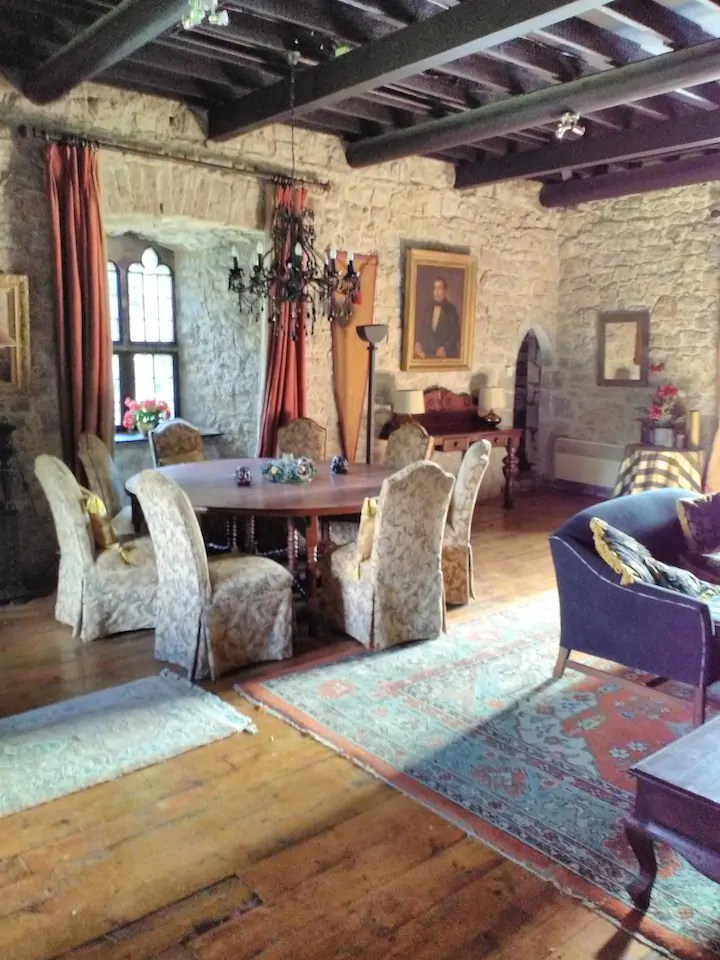
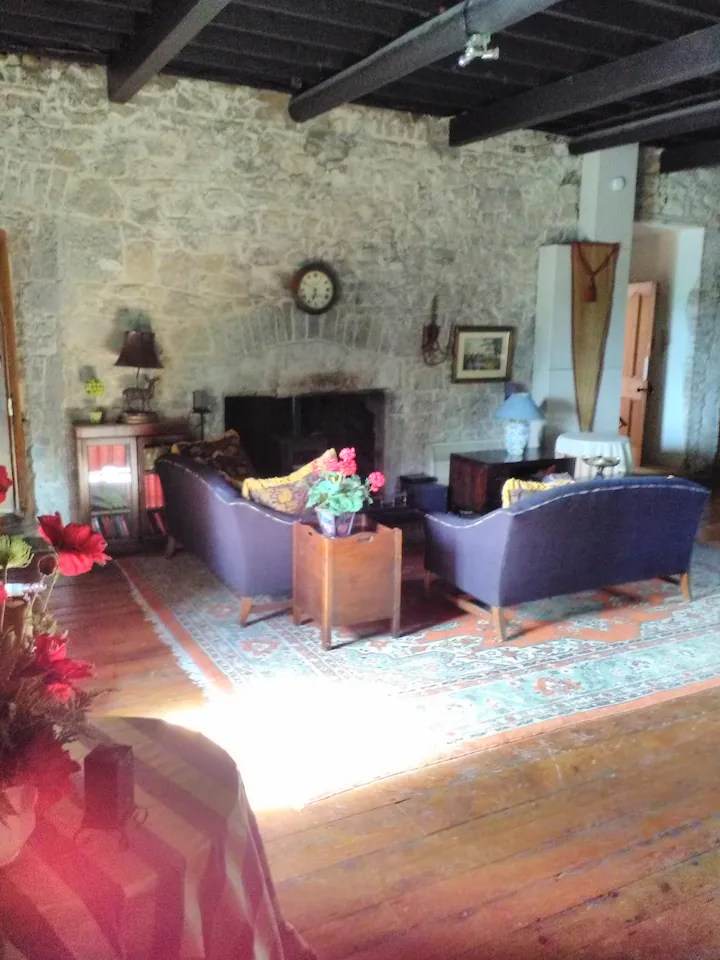
The rooms above are furnished beautifully, in a style to fit the medieval origins but with all the comforts of a modern home. They have wooden ceilings. It is tasteful and elegant and I would love to stay there! The Allens rent the rooms for accommodation. The first floor above is the dining room. A chandelier graces the room, and many pieces of antique furniture, plus comfortable couches and armchairs in front of the wood-burning stove in the fireplace. The original stone walls are exposed and have been repointed.
A fully outfitted kitchen has been installed in one turret. It is modern and luxurious.
The third turret of the tower has a large bathroom, which contains a lovely free-standing bath. At all levels above the ground floor the southeast turret contains a small chamber with an even smaller garderobe chamber opening off it.
The fourth turret in the tower on the first level contains a second, wooden, staircase, for fire escape safety. We looked up to see the top of the turret, which has a ceiling of overlapping flagstones, much like the tower ceiling which we saw in the Moone Abbey ten pound tower, and also in Newgrange.
Corbelled ceiling of Dardistown Castle, photograph courtesy of airbnb website for Dardistown rental.
The two upper floors of the turret have been decorated as luxurious bedrooms. There is a corridor off the third floor that leads into the main house, and which has been converted with two more beautiful bedrooms that can be hired for accommodation, plus bathroom.
I would love to stay! There is more accommodation in the yard.
There is a walled garden, which now is the back garden of the Allen family, and contains a tennis court. After our tour, we wandered into the lovely garden.
2025 Diary of Irish Historic Houses (section 482 properties)
To purchase an A5 size 2025 Diary of Historic Houses (opening times and days are not listed so the calendar is for use for recording appointments and not as a reference for opening times) send your postal address to jennifer.baggot@gmail.com along with €20 via this payment button. The calendar of 84 pages includes space for writing your appointments as well as photographs of the historic houses. The price includes postage within Ireland. Postage to U.S. is a further €10 for the A5 size calendar, so I would appreciate a donation toward the postage – you can click on the donation link.
€20.00
Donation
Help me to fund my creation and update of this website. It is created purely out of love for the subject and I receive no payment so any donation is appreciated! For this entry, I paid for petrol and the entrance fee for myself and Stephen.
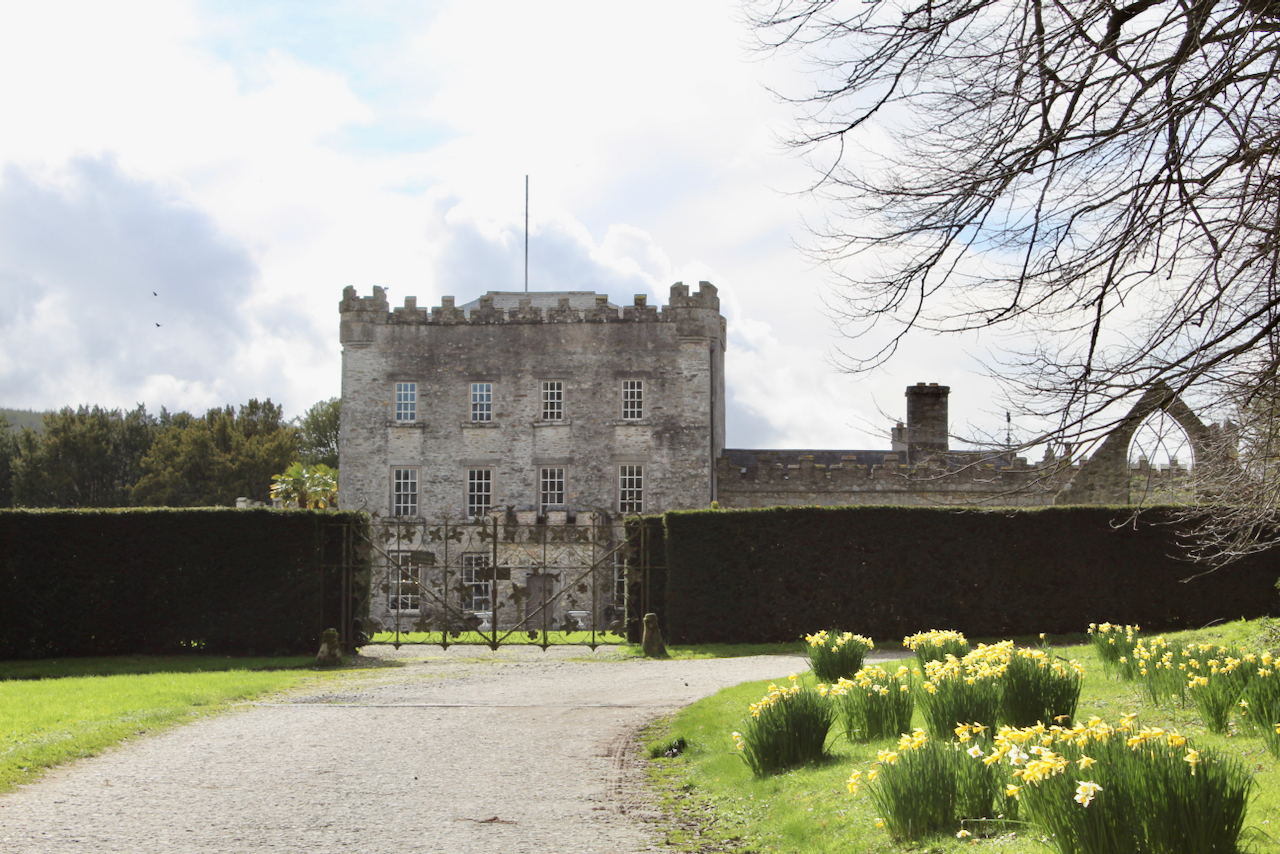
In the past, in August 2016, I visited Huntington Castle in Clonegal, County Carlow. www.huntingtoncastle.com Open dates in 2026, but check website as sometimes closed for special events:
Jan 31, Feb 1, 7-8, 14-15, 21-22, 28, Mar 1, 7-8, 14-15, 21-22, 28-31, Apr 1-6, 11-12, 18-19, 25-26, May 1-31, June 1-30, July 1-31, Aug 1-31, Sept 1-30, Oct 3-4, 10-11, 17-18, 24-31, Nov 1, 7-8, 14-15, 21-22, 28-29, Dec 5-6, 12-13, 19-20, 11am-5pm
Fee: house and garden, adult €13.95, garden only €6.95, OAP/student, house and garden €12.50, garden only €6, child, house and garden €6.50, garden €3.50, group and family discounts available
2026 Diary of Irish Historic Houses (section 482 properties)
To purchase an A5 size 2026 Diary of Historic Houses (opening times and days are not listed so the calendar is for use for recording appointments and not as a reference for opening times) send your postal address to jennifer.baggot@gmail.com along with €20 via this payment button. The calendar of 84 pages includes space for writing your appointments as well as photographs of the historic houses. The price includes postage within Ireland. Postage to U.S. is a further €10 for the A5 size calendar, so I would appreciate a donation toward the postage – you can click on the donation link.
€20.00
Donation
Help me to fund my creation and update of this website. It is created purely out of love for the subject and I receive no payment so any donation is appreciated!
It’s magical! And note that you can stay at this castle – see their website! [1]
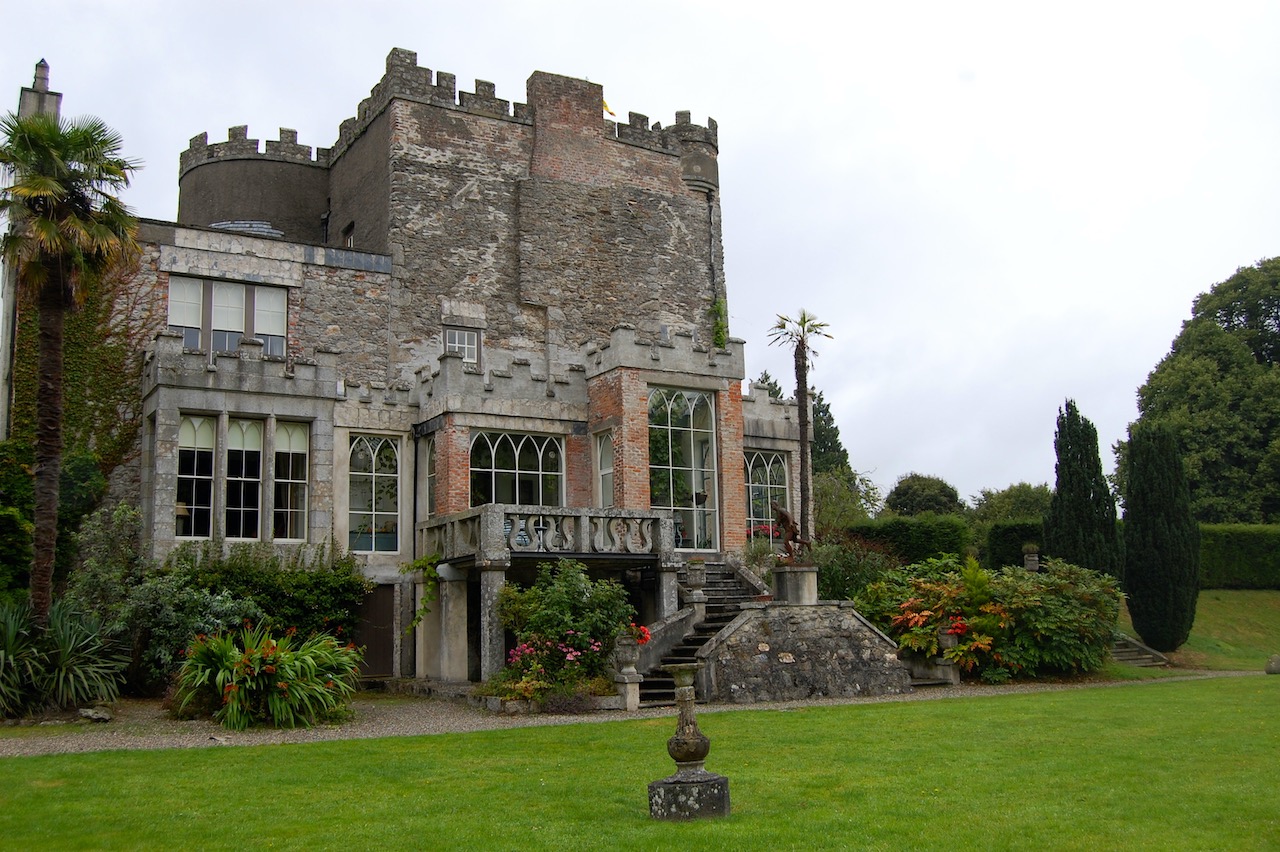
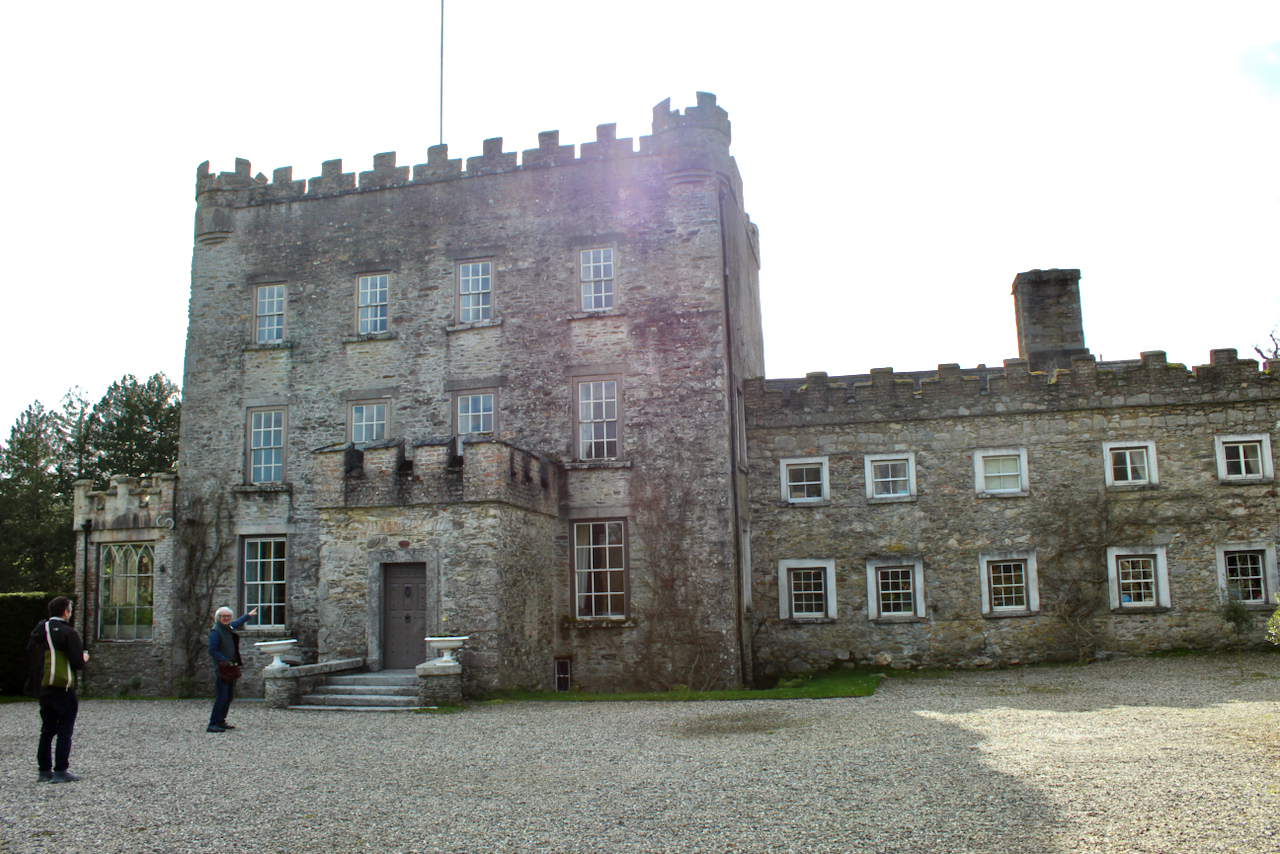
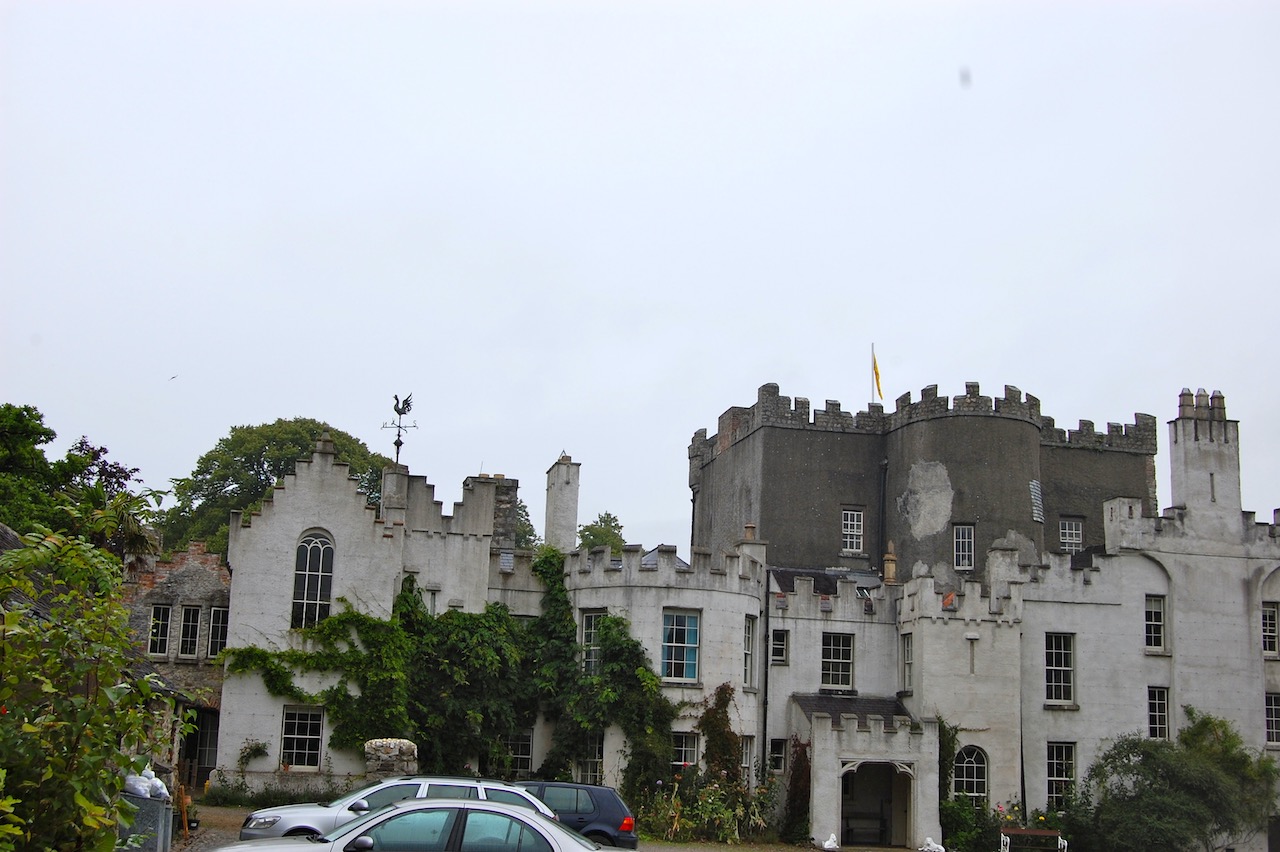
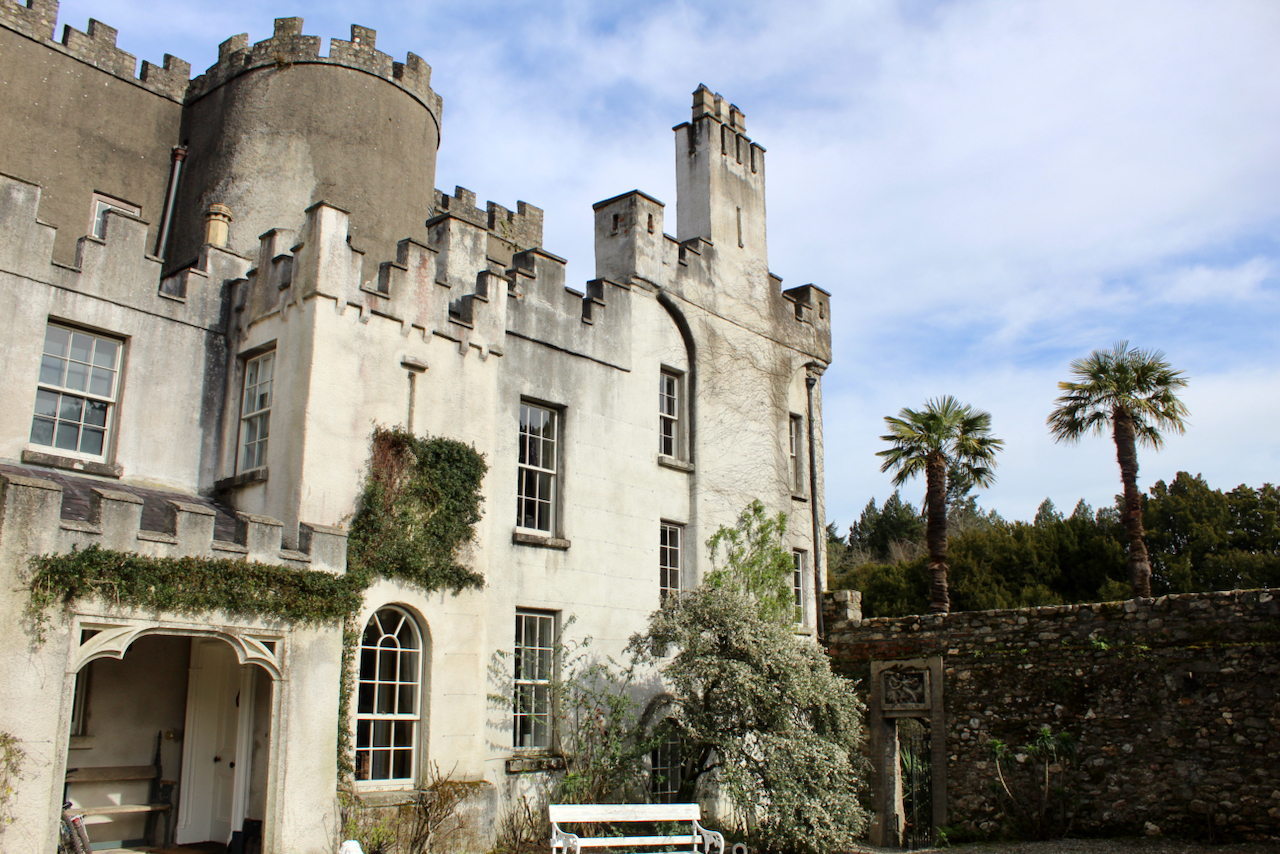
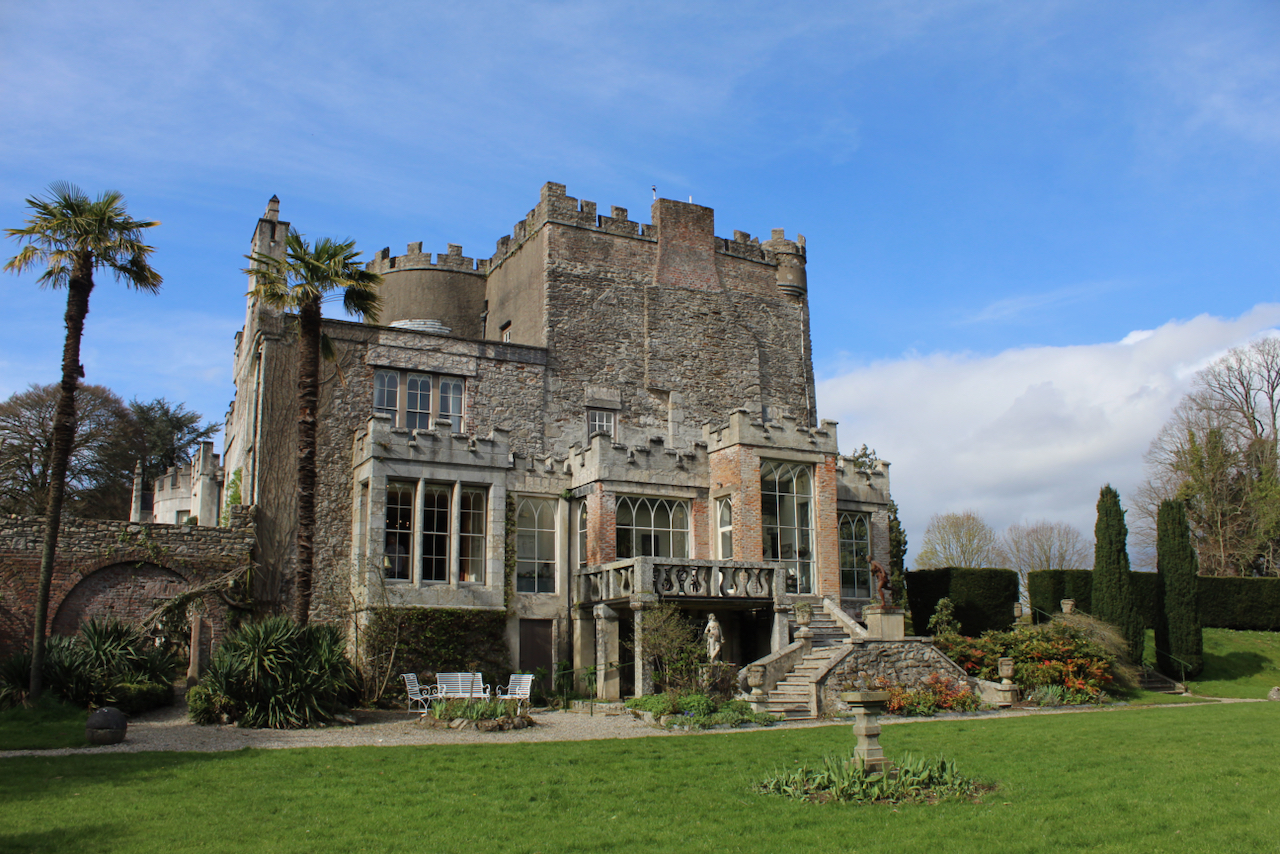
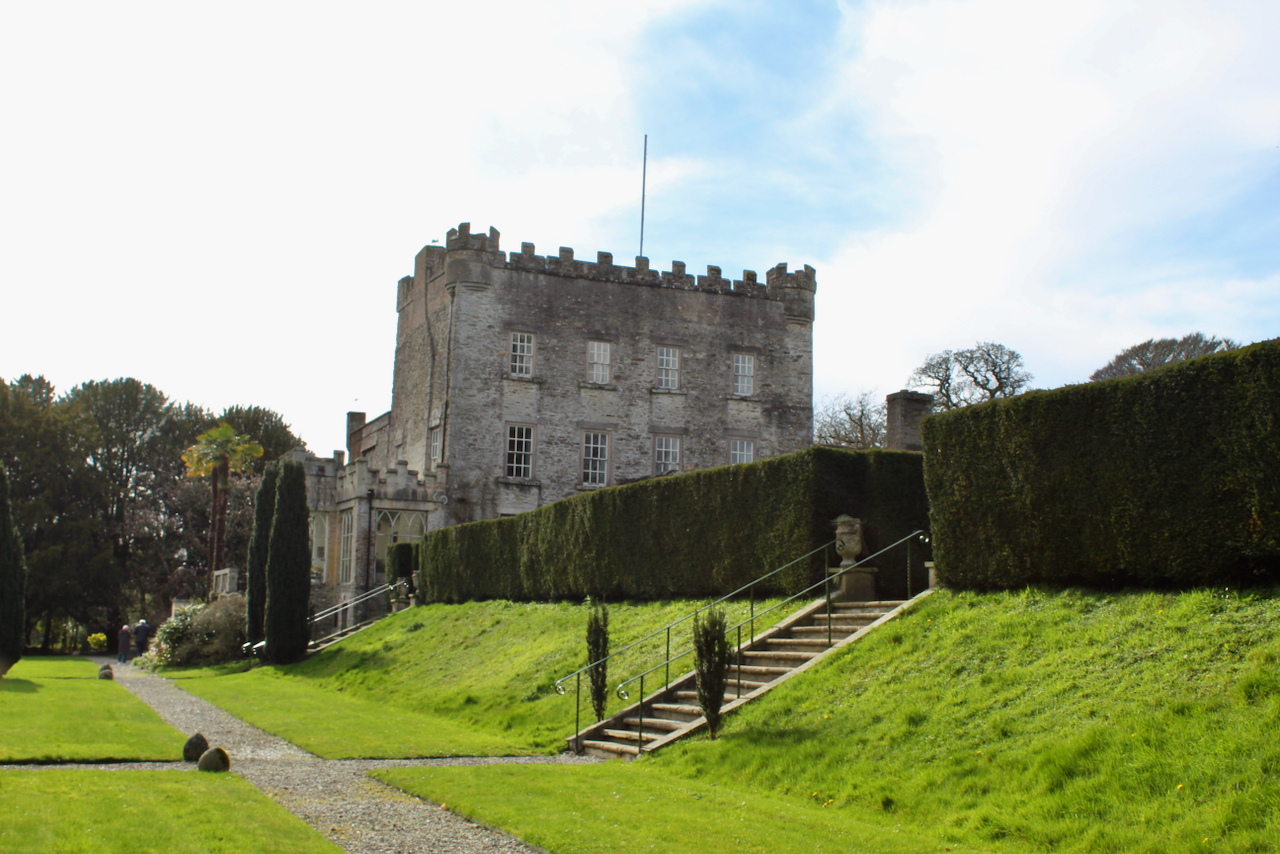
Huntington Castle stands in the valley of the River Derry, a tributary of the River Slaney, on the borders of Counties Carlow and Wexford, near the village of Clonegal. Built in 1625, it is the ancient seat of the Esmonde family, and is presently lived in by the Durdin-Robertsons. It passed into the Durdin family from the Esmonde family by marriage in the nineteenth century, so actually still belongs to the original family.
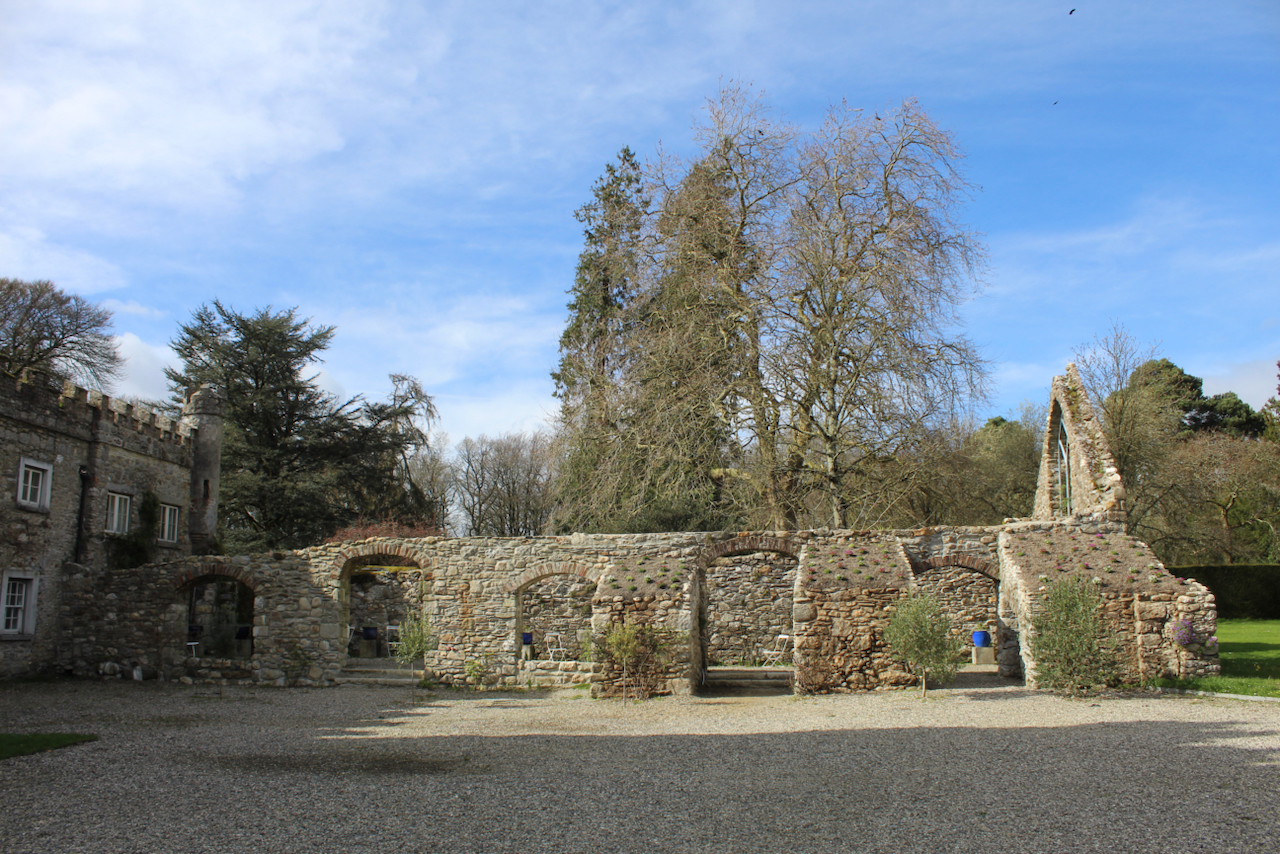
It was built as a garrison on the strategically important Dublin-Wexford route to protect a pass in the Blackstairs Mountains, on the site of a 14th century stronghold and abbey. It was also a coach stop on the Dublin travel route to Wexford. There was a brewery and a distillery in the area at the time. After fifty years, the soldiers moved out and the family began to convert it into a family home. [2]
There is a chapter on the Esmonds of Ballynastragh in The Wexford Gentry by Art Kavanagh and Rory Murphy. They tell us that it is believed that Geoffrey de Estmont was one of the thirty knights who accompanied Robert FitzStephen to Ireland in 1169 when the latter led the advance force that landed at Bannow that year.
Sir Geoffrey built a motte and baily at Lymbrick in the Barony of Forth in Wexford, and his son Sir Maurice built a castle on the same site. After Maurice’s death in 1225 the castle was abandoned and his son John built a castle on a new site which was called Johnstown Castle. John died in 1261. [3]
After the Cromwellian Confiscations, since the Johnstown Esmondes were Catholic, their lands were granted to Colonel Overstreet, and later came into the possession of the Grogan family. The Ballynastragh/Lymbrick lands were also confiscated and the Ballytramont property was granted to the Duke of Ablemarle (General Monck). The Esmondes later regained Ballynastragh.
A descendant, Laurence Esmonde (about 1570-1645) converted to Anglicanism and served in the armies of British Queen Elizabeth I and then James I.
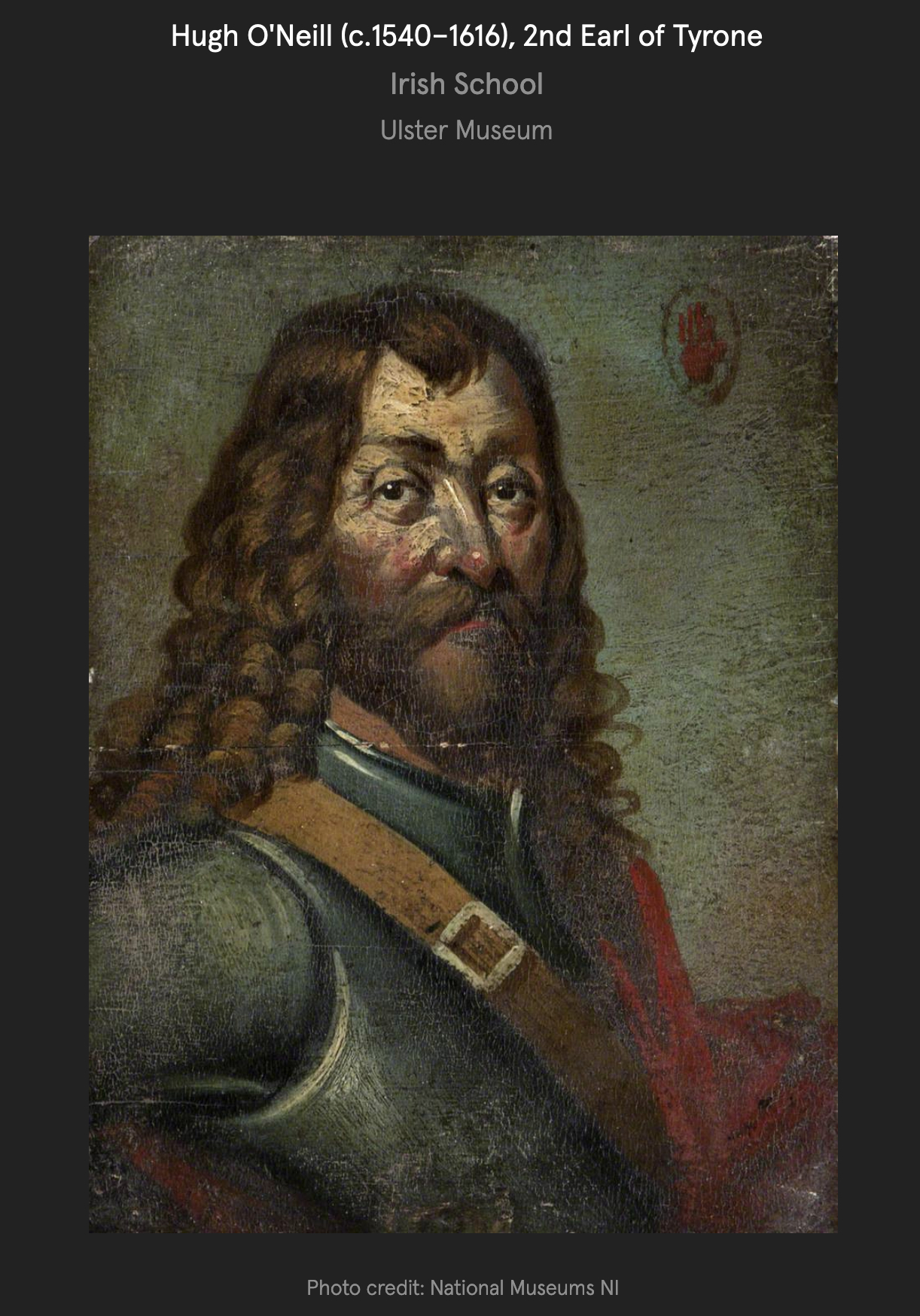
He fought in the Dutch Wars against Spain, and later, in 1599, he commanded 150 foot soldiers in the Nine Years War, the battle led by an Irish alliance led mainly by Hugh O’Neill 2nd Earl of Tyrone and Hugh Roe O’Donnell against the British rule in Ireland.
Hugh O’Neill (c. 1540-1616) 2nd Earl of Tyrone, courtesy of the Ulster Museum.He was one of the rebels in the Nine Years War, who fought against Laurence Esmonde (b. about 1570, d. 1645).
In 1602 Lawrence Esmonde built a castle and a church at Luimneach near the modern village of Killinerin and near Ballynastragh, which he named Lymbrick after the original Norman motte and bailey in the Barony of Forth. [see 3]
He governed the fort of Duncannon from 1606-1646. In reward for his services, he was raised to the peerage in 1622 as Baron of Lymbrick in County Wexford and it seems that a few years after receiving this honour he built the core of the present Huntington Castle on the site of an earlier military keep. He built a three-storey fortified tower house, which forms the front facing down the avenue, according to Mark Bence-Jones in A Guide to Irish Country Houses. [4]
This original tower-house is made of rough-hewn granite. In her discussion of marriage in Making Ireland English, Jane Ohlmeyer writes that for the Irish, legitimacy of children didn’t determine inheritance, and so attitudes toward marriage, including cohabitation and desertion, were very different than in England. She writes that the first Baron Esmonde behaved in a way reminiscent of medieval Gaelic practices when he repudiated his first wife and remarried without a formal divorce. Laurence met Ailish, the sister of Morrough O’Flaherty (note that Turtle Bunbury tells us that she was a granddaughter of the pirate queen Grace O’Malley!) on one of his expeditions to Ulster, and married her. However, after the birth of their son, Thomas, she returned to her family, fearing that her son would be raised as a Protestant. [5]
Esmonde went on to marry Elizabeth Butler, a granddaughter of the ninth earl of Ormond (daughter of Walter Butler, and she was already twice widowed). He had no children by his second marriage and despite acknowledging Thomas to be his son, he did not admit that his first marriage was lawful and consequently had no official heir and his title Baron of Lymbrick became extinct after his death.
Baron Esmonde died after a siege of Duncannon fort by General Thomas Preston, 1st Viscount Tara, of the Confederates, who considered Esmonde a defender of the Parliamentarians (i.e. Oliver Cromwell’s men, the “roundheads”). Although his son did not inherit his title, he did inherit his property. [6]
After Lawrence’s death the Huntington estate and castle was occupied as a military station by Dudley Colclough from 1649-1674. [see 3]
Lawrence’s son Thomas Esmonde started his military career as an officer in the continental army of King Charles I. For his service at the siege of La Rochelle he was made a baronet of Ireland while his father still lived, and became 1st Baronet Esmonde of Ballynastragh, County Wexford, in 1629. He did not return to Ireland, however, until 1646 after his father’s death. He joined the rebels, the Confederate forces, who were fighting against the British forts which his father held. Taking after his mother, he was a resolute Catholic.
He married well, into other prominent Catholic families: first to a daughter of the Lord of Decies, Ellice Fitzgerald. She was the widow of another Catholic, Thomas Butler, 2nd Baron Caher, and with him had one daughter, Margaret, who had married Edmond Butler, 3rd/13th Baron Dunboyne a couple of years before her mother remarried in around 1629. Thomas and Ellice had two sons. Ellice died in 1644/45 and Thomas married secondly Joanne, a daughter of Walter Butler 11th Earl of Ormond. She too had been married before, to George Bagenal who built Dunleckney Manor in County Carlow. Her sons by Bagenal were also prominent Confederate Colonels. She was also the widow of Theobald Purcell of Loughmoe, County Tipperary. We came across the Purcells of Loughmoe on our visit to Ballysallagh in County Kilkenny (see my entry).
Thomas served as Member of Parliament for Enniscorthy, County Wexford from 1641 to 1642, during the reign of King James II.
His son Laurence succeeded as 2nd Baronet, and reoccupied Huntington Castle in 1682. [see 3]
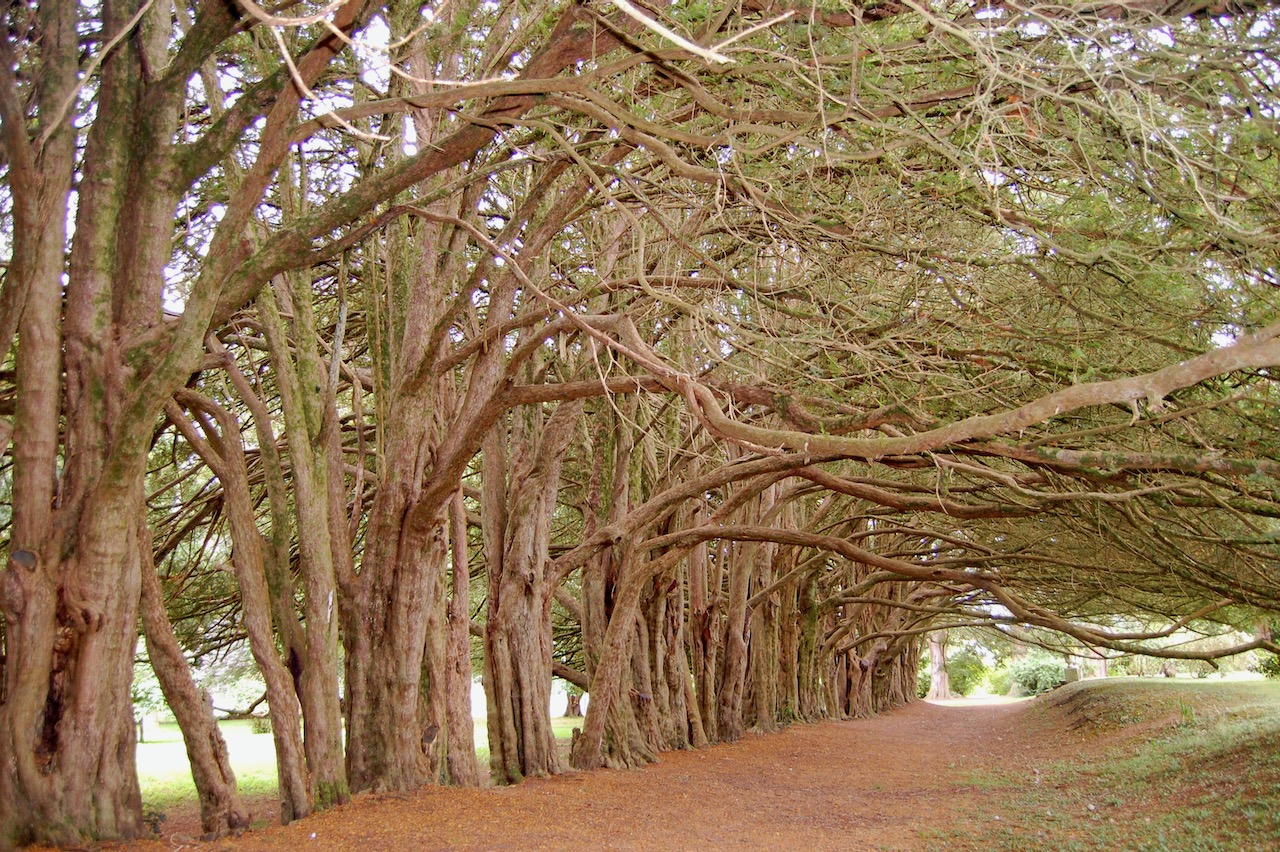
Laurence made additions to Huntington Castle around 1680, and named it “Huntington” after the Esmonde’s “ancestral pile” in Lincolnshire, England [7]. He is probably responsible for some of the formal garden planting. The Irish Aesthete Robert O’Byrne discusses this garden in another blog entry [8]. He tells us that the yew walk, which stretches 130 yards, dates from the time of the Franciscan friary in the Middle Ages!
Laurence 2nd Baronet married Lucia Butler, daughter of another Colonel who fought in the 1641 uprising, Richard Butler (d. 1701) of Garryricken. Their daughter Frances married Morgan Kavanagh, “The MacMorrough” of the powerful Irish Kavanagh family.
The 3rd Baronet, another Laurence, served for a while in the French army.
A wing was constructed by yet another Sir Laurence, 4th Baronet, in 1720. The castle, as you can see, is very higgeldy piggedly, reflecting the history of its additions. The 4th Baronet had no heir so his brother John became the 5th Baronet. He had a daughter, Helen, who married Richard Durdin of Shanagarry, County Cork. The went out to the United States and founded Huntington, Pennsylvania. He had no sons, and died before his brother, Walter, who became the 6th Baronet. Walter married Joan Butler, daughter of Theobald, 4th Baron Caher. Walter and Joan also had no sons, only daughters.
In The Wexford Gentry we are told that the widow of the 6th Baronet was left in “straitened circumstances” after her husband Walter died in 1767, and sold the estate of Huntington to Sir James Leslie (1704-1770), the Church of Ireland Bishop of Limerick, in 1751. He was from the Tarbert House branch of the Leslie family in County Kerry. Huntington remained in his family until 1825 when it was leased to Alexander Durdin (1821-1892) and later bought by his descendants. [see 3, p. 106].
The line of inheritance looks very convoluted. I have consulted Burke’s Peerage. John Durdin migrated from England to Cork in around 1639. His descendant Alexander Durdin, born in 1712, of Shanagarry, County Cork, married four times! His second wife, Mary Duncan of Kilmoon House, County Meath, died shortly after giving birth to her son Richard, born in 1747. Alexander then married Anne née Vaux, widow of the grandson of William Penn the founder of Pennsylvania. Finally, he married Barbara St. Leger, with whom he had seven more sons and several daughters.
It was Alexander’s son Richard who married Helen Esmonde, daughter of the 4th Baronet, according to Burke’s Peerage. Richard then married Frances Esmonde, daughter of the 7th Baronet.
The 6th Baronet had only daughter so the title went to a cousin. This cousin was a descendant of Thomas Esmonde 1st Baronet of Ballynastragh, Thomas’s son James. James had a son Laurence (1670-1760), and it was his son, James (1701-1767) who became the 7th Baronet of Ballynastragh. It was his daughter Frances who married Richard Durdin of Huntington Pennsylvania, who had been previously married to Helen Esmonde.
Despite his two marriages, Richard had no son. His brother William Leader Durdin (1778-1849) married Mary Anne Drury of Ballinderry, County Wicklow and it was their son Alexander (1821-1892) who either inherited Huntington, or at least, according to The Wexford Gentry, leased and later purchased Huntington, the home of his ancestors.
Alexander also had only daughters. In 1880, his daughter Helen married Herbert Robertson, Baron Strathloch (a Scots feudal barony) and MP for a London borough. She inherited Huntington Castle when her father died. Together they made a number of late Victorian additions at the rear of the castle while their professional architect son, Manning Durdin-Robertson, an early devotee of concrete, carried out yet further alterations in the 1920s. Manning also created W. B. Yeats’s grave, and social housing in Dublin.
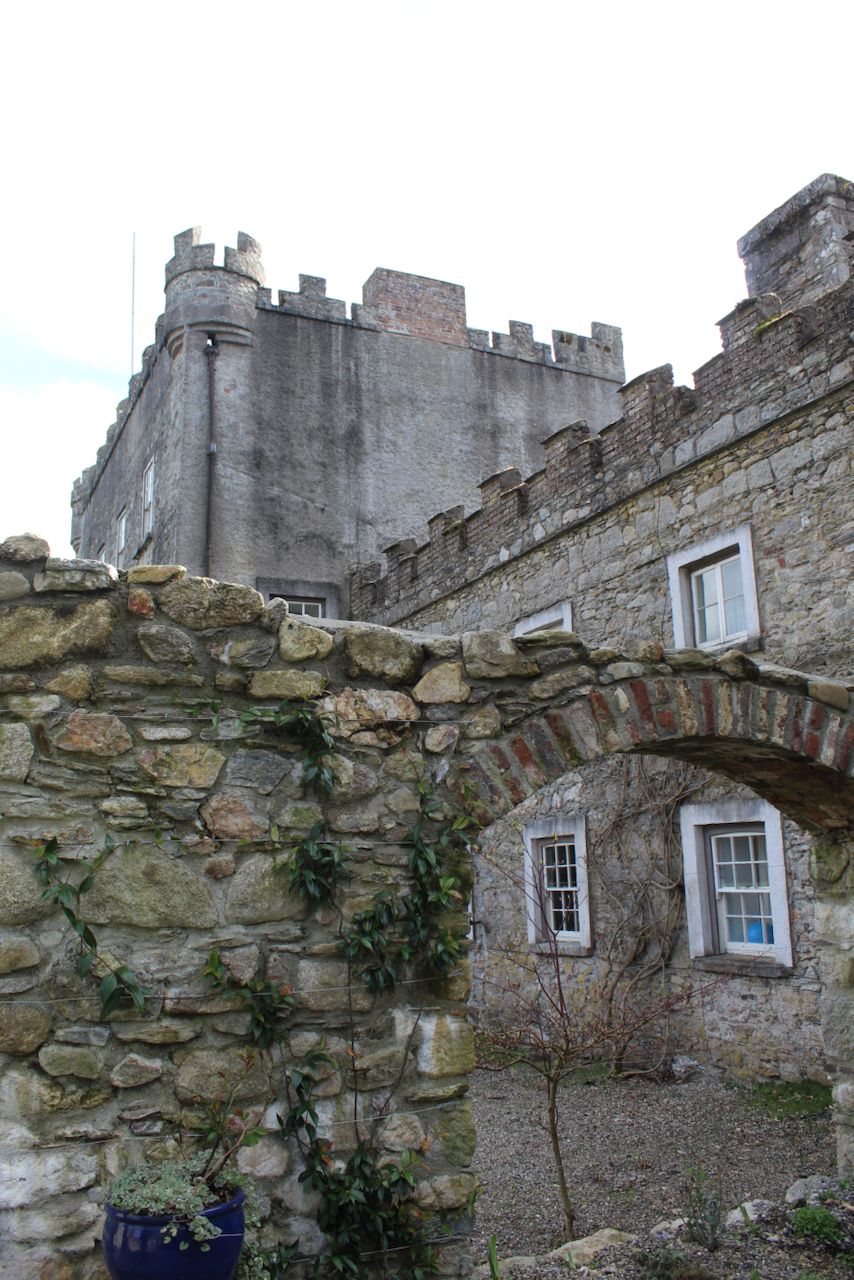
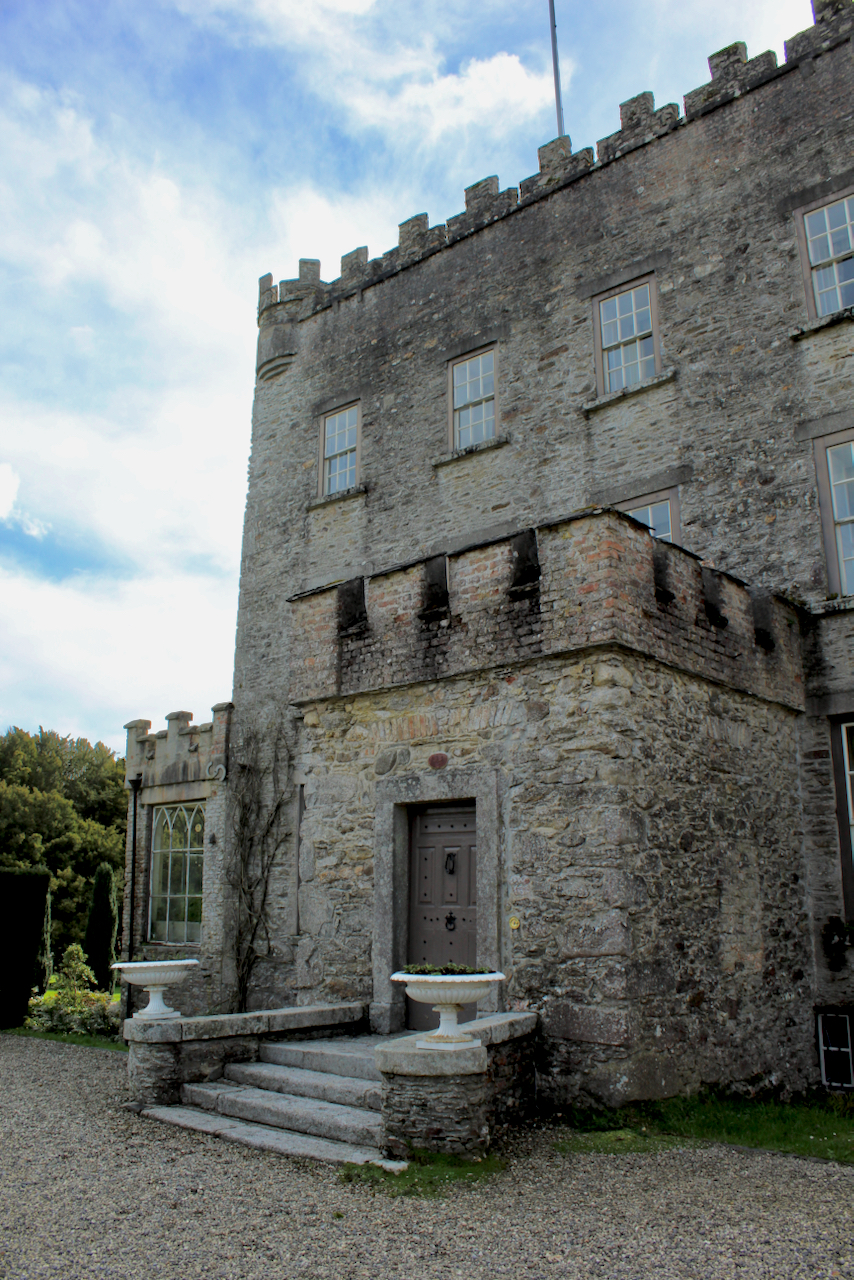
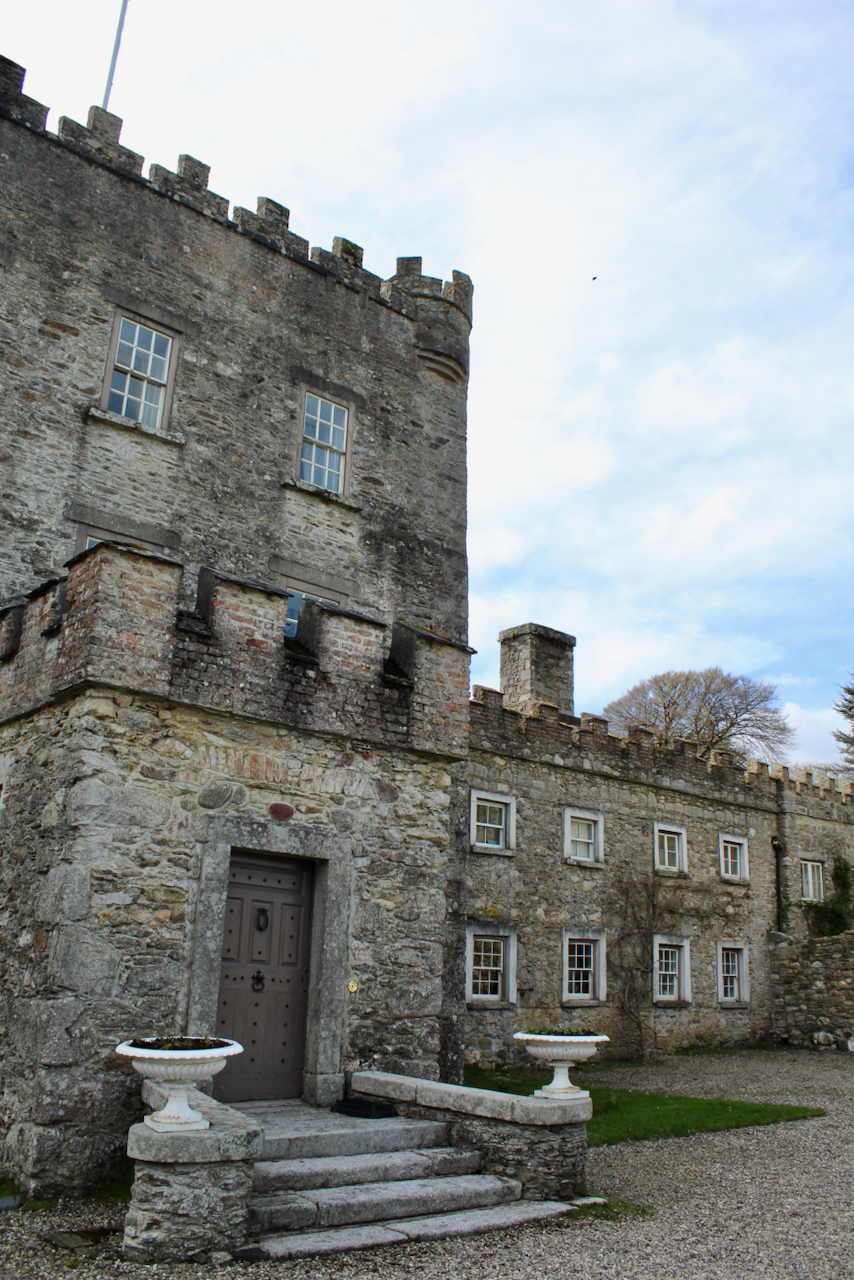
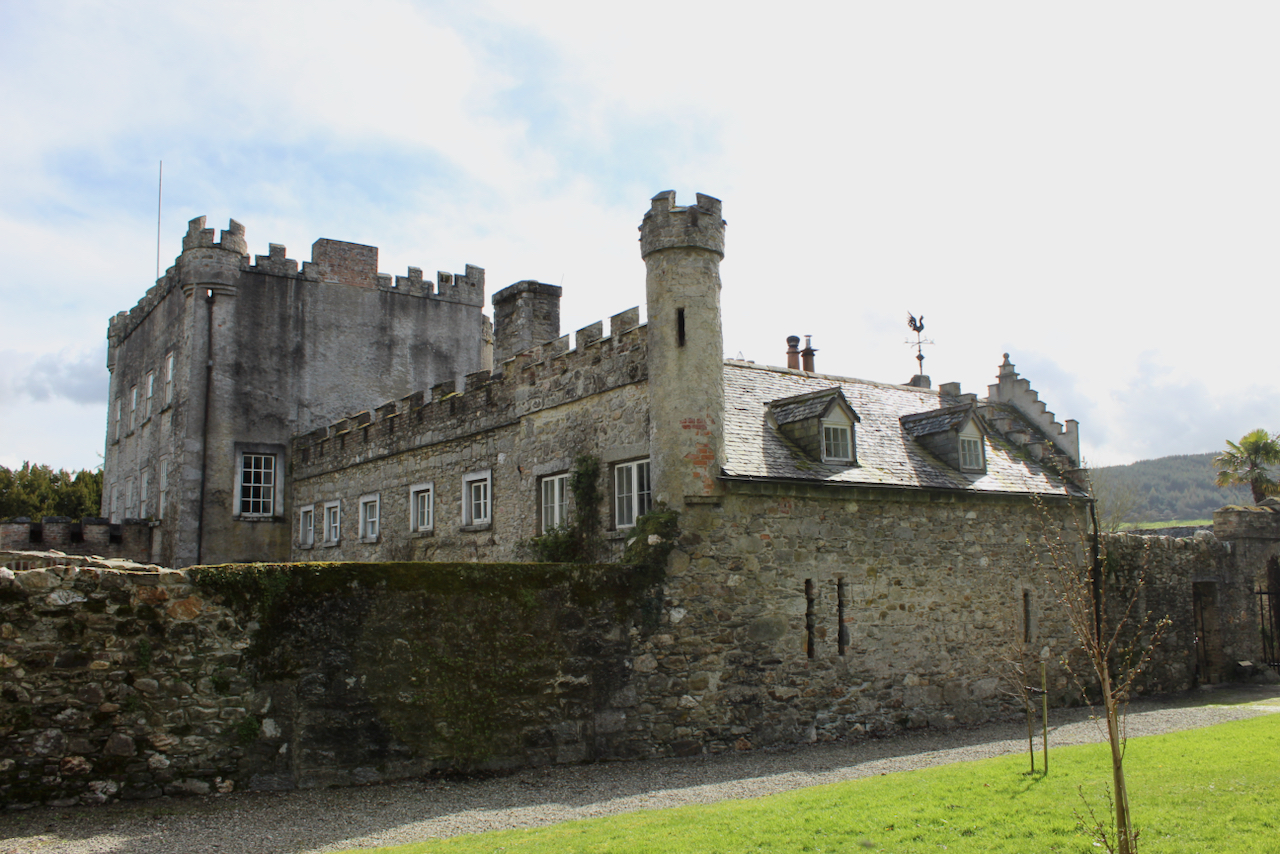
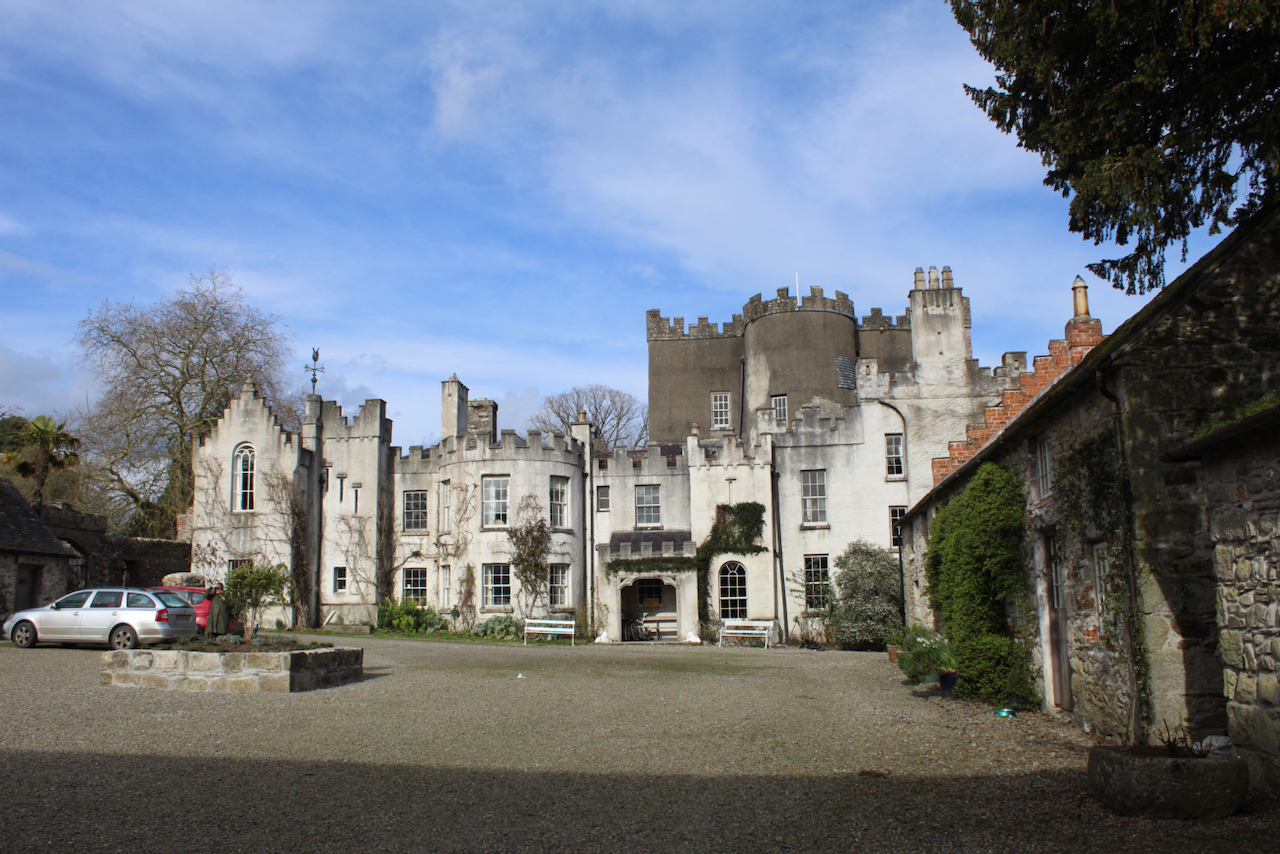
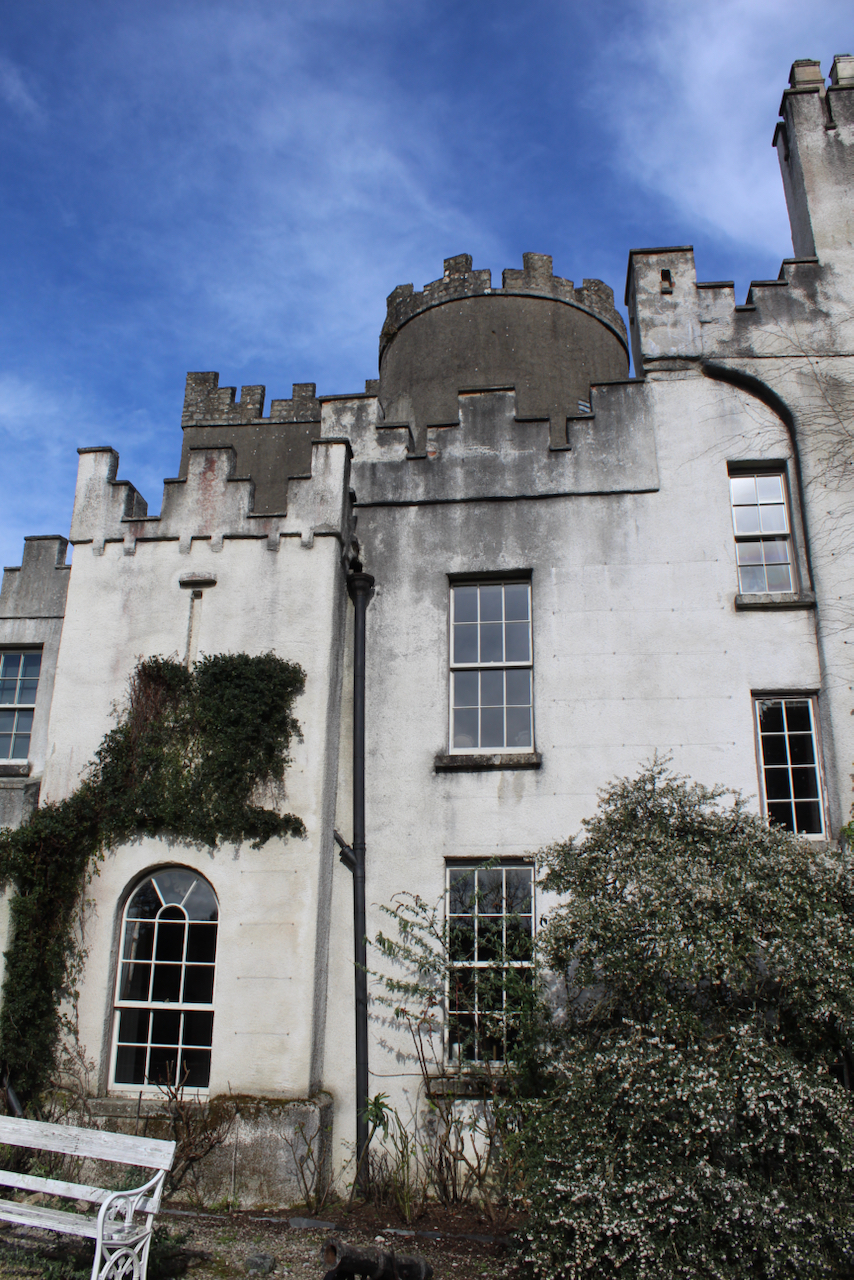
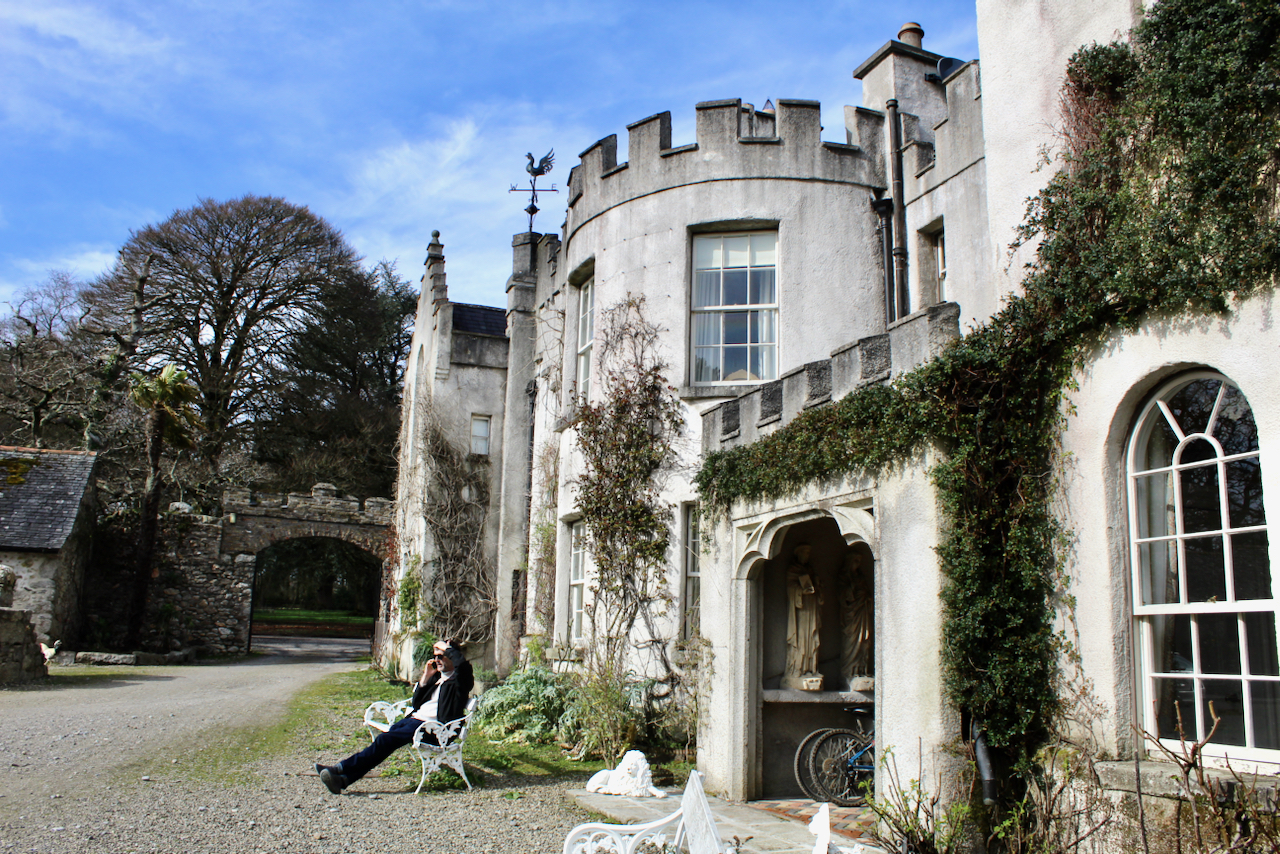
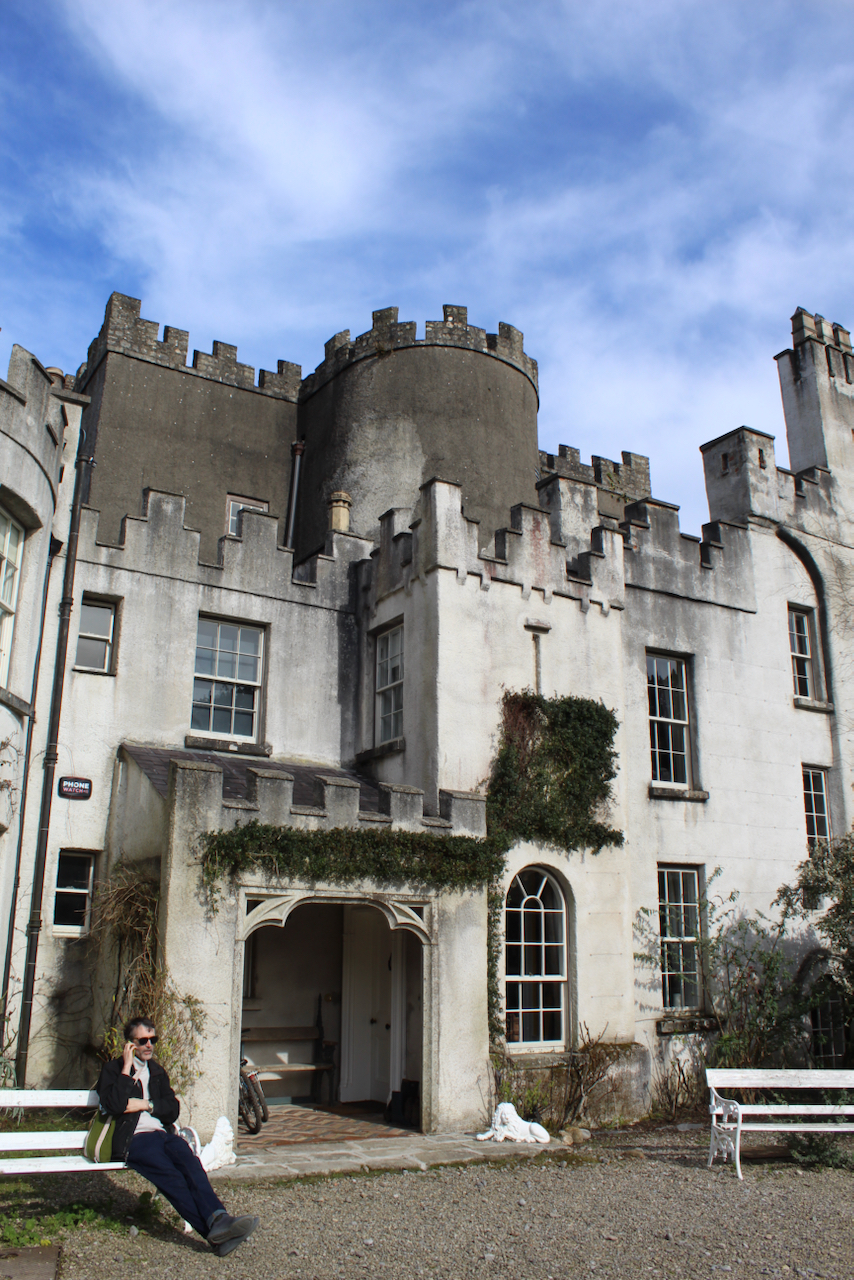
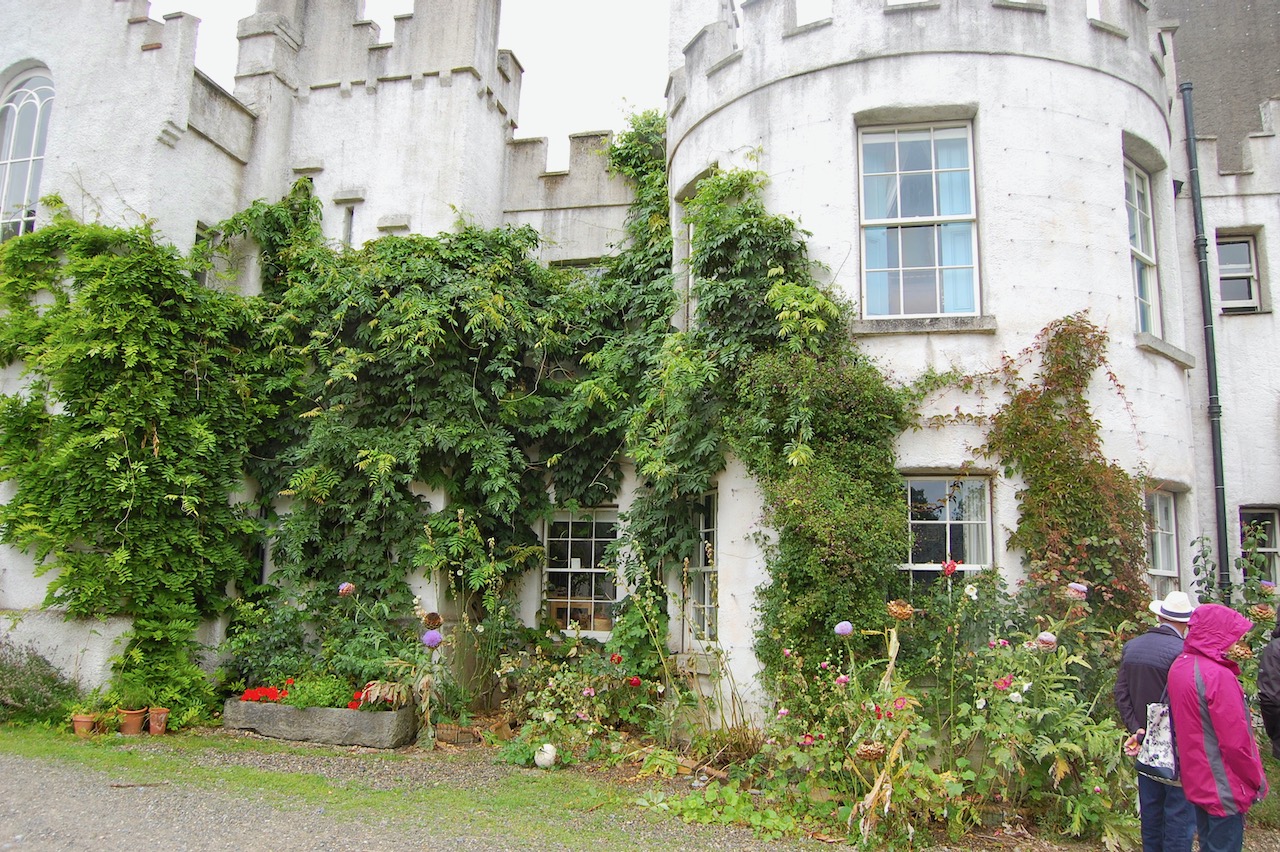
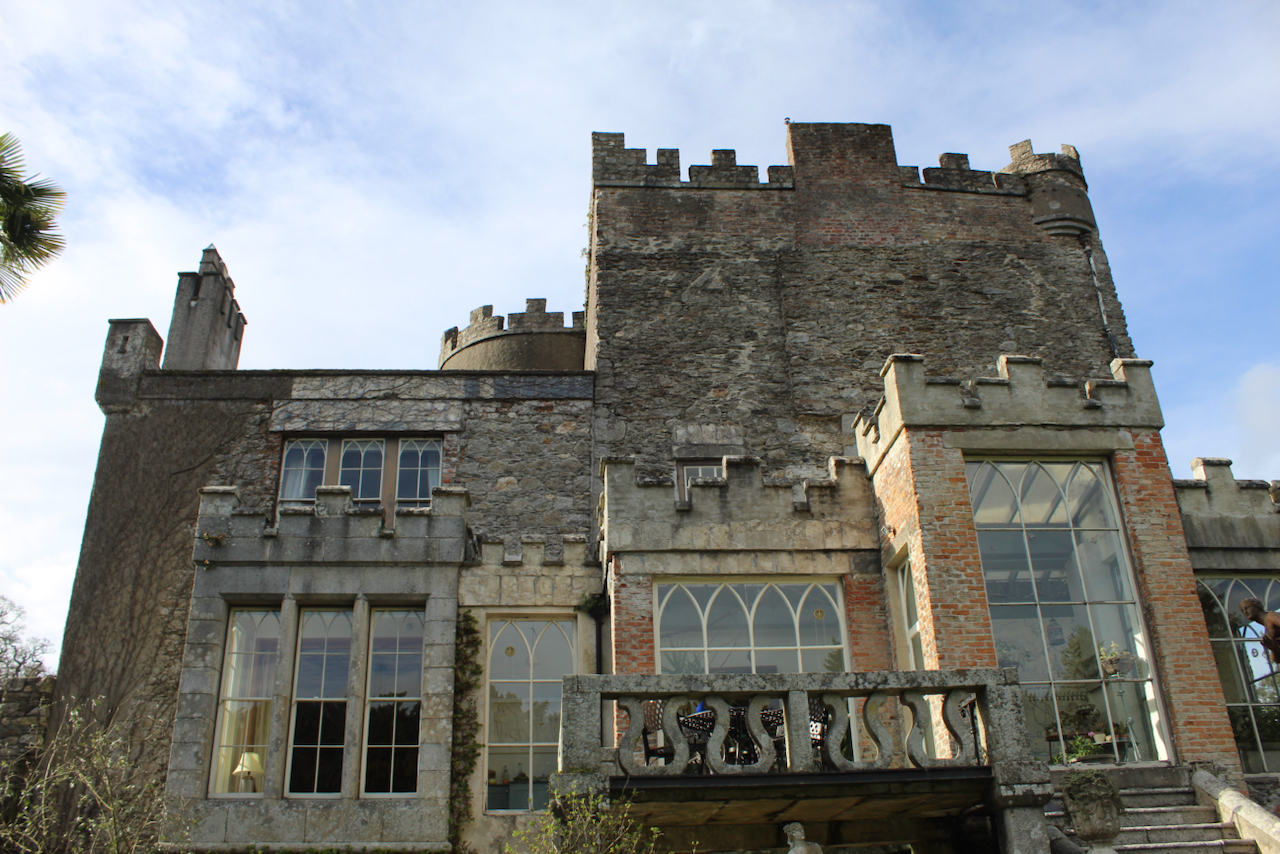
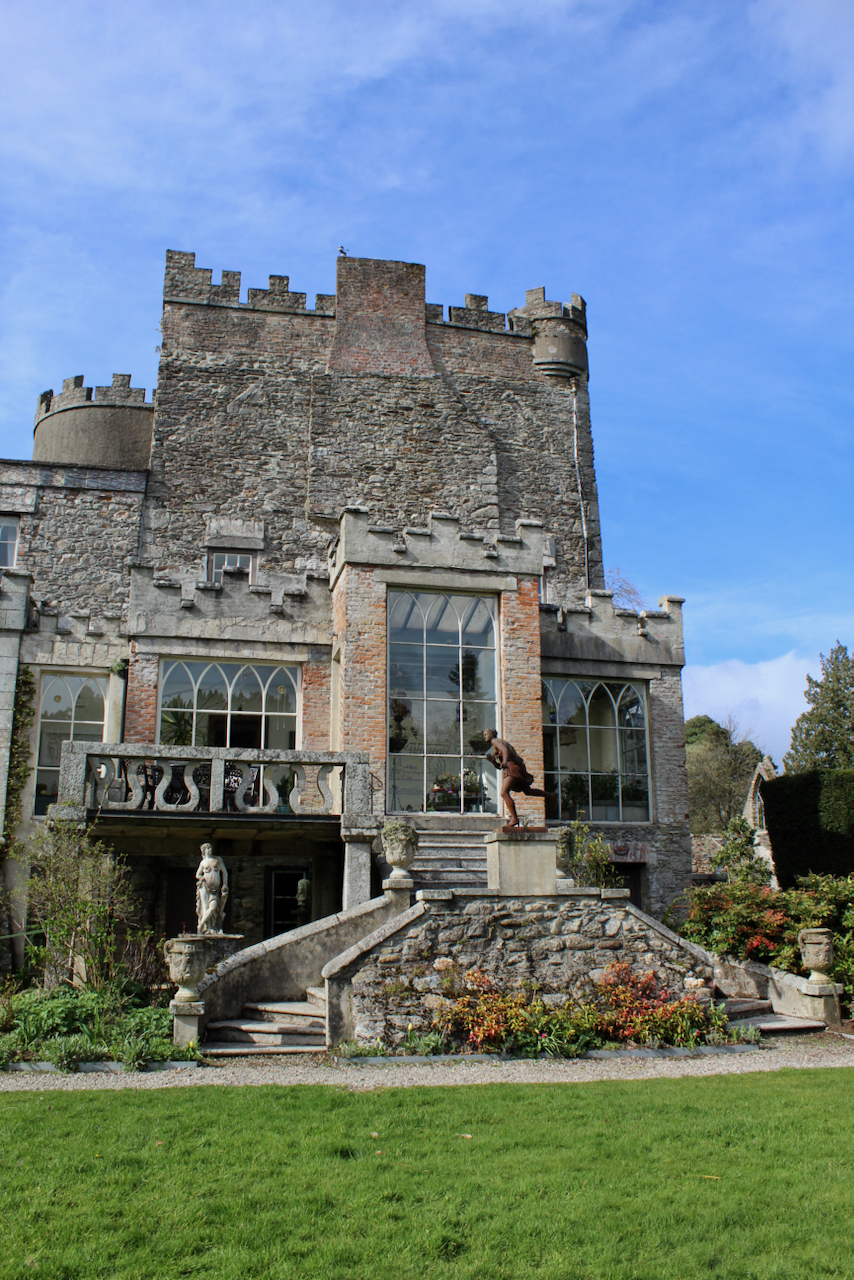
There is an irregular two storey range with castellated battlements and a curved bow and battlemented gable in front of the earlier building, which rises above them. The front battlemented range was added in the mid 1890s.
The older part of the castle includes a full height semicircular tower. Inside, when one enters through the portico facing onto the stable yard, one can see the outside of this full height semicircular tower, curving into the room to one’s right hand side, where there is even a little stone window set in the curved wall, and the round tower bulges into the stairway hall, clad with timber and covered in armour.
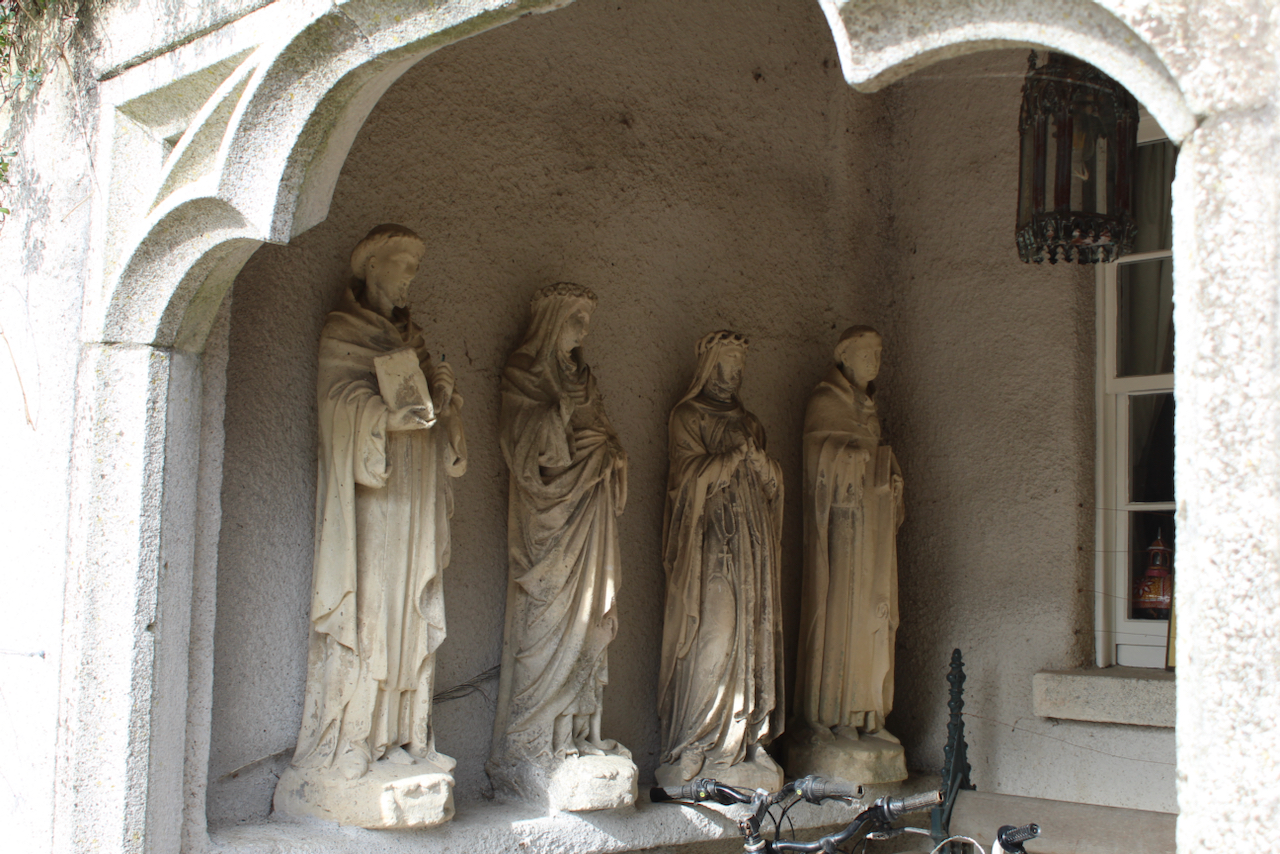
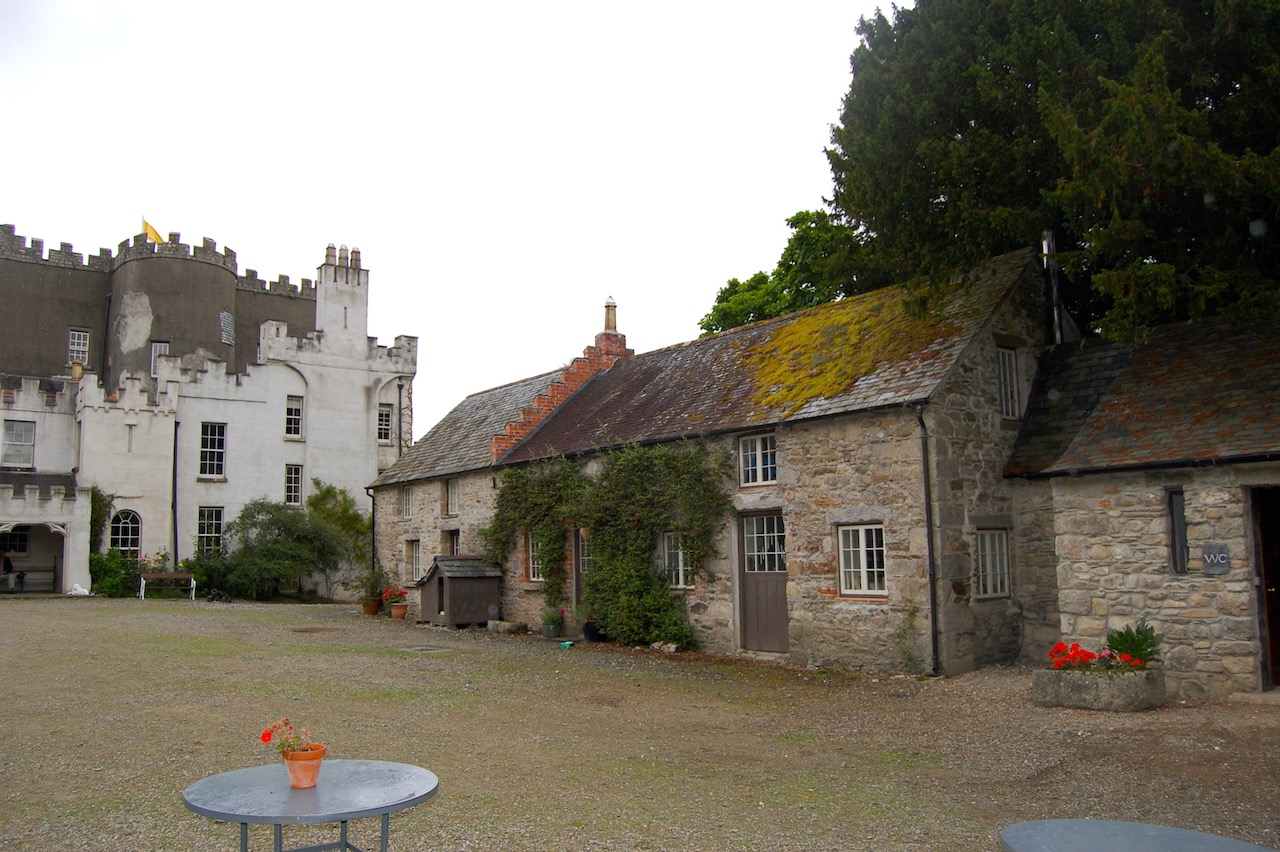
We entered the castle through a door in the battlemented porticon next to the double height bow facing onto the stableyard and courtyard. Inside the portico are statues which may have been from the Abbey – I forgot to ask our tour guide, as there was just so much to see and learn about.
We were not allowed to take photos inside, except for in the basement, but you can see some pictures on the official website [1] and also on the wonderful blog of the Irish Aesthete [10].
There were wonderful old treasures in the house including armour chest protections in the hallway along the stairs, which was one of the first things to catch my attention as we entered. Our guide let us hold it – it was terribly heavy, and so a soldier must have been weighed down by his armour – wearing chain mail underneath his shielding armour. The chest protection piece we held was made of cast iron! She showed us the “proof mark” on the inside. Cast iron could shatter, our guide told us, so a piece of armour would be tested, leaving a little hole, which proved that it would not shatter when worn and hit by a projectile or sword. This piece dates all the way back to Oliver Cromwell’s time!
To the right when one enters is a room full of animal heads and weapons. There is a huge bison head from India and a black buck, and a sawfish from the Caribbean. A gharial crocodile hanging on the wall was killed by Nora Parsons at the age of seventeen in India! There is also the shell of an armadillo. The room also has a lovely wooden chimneypiece and there is another in the hallway, which has a Tudor style stucco ceiling. We went up a narrow stairway lined as Bence-Jones describes “with wainscot or half-timbered studding.”
Manning Durdin-Robertson married Nora Kathleen Parsons, from Birr Castle. She wrote The Crowned Harp. Memories of the Last Years of the Crown in Ireland, an important memorial of the last years of English rule in Ireland [11]. I ordered a copy of the book from my local library! It’s a lovely book and an enjoyable rather “chatty” read. She writes a bit about her heritage, which you can see in my entry on another section 482 castle, Birr Castle. She tells us about life at the time, which seems to have been very sociable! She writes a great description of social rank:
The hierarchy of Irish social order was not defined, it did not need to be, it was deeply implicit. In England the nobility were fewer and markedly more important than over here and they were seated in the mansions considered appropriate…. The top social rows were then too well-known and accepted to be written down but, because a new generation may be interested and amused, I will have a shot at defining an order so unreal and preposterous as to be like theatricals in fancy dress. Although breeding was essential it still had to be buttressed by money.
Row A: peers who were Lord or Deputy Lieutenants, High Sheriffs and Knights of St. Patrick. If married adequately their entrenchment was secure and their sons joined the Guards, the 10th Hussars or the R.N. [Royal Navy, I assume] Row B: Other peers with smaller seats, ditto baronets, solvent country gentry and young sons of Row A, (sons Green Jackets, Highland regiments, certain cavalry, gunners and R.N.). Row A used them for marrying their younger children. Row C: Less solvent country gentry, who could only allow their sons about £100 a year. These joined the Irish Regiments which were cheap; or transferred to the Indian army. They were recognised and respected by A and B and belonged to the Kildare Street Club. Row D: Loyal professional people, gentlemen professional farmers, trade, large retail or small wholesale, they could often afford more expensive Regiments than Row C managed. Such rarely cohabited with Rows A and B but formed useful cannon fodder at Protestant Bazaars and could, if they were really liked, achieve Kildare Street.
Absurd and irritating as it may seem today, this social hierarchy dominated our acceptances.
I had the benefit of always meeting a social cross section by playing a good deal of match tennis…. The top Rows rarely joined clubs and their play suffered….There were perhaps a dozen (also very loyal) Roman Catholic families who qualified for the first two Rows; many more, equally loyal but less distinguished, moved freely with the last two.
Amongst these “Row A” Roman Catholics were the Kenmares, living in a long gracious house at Killarney. Like Bantry House, in an equally lovely situation.…”
There are some notable structures inside the building, as Robert O’Byrne notes. “The drawing room has 18th century classical plaster panelled walls beneath a 19th century Perpendicular-Gothic ceiling. Some passages on the ground floor retain their original oak panelling, a number of bedrooms above being panelled in painted pine. The dining room has an immense granite chimneypiece bearing the date 1625, while those in other rooms are clearly from a century later.” [10]
The dining room, the original hall of the castle, is hung with Bedouin tents, brought back from Tunisia in the 1870s by Herbert Robertson, Helen Durdin’s husband. The large stone fireplace has the date stone 1625, and a stained glass window traces out the Esmonde and Durdin genealogy. We know that the room is very old by the thickness of the walls. The room has an Elizabethan ceiling, and portraits of family members hang on the walls. You can see a photograph of the room on the Castle Tours page of the website. There is a portrait of Barbara St. Leger, from Doneraile in Cork, who married Alexander Durdin (1712-1807), the one who also married the two Esmonde daughters. It is said that Barbara wore a set of keys at her waist, and that sometimes ghostly jingling can be heard in the castle.
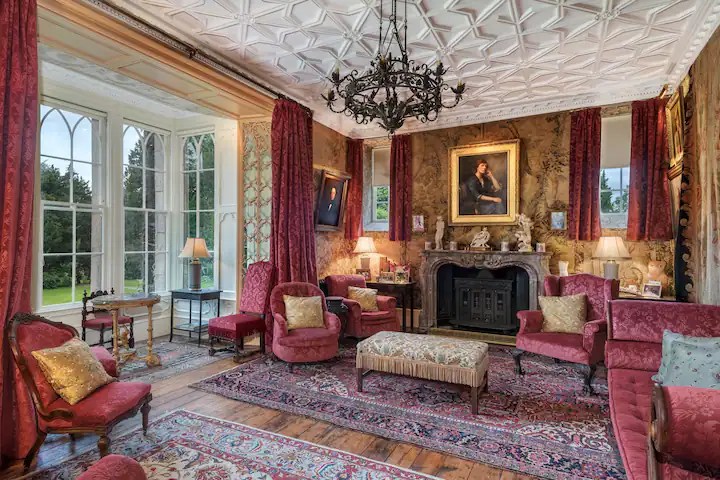
Next to the dining room is a ladies drawing room with white panelled walls and a stucco ceiling with Gothic drop decoration and compartments. I think it was in this room the guide told us that the panelling is made of plaster, created to look like wood panelling. You can see some photographs of these rooms on the castle’s facebook page. The ceiling may seem low for an elegant room but we must remember that it originally housed a barracks! This room also is part of the original structure – the doorway into the next room shows how thick the wall is – about the length of two arms.
Another drawing room is hung with tapestry, which would have kept the residents a bit warmer in winter. There are beautiful stuccoed ceilings, which you can see on the website, and a deep bay window with Gothic arches in the bars of the window.
The Tapestry Room, Huntington Castle, photograph courtesy of Huntington Castle website.The portrait over the fireplace is, I believe, Helen Durdin who married Herbert Robertson.I think this room was added to the castle in 1760.
Huntington was one of the first country houses in Ireland to have electricity, and in order to satisfy local interest a light was kept burning on the front lawn so that the curious could come up and inspect it.
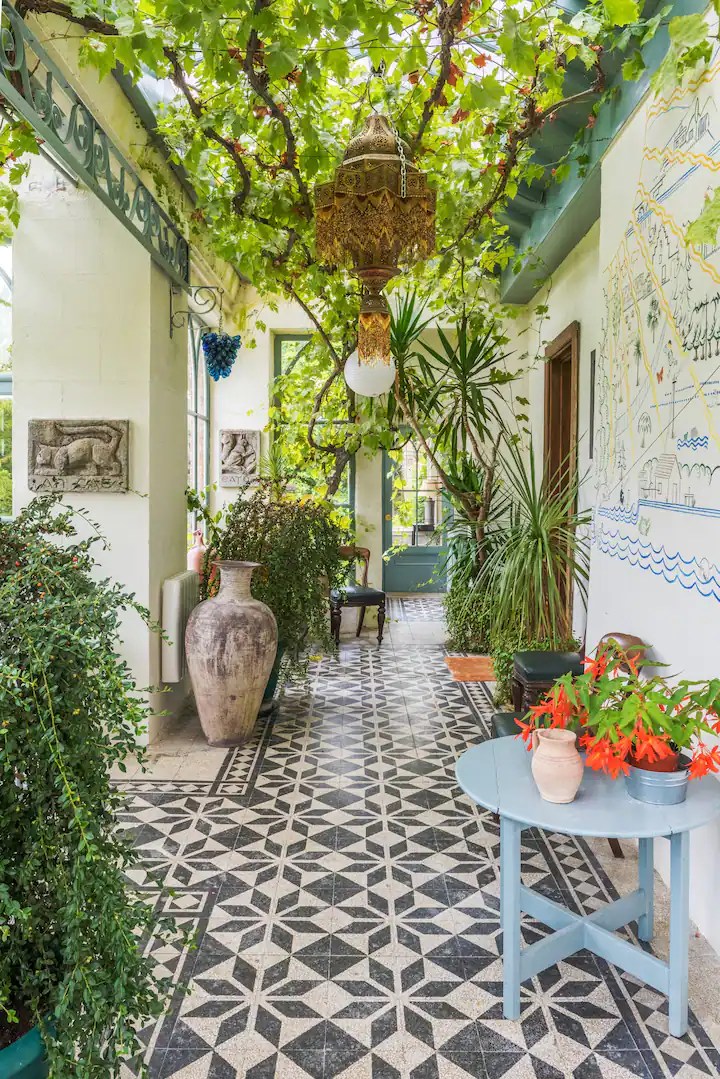
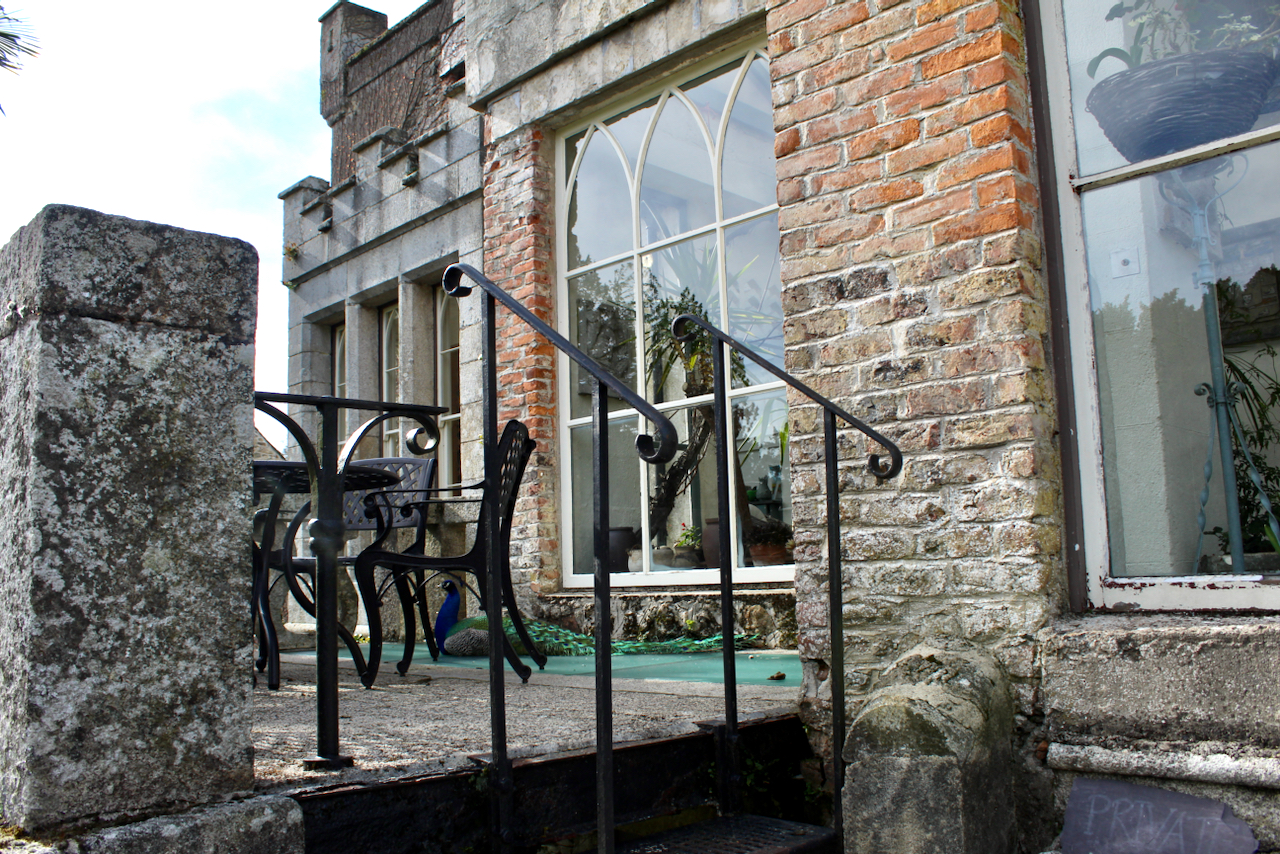
I loved the light and plant filled conservatory area, with a childlike drawing on one wall. The glass ceiling is draped in grape vines. The picture is of the estate, drawn by the four children of the house in 1928, Olivia Durdin-Robertson and her brother Derry and sister Barbara, children of Manning and Nora. I loved the pictures of the children themselves swimming in the river, wearing little swimming hats! The picture even has the telephone wires in it. The conservatory area is part of an addition on the back of the castle, added around 1860.
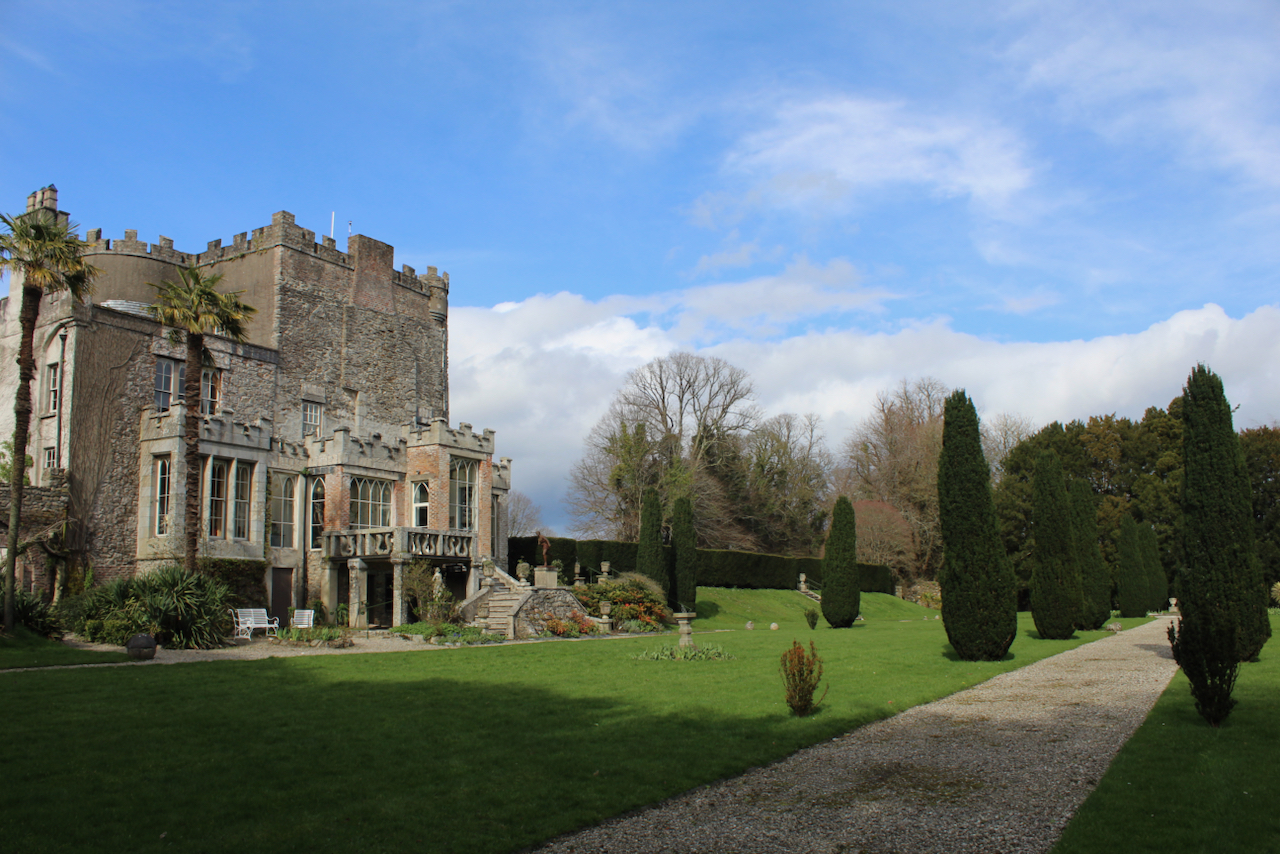
The conservatory is in the brick and battlemented addition to one side of the castle. From the formal gardens to the side of the castle a different vantage shows more of the castle and one can see the original tower house, and the additions.
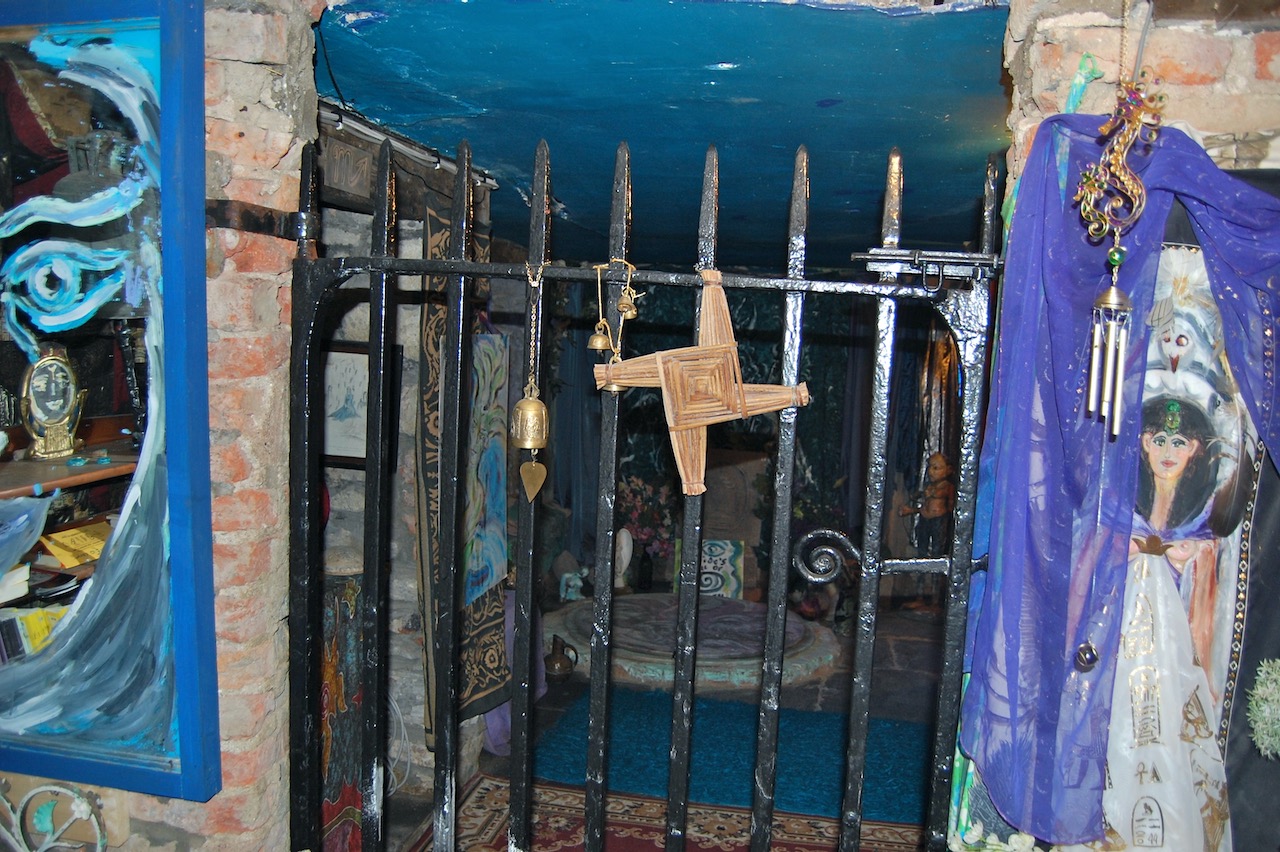
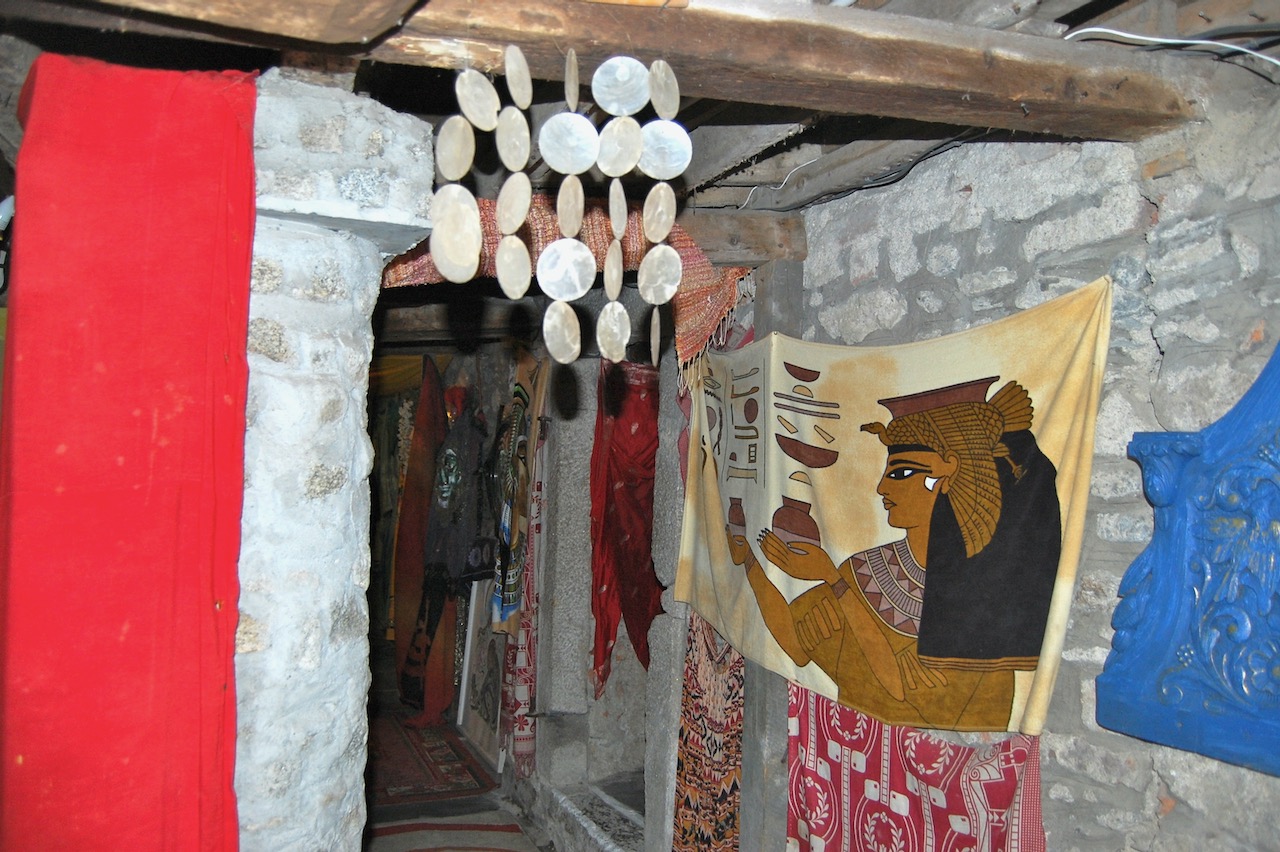
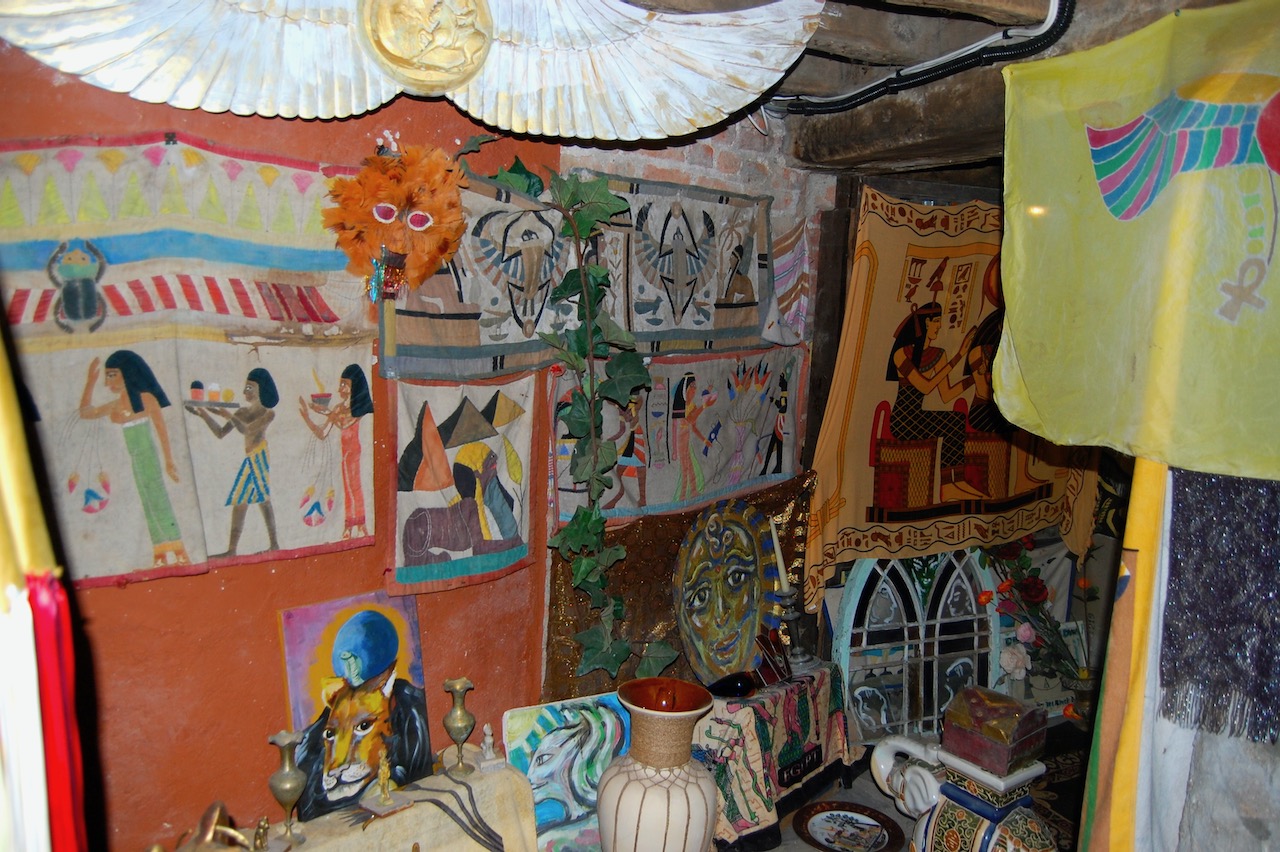
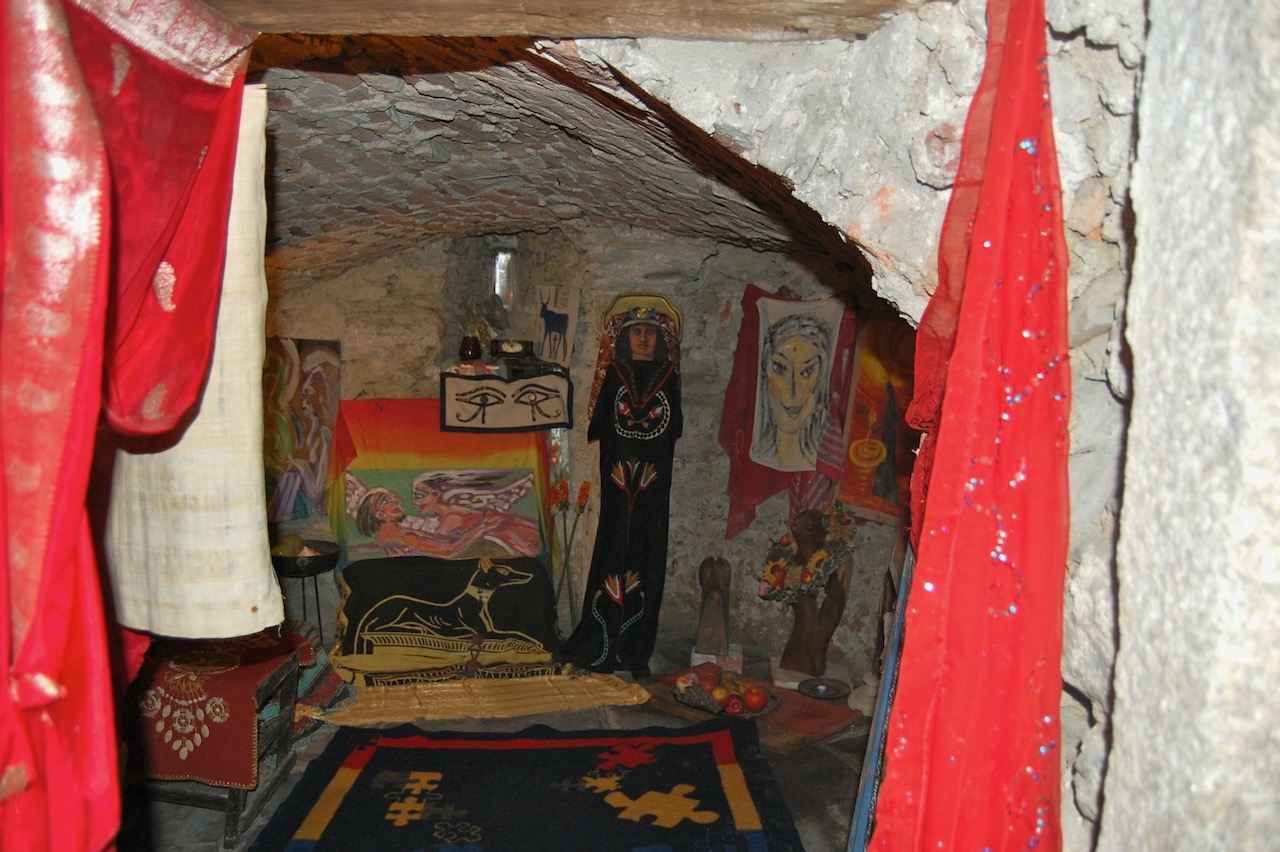
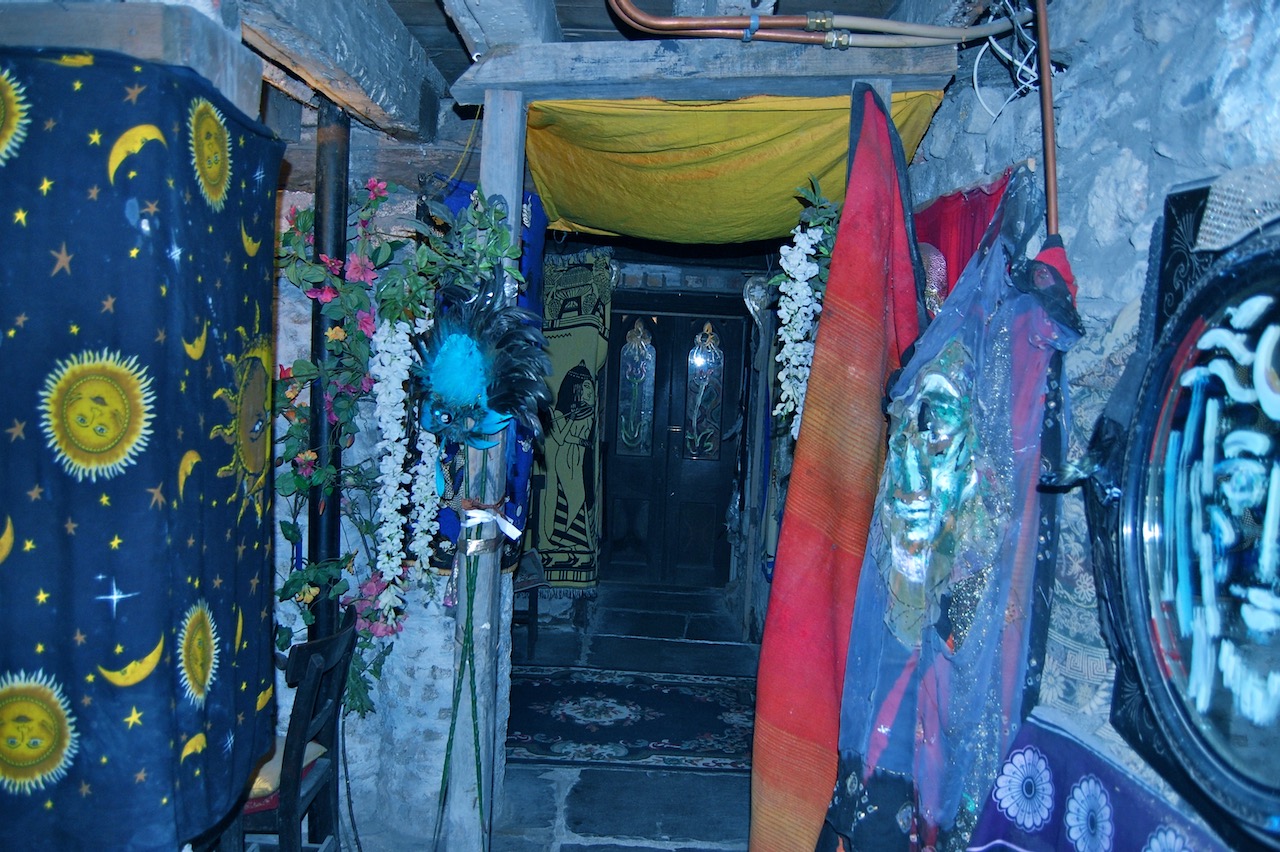
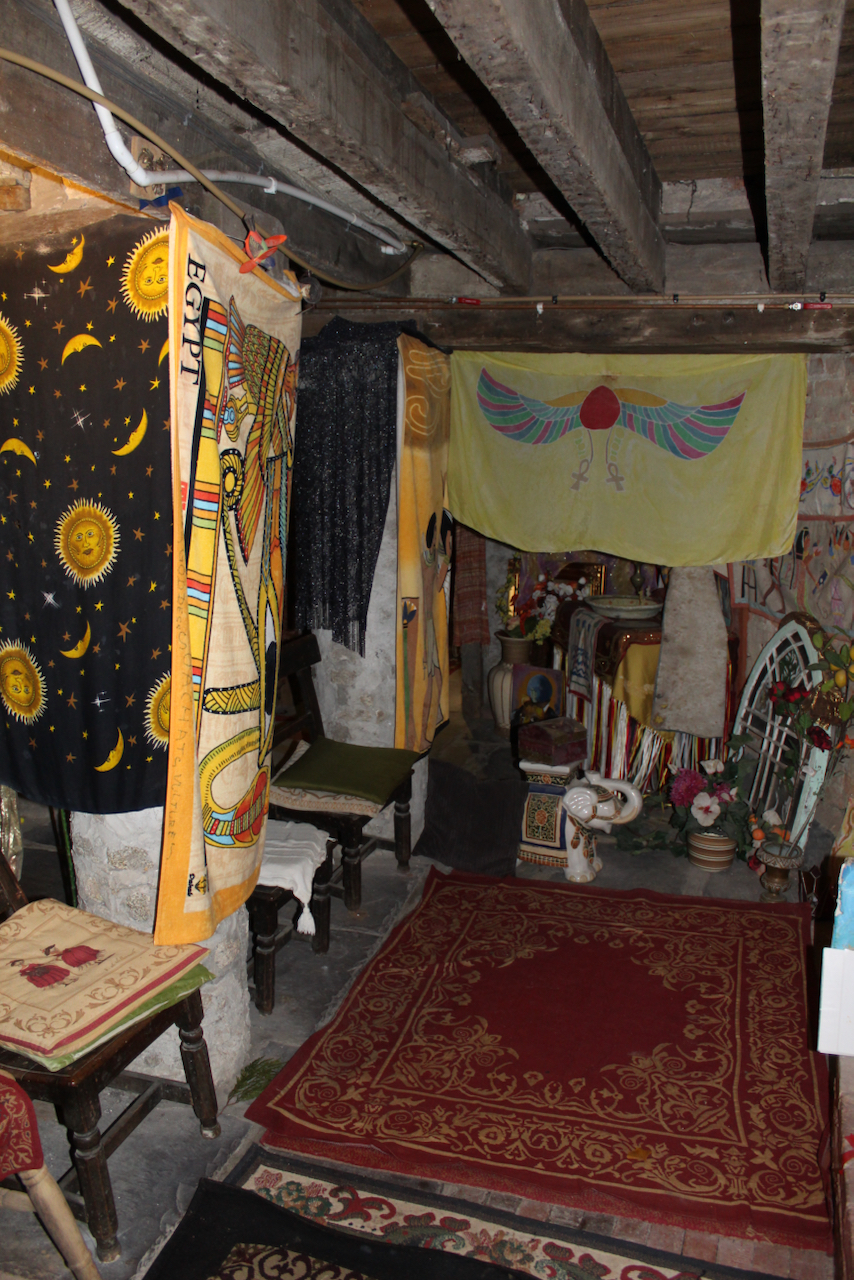
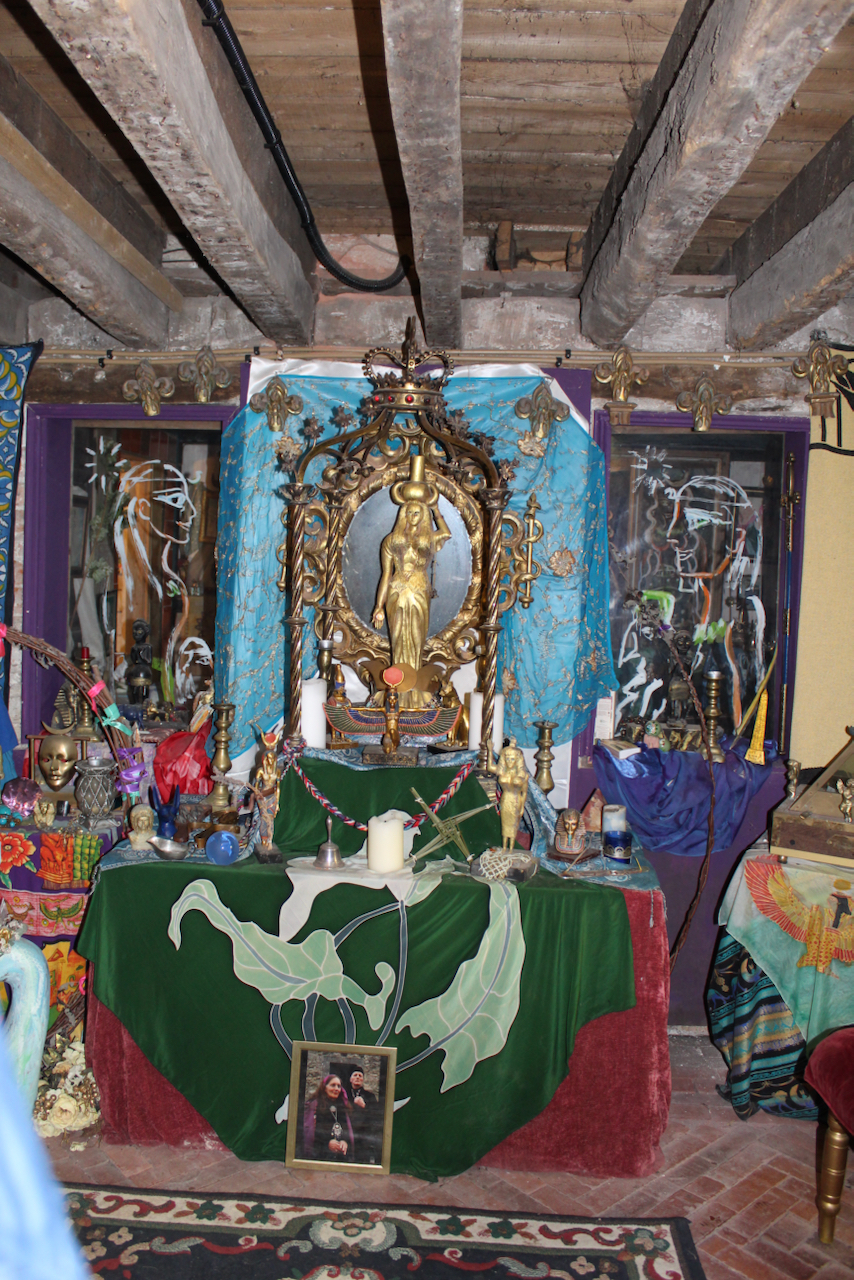
We were allowed to take photos in the basement, which used to house dungeons, and now holds the “Temple of Isis.” It also contains a well, which was the reason the castle was situated on this spot.
In the 1970s two of the four children of Manning Durdin-Robertson, the writer and mystic Olivia Durdin-Robertson, who was a friend of W.B. Yeats and A.E. Moore, and her brother Laurence (nicknamed Derry), and his wife Bobby, converted the undercroft into a temple to the Egyptian Goddess Isis, founding a new religion. In 1976 the temple became the foundation centre for the Fellowship of Isis [11]. I love the notion of a religion that celebrates the earthy aspects of womanhood, and I purchased a copy of Olivia Durdin-Robertson’s book in the coffee shop. The religion takes symbols from Egyptian religion, as you can see in my photos of this marvellous space:
Turtle Bunbury has a video of the Fellowship of Isis on his website [12]! You can get a flavour of what their rituals were like initially. Perhaps they are similar today. The religion celebrates the Divine Feminine.
After a tour of the castle, we then went to the back garden, coming out from the basement by a door under the stone balcony. According to its website:
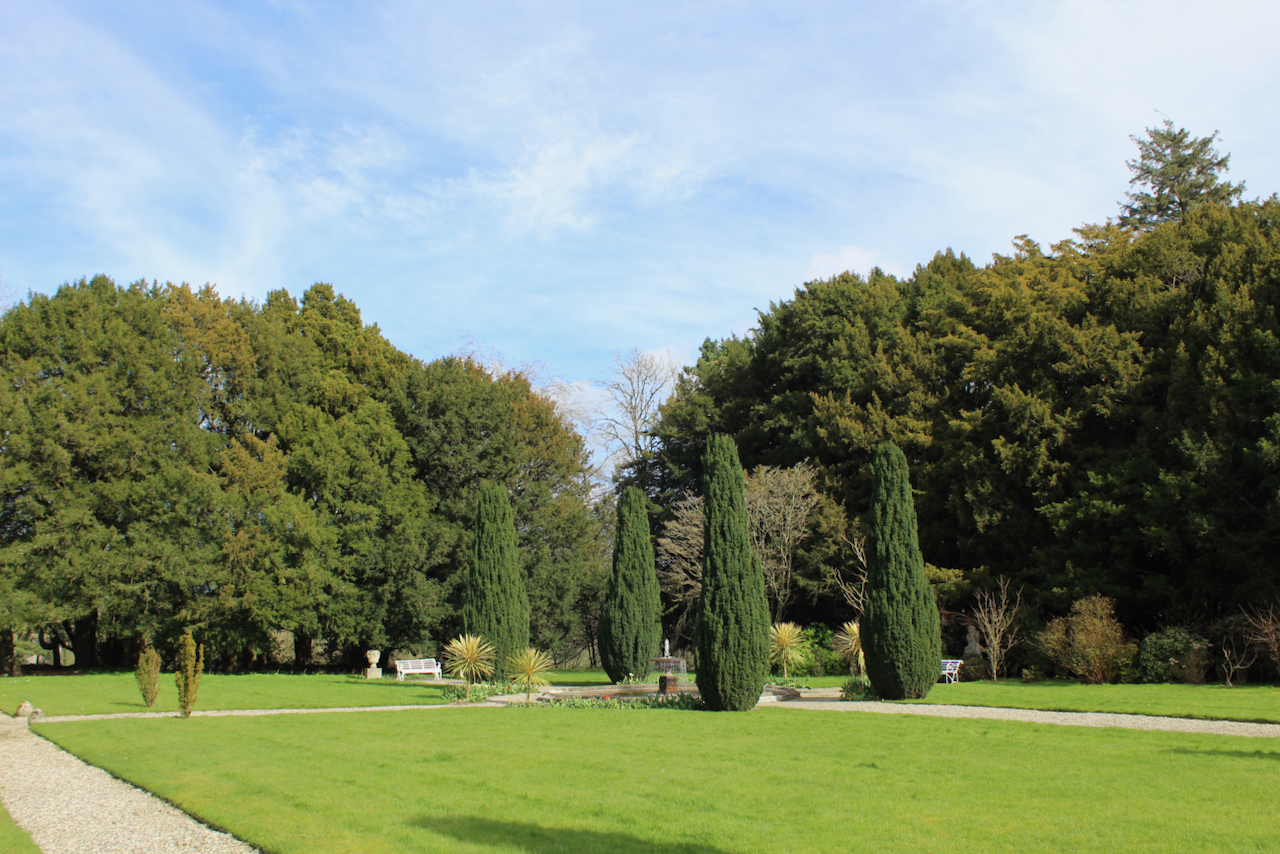
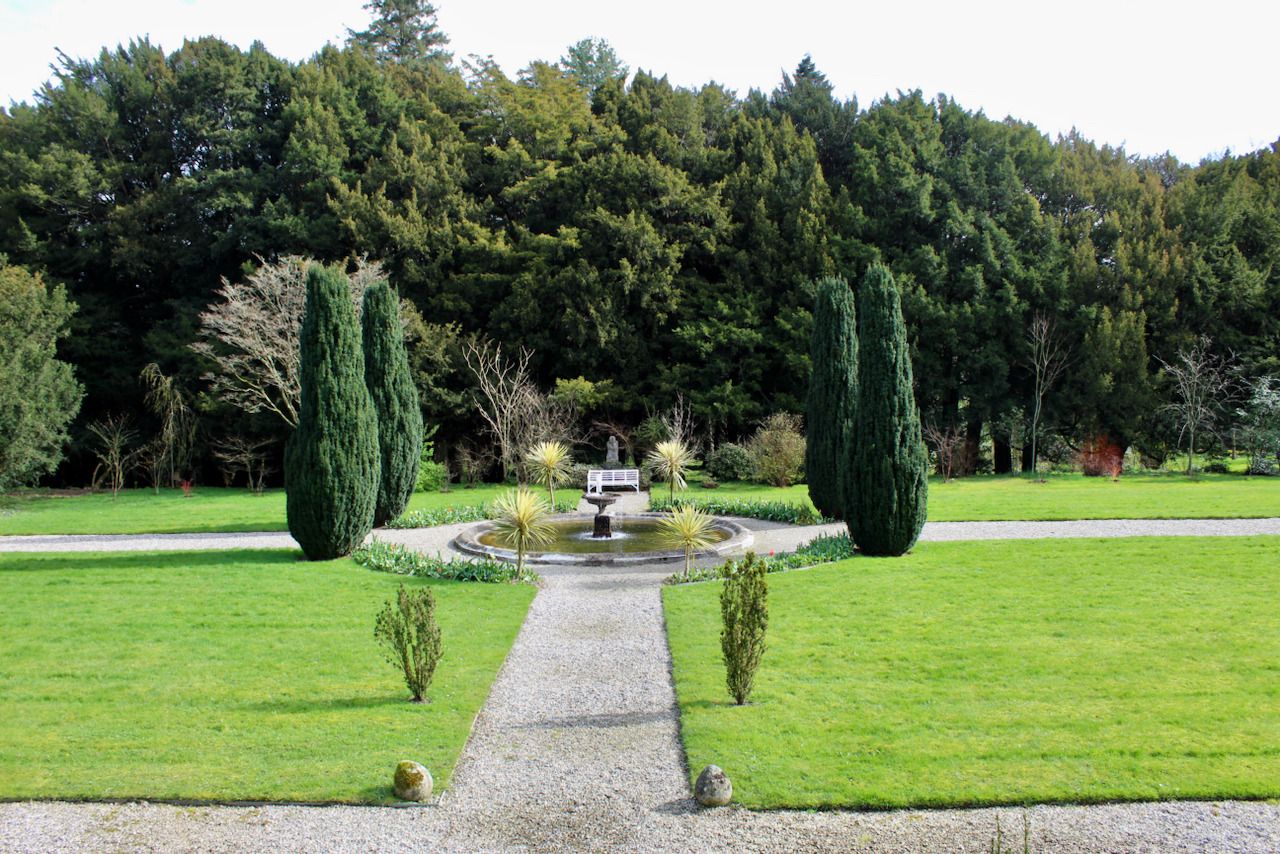
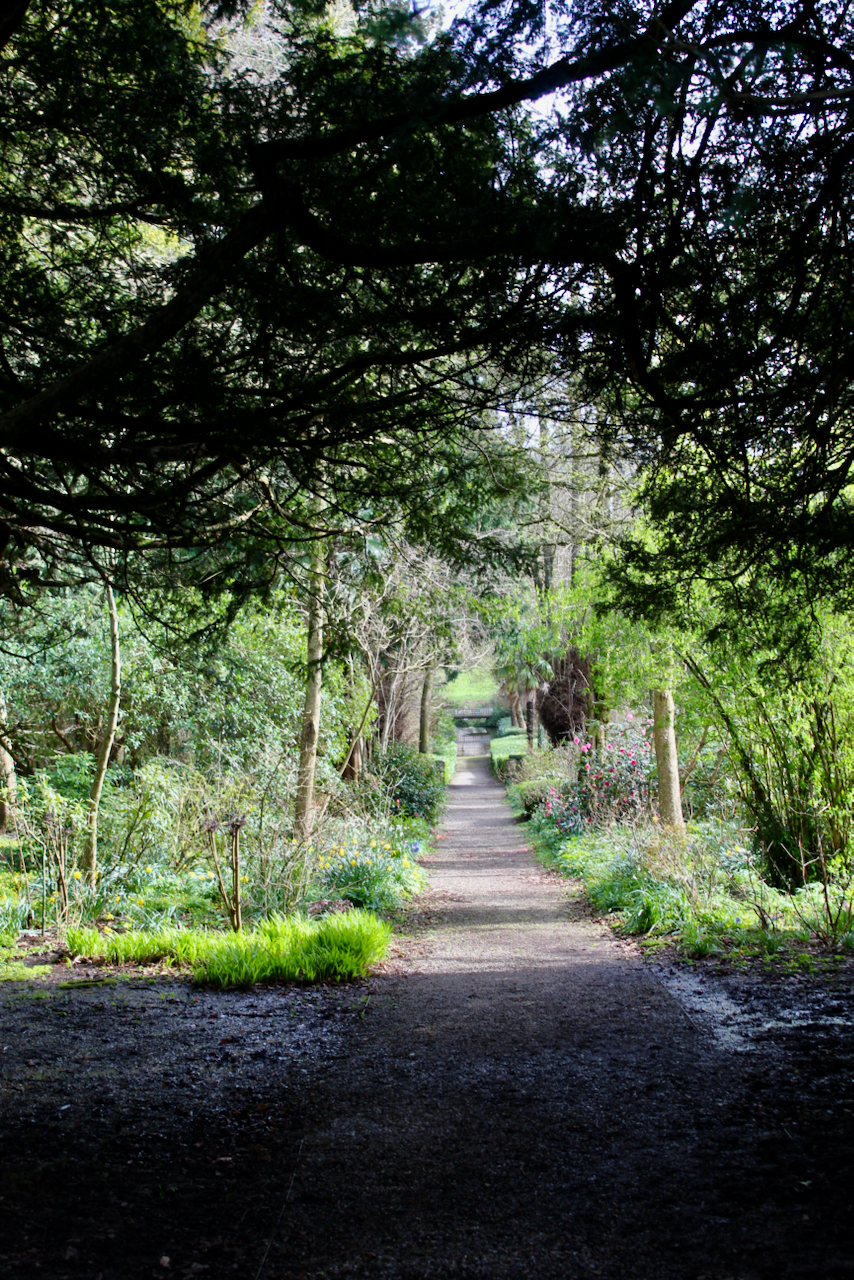
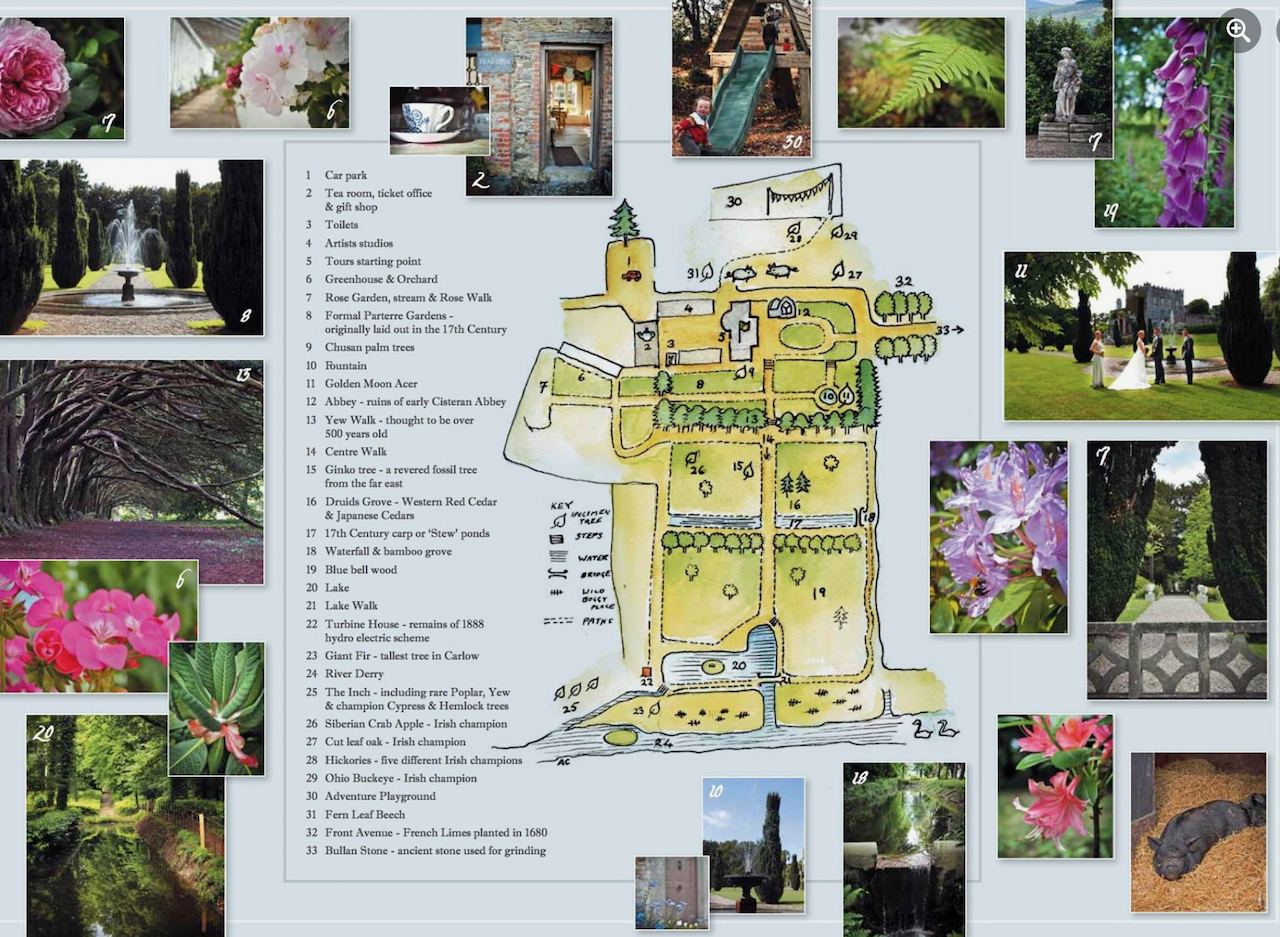
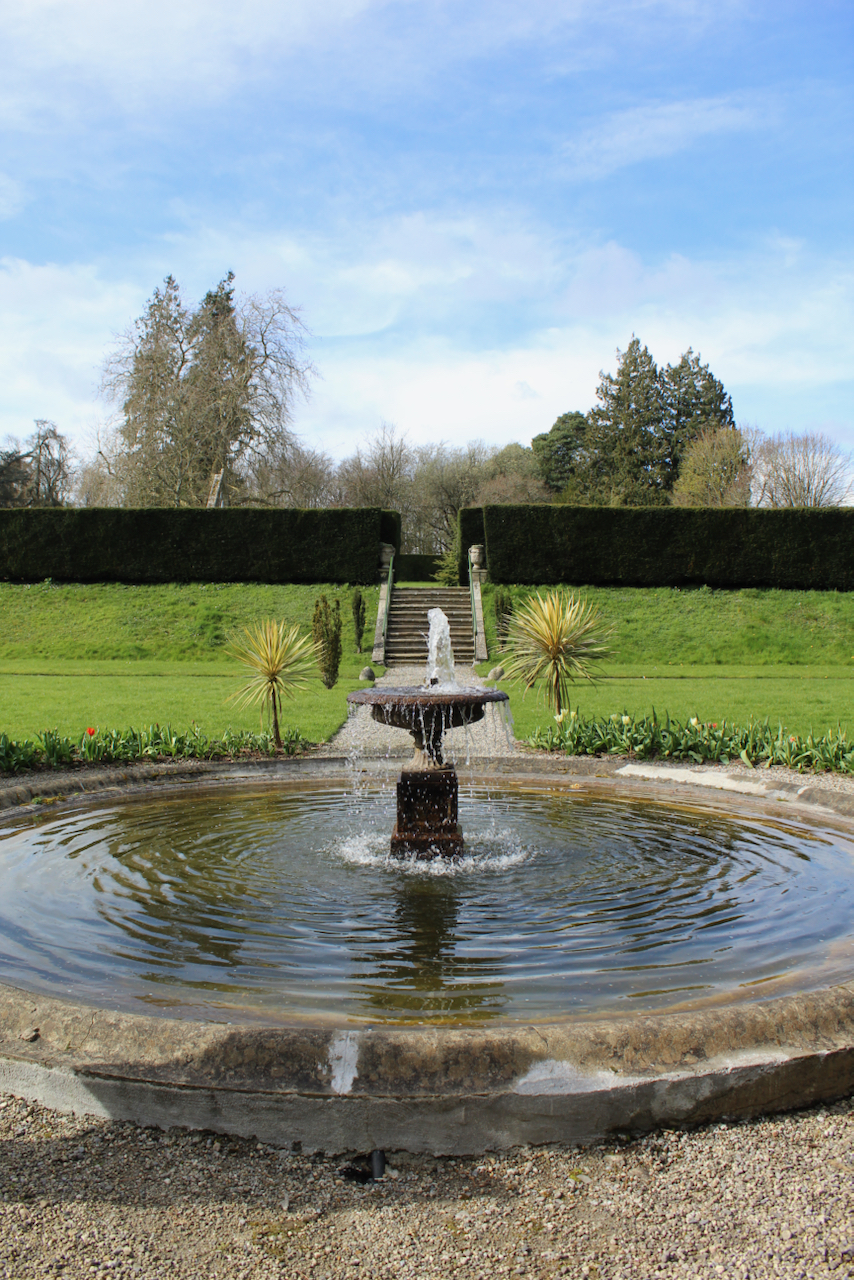
“The Gardens were mainly laid out in the 1680s by the Esmondes. They feature impressive formal plantings and layouts including the Italian style ‘Parterre’ or formal gardens, as well the French lime Avenue (planted in 1680). The world famous yew walk is a significant feature which is thought to date to over 500 years old and should not be missed.
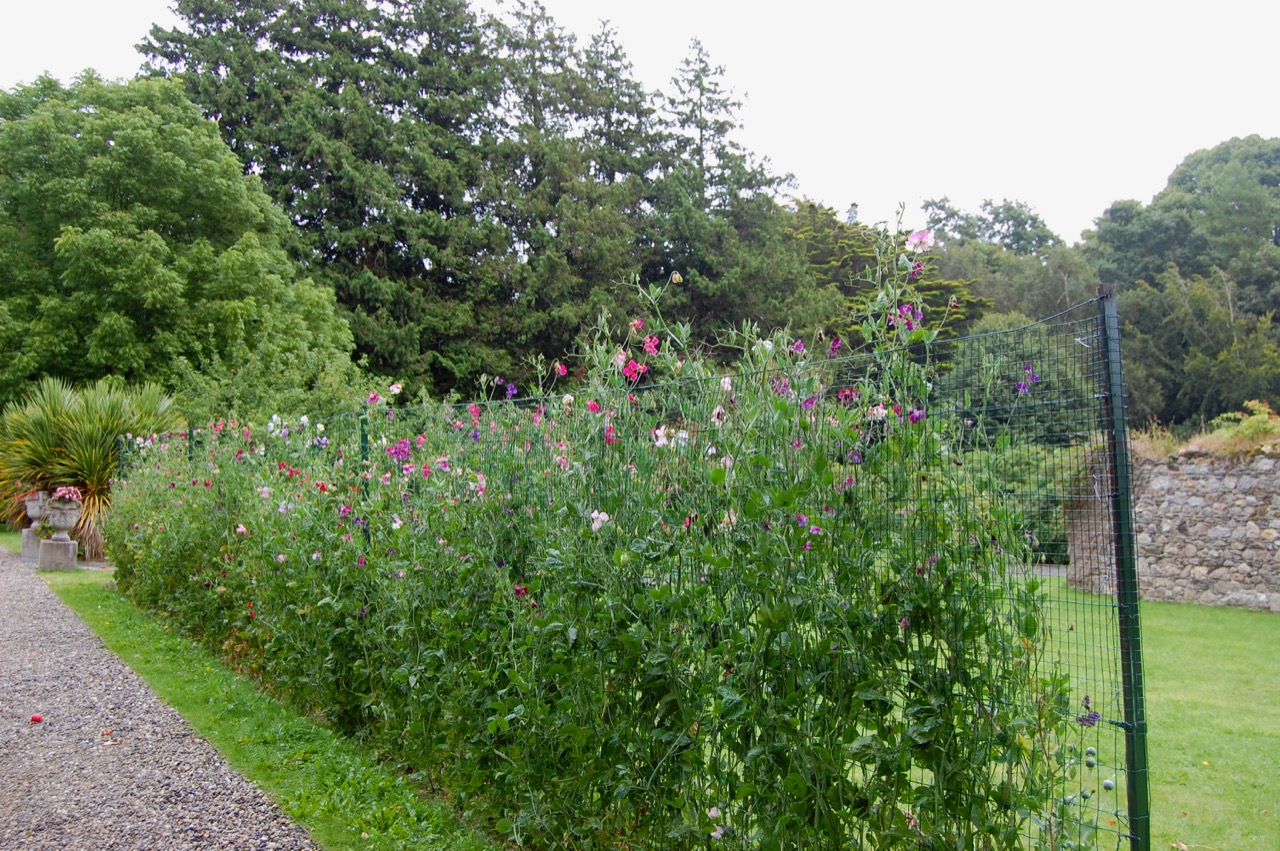
“Later plantings resulted in Huntington gaining a number of Champion trees including more than ten National Champions. The gardens also feature early water features such as stew ponds and an ornamental lake as well as plenty to see in the greenhouse and lots of unusual and exotic plants and shrubs.“”Later plantings resulted in Huntington gaining a number of Champion trees including more than ten National Champions. The gardens also feature early water features such as stew ponds and an ornamental lake as well as plenty to see in the greenhouse and lots of unusual and exotic plants and shrubs.“
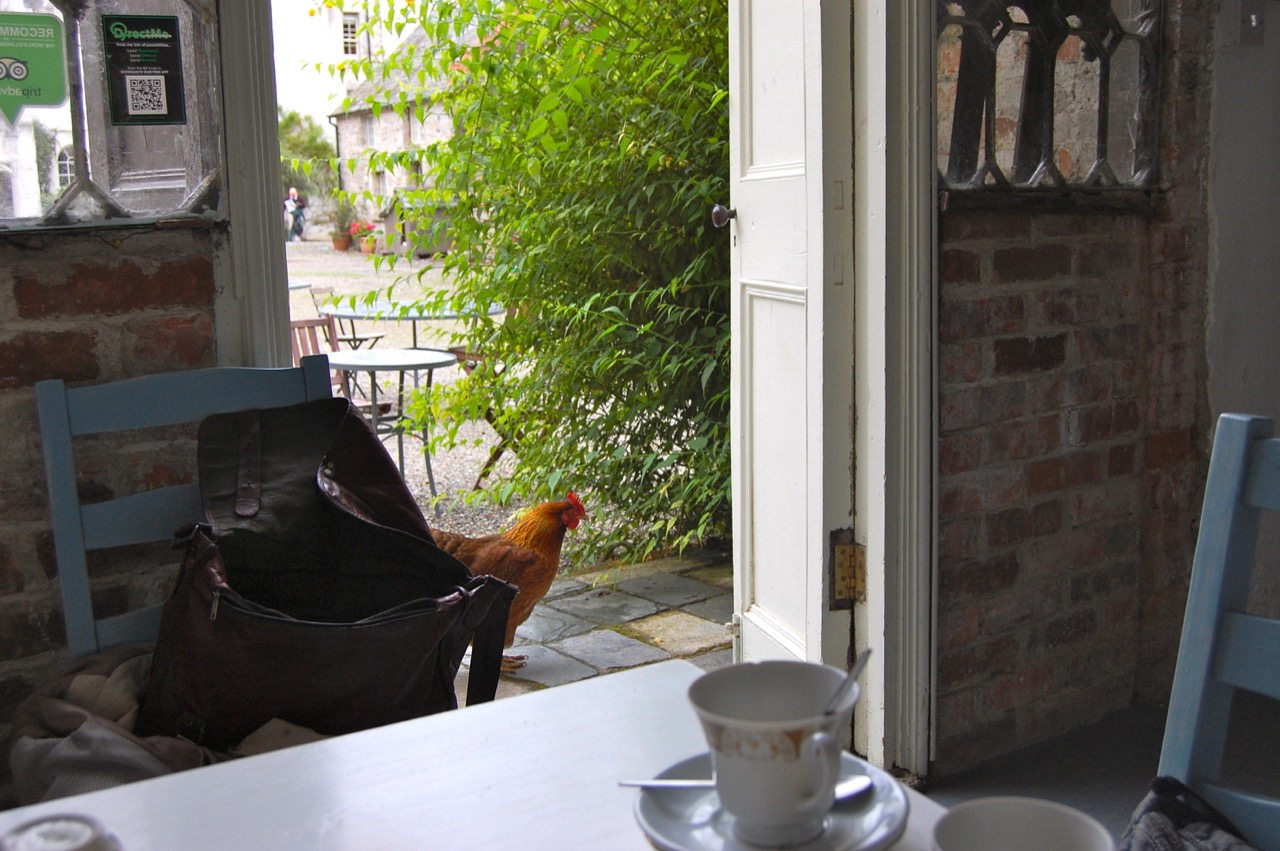
There is space next to the cafe that can be rented out for events:
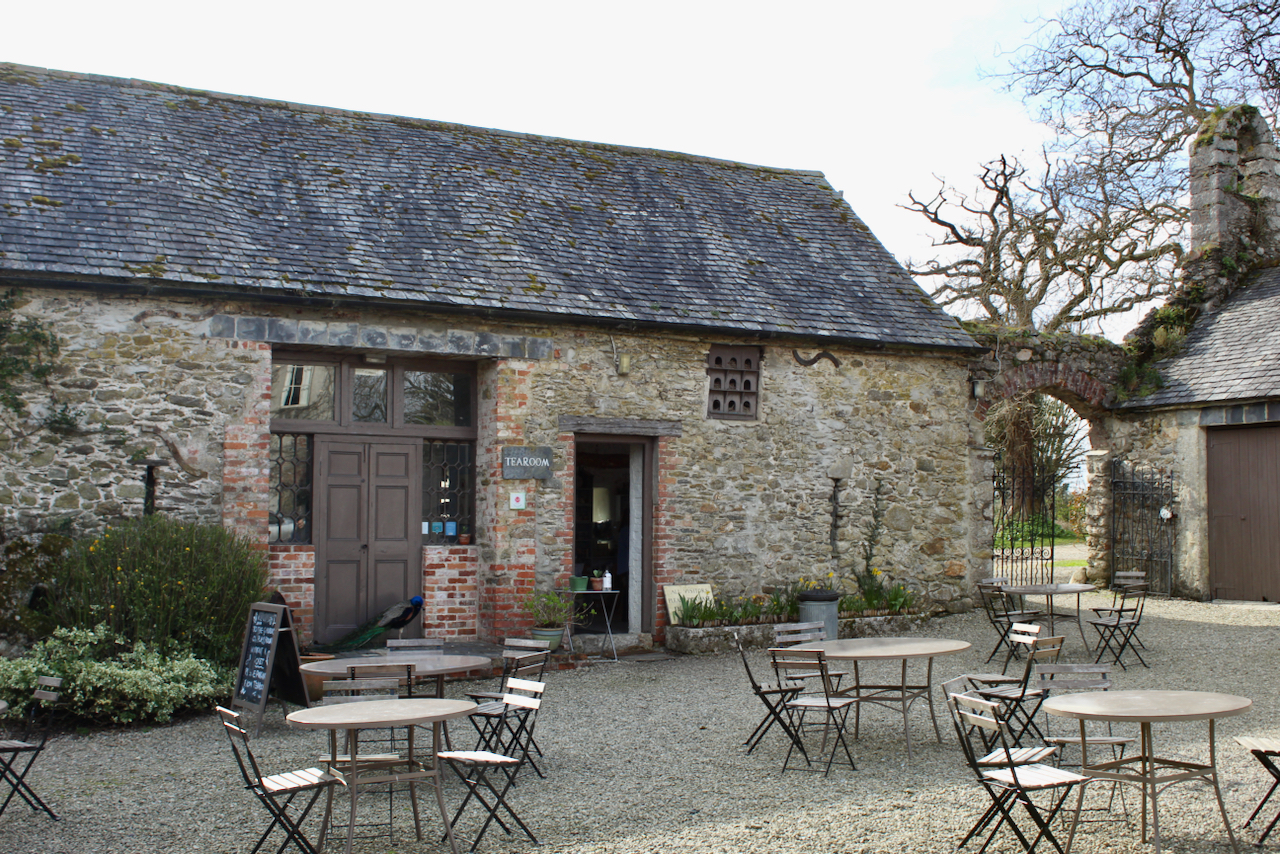
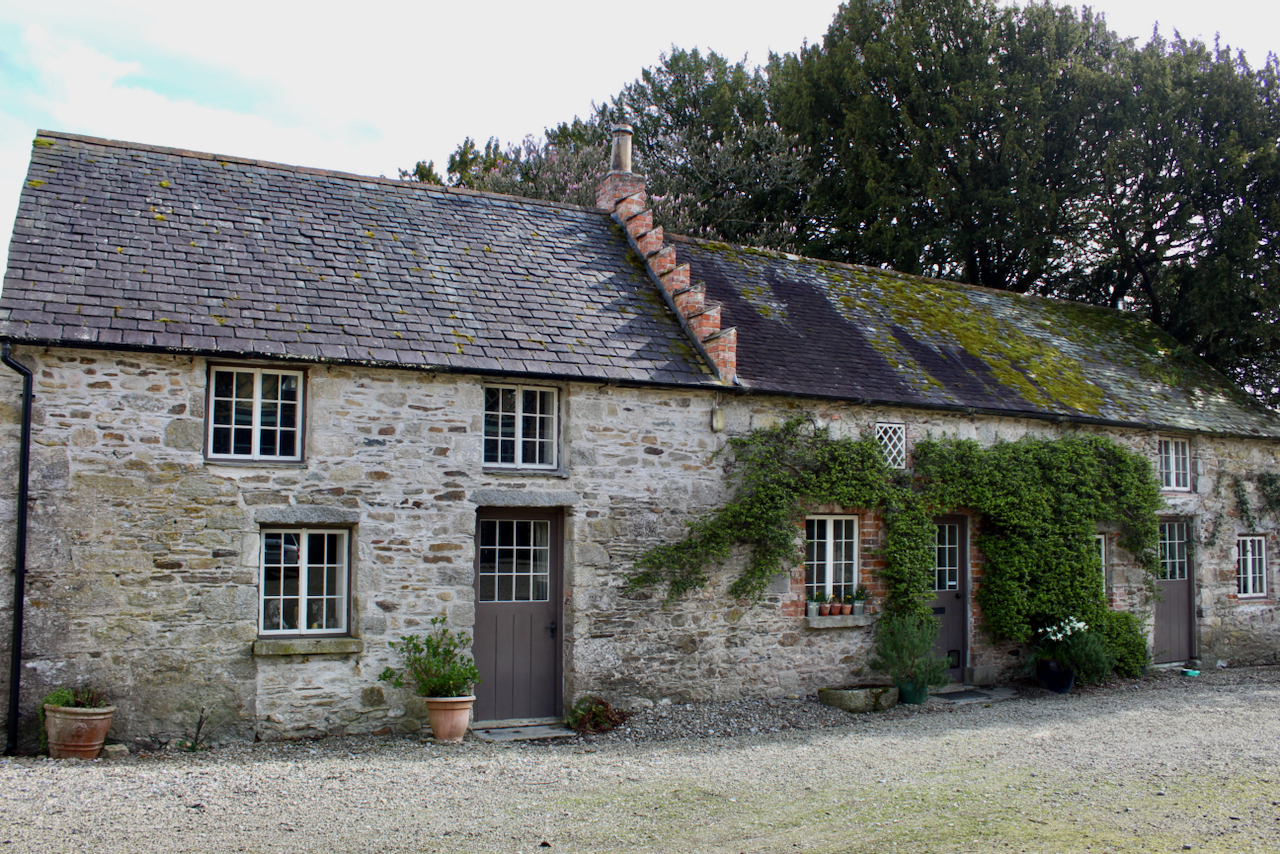
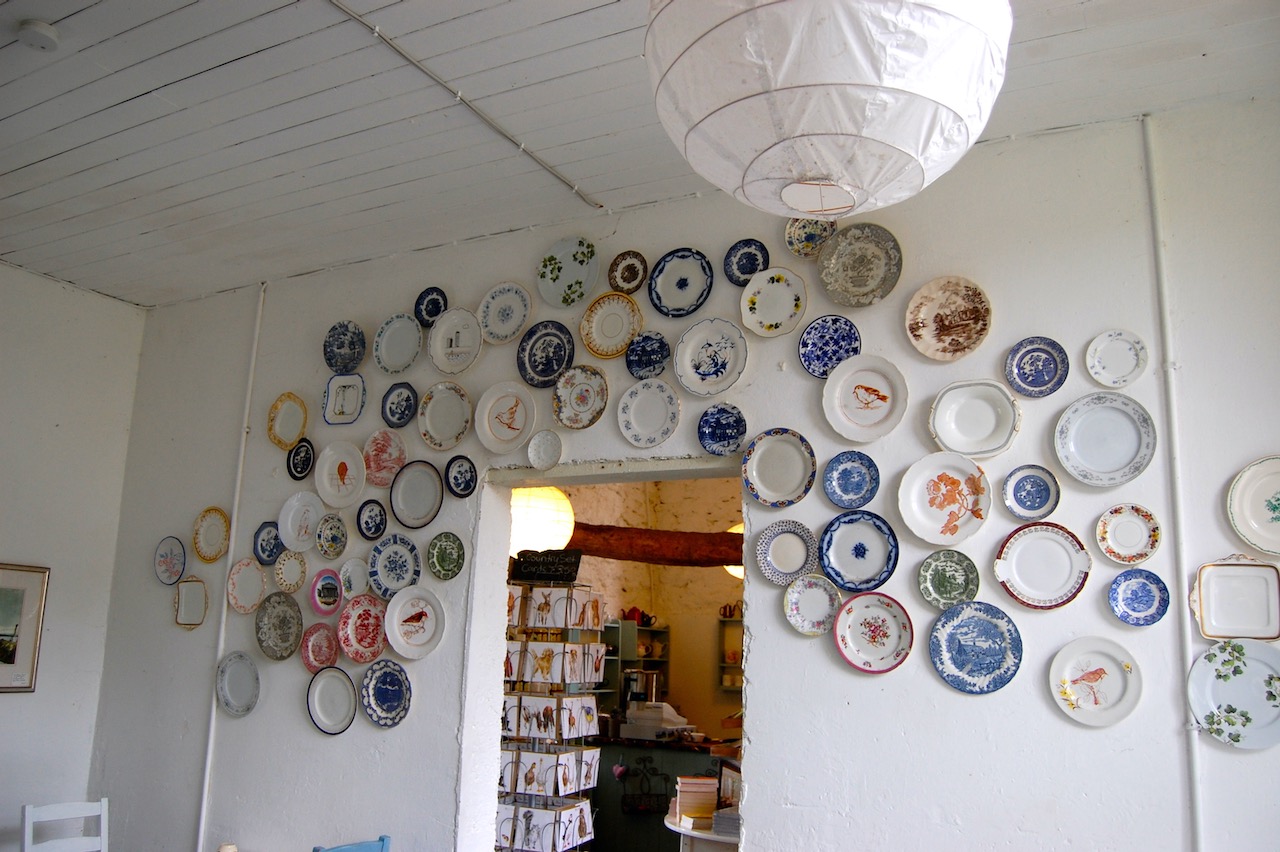
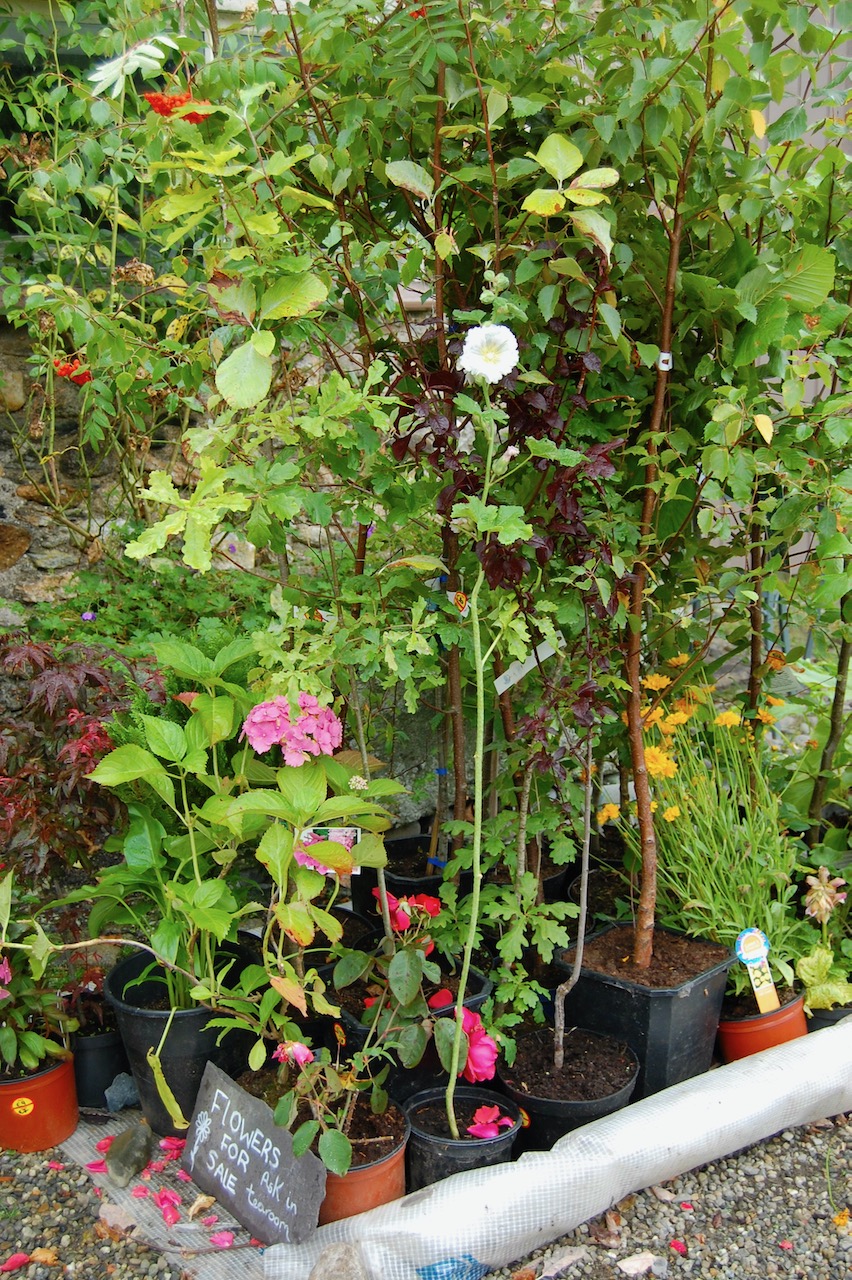
A few plants were for sale in the yard. A shop off the cafe sells local made craft, pottery, and books. The stables and farmyard buildings are kept in good condition and buzzed with with the business of upkeep of the house and gardens.
[3] Kavanagh, Art and Rory Murphy, The Wexford Gentry. Published by Irish Family Names, Bunclody, Co Wexford, Ireland, 1994.
[4] Bence-Jones, Mark. A Guide to Irish Country Houses (originally published as Burke’s Guide to Country Houses volume 1 Ireland by Burke’s Peerage Ltd. 1978); Revised edition 1988 Constable and Company Ltd, London.
[5] p. 171, Ohlmeyer, Jane. Making Ireland English. The Irish Aristocracy in the Seventeenth Century. Yale University Press, New Haven and London, 2012. See also pages 43, 273, 444 and 451.
Help me to fund my creation and update of this website. It is created purely out of love for the subject and I receive no payment so any donation is appreciated!





































 Irish Historic Houses