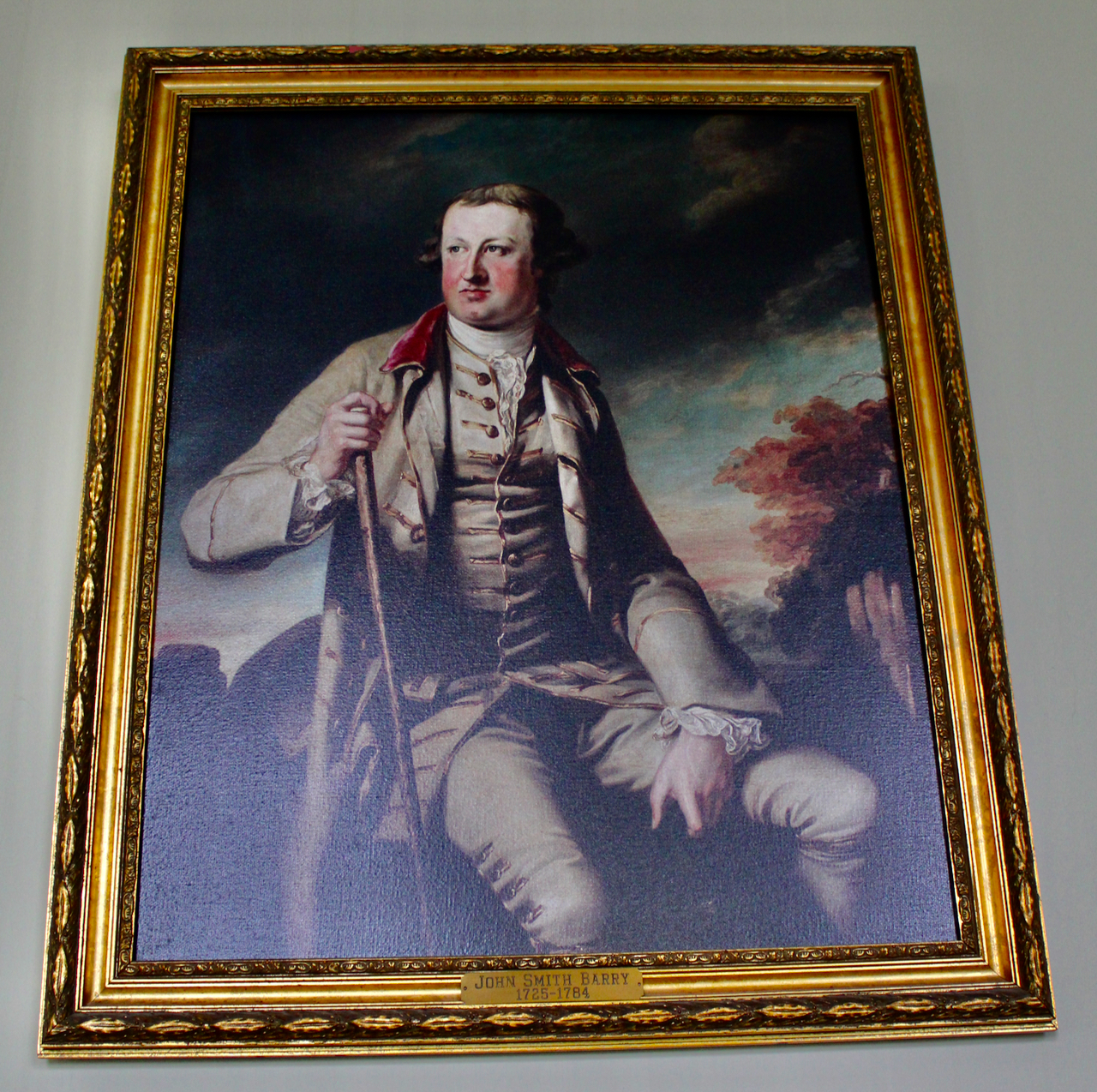
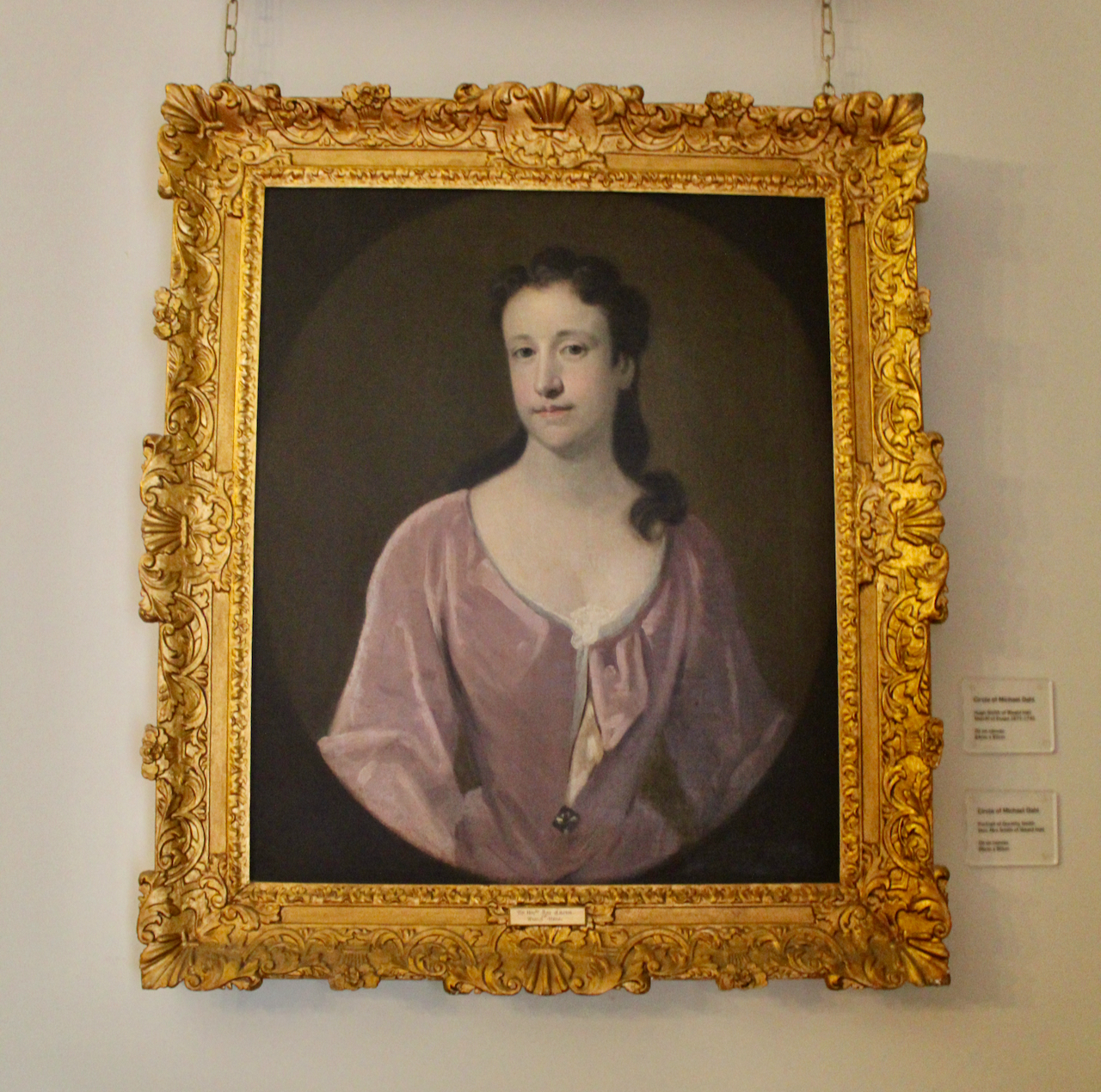
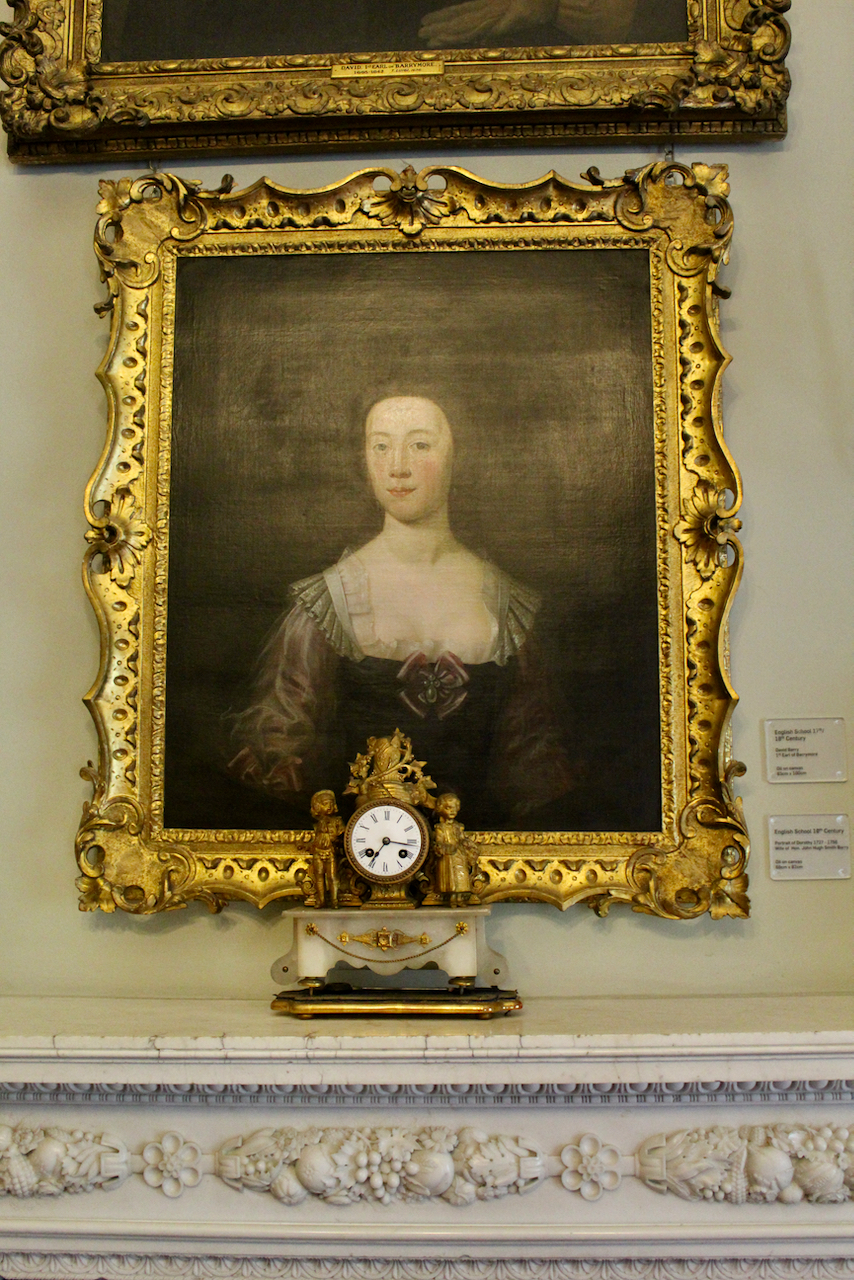
John Barry (1725-1784), who added the name Smith to his surname after his marriage to a wealthy heiress, was the son of James Barry, 4th Earl of Barrymore, of Castlelyons, County Cork, and Barry’s third wife, Anne Chichester, daughter of Arthur Chichester, 3rd Earl of Donegall (it was spelled with two ‘l’s in the title, unlike the county). He married Dorothy Smith, daughter of Hugh Smith of Weald Hall, Essex, and John added Smith to his surname.
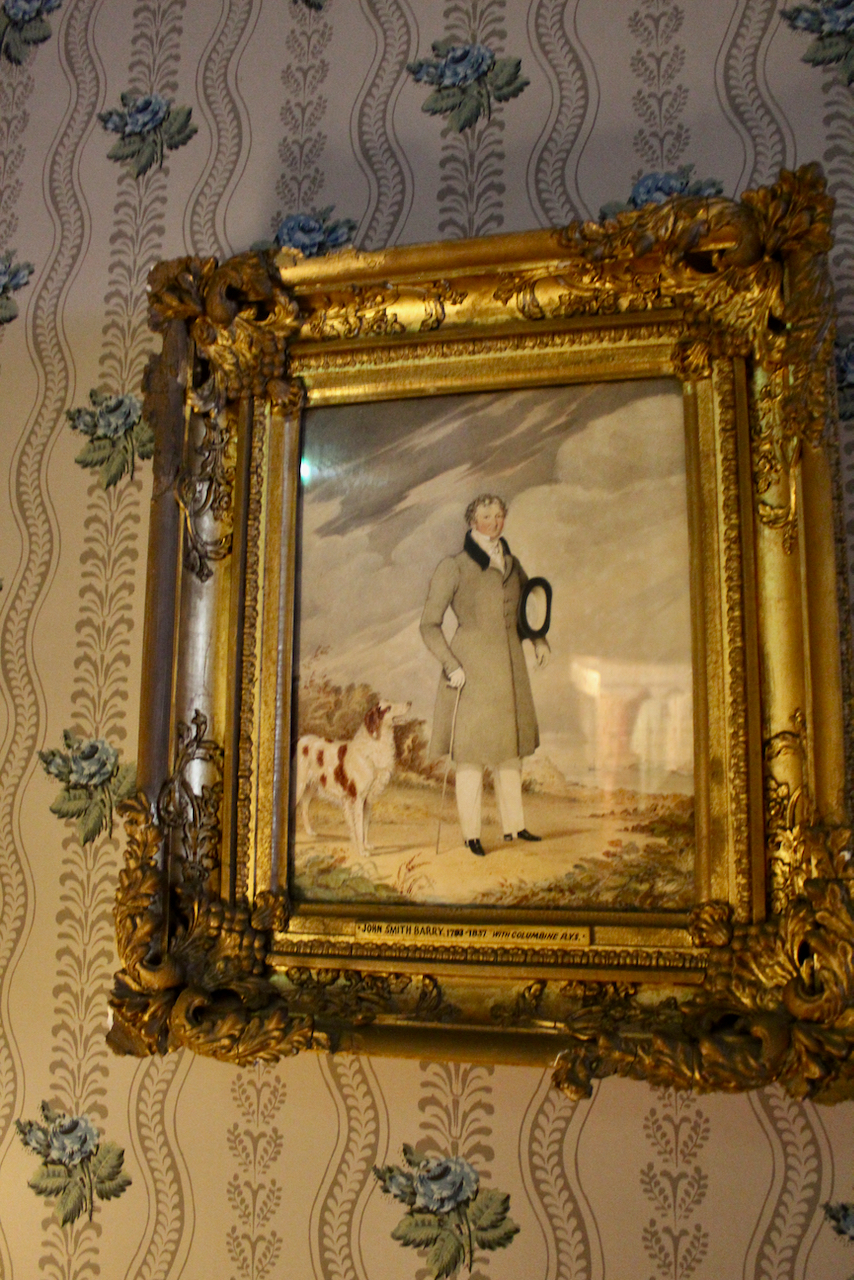
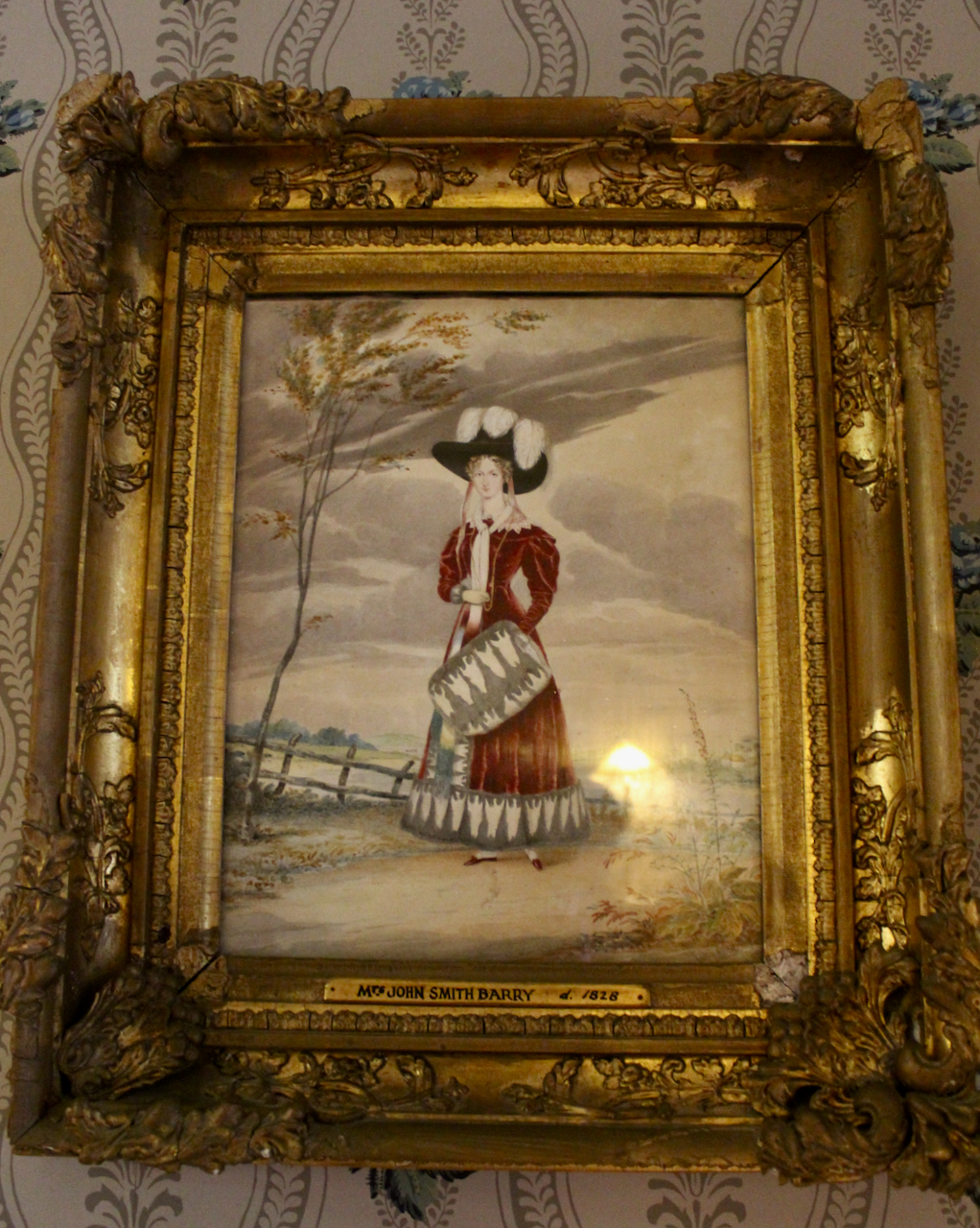
John Smith-Barry (1783-1837), son of James Hugh Smith-Barry (1746-1801) settled in Fota, County Cork, after his marriage to Eliza Courtenay of Ballyedmond, Midleton, County Cork.
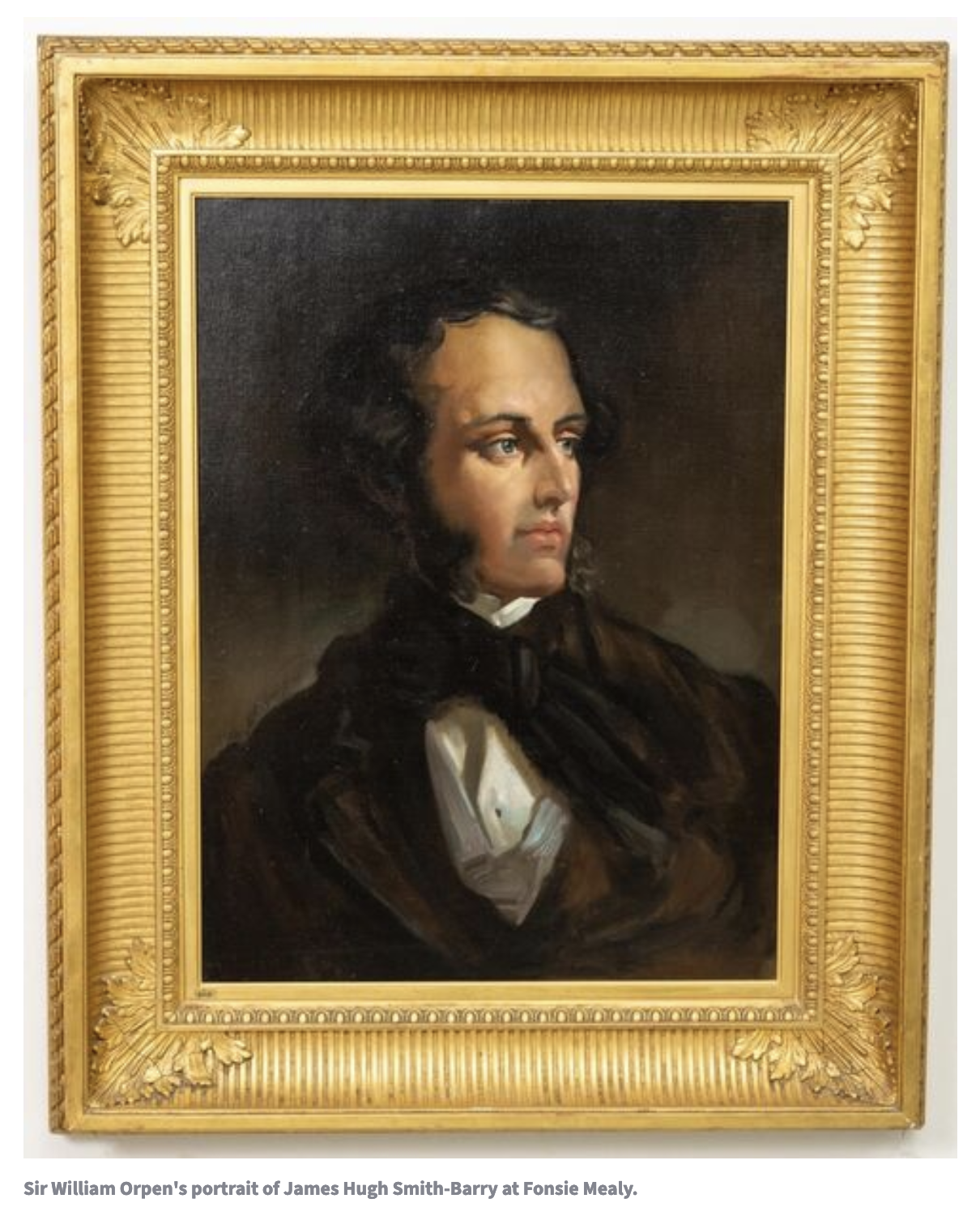
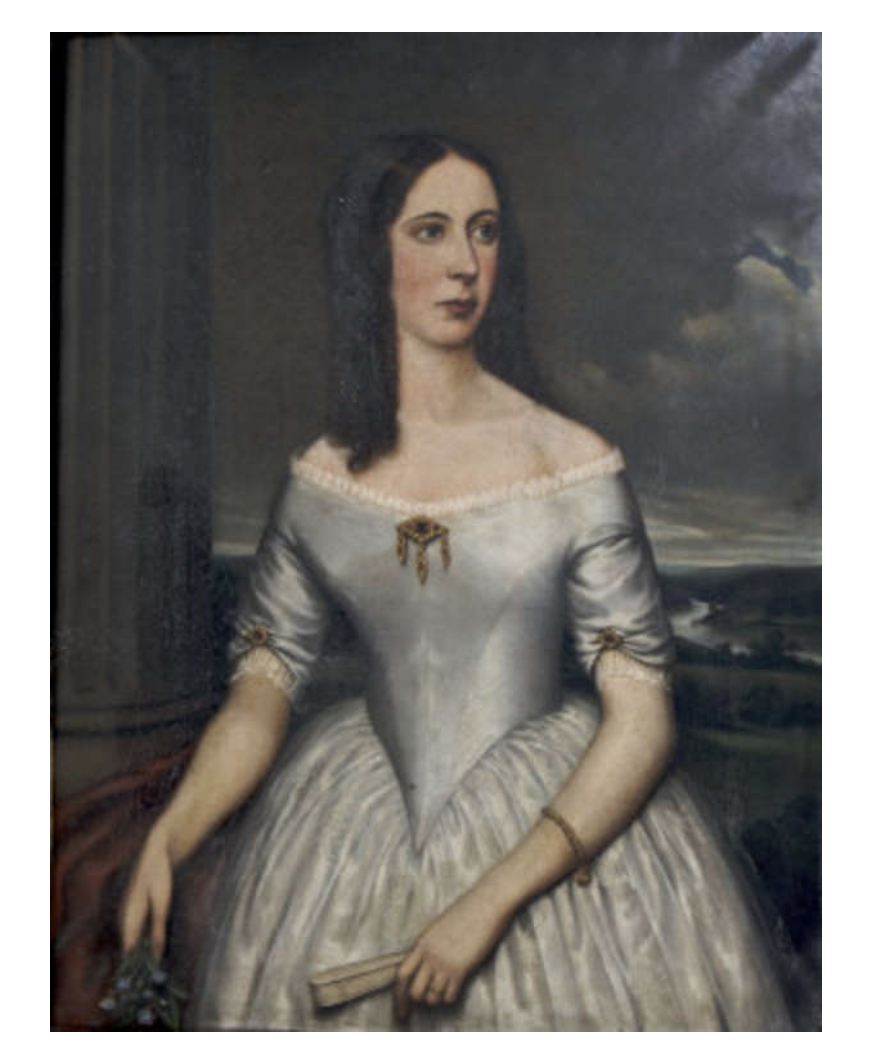
James Hugh Smith-Barry (1816-1856) inherited Fota and also Marbury Hall in Cheshire. He served as Deputy Lieutenant, Justice of the Peace and High Sheriff of County Cork. He married Elizabeth Jacson of Cheshire. After her husband died, she married George Fleming Warren, 2nd Baron de Tabley of Tabley House, County Chester.
James Hugh Smith-Barry by William Orpen 1904, courtesy of Fonsie Mealy auction 2022.
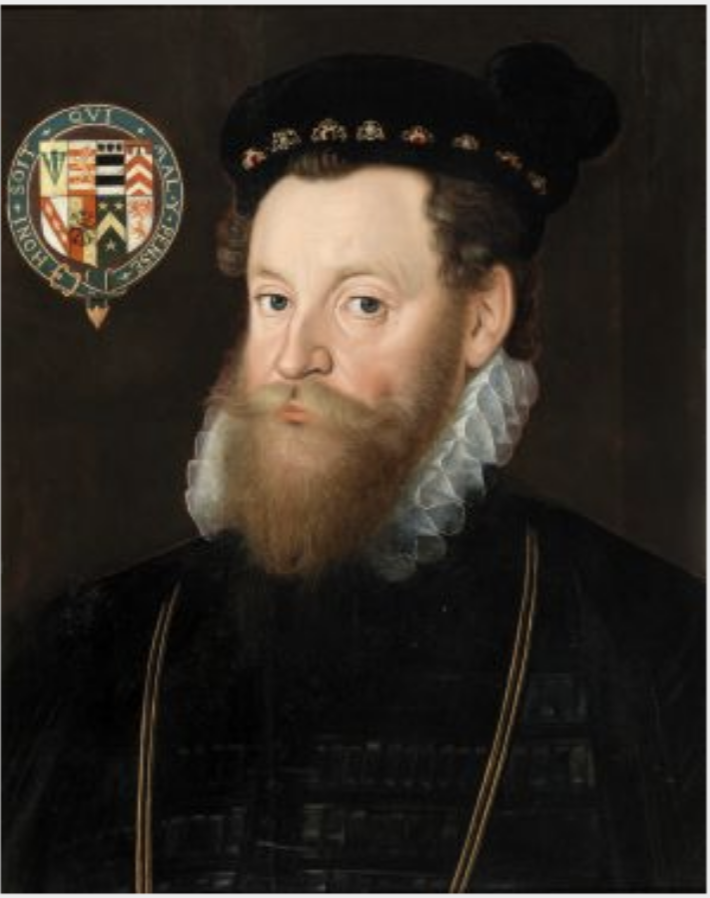
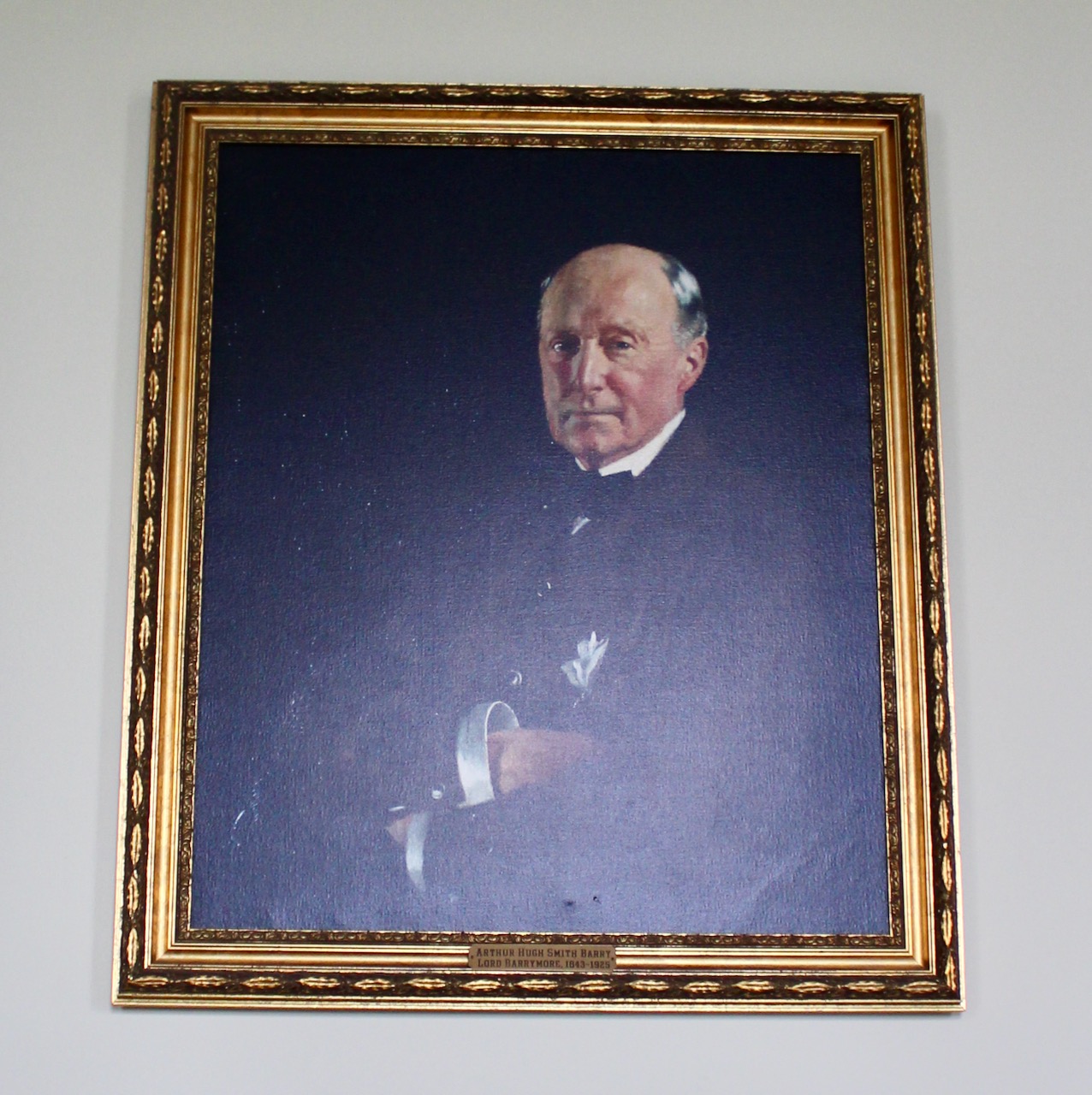
Arthur Hugh Smith-Barry (1843-1925), the oldest son of James and Elizabeth, inherited Fota and also Marbury Hall. He too served as Deputy Lieutenant, Justice of the Peace and High Sheriff of County Cork as well as Member of Parliament (M.P.) (Conservative) for County Cork between 1867 and 1874. He held the office of Member of Parliament (M.P.) (Conservative) for South Huntingdonshire in England between 1886 and 1900. In 1902 he was created 1st (and last) Baron Barrymore of County Cork.
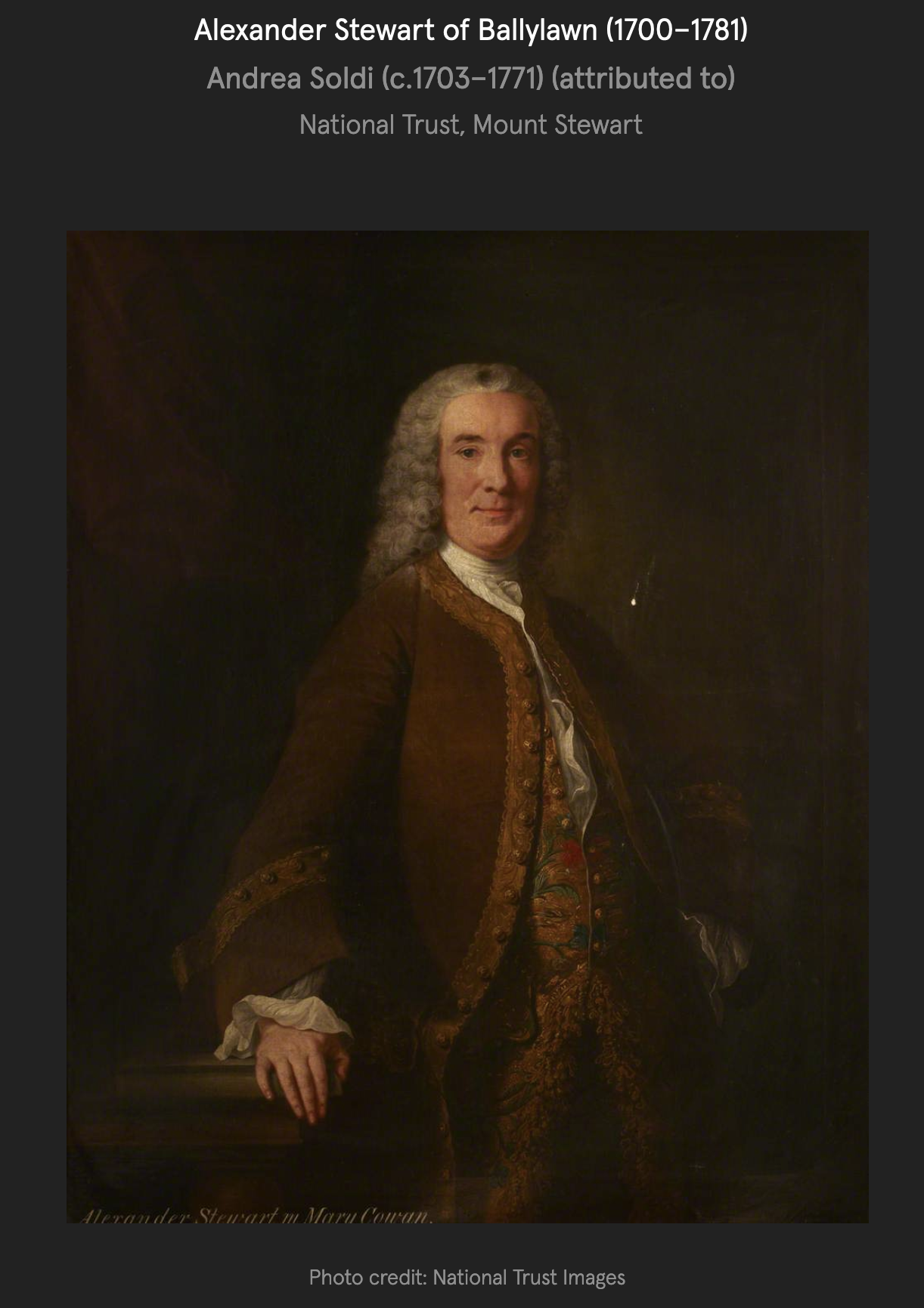
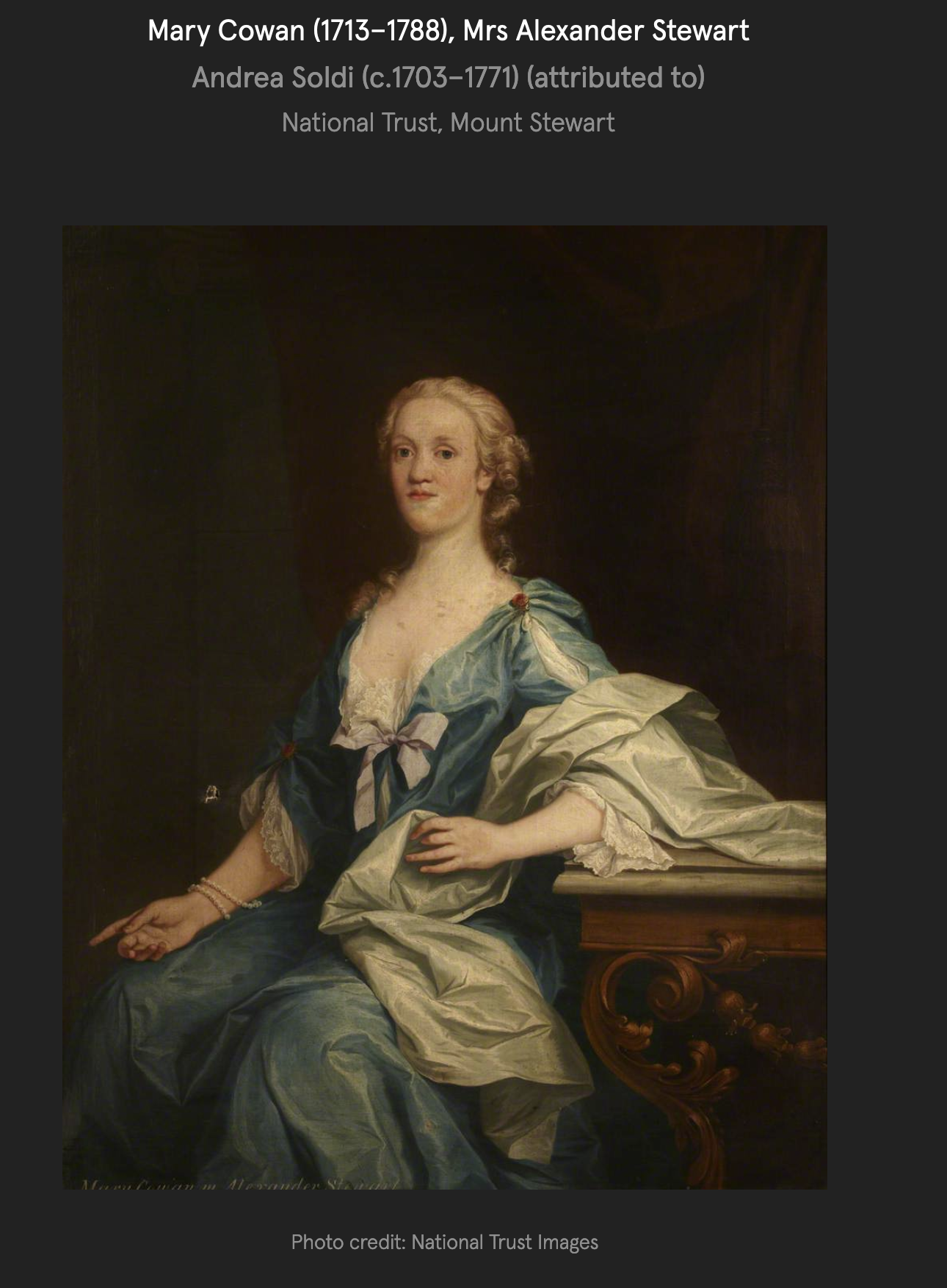
Alexander Stewart (1699/1700-1781) and his wife, Mary Cowan, bought a large area of land in County Down in 1744, part of which became Mount Stewart demesne.
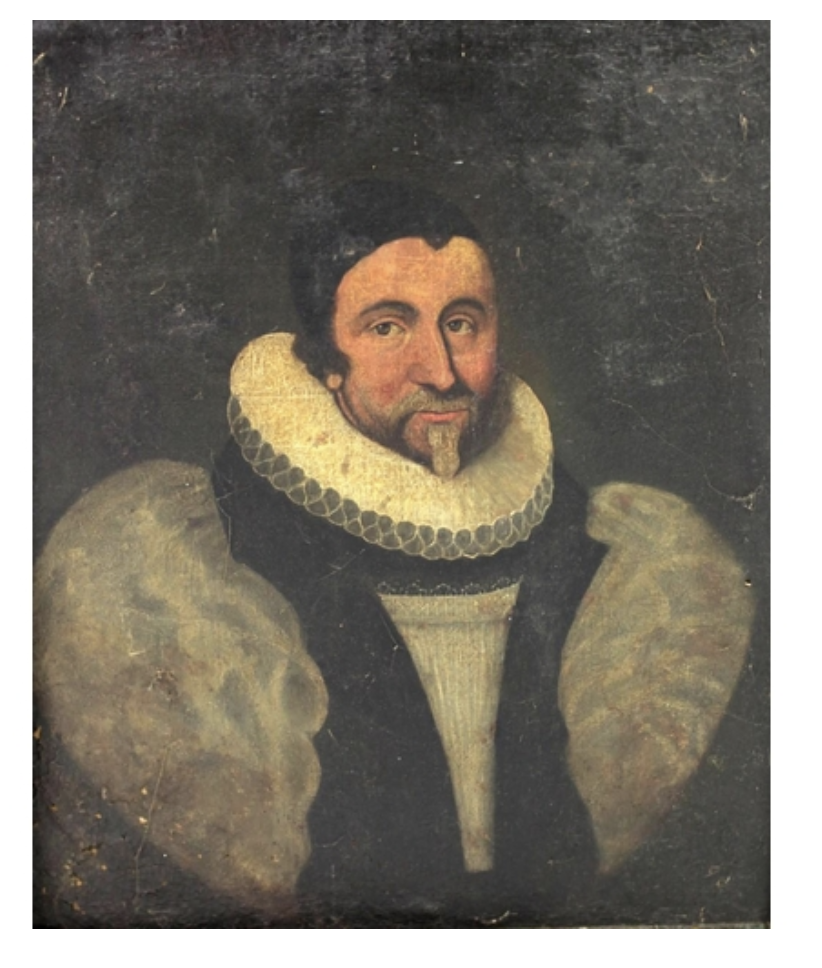
Burke’s Landed Gentry of Ireland tells us that Francis Swifte, son of Henry of Sheffield, County York, was knighted in 1616 and died in 1642. Henry of Sheffield’s other son was Thomas, who was buried in Canterbury Cathedral, who married Margaret, daughter and heir of the Right Rev. Thomas Godwin, Bishop of Bath & Wells. Many generations of Swift after him had the forename “Godwin.” Thomas and Margaret had a son William, born in 1566, who was Rector of Herbaldown and who married Mary Philpott.
17th Century English School “Portrait of a Gentleman in Armour, Sir Francis Swifte,” courtesy Fonsie Mealy Fortgranite auction.Probably Francis Swifte, son of Henry of Sheffield, County York, was knighted in 1616 and died in 1642.Reverend Thomas Swifte, 17th Century Irish School. He was born in Canterbury in 1561, and married Margaret, daughter and heir of the Right Rev. Thomas Godwin, Bishop of Bath & Wells. He was the son of Henry Swifte; courtesy of Fonsie Mealy’s Fortgranite auction.Many generations of Swift after him had the forename “Godwin.”Late 16th / early 17th Century English School, “Right Reverend Thomas Godwin, courtesy Fonsie Mealy Fortgranite auction.
Thomas and Mary’s son Reverend Thomas (1595-1658) of Goodrich, Herefordshire, England, and Bristow, was ancestor of the Irish Swift family of Swiftsheath and Lionsden. He was devoted to King Charles I and the son of Charles I who was to become King Charles II.
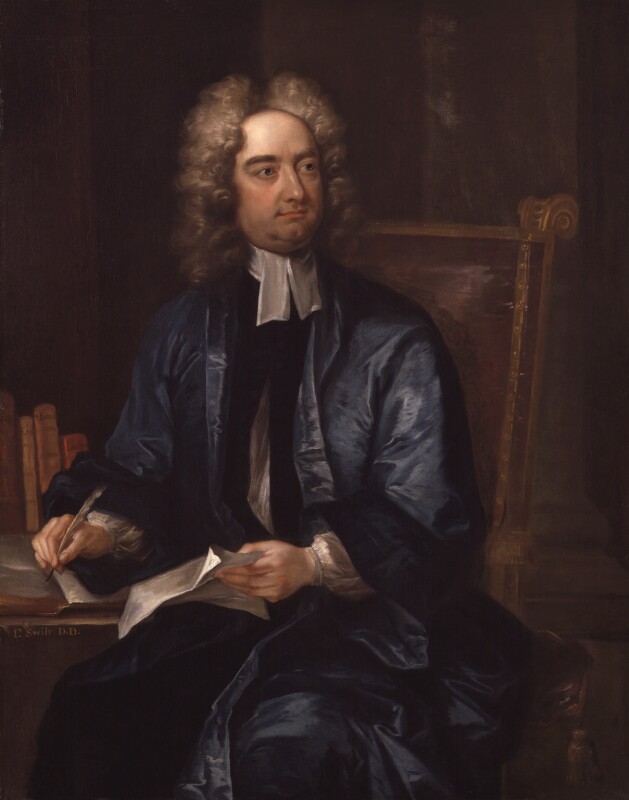
Thomas married Elizabeth Dryden (c. 1605-1658). They had many children, many of whom lived in Ireland. His son Jonathan (d. 1667) was a solicitor in Dublin, who married Abigail Erick of County Leicester, and they had a son, born after his death in Hoey’s Court, Dublin, right next to Dublin Castle, in 1667, also named Jonathan, the famed writer, Dean of St Patrick’s Cathedral in Dublin. He wrote many anecdotes about his grandfather in his manuscript The Family of Swift which is preserved in the library at Trinity College, Dublin (I must go to see it!). He died in 1745.
Jonathan Swift (1667-1745) by Charles Jervas circa 1718, National Portrait Gallery in London, 278.Portrait of Dean Swift attributed to Rupert Barber (1719-1772), courtesy of Adam’s auction 12 May 2013.This must be Jonathan Swift who died in 1745, Dean of St. Patrick’s Cathedral.Portrait of Stella courtesy of Adam’s auction 12 May 2013, attributed to Rupert Barber (1719-1772).“Portrait of Esther Johnson (Stella),” Late 18th / Early 19th Century after James Latham (1696 – 1747) courtesy of Fonsie Mealy Fortgranite sale.
Reverend Thomas Swift (1595-1658) had another son, Godwin Swift (d. 1695), who was Attorney-General to the Duke of Ormonde, and married four times. Geoffrey Marescaux tells us that Godwin Swift paid the famous Jonathan Swift’s school fees. His heir was child of his second wife, Katherine Webster, Godwin Swift (1672-1739), later of Dunbrow, County Dublin and Swiftsheath, County Kilkenny. For information on Swiftsheath, see https://kilkennyarchaeologicalsociety.ie/wp-content/uploads/2021/03/OKR1978-356-Geoffrey-Marescaux-Swiftes-Heath.pdf
Godwin Swift (1672-1739) married his cousin, Elizabeth, who was daughter of another son of Reverend Thomas Swift Vicar at Goodrich and Elizabeth née Dryden, William, who had land in Carlow, Kilkenny, Leitrim and Roscommon.
Godwin Swift (1672-1739) and Elizabeth had a son Godwin who inherited Swiftsheath and also owned Tidenton, County Kilkenny. He married a cousin, Elizabeth Swift, who was daughter of Deane Swift (c. 1674-1714) of Castle Rickard, County Westmeath. Deane Swift (c. 1674-1714) was another son of Godwin Swift Attorney-General to the Duke of Ormonde, by his 3rd wife, Hannah Deane.
Their son Godwin Swift (c. 1734-1815) lived in Swiftsheath and Lionsden, County Meath. He also married a cousin, Maria Swift, daughter of Deane Swift (c. 1707-1783) and Mary née Harrison, daughter of Theophilus Harrison. To add confusion to the family tree, Theophilus Harrison, Reverend of Clonmacnois, married twice, and one of his wives, Eleanor Meade, daughter of William Meade Lt Col of Ballintober, County Cork, had been previously married to Godwin Swift Attorney-General to the Duke of Ormonde as his fourth wife! Mary Harrison’s mother was Theophilus Harrison’s second wife, Martha Swift – yes, another Swift! She was the daughter of Adam Swift of Greencastle, County Down, who was another son of Thomas Swift Vicar at Goodrich and Elizabeth née Dryden.
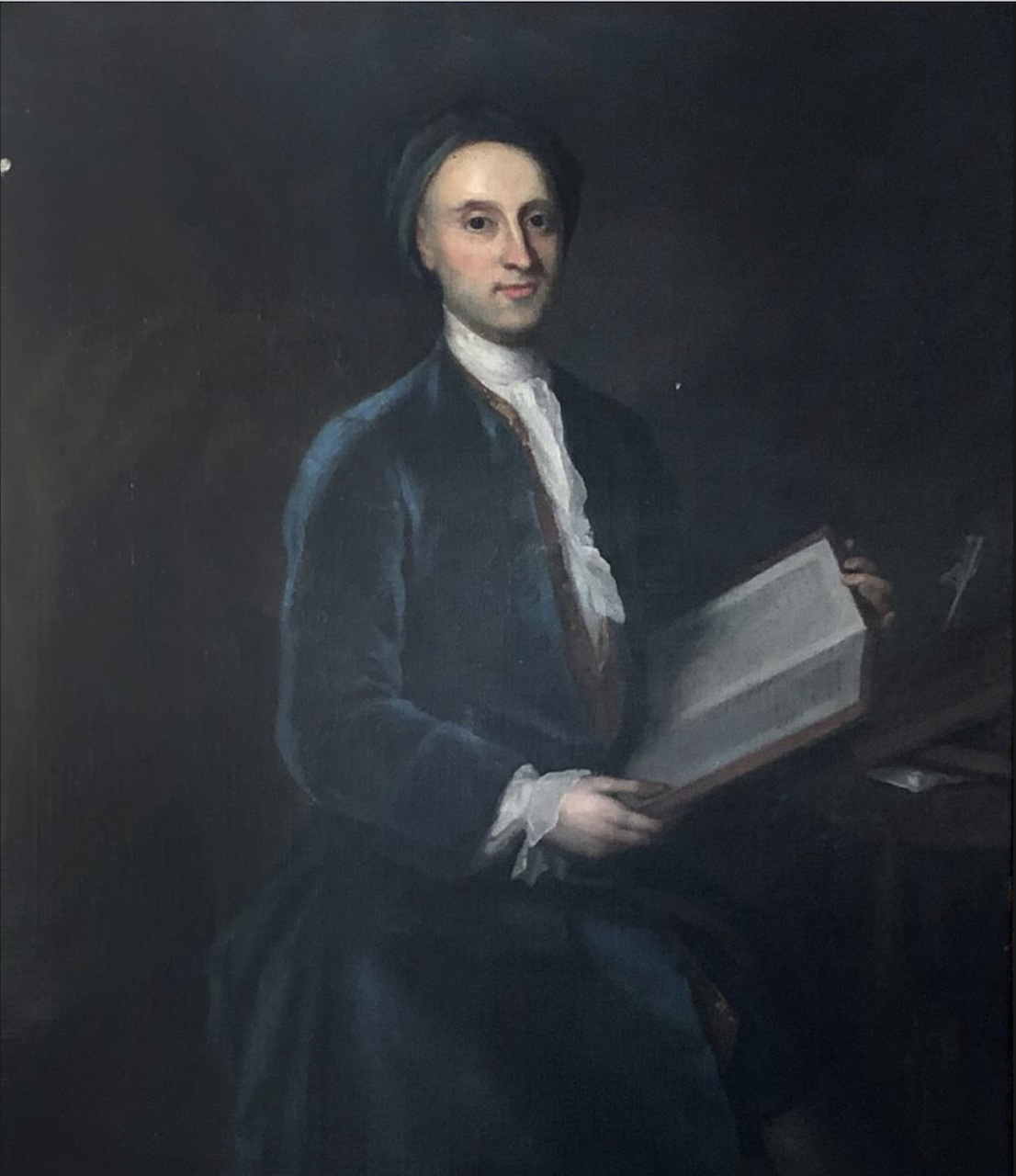
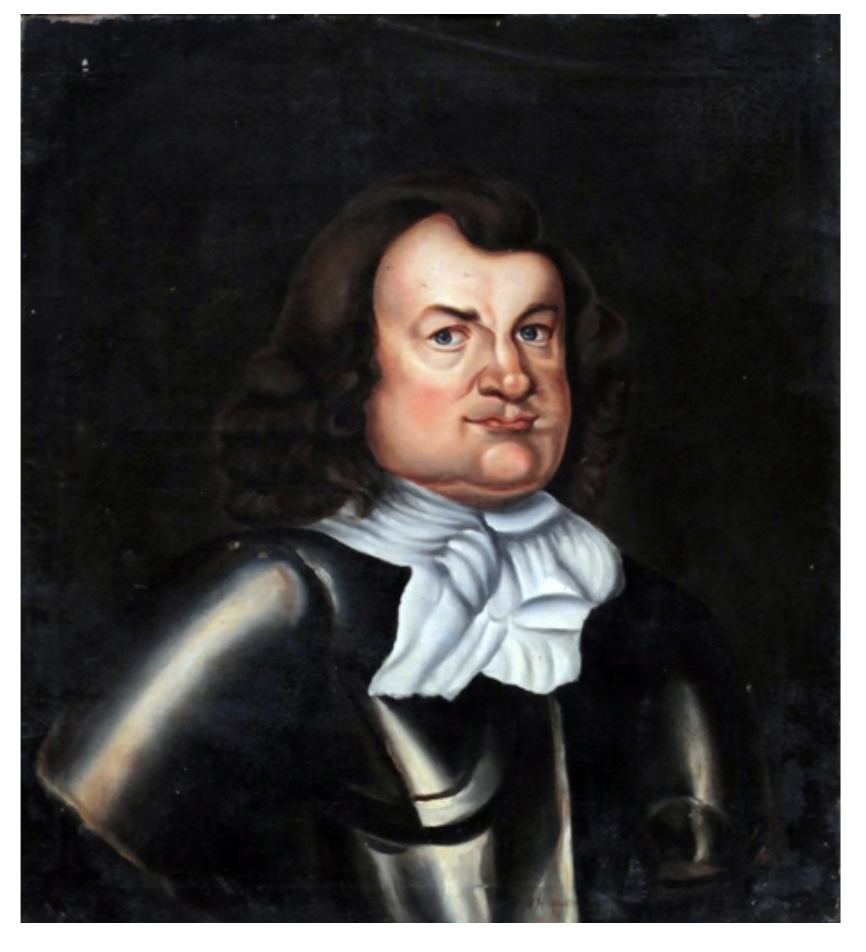
Reverend Deane Swifte, 17th Century Irish School, cousin and biographer of Dean Jonathan Swift. This is be Deane Swift (1703-1783), son of Deane Swift of Castle Rickard, County Westmeath. His great grandfather was a Regicide, ie. signed the death warrant of King Charles I, but fortunately died before Charles II was restored to the throne, according to Jonathan Swift!Admiral Richard Deane (Regicide) 17th Century English School courtesy Fonsie Mealy Fortgranite auction.The Fonsie Mealy site adds: “Note: Major Joseph Deane (Inistiogue, 1661-66), of Crumlin, County Dublin, and Ballicocksoust, County Kilkenny (formerly the estate of Richard Strange), was the youngest son of Edward Deane, of Pinnock, Gloucestershire, by his 2nd wife, Anne Wase, and was born at Pinnock, 2nd February, 1624. His elder brother, Colonel Richard Deane, a leading member of the Republican party, was one of the Judges who sat on the trial of Charles I, and signed the death warrant of the King. Colonel Richard Deane was entrusted with the settlement of Scotland, which he speedily effected by his temperance and sagacity. He was next appointed one of the “Generals at Sea”, having for his colleague the famous Robert Blake, but was killed in action against the Dutch on 2nd June, 1653. He was honoured with a public funeral and buried in Henry VII’s Chapel at Westminster, but in 1661 his body (being that of a Regicide) was exhumed and cast out of the Abbey. Joseph Deane was educated at Winchester School, and entered the Parliamentary Army as Cornet in Rainsborough’s Horse. He volunteered for service in Ireland under Oliver Cromwell, in whose army he held the rank of Major. Under the Act of Settlement he had two grants of land (16th January, 1666, and 22nd June, 1669), comprising 9,324 statute acres, situated in the counties of Meath, Down, and Kilkenny, 3,859 acres being in Kilkenny. He purchased from Richard Talbot (afterwards Earl and Duke of Tyrconnell) the Manor of Terenure, in county Dublin, for 4,000. He was named on some important committees of the House of Commons, but was fined 10 for absence on 31st January 1665. In 1664 he paid 4s. hearth money for “Ballicagbsust”. In 1677 he served as High Sheriff of county Dublin. He died 21st December, 1699, having been twice married. By his 1st wife Anne —-, he had one son and two daughters – Joseph, of Crumlin, whose son, Joseph, became Lord Chief Baron of the Exchequer, and died without male issue. (1) Anne, married in May, 1673 (as his 3rd wife), Godwin Swift, Attorney-General to the Duke of Ormonde. (2) Elizabeth, married 1st in May, 1672, Captain Henry Grey; 2nd in July, 1677, Donogh O’Brien, of Lemenagh, County Clare. Major Deane married, 2ndly, in 1659, Elizabeth, daughter of Maurice Cuffe, and sister of Captain Joseph Cuffe, of Castle Inch, elected M.P. for Knocktopher in 1665, and by her, who died 3rd April, 1698, had a son and a daughter – Edward whom hereafter M.P. for Inistiogue; and Dorothy, married Maurice Berkeley, of Glasnevin county Dublin.THE MEMBERS OF PARLIAMENT FOR THE COUNTY, CITY AND BOROUGHS OF KILKENNYBY G.D. BURTCHAELL, M.A., LL.B [Written for the KILKENNY MODERATOR]Mrs Godwin Swifte of Swifte’s Heath, courtesy of Fonsie Mealy’s Fortgranite sale.
Godwin Swift (c. 1734-1815) of Swiftsheath and Lionsden and his cousin, Maria Swift had another son called Godwin Swift (c. 1779-1814), of Lionsden. This Godwin Swift married yet another cousin, Jane Sophia Swift (1785-1851), in 1803. She was the daughter of Richard Swift (1750-1796) who was the son of John L’Estrange Swift (1709-1793) of Lynn, County Westmeath, who was the son of Meade Swift (1682-1739) of Lynn, County Westmeath, who was the son of Godwin Swift Attorney-General to the Duke of Ormonde and Eleanor née Meade!
Jane Sophia Swift (1785-1851) married secondly, in 1818, Louis Auguste Alexander, Comte Lepelletier de Molende.
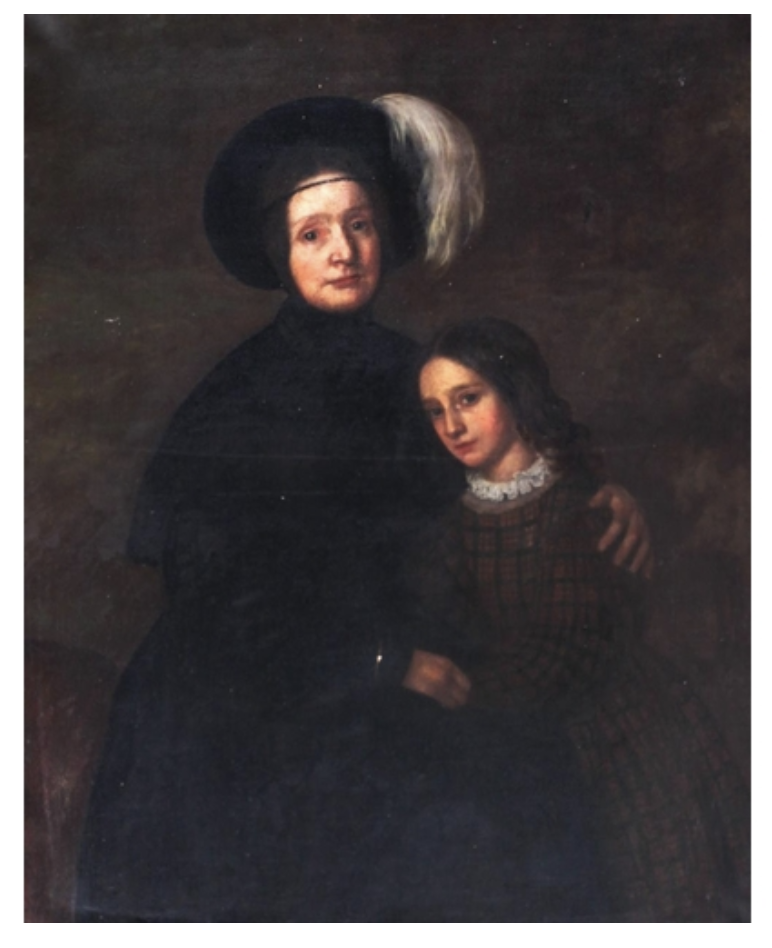
Countess Molende née Swift and her granddaughter Luigina de Sadre, Gifted by the artist to W.R. Swifte as a token, as his predecessor Jonathan Swifte served as Rector at Agher Church from 1699 – 1745, courtesy Fonsie Mealy Fortgranite auction.
Godwin Swift (c. 1779-1814), of Lionsden and Jane Sophia Swift (1785-1851) had a son Godwin Meade Pratt Swift (1805-1864) of Swiftsheath and Lionsden.
Identified as “Godwin Pratt Meade Swifte Lord Carlingford (m. MJ Clarke), Leahy, Dixon & Mulvanney, 19th Century Irish School, standing in a landscape by a grey horse with Foulksrath Castle, Co. Kilkenny in the distance”, courtesy of Fonsie Mealy Fortgranite. Godwin Meade Pratt Swift (1805-1864) of Swiftsheath and Lionsdenmarried Mary Jane Clarke of Bansha Castle, County Tipperary.He took the title Viscount Carlingford.Jane Christina Swifte (1810-1854), the wife of “Chevalier Sergio Demacdo, Minister Plenipotentiary of HM Emperor of Brazil,” Early 19th Century Irish School, courtesy Fonsie Mealy Fortgranite. She was the daughter of Godwin Swift of Lionsden and Jane Sophia.
Godwin called himself Viscount Carlingford, reviving a title created in 1627 for another branch of the Swift family. Godwin also added the “e” back to the end of the name Swift. He married first, Maria Theresa Plankenstern, Baroness de Wetzlar of Austria at Paris in 1830 after the birth of their son Ferdinando. [see https://www.youwho.ie/swifte.html ].
Godwin secondly married Jane Anne Hopkins on 18 Mar 1845 at Liverpool after an non legal ceremony some years earlier. Godwin returned with his family from the continent in 1845 to take up residence at Swiftesheath. Jane died at Lionsden, Castle Rickard in 1848 and was buried in the family vault. Godwin thirdly married Mary Jane Clarke on 4 Feb 1863 at Kilkenny and declared himself a widower. Mary was the daughter of Robert Hare Clarke. Godwin died 4 Jul 1864.
He created a flying machine which he hoisted to the top of Foulkesrathe Castle, which stood on the property of Swiftesheath, but it failed to fly and a butler who was piloting the plane broke a leg in his fall.
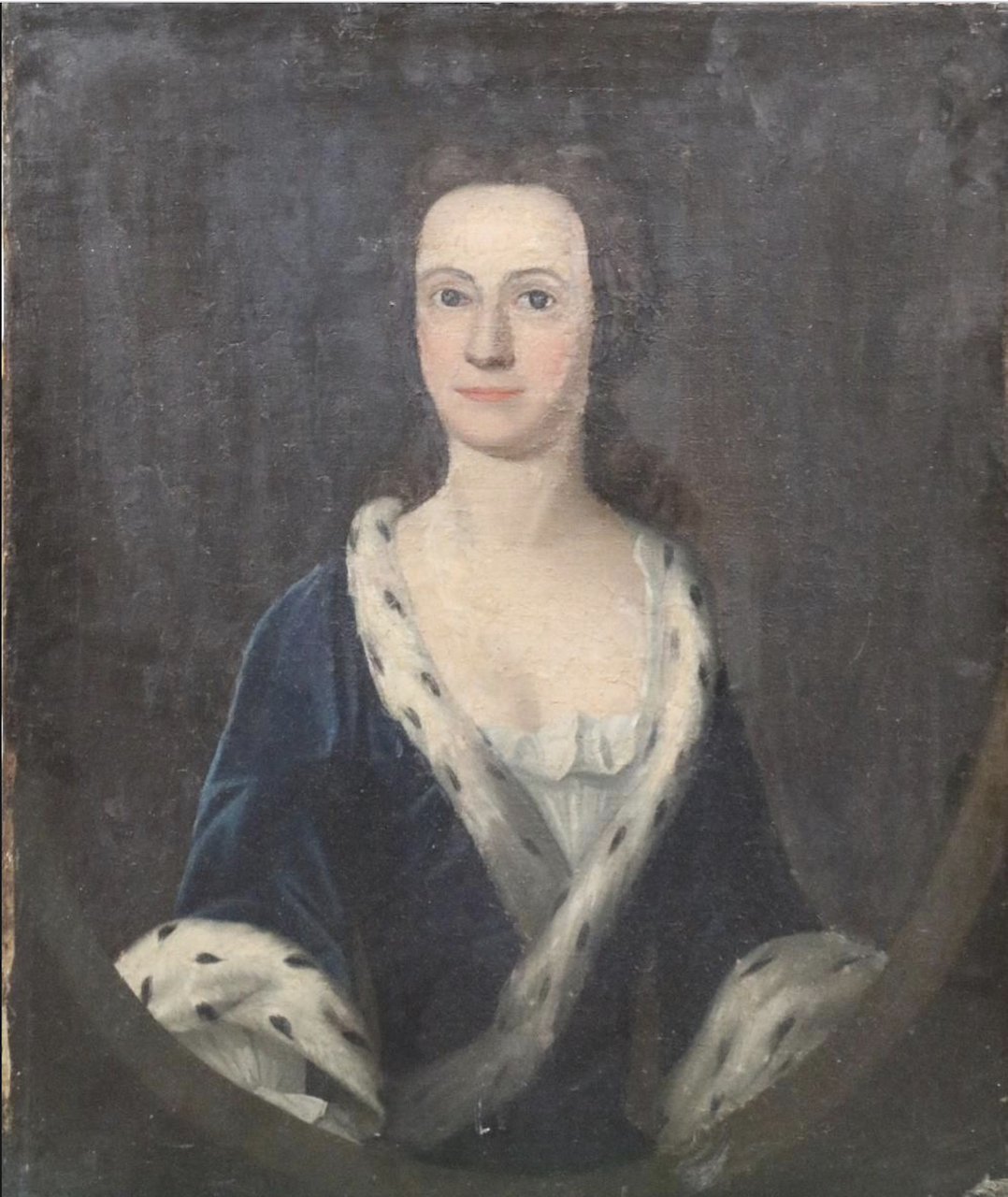
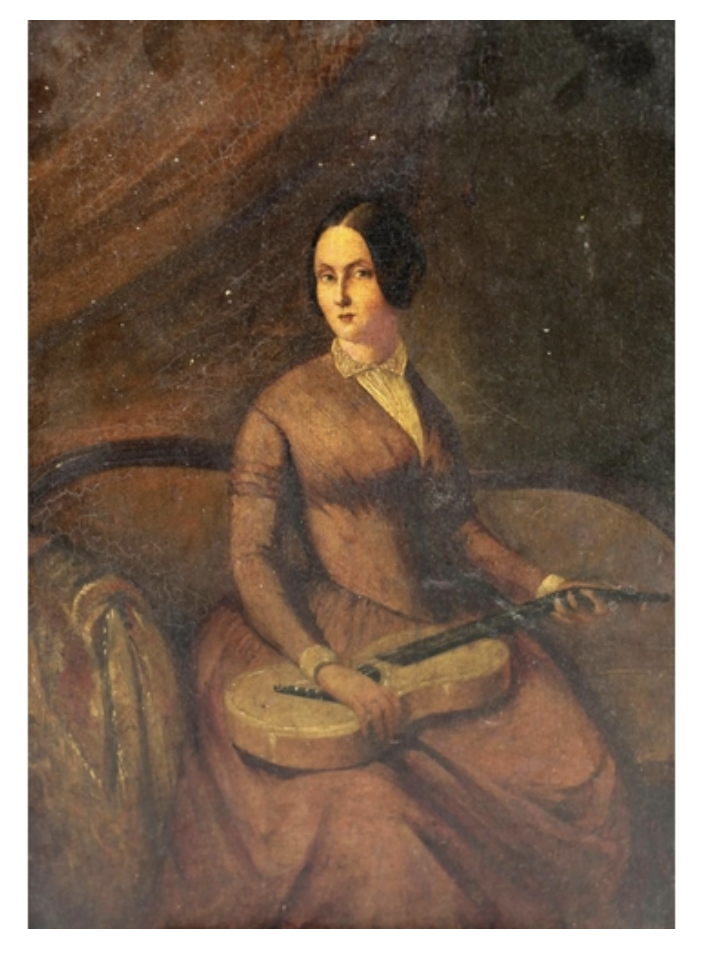
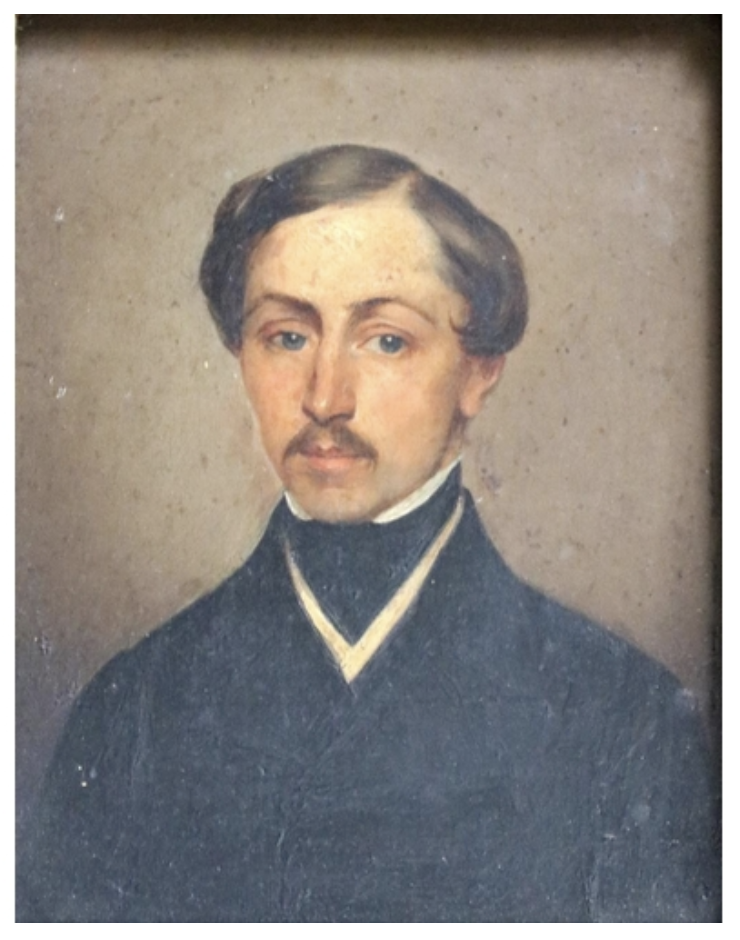
Identified as Pratt Swifte, Early 19th Century Irish School, courtesy of Fonsie Mealy Fortgranite sale.Mrs. Swifte, grandmother of Thomas Dennis courtesy Fonsie Mealy Fortgranite Auction.19th Century Irish School, Portrait of Mrs. Godwin Swifte courtesy Fonsie Mealy Fortgranite auction.There were so many Godwin Swifts it is hard to identify the sitter.Godwin Butler Meade Swifte (1864-1923) son of “Viscount Carlingford,” wearing uniform of the High Sheriff of Kilkenny, seated holding a sword, D.L. was the High Sheriff of Kilkenny and later Carlow, and resided at Swifte’s Heath, Co. Kilkenny, courtesy of Fonsie Mealy Fortgranite.Ernest Godwin Swifte K.C., with a companion painting of Lady Francis Swifte courtesy of Fonsie Mealy Fortgranite sale.He was the son of William Richard Swift (1807-1890), son of Godwin Swift of Lionsden and Jane Sophia.“Lady Francis Swifte,” with a companion painting of Ernest Godwin Swifte K.C., courtesy of Fonsie Mealy Fortgranite sale.Perhaps it is Ernest Godwin’s sister Julia Frances Swift, who did not marry.
It’s Sunday afternoon and we are exhausted after a very full Heritage Week. Thank you to Marita for minding Bumper for us while we headed off for our Progress around the country.
This year we made a circle from around Clogheen County Tipperary, driving through it to our first airbnb in County Waterford and ending up nearby at our last airbnb in Ardfinnan in County Tipperary. We visited ten Section 482 properties!
We would have visited 11 or 12 properties if all had been open at the dates and times posted. We wanted to visit Tybroughney Castle on our way down to Waterford, but the owner told me that he was going to play golf during his posted hours, and that we’d have to go early! It would have been too stressful to leave Dublin by 9am, having to leave the house in a presentable state for a houseguest, so I decided to visit Tybroughney another time. It’s annoying though when I am polite enough to contact an owner first to let them know we are planning to visit during their open hours, and they take the opportunity to say they won’t be open! I shall let Revenue know about him not being open during listed times.
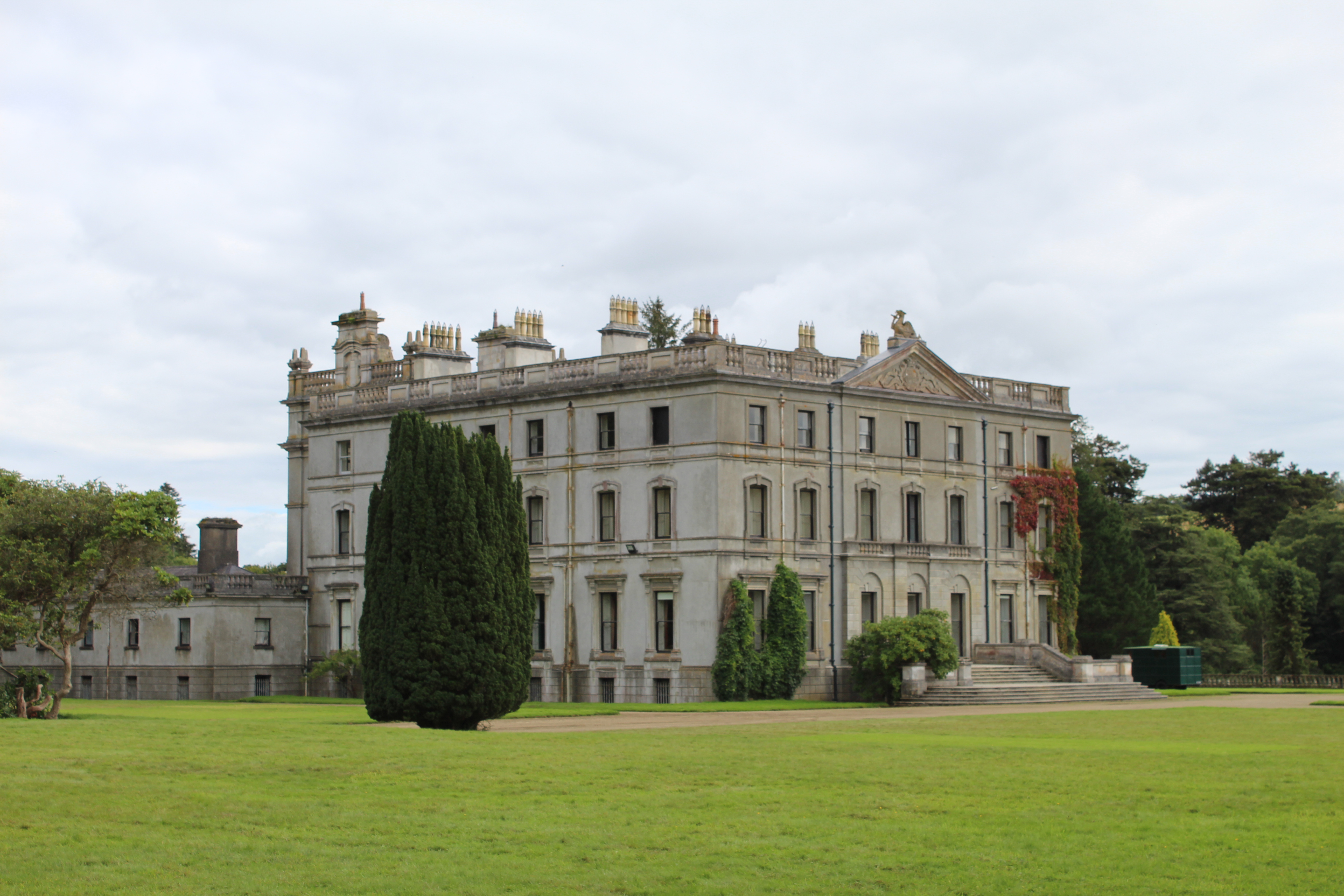
On our first day we went to the lovely Cappagh in County Waterford, then on to Curraghmore. We’d been there before, on one of our first Section 482 jaunts back in 2019, and had to go back again to take in more detail.
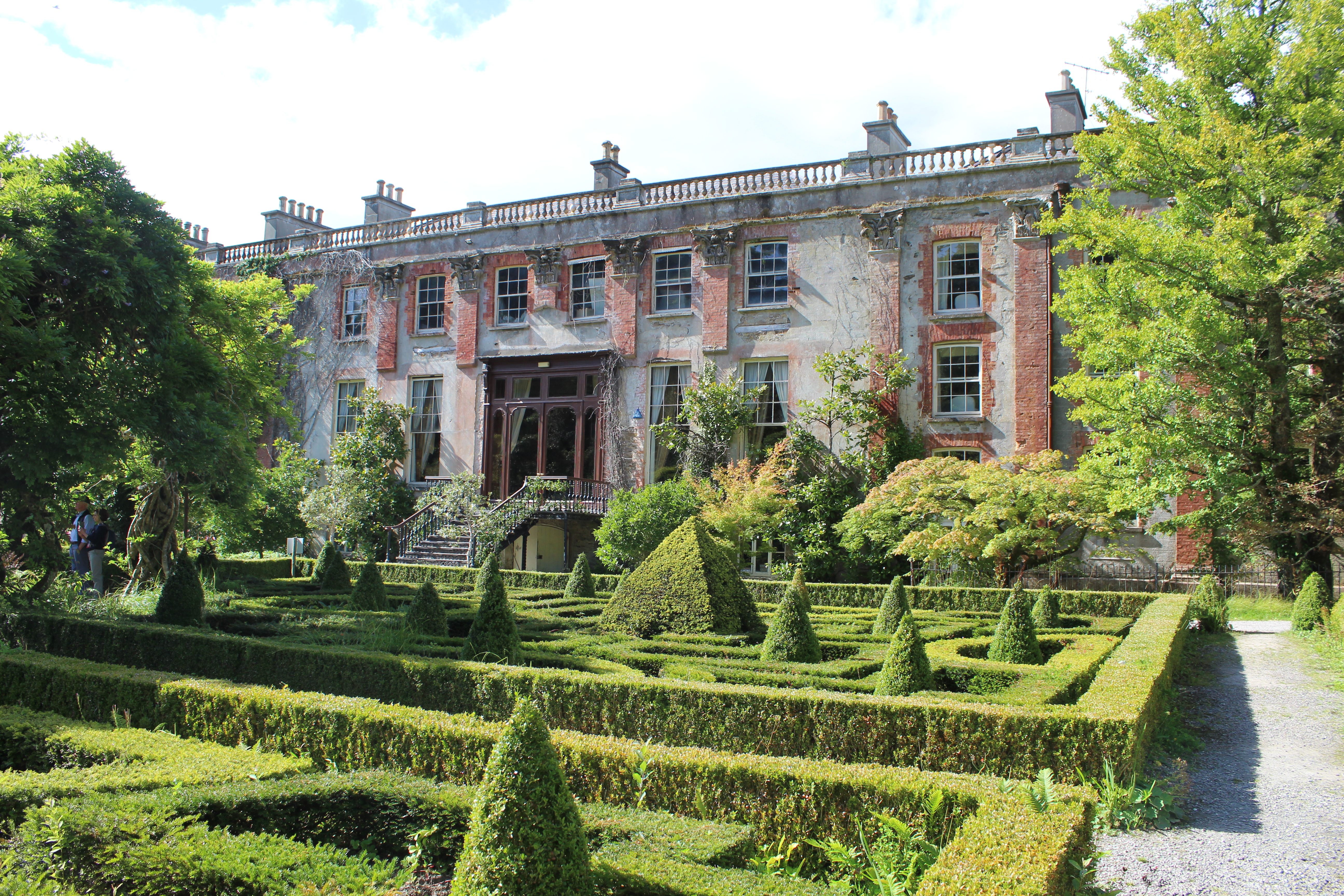
The next day we drove to our next accommodation – we treated ourselves to two nights in Bantry House.
It rained every day in July so we were really lucky with the weather this week. On our drive across Cork to Bantry we stopped to visit Kilcascan Castle. It’s quite off the beaten track and is a work-in-progress so there’s not a lot to see but I was happy to visit.
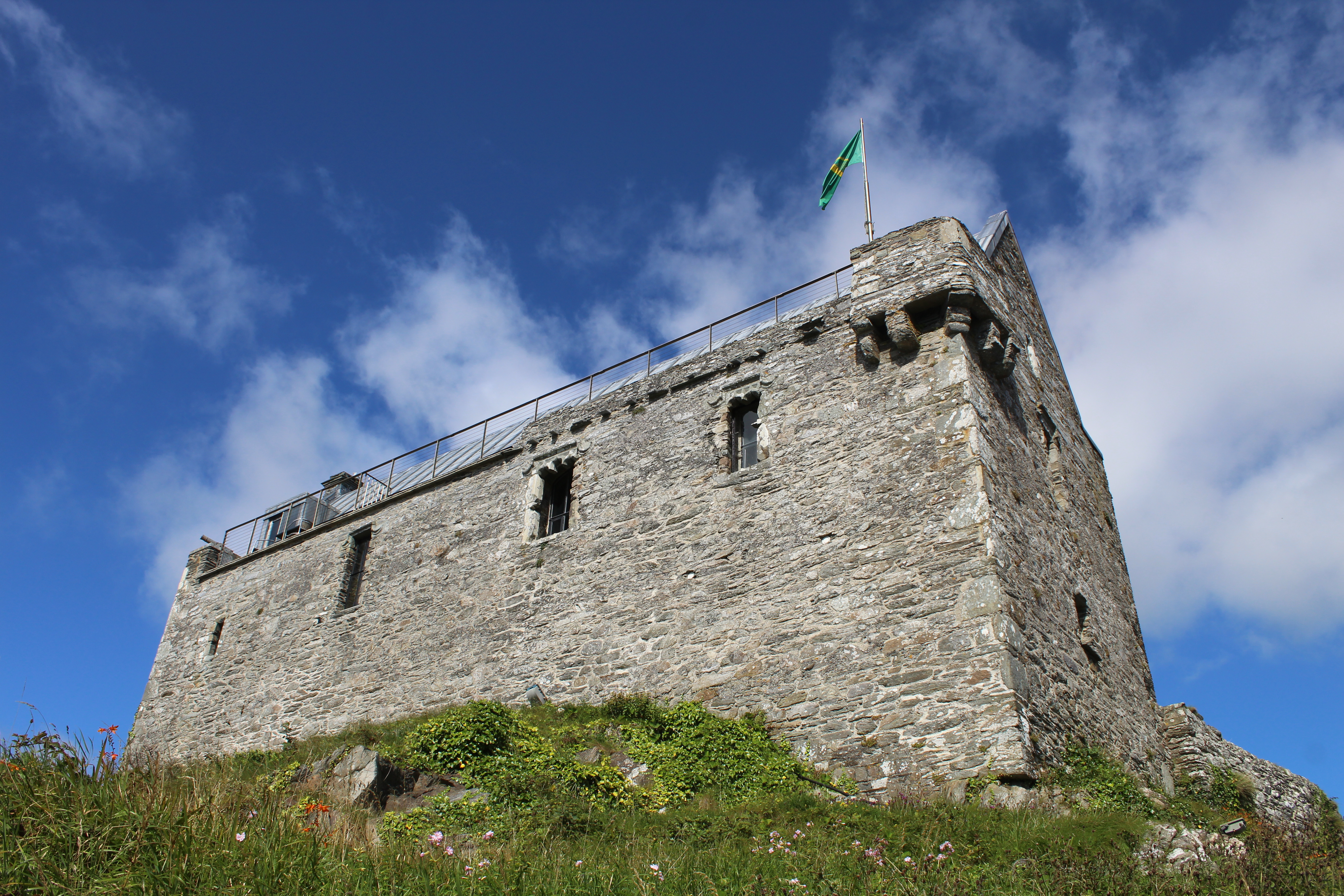
Next day we meandered down to Baltimore to visit Baltimore Castle, where we had a great chat with the owner, who completely renovated the tower house. It’s fascinating, especially the research his wife has done on the kidnapping by pirates of the villagers – more on that when I write up about the Castle.
It was at this stage, the next day, that my carefully laid plans, with routes carefully written out (since google tries to lead one to a place as the crow flies and loves to send one off down narrow boreens), started to break down. I received an email from Longcourt Houte Hotel in County Limerick that they could no longer accommodate us the next day, and they cancelled my room reservation! I have since learned that a pipe had burst.
I’d never heard the like, a hotel cancelling a booking the day before one is due to arrive. So that evening while in our room in Bantry House, I had to scour online to find somewhere else to stay for the next two nights. Most places were booked out. We found some rooms in the Radisson Blu in Cork City and decided to go there, as there are several Section 482 properties in County Cork that I have yet to visit.
So I sadly contacted John of Rathkeale rectory and explained that I’ll have to postpone our visit.
We headed to Little Island in Cork. We did, however, stop to visit the two places I’d planned to visit on the drive to Newcastle West in Limerick: we drove to Drishane Castle in Millstreet, County Cork, then on to Burton Park.
Drishane Castle now operates as a direct provision centre for refugees. I tried to contact the owner to alert him to our visit, but I received no reply to either text nor email. There are opening hours posted on the gate, and the man at reception seemed to understand that we were there to see the old house, but we felt bad walking around the halls and didn’t know where to find the reception rooms, and we retreated outside after going down just one hallway. This property really should not be Section 482, since it’s not fair to either section 482 visitors or to the refugees who make it their home.
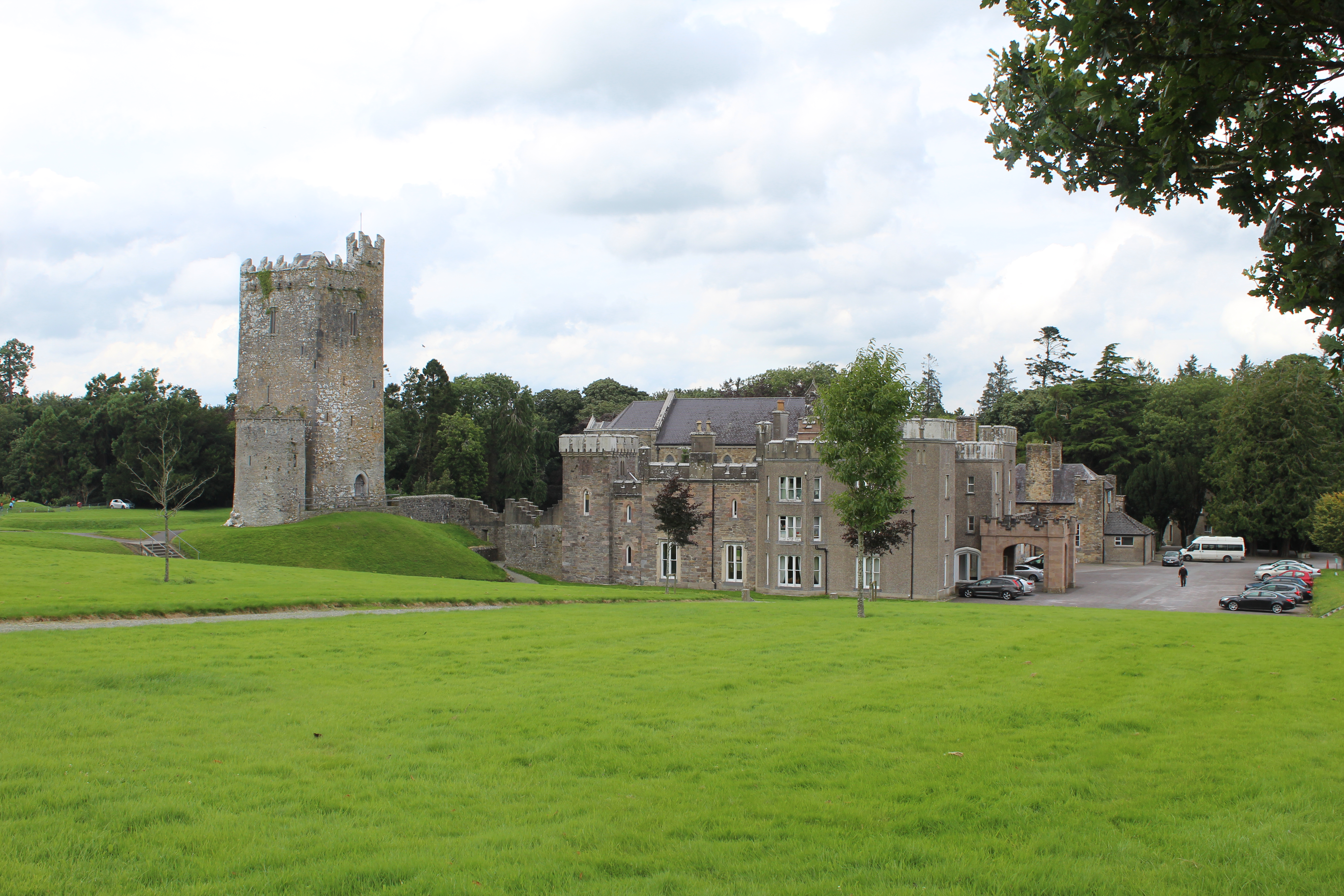
I could say the same about Burton Park, where we wandered into the house and explored without meeting the owner or manager, but at least Jesse was welcoming when I contacted her about our visit. It’s a lovely old house and I’m glad it is being maintained, but there’s not a lot to see. The house is now a centre for Slí Eile, a residential centre where people with mental health issues can come to rebuild their lives, and they run an organic farm. It’s certainly a beautiful place to stay – more when I do the write-up!
The next day we found ourselves with an unexpected day in Cork, so I rang the owner of Brideweir House to ask if we could visit. Despite it being Heritage Week, and listed as open, the owner said that no, today wouldn’t suit her, as she was going to get her hair cut! I reminded her that it is a listed open day. She said, “Yes, but I have a life!”
I wish I’d thought to reply “And I pay taxes.” My taxes pay for her home renovations! I’ll definitely be reporting her to Revenue, to report that she was not open.
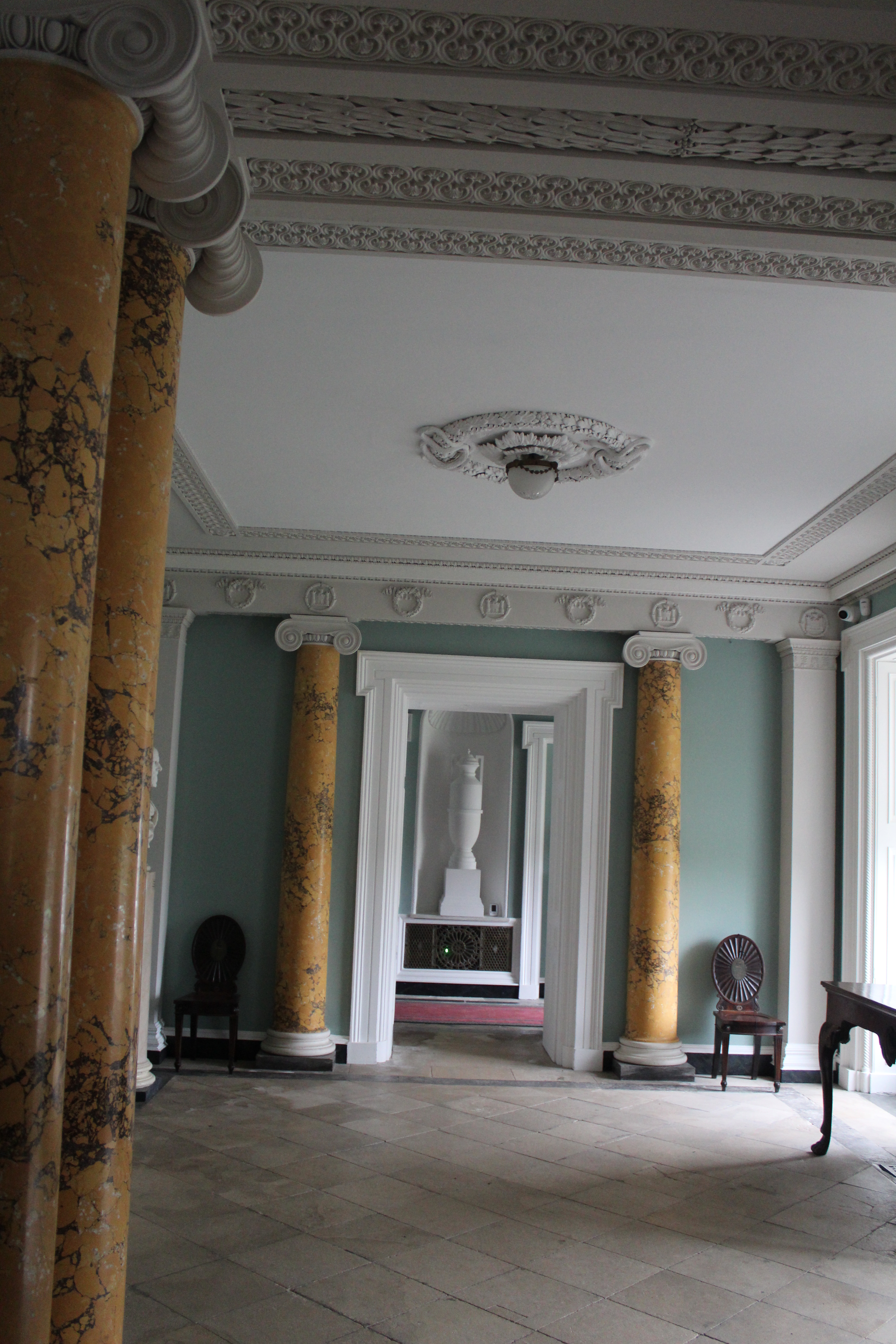
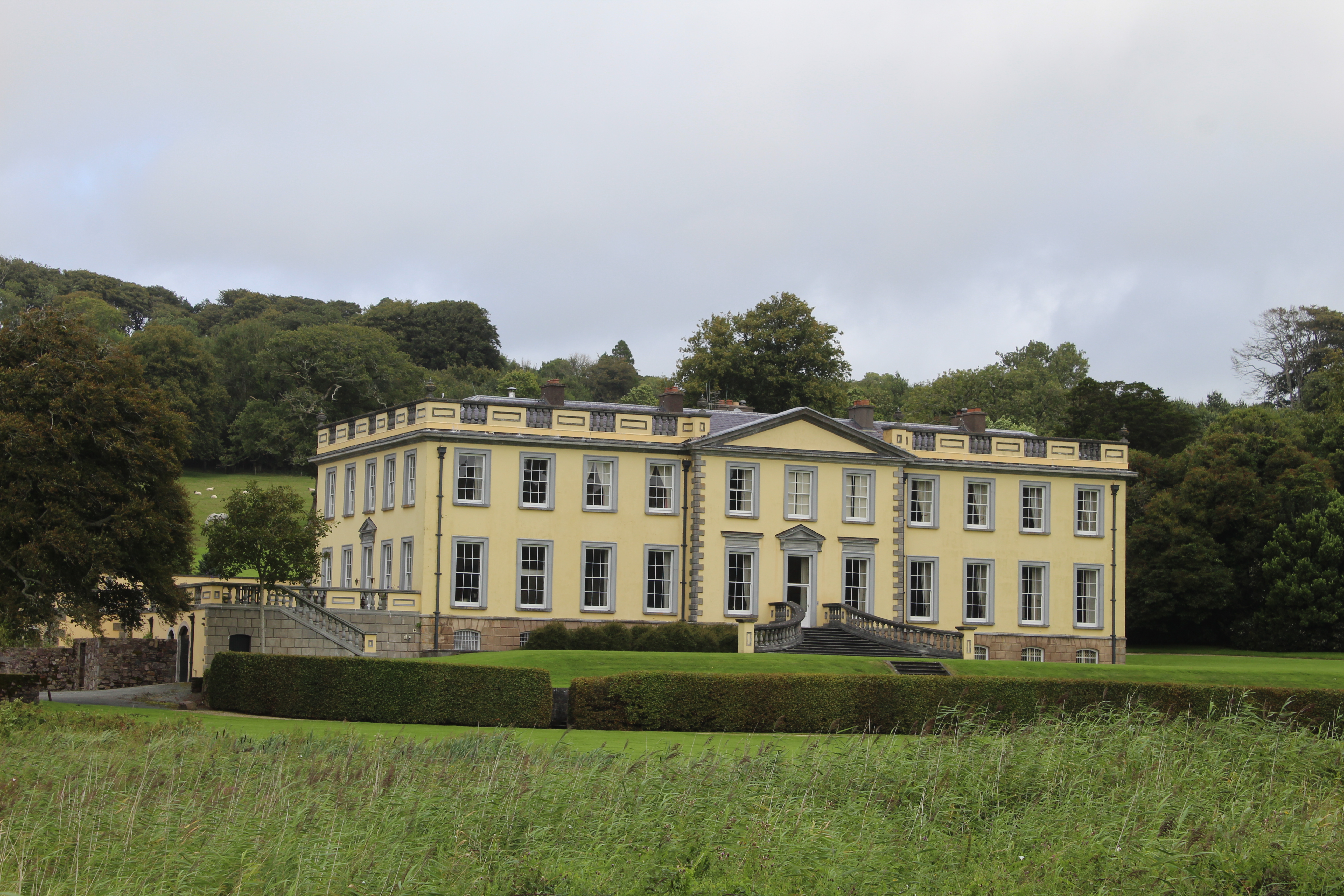
We revisited Fota House instead. A guaranteed lovely day out! Despite the weather – Storm Betty came to County Cork with a vengeance, and we were drenched while we explored the walled garden. I thought we could visit the house for free with our Georgian Society membership – and it was a toss up whether we’d visit Doneraile or Fota, as I thought that both are free with Georgian Society membership, but we were closer to Fota. But Georgian Society members, read your benefits carefully! It is only access to the gardens of Fota that is free with membership – which is free to the public anyway. We had to pay in to the house. But it’s a great tour.
The next day we headed to our next accommodation, this one near Ardfinnan in Tipperary. We had not had time to visit Ballynatray when we’d been staying near Lismore in Waterford, so we decided to take a detour to visit. I was aware that the magnificent house is not Section 482, it’s just the garden. The weather had cleared – we were so lucky!
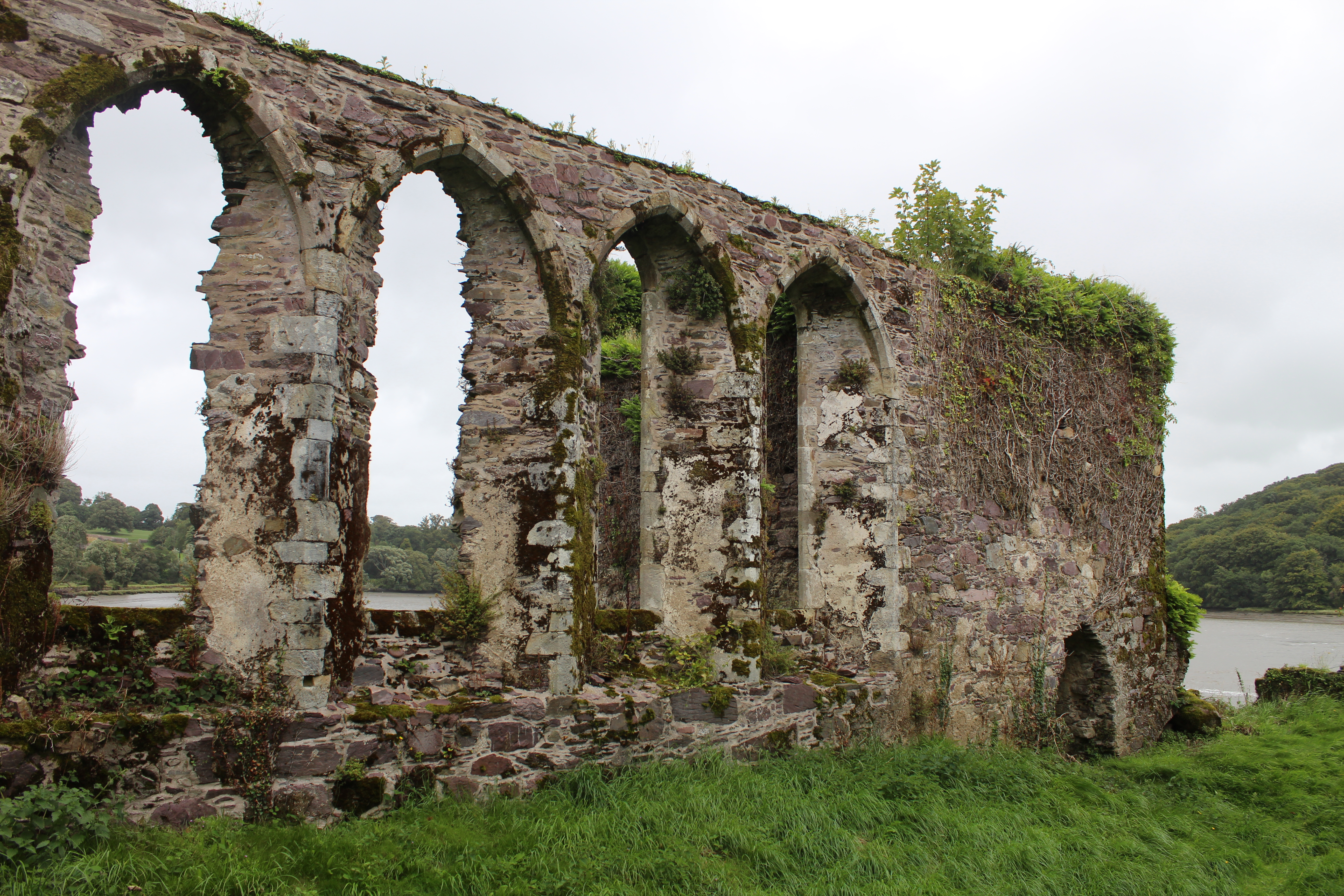
Ballynatray is another property, it turns out, that makes a mockery of Section 482 and visitors. We were told on the website to park “nearby” at Templemichael car park. It took us 45 minutes to walk to the garden! The house has an enormous demesne and it’s very stingy that the owners won’t let one park nearer the gardens. Fortunately the sun had returned and we enjoyed the walk as well as the detour on the property to Molana Abbey ruin.
The garden, as far as we could see, was just a few picturesque terraces of grass, with walls and some urns. So I’m afraid it’s “come to my property and marvel at the house we won’t show you, park fifteen minutes away and walk a further half hour to see my grass.” So we aren’t benefitting from giving our hard-earned tax euros to those owners either. Sorry to sound churlish. But really, not allowing us to park at the property is a bit much, considering how many beautiful rolling acres they have. We are really made to feel plebeian.
We had an appointment then to visit Philippa at Grenane House. We enjoyed our visit and she gives a wonderful tour. There’s a more inclusive tour one can do, visiting three houses and being given snacks and a light lunch, but it was beyond our budget, unfortunately: https://hfhtours.ie/
Three house tour €750 for up to and including 10 people and €75 per person thereafter. Single house tour is €200 for up to 5 people, and €25 per person thereafter.
The other two houses included on that tour are Castlegarde, which I’d love to see, and another property that benefits from our tax euros, Lismacue.
Lismacue is Section 482 but is listed as “tourist accommodation” so does not have to open to the public. However, it is only available for accommodation if you rent the entire house. I hate that the Section 482 laws have been so badly designed that a house can list as accommodation whereas it’s only available as a whole house for accommodation which means it is way beyond a regular person’s means. We do not get to benefit, again, from our taxes, and are never able to see the house. Unless we have €750 to spend on a tour!
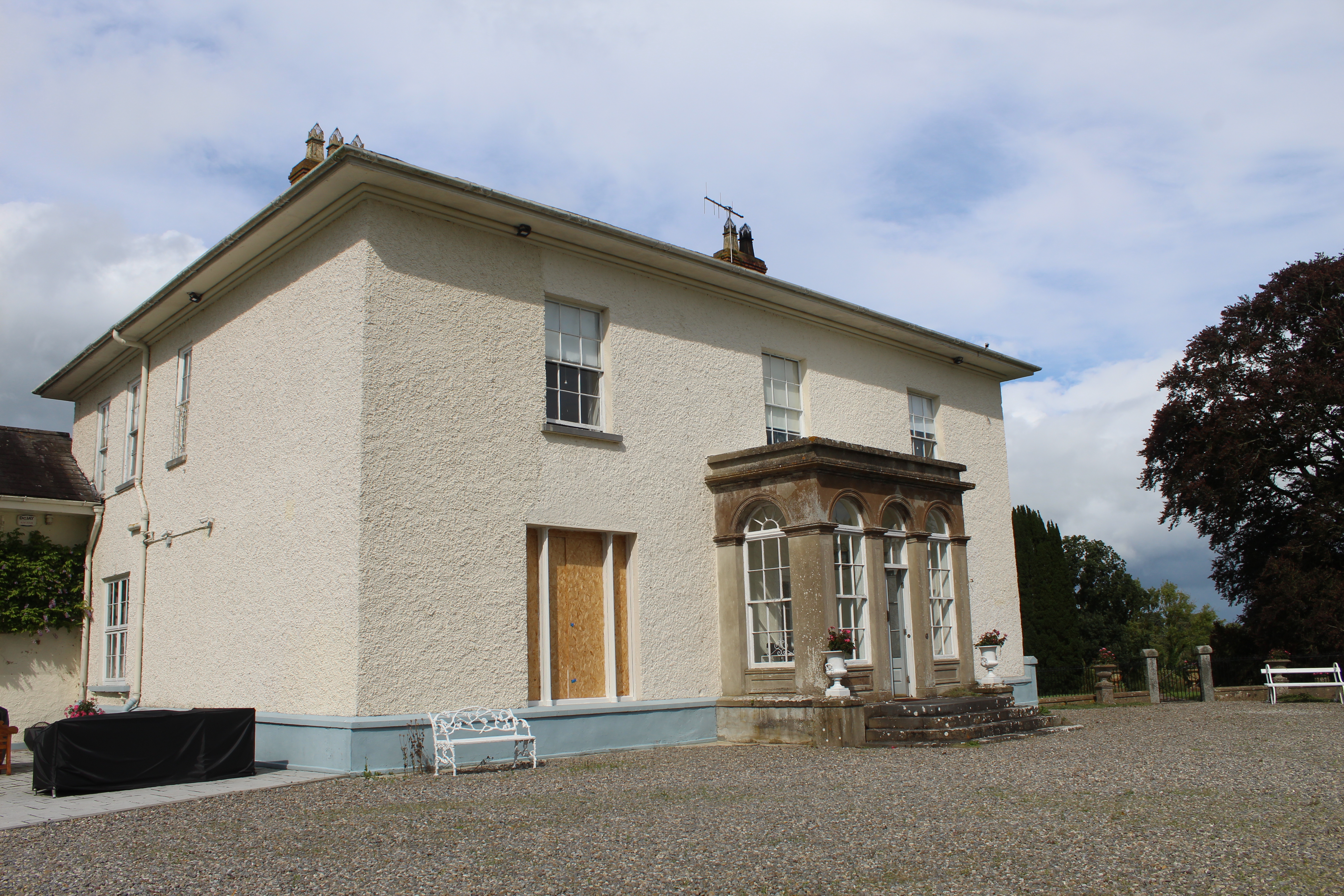
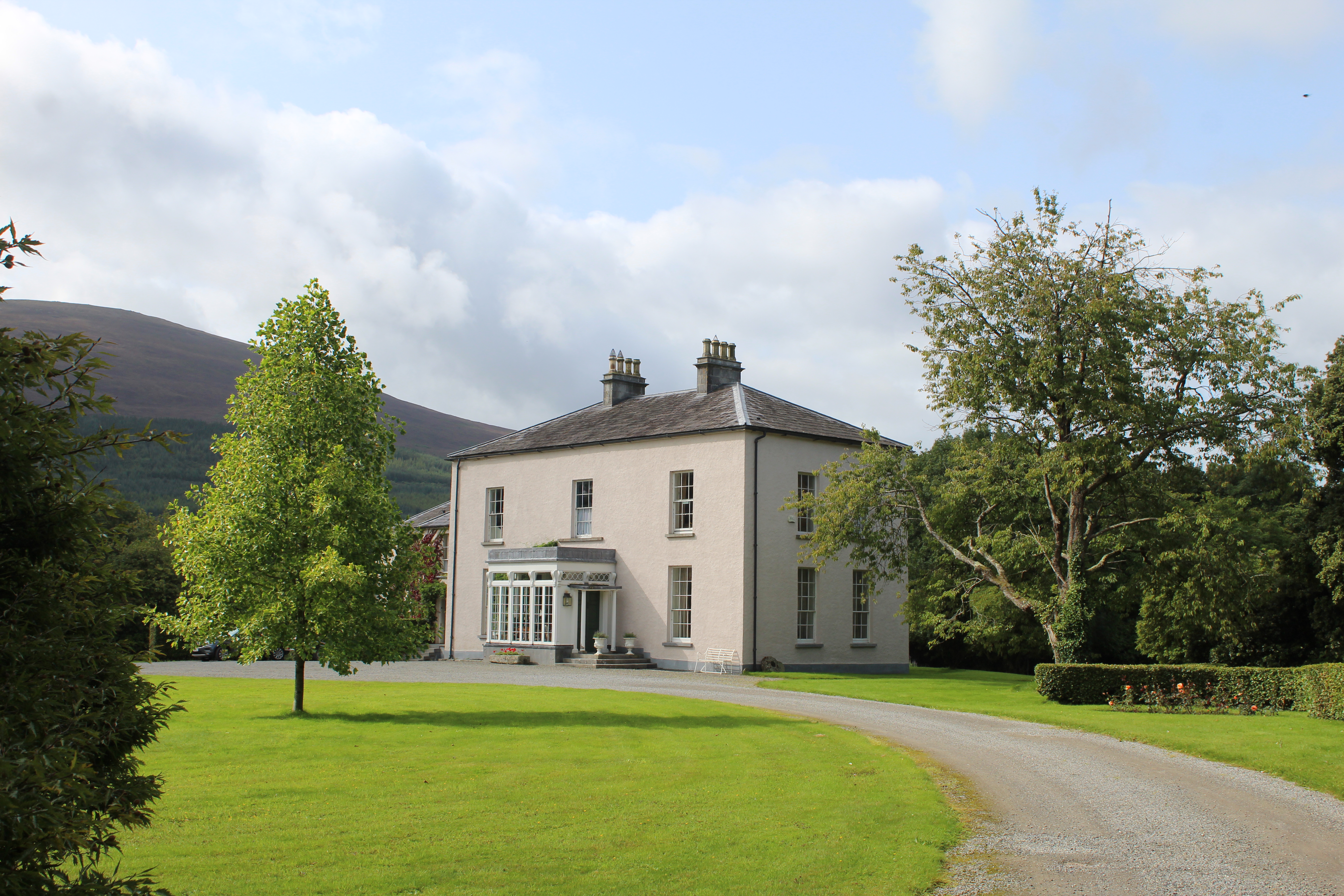
Our last day, we visited Clashleigh House in Clogheen, County Tipperary. A beautiful house, it was used for some years as a rectory. We visited in the morning, so had time to drive down to Lismore in the afternoon to see the idyllic Lismore Castle gardens.




































 Irish Historic Houses
