Thomas Fitzmaurice (1668-1741) 1st Earl of Kerry (21st Baron of Kerry), Viscount Clanmorris was the father of John Fitzmaurice Petty (1706-1761) 1st Earl of Shelburne, who added Petty to his name after his mother, Anne Petty (d. 1737). Another son of the 1st Earl of Kerry was his heir William FitzMaurice (1694-1747) who succeeded as 2nd Earl of Kerry.
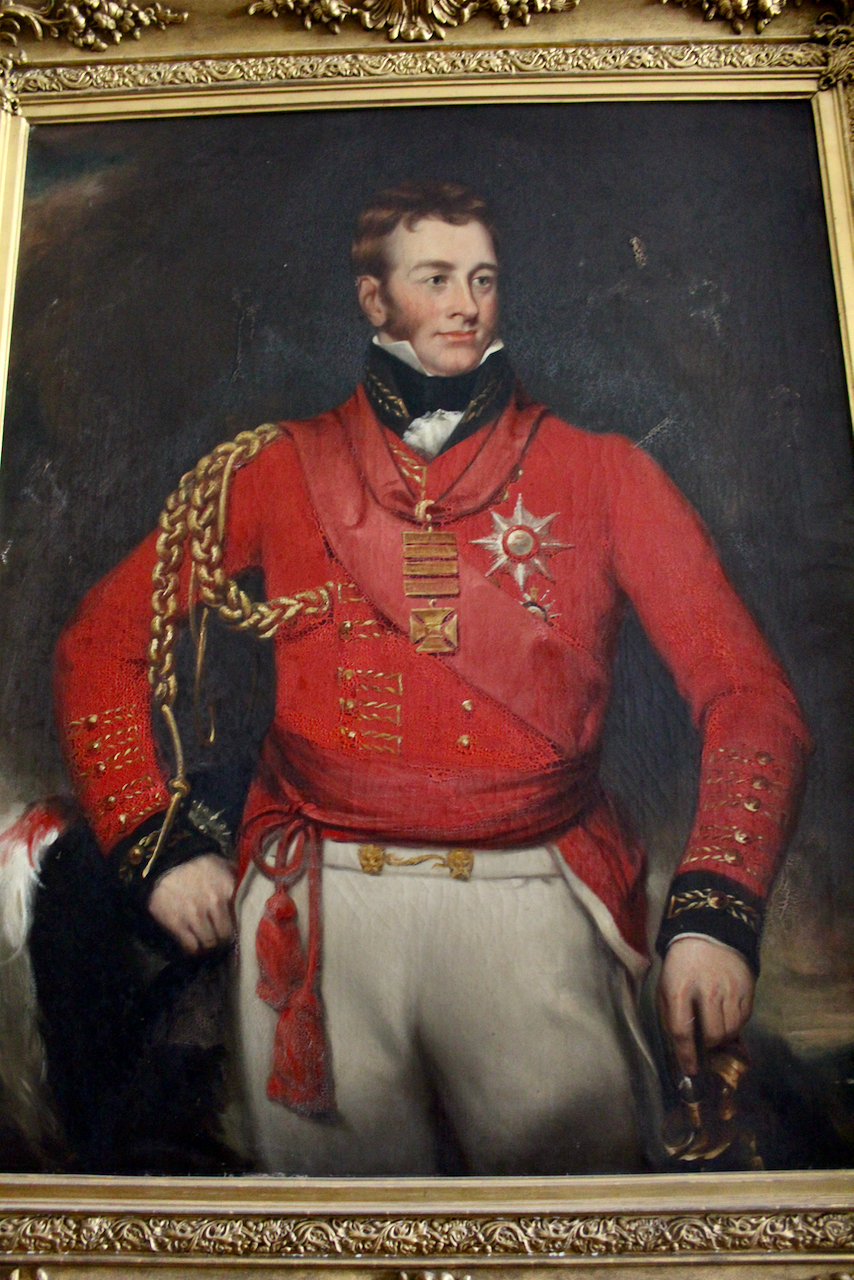
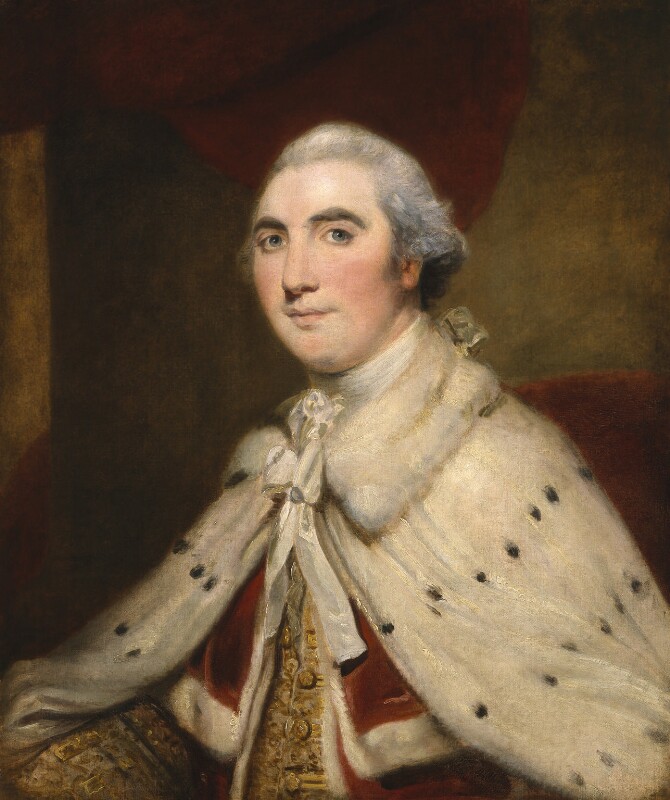
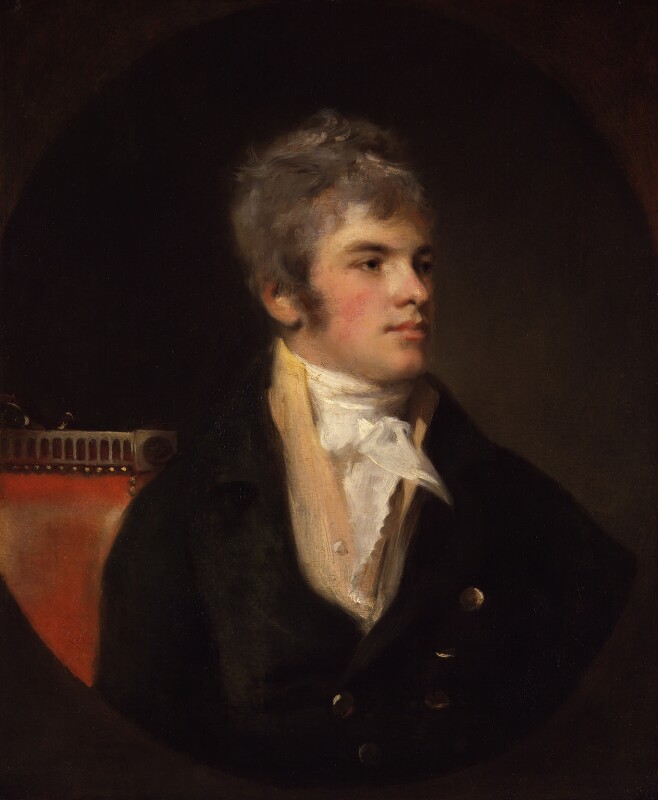
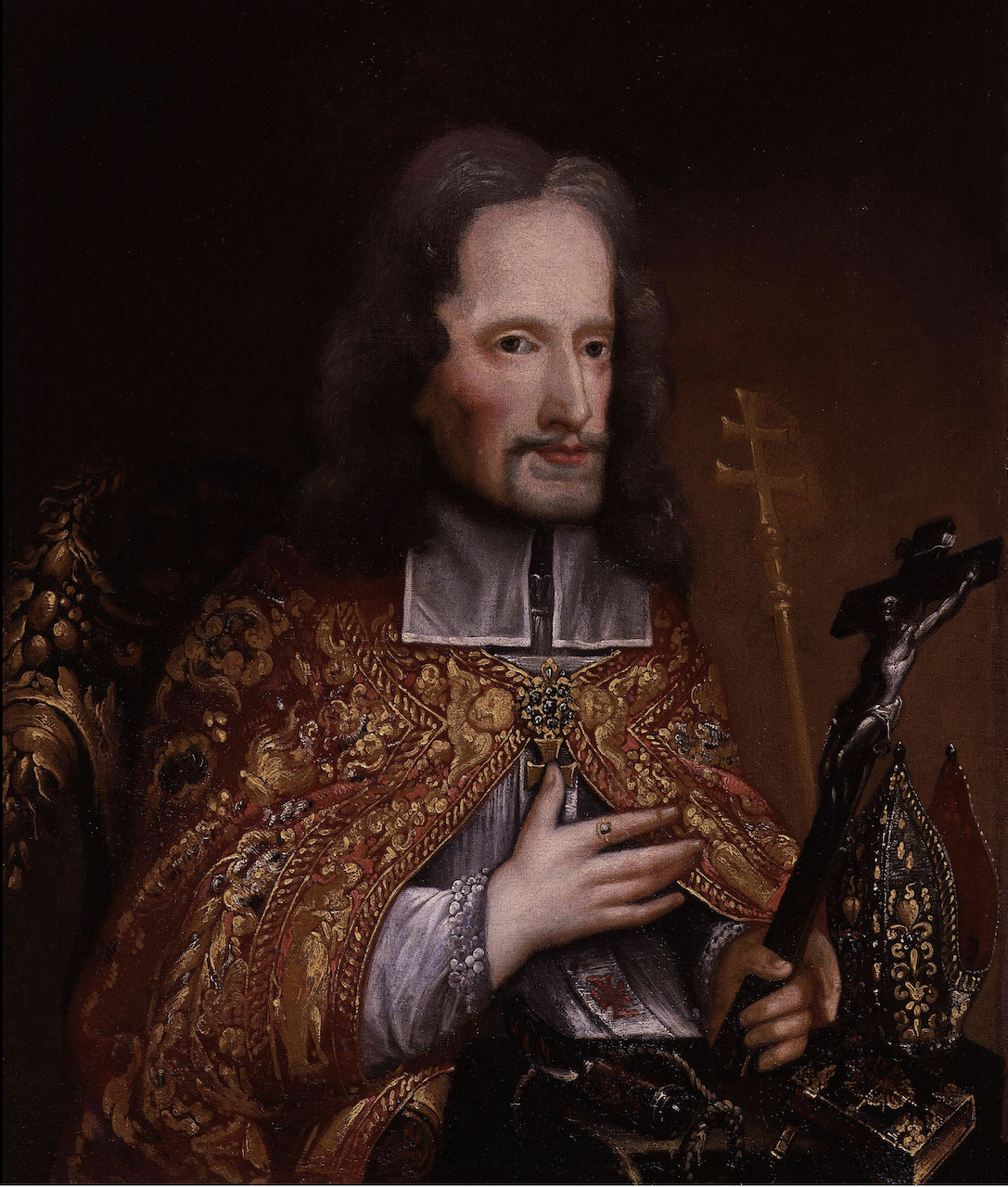
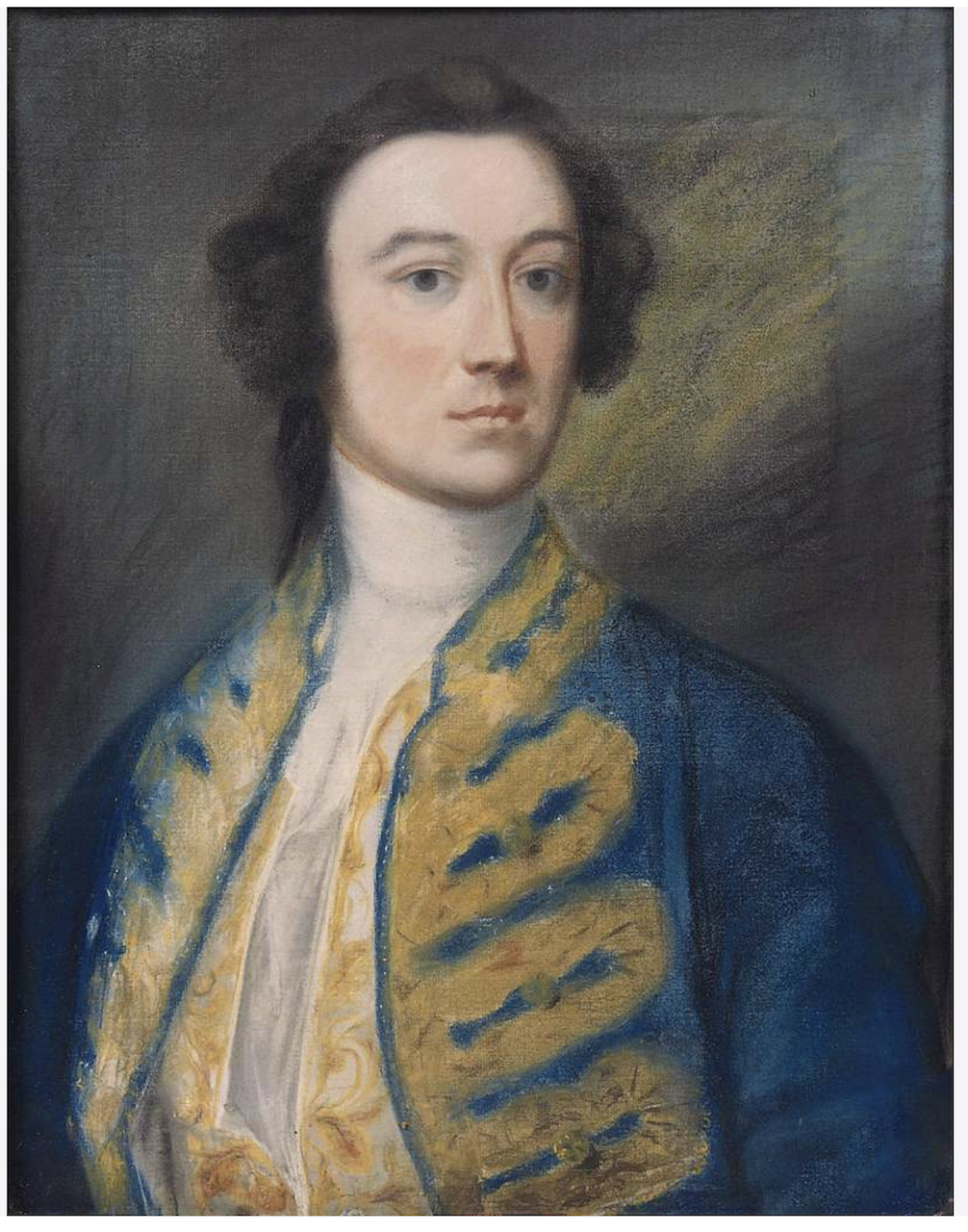
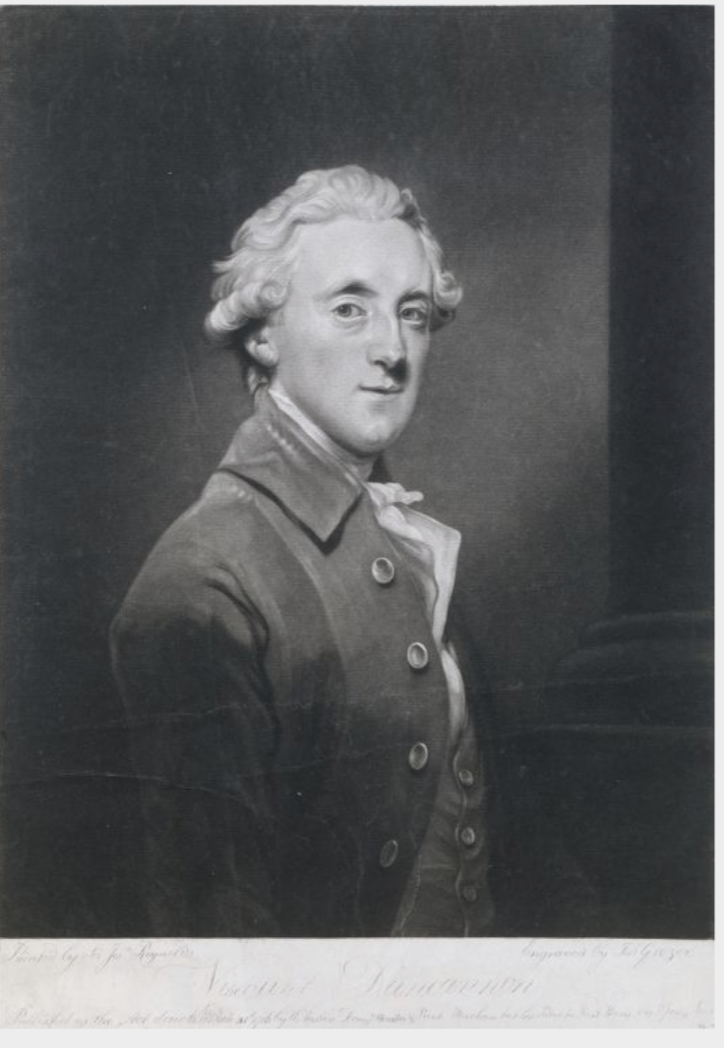
William Petty (1737-1805) 1st Marquess of Lansdowne Lord Shelburne, Prime Minister, after Sir Joshua Reynolds based on a work of 1766, National Portrait Gallery of London 43.He was the son of John Fitzmaurice Petty (1706-1761) 1st Earl of Shelburne, who was the son of Thomas Fitzmaurice 1st Earl of Kerry (21st Baron of Kerry), Viscount ClanmorrisLouisa Lansdowne née Fitzpatrick, wife of William Petty 1st Marquess of Lansdowne by Joshua Reynolds from Catalogue of the pictures and drawings in the National loan exhibition, in aid of National gallery funds, Grafton Galleries, London. She was a daughter of John FitzPatrick 1st Earl of Upper Ossory.John Henry Petty (1765-1809) 2nd Marquess of Lansdowne National Portrait Gallery of London ref. D37171.John Henry Petty (1765-1809), 2nd Marquis of Lansdowne by Francois-Xavier Fabre, 1795.Henry Petty-Fitzmaurice (1780-1863) 3rd Marquess of Lansdowne, Trustee of the National Portrait Gallery, by Henry Walton circa 1805 courtesy of National Portrait Gallery, NPG 178.Henry Thomas Petty-Fitzmaurice (1816-1866) 4th Marquess of Lansdowne, Politician and railway company chairman, photograph by by John & Charles Watkins circa early 1860s, courtesy of National Portrait Gallery NPG Ax16422.Henry Charles Keith Petty-Fitzmaurice 5th Marquess of Lansdowne by Philip Alexius de László.Beatrix Frances Duchess of St Albans, Maud Evelyn Petty-Fitzmaurice, Marchioness of Lansdowne (wife of 5th Marquess), Theresa Susey Helen Vane-Tempest-Stewart, Marchioness of Londonderry and Evelyn Emily Mary Cavendish, Duchess of Devonshire, by Frederick & Richard Speaight.Mrs Letitia Pilkington (née Van Lewen), (1712-1750), “Adventuress” and Author Date: c.1760 Engraver: Richard Purcell, Irish, c.1736-c.1766 After Nathaniel Hone the Elder, Irish, 1718-1784.Oliver Plunket, by Edward Luttrell courtesy of National Portrait Gallery London.Called Frances Hales, Countess of Fingall, possibly Margaret MacCarty later Countess of Fingall, wife of Luke Plunkett (1639-1685) 3rd Earl of Fingall, by Simon Pietersz Verelst courtesy of National Trust Hatchlands. Margaret was daughter of Donough MacCarty (or MacCarthy) 1st Earl of Clancarty; 2nd Viscount Muskerry. Frances Hales married Peter Plunkett (1678-1717) 4th Earl of Fingall.Arthur James Plunkett (1759-1836) 8th Earl of Fingall by Charles Turner after Joseph Del Vechio NPG D36923.Horace Plunkett by photographer Bassano Ltd, 1923, courtesy of National Portrait Gallery of London, reference NPGx12783.William Conyngham Plunket, 1st Baron Plunket, (1764-1854), Orator and former Lord Chancellor of Ireland Engraver David Lucas, British, 1802-1881 After Richard Rothwell, Irish, 1800-1868.Marble bust of William Plunket, 1st Baron Plunket (1764-1854), Lord Chancellor of Ireland, by CHRISTOPHER MOORE RHA (1790 – 1863), courtesy of Adams auction 19 Oct 2021.William Pole of Ballyfin (d. 1781), English school of 18th century, pastel, courtesy of Christies auction, wikimedia commons. He married Sarah Moore, daughter of the 5th Earl of Drogheda.
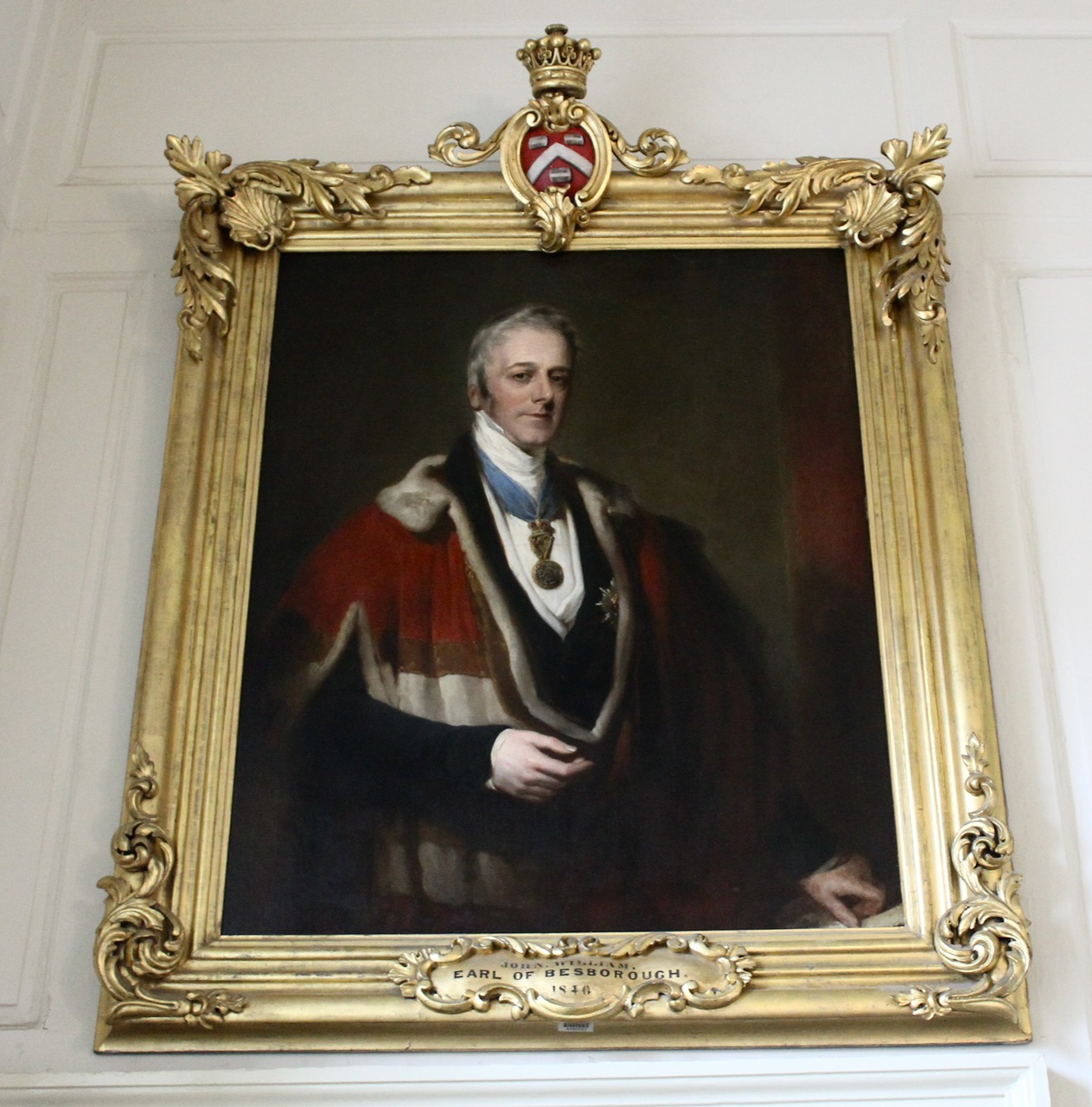
Brabazon Ponsonby (1679-1758) 1st Earl of Bessborough, 2nd Viscount Duncannon, of the fort of Duncannon, Co. Wexford married Sarah Margetson. Their daughter Sarah (d. 1736/37) married Edward Moore, 5th Earl of Drogheda. Their daughter Anne married Benjamin Burton of Burton Hall, County Carlow. Their daughter Letitia (d. 1754) married Hervey Morres, 1st Viscount Mountmorres. Their son William Ponsonby (1704-1793) succeeded as 2nd Earl of Bessborough and a younger son, John (1713-1787) married Elizabeth, daughter of William Cavendish 3rd Duke of Devonshire.
Help me to pay the entrance fee to one of the houses on this website. This site is created purely out of love for the subject and I receive no payment so any donation is appreciated!
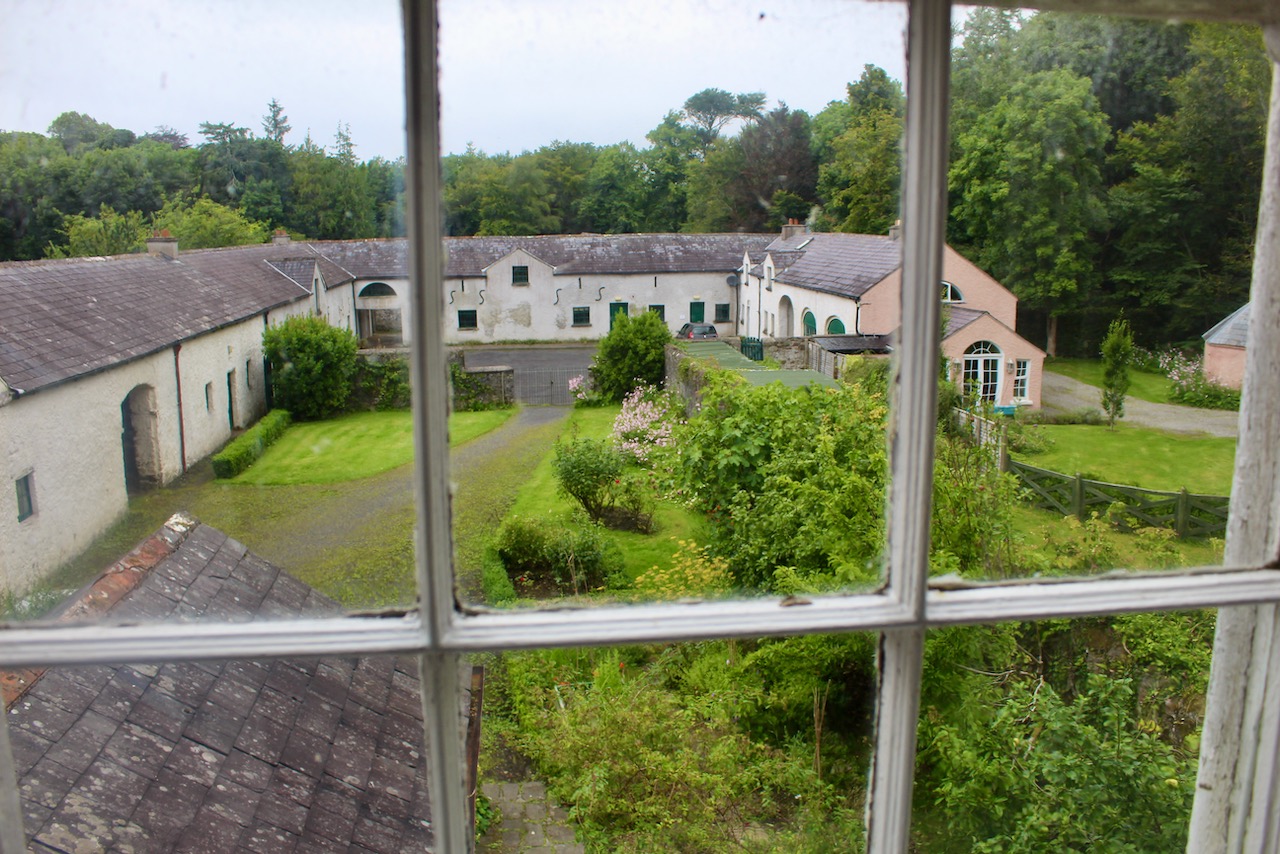
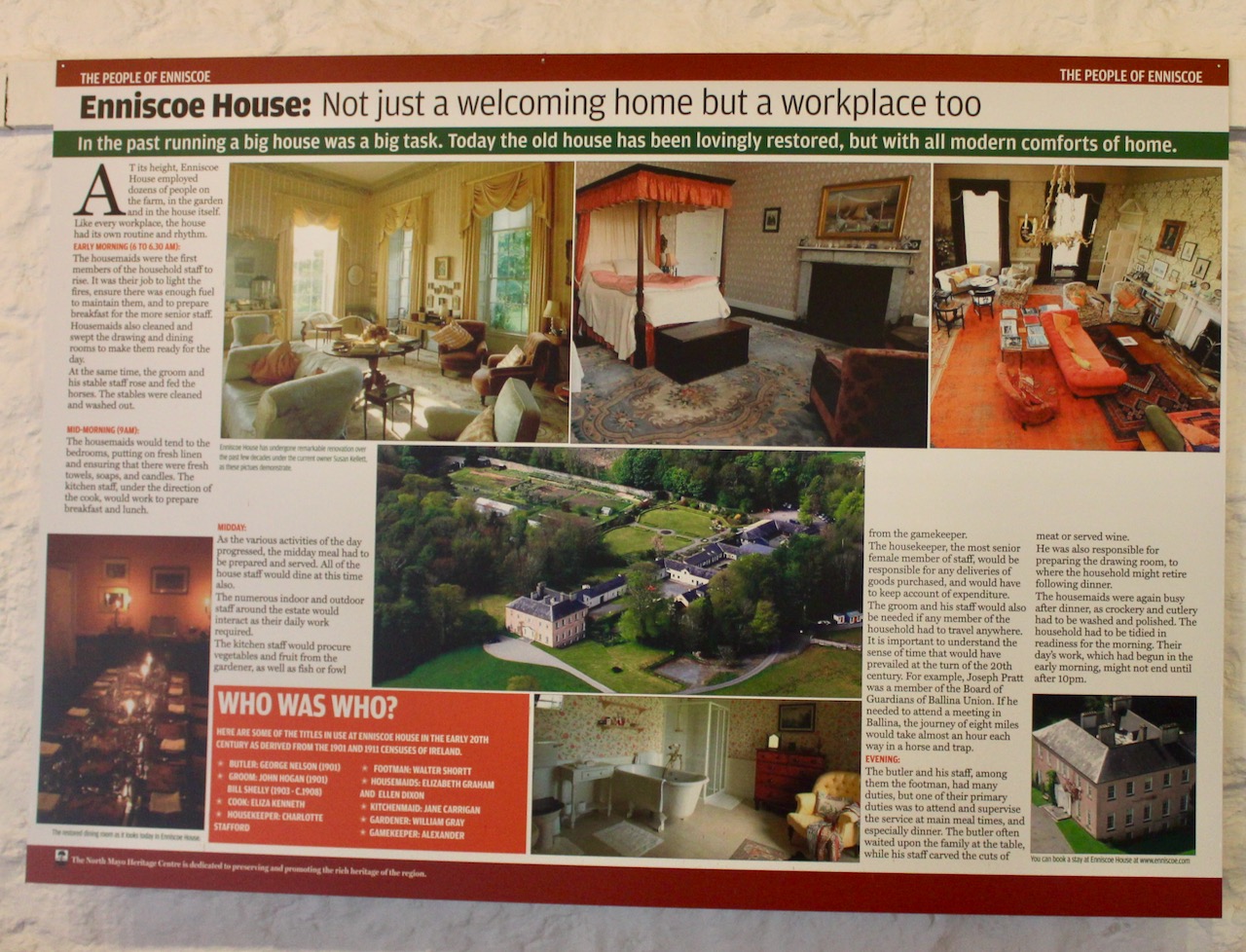
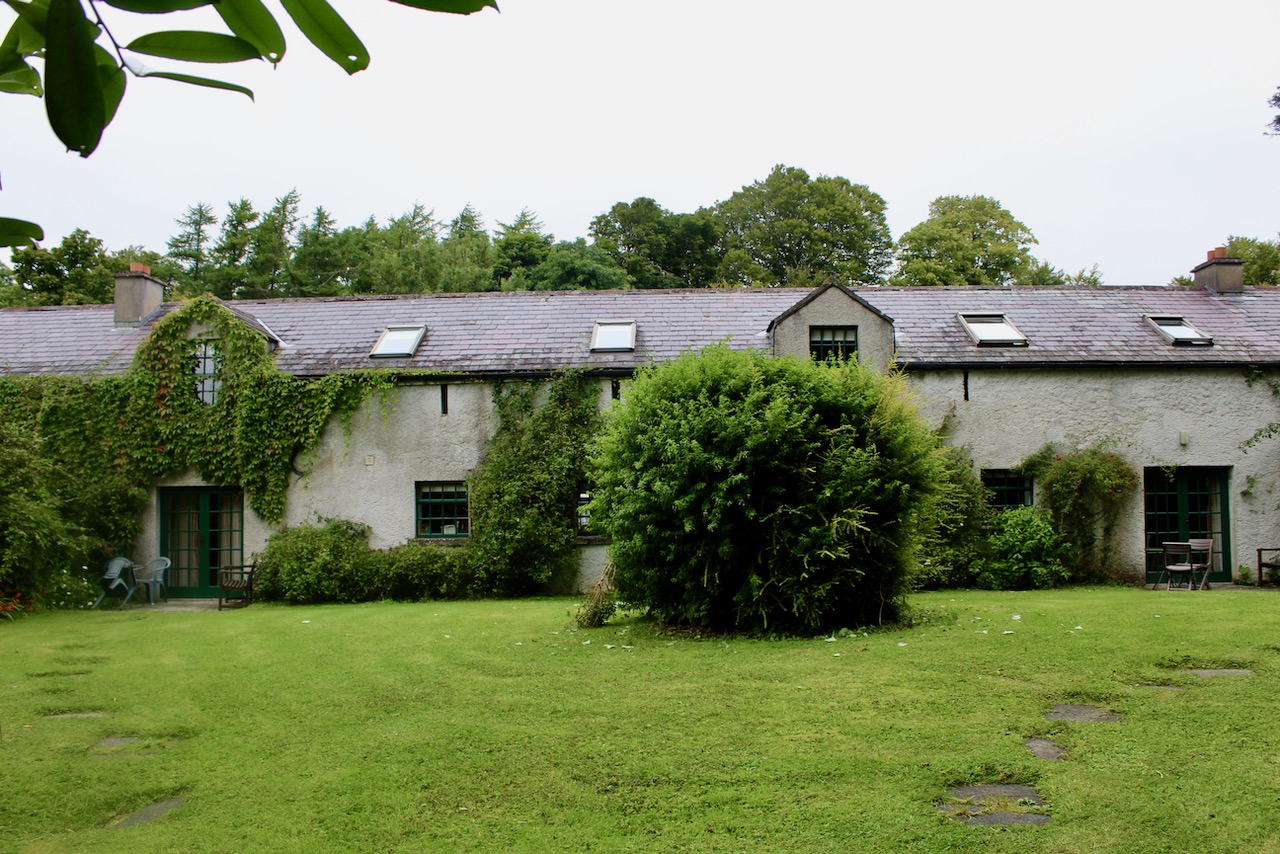
We visited Enniscoe House in August, during Heritage Week. I was delighted that the owner, Susan Kellett, had heard of and likes my website! She gave us a lovely tour of her home, which she also runs as an upmarket guest house. One can stay in the beautiful bedrooms in the house where breakfast is provided and dinner is also an option, or in self-catering accommodation in converted stables.
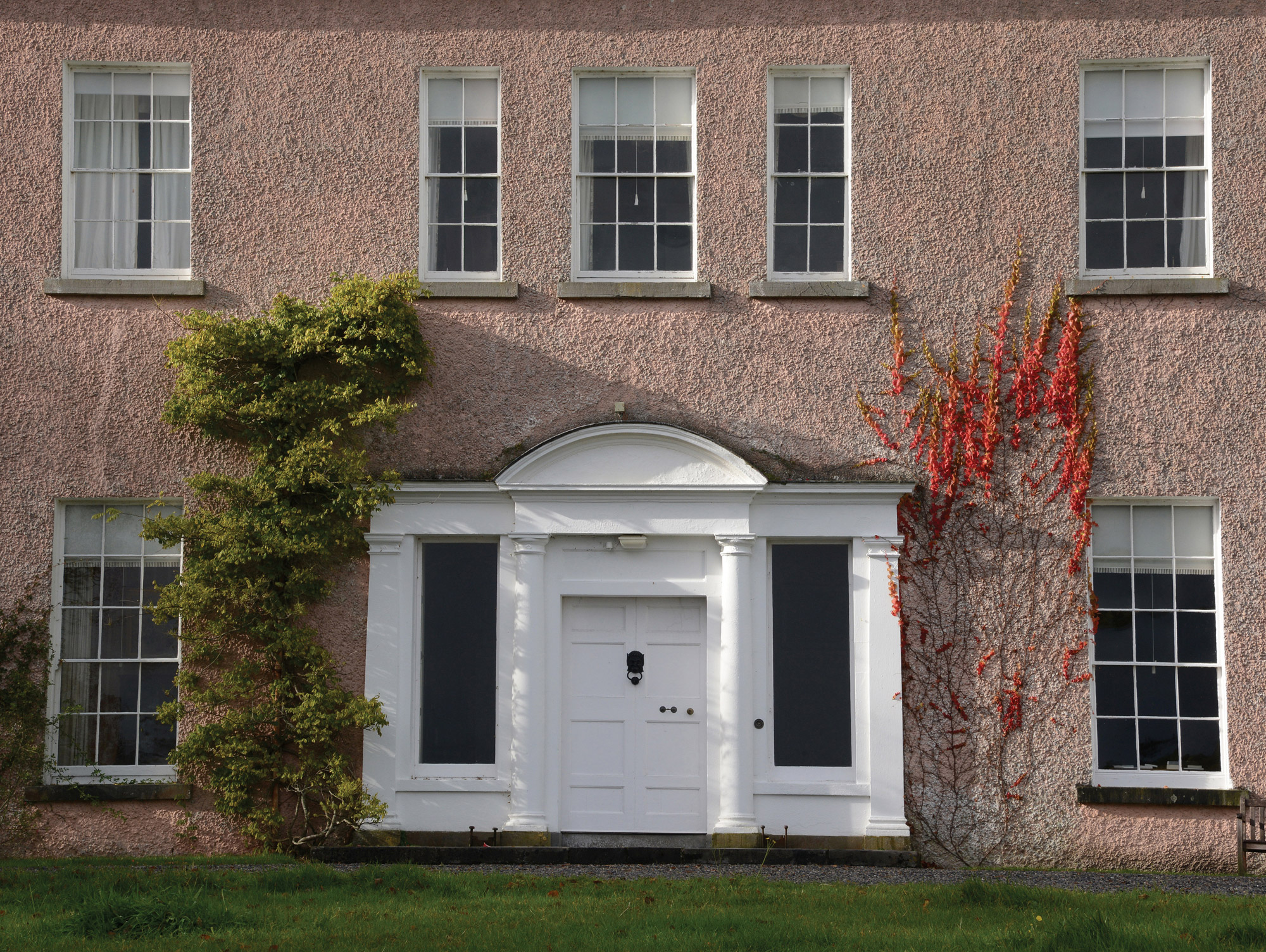
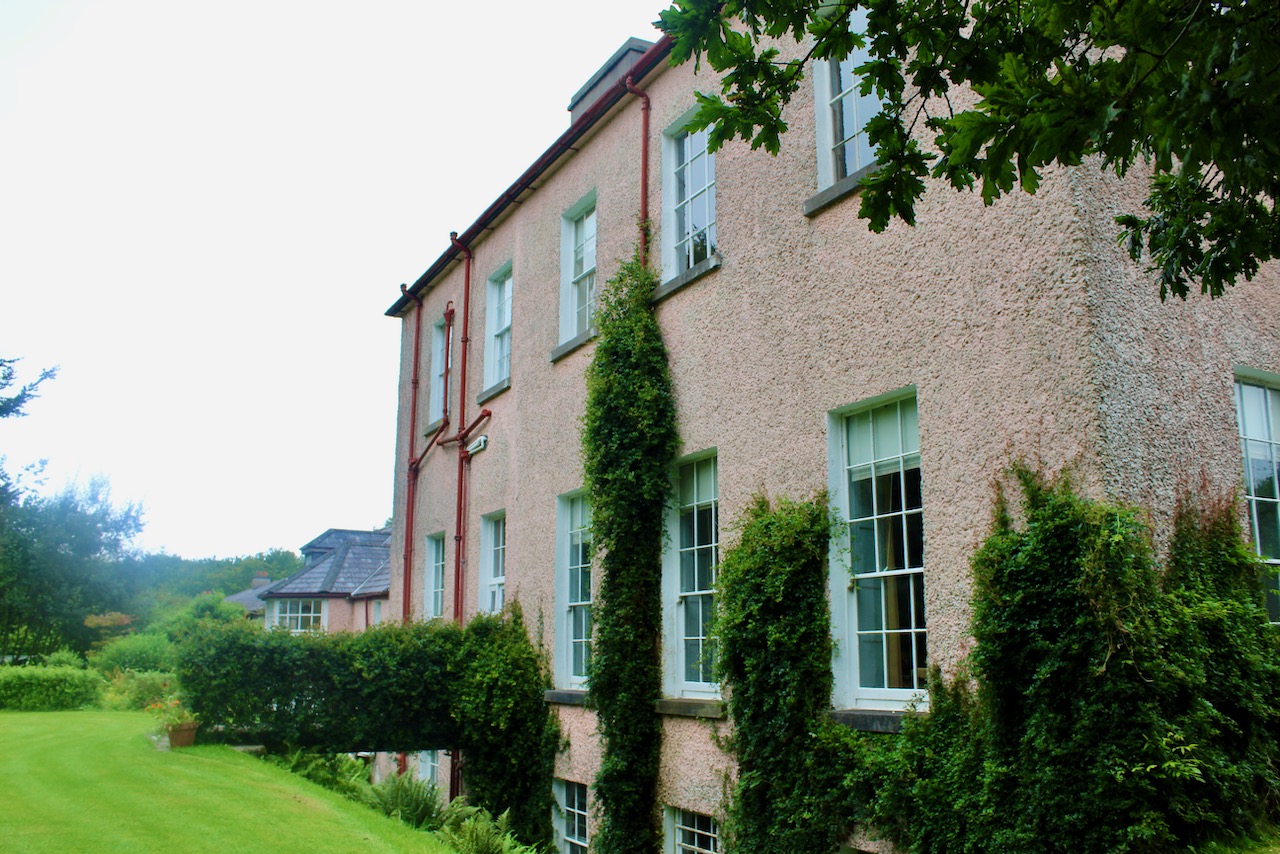
Enniscoe house is a two storey house with a five bay entrance front, with a central window in the upper storey above the pedimented tripartite doorway. The doorway has Doric columns and pilasters, and sidelights. The side elevation has five bays. [1]
Susan’s father inherited the property from his cousin, Mervyn Pratt (1873-1950). Mervyn’s grandfather, another Mervyn Pratt (1807-1890) married Madeline Eglantine Jackson, heiress, from Enniscoe. We came across Mervyn Pratt before, when we visited Cabra Castle. [2]
Mervyn and Madeline Eglantine’s daughter Louisa Catherine Hannah Pratt, the sister of Joseph, the second Mervyn’s father, married Thomas Rothwell from Rockfield, County Meath (which is currently for sale for €1.75 million [3]), and Susan’s father was their descendant. [4]
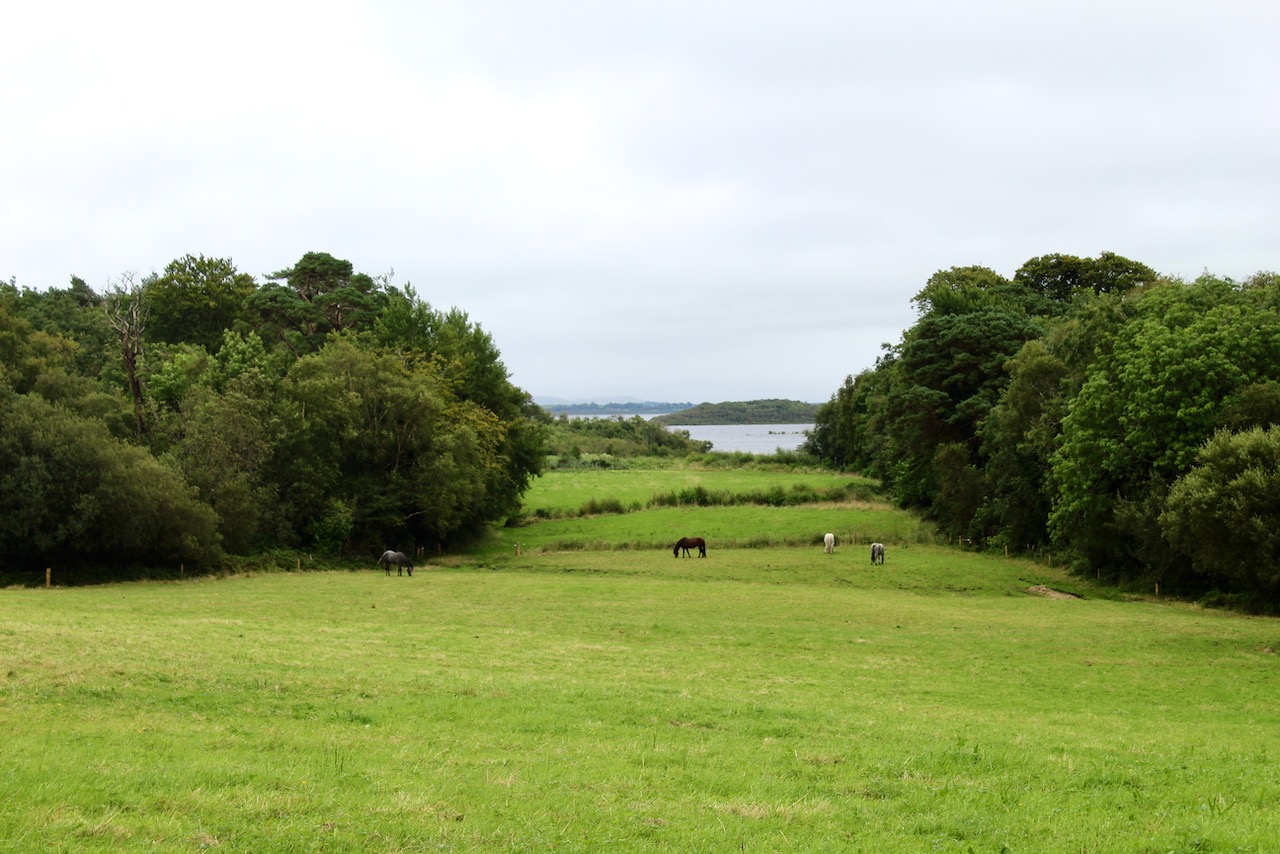
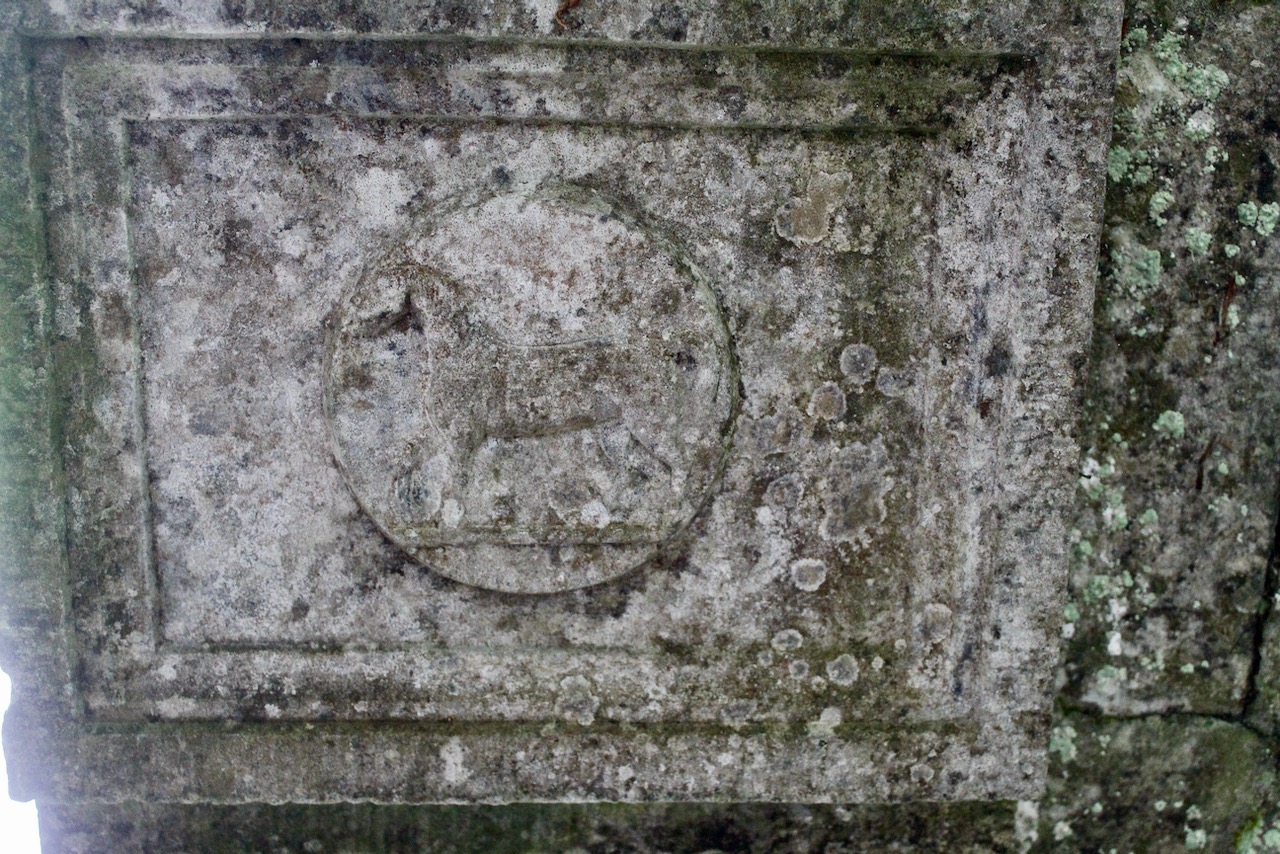
An informative booklet about Enniscoe which Susan gave me tells us that in ancient times, there was a castle at “Inniscoe,” one of the chief residences of the Kings of Hy-Fiachrach (who claimed descent from Fiachrae, brother of Niall of the Nine Hostages). The booklet tells us that traces of early earthworks can still be found. “Innis Cua” means the island of the hound. The O’Dowda, a Hy-Fiachrach family, ruled in the area and were famous for their greyhounds, which probably led to the Anglicised name Enniscoe. From the time of the Normans coming to Ireland, the land was fought over by the Bourkes, Barretts, Lynotts and Cusacks, and eventually owned by the Bourkes. At one stage Theobald Bourke, “Tibbot ne Long” (Theobald of the Ships), 1st Viscount of Mayo (1567-1629) owned the land around Enniscoe.
The information booklet tells us that the Patent Rolls of James I state that Enniscoe was possessed by the sons of John McOliverus Bourke in 1603 (this Patent Roll sounds like a great source of information! Copies are available in the National Library, and the information is gathered from 1603-1619). In the Strafford Inquisition of 1625, which gathered information about the landowners of County Mayo for Thomas Wentworth, the Earl of Strafford (who had plans for a Plantation), Richard Roe Bourke was recorded as having one third of the castle, town and lands of Enniscoe, and Thomas Roe Bourke had the other two thirds.
By 1641, the Bourkes no longer lived at Enniscoe. Susan’s booklet tells us that a Roger William Palmer owned the lands at one point – perhaps related to Roger Palmer, 1st Earl of Castlemaine (1634-1705), who was married to Barbara Villiers, who later became a favourite of King Charles II.
In the 1660s, a soldier in Cromwell’s army, Francis Jackson, was granted the lands at Enniscoe. This was confirmed by Charles II in 1669. He settled down to live in Ireland and to farm the land.
In the mid-eighteenth century George Jackson (1717-1789), great grandson of Francis, built a large farmhouse, using stones of the old castle of “Inniscoe” and oak trees recovered from nearby bogland. This house was a tall single gabled building of five bays, and it has been incorporated into the current house – Susan pointed out to us where the newer house joins to the old. George married Jane Cuffe, daughter of James Cuffe of Ballinrobe, County Mayo, and sister of James, the 1st and last Baron Tyrawley of County Mayo [of the second creation – the first creation of Baron Tyrawley was for Charles O’Hara in 1706].
George Jackson’s son, George “Two” (as he is called by the family) (1761-1805), became a Member of Parliament for County Mayo in the Irish House of Commons, with the aid of Baron Tyrawley.
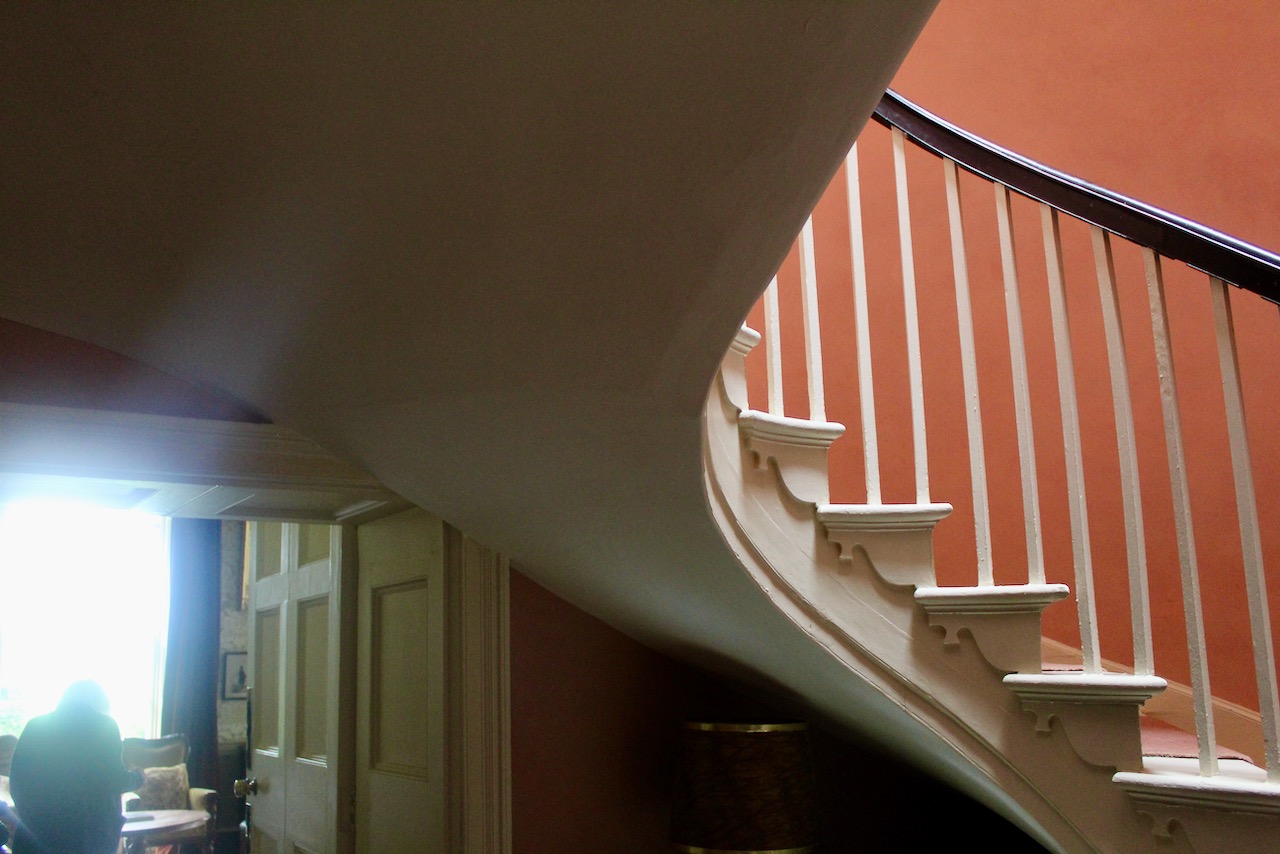
George Two expanded the house into what it is today. The old house was three storey but the new front was two storey. He built on two large reception rooms and a grand staircase. The architect Jeremy Williams attributes the design of the enlargement of the house to John Roberts (1712-1796) of Waterford, who also designed Christ Church Cathedral in Waterford, and may have built Moore Hall in County Mayo. [5] The stucco work in the Stairway Hall is similar to some in Deel Castle done in the 1790s, which is situated across the lake from Enniscoe, for James Cuffe, Baron Tyrawley.
James Cuffe bought the life interest of Deel Castle, which had also originally been a Bourke castle, from his uncle (the brother of his mother, Elizabeth Gore) Arthur Gore, 1st Earl of Arran. James Cuffe built a new house a short distance from the castle. Deel Castle reverted to the Earls of Arran after James Cuffe’s death, but is now a ruin, and the house was burnt in 1921 and not rebuilt. David Hicks has written about Deel Castle and the neighbouring house, Castle Gore, on his website. [6]
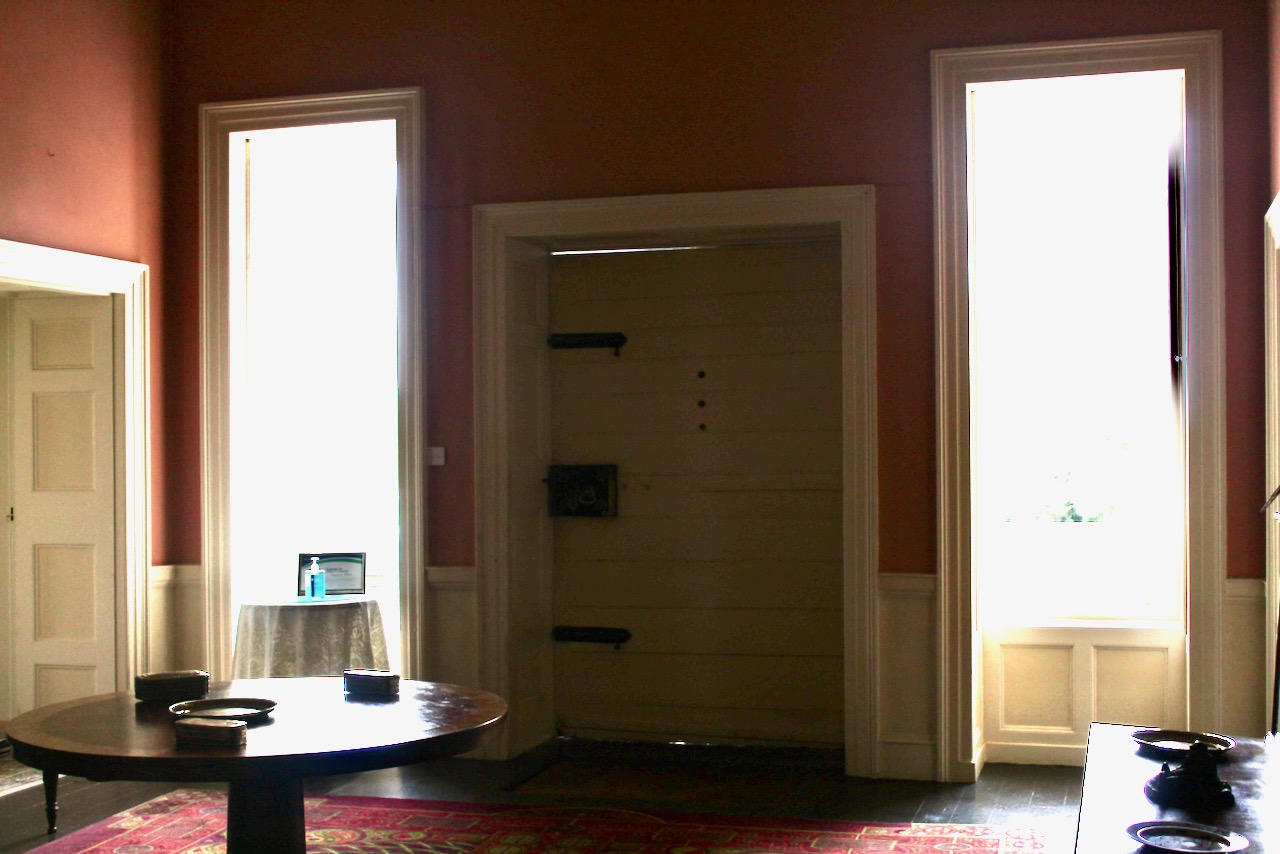
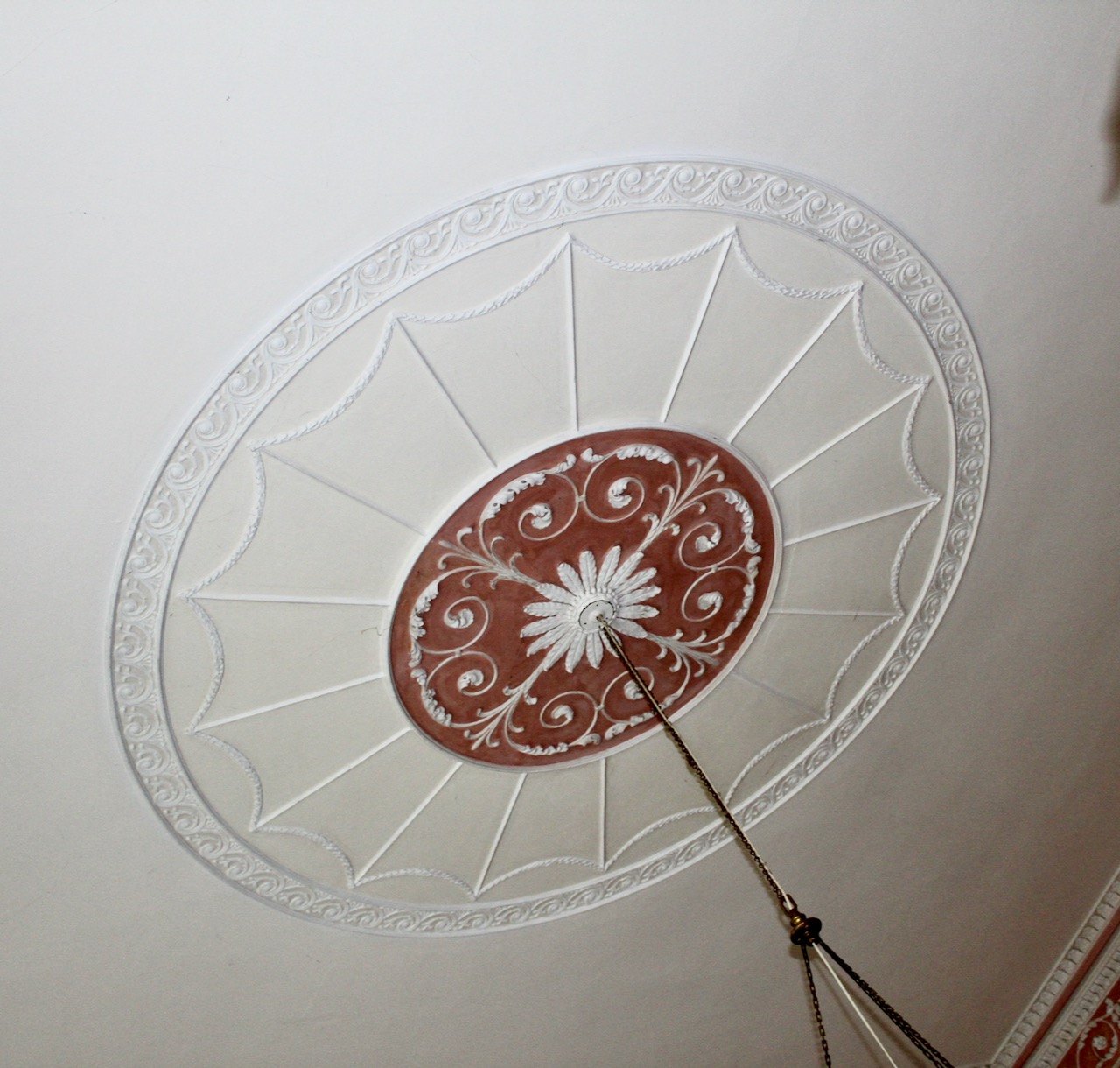
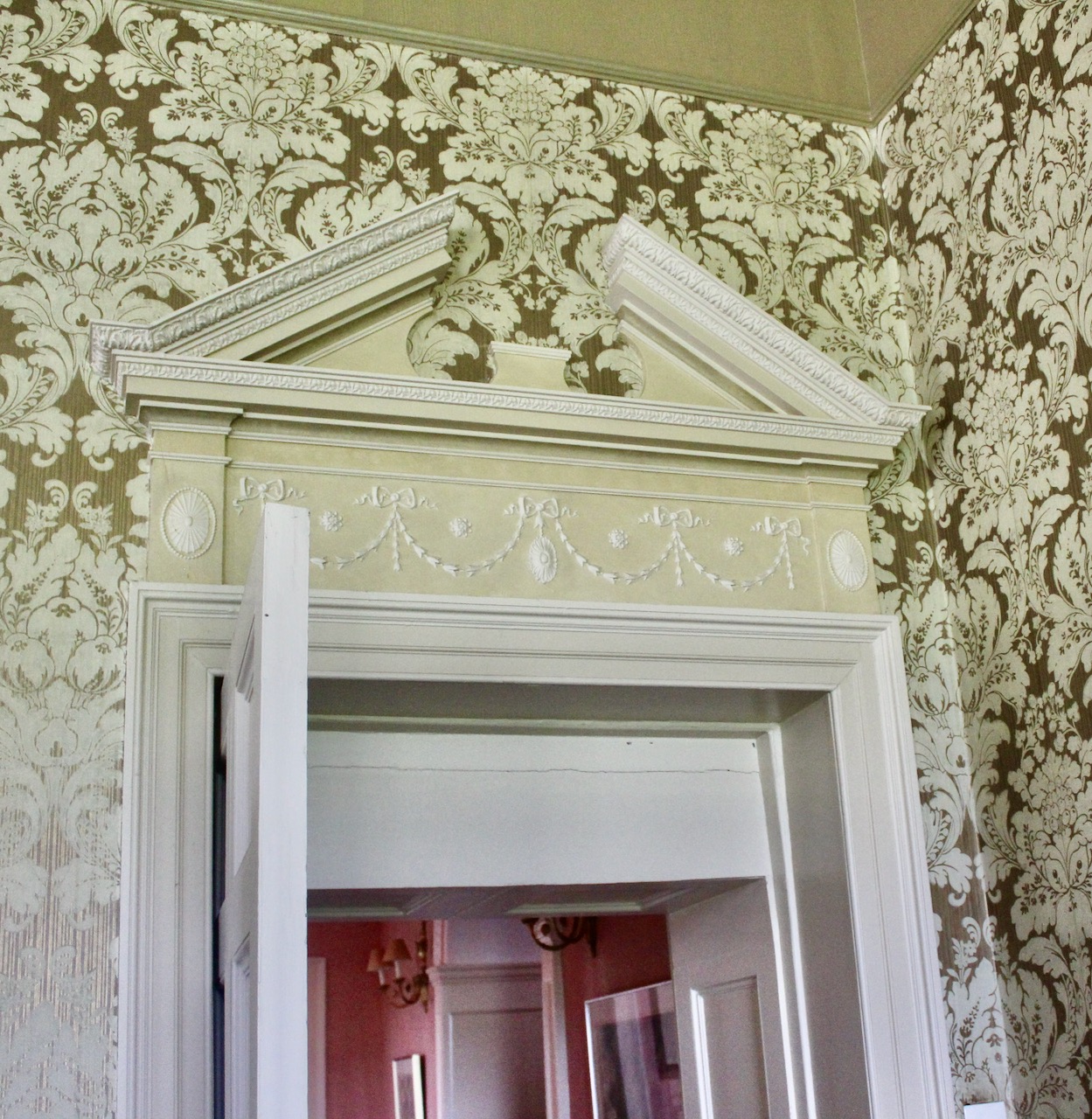
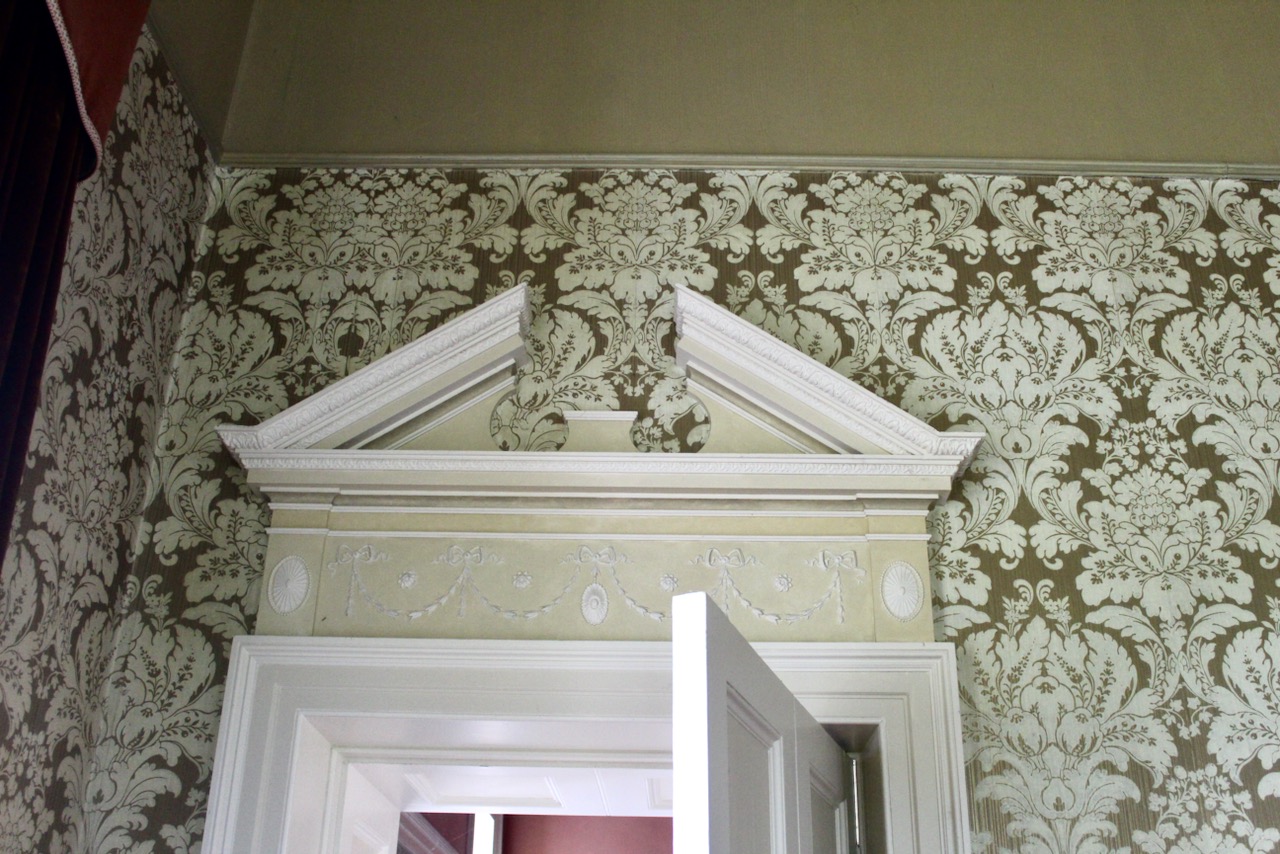
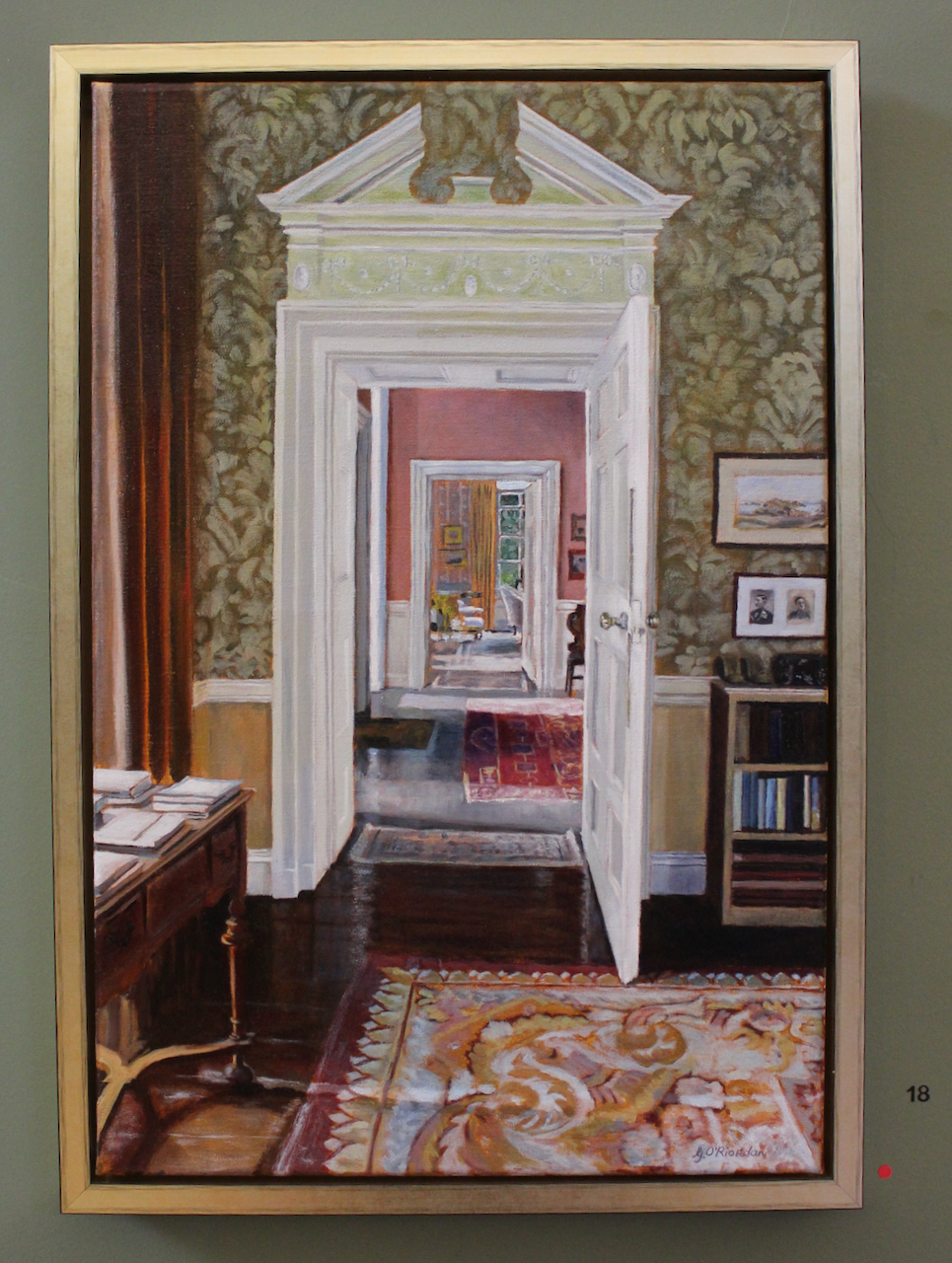
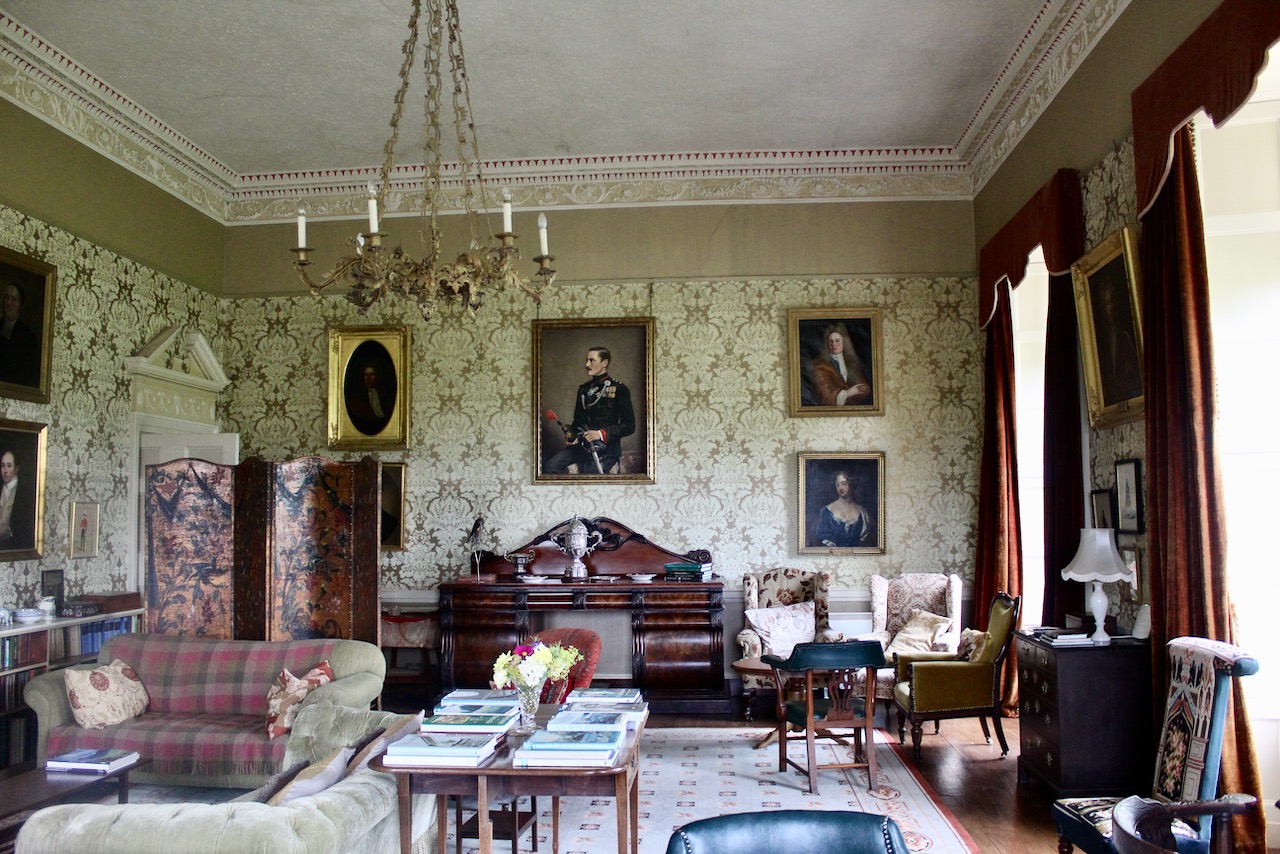
The large entrance hall of Enniscoe has a frieze of foliage, and Adamesque decoration in the centre of the ceiling.
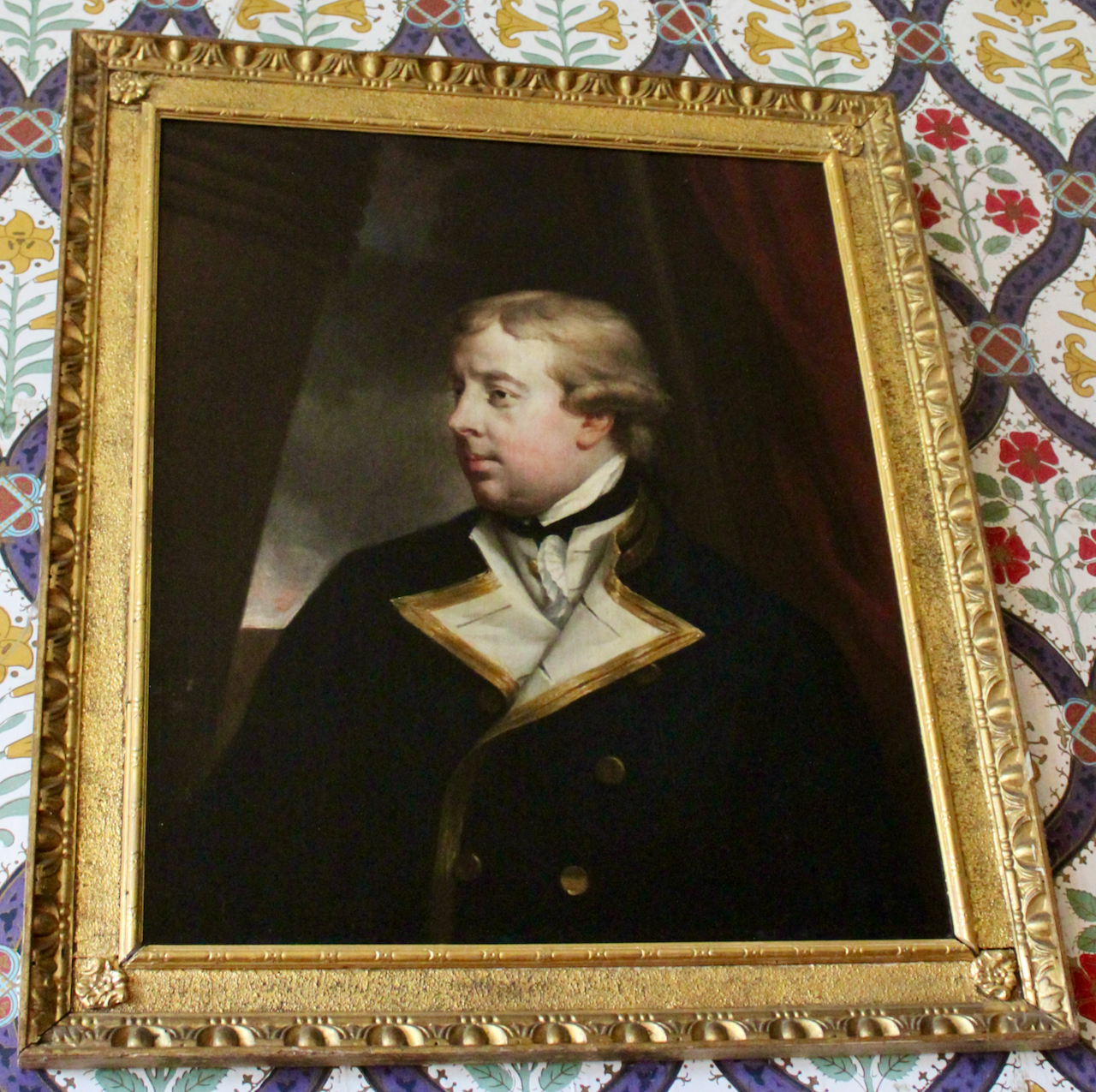
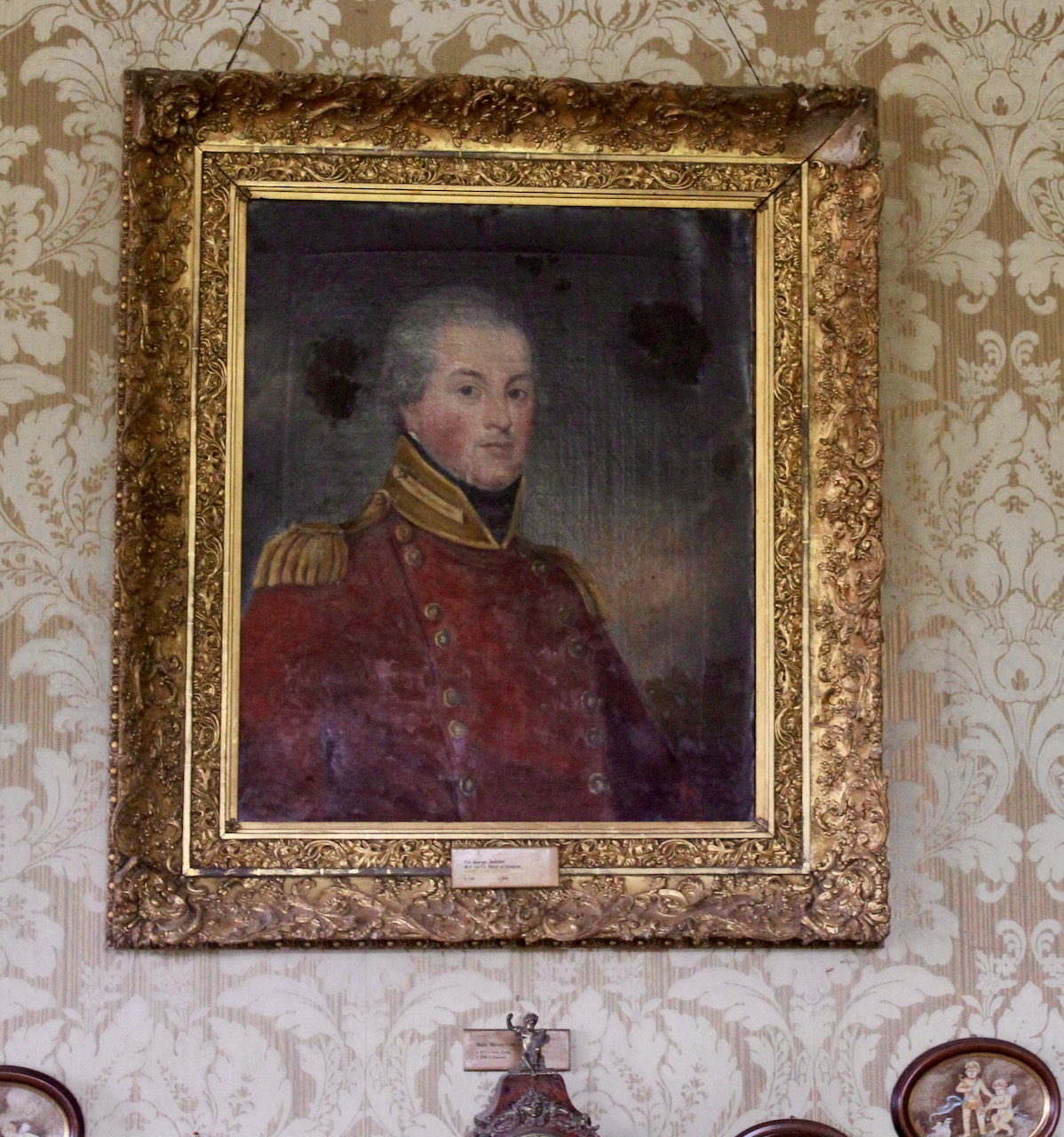
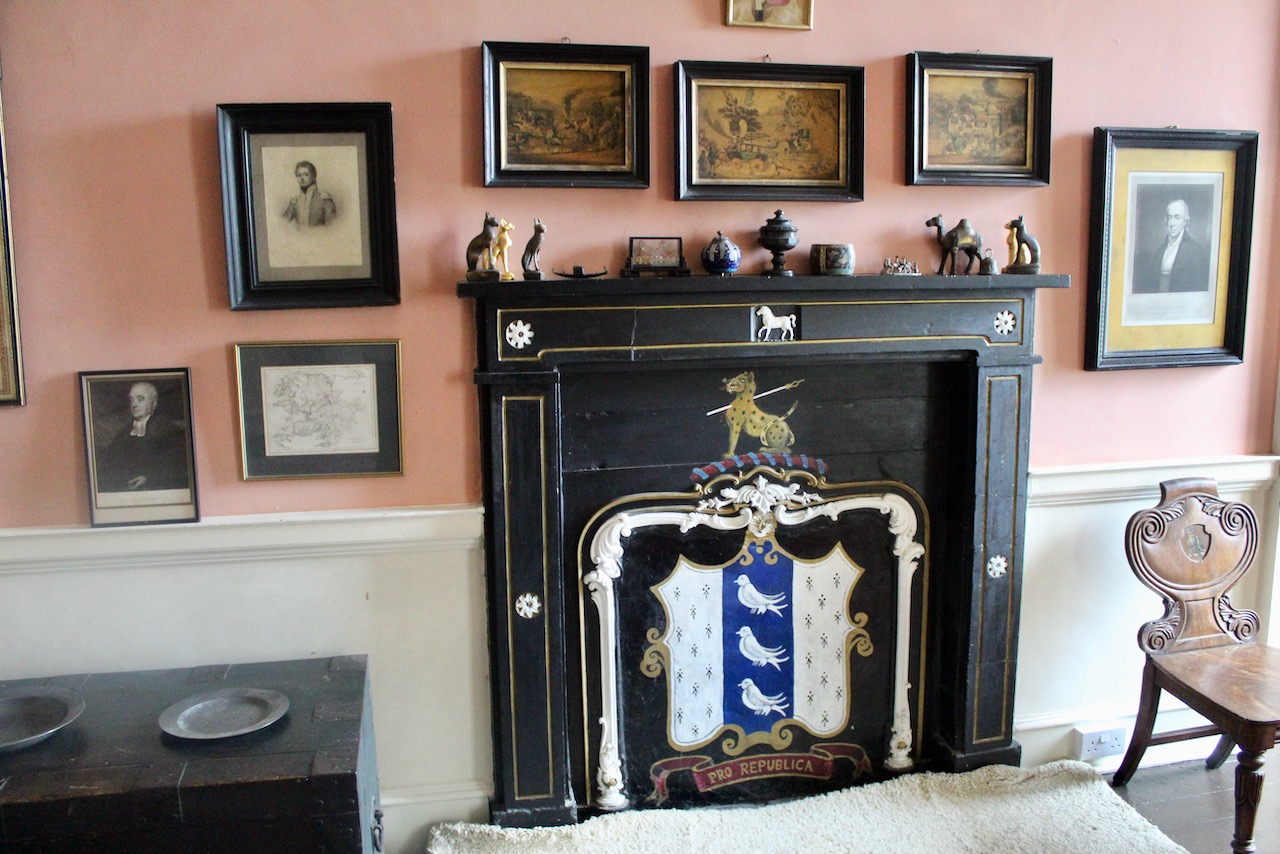
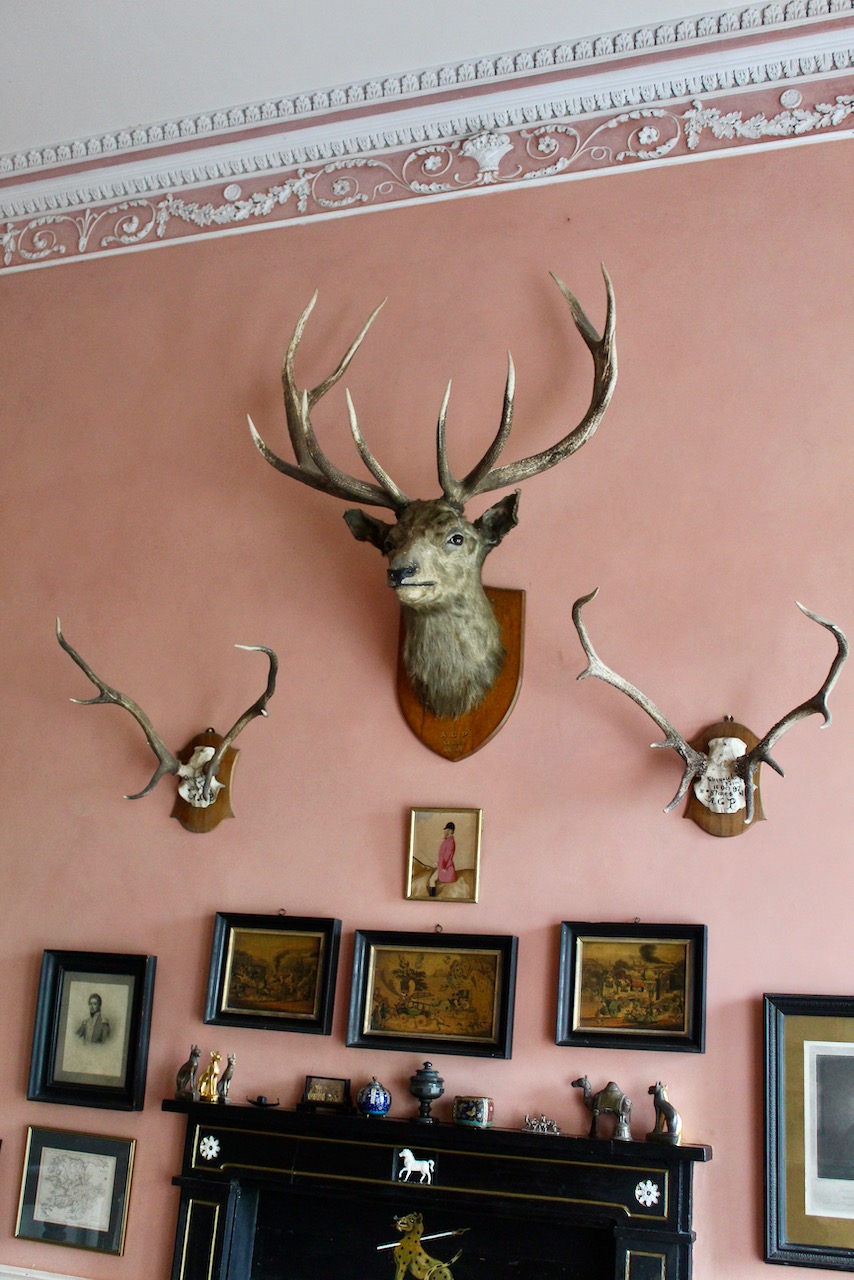
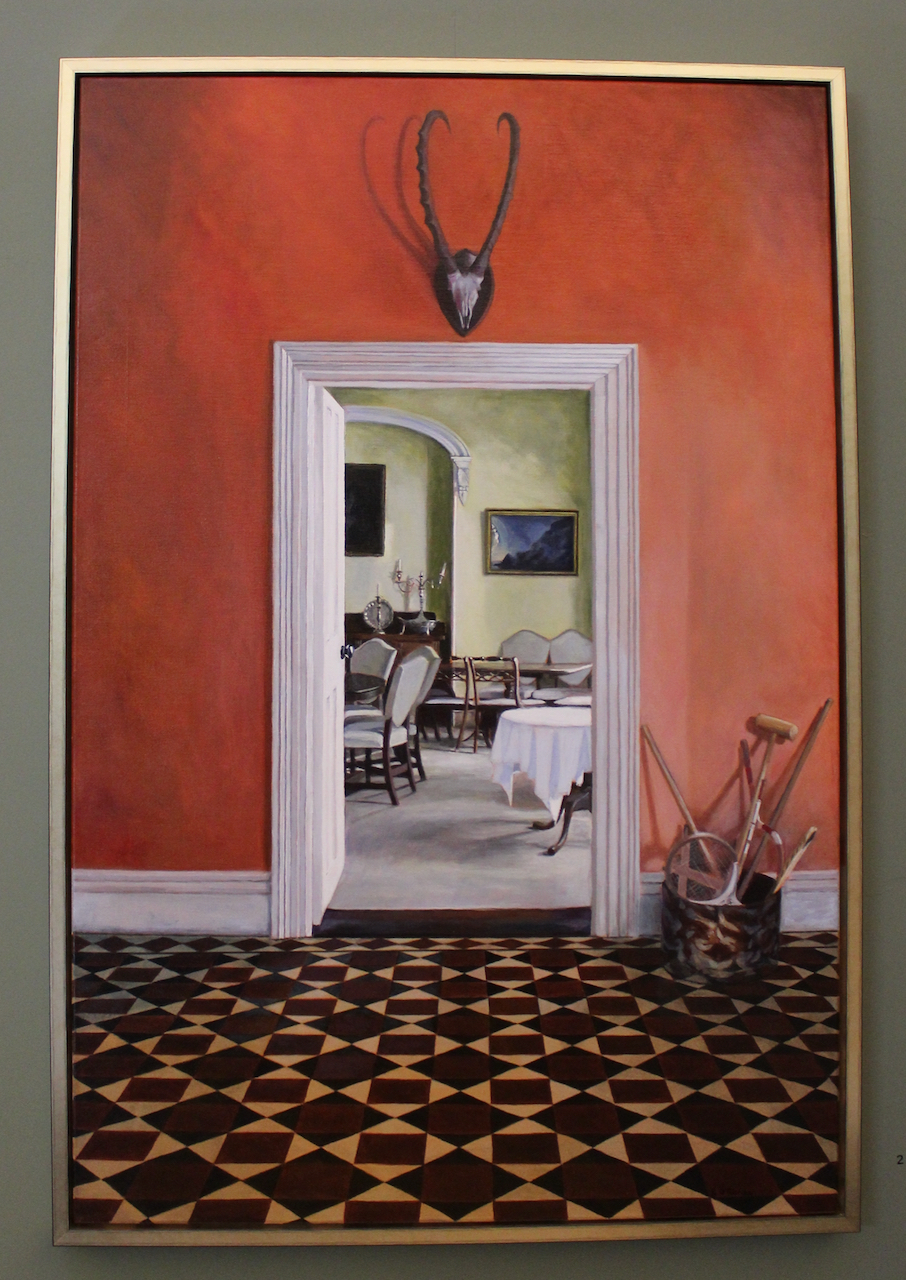
The portrait in the Front Hall of the man in wonderful frilled pantaloons is an ancestor, Sir Audley Mervyn (about 1603-1675), Speaker in the Irish House of Commons. His parents Henry Mervyn and Christian Touchet purchased lands in County County Tyrone from Mervyn Touchet, the 2nd Earl of Castlehaven, which Audley Mervyn (who was named after the Touchet estate in Staffordshire, Audley) inherited. [7] The heads of Indian deer were shot by the brothers Audley and Mervyn Pratt while fighting with the British army in the early 1900s. The carved hall chairs picture the Bourke family crest of a chained cat; Susan’s mother was a Bourke from Heathfield House, Ballycastle, County Mayo. [8] The pike was caught in Lough Conn in 1896 and weighs 37 lbs!
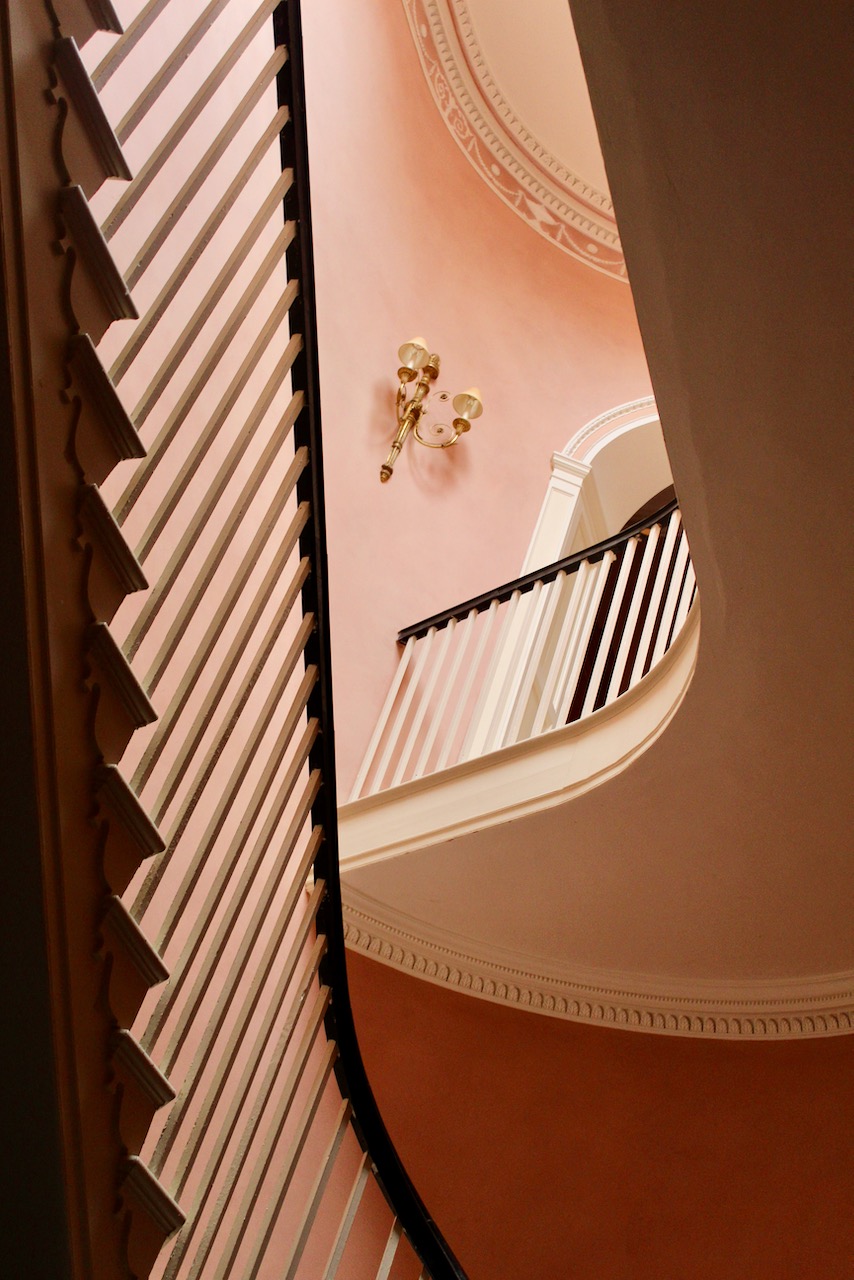
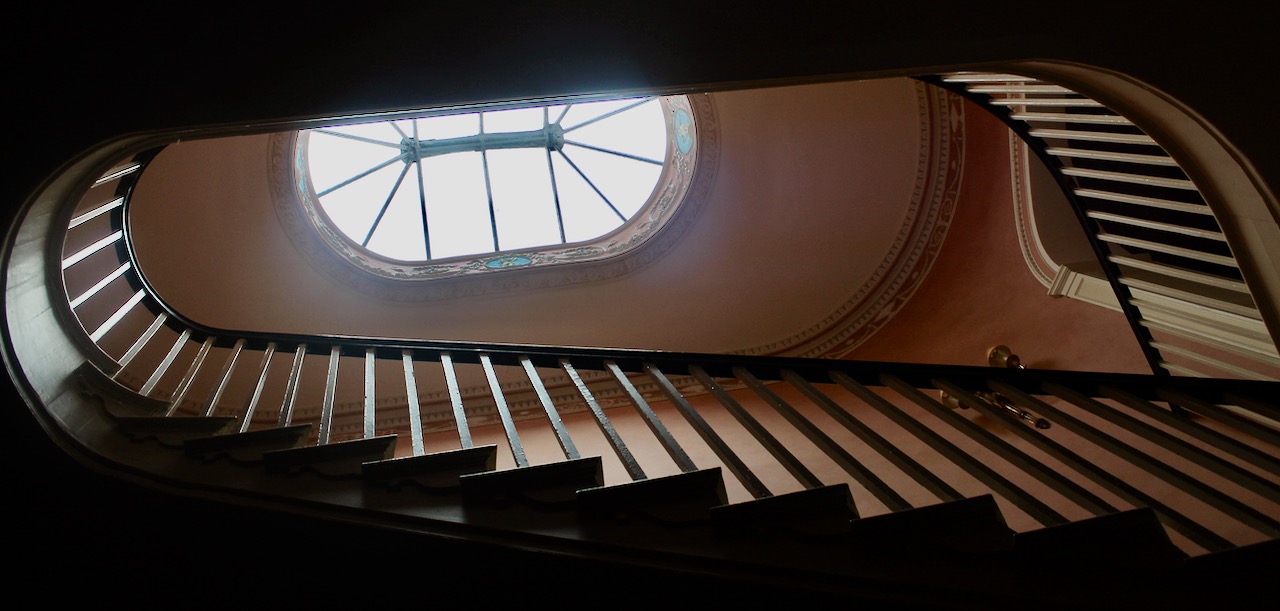
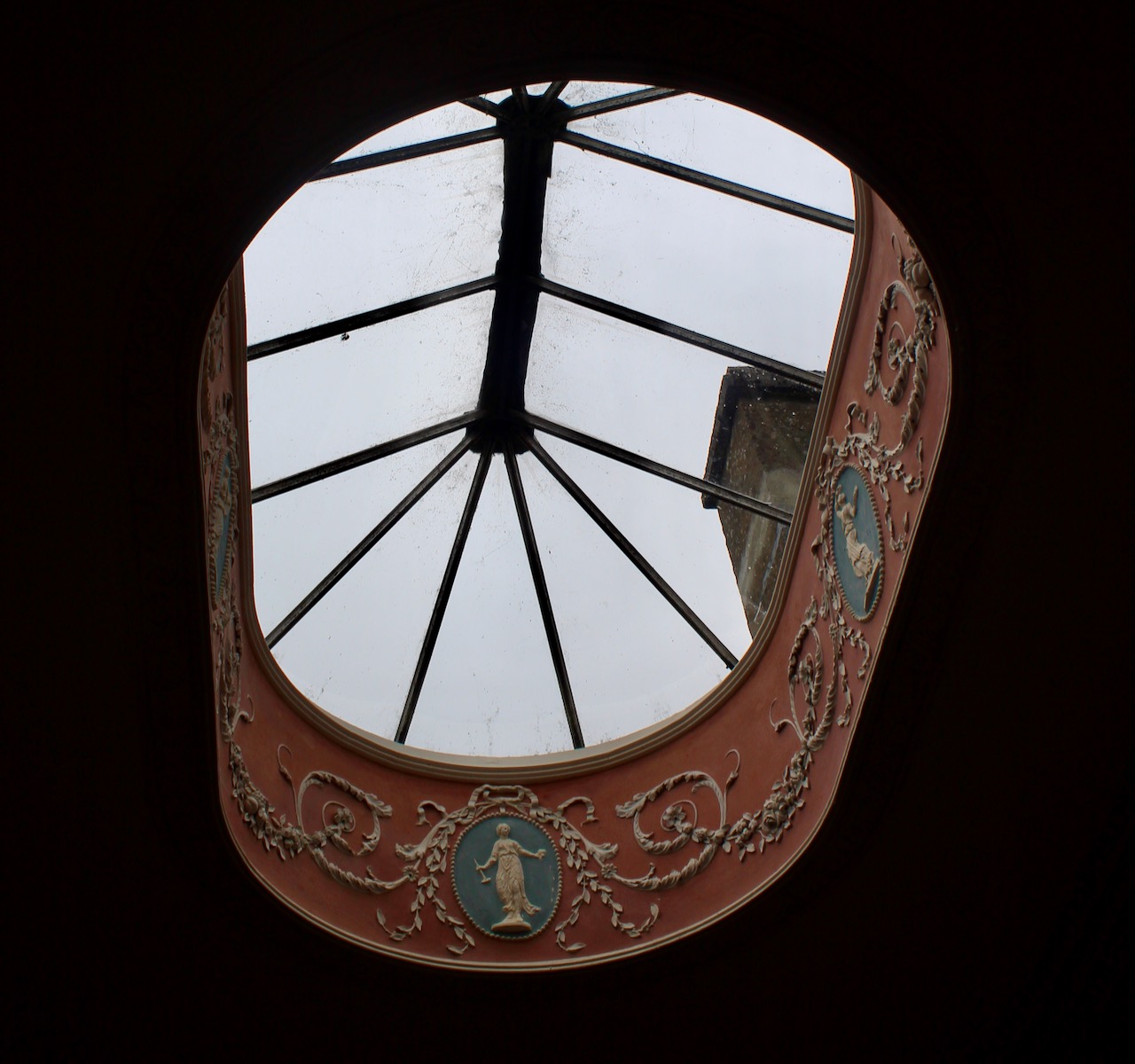
The front hall leads into the staircase hall, which is built on the exterior wall of the old house. The staircase hall has a frieze of urns and foliage and a glazed dome surrounded by foliage and oval medallions of classical figures.
One can see the division between older original house and the newer part clearly. Behind the staircase hall is a lobby with a delicate interior fanlight opening onto the staircase of the earlier house.
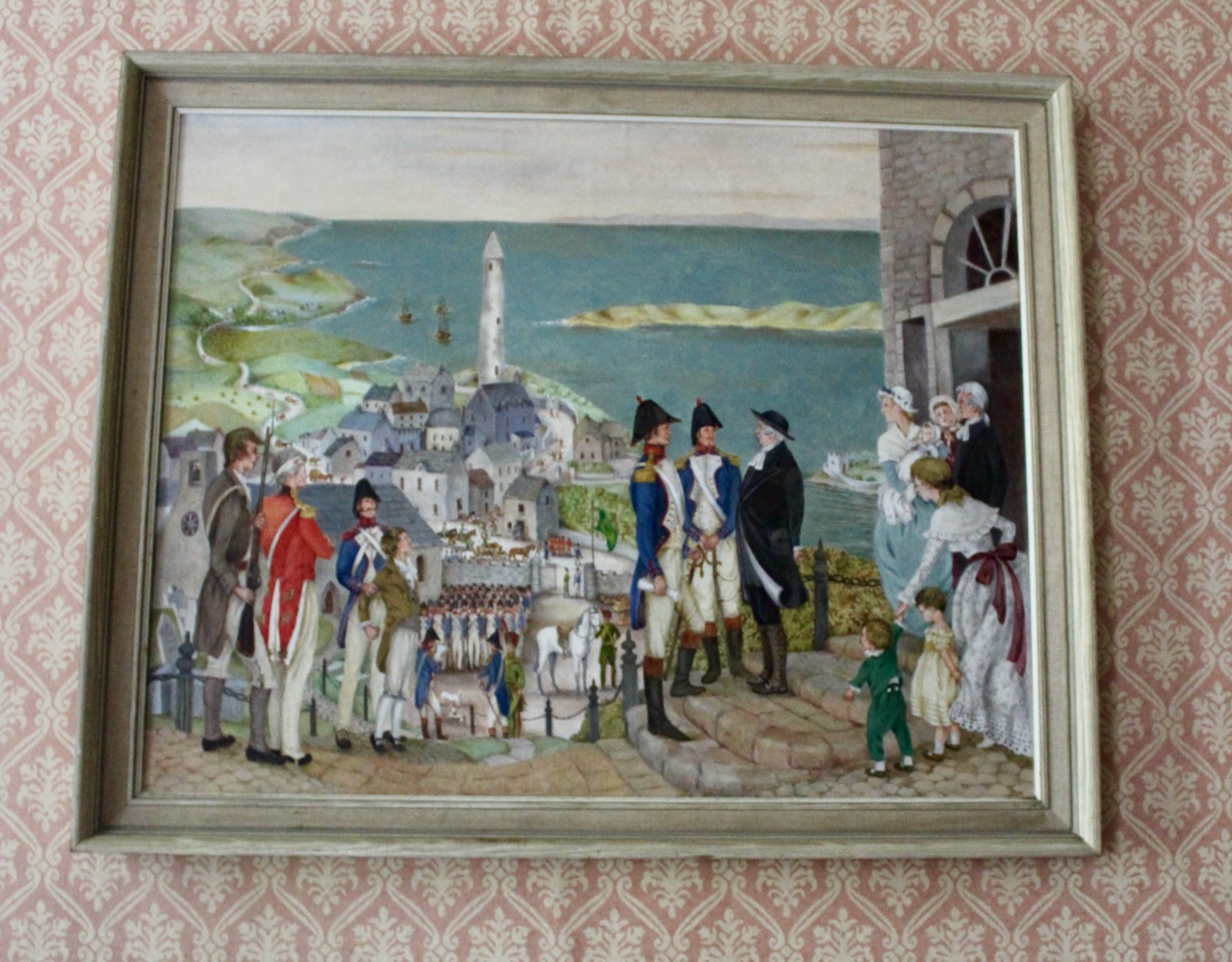
The Rising of 1798, which had been inspired by the French Revolution, came to Enniscoe, in the form of French soldiers under General Jean Joseph Amable Humbert, who landed at Killala in County Mayo on August 23, 1798. George Jackson was a Colonel in the North Mayo Militia and so would have opposed the 1798 Rebellion and the incoming French troops – although he was stationed further south as militia regiments were never stationed in their own county. The French soldiers stopped at the house at Enniscoe and Susan told us that the troops drank his wine, later declaring that it was “the only good wine in Ireland”! The scaffolding from the enlargement of the house was still lying in front of the house when the troops arrived and they used it for firewood for their campfire. George’s regiment were summoned back from the south, and Colonel Jackson was made Military Governor of the Crossmolina area. He was responsible for killing or imprisoning many of the defeated rebels in the surrounding countryside, and it is said that he lined the road from Crossmolina to Gortnor Abbey with severed heads on pikes. General Humbert and his troops were defeated by the British Army in the Battle of Ballinamuck. [9]
One result of the 1798 Rebellion was that the Irish Parliament was abolished by the Act of Union in 1800, which was supported by George Jackson. George was promoted to Colonel of the Carabineers, a dragoon in the British Army, and the position was inherited by his son, William.
William married Jane Louise Blair, daughter of Colonel William Blair of Scotland, and moved to England, and died young. He died in 1822 and his wife predeceased him in 1817 so their only daughter, Madeline Eglantine Jackson, was left an orphan at the age of six. She was raised by her aunt at Stephenstown in County Louth. Her mother’s sister was Catherine Eglantine Blair, who married Matthew Fortescue, whose father had built Stephenstown. They arranged a good marriage for Madeline when she turned 18, to a cousin of the family, Mervyn Pratt of Cabra Castle. They married in 1834.
Madeline and Mervyn settled in Enniscoe and Mervyn had the estate surveyed in order to set to work on an enormous scheme of draining land and building roads. The booklet Susan gave me tells us that during the famine, the Pratts did their best for those in the area and they gained a reputation for good management and fairness.
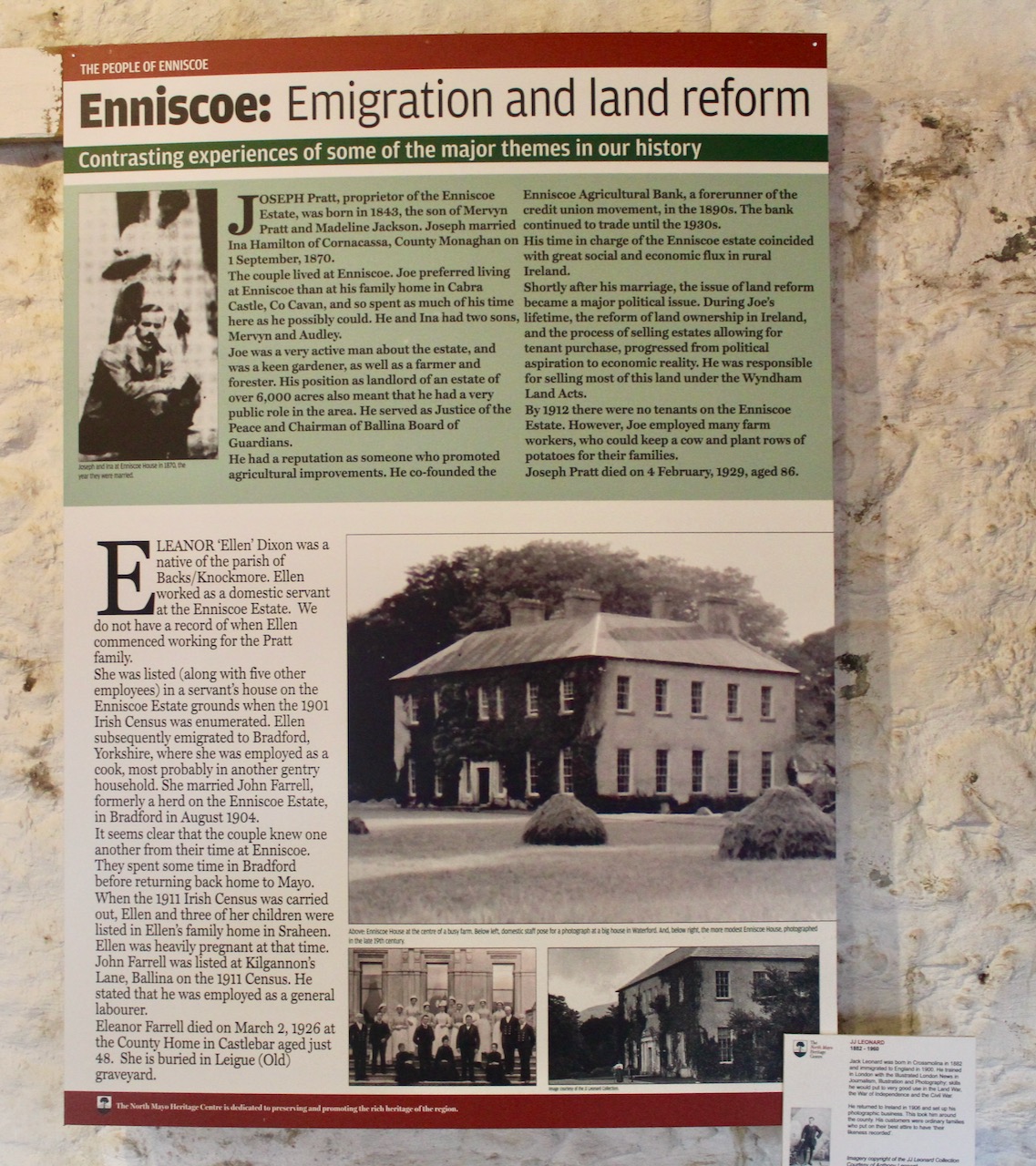
Madeline and Mervyn had five children. Their only son Joseph joined the army and served in India, and when he came home, took over the running of Enniscoe. He married his cousin Ina Hamilton of Cornacassa, County Monaghan (this house has been partly demolished. It was built around 1800 for Dacre Hamilton). [10]
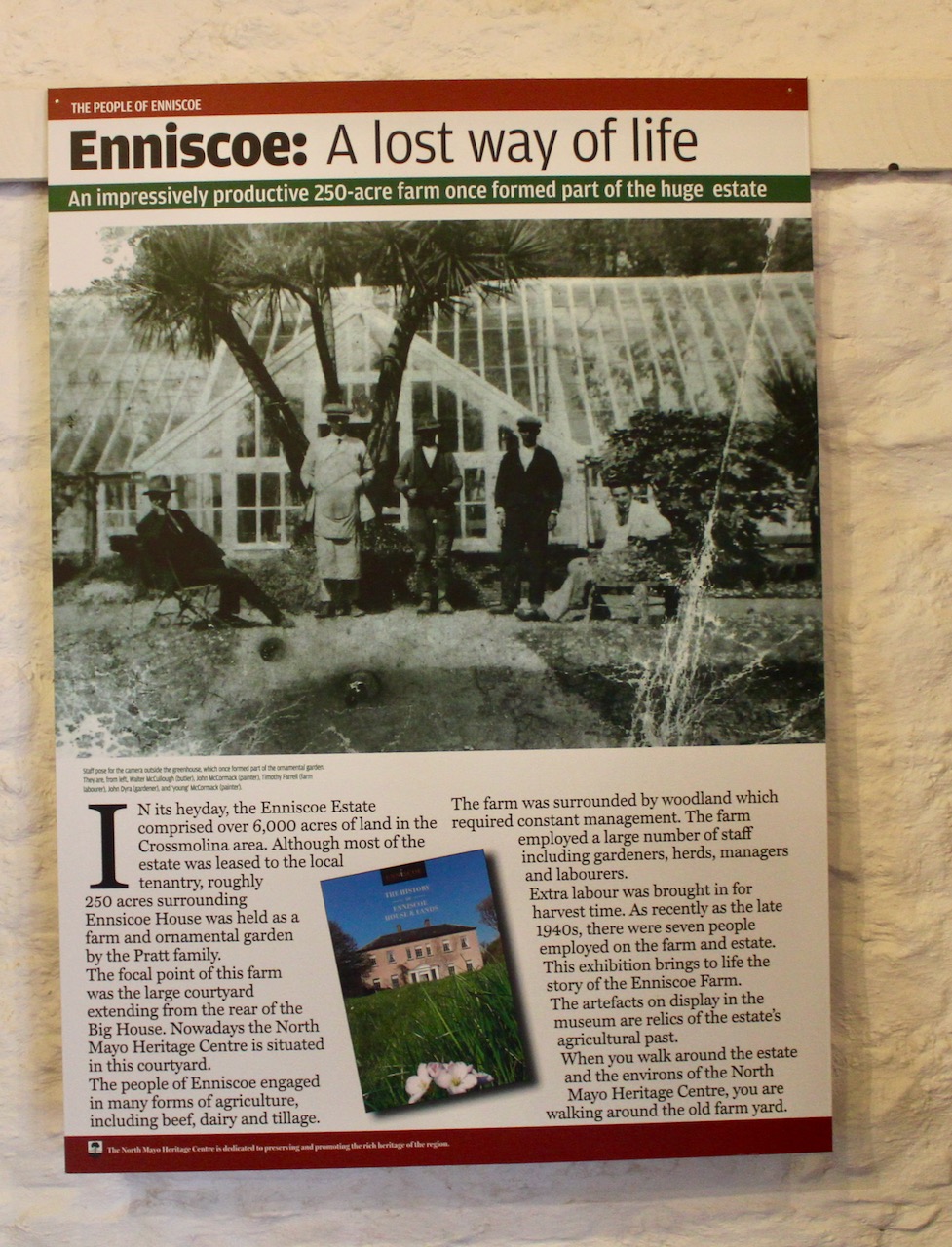
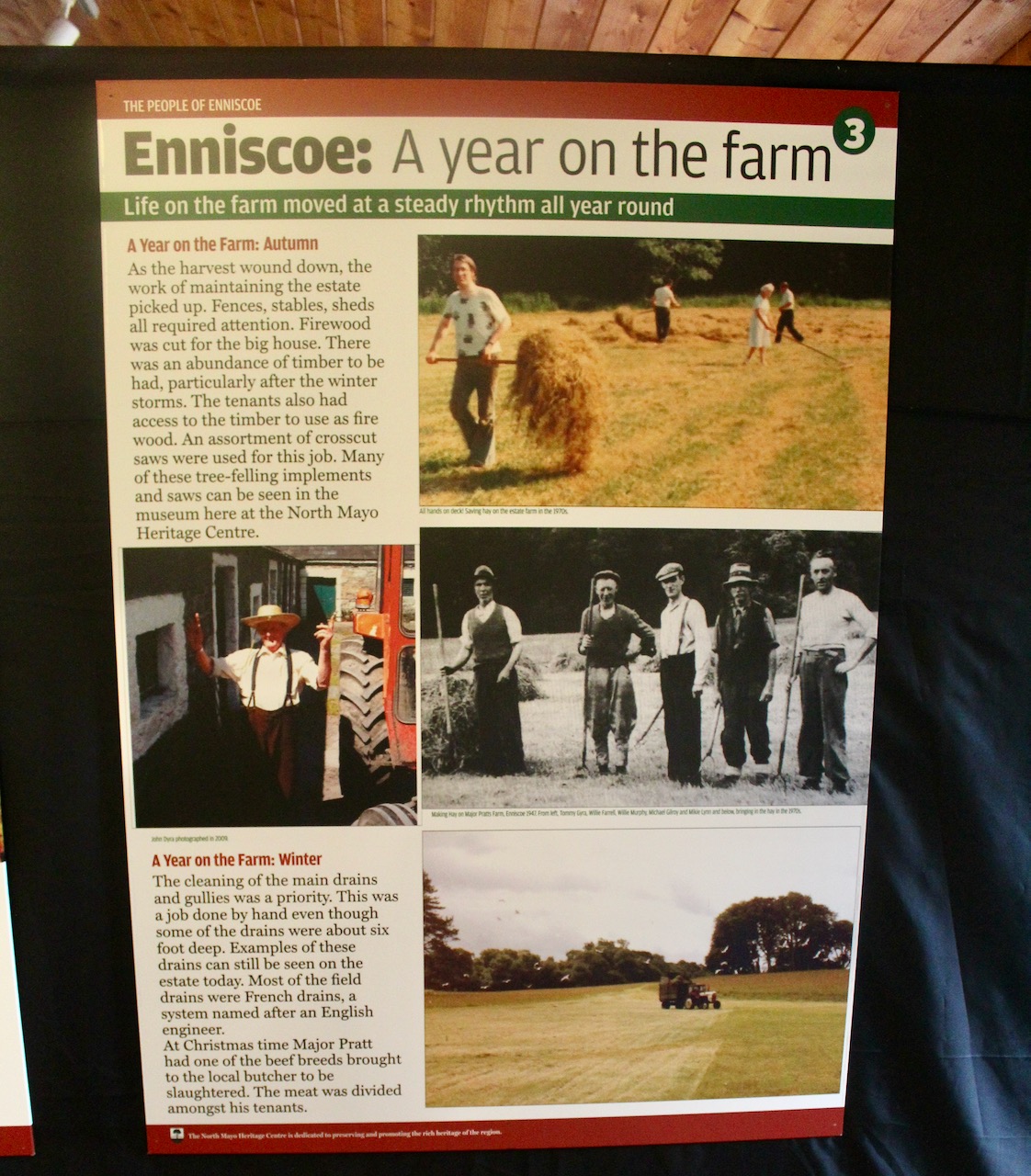
Joseph Pratt was one of the first landlords to start selling his land to his tenants under the Wyndham Land Acts of 1903. Joseph and Ina did much to improve their estate, farming and creating the garden within the old walled garden. The Heritage Centre gives us an idea of what life on the farm was like for both the home owners and the many people employed on the estate.
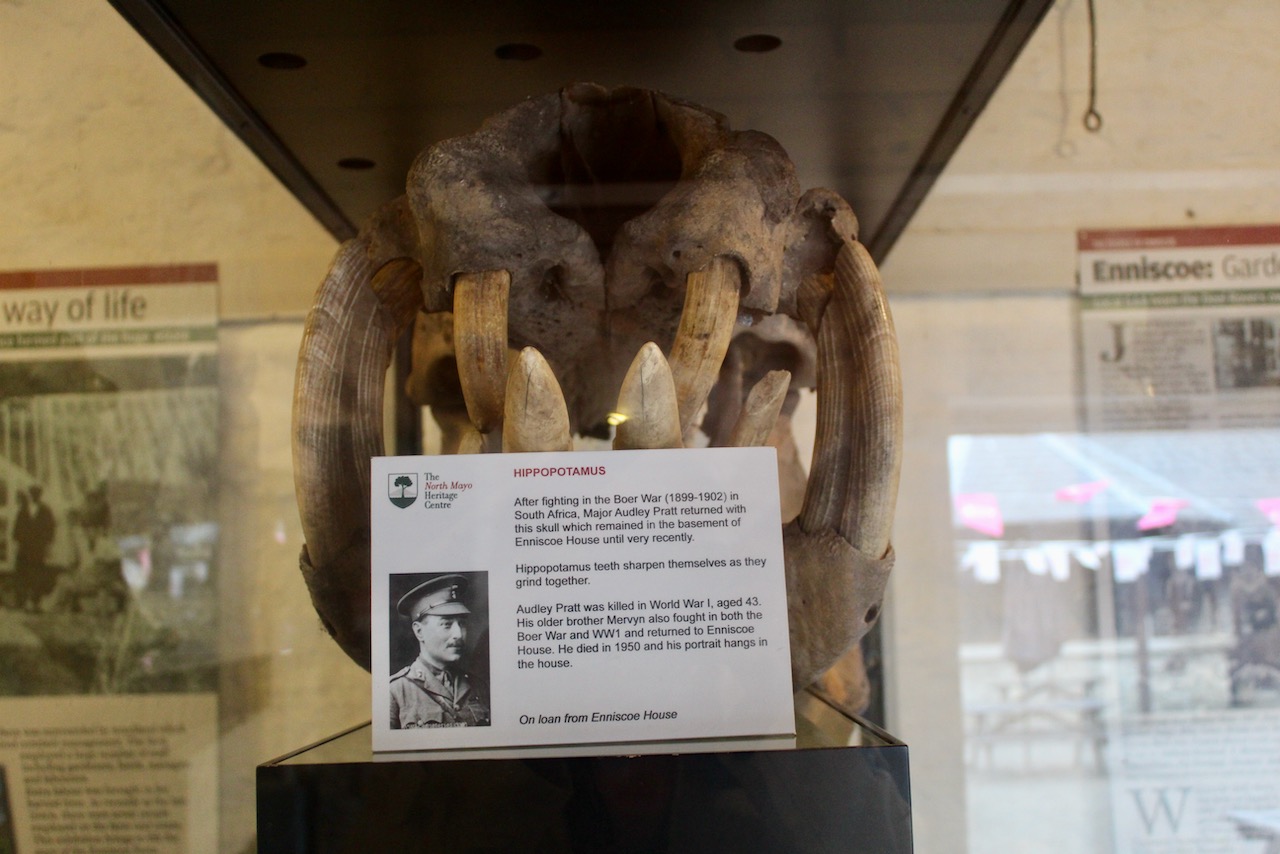
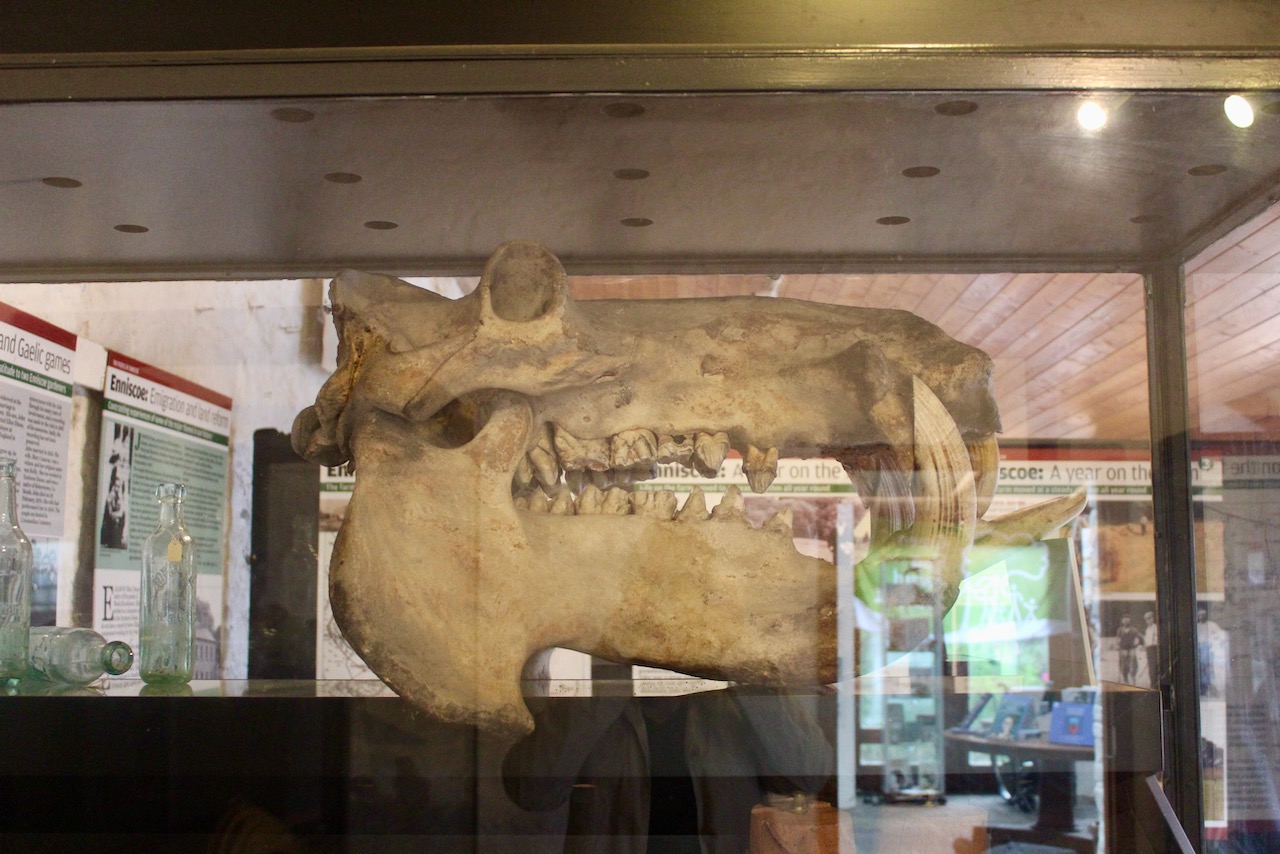
Joseph’s elder son Mervyn was injured in the wars and the younger Audley was killed in the First World War. The Heritage Centre located in the walled garden at Enniscoe displays a hippo skull which Audley brought home from Africa when he fought in the Boer War (1899-1902).
Major Mervyn lived all his life in Enniscoe, and was particularly interested in gardening and fishing. His rock garden and greenhouses were well-known. He never married, and left Enniscoe to his cousin Jack Nicholson, Susan’s father (Jack was a great-grandson of Madeline Jackson). Mervyn did not spend much time in Cabra Castle in County Cavan which he also inherited, and he left it to another cousin, Mervyn Sheppard.
Jack Nicholson married Patita Bourke, daughter of Captain Bertrim Bourke of Heathfield, County Mayo. In his blog, David Hicks tells us that Heathfield was purchased by the Land Commission and the family were allocated a farm at Beauparc, County Meath. He adds that former President of Ireland Mary Robinson was from the Bourke family of Heathfield.
Jack was a Professor of Veterinary Medicine, so I felt a bond with Susan, as my father, Desmond Baggot, was also a Professor of Veterinary Medicine! Jack was head of the Veterinary College of Ireland, so perhaps their paths crossed as my father was studying there at the time of my birth, before we moved to the United States where my father did his PhD in Ohio State University. Jack died in 1972 and Enniscoe house and lands passed to his children. In 1984 Susan Kellett took over the property from her brother.
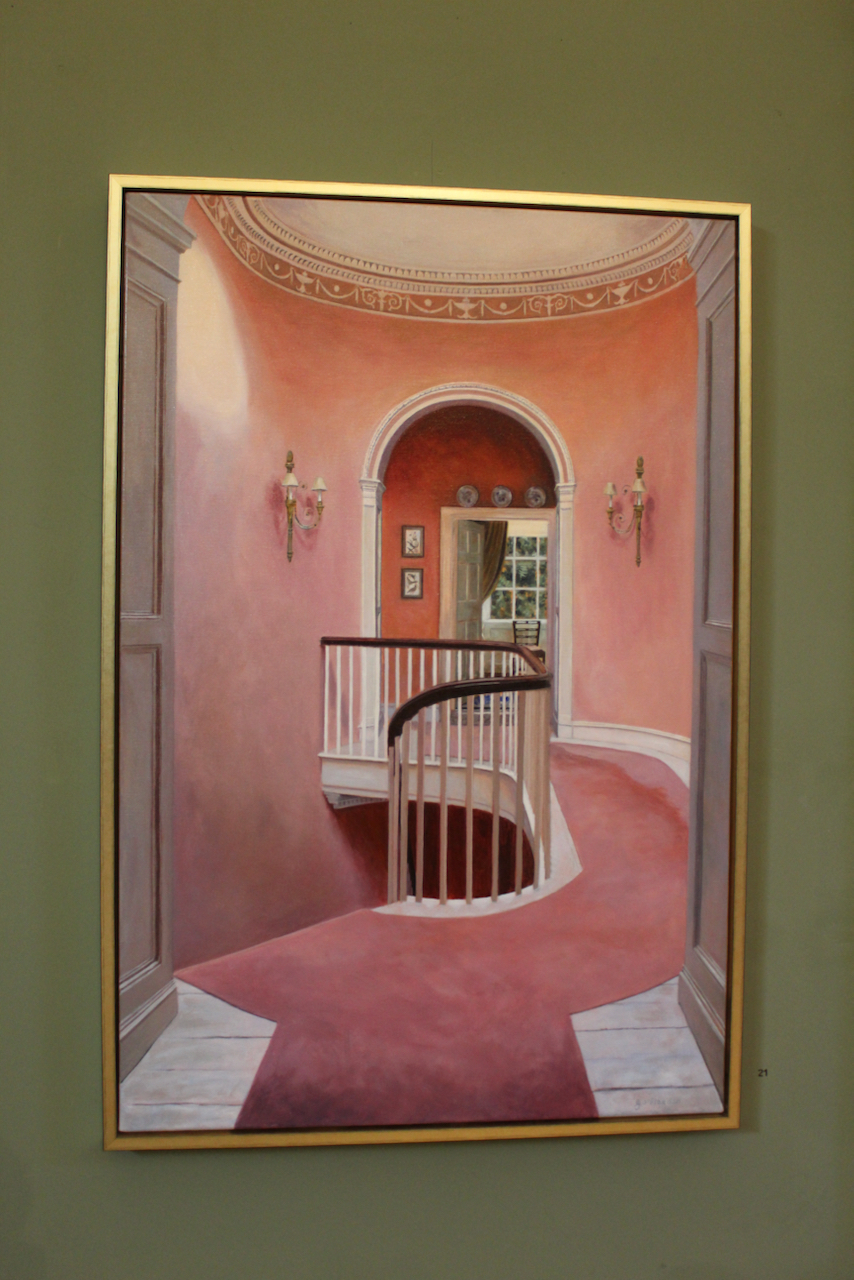
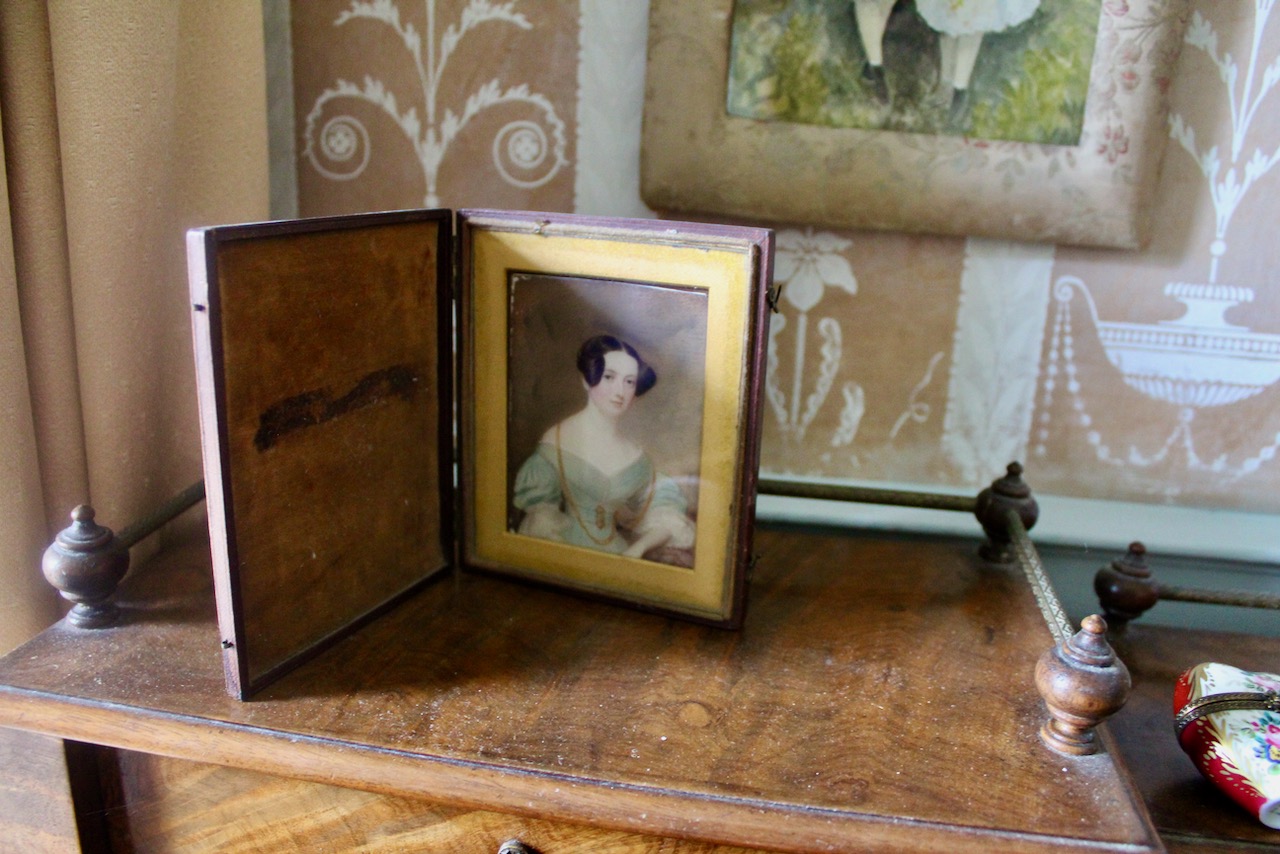
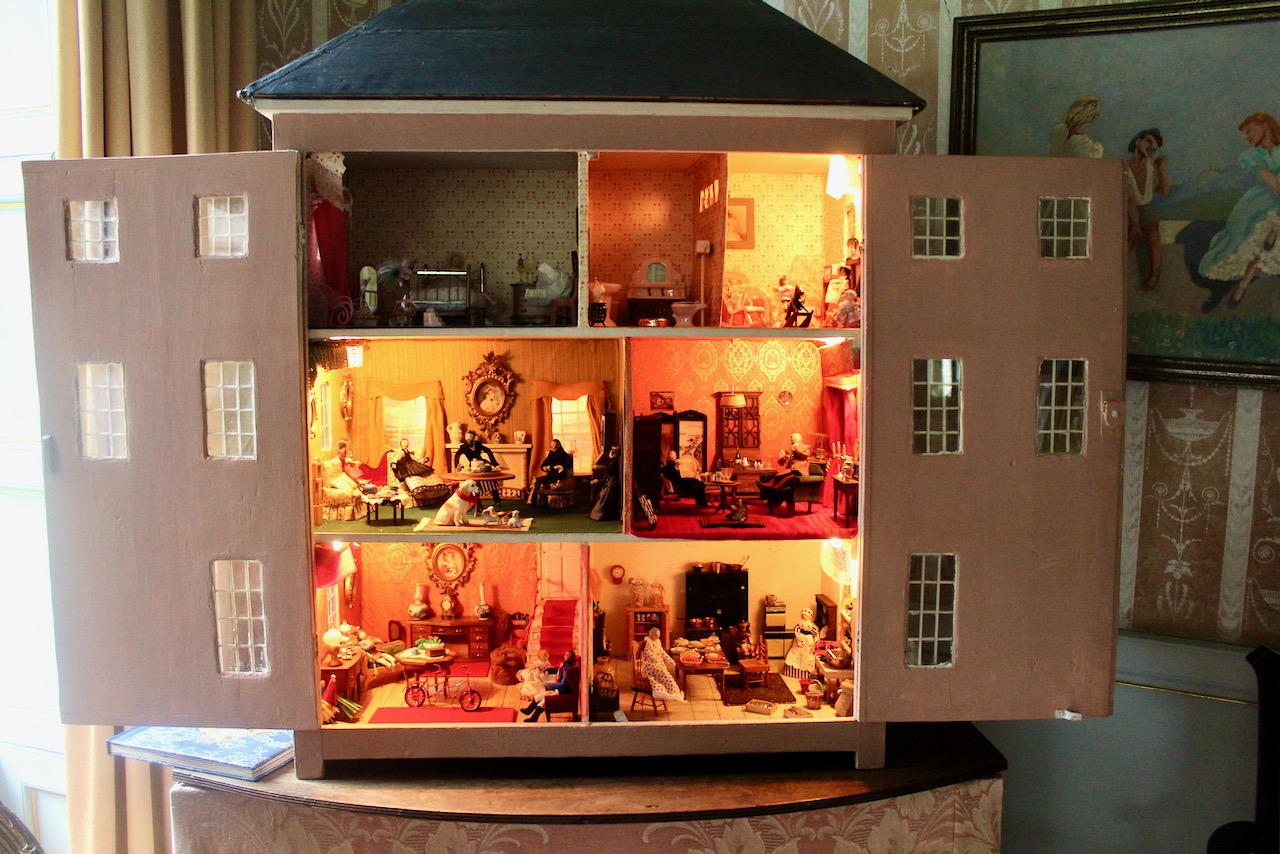
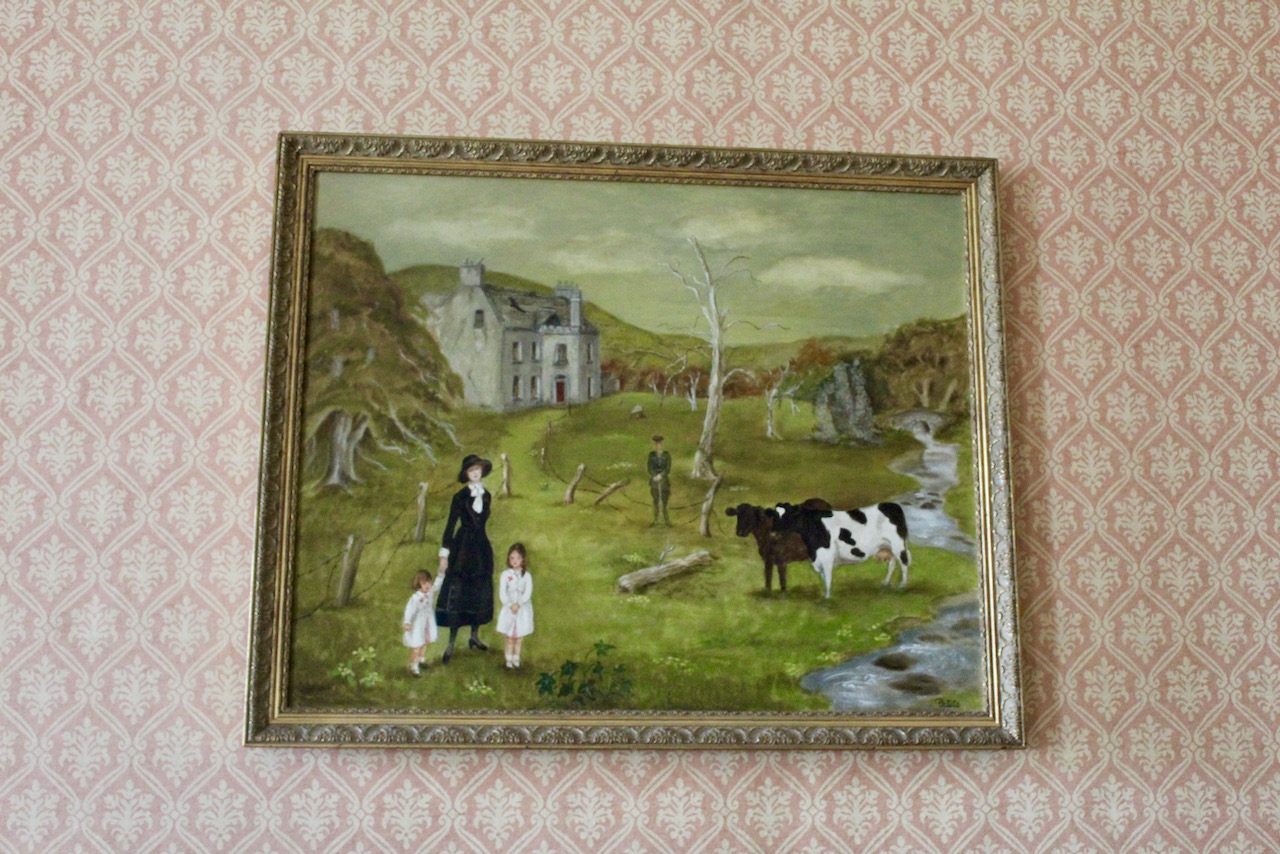
The house is full of Patita’s creative and sometimes cheeky paintings.
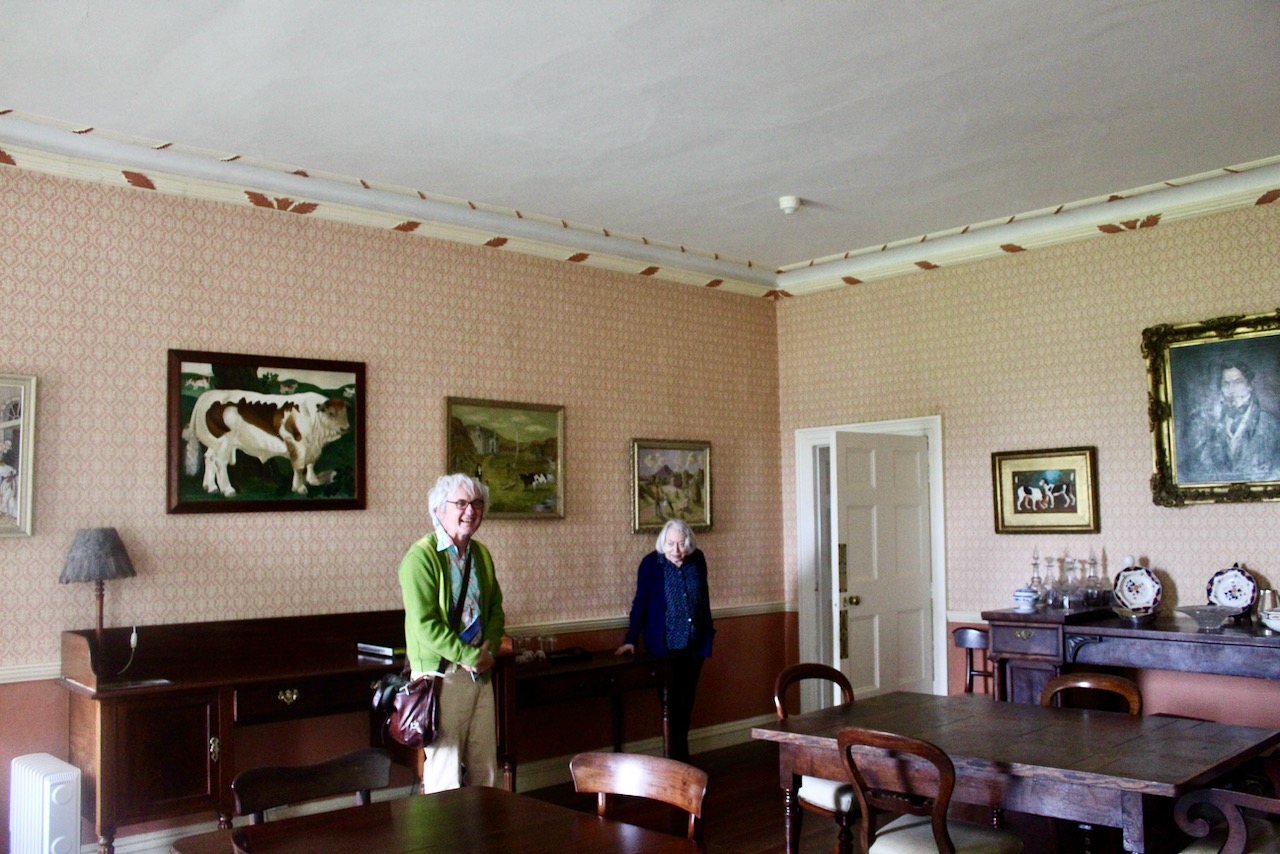
The dining room was originally the library. The side nook was created by Susan’s parents. It has a simple early nineteenth century cornice of reeding and acanthus leaves.
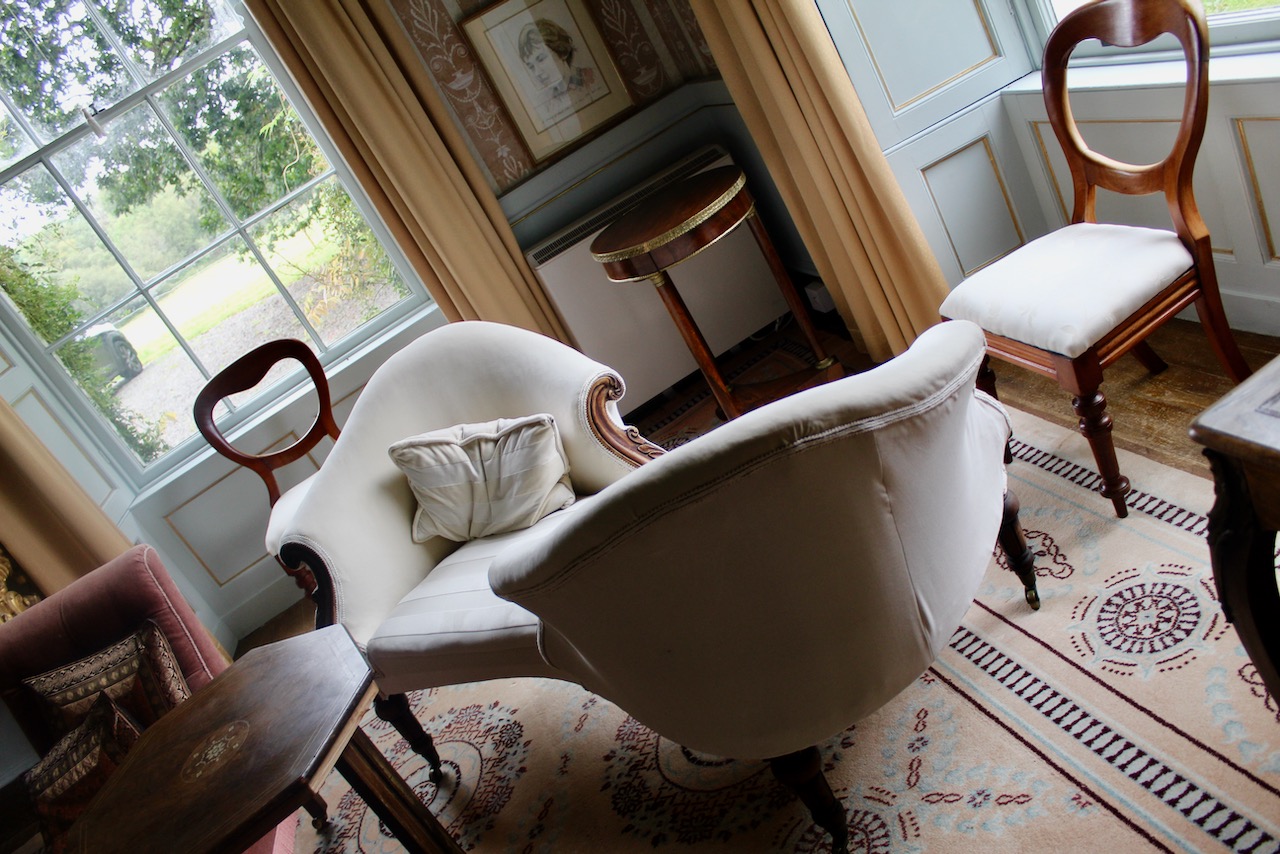
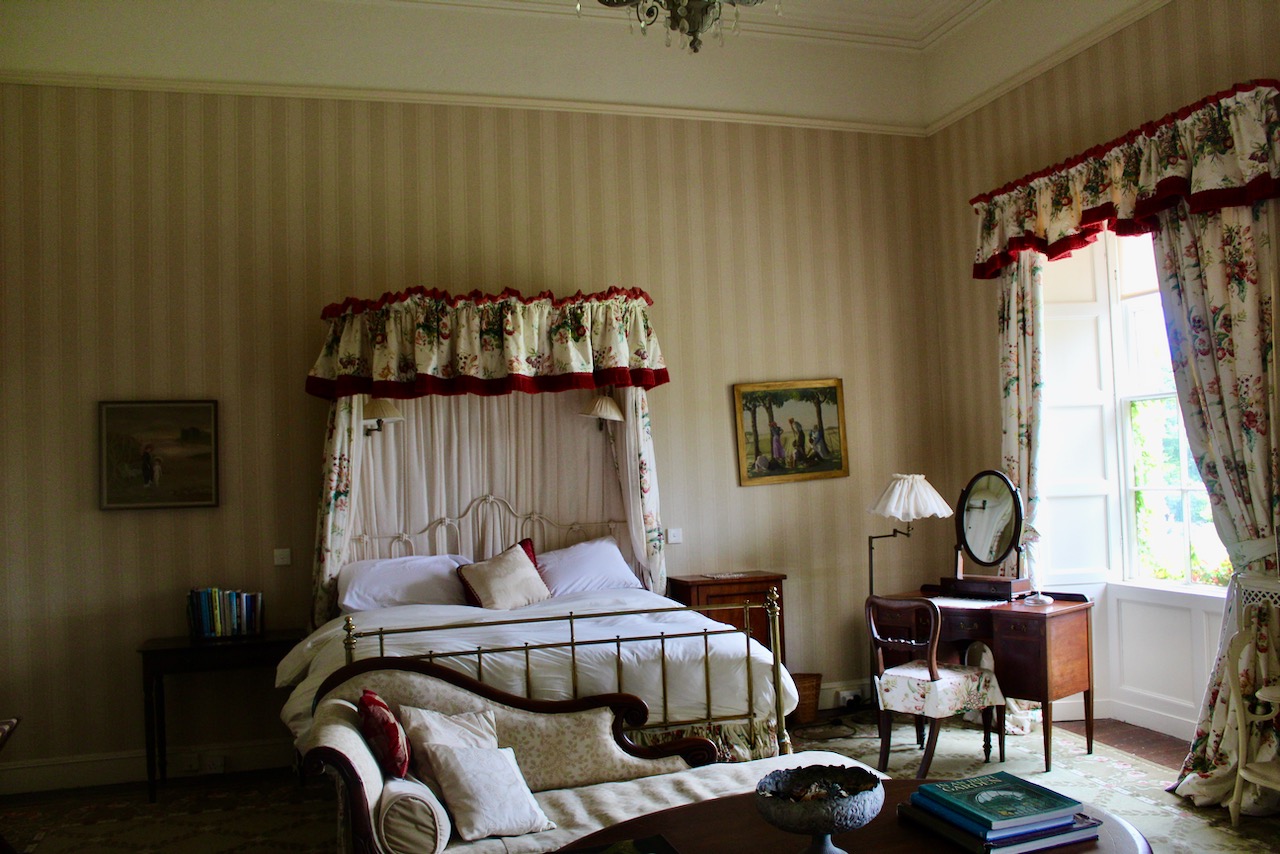
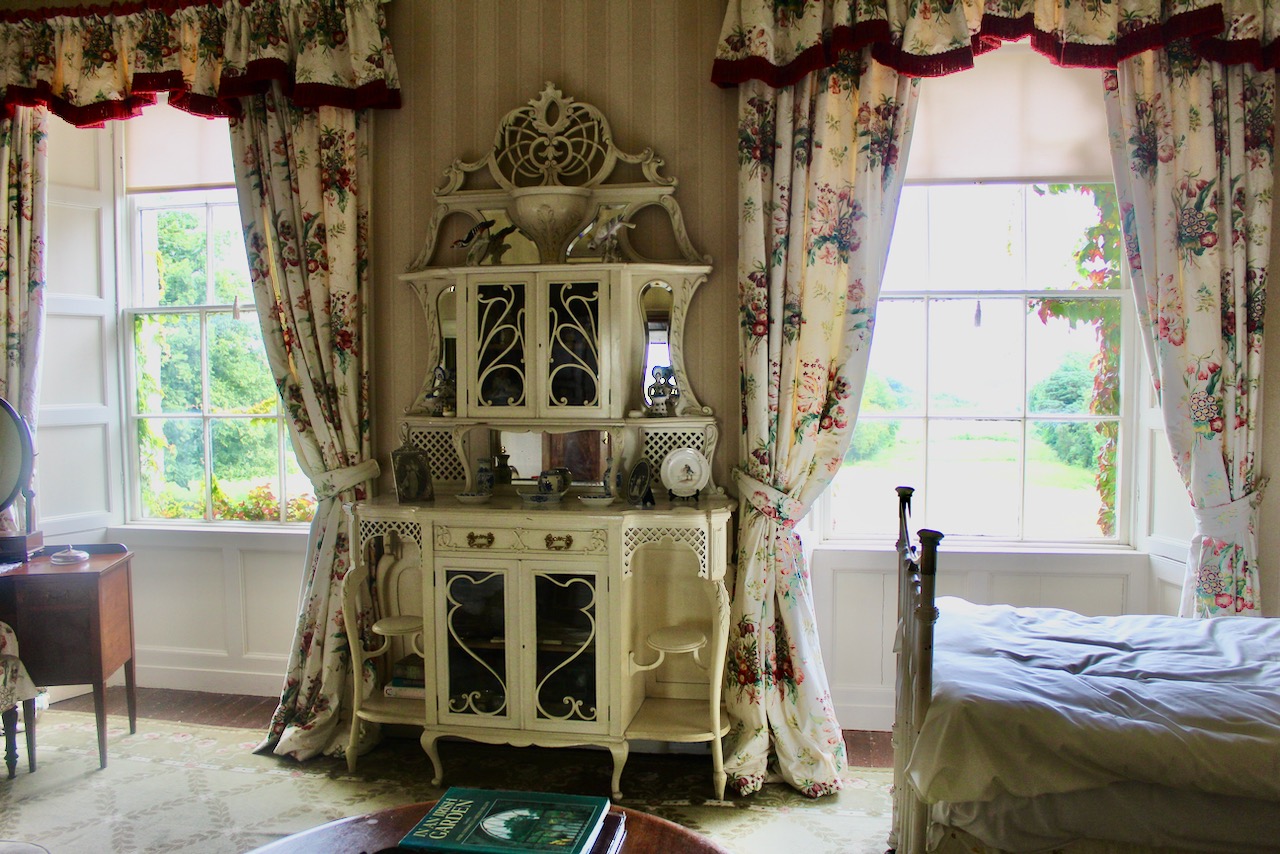
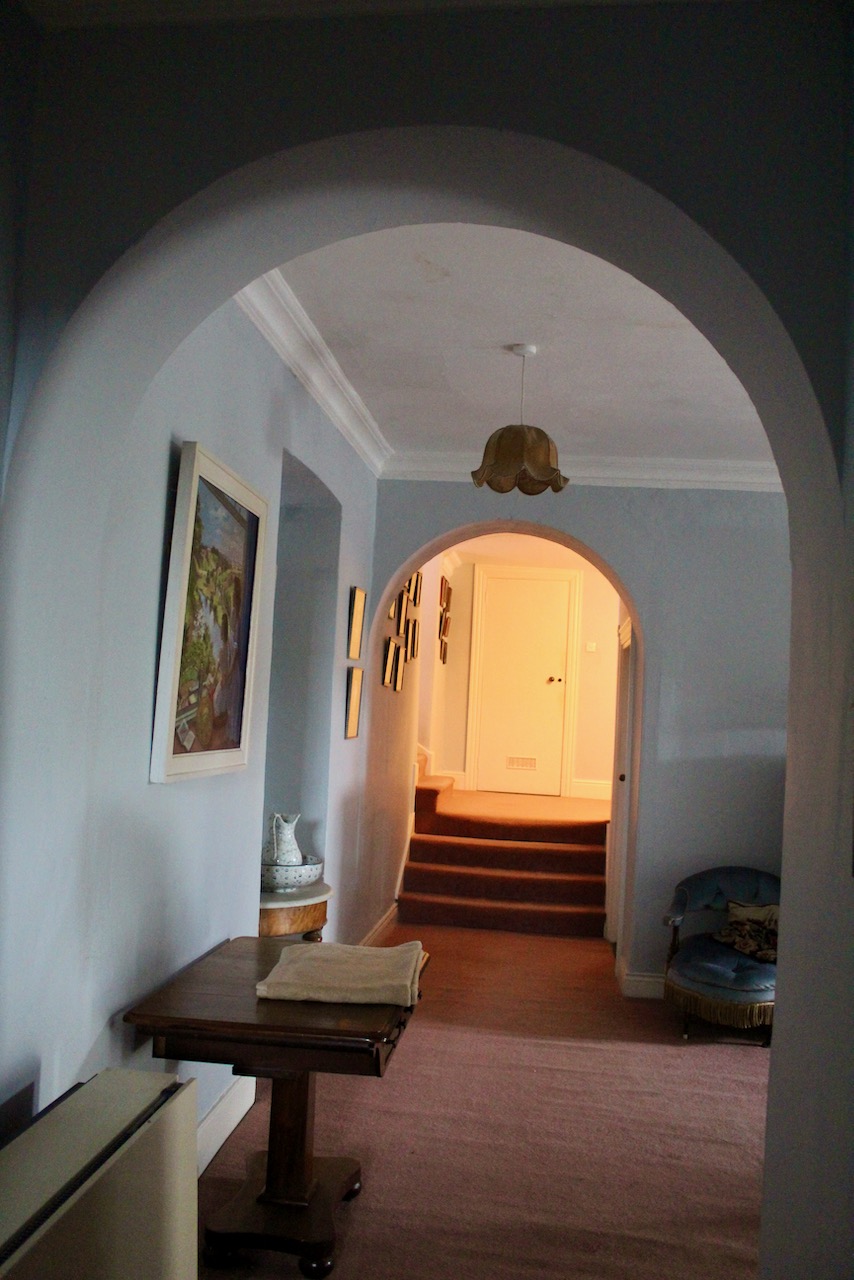
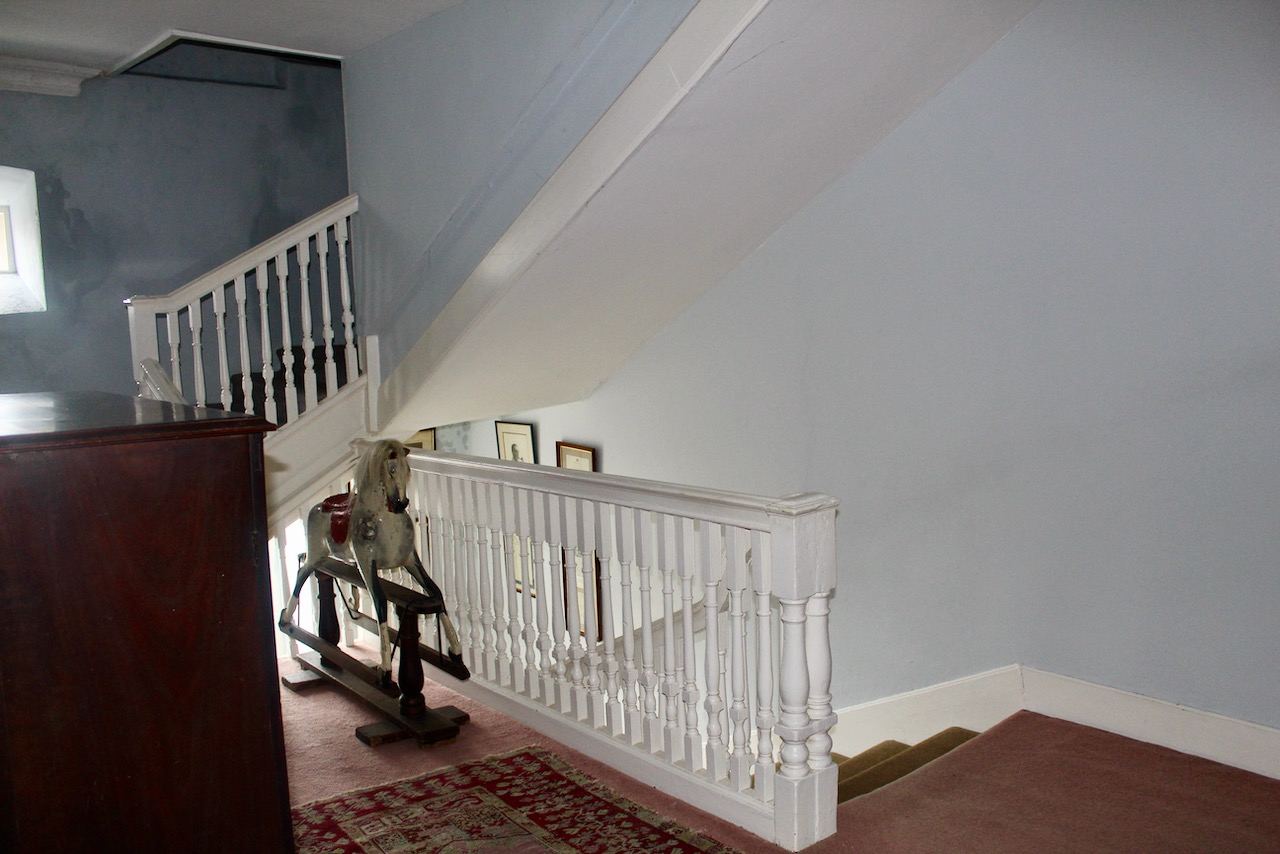
Next we went up to the bedrooms. Susan’s son DJ and his wife Colette help to run the guest house. The main bedrooms open off the oval top-lit landing. They are classically proportioned large rooms with canopy or four poster beds, all with en suite bathrooms.
After our wonderful tour, we headed over to the walled garden and the North Mayo Heritage Centre, which also provides a genealogy service. [11] It is a member of the Irish Family History Foundation, which provides a country wide service through the website RootsIreland. North Mayo Heritage Centre covers the northern half of County Mayo, and the Centre in Ballinrobe covers the southern half.
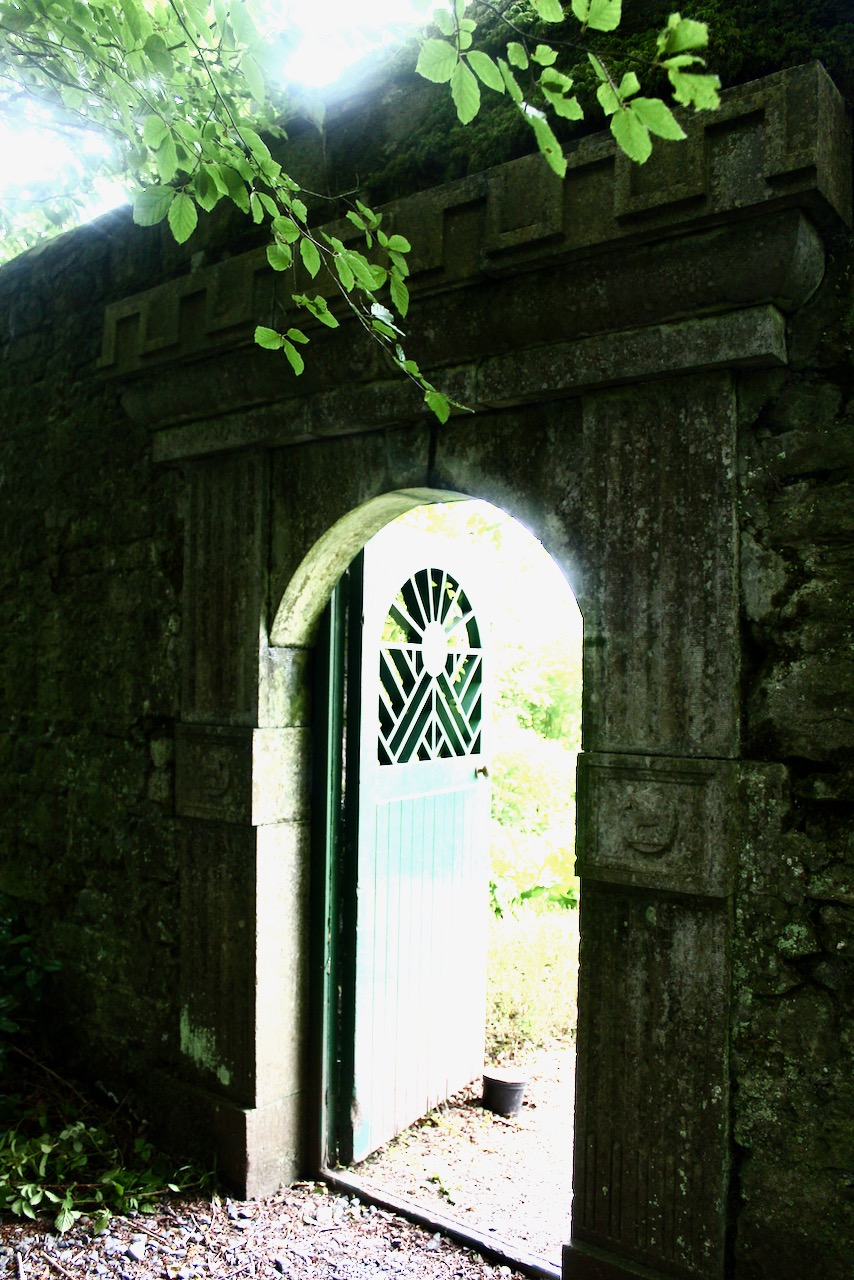
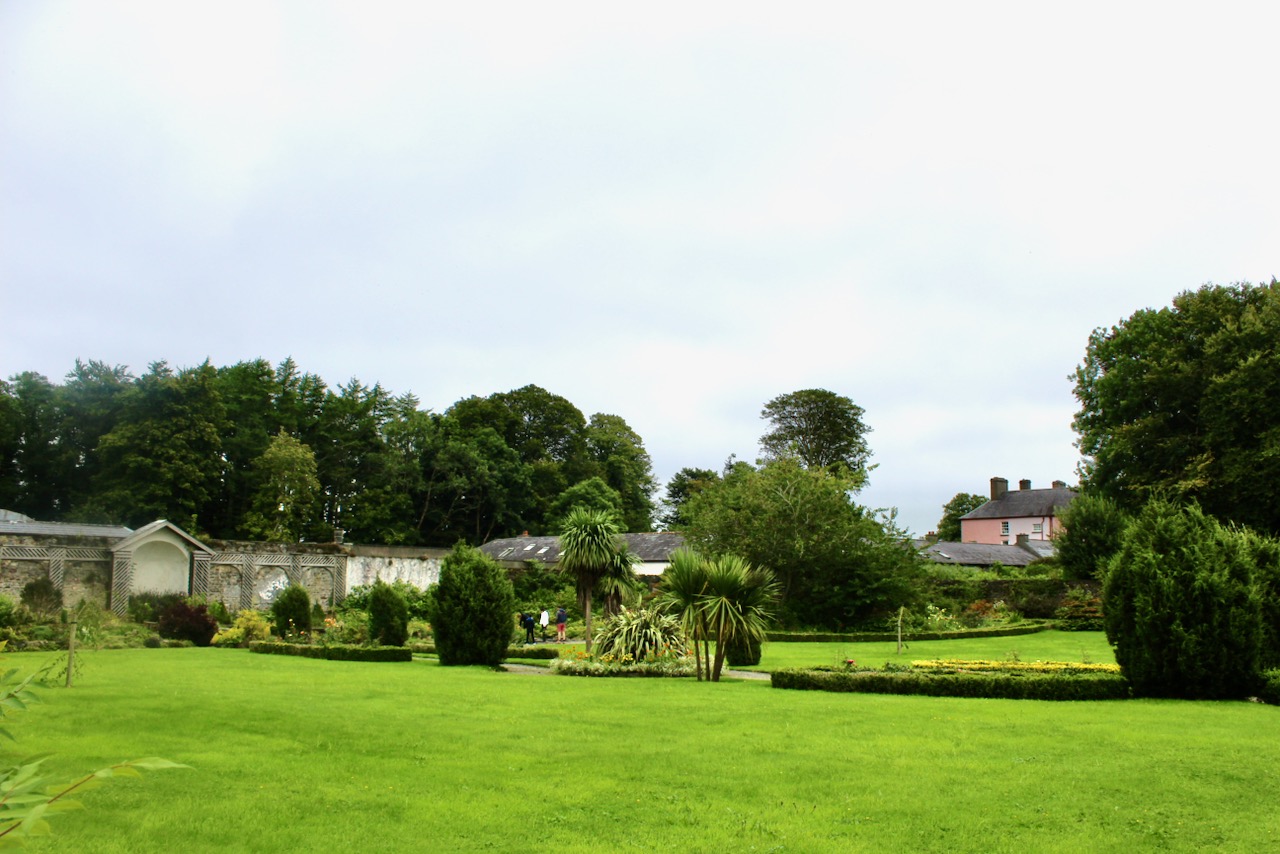
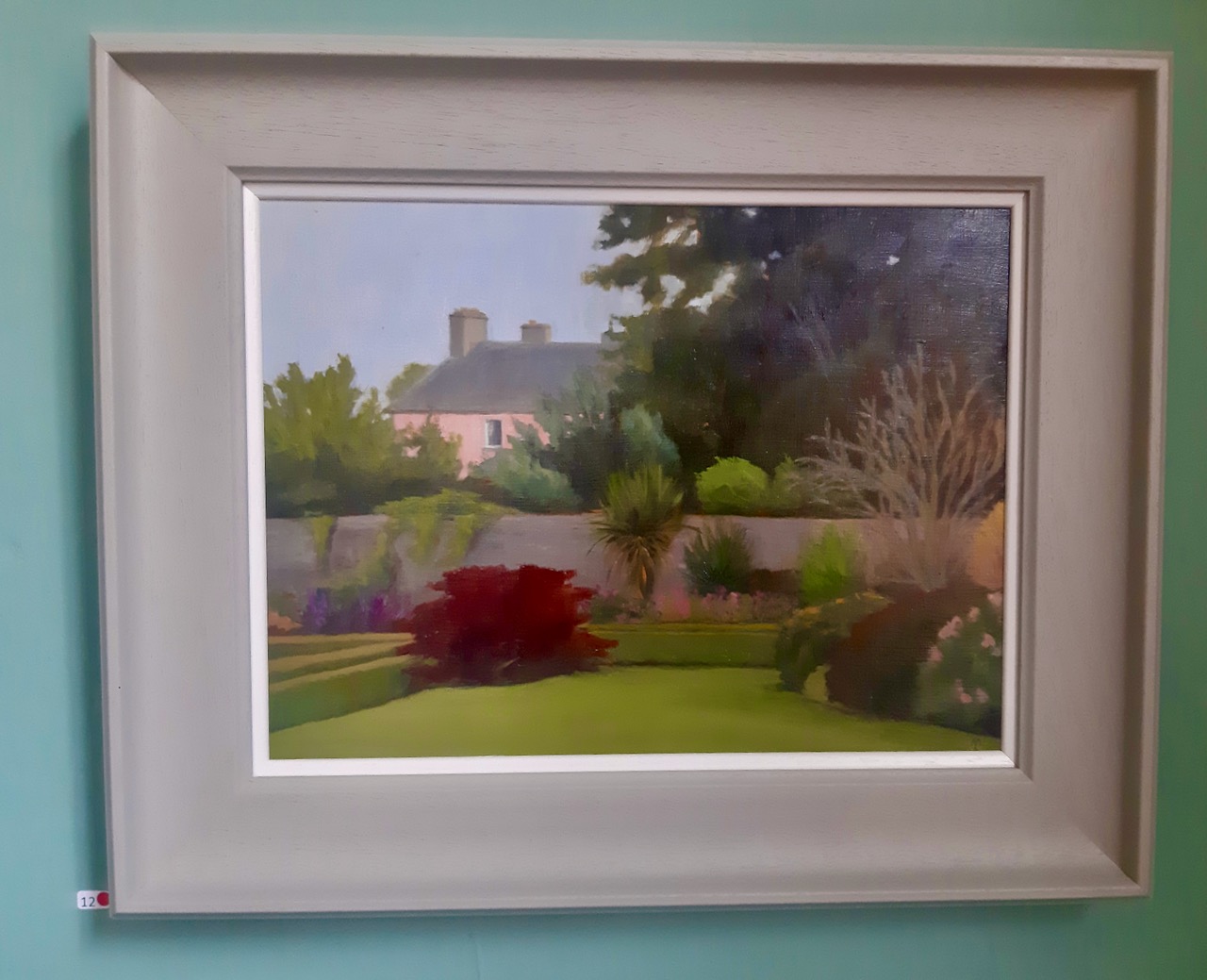
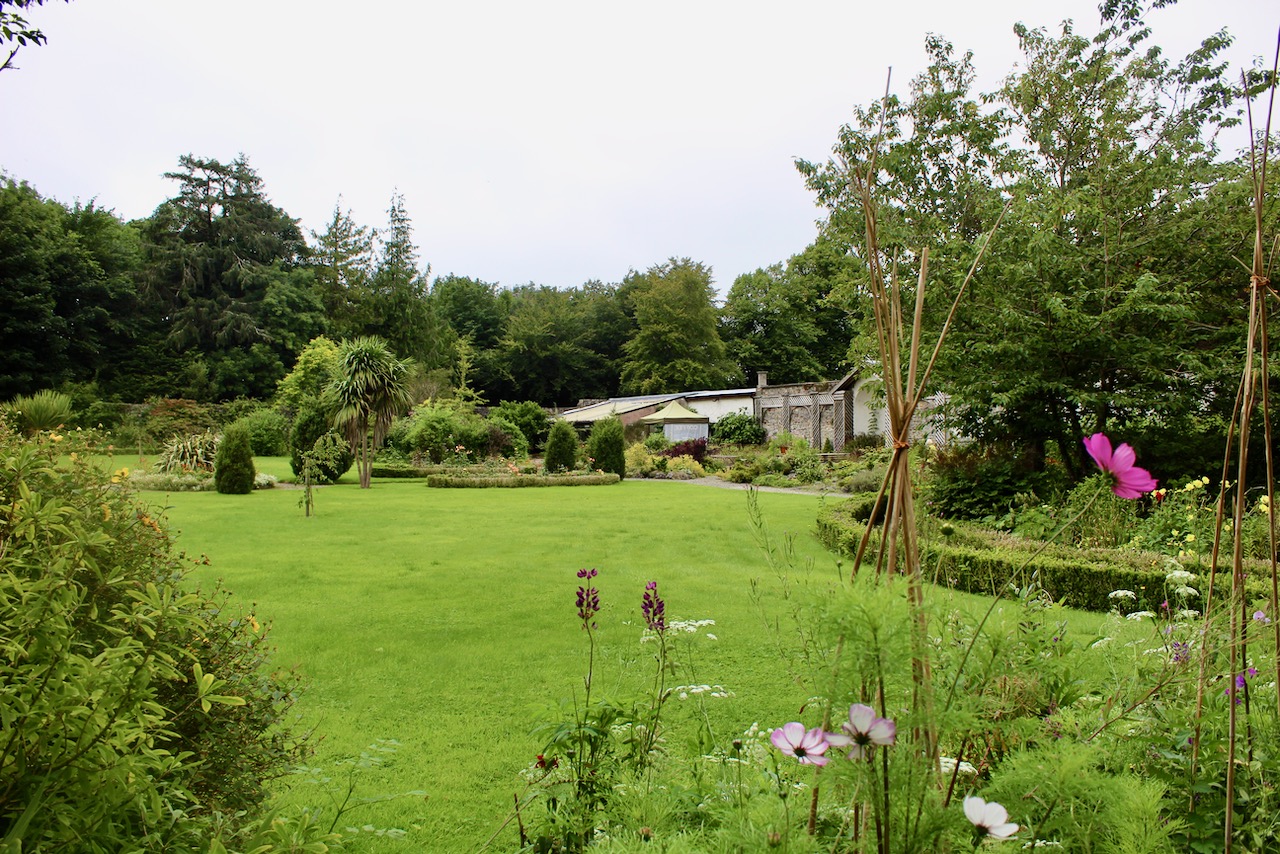
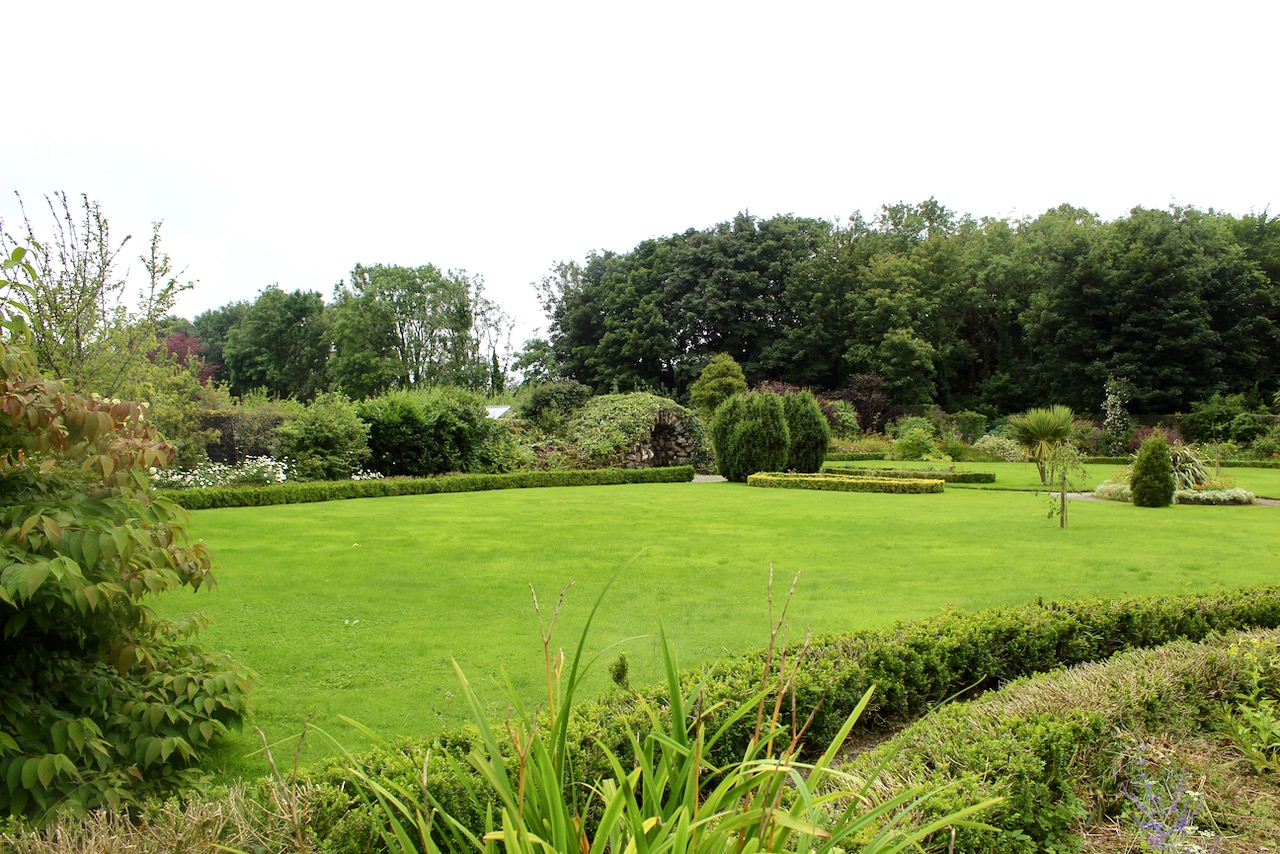
The walled garden was restored in 1996-9 under the Great Gardens of Ireland Restoration Programme. The head gardener at Enniscoe from 1872 to 1912 was William Gray, who moved to Enniscoe from St. Anne’s in Clontarf, where he had worked on Benjamin Lee Guinness’s estate. Much of the present ornamental garden is much as it was in William’s day.
[8] p. 151. Great Irish Houses. Forward by Desmond FitzGerald and Desmond Guinness. IMAGE Publications, 2008.
[9] Guy Beiner’s book entitled Remembering the Year of the French (University of Wisconsin Press, 2007) discusses folk history and how this French incursion and the 1798 Rebellion in Mayo is remembered.










































 Irish Historic Houses