A place providing group accommodation let me know that my “places to visit and stay” pages for each county can cause confusion, since places of accommodation are not necessarily ones you can visit. Therefore I am separating into pages of places to visit, and places to stay. I will be republishing these over the next few weeks.
Carlow:
Places to stay, County Carlow
1. Huntington Castle, County Carlow– B&B and self-catering
2. Kilgraney House, County Carlow– holiday rental courtyard and cottage suites
3. Killedmond Old Rectory, County Carlow– shepherd’s huts
4. Lisnavagh, County Carlow – holiday cottages and wedding venue
5. Lorum Old Rectory, Kilgreaney, Bagenalstown, County Carlow– B&B
6. Mount Wolseley, Tullow, Co Carlow – hotel
Group holiday rental or wedding venues in County Carlow
1. Ballykealey, Tullow, Co Carlow – wedding or event venue
2. Borris House, Borris, County Carlow– wedding venue
3. Lisnavagh, County Carlow – holiday cottages and wedding venue
4. Sandbrook, Tullow, Co Carlow – whole house rentaland an apartment in house
donation
Help me to pay the entrance fee to one of the houses on this website. This site is created purely out of love for the subject and I receive no payment so any donation is appreciated!
www.huntingtoncastle.com Open dates in 2026, but check website as sometimes closed for special events: Jan 31, Feb 1, 7-8, 14-15, 21-22, 28, Mar 1, 7-8, 14-15, 21-22, 28-31, Apr 1-6, 11-12, 18-19, 25-26, May 1-31, June 1-30, July 1-31, Aug 1-31, Sept 1-30, Oct 3-4, 10-11, 17-18, 24-31, Nov 1, 7-8, 14-15, 21-22, 28-29, Dec 5-6, 12-13, 19-20, 11am-5pm Fee: house and garden, adult €13.95, garden only €6.95, OAP/student, house and garden €12.50, garden only €6, child, house and garden €6.50, garden €3.50, group and family discounts available
Huntington Castle bedroom, photograph courtesy of Huntington Castle website.
2. Kilgraney House, County Carlow – holiday rental courtyard and cottage suites
Kilgraney House, Co Carlow, photograph by Sonder Visuals 2022 for Failte Ireland
“Kilgraney is a gracious Georgian country house with courtyard suites and cottages overlooking the Barrow valley. The property is less than ninety minutes by car from Dublin and is located halfway between Bagenalstown and Borris village. Kilgraney Courtyard Suites and Cottages are open for B & B packages from May to October 2022.
“Surrounded by extensive gardens and granite stone courtyards filled with culinary, aromatic and medicinal plants, the property offers guests a memorable country house experience in a tranquil rural setting on the Carlow Kilkenny border.
“Since 1994 we have been inspired by Kilgraney and captivated by what the surrounding countryside, towns and people have to offer. For the 2020 season we have decided to take a break from the kitchen and close our dining room. We will continue to offer our renowned breakfast and can recommend some very fine local restaurants.
“Through words and images we invite you to our home and we hope that they entice you to come and experience Kilgraney for yourself.
“At Kilgraney House we create a place of peace and tranquility and therefore we close the house at 1.00 am. If you wish to stay out later than this please book one of our courtyard suites, the garden cottage or the lodge.“
“The house is a charming late Georgian house, overlooking the Barrow valley, and is conveniently situated halfway between Kilkenny city and Carlow town. The house takes its name from the Irish ‘cill greine’ which means ‘sunny hill’ or ‘sunny wood’.
“Kilgraney (Kilgreaney ) has seen many changes over the centuries. The house, spelt Kylgrany, appears on Mercator’s Map of Carlow in 1595 and parts of the lower courtyard, reached through the kitchen garden, date to around this time. The main house was built around 1820 although the north wing is part of older dwelling and thought to be mid-18th century. A fire in the 1920’s destroyed the original interiors and the rebuilding left Kilgraney House with a Georgian exterior and a plain early 20th century interior. Now carefully restored, the house has immense character and a simple elegance that is full of irony and amusement. The lush interiors are an eclectic mix of traditional furniture with carefully chosen pieces of fabric, furniture and art from around the world.“
Source: Ireland’s Blue Book of Country Houses & Restaurants.
3. Old Rectory Killedmond, Borris, Co CarlowR95 N1K7– section 482 with shepherd hut accommodation
The National Inventory tells us that it was designed around 1847 by Daniel Robertson. It was built for William McClintock-Bunbury (1800-1866). Around 1953, it was truncated and reordered, to make it more liveable, and this was designed by Alan Hope.
Lisnavagh is a wedding venue, and there are buildings with accommodation, including the farm house, converted courtyard stables, the groom’s cottage, schoolhouse, farm and blacksmiths cottages and the bothy.
Weddings at Lisnavagh, photograph courtesy of website.
The website tells us that:
“The estate is owned by William & Emily McClintock Bunbury. Lisnavagh House & Gardens is managed by Emily and William along with a hardworking and dedicated team in both the house and the gardens.
“William McClintock Bunbury returned to Lisnavagh in 2000 with a view to creating a financially sustainable life and business on the estate. In 2001, The Lisnavagh Timber Project was established and during the following years parts of Lisnavagh Farmyard were refurbished into offices some of which now house the family enterprises.“
The Library, Lisnavagh, courtesy of website.
In his book about the Carlow Gentry, Jimmy O’Toole writes:
“The Bunbury wealth was considerably enhanced after the marriage of a later generation William Bunbury to Catherine Kane, daughter of Redmond Kane, a wealthy Dublin merchant in 1773. William [who lived at Moyle, County Carlow], who was elected MP for Carlow in 1776, was killed two years later when he was thrown from his horse in Leighlinbridge. It was the marriage of William and Catherine’s only daughter, Jane Bunbury to John McClintock, MP, of Drumcar, Co Louth, in 1797, that linked the Bunbury and McClintock names. It was their son John who was created Lord Rathdonnell on 21st Dec 1868. Their second son, William Bunbury-McClintock-Bunbury, born 1800, in compliance with the will of his maternal uncle Thomas Bunbury, MP, assumed the name of Bunbury in addition to that of McClintock. The McClintocks were an old Scottish family and the first to settle in Ireland was Alexander McClintock, who purchased the Rathdonnel estates in County Donegal in 1597, from where the title originated.” [7]
John McClintock married a second time, to Elizabeth Le Poer Trench, daughter of the 1st Earl Clancarty.
Mark Bence-Jones writes in his A Guide to Irish Country Houses (1988):
William Bunbury and Catherine Kane had two sons, Thomas and Kane. Jimmy O’Toole writes about these brothers (p. 66):
“The election of 1841, when Thomas Bunbury and his Tory colleague Henry Bruen II, defeated Daniel O’Connell Jr and John Ashton Yates, was one of the bitterest election contests every witnesses in County Carlow…. A bachelor, Thomas’s 6000 acre estate in the parishes of Kellistown, Rathmore and Rathvilly, passed to his brother Kane after his death.”
O’Toole continues:
“His seat in Parliament was taken by his nephew William McClintock-Bunbury [1800-1866, son of John McClintock and Jane Bunbury], who was returned unopposed, and held the seat for sixteen years with a brief interruption in 1852. William had served as a Captain with the Royal Navy during the 1820s and 1830s…After inheriting the family’s Carlow estates, he completed the building of Lisnavagh, a large and rambling Tudor-Revival house of granite, in 1847. The architect was John McGurdy. That year, William and his wife Pauline, daughter of Sir James Stronge of Tynan Abbey in Armagh, and their young family, moved from Louth to live at Lisnavagh.”
p. 187. “[Bunbury/LG1863; McClintock-Bunbury, Rathdonnell, B/PB] A large and rambling Tudor-Revival house of grey stone, built 1847 for William McClintock-Bunbury, MP, brother of 1st Lord Rathdonnell, to the design of John McCurdy. Many gables and mullioned windows; some oriels; but all very restrained, with little or no ornament and hardly any Gothic or Baronial touches apart from a porte-cochere on the service wing, which was set back from the main entrance front, and a loggia of segmental-pointed arches at the other side of the house. The port-cochere served the luggage entrance; the hall door having no such protection. Staircase of wood, ascending round large staircase hall. Drawing room with ceiling of ribs and bosses and marble chimneypiece in Louis Quinze style, en suite with library; richly carved oak bookcases. The house was greatly reduced in size ca. 1953 by 4th Lord Rathdonnell [William Robert McClintock-Bunbury (1914-1959) – with much help with his wife Pamela]; that part which contained the principal rooms being demolished, and the service wing being adapted to provide all the required accommodations. The porte-cochere, which comes in the middle of the entrance front of the reduced house, is now the main entrance. Because of the irregular plan of the house as it originally was, the service wing only abutted on the main building at one corner, which has been made good with a gable and oriel from the demolished part; so that the surviving part of the house looks complete in itself; a pleasant Tudor-Revival house of medium size rather than the rump of a larger house. A large library has been formed out of several small rooms; it is lined with the bookcases from the original library, and with oak panelling and Cordova leather of blue-green and dull bronze-gold. Fine baronial gate arch.”
The house remains in the family.
A bedroom at Lisnavagh, photograph courtesy of website.The farmhouse at Lisnavagh, available for accommodation, photograph courtesy of website.The Grooms Cottage, Lisnavagh, available for accommodation, photograph courtesy of website.
Lorum Old Rectory, County Carlow, photograph from National Inventory of Architectural Heritage [3]
www.lorum.com Tourist Accommodation Facility– not open to the public Open for accommodation: April-October
The Irish Historic Houses Association website tells us:
“The valley of the River Barrow is particularly beautiful, especially downstream from Bagenalstown where the river, which forms the boundary between Counties Carlow and Wexford, flows along the western foothills of the Blackstairs Mountains. The Barrow passes through the towns of Borris and Graiguenamanagh and the village of St. Mullins, where the valley sides become increasingly steep. In the late 1850s Denis Pack-Beresford [1818-1881], a local landowner from nearby Fenagh, donated land for a new church and rectory at Lorum near Kilgreaney, a small hamlet overlooking the river under the shadow of Mount Leinster. ” [4]
Denis Pack took the name Beresford from his mother, Elizabeth Louisa Beresford who was a daughter of George De La Poer Beresford, 1st Marquess of Waterford, of Curraghmore.
The Irish Historic Houses continues: “Lorum is a restrained Gothic building of warm, golden Carlow granite and a fine example of a Victorian country rectory. Of two storeys, the principal fronts are all of three bays, with a studied asymmetry that falls just short of becoming symmetrical. There are many gables and the entrance is recessed beneath a wide gothic arch, which acts as a porch and helps to give the building a solid, comfortable appearance that embodies the religious certitudes of the Church of Ireland during the last years of establishment.
The interior is decorated in a mild and restrained Victorian Gothic; bright and airy, not too large or grand but solid and respectable. While Lorum may well have been built to the designs of Welland and Gillespie, there is little doubt that the dominant influence was the religious architecture of Augustus Welby Pugin.” (see [7])
William Joseph Welland and William Gillespie, the Dictionary of Irish Architects tells us, were appointed joint architects to the Ecclesiastical Commissioners in May 1860, following the death of Joseph Welland. According to this dictionary, both men were already in the employment of the Commissioners, and they held the post until the disestablishment of the Church of Ireland on 31 December 1870. During their ten years in office, they developed an increasingly personal and idiosyncratic version of Gothic in the churches which they designed. They designed many churches, all over Ireland.
Lorum Old Rectory, photograph from website.
The Irish Historic Houses website tells us: “The first rector was the Revd. King Smith who was installed at Lorum in 1863 and the house continued in use as a rectory until 1957, when it was offered for sale by the parish and bought by Tennant Young, father of the present owner.” (see [4])
A Carlow county website tells us that:
“In the second half of the 20th century the Church of Ireland passed thorough a period of rationalisation. Parishes were amalgamated; churches closed and a number of rectories became redundant and were sold. Among these was Lorum Old Rectory which Mr. Young purchased as a home for his family. Fast forward for another thirty-five years and his daughter Bobbie, on inheriting the house, was forced to make it pay and, together with her late husband Don, decided to provide country house accommodation for visitors to the region.” [5]
The Irish Historic Houses website continues: “To the north is a small, enclosed stable yard with a coach house for the rector’s trap, a stable for his horse, and quarters for his groom and other servants. Today Lorum is unusual because both house and grounds have been so little altered, a fate shared by few other Irish rectories.” (see [4])
The National Inventory describes is as:
“Detached three-bay two-storey Tudor Revival former rectory with half-dormer attic, c. 1864, with mullioned window openings, gables and series of service wings. Now in use as guesthouse. Stable complex to rear with two-storey coach house.“
The Record of Protected Structures adds that the roof is high pitched, covered with natural slates, and has Victorian, earthenware chimney-pots and has wide eaves.
The Old Rectory Lorum website tells us:
“Lorum is a place known to a few – but in the 19th century, when the protestant church of Ireland enjoyed wealth and state patronage, it was the spiritual hub of a parish which included an exceedingly comfortable and spacious rectory. The clergy have departed and the rectory is now the property of Bobbie Smith, who provides guests with fantastic dinners in a dining room which retains its hint of 19th century opulence. Antique bedrooms with modern comforts provide for rest, to be followed by a most splendid breakfast. The lady of the house, incidentally, is a mine of information on Carlow and the organiser of bicycle tours in the region.“
Mount Wolseley County Carlow photograph courtesy of website.
The Record of Protected Structures describes Mount Wolseley:
“A three-bay, two-storey, Italianate house designed by the firm of Sir John Lanyon about 1870. It has painted, lined and rendered walls, a basement, raised coigns, string courses, an enclosed porch with a segmental-headed doorcase and side lights, windows with architraves, wide, bracketed eaves and a hipped roof with a pair of stacks. The sash windows have large panes of glass. On the left-hand side is a service wing. The house is well maintained and in use as a hotel.“
Mark Bence-Jones writes in his A Guide to Irish Country Houses (1988):
p. 218. “(Wolseley, Bt, of Mount WolseleyPB) A two storey slightly Italianate Victorian house. Camber-headed windows; ornate balustraded porch; roof on bracket cornice. Wing with pyramidal roof. Now a school.”
Jimmy O’Toole tells us:
p. 211. “Richard Wolseley, from Staffordshire, was the first to settle in Tullow, where he inherited the irish estates of his father, also Richard. The elder Richard, who served with King William III in Ireland, was MP for the Borough of Carlow during the reign of Queen Anne (1703-1713). His son, who served as an MP for the Borough from 1727-1768 – a record continuous tenure of parliamentary representation – was created a Baronet in 1744. The family had 2,500 acres in Carlow and 2,600 acres in Co Wicklow. The Wolseleys, according to O’Donovan’s Ordnance Survey Letters, were the beneficiaries of land grants after the Cromwellian settlement, but his claim that Mount Arran was included is wrong. Mount Arran, purchased from Charles Butler, Earl of Arran, did not come into their possession until some time after 1725, because on 23 March that year, the second Duke of Ormonde leased the estate to Thomas Green of Rahera, Co Carlow. The original of this lease was presented at a meeting of the Royal Society of Antiquaries of Ireland earlier this century, by Fr. James Hughes of Maynooth.” [6]
The house was reconstructed by Sir Thomas Wolseley in 1864 and the estate was sold to the Patrician Order for £4,500 in 1925 by the daughters of Sir John Richard Wolseley. When Sir John died aged forty, he was succeeded in the title by his brother Sir Clement James Wolseley who was probably the last of the family to occupy Mount Wolseley.
In 1994 Mount Wolseley was purchased by the Morrissey family and has since been developed into a four star, quality hotel and 18-hole championship golf course with a range of activities on its doorstep offering guests plenty of things to do on their stay. [7]
Before it was owned by the Wolseleys, the area was called Mount Arran, and belonged to the Baggot family! It belonged to John Baggot. I have tried to research this history. John was father of Mark, who was a founding member of the Dublin Society, and who also owned much property around St. Michan’s and Smithfield. Their land deeds are in Carlow County Library. In John Ryan’s The History And Antiquities Of The County Of Carlow (1833) there is an abstract of convenyances from the Trustees of the Forfeited Estates in County Carlow in 1688:
“The estate of John Baggott, Esq., attainted; which having been granted 26th Feb., 1697, to Joost, Earl of Albemarle [Arnold Joost van Keppel, 1st Earl of Albemarle (1670-1718) a Dutch military leader who fought for William III], were by him, by deeds of lease and release, dated 27th and 28th February, 1698, for the sum of three hundred pounds conveyed to Charles Balwin, of Dublin, Esq., in trust for Mark Baggott, Esq., to whom, by deeds of lease and release, dated 8th and 9th March, 1698, he conveyed the same in execution of the said trusts ; and the said Baggott, by indenture dated 22nd March, 1702, assigned and made over his interest and right of purchasing the premises from the trustees, for three hundred and five pounds ten shillings to said Ph. Savage. — Inrolled 8th April, 1703.”
There were complications over this transaction, as of course the land was not given up willingly! I believe John Baggot fought at the Seige of Limerick, and was present when the truce and Treaty were drawn up, stating that those holding the castle would stop their fighting if they were promised that their land would not be taken from them. Thus, John Baggot’s land should not have been forfeited, despite him being a Catholic. However, John Baggot died and his son Mark should have inherited the land in Carlow and Dublin. Mark’s Protestant neighbours protested, calling Mark Baggot a “violent Papist.”
“Mark Baggot of Mount Arran, Co. Carlow, inquisition of forfeited estate, Baggot produced a deed which settled land on Mark after the father’s death. Jury refused deed and land was granted to Abermarle, from John, but Mark disputed and won. Mark was in the article of Limerick but his father wasn’t. With the passing of the Act of Resumption the estate became vested in the trustees, and Mark accordingly lodged his claim. Before it came up for hearing, his father died, thus the admission of the claim would mean immediate restoration to Mark.
The case was contested, local feeling against Mark amongst Carlow Protestants, as he was called “a violent Papist,” son of John Baggot late of Mount Arran (according to Turtle Bunbury’s website, John Baggot was a Catholic soldier: John Baggot, a Catholic soldier, leased Tobinstown in 1683 from Benjamin Bunbury. Bagot was attainted for serving King James II and his Carlow estates were acquired in 1702 by Philip Savage.). Mark was High Sheriff of Carlow in 1689, “acted with pride against Protestants.“
When John Baggot was outlawed and his estate forfeited, Ormond “quite irregularly” gave fresh lease of Mount Arran to Richard Wolsley, the son of Brigadier William Wolsley. Richard Wolsley did not want to give the house up to Mark Baggot.
Mark had an ally in Bishop William King of Derry and later of Dublin, due to common interest in Maths and barometers! There are many of Baggot’s letters in King’s correspondence. Mark writes to him that “the gentleman who lives in my house..uses all his interest and power to hinder and delay.”
Mark Baggot lost his land at Mount Arran but inherited Shangarry, Ballinrush, Portrussian, in Carlow, and they were preserved in the family and descended to James John Bagot Esq. of Castle Bagot, Rathcoole, County Dublin, the last male of his name (from him they passed to his sister and her husband, Ambrose More O’Ferrall).
Group holiday rental or wedding and event venues in County Carlow
1. Ballykealey, Tullow, Co Carlow – wedding and event venue
Ballykealey House, County Carlow, courtesy of Ballykealey House website.
The website tells us
“The House is available for private hire for family gatherings, retreats or corporate events. Distinct character and warmth characterise the 12 individually appointed bedrooms in the manor house. All have gracious views of the surrounding countryside and retain all the original features of the 19th century house. All bedrooms have recently been renovated and include the modern comforts you would expect to find.” It has twelve rooms in the house and 15 self-catering lodges.
Ballykealey House, County Carlow, courtesy of Ballykealey House website.
Mark Bence-Jones writes in his A Guide to Irish Country Houses (1988):
p. 23. “(Lecky/LGI1937 supp) A somewhat stylized Tudor-Revival house of stucco with stone facings, built ca 1830 for John James Lecky to the design of Thomas A. Cobden, of Carlow. Symmetrical front of two storeys and high attic, with three unusually steep gables ending in finials; recessed centre with three-light round-headed window edged with stonework in a rope pattern above a stone Gothic porch of three arches. Tall Tudor chimneystacks at either end; slender battlemented pinnacles rising from corbels at the angles of the roof parapet. Battlemented single storey wing at one side, prolonged by battlemented screen walls with Gothic gateway. Irregular wing with steep gables and dormers at back. Sold ca 1953. Now a novitiate of the Patrician Brothers.” [2]
Ballykealey House, County Carlow, courtesy of Ballykealey House website.
The Record of Protected Structures describes the house’s porch as a loggia. It adds that the walls are of smooth rendering painted and the windows have late-19th century sashes. There is a single-storey wing on the right-hand side and an arch into the yard. The rear of the house has a two-storey service wing. The interior retains original decoration. The immediate grounds are contained within a ha-ha.
Ballykealey House, County Carlow, courtesy of Ballykealey House website.
Jimmy O’Toole writes in his The Carlow Gentry: What will the neighbours say! Published by Jimmy O’Toole, Carlow, Ireland, 1993. Printed by Leinster Leader Ltd, Naas, Kildare.
Chapter: Lecky of Ballykealy
p. 147. “In 1953, the Lecky name was added to the growing list of departing gentry families from County Carlow. The Ballykealy seat had been in their possession since 1649, but not even three centuries of roots and tradition could hold back the tide of a rapidly changing financial climate that had already accounted for the departure of most of their neighbouring families. The 300 acre estate was bought by the Land Commission, and the house was purchased in the early 1960s for use as a noviciate for the Patrician Brothers, owners of the Wolseley family seat near Tullow since 1925.
“The sale of Ballykealy was the first tell-tale sign of looming financial problems for the last owner, Lieutenant Colonel Rupert Beauchamp Lecky, who moved to London with his family. Within four years, he had more debts than assets, and bankruptcy proceedings were instituted against him… On 26th Sept 1957, the War Office Colonel said his early morning good-byes to his wife and three children, got on a train for central London, and was never seen again by friends and family. Thirty six years on, the missing persons file on Colonel Lecky still remains open at Scotland Yard. ..
p. 149. The Lecky family were one of several Quaker families in Couty Carlow, the first of them having come to County Donegal from Stirling in Scotland during the reign of Eliz I. In 1873, John J. Lecky had 1,440 acres at Ballykealy; John F. Lecky had 44 acres at Lenham Lodge, and W.E.H. Lecky the historian had 721 acres at Aughanure, Bestfield and Kilcock. This property he inherited from his father John Lecky of Newgardens, and from his mother Maria Hartpole of Shrule Castle, Co Laois, he inherited an additional 1,200 acres.“
Ballykealey House, County Carlow, courtesy of Ballykealey House website.Ballykealey House, County Carlow, courtesy of Ballykealey House website.
2. Borris House, Borris, County Carlow– wedding venue and Revenue section 482
Borris House, County Carlow by Suzanne Clarke, for Tourism Ireland, Ireland’s Content Pool. (see [1])
Lisnavagh is a wedding venue, and there are buildings with accommodation, including the farm house, converted courtyard stables, the groom’s cottage, schoolhouse, farm and blacksmiths cottages and the bothy.
Weddings at Lisnavagh, photograph courtesy of website.
The house remains in the family that built it.
A bedroom at Lisnavagh, photograph courtesy of website.The farmhouse at Lisnavagh, available for accommodation, photograph courtesy of website.The Grooms Cottage, Lisnavagh, available for accommodation, photograph courtesy of website.
4. Sandbrook, Tullow, Co Carlow – wedding/retreat venue
Sandbrook House, County Carlow, courtesy of website
The website tells us that Sandbrook is a handsome period country house, originally built in the early 1700s in Queen Anne style [the National Inventory says 1750], and sits in 25 acres of mature parkland on the Wicklow/Carlow border in the heart of the Irish Countryside with views toward Mount Leinster and the Wicklow Mountains. The National Inventory further describes it:
“five-bay two-storey over basement house with dormer attic, c. 1750, with pedimented central breakfront having granite lugged doorcase, granite dressings, two-bay lateral wings, Palladian style quadrant walls and pavilion blocks. Interior retains original features including timber panelled hall and timber staircase.“
Sandbrook House, County Carlow, courtesy of website
It belonged to the Echlin family. There are records of an Anne Echlin who died in 1804 owning Sandbrook (see Jimmy O’Toole’s book, [6]). She seems to have leased it to Clement Wolseley when Mount Arran was burned during the 1798 Rebellion.
She left the property, consisting in total of 500 acres, to Robert Marshall of Dublin, and he sold to Brownes of Browne’s Hill for £488 in 1808. William Browne-Clayton moved to live in Sandbrook after his marriage to Caroline Watson-Barton in 1867 and remained there until he inherited Browne’s Hill on the death of his father, Robert Browne-Clayton, in 1888. Browne’s Hill in County Carlow still stands, a very impressive looking private house listed in the National Inventory.
O’Toole writes: “Sandbrook was another example of the many Irish country houses that attracted senior British army officers when they retired after the First and Second World Wars. General George Lewis bought the house in 1918 and after his wife’s death in 1938 the property was purchased by Brigadier Arthur George Rolleston who had retired from the army.
… In 1959 Sandbrook was purchased by John and Mary Allnatt… In the 1960s, Mrs. Allnatt purchased Rathmore Park for her son from her first marriage, Brendan Foody, but after he had decided not to return to live in Ireland, Rathmore was sold. He inherited Sandbrook following his mother’s death in September.”
The website tells us: “Sandbrook is the perfect venue for a family gathering or wedding celebration. With five interconnecting reception rooms downstairs, a covered terrace, huge lawn space and a separate loft space above converted stables there is a vast array of facilities should you wish to bring a group. Personal attention to detail and impeccable hospitality are evident throughout Sandbrook, with log fires burning in the hearths and fresh flowers in the hallways.“
Sandbrook House, County Carlow, courtesy of websiteSandbrook House, County Carlow, courtesy of websiteSandbrook House, County Carlow, courtesy of website
[2] p. 113, Bence-Jones, Mark. A Guide to Irish Country Houses (originally published as Burke’s Guide to Country Houses volume 1 Ireland by Burke’s Peerage Ltd. 1978); Revised edition 1988 Constable and Company Ltd, London.
[6] Jimmy O’Toole, The Carlow Gentry: What will the neighbours say! Published by Jimmy O’Toole, Carlow, Ireland, 1993. Printed by Leinster Leader Ltd, Naas, Kildare.
A place providing group accommodation let me know that my “places to visit and stay” pages for each county can cause confusion, since places of accommodation are not necessarily ones you can visit. Therefore I am separating into pages of places to visit, and places to stay. I will be republishing these over the next few weeks.
Carlow:
1. Altamont, Kilbride, Co Carlow – gardens open to public, see OPW entry
2. Borris House, Borris, County Carlow– section 482
3. Carlow Castle, Carlow, Co Carlow– a ruin
4. Duckett’s Grove, Carlow – a ruin
5. Hardymount House, Castlemore, Co Carlow– can visit gardens
6. Huntington Castle, Clonegal, Co Carlow – on section 482
7. Old Rectory Killedmond, Borris, Co Carlow– section 482
donation
Help me to pay the entrance fee to one of the houses on this website. This site is created purely out of love for the subject and I receive no payment so any donation is appreciated!
Open dates in 2026: Open: Apr 1, 2, 7-12, 14-26, 28-30, May 5-10, 19-24, June 12-14, 16-18, 23-25, 30, Aug 5, 12-23, 25, 26, Sept 1, 2, 8, 9, 22, 23, 29 12pm-4pm Fee: adult €12, OAP/student €10, child under 12 free
3. Carlow Castle, Carlow, Co Carlow– a ruin
“Carlow Castle in located in Carlow Town was at one stage one of the finest Norman castles ever built in Ireland. It was built around 1213 by William Marshall and the site was carefully chosen because of its strategic defensive location close to the River Barrow. In 1361 it was strengthened when it became the headquarters of the Exchequer of Ireland when it was moved here from Dublin. Although it was attacked and withstood a number of attempted assaults in 1494 and 1641, it’s great ‘low point’ came not through war but by a physician named Middleton. Middleton attempted to convert the castle into a lunatic asylum in 1814 when he tried to diminish the thickness of the walls by using explosives. He however made a gross miscalculation and ended up blowing most of the castle to pieces. All that remained were the 2 towers and a bit of the original wall.” [2]
Carlow Castle, 1954, Dublin City Library and Archives. [3]
4. Duckett’s Grove, Carlow – a ruin
Maintained by Carlow County Council. Destroyed by fire in 1933 but there is a walled garden open to visitor and one can see the impressive ruins.
“Remains of detached three-storey over basement country house, c. 1745 now in ruins. Gothic style mantle added, c. 1825. Designed by Thomas Cobden. Extended, c. 1845, with granite ashlar viewing tower on an octagonal plan, turrets and entrance screens added. Designed by J. McDuff Derick. Stable complex to rear.” [5]
The property was once part of a 12,000 acre estate with eight acres of gardens.
The website tells us: “Hardymount Gardens comprise of 1 hectare of lawns and shrubs surrounded by magnificent beech and oak trees. Located near Tullow, County Carlow, the colourful, lively gardens feature many unusual plants and flowers.
“One of the largest Spanish chestnut trees in the country greets visitors on arrival to 1 hectare of lawns and shrubs surrounded by magnificent beech and oak trees. Found just outside Tullow, County Carlow, Hardymount Gardens features a wonderful walled garden that sits behind the house and contains many unusual plants and flowers in the herbaceous border: lilac-coloured Erysimum, yellow helianthus, beds of old roses, downy variegated mint, mimosa, blue agapanthus, California tree poppies, Chinese foxgloves and much, much more.
“The grass paths take visitors past the pond with lilies and fish, and by espaliered apple trees, lobelia tupa, a pergola clothed with wisteria and under planted with hollyhocks and foxgloves. There is a vegetable garden and a summer house at the end of the garden which provides a quiet area for rest and relaxation. Hardymount is a truly amazing walled garden full of colour and vigour thanks to its owner and her dedication to gardening.
“Group lunches and teas are available upon request. Car Parking available (a coach may park on road). No dogs or picnics.”
Mark Bence-Jones writes of Hardymount House in his A Guide to Irish Country Houses (1988):
p. 149. “(Eustace-Duckett/IFR; Maude, sub Hawarden, PB). A two storey bow-ended Georigan house with giant pilasters at each end of the entrance front. The recent owner, Mr H.A.C. Maude, introduced some chimneypieces from Belgard. Now the home of Mrs Patrick Reeves-Smith.”
6. Huntington Castle, Clonegal, Co Carlow Y21 K237 – on section 482
www.huntingtoncastle.com Open dates in 2026, but check website as sometimes closed for special events: Jan 31, Feb 1, 7-8, 14-15, 21-22, 28, Mar 1, 7-8, 14-15, 21-22, 28-31, Apr 1-6, 11-12, 18-19, 25-26, May 1-31, June 1-30, July 1-31, Aug 1-31, Sept 1-30, Oct 3-4, 10-11, 17-18, 24-31, Nov 1, 7-8, 14-15, 21-22, 28-29, Dec 5-6, 12-13, 19-20, 11am-5pm Fee: house and garden, adult €13.95, garden only €6.95, OAP/student, house and garden €12.50, garden only €6, child, house and garden €6.50, garden €3.50, group and family discounts available
7. Killedmond, Borris, Co Carlow.(Old Rectory, Killedmond)R95 N1K7– section 482
[4] p. 113, Bence-Jones, Mark. A Guide to Irish Country Houses (originally published as Burke’s Guide to Country Houses volume 1 Ireland by Burke’s Peerage Ltd. 1978); Revised edition 1988 Constable and Company Ltd, London.
4. Killedmond Rectory, County Carlow– shepherd’s huts €
5. Lisnavagh, County Carlow, holiday cottages
6. Lorum Old Rectory, Kilgreaney, Bagenalstown, County Carlow€€
7. Mount Wolseley, Tullow, Co Carlow – hotel €
Whole House rental, County Carlow
1. Sandbrook, Tullow, Co Carlow – whole house rentaland an apartment in house
donation
Help me to pay the entrance fee to one of the houses on this website. This site is created purely out of love for the subject and I receive no payment so any donation is appreciated!
Open dates in 2026: Open: Apr 1, 2, 7-12, 14-26, 28-30, May 5-10, 19-24, June 12-14, 16-18, 23-25, 30, Aug 5, 12-23, 25, 26, Sept 1, 2, 8, 9, 22, 23, 29 12pm-4pm Fee: adult €12, OAP/student €10, child under 12 free
3. Carlow Castle, Carlow, Co Carlow– a ruin
“Carlow Castle in located in Carlow Town was at one stage one of the finest Norman castles ever built in Ireland. It was built around 1213 by William Marshall and the site was carefully chosen because of its strategic defensive location close to the River Barrow. In 1361 it was strengthened when it became the headquarters of the Exchequer of Ireland when it was moved here from Dublin. Although it was attacked and withstood a number of attempted assaults in 1494 and 1641, it’s great ‘low point’ came not through war but by a physician named Middleton. Middleton attempted to convert the castle into a lunatic asylum in 1814 when he tried to diminish the thickness of the walls by using explosives. He however made a gross miscalculation and ended up blowing most of the castle to pieces. All that remained were the 2 towers and a bit of the original wall.” [2]
Carlow Castle, 1954, Dublin City Library and Archives. [3]
4. Duckett’s Grove, Carlow – a ruin
Maintained by Carlow County Council. Destroyed by fire in 1933 but there is a walled garden open to visitor and one can see the impressive ruins.
“Remains of detached three-storey over basement country house, c. 1745 now in ruins. Gothic style mantle added, c. 1825. Designed by Thomas Cobden. Extended, c. 1845, with granite ashlar viewing tower on an octagonal plan, turrets and entrance screens added. Designed by J. McDuff Derick. Stable complex to rear.” [5]
The property was once part of a 12,000 acre estate with eight acres of gardens.
The website tells us: “Hardymount Gardens comprise of 1 hectare of lawns and shrubs surrounded by magnificent beech and oak trees. Located near Tullow, County Carlow, the colourful, lively gardens feature many unusual plants and flowers.
“One of the largest Spanish chestnut trees in the country greets visitors on arrival to 1 hectare of lawns and shrubs surrounded by magnificent beech and oak trees. Found just outside Tullow, County Carlow, Hardymount Gardens features a wonderful walled garden that sits behind the house and contains many unusual plants and flowers in the herbaceous border: lilac-coloured Erysimum, yellow helianthus, beds of old roses, downy variegated mint, mimosa, blue agapanthus, California tree poppies, Chinese foxgloves and much, much more.
“The grass paths take visitors past the pond with lilies and fish, and by espaliered apple trees, lobelia tupa, a pergola clothed with wisteria and under planted with hollyhocks and foxgloves. There is a vegetable garden and a summer house at the end of the garden which provides a quiet area for rest and relaxation. Hardymount is a truly amazing walled garden full of colour and vigour thanks to its owner and her dedication to gardening.
“Group lunches and teas are available upon request. Car Parking available (a coach may park on road). No dogs or picnics.”
Mark Bence-Jones writes of Hardymount House in his A Guide to Irish Country Houses (1988):
p. 149. “(Eustace-Duckett/IFR; Maude, sub Hawarden, PB). A two storey bow-ended Georigan house with giant pilasters at each end of the entrance front. The recent owner, Mr H.A.C. Maude, introduced some chimneypieces from Belgard. Now the home of Mrs Patrick Reeves-Smith.”
6. Huntington Castle, Clonegal, Co Carlow Y21 K237 – on section 482
www.huntingtoncastle.com Open dates in 2026, but check website as sometimes closed for special events: Jan 31, Feb 1, 7-8, 14-15, 21-22, 28, Mar 1, 7-8, 14-15, 21-22, 28-31, Apr 1-6, 11-12, 18-19, 25-26, May 1-31, June 1-30, July 1-31, Aug 1-31, Sept 1-30, Oct 3-4, 10-11, 17-18, 24-31, Nov 1, 7-8, 14-15, 21-22, 28-29, Dec 5-6, 12-13, 19-20, 11am-5pm Fee: house and garden, adult €13.95, garden only €6.95, OAP/student, house and garden €12.50, garden only €6, child, house and garden €6.50, garden €3.50, group and family discounts available
7. Killedmond, Borris, Co Carlow.(Old Rectory, Killedmond)R95 N1K7– section 482
Ballykealey House, County Carlow, courtesy of Ballykealey House website.
The website tells us
“The House is available for private hire for family gatherings, retreats or corporate events. Distinct character and warmth characterise the 12 individually appointed bedrooms in the manor house. All have gracious views of the surrounding countryside and retain all the original features of the 19th century house. All bedrooms have recently been renovated and include the modern comforts you would expect to find.” It has twelve rooms in the house and 15 self-catering lodges.
Ballykealey House, County Carlow, courtesy of Ballykealey House website.
Mark Bence-Jones writes in his A Guide to Irish Country Houses (1988):
p. 23. “(Lecky/LGI1937 supp) A somewhat stylized Tudor-Revival house of stucco with stone facings, built ca 1830 for John James Lecky to the design of Thomas A. Cobden, of Carlow. Symmetrical front of two storeys and high attic, with three unusually steep gables ending in finials; recessed centre with three-light round-headed window edged with stonework in a rope pattern above a stone Gothic porch of three arches. Tall Tudor chimneystacks at either end; slender battlemented pinnacles rising from corbels at the angles of the roof parapet. Battlemented single storey wing at one side, prolonged by battlemented screen walls with Gothic gateway. Irregular wing with steep gables and dormers at back. Sold ca 1953. Now a novitiate of the Patrician Brothers.” [4]
Ballykealey House, County Carlow, courtesy of Ballykealey House website.
The Record of Protected Structures describes the house’s porch as a loggia. It adds that the walls are of smooth rendering painted and the windows have late-19th century sashes. There is a single-storey wing on the right-hand side and an arch into the yard. The rear of the house has a two-storey service wing. The interior retains original decoration. The immediate grounds are contained within a ha-ha.
Ballykealey House, County Carlow, courtesy of Ballykealey House website.
Jimmy O’Toole writes in his The Carlow Gentry: What will the neighbours say! Published by Jimmy O’Toole, Carlow, Ireland, 1993. Printed by Leinster Leader Ltd, Naas, Kildare.
Chapter: Lecky of Ballykealy
p. 147. “In 1953, the Lecky name was added to the growing list of departing gentry families from County Carlow. The Ballykealy seat had been in their possession since 1649, but not even three centuries of roots and tradition could hold back the tide of a rapidly changing financial climate that had already accounted for the departure of most of their neighbouring families. The 300 acre estate was bought by the Land Commission, and the house was purchased in the early 1960s for use as a noviciate for the Patrician Brothers, owners of the Wolseley family seat near Tullow since 1925.
“The sale of Ballykealy was the first tell-tale sign of looming financial problems for the last owner, Lieutenant Colonel Rupert Beauchamp Lecky, who moved to London with his family. Within four years, he had more debts than assets, and bankruptcy proceedings were instituted against him… On 26th Sept 1957, the War Office Colonel said his early morning good-byes to his wife and three children, got on a train for central London, and was never seen again by friends and family. Thirty six years on, the missing persons file on Colonel Lecky still remains open at Scotland Yard. ..
p. 149. The Lecky family were one of several Quaker families in Couty Carlow, the first of them having come to County Donegal from Stirling in Scotland during the reign of Eliz I. In 1873, John J. Lecky had 1,440 acres at Ballykealy; John F. Lecky had 44 acres at Lenham Lodge, and W.E.H. Lecky the historian had 721 acres at Aughanure, Bestfield and Kilcock. This property he inherited from his father John Lecky of Newgardens, and from his mother Maria Hartpole of Shrule Castle, Co Laois, he inherited an additional 1,200 acres.“
Ballykealey House, County Carlow, courtesy of Ballykealey House website.Ballykealey House, County Carlow, courtesy of Ballykealey House website.
2. Huntington Castle, County Carlow– see above €€ B&B in castle or self-catering in wing or gate lodge or cottage.
Kilgraney House, Co Carlow, photograph by Sonder Visuals 2022 for Failte Ireland
“Kilgraney is a gracious Georgian country house with courtyard suites and cottages overlooking the Barrow valley. The property is less than ninety minutes by car from Dublin and is located halfway between Bagenalstown and Borris village. Kilgraney Courtyard Suites and Cottages are open for B & B packages from May to October 2022.
“Surrounded by extensive gardens and granite stone courtyards filled with culinary, aromatic and medicinal plants, the property offers guests a memorable country house experience in a tranquil rural setting on the Carlow Kilkenny border.
“Since 1994 we have been inspired by Kilgraney and captivated by what the surrounding countryside, towns and people have to offer. For the 2020 season we have decided to take a break from the kitchen and close our dining room. We will continue to offer our renowned breakfast and can recommend some very fine local restaurants.
“Through words and images we invite you to our home and we hope that they entice you to come and experience Kilgraney for yourself.
“At Kilgraney House we create a place of peace and tranquility and therefore we close the house at 1.00 am. If you wish to stay out later than this please book one of our courtyard suites, the garden cottage or the lodge.“
“The house is a charming late Georgian house, overlooking the Barrow valley, and is conveniently situated halfway between Kilkenny city and Carlow town. The house takes its name from the Irish ‘cill greine’ which means ‘sunny hill’ or ‘sunny wood’.
“Kilgraney (Kilgreaney ) has seen many changes over the centuries. The house, spelt Kylgrany, appears on Mercator’s Map of Carlow in 1595 and parts of the lower courtyard, reached through the kitchen garden, date to around this time. The main house was built around 1820 although the north wing is part of older dwelling and thought to be mid-18th century. A fire in the 1920’s destroyed the original interiors and the rebuilding left Kilgraney House with a Georgian exterior and a plain early 20th century interior. Now carefully restored, the house has immense character and a simple elegance that is full of irony and amusement. The lush interiors are an eclectic mix of traditional furniture with carefully chosen pieces of fabric, furniture and art from around the world.“
Source: Ireland’s Blue Book of Country Houses & Restaurants.
4. Killedmond Rectory, County Carlow– shepherd’s huts €
The National Inventory tells us that it was designed around 1847 by Daniel Robertson. It was built for William McClintock-Bunbury (1800-1866). Around 1953, it was truncated and reordered, to make it more liveable, and this was designed by Alan Hope.
Lisnavagh is a wedding venue, and there are buildings with accommodation, including the farm house, converted courtyard stables, the groom’s cottage, schoolhouse, farm and blacksmiths cottages and the bothy.
Weddings at Lisnavagh, photograph courtesy of website.
The website tells us that:
“The estate is owned by William & Emily McClintock Bunbury. Lisnavagh House & Gardens is managed by Emily and William along with a hardworking and dedicated team in both the house and the gardens.
“William McClintock Bunbury returned to Lisnavagh in 2000 with a view to creating a financially sustainable life and business on the estate. In 2001, The Lisnavagh Timber Project was established and during the following years parts of Lisnavagh Farmyard were refurbished into offices some of which now house the family enterprises.“
The Library, Lisnavagh, courtesy of website.
In his book about the Carlow Gentry, Jimmy O’Toole writes:
“The Bunbury wealth was considerably enhanced after the marriage of a later generation William Bunbury to Catherine Kane, daughter of Redmond Kane, a wealthy Dublin merchant in 1773. William [who lived at Moyle, County Carlow], who was elected MP for Carlow in 1776, was killed two years later when he was thrown from his horse in Leighlinbridge. It was the marriage of William and Catherine’s only daughter, Jane Bunbury to John McClintock, MP, of Drumcar, Co Louth, in 1797, that linked the Bunbury and McClintock names. It was their son John who was created Lord Rathdonnell on 21st Dec 1868. Their second son, William Bunbury-McClintock-Bunbury, born 1800, in compliance with the will of his maternal uncle Thomas Bunbury, MP, assumed the name of Bunbury in addition to that of McClintock. The McClintocks were an old Scottish family and the first to settle in Ireland was Alexander McClintock, who purchased the Rathdonnel estates in County Donegal in 1597, from where the title originated.” [10]
John McClintock married a second time, to Elizabeth Le Poer Trench, daughter of the 1st Earl Clancarty.
Mark Bence-Jones writes in his A Guide to Irish Country Houses (1988):
William Bunbury and Catherine Kane had two sons, Thomas and Kane. Jimmy O’Toole writes about these brothers (p. 66):
“The election of 1841, when Thomas Bunbury and his Tory colleague Henry Bruen II, defeated Daniel O’Connell Jr and John Ashton Yates, was one of the bitterest election contests every witnesses in County Carlow…. A bachelor, Thomas’s 6000 acre estate in the parishes of Kellistown, Rathmore and Rathvilly, passed to his brother Kane after his death.”
O’Toole continues:
“His seat in Parliament was taken by his nephew William McClintock-Bunbury [1800-1866, son of John McClintock and Jane Bunbury], who was returned unopposed, and held the seat for sixteen years with a brief interruption in 1852. William had served as a Captain with the Royal Navy during the 1820s and 1830s…After inheriting the family’s Carlow estates, he completed the building of Lisnavagh, a large and rambling Tudor-Revival house of granite, in 1847. The architect was John McGurdy. That year, William and his wife Pauline, daughter of Sir James Stronge of Tynan Abbey in Armagh, and their young family, moved from Louth to live at Lisnavagh.”
p. 187. “[Bunbury/LG1863; McClintock-Bunbury, Rathdonnell, B/PB] A large and rambling Tudor-Revival house of grey stone, built 1847 for William McClintock-Bunbury, MP, brother of 1st Lord Rathdonnell, to the design of John McCurdy. Many gables and mullioned windows; some oriels; but all very restrained, with little or no ornament and hardly any Gothic or Baronial touches apart from a porte-cochere on the service wing, which was set back from the main entrance front, and a loggia of segmental-pointed arches at the other side of the house. The port-cochere served the luggage entrance; the hall door having no such protection. Staircase of wood, ascending round large staircase hall. Drawing room with ceiling of ribs and bosses and marble chimneypiece in Louis Quinze style, en suite with library; richly carved oak bookcases. The house was greatly reduced in size ca. 1953 by 4th Lord Rathdonnell [William Robert McClintock-Bunbury (1914-1959) – with much help with his wife Pamela]; that part which contained the principal rooms being demolished, and the service wing being adapted to provide all the required accommodations. The porte-cochere, which comes in the middle of the entrance front of the reduced house, is now the main entrance. Because of the irregular plan of the house as it originally was, the service wing only abutted on the main building at one corner, which has been made good with a gable and oriel from the demolished part; so that the surviving part of the house looks complete in itself; a pleasant Tudor-Revival house of medium size rather than the rump of a larger house. A large library has been formed out of several small rooms; it is lined with the bookcases from the original library, and with oak panelling and Cordova leather of blue-green and dull bronze-gold. Fine baronial gate arch.”
The house remains in the family.
A bedroom at Lisnavagh, photograph courtesy of website.The farmhouse at Lisnavagh, available for accommodation, photograph courtesy of website.The Grooms Cottage, Lisnavagh, available for accommodation, photograph courtesy of website.
6. Lorum Old Rectory, Kilgreaney, Bagenalstown, Co. CarlowR21 RD45€€
Lorum Old Rectory, County Carlow, photograph from National Inventory of Architectural Heritage [6]
www.lorum.com Tourist Accommodation Facility– not open to the public Open for accommodation: April-October
The Irish Historic Houses Association website tells us:
“The valley of the River Barrow is particularly beautiful, especially downstream from Bagenalstown where the river, which forms the boundary between Counties Carlow and Wexford, flows along the western foothills of the Blackstairs Mountains. The Barrow passes through the towns of Borris and Graiguenamanagh and the village of St. Mullins, where the valley sides become increasingly steep. In the late 1850s Denis Pack-Beresford [1818-1881], a local landowner from nearby Fenagh, donated land for a new church and rectory at Lorum near Kilgreaney, a small hamlet overlooking the river under the shadow of Mount Leinster. ” [7]
Denis Pack took the name Beresford from his mother, Elizabeth Louisa Beresford who was a daughter of George De La Poer Beresford, 1st Marquess of Waterford, of Curraghmore.
The Irish Historic Houses continues: “Lorum is a restrained Gothic building of warm, golden Carlow granite and a fine example of a Victorian country rectory. Of two storeys, the principal fronts are all of three bays, with a studied asymmetry that falls just short of becoming symmetrical. There are many gables and the entrance is recessed beneath a wide gothic arch, which acts as a porch and helps to give the building a solid, comfortable appearance that embodies the religious certitudes of the Church of Ireland during the last years of establishment.
The interior is decorated in a mild and restrained Victorian Gothic; bright and airy, not too large or grand but solid and respectable. While Lorum may well have been built to the designs of Welland and Gillespie, there is little doubt that the dominant influence was the religious architecture of Augustus Welby Pugin.” (see [10])
William Joseph Welland and William Gillespie, the Dictionary of Irish Architects tells us, were appointed joint architects to the Ecclesiastical Commissioners in May 1860, following the death of Joseph Welland. According to this dictionary, both men were already in the employment of the Commissioners, and they held the post until the disestablishment of the Church of Ireland on 31 December 1870. During their ten years in office, they developed an increasingly personal and idiosyncratic version of Gothic in the churches which they designed. They designed many churches, all over Ireland.
Lorum Old Rectory, photograph from website.
The Irish Historic Houses website tells us: “The first rector was the Revd. King Smith who was installed at Lorum in 1863 and the house continued in use as a rectory until 1957, when it was offered for sale by the parish and bought by Tennant Young, father of the present owner.” (see [7])
A Carlow county website tells us that:
“In the second half of the 20th century the Church of Ireland passed thorough a period of rationalisation. Parishes were amalgamated; churches closed and a number of rectories became redundant and were sold. Among these was Lorum Old Rectory which Mr. Young purchased as a home for his family. Fast forward for another thirty-five years and his daughter Bobbie, on inheriting the house, was forced to make it pay and, together with her late husband Don, decided to provide country house accommodation for visitors to the region.” [8]
The Irish Historic Houses website continues: “To the north is a small, enclosed stable yard with a coach house for the rector’s trap, a stable for his horse, and quarters for his groom and other servants. Today Lorum is unusual because both house and grounds have been so little altered, a fate shared by few other Irish rectories.” (see [7])
The National Inventory describes is as:
“Detached three-bay two-storey Tudor Revival former rectory with half-dormer attic, c. 1864, with mullioned window openings, gables and series of service wings. Now in use as guesthouse. Stable complex to rear with two-storey coach house.“
The Record of Protected Structures adds that the roof is high pitched, covered with natural slates, and has Victorian, earthenware chimney-pots and has wide eaves.
The Old Rectory Lorum website tells us:
“Lorum is a place known to a few – but in the 19th century, when the protestant church of Ireland enjoyed wealth and state patronage, it was the spiritual hub of a parish which included an exceedingly comfortable and spacious rectory. The clergy have departed and the rectory is now the property of Bobbie Smith, who provides guests with fantastic dinners in a dining room which retains its hint of 19th century opulence. Antique bedrooms with modern comforts provide for rest, to be followed by a most splendid breakfast. The lady of the house, incidentally, is a mine of information on Carlow and the organiser of bicycle tours in the region.“
Mount Wolseley County Carlow photograph courtesy of website.
The Record of Protected Structures describes Mount Wolseley:
“A three-bay, two-storey, Italianate house designed by the firm of Sir John Lanyon about 1870. It has painted, lined and rendered walls, a basement, raised coigns, string courses, an enclosed porch with a segmental-headed doorcase and side lights, windows with architraves, wide, bracketed eaves and a hipped roof with a pair of stacks. The sash windows have large panes of glass. On the left-hand side is a service wing. The house is well maintained and in use as a hotel.“
Mark Bence-Jones writes in his A Guide to Irish Country Houses (1988):
p. 218. “(Wolseley, Bt, of Mount WolseleyPB) A two storey slightly Italianate Victorian house. Camber-headed windows; ornate balustraded porch; roof on bracket cornice. Wing with pyramidal roof. Now a school.”
Jimmy O’Toole tells us:
p. 211. “Richard Wolseley, from Staffordshire, was the first to settle in Tullow, where he inherited the irish estates of his father, also Richard. The elder Richard, who served with King William III in Ireland, was MP for the Borough of Carlow during the reign of Queen Anne (1703-1713). His son, who served as an MP for the Borough from 1727-1768 – a record continuous tenure of parliamentary representation – was created a Baronet in 1744. The family had 2,500 acres in Carlow and 2,600 acres in Co Wicklow. The Wolseleys, according to O’Donovan’s Ordnance Survey Letters, were the beneficiaries of land grants after the Cromwellian settlement, but his claim that Mount Arran was included is wrong. Mount Arran, purchased from Charles Butler, Earl of Arran, did not come into their possession until some time after 1725, because on 23 March that year, the second Duke of Ormonde leased the estate to Thomas Green of Rahera, Co Carlow. The original of this lease was presented at a meeting of the Royal Society of Antiquaries of Ireland earlier this century, by Fr. James Hughes of Maynooth.” [9]
The house was reconstructed by Sir Thomas Wolseley in 1864 and the estate was sold to the Patrician Order for £4,500 in 1925 by the daughters of Sir John Richard Wolseley. When Sir John died aged forty, he was succeeded in the title by his brother Sir Clement James Wolseley who was probably the last of the family to occupy Mount Wolseley.
In 1994 Mount Wolseley was purchased by the Morrissey family and has since been developed into a four star, quality hotel and 18-hole championship golf course with a range of activities on its doorstep offering guests plenty of things to do on their stay. [10]
Before it was owned by the Wolseleys, the area was called Mount Arran, and belonged to the Baggot family! It belonged to John Baggot. I have tried to research this history. John was father of Mark, who was a founding member of the Dublin Society, and who also owned much property around St. Michan’s and Smithfield. Their land deeds are in Carlow County Library. In John Ryan’s The History And Antiquities Of The County Of Carlow (1833) there is an abstract of convenyances from the Trustees of the Forfeited Estates in County Carlow in 1688:
“The estate of John Baggott, Esq., attainted; which having been granted 26th Feb., 1697, to Joost, Earl of Albemarle [Arnold Joost van Keppel, 1st Earl of Albemarle (1670-1718) a Dutch military leader who fought for William III], were by him, by deeds of lease and release, dated 27th and 28th February, 1698, for the sum of three hundred pounds conveyed to Charles Balwin, of Dublin, Esq., in trust for Mark Baggott, Esq., to whom, by deeds of lease and release, dated 8th and 9th March, 1698, he conveyed the same in execution of the said trusts ; and the said Baggott, by indenture dated 22nd March, 1702, assigned and made over his interest and right of purchasing the premises from the trustees, for three hundred and five pounds ten shillings to said Ph. Savage. — Inrolled 8th April, 1703.”
There were complications over this transaction, as of course the land was not given up willingly! I believe John Baggot fought at the Seige of Limerick, and was present when the truce and Treaty were drawn up, stating that those holding the castle would stop their fighting if they were promised that their land would not be taken from them. Thus, John Baggot’s land should not have been forfeited, despite him being a Catholic. However, John Baggot died and his son Mark should have inherited the land in Carlow and Dublin. Mark’s Protestant neighbours protested, calling Mark Baggot a “violent Papist.”
“Mark Baggot of Mount Arran, Co. Carlow, inquisition of forfeited estate, Baggot produced a deed which settled land on Mark after the father’s death. Jury refused deed and land was granted to Abermarle, from John, but Mark disputed and won. Mark was in the article of Limerick but his father wasn’t. With the passing of the Act of Resumption the estate became vested in the trustees, and Mark accordingly lodged his claim. Before it came up for hearing, his father died, thus the admission of the claim would mean immediate restoration to Mark.
The case was contested, local feeling against Mark amongst Carlow Protestants, as he was called “a violent Papist,” son of John Baggot late of Mount Arran (according to Turtle Bunbury’s website, John Baggot was a Catholic soldier: John Baggot, a Catholic soldier, leased Tobinstown in 1683 from Benjamin Bunbury. Bagot was attainted for serving King James II and his Carlow estates were acquired in 1702 by Philip Savage.). Mark was High Sheriff of Carlow in 1689, “acted with pride against Protestants.“
When John Baggot was outlawed and his estate forfeited, Ormond “quite irregularly” gave fresh lease of Mount Arran to Richard Wolsley, the son of Brigadier William Wolsley. Richard Wolsley did not want to give the house up to Mark Baggot.
Mark had an ally in Bishop William King of Derry and later of Dublin, due to common interest in Maths and barometers! There are many of Baggot’s letters in King’s correspondence. Mark writes to him that “the gentleman who lives in my house..uses all his interest and power to hinder and delay.”
Mark Baggot lost his land at Mount Arran but inherited Shangarry, Ballinrush, Portrussian, in Carlow, and they were preserved in the family and descended to James John Bagot Esq. of Castle Bagot, Rathcoole, County Dublin, the last male of his name (from him they passed to his sister and her husband, Ambrose More O’Ferrall).
Whole House rental, County Carlow
1. Sandbrook, Tullow, Co Carlow – wedding/retreat venue
Sandbrook House, County Carlow, courtesy of website
The website tells us that Sandbrook is a handsome period country house, originally built in the early 1700s in Queen Anne style [the National Inventory says 1750], and sits in 25 acres of mature parkland on the Wicklow/Carlow border in the heart of the Irish Countryside with views toward Mount Leinster and the Wicklow Mountains. The National Inventory further describes it:
“five-bay two-storey over basement house with dormer attic, c. 1750, with pedimented central breakfront having granite lugged doorcase, granite dressings, two-bay lateral wings, Palladian style quadrant walls and pavilion blocks. Interior retains original features including timber panelled hall and timber staircase.“
Sandbrook House, County Carlow, courtesy of website
It belonged to the Echlin family. There are records of an Anne Echlin who died in 1804 owning Sandbrook (see Jimmy O’Toole’s book, [9]). She seems to have leased it to Clement Wolseley when Mount Arran was burned during the 1798 Rebellion.
She left the property, consisting in total of 500 acres, to Robert Marshall of Dublin, and he sold to Brownes of Browne’s Hill for £488 in 1808. William Browne-Clayton moved to live in Sandbrook after his marriage to Caroline Watson-Barton in 1867 and remained there until he inherited Browne’s Hill on the death of his father, Robert Browne-Clayton, in 1888. Browne’s Hill in County Carlow still stands, a very impressive looking private house listed in the National Inventory.
O’Toole writes: “Sandbrook was another example of the many Irish country houses that attracted senior British army officers when they retired after the First and Second World Wars. General George Lewis bought the house in 1918 and after his wife’s death in 1938 the property was purchased by Brigadier Arthur George Rolleston who had retired from the army.
… In 1959 Sandbrook was purchased by John and Mary Allnatt… In the 1960s, Mrs. Allnatt purchased Rathmore Park for her son from her first marriage, Brendan Foody, but after he had decided not to return to live in Ireland, Rathmore was sold. He inherited Sandbrook following his mother’s death in September.”
The website tells us: “Sandbrook is the perfect venue for a family gathering or wedding celebration. With five interconnecting reception rooms downstairs, a covered terrace, huge lawn space and a separate loft space above converted stables there is a vast array of facilities should you wish to bring a group. Personal attention to detail and impeccable hospitality are evident throughout Sandbrook, with log fires burning in the hearths and fresh flowers in the hallways.“
Sandbrook House, County Carlow, courtesy of websiteSandbrook House, County Carlow, courtesy of websiteSandbrook House, County Carlow, courtesy of website
[4] p. 113, Bence-Jones, Mark. A Guide to Irish Country Houses (originally published as Burke’s Guide to Country Houses volume 1 Ireland by Burke’s Peerage Ltd. 1978); Revised edition 1988 Constable and Company Ltd, London.
[9] Jimmy O’Toole, The Carlow Gentry: What will the neighbours say! Published by Jimmy O’Toole, Carlow, Ireland, 1993. Printed by Leinster Leader Ltd, Naas, Kildare.
“Remains of detached three-storey over basement country house, c. 1745 now in ruins. Gothic style mantle added, c. 1825. Designed by Thomas Cobden. Extended c. 1845, with granite ashlar viewing tower on an octagonal plan, turrets and entrance screens added. Designed by J. McDuff Derick. Stable complex to rear.” [1]
Thomas Duckett (1646-1682) purchased the property in 1695. He married Judith Power, granddaughter of 5th Baron of Curraghmore.
The property was once part of a 12,000 acre estate with eight acres of gardens.
“In 1695 Thomas Duckett (1) who is stated, by Sir William Betham, Ulster King of Arms, to have been the son of James Duckett, of Grayrigg, Westmorland, by his third wife Elizabeth, daughter of Christopher Walker, of Workington, Cumberland, purchased five hundred acres of land in Kneestown, Rainestown, and Ardnahue, Palatine, Co. Carlow from British landlord Thomas Crosthwaite from Cockermouth near the Lake District in Scotland. Thomas Crosthwaite owned a vast amount of land in Ireland during that period and had himself acquired this and other lands which comprised of 495 acres of plantation in 1666 under the Acts of Settlement (1666 – 1684) in the reign of King Charles II. However, Thomas Duckett did not make use of this land until the 1700s when he built a country house in Rainestown, replacing a smaller house on the same site where Duckett’s Grove stands today.” http://duckettsgrove.ie/
“In the early years of the Ducketts’ story, intermarriage with some well-connected and wealthy families contributed greatly to their financial standing and allowed for the expansion of the Demesne. Thomas Duckett’s (1) wife Judith de la Poer was the heiress of the wealthy Pierce De La Poer of Killowen in County Waterford, grandson of the Honorary Pierce De la Poer, of Killowen, Brother of Richard, First Earl of Tyrone. Thomas Duckett (1) had one son, Thomas Duckett (2)[1667-1735] who was his successor and heir. The Duckett family extended their estate, and their wealth grew throughout the eighteenth century.
“The only son from this marriage Thomas Duckett (2) (a member of the Religious Society of Friends, commonly known as Quakers) lived in Phillipstown Manor, Rathvilly, Co. Carlow, situated approximately 3 miles from Kneestown and Rainestown which was a property purchased from the Earl of Ormonde. He married Jane Bunce, daughter of John Bunce, of Berkshire in 1687. His last will and testament was dated 18th January 1732 and was proved on 13th May 1735. Thomas Duckett (2) had three daughters and one son and heir; John Duckett Esq., (1) of Phillipstown, Rathvilly, Co. Carlow and Newtown, Co. Kildare, whose last will and testament dated 13th April 1733, was proved on 17th May 1738.“
A house called Phillipstown Manor built in 1745 according to the National Inventory of Architectural Heritage still survives – Thomas Duckett (1667-1735) and his wife Jane Bunce must have lived in an earlier version of this.
“John Duckett Esq., (1)married Jane Devonsher who was daughter of Thomas Devonsher Esq. from Cork. The first son of John Duckett (1) and Jane Devonsher was Thomas Duckett (3) of Newtown died unmarried.“
Jane Devonsher was the sister of Abraham Devonsher who lived at Kilshannig in Cork (see my entry – it is a Section 482 property). My Quaker husband and I laugh that some of the most exuberant plasterwork and the most exuberant architecture was owned by Quakers! But perhaps the Ducketts were no longer Quakers by the time the house was made so ornate. John and his wife Jane lived in Phillipstown Manor. https://www.buildingsofireland.ie/buildings-search/building/10300308/philipstown-manor-phillipstown-carlow
“John and Jane’s second sonWilliam Duckett (1) of Phillipstown, Co. Carlow married Janet Summers, daughter of Samuel Summers, Esq., and they had no children. Their third son, Abraham Duckett (1) of Ardnahue, Co. Carlow married Mary Jessop, daughter of Samuel Jessop, Esq. Abraham Duckett (1) and Mary Jessop had four sons (three sons, who all died without children) and three daughters.”
It was John and Jane’s fourth son, Jonas Duckett Esq. (1720-1797) of Co. Carlow (who Duckett’s Grove is said to have been named after), who passed Duckett’s Grove to the next generation. It may have been he who built a two storey Georgian house on the property later transformed into the current confection.
Jonas married Hannah Alloway, daughter of William Alloway, Esq. of Dublin, a merchant banker, who brought money to the marriage. They had four sons, their eldest son and heir being William Duckett who was born in 1761. In 1790 William Duckett (b. 1761)married another daughter of a banker, Elizabeth Dawson Coates, daughter and co-heir of John Dawson-Coates Esq, a banker of Dawson Court, Co. Dublin. The bank was called Coates and Lawless and in 1770 it was located at 36 Thomas Street.
William Duckett (b. 1761) and Elizabeth Dawson-Coates’s son John (1791-1866), added Dawson to his name, to become John Dawson-Duckett. I believe that this is because Elizabeth Dawson-Coates’s father John Dawson-Coates may have been the heir of John Dawson of the bank Wilcox and Dawson. [2]
John Dawson-Coates had two daughters who were his co-heirs, Elizabeth and Anne. Their brothers predeceased their father. Elizabeth married William Duckett (b. 1761) and Anne married William Hutchinson of Timoney, County Tipperary. [see 2]
The fortunes of the two heiresses, Elizabeth and Anne Dawson-Coates, coalesced when the daughter of Anne Dawson-Coates and William Hutchinson (Sarah Hutchinson Summers) married her cousin (John Dawson-Duckett) the son of Elizabeth Dawson-Coates and William Duckett.
Mark Bence-Jones writes in his A Guide to Irish Country Houses (1988):
p. 113. “(Eustace-Duckett/IFR) A square house of two and three storeys, transformed into a spectacular castellated Gothic fantasy by Thomas A. Cobden [1794-1842], of Carlow, for J. D. Duckett 1830 [John Dawson Duckett (1791-1866)]. Numerous towers and turrets, round, square and octagonal; notably a heavily machicolated round tower with a tall octagonal turret growing out of it. The walls enlivened with oriels and many canopied niches sheltering statues; more statues and busts in niches along the battlemented wall joining the house to a massively feudal yard gateway; yet more statues manning the battlements of one of the towers, and disposed around the house on pedestals. At the entrance to the demesne is one of the most stupendous castellated gateways in Ireland: with a formidable array of battlemented and machicolated towers and two great archways giving onto two different drives; the principal archway having a portcullis, and being surmounted by an immense armorial achievement, which was originally coloured. The house was burnt 1933 and is now a ruin.” [3]
John Dawson Duckett was appointed High Sheriff of County Carlow in 1819 and married Sarah Hutchinson Summers [or is it Sarah Summers Hutchinson?], daughter of William Hutchinson Esq. from Timoney Park, Co. Tipperary on 16th March 1819. They had two sons: the eldest, William (Dawson) Duckett (1822 – 1908) was named after his grandfather and he was the last blood heir to Duckett’s Grove. Their second daughter, Anne Duckett married Hardy Eustace of Castlemore, Tullow, Co. Carlow. They went on to live at Hardymount in County Carlow, which has gardens one can visit (see below).
David Hicks tells us in his book Irish Country Houses, A Chronicle of Change, that more work was carried out in the 1840s, designed by architect John MacDuff Derick, who added extra floor space and prominent architectural features, such as a large circular flag tower, which was faced in local granite. A new basement kitchen as added with a billiard room above on the ground floor level. The exterior of the castle was decorated with various niches that contained statues and, on the facade of the building, heads of many mythological creatures. Bust of famous warriors decorated the length of the battlemented wall that joined the castle to one of the courtyards to its rear. Statues around the grounds depicted Greek and Roman figures.
As well as enlarging the castle, MacDuff Derick created the impressive entrance gateway, with an immense coat of arms carved by Kelly and Kinsella, which was gilded and coloured and features birds and animals associated with the lineage of the Duckett family.
The Ducketts were quite happy to allow members of the public to picnic in their gardens until one group disturbed the peace in 1902, peering in their windows, and the family closed the grounds to the public.
William Dawson Duckett (1822 – 1908) married twice. His first wife died without any children. One year later William Dawson Duckett, at the age of 73 years, married 21 year old Maria Georgina Thompson. Maria Georgina Thompson was daughter of Captain Robert Gordon Cummins and widow of Theophilius Thompson of Forde Lodge, Co. Cavan. She had one daughter.
The website tells us:
“William (Dawson) Duckett (2) now had a new wife Maria and a stepdaughter Olive. He didn’t live that long afterwards, as he died on 22nd June, 1908 aged 86. He was the last member of the Duckett family line to live in Duckett’s Grove Gothic Mansion, in Rainestown, Carlow, leaving just his wife Maria and her daughter [Olive, by a previous marriage of Maria to Theophilus Thompson] living there after his death. In his last will and testament dated 29th February, 1904, William (Dawson) Duckett (2) willed his estate to his widow, Maria Georgina Duckett with the exception of a small section of his estate willed to his nephew, John Hardy Rowland Eustace with the instruction that the Duckett family name be affixed to the name Eustace, giving rise to the name ‘Eustace Duckett’ from Castlemore. [William Dawson Duckett’s sister Anne married Hardy Eustace and their son was John Hardy Roland Eustace] Maria’s daughter Olive married Captain Edward Stamer O’Grady circa 1916.
“It was also at this time that Maria decided to leave Duckett’s Grove following alleged threats from seven Carlow businessmen who were disgruntled and had become malicious in their feelings towards her, allegedly wanting to acquire Duckett’s Grove Gothic mansion. She decided to live in ‘De Wyndesore’, a mansion on Raglan Road, Dublin which was purchased for her as a wedding gift by her late husband William (Dawson) Duckett 2. She spent some time moving between her Dublin and London homes and rarely returned to Duckett’s Grove.” She became mentally ill and paranoid and the only heir to Duckett Grove, her daughter Olive, was cut from her will. [see the full story in Jimmy O’Toole, The Carlow Gentry: What will the neighbours say! Published by Jimmy O’Toole, Carlow, Ireland, 1993. Printed by Leinster Leader Ltd, Naas, Kildare.] [4]
The National Inventory tells us about these gates:
“The double entrance arches and lodges were designed in a gothic-revival style by J.McDuff Derick [1810-1859] about 1840. This structure is difficult to describe but is a mixture of walls, buttresses, towers and crennelations with lancet windows and heavily mullioned windows. This is possibly the most elaborate entrance to any estate in Ireland and is of considerable architectural importance.” [see 1]
Om 1921 Duckett’s Grove was sold to a consortium of local farmers. After the sale the house was occupied by British soldiers and later by Irish Free State soldiers during the Civil War. The Ducketts were held in high regard by the community so that house was not damaged beyond the soldiers taking pot-shots at the statues. The house was sold again, this time to Theo Frederick George Thompson of the Hanover Works in Carlow (see David Hicks). While he was deciding what to do with it the disaster of the fire occurred.
After the fire the building was sold to Charles Balding of Rainstown House and in later years, used as a riding school. The gate lodge was converted into a pub in the 1970s. In 2005 Carlow County Council took possession of Duckett’s Grove for use as a public park with the intention of conserving the castle and restoring the gardens.
After wandering around the castle we went back through the stable yard toward the walled garden.
[2] Tenison, C.M. “The Old Dublin Bankers.” Journal of the Cork Historical and Archaeological Society. vol. 1, 1895.
[3] p. 113, Bence-Jones, Mark. A Guide to Irish Country Houses (originally published as Burke’s Guide to Country Houses volume 1 Ireland by Burke’s Peerage Ltd. 1978); Revised edition 1988 Constable and Company Ltd, London.
[4] Jimmy O’Toole, The Carlow Gentry: What will the neighbours say! Published by Jimmy O’Toole, Carlow, Ireland, 1993. Printed by Leinster Leader Ltd, Naas, Kildare.
The website tells us that Larchfield extends to 600 acres and includes peaceful forest and woodland alongside picturesque river banks. Steeped in history, Larchfield’s heritage dates back to the 1600’s with many remarkable ups and downs throughout its 350-year history.
“The current owners (Gavin and Sarah Mackie) were married themselves at Larchfield in 2007, and moved back to take on the estate from Gavin’s parents. The estate was opened up for weddings and events around this time and in 2010, as part of its renovation, the Stables was re-built and re-roofed for hire for ceremonies and smaller functions downstairs.
In 2012, Rose Cottage was the first of the onsite accommodation to be restored, leading to the development of accommodation for up to 37 guests. Late 2019 saw the completion of the redevelopment of an 1800s railway style building facing the Larchfield Estate cottages. Harkening back to its history as a piggery, The Old Piggery was officially launched in 2020 as a new offering for experiences, dining, special celebrations and corporate retreats. This project was kindly supported by the Rural Development Programme.“
“The stunning Magheramorne Estate, conveniently located just 23 miles from Belfast, is one of the most exclusive venues available for private hire in Northern Ireland. From weddings, family parties, corporate meetings and events to occasion meals, this coastal estate offers a variety of unique indoor and outdoor spaces to fulfil your dreams.
Built as a grand family home around 1880, the house has recently enjoyed sympathetic and elegant restoration in keeping with its Grade B1 listed status.
The Allen family have made significant investments to ensure the house meets modern expectations while carefully retaining the welcoming warmth of genuine domestic comfort.
Designed circa 1878 by Samuel P Close, it was built by James Henry for Sir James Hogg to mark his rise to the peerage of Baron Magheramorne in 1880. It replaced Ballylig House, an earlier and more modest residence originally constructed in 1817.
“Elmfield Estate has been a family home for generations and of the Shaw family for the last 60 years. It has evolved through the years, from a modest dwelling house and stable yard in the 18c to an impressive Victorian Scottish baronial style house with turrets and ziggurat balustrades, built by the wealthy linen barons in the mid-1800s. The estate ran into disrepair after the second world war but was saved by the Shaws who have lovingly restored the house, farm, and gardens room by room lawn by lawn. Elmfield has certainly been a place of transformation and vision over the last 60 years. When Derek and Ann’s three children were little, they enjoyed the freedom and wildness that only a semi-derelict estate can offer. To turn that into what you see today is down to Derek’s vision.
“Killeavy Castle is a Grade A listed historical building originally designed in 1836 by architect George Papworth of Dublin. Formally known as Killeavy Lodge, the Foxall family had their home rebuilt in the style of the pre-Victorian Gosford Castle with towers, Tudor windows and a medieval-style door transforming the modest farmhouse into a home fit for a king.
Situated on the eastern base of Slieve Gullion, the original castle and surrounding grounds brought a new element to the beautiful landscape. The building contained a basement level with a kitchen, store rooms, servant’s quarters and an underground tunnel to allow servants to enter and exit the building unseen. Above was a parlour and wine cellar, with an adjoining drawing room, library and conservatory. On the top level were six bedrooms, four dressing rooms and bathrooms. There was a beautiful walled garden and an ornamental water wheel.
The Bell family took ownership of the property in 1881, but in recent years the building fell into disrepair. Fortunately, the facade remained intact and, surrounded by fir plantations and lush farmland, it has been returned to its former glory.
The Architect
George Papworth (1781-1855) was the younger brother of English architect John Buonarotti Papworth. He established himself in Ireland and designed many notable buildings including Sir Patrick Dun’s Hospital and the King’s Bridge in Dublin. His drawings of Killeavy were exhibited in the Royal Hibernian Academy in 1836.“
County Carlow venues:
1. Huntington Castle, County Carlow €
Huntington Castle and Gardens, by Daniel O’Connor 2021 for Tourism Ireland.
Lisnavagh, County Carlow, photograph taken October 2019.
Lisnavagh is a wedding venue, and there are buildings with accommodation, including the farm house, converted courtyard stables, the groom’s cottage, schoolhouse, farm and blacksmiths cottages and the bothy.
The National Inventory tells us that it was designed around 1847 by Daniel Robertson. It was built for William McClintock-Bunbury (1800-1866). Around 1953, it was truncated and reordered, to make it more liveable, and this was designed by Alan Hope.
The website tells us that Sandbrook is a handsome period country house, originally built in the early 1700s in Queen Anne style [the National Inventory says 1750], and sits in 25 acres of mature parkland on the Wicklow/Carlow border in the heart of the Irish Countryside with views toward Mount Leinster and the Wicklow Mountains. The National Inventory further describes it:
“five-bay two-storey over basement house with dormer attic, c. 1750, with pedimented central breakfront having granite lugged doorcase, granite dressings, two-bay lateral wings, Palladian style quadrant walls and pavilion blocks. Interior retains original features including timber panelled hall and timber staircase.“
The website tells us: “Barnabrow Country House: in idyllic East Cork is discreet – it is like a secret garden that beckons. Visitors may happen upon it nestled in the rolling hills of East Cork with distant but tantalising glimpses of Ballycotton Bay. At first glance it appears contained – its banqueting hall, high on the hill, is not obvious, the twenty-two bedrooms are tucked away in various courtyards and the cottages are not apparent.“
“A medieval Castle for rent in Ireland, the spectacular home of the former Viscount of Fermoy and Lords of the Barony of Fermoy, is a truly unique heritage site of international significance. Blackwater Castle, with a history extending back some 10,000 years to the Mesolithic period, is available to hire as a private Castle experience for exclusive Castle weddings, private parties, and family gatherings.
The Castle was first erected in the twelfth century on the site of the Bronze Age fortress of Dún Cruadha, an inland promontory fort which was established some 2,500 years ago or more on a rocky outcrop on the banks of the River Awbeg. Beautifully appointed suites, welcoming reception rooms, historical tours, and extensive activities from zip-lining to fly fishing are all on offer at one of Ireland’s more interesting and best preserved castles set on a 50 acre estate of mature native Irish trees with a private stretch of the River Awbeg.“
Nestled in beautiful parkland where you will find our grand Georgian Mansion House which is perfect for weddings, family get togethers, corporate events and much more.
“Steeped in history, the house was originally built in 1789 by Dr Knox of Lifford. The house and grounds have now been beautifully restored by the present owner and offer luxury accommodation as well as a unique, private location for a variety of functions including weddings and corporate events.
Drumhalla House offers superior 5 star accommodation and is a much sought after and unique wedding venue.
Panoramic views over Lough Swilly and the renowned Kinnegar beach provide the perfect backdrop for your wedding day. The beautifully maintained grounds and lawns at Drumhalla House make it perfect for your guests to enjoy and explore.
Allow our Country Manor House, complete with 5 star accommodation at Drumhalla to transform your wedding ideas into the fairytale you always dreamed of.
All of our bedrooms are individual and unique and everything one would expect in a much loved Manor House. The rooms are very comfortable and traditional in style and filled with carefully chosen furnishings. They are located on the 1st floor of the house and provide varied views over the gardens and beach.“
2. Dunmore, Carrigans, Co Donegal – accommodation and weddings
Narrow Water, photograph by Chris Hill 2005 for Tourism Ireland, Ireland’s Content Pool.
The website tells us:
“Narrow Water Castle is the private home of the Hall family who have lived at Narrow Water since 1670, originally in the Old Narrow Water Keep situated on the shoreline of Carlingford Lough which is now a national monument.
As a private home the castle is not open for public admission. It does however occasionally open its doors for weddings and exclusive events.
In 1816 construction began on the new Castle by Thomas Duff, a well-known Newry architect who also designed the Cathedrals in Newry, Armagh and Dundalk. The Elizabethan revival style castle is made from local granite and built next to the existing house, Mount Hall (1680). It was completed in 1836.
Event Venues Dublin
1. Luttrellstown Castle, (known for a period as Woodlands), Clonsilla, Co Dublin
Luttrellstown Castle Resort, photograph by Colm Kerr 2018, Ireland’s Content Pool. The National Inventory describes it: “Detached seven-bay two-storey castle, incorporating fabric of earlier castle. Extended and remodelled c.1810, with battlements and turrets. Two wings to rear, with several later additions. Farmyard quadrangle mostly dating to c.1840. Demesne with lake, cascades, ice-house, gate lodges, obelisk, tower, bridges, rustic pavilion, and Doric temple. Now in use as hotel.”
The castle dates from around 1420, according to Timothy William Ferrars.
Luttrellstown Castle, courtesy of Luttrellstown Castle Resort for Failte Ireland 2019, Ireland’s Content Pool.Luttrellstown Castle, courtesy of Luttrellstown Castle Resort for Failte Ireland 2019, Ireland’s Content Pool.Luttrellstown Castle, courtesy of Luttrellstown Castle Resort for Failte Ireland 2018, Ireland’s Content Pool.Gothic Hall, Luttrellstown Castle, courtesy of Luttrellstown Castle Resort for Failte Ireland 2018, Ireland’s Content Pool.The National inventory describes the interior: “Octagonal entrance hall; Gothic vaulting; ballroom with Adamesque plasterwork.”Inner Hall: the staircase hall with a painted ceiling by Thornhill,Luttrellstown Castle, courtesy of Luttrellstown Castle Resort for Failte Ireland 2018, Ireland’s Content Pool.Luttrellstown Castle Resort, Van Stry Ballroom, photograph by Colm Kerr 2018.Luttrellstown Castle Resort, The Kentian Room: “birds and swags and foliage of stucco in high relief on the walls, and a painted ceiling by de Wit. The room was designed by Mr Felix Harbord, who also designed an Adamesque drawing room decorated with grisaille paintings by Peter de Gree fro Oirel Temple, and transformed the staircase hall with a painted ceiling by Thornhill”, photograph by Colm Kerr, 2019, Ireland’s Content Pool.
“A Georgian mansion built by Dublin snuff merchant Lundy Foot back in 1790. Frequent visitors to the house included the Great Emancipator Daniel O’Connell, Eoin Mac Neill, Padraig Pearse and William Smith O’Brian, among many other famous figures from Anglo-Irish history.
A truly unique house set on 45 acres in the foothills of the Dublin Mountains, with spectacular views over Dublin City and stretching out as far as the Irish Sea. We are only 25 minutes from Dublin Airport and from Dublin city centre. The house has been lovingly and tastefully restored in recent years, with large drawing and reception rooms and open fires. Our beautiful dining room sits 20 people at our regency table. There is a large games room in the basement of the house with table tennis, pool table, and a full-sized snooker table.
There is lots to do in the immediate area including numerous hiking trails both on the estate and in proximity including the Dublin Way and the Wicklow Way. We have an equestrian centre next door with reduced rates for guests and some of Dublin’s most infamous pubs are within 10 minutes of the house, with great local food, traditional music, and Irish dancing.
The house really is one-of-a-kind.
WEDDINGS
Orlagh house is the perfect location for couples who want something different from the norm, a unique and truly personal day to remember. Exclusively yours for your wedding day with a second day optional, we also have 14 bedrooms to offer your guests.
We have an in-house catering team who can create your perfect menu, from sit down formal dining to a more laid-back BBQ’. Choose from our indoor ballroom or numerous outside garden areas. Our wedding team are there to help you with everything you may need.“
Whole House Accommodation and Weddings, County Galway:
1. Cloghan Castle, near Loughrea, County Galway – whole castle accommodation and weddings, €€€ for two.
“An air of historic grandeur and authenticity is the initial impression upon arrival at Cloughan Castle. Follow the long sweeping driveway surrounded with breath-taking countryside views, to the beautifully restored castle with its ornamental stonework & imposing four storey tower. Sitting within several acres of matured woodlands with striking panoramic countryside views, this lovingly restored 13th-century castle holds its historic past with a character that blends effortlessly with elegance and comfort.
Find yourself immersed in unrivalled castle comfort with the ultimate mix of homeliness & grandeur, the most appealing destination for those seeking exclusivity & privacy. A combination of seven magnificently appointed bedrooms, two versatile reception rooms, complete with an idyllic backdrop, ensures a truly memorable occasion to be long remembered. Cloughan Castle offers complete exclusivity for all occasions, from an intimate family getaway to a private party celebration, to a truly magical wedding location.“
Glenlo Abbey Hotel & Estate, Co Galway Kelvin Gillmor Photography 2020,for Tourism Ireland, Ireland’s Content Pool.Glenlo Abbey Hotel & Estate, Co Galway Courtesy Glenlo Abbey Hotel and Estate, Galway 2017, for Tourism Ireland, Ireland’s Content Pool.Glenlo Abbey Hotel 2020 Courtesy Glenlo Abbey Hotel and Estate, Galway, for Tourism Ireland, Ireland’s Content Pool.Palmer Bar, Glenlo Abbey Hotel & Estate, Courtesy Glenlo Abbey Hotel and Estate, Galway 2020, for Tourism Ireland, Ireland’s Content Pool.
“Nestled into the Northern corner of the courtyard, this beautifully appointed self catering cottage can sleep up to six guests – with private entrance and parking. Built during 1846 as part of a programme to provide famine relief during the Great Potato Famine of the time, it originally housed stabling for some of the many horses that were needed to run a large country estate such as Lough Cutra. In the 1920’s the Gough family, who were the then owners of the Estate, closed up the Castle and converted several areas of the courtyard including Cormorant into a large residence for themselves. They brought with them many original features from the Castle, such as wooden panelling and oak floorboards from the main Castle dining room and marble fireplaces from the bedrooms.
We have furnished and decorated the home to provide a luxuriously comfortable and private stay to our guests. Each unique courtyard home combines the history and heritage of the estate and buildings with modern conveniences.“
The website tells us: “Resting on the quiet shores of Ballinakill Bay, and beautifully secluded within 30 acres of its own private woodland, Rosleague Manor in Connemara is one of Ireland’s finest regency hotels.“
The National Inventory tells us: “Attached L-plan three-bay two-storey house, built c.1830, facing north-east and having gabled two-storey block to rear and multiple recent additions to rear built 1950-2000, now in use as hotel…This house is notable for its margined timber sash windows and timber porch. The various additions have been built in a sympathetic fashion with many features echoing the historic models present in the original house.”
“Beautifully situated on a private estate on the edge of Killarney National Park, our luxury four-star hotel is located just twenty minutes’ walk from Killarney town centre. The entrance to the hotel is framed by a tunnel of greenery which unfurls to reveal the beauty of this imposing manor house, constructed in 1877 and formerly home to the Herbert Family.
Cahernane House Hotel exudes a sense of relaxation and peacefulness where you can retreat from the hectic pace of life into a cocoon of calmness and serenity. The only sounds you may hear are the lambs bleating or the birds singing.
Cahernane House was built as the family residence of Henry Herbert in 1877 at a cost of £5,992. The work was carried out by Collen Brothers Contractors. The original plans by architect James Franklin Fuller, whose portfolio included Ballyseedy Castle, Dromquinna Manor and the Parknasilla Hotel, was for a mansion three times the present size.“
The website tells us: “If you are looking for the perfect hideaway which offers peace, tranquility, plus a wonderful restaurant on the lake, Carrig House on the Ring of Kerry and Wild Atlantic Way is the place for you. The beautifully appointed bedrooms, drawing rooms and The Lakeside Restaurant, overlooking Caragh Lake and surrounded by Kerry’s Reeks District mountains, rivers and lakes create the perfect getaway.
Carrig House was built originally circa 1850 as a hunting lodge, it was part of the Blennerhassett Estate. It has been mainly owned and used by British Aristocracy who came here to hunt and fish during the different seasons.
The house was purchased by Senator Arthur Rose Vincentin the early 20th. Century. Vincent moved here after he and his wealthy Californian father in law Mr. Bowers Bourne gave Muckross House & Estate in Killarney to the Irish Government for a wonderful National Park.
Bourne had originally purchased Muckross House from the Guinness family and gave it to his daughter Maud as a present on her marriage to Arthur Rose Vincent. However, Maud died at a young age prompting Bourne and Vincent to donate the estate to the Irish State.
Vincent remarried a French lady and lived at Carrig for about 6 years, they then moved to the France. The country house history doesn’t end there, Carrig has had many other illustrious owners, such as Lady Cuffe , Sir Aubrey Metcalfe, who retired as the British Viceroy in India and Lord Brocket Snr, whose main residence was Brocket Hall in England.
Frank & Mary Slattery, the current owners purchased the house in 1996. They are the first Irish owners of Carrig since it was originally built and have renovated and meticulously restored the Victorian residence to its former glory.
For over two decades Frank & Mary have operated a very successful Country House & Restaurant and have won many rewards for their hospitality and their Lakeside Restaurant. They are members of Ireland’s prestigious Blue Book.
Carrig House has 17 bedrooms, each individually decorated in period style with antique furniture. Each room enjoys spectacular views of Caragh Lake and the surrounding mountains. All rooms are en suite with bath and shower. Those who like to indulge can enjoy the sumptuous comfort of the Presidential Suite with its own separate panoramic sitting room, male and female dressing rooms and bathroom with Jacuzzi bath.
The restaurant is wonderfully situated overlooking the lake. The atmosphere is friendly, warm and one of total relaxation. The menu covers a wide range of the freshest Irish cuisine.
Irish trout and salmon from the lake and succulent Kerry lamb feature alongside organic vegetables. Interesting selections of old and new world wines are offered to compliment dinner whilst aperitifs and after-dinner drinks are served in the airy drawing room beside open peat fires.
Within the house, chess, cards and board games are available in the games room.“
It was constructed for Sir John Columb around 1889-90. The website tells us:
“There are many elements to Dromquinna Manor. Firstly it is a stunning waterside estate unlike anything else. Set on 40 acres of parkland planted in the 1800s, the Estate offers an abundance of activities and facilities.
The Manor, dating from the 1890s, is dedicated to catering for Weddings and events. The Oak Room is the heart of the Manor and is classical in every sense. Stylish beyond words with views of Kenmare Bay celebrations here are truly memorable. The Drawing Rooms and Terrace all make for a very special and memorable occasion for all. It is a real family and friends party as opposed to a hotel ballroom function.
The garden front of Carton House. The house was built in 1739 to designs by Richard Castle and remodelled in 1815 by Richard Morrison. Not Used Country Life archives, 18/02/2009. Photographer Paul Barker.Carton House 2014, for Failte Ireland.
Carton, Image for Country Life, byPaul Barker.The Gold Saloon at Carton House, which was originally known as the Eating Parlour. The organ case was designed by Lord Gerald FitzGerald in 1857. Not Used Country Life archives 18/02/2009, Photographer Paul Barker.
“The Village at Lyons, County Kildare is often described as a restoration but to be frank it is more a recreation. By the time the late Tony Ryan bought the estate in 1996, the buildings beside the Grand Canal, which had once included a forge, mill and dwelling houses, were in a state of almost total ruin. Therefore the work undertaken here in the years prior to his death in 2007 involved a great deal of architectural salvage, much of it brought from France, although some Irish elements were incorporated such as a mid-19th century conservatory designed by Richard Turner, originally constructed for Ballynegall, County Westmeath. Today the place primarily operates as a wedding venue, providing an alluring stage set for photographs but bearing little resemblance to what originally stood here.” [9]
The entrance front of Lyons House, designed by Oliver Grave for Nicholas Lawless, 1st baron Cloncurry circa 1786 and remodelled by his son Richard Morrison in 1802-05. Pub Orig Country Life 16/01/2003, vol. CXCVII by Photographer Paul Barker.
“Firmount House is a unique and stunning venue just outside Clane in County Kildare, only 40minutes from Dublin city centre. Lovingly restored by the owners, the house is known for flexibility and creativity and is now open for weddings, private parties, film shoots, yoga retreats and corporate events. Enjoy visiting the Firmount website and see for yourself the lifelong journey these restoration warriors have taken to provide you with the perfect location in a wonderful, natural setting.
This fabulous house consists of a sitting room, breakfast room and dining room downstairs reached from a large hallway, alongside a commercial kitchen and butlers pantry. The first floor consists of seven large and sumptuous bedrooms – five doubles and two twin rooms with plenty of room for two travel cots which are also provided. There are also six bathrooms. Heated by oil fired radiators, there are also two stoves in the main entertaining space.
The house that stood before the current Manor House was taller and was tenanted by the Earl of Lanesborough. Then in 1792, it was occupied by David La Touche, of the Huguenot banking family. It shortly thereafter burned to the ground and in around 1798 a new house, also called St Catherine’s Park, was built in the same townland to the design of Francis Johnston; it is now Leixlip Manor Hotel & Gardens.
8. Moyvalley (formerly Balyna), Co Kildare – weddings, accommodation
“Balyna House lies to the south of Moyvalley Bridge over the Grand Canal, about half way between Enfield and Kinnegad on the old Dublin — Galway road. The house lies in the centre of the estates 500 acres. Balyna Estate was granted in 1574 by Queen Elizabeth I to the O’Moore family because they had lost their land in Laois and were reinstated in Balyna.“
Balyna House consists of 10 luxurious ensuite bedrooms, 3 reception rooms to cater for up to 100 guests, Balyna Bar and Cellar Bar. The house is available exclusively for private events and weddings.“
“Ballyduff House is a classic Georgian country house with a 14th century castle, steeped in Irish history and full of the warmest of welcomes.
The River Nore sparkles as it runs along Ballyduff’s riverbank while sheep and cattle graze the pasture either side.
Open fires, the book lined library and the comfortable bedrooms furnished with Irish antiques capture an early 18th century experience tempered by discreet 21st century comfort.
This is real Ireland – calm, green and beautiful, set alongside the picturesque village of Inistioge with Dublin only an hour away.“
2. Butler House, Kilkenny, co Kilkenny– accommodation
Ballintubbert is a five-bay two-storey over basement rectory, c. 1835. It was previously owned by actor John Hurt, and poet Cecil Day-Lewis.
The Manor House has five double bedrooms and the Garden Wing has four additional double bedrooms. A beautiful country style kitchen, two stunning living rooms and a dining room that sits twenty. The house has six bathrooms.
4. Preston House, Abbeyleix, County Laois– whole house rental
“We are delighted that you have found our beautifully restored 18th Century Georgian House, with a private courtyard and wooded garden, located on the Main Street of the picturesque Heritage Town of Abbeyleix.“
Newcastle House (now a hotel), County Longford, photograph from the National Inventory of Architectural Heritage.
Newcastle House is a 300-year-old manor house, set on the banks of the River Inny near Ballymahon, in Co. Longford.
The website tells us; “Standing on 44 acres of mature parkland and surrounded by 900 acres of forest, Newcastle House is only one and half hour’s drive from Dublin, making it an excellent base to see, explore and enjoy the natural wonders of Ireland. So whether you are looking for a peaceful place to stay (to get away from it all) or perhaps need a location to hold an event, or that most important wedding, give us a call.”
Newcastle House (now a hotel), County Longford, photograph from the National Inventory of Architectural Heritage.
Ballymascanlon House, County Louth, photograph from National Inventory of Architectural Heritage.
The website tells us: “The Ballymascanlon House is set on 130 acres of beautiful parkland, this impressive Victorian House forms the heart of this Hotel. It is one of the most remarkable historical estates in Ireland dating back to 833 A.D. Steeped in history, Ballymascanlon estate is located in Ireland’s North East on the Cooley Peninsula in close proximity to the Irish Sea and Mourne Mountains. Less than 1 hour from Dublin and Belfast, and 20 minutes from the medieval town of Carlingford. We are delighted to welcome you to our beautiful luxurious venue, ideal for both Business and Leisure.”
“At Bellingham Castle, the welcome is warm, the facilities luxurious and the memories, eternal. Nestled in the medieval village of Castlebellingham in County Louth along Ireland’s Ancient East, Bellingham Castle is an elegant and spacious 17th Century authentic Irish Castle available for exclusive hire, to allow you become King or Queen of your very own castle for a truly memorable experience. The Castle opens for overnight stays on select dates throughout the year, but is predominantly a venue for spectacular Weddings, conferences or events.“
Castle Bellingham, County Louth, November 2022.Castle Bellingham, County Louth, November 2022.
The website tells us: “Unrivalled service, warm Irish hospitality and five-star luxury await at Ashford Castle, part of The Red Carnation Hotel Collection. Situated in a spectacular 350-acre estate, discover sumptuous rooms and suites, splendid interiors brimming with antique furniture, fine fabrics and unique features at every turn.“
It was built originally by the Norman De Burgo family around 1228.
Ashford Castle, photograph by Brian Morrison 2015 for Tourism Ireland, Ireland’s Content Pool.Afternoon tea, Ashford Castle, Co Mayo Courtesy Kelvin Gillmor 2014.Ashford Castle, photograph by Brian Morrison 2015 for Tourism Ireland, Ireland’s Content Pool.
2. Belleek Castle and Ballina House, originally Belleek Castle, Ballina, Mayo –€€
The website tells us: “Owned and run by Adrian & Geraldine Noonan, Knockranny House Hotel & Spa is one of Ireland’s finest 4 star hotels in Westport.
Set in secluded grounds on a hillside, this luxury hotel stands proudly overlooking the picturesque town of Westport and enjoys breathtaking views of Croagh Patrick and Clew Bay’s islands to the west and the Nephin Mountains to the north, one of the best Westport hotels locations.
The welcoming atmosphere at Knockranny House Hotel Westport begins with the open log fires in the reception hall, and is carried throughout the property with its antique furniture, excellent spa facilities, superb cuisine and friendly service, creating a genuine sense of relaxed warmth and hospitality. Previously voted as AA Irish hotel of the year. “
Mount Falcon Estate, Co Mayo_by Mount Falcon 2020 for Tourism Ireland, Ireland’s Content Pool.
The website tells us:
“Mount Falcon Estate is a luxury 32 bedroom 4-star deluxe hotel with 45 luxury lodges located on the west bank of the River Moy and is situated perfectly for exploring the 2500km of rugged Irish coastline called The Wild Atlantic Way. Mount Falcon hotel offers 100 acres of magical woodlands, between Foxford and Ballina, in North County Mayo, the most beautiful part of the West of Ireland. Situated in the heart of the Moy Valley (which encompasses Mayo North and Co. Sligo) this Victorian Gothic manor house (est. 1876) exudes understated elegance from a bygone era. Originally constructed as a wedding gift, Mount Falcon Estate has subsequently become known as the most romantic house in Ireland.“
Bellinter House, photograph for Tourism Ireland, Ireland’s Content Pool.
The website tells us:
“A magnificent 18th century Georgian house, located in the heart of the Boyne Valley, less than 5 minutes of the M3 and under 30 minutes from Dublin City centre and Dublin airport.
A property designed originally by Richard Castles for John Preston [1700-1755], this house was once used as a country retreat for the Preston Family, to abscond from the city for the summer months.
Following over 270 years of beautiful history the purpose of Bellinter House remains the same, a retreat from ones daily life.
On arriving, you will find yourself succumb to the peacefulness and serenity that is Bellinter House.“
“The original manor – or The Johnstown House as it was known – is as storied as many other large country house in Ireland. Luckily, the house itself has stood the test of time and is the beating heart of the hotel and all its facilities which together form The Johnstown Estate.
Built in 1761, The Johnstown House (as it was then known) was the country residence of Colonel Francis Forde [1717-1769], his wife Margaret [Bowerbank] and their five daughters. Colonel Forde was the 7th son of Matthew Forde, MP, of Coolgraney, Seaforde County Down, and the family seat is still in existence in the pretty village of Seaforde, hosting Seaforde Gardens.“
“Set in 38 acres of pretty gardens and parklands and just 35 minutes from Dublin, this stunning country house estate becomes your very own private residence for your special day.“
“Durhamstown Castle is 600 years old inhabited continuously since 1420. Its surrounded by meadows, dotted with mature trees. We take enormous pleasure in offering you our home and hospitality.“
“Built in 1766, The Millhouse and The Old Mill Slane, the weir and the millrace were once considered the largest and finest complex of its kind in Ireland. Originally a corn mill powered by two large water wheels, the harvest was hoisted into the upper floor granaries before being dried, sifted and ground.
Over time, the Old Mill became a specialised manufacturer of textiles turning raw cotton into luxury bed linen. Times have changed but this past remains part of our history, acknowledged and conserved.
In 2006, The Millhouse was creatively rejuvenated, transformed into a hotel and wedding venue of unique character – a nod to the early 1900’s when it briefly served as a hotel-stop for passengers on pleasure steamer boats.”
Kinnitty Castle Hotel, 2014, photographer unknown, for Tourism Ireland, Ireland’s Content Pool.
Mark Bence-Jones writes in his 1988 book of Kinnitty Castle, formerly named Castle Bernard: p. 62. [Castle Bernard]: “[Bernard 1912; De la Poer Beresford, Decies] A Tudor-Revival castle of 1833 by James and George Pain [built for T. Bernard]. Impressive entrance front with gables, oriels and tracery windows and an octagonal corner tower with battlements and crockets; all in smooth ashlar. Subsequently the home of 6th Lord Decies [Arthur George Marcus Douglas De La Poer Beresford (1915-1992)], by whom it was sold ca. 1950. Now a forestry centre.”
Kinnitty Castle Hotel, 2014, photographer unknown, for Tourism Ireland, Ireland’s Content Pool.
Amazingly, when this was photographed for the National Inventory, it was a ruin! It has now been completely renovated. https://www.kilronancastle.ie
The website tells us:
“Kilronan Castle Estate & Spa should be on your list of castles to stay at in Ireland. The luxury 4 star castle hotel is situated in County Roscommon in a secluded corner of the idyllic West of Ireland. Built in the 18th century, the Kilronan Castle resort welcomes its guests through a set of magnificent medieval gates at the top of a meandering driveway through an ancient forest which is surrounded by fifty acres of lush green estate and next to a beautiful lough making the castle look like something straight out of a fairytale.“
The website tells us: “Welcome to Castle Dargan Estate, a magnificent, rambling country estate on 170 rolling acres in W.B. Yeats’ beloved County Sligo. The great poet was inspired to write of its charms in The King of The Great Clock Tower and a hundred years later we invite you to be enchanted by a timeless elegance and unique atmosphere that will stay with you forever.
Accommodation at Castle Dargan Estate offers guests a diverse range of 4-star hotel accommodation including luxury suites in the 18th century Castle Dargan House, one and two bed Walled Garden Suites which are perfect for family breaks, and self-catering lodges available for holiday rentals. With a rich history brought in to 21st century, Castle Dargan Estate offers more to our guests than hospitality and fantastic settings, it offers classic grandeur that remains timeless.“
Ashley Park, County Tipperary, December 2016.Ashley Park, County Tipperary, December 2016.
The Hidden Ireland website tells us:
“Ashley Park House has a magical quality that is particularly appealing. The avenue winds along the shore, through deep woods of oak and beech, until–suddenly–you reach the Georgian house, surrounded by tall trees, with beautiful views over a private lake. Inside, the rooms are large, comfortable and well equipped so offering a truly relaxing break away from the busyness of modern life.
Ashley Park, County Tipperary, December 2016.Ashley Park, County Tipperary, December 2016.
The owners, Margaret & David McKenzie run their home in a relaxed and informal way in the style of the traditional Irish country house, ideal for family and friends taking a break to celebrate a special occasion. Guests like nothing more than losing themselves in the woods and gardens, or rowing around the lake and exploring the ruins of the ancient fort on the island.“
2. Cashel Palace Hotel, Cashel, County Tipperary – €€€
The website tells us it is: “A Palladian manor, in the heart of Ireland, Cashel Palace is a luxury hideaway, meticulously restored and exquisitely reimagined. Spectacularly located by the Rock of Cashel in picturesque Co. Tipperary, the hotel is enveloped in nature and overlooked by ancient history.“
Cashel Palace hotel, County Tipperary, photograph by Brian Morrison 2014 for Tourism Ireland, Ireland’s Content Pool.
The website tells us of the history:
“Built in 1732, as the home of Church of Ireland Archbishop Theophilus Bolton, Cashel Palace was designed by the eminent architect Sir Edward Lovett Pearce. Lovett Pearce was one of the most celebrated architects of the time, and would go on to design Dublin’s impressive Parliament House – now the Bank of Ireland in College Green.“
3. Clonacody House, County Tipperary – whole houseor B&B €
“Clonacody has six spacious bedrooms, all boasting genuine antique interiors. Expect the good-old fashioned hospitality of the bygone days, curious family history, artwork and photographs to pour over. Curl up on our squishy sofas with a good book while enjoying an open fire on our ground floor, or have a bath beside an open window taking in the glorious surrounding views of Co. Tipperary’s mountains for endless relaxation. All include quality bedlinen, towels and toiletries.“
“Lissanisky House is a listed Irish Georgian country house just outside Nenagh in Tipperary, Ireland. Built in approx. 1770 on the site of the 12th century O’Meara castle, it boasts a pedimented breakfront, five bays and three storeys over the basement. It is also renowned for its glorious cobweb fanlight above the front door. It was once a huge estate, but this was carved up by the land commission and now retains 10 acres of the original grounds, including the Victorian walled garden. The trees planted in the walled garden are still producing the tastiest apples, pears, quinces, plums and hazelnuts. If you’re around at the right time, you’ll get to enjoy one of our scrumptious homemade apple and toffee puddings with fresh cream. Delicious!
The house itself is full of history, with some interesting previous owners, like Dr Barry O’Meara, Napoleon’s doctor in St Helena and author of the definitive book on Napoleon, ‘Napoleon in Exile’; The Hon Otway Fortescue Graham-Toler, son of the second Earl of Norbury and relation of John Toler, the infamous ‘hanging judge’ and R Smithwick who is believed to be of the Kilkenny brewing family. We also recently discovered that former owners, the Cleeve family, were related to a member of the Guinness brewing family via the matriarch Heath Otway Waller of Priory Park.
THE FUTURE
We fell in love with Lissanisky House and made it our joint life goal to ensure that it would be restored to its full potential and secure it for future generations. By staying with us in our bed and breakfast or celebrating your wedding here, you are helping to fund all future restoration work to the house and outbuildings, making a huge contribution to the preservation of such an important building.“
7. Raheen House Hotel, Clonmel, County Tipperary €€
“Raheen House Hotel is one of the leading hotels in the vibrant town of Clonmel, County Tipperary. This captivating hotel, with a history dating back to the 17th century, offers visitors the opportunity to relax and luxuriate in exquisite surroundings.
The Hotel offers 15 elegant bedrooms within the tranquillity of its own 3.5 acre gardens. The refinement extends throughout the whole house; have a drink in front of the open fire in the bar, take afternoon tea in the sumptuous Drawing Room or enjoy a delicious formal dinner in our restaurant.”
8.Kilshane, Tipperary, Co Tipperary – whole house rental:
Kilshane, County Tipperary, photograph from the National Inventory of Architectural Heritage.
The National Inventory tells us this impressive country house was built by the architect C.F. Anderson for John Lowe.
Kilshane, County Tipperary: the impressive conservatory – see the website for a better picture, photograph from the National Inventory of Architectural Heritage.
The Faithlegg website tells us that the house was probably built by John Roberts (1714-1796): “a gifted Waterford architect who designed the Waterford’s two Cathedrals, City Hall, Chamber of Commerce and Infirmary. He leased land from Cornelius Bolton at Faithlegg here he built his own house which he called Roberts Mount. He built mansions for local gentry and was probably the builder of Faithlegg House in 1783.”
Waterford Castle Hotel, photo by Shane O’Neill 2010 for Tourism Ireland.
The Archiseek website tells us that Waterford Castle is: “A small Norman keep that was extended and “restored” in the late 19th century. An initial restoration took place in 1849, but it was English architect W.H. Romaine-Walker who extended it and was responsible for its current appearance today. The original keep is central to the composition with two wings added, and the keep redesigned to complete the composition.“
Waterford Castle Hotel and Golf Resort 2021 County Waterford, from Ireland’s Content Pool.Photograph Courtesy of Waterford Castle Hotel and Golf Resort, 2021, Ireland’s Content Pool.Waterford Castle Hotel, photo by Shane O’Neill 2016 for Tourism Ireland.
Middleton Park House featured in The Great House Revival on RTE, with presenter (and architect) Hugh Wallace. The website tells us:
“Carolyn and Michael McDonnell, together with Carolyn’s brother Henry, joined together to purchase this expansive property in Castletown Geoghegan. Built during the famine, the property was last in use as a hotel but it had deteriorated at a surprisingly fast rate over its three unoccupied years.
Designed by renowned architect George Papworth, featuring a Turner-designed conservatory, Middleton Park House stands at a palatial 35,000sq. ft. and is steeped in history. Its sheer scale makes it an ambitious restoration.
The trio’s aim is to create a family home, first and foremost, which can host Henry’s children at the weekends and extended family all year-round. Due to its recent commercial use, the three will need to figure out how to change industrial-style aspects to make it a welcoming home that is economical to run.
Henry will be putting his skills as a contractor and a qualified chippy to use, and Michael will be wearing his qualified engineer’s hat to figure out an effective heating system. Carolyn will be using her love of interiors to work out the aesthetic of the house, and how to furnish a property the size of 35 semi-detached houses in Dublin.“
The trio have now made the house available for accommodation and as a wedding venue.
Monart Spa Wexford Annica Jansson 2016, for Tourism Ireland, Ireland’s Content Pool.
Nestled in over 100 acres of lush countryside in County Wexford, Monart offers two types of accommodation, 68 deluxe bedrooms with lake or woodland views and two luxurious suites located in the 18th century Monart House.
“Horetown House is a private country house wedding venue in County Wexford in the South-East corner of Ireland. Situated among rolling hills in the heart of rural Wexford, Horetown House is the perfect venue for a stylish, laid back wedding. Our charming country house is yours exclusively for the duration of your stay with us.
Family owned and run, we can take care of everything from delicious food, bedrooms and Shepherds huts, to a fully licensed pub in the cellar. Horetown House is perfect for couples looking for something a little bit different, your very own country house to create your dream wedding.“
“Relax and unwind at The Wells Spa, a designated ‘resort spa’. Dine at The Strawberry Tree, Ireland’s first certified Wild and Organic Restaurant, or La Taverna Armento, a Southern Italian style bistro. We also host Actons Country Pub, The Orchard Café, an Organic Bakery, a Smokehouse and a Wild Food Pantry and much more. Macreddin Golf Course designed by European Ryder Cup Captain Paul McGinley is a short stroll from BrookLodge.
Macreddin Village has twice won AA Hotel of the Year, Ireland’s Culinary Hotel of the Year and Ireland’s Luxury Eco-Friendly Hotel. Other recent awards for The Strawberry Tree Restaurant include titles such as Best Restaurant and Best Organic Restaurant.“
2. Druid’s Glen hotel and golf club(formerly Woodstock), Newtownmountkennedy, Co Wicklow
It was built around 1750 as stables and converted in 1798. The range consists of four wings based around a large courtyard with the main wing to the front (west) having two-storey projections to its north and south ends.
The website tells us: “Rathsallagh House has been owned and run by the O’Flynn family for over 30 years, it has a happy and relaxed atmosphere with log and turf fires in the bar and drawing rooms. The food at Rathsallagh is country house cooking at its best, Game in season and fresh fish are specialities. Breakfast in Rathsallagh is an experience in itself and has won the National Breakfast Awards a record four times.
Rathsallagh also has conference and meeting rooms, Spa room, billiard room, and tennis court and is surrounded by the magnificant Rathsallagh Golf Club.“
The website tells us: “Summerhill House Hotel is where glamour and the countryside blend in one of Ireland’s prettiest villages. Our location in the cosy village of Enniskerry is a gloriously refreshing antidote to city living or stressful lives. Reconnect with family and friends and let the kids run free. Lose track of time as you breathe in clean air, stride for miles through nature walks on your doorstep, stargaze under big skies, and, most importantly – relax, with a dose of the finest Wicklow hospitality.“
5. Tinakilly House, Rathnew, Co Wicklow – country house hotel
“Set in 14 acres of mature landscaped gardens overlooking the Irish Sea Tinakilly offers peace and tranquillity yet is only 45 minutes from Dublin. This stunning award winning Country House Hotel in Wicklow is steeped in history and oozes charm and sophistication.“
The website tells us: “Tulfarris Hotel & Golf Resort is a luxury 4 star retreat situated in the garden of Ireland, County Wicklow. Perched on the banks of the Blessington Lakes against the backdrop of the Wicklow mountains, yet only 45 minutes drive from Dublin. Offering delicious food, relaxed bars and deluxe guest accommodation, the views are breathtaking and the golf course is immense. Step back in time as you enter the 18th century Manor House which stands imposingly at the heart of our 200 acre resort. Get married, get your colleagues together or get some rest and relaxation. Tulfarris Hotel in Wicklow is yours to enjoy.“
I am compiling a list of Historic Houses open for visits.
I am working on fuller descriptions with photographs of places that may not be Section 482 but may be open to the public on specific dates, and will be publishing these soon, probably by Province, as I did for the Office of Public Works properties.
Some big houses are now hotels or b&bs, and may be possible to visit, so I am including them on this list [in red]. This list is neither exhaustive nor necessarily accurate – check listing in advance to see if they are still open to the public.
Here is the Summary List – I hope it will be useful for you for trips around the country, including Northern Ireland which is a treasure trove! Let me know if you have any other recommendations!
I am listing the Section 482 properties in purple to distinguish them from other places to visit. On the map, what I call “whole house accommodation,” by which I mean for 10 or more guests, such as wedding venues, are marked in orange.
For places to stay, I have made a rough estimate of prices at time of publication:
€ = up to approximately €150 per night for two people sharing;
€€ – up to approx €250 per night for two;
€€€ – over €250 per night for two.
Antrim:
1. Antrim Castle and Clotworthy House, County Antrim – estate and gardens open to the public, the Castle was destroyed by fire. The stable block, built in the 1840s and now known as Clotworthy House, is used as an arts centre.
The website tells us Colloden was originally built as an official palace for the Bishops of Down. The Culloden Estate and Spa stands in twelve acres of secluded gardens and woodland.
“A 19th century coach house adjacent to Ballyhannon Fortress Castle. Take a step back in time, and enjoy the unique experience of this historic landmark, at our bed and breakfast. We are at the end of a private drive, so no one will be “passing by” to interfere with your peace and tranquility.”
“Rising bluntly out of the craggy landscape, Ballyportry is the finest example in Ireland of a complete medieval Gaelic Tower House. Built in the 15th century it has been beautifully restored with careful attention being paid to retaining all its original features and style, yet with the comforts of the 21st century.”
4. Dromoland Castle, Newmarket-on-Fergus, Co. Clare – hotel €€€
2. Ashton Grove, Ballingohig, Knockraha, Co. Cork – section 482
contact: Gerald McGreal Tel: 087-2400831 Open: Feb 10-13, 19-27, Mar 10- 13, May 5-8, 19-22, 26-29, June 9-12, 23-26, July 21-24, Aug 13-21, 25-28, Sept 1-4, 22-25, 8am-12 noon
Fee: adult €6, OAP/student/child €3
3. Ballymaloe House, Cloyne, County Cork
4. Ballynatray, Youghal, County Cork (also Waterford) – section 482
contact: Julie Shelswell-White Tel: 027-50047 www.bantryhouse.com Open: Apr 1-Oct 31, 10am-5pm Fee: adult €14, OAP/student €11.50, child €5, groups over 8-20, €8 and groups of 21 or more €9
Bantry House, County Cork, photograph by George Karbus, 2016 for Tourism Ireland, Ireland’s Content Pool. (see [1])
contact: Charles Colthurst Tel: 021-4385252 www.blarneycastle.ie Open: all year except Christmas Eve & Christmas Day, Jan-Feb, Nov-Dec, 9am-4pm, Mar-Oct, 9am-5pm
Fee: adult €18, OAP/student €15, child €10, family and season passes
contact: Charles Colthurst Tel 021-4385252 www.blarneycastle.ie Open: June 1-Aug 31, Mon-Sat, National Heritage Week, Aug 13-21, 10am-2pm Fee: adult €10, OAP/student €7, concession joint with castle
contact: Denis Mawe Tel: 021-4778156 www.garrettstownhouse.com Open: May 15-Sept 5, 12 noon-5pm Fee: adult €8, OAP/student/child €5, groups of 10+ adults €5 per person
22. Ilnacullin, Garanish Island, County Cork – OPW
Estate Cottage 1 – The Coach House – up to 7 people – Self Catering – from €1,200 A 3 bedroom/4 bathroom separate 1,200 square foot home with a private outdoor dining terrace. This building has been renovated from the original coach house for the main manor house – and perfect for up to 7 people.
Estate Cottage 2 – The Stone Cottage – up to 10 people – Self Catering – from €2,200 A stand-alone 1,800 square foot home with 4 bedrooms/4.5 bathrooms with its own private garden. This building was the original gardener’s cottage for the main manor house – now fully renovated that will sleep up to 10 people comfortably.
Manor House (Partial) – up to 20 people – Self Catering – from €8,800 You will enjoy private use of Two Wings of the Manor House including 8 ensuite bedrooms and a range of living rooms, dining rooms, country style kitchen and outdoor dining options (can be catered or staffed by request).
Manor House (Whole) – from 28 to 36 people – Full Catered & Staffed Only – on request There are 14 Bedrooms in the Manor House that can accommodate up to 36 adults + 3 children sharing and a whole range of living and entertainment spaces. Due to the numbers, this is only available on a fully catered and staffed basis.
Whole Estate – from 44 to 54 people – Fully Catered & Staffed Only – on request The entire Estate consisting of the Manor House, Stone Cottage and Coach House for your private and exclusive use. A total of 22 ensuite bedrooms which is fully staffed and catered. This can cater for up to 54 adults + 4 children sharing.
3. Ballinterry House, Rathcormac, Co Cork – accommodation
The website tells us: “Ballymacmoy is the estate of origin of the wild geese family, the Hennessy’s of Cognac and is still owned and inhabited by their descendants. 40 kilometres from Cork International Airport, Ballymacmoy is a 23 acre estate located at the edge of the little village of Killavullen (200 inhabitants). It is made up of grasslands and wooded areas with 3.5 miles of exclusive fishing rights along the Blackwater river, it includes a 1 acre walled garden and a unique prehistoric private cave reserved for guests.”
a. the Coach House: The two storey Coach House takes centre stage in the stable yard and has been transformed into a beautiful, luxurious 4 bedroom self catering property. Downstairs there is a very relaxing style open plan kitchen & dining area with comfortable couches which allow for great conversations even while you prepare a bite of lunch or dinner.
b. the Garden Flat is located in the stable yard and is suitable for those looking for a self-catering holiday. There are two double bedrooms on the ground floor which would ideally suit two couples or if the need arises one of the bedrooms can be changed to be a twin room.
c. The Garden House is a quaint little cottage that sits at the bottom of the walled garden next to the beautiful Ballynatray House. Set across two floors the Garden House boasts a beautiful double room complete with comfortable armchairs either side of the open fire that fills the complete upstairs area. This is an ideal adult only location where romantic notions are never very far away.
d. Renovated & situated in the stable yard the Groom’s Flat is an ideal self catering option for two people.
8. Ballyvolane, Castlelyons, Co Cork – Hidden Ireland accommodation €€€
Once one of a number of bothies stretching along this quiet country lane, Killee Cottage and its neighbour are now the only two thatched cottages remaining.
Careysville House sits on an escarpment overlooking the fishery, with stunning views of the Blackwater valley. Guests can look out of their bedroom window and see one of the most stunning stretches of salmon fishing in Ireland, not to mention watch the salmon jumping in the pools below. It was built in 1812 in the Georgian style, on the site of the old ruined Ballymacpatrick Castle.
8. Drishane House whole house rental and holiday cottages – see above
This beautiful holiday house and cottage are set on stunning Lough Ine sometimes spelt Lough Hyne – which is well known as one of the most romantic spots in West Cork.
14. Rincolisky Castle, Whitehall, co Cork – renovated, whole house. €€€ for 2, € for 5.
Built around 1619 by Sir Baptist Jones, Bellaghy Bawn is a fortified house and bawn (the defensive wall surrounding an Irish tower house). What exists today is a mix of various building styles from different periods with the main house lived in until 1987.
Springhill has a beguiling spirit that captures the heart of every visitor. Described as ‘one of the prettiest houses in Ulster’, its welcoming charm reveals a family home with portraits, furniture and decorative arts that bring to life the many generations of Lenox-Conynghams who lived here from 1680. The old laundry houses one of Springhill’s most popular attractions, the Costume Collection with some exceptionally fine 18th to 20th century pieces.
Dating back to 1830, this sympathetically restored Georgian property offers a tranquil rural setting midway between Portstewart and Portrush. Whilst retaining many of the original features and charm, the open plan extension has been adapted to suit modern living. The accommodation comprises three main reception areas, a Magnificent Family Kitchen /Living and Dining area, a cosy and tastefully decorated Snug with open fire, access to south facing Orangery and large secluded cottage gardens. Upstairs are four well proportioned bedrooms sleeping up to eight guests and a spacious first floor balcony with sea views. Minimum 3 night stay.
Postal address Woodbrook, Bray, Co. Wicklow contact: Alfred Cochrane Tel: 087-2447006 www.corkelodge.com Open: June 21-Sept 8, Tue-Sat, National Heritage Week Aug 13-21, 9am-1pm Fee: €8
Believe it or not, I did my Leaving Certificate examinations in this building!! I was extremely lucky and I loved it and the great atmosphere helped me to get the points/grades I wanted!
contact: Paul Harvey Tel: Paul 086-3694379 www.fahanmura.ie Open: May 5-15, June 13-19, July 4-12, Aug 13-25, Sept 10-24, Oct 10-14, 9am-1pm Fee: adult €5, student €2, OAP/child free
39. 81 North King Street, Smithfield, Dublin 7 – section 482
contact: James Kelly Tel: 086-8597275 Open: Apr 1-30, June 1-30, July 1-30, National Heritage Week 13-21 Aug, closed Sundays except Aug 14 & 21, Mon-Fri, 9am-4.30, Sat, 12.30pm-4.30pm
Fee: Free
40. The Odeon(formerly the Old Harcourt Street Railway Station), 57 Harcourt Street, Dublin 2 – section 482
contact: Mary Lacey Tel: 01-6727690 www.odeon.ie Open: March-December, 12 noon to midnight Fee: Free
41. The Old Glebe, Upper Main Street, Newcastle, Co. Dublin – section 482
See my write-up:
https://irishhistorichouses.com/2019/12/31/the-old-glebe-newcastle-lyons-county-dublin/ contact: Hugh F. Kerins, Martin Connelly Tel: Frank 087-2588356, and Martin 087-6686996 Open: May 3-31, June 1-30, Mon-Sat, Aug 13-22, 10am-2pm, 4 tours daily during National Heritage Week, 10am, 11am, 12 noon, 1pm, tour approx. 45 minutes Fee: adult €5, student €3, child/OAP free, no charge during National Heritage Week
42. Powerscourt Townhouse Centre, 59 South William Street, Dublin 2 – section 482
contact: Selina Guinness Tel: 01-4957483 www.selinaguinness.com Open: Jan 6-10, 14, 17, 21, 24, 28, Feb 4, 7, 11, 14, 28, Mar 7, 11, 14, 25, 28, May 3-6, 10-13, 17-22, 24-29, June 8-11, 13, 17-19, 21-23, Aug 13-21, Jan, May, June, 10am-2pm, Feb, Mar, 2.30pm-6.30pm, National Heritage Week, 2pm-6pm Fee: adult/OAP €8 student/child free, Members of An Taisce and The Irish Georgian Society €6
“The Cottage has a great history and has stood here for over 200 years looking down over the City boundaries, Dublin Bay and beyond.
This unique Irish Cottage has been tastefully restored to the highest modern standards so as to provide four star comforts within its two foot thick walls. The Cottage is a great place from which to explore.“
15. Tibradden Farm Cottages, Rathfarmham, Dublin 16 € for 4-8
Waterloo House is situated in Ballsbridge Dublin 4, just off the bustling Baggot Street and only a few minutes walk from St. Stephen’s Green, Grafton Street and many of Dublin’s key places of interest.
14. The Grammer School, College Road, Galway – section 482
contact: Terry Fahy www.yeatscollege.ie Tel: 091-533500 Open: May 7-8, 14-15, 21-22, 28-29, June 11-12, July 1-31, Aug 1-21, 9am-5pm Fee: adult/OAP/student €5, child under 12 free
contact: Michael Mullen Tel: 087-2470900 www.aranislands.ie Open: June-Sept, 9am-5pm. Fee: adult €2.50, child €1.50, family €5, group rates depending on numbers
19. Thoor Ballylee, County Galway
20.Woodville House Dovecote & Walls of Walled Garden – section 482, garden only Craughwell, Co. Galway
Margarita and Michael Donoghue Tel: 087-9069191 www.woodvillewalledgarden.com Open: Jan 28-31, Feb 4-7, 11-14, 18-21, 25-28, June 1-30, Aug 13-22, 12 noon-4pm Fee: adult €10, OAP €8, student, €6, child €3 must be accompanied by adult, family €20-2 adults and 2 children
John Daly Tel: 087-1325665 https://www.derreengarden.com/ Open: all year, 10am-6pm Fee: adult/OAP/student €8, child €3, family ticket (2 adults and all children and 2 maps) €20
contact: Patricia Orr Tel: 086-2552661 Open: May 1-18, Aug 1-22, Dec 1-20, 9.30am-1.30pm Fee: adult €5, student/child/OAP €3, (Irish Georgian Society members free)
6. Griesemount House, Ballitore, Co Kildare – section 482
contact: Katharine Bulbulia Tel: 087-2414556 www.griesemounthouse.ie Open: April 4-8, 25-29, May 3-17, June 7-10, 13-26, July 4-8, 11-15, Aug 13-21, 10am-2pm
8. Kildrought House, Celbridge Village, Co. Kildare – section 482
contact: June Stuart Tel: 01-6271206, 087-6168651 Open: Jan 15-31, Feb 1-3, May 16-31, June 1-3, Aug 11-31, 10am-2pm Fee: adult €6, OAP/student/child €3, child under 5 years free, school groups €2 per head
9. Larch Hill, Kilcock, Co. Kildare – section 482
contact: Michael De Las Casas Tel: 087-2213038 www.larchill.ie Open: May 1-20, 23-31, June 1-10, 14-17, 21-24, 28-30, Aug 13-21, 27-28, 10am- 2pm Fee: adult/OAP/student €8, child €4, concession for groups
2. Griesemount House, County Kildare, whole house rentals – see above
Kilkenny:
1. Aylwardstown, Glenmore, Co Kilkenny – section 482
contact: Nicholas & Mary Kelly Tel: 051-880464, 087-2567866 Open: Aug 1-31, Sept 1-30, 9am-5pm Fee: adult €5, OAP €3, child/student free
2. Ballysallagh House, Johnswell, Co Kilkenny – section 482
contact: Geralyn & Kieran White Tel: 087-2906621, 086-2322105 Open: Feb 1-20, May 1-31, Aug 13-21, 9am-1pm Fee: adult €7.50, OAP/student €5, child free, groups by arrangement
3. Creamery House, Castlecomer, Co Kilkenny – 482
contact: John Comerford Tel: 056-4400080 www.creameryhouse.com Open: May 14-Sept 30, Friday, Saturday, and Sundays, National Heritage Week, Aug 13-21, 12 noon-5pm
Fee: adult/OAP/student €5, child under 18 free
4. Kilfane Glen & Waterfall Garden, Thomastown, County Kilkenny – 482 – garden only
contact: Thomas Cosby Tel: 086-8519272 www.stradballyhall.ie Open: May 1-31, June 1-9, Aug 13-21, Oct 1-14, 9am-1pm Fee: adult €10, OAP/student €5, child free
contact: Kate Hayes and Colm McCarthy Tel: 087-6487556 Open: Jan 4-7, 10-14, 17-21, 24-28, 31, Aug 13-22, Sept 1-30, Mon-Fri, 5.30pm- 9.30pm, Sat-Sun, 8am-12 noon
Discover this boutique gem, a secret tucked away in the heart of Ireland. This magnificent 17th century manor is complemented by its incredible countryside surroundings, and by the four acres of meticulously-maintained garden that surround it. Within the manor you’ll find a place of character, with open fires, beautiful furniture, fresh flowers and Irish literature. The manor retains its stately, historic charm, and blends it with thoughtful renovation that incorporates modern comfort.
1. Belleek Castle and Ballina House, originally Belleek Castle, Ballina, Mayo – hotel and gives tours
2. Brookhill House, Brookhill, Claremorris, Co. Mayo – section 482
contact: Patricia and John Noone Tel: 094-9371348, 087-3690499, 086-2459832 Open: Jan 13-20, Apr 13-20, May 18-24, June 8-14, July 13-19, Aug 1-25, 2pm-6pm Fee: adult €6, OAP/child/student €3, National Heritage Week free
3. Enniscoe House & Gardens, Castlehill, Ballina, Co. Mayo – section 482
4. Old Coastguard Station, Rosmoney, Westport, Co. Mayo – section 482
contact: James Cahill Tel: 094-9025500 www.jamescahill.com/coastguardstation.html Open: July 1-Sept 9 closed Sundays, National Heritage Week Aug 13-21, 11am-4pm Fee: €1
5. Owenmore, Garranard, Ballina, Co. Mayo – section 482
contact: Randall Plunkett Tel: 046-9025169 www.dunsany.com Open: June 24-30, July 1-31, Aug 1-22, 10am-2pm Fee: adult €25, OAP/student/12-18 years €15, child under 12 years free, National Heritage Week €10, under 12 years free
contact: Charles Hamilton Tel: 086-3722701 www.hamwood.ie Open: Apr 1-Sept 25, Fri-Sun, National Heritage Week, Aug 13-21, 10am-7pm Fee: adult €10, child under 12 free
8. Kilgar Gardens, Kilgar house, Gallow, Kilcock, Co Meath W23E7FKwww.kilgargardens.com
https://irishhistorichouses.com/2019/07/19/slane-castle-county-meath/ contact: Jemma Smith Tel: 041-9884477 www.slanecastle.ie Open: Jan 16, 23, 30, Feb 6, 13, 20, 27, Mar 5-6, 12-13, 19-20, 26-27, April 2-3, 9- 10, 16-18, 23-24, 30, May 1-2, 6-8, 13-15, 20-23, June 3, 6, 10, 17, 24, July 1, 7-8, 14-15, 22, 28, 31, Aug 1, 4-5, 11-21, 25-26, 28, Sept 4,18, 25, Jan- Apr, and June 10am-4pm, May, Fri-Sat, 10am-4pm, Sunday, 12 noon 4pm, July, Thurs-Sat, 10am- 4pm, Sunday, 12 noon-4pm, Aug, Mon-Sat, 10am-4pm, Sunday, 12 noon-4pm, Sept, Sunday, 12 noon-4pm
Fee: adult €14, OAP/student €12.50, child €7.50, concession family ticket (2 adults and 2 children €39, additional adults €1, additional children €6
14. St. Mary’s Abbey, High Street, Trim, Co. Meath – section 482
contact: Peter Higgins Tel: 087-2057176 Open: Jan 24-28, 31, Feb 1-4, 28, Mar 1-4, 7-11, May 7-22, June 27-30, July 1, 4-8, Aug 13-22, Sept 27-30, 2pm-6pm
Fee: adult €5, OAP/student/child €2
15. The Former Parochial House, Slane, Co. Meath – section 482
contact: Alan Haugh Tel: 087-2566998 www.parochialhouseslane.ie Open: May 1-Sept 30, Mon-Sat, National Heritage Week, Aug 13-21, 9am-1pm Fee: adult 5, child/OAP/student €3
“Our 18th century riverside cottage has been converted into an elegant one bedroom hideaway for a couple.Set in blissful surroundings of gardens and fields at the entrance to a small Georgian house, the cottage is surrounded by ancient oak trees, beech and roses. It offers peace and tranquillity just one hour from Dublin.
A feature of the cottage is the comfy light filled sitting room with high ceiling,windows on three sides, an open fire, bundles of books and original art. The Trimblestown river, once famous for its excellent trout, runs along the bottom of its secret rose garden. Garden and nature lovers might enjoy wandering through our extensive and richly planted gardens where many unusual shrubs and trees are thriving and where cyclamen and snowdrops are massed under trees.The Girley Loop Bog walk is just a mile down the road.
The bedroom is luxurious and the kitchen and bathroom are well appointed. There is excellent electric heating throughout.“
2. Hilton Park House, Clones, Co. Monaghan – section 482
contact: Fred Madden Tel 047-56007 www.hiltonpark.ie (Tourist Accommodation Facility) Open: April- Sept House and garden tours available for groups Jan 31, Feb 1-4, 7-11, 28, Mar 1-4, 7-11, May 3-6, 8-20, June 2, 13-17, 20-24, National Heritage Week, Aug 13-21, Sept 11, 18, 25, weekdays, 9am-1pm, Sunday, 1pm-5pm Fee: adult €10, OAP/student €8, child €5
3. Mullan Village and Mill, Mullan, Emyvale, Co. Monaghan – section 482
contact: Michael Treanor Tel: 047-81135 www.mullanvillage.com Open: Aug 1-31, Sept 1-30, 2pm-6.30pm Fee: €6
contact: Kevin Finnerty Tel: 087-2587537 www.castlecootehouse.com Open: July1-31, Aug 1-31 Garden-guided tours, 2pm-6pm Home of the Percy French Festival, www.percyfrench.ie
contact: Elizabeth O’Callaghan Tel: 086-8185334 Open: April 5-28, May 3-31, Tues & Thurs, June 2-30, Tue, Thurs, Sat & Sun, Aug 13-21, Sept 1-29, Oct 4-27, Tues & Thurs, 9am-1pm
contact: Sarah Baker Tel: 085-2503344 www.cloughjordanhouse.com Open: May 2-31, June 1-30, Sept 5-30 Mon- Sat, National Heritage Week Aug 13-21, 9.30am-1.30pm
Open: May 11-31, June 1-2, 9-30, Aug 13-22, Oct 3-7, 10am-2pm Fee: adult €8, OAP/student €6, child free under 5 years, adult supervision essential, group rates available
“Birdhill House & Gardens offers the ultimate mix of homeliness and grandeur. The perfect place to reflect and re-energize. Enjoy the welcoming warmth of this mid 1700’s Georgian country house. Nestled in the Suir valley with panoramic views of Knockmealdown and Comeragh mountains.
Explore the tranquil and breathtaking beauty of the gardens. Take the time to relax on one of the many terraces. Sip a glass of wine or dine al fresco around the fire pit. If you feel like a little exercise you might stroll along the river bank, be tempted to take out the rowing boat/kayak. Or maybe enjoy an energetic game of tennis. On a chilly day sit by a roaring fire in the drawing room or gather friends and family around the kitchen table to play games. Hide away in the library for a quiet read surrounded by relaxed elegance. Retire to the delightfully decorated bedrooms and snuggle down for sweet dreams, but be warned: the morning chorus here at Birdhill House & Gardens is quite spectacular. Oh! And watch out for Millie and her daughter Hettie, the sweetest of dogs.
Birdhill House and Gardens offers guests luxury accommodation with the option to add breakfast and dinner if you wish.
The west wing of the house also can be exclusively rented where guests can enjoy the freedom of self-catering and is an ideal house for family breaks. Contact the house directly to check availability for the exclusive rental of Birdhill House & Gardens.”
“Cahir House Hotel is a Historical Town House and the leading hotel in Cahir, County Tipperary. This former manor house offers luxury hotel accommodation in Cahir and is the ideal base for your hotel break in the South East of Ireland.“
This was the home of Richard Butler (1775-1819), 10th Baron Cahir and 1st Earl of Glengall and his wife, Emilia Jefferyes of Blarney Castle, when they moved from Cahir Castle. It was they who built the Swiss Cottage.
5. Cashel Palace Hotel, Cashel, County Tipperary €€€
“Crocanoir is a home away from home tucked away down a leafy boreen. This beautifully restored house offers a truly relaxing holiday where hospitality and a traditional Irish experience is offered in abundance. It enjoys stunning views of Slievenamon mountain and there are lovely countryside walks only a stroll from the doorstep. Guests are welcome to wander the woodland paths and leave the world behind. The Old House has oodles of character and is ideal for large families or groups of friends.“
7. Dundrum House, County Tipperary – hoteland self-catering cottages €€
4. Cappagh House (Old and New), Cappagh, Dungarvan, Co Waterford – section 482
contact: Charles and Claire Chavasse Tel: 087-8290860, 086-8387420 http://www.cappaghhouse.ie Open: April, June, & August, Wednesday & Thursday, May & September Wednesday Thursday & Saturday, National Heritage Week, August 13-21, Oct 1, 9.30am-1.30pm Fee: adult/OAP/student/€5, child under 12 free
“The Earl of Cork built Richmond House in 1704. Refurbished and restored each of the 9 bedrooms feature period furniture and warm, spacious comfort. All rooms are ensuite and feature views of the extensive grounds and complimentary Wi-Fi Internet access is available throughout the house. An award winning 18th century Georgian country house, Richmond House is situated in stunning mature parkland surrounded by magnificent mountains and rivers.
Richmond House facilities include a fully licensed restaurant with local and French cuisine. French is also spoken at Richmond House. Each bedroom offers central heating, direct dial telephone, television, trouser press, complimentary Wi-Fi Internet access, tea-and coffee-making facilities and a Richmond House breakfast.”
“A classic Georgian house in a unique setting. Lough Bawn house sits high above Lough Bane with amazing sweeping views. Nestled in a 50 acre parkland at the end of a long drive, Lough Bawn House is a haven of peace and tranquillity.“
3. Mornington House, County Westmeath – accommodation
“Mornington House, a historic Irish Country Manor offering luxury country house accommodation located in the heart of the Co. Westmeath countryside, just 60 miles from Ireland’s capital city of Dublin. Tranquility and warm hospitality are the essence of Mornington, home to the O’Hara’s since 1858.“
Whole House Rental/Wedding Venue County Westmeath:
“Kilmokea is a former Georgian rectory, in a quiet, rural location where the Three Sister Rivers, the Suir, Nore and Barrow, meet before flowing out into Waterford Harbour. It’s rightly renowned for its seven acres of award-winning gardens, with a wide range of unusual sub-tropical plants and wonderful organic vegetables. Nearby is beautiful Hook Peninsula, with excellent coastal walks and magnificent Blue Flag beaches, or you can stay at home and relax in our private indoor pool or with a soothing aromatherapy treatment.
Kilmokea in County Wexford, was originally a simple late Georgian Church of Ireland rectory built in 1794 and bought by Colonel and Mrs. David Price, who planned and planted a seven acre garden between 1950 and the mid 1980s with determination and taste. The mild, frost-free climate allowed them to plant a wide range of unusual plants from all around the world, including a number of sub-tropical species. These all flourished at Kilmokea and the garden became justly famous.“
The Festina Lente non-profit Walled Victorian Gardens are one of the largest working Victorian Walled Garden in Ireland and contains many beautiful features and stunning fauna and flora.
The Ornamental Formal Garden, Pool Garden & Kitchen Garden have been restored all within the original Victorian walls from 1780’s.
9. Greenan More, Rathdrum, Co Wicklow – section 482
contact: Paul Arnold Tel: 087-2563200 www.greenanmore.ie Open: May 1-31, June 1-12, Aug 12-31, Sept 1-18, Wed- Sun, National Heritage Week Aug 13-21, 10am-3pm
contact: Anthony Ardee Tel: 01-2863405 www.killruddery.com Open: Apr 1-Oct 31, Tue-Suns and Bank Holidays. National Heritage Week 13-21, 9am-6pm, Fee: adult €8.50, garden and house tour €15.50, OAP/student €7.50, garden and house tour €13, garden and house tour €13, child €3, 4-16 years, garden and house tour €5.50
14. Knockanree Garden, Avoca, Co Wicklow – section 482, garden only
contact: Peter Campion and Valerie O’Connor Tel: 085-8782455 www.knockanreegardens.com Open: May 20-21, 23-28, 30-31, June 1-4, 6-11, 13-18, 20-25, 27-30, July 1-3, Aug 13-21, Oct 1, 3-8, 10-14, 9.30am-1.30pm Fee: adult €3, OAP/student €2
Wicklow Head Lighthouse has safeguarded the scenic Wicklow coastline since 1781. It is a peace seeker’s haven with inspiring and refreshing views of the Irish Sea. The landscape and scenery surrounding the lighthouse provide a perfect backdrop for a unique and memorable break.
Just to finish up my entries about Office of Public Works properties: Carlow, Dublin, Kildare, Kilkenny, Laois, Longford, Louth, Meath, Offaly, Westmeath, Wexford and Wicklow are the counties that make up the Leinster region.
Carlow:
1. Altamont Gardens
Kildare:
2. Castletown House, County Kildare
3. Maynooth Castle, County Kildare
Carlow:
1. Altamont House and Gardens, Bunclody Road, Altamont, Ballon, County Carlow:
Altamont House and Gardens, photograph by Sonder Visuals, 2015, for Tourism Ireland, from Ireland’s Content Pool. [1]
“A large and beautiful estate covering 16 hectares in total, Altamont Gardens is laid out in the style of William Robinson, which strives for ‘honest simplicity’. The design situates an excellent plant collection perfectly within the natural landscape.
“For example, there are lawns and sculpted yews that slope down to a lake ringed by rare trees and rhododendrons. A fascinating walk through the Arboretum, Bog Garden and Ice Age Glen, sheltered by ancient oaks and flanked by huge stone outcrops, leads to the banks of the River Slaney. Visit in summer to experience the glorious perfume of roses and herbaceous plants in the air.
“With their sensitive balance of formal and informal, nature and artistry, Altamont Gardens have a unique – and wholly enchanting – character.” [2]
From “In Harmony with Nature, The Irish Country House Garden 1600-1900” in the Irish Georgian Society, July 2022, curated by Robert O’Byrne.Altamont, photograph by Sonder Visuals 2017 for Tourism Ireland, Ireland’s Content Pool. [see 1]
From Living Legacies: Ireland’s National Historic Properties in the care of the OPW, Government Publications, Dublin, 2018:
“Altamont House was constructed in the 1720s, incorporating parts of an earlier structure said to have been a medieval nunnery. In the 1850s, a lake was excavated in the grounds of the house, but it was when the Lecky-Watsons, a local Quaker family, acquired Altamont in 1924 that the gardens truly came into their own.
“Feilding Lecky-Watson had worked as a tea planter in Ceylon (Sri Lanka) where he nurtured his love of exotic plants, and of rhododendrons in particular. Back in Ireland, he became an expert in the species, cultivating plants for the botanical gardnes at Glasnevin, Kew and Edinburgh. So passionate was he about these plants that when his wife, Isobel, gave birth to a daughter in 1922, she was named Corona, after his favourite variety of rhododendron.” [3]
Altamont House and Gardens lake, photograph by Sonder Visuals, 2015, for Tourism Ireland, from Ireland’s Content Pool. [see 1]
Around the lake are mature conifers that were planted in the 1800s, including a giant Wellingtonia which commemorates the Battle of Waterloo. [3] Corona continued in her father’s footsteps, planing rhododendrons, magnolia and Japanese maples. Another feature is the “100 steps” hand-cut in granite, leading down to the River Slaney. There are red squirrels, otters in the lake and river, and peacocks. Before her death, Corona handed Altamont over to the Irish state to ensure its preservation.
The Temple,Altamont House and Gardens, photograph by Sonder Visuals, 2015, for Tourism Ireland, from Ireland’s Content Pool. [see 1]
Kildare:
2.Castletown House and Parklands, Celbridge, County Kildare.
Castletown House, County Kildare, Photo by Mark Wesley 2016, Tourism Ireland, from Ireland’s Content Pool. [see 1]
The Obelisk, or Conolly Folly, was reputedly built to give employment during an episode of famine. It was restored by the Irish Georgian Society in 1960.
“This majestic stone castle was founded in the early thirteenth century. It became the seat of power for the FitzGeralds, the earls of Kildare, as they emerged as one of the most powerful families in Ireland. Garret Mór, known as the Great Earl of Kildare, governed Ireland in the name of the king from 1487 to 1513.
Maynooth Castle was one of the largest and richest Geraldine dwellings. The original keep, begun around 1200, was one of the largest of its kind in Ireland. Inside, the great hall was a nerve centre of political power and culture.
Only 30 kilometres from Dublin, Maynooth Castle occupies a deceptively secluded spot in the centre of the town, with well-kept grounds and plenty of greenery. There is a captivating exhibition in the keep on the history of the castle and the family.“
Gerald Fitzgerald (1487-1534) 9th Earl of Kildare, courtesy Bodleian Library.
[3] p. 8, Living Legacies: Ireland’s National Historic Properties in the Care of the OPW. Government Publications, Dublin 2, 2018.
[4] p. xiii, Jennings, Marie-Louise and Gabrielle M. Ashford (eds.), The Letters of Katherine Conolly, 1707-1747. Irish Manuscripts Commission 2018. The editors reference TCD, MS 3974/121-125; Capel Street and environs, draft architectural conservation area (Dublin City Council) and Olwyn James, Capel Street, a study of the past, a vision of the future (Dublin, 2001), pp. 9, 13, 15-17.
[7] p. 75. Bence-Jones, Mark. A Guide to Irish Country Houses (originally published as Burke’s Guide to Country Houses volume 1 Ireland by Burke’s Peerage Ltd. 1978); Revised edition 1988 Constable and Company Ltd, London.
[8] p. 129. Great Irish Houses. Forewards by Desmond FitzGerald, Desmond Guinness. IMAGE Publications, 2008.
I love starting a new year. The new listing for Section 482 properties won’t be published until February or March, so at the moment we will have to rely on 2021 listings (January listings below).
I had an amazing 2021 and visited lots of properties! As well as those I’ve written about so far, I am hoping to hear back for approval for a few more write-ups. Last year Stephen and I visited thirteen section 482 properties, thirteen OPW properties, and some other properties maintained by various groups.
The Section 482 properties we visited were Mount Usher gardens and Killruddery in County Wicklow; Killineer House and gardens in County Louth; Salthill Gardens in County Donegal; Stradbally Hall in County Laois; Enniscoe in County Mayo; Tullynally in County Westmeath; Kilfane Glen and Waterfall in County Kilkenny; Killedmond Rectory in County Carlow; Coopershill, Newpark and Markree Castle in County Sligo and Wilton Castle in County Wexford.
The OPW properties we visited were Dublin Castle, the Irish National War Memorial Gardens, National Botanic Gardens, Rathfarnham Castle, St. Stephen’s Green, Iveagh Gardens, Phoenix Park and Royal Hospital Kilmainham in Dublin; Emo Court, County Laois; Portumna Castle, County Galway; Fore Abbey in County Westmeath; Parke’s Castle, County Leitrim; and Ballymote Castle, County Sligo.
We also visited Duckett’s Grove, maintained by Carlow County Council; Woodstock Gardens and Arbortetum maintained by Kilkenny County Council; Johnstown Castle, County Wexford maintained by the Irish Heritage Trust (which also maintains Strokestown Park, which we have yet to visit – hopefully this year! it’s a Section 482 property – and Fota House, Arboretum and Gardens, which we visited in 2020); Dunguaire Castle, County Clare, which is maintained by Shannon Heritage, as well as Newbridge House, which we also visited in 2021. Shannon Heritage also maintains Bunratty Castle, Knappogue Castle and Cragganowen Castle in County Clare, King John’s Castle in Limerick, which we visited in 2019, Malahide Castle in Dublin which I visited in 2018, GPO museum, and the Casino model railway museum. We also visited Belvedere House, Gardens and Park – I’m not sure who maintains it (can’t see it on the website).
Open dates in 2021: Jan 4-5, 11-12, 18-19, 25-26, Feb 1-2, 8-9, 15-16, 22-23, Mar 1-2, 8-9, May 4- 5, 9-12, 16-19, 23-26, 30-31, June 1-4, Aug 14-31, Sept 1-2, 9am-1pm, Sundays 2pm- 6pm Fee: adult €10, OAP/student/child €5
Open dates in 2021: all year except Christmas Eve, Christmas Day, 1pm-11pm
Fee: Free
Donegal
Portnason House
Portnason, Ballyshannon, Co. Donegal Madge Sharkey Tel: 086-3846843 Open dates in 2021: Jan 18-22, 25-29, Feb 1-5, 8-12, Aug 14-30, Sept 1-17, 20-23, 27-28, Nov 15- 19, 22-26, Dec 1-3 6-10, 13-14, 9am-1pm
Open dates in 2021: all year, except Dec 25, Wed-Fri 9.30am-8pm, Sun 11am-7pm, Sat, Mon, Tue, 9.30-7pm
Fee: Free
Powerscourt Townhouse Centre
59 South William Street, Dublin 2
Mary Larkin
Tel: 01-6717000
Open dates in 2021: All year except New Year’s Day, Easter Sunday, Easter Monday, Christmas Day, St. Stephen’s Day & Bank Holidays, Mon-Sat, 10am-6pm, Thurs, 10am-8pm, Sundays, 12 noon-6pm
Open dates in 2021: Jan 14-17, 23-24, 28-29, Feb 4-7, 11-12, 19-21, 26-28, May 3-13,16, 18-20, 23-27, June 2-4, 8-10, 14-16, 19-20, Aug 14-22, weekdays 2.30pm-6.30pm, weekends 10.30am-2.30pm Fee: adult/OAP €8 student €5, child free, Members of An Taisce the The Irish Georgian Society (with membership card) €5
Galway
Woodville House Dovecote & Walls of Walled Garden
Craughwell, Co. Galway Margarita and Michael Donoghue Tel: 087-9069191 www.woodvillewalledgarden.com Open dates in 2021: Jan 29-31, Feb 1-28, Apr 1-13, 11am- 4.30pm, June 1, 6-8, 13-15, 21-22, 27- 29, July 10-11, 17-18, 24-25, 31, Aug 1-2, 6-8, 13-22, 27-29, Sept 4-5, 11am-5pm Fee: adult/OAP €6, child €3, student, €5, family €20, guided tours €10
Castletown, Kilpatrick, Navan, Co. Meath Brian McKenna Tel: 087-2520523 Open dates in 2021: Jan 1-13, May 10-30, June 1-20, Aug 14-22, 9am-1pm Fee: adult €6, OAP/student/child €3
Open dates in 2021: Jan 3-4, 10-11, 17-18, 23-24, 30-31, Feb 6-7, 13-14, 20-21, 27-28, Mar 6-7,13- 14, 20-21, 27-28, May 1-2, 8-9, 15-16, 22-23, June 12-13,19-20, 26-27, July 3-4,10- 11,17-18, 24-25, 31, Aug 14-22, Sept 4-14, 2pm-6pm.
Fee: free – except in case of large groups a fee of €5 p.p.
Corolanty House
Shinrone, Birr, Co. Offaly
Siobhan Webb
Tel: 086-1209984
Open dates in 2021: Jan, Feb, July, Aug, Sept, daily 2pm-6pm
Fee: Free
Crotty Church
Castle Street, Birr, Co. Offaly
Brendan Garry
Tel: 086-8236452
Open dates in 2021: All year, except Dec 25, 9am-5pm
Open dates in 2021: Jan 2-Dec 20, Jan, Feb, Mar 1-16, Nov, Dec,10.30am-4pm, March 17-Oct 31, 10.30am-5.30pm, Fee: adult €14, €12.50, €9.25, OAP/student €12.50, child €6, family €29, groups €11.50
Tipperary
Beechwood House
Ballbrunoge, Cullen, Co. Tipperary
Maura & Patrick McCormack
Tel: 083-1486736
Open dates in 2021: Jan 4-8, 18-22, Feb 1-5, 8-12, May 1-3, 14-17, 21-24, June 11-14, 18-21, Aug 14-22, Sept 3-6, 10-13, 17-20, 24-27, 10.15am-2.15pm
Open dates in 2021: Jan 11-13, Feb 1-5, Mar 1-3, 22-24, June 10-12, 14-15, 19, 21-26, 28, July 5-9, 19-22, Aug 13-22, Sept 6-11, 18, 25, Oct 4-6, 11-13, 9am-1pm
www.borrishouse.com Open dates in 2026: Open: Apr 1, 2, 7-12, 14-26, 28-30, May 5-10, 19-24, June 12-14, 16-18, 23-25, 30, Aug 5, 12-23, 25, 26, Sept 1, 2, 8, 9, 22, 23, 29 12pm-4pm Fee: adult €12, OAP/student €10, child under 12 free
Borris House, Carlow, photograph by Suzanne Clarke, 2016 for Tourism Ireland, Ireland’s Content Pool.
donation
Help me to pay the entrance fee to one of the houses on this website. This site is created purely out of love for the subject and I receive no payment so any donation is appreciated!
I had been particularly looking forward to visiting Borris House. It feels like I have a personal link to it, because my great great grandmother’s name is Harriet Cavanagh, from Carlow, and Borris House is the home of the family of Kavanaghs of Carlow, and the most famous resident of the house, Arthur MacMurrough Kavanagh, was the son of a Harriet Kavanagh! Unfortunately I don’t think there’s a connection.
We were able to park right outside on the main street of Borris, across from the entrance. My fond familial feelings immediately faded when faced with the grandeur of the entrance to Borris House. I shrank into a awestruck tourist and meekly followed instructions at the Gate Lodge to make my way across the sweep of grass to the front entrance of the huge castle of a house.
Unlike other section 482 houses – with the few exceptions such as Birr Castle and Tullynally – Borris House has a very professional set-up to welcome visitors as one goes through the gate lodge. The website does not convey this, as it emphasises the house’s potential as a wedding venue, but the property is in fact fully set up for daily guided tours, and has a small gift shop in the gate lodge, through which one enters to the demesne. Borris House is still a family home and is inhabited by descendants of the original owners.
Originally a castle would have been located here on the River Barrow to guard the area. From the house one can see Mount Leinster and the Blackstairs Mountains.
The current owner Morgan Kavanagh can trace his ancestry back to the notorious Dermot MacMurrough (Diarmait mac Murchadha in Irish), who “invited the British in to Ireland” or rather, asked for help in protecting his Kingship. The MacMurroughs, or Murchadhas, were Celtic kings of Leinster. “MacMurrough” was the title of an elected Lord. Dermot pledged an oath of allegiance to King Henry II of Britain. The Norman “Strongbow,” or Richard de Clare, 2nd Earl of Pembroke, came to Ireland to fight alongside Dermot MacMurrough against Dermot’s enemies. As a reward, Dermot MacMurrough offered Strongbow the hand of his daughter Aoife. This was less a love match than a chance to become the next King of Leinster. Succeeding generations of MacMurrough family controlled the area, maintaining their Gaelic traditions.
The Marriage of Aoife and Strongbow, Richard de Clare 2nd Earl of Pembroke at Waterford in 1170, by Daniel Maclise, in National Gallery of Ireland. Conceived for the decoration of the Palace of Westminster, a note tells us, the painting is an ambiguous representation of the victorious Normans and the vanquished Irish. Strongbow places his foot upon a fallen Celtic cross, King Dermot looks on in alarm, and an elderly musician slumps of his harp.
Timothy William Ferres tells us that in 1171, the name Kavanagh was given to Donell, son of Dermot MacMorrough. [1*]
In the late 14th century, Art mac Murchadha (d. around 1417) was one of the Irish kings who was offered a knighthood by King Richard II of England. In the 1500s, King Henry VIII sought to reduce the power of the Irish kings and to have them swear loyalty to him. In 1550 Charles MacMurrough Kavanagh (the Anglicised version of the name ‘Cahir MacArt’ MacMurrough Kavanagh) “submitted himself, and publicly renounced the title and dignity of MacMorrough, as borne by his ancestors.” [2] (note the various spellings of MacMorrough/MacMurrough). The head of the family was still however referred to as “the MacMorrough.”
We gathered with a few others to wait outside the front of the house for our tour guide on a gloriously sunny day in July 2019. Some of the others seemed to be staying at the house. For weddings there is accommodation in the house and also five Victorian cottages. We did not get to see these in the tour but you can see them on the website. Unfortunately our tour guide was not a member of the family but she was knowledgeable about the house and its history.
The current house was built originally as a three storey square house in 1731, incorporating part of a fifteenth century castle. We can gather that this was the date of completion of the house from a carved date stone.
According to the Borris House website, the 1731 house was built for Morgan Kavanagh, a descendant of Charles MacMurrough Kavanagh. However, I have the date of 1720 as the death for Morgan Kavanagh. Irish Aesthete Robert O’Byrne writes that the 1731 house was built by Brian Kavanagh. [3] Morgan Kavanagh has a son named Brian (d. 1741), so it could be the case that the house was commissioned by Morgan and completed by his son.
The house was damaged in the 1798 Rebellion and rebuilt and altered by Richard and William Vitruvius Morrison around 1813 into what one sees today. According to Edmund Joyce in his book Borris House, Co. Carlow, and elite regency patronage, it was Walter Kavanagh, grandson of the aforementioned Brian (d. 1741) who commissioned the work, which was taken over by brother Thomas (1767-1837) when Walter died in 1818. [4]. The Morrisons gave it a Tudor exterior although as Mark Bence-Jones points out in his Guide to Irish Country Houses, the interiors by the Morrisons are mostly Classical.
The Morrisons kept the original square three storey building symmetrical. Edmund Joyce references McCullough, Irish Building Traditions, writing that “The Anglo-Irish landlords at the beginning of the 19th century who wanted to establish a strong family history with positive Irish associations were beginning to use the castle form – which had long been a status of power both in Ireland and further afield – to embed the notion of a long and powerful lineage into the mindset of the audience.”
In keeping with this castle ideal, the Morrisons added battlemented parapets with finials, the crenellated arcaded porch on the entrance, as well as four square corner turrets to the house, topped with cupolas (which are no longer there). The porch has slightly pointed arches, and is unusual with its bricklike rustication, and elongated mini towers on top with tawny detailing in between, reflected in the roof parapet.
They also created rather fantastical Tudor Gothic curvilinear hood mouldings over the windows, some “ogee” shaped (convex and concave curves; found in Gothic and Gothic-Revival architecture) [5].
These mouldings drop down from the top of the windows to finish with sculptured of heads of kings and queens. These are not representations of anyone in particular, the guide told us, but are idealised sculptures representing royalty to remind one of the Celtic kingship of the Kavanaghs.
As well as illustrating their heritage in architecture, Walter Kavanagh (d. 1718) commissioned an illustrated book of the family pedigree, titled “The pedigree of the ancient illustrious noble and princely house of Kavanagh in ancient times monarchs of Ireland and at the period of the invasion by Henry the second, kings of Leinster,” which traces the family tree back to 1670 BC! The connections to the prominent families of Butlers, Fitzjohns, De Mariscos and FitzGeralds are highlighted, which are also illustrated in the stained glass window in the main stairwell at Borris.
The guide pointed to the many configurations of windows on the front facade of the house. They were made different deliberately, she told us, to create the illusion that the different types of windows are from different periods, even though they are not! This was to reflect the fact that various parts of the building were built at different times.
The crest of the family on the front of the house on the portico features a crescent moon for peace, sheaf of wheat for plenty and a lion passant for royalty. The motto is written in Irish, to show the Celtic heredity of the Kavanaghs, and means “peace and plenty.”
Charles MacMurrough Kavanagh married Cecilia, daughter of Gerald Fitzgerald, 9th Earl of Kildare. Charles’s son Brian (c. 1526-1576) converted to Protestantism and sent his children to be educated in England. One of them, Sir Morgan Kavanagh, acquired the estate of Borris when he was granted the forfeited estates of the O’Ryans of Idrone in County Carlow.
When Protestants were attacked in 1641 by a Catholic rebellion, when Morgan’s son Brian (1595-1662) was “The MacMorrough,” the MacMurrough Kavanaghs were spared due to their ancient Irish lineage. Later, when Cromwell rampaged through Ireland, they were spared since they were Protestant, so they had the best of both worlds during those turbulent times.
Brian Kavanagh (1595-1662) married twice. His first wife was Elinor, daughter of Thomas Colclough of Tintern Abbey in County Wexford. His second wife was Elinor Blancheville of Blanchevillestown in County Kilkenny.
The tour guide took us first towards the chapel. She explained the structure of the house as we trooped across the lawn. She pointed out the partially demolished stretch between the square part of the house and the chapel. All that remains of this demolished section is a wall. The octagonal towerlike structures built into the wall were chimneys and the demolished part was the kitchen.
The square tower that joins the house to the demolished kitchen contained the nursery. The wing was demolished to reduce the amount of rates to be paid. The house was reoriented during rebuilding, the guide told us, and a walled garden was built with a gap between the walls which could be filled with coal and heated! I love learning of novel mechanisms in homes and gardens, techniques which are no longer used but which may be useful to resurrect as we try to develop more sustainable ways of living (not that we’d want to go back to using coal).
It is worth outlining some of the genealogy of this ancient family, as they intermarried with many prominent families of their day. Morgan Kavanagh (1668-1720) who probably commissioned the building of the 1730s house married Frances Esmonde, daughter of Laurence Esmonde (1634-1688) 2nd Baronet of Ballynastragh, County Wexford, who lived at Huntington Castle (another section 482 property I visited). After her death, he married Margaret Morres of Castle Morres in County Kilkenny.
Morgan and Frances née Esmonde’s son Brian (1699-1741) married Mary Butler, daughter of Thomas Butler (d. 1738) of Kilcash. Their son Thomas (1727-1790) married another Butler, Susanna, daughter of the 16th Earl of Ormonde.
It was the following generation, another Thomas (1767-1837), who is relevant to our visit to the chapel.
This Thomas (1767-1837) was originally a Catholic. He married yet another Butler, Elizabeth, daughter of the 17th Earl of Ormonde, in 1799. At some time he converted to Protestantism. It must have been before 1798 because in that year he represented Kilkenny City in Parliament and at that time only members of the Established Church could serve in Parliament.
As I mentioned, the house was badly damaged in 1798, when the United Irishmen rose up in an attempt to create an independent Ireland. Although the Kavanaghs are of Irish descent and are not a Norman or English family, this did not save them from the 1798 raids. The house was not badly damaged in a siege but outbuildings were. The invaders were looking for weapons inside the house, the guide told us. Robert O’Byrne the Irish Aesthete writes tells us: “Walter MacMurrough Kavanagh wrote to his brother-in-law that although a turf and coal house were set on fire and efforts made to bring ‘fire up to the front door under cover of a car on which were raised feather beds and mattresses’ [their efforts] were unsuccessful.” [6]
Edmund Joyce describes the raid in his book on Borris House (pg. 21-22):
“The rebels who had marched overnight from Vinegar Hill in Wexford…arrived at Borris House on the morning of 12 June. They were met by a strong opposing group of Donegal militia, who had taken up their quarters in the house. It seems that the MacMurrough Kavanaghs had expected such unrest and in anticipation had the lower windows…lately built up with strong masonry work. Despite the energetic battle, those defending the house appear to have been indefatigable, and the rebels, ‘whose cannons were too small to have any effect on the castle…’ the mob retreated back to their camps in Wexford.”
The estate was 30,000 acres at one point, but the Land Acts reduced it in the 1930s to 750 acres, which the present owner farms organically. The outbuildings which were built originally to house the workings of the house – abbatoir, blacksmith, dairy etc, were burnt in one of the sieges and so all the outbuildings now to be seen, the guide told us, were built in the nineteenth century.
Walter Kavanagh (1766-1813), brother of Thomas (1767-1837) (M.P.) and Morgan Kavanagh (who married Alicia Grace of Gracefield, Queens County). Courtesy Fonsie Mealy March 2019.
Thomas’s second wife, Harriet Le Poer Trench, daughter of the 2nd Earl of Clancarty, was of staunch Scottish Protestant persuasion [7]. When he converted, the chapel had to be reconsecrated as a Protestant chapel. According to legend, Lady Harriet had a statue of the Virgin Mary removed from the chapel and asked the workmen to get rid of it. The workmen, staunch Catholics, buried the statue in the garden. People believed that for this act, Lady Harriet was cursed, and it was said that one day her family would be “led by a cripple.”
The story probably came about because Harriet’s third son, Arthur, was born without arms or legs. As she had given birth to two older sons, and he had another half-brother, Walter, son of Thomas’s first wife, it seemed unlikely that Arthur would be the heir. However, the three older brothers all died before Arthur and Arthur did indeed become the heir to Borris House.
Arthur MacMorrough Kavanagh, M.P., (1831-1839), Politician and Sportsman Date after 1889 Engraver Morris & Co. Photograph courtesy of the National Gallery of Ireland.
The plasterwork in the chapel, which is called the Chapel of St. Molin, is by Michael Stapleton.
In Jimmy O’Toole’s book The Carlow Gentry: What will the neighbours say! (published by Jimmy O’Toole, Carlow, Ireland, 1993. Printed by Leinster Leader Ltd, Naas, Kildare), he tells us of a rather miraculous finding of a Bible giving evidence of Thomas’s early Catholicism:
p. 130. “In the early 1950s, Borris House needed an electrical rewire. It was the kind of job in this rambling mansion that would take tradesmen into all sorts of unused nooks and crannies, attics untouched since the last electricians were there, and of course, there was the necessary task, dreaded by owners, the lifting of floor boards…What the electricians turned up from underneath the floor boards in the library of borris House was an 18C missal, which had been carefully wrapped and placed there by the Catholic Thomas Kavanagh either when he conformed to the Established Church, or when he married for the second time in 1825. The missal was a gift from his mother, the former Lady Suzanna Butler, bearing the hopeful inscription that he would remain faithful to the Catholic religion practised for centuries by his forebears, who could trace their ancestry back to early Christian times.”
Jimmy O’Toole also tells us that Borris House stands on 9th century dungeons!
While we sat in the chapel, our guide told us about the amazing Arthur MacMurrough Kavanagh. When her husband Walter died, Harriet and her children went travelling. They travelled broadly, and she painted, and collected objects which she brought back to Ireland, including a collection of artefacts from Egypt now in the National Museum of Ireland. When Arthur was 17 years old his mother sent him travelling again, to get him away from his high jinks with the local girls. Arthur kept diaries, which are available for perusal in the National Library. I must have a look! I have a special interest in diaries, since I have been keeping my own since I was twelve years old. Some of Arthur’s adventures include being captured and being cruelly put on display by a tribe. He also fell ill and found himself being nursed back to health in a harem – little did the Sultan or head of the harem realise that Arthur was perfectly capable of impregnating the ladies!
Arthur’s brother and tutor died on their travels and Arthur found himself alone in India. He joined the East India Company as a dispatch rider – he was an excellent horseman, as he could be strapped in to a special saddle, which we saw inside the house, now mounted on a children’s riding horse! I was also thrilled to see his wheelchair, in the Dining Room, which is now converted into a dining chair.
Arthur MacMurrough’s saddle in mounted on the rocking horse. Photograph by Paul Barker, 2011, for Country Life.
When Arthur came home as heir, he found his mother had set up a school of lacemaking, now called Borris Lace, to help the local women to earn money during the difficult Famine years. The lace became famous and was sold to Russian and English royalty. The rest of the estate, however, was in poor shape. Arthur set about making it profitable, bringing the railway to Borris, building a nearby viaduct, which cost €20,000 to build. He also built cottages in the town, winning a design medal from the Royal Dublin Society, and he set up a sawmill, from which tenants were given free timber to roof their houses. He set up limekilns for building material, and also experimented (unsuccessfully) with “water gas” to power the crane used to built the viaduct. His mother built a fever house, dower house and a Protestant school, and Arthur’s sisters built a Catholic school. There is a little schoolhouse (with bell) behind the chapel.
Arthur seems to have had a great sense of humour. On one of his visits to Abbeyleix, he remarked to Lady De Vesci, “It’s an extraordinary thing – I haven’t been here for five years but the stationmaster recognised me.”
Arthur married Mary Frances Forde-Leathley and fathered six children. He became an MP for Carlow and Kilkenny, and sat in the House of Commons in England, which he reached by sailing as far as London, where he was then carried in to the houses of Parliament.
He lost when he ran again for Parliament in 1880, beaten by the Home Rule candidates. He returned from London after his defeat and saw bonfires, which were often lit by his tenants to celebrate his return. However, this time, horrifically, he saw his effigy being burned on the bonfires by tenants celebrating the triumph of the Home Rule candidates. He must have been devastated, as he had worked so hard for his tenants and treated them generously. For more about him, see the Irish Aesthete’s entry about him. [8]
Jimmy O’Toole’s book gives a detailed description of politics at the time of Arthur’s defeat and explains why the tenants behaved in such a brutal way. Elections grew heated and dangerous in the days of the Land League and of Charles Stewart Parnell, when tenants hoped to own their own land. In the 1841 election, tenants of the Kavanaghs were forced to vote for the Tory candidate against Daniel O’Connell Jr., despite a visit from Daniel O’Connell Sr, “The Liberator” who fought for Catholic emancipation.
The land agent for the Kavanaghs, Charles Doyne, threatened the tenants with eviction if they did not vote for his favoured candidate. In response to threats of eviction, members of the Land League forced tenants to support their cause by publicly shaming anyone who dared to oppose them. People were locked into buildings to prevent them from voting, or on the other hand, were locked in to protect them from attacks which took place if they planned to support the Tory candidate. Not all Irish Catholics supported the Land League. Labourers realised that landlords provided employment which would be lost if the land was divided for small farmers.
It was Arthur’s grandfather, Thomas (b. 1727), who undertook much of the renovation work at Borris in the 1800s, with money brought into the family by his wife, Susanna Butler. [9] Under her influence, Italian workmen were employed and ceilings were decorated and Scagliola pillars installed. After hearing the stories about amazing Arthur, we returned across the lawn to enter the main house.
The front hall is square but is decorated with a circular ceiling of rich plasterwork, “treated as a rotunda with segmental pointed arches and scagliola columns; eagles in high relief in the spandrels of the arches and festoons above,” as Mark Bence-Jones describes in his inimitable style [see 5, p. 45]. We were not allowed to take photographs but the Irish Aesthete’s site has terrific photographs [see 3]. The eagles represent strength and power. There are also the sheafs of wheat, crescent moons and lion heads, symbols from the family crest. Another common motif in the house is a Grecian key pattern.
Photograph by Paul Barker, 2011, from Country Life picture library.Borris House front hall, photograph from Borris House instagram, @karinalee.studioBorris House front hall, photograph from Borris House instagram, @karinalee.studioPhotograph by Paul Barker, 2011, from Country Life picture library.
The craftwork and furnishings of the house are all built by Irish craftsmen, including mahogany doors. There is a clever vent in the wall that brings hot air from the kitchens to heat the room.
We next went into the music room which has a beautiful domed oval ceiling with intricate plasterwork. It includes the oak leaf for strength and longevity.
The drawing room has another pretty Stapleton ceiling, more feminine, as this was a Ladies’ room. It has lovely pale blue walls, and was originally the front entrance to the house. When it was made into a circular room the leftover bits of the original rectangular room form small triangular spaces, which were used as a room for preparing the tea, a small library with a bookcase, and a bathroom. The curved mahogany doors were also made by Irish craftsmen in Dublin, Mack, Williams and Gibton.
The dining room has more scagliola columns at one end, framing the serving sideboard, commissioned specially by Morrison for Borris House. It was sold in the 1950s but bought back by later owners. [10] The room has more rich plasterwork by Michael Stapleton: a Celtic design on the ceiling, and ox skulls represent the feasting of Chieftains. With the aid of portraits in the dining room, the guide told us more stories about the family. It was sad to hear how Arthur had to put an end to the tradition of the locals standing outside the dining room windows, and gentry inside, to observe the diners. He did not like to be seen eating, as he had to be fed.
The grand dining room, photograph courtesy of Borris House instagram.
We saw the portrait of Lady Susanna’s husband, whom her sister Charlotte Eleanor dubbed “Fat Thomas.” Eleanor formed a relationship with Sarah Ponsonby, and they ran away from their families to be together. As a result, Eleanor was taken to stay with her sister’s family in Borris House, and she must have felt imprisoned by her sister’s husband, hence the insulting moniker. Eleanor managed to escape and to make her way to Woodstock, the house in County Kilkenny where Sarah was staying. Finally their families capitulated and accepted their plans to live together. They set up house in Wales, in Llangollen, and were known as The Ladies of Llangollen They were visited by many famous people, including Anna Seward, William Wordsworth, Sir Walter Scott, Charles and Erasmus Darwin, Sir Arthur Wellesley and Josiah Wedgewood.
The Ladies of Llangollen, Sarah Ponsonby and Charlotte Eleanor Butler, by Richard James Lane, printed by Jérémie Graf, after Lady Mary Leighton (née Parker) courtesy of National Portrait Gallery NPG D32504.
Mark Bence-Jones describes an upstairs library with ceiling of alternate barrel and rib vaults, above a frieze of wreaths that is a hallmark of the Morrisons, which unfortunately we did not get to see. We didn’t get to go upstairs but we saw the grand Bath stone cantilevered staircase. The room was originally an open courtyard.
We then went out to the Ballroom, which was originally built by Arthur as a billiard room, with a gun room at one end and a planned upper level of five bedrooms. The building was not finished as planned as Arthur died. It is now used for weddings and entertainment.
In 1958 the house faced ruin when Joane Kavanagh’s husband Lieutenant Colonel Archibald Macalpine-Downie died, and she decided to move to a smaller house. However, her son, Andrew Macalpine-Downie, returned to Borris after a career as a jockey in England. with his wife Tina Murray. He assumed the name Kavanagh, and set himself the task of preventing the house from becoming a ruin. [11]
[2] p. 33, MacDonnell, Randal. The Lost Houses of Ireland. A chronicle of great houses and the families who lived in them. Weidenfeld and Nicolson. London, 2002.
The Borris website claims that the 1731 house was built for Morgan Kavanagh, but the Irish Aesthete Robert O’Byrne writes that the 1731 house was built by Brian Kavanagh, incorporating part of the fifteenth century castle. I have the date of 1720 as the death for Morgan Kavanagh and he has a son, Brian, so it could be the case that the house was commissioned by Morgan and completed by his son Brian.
[4] Joyce, Edmond. Borris House, Co. Carlow, and elite regency patronage. Four Courts Press, Dublin, 2013.
and Mark Bence-Jones. A Guide to Irish Country Houses [originally published as Burke’s Guide to Country Houses volume 1 Ireland by Burke’s Peerage Ltd. 1978]; Revised edition 1988 Constable and Company Ltd, London.
This entry also has lovely pictures of the inside of Borris House and more details about the history of the house and family.
[7] p. 130. O’Toole, Jimmy. The Carlow Gentry: What will the neighbours say! Published by Jimmy O’Toole, Carlow, Ireland, 1993. Printed by Leinster Leader Ltd, Naas, Kildare.
[9] for more on the Butlers see John Kirwan’s book, The Chief Butlers of Ireland and the House of Ormond, An Illustrated Genealogical Guide, published by Irish Academic Press, Newbridge, County Kildare, 2018. Stephen and I went to see John Kirwan give a fascinating talk on his book at the Irish Georgian Society’s Assembly House in Dublin.
[10] p. 115. Fitzgerald, Desmond et al. Great Irish Houses. Published by IMAGE Publications Ltd, Dublin, 2008.
[11] p. 134. O’Toole, Jimmy. The Carlow Gentry: What will the neighbours say! Published by Jimmy O’Toole, Carlow, Ireland, 1993. Printed by Leinster Leader Ltd, Naas, Kildare.
This is such a pretty house, a “cottage ornée,” a little like a gingerbread house! According to the Irish Historic Houses website, the Old Rectory in Killedmond, near Borris in County Carlow, is:
“a mid-19th century house in a restrained Tudor-Revival style, which looks out over the valley of the River Barrow to the Blackstairs Mountains beyond. Designed by the architect Frederick Darley for the Kavanagh family of nearby Mount Leinster Lodge, the house is an accomplished and dramatic arrangement that uses gables, dormer windows, bargeboards and finials to produce a symmetrical five-bay façade. The three central bays on the ground floor are recessed behind a glazed loggia, flanked by the end bays, which break forward and terminate in wide gables.” [1] [2]
I arranged with Mary White to visit in the first week that the Covid 19 lockdown lifted. Mary and her husband Robert run a business, the Blackstairs Eco Centre, from their home, as can be seen on the lovely wooden sign outside their gates. They have four sweet “shepherds huts” for overnight stays, and hold tree trail walks and wild food courses on the property. [3]
In the article in the Irish Times which first prompted me to embark on the project of visiting Section 482 houses, there was a picture of Mary swimming in her own lake. That to me looked like heaven. We had a few minutes to wander in the gardens around the house before we met Mary so I was delighted to find and photograph the small lake, which is fed by mountain streams. It lies in front of the house.
One can walk all around the lake, and cross the stream on one of the several small granite bridges.
We were greeted warmly by Mary. We walked around the gardens before entering the house.
Mary and her husband moved into the property about forty years ago, and have done massive amounts of work on the garden (and on the house). On the left, when facing the house, through a lovely old arch, is a fruit garden.
I have an allotment so Mary and I bonded swapping notes on our vegetable production. Their production is all organic and they even use a “vegan” manure! I had to think hard to picture what that must be – no animals involved of course!
The trees near the vegetable growing area can be identified by the time they were planted. In forty years, the Whites have built up an interesting tale in their trees. One was a wedding present. One was planted when their daughter was born. Another is the “election tree” when Mary was elected to be a Green TD in government.
Beyond the vegetable garden, the shepherds huts sit dotted carefully around a lawn, each positioned in such a way that their windows don’t look into another hut so each is supremely peaceful and private.
“The Shepherds Huts are centrally heated and very cozy with a double bed in each – suitable for two. Each Hut has three windows including a half door to look out onto a completely natural wooded area set beneath the Blackstairs Mountains. All you will hear is the soft cooing of wood pigeons!“
We peered into one, which was prepared to receive guests at the weekend, and it looked lovely. You can see photographs of the interior of the huts on the website. [see 3] It is a short distance to the barn, which is also a protected historic structure but which has been fully adapted for use as a kitchen, toilets, sitting room and demonstration area for wild food preparation. It has been carefully refurbished maintaining historic structure, with recycled materials, natural wooden furniture, cedar doors and ecological heating and electricity, which also provide the house.
I had to stop to have a go on the swing, hanging from a large beech tree.
We definitely want to return to walk the Celtic tree trail. The property has an example of each of the 21 trees native to Ireland. The sculpture of an ogham stone, by sculptor Martin Lyttle [4], has the cut line lettering representing each type of native Irish tree. As part of the Tree Trail we will get to see the sixteen minute film that has been made about the trees on the property.
Ogham is the earliest form of writing in Ireland and dates to the fourth century A.D. The alphabet is made up of a series of strokes along or across a line. The letters each relate, also, to a species of tree. The letters were carved on standing stones often as a memorial to a person, using the edge of the stone as a central line. The letters are read from the bottom up. [5]
We noticed the electric car charger near the barn when wandering the gardens:
In the rose garden, we admired the sculpture of Dionysus, sculpted by her friend in college, Alice Greene, and presented to Mary as a birthday gift. [6]
The property contains wooded area with walking trails, which we didn’t explore as it was rainy and we were heading to my cousin’s house nearby for lunch!
“Two other fronts are virtually identical, with the exception of a half-octagonal bay window on the Eastern side, while the vertically paired windows, culminating in a series of matching gables, create an illusion of symmetry that is greatly enhanced by a profusion of plants and creepers on the walls. Their openings all have simple chamfered granite dressings while the sash windows retain their heavy mullions and delicate marginal glazing bars.” [note: “chamfered” means an edge between two faces, usually at a 45 degree angle.] [2]
The Whites carried out extensive repairs on the house over the years. The wooden bargeboards and finials were rotting and had to be repaired. The house was completely reroofed with expensive blue Bangor slates. The windows have thirty six panes, and when windows were repaired the original glass was retained. Mary pointed out where someone has scratched their name onto the window pane – there was a tradition of scratching names into glass in the past, and Mary dates this scratch to about 1905. It reads “W. Pennyfeather” and “Nicholas Pennyfeather.” Nicholas was rector of the parish from 1900 and lived in the house. I have come across several occasions of scratching names on window panes in my reading, and saw a short film that refers to the tradition, “Words on a Window Pane,” by Mary McGuckian, made in 1994, an adaptation of a play by W.B. Yeats about Dublin spiritualists visited by the ghosts of Jonathan Swift and the two women associated with him, Vanessa (Esther Vanhomrigh) and Stella (Esther Johnson).
There is a more unusual scratched illustration on the glass in a bedroom upstairs. Someone has used a diamond to carve the profile of a girl into the window, but has written “Sidney is a very ugly girl”! The girl in the portrait is not ugly though! I suspect some sister came along to mar the effect, out of jealousy, or maybe Sidney herself was feeling extremely fed-up and self-deprecating one day.
We walked back around to the front of the house, past the herbaceous border, to have a tour inside.
The Irish Historic Houses (IHH) website mentions the “loggia” at the front of the house. This is a conservatory-like structure, a Victorian sort of folly. Wikipedia describes a loggia as a covered exterior gallery or corridor, where the outer wall is open to the elements and is usually supported by a series of columns or arches. This one does not have a wall open to the elements but as described, it is not meant for an entrance but as an out-of-door sitting room. A loggia differs from a veranda in that it is more architectural in form and is part of the main edifice of the house.
According to the IHH website, the loggia is supported by cast-iron brackets on slender granite columns while the upper level of the central section is treated as an attic storey with tall, gabled dormer windows in the steeply sloping roof. The loggia, Mary told us, is wonderfully warm, and a lovely place to sit.
The house was designed by Frederick Darley (1798-1872), whose father was also an architect and builder. Frederick Darley built many buildings in Trinity College Dublin, as well as many civic and church buildings (including Lorum church, nearby [7]). He built New Square in Trinity, where my husband Stephen lived for a year! His father served as Alderman in Dublin and as Lord Mayor of Dublin in 1808-09. His mother Elizabeth Guinness was the eldest daughter of Arthur Guinness (1725-1803), founder of the Guinness brewery, of Beaumont House, Drumcondra (now the Beaumont Convalescent Home behind Beaumont Hospital). In 1843 Frederick Darley Junior was the Ecclesiastical Commission architect for the Church of Ireland diocese of Dublin. He was a pupil of Francis Johnston, and lived on Lower Fitzwilliam Street in Dublin. [8]
The house was a hunting lodge for the Kavanagh family who owned nearby Mount Leinster Lodge. I haven’t been able to find out more about James Kavanagh who owned the house. In Victorian times the house became the rectory for nearby Killedmond Church but was sold in the early twentieth century. Subsequently it passed through a succession of different families. Mary told us that a former owner was a Captain Temple Bayliss, who was a Captain in the Royal Navy, with his wife Patricia and daughter, Philippa, both of whom are accomplished artists. [9]
The historic houses website tells us that the interior is largely original, with good joinery, chimneypieces and plasterwork, and stained glass panels in the original front door. I took a photograph of the beautiful stained glass in the door:
The rooms are a nice size with high ceilings and the sitting room with a bay window, and plaster ceiling decoration in the form of a border with decorative rondelles. The chimneypieces are indeed lovely and as Mary pointed out, they have the traditional white for the drawing room and black for the dining room. I had never heard of that before!
The current owners have two lovely studies, with built-in bookcases and a display of books that Stephen and I admired – Mary and her husband are also book-lovers, and I admired a lovely bound set of Virginia Woolf essays.
The flagstones in the back hallway are also original, and had to be lifted to install geothermal heating.
Mary makes great use of her larder, which was a place formerly used for storing milk and butter, the flagstones keep it cool. Large saucepans hang from original hooks in the ceiling, ready for making jams and chutneys from the garden produce.
I like the style of the kitchen with repurposed cupboards discarded from a local school, and an old Aga cooker. Mary told us that the Aga company contacted her as they keep records of where they installed their cookers, and hers is rather rare. The feature that distinguishes it from less rare versions is, wonderfully, a “full stop” at the end of the warning on its lower door: “Keep tightly closed.”
We learned a little more about the shepherd’s huts, which Mary had custom-built, from a book left in the hut for us to read.
In the Shepherd hut, 2021.In the Shepherd hut, 2021.In the Shepherd hut, 2021.Old Rectory, 2021.
We met lovely people staying in the other huts – our first night, only one other hut was occupied, and the second night, a mother and daughter occupied the third hut. We enjoyed trading tips and stories when we met in the barn, for breakfast or when making our dinner. The others went cycling by the Barrow River – one can rent bikes – and also canoeing/kayaking.
From our base at Mary’s, we made trips to Kilfane gardens and waterfall and to Woodstock gardens, both in nearby County Kilkenny. I will be writing a separate entry about our trip to Kilfane, since the gardens are listed in the Revenue Section 482.
In the 1770s Sarah Ponsonby (1755-1831) lived at Woodstock with her cousins William and Betty Fownes (nee Ponsonby), when her dear friend Eleanor Butler (1739-1829) made her way here from from Borris House in Carlow and the two young women escaped their families to go to live in Wales, where they became known in literary circles as the “Ladies of Llangollen.” (see my entry on Borris House).
William Fownes had only one child, a daughter, Sarah, who married William Tighe of Rossanagh House, County Wicklow, thus Woodstock passed in to the Tighe family. William Tighe’s grandson, also named William, married Louisa Lennox, the great-niece of Louisa Lennox of Carton House, and it was she who did much work to create the gardens at Woodstock.
The gardens of Woodstock include an Arboretum of exotic trees planted in the nineteenth century. It includes Montezuma pines, California redwoods, Wellingtonia, cypresses and cedars, as well as beech, chestnut, and an avenue of monkey puzzle trees. The gradual restoration of the gardens began in 1996 under the Great Gardens of Ireland Restoration Programme.
And finally, on our last day at the Old Rectory in Killedmond, I was able to imitate the photograph that started me on this whole wonderful adventure of exploring historic houses, the photograph that was in the Irish Times of Mary White swimming in her own lake.
Help me to fund my creation and update of this website. It is created purely out of love for the subject and I receive no payment so any donation is appreciated! For this entry I paid for petrol to our destination, plus accommodation when we stayed on our second visit, in the Shepherd’s hut! On our visit, Mary kindly waived the entrance fee. I also paid the entrance fee to Woodstock.
The fact that Martin Lyttle’s sculpture stands on the property is perfect, as Martin’s family lived in the Old Rectory for seven years before Mary White acquired it!


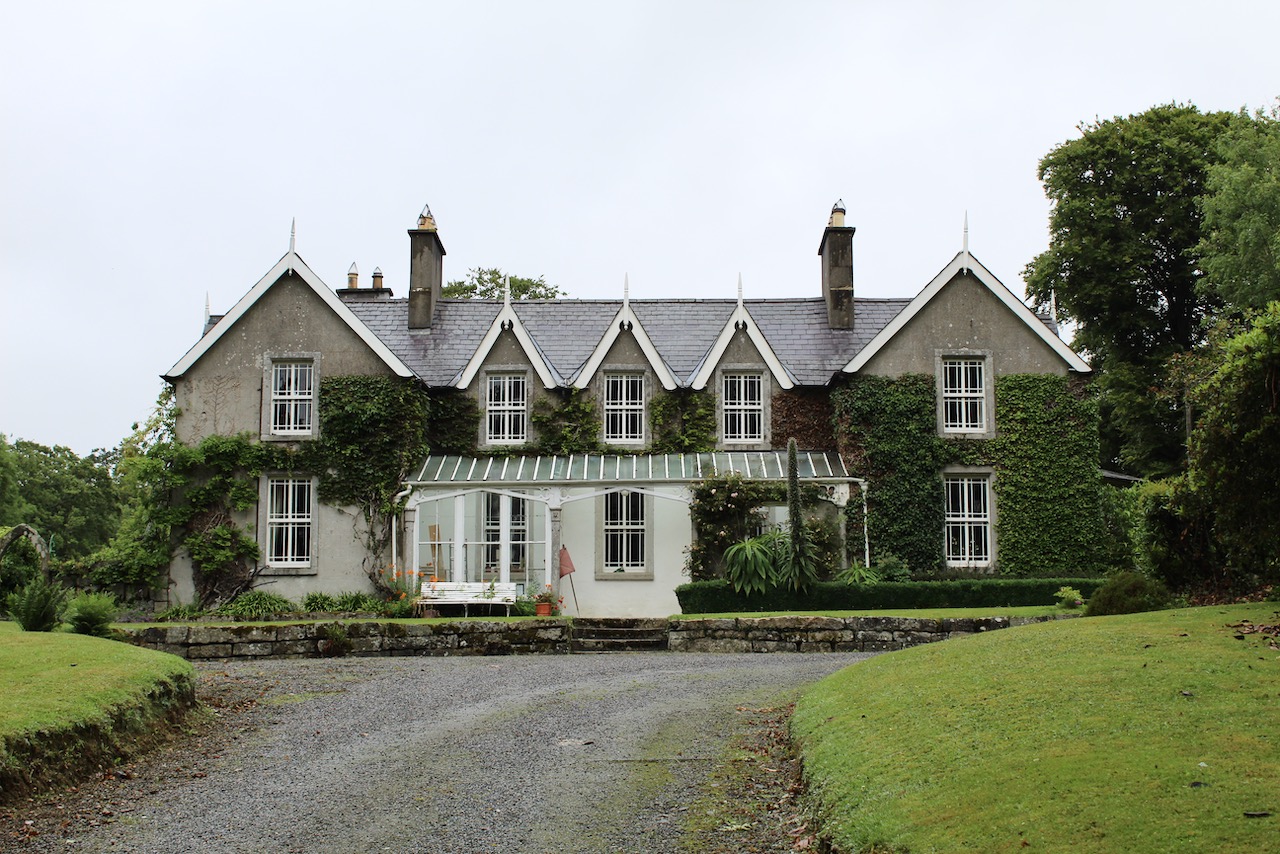

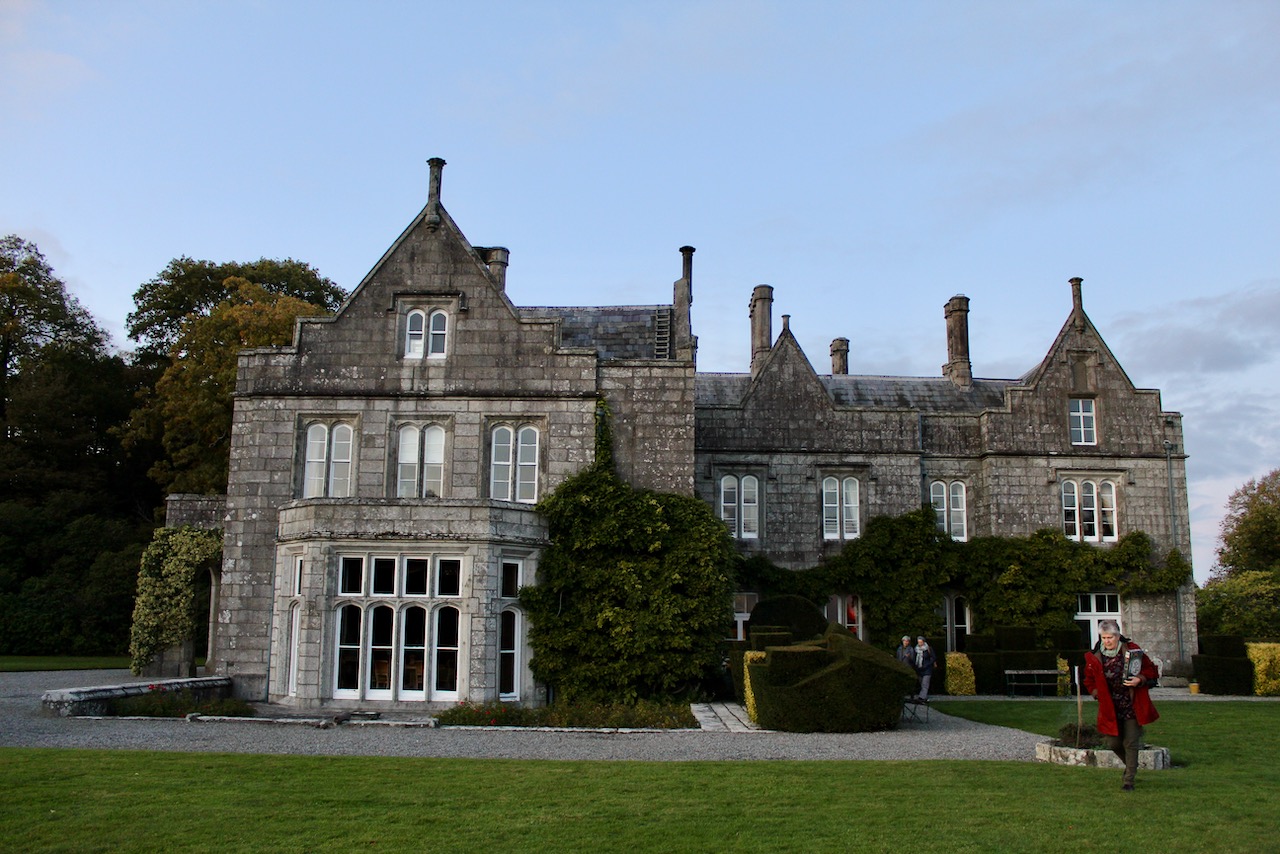


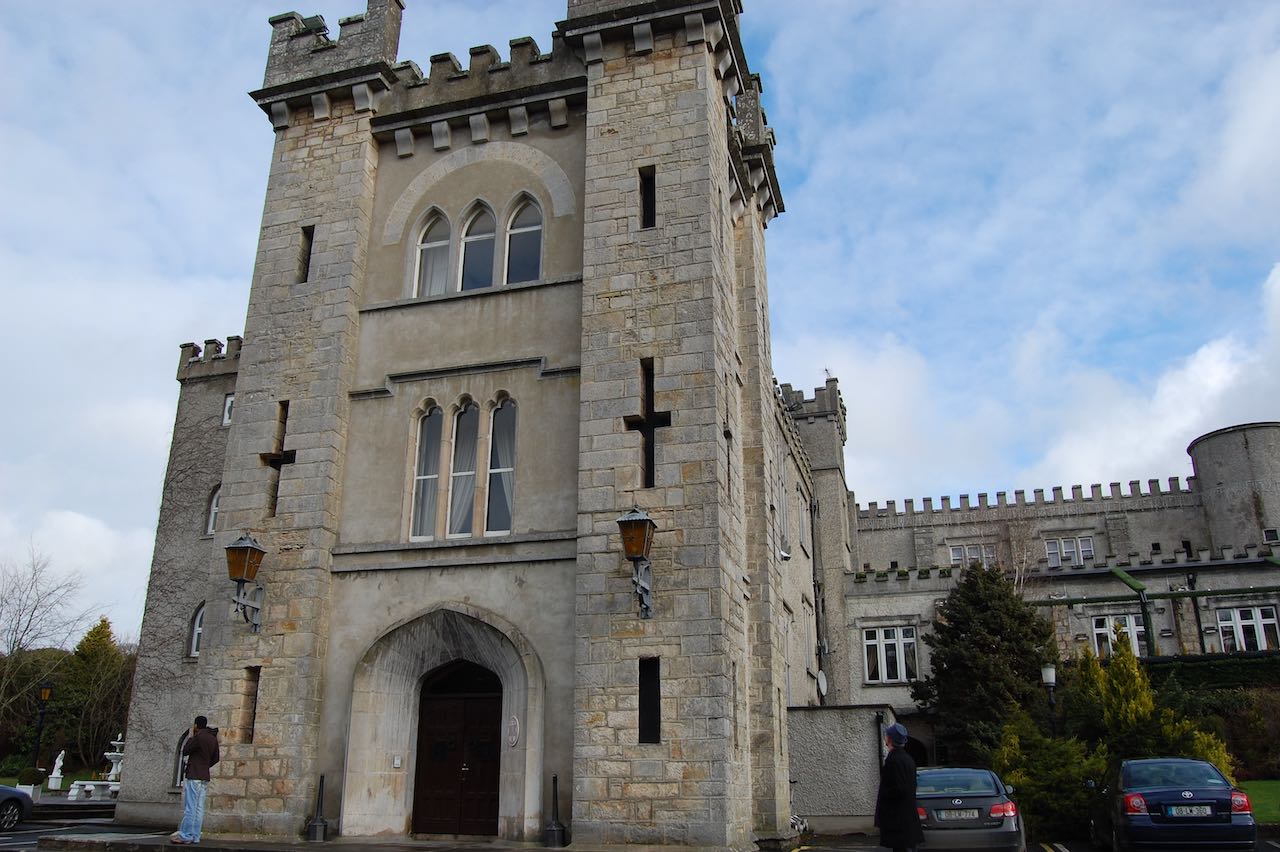


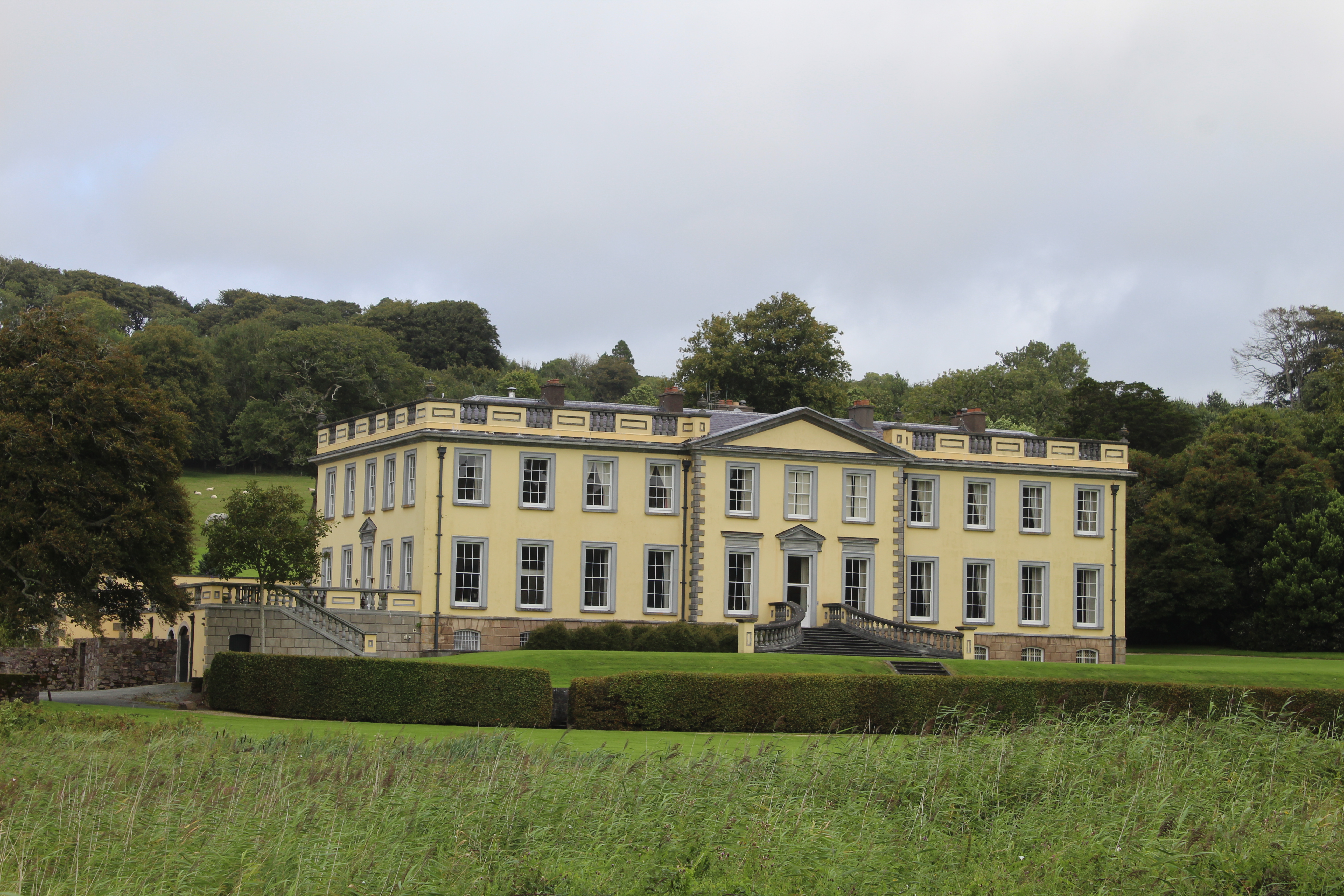
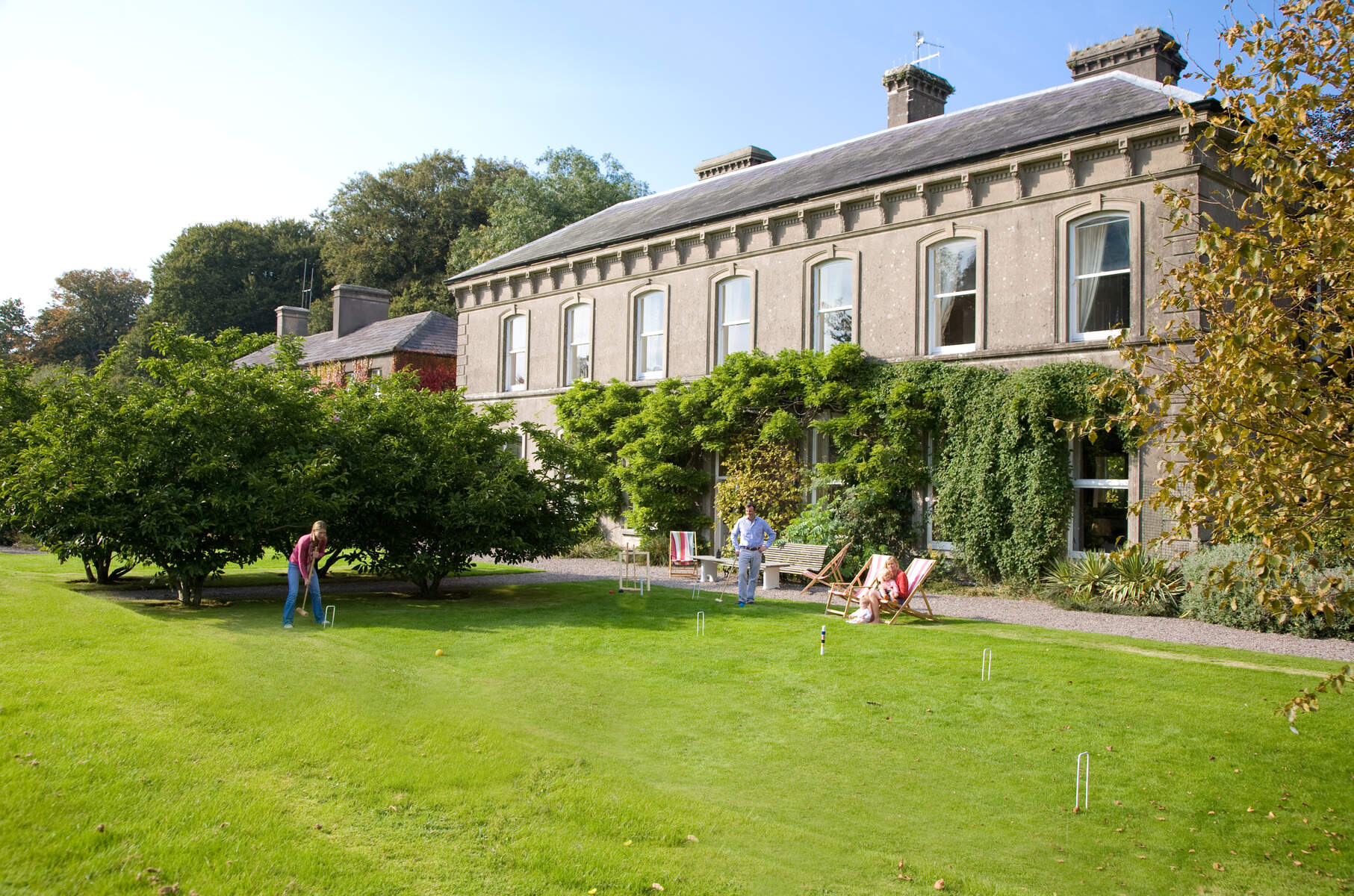
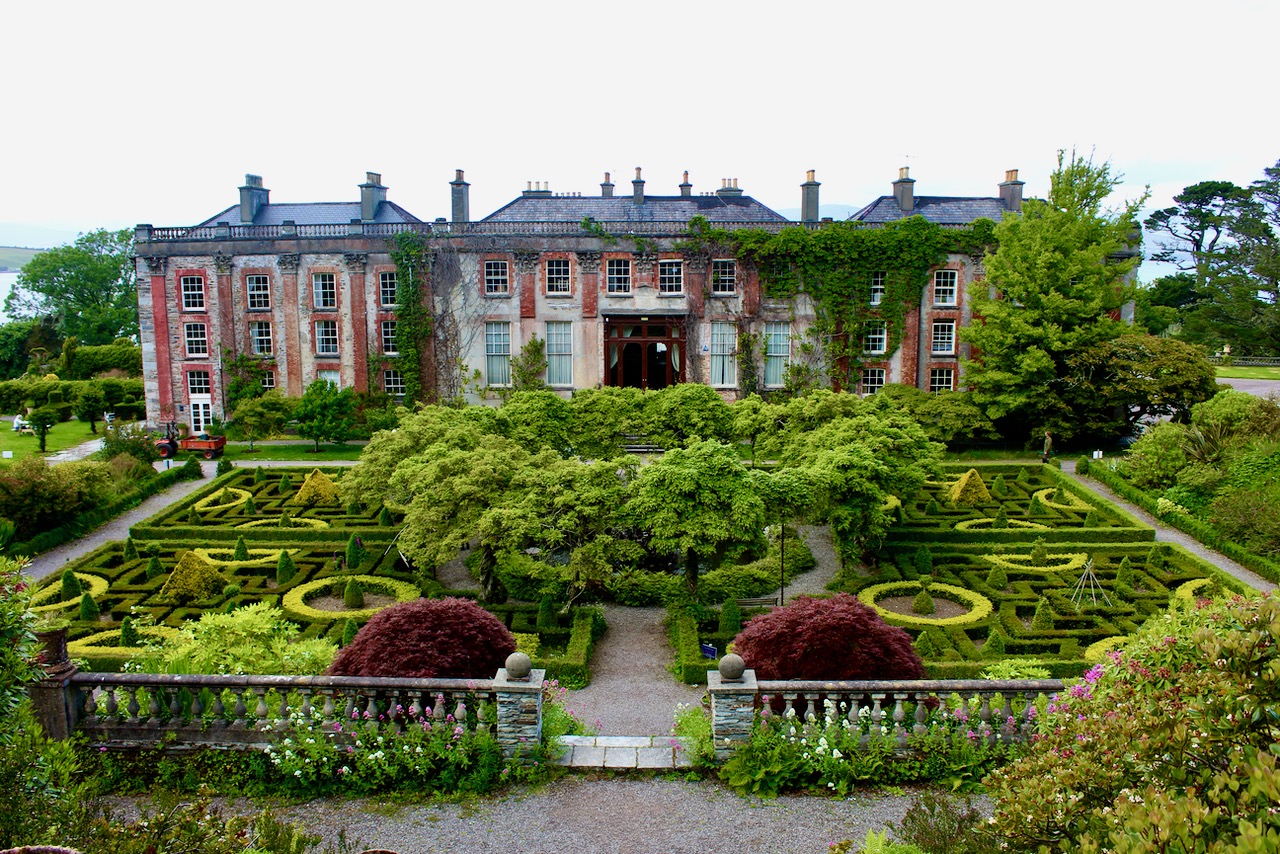


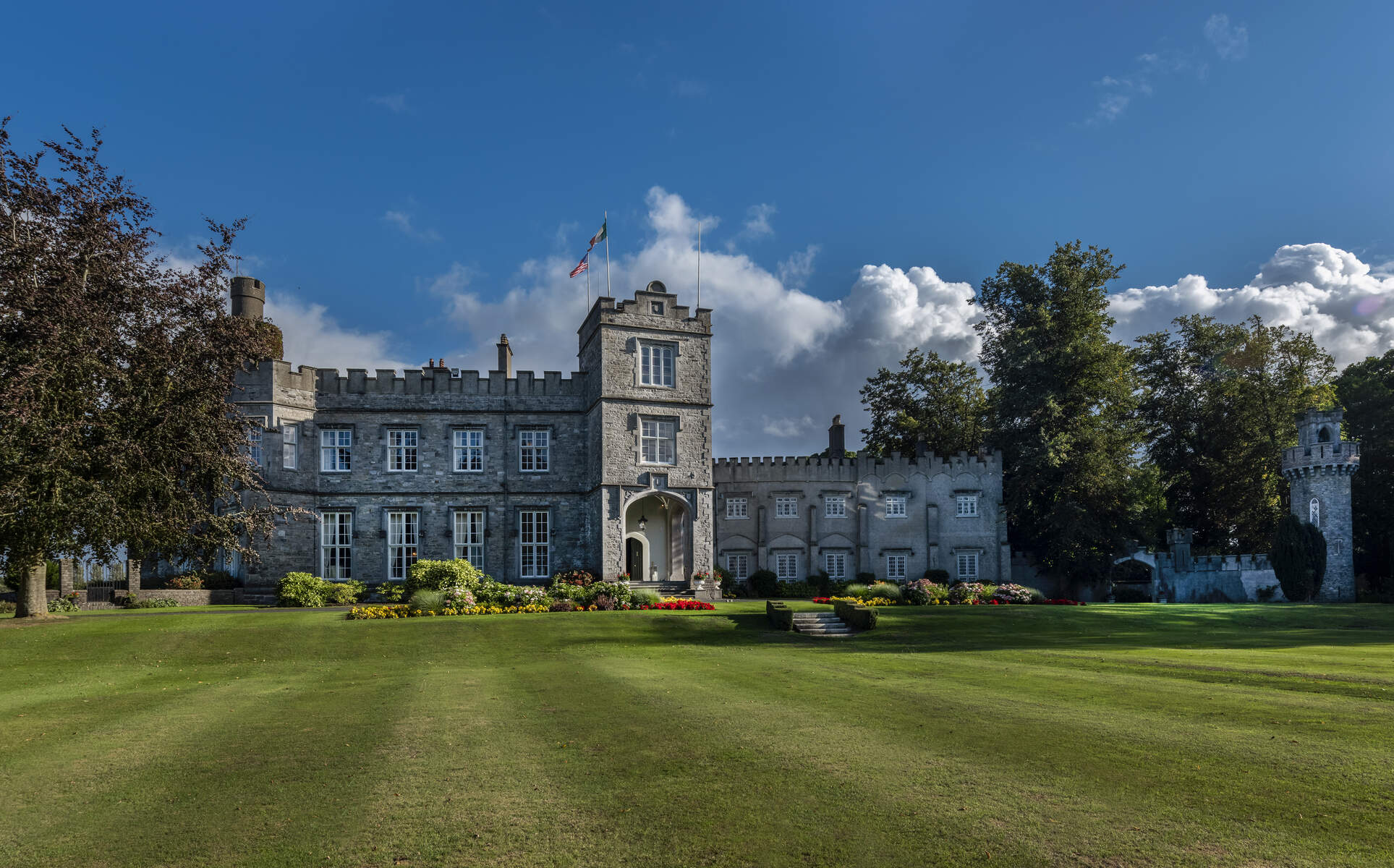


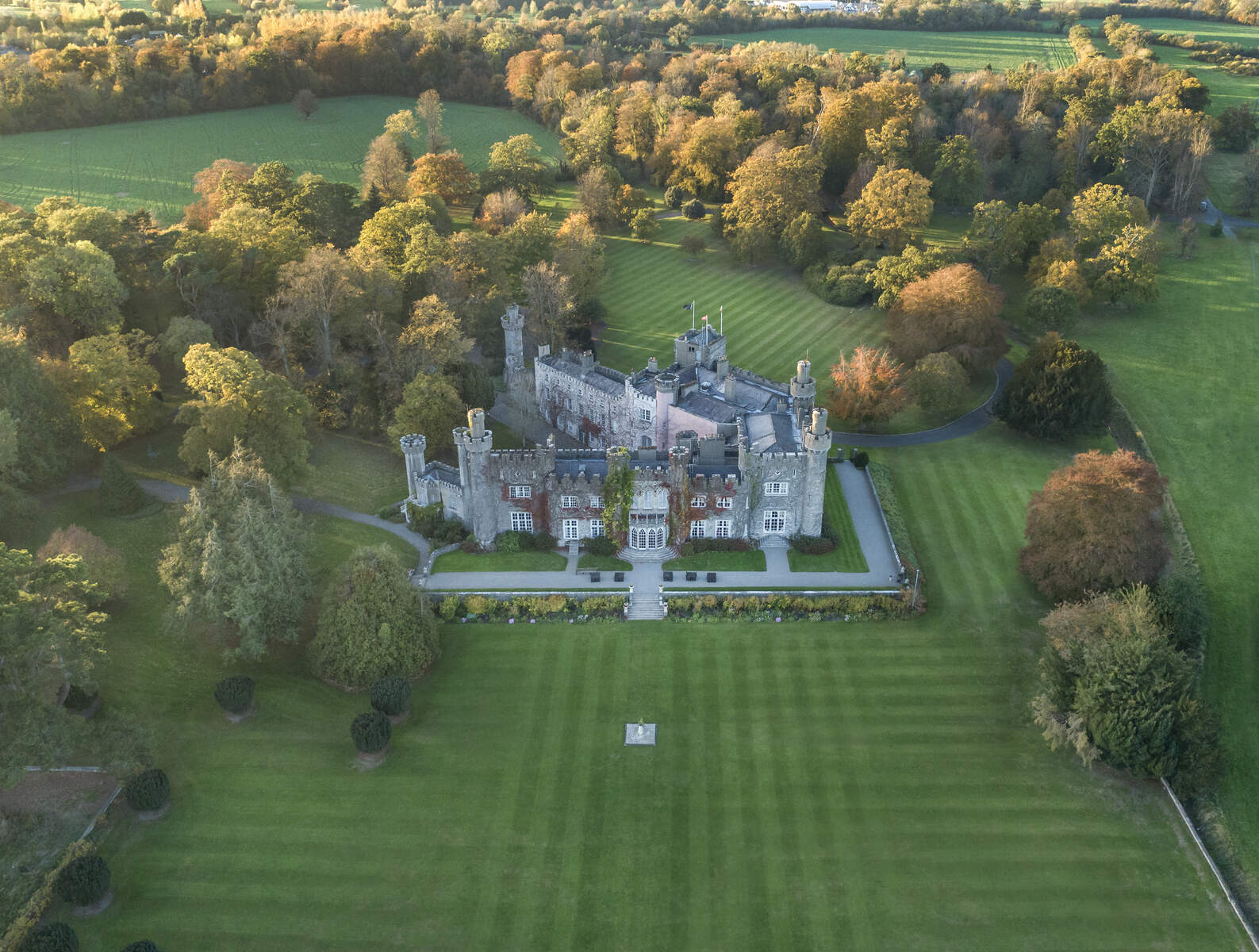
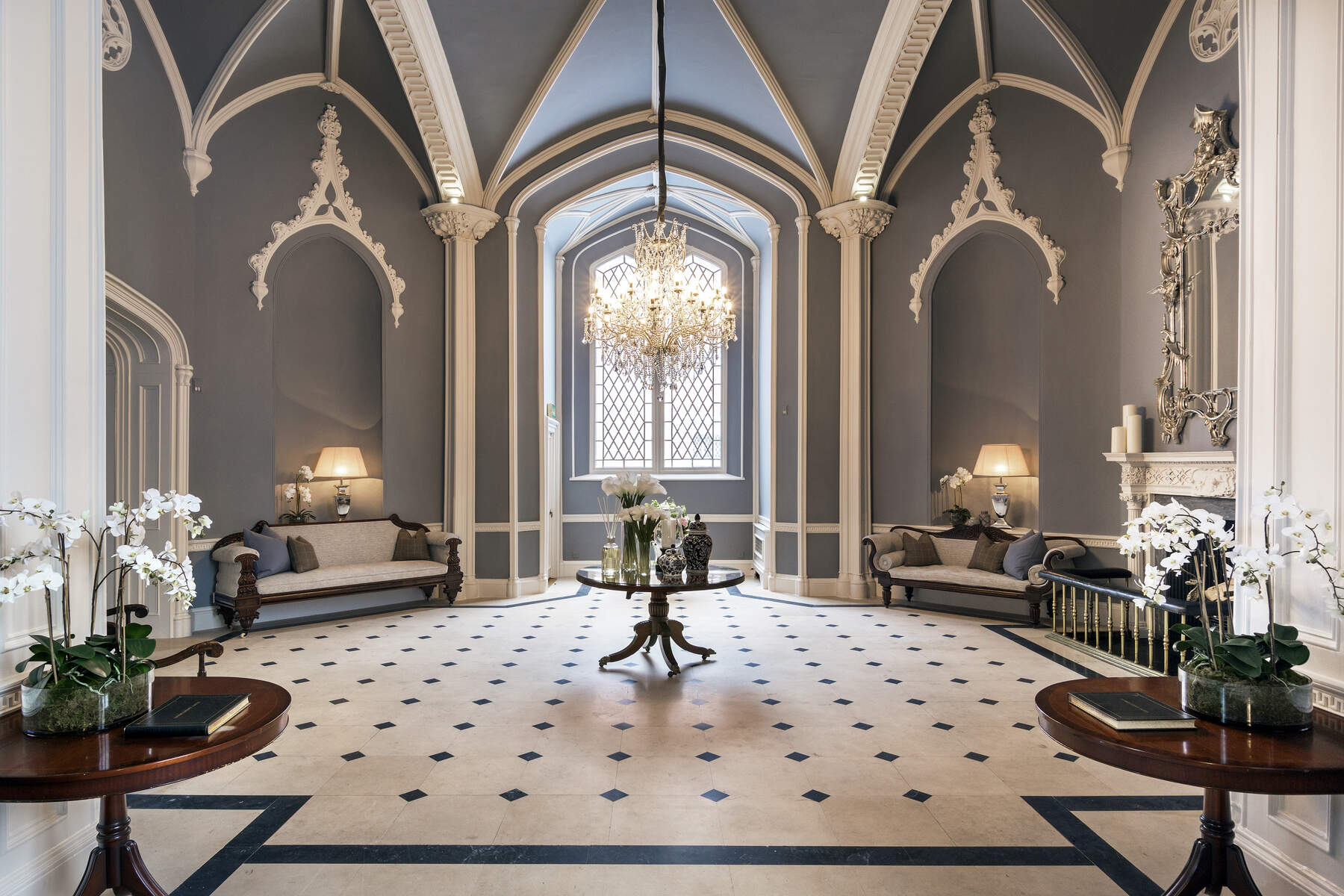


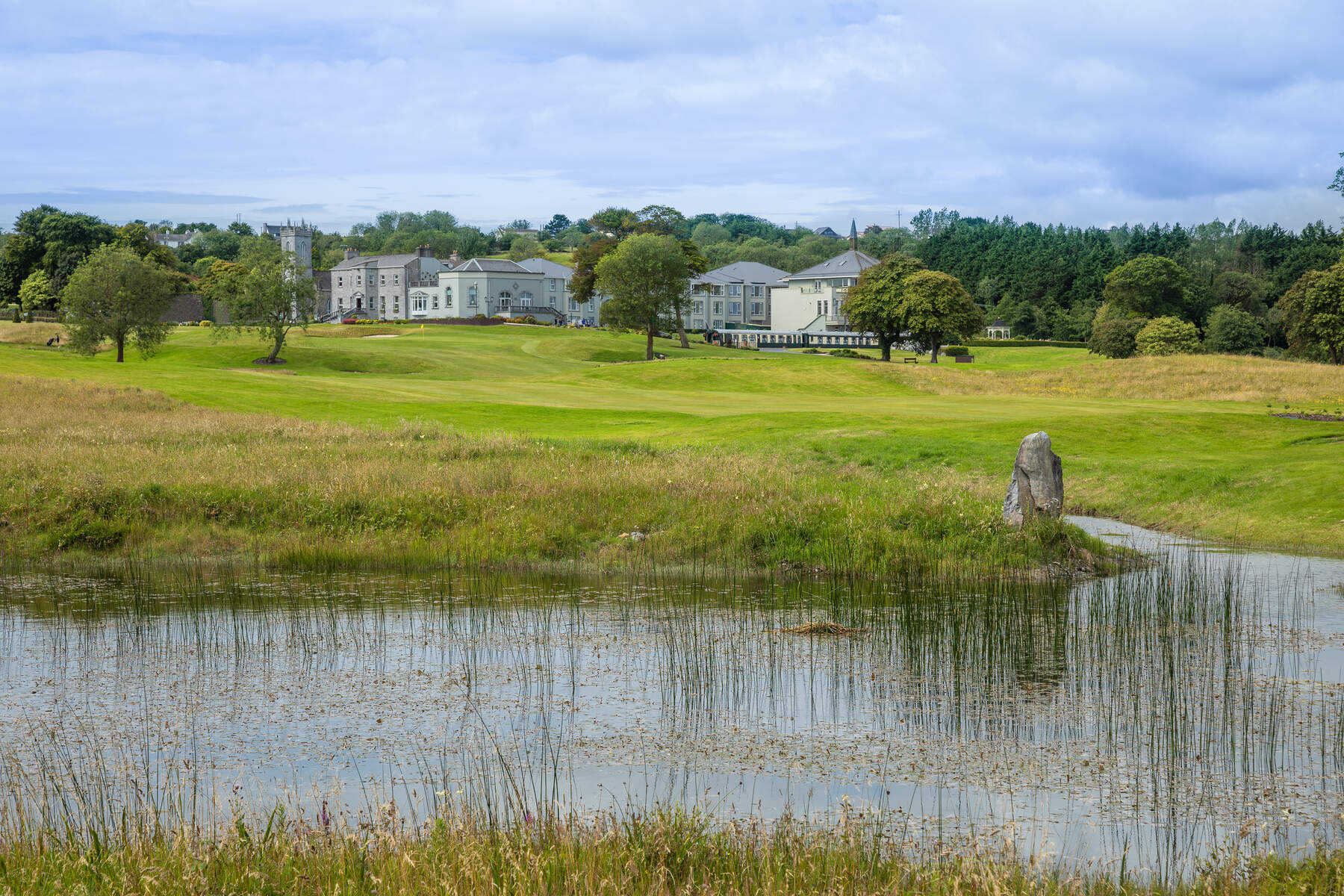


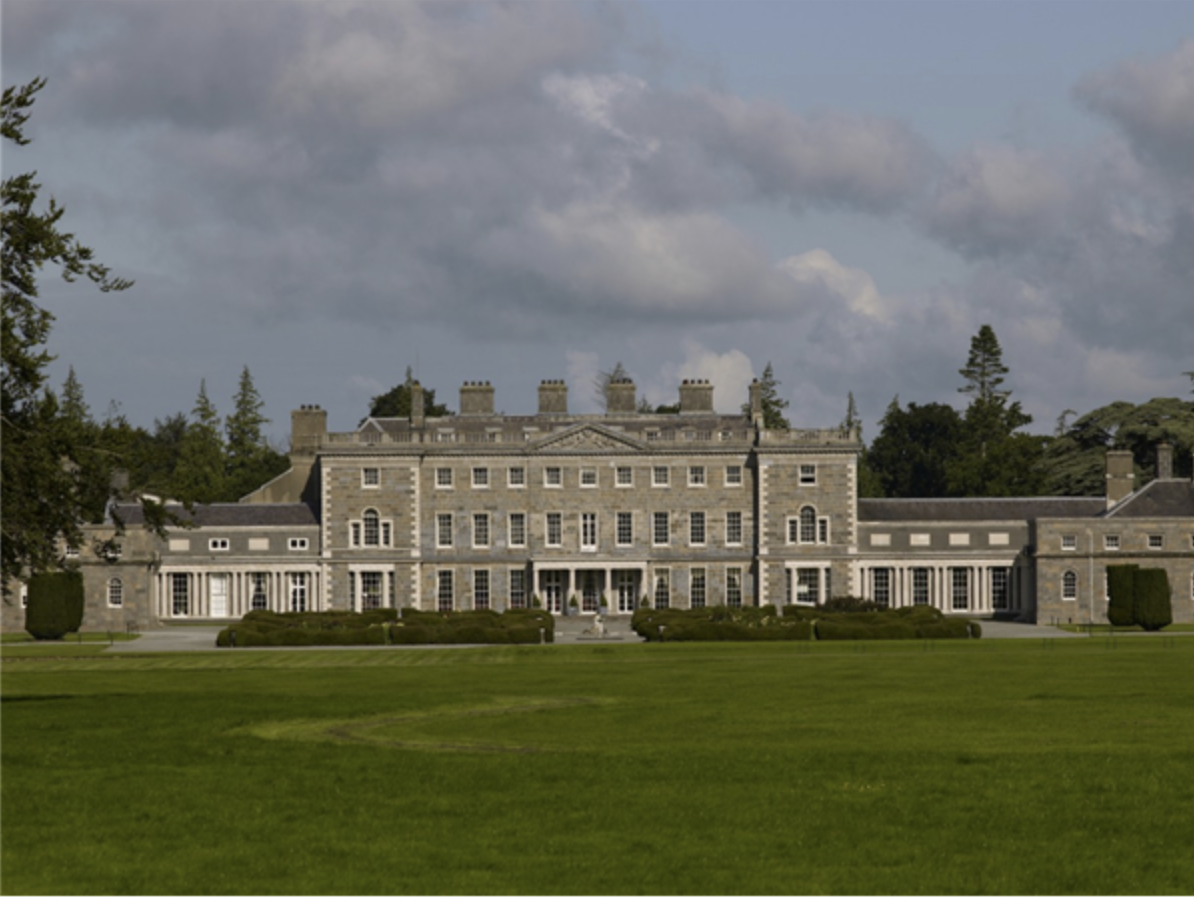
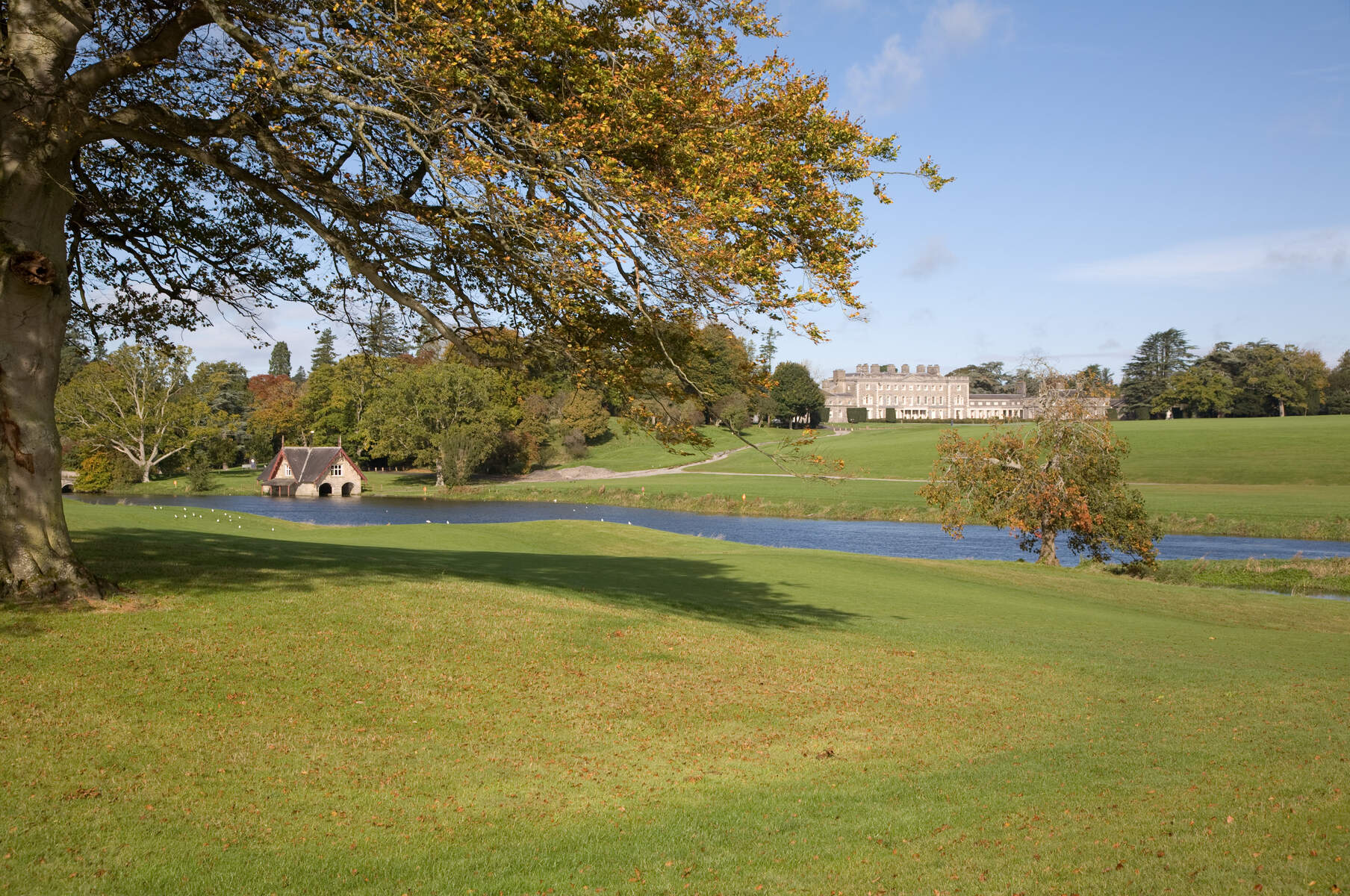

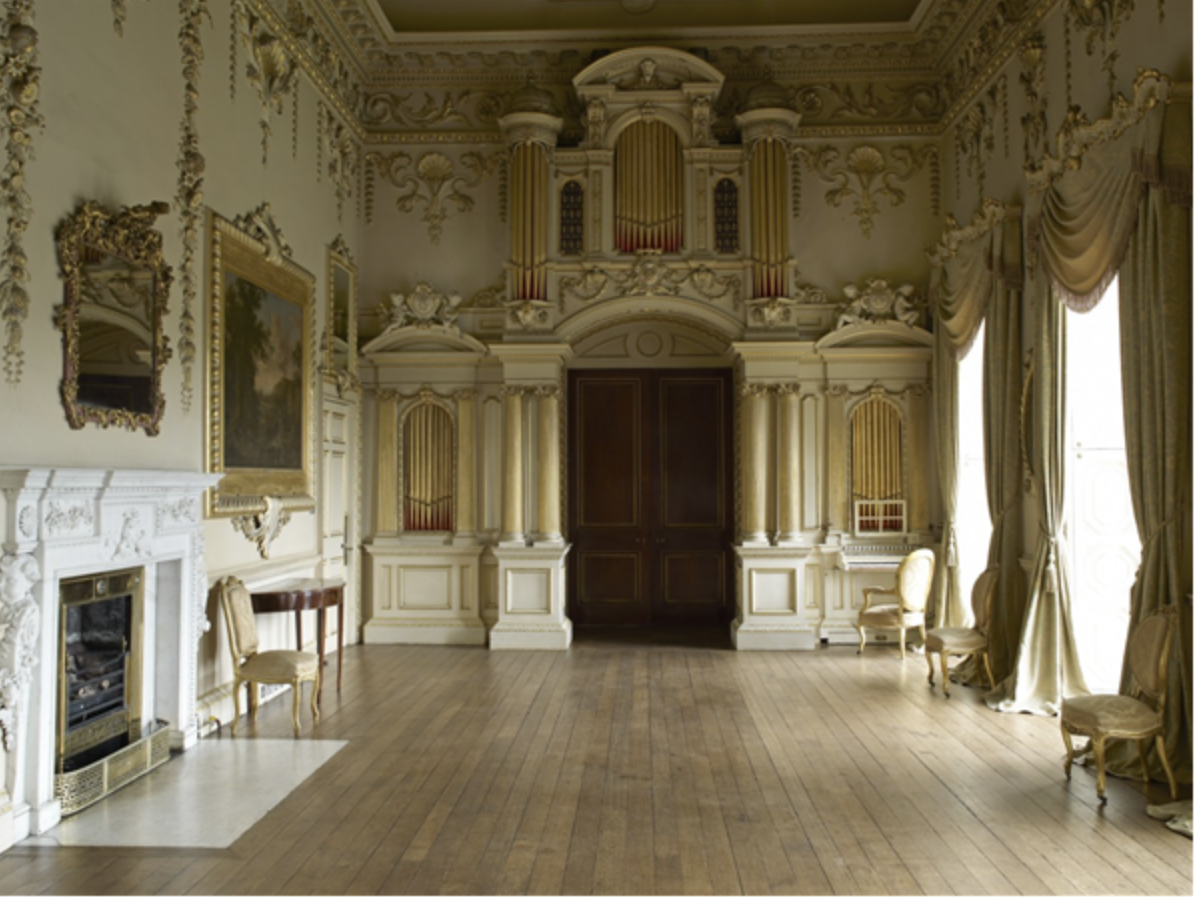
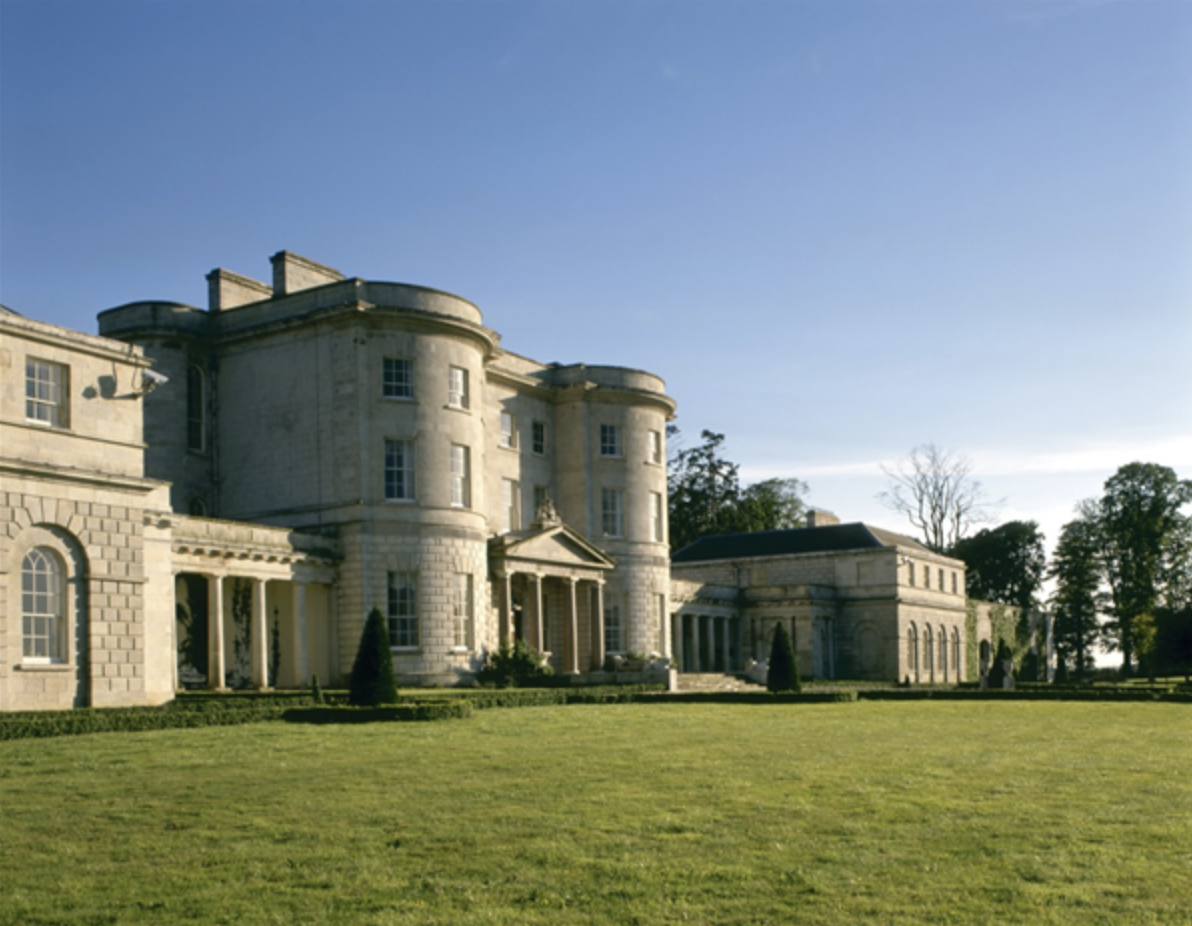

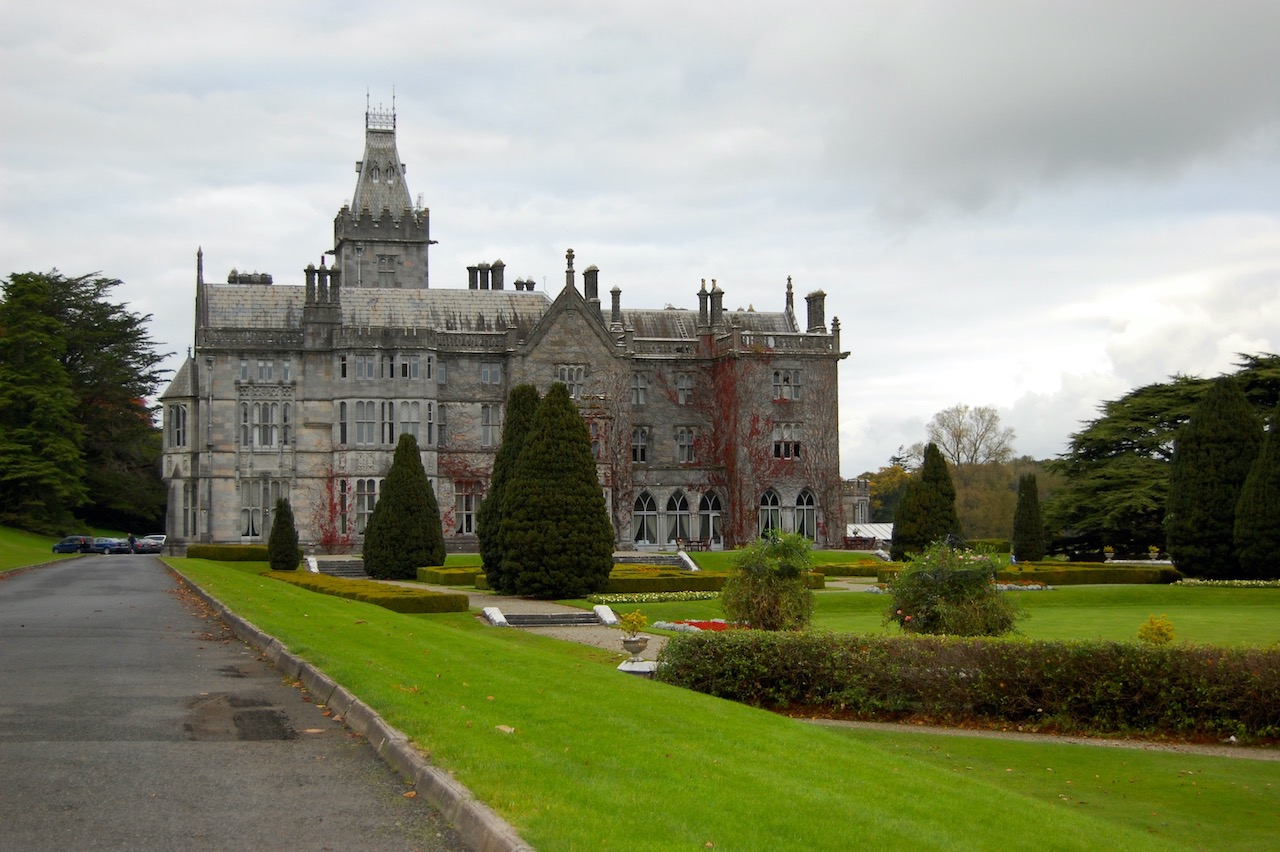


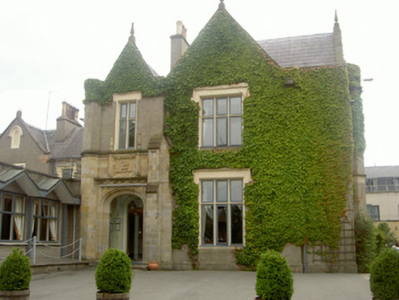

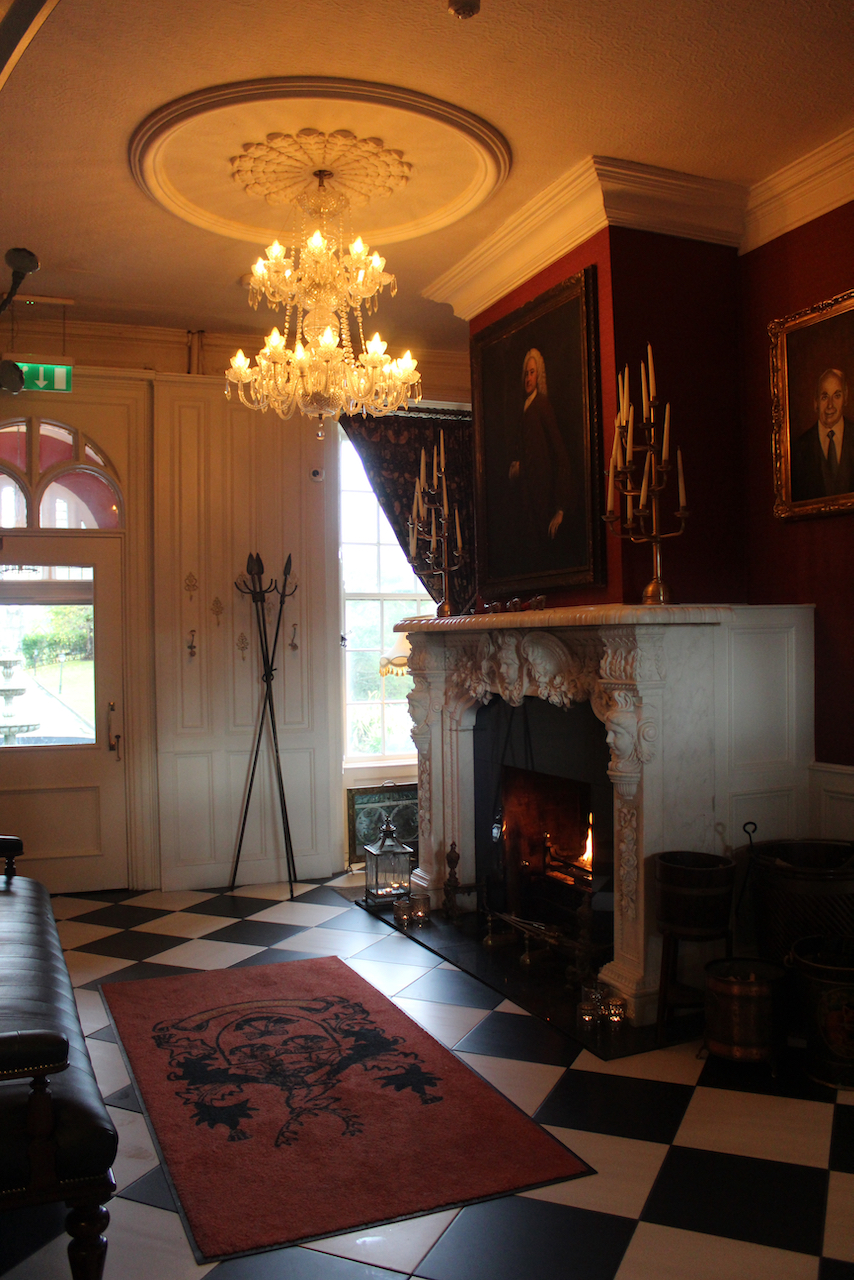


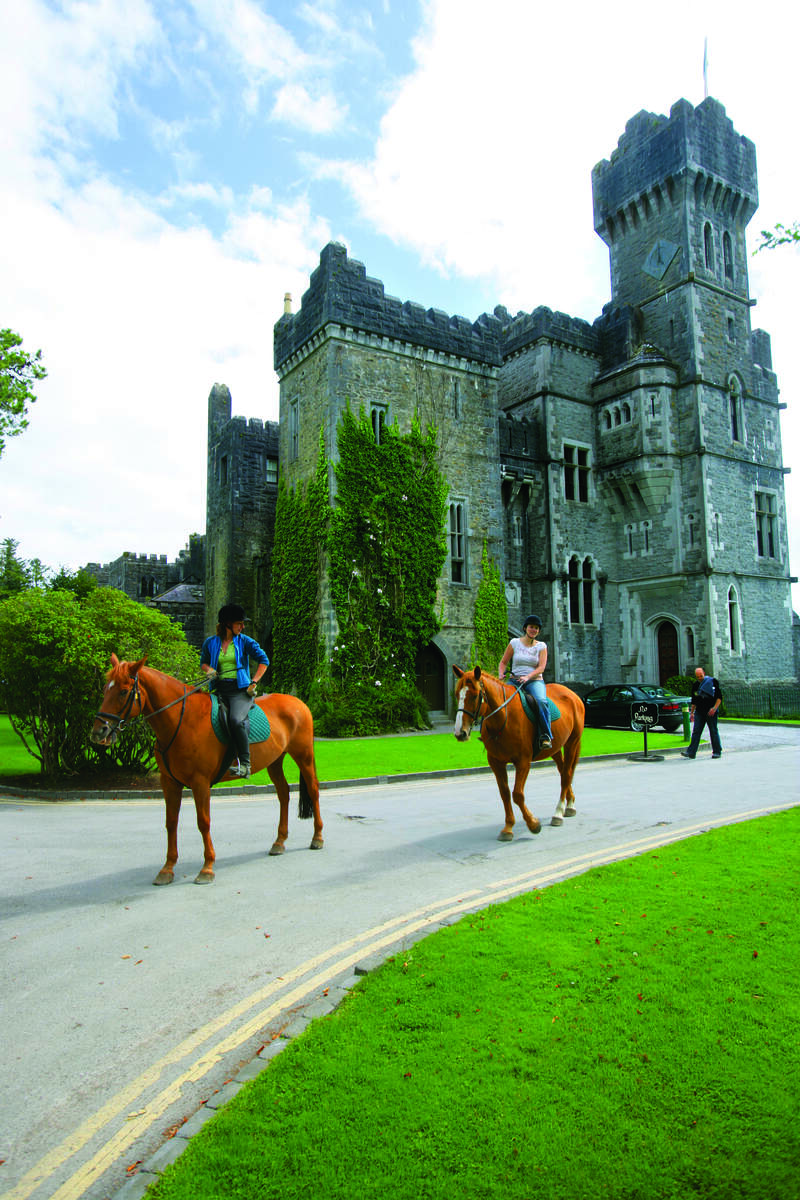
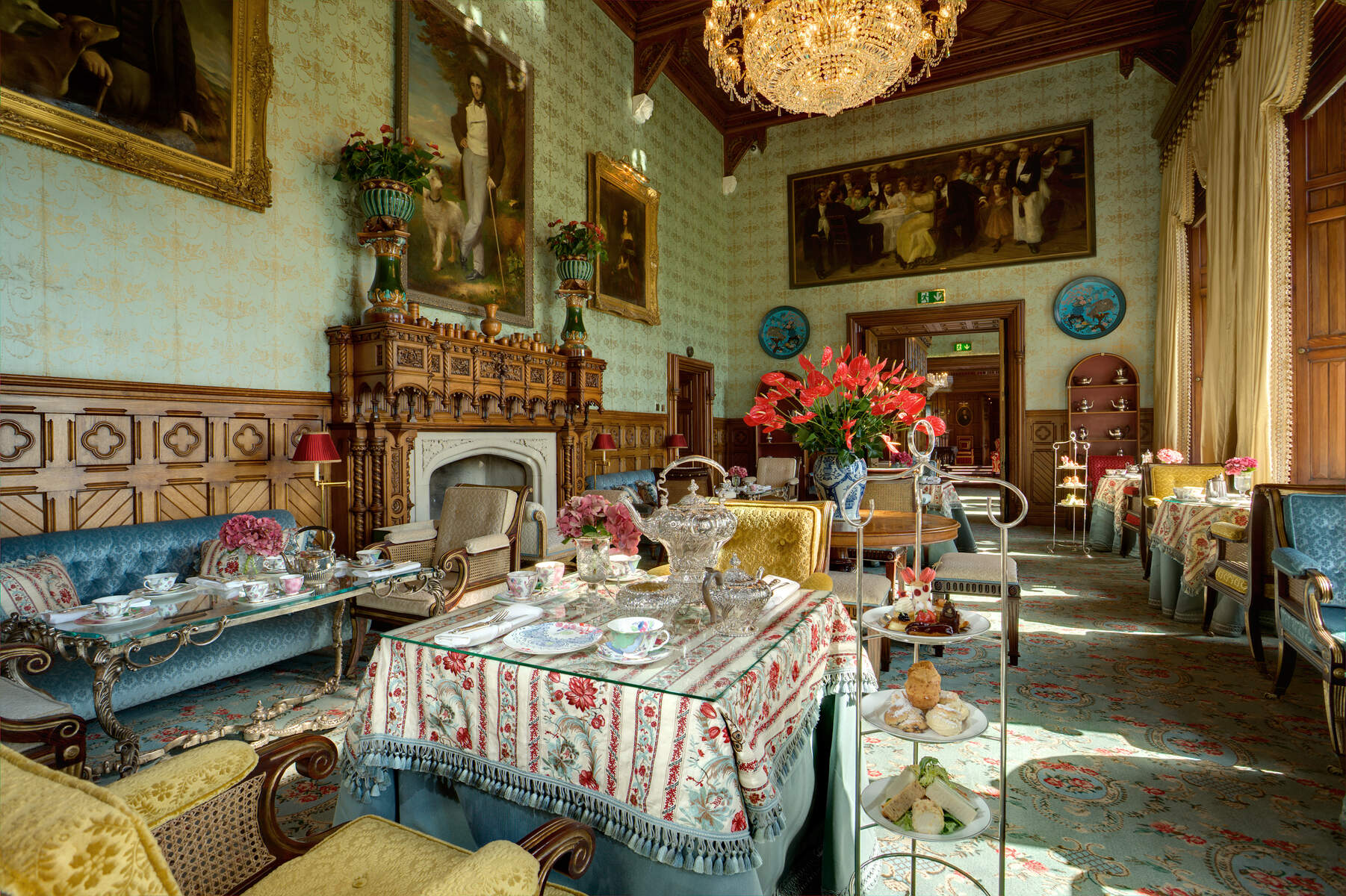

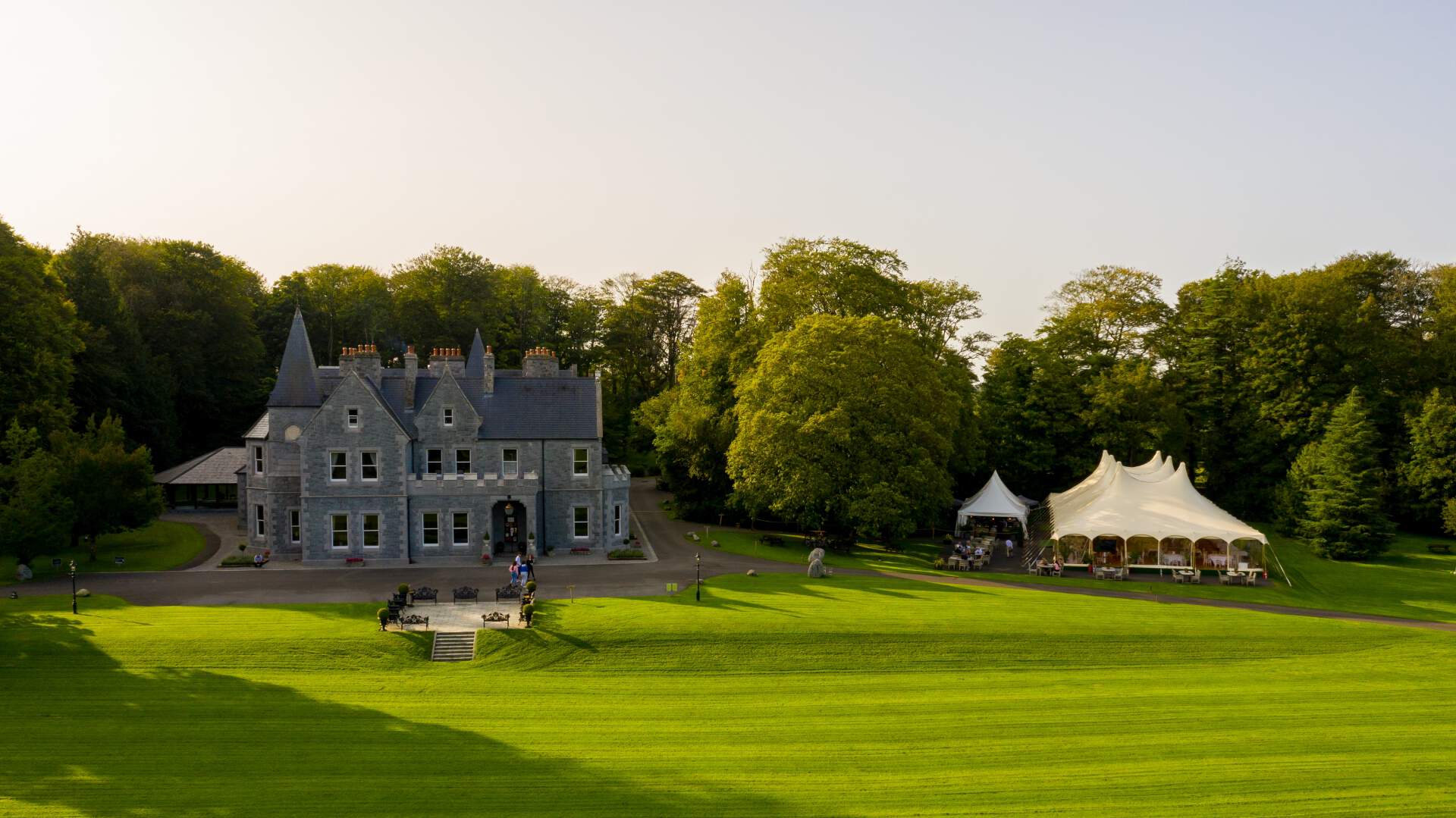
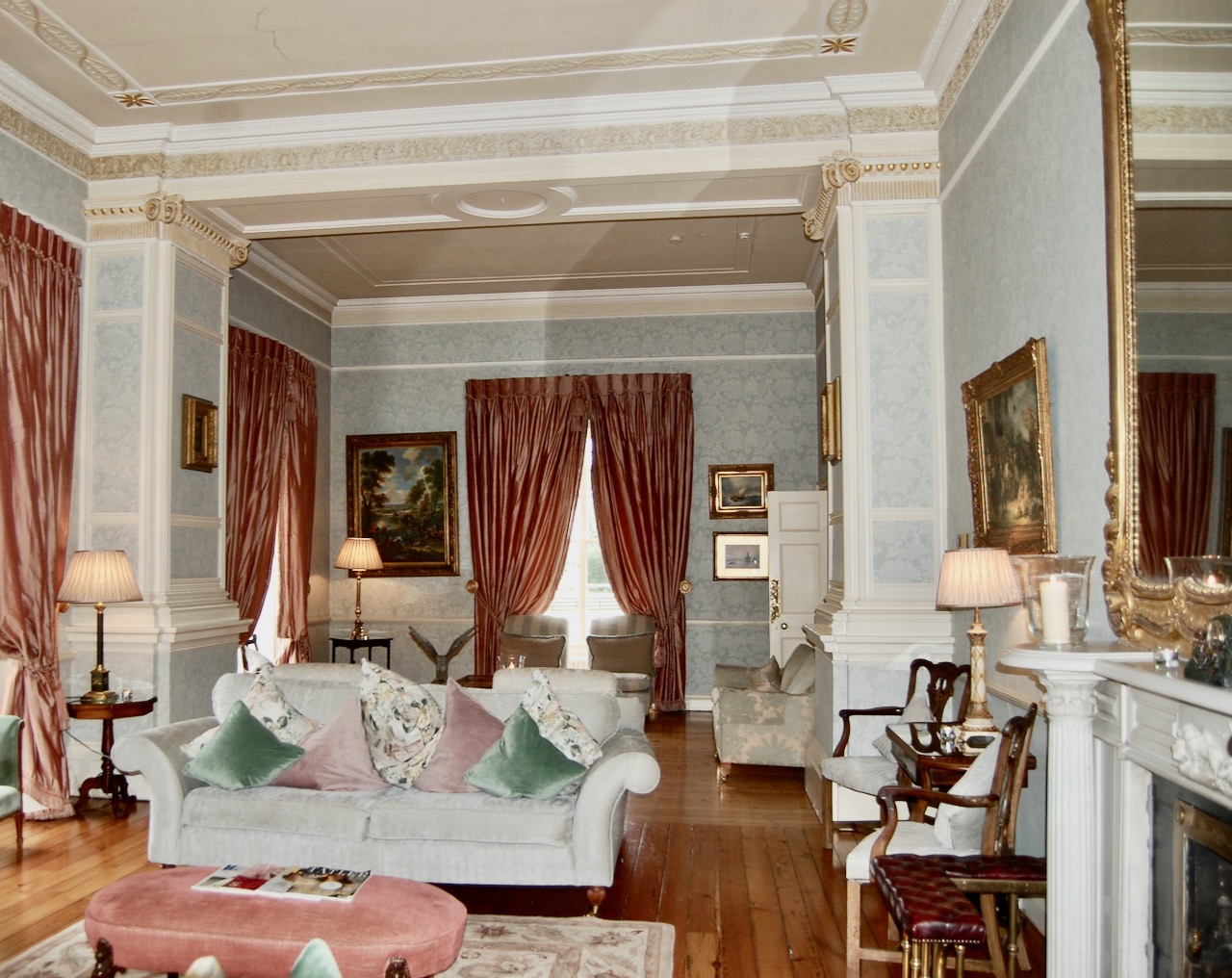
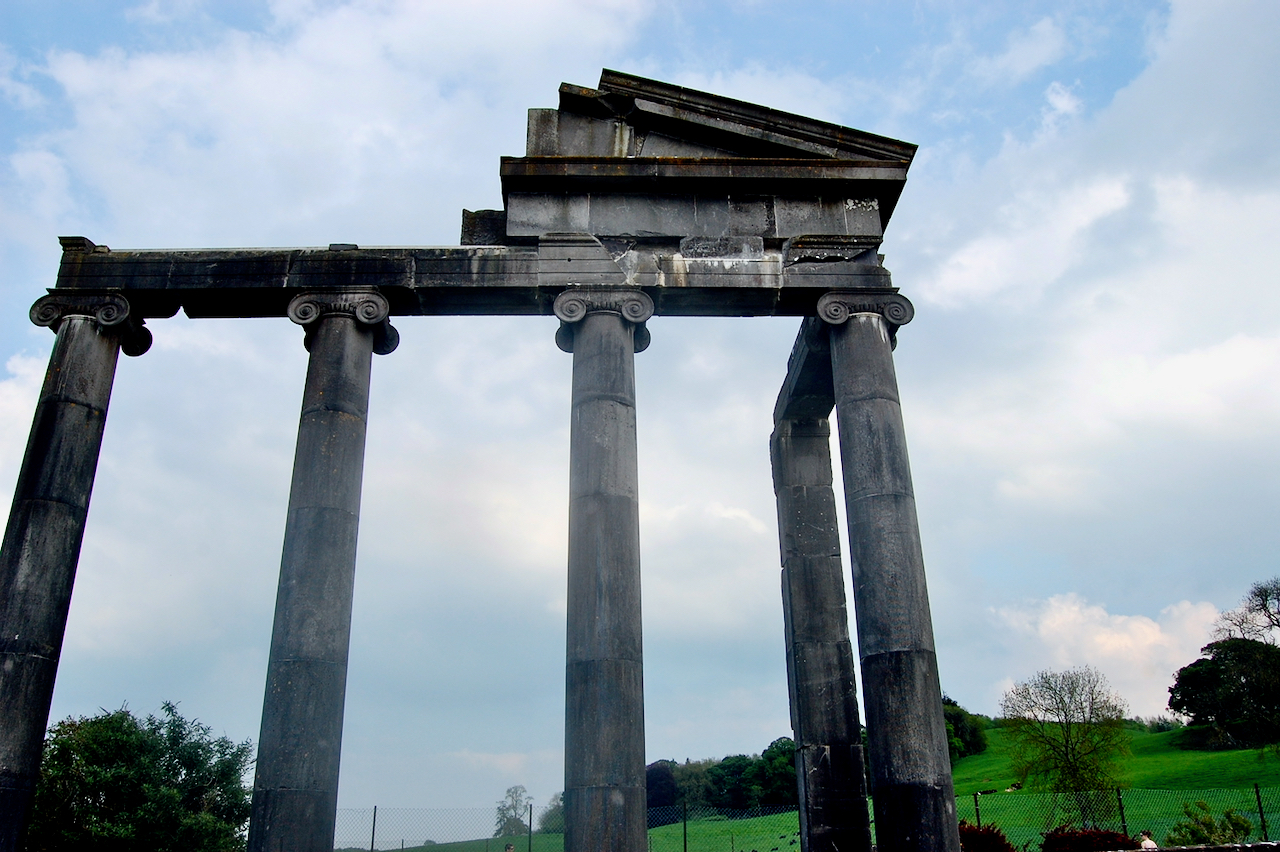


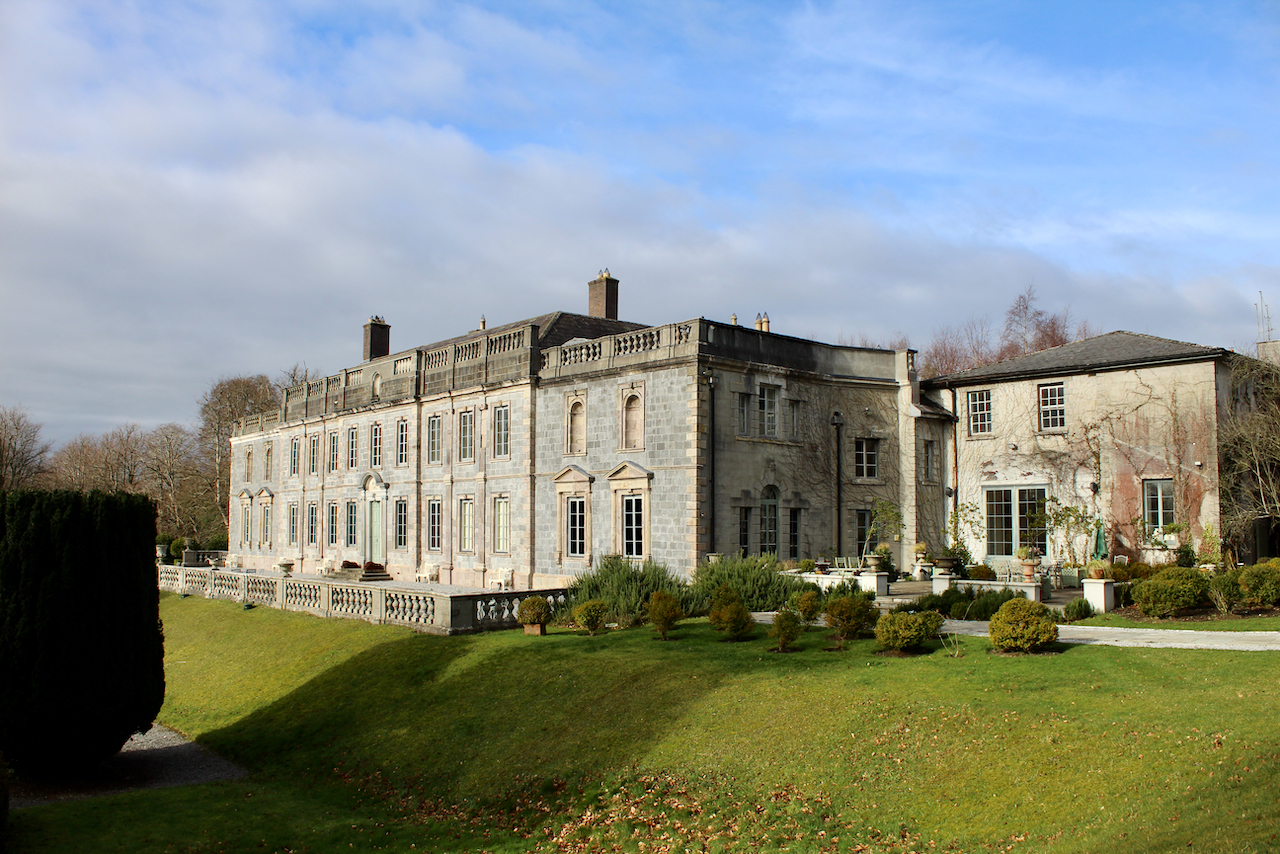


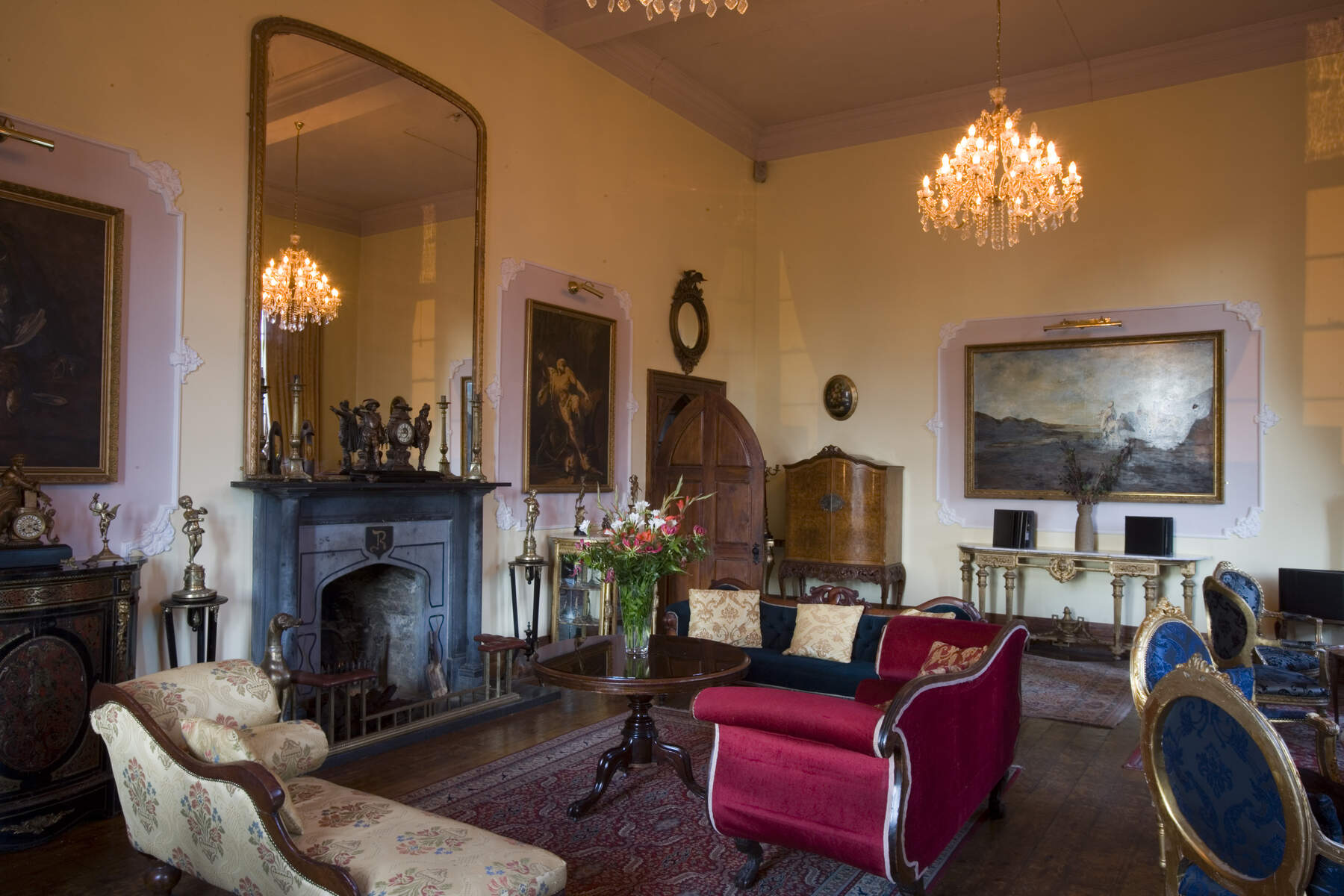
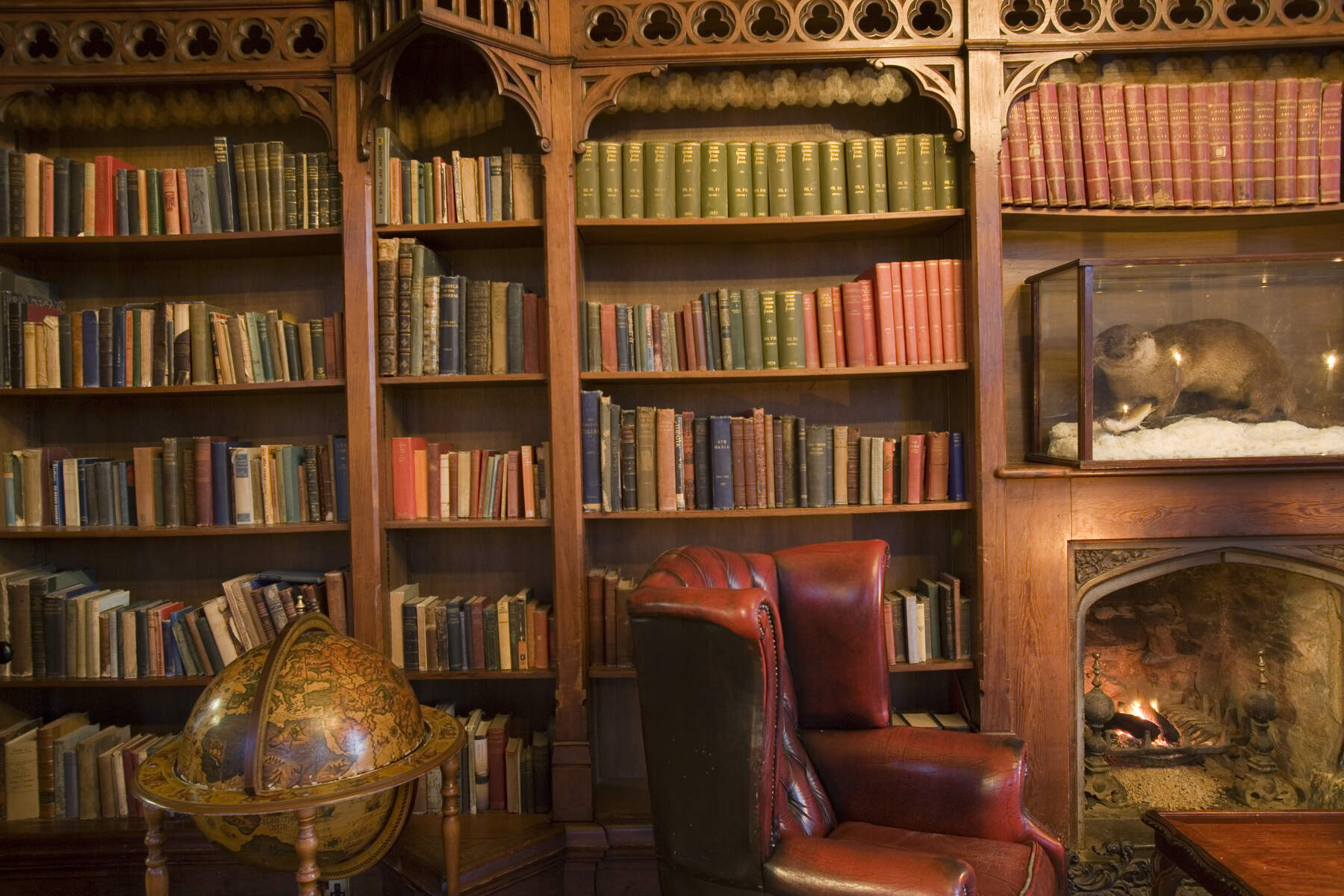
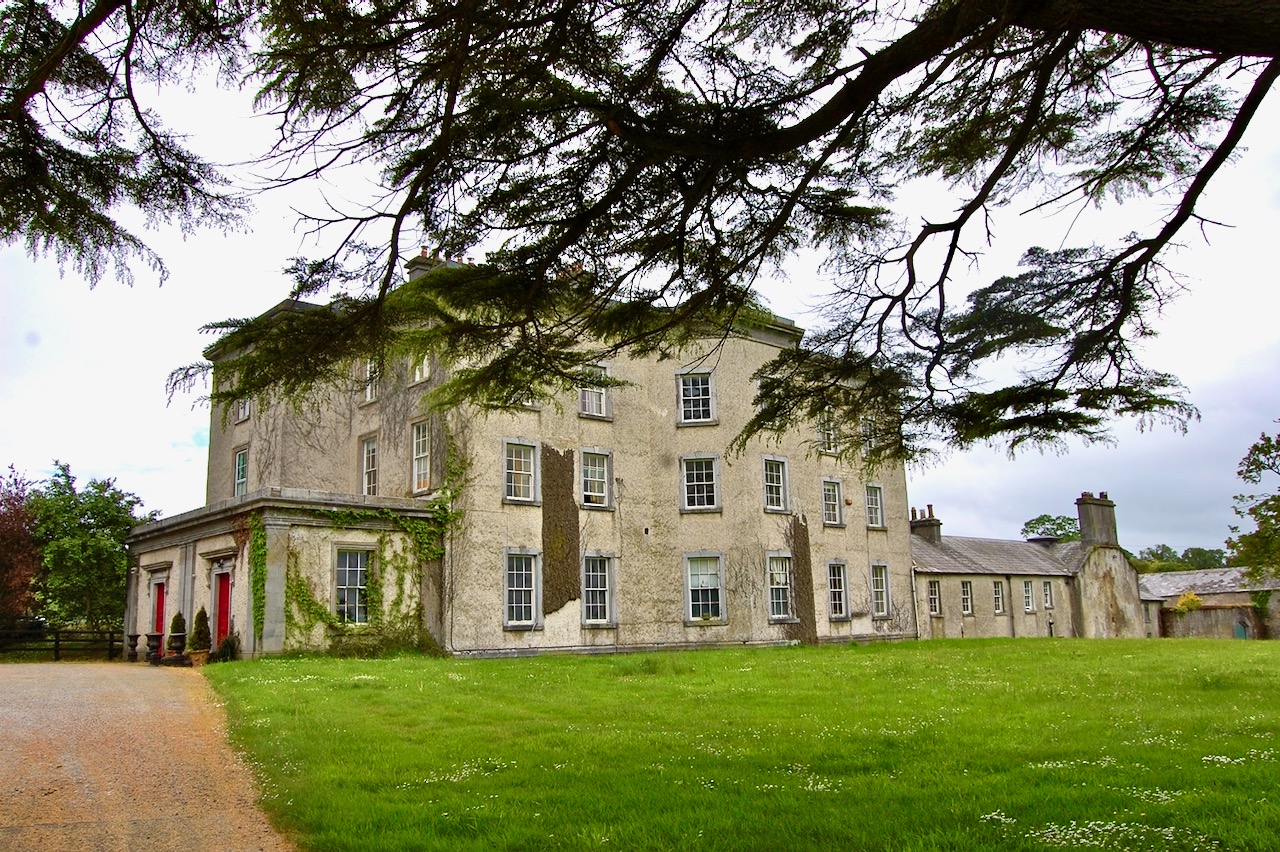
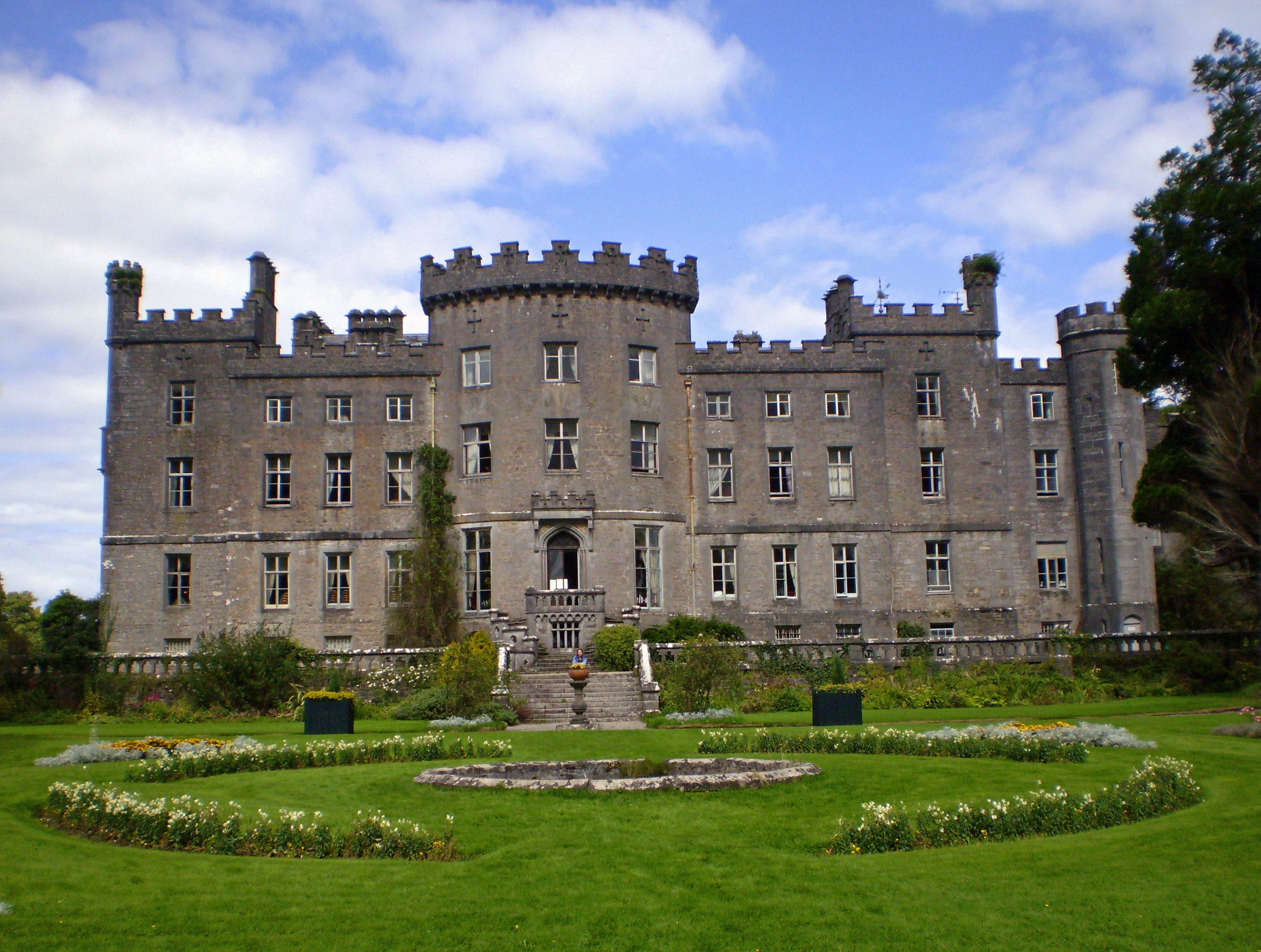


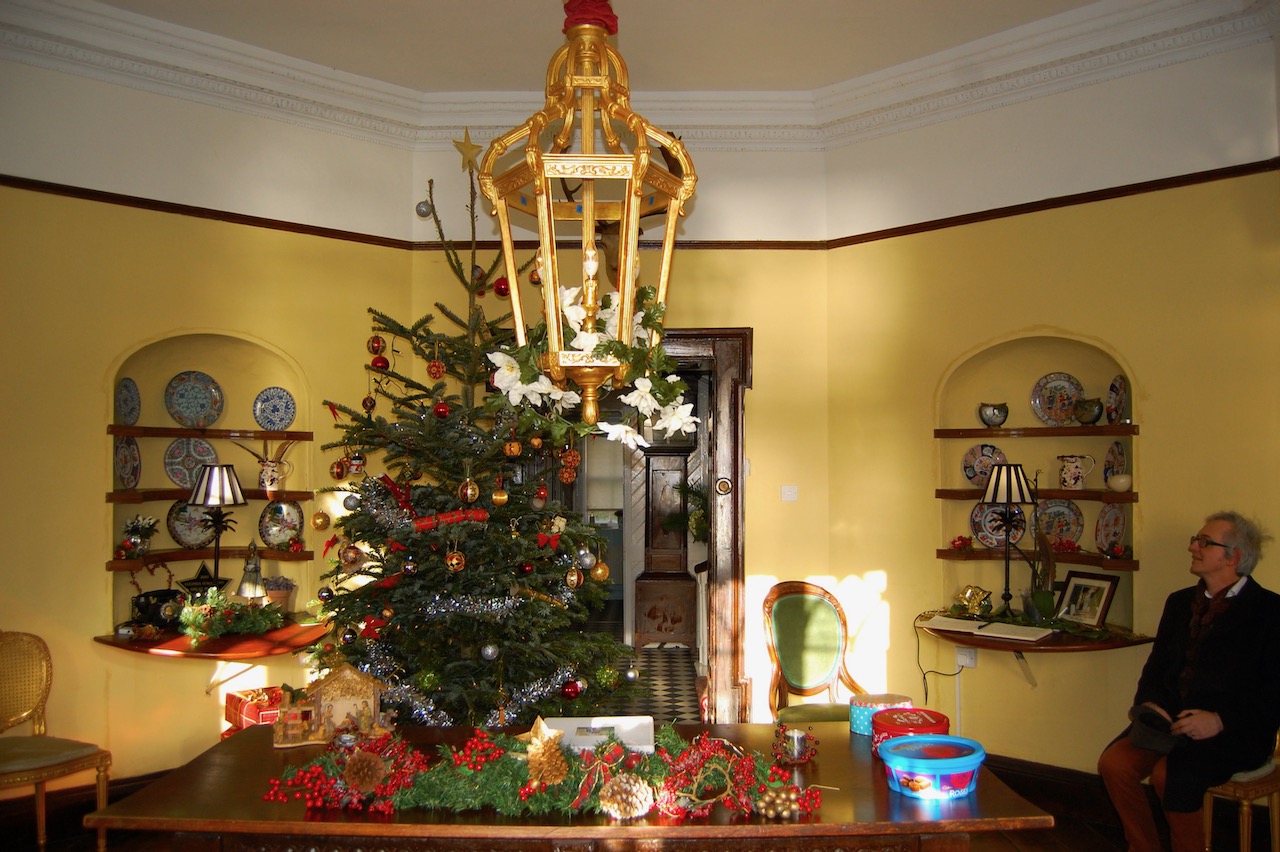
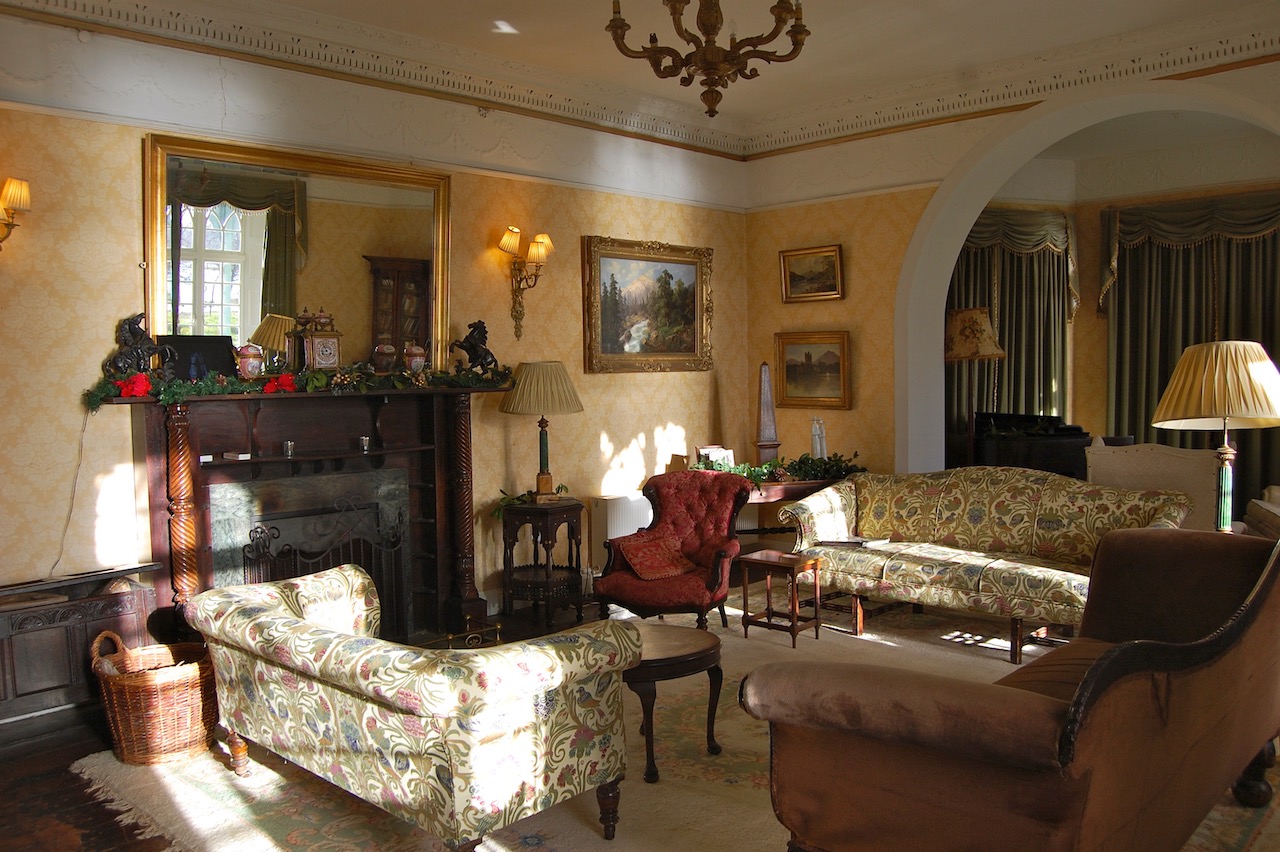
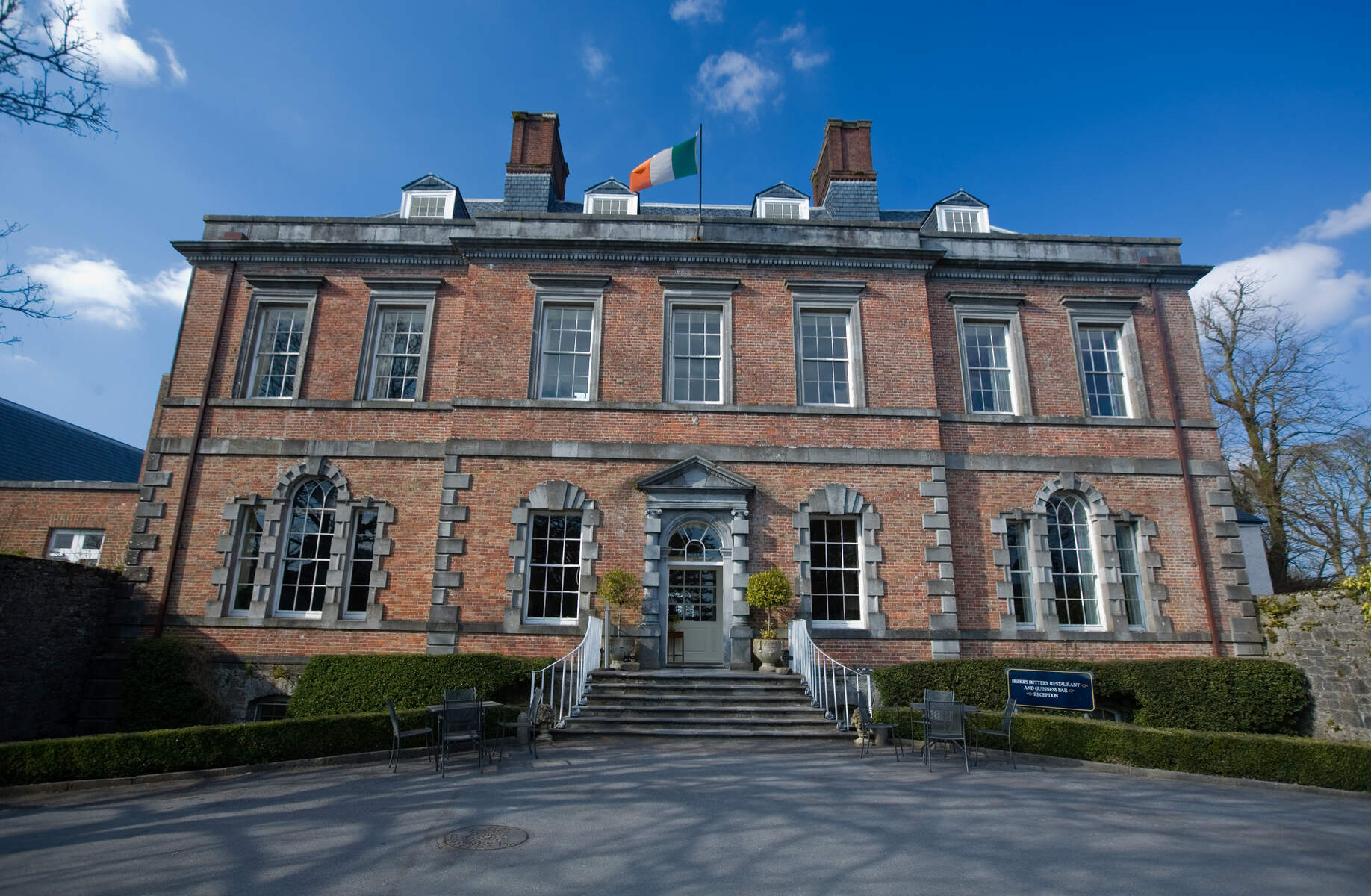
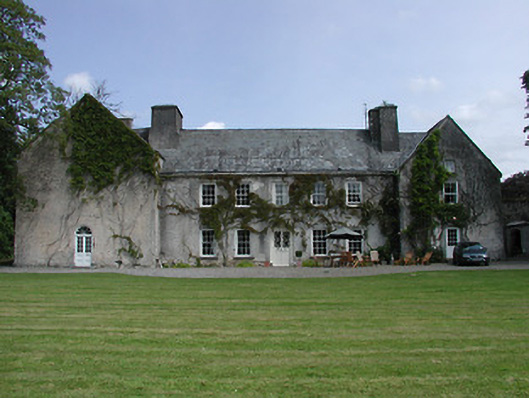
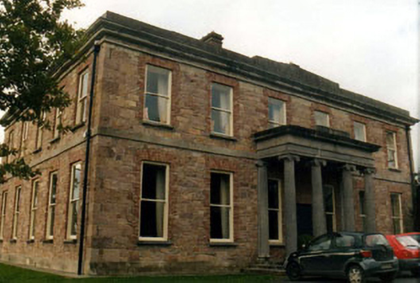

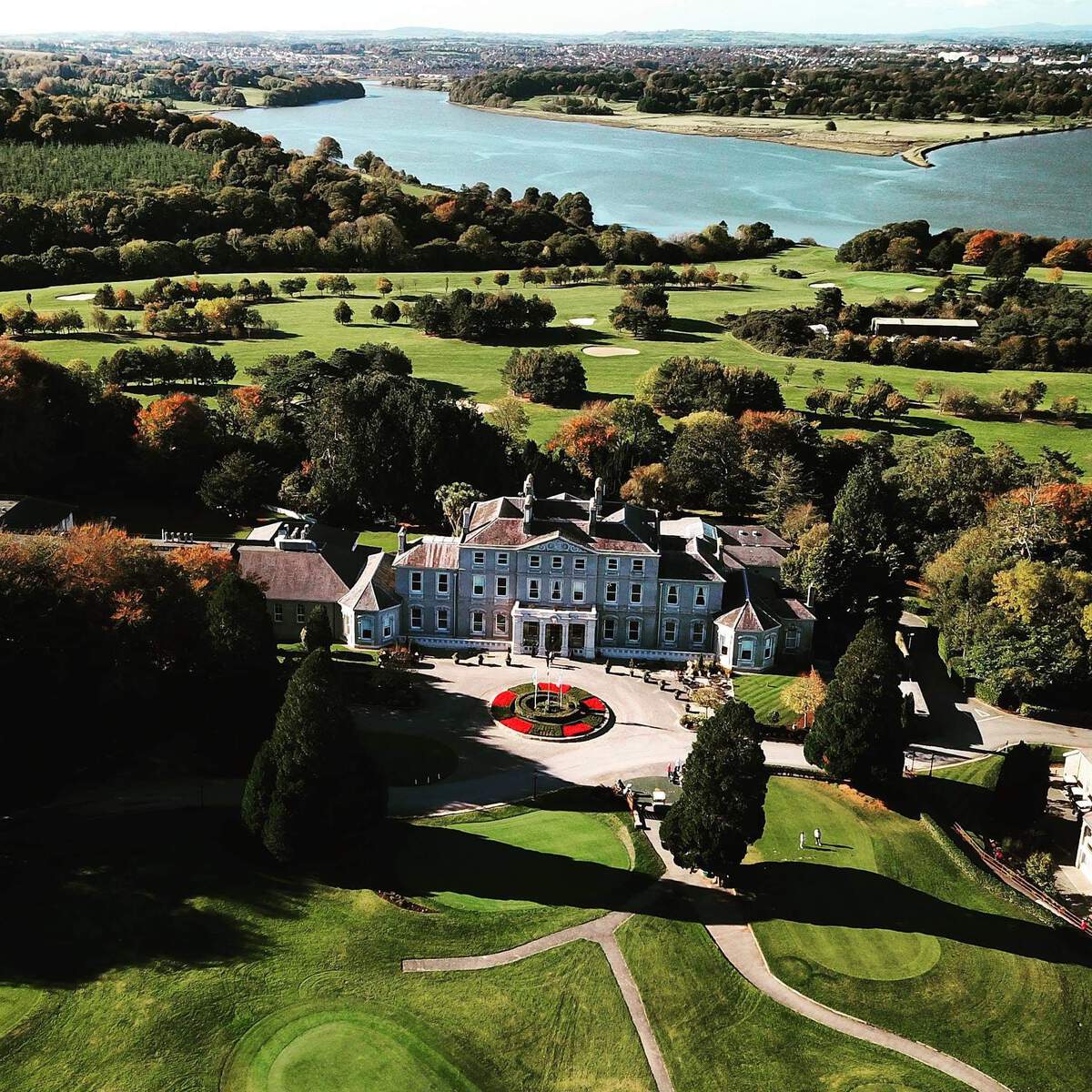

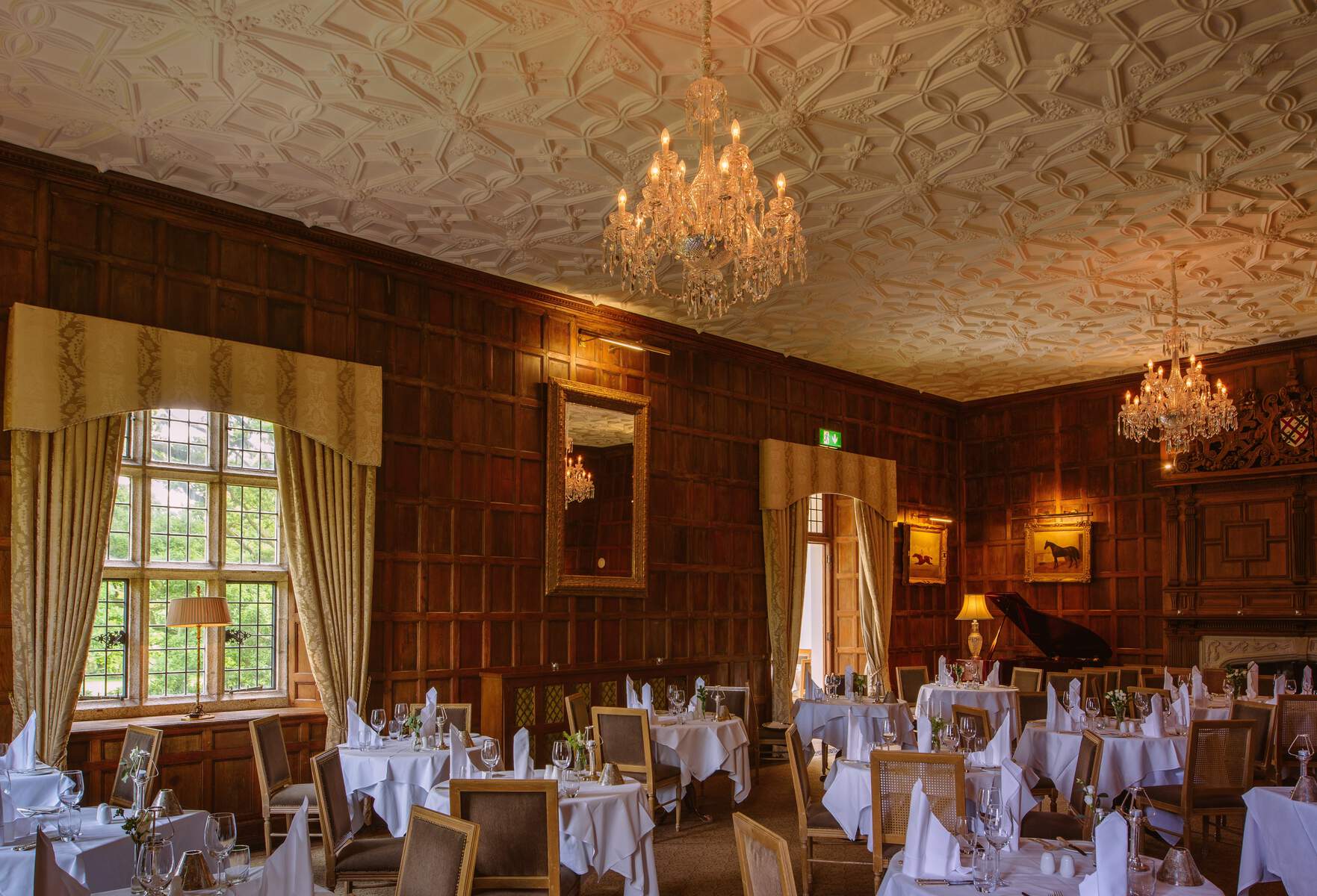

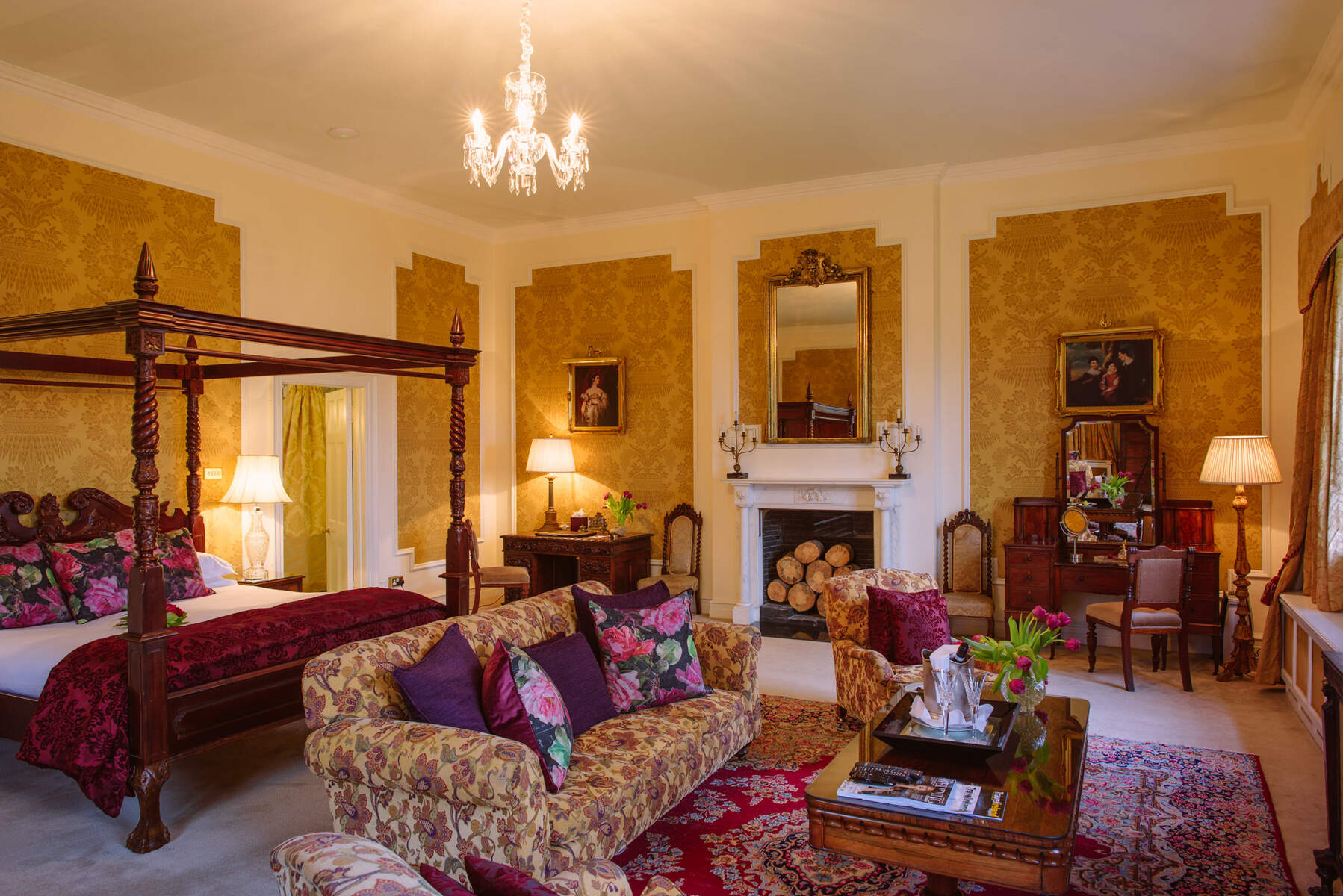
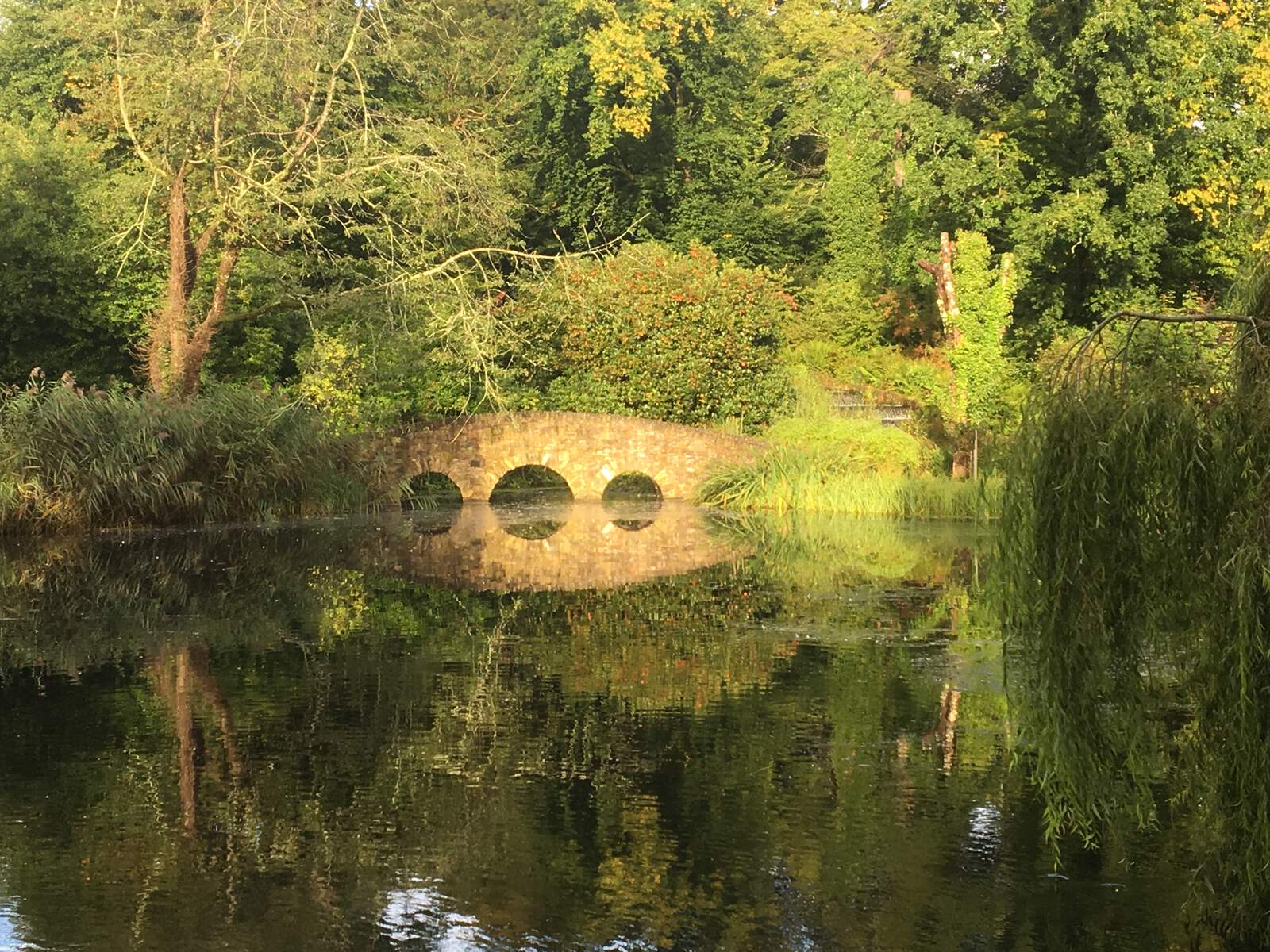

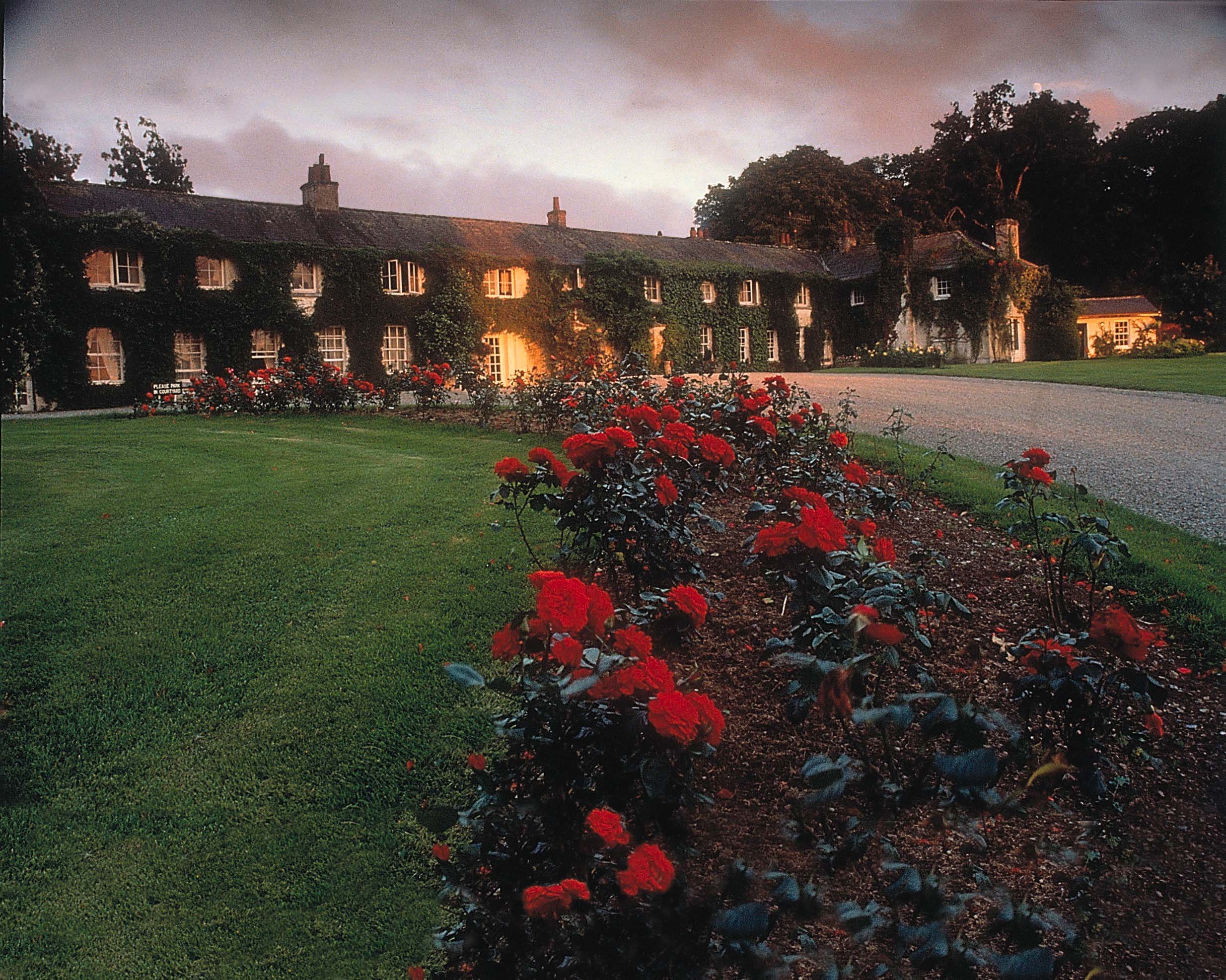

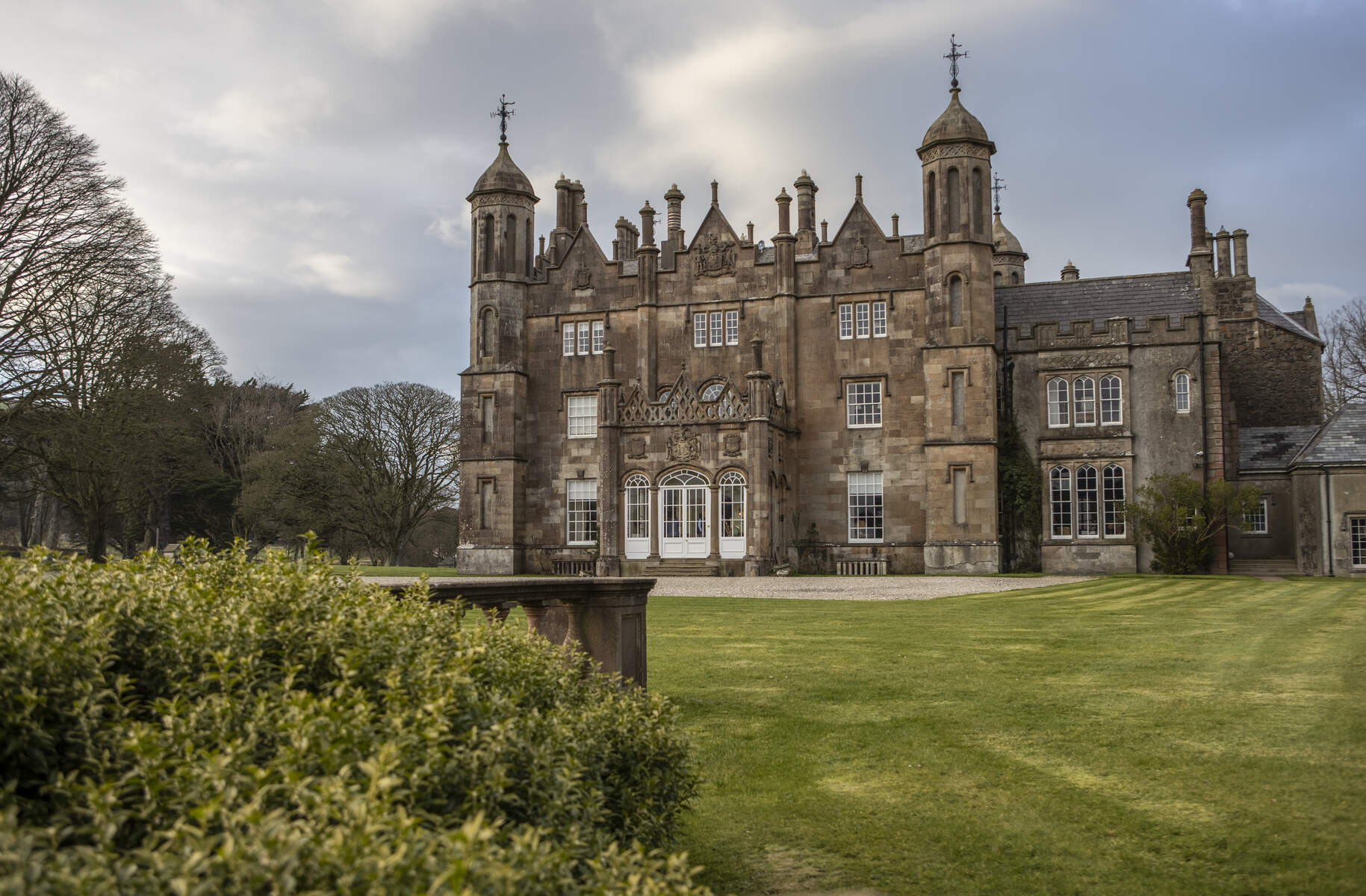
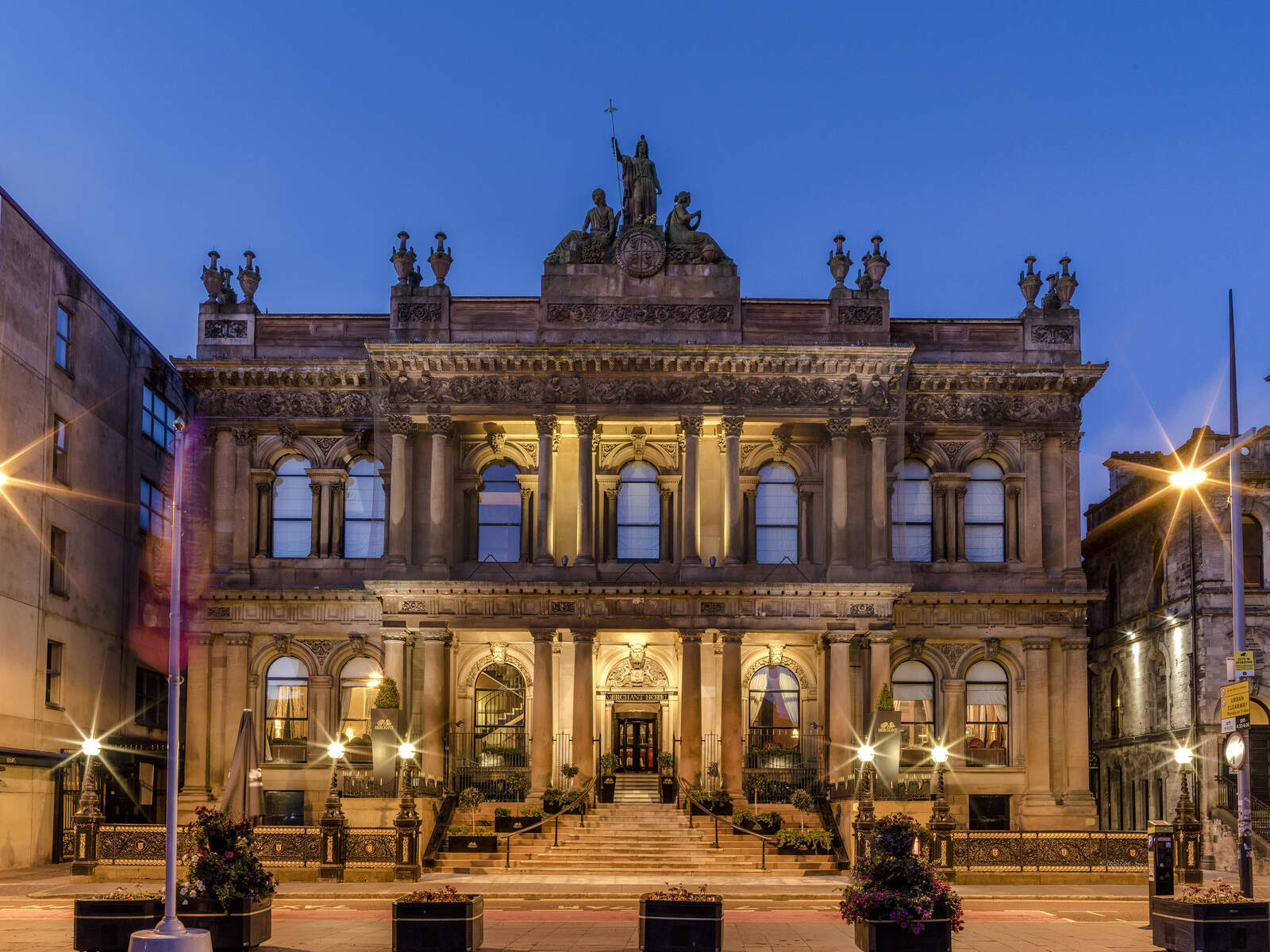
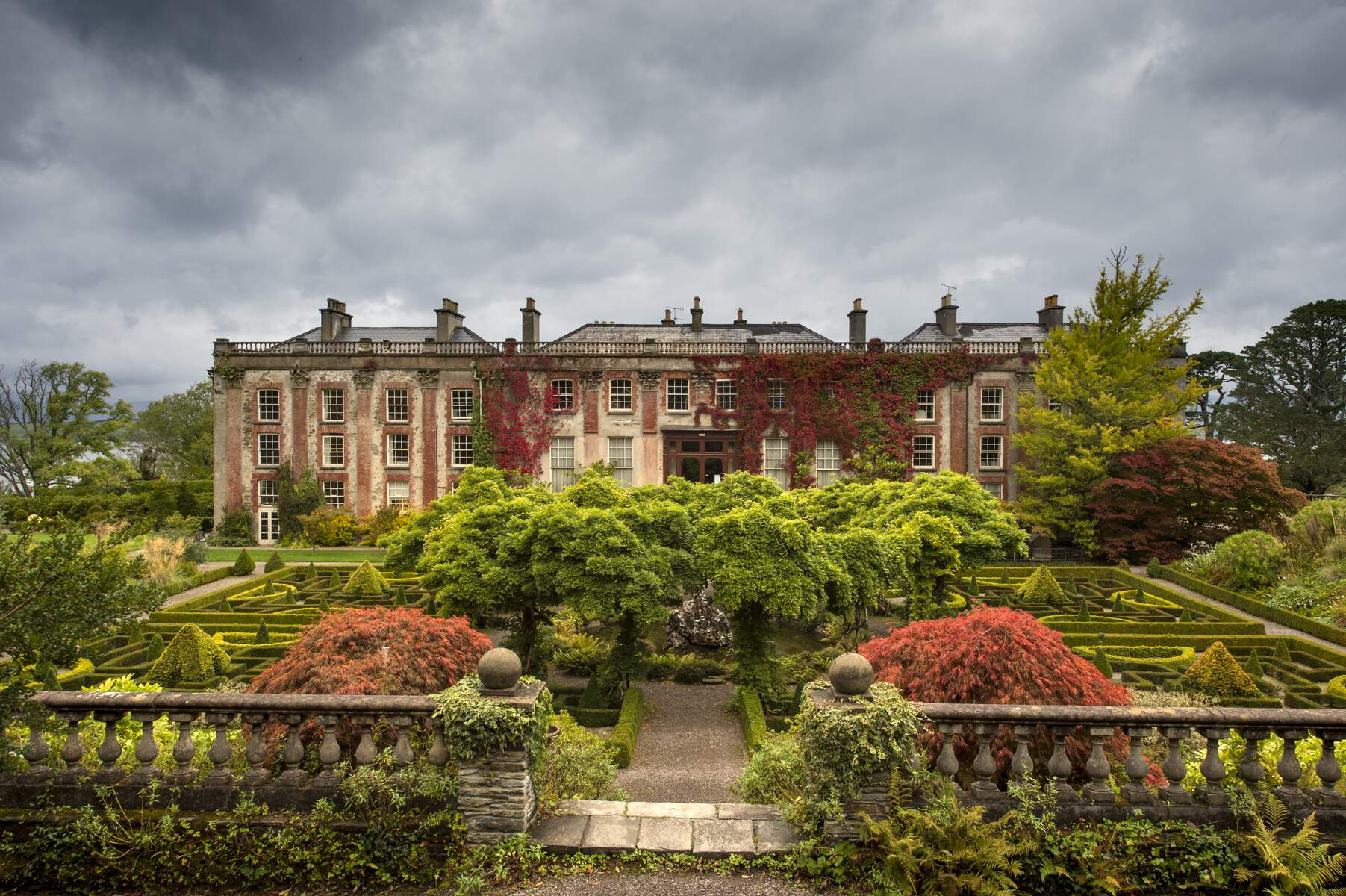


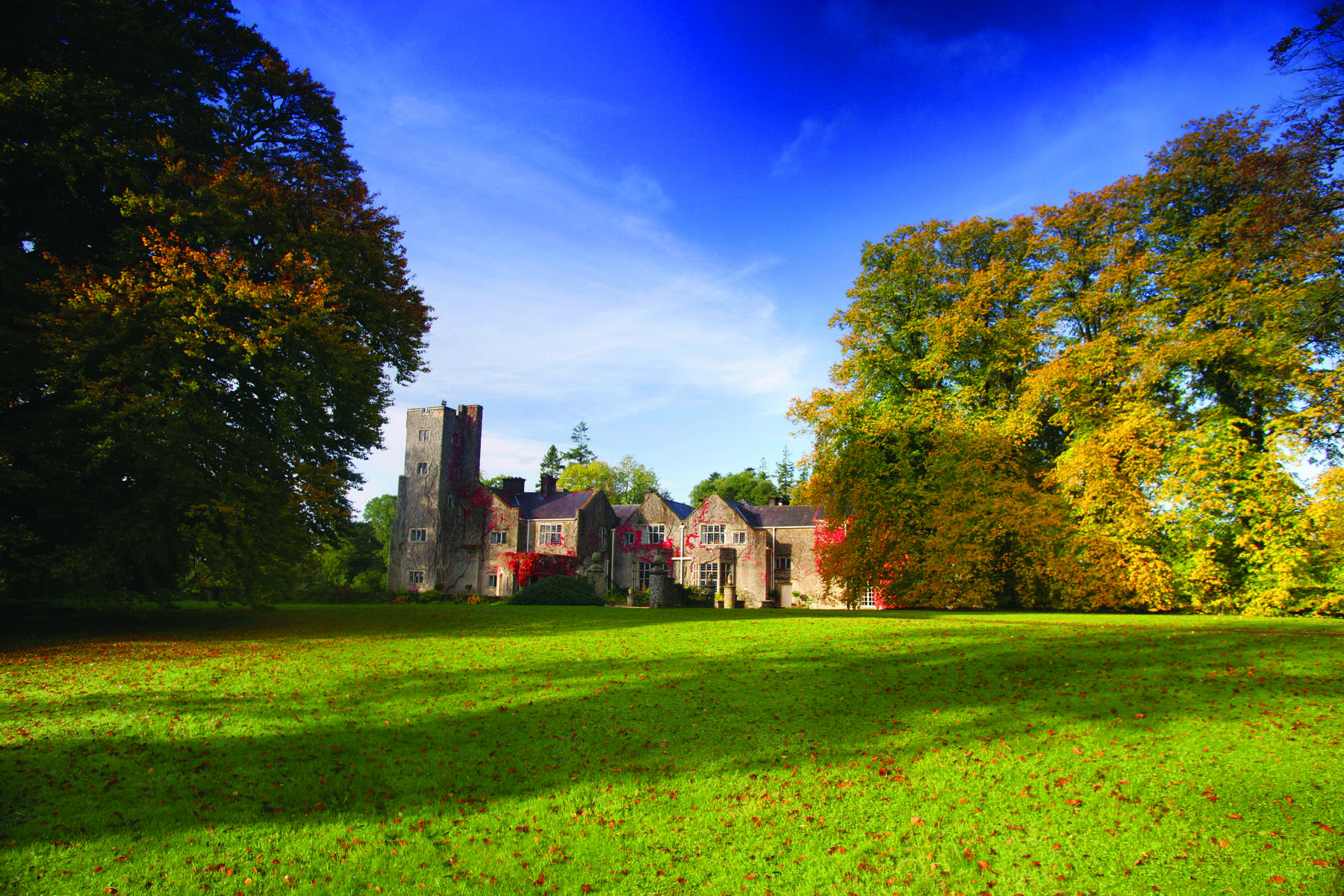

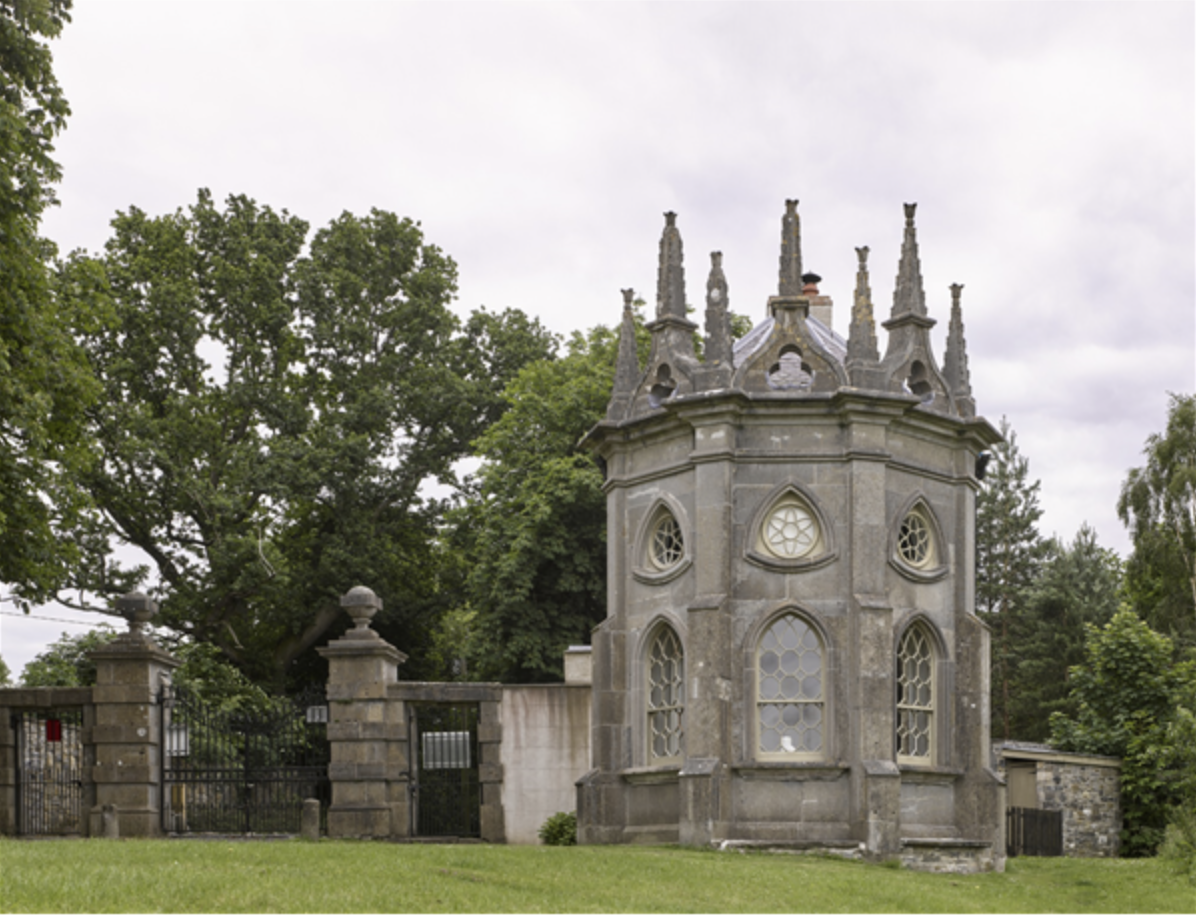
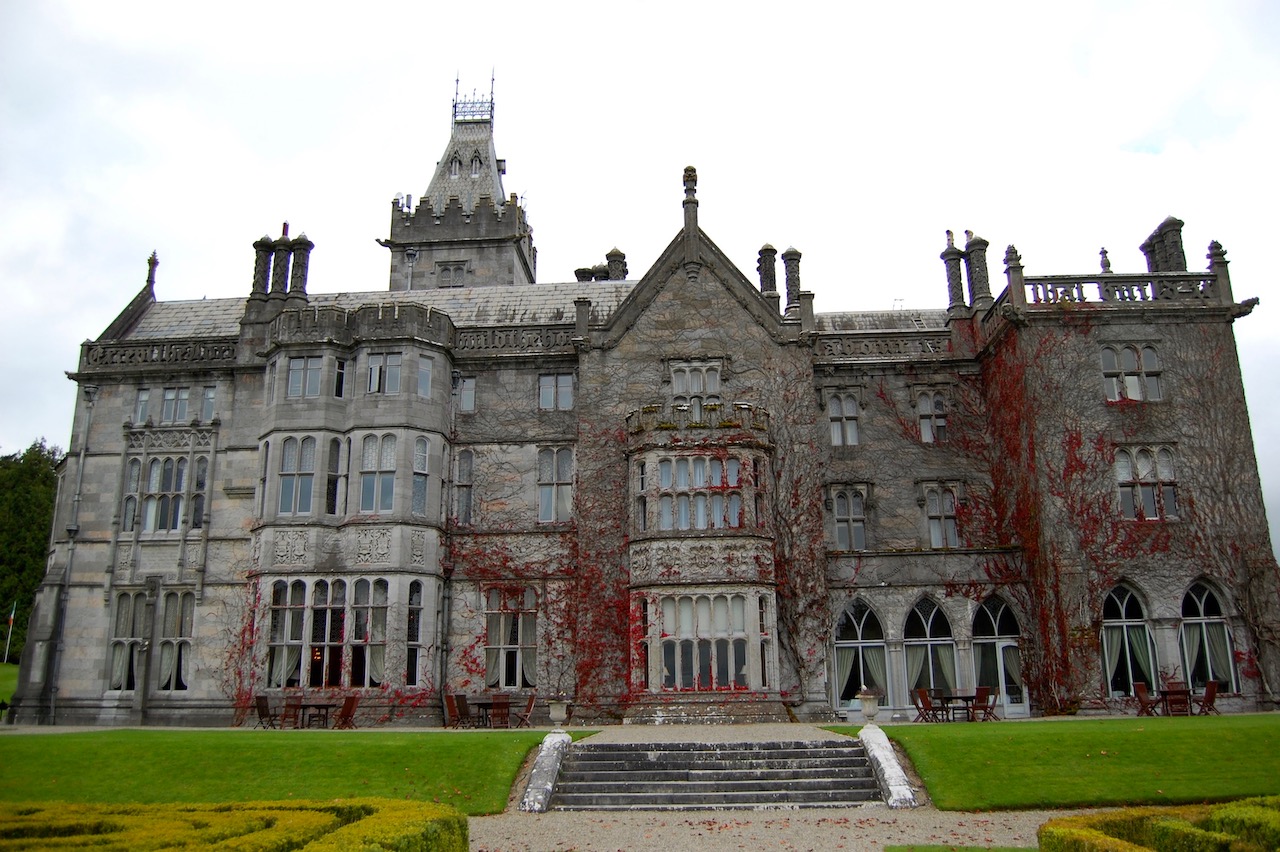
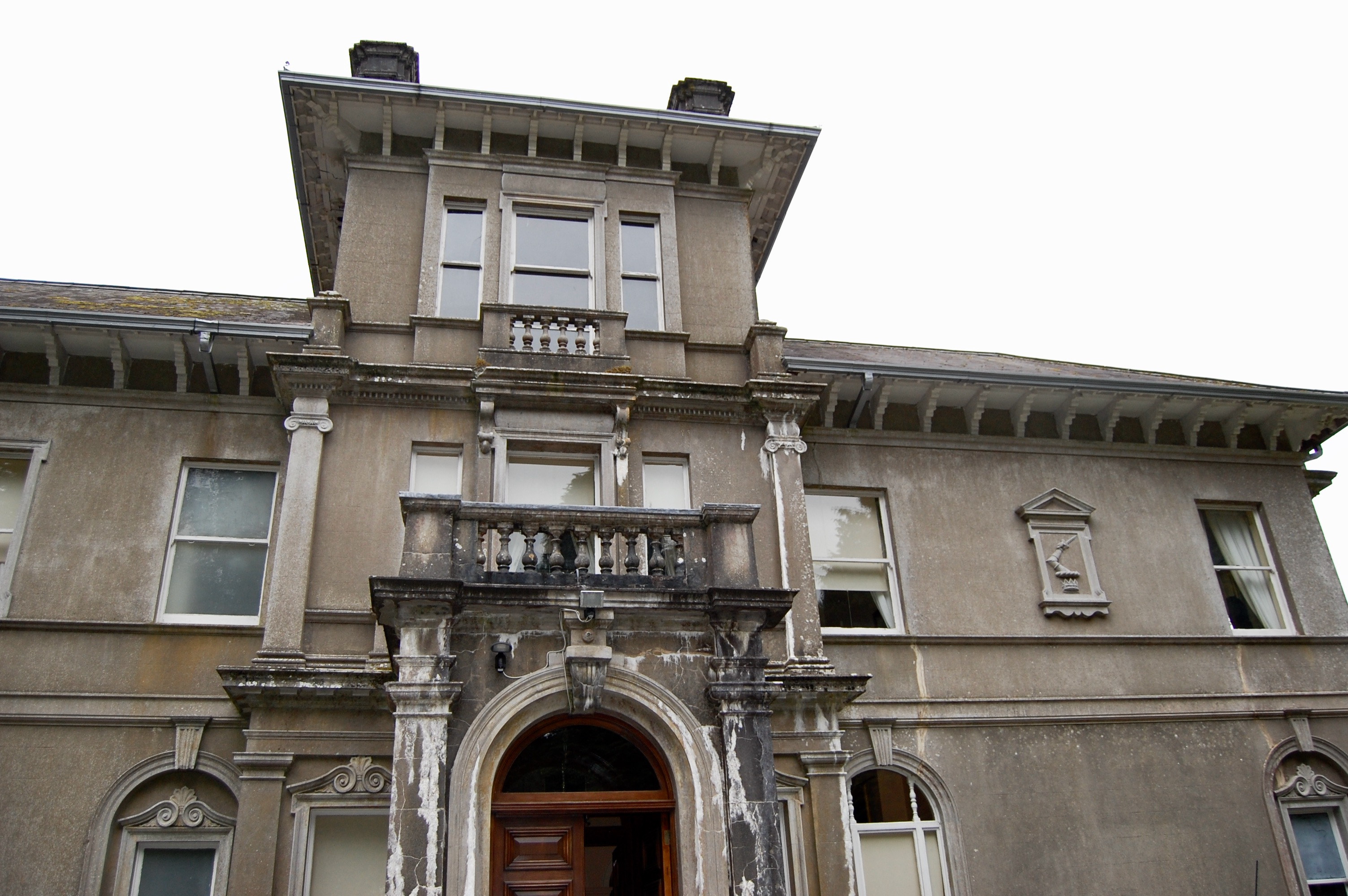
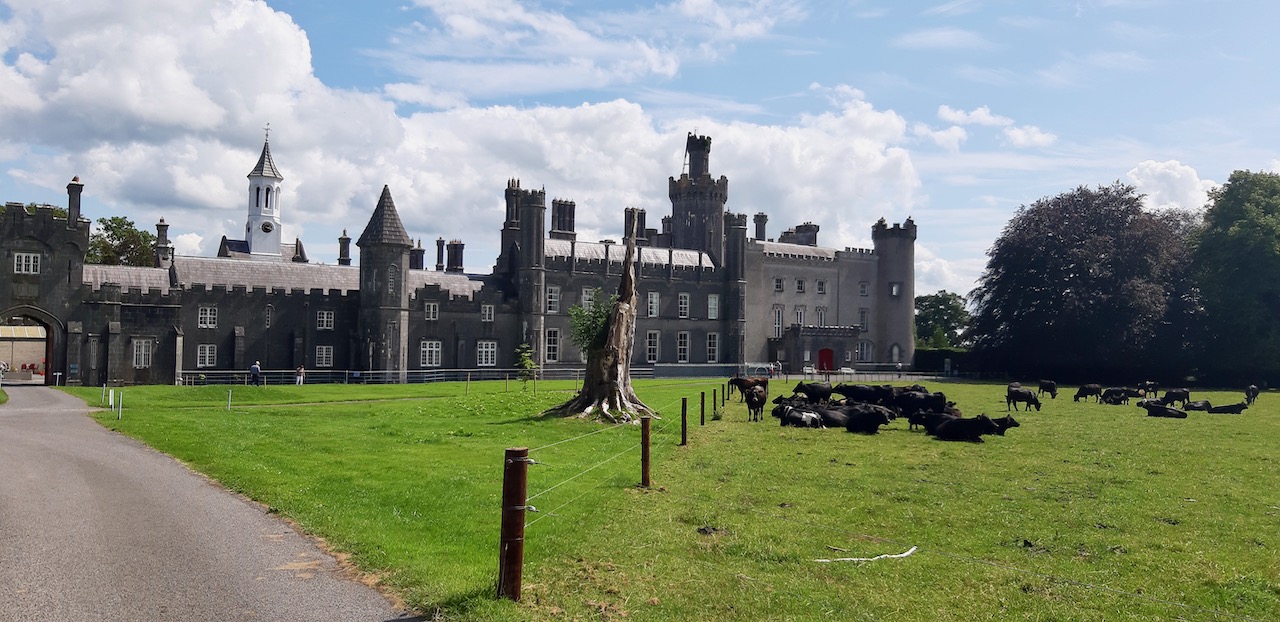

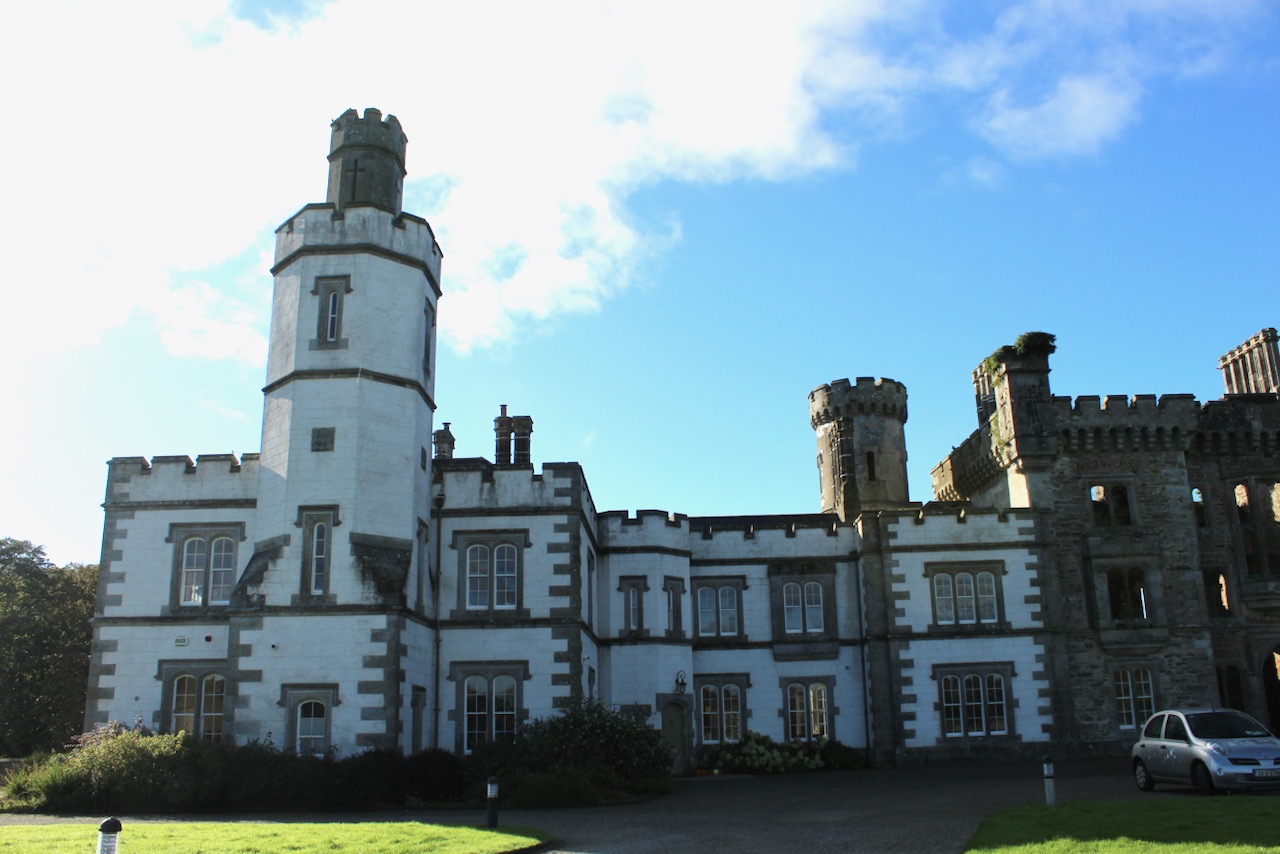
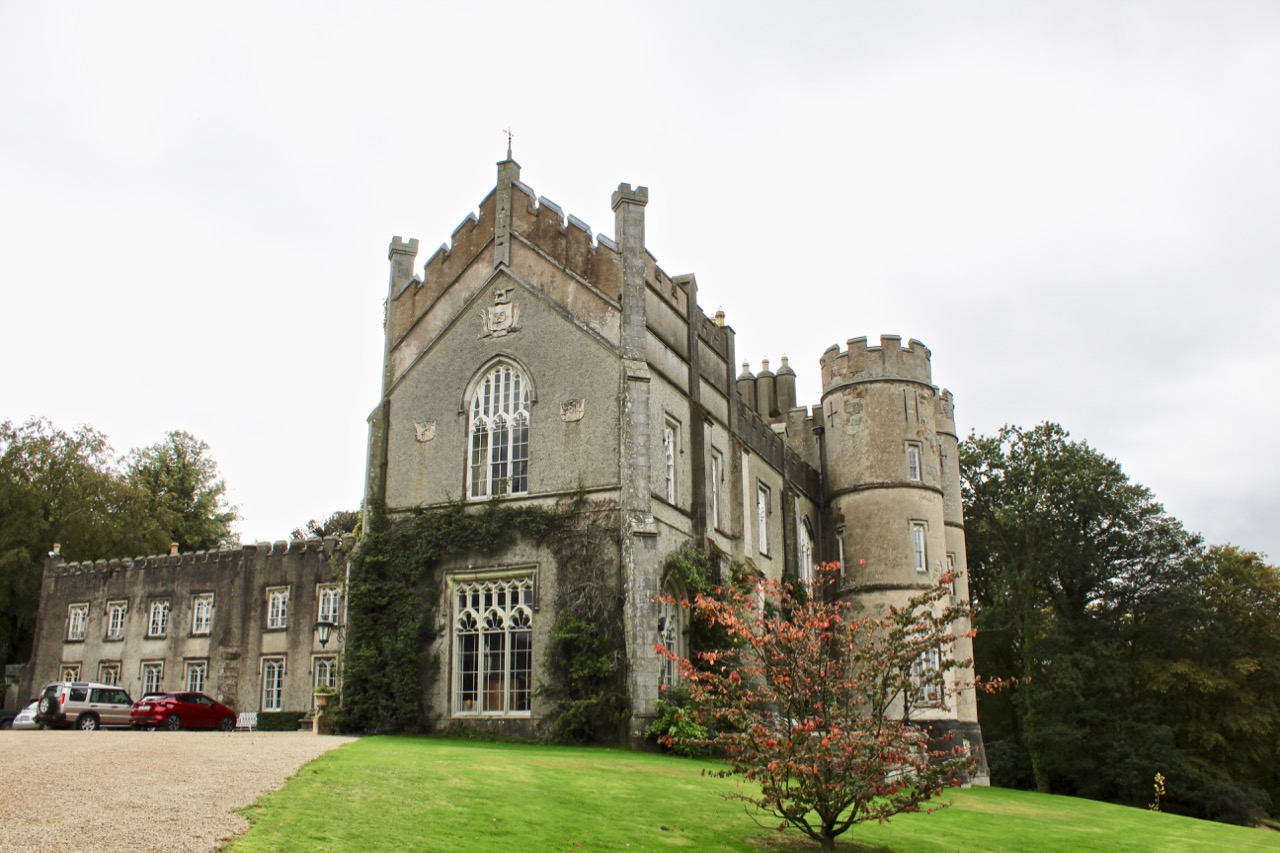
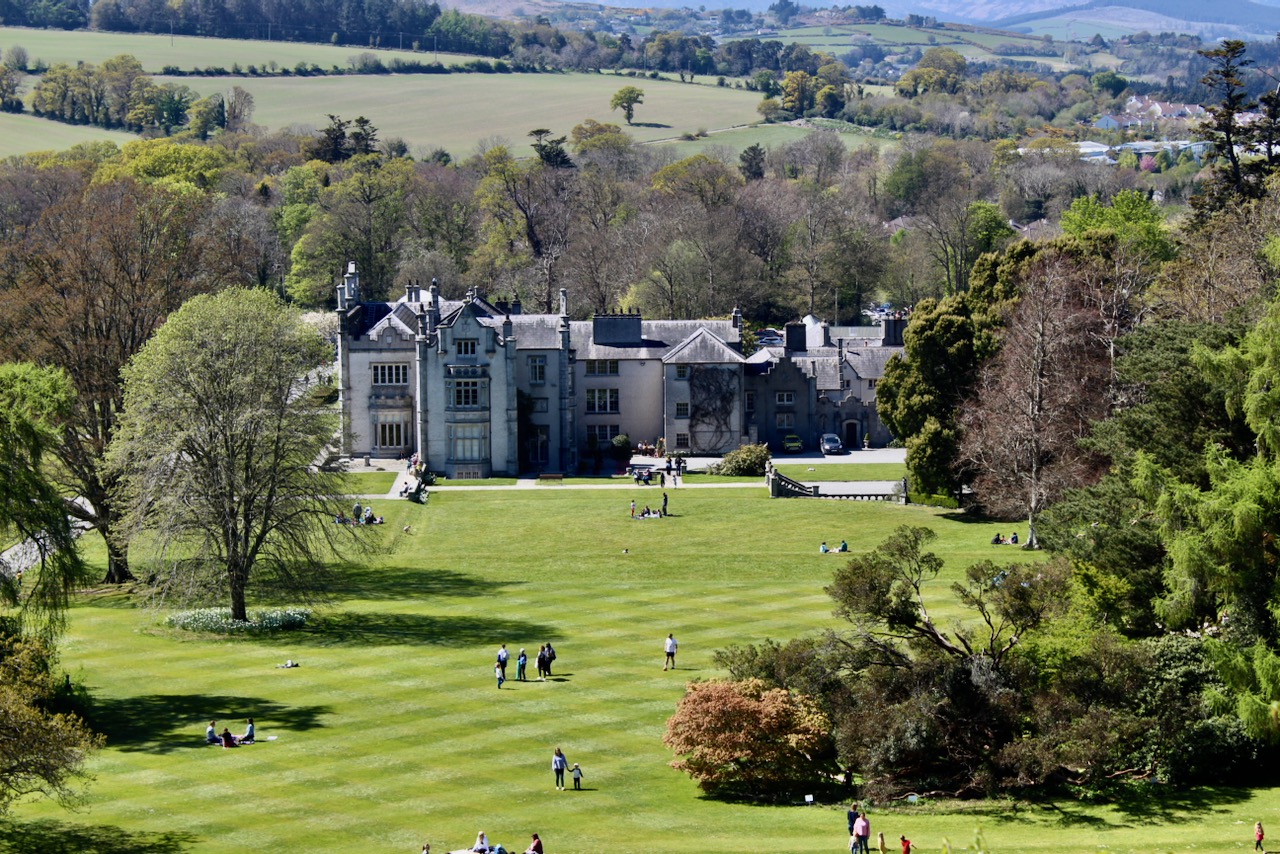
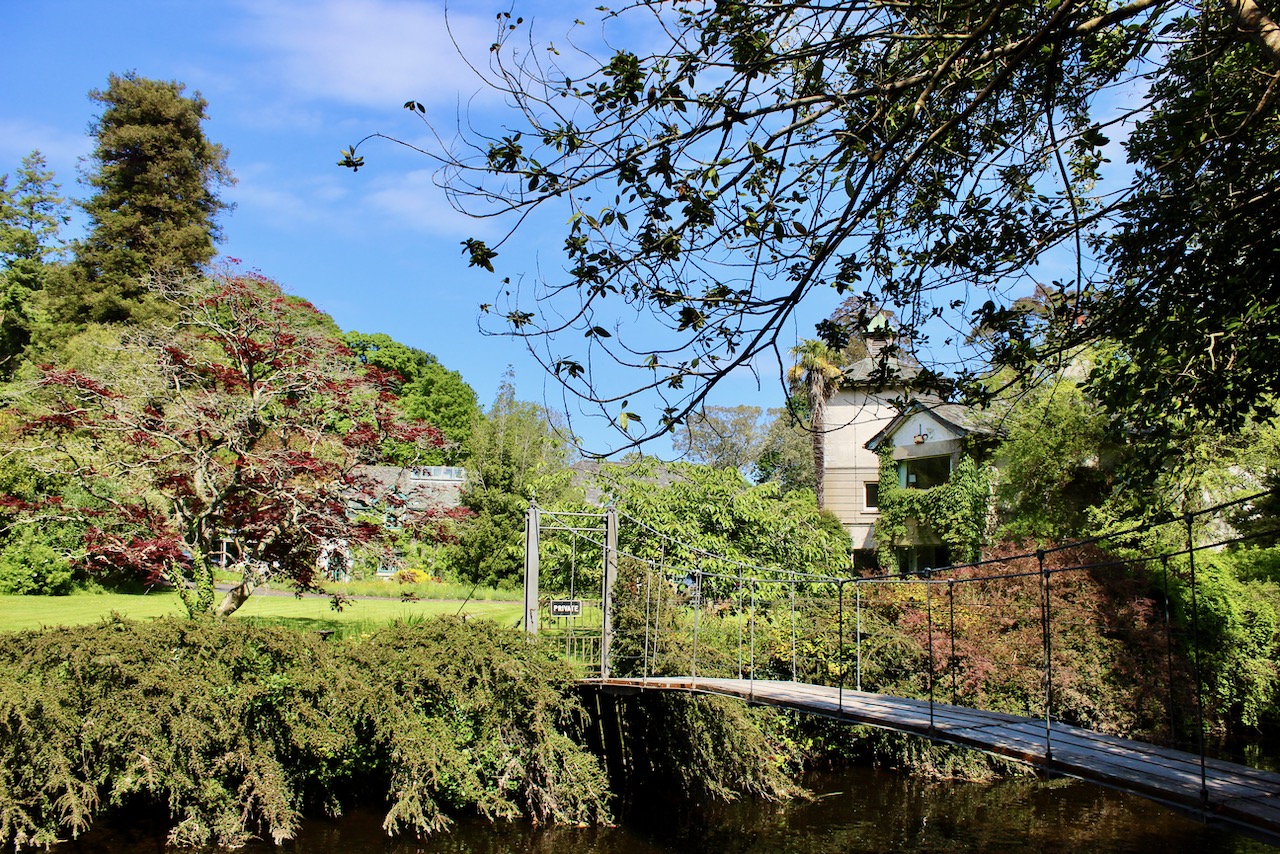
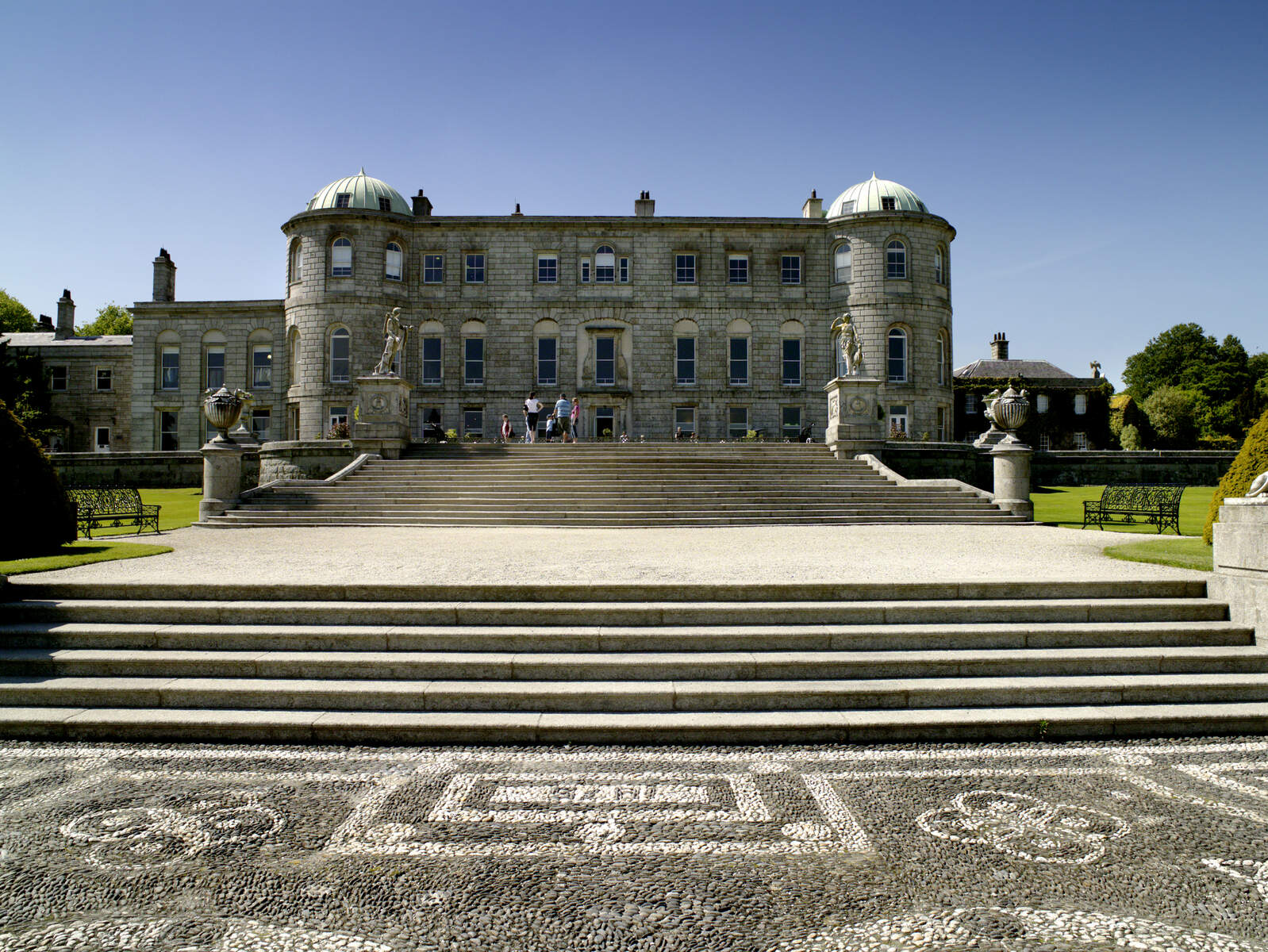
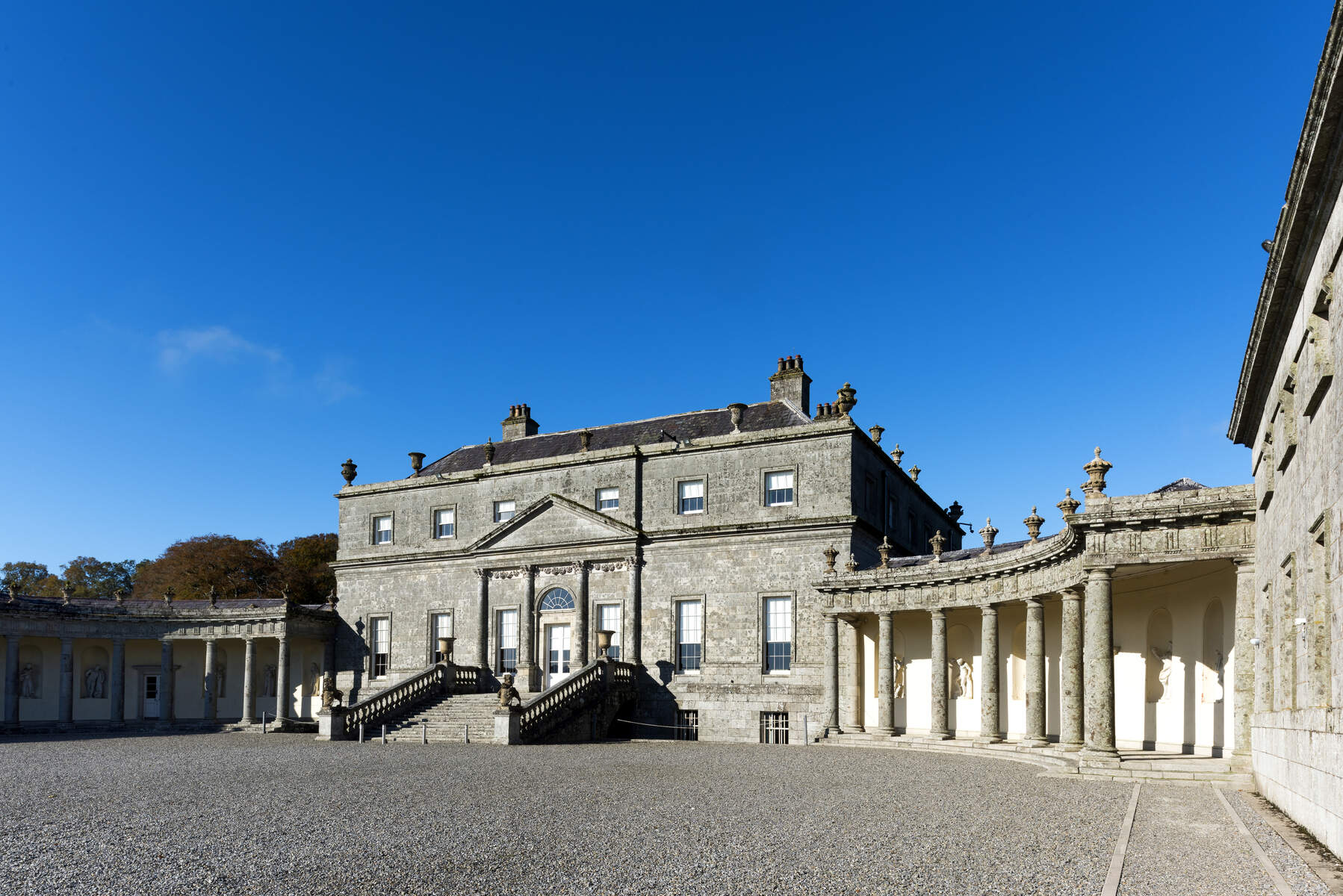


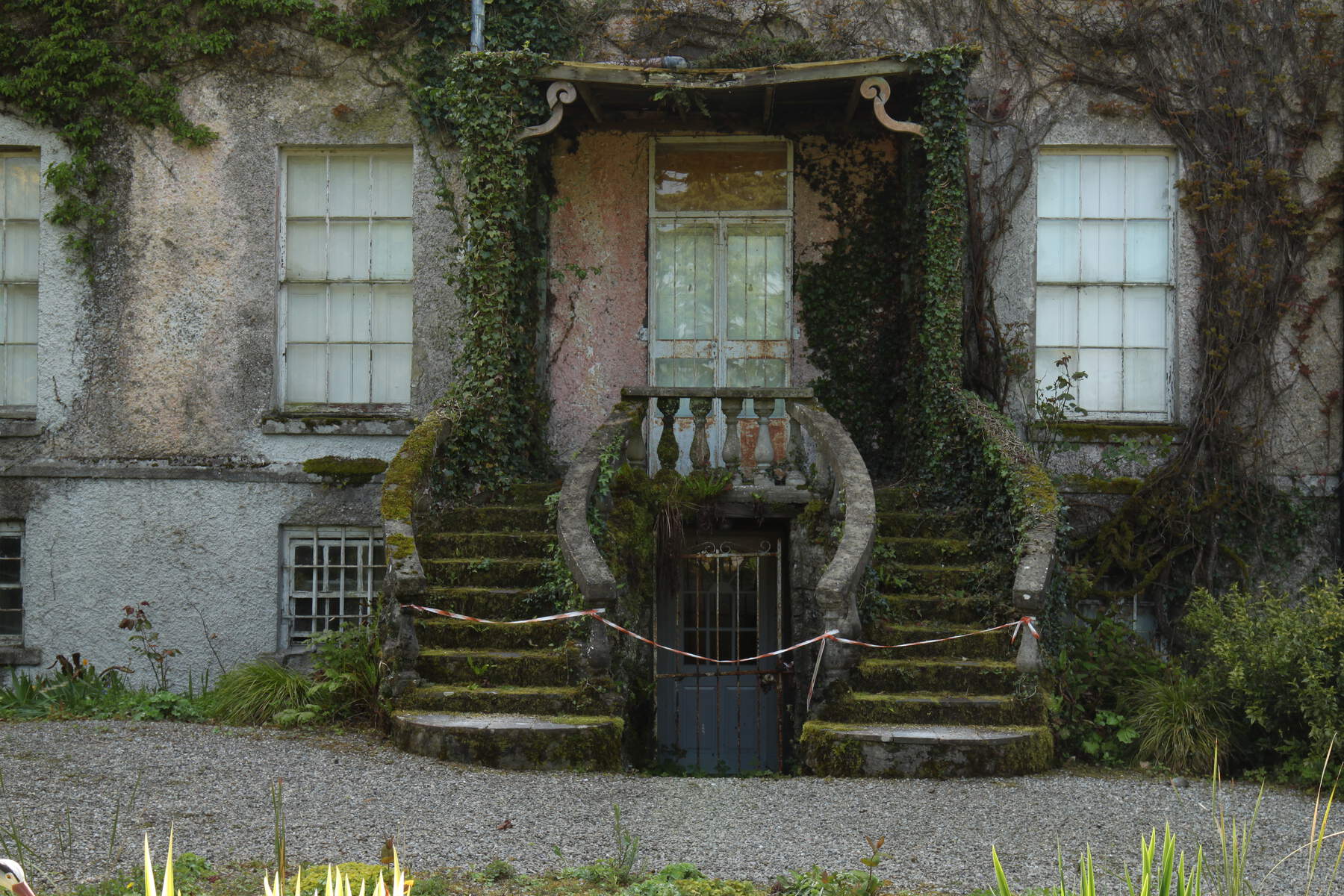
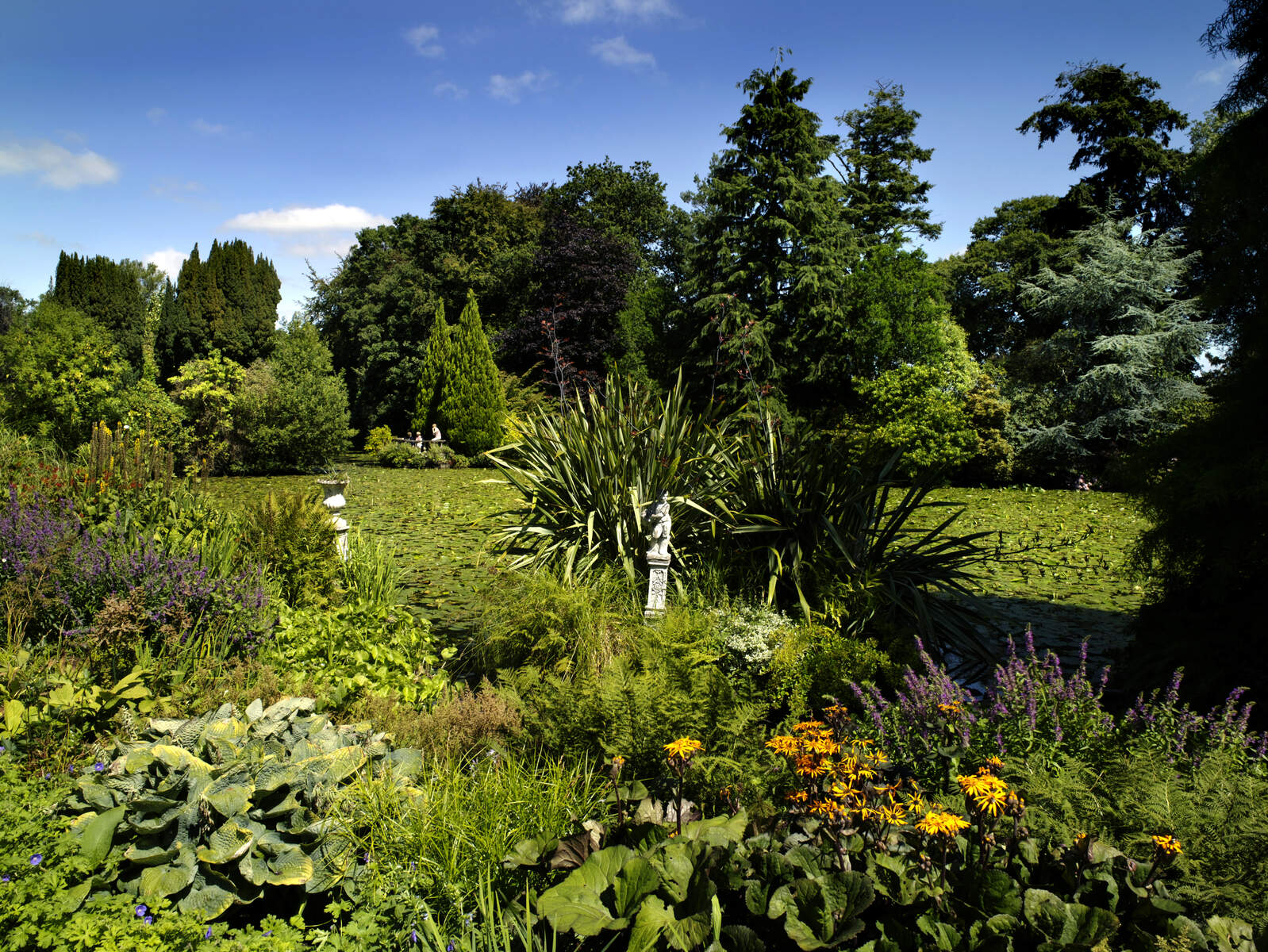

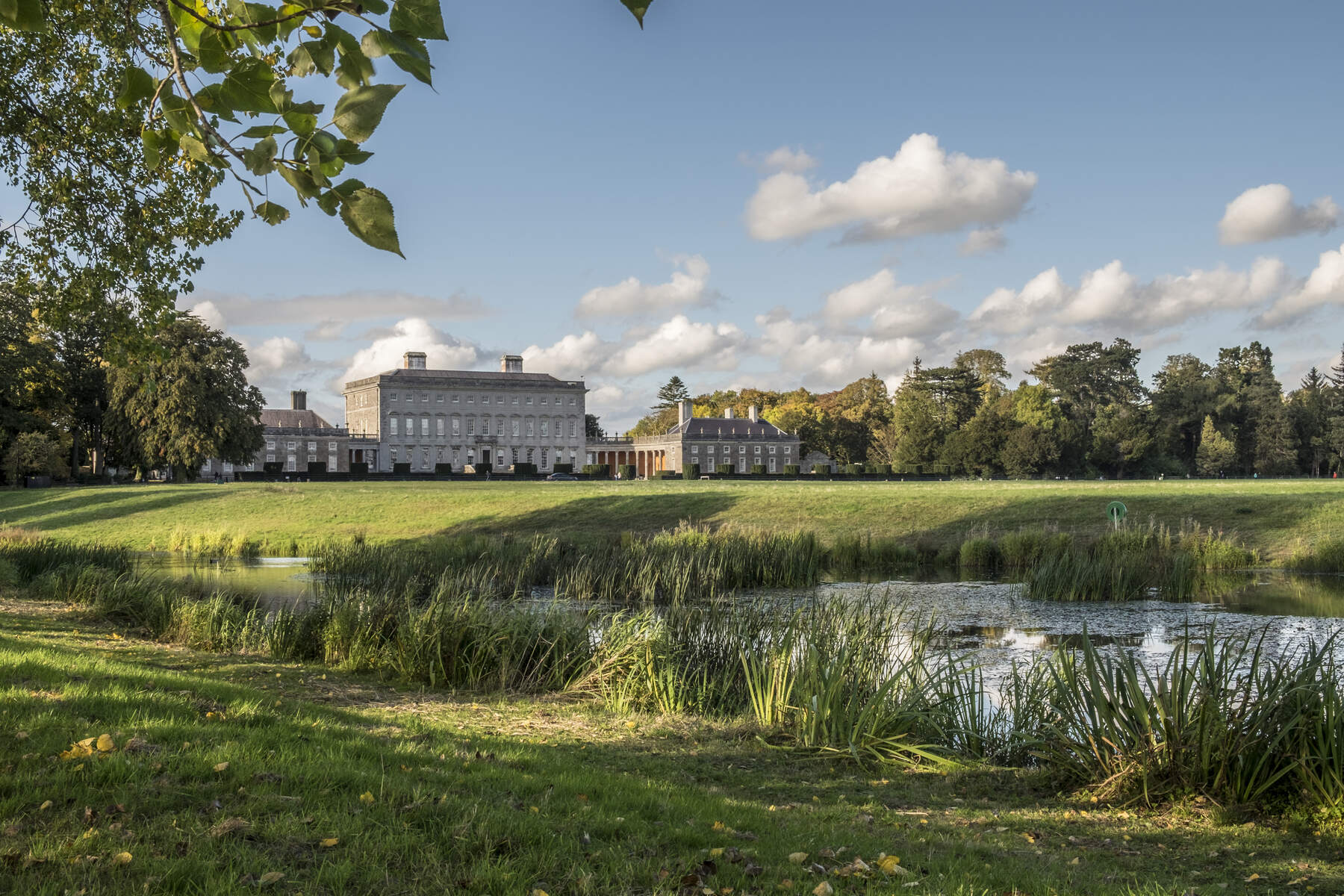
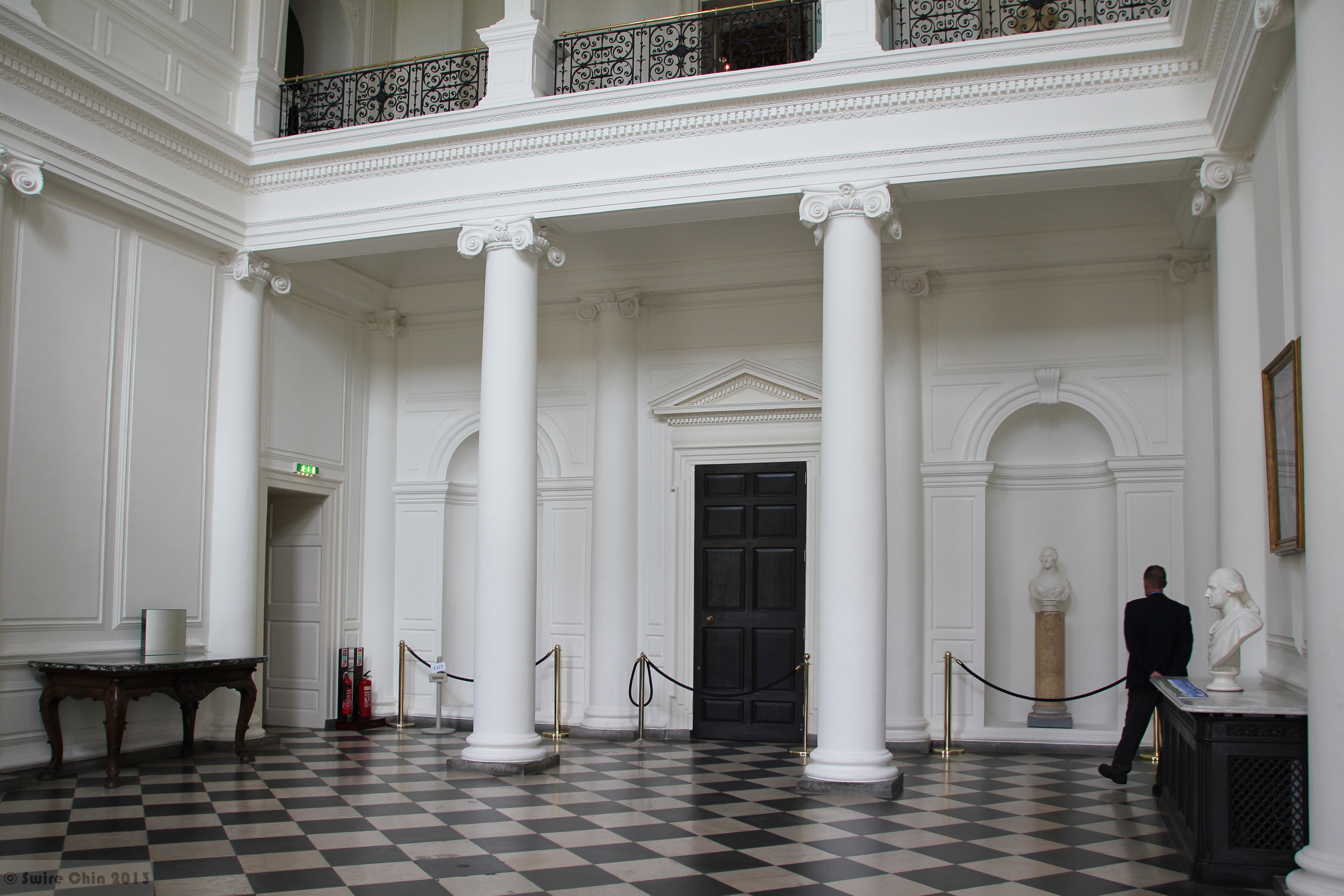
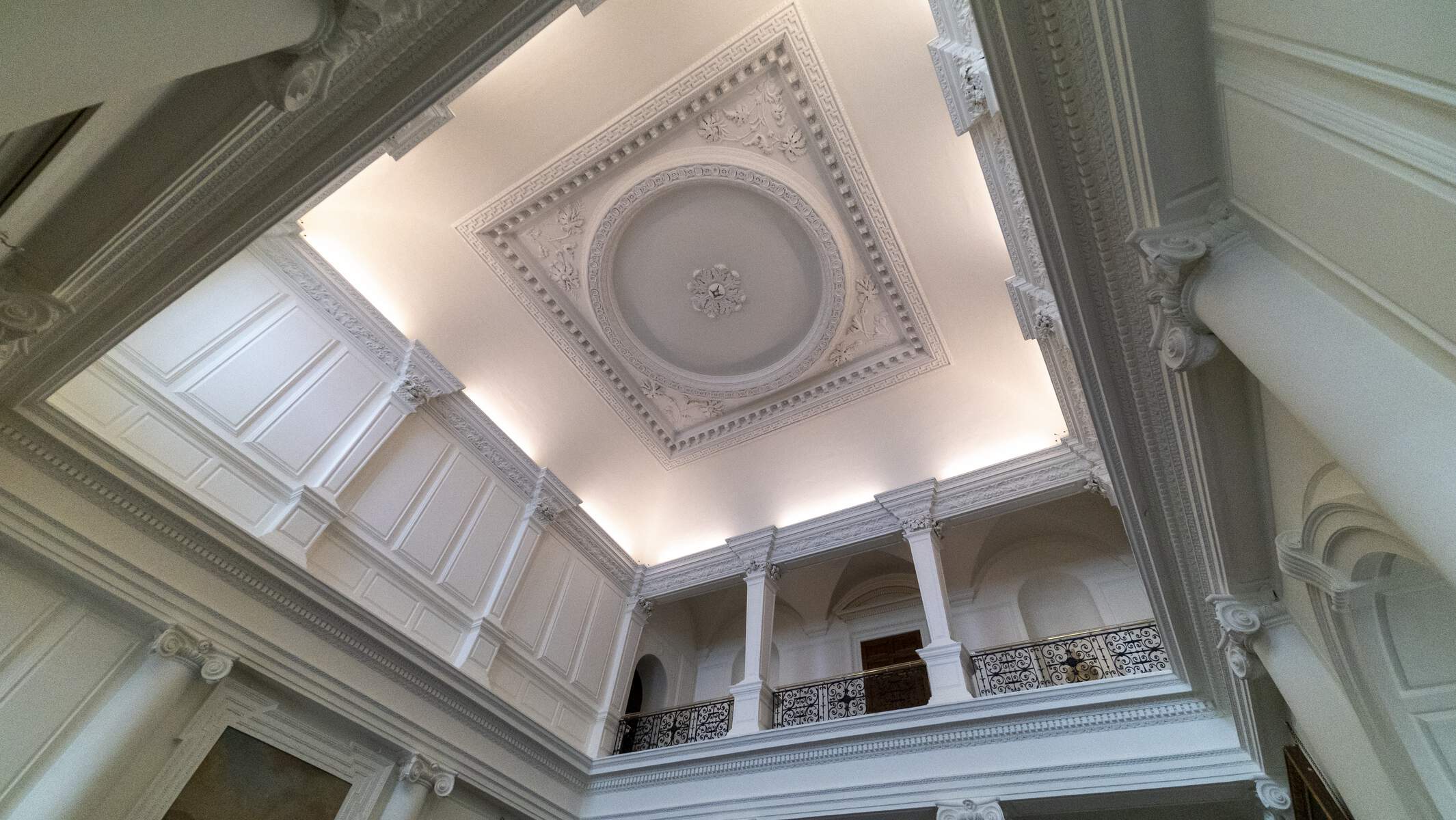
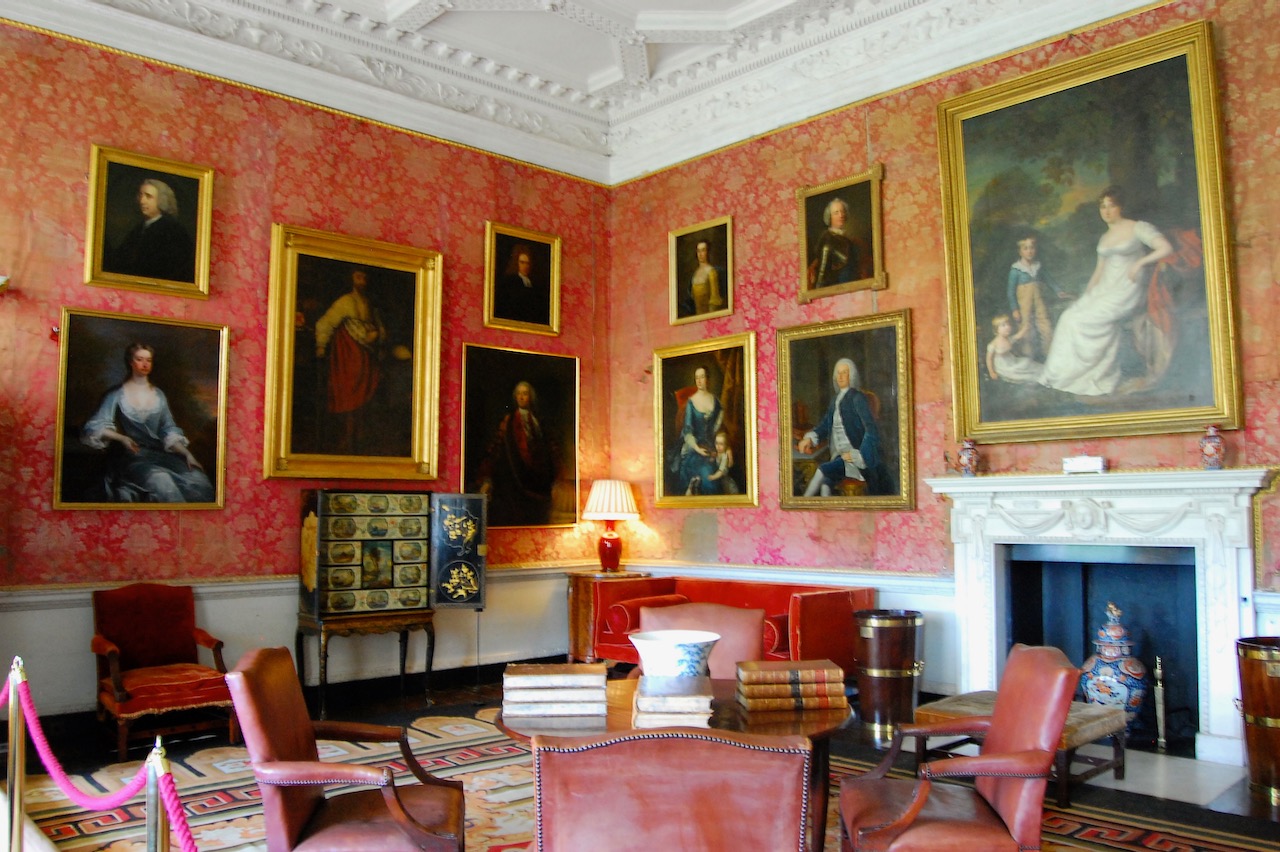



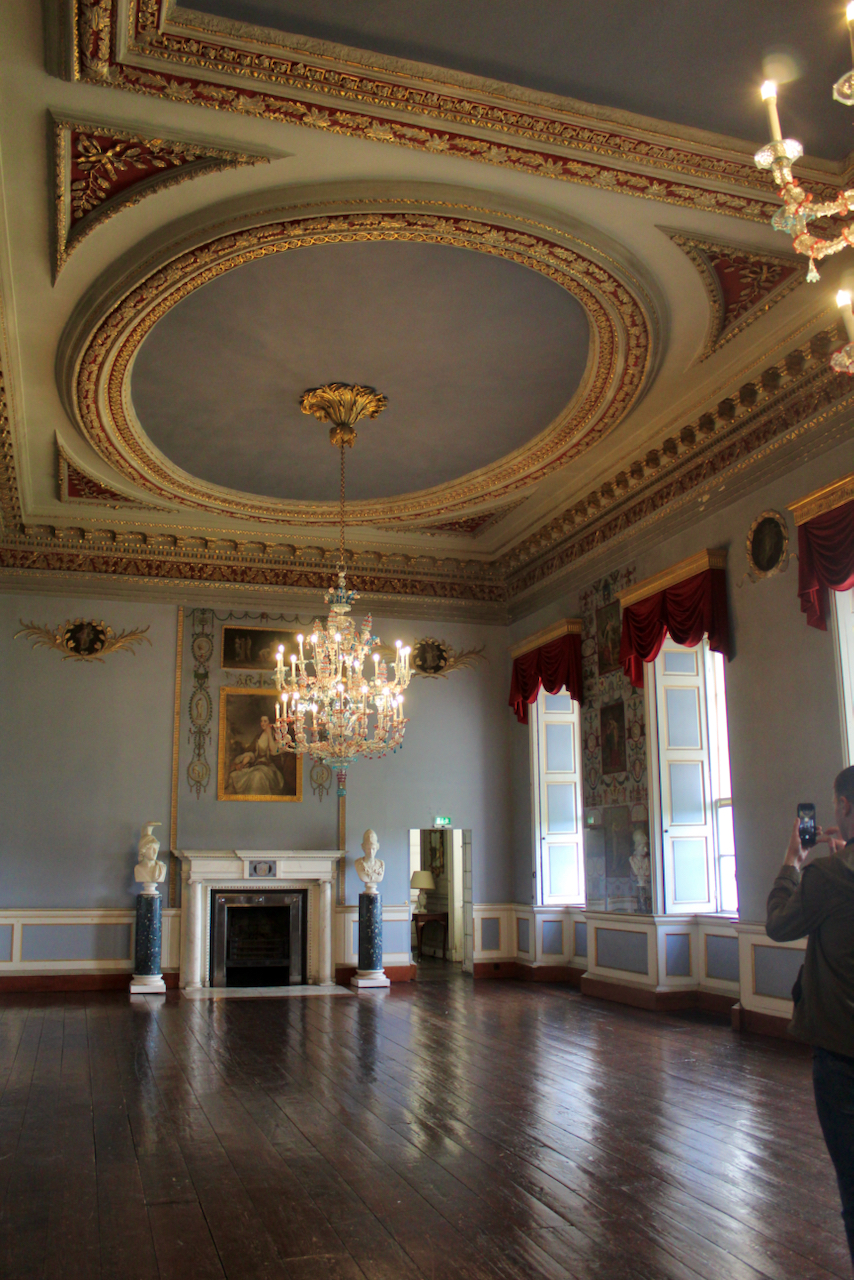
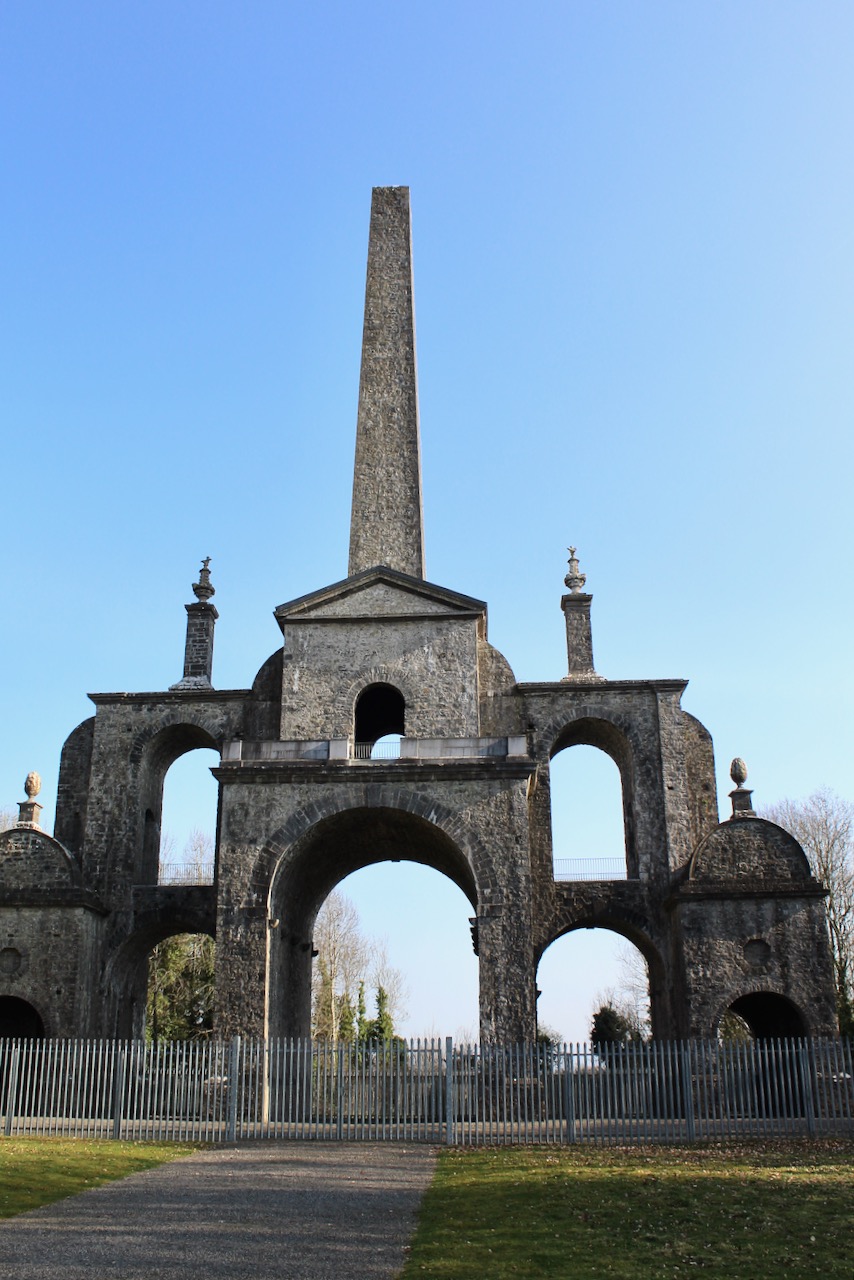

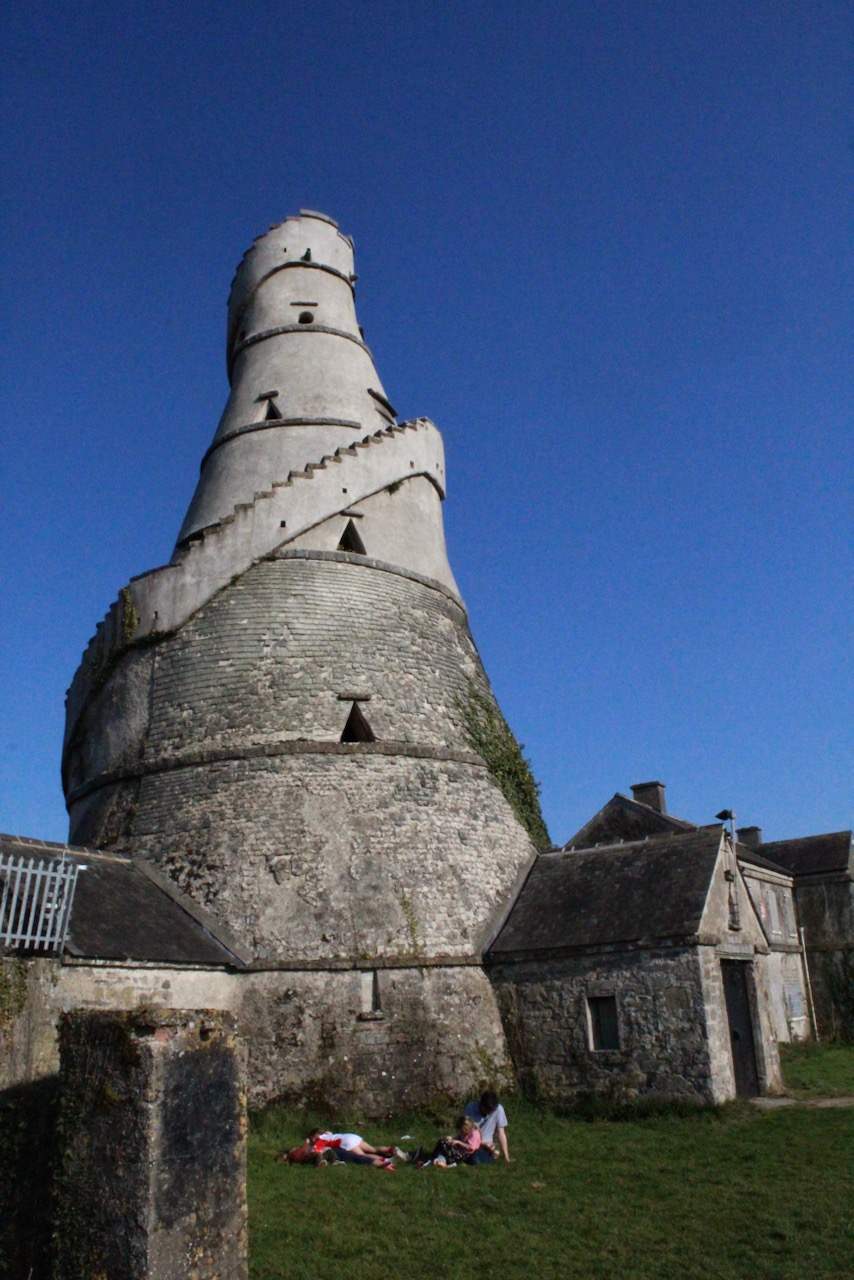
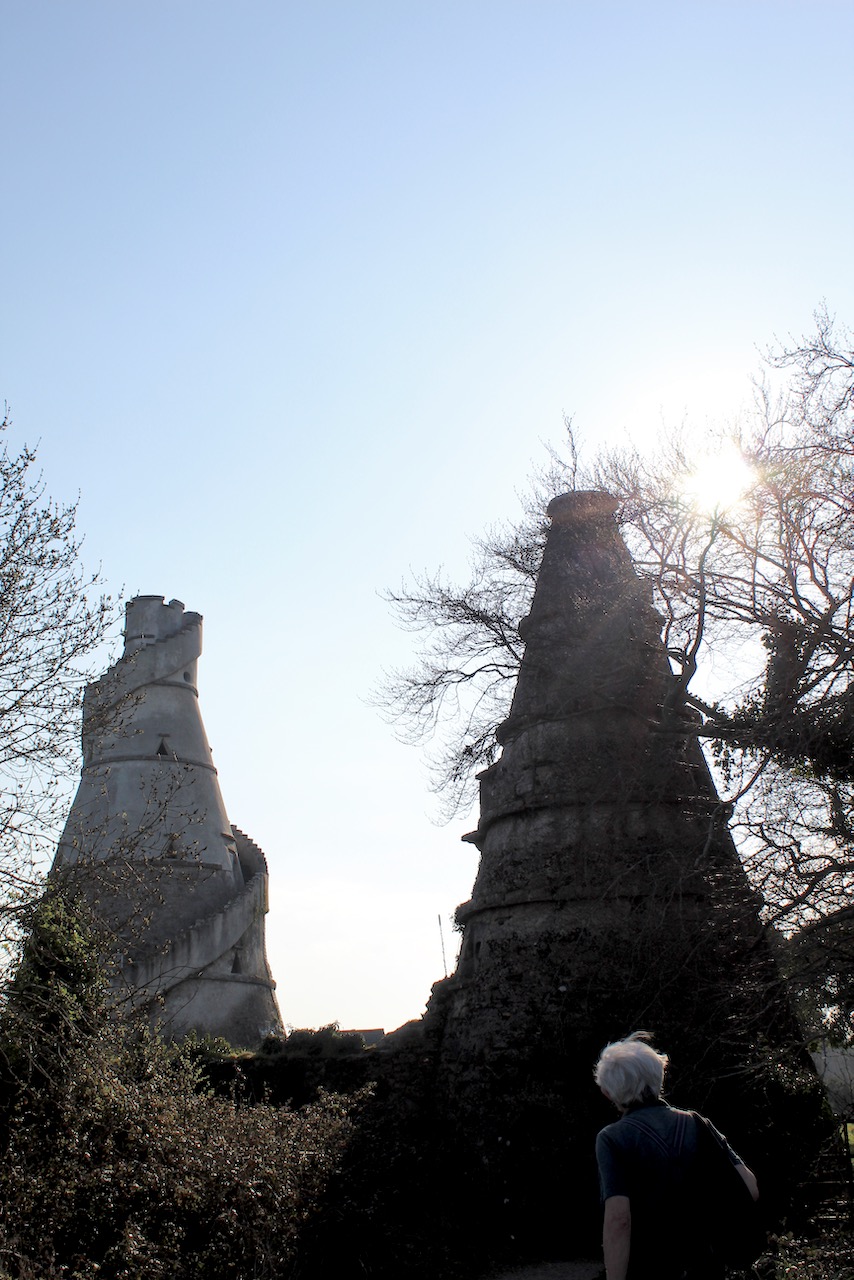
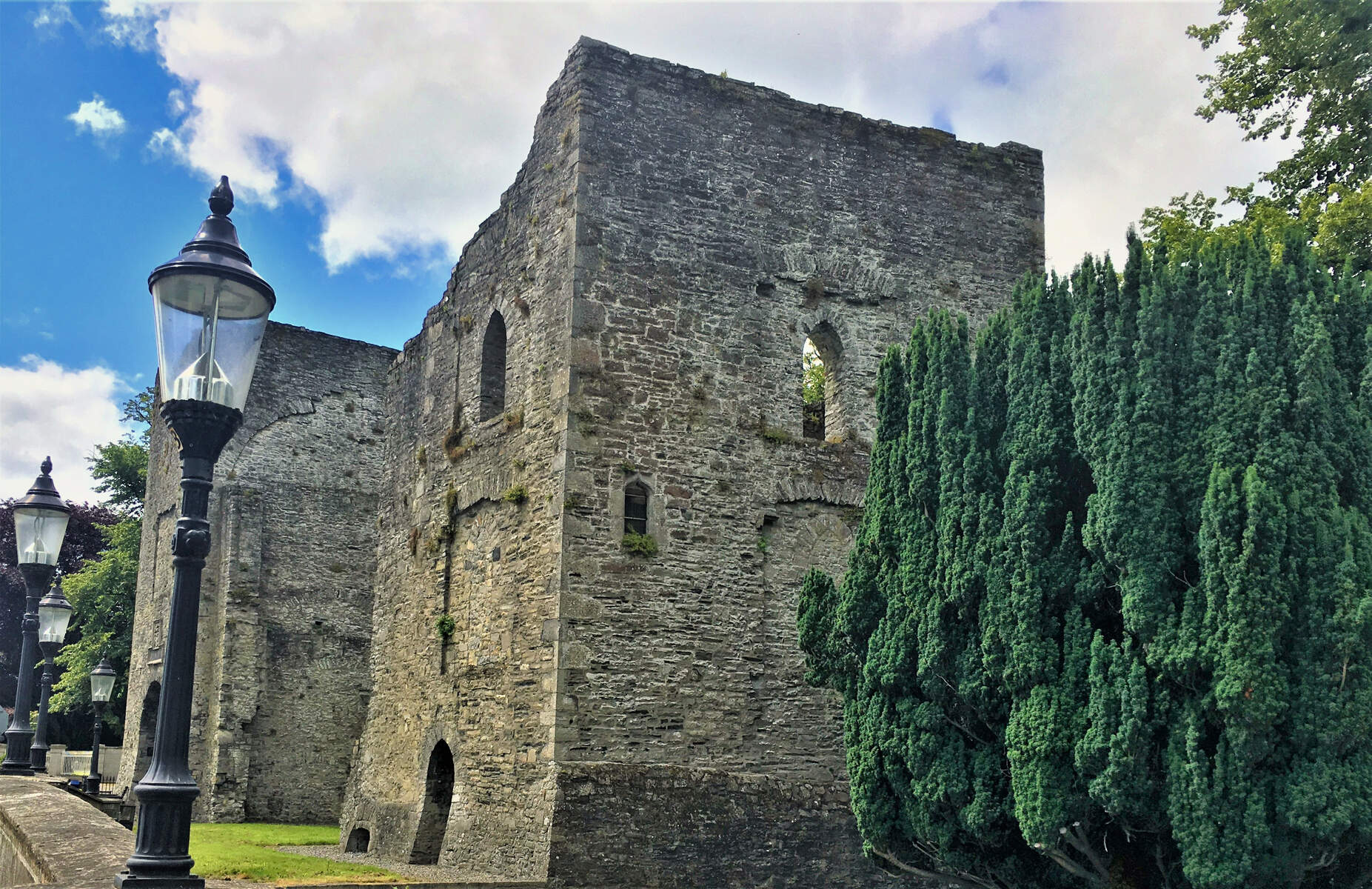

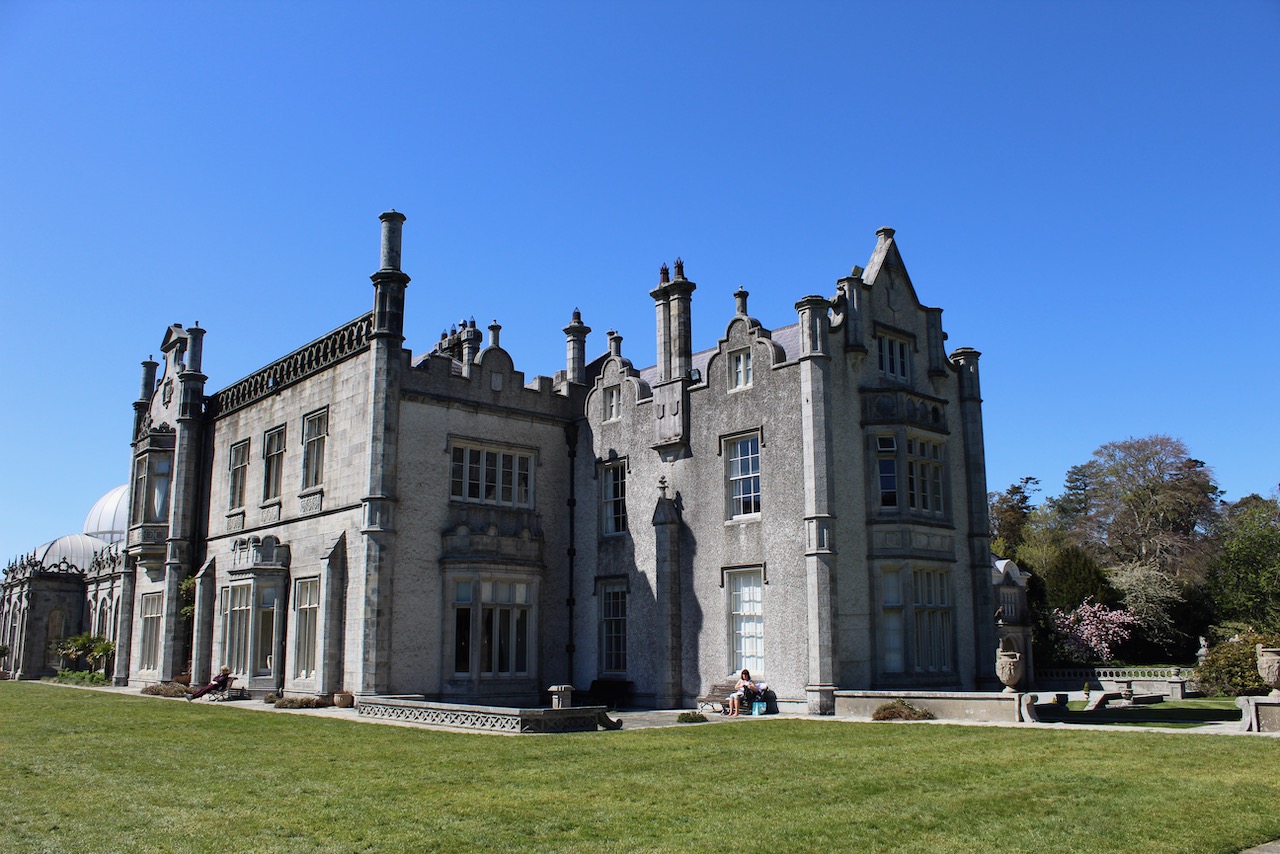

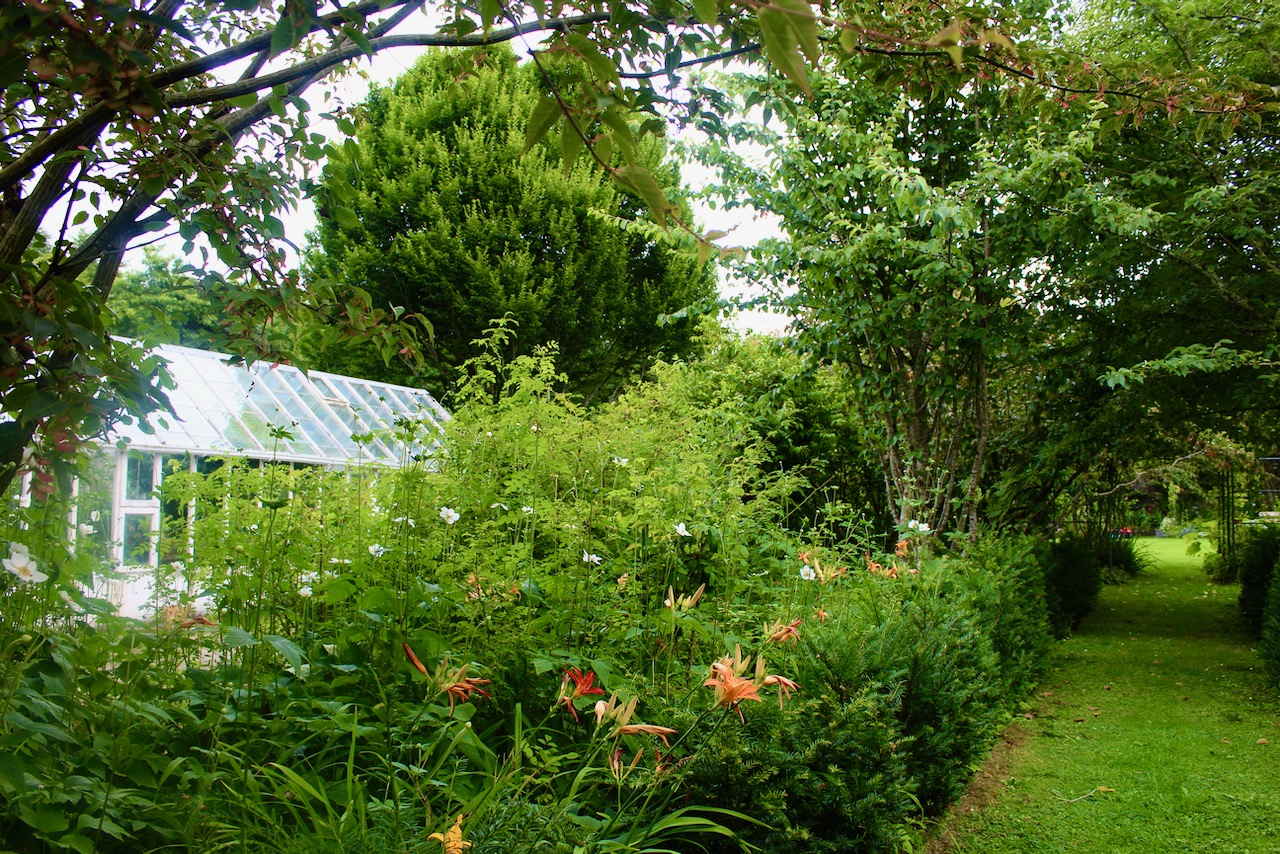
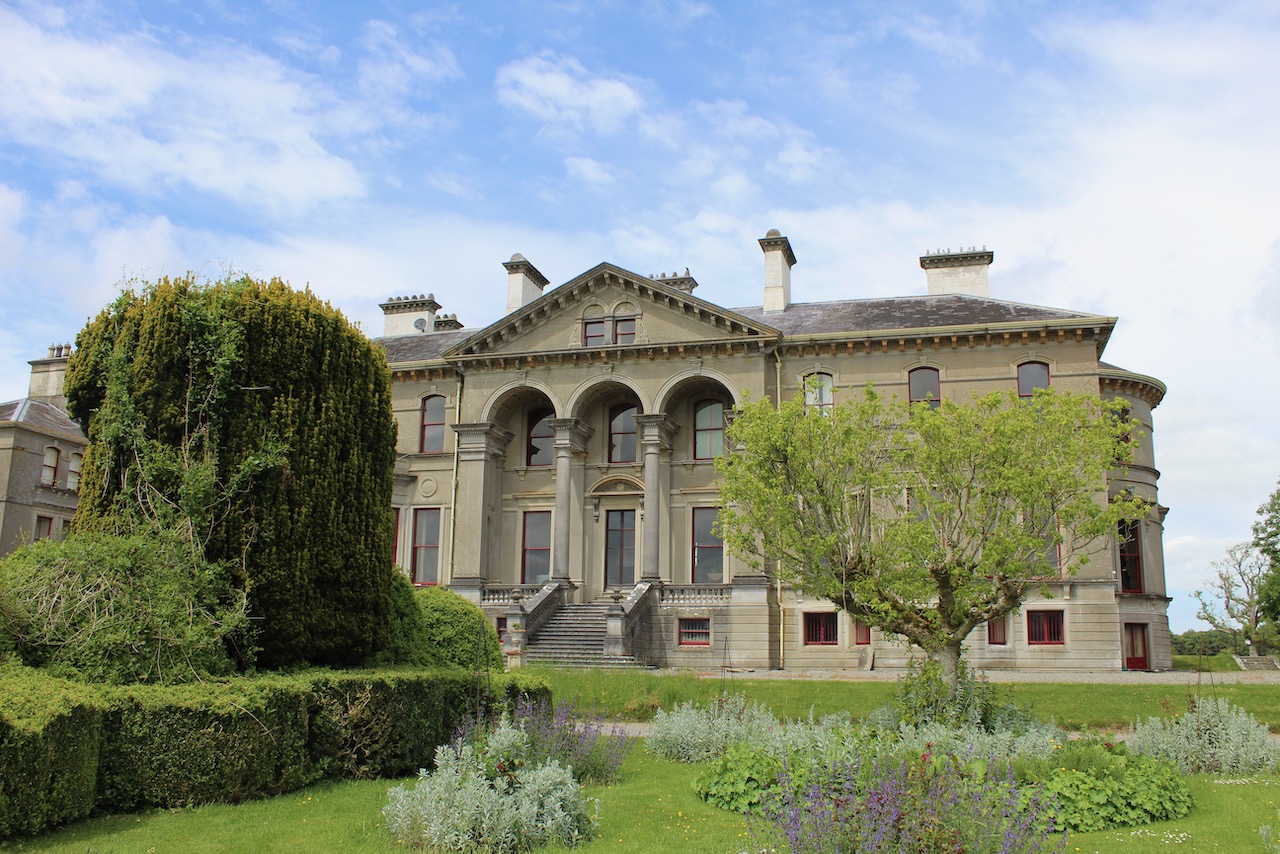

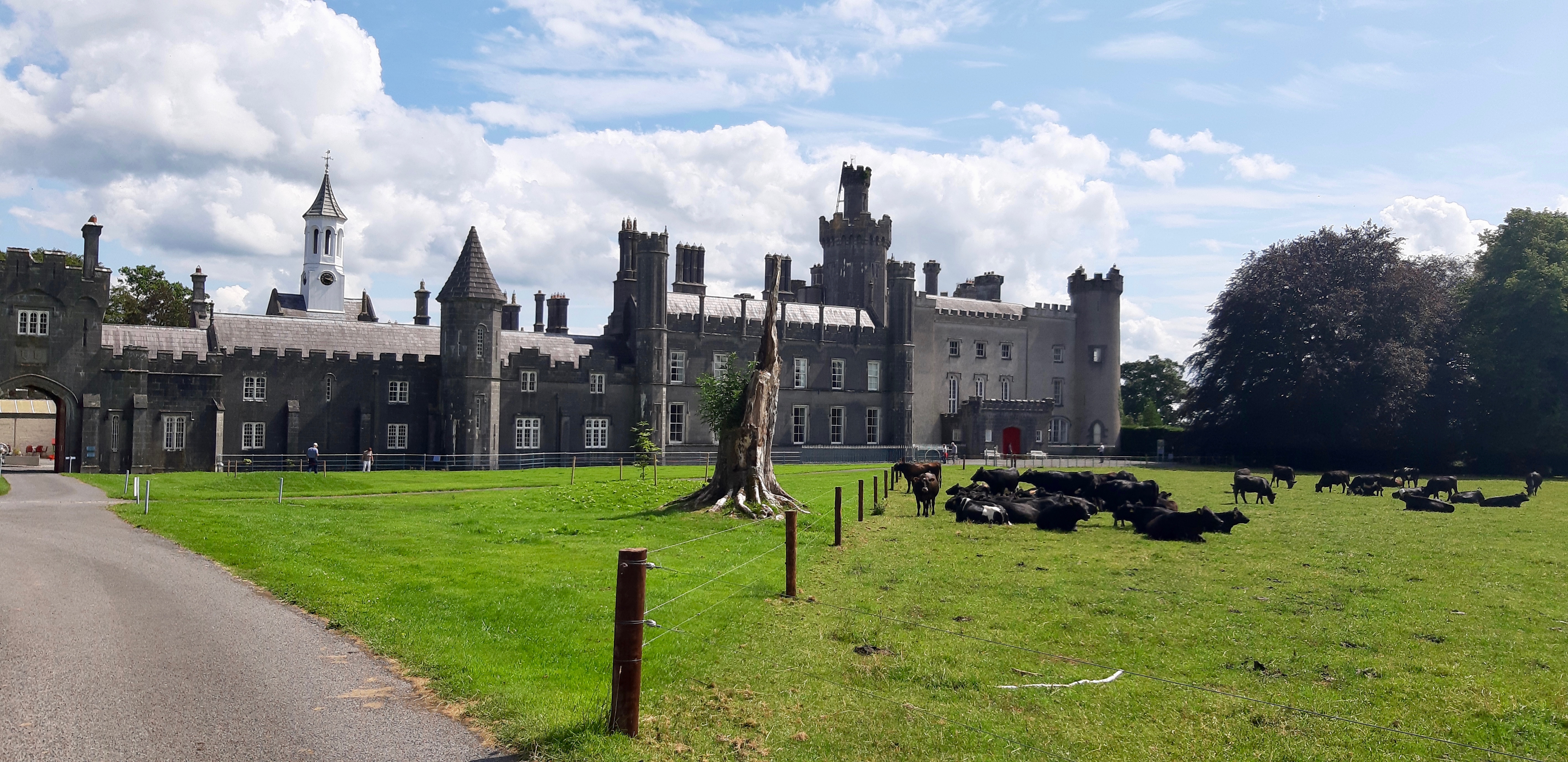
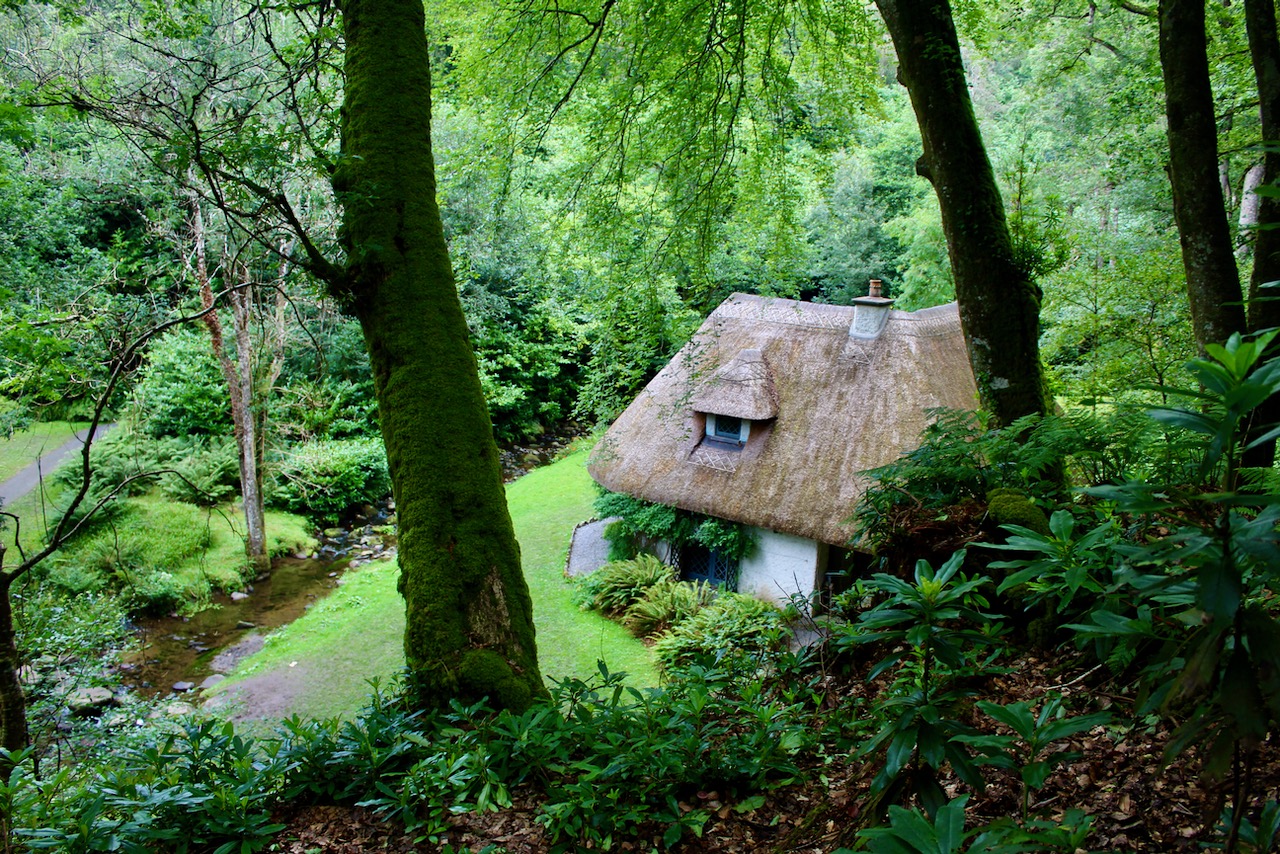


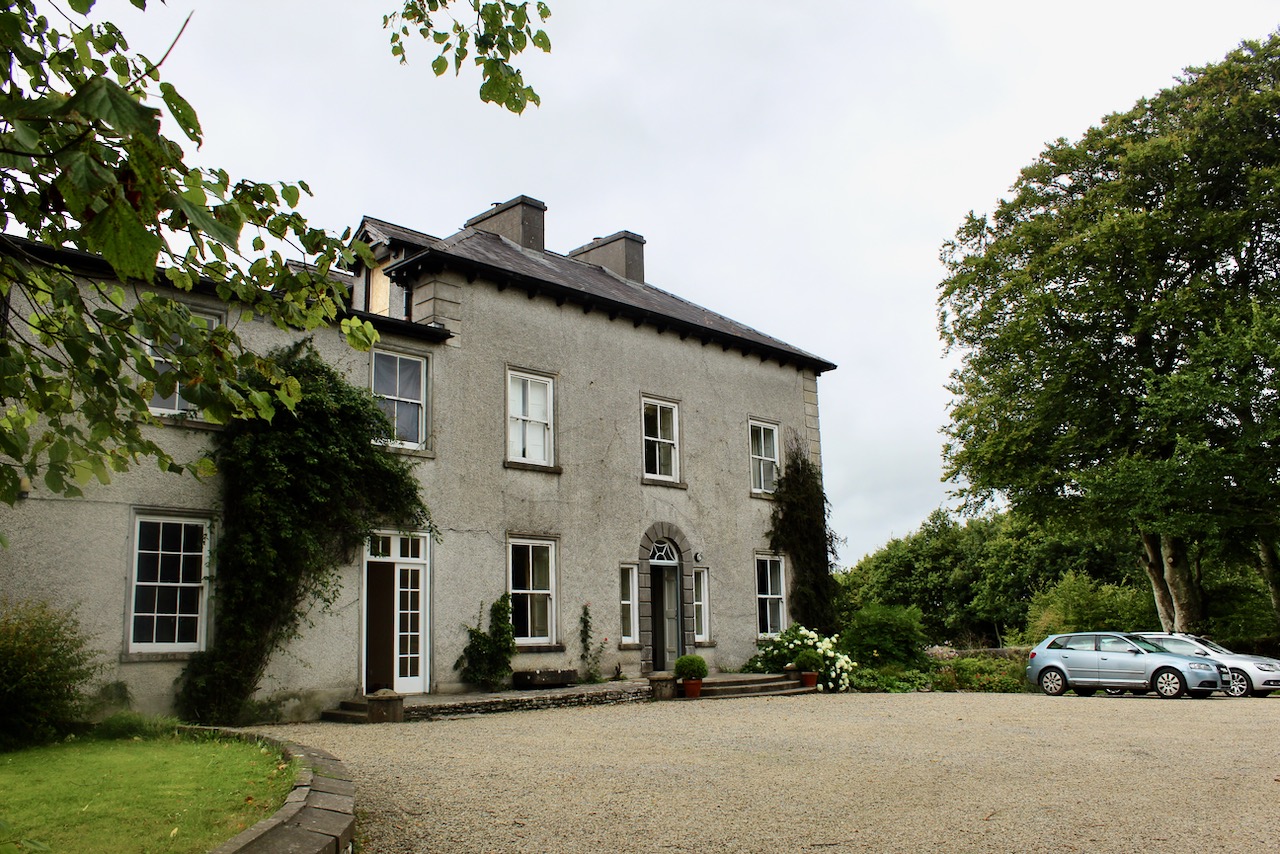
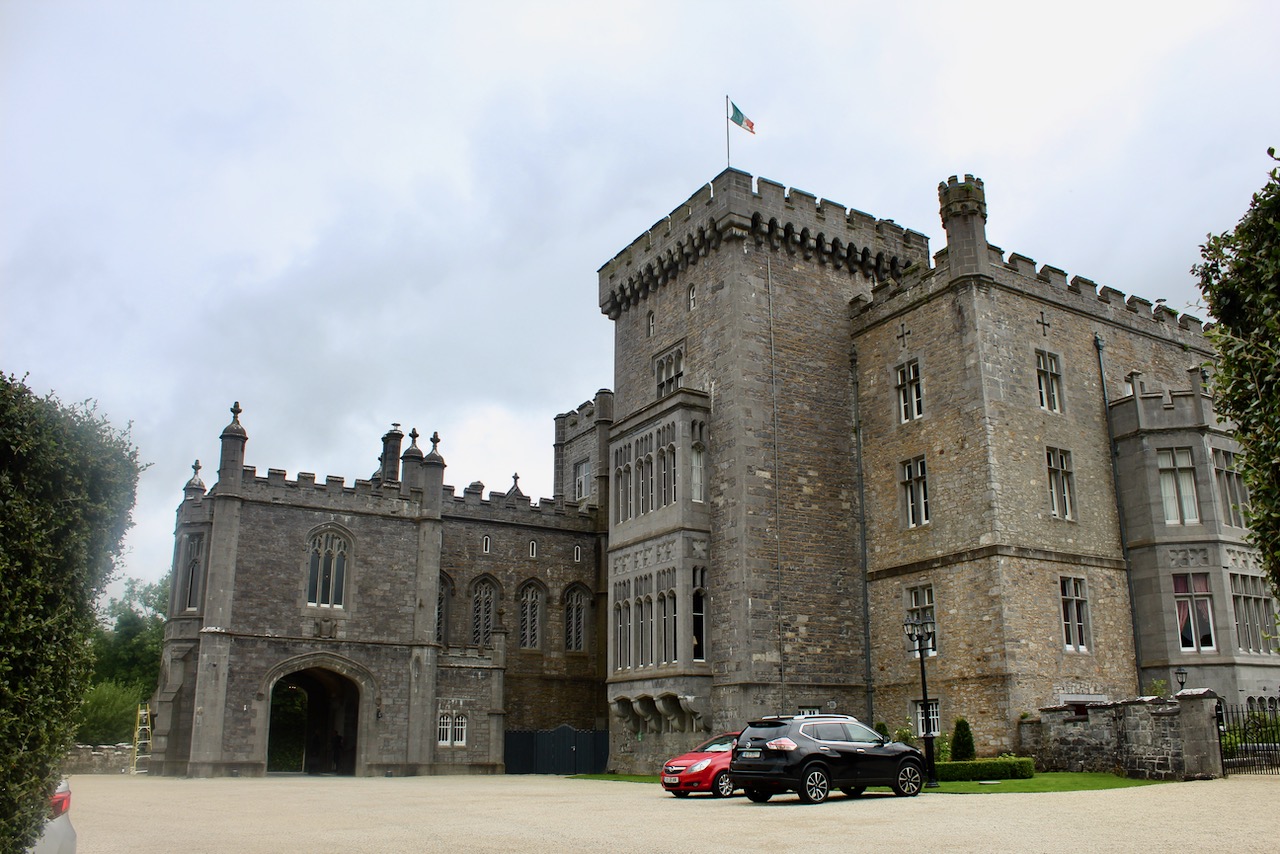


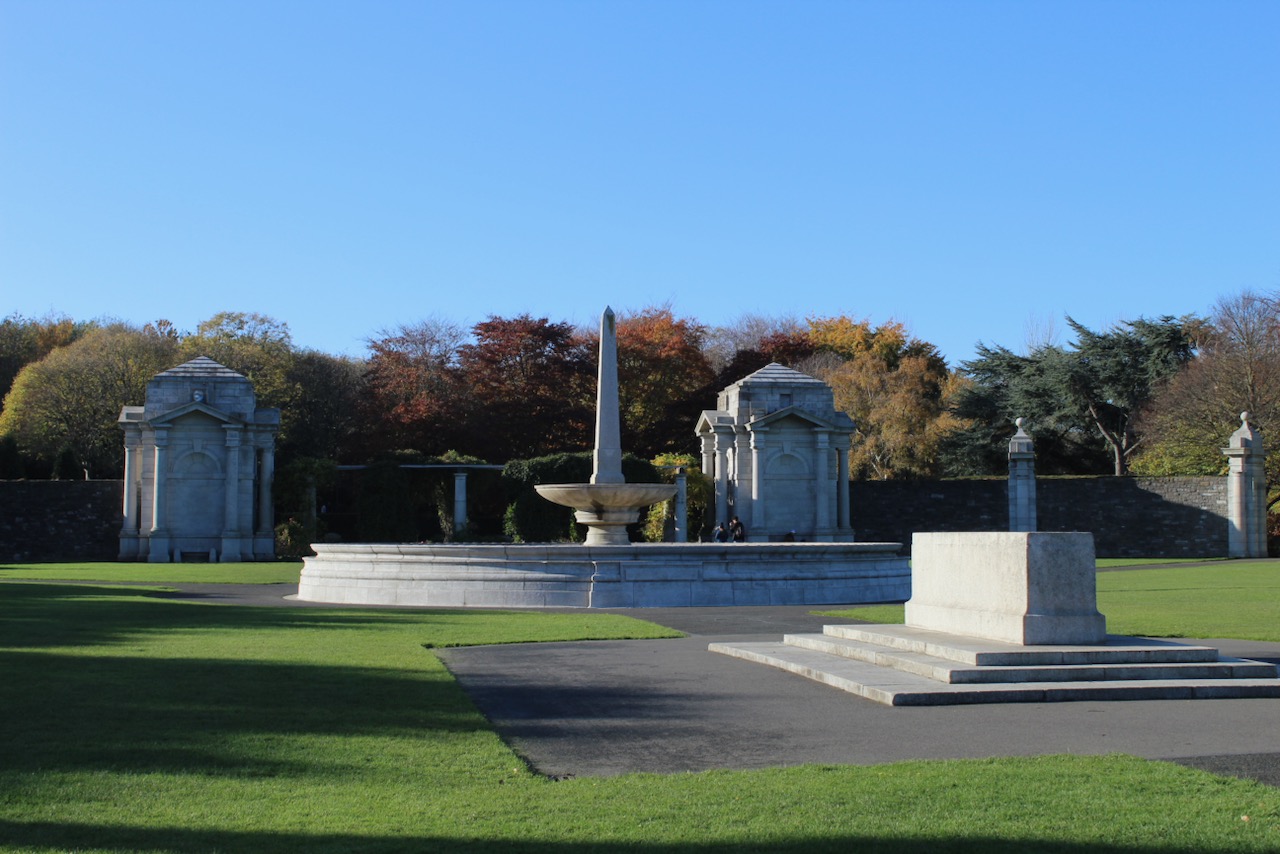

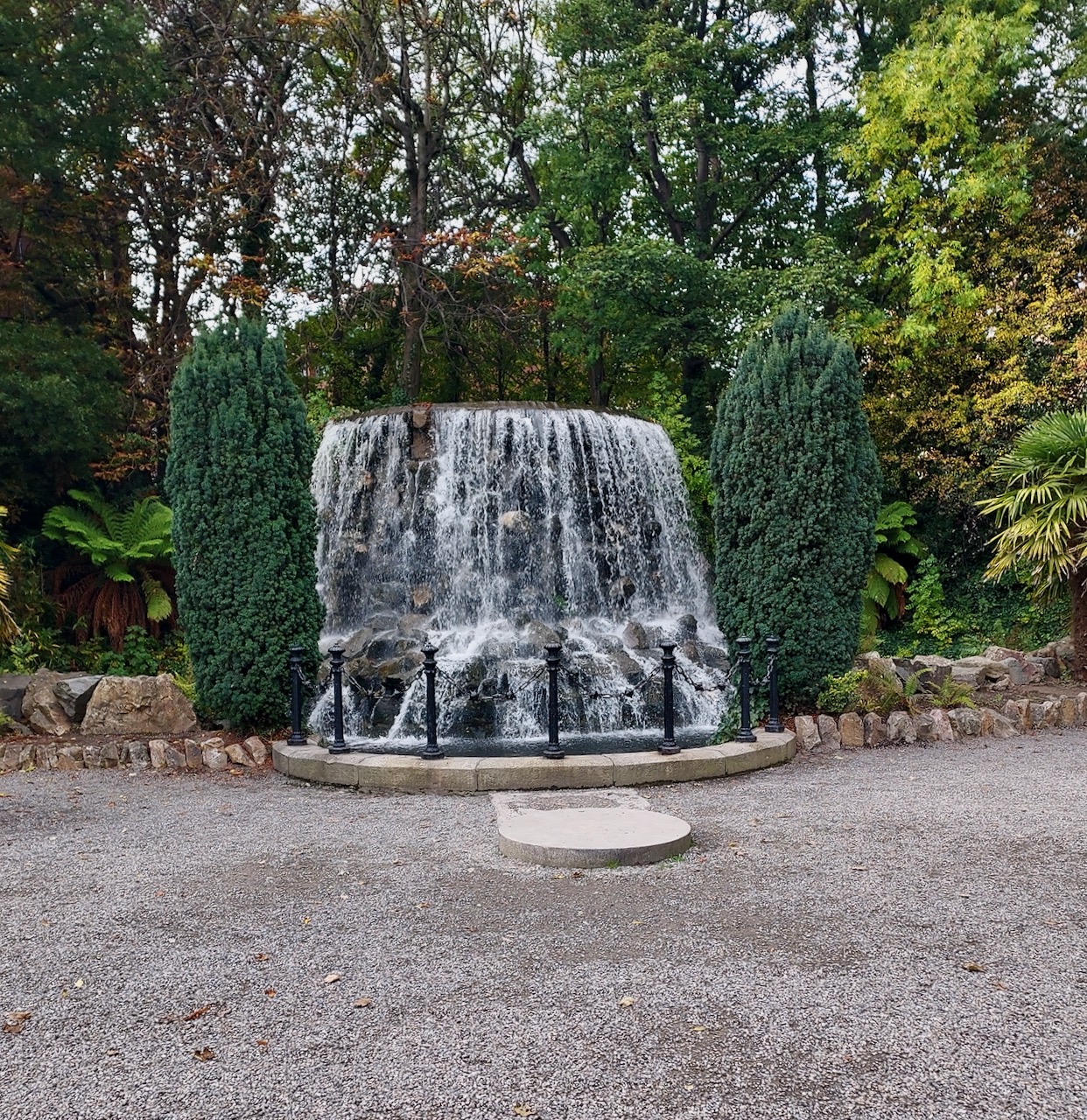

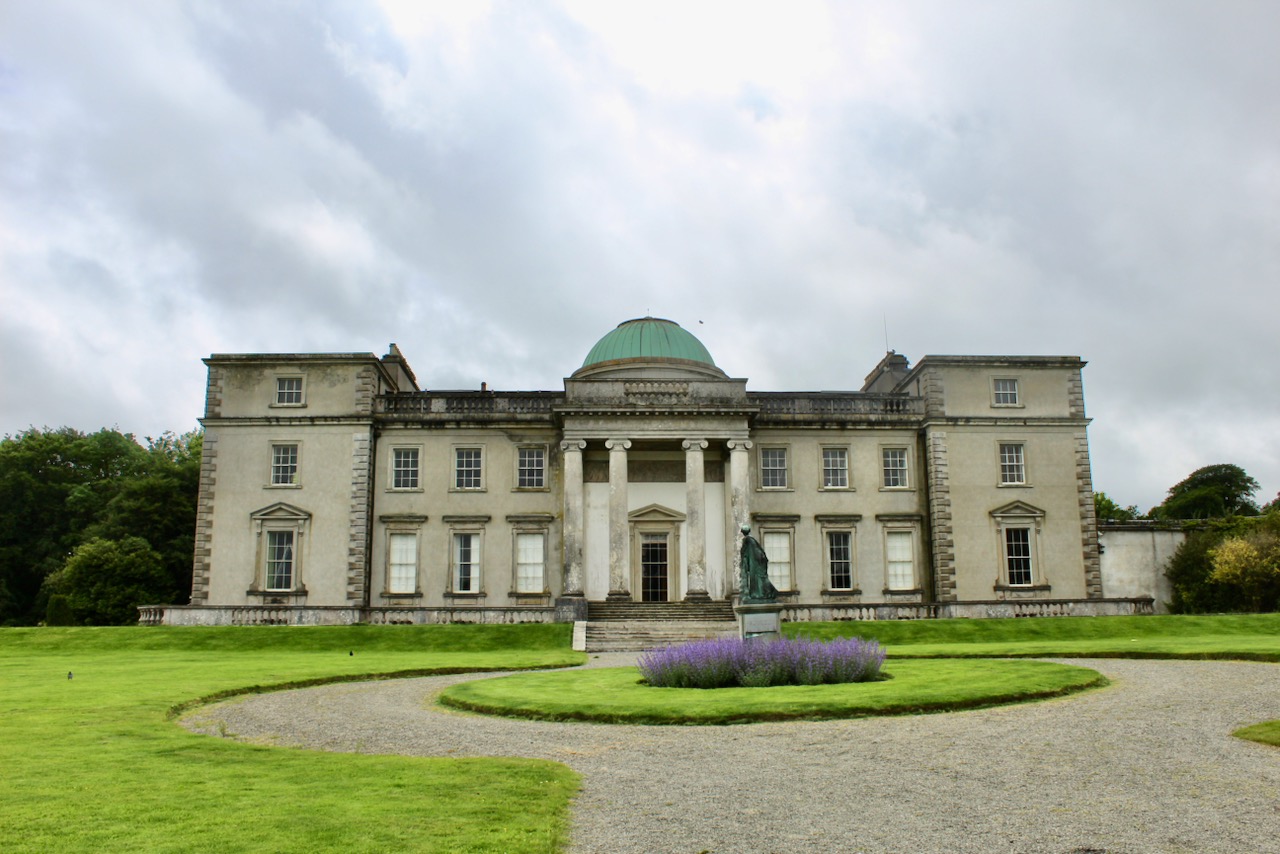

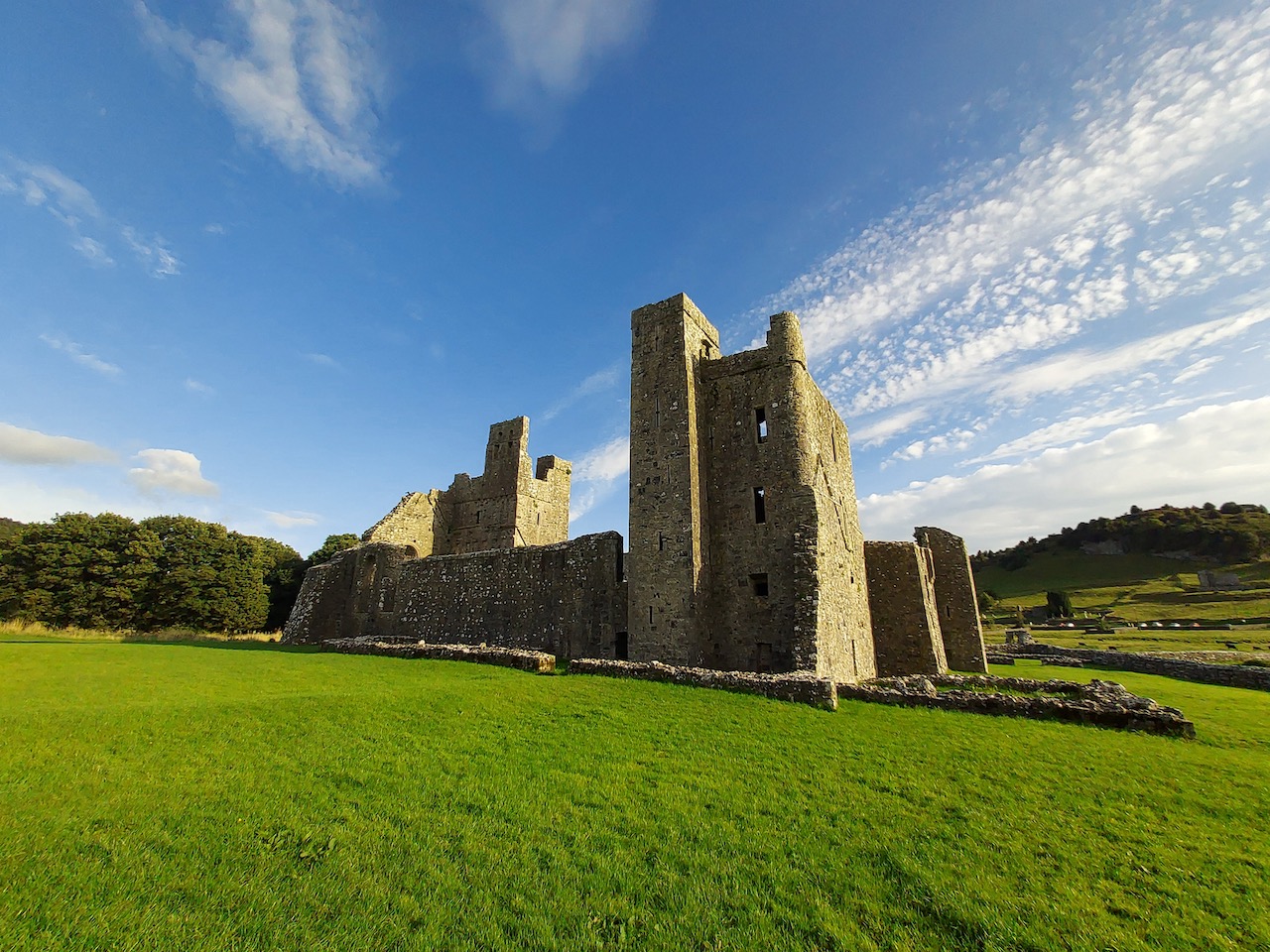
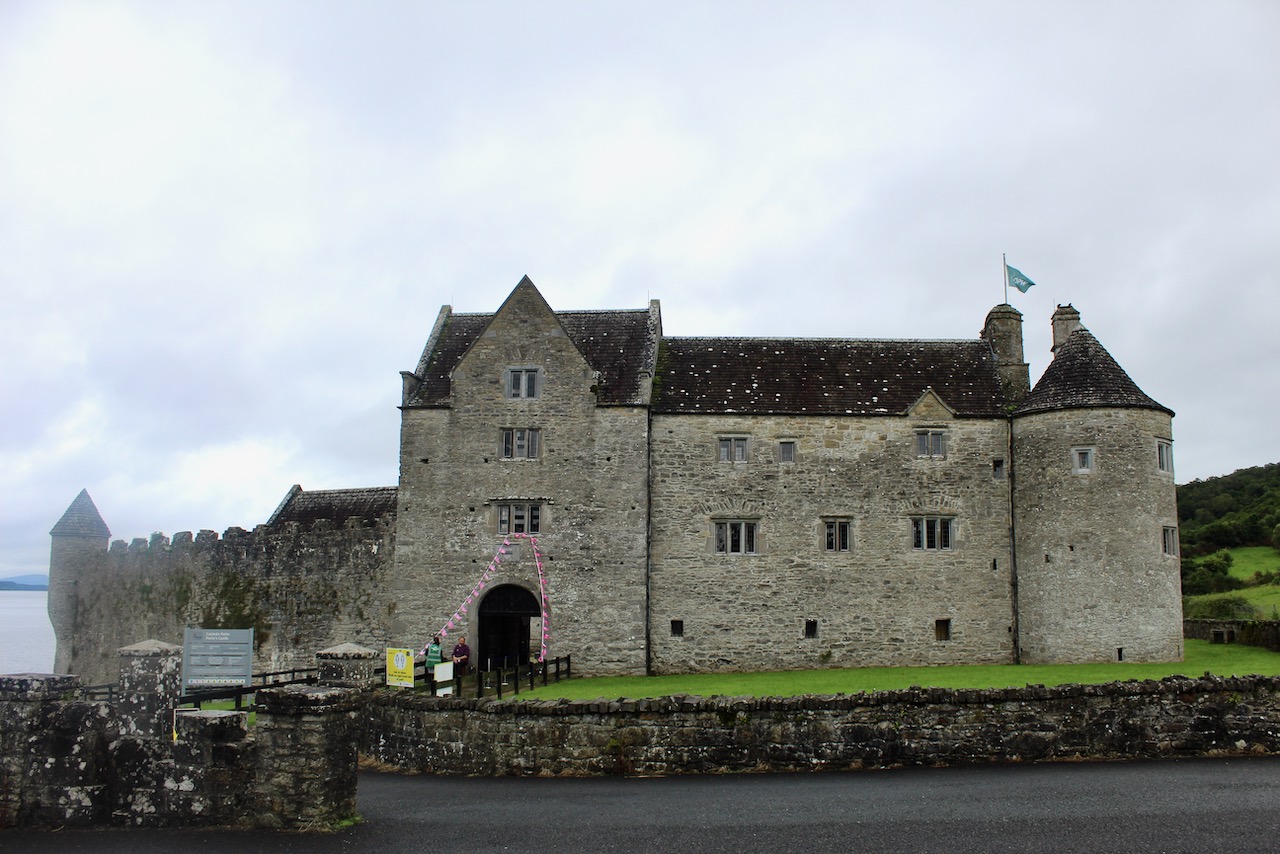
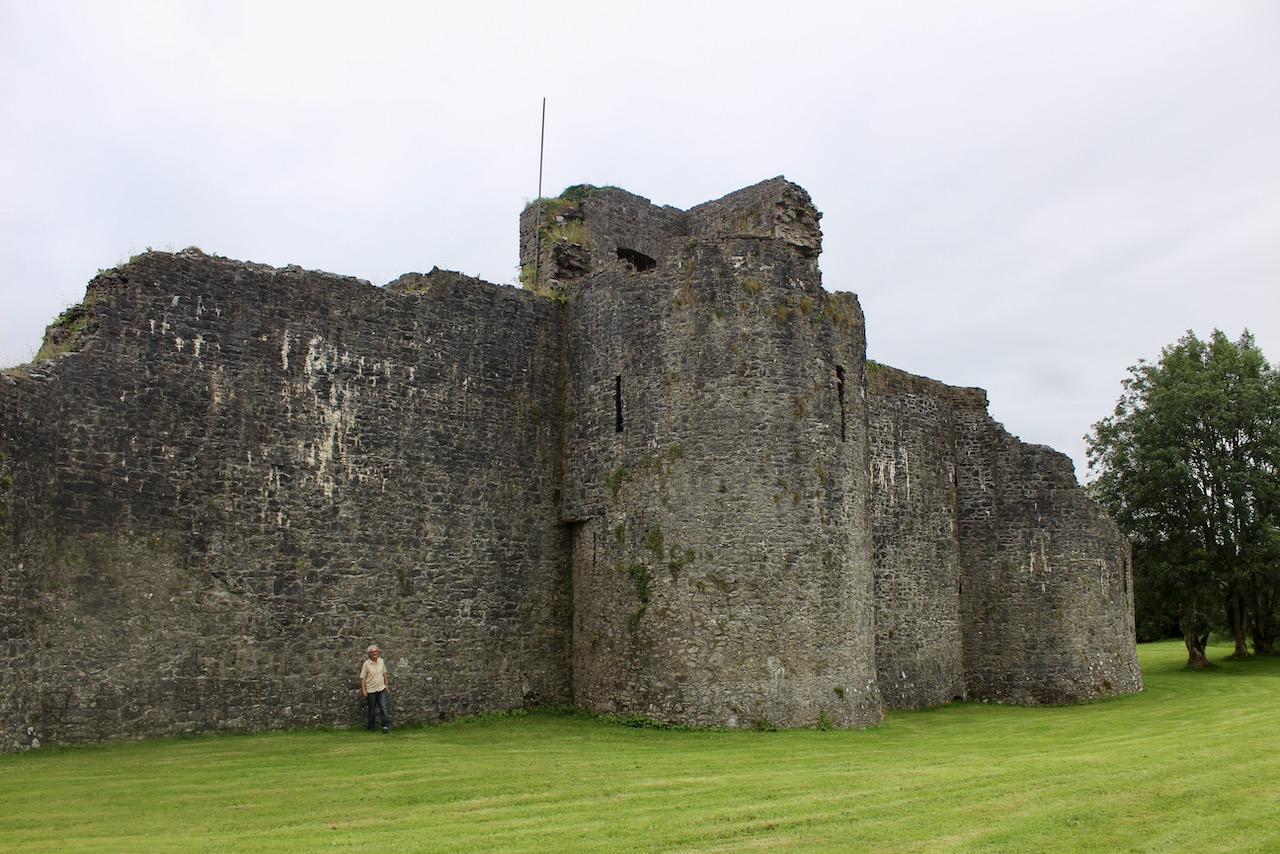
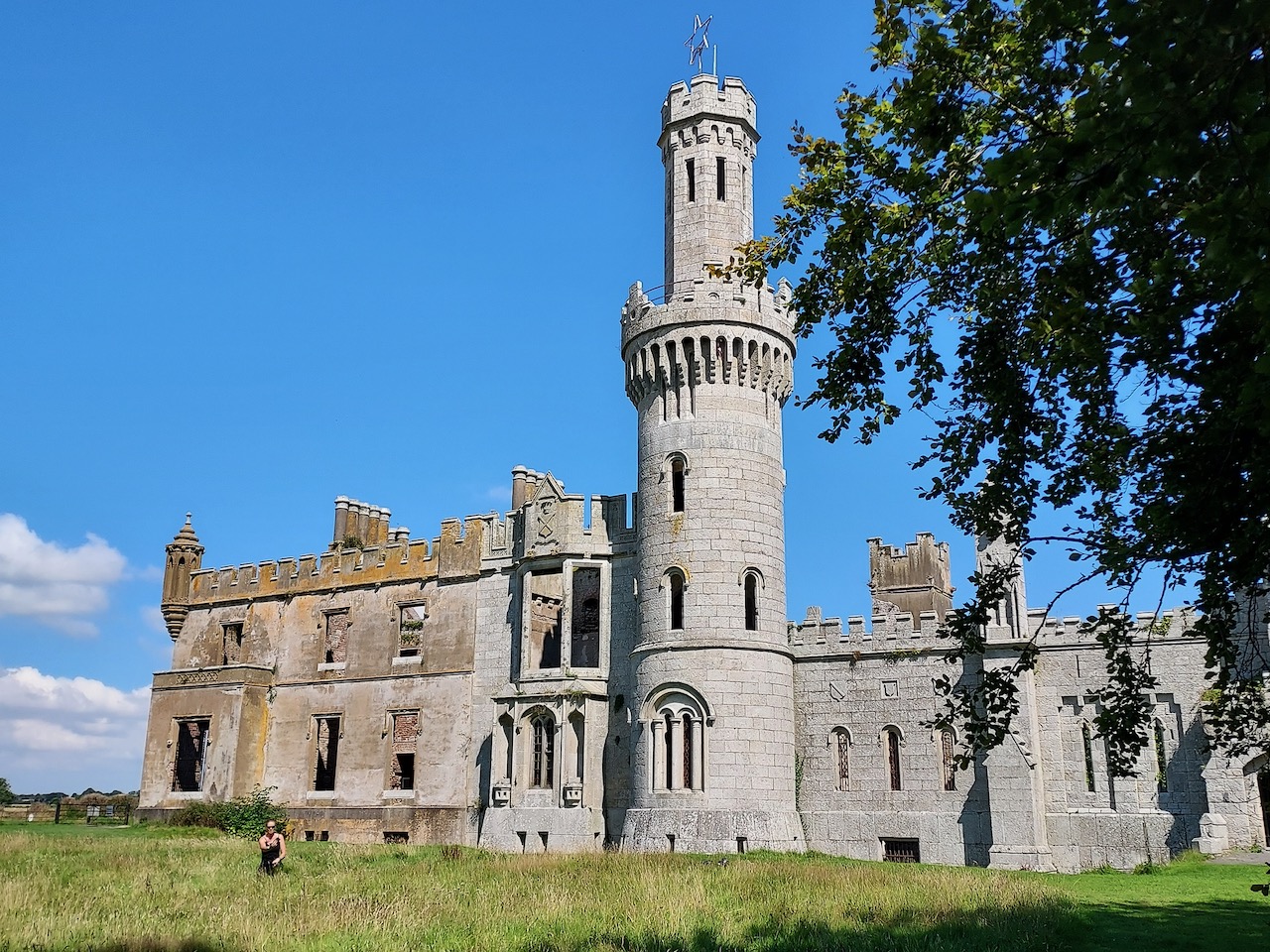



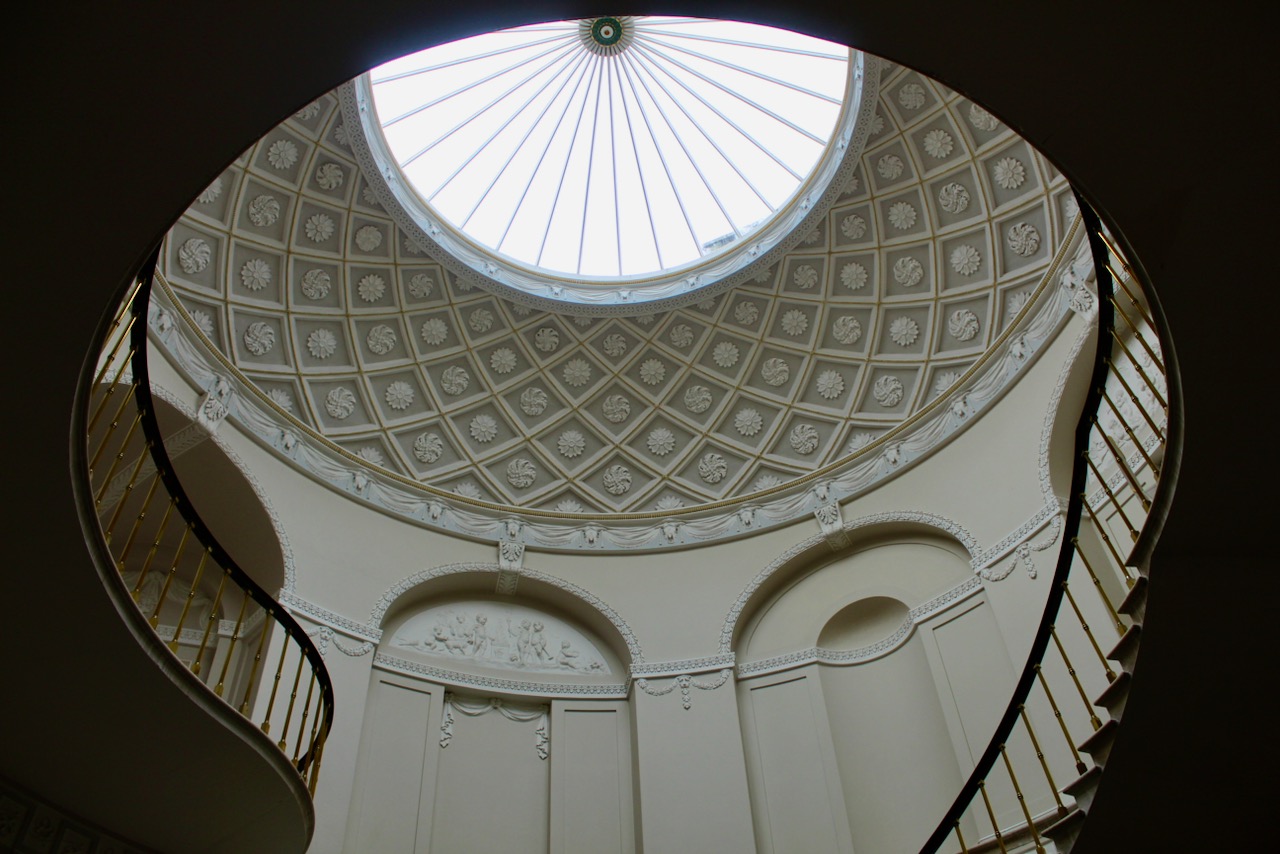


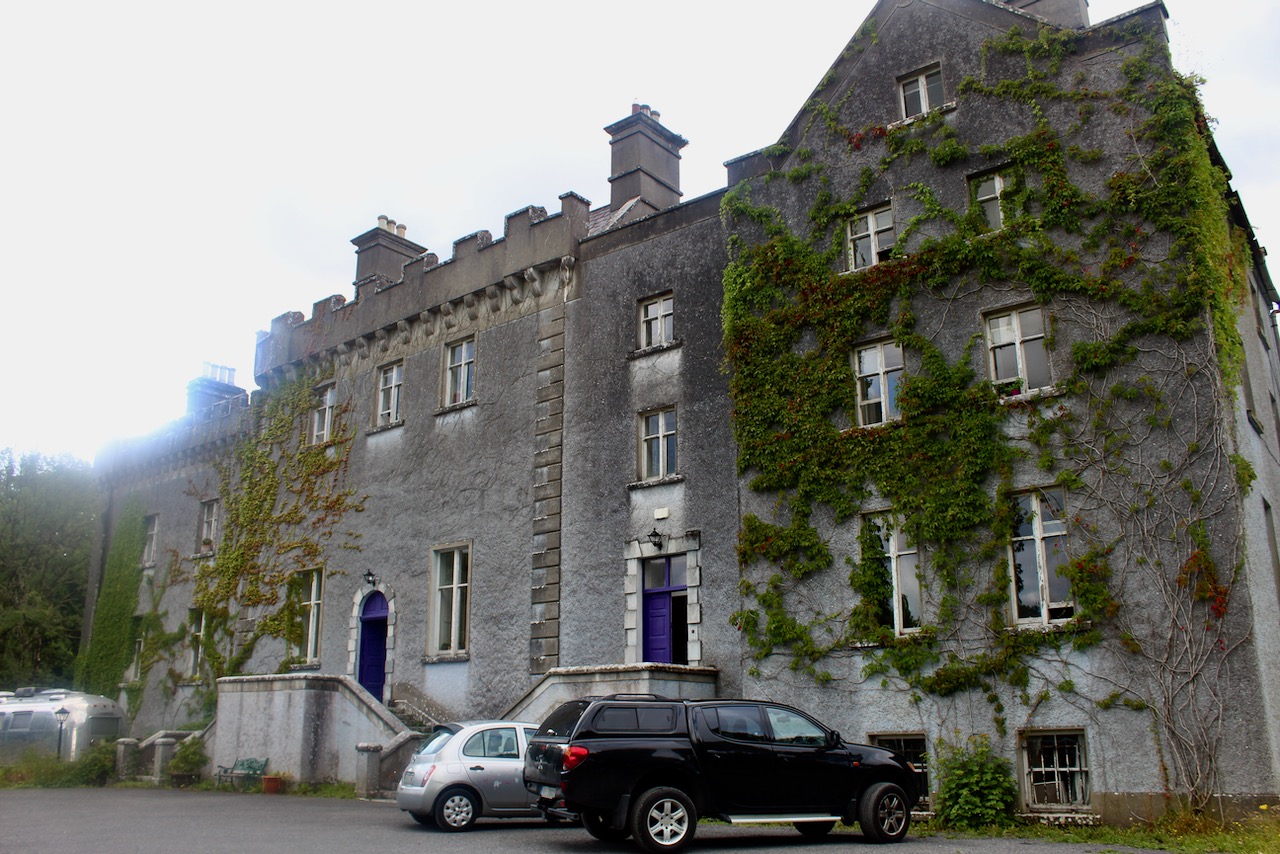

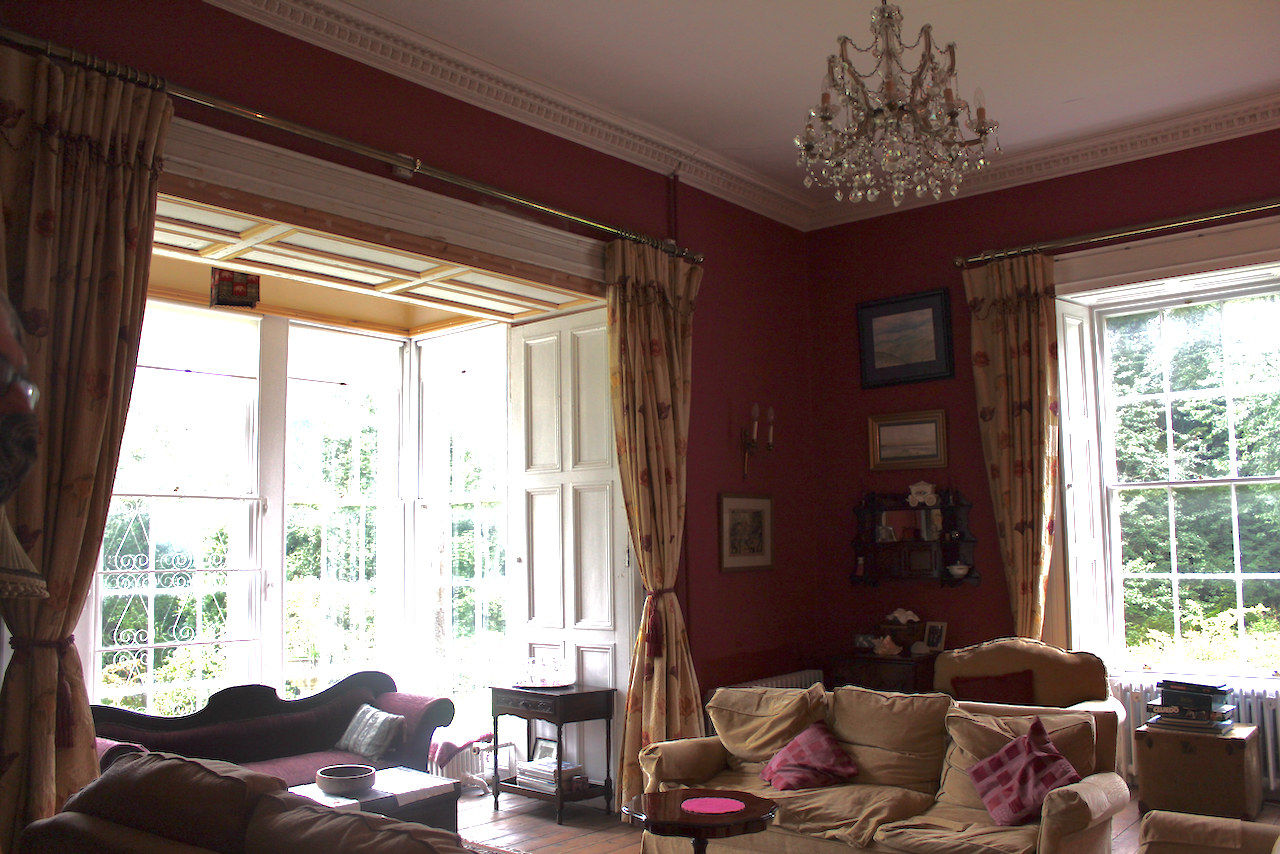

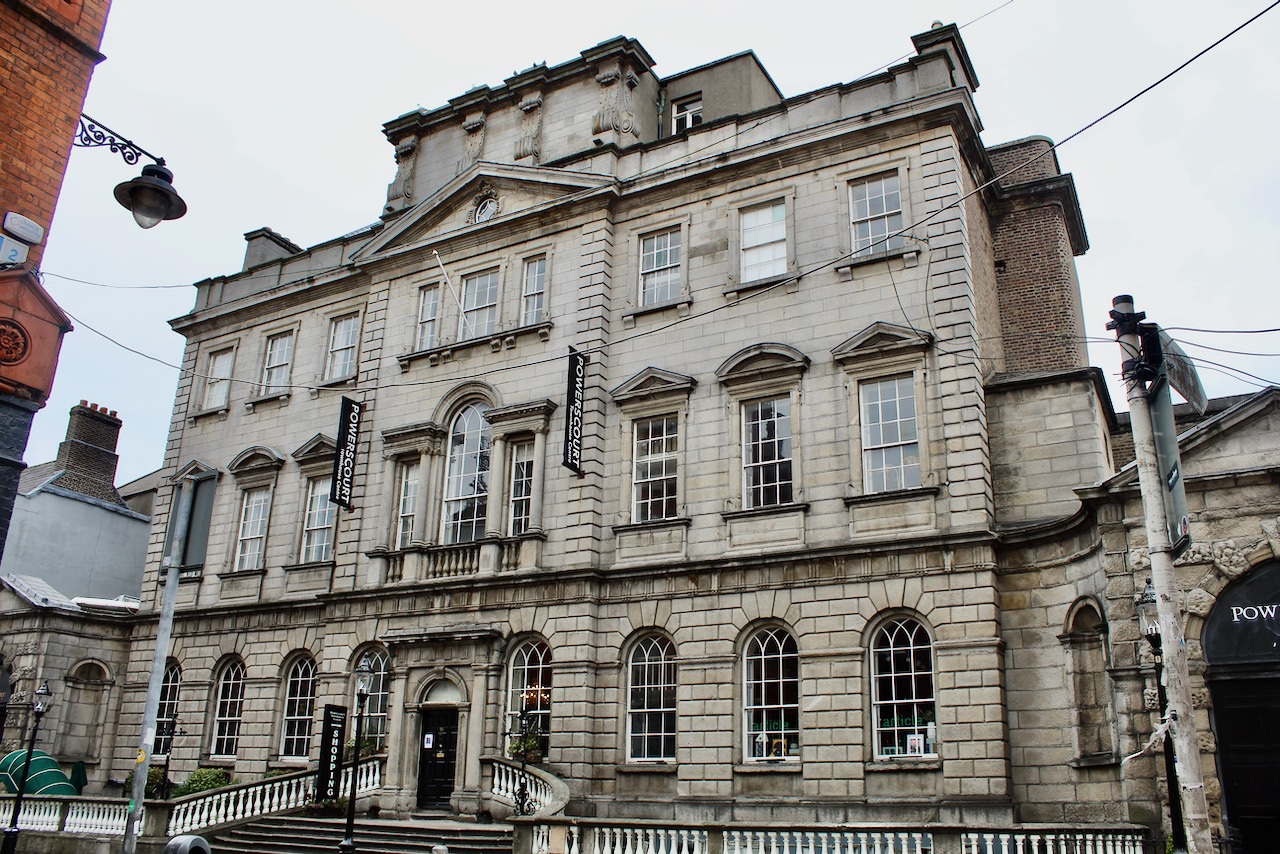
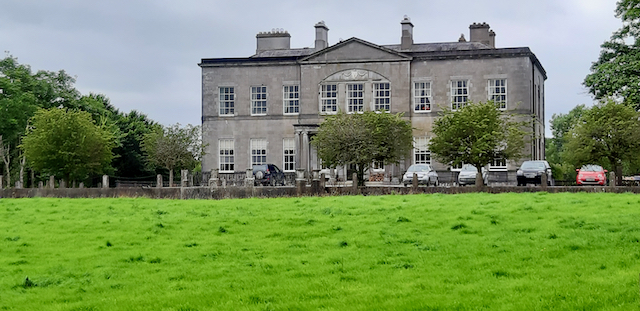
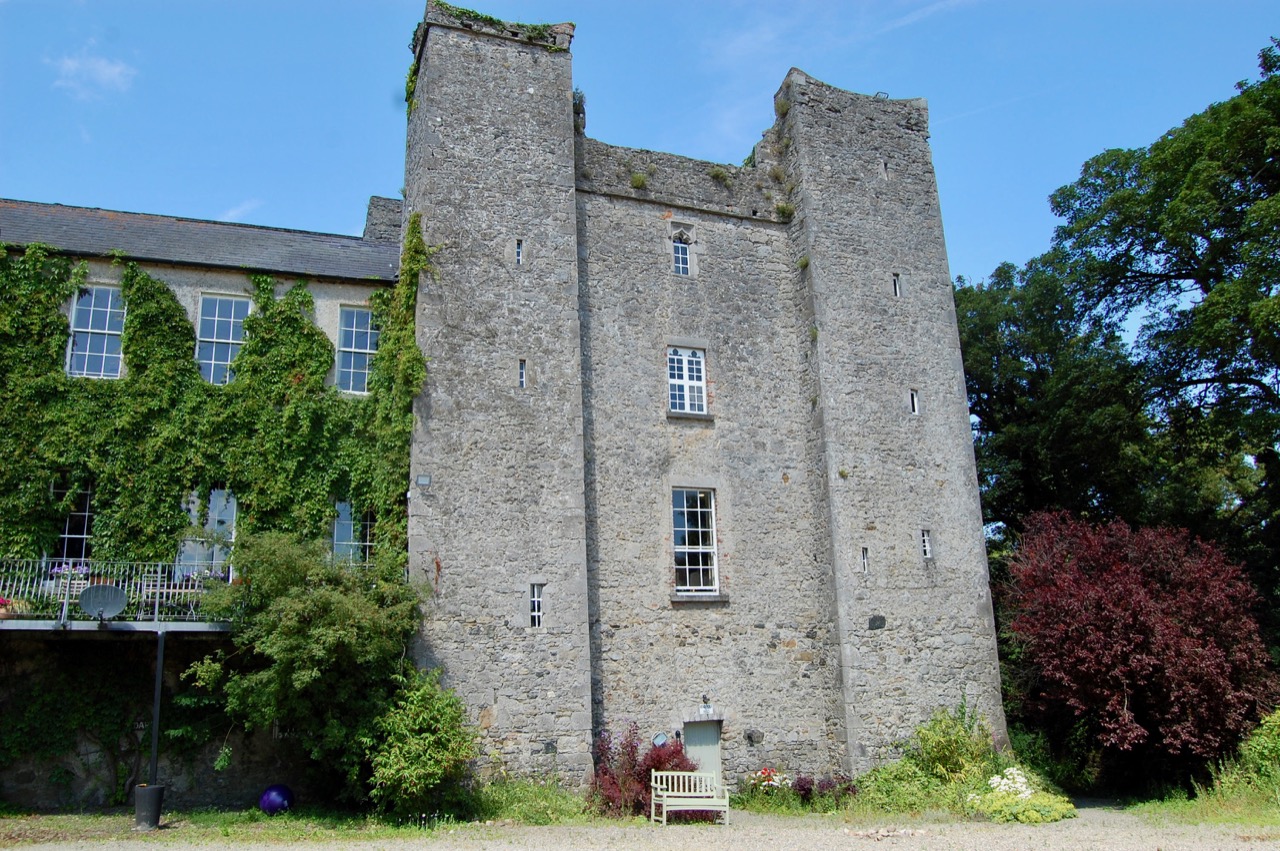
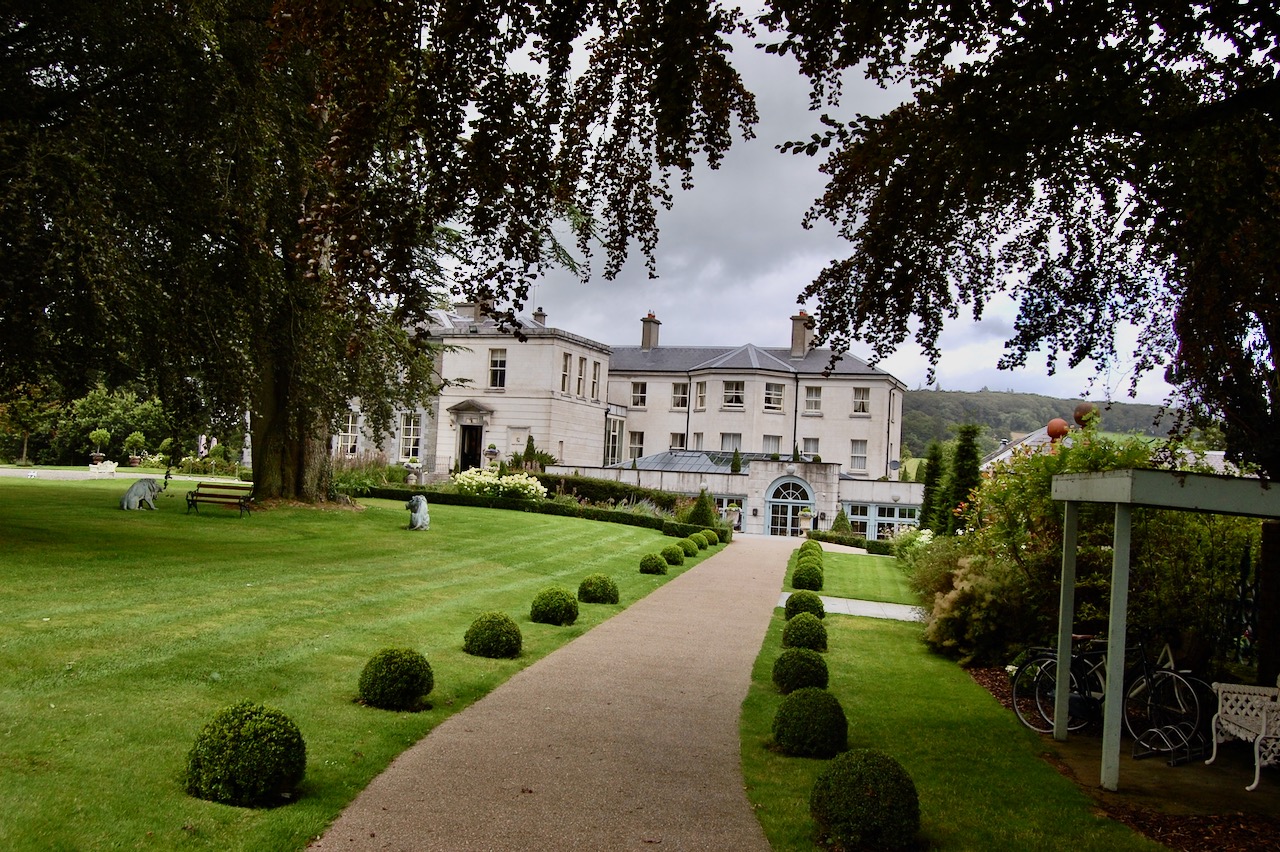
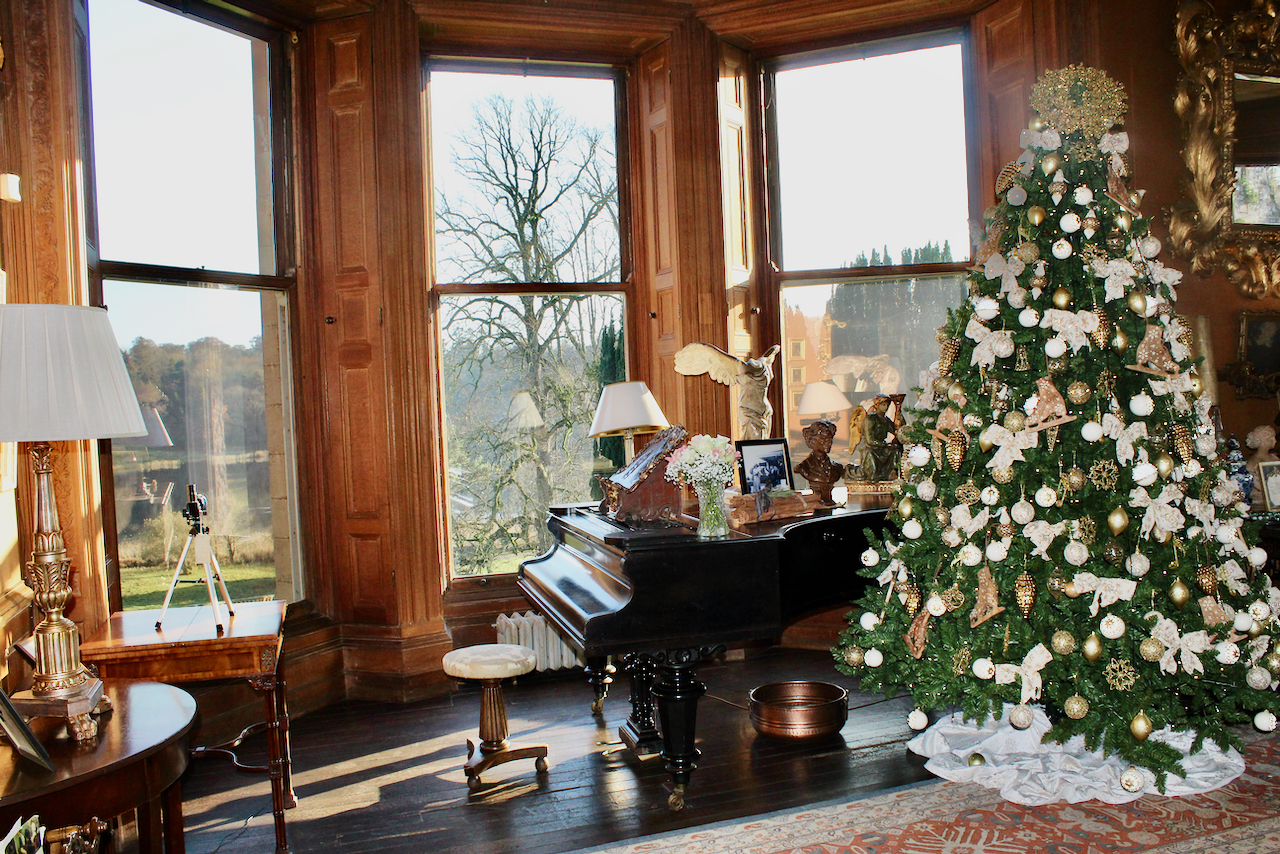

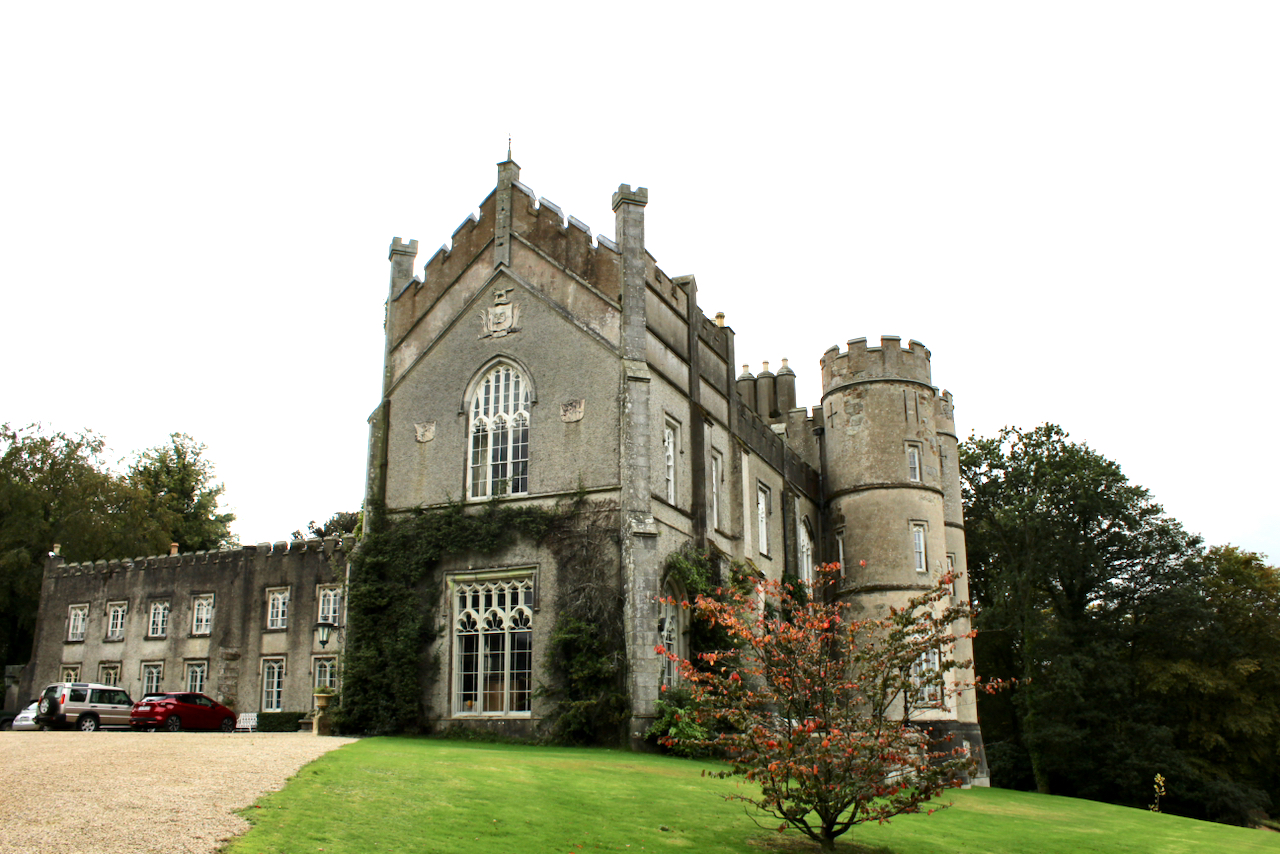
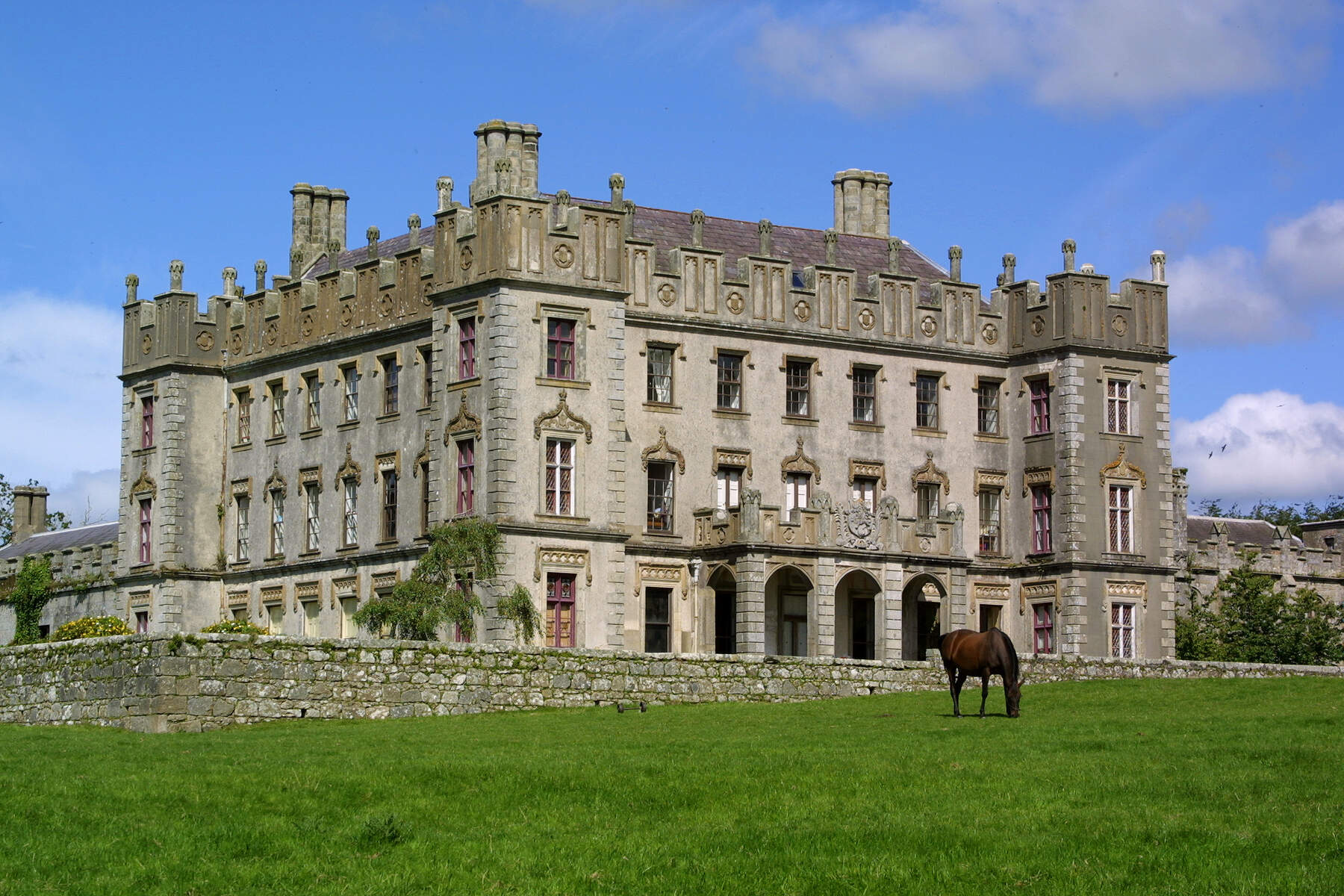


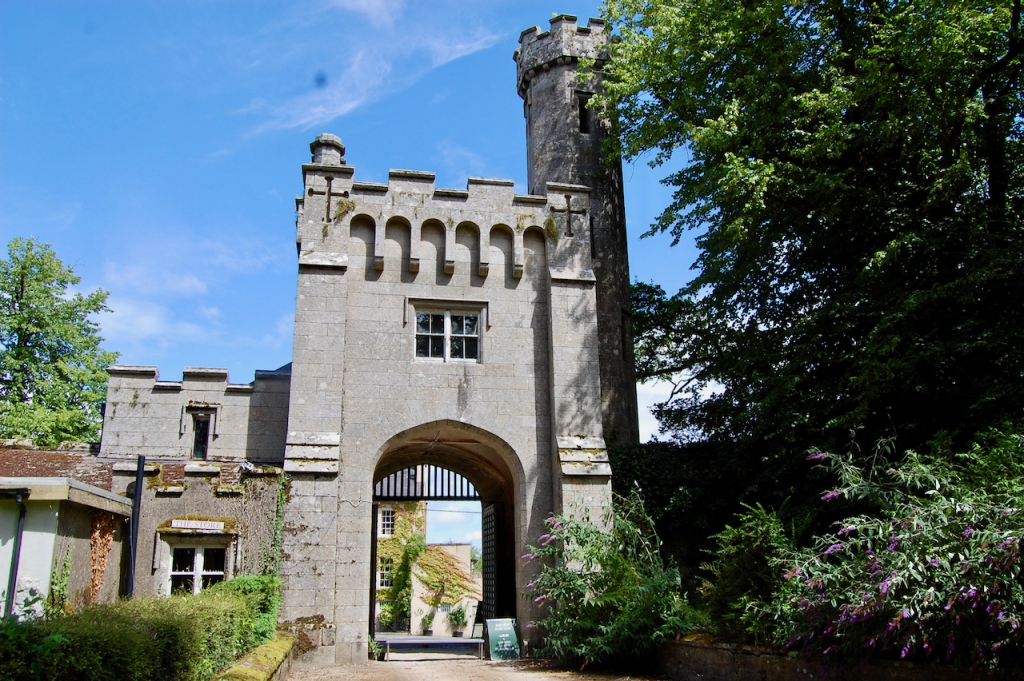

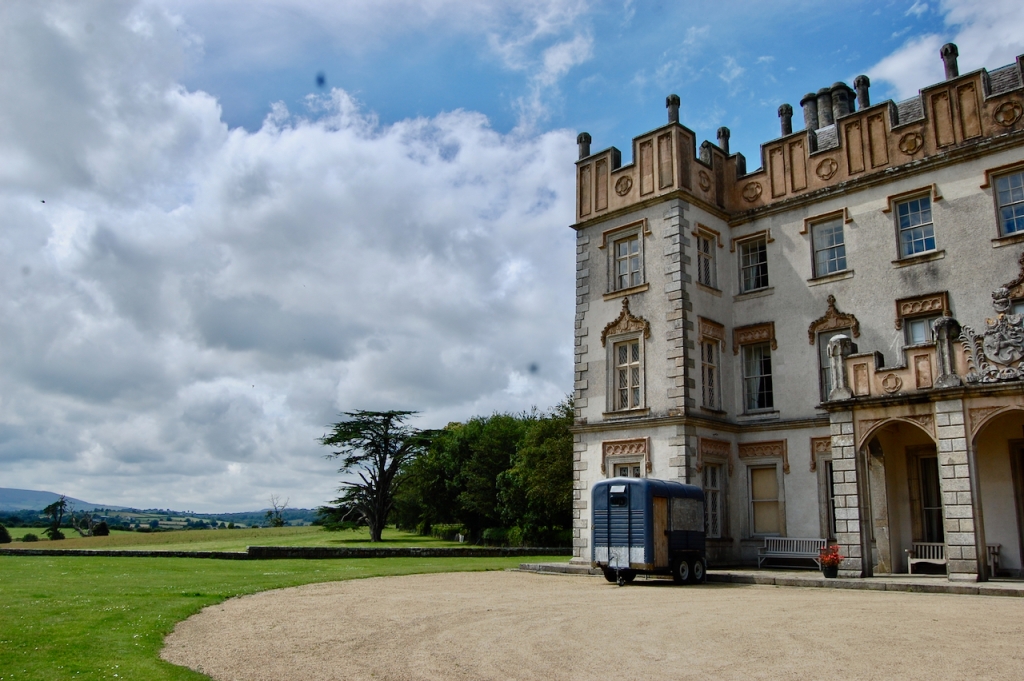
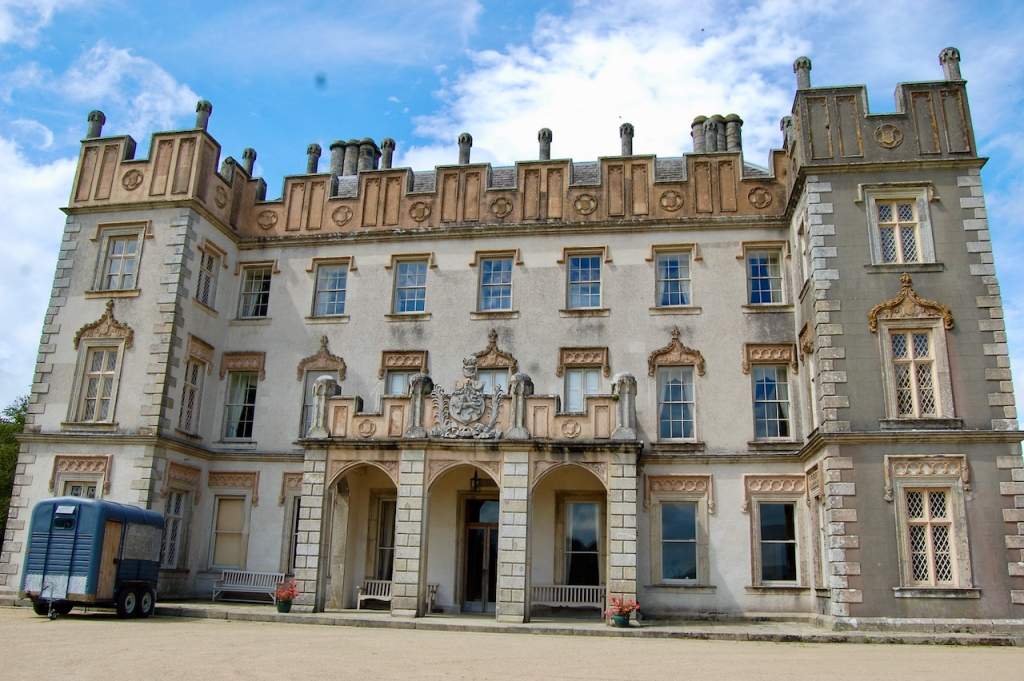

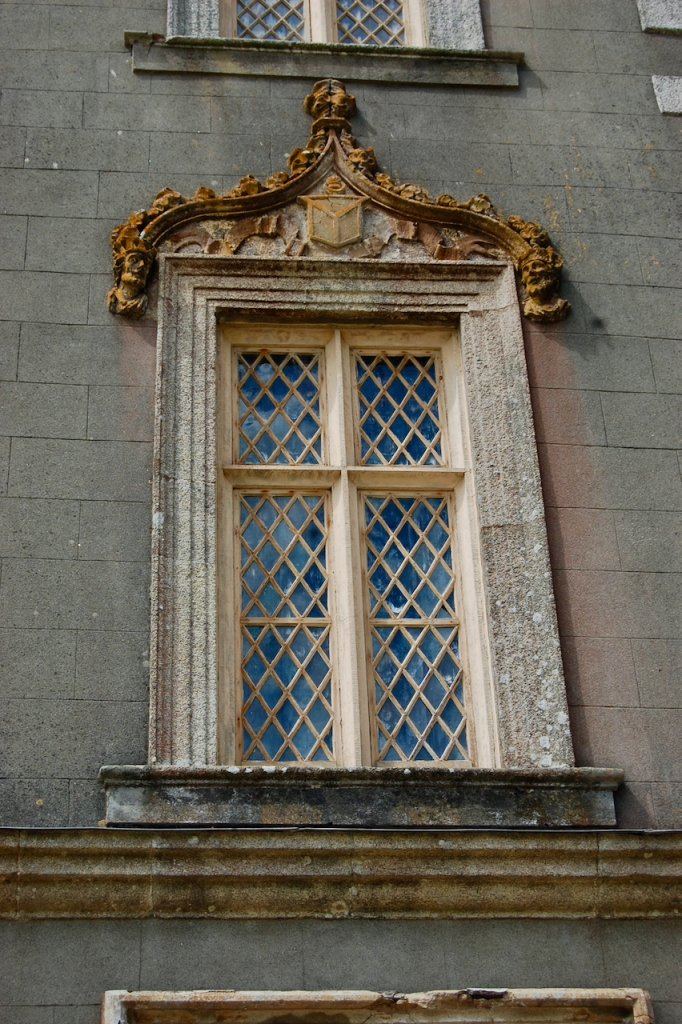
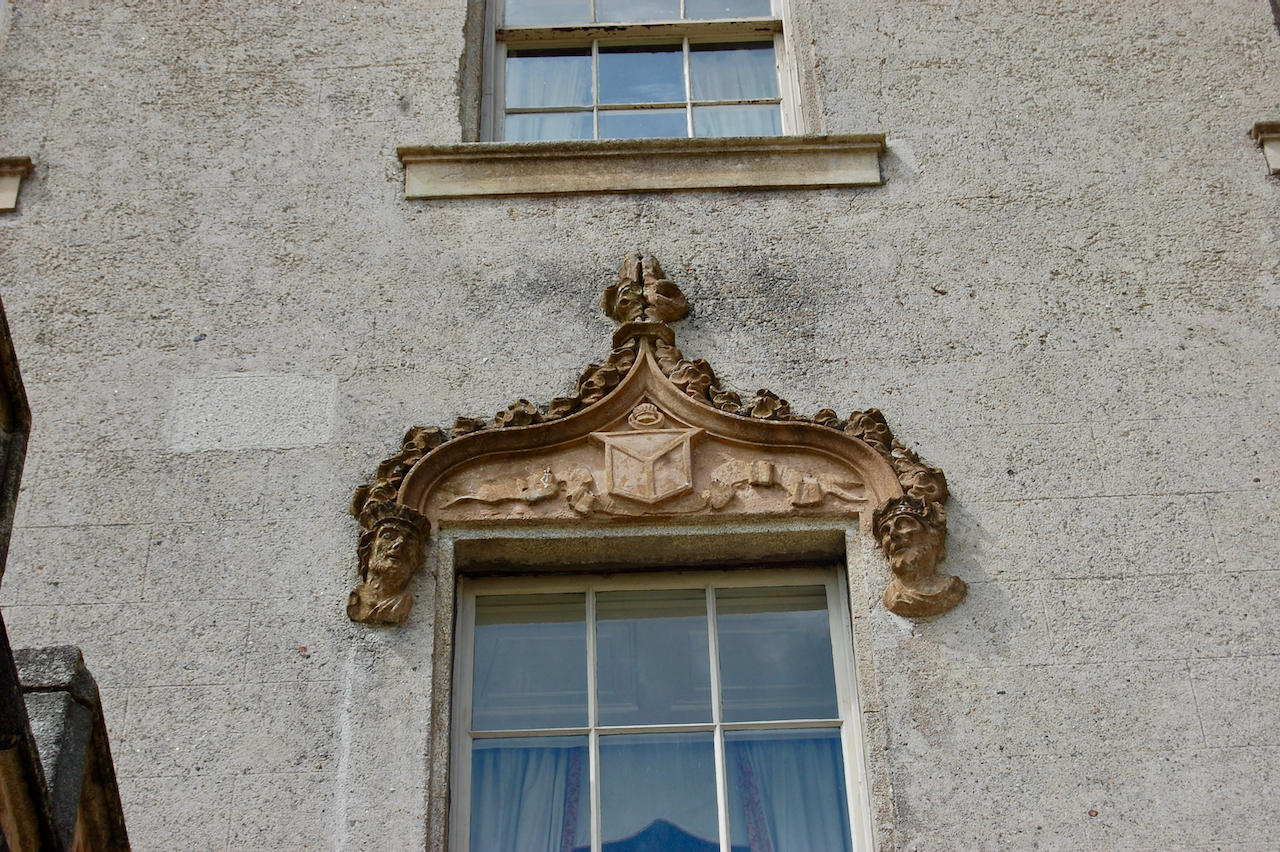
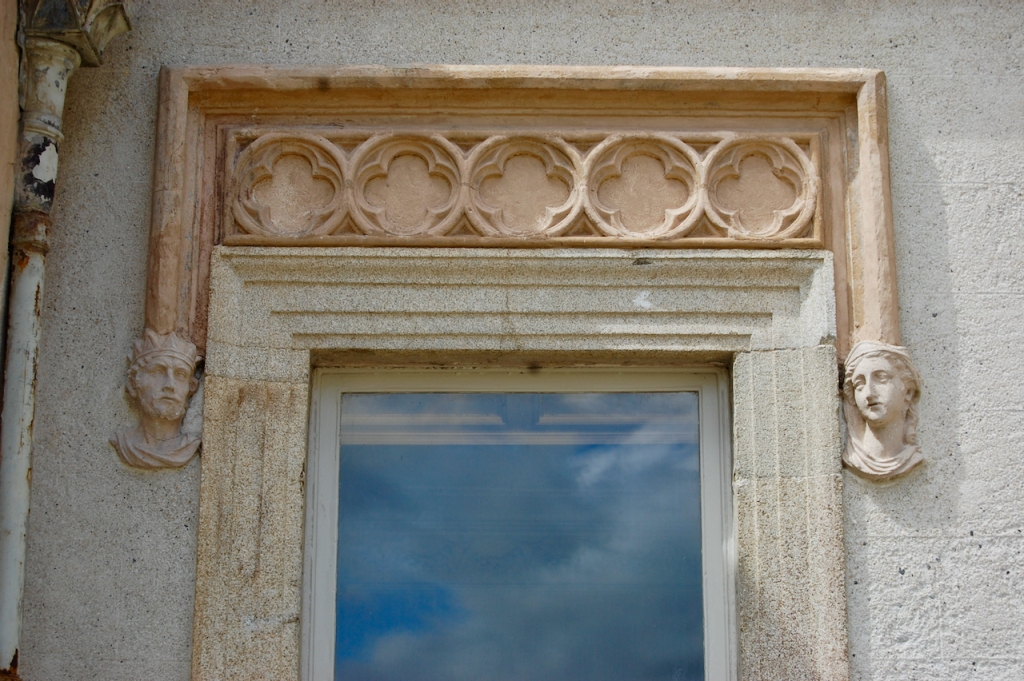
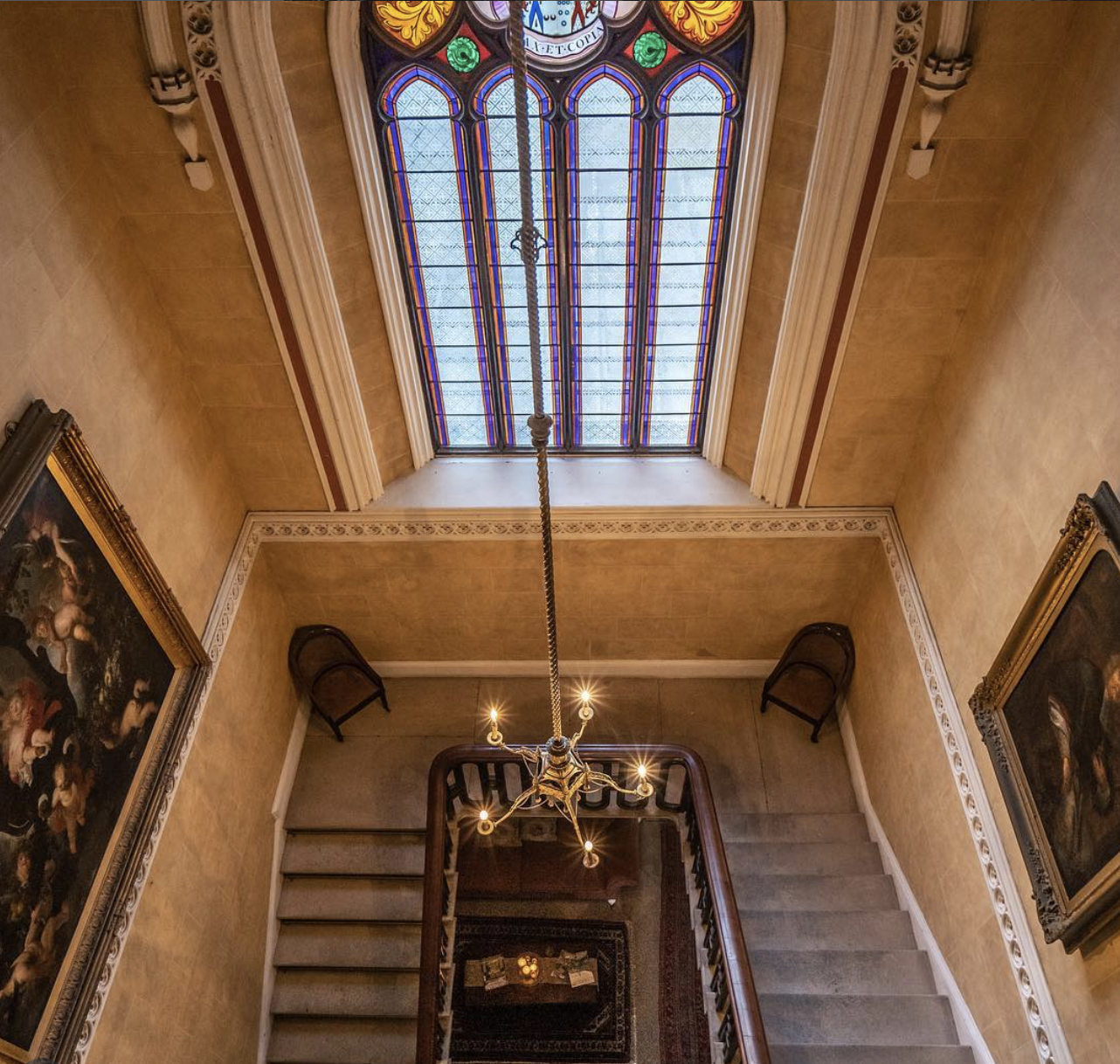
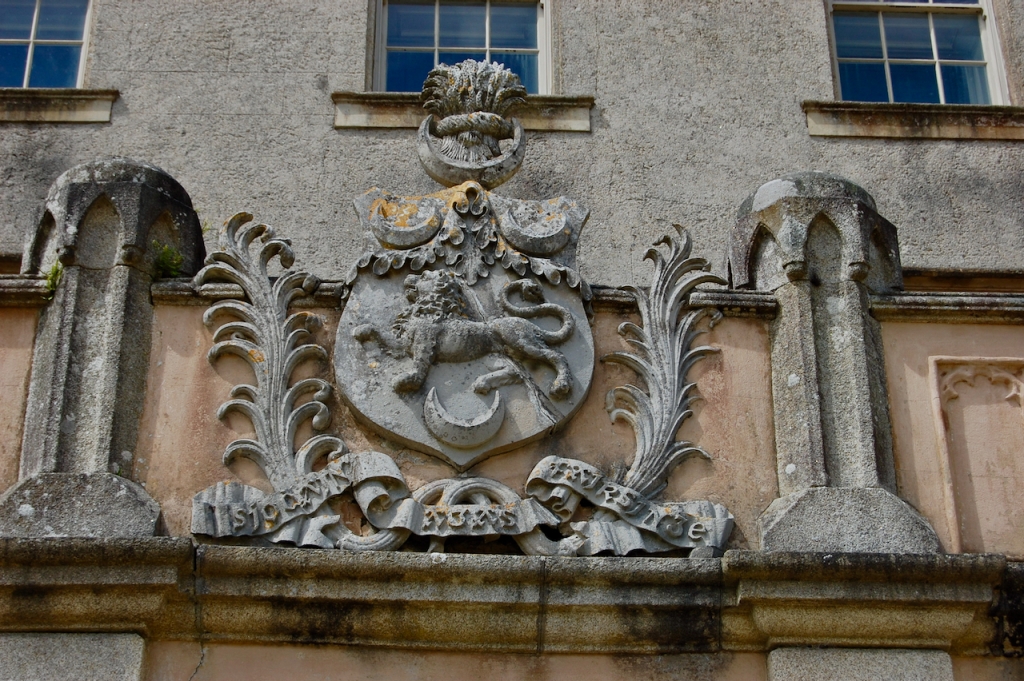
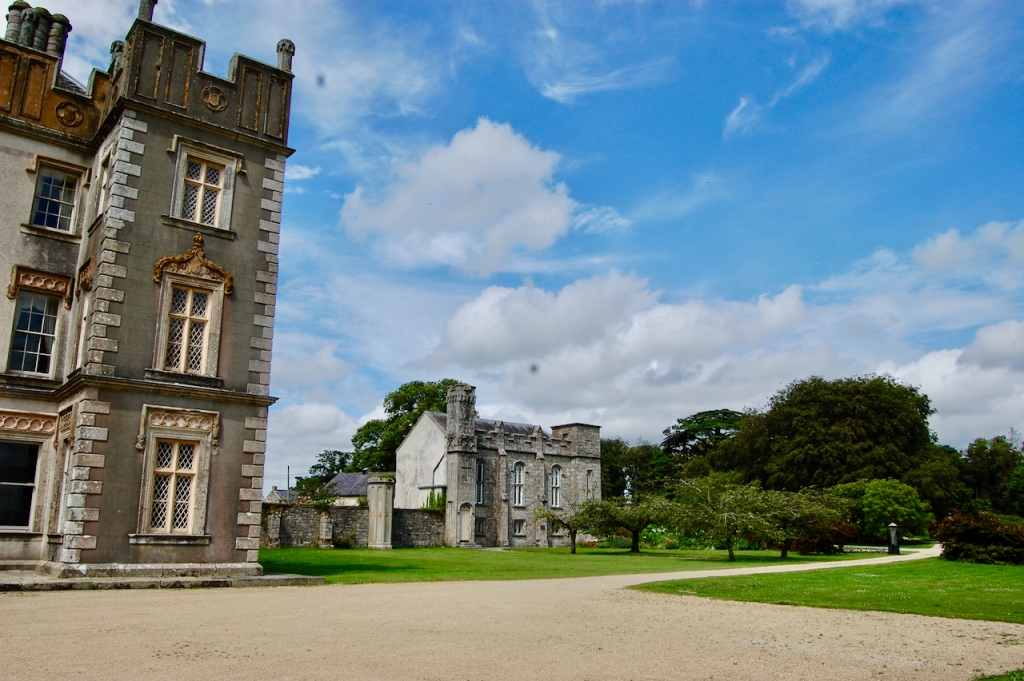
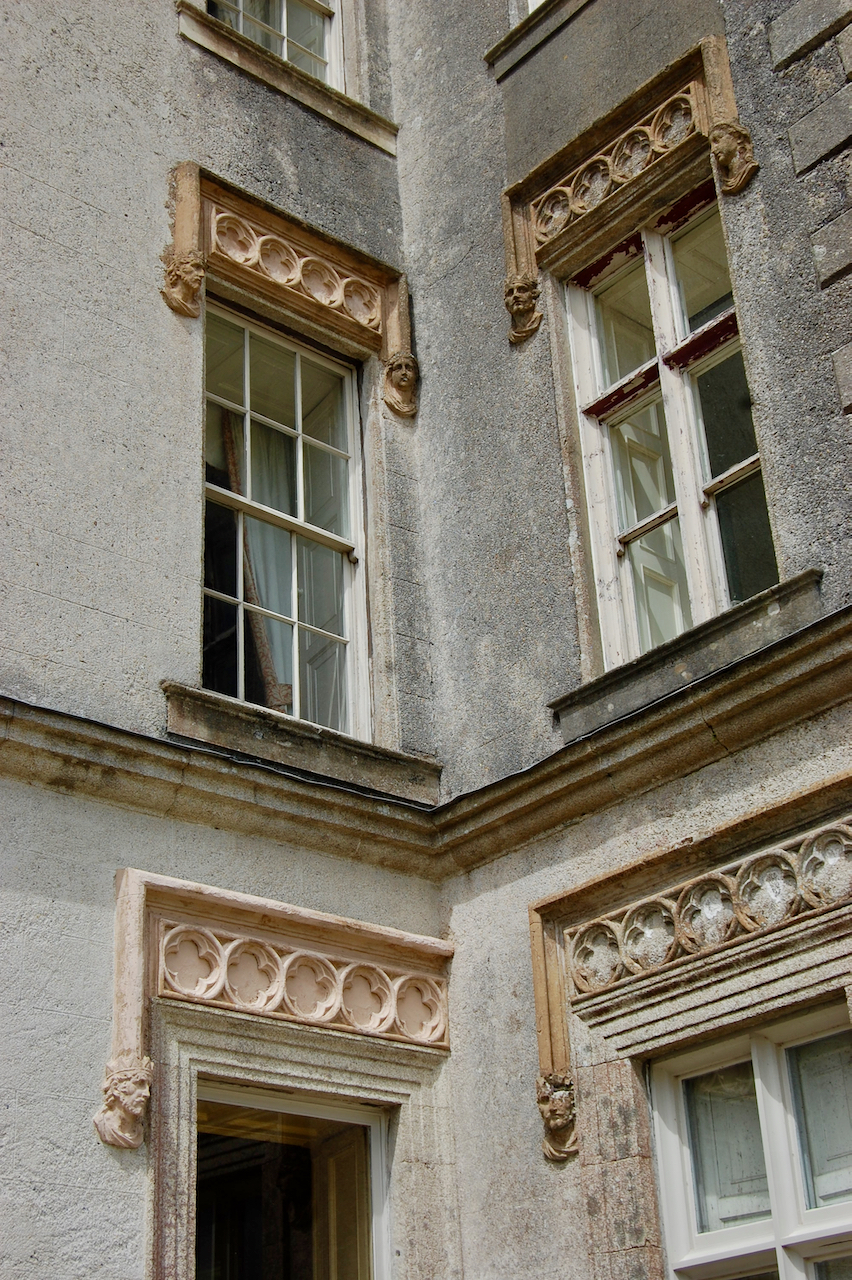

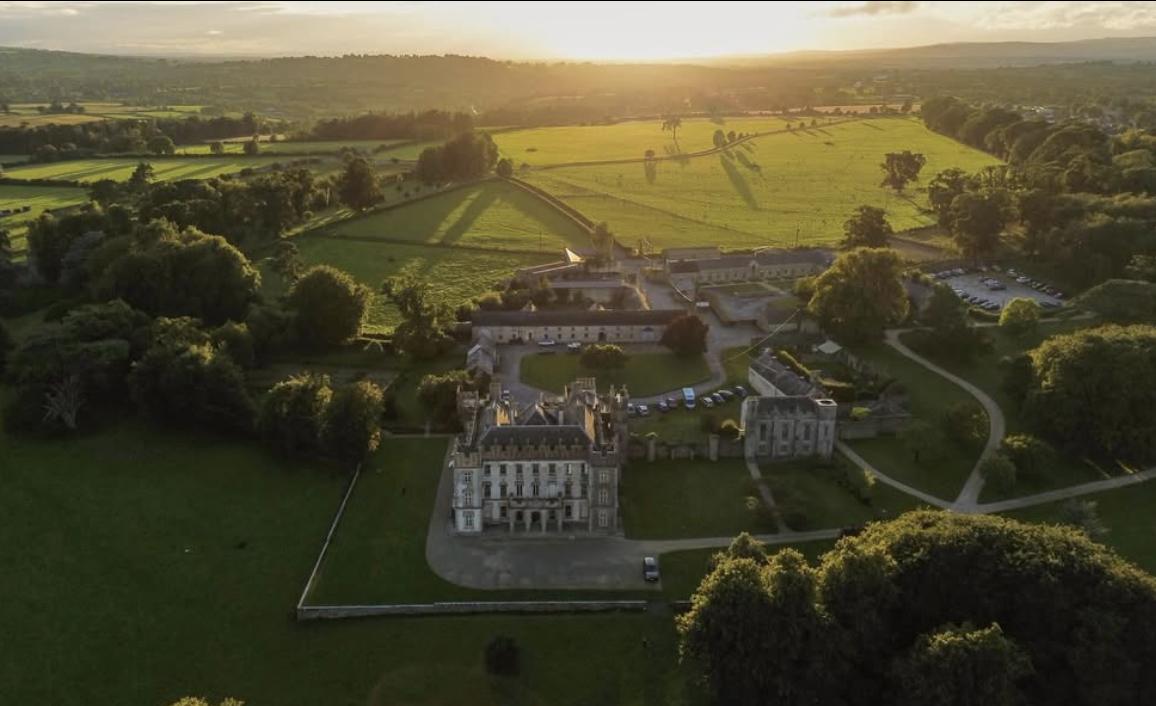
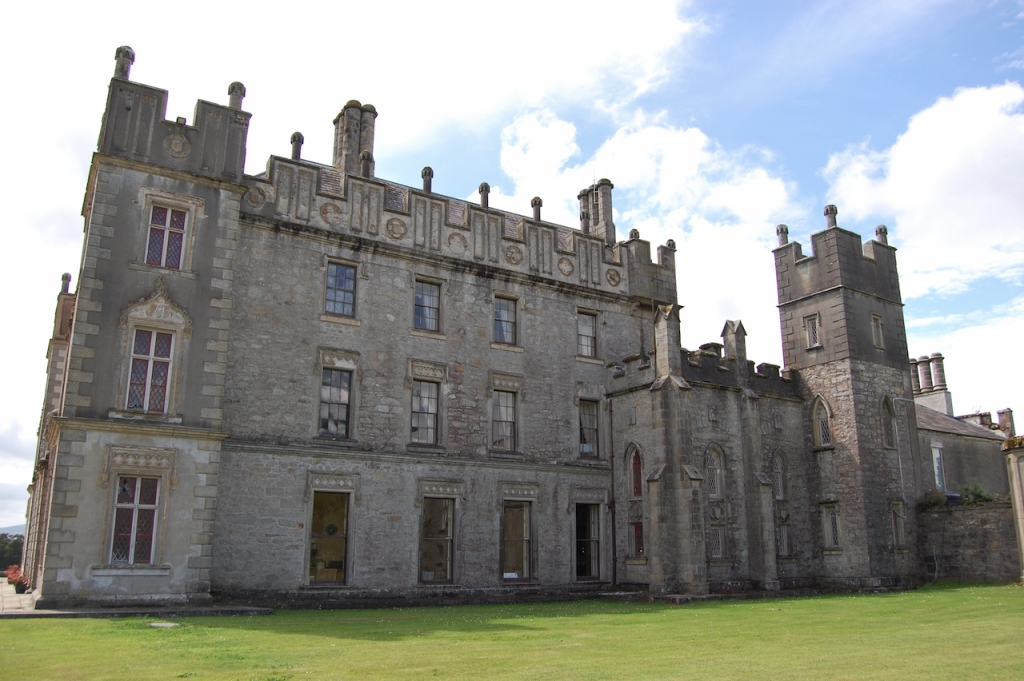
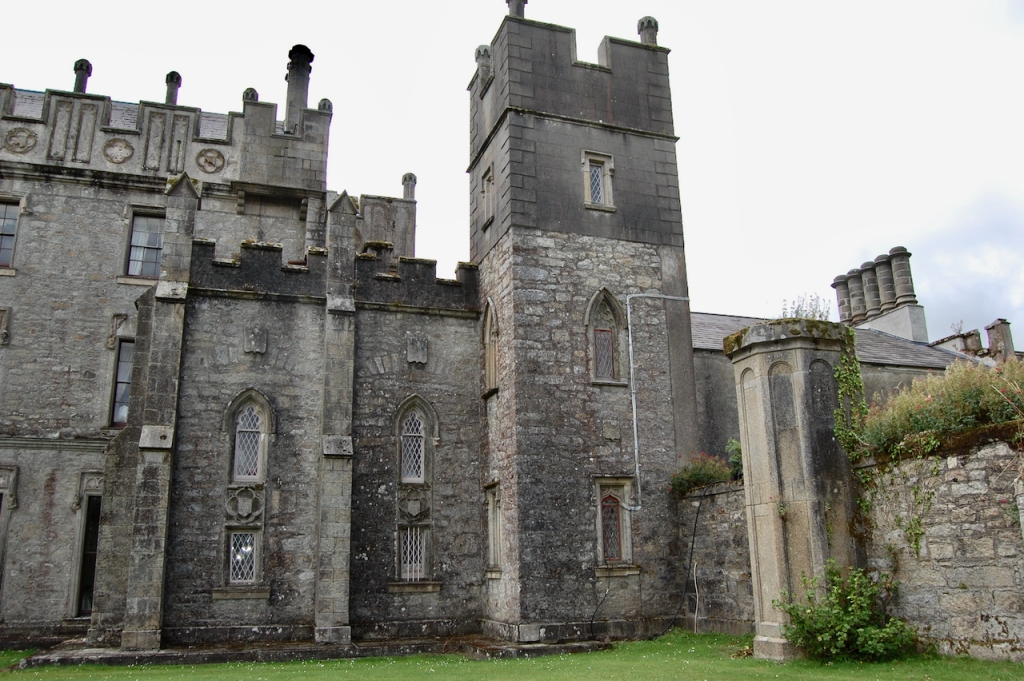
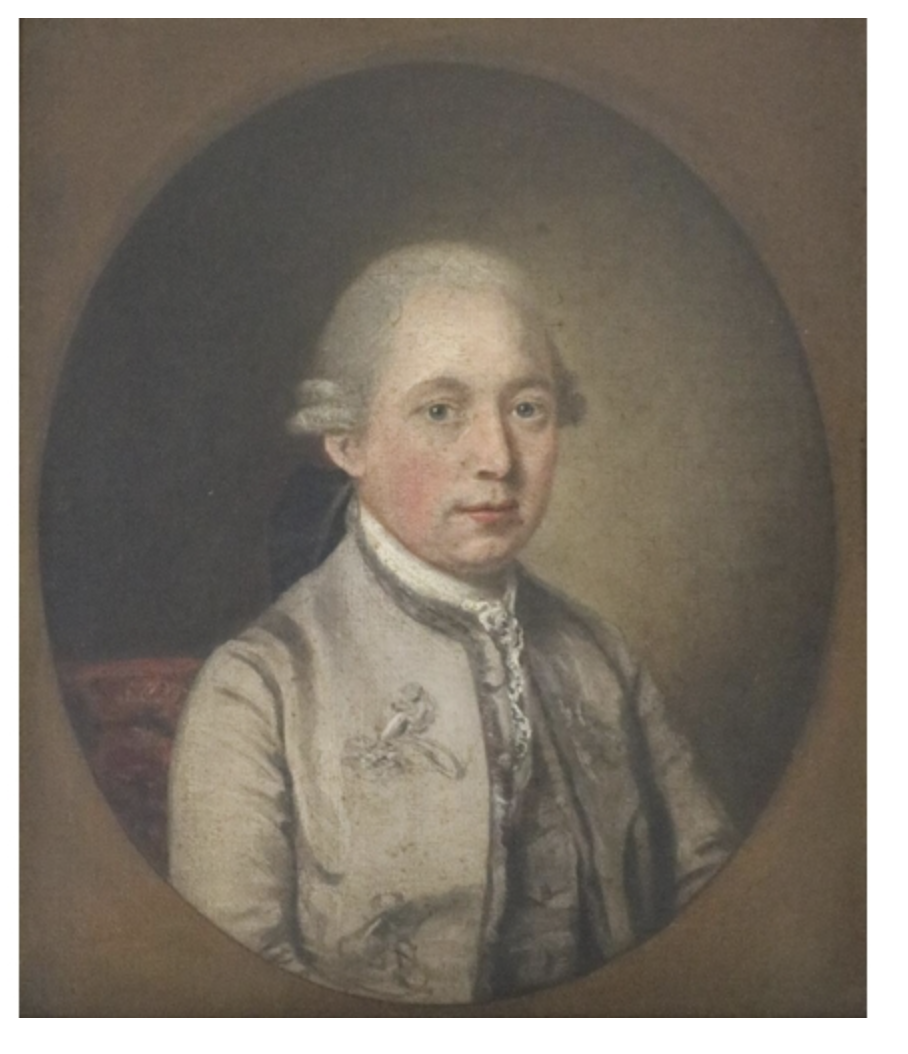
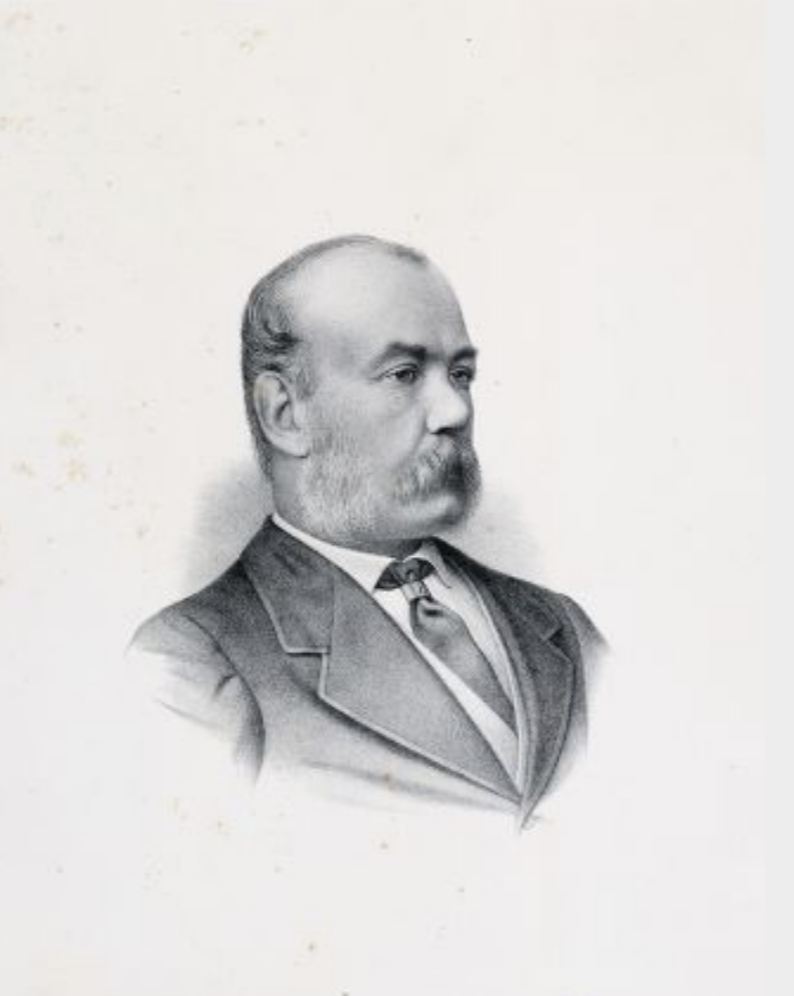
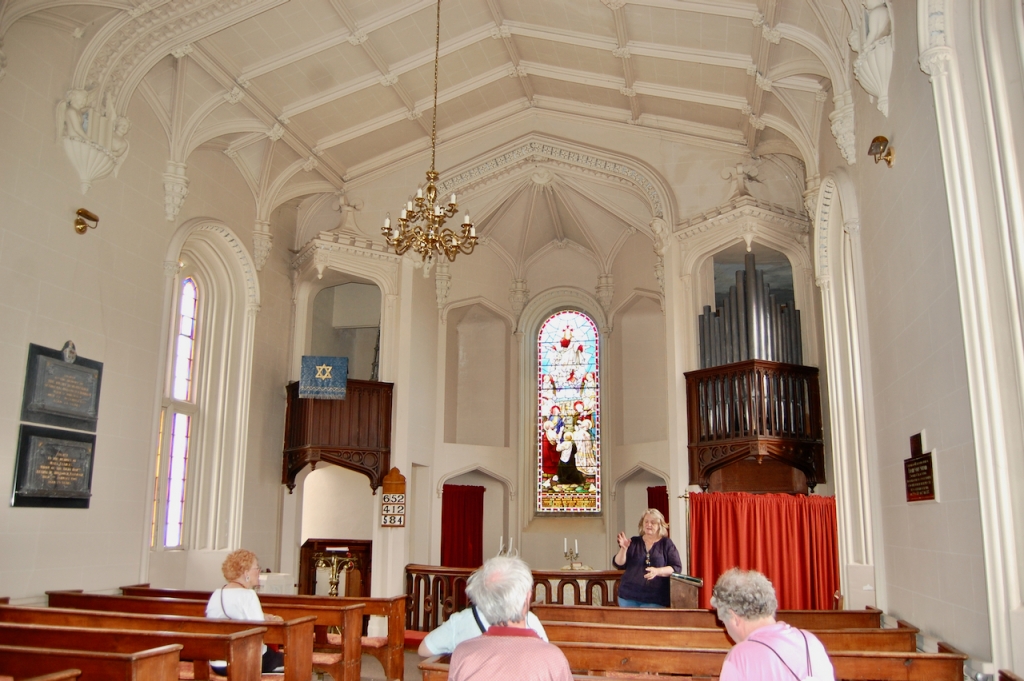


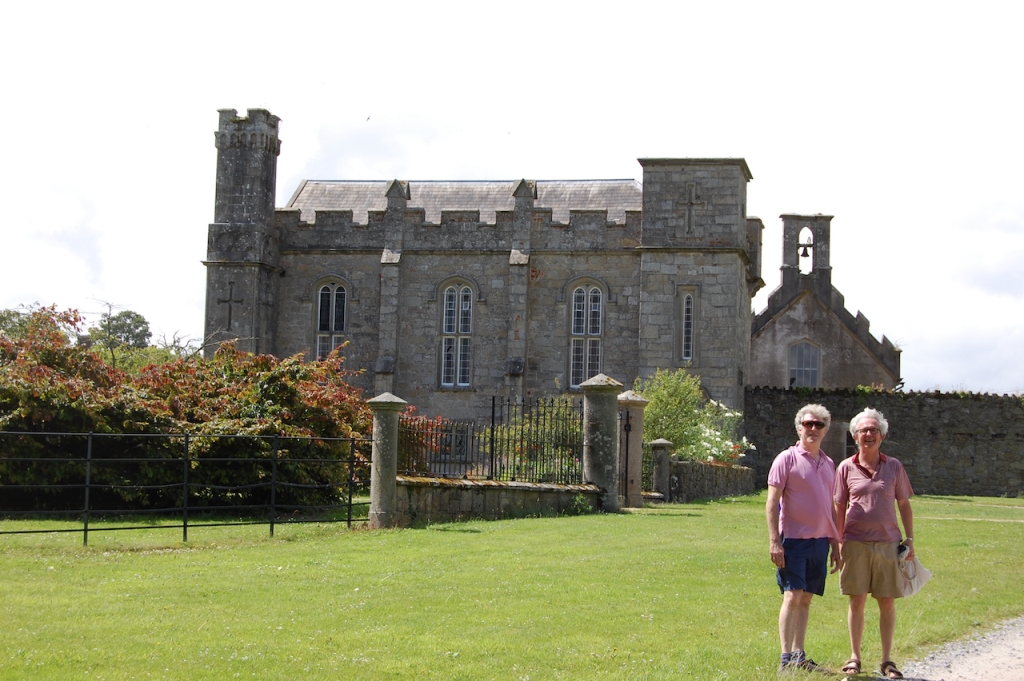

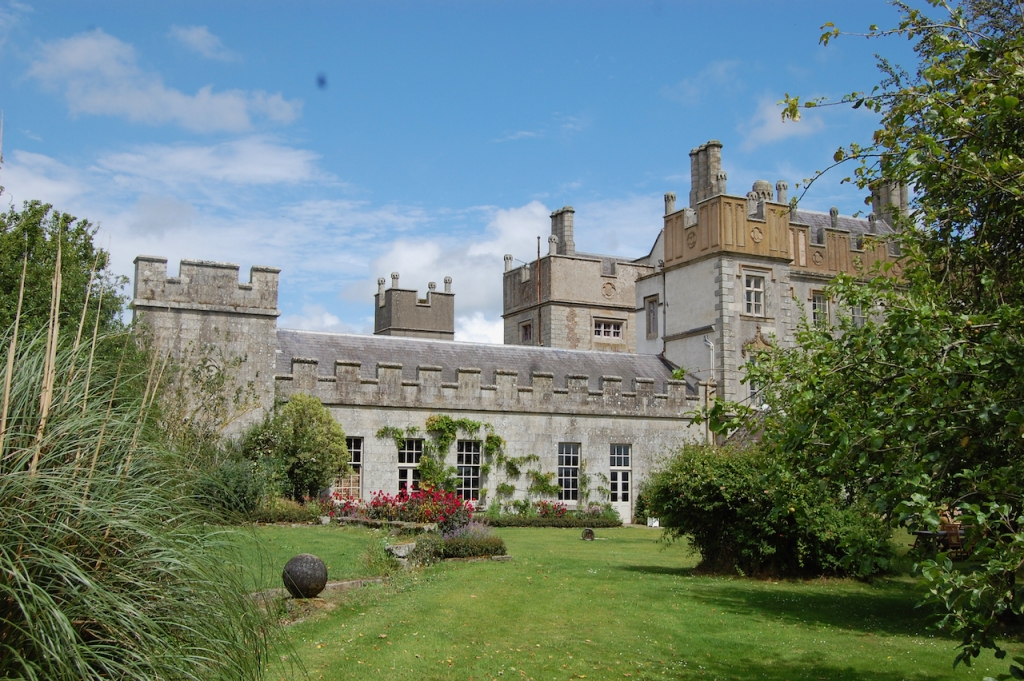
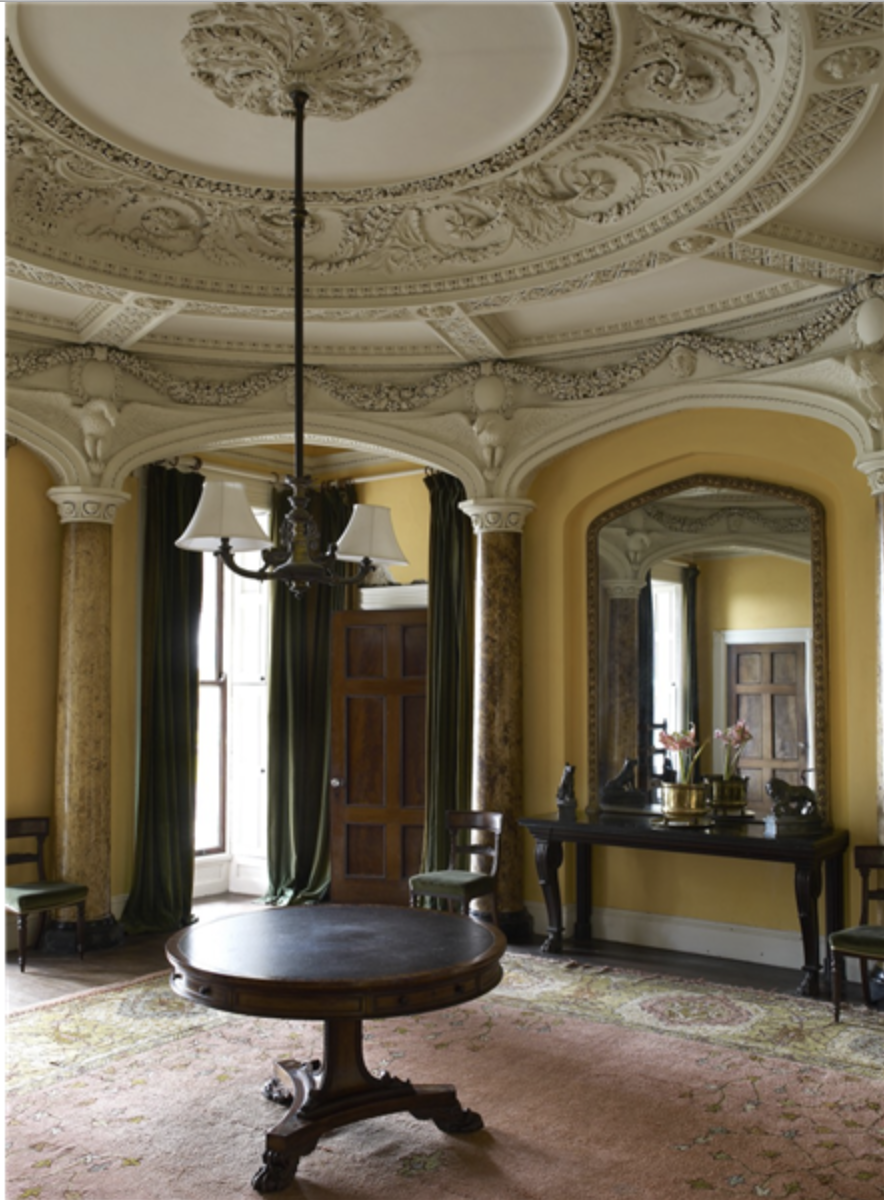
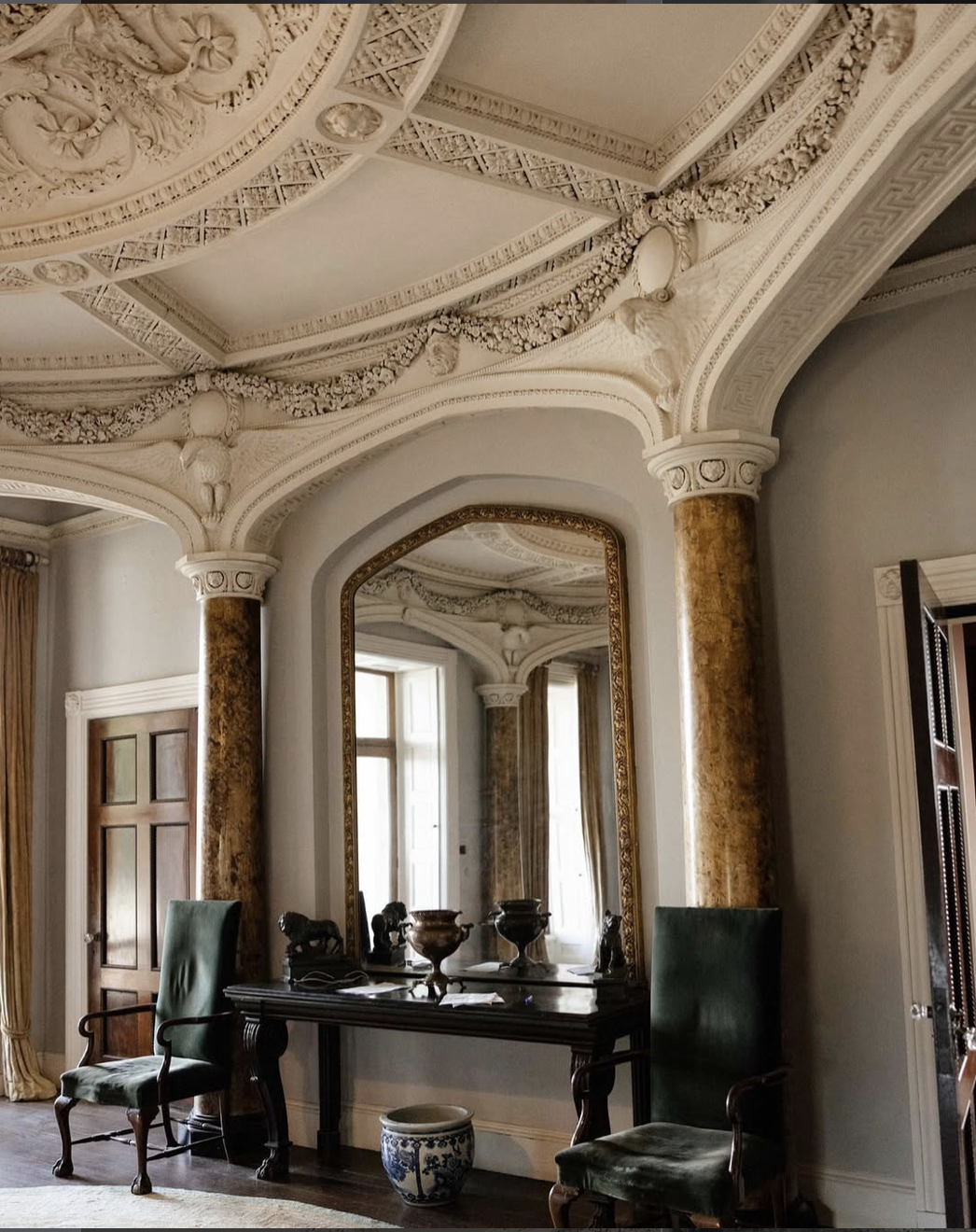
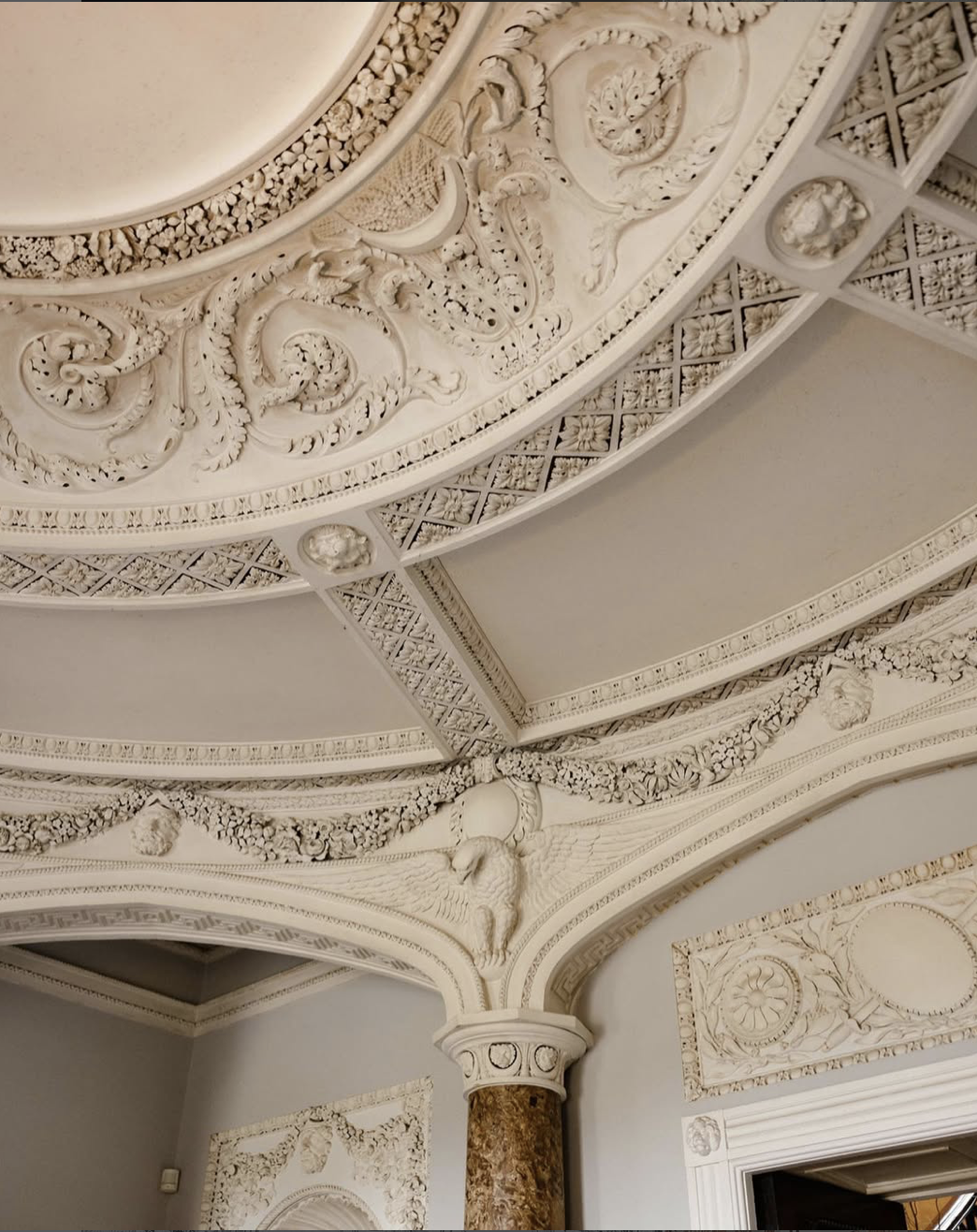
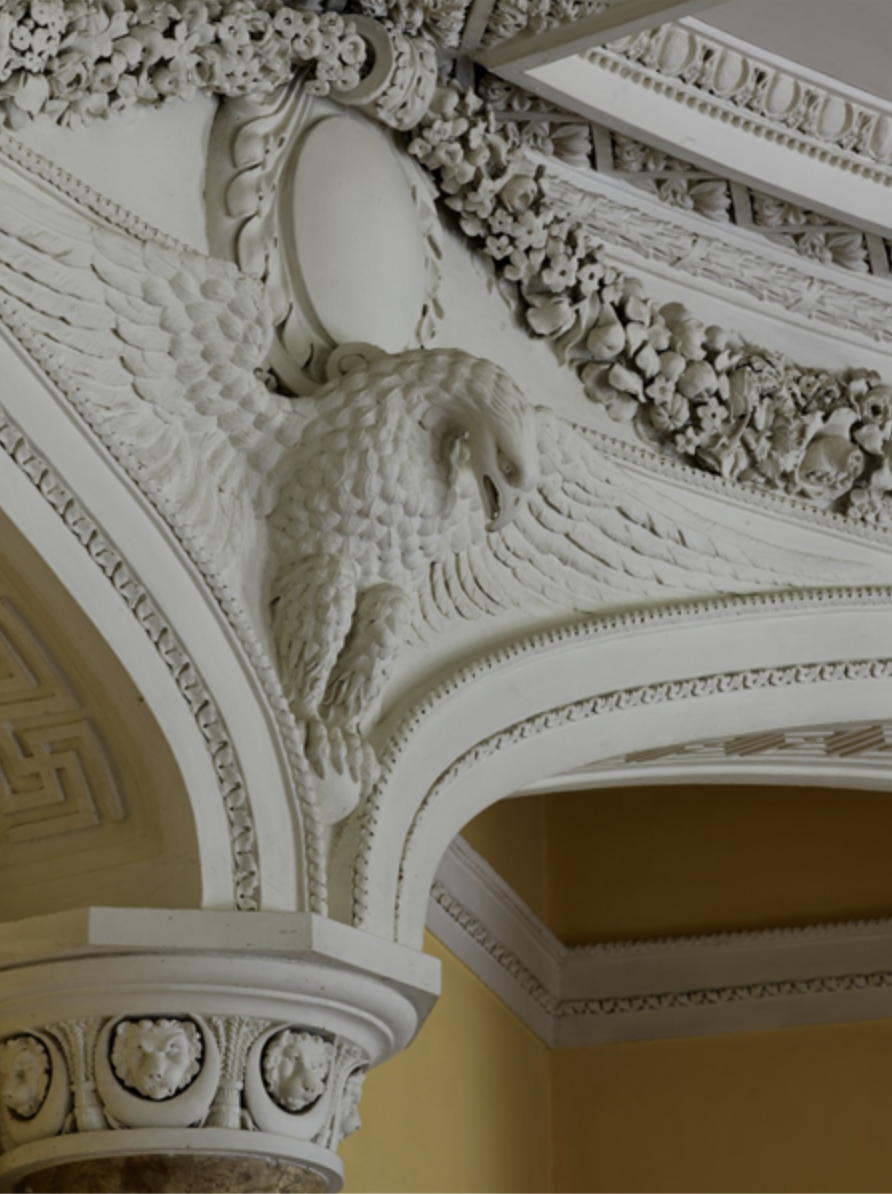
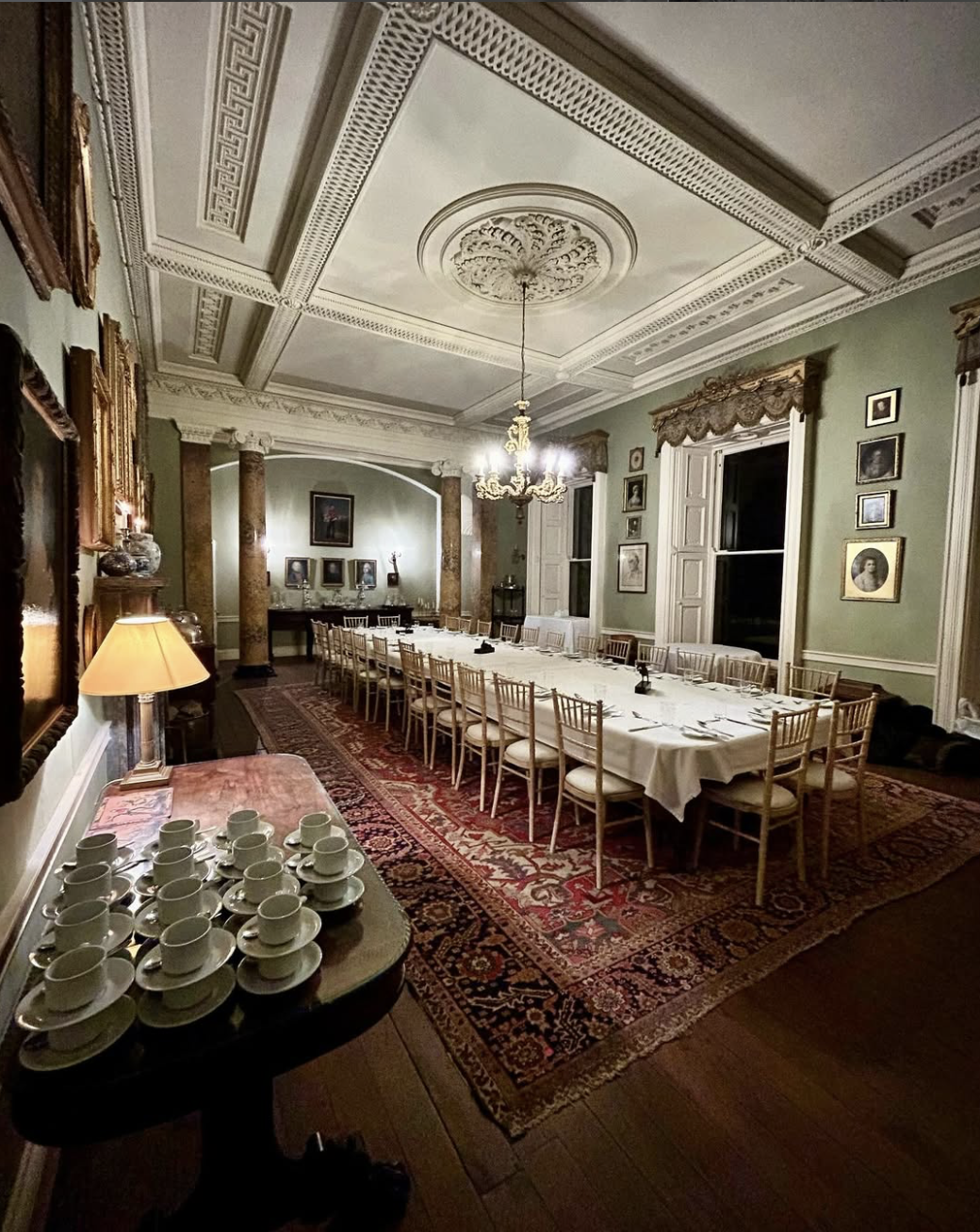

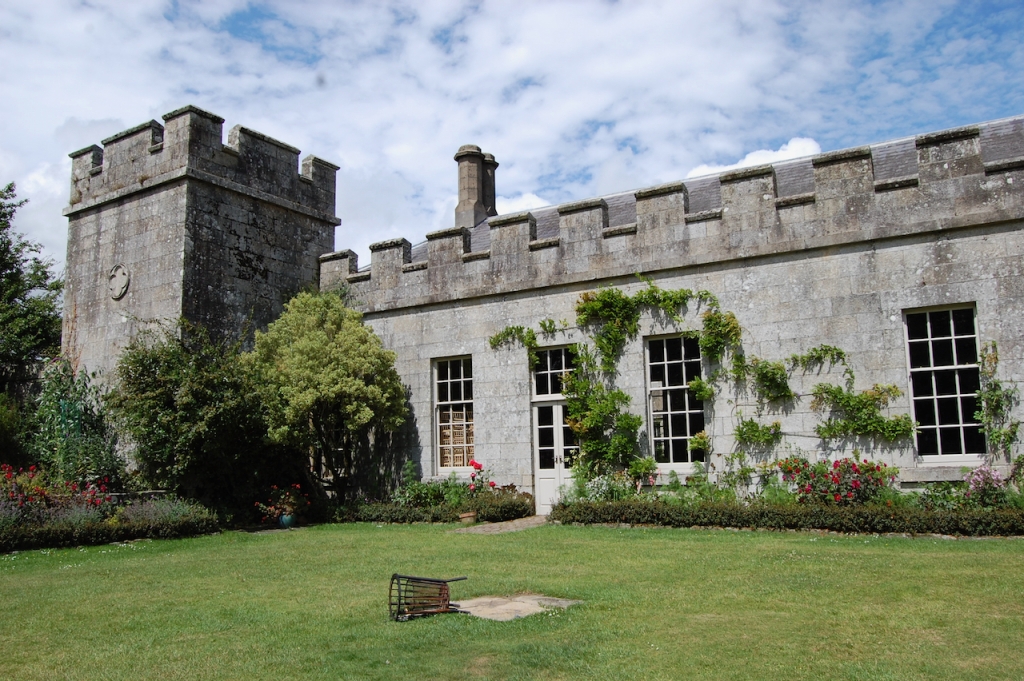
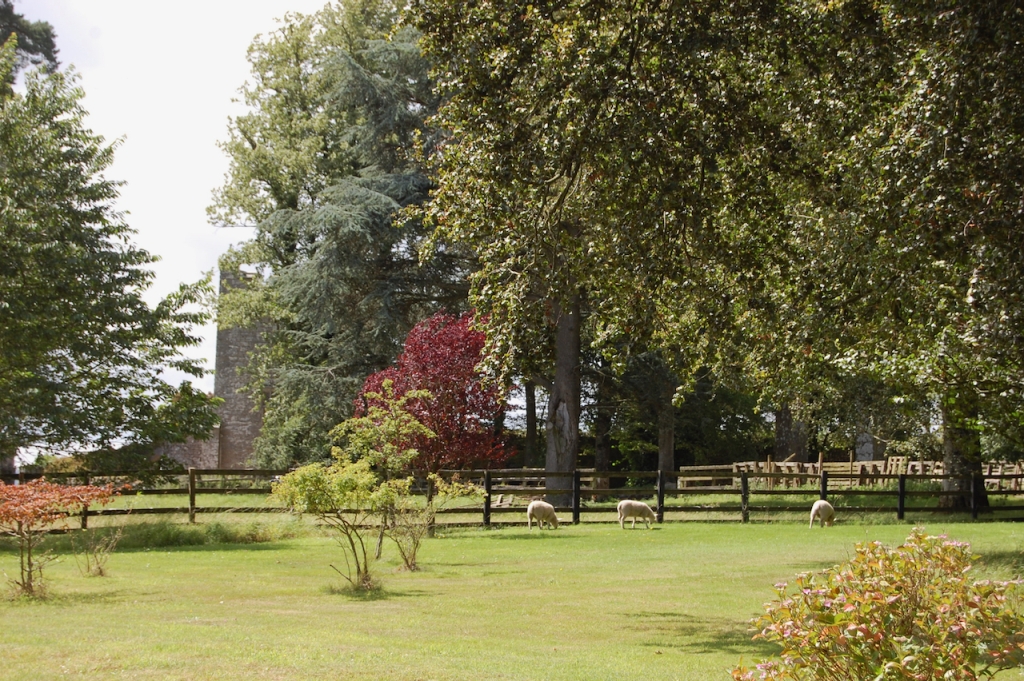

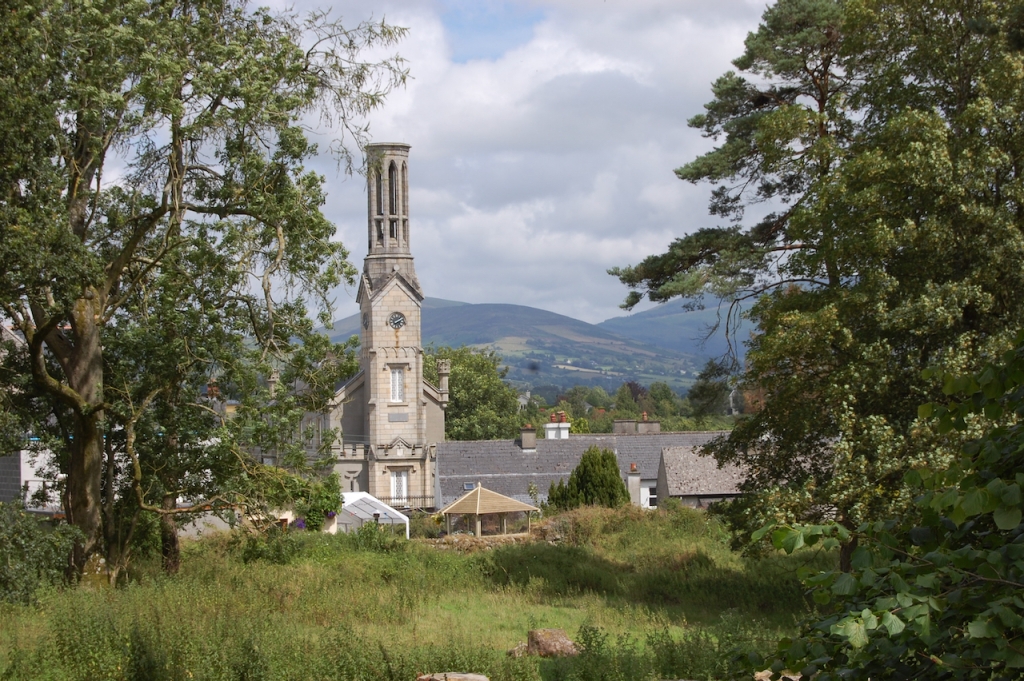

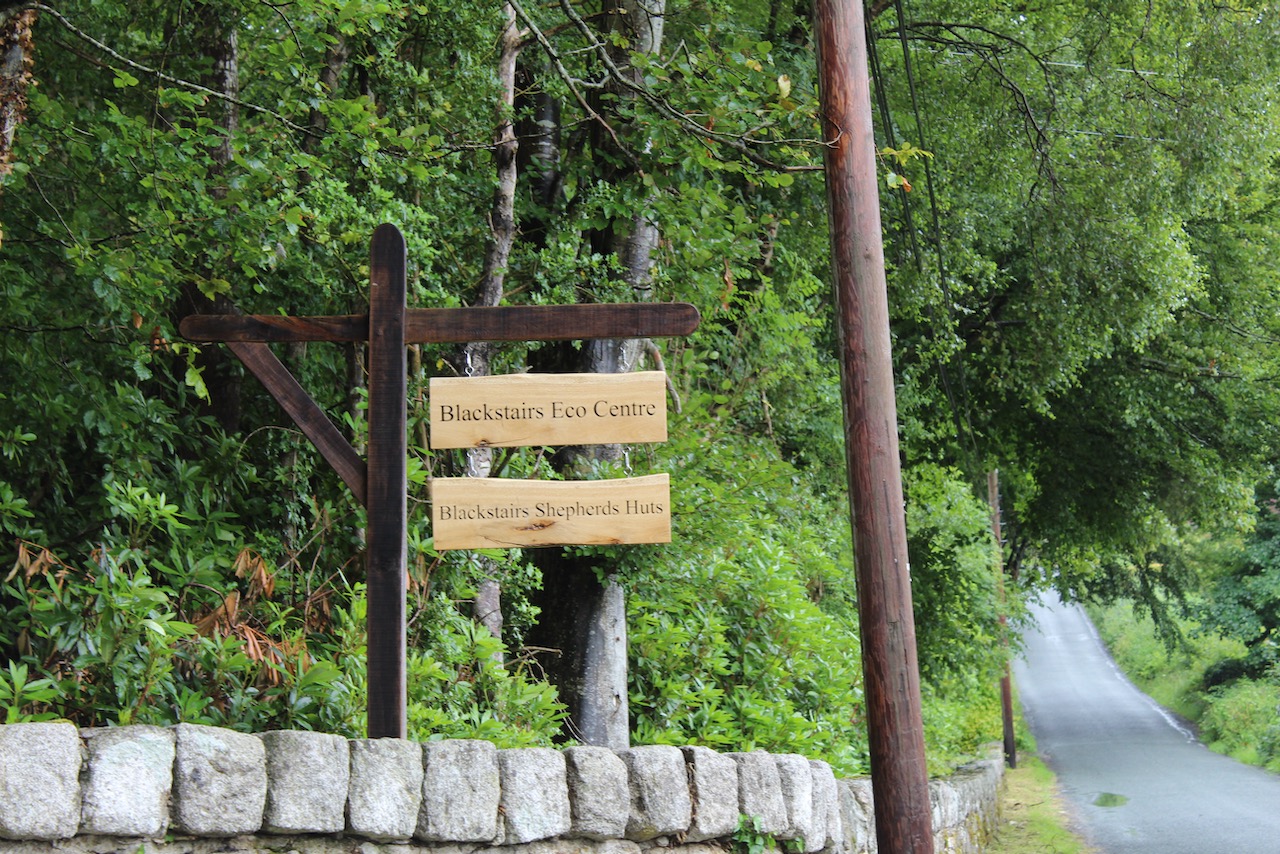
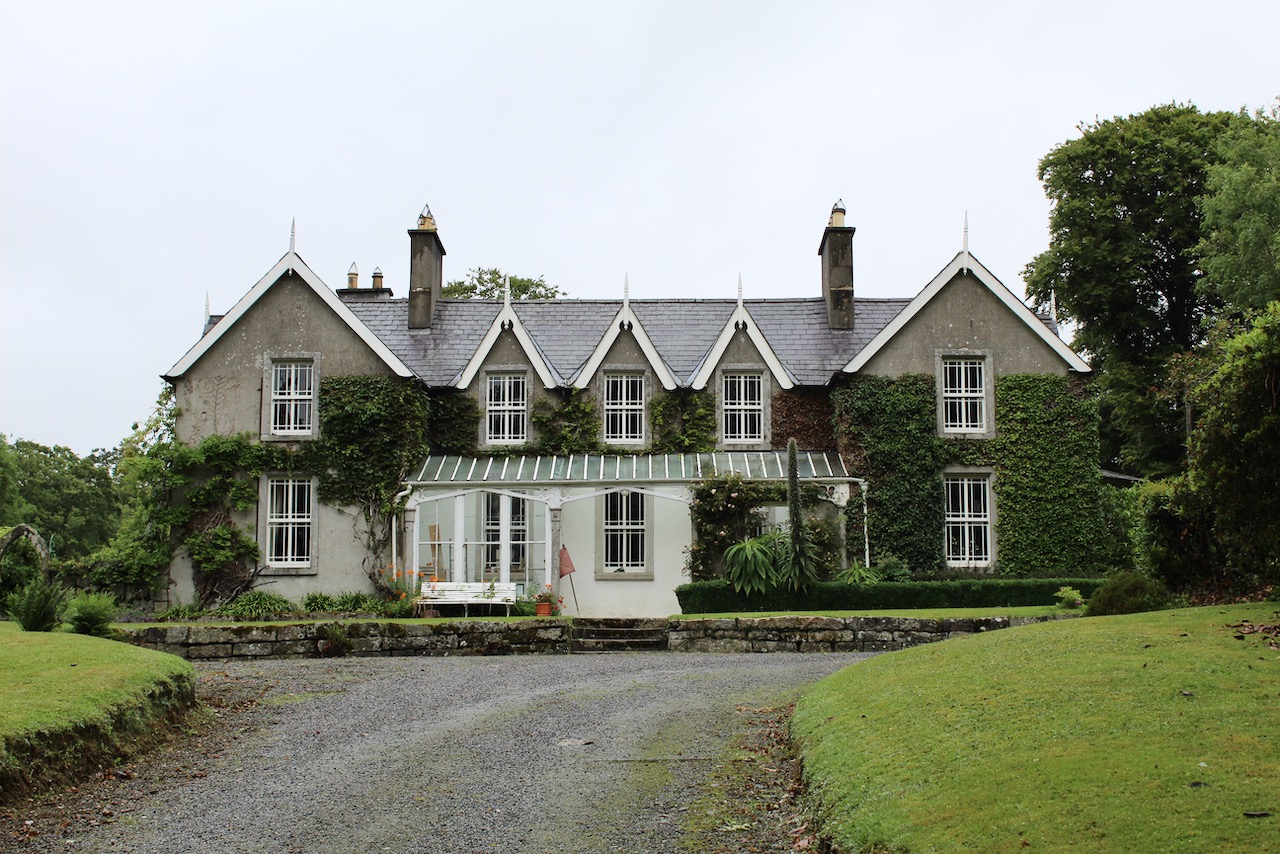
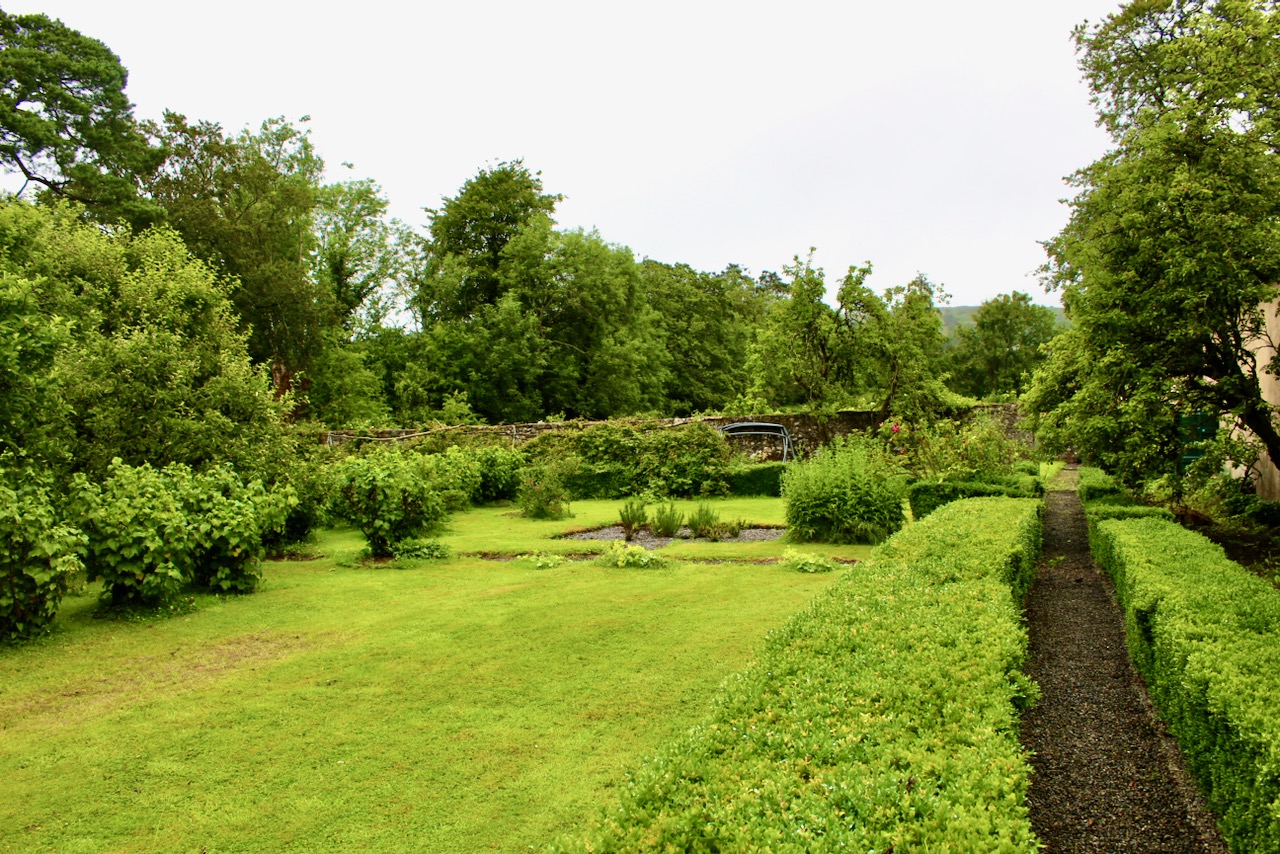
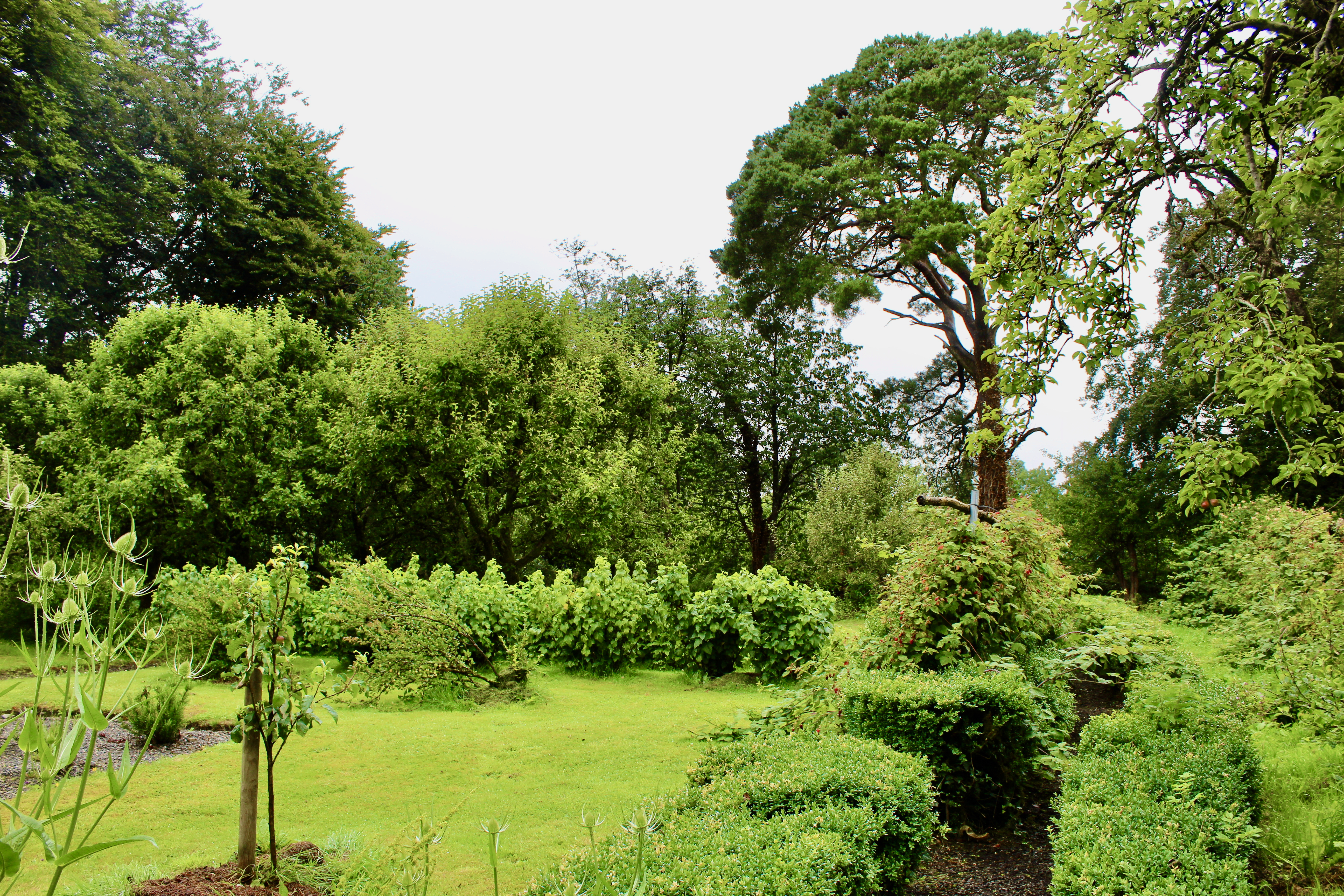
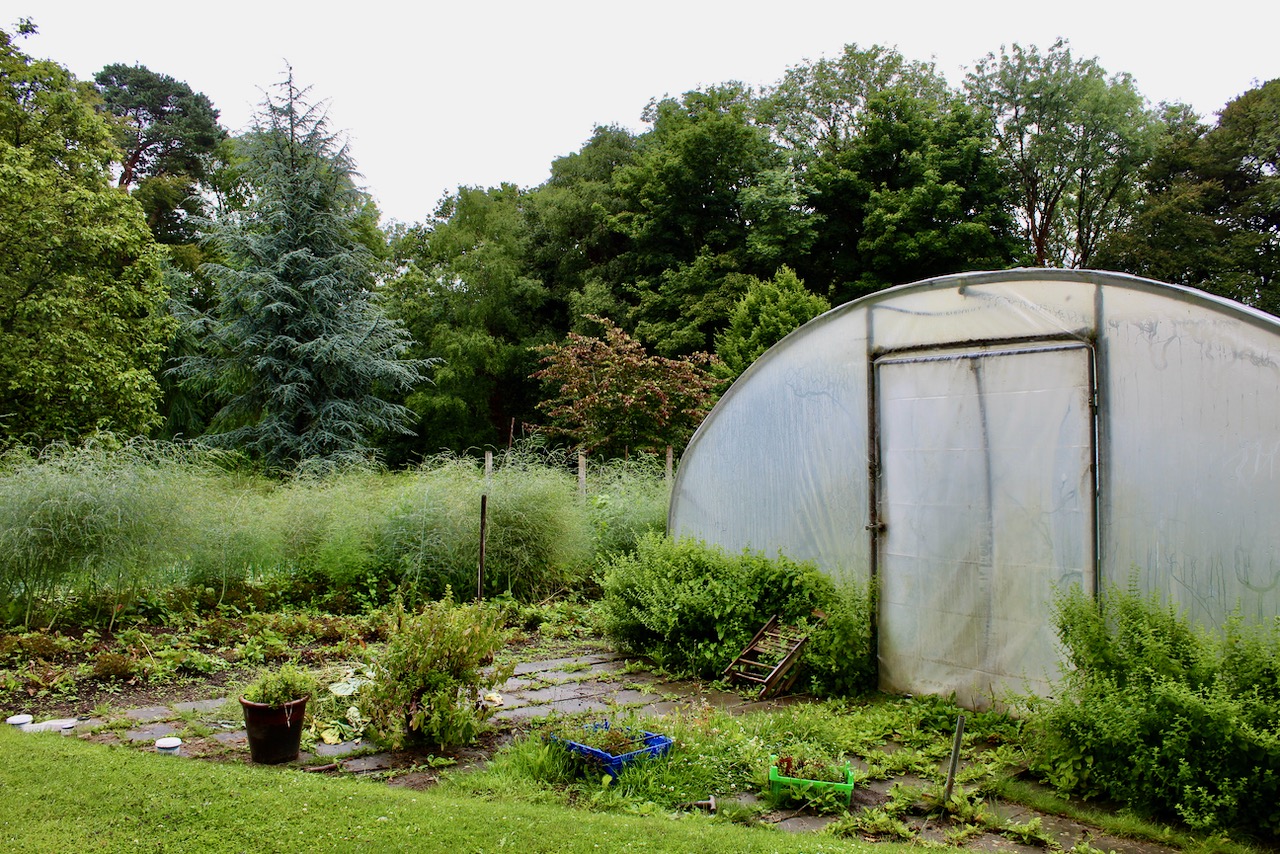

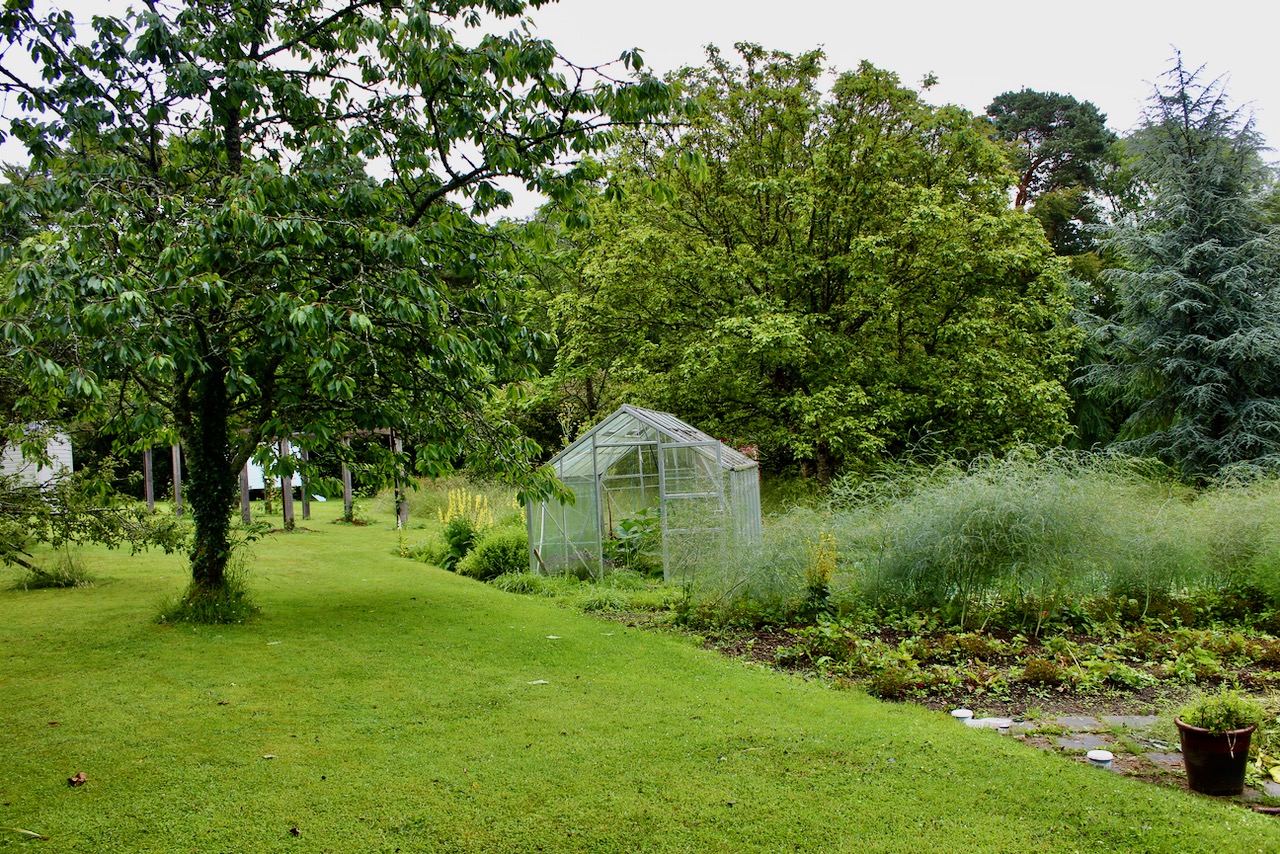

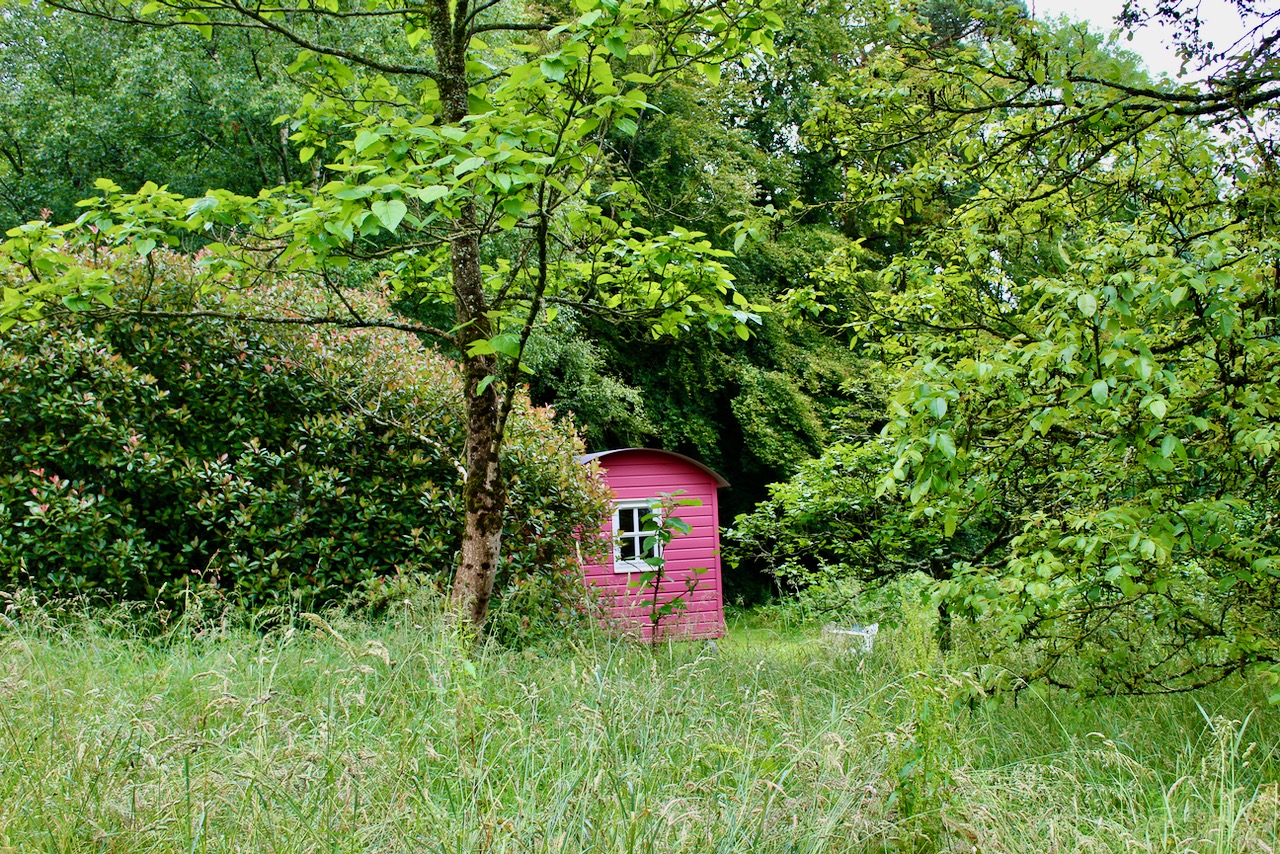
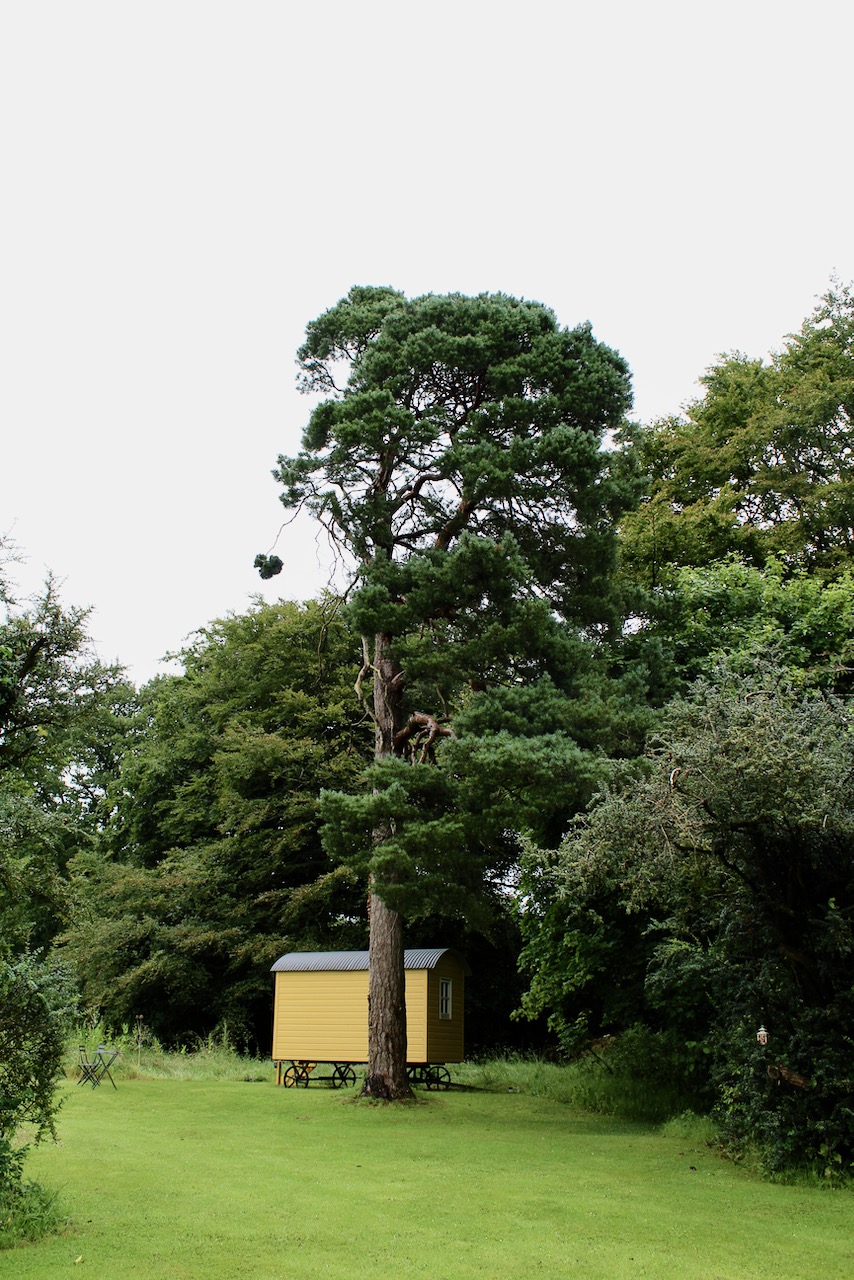

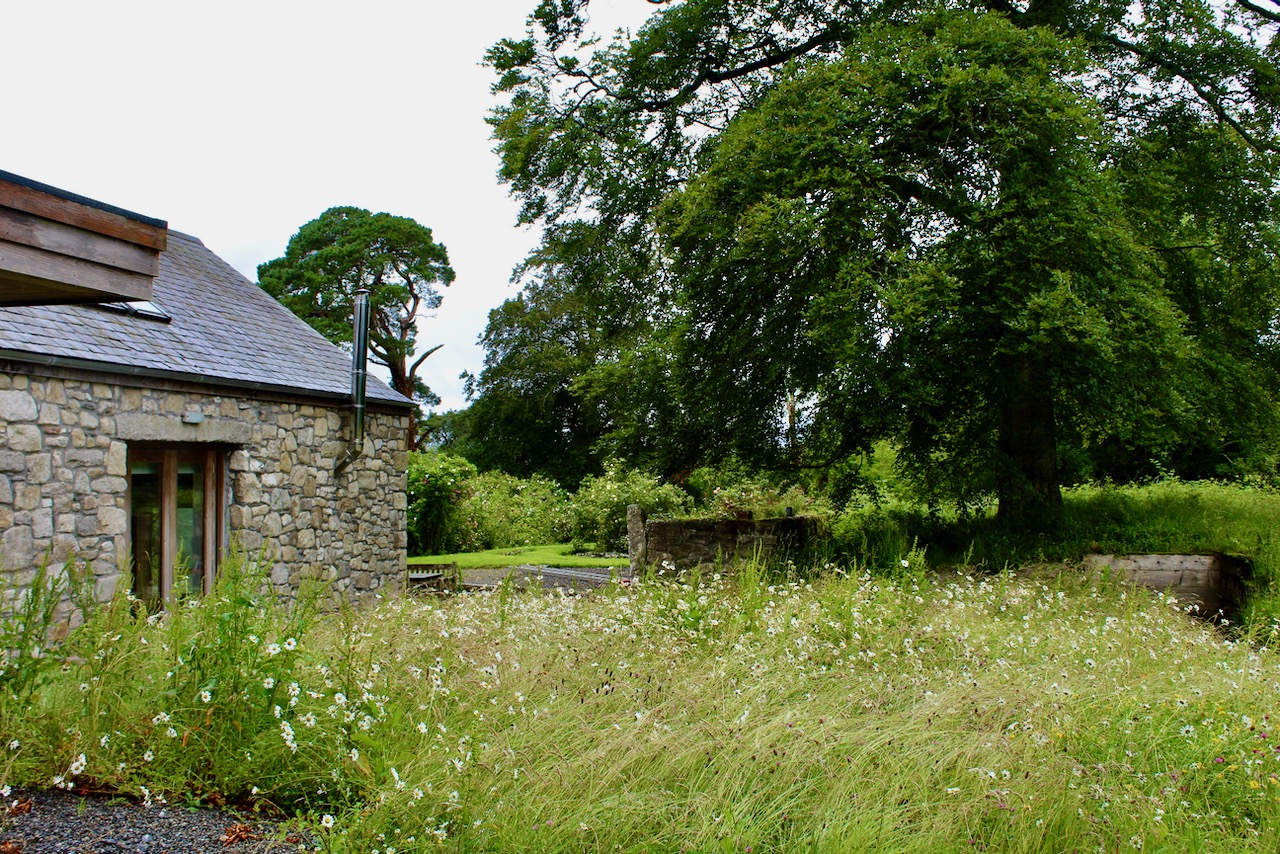

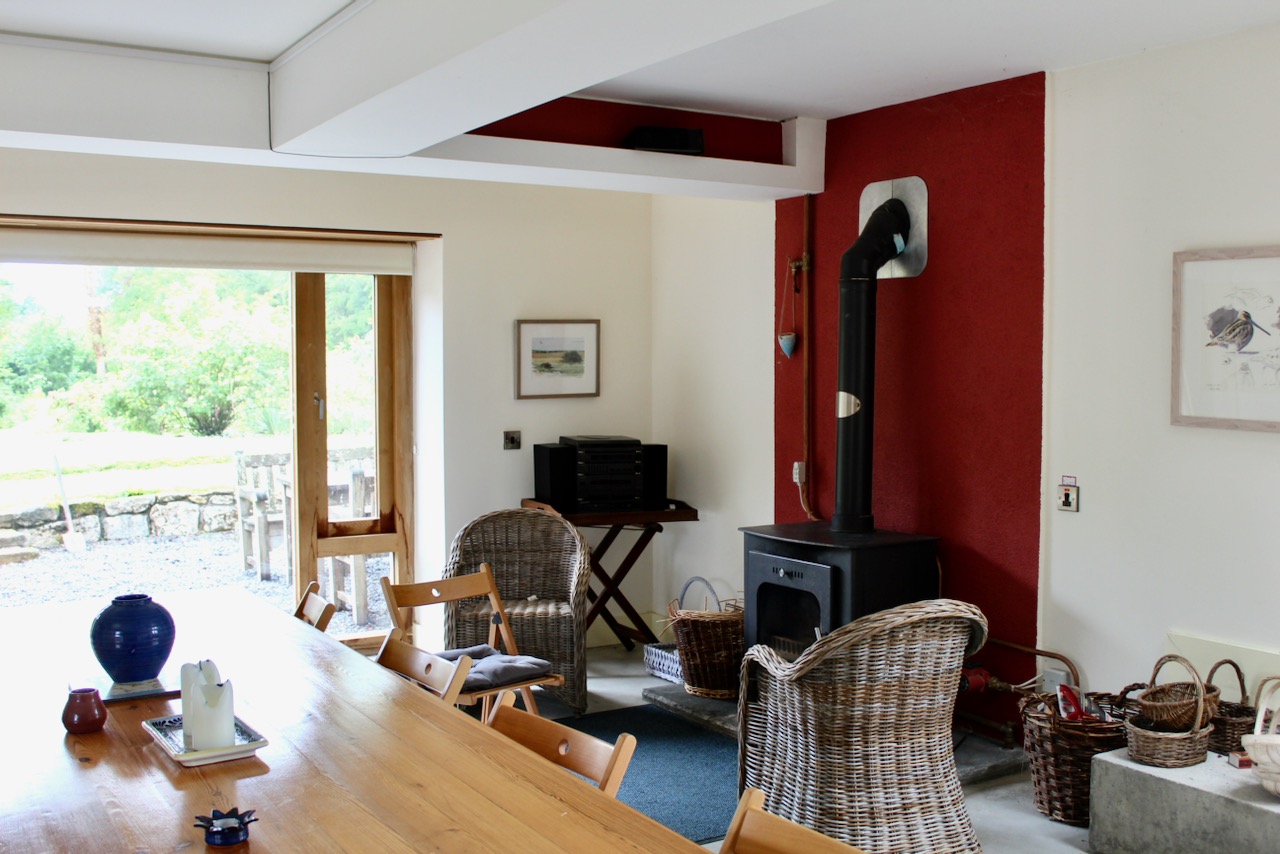
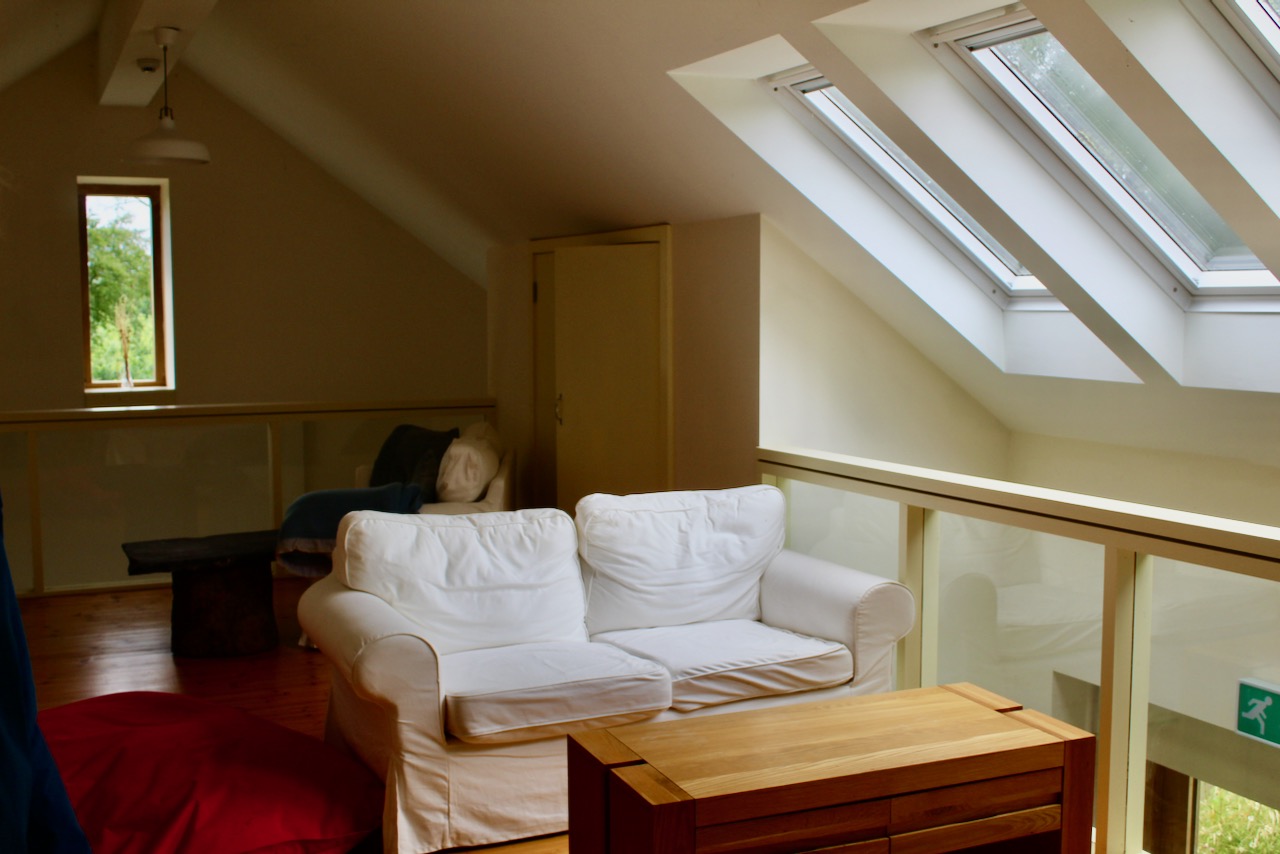
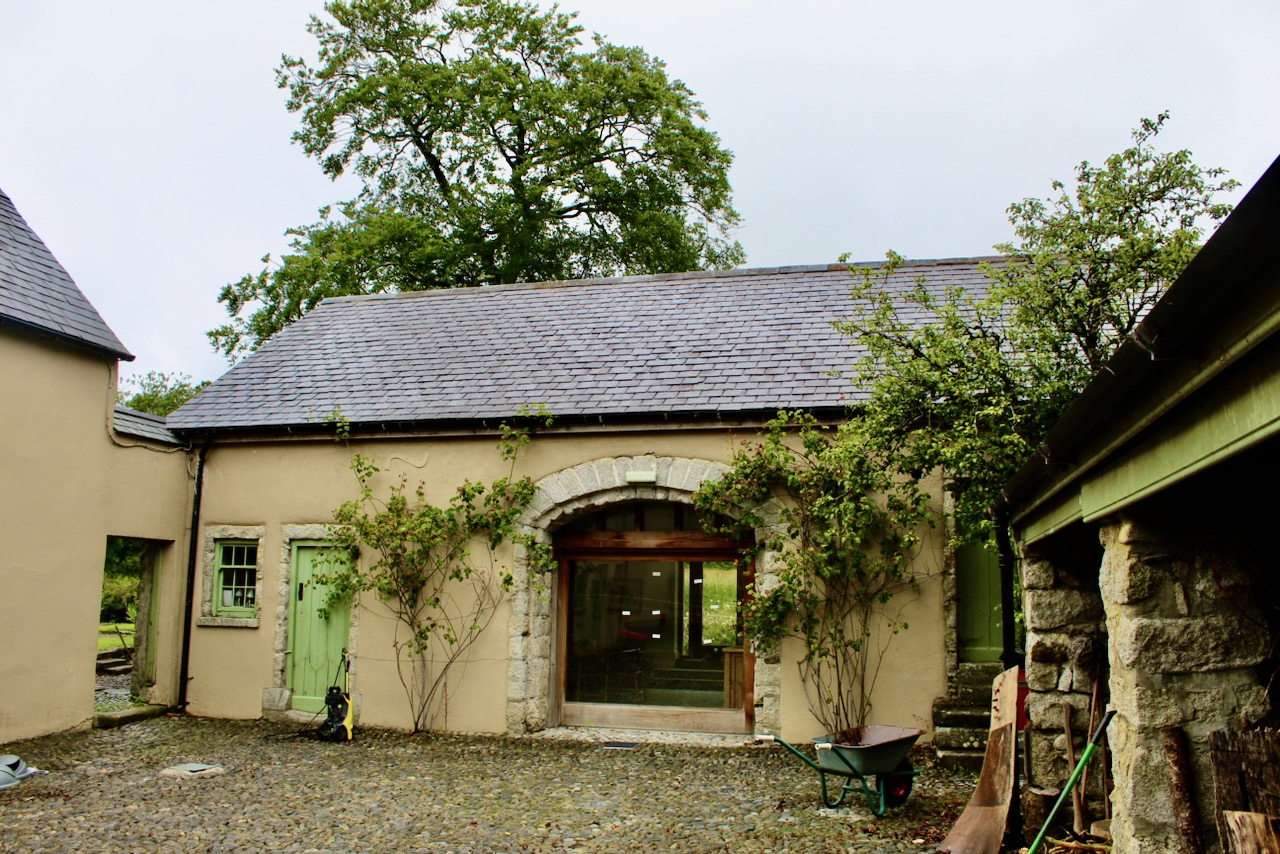

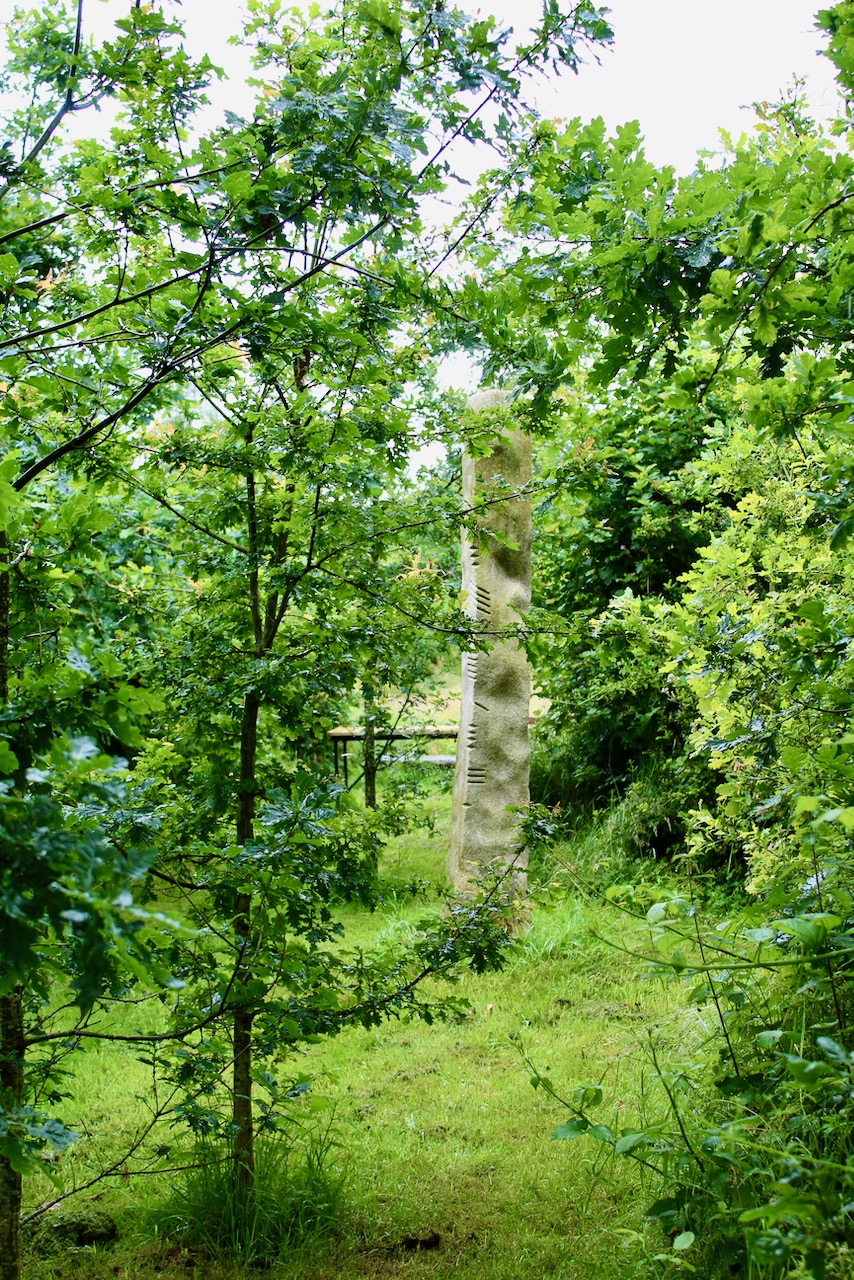
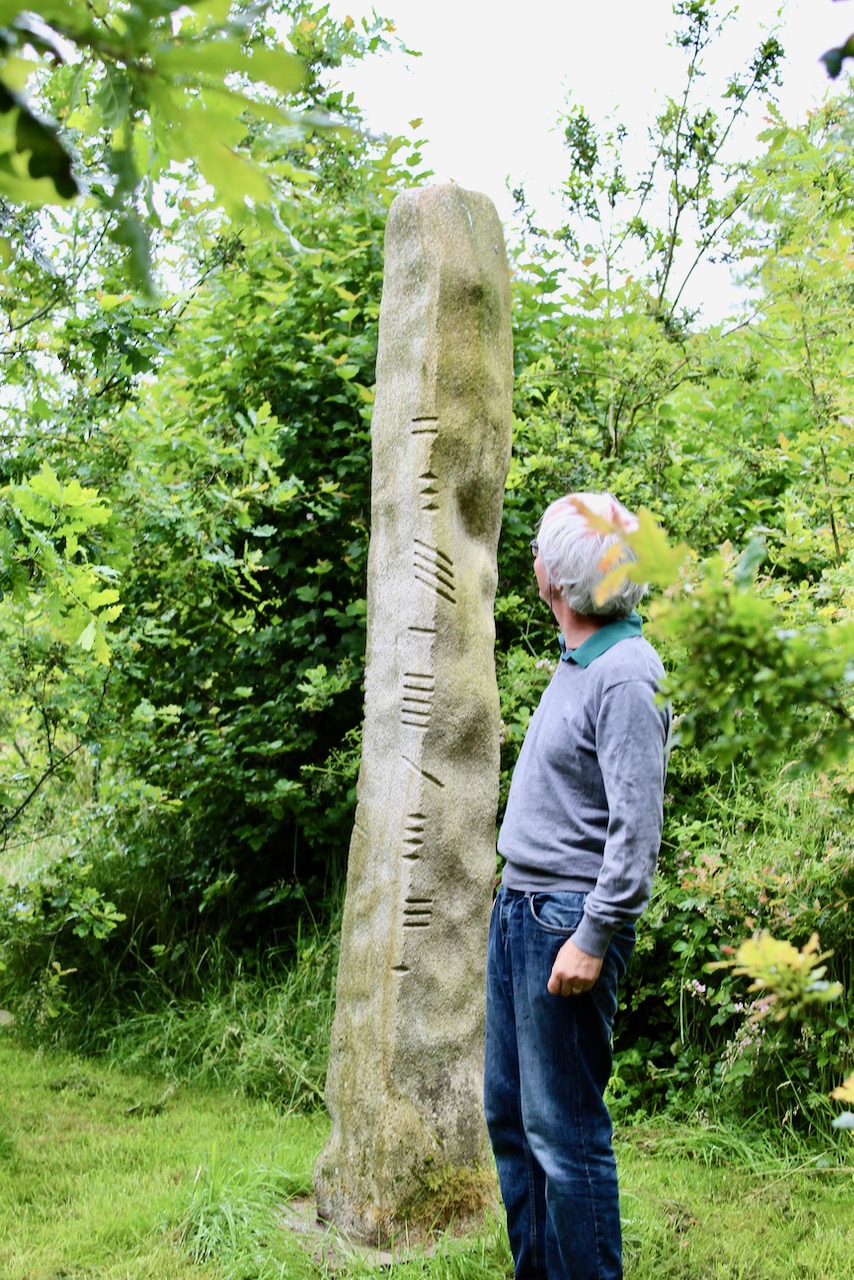
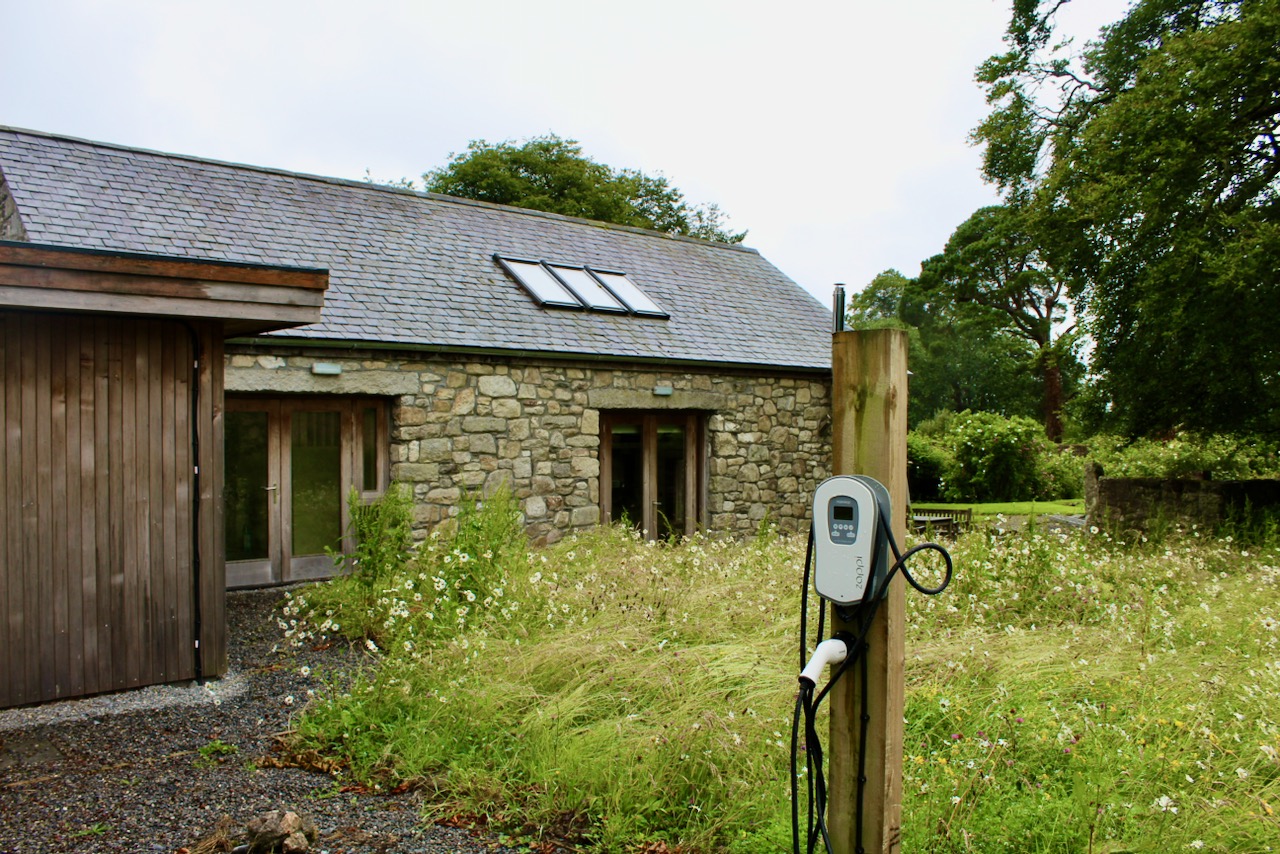

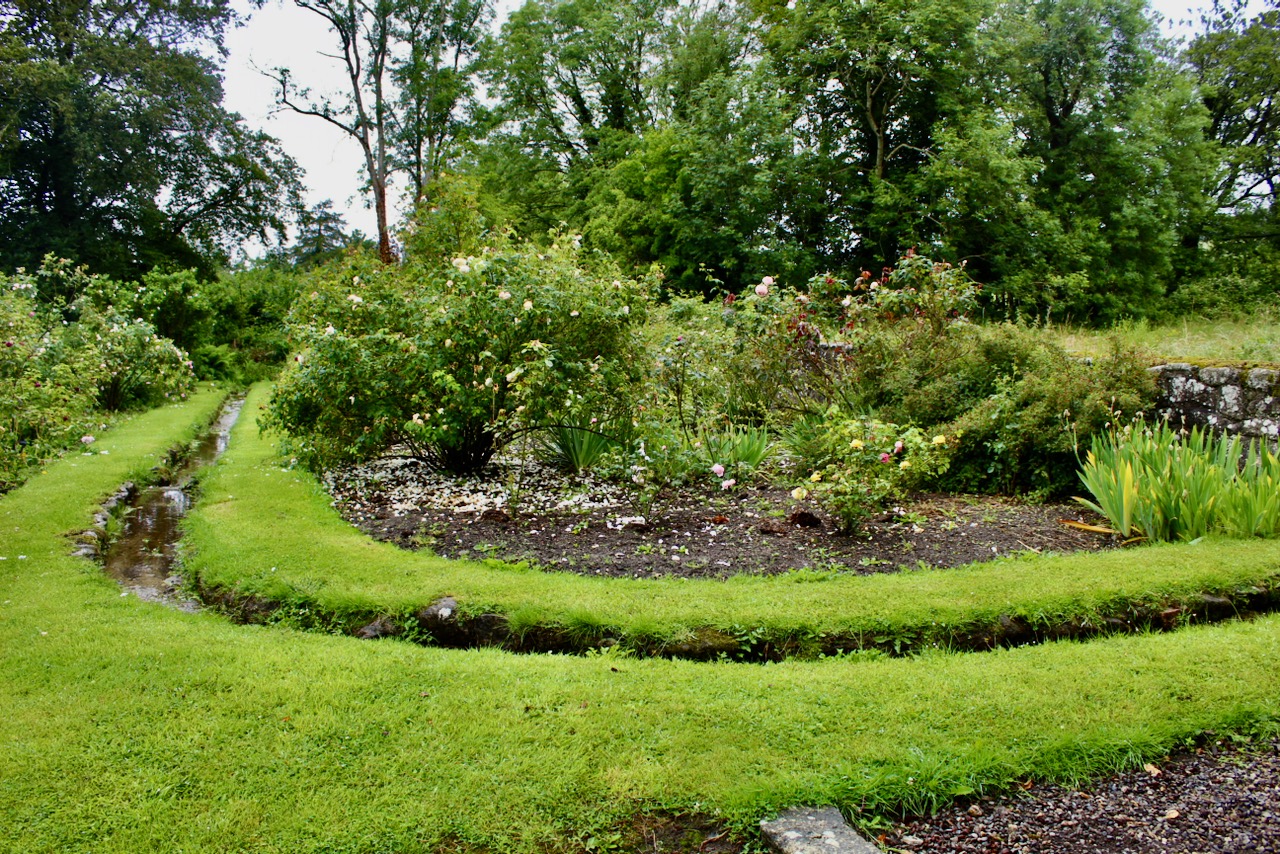
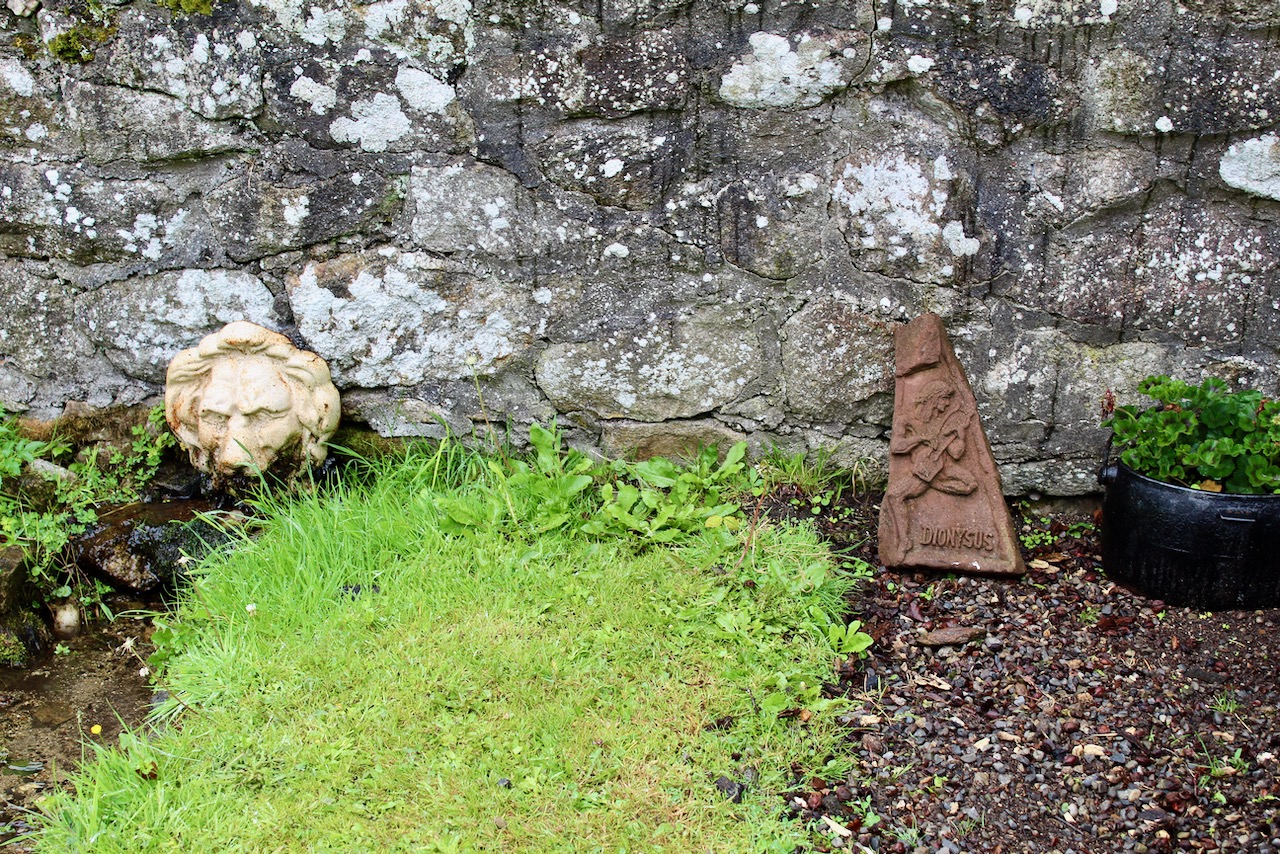





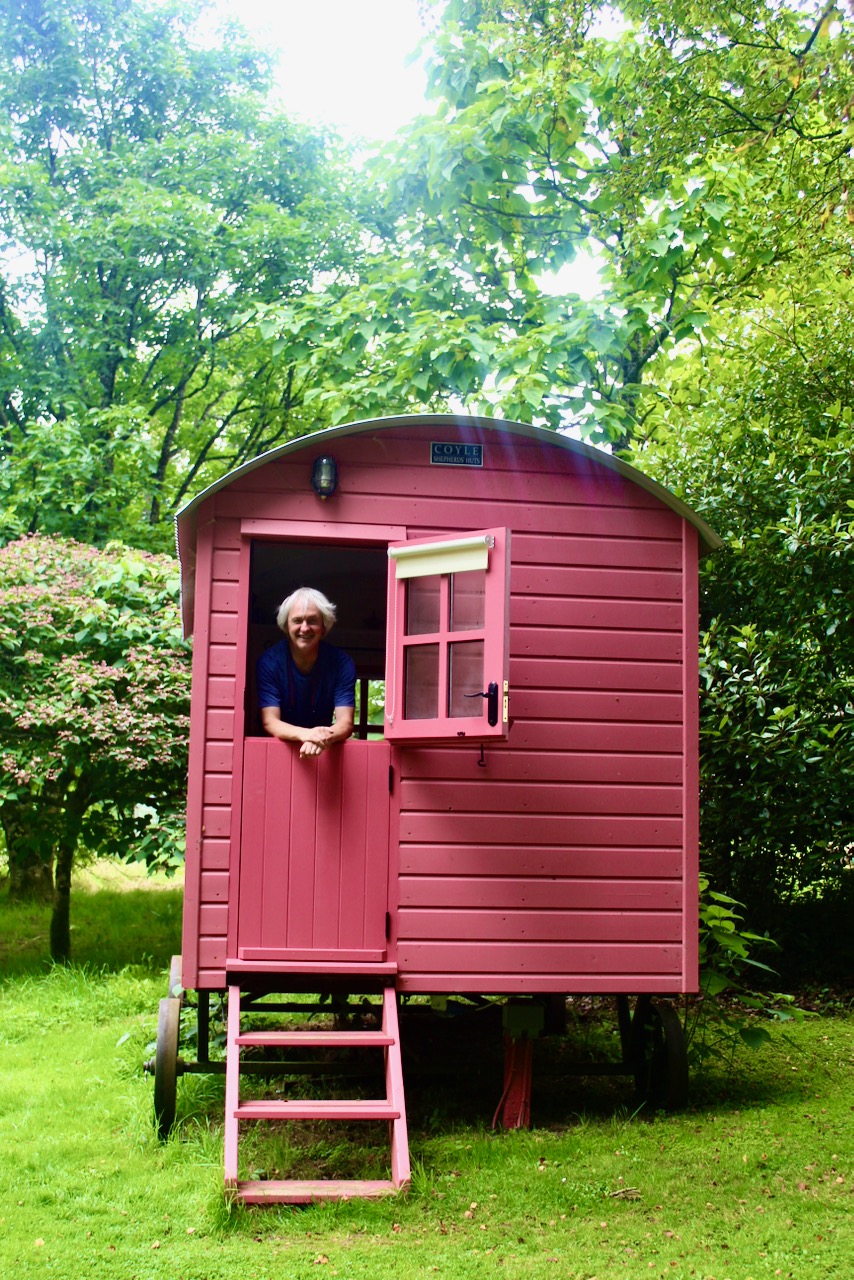


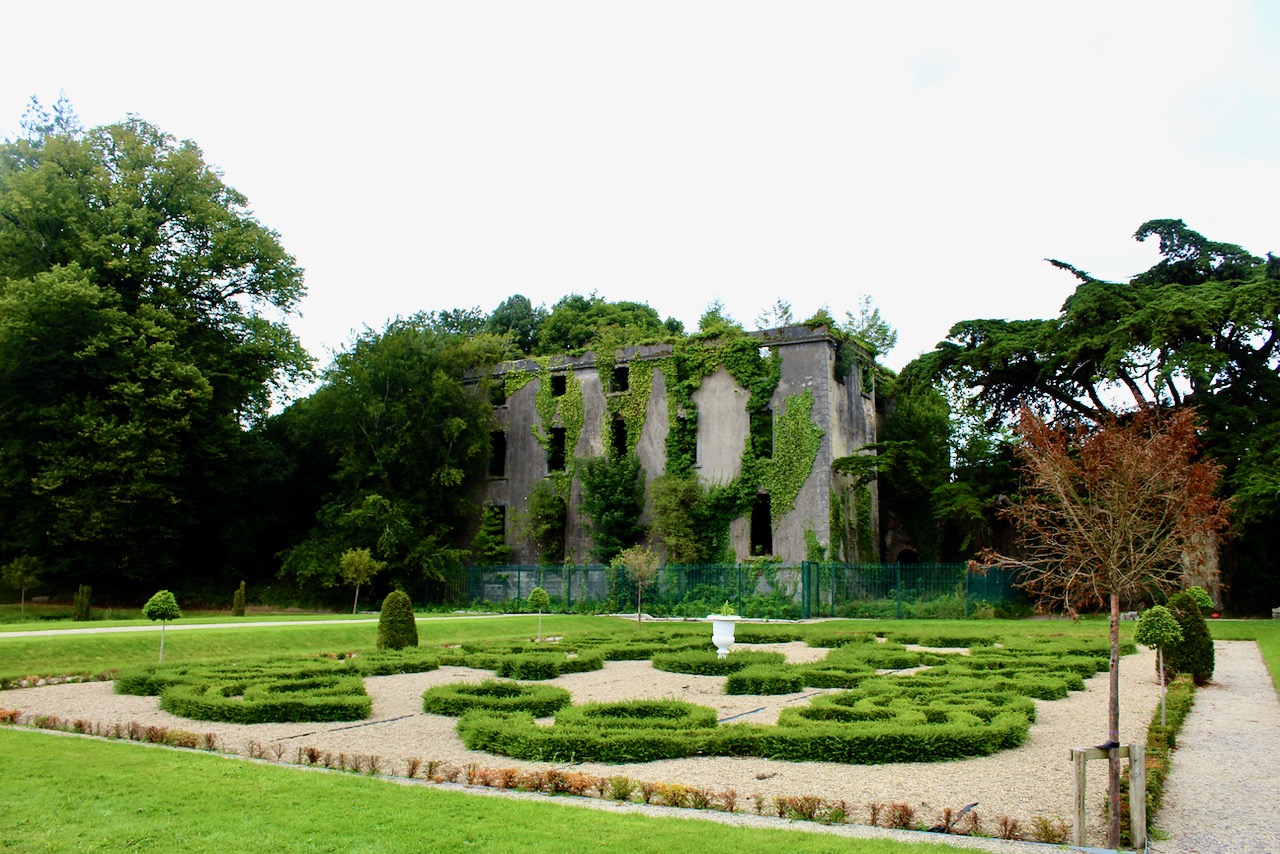

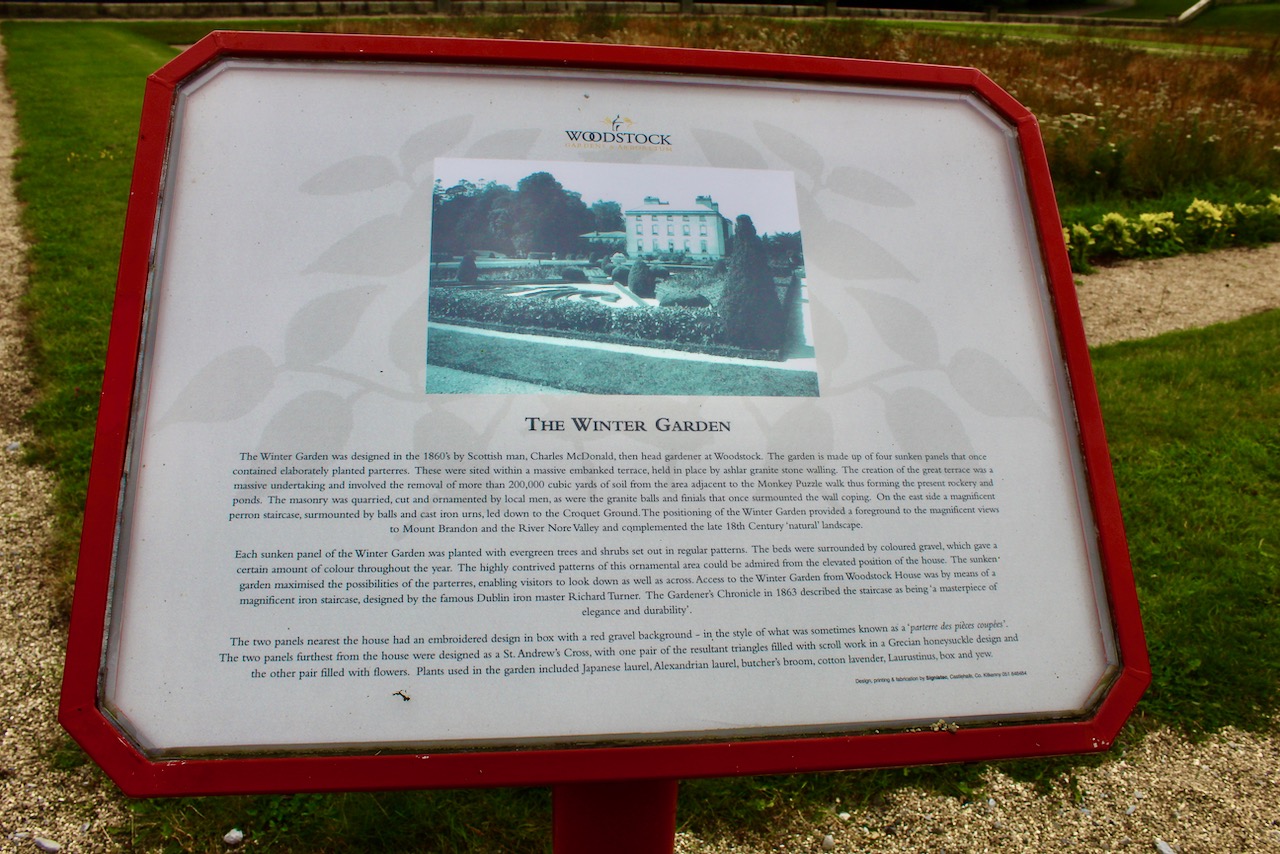
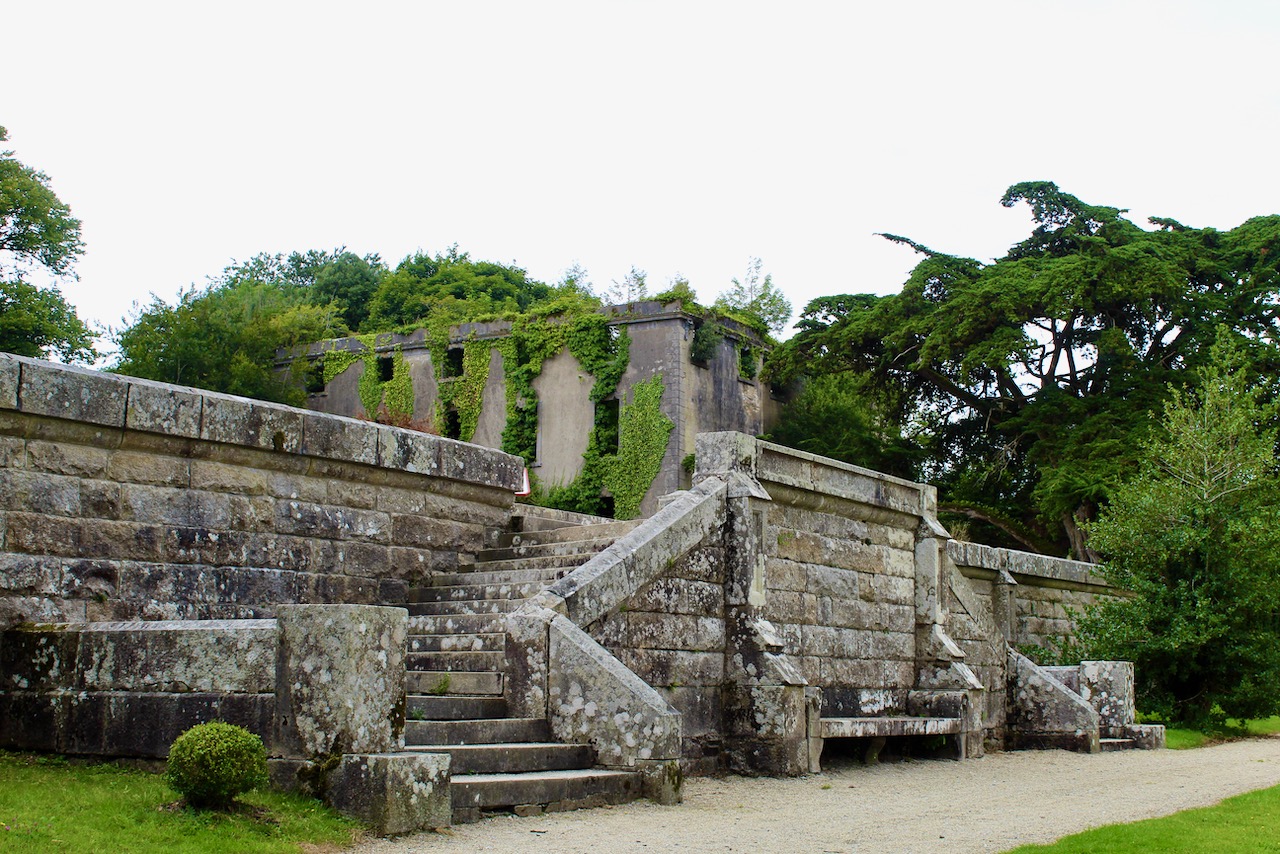
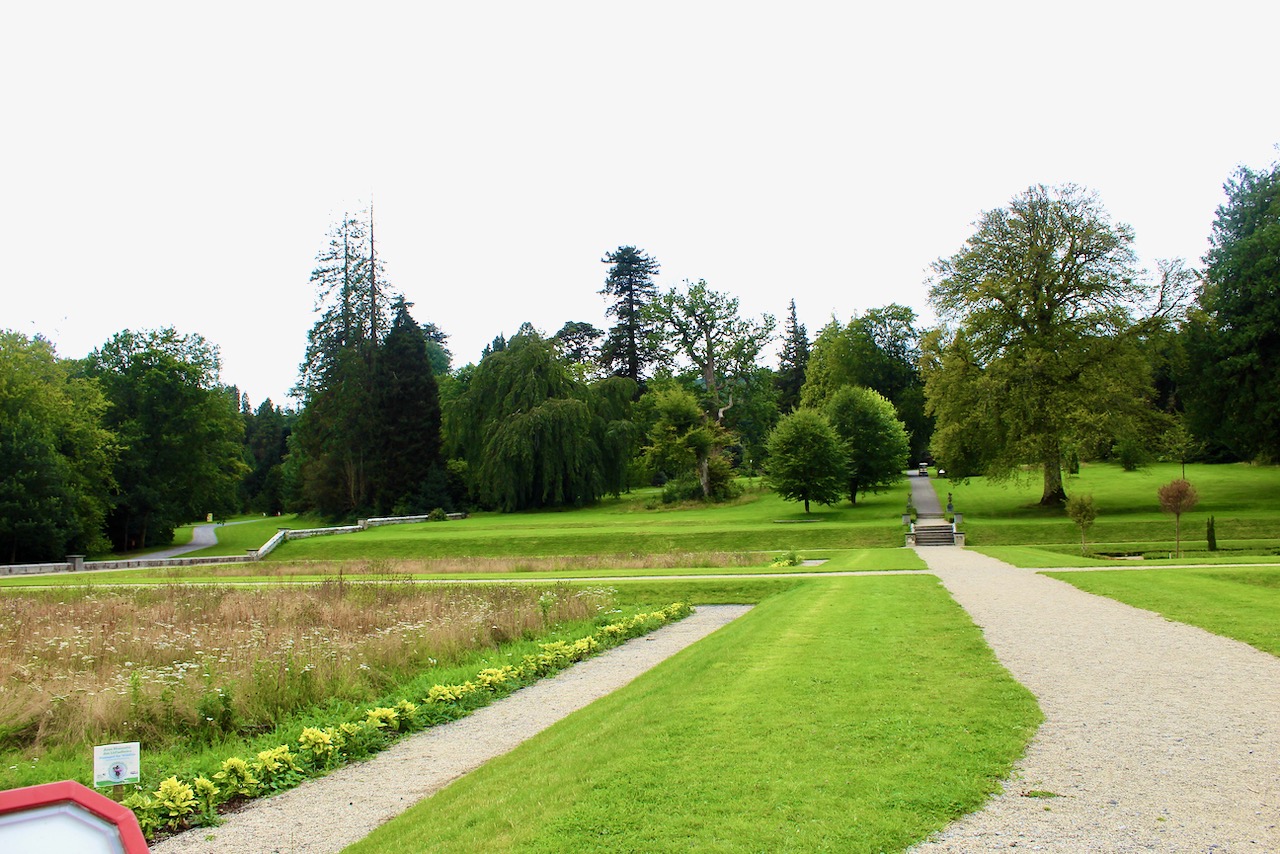
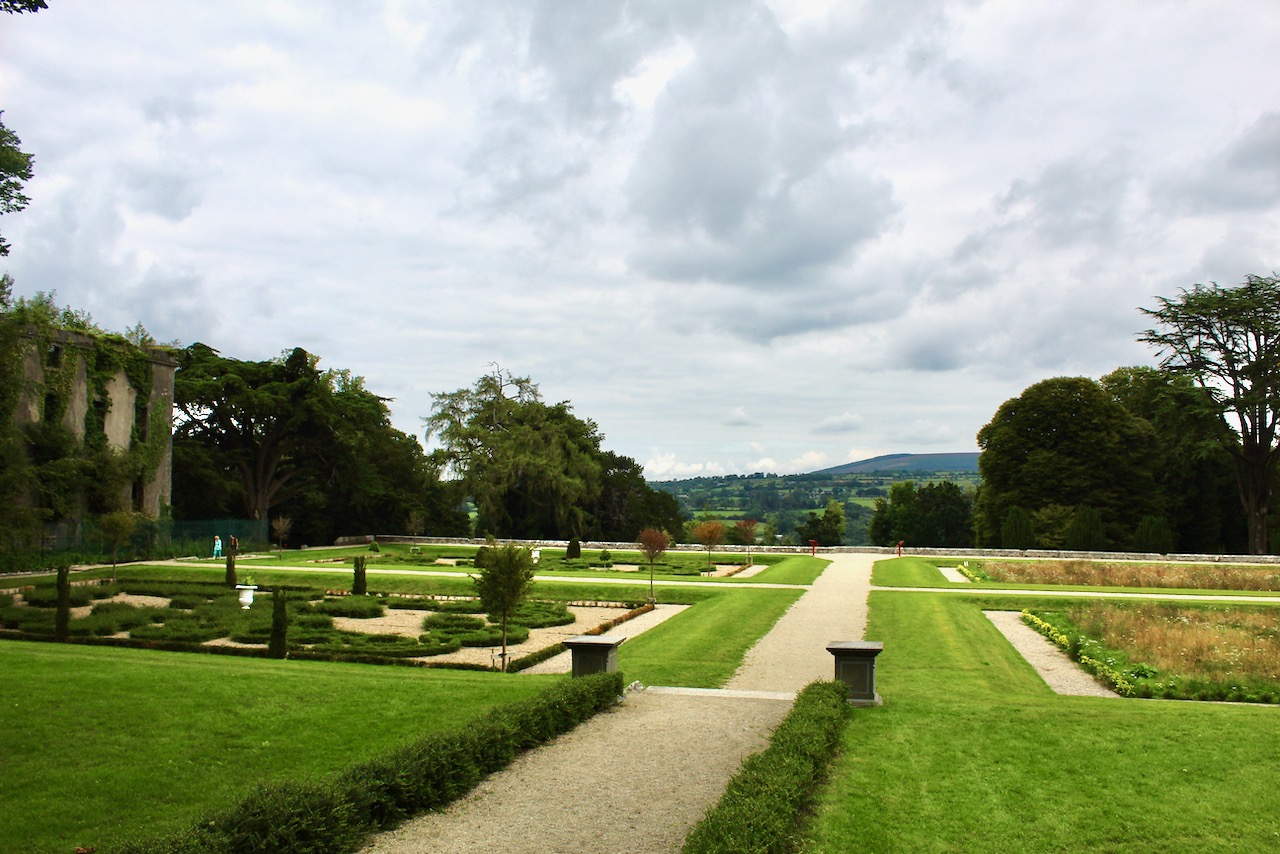
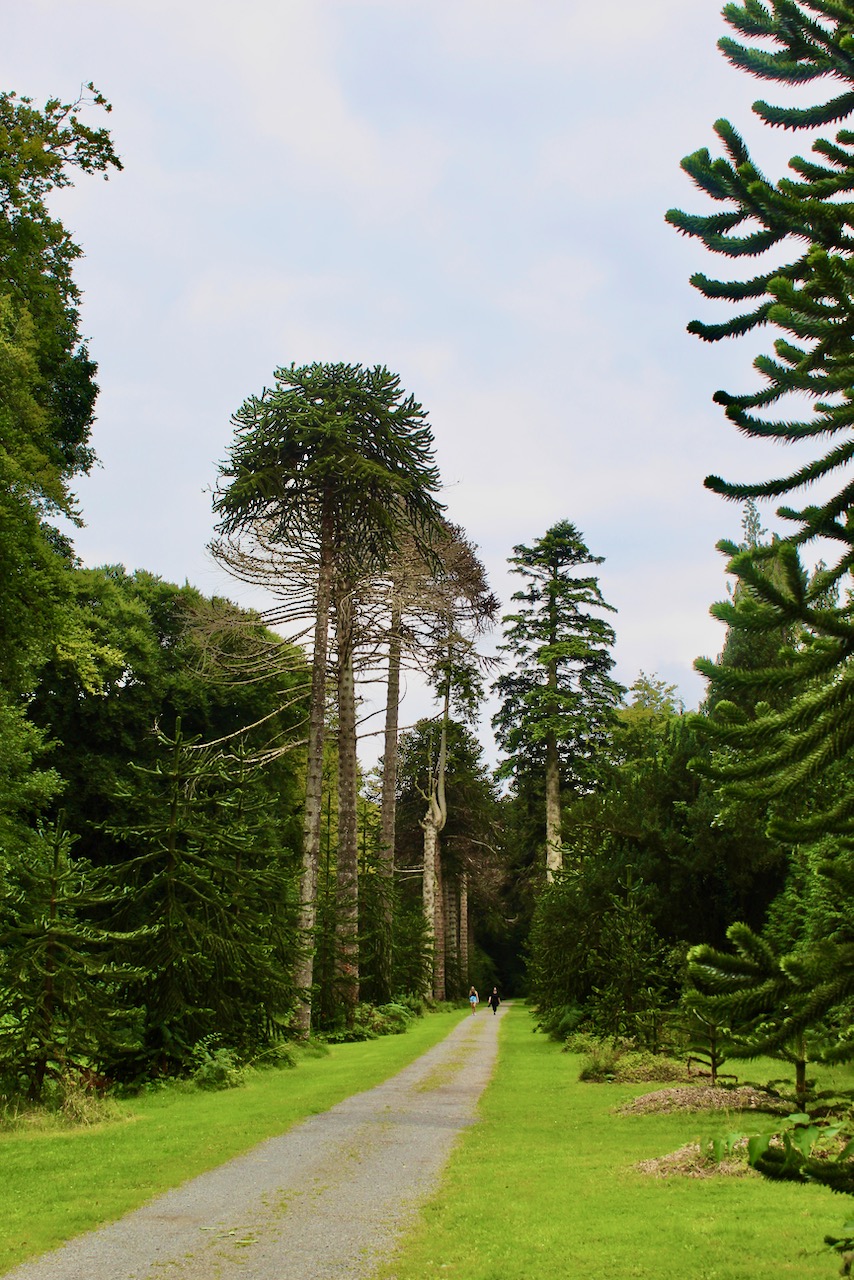
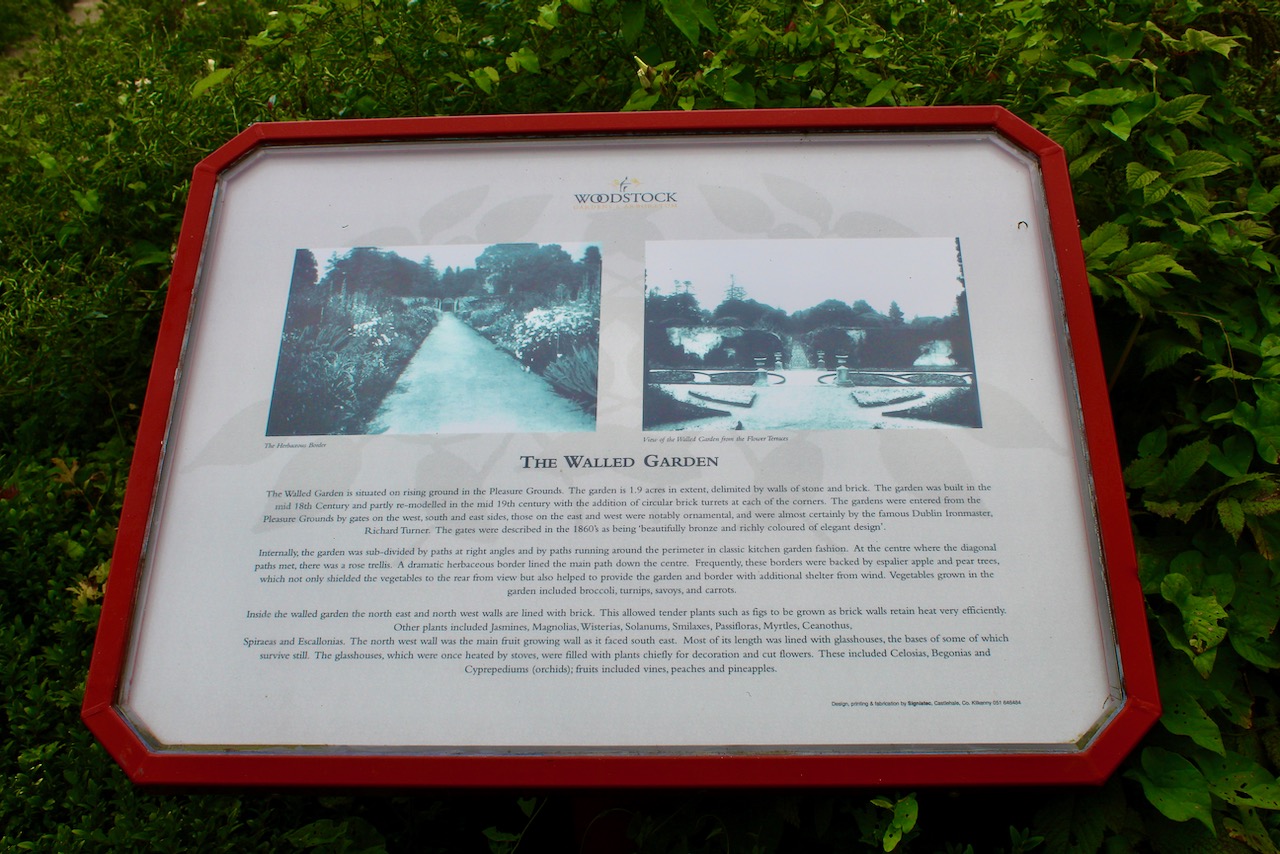


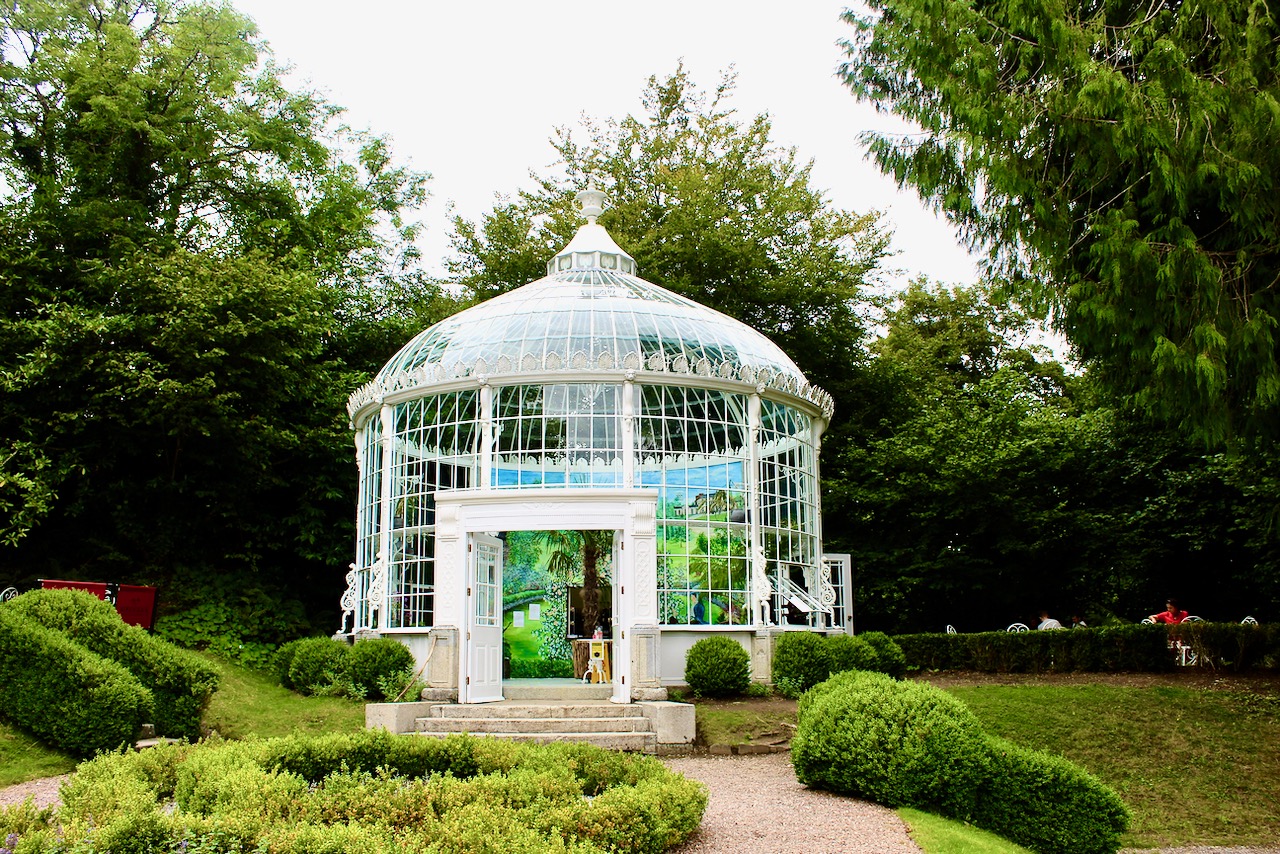

 Irish Historic Houses