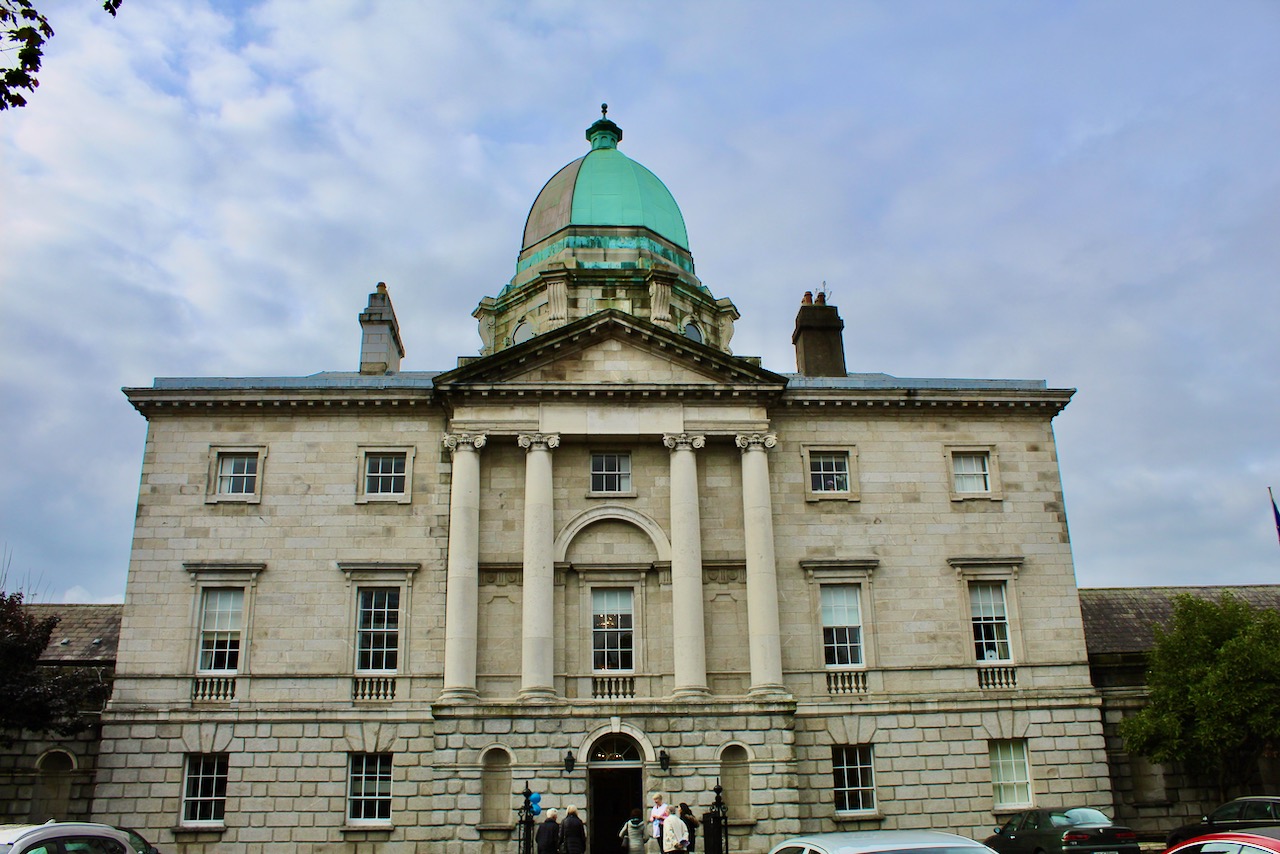
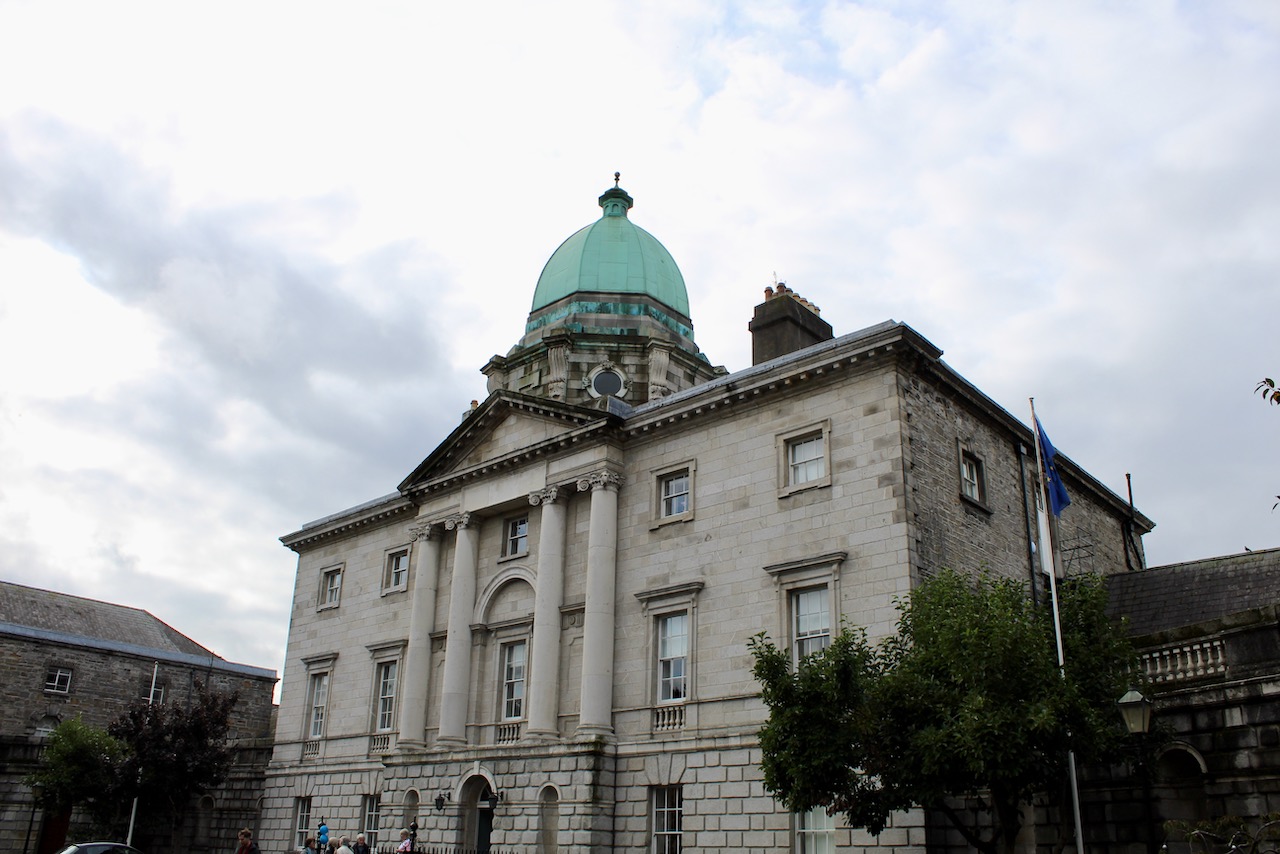
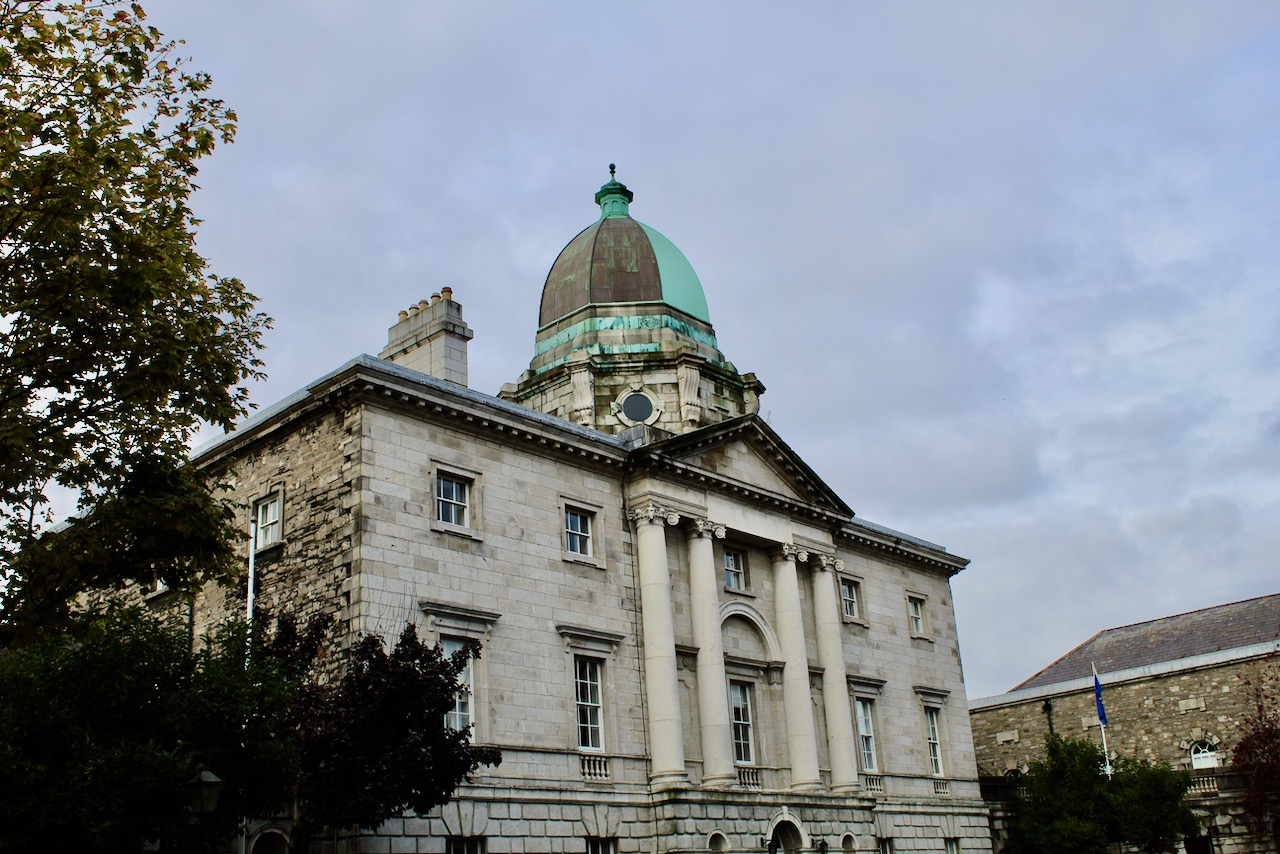
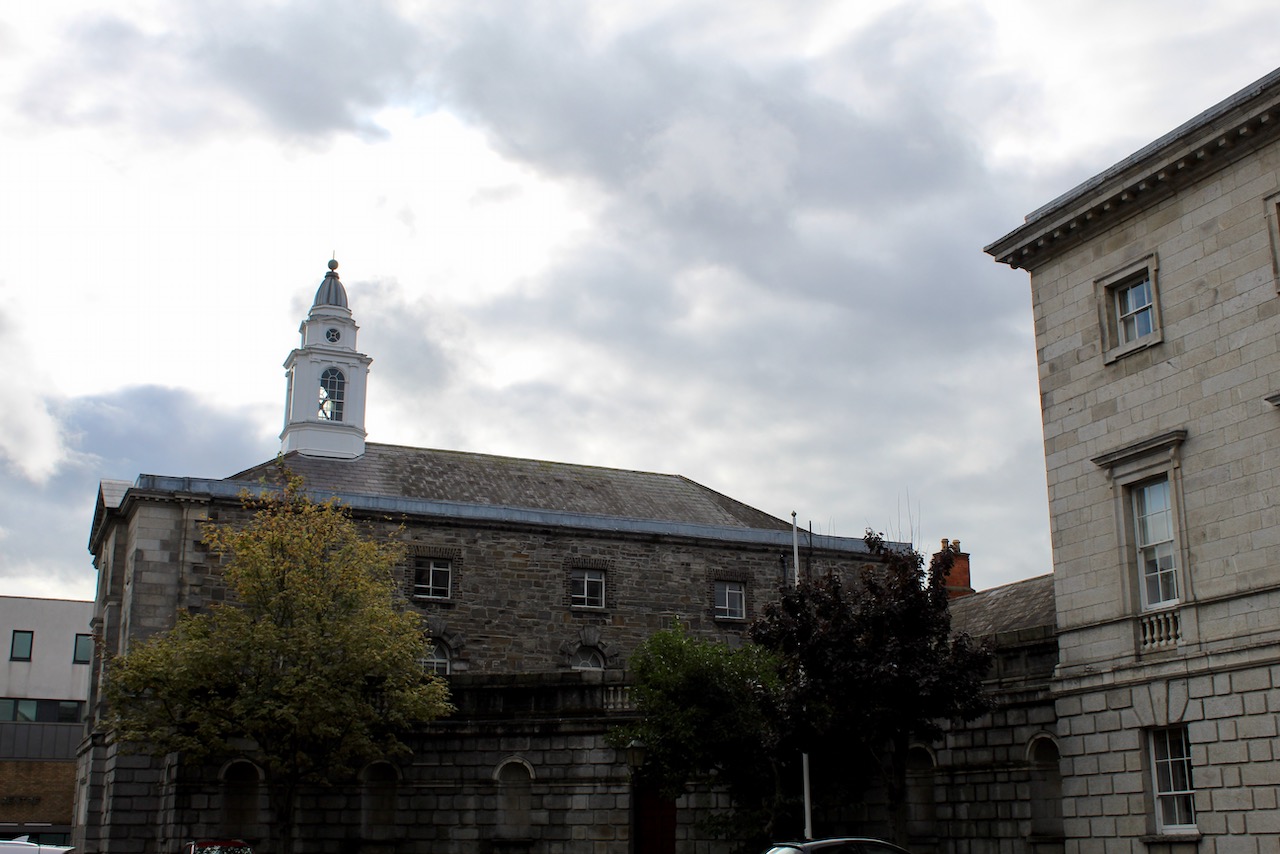
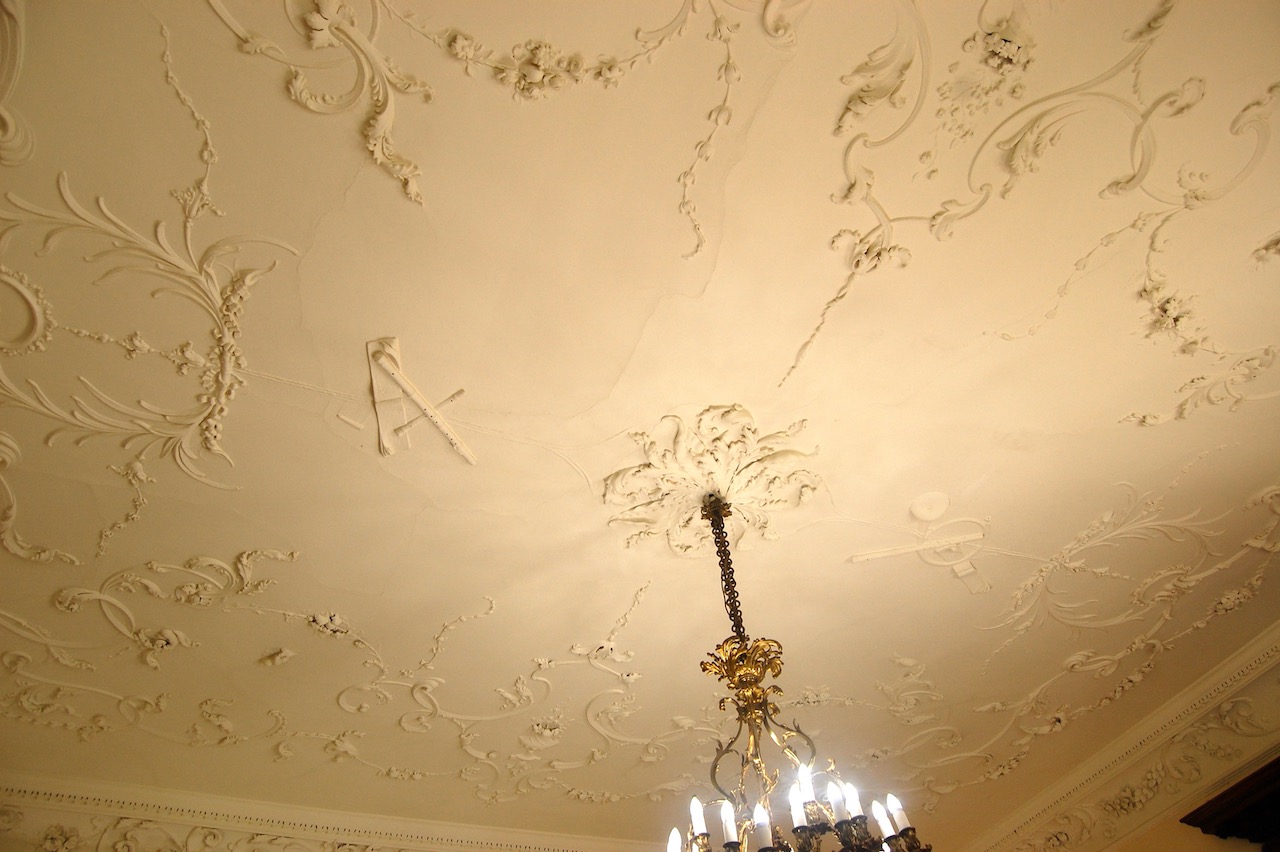
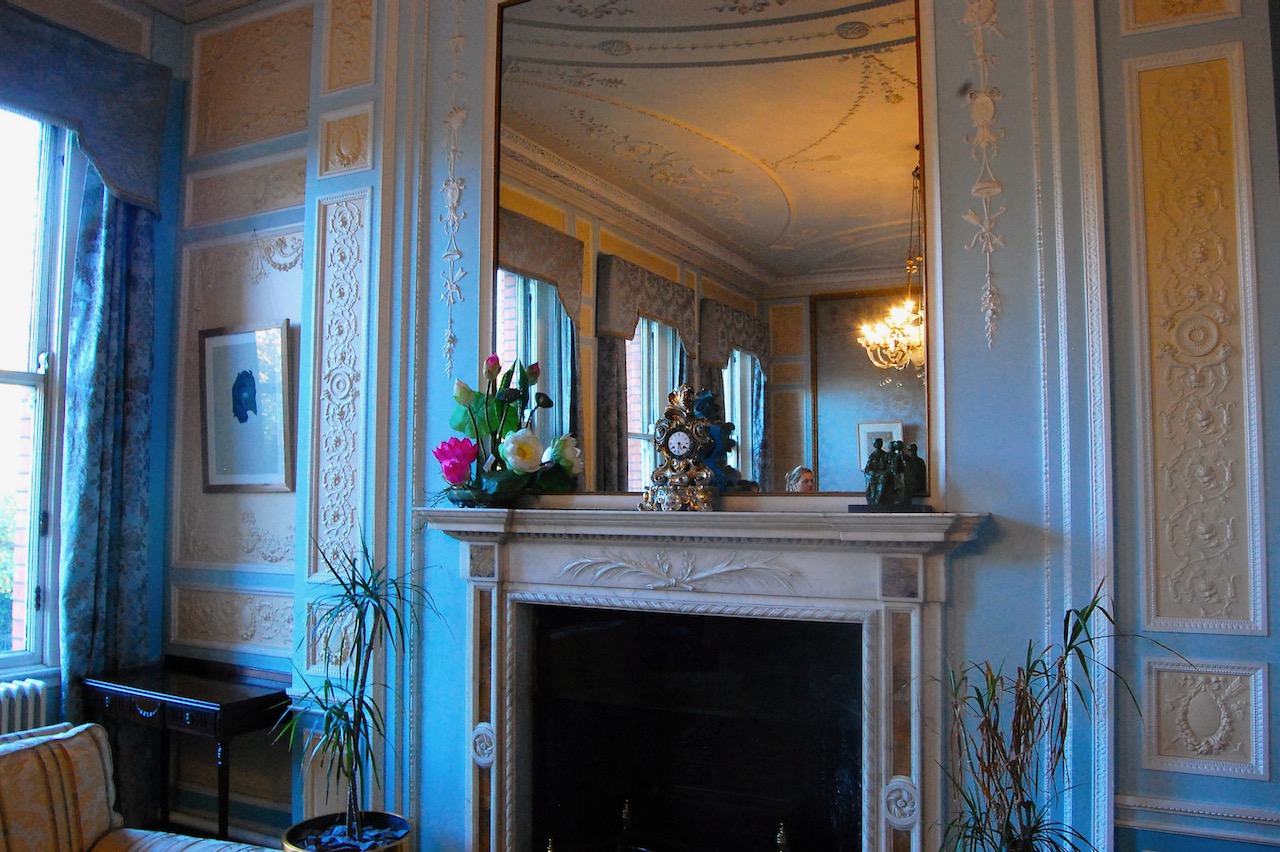
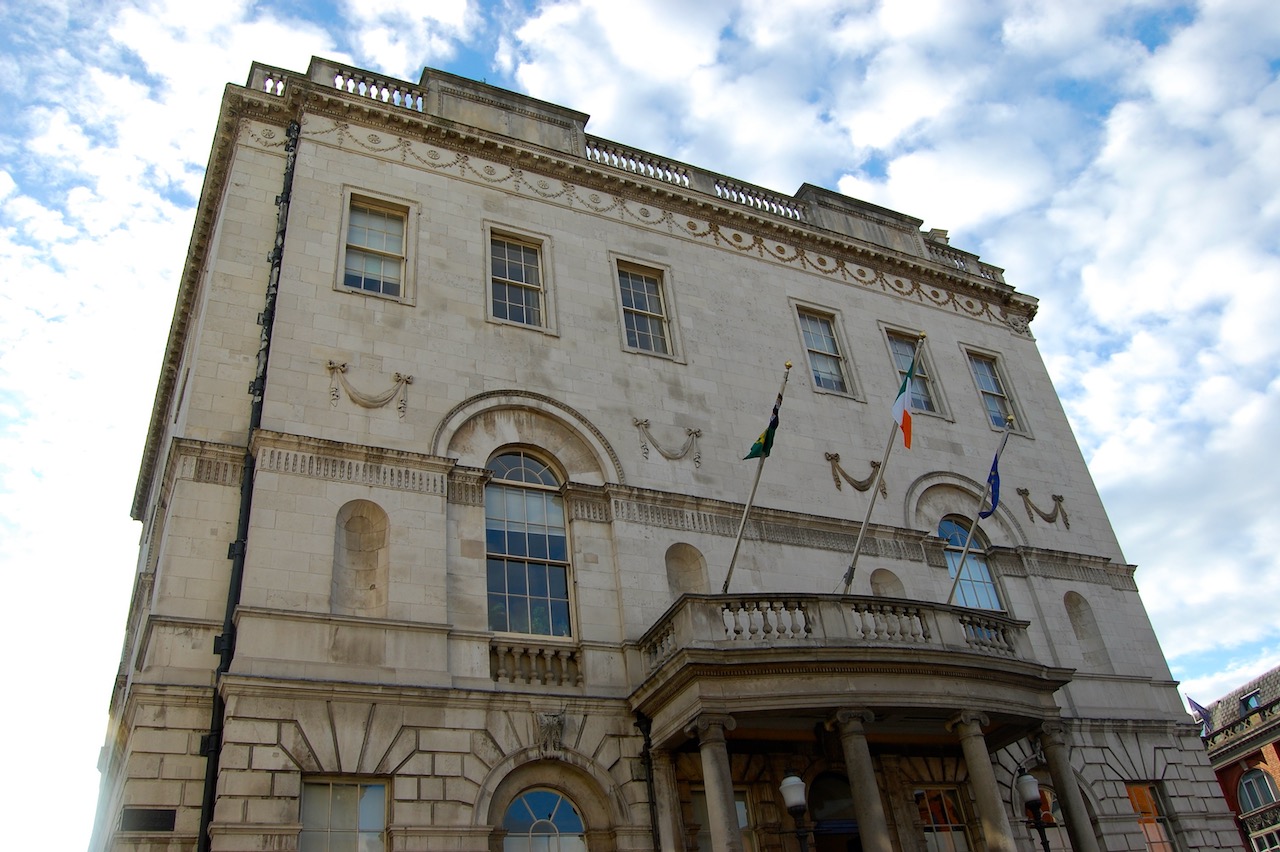
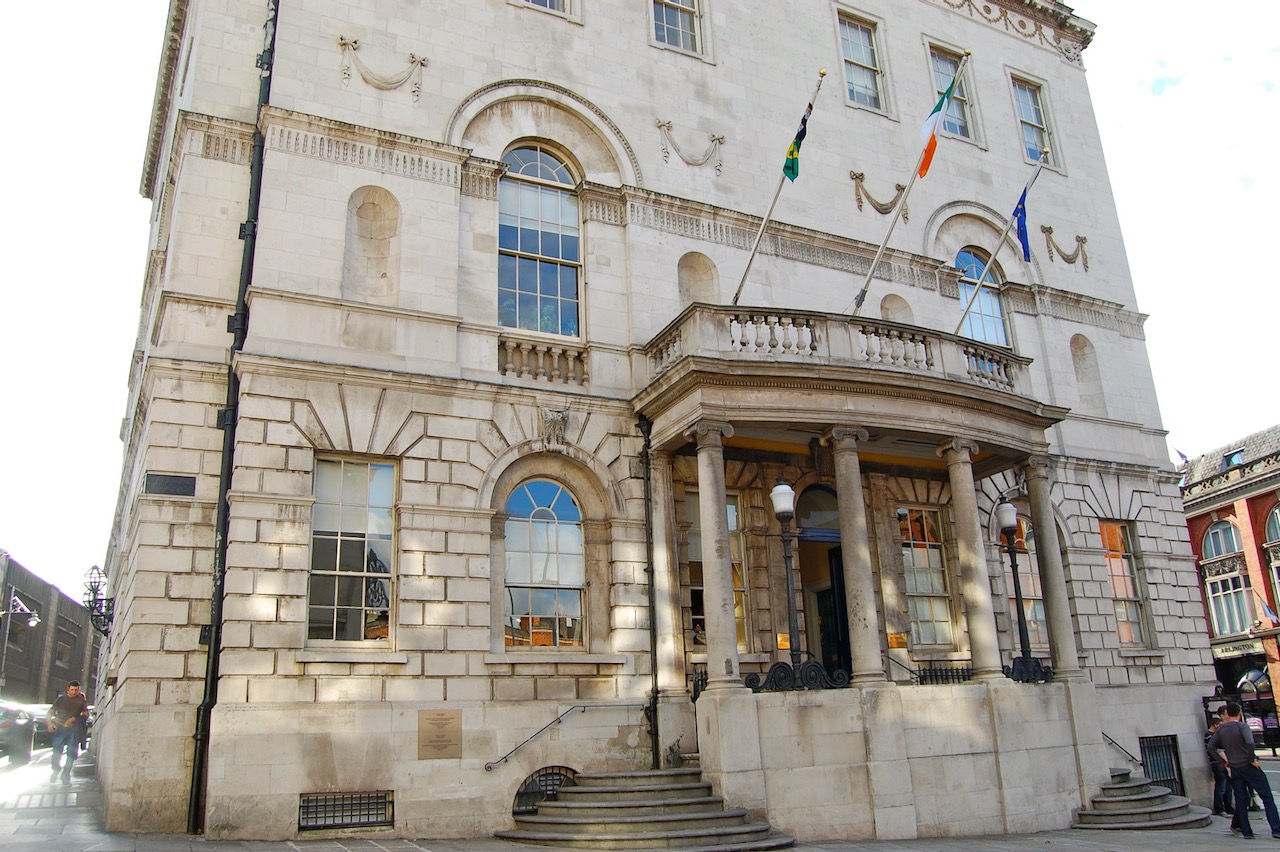
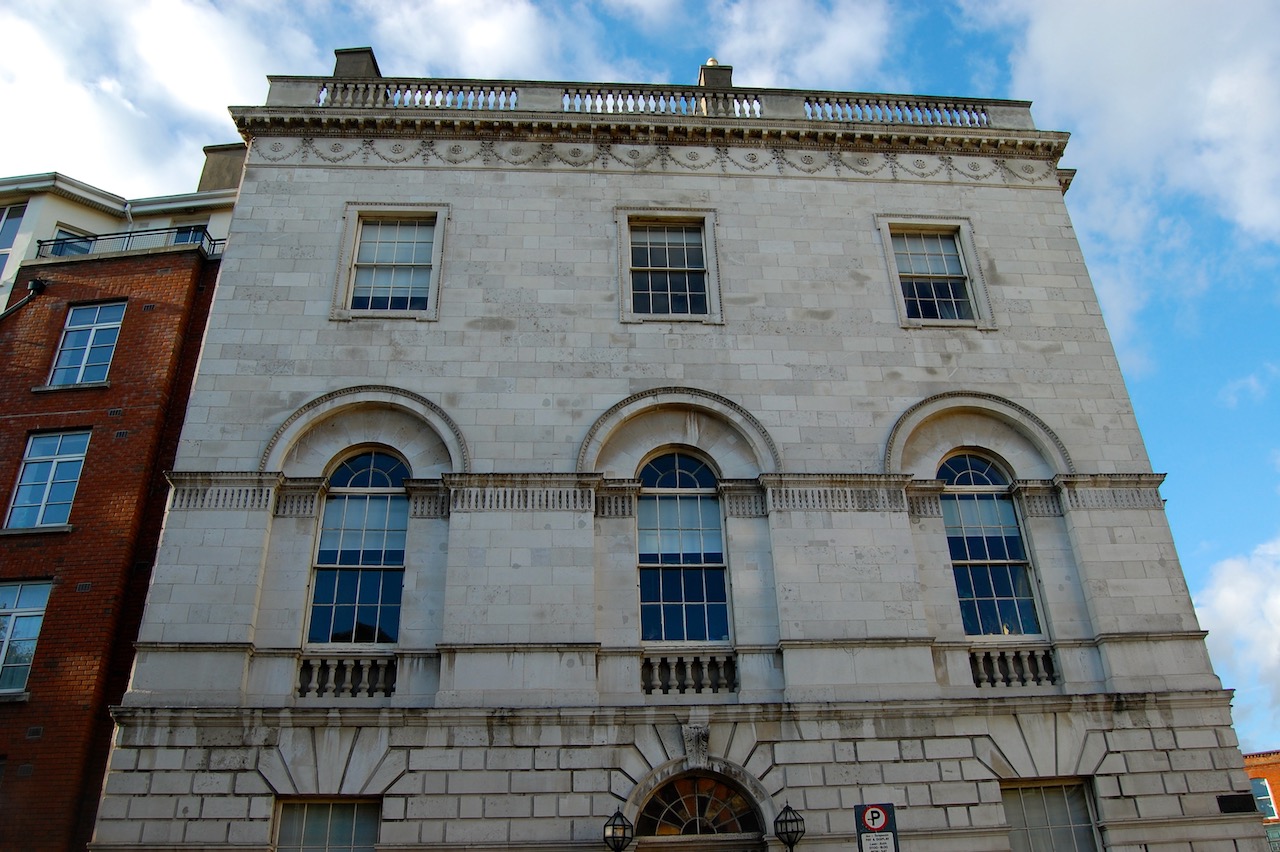
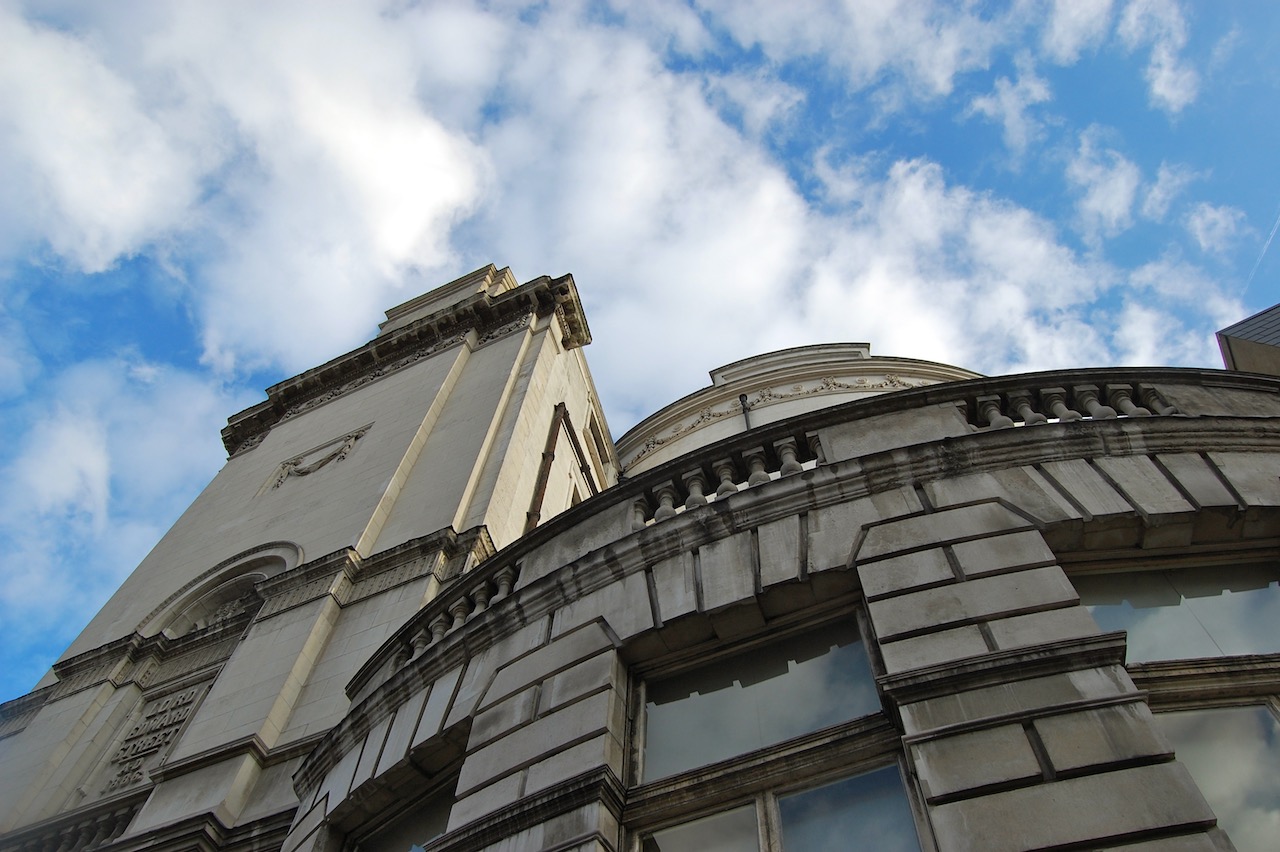
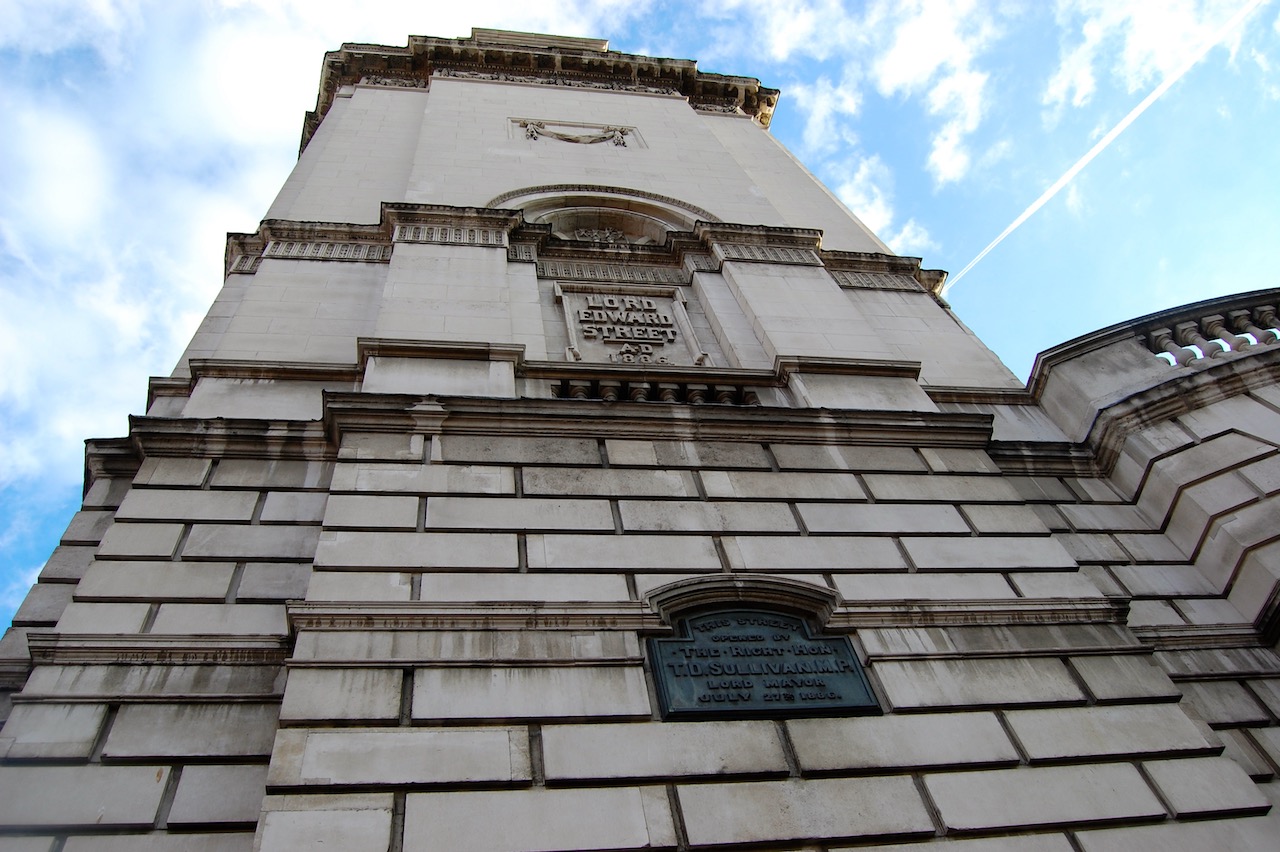
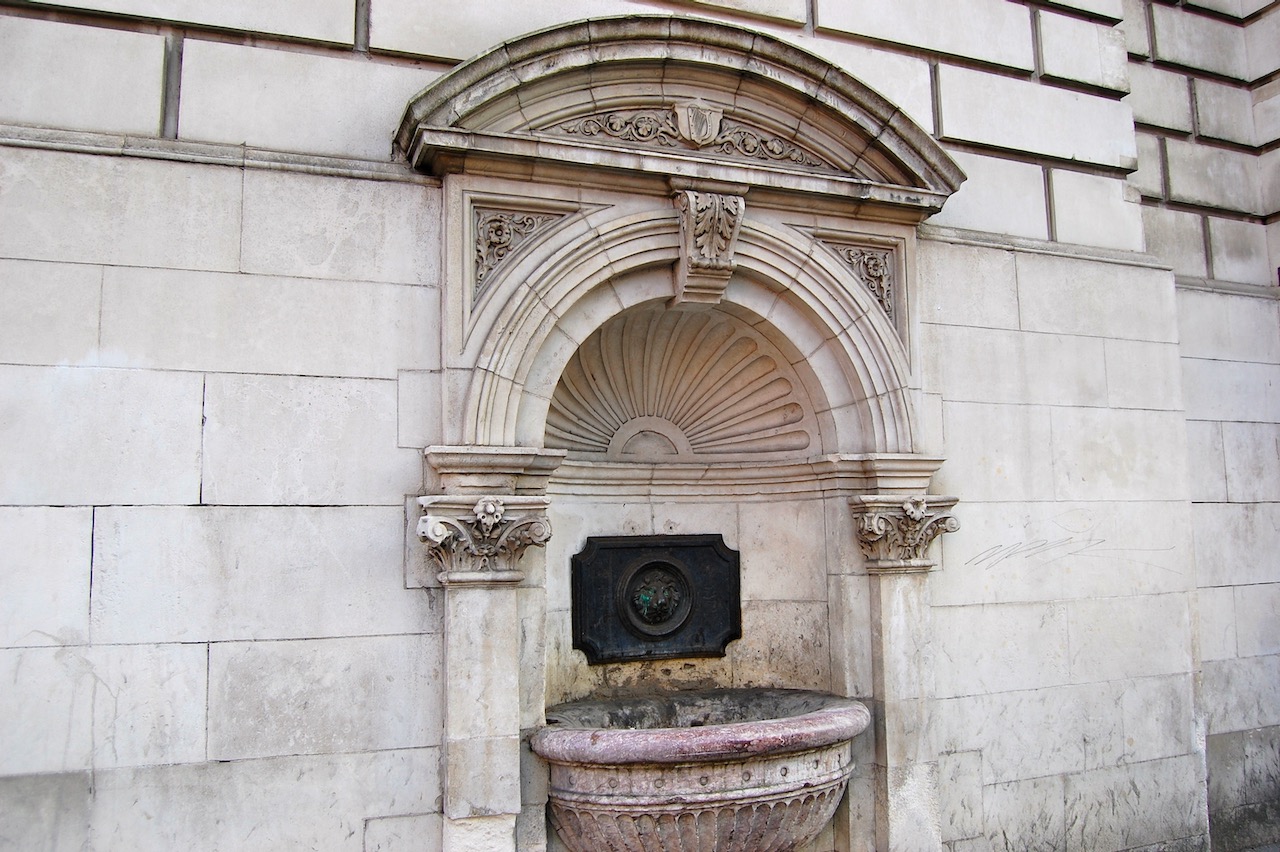
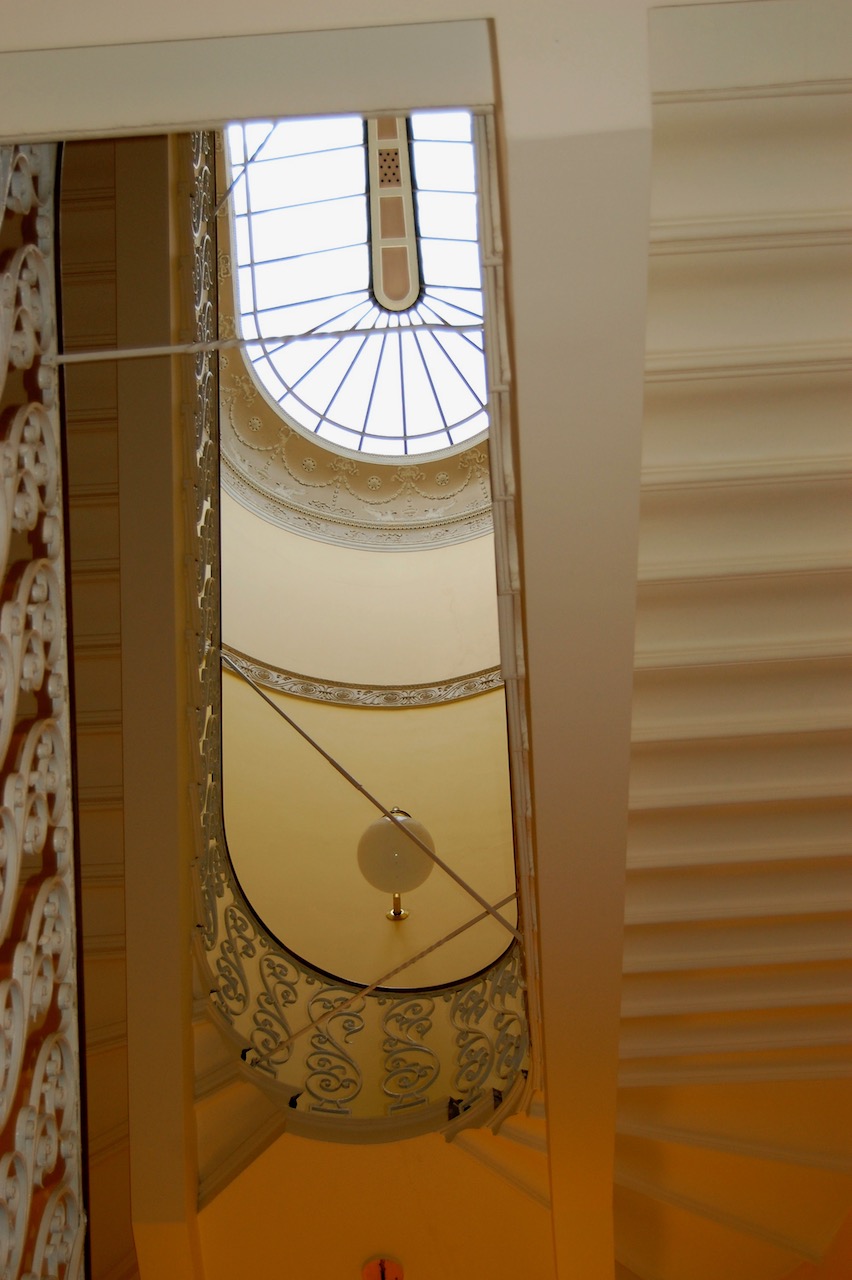
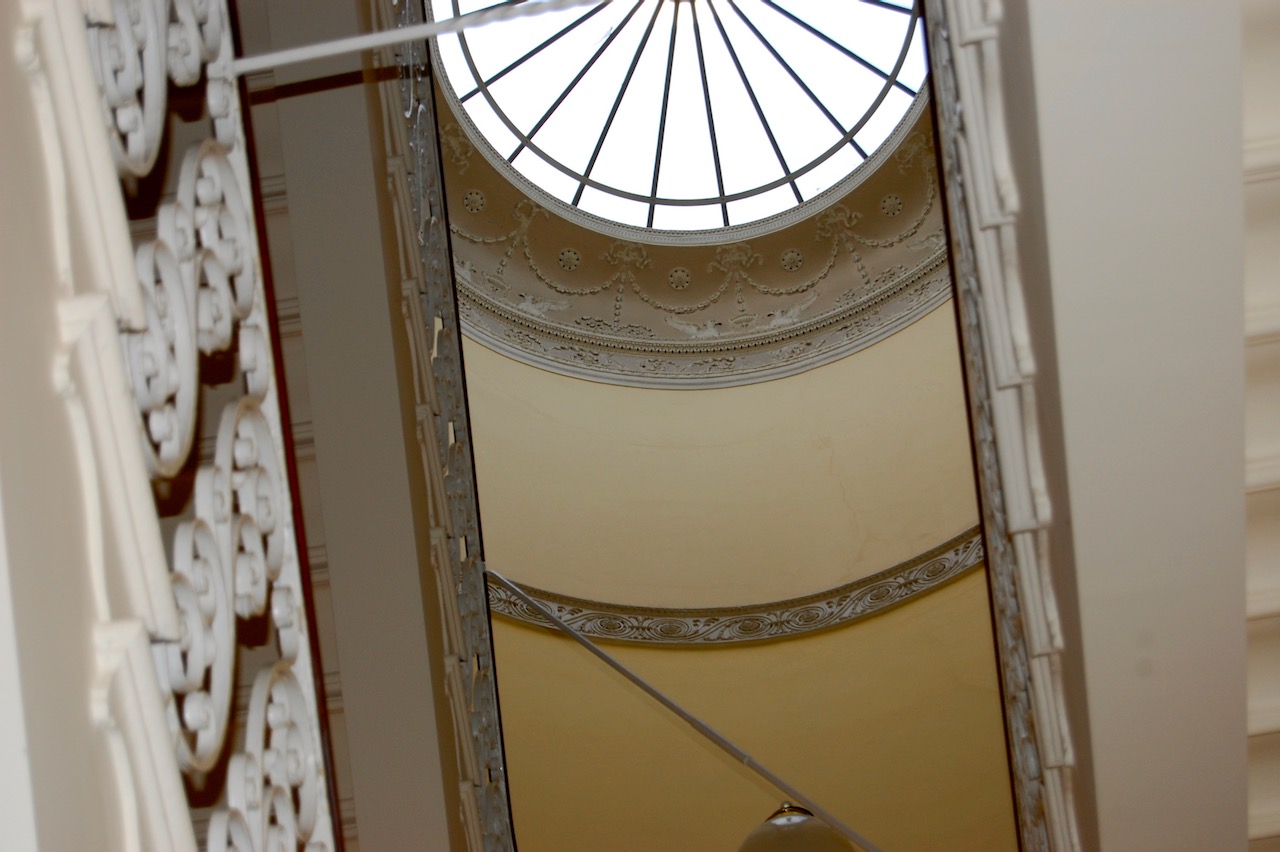
Hibernian/National Irish Bank, 23-27 College Green, Dublin 2 – section 482

www.clarendonproperties.ie

Open dates in 2025: all year, except Jan 1, and Dec 25, 9am-8pm

Fee: Free

donation

Help me to pay the entrance fee to one of the houses on this website. This site is created purely out of love for the subject and I receive no payment so any donation is appreciated!

€15.00

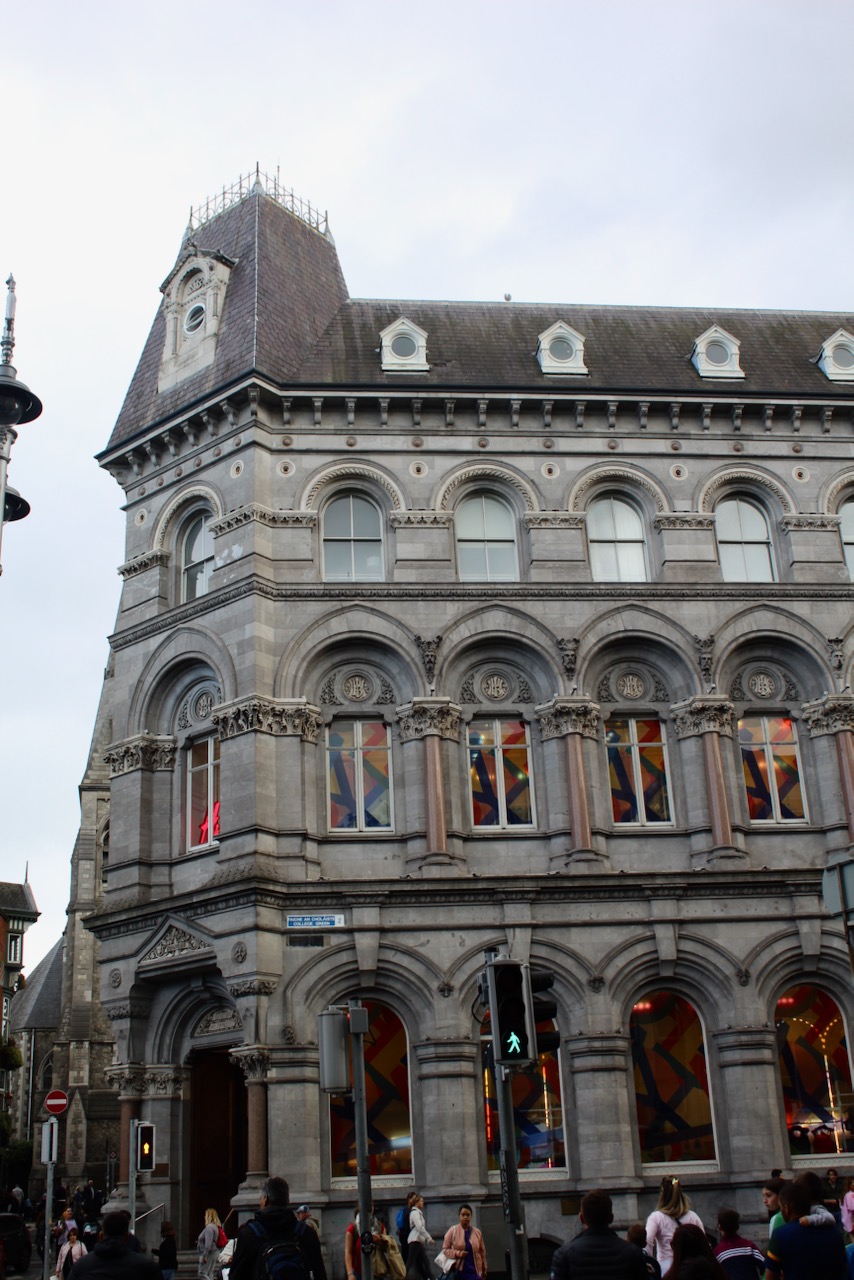
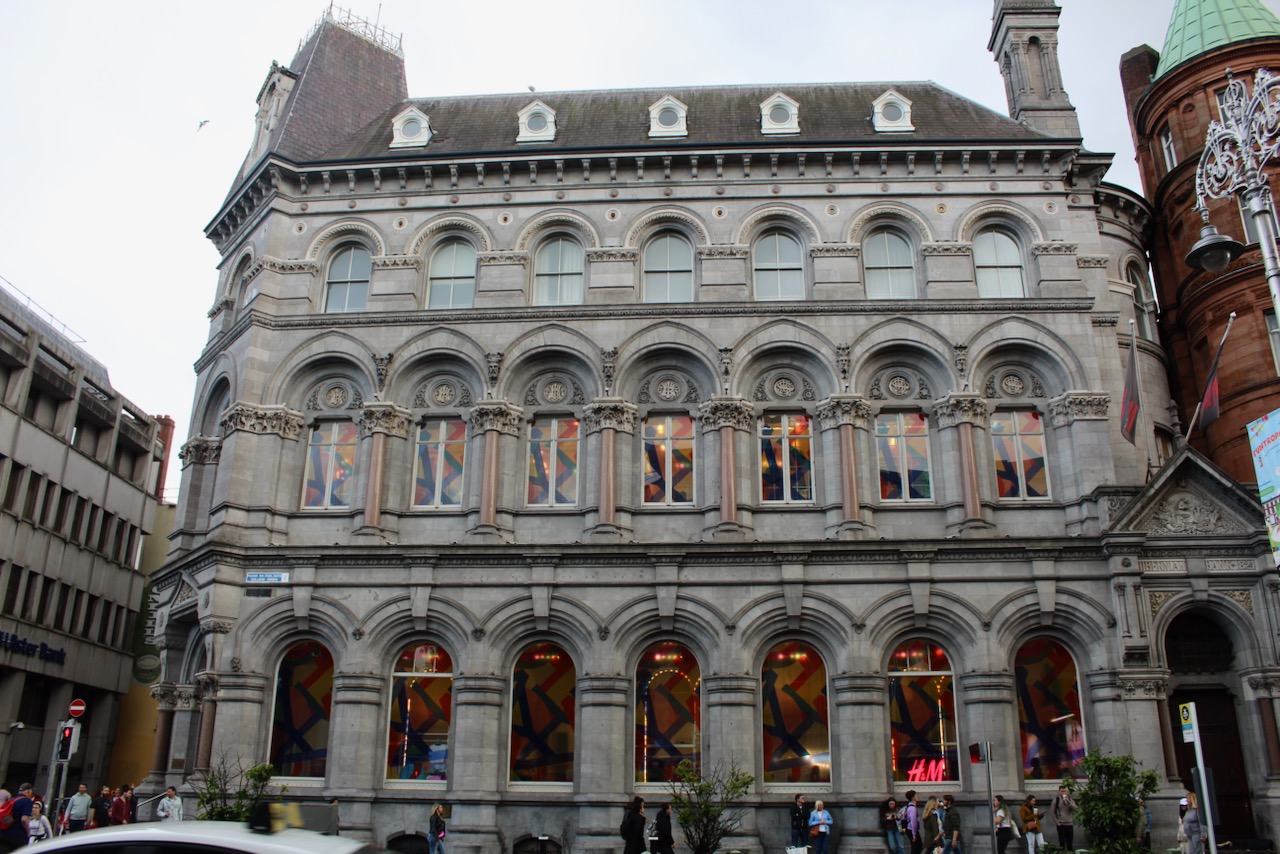
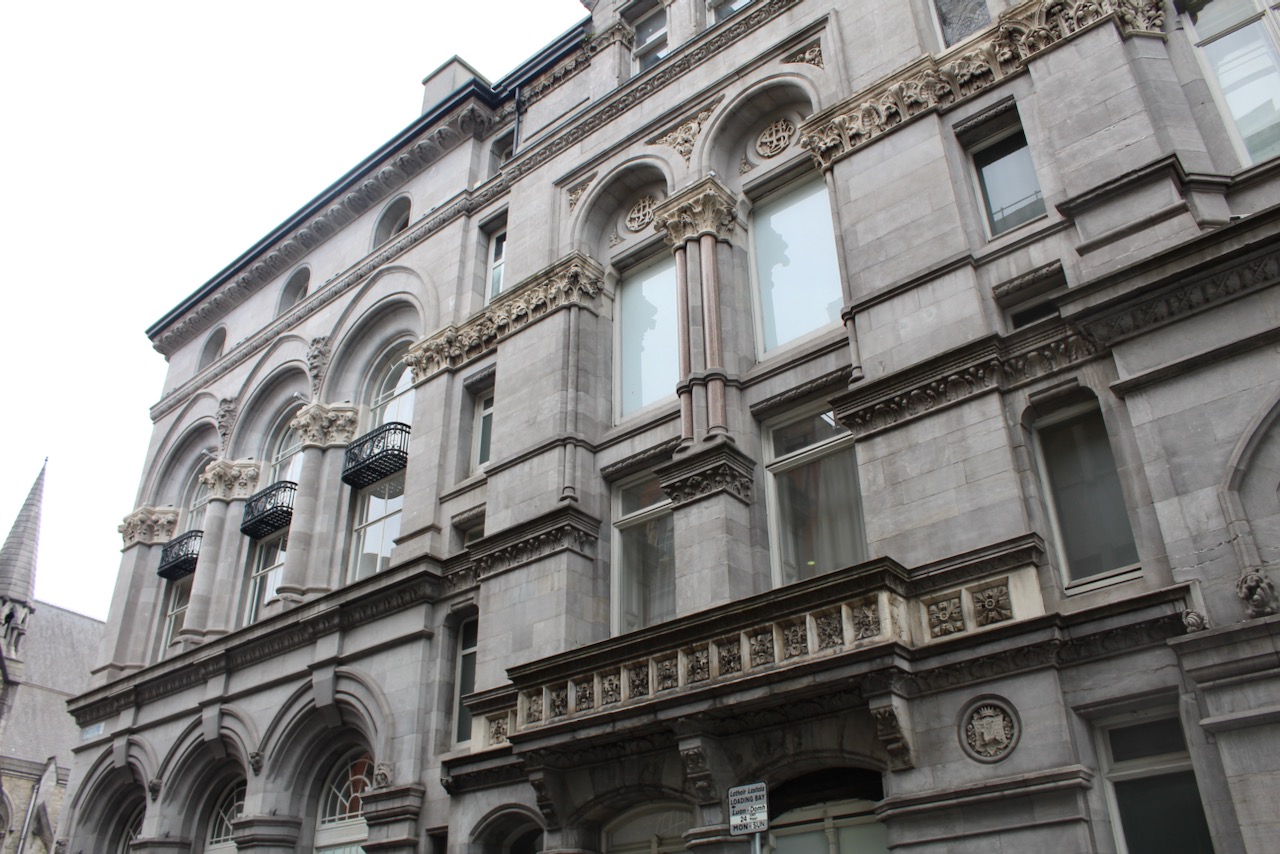
Former Hibernian Bank, now H&M store, 2013. Photograph courtesy of Swire Chin, Toronto.

The former Union Bank, latterly the Hibernian Bank, building was designed by William George Murray (1822-1871), in association with Thomas Drew (1838-1910), and construction began in 1864. [1] Originally it was built with just four bays on College Green and two bays on Church Street.

The Bank of Ireland was formed in 1783. The Hibernian Bank was founded as The Hibernian Joint Stock and Annuity Company in April 1825, and later changed its name to The Hibernian Bank. A group of Dublin businessmen apparently formed the company in response to anti-Catholic discrimination by the Bank of Ireland. The bank aimed itself primarily at the Dublin business community. It opened its only branch in Dublin on 20 June 1825 with 1063 shareholders, many of them London based. The Hibernian Bank was taken over by the Bank of Ireland in 1958. [2]

William George Murray joined the architectural firm of his father, William Murray. William George Murray, the Dictionary of Irish Architects tells us, was architect to the Dundalk, Enniskillen & Londonderry Railway Company, for whom he built the railway station in Enniskillen, Fermanagh as well as many others. He was also architect to the South Dublin Union. [3] Thomas Drew was also an architect in the same firm, and he worked with Murray on the original building for the Union Bank. The Union Bank failed after just six months, and the building was bought by the Hibernian Bank.

William George Murray also designed the Royal College of Physicians on Kildare Street in Dublin after the previous building had been burnt in a fire. Murray also designed many more banks, including the Provincial Bank on College Green (now part of the Westin hotel), and insurance offices.

Thomas Drew was employed by the Hibernian Bank to add more bays to each side, from 1873-76. Thomas Drew later became President of the Royal Society of Ulster Architects and President of the RIAI, and held the Chair of Architecture in the new National University of Ireland. He married a sister of William G. Murray, Anne Adelaide, in 1871. Among his most important building, Archiseek tells us, are the Ulster Bank branch on Dame Street (the interior of which has been destroyed), the Trinity College Graduates Memorial Building, Rathmines Town Hall, and St. Anne’s Cathedral in Belfast. [4]

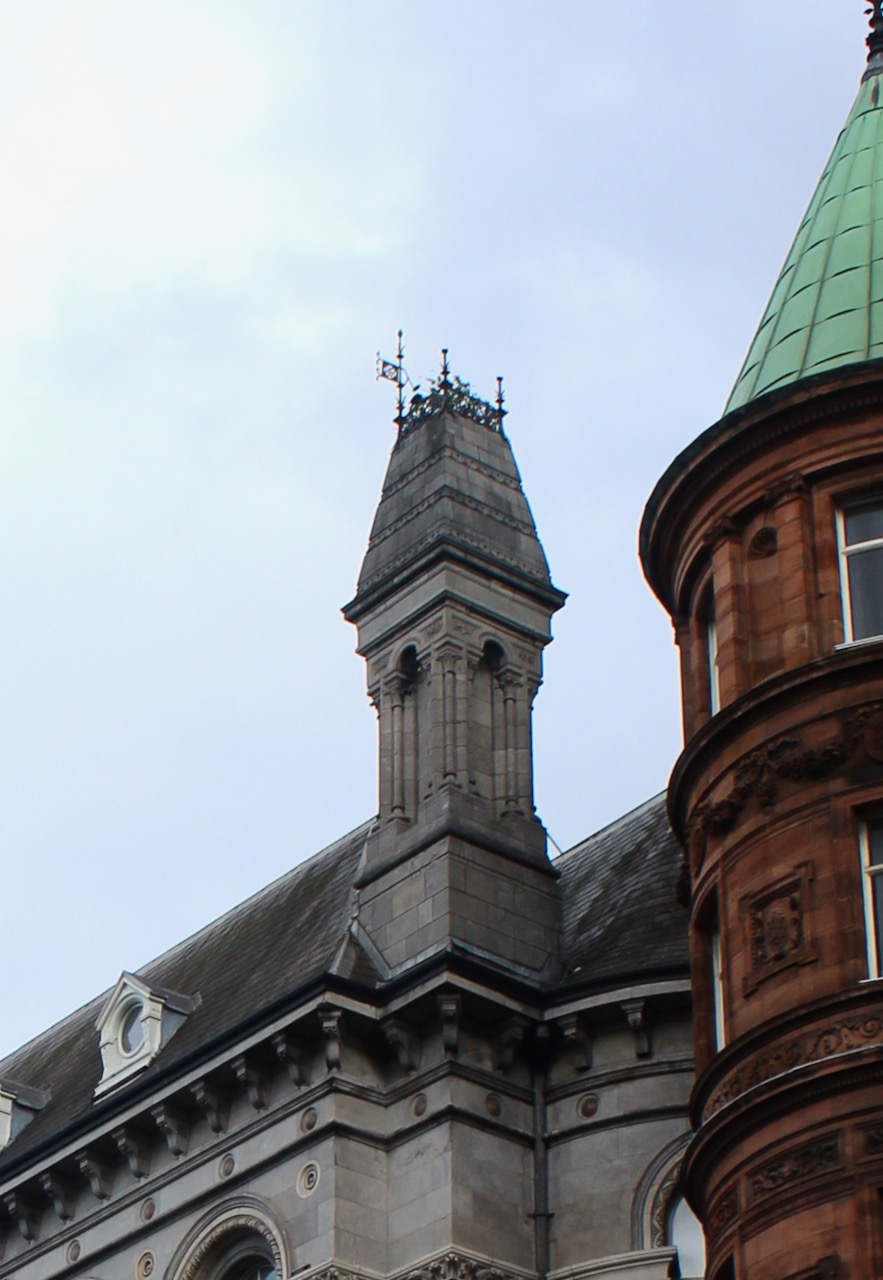
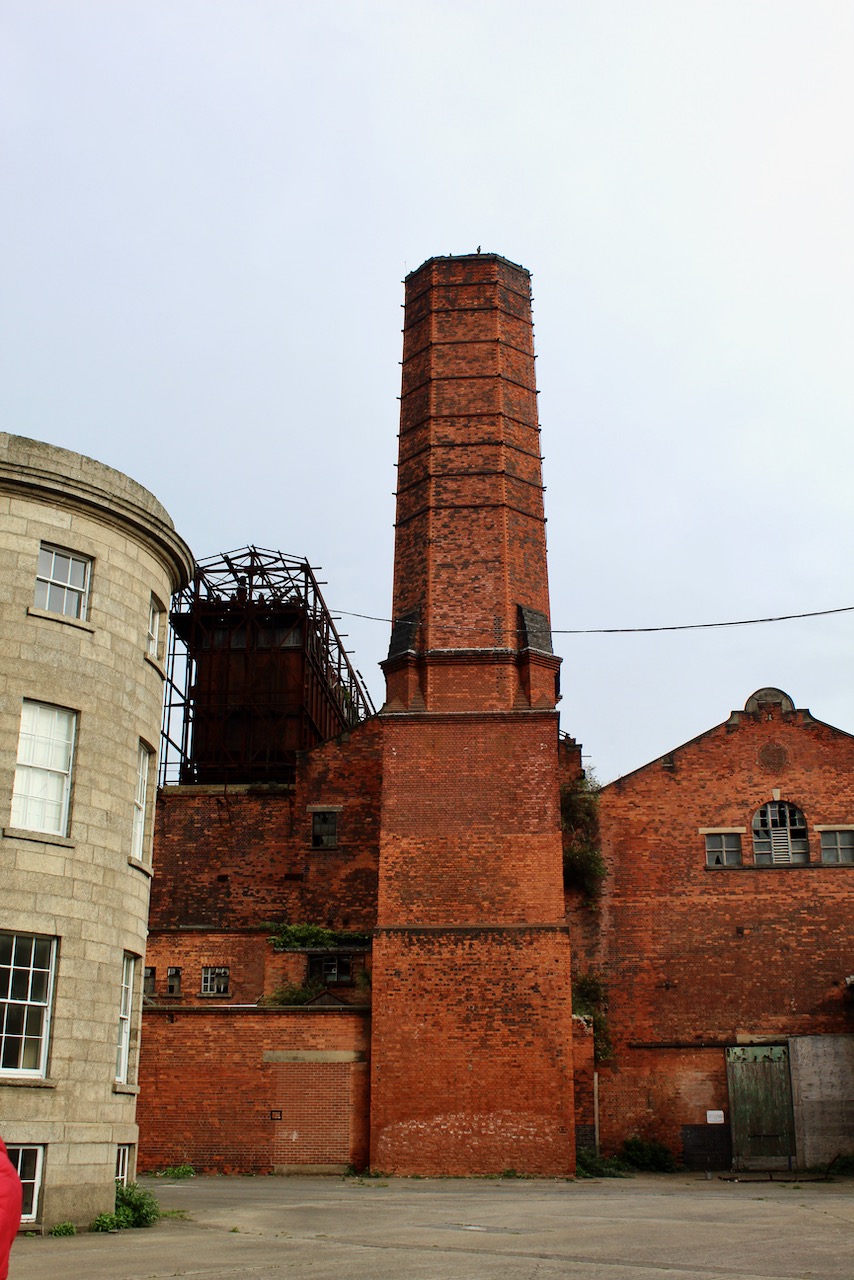
The building features a wonderful “chateau-esque” tower topped with ornate wrought iron railings and finials. It has another tapering belltower-type turret at the other side which is actually a chimneystack.

Former Hibernian Bank, with its “chateau-esque” roof. Photograph © Jennifer Winder-Baggot, www.irishhistorichouses.com
Former Hibernian Bank, 2022. Photograph © Jennifer Winder-Baggot, www.irishhistorichouses.com
The belltower-like turret feature is a chimney stack. Photograph © Jennifer Winder-Baggot, www.irishhistorichouses.com

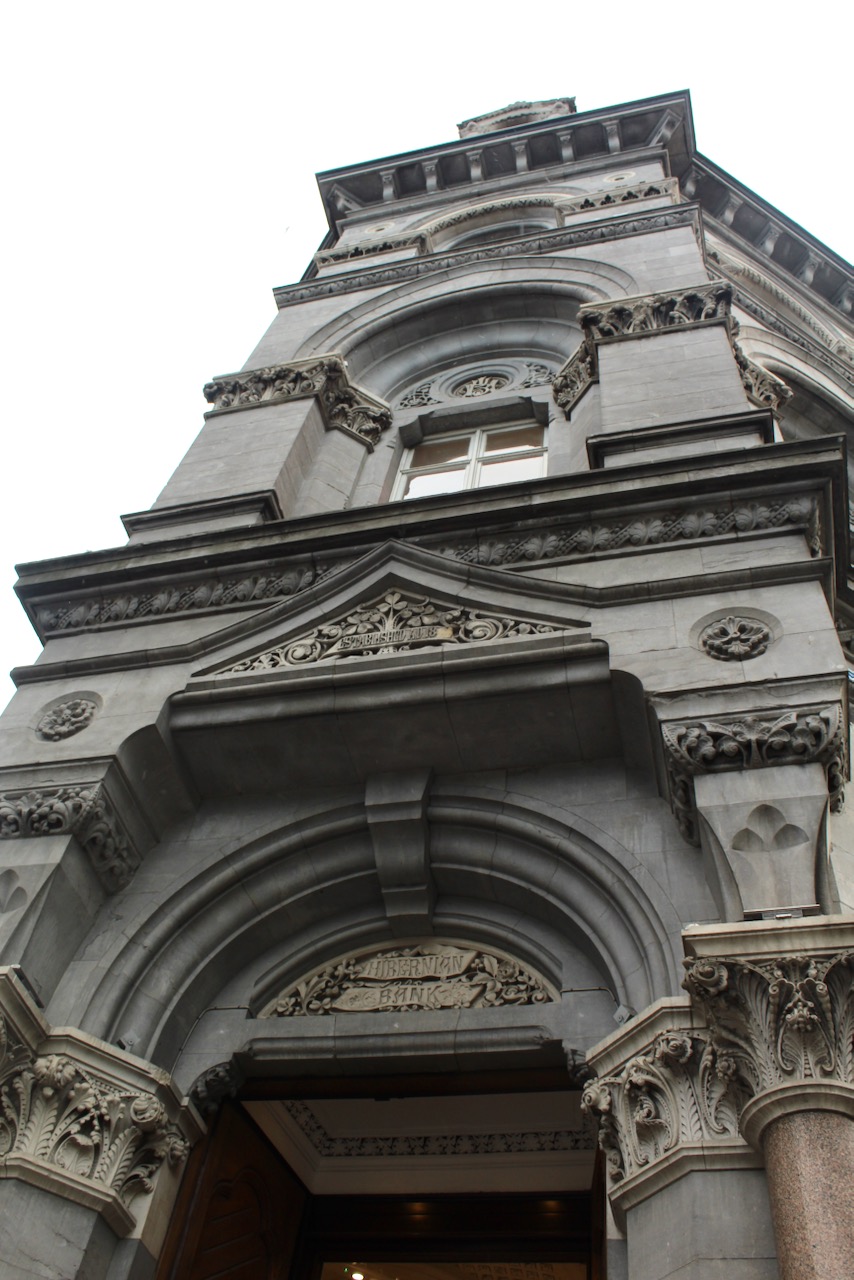
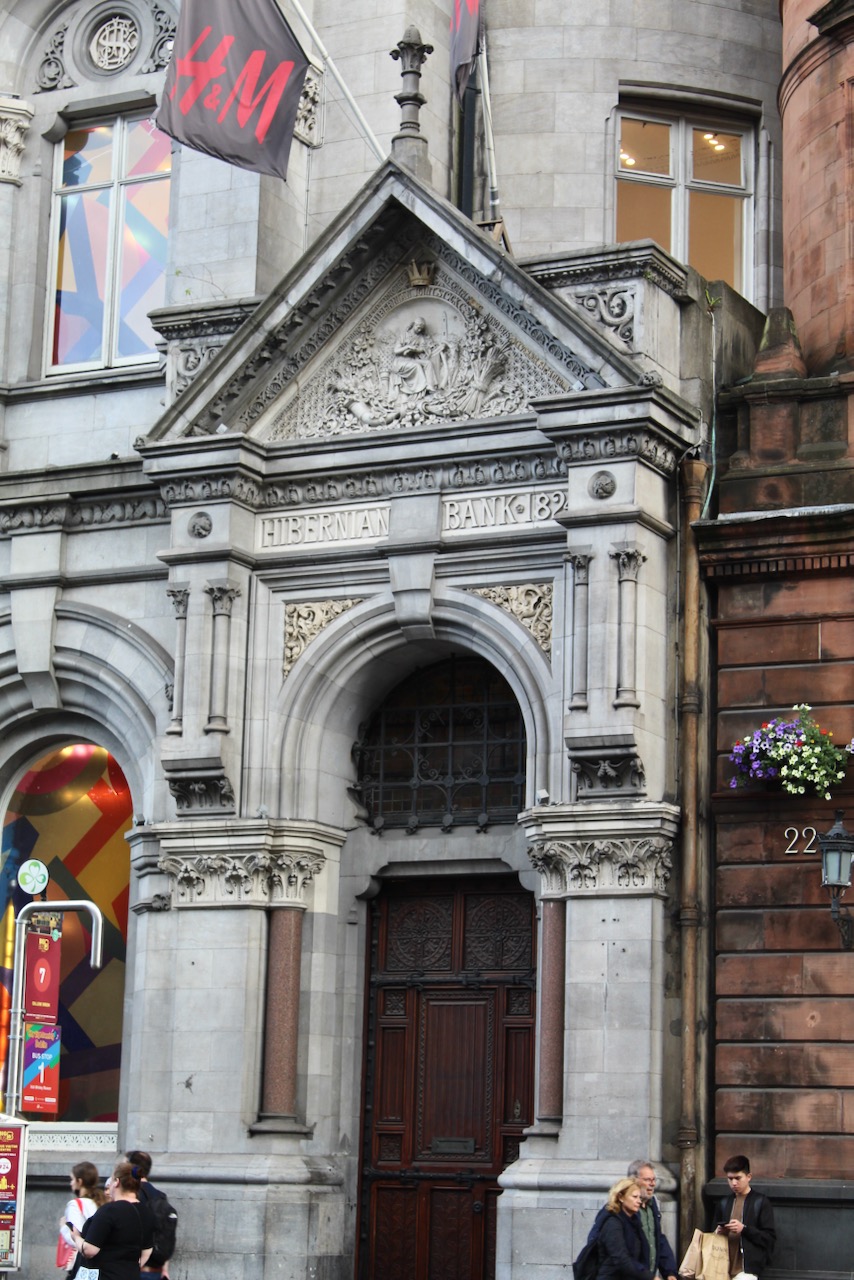
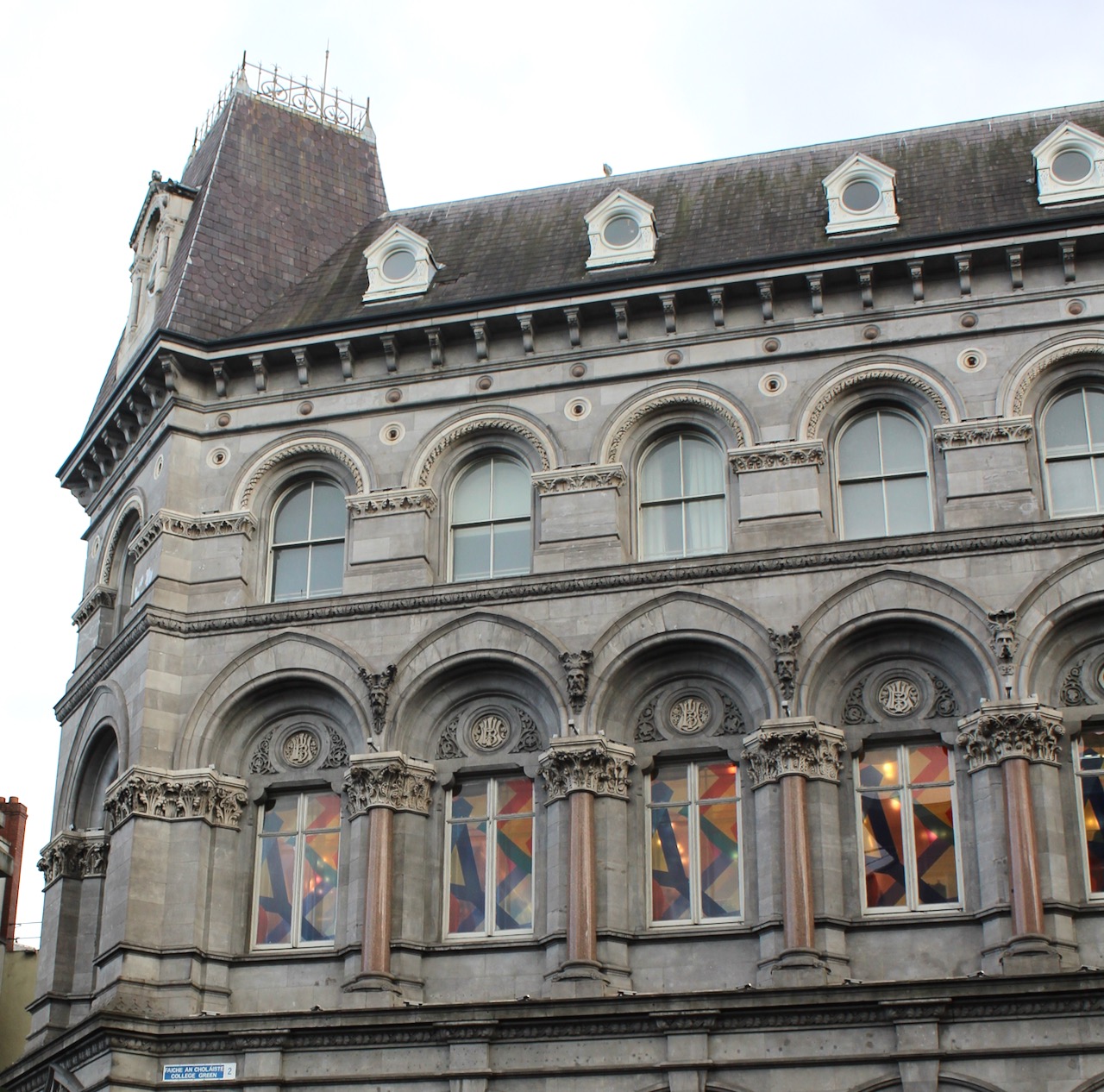
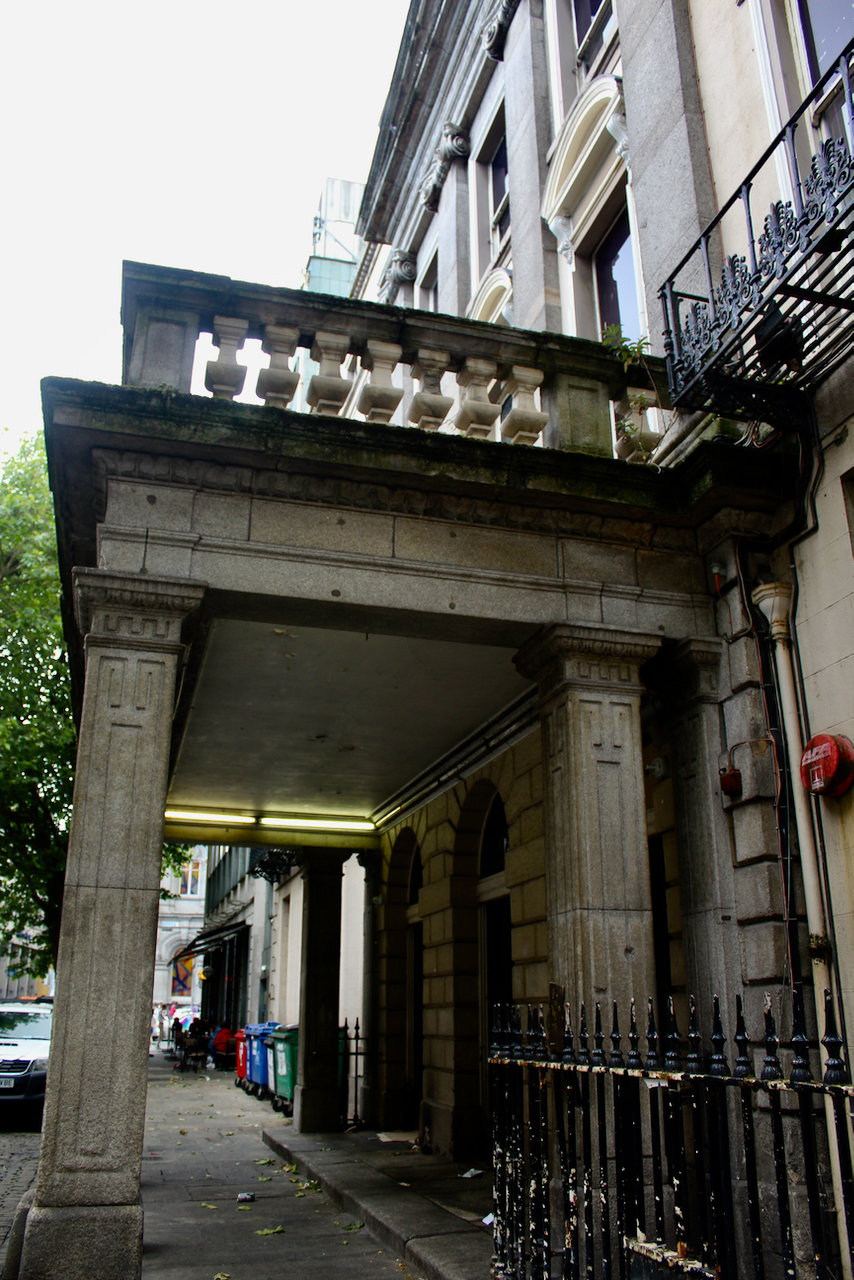
It is built chiefly in limestone, in the Italian Gothic style, with arcades, and has four storeys. The ground storey has deeply moulded arches splaying from octagon piers, and the corner toward College Green is squared off and one entrance door is positioned there on the ground floor, in an arched opening with Corinthian pilasters, under an ornately carved triangular pediment. There is another ornate door entrance at the other end of the building on Dame Street.

The Appraisal in the National Inventory gives us a summary:

This exuberant former bank commenced operation as the Union Bank in 1864, designed by William G. Murray, assisted by Thomas Drew... It is constructed in an Italian Gothic Revival idiom with arcading to the main floors. The bosses and colonnettes of polished pink granite, and capitals and roundels of Portland stone by C.W. Harrison, create a strong contrast with the pale grey limestone that dominates the façade. The quality and profusion of ornament is particularly striking, with many very fine details, such as the carved timber door, the chimney structure, the carved tympanums and the aedicule [niche or pediment] to the roof of the corner bay. It is located within a group of significant historic bank buildings which line the north and south sides of College Green. The former banking hall has been recently converted for use a large retail outlet.” [5]

Former Hibernian Bank, now H&M store, June 2022: The ground storey has deeply moulded arches splaying from octagon piers. Photograph © Jennifer Winder-Baggot, www.irishhistorichouses.com

The ground floor windows have hood mouldings with foliate stops, and limestone sills.

Former Hibernian Bank, now H&M store, June 2022: the corner toward College Green is squared off and one entrance door is positioned there on the ground floor, in an arched opening with Corinthian pilasters, under an ornately carved triangular pediment. Photograph © Jennifer Winder-Baggot, www.irishhistorichouses.com
Photograph © Jennifer Winder-Baggot, www.irishhistorichouses.com

The Inventory description continues: “…Shouldered-arch door opening to elliptical-arch recess to corner bay, with carved Corinthian pilasters with engaged marble colonnettes, double-leaf battened timber door with trefoil-headed upper panels, and having carved limestone voussoirs [wedge shaped stones forming an arch] and moulded keystone and triangular pediment with carved tympanum bearing lettering ‘Hibernian Bank’, and egg-and-dart cornice.” [5] “Tympanum” comes from the word drum, like the eardrum of the ear, so is like a drum-skin, and in architecture it means the surface between the lintel of a doorway or window and the arch above it.

The National Inventory describes the doorway at the other end of the building on Dame Street: “Shoulder-arch door opening to west end of main facade, with Corinthian pilasters to reveals having engaged marble Corinthian colonnettes, limestone step, overlight, exquisitely carved timber panelled door, and voussoirs with keystone above, set within open-bed pedimented porch supported on hanging-posts, with carved panels to spandrels, and lettering ‘Hibernian Bank 1824’ to frieze.” [5]

Photograph © Jennifer Winder-Baggot, www.irishhistorichouses.com

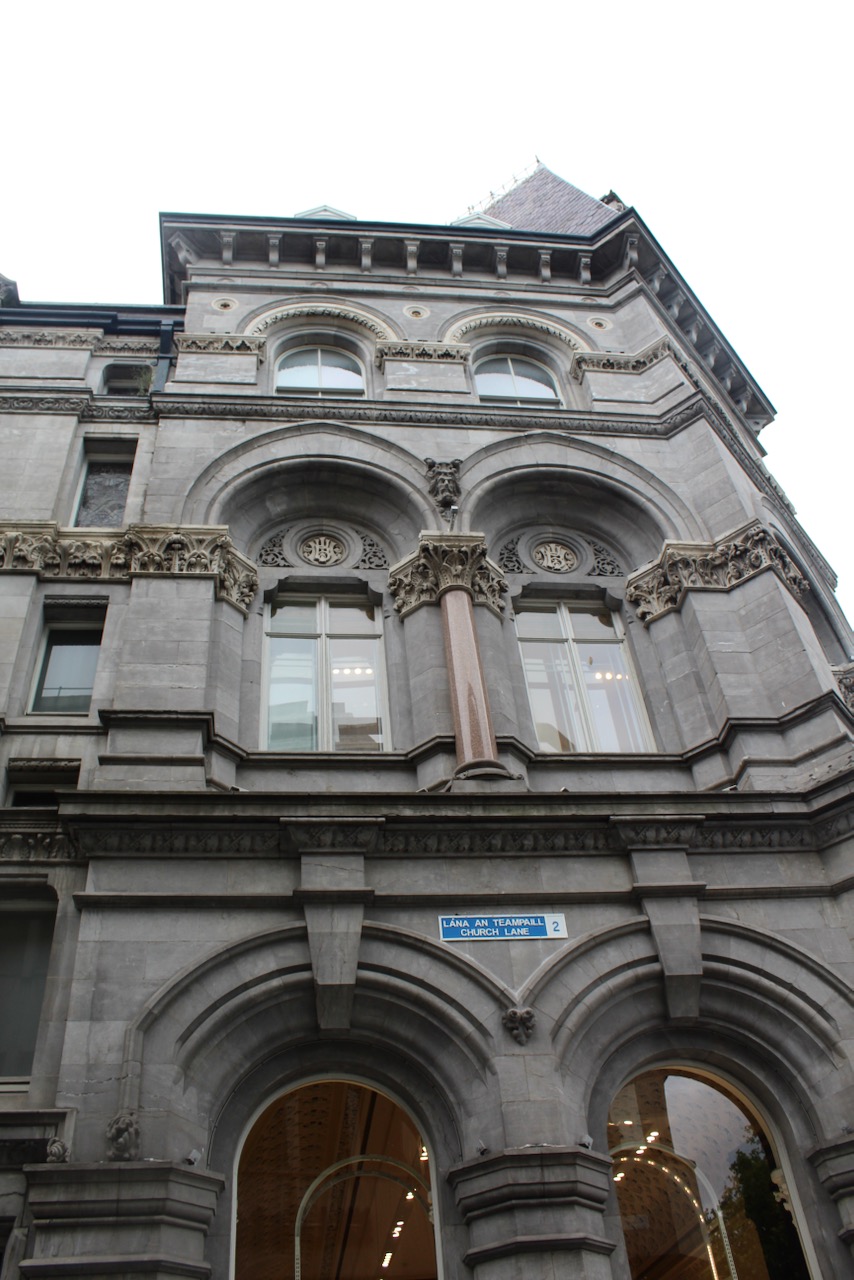
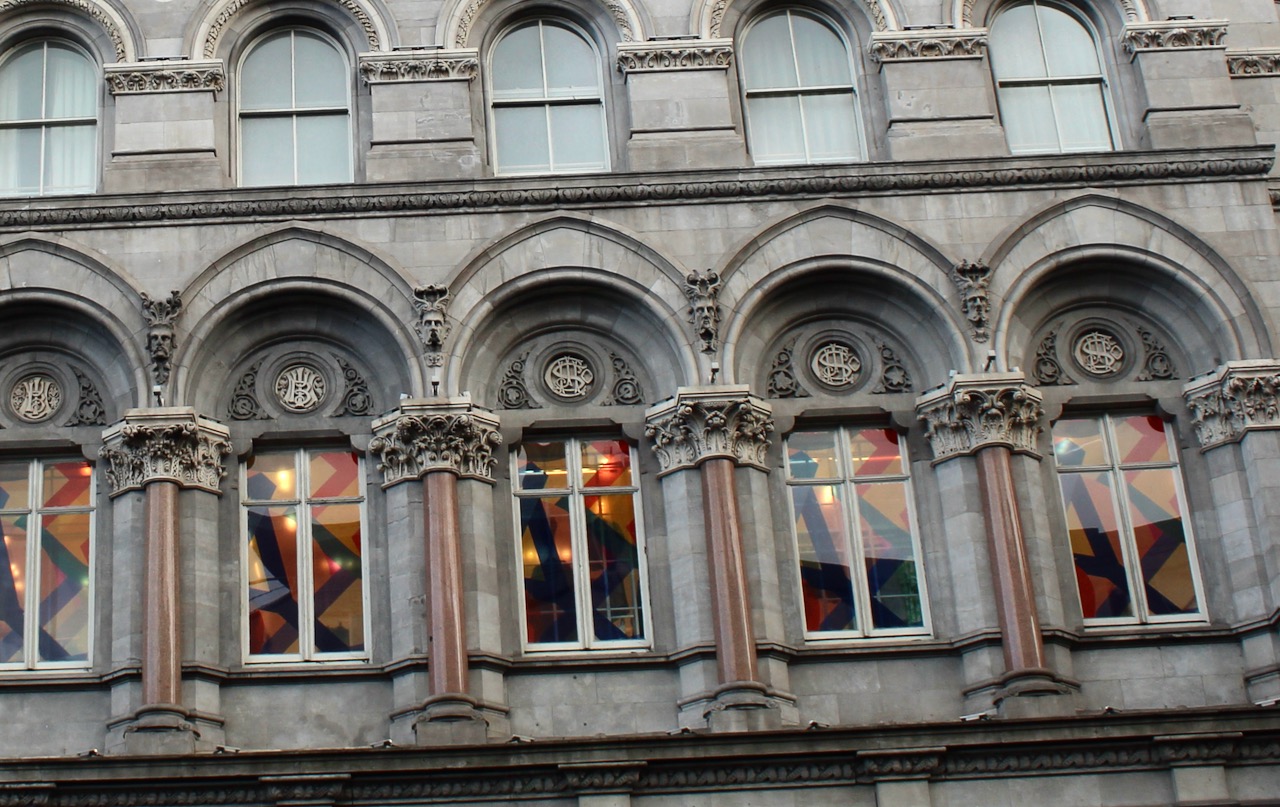
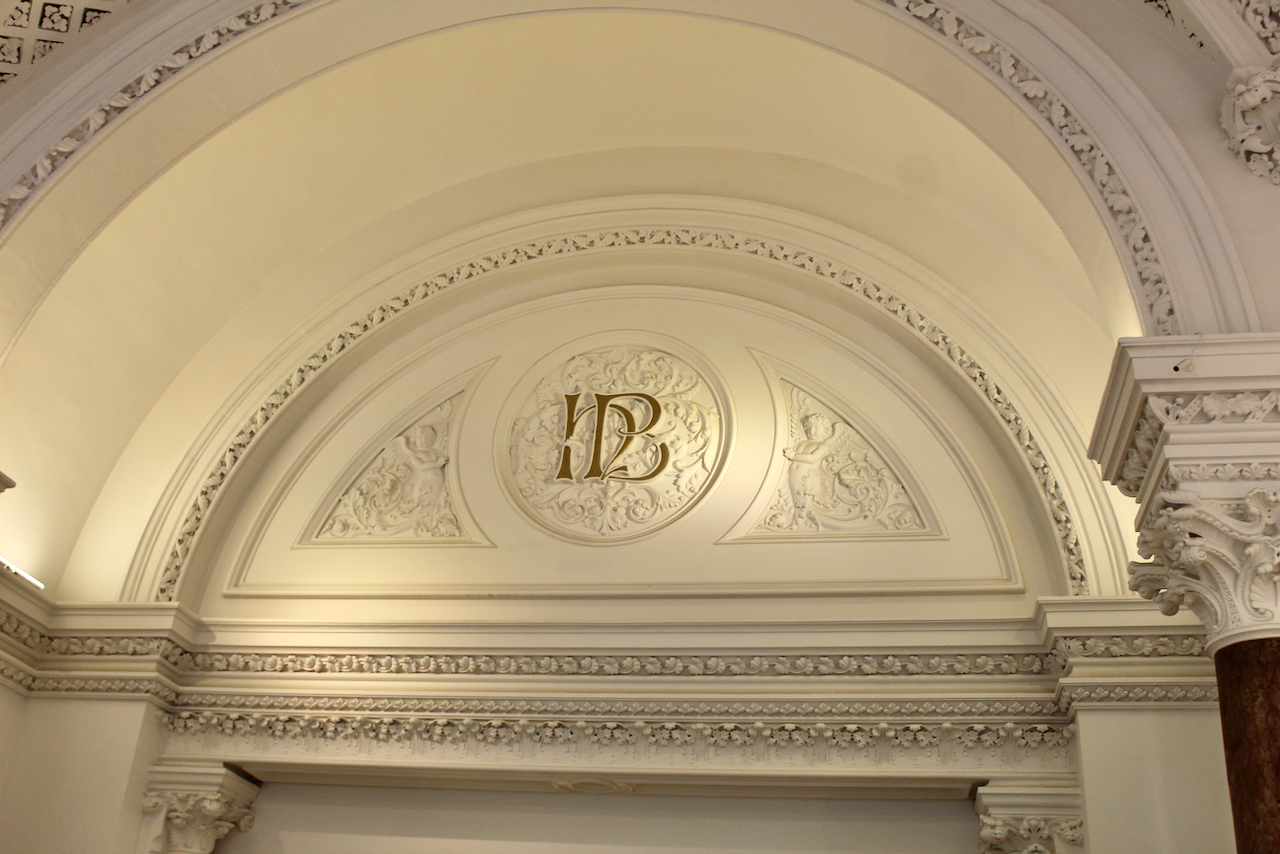
The first floor has more deep semicircular arches divided by columns of polished red granite topped with ornately sculpted capitals. The windows in the first floor are square headed. On the arcading on the first floor level the arches over the windows contain the initials of the banks – the older bays have the initials of the Union Bank and the newer bays, the Hibernian Bank. The windows of the first storey have slightly pointed arched hood mouldings with carved limestone masks to the stops.

The second floor has semi-circular headed openings and the storey above has round dormer windows in the roof. The stone carving was done by C.W. Harrison of Great Brunswick Street. The dressings are in Portland stone, with the finer carving in Caen stone. [6]

The original occupants, the short-lived Union Bank, are remembered by the intertwined “UBI” monogram over the first floor windows. Photograph © Jennifer Winder-Baggot, www.irishhistorichouses.com
Newer bays can be identified by different carved initials over the windows. Photograph © Jennifer Winder-Baggot, www.irishhistorichouses.com

The south elevation to St. Andrew Street was added in 1925-8 by Ralph Byrne.

The National Inventory tells us:

College Green facade (north) has seven bays; Church Lane facade has nine bays, two at north end being similar to main facade and of same date, three to south end being similar at ground and first floors and built 1925-8, other four-bay section being different and built 1873-6; and five-bay facade to St. Andrew Street (current main entrance) built 1925-8.” [5]

Photograph from the National Inventory of Architectural Heritage: five-bay facade to St. Andrew Street built 1925-8, designed by Ralph Byrne.
c. 1928 “Hibernian Bank Ltd., Andrew Street and Church Lane, Dublin,” held by Assoc. Prof. Joseph Brady. © Unknown. Digital content by Dr. Joseph Brady, published by UCD Library, University College Dublin. [7]

The description continues: “Limestone balconette to first floor of middle bays of Trinity Lane elevation, supported on corbels, window openings to same floor being set within square-headed frame; same bays have paired square-headed window openings to second floor, with gablet above having limestone copings with finial, and carved tympanum. Three south end bays of Trinity Lane elevation and all bays of St. Andrew Street elevation have diminutive round-headed window openings to second floor; first floor has elliptical-arch double-height openings with decorative cast-iron balconettes to middle of each opening, with timber casement windows having margined upper lights with fanlights.” [5]

Trinity Lane Elevation: “Limestone balconette to first floor of middle bays of Trinity Lane elevation, supported on corbelsfirst floor has elliptical-arch double-height openings with decorative cast-iron balconettes to middle of each opening, with timber casement windows having margined upper lights with fanlights.” [5] Photograph © Jennifer Winder-Baggot, www.irishhistorichouses.com

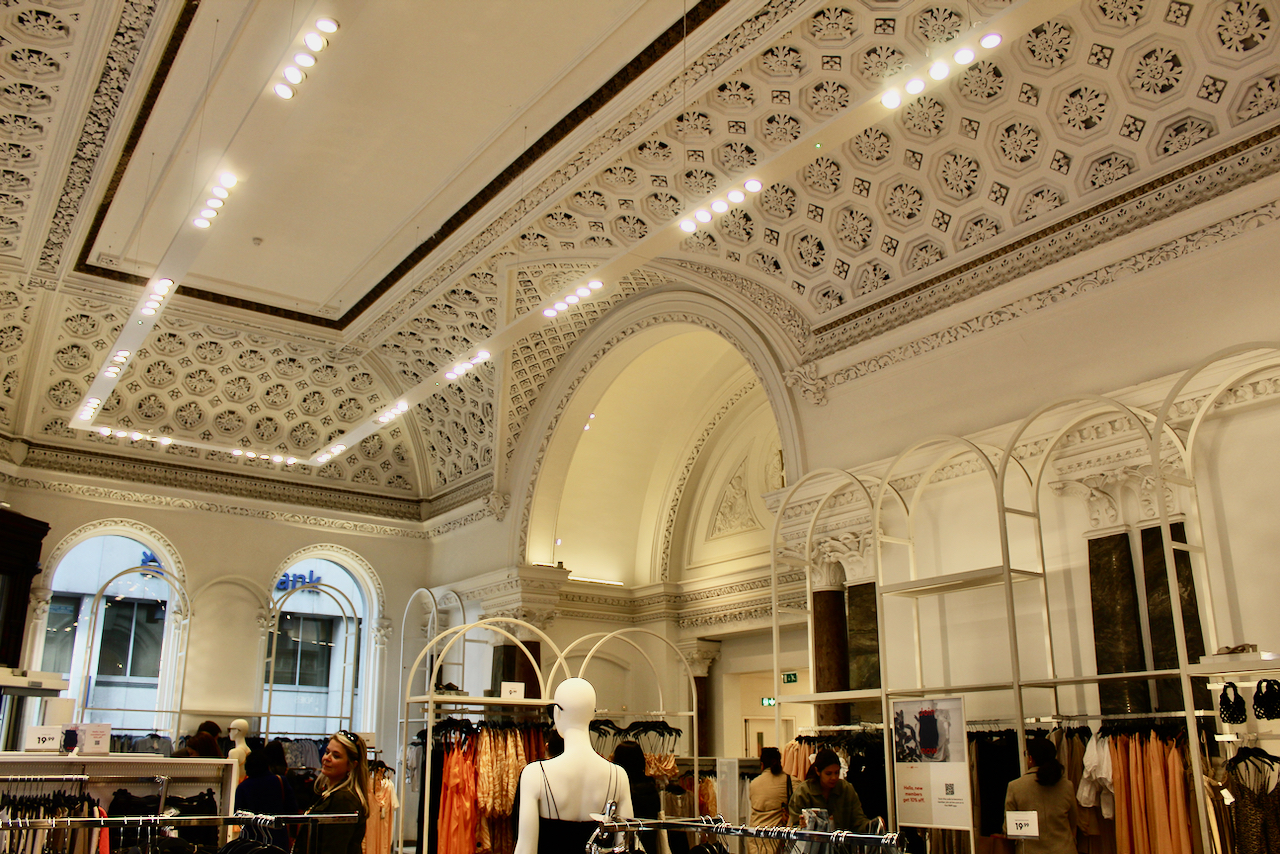
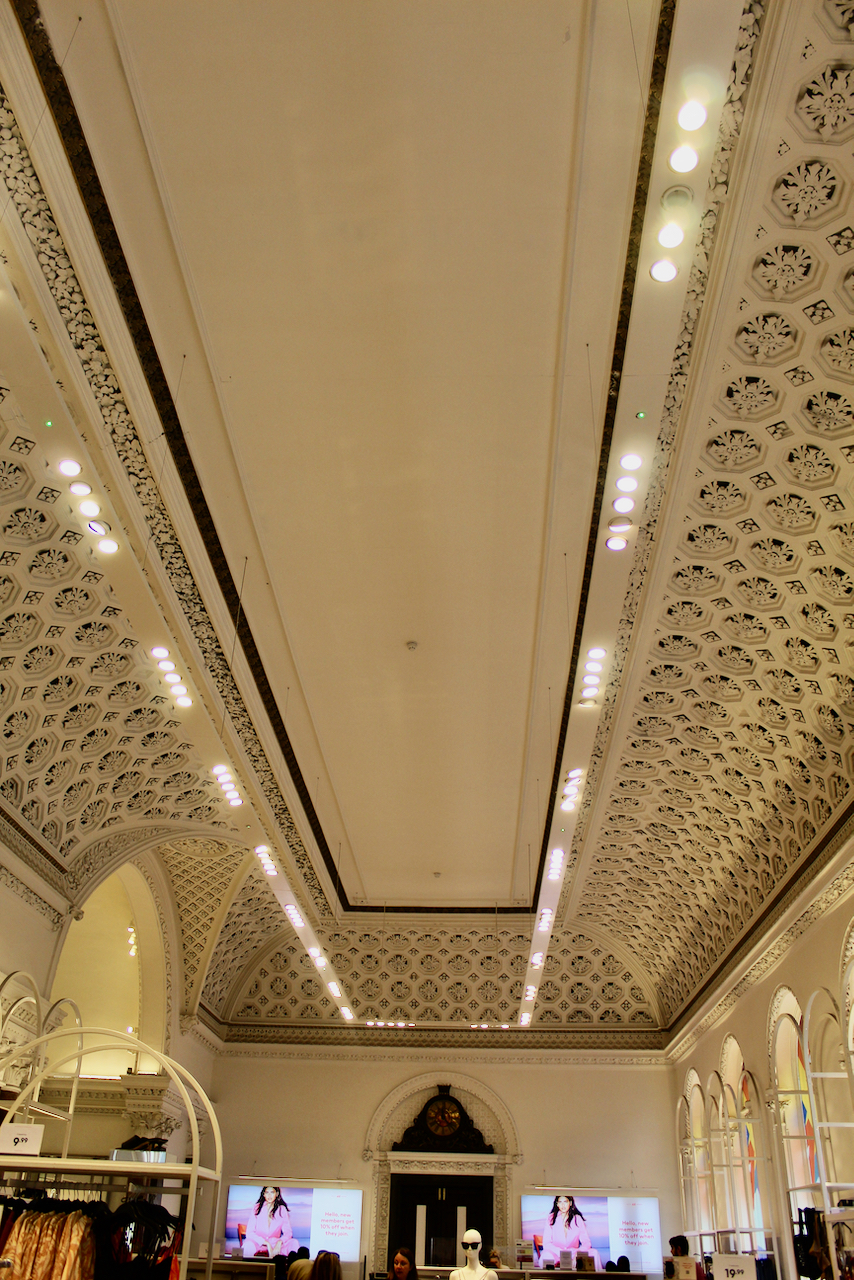
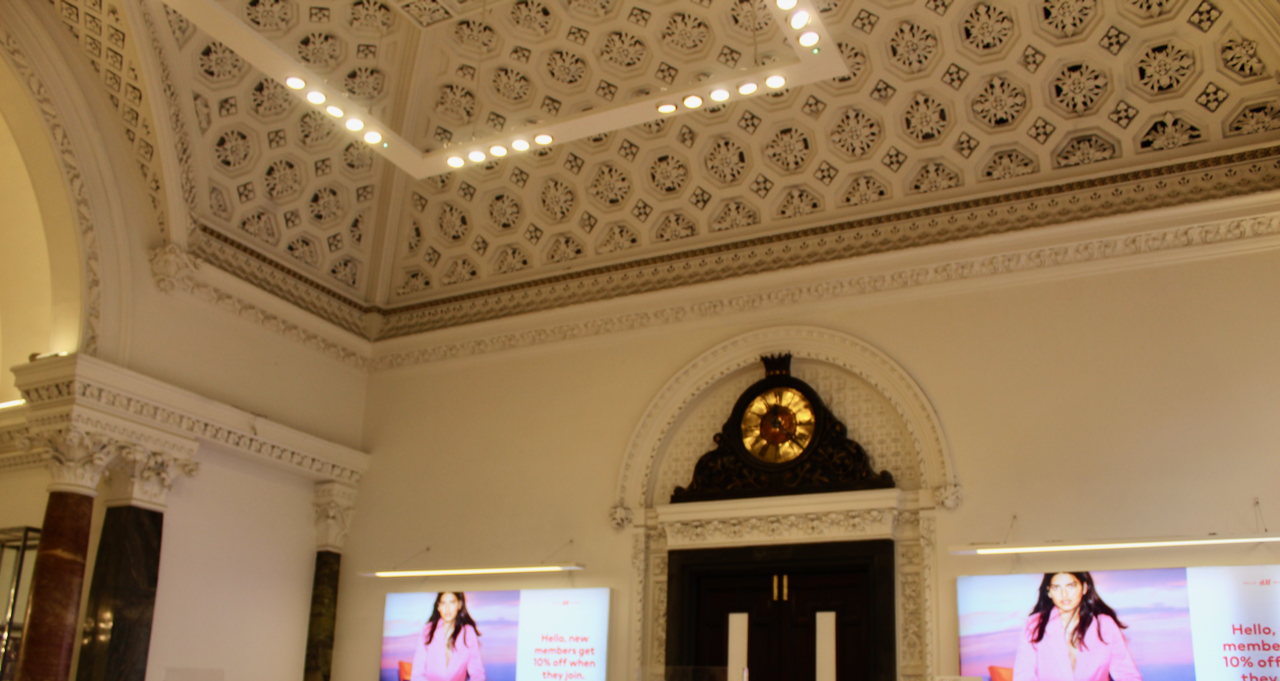
The former bank now houses a branch of the clothing shop H&M.

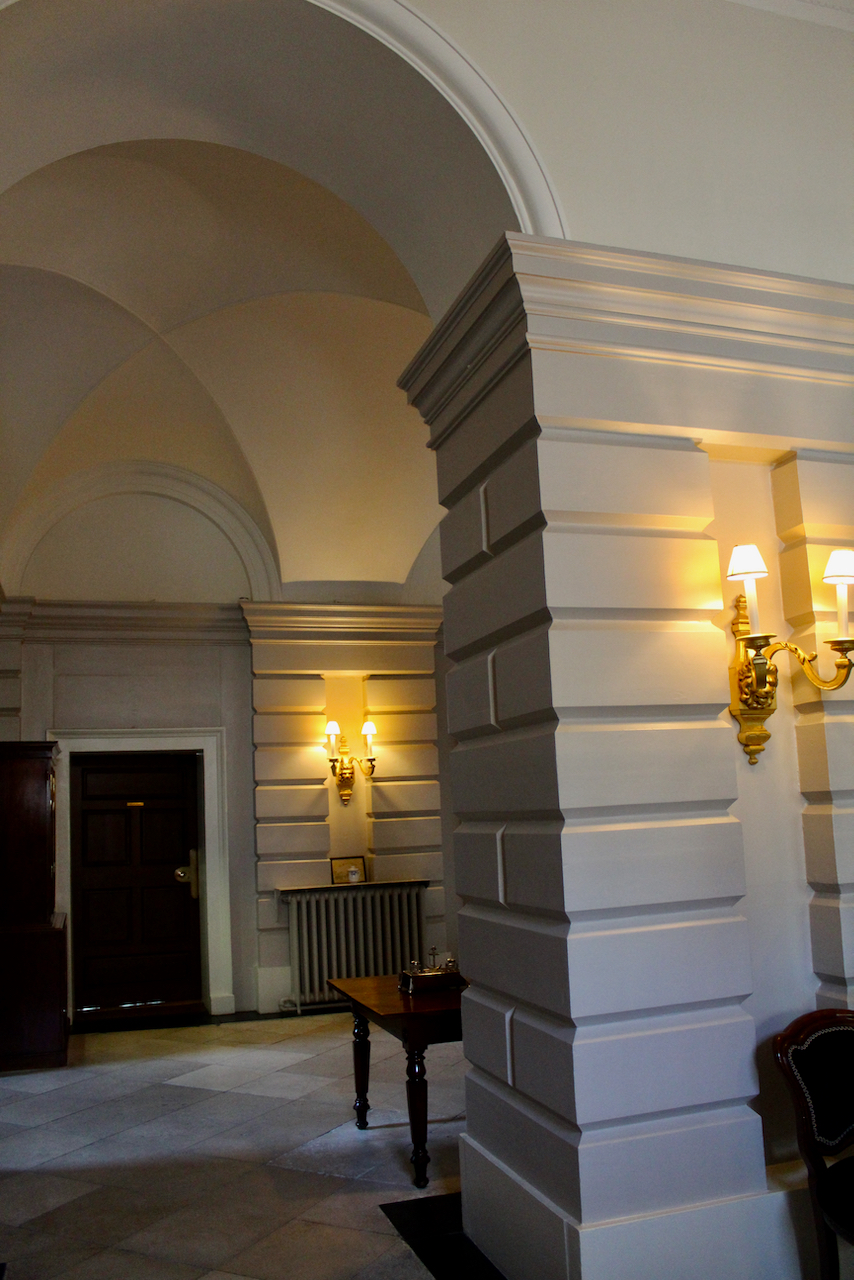
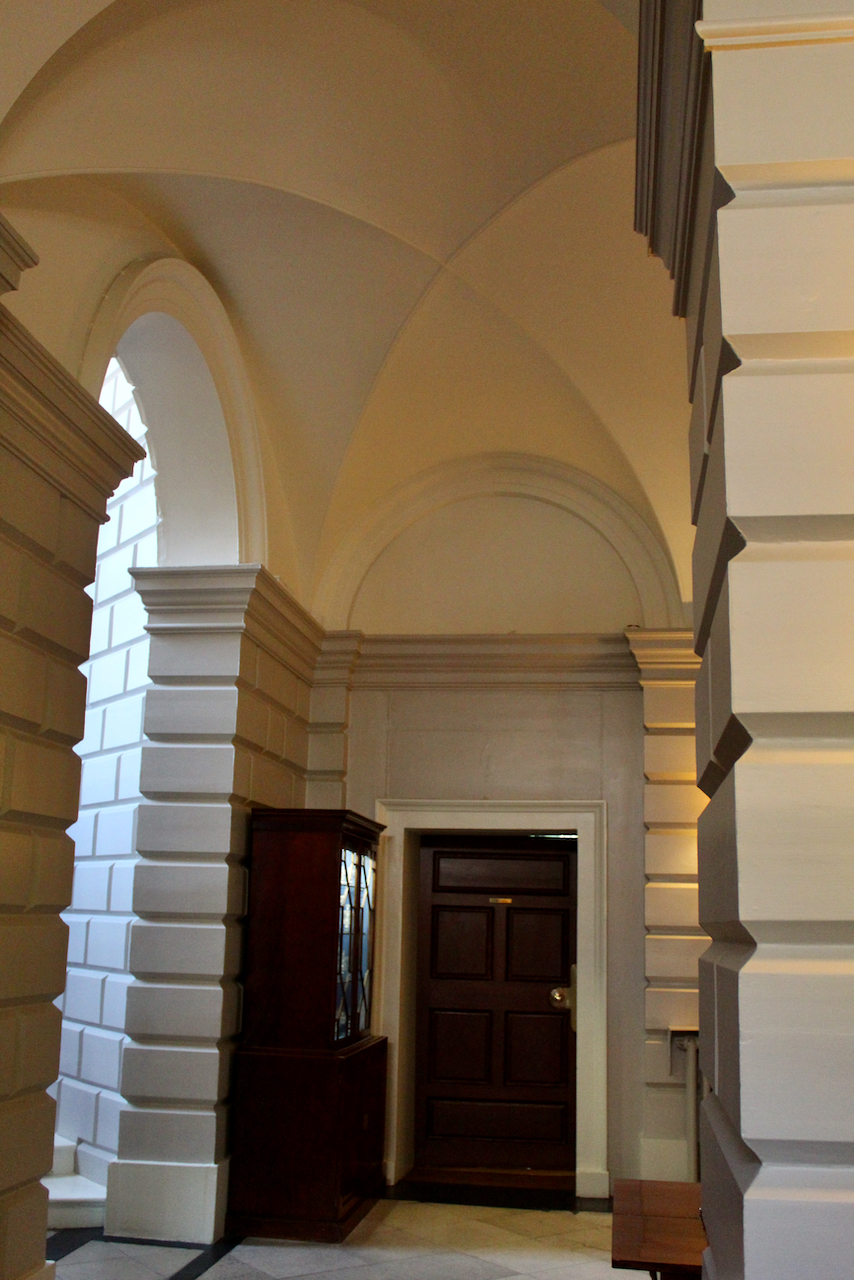
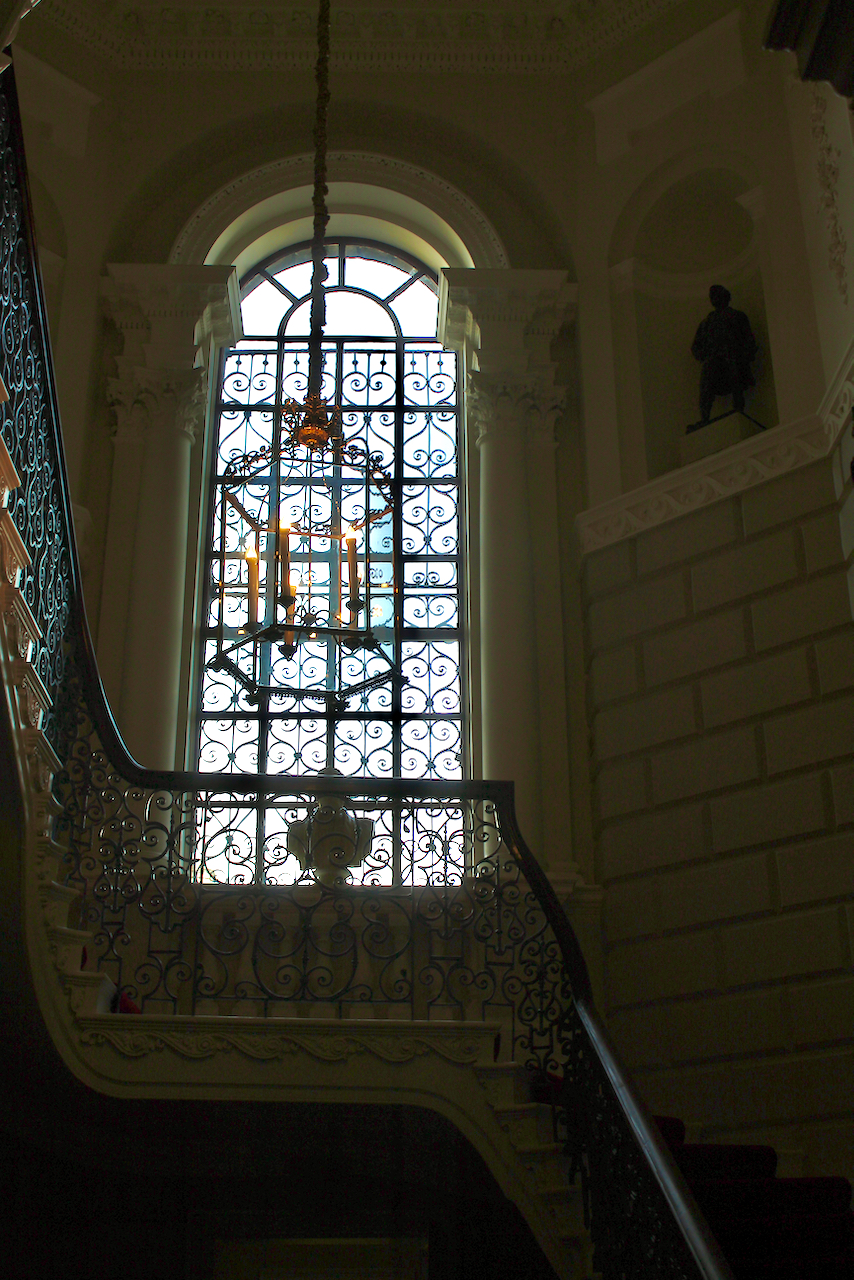
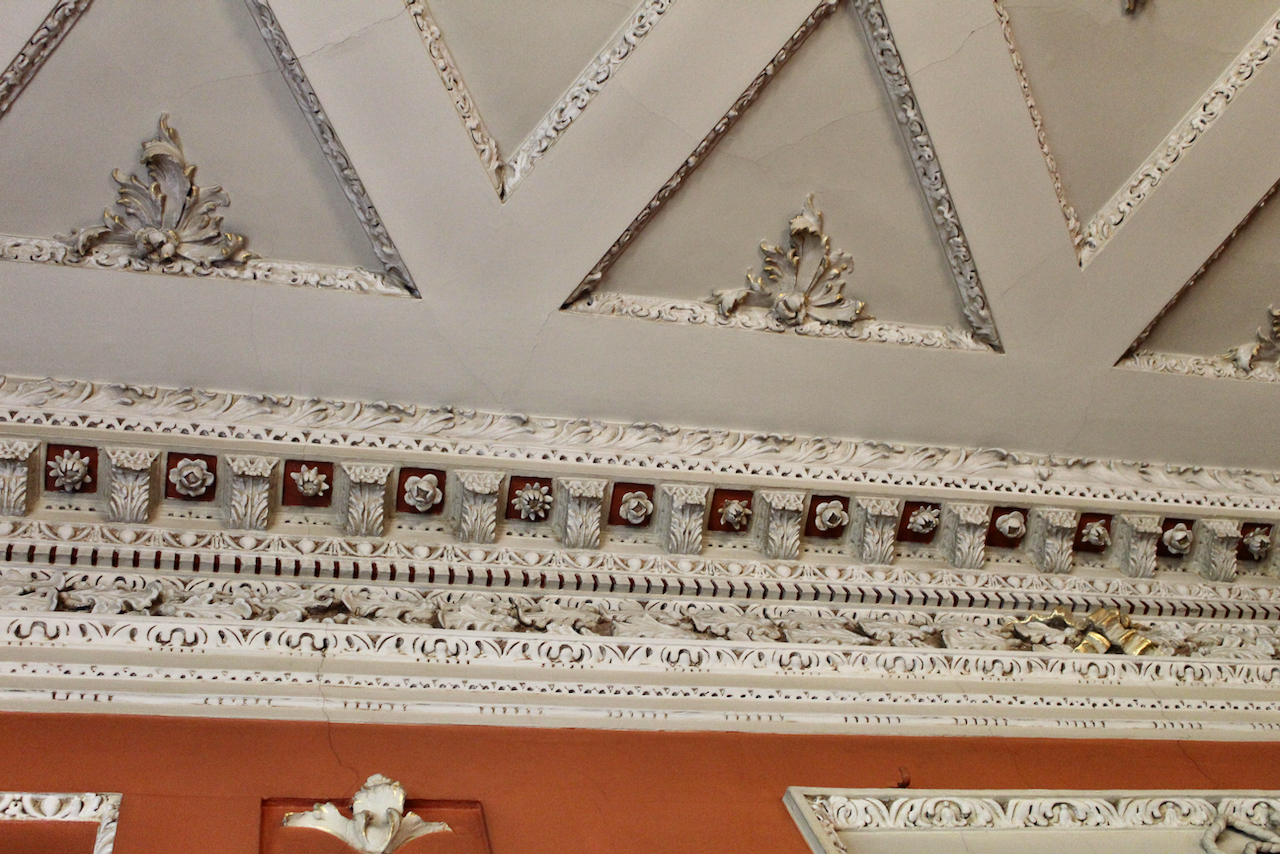
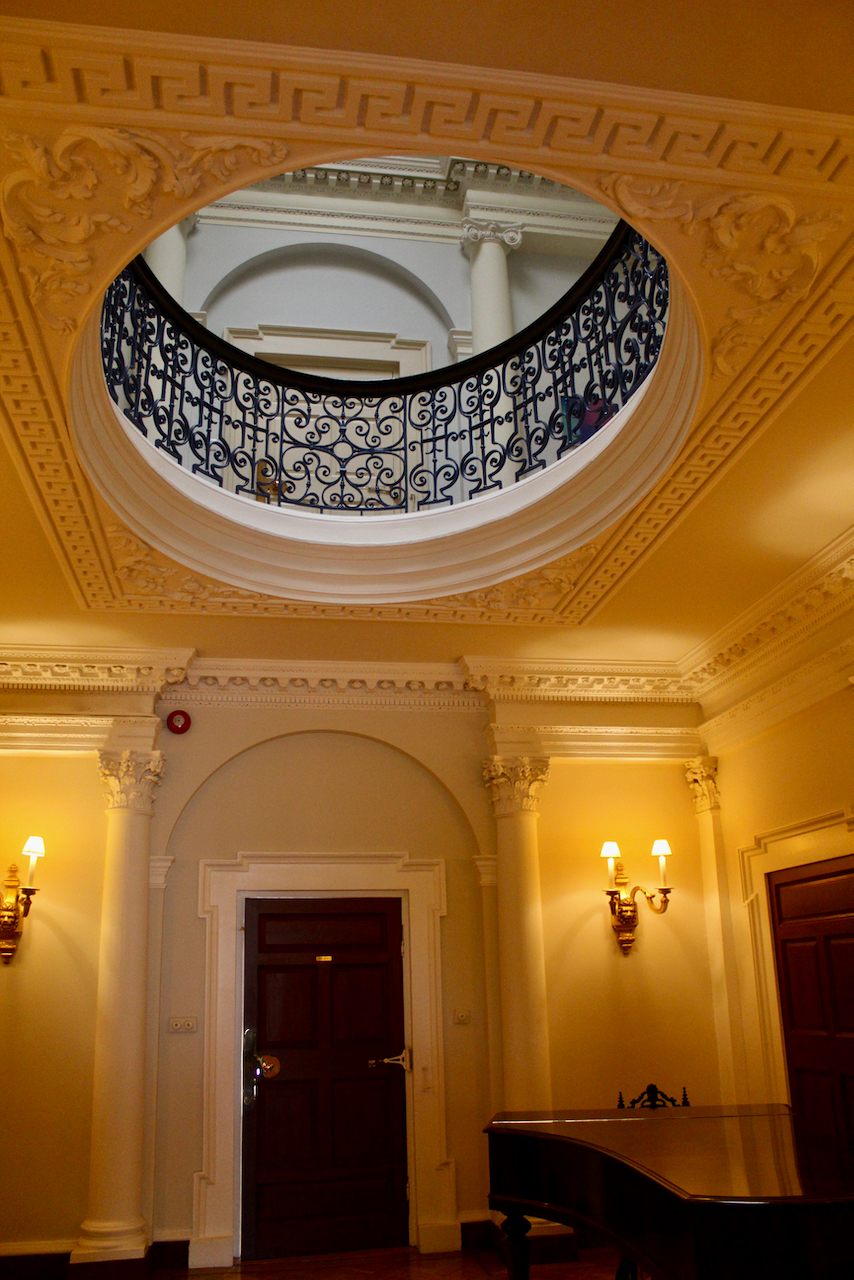
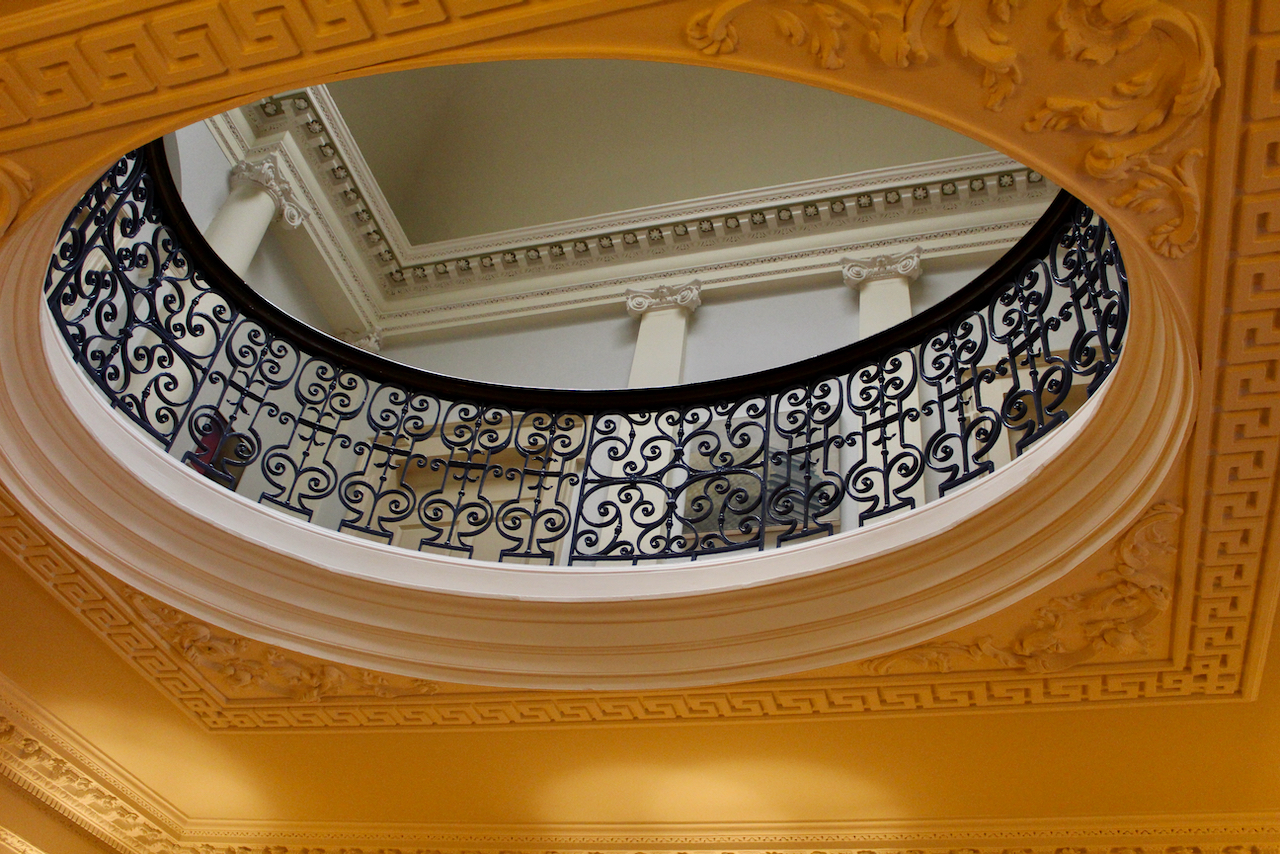
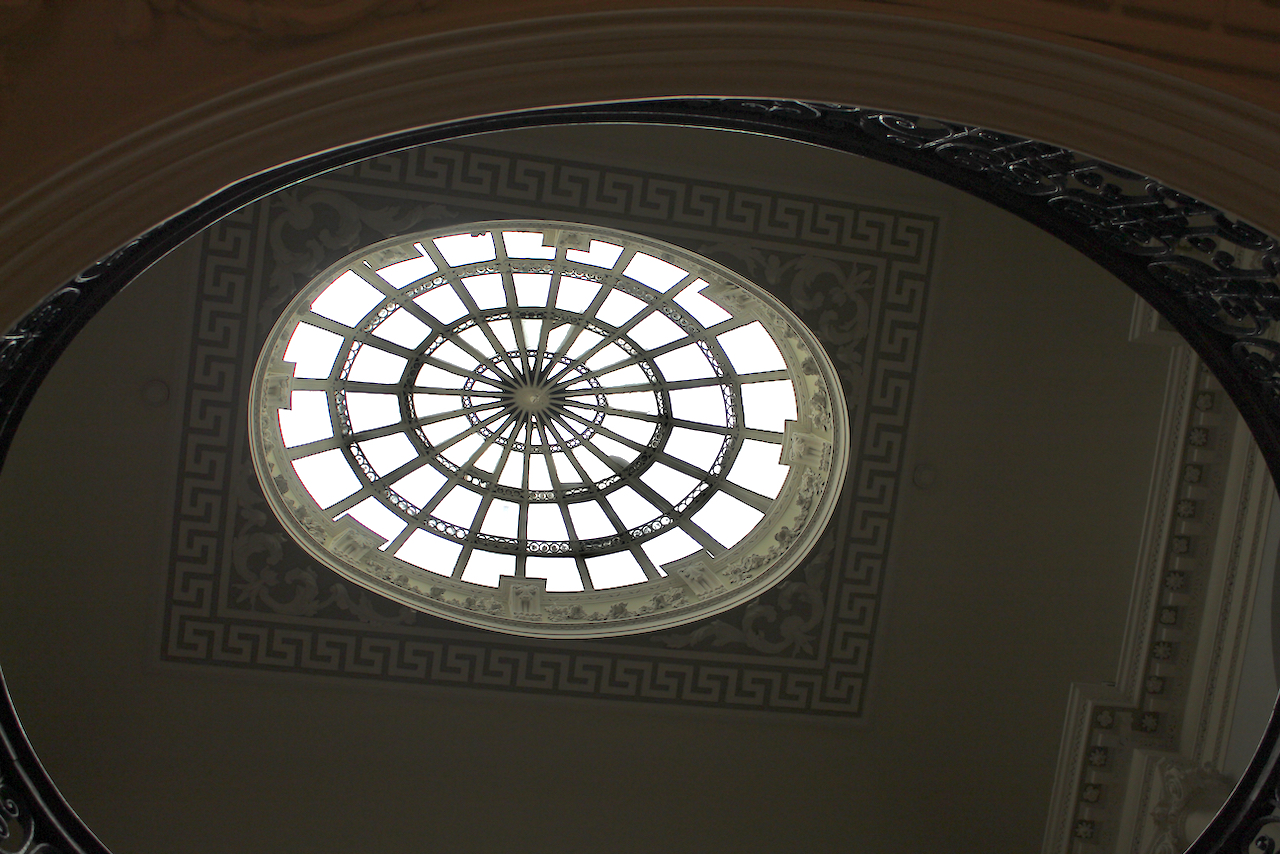
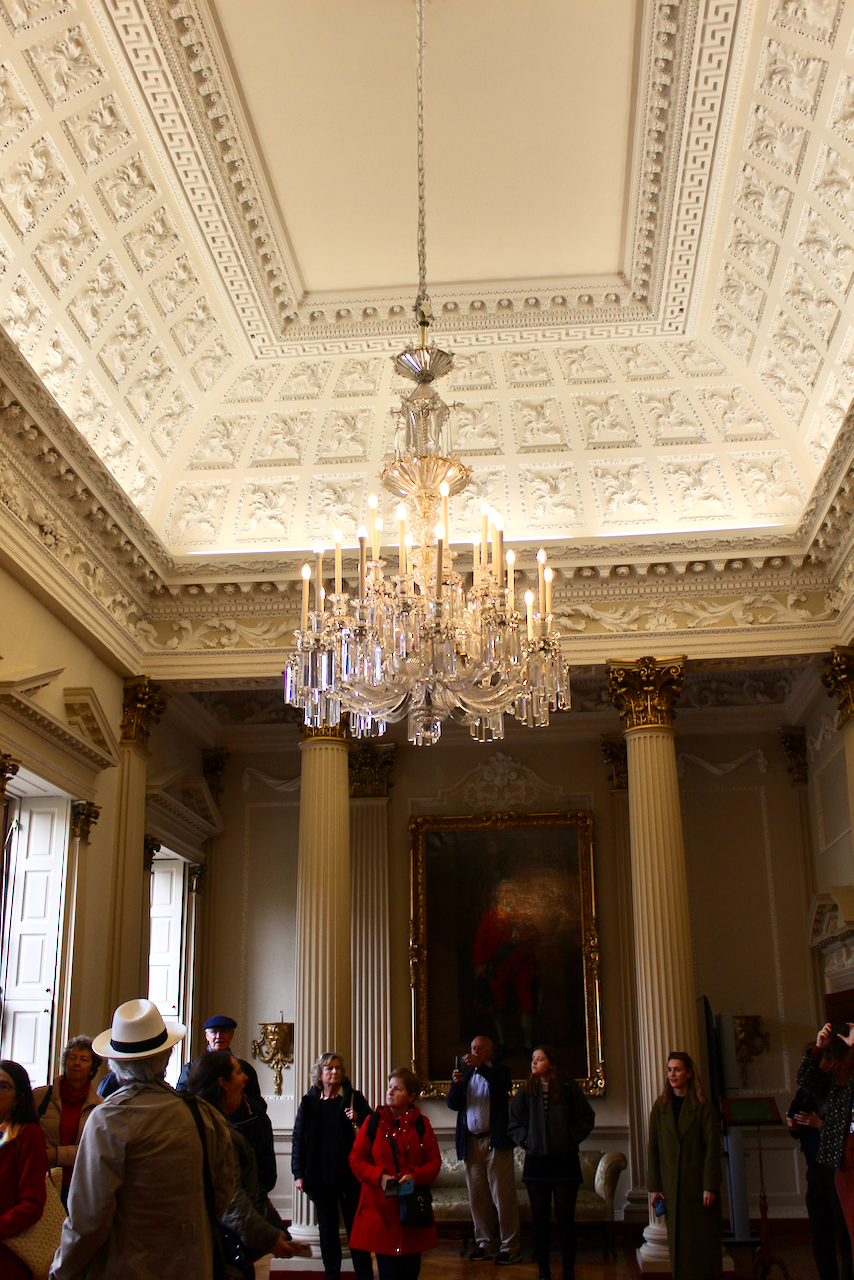
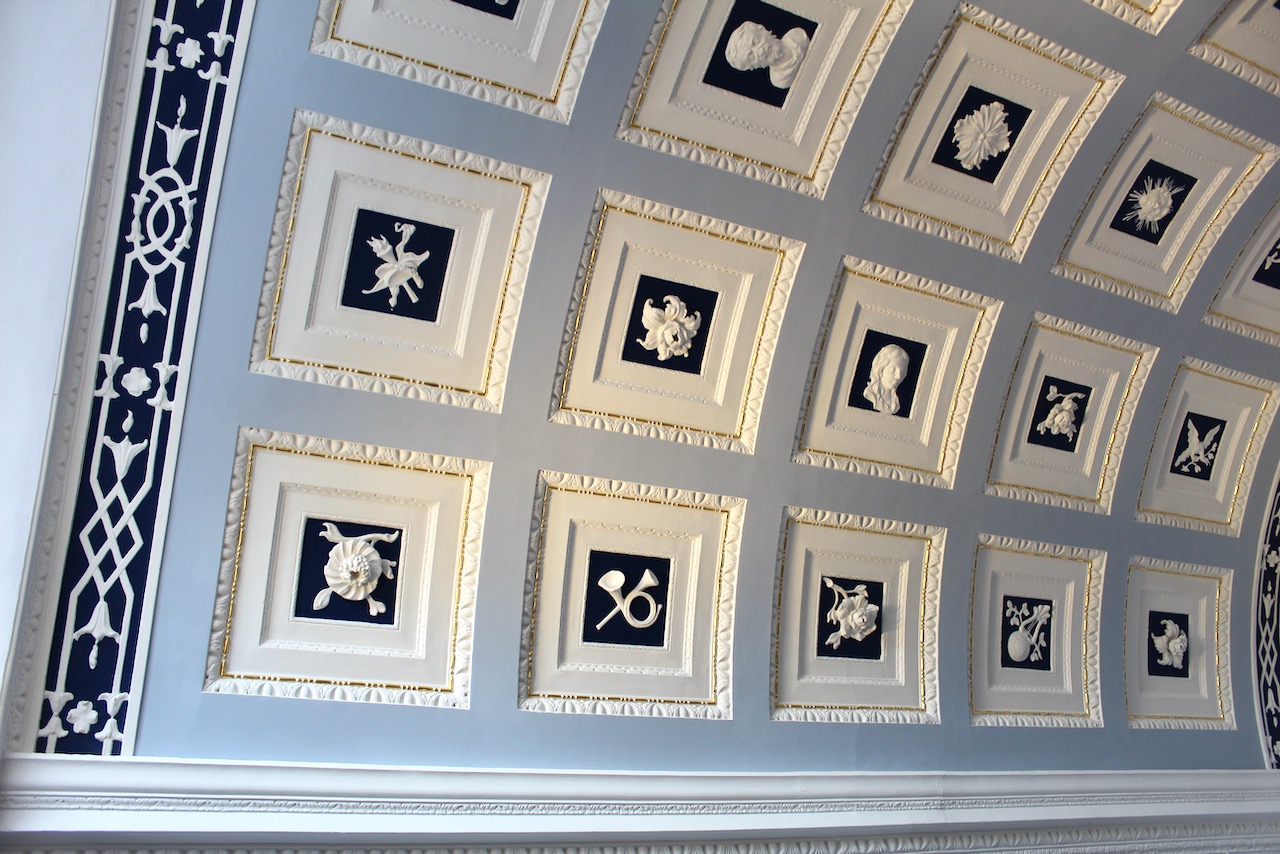
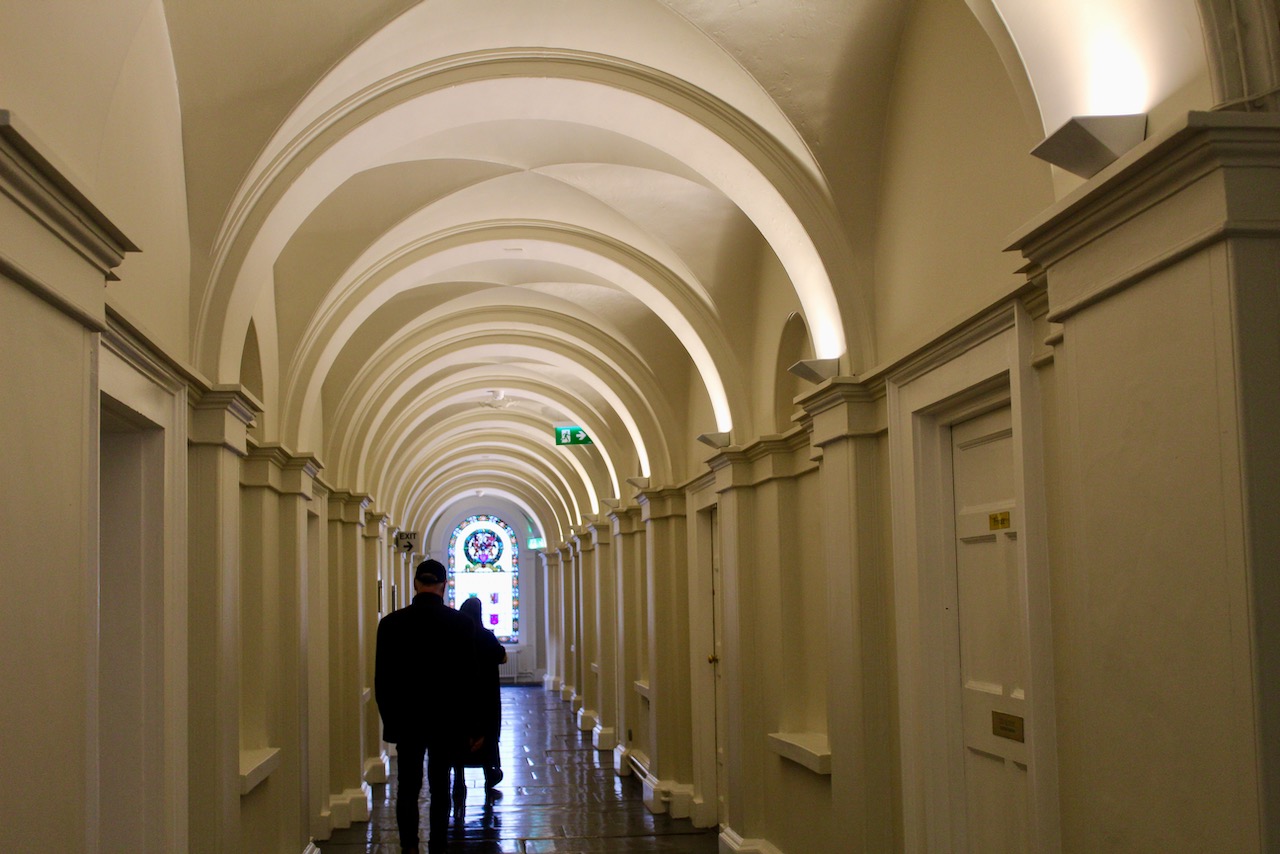
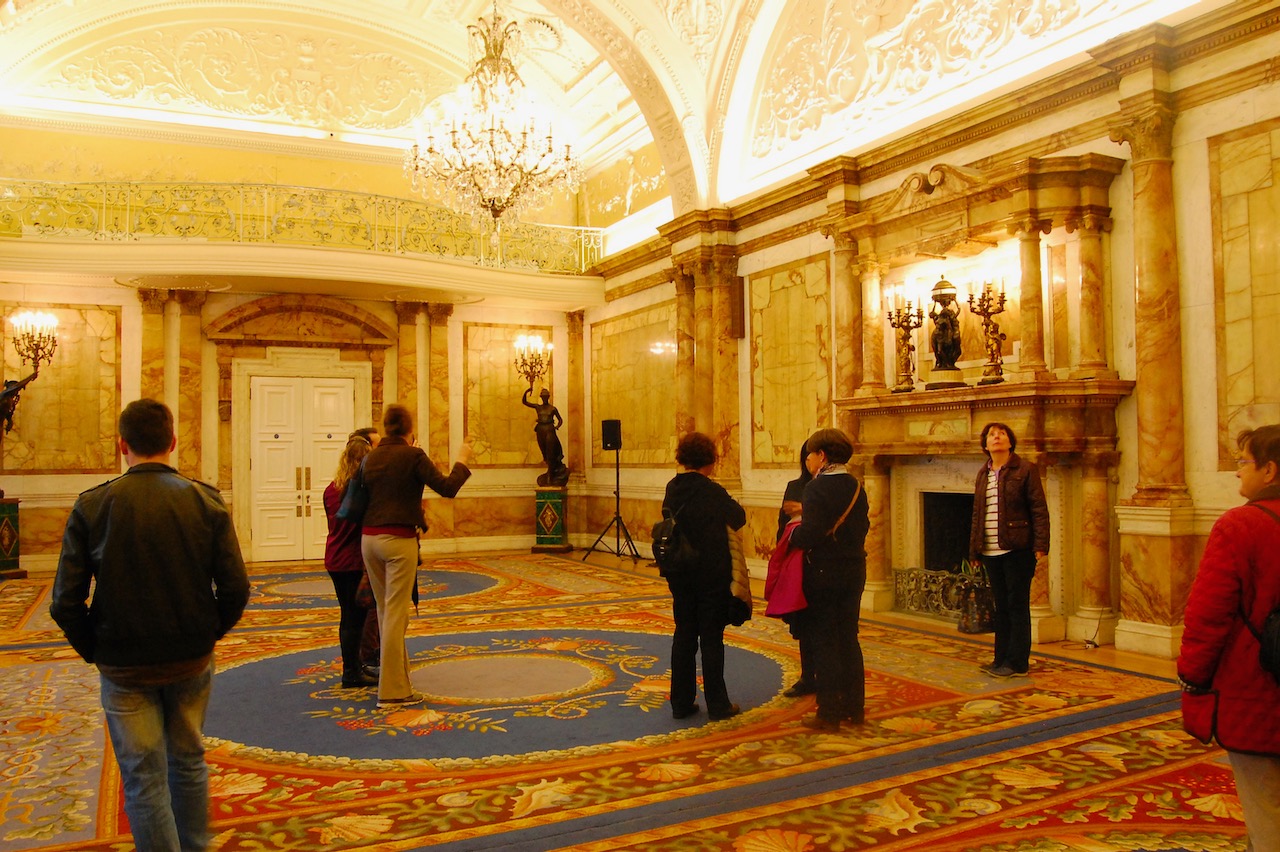
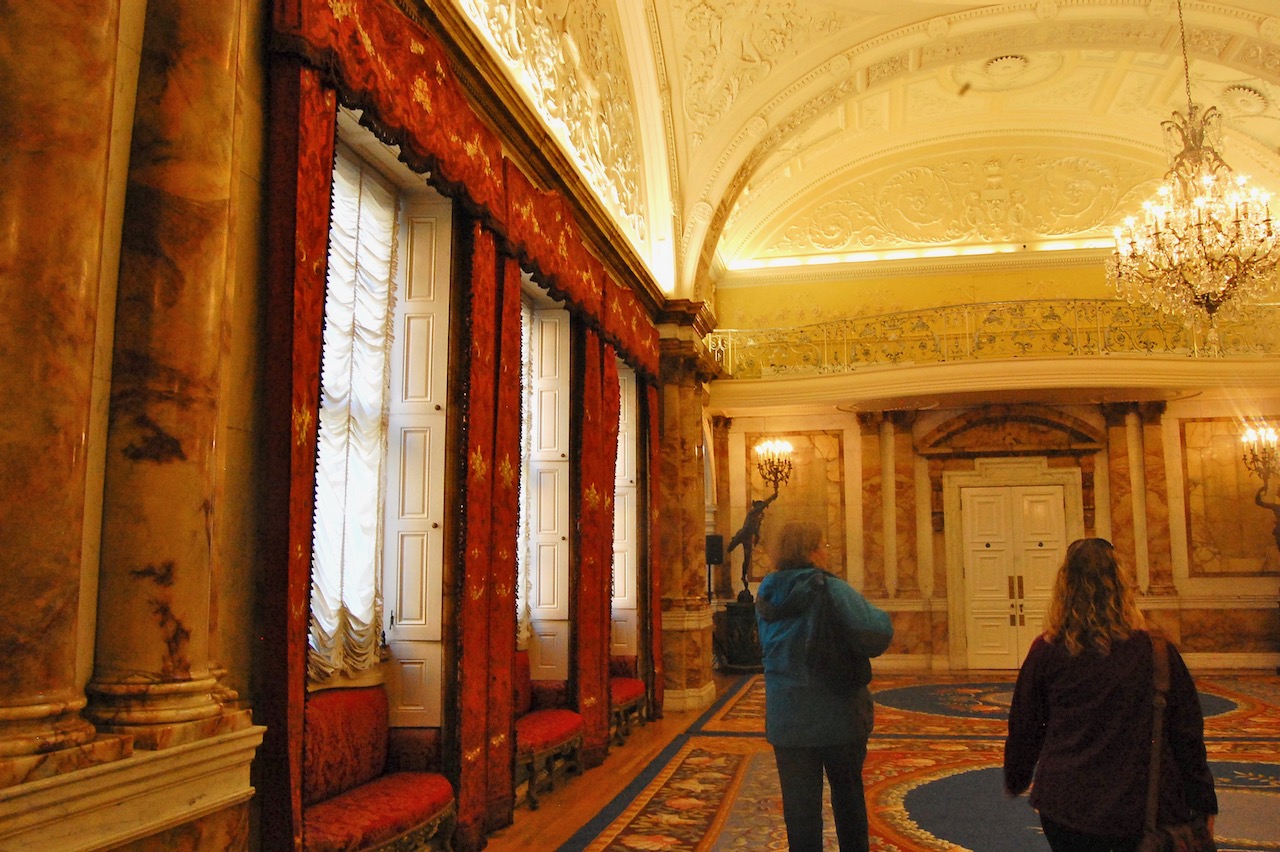
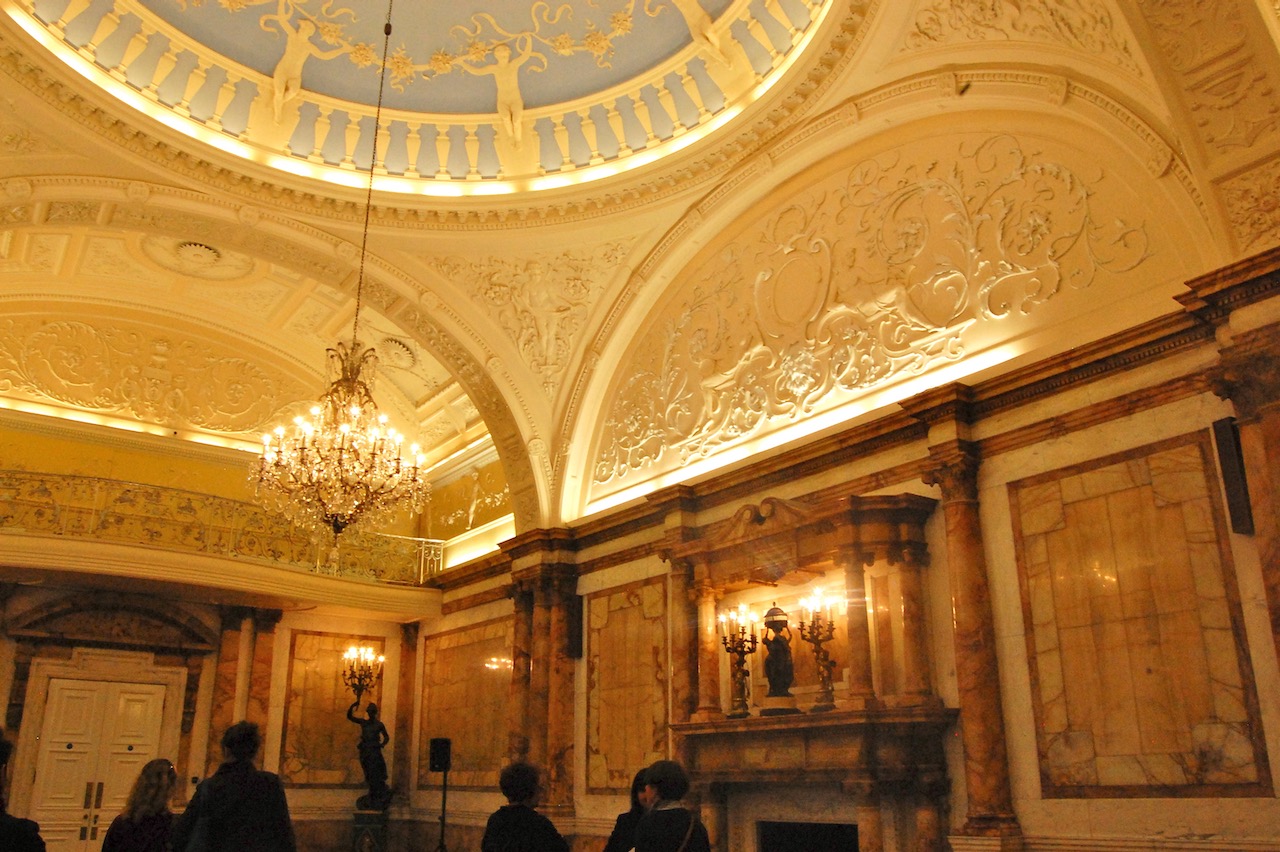
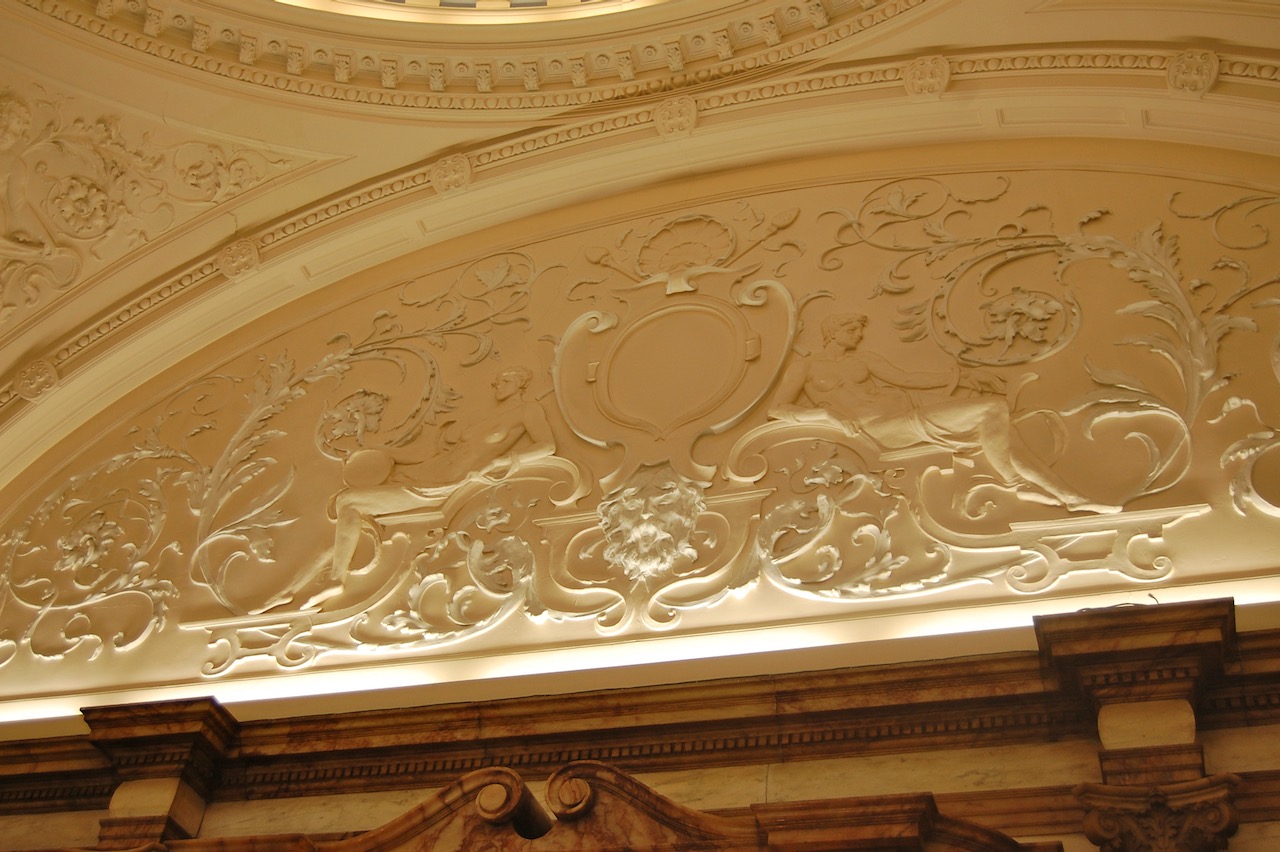
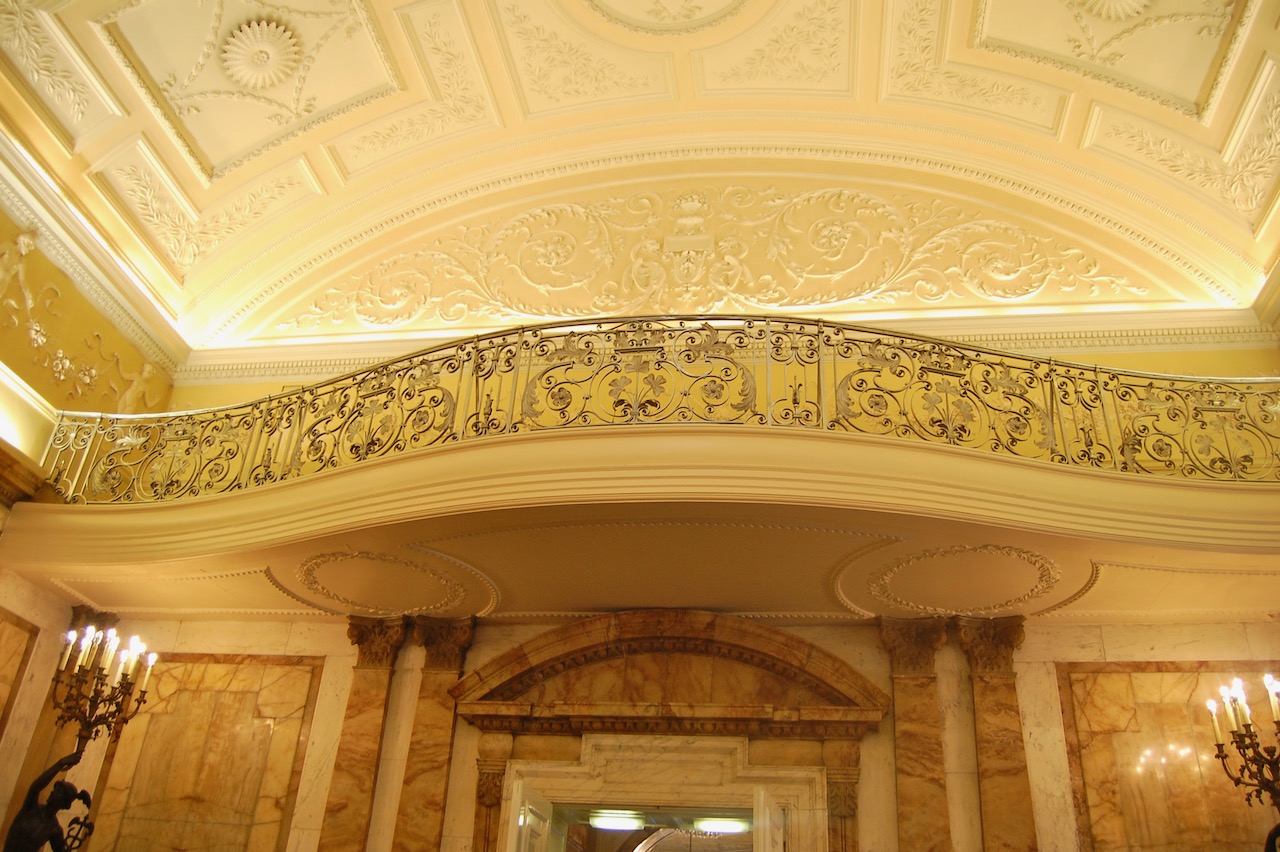
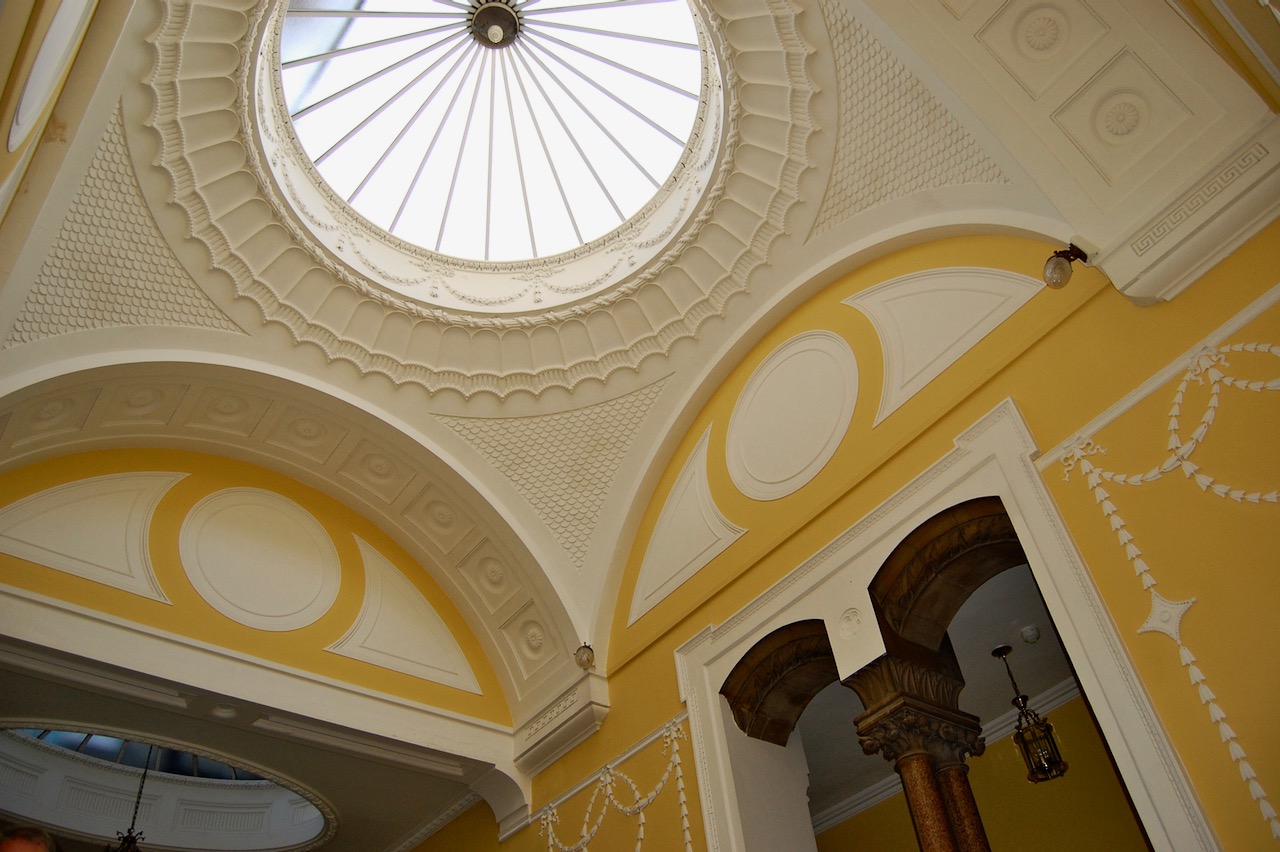
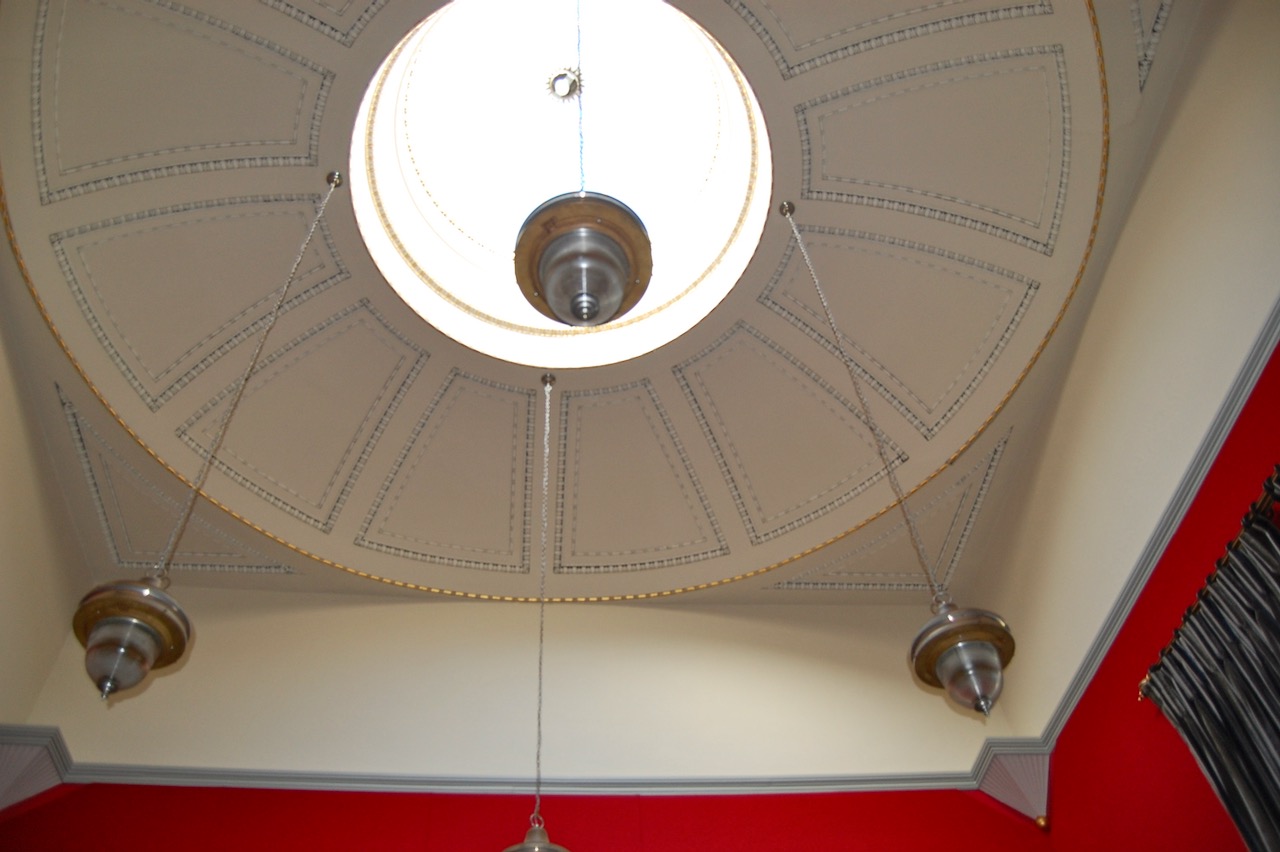
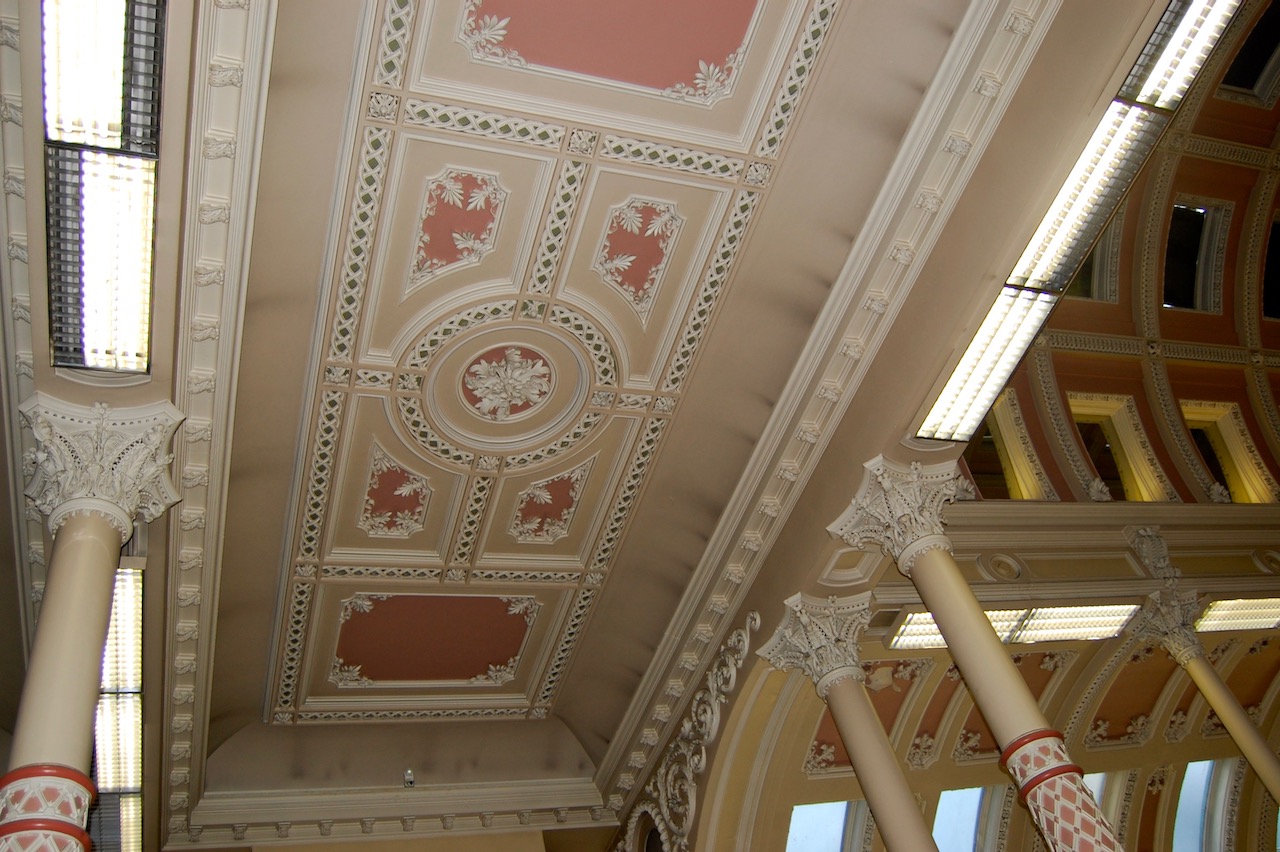
The interior has a vaulted ceiling, which was traditionally left lit up at night for display. It has a semicircular recess on one side. The arched ceiling is very ornate. Archiseek describes it as “arched and groined, and springs from a stone cornice all around; it is covered with coffered panels arranged in a kind of diaper, with rich centre flowers in each.” Note that a “groin” is described by Alistair Rowan in his Buildings of Ireland: Northwest Ulster, as a sharp edge at the meeting of two cells of a cross-vault, and coffering, he tells us, are sunken panels, square or polygonal, decorating a ceiling, vault or arch [see my entry of architectural definitions, https://irishhistorichouses.com/2020/04/18/architectural-definitions/ ]

Former Hibernian Bank, 2022. Photograph © Jennifer Winder-Baggot, www.irishhistorichouses.com
Initials of the Union Bank. Photograph © Jennifer Winder-Baggot, www.irishhistorichouses.com
Initials of the Hibernian Bank. Photograph © Jennifer Winder-Baggot, www.irishhistorichouses.com
Photograph © Jennifer Winder-Baggot, www.irishhistorichouses.com

[1] https://www.buildingsofireland.ie/app/uploads/2019/10/Dublin-South-City.pdf

[2] https://www.irishpapermoney.com/old-irish-bank-notes/hibernian-bank-token-issue-1826.html

[3] https://www.dia.ie/architects/view/3694/MURRAY-WILLIAMGEORGE

[4] https://www.archiseek.com/tag/thomas-drew/

[5] https://www.buildingsofireland.ie/buildings-search/building/50910203/23-27-college-green-church-lane-dublin-2-co-dublin

[6] https://www.archiseek.com/2010/1867-national-irish-bank-college-green-dublin/

[7] https://digital.ucd.ie/view/ucdlib:46916

Text © Jennifer Winder-Baggot, www.irishhistorichouses.com

St. George’s, St. George’s Avenue, Killiney, Co. Dublin – section 482

Open dates in 2025: July 1-31, Aug 1-31, 9am-1pm
Fee:  adult €6, OAP/student/child €3

donation

Help me to pay the entrance fee to one of the houses on this website. This site is created purely out of love for the subject and I receive no payment so any donation is appreciated!

€15.00

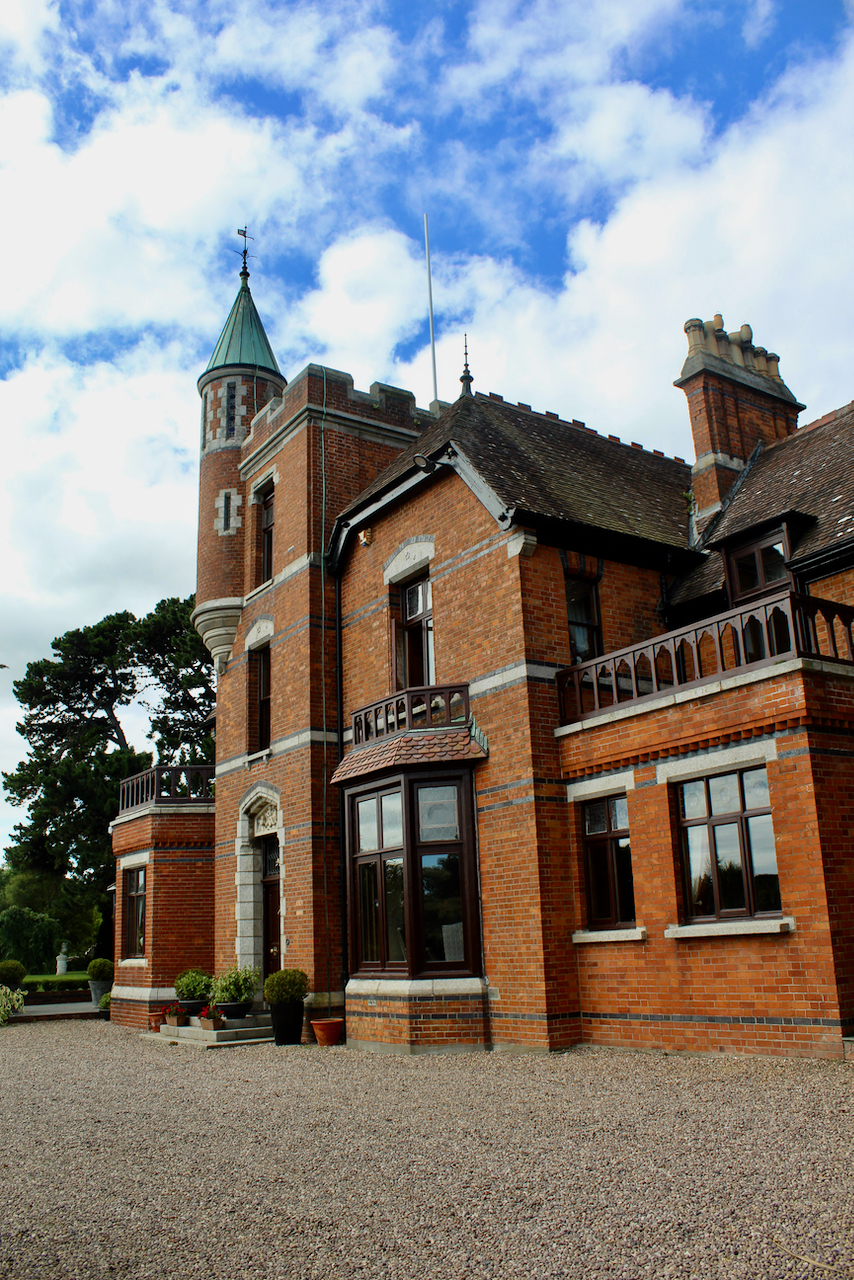
St. George’s, August 2022. Photograph © Jennifer Winder-Baggot, www.irishhistorichouses.com

St. George’s is a wonderful Arts and Crafts/Gothic Revival house in the beautiful suburbs of Killiney. It was built in the 1870s by George Coppinger Ashlin, a former pupil and later partner of Edward Welby Pugin, son of Augustus Pugin who played a primary role in initiating the Gothic revival style of architecture. Augustus Pugin designed the Houses of Parliament in Westminster. He also designed the hall ceiling, staircase and gallery in Adare Manor, County Limerick.

Adare Manor staircase, photograph by Chris Brooks 2012 from flickr constant commons.

Augustus Pugin converted to Catholicism. In 1836, Pugin published Contrasts, and in it he argued for “a return to the faith and the social structures of the Middle Ages,” and this was reflected in his Gothic taste in architecture and design. In 1841 he published his illustrated The True Principles of Pointed or Christian Architecture in which he advocated medieval, “Gothic”, or “pointed”, architecture. In the work, he wrote that contemporary craftsmen seeking to emulate the style of medieval workmanship should reproduce its methods. Pugin also designed stained glass.

Edward Welby Pugin joined his father’s firm. Pugin & Pugin were mainly church architects. Pugin was invited first to work in Ireland by the Redmond family of Wexford (I think they lived in Ballytrent).

Edward Welby Pugin’s works in Ireland include a beautiful chapel at Edermine, County Wexford, which I’d love to see, as well as Cobh and Killarney cathedrals.

Edermine was built for the Power family of the firm of John Power & Son, Distillers, of Dublin. It was through John Power’s influence that Pugin was commissioned to built many churches in Ireland. Power was awarded a Baronetcy in 1841and became Sir John Power 1st Baronet of Roe Buck House, Dublin and Edermine and Sampton, Co Wexford. He was a friend and confidant of Daniel O’Connell, “the Liberator.” [1]

The Powers distillery was located at that time near Thomas Street in Dublin, and it must have been John Power’s influence that led to the commission in 1860 for the design of the Church of St. Augustine and St. John, often referred to as John’s Lane church, on Thomas Street.

St. George’s architect, George Coppinger Ashlin (1837-1921), became a pupil of Edward Welby Pugin in 1856, and was then taken into partnership by Pugin, who gave him the responsibility of establishing a Dublin branch, taking charge of Irish commissions. [2]

Church of St. Augustine and St. John, Thomas Street, photograph by Warren LeMay 2018, flickr constant commons.
The Church of St. Augustine and St. John, commonly known as John’s Lane Church, designed by Edward Welby Pugin, photograph by William Murphy, 2019, courtesy of flickr constant commons.
The chapel at Edermine, courtesy of National Inventory of Architectural Heritage.

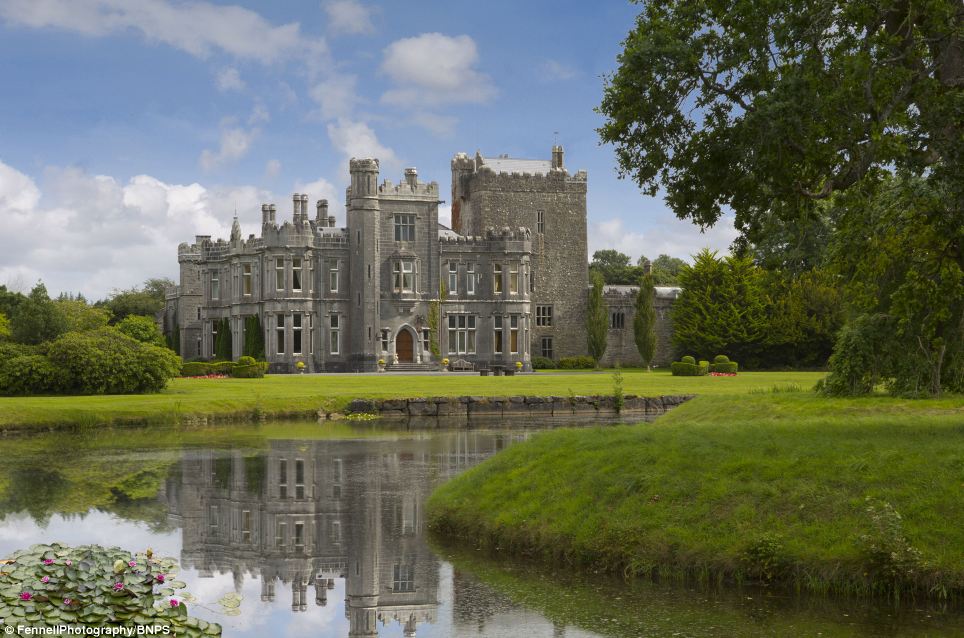
Pugin & Ashlin designed approximately eight Catholic cathedrals and fifty Catholic churches as well as schools and convents. Ashlin did not design many private homes, but his work includes Tullira Castle in County Galway, and designs for Ashford Castle and St. Anne’s Park for the Guinness family. [3]

George Coppinger Ashlin, courtesy of Irish Architectural Archive.
Tullira Castle, County Galway, also by George Coppinger Ashlin, photograph by Fennell Photography BNPS from 2013 when the house was for sale.

George Coppinger Ashlin (1837-1921) was from Carrigrenane House in County Cork, third and youngest son of four children of John Musson Ashlin, a Corkman established as a corn merchant in London, and Dorinda Maria Ashlin (née Coppinger), from an old County Cork family. [4]

St. George’s, August 2022. Photograph © Jennifer Winder-Baggot, www.irishhistorichouses.com

The partnership of Pugin & Ashlin was dissolved in the latter months of 1868, but Ashlin married Edward Pugin’s younger sister Mary Pugin (1844-1933) in 1867. Ashlin built St. George’s in the late 1870s after his marriage, as a home for his family.

An information leaflet which owner Robert McQuillan gave us tells us that Mary Ashlin née Pugin grew up in The Grange at Ramsgate in Kent, which was situated on a cliff-top, and that the situation of St. George’s on the hill of Killiney would have reminded her of her childhood home. Shortly after the Ashlins moved to Killiney, the local railway station opened, and in 1887 Queen Victoria and Prince Albert opened Killiney Hill as a public park.

The view over Killiney Bay from a bedroom balcony upstairs in St. George’s. Photograph © Jennifer Winder-Baggot, www.irishhistorichouses.com

The Dictionary of Irish Architects gives an amusing word portrait of Ashlin:

Alfred Edwin Jones, who became a pupil in Ashlin & Coleman’s office in about 1911, remembered Ashlin as a tall, commanding figure with ‘an appearance of distinction’ and described his morning routine. Each day he would catch a fast train from Killiney to Westland Row and walk from the station to his office at 7 Dawson Street. On reaching the office door he would hand his umbrella and attaché case to an awaiting junior member of staff and mount the horse which a man held ready at the kerb. He would then canter up Dawson Street to to Stephen’s Green and ride several times round the park on the track which ran just inside the railings before returning to the office to start his day’s work. According to his obituarist in the RIAI Journal, Ashlin ‘continued in active energy until a short while before his death’ and ‘preserved his comparatively youthful bearing almost to the end of his active career’. He died, aged eighty-four, on 10 December 1921, at St George’s, Killiney, the house which he had designed for himself, and was buried in the family plot in Glasnevin Cemetery.

Ashlin wrote an article which was published in Royal Institute of British Architects Journal 9 (1902), 117-119, called ‘The Possibility of the revival of the ancient arts of Ireland and their adaptation to our modern circumstances.’ He presented this in his Presidential Address to the Royal Institute of Architects in Ireland.

The Dictionary of Irish Biography tells us that under the influence of the Celtic revival, Ashlin turned to ancient Irish architecture for inspiration. In 1877 he designed a domestic chapel for A. J. Moore of Mooresfort, Co. Tipperary, which was modelled on Cormac’s Chapel, Cashel, Co. Tipperary. This was an early example of Hiberno-Romanesque, which was to become the dominant style in Irish catholic church design.

A separate entrance leads, I believe, to the kitchen – we did not see this part of the house. Photograph © Jennifer Winder-Baggot, www.irishhistorichouses.com
St. George’s, August 2022. Photograph © Jennifer Winder-Baggot, www.irishhistorichouses.com
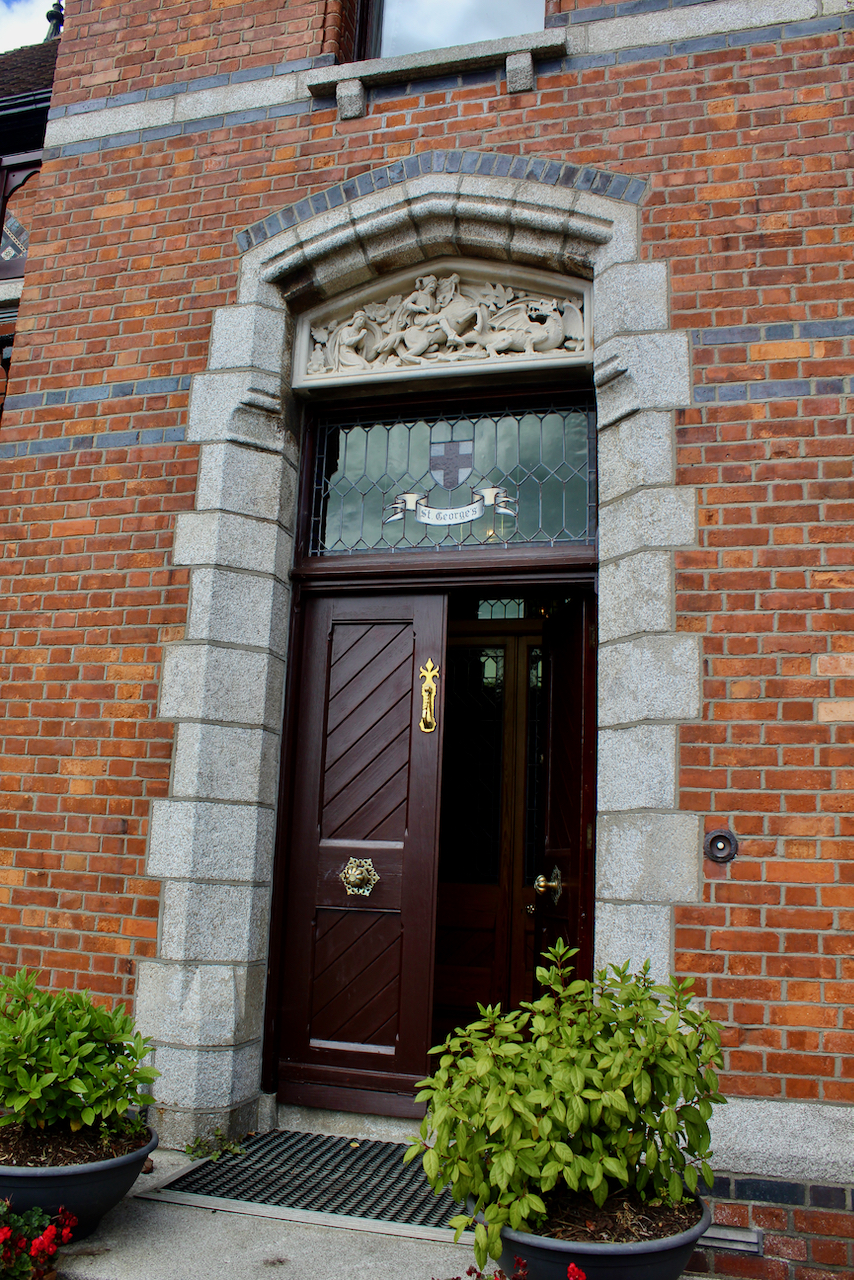
The front door has a leaded fanlight with the cross of St. George, and above, a stone carved tableau of St. George and the dragon. Photograph © Jennifer Winder-Baggot, www.irishhistorichouses.com

Other work listed for Ashlin in the Dictionary of Irish Architects is Enniscorthy Castle, updating it in 1869 for habitation of Isaac Newton Wallop, the 5th Earl of Portsmouth (born as Isaac Newton Fellowes, but later resumed the family surname and arms of Wallop).

Another private residence designed by Ashlin is Clonmeen House in County Cork.

Clonmeen House, County Cork, also designed by Ashlin, for Stephen Grehan in 1893. Photograph courtesy of National Inventory of Architectural Heritage.

Robert McQuillan, the current owner of St. George’s, very generously allowed me to take photographs inside. He and his wife are the fourth owners of St. George’s and have lived there for over thirty years. They have carefully restored and maintained the house.

St. George’s, August 2022. Photograph © Jennifer Winder-Baggot, www.irishhistorichouses.com

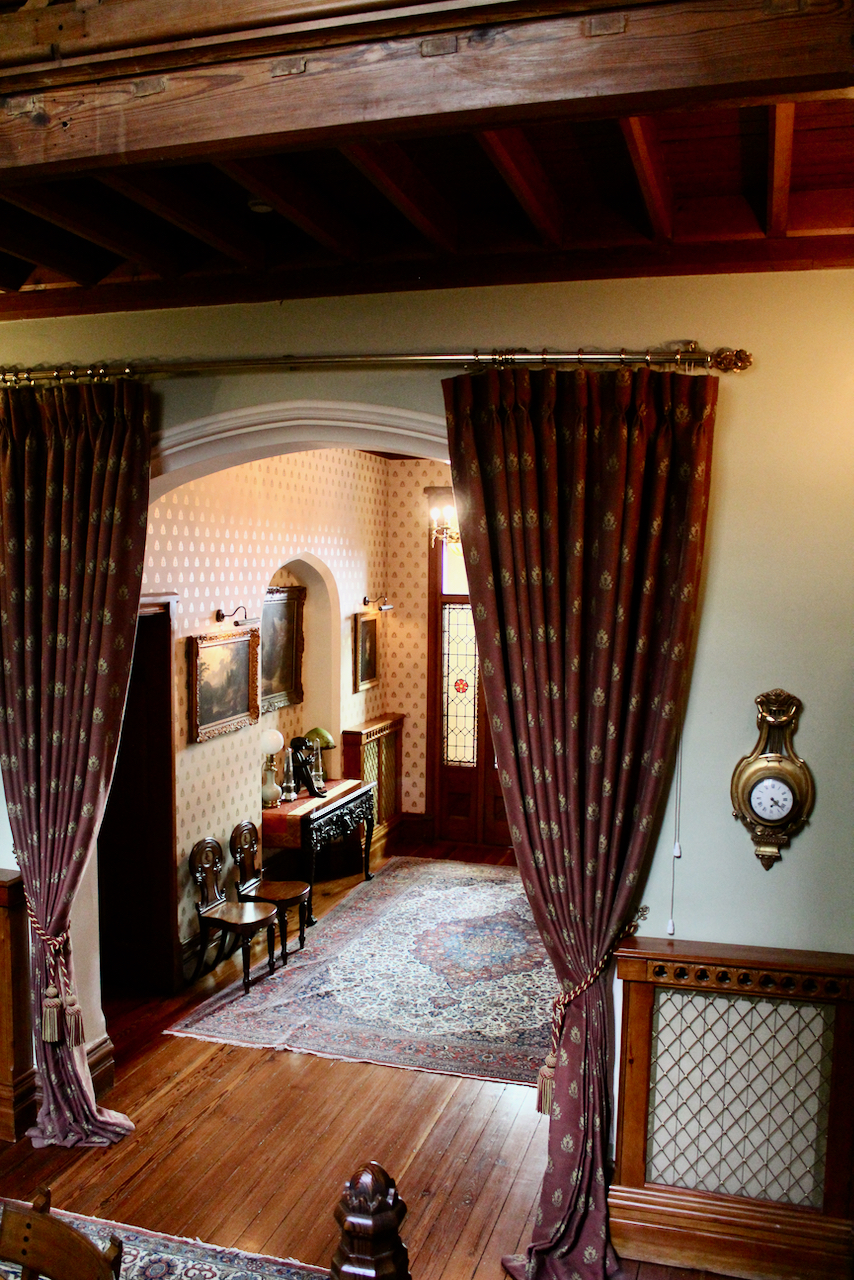
Curtains hang on the back of the front door. The use of portiére rods with drapes were extensively used in Victorian homes to keep out draughts. The wallpaper is modern, supplied by Watts of London, and it copies an original Pugin design. All of the woodwork in the house is the original pitch pine, and has many Gothic details. The ceiling beams in the main hall have moulded ribs. The door to the right before the Tudor arch leads to the dining room, and to the left, the front drawing room.

St. George’s, August 2022. Photograph © Jennifer Winder-Baggot, www.irishhistorichouses.com

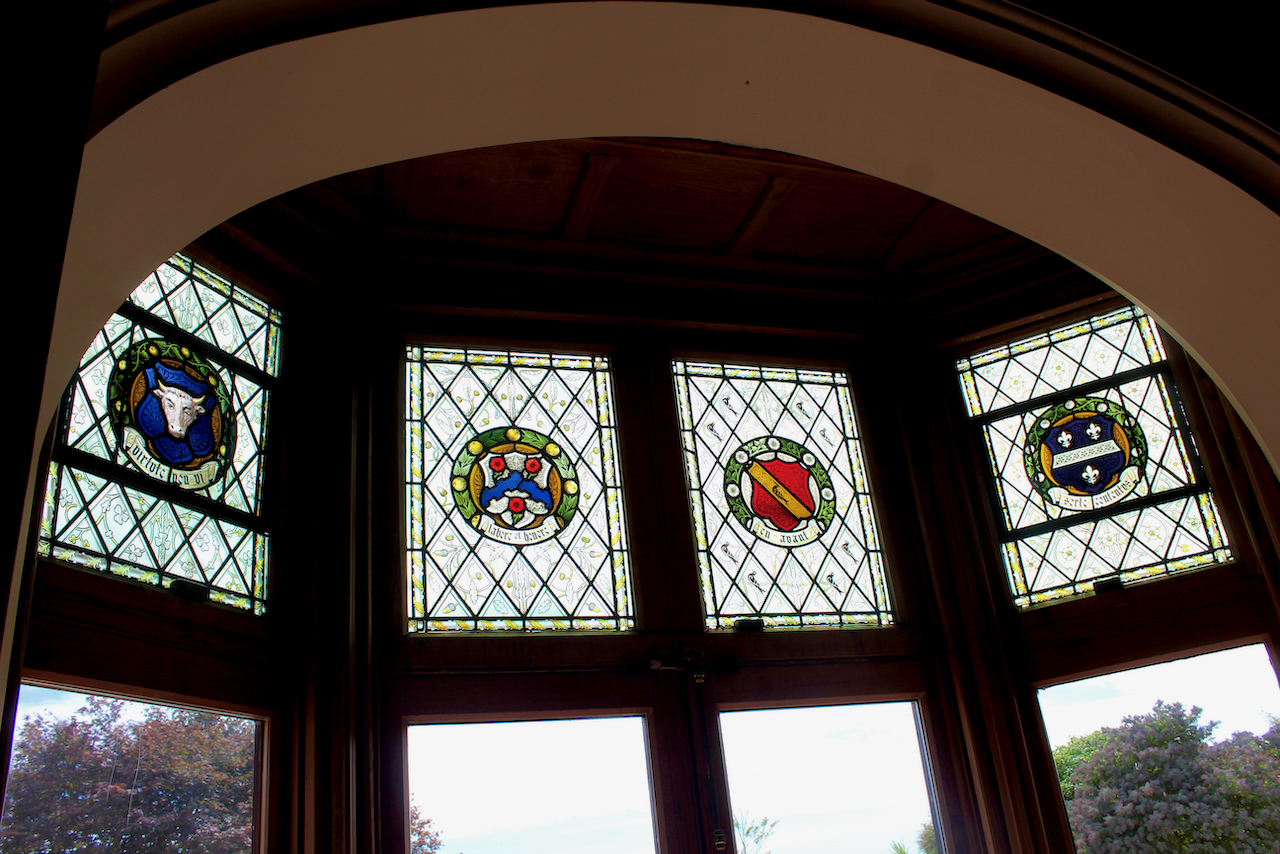
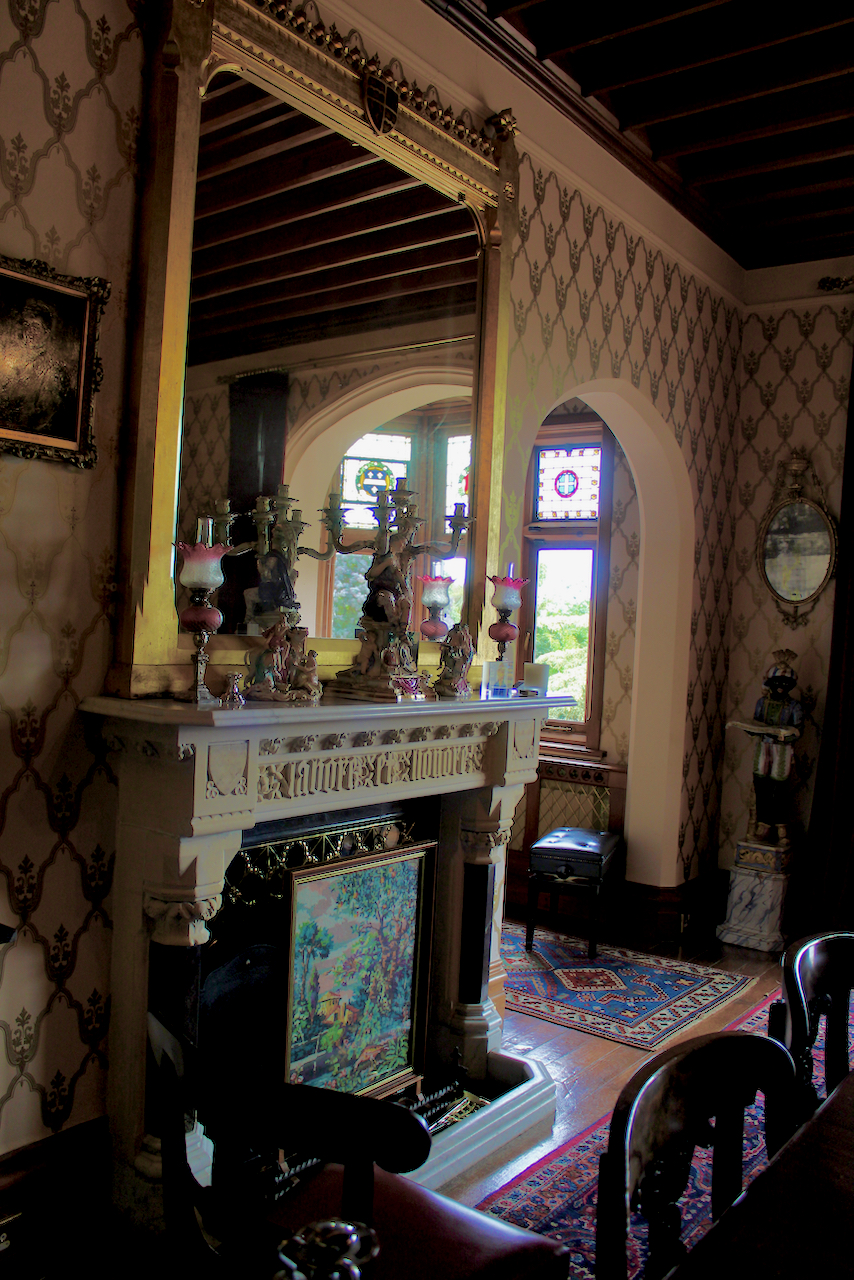
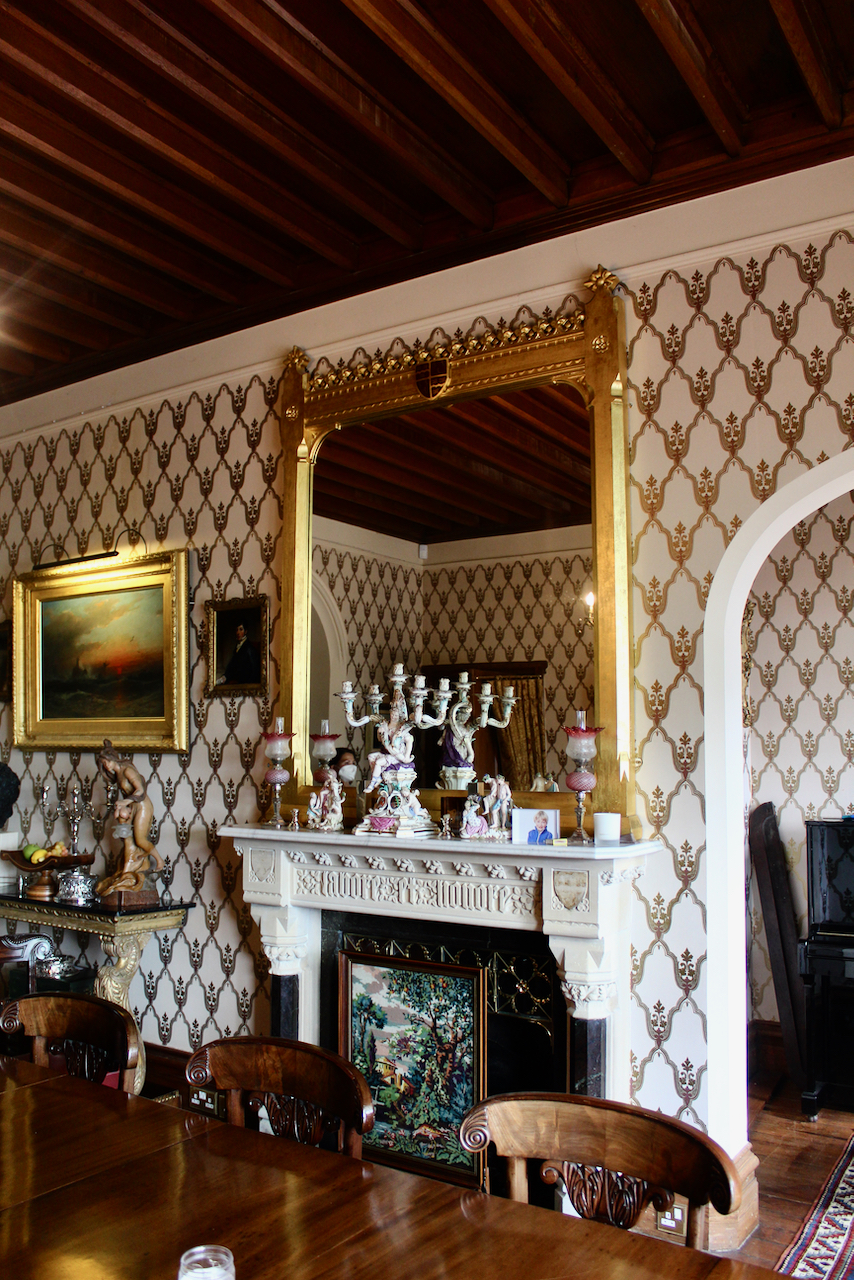
The dining room has a pine ceiling similar to that in the hall. In the bow window on the left is the Ashlin crest and on the right, the Pugin crest. The Gothic designed sandstone fireplace has the Ashlin motto, “Labore et Honore.” The wallpaper design, and that of the drapes, is an original Pugin design.

The Dining Room. Photograph © Jennifer Winder-Baggot, www.irishhistorichouses.com
Stained glass in the canted bay window in the dining room: on the left is the Ashlin crest and on the right, the Pugin crest. Photograph © Jennifer Winder-Baggot, www.irishhistorichouses.com
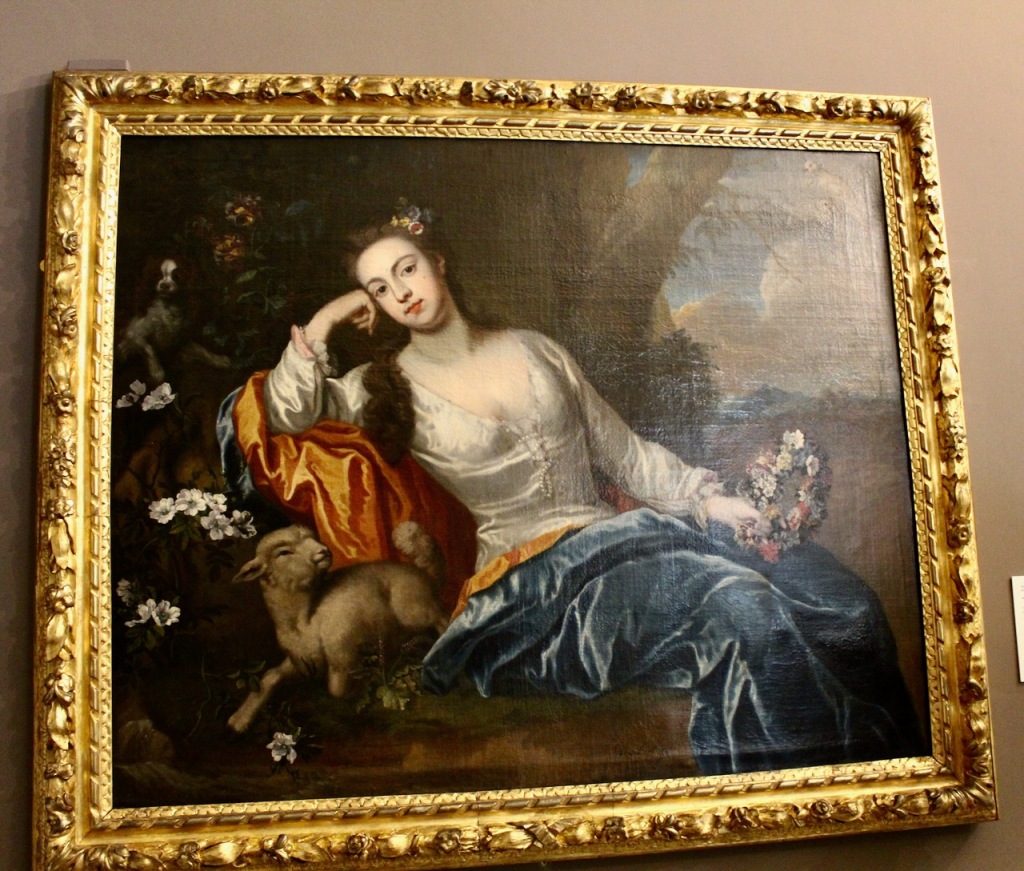
The Portrait in the dining room is of Marguerite, Countess of Blessington. Marguerite (1789-1849) was daughter of Edmund Power, and she married first Maurice St. Leger Farmer, and secondly, Charles John Gardiner, 1st and last Earl of Blessington, son of Luke Gardiner, 1st Viscount Mountjoy. She wrote the book Confessions of an Elderly Gentleman, published 1836, and The Idler in Italy, published between 1839 and 1840, in three volumes. She sounds terrific! I must look up those books! Photograph © Jennifer Winder-Baggot, www.irishhistorichouses.com
The Gothic designed sandstone fireplace has the Ashlin motto, “Labore et Honore.” Photograph © Jennifer Winder-Baggot, www.irishhistorichouses.com
St. George’s, August 2022. Photograph © Jennifer Winder-Baggot, www.irishhistorichouses.com

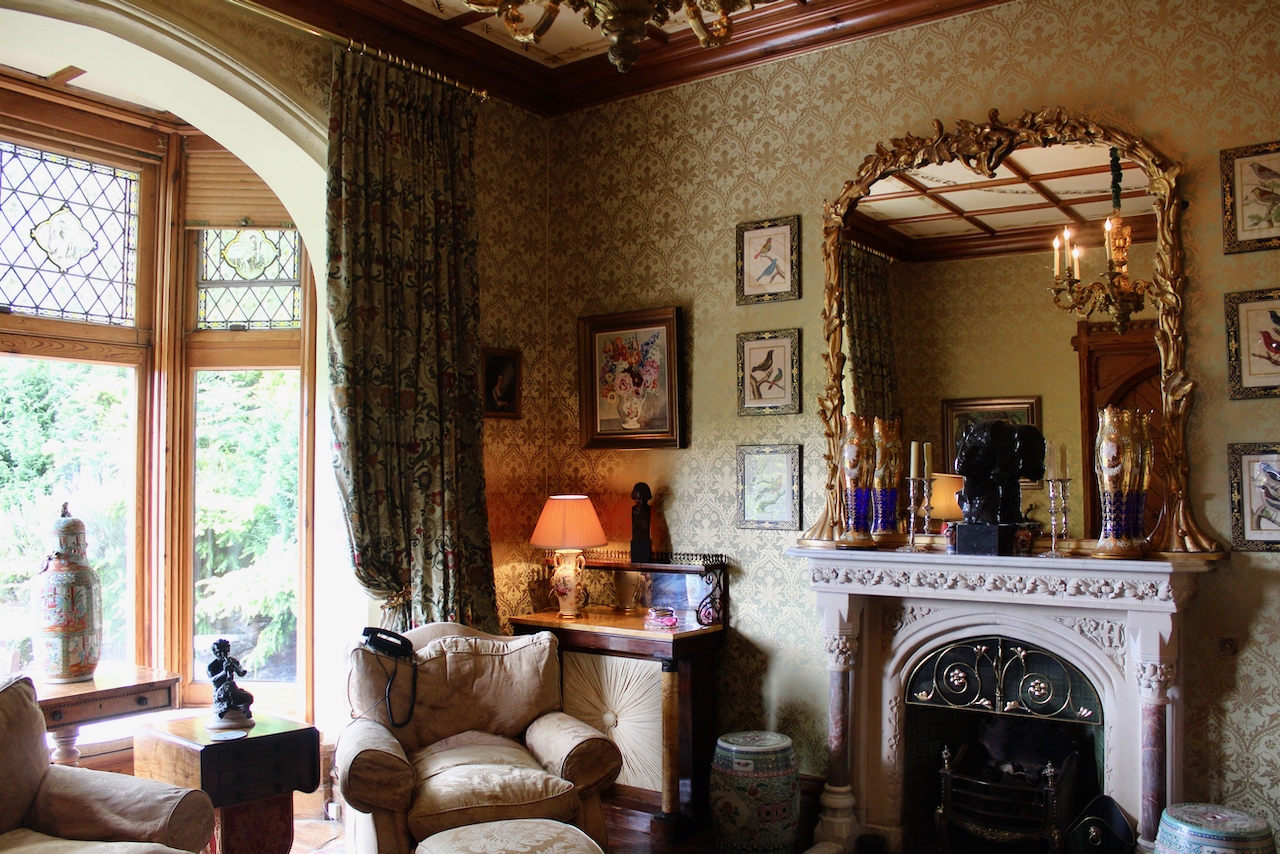
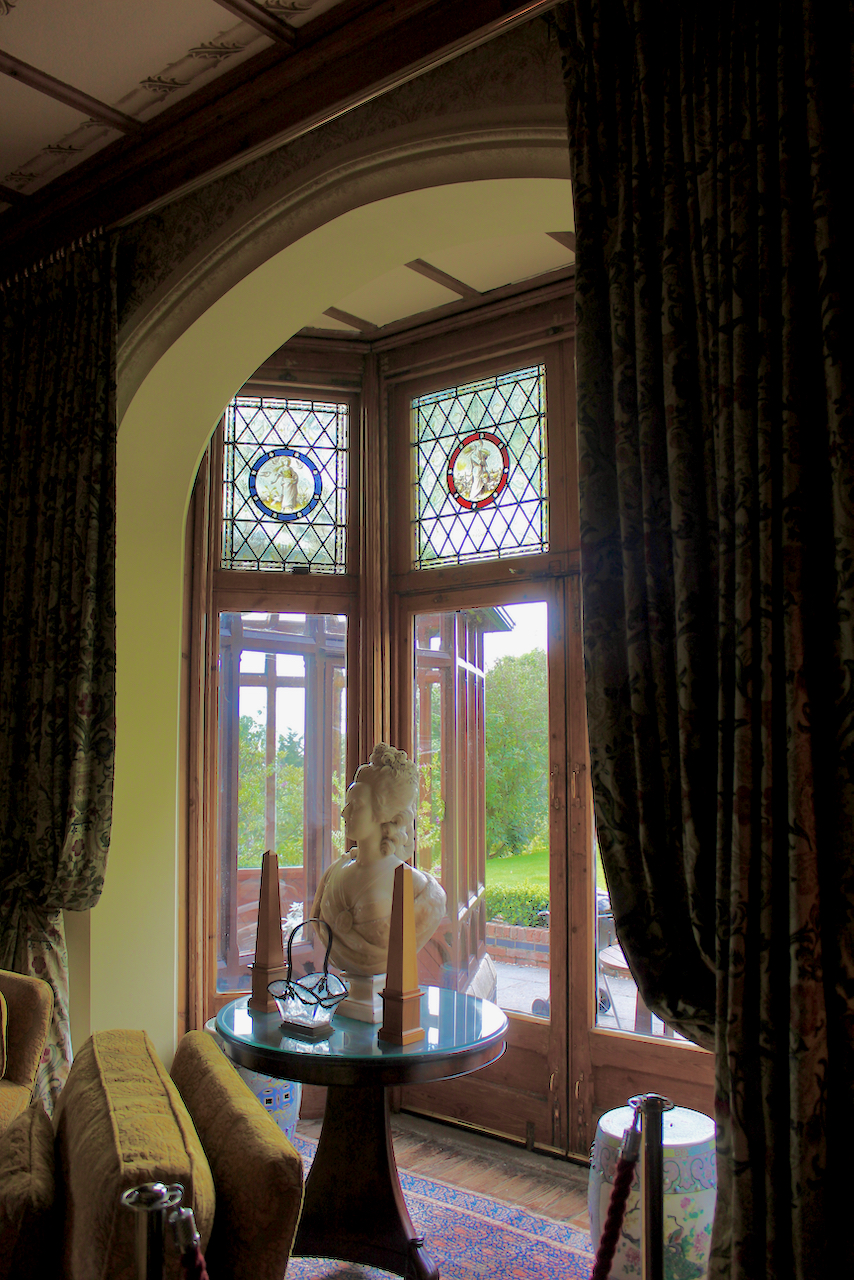
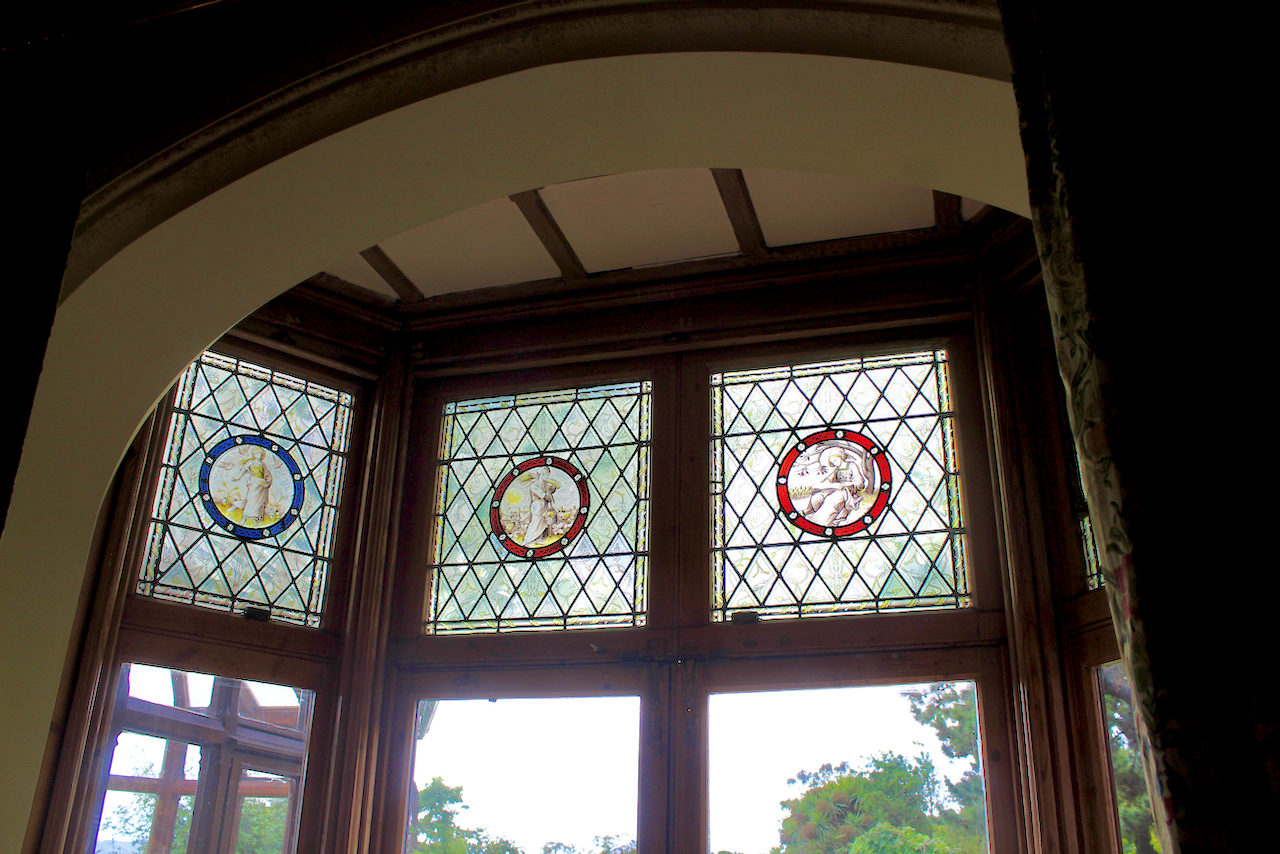
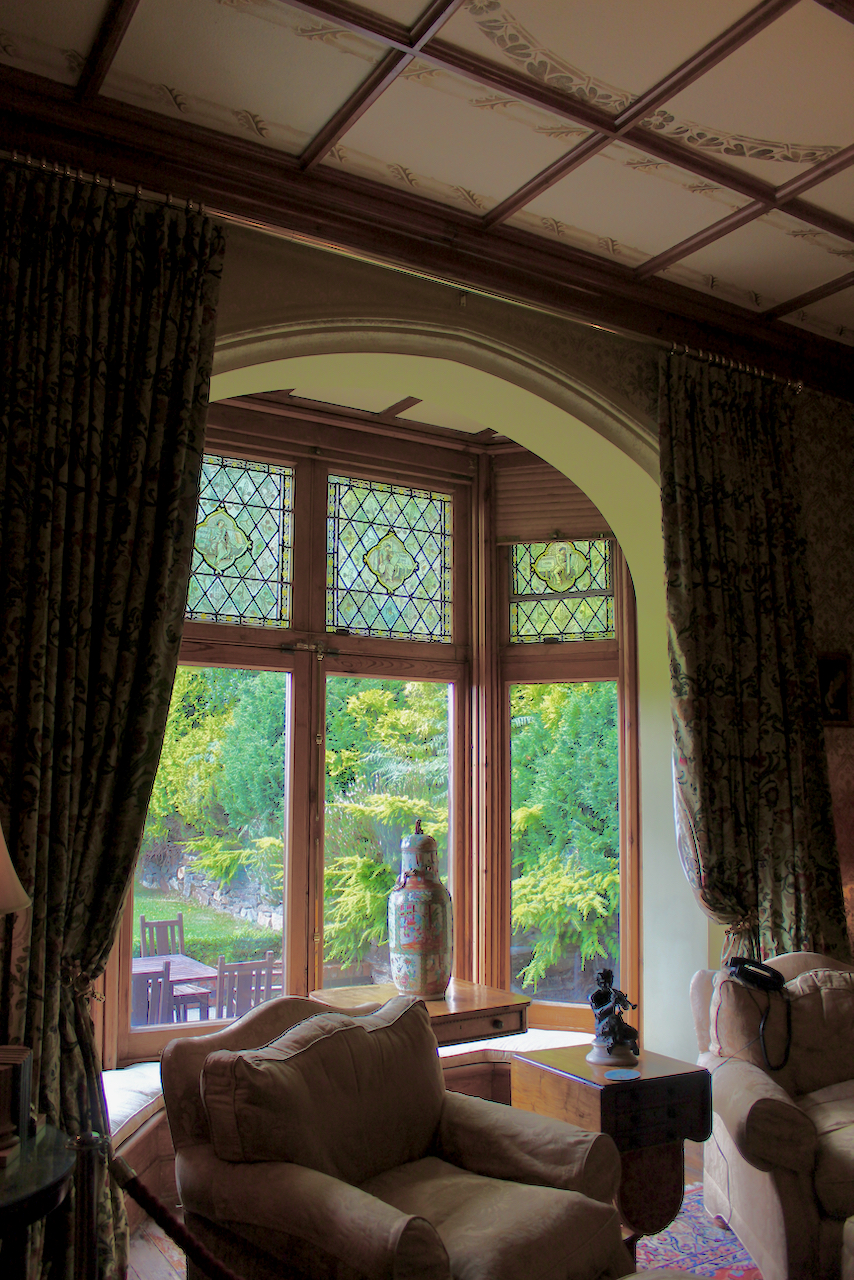
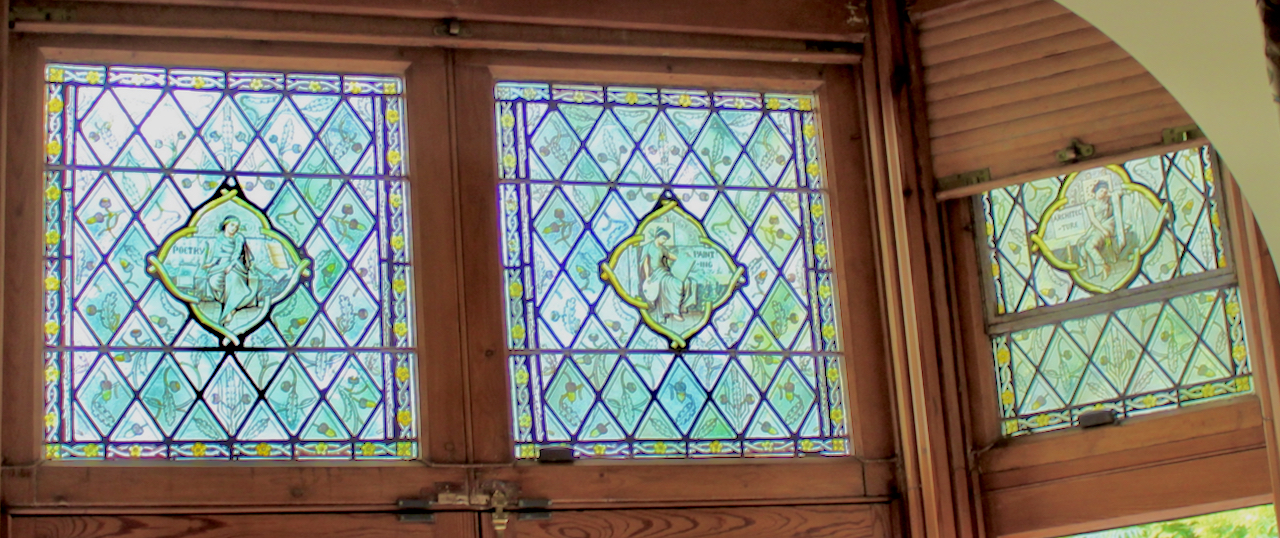
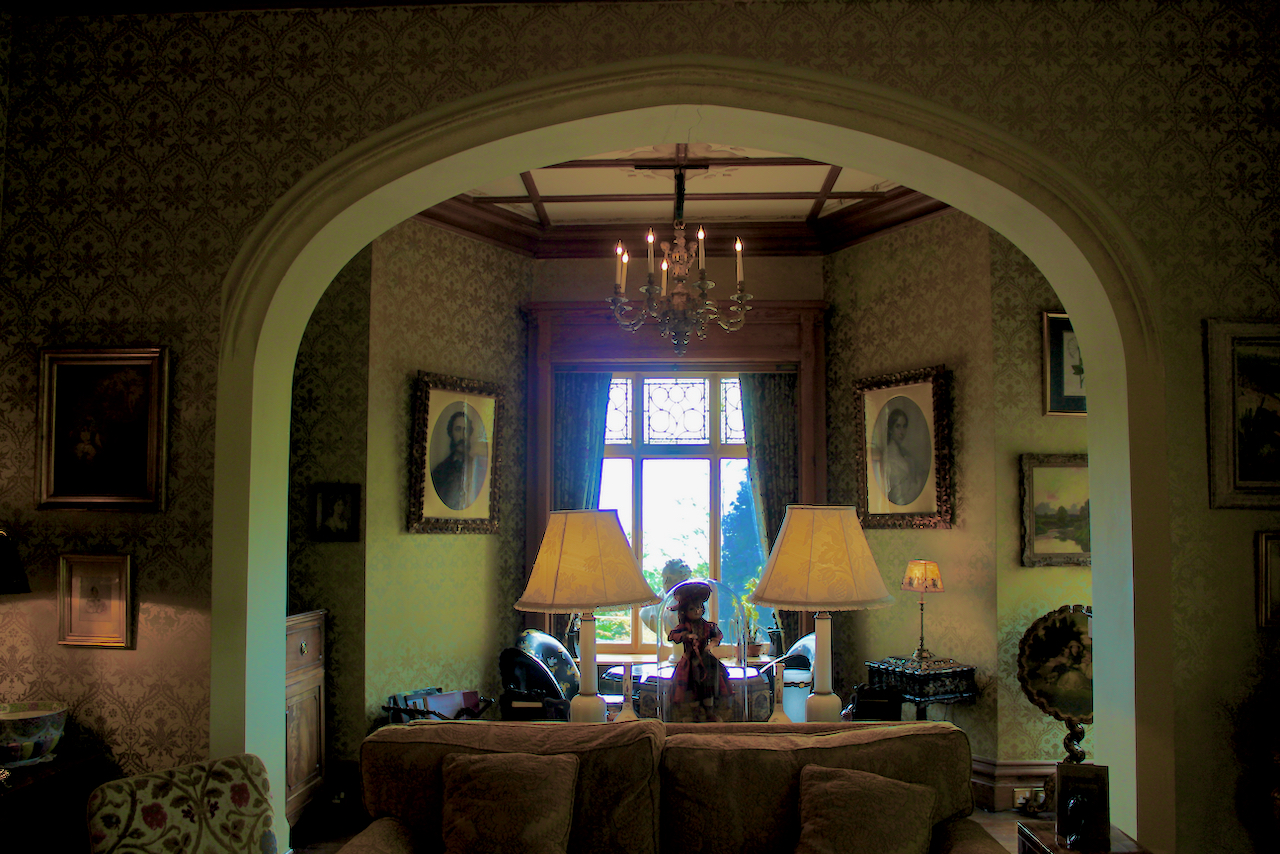
The Front Drawing Room and back study, the leaflet from St. George’s tells us, are interconnecting spaces in the manner of Pugin’s design for The Grange where Ashlin’s wife grew up. Again, the wallpaper and drapes are of Pugin’s design. The fireplace has the inscribed initials of G.A. for George Ashlin. The ceiling is stencilled, which is a feature of Pugin’s domestic designs. The area beyond the arch was initially a Gothic conservatory. There are two canted bays, one with French doors out to the lawn. The stained glass panels in one depict the four seasons and in the other, figures of music, painting, poetry and architecture.

St. George’s, August 2022. Photograph © Jennifer Winder-Baggot, www.irishhistorichouses.com
The stained glass panels depict the four seasons. Photograph © Jennifer Winder-Baggot, www.irishhistorichouses.com
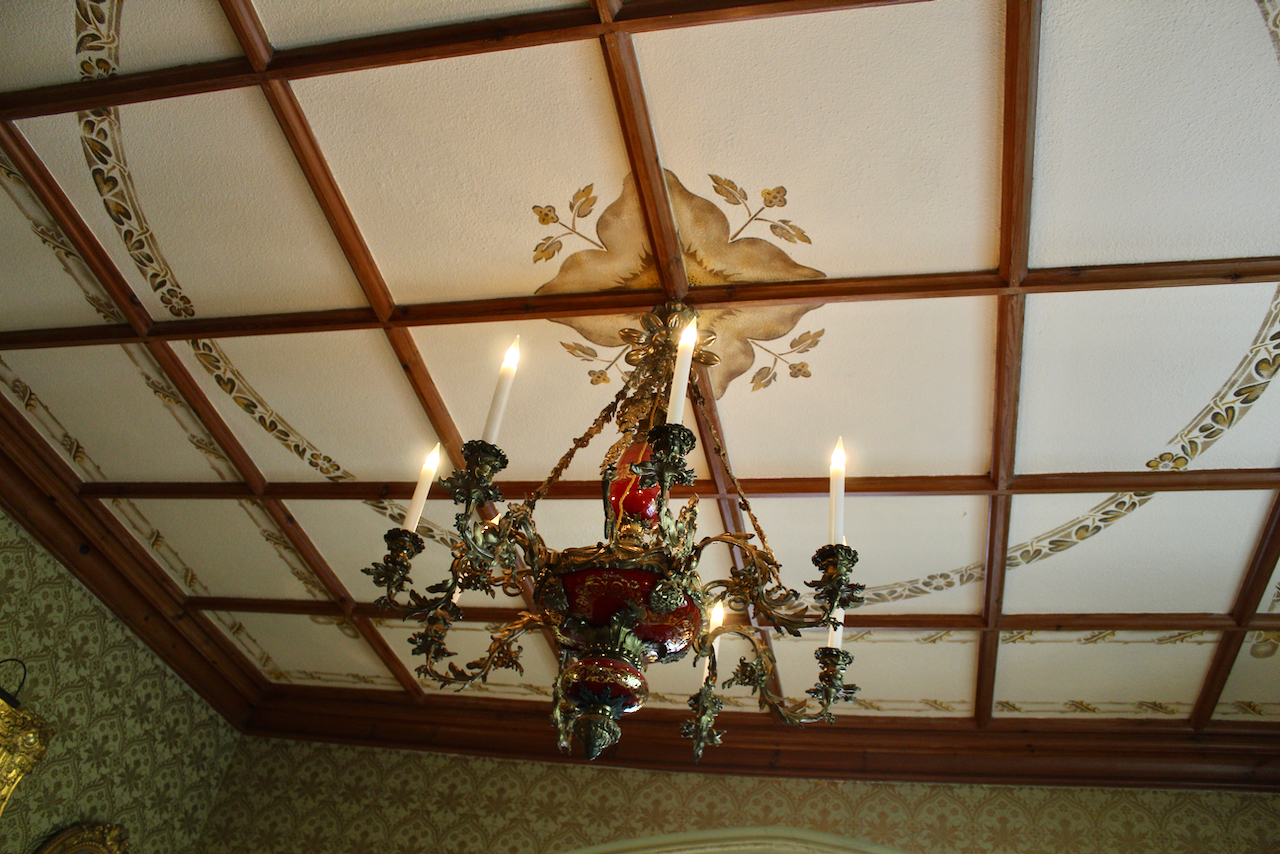
The ceiling is stencilled, which is a feature of Pugin’s domestic designs. The chandelier has lovely red glass. Photograph © Jennifer Winder-Baggot, www.irishhistorichouses.com
The fireplace in the drawing room had insets of pink marble and a delicate brass floral and spiral decoration, and has the inscribed initials of G.A. for George Ashlin. Photograph © Jennifer Winder-Baggot, www.irishhistorichouses.com
St. George’s, August 2022. Photograph © Jennifer Winder-Baggot, www.irishhistorichouses.com
The windows feature figures of music, painting, poetry and architecture. Photograph © Jennifer Winder-Baggot, www.irishhistorichouses.com

The front drawing room leads into the back study. The arch can be closed with a sliding intramural mirrored door.

St. George’s, August 2022. Photograph © Jennifer Winder-Baggot, www.irishhistorichouses.com
The door handles throughout the house feature an “A” for Ashlin. Photograph © Jennifer Winder-Baggot, www.irishhistorichouses.com

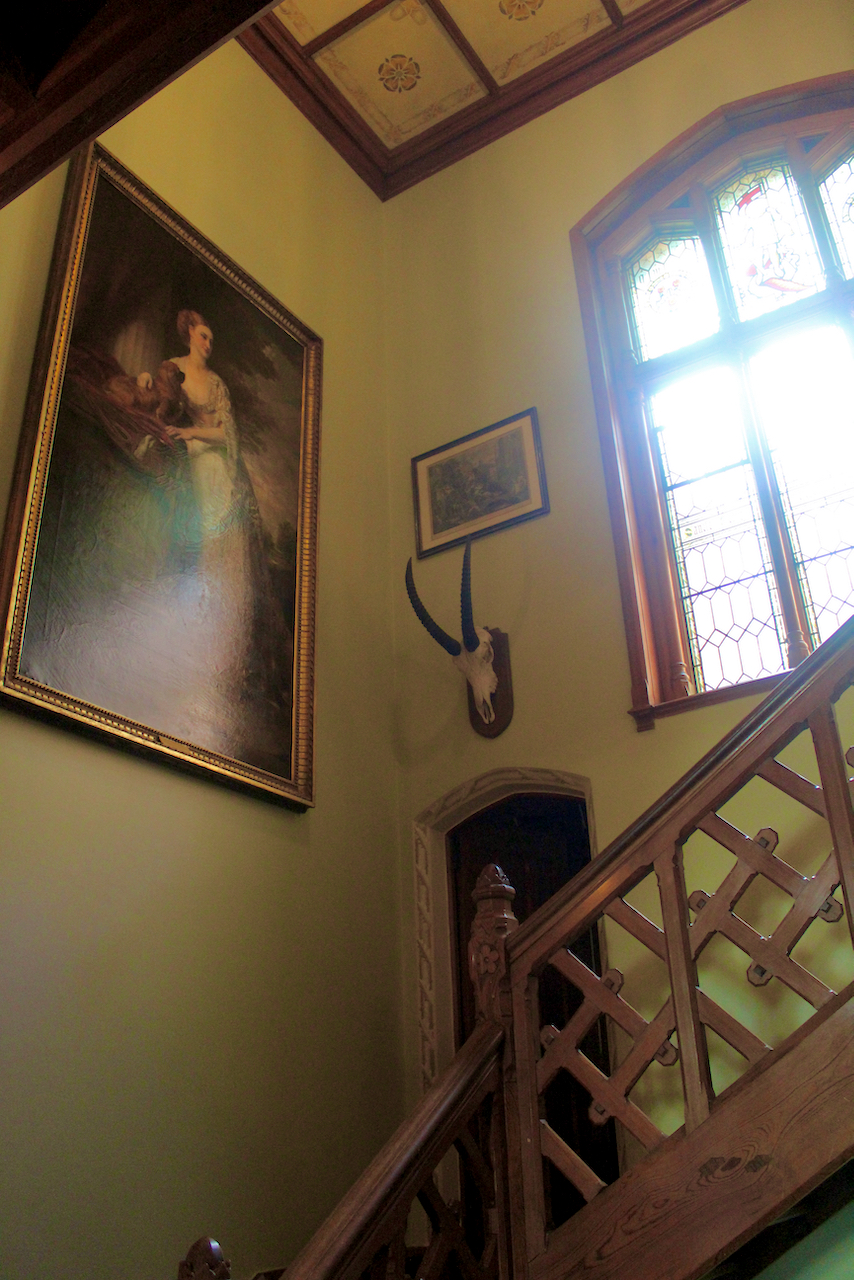
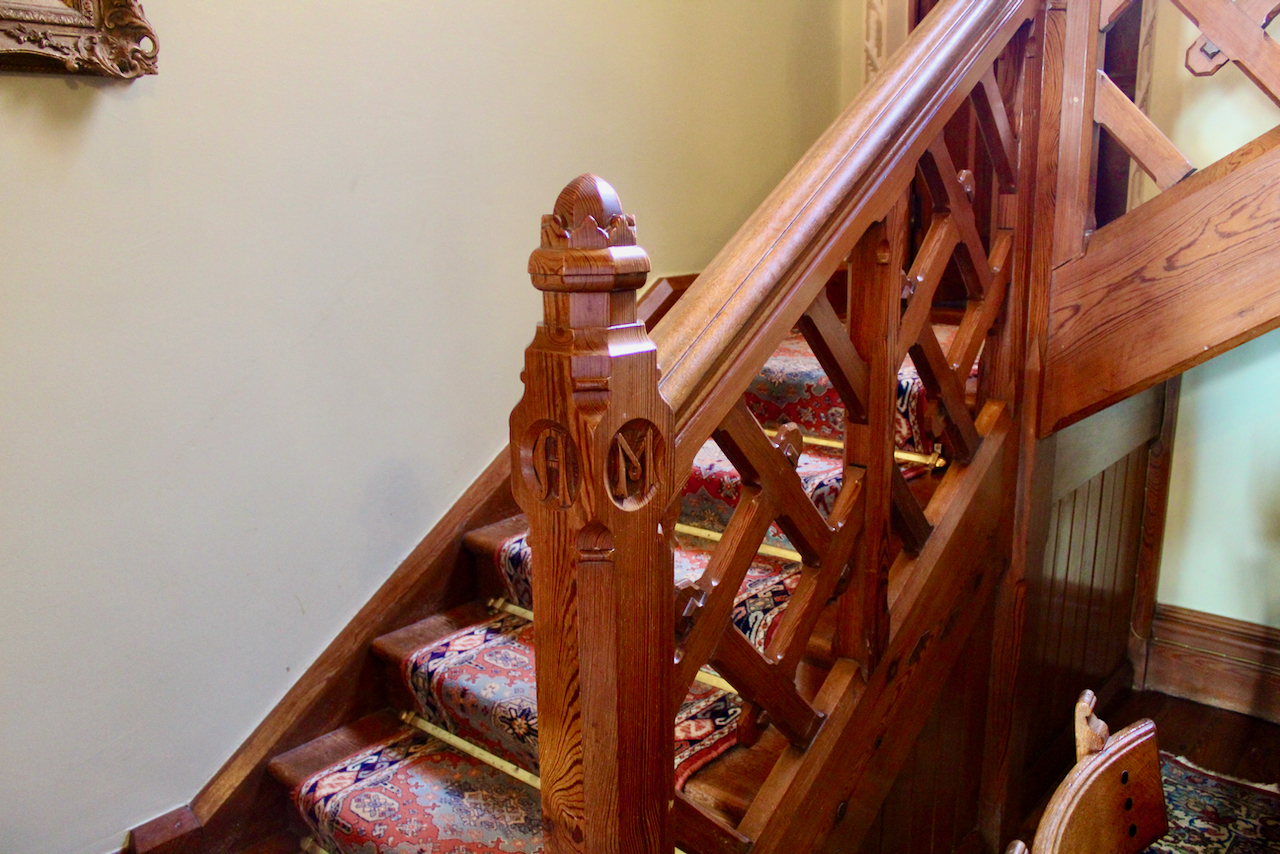
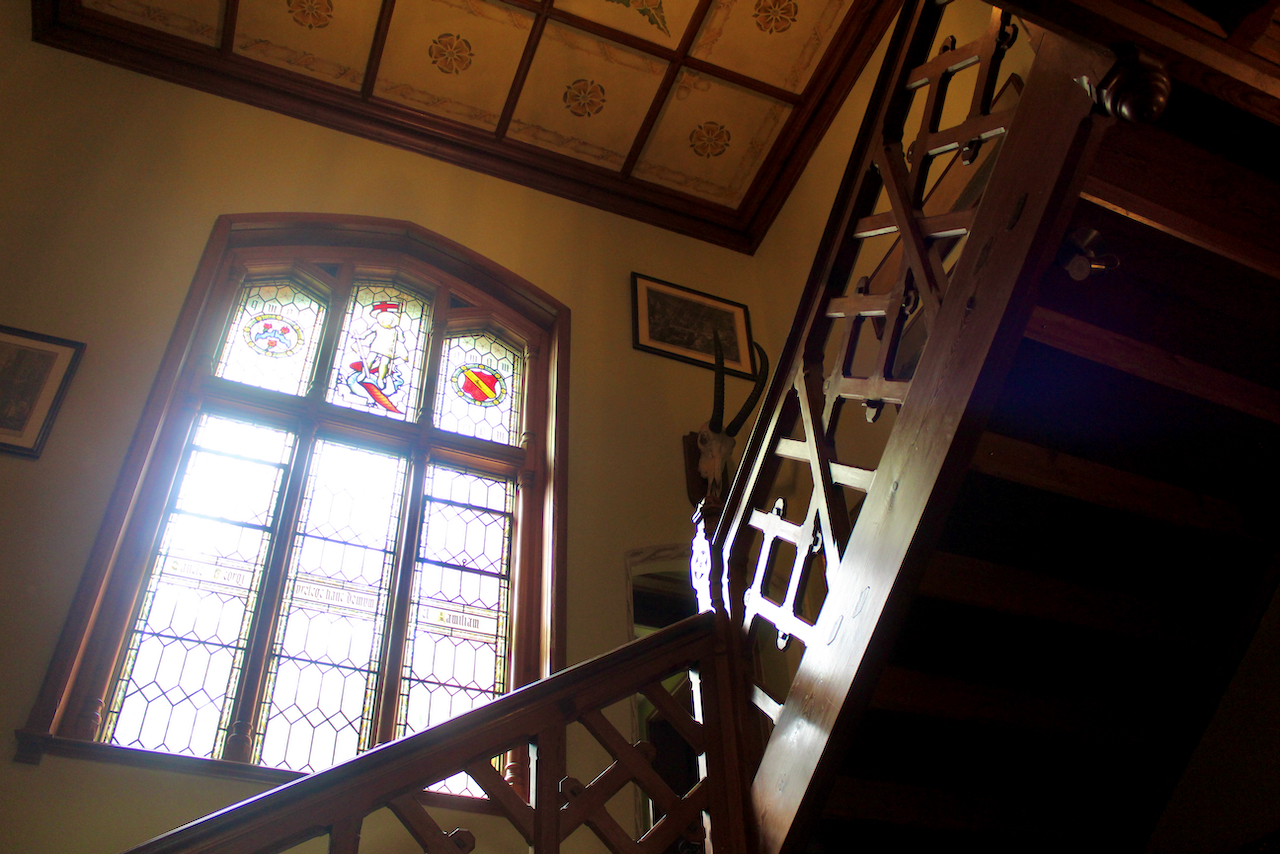
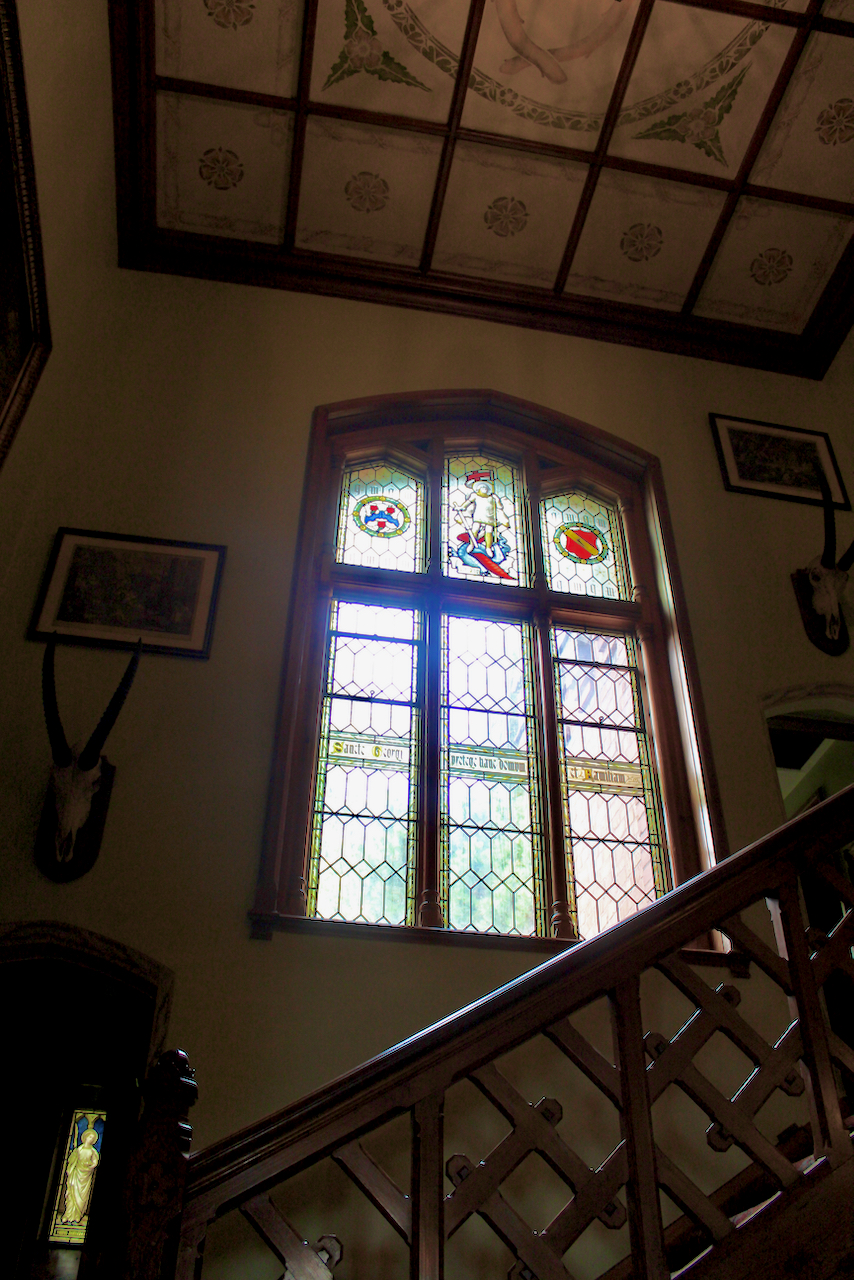
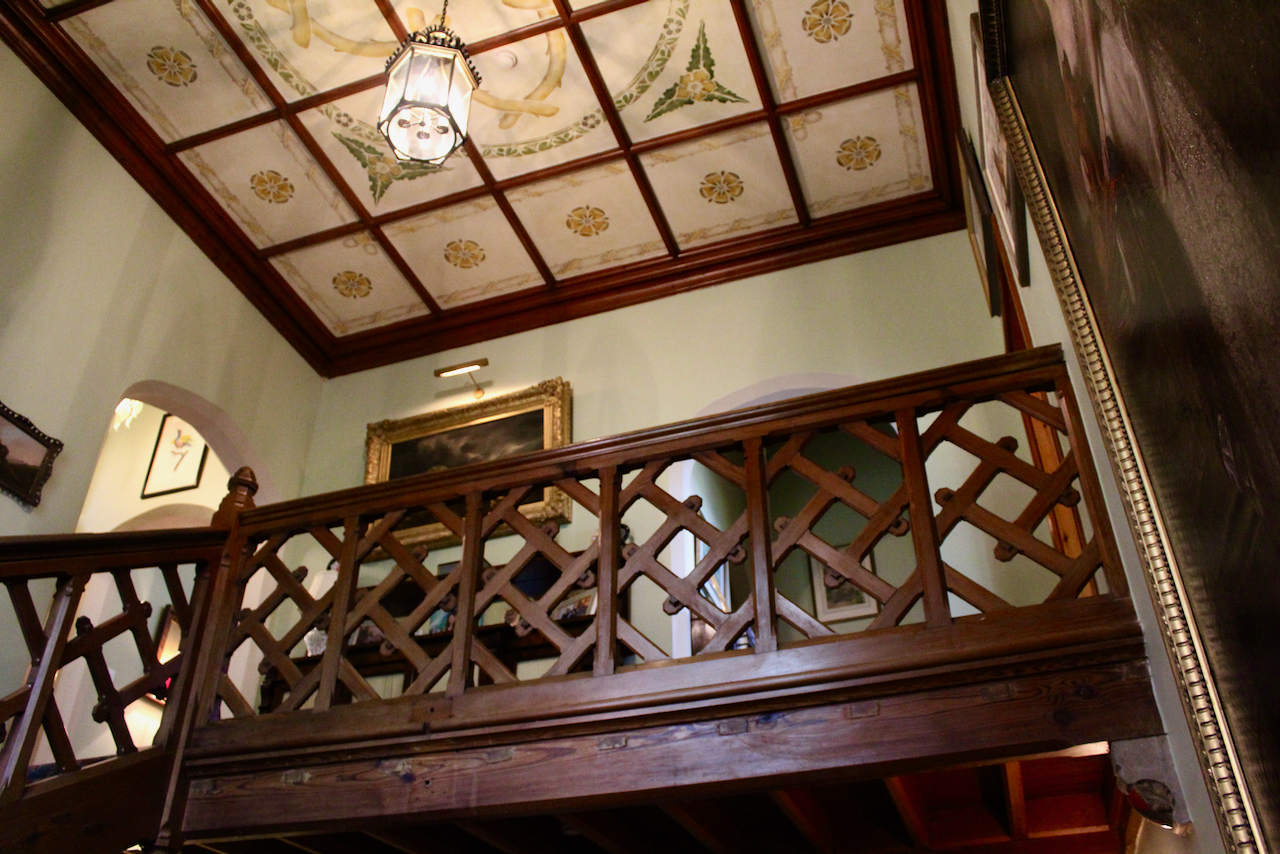
The Back Hall is double height, with a pitch pine staircase winding around the sides. The staircase is similar to that in Mary Pugin’s childhood home, The Grange. The stairs feature St. Brigid cross shapes and on the newels, more initials carved for George and Mary.

The stairs feature St. Brigid cross shapes. Photograph © Jennifer Winder-Baggot, www.irishhistorichouses.com
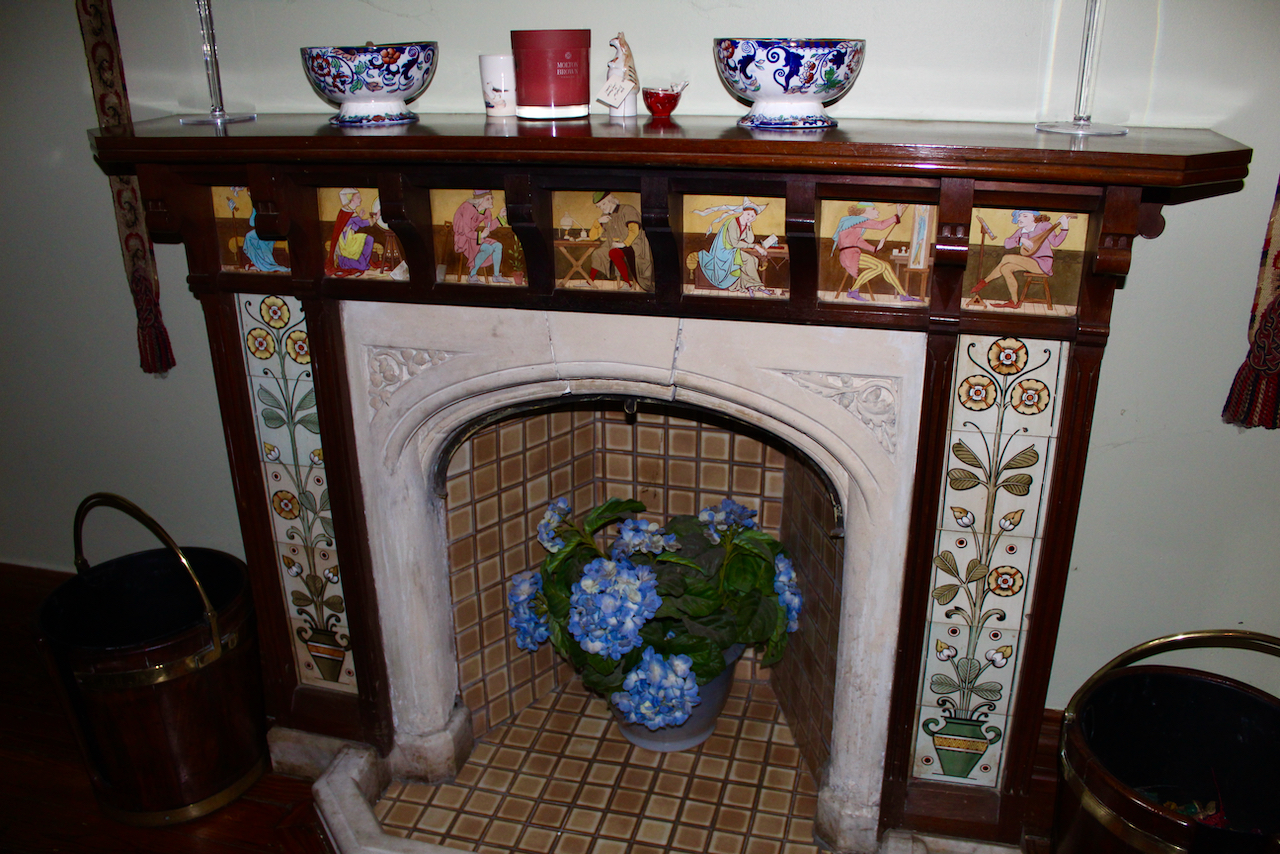
The Back Hall. The fireplace has tiles depicting various arts and crafts. Photograph © Jennifer Winder-Baggot, www.irishhistorichouses.com

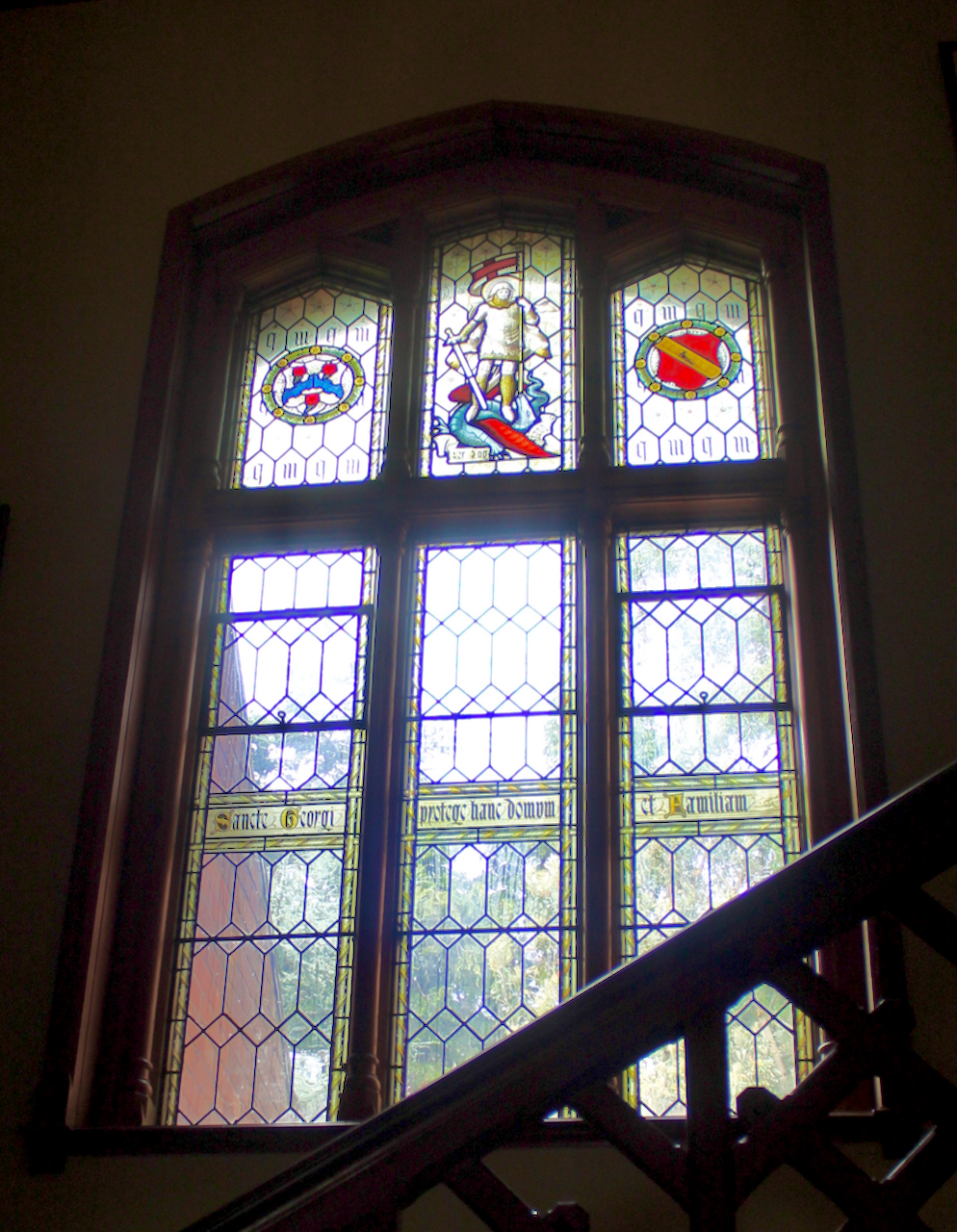
The window which lights the stairs is a three light window in heavy timbered frame with vertical glazed panels. The stained glass depicts St. George, and on one side is the Ashlin crest and the other, the Pugin crest, with G. (George) and M. (Mary) initials.

St. George’s, August 2022. Photograph © Jennifer Winder-Baggot, www.irishhistorichouses.com
The stairs have the initials also, A for Ashlin, M for Mary. Photograph © Jennifer Winder-Baggot, www.irishhistorichouses.com
St. George’s, August 2022. Photograph © Jennifer Winder-Baggot, www.irishhistorichouses.com
To the left, you can see the stained glass of the chapel which is on the half landing. Photograph © Jennifer Winder-Baggot, www.irishhistorichouses.com

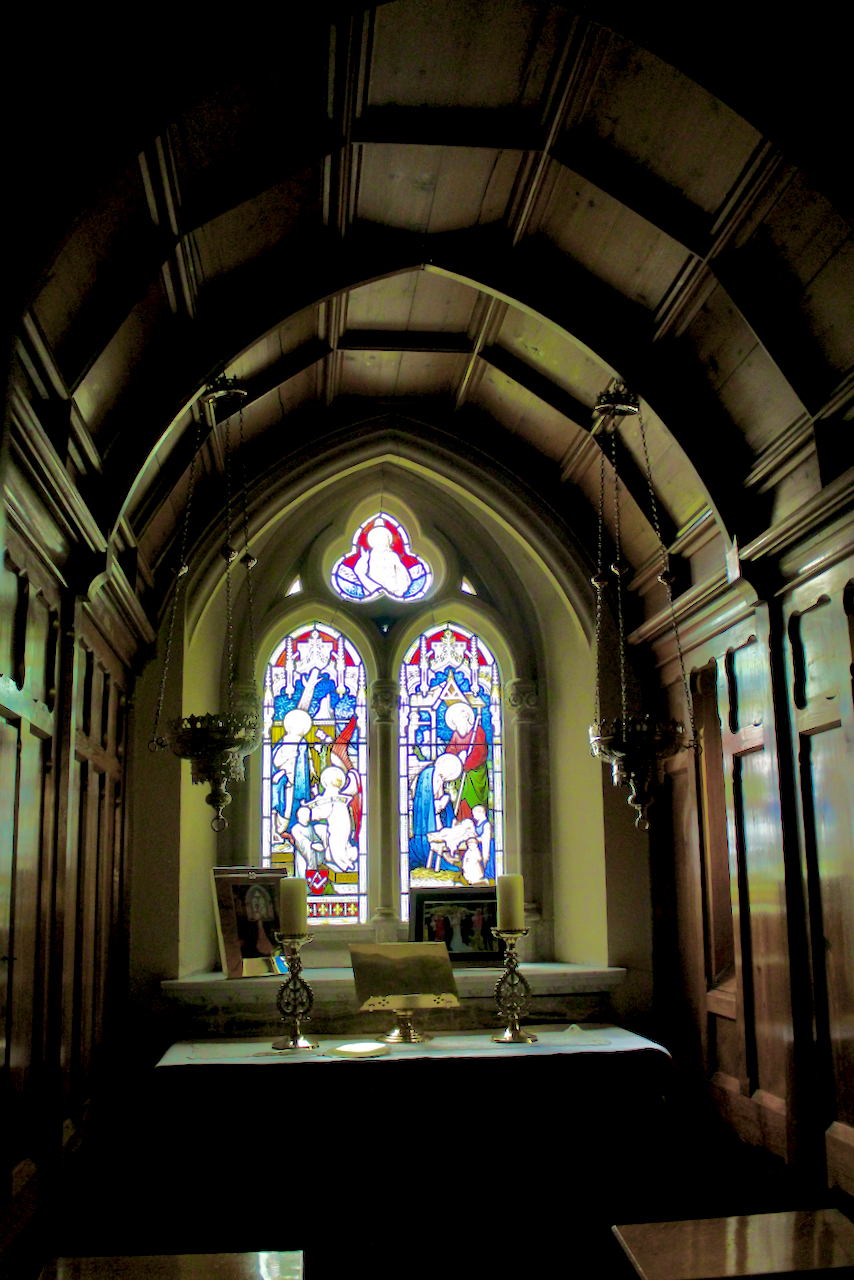
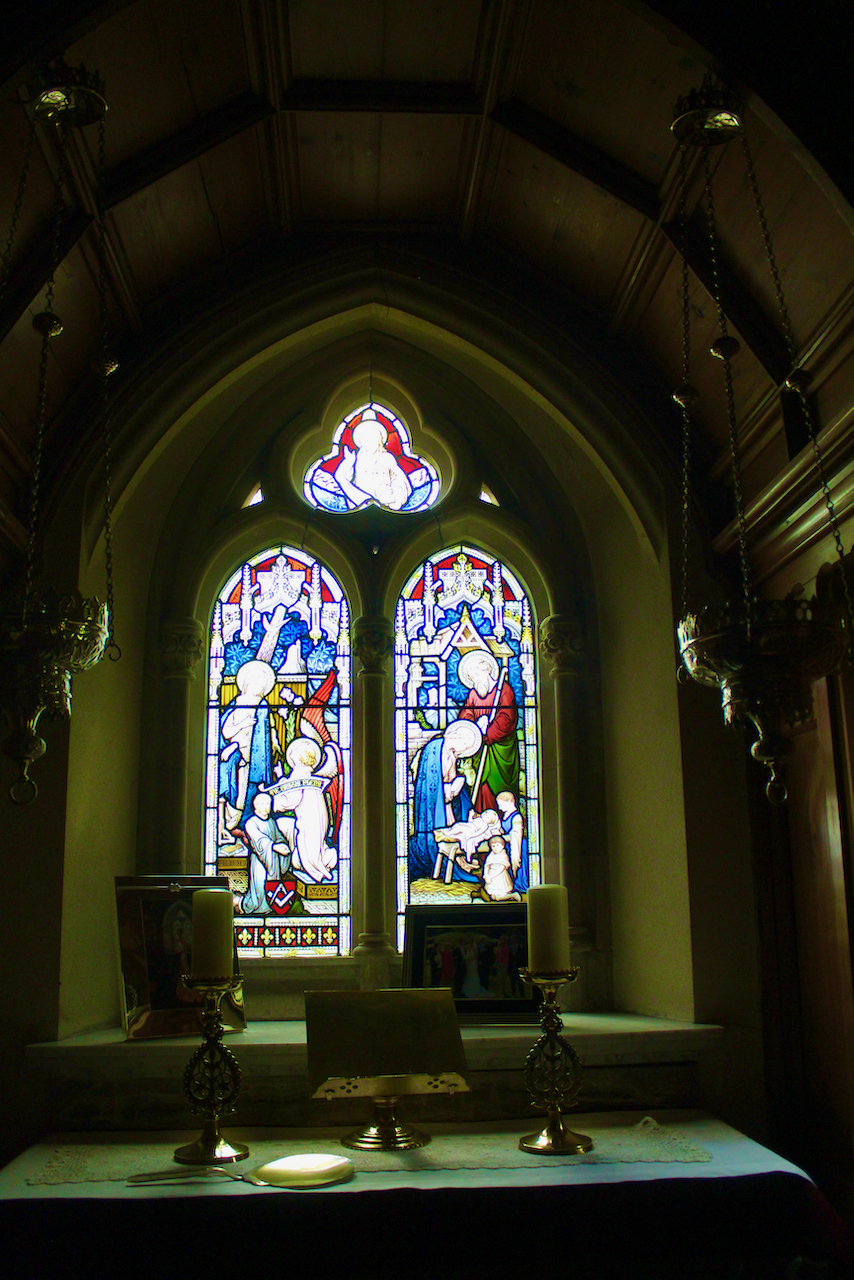
The chapel was built following the birth of George and Mary’s only child, their daughter Miriam. It is panelled with a timber “wagon vault.” The stained glass was designed by Mary Pugin.

St. George’s, August 2022. Photograph © Jennifer Winder-Baggot, www.irishhistorichouses.com
To the left of the Nativity scene there is a picture of George Ashlin kneeling over a crest with the symbols for architecture. Photograph © Jennifer Winder-Baggot, www.irishhistorichouses.com

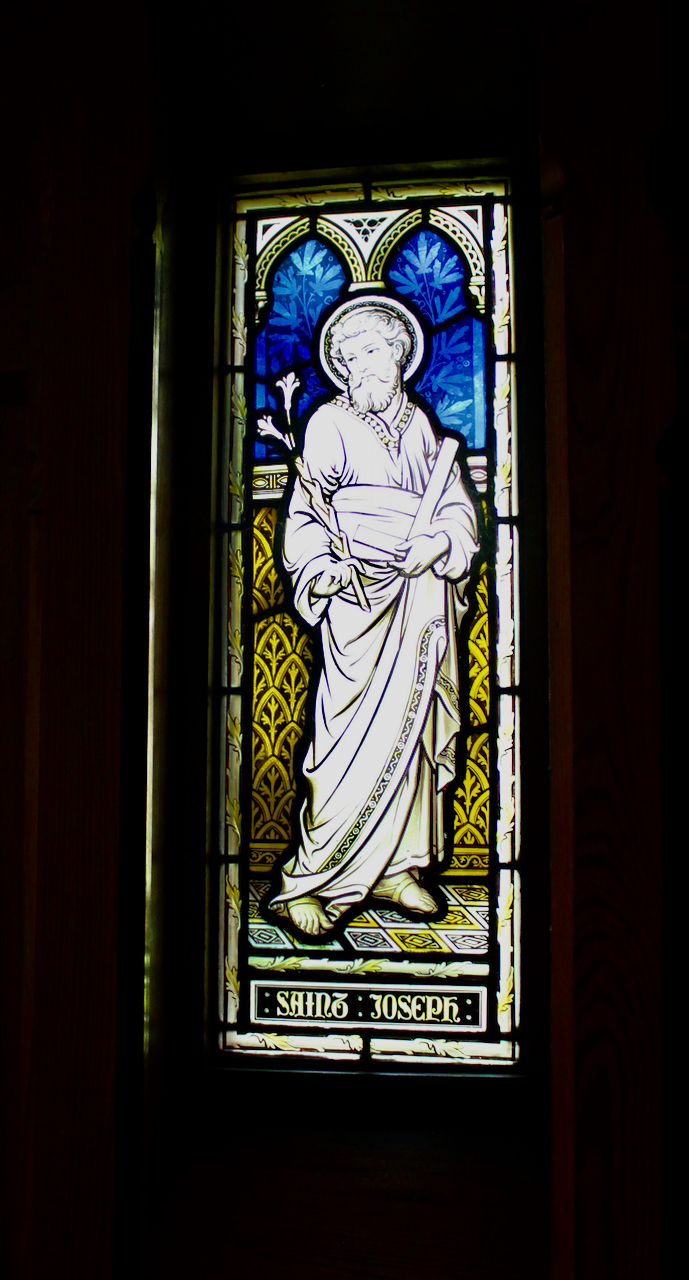
Pictures of many saints are featured in stained glass in the chapel, including St. Dorothea, St. Francis Xavier, St. Joseph and St. George, and there is a beautifully carved altar. George’s mother was named Dorothea (née Coppinger).

St. George’s, August 2022. Photograph © Jennifer Winder-Baggot, www.irishhistorichouses.com

The bedrooms are placed facing the sea and to the south, with bathrooms at the back of the house. The bedroom in front was probably Mary’s, as it has the initials “M.A.” in the fireplace. The stained glass in that room contains symbols of the Ashlin-Pugin marriage.

St. George’s, August 2022. Photograph © Jennifer Winder-Baggot, www.irishhistorichouses.com

The bathrooms are modern but of a suitable Victorian style.

The bathrooms are modern but of a suitable Victorian style, which I love. Photograph © Jennifer Winder-Baggot, www.irishhistorichouses.com
St. George’s, August 2022. Photograph © Jennifer Winder-Baggot, www.irishhistorichouses.com

The bedroom next to this has “D.A.” in the fireplace, which is probably for George’s mother Dorothea.

St. George’s, August 2022. Photograph © Jennifer Winder-Baggot, www.irishhistorichouses.com
The stained glass in this room shows symbols of the Pugin-Ashlin marriage, and more initials. Photograph © Jennifer Winder-Baggot, www.irishhistorichouses.com
St. George’s, August 2022. Photograph © Jennifer Winder-Baggot, www.irishhistorichouses.com

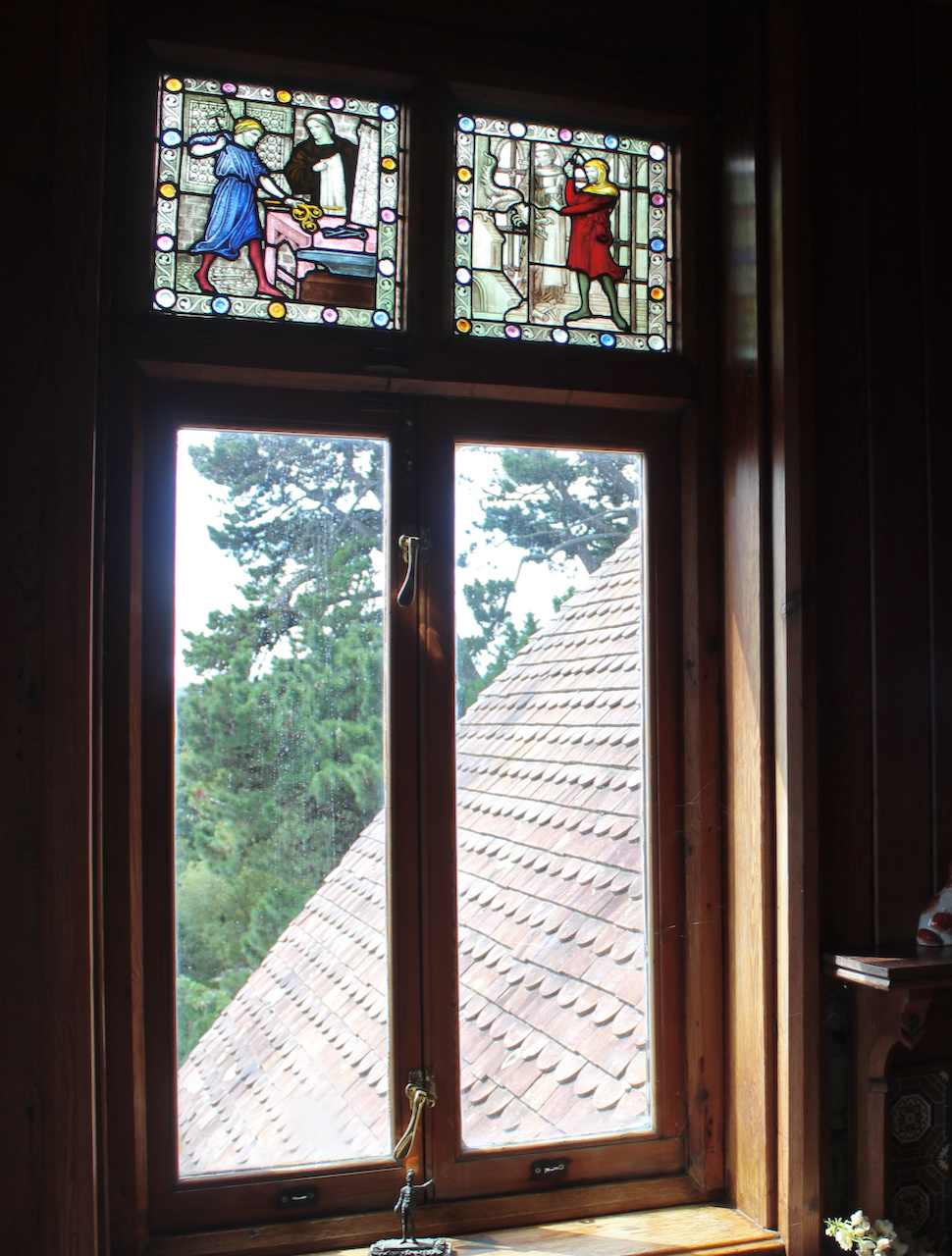
The library is located at the top of an “elbow stairs.” It is completely covered in pitch pine and has a magnificent view of the coast. The stained glass is signed “Frampton” and dated to 1880.

St. George’s, August 2022. Photograph © Jennifer Winder-Baggot, www.irishhistorichouses.com

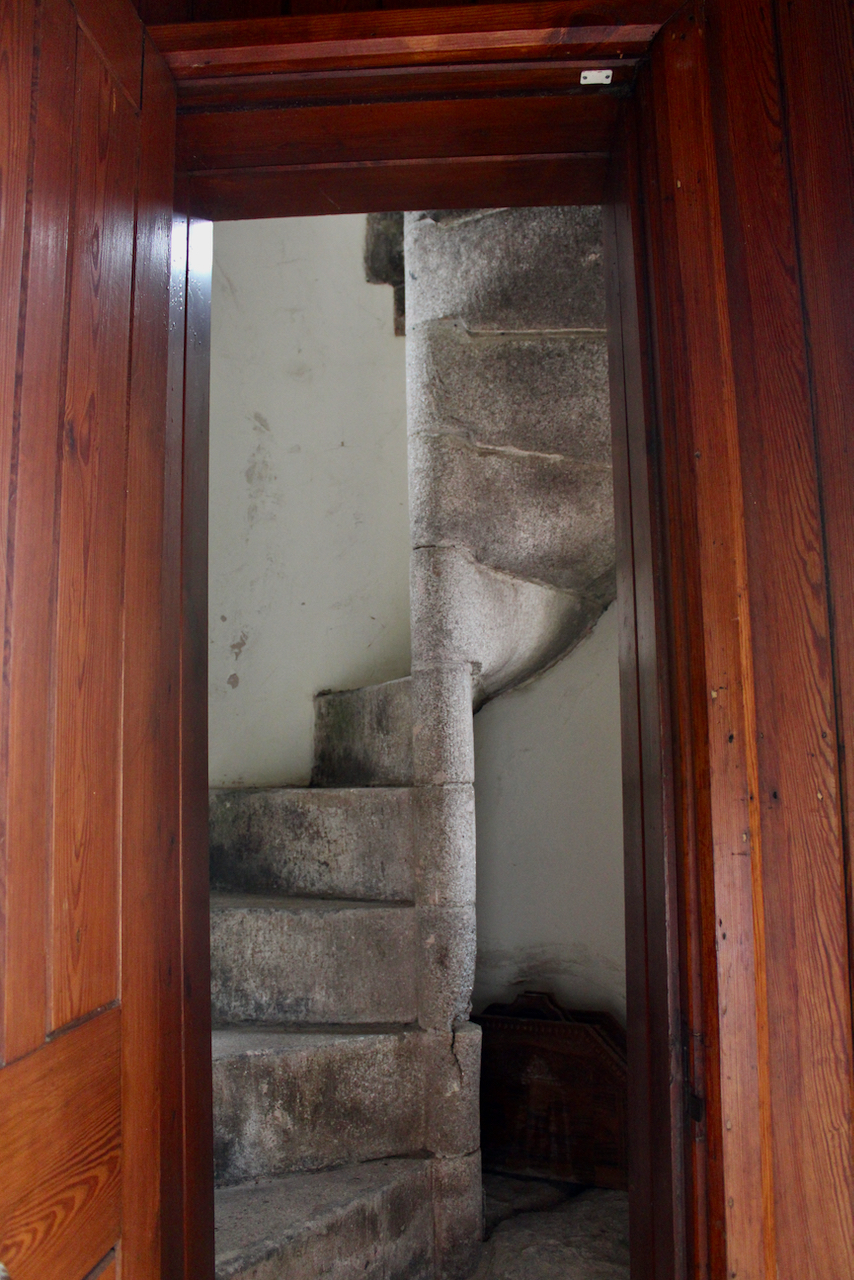
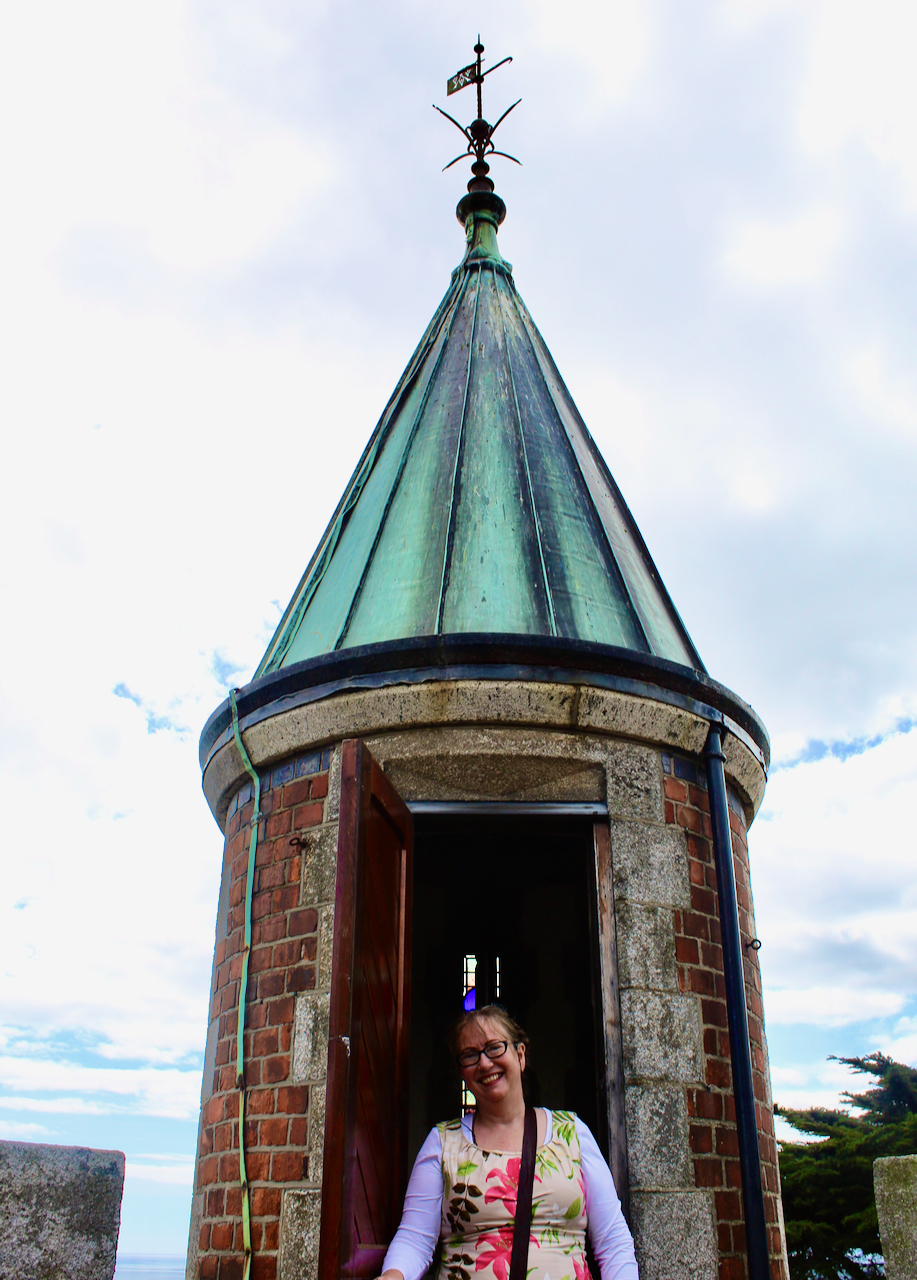
There is a door in the corner which leads to a spiral granite staircase up on to the turret.

St. George’s, August 2022. Photograph © Jennifer Winder-Baggot, www.irishhistorichouses.com
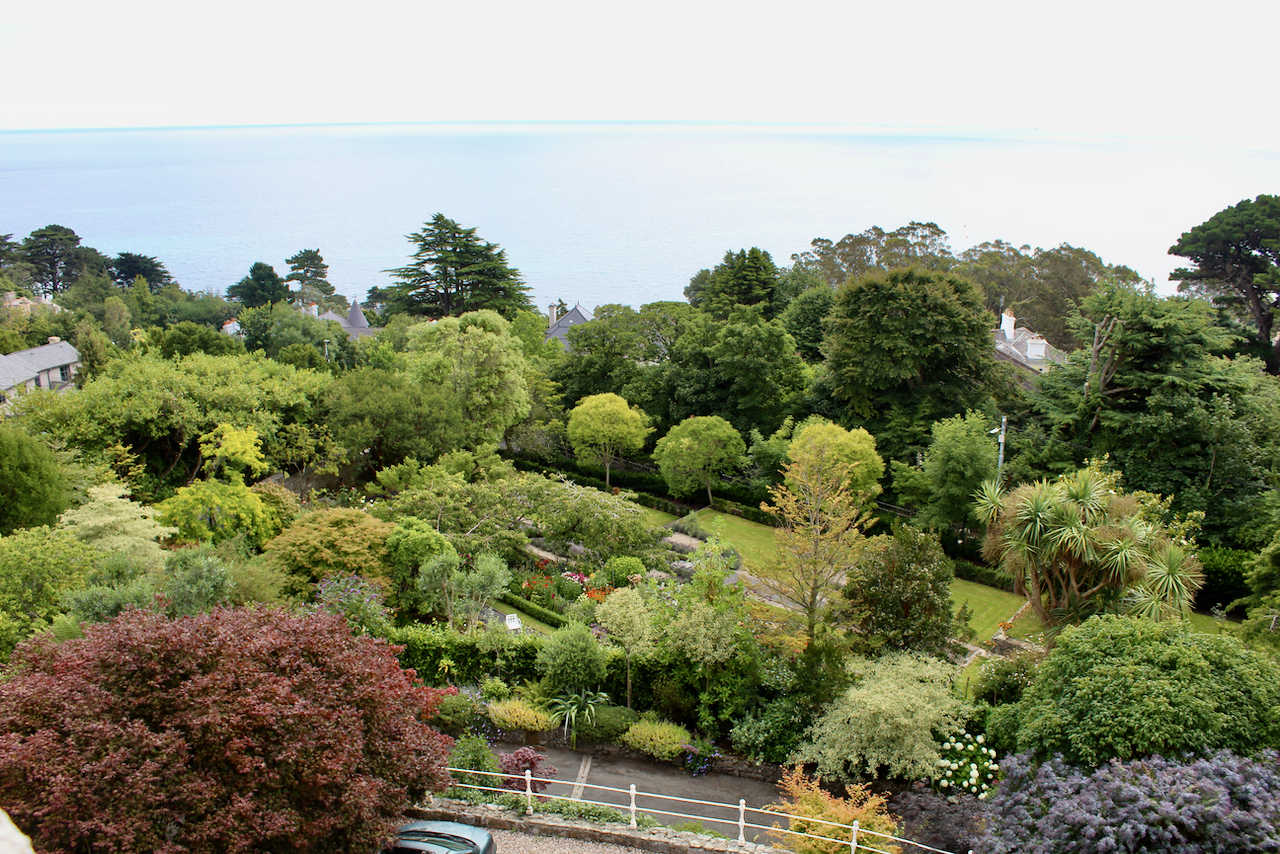
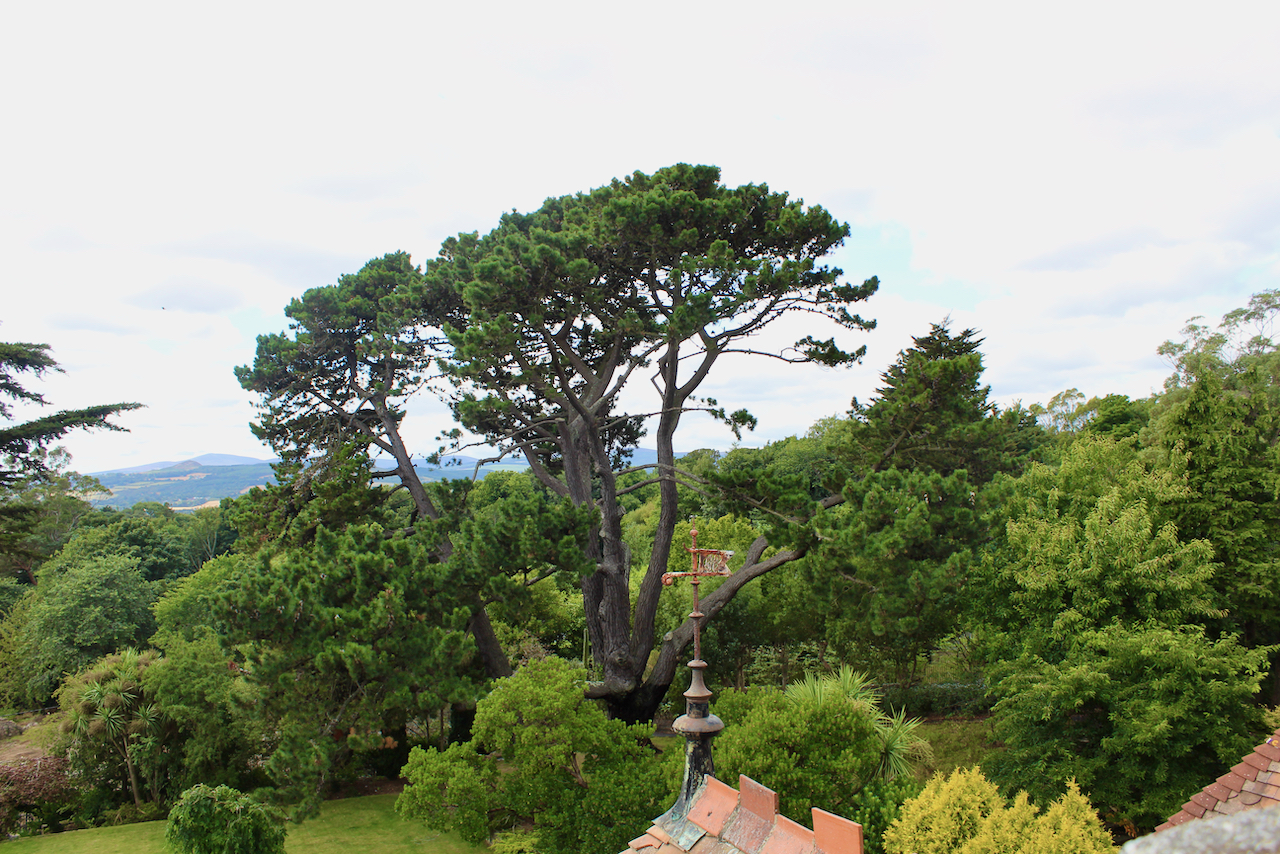
The view of the manicured terraced gardens of St. George’s and beyond to the sea, from the Turret. Photograph © Jennifer Winder-Baggot, www.irishhistorichouses.com
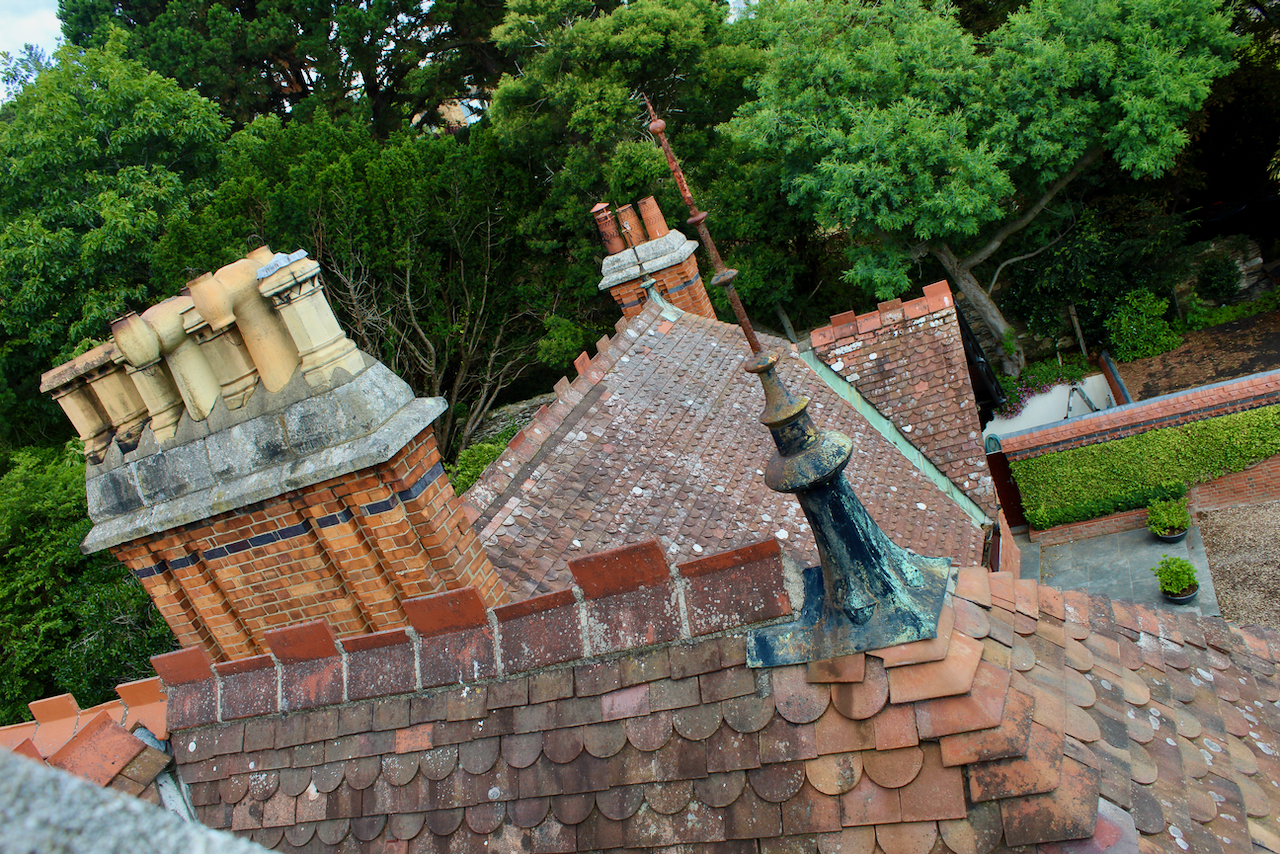
We also can see the wonderful varied roof of St. George’s from our bird’s eye view in the Turret. Photograph © Jennifer Winder-Baggot, www.irishhistorichouses.com
St. George’s, August 2022. Photograph © Jennifer Winder-Baggot, www.irishhistorichouses.com

A single bedroom, the staff bedroom, is above the back stairs and would have originally housed three staff bedrooms. Today it is beautifully decorated with an intricately carved wooden sleigh bed, and drapes hanging from a coronet.

St. George’s, August 2022. Photograph © Jennifer Winder-Baggot, www.irishhistorichouses.com

Ashlin died in 1921. His daughter Miriam married her cousin Stephen Martin Ashlin, who continued the firm of Ashlin & Coleman after Ashlin’s death.

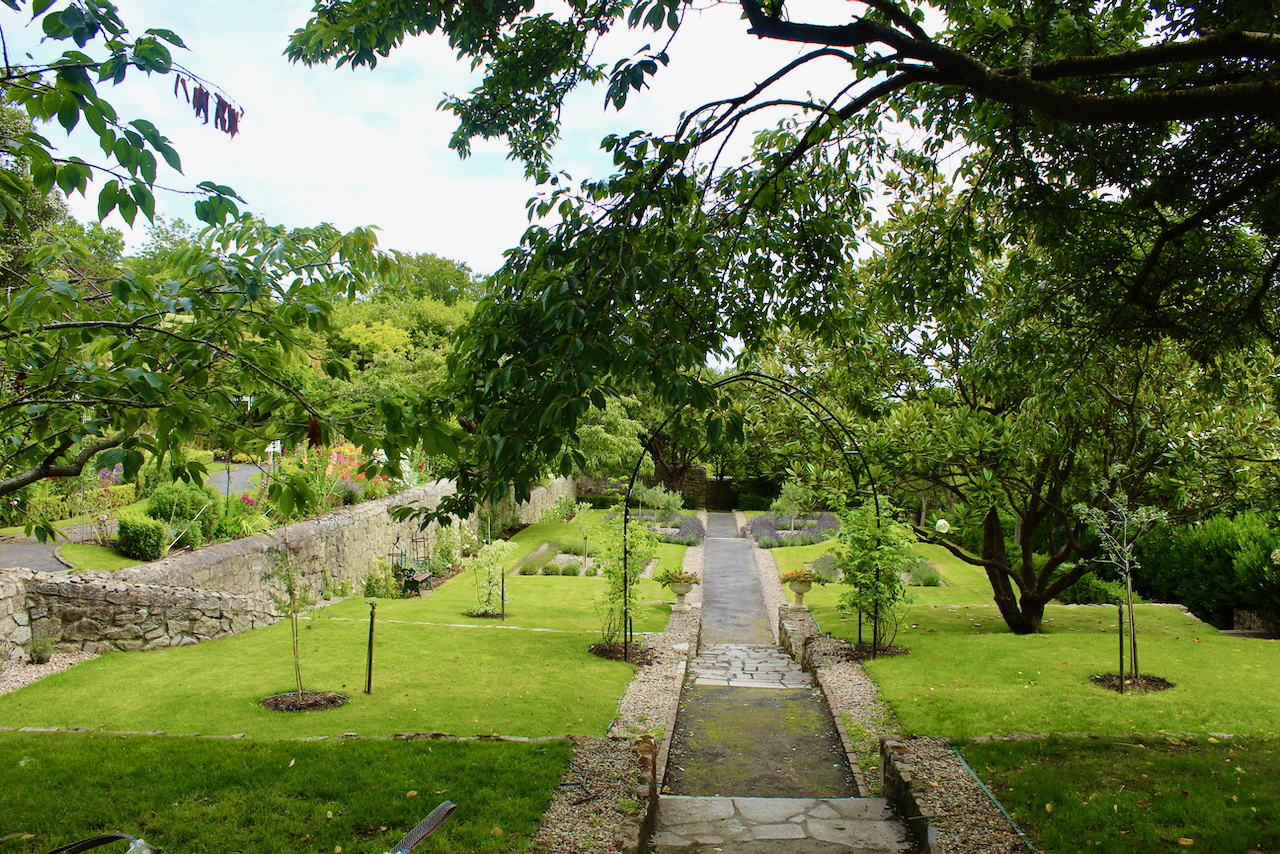
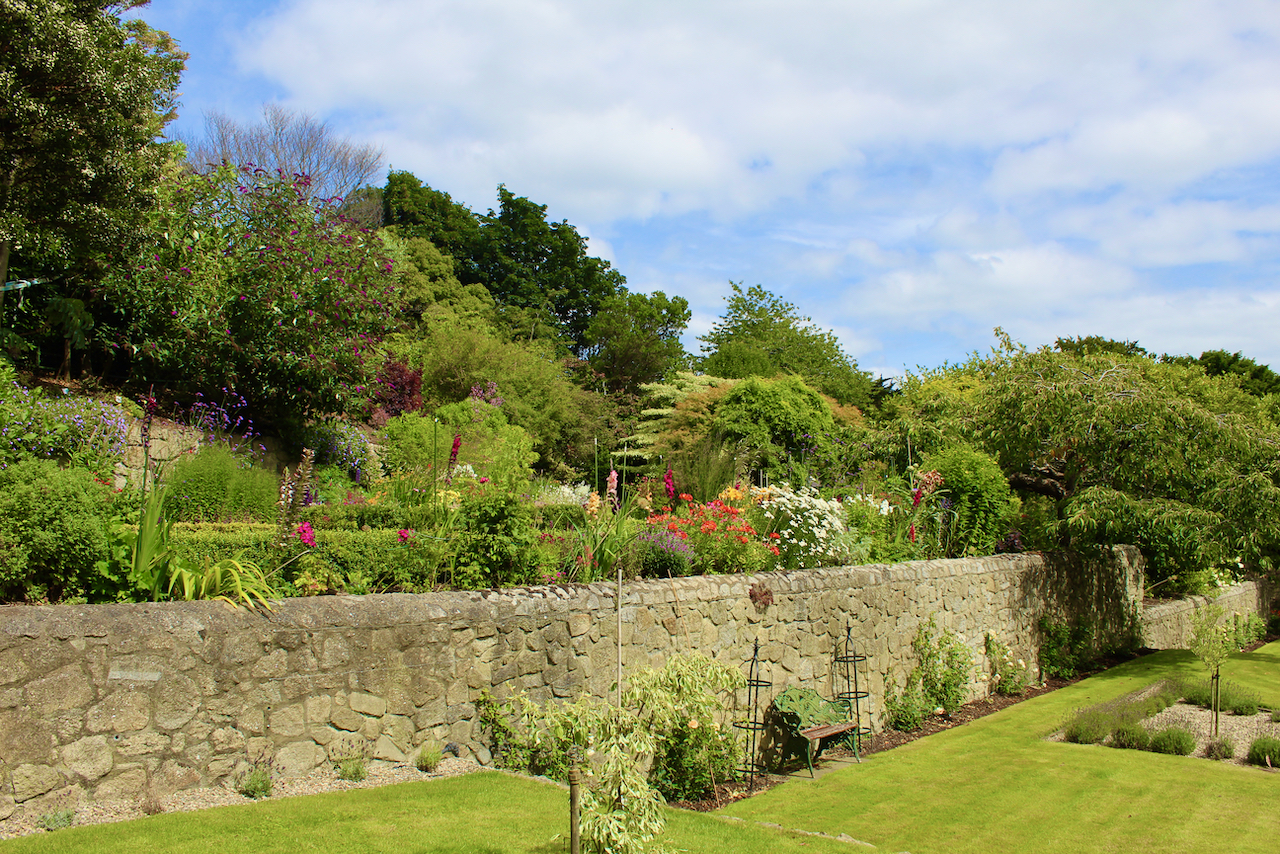
After our tour of the house we wandered through the beautifully maintained terraced garden. The gardens cover approximately an acre. [5]

St. George’s, August 2022. Photograph © Jennifer Winder-Baggot, www.irishhistorichouses.com
St. George’s, August 2022.
St. George’s, August 2022. Photograph © Jennifer Winder-Baggot, www.irishhistorichouses.com

Another property designed by Ashlin has recently come on the market, Netterville Almshouses.

The Netterville Almshouses in County Meath, also designed by George Coppinger Ashlin, in 1877. For sale in April 2023, this photograph courtesy of myhome.ie
The splendid interior of Netterville almshouses, photograph from myhome.ie

[1] The Wexford Gentry by Art Kavanagh and Rory Murphy. Published by Irish Family Names, Bunclody, Co Wexford, Ireland, 1994. p. 168. Power of Edermine.

[2] Dictionary of Irish Architects https://www.dia.ie/architects/view/72/ASHLIN%2C+GEORGE+COPPINGER

[3] See Robert O’Byrne’s entry with beautiful photographs of Tullira, https://theirishaesthete.com/2014/10/13/the-ascetic-aesthete/

[4] https://www.dib.ie/biography/ashlin-george-coppinger-a0250

[5] https://www.irishtimes.com/life-and-style/homes-and-property/new-to-market/step-back-in-time-to-fairytale-house-on-killiney-hill-for-9-25m-1.3472893

Text © Jennifer Winder-Baggot, www.irishhistorichouses.com

The Church, Junction of Mary’s Street/Jervis Street, Dublin – section 482

www.thechurch.ie
Open in 2025: Jan 1-Dec 23, 27-31, 11am-11pm

Fee: Free

donation

Help me to pay the entrance fee to one of the houses on this website. This site is created purely out of love for the subject and I receive no payment so any donation is appreciated!

€15.00

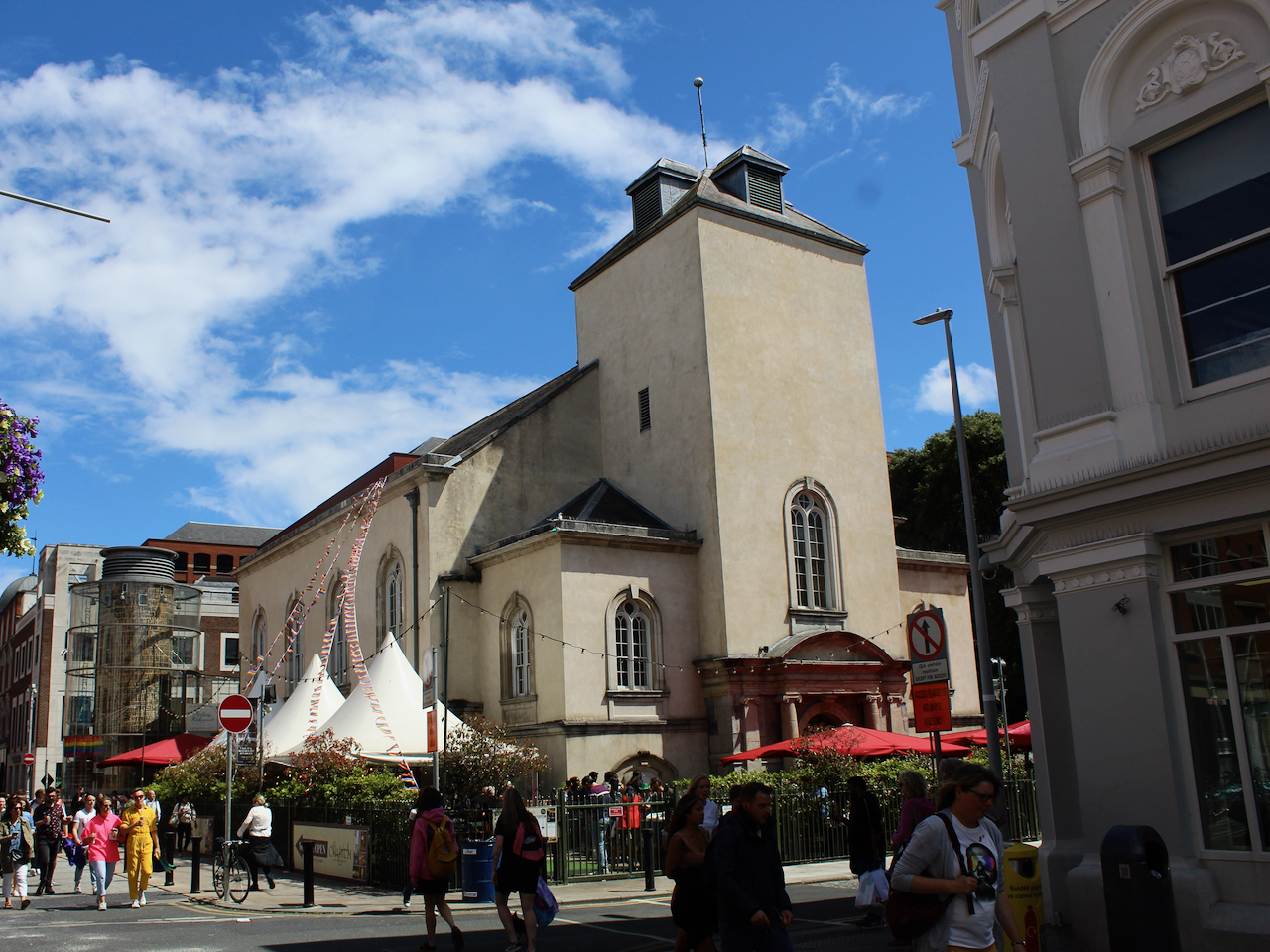
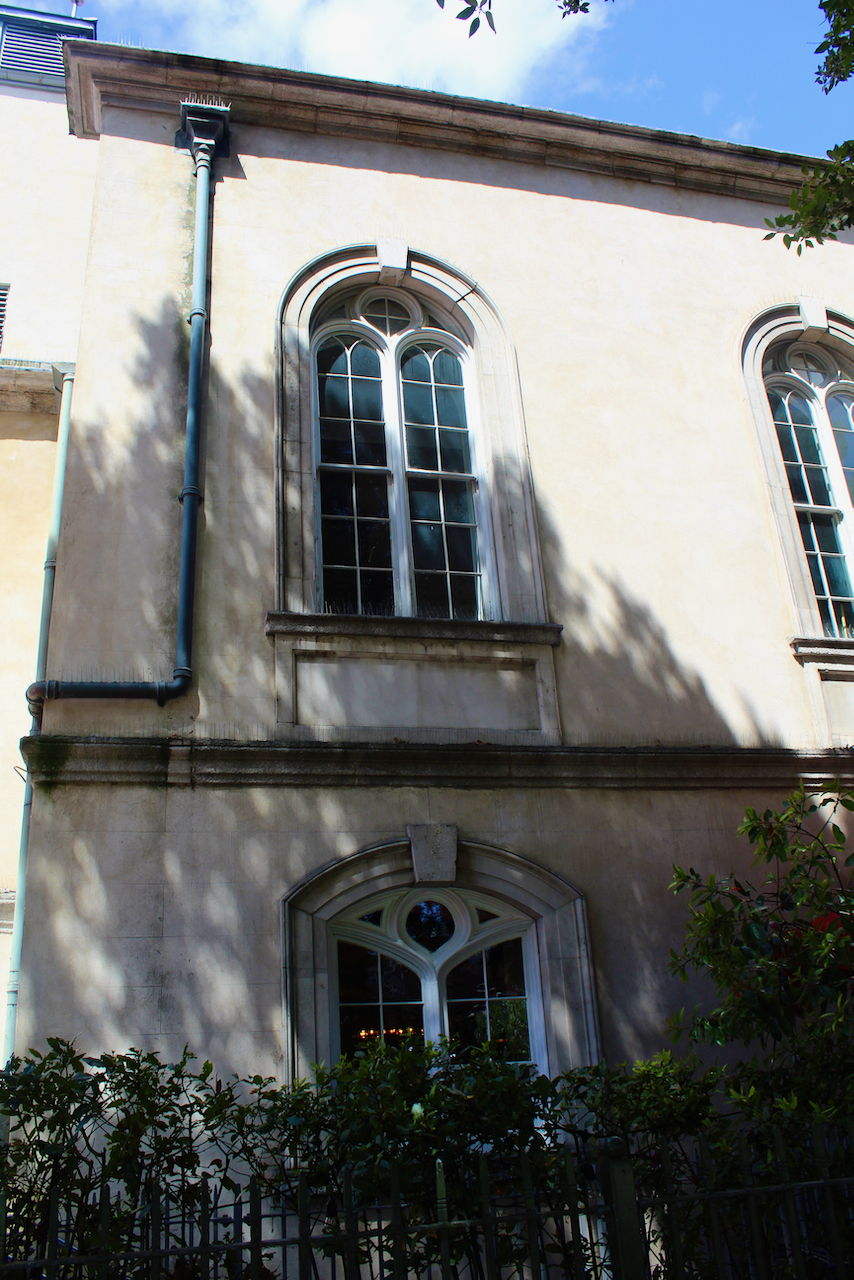
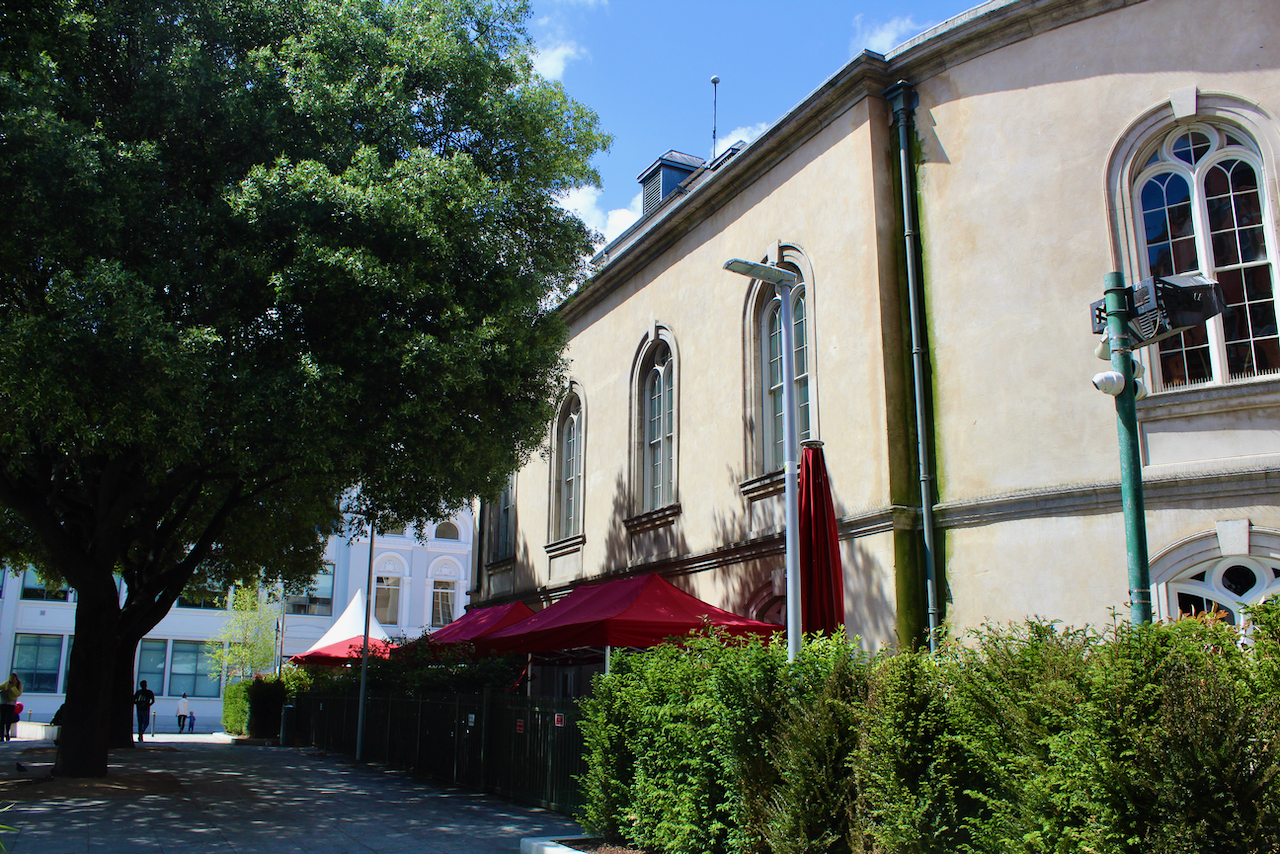
St. Mary’s Church of Ireland, June 2022. Photograph © Jennifer Winder-Baggot, www.irishhistorichouses.com

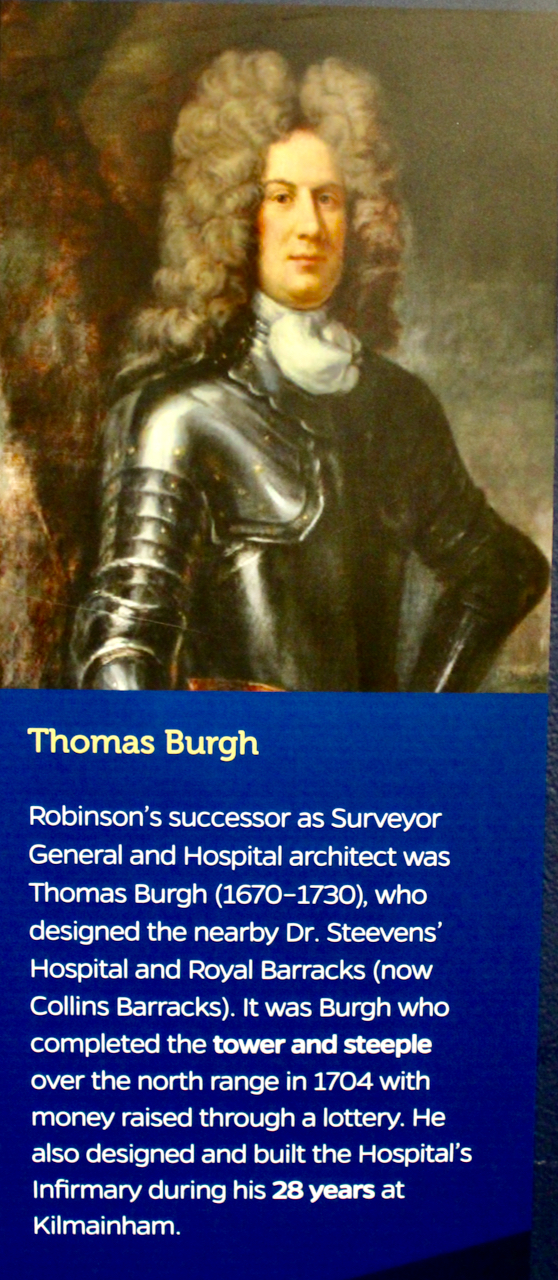
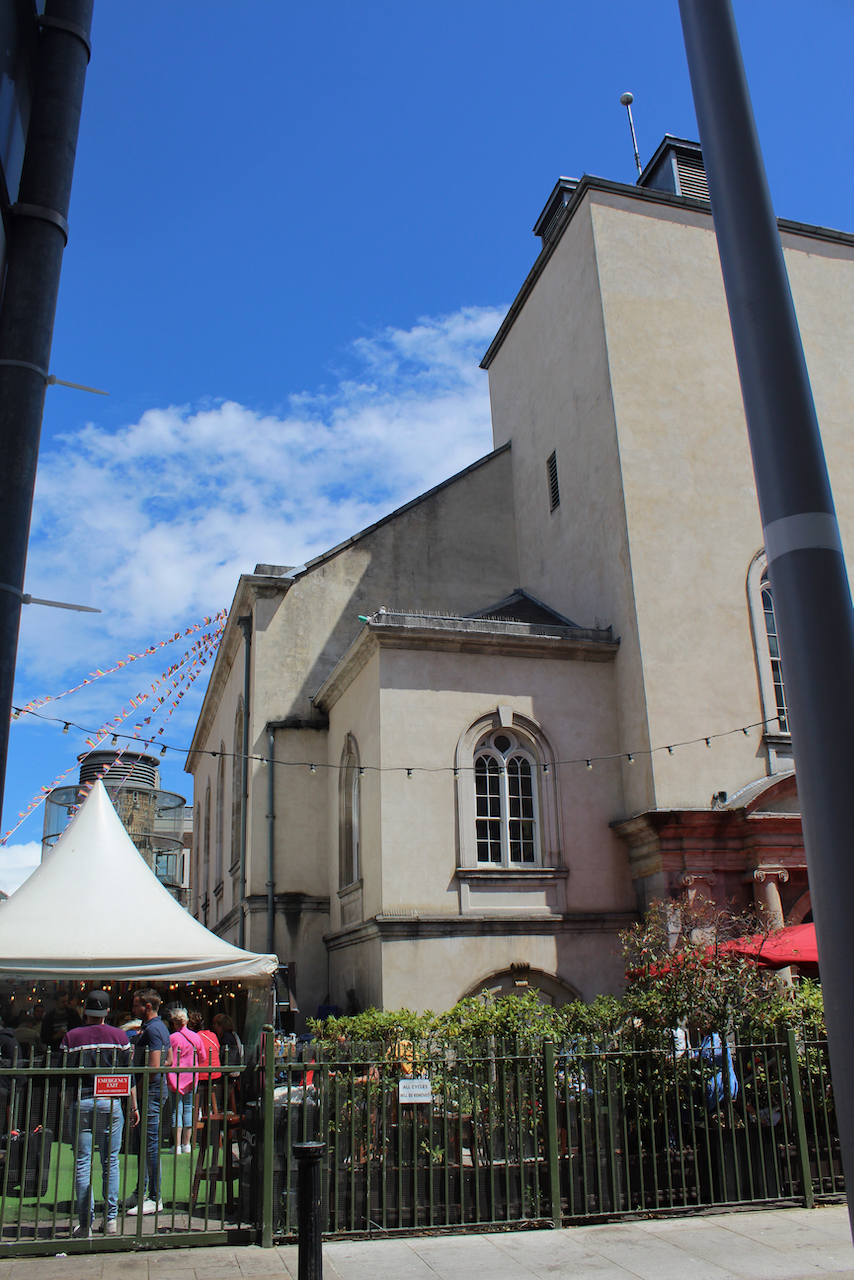
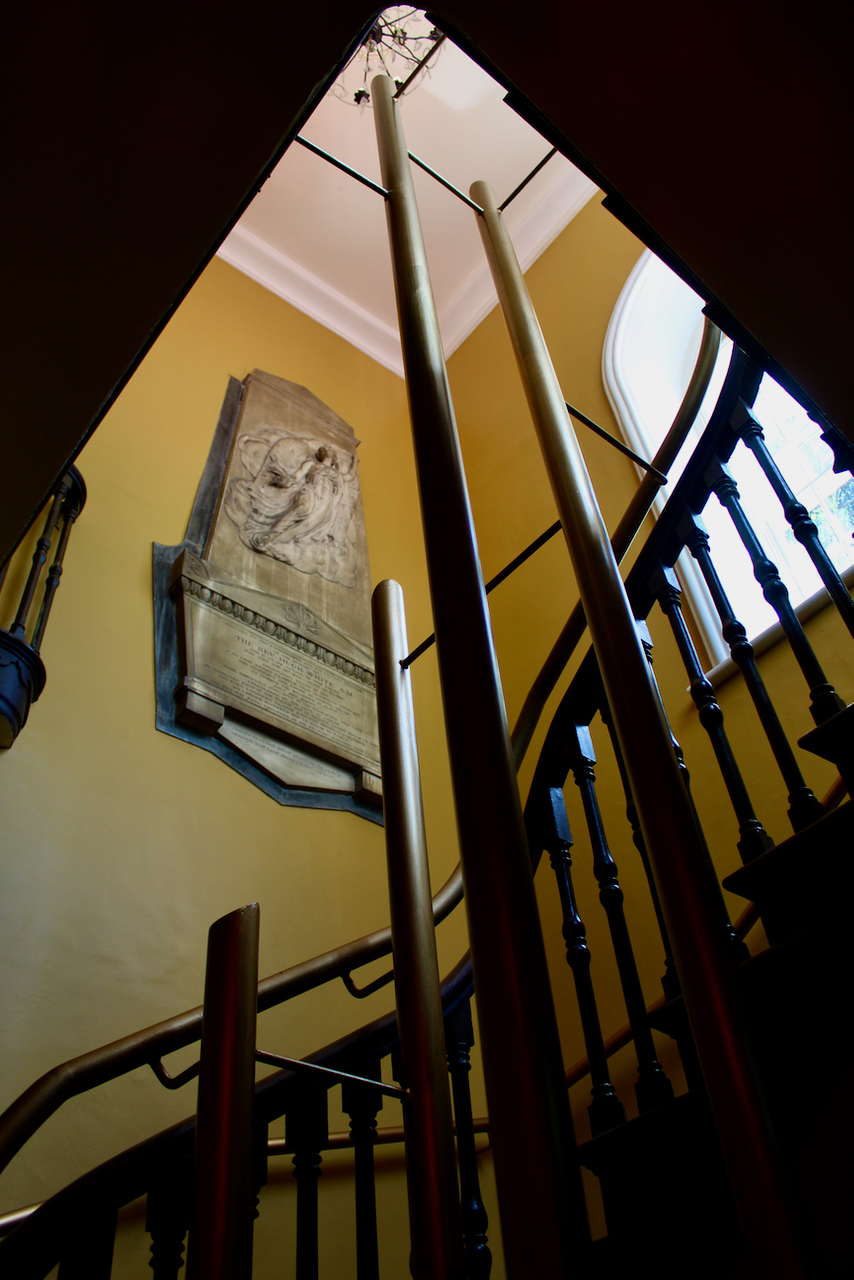
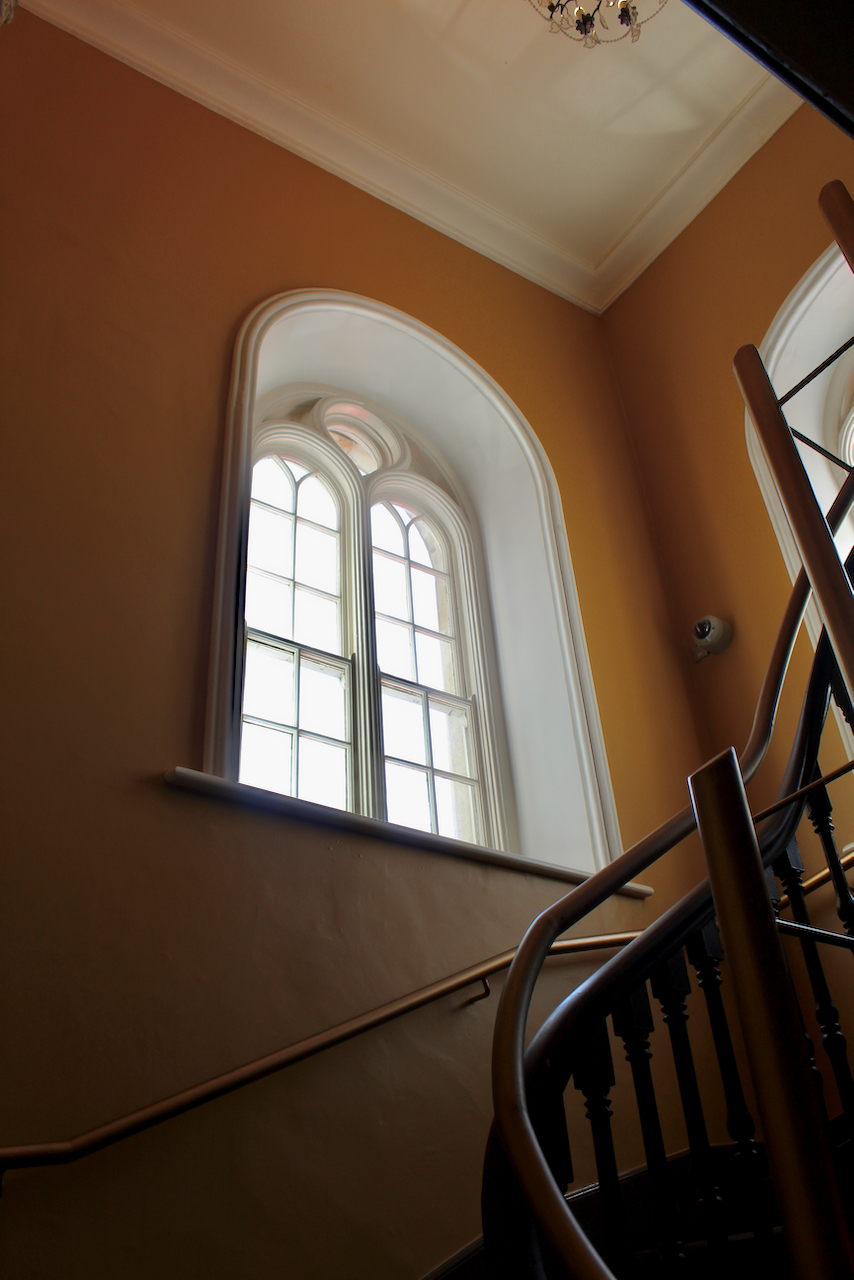
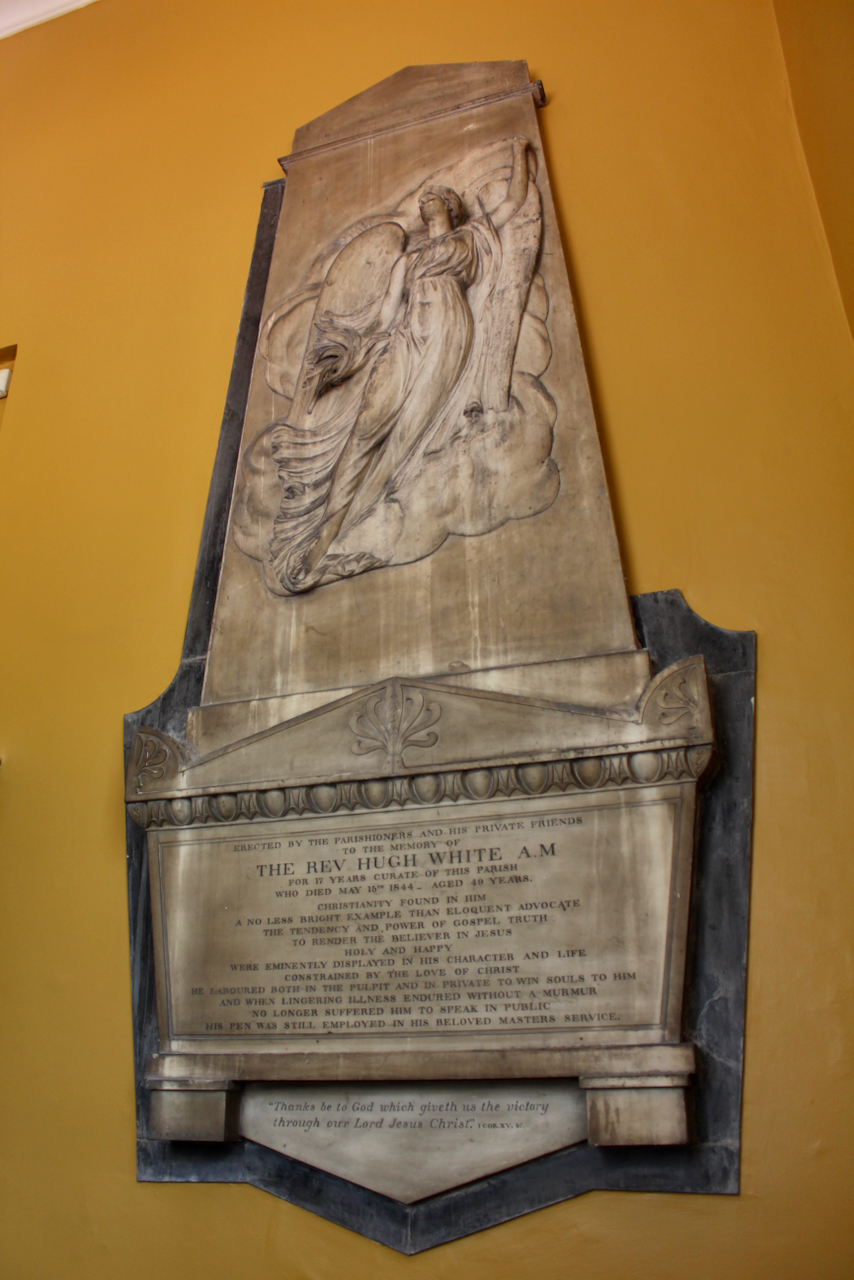
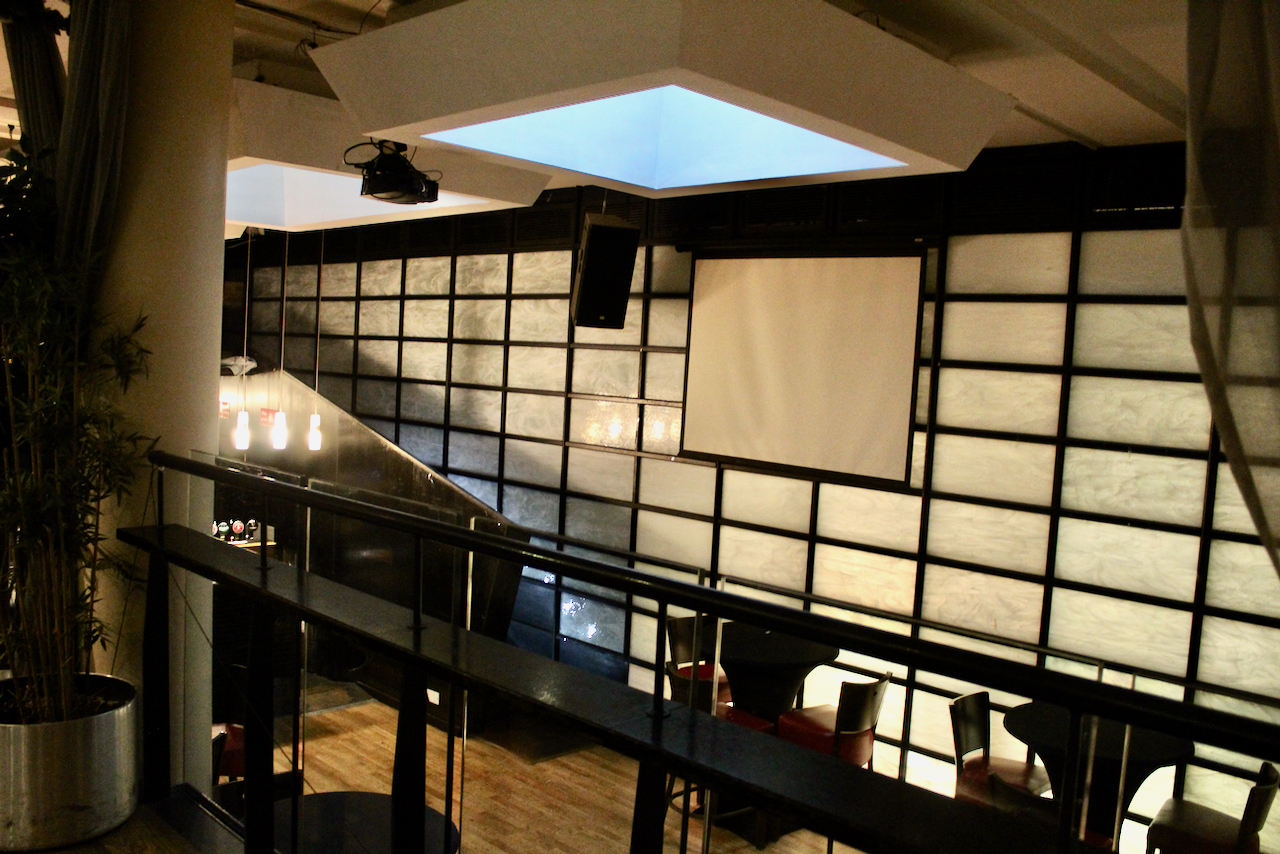
The former St. Mary’s Church of Ireland was built from 1700-1704. It is now in use as bar and restaurant, with modern glazed stair tower built to northeast, linked with an elevated glazed walkway to the restaurant at the upper level within the church. The National Inventory tells us that it was designed by William Robinson and completed by his successor, Thomas Burgh.

The church has a special place in my husband’s heart because his ancestor John Winder visited Dublin to preach a sermon here in around 1720, when he was rector at Kilroot in County Antrim, a position he obtained after Jonathan Swift. St. Mary’s parish was founded in 1697, the second parish on the north side of the River Liffey (the first must have been St. Michans). It took its name from the medieval monastery of St. Mary’s Abbey that had occupied most of the north side of the river from 1139 until its dissolution in 1539.

It was closed as a church in 1986 due to the fall of parishioners, as residents moved from the city centre. The building was used for various purposes until purchased by publican John Keating in 1997. Until it was changed for use as a bar it contained the oldest unaltered church interior in Dublin, and much of this has been preserved.

St. Mary’s Abbey, Dublin. Photograph © Jennifer Winder-Baggot, www.irishhistorichouses.com

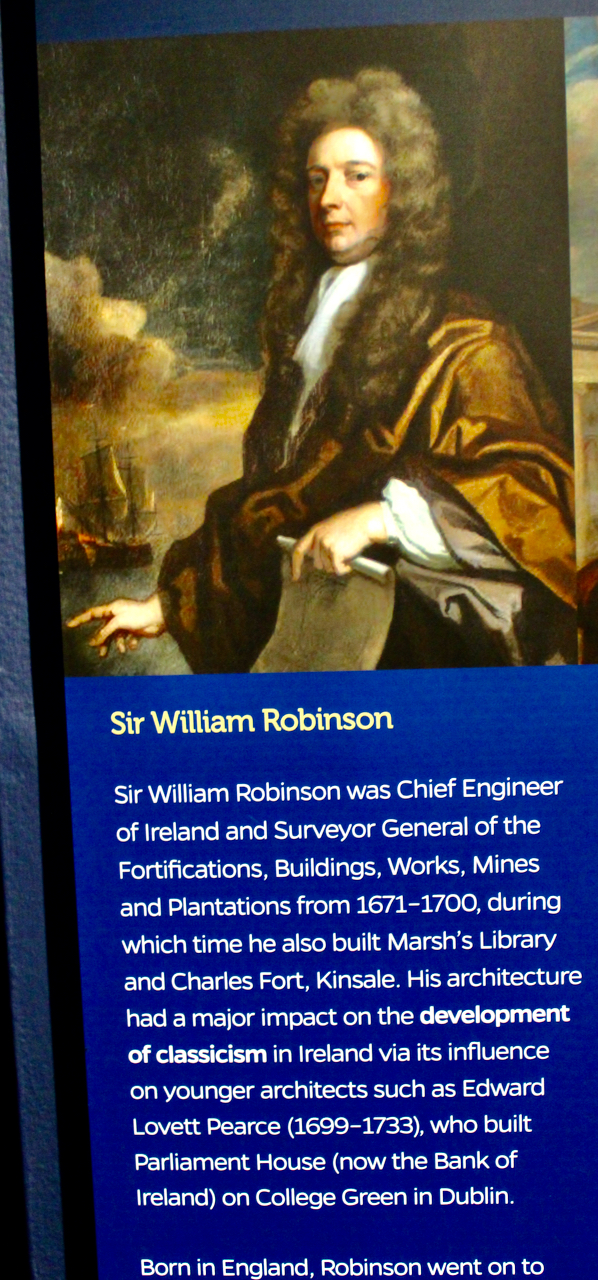
William Robinson was made surveyor general of buildings in Ireland in 1671. He was also engineer general and master of ordinance, so was responsible for fortifications. He built Charles Fort in Kinsale, and in 1677–8 he was adviser and contractor on the construction of Essex Bridge in Dublin. In 1679 was involved in the rebuilding of Lismore cathedral, Co. Waterford, and designed the Royal Hospital, Kilmainham (1680–84). [1] In 1682 he oversaw the construction of Ormond Bridge in Dublin.

William Robinson, information board at Royal Hospital Kilmainham, 15th October 2023.

The Dictionary of Irish Biography tells us that William Robinson’s patent as surveyor general was renewed in 1684, though he now shared the post with William Molyneux (1656–98), who later oversaw the partial construction of Robinson’s design for the courtyard of Dublin castle when he and Robinson were deprived of the surveryorship by the lord deputy, the earl of Tyrconnell. Robinson went to England during Tyrconnell’s deputyship and Molyneux remained in Ireland and carried out extensive building work at Dublin castle, presumably to Robinson’s designs.

In 1689 Robinson was appointed comptroller general of provisions and commissary general of pay and provisions in the Williamite army, the latter position being shared with Bartholomew van Homrigh (the father of Jonathan Swift’s friend, whom he called “Vanessa”).

Robinson returned to Ireland, and was Elected MP for Knocktopher, Co. Kilkenny (1692–3) and Wicklow town (1695–9) and in 1702 was appointed to the Privy Council in Ireland. In 1695 he rebuilt Dublin’s Four Courts, and in 1703–4 he designed Marsh’s Library in Dublin, his last major work.

Robinson served as MP for Dublin University 1703–12, and he purchased forfeited lands in Carlow and Louth in April and June 1703. His career ended in disgrace however as he was accused of shady financial dealings and misrepresenting public accounts for which he was responsible. (see [1])

Thomas Burgh, information board at Royal Hospital Kilmainham, 15th October 2023.

Thomas Burgh (1670–1730) succeeded Molyneux and Robinson in 1700 as surveyor-general, and was also made lieutenant of the ordnance in Ireland. The rebuilding of Dublin castle, started by Robinson, advanced considerably under Burgh, but his undisputed masterpiece was to be TCD library. His work designing and building the lower part of the library began in 1712 and continued into the next decade. It was finally opened in 1732. He may have been responsible for designing Kildrought house in Celbridge, Kildare (see my entry). He too had engineering interests including navigation and coalmining. He lived in Oldtown, County Kildare, and became high sheriff of the county in 1712 and was MP for Naas 1713–30. [2]

It is difficult to photograph the church, as it is in the middle of city streets, and Christine Casey writes in her The Buildings of Ireland: Dublin (2005) that it exhibits “a curious amalgam of awkwardness and aplomb”! [3]

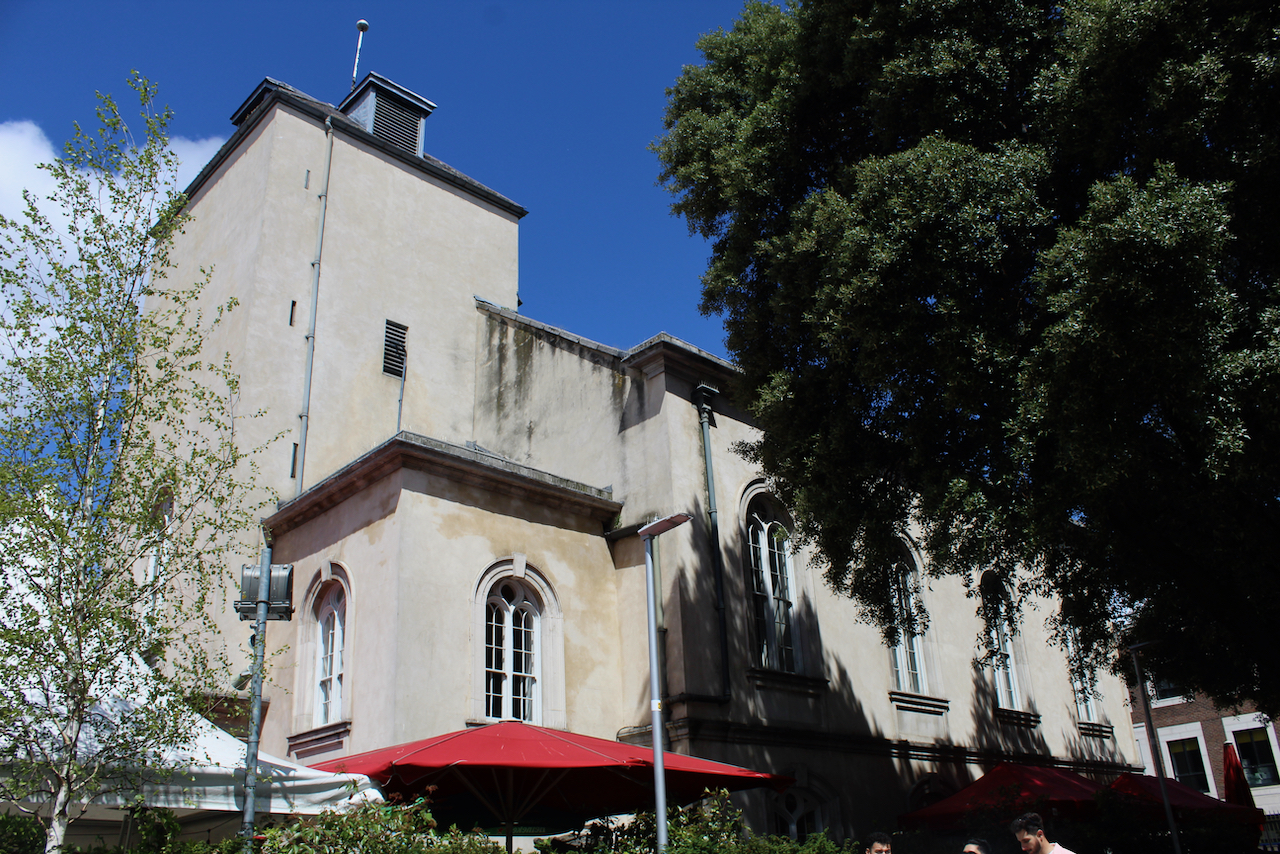
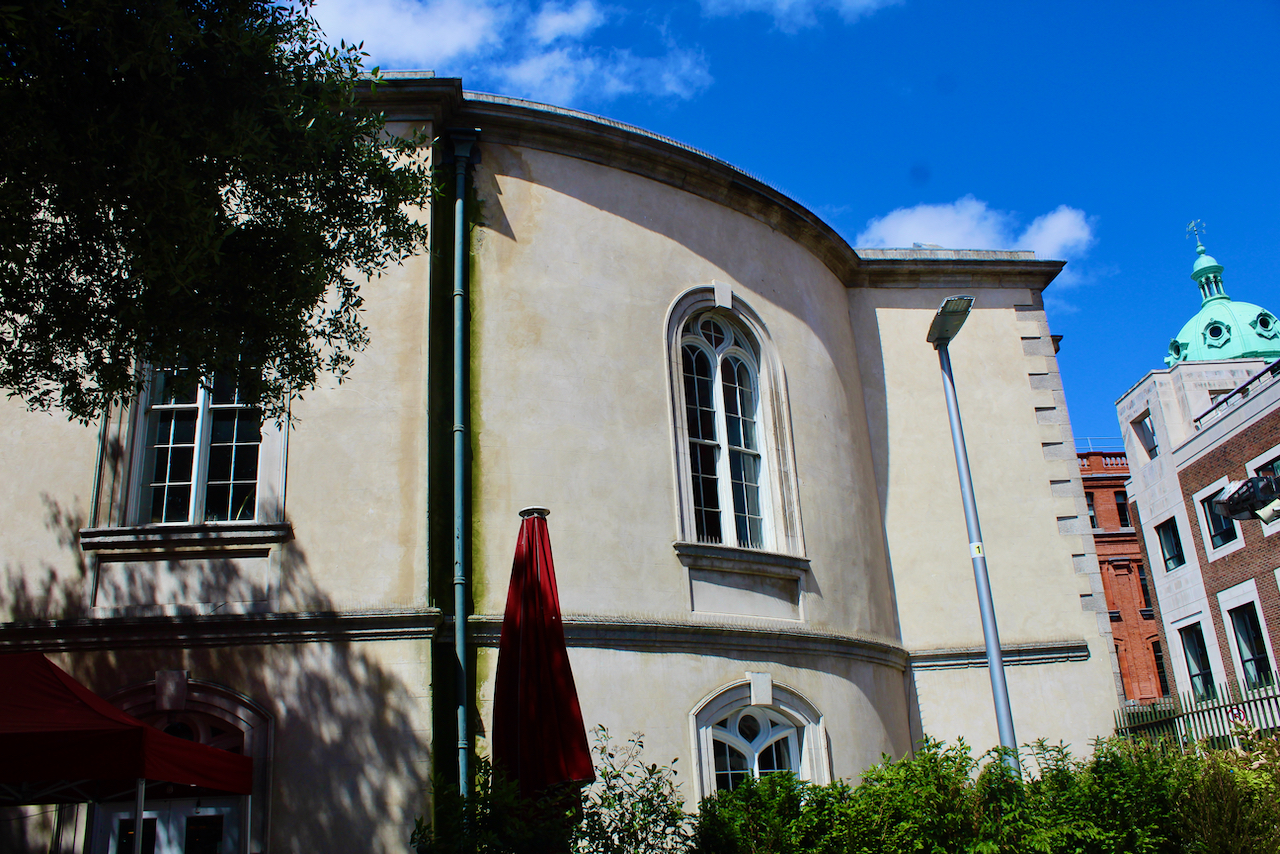
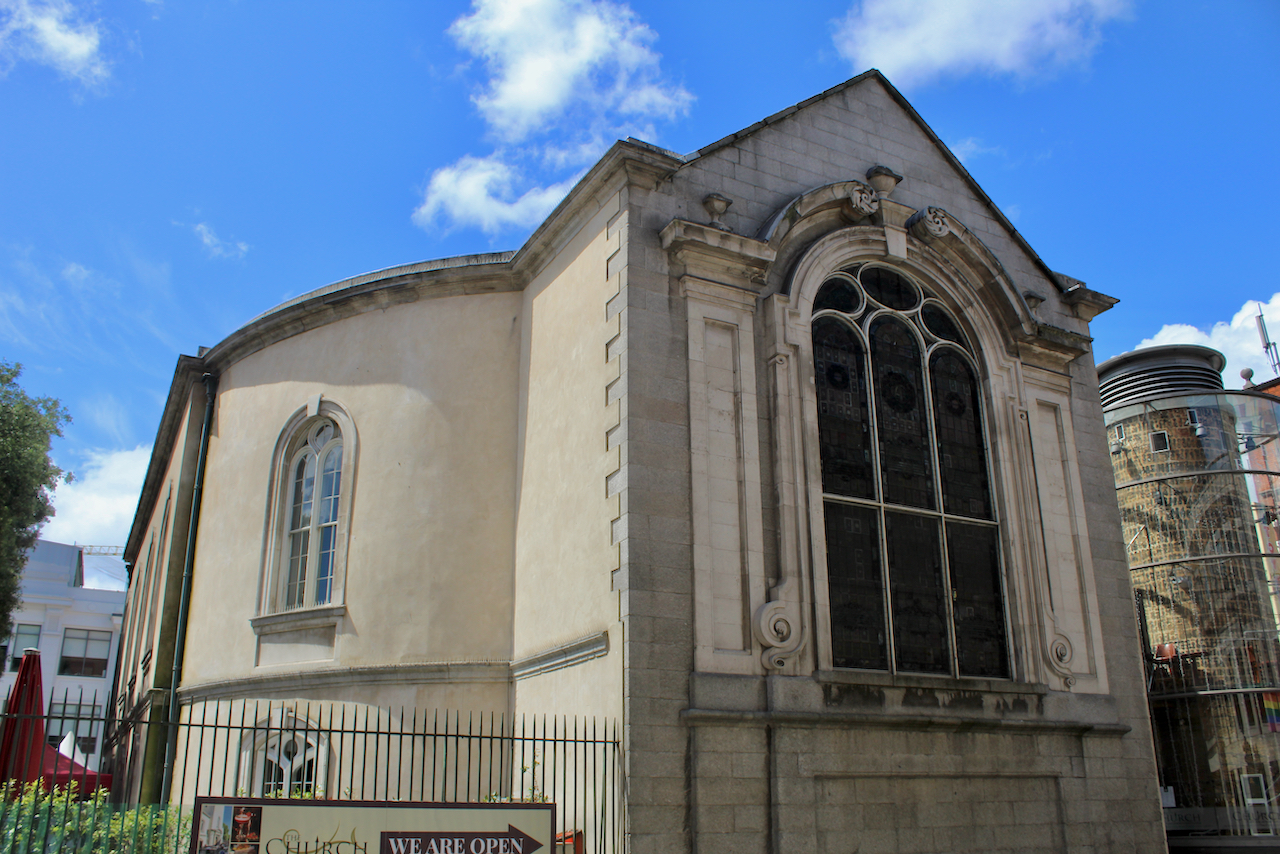
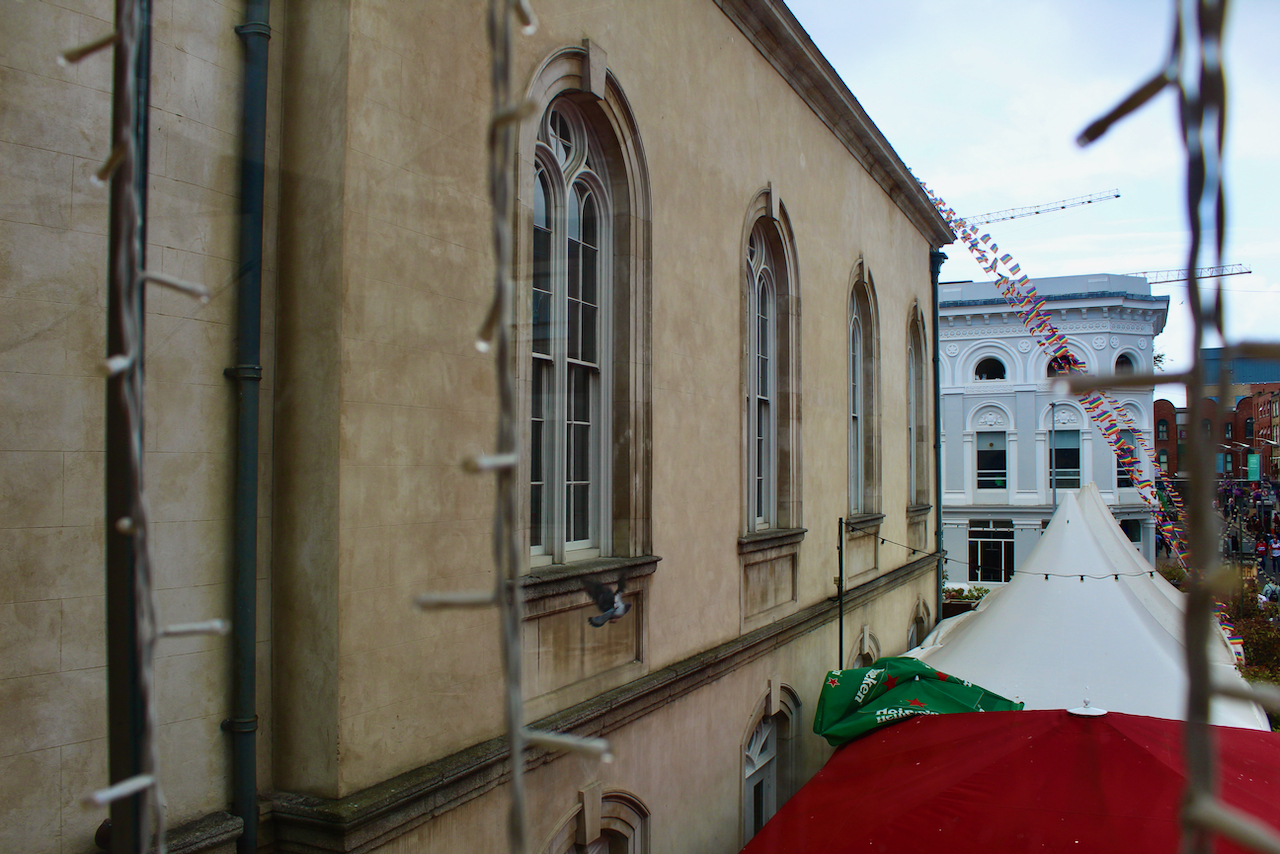
St. Mary’s church has four-bay double-height side elevations, with convex quadrant single-bay links to a shallow chancel which contains a lovely chancel window. It has a three-stage tower at the opposite end flanked by lower two-storey vestibules. It does not have a spire.

St. Mary’s Church of Ireland, June 2022. Photograph © Jennifer Winder-Baggot, www.irishhistorichouses.com

The west front has the main entrance door (no longer in use as the main door, which is on the north facade). Unfortunately I was unable to take a good photograph due to the position of outdoor tables and sheltering umbrellas. The doorcase is of Portland stone with Ionic columns and an entablature. Casey tells us that the lugged surrounds of the outer vestibule door are of brown sandstone.

The three-stage tower flanked by lower two-storey vestibules. Photograph © Jennifer Winder-Baggot, www.irishhistorichouses.com
Former St. Mary’s church. Photograph © Jennifer Winder-Baggot, www.irishhistorichouses.com
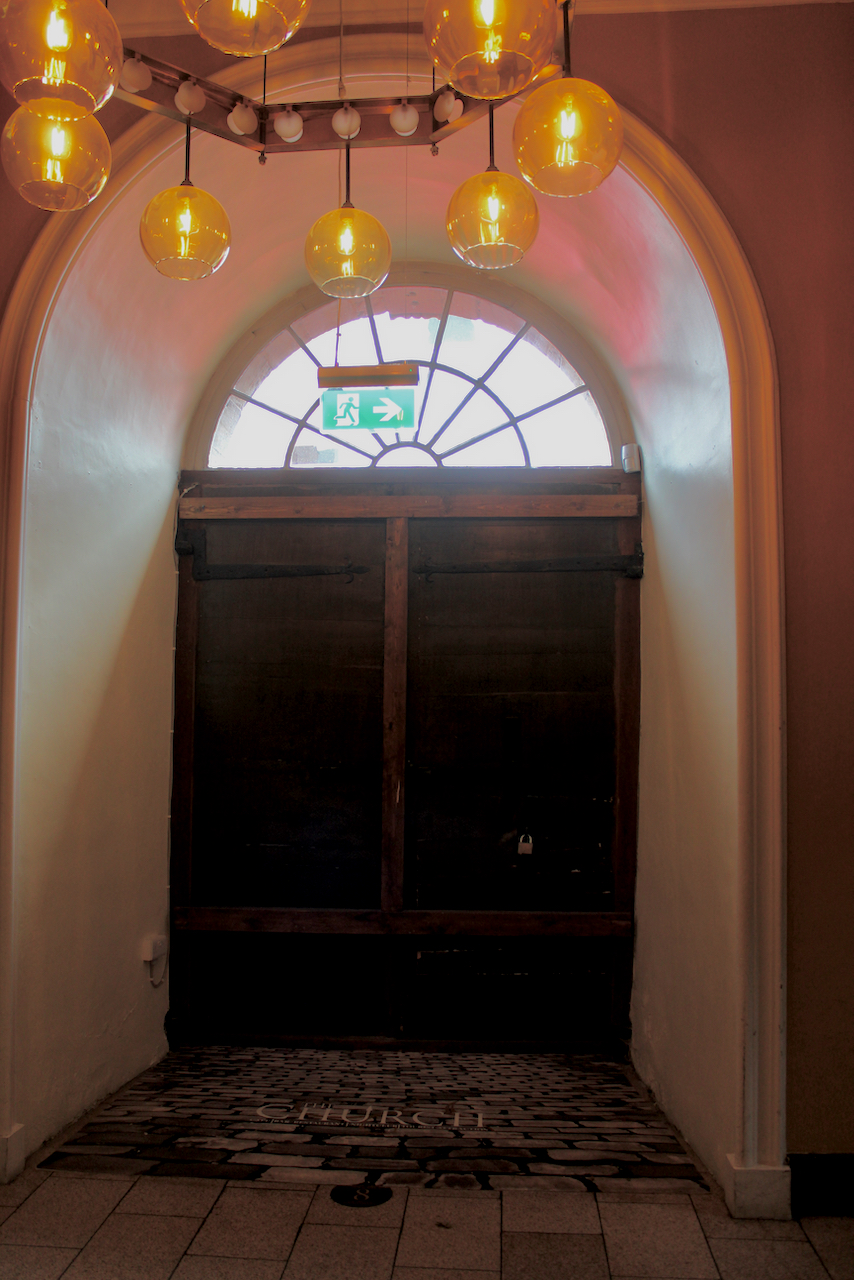
Inside the east end door. Photograph © Jennifer Winder-Baggot, www.irishhistorichouses.com
Former St. Mary’s church. Photograph © Jennifer Winder-Baggot, www.irishhistorichouses.com
The south side single bay convex quadrant between the four bays and the shallow chancel on the east end. Photograph © Jennifer Winder-Baggot, www.irishhistorichouses.com
The convex quadrant and the chancel at the east end, and to the north side, the modern stair tower encased in glass. Photograph © Jennifer Winder-Baggot, www.irishhistorichouses.com

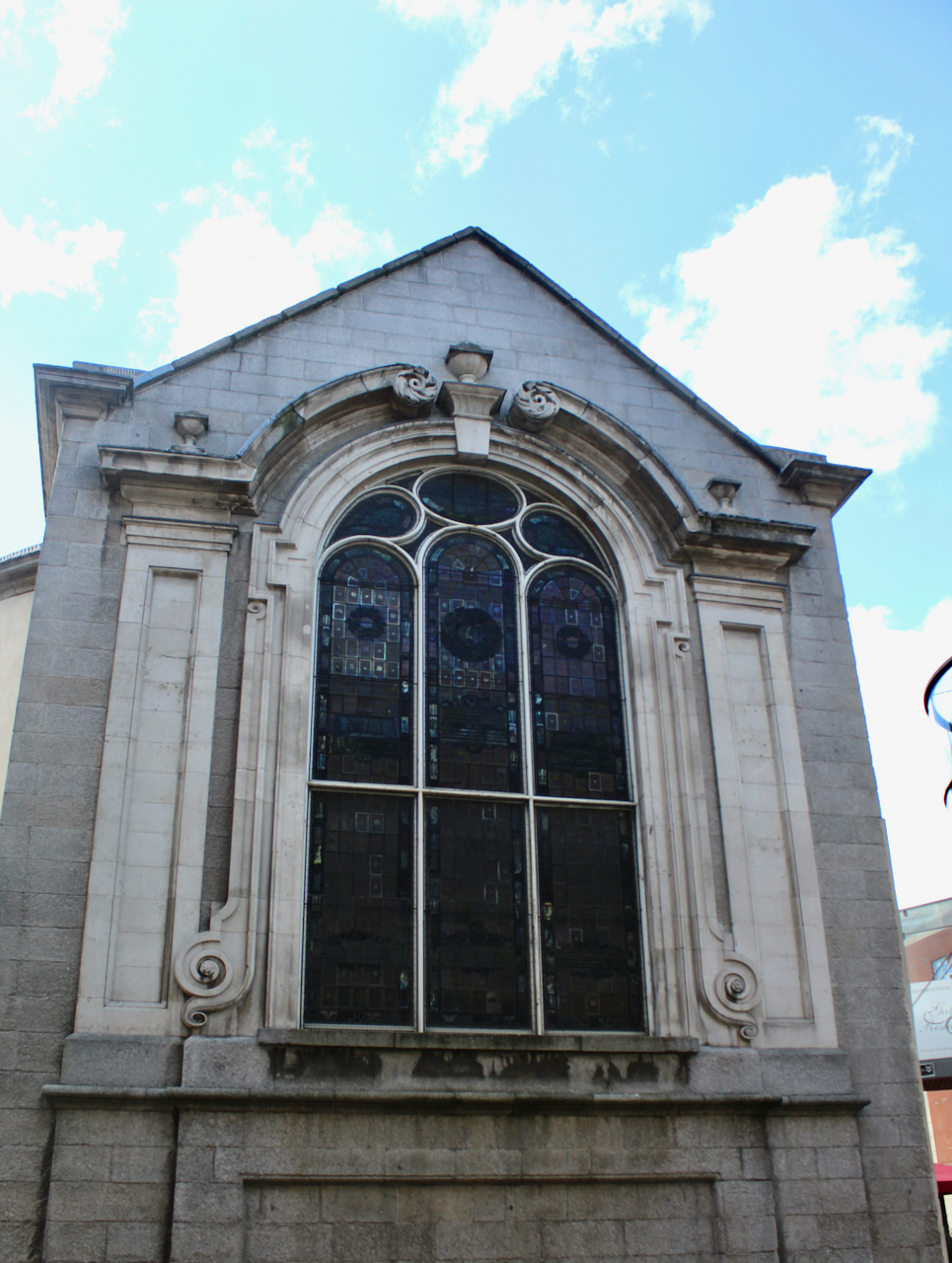
The window frame on the east end chancel is of Portland stone, which Casey tells us “has a vigour and plasticity rare in a city by-passed by the Baroque.” She describes the window:

Above a raised granite plinth, two broad panelled pilasters support an emphatic curved scroll-topped hood-moulding with urns to centre and ends, while successive inner lugged framed have scrolled base terminals.”

Casey suggests that the gable on this end may be a later addition.

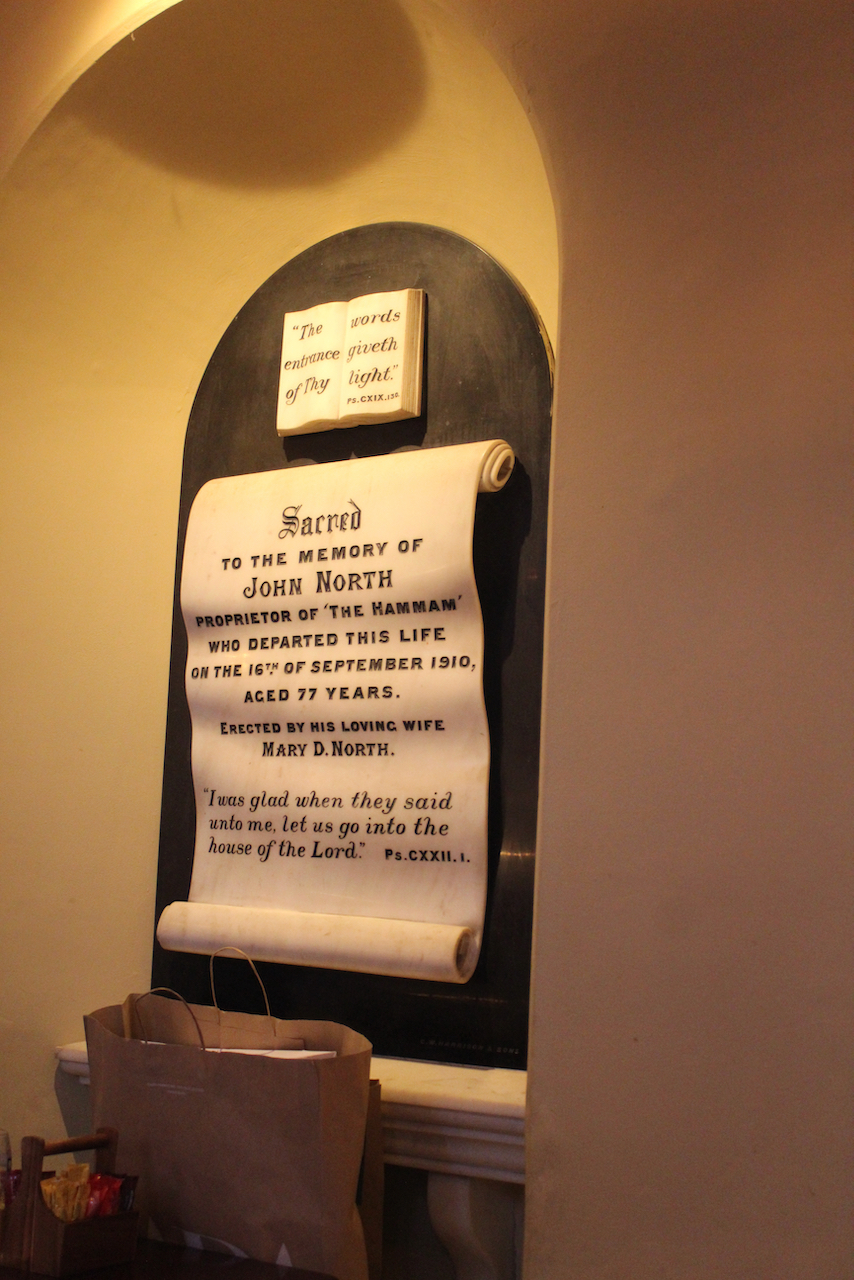
William Robinson prepared a model for this window, and may have designed the unusual plan for the church. It was completed by Thomas Burgh in 1704 and in 1863, S. Symes may have inserted new windows as well as replacing the perimeter wall with railings. The original chancel window of St. Mary’s was smashed by vandals on the result of polling at the election in 1852. The current window was set in 1910, commissioned in 1909 by John North, the proprietor of the “Hammam,” a Turkish Bath on O’Connell (then called Sackville) Street. The new window reads: “To the glory of God and in affectionate memory of his daughters Maria North (Molly) and Rosanna (Rose) wife of Joseph Armstrong also his grandchild John Hubert Armstrong (Jack) erected by John North 1909.”

Former St. Mary’s church. Photograph © Jennifer Winder-Baggot, www.irishhistorichouses.com
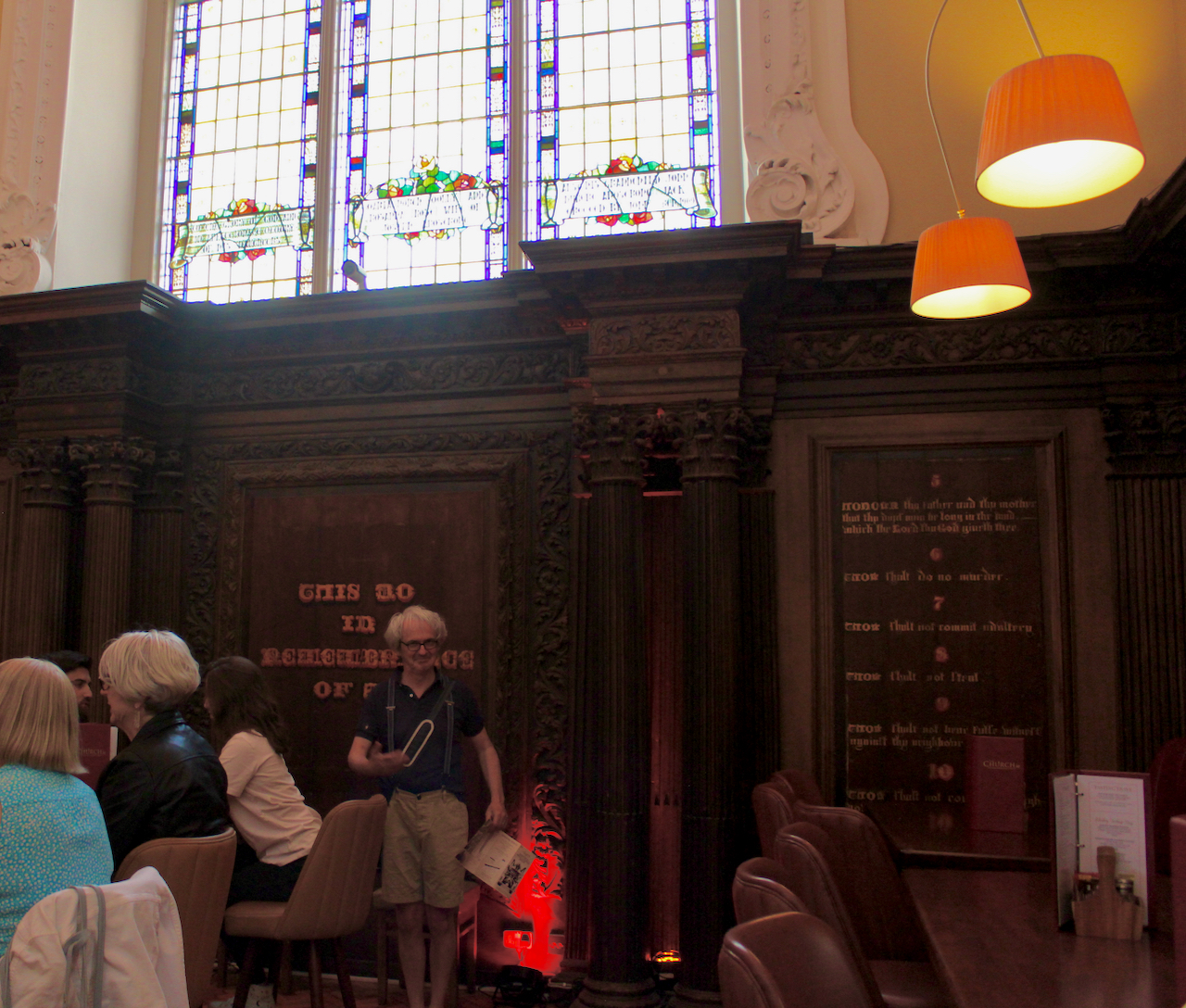
Memorial in St. Mary’s church for John North, who commissioned the new window installed in 1910 in the chancel. Photograph © Jennifer Winder-Baggot, www.irishhistorichouses.com
Former St. Mary’s church. Photograph © Jennifer Winder-Baggot, www.irishhistorichouses.com
St. Mary’s Church of Ireland, June 2022. Photograph © Jennifer Winder-Baggot, www.irishhistorichouses.com

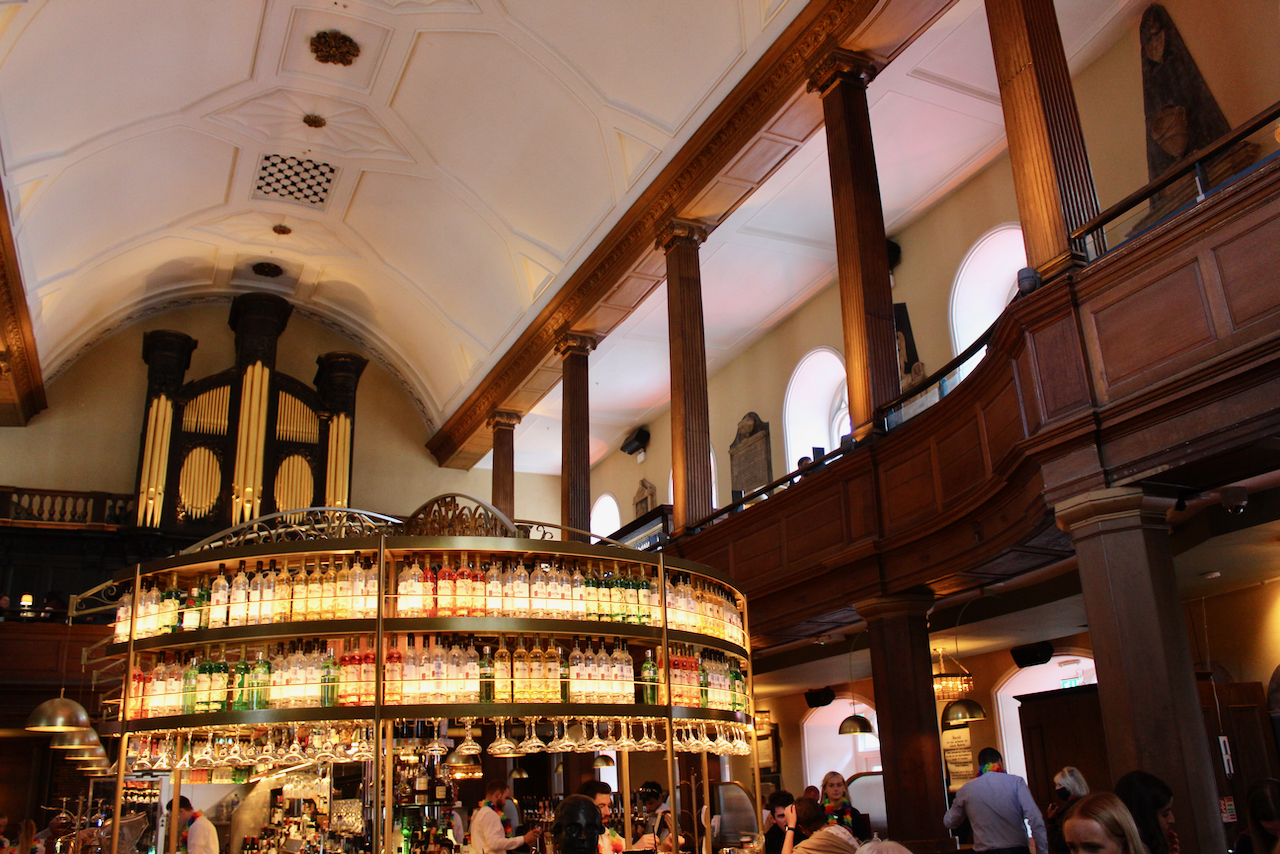
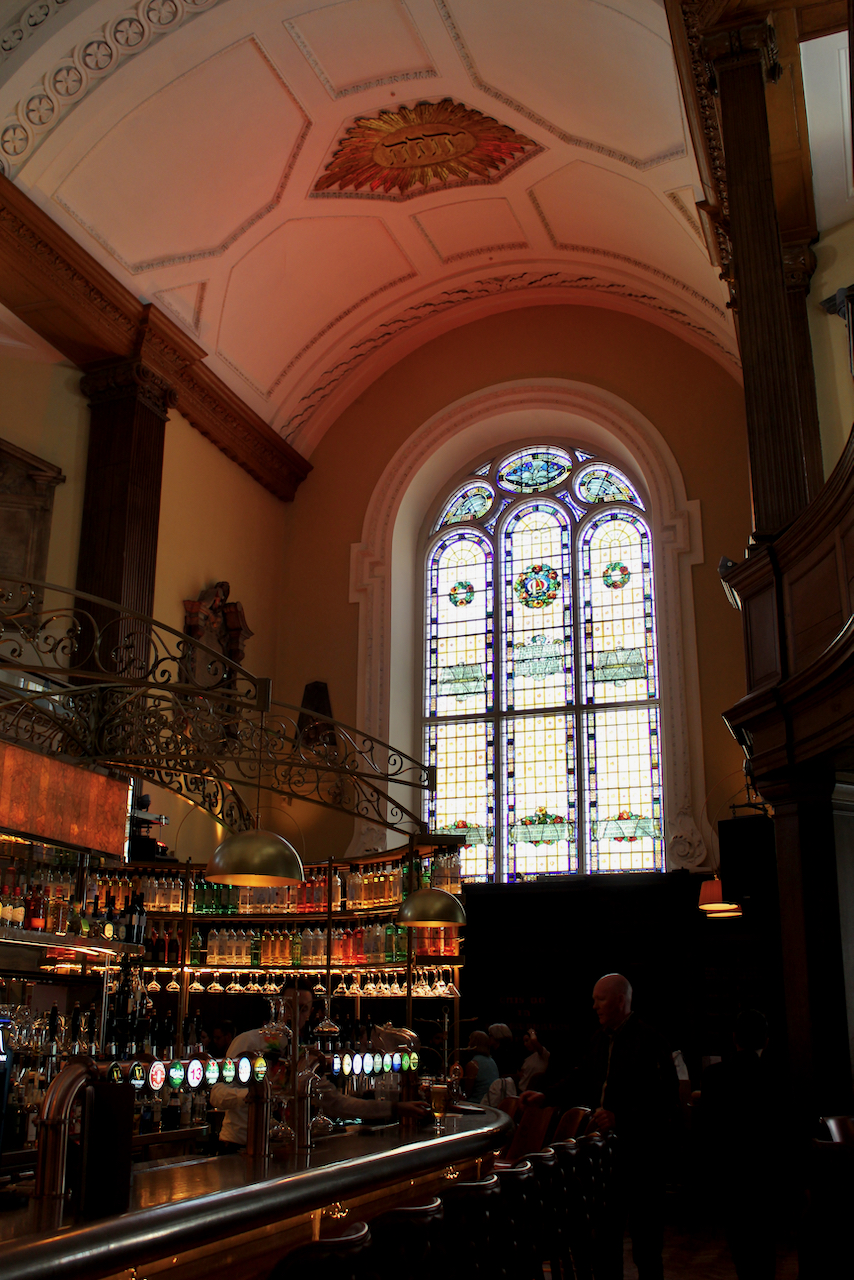
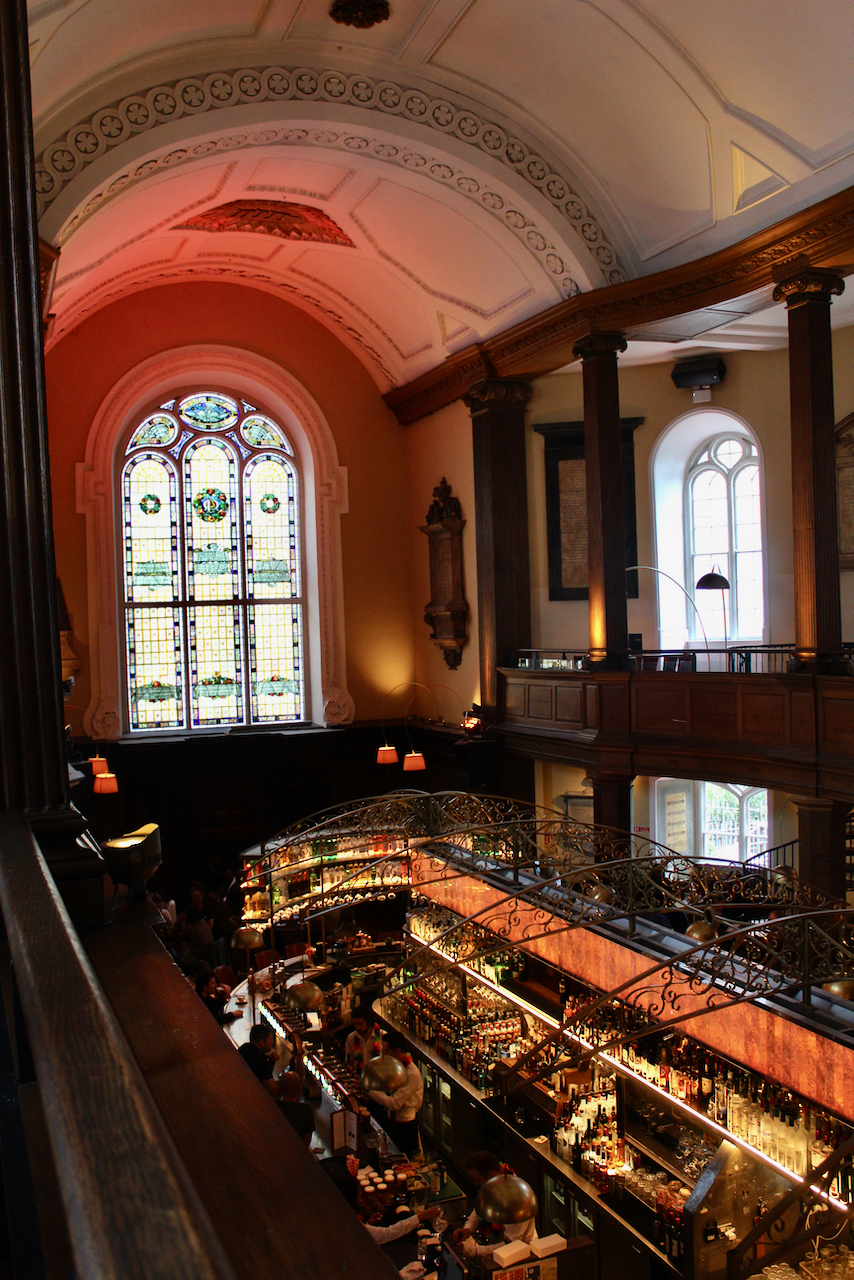
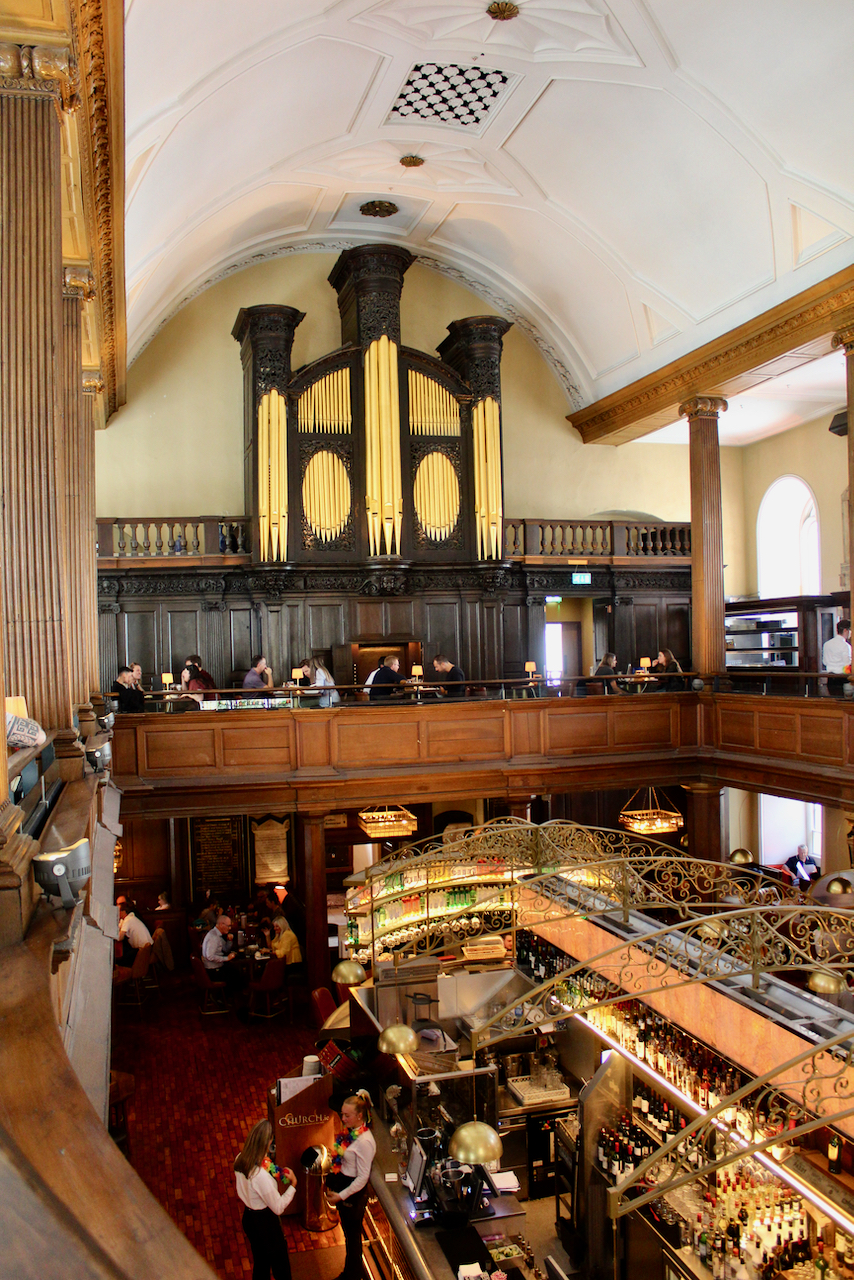
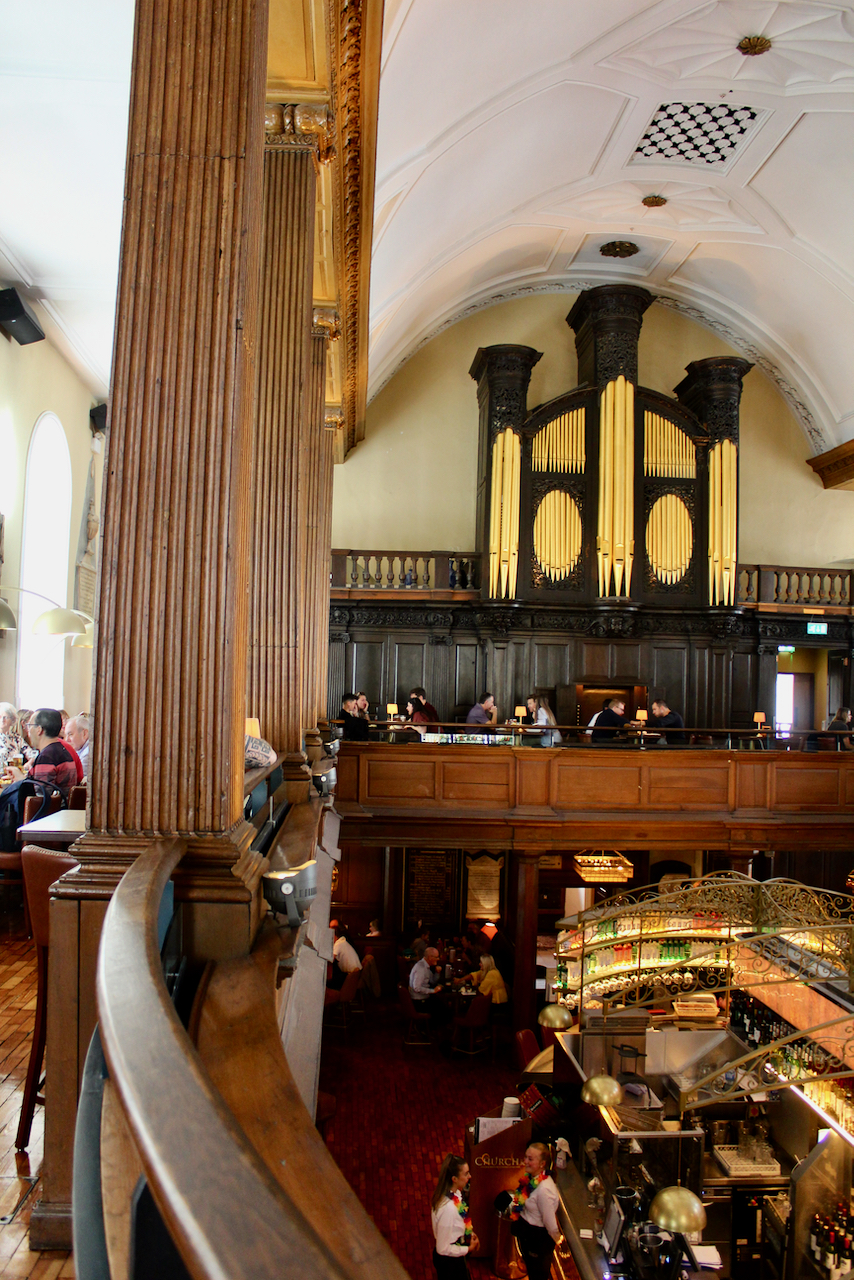
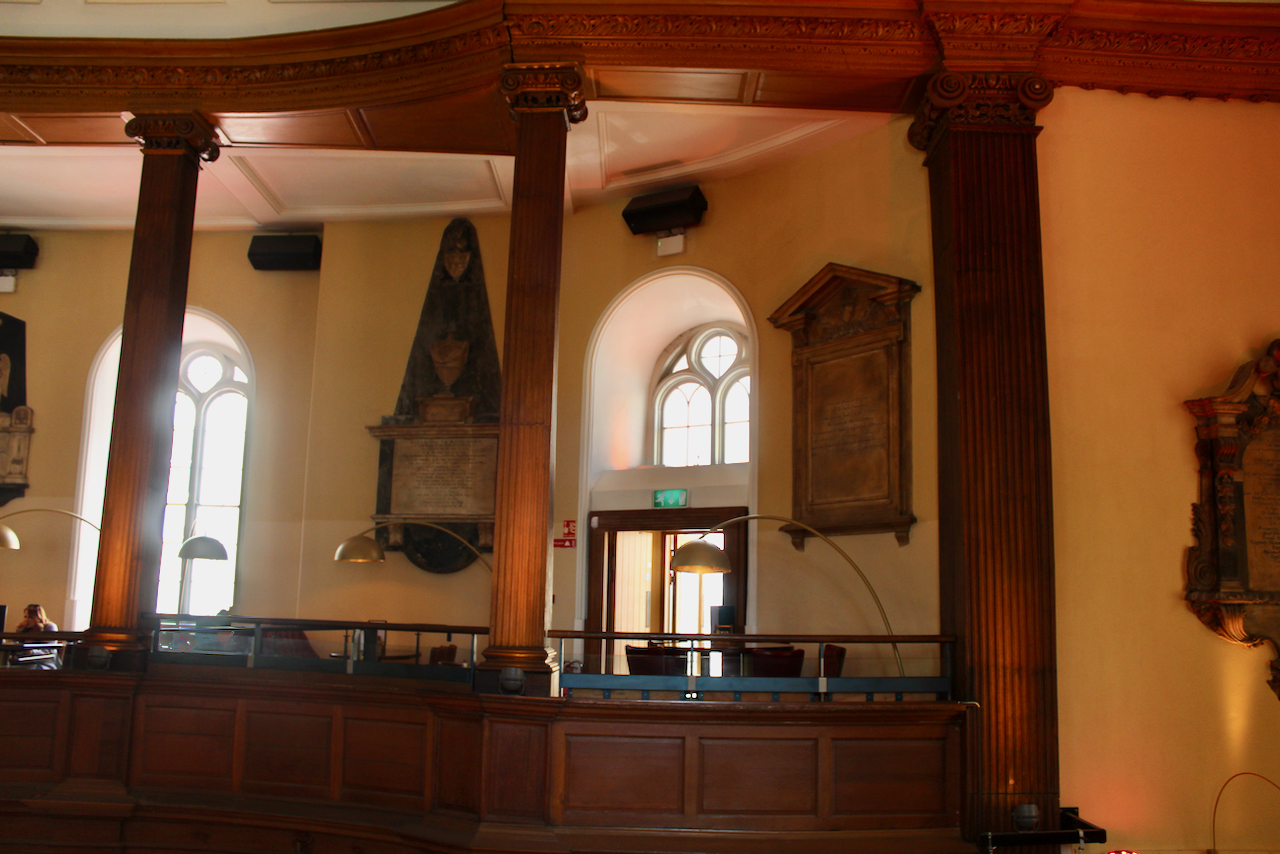
Inside, it is of double height with a gallery surrounding three sides. On the fourth side is the east window. The west end has a large organ on the upper floor. The centre of the floor is taken up with an oval shaped bar which is made attractive by its arrangement of bottles and glasses. The gallery is carried on octagonal timber-clad limestone shafts. Above, the gallery reaches up to the ceiling with fluted square Ionic columns. The ceiling is barrel-vaulted. Memorial monuments still line the walls. Outside, the gravestones have been moved to one end of the public square.

Former St. Mary’s church. Photograph © Jennifer Winder-Baggot, www.irishhistorichouses.com
St. Mary’s Church of Ireland, June 2022. Photograph © Jennifer Winder-Baggot, www.irishhistorichouses.com

The east Chancel window has a lugged and scrolled surround.

Casey tells us that the building was remodelled in 2002-5 as a bar and restaurant by Duffy Mitchell Donoghue, who filled in the crypt and altered the floor level of the nave. The glazed tower holds a cylindrical elevator.

In 1761 Arthur Guinness (1725-1803), founder of the Brewery, married Olivia Whitmore in the church. His son, also named Arthur, married here also.

The National Inventory tells us: “It was the first classical parish church in the city and was the site of Arthur Guinness’s marriage in 1761. Wolfe Tone was baptized here and the church also witnessed John Wesley’s first Irish sermon... The galleried interior is one of the earliest in Dublin, and is a triumph of Classical timber design. Grand proportions combine with the set-pieces of the original organ case, east window and surviving Corinthian reredos, connected by an ornate mix of joinery and innovative modern alterations, to create a sumptuous and exuberant space. Mary Street was laid out by Humphrey Jervis from the mid-1690s and in 1697 the parish of Saint Michan’s was divided into three which precipitated the construction of Saint Mary’s. Jervis Street was named for the developer himself and was once home to seventeenth and eighteenth-century buildings. The streets are much altered now and consist largely of Victorian buildings, leaving Saint Mary’s to ground the district in its earlier historic milieu. As such, it makes a highly significant contribution to the streetscape and to Dublin’s overall architectural fabric.”

A rather simple baptismal font in the church is the font in which Theobald Wolfe Tone was baptised, and also Sean O’Casey the playwright.

Former St. Mary’s church. Photograph © Jennifer Winder-Baggot, www.irishhistorichouses.com
St. Mary’s Church of Ireland, June 2022. Photograph © Jennifer Winder-Baggot, www.irishhistorichouses.com

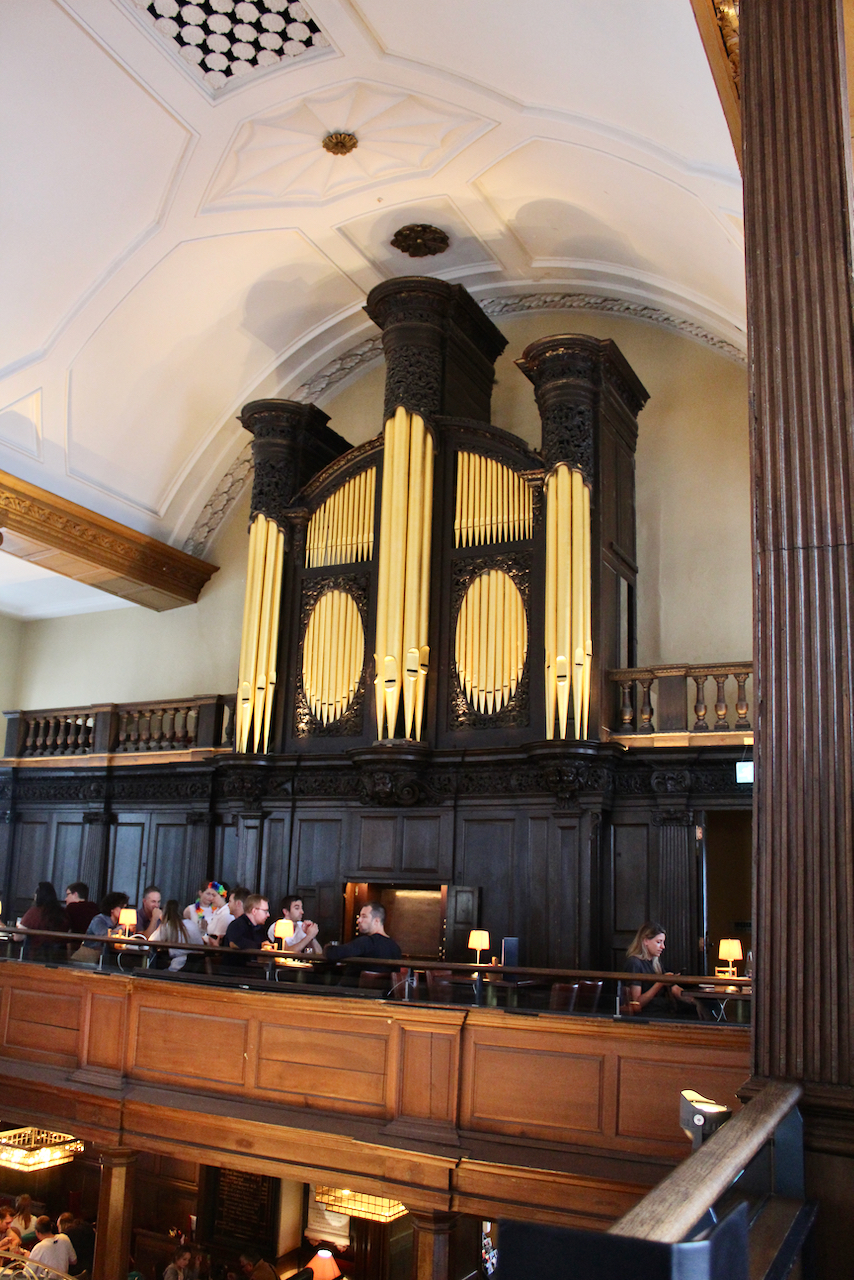
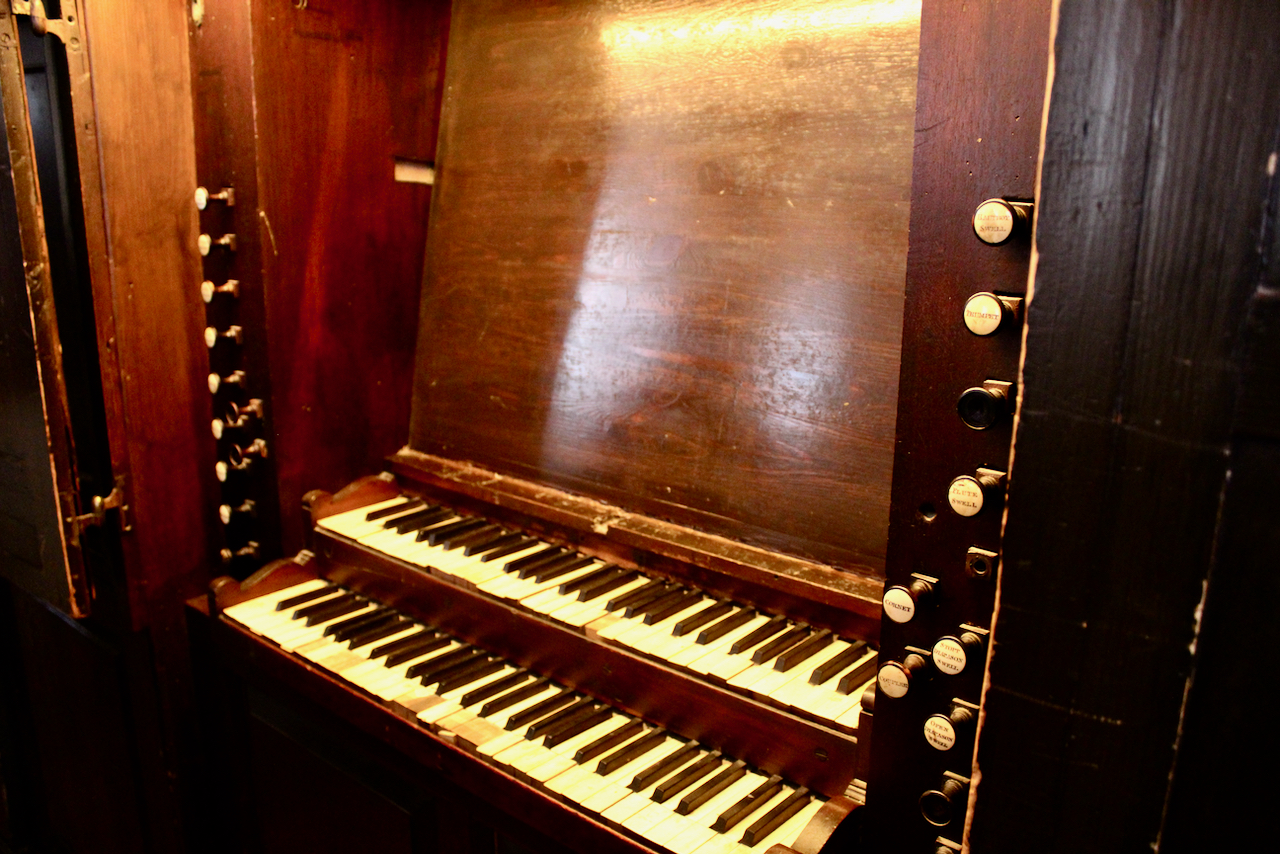
The organ was designed by Renatus Harris. George Frederick Handel, who wrote the famous “Messiah,” lived nearby on Abbey Street and was a regular visitor to Mary’s to play on this organ.

Former St. Mary’s church. Photograph © Jennifer Winder-Baggot, www.irishhistorichouses.com
St. Mary’s Church of Ireland, June 2022. Photograph © Jennifer Winder-Baggot, www.irishhistorichouses.com

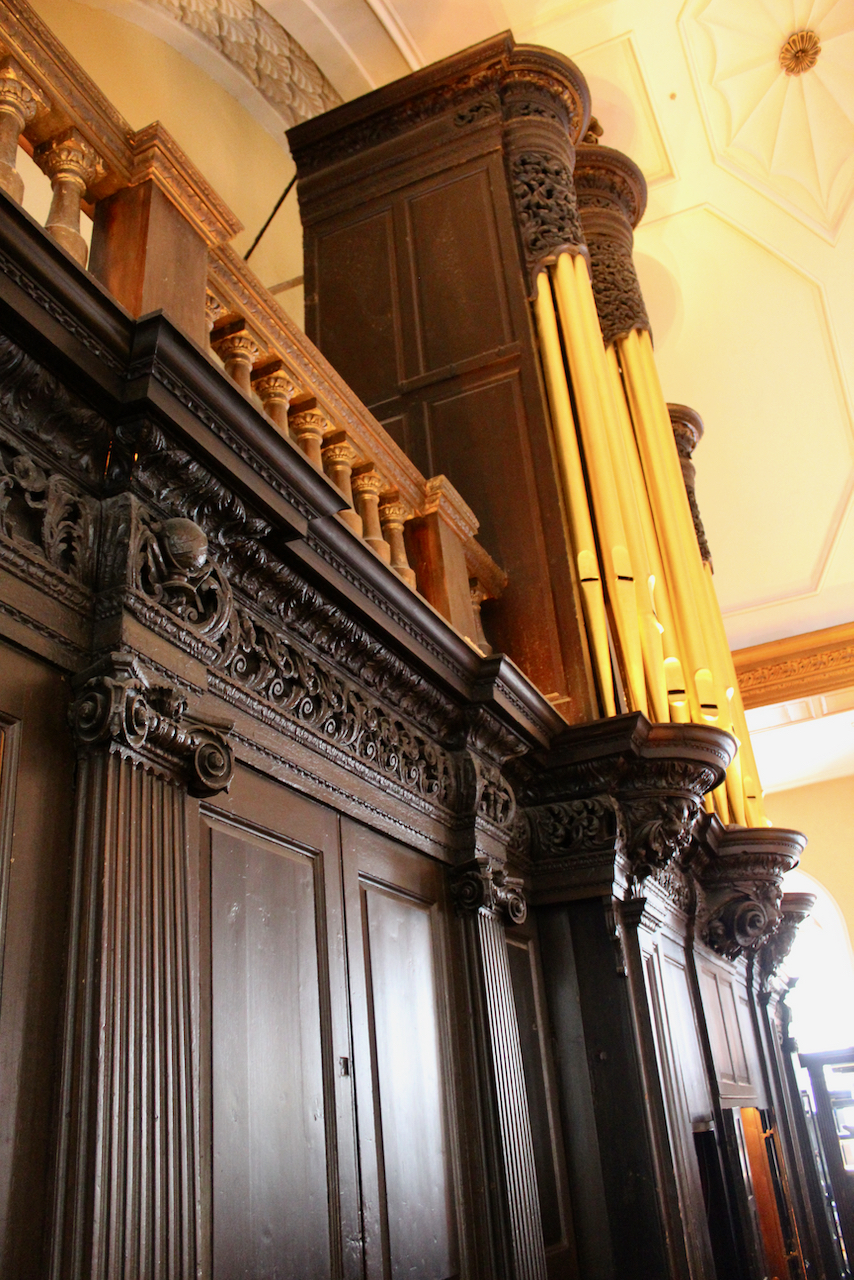
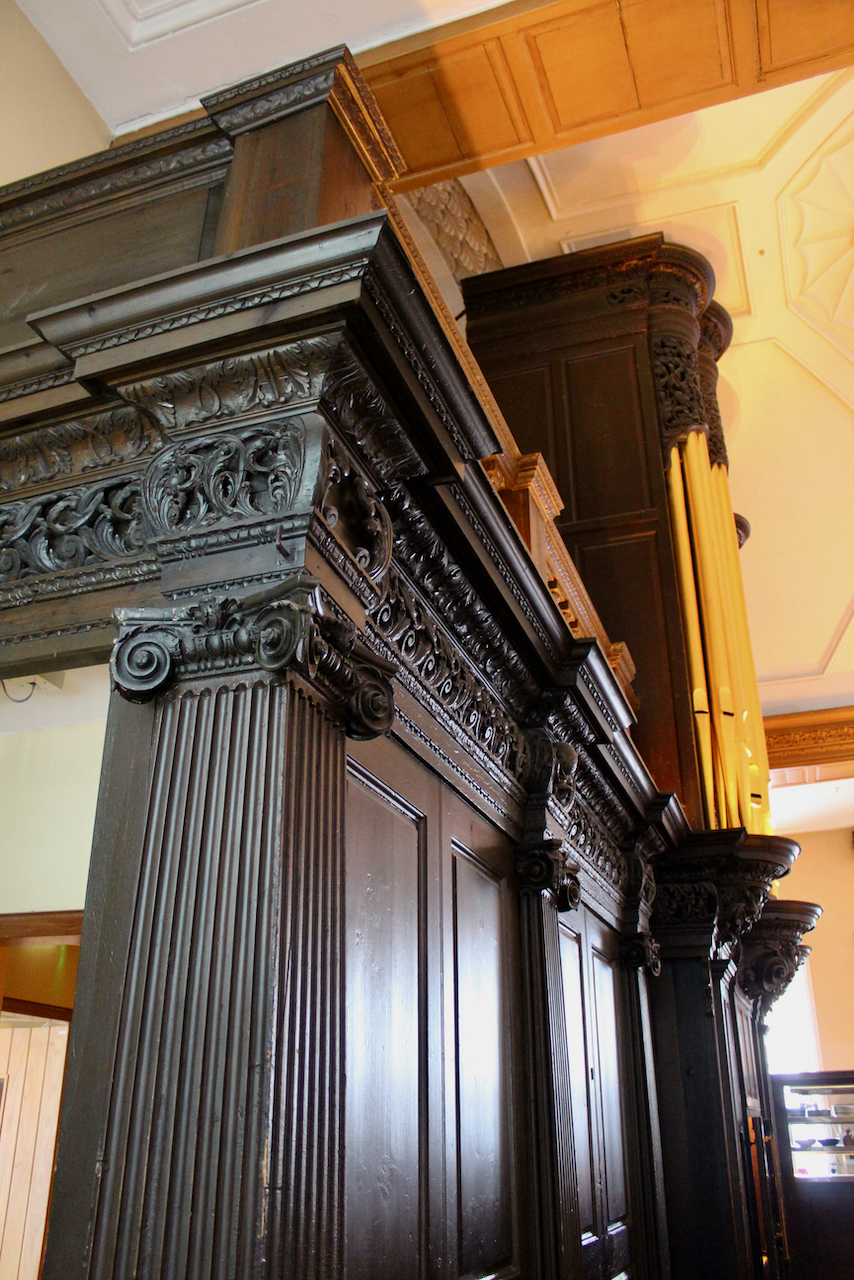
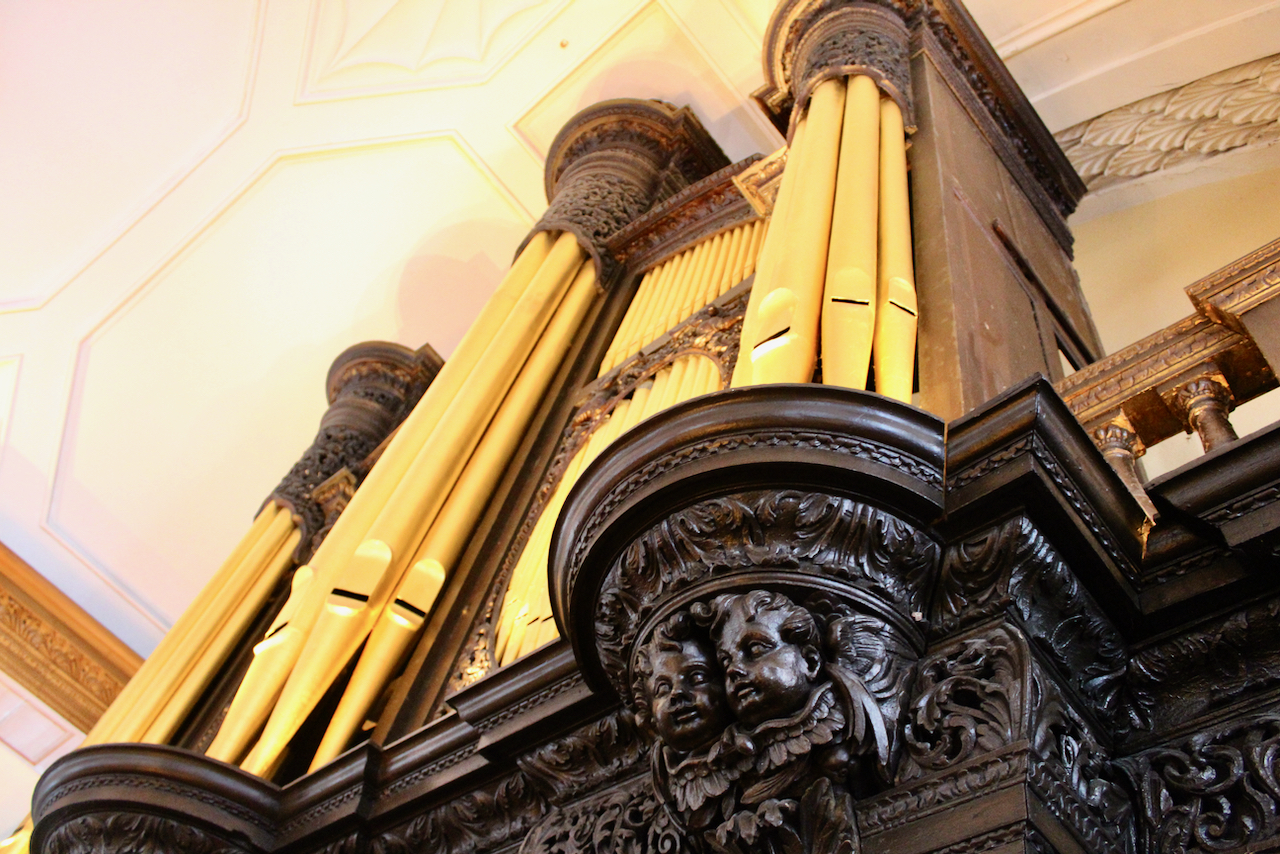
The organ case, Casey tells us, includes the bases of three pipe-clusters with cherubim and scrolls.

Former St. Mary’s church. Photograph © Jennifer Winder-Baggot, www.irishhistorichouses.com
Thirty one memorial tablets in the church are dedicated to people formerly buried in St. Mary’s crypt and graveyard. Photograph © Jennifer Winder-Baggot, www.irishhistorichouses.com

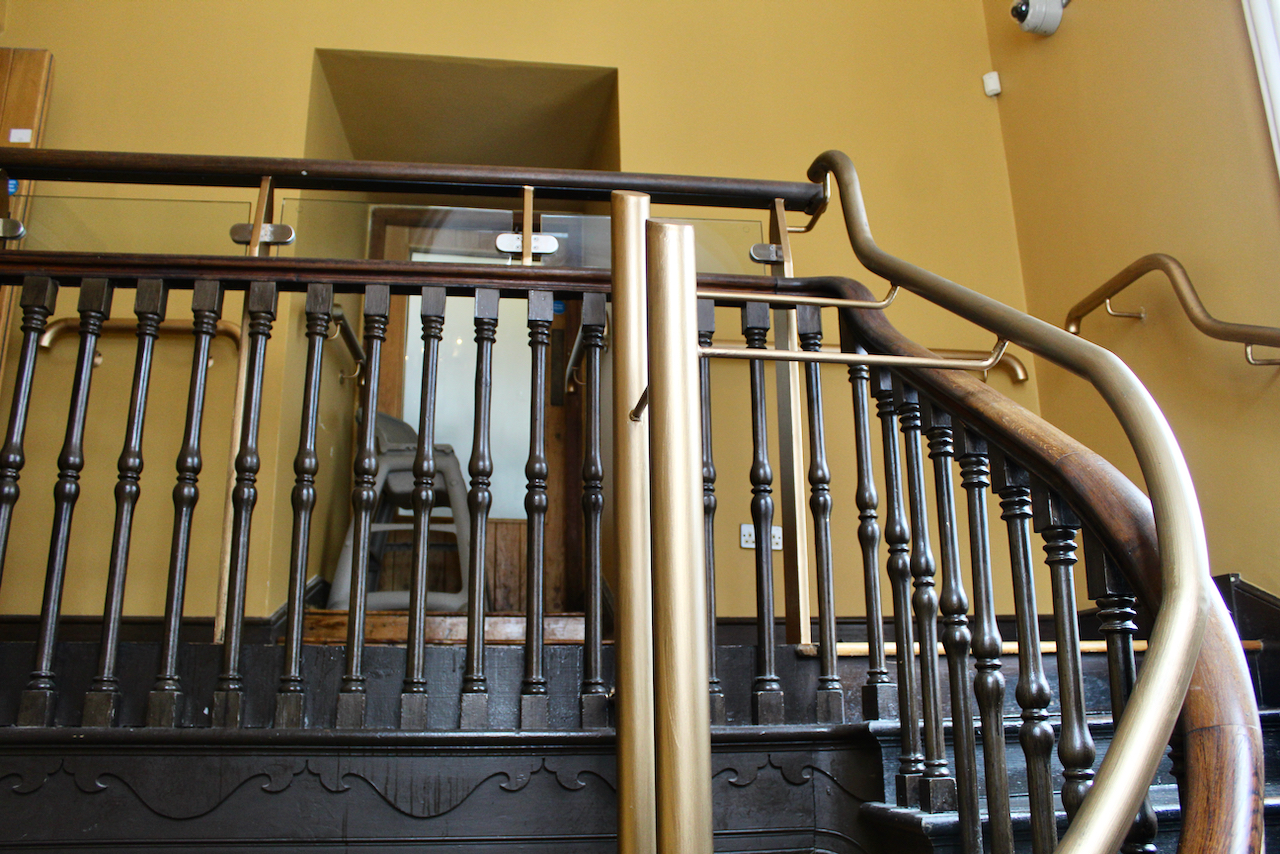
The vestibules have early eighteenth century staircases.

Former St. Mary’s church. Photograph © Jennifer Winder-Baggot, www.irishhistorichouses.com
St. Mary’s Church of Ireland, June 2022. Photograph © Jennifer Winder-Baggot, www.irishhistorichouses.com

Below ground, is the Cellar Bar. These function rooms are located in an area that was excavated out from underneath the church, and are not part of the original building. There are six crypts in the basement of the church, and 32 skeletons were removed and reinterred elsewhere when the church was converted to its current use. Access to the crypt was by an external stairwell in the church.

Former St. Mary’s church. Photograph © Jennifer Winder-Baggot, www.irishhistorichouses.com
The crypt level. Photograph © Jennifer Winder-Baggot, www.irishhistorichouses.com
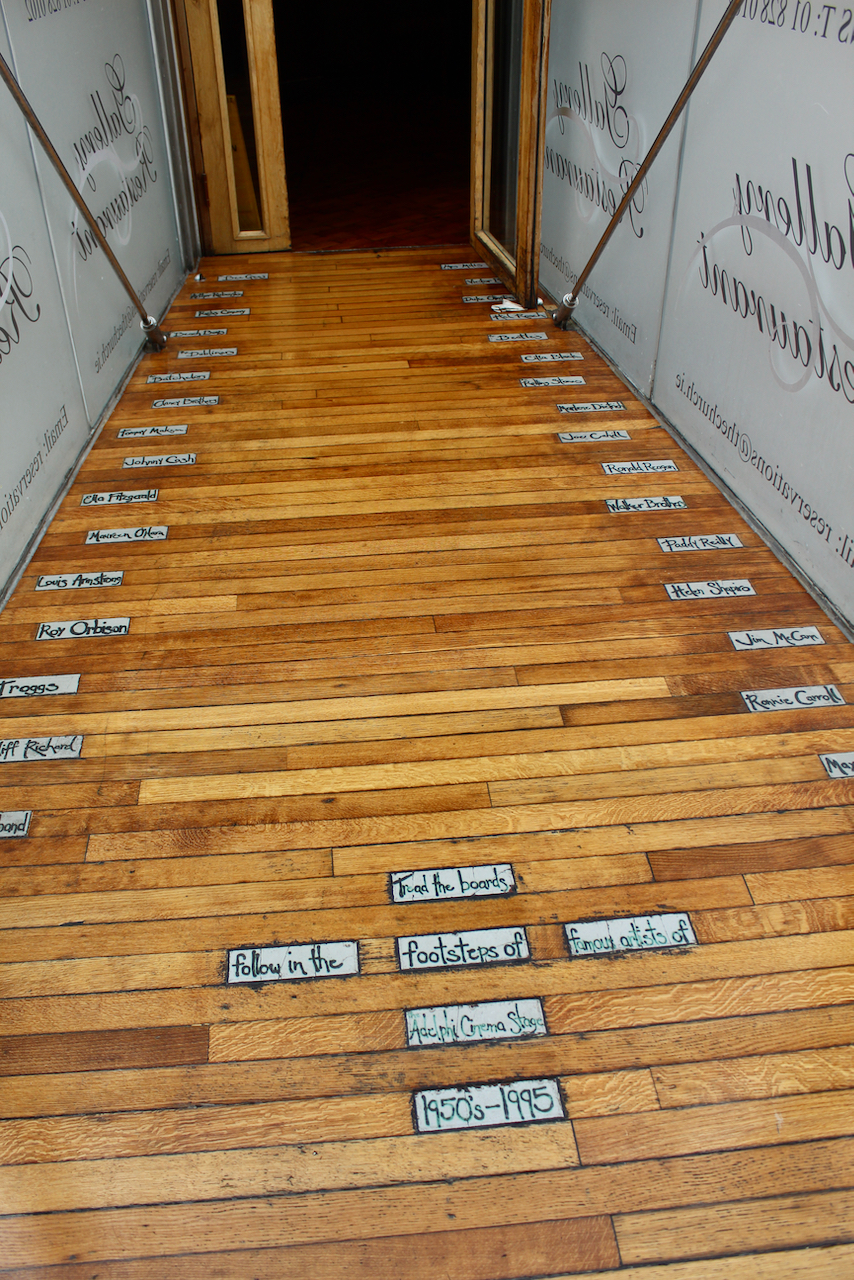
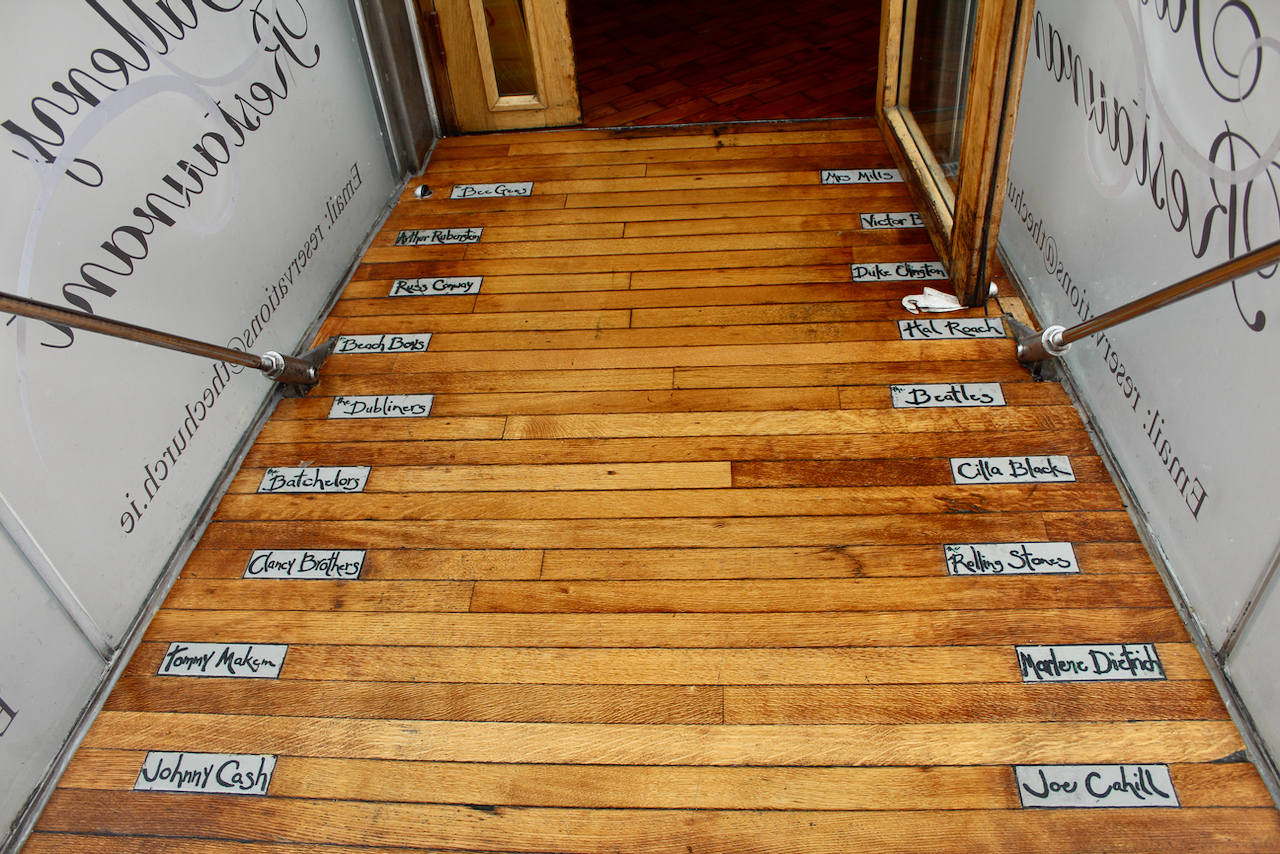
The wooden floorboards leading from the external glass tower to the upper gallery of the church were removed from the Adelphi Theatre in 1995 prior to its demolition. Some of the famous acts to perform on the stage are listed on the floor. Photograph © Jennifer Winder-Baggot, www.irishhistorichouses.com
St. Mary’s Church of Ireland, June 2022. Photograph © Jennifer Winder-Baggot, www.irishhistorichouses.com

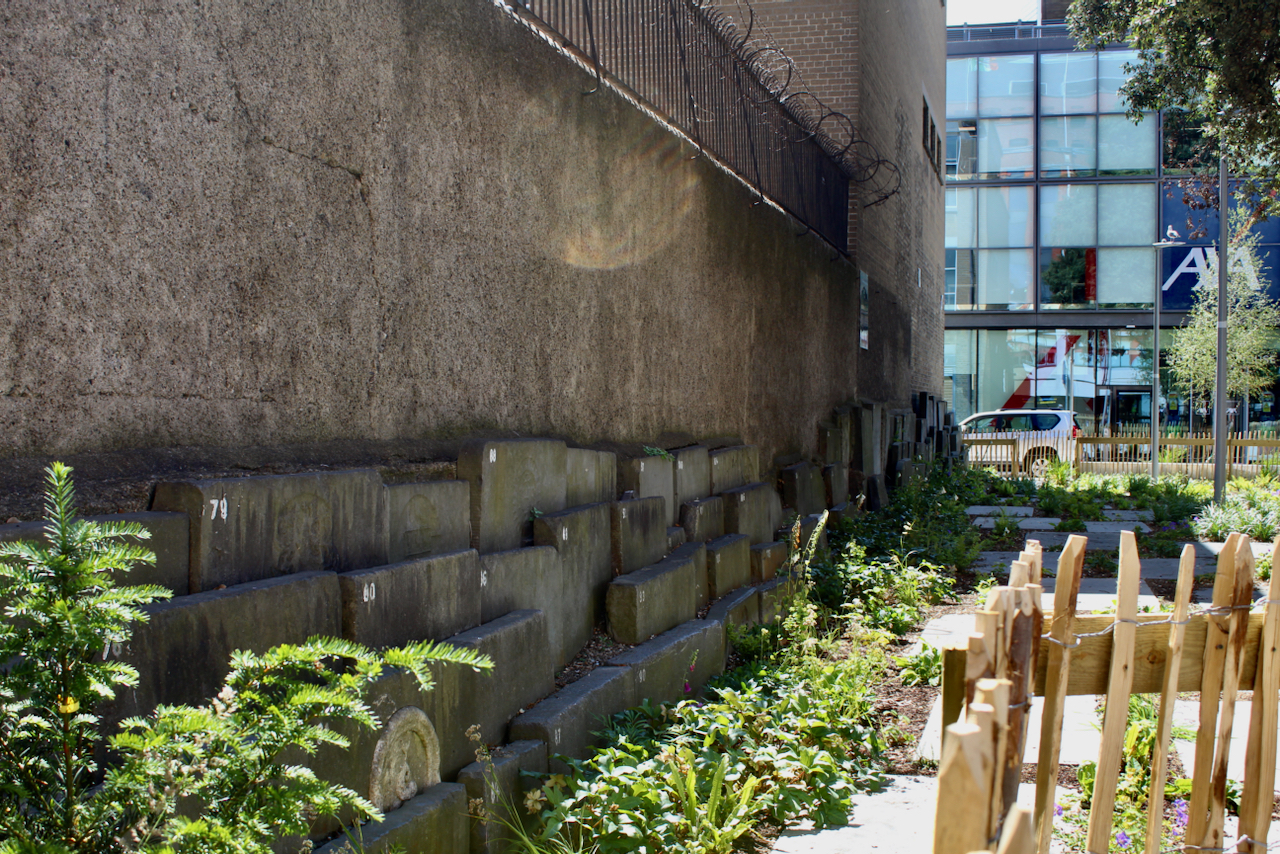
Outside there is a public square, Wolfe Tone Park, and grave slabs are stacked up at one end of this park.

Wolfe Tone Square. Photograph © Jennifer Winder-Baggot, www.irishhistorichouses.com
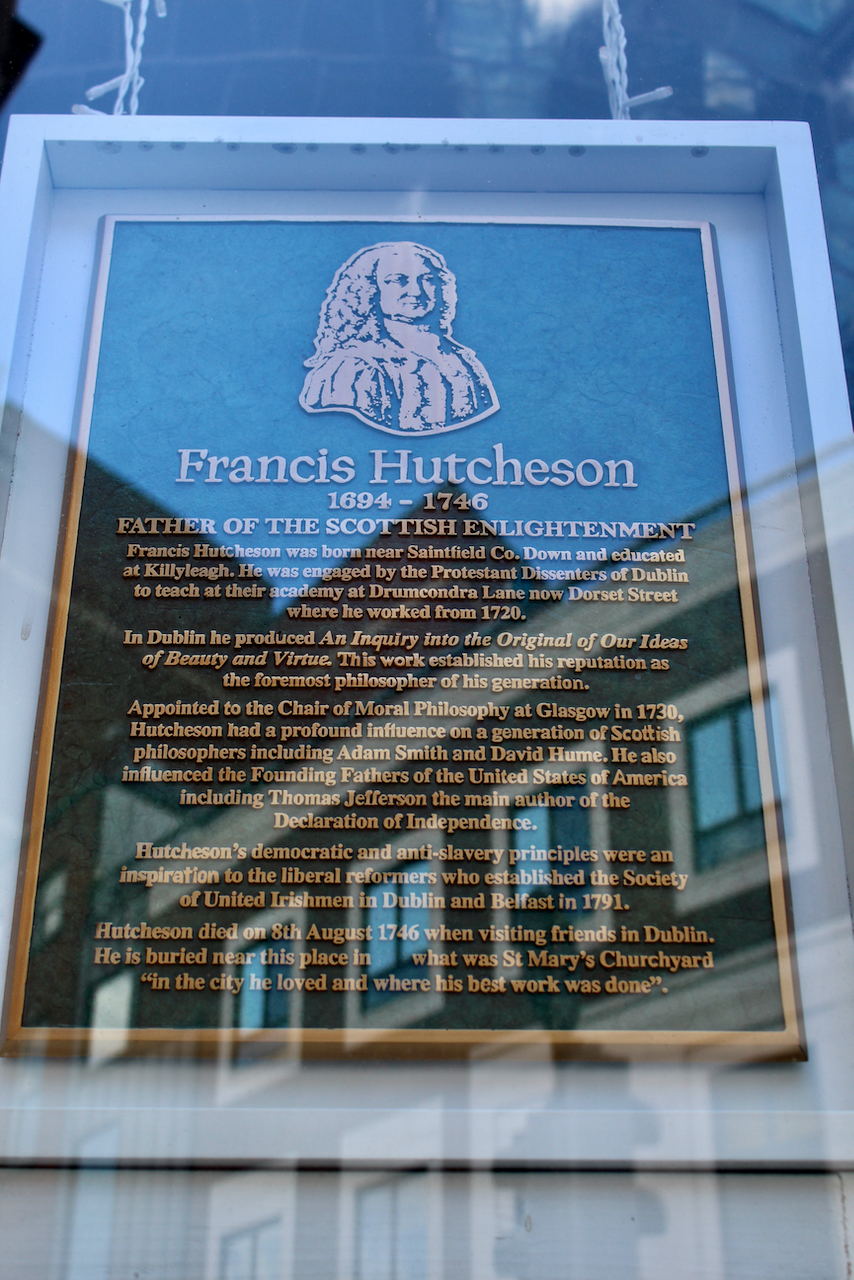
The burial place of Francis Hutcheson.
Wolfe Tone Square. Photograph © Jennifer Winder-Baggot, www.irishhistorichouses.com
Former St. Mary’s church. Photograph © Jennifer Winder-Baggot, www.irishhistorichouses.com
St. Mary’s Church of Ireland, June 2022. Photograph © Jennifer Winder-Baggot, www.irishhistorichouses.com

[1] Dictionary of Irish Biography for Sir William Robinson, https://www.dib.ie/biography/robinson-sir-william-a7736

[2] https://www.dib.ie/biography/burgh-thomas-a1135

[3] p. 89-91. Casey, Christine. Buildings of Ireland: Dublin, The City within the Grand and Royal Canals and the Circular Road with the Phoenix Park. Yale University Press, New Haven and London, 2005.

Text © Jennifer Winder-Baggot, www.irishhistorichouses.com

Ardgillan Castle, Balbriggan, County Dublin

https://ardgillancastle.ie

Ardgillan Castle, Balbriggan, February 2022. © Jennifer Winder-Baggot, www.irishhistorichouses.com

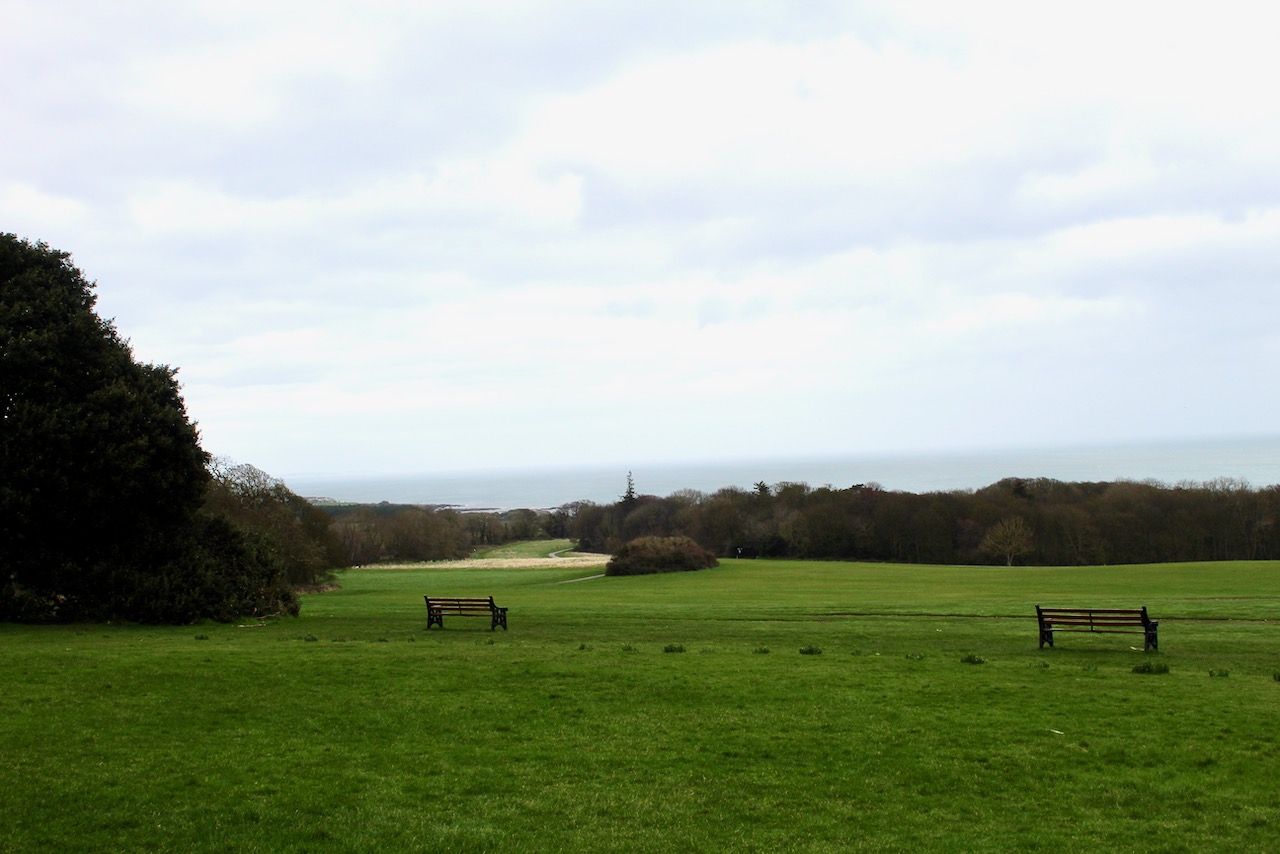
You approach Ardgillan Castle from the back, coming from the car park, facing down to the amazing vista of Dublin bay.

The approach to Ardgillan Castle with the view of Dublin Bay, February 2022. © Jennifer Winder-Baggot, www.irishhistorichouses.com
The view of Dublin Bay from the front of Ardgillan Castle, March 2020. © Jennifer Winder-Baggot, www.irishhistorichouses.com

The website tells us:

In 1658, the “Down Survey” records that Ardgillan was owned by a wine merchant, Robert Usher of Tallaght, Dublin and by 1737, the property had been acquired by the Reverend Robert Taylor, one of the Headfort Taylors [of Headfort House, County Meath – of which later part became a school and part kept as a residence, and the east wing was advertised for sale in November 2019. The Dining Hall has particularly fine stucco work by Scottish born architect Robert Adam (1728-1792), one of the family from which the term “Adamesque” takes its name], whose grand-father had collaborated with Sir William Petty on the mid 17th century “Down Survey of Ireland”. 

Robert was the son of Thomas (1662-1736), the 1st Baronet of Kells, County Meath. Robert (1689-1744), a younger son, joined the clergy and according to the Ardgillan website, was a recluse and spent his time writing sermons. He became Dean of Clonfert, County Galway. He died unmarried and the estate passed to his brother Thomas Taylour, the 2nd Baronet of Kells, County Meath. His sister Salisbury married a Bishop of Clonfert and secondly, Brigadier General James Crofts, son of James Scott the Duke of Monmouth, an illegitimate son of King Charles II!

Ardgillan remained the family home of the Taylors (later changed to Taylour) for more than two hundred years up until 1962 when the estate was sold to Heinrich Potts of Westphalia, Germany. In 1982, Dublin County Council purchased Ardgillan Demesne and it is now managed by Ardgillan Castle Ltd. under the auspices of Fingal County Council.

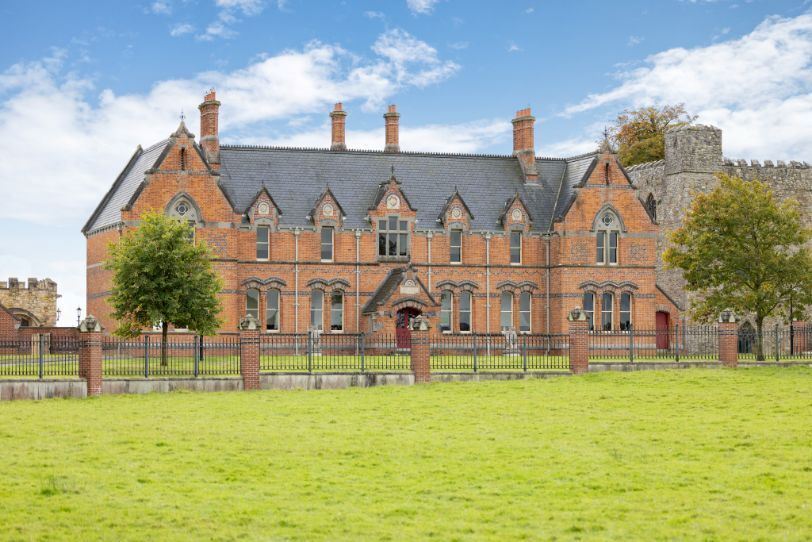
Originally named “Prospect House”, built on Mount Prospect (you can see why it was so called, with such a view!), the central section was built in 1738 by Robert Taylor, with the west and east wings added in the late 1800s. 

Ardgillan Castle, Balbriggan, February 2022. © Jennifer Winder-Baggot, www.irishhistorichouses.com

Mark Bence-Jones writes in his  A Guide to Irish Country Houses (1988):

p. 9. [Taylour, sub. Headfort, M/PB]. A C18 house consisting of a 2 storey bow-fronted centre with single-storey overlapping wings, mildly castellated either towards the end of C18 or early C19. The central bow has been made into a round tower by raising it a storey and giving it a skyline of Irish battlements; the main roof parapet has been crenellated and the windows given hood mouldings. Over each of the windows was thrown, literally speaking, a Gothic cloak of battlements and pointed arches; below which the original facade, with its quoins and rectangular sash windows, shows in all its Classical nakedness. Battlemented ranges and an octagon tower were added on the other side of the house.” [1]

Ardgillan Castle, Balbriggan, February 2022. © Jennifer Winder-Baggot, www.irishhistorichouses.com
IMG_2005
Ardgillan Castle, June 2020. © Jennifer Winder-Baggot, www.irishhistorichouses.com

The website informs us:

Initially the site was heavily wooded, the name Ardgillan being derived from the Irish “Ard Choill” meaning High Wood. It was cleared out by service soldiers and itinerant workers in return for one penny a day, sleeping accommodation and one meal. 

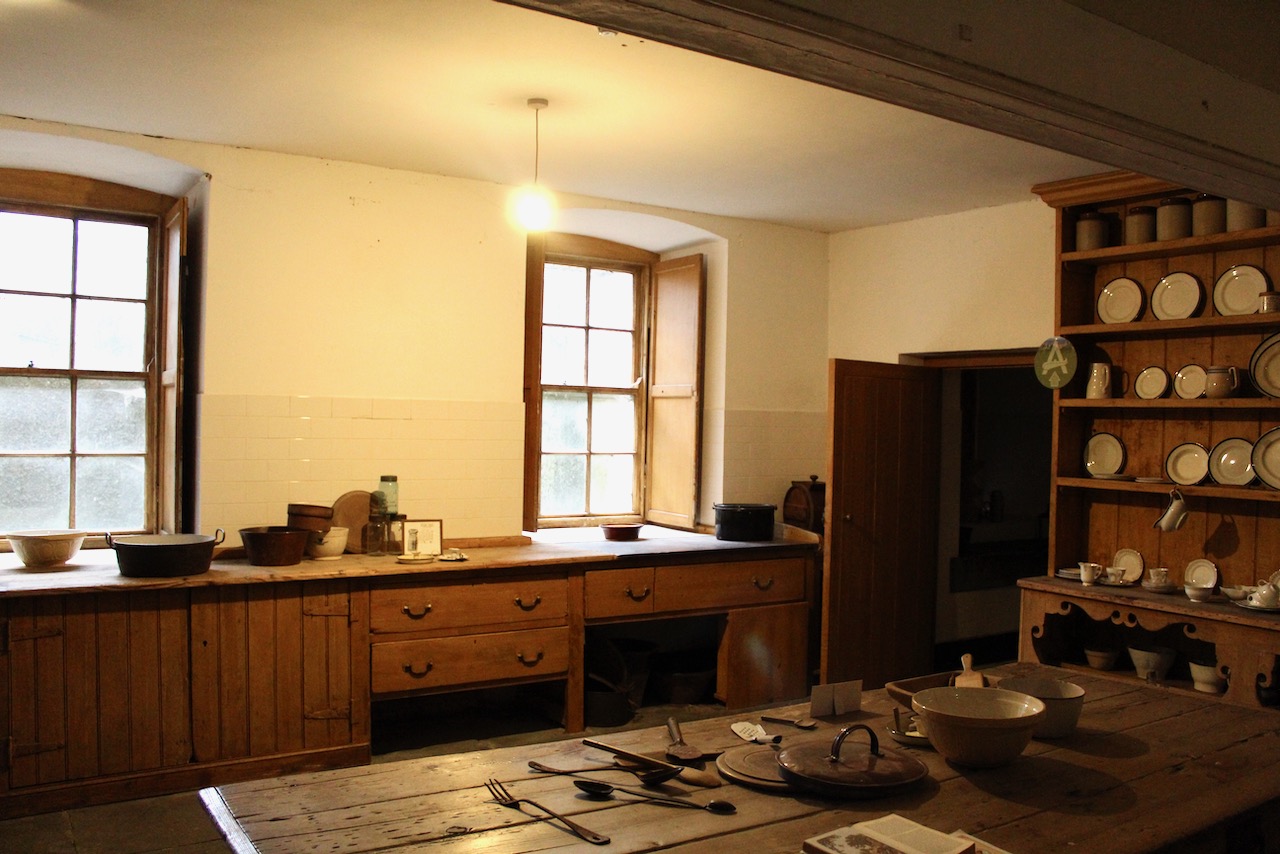
The house consists of two storeys over a basement which extends out under the lawns on the southern side of the building. When occupied, the ground and first floors were the living accommodations while the west and east wings were servants’ quarters and estate offices. The basement comprised of the service floor, the kitchen and stores.

IMG_2002
The back of Ardgillan Castle, Dublin, June 2020. © Jennifer Winder-Baggot, www.irishhistorichouses.com

Thomas Taylour 2nd Baronet of Kells married Sarah Graham of Platten, County Meath. Their son Thomas was MP for Kells, County Meath, and was created 1st Earl of Bective, of Bective Castle, Co. Meath.

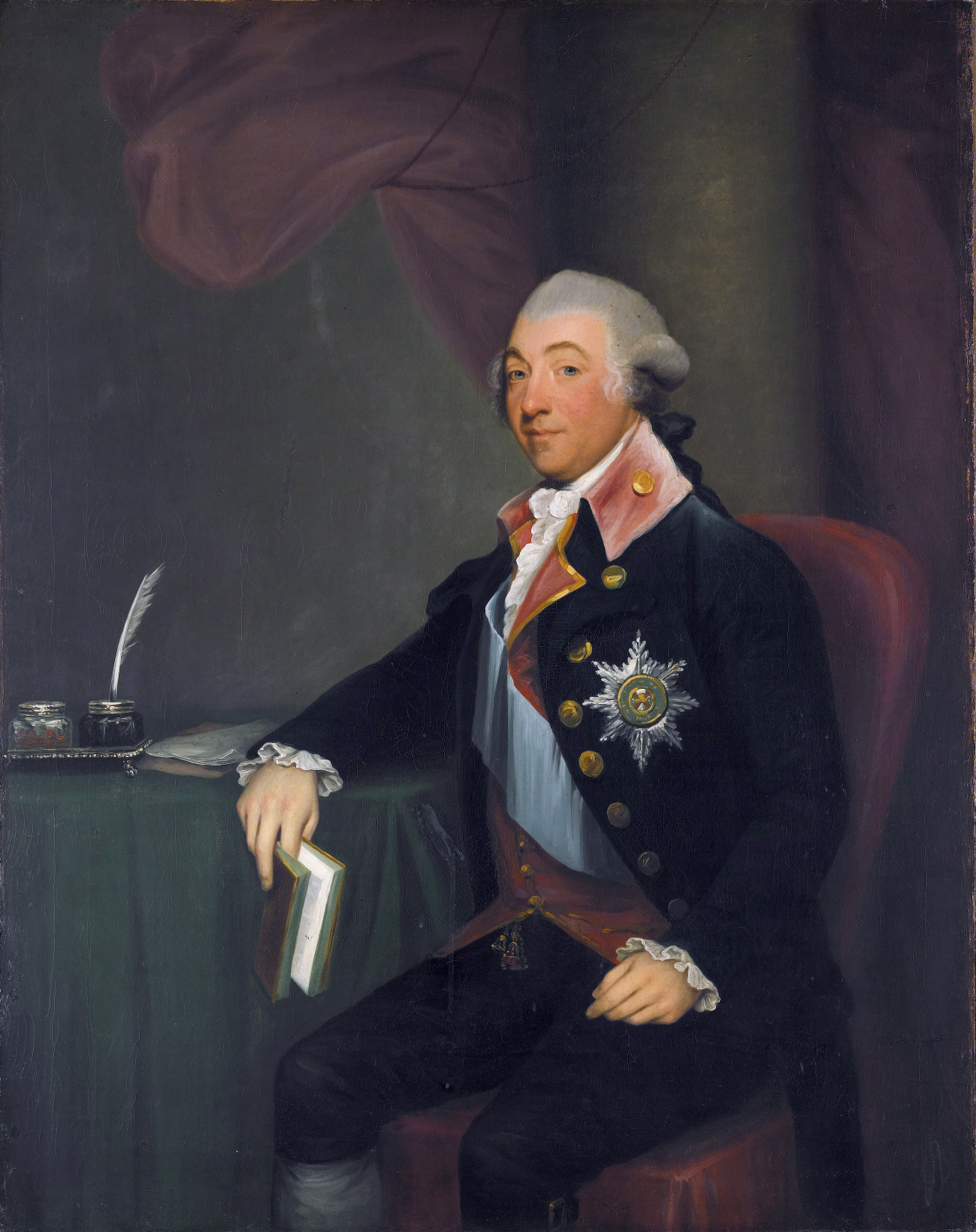
Thomas Taylour (1724-1795) 1st Earl of Bective wearing the star and sash of the Order of St. Patrick by Gilbert Stuart and studio courtesy of Sotheby’s, Public Domain, https://commons.wikimedia.org/w/index.php?curid=27947645.jpg

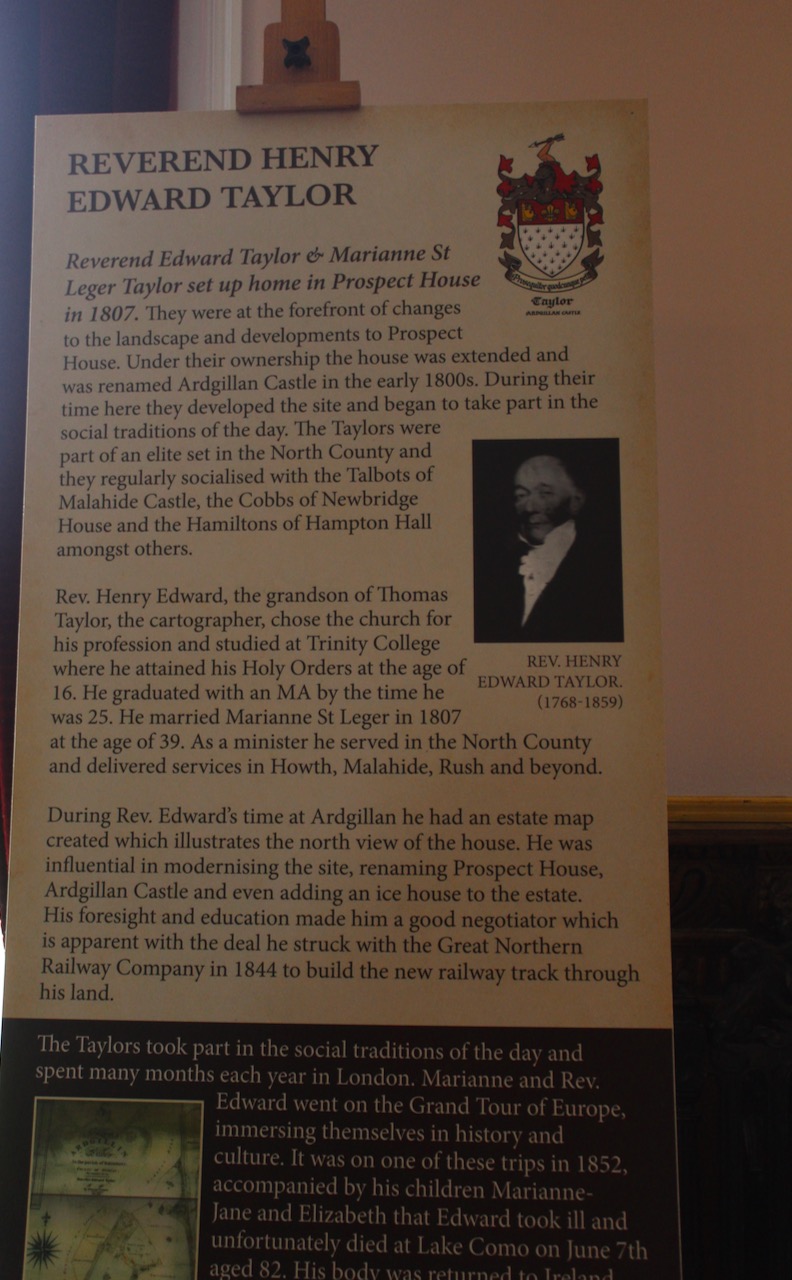
He wedded, in 1754, Jane, eldest daughter of the Rt Hon Hercules Langford Rowley, from Summerhill, County Kilkenny. Their younger son, Henry Edward Taylour (1768-1852) joined the clergy and he and his wife, Marianne St. Leger from Doneraile in County Cork, settled at Ardgillan.

Ardgillan Castle, Balbriggan, February 2022. © Jennifer Winder-Baggot, www.irishhistorichouses.com
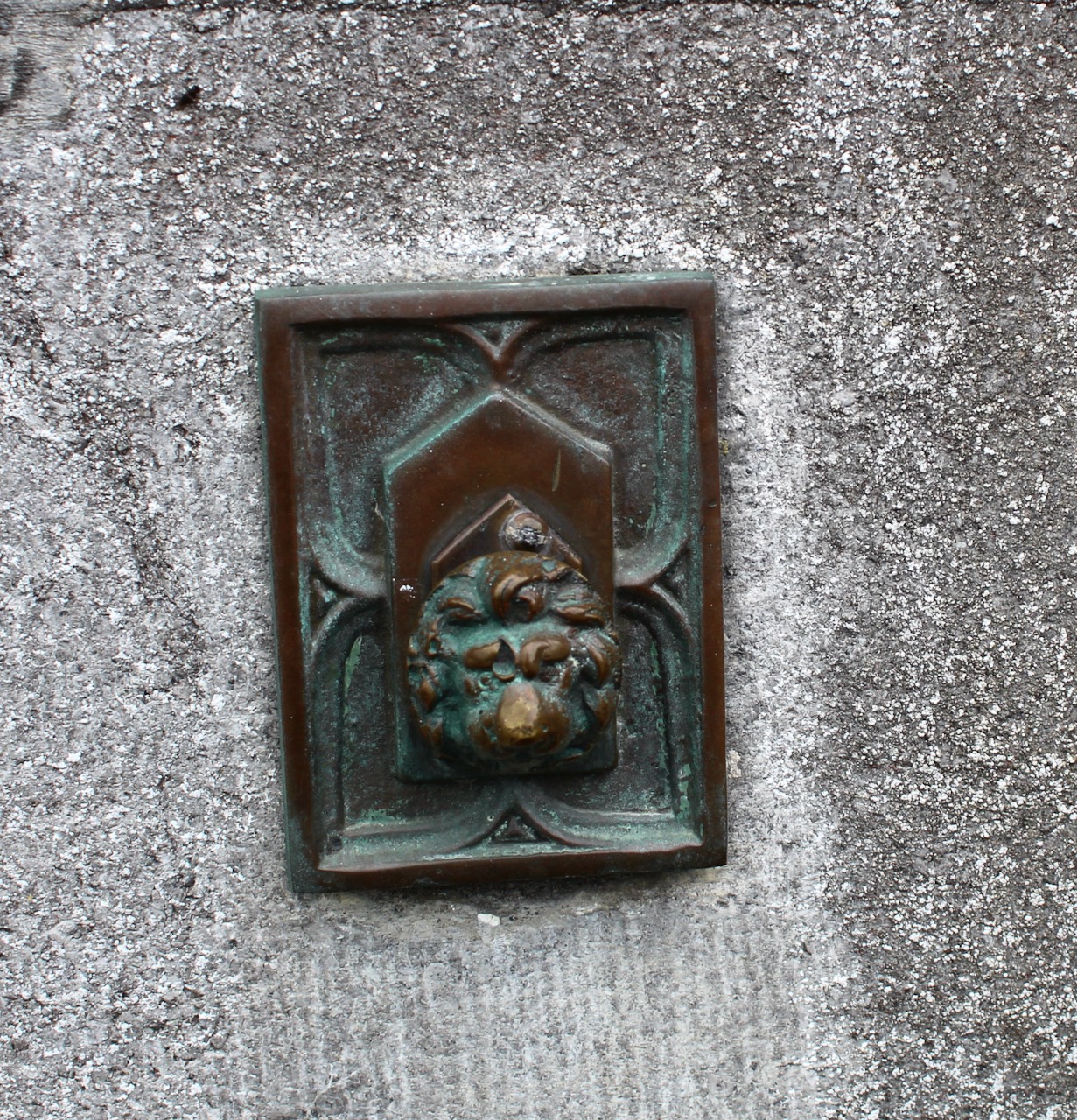
By the front door, a bell pull, I think. © Jennifer Winder-Baggot, www.irishhistorichouses.com

We returned to Ardgillan in February 2022 and were able to see inside the castle.

Entrance Hall of Ardgillan, with shop and visitor’s desk. There are lovely plasterwork scrolls of foliage along the inside of the arches and a gothic arches pattern around the ceiling which matches the glass door and window arch. The ceiling and wall arch contain flanking rounded pillars. The fine ceiling rose is of acanthus leaves. © Jennifer Winder-Baggot, www.irishhistorichouses.com
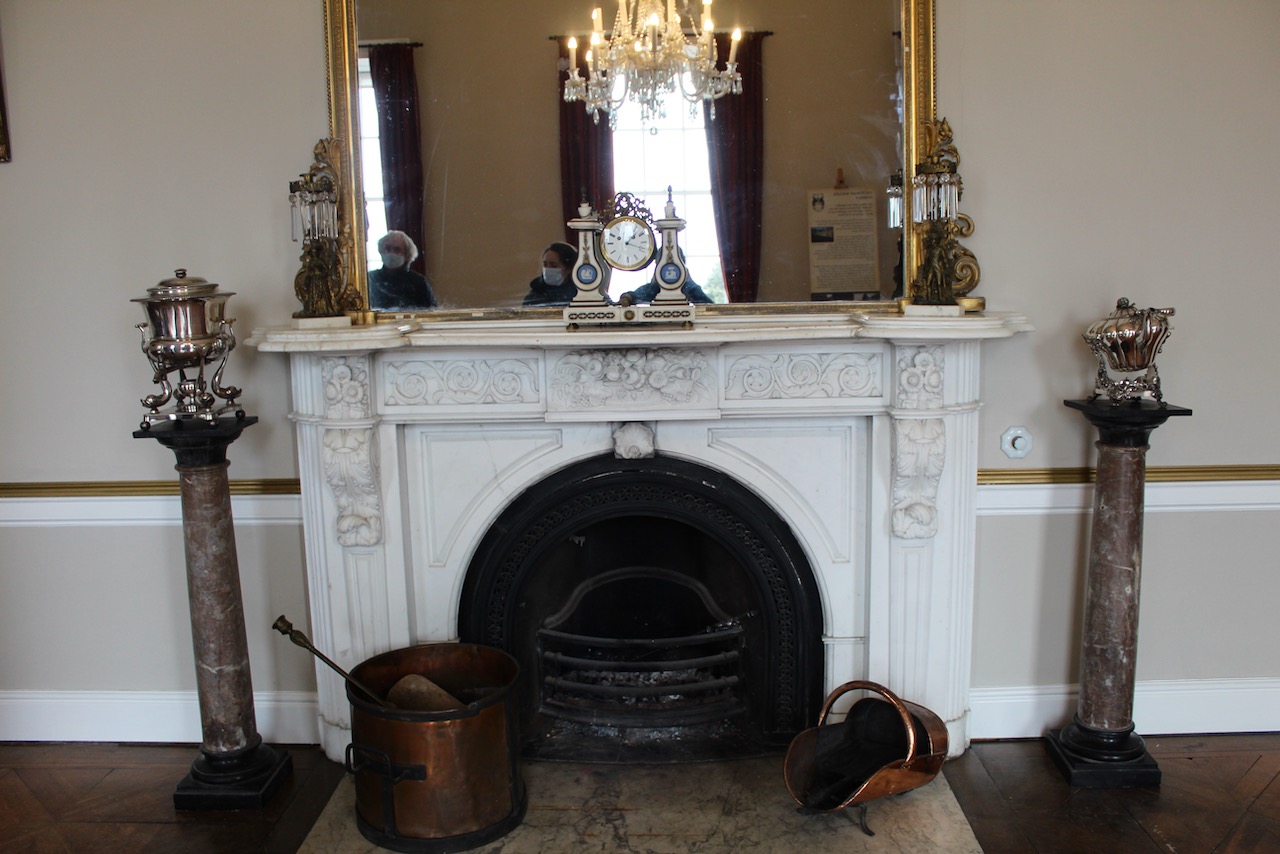
The Drawing Room of Ardgillan Castle. © Jennifer Winder-Baggot, www.irishhistorichouses.com
Ardgillan Castle, Balbriggan, February 2022. © Jennifer Winder-Baggot, www.irishhistorichouses.com
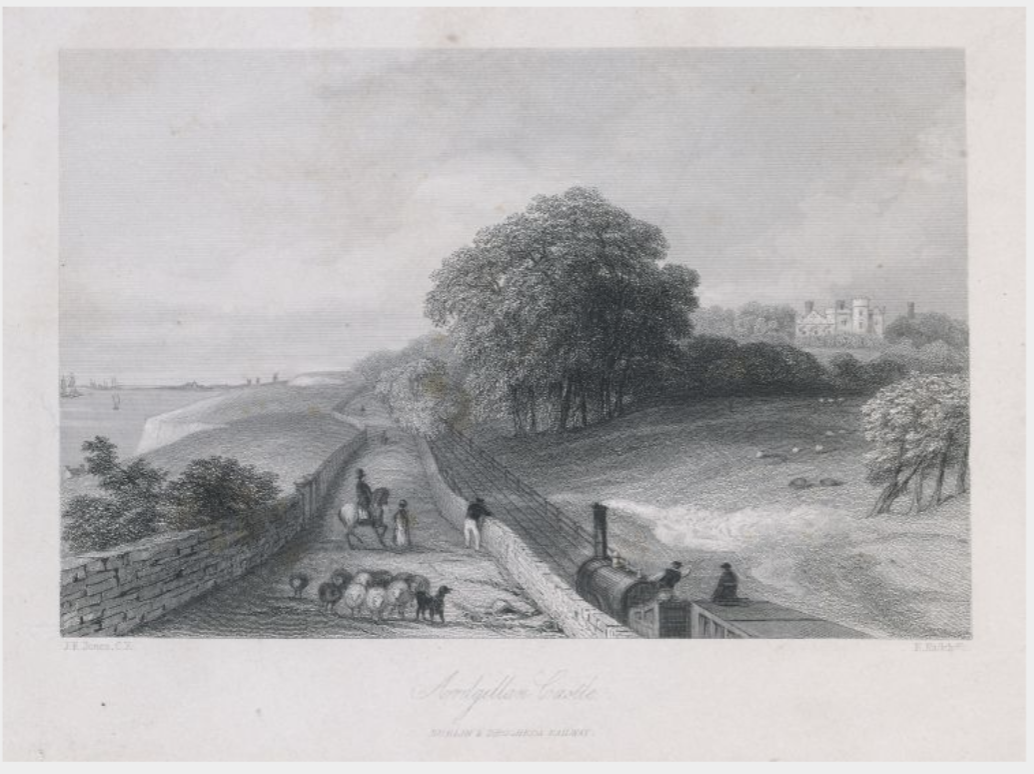
I’m amused by the fact that the family could stop any train on the line for their personal use! © Jennifer Winder-Baggot, www.irishhistorichouses.com
Ardgillan Castle, Balbriggan, County Dublin with the Dublin and Drogheda Railway 1844, photograph courtesy of National Gallery of Ireland.

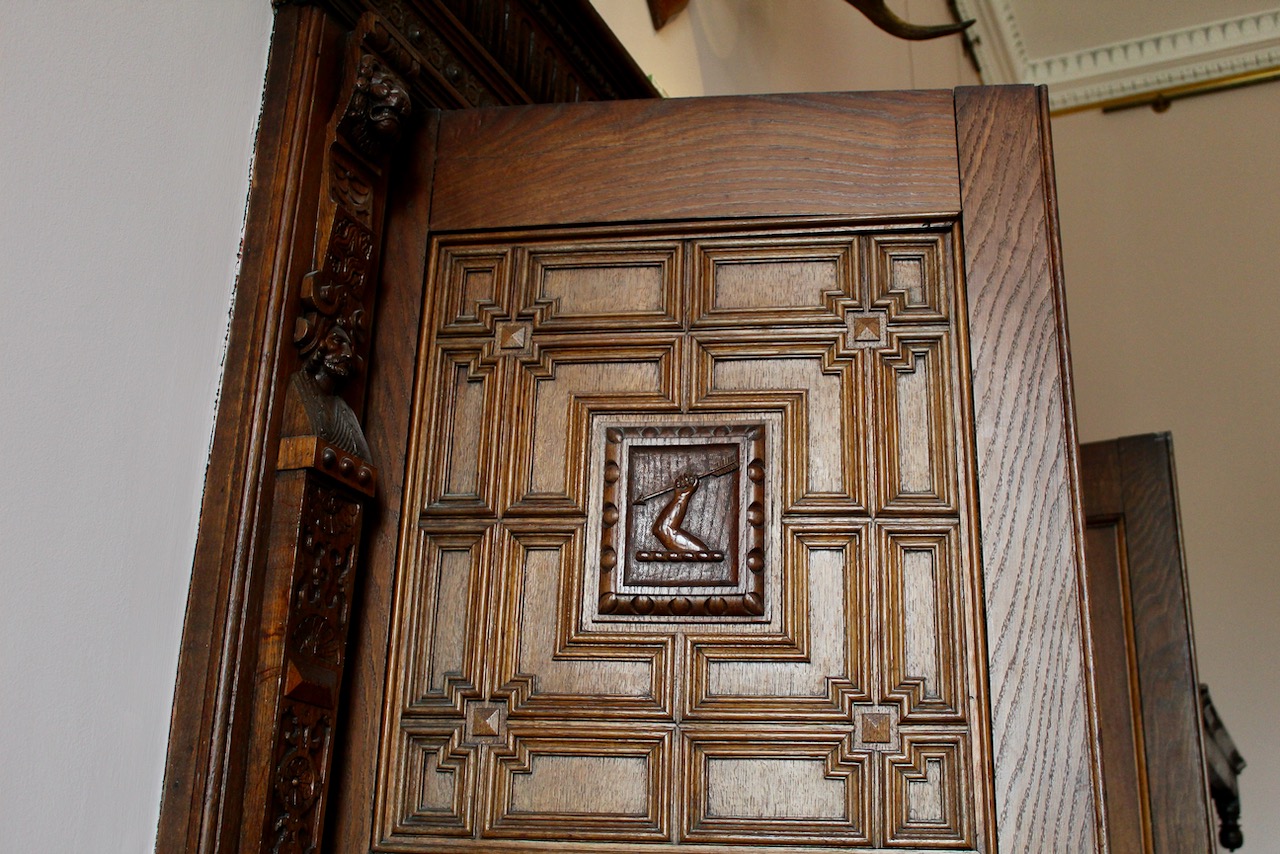
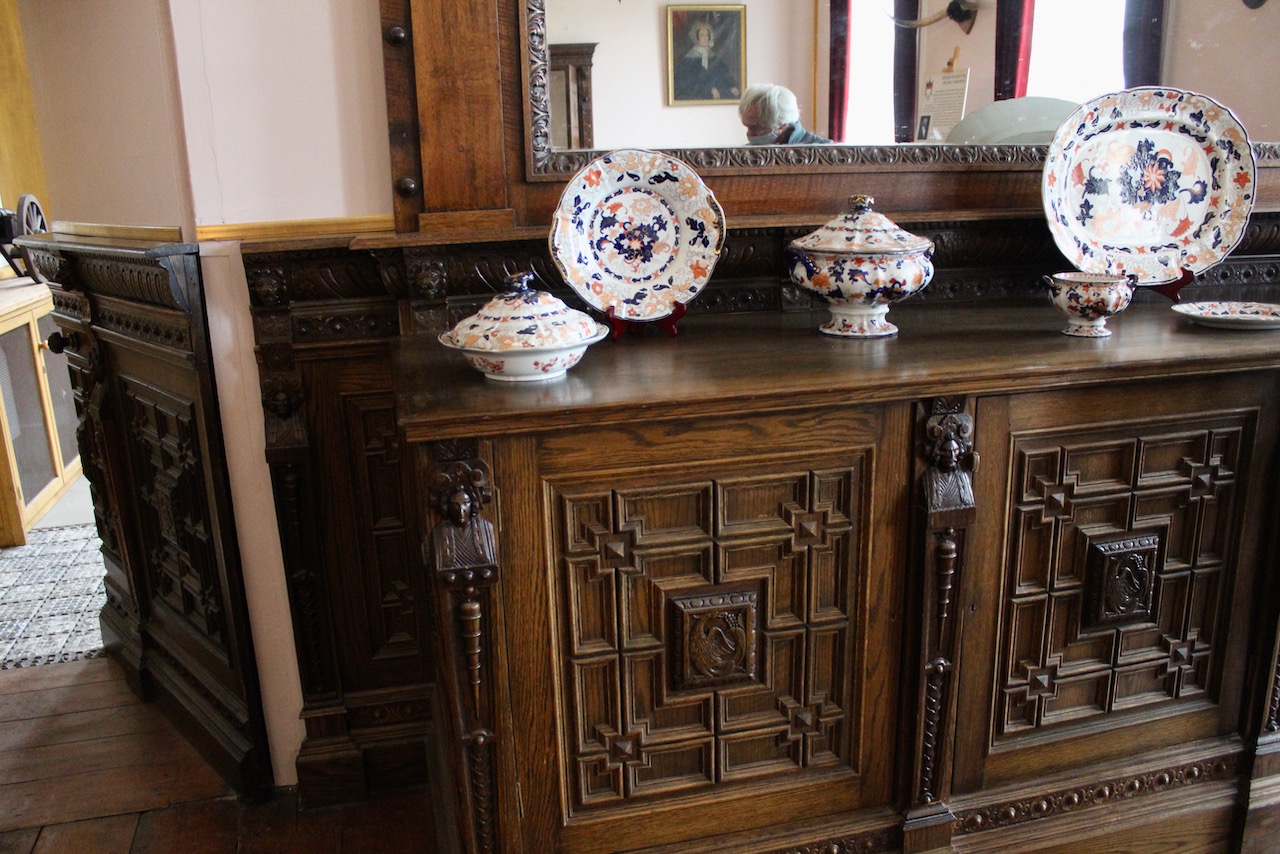
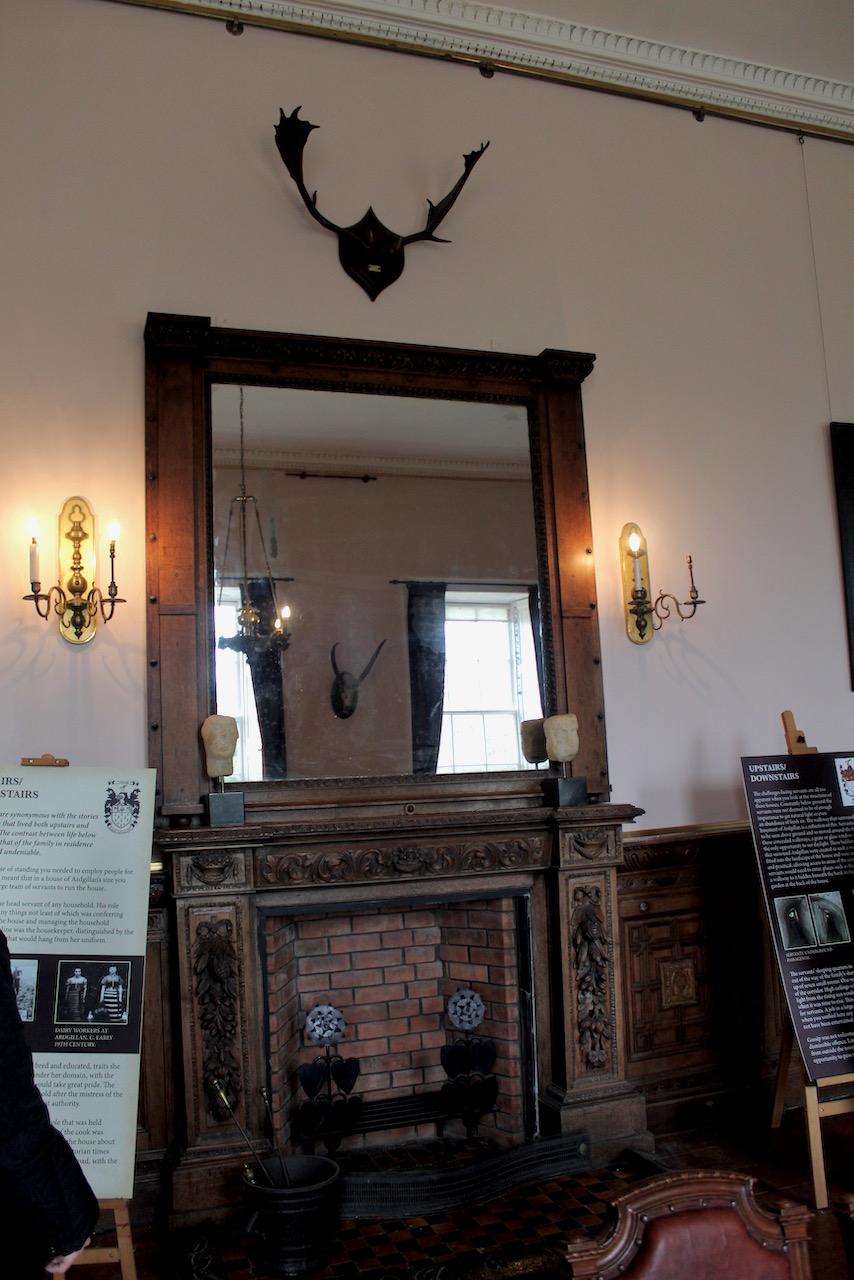
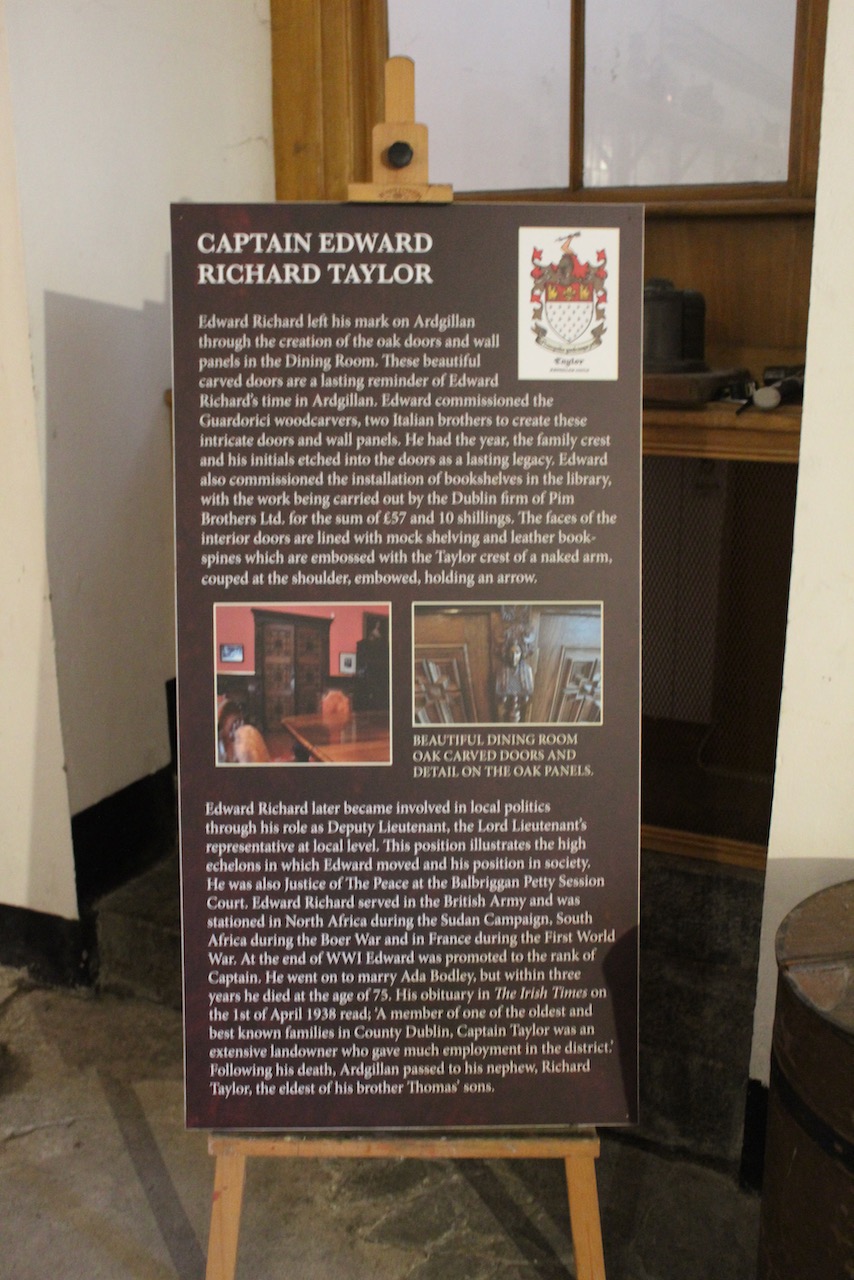
The dining room is the piece de resistance, with intricately carved oak panelling by Italian brothers Guardocici dated 1889 featuring Taylor Family crest. It also features a real stuffed bear!

Ardgillan Castle, Balbriggan, February 2022. © Jennifer Winder-Baggot, www.irishhistorichouses.com
The door to the dining room is carved with the family crest and detailed pattern. © Jennifer Winder-Baggot, www.irishhistorichouses.com
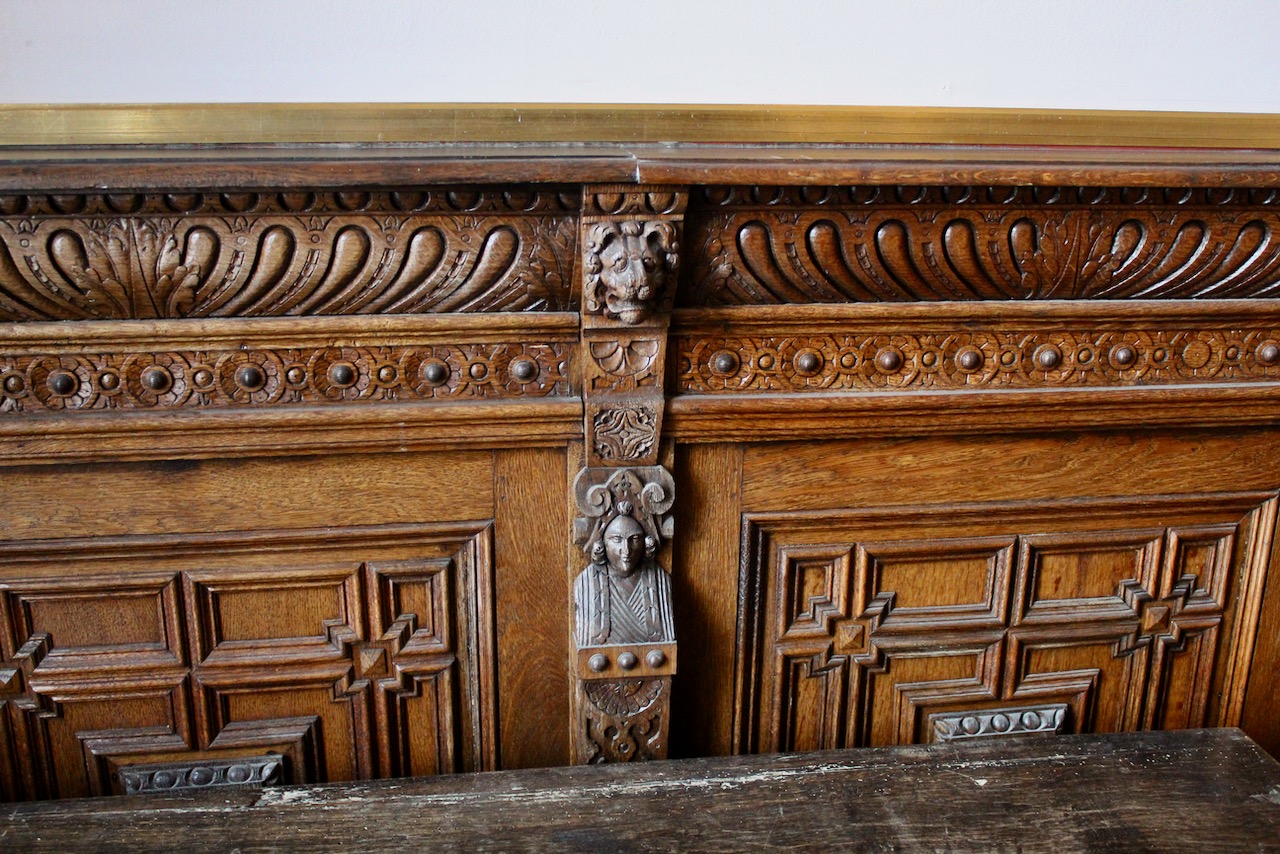
The door frame features a head, and lion heads, which are continued in the wall panelling and the large cabinet. © Jennifer Winder-Baggot, www.irishhistorichouses.com
The carved wall panelling in the dining room at Ardgillan Castle, by Italian brothers Guardocici dated 1889 featuring Taylor Family crest. © Jennifer Winder-Baggot, www.irishhistorichouses.com
The matching cabinet in the dining room at Ardgillan Castle. © Jennifer Winder-Baggot, www.irishhistorichouses.com

The fireplace in the dining room is also intricately carved.

Ardgillan Castle, Balbriggan, February 2022. © Jennifer Winder-Baggot, www.irishhistorichouses.com

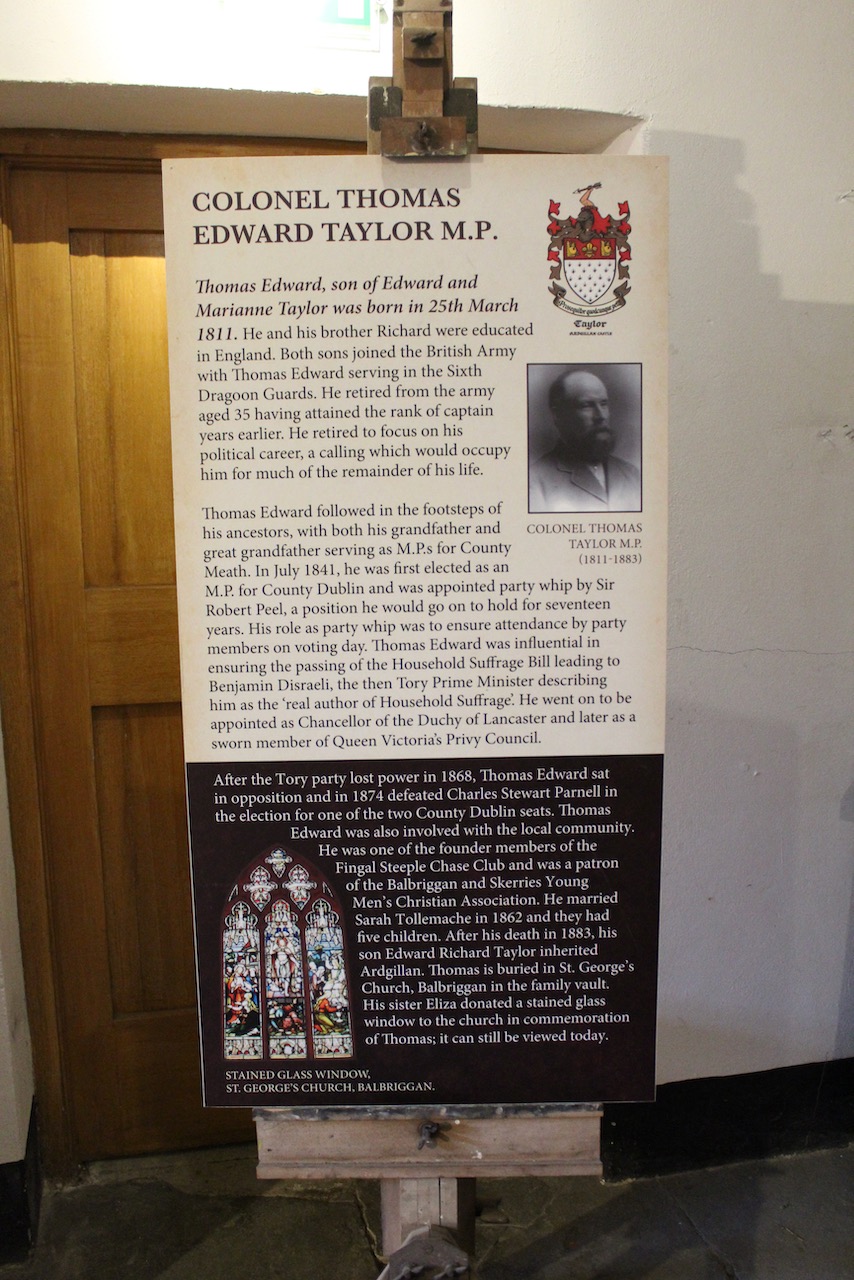
The house passed to Thomas Edward Taylor (d. 1883).

Ardgillan Castle, Balbriggan, February 2022. © Jennifer Winder-Baggot, www.irishhistorichouses.com

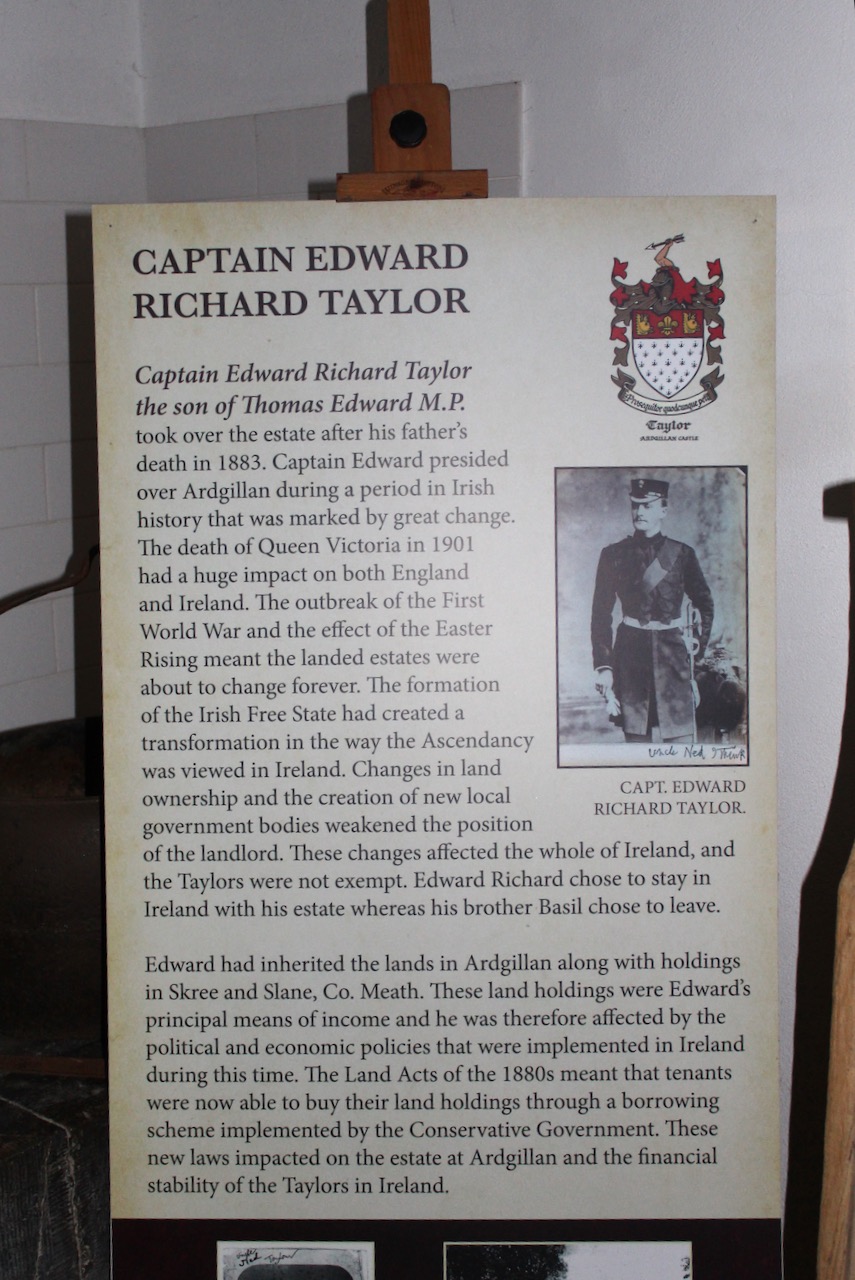
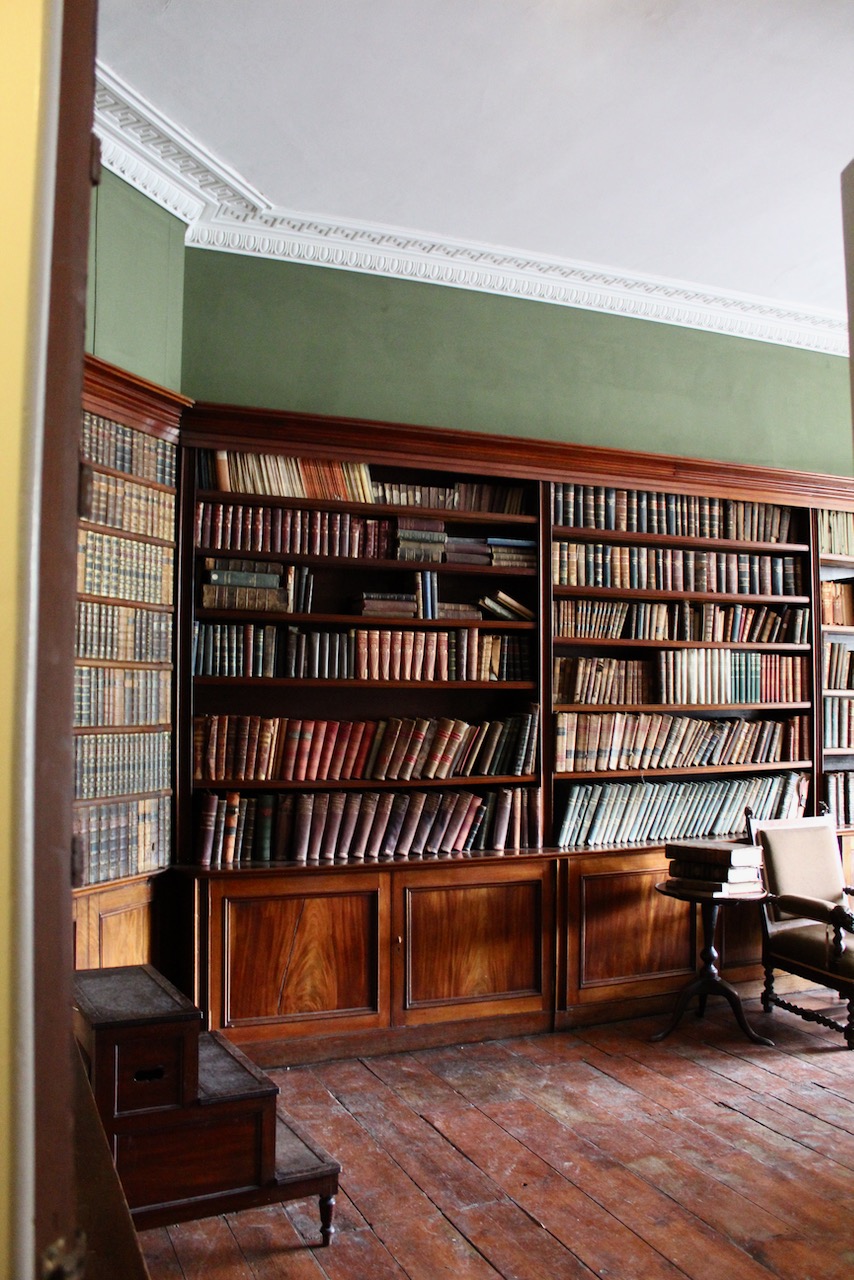
It was his son, Edward Richard Taylor (1863-1938), who employed the Italian woodcarvers. He also had the library shelves installed by the Dublin firm Pim Brothers Ltd.

Ardgillan Castle, Balbriggan, February 2022. © Jennifer Winder-Baggot, www.irishhistorichouses.com

Edward Richard had no children so was succeeded by his brother Captain Basil Taylour’s son, Basil Richard Henry Osgood Taylour. He sold Ardgillan.

The next room is the lovely library.

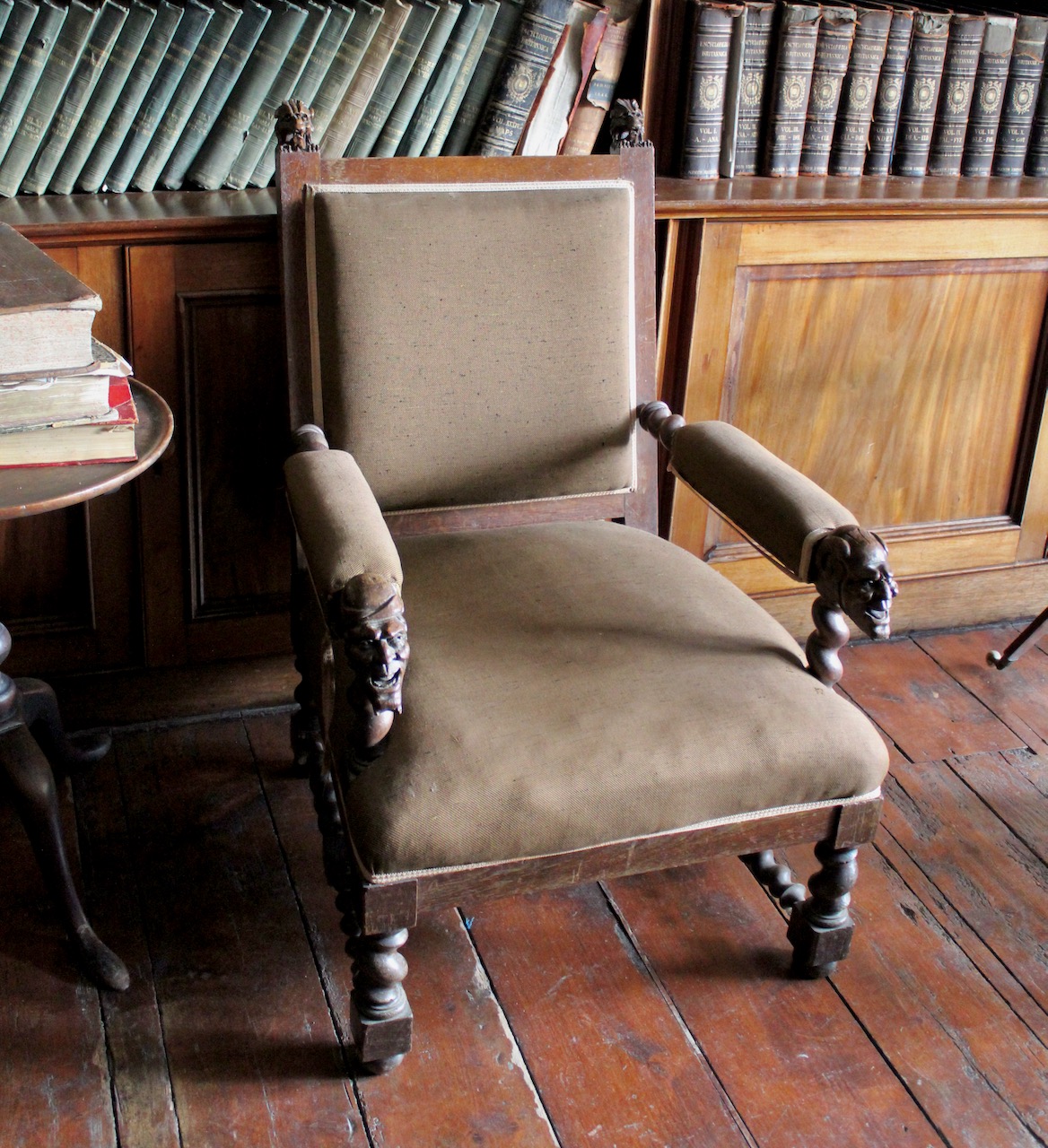
The library of Ardgillan Castle. © Jennifer Winder-Baggot, www.irishhistorichouses.com
Ardgillan Castle, Balbriggan, February 2022. © Jennifer Winder-Baggot, www.irishhistorichouses.com
We entered the library through a jib door of pretend books. © Jennifer Winder-Baggot, www.irishhistorichouses.com
Ardgillan Castle, Balbriggan, February 2022. © Jennifer Winder-Baggot, www.irishhistorichouses.com
I couldn’t resist putting on the armour. © Jennifer Winder-Baggot, www.irishhistorichouses.com
Ardgillan Castle, Balbriggan, February 2022. © Jennifer Winder-Baggot, www.irishhistorichouses.com
Stephen in The Butler’s Pantry at Ardgillan Castle. © Jennifer Winder-Baggot, www.irishhistorichouses.com
Ardgillan Castle, Balbriggan, February 2022. © Jennifer Winder-Baggot, www.irishhistorichouses.com

The stairs to the upper storey are modest for such a house. Upstairs there are artists’ studios – how lucky they are, to have such a wonderful setting for their work!

The staircase of Ardgillan Castle – modest for such a house. © Jennifer Winder-Baggot, www.irishhistorichouses.com

The website tells us:

Ardgillan park is unique among Dublin’s regional parks for the magnificent views it enjoys of the coastline. A panorama, taking in Rockabill Lighthouse, Colt Church, Shenick and Lambay Islands may be seen, including Sliabh Foy, the highest of the Cooley Mountains, and of course the Mourne Mountains can be seen sweeping down to the sea.

Ardgillan Castle, Balbriggan, February 2022. © Jennifer Winder-Baggot, www.irishhistorichouses.com

The park area is the property of Fingal County Council and was opened to the public as a regional park in June 1985. Preliminary works were carried out prior to the opening in order to transform what had been an arable farm, into a public park. Five miles of footpaths were provided throughout the demesne, some by opening old avenues, while others were newly constructed. They now provide a system of varied and interesting woodland, walks and vantage points from which to enjoy breath-taking views of the sea, the coastline and surrounding countryside. A signposted cycle route through the park since June 2009 means that cyclists can share the miles of walking paths with pedestrians.

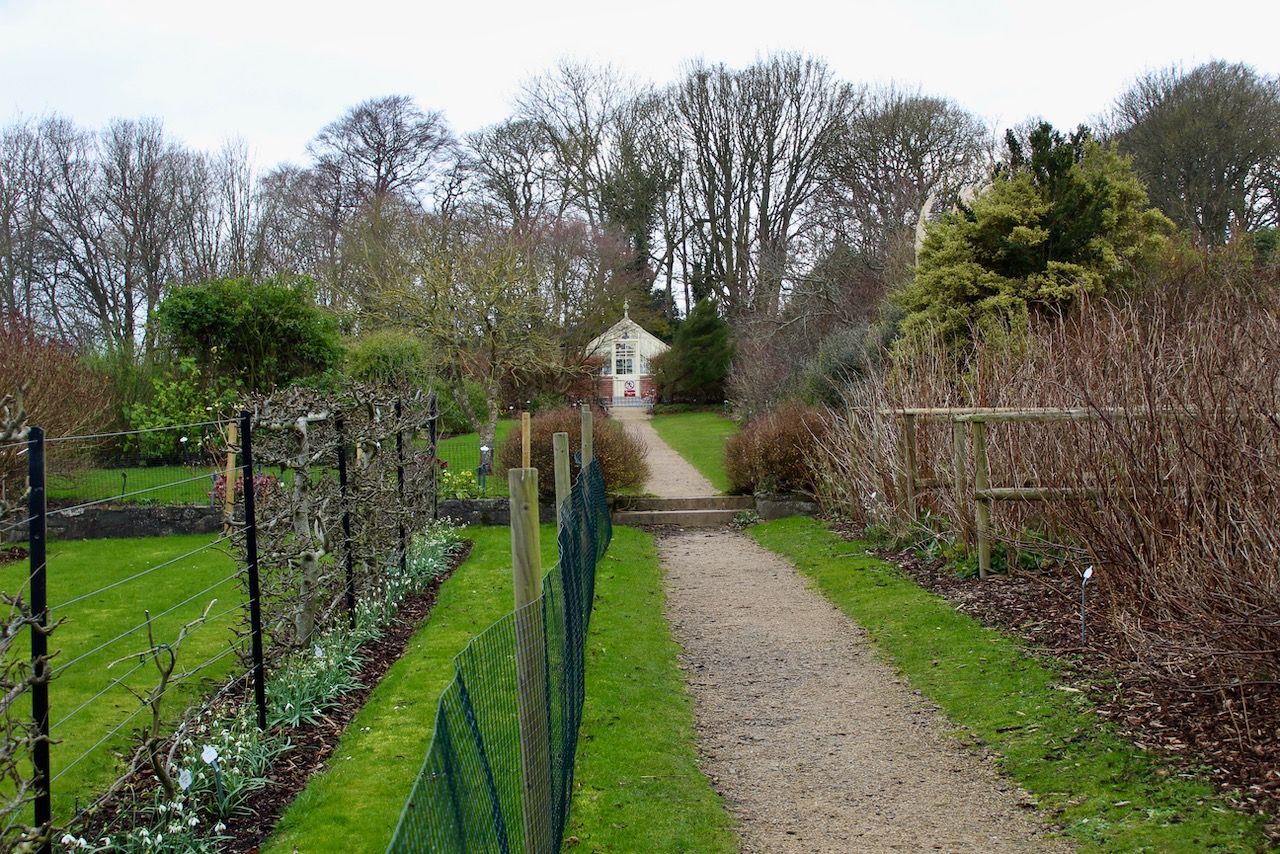
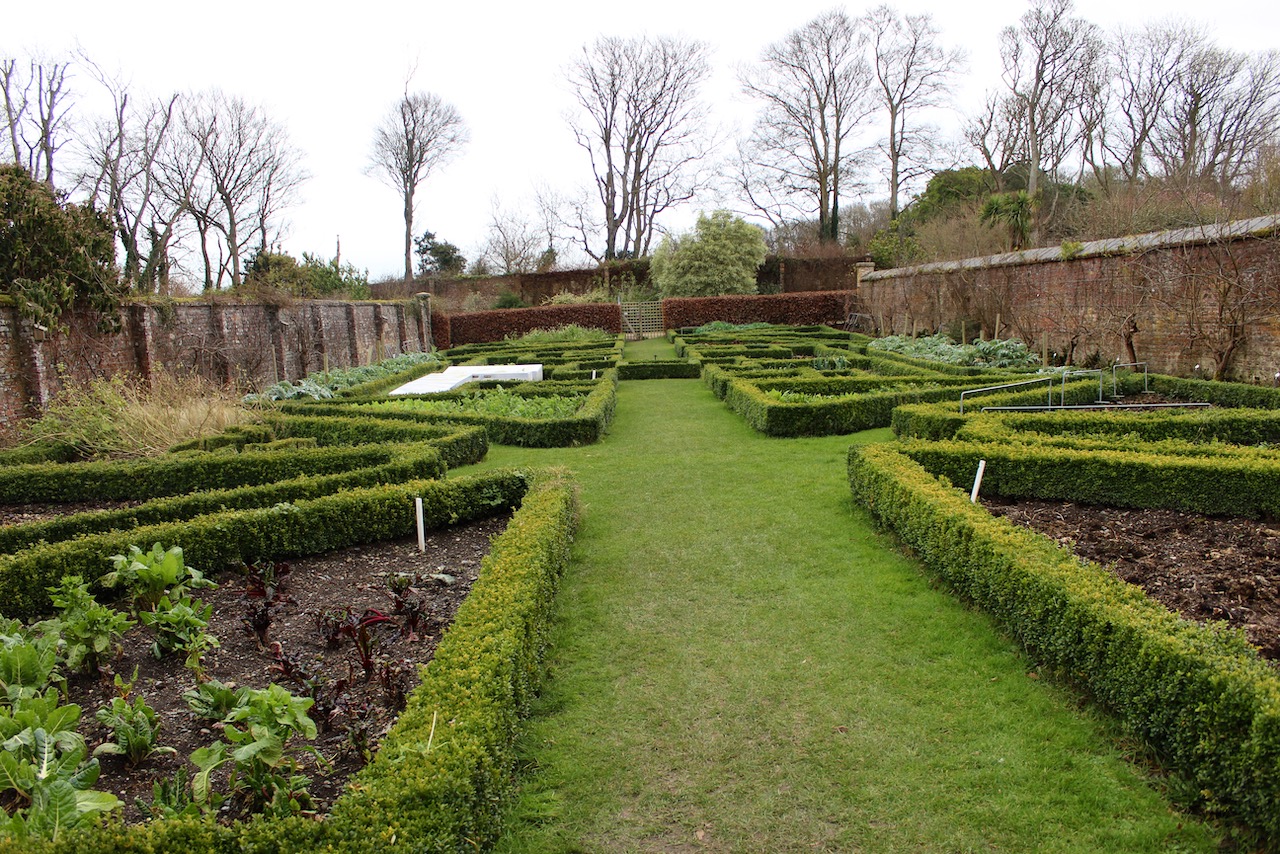
The Walled Garden was originally a Victorian-styled kitchen garden that used to supply the fruit, vegetables and cut ower requirements to the house. It is 1 hectare (2.27 acres) in size, and is subdivided by free standing walls into five separate compartments. The walled garden was replanted in 1992 and through the 1990’s, with each section given a different theme.

The walled garden at Ardgillan, February 2022. © Jennifer Winder-Baggot, www.irishhistorichouses.com
The website tells us: “The Vegetable Potager demonstrates the variety of vegetables that can be grown in shaped beds to create an attractive display. The Fruit Garden The Fruit Garden includes raspberries, red, white and black currants, gooseberries and fan-trained stone fruit on the walls. A collection of 30 old Irish varieties of apples, espalier-trained on wires, were planted in the year 2000. Varieties include: Scarlet Crofton (1500), Ballyfatten (1802) and Allen’s Everlasting (1864).” © Jennifer Winder-Baggot, www.irishhistorichouses.com
Ardgillan Castle, Balbriggan, February 2022. © Jennifer Winder-Baggot, www.irishhistorichouses.com

The Victorian Conservatory was originally built in 1880 at Seamount, Malahide, the home of the Jameson family, who became famous for their whiskey all over the world. It was built by a Scottish glasshouse builder McKenzie & Moncur Engineering, and is reputed to be a replica of a glasshouse built at Balmoral in Scotland, the Scottish home of the British Royal Family. The conservatory was donated to Fingal County Council by the present owner of Seamount, the Treacy family and was re-located to the Ardgillan Rose Garden in the mid-1990s by park staff.

§’The Department of Arts, Heritage and the Gaeltacht (DAHG) approached Fingal County Council in early 2014 to participate in a pilot project to develop and enhance skill sets in built heritage conservation, under the Traditional Building Skills Training Scheme 2014. The glass house/ conservatory at Ardgillan was selected as part of this project. The glass house has been completely dismantled because it had decayed to such an extent that it was structurally unstable. All parts removed as part of this process are in safe storage. This work is the first stage of a major restoration project being undertaken by the Councils own Direct Labour Crew in the Operations Department supervised by David Curley along with Fingal County Council Architects so that the glasshouse can be re-erected in the garden and can again act as a wonderful backdrop to the rose garden. This is a complex and difficult piece of work which is currently on going and we are hopeful to have the glasshouse back to its former glory as a centrepiece of the visitor offering in Ardgillan Demesne in the near future.

[1] Mark Bence-Jones  A Guide to Irish Country Houses (originally published as Burke’s Guide to Country Houses volume 1 Ireland by Burke’s Peerage Ltd. 1978); Revised edition 1988 Constable and Company Ltd, London.

Open House, Culture Night and Heritage Week Dublin Visits

For the day that’s in it (it’s Culture Night 2022 today): this entry is not perfect but I want to publish it, and will improve it over time…

1. 9/9A Aungier Street, Dublin (Open House 2014)

2. Belvedere House, Dublin (Open House 2015)

3. Blackhall Place (formerly Blue Coat School) Dublin (Open House 2019)

4. City Assembly Hall, Dublin (Culture Night 2012)

5. Department of Trade and Commerce (2019)

6. Freemason’s Hall (Culture Night 2010)

7. Georgian Townhouse, 25 Eustace Street (2011)

8. 10 Henrietta Street, Dublin (2011)

9. 12 Henrietta Street, Dublin (2019)

10. 14 Henrietta Street, Dublin (July 2013 Heritage Week)

11. Iveagh House, Dublin (Department of Foreign Affairs) (Open House 2014)

12. Iveagh Trust flat, Iveagh Trust, Patrick Street, Dublin (Open House 2014)

13. Mansion House, Dublin (2015)

14. Marsh’s Library, Dublin (Heritage Week 2013)

15. 10 Mill Street, Dublin (2017)

16. 13 North Great Georges Street, Dublin (Open House 2012)

17. Pigeonhouse (2021)

18. Rates Office, Dublin (Open House 2013)

19. Royal Academy Dublin (2013)

20. Royal College of Physicians, Dublin (Heritage Week 2013)

21. Royal College of Surgeons, Dublin (2011)

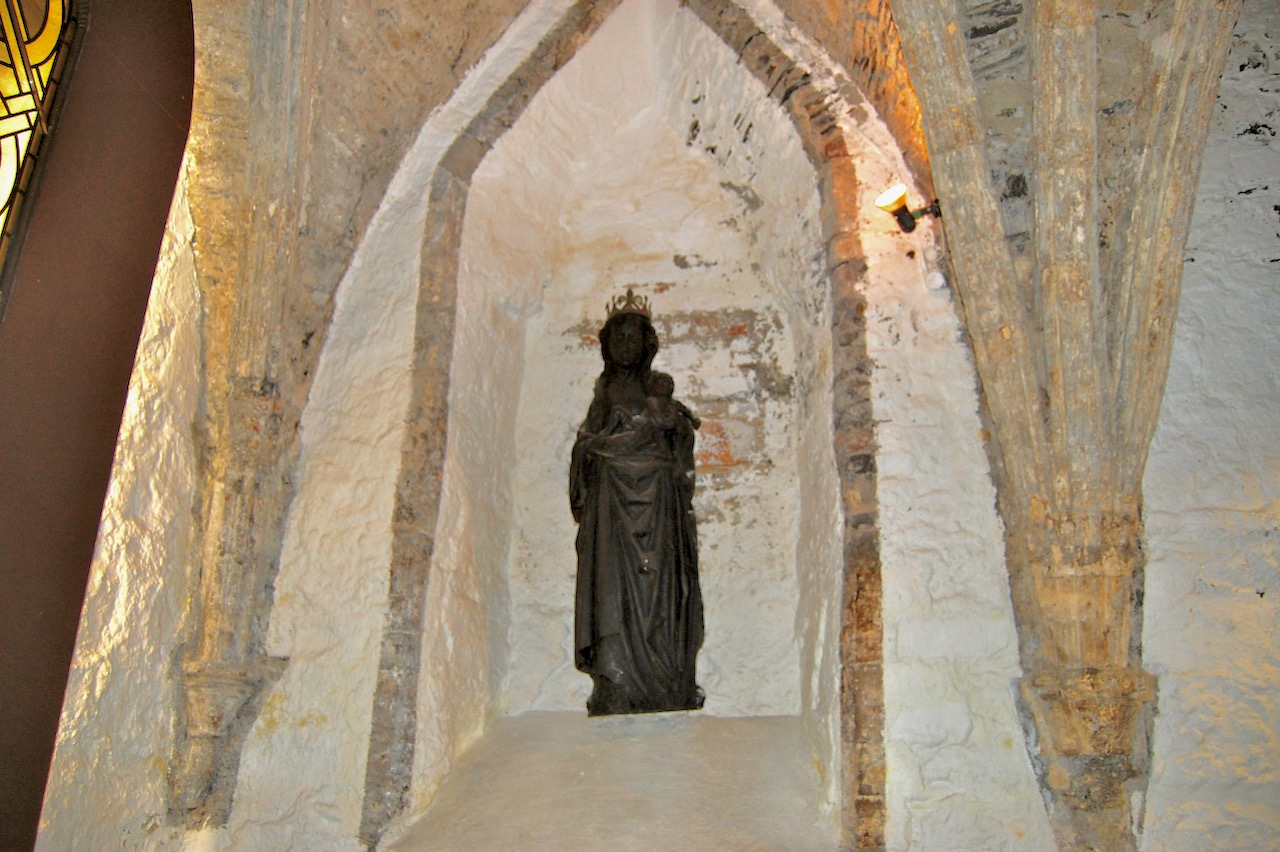
22. St. Mary’s Abbey, Dublin (Culture Night 2012)

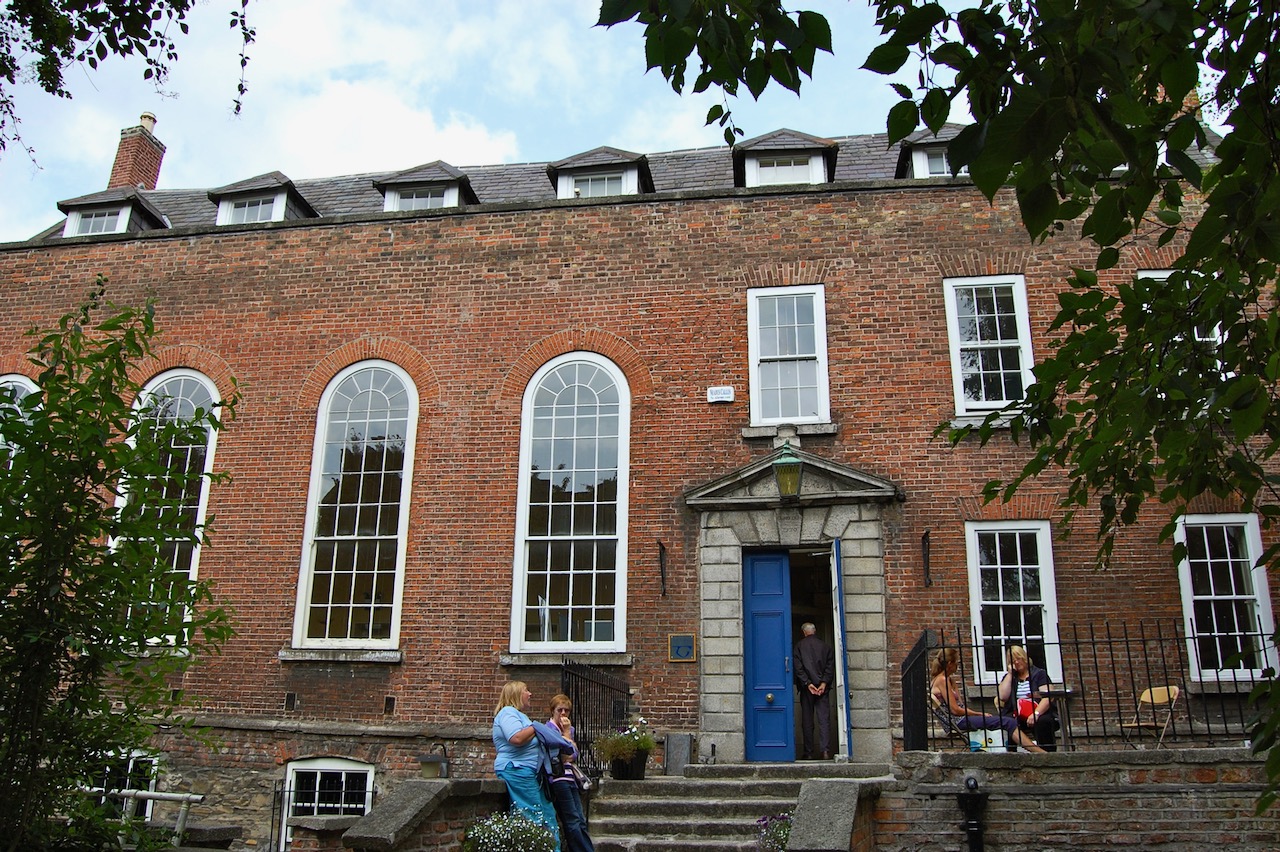
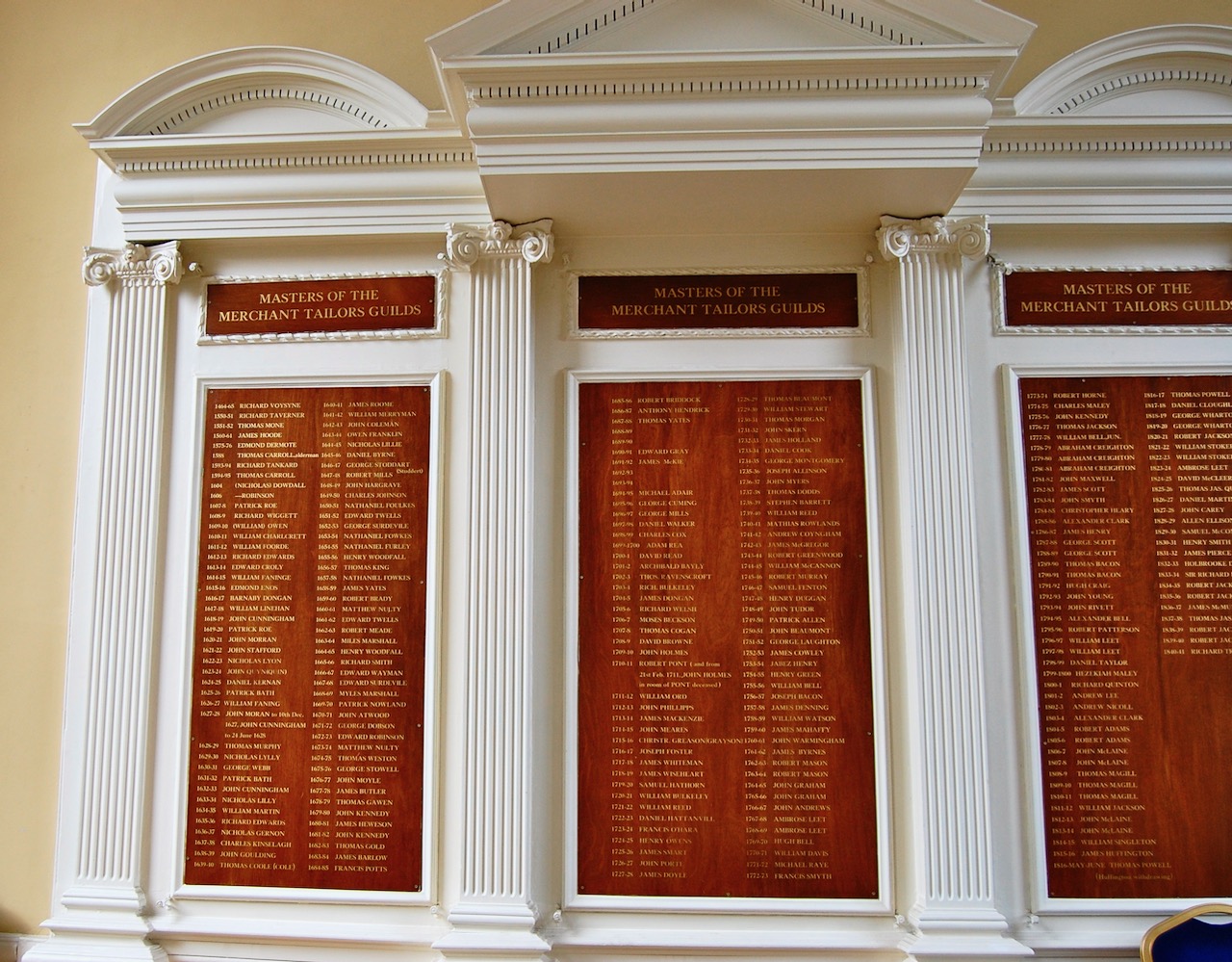
23. Tailor’s Guild Hall, Dublin (Heritage Week 2013)

24. Trinity Innovation Centre, former Bank, Foster Place, Dublin (Open House 2013)

1. 9/9A Aungier Street, Dublin (Open House 2014)

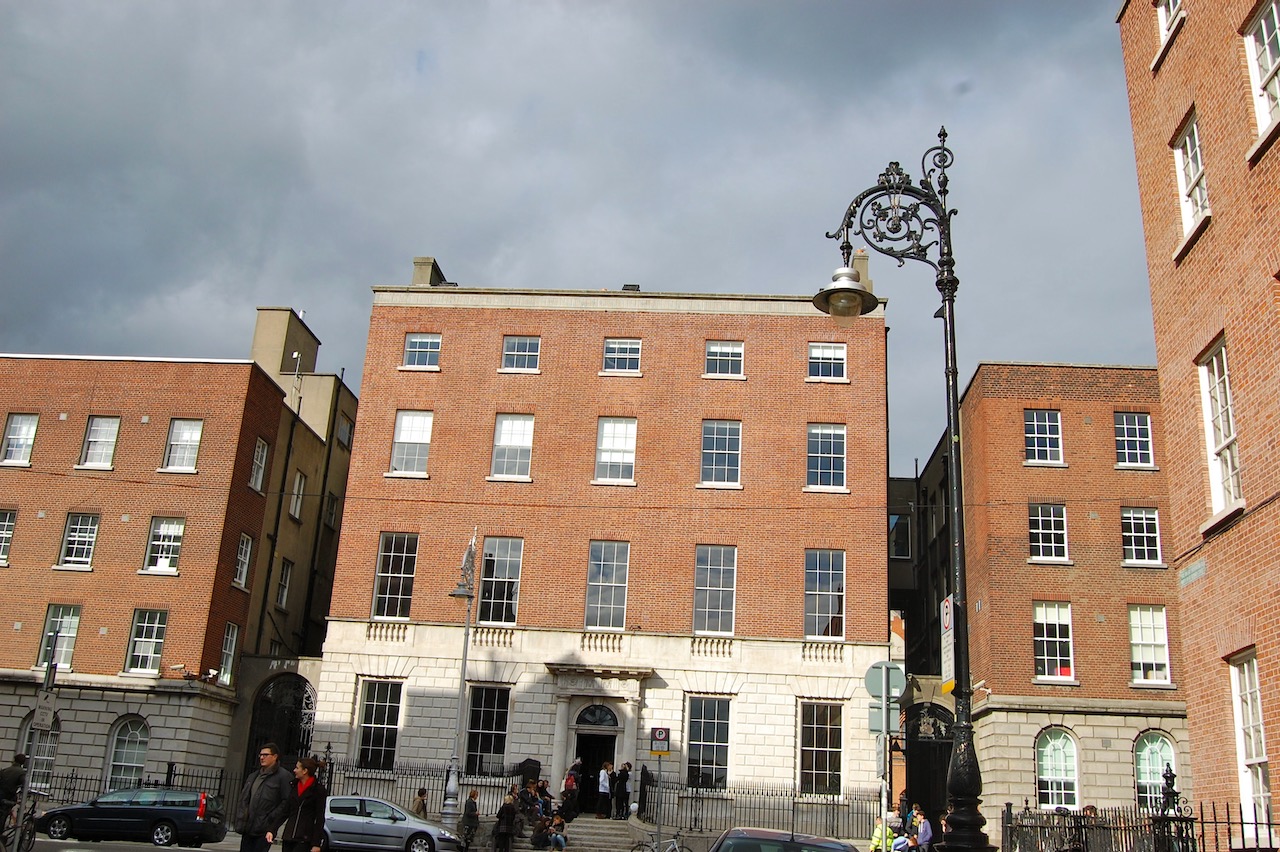
No. 9/9a Aungier Street, Dublin. Photograph © Jennifer Winder-Baggot, www.irishhistorichouses.com

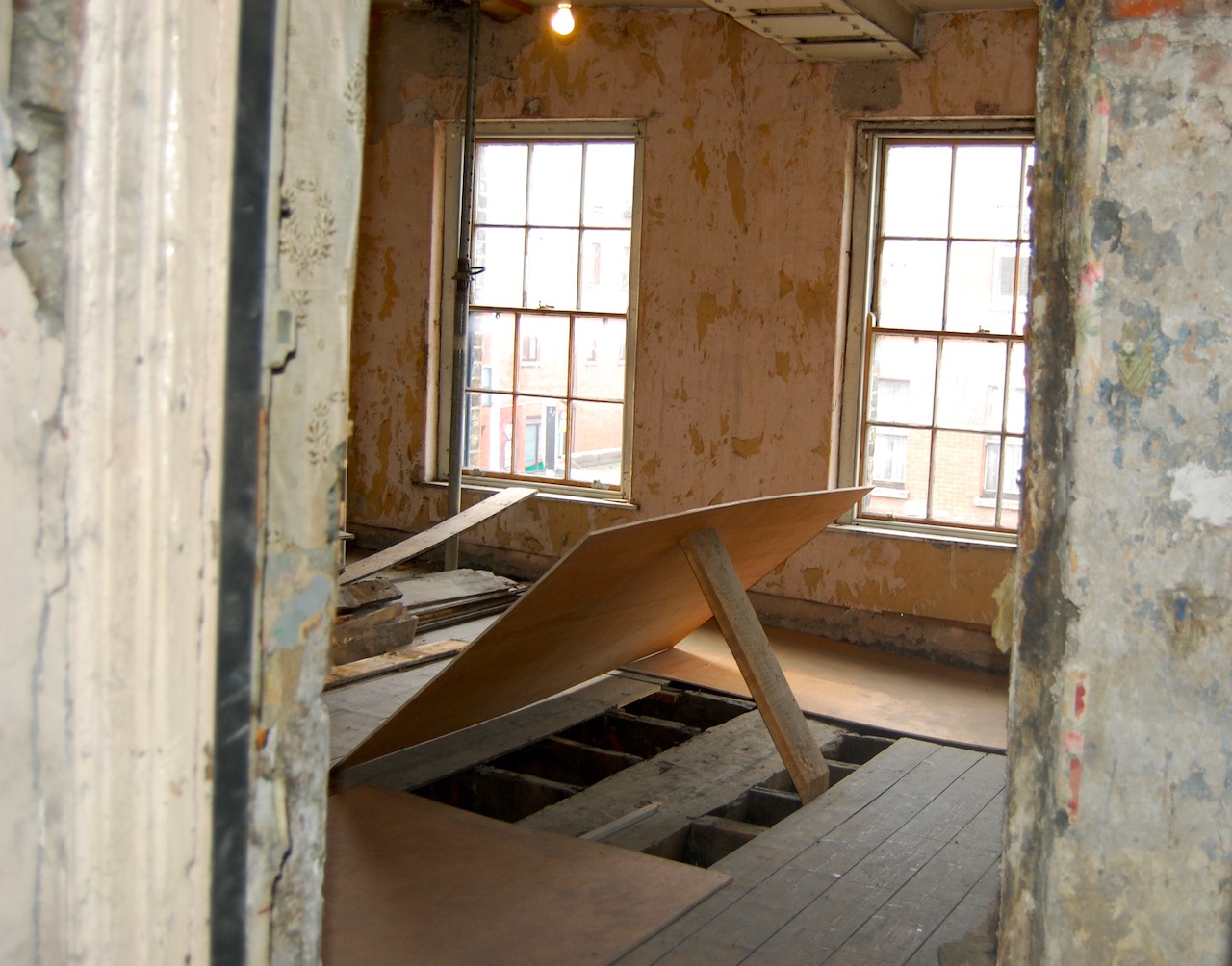
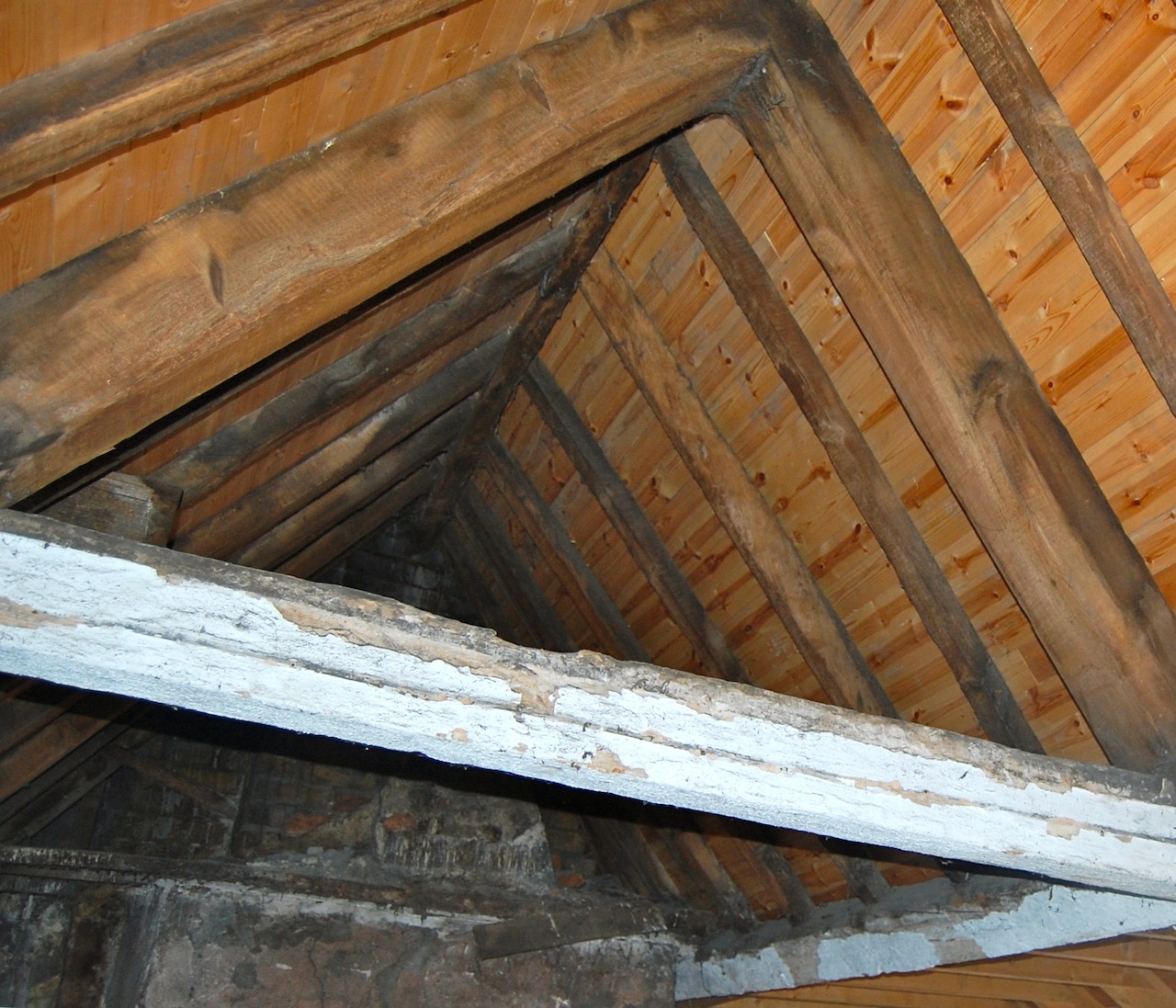
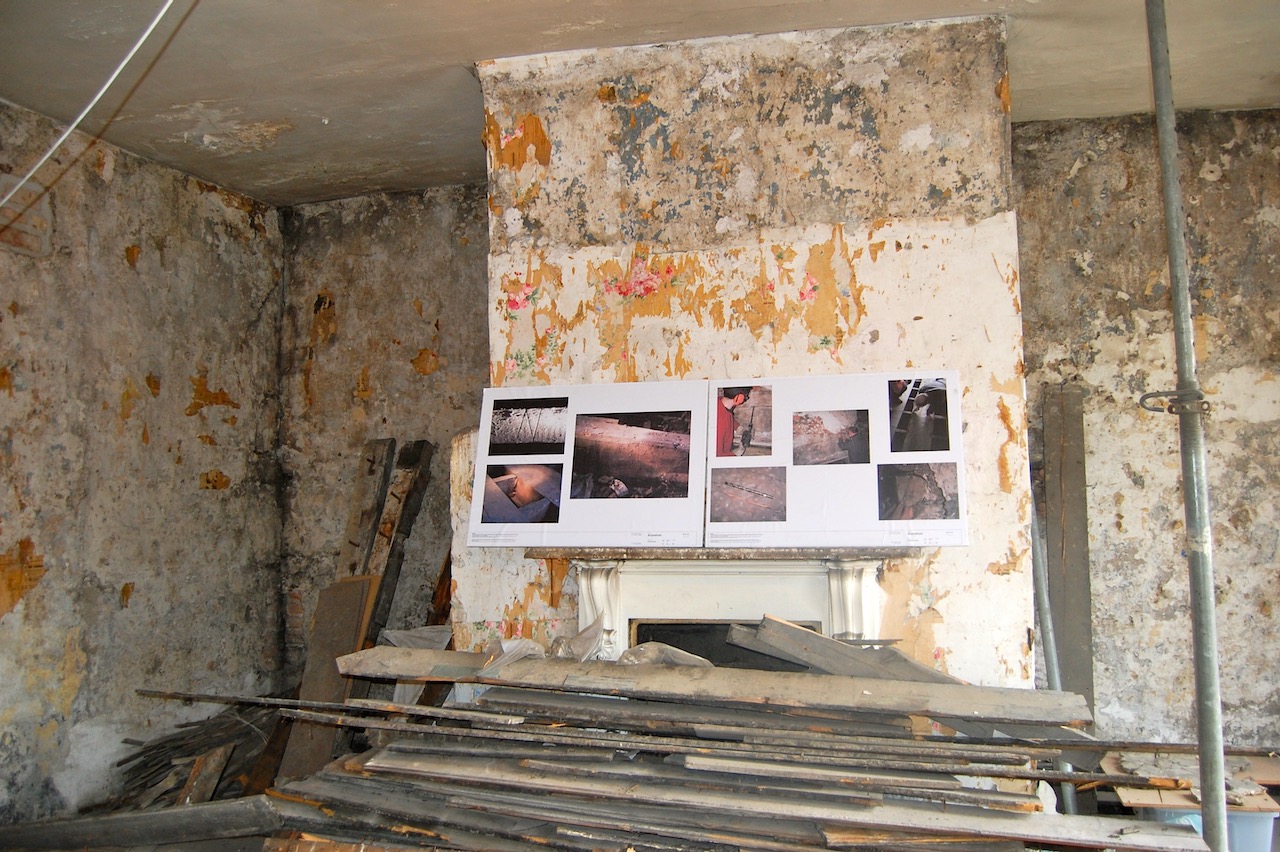
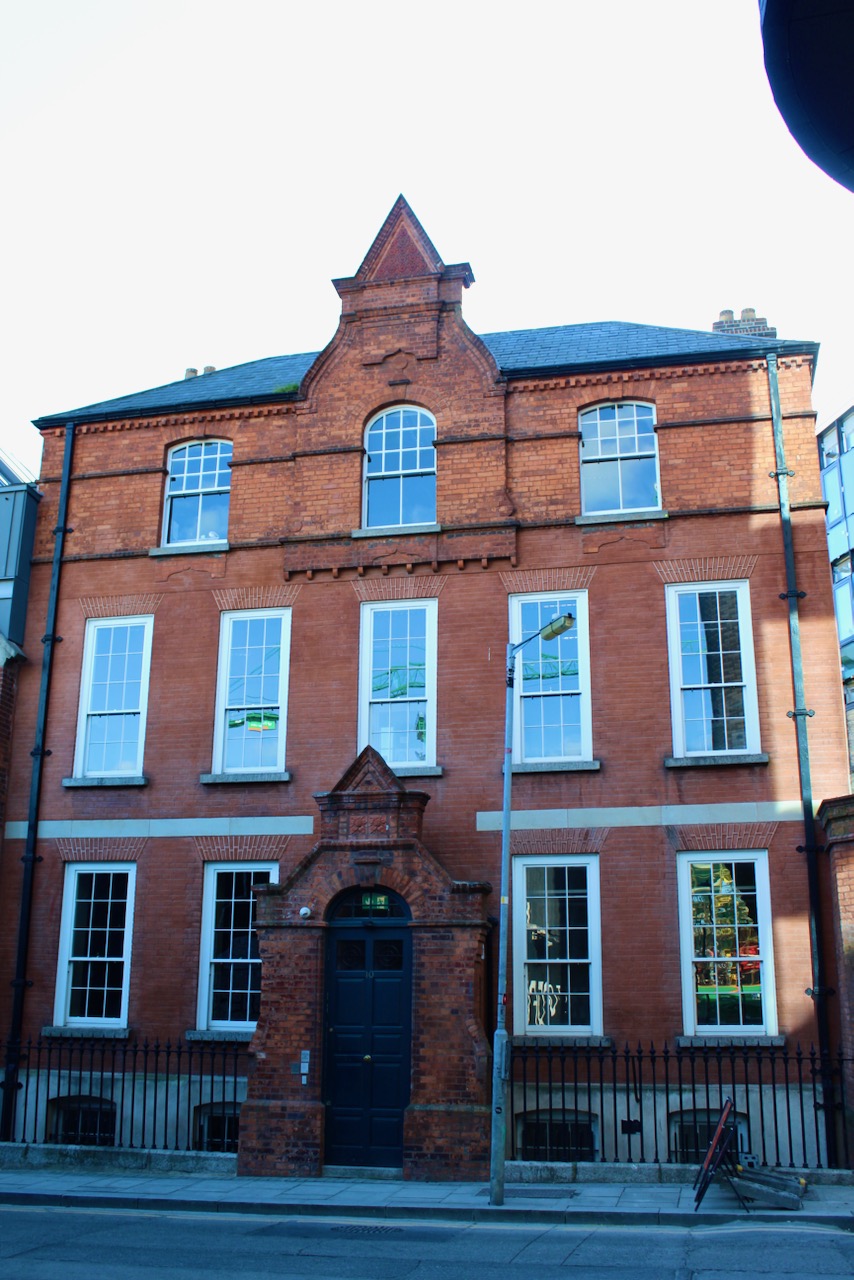
When remedial works were undertaken the age of this building was discovered. It was first realised it was older than thought when planners appraising development changes noticed the way the fireplace sticks so far out into the room.

No. 9/9a Aungier Street, Dublin, 350 years old, what it probably looked like on outside, see lower second picture. Photograph © Jennifer Winder-Baggot, www.irishhistorichouses.com
No. 9/9a Aungier Street, Dublin, 350 years old. Photograph © Jennifer Winder-Baggot, www.irishhistorichouses.com
No. 9/9a Aungier Street, Dublin. Photograph © Jennifer Winder-Baggot, www.irishhistorichouses.com
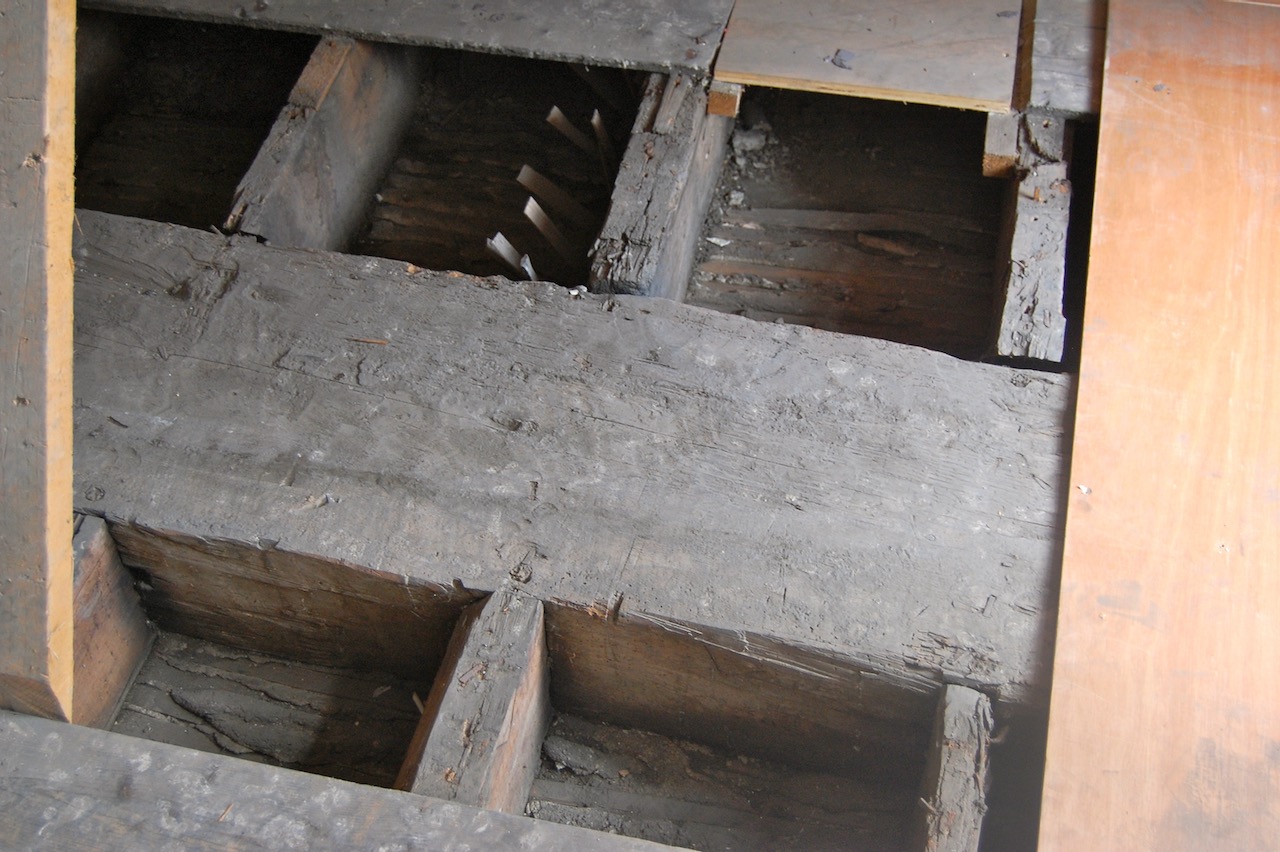
No. 9/9a Aungier Street, Dublin, 350 years old, exposing flooring method, with original pine floor support. Photograph © Jennifer Winder-Baggot, www.irishhistorichouses.com
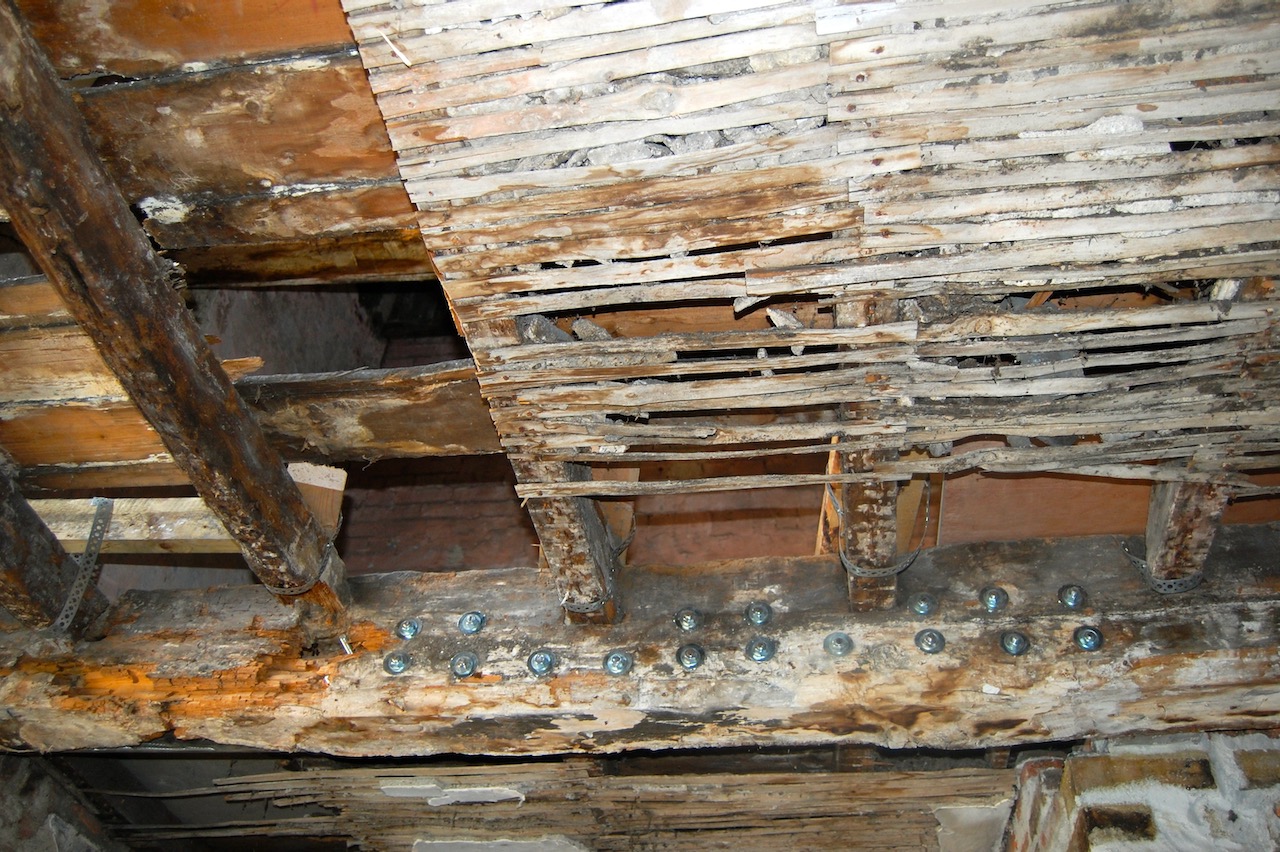
No. 9/9a Aungier Street, Dublin, 350 years old, not original woodwork, probably later, decorative. Photograph © Jennifer Winder-Baggot, www.irishhistorichouses.com
No. 9/9a Aungier Street, Dublin, 350 years old. Photograph © Jennifer Winder-Baggot, www.irishhistorichouses.com
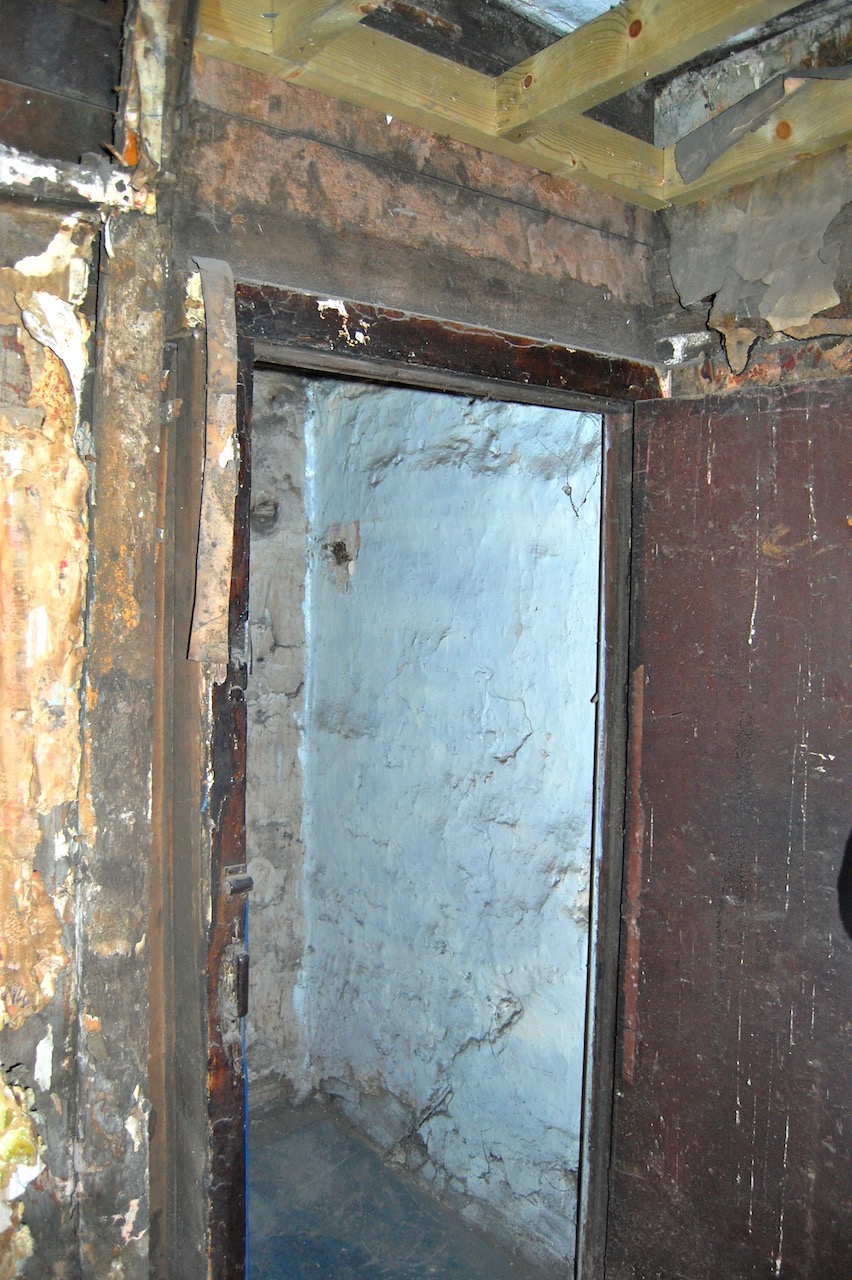
No. 9/9a Aungier Street, Dublin, 350 years old, original walls and beams inside niche. Photograph © Jennifer Winder-Baggot, www.irishhistorichouses.com
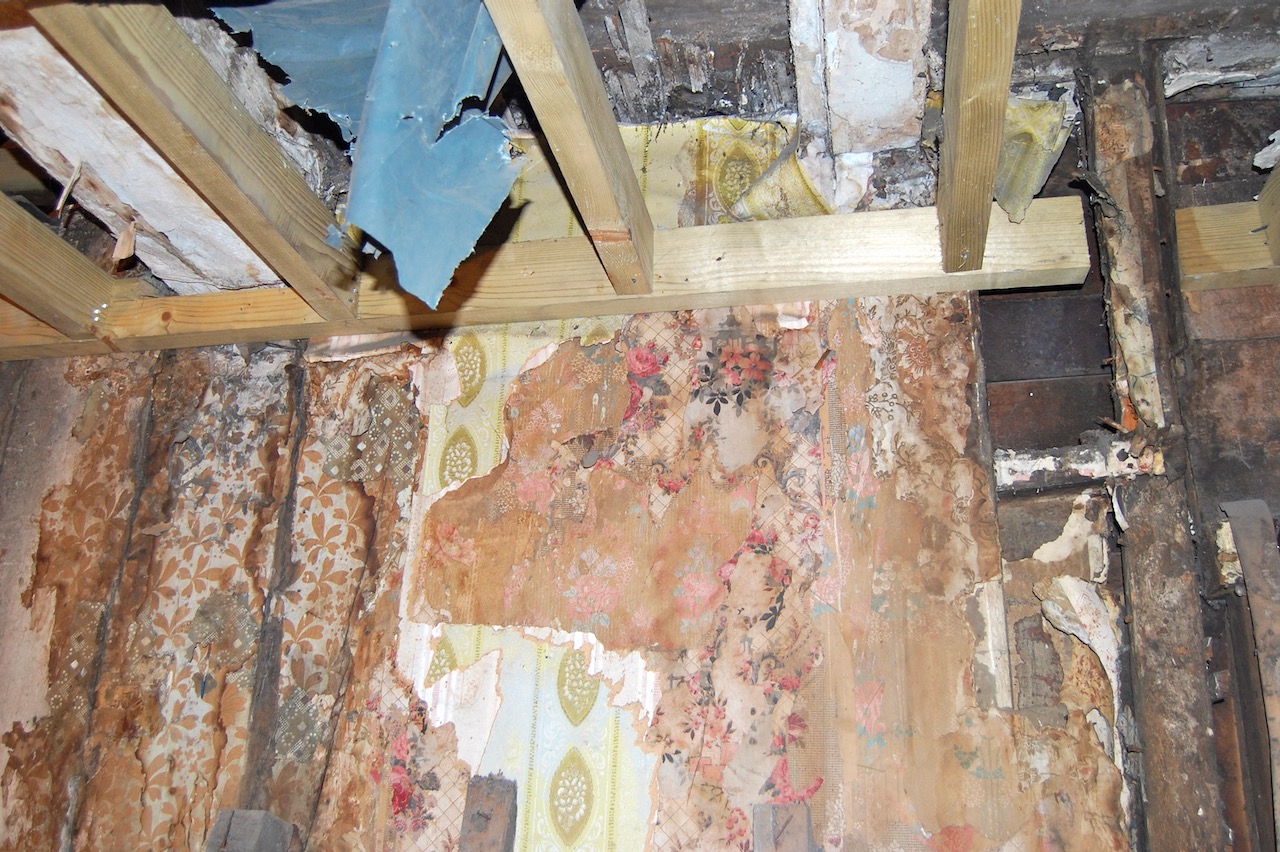
No. 9/9a Aungier Street, Dublin, 350 years old – layers of wallpaper. Photograph © Jennifer Winder-Baggot, www.irishhistorichouses.com
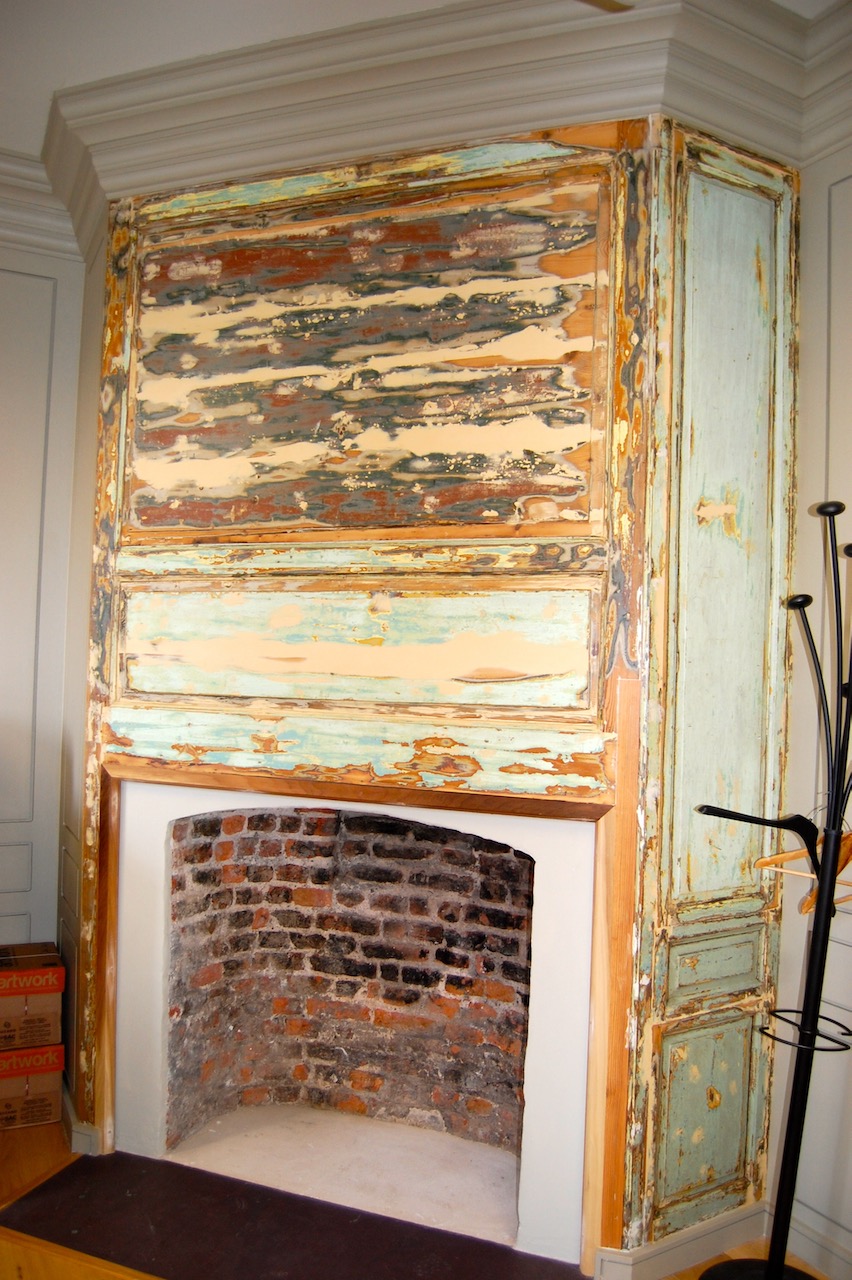
No. 9/9a Aungier Street, Dublin, 350 years old. It was first realised it was older than thought when planners appraising development changes noticed the way the fireplace sticks so far out into the room. Photograph © Jennifer Winder-Baggot, www.irishhistorichouses.com
No. 9/9a Aungier Street, Dublin, 350 years old, marks made by builders to let them know which beam fits into which joint, of the Baltic pine flooring, see the “v” carved into beam and joint. Photograph © Jennifer Winder-Baggot, www.irishhistorichouses.com
No. 9/9a Aungier Street, Dublin, 350 years old. Photograph © Jennifer Winder-Baggot, www.irishhistorichouses.com
No. 9/9a Aungier Street, Dublin, 350 years old, original fireplace. Photograph © Jennifer Winder-Baggot, www.irishhistorichouses.com
No. 9/9a Aungier Street, Dublin, 350 years old. Photograph © Jennifer Winder-Baggot, www.irishhistorichouses.com

2. Belvedere House, 6 Great Denmark Street, Dublin (Open House 2015):

https://www.oreillytheatre.com/belvedere-house.html

Open House 2015, Belvedere House, Belvedere College, Dublin. Photograph © Jennifer Winder-Baggot, www.irishhistorichouses.com

We went into three rooms upstairs, up the beautiful staircase. We weren’t allowed photograph on the tour, unfortunately, in the Apollo Room, Venus Room and Jupiter Room.

Belvedere House is a detached symmetrical five-bay four-storey Georgian townhouse over exposed basement, completed 1786, designed by Robert West who, in addition to being a stuccodore was also an architect and property developer, for George Augustus Rochfort, 2nd Earl of Belvedere. The house was built for £24,000 on what would have been rural green fields with a view of the Custom House, the bay and distant mountains. It is alleged that the house is haunted by Mary Molesworth, the first lady of Belvedere, mother to George Rochfort – we came across her at Belvedere in County Westmeath.

Rochfort was the son of the cruel Robert Rochfort, 1st Earl of Belvedere, who kept his wife under lock and key in the countryside after he believed she had an affair with his brother. Some believe that she was the inspiration for Charlotte Bronte’s “madwoman in the attic.” Robert Rochfort had the summer lodge, Belvedere, built in County Westmeath, now open to the public, which also has fine plasterwork. Robert O’Byrne writes that it was the 1st Earl who bought the property on Great Denmark Street. At first his son attempted to sell the property, but then he finished having the house built. Robert O’Byrne also tells us that it is similar to 86 St Stephen’s Green (Newman House, now housing the Museum of Literature of Ireland (MOLI), which was begun in 1765, and which is also attributed to Robert West.

North Great Georges Street itself was originally laid out in 1774 as a driveway leading to Belvedere House.

In 1841 the house was bought by the Society of Jesus (Jesuits) to accommodate their growing boys school which had started life ten years previously around the corner on Hardwicke Street, now known as Belvedere College.

One of the more outstanding features of the house is the stucco-work of Adamesque style popularised by Robert and James Adam. This can be seen in the ornamental surrounds, wherein pictures are framed in plaster rather than oil.

Dublin stuccodore and designer Michael Stapleton (1740-1801) was responsible for this work and further examples of his craftsmanship include the ceiling in the exam hall in Trinity College as well as some of the plasterwork in Powerscourt House in South William Street in Dublin and the Aras an Uachtarain in Phoenix Park.

Open House, Belvedere House, Belvedere College, Dublin. Photograph © Jennifer Winder-Baggot, www.irishhistorichouses.com

It seems odd that a house designed by Robert West, however, would have plasterwork by Michael Stapleton. Robert O’Byrne elucidates this for us:

“In 1967 C.P. Curran’s  Dublin Decorative Plasterwork of the 17th and 18th centuries noted in the collection of drawings left by stuccodore Michael Stapleton several items directly relating to the design of ceilings in Belvedere House. Accordingly, this work was assigned to Stapleton. However, the fact that West was responsible for designing the house complicates matters, and the consensus now appears to be that both he and Stapleton had a hand in the plasterwork. Conor Lucey (in The Stapleton Collection, 2007) suggests that Stapleton may have been apprenticed to, or trained with, West and the fact that he was named the sole executor of the latter’s will in 1790 indicates the two men were close. The source material for the stucco work is diverse, that in the stair hall deriving in part from a plate in Robert Adam’s Works in Architecture, but the first-floor rooms feature a wider range of inspiration, much of it from France and Italy.”

Open House 2015, Belvedere House, Belvedere College, Dublin – excuse the shakey camera – I need to visit again! Photograph © Jennifer Winder-Baggot, www.irishhistorichouses.com

We were given a leaflet, which tells us:

The ground floor rooms were intended for everyday and business use and therefore are minimally ornamented. However when one ascends they will encounter Stapleton’s stucco-work that depicts scenes from Greek and Roman mythology. On the half-landing the Bacchanalia is celebrated. The left panel depicts Bacchus with his thyrsis and staff, the right panel is Ceres with her cornucopia. The central oval shows Cupid being demoted by the three Graces. The arched window is ornamented with symbols of the authority of ancient Rome. The tall pilasters on each side have the Green anthemion (honeysuckle) motifs.

At the top of the stairs the panel between the two doors on the right show Juno seated on a cloud with her peacock. The panel on the centre wall is Aurora in her chariot pulled by winged horses. Under this plaque “The New Bride” from an ancient marble popular in 18th century Rome. All the five doors have the same over-door: Silenus, the tutor of Bacchus. On the ceiling, Eros is depicted gazing at Psyche as she sleeps. Next is an Apollo head with winged lions and lastly, Cupid with a flower.

The door immediately to the right of the stairs leads to the Apollo Room, named after the featured frieze of Apollo the music-maker holding court with attendent putti playing a variety of instruments. The adjoining Diana Room depicts Diana, patron of the chase, in a chariot drawn by stags. The design is taken directly from Pergolesi, however, Stapleton added the outer circle of flowers.

Finally the Venus Room’s flanking panels have lunettes representing astronomy, architecture and sculpture. Notice the beautiful over-doors in all three rooms, each with the head of the principle subject.”

Notice that Venus was taken down by the Jesuits as she was nude, and it is supposedly in the National Gallery.

3. Blackhall Place (formerly Blue Coat School) Dublin, 2019.

Blackhall Place, Dublin, or The Blue Coat School, by Thomas Ivory, 2019. A taller tower was initially planned. Photograph © Jennifer Winder-Baggot, www.irishhistorichouses.com

Archiseek tells us that the first Blue Coat School or King’s Hospital was erected in Oxmantown Green between 1669-1673. It was officially named the Hospital and Free School of King Charles II. Orphans were nominated to attend the school by the Alderman or the parish, with funding coming from voluntary donations and from ground rent of St. Stephen’s Green. This building was demolished to make way for the new building, pictured above. The current building was started in 1773. Ivory resigned in disgust before it was finished, due to lack of funds, and only a stub was built instead of his tower, and the stub was removed in 1894 and a dome constructed.

The description of the tour tells us:

The last of Dublin’s Palladian public buildings, the granite and Portland stone Blue Coat School replaced earlier premises, which had been established by King Charles I in 1671 to care for the sons of impoverished citizens. Construction began in 1773 to designs by Thomas Ivory, however funding issues led to a reduced building programme and Ivory’s departure. In 1894, a copper-clad cupola designed by Robert Stirling was added. Today, the building is home to the Law Society of Ireland, which has taken great care to retain many fine interior features.

Blackhall Place, Dublin, or The Blue Coat School, by Thomas Ivory, 2019. Photograph © Jennifer Winder-Baggot, www.irishhistorichouses.com

The building now houses the Law Society. It was built as a traditional country house composition with a central block, two wings and connecting passages. The wings have decorations intended to mirror the central tower.

Blackhall Place, Dublin, or The Blue Coat School, by Thomas Ivory, 2019. Photograph © Jennifer Winder-Baggot, www.irishhistorichouses.com
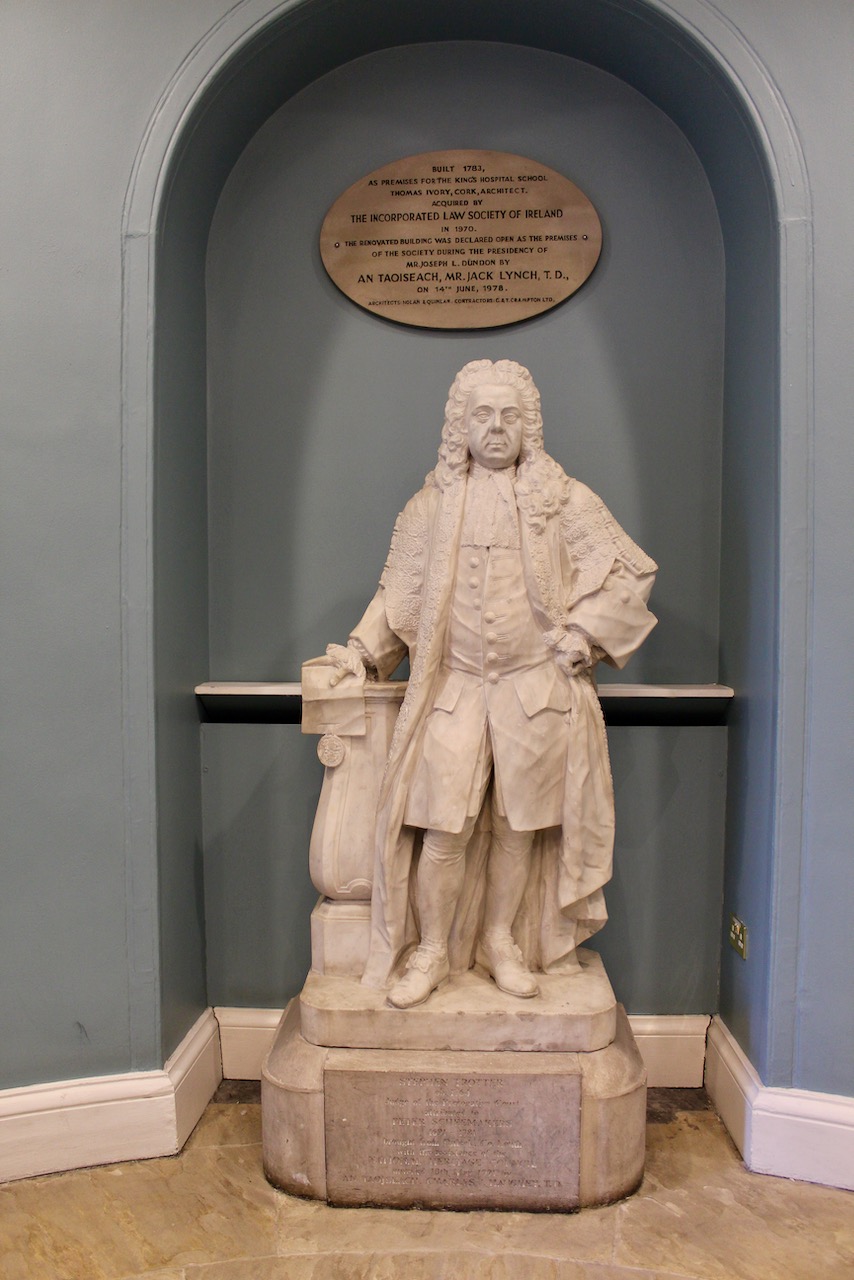
Stephen Trotter, Judge of the Prerogative Court, by Peter Scheemakers (1691-1781), brought from Duleek, County Louth. Photograph © Jennifer Winder-Baggot, www.irishhistorichouses.com
Blackhall Place, Dublin, or The Blue Coat School, by Thomas Ivory, 2019. Photograph © Jennifer Winder-Baggot, www.irishhistorichouses.com

The interior contains plasterwork by Charles Thorpe and carvings by Simon Vierpyl.

Blackhall Place, Dublin, or The Blue Coat School, by Thomas Ivory, 2019. Photograph © Jennifer Winder-Baggot, www.irishhistorichouses.com
back of Blackhall Place, Dublin, or The Blue Coat School, by Thomas Ivory, 2019. Photograph © Jennifer Winder-Baggot, www.irishhistorichouses.com
Collins Barracks, behind Blue Coat School/Blackhall Place, 2019. Photograph © Jennifer Winder-Baggot, www.irishhistorichouses.com
Collins Barracks behind Blackhall Place, 2019. Photograph © Jennifer Winder-Baggot, www.irishhistorichouses.com
Back of Blackhall Place, Dublin, or The Blue Coat School, by Thomas Ivory, 2019. Photograph © Jennifer Winder-Baggot, www.irishhistorichouses.com
back of Blackhall Place, Dublin, or The Blue Coat School, by Thomas Ivory, 2019. Photograph © Jennifer Winder-Baggot, www.irishhistorichouses.com
Photograph © Jennifer Winder-Baggot, www.irishhistorichouses.com
Side of Blackhall Place, Dublin, or The Blue Coat School, by Thomas Ivory, 2019. Photograph © Jennifer Winder-Baggot, www.irishhistorichouses.com
side of Blackhall Place, Dublin, or The Blue Coat School, by Thomas Ivory, 2019. Photograph © Jennifer Winder-Baggot, www.irishhistorichouses.com

4. City Assembly Hall, Dublin (2012 Culture Night)

The Octagon Room of the City Assembly Hall, Dublin, in September 2012, after renovation by the Irish Georgian Society. Photograph © Jennifer Winder-Baggot, www.irishhistorichouses.com
2012: City Assembly Hall, Dublin. Photograph © Jennifer Winder-Baggot, www.irishhistorichouses.com
City Assembly Rooms lantern light and balcony September 2021. Photograph © Jennifer Winder-Baggot, www.irishhistorichouses.com
2012: inside the octagon room in the City Assembly Hall, Dublin. Photograph © Jennifer Winder-Baggot, www.irishhistorichouses.com
2012: City Assembly Hall, Dublin. Photograph © Jennifer Winder-Baggot, www.irishhistorichouses.com
Upper room in City Assembly Hall, Dublin, September 2021. Photograph © Jennifer Winder-Baggot, www.irishhistorichouses.com
Photograph © Jennifer Winder-Baggot, www.irishhistorichouses.com

5. Department of Industry and Commerce, Kildare Street (Open House 2019)

Department of Industry and Commerce, Open House 2019: The tall round-headed window passes up through the floors to a keystone of representing Eire, with “jazzy” interstitial panels. Photograph © Jennifer Winder-Baggot, www.irishhistorichouses.com
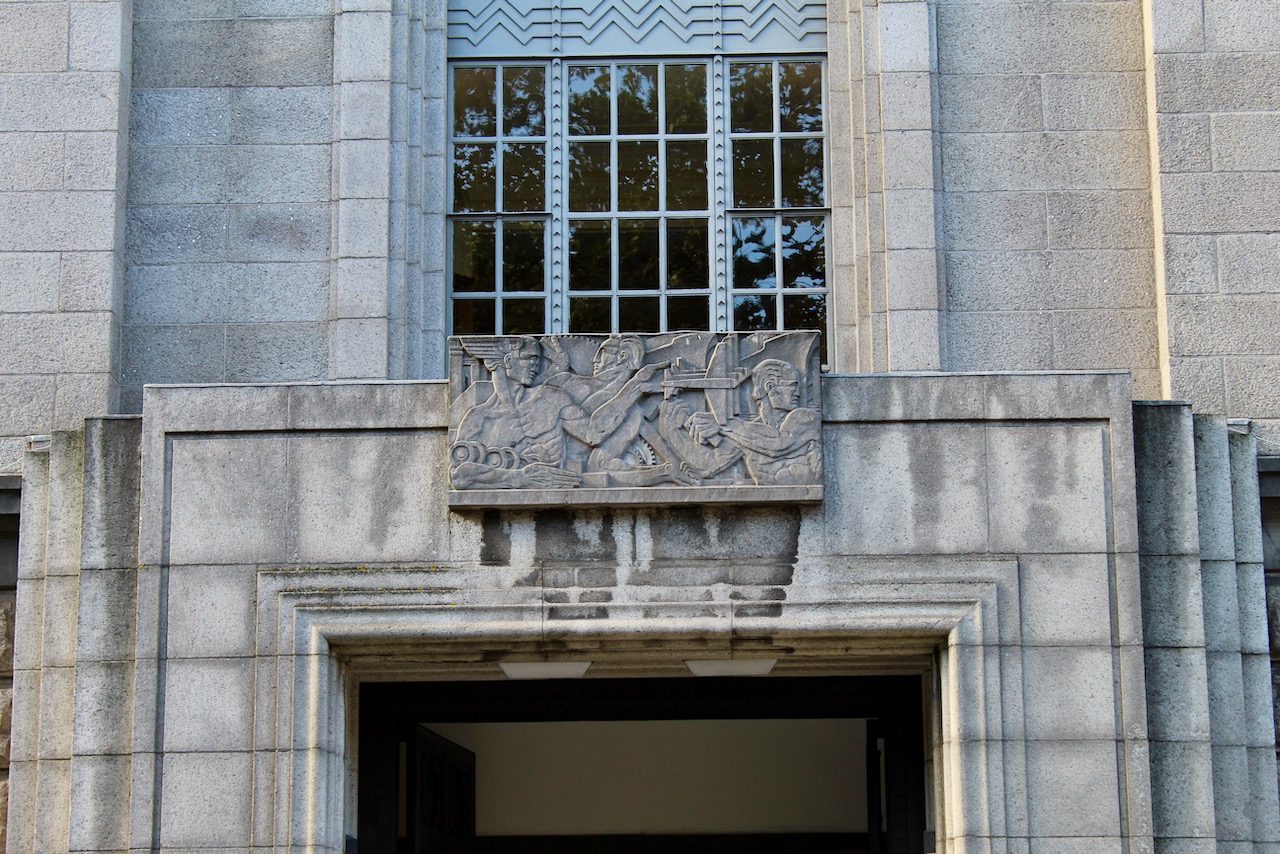
The carved lintel of the doorway represents the celtic god Lugh releasing aeroplanes into the air! Photograph © Jennifer Winder-Baggot, www.irishhistorichouses.com

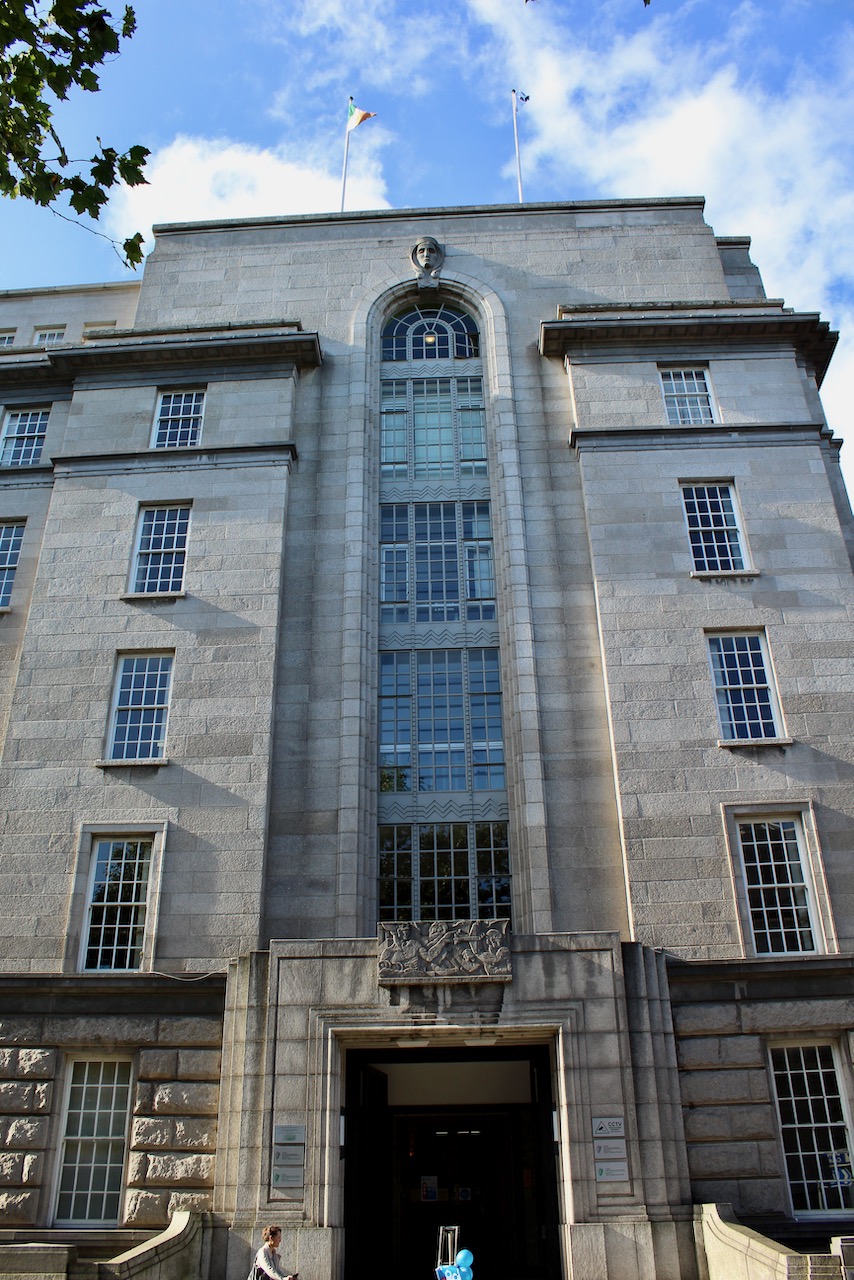
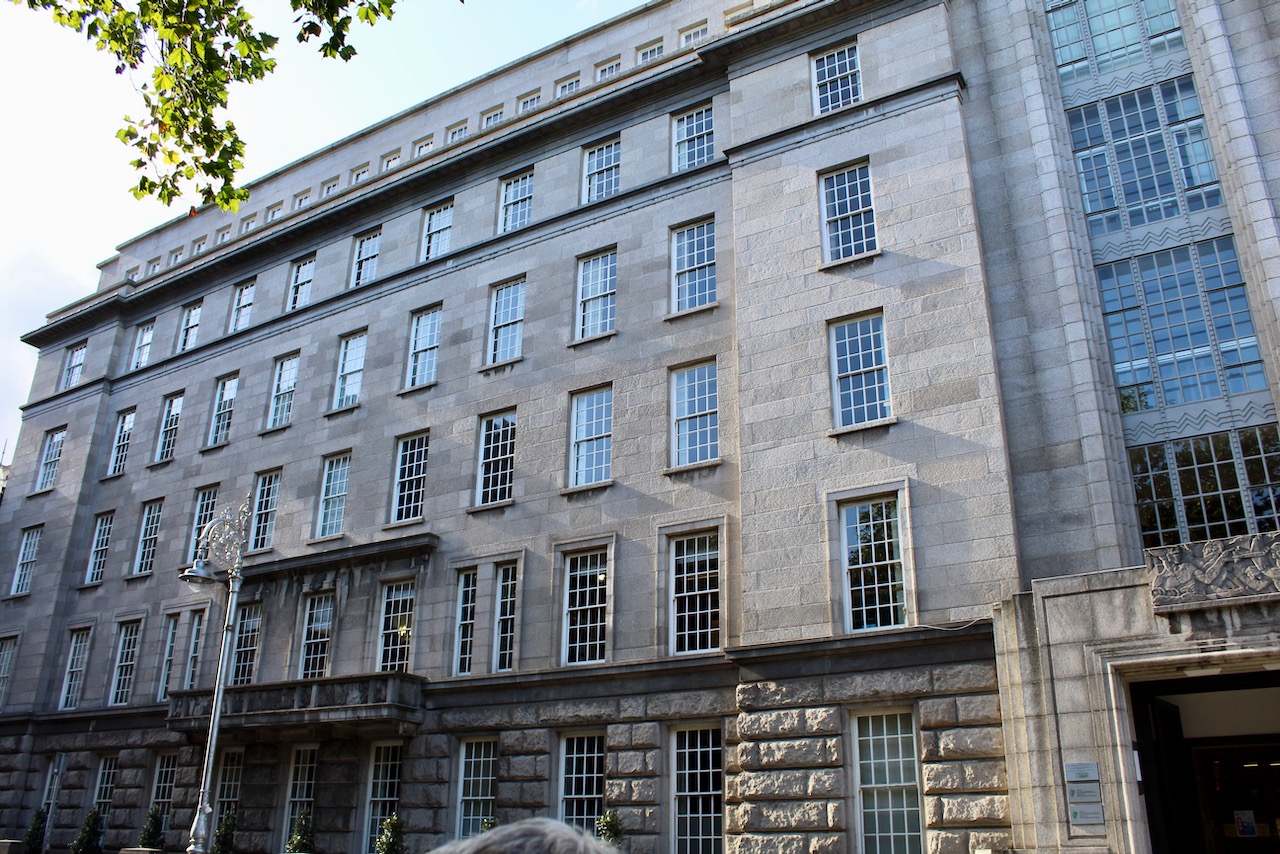
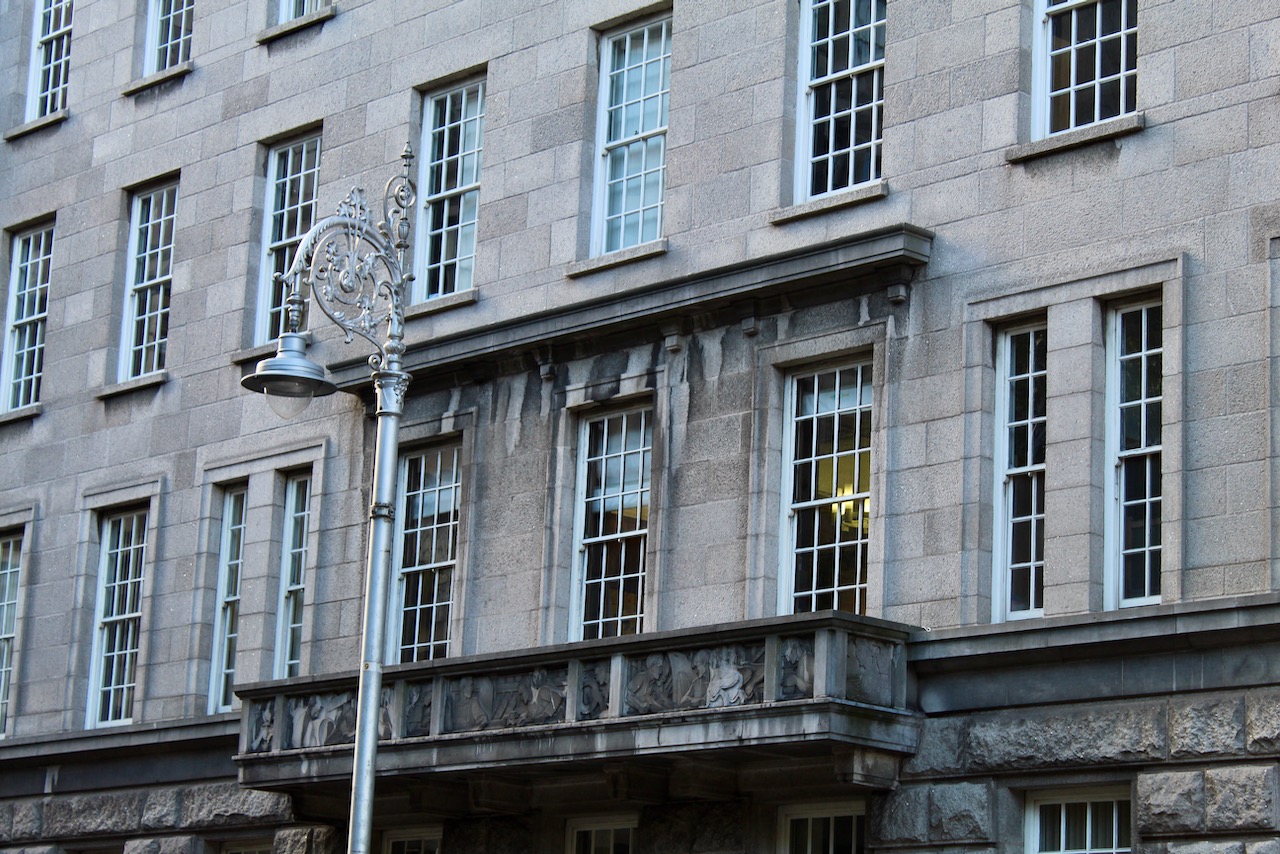
The architect was J. R. Boyd Barrett, who won a competition to built it in 1936. It has a stripped Classical design with an Art Deco entrance bay addition. The external relief sculptures are by Gabriel Hayes. The tall round-headed window passes up through the floors to a keystone of representing Eire, with “jazzy” interstitial panels [Archiseek]. On the Schoolhouse Lane side the keystone represents Brendan the Navigator. The main entrance has a heavy cast bronze gates, and the carved lintel of the doorway represents the celtic god Lugh releasing aeroplanes into the air!

On the Schoolhouse Lane side the keystone represents Brendan the Navigator. Photograph © Jennifer Winder-Baggot, www.irishhistorichouses.com
Department of Industry and Commerce, Open House 2019. Photograph © Jennifer Winder-Baggot, www.irishhistorichouses.com
Department of Trade and Commerce, Open House 2019. Photograph © Jennifer Winder-Baggot, www.irishhistorichouses.com
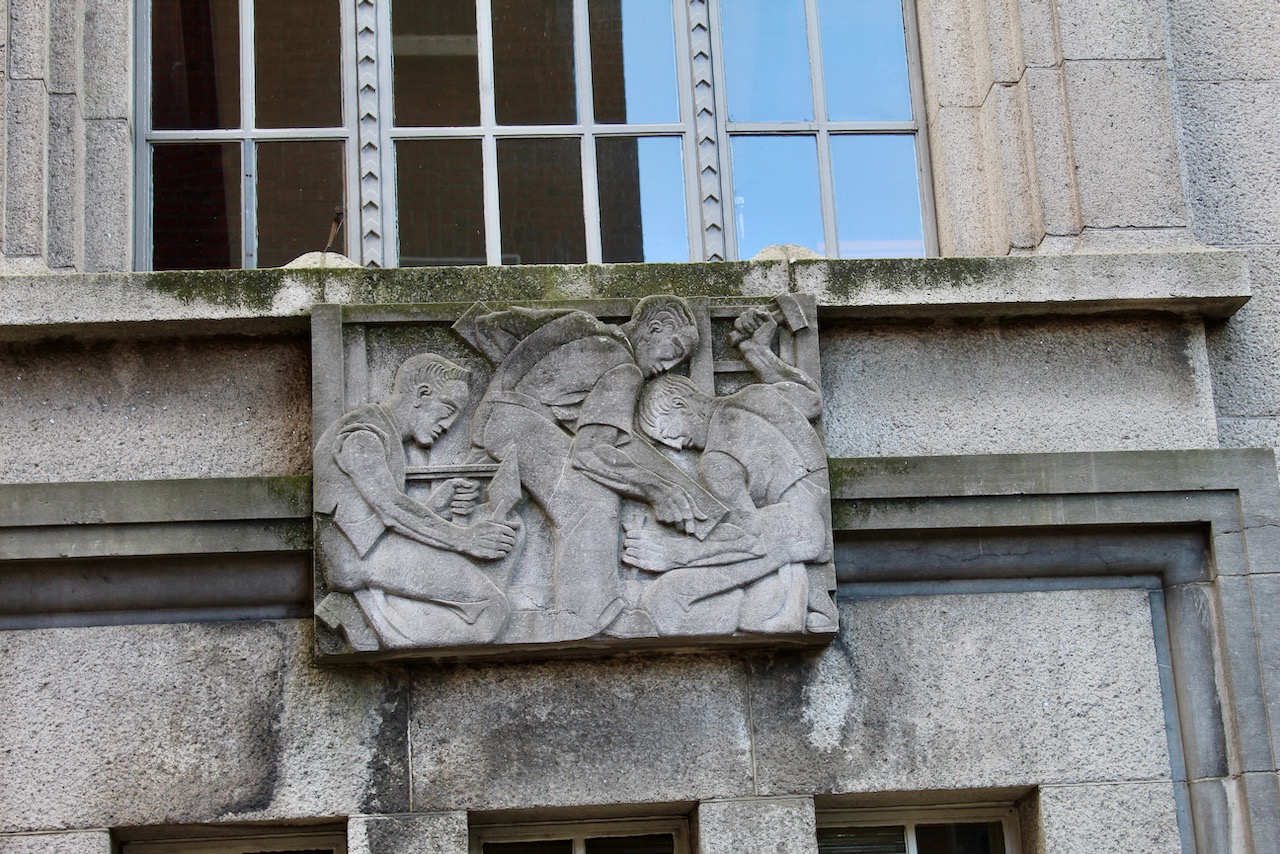
Department of Trade and Commerce, Open House 2019. The relief carvings here represent stylised images of industry and commerce. Photograph © Jennifer Winder-Baggot, www.irishhistorichouses.com

The interiors were also designed by Boyd Barrett and everything from the ashtrays, fireplaces and door handles were specially designed. The interiors feature polished woods and metals and patterned linoleum floors, and the ceilings are deeply coffered.

Department of Trade and Commerce, Open House 2019. The interiors were also designed by Boyd Barrett and everything from the ashtrays, fireplaces and door handles were specially designed. Photograph © Jennifer Winder-Baggot, www.irishhistorichouses.com
Department of Trade and Commerce, Open House 2019. Photograph © Jennifer Winder-Baggot, www.irishhistorichouses.com

6. Freemason’s Hall, Molesworth Street (Dublin 2010)

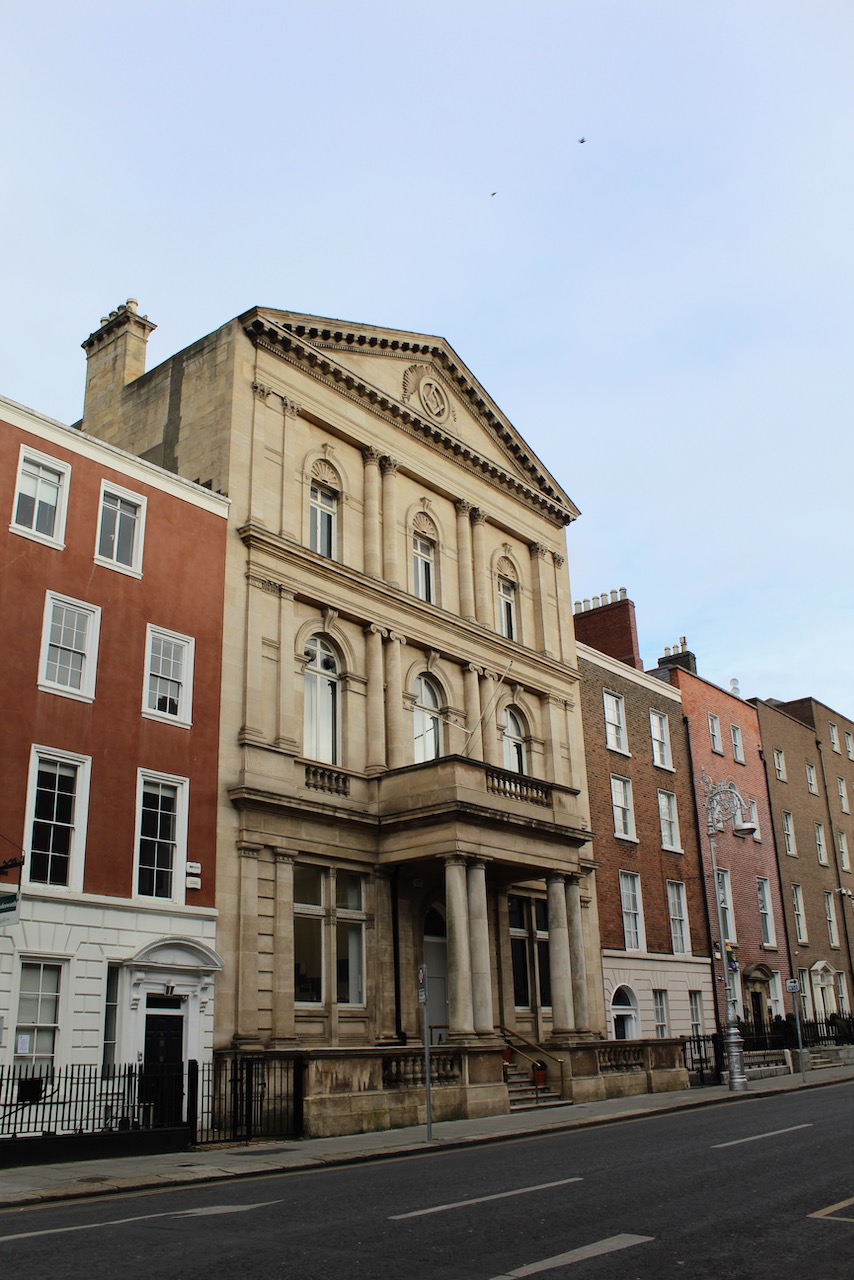
Freemason’s Hall, Molesworth Street, Dublin, 2022. Photograph © Jennifer Winder-Baggot, www.irishhistorichouses.com

https://freemason.ie/museum-library-archive/

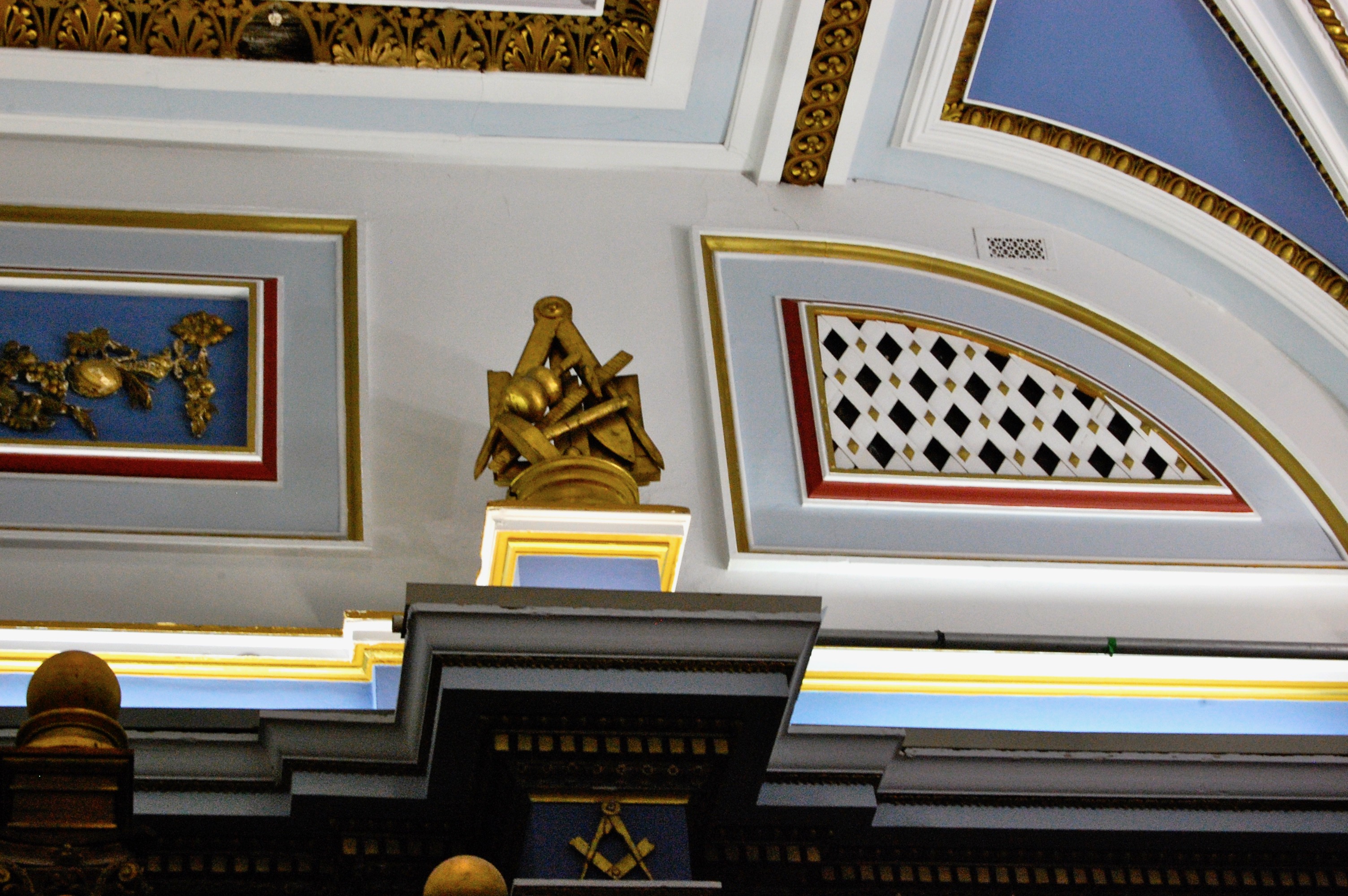
The Freemason’s Hall was built on the site of the townhouse of their first Grand Master, the Earl of Rosse. The building was completed in 1866, designed by Edward Holmes of Birmingham. The architect used three orders on the facade: Doric (lower), Ionic (centre) and Corinthian (upper). The pediment contains the Masonic square and compass.

Freemason’s Hall, Molesworth Street, Dublin, 2022. Photograph © Jennifer Winder-Baggot, www.irishhistorichouses.com

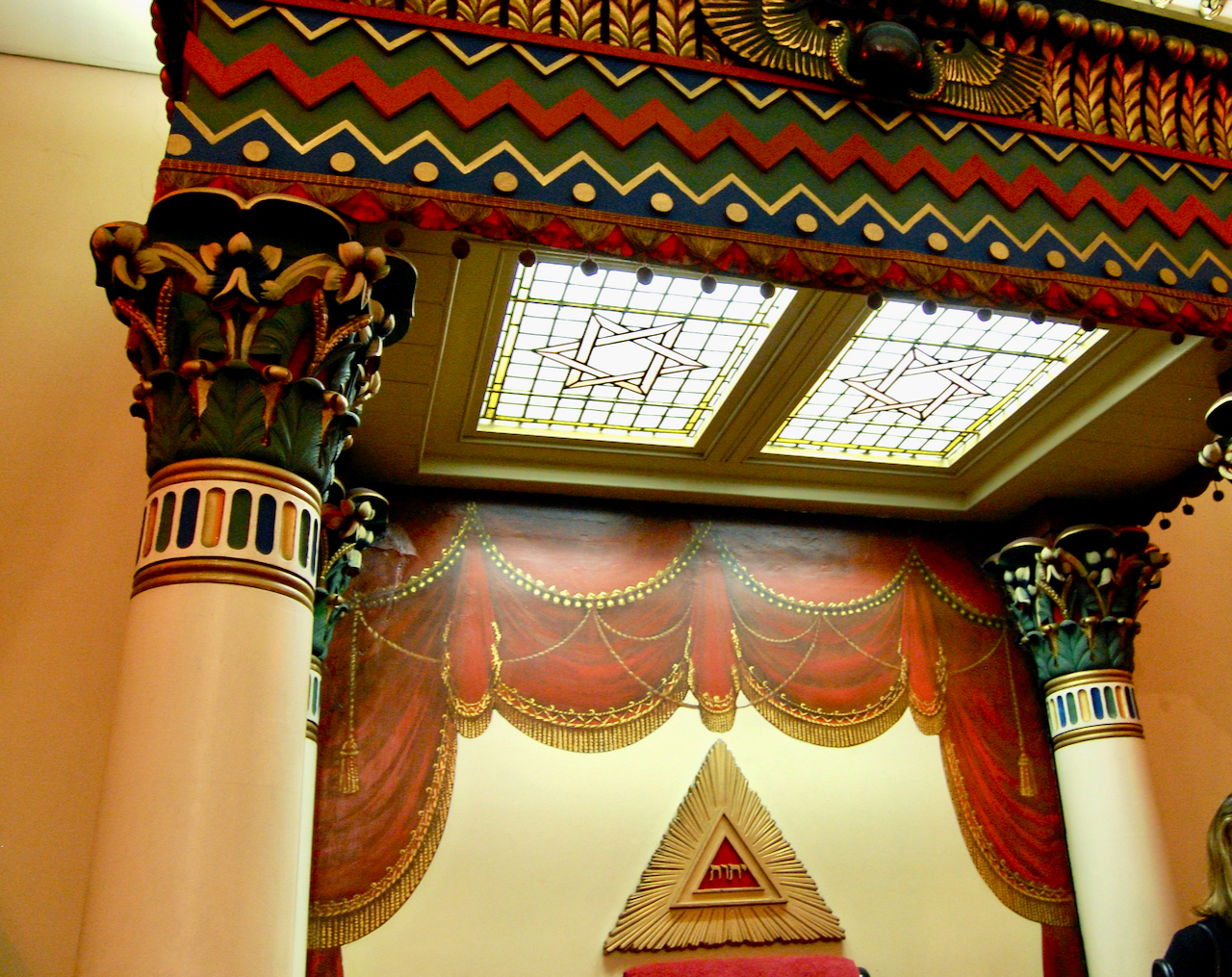
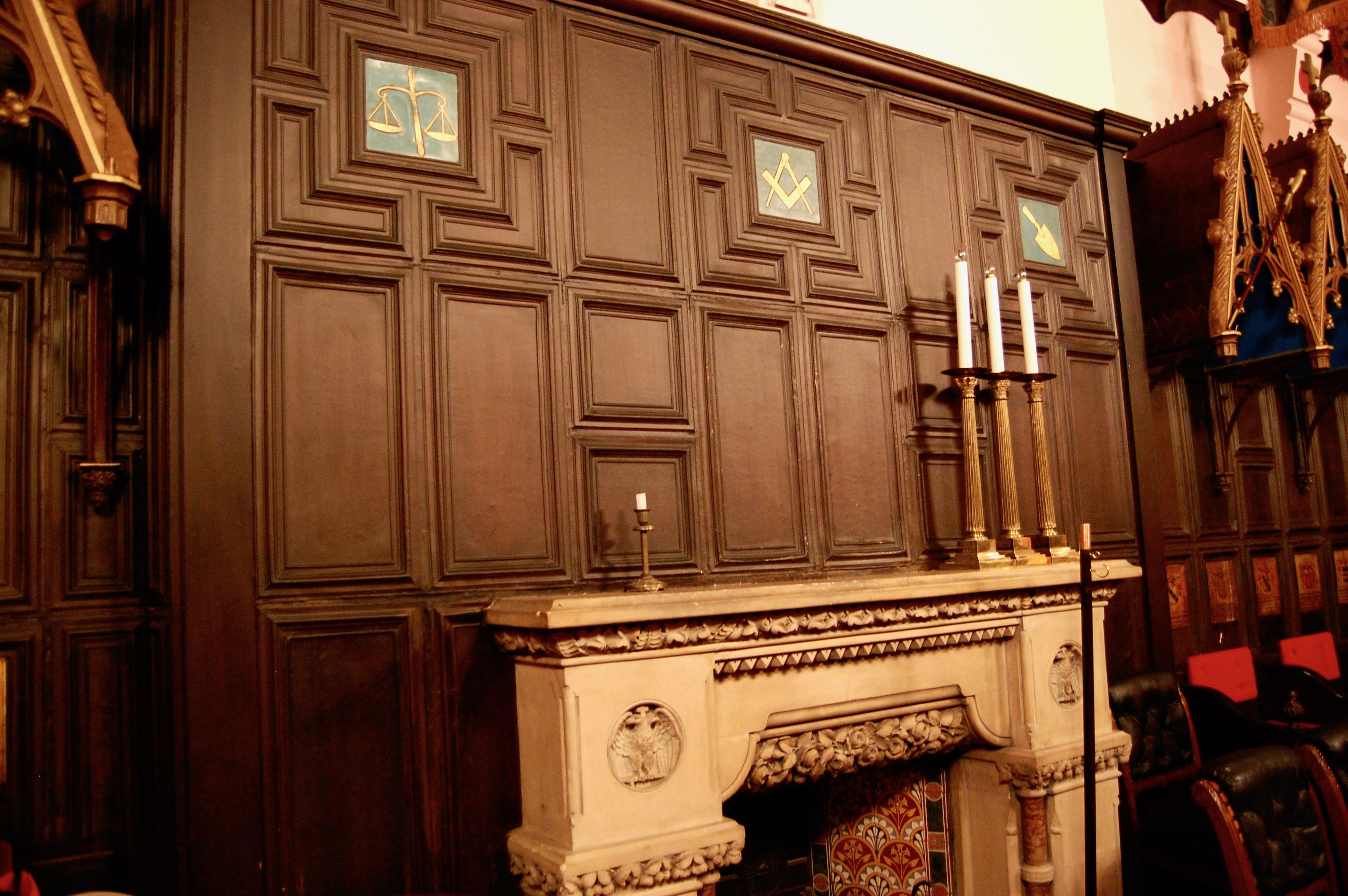
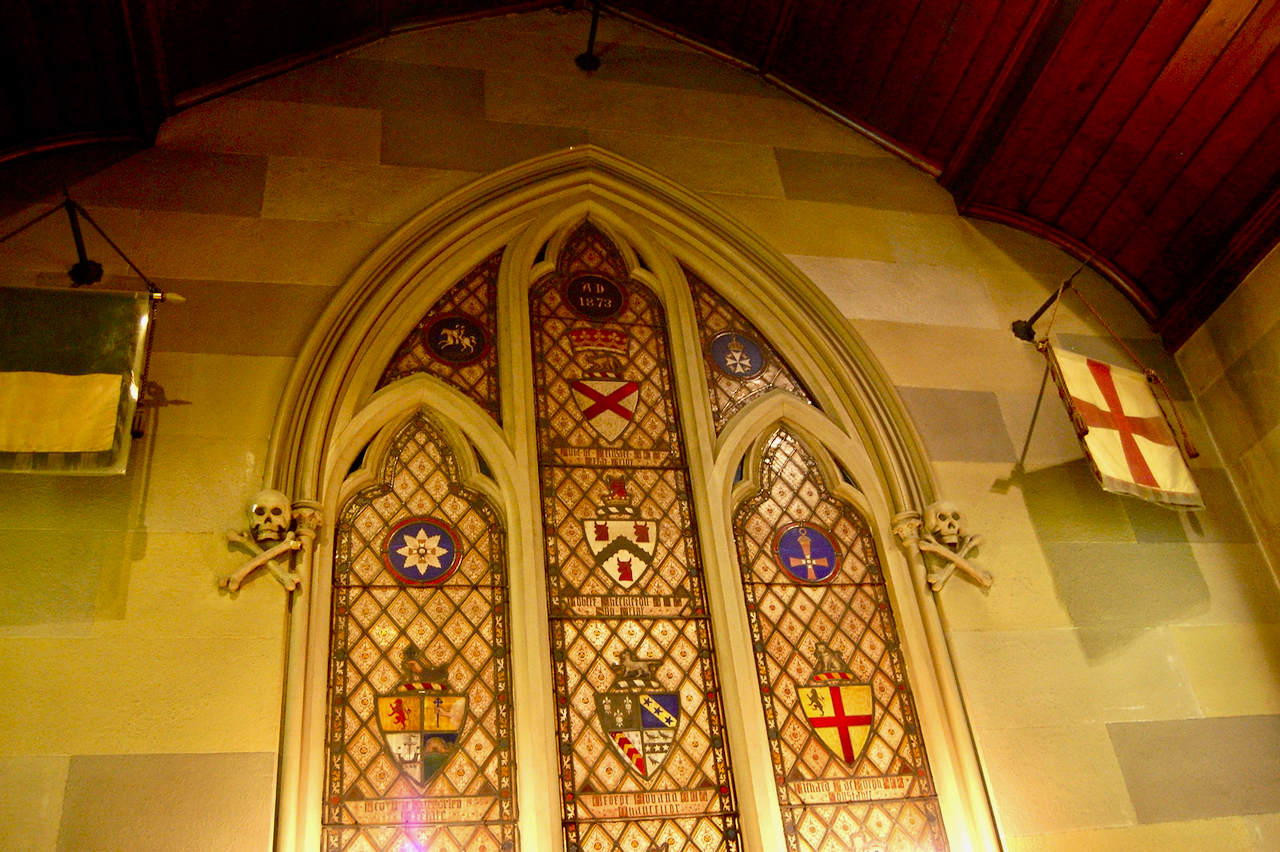
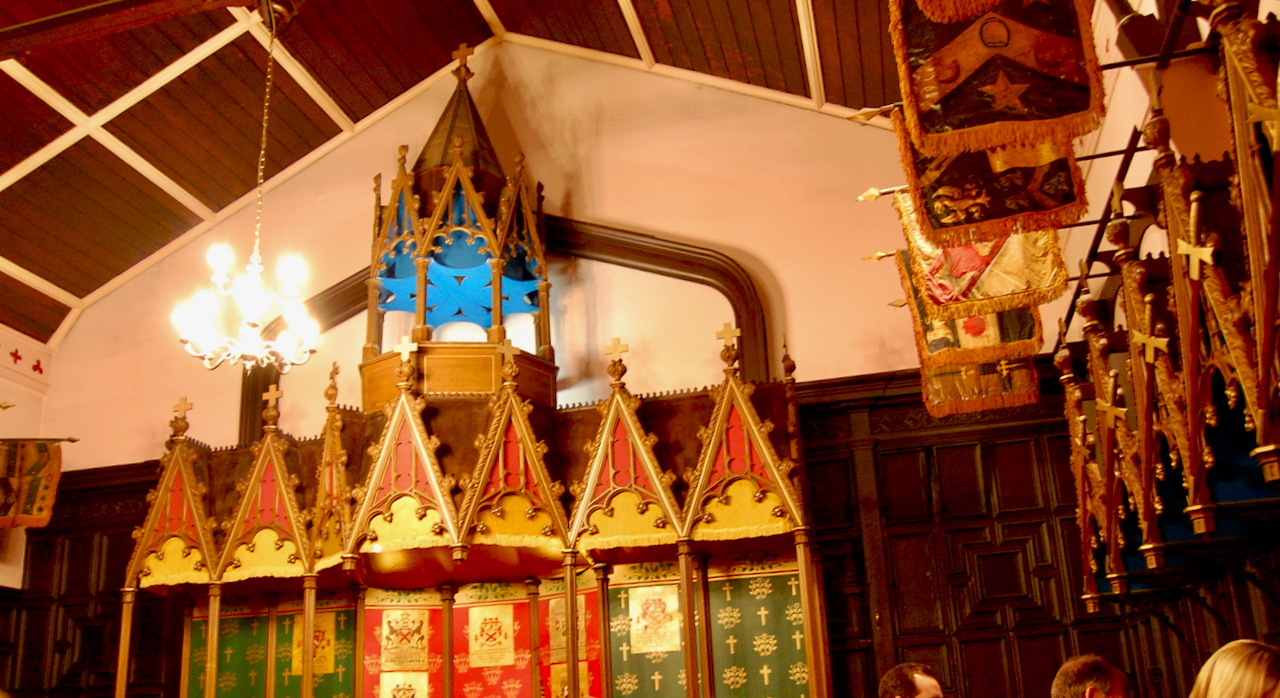
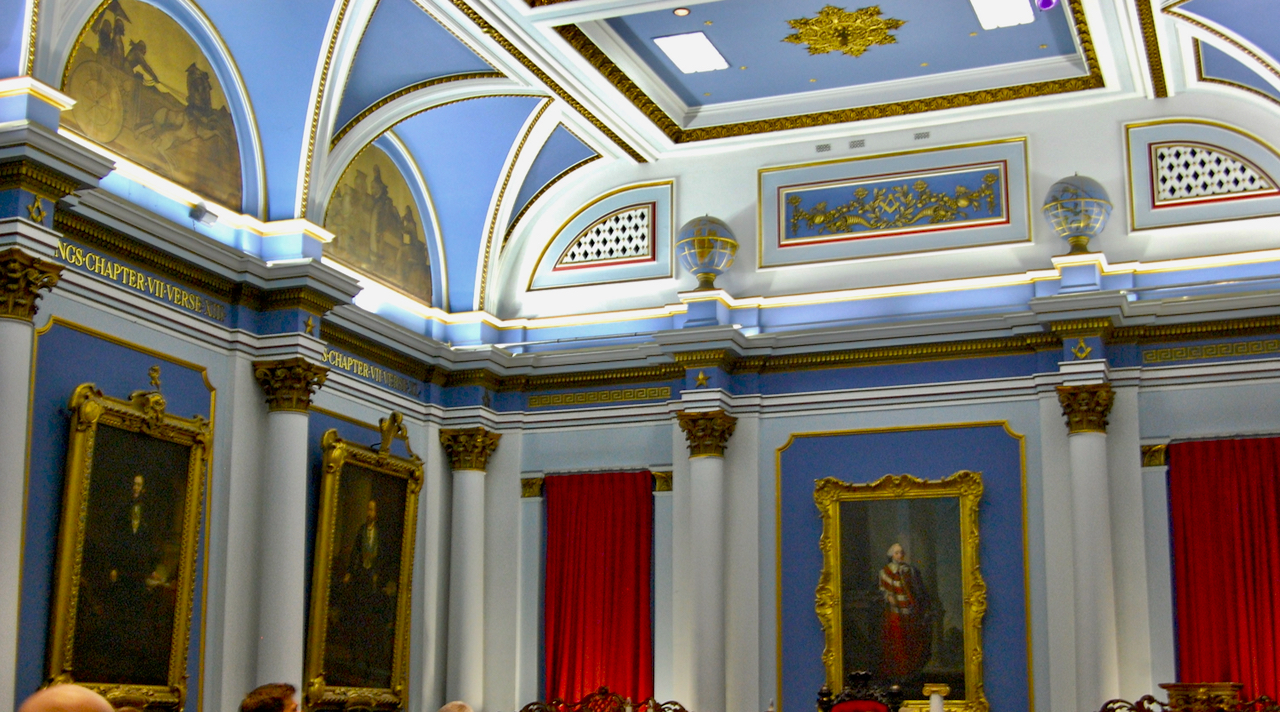
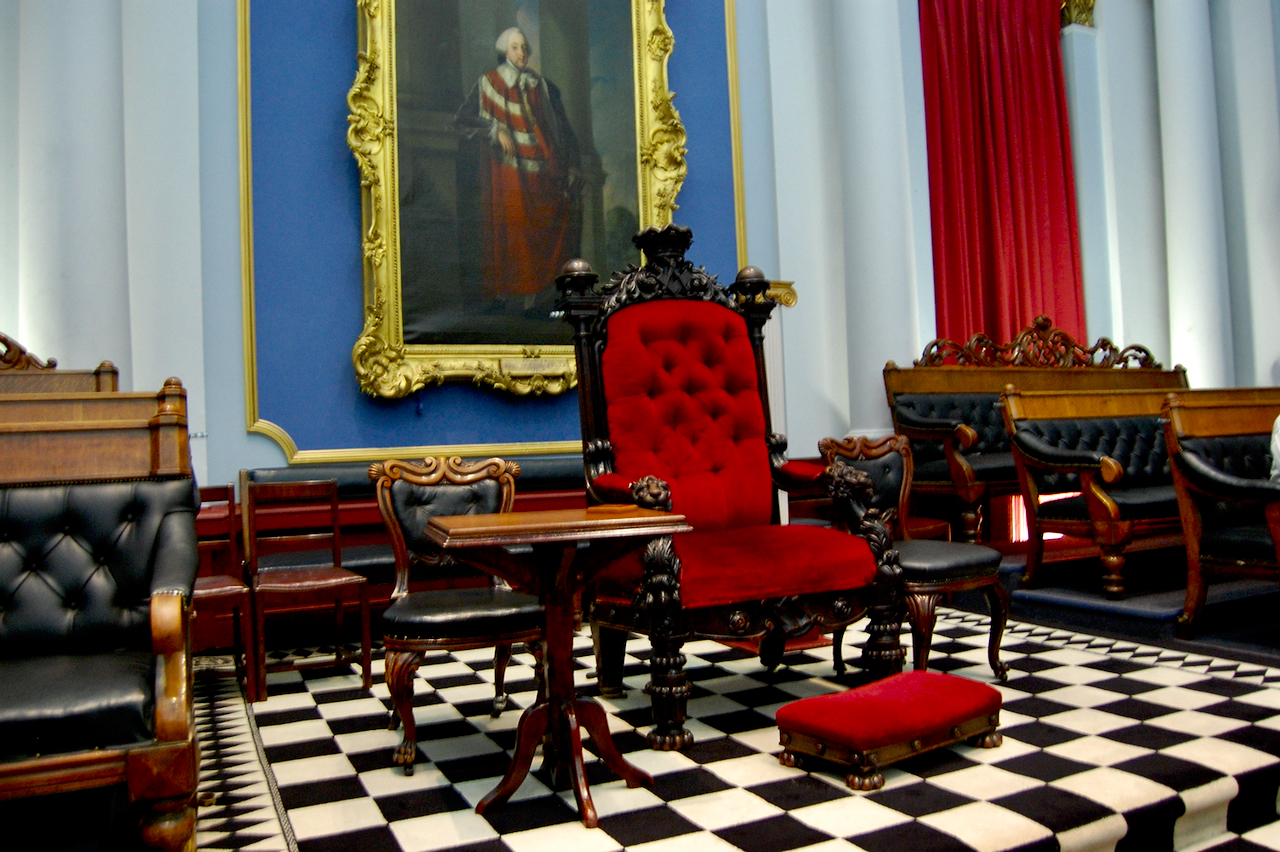
The inside is an exuberant smorgasbord of themes. The Royal Arch Chapter Room has an Egyptian theme.

Royal Arch Chapter Room, Culture Night 2010, Freemason’s Grand Lodge, Photograph © Jennifer Winder-Baggot, www.irishhistorichouses.com

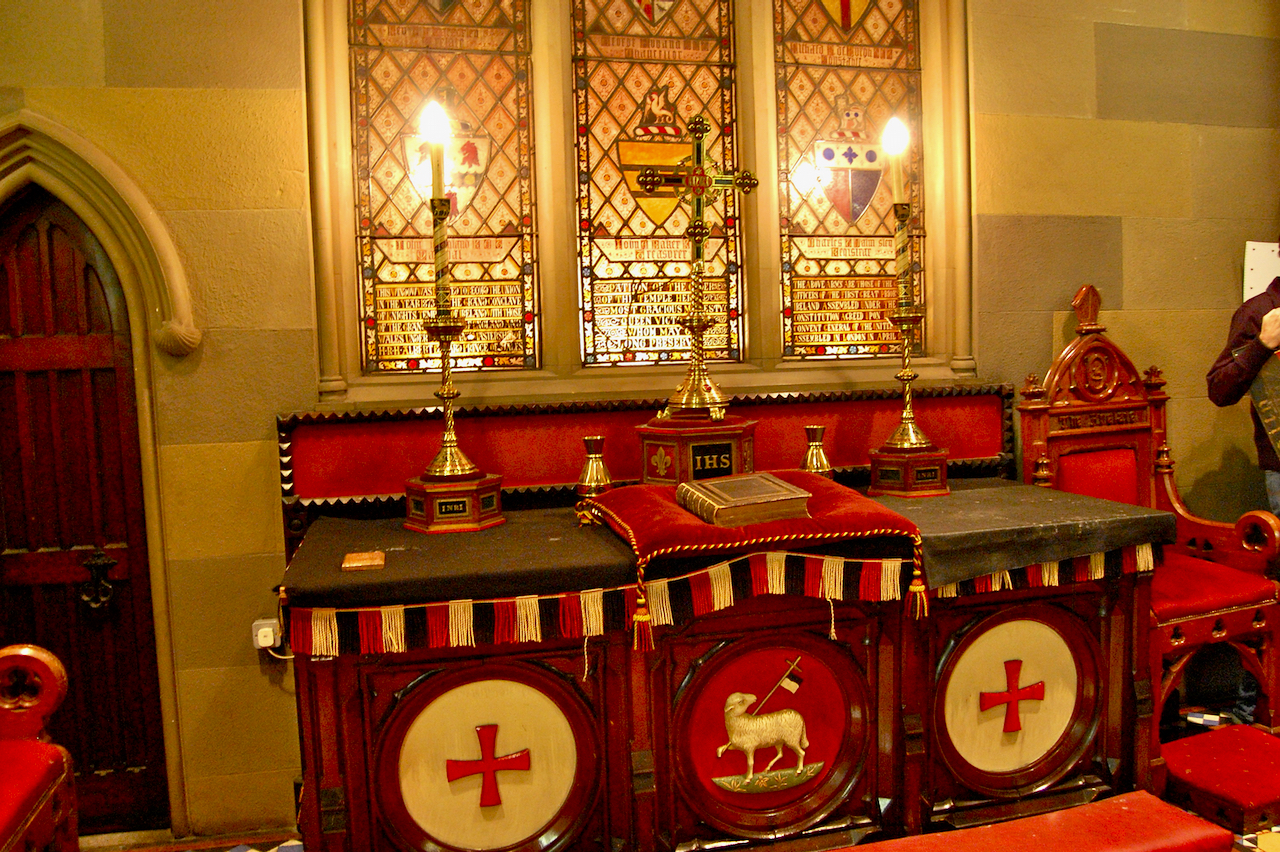
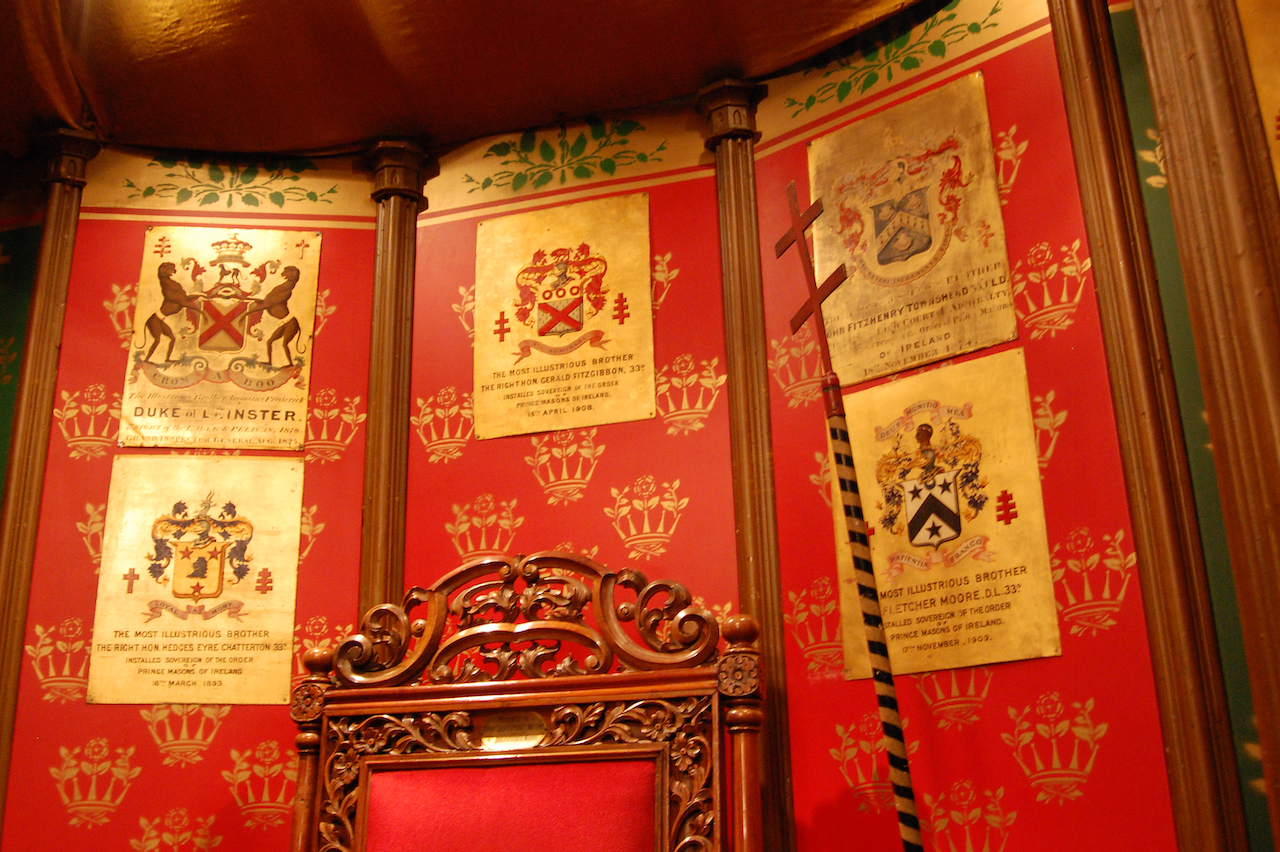
The Prince Mason’s Chapter Room is Gothic Tudor. The Knights Templar Room is designed as a medieval chapel.

Freemason’s Hall, Dublin. Photograph © Jennifer Winder-Baggot, www.irishhistorichouses.com

The Irish Builder 1877 described the interior: The main hall “is larger than St. Patrick’s Hall in Dublin Castle…Along each side are six pillars with Corinthian capitals, and there are two of the same style at each end. These are painted to represent white enamel. The capitals are gilt, the pedestals and lower part of the wall are painted a rich chocolate colour; between the pillars the wall spaces are painted a light dun colour, each space being formed into a large panel by a matted gilt moulding with a deep margin of grey. The pillars support a richly designed and gilt entablature. From this spring five semi-circular arches on each side. These arches contain a series of ten cartoons, illustrative of the building of Solomon’s Temple. The ceiling is intersected by beams, which divide it into five panels, and is painted blue, and studded with gold stars. The intersecting beams, together with the architrave and cornice, are cream colour and white, relieved with gold. The predominating colour in the painting of the hall is blue, in order to meet Masonic requirements, that colour being associated with the lower ranks of the order, and the hall being used for general meetings; but other tints are introduced in sufficient abundance. The cartoons have been painted in sepia by Mr. Edward Gibson, Great Russell Street, London, son of Mr. James Gibson of Mary Street, Dublin, by whom the entire of the rest of the hall was designed and finished...”

Freemasons Hall, Dublin. Photograph © Jennifer Winder-Baggot, www.irishhistorichouses.com

7. Georgian Townhouse, 25 Eustace Street (2011)

Open House 2011, 25 Eustace Street. Photograph © Jennifer Winder-Baggot, www.irishhistorichouses.com
Photograph © Jennifer Winder-Baggot, www.irishhistorichouses.com

8. 10 Henrietta Street, (Blessington House), Dublin (2011)

Henrietta Street, Dublin. Photograph © Jennifer Winder-Baggot, www.irishhistorichouses.com
10 Henrietta Street, Dublin. Photograph © Jennifer Winder-Baggot, www.irishhistorichouses.com
Open House, 2011, 10 Henrietta Street. Photograph © Jennifer Winder-Baggot, www.irishhistorichouses.com

The Archiseek website tells us:

It was built circa 1730 by Luke Gardiner [1690-1755] as his own residence. The design of the original building has been attributed to Sir Edward Lovett Pearce. The building is a three storey, eight bay over basement house with a Venetian window between the second and third bays at first floor level. Two major interiors of the 1730’s survive, the upper part of the original main stair hall and a rear room on the ground floor. The first floor reception rooms were embellished with Rococo plasterwork circa 1760. Luke Gardiner was succeeded on his death in 1755 by his son, the Right Honourable Charles Gardiner PC, MP, Surveyor General of Customs and Ranger of the Phoenix Park [The original house was extended to the west c.1755 by Charles Gardiner]. Following his death in 1769, his son, the right honourable Luke Gardiner MP succeeded. He was created Baron Mountjoy in 1779, Viscount in 1795 and killed in the Battle of New Ross, County Wexford in 1798. He was succeeded by his son Charles John Gardiner, Second Viscount Mountjoy, created Earl of Blessington in 1816. 

Luke Gardiner, M.P., (d. 1755), Vice-Treasurer of Ireland and building developer in Dublin Engraver John Brooks, Irish, fl.1730-1756 After Charles Jervas, Irish, c.1675-1739, photograph courtesy of National Gallery of Ireland.

The Earl died in 1829 without male heirs and the house was leased to a succession of lawyers becoming the Queen’s Inn Chambers in the late 19th century. It was acquired in the early 20th century by the French Order of Daughters of Charity of St Vincent de Paul to provide relief to distressed females. The work of the order continues today and the building is actively used for a variety of community and social services projects. 

The 2001 Europa Nostra Restoration Fund Grant generously contributed to the restoration of the decayed decorative Rococo ceiling on the first floor. The restoration works were also co-funded by a grant from Dublin City Council.” 

Open House, 2011, 10 Henrietta Street. Photograph © Jennifer Winder-Baggot, www.irishhistorichouses.com
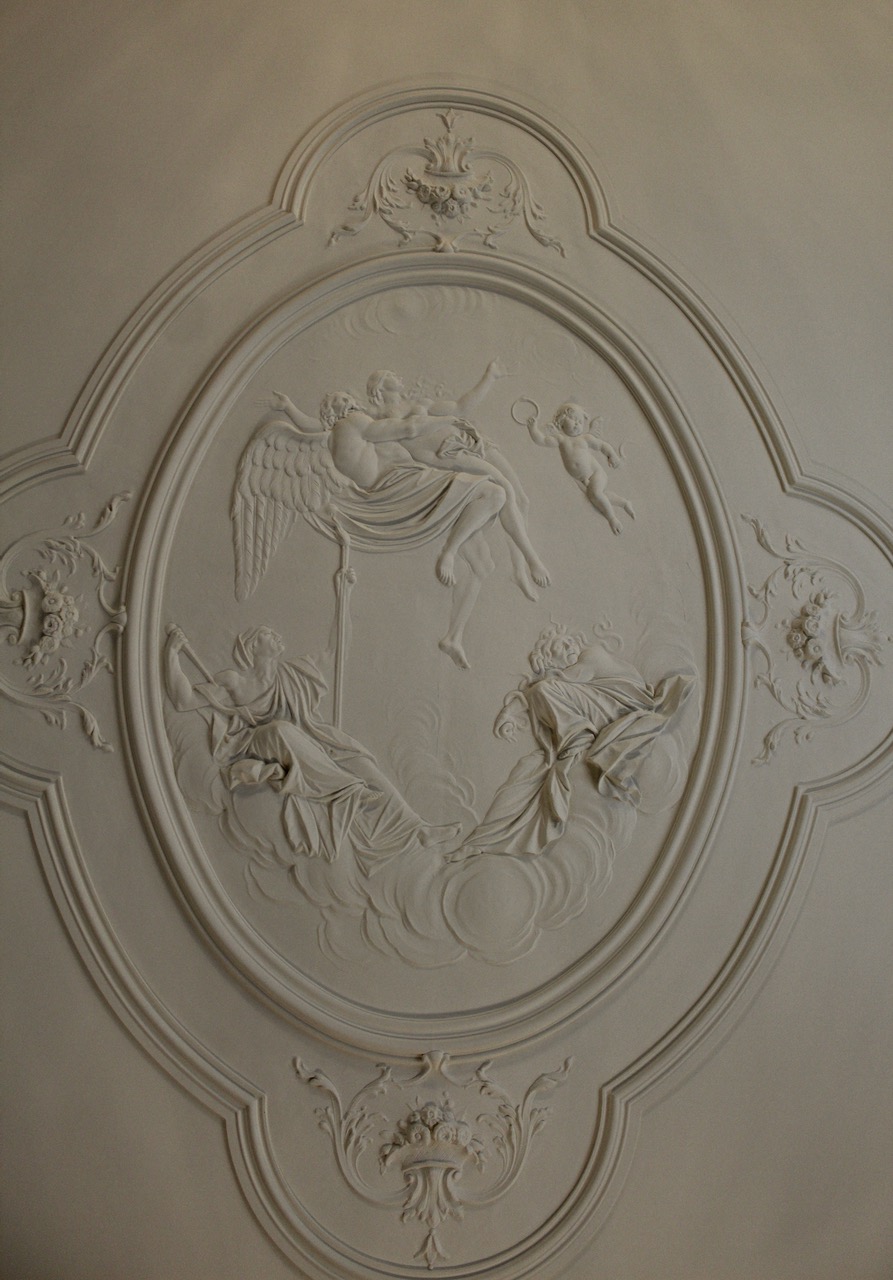
This image has an empty alt attribute; its file name is img_5677-1.jpeg
Henrietta Crofts, Duchess of Bolton (1682-1730) as shepherdess, by James Maubert. Henrietta Street was named in her honour. Vicereine 1717-1720. She was the daughter of James Crofts (Scott), 1st and last Duke of Monmouth, illegitimate son of King Charles II. She married Charles Paulet, 2nd Duke of Bolton.

The Archiseek website quotes The Irish Builder, July 15 1893:

This magnificent mansion was erected about the year 1725, by the Rt. Hon. Luke Gardiner, grandfather of the 1st Viscount Mountjoy, ancestor of the Earl of Blesinton, and may be described as the Manor House of Henrietta-street. The reception-rooms are seven in number, and the cornices and ceilings are finished in a rich and antique style. 

The ball-room is a noble apartment; the architraves of the doors and windows are adorned with fluted Corinthian columns sur mounted by pediments. The drawing-room, to the left of the ante-room on the first floor, possesses a beautifully carved oak cornice, the effect of which is peculiarly striking. The front staircase is spacious and lofty; the walls are panelled, and the ceiling is handsomely ornamented. The principal dining room, looking into the garden, is square, with fine stuccoed ceiling, and walls in square panels stuccoed, the squares broken off at the angles by curves. The architraves of the parlour doors are as rich as carving could make them. There is a mock key-stone or block of wood that for elegant and elaborate carving in relief cannot be surpassed. The stuccoed ceilings are in panels with enriched fillets, quite palatial, and only in the ball room are seen arabesques in the centre. The window of the ball-room, which is over the porte-cochère, has three opes, the centre ope being arched, and this is the only architectural adornment externally. Mountjoy House had originally a fine porte-cochère, or covered carriage entry, arched with cut stone, on the park side, next to the present King’s Inns buildings.” [1]

Open House, 2011, 10 Henrietta Street. Photograph © Jennifer Winder-Baggot, www.irishhistorichouses.com
10 Henrietta Street, photograph from UCD Archive [ https://digital.ucd.ie/view/ivrla:31546 ]

See also the wonderfully informative book, The Best Address in Town: Henrietta Street, Dublin and its First Residents 1720-80 by Melanie Hayes, published by Four Courts Press, Dublin 8, 2020.

Open House, 2011, 10 Henrietta Street. Photograph © Jennifer Winder-Baggot, www.irishhistorichouses.com
Open House, 2011, 10 Henrietta Street. What looks like stucco work in this room is actually papier mache. Photograph © Jennifer Winder-Baggot, www.irishhistorichouses.com

Robert O’Byrne tells us about the use of papier-mache instead of plaster for some decorative work. He tells us:

When the house was first built, it featured a double-height entrance containing stairs leading to the first-floor. However, some years after the death of Luke Gardiner in 1755 his son Charles reordered this space to create a single-storey entrance hall, behind which a new staircase hall was instated. Probably around the same time a number of rooms were given new ceilings in the rococo manner. These decorations are important because in the majority of cases they are made not of plaster but papier-mâché. The use of this medium is unusual but not unique – a number of other examples survive elsewhere in the city and in Carton, County Kildare – but it seems strange to find it here. One of the attractions of papier-mâché was its relative cheapness (relative to stuccowork, that is) but the Gardiners were certainly affluent to afford anything they wished. On the other hand, its great merit is easier (and cleaner) installation than plaster, so perhaps this is why papier-mâché was preferred for the redecoration of existing rooms. 

It was not used, on the other hand, for the saloon, or ballroom (now used as a chapel), which in its present form looks to have been either added or extended at the time when Charles Gardiner was re-fashioning other spaces in the house.” [2]

Open House, 2011, Henrietta St, window by Harry Clarke. Photograph © Jennifer Winder-Baggot, www.irishhistorichouses.com

9. 12 Henrietta Street, Dublin – private, sometimes open during Open House Dublin

12 Henrietta Street, October 2022. Photograph © Jennifer Winder-Baggot, www.irishhistorichouses.com
12 Henrietta Street, Open House October 2019. Photograph © Jennifer Winder-Baggot, www.irishhistorichouses.com

12 Henrietta Street was first occupied by Sir Gustavus Hume (1677-1731), MP, privy councillor and courtier to King George I. He was the third son of the prominent Ulster-Scot Sir John Hume of Castle Hume (2nd Baronet), County Fermanagh and of Sidney, daughter and co-heiress of James Hamilton of Manor Hamilton, County Leitrim and became 3rd Baronet of Castle Hume (now demolished) when his father died as his two elder brothers predeceased their father. Castle Hume was architect Richard Castle’s first known commission in Ireland. It was pulled down in the 1830s and the materials reused to build Ely Lodge nearby.

view from window of 12 Henrietta Street, Dublin, 2019. Photograph © Jennifer Winder-Baggot, www.irishhistorichouses.com
12 Henrietta Street, Open House October 2019. Photograph © Jennifer Winder-Baggot, www.irishhistorichouses.com

The National Inventory of Architectural Heritage tells us it is:

Terraced three-bay three-storey house over exposed basement, built c.1730, by Luke Gardiner as pair with No. 11, heavily remodelled c.1780…This house was built as a pair with No. 11, possibly to the designs of Edward Lovett Pearce. It was initially leased to Henry Boyle, Speaker of the House of Commons. Later, the house was leased to the 2nd Earl of Shannon in 1780, and subsequently gutted with the removal of a floor to provide a truly grand piano nobile. The building retains most of the interior detailing from that remodelling including stucco decoration by Charles Thorp, with remnants from the earlier scheme. The house has been undergoing a painstaking programme of conservation works and forms an important part of what has been described as ‘Dublin’s Street of Palaces’ while the ongoing conservation work will contribute to the improving fortunes of this remarkable streetscape. Laid out by Luke Gardiner in the 1720s, Henrietta Street is a short cul-de-sac containing the finest early Georgian houses in the city. It was named after Henrietta Crofts, the third wife of Charles Paulet, 2nd Duke of Bolton and Lord Lieutenant in 1717-21, the street developed in a piecemeal fashion and set the trends of scale and design in domestic architecture.”

See also the wonderfully informative book, The Best Address in Town: Henrietta Street, Dublin and its First Residents 1720-80 by Melanie Hayes, published by Four Courts Press, Dublin 8, 2020.

In 1733 William Stewart (1709-1769), 3rd Viscount Mountjoy and later 1st Earl of Blessington, moved to 12 Henrietta Street.

12 Henrietta Street, Open House October 2019. Photograph © Jennifer Winder-Baggot, www.irishhistorichouses.com
12 Henrietta Street, Dublin, 2019. Photograph © Jennifer Winder-Baggot, www.irishhistorichouses.com
12 Henrietta Street, Open House October 2019. Photograph © Jennifer Winder-Baggot, www.irishhistorichouses.com
Photograph © Jennifer Winder-Baggot, www.irishhistorichouses.com
12 Henrietta Street, Dublin, 2019. Photograph © Jennifer Winder-Baggot, www.irishhistorichouses.com
12 Henrietta Street, Open House October 2019. Photograph © Jennifer Winder-Baggot, www.irishhistorichouses.com
12 Henrietta Street, Dublin, 2019. Photograph © Jennifer Winder-Baggot, www.irishhistorichouses.com
12 Henrietta Street, Open House October 2019. Photograph © Jennifer Winder-Baggot, www.irishhistorichouses.com
Photograph © Jennifer Winder-Baggot, www.irishhistorichouses.com
12 Henrietta Street, Open House October 2019. Photograph © Jennifer Winder-Baggot, www.irishhistorichouses.com
Photograph © Jennifer Winder-Baggot, www.irishhistorichouses.com
12 Henrietta Street, Open House October 2019. Photograph © Jennifer Winder-Baggot, www.irishhistorichouses.com
12 Henrietta Street, Dublin, 2019. Photograph © Jennifer Winder-Baggot, www.irishhistorichouses.com

10. 14 Henrietta Street, Dublin (July 2013 Heritage Week)

https://14henriettastreet.ie

This house is now a museum. See my entry https://irishhistorichouses.com/2020/06/06/covid-19-lockdown-20km-limits-and-places-to-visit-in-dublin/

See also the wonderfully informative book, The Best Address in Town: Henrietta Street, Dublin and its First Residents 1720-80 by Melanie Hayes, published by Four Courts Press, Dublin 8, 2020.

14 Henrietta Street, 2022. Photograph © Jennifer Winder-Baggot, www.irishhistorichouses.com
14 Henrietta Street, Dublin, July 2013. Photograph © Jennifer Winder-Baggot, www.irishhistorichouses.com
14 Henrietta Street, Dublin, July 2013.
14 Henrietta Street, Dublin, July 2013. Photograph © Jennifer Winder-Baggot, www.irishhistorichouses.com
14 Henrietta Street, Dublin, July 2013.
14 Henrietta Street, Dublin, July 2013. Photograph © Jennifer Winder-Baggot, www.irishhistorichouses.com

11. Iveagh House (80 and 81 St. Stephen’s Green) – Department of Foreign Affairs (Open House 2014)

Iveagh House, St Stephen’s Green, October 2014. Portland stone facade (1866) by James Franklin Fuller (1835-1924) disguises an early eighteenth century townhouse by Richard Castle (d. 1751) for Robert Clayton (1695-1758), Bishop of Cork and Ross. The original house, three windows wide, is on the left of the portico. Photograph © Jennifer Winder-Baggot, www.irishhistorichouses.com
Iveagh House, St Stephen’s Green, the original owner, Robert Clayton (1695-1758), Bishop of Cork and Ross. Photograph © Jennifer Winder-Baggot, www.irishhistorichouses.com

The Archiseek website tells us:

Iveagh House is now the Department of Foreign Affairs as it was donated to the Irish State by the Guinness family in 1939. Originally two houses, nos 80/81 St Stephen’s Green, no 80 was originally designed by Richard Cassels [also spelled “Castle”] in 1736. After both houses were bought by Benjamin Guinness in 1862, he acted as his own architect and produced the current house. 

“The Dublin Builder, February 1 1866: ‘In this number we give a sketch of the town mansion of Mr. Benjamin Lee Guinness, M.P , now in course of erection in Stephen’s Green, South, the grounds of which run down to those of the Winter Garden. As an illustration so very quiet and unpretending a front is less remarkable as a work of architectural importance than from the interest which the name of that well-known and respected owner gives it, and from whose own designs it is said to have been built. The interior of the mansion promises to be of a very important and costly character, and to this we hope to have the pleasure of returning on a future occasion when it is more fully advanced. The works, we believe, have been carried out by the Messrs. Murphy of St. Patrick’s Cathedral notoriety, under Mr. Guinness’s own immediate directions, without the intervention of any professional architect.’ “

Iveagh House, St Stephen’s Green, October 2014. Photograph © Jennifer Winder-Baggot, www.irishhistorichouses.com

The building was donated to the Irish government by Benjamin Guinness’s grandson Rupert, the 2nd Earl of Iveagh, in 1939 and was renamed Iveagh House.

Iveagh House, St Stephen’s Green, October 2014. Photograph © Jennifer Winder-Baggot, www.irishhistorichouses.com
Iveagh House, St Stephen’s Green. Photograph © Jennifer Winder-Baggot, www.irishhistorichouses.com
Iveagh House, St Stephen’s Green, October 2014. Painting by De Chirico. Photograph © Jennifer Winder-Baggot, www.irishhistorichouses.com
Iveagh House, St Stephen’s Green, October 2014. Photograph © Jennifer Winder-Baggot, www.irishhistorichouses.com
Iveagh Gardens, the part kept by the Guinness’s as part of Iveagh House. Photograph © Jennifer Winder-Baggot, www.irishhistorichouses.com
Mahogany doorframe and door, Iveagh House, Stephen’s Green. The architect took advantage of the tax on mahogany not imposed in Ireland. Photograph © Jennifer Winder-Baggot, www.irishhistorichouses.com
The Sleeping Faun, bought by the Guinness’s, for almost the same price as the house! Donated by the Guinnesses along with the house to the state. Photograph © Jennifer Winder-Baggot, www.irishhistorichouses.com
Iveagh House, St Stephen’s Green, medieval wooden carving, picturing Homer’s Illiad scenes. Photograph © Jennifer Winder-Baggot, www.irishhistorichouses.com
Iveagh House, St Stephen’s Green. Photograph © Jennifer Winder-Baggot, www.irishhistorichouses.com
Iveagh House, St Stephen’s Green, “Modesty.” Photograph © Jennifer Winder-Baggot, www.irishhistorichouses.com
Iveagh House, St Stephen’s Green, original fireplace. Photograph © Jennifer Winder-Baggot, www.irishhistorichouses.com
Iveagh House, St Stephen’s Green, originally the study. Photograph © Jennifer Winder-Baggot, www.irishhistorichouses.com
Iveagh House, St Stephen’s Green, originally the study. Medieval wood carvings of scenes from Homer’s Illiad, and crest of Lord Iveagh who donated the house to the state. Original fireplace. Photograph © Jennifer Winder-Baggot, www.irishhistorichouses.com
Iveagh House, St Stephen’s Green, The Music Room. Photograph © Jennifer Winder-Baggot, www.irishhistorichouses.com
The Music room ceiling, in Iveagh House. Photograph © Jennifer Winder-Baggot, www.irishhistorichouses.com
Iveagh House, St Stephen’s Green. Photograph © Jennifer Winder-Baggot, www.irishhistorichouses.com
Iveagh House, St Stephen’s Green, probably originally the room of the Lady of the house. Photograph © Jennifer Winder-Baggot, www.irishhistorichouses.com
Iveagh House ballroom. Photograph © Jennifer Winder-Baggot, www.irishhistorichouses.com
Original curtains and seats in ballroom in Iveagh House. Photograph © Jennifer Winder-Baggot, www.irishhistorichouses.com
Iveagh House ballroom. Photograph © Jennifer Winder-Baggot, www.irishhistorichouses.com
Fireplace built for ballroom in Iveagh House to host a Royal visit to the Guinness’s, the room was built specially to have the guests, for £30,000. JFK was hosted at a reception here and had his picture taken in front of the fireplace, and his daughter Caroline Kennedy had her picture taken there years later. Photograph © Jennifer Winder-Baggot, www.irishhistorichouses.com
Ballroom stucco in Iveagh House, made from moulds but then finished by hand to make look like fully hand-done. Photograph © Jennifer Winder-Baggot, www.irishhistorichouses.com
Minstrals’ gallery in Iveagh House ballroom, made of the new at the time material, aluminium. Photograph © Jennifer Winder-Baggot, www.irishhistorichouses.com
Ceiling of Iveagh house ballroom, in Wedgewood blue. Photograph © Jennifer Winder-Baggot, www.irishhistorichouses.com

12. Iveagh Trust Apartment, Iveagh Buildings (Open House 2014)

Iveagh Trust flat, Iveagh Trust buildings on Patrick Street, Dublin 8. Photograph © Jennifer Winder-Baggot, www.irishhistorichouses.com

The Iveagh Trust buildings were commissioned by the Earl of Iveagh in 1901. The architects were Joseph and Smithem, London architects. The centrepiece of the buildings, built to house people who lived in the slums about St. Patrick’s cathdral, was the Iveagh Baths.

Iveagh Trust flat, Iveagh Trust buildings on Patrick Street, Dublin 8. Photograph © Jennifer Winder-Baggot, www.irishhistorichouses.com
The range, in Iveagh Trust flat, Iveagh Trust buildings on Patrick Street, Dublin 8. Photograph © Jennifer Winder-Baggot, www.irishhistorichouses.com
Iveagh Trust flat, Iveagh Trust buildings on Patrick Street, Dublin 8. Photograph © Jennifer Winder-Baggot, www.irishhistorichouses.com
Iveagh Trust flat, Iveagh Trust buildings on Patrick Street, Dublin 8. Child of Prague and St. Christopher in the alcove. Photograph © Jennifer Winder-Baggot, www.irishhistorichouses.com
Iveagh Trust flat, Iveagh Trust buildings on Patrick Street, Dublin 8. Photograph © Jennifer Winder-Baggot, www.irishhistorichouses.com
Iveagh Trust flat, Iveagh Trust buildings on Patrick Street, Dublin 8. Religion was more dominant in peoples’ lives in those days than it is generally in Irish people today! Photograph © Jennifer Winder-Baggot, www.irishhistorichouses.com
Iveagh Trust flat, Iveagh Trust buildings on Patrick Street, Dublin 8. Photograph © Jennifer Winder-Baggot, www.irishhistorichouses.com
Iveagh Trust flat, Iveagh Trust buildings on Patrick Street, Dublin 8, picture of Nelly and her family. Photograph © Jennifer Winder-Baggot, www.irishhistorichouses.com
Iveagh Trust flat, Iveagh Trust buildings on Patrick Street, Dublin 8. Photograph © Jennifer Winder-Baggot, www.irishhistorichouses.com

13. Mansion House, Dawson Street, Dublin – private, home of the Mayor of Dublin (Open House 2015)

Mansion House, Dublin 2015. Originally there were statues along the parapet, which was later balustraded. Photograph © Jennifer Winder-Baggot, www.irishhistorichouses.com

The Buildings of Ireland website featured the Mansion House as one of its Buildings of the Month, and tells us that The Mansion House, Dawson Street, is the oldest freestanding house in the city and the only surviving mayoral residence in Ireland.

The Mansion House owes its origins to Joshua Dawson (1660-1725), a member of the Guild of Merchants and at the time the second-wealthiest man in Ireland, who in 1705 purchased a tract of poor marshy ground east of the medieval core of Dublin and within two years had laid out a new street which he named Dawson Street. Work on a suitable townhouse began in 1710 and it is clear that the house was intended as the centrepiece of the new street.

The house, a rare example of a Queen Anne-style house, was substantially refronted in 1851 when the original brick finish was plastered, the windows were given robust classical frames, and the parapet was remodelled about a central pediment carrying the Coat of Arms of the City. The elaborate cast-iron canopy (1886) was designed by Daniel J. Freeman (1856/7-1902), City Architect (fl. 1879-93).

Mansion House, March 2015. Photograph © Jennifer Winder-Baggot, www.irishhistorichouses.com
The Drawing Room, Mansion House, March 2015. It contains portraits of Earl Whitworth, the Earls of Hardwicke and Westmoreland, John Foster the last Speaker of the House of Commons and Alderman Alexander [3]. Photograph © Jennifer Winder-Baggot, www.irishhistorichouses.com

The death of Queen Anne in 1714 abruptly disrupted Dawson’s ambitious plans. Fearing that her successor would not be so favoured towards him, Dawson agreed on the 18th of May, 1715, to sell the house to Dublin Corporation at a cost of £3,500 in addition to a yearly ground rent of forty shillings and a loaf of double-refined sugar weighing six pounds due each Christmas. As a condition of the sale, Dawson agreed to build an additional room which could be used for civic receptions: the now-famous Oak Room. 

The Oak Room was the venue of the annual City Ball throughout the eighteenth century. On such occasions the Lord Mayor dispensed generous hospitality, aided in no small part by a yearly grant of twenty thousand oysters from the civic oyster beds. The Oak Room continues to play a central role in the life of the Mansion House today. [4] It contains portraits of Charles II, George II, Duke of Cumberland and the Duke of Richmond.

The Oak room contains crests for all of the Mayors. Photograph © Jennifer Winder-Baggot, www.irishhistorichouses.com
Mayor John Gormley’s crest – the mayors pick symbols that they feel are suitable to represent them. Photograph © Jennifer Winder-Baggot, www.irishhistorichouses.com
I don’t know what this means for Mayor Moyers! Photograph © Jennifer Winder-Baggot, www.irishhistorichouses.com
Mansion House, March 2015. The “Sheriff’s Room” with portraits of the Duke of Northumberland, Lord Townshend, John Duke of Bedford and Aldermen Sankey, Thorpe and Manders. [3] Photograph © Jennifer Winder-Baggot, www.irishhistorichouses.com
Mansion House, March 2015. Photograph © Jennifer Winder-Baggot, www.irishhistorichouses.com

The extension of the property continued well into the nineteenth century and included the Round Room completed in just six weeks in 1821 for the reception of King George IV. Designed by John Semple (d.1840) in the “exotic” style, an apparent nod to the monarch’s Hindu-Gothic Brighton Pavilion, it was remodelled 1892 by J. G. Ashlin, and was the venue for the first sitting of Dáil Éireann in January 1919.

The improvement of the Mansion House continued into the early twentieth century when, in anticipation of a royal visit by Queen Victoria, new ceilings were installed in the entrance hall and drawing room to designs by Charles James McCarthy (c.1857-1947), City Architect (fl. 1893-1921). The stained glass window over the principal staircase dates from the same period and carries the signature of Joshua Clarke and Sons of North Frederick Street. The Dublin City coat-of-arms again features as the centrepiece in a frame including the shields of the four provinces of Ireland and the names of prominent supporters of Home Rule. Topped and tailed by a Garland of Peace and a Cornucopia of Prosperity, the window is today known as “The Peace Window”. 

14. Marsh’s Library, Dublin (2013)

Marsh’s Library 1975, photograph from National Library and Archives.[5]

Marsh’s Library was built in 1701, designed by William Robinson who was surveyor general from 1670-1700, and who also designed the Royal Hospital Kilmainham. The Library was set up as the first public library in Ireland, by Archbishop Narcissus Marsh (1638-1713).

Narcissus Marsh, Provost of Trinity ca. 1690, then Archbishop of Dublin. Photograph © Jennifer Winder-Baggot, www.irishhistorichouses.com
Photograph © Jennifer Winder-Baggot, www.irishhistorichouses.com
Entrance to Marsh’s library. Photograph © Jennifer Winder-Baggot, www.irishhistorichouses.com

The interior of the library remains unchanged from when it was set up. It is no longer a public library, unfortunately, as the books are too delicate for general handling, but one can request to look up books in the catalogue, and it operates as a sort of museum open to the public for a fee. It contains dark oak bookcases topped with lettered gables and a mitre. The library contains the original reading cages – a reader would be locked in so that he or she could not steal the books.

Marsh’s Library, Feb 26, 2012. Photograph © Jennifer Winder-Baggot, www.irishhistorichouses.com
Marsh’s Library librarians. The first Librarian, Elias Bouhereau, was a Huguenot refugee from France. Photograph © Jennifer Winder-Baggot, www.irishhistorichouses.com
Garden of Marsh’s library, Heritage Week tour 2013. Photograph © Jennifer Winder-Baggot, www.irishhistorichouses.com
Garden of Marsh’s Library, Heritage week tour 2013. Photograph © Jennifer Winder-Baggot, www.irishhistorichouses.com

15. 10 Mill Street, Dublin (Open House 2017)

10 Mill Street in October 2010 before renovations. Photograph © Jennifer Winder-Baggot, www.irishhistorichouses.com

10 Mill Street was built in the 1720s by the Brabazon family, Earls of Meath. In the early 19th century it was converted into a school by the Christian Brothers and later used by several charitable groups. It was remodelled in 1894 by architect George P. Beater as a Methodist mission house and school. [Archiseek]

10 Mill Street in October 2010 before renovations. Photograph © Jennifer Winder-Baggot, www.irishhistorichouses.com

After renovations:

10 Mill Street after renovations. Photograph © Jennifer Winder-Baggot, www.irishhistorichouses.com
Inside 10 Mill Street, Dublin 8. Original panelling, paint only partially stripped. Photograph © Jennifer Winder-Baggot, www.irishhistorichouses.com
Inside 10 Mill Street, Dublin 8. Panelling restored. Photograph © Jennifer Winder-Baggot, www.irishhistorichouses.com
Inside 10 Mill Street, Dublin 8. Fireplace left in situ. Photograph © Jennifer Winder-Baggot, www.irishhistorichouses.com
Inside 10 Mill Street, Dublin 8. Old piece of banisters.
Inside 10 Mill Street, Dublin 8. Panelling made to look like the original. Staircase suspended from ceiling. Photograph © Jennifer Winder-Baggot, www.irishhistorichouses.com
Inside 10 Mill Street, Dublin 8. Photograph © Jennifer Winder-Baggot, www.irishhistorichouses.com

14. Pigeonhouse Power Station and hotel (2021)

Photograph © Jennifer Winder-Baggot, www.irishhistorichouses.com
The old Pigeonhouse Hotel. Photograph © Jennifer Winder-Baggot, www.irishhistorichouses.com
The old Pigeonhouse Power Station. Photograph © Jennifer Winder-Baggot, www.irishhistorichouses.com
Photograph © Jennifer Winder-Baggot, www.irishhistorichouses.com

15. Rates Office, formerly Newcomen Bank, Dublin (2013)

Rates Office, formerly Newcomen Bank, photograph by Robert French, Lawrence Collection National Library of Ireland, flickr constant commons.

Built in 1781 by Thomas Ivory. The original building was half the size, and Ivory’s half was built in mirror image with a portico built to link the two halves. [archiseek]

In 1722 Simon (or William?) Gleadowe (d. 21 August 1807) married into the Newcomen family of Carriglass House in County Longford and took their name. He started the Newcomen Bank. He was knighted to become 1st Baronet Newcomen in 1781 and elected to the Irish Parliament. He voted for the Act of Union and his wife Charlotte was rewarded with a Peerage to become Viscountess Newcomen. Their son inherited her title and became Thomas Gleadowe-Newcomen, 2nd Viscount Newcomen (1776-1825), and he also inherited the Newcomen Bank. The bank had a series of failures and closed in 1825, and Thomas shot himself and died in his office. After his death the title became extinct.

Rates Office, formerly Newcomen Bank, Dublin. Photograph © Jennifer Winder-Baggot, www.irishhistorichouses.com

The Open House description tells us:

“An elegant block in Portland stone, the building stands at the corner of Cork Hill and Castle Street, doubled in length on Cork Hill by an 1862 addition. Ivory’s original plan comprised three rooms with a large stair hall, with the site’s irregular boundaries concealed by the use of oval rooms. The interior has been recently renovated and retains fine decoration, with highlights including the larger first-floor oval room and the highly decorated ceiling over the stair hall.”

Rates Office, formerly Newcomen Bank, Dublin. Photograph © Jennifer Winder-Baggot, www.irishhistorichouses.com
City Hall, opposite the Rates Office. Photograph © Jennifer Winder-Baggot, www.irishhistorichouses.com
Doorway in Rates Office shows the thickness of the wall, and the oval shape of the room. Photograph © Jennifer Winder-Baggot, www.irishhistorichouses.com

16. Royal Irish Academy Dublin (2013)

Photograph © Jennifer Winder-Baggot, www.irishhistorichouses.com

17. Royal College of Physicians, Dublin (2013)

Royal College of Physicians, Heritage Week 2013. Photograph © Jennifer Winder-Baggot, www.irishhistorichouses.com

Designed by William George Murray who also designed the Hibernian Bank. It was built in 1861 to replace the College of Physicians previous premises which had burned down at this location. The facade eroded and was completely replaced 100 years later in 1960. A description in the 1862 Irish Builder describes it:

Entering from the portico, the outer hall or vestibule leads by a spacious flight of five steps to the inner hall, in which the main staircase is placed. On the right and left of this hall are the entrances to the council and examination rooms, registrar’s apartments, back stairs, reading room etc. The college hall is at the rere of the building, and is entered from the first landing of the main staircase, which here divides into a double flight, returning to the right and left.

This noble apartment, 58 feet by 30 feet and 30 feet high… is divided into five bays in length and three in breadth by Corinthian pilasters elevated on a panelled daedo, and surmounted by the ordinary frieze and cornice from which springs a quadrant coved ceiling with semi-circular arches over each bay groined into it. This hall is lighted by five lofty windows at the rere, and also three circular dome-lights in the ceiling…

The room with the ceremonial mace also contained glass cases with memorabilia and diary of Napoleon from his days on St. Helena, as his physician was an Irishman. He gave his physician his toothbrush and diary as a memorial, telling him the diary would make him rich! He chose this physician on hearing him talk. The physician agreed to be the doctor but said he would not spy for the British. They became friends. He had to bleed Napoleon several times as Napoleon fell ill, and the lancet used is also in the glass case.

Royal College of Physicians, Heritage Week 2013. Casey, p. 482: “The stair hall is an impressive double-height space with a coved and traceried ceiling and central lantern. Fine cast-iron lamp standards and balustrade to the stair. Corinthian pilaster order to the upper walls, beneath which are extraordinary shallow pilaster strips with odd bases which must surely be a C20 intervention. At the head of the stairs on the first-floor landing paired Corinthian columns flank the balustrade and a central [483] door to the library, a plain five-bay room which fills the entire street frontage, originally contrived as a separate library and museum.” Photograph © Jennifer Winder-Baggot, www.irishhistorichouses.com
Ceiling of Royal College of Physicians, Heritage Week 2013. Photograph © Jennifer Winder-Baggot, www.irishhistorichouses.com
Patrick Dun’s Library, Royal College of Physicians, Kildare St, Dublin – celebrating its 300th year in 2013! Photograph © Jennifer Winder-Baggot, www.irishhistorichouses.com
Patrick Dun’s Library, Royal College of Physicians, Kildare St, Dublin, Heritage Week 2013. Photograph © Jennifer Winder-Baggot, www.irishhistorichouses.com

18. Royal College of Surgeons, Dublin (Open House 2011)

William Dease sculpture, one of the founders of the Royal College of Surgeons, Open House, 2011, Royal College of Surgeons. Photograph © Jennifer Winder-Baggot, www.irishhistorichouses.com

The Royal College of Surgeons was built in two phases, first by architect Edward Parke, who built what is now the last three bays on the south side and five bays deep on York Street. This was subsumed later by architect William Murray, who added four bays to the north and moved the pediment to the new centre of the building, on St. Stephen’s Green. The facade has large round-headed windows separated by freestanding columns. The pediment has the royal arms, and is topped with three statues: Athena (goddess of Wisdom and War), Asclepius (god of Medicine) and Hygiea (Goddess of Health), all by John Smyth [Archiseek]. It has a rusticated basement storey.

The interior, as listed in Lewis’s guide in 1837, contains a large board room, a library, an apartment for general meetings, an examination hall, several committee rooms and offices, lecture theatres and three museums, two of which have galleries.

There is a top-lit gallery with Adamesque plasterwork.

Open House, 2011, Royal College of Surgeons. Photograph © Jennifer Winder-Baggot, www.irishhistorichouses.com

Open House, 2011, Royal College of Surgeons. Photograph © Jennifer Winder-Baggot, www.irishhistorichouses.com

Open House, 2011, Royal College of Surgeons. Photograph © Jennifer Winder-Baggot, www.irishhistorichouses.com
My father looks at the fireplace, 2011, Royal College of Surgeons. Photograph © Jennifer Winder-Baggot, www.irishhistorichouses.com
Open House, 2011, Royal College of Surgeons. Photograph © Jennifer Winder-Baggot, www.irishhistorichouses.com

19. St. Mary’s Abbey, Dublin (Culture Night 2012)

Photograph © Jennifer Winder-Baggot, www.irishhistorichouses.com

The Archiseek website tells us that in the early 1880s, seven feet below street level, under a bakery, the chapter house of St. Mary’s Abbey was discovered. St. Mary’s Abbey was a Cistercian Abbey founded by the Benedictine monks in 1139. It was dissolved in 1530 and fell into disrepair and its existence is reflected in the street names surrouding it: Mary Street and Abbey Street. The Chapter House is the only part remaining, and was built in 1190! [6]

The Chapter House of St Mary’s Abbey, which was built in 1190. Photograph © Jennifer Winder-Baggot, www.irishhistorichouses.com

It was in the Chapter House, which could be rented out, that at a meeting of the Privy Council in 1534, “Silken Thomas” FitzGerald objected to the King, who had imprisoned his father. Thomas thought his father had been executed.

Photograph © Jennifer Winder-Baggot, www.irishhistorichouses.com

20. Tailor’s Guild Hall, Dublin (Culture Night 2013)

Tailor’s Guild Hall, 2013. Photograph © Jennifer Winder-Baggot, www.irishhistorichouses.com

Tailor’s Hall was built in 1706 and is the only Guild Hall from the medieval guilds still in existence in Dublin. It is two storeys over basement and the hall inside is lit by tall round-headed windows on both sides, and has two floors of smaller rooms. It is now the headquarters for An Taisce. It was originally the meeting hall for the Guild of Merchant Tailors, from 1706-1841.

It was used in 1792 as the meeting place for the Catholic Committee during their campaign against Penal Law, and for this the building earned the nickname of “Back Lane Parliament.” Later still, it was used as a meeting place for the United Irishmen around 1798.

From Christine Casey, The Buildings of Ireland: Dublin, 2005, p. 367:
1703-1707, Richard Mills overseer. The Tailors’ Guild Hall is a tall shallow red brick building with a steep roof and dormer windows, a large gabled chimneystack and stair compartment projecting from the rear or N. wall. The entrance front is the long S elevation, reached by a stone arch and forecourt from Back Lane. In the 18th century the Hall was concealed behind houses on High Street and Back Lane and preceded only by the narrow arched pathway and a basement area. This unusual sequestered position is explained by the fact that the site was formerly occupied by a Jesuit chapel and college, endowed in 1629 by the Countess of Kildare. Seized by the Crown in 1630, it was subsequently repossessed by Lord and Lady Kildare and returned to the Jesuits who remained here for an unknown period prior to 1706…Tailors’ Hall is substantially early 18C. However, curiosities in the design and [p.368] structure suggest that it may incorporate something of the fabric of the 17C chapel.

The most striking feature of the facade is its asymmetry. Four tall narrow round-headed windows lighting the assembly hall fill almost two-thirds of the facade. To their right the facade is of two storeys and three bays with the entrance on the left next to the hall framed by an elegant rusticated limestone door surround of 1770. The basic arrangement reflects a pragmatic medieval-based system of hall and upper chamber, common in London livery halls of the late C17… A granite base-mould divides the brick masonry of the principal floor from the basement walling, which is largely of Calp with a band of brick forming the slightly cambered heads of the basement windows.”

Tailor’s Guild Hall, Heritage Week 2013. Twisted barley bannisters, hand carved, turned on lathe. Photograph © Jennifer Winder-Baggot, www.irishhistorichouses.com
Casey, p. 368: “the finest feature of the interior is the staircase, which is an elaborate open-well type with a low moulded handrail, barley sugar banisters and later square newels.” Photograph © Jennifer Winder-Baggot, www.irishhistorichouses.com
Tailor’s Guild Hall, Heritage Week 2013: p. 368, Casey: “an elegant double-height brightly lit hall with a fine early C18 Ionic reredos at the W end bearing the name of guild masters, a handsome marble chimneypiece…and at the east end a bowed draught lobby with a curious Gothic pelmet and above it a Late Georgian Neoclassical wrought-iron balcony reached from the room above the entrance hall.” Photograph © Jennifer Winder-Baggot, www.irishhistorichouses.com
Tailor’s Guild Hall, Heritage Week 2013. Photograph © Jennifer Winder-Baggot, www.irishhistorichouses.com

21. Trinity Innovation Centre, former Bank, Foster Place, Dublin (2013)

Innovation Centre of Trinity, Foster Place. Photograph © Jennifer Winder-Baggot, www.irishhistorichouses.com
[Former] Innovation Centre of Trinity, Foster Place, in 2022, unused and becoming dilapidated. Photograph © Jennifer Winder-Baggot, www.irishhistorichouses.com

This building is on Foster Place, just next to College Green and the Bank of Ireland. It was the Royal Bank, which was the predecessor of Allied Irish Bank. Before that, Robert O’Byrne tells us, it was Daly’s Clubhouse, a Gentlemans’ Club. [7]

A Neo-Classical porch was added by George Papworth in 1850. The banking hall was added by Charles Geoghegan in 1859 at the rear of the building. It has a coffered barrel vaulted space top-lit and supported by cast iron Corinthian columns. The building has a double-height entrance hall. The bank closed in 2002 and the building is now owned by Trinity College Dublin.

Innovation Centre of Trinity, Foster Place. Photograph © Jennifer Winder-Baggot, www.irishhistorichouses.com

The description of the day’s event tells us:

“Behind a neat stucco facade (with a neo-classical porch added by George Papworth circa 1850) and a double-height entrance hall, the interior includes what has been described as Dublin’s finest Victorian banking hall. A curving mahogany counter wraps most of the floor area, previously as a barrier between the bank clerks and customers. The space is in excellent condition, lit from above by a coffered and glazed barrel vault, supported by elegant cast-iron columns. For those who love pattern and ornament, the friezes and the plasterwork on the columns and their capitals will be particularly enjoyable.”
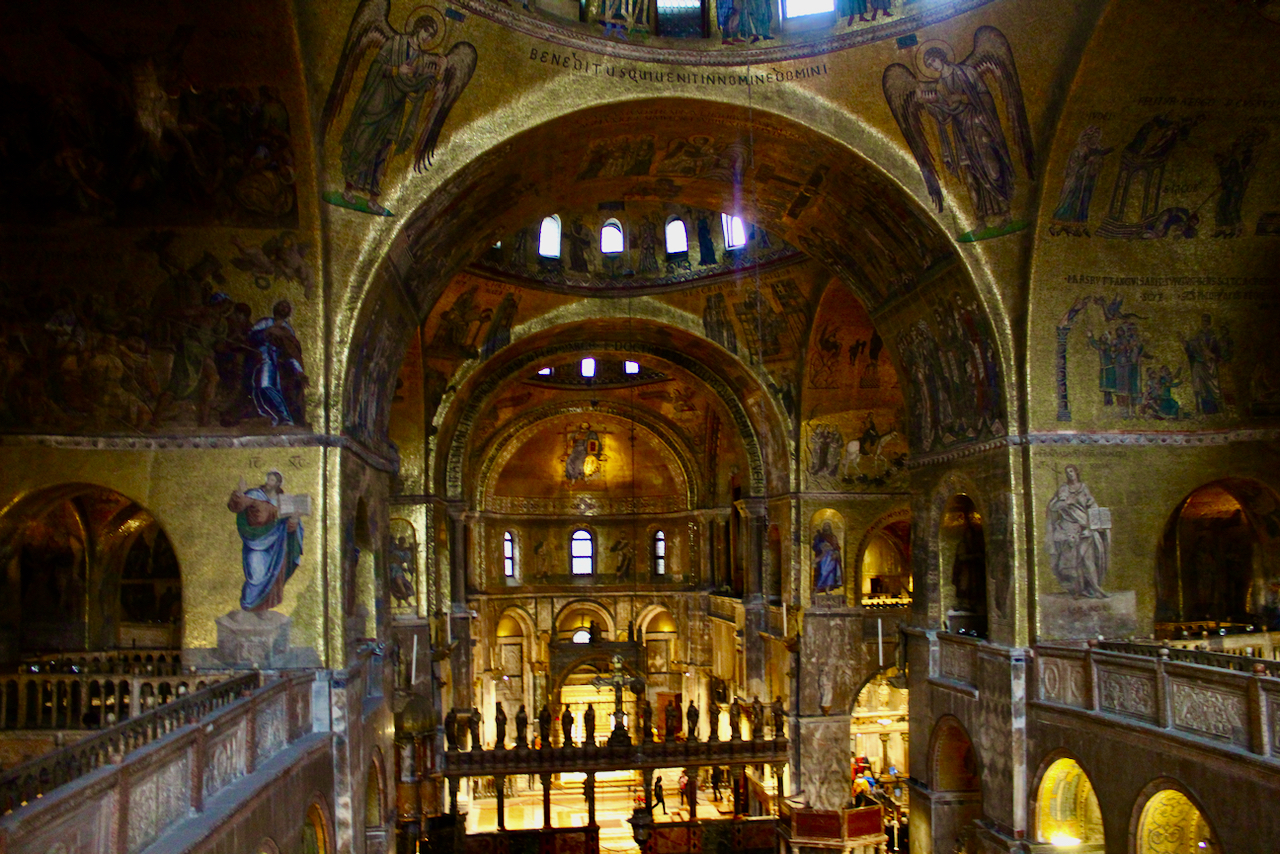
Photograph © Jennifer Winder-Baggot, www.irishhistorichouses.com
Open House 2013, Innovation Centre in Trinity College Dublin. Photograph © Jennifer Winder-Baggot, www.irishhistorichouses.com
Photograph © Jennifer Winder-Baggot, www.irishhistorichouses.com
[Former] Innovation Centre of Trinity, Foster Place, in 2022, unused and becoming dilapidated. Photograph © Jennifer Winder-Baggot, www.irishhistorichouses.com

[1] https://www.archiseek.com/2010/1730-no-10-henrietta-street-dublin/

[2] https://theirishaesthete.com/2017/03/20/shedding-light-on-a-subject/ 

[3] https://www.archiseek.com/2010/1715-mansion-house-dawson-street-dublin/

[4] https://www.buildingsofireland.ie/building-of-the-month/the-mansion-house-dawson-street-dublin-2/ 

[5] National Library and Archives digital repository.

[6] https://www.archiseek.com/2010/st-marys-abbey-chapter-house-marys-abbey-dublin/

[7] https://theirishaesthete.com/2024/07/12/b-of-i/

Martello Tower, Portrane, Co. Dublin – section 482

Open dates in 2025: March 1- Sept 21, Sat & Sun, National Heritage Week, Aug 16-24, 9am-1pm

Fee: adult €6, student/OAP €2, child free

donation

Help me to pay the entrance fee to one of the houses on this website. This site is created purely out of love for the subject and I receive no payment so any donation is appreciated!

€15.00

Martello Tower, Portrane, April 2022. Photograph © Jennifer Winder-Baggot, www.irishhistorichouses.com

Terry was very welcoming to her home, North Tower Number 7 of Dublin bay’s Martello towers. She showed us around inside and her friend, gardener and Martello tower expert Bryan gave us a tour outside. You may recognise the tower from RTE television show “Home of the Year.”

First, Terry told us a bit about the history of the Martello towers of Dublin. The Martello towers were built to protect Ireland from French invasion from Napoleon’s army. Twenty four towers were built around the bay of Dublin, and twenty-one are still standing. There are also some in Limerick and Cork. No two towers are exactly alike. Some are larger, built for larger cannons. Some of the Martello towers have cellars and some do not.

This particular tower was built in 1805-6. In 1793, under the command of Vice Admiral John Jervis, a tower in Corsica, Cape Mortella was besieged, and he noted with great interest how well it withstood a battery of cannonballs. After three days the English landed ashore and took it by force. Jervis realised that the squat rounded shape of the tower and the thickness of its walls allowed it to withstand the attack. The British copied the design for their own defensive towers, but changed the name and called them “Martello” towers. The  walls facing the sea are nine feet thick and on the land side eight feet thick. The Martellos around Dublin bay are built in the line of sight of each other, with the objective of ensuring the arc of canon fire from one would meet or overlap that from its neighbours.

Martello Tower, Portrane, April 2022. Photograph © Jennifer Winder-Baggot, www.irishhistorichouses.com
The view from the front of the tower. Photograph © Jennifer Winder-Baggot, www.irishhistorichouses.com

Napoleon never came to Ireland, however, so the towers were never used to defend the coast. Terry told us that the British admiralty took the land to build the towers as they didn’t have time to locate the owners of the land. The towers were each built of local stone.

The marker beside the boundary wall is a marker declaring the land in the name of the Crown. It must have been installed when the land was taken in order to build the tower. Photograph © Jennifer Winder-Baggot, www.irishhistorichouses.com

This tower came into private ownership in the 1920s. It has been altered to create a family home. Before Terry and her husband purchased the tower, it was owned by bookseller Derek Hughes of Hughes & Hughes bookstores. Earlier owners named Ian Coulhane, Walter Douglas and Fred Thorpe broke out walls on four sides of the tower and installed extensions at each.

The cannon would have been placed on the roof of the tower. Martello towers were built of a height suitable for the cannon range, and can be up to forty feet high. The cannons were able to rotate around a track to fire 360 degrees around the tower, and it took twelve soldiers to operate the cannon. It was planned that the soldiers would maintain a 24 hour lookout, taking it in two shifts, with approximately 24 men working and living in the tower. That never happened, although some invalided soldiers did work in Tom and Terry’s tower.

The top of the tower. Photograph © Jennifer Winder-Baggot, www.irishhistorichouses.com
These iron rings around the inner walls of the tower at the top were the rings used to secure the cannon into place. Photograph © Jennifer Winder-Baggot, www.irishhistorichouses.com
The tower also has a machicolation, another defensive structure through which things could be dropped. This one still has fine corbels supporting it. Photograph © Jennifer Winder-Baggot, www.irishhistorichouses.com
The view from the top of the tower. Photograph © Jennifer Winder-Baggot, www.irishhistorichouses.com
The view from the top of the tower: Lambay Island, which is also another Section 482 property which I look forward to visiting. Photograph © Jennifer Winder-Baggot, www.irishhistorichouses.com

We entered the house through a door into the kitchen. The kitchen had previously been a two-car garage.

Terry in her kitchen with her cats, with Bryan and Stephen. Photograph © Jennifer Winder-Baggot, www.irishhistorichouses.com

Terry showed us around her tower, pointing out where she and her husband made changes and renovations, where previous owners made changes, and where one can see original features of the tower. Her son Anton Savage, a radio and tv presenter, read up all about Martello towers and made lots of discoveries in his own home.

The kitchen leads into the tower itself. On our right was a spiral staircase, which is built inside the walls of the tower. The spiral staircase takes its shape from ancient tower houses which used spiral stairs for defence, narrow and built in a way so right-handed swordsmen on the second-floor would have the advantage over invaders coming up the stairs, who would be forced to fight using their left hands.

The spiral stairs are inside the walls of the tower. Photograph © Jennifer Winder-Baggot, www.irishhistorichouses.com
Martello Tower, Portrane, April 2022. Photograph © Jennifer Winder-Baggot, www.irishhistorichouses.com
In this picture you can see the width of the tower walls. Photograph © Jennifer Winder-Baggot, www.irishhistorichouses.com
Looking up along the wall to the ceiling, one can see the “intramural tunnels” through which cannonballs were winched up. Photograph © Jennifer Winder-Baggot, www.irishhistorichouses.com

The inside of the round tower has two storeys, but the floor in the centre has been removed to create a beautiful double-height gallery of two floors of mahogany bookcases.

The beams between the ground and first floor are original. Photograph © Jennifer Winder-Baggot, www.irishhistorichouses.com
Martello Tower, Portrane, April 2022. Photograph © Jennifer Winder-Baggot, www.irishhistorichouses.com
Looking back from the round tower toward the kitchen. Photograph © Jennifer Winder-Baggot, www.irishhistorichouses.com

When Terry and her husband Tom removed the layer that had been applied inside the stone walls to expose the original stone, they discovered a fireplace. They installed a stove.

Martello Tower, Portrane, April 2022. Photograph © Jennifer Winder-Baggot, www.irishhistorichouses.com

When renovating the ground flooring, they discovered a hole in the floor, revealing what must have been a cistern with enough space to store water for twenty five men for twenty five days. Terry and Tom had the space glassed over to create a feature in the floor, rather like the floor in our local Lidl, which has a similar feature in the floor revealing the remains of an 11th century house and another revealing an 18th century ‘pit trap’ associated with the stage workings of the former Aungier Street Theatre, where an actor could disappear beneath the stage or reappear like magic.

The glassed over floor revealing the stone cistern. Photograph © Jennifer Winder-Baggot, www.irishhistorichouses.com

Instead of doors, Terry’s rooms are divided off by heavy red curtains.

Martello Tower, Portrane, April 2022. Photograph © Jennifer Winder-Baggot, www.irishhistorichouses.com

On the ground floor an extension built on to one side contains the dining room/sitting room.

You can just about see how thick the tower walls are, seeing the hall which breaks through into the dining/sitting room. Photograph © Jennifer Winder-Baggot, www.irishhistorichouses.com
Martello Tower, Portrane, April 2022. Photograph © Jennifer Winder-Baggot, www.irishhistorichouses.com
The sitting room, from the outside, behind Stephen and Bryan. Photograph © Jennifer Winder-Baggot, www.irishhistorichouses.com

Also off the ground floor is the bathroom with a magnificent view from a bath, which has steps leading up to it.

Martello Tower, Portrane, April 2022. Photograph © Jennifer Winder-Baggot, www.irishhistorichouses.com
The magnificent view from the bath. The curve of the bath matching the curve of the wall must be a beautiful coincidence! Photograph © Jennifer Winder-Baggot, www.irishhistorichouses.com
Terry leads us from the bathroom, and you can see right from the bathroom through the tower to the kitchen. Photograph © Jennifer Winder-Baggot, www.irishhistorichouses.com
Martello Tower, Portrane, April 2022. Photograph © Jennifer Winder-Baggot, www.irishhistorichouses.com

The bedroom is above the bathroom, and has another gorgeous picture window.

Martello Tower, Portrane, April 2022. Photograph © Jennifer Winder-Baggot, www.irishhistorichouses.com

A previous owner, Walter Douglas, had the garden terraced.

Martello Tower, Portrane, April 2022. Photograph © Jennifer Winder-Baggot, www.irishhistorichouses.com
The boat house, which was installed for the Preventative Water Guard to catch smugglers. Photograph © Jennifer Winder-Baggot, www.irishhistorichouses.com
The Rocket House on the property is where Terry and her husband lived for a year while the tower was being renovated. Rocket houses were where rockets were stored that were used to carry ropes to ships in distress. Photograph © Jennifer Winder-Baggot, www.irishhistorichouses.com
I love the fish pond. Photograph © Jennifer Winder-Baggot, www.irishhistorichouses.com
Martello Tower, Portrane, April 2022. Photograph © Jennifer Winder-Baggot, www.irishhistorichouses.com

Text © Jennifer Winder-Baggot, www.irishhistorichouses.com

2022 Section 482 and Other Places to visit and stay: summary list

I am compiling a list of Historic Houses open for visits.

I am working on fuller descriptions with photographs of places that may not be Section 482 but may be open to the public on specific dates, and will be publishing these soon, probably by Province, as I did for the Office of Public Works properties.

Some big houses are now hotels or b&bs, and may be possible to visit, so I am including them on this list [in red]. This list is neither exhaustive nor necessarily accurate – check listing in advance to see if they are still open to the public.

Here is the Summary List – I hope it will be useful for you for trips around the country, including Northern Ireland which is a treasure trove! Let me know if you have any other recommendations!

I am listing the Section 482 properties in purple to distinguish them from other places to visit. On the map, what I call “whole house accommodation,” by which I mean for 10 or more guests, such as wedding venues, are marked in orange.

For places to stay, I have made a rough estimate of prices at time of publication: 

€ = up to approximately €150 per night for two people sharing; 

€€ – up to approx €250 per night for two; 

€€€ – over €250 per night for two.

Antrim:

1. Antrim Castle and Clotworthy House, County Antrim – estate and gardens open to the public, the Castle was destroyed by fire. The stable block, built in the 1840s and now known as Clotworthy House, is used as an arts centre.

https://discovernorthernireland.com/things-to-do/antrim-castle-gardens-and-clotworthy-house-p704051

2. Belfast Castle estate , County Antrim

https://discovernorthernireland.com/things-to-do/belfast-castle-estate-p676051

3. Carrickfergus Castle, County Antrim

https://discovernorthernireland.com/things-to-do/carrickfergus-castle-p674971

4. Dunluce Castle (ruin), County Antrim

https://discovernorthernireland.com/things-to-do/dunluce-castle-medieval-irish-castle-on-the-antrim-coast-p675011

5. Galgorm Castle, County Antrim – now part of a golf club.

https://www.galgormcastle.com/galgorm-estate.html

6. Glenarm Castle, County Antrim – private, can book a tour

https://glenarmcastle.com

Glenarm Castle & Garden, photo by Donal Maloney 2021 for Tourism Ireland [1]

Dates are limited and booking in advance is required.  

7. Lissanoure Castle, County Antrim – private, wedding venue

https://lissanourecastle.com

George MacCartney, 1st and last Earl Macartney, lived at Lissanoure Castle, is an ancestor of my husband, Stephen! His mother was a Winder.

8. Malone House, Belfast, County Antrim – wedding and conference venue

https://discovernorthernireland.com/things-to-do/malone-house-p674831

9. Wilmont House (park only), Sir Thomas and Lady Dixon Rose Gardens.

https://discovernorthernireland.com/things-to-do/sir-thomas-and-lady-dixon-park-p674891

Places to stay. Count Antrim: 

1. Ballyealy Cottage, Castle Shane Estate, County Antrim €€ for two, € for 3-5

https://www.irishlandmark.com/propertytag/cottages-and-houses/?gclid=Cj0KCQiApL2QBhC8ARIsAGMm-KFInICcRSxwLSiDxfFNk5WFytNcVrLvOQYhzJbIBes4V-M65iXz0gYaAln_EALw_wcB

2. Ballygally Castle, Larne, County Antrim 

https://www.hastingshotels.com/ballygally-castle/?gclid=CjwKCAjwybyJBhBwEiwAvz4G7w8_p7MWKXCL6Vrjer6k5D4AaaJg8CVSfc31wnqzX2CTqPmXQcBoLBoCez8QAvD_BwE

3. Ballylough House, County Antrim 

https://ballyloughbnb.co.uk

4. Drum Gate Lodge, Ballylough House, Bushmills, County Antrim €€

https://www.irishlandmark.com/propertytag/cottages-and-houses/?gclid=Cj0KCQiApL2QBhC8ARIsAGMm-KFInICcRSxwLSiDxfFNk5WFytNcVrLvOQYhzJbIBes4V-M65iXz0gYaAln_EALw_wcB

5. Blackhead Cutter Lighthouse keeper’s house, Whitehead, County Antrim €€ for two, € for 4/5 https://www.irishlandmark.com/property/blackhead-cutter/

3 houses: https://www.irishlandmark.com/properties/

6. Culloden Estate and Spa, Bangor Road, Holywood, Belfast, BT18 0EX €€€ https://www.cullodenestateandspa.com

The website tells us Colloden was originally built as an official palace for the Bishops of Down. The Culloden Estate and Spa stands in twelve acres of secluded gardens and woodland.

5. Dunadry Hotel, County Antrim €€

https://www.originalirishhotels.com

8. Barbican, Glenarm Castle, County Antrim €€

https://www.irishlandmark.com/property/the-barbican/

9. Kilmore House, County Antrim

https://kilmorecountryhouse.com

10. Kiln Wing, Old Corn Mill, Bushmills, County Antrim €€

https://www.irishlandmark.com/property/kiln-wing-old-corn-mill/

11. Larchfield Estate, Lisburn, Co Antrim, BT27 6XJ, Northern Irelandhttps://www.larchfieldestate.co.uk/staying-over

12. Lissanoure Estate cottages: all currently let

https://lissanourecastle.com/the-estate/

13. Magherintemple Gate Lodge, Ballycastle, County Antrim €€ for 2; € for 3/4

https://www.irishlandmark.com/propertytag/cottages-and-houses/?gclid=Cj0KCQiApL2QBhC8ARIsAGMm-KFInICcRSxwLSiDxfFNk5WFytNcVrLvOQYhzJbIBes4V-M65iXz0gYaAln_EALw_wcB

14. Merchant Hotel, Belfast €€€

https://www.themerchanthotel.com/our-history

The Merchant Hotel – Front Entrance, Courtesy of Merchant Hotel, Belfast 2017, Ireland’s Content Pool (see [1]).

15. Old Bushmills Barn, 15 Priestlands Road, Antrim €€€ for two; € for four

https://www.theoldbushmillsbarn.com

16. Portbradden Cottage, Bushmills, County Antrim

17. Strand House, Ballymena, County Antrim 

18. Tullymurry House, Banbridge, County Antrim, whole house rental: €€€ for two; € for 3-8

https://www.irishlandmark.com/propertytag/cottages-and-houses/?gclid=Cj0KCQiApL2QBhC8ARIsAGMm-KFInICcRSxwLSiDxfFNk5WFytNcVrLvOQYhzJbIBes4V-M65iXz0gYaAln_EALw_wcB

19. Whitepark House, 150 Whitepark Road, Ballintoy, County Antrim, BT54 6NH €€

http://www.whiteparkhouse.com/about.html

Armagh:

1. Ardress House, County Armagh

https://www.nationaltrust.org.uk/ardress-house

2. The Argory, County Armagh

https://discovernorthernireland.com/things-to-do/the-argory-p675201

3. Brownlow House, County Armagh

http://www.brownlowhouse.com

4. Derrymore House, Bessbrook, County Armagh – National Trust, open to public. 

5. Milford House, Armagh

https://discovernorthernireland.com/things-to-do/milford-house-p700871 http://www.milfordhouse.org.uk

Places to Stay, County Armagh

1. Crannagael House, 43 Ardress Road, Portadown Craigavon Armagh BT62 1SE €€

Mob: +44 (0) 75 9004 7717
Mob: +44 (0) 78 3153 0155
Email: crannagaelhouse@gmail.com

https://www.crannagaelhouse.com

2. Newforge House, Magheralin, Craigavon, Co. Armagh, BT67 0QL €€

https://www.newforgehouse.com

Carlow:

1. Altamont, Kilbride, Co Carlow – gardens open to public, see OPW entry [19]

https://irishhistorichouses.com/2022/02/21/office-of-public-works-properties-leinster-carlow-kildare-kilkenny/

2. Borris House, Borris, County Carlow – section 482

See my write-up:

https://irishhistorichouses.com/2020/10/04/borris-house-county-carlow/
contact: Morgan Kavanagh
Tel: 087-2454791
www.borrishouse.com
Open: Apr 5-7, 12-14, 19-21, 26-28, May 1, 3-5, 8, 10-12, 15, 17-19, 22, 24-26, 31, July 10, 12-14, 17, 19-21, 24, 26-28, Aug 2-4, 14-25, 30-31, Sept 1, 6-8, 13-15, 20- 22, 27-29, 12 noon-4pm

Fee: adult €10, child €6, OAP/student €8

3. Carlow Castle, Carlow, Co Carlow – a ruin  

4. Duckett’s Grove, Carlow – a ruin 

maintained by Carlow County Council.

6. Hardymount House, Castlemore, Co Carlow – can visit gardens

https://www.discoverireland.ie/Arts-Culture-Heritage/the-garden-hardymount-house/70913

7. Huntington Castle, Clonegal, Co Carlow – on section 482 

See my write-up:

https://irishhistorichouses.com/2019/06/28/huntington-castle-county-carlow/
Postal address: Huntington Castle, Enniscorthy, Co. Wexford
contact: Alexander Durdin Robertson
Tel: 086-0282266
www.huntingtoncastle.com
Open: Feb 5-6, 12-13, 19-20, 26-27, Mar 5-6, 12-13, 19-20, 26-27, Apr 2-3, 9-10,16- -18, 23-24, May 1-31, June 1-30, July 1-31, Aug 1-31, Sept 1-30, Oct 1-2, 8-9, 15-16, 22-31, Nov 5-6, 12-13, 19-20, 26-27, Dec 3-4, 10-11, 17-18, 11am-5pm
Fee: house/garden, adult €12, garden €6, OAP/student, house/garden €10, garden €5, child house/garden €6, garden €3, group and family discounts available

8. The Old Rectory, Killedmond, Borris, Co Carlow – section 482 

See my write-up:

https://irishhistorichouses.com/2020/07/16/the-old-rectory-killedmond-borris-co-carlow/
contact: Mary White
Tel: 087-2707189
https://www.blackstairsecotrails.ie/
Open: July 1-31, Aug 1-31, 9am-1pm
Fee: adult €10, OAP/student €6, child free.

9. Lorum Old Rectory, Kilgreaney, Bagenalstown, Co. Carlow – section 482 

contact: Bobbie Smith
Tel: 059-9775282, 087-2735237
www.lorum.com
(Tourist Accommodation Facility)

Open: April-Sept

Places to stay, County Carlow

1. Ballykealey, Tullow, Co Carlow  – whole house rental and self-catering accommodation €€€

and lodges: https://ballykealeyhouse.com

2. Coolanowle House, Coolanowle, Ballickmoyler, County Carlow

http://www.coolanowle.com

3. Huntington Castle, County Carlow – see above €

4. Killedmond Rectory, County Carlow – shepherd’s huts €

https://www.blackstairsecotrails.ie/

Shepherd’s Hut, Old Rectory Killedmond, County Carlow, October 2021. Photograph © Jennifer Winder-Baggot, www.irishhistorichouses.com

5. Lisnavagh, County Carlow, holiday cottages

www.lisnavagh.com

6. Lorum Rectory, County Carlow – €€

www.lorum.com

7. Mount Wolseley, Tullow, Co Carlow – hotel € 

8. Sandbrook, Tullow, Co Carlow  – whole house rental and an apartment in house

https://sandbrook.ie

County Cavan

1. Cabra Castle, Kingscourt, Co. Cavan (Hotel) – section 482

see my write-up:

https://irishhistorichouses.com/2021/03/28/cabra-castle-kingscourt-county-cavan/
contact: Howard Corscadden.
Tel: 042-9667030
www.cabracastle.com
Open: all year, except Dec 24, 25, 26, 11am-4pm
Fee: Free

2. Castle Saunderson, Co. Cavan – a ruin 

https://www.thisiscavan.ie/fun/article/luanch-of-new-heritage-trail-at-castle-saunderson

3. Clough Oughter, County Cavan

https://www.discoverireland.ie/Activities-Adventure/clough-oughter-castle/48729

4. Corravahan House & Gardens, Drung, Ballyhaise, Co. Cavan – section 482

see my write-up:

https://irishhistorichouses.com/2020/08/28/corravahan-house-and-gardens-drung-county-cavan/
contact: Ian Elliott
Tel: 087-9772224
www.corravahan.com
Open: Jan 3-4, 10-11, 17-18, 24-25, 31, Feb 1, 7-8, 14-15, 21-22, 28, Mar 1, 7-8, May 1-4, 8-11, 15-18, 22-25, 29-31, Aug 13-27, 29-30, Sept 5-6, 12-13, 9am-1pm, Sundays 2pm-6pm
Fee: adult €10, OAP/student/child €5

Places to stay, County Cavan

1. Cabra Castle, on section 482 – hotel – €€

www.cabracastle.com

and lodges

2. Clover Hill Gate Lodge, Cloverhill, Belturbet, Cavan

https://www.airbnb.ie/rooms/4962376?source_impression_id=p3_1646316400_8H59V8wuqVzXlMog

3. Farnham House, Farnham Estate, Cavan – hotel €€

https://www.farnhamestate.ie

4. Killinagh House, McNean Court, Blacklion, County Cavan – whole house rental €

https://www.discoverireland.ie/accommodation/killinagh-house

and Killinagh Lodge, https://killinaghlodge.com/facilities.html

5. Lismore House, Co Cavan – was a ruin. Place to stay: Peacock House on the demesne: € https://www.airbnb.ie/rooms/27674042?source_impression_id=p3_1646316758_vwGIKKMTwiWKK%2FB7

6. Olde Post Inn, Cloverhill, County Cavan €€

https://www.theoldepostinn.com

7. Ross Castle, Co Cavan (address is in Mountnugent, County Meath) – whole castle, plus self-catering accommodation €€€ for 2, € for 10 or more

https://www.ross-castle.com

8. Slieve Russel Hotel, Cavan € 

https://www.originalirishhotels.com/destinations/irelands-ancient-east

Stands on the site of what was once Cranaghan House.

Whole House Rental, County Cavan:

1. Killinagh House, McNean Court, Blacklion, County Cavan – whole house rental

https://www.discoverireland.ie/accommodation/killinagh-house

2. Ross Castle, Co Cavan (address is in Mountnugent, County Meath) €€€ for 2, € for 10 or more

https://www.ross-castle.com

3. Virginia Park, Co Cavan – weddings only

https://www.irelands-blue-book.ie/houses.html?country=Cavan

Clare:

1. Barntick House, Clarecastle Co. Clare – section 482

contact: Ciaran Murphy
Tel: 086-1701060
Open: May 1-31, Aug 1-31, 5pm-9pm
Fee: adult/student €5, child/OAP free, group discount available.

2. Bunratty Castle, County Clare

maintained by Shannon Heritage

3. Craggaunowen Castle, Kilmurray, Sixmilebridge, Clare

– history park, maintained by Shannon Heritage, www.craggaunowen.ie

4. Dunguaire Castle, Kinvara, County Clare

Maintained by Shannon Heritage.

5. Kilrush House, Co Clare

– ‘lost’, Vandeleur Gardens open 

www.vandeleurwalledgarden.ie 

6. Knappogue Castle, County Clare

which is maintained by Shannon Heritage.

7. Loughnane’s, Main Street, Feakle, Co. Clare – section 482

contact: Billy Loughnane
Tel: 086-2565012
www.clareecolodge.ie
Open: June 1-August 31, Wed-Sun, Aug 13-21, 2pm-6pm Fee: Free

8. Mount Ievers Court, Sixmilebridge, Clare  

mountieverscourt.ie

9. Newtown Castle, Newtown, Ballyvaughan, Co. Clare – section 482

contact: Mary Hawkes- Greene
Tel: 065-7077200
www.newtowncastle.com , 
Open: Jan 10-May 31, Mon-Fri, June 1-30 Mon-Sat, July 1-Aug 31 daily, Sept 1-Dec 16 Mon-Fri, 10am-5pm
Fee: Free

10. O’Dea’s, or Dysert Castle, Co Clare

– can visit http://www.dysertcastle.com/castle.htm

Places to Stay, County Clare 

1. Ballynalacken Castle, Lisdoonvarna, Co Clare – hotel €€

https://www.ballinalackencastle.com/ 

2. Ballyhannon, County Clare – coach house accommodation €€€ or € for 15 or castle €€ for 10

www.ballyhannon-castle.com

There is a private house, a tower house castle and coach house.

The Lodge: https://www.castleferguslodge.com/

“A 19th century coach house adjacent to Ballyhannon Fortress Castle. Take a step back in time, and enjoy the unique experience of this historic landmark, at our bed and breakfast. We are at the end of a private drive, so no one will be “passing by” to interfere with your peace and tranquility.” 

The Tower House: http://rentacastleinireland.com/history.html

3. Ballyportry Castle, Corofin, County Clare € for 4-8 for one week

http://www.ballyportry.ie

Rising bluntly out of the craggy landscape, Ballyportry is the finest example in Ireland of a complete medieval Gaelic Tower House. Built in the 15th century it has been beautifully restored with careful attention being paid to retaining all its original features and style, yet with the comforts of the 21st century.”

4.  Dromoland Castle, Newmarket-on-Fergus, Co. Clare – hotel €€€

www.dromoland.ie 

5. Ennistymon House, Ennistymon, Co. Clare, now Falls Hotel €€

www.fallshotel.ie 

6. Gregan’s Castle Hotel, County Clare €€€

https://www.irelands-blue-book.ie/houses.html?country=Clare

7. Loop Head Lightkeeper’s Cottage, County Clare €€ for 2; € for 4-6

https://www.irishlandmark.com/properties/

8. Loughnane’s, Main Street, Feakle, Co Clare

contact: Billy Loughnane
Tel: 086-2565012
www.eastclarehostels.com 

9. Mount Callan House and Restaurant, Inagh, Co Clare – B&B 

https://www.mountcallanhouse.ie

10. Mount Cashel Lodge, Kilmurry, Sixmilebridge, Co Clare 

https://www.mtcashel.com

and Stables https://hiddenireland.com/stay/self-catering-holiday-rentals/

11. Newpark House, Ennis, County Clare

https://www.newparkhouse.com/rates/

12. Sheedy’s Hotel and Restaurant, County Clare €€ 

https://www.originalirishhotels.com/hotels/sheedys-country-house-hotel

13. Smithstown Castle (or Ballynagowan), Co Clare € for 4-8 for one week

http://smithstowncastle.com 

14. Spanish Point House, Spanish Point, County Clare 

https://spanishpointhouse.ie

15. Strasburgh Manor coach houses, Inch, Ennis, County Clare

https://www.strasburghmanor.com/about-strasburgh-manor/

Whole House Rental, County Clare

1. Inchiquin House, Corofin, County Clare – whole house rental €€€ for 2, € for 6-10

https://www.irishlandmark.com/propertytag/cottages-and-houses/?gclid=Cj0KCQiApL2QBhC8ARIsAGMm-KFInICcRSxwLSiDxfFNk5WFytNcVrLvOQYhzJbIBes4V-M65iXz0gYaAln_EALw_wcB

2. Mount Vernon lodge, Co Clare – whole house accommodation € for 7-11 people 

https://www.mountvernon.ie

Cork:

1. Annegrove Gardens, County Cork – OPW

See my OPW write-up. https://irishhistorichouses.com/2022/01/19/office-of-public-works-properties-munster/

2. Ashton Grove, Ballingohig, Knockraha, Co. Cork – section 482

contact: Gerald McGreal
Tel: 087-2400831
Open: Feb 10-13, 19-27, Mar 10- 13, May 5-8, 19-22, 26-29, June 9-12, 23-26, July 21-24, Aug 13-21, 25-28, Sept 1-4, 22-25, 8am-12 noon

Fee: adult €6, OAP/student/child €3

3. Ballymaloe House, Cloyne, County Cork

4. Ballynatray, Youghal, County Cork (also Waterford) – section 482

5. Ballyvolane House, Castlelyons, Co. Cork – section 482

contact: Justin Green
Tel: 025-36349
(Tourist Accommodation Facility) 

www.ballyvolanehouse.ie

Open: all year except Jan 1, Dec 24-31

6. Bantry House & Garden, Bantry, Co. Cork – section 482

contact: Julie Shelswell-White
Tel: 027-50047
www.bantryhouse.com
Open: Apr 1-Oct 31, 10am-5pm
Fee: adult €14, OAP/student €11.50, child €5, groups over 8-20, €8 and groups of 21 or more €9

Bantry House, County Cork, photograph by George Karbus, 2016 for Tourism Ireland, Ireland’s Content Pool. (see [1])

7. Blackrock Castle Observatory, Cork

8. Blarney Castle & Rock Close, Blarney, Co. Cork – section 482

contact: Charles Colthurst
Tel: 021-4385252
www.blarneycastle.ie
Open: all year except Christmas Eve & Christmas Day, Jan-Feb, Nov-Dec, 9am-4pm, Mar-Oct, 9am-5pm

Fee: adult €18, OAP/student €15, child €10, family and season passes

9. Blarney House & Gardens, Blarney, Co. Cork – section 482

contact: Charles Colthurst
Tel 021-4385252
www.blarneycastle.ie
Open: June 1-Aug 31, Mon-Sat, National Heritage Week, Aug 13-21, 10am-2pm Fee: adult €10, OAP/student €7, concession joint with castle

10. Brideweir House, Conna, Co. Cork – section 482

contact: Ronan Fox
Tel: 025-36386
www.brideweir.ie
Open: Jan 1-Dec 24, 11am-4pm
Fee: adult €10, child/student €5, OAP free

11. Burton Park, Churchtown, Mallow, Co. Cork – section 482

contact: Jess Angland
Tel: 022-59955
www.slieile.ie 

Open: May 8-July 7, Mon-Sat, closed Bank Holidays, Aug 13-21, 11am-3pm Fee: adult/child/OAP/student €9

12. Creagh House, Main Street, Doneraile, Co. Cork – section 482

contact: Michael O’Sullivan
Tel: 022-24433
(Tourist Accommodation Facility)
Open: April-Sept
Public tours of house all year

13. Desmond Castle, Kinsale, County Cork – OPW

See my OPW write-up. https://irishhistorichouses.com/2022/01/19/office-of-public-works-properties-munster/

14. Doneraile Court, County Cork – OPW

See my OPW write-up. https://irishhistorichouses.com/2022/01/19/office-of-public-works-properties-munster/

15. Drishane Castle & Gardens, Drishanemore, Millstreet Town, Co. Cork – section 482

contact: Thomas Duggan
Tel: 087-2464878, 029-71008
www.millstreet.ie
Open: June 1-Sept 30, Mon-Sat, (Jan-May, Oct-Dec Mon-Fri, 9am-5pm by appointment only) National Heritage Week, Aug 13-21, 9am-5pm
Fee: adult €5, OAP/student free, child free when accompanied by adult

16. Drishane House, Castletownshend, Co. Cork – section 482

See my write-up:

https://irishhistorichouses.com/2021/03/07/drishane-house-castletownshend-co-cork/
Contact: Thomas Somerville
Tel: 028-36126, 083-574589
www.drishane.com
Open: May 1-31, Aug 13-21, Oct 2-21, 11am-3pm Fee: adult €10, OAP €8, student/child €6

17. Dunkathel House [or Dunkettle], Glanmire, Cork

– open to public May-Oct

18. Dún Na Séad Castle, Baltimore, Co. Cork – section 482

Donna O’Driscoll
Tel: 087-7374592
www.baltimorecastle.ie
Open: March 1-Oct 31, 11am -6pm
Fee: adult/OAP/student €5, children under 12 free

19. Fenns Quay, 4 & 5 Sheares Street, Cork – section 482

contact: Clare Supple
Tel: 089-4646208
www.encorestaging.org
Open: May 1-Nov 30, Sat-Sun, National Heritage Week Aug 13-21, 10am-2pm Fee: Adult €3, OAP €2, student €1

20. Fota House, Arboretum and Gardens

maintained by the Irish Heritage Trust, now OPW.

https://irishhistorichouses.com/2022/01/19/office-of-public-works-properties-munster/

21. Garrettstown House, Garrettstown, Kinsale, Co. Cork – section 482

contact: Denis Mawe
Tel: 021-4778156
www.garrettstownhouse.com
Open: May 15-Sept 5, 12 noon-5pm
Fee: adult €8, OAP/student/child €5, groups of 10+ adults €5 per person

22. Ilnacullin, Garanish Island, County Cork – OPW

See my OPW write-up. https://irishhistorichouses.com/2022/01/19/office-of-public-works-properties-munster/

23. Kilcascan Castle, Ballineen, Co. Cork – section 482

contact: Alison Bailey
Tel: 023- 8847200
Open: Aug 1-31, Sept 1-30, 9.30am-1.30pm
Fee: Free

24. Kilshannig House, Rathcormac, Co. Cork – section 482

https://irishhistorichouses.com/2020/12/10/kilshannig-house-rathcormac-county-cork/
contact: Hugo Merry
Tel: 025-36124
Open: May 1-31, June 1-30, July 1-31, National Heritage Week, Aug 13-21, 8.30am- 2.30pm 

Fee: adult €10, child/student €8.50, group discount by arrangements 

25. 4 Mulgrave Place, No 4, Mulgrave Road, Cork City – section 482 in 2021, not in 2022

contact: Trevor Leacy
Tel: 087-2808302
Open: May 1-Sept 30, closed Sundays except National Heritage Week August 14-22, weekdays 11am-4pm, Saturdays 11am-3pm
Fee: adult €4, OAP/student/child €2, family €7 (2+2)

26. Riverstown House, Riverstown, Glanmire, Co. Cork – section 482

contact: Denis/Rita Dooley
Tel: 021-4821205
Open: May 5-Sept 10, Thurs, Fri, Sat, National Heritage Week Aug 13-21, 2pm-6pm Fee: adult €10, OAP €7, student €5

27. Woodford Bourne Warehouse, Sheares Street, Cork – section 482

contact: Edward Nicholson
Tel: 021-4273000
www.woodfordbournewarehouse.com
Open: all year except Christmas Eve, Christmas Day, 1pm-11pm
Fee: Free

Places to stay, County Cork

1. Annes Grove (formerly Ballyhemock or Ballyhimmock), Castletownroche, Co Cork – gate lodge accommodation €€

https://www.irishlandmark.com/property/annes-grove-miniature-castle/

A miniature medieval castle, Annes Grove Gatelodge was designed in 1853 to impress visitors to the main house – Annesgrove House and Gardens.

2. Ballinacurra House, County Cork – coach house, estate cottages, and whole house rental

https://hiddenireland.com/house-pages/ballinacurrahouse/

and https://www.ballinacurra.com/the-coach-house/

  1. Estate Cottage 1 – The Coach House – up to 7 people – Self Catering – from €1,200 A 3 bedroom/4 bathroom separate 1,200 square foot home with a private outdoor dining terrace. This building has been renovated from the original coach house for the main manor house – and perfect for up to 7 people.
  2. Estate Cottage 2 – The Stone Cottage – up to 10 people – Self Catering – from €2,200 A stand-alone 1,800 square foot home with 4 bedrooms/4.5 bathrooms with its own private garden. This building was the original gardener’s cottage for the main manor house – now fully renovated that will sleep up to 10 people comfortably.
  3. Manor House (Partial) – up to 20 people – Self Catering – from €8,800 You will enjoy private use of Two Wings of the Manor House including 8 ensuite bedrooms and a range of living rooms, dining rooms, country style kitchen and outdoor dining options (can be catered or staffed by request).
  4. Manor House (Whole) – from 28 to 36 people – Full Catered & Staffed Only – on request There are 14 Bedrooms in the Manor House that can accommodate up to 36 adults + 3 children sharing and a whole range of living and entertainment spaces. Due to the numbers, this is only available on a fully catered and staffed basis.
  5. Whole Estate – from 44 to 54 people – Fully Catered & Staffed Only – on request The entire Estate consisting of the Manor House, Stone Cottage and Coach House for your private and exclusive use. A total of 22 ensuite bedrooms which is fully staffed and catered. This can cater for up to 54 adults + 4 children sharing.

3. Ballinterry House, Rathcormac, Co Cork – accommodation 

https://www.facebook.com/BallinterryH/

https://castlelyonsparish.com/who-i-am/accommodation/accommodation-2/

Ballinterry House Accommodation 
P: +353 (0)25 87835  or  +353 (0)87-6508555 
E: ballinterryhouse@yahoo.co.uk 

4. Ballylickey House, Bantry, Co Cork – now the Seaview House Hotel €€

https://www.seaviewhousehotel.com/

5. Ballymacmoy, Killavullen, Co Cork – coach house airbnb

https://www.airbnb.ie/rooms/6862913?source_impression_id=p3_1589550654_DKKIguPPQK2Nhhvp&guests=1&adults=1

https://thecoachhouseatballymacmoy.weebly.com/ballymacmoy-house.html

The website tells us: “Ballymacmoy is the estate of origin of the wild geese family, the Hennessy’s of Cognac and is still owned and inhabited by their descendants.  40 kilometres from Cork International Airport, Ballymacmoy is a 23 acre estate located at the edge of the little village of Killavullen (200 inhabitants).  It is made up of grasslands and wooded areas with 3.5 miles of exclusive fishing rights along the Blackwater river, it includes a 1 acre walled garden and a unique prehistoric private cave reserved for guests.” 

6. Ballymaloe, Cloyne, Co Cork – accommodation €€

https://www.ballymaloe.ie/

7. Ballynatray, Youghal, Co Cork, holiday cottages and whole house rental

https://hiddenireland.com/house-pages/ballynatray-coach-house-area/

a. the Coach House: The two storey Coach House takes centre stage in the stable yard and has been transformed into a beautiful, luxurious 4 bedroom self catering property. Downstairs there is a very relaxing style open plan kitchen & dining area with comfortable couches which allow for great conversations even while you prepare a bite of lunch or dinner.

b. the Garden Flat is located in the stable yard and is suitable for those looking for a self-catering holiday. There are two double bedrooms on the ground floor which would ideally suit two couples or if the need arises one of the bedrooms can be changed to be a twin room.

c. The Garden House is a quaint little cottage that sits at the bottom of the walled garden next to the beautiful Ballynatray House. Set across two floors the Garden House boasts a beautiful double room complete with comfortable armchairs either side of the open fire that fills the complete upstairs area. This is an ideal adult only location where romantic notions are never very far away.

d. Renovated & situated in the stable yard the Groom’s Flat is an ideal self catering option for two people.

8. Ballyvolane, Castlelyons, Co Cork – Hidden Ireland accommodation €€€

https://ballyvolanehouse.ie

9. Bantry House & Garden, Bantry, Co. Cork €€ 

10. Castle Martyr, Co Cork – hotel €€€

and Castle Martyr Lodges

https://www.castlemartyrresort.ie

11. Castle Townshend, Co Cork – accommodation, hotel €

http://castle-townshend.com/

12. Clifford House, Clifford, Co Cork – airbnb

https://www.airbnb.ie/rooms/23073945?source_impression_id=p3_1589821677_g%2Fl3KzQeCDhVcv1s&guests=1&adults=1

13. Creagh (former Glebe House), Skibbereen, Co Cork – B&B 

14. Creagh House, Main Street, Doneraile, Co. Cork – section 482

15. Drishane House whole house rental and holiday cottages – see above

16. Eccles Hotel, Glengarriff, Co Cork €€

Email: reservations@eccleshotel.com

Tel: +353 – 27 – 63003
www.eccleshotel.com

17. Elizabeth Fort Parade Houses, County Cork € for 3

https://www.irishlandmark.com/properties/

18. Galley Head Lighthouse Keepers House, County Cork € for 3-4

https://www.irishlandmark.com/properties/

19. Coach House Apartments, Glebe Country House, Ballinadee Bandon County Cork

https://glebecountryhouse.ie

20. Glenlohane cottage, Kanturk, Cork – accommodation €€ in house; Pink Cottage € for 3-5 for one week

www.glenlohane.ie

21. Glenville Park, Glenville, County Cork (previously known as The Manor and as Mount Pleasant) – accommodation €

http://www.glenvillepark.com 

22. Inis Beg estate, Baltimore, County Cork – €

https://www.inishbeg.com/homepage/

23. Killee Cottage, Mitchelstown, County Cork €€

https://www.irishlandmark.com/properties/

Once one of a number of bothies stretching along this quiet country lane, Killee Cottage and its neighbour are now the only two thatched cottages remaining.

24. Kilmahon House, County Cork €€ http://www.kilmahon.com/

25. Kilshannig, County Cork holiday accommodation – see above http://thecourtyardkilshannig.com/

26. Liss Ard Estate, County Cork

https://www.irelands-blue-book.ie/houses.html?country=Cork

27. Lota Lodge, Glanmire, Co Cork – now the Vienna Woods Hotel 

https://www.originalirishhotels.com/hotels/corks-vienna-woods-hotel

28. Lough Ine House and Lodge, Skibereen, County Cork – whole house or gate lodge

29. The Courtyard, Mallow

https://hiddenireland.com/house-pages/the-courtyard-mallow/

30.  Maryborough, Douglas, Co Cork – Maryborough Hotel €€

https://www.maryborough.com

31. Old Bank Townhouse, Kinsale, County Cork

https://www.oldbankhousekinsale.com

32. Perryville, Kinsale, Co Cork – hotel €€

https://www.perryvillehouse.com

[see 6]. Seaview House Hotel, Ballylicky, County Cork

33. Springfort Hall, Mallow, Co cork – hotel

Whole House Accommodation, County Cork

1. Aspen House, Dromgarriff Estate, Glengarriff, Cork, Ireland – whole house rental  

https://cashelfean.ie/aspen-house/  

2. Ballinacurra House, County Cork – coach house, estate cottages, and whole house rental

3. Ballynatray, Youghal, Co Cork, holiday cottages and whole house rental

4. Barnabrow, Cloyne, Co Cork – accommodation

https://www.barnabrowhouse.ie/

Cloyne, Midleton, East Cork, Ireland. 
info@barnabrowhouse.ie 
+353 21 4652534

5. Blackwater Castle (Castle Widenham, or Blackwater Valley Castle) Castletownroache, Co Cork www.blackwatercastle.com

6. Blairscove House, County Cork www.blairscove.ie

7. Careysville (Ballymacpatrick Castle), Clondulane, Fermoy, Co.Cork, Ireland P61 VF53 – accommodation

https://careysville.com 

Careysville House sits on an escarpment overlooking the fishery, with stunning views of the Blackwater valley. Guests can look out of their bedroom window and see one of the most stunning stretches of salmon fishing in Ireland, not to mention watch the salmon jumping in the pools below. It was built in 1812 in the Georgian style, on the site of the old ruined Ballymacpatrick Castle.

8. Drishane House whole house rental and holiday cottages – see above

www.drishane.com

9. Dunowen House, Co Cork – Blue Book Accommodation www.dunowenhouse.ie

10. Farran House, County Cork, whole house rental € for 5-8 for one week www.farranhouse.com

https://hiddenireland.com/house-pages/farran-house/

An elegant Italiante style Manor house in mature beech woodland and gardens close to Cork City (15km).

11. Longueville, Mallow, Co Cork – Blue Book accommodation €€€

https://www.longuevillehouse.ie/

12. Lough Ine House and Lodge, Skibberreen, County Cork – whole house €€€ for two, € for 5-8; or gate lodge €

http://www.loughinehouse.com

This beautiful holiday house and cottage are set on stunning Lough Ine sometimes spelt Lough Hyne – which is well known as one of the most romantic spots in West Cork.

14. Rincolisky Castle, Whitehall, co Cork – renovated, whole house. €€€ for 2, € for 5.

  https://www.airbnb.ie/rooms/20771431?source_impression_id=p3_1646737924_o%2BwxYCDhpDgJDHfX

15. Southernmost House, Cape Clear Island, County Cork

https://hiddenireland.com/stay/self-catering-holiday-rentals/

Derry:

1. Bellaghy Bawn, County Derry

https://discovernorthernireland.com/things-to-do/bellaghy-bawn-p675661

Built around 1619 by Sir Baptist Jones, Bellaghy Bawn is a fortified house and bawn (the defensive wall surrounding an Irish tower house). What exists today is a mix of various building styles from different periods with the main house lived in until 1987.

2. Hezlett House, 107 Sea Road, Castlerock, County Derry, BT51 4TW on Downhill Demesne. https://discovernorthernireland.com/things-to-do/hezlett-house-p687301

3. Mussenden Temple, Downhill Demesne

https://www.nationaltrust.org.uk/mussenden-temple-and-downhill-demesne

4. Springhill House, County Derry

https://discovernorthernireland.com/things-to-do/springhill-p675711

Springhill has a beguiling spirit that captures the heart of every visitor.  Described as ‘one of the prettiest houses in Ulster’, its welcoming charm reveals a family home with portraits, furniture and decorative arts that bring to life the many generations of Lenox-Conynghams who lived here from 1680. The old laundry houses one of Springhill’s most popular attractions, the Costume Collection with some exceptionally fine 18th to 20th century pieces.

See also https://www.nationaltrust.org.uk/springhill

Places to stay, County Derry

1. Ardtara Country House and restaurant, County Derry €€

 WWW.ARDTARA.COM

2. Brown Trout Inn, Aghadowey, Nr Coleraine Co. Derry, BT51 4AD

https://www.originalirishhotels.com/hotels/brown-trout-golf-country-inn

3. Roselick Lodge, County Derry – for 8 people

https://www.roselicklodge.co.uk

Dating back to 1830, this sympathetically restored Georgian property offers a tranquil rural setting midway between Portstewart and Portrush. Whilst retaining many of the original features and charm, the open plan extension has been adapted to suit modern living. The accommodation comprises three main reception areas, a Magnificent Family Kitchen /Living and Dining area, a cosy and tastefully decorated Snug with open fire, access to south facing Orangery and large secluded cottage gardens. Upstairs are four well proportioned bedrooms sleeping up to eight guests and a spacious first floor balcony with sea views. Minimum 3 night stay.

Whole House Rental, County Derry

1. Beechill House, 32 Ardmore Road, Derry-Londonderry, Northern Ireland BT47 3QP – weddings

https://www.beech-hill.com/

Beechill Country House Hotel, Courtesy of Tyrone and Sperrins destination, for Tourism Ireland.

2. Drenagh House, County Derry – whole house rental, 22 people

https://www.drenagh.com

Donegal:

1. Cavanacor House, Ballindrait, Lifford, Co. Donegal – section 482

contact: Joanna O’Kane
Tel: 074-9141143, 085-8165428
www.cavanacorgallery.ie
Open: Feb 1-20, May 1-31, Aug 14-22, 1pm-5pm 

Fee: adult €8, OAP/student/child €6 

2. Doe Castle, County Donegal – OPW

see OPW entry https://irishhistorichouses.com/2022/01/18/office-of-public-works-properties-ulster/

3. Donegal Castle, County Donegal – OPW

see OPW entry https://irishhistorichouses.com/2022/01/18/office-of-public-works-properties-ulster/

4. Glebe Art Museum, County Donegal – OPW

see OPW entry https://irishhistorichouses.com/2022/01/18/office-of-public-works-properties-ulster/

5. Glenveagh Castle, County Donegal

Glenveagh, photograph by Gareth Wray, 2020 for Tourism Ireland (see [1])

6. Oakfield Park Garden, Oakfield Demesne, Raphoe, Co. Donegal – section 482, garden only

contact: Louise Devenney
Tel: 074-9173922
www.oakfieldpark.com
Open: Mar 30-31, Apr 1-3, 6-10, 13-18, 20-24, 27-30, May 1-2, 4-8, 11-15, 18-22, 25-29, June 1-30, July 1-31, Aug 1-31, Sept 1-4, 7-11, 14-18, 21-25, Oct 1-2, 8-9, Nov 30, Dec 1-4, 7-11, 14-23, Mar, Apr, May, Sept, Oct, 12 noon-6pm, June, July, Aug, 11am-6pm, Nov, 4pm-10pm, Dec 1-18, weekdays, 4pm-10pm, weekends, 12 noon-10pm, 19-20, 4pm-10pm, 21-23, 12 noon-10pm

Fee: adult €9, child €6, family and season passes

7. Salthill Garden, Salthill House, Mountcharles, Co. Donegal – section 482, garden only

See my write-up:

https://irishhistorichouses.com/2021/10/06/salthill-garden-salthill-house-mountcharles-county-donegal/
contact: Elizabeth Temple
Tel:  087-7988078, 074-9735014
www.donegalgardens.com
Open: May 5-7, 12-14, 19-21, 26-28, June 2-4, 9-11, 16-18, 23-25, July 1-2, 4-9, 11- 16, 18-23, 25-30, Aug 1-6, 8-27, 29-31, Sept 1-2, 5-9, 12-16, 19-23, 26-30, 2pm-6pm Fee: adult/OAP €6, student €5, child €3

Places to Stay, County Donegal

1. Bruckless House Gate Lodge, Bruckless, County Donegal

https://hiddenireland.com/stay/self-catering-holiday-rentals/

2. Castle Grove, County Donegal – hotel €€

https://www.irelands-blue-book.ie/houses.html?country=Donegal 

3. Cavangarden, Ballyshannon, Co Donegal – B&B http://www.cavangardenhouse.com

4. Dunmore, Carrigans, Co Donegal – accommodation for weddings, conferences 

https://www.dunmoregardens.ie/our-history/

5. Frewin, Ramelton, Co Donegal – accommodation

https://hiddenireland.com/house-pages/frewin/ 

6. Lough Eske Castle, near Donegal, Co Donegal – hotel  €€€

www.lougheskecastlehotel.com

7. Rathmullan House, Co Donegal – hotel €€

https://www.irelands-blue-book.ie/houses.html?country=Donegal

8. Railway Crossing Cottage near Donegal town €€

https://www.irishlandmark.com/properties/

9. Rock Hill, Letterkenny, Co Donegal – hotel 

https://www.rockhillhouse.ie

10. Sandhouse Hotel, Rossknowlagh, Co Donegal €€

https://www.originalirishhotels.com/hotels/sandhouse-hotel

11. St. Columb’s, St Mary’s Road, Buncrana, Co Donegal, Ireland ~ Tel: 087 4526696 ~ Email: info@stcolumbshouse.com https://stcolumbshouse.com

12. St John’s Point Lighthouse cottage, Dunkineely, County Donegal € for 3-4

https://www.irishlandmark.com/properties/

13. Termon House, Dungloe, County Donegal, whole house rental: € for 3-6

https://www.irishlandmark.com/propertytag/cottages-and-houses/?gclid=Cj0KCQiApL2QBhC8ARIsAGMm-KFInICcRSxwLSiDxfFNk5WFytNcVrLvOQYhzJbIBes4V-M65iXz0gYaAln_EALw_wcB

Termon House, a former 18th century land agent’s house in Maghery, near Dungloe, is located in the heart of the Gaeltacht area.

14. Woodhill House, Ardara, County Donegal

https://www.woodhillhouse.com

Whole House Rental County Donegal:

1. Drumhalla House, Rathmullen, County Donegal – whole house rental and wedding venue https://drumhallahouse.ie

Down:

1. Audley’s Castle, County Down

https://discovernorthernireland.com/things-to-do/audleys-castle-p707501

2. Bangor Castle Park, County Down

https://discovernorthernireland.com/things-to-do/bangor-castle-town-hall-p676451

3. Castle Ward, County Down

https://discovernorthernireland.com/things-to-do/castle-ward-p675331

4. Dundrum Castle, County Down https://discovernorthernireland.com/things-to-do

5. Hillsborough Castle, County Down

https://www.hrp.org.uk/hillsborough-castle

6. Montalto Estate, County Down

https://discovernorthernireland.com/things-to-do/montalto-estate-p728301

7. Mount Stewart, County Down

https://discovernorthernireland.com/things-to-do/mount-stewart-p675341

8. Newry and Mourne Museum, Bagenal’s Castle, County Down

https://discovernorthernireland.com/things-to-do/newry-and-mourne-museum-bagenals-castle-p690251

9. Portaferry Castle, County Down

https://discovernorthernireland.com/things-to-do/portaferry-castle-p676311

Places to stay, County Down

1. Barr Hall Barns, Portaferry, County Downwww.barrhallbarns.co.uk

2. Castle Ward, Potter’s Cottage in farmyard:

https://www.nationaltrust.org.uk/holidays/the-potters-cottage-northern-ireland

and Castle Ward bunkhouse: https://www.nationaltrust.org.uk/holidays/castle-ward-bunkhouse-northern-ireland

Sleeps 14 people.

3. Culloden, County Down – hotel €€€

4. Florida Manor, 22 Florida Road, Killinchy, Newtownards, Co Down, BT23 6RT Northern Ireland http://www.floridamanorni.com/cgi-bin/greeting?instanceID=1

5. Helen’s Tower, Bangor, County Down €€

https://www.irishlandmark.com/property/helens-tower/

6. Kiltariff Hall, County Down

https://www.kiltariffhall.co.uk 

7. Narrow Water Castle, apartment, Newry Road, Warrenpoint, Down, Northern Ireland, BT34 3LE http://narrowwatercastle.co.uk

8. Slieve Donard hotel and spa, County Down

https://www.slievedonardhotel.com

9. St John’s Point Lighthouse Sloop, Killough, County Down € for 3-4

https://www.irishlandmark.com/properties/

10. Tullymurry House, Tullymurry road, Donaghmore, Newry, County Down – sleeps 8, € for 8

https://www.irishlandmark.com/property/tullymurry-house/

11. Tyrella, Downpatrick, County Down, BT30 8SU – accommodation

https://www.tyrellahouse.com/the-rooms

Whole house County Down

1. Ballydugan House, County Down

http://ballyduganhouse.com/

Dublin:

1. Airfield, Dundrum, Dublin

 https://www.airfield.ie

2. Aras an Uachtarain, Phoenix Park, Dublin – OPW

see my OPW entry https://irishhistorichouses.com/2022/01/21/office-of-public-works-properties-dublin/

3. Ardan, Windgate Road, Howth – gardens by appt https://www.dublingardengroup.com/ardan/

4. Ardgillan Castle, Dublin

5. Ashtown Castle, Phoenix Park, Dublin – OPW

see my OPW entry https://irishhistorichouses.com/2022/01/21/office-of-public-works-properties-dublin/

6. Bewley’s, 78-79 Grafton Street/234 Johnson’s Court, Dublin 2 – section 482

Contact: Peter O’ Callaghan
Tel 087-7179367
www.bewleys.com
Open: all year except Christmas Day, 9am-5pm Fee: Free

7. Cabinteely House [formerly Clare Hill, or Marlfield], Cabinteely, Dublin

 https://www.dlrcoco.ie/en/heritage/heritage

There’s a terrific online tour, at https://www.dlrcoco.ie/en/heritage/3d-online-tours-–-heritage-home

8. The Casino at Marino, Dublin – OPW

see my OPW entry https://irishhistorichouses.com/2022/01/21/office-of-public-works-properties-dublin/

9. Charlemount House, Parnell Square, Dublin – Hugh Lane gallery

 https://www.hughlane.ie

10. Clonskeagh Castle, 80 Whitebean Road, Clonskeagh, Dublin 14 – section 482

contact: Frank Armstrong
Tel: 089-4091645, 087-9787357 

www.clonskeaghcastle.com

Open: Jan 6-9, Feb 6-9, Mar 6-9, Apr 6-9, May 1-8, June 1-8, July 1-8, August 13-22, Sept 1-8, Nov 6-9, 2pm-6pm
Fee: adult/OAP €5, child/student €2.50

11. Colganstown House, Hazelhatch Road, Newcastle, Co. Dublin – section 482

see my write-up:

https://irishhistorichouses.com/2020/05/21/colganstown-house-hazelhatch-road-newcastle-county-dublin/
contact: Lynne Savage Jones
Tel: 087-2206222
Open: Apr 11-17, May 5-27, June 9-11, Aug 13-26, Oct 31, Nov 1-12, 9am-1pm Fee: adult/OAP €10, student/child free.

12. Corke Lodge Garden, Shankill, Co. Dublin – section 482

Postal address Woodbrook, Bray, Co. Wicklow
contact: Alfred Cochrane
Tel: 087-2447006
www.corkelodge.com
Open: June 21-Sept 8, Tue-Sat, National Heritage Week Aug 13-21, 9am-1pm Fee: €8

13. Dalkey Castle, Dublin – heritage centre 

https://www.dalkeycastle.com

Believe it or not, I did my Leaving Certificate examinations in this building!! I was extremely lucky and I loved it and the great atmosphere helped me to get the points/grades I wanted!

14. Doheny & Nesbitt, 4/5 Lower Baggot Street, Dublin 2 – section 482

contact: Niall Courtney
Tel: 086-0647083, 01-4925395 

www.dohenyandnesbitts.ie

Open: all year, except Christmas Day, Jan, 9am-8pm, Feb-Dec, Mon-Wed, 10am- 11.30pm, Thurs-Sat, 10am-1.30am, Sun, 11am-11.30pm
Fee: Free

15. Drimnagh Castle, Dublin

 https://www.drimnaghcastle.org

16. Dublin Castle, Dublin – OPW

see my OPW entry https://irishhistorichouses.com/2022/01/21/office-of-public-works-properties-dublin/

17. Fahanmura, 2 Knocksina, Foxrock, Dublin 18 – section 482

contact: Paul Harvey
Tel: Paul 086-3694379
www.fahanmura.ie
Open: May 5-15, June 13-19, July 4-12, Aug 13-25, Sept 10-24, Oct 10-14, 9am-1pm Fee: adult €5, student €2, OAP/child free

18. Farm Complex, Toberburr Road, Killeek, St Margaret’s, Co. Dublin – section 482

contact: David Doran
Tel: 086-3821304
OpenJan 1-10, 15-16, 22-23, 29-30, 12 noon 4pm, May 1-8, 14-15, June 4-13, Mon- Fri, 10am-2pm, Sat-Sun, 2pm-6pm, Aug 12-21, 2pm-6pm, Sept 16-25, Mon- Fri, 9.30-1.30pm, Sat-Sun, 2pm-6pm, Oct 22, 29-31, 12 noon-4pm

Fee: adult €6, student/OAP/child €5

19. Farmleigh, Phoenix Park, Dublin – OPW

see my OPW entry. https://irishhistorichouses.com/2022/01/21/office-of-public-works-properties-dublin/

20. Fern Hill, Stepaside, Dublin – gardens open to public

 https://www.dlrcoco.ie/en/parks-outdoors/fernhill-park-and-gardens

21. Georgian House Museum, 29 Lower Fitzwilliam Street, Merrion Square, Dublin 2 – virtual visit only

http://www.numbertwentynine.ie

22. “Geragh”, Sandycove Point, Sandycove, Co. Dublin – section 482

contact: Gráinne Casey
Tel: 01-2804884
Open: Jan 4-23, May 3-29, Aug 13-21, Sept 1, 12-14, 2pm-6pm Fee: adult €7, OAP/student €4, child free

23. 14 Henrietta Street, Dublin – tenement museum https://14henriettastreet.ie

24. Hibernian/National Irish Bank, 23-27 College Green, Dublin 2 – section 482

contact: Dan O’Sullivan
Tel: 01-6755100
www.clarendonproperties.ie
Open: all year, except Dec 25, Wed-Fri, 9.30am-8pm, Sun, 11am-7pm, Sat, Mon, Tue, 9.30-7pm

Fee: Free

25. Howth Castle gardens, Howth, County Dublin

26. Knocknagin House, Delvin Bridge, Balbriggan, Co. Dublin – section 482

contact: Richard Berney
Tel: 087-2847797
Open: June 23-30, July 1-31, Aug 1-21, 9am-1pm Fee: adult/OAP/child/student €5

27. Knockrose Garden, The Scalp, Kiltiernan – garden open 

28. Lambay Castle, Lambay Island, Malahide, Co. Dublin – section 482

contact: Alexander Baring
Tel: 087-1905236 

www.lambayisland.ie
(Tourist Accommodation Facility) Open: May-October

29. Lissen Hall, County Dublin – ihh member, check dates, May and June.

30. Malahide Castle, County Dublin

maintained by Shannon Heritage.

31. Marlay Park, Rathfarnham, County Dublin

https://www.dlrcoco.ie/en/heritage/heritage

and online tour https://www.dlrcoco.ie/en/heritage/3d-online-tours-–-heritage-home

32. Martello Tower, Portrane, Co. Dublin – section 482

contact: Terry Prone
Tel: 01-6449700
Open: March 6-Sept 26, Sat & Sun and National Heritage Week, Aug 13-21, 9am-1pm
Fee: adult €5, student €4, OAP €1

33. Meander, Westminister Road, Foxrock, Dublin 18 – section 482

contact: Ruth O’Herlihy,
Tel: 087-2163623
Open: Jan 3-7, 10-14, 17-21, 24-28, May 3-7, 12-14, 16-21, June 7-11, 13-18, 20-25, Aug 13-21, 9am-1pm

Fee: adult €5, OAP/child/student €2

34. Irish Architectural Archive, 45 Merrion Square, Dublin

 www.iarc.ie

35. MOLI, Museum of Literature Ireland, Newman House, St Stephen’s Green, Dublin

https://moli.ie

Rococo stucco work in Museum of Literature of Ireland (MOLI), Newman House, Stephen’s Green, Dublin. Photograph © Jennifer Winder-Baggot, www.irishhistorichouses.com

36. Mornington Garden, Dalkey – gardens open https://dalkeygardenschool.com/home/mornington-garden/dgs-garden-opening-dates-times/

37. Newbridge House, Donabate, County Dublin

which is maintained by Shannon Heritage

https://www.newbridgehouseandfarm.com

38. 11 North Great George’s Street, Dublin 1 – section 482

see my write-up:

https://irishhistorichouses.com/2019/12/31/11-north-great-georges-street-dublin-1/
contact: John Aboud
Tel: 087-7983099
www.number11dublin.ie
Open: March 7-11, 21-25, May 10-14, June 6-11, July 4-9, Aug 1-6, 13-22, Sept 5-11, Oct 3-7, 17-21, 12 noon-4 pm
Fee: adult €7, students/OAP €3, child free under 12 years

39. 81 North King Street, Smithfield, Dublin 7 – section 482

contact: James Kelly
Tel: 086-8597275
Open: Apr 1-30, June 1-30, July 1-30, National Heritage Week 13-21 Aug, closed Sundays except Aug 14 & 21, Mon-Fri, 9am-4.30, Sat, 12.30pm-4.30pm

Fee: Free 

40. The Odeon (formerly the Old Harcourt Street Railway Station), 57 Harcourt Street, Dublin 2 – section 482

contact: Mary Lacey
Tel: 01-6727690
www.odeon.ie
Open: March-December, 12 noon to midnight Fee: Free

41. The Old Glebe, Upper Main Street, Newcastle, Co. Dublin – section 482

See my write-up:

https://irishhistorichouses.com/2019/12/31/the-old-glebe-newcastle-lyons-county-dublin/
contact: Hugh F. Kerins, Martin Connelly
Tel: Frank 087-2588356, and Martin 087-6686996
Open: May 3-31, June 1-30, Mon-Sat, Aug 13-22, 10am-2pm, 4 tours daily during National Heritage Week, 10am, 11am, 12 noon, 1pm, tour approx. 45 minutes
Fee: adult €5, student €3, child/OAP free, no charge during National Heritage Week

42. Powerscourt Townhouse Centre, 59 South William Street, Dublin 2 – section 482

see my write-up:

https://irishhistorichouses.com/2020/04/02/powerscourt-townhouse-59-south-william-street-dublin-2/
contact: Mary Larkin
Tel: 01-6717000, 01-6755100
https://www.powerscourtcentre.ie/
Open: All year except New Year’s Day, Easter Sunday, Easter Monday, Christmas Day, St. Stephen’s Day & Bank Holidays, Mon-Sat, 10am-6pm, Thurs, 10am-8pm, Sundays, 12 noon-6pm
Fee: Free

43. Primrose Hill, Very Top of Primrose Lane, Lucan, Co. Dublin – section 482

contact: Robin Hall
Tel: 01-6280373
Open: Feb 1-28, June 1-30, July 1, Aug 13-21, 2pm-6pm Fee: adult/OAP €6, child free

44. Rathfarnham Castle, Dublin – OPW

see my OPW entry. https://irishhistorichouses.com/2022/01/21/office-of-public-works-properties-dublin/

45. Royal Hospital Kilmainham (Irish Museum of Modern Art, IMMA)

46. 10 South Frederick Street, Dublin 2 – Section 482

contact: Joe Hogan
Tel: 087-2430334
Open: Jan 1-20, May 1-21, 23-27, 30-31, June 1-3, Aug 13-21, 2pm-6pm Fee: Free

47. St. Enda’s Park and Pearse Museum, Dublin – OPW

see my OPW entry https://irishhistorichouses.com/2022/01/21/office-of-public-works-properties-dublin/

48. St. George’s, St. George’s Avenue, Killiney, Co. Dublin – section 482

contact: Robert McQuillan
Tel: 087-2567718
Open: July 1-31, Aug 1-31, 9am-1pm
Fee: adult €5, OAP/student/child €3.50

49. Swords Castle, Swords, County Dublin.

50. The Church, Junction of Mary’s Street/Jervis Street, Dublin 1 – section 482

contact: Ann French
Tel: 087-2245726
www.thechurch.ie
Open: Jan 1-Dec 23, 27-31, 12 noon-11pm Fee: Free

51. Tibradden House, Mutton Lane, Rathfarnham, Dublin 16 – section 482

contact: Selina Guinness
Tel: 01-4957483
www.selinaguinness.com
Open: Jan 6-10, 14, 17, 21, 24, 28, Feb 4, 7, 11, 14, 28, Mar 7, 11, 14, 25, 28, May 3-6, 10-13, 17-22, 24-29, June 8-11, 13, 17-19, 21-23, Aug 13-21, Jan, May, June, 10am-2pm, Feb, Mar, 2.30pm-6.30pm, National Heritage Week, 2pm-6pm
Fee: adult/OAP €8 student/child free, Members of An Taisce and The Irish Georgian Society €6

52. Tickknock Gardens, Ticknock Lodge, Ticknock Road, Sandyford, Dublin, Dublin 18, IE 

www.ticknockgardens.ie 

53. Tyrrelstown House Garden, Powerstown Road, Tyrrelstown, Dublin, D15 T6DD, IE 

www.tyrrelstownhouse.ie 

Open days 3rd Friday & Sat of months Feb – October 

54. Transport Museum in Howth Martello Tower or at Howth Castle and Hurdy Gurdy Radio Museum https://sites.google.com/site/hurdygurdymuseum/home 

Places to stay, County Dubin:

1. Clontarf Castle, Clontarf, Co Dublin – hotel www.clontarfcastle.ie

2. Finnstown, Lucan, Co Dublin – hotel https://www.finnstowncastlehotel.com/weddings.html

3. Harrington Hall, 70 Harcourt St, Saint Peter’s, Dublin 2, D02 HP46

https://www.harringtonhall.com  

4. Killiney Castle, Killiney, Co Dublin  – Fitzpatrick’s hotel www.fitzpatrickcastle.com

5. Kilronan Guesthouse, 70 Adelaide Road, Dublin 2

https://www.kilronanhouse.com

6. Lambay Castle, Lambay Island, Malahide, Dublin  – section 482

Alexander Baring
Tel: 087-1905236 

www.lambayisland.ie
(Tourist Accommodation Facility) Open: May-October

7. The Merchant House, Temple Bar https://www.themerchanthouse.eu

8. Merrion Mews, Merrion Square, Dublin € for 4-6

https://www.irishlandmark.com/property/merrion-mews/

9. Mooreen House, Newlands Cross, Dublin. (built 1936) 

http://www.mooreen.ie npnewlands@gmail.com 

10. Mornington House, Merrion Street, Dublin – Merrion Hotel 

11. Number 31, Leeson Close, Dublin 2, D02 CP70

https://www.number31.ie

12. Number 11 North Great Georges Street,

https://number11dublin.ie/airbnb/

13. St. Helen’s, Booterstown, Co Dublin – now Radisson Blu Stillorgan hotel 

14. The Cottage, Kiltiernan, Dublin €

https://thecottagedublin.com/

The Cottage has a great history and has stood here for over 200 years looking down over the City boundaries, Dublin Bay and beyond.

This unique Irish Cottage has been tastefully restored to the highest modern standards so as to provide four star comforts within its two foot thick walls.
The Cottage is a great place from which to explore.

15. Tibradden Farm Cottages, Rathfarmham, Dublin 16 € for 4-8

https://www.dublincottages.com/

16. Waterloo House, Waterloo Road, Dublin 4 €€

https://www.waterloohouse.ie

Waterloo House is situated in Ballsbridge Dublin 4, just off the bustling Baggot Street and only a few minutes walk from St. Stephen’s Green, Grafton Street and many of Dublin’s key places of interest.

17. The Wilder Townhouse, Dublin 2

https://www.thewilder.ie/en/

Whole House Rental, Dublin:

1. Dalkey Lodge, Barnhill Road, Dalkey, County Dublin – whole house rental http://www.dalkeylodge.com/Contact.htm

2. Dartry House, Orwell Woods, Dartry, Rathgar, Dublin 6 – whole house rental https://www.airbnb.ie/rooms/46375076?federated_search_id=cb6603db-efd7-498c-8b21-dadc954e11ce&source_impression_id=p3_1646747923_dTbQ0T%2FnCNjzHKYX

3. Luttrellstown Castle, (known for a period as Woodlands), Clonsilla, Co Dublin – whole house? wedding venue https://www.originalirishhotels.com/hotels/luttrellstown-castle-resort

4. Martello Tower, Sutton, Dublin https://martellotowersutton.com

5. Orlagh House, Dublin www.orlaghestate.ie

Fermanagh:

1. Castle Archdale Countryside Centre & War Museum, County Fermanagh

https://discovernorthernireland.com/things-to-do/castle-archdale-countryside-centre-and-war-museum-p675541

2. Castle Balfour (ruin), County Fermanagh

https://discovernorthernireland.com/things-to-do/castle-balfour-p675501

3. Castle Coole, County Fermanagh

https://discovernorthernireland.com/things-to-do/castle-coole-p676121 https://www.nationaltrust.org.uk/castle-coole

4. Crom Estate, County Fermanagh

https://discovernorthernireland.com/things-to-do/crom-estate-p675551 https://www.nationaltrust.org.uk/crom

5. Enniskillen Castle, County Fermanagh

https://discovernorthernireland.com/things-to-do/enniskillen-castle-p742361

6. Florence Court, County Fermanagh

https://discovernorthernireland.com/things-to-do/florence-court-p675531

Places to stay, County Fermanagh

1. Ashbrooke House, Brookeborough, Enniskillen Co Fermanagh BT94 4GX – whole house rental https://www.ashbrookehouse.com

Ashbrooke House is the dower house to Colebrook Park – see below.

2. Belle Isle Courtyard cottages, Lisbellaw, Enniskillen, County Fermanagh Northern Ireland

Belle Isle Estate, photo by Brian Morrison 2008 for Tourism Ireland. (see [1])

https://belle-isle.com

3. Colebrooke gate lodge, Colebrooke Park, County Fermanagh

https://www.irishlandmark.com/propertytag/cottages-and-houses/?gclid=Cj0KCQiApL2QBhC8ARIsAGMm-KFInICcRSxwLSiDxfFNk5WFytNcVrLvOQYhzJbIBes4V-M65iXz0gYaAln_EALw_wcB

see also https://colebrooke.info

and Triumphal Arch Lodge, Colebrook, County Fermanagh € for 4

https://www.irishlandmark.com/property/triumphal-arch-lodge/ and

https://colebrooke.info/cottages/triumphal-arch-lodge/

4. West Wing, Crom Castle, County Fermanagh

Crom Castle, Fermanagh Courtesy of Tourism Northern Ireland, by Brian Morrison, 2008

https://cromcastle.com

Holiday cottages at Crom:

https://www.nationaltrust.org.uk/crom/features/holiday-cottages-at-crom

Adler’s cottage € and Bluebell Cottage € and Aspen Cottage €

5. Erne View Cottage, Enniskillen, County Fermanagh €

https://www.nationaltrust.org.uk/holidays/erne-view-northern-ireland

6. Florence Court, County Fermanagh – Butler’s Apartment

https://www.nationaltrust.org.uk/holidays/butlers-apartment-northern-ireland

7. Killadeas Manor, County Fermanagh – Manor House Hotel 

https://www.manorhousecountryhotel.com

Galway:

1. Athenry Castle, County Galway (OPW)

see my OPW entry: https://irishhistorichouses.com/2022/02/14/office-of-public-works-properties-connacht/

2. Ardamullivan Castle, Galway – national monument, to be open to public in future – check status 

3. Ardcarrig Garden, Oranswell, Bushypark, Galway, IE 

https://www.gardensofireland.org/directory/22/ardcarrig/

4. Athenry Castle, County Galway  – open to public 

5. Aughnanure Castle, County Galway (OPW)

see my OPW entry: https://irishhistorichouses.com/2022/02/14/office-of-public-works-properties-connacht/

6. Ballinderry House, Ballinderry Park, Kilconnell, Ballinasloe, Galway, H53XP26 – open to public, and accommodation 

www.ballinderrypark.com

7. Ballynahinch Castle hotel and gardens,

https://www.discoverireland.ie/galway/ballynahinch-castle-hotel-and-gardens

8. Castle Ellen House, Athenry, Co. Galway – section 482

contact: Míceál P. O’Cionnaith and Diarmuid
Tel: 087-2747692, 087-8137058
http://www.castleellen.ie/
Open: June 5-9, 12-16, 19-23, 26-30, July 3-7, 10-14, 17-21, 24-28, 31, Aug 7-11, 13- 25, 28-31, National Heritage Week, Aug 13-21, 12 noon-4pm
Fee: Free

9. Claregalway Castle, Claregalway, Co. Galway – section 482

contact: Eamonn O’ Donoghue
Tel: 091-799666
www.claregalwaycastle.com
Open: June-Sept, Sunday-Wednesday, National Heritage Week, Aug 13-21, 12 noon- 4pm

Fee: adult €6, student/OAP/child €4

10. Coole Park, County Galway – house gone but stables visitor site open

11. Gleane Aoibheann, Clifden, Galway, IE  – gardens

https://www.gardensofireland.org/directory/23/gleann+aoibheann/

12. Kylemore Abbey, County Galway

13. Lisdonagh House, Caherlistrane, Co. Galway – section 482

contact: John & Finola Cooke
Tel: 093-31163, John, 086-0529052, Finola, 086-0546565
www.lisdonagh.com
(Tourist Accommodation Facility)
Open: May 1-Nov 1
Fee: Free

14. The Grammer School, College Road, Galway – section 482

contact: Terry Fahy
www.yeatscollege.ie
Tel: 091-533500
Open: May 7-8, 14-15, 21-22, 28-29, June 11-12, July 1-31, Aug 1-21, 9am-5pm Fee: adult/OAP/student €5, child under 12 free

15. Oranmore Castle, Oranmore, Co. Galway – section 482

Leonie Phinn
http://www.oranmorecastle.com/
Tel: 086-6003160
Open: April 14-30, May 10-20, June 10-20, Aug 10-24, Sept 1-6, 11am-3pm Fee: adult €8, child €3

16. Portumna Castle, County Galway (OPW)

see my OPW entry: https://irishhistorichouses.com/2022/02/14/office-of-public-works-properties-connacht/

17. Ross, Moycullen, Co Galway – gardens open 

www.rosscastle.com 

18. Signal Tower & Lighthouse, Eochaill, Inis Mór, Aran Islands, Co. Galway – section 482

contact: Michael Mullen
Tel: 087-2470900
www.aranislands.ie
Open: June-Sept, 9am-5pm.
Fee: adult €2.50, child €1.50, family €5, group rates depending on numbers

19. Thoor Ballylee, County Galway

20. Woodville House Dovecote & Walls of Walled Garden – section 482, garden only
Craughwell, Co. Galway

Margarita and Michael Donoghue
Tel: 087-9069191
www.woodvillewalledgarden.com
Open: Jan 28-31, Feb 4-7, 11-14, 18-21, 25-28, June 1-30, Aug 13-22, 12 noon-4pm Fee: adult €10, OAP €8, student, €6, child €3 must be accompanied by adult, family €20-2 adults and 2 children

Places to stay, County Galway

1. Abbeyglen Castle, Galway €€ 

www.abbeyglen.ie

2. Ashford Castle, Cong, Galway/Mayo  – hotel €€€

3. Ballynahinch Castle, Connemara, Co. Galway – hotel €€€

https://www.ballynahinch-castle.com

4. Cashel House, Cashel, Connemara, Co Galway – hotel €€

https://cashelhouse.ie/cms/

5. Castle Hacket, Belclare, County Galway H54 E977

https://castlehacket-house.com/

6. Claregalway Castle, Claregalway, Co. Galway – section 482 €€

https://www.airbnb.ie/users/85042652/listings

7. Cregg Castle, Corrandulla, Co Galway – Airbnb

https://www.airbnb.ie/rooms/7479769?adults=1&guests=1&federated_search_id=183d53cc-d5ff-4694-b6e9-c9364ec13218&source_impression_id=p3_1646847320_U8Q%2BQhs8xA6BUsHo

8. Crocnaraw Country House, Moyard, Clifden, County Galway

http://www.crocnaraw.ie 

9. Currarevagh, Oughterard, Co Galway – country house hotel €€

https://www.currarevagh.com

10. Delphi Lodge, Leenane, Co Galway €€€

https://delphilodge.ie

and Boathouse Cottages €€ https://hiddenireland.com/stay/self-catering-holiday-rentals/

and Wren’s Cottage €€

11. Emlaghmore Cottage, Connemara, County Galway

https://hiddenireland.com/stay/self-catering-holiday-rentals/

12. Glenarde, Co Galway – hotel (Ardilaun House Hotel) €

https://www.theardilaunhotel.ie

13. Glenlo Abbey, near Galway, Co Galway – accommodation €€

https://www.glenloabbeyhotel.ie

14. Kilcolgan Castle, Clarinbridge, Co Galway €€€

https://www.airbnb.ie/rooms/3828868?source_impression_id=p3_1646846790_ewMVmVyqLYmix%2FSv

15. Lisdonagh House, Caherlistrane, Co. Galway – section 482, see above

contact: John & Finola Cooke
Tel: 093-31163, John, 086-0529052, Finola, 086-0546565
www.lisdonagh.com
(Tourist Accommodation Facility)
Open: May 1-Nov 1

16. Lough Cutra Castle, County Galway, holiday cottages

https://www.loughcutra.com

and Cormorant Cottage https://www.loughcutra.com/cormorant.html

17. Lough Inagh Lodge Hotel, County Galway https://www.loughinaghlodgehotel.ie/en/

18. The Quay House, Clifden, Co Galway €€ 

https://thequayhouse.com  

19. Renvyle, Letterfrack, Co Galway – hotel

https://www.renvyle.com

20. Rosleague Manor, Galway – accommodation

https://www.rosleague.com

21. Ross, Moycullen, Co Galway 

www.rosscastle.com 

22. Ross Lake House Hotel, Oughterard, County Galway

http://rosslakehotel.com/

23. Screebe House, Camus Bay, County Galway €€€

https://www.screebe.com/

24. Thorn Park, Oranmore, Co Galway – now the Oranmore Lodge Hotel  https://www.oranmorelodge.ie

Whole House Accommodation and Weddings, County Galway:

1. Cloghan Castle, near Loughrea, County Galway – whole castle accommodation and weddings, €€€ for two.

Kerry:

1. Ballyseede Castle, Tralee, Co. Kerry – section 482

contact: Marnie Corscadden
Tel: 066-7125799
www.ballyseedecastle.com
Open: Feb 25-Dec 21, 8am-8pm, Dec 27-31,10am-4pm Fee: Free

2. Derrynane House, Caherdaniel, Kerry – OPW

see my OPW entry: https://irishhistorichouses.com/2022/02/14/office-of-public-works-properties-connacht/

3. Derreen Gardens, Lauragh, Tuosist, Kenmare, Co. Kerry – section 482

John Daly
Tel: 087-1325665
https://www.derreengarden.com/
Open: all year, 10am-6pm
Fee: adult/OAP/student €8, child €3, family ticket (2 adults and all children and 2 maps) €20

4. Dhu Varren garden, Knockreigh, Milltown, Kerry, V93 VX27, IE 

www.dhuvarrengarden.com 

5. Kells Bay House & Garden, Kells, Caherciveen, Co Kerry – section 482 

contact: Billy Alexander
Tel: 066-9477975 

www.kellsbay.ie 

https://www.discoverireland.ie/kerry/kells-bay-house-and-gardens
Open: Jan 1-9, Feb 1-Dec 18, 27-31, Jan 9.30am-4.30pm, Feb, Mar, Nov, Dec, 9.30am-5pm, Apr-Oct 9.30am-6pm
Fee: adult/OAP €8.50, child/student €6, annual membership €30, family €80, couple €55, family ticket €26

6. Knockreer House and Gardens, County Kerry

https://www.discoverireland.ie/kerry/knockreer-house-and-gardens

7. Listowel Castle, co Kerry – open to visit. 

8. Muckross House (or Muckruss),  Killarney, Co Kerry – open to visitors 

9. Ross’s Castle, Killarney, County Kerry

See my OPW write-up:

https://irishhistorichouses.com/2022/01/19/office-of-public-works-properties-munster/

10. Steig Fort, County Kerry

11. Tarbert House, Tarbert, Co. Kerry – section 482

contact: Ursula Leslie
Tel: 068-36198
Open: May, June, July, Aug, Mon-Sat, National Heritage Week Aug 13-21, 10am-12 noon, 2pm-4pm

Fee: adult/OAP/student €5, child free

Places to Stay, County Kerry: 

1. Arbutus Hotel, Killarney, Co Kerry €€ 

https://www.originalirishhotels.com

2. Ballyseede Castle/ Ballyseedy (Tralee Castle), Tralee, county Kerry –hotel €€ www.ballyseedecastle.com

3. Cahernane (or Cahirnane) House, Killarney, Co Kerry – hotel 

https://www.irelands-blue-book.ie/houses.html?country=Kerry

4. Carrig Country House, County Kerry €€€

https://carrighouse.com

5. Castlemorris House, outside Tralee, County Kerry – website not working, linked to the Failte Ireland website:

https://www.discoverireland.ie/accommodation?more-filters=historic_house

6. Castlewood House, Dingle, County Kerry €€

https://www.castlewooddingle.com/about-castlewood/about-us/

7. Churchtown House, Killarney, Co Kerry – whole house rental

https://hiddenireland.com/house-pages/churchtown-house/

8. Coolclogher House, Killarney, co Kerry – whole house rental accommodation https://hiddenireland.com/house-pages/coolclogher-house/ 

9. Dingle Benners Hotel, Dingle, Co Kerry €€ 

https://www.originalirishhotels.com

10. Dromquinna Estate, Co Kerry – accommodation https://www.dromquinnamanor.com

11. Glanleam, Valentia Island, Co Kerry – accommodation €

https://hiddenireland.com/house-pages/glanleam-house/ 

12. Kenmare House, formerly Killarney House, Killarney, Co Kerry – Killarney Park Hotel  €€€

https://www.parkkenmare.com

13. Killeen House Hotel and Rozzers Restaurant, Aghadoe, Killarney, Co Kerry 

https://www.originalirishhotels.com

14. Muxnaw Lodge, Kenmare, Co Kerry € 

https://www.ireland-guide.com/establishment/muxnaw-lodge.3655.html

15. Parknasilla Resort and Spa, Kenmare, Co Kerry https://www.originalirishhotels.com/hotels/type/manor-house-hotels

16. Randles Hotel, Killarney, Co Kerry €€ 

https://www.originalirishhotels.com/hotels/randles-hotel

17. Sneem Hotel, Sneem, Co Kerry www.sneemhotel.com

18. Westcove House – whole house rental, stables and garden cottage, Castlecove Co. Kerry, Ireland https://www.westcove.ie

Kildare:

1. Blackhall Castle, Calverstown, Kilcullen, Co. Kildare – section 482

https://irishhistorichouses.com/2020/05/14/blackhall-castle-calverstown-kilcullen-county-kildare/
contact: Jeffrey & Naomi White
Tel: 087-6771661
Open: May 1-31, Aug 13-22, Sept 1-15, Dec 1-20, 2pm-6pm Fee: Free

2. Burtown House and Garden, Athy, Co. Kildare – section 482

contact: James Fennell
Tel: 059-8623148
www.burtownhouse.ie
Open: May 4-7, 11-14, 18-21, 25-28, June 1-4, 8-11, 15-18, 22-25, July 6-9, 13-16, 19-23, 27-30, August 3-6, 10-21, 24-27, 10am-2pm

Fee: adult €10, OAP/student €5, child under €5 free

3. Castletown House, County Kildare – OPW, see [9]

see my OPW entry: https://irishhistorichouses.com/2022/02/21/office-of-public-works-properties-leinster-carlow-kildare-kilkenny/

4. Coolcarrigan House & Gardens, Coolcarrigan, Coill Dubh, Naas, Co. Kildare – section 482

https://irishhistorichouses.com/2020/05/31/coolcarrigan-house-and-gardens-coill-dubh-naas-county-kildare/
contact: Robert Wilson-Wright
Tel: 086-2580439
www.coolcarrigan.ie
Open: Feb 1-4, 21-25, Mar 1-4, April 23-29, May 9-17, Aug 13-31, Sept 1-9, 14-16, 9am-1pm
Fee: adult €8, OAP/student €5, child free

5. Donadea Forest Park and ruins of Donadea Castle, County Kildare (former home of the Aylmer family up to 1935)

5. Farmersvale House, Badgerhill, Kill, Co. Kildare – section 482

contact: Patricia Orr
Tel: 086-2552661
Open: May 1-18, Aug 1-22, Dec 1-20, 9.30am-1.30pm
Fee: adult €5, student/child/OAP €3, (Irish Georgian Society members free)

6. Griesemount House, Ballitore, Co Kildare – section 482

contact: Katharine Bulbulia
Tel: 087-2414556
www.griesemounthouse.ie
Open: April 4-8, 25-29, May 3-17, June 7-10, 13-26, July 4-8, 11-15, Aug 13-21, 10am-2pm

Fee: adult/OAP/student €5, child €3

7. Harristown House, Brannockstown, Co. Kildare – section 482

https://irishhistorichouses.com/2020/09/27/harristown-brannockstown-county-kildare/
contact: Hubert Beaumont
Tel: 087-2588775
https://www.harristownhouse.ie/
Open: Jan 3-14, Feb 21-28, Mar 1-4, May 3-13, June 13-26, Aug 13-21, Sept 1-9, 9am-1pm

Fee: adult/OAP/student €10, child €5

8. Kildrought House, Celbridge Village, Co. Kildare – section 482

contact: June Stuart
Tel: 01-6271206, 087-6168651
Open: Jan 15-31, Feb 1-3, May 16-31, June 1-3, Aug 11-31, 10am-2pm
Fee: adult €6, OAP/student/child €3, child under 5 years free, school groups €2 per head

9. Larch Hill, Kilcock, Co. Kildare – section 482

contact: Michael De Las Casas
Tel: 087-2213038
www.larchill.ie
Open: May 1-20, 23-31, June 1-10, 14-17, 21-24, 28-30, Aug 13-21, 27-28, 10am- 2pm
Fee: adult/OAP/student €8, child €4, concession for groups

10. Leixlip Castle, Leixlip, Co. Kildare – section 482

https://irishhistorichouses.com/2020/09/04/leixlip-castle-county-kildare-desmond-guinnesss-jewelbox-of-treasures/
contact: Penelope Guinness
Tel: 01-6244430
Open: Jan 31, Feb 1-4, 7-11, Mar 28-31, Apr 1, 4-8, May 9-20, June 7-17, Aug 13-22, Sept 5-11, 9am-1pm

Fee: adult €8, OAP/student/child €4, concessions no charge for school groups

11. Maynooth Castle, County Kildare – OPW, see [9]

12. Millbrook House, County Kildare:

House and limited garden access for groups only

Minimum 4, maximum 8 visitors

May to September: 

Monday-Thursday, 11 am to 3 pm

Open during Heritage Week

13. Moone Abbey House & Tower, Moone Abbey, Moone, Co. Kildare – section 482

https://irishhistorichouses.com/2020/06/13/moone-abbey-house-and-tower-moone-county-kildare/
contact: Jennifer Matuschka
Tel: 087-6900138
Open: May 1-31, Aug 13-21, Sept 1-20, 12 noon- 4pm Fee: adult €8, OAP/student/child €4

14. Moyglare Glebe, Moyglare, Maynooth, Co. Kildare – section 482

contact: Joan Hayden
Tel: 01-8722238
Open: Jan 3-7, 10-14, 17-21, 24-28, May 1-31, Aug 13-21, 8.30am-12.30pm Fee: adult €6, OAP/student/child €3

15. Steam Museum Lodge Park Heritage Centre, Lodge Park, Straffan, Co. Kildare – section 482

contact: Robert C Guinness
Tel: 01-6288412
www.steam-museum.com
Open: June 1-6, 8-12, 15-19, 22-26, 29-30, July 1-3, 6-10, 13-17, 20-24, 27-31, Aug 1, 3-7, 10-21, 24-28, 31, 2pm-6pm,
Fee: adult €7.50, OAP/child/student €5, concession by negotiation

Places to stay, County Kildare:

1. Balyna, Moyvalley, Co Kildare – Moyvalley Hotel https://www.moyvalley.com/balyna-house-weddings.html

2. Barberstown Castle, Kildare – hotel www.barberstowncastle.ie

3. Batty Langley Lodge, Celbridge, County Kildare €€

https://www.irishlandmark.com/propertytag/cottages-and-houses/?gclid=Cj0KCQiApL2QBhC8ARIsAGMm-KFInICcRSxwLSiDxfFNk5WFytNcVrLvOQYhzJbIBes4V-M65iXz0gYaAln_EALw_wcB

Batty Langley Lodge, Castletown, County Kildare. Photograph © Jennifer Winder-Baggot, www.irishhistorichouses.com

4. Burtown House holiday cottages – see above

www.burtownhouse.ie

5. Carton House, Kildare – hotel www.cartonhouse.com

6. Castletown Gate House, Celbridge, County Kildare € for 3

https://www.irishlandmark.com/propertytag/cottages-and-houses/?gclid=Cj0KCQiApL2QBhC8ARIsAGMm-KFInICcRSxwLSiDxfFNk5WFytNcVrLvOQYhzJbIBes4V-M65iXz0gYaAln_EALw_wcB

7. Castletown Round House, Celbridge, County Kildare € for 3-6

https://www.irishlandmark.com/property/castletown-round-house/

The Round House at Castletown is one of three adjoining gatelodge buildings – known separately as The Round House, The Pottery and The Gate House.

8. The Cliff at Lyons, County Kildare

www.cliffatlyons.ie

9. The K Club, Straffan House, County Kildare www.kclub.ie

10. Kilkea Castle, Castledermot, Kildare – hotel www.kilkeacastle.ie

11. Leixlip Manor Leixlip, Co Kildare – hotel https://www.leixlipmanorhotel.ie

12. Martinstown House, Kilcullen, Co Kildare – accommodation http://martinstownhouse.com/wordpress/ 

13. Moone Abbey, County Kildare holiday cottages – see above https://www.airbnb.ie/rooms/11415715?source_impression_id=p3_1646847728_W3hyRercGEyRM%2FwC

Whole house accommodation in County Kildare:

1. de Burgh Manor, Kilberry, County Kildare – whole house rental 

https://www.deburghmanor.ie

2. Griesemount House, County Kildare, whole house rentals – see above

Kilkenny:

1. Aylwardstown, Glenmore, Co Kilkenny – section 482 

contact: Nicholas & Mary Kelly
Tel: 051-880464, 087-2567866
Open: Aug 1-31, Sept 1-30, 9am-5pm Fee: adult €5, OAP €3, child/student free

2. Ballysallagh House, Johnswell, Co Kilkenny – section 482 

contact: Geralyn & Kieran White
Tel: 087-2906621, 086-2322105
Open: Feb 1-20, May 1-31, Aug 13-21, 9am-1pm
Fee: adult €7.50, OAP/student €5, child free, groups by arrangement

3. Creamery House, Castlecomer, Co Kilkenny – 482 

contact: John Comerford
Tel: 056-4400080
www.creameryhouse.com
Open: May 14-Sept 30, Friday, Saturday, and Sundays, National Heritage Week, Aug 13-21, 12 noon-5pm

Fee: adult/OAP/student €5, child under 18 free

4.  Kilfane Glen & Waterfall Garden, Thomastown, County Kilkenny – 482 – garden only

https://irishhistorichouses.com/2021/12/16/kilfane-glen-waterfall-kilfane-thomastown-co-kilkenny/
contact: Susan Mosse
Tel: 056-7727105, 086-7919318 

www.kilfane.com

Open: July 1-31, Aug 1-31, 11am-6pm
Fee: adult €7, OAP/student €6.50, child €6, family €20

5. Kilkenny Castle, Kilkenny – OPW

see my OPW entry, https://irishhistorichouses.com/2022/02/21/office-of-public-works-properties-leinster-carlow-kildare-kilkenny/

6. Kilkenny Design Centre, Castle Yard, Kilkenny – Design Centre on 482 

contact: Aaron Quill
Tel: 064-6623331
www.kilkennydesign.com
Open: all year except Christmas Day and St Stephens Day, 10am-7pm Fee: Free

7. Kilrush House, County Kilkenny, ihh member, by appt. 

8. Rothe House, Kilkenny, County Kilkenny  

9. Shankill Castle, Paulstown, Co. Kilkenny – section 482 

contact: Geoffrey Cope,
Tel: 087-2437125
www.shankillcastle.com
Open: Feb 5-6, 12-13, 19-20, 26-27, Mar 5-6, 12-13, 19-20, 26-27, Apr 2-3, 9-10, 16- 17, 23-24, 30, May 1, 5-8, 12-15, 19-22, 26-29, June 2-5, 9-12, 16-19, 23-26, 30, July 1-3, 7-16, 21-24, 28-31, Aug 3-6, 10-21, 24-27, 31, Sept 1-4, 8-11, 15-18, 22-25, 29- 30, Oct 1-2, 8-9, 15-16, 22-23, 29-30, 31, Feb- Apr, 11am-4pm, May- Oct, 11am-5pm Fee: house & garden, adult €10 garden €5, OAP/student €8, gardens €4

10. Tybroughney Castle, Piltown, Co Kilkenny – 482 

contact: Louis Dowley
Tel: 087-2313106
Open: Aug 1-31, Sept 1-30, 10am-4pm Fee: adult €5, student €3, child/OAP free

11. Woodstock Gardens and Arboretum, Woodstock, Inistioge, Kilkenny, maintained by Kilkenny County Council

Places to stay, County Kilkenny

1. Ballyduff, Thomastown, Co Kilkenny – wedding venue, B&B 

http://ballyduffhouse.ie/booking-enquiries/ 

2. Blanchville Coachyard, Dunbell, County Kilkenny €

https://blanchville.ie/

3. Butler House, Kilkenny, co Kilkenny – accommodation https://www.butler.ie/ 

4. Grange Manor, Ballyragget, County Kilkenny B&B http://grangemanorkilkenny.com

5. Lyrath Estate, near Kilkenny, County Kilkenny – hotel https://www.lyrath.com

6. Mount Juliet, Thomastown, County Kilkenny – hotel 

7. Shankill Castle, Co Kilkenny – see above

8. Waterside Guest House, Graiguenamanagh, County Kilkenny

https://www.watersideguesthouse.com

Whole House rental, County Kilkenny:

1. Annamult House, Bennettsbridge, Co Kilkenny – whole house rental 

https://annamultcountryhouseestate.com/terms-and-conditions/

2. Ballybur Castle, County Kilkenny €€€ for two, € for 10

http://www.ballyburcastle.com/

3. Castle Blunden, County Kilkenny whole house rental

hhiref@castleblunden.com

4. Clomantagh Castle, Co Kilkenny – whole house on airbnb: €€ for two, € for 3-8

https://www.airbnb.ie/rooms/29346656?federated_search_id=050f383f-6e5e-45b5-9989-b166bfe7e70d&source_impression_id=p3_1650104926_er%2FjFSqCgEWzQLW5

 https://www.airbnb.ie/rooms/29346656?source_impression_id=p3_1646838859_B9E3WKYf8cWwx5Ku

5. Tubbrid Castle, County Kilkenny €€€ for two, € for 8

Laois:

1. Ballaghmore Castle, Borris in Ossory, Co. Laois – section 482

contact: Grace Pym
Tel: 0505-21453
www.castleballaghmore.com
Open: all year except Christmas Day, 10am-6pm Fee: adult €5, child/OAP/student €3, family of 4, €10

2. Ballintubbert House and Gardens, Stradbally, Co Laois – open to public  https://www.discoverireland.ie/laois/ballintubbert-gardens-house

3. Gardens at Castle Durrow, County Laois

www.castledurrow.com 

4. Clonohill Gardens, Coolrain, Portlaoise, Laois

https://www.gardensofireland.org/directory/31/clonohill+gardens/

5. Emo Court, County Laois – OPW

see my OPW entry, https://irishhistorichouses.com/2022/02/07/office-of-public-works-properties-leinster-laois-longford-louth-meath-offaly-westmeath-wexford-wicklow/

6. Heywood Gardens, County Laois – OPW

see my OPW entry: https://irishhistorichouses.com/2022/02/07/office-of-public-works-properties-leinster-laois-longford-louth-meath-offaly-westmeath-wexford-wicklow/

7. Stradbally Hall, Stradbally, Co. Laois – section 482

contact: Thomas Cosby
Tel: 086-8519272
www.stradballyhall.ie
Open: May 1-31, June 1-9, Aug 13-21, Oct 1-14, 9am-1pm Fee: adult €10, OAP/student €5, child free

https://irishhistorichouses.com/2021/10/14/stradbally-hall-stradbally-co-laois/

Places to Stay, County Laois:

1. Ballaghmore Castle, Borris in Ossory, Co. Laois – section 482

www.castleballaghmore.com

 2. Ballyfin House, Co. Laois – hotel €€€ 

www.ballyfin.com

3. Castle Durrow, Co Laois – a hotel www.castledurrow.com

4. Coolanowle Country House, Ballickmoyler, County Laois

http://www.coolanowle.com

5. Roundwood, Mountrath, Co Laois – guest house https://roundwoodhouse.com 

and the forge and writer’s cottage at Roundwood.

Whole House Rental County Laois:

1. Preston House, Abbeyleix, County Laois

https://hiddenireland.com/house-pages/preston-house/

Leitrim:

1. Lough Rynn Castle gardens, Mohill, Co Leitrim 

2. Manorhamilton Castle (Ruin), Castle St, Manorhamilton, Co. Leitrim – section 482

contact: Anthony Daly
Tel: 086-2502593 

www.manorhamilton.ie

Open: Mar 6-31, April 3-Oct 31, Nov 3-6, 10-13, 17-20, 24-27, Dec 1-4, 8-11, 15-18, 9am-4pm
Fee: adult €5, audio €10, child free

3. Parke’s Castle, County Leitrim (OPW)

Leitrim Places to stay:

1. Bush Hotel, Carrick on Shannon, Co Leitrim

https://www.bushhotel.com/ 

2. Lough Rynn Castle, Mohill, County Leitrim

https://www.loughrynn.ie/

Limerick:

1. Ash Hill, Kilmallock, Co. Limerick – section 482

contact: Simon and Nicole Johnson
Tel: 063-98035
www.ashhill.com
(Tourist Accommodation Facility)
Open: Apr 1-Sept 30, 9.30am-4.30pm Fee: adult €5, child/OAP/student €3

2. Ballynacourty, Ballysteen, Askeaton, Limerick, Co Limerick – gardens open 

www.stacpooleantiques.com 

3. Coolwater Gardens, www.coolwatergarden.com 

4. Desmond Castle, Newcastle West, Co Limerick (Desmond Hall) – OPW

see my OPW entry

5. Desmond Castle, Adare, Co Limerick (also called Adare Castle) – OPW

see my OPW entry

6. Glebe House, Holycross, Bruff, Co. Limerick – section 482

contact: Kate Hayes and Colm McCarthy
Tel: 087-6487556
Open: Jan 4-7, 10-14, 17-21, 24-28, 31, Aug 13-22, Sept 1-30, Mon-Fri, 5.30pm- 9.30pm, Sat-Sun, 8am-12 noon

Fee: Free

7. Glenville House, Glenville, Ardagh, Co. Limerick – section 482

contact: Owen O’Neill
Tel: 086-2541435
Open: Apr 1-30, May 1-31, Sept 1-13, Tue-Sat, Aug 13-21, 9.30am-1.30pm Fee: adult €5, OAP/student €3, child free

8. Glenstal Abbey, County Limerick

9. Glenquin Castle, Newcastle West, Co Limerick – open to visitors 

10. Kilpeacon House, Crecora, Co. Limerick – section 482

contact: Donie and Mary Costello
Tel: 087-9852462
Open: May 3-June 30, Mon- Sat, Aug 13-21, 10am-2pm Fee: adult €8, child/OAP/student €4

11. King John’s Castle, Limerick

maintained by Shannon Heritage

12. Knockpatrick Garden, Knockpatrick, Foynes, Limerick, IE 

myinfo.ie/Knockpatrick-Gardens 

https://www.gardensofireland.org/directory/37/knockpatrick+gardens/

13. Mount Trenchard House and Garden, Foynes, Co. Limerick – section 482

contact: Frieda Keane Carmody
Tel: 087-2220692
Open: June 1-31, July 1-31, Aug 1-31, 10am-4pm Fee: adult €10, child/OAP/student €5

14. Odellville House, Ballingarry, Co. Limerick – section 482

contact: Aisling Frawley
Tel: 085-8895125
www.odellville.simplesite.com
Open: May 1-31, June 1-30, Aug 13-21, 10am-2pm Fee: adult €8, student/OAP/child €4

15. The Turret, Ryanes, Ballyingarry, Co. Limerick – section 482

contact: Donal Mc Goey
Tel: 086-2432174
Open: May 1-31, June 1-30, July 1-31, Aug 1-31,12 noon-4pm Fee: adult €5, OAP/child/student/ free

16. The Old Rectory, Rathkeale, Co. Limerick – section 482

contact: John Roche
Tel: 087-8269123
Open: May 1-Nov 27, Saturday and Sundays, National Heritage Week, Aug 13-21 10am-2pm

Fee: adult €8, child/OAP/student €3

Places to stay, County Limerick:

1. Adare Manor, Limerick – hotel €€€

Adare Manor, Limerick, October 2012. Photograph © Jennifer Winder-Baggot, www.irishhistorichouses.com

2. Ash Hill Towers, Kilmallock, Co Limerick – section 482, Hidden Ireland accommodation €

https://www.ashhill.com

3. The Dunraven, Adare, Co Limerick 

https://www.dunravenhotel.com/

4. Flemingstown House, Kilmallock, Co. Limerick, Ireland – whole house rental and a self-catering cottage

https://flemingstownhouse.com

5. Longcourt House Hotel, Newcastle West, Co Limerick 

https://www.longcourthousehotel.ie/our-story/

6. Woodlands House and Spa, Adare, Co Limerick €€ 

https://www.woodlands-hotel.ie/home/history/

Whole House Rental County Limerick:

1. Ballyteigue House, Bruree, Co. Limerick – whole house rental per week. €€ for two, € for 4-10

https://hiddenireland.com/stay/self-catering-holiday-rentals/

2. Flemingstown House, Kilmallock, Co. Limerick, Ireland whole house accommodation, up to 11 guests. €€€ for two for a week, € for 4-11

3. Glin Castle, County Limerick – whole house rental www.glin-castle.com

4. Springfield Castle, Drumcollogher, Co. Limerick, Ireland – whole house rental €€€ for 2, € for 5-25. https://www.springfieldcastle.com

Longford:

1. Castlecor House, County Longford, open by previous arrangement:

https://castlecorhouse.com/

2. Maria Edgeworth Visitor Centre, Longford, County Longford.

https://www.discoverireland.ie/longford/the-maria-edgeworth-visitor-centre

3. Moorhill House, Castlenugent, Lisryan, Co. Longford – section 482

contact: Michael O’Donnell
Tel: 047-81952
Open: Aug 1-31, Sept 1-29, 9.30am-1.30pm
Fee: adult/OAP/student/child €8

Places to stay, County Longford:

1. Castlecor House, County Longford

https://castlecorhouse.com/

2. Newcastle House Hotel, County Longford.

3. Viewmount House, Longford

http://viewmounthouse.com

Discover this boutique gem, a secret tucked away in the heart of Ireland. This magnificent 17th century manor is complemented by its incredible countryside surroundings, and by the four acres of meticulously-maintained garden that surround it. Within the manor you’ll find a place of character, with open fires, beautiful furniture, fresh flowers and Irish literature. The manor retains its stately, historic charm, and blends it with thoughtful renovation that incorporates modern comfort.

Louth

1. Barmeath Castle, Dunleer, Drogheda, Co. Louth – section 482

https://irishhistorichouses.com/2020/10/23/barmeath-castle-dunleer-drogheda-county-louth/

contact: Bryan Bellew
Tel: 041-6851205
Open: May 1-31, June 1-10, Aug 13-21, Oct 1-10, 9am-1pm Fee: adult /OAP/student €5, child free

2. Castle Bellingham, Co. Louth

3. Collon House, County Louth

4. Killineer House & Garden, Drogheda, Co. Louth – section 482

https://irishhistorichouses.com/2021/08/10/killineer-house-county-louth/
contact: Charles & Eithne Carroll
Tel: 086-2323783
www.killineerhouse.ie
Open: Feb 1-20, May 1-15, June 1-10, Aug 10-24, 9am-1pm
Fee: adult/OAP/child/student, house: €4, garden €6

5. Rokeby Hall, Grangebellew, Co. Louth – section 482

https://irishhistorichouses.com/2020/08/17/rokeby-hall-grangebellew-county-louth/
contact: Jean Young
Tel: 086-8644228
www.rokeby.ie
Open: May 1-31, Mon-Sat, Aug 13-21, Sept 1-30, Mon-Sat, 10am-2pm Fee: adult/OAP €7, child/student €5

Places to stay, County Louth:

1. Ballymascanlon House, Louth  – hotel https://www.ballymascanlon.com

2. Collon House, Ardee Street, Collon, Louth [also Oriel Temple] – B&B, plus guided tours www.collonhouse.com

3. Ghan House, Co Louth – accommodation www.ghanhouse.com

4.  Hatch’s Castle, Ardee, Co Louth – accommodation 

Whole House accommodation, County Louth:

1. Barmeath Castle, Dunleer, Drogheda, Co. Louth – section 482

2. Castle Bellingham, co. Louth – for weddings only 

https://www.originalirishhotels.com

Mayo:

1. Belleek Castle and Ballina House, originally Belleek Castle, Ballina, Mayo – hotel and gives tours 

2. Brookhill House, Brookhill, Claremorris, Co. Mayo – section 482

contact: Patricia and John Noone
Tel: 094-9371348, 087-3690499, 086-2459832
Open: Jan 13-20, Apr 13-20, May 18-24, June 8-14, July 13-19, Aug 1-25, 2pm-6pm
Fee: adult €6, OAP/child/student €3, National Heritage Week free

3. Enniscoe House & Gardens, Castlehill, Ballina, Co. Mayo – section 482

https://irishhistorichouses.com/2021/11/25/enniscoe-house-gardens-castlehill-ballina-co-mayo/
contact: Susan Kellett
Tel: 096-31112
www.enniscoe.com
(Tourist Accommodation Facility)
Open: April 1-Oct 31
Open: garden, April 1-Oct 31, 10am-5pm,
Fee: garden & heritage centre adult €8, OAP €6, child €3 under 4 years free, student €3, family 2 adults and 2 children €15, tour of house €5 per adult, free tour in National Heritage Week

4. Old Coastguard Station, Rosmoney, Westport, Co. Mayo – section 482

contact: James Cahill
Tel: 094-9025500
www.jamescahill.com/coastguardstation.html
Open: July 1-Sept 9 closed Sundays, National Heritage Week Aug 13-21, 11am-4pm
Fee: €1

5. Owenmore, Garranard, Ballina, Co. Mayo – section 482

contact: Jerry O’ Mara
Tel: 087-2446744 

www.owenbeg.ie

(Tourist Accommodation FacilityOpen: March-Oct and Dec

6. Partry House, Mayo

http://www.museumsofmayo.com/partry-house/partry-house.html

7. Prizon House, Prizon North, Balla, Co. Mayo – section 482

contact: Tom O’Connor
Tel: 087-9032133

www.prisonehouse.wordpress.com
Open: May 1-31, June 1-30, July 1-31, Aug 1-31, 2pm-6pm Fee: adult €5, student/OAP/child free

8. Turlough Park, Museum of Country Life, Mayo

9. Westport House, County Mayo

Places to stay, County Mayo:

1. Ashford Castle, Mayo/Galway – hotel €€€

2. Belleek Castle and Ballina House, originally Belleek Castle, Ballina, Mayo – hotel and gives tours €€ www.belleekcastle.com

3. Breaffy House resort (or Breaghwy), Castlebar, Co Mayo – hotel www.breaffyhouseresort.com

4. Enniscoe House, Castlehill, Ballina, Co Mayo – section 482  – accommodation 

5. Knockranny House Hotel and Spa, County Mayo www.knockrannyhousehotel.ie

6.  Mount Falcon, Ballina, County Mayo – hotel €€ www.mountfalcon.com

7. Newport House, Newport, Co. Mayo, Ireland

http://www.newporthouse.ie

8. Owenmore, Garranard, Ballina, Co. Mayo – section 482 www.owenbeag.ie

contact: Jerry O’ Mara
Tel: 087-2446744 

(Tourist Accommodation FacilityOpen: March-Oct and Dec

9. Turin Castle, Turin, Kilmaine, Co. Mayo, Ireland – whole castle rental, €€ for two, € for 10-12

http://turincastle.com

10. Westbrook Country House, Castlebar, County Mayo https://www.westbrookhousemayo.com

Meath

1. Balrath, Kells, Co Meath –  accommodation and sometimes open for visits

2. Beau Parc House, Beau Parc, Navan, Co. Meath – section 482

contact: Emer Mooney
Tel: 041-9824163, 087-2329149
Open: Mar 1-20, May 1-31, Aug 13-21, 10am-2 pm Fee: adult €10, OAP/student/child €8

3. Cillghrian Glebe now known as Boyne House Slane, Chapel Street, Slane, Co. Meath – section 482

contact: Alan Haugh
Tel: 041-9884444
www.boynehouseslane.ie
Open: all year, National Heritage Week, Aug 13-21, 9am-1pm Fee: Free

4. Dardistown Castle, Dardistown, Julianstown, Co. Meath – section 482

https://irishhistorichouses.com/2019/07/19/dardistown-castle-county-meath/
contact: Lizanne Allen
Tel: 086 -2774271
www.dardistowncastle.ie
Open: Jan 8-31, July 1-23, closed Sundays, August 8-28, 10am-2pm Fee: adult €6, student/OAP/child €3

5. Dunsany Castle, Dunsany, Co. Meath – section 482

contact: Randall Plunkett
Tel: 046-9025169
www.dunsany.com
Open: June 24-30, July 1-31, Aug 1-22, 10am-2pm
Fee: adult €25, OAP/student/12-18 years €15, child under 12 years free, National Heritage Week €10, under 12 years free

6. Gravelmount House, Castletown, Kilpatrick, Navan, Co. Meath – section 482

contact: Brian McKenna
Tel: 087-2520523
Open: Jan 2-15, May 10-30, Aug 13-22, Sept 1-15, 9am-1pm Fee: adult €6, OAP/student/child €3

7. Hamwood House, Dunboyne, Co. Meath – section 482

contact: Charles Hamilton
Tel: 086-3722701
www.hamwood.ie
Open: Apr 1-Sept 25, Fri-Sun, National Heritage Week, Aug 13-21, 10am-7pm Fee: adult €10, child under 12 free

8. Kilgar Gardens, Kilgar house, Gallow, Kilcock, Co Meath W23E7FK www.kilgargardens.com

9. Killeen Mill, Clavinstown, Drumree, Co. Meath – section 482

contact: Dermot Kealy
Tel: 086-2619979
(Tourists Accommodation Facility) Open: April 1- Sept 30

10. Loughcrew House, Loughcrew, Old Castle, Co. Meath – section 482

Contact: Emily Naper
Tel: 049-8541356
(Tourist Accommodation FacilityOpen: all year

www.loughcrew.com

Garden: all year, 11am-5pm
Fee: adult €7, OAP €6, student €5, child €3.50, group concessions

11. Moyglare House, Moyglare, Co. Meath – section 482

https://irishhistorichouses.com/2021/02/15/moyglare-house-county-meath/
Postal address Maynooth Co. Kildare
contact: Angela Alexander
Tel: 086-0537291
www.moyglarehouse.ie
Open: Jan 3-7, 10-14, 17-21, 24-28, 31, May 1-21, 23-27, 30-31, June 1-2, Aug 12- 21, 9am-1pm
Fee: adult €7.50, OAP/student/child

12. Oldbridge House, County Meath – Battle of the Boyne Museum – OPW

see my OPW entry, https://irishhistorichouses.com/2022/02/07/office-of-public-works-properties-leinster-laois-longford-louth-meath-offaly-westmeath-wexford-wicklow/

13. Slane Castle, Slane, Co. Meath – section 482

https://irishhistorichouses.com/2019/07/19/slane-castle-county-meath/
contact: Jemma Smith
Tel: 041-9884477
www.slanecastle.ie
Open: Jan 16, 23, 30Feb 6, 13, 20, 27, Mar 5-6, 12-13, 19-20, 26-27, April 2-3, 9- 10, 16-18, 23-24, 30, May 1-2, 6-8, 13-15, 20-23, June 3, 6, 10, 17, 24, July 1, 7-8, 14-15, 22, 28, 31, Aug 1, 4-5, 11-21, 25-26, 28, Sept 4,18, 25, Jan- Apr, and June 10am-4pm, May, Fri-Sat, 10am-4pm, Sunday, 12 noon 4pm, July, Thurs-Sat, 10am- 4pm, Sunday, 12 noon-4pm, Aug, Mon-Sat, 10am-4pm, Sunday, 12 noon-4pm, Sept, Sunday, 12 noon-4pm

Fee: adult €14, OAP/student €12.50, child €7.50, concession family ticket (2 adults and 2 children €39, additional adults €1, additional children €6

14. St. Mary’s Abbey, High Street, Trim, Co. Meath – section 482

contact: Peter Higgins
Tel: 087-2057176
Open: Jan 24-28, 31, Feb 1-4, 28, Mar 1-4, 7-11, May 7-22, June 27-30, July 1, 4-8, Aug 13-22, Sept 27-30, 2pm-6pm

Fee: adult €5, OAP/student/child €2

15. The Former Parochial House, Slane, Co. Meath – section 482

contact: Alan Haugh
Tel: 087-2566998
www.parochialhouseslane.ie
Open: May 1-Sept 30, Mon-Sat, National Heritage Week, Aug 13-21, 9am-1pm Fee: adult 5, child/OAP/student €3

16. Swainstown House, Kilmessan, Co. Meath – section 482

https://irishhistorichouses.com/2020/10/10/swainstown-house-kilmessan-county-meath/
contact: Caroline Preston
Tel: 086-2577939
Open: Mar 7-8, 10-11, April 4-5, 7-8, May 2-8, June 6-12, July 4-10, Aug 13-21, Sept 5-16, Oct 3-4, 6-7, Nov 7-8, 10-11, Dec 5-6, 8-9, 11am-3pm

Fee: adult/OAP/student €5, child free

17. Tankardstown House, Rathkenny, Slane, Co. Meath – section 482

https://irishhistorichouses.com/2020/07/11/tankardstown-estate-demesne-rathkenny-slane-co-meath/
contact: Brian Conroy
Tel: 087-2888925
www.tankardstown.ie
Open: all year including National Heritage Week, Aug 13-21, 9am-1pm Fee: Free

18. Trim Castle, County Meath – OPW

see my OPW entry: https://irishhistorichouses.com/2022/02/07/office-of-public-works-properties-leinster-laois-longford-louth-meath-offaly-westmeath-wexford-wicklow/

Places to stay, County Meath:

1. Balrath House and Courtyard, Balrath, Navan, Co. Meath tel:+ 353 (0)41 982 5749 

http://balrathcourtyard.com

2. Bellinter House near Bective, County Meath – hotel and restaurant https://www.bellinterhouse.com

3. Cillghrian Glebe now known as Boyne House Slane, Chapel Street, Slane, Co. Meath – see above

contact: Alan Haugh
Tel: 041-9884444
www.boynehouseslane.ie

4. Clonleason Gate Lodge, Fordstown, County Meath

https://hiddenireland.com/house-pages/clonleason-gate-lodge/

Our 18th century riverside cottage has been converted into an elegant one bedroom hideaway for a couple.Set in blissful surroundings of gardens and fields at the entrance to a small Georgian house, the cottage is surrounded by ancient oak trees, beech and roses. It offers peace and tranquillity just one hour from Dublin.

A feature of the cottage is the comfy light filled sitting room with high ceiling,windows on three sides, an open fire, bundles of books and original art. The Trimblestown river, once famous for its excellent trout, runs along the bottom of its secret rose garden. Garden and nature lovers might enjoy wandering through our extensive and richly planted gardens where many unusual shrubs and trees are thriving and where cyclamen and snowdrops are massed under trees.The Girley Loop Bog walk is just a mile down the road.

The bedroom is luxurious and the kitchen and bathroom are well appointed. There is excellent electric heating throughout.

5. Crow’s Hermitage, Ardcath, County Meath

https://www.crowshermitage.com/

6. Dardistown Castle, Dardistown, Julianstown, Co. Meath – section 482, see above

https://irishhistorichouses.com/2019/07/19/dardistown-castle-county-meath/
contact: Lizanne Allen
Tel: 086 -2774271
www.dardistowncastle.ie
Open: Jan 8-31, July 1-23, closed Sundays, August 8-28, 10am-2pm Fee: adult €6, student/OAP/child €3

7. Highfield House, Trim, County Meath

https://highfieldguesthouse.com

8. The Johnstown Estate, Enfield, Co Meath – hotel https://thejohnstownestate.com

9. Killyon manor, County Meath, holiday cottages

https://www.killyonmanor.com/

10. Killeen Mill, Clavinstown, Drumree, Co. Meath – section 482

contact: Dermot Kealy
Tel: 086-2619979
(Tourists Accommodation Facility) Open: April 1- Sept 30

11. Moyglare House, Moyglare, Co. Meath – section 482

https://irishhistorichouses.com/2021/02/15/moyglare-house-county-meath/
Postal address Maynooth Co. Kildare
contact: Angela Alexander
Tel: 086-0537291
www.moyglarehouse.ie
Open: Jan 3-7, 10-14, 17-21, 24-28, 31, May 1-21, 23-27, 30-31, June 1-2, Aug 12- 21, 9am-1pm
Fee: adult €7.50, OAP/student/child

12. Ross Castle, Mountnugent, County Meath whole castle €€€ for 2, € for 10 or self-catering accommodation €

13. Rossnaree, Slane, Co Meath – accommodation 

http://www.rossnaree.ie/rooms  

13. Tankardstown House, Rathkenny, Slane, Co. Meath – section 482

https://irishhistorichouses.com/2020/07/11/tankardstown-estate-demesne-rathkenny-slane-co-meath/
contact: Brian Conroy
Tel: 087-2888925
www.tankardstown.ie
Open: all year including National Heritage Week, Aug 13-21, 9am-1pm Fee: Free

Whole house booking/wedding venues, County Meath

1. Boyne Hill estate, Navan, County Meath – whole house rental https://www.boynehillhouse.ie

2. Durhamstown Castle, Bohermeen, County Meath – whole house rental https://durhamstowncastle.com

3. Loughcrew House, Loughcrew, Old Castle, Co. Meath – section 482

Contact: Emily Naper
Tel: 049-8541356
(Tourist Accommodation FacilityOpen: all year

www.loughcrew.com

4. Mill House, Slane www.themillhouse.ie

5. Ross Castle, Mountnugent, County Meath whole castle €€€ for 2, € for 10 or self-catering accommodation €

Monaghan:

1. Castle Leslie, Glaslough, Co. Monaghan – section 482

https://irishhistorichouses.com/2020/08/07/castle-leslie-glaslough-county-monaghan/
contact: Samantha Leslie
Tel: 047-88091
www.castleleslie.com
(Tourist Accommodation Facility)
Open: all year, National Heritage Week events August 13-21, 9am-1pm.
Fee: Free

2. Hilton Park House, Clones, Co. Monaghan – section 482

contact: Fred Madden
Tel 047-56007
www.hiltonpark.ie
(Tourist Accommodation Facility)
Open: April- Sept
House and garden tours available for groups Jan 31, Feb 1-4, 7-11, 28, Mar 1-4, 7-11, May 3-6, 8-20, June 2, 13-17, 20-24, National Heritage Week, Aug 13-21, Sept 11, 18, 25, weekdays, 9am-1pm, Sunday, 1pm-5pm
Fee: adult €10, OAP/student €8, child €5

3. Mullan Village and Mill, Mullan, Emyvale, Co. Monaghan – section 482

contact: Michael Treanor
Tel: 047-81135
www.mullanvillage.com
Open: Aug 1-31, Sept 1-30, 2pm-6.30pm
Fee: €6

Places to stay, County Monaghan

1. Castle Leslie, Glaslough, Co. Monaghan – section 482

https://irishhistorichouses.com/2020/08/07/castle-leslie-glaslough-county-monaghan/
contact: Samantha Leslie
Tel: 047-88091
www.castleleslie.com
(Tourist Accommodation Facility)
Open: all year, National Heritage Week events August 13-21, 9am-1pm.

2. Hilton Park House, Clones, Co. Monaghan – section 482, see above
contact: Fred Madden
Tel 047-56007
www.hiltonpark.ie
(Tourist Accommodation Facility)
Open: April- Sept

Offaly:

1. Ballindoolin House, Edenderry, Co. Offaly – section 482

contact: Rudolf Prosoroff
Tel: 0043 676 5570097
Open: April 4-8, 19-28, May 2-5, 7-12, 14-19, 21-26, 30-31, June 1-2, 6-9, 13-16, 20- 23, 27-30, Aug 13-21, 10am-2pm

Fee: adult €10, student /OAP/child €5

2. Ballybrittan Castle, Ballybrittan, Edenderry, Co. Offaly – section 482

contact: Rosemarie
Tel: 087-2469802 

www.ballybrittancastle.com

Open: Jan 30-31, Feb 6-7, 13-14, 20-21, 27-28, May 1-31, Aug 13-21, Sept 21-30, 2pm-6pm.
Fee: Free – except in case of large groups a fee of €5 p.p.

3. Birr Castle, Birr, Co. Offaly – section 482

contact: Alicia Clements Tel: 057-9120056

www.birrcastle.com

Open: May 17-Aug 31, Mon-Sat, National Heritage Week, Aug 13-21, Sept 1-2, 10am-2pm
Fee: adult/OAP/student €20, child free,

4. Boland’s Lock, Cappincur, Tullamore, Co. Offaly – section 482

contact: Martin O’Rourke
Tel: 086-2594914
Open: June 1-30, July 1-31, Aug 1-31, 12 noon-4pm Fee: adult €2, student/child free, family €5

5. Charleville Castle, County Offaly

6. Clonony Castle, County Offaly

7. Corolanty House, Shinrone, Birr, Co. Offaly – section 482

contact: Siobhan Webb
Tel: 086-1209984
Open: Jan, Feb, July, Aug, Sept, daily 2pm-6pm Fee: Free

8. Crotty Church, Castle Street, Birr, Co. Offaly section 482

contact: Eoin Garry
Tel: 086-3286277
Open: all year, 1pm-5pm Fee: Free

9. Gloster House, Brosna, Birr, Co. Offaly – section 482

contact: Tom & Mary Alexander
Tel: 087-2342135
Open: Jan 3-28, Mon-Fri, May 1-31, Aug 13-21, 9am-1.30pm Fee: adult/student/child/OAP €7

10. High Street House, High Street, Tullamore, Co. Offaly – section 482

contact: George Ross
Tel: 086-3831992

www.no6highstreet.com

Open: Jan 4-31, Mon -Fri, May 1-18, Aug 13-21, Sept 1-24, 9.30am-1.30pm Fee: adult/student €5, OAP €4, child under 12 free

11. Leap Castle, County Offaly

https://www.discoverireland.ie/galway/ballynahinch-castle-hotel-and-gardens

12. Loughton, Moneygall, Birr, Co. Offaly – section 482

https://irishhistorichouses.com/2020/11/01/loughton-house-moneygall-county-offaly/
contact: Michael Lyons 
Tel: 089-4319150
www.loughtonhouse.com
Open: May 10-June 30, Tue-Sunday, Aug 2-7, 9-21, 11am-3.30pm
Fee: adult €5, OAP/student €4, child €3 (under 12 free), family (2 adults & 2 children over 12) €15

13. Springfield House, Mount Lucas, Daingean, Tullamore, Co. Offaly – section 482

contact: Muireann Noonan
Tel: 087-2204569
www.springfieldhouse.ie

Open: Jan 1-9, 1pm-5pm, April 15-19, May 21-29, June 10-12, 17-19, July 1-3, 8-10, 15-17, Aug 13-28, 2pm-6pm, Dec 26-31, 1pm-5pm
Fee: Free

14. The Maltings, Castle Street, Birr, Co. Offaly – section 482

contact: Eoin Garry
Tel: 086-3286277 

www.canbe.ie

(Tourist Accommodation FacilityOpen: all year

15. Woodland Cottage Garden, Birr, Offaly 

https://www.gardensofireland.org/directory/42/woodland+cottage+garden/

Contact: Anne Ward 

Tel: +353 (0) 57 912 1215 

Mobile: +353 (0) 86 305 1697 

Email: nanoward@eircom.net 

Web: www.loughderggardens.com 

Places to stay, County Offaly

1. Kinnitty Castle (formerly Castle Bernard), Kinnity, Co Offaly www.kinnittycastlehotel.com

2. Loughton House, County Offaly

https://loughtonhouse.com

3. The Maltings, Castle Street, Birr, Co. Offaly

contact: Eoin Garry
Tel: 086-3286277 

www.canbe.ie

(Tourist Accommodation FacilityOpen: all year

Whole House Rental County Offaly:

1. Ballycumber, County Offaly – whole house rental https://www.airbnb.ie/rooms/21064152?source_impression_id=p3_1646848147_zcYarfp2zhDKFdHo

Roscommon:

1. Castlecoote House, Castlecoote, Co. Roscommon – section 482

contact: Kevin Finnerty
Tel: 087-2587537
www.castlecootehouse.com
Open: July1-31, Aug 1-31
Garden-guided tours, 2pm-6pm
Home of the Percy French Festival, www.percyfrench.ie 

July 20,21,22, 10am-4pm Fee: €5

2. Clonalis House, Castlerea, Co. Roscommon – section 482

https://irishhistorichouses.com/2020/10/16/clonalis-castlerea-county-roscommon/
contact: Pyers O’Conor Nash, Richard O’Connor Nash
Tel: 094-9620014, 087-3371667
(Tourist Accommodation Facility)
April 1-September 30
www.clonalishouse.com
Open: Jun 1-Aug 31, Mon-Sat, National Heritage Week, Aug 13-21, guided tours,11am-4pm
Fee: adult €10, child €5, group rates available

Clonalis, County Roscommon. Photograph © Jennifer Winder-Baggot, www.irishhistorichouses.com

3. King House, Main Street, Boyle, Co. Roscommon – section 482

contact: Majella Hunt
Tel: 090-6637100

www.visitkinghouse.ie

Open: April 1-Sept 30, National Heritage Week Aug 13-21, Mon-Sat 11am-5pm, Sunday 11am-4pm
Fee: adult €7, OAP/student /child €5, Family €20

4. Shannonbridge Fortifications, Shannonbridge, Athlone, Co. Roscommon – section 482

contact: Fergal Moran
Tel: 090-9674973 

www.shannonbridgefortifications.ie 

Open: May 1-Sept 30, 10am-6pm

Fee: Free

5. Strokestown Park House, Strokestown Park House, Strokestown, Co. Roscommon – section 482

contact: Ciarán
Tel: 01-8748030
www.strokestownpark.ie www.irishheritagetrust.ie
Open: Mar 17-Dec 20, Mar, Apr, May, Sept, Oct, 10am-5pm, June, July, Aug, 10am- 6pm, Nov, Dec 10.30am-4pm

Fee: adult €14, €12.50, €9.25, OAP/student €12.50, child €6, family €29, groups €11.50

Places to stay, County Roscommon:

1. Abbey Hotel, Abbeytown, Ballypheasan, Roscommon, Co Roscommon www.abbeyhotel.ie

2. Castlecoote, County Roscommon – Section 482

www.castlecootehouse.com

3. Clonalis House, Castlerea, Co Roscommon – accommodation and 482 

www.clonalishouse.com

4. Edmondstown (Bishop’s Palace or St. Nathy’s), Ballaghaderreen Co Roscommon – airbnb 

5.  Kilronan Castle (formerly Castle Tenison), Ballyfarnan, County Roscommon – hotelwww.kilronancastle.ie

Sligo:

1. Ballymote Castle, County Sligo (OPW)

see my OPW entry: https://irishhistorichouses.com/2022/02/14/office-of-public-works-properties-connacht/

2. Ballynafad Castle (or Ballinafad), Co Sligo – a ruin, OPW

3. Coopershill House, Riverstown, Co. Sligo – section 482

https://irishhistorichouses.com/2022/01/11/coopershill-house-riverstown-co-sligo/
contact: Simon O’Hara
Tel: 071-9165108
www.coopershill.com
(Tourist Accommodation Facility)
Open: April-Sept, Tues-Sat, 11am-5pm
Fee: adult/child/OAP/student €5.

4. Lissadell House & Gardens, Lissadell, Ballinfull, Co. Sligo – section 482

contact: Edward Walsh
Tel: 087-2550969
www.lissadell.com
Open: June-Aug, 10am-6pm Fee: adult €14, child €7

5. Markree Castle, Collooney, Co Sligo – section 482

https://irishhistorichouses.com/2021/11/06/markree-castle-collooney-co-sligo/
contact: Nicholas Ryan
Tel: 071-9167800
www.markreecastle.ie
Open: June, July, Aug, 12 noon-4pm 
Fee: Free

6. Newpark House and Demesne, Newpark, Ballymote, Co. Sligo – section 482

https://irishhistorichouses.com/2021/11/30/newpark-house-and-demesne-newpark-ballymote-co-sligo/
contact: Christopher & Dorothy-Ellen Kitchin
Tel: 087-3706869
Open: Feb 14-18, 28, March 1-4, 28-31, April 1, 25-29, May 3-27, Aug 12-26, 9am- 1pm
Fee: adult €7, OAP/student €5, child free

7. Rathcarrick House, Rathcarrick, Strandhill Road, Co. Sligo – section 482

contact: Michael Sweeney
Tel: 071-9128417
Open: June, July, Aug, Tue-Sat, National Heritage Week Aug 13-21, 2pm-6pm Fee: adult €5, OAP/student/child free

8. Temple House, Ballymote, Co. Sligo – section 482

contact: Roderick and Helena Perceval
Tel: 087-9976045 

www.templehouse.ie
(Tourist Accommodation Facility) Open: April 1-October 31

Places to stay, County Sligo:

1. Annaghmore, Colloony, County Sligo

https://www.annaghmore.ie/history

2. Schoolhouse at Annaghmore € for 3-4

https://www.irishlandmark.com/propertytag/cottages-and-houses/?gclid=Cj0KCQiApL2QBhC8ARIsAGMm-KFInICcRSxwLSiDxfFNk5WFytNcVrLvOQYhzJbIBes4V-M65iXz0gYaAln_EALw_wcB

3. Ardtarmon Castle, Ballinfull, Co Sligo – accommodation http://www.ardtarmon.com

4. Castle Dargan Lodges, Ballygawley, Co. Sligo, Ireland https://www.castledargan.com

5. Carrowcullen old Irish Farmhouse, County Sligo www.oldirishfarmhouse.com

6. Coopershill House, Riverstown, Co. Sligo – section 482, see above

https://irishhistorichouses.com/2022/01/11/coopershill-house-riverstown-co-sligo/
contact: Simon O’Hara
Tel: 071-9165108
www.coopershill.com
(Tourist Accommodation Facility)
Open: April-Sept, Tues-Sat, 11am-5pm

7. Lissadell rental properties, County Sligo

http://lissadellhouse.com/lissadellrentals/

8. Markree Castle, Collooney, Co Sligo – section 482, see above

https://irishhistorichouses.com/2021/11/06/markree-castle-collooney-co-sligo/
contact: Nicholas Ryan
Tel: 071-9167800

www.markreecastle.ie
Open: June, July, Aug, 12 noon-4pm

9. Newpark House and Demesne, Newpark, Ballymote, Co. Sligo – section 482, see above

https://irishhistorichouses.com/2021/11/30/newpark-house-and-demesne-newpark-ballymote-co-sligo/
contact: Christopher & Dorothy-Ellen Kitchin
Tel: 087-3706869

10. Temple House, Ballymote, Co. Sligo – section 482

contact: Roderick and Helena Perceval
Tel: 087-9976045 

www.templehouse.ie
(Tourist Accommodation Facility) Open: April 1-October 31

and Gardener’s Cottage, https://hiddenireland.com/house-pages/temple-house/the-gardeners-cottage/

Tipperary:

1. Ballyowen (formerly New Park), Cashel, Co Tipperary – tours

2. Beechwood House, Ballbrunoge, Cullen, Co. Tipperary – section 482

contact: Maura & Patrick McCormack
Tel: 083-1486736
Open: Jan 10-14, 17-21, 24-28, Feb 14-18, May 6-9, 13-23, Aug 13-21, Sept 2-5, 9- 12, 16-19, 23-26, 10.15am-2.15pm

Fee: adult €5, OAP/student €2, child free, fees donated to charity

3. Cahir Castle, County Tipperary – OPW

see my OPW write-up

4. Carey’s Castle, Clonmel, County Tipperary

5. Clashleigh House, Clogheen, Co. Tipperary – section 482

contact: Elizabeth O’Callaghan
Tel: 086-8185334
Open: April 5-28, May 3-31, Tues & Thurs, June 2-30, Tue, Thurs, Sat & Sun, Aug 13-21, Sept 1-29, Oct 4-27, Tues & Thurs, 9am-1pm

Fee: adult €8, OAP/student/child €4

6. Cloughjordan House, Cloughjordan, Co. Tipperary – section 482

contact: Sarah Baker
Tel: 085-2503344
www.cloughjordanhouse.com
Open: May 2-31, June 1-30, Sept 5-30 Mon- Sat, National Heritage Week Aug 13-21, 9.30am-1.30pm

Fee: adult €6, OAP €4

7. Fancroft Mill, Fancroft, Roscrea, Co. Tipperary – section 482

contact: Marcus & Irene Sweeney
Tel: 0505-31484, 087-9263300 

www.fancroft.ie

Open: May 11-31, June 1-2, 9-30, Aug 13-22, Oct 3-7, 10am-2pm
Fee: adult €8, OAP/student €6, child free under 5 years, adult supervision essential, group rates available

8. Farney Castle, Holycross, County Tipperary

9. Grenane House, Tipperary, Co. Tipperary – section 482

contact: Philippa Mansergh-Wallace Tel: 062-52484 

www.hfhtours.ie

Open: May & Sept, Mon-Sat, Aug 13-21, 2pm-6pm, closed Sundays Fee: adult €8, student/OAP €6, group rates available

10. Hough’s Garden, Ballinderry, Nenagh, Tipperary, E45 HY51, IE 

11. Killenure Castle, Dundrum, Co Tipperary – section 482

contact: Eavaun Carmody
Tel: 087-6402664
www.killenure.com
Open: Feb 1-20, May 1-31, Aug 13-21, 10.30am-2.30pm Fee: adult €10, child /OAP/student €5

12. Lismacue House, Bansha, Co. Tipperary – section 482

contact: Katherine Nicholson
Tel: 062-54106
www.lismacue.com
(Tourist Accommodation Facility) Open: Mar 18-Oct 31

13. Nenagh Castle, County Tipperary

14. Ormond(e) Castle, Carrick-on-Suir, Tipperary – open to public 

15. Redwood Castle, Redwood, Lorrha, Nenagh, North Tipperary – section 482

Redwood is off the Birr/Portumna Rd

contact: Coleesa Egan
Tel: 087-7479566 

www.redwoodcastleireland.com

Open: June 15-30, July 1-17, Aug 9-31, Sept 1-7, 2.30pm-6.30pm Fee: adult €10, OAP/student/child €5

16. The Rectory, Cashel Road, Cahir, Co. Tipperary – section 482

contact: Richard Fahey
Tel: 087-2601994
(Tourist Accommodation FacilityOpen: May 1-Oct 31

17. Roscrea Castle and Damer House, County Tipperary – OPW

see my OPW write-up

18. Silversprings House, Clonmel, Co. Tipperary – section 482

contact: Jim Gilligan
Tel: 086-2539187
Open: May 1-31, June 1-30, Aug 13-21, 12 noon-4pm Fee: adult €6, OAP/student€3, child €2

19. Swiss Cottage, Cahir, Co. Tipperary – open to public 

Places to stay, County Tipperary

1. Ashley Park, Nenagh, Co Tipperary – accommodation

 https://hiddenireland.com/stay/bed-breakfast-guesthouses/

2. Ballinacourty House, Co Tipperary – guest house and restaurant

3. Birdhill House, Clonmel, County Tipperary

https://hiddenireland.com/house-pages/birdhill-house-gardens/

Birdhill House & Gardens offers the ultimate mix of homeliness and grandeur. The perfect place to reflect and re-energize. Enjoy the welcoming warmth of this mid 1700’s Georgian country house. Nestled in the Suir valley with panoramic views of Knockmealdown and Comeragh mountains.

Explore the tranquil and breathtaking beauty of the gardens. Take the time to relax on one of the many terraces. Sip a glass of wine or dine al fresco around the fire pit. If you feel like a little exercise you might stroll along the river bank, be tempted to take out the rowing boat/kayak. Or maybe enjoy an energetic game of tennis. On a chilly day sit by a roaring fire in the drawing room or gather friends and family around the kitchen table to play games. Hide away in the library for a quiet read surrounded by relaxed elegance. Retire to the delightfully decorated bedrooms and snuggle down for sweet dreams, but be warned: the morning chorus here at Birdhill House & Gardens is quite spectacular. Oh! And watch out for Millie and her daughter Hettie, the sweetest of dogs.

Birdhill House and Gardens offers guests luxury accommodation with the option to add breakfast and dinner if you wish.

The west wing of the house also can be exclusively rented where guests can enjoy the freedom of self-catering and is an ideal house for family breaks. Contact the house directly to check availability for the exclusive rental of Birdhill House & Gardens.”

4. Cahir House Hotel, County Tipperary €

https://www.cahirhousehotel.ie/en/

Cahir House Hotel is a Historical Town House and the leading hotel in Cahir, County Tipperary. This former manor house offers luxury hotel accommodation in Cahir and is the ideal base for your hotel break in the South East of Ireland.

This was the home of Richard Butler (1775-1819), 10th Baron Cahir and 1st Earl of Glengall and his wife, Emilia Jefferyes of Blarney Castle, when they moved from Cahir Castle. It was they who built the Swiss Cottage.

5. Cashel Palace Hotel, Cashel, County Tipperary €€€

https://www.cashelpalacehotel.ie

6. Croc an Oir, Mullinahone, County Tipperary € for 4-15

https://www.airbnb.ie/rooms/6651715?adults=1&children=0&infants=0&check_in=2023-04-18&check_out=2023-04-25&federated_search_id=06207691-0de5-49ec-8323-71f088df9e7c&source_impression_id=p3_1654355901_X6OQQUqoSRlCkOnM

Crocanoir is a home away from home tucked away down a leafy boreen. This beautifully restored house offers a truly relaxing holiday where hospitality and a traditional Irish experience is offered in abundance. It enjoys stunning views of Slievenamon mountain and there are lovely countryside walks only a stroll from the doorstep. Guests are welcome to wander the woodland paths and leave the world behind. The Old House has oodles of character and is ideal for large families or groups of friends.

7. Dundrum House, County Tipperary – hotel and self-catering cottages €€

https://www.dundrumhousehotel.com

8. The Rectory, Cashel Road, Cahir, Co. Tipperary – section 482

contact: Richard Fahey
Tel: 087-2601994
(Tourist Accommodation FacilityOpen: May 1-Oct 31

Whole house rental County Tipperary

1. Bansha Castle, County Tipperarywhole house rental €€€ for 2; € for 7-16

https://www.banshacastle.com

2. Cloughjordan House, County Tipperary https://www.cloughjordanhouse.com/contact

3. Inch House, Thurles, County Tipperary, Irelandwhole house rental €€€ for 2; €€ for 7-10

http://www.inchhouse.ie

4. Killaghy Castle, Mullinahone, Tipperarywhole house rental €€€ for 2; € for 11-14

https://www.airbnb.ie/rooms/41229269?source_impression_id=p3_1646849021_iHJka1F69OaEkVKZ

5. Kilshane, Tipperary, Co Tipperary –  

https://www.kilshanehouse.ie

6. Kilteelagh House, Dromineer, Lough Derg, County Tipperarywhole house €€€ for 2; €€ for 10-12

https://www.airbnb.ie/rooms/16299584?source_impression_id=p3_1646849122_v85eLlk0Y7hZDOYc

7. Lisheen Castle, Thurles, County Tipperary €€€ for two, € for 11-14

https://www.airbnb.ie/rooms/337170?adults=2&category_tag=Tag%3A8047&children=0&infants=0&search_mode=flex_destinations_search&check_in=2022-05-16&check_out=2022-05-21&federated_search_id=e5acaa55-1906-41d1-92c4-e1dcc2012c70&source_impression_id=p3_1652454843_bH11BQ6b7Xq9YDK0

8. Lismacue, County Tipperary, ihh member, whole house rental

www.lismacue.com
(Tourist Accommodation Facility) Open: Mar 18-Oct 31

Tyrone:

1. Ashfield Park, County Tyrone – gardens open to visitors 

http://www.ni-environment.gov.uk/index.htm 

2. Blessingbourne, Fivemiletown, County Tyrone – open for tours, self catering accommodation on the grounds 

3. Hill of The O’Neill and Ranfurly House Arts & Visitor Centre, County Tyrone

https://discovernorthernireland.com/things-to-do/hill-of-the-oneill-and-ranfurly-house-arts-and-visitor-centre-p705241

4. Killymoon Castle, County Tyrone

https://discovernorthernireland.com/things-to-do/killymoon-castle-p762011

5. Lissan House, County Tyrone

https://discovernorthernireland.com/things-to-do/lissan-house-p704981 https://www.lissanhouse.com/visit/

6. Prehen, County Tyrone

http://prehenhouse.com/?msclkid=cbb767dba6a711ec8a9ab161a56f043c

Places to stay County Tyrone

1. An Creagan,Omagh, County Tyrone € for 4 or more nights, €€ for 2 nights

https://ancreagan.com

2. Ashbrook House, Aucnacloy, County Tyrone,

https://ashbrook-house.co.uk

3. Baronscourt Estate, Newtownstewart, Omagh, County Tyrone https://barons-court.com

4. Blessingbourne Estate and Courtyard, Fivemiletown, Co Tyrone

https://www.blessingbourne.com

5. Cobblers Cottage Omagh, County Tyrone http://www.cobblerscottagecreggan.com

6. Corick House Hotel, Clogher, County Tyrone https://www.corickcountryhouse.com

7. Grange Lodge, Dungannon, County Tyrone

https://www.grangelodgecountryhouse.com

8. Kilcootry Barn, Fintona, County Tyrone

https://www.kilcootrybarn.com

9. Killymoon Castle Lodge, 302 Killymoon Road, BT80 8ZA.

10. The Lower House Rooms, Donaghmore, Dungannon, Co. Tyrone, BT70 3EZ https://thelowerhouserooms.com/rooms/

11. Spice Cottages, Dungannon, County Tyrone https://www.spicecottages.com/cottages/ginger-cottage-dungannon/

Waterford:

1. Ballynatray Estate, Co. Waterford – section 482

Postal address: Glendine, Youghal, Co. Cork

contact: Carmel O’Keeffee-Power
Tel: 024-97460
www.ballynatray.com
Open: April 1-Sept 30, 12 noon-4pm
Fee: adult €6, child OAP/student €3

2. Ballysaggartmore Towers, County Waterford

3. Bishop’s Palace Museum, Waterford

4. Cappagh House (Old and New), Cappagh, Dungarvan, Co Waterford – section 482

contact: Charles and Claire Chavasse
Tel: 087-8290860, 086-8387420
http://www.cappaghhouse.ie
Open: April, June, & August, Wednesday & Thursday, May & September Wednesday Thursday & Saturday, National Heritage Week, August 13-21, Oct 1, 9.30am-1.30pm Fee: adult/OAP/student/€5, child under 12 free

5. Cappoquin House & Gardens, Cappoquin, Co. Waterford – section 482

https://irishhistorichouses.com/2021/01/24/cappoquin-house-gardens-cappoquin-co-waterford/
contact: Sir Charles Keane
Tel: 058-54290, 087-6704180
www.cappoquinhouseandgardens.com
Open: July 1-2, 4-9, 11-16, 18-23, 25-30, Aug 1-6, 8-22, Sept 16-17, 19-24, 26-30, 9am-1pm

Gardens open all year, 9am-6pm, closed Sundays except July 17, August 14, 21, 28, Fee: house/garden €15, house only €10, garden only €6

6. Curraghmore House, Portlaw, Co. Waterford – section 482

https://irishhistorichouses.com/2020/08/01/curraghmore-portlaw-county-waterford/
contact: Vanessa Behal
Tel: 051-387101
www.curraghmorehouse.ie
Open: May, June, July, Aug, Sept, Thurs-Sun and Bank Holidays, National Heritage Week, Aug 13-21,10am-4pm

Fee: adult/OAP/student, house/garden/shell house tour €20, house €15, garden & shell house €12, garden €7, child under12 years free

7. Dromana House, Cappoquin, Co. Waterford – section 482

https://irishhistorichouses.com/2021/02/06/dromana-house-cappoquin-co-waterford/
contact: Barbara Grubb
Tel: 086-8186305
www.dromanahouse.com
Open: June 1-12, 14-19, 21-26, 28-30, July 1-3, 5-10, 12-17, 19-24, 26-31, Aug 13- 21, 2pm-6pm

Fee: adult/OAP/student, house and garden €15, house €10, garden €6, child under 12 free, groups of 100 or more house/garden €12, garden €5, house €9

8. Dungarvan Castle, Waterford

9. Fairbrook House, Garden and Museum, County Waterford

10. Lismore Castle Gardens

https://www.discoverireland.ie/waterford/lismore-castle-gardens

11. Mount Congreve Gardens, County Waterford

https://www.discoverireland.ie/waterford/mount-congreve-estate-gardens

12. The Presentation Convent, Waterford Healthpark, Slievekeel Road, Waterford – section 482

contact: Michelle O’ Brien
Tel: 051-370057

www.rowecreavin.ie
Open: Jan 1-Dec 31, excluding Bank Holidays, 8.30am-5.30pm, National Heritage Week, Aug 13-21
Fee: Free

13. Tourin House & Gardens, Tourin, Cappoquin, Co. Waterford – section 482

https://irishhistorichouses.com/2020/04/30/tourin-house-gardens-cappoquin-county-waterford/
contact: Kristin Jameson
Tel: 086-8113841
www.tourin-house.ie
Open: April 1-Sept 30, Tue-Sat, National Heritage Week Aug 13-21, 1pm-5pm
Fee: adult €6, OAP/student €3.50, child free.

Places to stay, County Waterford

1. Annestown House, County Waterford – B&B €

http://homepage.eircom.net/~annestown/welcome.htm 

2. Ballynatray, Youghal, Co Cork, holiday cottages and whole house rental 

3. Ballyrafter House, Lismore, Co Waterford – https://www.dungarvantourism.com/ballyrafter-house-hotel/

4. Cappoquin House holiday cottages, County Waterford

www.cappoquinhouseandgardens.com

5. Dromana, Co Waterford – 482. See above  €

6. Faithlegg House, Waterford, Co Waterford – hotel €€

https://www.faithlegg.com

7. Fort William, County Waterford, holiday cottages

www.fortwilliamfishing.ie

8. Gaultier Lodge, Woodstown, Co Waterford €€ 

http://www.gaultierlodge.com 

9. Glenbeg House, Glencairn, County Waterford P51 H5W0 – whole house rental http://www.glenbeghouse.com

10. Lismore Castle, whole house rental

www.lismorecastlegardens.com

11. Richmond House, Cappoquin, Co Waterford – guest house https://www.richmondcountryhouse.ie

The Earl of Cork built Richmond House in 1704. Refurbished and restored each of the 9 bedrooms feature period furniture and warm, spacious comfort. All rooms are ensuite and feature views of the extensive grounds and complimentary Wi-Fi Internet access is available throughout the house. An award winning 18th century Georgian country house, Richmond House is situated in stunning mature parkland surrounded by magnificent mountains and rivers.

Richmond House facilities include a fully licensed restaurant with local and French cuisine. French is also spoken at Richmond House. Each bedroom offers central heating, direct dial telephone, television, trouser press, complimentary Wi-Fi Internet access, tea-and coffee-making facilities and a Richmond House breakfast.”

12. Salterbridge Gate Lodge, County Waterford €

https://www.irishlandmark.com/property/salterbridge-gatelodge/

See my write-up about Salterbridge, previously on the Section 482 list but no longer:

https://irishhistorichouses.com/2020/04/16/salterbridge-house-and-garden-cappoquin-county-waterford/

and www.salterbridgehouseandgarden.com

13. Waterford Castle, The Island, Co Waterford €€

Westmeath:

1. Athlone Castle, Co Westmeath – ruin, open to visitors 

2. Belvedere House, Gardens and Park, County Westmeath

3. Lough Park House, Castlepollard, Co. Westmeath – section 482

contact: Liam O’Flanagan
Tel: 044-9661226
Open: Mar 16-22, Apr 15-18, May 1-4, June 1-7, July 14-24, Aug 1-7, 13-22, Sept 1- 7, Oct 28-31, 2pm-6pm

Fee: adult €4

4. St. John’s Church, Loughstown, Drumcree, Collinstown, Co. Westmeath – section 482

contact: Billy Standish
Tel: 044-9666570
Open: Aug 1-31, Sept 1-30, 2pm-6pm
Fee: adult €4, child/OAP/student €2

5. Tullynally Castle & Gardens, Castlepollard, Co. Westmeath – section 482

Tullynally, County Westmeath, August 2019. Photograph © Jennifer Winder-Baggot, www.irishhistorichouses.com

https://irishhistorichouses.com/2020/11/19/tullynally-castle-and-gardens-castlepollard-county-westmeath/
contact: Octavia Tullock
Tel: 044-9661856 

www.tullynallycastle.com
Open: Castle, May 5-7, 12-14, 19-21, 26-28, June 2-4, 9-11, 16-18, 23-25, 30, July 1- 2, 7-9, 14-16, 21-23, 28-30, Aug 13-21, 25-27, Sept 1-3, 8-10, 15-17, 10am-2pm Garden: Apr 1-3, 7-10, 14-17, 21-24, 28-30, May 1-2, 5-8, 12-15, 19-22, 26-29, June 2-6, 9-12, 16-19, 23-26, 30, July 1-3, 7-10, 14-17, 21-24, 28-30, Aug 1, 4-7, 11-21, 25-28, Sept 1-4, 8-11, 15-18, 22-25, 29-30, 11am-5pm

Fee: adult, castle/garden €16, garden €8.50, child, castle/garden €8, garden €4 (over 10 years only admission to castle) families (2+2) garden €22

6. Turbotstown, Coole, Co. Westmeath – section 482

contact: Peter Bland
Tel: 086-2475044
Open: July 22-31, Aug 1-31, Dec 1-20, 9am-1pm Fee: adult/student €8, child/OAP €4

7. Tyrrelspass Castle, Co Westmeath – restaurant and gift shop 

Places to stay, County Westmeath: 

1. Annebrook House Hotel, Austin Friars Street, Mullingar, Co.Westmeath, Ireland, N91YH2F.

https://www.annebrook.ie/gallery.html

2. Lough Bawn House, Colllinstown, Co Westmeath – accommodation €€

https://hiddenireland.com/house-pages/lough-bawn-house/

A classic Georgian house in a unique setting. Lough Bawn house sits high above Lough Bane with amazing sweeping views. Nestled in a 50 acre parkland at the end of a long drive, Lough Bawn House is a haven of peace and tranquillity.

3. Mornington House, County Westmeath – accommodation 

https://hiddenireland.com/house-pages/mornington-house/

Mornington House, a historic Irish Country Manor offering luxury country house accommodation located in the heart of the Co. Westmeath countryside, just 60 miles from Ireland’s capital city of Dublin. Tranquility and warm hospitality are the essence of Mornington, home to the O’Hara’s since 1858.

Whole House Rental/Wedding Venue County Westmeath:

1. Bishopstown House, Rosemount, Westmeath – whole house rental https://www.bishopstownhouse.ie

2.  Middleton Park, Mullingar, County Westmeath – available to rent http://mph.ie

Wexford:

1. Ballyhack Castle, Co. Wexford – open to public OPW

see my OPW write-up https://irishhistorichouses.com/2022/02/07/office-of-public-works-properties-leinster-laois-longford-louth-meath-offaly-westmeath-wexford-wicklow/

2. Ballymore, Camolin, Co Wexford – museum http://www.ballymorehistoricfeatures.com

3. Berkeley Forest House, County Wexford

https://www.discoverireland.ie/wexford/berkeley-forest-house

4. Clougheast Cottage, Carne, Co. Wexford – section 482

contact: Jacinta Denieffe
Tel: 086-1234322
Open: Jan 10-31, May 1-31, August 13-21, 9am-1pm Fee: €5

5. Enniscorthy Castle, County Wexford

6. Ferns Castle, Wexford – open to public, OPW

see my OPW entry: https://irishhistorichouses.com/2022/02/07/office-of-public-works-properties-leinster-laois-longford-louth-meath-offaly-westmeath-wexford-wicklow/ 

7. Johnstown Castle, County Wexford maintained by the Irish Heritage Trust

8. Kilcarbry Mill Engine House, Sweetfarm, Enniscorthy, Co Wexford – section 482

Contact: Stephen Hegarty
Tel: 087-2854143
Open: Apr 30, May 1-13, July 25-31, Aug 1-30, Dec 12-24, 12 noon-4pm Fee: adult €10, student/OAP €5

9. Kilmokea Country Manor & Gardens, Great Island, Campile, New Ross, Co. Wexford – section 482

Contact: Mark Hewlett
Tel: 086-0227799
www.kilmokea.com
(Tourist Accommodation Facility)
Open: April – Oct
Gardens:

Open Apr, May, Sept, Oct, Wed-Sun, June, July, Aug, daily, 10am-5pm Fee: adult €7, OAP €6, student €5, child €4, family €20

10. Loftus Hall, County Wexford

https://www.discoverireland.ie/wexford/loftus-hall

11. Newtownbarry House, Wexford

12. Tintern Abbey, Ballycullane, County Wexford – concessionary entrance to IGS members, OPW

see my OPW write-up https://irishhistorichouses.com/2022/02/07/office-of-public-works-properties-leinster-laois-longford-louth-meath-offaly-westmeath-wexford-wicklow/

13. Wells House, County Wexford

Wells House, County Wexford, photograph by Brian Morrison, 2015 for Tourism Ireland, Ireland’s Content Pool. (see [1])

14. Wilton Castle, Bree, Enniscorthy, Co. Wexford – section 482

contact: Sean Windsor
(Tourist Accommodation Facility)
Tel: 053-9247738
www.wiltoncastleireland.com
Open: all year

See my write-up:https://irishhistorichouses.com/2022/02/04/wilton-castle-bree-enniscorthy-co-wexford-and-a-trip-to-johnstown-castle/

15. Woodbrook House, Killanne, Enniscorthy, Co. Wexford – section 482

contact: Giles Fitzherbert
(Tourist Accommodation Facility)
053-9255114
www.woodbrookhouse.ie
Open April 1-October 31

16. Woodville House, New Ross, Co. Wexford – section 482

contact: Gerald Roche
Tel: 087-9709828

www.woodvillegardens.ie
Open: May 1-31, June 1-30, July 1-31, Aug 1-21, 10am-2pm Fee: adult €7.50, OAP/student/child €5

Places to Stay, County Wexford

1. Artramon House, Castlebridge, Co Wexford – B&B 

https://www.artramon-farm.com/english/welcome

2. Ballytrent House, Broadway, Co Wexford

http://ballytrenthouse.com 

3. Belfry at Old Boley, County Wexford

http://oldboleywexford.com

4. Berkeley Forest, New Ross, Co Wexford – B&B? 

http://berkeleyforesthouse.com 

5. Butlerstown Castle, Tomhaggard, Co Wexford – A ruin, coach house accommodation  

http://www.butlerstowncastle.com/  

6. Clonganny House, Wexford – accommodation 

https://hiddenireland.com/bed-breakfast-guesthouses

7. Dunbrody Park, Arthurstown, County Wexford – accommodation 

WWW.DUNBRODYHOUSE.COM 

8. Fruit Hill Cottages, Fruit Hill House, Campile, New Ross, County Wexford

https://www.fruithillcottages.com/

9. Kilmokea Country Manor & Gardens, Kilmokea, Great Island, Campile, New Ross, Co. Wexford  – accommodation 

https://hiddenireland.com/house-pages/kilmokea/

Kilmokea is a former Georgian rectory, in a quiet, rural location where the Three Sister Rivers, the Suir, Nore and Barrow, meet before flowing out into Waterford Harbour. It’s rightly renowned for its seven acres of award-winning gardens, with a wide range of unusual sub-tropical plants and wonderful organic vegetables. Nearby is beautiful Hook Peninsula, with excellent coastal walks and magnificent Blue Flag beaches, or you can stay at home and relax in our private indoor pool or with a soothing aromatherapy treatment.

Kilmokea in County Wexford, was originally a simple late Georgian Church of Ireland rectory built in 1794 and bought by Colonel and Mrs. David Price, who planned and planted a seven acre garden between 1950 and the mid 1980s with determination and taste. The mild, frost-free climate allowed them to plant a wide range of unusual plants from all around the world, including a number of sub-tropical species. These all flourished at Kilmokea and the garden became justly famous.

10. Killiane Castle, County Wexford

https://killianecastle.com/our-location/ 

11. Marlfield, Gorey, Co Wexford – accommodation 

WWW.MARLFIELDHOUSE.COM 

12. Monart, Enniscorthy, Co Wexford – 5* hotel www.monart.ie

13. Rathaspeck Manor “doll’s house” gate lodge, County Wexford https://www.airbnb.ie/rooms/18288598?source_impression_id=p3_1646906004_9dSSY0tDTw%2FmQ8TE

and Manor https://www.rathaspeckmanor.ie

14. Riverbank House Hotel, The Bridge, Wexford, Ireland Y35 AH33 https://www.riverbankhousehotel.com

15. Rosegarland House, Wellingtonbridge, County Wexford – accommodation https://rosegarlandestate.ie 

16. Wells House, County Wexford – self-catering cottage accommodation

https://wellshouse.ie/self-catering-accommodation-wexford 

17. Wilton castle, Enniscorthy, Co Wexford – see above

Wilton Castle, County Wexford, November 2021. Photograph © Jennifer Winder-Baggot, www.irishhistorichouses.com

18. Woodbrook, Killane, Co Wexford – accommodation and 482 

www.woodbrookhouse.ie 

19. Woodlands Country House, Killinierin, County Wexford B&B https://www.woodlandscountryhouse.com

20. Woodville House, New Ross, Co Wexford – 482 – see above

Whole House Rental County Wexford

1. Ballinkeele, whole house rental:

www.ballinkeele.ie

2. Horetown House, County Wexford 

3. Newbay House, County Wexford (weddings)

https://www.newbayhouse.ie/index.html

Wicklow:

1. Altidore Castle, Kilpeddar, Greystones, Co. Wicklow – section 482

see my write-up:

https://irishhistorichouses.com/2020/06/25/altidore-castle-kilpeddar-greystones-county-wicklow/
contact: Philip Emmet
Tel: 087-7601369
Open: Mar 10-29, May 1-31, June 1-3, 1pm-5pm, Aug 13-21, 2pm-6pm
Fee: adult /OAP €5, child under 12 years free, child over 12 and student negotiable, group rates.

2. Avondale House, County Wicklow

3. Ballymurrin House, Kilbride, Wicklow, Co. Wicklow – section 482

see my write-up:

https://irishhistorichouses.com/2020/11/27/ballymurrin-kilbride-county-wicklow/
contact: Philip Geoghegan
Tel: 086-1734560
www.ballymurrinquakerfarmstead.eu
Open: Jan 2-21, July 23-31, Aug 1-31, 2pm-6pm Fee: free

4. Castle Howard, Avoca, Co. Wicklow – section 482

Castle Howard, County Wicklow, September 2019. Photograph © Jennifer Winder-Baggot, www.irishhistorichouses.com

https://irishhistorichouses.com/2020/11/13/castle-howard-avoca-county-wicklow/
contact: Ailish Macken
Tel: 01-6327664
Open: Jan 10-12, Feb 14-18, Mar 7-9, 21-23, June 21-25, 29-30, July 1-2, 11-16, 25- 28, Aug 13-21, Sept 5-10, 17, 20-24, Oct 3-5, 10-12, 9am-1pm

Fee: adult €8.50, OAP/student €6.50, child €5

5. Charleville, Enniskerry, Co. Wicklow – section 482

https://irishhistorichouses.com/2020/09/18/charleville-county-wicklow/
contact: Tatiane Baquiega
Tel: 01-6624455
Open: Feb 1-4, 7-11, 14-18, 21-25, 28, May 3-27, 30-31, June 1-3, 7, Aug 13-21, Mon-Fri, 1pm- 5pm, Sat & Sun, 9am-1pm

Fee: house €9, garden €6

6. Corke Lodge, Co Wicklow – gardens open to visitors www.corkelodge.com

7. Dower House, Rossanagh, Ashford, Co Wicklow – gardens open https://www.dublingardengroup.com/the-dower-house/

8. Festina Lente Gardens, Old Connaught Avenue, Bray, Wicklow, IE 

Tel: +353 (0) 1 272 0704 

Email: gardens@festinalente.ie 

Web: www.festinalente.ie 

The Festina Lente non-profit Walled Victorian Gardens are one of the largest working Victorian Walled Garden in Ireland and contains many beautiful features and stunning fauna and flora. 

The Ornamental Formal Garden, Pool Garden & Kitchen Garden have been restored all within the original Victorian walls from 1780’s. 

Opening Hours 

All year round. 
Mon – Fri 9 – 5 pm 
Saturday 9.30 – 6 pm 
Sun: 11 – 6 pm 
Closed Christmas Week 

9. Greenan More, Rathdrum, Co Wicklow – section 482

contact: Paul Arnold
Tel: 087-2563200
www.greenanmore.ie
Open: May 1-31, June 1-12, Aug 12-31, Sept 1-18, Wed- Sun, National Heritage Week Aug 13-21, 10am-3pm

10. Huntingbrook, – gardens open to public www.huntingbrook.com

11. Killruddery House & Gardens, Southern Cross Road, Bray, Co. Wicklow – section 482

Killruddery, County Wicklow, April 2021. Photograph © Jennifer Winder-Baggot, www.irishhistorichouses.com

contact: Anthony Ardee
Tel: 01-2863405
www.killruddery.com
Open: Apr 1-Oct 31, Tue-Suns and Bank Holidays. National Heritage Week 13-21, 9am-6pm,
Fee: adult €8.50, garden and house tour €15.50, OAP/student €7.50, garden and house tour €13, garden and house tour €13, child €3, 4-16 years, garden and house tour €5.50

12. Kiltimon House, Newcastle, Co. Wicklow – section 482

contact: Michelle O’Connor
Tel: 087-2505205
Open: May 2-22, Aug 13-21, Sept 1-30, 9am-1pm Fee: adult €10, OAP/student/child €5

13. Kingston House, Rathdrum, Co. Wicklow – section 482

contact: Liam Lynam
Tel: 087-2415795
Open: Aug 1-31, Sept 1-30, 10am-2pm
Fee: adult €3, OAP/student/child €2

14. Knockanree Garden, Avoca, Co Wicklow – section 482, garden only

contact: Peter Campion and Valerie O’Connor
Tel: 085-8782455
www.knockanreegardens.com
Open: May 20-21, 23-28, 30-31, June 1-4, 6-11, 13-18, 20-25, 27-30, July 1-3, Aug 13-21, Oct 1, 3-8, 10-14, 9.30am-1.30pm
Fee: adult €3, OAP/student €2

15. 1 Martello Terrace, Strand Road, Bray, Co. Wicklow – section 482

contact: Liz McManus
Tel: 087-2357369
Open: May, June, Sept, Oct, Mon & Thurs, July & Aug, Mon, Thurs, & Sun, National Heritage Week, Aug 13-21, 1pm-5pm, Sunday, 9am-1pm

Fee: Free

16. Mount Usher Gardens, Ashford, Co. Wicklow – section 482, garden only

Mount Usher, County Wicklow, June 2021. Photograph © Jennifer Winder-Baggot, www.irishhistorichouses.com

https://irishhistorichouses.com/2021/06/30/mount-usher-gardens-ashford-co-wicklow/
contact: Caitriona Mc Weeney
Tel: 01-2746900
www.mountushergardens.ie

www.avoca.com/en
Open: all year, Jan-Mar, Nov-Dec, 10am-6pm, Apr-Oct, 10am-6pm Fee: adult €9, student/OAP €8, child €5, no charge for wheelchair users

17. Powerscourt House & Gardens, Powerscourt Estate, Enniskerry, Co. Wicklow – section 482

Powerscourt House and Gardens, photograph by Chris Hill 2015, for Tourism Ireland, Ireland’s Content Pool. (see [1])

https://irishhistorichouses.com/2020/04/26/powerscourt-house-gardens-enniskerry-county-wicklow/
contact: Sarah Slazenger
Tel: 01-2046000
www.powerscourt.ie
Open: all year, closed Christmas Day and St Stephens Day, 9.30am-5.30pm, ballroom and garden rooms Sun, 9.30am-1.30pm
Fee: Mar-Oct, adult €11.50, OAP €9, student €8.50, child €5, family ticket €26, Nov- Dec, adult €8.50, OAP €7.50, student €7, child €4, family €18

19. Russborough, The Albert Beit Foundation, Blessington, Co. Wicklow – section 482

Russborough House, County Wicklow, photography by Chris Hill 2015 for Tourism Ireland, Ireland’s Content Pool. (see [1])

https://irishhistorichouses.com/2020/11/08/russborough-house-blessington-county-wicklow/
contact: Eric Blachford
Tel: 045-865239
enc@russborough.ie
Open: Jan 1-Dec 24, 10am-5pm,
Fee: adult €12, OAP/student €8, child €6, parking €3 per car

20. Tinode, Blessington, Co Wicklow – June Blake’s Garden www.juneblake.ie

21. Trudder Grange, Newtownmountkennedy, Co Wicklow – gardens open https://www.dublingardengroup.com/trudder-grange/

22. Warbel Bank gardens, Newtownmountkennedy, Wicklow 

https://www.gardensofireland.org/directory/59/warbel+bank/

Contact: Anne Condel 

Tel: +353 (0) 1 281 9298 

Email: warbelbank@yahoo.ie 

Web: www.warblebankgarden.com 

Places to stay, County Wicklow:

1. Ballyknocken House, Ashford, County Wicklow

www.ballyknocken.ie

2. Ballymurrin House, Kilbride, Co Wicklow – 482 and Airbnb 

3. Brook Lodge and Macreddin Village, County Wicklow https://www.originalirishhotels.com/hotels/brooklodge-macreddin-village

4. Cronroe, Ashford, Co Wicklow – Bel Air Hotel

www.belairhotelequestrian.com 

5. Croney Byrne, Rathdrum, Co Wicklow – courtyard accommodation

https://croneybyrne.ie

6. Druid’s Glen hotel and golf club (formerly Woodstock), Newtownmountkennedy, Co Wicklow www.druidsglenresort.com

7. June Blake’s Garden, Turkey House and Cow House, Tinode, Blessington, Co Wicklow – June Blake’s Garden 

http://www.juneblake.ie/cms/ 

8. Rathsallagh, co Wicklow – accommodation €€ 

www.rathsallagh.com

9. Summerhill House Hotel, County Wicklow

https://summerhillhousehotel.com

10. Tinakilly House, Rathnew, Co Wicklow – – country house hotel

https://tinakilly.ie 

11. Tulfarris, Blessington, Co Wicklow - hotel 

www.tulfarrishotel.com

12. Wicklow Head Lighthouse, Dunbur Head, County Wicklow € for 4

https://www.irishlandmark.com/property/wicklow-head-lighthouse/

Wicklow Head Lighthouse has safeguarded the scenic Wicklow coastline since 1781. It is a peace seeker’s haven with inspiring and refreshing views of the Irish Sea. The landscape and scenery surrounding the lighthouse provide a perfect backdrop for a unique and memorable break.

13. Gate Lodge, Woodenbridge, Avoca, County Wicklow €€ www.woodenbridgehotel.com

Airbnb: https://www.airbnb.ie/rooms/32381149?adults=2&category_tag=Tag%3A8047&children=0&infants=0&search_mode=flex_destinations_search&check_in=2022-07-10&check_out=2022-07-15&federated_search_id=c0dd098c-52b4-4f57-8873-90347b40e6c0&source_impression_id=p3_1652453929_%2FOAm61MZ%2FV9wewli

[1] https://www.irelandscontentpool.com/en

Office of Public Works Properties Dublin

I have noticed that an inordinate amount of OPW sites are closed ever since Covid restrictions, if not even before that (as in Emo, which seems to be perpetually closed) [these sites are marked in orange here]. I must write to our Minister for Culture and Heritage to complain.

I have written to Minister for Tourism Catherine Martin and received a response in June 2022:

I wish to acknowledge receipt of your recent correspondence to Catherine Martin, TD. Minister for Tourism, Culture, Arts, Gaeltacht, Sport and Media in connection with OPW Sites.

OPW Sites would fall under the remit of Minister of State Patrick O’Donovan and the Department of Office of Public Works. Minister of State O’Donovan’s office can be reached at  ministersoffice@opw.ie and should be able to assist you with your query.

Well, I have another email to write! I’ll keep you posted…

Dublin:

1. Aras an Uachtarain, Phoenix Park, Dublin

2. Arbour Hill Cemetery, Dublin

3. Ashtown Castle, Phoenix Park, Dublin

4. The Casino at Marino, Dublin

5. Customs House, Dublin

6. Dublin Castle

7. Farmleigh House, Dublin

8. Garden of Remembrance, Dublin

9. Government Buildings Dublin

10. Grangegorman Military Cemetery, Dublin

11. Irish National War Memorial Gardens, Dublin

12. Iveagh Gardens, Dublin

13. Kilmainham Gaol, Dublin

14. National Botanic Gardens, Dublin

15. Phoenix Park, Dublin

16. Rathfarnham Castle, Dublin

17. Royal Hospital Kilmainham in Dublin – historic rooms closed

18. St. Audoen’s, Dublin

19. St. Enda’s Park and Pearse Museum, Dublin

20. St. Stephen’s Green, Dublin

donation

Help me to pay the entrance fee to one of the houses on this website. This site is created purely out of love for the subject and I receive no payment so any donation is appreciated!

€15.00

1. Aras an Uachtarain, Phoenix Park, Dublin 8:

July 2012, The Garden Front of the Aras. The portico with giant Ionic columns was added in 1815 by Francis Johnston. Photograph © Jennifer Winder-Baggot, www.irishhistorichouses.com

general enquiries: (01) 677 0095

phoenixparkvisitorcentre@opw.ie

From the OPW website:

Áras an Uachtaráin started life as a modest brick house, built in 1751 for the Phoenix Park chief ranger. It was later an occasional residence for the lords lieutenant. During that period it evolved into a sizeable and elegant mansion.

It has been claimed that Irish architect James Hoban used the garden front portico as the model for the façade of the White House.

After independence, the governors general occupied the building. The first president of the Republic of Ireland, Douglas Hyde, took up residence here in 1938. It has been home to every president since then.” [1]

See my entry https://irishhistorichouses.com/2023/10/17/office-of-public-works-dublin-aras-an-uachtarain-phoenix-park/

The Vice-Regal Lodge (Lord Lieutenant’s Residence), Phoenix Park, Dublin After John James Barralet, Irish, 1747-1815, photograph courtesy of National Gallery of Ireland.
A covered ceiling with original mid-C18 plasterwork of Aesop’s fable theme. This beautiful plasterwork is by Bartholomew Cramillion. Another ceiling by him was taken from a house which was demolished, Mespil House in Dublin, and is now in what is called the President’s Study, and depicts Jupiter presiding over the elements and the four season and dates from the late 1750s. Photograph © Jennifer Winder-Baggot, www.irishhistorichouses.com
Myself and Stephen with the President Michael D. Higgins and his wife Sabina in 2012, in the State Drawing Room. Photograph © Jennifer Winder-Baggot, www.irishhistorichouses.com
The Peach House glasshouse was designed by Richard Turner, constructed between 1836-37. Turner also designed the large palm houses in the Botanic Gardens in Dubln, Belfast and London. The one at the Aras underwent restoration between 2007-2009. Photograph © Jennifer Winder-Baggot, www.irishhistorichouses.com
This lovely building is to one side of the main house at the Aras, I’m not sure what it is but it’s very picturesque. Photograph courtesy of Declan Murray.

2. Arbour Hill Cemetery, Dublin 7:

General enquiries: (01) 821 3021, superintendent.park@opw.ie

From the OPW website:

The military cemetery at Arbour Hill is the last resting place of 14 of the executed leaders of the 1916 Rising. It is therefore a place of pilgrimage for students and aficionados of this tempestuous moment in Irish history.

There is an adjoining church, the chapel for Arbour Hill Prison. At the rear of the church lies the old cemetery, containing fascinating memorials to British military personnel.

The clear focus of Arbour Hill, however, is the legend of the rising. Among those buried here are Patrick Pearse, James Connolly and Major John MacBride. Their bodies were put into an unmarked pit and covered with quicklime, but their grave has now been saved from obscurity with an impressive memorial inscribed in English and Irish.

Arbour Hill Cemetery is at the rear of the National Museum of Ireland, Collins Barracks, where you can currently find a large display of 1916-related material.

3. Ashtown Castle, Phoenix Park, Dublin:

Ashtown Castle is in the Phoenix Park. The OPW are currently running one tour per day. From the OPW website:

Ashtown Castle is a tower house that probably dates from the seventeenth century, but may be as early as the fifteenth.

For years it was completely hidden within the walls of a Georgian mansion once occupied by the under-secretary for Ireland. When that house was demolished in the late 1980s, the castle was rediscovered. It has since been fully restored and now welcomes visitors.”

Ashtown Castle, Phoenix Park, 6th July 2024, Photograph © Jennifer Winder-Baggot, www.irishhistorichouses.com

See my entry https://irishhistorichouses.com/2025/05/17/ashtown-castle-phoenix-park-dublin-an-opw-property/

4. The Casino at Marino, Cherrymount Crescent, Malahide Road, Marino, Dublin 3

The Casino at Marino, Dublin, August 2009. It looks like it houses one large room, but it actually has sixteen rooms, arranged over three floors. Photograph © Jennifer Winder-Baggot, www.irishhistorichouses.com

General enquiries (01) 833 1618, casinomarino@opw.ie

From the website:

“The Casino is a remarkable building, both in terms of structure and history. Sir William Chambers designed it as a pleasure-house for James Caulfeild, first earl of Charlemont, beside his residence in what was then the countryside. It is a gem of eighteenth-century neo-classical architecture. In fact, it is one of the finest buildings of that style in Europe.

The term ‘casino’ in this case means ‘little house’, and from the outside it gives an impression of compactness. However, it contains 16 rooms, each of which is finely decorated and endlessly rich in subtle and rare design. The Zodiac Room, for example, has a domed ceiling which represents the sky with astrological symbols modelled around its base.

See my entry: https://irishhistorichouses.com/2023/11/09/office-of-public-works-dublin-the-casino-at-marino/

5. Custom House, Dublin:

Custom House, Dublin, by James Gandon, 1781-91. Photograph by Chris Hill, 2014, for Tourism Ireland. Ireland’s Content Pool. [2]

General enquiries: 086 606 2729, customhousevc@opw.ie

From the website:

“This architectural icon stands on the Liffey quays, which were once Ireland’s major trade route to the wider world. The architect James Gandon completed the building, a masterpiece of European neoclassicism, in 1791. Admire the decorative detail of Edward Smyth’s beautifully executed stonework carvings on the exterior and the famous carved keystones depicting the terrible heads of the river gods. There are 14 of these – one for every major river of Ireland.

The Custom House witnessed not only the development of a great city, but also some of the most turbulent milestones in its history. The building was destroyed by burning in 1921 and later restored to its former splendour.

The stories of the building, burning and restoration of Dublin’s Custom House are now brought to life in a new and fascinating exhibition, revealing a rich, many-layered story that spans over 200 years.

Custom House, from James Malton, English, 1761-1803, photograph courtesy of National Gallery of Ireland.
Customs House, Dublin, February 2015. Photograph © Jennifer Winder-Baggot, www.irishhistorichouses.com
Custom House detail, 21st November 2023. Photograph © Jennifer Winder-Baggot, www.irishhistorichouses.com
Custom House, 21st November 2023. Photograph © Jennifer Winder-Baggot, www.irishhistorichouses.com

A previous Custom House was located further up the river at Essex Quay, built in 1707. By 1780 it was judged to be unsafe for ships to come all the way up the river to that point, where the Clarence Hotel is now located, and a new building was required. John Beresford (1738-1805) determined position for the new Custom House against much objection as its position affected property prices – raising prices in the area and lowering the value of properties nearer the previous Custom House. Beresford sought to move the city centre eastwards from the Capel Street-Parliament Street axis towards College Green. The new Custom House was built on land reclaimed from the estuary of the Liffey. He wanted to shift the city near to his developer brother-in-law’s estate, the Gardiner estate, where Luke Gardiner Ist Viscount Mountjoy had developed an exclusive area for the gentry to inhabit. Both Luke Gardiner and John Beresford married sisters, daughters of William Montgomery of Magbiehill, 1st Baronet of England, who served as an MP in Ireland.

John Beresford, (1738-1805), First Commissioner of Revenue in Ireland G. Cowen, Dublin and at T. Macklin’s, London, 1st November 1790, Engraver Charles Howard Hodges, English, 1764-1837 After Gilbert Stuart, American, 1755-1828. Photograph courtesy of National Gallery of Ireland.
John Beresford was related to Luke Gardiner who developed the Gardiner estate.

John Beresford was the son of Marcus Beresford 1st Earl of Tyrone and Catherine De la Poer of Curraghmore in County Waterford.

On the main pediment, Hibernia is seen embracing Britannia while Neptune drives away famine and despair. Above the pediment stand four figures symbolising Neptune, Mercury, Industry and Plenty. At the top of the dome stands a figure of Commerce. [3] Photograph © Jennifer Winder-Baggot, www.irishhistorichouses.com
At the roof line is the coat of arms of the Kingdom of Ireland, with a lion and a unicorn either side of an Irish harp. Photograph © Jennifer Winder-Baggot, www.irishhistorichouses.com

James Gandon was an English-born architect who settled in Dublin in 1781 and was responsible for three major public buildings there – the Custom House, the Four Courts, and the King’s Inns – as well as for Carlisle Bridge and for extensions to the Parliament House. He also designed Emo in County Laois for John Dawson, 1st Earl of Portarlington (formerly 2nd Viscount Carlow). He was apprenticed to William Chambers, who designed on the Casino at Marino.

James Gandon, (1743-1823), Architect, against the Custom House, Dublin, photograph courtesy of National Gallery of Ireland.

The Custom House has four different but consistent facades, linked by corner pavilions. The south facade is of Portland stone, the others of mountain granite. The exterior is adorned with sculptures by Thomas Banks, Agnostino Carlini and Edward Smyth. Smyth carved the series of sculpted keystones symbolising the rivers of Ireland: the Bann, Barrow, Blackwater, Boyne, Erne, Foyle, Lagan, Lee, Liffey, Nore, Shannon, Slaney and Suir. On the north face are personifications of the four continents of world trade: Africa, America, Asia and Europe. [4]

Custom House, photograph taken 1943, Dublin City Library archives. [5]
Custom House 1982 photograph from Dublin City Library archives. [see 5] Smyth carved the series of sculpted keystones symbolising the rivers of Ireland: the Bann, Barrow, Blackwater, Boyne, Erne, Foyle, Lagan, Lee, Liffey, Nore, Shannon, Slaney and Suir.
Custom House detail, 21st November 2023. Photograph © Jennifer Winder-Baggot, www.irishhistorichouses.com
Custom House 1982 photograph from Dublin City Library archives. [see 5]
Custom House detail, 21st November 2023. Photograph © Jennifer Winder-Baggot, www.irishhistorichouses.com
Allegorical statues and motifs on the north façade of Custom House, photograph courtesy of Swire Chin, Toronto.

During the Irish Civil War, the buildings was engulfed in flames and the interior destroyed. The dome was rebuilt with Ardbraccan limestone instead of Portland stone.

Custom House photograph taken 1971, Dublin City Library archives. [see 5]

6. Dublin Castle, Dame Street, Dublin:

Dublin castle, photograph taken 1951, from Dublin City Library archives. [see 5] This is the Bedford Hall and the design has been attributed to Arthur Jones Nevill (d. 1771), who was Surveyor General at the time. He also designed the entrance front of the Battleaxe Hall building with its colonnade of Doric columns. The Bedford Hall was completed by his successor Thomas Eyre (d. 1772). [6]
Dublin Castle, 2020.
Photograph © Jennifer Winder-Baggot, www.irishhistorichouses.com

General Enquiries: 01 645 8813, dublincastle@opw.ie

From the website:

Just a short walk from Trinity College, on the way to Christchurch, Dublin Castle is well situated for visiting on foot. The history of this city-centre site stretches back to the Viking Age and the castle itself was built in the thirteenth century.

The building served as a military fortress, a prison, a treasury and courts of law. For 700 years, from 1204 until independence, it was the seat of English (and then British) rule in Ireland.

Rebuilt as the castle we now know in the seventeenth, eighteenth, nineteenth and twentieth centuries, Dublin Castle is now a government complex and an arena of state ceremony.

The state apartments, undercroft, chapel royal, heritage centre and restaurant are now open to visitors.

See my entry https://irishhistorichouses.com/2024/07/25/dublin-castle-an-office-of-public-works-property/

Dublin Castle, 2020. Photograph © Jennifer Winder-Baggot, www.irishhistorichouses.com

What is called “Dublin Castle” is a jumble of buildings from different periods and of different styles. The castle was founded in 1204 by order of King John who wanted a fortress constructed for the administration of the city. By the beginning of the seventeenth century, the castle contained law courts, meeting of Parliament, the residence of the Viceroy and a council chamber, as well as a chapel.

The oldest parts remaining are the medieval Record Tower from the thirteenth century and the tenth century stone bank visible in the Castle’s underground excavation.

Dublin Castle. Photograph © Jennifer Winder-Baggot, www.irishhistorichouses.com
Dublin Castle July 2011. Photograph © Jennifer Winder-Baggot, www.irishhistorichouses.com

The Chapel Royal, renamed the Church of the Most Holy Trinity in 1943, was designed by Francis Johnston in 1807. It is built on the site of an earlier church which was built around 1700.

Chapel Royal and the Record Tower, Dublin Castle, March 2020. Photograph © Jennifer Winder-Baggot, www.irishhistorichouses.com

The State Apartments consist of a series of ornate decorated rooms, stretching along the first floor of the southern range of the upper yard.

The Battleaxe Staircase, Dublin Castle, September 2021. This staircase dates from 1749 and is the gateway to the State Apartments. The Viceroy’s Guards were called the Battleaxe Guards. Photograph © Jennifer Winder-Baggot, www.irishhistorichouses.com

The State Corridor on the first floor of the State Apartments is by Edward Lovett Pearce in 1758.

The State Corridor, Dublin Castle, September 2021. It was designed in 1758 and provided access to a series of public reception rooms on the left and the Viceregal’s quarters on the right. At the far end it led to the Privy Council Chamber. Photograph © Jennifer Winder-Baggot, www.irishhistorichouses.com
The ceiling of the Apollo Room. Apollo, god of the sun and music, identified by a sunburst and a lyre. Emerging from the clouds are some of the signs of the zodiac, including Sagittarius, Scorpio and Libra. The ceiling was taken in eleven pieces from a nearby townhouse, Tracton House, St Stephen’s Green, which was demolished in 1910. [10] Photograph © Jennifer Winder-Baggot, www.irishhistorichouses.com

The Drawing room was largely destroyed in a fire in 1941, and was reconstructed in 1968 in 18th century style. It is heavily mirrored with five large Waterford crystal chandeliers.

The State Drawing Room, designed in 1838, with its five Waterford crystal chandeliers, installed in the 1960s. Photograph © Jennifer Winder-Baggot, www.irishhistorichouses.com

The Throne Room, originally known as Battleaxe Hall, has a throne created for the visit of King George IV in 1821. The walls are decorated with roundels painted by Gaetano Gandolfi, depicting Jupiter, Juno, Mars and Venus. The Throne Room was created by George Nugent-Temple-Grenville, 1st Marquess of Buckingham, the viceroy of the day.

The Throne Room, originally known as Battleaxe Hall. The walls are decorated with roundels painted by Gaetano Gandolfi depicting Jupiter, Juno, Mars and Venus. The chandelier was created in 1788. (see [6]) Photograph © Jennifer Winder-Baggot, www.irishhistorichouses.com
St. Patrick’s Hall, Dublin Castle. Photograph © Jennifer Winder-Baggot, www.irishhistorichouses.com

7. Farmleigh House, Phoenix Park, Dublin, July 2015:

Farmleigh House, Phoenix Park, Dublin, July 2015. Photograph © Jennifer Winder-Baggot, www.irishhistorichouses.com

See my entry https://irishhistorichouses.com/2025/08/03/farmleigh-house-and-iveagh-house-phoenix-park-dublin/

8. Garden of Remembrance, Parnell Square, Dublin 1:

Garden of Remembrance, Parnell Square, Dublin, Photograph © Jennifer Winder-Baggot, www.irishhistorichouses.com

General enquiries: (01) 821 3021, superintendent.park@opw.ie

From the OPW website:

This beautiful garden in the centre of the city was designed by architect Dáithí Hanly and dedicated to the memory of ‘all those who gave their lives in the cause of Irish freedom’. 

The garden was officially opened on the fiftieth anniversary of the 1916 Rising.

The focus point is a magnificent sculpture by Oisín Kelly, based on the legend of the Children of Lir, in which four children are transformed into swans and remain so for 900 years before becoming human again. A poem by Liam Mac Uistin is inscribed on the wall behind the sculpture. It concludes: ‘O generations of freedom remember us, the generations of the vision.’

Garden of Remembrance, Parnell Square, Dublin, Photograph © Jennifer Winder-Baggot, www.irishhistorichouses.com
Garden of Remembrance, Dublin, photo by Anthony Woods, 2021 for Failte Ireland, Ireland’s Content Pool. (see [2])

The garden is intended as a place of quiet remembrance. It is a perfect place to enjoy some respite from the clamour of the city.

Garden of Remembrance, Dublin, photo by Anthony Woods, 2021 for Failte Ireland, Ireland’s Content Pool.

and

In the eighteenth century, it was the location of pleasure gardens which were intended to raise funds for the maternity hospital to the front of Rutland (now Parnell) Square. In the late nineteenth century, these gardens contained a large temporary building which was used as a hall, and called Rotunda Rink.

It was at Rotunda Rink in 1913 that the Irish Volunteers were formed, at a meeting reportedly attended by around 7,000 people. In 1916, the Rotunda gardens were also where many of the leaders of the Easter Rising were held, before being taken to Kilmainham Gaol for execution. The site for the Garden of Remembrance was bought from the hospital in 1939, and a competition for its design was announced the year after.” [15]

Architect Daithí Hanly (1917-2003) was responsible for the design of the Garden. The centre of the plan contains a large cross-shaped pool, with a tiled mosaic pattern as its base. The tiles show a picture of swords, shields, and spears thrown beneath waves; this is a nod to the Celtic custom of casting weapons into water once a battle had ended. Important objects from the history of prehistoric and medieval Ireland were woven into the structure of the Garden elsewhere; in the railings can be seen the shapes of the Trinity College (Brian Boru) harp, the Loughnashade trumpet, and the Ballinderry sword.” [15]

Commemorated by the Garden of Remembrance are:

  • the 1798 rebellion of the Society of United Irishmen
  • the 1803 rebellion of Robert Emmet
  • the 1848 rebellion of Young Ireland
  • the 1867 rising of the Fenian Brotherhood
  • the 1916 Easter Rising
  • the 1919-21 Irish War of Independence
Garden of Remembrance, Parnell Square, Dublin, Photograph © Jennifer Winder-Baggot, www.irishhistorichouses.com

9. Government Buildings Dublin:

Irish Government Buildings, Dublin, housing the office of the Prime Minister or Taoiseach, as well as the Department of Finance. Photograph by Dave Walsh, 2009, for Tourism Ireland, Ireland’s Content Pool. (see [2])
Government buildings, Photograph by Jeremy Hylton, June 2022.

General Inquiries: 01 645 8813

From the OPW website:

The imposing complex of Government Buildings on Upper Merrion Street, next door to Leinster House, was the last major public building the British constructed in Ireland. It was intended as accommodation for the Royal College of Science and various departments of the administration.

Fortuitously, it was complete by 1922. When independence dawned, the new Free State government moved in.

In more recent times, Taoiseach Charles Haughey converted and entirely refurbished the building to form state-of-the-art accommodation for a number of departments, including the Department of the Taoiseach, the Department of Finance and the Office of the Attorney General. Despite criticism of the expenditure involved, the renovated building won awards for its architectural design when it opened in the 1990s.

There are free guided tours every Saturday, although they are subject to occasional cancellation for urgent government business.

The building was constructed between 1904 and 1922 as a combination of Government offices and Royal College of Science, which occupied the centre block. My father went to college there! The function is represented by statues of William Rowan Hamilton, a mathematician, and Richard Boyle, the scientist, in niches flanking the entrance. The architects were Sir Aston Webb of London (who also designed Admiralty Arch in London’s Trafalgar Square) and Sir Thomas Manley Dean, from Cork. 1,000 people were at the opening ceremony. George V knighted the Architects on the day.

Internally the building was one of the most modern of its day. The floors were made of concrete and all the corridors were paved with marble tiles. Many rooms were fitted with fireplaces but it was mainly central heating that was used. Electricity was installed throughout and there was also a lift. Fans ventilated the rooms. It was one of the first colleges to admit women to its privileges.

The College was taken over by University College Dublin in 1926. In 1989 U.C.D. vacated the premises and moved to Belfield. Between January December 1990 and December 1991 the building was renovated by architects of the Office of Public Works to house the Department of the Taoiseach which had previously occupied as side wing. It was occupied by the Department in January 1991.

Stephen and I took the tour of the buildings in 2020 but one is not allowed to take photographs. We were excited to stand in the Office of the Taoiseach – who was Leo Varadkar at the time.

1947, photograph from Digital Repository, Dublin City Archives and Library, for Failte Ireland. [see 5]

10. Grangegorman Military Cemetery, Blackhorse Avenue, Dublin 7:

General enquiries: (01) 821 3021, superintendent.park@opw.ie

From the OPW website:

The largest military cemetery in Ireland, Grangegorman is a stone’s throw from the landmark Phoenix Park.

The graveyard was opened in 1876 as a resting place for service personnel of the British Empire and their families. It contains war graves from both world wars, as well as the graves of some of the British soldiers who lost their lives during the 1916 Rising.

A simply designed screen-wall memorial, built of Irish limestone and standing nearly 2 metres high, commemorates those war casualties whose graves lie elsewhere in Ireland and can no longer be maintained.

Mature trees and well-maintained lawns cast a sombre and reflective atmosphere over this restful place.” [16]
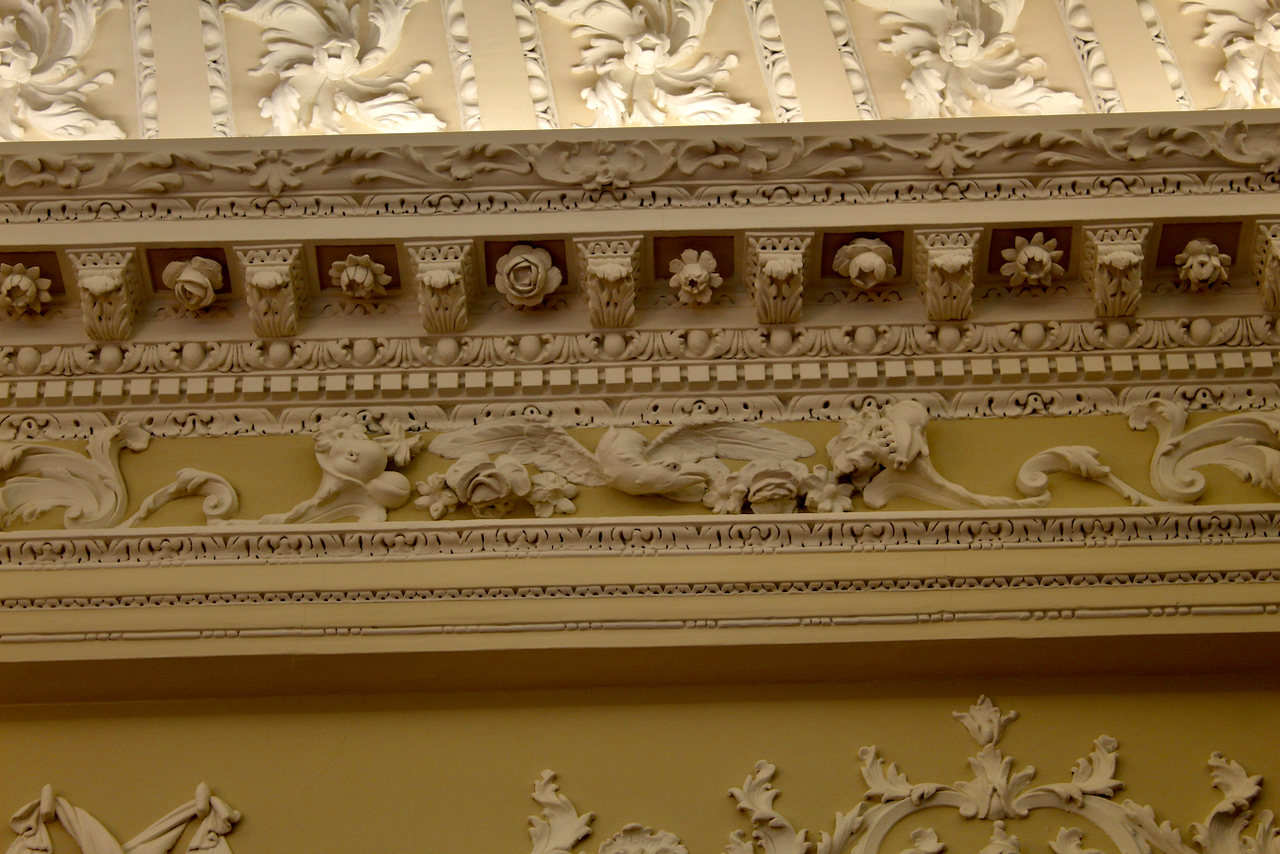
The cemetery adopts the “garden cemetery” styple promoted by J.C. Louden, the Victorian botanist and garden designer.

11. Irish National War Memorial Gardens, Islandbridge, Dublin:

National War Memorial Gardens, Dublin, 2021. At the centre of the garden is the War Stone, or Stone of Remembrance, on which is written “Their name liveth forevermore.” There is a similar stone is almost all cemeteries of the Commonwealth War Graves Commission. Photograph © Jennifer Winder-Baggot, www.irishhistorichouses.com
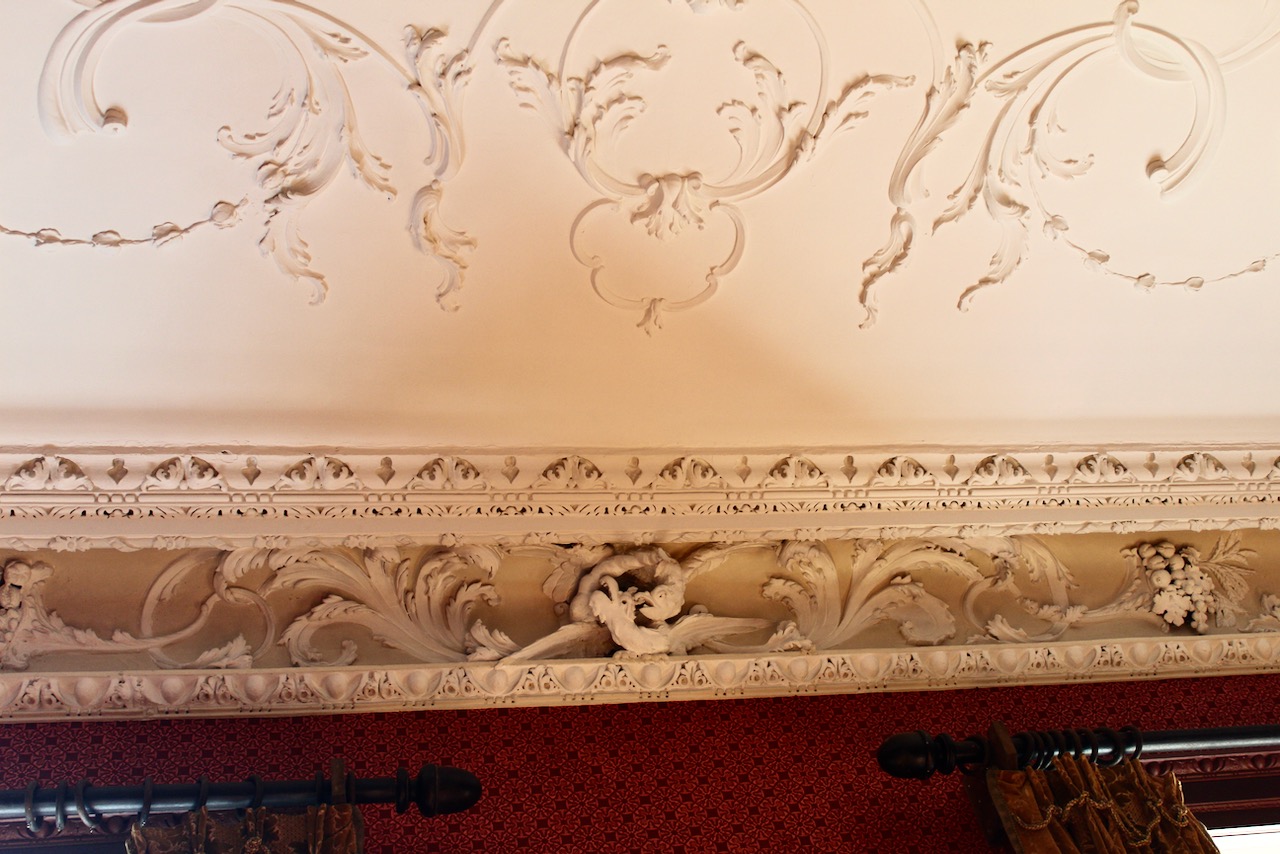
General enquiries: (01) 475 7816, parkmanager@opw.ie

From the OPW website:

These gardens in Islandbridge, a Dublin suburb, are one of the most famous memorial gardens in Europe. They are dedicated to the memory of the 49,400 Irish soldiers who died in the First World War. The name of every single soldier is contained in the sumptuously illustrated Harry Clarke manuscripts in the granite bookrooms.” They were created in the 1930s, with the stipulation that labour would be divided with fifty percent coming from ex-soldiers of the British army and fifty percent from ex-soldiers of the Irish army.

These gardens are not only a place of remembrance; they are also of great architectural interest and beauty. The great Sir Edwin Lutyens (1869-1944) designed them. Lutyens was a prolific garden designer, especially of war memorials, but nonetheless lent his expertise to only four gardens in Ireland.

Sunken rose gardens, herbaceous borders and extensive tree-planting make for an enjoyable visit in any season. The solemn, serene atmosphere of this elegant garden makes it a perfect place in which to relax and reflect.

War Memorial Gardens October 2014: the sunken rose garden. Photograph © Jennifer Winder-Baggot, www.irishhistorichouses.com
War Memorial Gardens November 2020. Photograph © Jennifer Winder-Baggot, www.irishhistorichouses.com
War Memorial Gardens October 2014, my Dad and Stephen. Photograph © Jennifer Winder-Baggot, www.irishhistorichouses.com
War Memorial Gardens October 2014, Stephen, and two of the four “bookrooms” which represent the four provinces of Ireland and house a collection of items relating to both world wars, as well as record books which list the names, regiments and places of birth of the Irish soldiers known to have died in the First World War. These books are illustrated by Harry Clarke and are kept in cases designed by Lutyens. I have never seen these pavilions open to the public, however. Photograph © Jennifer Winder-Baggot, www.irishhistorichouses.com
War Memorial Gardens November 2020. Photograph © Jennifer Winder-Baggot, www.irishhistorichouses.com

The site chosen for the Gardens lies on the banks of the River Liffey, and was known as Longmeadows. It is around fifty acres in size. Its location next to this section of the Liffey meant that it was an important ancient and medieval fording point. The earliest Viking burials were discovered in the vicinity in the early nineteenth century. The most recent excavations in 2008 uncovered a grave which contained a sword, spearhead, and ringed pin. In an era when the Liffey was unconstrained by its modern quays, and spread far wider than it does today, Islandbridge was the first navigable point. The Irish National War Memorial Gardens therefore occupy a space that was important at many different points in Irish history.

Today, the location of the Gardens mean that they are a popular recreational destination for both the local community and international visitors alike. The pathways between the rose gardens, tree avenues, and herbaceous borders allow for pleasant walking. The presence of many boatclubs, mainly along the north side of the Liffey, mean that the park is a significant hub for rowing, and other water sports, in Dublin. The 250m-long weir, dating to the 13th century, attracts a steady stream of anglers who fish its salmon and trout.” [17]

12. Iveagh Gardens, Clonmel Street, Dublin 2:

Iveagh Gardens, Dublin, October 2021.

General Enquiries: 01 475 7816, parkmanager@opw.ie

From the OPW website:

Tucked away behind the National Concert Hall, the Iveagh Gardens are among the finest, but least known, of Dublin’s parks and gardens.

They were designed by Ninian Niven in 1865 as the grounds for the Dublin Exhibition Palace – a space ‘where the citizens might meet for the purposes of rational amusement blended with instruction’.

The gardens contain a unique collection of features, which include rustic grottos, sunken formal panels of lawn with fountain centrepieces, woodlands, a maze, a rosarium, the American garden, rockeries and archery grounds.

This oasis of tranquillity and beauty, just a stone’s throw from the city centre, can justly claim to be the capital’s best-kept secret.

This figure used to be in the fountain. Photograph © Jennifer Winder-Baggot, www.irishhistorichouses.com
Iveagh Gardens rose garden, 2009. Photograph © Jennifer Winder-Baggot, www.irishhistorichouses.com
Information about Ninian Niven, from the exhibition at the Irish Georgian Society in July 2022 curated by Robert O’Byrne, “In Harmony with Nature, The Irish Country House Garden 1600-1900.

The website gives us a wonderfully informative history of the garden:

In 1777, Harcourt Street was built southwards from the south-west corner of St Stephen’s Green. The following year, its first residence was completed – Clonmel House – now number 17 Harcourt street. The proprietor was John Scott (1739 – 1798), 1st Earl of Clonmell, whose country estate was Temple Hill House in Blackrock, Co Dublin. A lawyer by profession, Scott was a friend, collaborator, and fellow-scoundrel of the infamous ‘Buck’ Whaley (whose house at number 85 St Stephen’s Green backed onto Leeson’s Fields).” John Scott, or “Jack,” was the original “Copper Faced Jack,” so called because of his face red from alcohol.

John Scott, 1st Earl of Clonmel, (1739-1798), Chief Justice of the King’s Bench in Ireland Date after 1798 by Engraver Pierre Condé, French, fl.1806-after 1840 After Richard Cosway, English, 1742-1821, photograph courtesy of National Gallery of Ireland.

Scott bought eleven acres of Leeson’s Fields as a garden for Clonmel House. Because Harcourt Street separated the two, a subterranean passage was built (believed to be extant), from one of the now-demolished wings of Clonmel House, with two entrances in the garden.  In a map of 1789 this site is named ‘Lord Earlsfort’s Lawn’ after Scott’s first title Baron Earlsfort.  In the 1790s he became Earl of Clonmell, to which he added an ‘L’ (Clonmell).  

In 1817 this private land was leased, made public, and renamed the ‘Cobourg Gardens’, a name probably suggested by recent events on the Continent. For a brief period the Cobourg Gardens, barely altered from their time as the lawn of Clonmell House, enjoyed a very fashionable position among Dublin’s upper-class society…

Iveagh Gardens 2014, photograph by James Fennell for Tourism Ireland, Ireland’s Content Pool. (see [2])

By the 1830s the popularity of the Cobourg Gardens had declined sharply. In 1836, the ground reverted to Thomas, Earl of Clonmell, who seems to have encouraged plans to build a new street across the Garden, parallel to St Stephen’s Green to be called Clonmel Street.

The gardens … were badly neglected until bought by Benjamin Lee Guinness from John Henry, [3rd] Earl of Clonmell, in 1862.

Benjamin Lee Guinness acquired the land to act as a garden for his town house mansion Iveagh House (numbers 80 and 81 St Stephen’s Green), which he acquired in 1856. Being characteristic of his conscientious and philanthropic family, he became a trustee of the Dublin Exhibition Palace and Winter Garden Company, established in 1862.

He sold the land bordered by Harcourt Street, St Stephens Green south, Earlsfort Terrace and Hatch Street, to the Company for the price he had paid for it. This was to be the location of the Company’s planned recreational and cultural centre for Dublin’s citizens…

Meanwhile, considerable labour was required in the pleasure grounds of the Exhibition Palace. Ninian Niven, famed landscape gardener and former Director of the Botanic Gardens Glasnevin (1834 – 1838), designed the layout…” [you can see a picture of the Exhibition building on the OPW website]. The gardens combined the “French formal” style with “English landscape.” Niven also designed the gardens at a Section 482 property, Hilton Park in County Monaghan, as well as the National Botanic Gardens at Glasnevin at gardens at Aras an Uachtarain.
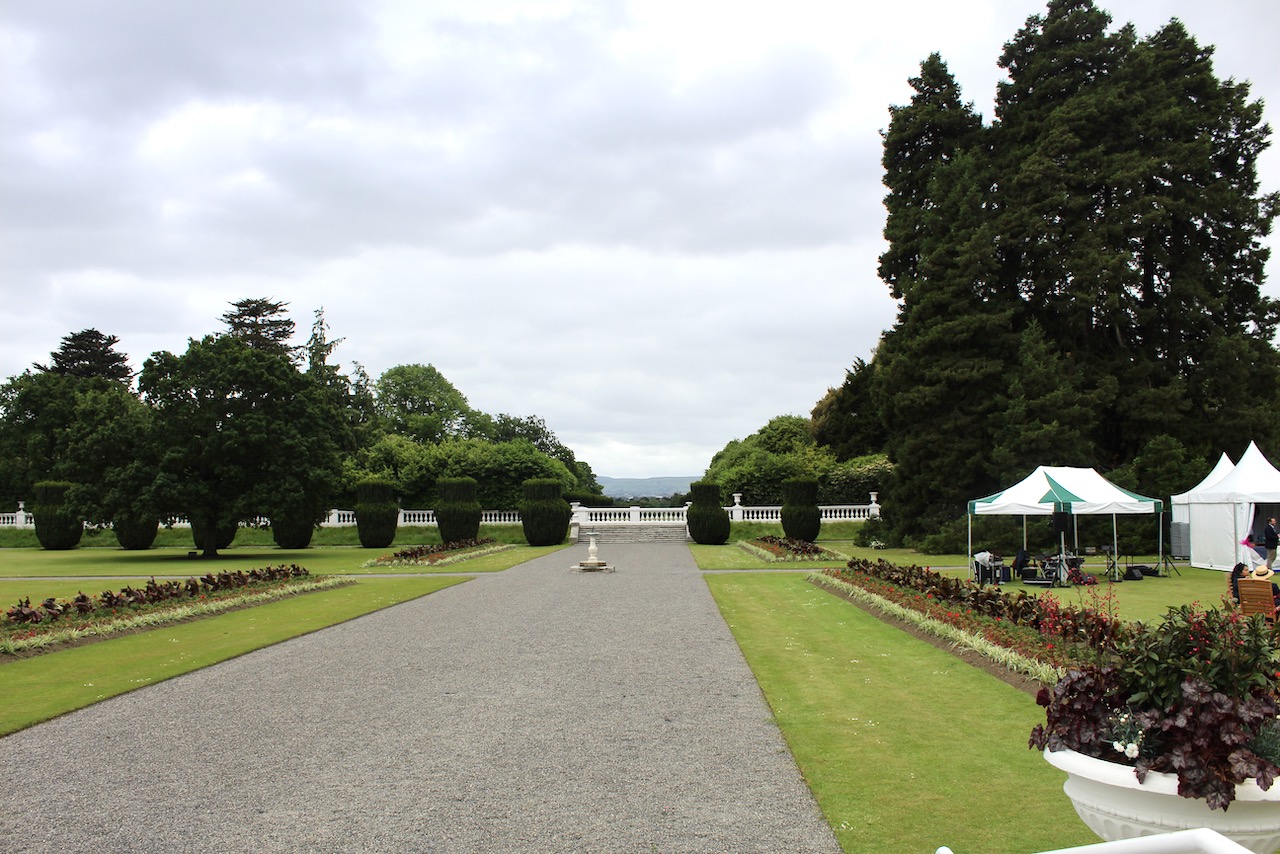
Iveagh Gardens 2014, photograph by James Fennell for Tourism Ireland, Ireland’s Content Pool. (see [2])

The heir to the throne, Albert Edward, Prince of Wales, to rapturous enthusiasm, performed the grand opening, on 9 May 1865. In all a huge 930,000 visitors attended the Exhibition between 9 May and 9 November.  The Company arranged special railway and other concessions and the Palace was equipped with a telegraph centre, post office branch, railway office, and facilities for a large number of international newspapers.

The gardens remained open to the public until the exhibition building was sold and then, the land made private again in 1883. They opened again to the public in 1941, first as part of University College Dublin.

The Gardens feature a unique collection of landscape features, which include a Rustic Grotto and Cascade, sunken formal panels of lawn with Fountain Centre Pieces, Wilderness Woodlands, a Maze, Rosariurn, American Garden, Archery grounds, Rockeries and Rookeries. Happily, many of these features were still visible when the gardens transferred into State care in 1991.

Accordingly, a plan was put in place immediately to undertake restoration and conservation works to the gardens. Looking around the gardens the fruits of this work are visible, in features such as the Yew maze and the Rosarium with its period collection of roses pre-dating 1865. The two fountains, restored in 1994, form a magnificent centerpiece in the gardens.” [18]

Legend tell us that an elephant is buried near the sunken lawn. It may have been used for dissection in the medical school or by a veterinarian, or else could have died in Dublin zoo. However, no remains have ever been found so its presence may be an urban myth.

13. Kilmainham Gaol, Dublin:

The main entrance was the formidable doorway, above which five monstrous shapes writhe. These have variously been called dragons, demons, serpents, and a hydra. It is said that they represented the five worst crimes: murder, rape, theft, treason, and piracy. Just outside this entrance was where public hangings took place until the late nineteenth century, and remains of the fixtures for the gallows can still be seen. [19] Photograph © Jennifer Winder-Baggot, www.irishhistorichouses.com
Kilmainham Gaol, January 2014.

General Enquiries: 01 453 5984, kilmainhamgaol@opw.ie

from OPW website:

Kilmainham Gaol is one of the largest unoccupied gaols in Europe. It opened in 1796 as the new county gaol for Dublin and finally shut its doors as such in 1924. During that period it witnessed some of the most heroic and tragic events in Ireland’s emergence as a modern nation.

Among those detained – and in some cases executed – here were leaders of the rebellions of 1798, 1803, 1848, 1867 and 1916, as well as members of the Irish republican movement during the War of Independence and Civil War.

Names like Henry Joy McCracken [founder of the United Irishmen. He entered the Gaol on the 11th of October 1796 and was hanged two years later], Robert Emmet [United Irishman, hung in 1803], Anne Devlin [friend of Robert Emmet, spent two years in Kilmainham Gaol] and Charles Stewart Parnell [leader of the Irish Parliamentary Party at Westminster, and many of his fellow MPs were detained in Kilmainham after their open rejection of the Land Act introduced by the British government in 1881. Parnell was imprisoned in Kilmainham from October 1881 to May 1882] will always be associated with the building. Not to be forgotten, however, are the thousands of men, women and children that Kilmainham held in its capacity as county gaol. 

Kilmainham Gaol is now a major museum. The tour of the prison includes an audio-visual presentation.

The Gaol was closed as a convict prison in 1910 and handed over to the British Army. It was closed for good as a prison in 1924.

Kilmainham Gaol, January 2014. Photograph © Jennifer Winder-Baggot, www.irishhistorichouses.com
In the late 1850s, the east wing was replaced completely. The architect who won the open competition was John McCurdy, freemason and official college architect of Trinity College Dublin. This new wing was envisaged as a different system as early as its competition advertisement in 1857. It opened four years later, and reflected the very different ideas of the Victorian age. Based on the Panopticon, it is possible to see all ninety-six cells from a central viewing area. The use of light was deliberate and philosophical. It was thought that the huge skylight would spiritually inspire the inmates, while the out-of-reach cell windows would encourage them to turn heavenward. Under the ground of this new wing were four cellar-level isolation cells intended for dark and solitary confinement. [23] Photograph © Jennifer Winder-Baggot, www.irishhistorichouses.com
Eamon De Valera’s cell, who later became President of Ireland. Photograph © Jennifer Winder-Baggot, www.irishhistorichouses.com
Eamon de Valera, as President of Ireland, portrait in the Áras an Uachterain. Photograph © Jennifer Winder-Baggot, www.irishhistorichouses.com

The Easter Rising of 1916 was devised to take place at a time when the British were distracted by fighting the Great War on the continent. Led by members of the Military Council of the Irish Republican Brotherhood, with support from the Irish Citizen Army, the Irish Volunteers, and Cumann na mBan, the rebels seized key sites in Dublin on the 24th of April 1916. It began with a reading of the Proclamation of the Republic by Patrick Pearse. Fighting lasted for six days, until the British Army suppressed the rebellion and Pearse surrendered.

James Connolly was badly wounded and brought to Dublin Castle. Patrick Pearse was brought to Arbour Hill, before transferring to where the rest of the leaders were located, in Richmond Barracks. There they were court-martialled and sentenced to death. They were transferred to Kilmainham Gaol. Here, they were visited by loved ones, and wrote their final goodbyes. It was also here that another leader, Joseph Plunkett, married Grace Gifford in the Gaol chapel the night before he was shot. Between the 3rd and 12th of May 1916, fourteen men were executed by firing squad in the Stonebreakers’ Yard of Kilmainham Gaol. Seven of them had been the signatories of the Proclamation. These were Thomas Clarke, Seán Mac Diarmada, Thomas MacDonagh, Patrick Pearse, Éamonn Ceannt, James Connolly, and Joseph Plunkett.” [23]

The cell of Grace Gifford, Mrs Joseph Plunkett in 1923 (her husband was killed in 1916). Photograph © Jennifer Winder-Baggot, www.irishhistorichouses.com
The place where the executions took place in 1916. Photograph © Jennifer Winder-Baggot, www.irishhistorichouses.com
Kilmainham Gaol, January 2014. Photograph © Jennifer Winder-Baggot, www.irishhistorichouses.com

14. National Botanic Gardens, Glasnevin, Dublin 9:

National Botanic Gardens Glasnevin, 2009: the Richard Turner Palm House. The glass houses were built between 1843-1869. Photograph © Jennifer Winder-Baggot, www.irishhistorichouses.com

General enquiries: (01) 804 0300, botanicgardens@opw.ie

From the OPW website:

The National Botanic Gardens in Glasnevin, just 3 kilometres from Dublin city centre, are renowned for the exquisite plant collections held there. They are home to over 15,000 plant species and cultivars from a variety of habitats from all around the world.

The jewel in the gardens’ crown is a set of exquisitely restored and planted historic glasshouses. Most notable among these are Richard Turner’s Curvilinear Range and the Great Palm House, both winners of an award for excellence in conservation architecture.

Conservation plays an important role in the life of the gardens and Glasnevin is home to over 300 endangered plant species, 6 of which are already extinct in the wild.

The gardens have been closely associated with their counterpart in Kilmacurragh, County Wicklow, since 1854. Unlike the Wicklow branch, though, they provide a calm and beautiful green space in the midst of the nation’s capital.

National Botanic Gardens Glasnevin, 2009. Photograph © Jennifer Winder-Baggot, www.irishhistorichouses.com

“In 1790, the Irish Parliament, with the active support of the Speaker of the House, John Foster, granted funds to the Dublin Society (now the Royal Dublin Society), to establish a public botanic garden.

In 1795, the Gardens were founded on lands at Glasnevin…The original purpose of the Gardens was to promote a scientific approach to the study of agriculture. In its early years the Gardens demonstrated plants that were useful for animal and human food and medicine and for dyeing but it also grew plants that promoted an understanding of systematic botany or were simply beautiful or interesting in themselves.

By the 1830s, the agricultural purpose of the Gardens had been overtaken by the pursuit of botanical knowledge.

This was facilitated by the arrival of plants from around the world and by closer contact with the great gardens in Britain, notably Kew and Edinburgh and plant importers such as Messrs. Veitch. By 1838, the basic shape of the Gardens had been established. Ninian Niven as Curator had, in four years, laid out the system of roads and paths, and located many of the garden features that are present today. [Niven had formerly been head gardener at the Chief Secretary’s Lodge in the Phoenix Park, now the residence of the American Ambassador to Ireland).

The ever increasing plant collection, and especially plants from tropical areas, demanded more and more protected growing conditions and it was left to Niven’s successor, David Moore, to develop the glasshouse accommodation. Richard Turner the great Dublin iron-master, had already supplied an iron house to Belfast Gardens, and he persuaded the Royal Dublin Society that such a house would be a better investment than a wooden house. So indeed it has proved.

“…Moore used the great interest in plants that existed among the estate owners and owners of large gardens in Ireland to expand trial grounds for rare plants not expected to thrive at Glasnevin. The collections at Kilmacurragh, Headford, and Fota, for example, attest to this.

It was David Moore who first noted potato blight in Ireland at Glasnevin on 20th August 1845, and predicted that the impact on the potato crop would lead to famine in Ireland….

A development plan for the Gardens, published in 1992, led to a dramatic programme of restoration and renewal.

Primary amongst these was the magnificent restoration of the Turner Curvilinear Range of glasshouses completed for the bicentenary of the Garden in 1995. A new purpose-built herbarium/library was opened in 1997. The 18th century Director’s House and the Curator’s House have been refurbished. New service glasshouses and compost storage bays have been built. Additional lecture rooms for the Teagasc Course in Amenity Horticulture were opened in 1999. Improved visitor and education facilities have been provided in a new Visitor Centre. In tandem with the restoration and expansion of the buildings, upgrading of the collections and displays has also been in progress. The work of plant identification and classification, of documenting, labelling and publishing continues, as does that of education and service to the visiting public.

The Botanic Gardens came into state care in 1878 and since then have been administered variously by the Department of Art and Industry, the Department of Agriculture, Dúchas the Heritage Service of the Department of Arts, Heritage the Gaeltacht and the Islands, and the Office of Public Works (OPW), which currently has responsibility for the Gardens.” [20]

The gardens include an extensive arboretum as well as rockery, herbaceous border, alpine house, rose garden and woodland garden.

National Botanic Gardens Glasnevin, 2009. Photograph © Jennifer Winder-Baggot, www.irishhistorichouses.com
National Botanic Gardens, Dublin, 2021. Photograph © Jennifer Winder-Baggot, www.irishhistorichouses.com

15. Phoenix Park, Dublin:

Phoenix Park in snow, 1969, photograph from Dublin City Library archive. [see 5]

General Enquiries: 01 821 3021, superintendent.park@opw.ie

One would think it was named for the bird that rose from the flames, but in fact its name comes from the Irish phrase “Fionn Uisce” meaning “clear water.”

A neolithic burial chamber was discovered in the park in 1838, and the grave of a Viking woman.

Information boards in the visitors centre, Phoenix Park, 6th July 2024, Photograph © Jennifer Winder-Baggot, www.irishhistorichouses.com

From the OPW website:

It was originally formed as a royal hunting Park in the 1660s [by James Butler, 1st Duke of Ormond, for King Charles II] and opened to the public in 1747. A large herd of fallow deer still remain to this day. The Park is also home to the Zoological Gardens, Áras an Uachtaráin, and Victorian flower gardens. The Phoenix Park is only a mile and a half from O’Connell Street. Both passive and active recreational pursuits may be viewed or pursued such as walking, running, polo, cricket, hurling, and many more. The Glen Pond is set in very scenic surrounds in the Furry Glen. There are many walks and cycle trails available to the public.

The Phoenix Park is open 24 hrs a day, 7 days a week, all year round.”

Information boards in the visitors centre, Phoenix Park, 6th July 2024, Photograph © Jennifer Winder-Baggot, www.irishhistorichouses.com

The 4th Earl of Chesterfield [Philip Stanhope] was appointed Lord Lieutenant of Ireland in January 1745, and is credited with initiating a series of landscape works, many of which were probably not completed until after his short tenure, having been recalled to London more than a year later. These included considerable replanting of the Park as well as planting of trees on either side of the main avenue and the erection of the Phoenix Column in 1747. He is also credited with opening the Park to the public.

The dominant eighteenth-century managerial and infrastructural characteristics of the Phoenix Park were reflected in the extensive use of the Park by the military and the number of lodges used by government officers and other lesser officials involved in Park management. Apart from the use of the Park for military manoeuvres and practices, there were also a number of military institutions which included the Royal Hibernian Military School (1766) for children who were orphaned, or whose father was on active military service abroad. The Magazine Fort, constructed in 1736 with additions in 1756, was a major military institution from which small arms, munitions and gunpowder were distributed to other military barracks in the Dublin area. Mountjoy Cavalry Barracks (formerly the home of Luke Gardiner, one of the Keepers of the Park) and the Royal Military Infirmary were two further buildings constructed during the eighteenth century, in 1725 and 1786 respectively. The role of the Salute Battery (for firing cannon on Royal and other special occasions), situated in the environs of the Wellington Testimonial, was discontinued, and the lands it occupied within the Park subsequently became known as the Wellington Fields, and on which the Wellington Testimonial was erected.

All the important lodges and accompanying demesnes, which were originally occupied by Park Rangers or Keepers, were purchased for Government use as private dwellings for the chief officers of state. These included the Viceregal Lodge for the Lord Lieutenant (now Áras an Uachtaráin), the Chief Secretary’s Residence (now the residence of the U.S. Ambassador to Ireland [called Deerfield]) and the Under-Secretary’s Residence (subsequently the Papal Nunciature and now the Phoenix Park Visitor Centre [Ashtown Castle, next to a Victorian walled kitchen garden]).

The beginning of the nineteenth century saw the Park in a much-neglected state with poor drainage, the roads in bad order, and most of the trees very old and/or in a state of decay. However with the Commissioners of Woods and Forests taking over the management of the public areas of the Park and the employment of the renowned architect/landscape architect, Decimus Burton, all this was about to change. Burton produced a master plan for the Park which included the building of new gate lodges, the removal and levelling of old hedgerows and shooting butts, tree planting in strategic locations, drainage, the restoration of the boundary wall, creation and realignment of the Park roads, which included Chesterfield Avenue. This latter project involved the relocation of the Phoenix Column on the main avenue. Burton’s involvement for nearly two decades represents the greatest period of landscape change since the Park’s creation by the Duke of Ormond.

“…From the 1830s and particularly after the 1860s, sporting and recreational activities became prominent. The Royal Dublin Zoological Society opened Dublin Zoo in 1830. The Promenade Grounds opened in 1840 (later to be known as the People’s Garden) and were considerably improved in the 1860s with the addition of a Head Gardener’s House, rock garden, and horticultural facilities to allow for flower production for planting in the Gardens. Between the People’s Garden and Dublin Zoo, a bandstand and tearooms were built in the final decade of the nineteenth century.” [21]

Phoenix Park People’s Garden, 1971, photograph from Dublin City Library archive. [see 5]

Next to the visitor’s centre is a Victorian Walled Garden.

Phoenix Park, 6th July 2024, Photograph © Jennifer Winder-Baggot, www.irishhistorichouses.com
Walled garden, Phoenix Park, 6th July 2024, Photograph © Jennifer Winder-Baggot, www.irishhistorichouses.com

An area in the park is designated as People’s Flower Garden:

A 9-hectare section of the massive Phoenix Park is given over to this enclosed and immaculately manicured Victorian flower garden. 

The garden was laid out and opened in the mid-nineteenth century as the Promenade Grounds. It provides an opportunity to enjoy the horticulture of that era at its best. A large ornamental lake with various fowl, a children’s playground, picnic areas and Victorian bedding schemes are just some of the attractions you will come across here.

Whether you’re looking to relax in the sun, have a picnic or simply take a pleasant walk, don’t miss this enchanting portion of the capital’s largest green space.

Phoenix Park People’s Garden, 1959, photograph from Dublin City Library archive. [see 5]

16. Rathfarnham Castle, Dublin:

Rathfarnham Castle, Dublin, September 2021. Photograph © Jennifer Winder-Baggot, www.irishhistorichouses.com

General Enquiries: 01 493 9462, rathfarnhamcastle@opw.ie

From the OPW website:

The castle at Rathfarnham dates back to the Elizabethan period. It was built [around 1583] for Adam Loftus, a Yorkshire clergyman and politician [1533-1605]. Loftus was ambitious and eventually rose to become Archbishop of Dublin and Lord Chancellor of Ireland.

Loftus’s castle, with its four flanker towers, is an excellent example of the Elizabethan fortified house in Ireland. In the late eighteenth century, the house was remodelled on a splendid scale employing some of the finest architects of the day including Sir William Chambers and James ‘Athenian’ Stuart. The collection includes family portraits by Angelica Kauffman, Sir Peter Lely, and Hugh Douglas Hamilton.

See my entry https://irishhistorichouses.com/2025/07/11/rathfarnham-castle-dublin-an-office-of-public-works-property/

17. Royal Hospital Kilmainham, Military Road, Dublin 8:

Royal Hospital Kilmainham, January 2022. Photograph © Jennifer Winder-Baggot, www.irishhistorichouses.com
The Royal Hospital, Kilmainham, North Walk James Malton, English, 1761-1803, photograph courtesy of National Gallery of Ireland.
Aerial view before restoration, Royal Hospital Kilmainham.

General Enquiries: 01 643 7700, rhktours@opw.ie

In Irish, ‘Kil Maignenn’ means Maignenn’s church, and the area takes its name from that saint, who established a church and monastery here around AD 606. After Strongbow’s arrival in Ireland, the land was granted to the Knights Hospitaller of St John of Jerusalem, who established a priory here.

From the OPW website:

The building as we know it today was begun in 1680. Leading architects such as William Robinson, Thomas Burgh and Francis Johnson made it the starting point for Dublin’s development into a city of European standing.

Inspired by Les Invalides in Paris, the building was to be a retirement home for old soldiers. Over the next 247 years, thousands of army pensioners lived out their final days within its walls.

In 1991, the Royal Hospital Kilmainham became home to the Irish Museum of Modern Art.” [22]

Royal Hospital Kilmainham, 15th October 2023. Photograph © Jennifer Winder-Baggot, www.irishhistorichouses.com

See my entry https://irishhistorichouses.com/2025/01/22/royal-hospital-kilmainham-dublin-office-of-public-works/

Royal Hospital Kilmainham dining hall by Robert French, Lawrence Photographic Collection NLI, flickr constant commons.
Royal Hospital Kilmainham, 15th October 2023. Photograph © Jennifer Winder-Baggot, www.irishhistorichouses.com
The Richmond Tower by Francis Johnston, named after the Lord Lieutenant, Charles Lennox, 4th Duke of Richmond, Royal Hospital Kilmainham, 15th October 2023. Photograph © Jennifer Winder-Baggot, www.irishhistorichouses.com

18. St. Audoen’s, Dublin

St Audoen’s, Culture Night 2010. Photograph © Jennifer Winder-Baggot, www.irishhistorichouses.com

General Enquiries: 01 677 0088, staudoenschurch@opw.ie

From the OPW website:

Nestled in the heart of the walled medieval city of Dublin, St Audoen’s Church is the only remaining medieval parish church in the capital. It is dedicated to the seventh-century bishop of Rouen and patron saint of Normandy.

St Audoen’s Church was crucial to the life of the medieval city. Here papal bulls were pronounced and public penances carried out. The Guild Chapel of St Ann houses an award-winning exhibition on the importance of St Audoen’s to medieval Dublin.

Visitors to St Audoen’s can examine the part of the church still in use by the Church of Ireland. They can also view the stunning fifteenth-century tomb to Baron Portlester and his wife.

St Audoen’s, Culture Night 2010. Photograph © Jennifer Winder-Baggot, www.irishhistorichouses.com

The church is dedicated to St Ouen the 7th century bishop of Rouen and patron saint of Normandy, and was built in 1190 to replace an earlier structure. It is said to have the oldest bells in Ireland with three bells dating from 1423 hanging in the tower. In the main porch is stored an early Christian gravestone known as the Lucky Stone which has been kept here since 1309.

The OPW restored and re-roofed St Anne’s Guild Chapel, which had been without a roof since 1826. This chapel dates back to the time of Henry VI of England, who in 1430 authorised the erection of a chantry here, to be dedicated to St. Anne. The story of this Guild is fascinating as it had most of Dublin’s most important businessmen as its members. After Henry VIII made Protestantism the state religion, the Catholic members of St Anne’s Guild had to have meetings and Catholic masses in secret. They held much property, as wealthy patrons gave land to the church and guild as a way to curry favour in heaven, and so Guild members took to hiding the property deeds to the St Anne’s Guild.

An article written for the OPW tells us more about St. Anne’s Guild:

Medieval Christians believed that only the truly saintly would enter heaven after death. Others had to spend time in purgatory to purify their souls. The idea of purgatory became widely accepted after 1290, when a chantry house or lay religious guild was established after the death of Queen Eleanor of Castile to pray for her soul. Masses sung or said for a person after death, especially on the anniversary of their death, would speed the journey through purgatory and into heaven. People regularly left money in their wills to provide for these masses.

Christians came together in sodalities and fraternities to support each other in praying for their dead relatives. St Anne’s Guild, based in St Audoen’s Church, grew out of this movement. There were about six religious guilds in medieval Dublin. St Anne’s is the most well known and probably the most long lived of these.The guild was formally established by charter in 1430, but property deeds relating to the work of the guild go back as far as 1285. The purpose of the guild was to fund chaplains in St Audoen’s church to pray for dead guild members’ souls. Financial support for St Anne’s guild during a person’s lifetime or in their will, was a form of spiritual insurance; your soul would be cared for after your death...

“…All masters and wardens were drawn from the elite of medieval Dublin; Mayors of Dublin, Alderman of Dublin Corporation, Recorders of Dublin (chief magistrates), freemen, citizens, chaplains, knights or merchants. This connection to powerful people was one of the factors that enabled the guild to survive and thrive even through the Reformation.

“…Some of the wealthier members of the guild paid fees to St Audoen’s church so that they could be buried within the walls of the church.

“…Perhaps the most well know endowment at St Audoen’s church was from Sir Roland FitzEustace, Lord of Portlester in 1482. He funded a private chapel to the south east of the church, which was named the Portlester Chapel. FitzEustace was Lord Chancellor of Ireland and it is said he made the donation in thanks for being saved during a perilous sea journey. He also bequeathed a life size cenotaph of himself and his wife Margaret, least anyone forget his generosity. Probably as a gesture of appreciation, St Anne’s guild granted him a messuage; this medieval term referred to a property with buildings, outbuildings, a garden and an orchard. It was located close to St Audoen’s Church and was granted for his and his son’s lifetime.” [23]

The Portlester Chapel. Photograph © Jennifer Winder-Baggot, www.irishhistorichouses.com

The roof of the Portlester Chapel was removed in the 17th century, and the tomb was removed and can be seen in the main porch. The church still holds a weekly Church of Ireland service.

St. Audoen’s. Photograph © Jennifer Winder-Baggot, www.irishhistorichouses.com
The Portlester tomb, St Audoens, featuring Roland FitzEustace (d. 1496), Lord Portlester, and his wife Margaret d’Artois. Photograph from ca. 1898, National Library of Ireland flickr constant commons.

The OPW arcticle continues:

In 1534, the guild acquired Blakeney’s Inn, located to the east of St Audoen’s Church. The guild purchased the Inn from James Blakeney of Rykynhore in exchange for cash and lands at Saucereston, near Rykynhore in the parish of Swords. The Inn is described as having a garden and a turret. It had been the home of the Blakeney family whose ancestors John and James Blakeney had been among the founders of the guild over a hundred years before. The building was renamed the College of St Anne and was used as accommodation for the guild chaplains. Parts of the College were also rented out to raise income.

The building is long gone and St Audoen’s Catholic church stands in its place today.

“…From 1541, the new Protestant religion was promoted in Ireland. Henry VIII abolished lay religious guilds across England. Many in Ireland, including St Anne’s Guild, managed to survive. The new Protestant religion, with King Henry VIII at its head, rejected the doctrine of purgatory. This had been a core part of the existence of St Anne’s Guild. Many of the rituals at the core of St Anne’s Guild, such as veneration of shrines, were called into question by the new religion. With the dissolution of the monasteries (1536-41), St Anne’s guild lost some of its properties, such as the lands rented from St Mary’s Abbey. However, they did manage to salvage some lands in Kilmainham that were leased out to the prior of the Hospital of St John.

Wealthy parishioners continued to support St Anne’s guild and leave money and property in their wills. Chaplains continue to be appointed each year and the property portfolio continued to grow. Affiliation to St Anne’s guild was initially able to transcend the differences between Catholics and Protestants; the guild was able to accommodate both. St Audoen’s Church had been appropriated for Anglican services after 1540s and Catholic services were fully transferred to St Anne’s College by 1611. St Anne’s College was later appropriated by the St Audoen’s Protestant parish clergy and renamed St Audoen’s College.

“..Conscious that they were coming under attack from the state and established church, the guild recorded the minutes of their meetings meticulously. From 1591, measures were taken to secure all the property deeds of the guild. They were put in a stout chest locked with three keys. The keys were held by the wardens and a senior guild member; all three needed to be present to open it...

There were many Catholics and recusants, those who refused to adopt the new state Protestant religion, among the membership of the guild. Walter Sedgrave, guild master in 1593, had been arrested for supporting the rebellion of Viscount Baltinglass in the early 1580s and was known to protect priests in his home. Michael Chamberlain, guild master from 1598, and Matthew Handcock, guild warden in 1593, were imprisoned for their recusancy in 1605-6, having refused an order to accompany the governor to Protestant divine service. Catholics Edmund Malone and Nicholas Stephens held guild wardenships from 1605. Stephen’s execution was ordered in 1613 for his leading role in the riot in Dublin after the overturning of the parliamentary election. He was reprieved. Handcock, Malone and Stephens spent the early months of 1606 in prison in Dublin Castle. Guild member, William Talbot, lost his position as Recorder of Dublin because of his refusal to take the Oath of Supremacy. All of these attacks on guild members hindered the administration of the guild. As the guild came under attack, they employed the services of the Lawyer, Henry Burnell. Burnell was also recusant.

…The decision to refurbish the guild altar in St Audoen’s in 1597 and again in 1605, shows that the shrine was still important to guild members. The hall of St Anne’s college was refurbished in the following years and in 1618 it was said that masses were conducted there – despite being outlawed by the state. Masses were also said in the houses of guild members. It is likely that money paid to Catholic priests was not recorded in the guild accounts. Members of the Sedgrave, Browne and Malone families worked as priests in the Dublin area from 1600-1630 and all had kinfolk in the guild.

In 1611, the state brought proceedings against the continued existence of St Anne’s Guild, with a view to acquiring the guild’s extensive property portfolio. John Davis, the Attorney General, filed a case against Mathew Hancock, Master, and Nicholas Stephens and Edmond Malone, wardens of St Anne’s Guild. Davis was challenging the practices of St Anne’s Guild; demanding to know the legal basis on which they were founded and challenging their corporate status. The guild successfully relied on the original 1430 charter to defend its right to exist, arguing these rights had been exercised uninterrupted since 1430. The Attorney General argued that this was insufficient to protect their property being seized by the King. But the case seemed to rest there and no action was taken.

“…The argument that the guild was being used to support Catholic members, Catholic priests and ultimately a restoration of the Catholic religion was revived in 1634 when the Anglican Vicar of Christchurch, Reverend Thomas Lowe presented his case to the Archbishop of Dublin. Lowe claimed that a Papal Bull from Pope Pius V dating to 1568-9 was found in the papers of Richard and Christopher Fagan; directing the assets of St Anne’s guild be applied only to the benefit of Catholics. He revived the argument that the guild assets were being divided between its own members, Jesuit priests and popish friars. He also accused the guild of swallowing up all the church means to the detriment of the parish church that was in need of funds.

Lowe delivered the documents as proof of wrong-doing to The Lord Deputy of Ireland, Thomas Wentworth, in Dublin Castle. Wentworth had already been involved in a wholesale attempt to seize the assets of Irish Catholics. He sought to have these ‘secret misappropriated livings’ returned to the Anglican church. He ordered that the records of the guild be inspected to investigate their expenditure since 1603. The records showed that St Anne’s guild had investments worth over 800 pounds and were only giving a small part of that to the parish church. They attempted to seize some of the guild property for use by the parish church and imposed thirty Protestant luminaries as members of the guild. They also seize the property of St Anne’s College for the use of Anglican priests and renamed it St Audoen’s College. This attempted coup of St Anne’s Guild failed, probably because of the religious upheaval throughout the country at the time. While this attempt to close the guild failed, the membership was now mostly Protestant.

Lord Deputy Wentworth was recalled to London for ‘high misdemeanours’ and the charges against him specifically refer to his treatment of St Anne’s Guild. Within months, he was taken to the Tower of London where he was executed on the 12th May 1641. Despite the fate of Lord Deputy Wentworth, Reverend Lowe continued his persecution of St Anne’s Guild.

Thomas Wentworth, the 1st Earl of Strafford (1593-1641).

“…After 1690, Catholics were excluded from holding the roles of master or warden of the guild. In 1695, the assets of the guild were handed over to four trustees; Archbishop Narcissus Marsh, Rev. John Finglass, William Molyneux and Christopher Usher. The trustees later sold a large part of the property portfolio to the Wide Streets Commission for clearance prior to the layout of new wider streets in Dublin.

The Charitable work continued through this time with funds used for the relief of poverty, the upkeep of the Blue Coat school, the upkeep of the church and the freeing of Christian slaves in Algeria and the Turkish Empire.

Blackhall Place, Dublin, or The Blue Coat School, by Thomas Ivory, 2019.

Throughout the 18th century, the guild continued its charitable works under the watchful eye of the prebend of St Audoen’s Church. They met every year on the 26th July for their members banquet. Membership remained principally Protestant, although some small number of Catholic families continued to be members. The bonds of friendship between the families still in the guild remained strong and they continued to dispense relief from poverty and distress in a spirit of civic welfare and solidarity.

The Accounts of the Guild of St Anne shows that guild members continued to collect rents and pay out grants up to 1779. The final property transaction in their records dates to 1817, although some small number of their properties were retained by St Audoen’s Church right up to recent years. In 1773, the parish clergy ordered the removal of the roof at the east side of the chapel, including the Portlester Chapel; the cost of maintaining the building was beyond the means of the church. In 1820, they removed the roof from St Anne’s Chapel for the same reason. In 1835, an act of parliament abolished what remained of the medieval guilds but by then St Anne’s had already ceased operation.” [23]

Photograph from the National Library of Ireland.
The arch and old city walls, St. Audoen’s, 1954 photograph from Dublin City Library and Archives. [see 5]

See also https://theirishaesthete.com/2024/05/13/st-audoens/

19. St. Enda’s Park and Pearse Museum:

Pearse Museum, St Enda’s Park, Dublin, photograph 2021 by Aoife O’Neill_Aidona Photography for Fáilte Ireland, Ireland’s Content Pool. (see [2])

General Enquiries: 01 493 4208, pearsemuseum@opw.ie

From the OPW website:

The Pearse Museum in St Enda’s Park is where the leader of the 1916 Rising, Patrick Pearse, lived and operated his pioneering Irish-speaking school from 1910 to 1916.

Set in nearly 20 hectares of attractive parkland in Rathfarnham, Dublin, the museum tells the story of Patrick Pearse and his brother Willie, both of whom were executed for their part in the 1916 Rising. Here you can peruse a fascinating exhibition on Pearse’s life and wander through the historic rooms where he, his family and his students once lived and worked.

The romantic landscape surrounding the museum contains a wild river valley, forested areas and some enchanting eighteenth- and nineteenth-century follies.” The follies were built by two generations of the Hudson family.

and

Edward Hudson, the State Dentist and a Doctor of Physic, signed a lease on the lands known as the ‘Fields of Odin’ in Rathfarnham which were owned by Thomas Connolly of Castletown House in Co. Kildare on 2 April, 1786. He had a home and business premises on St. Stephen’s Green but he also built the house which now houses the Pearse Museum as a country retreat and appropriately named it ‘The Hermitage’.

We stayed in the country house of Edward Hudson in Cork in 2020, Glenville Park, which later became the home of Mark Bence-Jones.

Glenville Park, County Cork, 2020 – the country residence of Edward Hudson and later, Mark Bence-Jones. [24] Photograph © Jennifer Winder-Baggot, www.irishhistorichouses.com

The website continues:

Across the road was The Priory, the home of the famous lawyer John Philpot Curran. His daughter, Sarah, was the sweetheart of the rebel Robert Emmet. Legend has it that Hudson allowed the two young lovers to meet in the grounds of the Hermitage away from the disapproving stares of her father. It was this story which first drew Pearse to this area of Rathfarnham in the summer of 1910.

Edward Hudson was a very learned man with a passionate interest in science and the ancient past. This interest is reflected in the garden monuments and follies which are dotted around the park, many of which were built in imitation of ancient Irish field monuments, including the ogham stone which bears his name. His son William Elliot shared his father’s fascination with Irish history, and in particular the Irish language. He was a founder of the Celtic Society and was a friend of Thomas Davis. He was a lawyer and was involved in the defence of the Young Irelanders, Thomas Francis Meagher and William Smith O’Brien, following their rebellion in 1848. He sold The Hermitage to a legal colleague, Justice Richard Moore, in 1847. Ironically it was Moore who eventually passed sentence on Meagher and Smith O’Brien.

From Justice Moore the property came into the ownership of Major Richard Doyne, a veteran of the Crimean War, who purchased it in 1859. It was then inherited by his son, Lieutenant-Colonel Philip Kavanagh Doyne, who spent much of his life serving with the British Army in India. In 1898, two years before his death, he sold The Hermitage to William Woodbyrne who had made his fortune in the diamond mines of South Africa. Woodbyrne made many improvements to the grounds, including the creation of the ornamental lake. He never lived in the house as his wife contracted tuberculosis and they had to move to a warmer climate. Instead he rented the house to a series of tenants, including Pearse.

One other tenant of particular note was Sir Neville Chamberlain, a former officer in the British army in India and the person credited with the invention of the game of snooker. He moved into The Hermitage in 1900 when he was appointed Chief Inspector of the Royal Irish Constabulary, the police force of Ireland at the time. In an amazing historic coincidence, Sir Neville was head of the RIC in 1916 when Pearse led the Rising against British rule in Ireland!

Surrounded by fifty acres of landscaped parkland, the museum is located in the former home and school of Patrick Pearse, the leader of the 1916 Rising. He founded his school, Scoil Éanna, in 1908 in Cullenswood House, Ranelagh. His initial interest in education stemmed from his involvement in the Gaelic League and the Irish language movement. However he very quickly became passionate about education and its possibilities. His ideas were progressive and radical and he had little time for the exam-focused education system of the time. He felt that schools should nurture the talents of all their pupils, even if those talents lay outside the traditional school subjects.

For Pearse the key to real learning was inspiration, and he felt that to be a success his school needed a suitably inspiring setting. He was anxious to find a home for his school which would allow his pupils direct access to the natural world. He discovered The Hermitage in Rathfarnham in 1910 while on a historical pilgrimage of sites associated with the revolutionary Robert Emmet. Nestled in the foothills of the Dublin Mountains, it was the ideal location for his school.

The house was also Patrick Pearse’s family home. His mother, brother and sisters all assisted in the running of the school. In 1916 he and his brother William left to fight in the 1916 Rising, never to return. Pearse was the leader of the uprising and the author of the Proclamation of the Irish Republic. He also oversaw the surrender once all hope of victory was lost. While revolution was raging in Dublin, his mother and sisters waited for news in Rathfarnham. It was there that they heard that both brothers were to be executed. His mother and eldest sister lived on in the house and ran the school there until 1935. Following the death of Pearse’s last surviving sister in 1968, the house and grounds were handed over to the state with the provision that they be used as a memorial to the lives of Patrick and William Pearse. The Pearse Museum was then opened to the public in 1979.” [25]

20. St. Stephens Green, Dublin:

The park was landscaped between 1877-1880. It was created as a park in 1663 for citizens of the city could take the open air. Photograph © Jennifer Winder-Baggot, www.irishhistorichouses.com
Stephen’s Green 1957, photograph from Dublin City Library archives. [see 5]
Stephen’s Green 1949, photograph from Dublin City Library archives. [see 5]

General Enquiries: 01 475 7816, info@heritageireland.ie

from the OPW website:

In the very centre of Dublin’s shopping district lies one of Ireland’s best-known public parks.

Lord Ardilaun [Arthur Edward Guinness, 1st and last Baron Ardilaun of Ashford (1840-1915)] opened it for the citizens of the city in 1880. This 9-hectare green space has been maintained in its original Victorian layout, with extensive tree and shrub planting and spectacular spring and summer bedding. The herbaceous border provides vibrant colour from early spring to late autumn.

It boasts over 3.5 kilometres of accessible pathways. The waterfall and Pulham rockwork on the western side of the green are well worth a visit. So is the ornamental lake, which provides a home for waterfowl. Several sculptures are located throughout the green, including the James Joyce Memorial Sculpture and a fine specimen by Henry Moore.

A children’s playground in the park is always popular and, if you visit at lunchtime during the summer months, you might even catch a free concert.”

Stephen’s Green 1952, photograph from Dublin City Library archives. [see 5]
Stephen’s Green 1955, photograph from Dublin City Library archives. [see 5]
Stephen’s Green 1963, photograph from Dublin City Library archives. [see 5]
St. Stephen’s Green. Photograph © Jennifer Winder-Baggot, www.irishhistorichouses.com
Stephen’s Green 1966, photograph from Dublin City Library archives. [see 5]
Stephen’s Green 1944, photograph from Dublin City Library archives. [see 5]
Statue of Clarence Mangan in St. Stephen’s Green, March 2011. Photograph © Jennifer Winder-Baggot, www.irishhistorichouses.com

The name St Stephen’s Green originates from a church called St Stephen’s in that area in the thirteenth century. Attached to the church was a leper hospital. Around this time the area was a marshy piece of common ground, which extended as far as the River Dodder and was used by the citizens of the city for grazing livestock.

In 1663 the City Assembly decided that the plot of ground could be used to generate income for the city and a central area of twenty-seven acres was marked out which would define the park boundary, with the remaining ground being let out into ninety building lots. Rent generated was to be used to build walls and paving around the Green. Each tenant also had to plant six sycamore trees near the wall, in order to establish some privacy within the park. In 1670 the first paid gardeners were employed to tend to the park.

Saint Stephen’s Green Gardens, Dublin James Malton, English, 1761-1803, photograph courtesy of National Gallery of Ireland.
Photograph © Jennifer Winder-Baggot, www.irishhistorichouses.com

The Green became a particularly fashionable place during the eighteenth century, owing mainly to the opening of Grafton Street in 1708 and Dawson Street in 1723, and the construction of desirable properties in and around this area. The Beaux Walk situated along the northern perimeter of the park became a popular location for high society to promenade. Lewis’ Dublin Guide of 1787 describes the Beaux Walk as being a scene of elegance and taste. Other walks found in the park included the French Walk found along the western perimeter of the park, and Monk’s Walk and Leeson’s Walk located along the eastern and southern boundaries of the park respectively.

By the nineteenth century the condition of the park had deteriorated to such an extent that the perimeter wall was broken, and many trees were to be found in bad condition around the park. In 1814 commissioners representing the local householders were handed control of the park. They replaced the broken wall with ornate Victorian railings and set about planting more trees and shrubs in the park. New walks were also constructed to replace the formal paths previously found in the park. However with these improvements, the Green then became a private park accessible only to those who rented keys to the park from the Commission, despite the 1635 law which decreed that the park was available for use by all citizens. This move was widely resented by the public.

The Band Stand in St Stephen’s Green. Photograph © Jennifer Winder-Baggot, www.irishhistorichouses.com

Sir Arthur Guinness, later known as Lord Ardilaun, grew up in Iveagh House located on St Stephen’s Green, and came from a family well noted for its generosity to the Dublin public. In 1877 Sir Arthur offered to buy the Green from the commission and return it to the public. He paid off the park’s debts and secured an Act which ensured that the park would be managed by the Commissioners of Public Works, now the OPW.

Sir Arthur’s next objective was to landscape the park, and provide an oasis of peace and tranquility in the city. He took an active part in the design of the redeveloped park, and many of the features in the park are said to have been his suggestions. The main features of the redeveloped park included a three-acre lake with a waterfall, picturesquely-arranged Pulham rockwork, and a bridge, as well as formal flower beds, and fountains. The superintendent’s lodge was designed with Swiss shelters. It is estimated the redevelopment of the park cost £20,000.

After three long years of construction work, and without a formal ceremony the park reopened its gates on 27th of July 1880, to the delight of the public of Dublin.” [26]

St. Stephen’s Green. Photograph © Jennifer Winder-Baggot, www.irishhistorichouses.com
Stephen’s Green 1963, photograph from Dublin City Library archives. [see 5]
Royal Fusiliers Arch, St. Stephen’s Green, 2007, commemorates members of the Royal Dublin Fusiliers who died in the Second Boer War. It was erected in 1907. Photograph © Jennifer Winder-Baggot, www.irishhistorichouses.com
Fusilier’s Arch, St. Stephen’s Green. Photograph © Jennifer Winder-Baggot, www.irishhistorichouses.com

[1] https://heritageireland.ie/visit/places-to-visit/aras-an-uachtarain/

[2] https://www.irelandscontentpool.com

[3] https://www.archiseek.com/2010/1791-custom-house-customhouse-quay-dublin/

[4] https://www.archiseek.com/2010/1791-custom-house-customhouse-quay-dublin/

[5] https://repository.dri.ie/

[6] p. 8, Marnham, Niamh. An Introduction to the Architectural Heritage of Dublin South City. Published by the Department of Culture, Heritage and the Gaeltacht, 2017.

[7] https://www.archiseek.com/2010/1204-dublin-castle/

[8] p. 6, Marnham, Niamh. An Introduction to the Architectural Heritage of Dublin South City. Published by the Department of Culture, Heritage and the Gaeltacht, 2017.

[9] https://www.buildingsofireland.ie/building-of-the-month/chapel-royal-dublin-castle-dame-street-dublin-2/

[10] p. 9, Marnham, Niamh. An Introduction to the Architectural Heritage of Dublin South City. Published by the Department of Culture, Heritage and the Gaeltacht, 2017.

[11] See also https://farmleigh.ie/

* I visited Iveagh House during Open House in October 2014.

[12] https://farmleigh.ie/the-guinness-family/

[13] https://farmleigh.ie/the-parkland/

[14] https://farmleigh.ie/the-parkland/

[15] https://opwdublincommemorative.ie/garden-of-remembrance/learn-more/

[16] https://opwdublincommemorative.ie/grangegorman/learn-more/

[17] https://opwdublincommemorative.ie/war-memorial/

[18] https://iveaghgardens.ie/

[19] https://kilmainhamgaolmuseum.ie/the-building/

[20] https://botanicgardens.ie/glasnevin/history/

[21] https://phoenixpark.ie/

[22] See also https://rhk.ie/about-us/

William Robinson also built Marsh’s Library in Dublin.

Marsh’s Library, photograph from 1975, Dublin City Library and Archive. [see 5]

[23] https://heritageireland.ie/assets/uploads/2022/09/The-Story-of-St-Annes-Guild.pdf

The bibliography for this article is:

Bibliography:
Berry, H. (1904) History of the Religious Guild of St Anne in St Audoen’s Church Dublin 1430-
1740, Taken from its records in the Haliday collection, R.I.A. Proceedings of the Royal Irish
Academy: Archaeology, Culture, History, Literature. Volumn 25 (1904/1905) pp. 21- 106.
Empey, A. (2002) The layperson in the parish: the medieval inheritance, 1169-1536 , in
The Laity and the Church of Ireland 1000-2000 eds. Gillespie,R. and Neely, W.G. Four Court Press,
Dublin
Lennon, C. (2017) Charitable Property: The Manuscripts of St Anne’s Guild, Dublin. RIA lecture
available: https://www.ria.ie/charitable-property-manuscripts-st-annes-guild-dublin
Lennon, C. (2011) ‘The Fraternity of St Anne in St Audoen’s parish, Dublin’, in Salvador Ryan &
Brendan Leahy (eds), Treasures of Irish Christianity: people and places, images and
texts (Dublin: Veritas, 2012), pp 116–18.
Lennon, C. (1990) The Chantries in the Irish Reformation: the case of St Anne’s Guild, Dublin,
1550-1630 in Comerford, R.V., Cullen, M, Hill, J and Lennon, C.
Religious Conflict and Coexistence in Ireland, 1990 published by Gill and Macmillian Ltd. Dublin
McMahon, M (2006) St Audoen’s Church, Cornmarket, Dublin: Archaeology and Architecture.
The Stationary Office, Dublin ‘The Case of St Anne’s Guild’ from National Library of Ireland LO2337

[24] http://www.glenvillepark.com/

[25] https://pearsemuseum.ie/the-museum/

[26] https://ststephensgreenpark.ie/cultural-heritage/

Text © Jennifer Winder-Baggot, www.irishhistorichouses.com

Happy New Year!

I love starting a new year. The new listing for Section 482 properties won’t be published until February or March, so at the moment we will have to rely on 2021 listings (January listings below).

I had an amazing 2021 and visited lots of properties! As well as those I’ve written about so far, I am hoping to hear back for approval for a few more write-ups. Last year Stephen and I visited thirteen section 482 properties, thirteen OPW properties, and some other properties maintained by various groups.

The Section 482 properties we visited were Mount Usher gardens and Killruddery in County Wicklow; Killineer House and gardens in County Louth; Salthill Gardens in County Donegal; Stradbally Hall in County Laois; Enniscoe in County Mayo; Tullynally in County Westmeath; Kilfane Glen and Waterfall in County Kilkenny; Killedmond Rectory in County Carlow; Coopershill, Newpark and Markree Castle in County Sligo and Wilton Castle in County Wexford.

Mount Usher Gardens, County Wicklow (June 2021). Photograph © Jennifer Winder-Baggot, www.irishhistorichouses.com
Killruddery, County Wicklow (we visited in April 2021). Photograph © Jennifer Winder-Baggot, www.irishhistorichouses.com
Killineer House and Gardens, County Louth (visited in June 2021). Photograph © Jennifer Winder-Baggot, www.irishhistorichouses.com
Salthill Gardens, County Donegal (visited in July 2021.) Photograph © Jennifer Winder-Baggot, www.irishhistorichouses.com
Stradbally Hall, County Laois (visited in June 2021). Photograph © Jennifer Winder-Baggot, www.irishhistorichouses.com
Enniscoe, County Mayo (visited in August 2021). Photograph © Jennifer Winder-Baggot, www.irishhistorichouses.com
Tullynally, County Westmeath (visited in August 2021). Photograph © Jennifer Winder-Baggot, www.irishhistorichouses.com
Kilfane Glen and Waterfall, County Kilkenny (visited in August 2021). Photograph © Jennifer Winder-Baggot, www.irishhistorichouses.com
Gardens at Killedmond Rectory, County Carlow (visited in August 2021). Photograph © Jennifer Winder-Baggot, www.irishhistorichouses.com
Coopershill, County Sligo (visited in August 2021). Photograph © Jennifer Winder-Baggot, www.irishhistorichouses.com
Newpark House, County Sligo (visited in August 2021). Photograph © Jennifer Winder-Baggot, www.irishhistorichouses.com
Markree Castle, County Sligo (visited in August 2021). Photograph © Jennifer Winder-Baggot, www.irishhistorichouses.com
Wilton Castle, County Wexford (visited in November 2021). Photograph © Jennifer Winder-Baggot, www.irishhistorichouses.com

The OPW properties we visited were Dublin Castle, the Irish National War Memorial Gardens, National Botanic Gardens, Rathfarnham Castle, St. Stephen’s Green, Iveagh Gardens, Phoenix Park and Royal Hospital Kilmainham in Dublin; Emo Court, County Laois; Portumna Castle, County Galway; Fore Abbey in County Westmeath; Parke’s Castle, County Leitrim; and Ballymote Castle, County Sligo.

Inside Dublin Castle (visited in September 2021). Photograph © Jennifer Winder-Baggot, www.irishhistorichouses.com
Irish National War Memorial Gardens, Dublin, designed by Lutyens (we go walking here all the time!). Photograph © Jennifer Winder-Baggot, www.irishhistorichouses.com
National Botanic Gardens, Dublin (visited in September 2021). Photograph © Jennifer Winder-Baggot, www.irishhistorichouses.com
Inside Rathfarnham Castle (visited in September 2021). Photograph © Jennifer Winder-Baggot, www.irishhistorichouses.com
The Iveagh Gardens, Dublin (visited in October 2021). Photograph © Jennifer Winder-Baggot, www.irishhistorichouses.com
The Gardens at Royal Hospital Kilmainham (visited in January 2022). Photograph © Jennifer Winder-Baggot, www.irishhistorichouses.com
Emo Park, County Laois (visited in June 2021). Photograph © Jennifer Winder-Baggot, www.irishhistorichouses.com
Portumna Castle, Galway (visited in July 2021). Photograph © Jennifer Winder-Baggot, www.irishhistorichouses.com
Fore Abbey, County Westmeath (visited in August 2021). Photograph © Jennifer Winder-Baggot, www.irishhistorichouses.com
Parke’s Castle, County Leitrim, maintained by the OPW (visited in August 2021). Photograph © Jennifer Winder-Baggot, www.irishhistorichouses.com
Ballymote Castle, County Sligo (visited in August 2021). Photograph © Jennifer Winder-Baggot, www.irishhistorichouses.com

We also visited Duckett’s Grove, maintained by Carlow County Council; Woodstock Gardens and Arbortetum maintained by Kilkenny County Council; Johnstown Castle, County Wexford maintained by the Irish Heritage Trust (which also maintains Strokestown Park, which we have yet to visit – hopefully this year! it’s a Section 482 property – and Fota House, Arboretum and Gardens, which we visited in 2020); Dunguaire Castle, County Clare, which is maintained by Shannon Heritage, as well as Newbridge House, which we also visited in 2021. Shannon Heritage also maintains Bunratty Castle, Knappogue Castle and Cragganowen Castle in County Clare, King John’s Castle in Limerick, which we visited in 2019, Malahide Castle in Dublin which I visited in 2018, GPO museum, and the Casino model railway museum. We also visited Belvedere House, Gardens and Park – I’m not sure who maintains it (can’t see it on the website).

Duckett’s Grove, County Carlow (visited in August 2021). Photograph © Jennifer Winder-Baggot, www.irishhistorichouses.com
Woodstock House, County Kilkenny, maintained by Kilkenny County Council (visited in August 2021). Photograph © Jennifer Winder-Baggot, www.irishhistorichouses.com
Johnstown Castle, County Wexford, maintained by the Irish Heritage Trust (visited in November 2021). Photograph © Jennifer Winder-Baggot, www.irishhistorichouses.com
Dunguaire Castle, County Clare (visited in July 2021). Photograph © Jennifer Winder-Baggot, www.irishhistorichouses.com
Newbridge House, County Dublin (visited in June 2021). Photograph © Jennifer Winder-Baggot, www.irishhistorichouses.com
Belvedere House, County Westmeath (visited in August 2021). Photograph © Jennifer Winder-Baggot, www.irishhistorichouses.com

We were able to visit two historic properties when we went to view auction sales at Townley Hall, County Louth and Howth Castle, Dublin.

The domed rotunda in Townley Hall, County Louth (visited in October 2021). Photograph © Jennifer Winder-Baggot, www.irishhistorichouses.com
Howth Castle, County Dublin (visited in September 2021). Photograph © Jennifer Winder-Baggot, www.irishhistorichouses.com

Finally some private Big Houses that we visited, staying in airbnbs, were Annaghmore in County Sligo and Cregg Castle in Galway.

Annaghmore, County Sligo, where we stayed as airbnb guests with Durcan and Nicola O’Hara (in August 2021). Photograph © Jennifer Winder-Baggot, www.irishhistorichouses.com
Cregg Castle, County Galway (in July 2021). Photograph © Jennifer Winder-Baggot, www.irishhistorichouses.com

Here are the listings for January 2021:

Cavan

Cabra Castle (Hotel)

Kingscourt, Co. Cavan

Howard Corscadden.

Tel: 042-9667030

www.cabracastle.com

Open dates in 2021: all year, except Dec 24, 25, 26, 11am-12 midnight

Fee: Free

Cabra Castle, County Cavan. Photograph © Jennifer Winder-Baggot, www.irishhistorichouses.com

Corravahan House & Gardens

Corravahan, Drung, Ballyhaise, Co. Cavan

Ian Elliott

Tel: 087-9772224

www.corravahan.com

Open dates in 2021: Jan 4-5, 11-12, 18-19, 25-26, Feb 1-2, 8-9, 15-16, 22-23, Mar 1-2, 8-9, May 4- 5, 9-12, 16-19, 23-26, 30-31, June 1-4, Aug 14-31, Sept 1-2, 9am-1pm, Sundays 2pm- 6pm
Fee: adult €10, OAP/student/child €5 

Corravahan, County Cavan. Photograph © Jennifer Winder-Baggot, www.irishhistorichouses.com

Clare

Newtown Castle

Newtown, Ballyvaughan, Co. Clare

Mary Hawkes- Greene

Tel: 065-7077200

www.newtowncastle.com , www.burrencollege.ie

Open dates in 2021: Jan 4-May 31, Mon-Fri, June 1-30 Mon-Sat, July 1-Aug 31 daily, Sept 1-Dec 17 Mon-Fri, 10am-5pm
Fee: Free 

Newtown Castle, County Clare. Photograph from National Inventory of Architectural Heritage.

Cork

Blarney Castle & Rock Close

Blarney, Co. Cork

C. Colthurst

Tel: 021-4385252

www.blarneycastle.ie

Open dates in 2021: all year except Christmas Eve & Christmas Day, Jan-Mar, Mon-Sat, 9am- sundown, Sun, 9am-6pm 

Apr-May, 9am-6pm, June-Aug, Mon-Sat, 9am-7pm, Sun, 9am-6pm, Sept, Mon-Sat, 9am-6.30pm, Sun, 9am-6pm,
Oct, Nov, Dec daily 9am-6pm,
Fee: adult €18, OAP/student €15, child €10, family and season passes 

Brideweir House

Conna, Co. Cork

Ronan Fox

Tel: 087-0523256

Open dates in 2021: Jan 1-Dec 24, 11am-4pm 

Fee: adult €10, OAP/student €5, child free

Woodford Bourne Warehouse

Sheares Street, Cork

Edward Nicholson

Tel: 021-4273000

www.woodfordbournewarehouse.com

Open dates in 2021: all year except Christmas Eve, Christmas Day, 1pm-11pm 

Fee: Free

Donegal

Portnason House 

Portnason, Ballyshannon, Co. Donegal
Madge Sharkey
Tel: 086-3846843
Open dates in 2021: Jan 18-22, 25-29, Feb 1-5, 8-12, Aug 14-30, Sept 1-17, 20-23, 27-28, Nov 15- 19, 22-26, Dec 1-3 6-10, 13-14, 9am-1pm 

Fee: adult €8, OAP/student/child €5 

Dublin City

Bewley’s 

78-79 Grafton Street/234 Johnson’s Court, Dublin 2

Peter O’ Callaghan

Tel 087-7179367

www.bewleys.com

Open dates in 2021: all year except Christmas Day, 

11am-7pm Fee: Free 

Hibernian/National Irish Bank

23-27 College Green, Dublin 2

Dan O’Sullivan 

Tel: 01-6755100

www.clarendonproperties.ie

Open dates in 2021: all year, except Dec 25, Wed-Fri 9.30am-8pm, Sun 11am-7pm, Sat, Mon, Tue, 9.30-7pm 

Fee: Free 

Powerscourt Townhouse Centre

59 South William Street, Dublin 2

Mary Larkin

Tel: 01-6717000

Open dates in 2021: All year except New Year’s Day, Easter Sunday, Easter Monday, Christmas Day, St. Stephen’s Day & Bank Holidays, Mon-Sat, 10am-6pm, Thurs, 10am-8pm, Sundays, 12 noon-6pm

Fee: Free

Powerscourt Townhouse, Dublin City. Photograph © Jennifer Winder-Baggot, www.irishhistorichouses.com

10 South Frederick Street

Dublin 2

Joe Hogan

Tel: 087-2430334

Open dates in 2021: Jan 1-24, May 1, 3-8, 10-15, 17-22, 24-27, Aug 14-22, 2pm-6pm 

Fee: Free 

County Dublin 

“Geragh” 

Sandycove Point, Sandycove, Co. Dublin

Gráinne Casey

Tel: 01-2804884

Open dates in 2021: Jan 28-29, Feb 1-5, 8-12, 15-22, May 4-31, Aug 14-22, Sept 1-3, 2pm-6pm Fee: adult €7, OAP €4, student €2, child free  

Meander

Westminister Road, Foxrock, Dublin 18,

Ruth O’Herlihy, 

Tel: 087-2163623

Open dates in 2021: Jan 4-8, 11-15, 18-22, 25-29, May 1, 4-8, 10-11, 17-22, June 8-12, 14-19, 21- 26, Aug 14-22, 9am-1pm 

Fee: adult €5, OAP/child/student €2 

Tibradden House

Mutton Lane, Rathfarnham, Dublin 16

Selina Guinness

Tel: 01-4957483

www.selinaguinness.com

Open dates in 2021: Jan 14-17, 23-24, 28-29, Feb 4-7, 11-12, 19-21, 26-28, May 3-13,16, 18-20, 23-27, June 2-4, 8-10, 14-16, 19-20, Aug 14-22, weekdays 2.30pm-6.30pm, weekends 10.30am-2.30pm
Fee: adult/OAP €8 student €5, child free, Members of An Taisce the The Irish Georgian Society (with membership card) €5 

Galway 

Woodville House Dovecote & Walls of Walled Garden 

Craughwell, Co. Galway
Margarita and Michael Donoghue
Tel: 087-9069191
www.woodvillewalledgarden.com
Open dates in 2021: Jan 29-31, Feb 1-28, Apr 1-13, 11am- 4.30pm, June 1, 6-8, 13-15, 21-22, 27- 29, July 10-11, 17-18, 24-25, 31, Aug 1-2, 6-8, 13-22, 27-29, Sept 4-5, 11am-5pm Fee: adult/OAP €6, child €3, student, €5, family €20, guided tours €10 

Kerry

Derreen Gardens

Lauragh, Tuosist, Kenmare, Co. Kerry

John Daly

Tel: 087-1325665

www.derreengarden.com 

Open dates in 2021: all year, 10am-6pm

Fee: adult/OAP/student €8, child €3, family ticket (2 adults and all children under 18 and 2 maps) €20 

Kildare

Farmersvale House

Badgerhill, Kill, Co. Kildare

Patricia Orr

Tel: 086-2552661

Open dates in 2021: Jan 18-31, Feb 1-6, July 23-31, Aug 1-31, 9.30am-1.30pm
Fee: adult €5, student/child/OAP €3, (Irish Georgian Society members free) 

Harristown House

Brannockstown, Co. Kildare

Hubert Beaumont
Tel: 087-2588775

www.harristownhouse.ie

Open dates in 2021: Jan 11-15, 18-22, Feb 8-12, 15-19, May 4-28, June 7-11, Aug 14-22, Sept 6-10, 9am-1pm 

Fee: adult/OAP/student €10, child €5 

Harristown House, County Kildare. Photograph © Jennifer Winder-Baggot, www.irishhistorichouses.com

Kildrought House

Celbridge Village, Co. Kildare

June Stuart

Tel: 01-6271206, 087-6168651

Open dates in 2021: Jan 1-20, May 18-26, Aug 11-31,10am-2pm
Fee: adult €6, OAP/student/child €3, child under 5 years free, school groups €2 per head 

Moyglare Glebe

Moyglare, Maynooth, Co. Kildare

Joan Hayden

Tel: 01-8722238

Open dates in 2021: Jan 4-8, 11-15, 18-22, 25-29, May 1-31, Aug 14-22, Sept 4-7, 8.30am-12.30pm Fee: adult €6, OAP/student/child €3 

Kilkenny

Kilkenny Design Centre

Castle Yard, Kilkenny

Joseph O’ Keeffe, Tel: 064-6623331

www.kilkennydesign.com

Open dates in 2021: all year,10am-7pm 

Fee: Free

Laois

Ballaghmore Castle

Borris in Ossory, Co. Laois

Grace Pym

Tel: 0505-21453

www.castleballaghmore.com

Open dates in 2021: all year, 9.30am-6pm
Fee: adult €5, child/OAP €3, student free, family of 4, €10 

Leitrim

Manorhamilton Castle (Ruin)

Castle St, Manorhamilton, Co. Leitrim

Anthony Daly

Tel: 086-2502593

Open dates in 2021: Jan 7-Dec 21, National Heritage Week, Aug 14-22, closed Sat & Sun, 10am- 5pm
Fee: adult €5, child free 

Limerick

Ash Hill 

Kilmallock, Co. Limerick

Simon and Nicole Johnson 

Tel: 063-98035

www.ashhill.com

(Tourist Accommodation Facility)

Open dates in 2021: Jan 15-Oct 31, Nov 1-29, Dec 1-15, 9am-4pm Fee: adult/student €5, child/OAP free 

Glebe House

Bruff, Co. Limerick

Colm McCarthy

Tel: 087-6487556

Open dates in 2021: Jan 4-29, May 10-28, Aug 13-22, Sept 13-24, Mon-Fri, 5.30pm-9.30pm, Sat- Sun, 8am-12 noon 

Fee: Free 

Mayo

Brookhill House

Brookhill, Claremorris, Co. Mayo

Patricia and John Noone

Tel: 094-9371348

Open dates in 2021: Jan 13-20, Apr 13-20, May 18-24, June 8-14, July 13-19, Aug 1-23, 2pm-6pm

Fee: adult €6, student €3, OAP/child/National Heritage Week free

Meath

Cillghrian Glebe now known as Boyne House Slane (or Stackallan)

Slane, Co. Meath

Alan Haugh

Tel: 041-9884444

www.boynehouseslane.ie

Open dates in 2021: all year, National Heritage Week, Aug 14-22, 9am-1pm Fee: Free 

Dardistown Castle

Dardistown, Julianstown, Co. Meath

Lizanne Allen

Tel: 086 -2774271

www.dardistowncastle.ie

Open dates in 2021: Jan 9-31, Feb 11-21, May 15-21, Aug 14-31, Sept 1-30, 10am-2pm Fee: adult €6, student/OAP €5, child free 

Dardistown Castle, County Meath. Photograph © Jennifer Winder-Baggot, www.irishhistorichouses.com

Gravelmount House 

Castletown, Kilpatrick, Navan, Co. Meath
Brian McKenna
Tel: 087-2520523
Open dates in 2021: Jan 1-13, May 10-30, June 1-20, Aug 14-22, 9am-1pm Fee: adult €6, OAP/student/child €3 

Moyglare House

Moyglare, Co. Meath

Postal address Maynooth Co. Kildare

Angela Alexander

Tel: 086-0537291

www.moyglarehouse.ie

Open dates in 2021: Jan 1, 4-8, 11-15, 18-22, 25-29, May 1-21, 24-28, 31, June 1-3, Aug 14-22, 9am-1pm
Fee: adult €7.50, OAP/student/child €5 

St. Mary’s Abbey

High Street, Trim, Co. Meath

Peter Higgins 

Tel: 087-2057176

Open dates in 2021: Jan 25-29, Feb 22-26, Mar 8-12, Apr 12-16, May 24-30, June 21-27, July 19- 25, Aug 14-22, Sept 13-17, 20-24, 2pm-6pm 

Fee: adult €5, OAP/student/child €2 

Tankardstown House 

Rathkenny, Slane, Co. Meath

Tadhg Carolan, Tel: 087-7512871

www.tankardstown.ie

Open dates in 2021: All year including National Heritage Week, 9am-1pm

Fee: Free

Tankardstown, County Meath. Photograph © Jennifer Winder-Baggot, www.irishhistorichouses.com

Monaghan

Castle Leslie

Glaslough, Co. Monaghan

Samantha Leslie 

Tel: 047-88091

www.castleleslie.com

(Tourist Accommodation Facility)

Open dates in 2021: all year, National Heritage Week, events August 14-22 Fee: Free 

Castle Leslie, County Monaghan. Photograph © Jennifer Winder-Baggot, www.irishhistorichouses.com

Offaly

Ballybrittan Castle

Ballybrittan, Edenderry, Co. Offaly

Rosemarie

Tel: 087-2469802 

Open dates in 2021: Jan 3-4, 10-11, 17-18, 23-24, 30-31, Feb 6-7, 13-14, 20-21, 27-28, Mar 6-7,13- 14, 20-21, 27-28, May 1-2, 8-9, 15-16, 22-23, June 12-13,19-20, 26-27, July 3-4,10- 11,17-18, 24-25, 31, Aug 14-22, Sept 4-14, 2pm-6pm. 

Fee: free – except in case of large groups a fee of €5 p.p. 

Corolanty House

Shinrone, Birr, Co. Offaly

Siobhan Webb

Tel: 086-1209984

Open dates in 2021: Jan, Feb, July, Aug, Sept, daily 2pm-6pm

Fee: Free

Crotty Church

Castle Street, Birr, Co. Offaly

Brendan Garry

Tel: 086-8236452

Open dates in 2021: All year, except Dec 25, 9am-5pm 

Fee: Free

High Street House

High Street, Tullamore, Co. Offaly

George Ross

Tel: 086-3832992

www.no6highstreet.com

Open dates in 2021: Jan 4-8, 11-15, 18-22, 25-29, May 1-18, Aug 14-22, Sept 1-24, 9.30am-1.30pm Fee: adult/student €5, OAP €4, child under 12 free 

Springfield House 

Mount Lucas, Daingean, Tullamore, Co. Offaly Muireann Noonan
Tel: 087-2204569
www.springfieldhouse.ie 

Open dates in 2021: Jan 1-14, 1pm-5pm, May 14-16, 24-28, July 2-4, 9-11, 16-18, Aug 7-29, 2pm- 6pm, Dec 26-31, 1pm-5pm
Fee: Free 

Roscommon

Strokestown Park House

Strokestown Park House, Strokestown, Co. Roscommon

Ciarán

Tel: 01-8748030

www.strokestownpark.ie

Open dates in 2021: Jan 2-Dec 20, Jan, Feb, Mar 1-16, Nov, Dec,10.30am-4pm, March 17-Oct 31, 10.30am-5.30pm,
Fee: adult €14, €12.50, €9.25, OAP/student €12.50, child €6, family €29, groups €11.50 

Tipperary

Beechwood House

Ballbrunoge, Cullen, Co. Tipperary

Maura & Patrick McCormack

Tel: 083-1486736

Open dates in 2021: Jan 4-8, 18-22, Feb 1-5, 8-12, May 1-3, 14-17, 21-24, June 11-14, 18-21, Aug 14-22, Sept 3-6, 10-13, 17-20, 24-27, 10.15am-2.15pm 

Fee: adult €5, OAP/student €2, child free, fees donated to charity 

Waterford 

The Presentation Convent 

Waterford Healthpark, Slievekeel Road,Waterford Michelle O’ Brien
www.rowecreavin.ie
Tel: 051-370057 

Open dates in 2021: Jan 1-Dec 31, excluding Bank Holidays and Sundays, Mon-Fri, 8am-6pm, Sat, 10am-2pm, National Heritage Week, Aug 14-22
Fee: Free 

Wexford

Clougheast Cottage

Carne, Co. Wexford

Jacinta Denieffe

Tel: 086-1234322

Open dates in 2021: Jan 11-31, May 1-31 August 14-22, 9am-1pm Fee: €5 

Wilton Castle

Bree, Enniscorthy, Co. Wexford

Sean Windsor

(Tourist Accommodation Facility)

Tel: 053-9247738 

www.wiltoncastleireland.com   

Open dates in 2021: all year

Wilton Castle, County Wexford. Photograph © Jennifer Winder-Baggot, www.irishhistorichouses.com

Wicklow

Castle Howard

Avoca, Co. Wicklow

Mark Sinnott

Tel: 087-2987601

Open dates in 2021: Jan 11-13, Feb 1-5, Mar 1-3, 22-24, June 10-12, 14-15, 19, 21-26, 28, July 5-9, 19-22, Aug 13-22, Sept 6-11, 18, 25, Oct 4-6, 11-13, 9am-1pm 

Fee: adult €8.50, OAP/student €6.50, child €5 

Castle Howard, County Wicklow. Photograph © Jennifer Winder-Baggot, www.irishhistorichouses.com

Mount Usher Gardens

Ashford, Co. Wicklow

Caitriona Mc Weeney

Tel: 0404-49672

www.mountushergardens.ie

Open dates in 2021: all year 10am-6pm

Fee: adult €8, student/OAP €7, child €4, no charge for wheelchair users

Powerscourt House & Gardens

Powerscourt Estate, Enniskerry, Co. Wicklow

Sarah Slazenger

Tel: 01-2046000

www.powerscourt.ie

Open: All year, closed Christmas day and St Stephens day, 9.30am-5.30pm, ballroom and garden rooms Sun, 9.30am-1.30pm
Fee: Mar-Oct, adult €11.50, OAP €9, student €8.50, child €5, family ticket €26, Nov- Dec, adult €8.50, OAP €7.50, student €7, child €4, family ticket 2 adults + 3 children €18, children under 5 free 

Powerscourt, County Wicklow. Photograph © Jennifer Winder-Baggot, www.irishhistorichouses.com

Covid-19 lockdown, 20km limits, and Places to visit in Dublin

I have a bigger project than this section 482 houses blog. It helps, when writing about big houses, to know what is out there. So I have studied Mark Bence-Jones’s 1988 publication in great detail, A Guide to Irish Country Houses, and have conducted research with the help of the internet.

For my own interest, and I am sure many of my readers will appreciate, I am compiling a list of all of the “big house” accommodation across Ireland – finding out places to stay for when Stephen and I go on holidays, especially when we go to see the section 482 houses!

I am also discovering what other houses are open to the public. There are plenty to see which are not privately owned or part of the section 482 scheme. In fact many of the larger houses are either owned by the state, or have been converted into hotels.

This Monday, 8th June 2020, Ireland moves to the next phase of the government’s Covid-19 prevention plan, and we are allowed to travel 20km from our home, or to places within our county. Big houses won’t be open for visits, but some will be opening their gardens – already my friend Gary has been to the gardens of Ardgillan Castle for a walk. Stephen and I went there before lockdown, meeting Stephen’s cousin Nessa for a walk. The castle was closed, but we were blown away by the amazing view from the garden, and walked down to the sea.

Ardgillan Castle, Balbriggan, County Dublin, and its view, June 2020. Photograph © Jennifer Winder-Baggot, www.irishhistorichouses.com
Nessa at the sea on our visit to Ardgillan Castle, June 2020. Photograph © Jennifer Winder-Baggot, www.irishhistorichouses.com


Here is my list of houses/castles to visit in Dublin. Some are on section 482 so are private houses with very limited visting times; others are state-owned and are open most days – though not during Covid-19 restriction lockdown – they might be open from June 29th but check websites. Some have gardens which are open to the public now for a wander.

1. Airfield, Dundrum, Dublin

2. Aras an Uachtarain, Phoenix Park, Dublin – OPW

3. Ardgillan Castle, Dublin

4. Ashtown Castle, Phoenix Park, DublinOPW

5. Bewley’s, 78-79 Grafton Street/234 Johnson’s Court, Dublin 2 – section 482

6. Cabinteely House [formerly Clare Hill, or Marlfield], Cabinteely, Dublin 

7. The Casino at Marino, DublinOPW

8. Charlemount House, Parnell Square, Dublin – Hugh Lane gallery

9. Clonskeagh Castle, 80 Whitebean Road, Clonskeagh, Dublin 14  section 482

10. Colganstown House, Hazelhatch Road, Newcastle, Co. Dublinsection 482

11. Corke Lodge Garden, Shankill, Co. Dublin section 482

12. Dalkey Castle, Dublin – heritage centre 

13. Doheny & Nesbitt, 4/5 Lower Baggot Street, Dublin 2 – section 482 

14. Drimnagh Castle, Dublin

15. Dublin Castle, Dublin – OPW

16. Fahanmura, 2 Knocksina, Foxrock, Dublin 18 – section 482

17. Farm Complex, Toberburr Road, Killeek, St Margaret’s, Co. Dublin – section 482

18. Farmleigh, Phoenix Park, Dublin – OPW

19. Fern Hill, Stepaside, Dublin – gardens open to public

20. Georgian House Museum, 29 Lower Fitzwilliam Street, Merrion Square, Dublin 2 – virtual visit only

21. 14 Henrietta Street, Dublin

22. Hibernian/National Irish Bank, 23-27 College Green, Dublin 2 – section 482

23. Howth Castle gardens, Howth, County Dublin

24. Hurdy Gurdy Radio Museum Howth Martello Tower

25. Lambay Castle, Lambay Island, Malahide, Co. Dublin – section 482

26. Lissen Hall, County Dublin – ihh member, check dates, May and June.

27. Malahide Castle, County Dublin

28. Marlay Park, Rathfarnham, County Dublin

29. Martello Tower, Portrane, Co. Dublin – section 482

30. Meander, Westminister Road, Foxrock, Dublin 18 – section 482

31. Irish Architectural Archive, 45 Merrion Square, Dublin 

32. MOLI, Museum of Literature Ireland, Newman House, St Stephen’s Green, Dublin

33. Newbridge House, Donabate, County Dublin

34. 11 North Great George’s Street, Dublin 1 – section 482

35. 39 North Great George’s Street, Dublin 1

36. 81 North King Street, Smithfield, Dublin 7 – section 482

37. The Odeon (formerly the Old Harcourt Street Railway Station), 57 Harcourt Street, Dublin 2section 482

38. The Old Glebe, Upper Main Street, Newcastle, Co. Dublin – section 482

39. Powerscourt Townhouse Centre, 59 South William Street, Dublin 2 – section 482

40. Primrose Hill, Very Top of Primrose Lane, Lucan, Co. Dublin section 482

41. Rathfarnham Castle, DublinOPW

42. Royal Hospital Kilmainham, Irish Museum of Modern Art (IMMA) – OPW

43. 10 South Frederick Street, Dublin 2 Section 482

44. St. Enda’s Park and Pearse Museum, Dublin OPW

45. St. George’s, St. George’s Avenue, Killiney, Co. Dublin – section 482

46. Swords Castle, Swords, County Dublin.

47. The Church, Junction of Mary’s Street/Jervis Street, Dublin 1 – section 482

48. Tibradden House, Mutton Lane, Rathfarnham, Dublin 16 – section 482

49. Tickknock Gardens, Ticknock Lodge, Ticknock Road, Sandyford, Dublin, Dublin 18

50. Tyrrelstown House Garden, Powerstown Road, Tyrrelstown, Dublin, D15 T6DD – gardens open

1. Airfield, Dundrum, Dublin 

https://www.airfield.ie

Situated:
Overend Way, Dundrum, D14 EE77

Open: see website

Instagram@airfieldgardens

20190410_123353
Airfield House, Dublin, April 2019. Photograph © Jennifer Winder-Baggot, www.irishhistorichouses.com

The website says “Original home to the Overend family, today Airfield House is an interactive tour and exhibition which brings visitors closer to this admired Dublin family. Here you’ll view family photographs, letters, original clothing and display cases with information on their prize-winning Jersey herd, vintage cars and their much loved Victorian toys and books.

We focus not just on the way of life the family lived at Airfield, but also on their fantastic charitable work for organisations such as St John Ambulance and The Children’s Sunshine Home (now The Laura Lynn Foundation) to name but a few.

The name was changed from Bess Mount to Airfield circa 1836. It is a working farm, in the middle of suburban Dundrum! The house was built around 1830. [1] It was built for Thomas Mackey Scully, eldest son of James Scully of Maudlins, Co Kildare. Thomas Mackey Scully was a barrister at Law Grays Inn 1833 and called to the bar in 1847.  He was a supporter of O’Connell and a member of the Loyal National Repeal Association. In 1852 the house went into the Encumbered Estates, and was purchased by Thomas Cranfield.

Overend cars at Airfield estate. Photograph © Jennifer Winder-Baggot, www.irishhistorichouses.com
Overend cars at Airfield. Photograph © Jennifer Winder-Baggot, www.irishhistorichouses.com
Photograph © Jennifer Winder-Baggot, www.irishhistorichouses.com

The Stillorgan History and Genealogy website tells us that Thomas Cranfield married Anne Keys in 1839. Thomas was a stationer and printer of 23 Westmorland Street. In 1847 he became the first mezzotint printer in Ireland producing copies of a works by Irish artists such as William Brocas. He received an award from the RDS for his print from a portrait of the Earl of Clarendon. He moved to 115 Grafton Street and received a Royal Warrant in 1850. The family moved to Airfield in 1854. Thomas was also an agent for the London Stereoscopic company and moved into photography. He disposed of his business in 1878 to his son and his assistant George Nutter. I recently heard Brian May member of the former rock band Queen discussing his interest in stereoscopic photography, which was fascinating. I wonder has he been to Airfield? It’s a pity there is nothing about it in the house. Thomas moved to England in 1882 after the death of his son Charles. 

Thomas’s father was interesting also: the website tells us: “In 1753, Dr Richard Russell published The Use of Sea Water which recommended the use of seawater for healing various diseases. Circa 1790 Richard Cranfield opened sea baths between Sandymount and Irishtown and by 1806 was also offering tepid baths. Originally called the Cranfield baths it was trading as the Tritonville baths by 1806. Richard Cranfield born circa 1731 died in 1809 at Tritonville Lodge outliving his wife by four years to whom he had been married for over 60 years. He was a sculptor and a carver of wood and had a share in the exhibition Hall in William Street which was put up for sale after his death. He was also the treasurer for the Society of Artists in Ireland.  He worked at Carton House and Trinity College. His son Richard took over the baths.

The Stillorgan History and Genealogy website continues. When the Cranfields left Airfield, it was taken over by the Jury family of the Shelbourne hotel in Dublin. William Jury born circa 1805 was a hotel proprietor. He and his second wife went to live at Tolka Park, Cabra and William became proprietor of the Imperial Hotel in Cork and in Belfast and also had an interest  ‘Jurys’ in Derry. In 1865 William, together with Charles Cotton, (brother of his wife Margaret) and Christian Goodman, (manager of the Railway Hotel in Killarney) purchased The Shelbourne from the estate of Martin Burke. They closed The Shelbourne in February 1866, purchased additional ground from the Kildare Society, and proceeded with a rebuild and reopened on 21.02.1867. John McCurdy was the architect and Samuel Henry Bolton the builder. The four bronze figures of Assyrian muses/mutes installed at the entrance of the Shelbourne Hotel were designed by the Bronze-founders of Gustave Barbezat & CIE of France.

William’s wife Margaret took over the running of the hotel after the death of her husband. She travelled from Airfield each morning bringing fresh vegetables for use in the hotel. She left Airfield circa 1891.

Airfield estate. Photograph © Jennifer Winder-Baggot, www.irishhistorichouses.com
Photograph © Jennifer Winder-Baggot, www.irishhistorichouses.com

Four of their sons followed into the hotel business. Their fourth son, Charles, took over the running of The Shelbourne and died in 1946 in Cheshire aged 91 years.

The Overends seem to have taken over Airfield from 1884. Trevor Thomas Letham Overend (1847-1919) was born in Portadown, 3rd son of John Overend of 57 Rutland Square. He married Elizabeth Anne (Lily) Butler 2nd daughter of William Paul Butler and Letitia Gray of Broomville, County Carlow. Their daughters Letitia and Naomi were left well provided for with no necessity to work and instead devoted themselves to volunteer work and never married.

The website continues: “We focus not just on the way of life the family lived at Airfield, but also on their fantastic charitable work for organisations such as St John Ambulance and The Children’s Sunshine Home (now The Laura Lynn Foundation) to name but a few.

Airfield Ornamental Gardens
Airfield gardens came to prominence under the leadership of Jimi Blake in the early 2000’s. Like all progressive gardens the garden in Airfield is an ever-evolving landscape. The gardens were redesigned in 2014 by internationally renowned garden designer Lady Arabella Lenox Boyd and landscape architect Dermot Foley. The colour and life you see in our gardens today are the result of the hard work and imagination of our Head Gardener Colm O’Driscoll and his team who have since put their stamp on the gardens as they continue to evolve. The gardens are managed organically and regeneratively with a focus on arts and craft style of gardening.

Espaliered trees at Airfield, April 2019. Photograph © Jennifer Winder-Baggot, www.irishhistorichouses.com

Airfield Food Gardens
Certified organic by the Irish Organic Association this productive 2-acre garden supplies the onsite café and farmers market with fresh seasonal produce. Food production is only one element of this dynamic food garden. Education is at the core of this space. Annual crop trails, experimental crops and forward-thinking growing methods are implemented throughout the garden. Soil is at the heart of the approach to growing and and on top of being certified organic the garden is managed under “no dig” principals. These regenerative approaches result in a thriving food garden that is a hive of activity throughout the growing season.”

Gardens at Airfield, April 2019. Photograph © Jennifer Winder-Baggot, www.irishhistorichouses.com
Photograph © Jennifer Winder-Baggot, www.irishhistorichouses.com

2. Aras an Uachtarain, Phoenix Park, Dublin – OPW

See my entry https://irishhistorichouses.com/2023/10/17/office-of-public-works-dublin-aras-an-uachtarain-phoenix-park/

3. Ardgillan Castle, Balbriggan, Dublin

https://ardgillancastle.ie

Ardgillan Castle, Balbriggan, February 2022. Photograph © Jennifer Winder-Baggot, www.irishhistorichouses.com

You approach Ardgillan Castle from the back, coming from the car park, facing down to the amazing vista of Dublin bay. See my entry about Ardgillan Castle https://irishhistorichouses.com/2022/10/15/places-to-visit-in-dublin-ardgillan-castle-balbriggan-county-dublin/

The Walled Garden was originally a Victorian-styled kitchen garden that used to supply the fruit, vegetables and cut flower requirements to the house. It is 1 hectare (2.27 acres) in size, and is subdivided by free standing walls into five separate compartments. The walled garden was replanted in 1992 and through the 1990’s, with each section given a different theme.

The walled garden at Ardgillan, February 2022. Photograph © Jennifer Winder-Baggot, www.irishhistorichouses.com
Photograph © Jennifer Winder-Baggot, www.irishhistorichouses.com

The Victorian Conservatory was originally built in 1880 at Seamount, Malahide, the home of the Jameson family, who became famous for their whiskey all over the world. It was built by a Scottish glasshouse builder McKenzie & Moncur Engineering, and is reputed to be a replica of a glasshouse built at Balmoral in Scotland, the Scottish home of the British Royal Family. The conservatory was donated to Fingal County Council by the present owner of Seamount, the Treacy family and was re-located to the Ardgillan Rose Garden in the mid-1990s by park staff.

The Department of Arts, Heritage and the Gaeltacht (DAHG) approached Fingal County Council in early 2014 to participate in a pilot project to develop and enhance skill sets in built heritage conservation, under the Traditional Building Skills Training Scheme 2014. The glass house/ conservatory at Ardgillan was selected as part of this project. The glass house has been completely dismantled because it had decayed to such an extent that it was structurally unstable. All parts removed as part of this process are in safe storage. This work is the first stage of a major restoration project being undertaken by the Councils own Direct Labour Crew in the Operations Department supervised by David Curley along with Fingal County Council Architects so that the glasshouse can be re-erected in the garden and can again act as a wonderful backdrop to the rose garden. This is a complex and difficult piece of work which is currently on going and we are hopeful to have the glasshouse back to its former glory as a centrepiece of the visitor offering in Ardgillan Demesne in the near future.

4. Ashtown Castle, Phoenix Park, Dublin – OPW

See my entry https://irishhistorichouses.com/2025/05/17/ashtown-castle-phoenix-park-dublin-an-opw-property/ and

http://phoenixpark.ie/what-to-see/

Ashtown Castle, photograph from Phoenix park website.

5. Bewley’s, 78-79 Grafton Street/234 Johnson’s Court, Dublin 2 – section 482

www.bewleys.com
Open dates in 2025: all year, except Christmas Day, Jan- Nov, 8am-6.30pm, Dec 8am-8pm

Fee: Free.

See my entry https://irishhistorichouses.com/2025/01/31/bewleys-78-79-grafton-street-234-johnsons-court-dublin-2-section-482-property-in-2024/

Photograph © Jennifer Winder-Baggot, www.irishhistorichouses.com

The Bewleys business began in 1840 as a leading tea and coffee company, started by Samuel Bewley and his son Charles, when they imported tea directly from China. Charles’s brother Joshua established the China Tea Company, the precursor to Bewleys.

The Buildings of Ireland publication on Dublin South City tells us: “Rebuilt in 1926 to designs by Miller and Symes, the playful mosaics framing the ground and mezzanine floors are indebted to the Egyptian style then in vogue following the discovery of Tutankhamun’s tomb. The interior, originally modelled on the grand cafés of Europe and Oriental tearooms, was restructured in 1995 but retains a suite of six stained glass windows designed (1927) by the celebrated Harry Clarke (1889-1931). Four windows lighting the back wall of the tearoom are particularly fine and represent the four orders of architecture.

Photograph © Jennifer Winder-Baggot, www.irishhistorichouses.com

Recently Paddy Bewley died, the last of the family directly involved with the running of the cafe and coffee business of Bewleys. Paddy was responsible for starting the coffee supplying end of the Bewley business.

Paddy, like those in his family before him, was a Quaker, and he lived by their ethos. The Bewley family migrated from Cumberland in England to County Offaly in 1700. Their association with coffee and tea dates back to the mid nineteenth centry, when they began to import tea from China.

Photograph © Jennifer Winder-Baggot, www.irishhistorichouses.com

6. Cabinteely House [formerly Clare Hill, or Marlfield], Cabinteely, Dublin 

https://www.dlrcoco.ie/en/heritage/heritage

There’s a terrific online tour, at https://www.dlrcoco.ie/en/heritage/3d-online-tours-–-heritage-home

DSC_1142
Cabinteely House, Dublin. Photograph © Jennifer Winder-Baggot, www.irishhistorichouses.com

Mark Bence-Jones writes in his A Guide to Irish Country Houses (1988):

p. 52. [Nugent, Byrne 1863, Ormsby-Hamilton sub Ormsby] A C18 house built round three sides of a square; with well-proportioned rooms and good decoration.  Built by that genial Irishman on the C18 English political scene, Robert [1702-1788] 1st and last Earl Nugent, on an estate which belonged to his brother-in-law, George Byrne [or O’Byrne (1717-1763), husband of Clare Née Nugent], and afterwards to his nephew and political protege, Michael Byrne MP. The house was originally known as Clare Hill, Lord Nugent’s 2nd title being Viscount Clare; but it became known as Cabinteely House after being bequeathed by Lord Nugent to the Byrnes, who made it their seat in preference to the original Cabinteely House, which, having been let for a period to John Dwyer – who, confusingly, was secretary to Lord Chancellor Fitzgibbon, 1st Earl of Clare [John Fitzgibbon (1748-1802)] – was demolished at end of C18 and a new house, known as Marlfield and afterwards a seat of the Jessop family (1912), built on the site. The new Cabinteely House (formerly Clare Hill), afterwards passed to the Ormsby-Hamilton family. In recent years, it was the home of Mr. Joseph McGrath, founder of the Irish Sweep and a well-known figure on the Turf.” 

Cabinteely House, photograph from Dun Laoghaire Rathdown County Council website.

The National Inventory attributes it to architect Thomas Cooley. It is described as: Detached nine-bay (three-bay deep) two-storey country house, built 1769, on a quadrangular plan originally nine-bay two-storey on a U-shaped plan; six-bay two-storey parallel block (west). Sold, 1883. “Improved” producing present composition” when sold to George Pim (1801-87) of neighbouring Brenanstown House. The Inventory also lists other owners: estate having historic connections with Robert Byrne (d. 1798, a brother to above-mentioned Michael Byrne MP) and his spinster daughters Mary Clare (d. 1810), Clarinda Mary (d. 1850) and Georgina Mary (d. 1864); William Richard O’Byrne (1823-96), one-time High Sheriff of County Wicklow (fl. 1872) [he inherited the house after his cousin Georgiana Mary died]; a succession of tenants of the Pims including Alfred Hamilton Ormsby Hamilton (1852-1935), ‘Barrister – Not Practicing’ (NA 1901); John Hollowey (1858-1928); and Joseph McGrath (1887-1966), one-time Deputy Minister for Labour (fl. 1919-2) and co-founder of the Irish Hospitals’ Sweepstake (1930). [4]

Cabinteely House, photograph from National Inventory of Architectural Heritage.
The gardens in front of Cabinteely House, August 2015. Photograph © Jennifer Winder-Baggot, www.irishhistorichouses.com
Cabinteely House, photograph from Dun Laoghaire Rathdown County Council website.
The gardens in front of Cabinteely House, August 2015. Photograph © Jennifer Winder-Baggot, www.irishhistorichouses.com

7. The Casino at Marino, Dublin – OPW

See my entry https://irishhistorichouses.com/2023/11/09/office-of-public-works-dublin-the-casino-at-marino/

 http://casinomarino.ie

DSC_1072.JPG
Casino at Marino, Dublin. Photograph © Jennifer Winder-Baggot, www.irishhistorichouses.com

8. Charlemount House, Parnell Square, Dublin – Hugh Lane gallery

 https://www.hughlane.ie

Charlemount House. Photograph from flickr constant commons, National Library of Ireland.

The architect of Charlemount House was William Chambers, and it was built in 1763. The Archiseek website tells us:

Lord Charlemont [James Caulfeild, 1st Earl, 4th Viscount of Charlemont] had met and befriended Sir William Chambers in Italy while Chambers was studying roman antiquities and Charlemont was on a collecting trip. Years later Charlemont had hired Chambers to design his Casino on his family estate at Marino outside Dublin. When the need arose for a residence in the city Charlemont turned again to Chambers who produced the designs for Charlemont House finished in 1763. The house now the Municipal Gallery of Modern Art consists of a single block of five bays with curved screen walls to either side. The house breaks up the regularity of this side of Parnell Square as it is set back from the other houses…Charlemont house was sold to the government in 1870 becoming the General Register and Census Offices for Ireland and later the Municipal Gallery for Modern Art – a development that Charlemont would undoubtedly would have approved.” [5]

Robert O’Byrne tells us that inside is work by Simon Vierpyl also.

James Caulfeild, 1st Earl of Charlemont (1728-1799) by Richard Livesay, British, 1753-1826.

9. Clonskeagh Castle, 80 Whitebean Road, Clonskeagh, Dublin 14 – section 482

www.clonskeaghcastle.com

Open dates in 2025: Jan 5-9, Feb 28, Mar 1-7, 9, May 1-10, June 1-10, July 1-10, Aug 16-25, Nov 4-6, Dec 2-4, 10am-2pm

Fee: adult €12, student/OAP/groups €8, groups over 4 people €8 each.

See my entry https://irishhistorichouses.com/2024/04/25/clonskeagh-castle-dublin/

Clonskeagh Castle, photograph courtesy of myhome.ie

10. Colganstown House, Hazelhatch Road, Newcastle, Co. Dublin D22 PK16 – section 482

see my write-up:

https://irishhistorichouses.com/2020/05/21/colganstown-house-hazelhatch-road-newcastle-county-dublin/

Open dates in 2025:  Jan 13-19, May 3-11, 23-31, June 1-13, Aug 16-24, Nov 9-21, 9am-1pm

Fee: Free

see Section 482 listing https://www.revenue.ie/en/personal-tax-credits-reliefs-and-exemptions/documents/section-482-heritage-properties.pdf

IMG_1482
Colganstown, Newcastle, County Dublin. Photograph © Jennifer Winder-Baggot, www.irishhistorichouses.com

11. Corke Lodge Garden, Shankill, Co. Dublin – section 482

Postal address Woodbrook, Bray, Co. Wicklow
contact: Alfred Cochrane
Tel: 087-2447006
www.corkelodge.com
Open dates in 2025: June 2-27, Mon-Fri, July 1-26, Tue-Sat, Aug 4-24, 10am-2pm

Fee: adult €10, entrance fee is a voluntary donation in honesty box at door.

The house was built in the 1820’s to designs by William Farrell as an Italianate seaside villa. A Mediterranean grove was planted with a Cork tree as its centrepiece. In the remains of this romantic wilderness, the present owner, architect Alfred Cochrane, designed a garden punctuated by a collection of architectural follies salvaged from the demolition of Glendalough House, an 1830’s Tudor revival mansion, built for the Barton family by Daniel Robertson who designed Powerscourt Gardens.”

“There is more fun at Corke Lodge” writes Jane Powers, The Irish Times, where ” the ‘ancient garden’ of box parterres is punctuated by melancholy gothic follies, and emerges eerily from the dense boskage of evergreen oaks, myrtles, and a writhing cork oak tree with deeply corrugated bark. Avenues of cordyline palms and tree ferns, dense planting of sword-leaved New Zealand flax, and clumps of whispering bamboos lend a magical atmosphere to this rampantly imaginative creation.”

12. Dalkey Castle, Dublin – heritage centre 

https://www.dalkeycastle.com

Believe it or not, I did my Leaving Certificate examinations in this building! I was extremely lucky and I loved it and the great atmosphere helped me to get the points/grades I wanted!

Dalkey Castle in Dalkey in the suburbs of south Dublin, photograph by Brian Morrison, 2014, from Tourism Ireland. (see [2])

The website tells us: “Dalkey Castle is one of the seven fortified town houses/castles of Dalkey. The castles were built to store the goods which were off-loaded in Dalkey during the Middle Ages, when Dalkey acted as the port for Dublin. The castles all had defensive features to protect the goods from being plundered. These are all still visible on the site: Machicolation, Murder Hole, Battlements and arrow-loop windows. In Dalkey Castle, you will see a fine example of barrel-vaulted ceiling and traces of the wicker work that supported it. Niches have been exposed on the walls where precious goods may have been stored. The Castle is an integral entrance to both the Heritage Centre and Dalkey Town Hall.

Dalkey Castle was called the Castle of Dalkey in the Middle Ages. Later, in the mid to late 1600s it was called Goat Castle when the Cheevers family of Monkstown Castle were the owners.

In 1860s the former living quarters, upstairs, became a meeting room for the Dalkey Town Commissioners. It continued as a meeting room until 1998 when it was incorporated into Dalkey Castle & Heritage Centre. Today, part of the Living History tour takes place there. There is a re-creation of the stocks that were across the street where the entrance to the church is today.

13. Doheny & Nesbitt, 4/5 Lower Baggot Street, Dublin 2 – section 482

www.dohenyandnesbitts.ie

Opening times: see the website.

See my entry https://irishhistorichouses.com/2025/06/19/doheny-nesbitt-pub-4-5-lower-baggot-street-dublin-2-section-482/

This is a popular pub, and one of the oldest family owned pubs in Dublin.

14. Drimnagh Castle, Dublin

 https://www.drimnaghcastle.org

See the website for opening times. It is also available for hire, and we attended a party there in 2015!

DSC_0725
Party in Drimnagh Castle. Photograph © Jennifer Winder-Baggot, www.irishhistorichouses.com

The website describes the Castle: “Drimnagh Castle is the only castle in Ireland to retain a fully flooded moat. Its rectangular shape enclosing the castle, its gardens and courtyard, created a safe haven for people and animals in times of war and disturbance. The moat is fed by a small stream, called the Bluebell. The present bridge, by which you enter the castle, was erected in 1780 and replaced a drawbridge structure.

See my entry https://irishhistorichouses.com/2024/09/19/drimnagh-castle-dublin-open-to-public/

Photograph © Jennifer Winder-Baggot, www.irishhistorichouses.com

The gardens also have an alley of hornbeams:

15. Dublin Castle, Dublin – OPW

 https://www.dublincastle.ie

See my entry https://irishhistorichouses.com/2024/07/25/dublin-castle-an-office-of-public-works-property/

IMG_1897
Dublin Castle: Records Tower and part of Royal Chapel. Photograph © Jennifer Winder-Baggot, www.irishhistorichouses.com

16. Fahanmura, 2 Knocksina, Foxrock, Dublin 18, D18 W3F2 – section 482

www.fahanmura.ie
Open dates: see website for details.

Fahanmura, Photograph from National Inventory of Architectural Heritage.

See my entry: https://irishhistorichouses.com/2023/08/10/fahanmura-2-knocksinna-foxrock-dublin-18-d18-w3f2/

17. Farm Complex, Toberburr Road, Killeek, St Margaret’s, Co. Dublin – section 482

Open dates in 2025Jan 10-12, 24-26, Mon-Fri, 9.30pm-1.30pm, Sat-Sun, 1pm-5pm, May 2-5, 9-12, 16-19, 23-26, 30-31, Aug 16-24, Sept 5-8, 12-13, 19-21, 26-29, Oct 10-12, 17-19, 24-27, Mon- Fri 9.30am-1.30pm, Sat-Sun 2pm-6pm, Nov 8-9, 22-23, Mon-Fri, 9.30-1.30, Sat-Sun, 1pm-5pm

Fee: adult €6, student/OAP/child €5

18. Farmleigh, Phoenix Park, Dublin – OPW

see my entry https://irishhistorichouses.com/2025/08/03/farmleigh-house-and-iveagh-house-phoenix-park-dublin/

 http://farmleigh.ie

Farmleigh
Farmleigh, Phoenix Park.

19. Fern Hill, Stepaside, Dublingardens open to public

https://www.dlrcoco.ie/en/parks/fernhill-park-and-gardens-0

The website tells us: “Fernhill is a former substantial family residence on 34 hectares of land at Stepaside. Fernhill Park and Gardens is Dublin’s newest Public Park, and forms an important component of the historic landscape on the fringe of Dublin City and an impressive example of a small estate dating back to around 1823. The former estate is a unique collection of heritage buildings, gardens, parkland, woodland and agricultural land. The elevated nature of the site, overlooking Dublin Bay on the threshold between the city and the Dublin mountains, lends a particular magic to the place.  Fernhill is also home to a unique plant collection, made up of acid-loving plants such as Rhododendrons, Camelias and Magnolias, among others.

The Stillorgan Genealogy and History website tells us:

The original house was a single-storey (possibly a hunting lodge) built circa 1723. By 1812 it was substantial family residence with additional out buildings surrounded by gardens, woodlands, parkland and farming land on an elevated location overlooking Dublin Bay. The house itself is a series of rambling interconnecting blocks of one and two stories transcended by a three storey tower which has developed and evolved over the years.

The gardens were planted with exotics such as magnolia and Chilean firetrees but it is also home to an
extensive daffodil collection. Originally on 110 acres it now now on about 82 acres. The land was owned
by Sir William Verner and part was leased to Joseph Stock. Alderman Frederick Darley purchased the 
lease from Verner in 1812 and his son William purchased the property outright in 1841.
” Another son was the architect Frederick Darley (1798-1872).

20. Georgian House Museum, 29 Lower Fitzwilliam Street, Merrion Square, Dublin 2 – virtual visit only

http://www.numbertwentynine.ie

21. 14 Henrietta Street, Dublin – museum 

https://14henriettastreet.ie

Henrietta Street, Dublin. Photograph © Jennifer Winder-Baggot, www.irishhistorichouses.com
Henrietta Street, October 2022. Photograph © Jennifer Winder-Baggot, www.irishhistorichouses.com

14 Henrietta Street is a social history museum of Dublin life, from one building’s Georgian beginnings to its tenement times. See my entry https://irishhistorichouses.com/2024/09/12/14-henrietta-street-dublin-museum/

22. Hibernian/National Irish Bank, 23-27 College Green, Dublin 2 – section 482

Open dates in 2025: all year, except Jan 1, and Dec 25, 9am-8pm

Fee: Free

Former Hibernian Bank, now H&M store, 2013. Photograph courtesy of Swire Chin, Toronto.

See my entry https://irishhistorichouses.com/2023/01/28/hibernian-national-irish-bank-23-27-college-green-dublin-2/

23. Howth Castle gardens, and Transport Museum Dublin

Photograph © Jennifer Winder-Baggot, www.irishhistorichouses.com

Mark Bence-Jones. A Guide to Irish Country Houses.[originally published as Burke’s Guide to Country Houses volume 1 Ireland by Burke’s Peerage Ltd. 1978; Revised edition 1988 Constable and Company Ltd, London.] 

p. 155. “Gaisford-St. Lawrence/IF) A rambling and romantic castle on the Hill of Howth, which forms the northern side of Dublin bay; the home of the St. Lawrences for 800 years. Basically a massive medieval keep, with corner towers crenellated in the Irish crow-step fashion, to which additions have been made through the centuries. The keep is joined by a hall range to a tower with similar turrets which probably dates from early C16; in front of this tower stands a C15 gatehouse tower, joined to it by a battlemented wall which forms one side of the entrance court, the other side being an early C19 castellated range added by 3rd Earl of Howth. The hall range, in the centre, now has Georgian sash windows and in front of it runs a handsome balustraded terrace with a broad flight of steps leading up to the entrance door, which has a pedimented and rusticated Doric doorcase. These Classical features date from 1738, when the castle was enlarged and modernized by William St. Lawrence, 14th Lord Howth, who frequently entertained his friend Dean Swift here; the Dean described Lady Howth as a “blue eyed nymph.” On the other side of the hall range, a long two storey wing containing the drawing room extends at right angles to it, ending in another tower similar to the keep, with Irish battlemented corner turrets. This last tower was added 1910 for Cmdr Julian Gaisford-St. Lawrence, who inherited Howth from his maternal uncle, 4th and last Earl of Howth, and assumed the additional surname of St Lawrence; it was designed by Sir Edward Lutyens, who also added a corridor with corbelled oriels at the back of the drawing room wing and a loggia at the junction of the wing with the hall range; as well as carrying out some alterations to the interior. The hall has C18 doorcases with shouldered architraves, an early C19 Gothic frieze and a medieval stone fireplace with a surround by Lutyens. The dining room, which Lutyens restored to its original size after it had been partitioned off into several smaller rooms, has a modillion cornice and panelling of C18 style with fluted Corinthian pilasters. The drawing room has a heavily moulded mid-C18 ceiling, probably copied from William Kent’s Works of Inigo Jones; the walls are divided into panels with arched mouldings, a treatment which is repeated in one of the bedrooms. The library, by Lutyens, in his tower, has bookcases and panelling of oak and a ceiling of elm boarding. Lutyens also made a simple and dignified Catholic chapel in early C19 range on one side of the entrance court; it has a barrel-vaulted ceiling and an apse behind the altar. Howth Castle is celebrated for the custom, continuing down to the present day, of laying an extra place at meals for the descendent of the chieftan who, several centuries ago, kidnapped the infant heir of the Lord Howth at the time in retaliation for being refused admittance to the castle because the family was at dinner, only returning him after the family had promised that the gates of the castle should always be kept open at mealtimes and an extra place always set at the table in case the kidnapper’s descendants should wish to avail themselves of it. Famous gardens; formal garden laid out ca 1720, with gigantic beech hedges; early C18 canal; magnificent plantings of rhododendrons.” 

Howth Castle 1940, Dublin City Library and Archives (see [6]). The English architect Sir Edwin Lutyens restyled a 14th century castle built here, overlooking Dublin Bay.
Howth Castle 1966, Dublin City Library and Archives (see [6]).
Marriage plate Howth Castle, Dublin City Library and Archives. (see [6])
Howth Castle, Dublin City Library and Archives (see [6]).
Howth Castle on the day we visited for the sale of its library. Photograph © Jennifer Winder-Baggot, www.irishhistorichouses.com
The National Inventory tells us that this part of Howth Castle is “six-bay two-storey over basement late-medieval house, c.1650. Comprising four-bay two-storey central block flanked by single-bay five-storey square plan crenellated turrets. Renovated 1738, with openings remodelled and terrace added. Renovated, 1910, with interior remodelled.” Photograph © Jennifer Winder-Baggot, www.irishhistorichouses.com
Reproduction of a painting of Howth Castle and its gardens in the 18th century, courtesy of the “In Harmony with Nature, The Irish Country House Garden 1600-1900” exhibition curated by Robert O’Byrne. Photograph © Jennifer Winder-Baggot, www.irishhistorichouses.com
Howth Castle on the day we visited for the sale of its library. Photograph © Jennifer Winder-Baggot, www.irishhistorichouses.com
Howth Castle, Dublin City Library and Archives. (see [6])
Howth Castle library, National Library of Ireland, from constant commons on flickr.
The National Inventory tells us about this tower: “Attached single-bay three-storey rubble stone gate tower, c.1450, with round-headed integral carriageway to ground floor. Renovated 1738.” Photograph © Jennifer Winder-Baggot, www.irishhistorichouses.com
Howth Castle on the day we visited for the sale of its library. Photograph © Jennifer Winder-Baggot, www.irishhistorichouses.com
Howth Castle on the day we visited for the sale of its library.
Howth Castle on the day we visited for the sale of its library. Photograph © Jennifer Winder-Baggot, www.irishhistorichouses.com
At the background end of this photograph is what the National Inventory describes: “Attached four-bay three-storey medieval tower house with dormer attic, c.1525, with turret attached to north-east. Renovated c.1650. Renovated and openings remodelled, 1738. Renovated with dormer attic added, 1910.” Photograph © Jennifer Winder-Baggot, www.irishhistorichouses.com

24. Hurdy Gurdy Radio Museum Howth Martello Tower

https://sites.google.com/site/hurdygurdymuseum/home 

It is with great sadness that we report the death of Pat Herbert, the founder and curator of The Hurdy Gurdy Museum of Vintage Radio, sadly he passed away on the 18th of June, 2020.

The museum has been a very special place since it first opened its doors in 2003. Pat had begun collecting radios and all things connected with communications, when he was working in the construction industry in London in the 1950’s. His collection grew over the years and found its rightful home in the Martello Tower which has a long history with the story of radio in Ireland. Pat had an encyclopedic knowledge on the history of radio and was also a great storyteller. He generously allowed the setting up of the amateur station EI0MAR in the Martello Tower and was always fascinated with the contacts made throughout the world over the airwaves.”

25. Lambay Castle, Lambay Island, Malahide, Co. Dublin R36 XH75 – section 482

www.lambayisland.ie
Open for accommodation: April 1- September 30 2025

They do give tours if booked in advance – see the website.

See my entry https://irishhistorichouses.com/2025/01/03/lambay-castle-lambay-island-malahide-co-dublin-section-482-tourist-accommodation/

Lambay Island, photograph courtesy of www.visitdublin.com
Lambay Castle, Lambay Island. Photograph from Country Life. The east court of Lambay Castle. (see [8])

26. Lissen Hall, Lissenhall Demesne, Swords, Dublin – open by appointment 

http://www.ihh.ie/index.cfm/houses/house/name/Lissen%20Hall

The Historic Houses of Ireland tells us about Lissen Hall:

Looking over the Meadow Water near the expanding village of Swords, Lissen Hall presents a tranquil mid-Georgian façade that is typical of rural Leinster. In fact country houses have become a rarity in the suburb of Fingal, formerly North County Dublin, which reuses an ancient place name for one of Ireland’s newest administrative regions. A pair of end bows disguise the fact that Lissen Hall is part of a far earlier building, possibly dating from the very end of the 17th century. The newer five-bay front is a typical mid-Georgian concept, with a tripartite door-case surmounted by a Serlian window. 

The arrangement is repeated on the upper storey, where the central window is flanked by a pair of blind sidelights, and the façade continues upwards to form a high parapet, now adorned with a pair of stone eagles. The building’s other main decorative features, a pair of attached two-storey bows with half conical roofs, have many similarities with Mantua, a now-demolished house that faced Lissen Hall across the Meadow Water in former times. At Mantua, which was probably slightly earlier, the silhouettes of the bow roofs prolonged the hip of the main roof in an uninterrupted upward line. It is difficult to imagine how this arrangement could have been achieved at Lissen Hall without compromising the outer windows on the top floor. 

The principal rooms are not over large but the interior of the mid-Georgian range is largely intact and original, with good joinery and chimneypieces. Architectural drawings from 1765 can be seen in the house, which at that time was owned by John Hatch, MP for Swords in the Irish Parliament in Dublin. 

Lissen Hall has only been sold once in 250 years. It passed from John Hatch to the politically influential Hely-Hutchinson family, one of whose seats was Seafield House in nearby Donabate. In 1950 Terence Chadwick purchased the house and park from the Hely-Hutchinsons and the house was subsequently inherited by his daughter Sheelagh, the wife of Sir Robert Goff.”

27. Malahide Castle, Malahide, County Dublin

 https://www.malahidecastleandgardens.ie

Maintained by Shannon Heritage. See my entry https://irishhistorichouses.com/2024/06/27/malahide-castle-dublin-maintained-by-shannon-heritage/

DSC_0059
Malahide Castle. Photograph © Jennifer Winder-Baggot, www.irishhistorichouses.com
The Castle from the Pleasure Garden, photograph by George Munday, 2014, Tourism Ireland. (see [2])

The Great Hall has an important collection of Jacobite portraits, on loan from the National Gallery of Ireland. It has corbel heads of King Edward IV (28 April 1442 – 9 April 1483), which are original.

Malahide Castle 1976, Dublin City Library and Archives. (see [6])

The library wing dates to the seventeenth century and is hung with eighteenth century leather wall hangings.

Malahide Castle January 2018. Photograph © Jennifer Winder-Baggot, www.irishhistorichouses.com

The pair of drawing rooms were rebuilt c.1770 after a fire in 1760. They contain rococo plasterwork and decorative doorcases. The castle also has turret rooms.

Malahide Castle drawing room 1976, Dublin City Library and Archives. (see [6])
Malahide Castle, County Dublin. Photograph © Jennifer Winder-Baggot, www.irishhistorichouses.com
Malahide Castle January 2018. Photograph © Jennifer Winder-Baggot, www.irishhistorichouses.com

28. Marlay Park, Rathfarnham, County Dublin

https://www.dlrcoco.ie/en/heritage/heritage

and online tour https://www.dlrcoco.ie/en/heritage/3d-online-tours-–-heritage-home

Marlay Park house, Dublin

29. Martello Tower, Portrane, Co. Dublin – section 482

Open dates in 2025: March 1- Sept 21, Sat & Sun, National Heritage Week, Aug 16-24, 9am-1pm

Fee: adult €6, student/OAP €2, child free

See my entry https://irishhistorichouses.com/2022/07/29/martello-tower-portrane-co-dublin/

Martello Tower, Portrane.

30. Meander, Westminister Road, Foxrock, Dublin 18, D18 E2T9 – section 482

Open dates in 2025: Jan 6-10, 13-17, 20-24, 27-31, May 1-3, 6-10, 26-31, June 3-7, 9-14, 16-21, 23, Aug 16-24, 9am-1pm

Fee: adult €5, OAP/child/student €2

Meander, photograph from National Inventory of Architectural Heritage.

The National Inventory of Architectural Heritage describes it:

Detached four-bay two-storey mono-pitched house, built 1939, on an asymmetrical plan with single-bay single-storey flat-roofed projecting porch to ground floor abutting single-bay two-storey mono-pitched higher projection; five-bay two-storey rear (south) elevation with single-bay two-storey projection on a shallow segmental bowed plan….A house erected to a design by Alan Hodgson Hope (1909-65) representing an important component of the twentieth-century domestic built heritage of south County Dublin with the architectural value of the composition, one ‘exploring Scandinavian modernism rather than Mediterranean modernism‘ (Becker 1997, 117), confirmed by such attributes as the asymmetrical plan form; the cedar boarded surface finish; the slight diminishing in scale of the openings on each floor producing a graduated visual impression with some of those openings showing horizontal glazing bars; and the oversailing roofline: meanwhile, a cantilevered projection illustrates the later “improvement” of the house expressly to give the architect’s children a room to wallpaper (pers. comm. 12th April 2016). Having been well maintained, the elementary form and massing survive intact together with substantial quantities of the original fabric, both to the exterior and to the plywood-sheeted interior, thus upholding the character or integrity of a house ‘which has grown and matured together with its garden to make an ensemble appealing more to the senses than to the mind’.”

31. Irish Architectural Archive, 45 Merrion Square, Dublin

 www.iarc.ie

Irish Architectural Archive, 45 Merrion Square, November 2022. Photograph © Jennifer Winder-Baggot, www.irishhistorichouses.com

No. 45 Merrion Square, the home of the Irish Architectural Archive, is one of the great Georgian houses of Dublin. Built for the speculative developer Gustavus Hume in the mid-1790s and situated directly across Merrion Square from Leinster House, this is the largest terraced house on the Square and is the centrepiece of its East Side.

Irish Architectural Archive, 45 Merrion Square, November 2022. Photograph © Jennifer Winder-Baggot, www.irishhistorichouses.com

Light-filled, spectacularly-proportioned, interconnected rooms on the piano nobile of this Georgian palazzo offer a range of venues and facilities: meeting rooms for up to 20 people; multimedia lecture facilities for up to 55, dining space for up to 80, and receptions for up to 250. Whether the event is a meeting, a conference with breakout sessions, or a private or corporate reception, the Irish Architectural Archive’s beautifully graceful spaces provide Georgian elegance in the heart of Dublin.”

Irish Architectural Archive, 45 Merrion Square, November 2022. Photograph © Jennifer Winder-Baggot, www.irishhistorichouses.com
Babel by Aidan Lynam. Photograph © Jennifer Winder-Baggot, www.irishhistorichouses.com

Standing four stories over basement, and five bays wide, No. 45 is the largest of the terraced houses on Merrion Square. The house was built circa 1794 for the property developer Gustavus Hume. The architect may have been Samuel Sproule who, in the early 1780s, was responsible for the laying out of much of Holles Street, of both Mount Streets and of the east side of Merrion Square. The first person to live in the house seems to have been Robert la Touche who leased the building in 1795. In 1829 the house was sold to Sir Thomas Staples. It had been built in an ambitious and optimistic age, but in the Dublin of the late 1820s its huge size was somewhat anachronistic and certainly uneconomical, so Sir Thomas had the building carefully divided into two separate houses. Sir Thomas died aged 90 in 1865, the last survivor of the Irish House of Commons.

On his death, both parts of the house passed to Sir John Banks, Regius Professor of Medicine in Trinity College, who, like his predecessor, leased the smaller portion of the divided building, by now numbered Nos. 10 and 11 Merrion Square East. Banks himself lived in No. 11, the larger part, which he maintained in high decorative order. Banks died in 1910, and both parts of the building fell vacant and remained so until 1915 when the whole property was used to accommodate the clerical offices of the National Health Insurance Company. With single occupancy restored, the division of the building, renumbered 44 – 45 Merrion Square, began to be reversed, a process carried on in fits and starts as successive Government departments and agencies moved in and out over the decades. The last to go was the Irish Patents Office, relocated to Kilkenny in 1996.

The house was assigned to Irish Architectural Archive by Ruairí Quinn TD, Minister for Finance, in his budget of 1996. The Office of Public Works carried out an extensive programme of works to the house from 2002 to 2004, including the refurbishment of the historic fabric and the construction of new state-of-the-art archival stores to the rear.

32. MOLI, Museum of Literature Ireland, Newman House, 85-86 St Stephen’s Green, Dublin

https://moli.ie

86 St Stephen’s Green, Newman House, which belongs to University College Dublin and now houses the Museum of Literature of Ireland. Photograph © Jennifer Winder-Baggot, www.irishhistorichouses.com

See my entry https://irishhistorichouses.com/2025/04/17/moli-museum-of-literature-ireland-newman-house-85-86-st-stephens-green-dublin/

The website tells us:

No. 85 St. Stephen’s Green was built in 1738 by Richard Cassels, architect of Powerscourt House and Russborough House, and is notable for its exquisite baroque plasterwork by the Lafranchini brothers. The adjoining townhouse at No. 86 was constructed in 1765 and features superb examples of rococo stuccowork by the distinguished Dublin School of Plaster Workers.

The building takes its name from the theologian and educationalist Dr. John Henry Newman, who was rector when the Catholic University was founded in 1854.”

86 St Stephen’s Green. Photograph © Jennifer Winder-Baggot, www.irishhistorichouses.com

33. Newbridge House, Donabate, County Dublin

maintained by Shannon Heritage

https://www.newbridgehouseandfarm.com

This image has an empty alt attribute; its file name is img_4216.jpeg
Newbridge House, Donabate, County Dublin. Photograph © Jennifer Winder-Baggot, www.irishhistorichouses.com

See my entry https://irishhistorichouses.com/2024/06/20/newbridge-house-donabate-county-dublin-maintained-by-shannon-heritage/

The Robert Mack designed courtyard of Newbridge House. Photograph © Jennifer Winder-Baggot, www.irishhistorichouses.com
This image has an empty alt attribute; its file name is img_4193.jpeg
Newbridge House, Donabate, County Dublin. Photograph © Jennifer Winder-Baggot, www.irishhistorichouses.com
This image has an empty alt attribute; its file name is img_4191.jpeg
Photograph © Jennifer Winder-Baggot, www.irishhistorichouses.com

One entire room is dedicated as a “cabinet of curiosities.” Desmond Guinness and Desmond FitzGerald tells us in their entry about Newbridge House in Great Irish Houses that the collection may have started life as a shell collection in the 1790s by Elizabeth Beresford (1736-1860), who married the archbishop’s son Colonel Thomas Cobbe (1733-1814). She came from Curraghmore in County Waterford (see my entry on Curraghmore) and would have been familiar with her mother’s Shell Cottage. Much of what we see in the collection today comes from the Indian subcontinent, including a Taj Mahal in alabaster, ostrich eggs, corals, statues of house gods, snake charmer’s box and tusks with carving noting the abolition of slavery [see 12]. The oriental theme is even carried through to the elephant design curtains. The panels on the wall are reproduction of the originals.

This image has an empty alt attribute; its file name is img_4195.jpeg
Newbridge House, Donabate, County Dublin. Photograph © Jennifer Winder-Baggot, www.irishhistorichouses.com
This image has an empty alt attribute; its file name is img_4198.jpeg
Photograph © Jennifer Winder-Baggot, www.irishhistorichouses.com
This image has an empty alt attribute; its file name is img_4202.jpeg
Newbridge House, Donabate, County Dublin. Photograph © Jennifer Winder-Baggot, www.irishhistorichouses.com

The house tour includes the basement and servants’ quarters.

This image has an empty alt attribute; its file name is img_4208.jpeg
Newbridge House, Donabate, County Dublin. Photograph © Jennifer Winder-Baggot, www.irishhistorichouses.com
This image has an empty alt attribute; its file name is img_4214.jpeg
Newbridge House, Donabate, County Dublin. Photograph © Jennifer Winder-Baggot, www.irishhistorichouses.com

34. 11 North Great George’s Street, Dublin 1 – section 482

see my write-up:

https://irishhistorichouses.com/2019/12/31/11-north-great-georges-street-dublin-1/

www.number11dublin.ie
Open: see website for listing.

DSC_0995
interior of 11 North Great Georges Street, Dublin. Photograph © Jennifer Winder-Baggot, www.irishhistorichouses.com

35. 39 North Great George’s Street, Dublin 1

www.39northgreatgeorgesstreet.com

See website for opening times. See my entry https://irishhistorichouses.com/2023/07/06/39-north-great-georges-street-dublin/

39 North Great Georges Street, Dublin. Photograph © Jennifer Winder-Baggot, www.irishhistorichouses.com.

36. 81 North King Street, Smithfield, Dublin 7 – section 482

Open:see listing https://www.revenue.ie/en/personal-tax-credits-reliefs-and-exemptions/documents/section-482-heritage-properties.pdf

Fee: Free

The National Inventory tells us it is a: “Terraced two-bay four-storey over basement house with adjoining carriage arch to east, built c.1750, rebuilt c.1800. Now in use as offices… has recently undergone conservation. Due to appropriate materials such as timber sash windows with narrow glazing bars and careful repointing with lime mortar, it retains its Georgian aspect. The diminishing windows and regular fenestration create a well-proportioned façade, which is enhanced by an Ionic doorcase and spoked fanlight. The presence of an adjoining carriage arch adds interest to the building and to the streetscape. Its stone surround is well-executed and attests to the skill and craftsmanship of stonemasons and builders in the early nineteenth century. Thom’s directory of 1850 lists this house as being the residence of Richard Spring, pawnbroker.”

37. The Odeon (formerly the Old Harcourt Street Railway Station), 57 Harcourt Street, Dublin 2section 482

www.odeon.ie
Open: see the website.

see my entry https://irishhistorichouses.com/2025/06/09/the-odeon-formerly-harcourt-street-railway-station-dublin-2-d02ve22-section-482/

The Odeon, 1931, from the National Library archives, see flickr constant commons.
The Odeon, December 2020. Photograph © Jennifer Winder-Baggot, www.irishhistorichouses.com

The archiseek website tells us that the building that now houses the Odeon bar was built in 1859 and the architect was George Wilkinson. [16]

38. The Old Glebe, Upper Main Street, Newcastle, Co. Dublin – section 482

See my write-up:

https://irishhistorichouses.com/2019/12/31/the-old-glebe-newcastle-lyons-county-dublin/

Open dates in 2025: May 1-31, June 2-30, Mon-Sat, Aug 16-24, 10am-2pm

Fee: Free

Old Glebe, Newcastle-Lyons, County Dublin. Photograph © Jennifer Winder-Baggot, www.irishhistorichouses.com

39. Powerscourt Townhouse Centre, 59 South William Street, Dublin 2 – section 482

see my write-up: https://irishhistorichouses.com/2020/04/02/powerscourt-townhouse-59-south-william-street-dublin-2/

https://www.powerscourtcentre.ie/
Open: see the website.

IMG_1955
Powerscourt Townhouse. Photograph © Jennifer Winder-Baggot, www.irishhistorichouses.com

40. Primrose Hill, Very Top of Primrose Lane, Lucan, Co. Dublin – section 482

Open dates in 2025: Feb 1-28, June 1-30, July 1-7, Aug 16-24, 2pm-6pm

Fee: adult/OAP/student €6, child free

Primrose Hill, possibly designed by James Gandon. Photograph © Jennifer Winder-Baggot, www.irishhistorichouses.com

The website states that Primrose Hill House is a regency villa attributed to the architect James Gandon. See my entry https://irishhistorichouses.com/2019/12/31/primrose-hill-primrose-lane-lucan-county-dublin/

https://www.gardensofireland.org/directory/18/

41. Rathfarnham Castle, Dublin – OPW

see my OPW entry. https://irishhistorichouses.com/2022/01/21/office-of-public-works-properties-dublin/

and http://rathfarnhamcastle.ie

Rathfarnham Castle, Dublin. Photograph © Jennifer Winder-Baggot, www.irishhistorichouses.com

42. Royal Hospital Kilmainham (Irish Museum of Modern Art, IMMA)

see my entry https://irishhistorichouses.com/2025/01/22/royal-hospital-kilmainham-dublin-office-of-public-works/

43. 10 South Frederick Street, Dublin 2, DO2 YT54 – Section 482

Open dates in 2025: all year, 2pm-6pm

Fee: Free

44. St. Enda’s Park and Pearse Museum, Dublin – OPW

Formerly the Hermitage, and also formerly called Fields of Odin

see my OPW entry https://irishhistorichouses.com/2022/01/21/office-of-public-works-properties-dublin/

and  http://pearsemuseum.ie

45. St. George’s, St. George’s Avenue, Killiney, Co. Dublin – section 482

Open dates in 2025: July 1-31, Aug 1-31, 9am-1pm
Fee:  adult €6, OAP/student/child €3

We visited in 2022 – see my entry https://irishhistorichouses.com/2022/11/24/st-georges-st-georges-avenue-killiney-co-dublin/

St. George’s, Killiney, August 2022. Photograph © Jennifer Winder-Baggot, www.irishhistorichouses.com

An Arts and Crafts Gothic Revival mansion built in the late 1870s by its architect owner George Coppinger Ashlin for himself and his wife, Mary in tribute to her father, the hugely influential Gothic Revival architect, Augustus Pugin, who most famously designed the British Houses of Parliament and a number of Irish churches and Cathedrals.  [17]

46. Swords Castle, Swords, County Dublin.

https://swordscastle.events

The website tells us: “Located in the centre of the ancient town Swords Castle contains over 800 years of history and, as a recent surprising discovery of burials beneath the gatehouse shows, it has yet to give up all of its secrets. The castle was built by the Archbishop of Dublin, John Comyn, around 1200, as a residence and administrative centre. The extensive complex of buildings is in the form of a rough pentagon of 0.5 hectares and is enclosed by a perimeter wall of 260 meters. It is a National Monument, and it is the best surviving example of an Archbishop’s Palace in Ireland. The curtain walls enclose over an acre of land that slopes down to the Ward River. This complex of buildings is made up of many phases of reuse and redesign reflecting its long history and changing fortunes.”

Swords Castle, 1971, Dublin City Library and Archives photograph. (see [6])

47. The Church, Junction of Mary’s Street/Jervis Street, Dublin 1 – section 482

www.thechurch.ie
Open: See the website. Fee: Free

The Church, Mary Street. Photograph © Jennifer Winder-Baggot, www.irishhistorichouses.com

See my entry https://irishhistorichouses.com/2022/11/09/the-church-junction-of-marys-street-jervis-street-dublin/

The National Inventory tells us it is: “Freestanding former Church of Ireland church, built 1700-4 Now in use as bar and restaurant, with recent glazed stair tower built to northeast, linked with recent elevated glazed walkway to restaurant at upper level within church… Saint Mary’s (former) Church of Ireland was begun c.1700 to the design of Sir William Robinson and was completed by his successor, Thomas Burgh.” [18]

The Church, Mary Street. Photograph © Jennifer Winder-Baggot, www.irishhistorichouses.com

48. Tibradden House, Mutton Lane, Rathfarnham, Dublin 16 – section 482

www.selinaguinness.com
Open dates in 2024: see website.

Mark Bence-Jones writes in his A Guide to Irish Country Houses (1988):

“[Guinness/IFR] A Victorian house of two storeys over a basement with plate glass windows, built ca 1860 for Thomas Hosea Guinness and his wife Mary, nee Davis, who was heiress of the estate. Rich plasterwork and Corinthian columns with scagliola shafts in hall.” 

The National Inventory adds the following assessment:

A country house erected for Thomas Hosea Guinness JP (1831-88) to a design by Joseph Maguire (1820-1904) of Great Brunswick Street [Pearse Street], Dublin (Dublin Builder 1st December 1861, 692), representing an integral component of the mid nineteenth-century domestic built heritage of south County Dublin with the architectural value of the composition, one superseding an adjacent farmhouse annotated as “Tibradden House” on the first edition of the Ordnance Survey (surveyed 1837; published 1843), confirmed by such attributes as the deliberate alignment maximising on scenic vistas overlooking rolling grounds and the minor Glin River; the compact near-square plan form centred on a Classically-detailed doorcase demonstrating good quality workmanship; the diminishing in scale of the openings on each floor producing a graduated visual impression; and the open bed pediment embellishing a slightly oversailing roofline. Having been well maintained, the elementary form and massing survive intact together with substantial quantities of the original fabric, both to the exterior and to the interior where contemporary joinery; Classical-style chimneypieces; and decorative plasterwork enrichments, all highlight the artistic potential of the composition. Furthermore, adjacent outbuildings (extant 1909); a walled garden (extant 1837); and a nearby gate lodge (see 60250002), all continue to contribute positively to the group and setting values of a self-contained ensemble having historic connections with the Guinness family including Colonel Charles Davis Guinness (1860-1939), one-time High Sheriff of County Louth (fl. 1918); Major Owen Charles Guinness OBE (1894-1970); and Second Lieutenant Charles Spencer Guinness (1932-2004).

Current owner Selina Guinness’s memoir The Crocodile by the Door tells us about the house and how she acquired it from her uncle, and the work she has undertaken to run it as a family home, with her adventure of taking up sheep farming to maintain the property and its land.

49. Tickknock Gardens, Ticknock Lodge, Ticknock Road, Sandyford, Dublin, Dublin 18

www.ticknockgardens.ie 

50. Tyrrelstown House Garden, Powerstown Road, Tyrrelstown, Dublin, D15 T6DD – gardens open

www.tyrrelstownhouse.ie 

Tyrrelstown House & Garden is set in 10 hectare of parkland in Fingal, North County Dublin, just minutes from the M50, off the N3 (Navan Road). There are 2 walled gardens, and an arboretum with woodland walks including 2 hectares of wild flower & pictorial meadows. Lots of spring bulbs and cyclamen adorn this lovely sylvan setting.

The walled gardens are over 600 years old and include a wide range of alkaline and acid loving plants and shrubs and include an organic vegetable garden.

The Wilkinson family arrived here in 1895 & have been farming the land ever since.

[1] https://www.youwho.ie/airfield.html

[2] https://www.irelandscontentpool.com/en/media-assets/media/100792

[3] Mark Bence-Jones  A Guide to Irish Country Houses (originally published as Burke’s Guide to Country Houses volume 1 Ireland by Burke’s Peerage Ltd. 1978); Revised edition 1988 Constable and Company Ltd, London.

[4] https://www.buildingsofireland.ie/buildings-search/building/60260236/cabinteely-house-old-bray-road-cabinteely-cabinteely-dublin

[5] www.archiseek.com

[6] Dublin City Library and Archives. https://repository.dri.ie

[7] https://www.irishtimes.com/life-and-style/homes-and-property/new-to-market/labour-of-love-restoration-of-17th-century-co-dublin-farmhouse-1.3060801

[8] https://www.countrylifeimages.co.uk/Image.aspx?id=e18a45dd-8693-4d92-826a-84092b97d935&rd=1|3df3b2a9-1248-4719-bd66-091149000a8a||9|20|492|150 

[9] https://www.dib.ie/biography/browne-thomas-wogan-a1055 and Hugh A. Law “Sir Charles Wogan,”

The Journal of the Royal Society of Antiquaries of Ireland, Seventh Series, Vol. 7, No. 2 (Dec. 31, 1937), pp. 253-264 (12 pages), on JStor https://www.jstor.org/stable/25513883?read-now=1&seq=5#page_scan_tab_contents

[9] p. 241, Great Irish Houses. Foreward by Desmond FitzGerald and Desmond Guinness. IMAGE Publications, 2008.

[10] p. 131, Montgomery-Massingberd, Hugh and Christopher Simon Sykes. Great Houses of Ireland, Laurence King Publishing, London, 1999. 

[11] p. 123, Montgomery-Massingberd, Hugh and Christopher Simon Sykes. Great Houses of Ireland, Laurence King Publishing, London, 1999. 

[12] p. 242, Great Irish Houses. Foreward by Desmond FitgGerald and Desmond Guinness. IMAGE Publications, 2008.

[13] https://theirishaesthete.com/2018/05/28/newbridge/

[14] http://lordbelmontinnorthernireland.blogspot.com/2015/03/newbridge-house.html

[15] https://archiseek.com/2010/1859-former-harcourt-street-station-dublin/

[16] https://www.irishtimes.com/life-and-style/homes-and-property/new-to-market/step-back-in-time-to-fairytale-house-on-killiney-hill-for-9-25m-1.3472893 

[17] https://www.christiesrealestate.com/sales/detail/170-l-78051-2006230532331747/st-georges-georges-avenue-killiney-co-dublin-dublin-du 

[18] https://www.buildingsofireland.ie/buildings-search/building/50010453/saint-marys-church-the-church-bar-mary-street-jervis-street-dublin-1-dublin