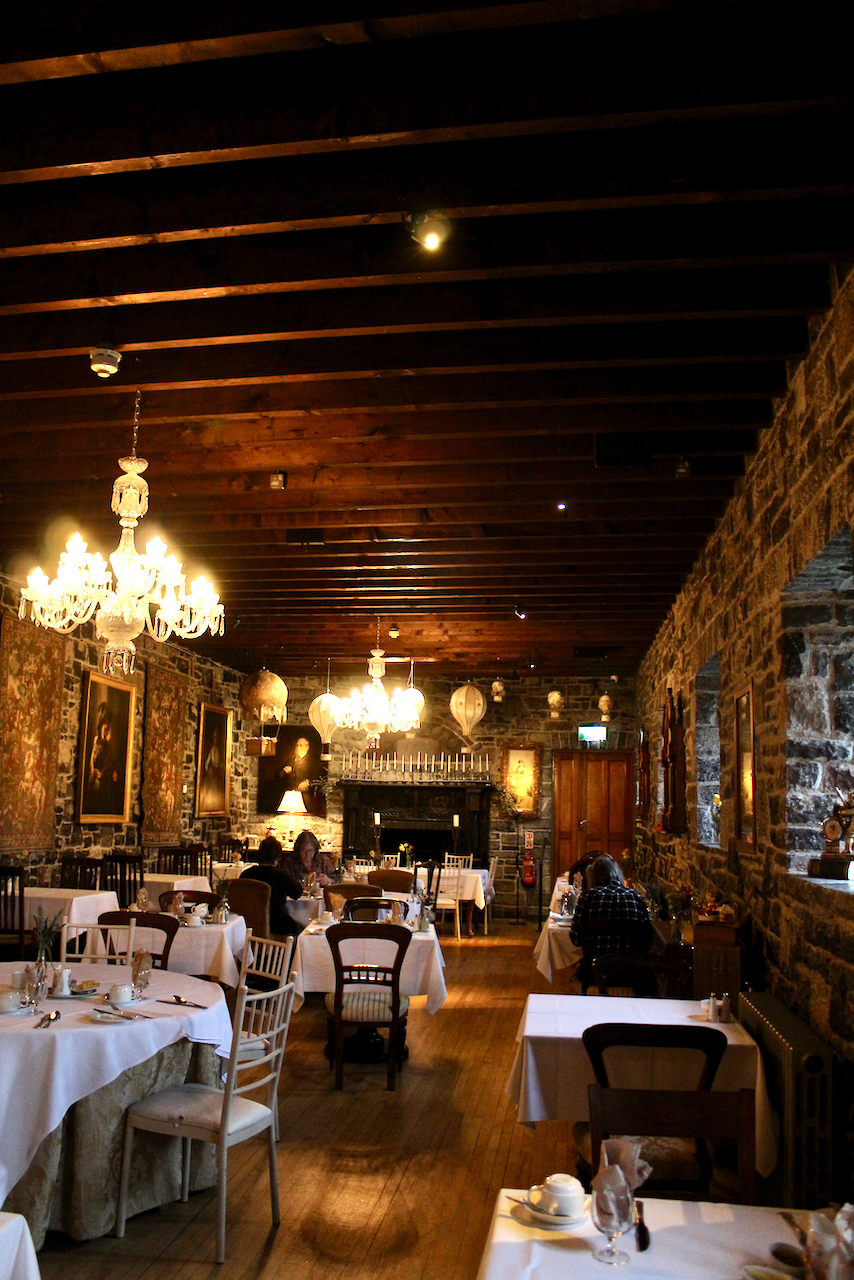
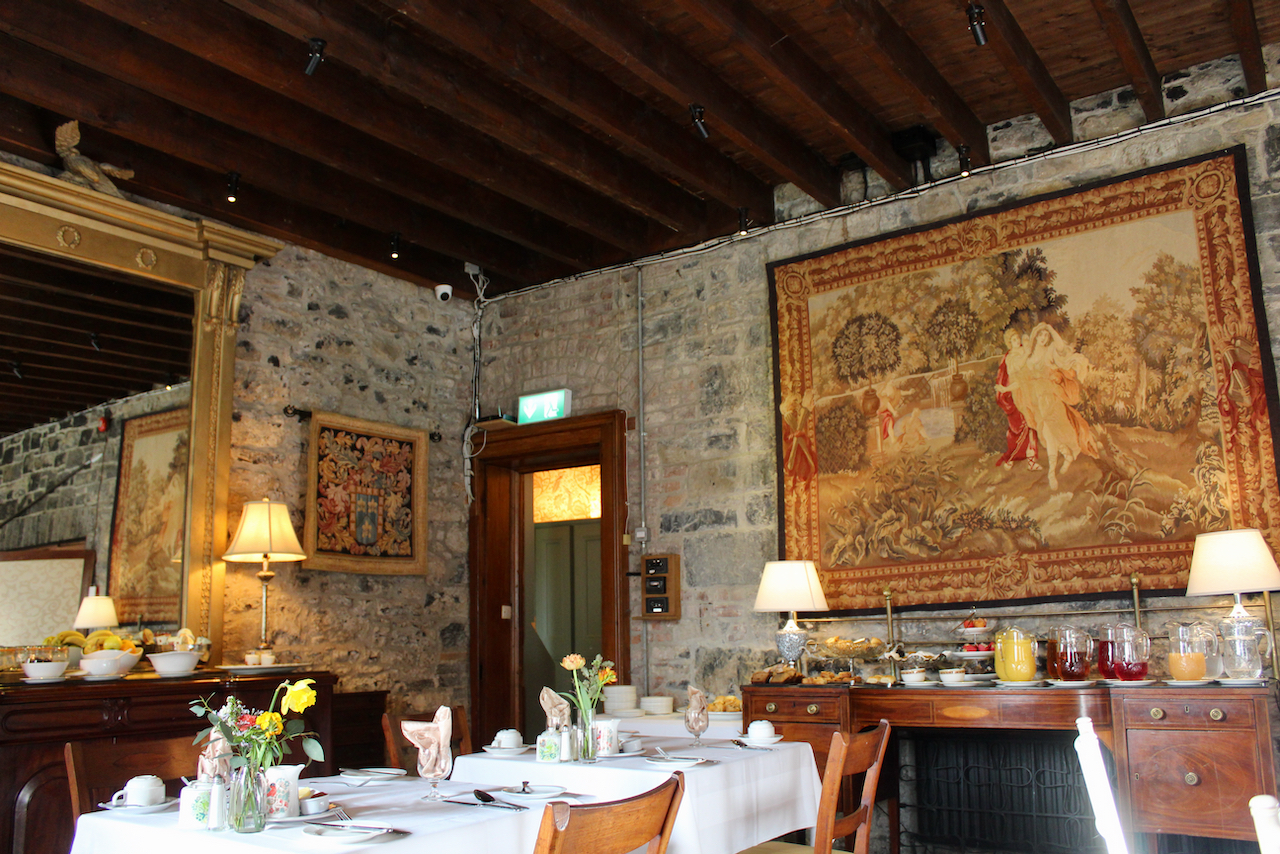
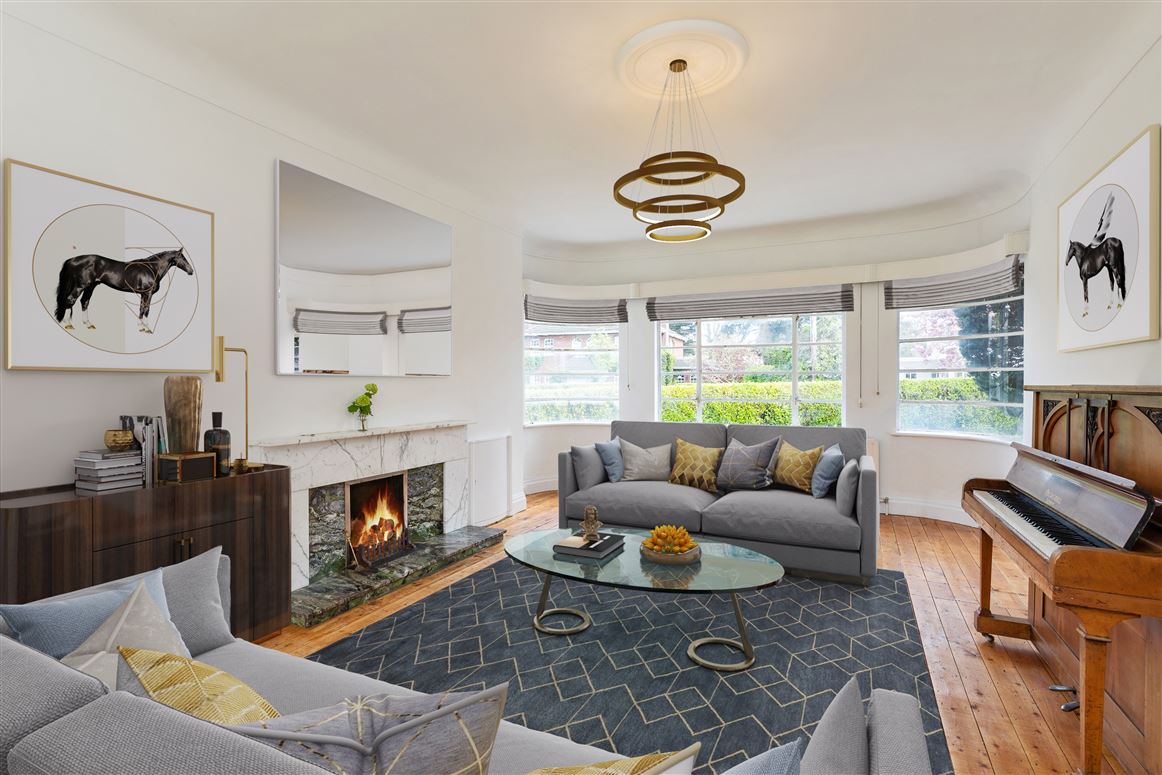
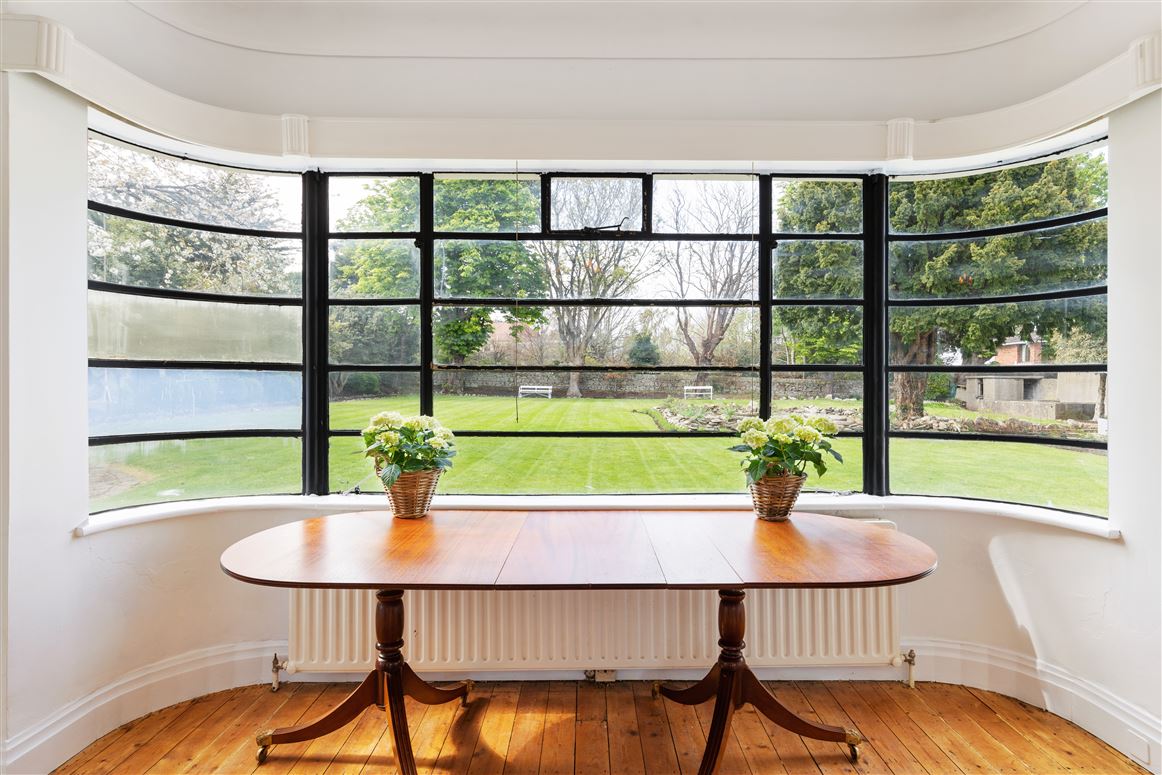
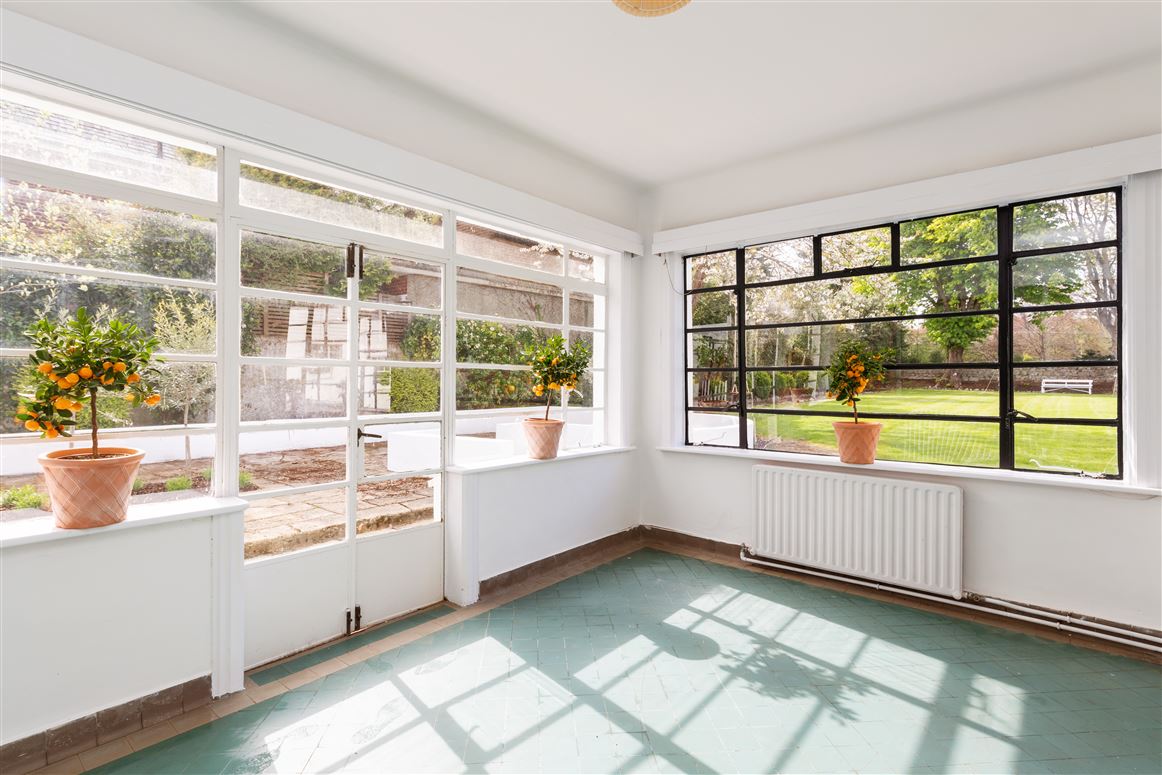
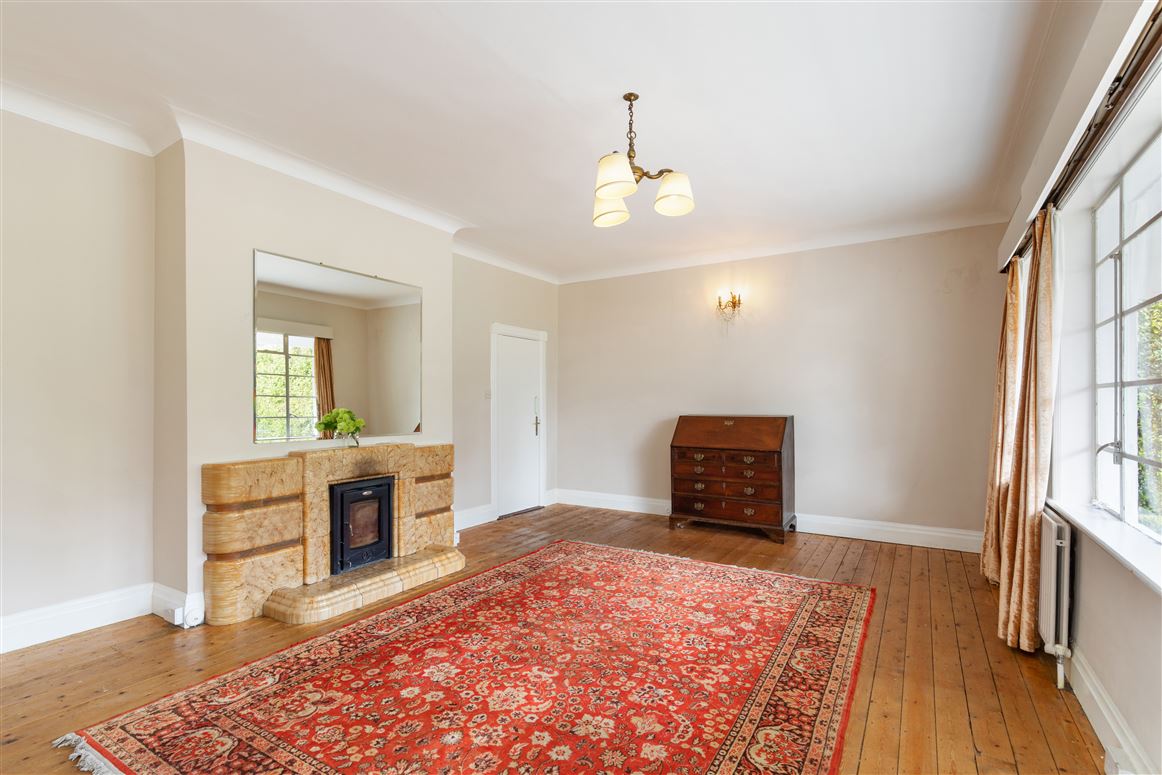
Burton Park, Churchtown, Mallow, County Cork P51 VN8H – section 482

www.slieile.ie

Open dates in 2026: Apr 1-Oct 10, Sat-Sun, National Heritage Week, Aug 15-23, 2pm-6pm

Fee: adult €9

2026 Diary of Irish Historic Houses (section 482 properties)

To purchase an A5 size 2026 Diary of Historic Houses (opening times and days are not listed so the calendar is for use for recording appointments and not as a reference for opening times) send your postal address to jennifer.baggot@gmail.com along with €20 via this payment button. The calendar of 84 pages includes space for writing your appointments as well as photographs of the historic houses. The price includes postage within Ireland. Postage to U.S. is a further €10 for the A5 size calendar, so I would appreciate a donation toward the postage – you can click on the donation link.

€20.00

donation

Help me to pay the entrance fee to one of the houses on this website. This site is created purely out of love for the subject and I receive no payment so any donation is appreciated!

€15.00

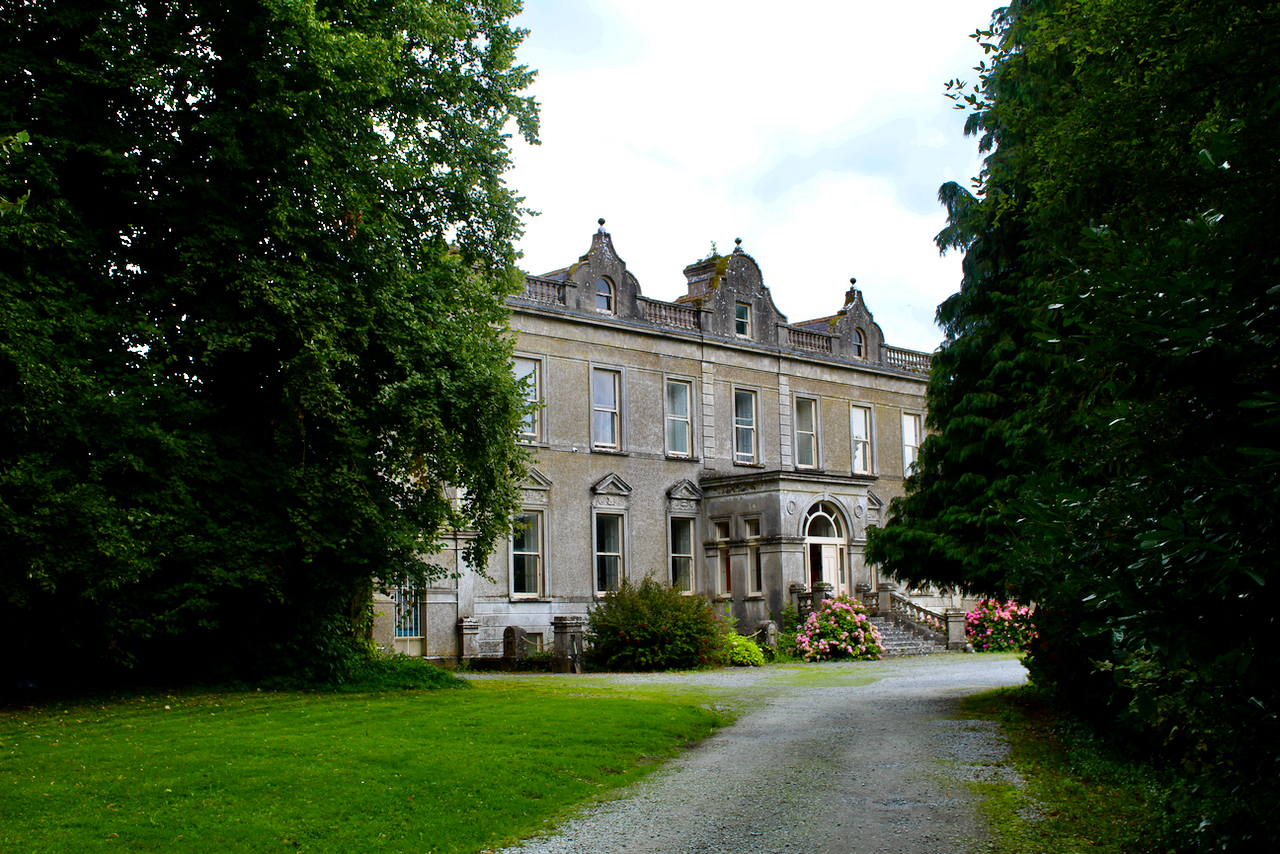
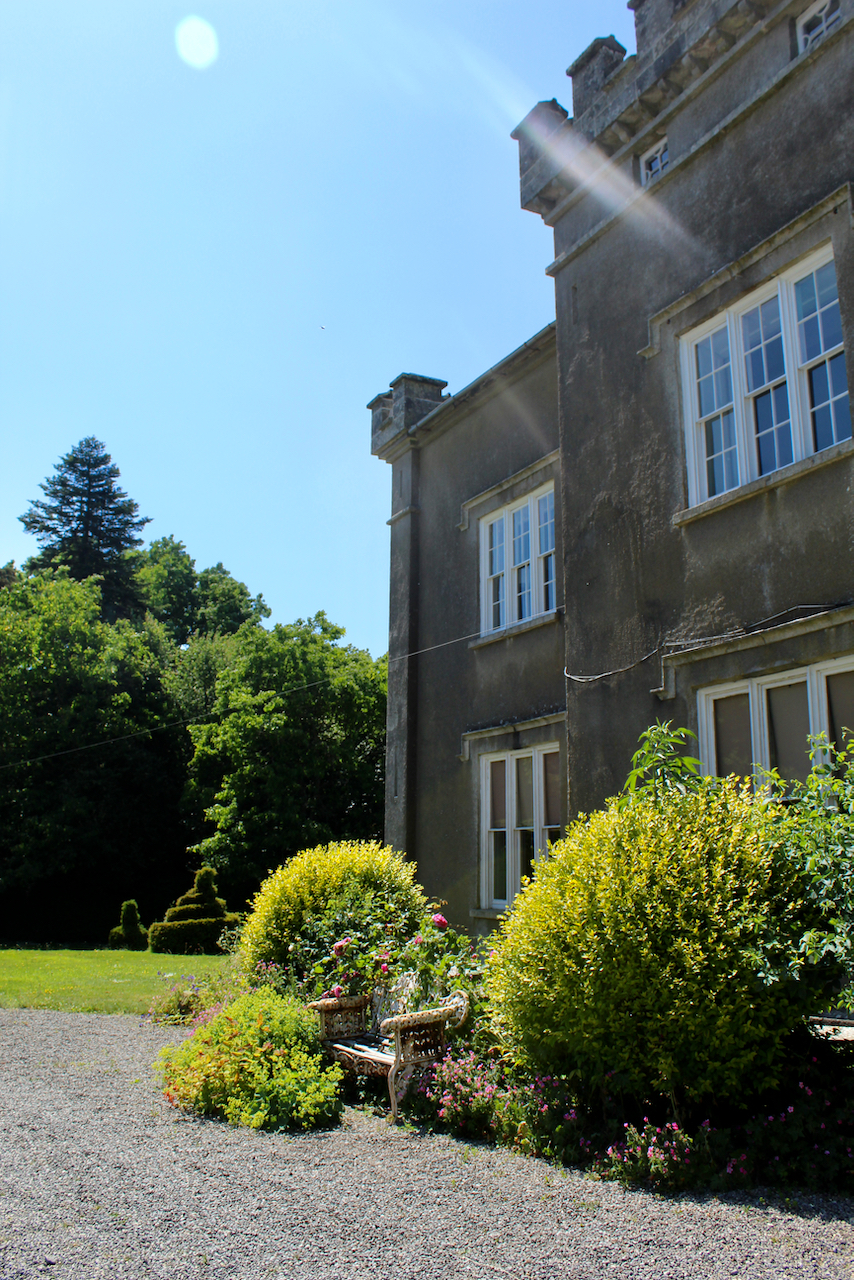
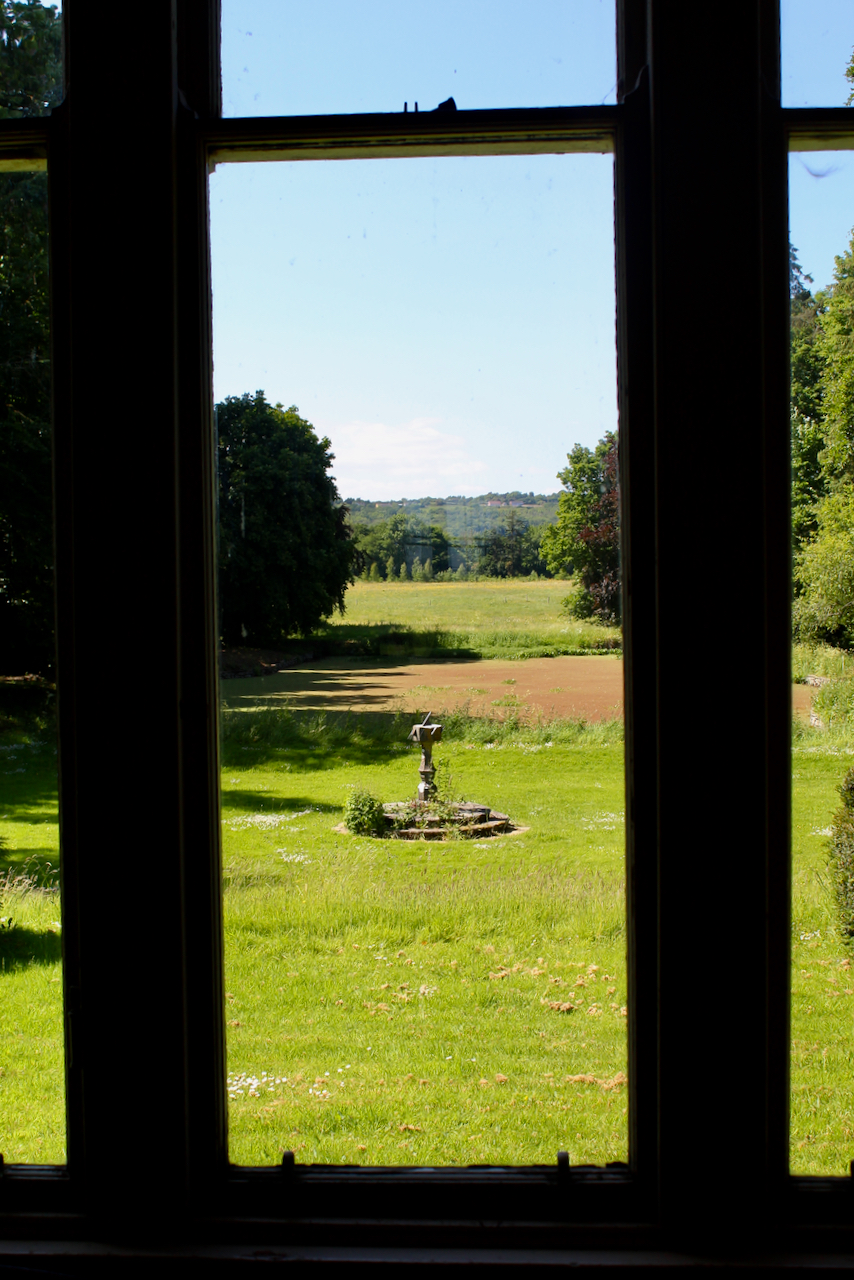
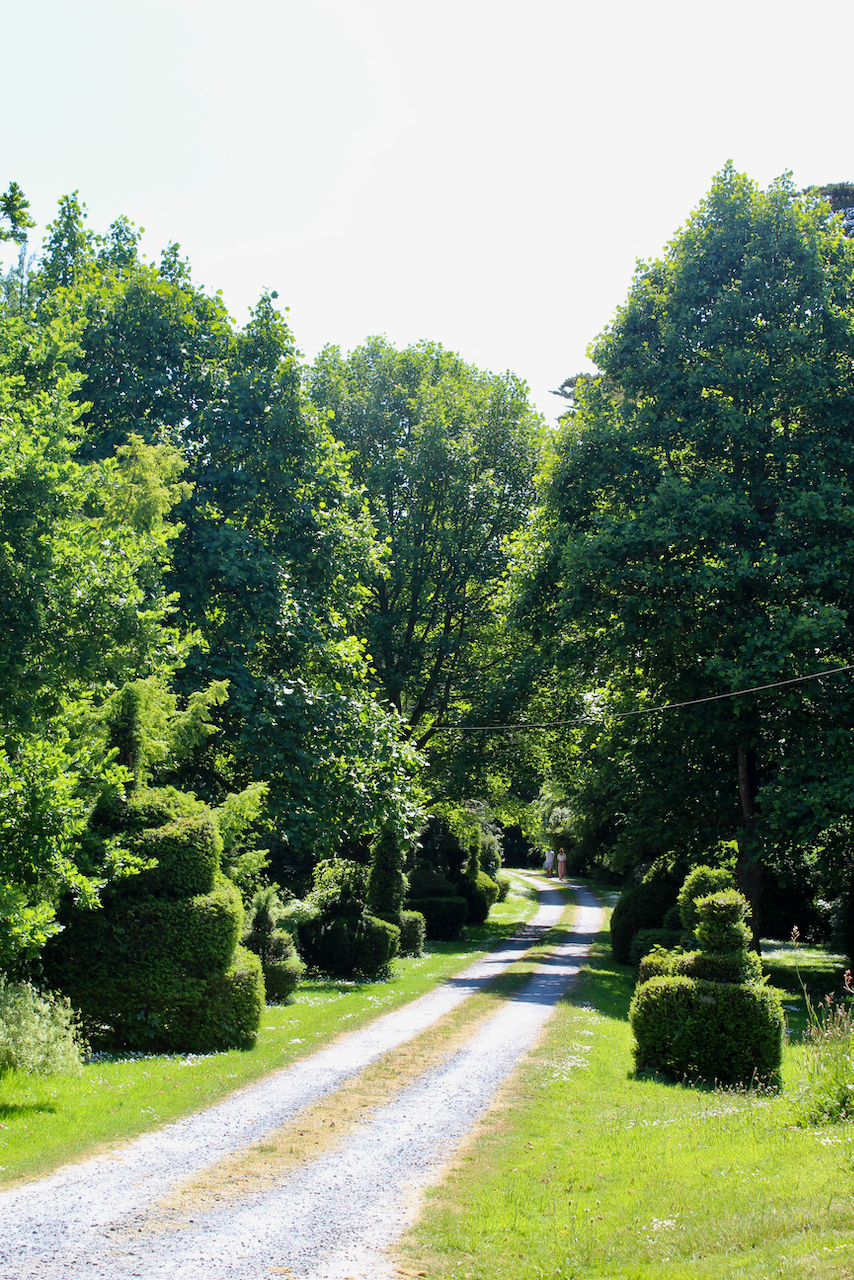
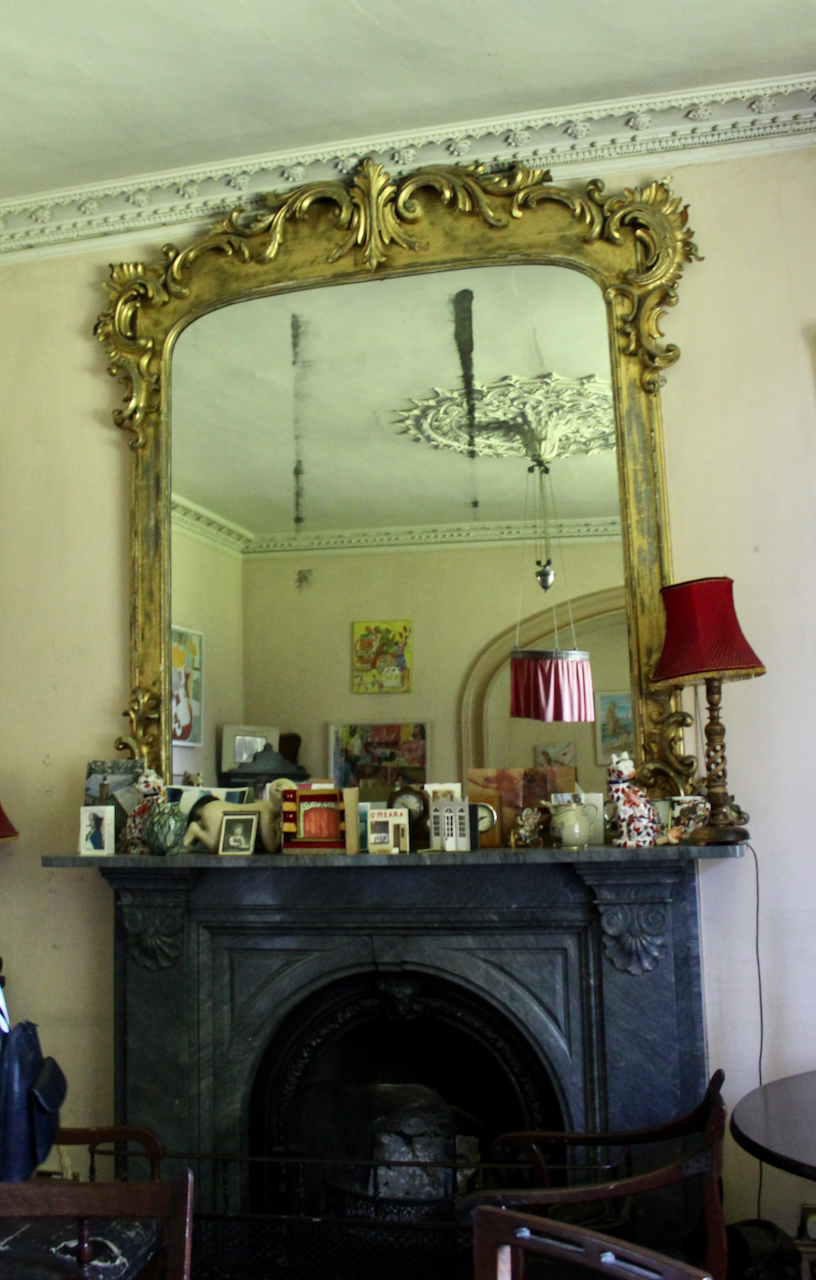
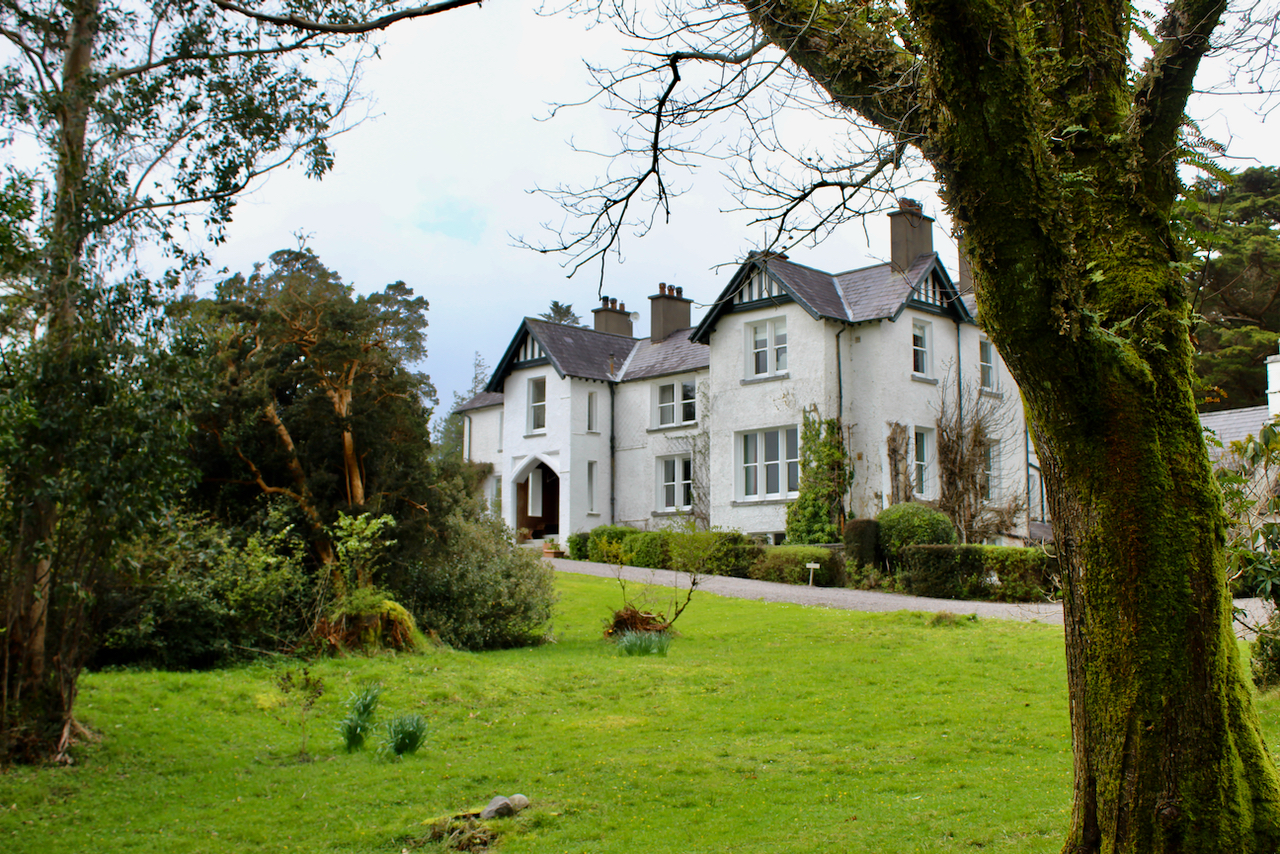
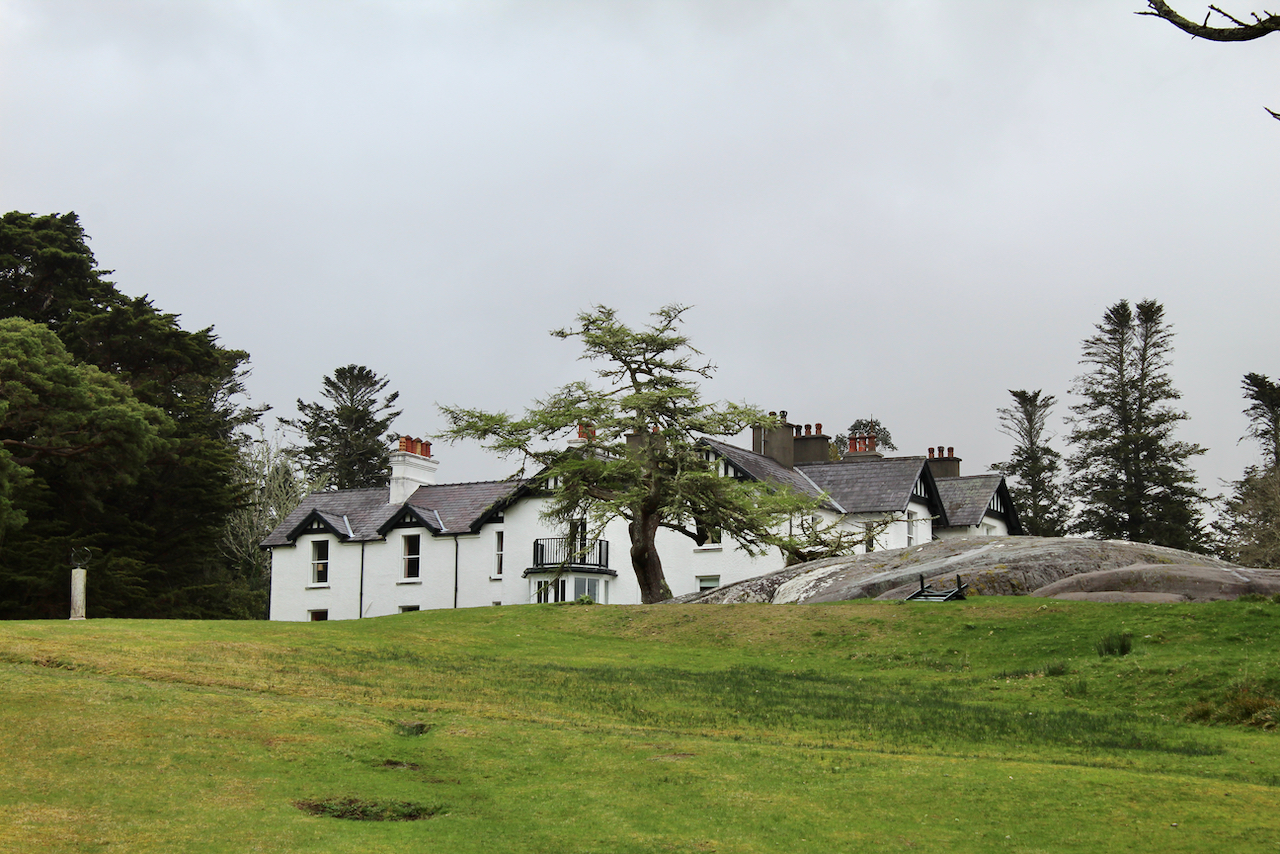
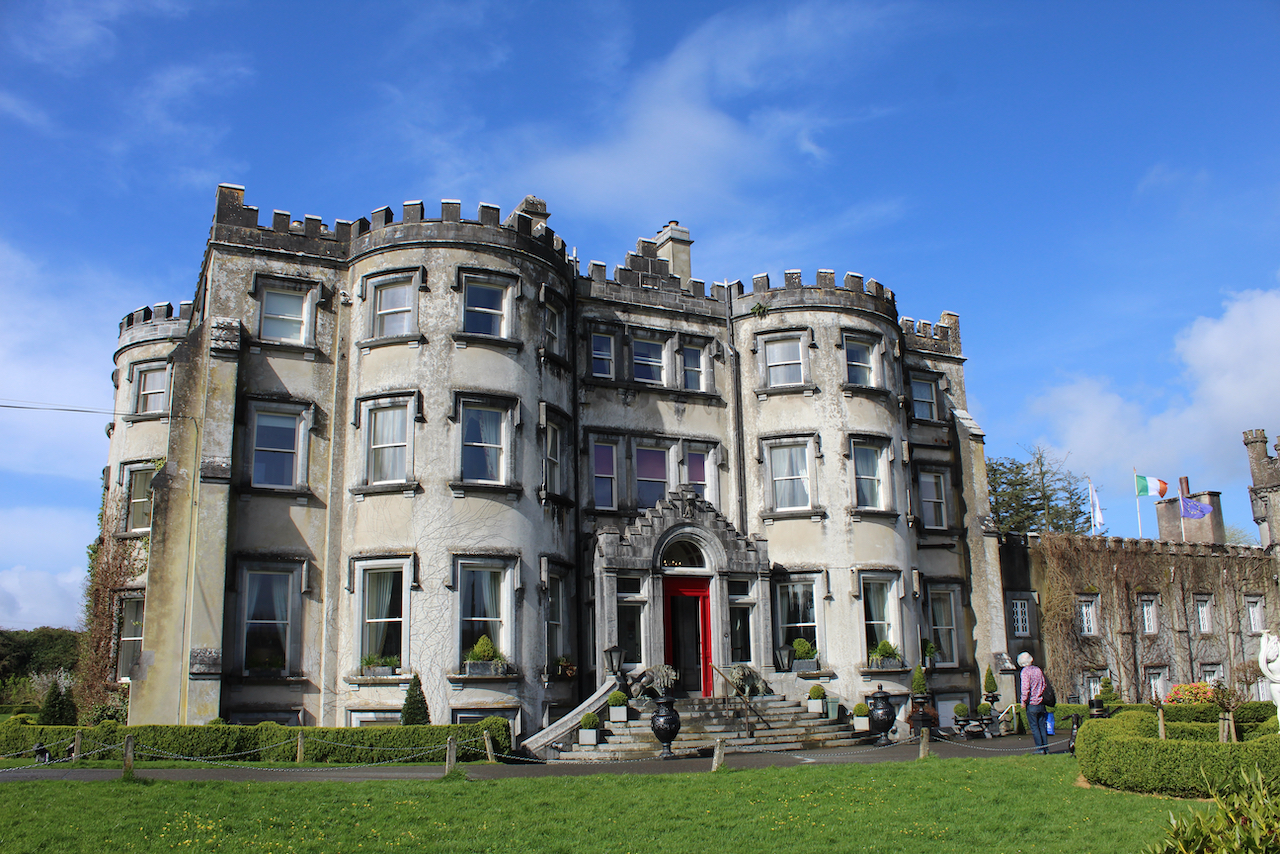
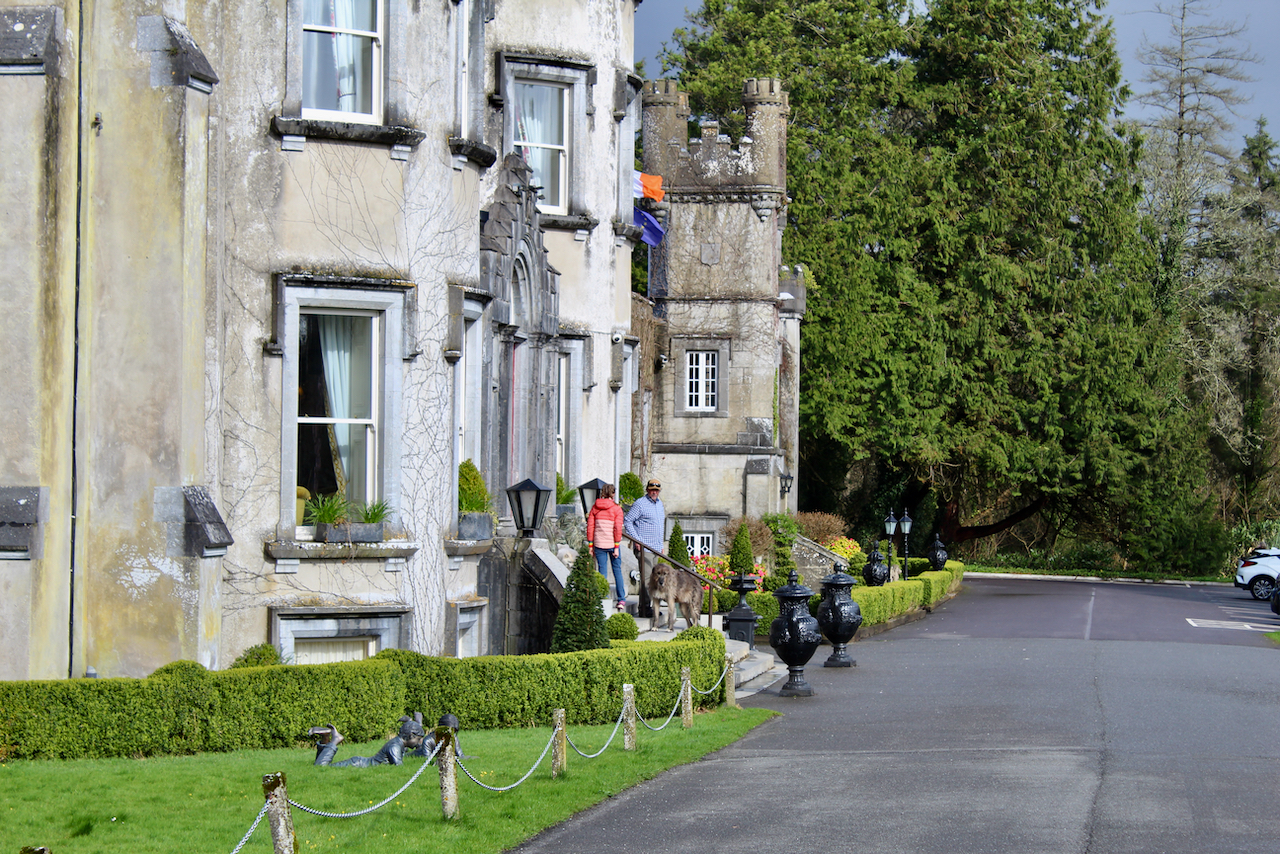
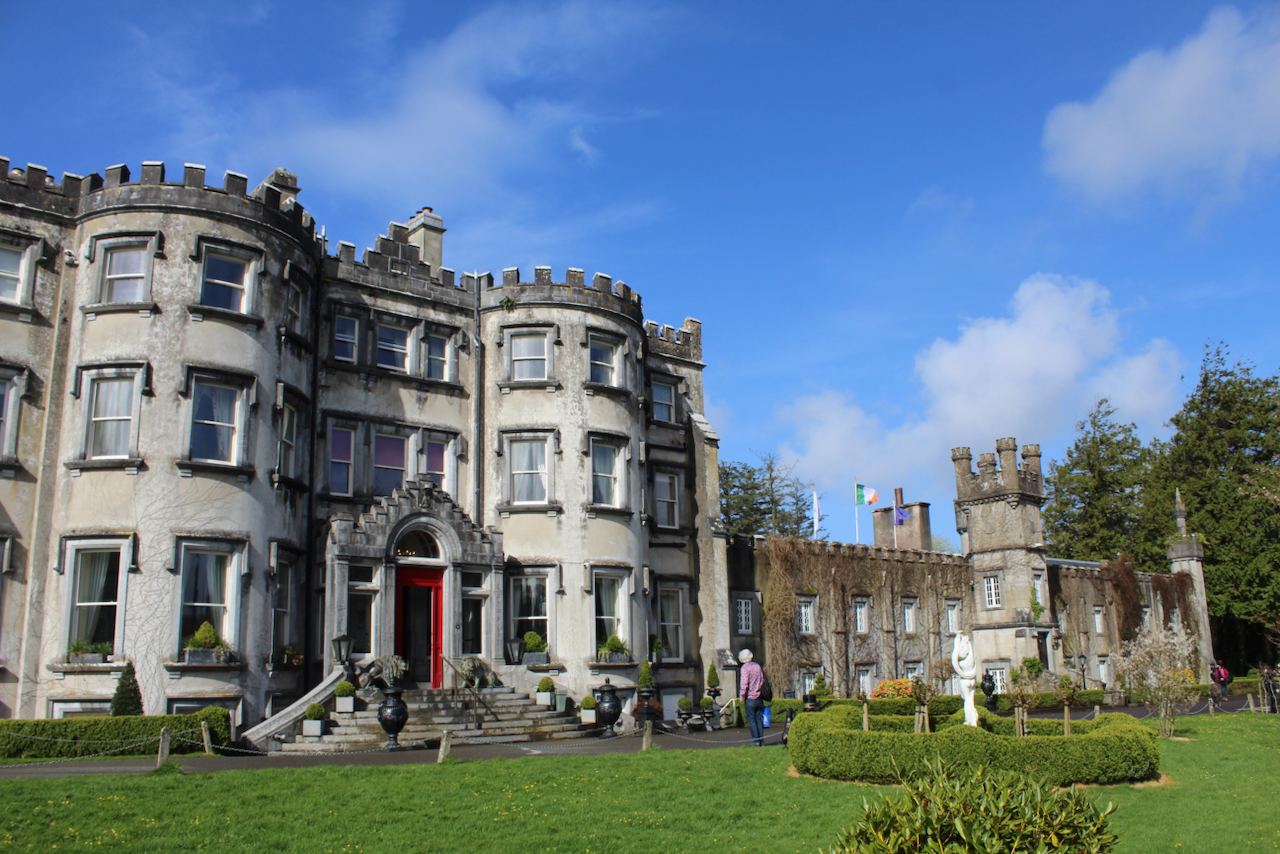
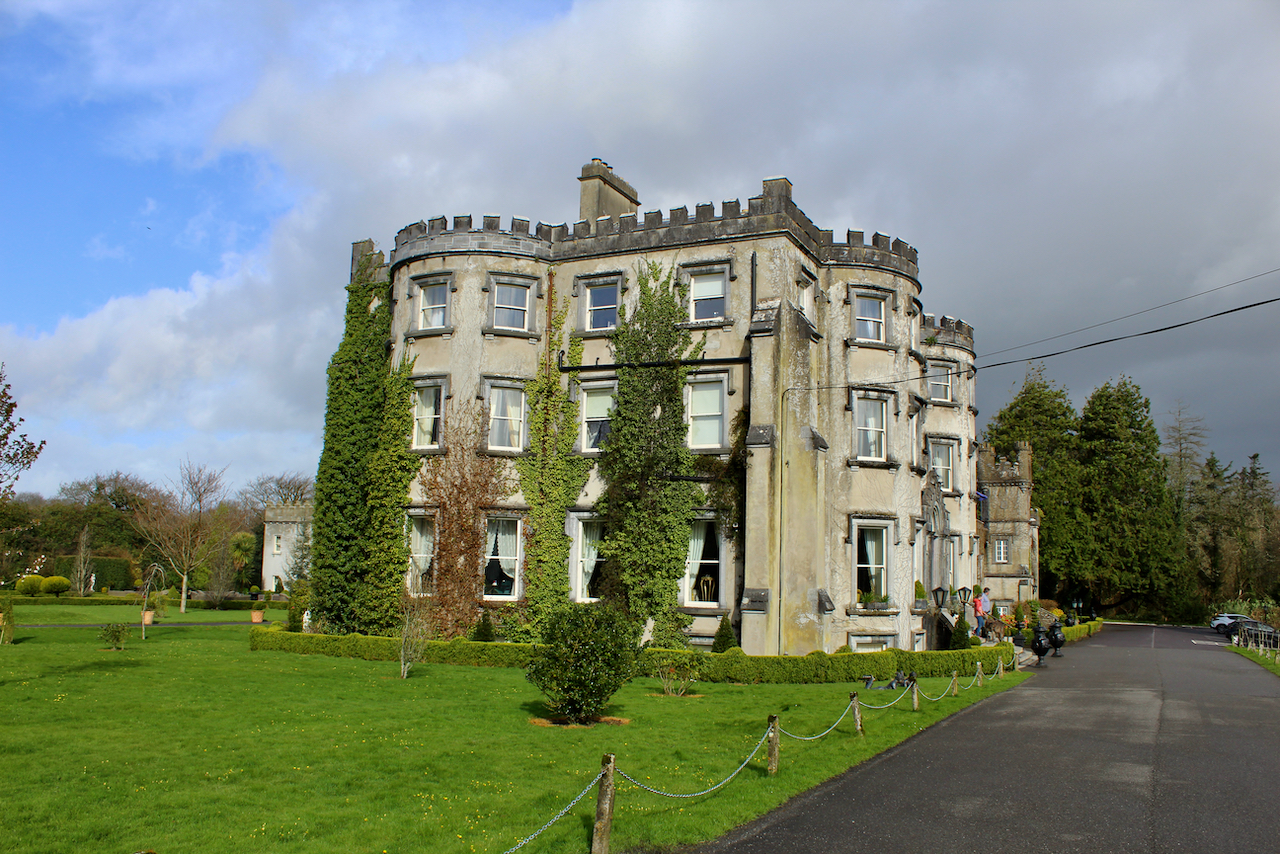
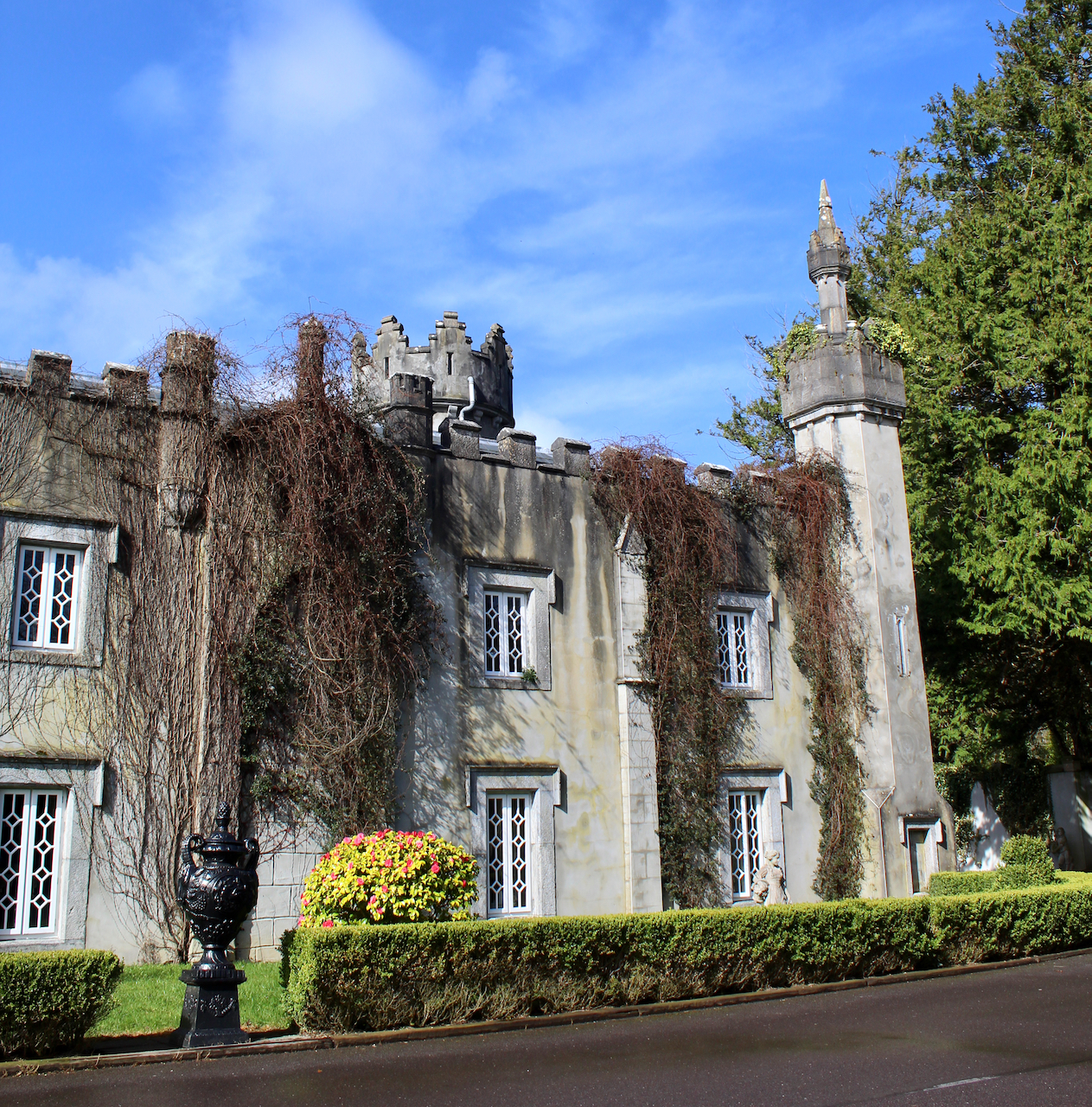
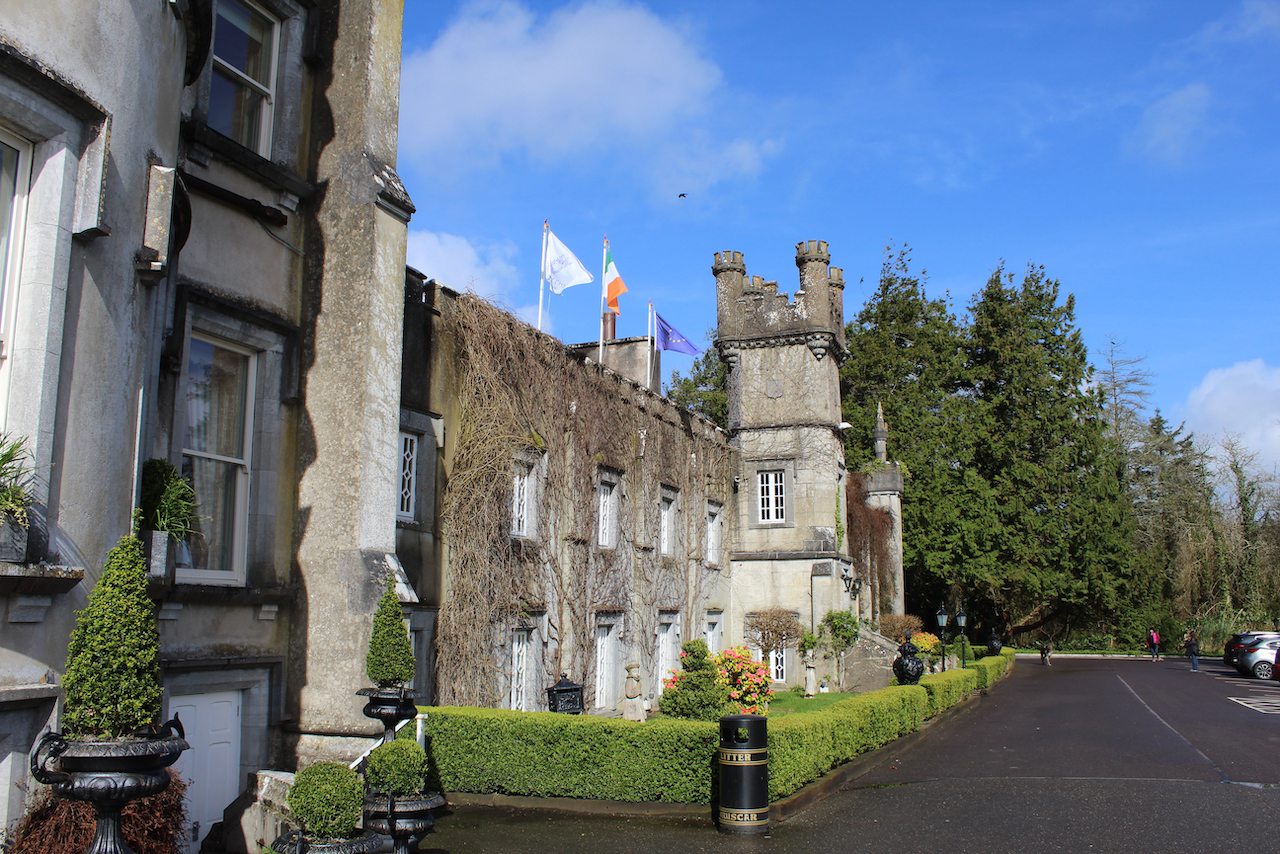
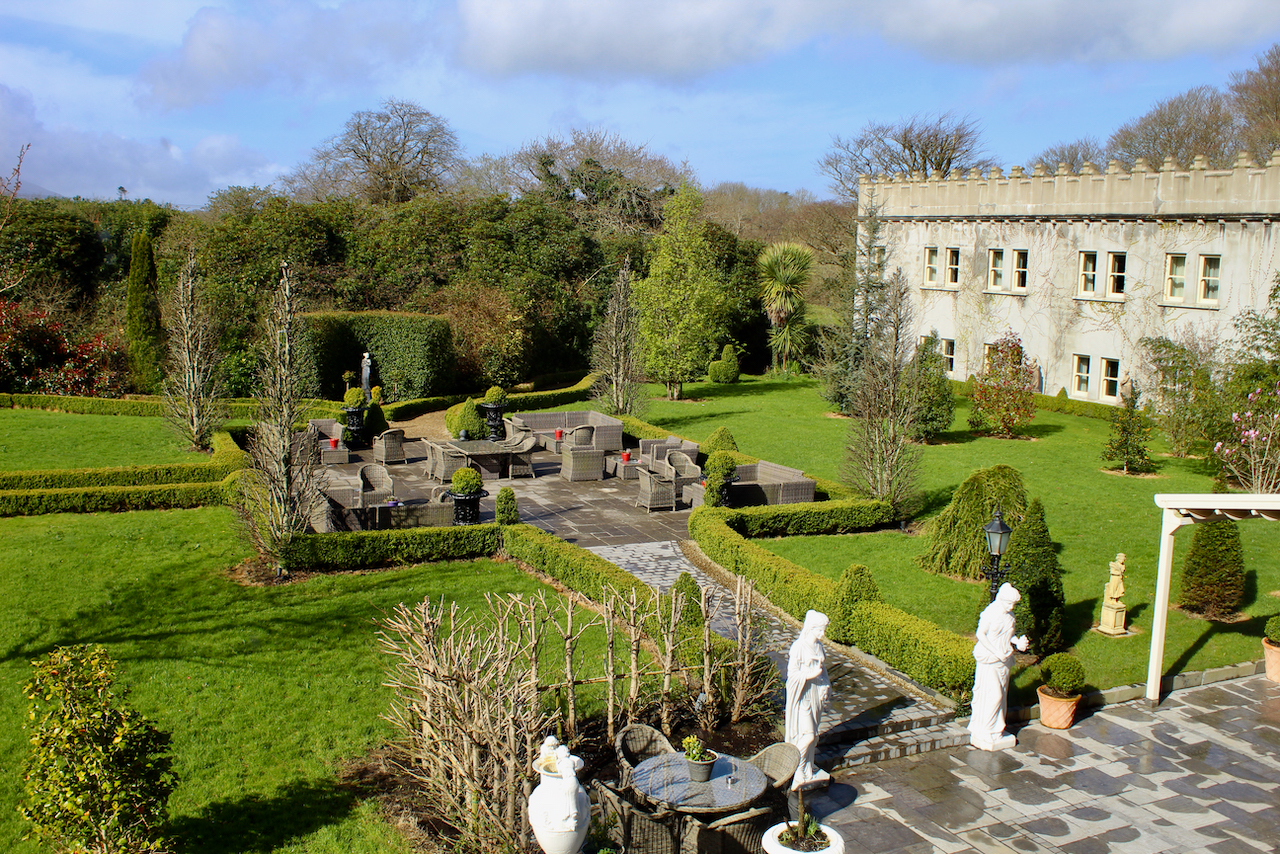
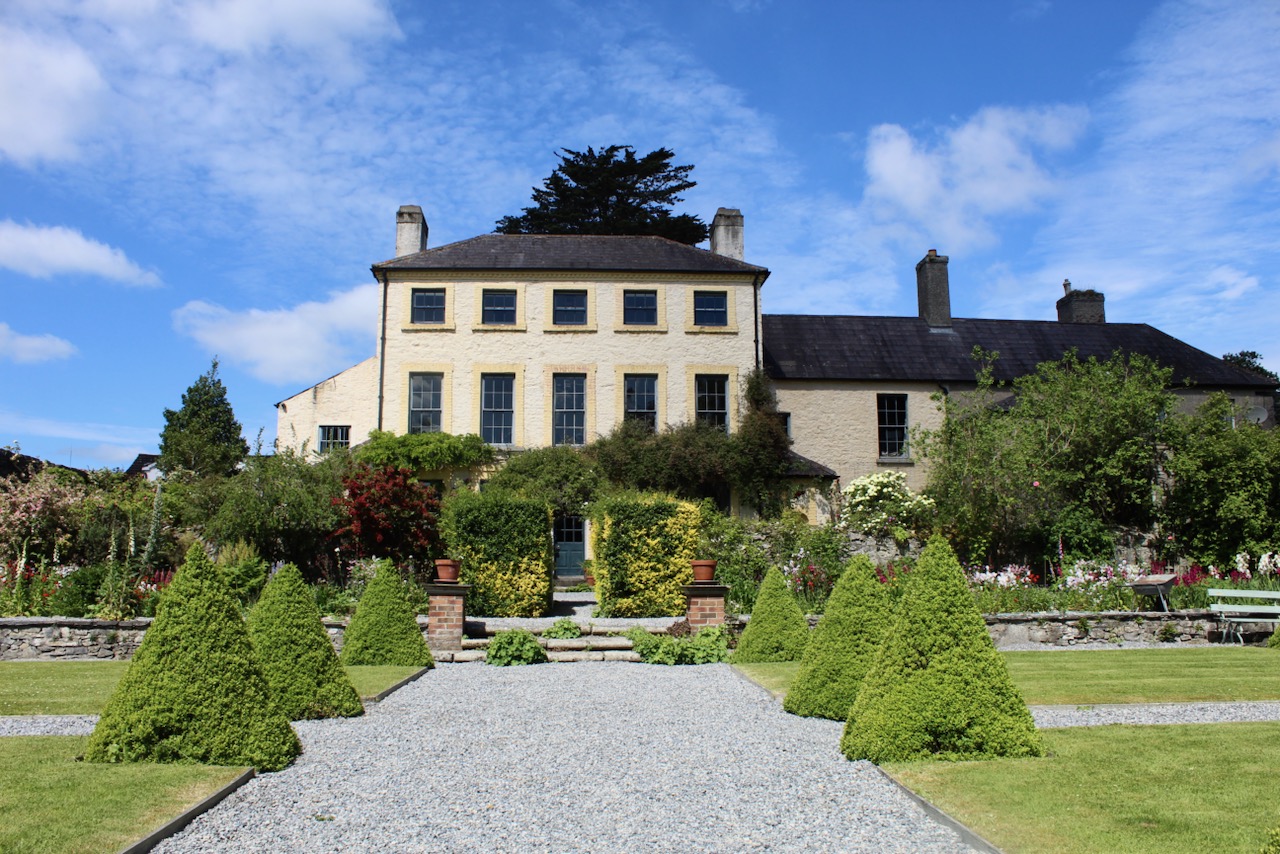
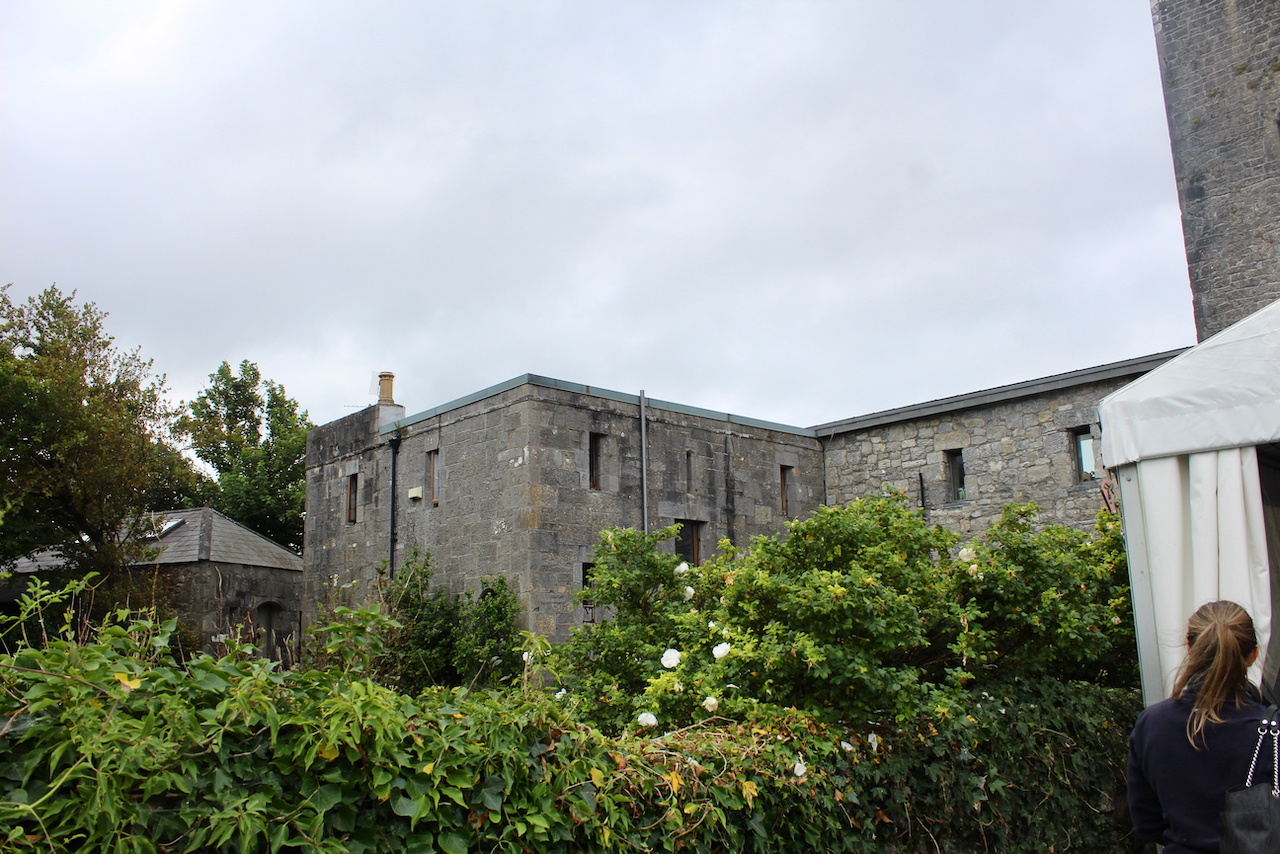
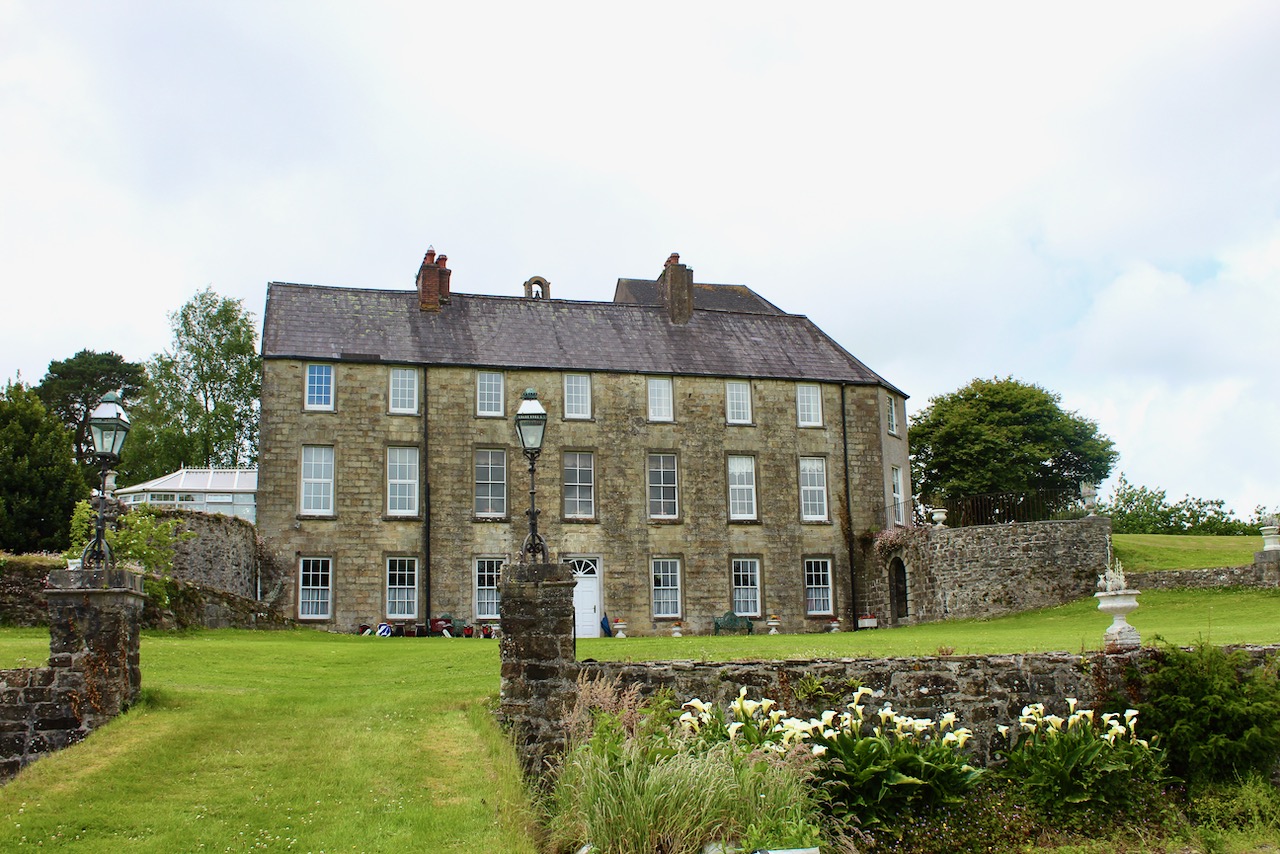
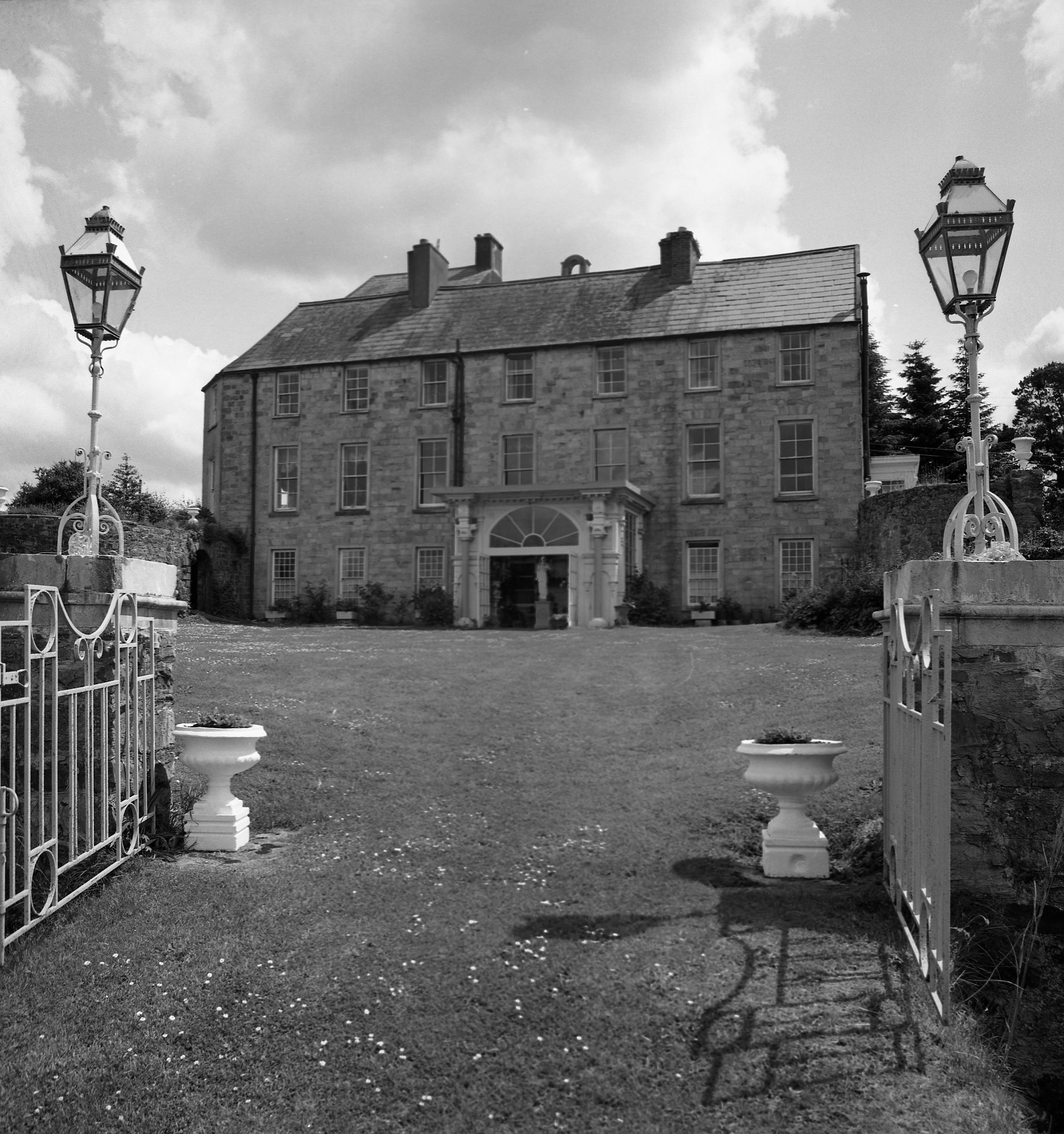
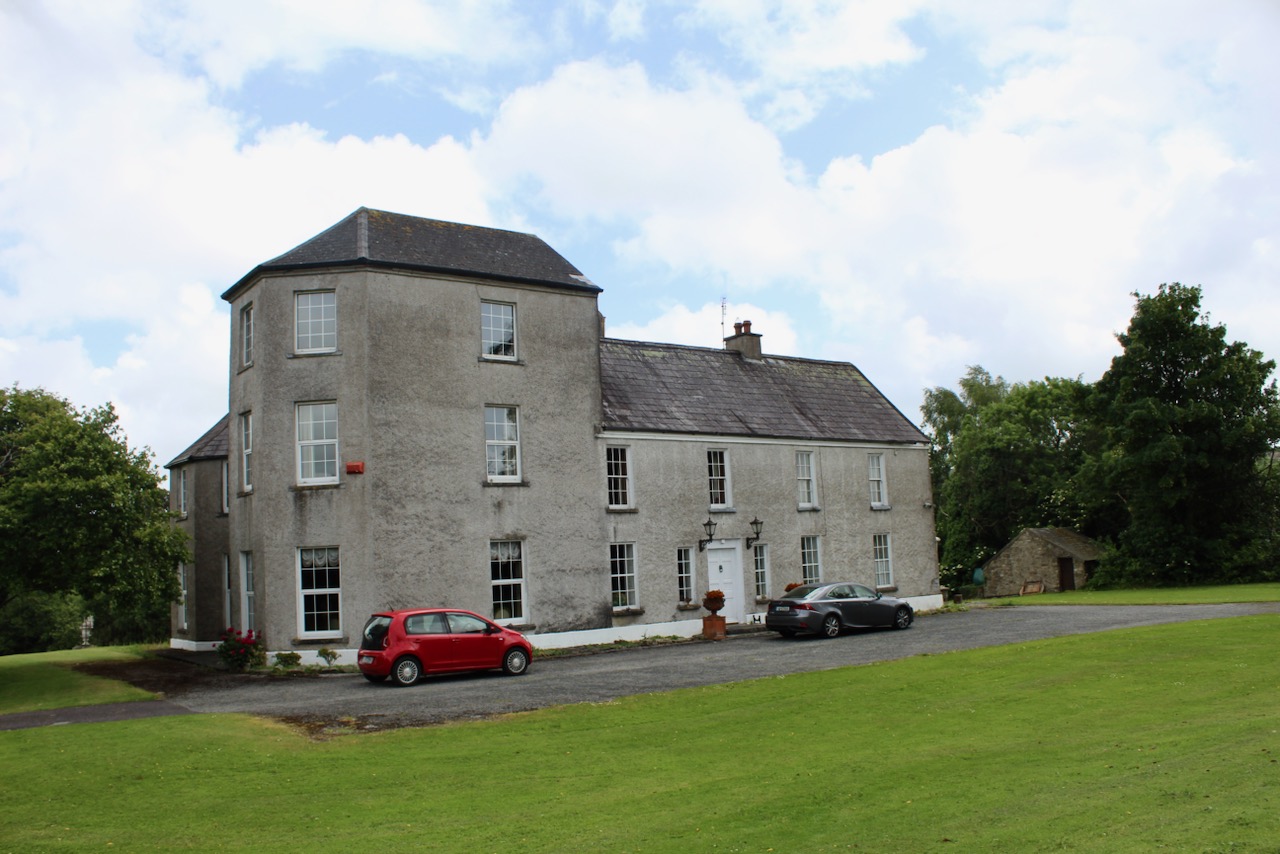
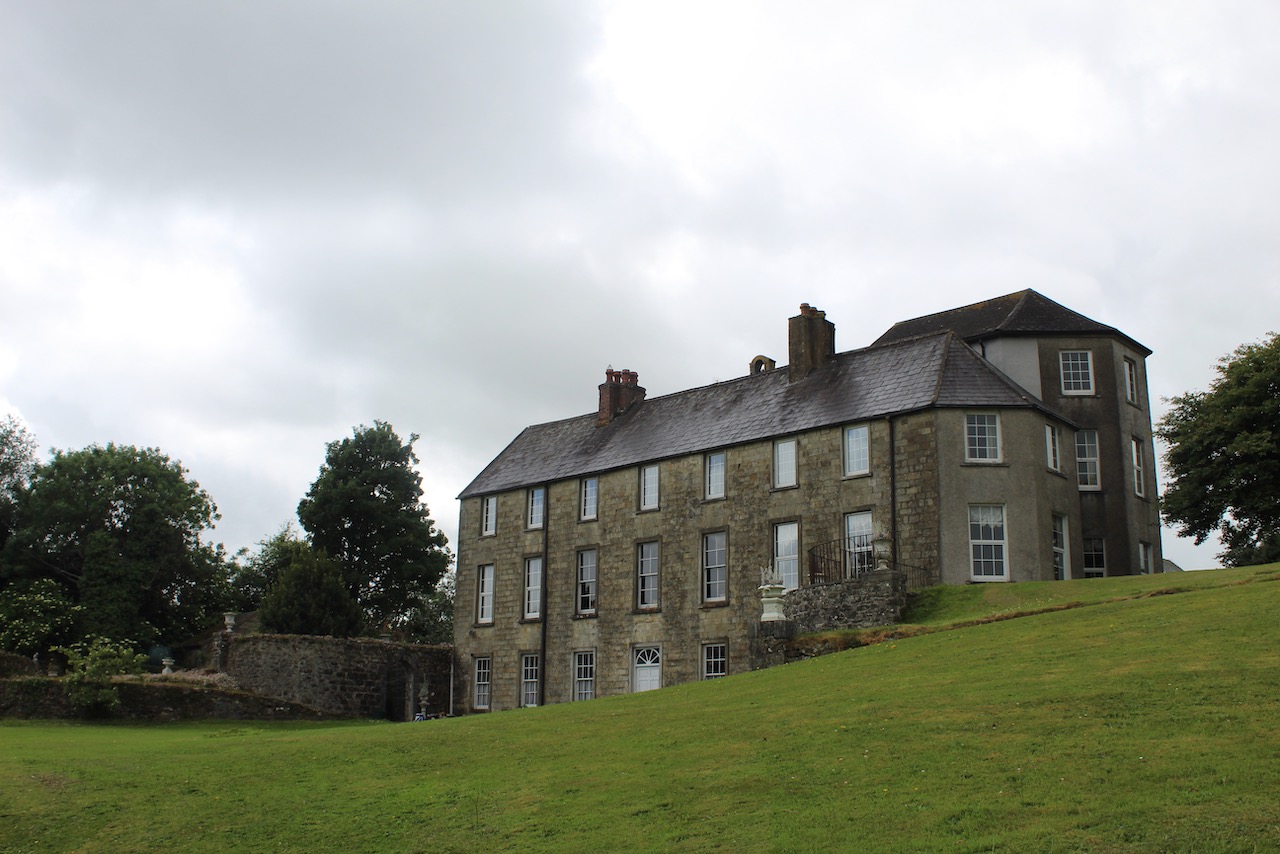
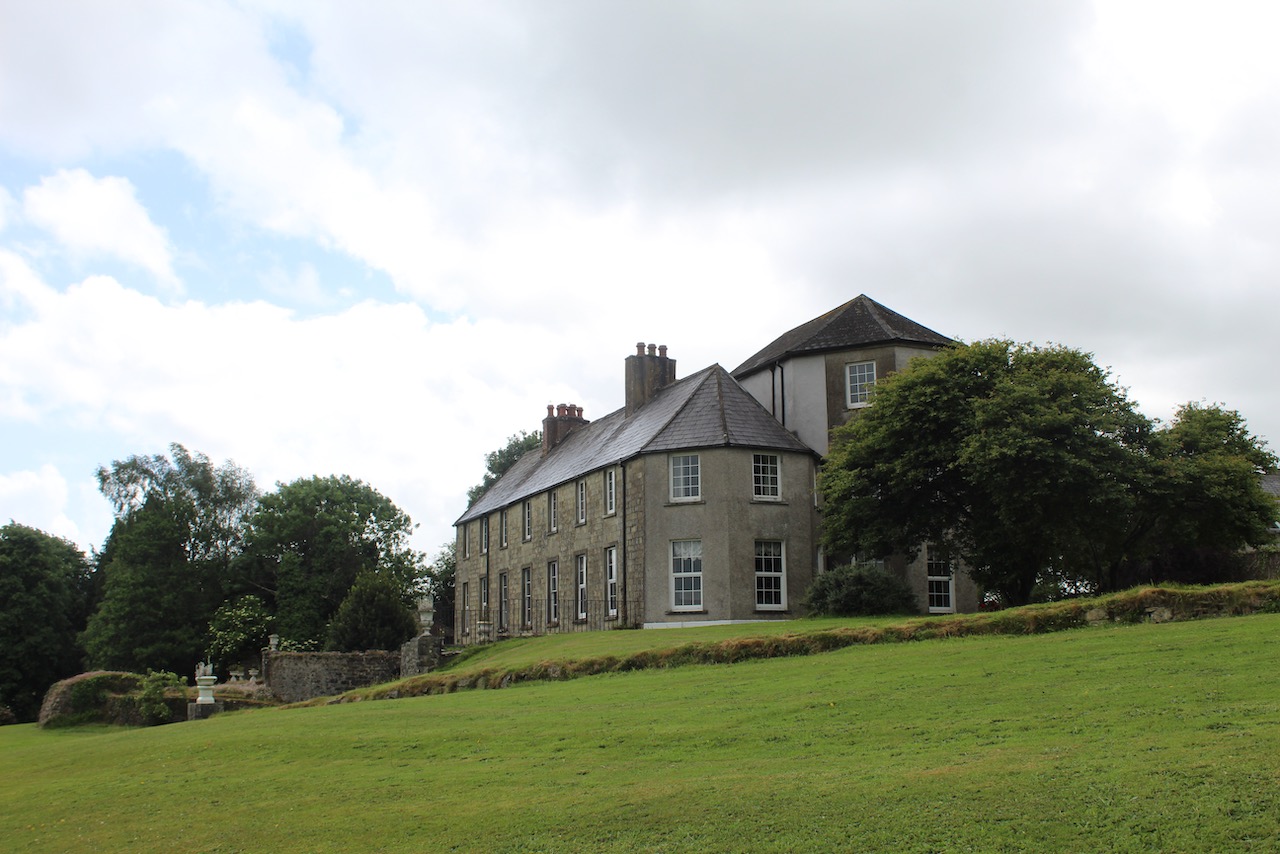
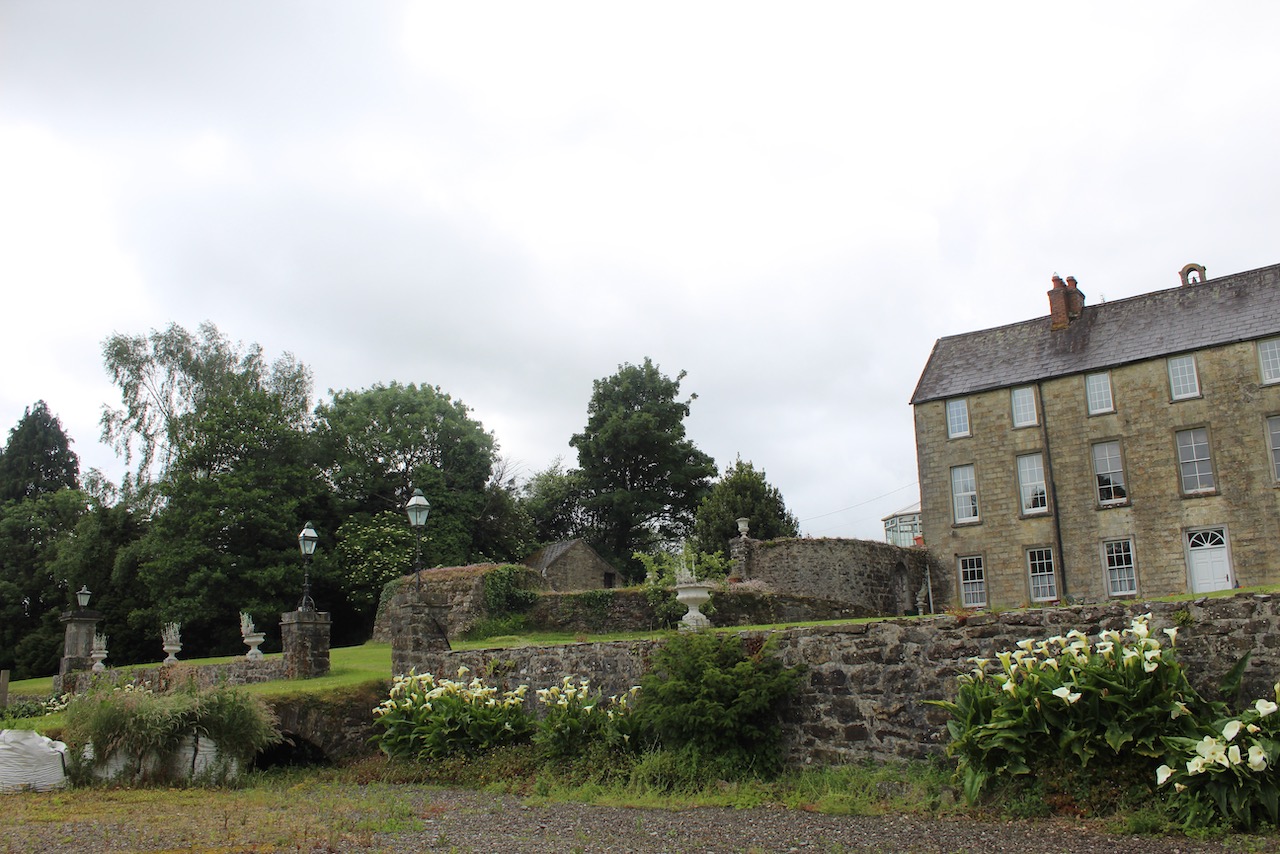
Burton Park, County Cork, August 17th 2023. Photograph © Jennifer Winder-Baggot, www.irishhistorichouses.com

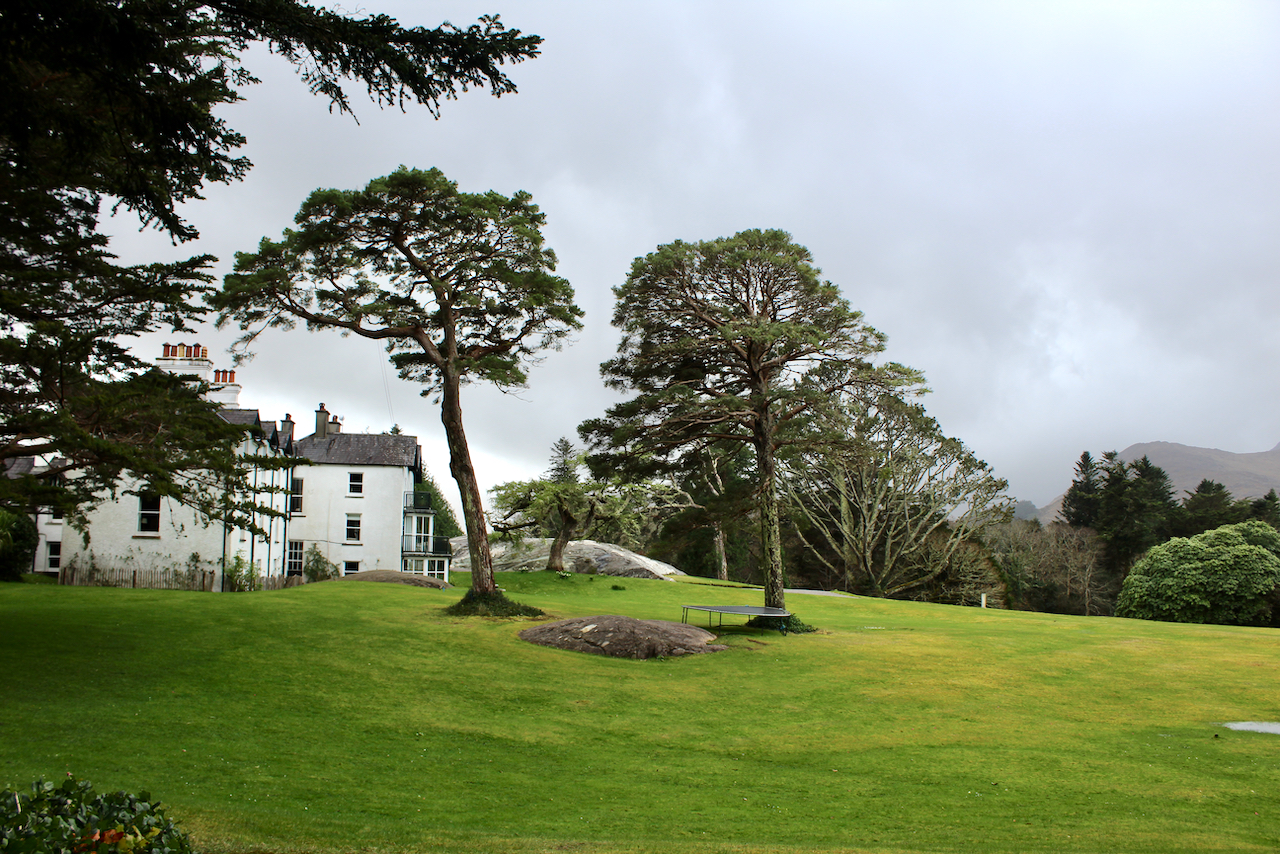
A house was first built at Burton Park around 1665 for John Perceval (1629–1665), 1st Baronet. However, this was destroyed and a later house built on its footprint. The house, which was not completed until 1709, was three times the size of the present building, which was remodelled in the late 1800s.

John Perceval, 1st Baronet (1629–1665) engraved by J. Faber (1743). From Anderson, James (1742), Whiston, William, ed., A genealogical history of the house of Yvery, in its different branches of Yvery, Luvel, Perceval and GournayGournay volume 2, London: H. Woodfall.

The house has been in the ownership of only two families: the Percevals and the Purcells. It now houses Slí Eile, and the website tells us:

In the Irish language, slí eile means ‘another way’ and Slí Eile was set up to provide an alternative recovery option for those who might otherwise have to spend time in psychiatric hospitalPeople who come to Slí Eile spend a period of 6-18 months in a residential community in which support is available from both professional staff and from peers. Participating in the Slí Eile community provides an opportunity for a fresh start in a safe, nurturing environment. It also serves to restore a structured pattern to life. It helps in the development of both interpersonal skills and the practical skills that are required for daily living.” [1]

You can read more about Slí Eile on their website.

The website tells us that the original dwelling was fortified with high walls around the house, with four turrets, one at each corner. There are a number of underground passages, recently discovered, which correspond with the sites of the turrets as they would have appeared in the original design.

Philip Perceval (1605-1647), father of John, came to Ireland where he served as registrar of the Irish court of wards, along with his brother Walter. When Walter died in 1624, Philip inherited the family estates in England and Ireland. The land at Burton Park was named after his estate in Somerset, Burton. He settled in Ireland, and by means of his interest at court he gradually obtained a large number of additional offices. In 1625 he was made keeper of the records in the Birmingham Tower at Dublin Castle.

Perceval was close to the Lord Deputy of Ireland, Thomas Wentworth, 1st Earl of Strafford. With the fall and execution of Wentworth in May 1641, Perceval lost his major patron and protector. In September 1641 Perceval narrowly avoided prosecution in England when his part in a shady land transaction was revealed. By that time, Perceval owned over 100,000 acres in Ireland, which he obtained partly through forfeited lands.

Philip Perceval married Catherine Ussher, daughter of Arthur Ussher and Judith Newcomen. She gave birth to their heir, John (1629–1665), who was created 1st Baronet in 1661. A younger son, George (1635-1675) lived at Temple House in County Sligo, another Section 482 property which we have yet to visit.

In 1665 the officer-architect Captain William Kenn, then engaged on Charleville Manor for Roger Boyle, 1st Earl of Orrery, proposed a design, and building work on Burton Park started for the 1st Baronet Perceval. [2]

John Perceval served in Oliver Cromwell’s Commonwealth. He was involved in sending the opponents of Cromwell from their sequestered lands to Connaught. However, he began to distance himself from the Parliament and declined Cromwell’s invitation to sit in Cromwell’s Parliament.

After the Restoration of King Charles II, John Perceval was pardoned for his part in Cromwell’s government, and was granted a Baronetcy (of Kanturk) and made a Privy Councillor to Charles II. He married Catherine Southwell of Kinsale, County Cork.
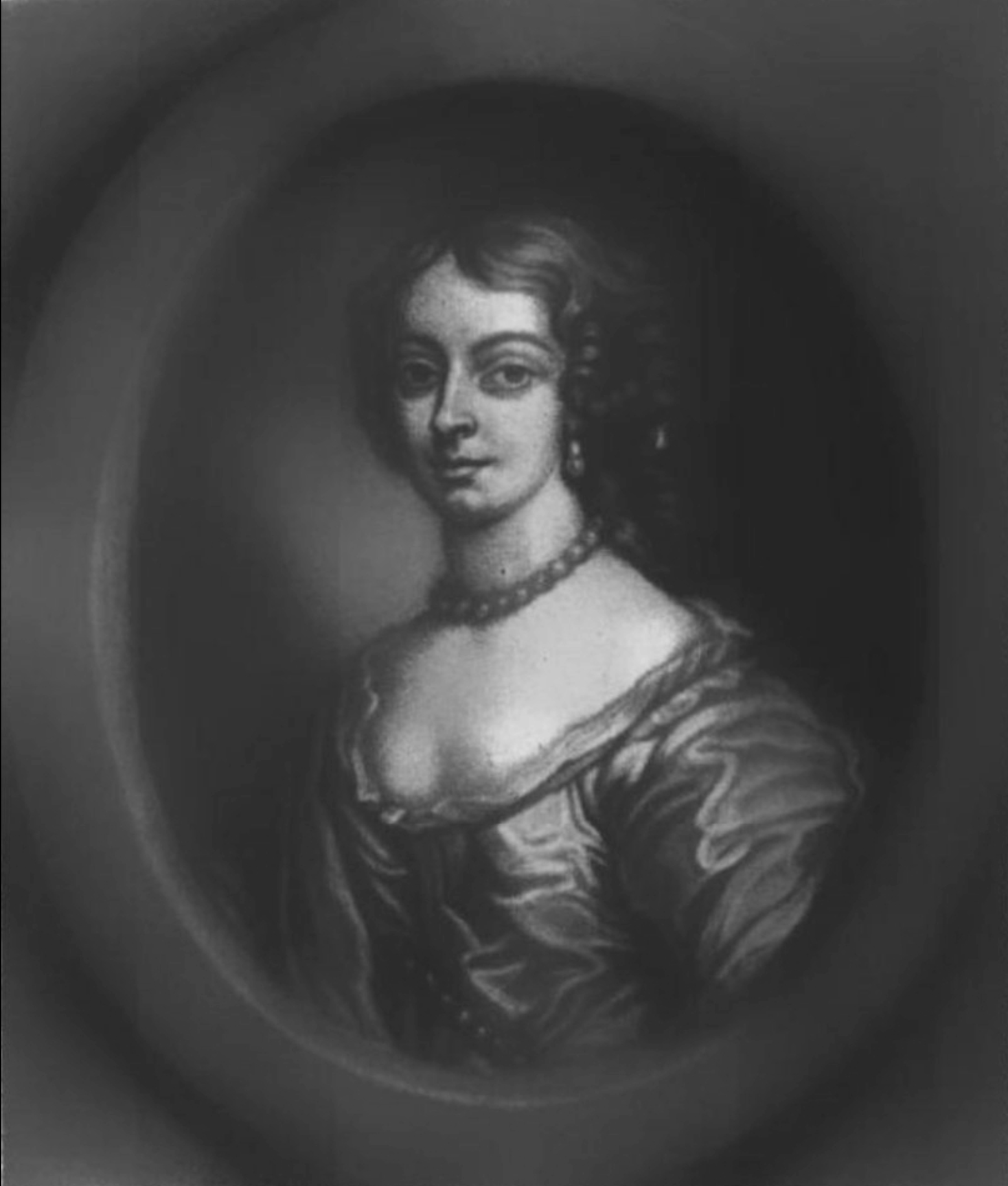
Catherine (1637 – 1679) the only daughter of Sir Robert Southwell of Kinsale, wife of Sir John Perceval, 1st Baronet. Engraved by J. Faber (1743). From Anderson, James (1742), Whiston, William, ed., A genealogical history of the house of Yvery, in its different branches of Yvery, Luvel, Perceval and GournayGournay volume 2, London: H. Woodfall, p. 360

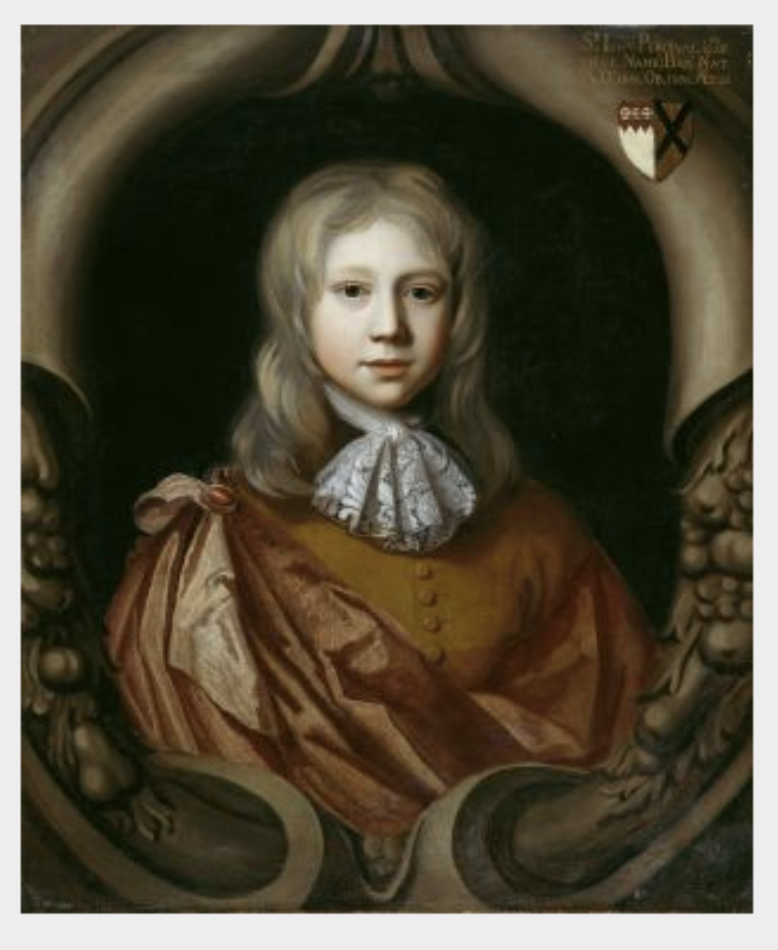
Catherine and John’s son eldest son and heir died at the age of 24 and he was succeeded by his brother, John (c. 1660-1686), who became 3rd Baronet of Kanturk.
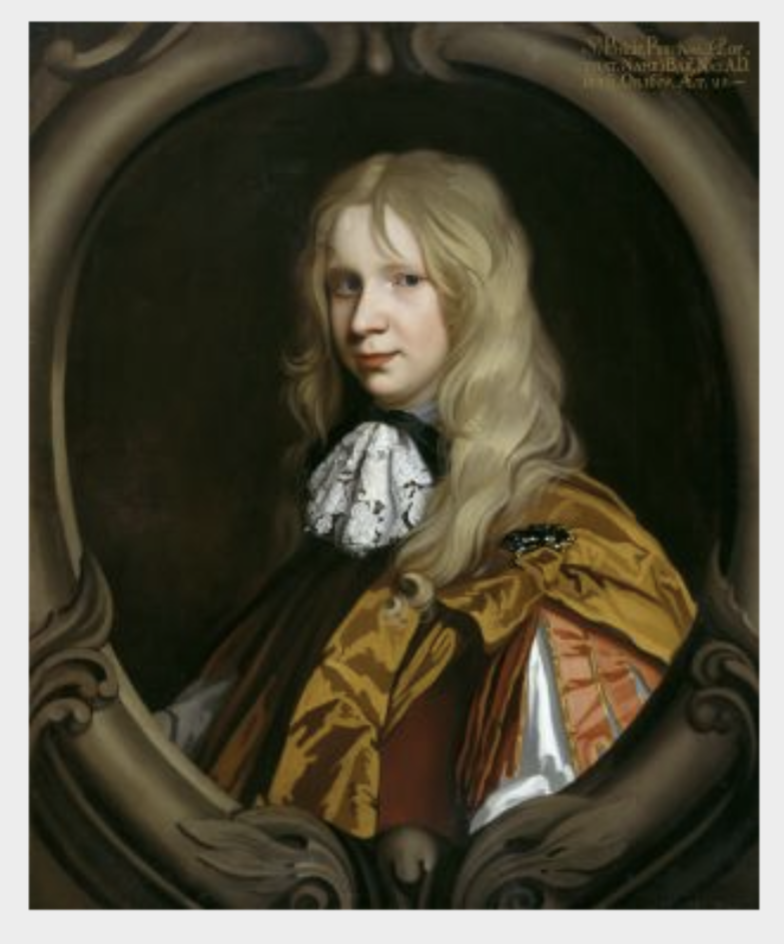
Sir Philip Perceval, 2nd Bt (1656-1680) by Thomas Pooley c. 1670-74, courtesy of National Gallery of Ireland NGI 4626.
John Perceval, 3rd Bt (1660-1686) by Thomas Pooley, c. 1670-74, courtesy of National Gallery of Ireland NGI 4627.
John Perceval 3rd Bt, by John Faber Jr, National Portrait Gallery of London D29835.

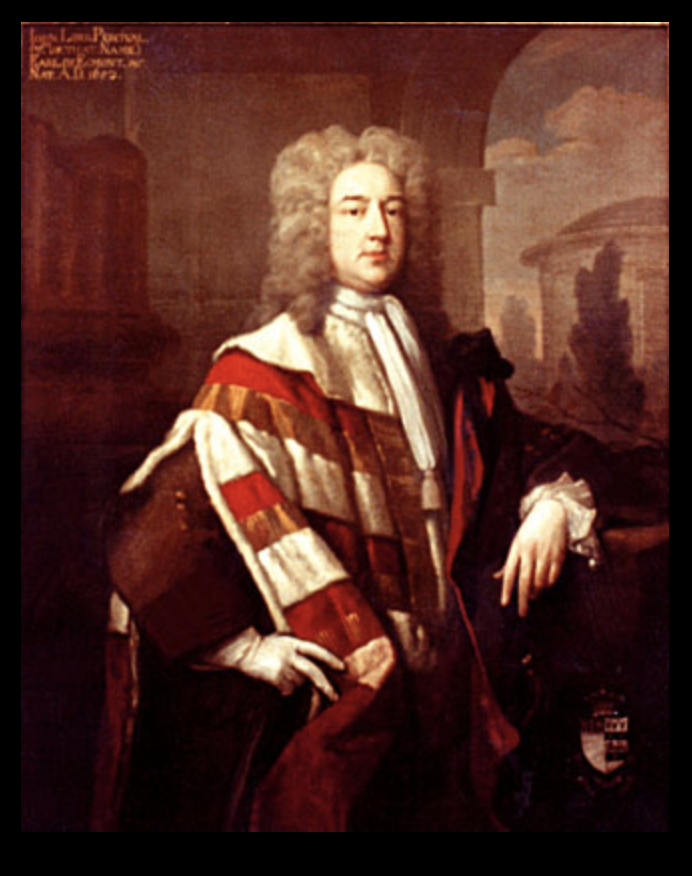
John the 3rd Baronet married Catherine Dering, daughter of Edward 2nd Baronet Dering, of Surrenden Dering, Co. Kent. Their son Edward became 4th Baronet at the age of just four years old but he died aged 9. The next son, John, succeeded as 5th Baronet in 1691 on the death of his brother, and in 1733 was created 1st Earl of Egmont.
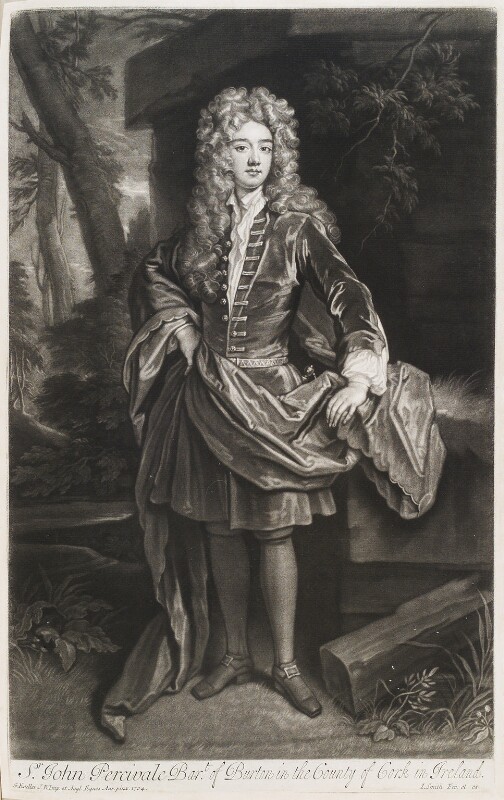
John Perceval (1683-1748) 1st Earl of Egmont by and published by John Smith, after Sir Godfrey Kneller 1704, National Portrait Gallery of London, D11553.

In 1690 Burton Park house was burnt by Duke of Berwick’s Jacobite forces as they retreated south after the Battle of the Boyne. The Duke of Berwick, James Fitzjames, was the illegitimate son of King James II. The village of Churchtown and fifty other big houses were destroyed.

James Fitzjames, 1st Duke of Berwick (1670–1734), three-quarter-length, wearing a suit of armour, a white jabot and holding a baton, by the circle of Godfrey Kneller, courtesy of Sothebys auction Old Master Paintings 6 April 2022.

The 1st Earl of Egmont rebuilt the house. Frank Keohane writes:

“After being burnt, the house’s rebuilding was delayed by a second long minority until the first decade of C18. The stables were commenced first, and unknown Italian architect was recorded at work in 1707 by the steward. [fn. A proto-Palladian plan dated 1709 shows a colonnaded hall and a portico before the door. Its designer was perhaps James Gibbs, whom Perceval had befriended in Italy when Gibbs was a student of Carlo Fontana.] In 1710 Rudolph Corneille, a Huguenot military engineer, proposed to rebuild the house for £2000. William Kidwell was paid for a chimneypiece in 1712. The house does not appear to have been completed, however, and the demesne was leased in 1716. A drawing of 1737 records the house standing as a shell, while in 1750 Smith described the ruin as ‘a large elegant building, mostly of hewn stone.’ ” [3]

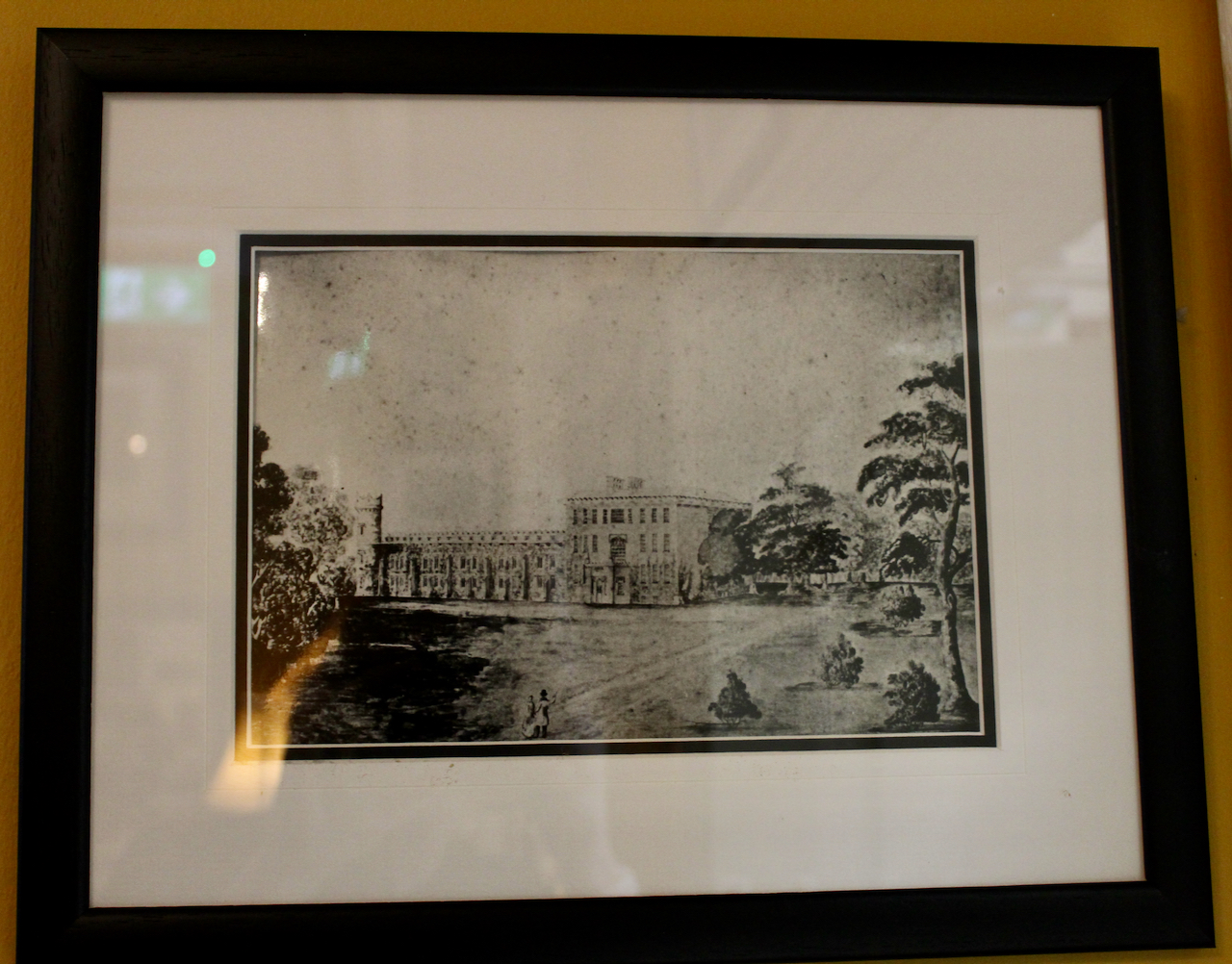
Burton Park, County Cork, August 17th 2023: an artist’s impression of how the original house may have looked.

Jane O’Hea O’Keeffe writes in Voices from the Great Houses: Cork and Kerry that Perceval is believed to have commissioned Italian architects to submit designs for a new house in 1703, incorporating many Palladian features, to be built on the foundations of the original house. She writes that the mansion was completed in 1709 and was remodelled in the late nineteenth century. [4]

The Percevals didn’t live in Ireland, however, as they served as politicians in the British government.

John Perceval the 1st Earl was elected for the British parliament to represent Harwich in England from 1728 to 1734. The Dictionary of Irish Biography tells us “He was a regular attender at court, and sat (1727–34) for Harwich in the British house of commons, where he had some success in promoting trade concessions for Ireland. Other interests included prison conditions and the Georgia colony [in the United States], of which he was a co-founder in 1732.

John Perceval, 1st Earl of Egmont (1683-1748) by Hans Hysing.

It’s fascinating that he was a founder of Georgia in the United States! He supported James Oglethorpe’s scheme to establish a new colony. He was acquainted with Oglethorpe from their work on the Gaols Committee of the House of Commons, which was painted by William Hogarth. The National Portrait Gallery of London tells us he played a crucial role in securing the funding that was essential for the support and defence of Georgia.

The Gaols Committee of the House of Commons by William Hogarth circa 1729 courtesy of National Portrait Gallery of London NPG 926.

Oglethorpe gained a reputation as the champion of the oppressed. He pressed for the elimination of English prison abuses and, in 1732, defended the North American colonies’ right to trade freely with Britain and the other colonies. [5] The prison reforms Oglethorpe had championed inspired him to propose a charity colony in America. On June 9, 1732, the crown granted a charter to the Trustees for Establishing the Colony of Georgia. Oglethorpe himself led the first group of 114 colonists on the frigate Anne, landing at the site of today’s Savannah on February 1, 1733. The original charter banned slavery and granted religious freedom, leading to the foundation of a Jewish community in Savannah.

In 1742, Oglethorpe called upon his military experience and Georgia’s fledgling militia to defend the colony from a Spanish invasion on St. Simons Island. Oglethorpe and his militia defeated the invaders in the Battle of Bloody Marsh, which is credited as the turning point between England and Spain’s fight for control of southeastern North America. [5]

John Perceval was a friend of Bishop George Berkeley, Church of Ireland Bishop of Cloyne. The philosopher-bishop was chaplain to John Perceval and tutor to his son. Papers relating to Burton House tell us that during his stay at Burton, Berkeley enjoyed long walks through its wooded demesne and may have slept on a hammock strung in the barn!
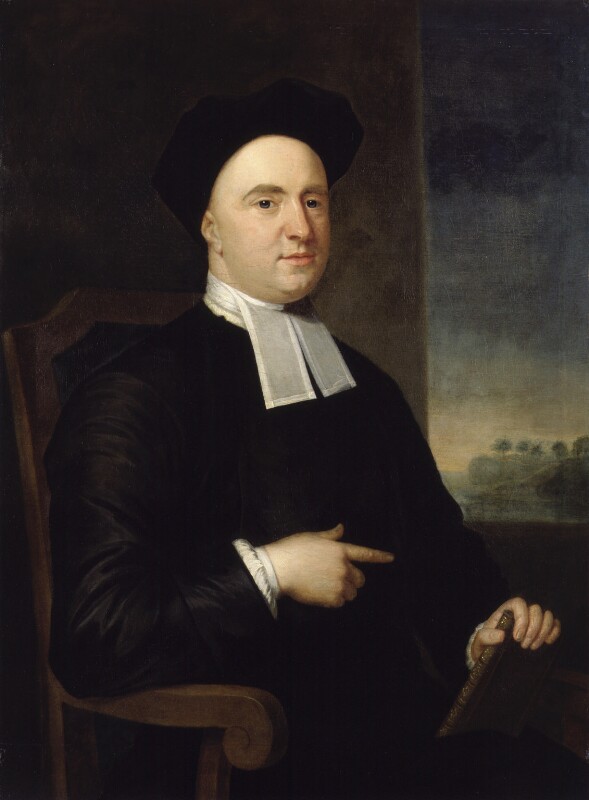
George Berkeley (1685-1753), Philosopher and Bishop of Cloyne, by John Smibert 1730 courtesy of National Portrait Gallery NPG 653.

Extracts from the correspondence between Berkeley and Perceval (Ryan-Purcell papers) reveal the special affection the bishop reserved for Burton:

“Trinity College, 17th May 1712:
Burton I find pleases beyond expectation; and I imagine it myself at this time one of the finest places in the world

“Trinity College, 5th June 1712: Dan Dering (Perceval’s cousin) and I deign to visit your Paradise, and are sure of finding angels there, notwithstanding what you say of their vanity. In plain English, we are agreed to go down to Burton together and rejoice with the good company there. I give you timely warning that you may hang up two hammocks in the barn against our coming. I never lie in a feather bed in the college and before now have made a very comfortable shift with a hammock.

“London, 27th August 1713:
Last night I came hither from Oxford. I could not without some regret leave a place which I had found so entertaining, on account of the pleasant situation, healthy air, magnificent buildings, and good company, all which I enjoyed the last fortnight of my being there with much better relish than I had
done before, the weather having been during that time very fair, without which I find nothing can be agreeable to me. But the far greater affliction that I sustained about this time twelvemonth in leaving Burton made this seem a small misfortune …
” [6]

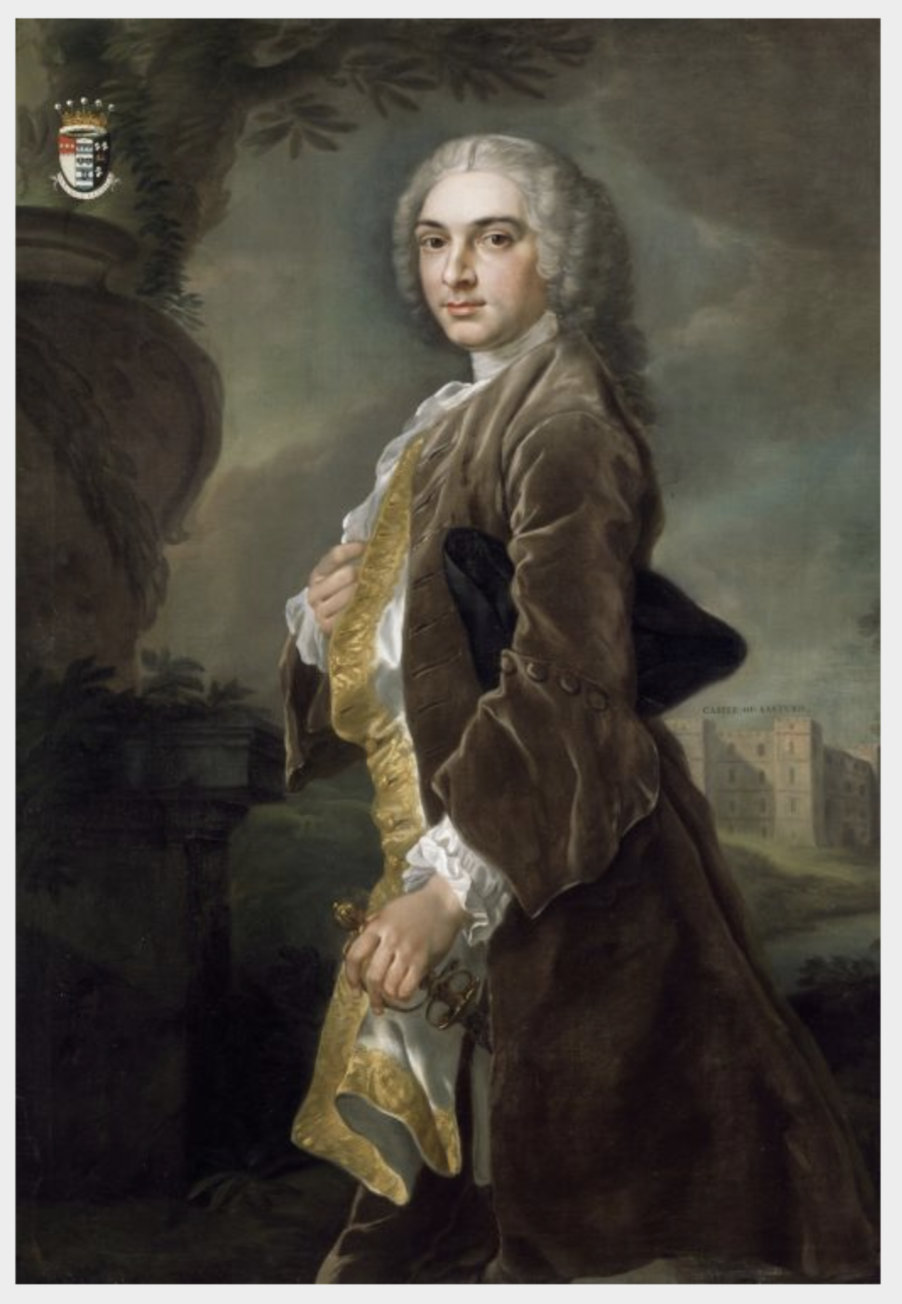
John Perceval’s son John Perceval (1711–70), sat for Dingle in the Irish commons from 1731 to 1748, when he succeeded to his father’s peerage after his father’s death and became 2nd Earl of Egmont. He was a member of the British Commons, 1741–62, and was a close adviser to Frederick, Prince of Wales. [6]
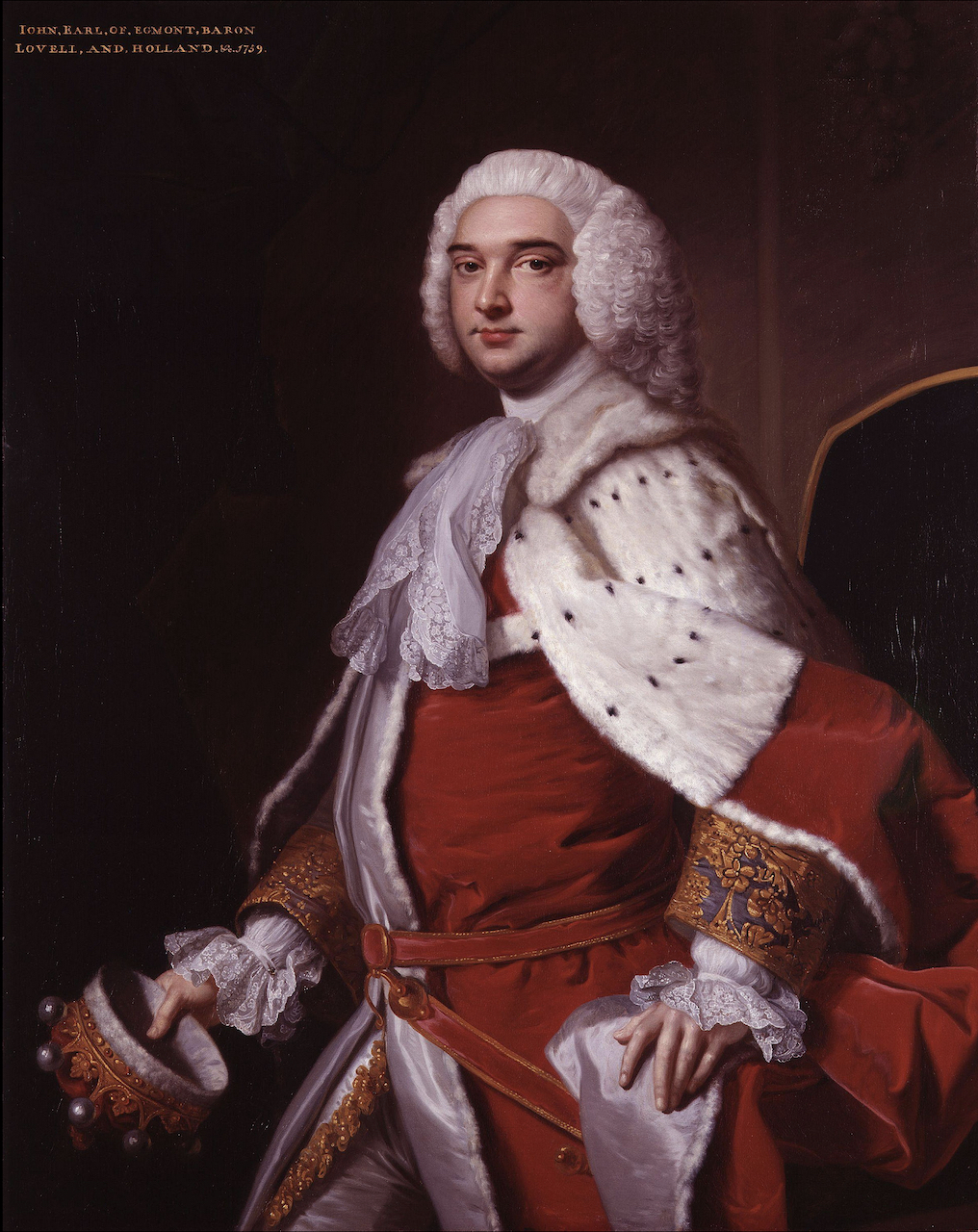
John Perceval (1711-1770) 2nd Earl of Egmont by Thomas Hudson.
John Percival, later 2nd Earl of Egmont (1711-1770) by Francis Hayman c. 1740, courtesy of National Gallery of Ireland NGI 4489.

John 2nd Earl’s sister Helena married John Rawdon, 1st Earl of Moira.

John 2nd Earl married Catherine, daughter of James Cecil 5th Earl of Salisbury. She gave birth to the next in line, John James Perceval (1738-1822) 3rd Earl of Egmont, along with several other children.
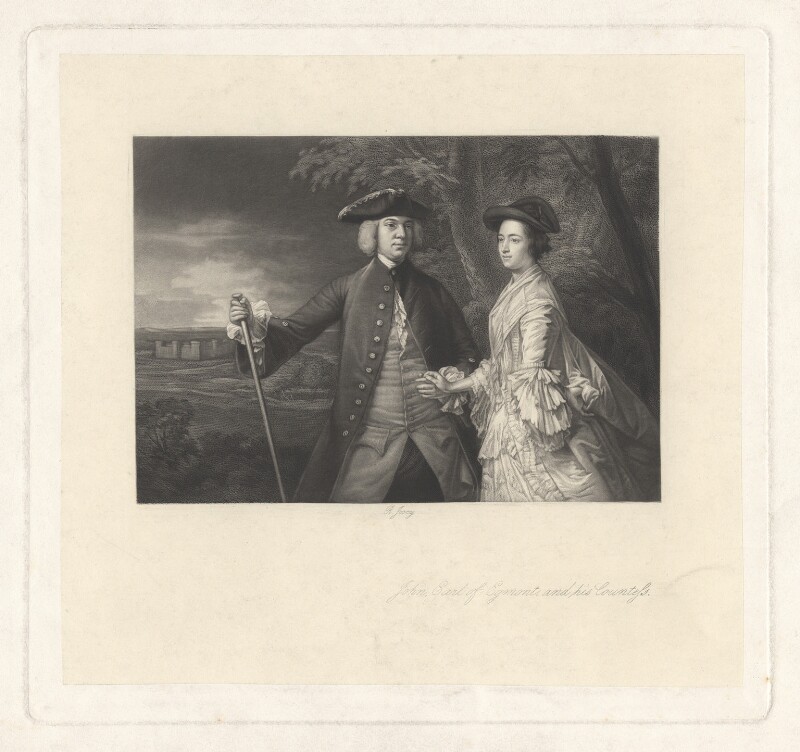
John Perceval, 2nd Earl of Egmont with Catherine Perceval (née Cecil), Countess of Egmont by Richard Josey, after Sir Joshua Reynolds mezzotint, 1876 (1756) National Portrait Gallery of London D1855.

When she died, John the 2nd Earl remarried, this time to Catherine Compton, granddaughter of the 4th Earl of Northampton in England. They had several more children.

Catherine Perceval (née Compton), Countess of Egmont; Charles George Perceval, 2nd Baron Arden by James Macardell, after Thomas Hudson mezzotint, published 1765, National Portrait Gallery of London D1829.

From 1751-1759 the 2nd Earl created a house in England, Enmore Castle. He served as First Lord of the Admiralty from 1763-1766 and a port in the Falkland Islands, Port Egmont, was named after him, as well as Mount Egmont in New Zealand.

The 2nd Earl of Egmont was created Baron Lovel and Holland of Enmore, Co. Somerset in 1762, which gave him an automatic seat in the House of Lords.

Following his death, his widow was created Baroness Arden of Lohort Castle, County Cork in the peerage of Ireland, with remainder to her heirs male. This gave the oldest son of his second wife a title.

His third son, Spencer Perceval (1762–1812), became Prime Minister of the United Kingdom and is the only British prime minister to have been assassinated, and the only solicitor-general or attorney-general to have become prime minister.
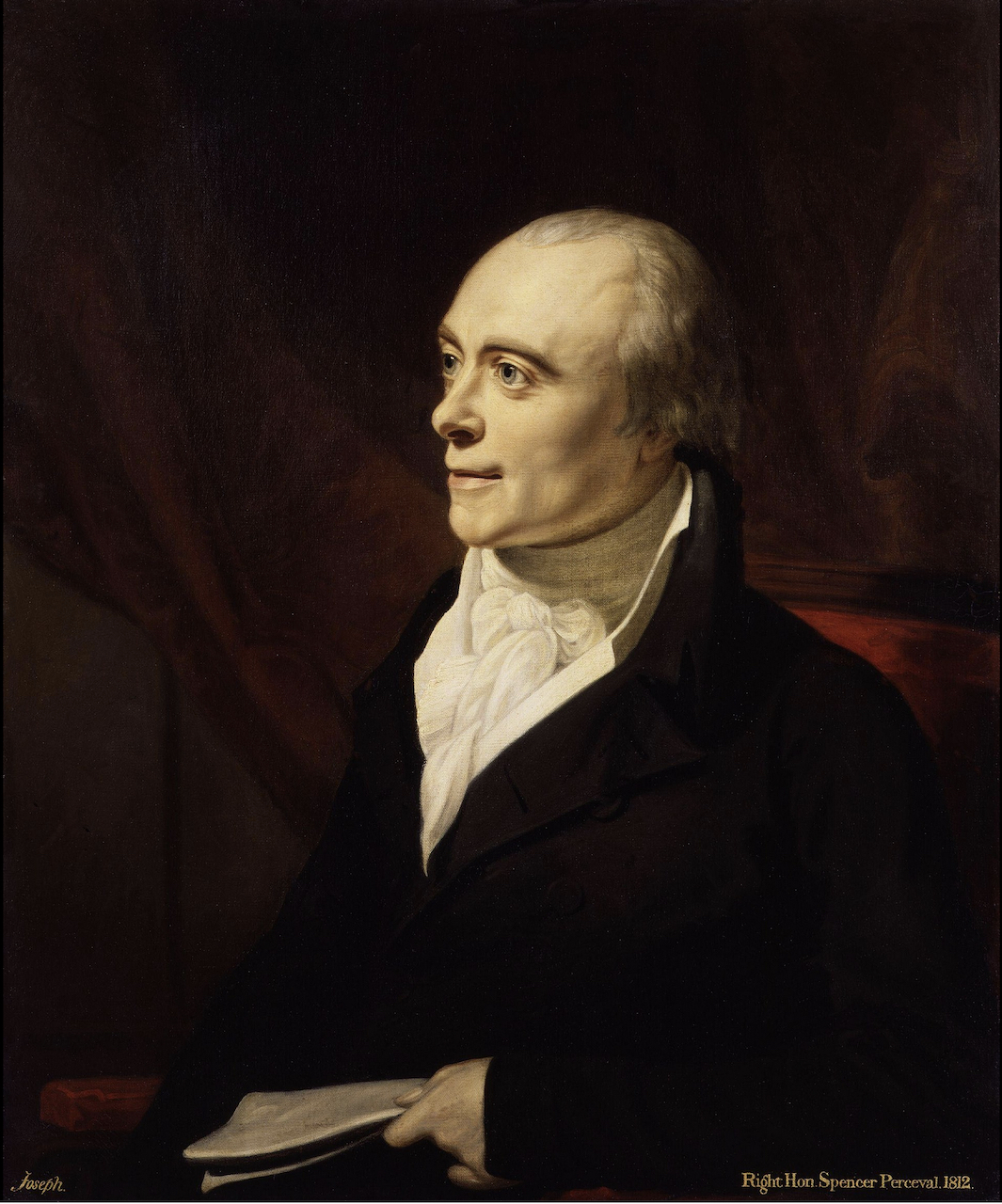
Spencer Perceval, by George Francis Joseph (died 1846), given to the National Portrait Gallery, London in 1857.

A son of the first marriage, John James Perceval (1737-1822) became 3rd Earl of Egmont when his father died in 1770, as well as 2nd Baron Lovel and Holland of Enmore, Co. Somerset. He also entered politics in England and served in the British House of Lords.

He did not live at Burton Park and in 1800 he rented it to John Purcell, a member of the family of the Barons of Loughmoe (see my entry on Ballysallagh, County Kilkenny, for more of this branch of the family). He rented the property for his newly married eldest son, Matthew (1773-1845), Rector of Churchtown (1795-1845) and of Dungourney (1808-45).

John James Perceval the 3rd Earl Egmont married Isabella Powlett, granddaughter of the 2nd Duke of Bolton, and they had a son, John (1767-1835) who became 3rd Baron Lovel and Holland, of Enmore, County Somerset and 4th Earl of Egmont. The 4th Earl of Egmont followed in his father’s footsteps and served in the House of Lords. He married Bridget Wynn, daughter of an MP for Caernarvon in Wales and they had a son, Henry Frederick John James Perceval (1796-1841) who became 5th Earl of Egmont after his father’s death, as well as 4th Baron Lovel and Holland of Enmore, Co. Somerset.

The 5th Earl of Egmont inherited large debts. The History of Parliament website tells us:

Debts of some £300,000 had accumulated on the estate at Churchtown, county Cork, and the property at Enmore, Somerset, was also heavily encumbered. The barrister engaged to defend Perceval’s will claimed that he was ‘a man of education and refinement’ whose ‘feeling of disappointment … on account of the enormous embarrassments on his property, led him to drink, and at an early period of his life he acquired habits of dissipation’; the opposing counsel blamed this fall from grace on neglect by his mother, who was portrayed as a scheming courtesan.” [7]

The Parliament website continues the sorry tale:

Having thus compounded his financial difficulties, Perceval was declared an outlaw at some point in 1828 and fled abroad. Later that year he married the daughter of a French count in Paris, but evidently not under the auspices of the British consulate. The son born to them about four months after the marriage was apparently living in 1835, but predeceased his father; the fate of the mother has not been discovered. On his father’s death in 1835 Perceval inherited all his property, but the will was not proved until 1857, when the personalty was sworn under £16,000. Enmore had been sold in 1834 for £134,000 to pay off creditors, but no takers had been found for the Cork estates, which comprised 11,250 acres, because of the burden of debt on them. Egmont took his seat in the Lords in February 1836, but afterwards lived under the alias of ‘Mr. Lovell’ at Burderop Park, Wiltshire. This property was purchased in the name of his companion, a Mrs. Cleese, with whom it seems he had previously resided at Hythe, Kent and whom he passed off as his sister.” [7]

The website tells us the nature of his regular pursuits can be inferred from a letter supposedly sent to him on 28 April 1826 by Edward Tierney, the family’s Dublin solicitor and land agent, entreating him to ‘abandon his evil courses and his associates’.

He decamped to Portugal in 1840, but after Mrs. Cleese’s death he returned to England, where he died in December 1841. Tierney was made sole executor and residuary legatee of the estate, exciting some comment, but it was not until 1857 that the will was finally proved (under £20,000) by Tierney’s son-in-law and heir, the Rev. Sir William Lionel Darell. In 1863 the will was belatedly contested by George James Perceval (1794-1874), Egmont’s cousin and successor in the peerage. It was alleged that alcoholism had rendered Egmont completely dependent on Tierney, whose misleading valuation of the estates had induced him to draw up his will as he did. The evidence was inconclusive and an out of court settlement was reached, by which the Irish property was returned to the Egmont family on payment of £125,000 to Darell. It was estimated that Tierney and his heirs had realized at least £300,000 from their stewardship of the estates, which were eventually sold by the 7th earl in 1889. The 8th earl (1856-1910), a former sailor turned London fireman, upheld family tradition by being arrested for drunkenness in Piccadilly, 16 May 1902.

In 1814 Rev. Matthew Purcell (1773-1845) was resident. He lived there with his wife Elizabeth Leader. His father John passed his Highfort home in County Cork to his youngest son, Dr. Richard Purcell, and spent his latter years with his eldest son Matthew at Burton House, where he died in 1830.

The Annals of Churchtown (see [6]) tell us:

John Purcell earned the sobriquet ‘the Knight of the Knife’ (occasionally the ‘Blood-red Knight’) for the spirited manner in which he, at some 80 years of age and, armed only with a knife, had repulsed a number of armed intruders at his Highfort home in Liscarroll [County Cork] on the 18th March 1811, killing three of their number and wounding others before the attackers fled. The attack not only earned a knighthood for Purcell. It also heralded a change in English law: it was determined henceforth that an octogenarian could kill in self-defence.

The Landed Estates database tells us that the invaders were “Whiteboys.” Whiteboys were members of a secret agrarian organisation who defended tenant farmer land rights. Their members were called “whiteboys” after the white smocks they wore on their night time raids. Their activity began around 1760 when land which had previously been commonage was enclosed by landlords to farm cattle. [9]

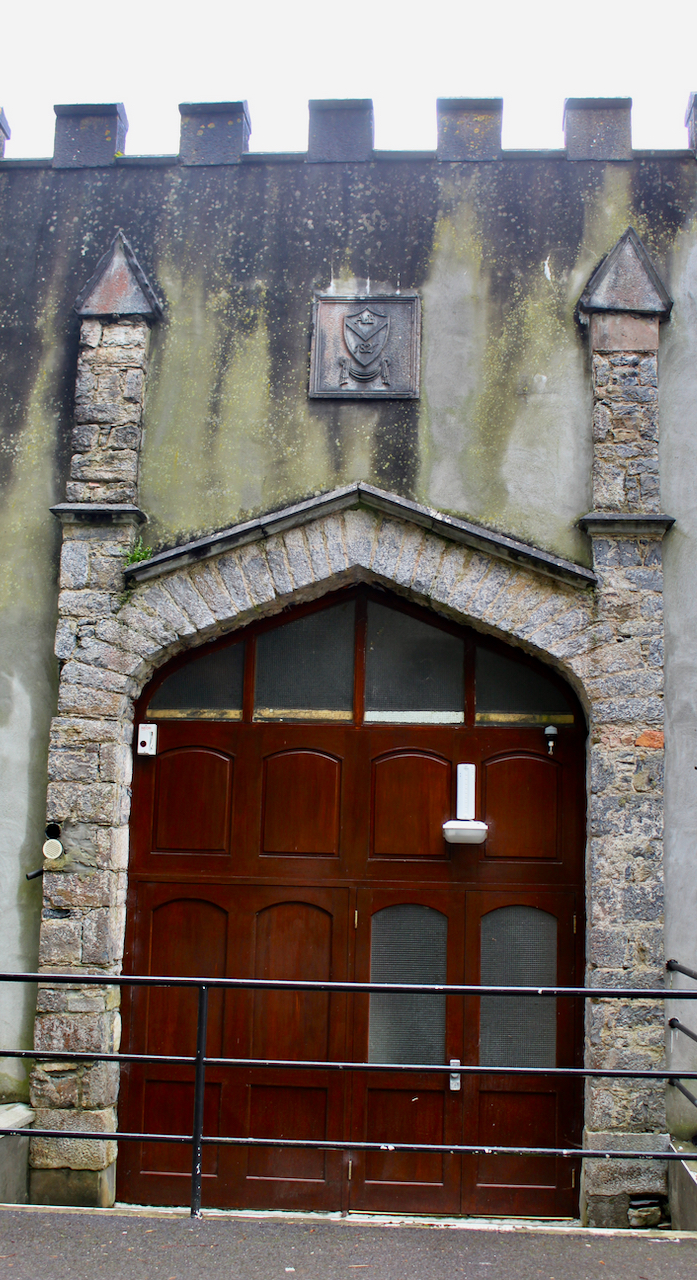
The house bears the Purcell coat of arms on the central gable. The crest represents the encounter between Sir John Purcell the Octagenarian and the intruders he fought off.

Burton Park, County Cork, August 17th 2023. The house bears the Purcell coat of arms on the central gable. Photograph © Jennifer Winder-Baggot, www.irishhistorichouses.com

Reverend Matthew Purcell was succeeded by his son John Purcell in 1845, at a time when the house was valued at £34. Reverend Matthew also had eight daughters.

The Sli Eile website tells us:

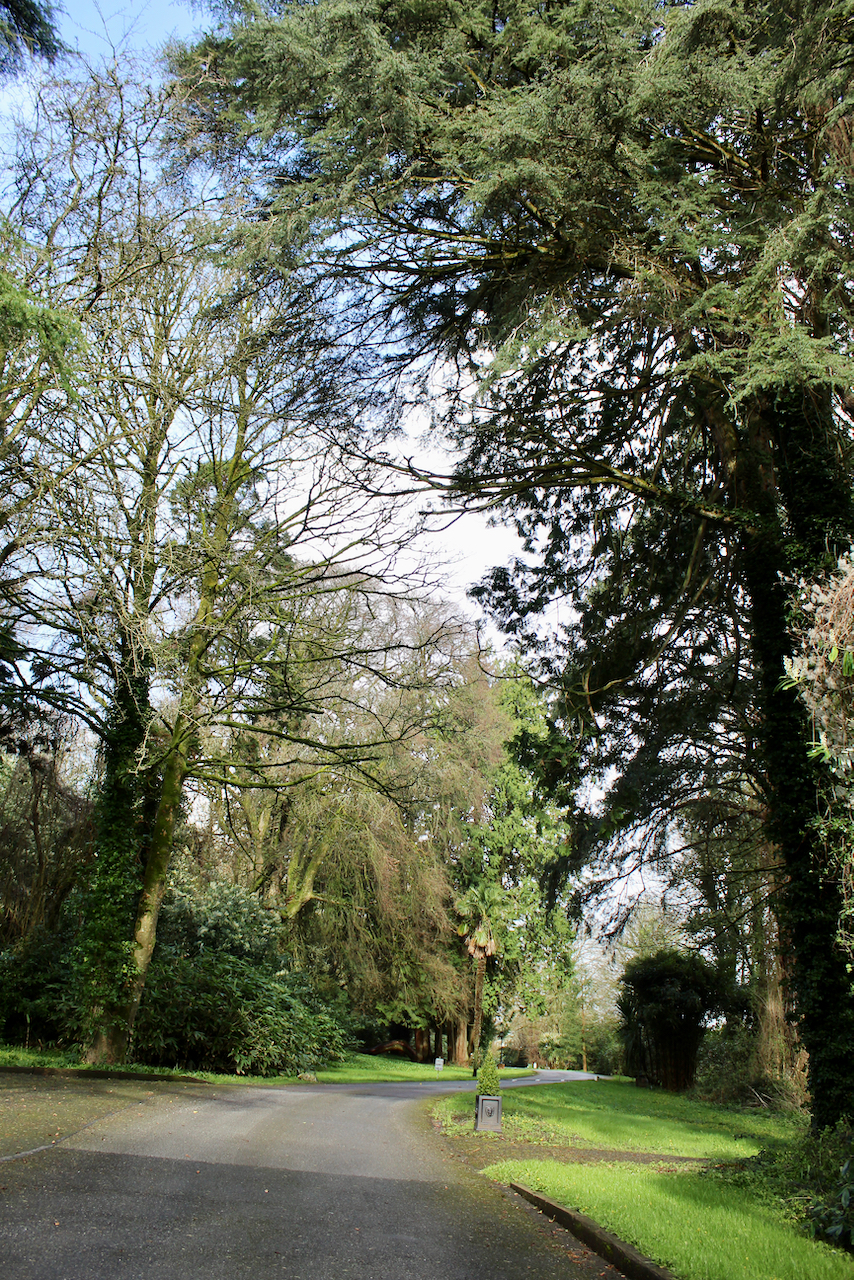
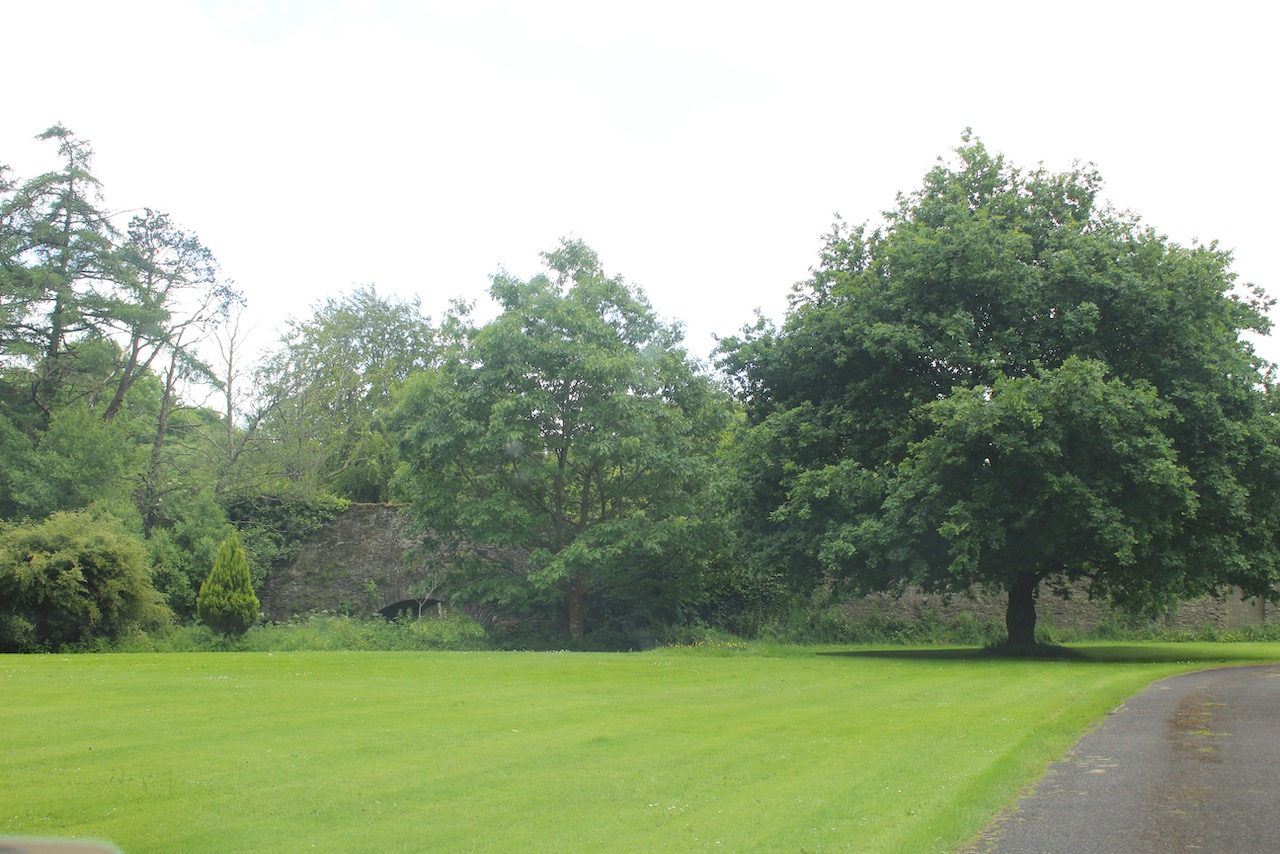
Proceeding up the avenue, we can see the very fine parkland. On the right hand side is the new forestry plantation, started in 1997, which now covers a large part of the estate, and contains a very fine forest walk with much to interest both the arboriculturist and the casual walker. Further up, also on the right-hand side, may be seen a group of five mature oak trees, (one of which is unfortunately dead). These trees, of which there were once eight, were planted in the 1800’s to commemorate the birth of eight daughters of the Rev. Matthew Purcell, owner of Burton Park, and Rector of Churchtown. These trees are known as the eight sisters.

John married Anna More Dempsey and they had two children: Matthew John (1852-1904) and Elizabeth Mary (believed to have been a nun, died unmarried, 1867). Matthew John, who inherited the property as a juvenile, was made a Ward of Court until he came of age.

Matthew Purcell bought Burton Park from the 7th Earl of Egmont in 1889. The 6th Earl of Egmont (John, 1794-1874) was the grandson of the 2nd Earl of Egmont and his second wife, Catherine Compton. His father was Charles George Perceval, who became 2nd Baron Arden after his mother’s death. The 6th Earl did not have any children, and it was a son of his brother Reverend Charles George Perceval who became the 7th Earl of Egmont (Charles George Perceval 1845-1897) and sold Burton Park.

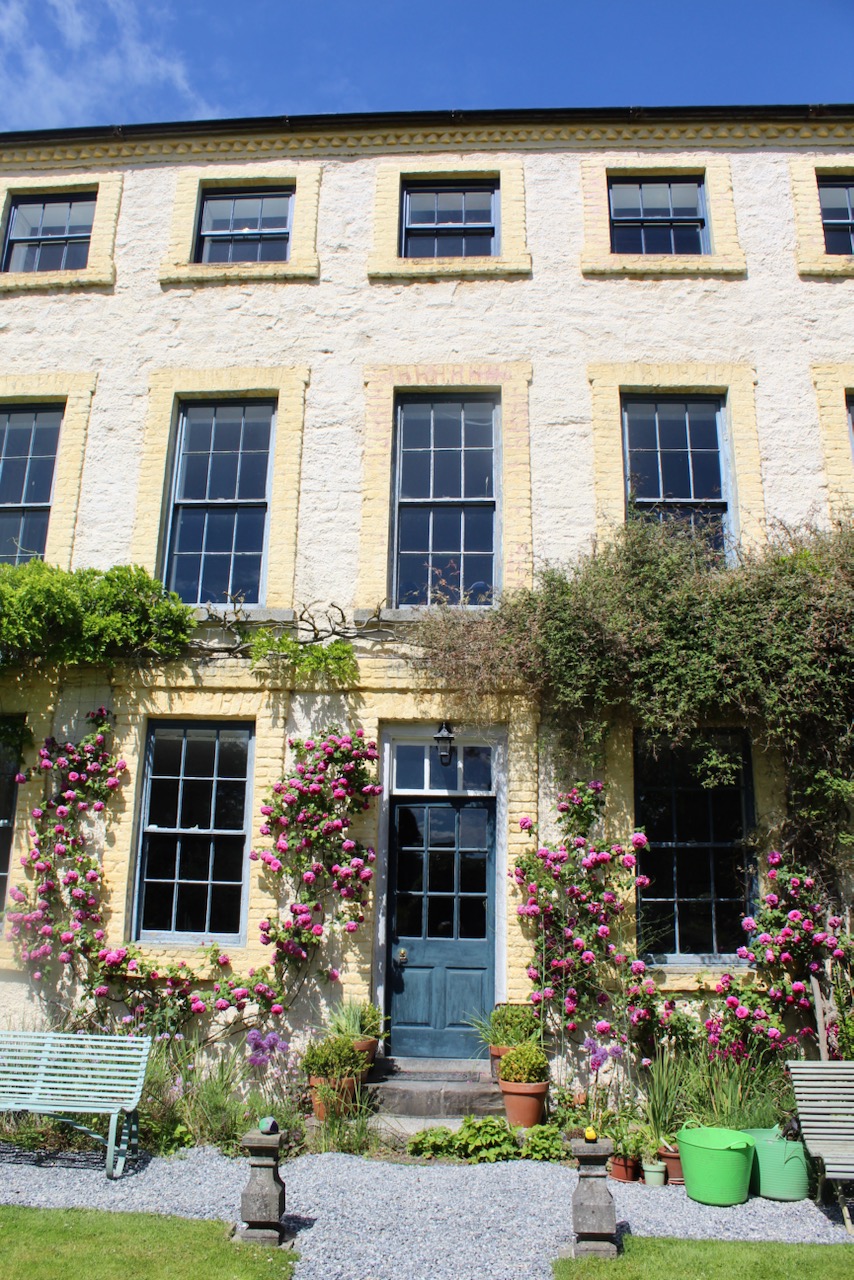
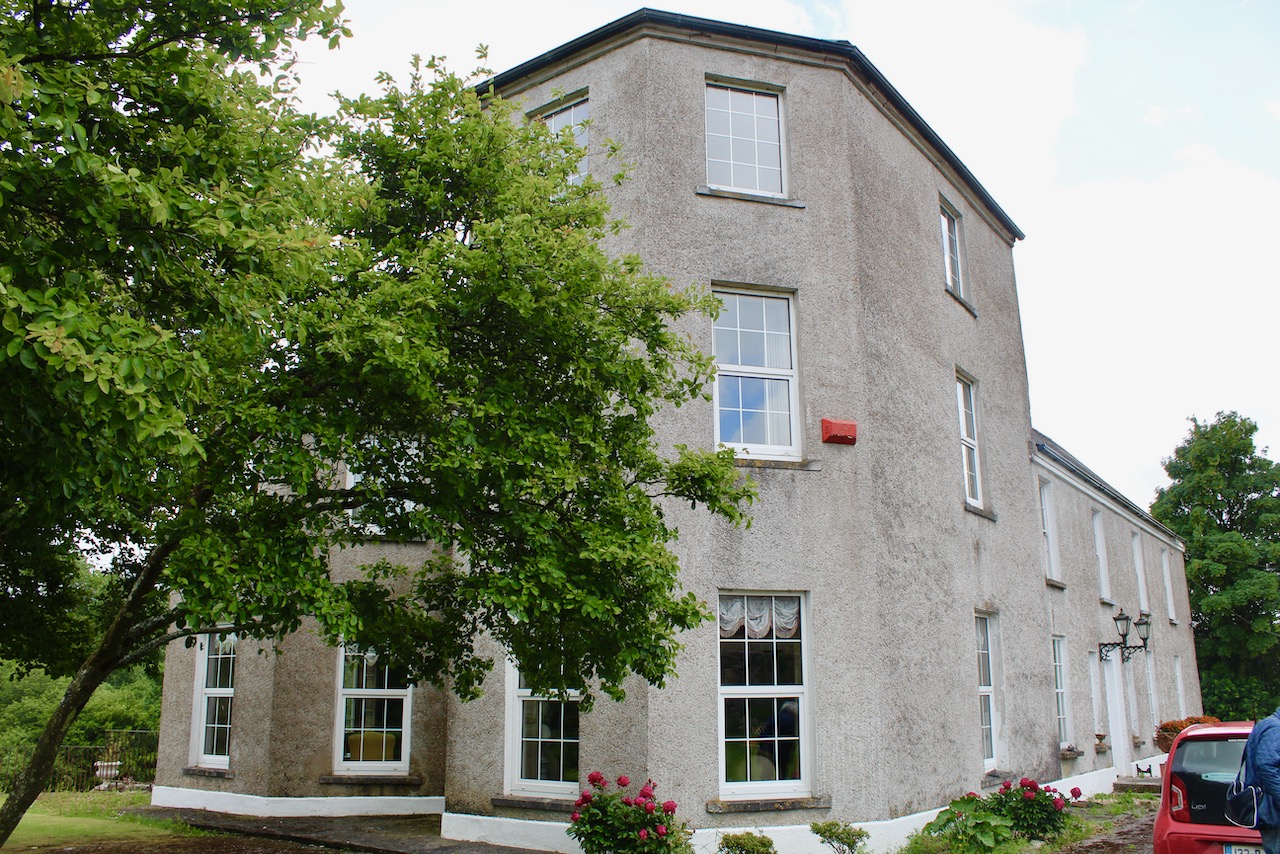
In 1889 the Purcells undertook major renovations and alterations. [see 4]. Mark Bence Jones tells us that the Purcells refaced it in Victorian cement and gave it a high roof with curvilinear dormer-gables. [8] Frank Keohane tells us:

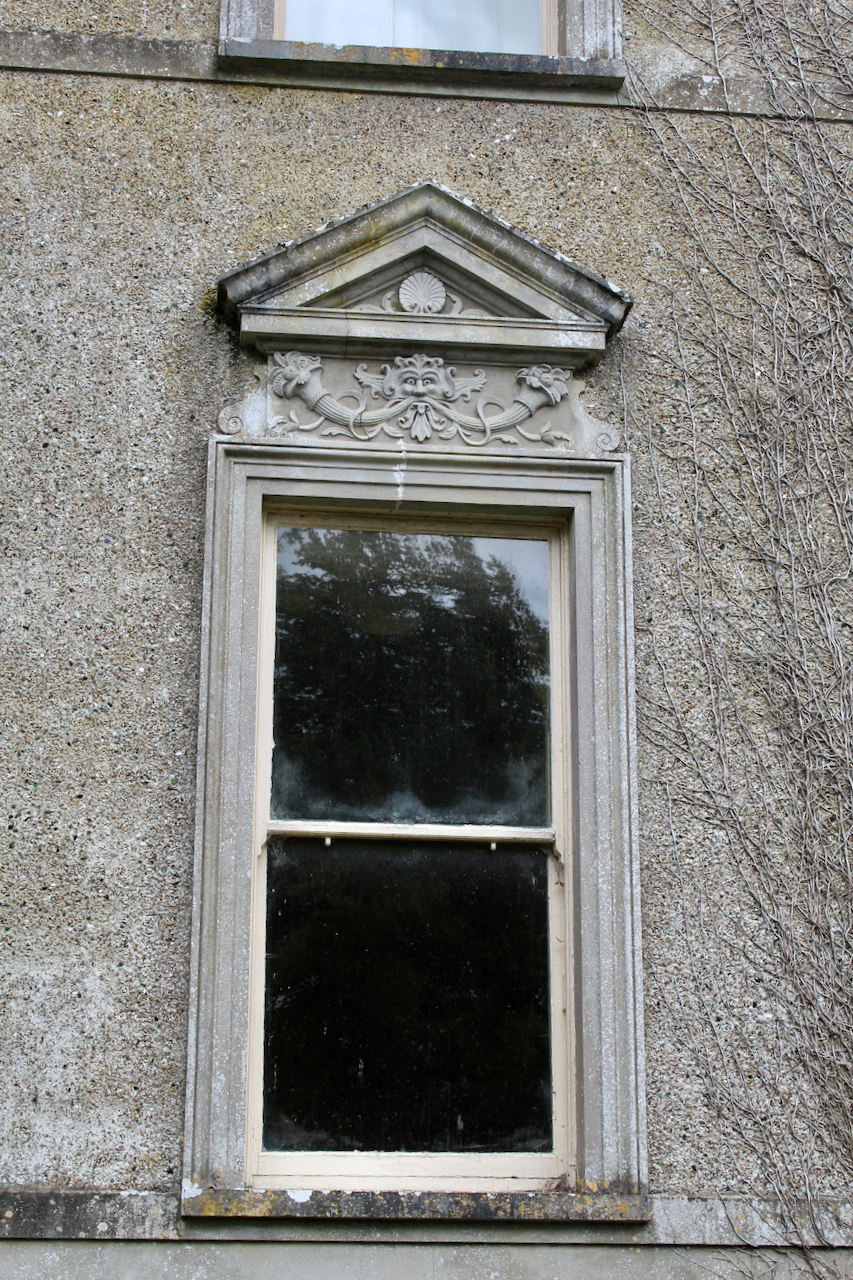
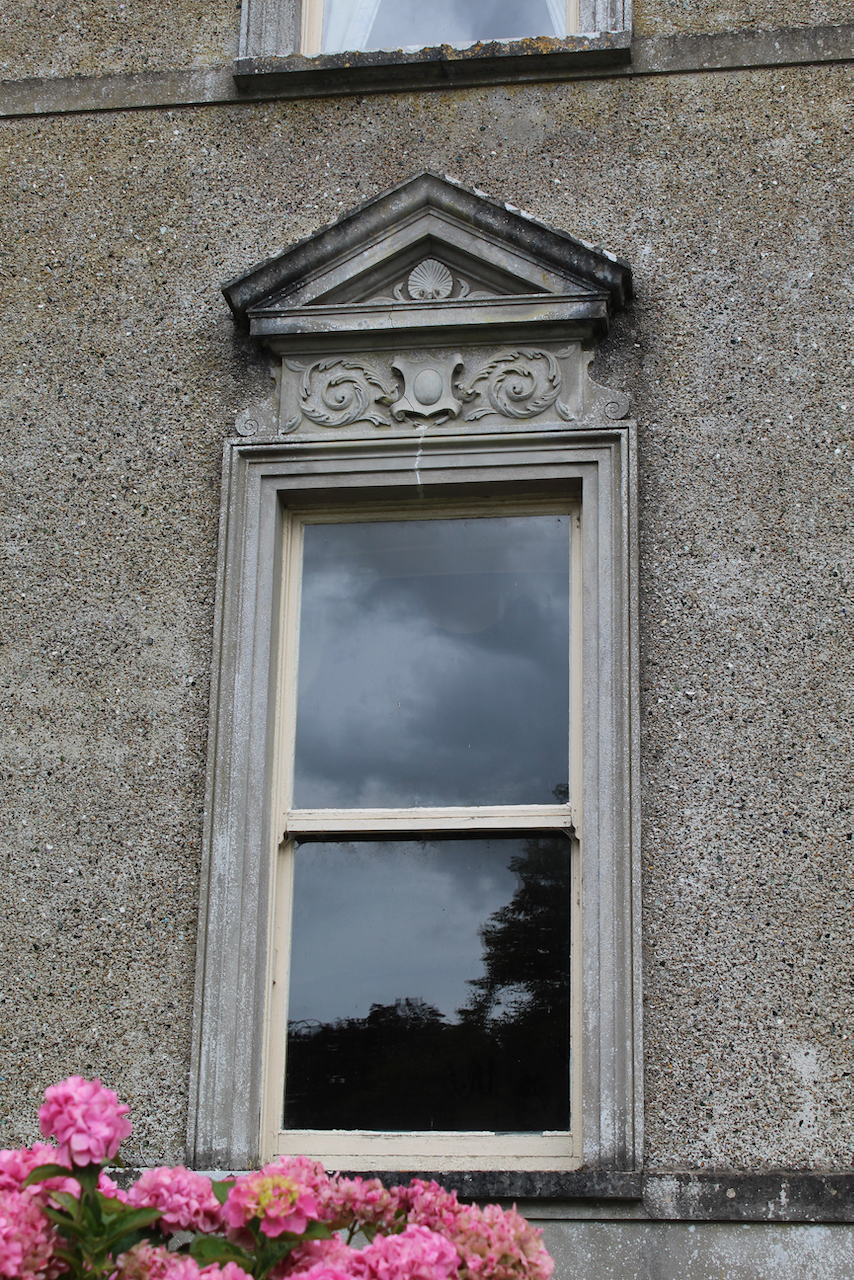
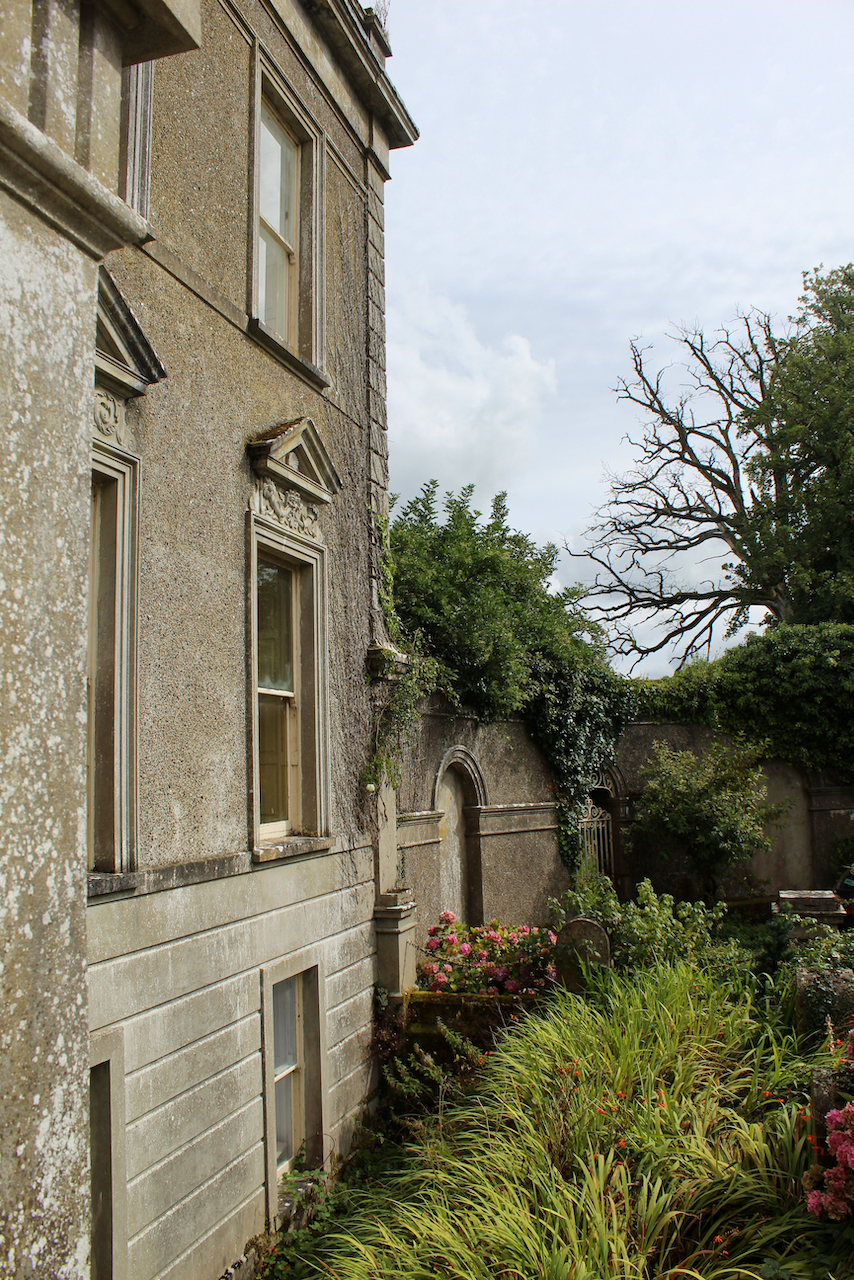
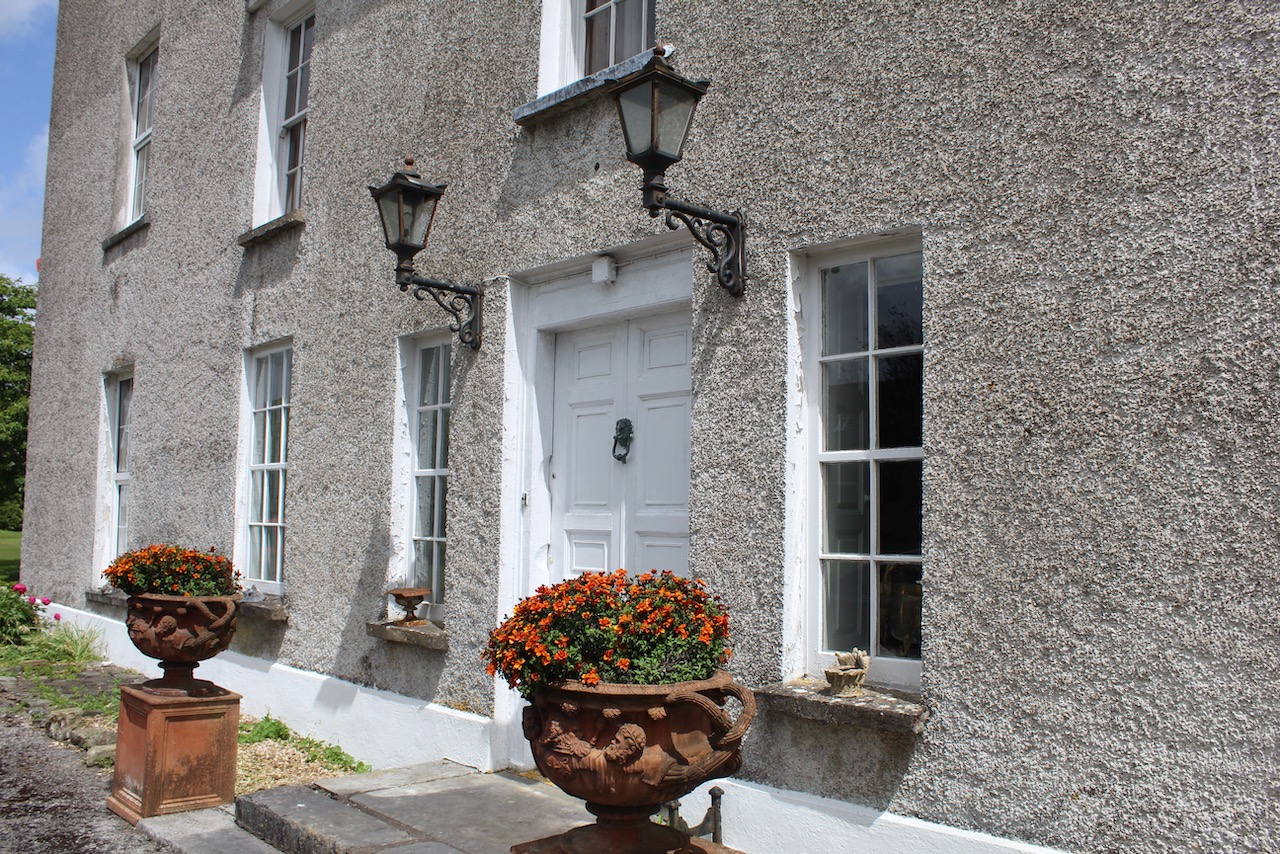
Today the façade is rather more ornate, owing to a remodelling by William H. Hill c. 1899. Hill faced the house in rough plaster with smooth banded quoins, string courses and a cornice topped with a balustrade. The style is loosely Renaissance, with curvilinear gables and grotesque panels to the pedimented ground floor windows.

Burton Park, County Cork, August 17th 2023. Photograph © Jennifer Winder-Baggot, www.irishhistorichouses.com
One of the “grotesque” panels at Burton Park, County Cork, August 17th 2023. Photograph © Jennifer Winder-Baggot, www.irishhistorichouses.com

William Henry Hill (1837-1911) was an architect from Cork. He was architect for the Dioceses of Down, Connor & Dromore under the Ecclesiastical Commissioners in 1860 until the disestablishment of the Church of Ireland in 1870, when he set up in private practice in Cork. [10] The Dictionary of Irish Architects tells us that in addition to his privately commissioned work, he was diocesan architect for the Dioceses of Cork, Cloyne and Ross from 1872 until circa 1878.

On a website about Churchtown, Jim McCarthy writes about Burton Park and tells us more about the 1889 update:

In the 1890s, through his agent Robert Sanders and in conjunction with the Board of Works, the Purcells embarked on imaginative (and expensive) alterations and improvements to the house and estate: bedroom floors were renewed, ceilings remoulded, chimney shafts rebuilt, a kitchen was added, pantries were provided, a porch built, slating and skylights were repaired and renewed, staircases removed or altered, and windows and shuttering replaced. Extensive work on the coach house, gate lodge, sheds and stables was also undertaken.” [11]
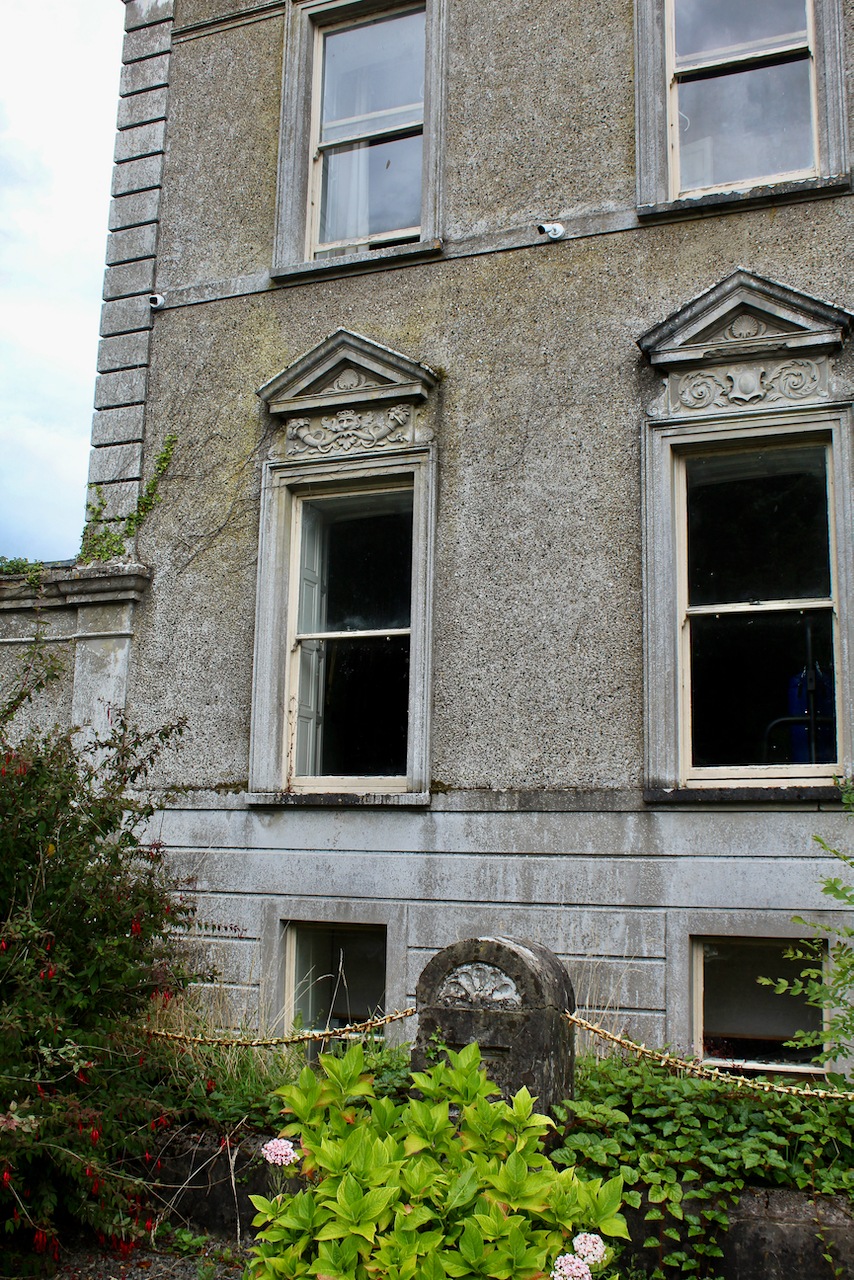
Burton Park, County Cork, August 17th 2023. Photograph © Jennifer Winder-Baggot, www.irishhistorichouses.com

The website tells us that the roof was raised to accommodate the dormer windows, and the ornate architraves over the windows were also added at that time.

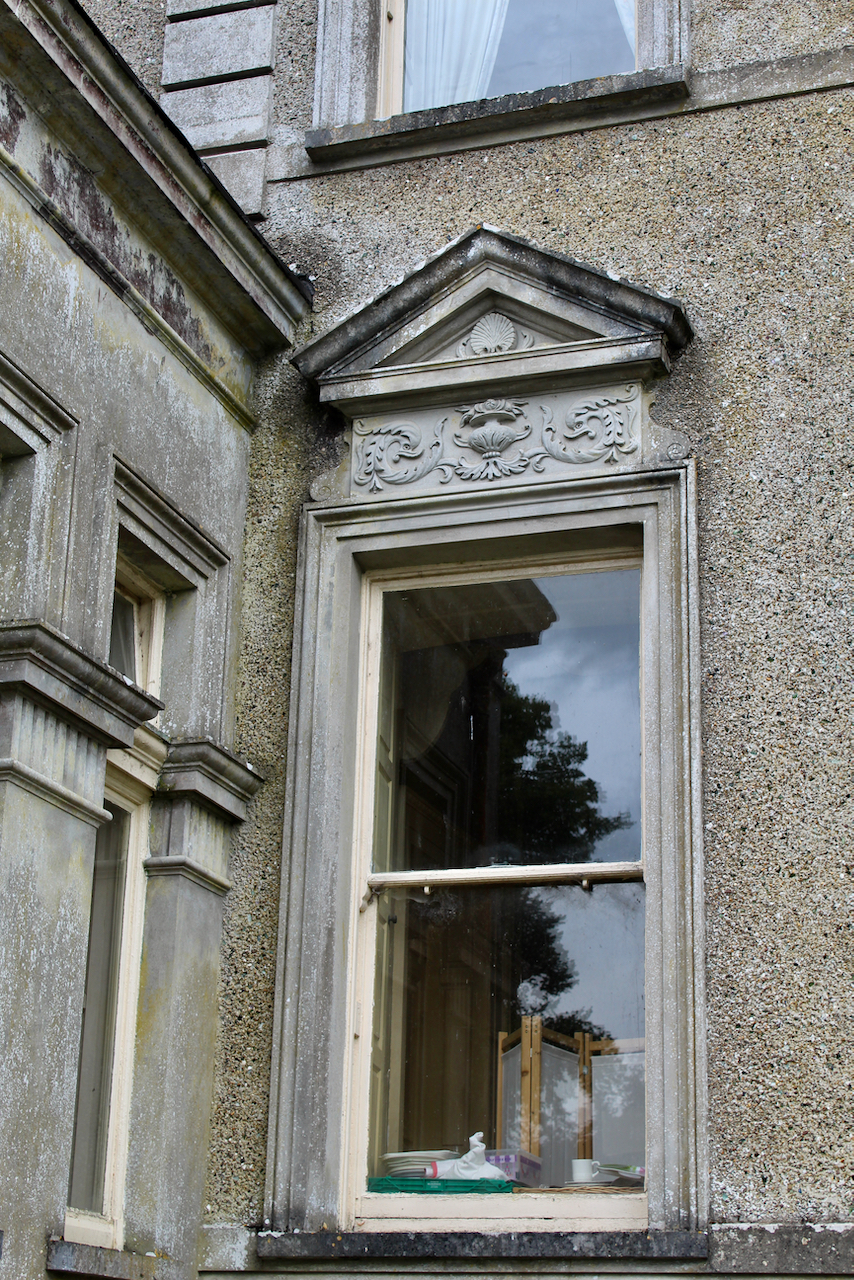
Burton Park, County Cork, August 17th 2023. Photograph © Jennifer Winder-Baggot, www.irishhistorichouses.com

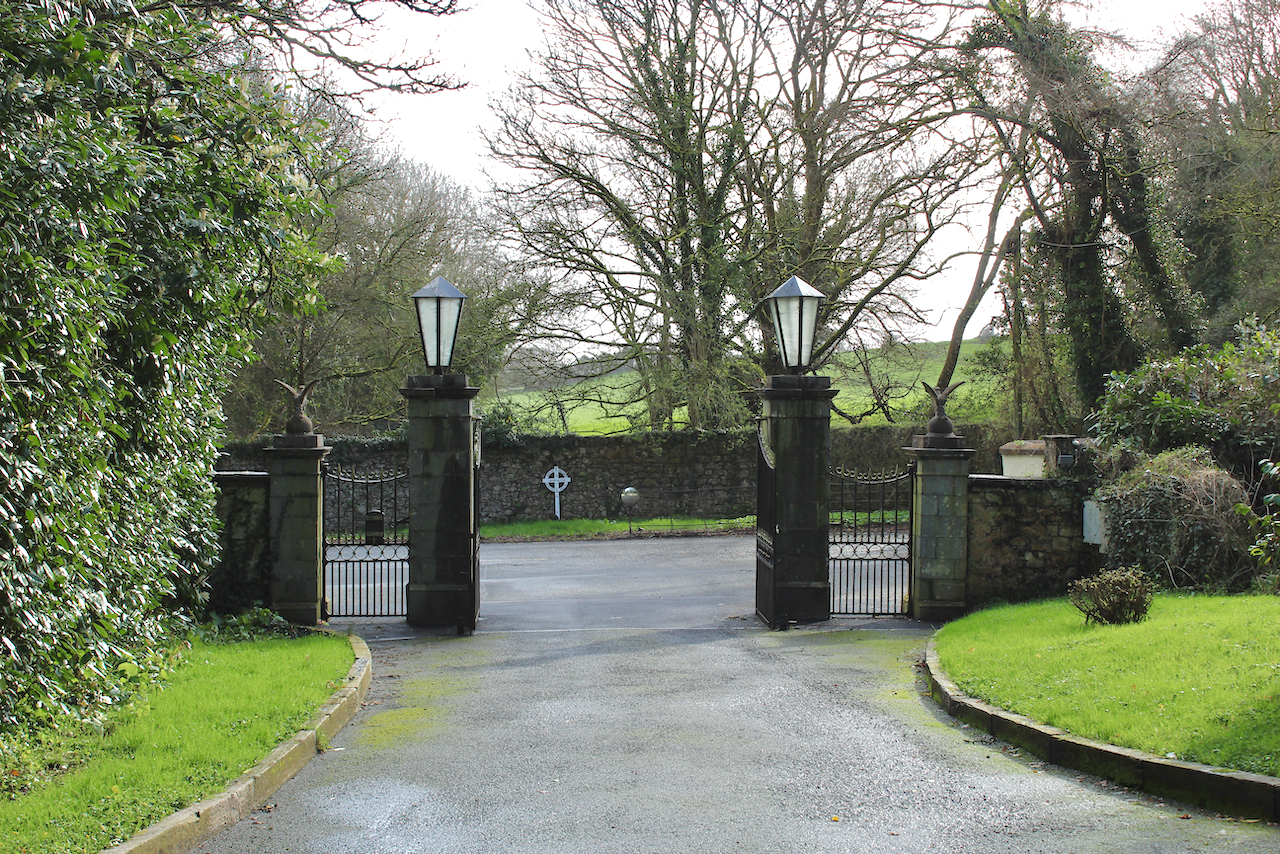
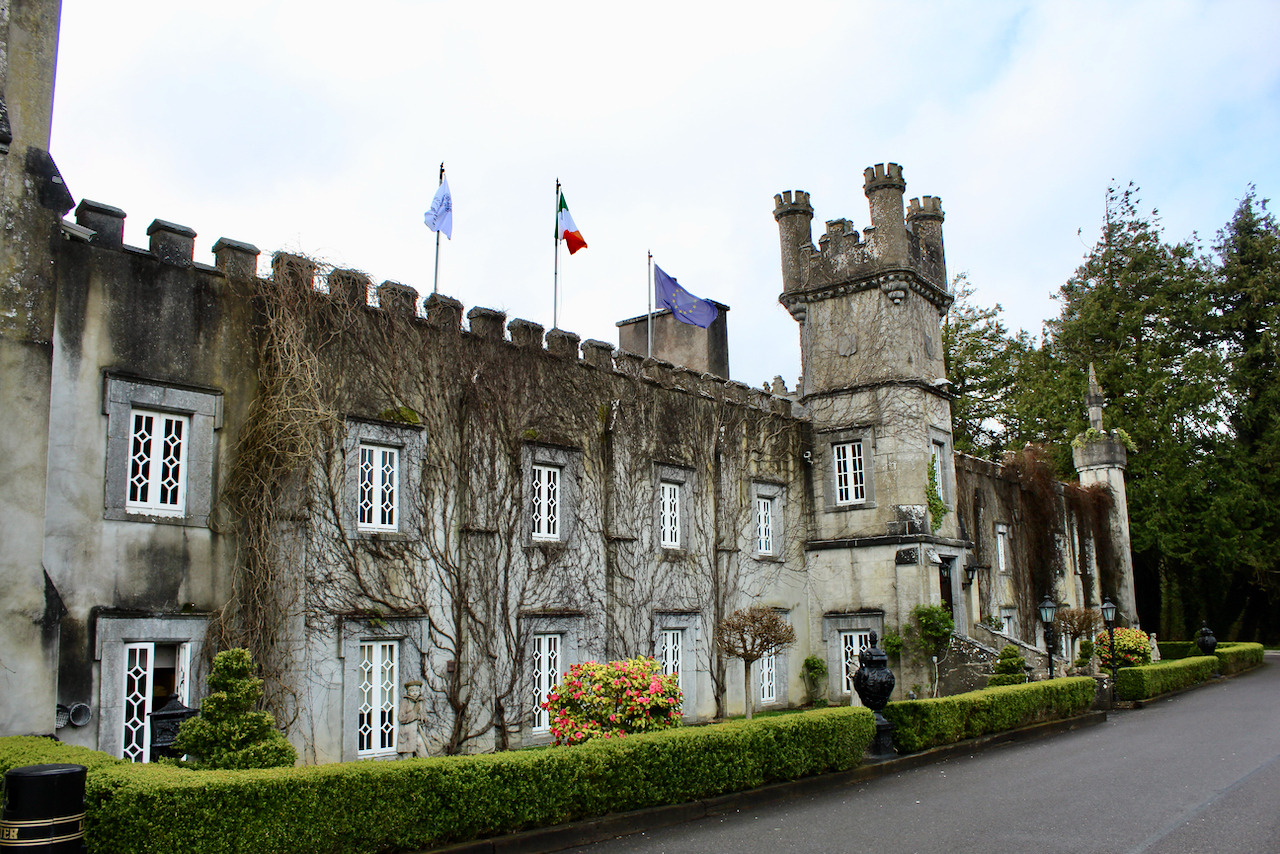
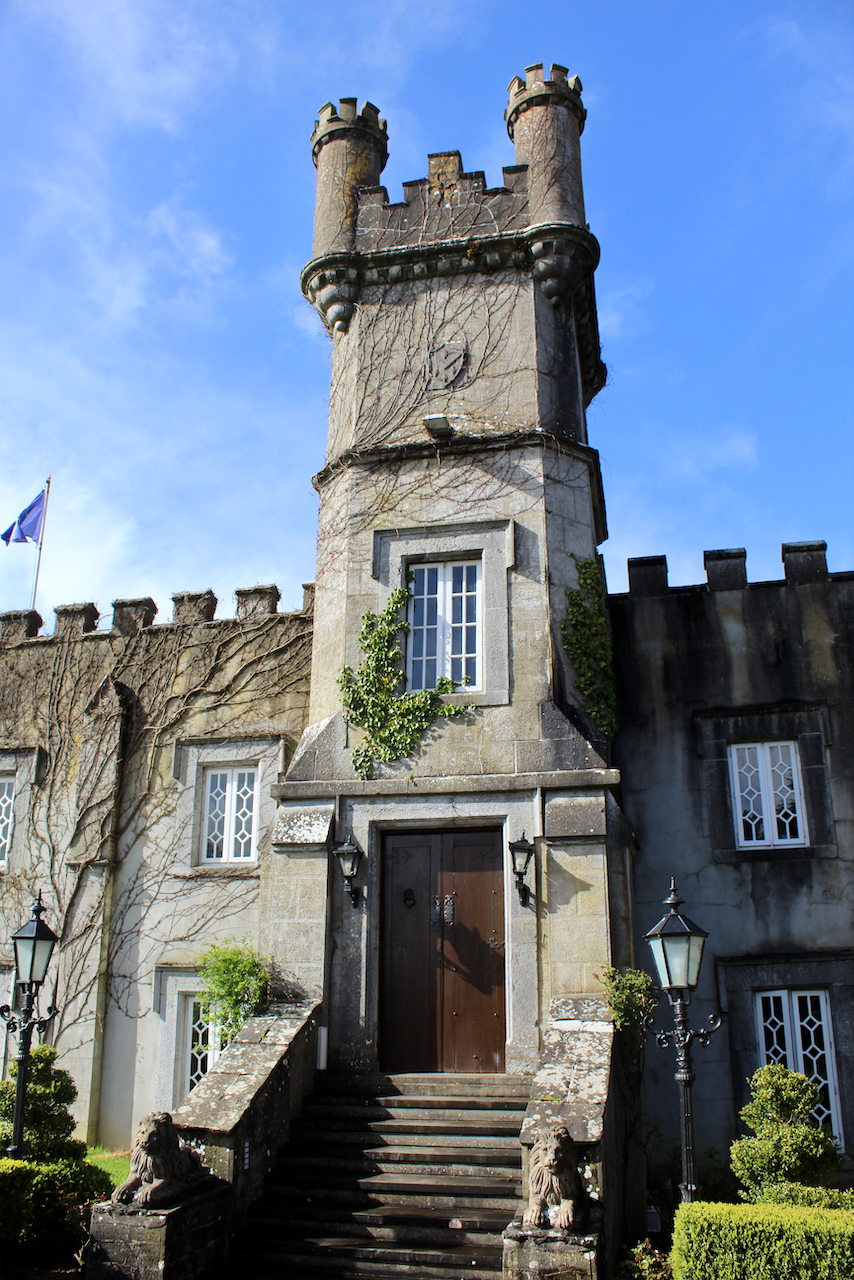
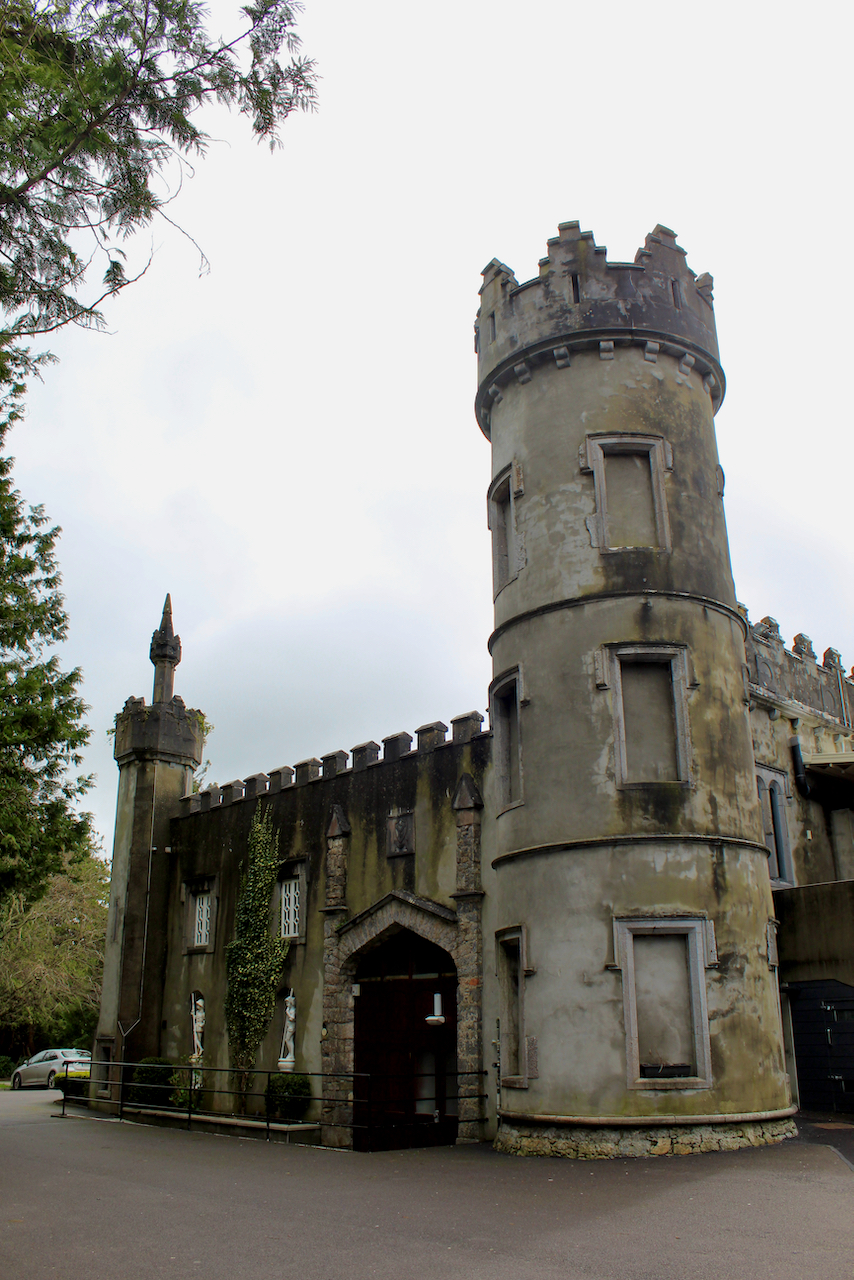
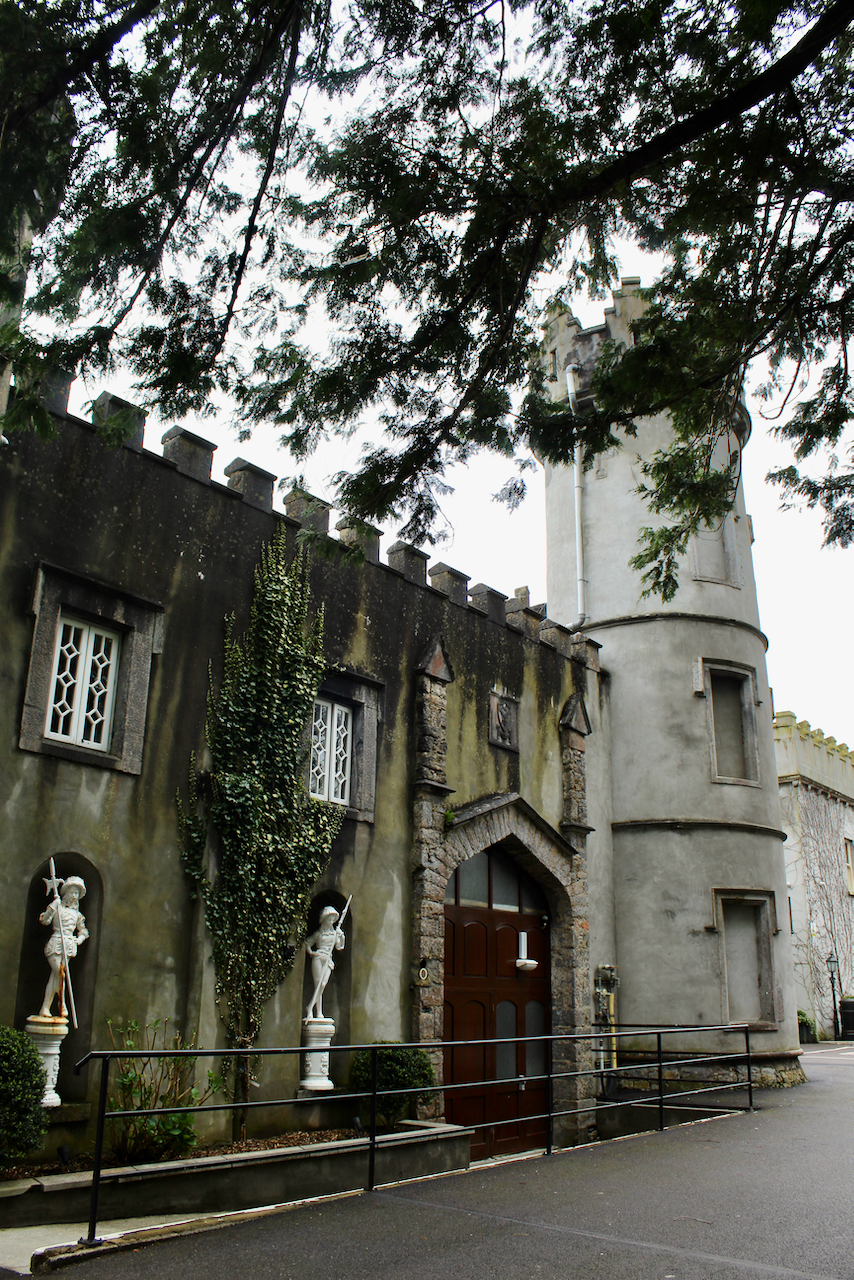
The gate lodge, built around 1890, was inhabited until fairly recently, and has one room on each side. It has a central section with Tudor arched carriageway straddling entrance road, and flanking lower single-bay screen walls.
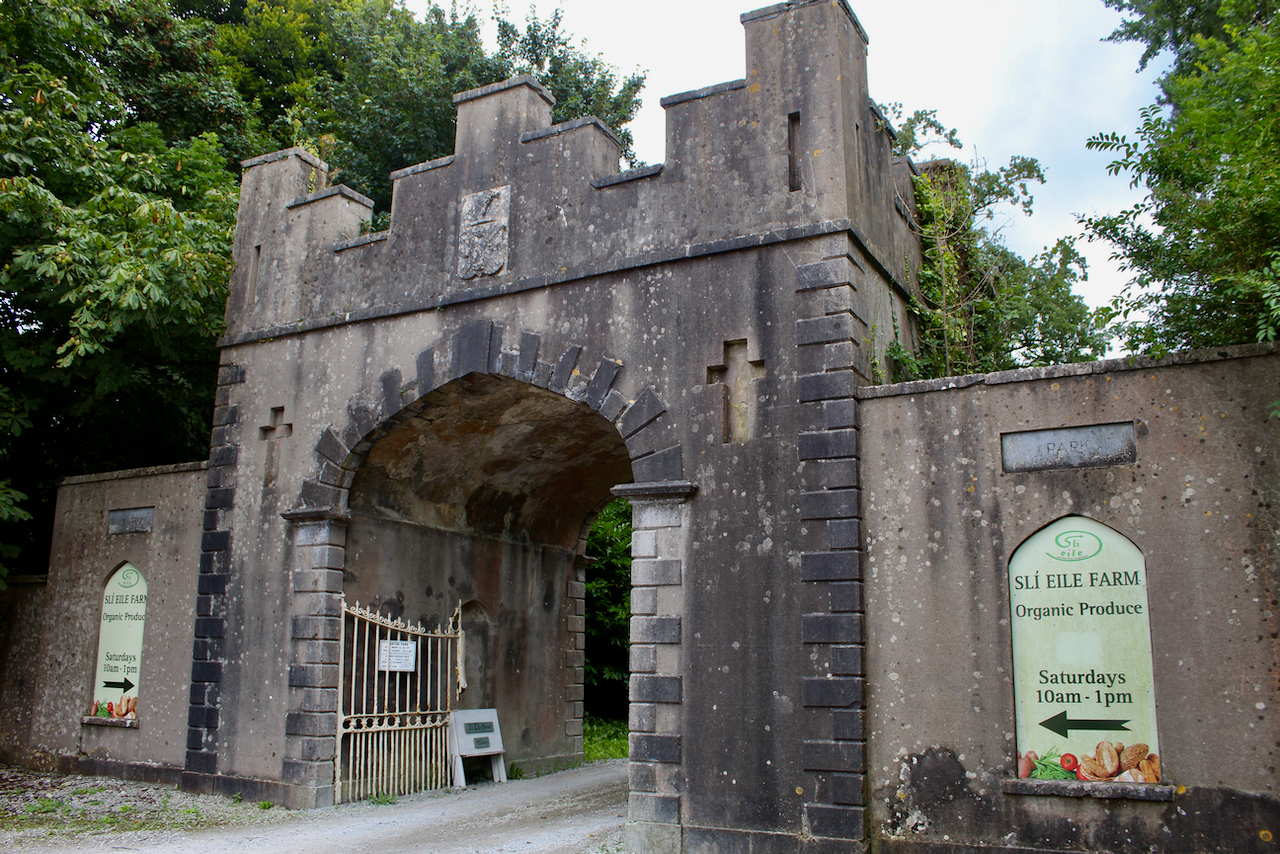
Burton Park, County Cork, August 17th 2023, the castellated entrance gateway. Photograph © Jennifer Winder-Baggot, www.irishhistorichouses.com

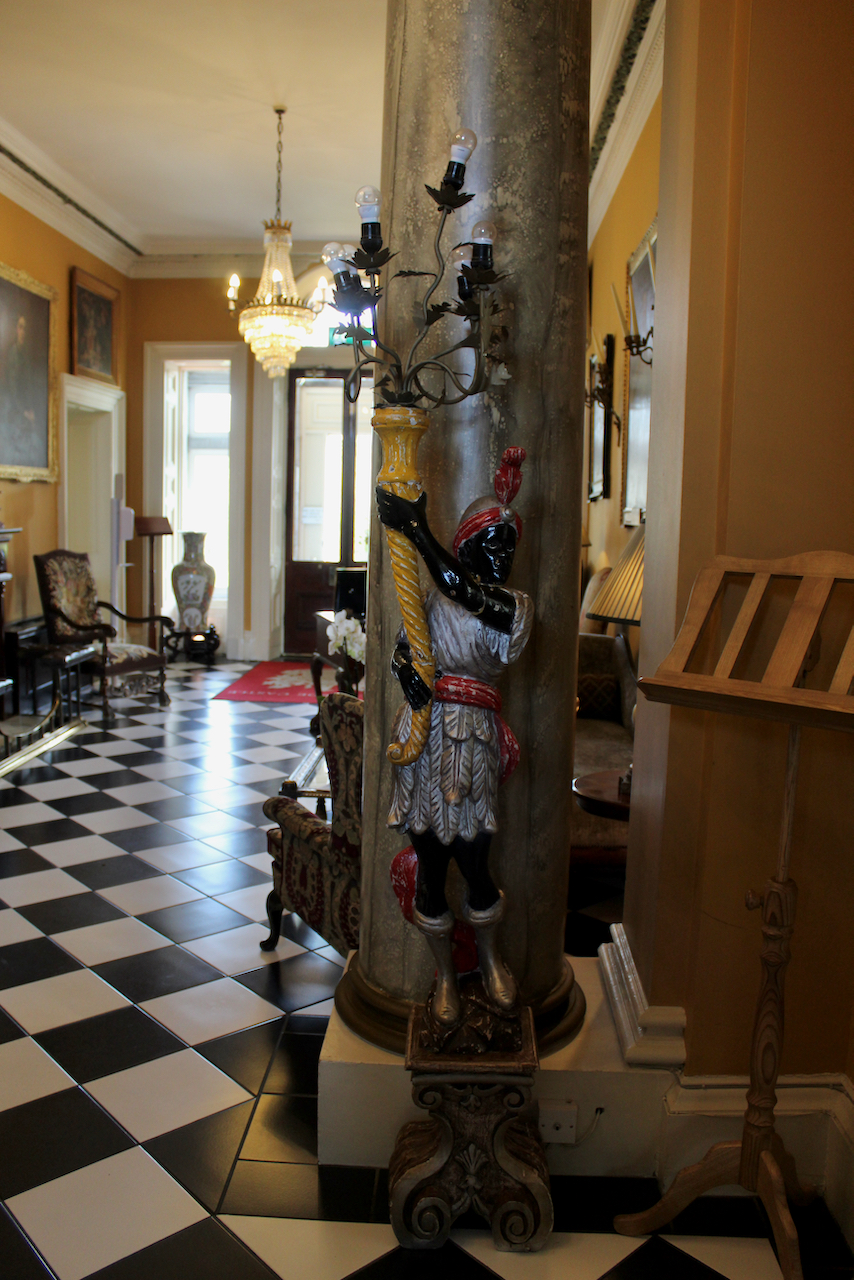
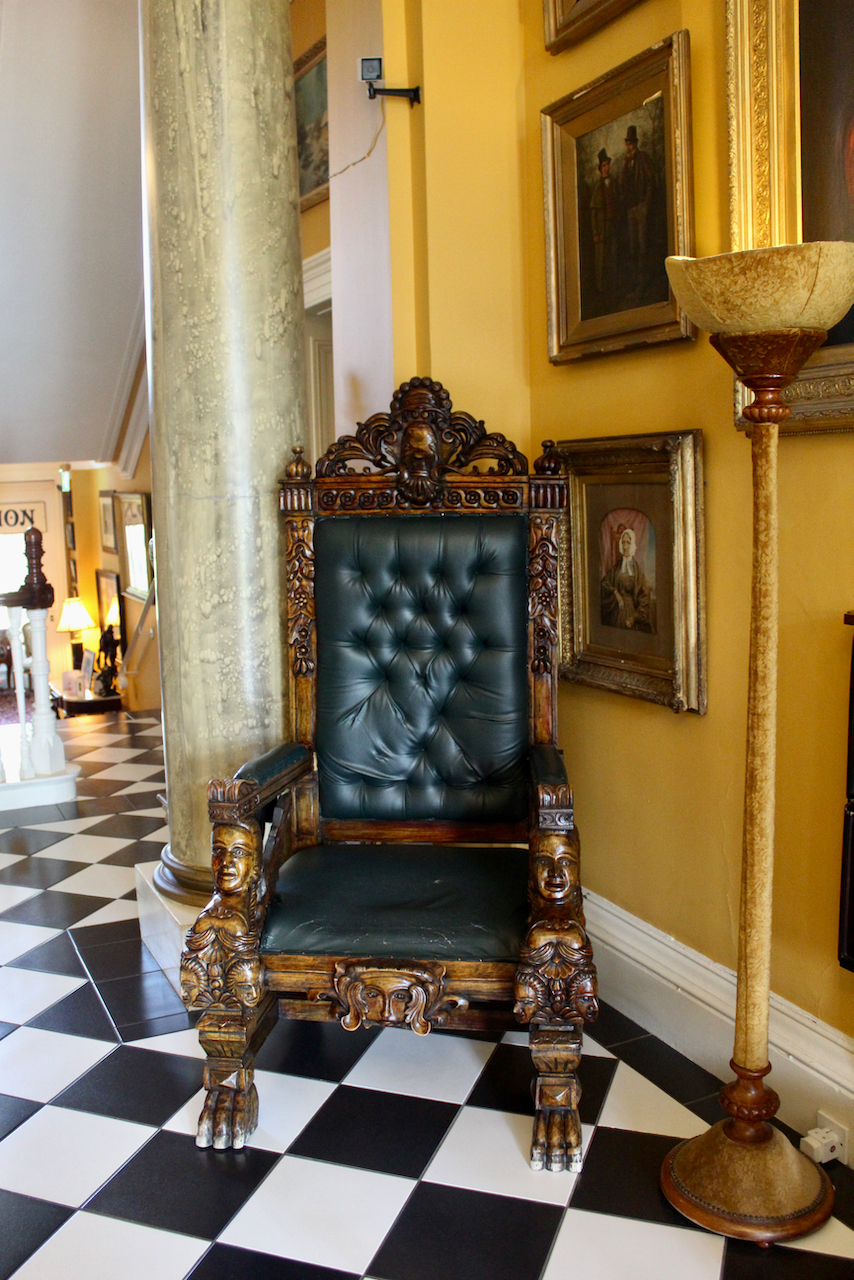
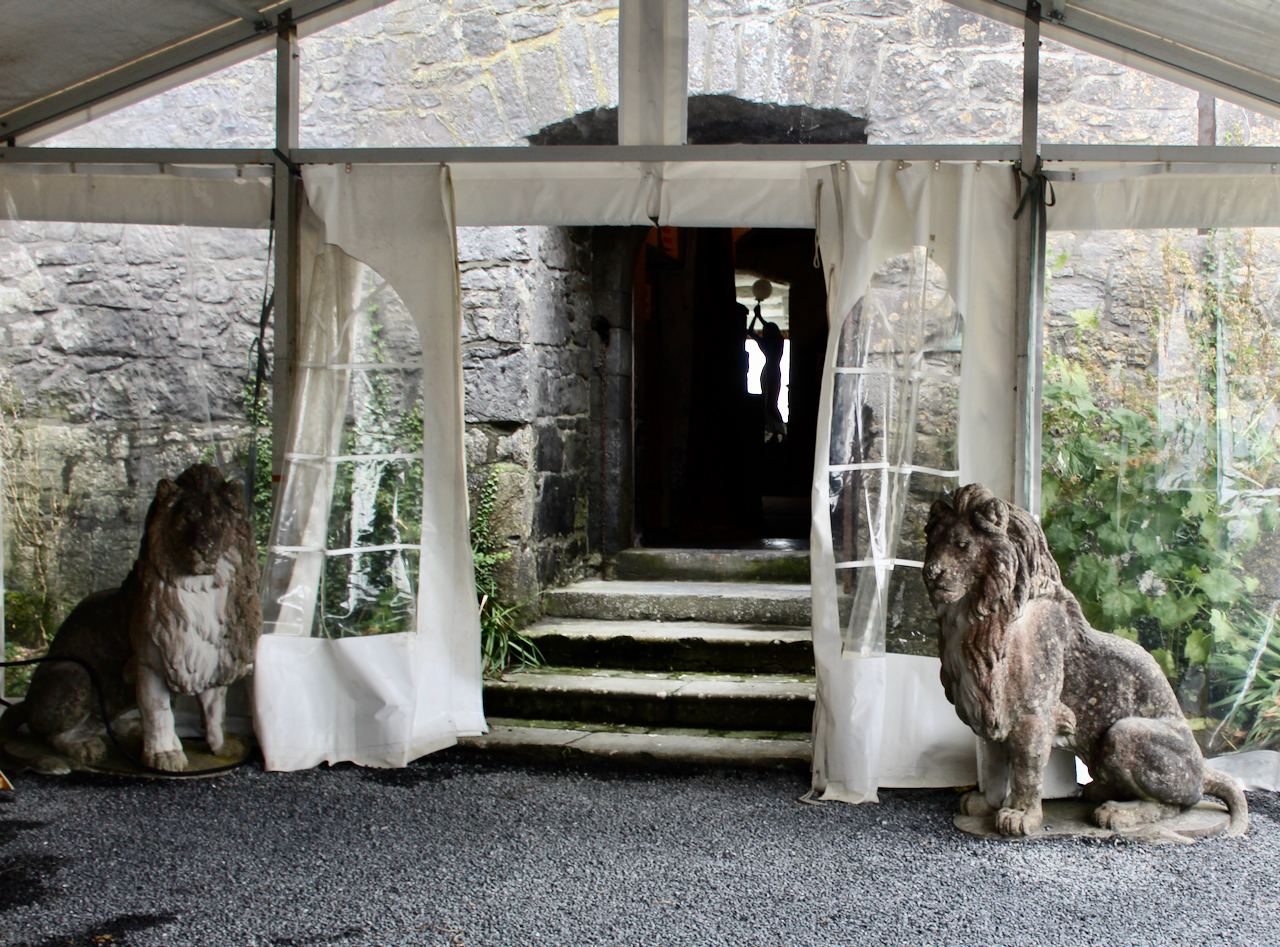
There was nobody to greet us when we arrived to the house, despite my contacting the contact person listed for the property, the Manager for Slí Eile. However, the front door was open, so we entered and had a little wander around. We did not venture far, as we felt like intruders.

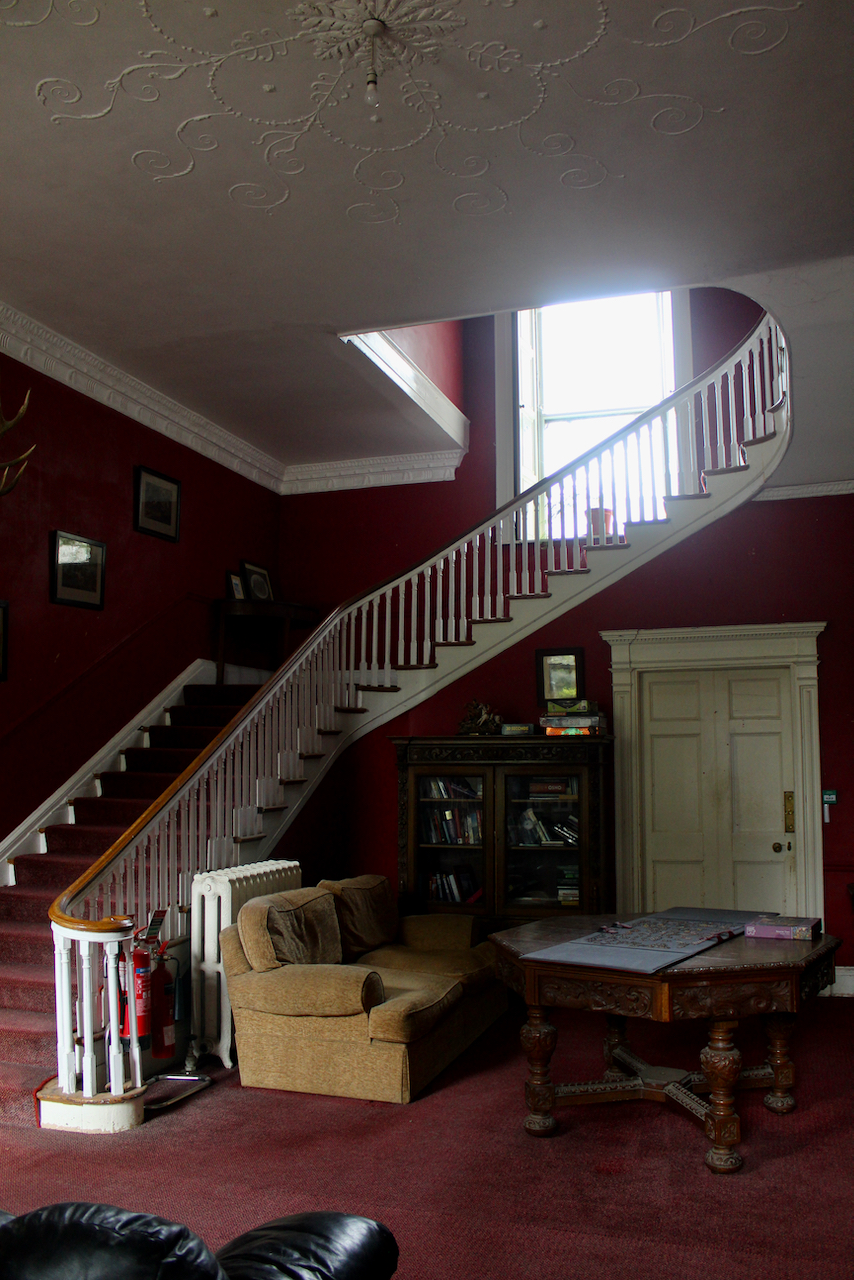
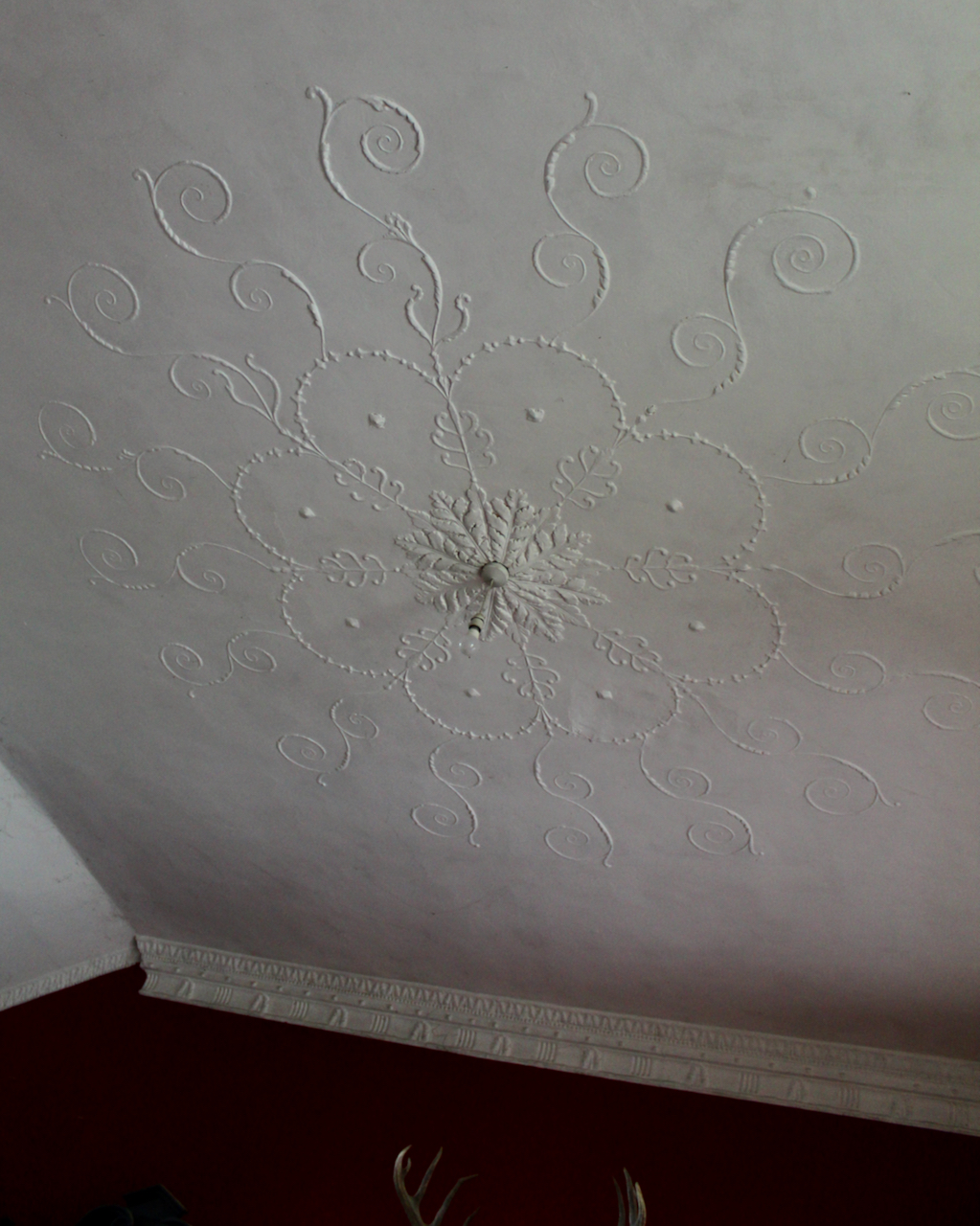
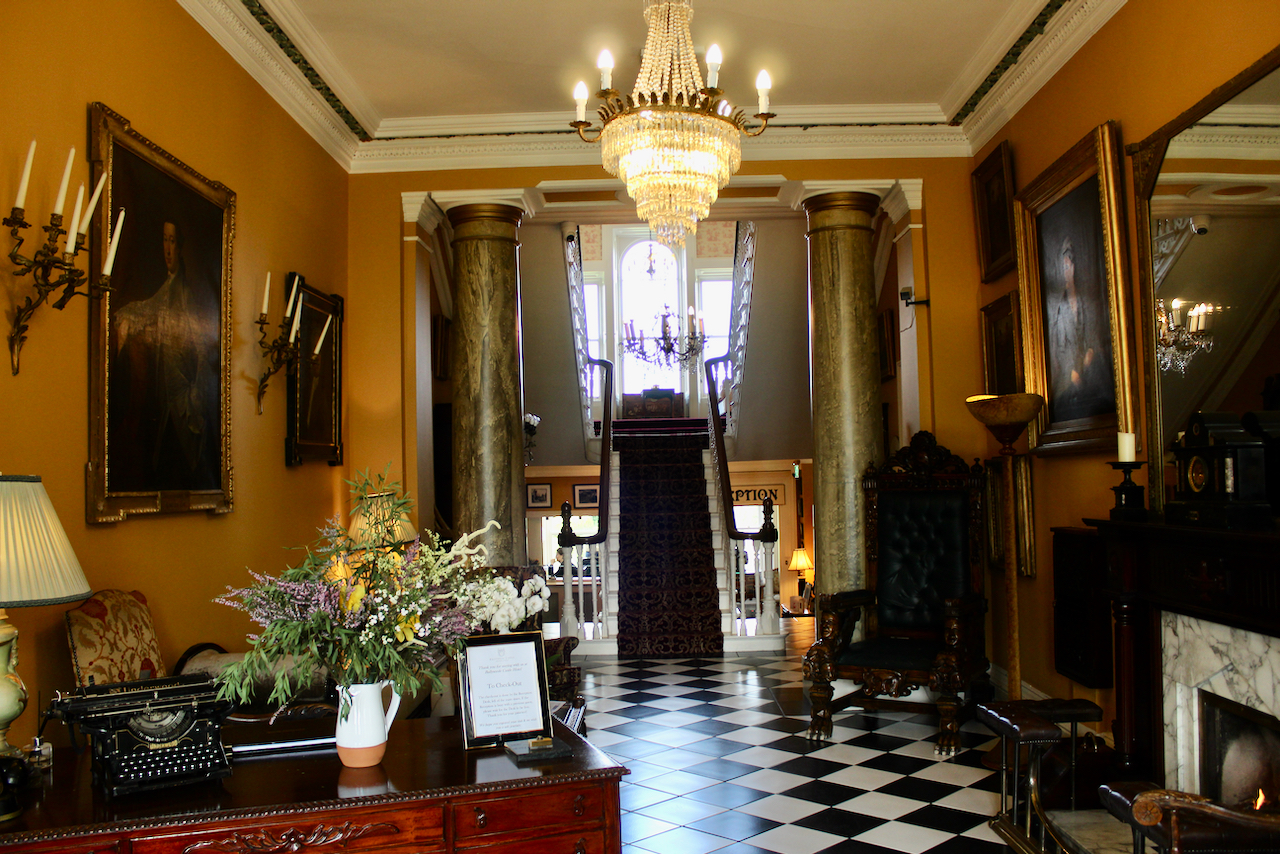
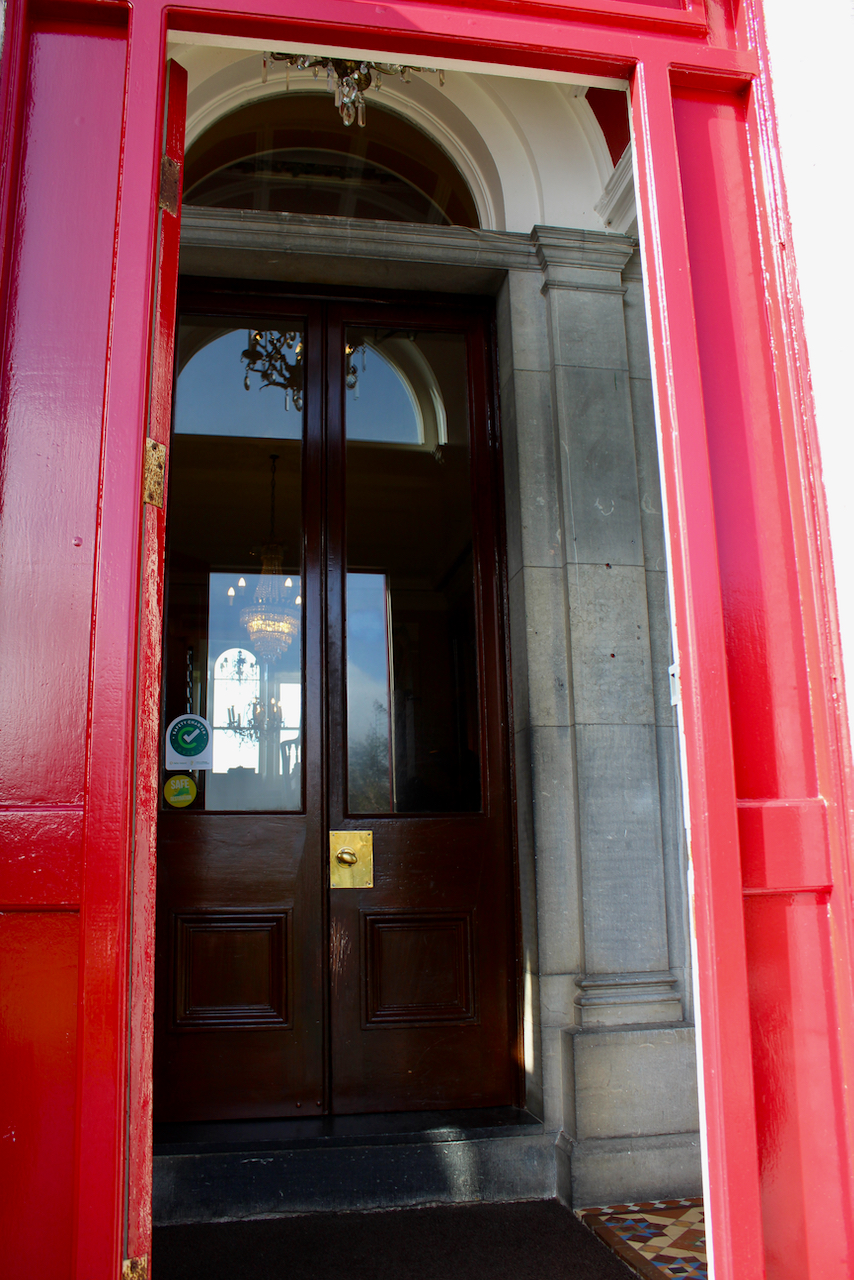
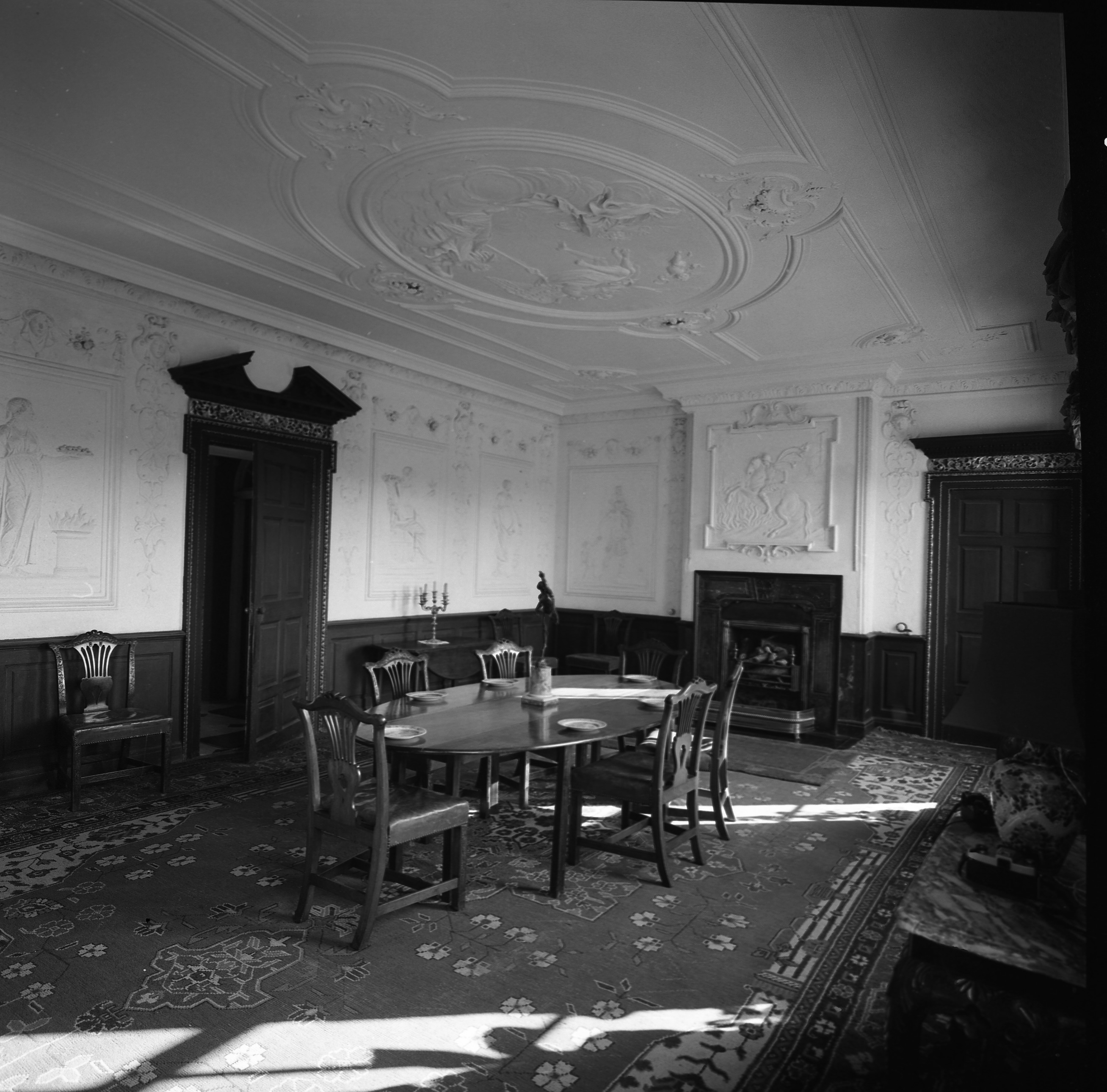
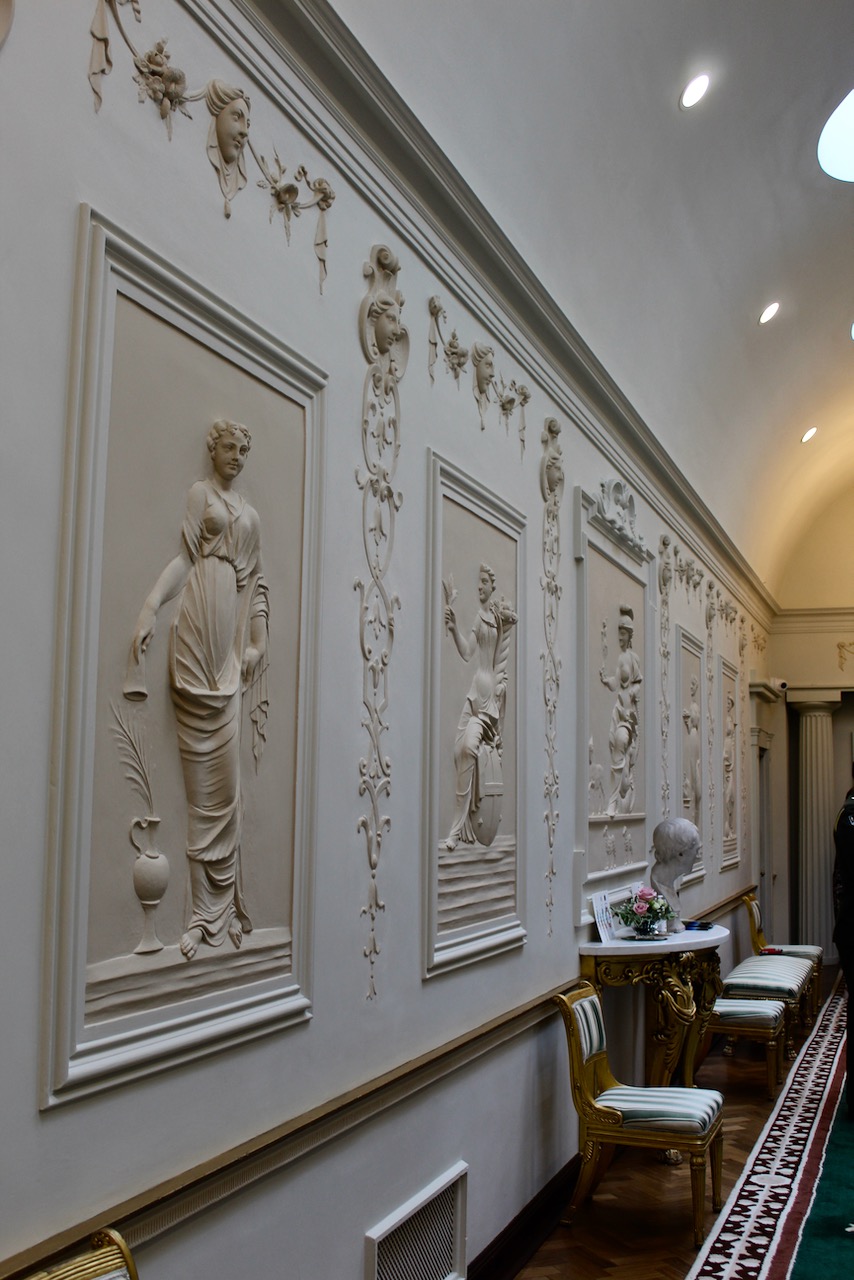
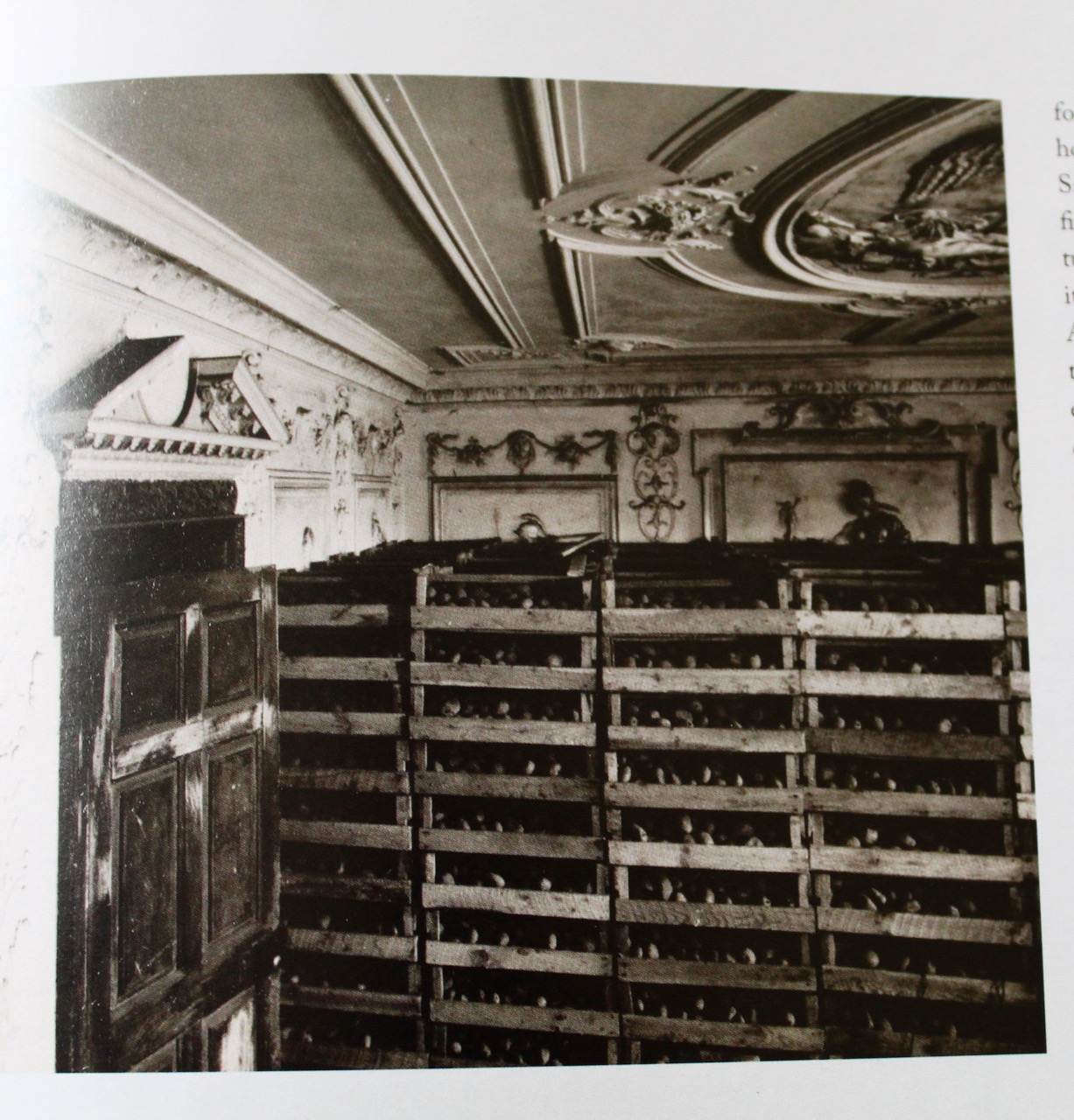
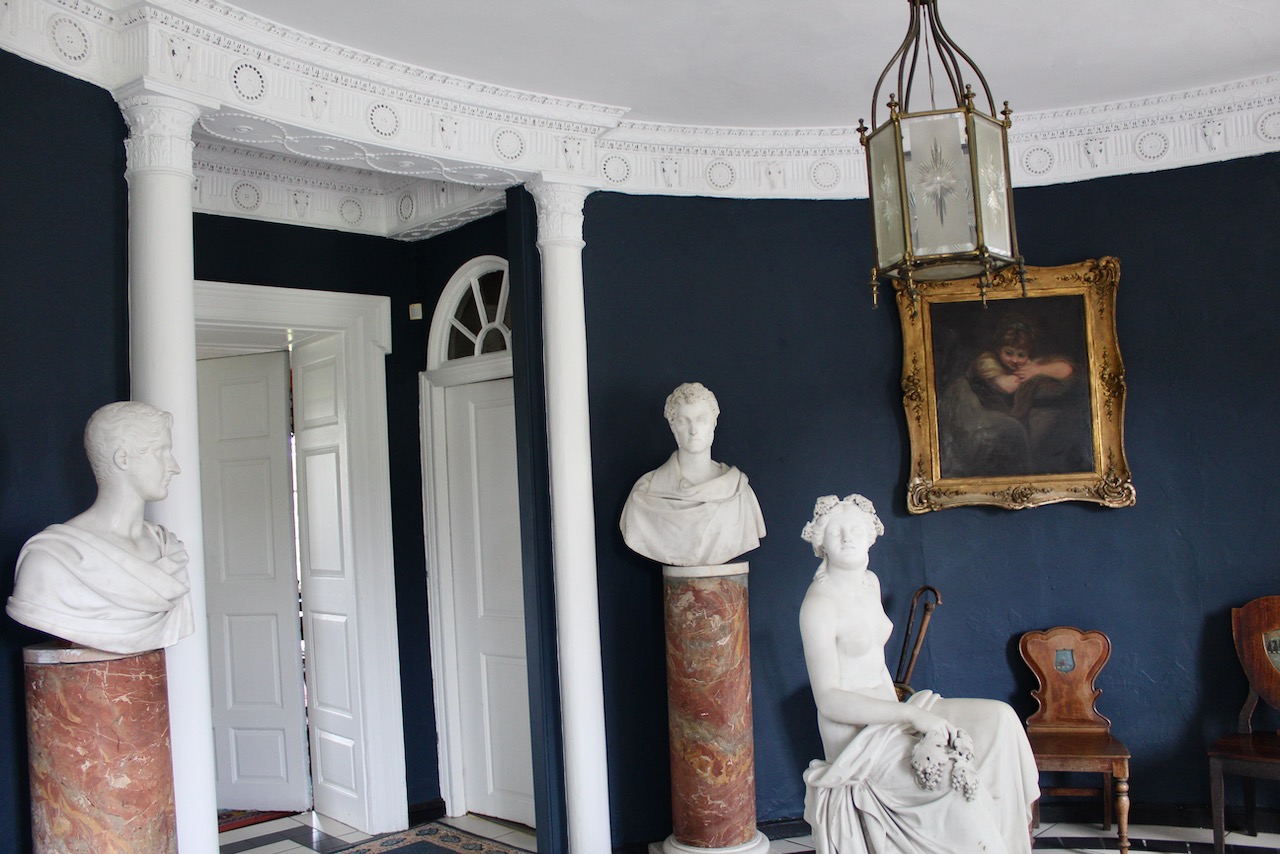
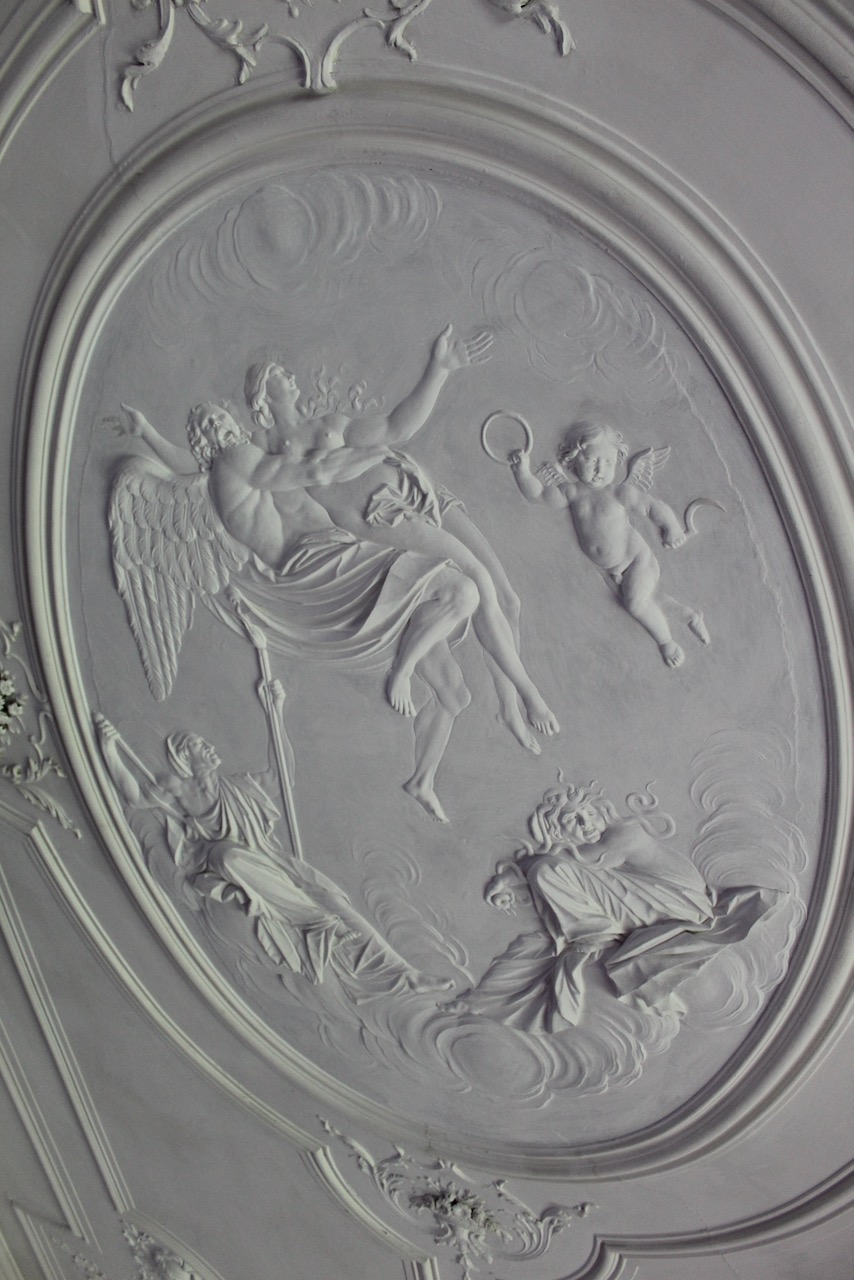
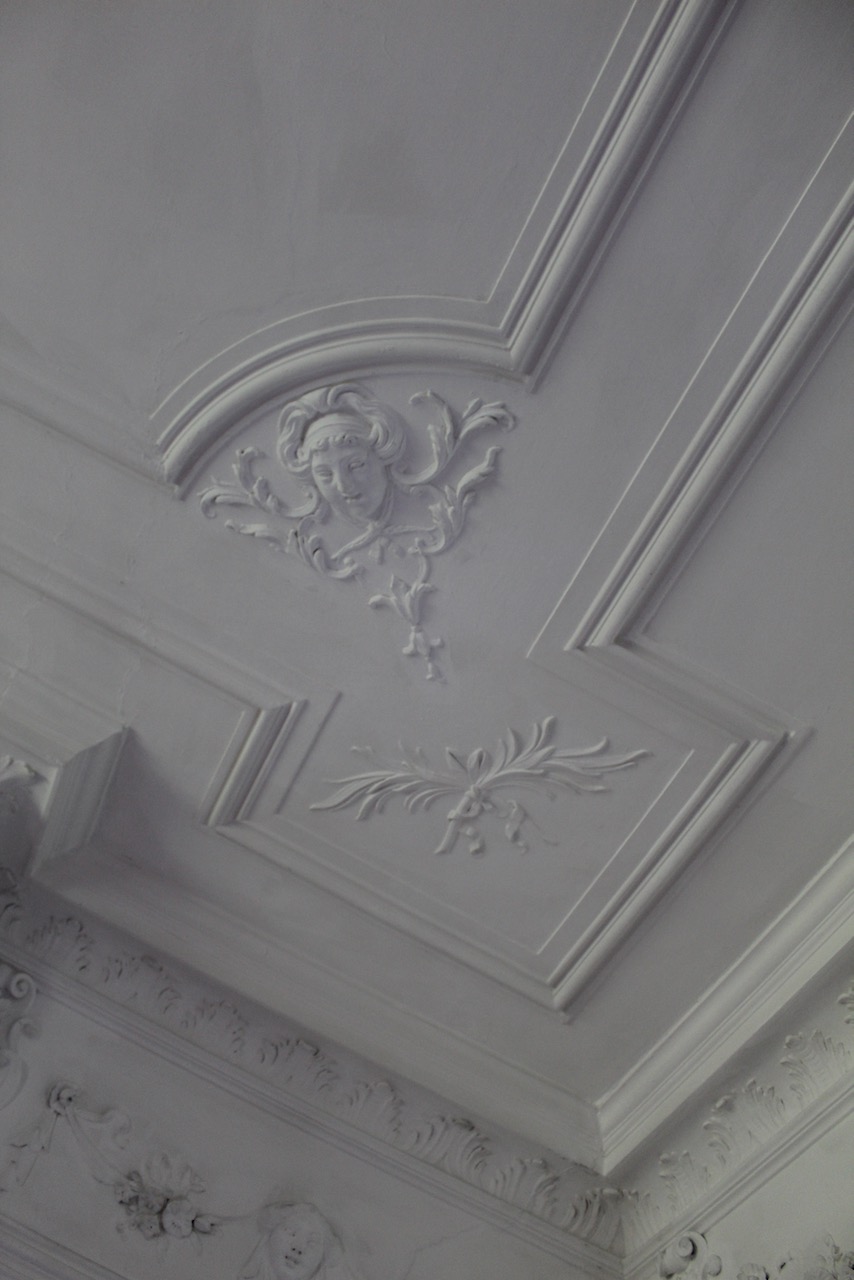
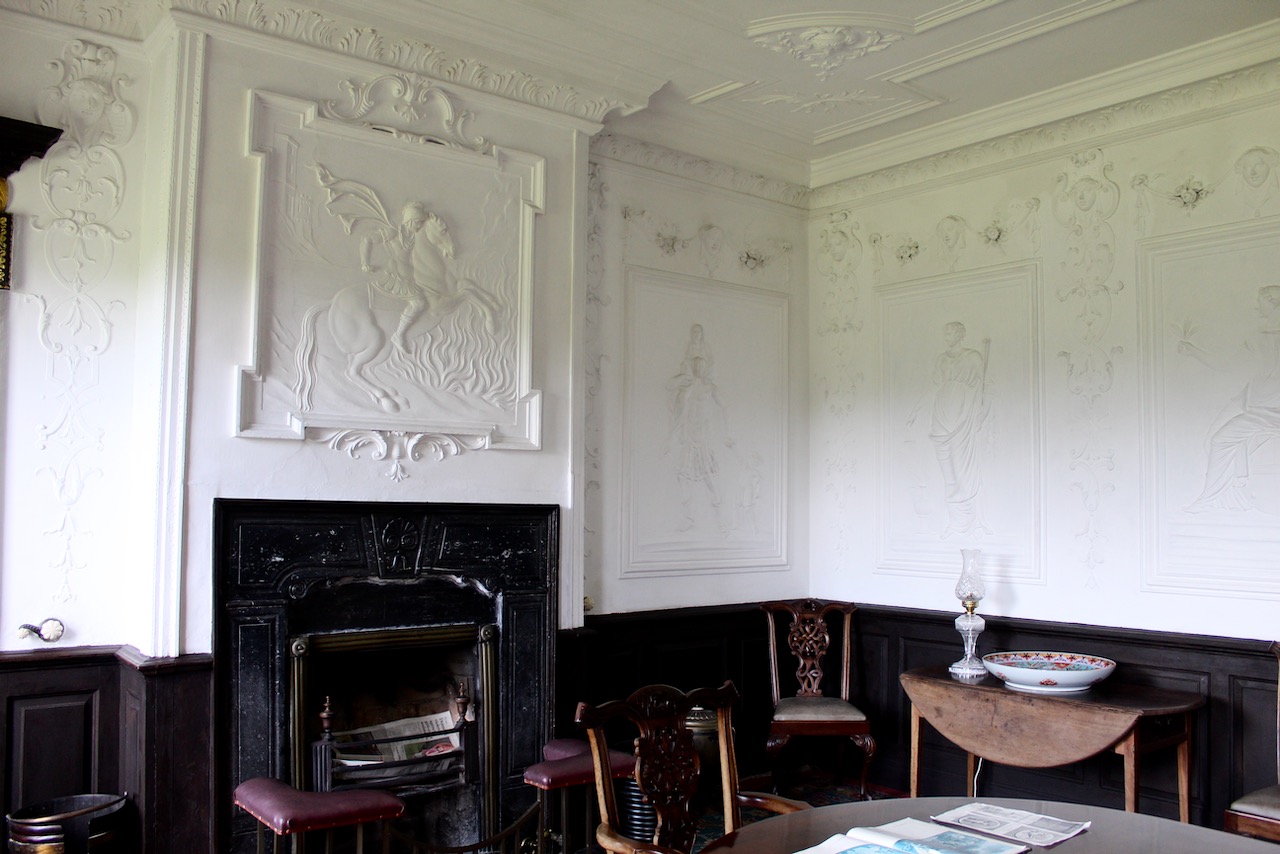
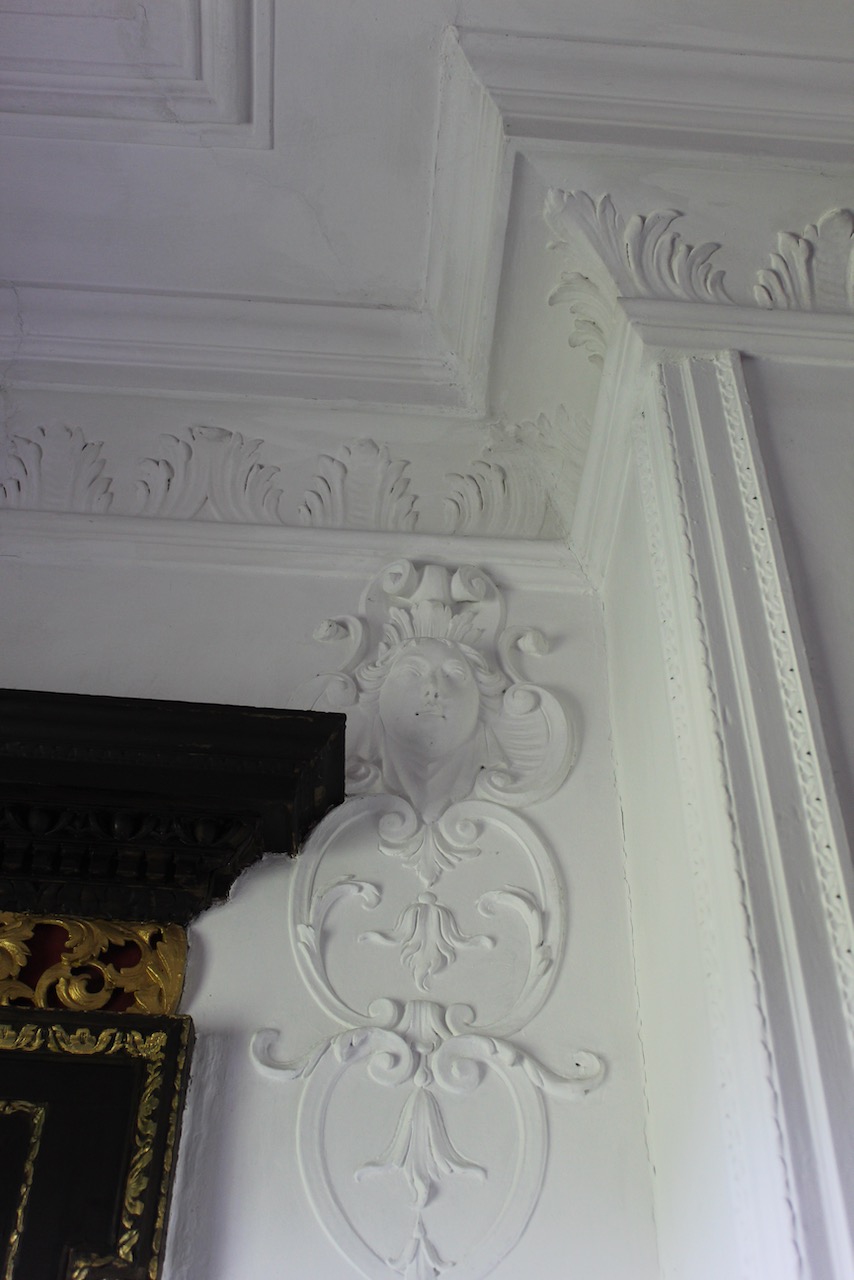
The porch has lovely tiling, and the front hall has good plasterwork ceiling and cornice.
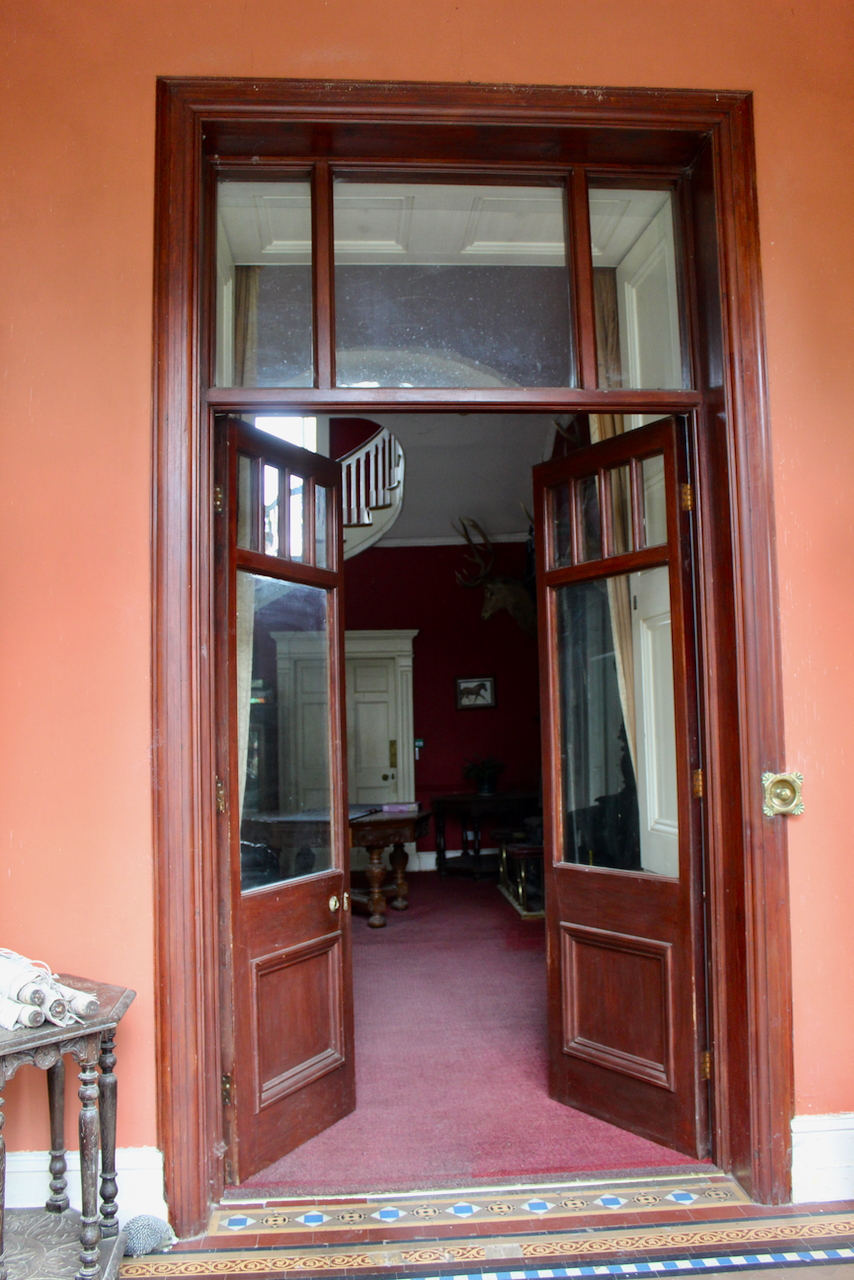
Burton Park, County Cork, August 17th 2023. Photograph © Jennifer Winder-Baggot, www.irishhistorichouses.com

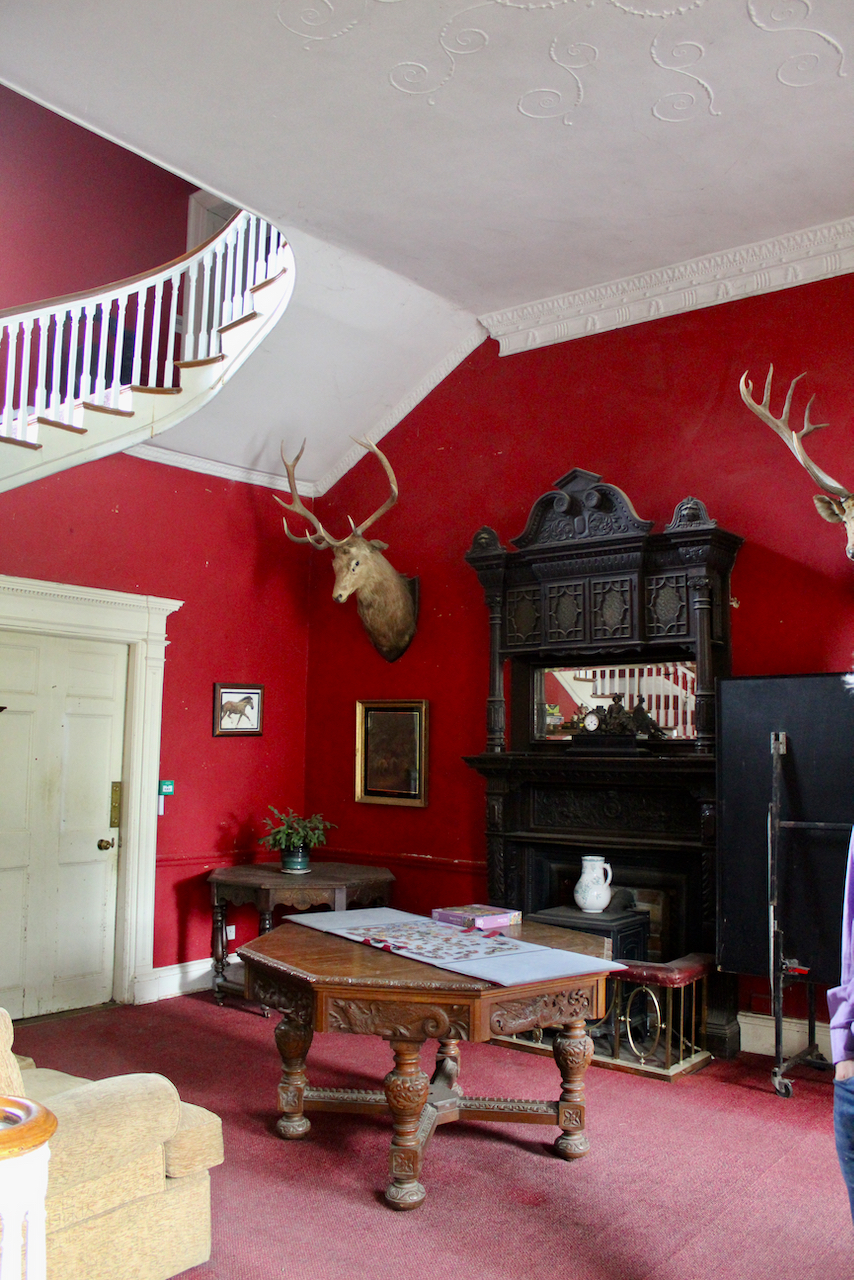
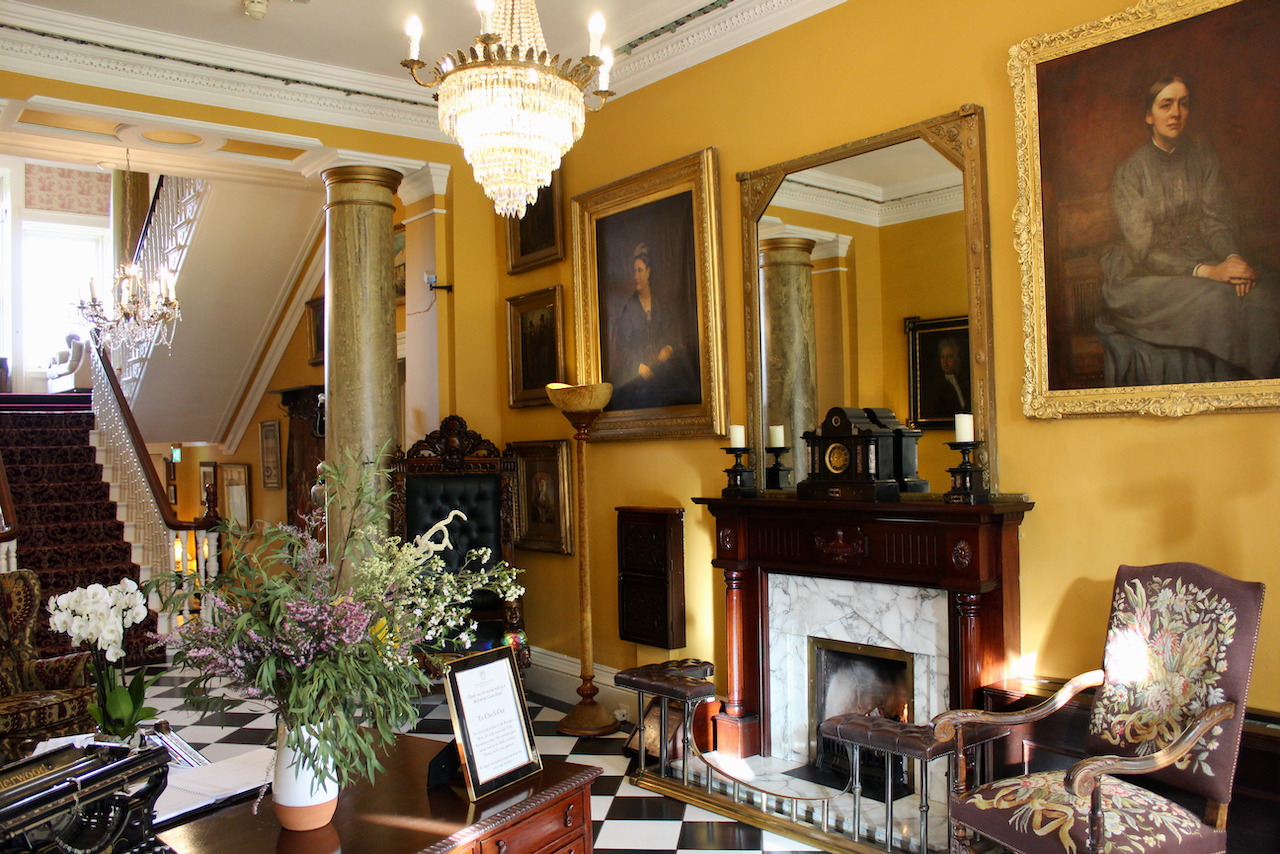
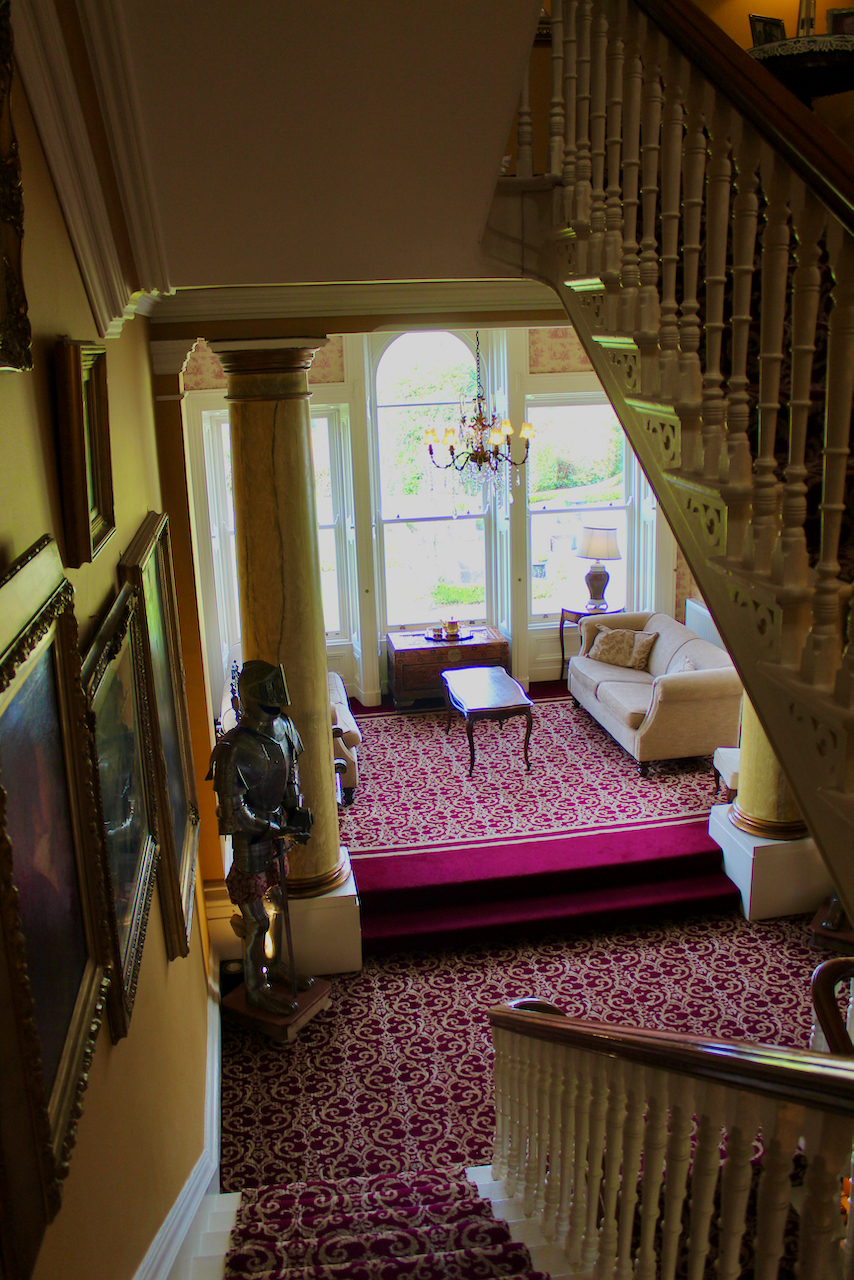
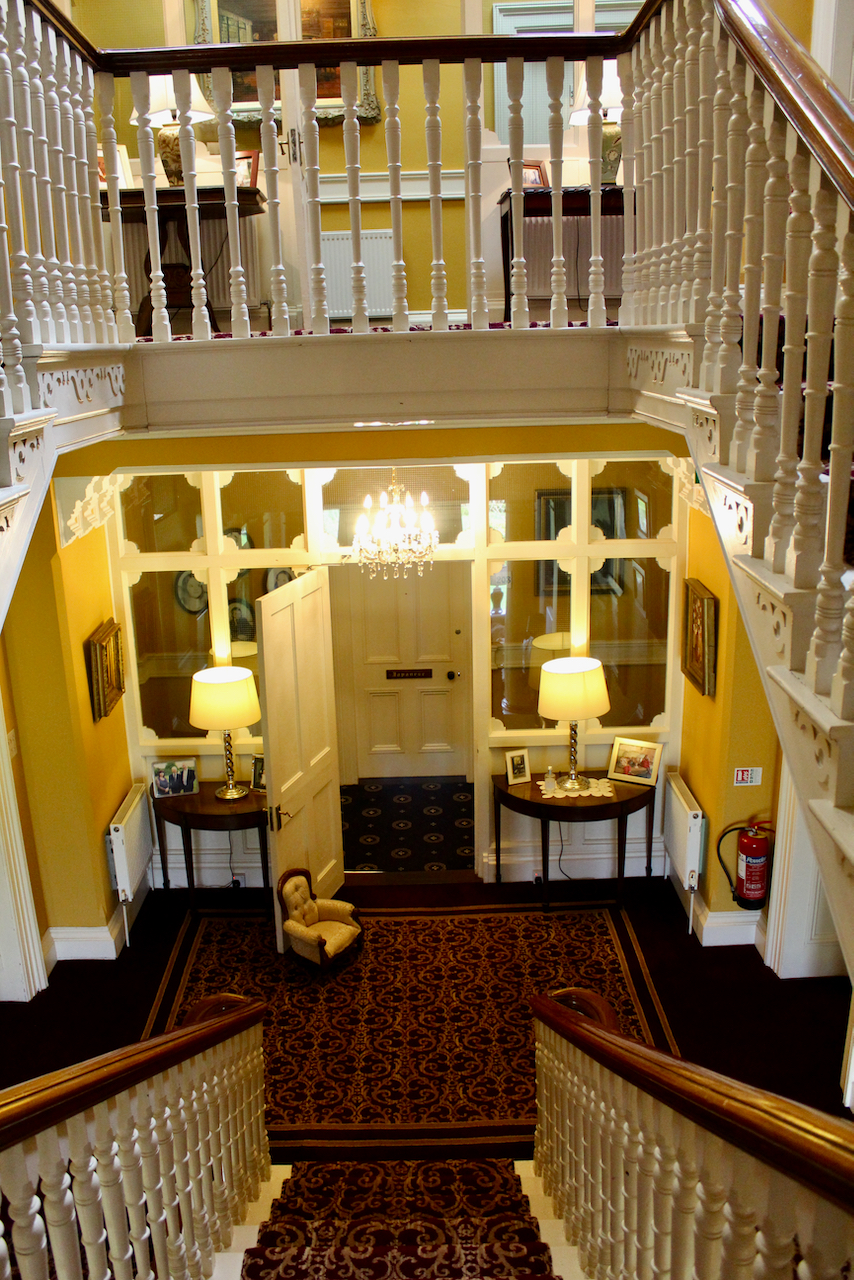
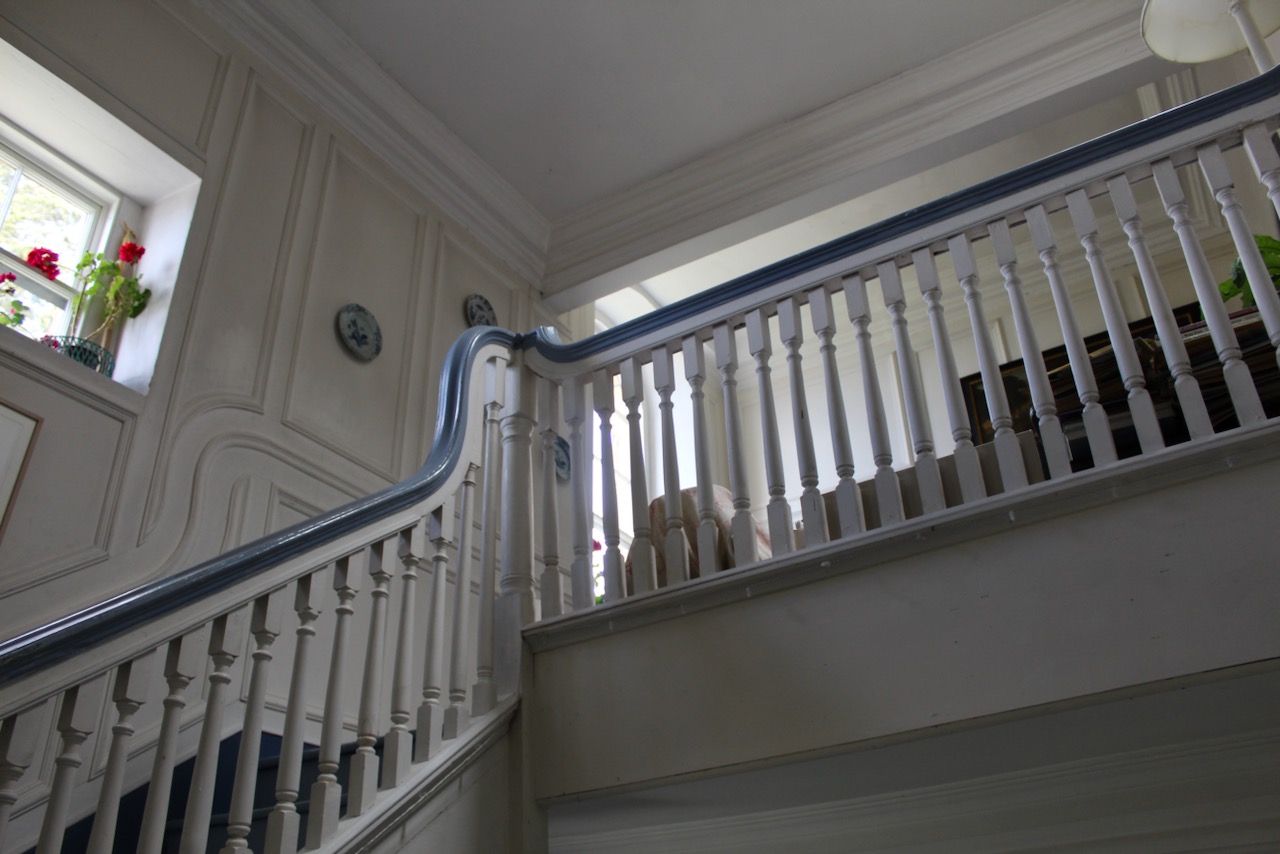
The entrance leads into a large hall with beautiful plasterwork ceiling and sweeping staircase with thin balusters. Mark Bence-Jones tells us that the pedimented doorcases were added later.

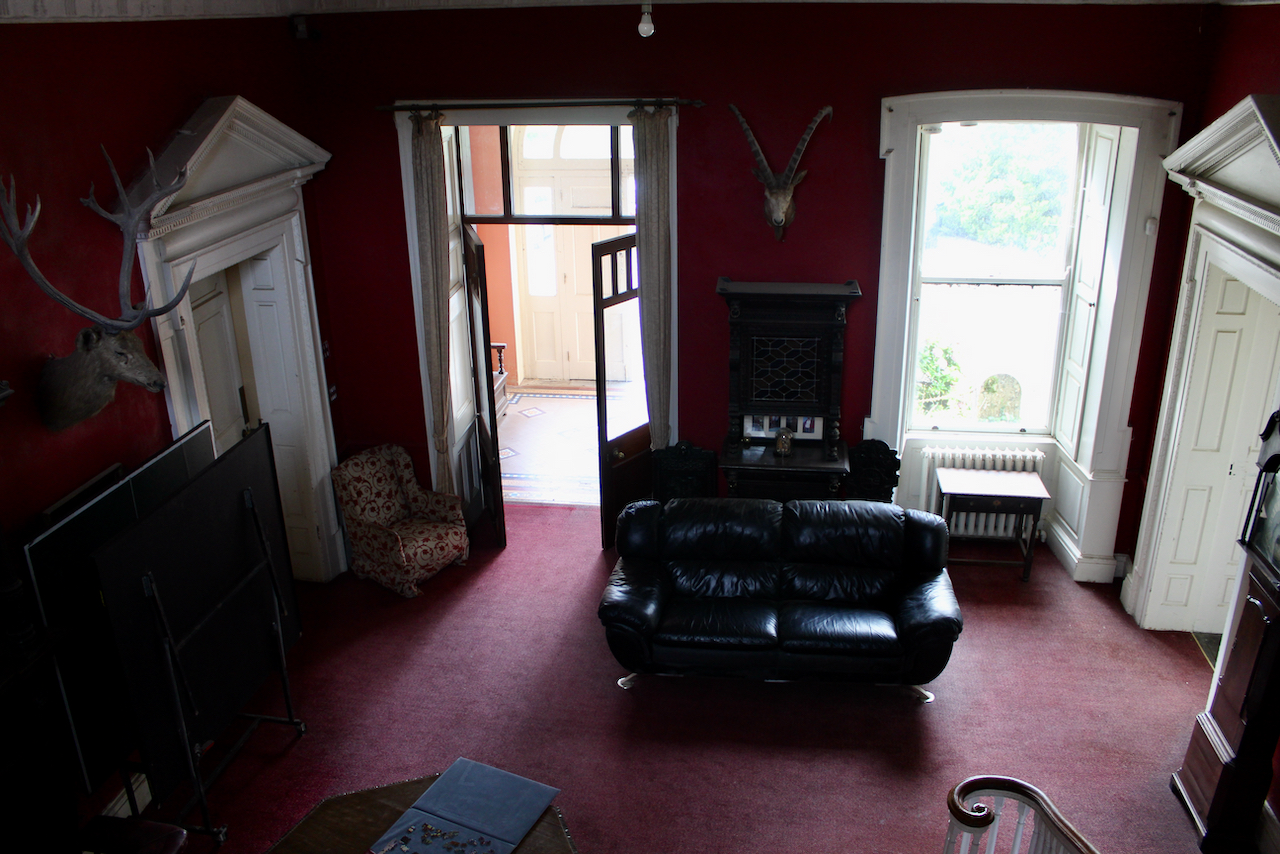
Burton Park, County Cork, August 17th 2023. Photograph © Jennifer Winder-Baggot, www.irishhistorichouses.com

The Slí Eile website tells us that about the Hall:

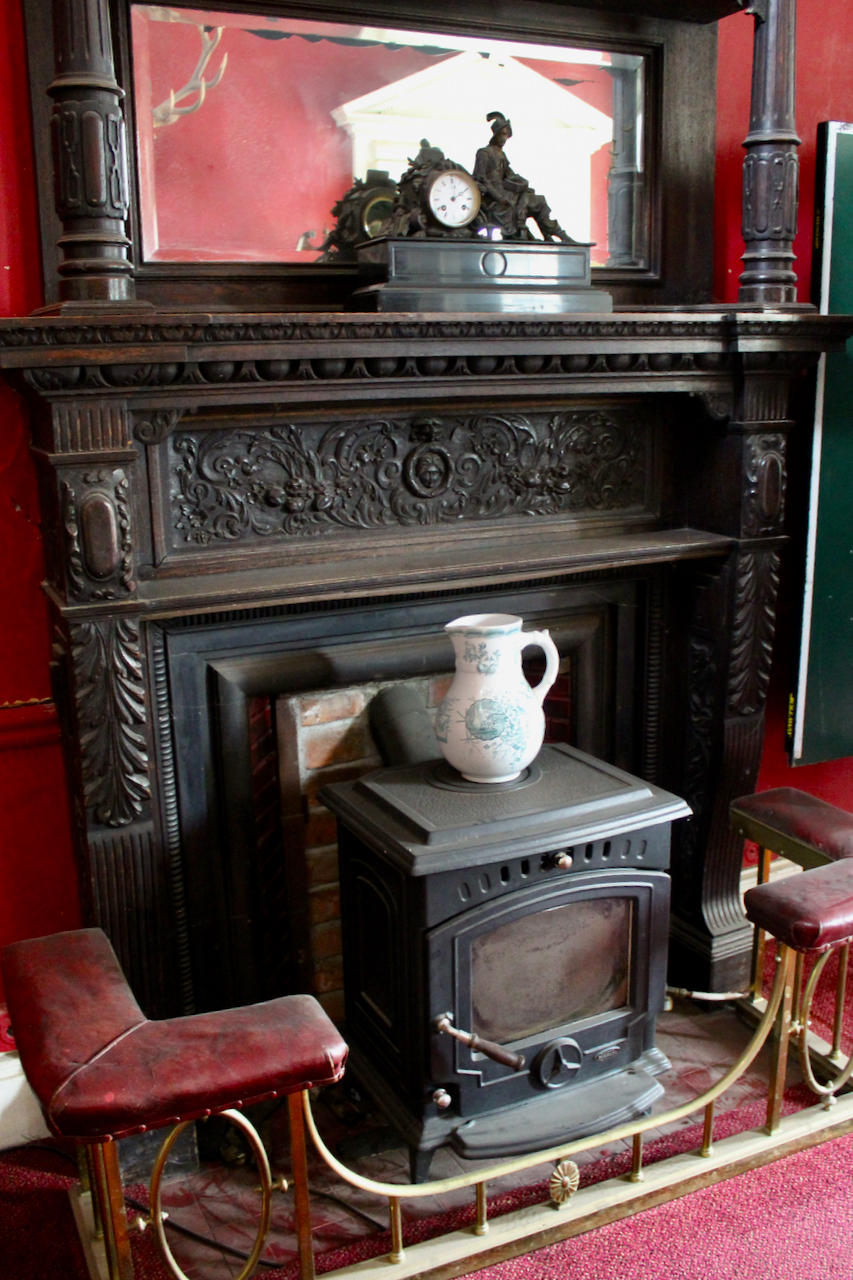
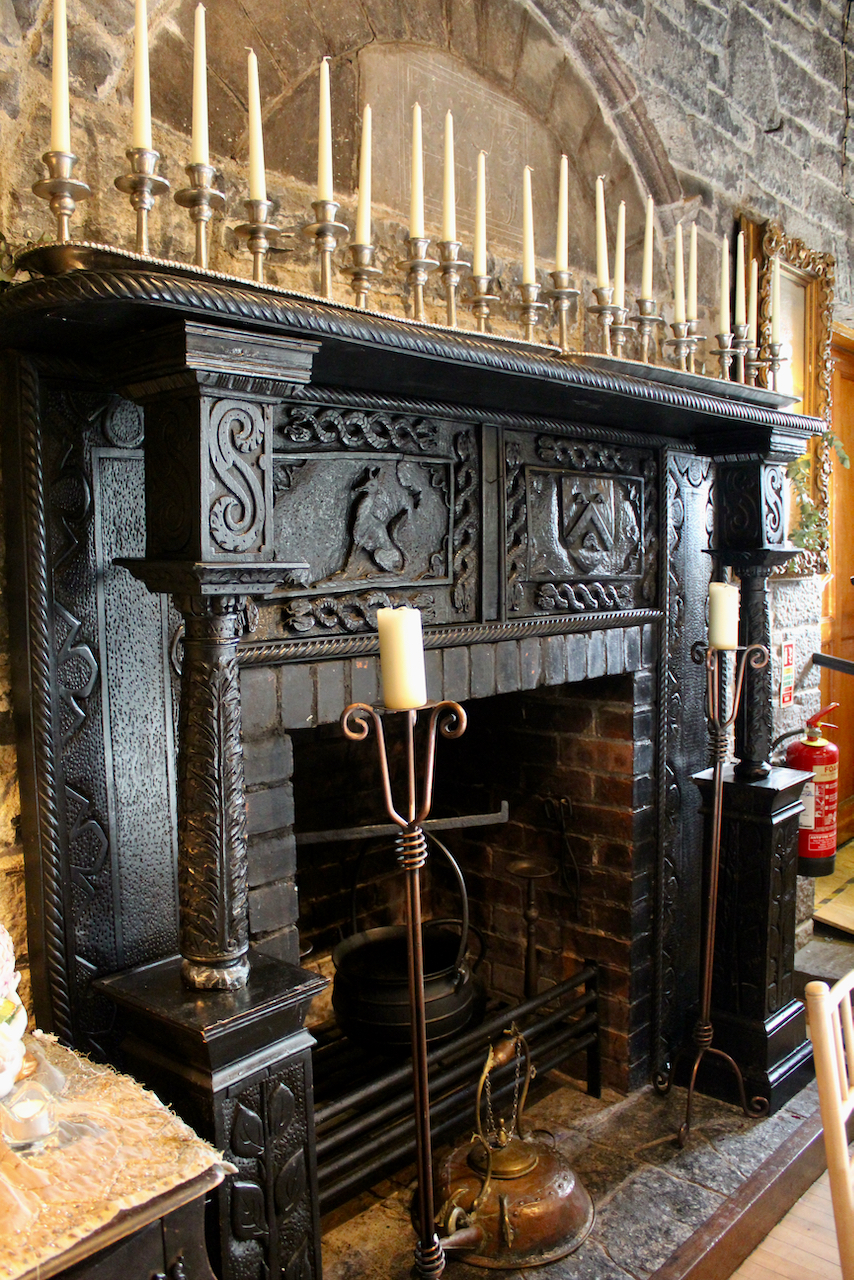
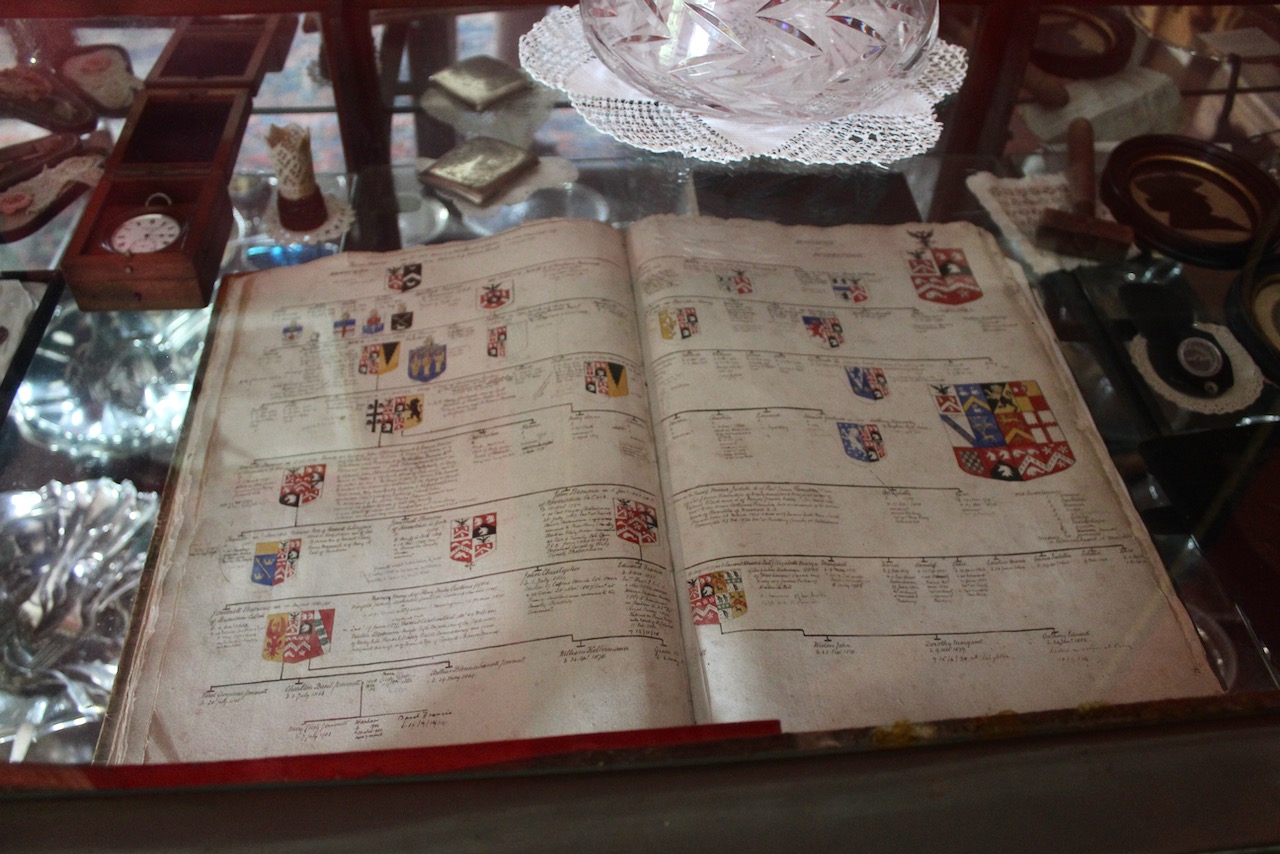
The heavy oak carving of the fireplace and over mantel are of typical Edwardian style, as is the glass panelled door from the porch. In a glass-fronted bookcase at the back of the hall is an artefact with a very strange history. It is a carving knife carefully stored in a glass topped box. This knife has a curse on it, in that anyone who opens the box will die within the year. Needless to say, no-one has attempted this to date! The knife was the property of one John Purcell, of Highfort, Liscarroll, who received a knighthood in 1811 for defending himself, single-handedly, as a very old man against a number of burglars. He killed three of them with this knife, the rest fled. He is known as “The Knight of the Knife” as a result of this feat. At the time, it was made a rule in law that an octogenarian could kill in self defence.

Burton Park, County Cork, August 17th 2023. Photograph © Jennifer Winder-Baggot, www.irishhistorichouses.com

Matthew John Purcell married Anne Daly, daughter of Peter Paul Daly of Daly’s Grove, County Galway. He converted to Catholicism upon his marriage.

They had nine children. It was the son, John, of their daughter Anita, who in 1919 married John Ryan of Scarteen, Knocklong, County Limerick, who inherited Burton Park, and took the name Ryan-Purcell.
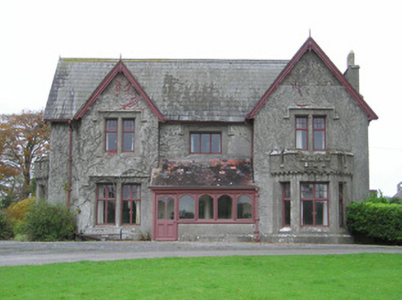
Scarteen House, County Limerick, courtesy of National Inventory of Architectural Heritage.

Jane O’Hea O’Keeffe interviewed Rosemary Ryan-Purcell, eldest daughter of John Ronan, The Grove, Rushbrooke, County Cork, who along with her husband John came to live at Burton Park with their two eldest children in the early 1960s. Rosemary explains the Ryan-Purcell connection to the old house. “This was the home of my husband John’s mother, whose name was Anita Purcell. He was the younger son, and his elder brother inherited the Ryan family home at Scarteen in Knocklong, County Limerick. When we were first married, we lived at Scarteen, which was John’s childhood home. Later, he inherited Rich Hill near Annacotty, County Limerick, from his godfather, Dicky Howley, and we lived there for a short while. When John’s aunt, Louisa Purcell, died in the early 1960s, she left Burton Park to John, so we then came to live here and have been here ever since.

They now lease the property to Slí Eile. The Slí Eile website tells us of the drawing room:

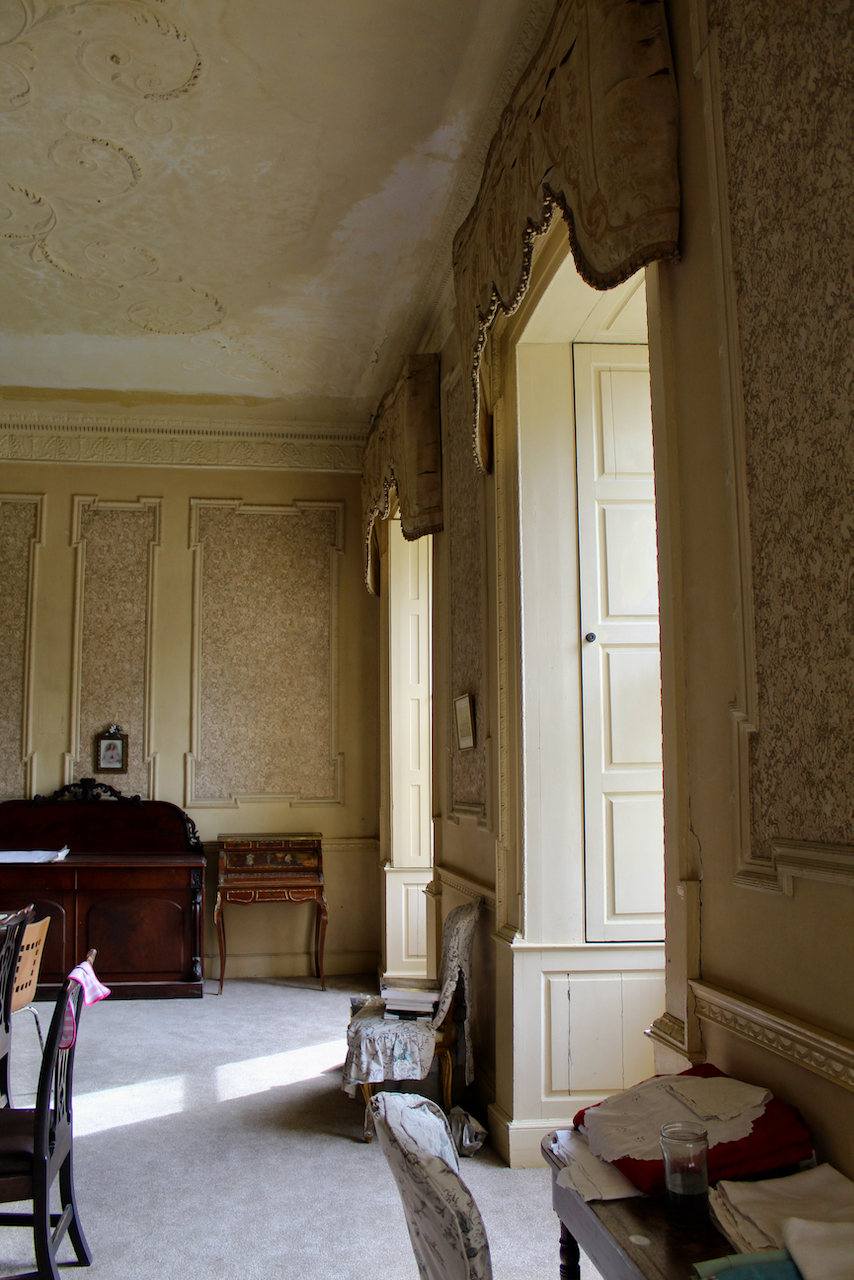
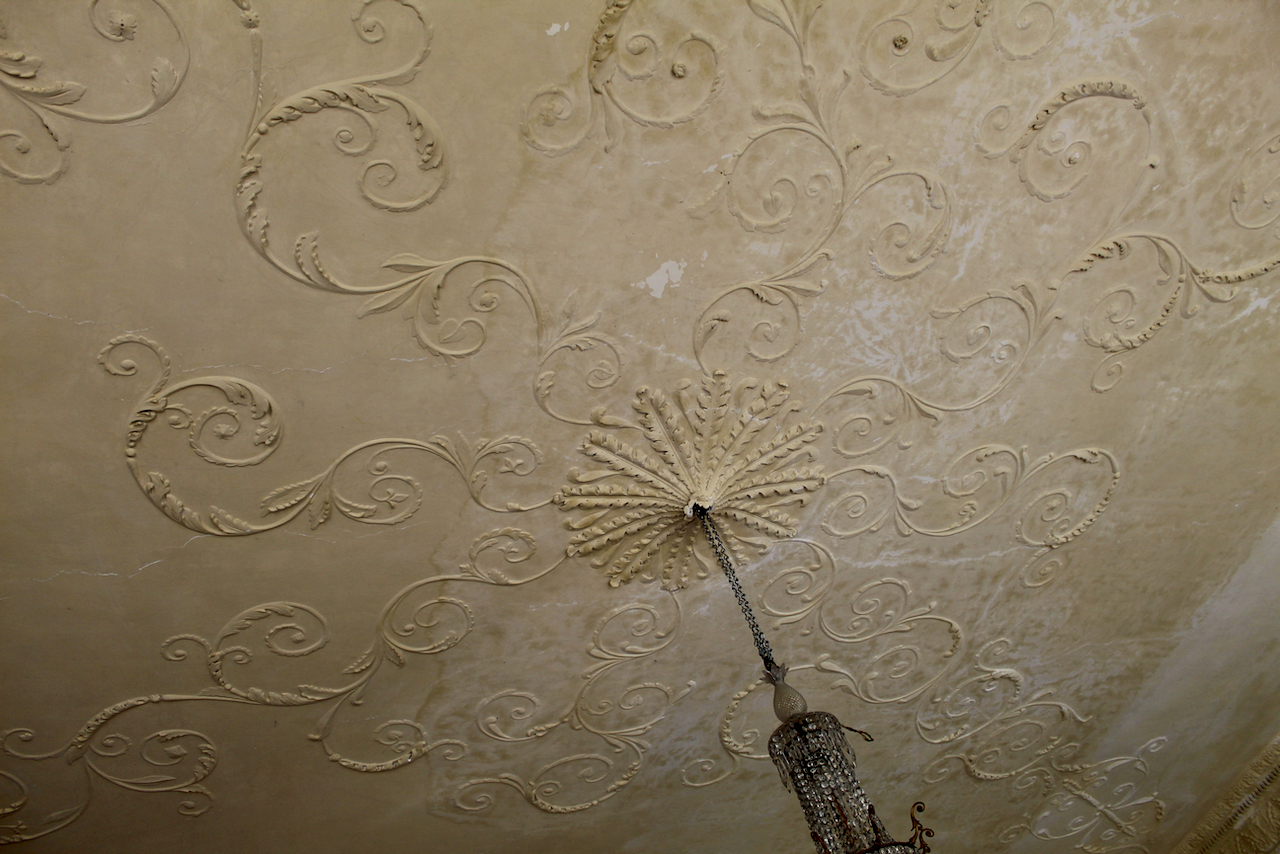
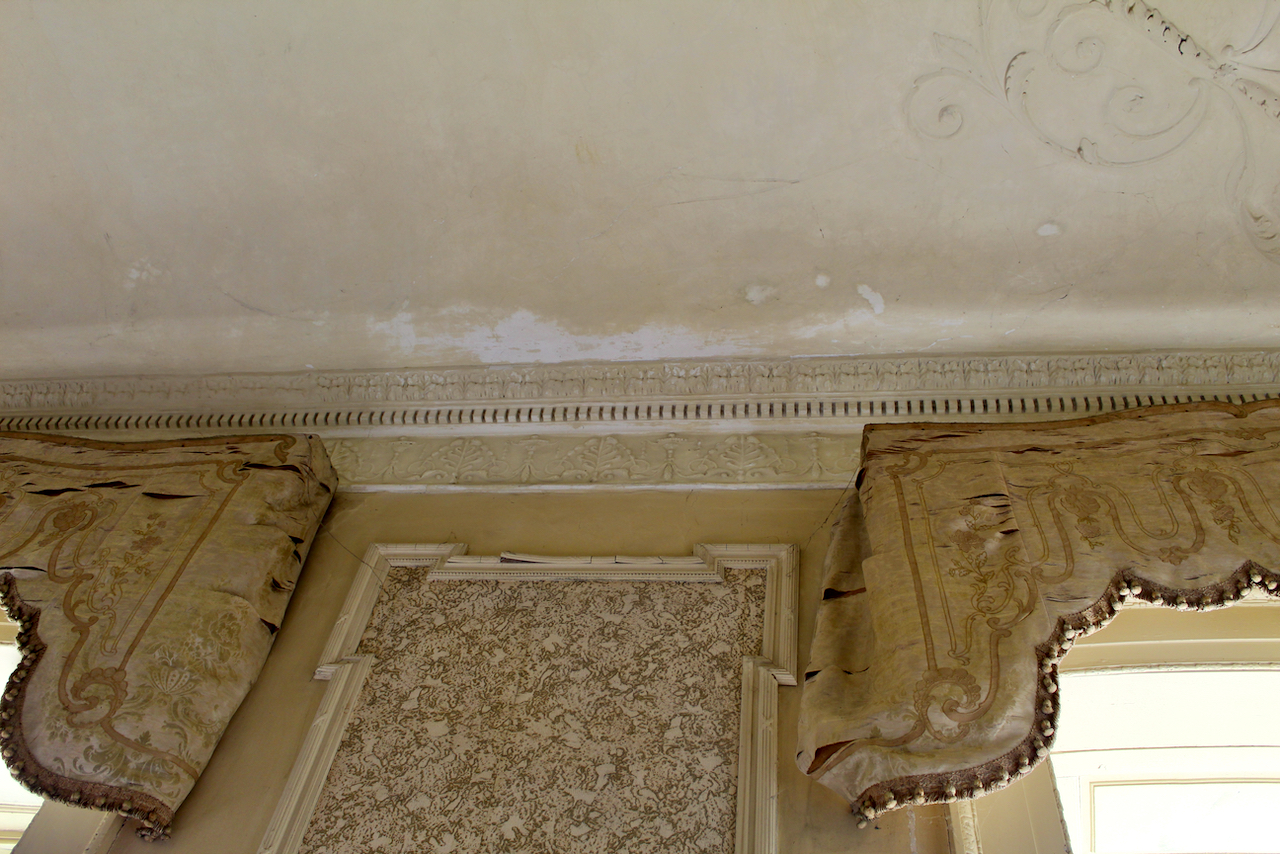
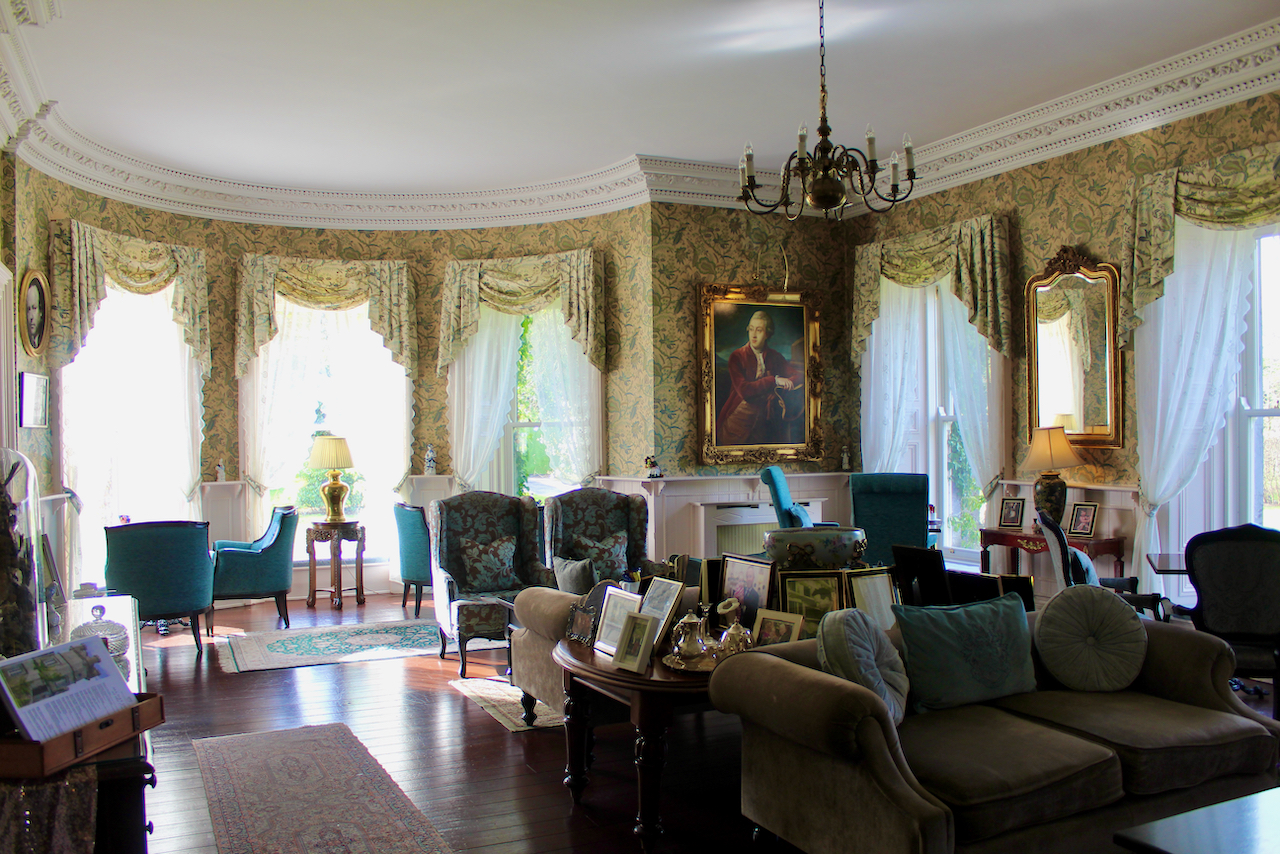
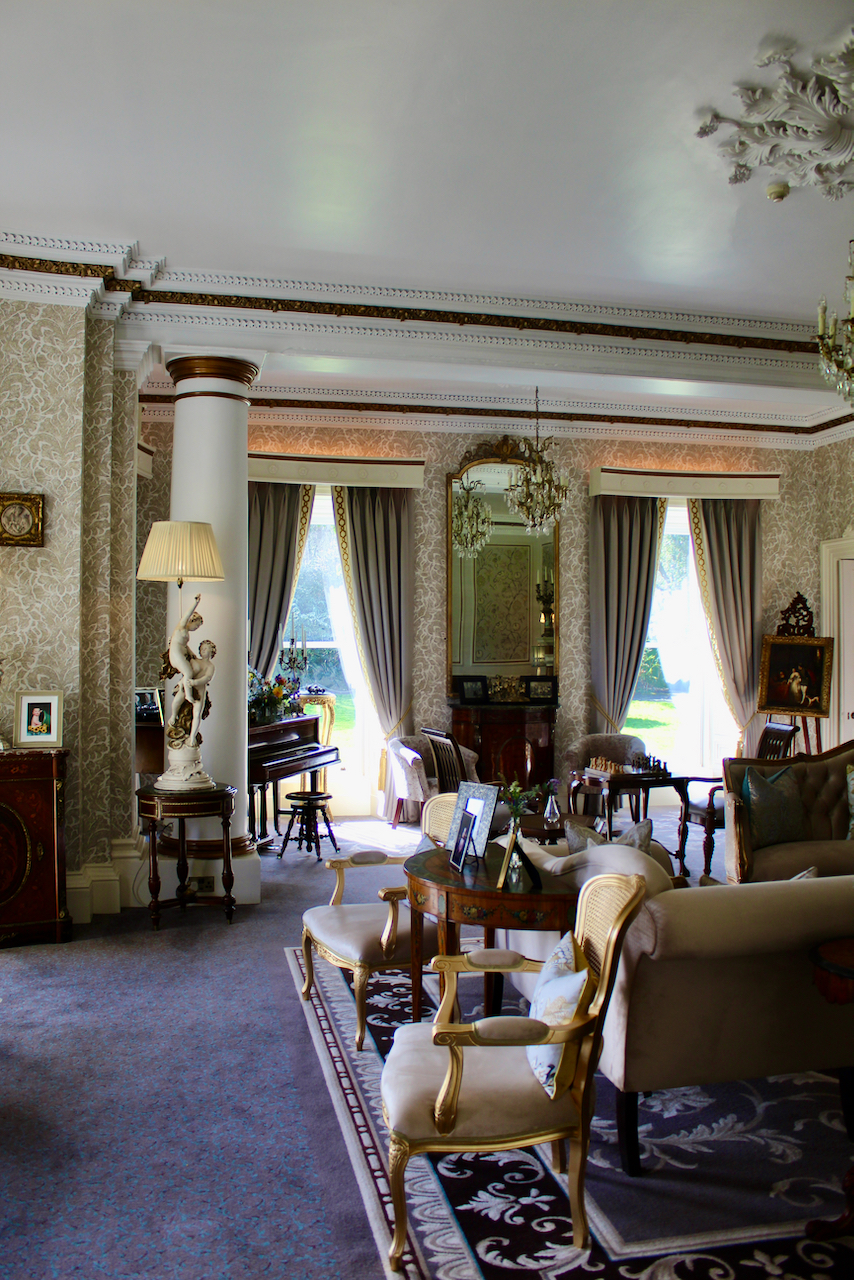
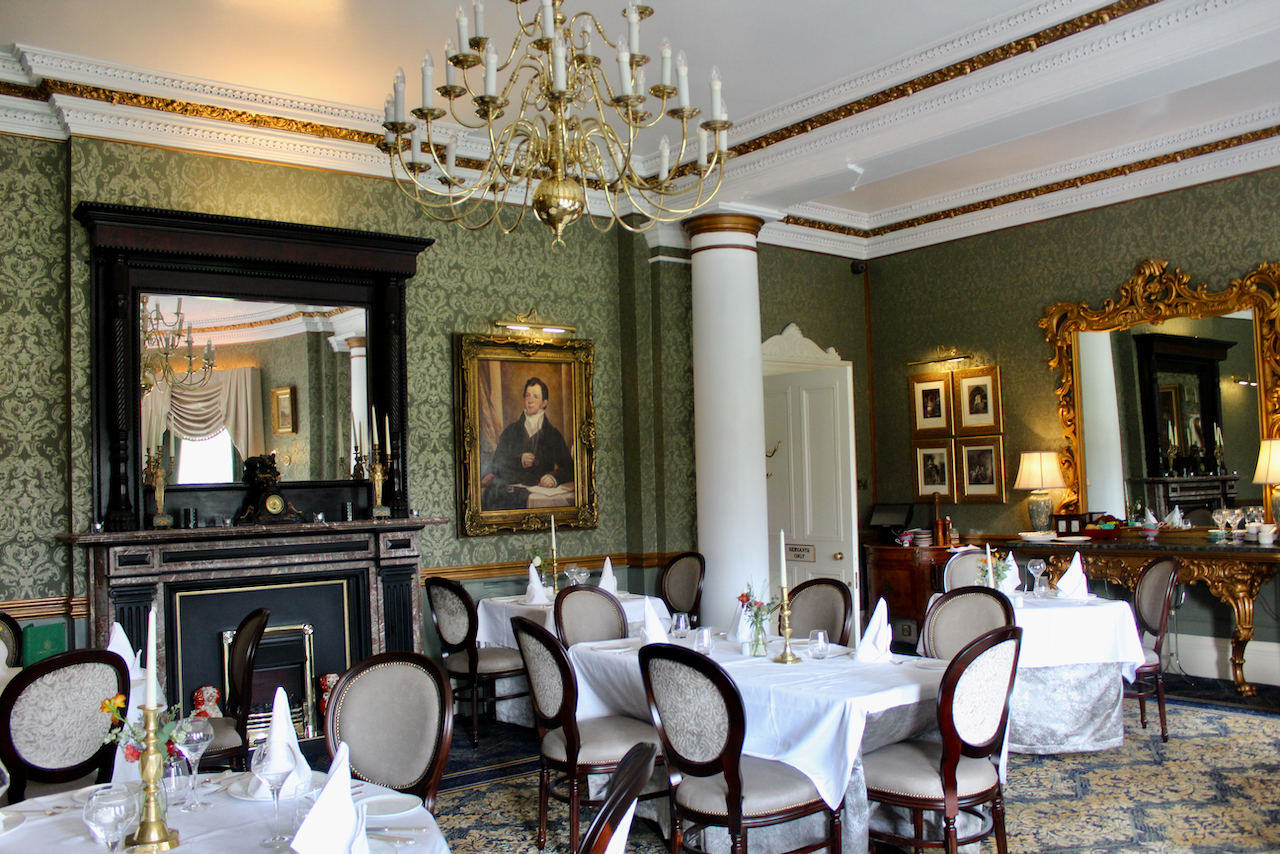
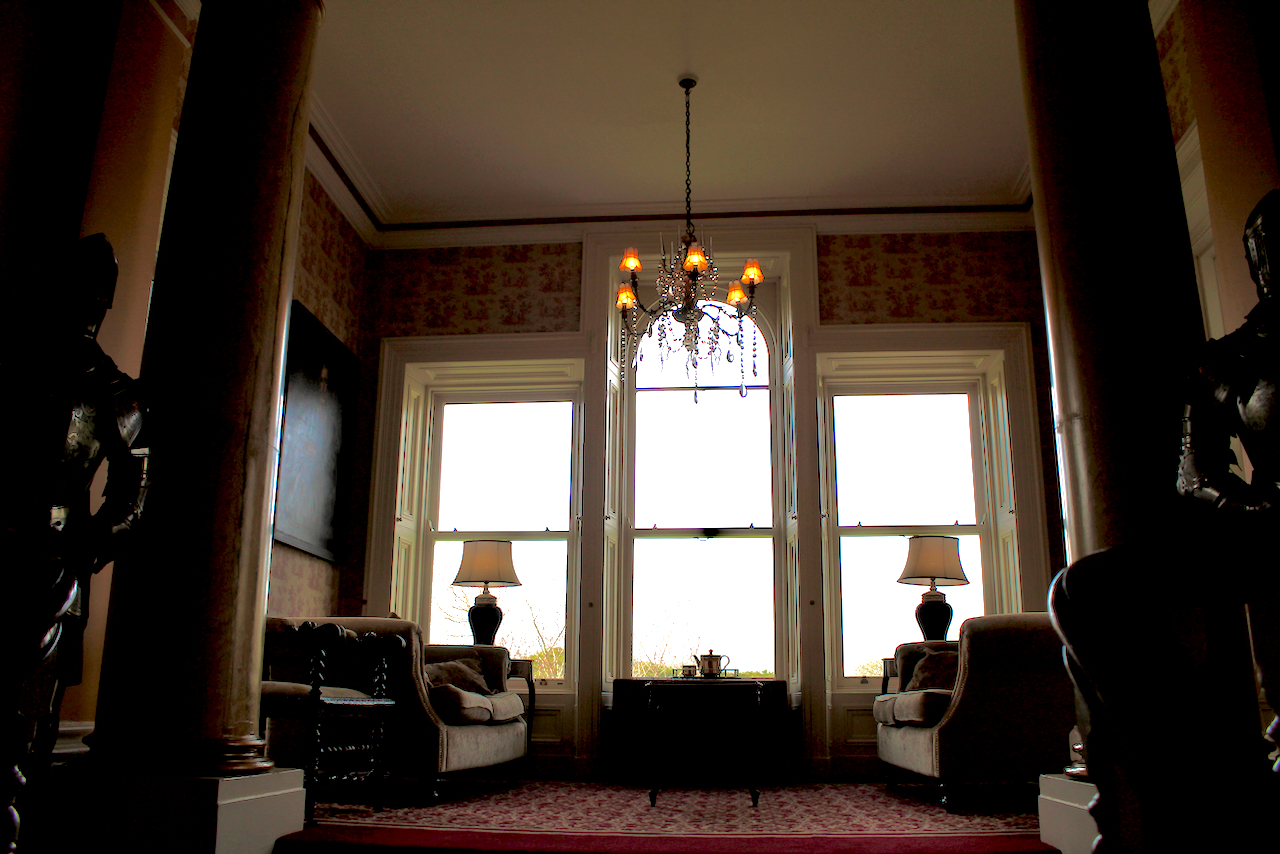
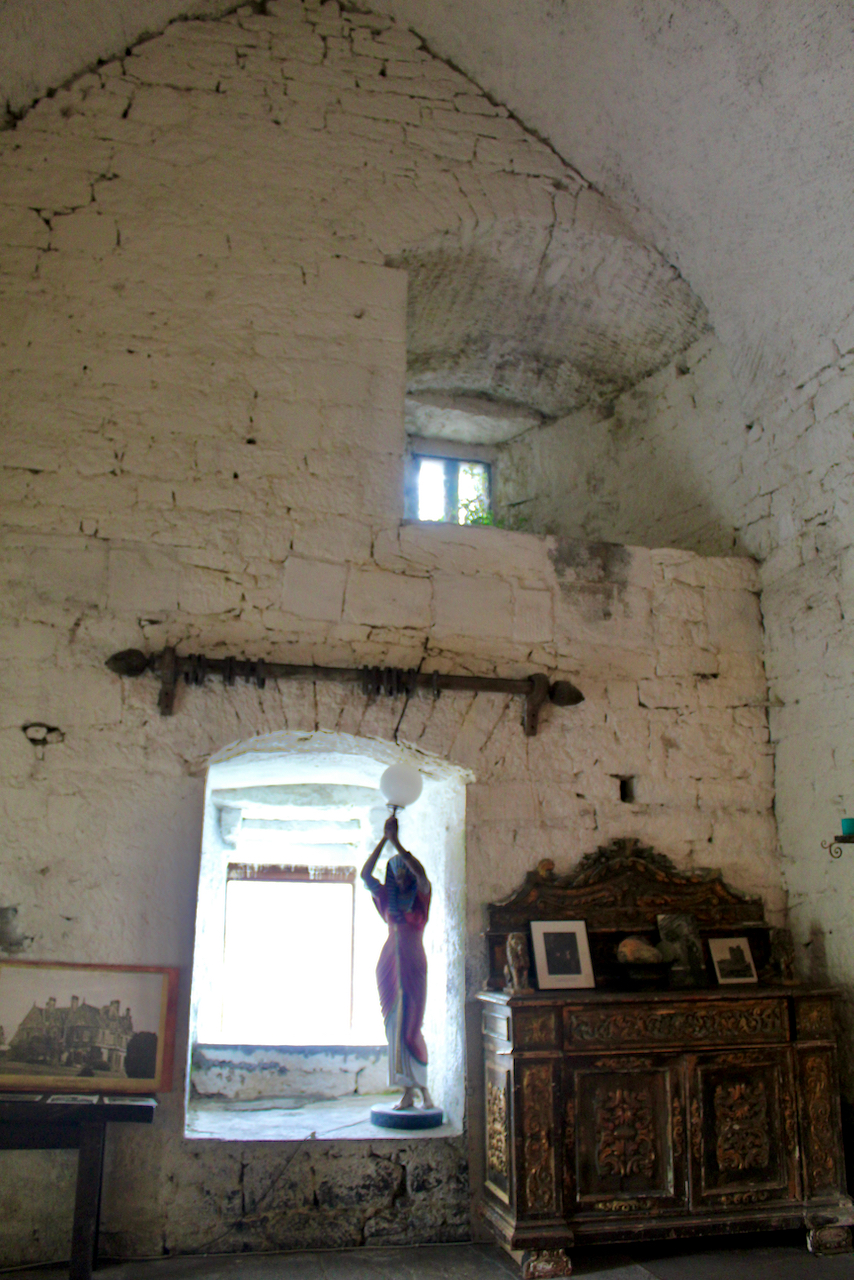
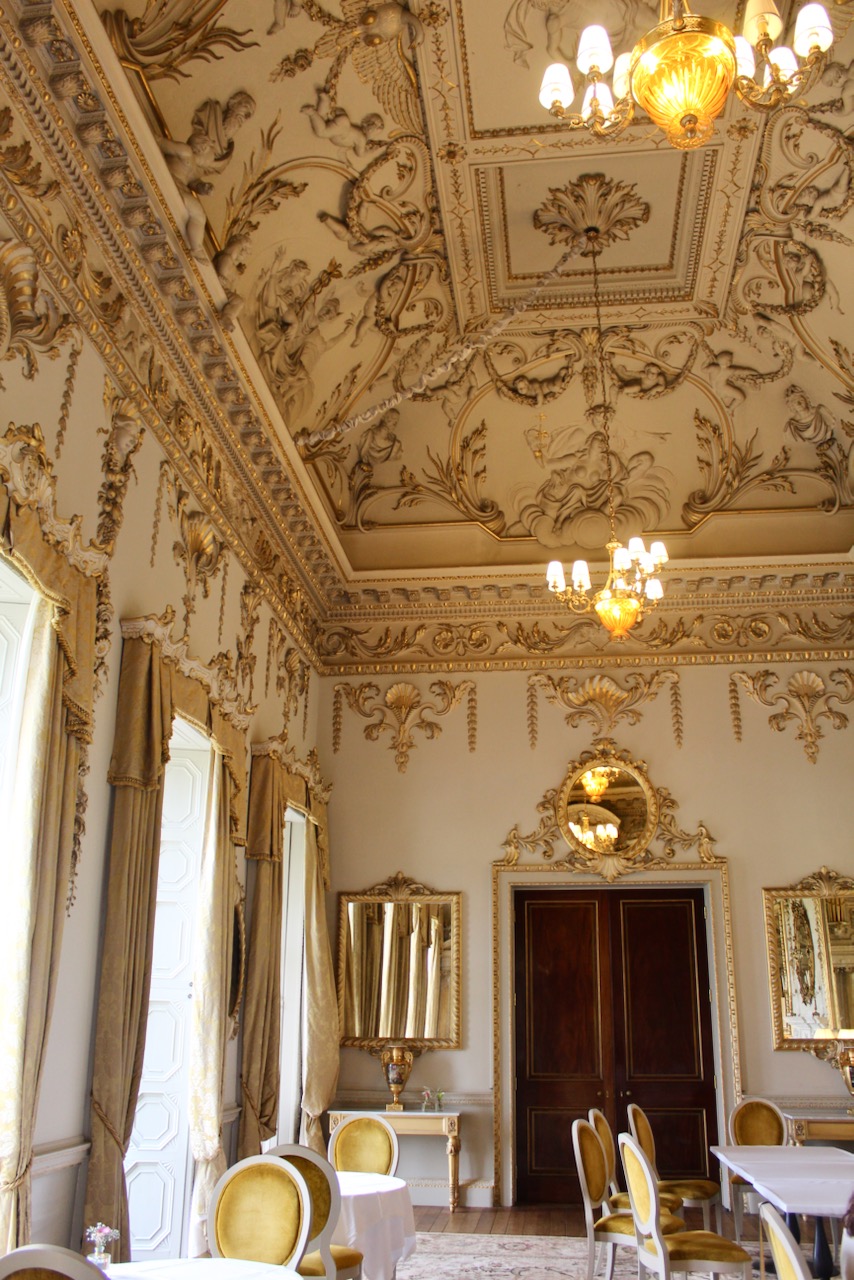
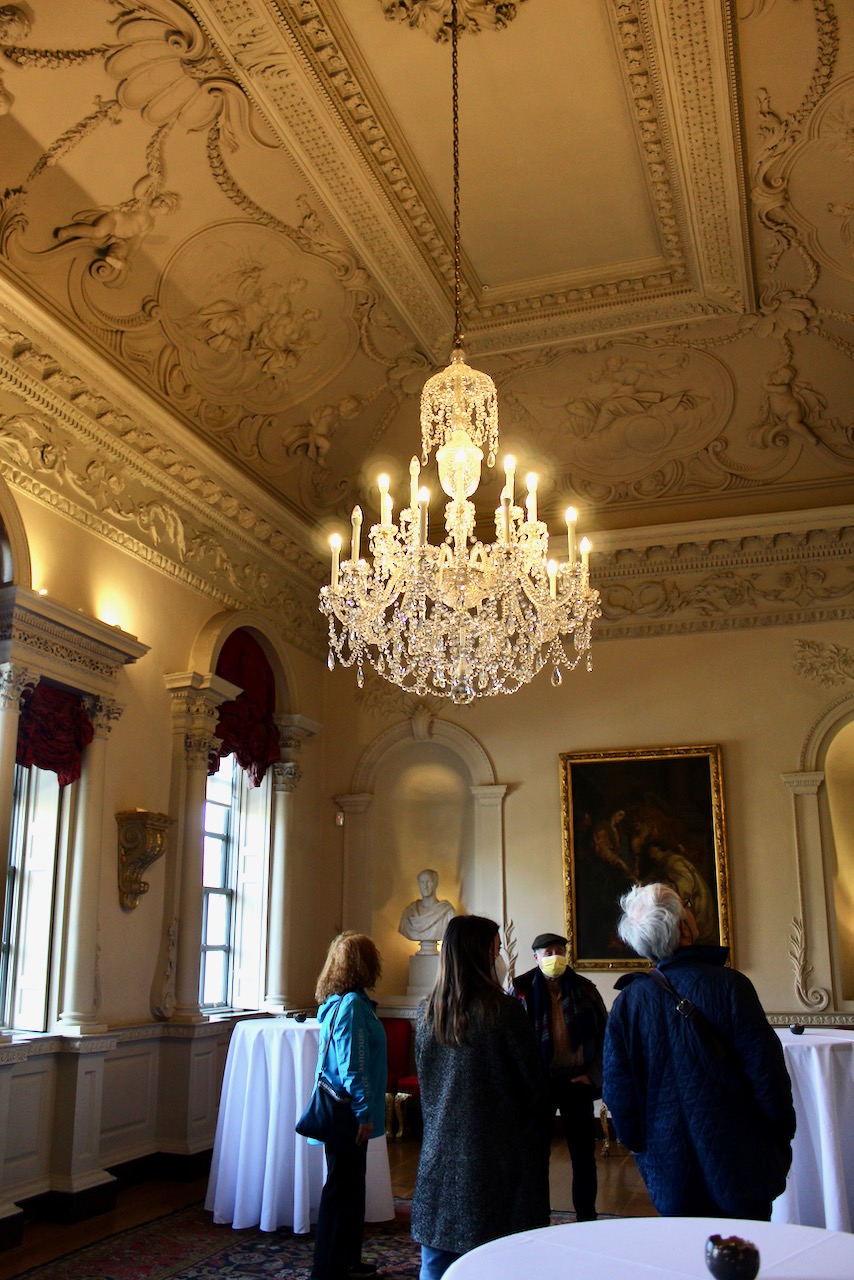
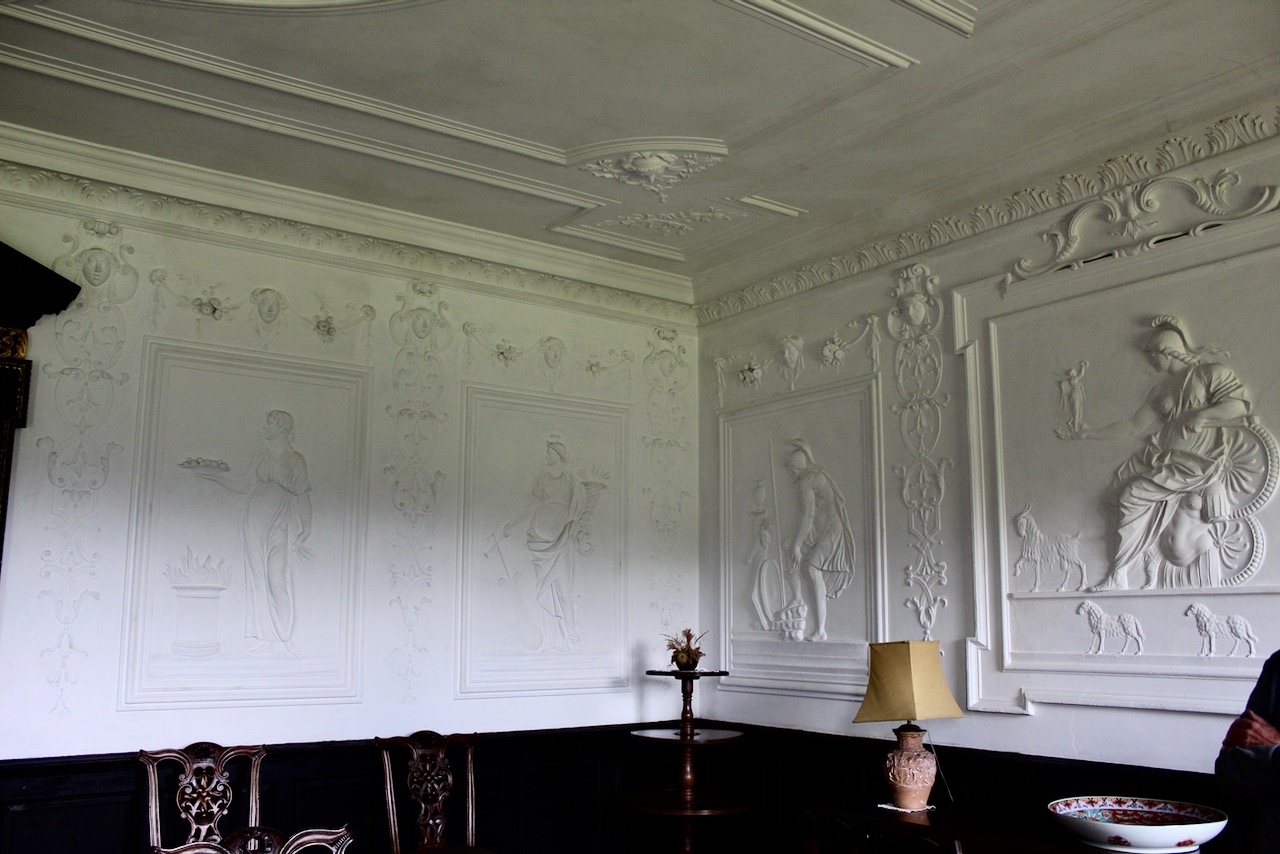
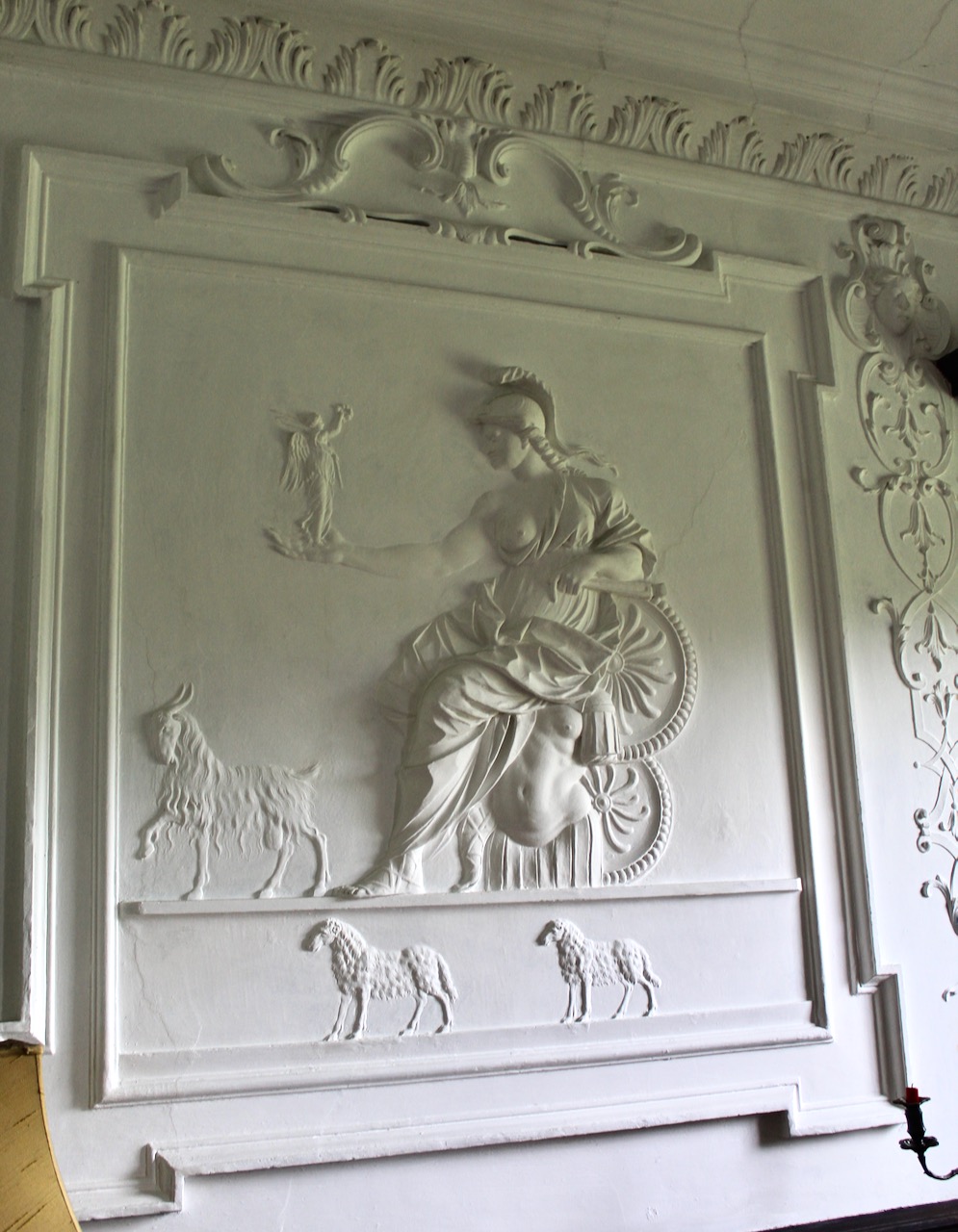
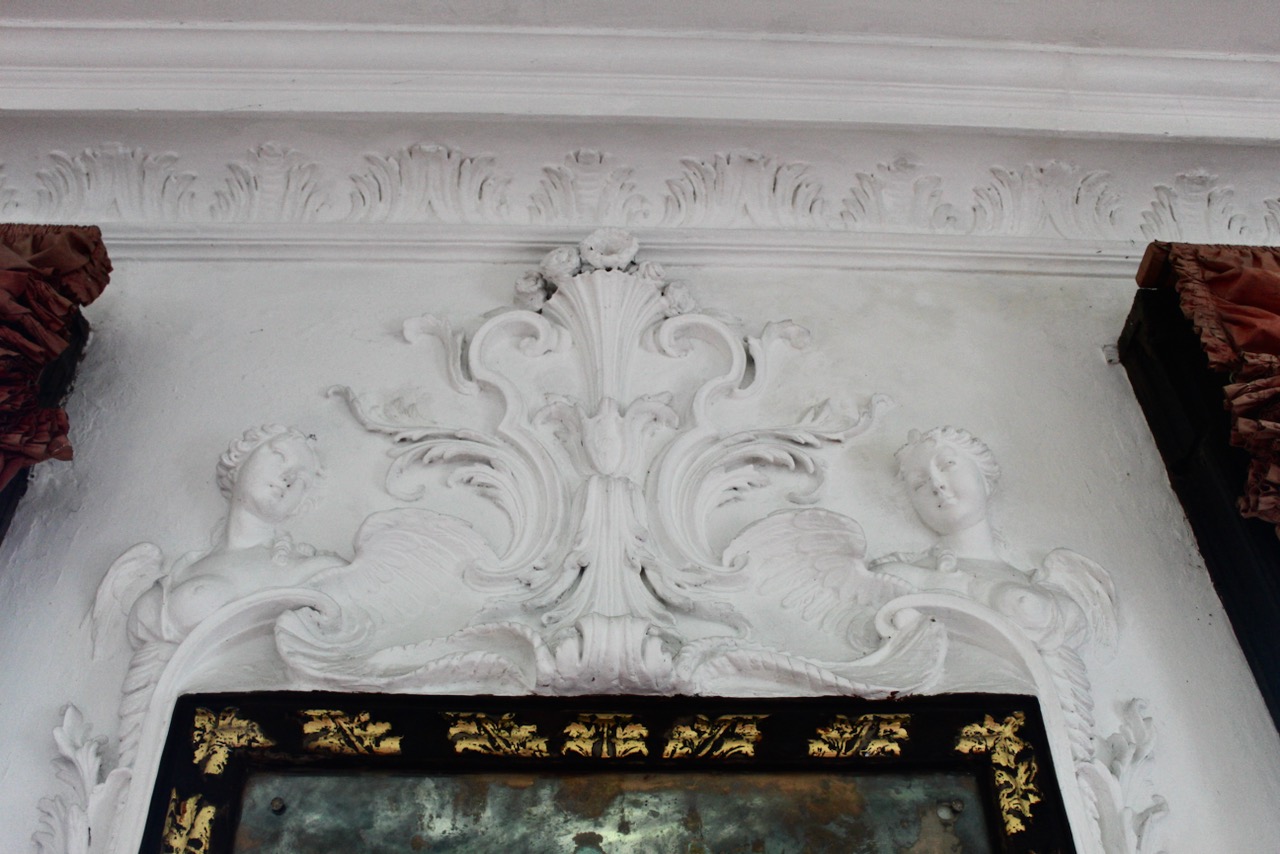
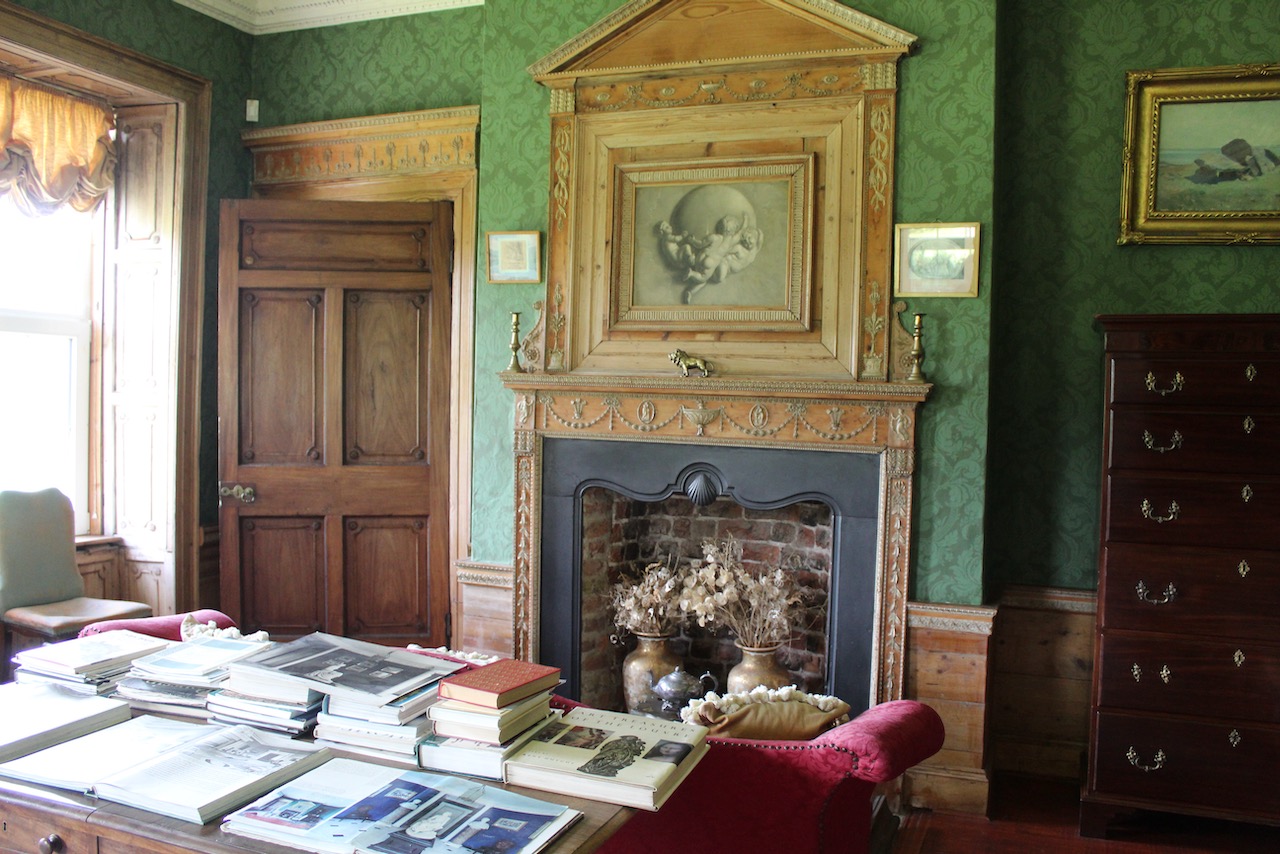
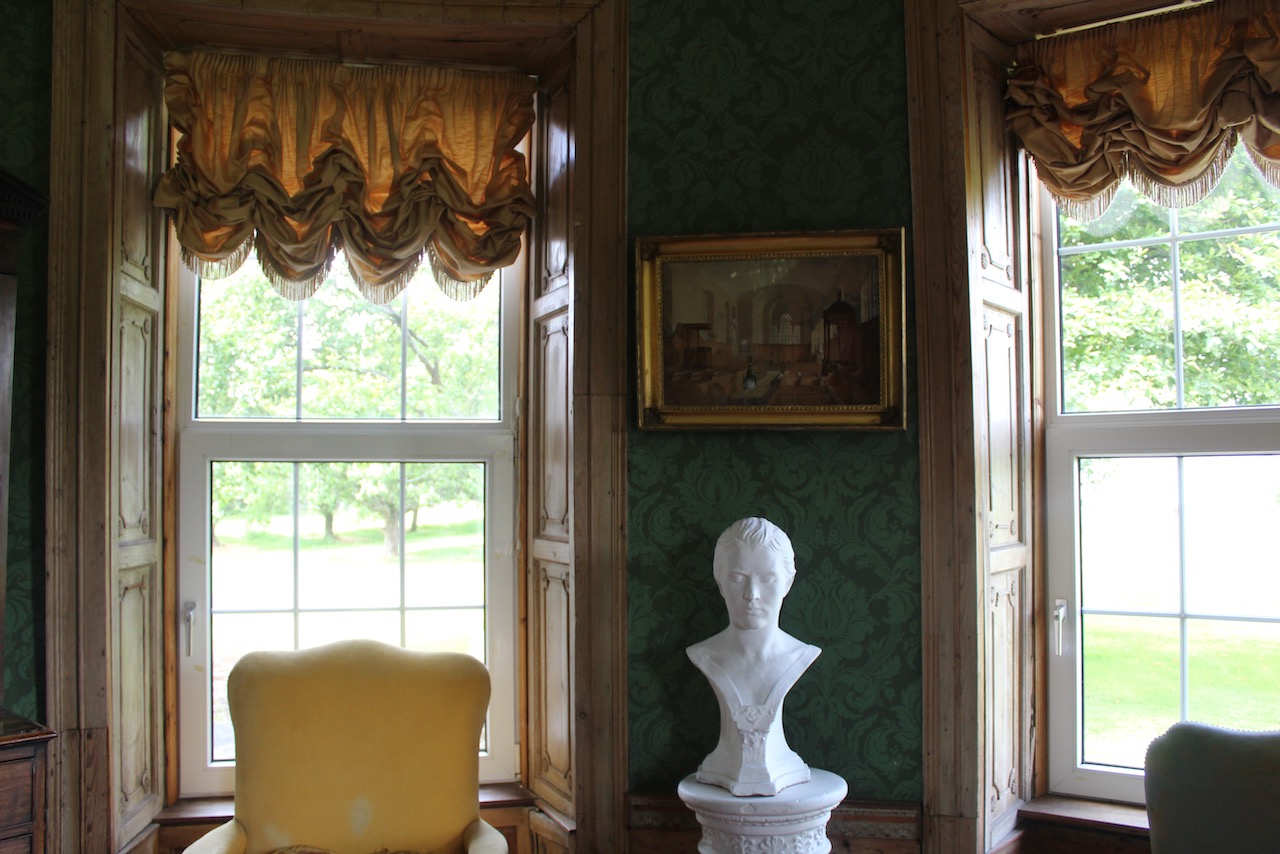
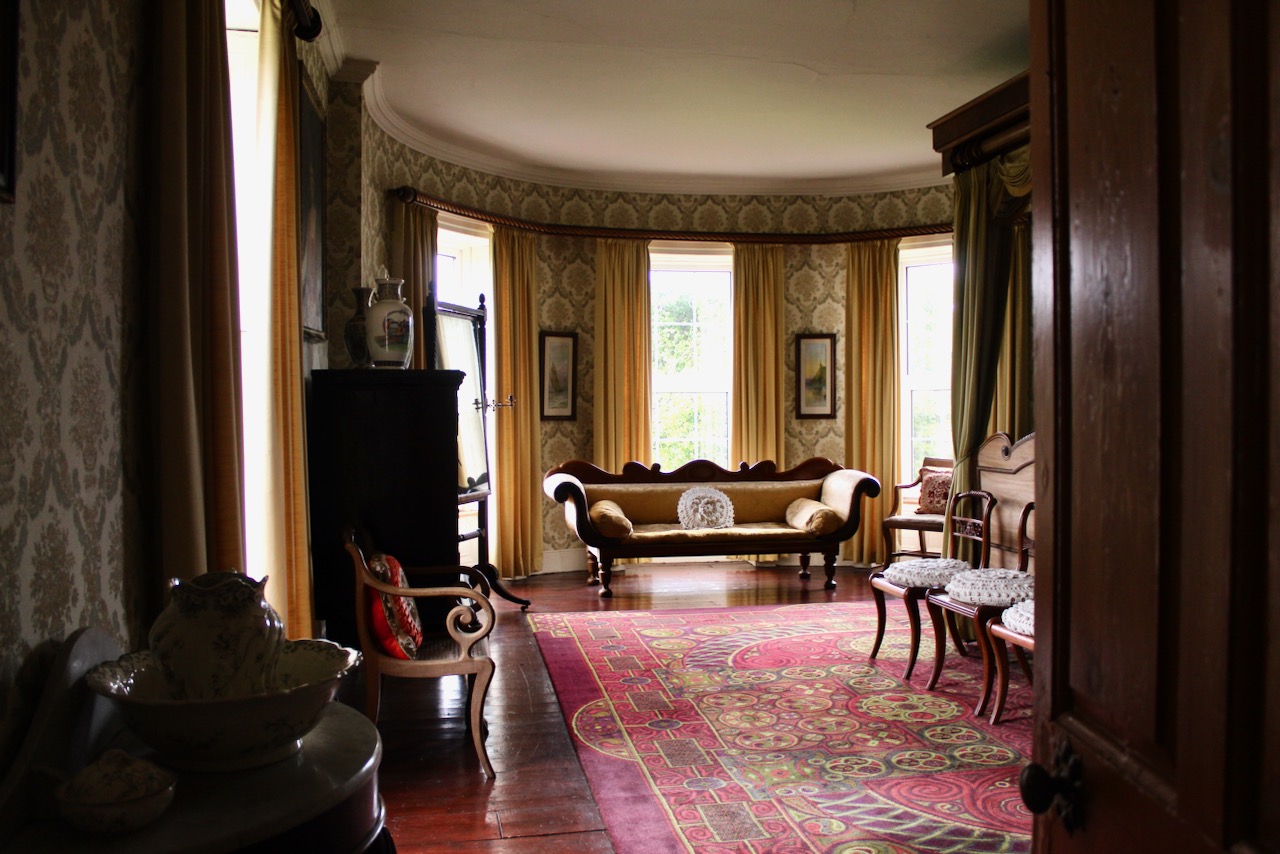
Decorated and furnished in the Louis Quinze style, in 1906, the furniture, carpet and wallpaper are all French. Note the very fine plasterwork on the ceiling and cornice. The architraves around the windows are all mid 18th century, as is most of the woodwork in this room. Over the small bureau by the far window is an artist’s impression of how the original house may have looked. It was originally thought that the house had never been built to this plan, but recent research shows that it is much more accurate than formerly imagined. This room also has a sprung floor, and in earlier days would have been used as a ballroom as well as a drawing room.

Burton Park, County Cork, August 17th 2023. Photograph © Jennifer Winder-Baggot, www.irishhistorichouses.com

Frank Keohane tells us:

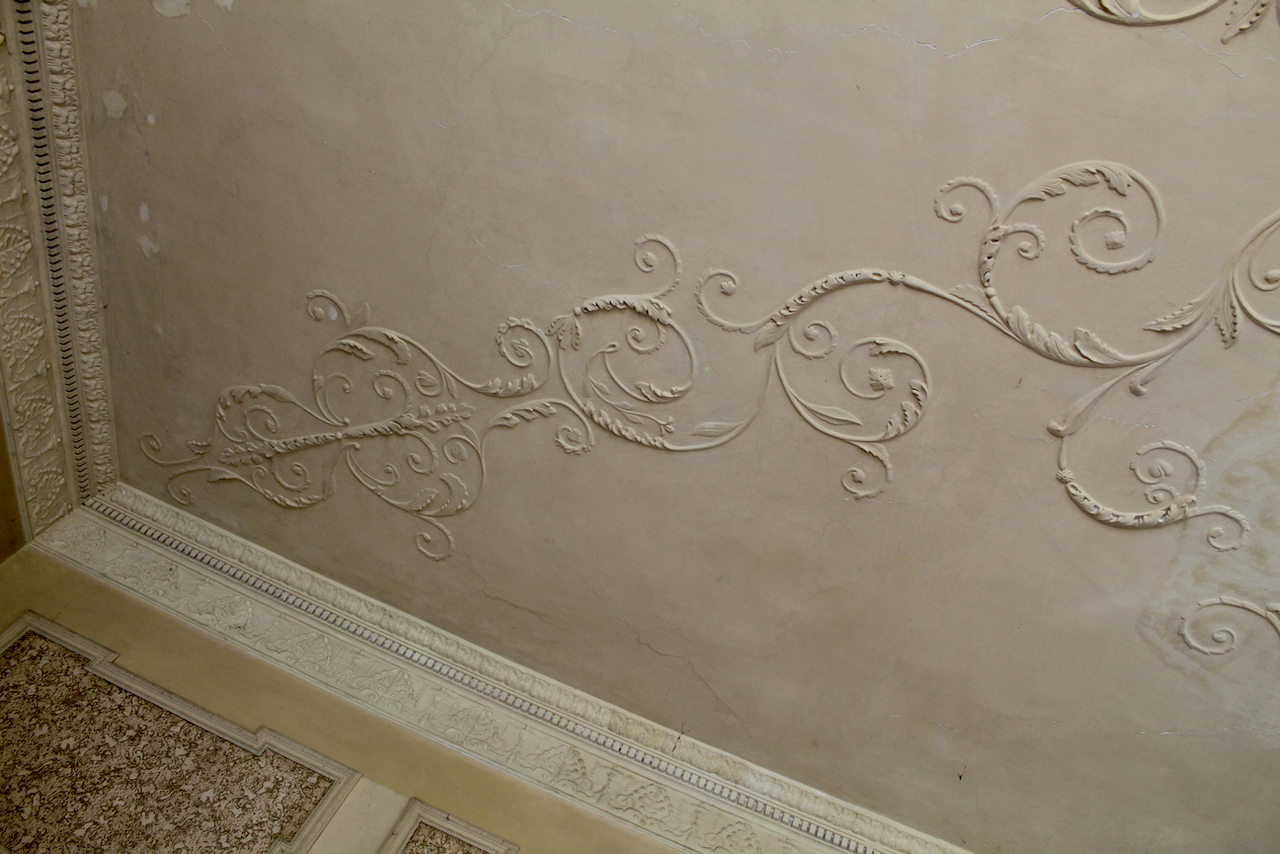
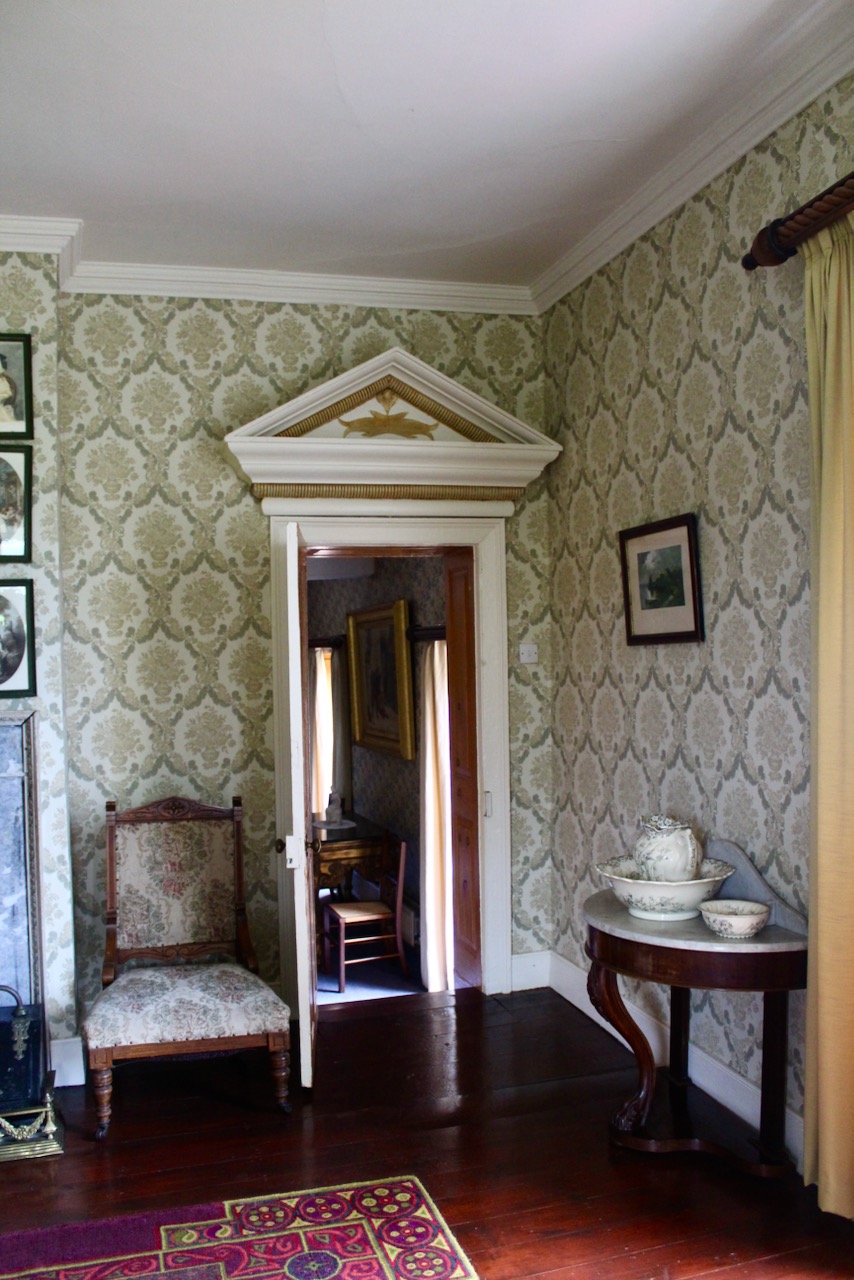
The three-bay drawing room has an Edwardian Louis XVI overlay of wallpaper framed in panels. The room and the hall have decent Neoclassical ceilings with especially wispy acanthus S-scrolls. The joinery in contrast is heavy and mid-Georgian in character, with cambered and lugged architraves, fielded panels and waterleaf carving, all no doubt the product of a provincial joiner not conversant with Neoclassical trends.”
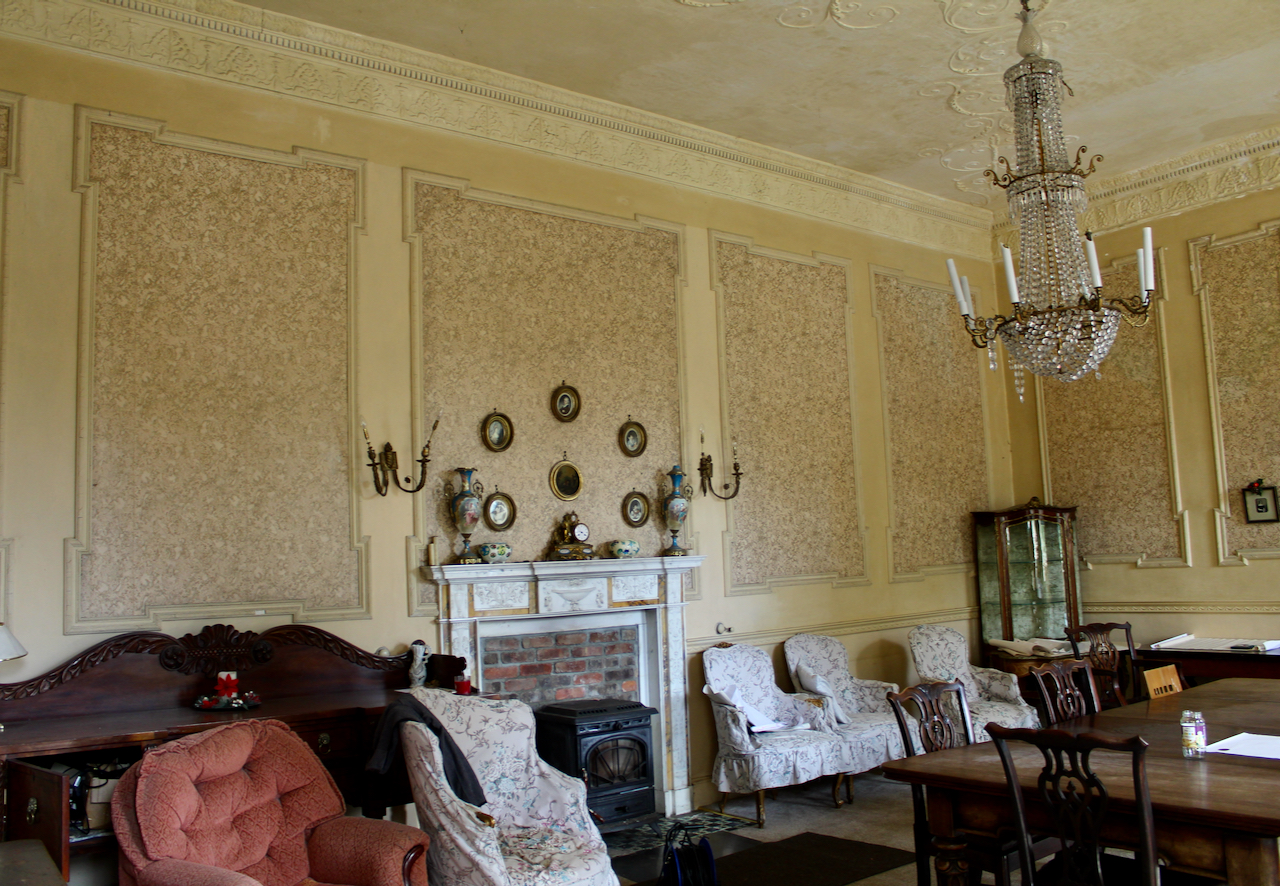
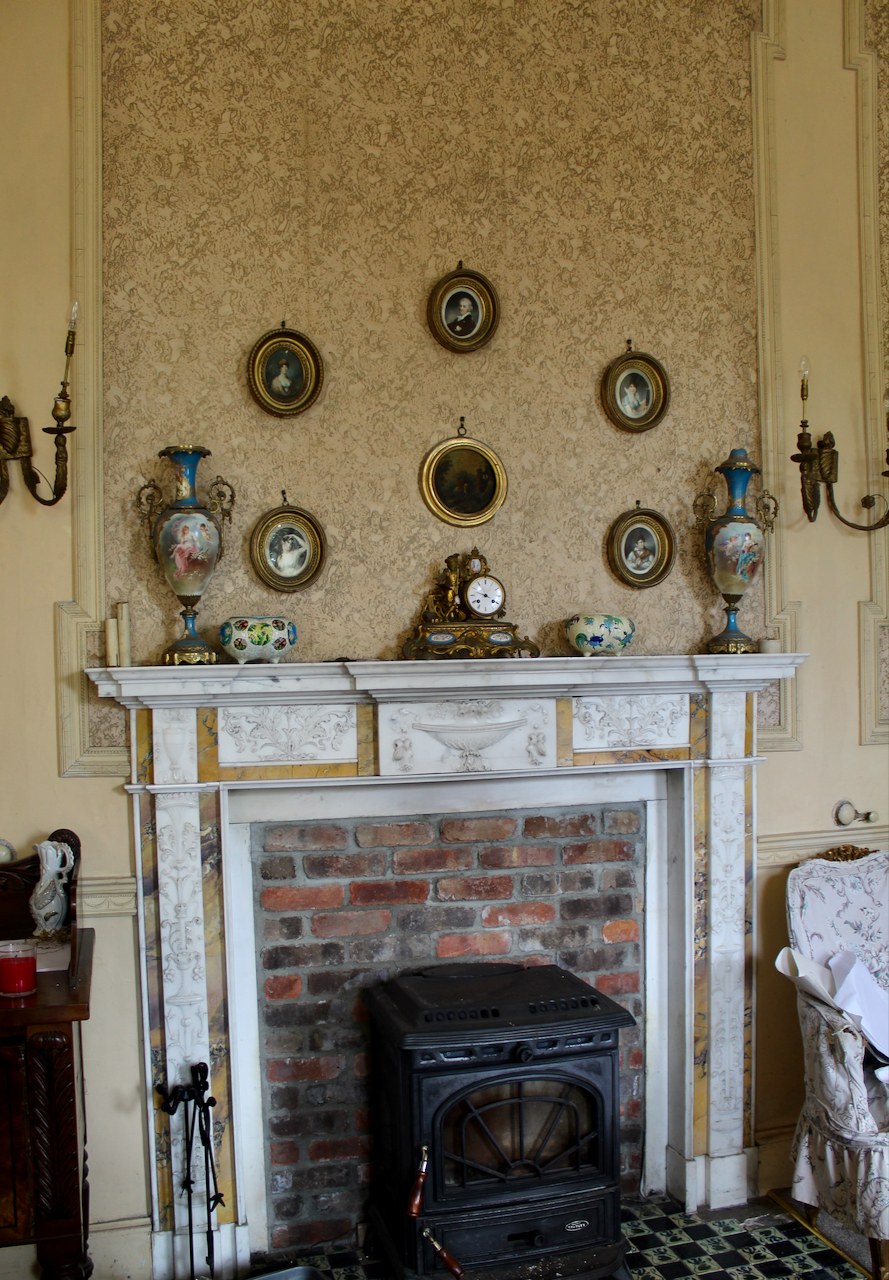
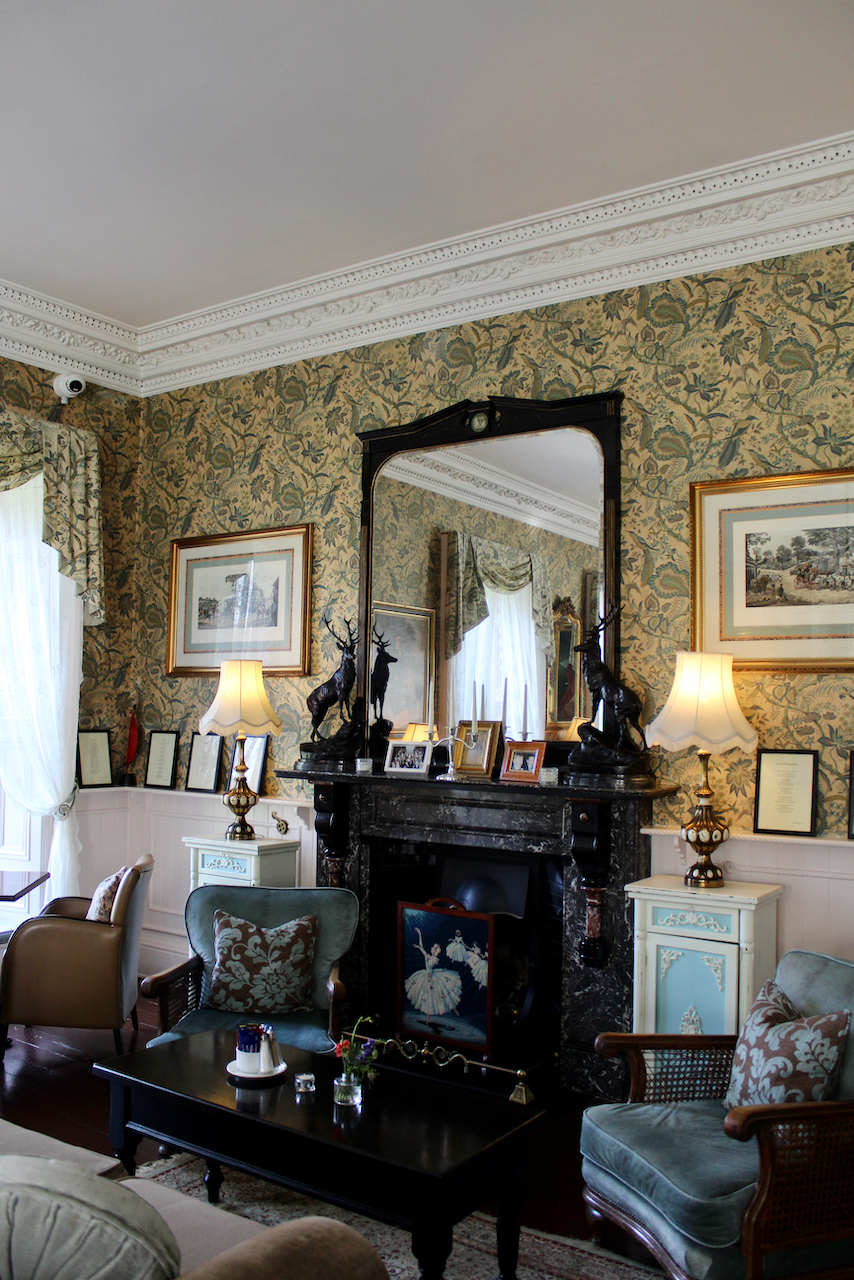
Burton Park, County Cork, August 17th 2023. Photograph © Jennifer Winder-Baggot, www.irishhistorichouses.com
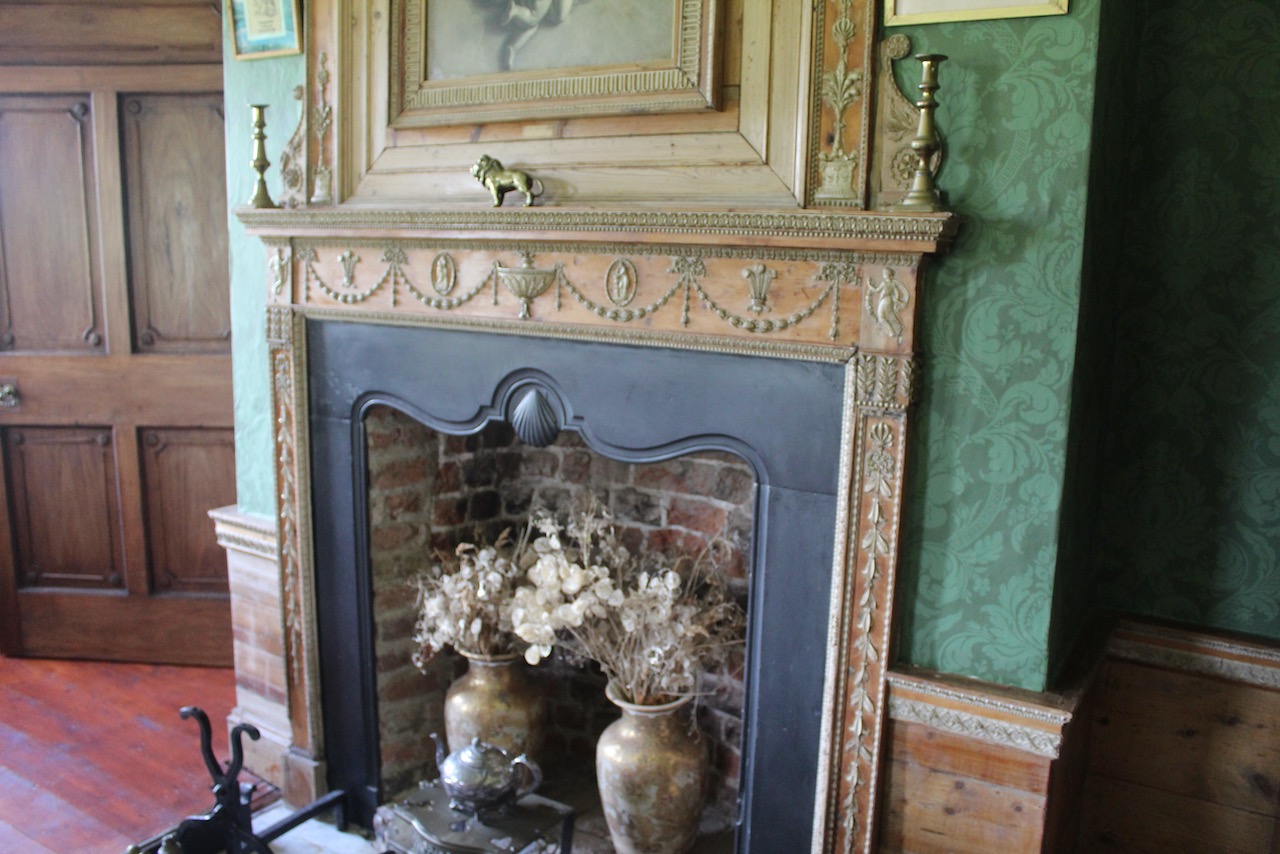
Burton Park, County Cork, August 17th 2023, the drawing room’s Carrera marble fireplace. Photograph © Jennifer Winder-Baggot, www.irishhistorichouses.com
Burton Park, County Cork, August 17th 2023. Photograph © Jennifer Winder-Baggot, www.irishhistorichouses.com
Burton Park, County Cork, August 17th 2023.
Burton Park, County Cork, August 17th 2023. Photograph © Jennifer Winder-Baggot, www.irishhistorichouses.com

John Ryan’s family also owned Edermine House in County Wexford.

Rosemary continues: “John’s Auntie Louise, “Lulu,” was the youngest of the Purcell daughters. She was unmarried and she lived here at Burton Park. She suffered from arthritis, and was confined to a wheelchair. She was a very brave woman indeed and she ran the place here on her own for years. When she died, John and I took over, we were asked to take on the Purcell name, and that’s why we are now the Ryan-Purcell family.” 
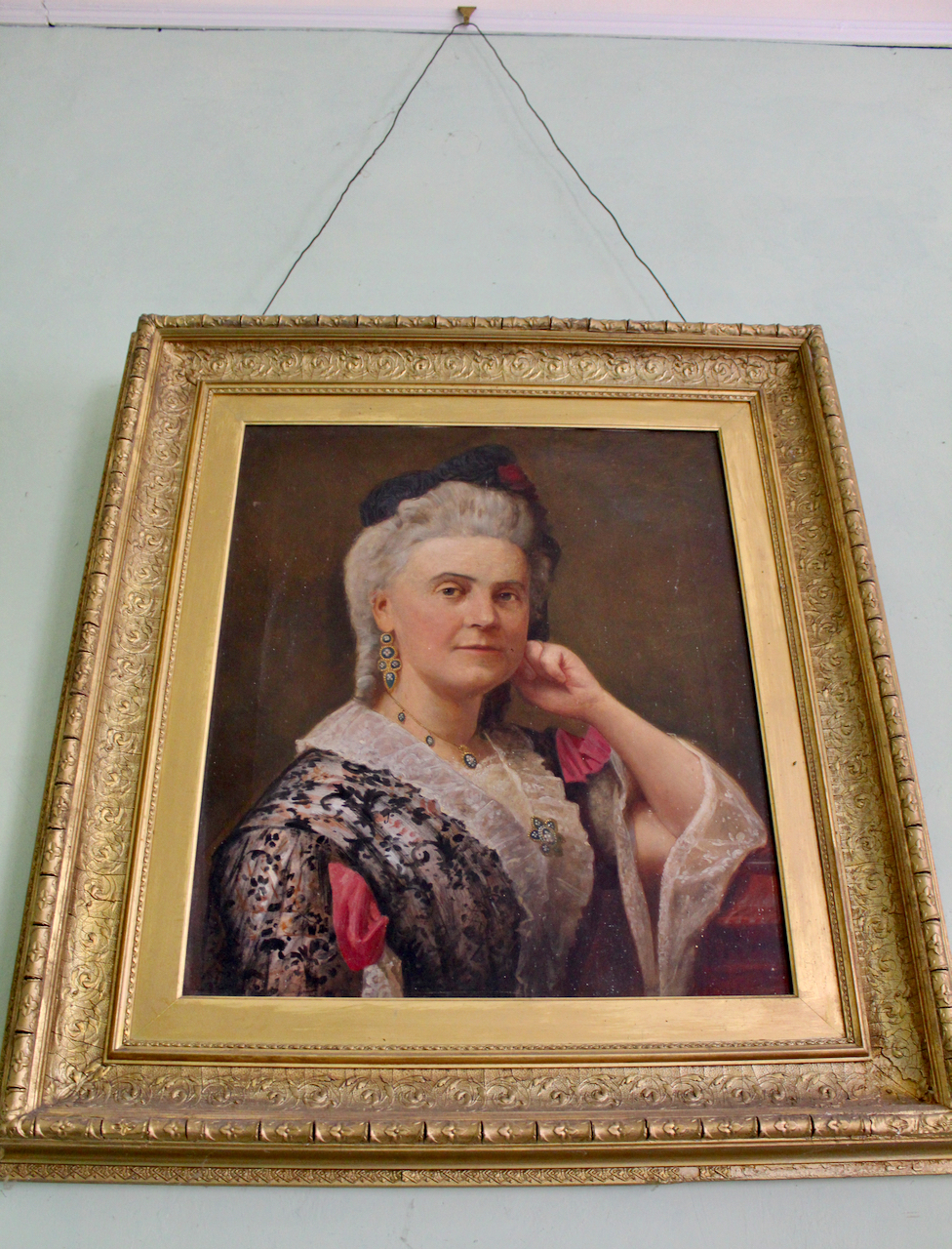
Burton Park, County Cork, August 17th 2023. Photograph © Jennifer Winder-Baggot, www.irishhistorichouses.com

O’Hea O’Keeffe tells us that before they moved to Burton Park, Rosemary was already quite familiar with the house from her many earlier visits there, as John had been farming there before their marriage. “He had to come here to Burton Park straight after school. They used to say in the family that before he opened his eyes as an infant, he had been told by his mother than he would be coming here. This was her home, which she had visited with John almost every week during his childhood. John had two Purcell uncles who were born at Burton Park, both of whom were to lose their lives as a result of the First World War. Raymond, the older brother, tragically took his own life after his return from the war. His brother died at the Battle of the Somme.” 

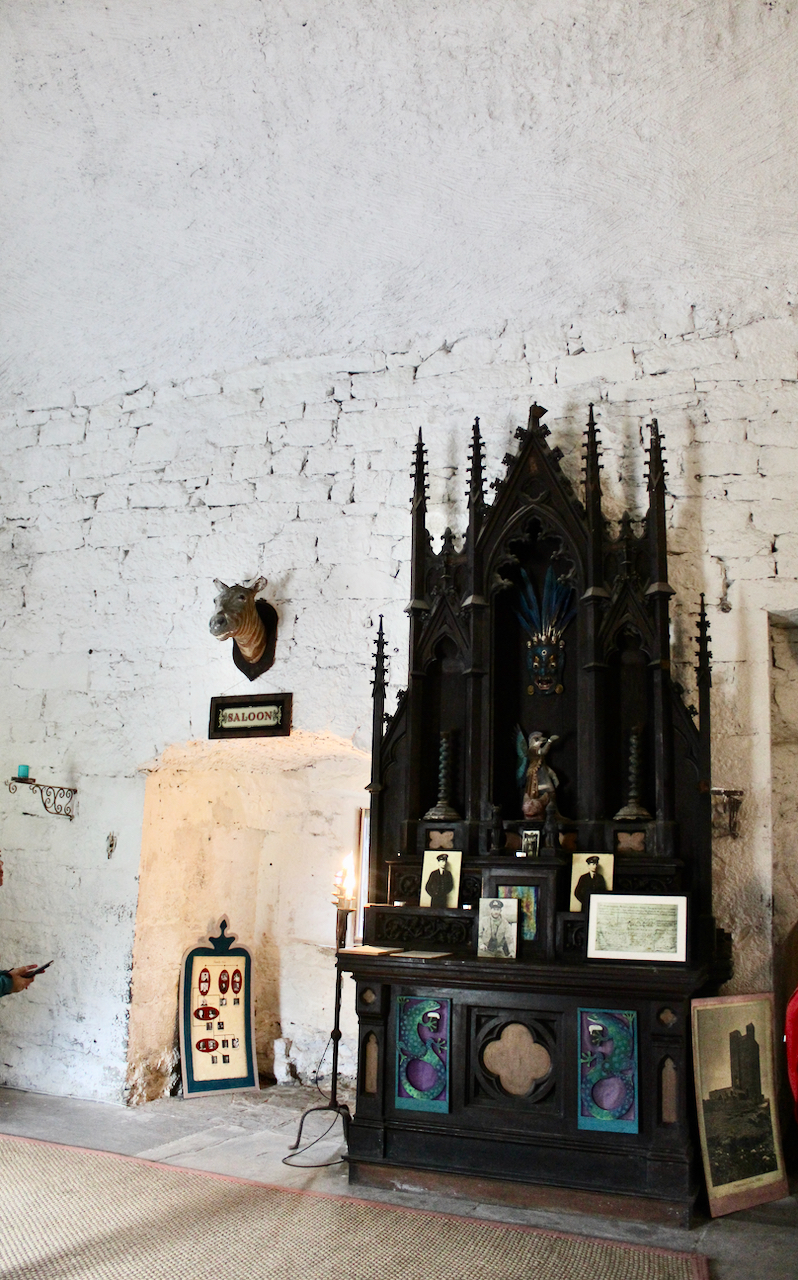
The Oratory is dedicated to the memory of the two Purcell sons who lost their lives as a result of the First World War.
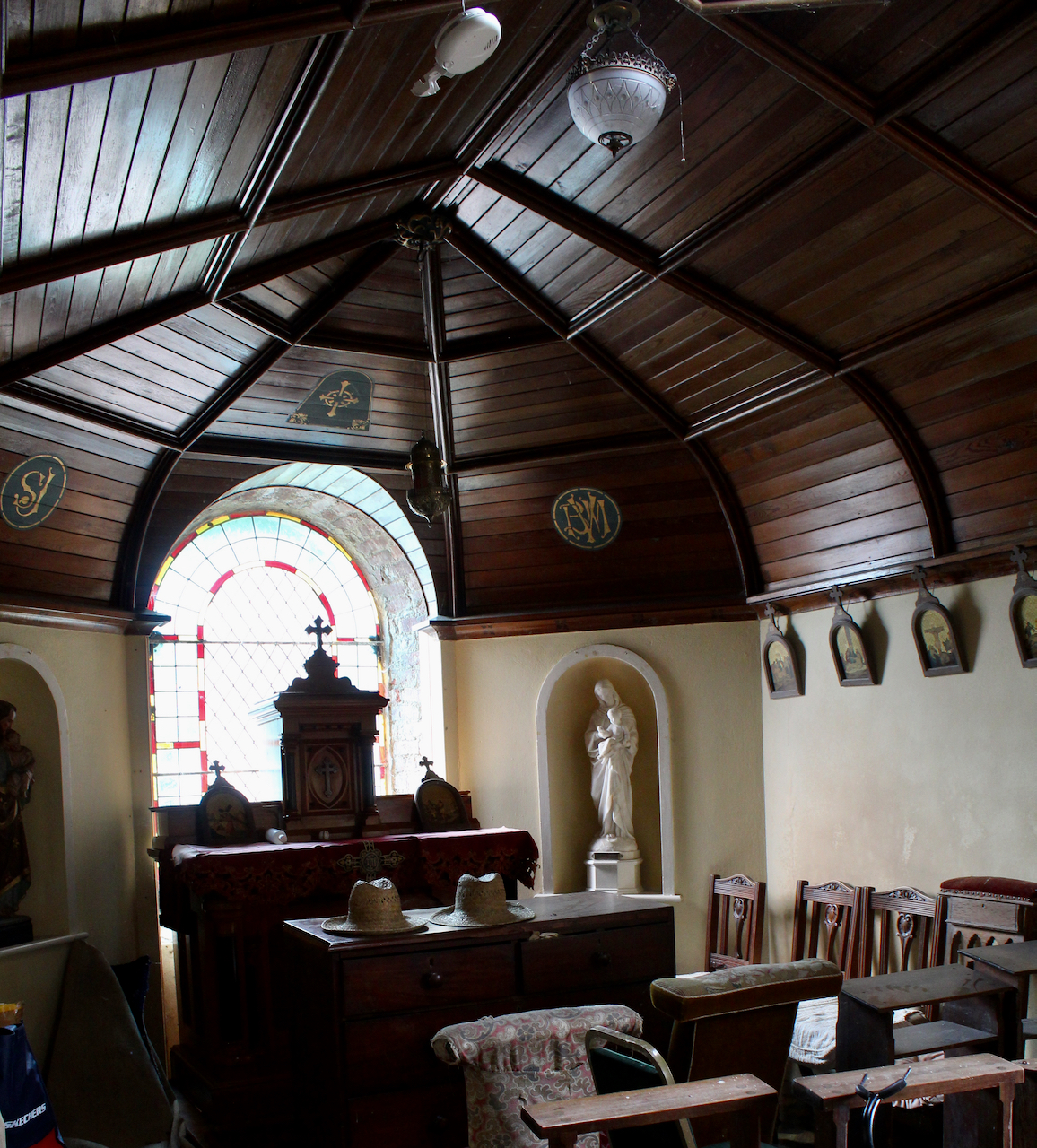
Burton Park, County Cork, August 17th 2023. Photograph © Jennifer Winder-Baggot, www.irishhistorichouses.com
Burton Park, County Cork, August 17th 2023. The oratory has a timber boat-shaped ceiling. Photograph © Jennifer Winder-Baggot, www.irishhistorichouses.com
Burton Park, County Cork, August 17th 2023.
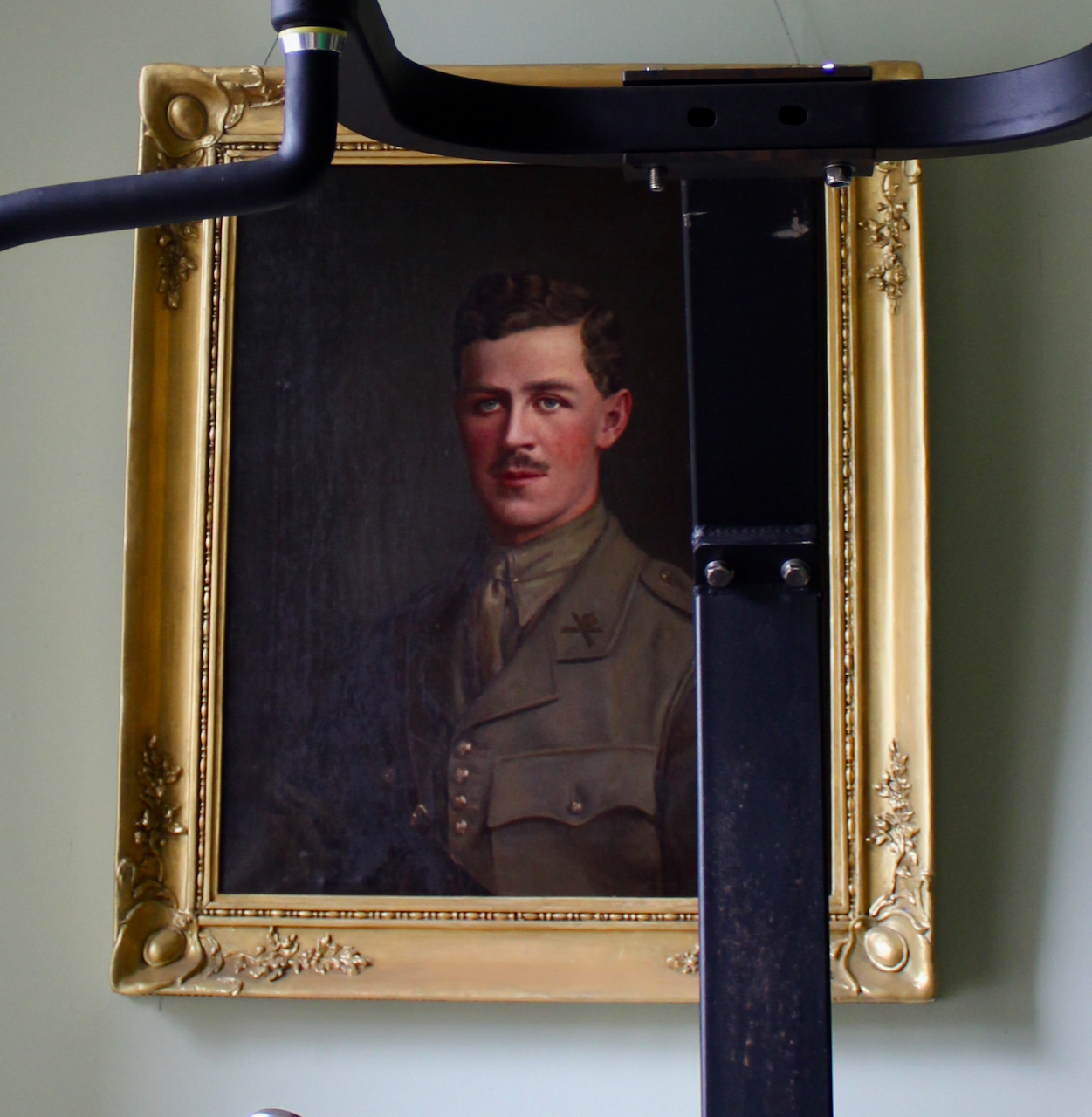
Major Raymond John Purcell, D.S.O., King’s Royal Rifle Corps who inherited Burton Park in Co. Cork in 1904. [12] Burton Park, County Cork, August 17th 2023. Photograph © Jennifer Winder-Baggot, www.irishhistorichouses.com
Burton Park, County Cork, August 17th 2023. Photograph © Jennifer Winder-Baggot, www.irishhistorichouses.com

When the Raymond Purcell was a young man, his mother purchased Curraghmount, near Buttevant, for use as a Dower House. His sisters Maisie and Louise moved there with their mother and stayed there for the remainder of Raymond’s lifetime. Following his tragic death after WWI, they returned to live in Burton Park. 

Curraghmount, County Cork, courtesy of National Inventory of Architectural Heritage.

While living at Burton Park, Raymond carried out large-scale improvements to the house, including the installation of a generator and electric light in 1912. Thus, the manor became one of the earliest properties in the parish to use electricity.

Residents of Burton House were quite self-sufficient: in addition to the game, meats, vegetables and fruits supplied by its farm, it had a cider press and two limekilns. They manufactured their own bricks, examples of which can be seen in the orchard walls. Thirty-five gardeners once laboured to maintain the bowling green, croquet lawn, tennis courts and parkland. [see 6]

John Ryan-Purcell was ‘a bit of a genius’ says his widow. He was able to keep the house in good repair, including electricity and plumbing, and he also milked his cattle. He had a Jersey herd at Burton Park.
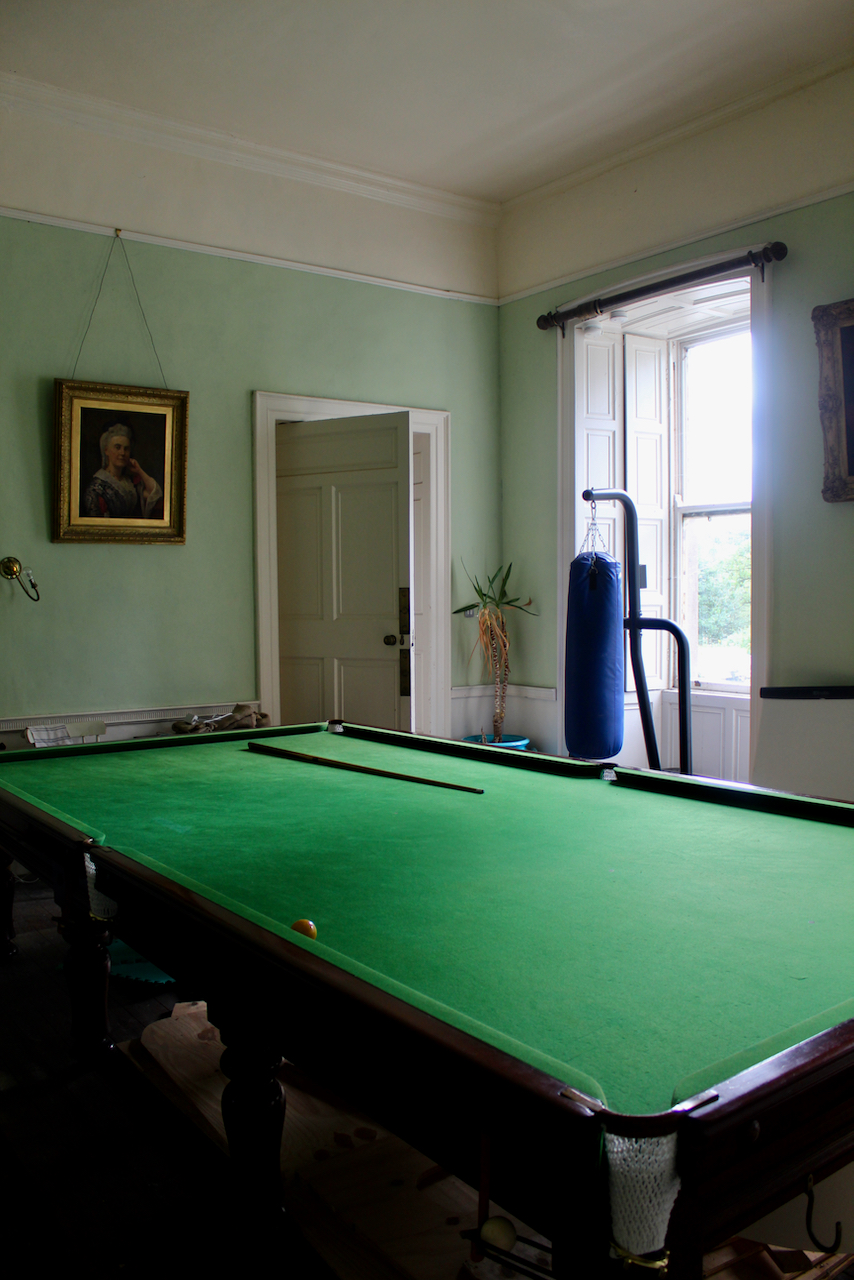
Burton Park, County Cork, August 17th 2023. Photograph © Jennifer Winder-Baggot, www.irishhistorichouses.com

Rosemary continues: “When John and I first came, there were thirty acres of woodland here, mostly scrub, and my husband cleared it and reclaimed the land. We also planted a great amount of woodland, to make ends meet really. Over four or five phases, we planted ninety acres. We also have fifty acres of pasture, and we are now involved in Rural Environmental Protection Scheme, and in organic farming.”

Jane O’Hea O’Keeffe writes: “The pleasure grounds at Burton Park were designed by Decimus Burton, who also designed Kew Gardens in London and Dublin’s Phoenix Park. Indigenous trees, such as beech and oak, grow very well here, and seed has been collected over the years.

O’Hea O’Keeffe tells us that the copper beech tree on the front lawn was planted by John Ryan-Purcell’s grandmother. The original entrance consisted of a straight avenue down from the front door to the little church and graveyard where the Purcell family vault stands. Matthew Purcell, who bought Burton Park from the Earl of Egmont in 1889, was Church of Ireland rector here.
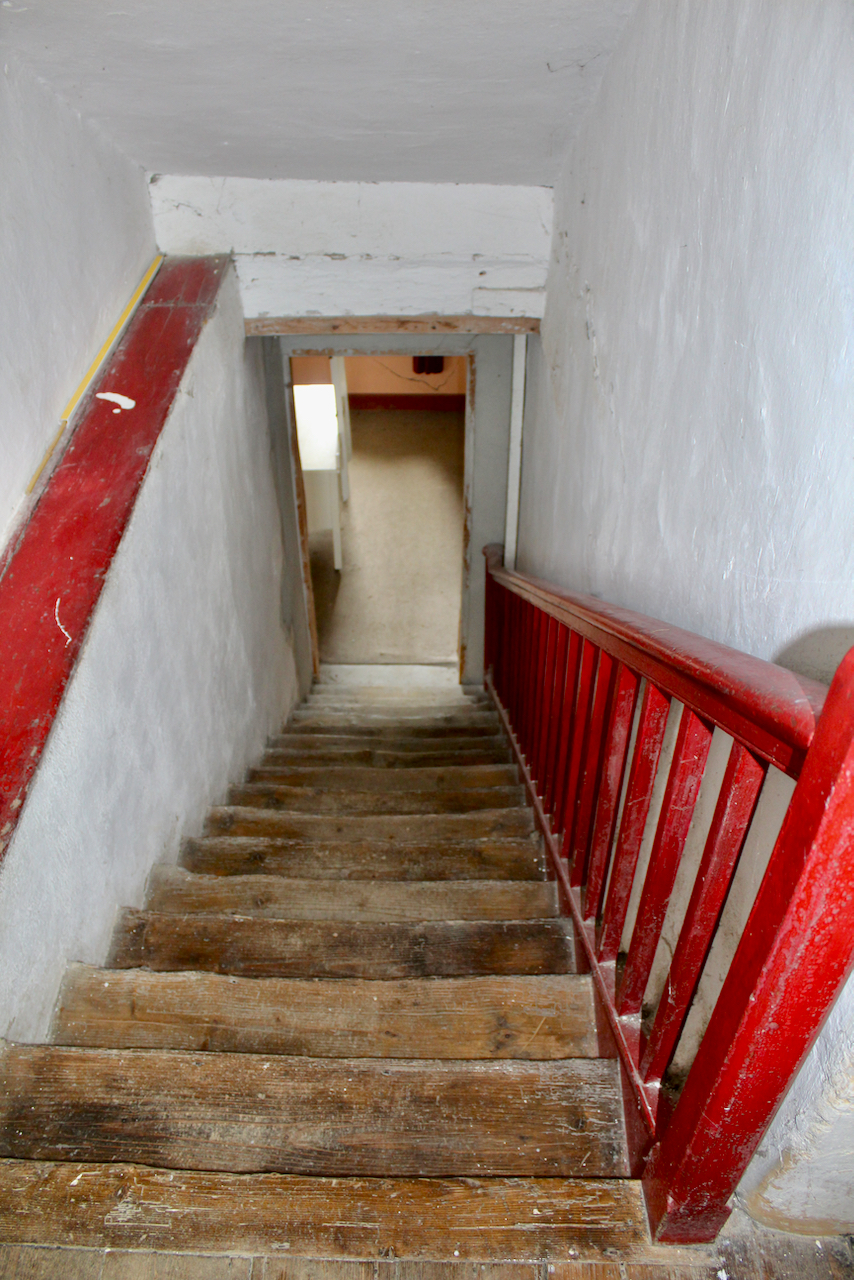
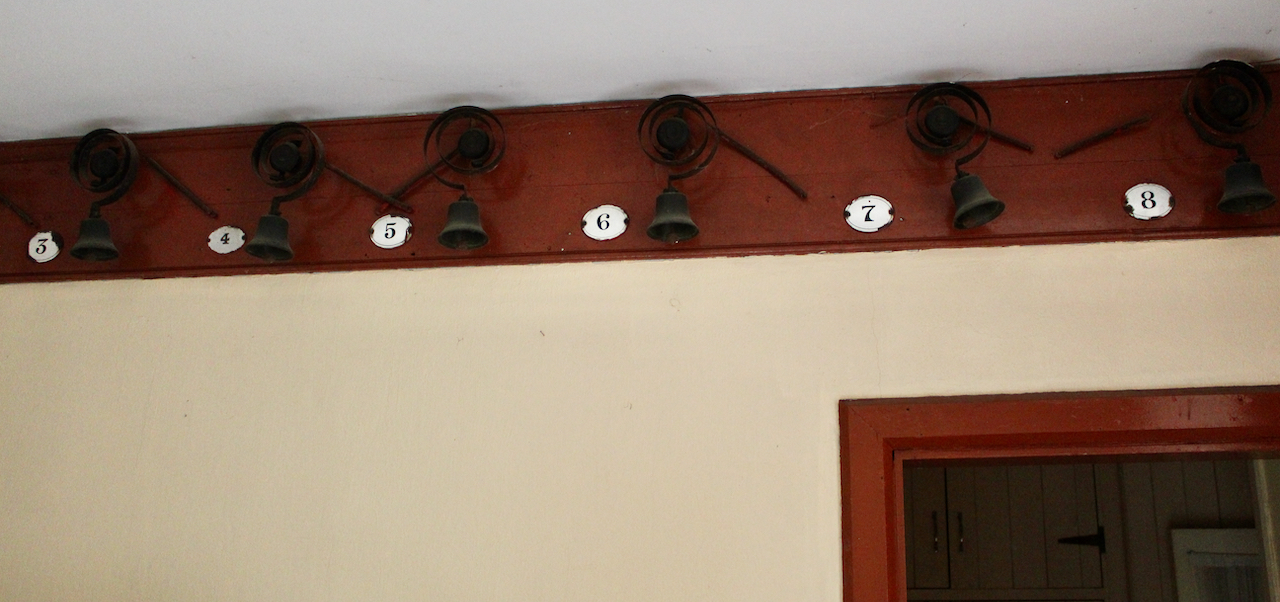
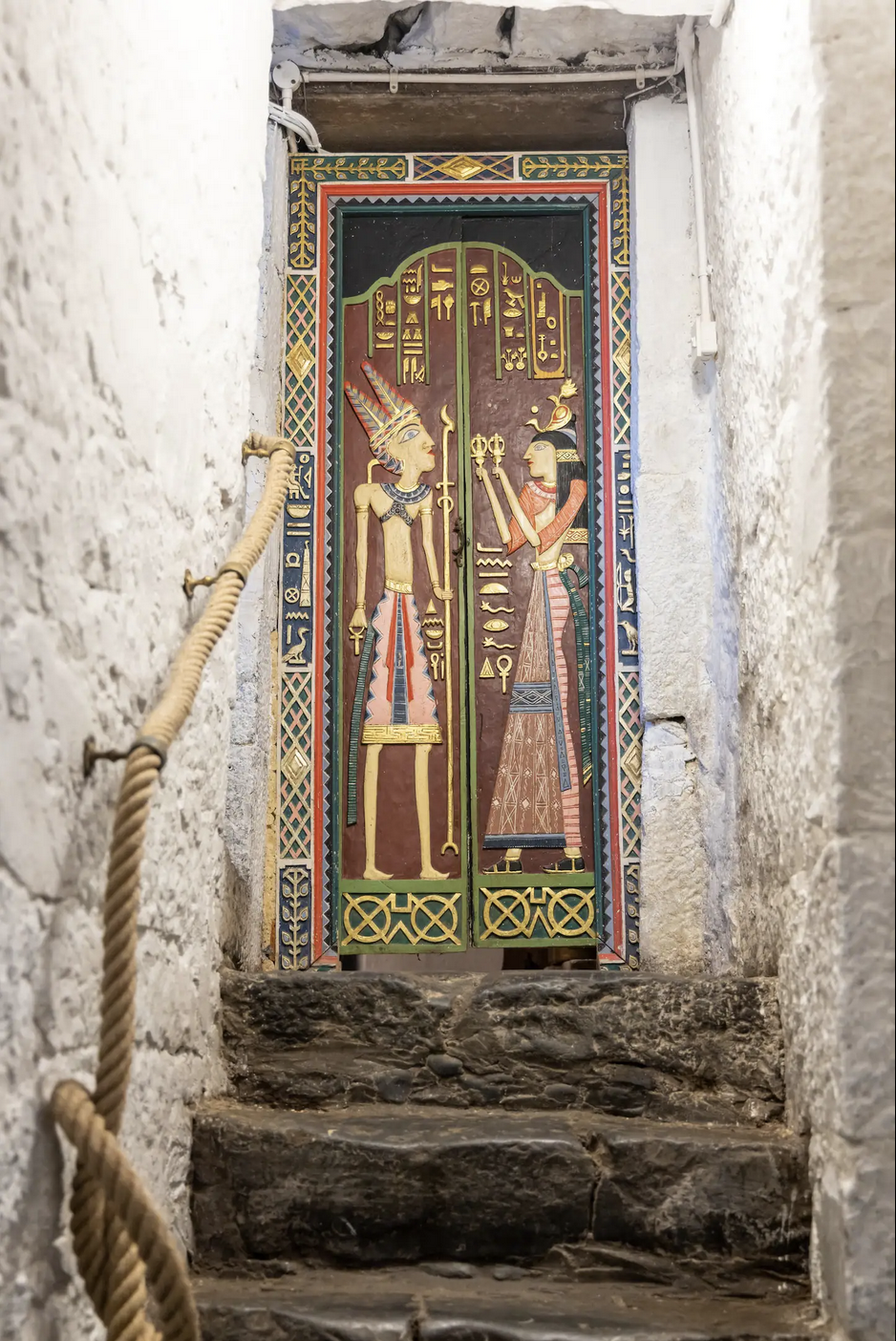
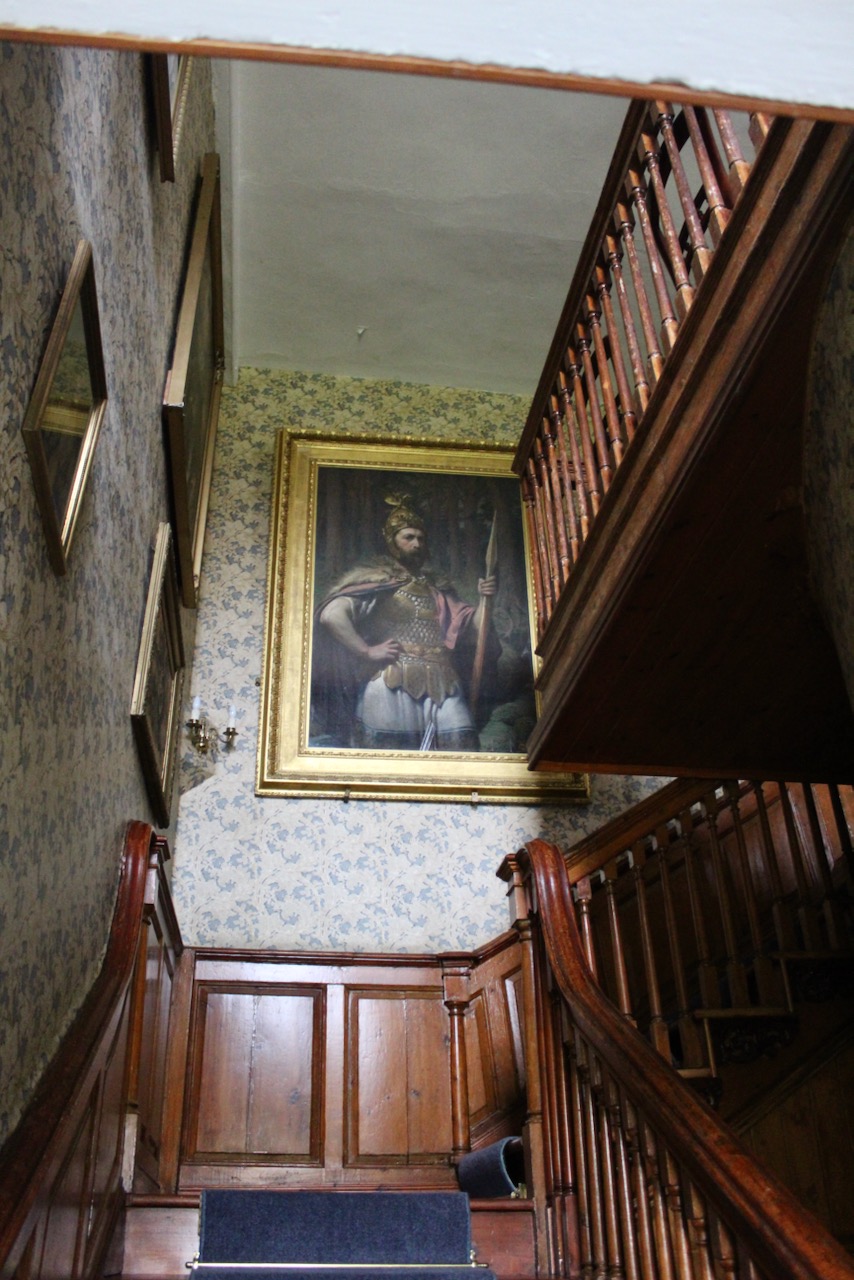
Going down to the basement at Burton Park, County Cork, August 17th 2023. Photograph © Jennifer Winder-Baggot, www.irishhistorichouses.com
Burton Park, County Cork, August 17th 2023. Photograph © Jennifer Winder-Baggot, www.irishhistorichouses.com

Unfortunately since there was nobody to show us around, we did not get to see the organic farm or the outbuildings, nor the swimming pool. We also didn’t see the stable range, of which Keohane writes: “The long stable range in the adjoining yard may contain the shell of the C18 stables, which were fitted up as a house for the rector by 1739.”

[1] www.slieile.ie

[2] p. 326, Keohane, Frank. The Buildings of Ireland. Cork City and County. Yale University Press: New Haven and London. 2020.

[3] p. 327, Keohane, Frank. The Buildings of Ireland. Cork City and County. Yale University Press: New Haven and London. 2020.

[4] p. 63. O’Hea O’Keeffe, Jane. Voices from the Great Houses: Cork and Kerry. Mercier Press, Cork, 2013.

[5] https://oglethorpe.edu/about/history-traditions/james-edward-oglethorpe/

[6] https://gerrymurphy.com/wp-content/uploads/2020/05/1.-The-Annals-of-Churchtown-854-Pages-9MB-20190222.pdf

[6] https://www.dib.ie/biography/perceval-percival-sir-john-a7275

[7] http://www.historyofparliamentonline.org/volume/1820-1832/member/perceval-henry-1796-1841

[8] Bence-Jones, Mark. A Guide to Irish Country Houses, originally published as Burke’s Guide to Country Houses volume 1 Ireland by Burke’s Peerage Ltd. 1978; Revised edition 1988 Constable and Company Ltd, London.

[9] Chapter 34, Cusack, Margaret Anne. An Illustrated History of Ireland (1868) https://www.libraryireland.com/HistoryIreland/Whiteboys.php

[10] https://www.dia.ie/architects/view/2581/HILL%2C+WILLIAM+HENRY+%5B1%5D

[11] http://churchtown.net/history/burton-park/

[12] https://www.purcellfamily.org/photographs Note that The castle at the Little Island, Co. Waterford was the seat of the Purcell-FitzGerald family (descendants of Lieutenant-Colonel John Purcell and his wife Mary FitzGerald) from circa 1818 to 1966. It is now the Waterford Castle Hotel. The Purcell-FitzGeralds were descendants of the Purcells of Ballyfoyle, Co. Kilkenny, an offshoot of the Purcells of Loughmoe.

Text © Jennifer Winder-Baggot, www.irishhistorichouses.com

Baltimore Castle (Dún Na Séad), Co. Cork P81 X968 – section 482

www.baltimorecastle.ie

Open dates in 2026: Apr 1-Oct 31, 10am-5pm

Fee: adult/OAP/student €6, child free with an adult

2026 Diary of Irish Historic Houses (section 482 properties)

To purchase an A5 size 2026 Diary of Historic Houses (opening times and days are not listed so the calendar is for use for recording appointments and not as a reference for opening times) send your postal address to jennifer.baggot@gmail.com along with €20 via this payment button. The calendar of 84 pages includes space for writing your appointments as well as photographs of the historic houses. The price includes postage within Ireland. Postage to U.S. is a further €10 for the A5 size calendar, so I would appreciate a donation toward the postage – you can click on the donation link.

€20.00

donation

Help me to pay the entrance fee to one of the houses on this website. This site is created purely out of love for the subject and I receive no payment so any donation is appreciated!

€15.00

Baltimore Castle, April 2021. © Jennifer Winder-Baggot, www.irishhistorichouses.com
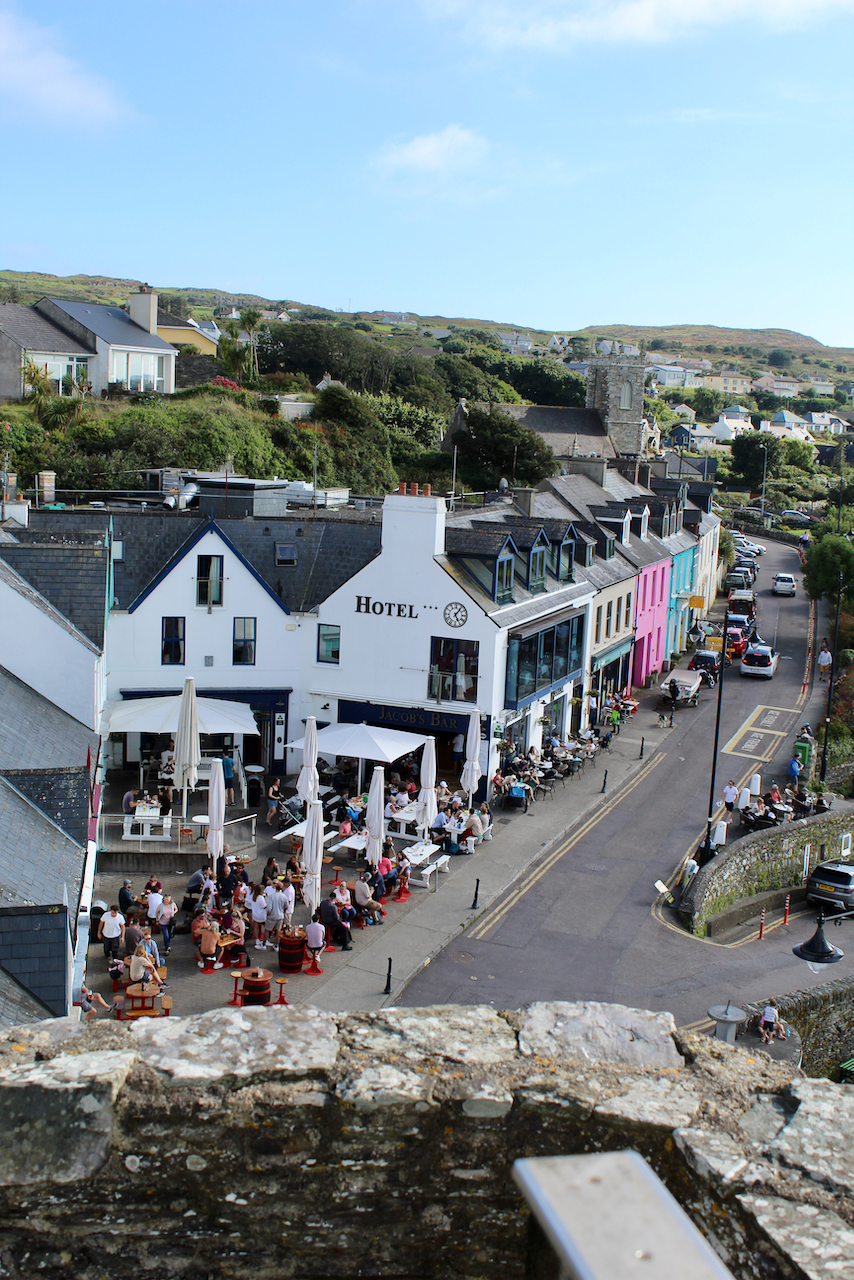
Dunasead Castle, also known as Dún a Séad (“Fort of the Jewels”), Dunashad or Baltimore Castle, lies in the town of Baltimore in County Cork.

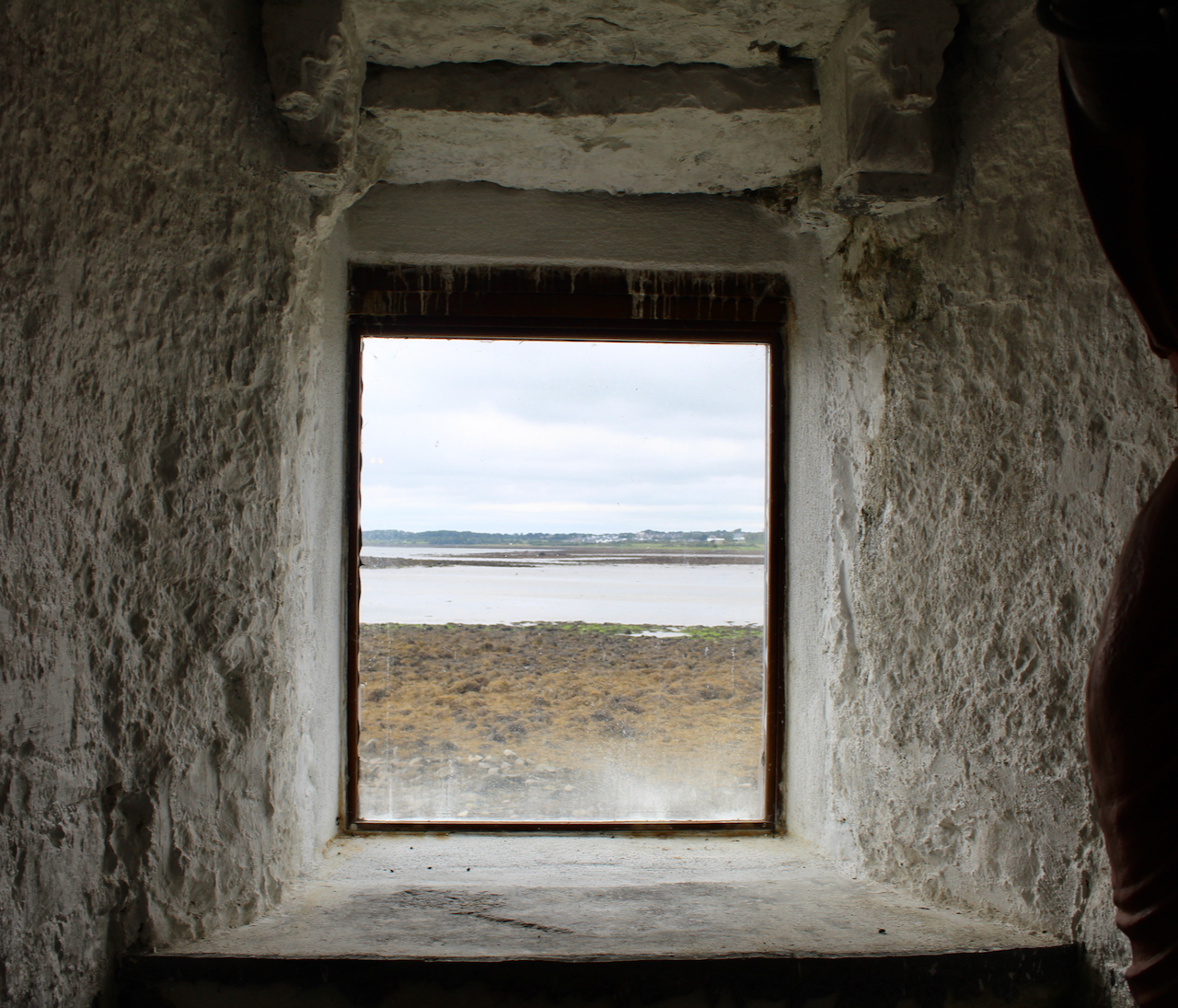
The view from Baltimore Castle 16 August 2023. © Jennifer Winder-Baggot, www.irishhistorichouses.com
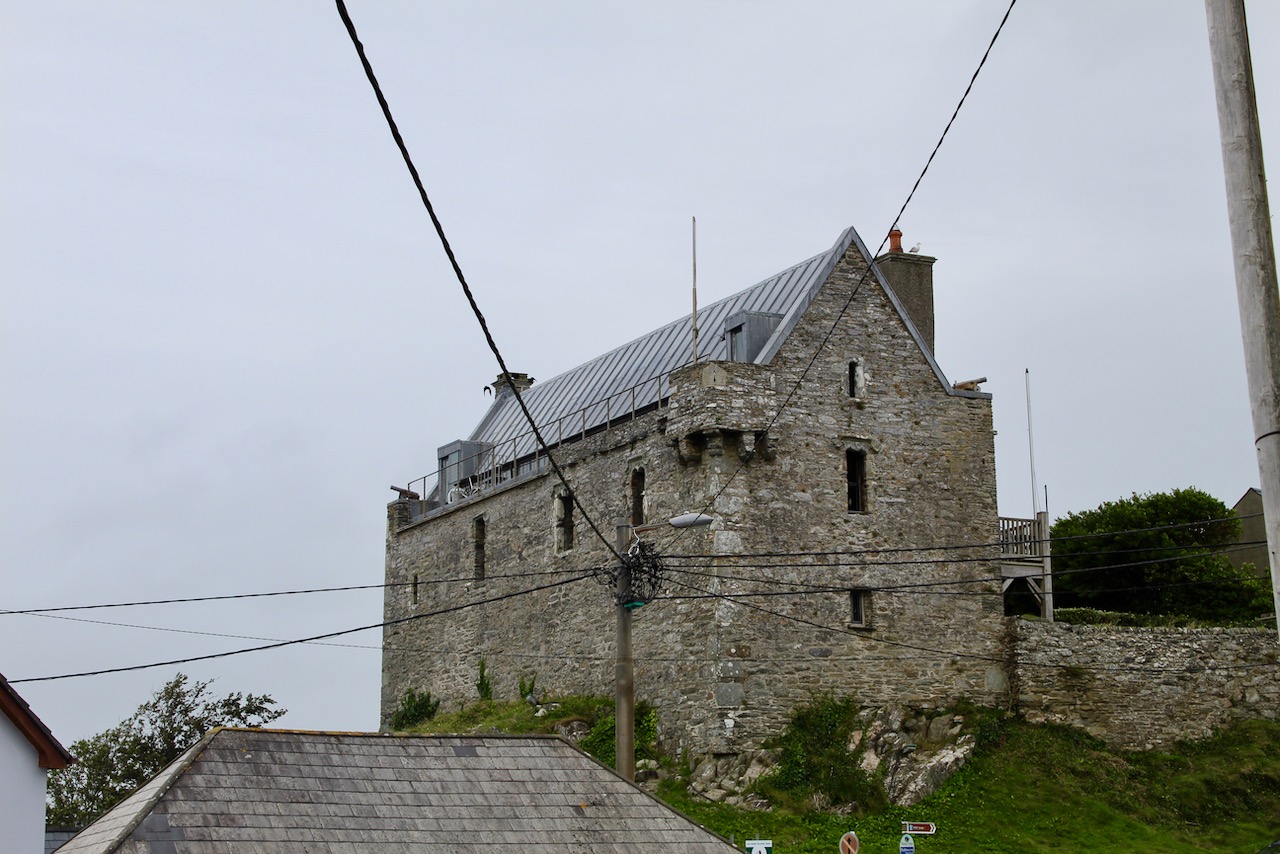
Baltimore Castle, April 2021. © Jennifer Winder-Baggot, www.irishhistorichouses.com

The website tells us that the site of Dún na séad Castle has been fortified for a very long time. The first fortification might have been a ring fort. After that an Anglo-Norman castle was built here in 1215. In 1305 that castle was taken and destroyed by the MacCarthys. Subsequently the O’Driscolls took possession of the site and built a castle.

Baltimore Castle, April 2021.

The website tells us that the present Dún na séad Castle was built in the 1620s by the O’Driscolls, but Frank Keohane writes that it was built by Thomas Crooke before 1610 near an earlier O’Driscoll castle. Frank Keohane writes in his The Buildings of Ireland: Cork City and County:

Baltimore or Dunasead Castle. Early C17 two-storey gable-ended block with an attic, set on a rock overlooking Baltimore Harbour. An O’Driscoll castle NE of the present building was occupied by an English force in 1602 after the Battle of Kinsale, during which it was substantially demolished. Sir Fineen O’Driscoll then leased Baltimore and its ‘castle’ to Thomas Crooke and William Coppinger. Crooke, who established an English settlement, appears to have built the present castle before 1610, possibly incorporating features such as the window surrounds from the O’Driscoll castle.” [1]

Baltimore Castle, April 2021. © Jennifer Winder-Baggot, www.irishhistorichouses.com
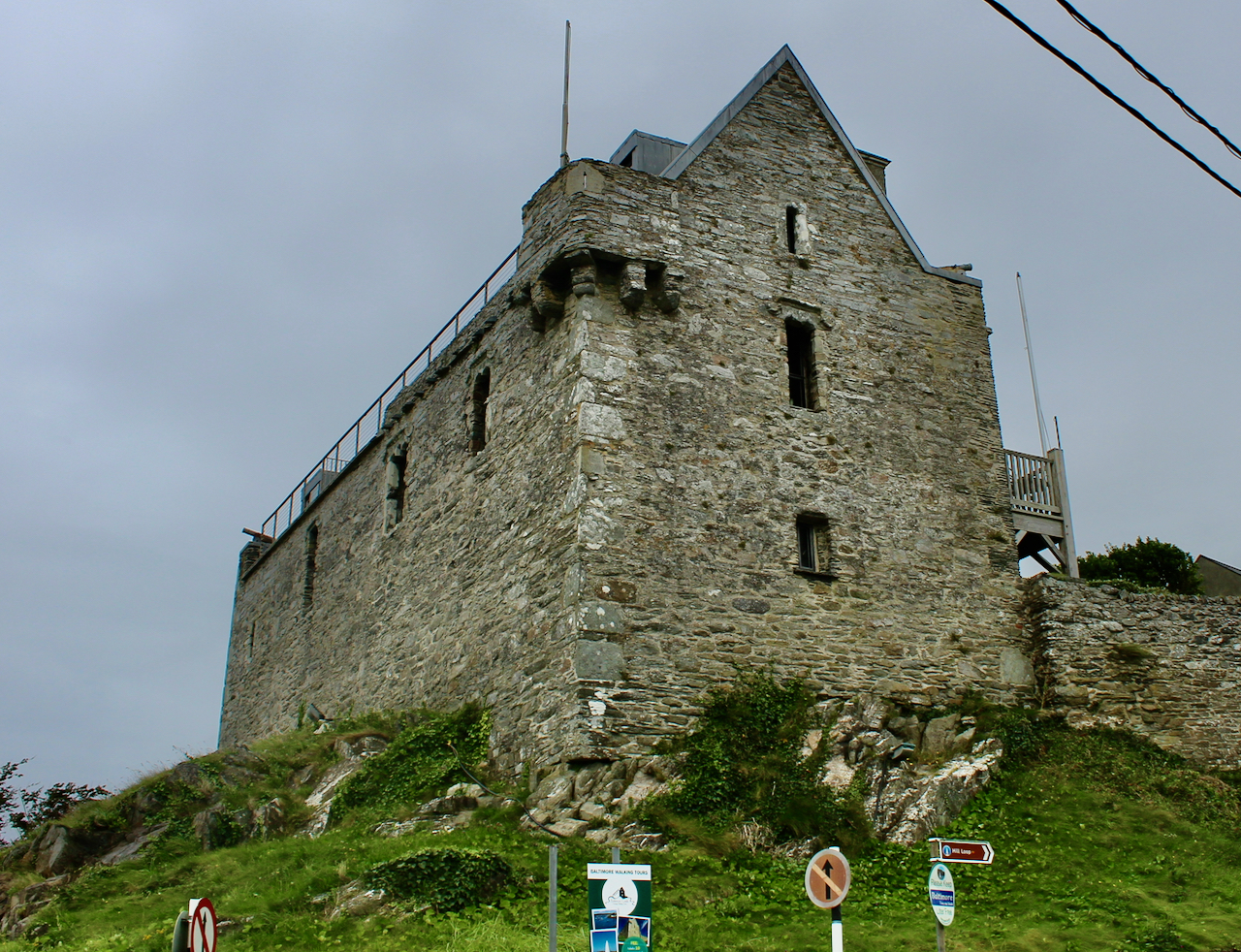
Keohane tells us: “[Baltimore is] a small pretty village… overlooking a broad deep bay sheltered from the Atlantic by Sherkin Island. An English settlement was first established here in the early C17 by Sir Thomas Crooke, later passing to Sir Walter Coppinger. By 1629 English settlers had built sixty houses here.

Between 1997 and 2005 the ruined castle was rebuilt as a private residence. At present it is a small museum. The owners, the McCarthys, have done an amazing job restoring the castle and it is also their home.

Keohane continues: “Restored as a dwelling in 1997-2003. The contemporary interventions are well considered, with minimal conjecture and cleanly distinct materials….The castle is approached across a small enclosed bawn on the east or landward side. The lower floor served as stores, with living quarters above. Wall-walks behind parapets are provided on the long sides. These give access to a square bartizan over the SW corner; another bartizan was probably provided on the opposing NE corner. The West side is blind at the ground level but has generous two and three light first floor windows (all now missing mullions and transoms), with ogee heads, sunken spandrels and curious curved hoodmould terminals similar to those at Clodagh Castle (Crookstown). On the east side, two great reconstructed chimneystacks sit on corbels at first-floor level. Here, small rectangular lights serve the ground-floor rooms, while the first-floor rooms have wider windows. A narrow first-floor door at the south end led to a now destroyed garderobe turret. The upper rooms were approached by an internal stair rather than a forestair. Markings in the plaster suggest that there were three major rooms, divided by partitions, with attics at each end. The central “hall” had good sandstone window dressings with neat roll mouldings, and a fireplace with remains of a moulded and chamfered limestone jamb. A solar or parlour was provided to the south. The north room has a bread oven and a slop stone in addition to its fireplace, indicating use as a kitchen.

Baltimore Castle 16 August 2023: a chimneystack from first floor level. © Jennifer Winder-Baggot, www.irishhistorichouses.com
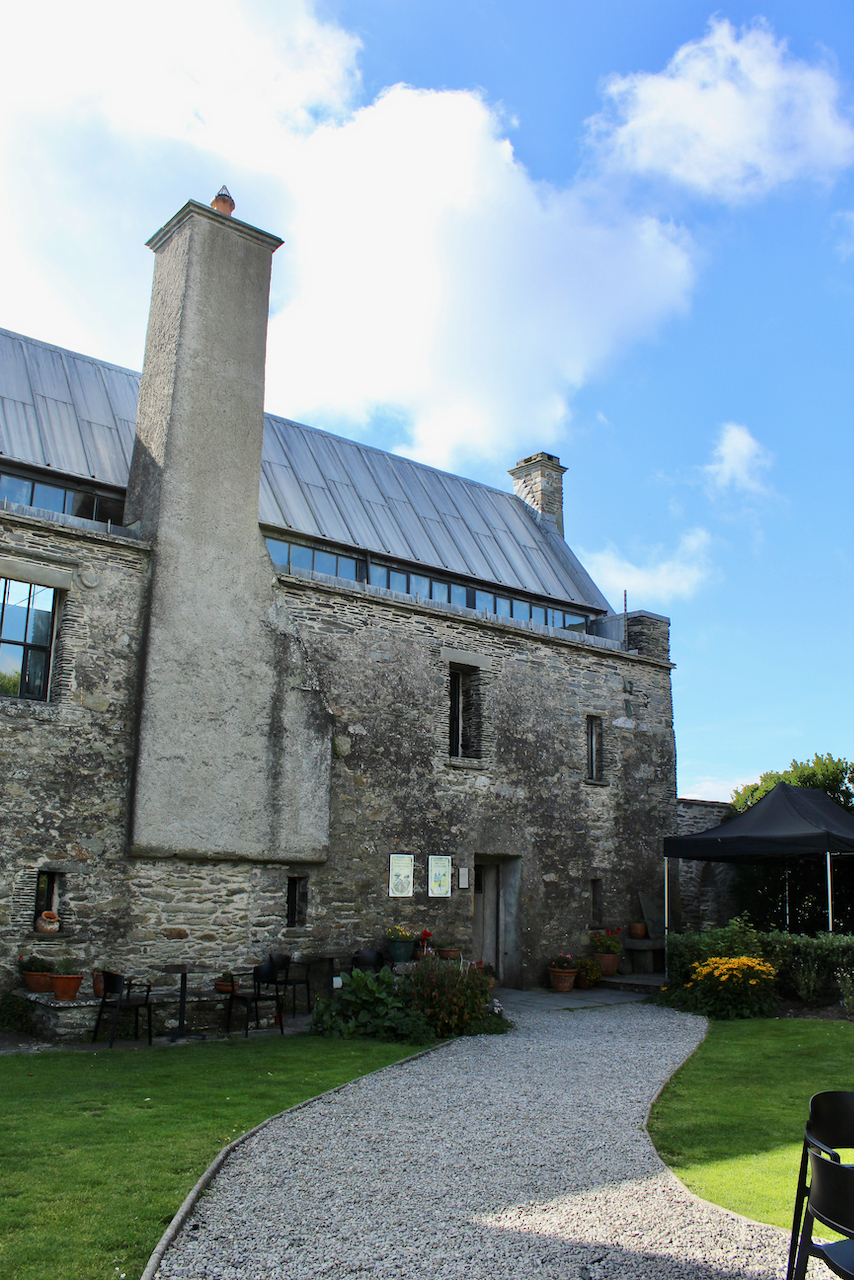
Baltimore Castle, here we see the small bartizan on the southwest corner, and the hood moulding over the ogee shaped window, April 2021. © Jennifer Winder-Baggot, www.irishhistorichouses.com
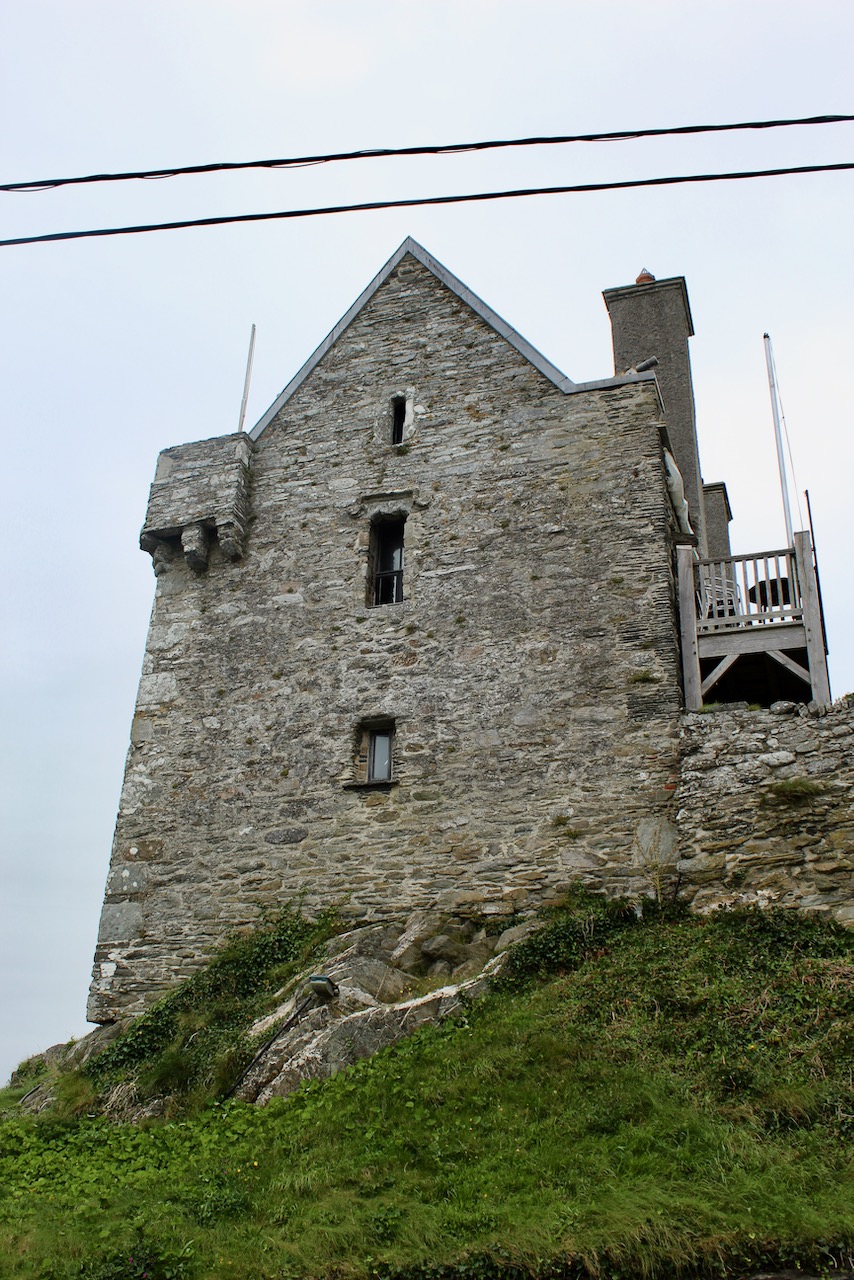
Baltimore Castle 16 August 2023. © Jennifer Winder-Baggot, www.irishhistorichouses.com
Baltimore Castle, April 2021. © Jennifer Winder-Baggot, www.irishhistorichouses.com
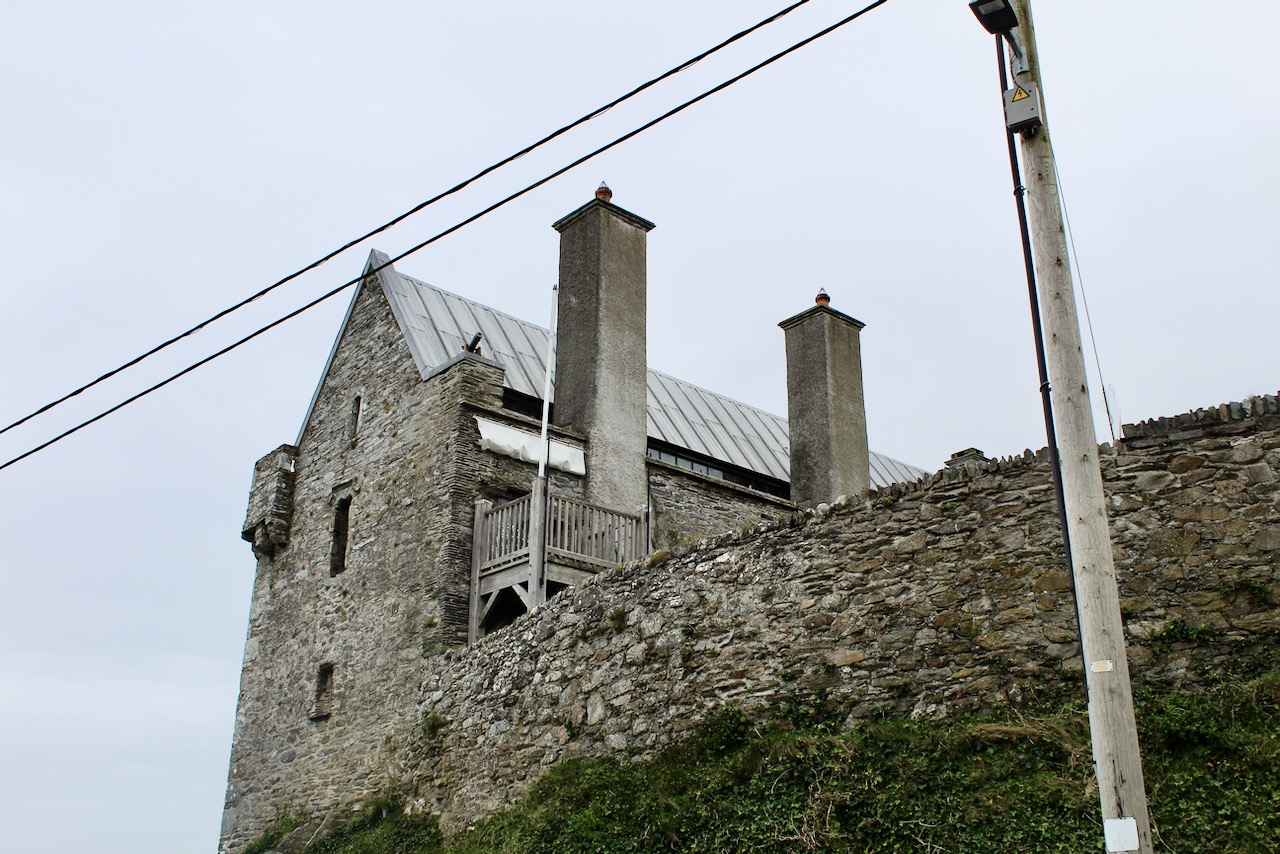
Baltimore Castle 16 August 2023. © Jennifer Winder-Baggot, www.irishhistorichouses.com
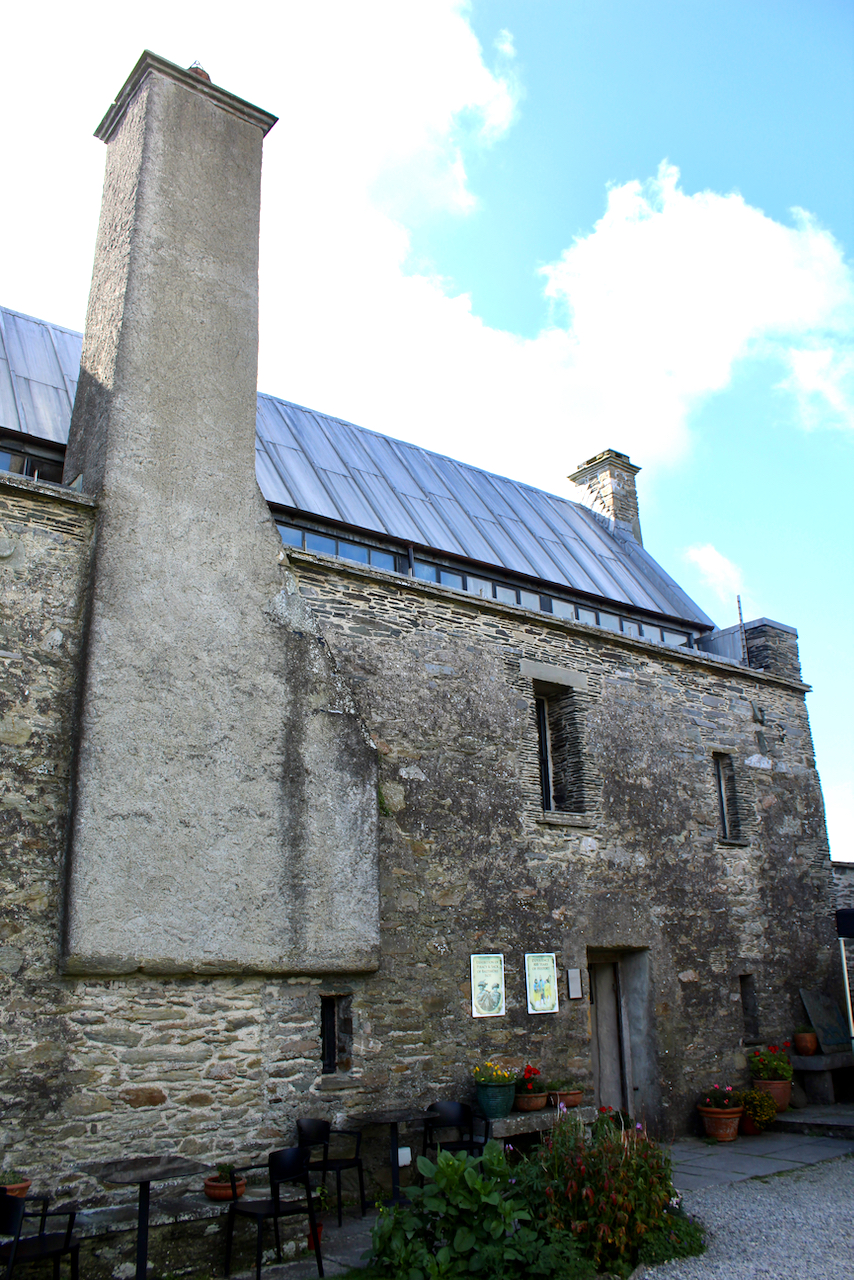
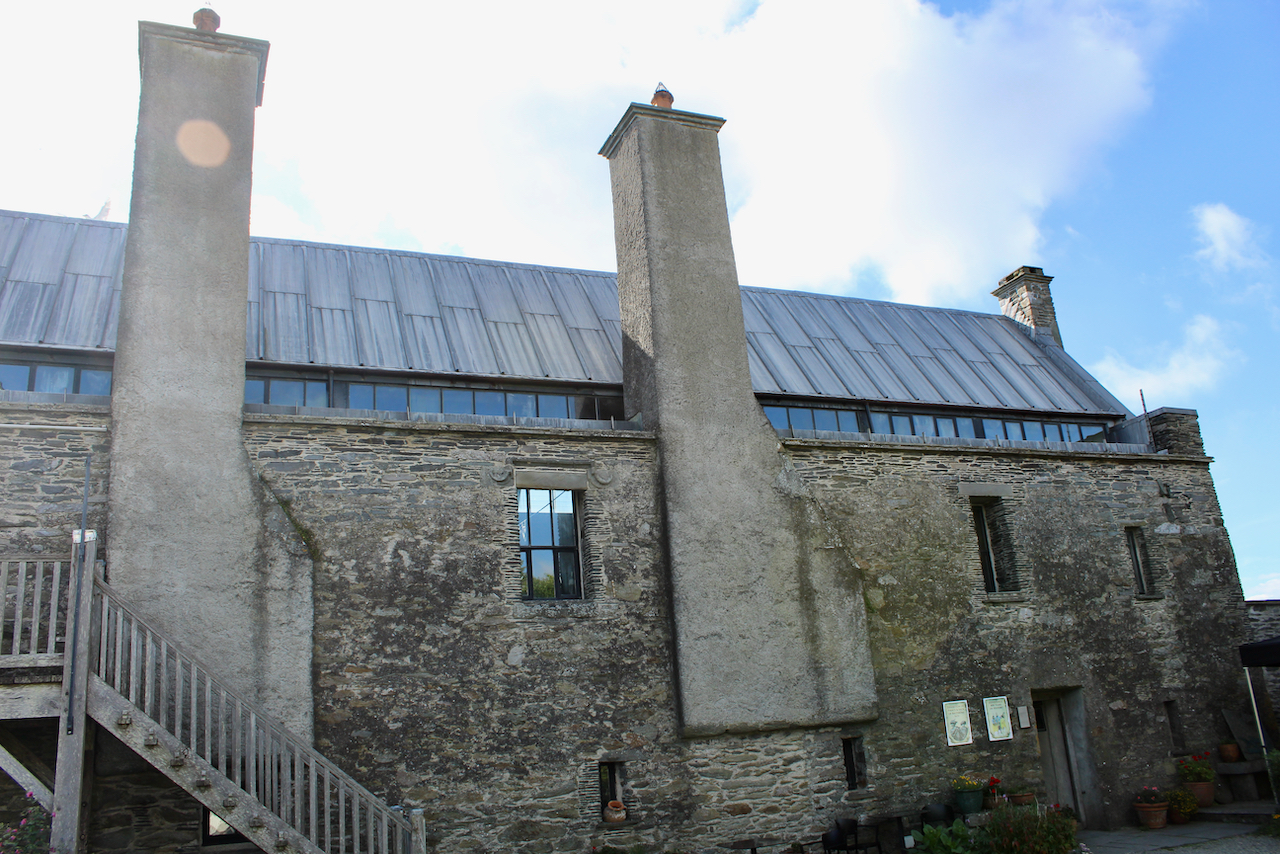

But let us backtrack to the Castle’s fascinating history.

Information board in Baltimore Castle.

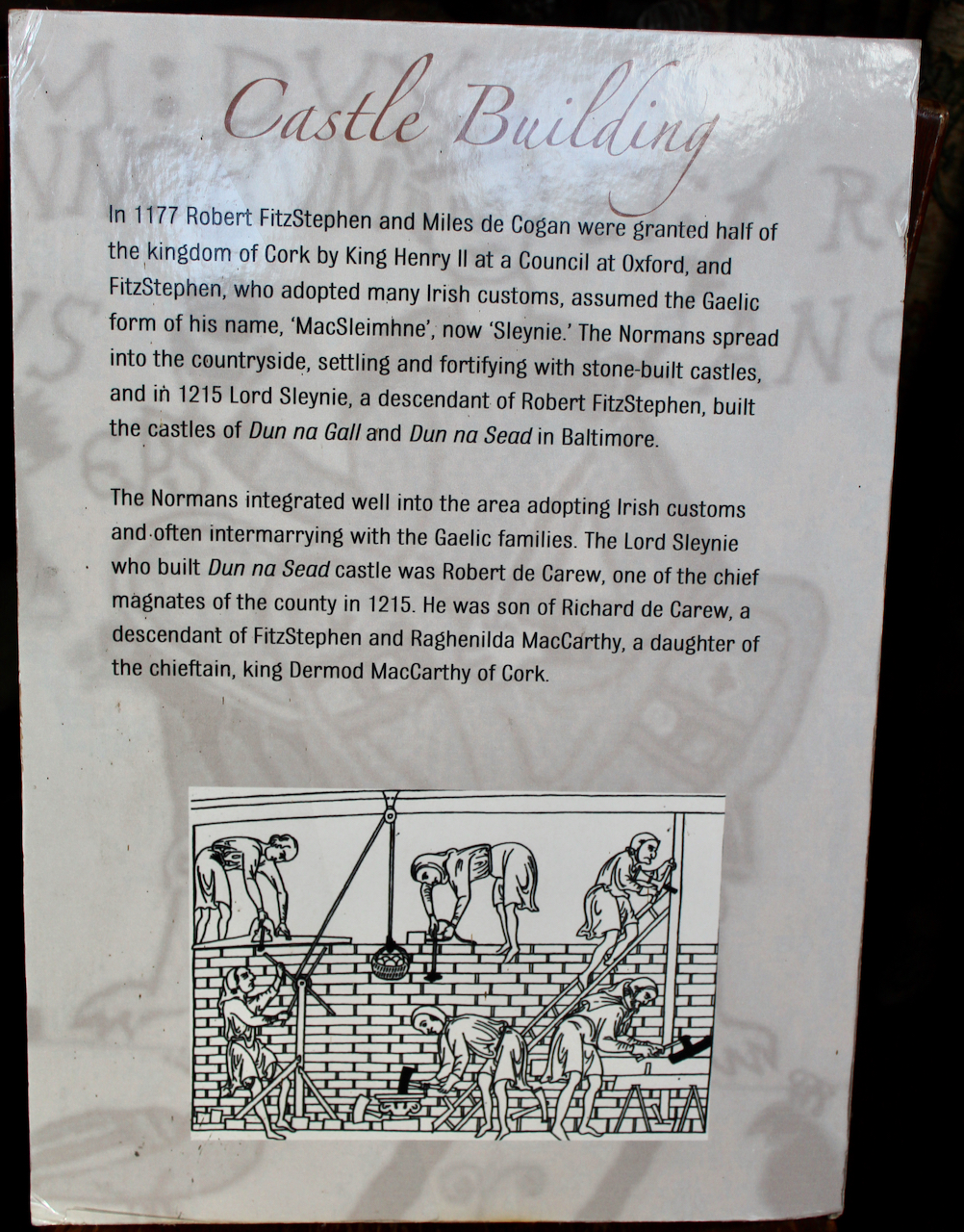
The information boards tell us that in 1215 Robert de Carew, Lord Sleynie, built the castle, and that his mother was a daughter of the chieftain Dermod MacCarthy of Cork.

Information board in Baltimore Castle.

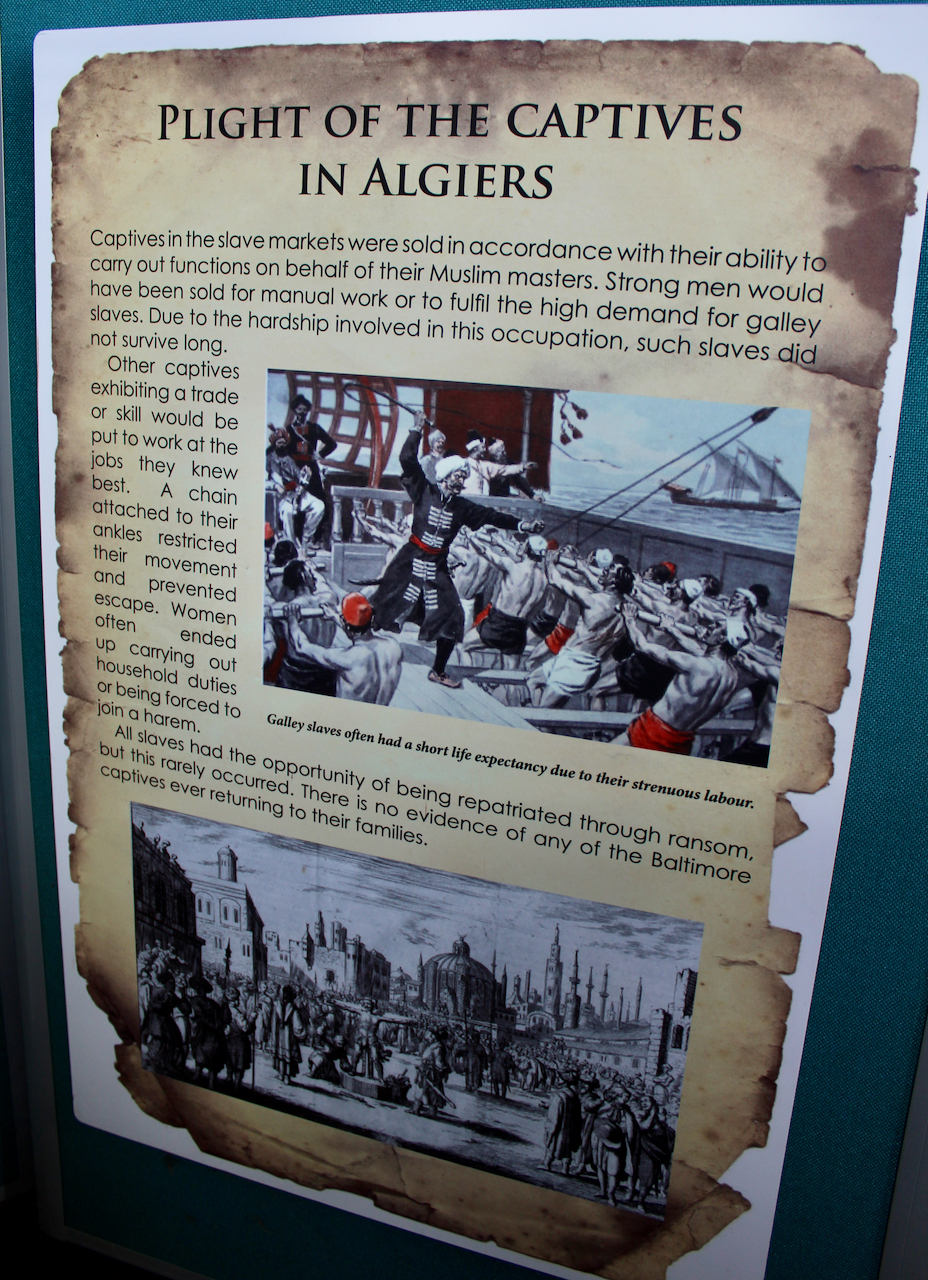
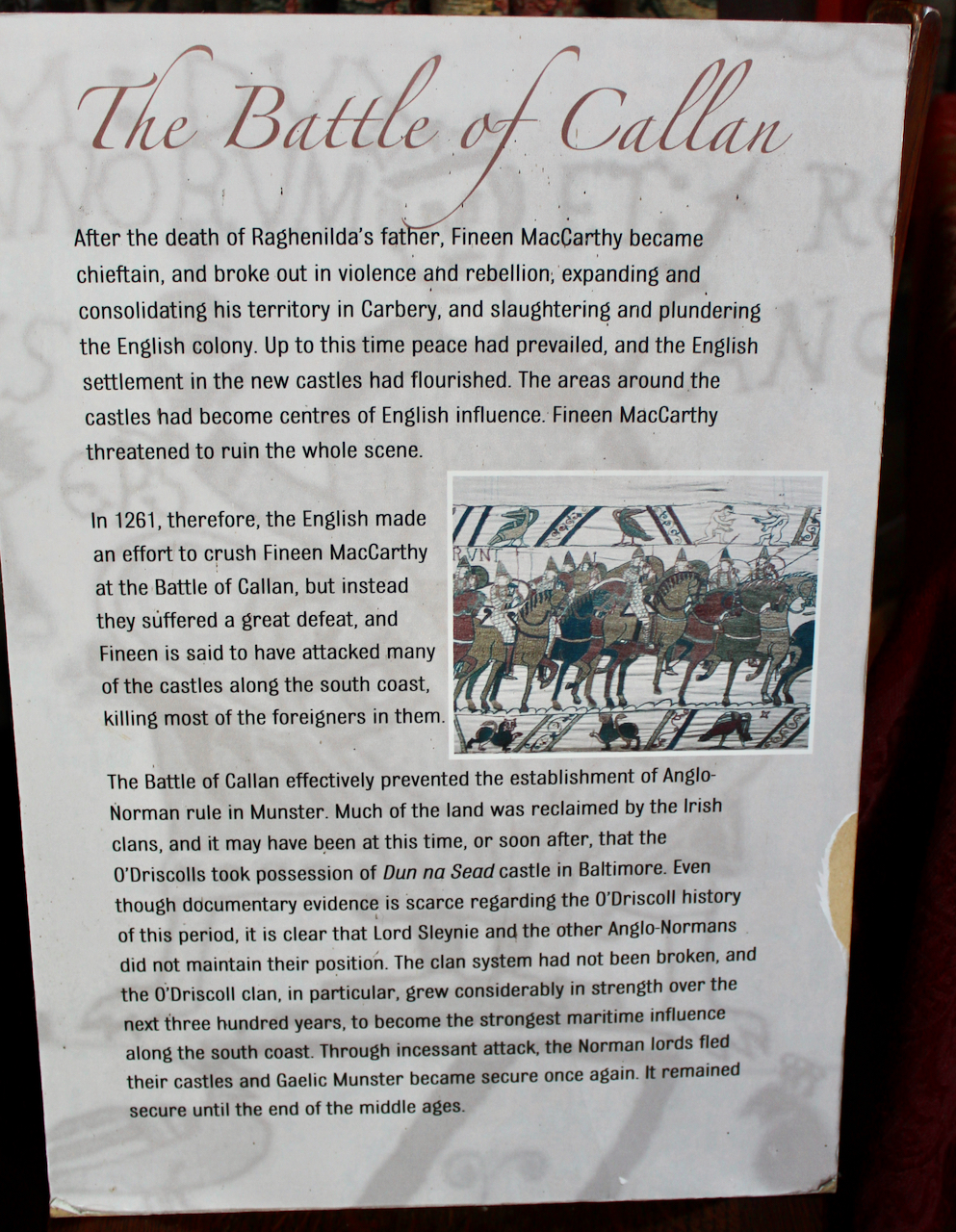
After the Battle of Callan, the O’Driscoll family took possession of the castle at Baltimore. The O’Driscolls were fishermen and pirates.

Information board in Baltimore Castle.

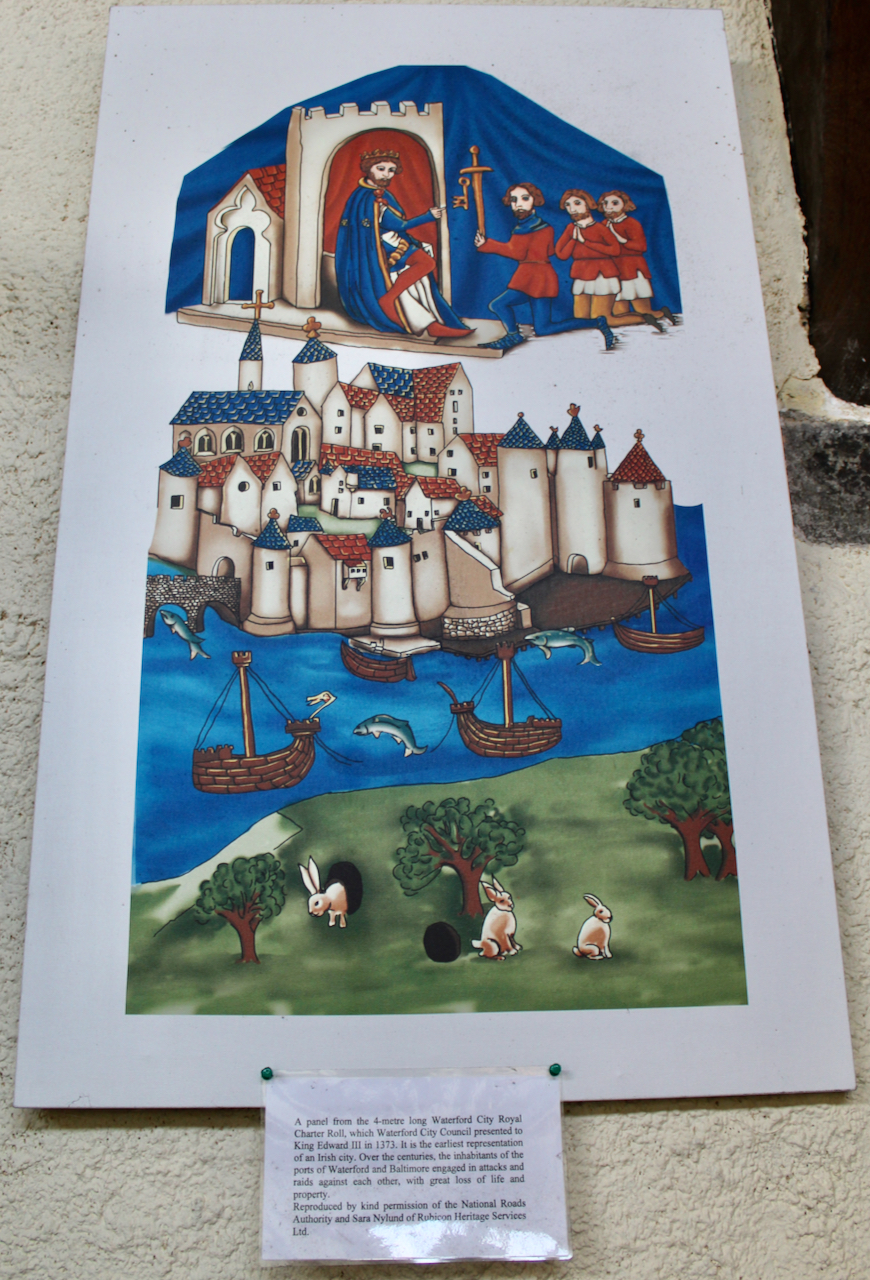
The website tells us that the O’Driscolls were constantly under pressure from encroachments by Anglo-Norman settlers and rival Gaelic clans on their territory and trade interests, which resulted in the castle being attacked and destroyed numerous times in the following centuries.

The O’Driscolls imposed taxes on harbour trade and traffic in order to support their opulent lifestyle. They had no authority from the crown to impose such taxes, so in 1381 King Richard II appointed admirals for the ports of county Cork in an attempt to deal with the pirate menace to merchant shipping in the area. The admirals were commissioned to deal in particular with the O’Driscolls of Baltimore “who constantly remained upon the western ocean, preying in passing ships.” [2]

Information board in Baltimore Castle.

In the early 1600s Fineen O’Driscoll of Dún na Séad castle pledged loyalty to the Crown of England. He was knighted by Queen Elizabeth I.

Information board in Baltimore Castle.
Elizabeth I Queen of England (1503-1603) date c.1560, courtesy of National Gallery of Ireland.
Information board in Baltimore Castle.
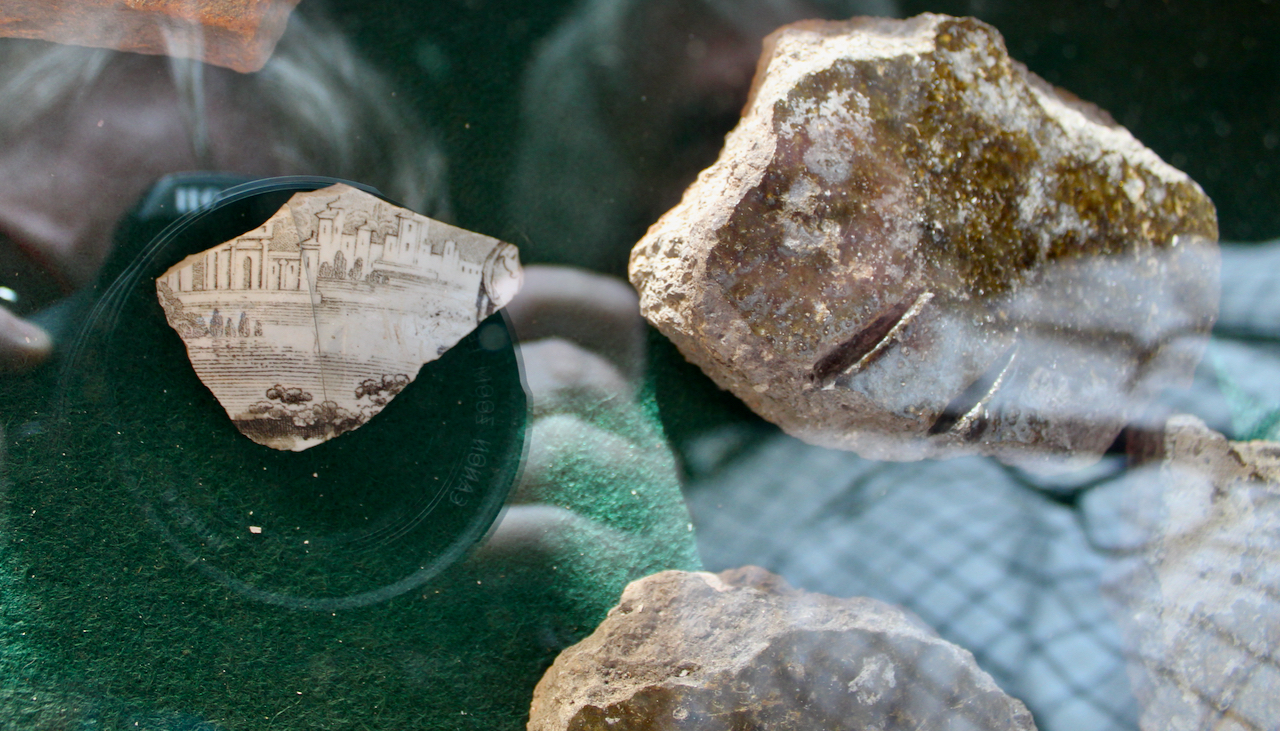
Pottery shards found around Baltimore Castle. © Jennifer Winder-Baggot, www.irishhistorichouses.com
Information board in Baltimore Castle.

In 1606 Thomas Crooke (b. 1574) was granted Baltimore Castle and the town of Baltimore as well as lands and islands formerly belonging to the O’Driscolls, in order to secure the area for the Crown and establish a Protestant colony. Bernie McCarthy tells us in her book that there is no evidence of the relationship between Fineen O’Driscoll and Thomas Crooke, and we do not know if the O’Driscolls stood aside willingly or whether Crooke had to engage in force to obtain the property. The portrait in the information board is not of Thomas Crooke but is of typical attire of an English planter at the time.

Crooke was meant to represent the Crown but he became involved in piracy, co-operating with English and Flemish pirates and profiting from their spoils.

There was, however, a system the Crown used for legitimising piracy by a system of “privateering” which was sanctioned by the State. A Privateer obtained a license, or letter of “Marque” to use their ships as a man-o-war against the State’s enemies in times of war. The marque permitted vessel owners to seize Crown enemies, acquire their cargo and make a profit. The captured ships were taken before the Prize Court and the captured cargo was referred to as the “prize,” and the privateer was awarded 90% of the prize, with 10% of the value going to the National Prize Fund. [3] Privateers took advantage of this legitimacy to capture illegitimate bounty, but in the case of Crooke, his work establishing a colony made the Crown turn a blind eye to his piracy.

Pirates would dock in Baltimore to repair ships or gather supplies, and this led to proliferation of taverns and brothels in Baltimore. A list of goods brought to Baltimore around 1615 by the pirate Campane includes wax, pepper, 100 Barbary hides, a chest of camphor, tobacco, cloves, elephants’ teeth (probably tusks), Muscovy hides, a chest of chenery roots and canopies of beds from the Canary Islands. [4]

In 1613, Baltimore was enabled by charter to send two MPs to the Dublin Parliament. Thomas Crooke was elected MP. Ironically, it was this parliament which introduced the Irish Statue against piracy.

Information board in Baltimore Castle.

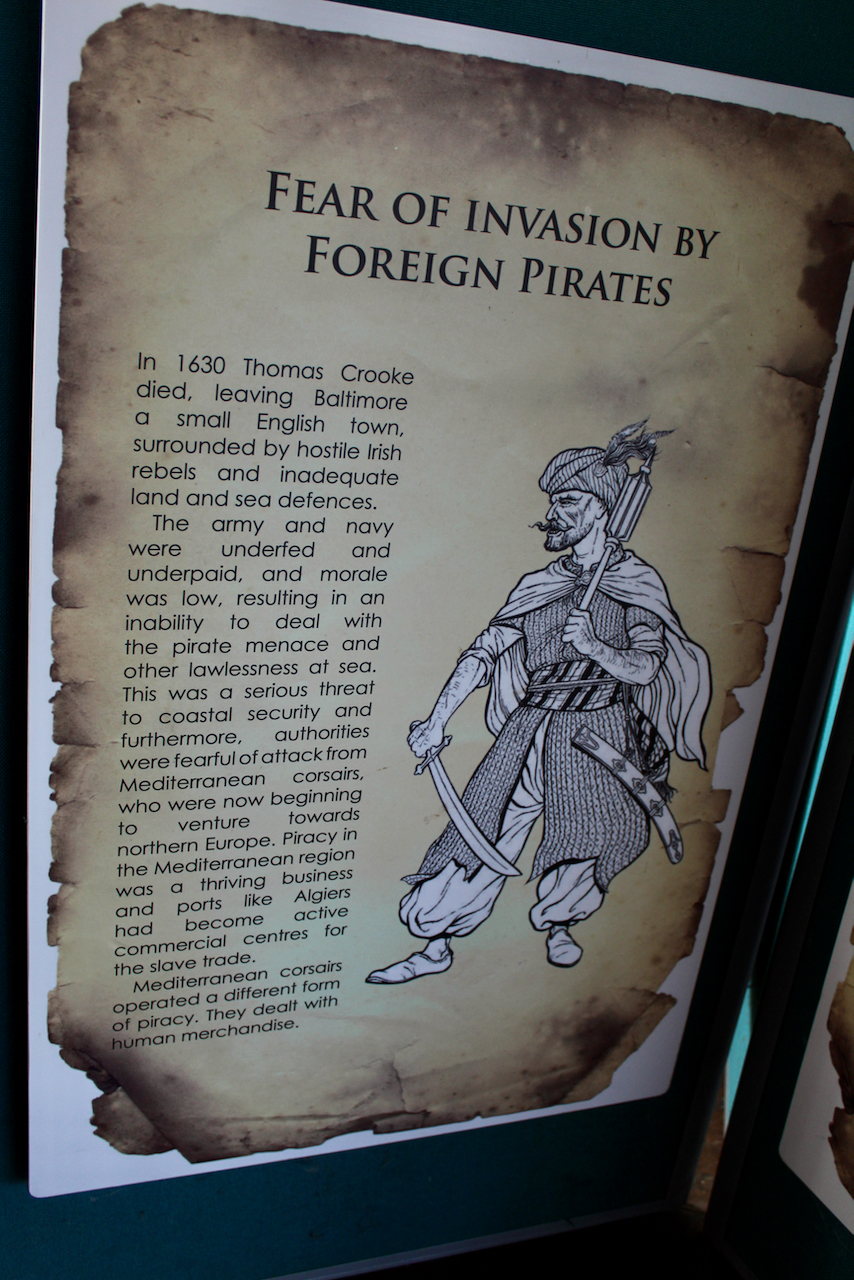
By 1626, Crooke feared the consequences of foreign pirates, and he petitioned the House of Lords for protection of Baltimore. Unfortunately, any protection proved inadequate.

Information board in Baltimore Castle.
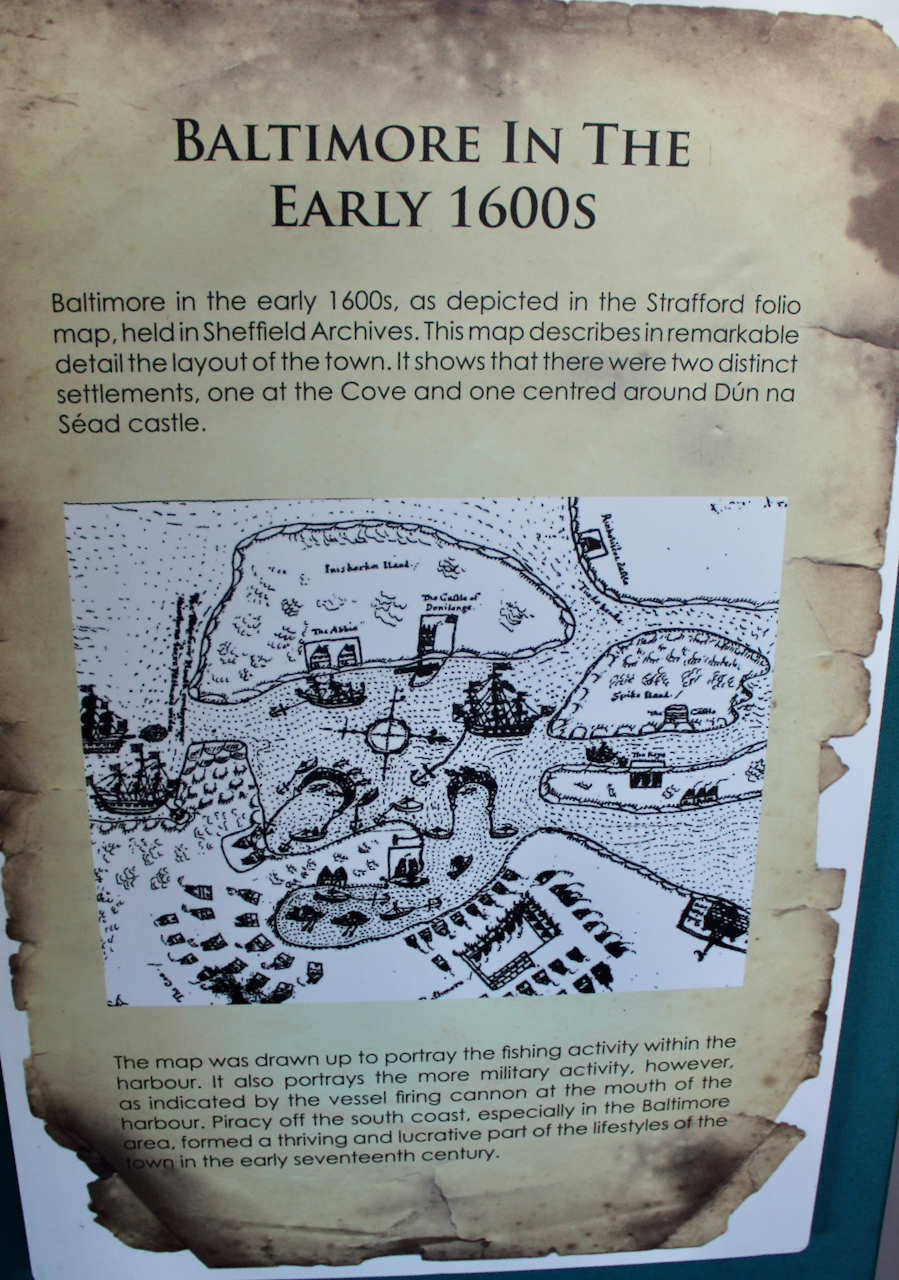
Early seventeenth century anti-pirate map of Baltimore, commissioned by the Dutch in order to facilitate an attack on local pirates, to render the adjacent seas safer for Dutch merchant vessels.
Baltimore Castle 16 August 2023. © Jennifer Winder-Baggot, www.irishhistorichouses.com
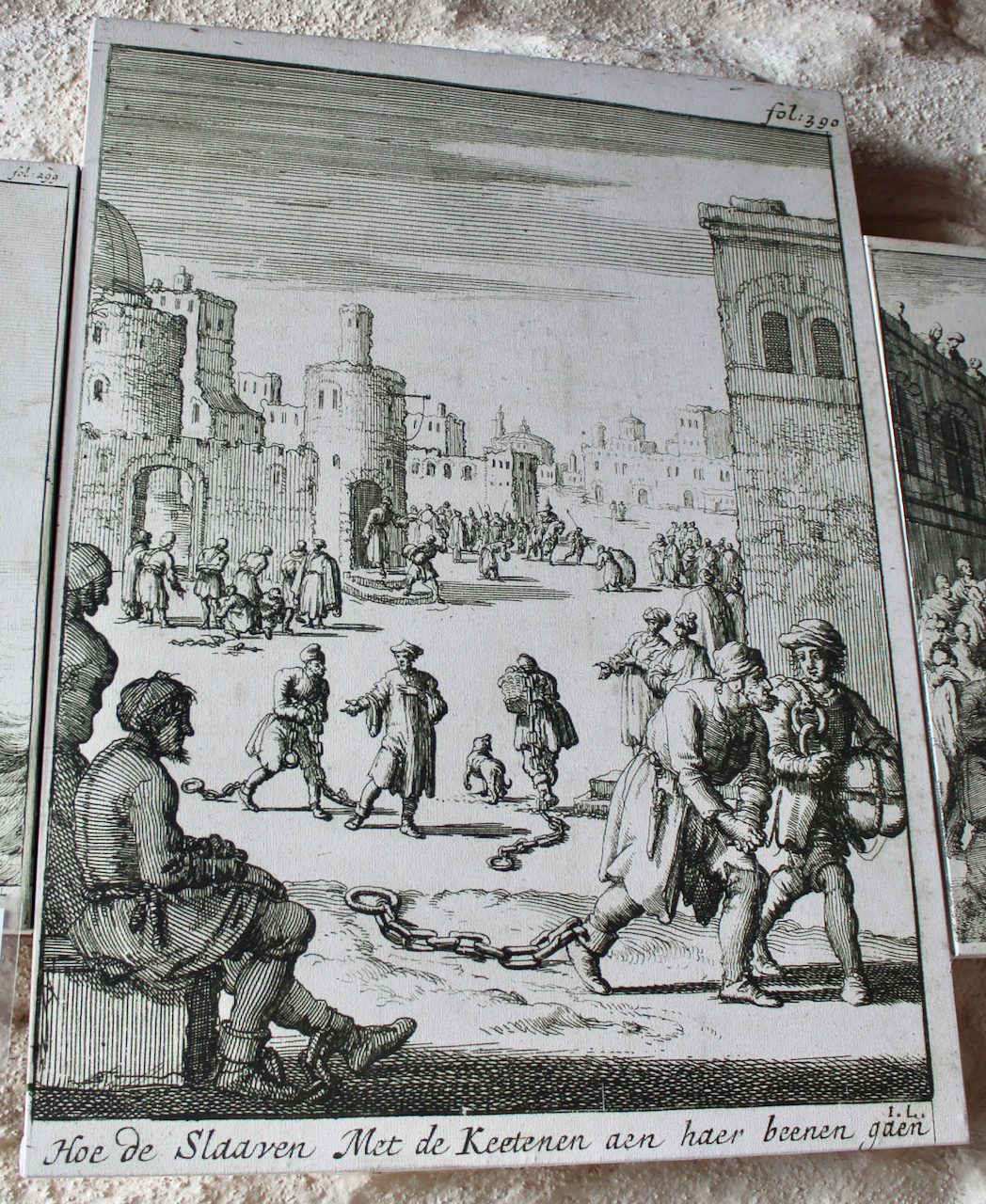
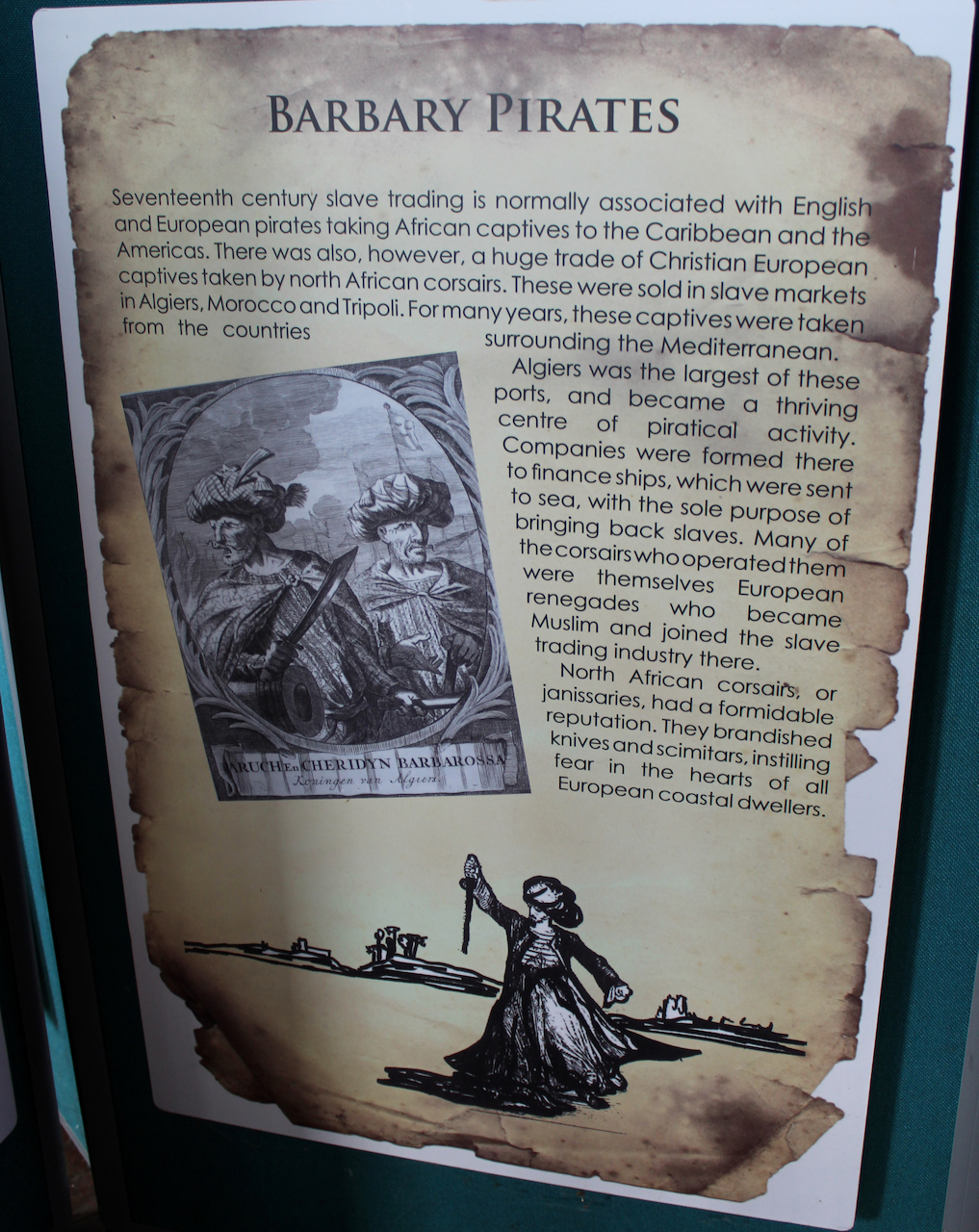
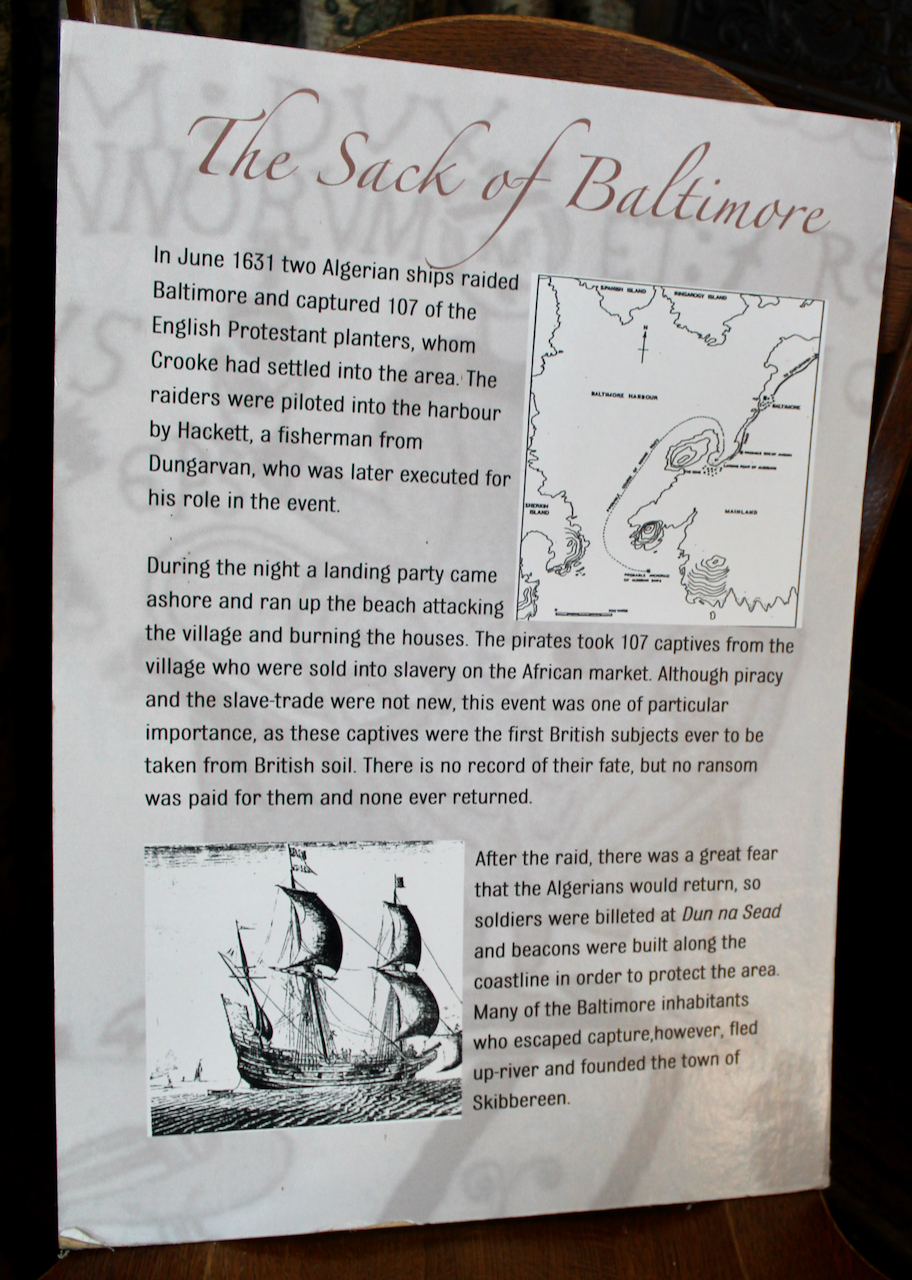
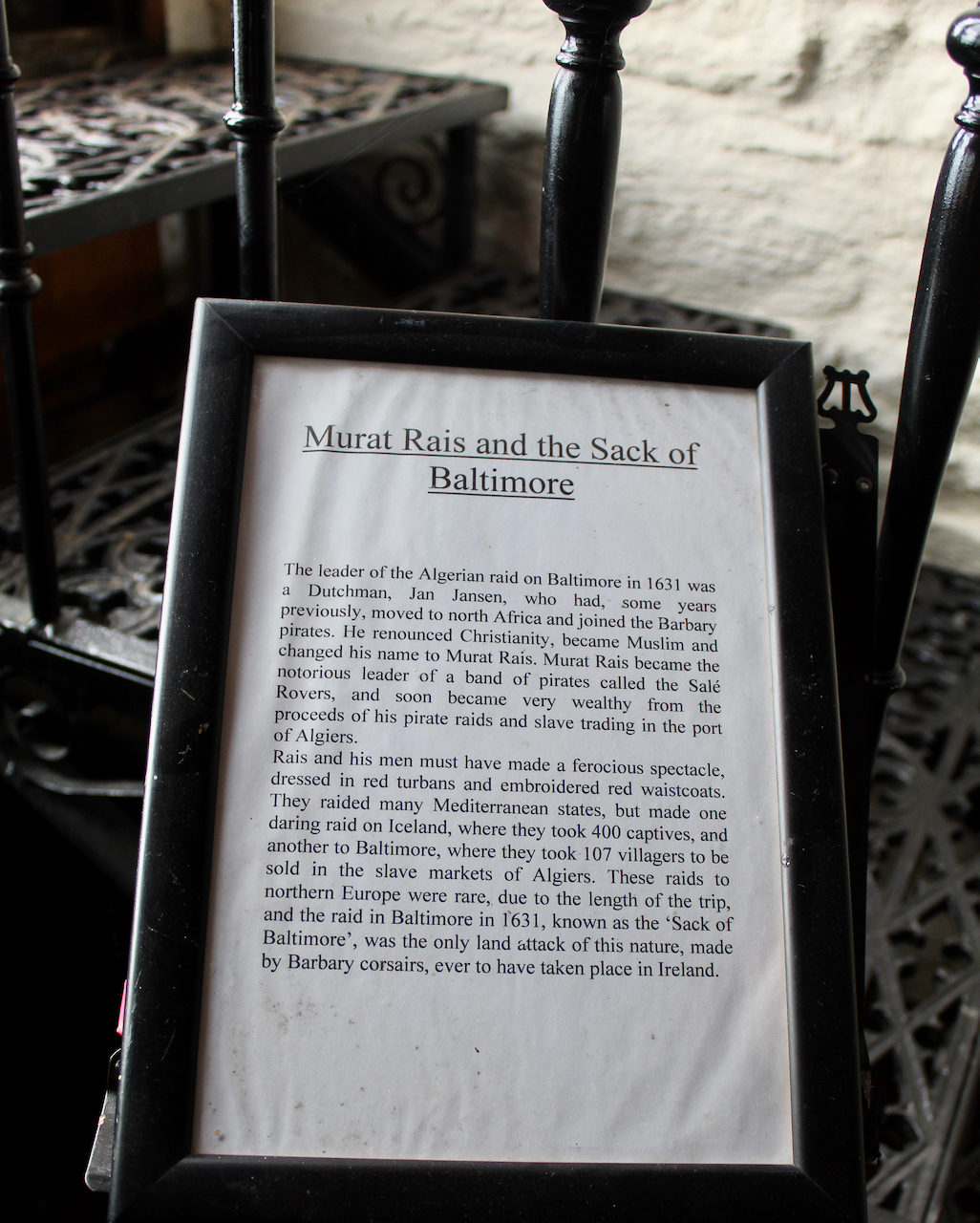
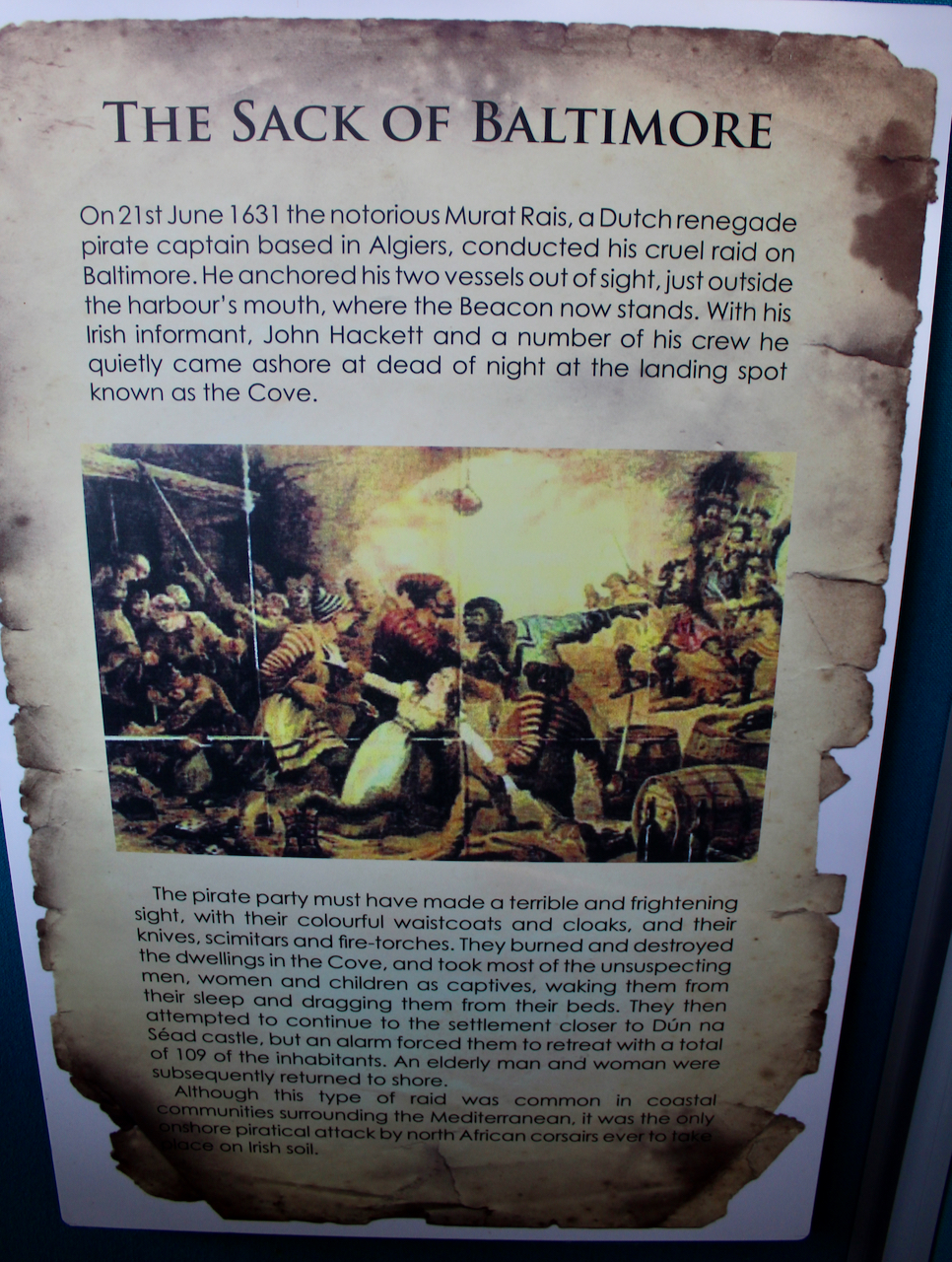
In 1631 a band of pirates from Algiers took 107 captives to a life of slavery in North Africa. Bernie McCarthy of Baltimore Castle has written a book called Pirates of Baltimore from the Middle Ages to the Seventeenth Century, Baltimore Castle Publications, 2012, which informs the educational material in the museum. [see 2]

Information board in Baltimore Castle.

At the time of the raid, Baltimore Castle was occupied by Thomas Bennett. He wrote to James Salmon of Castlehaven, County Cork, in an effort to send a ship from there to try to intercept the captives, and the Lord President of Munster ordered two of the king’s ships of war, the Lions Whelps, which were in Kinsale at the time, to go to the rescue, but none of the attempts were successful. [5]

Slave bracelet. © Jennifer Winder-Baggot, www.irishhistorichouses.com
Information board in Baltimore Castle.
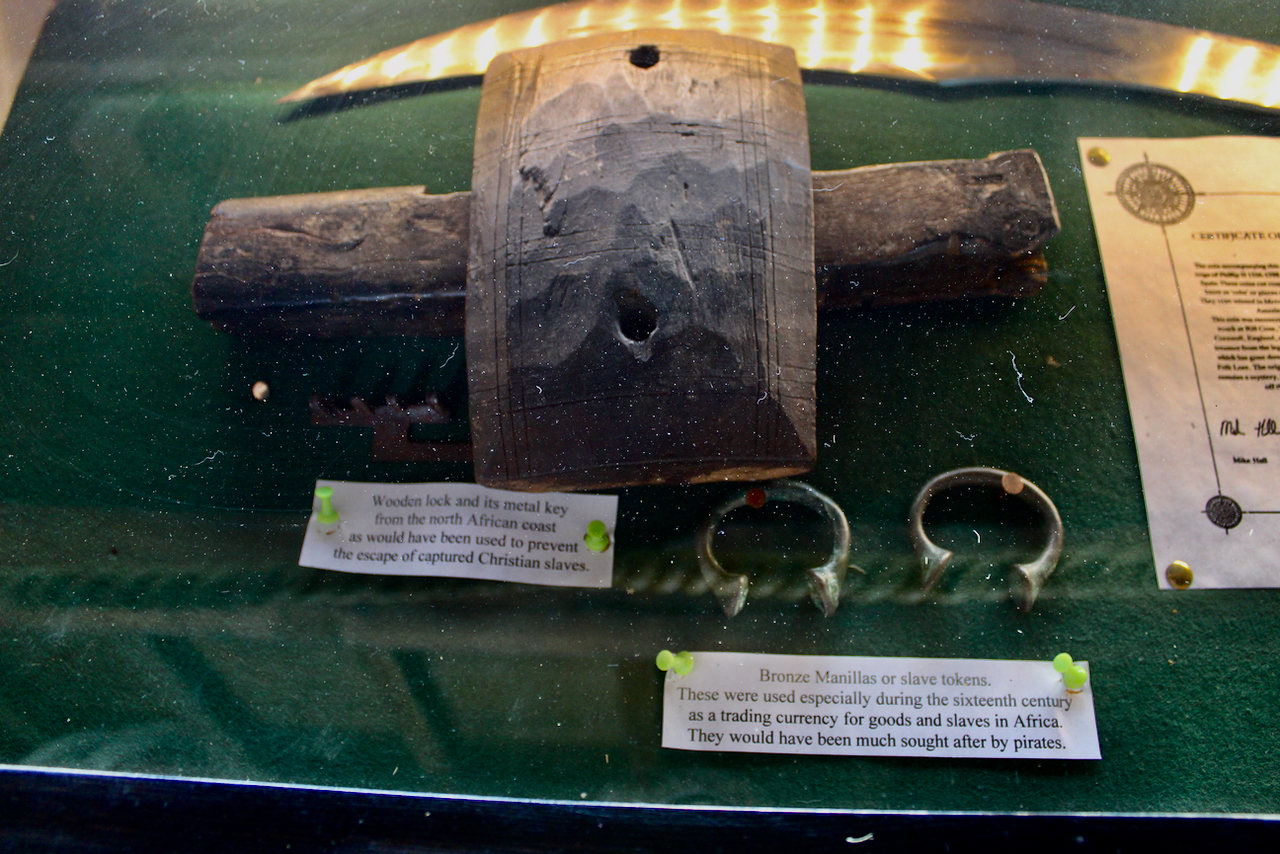
Wooden lock to prevent slaves from escaping, and bronze tokens used to trade for slaves. © Jennifer Winder-Baggot, www.irishhistorichouses.com
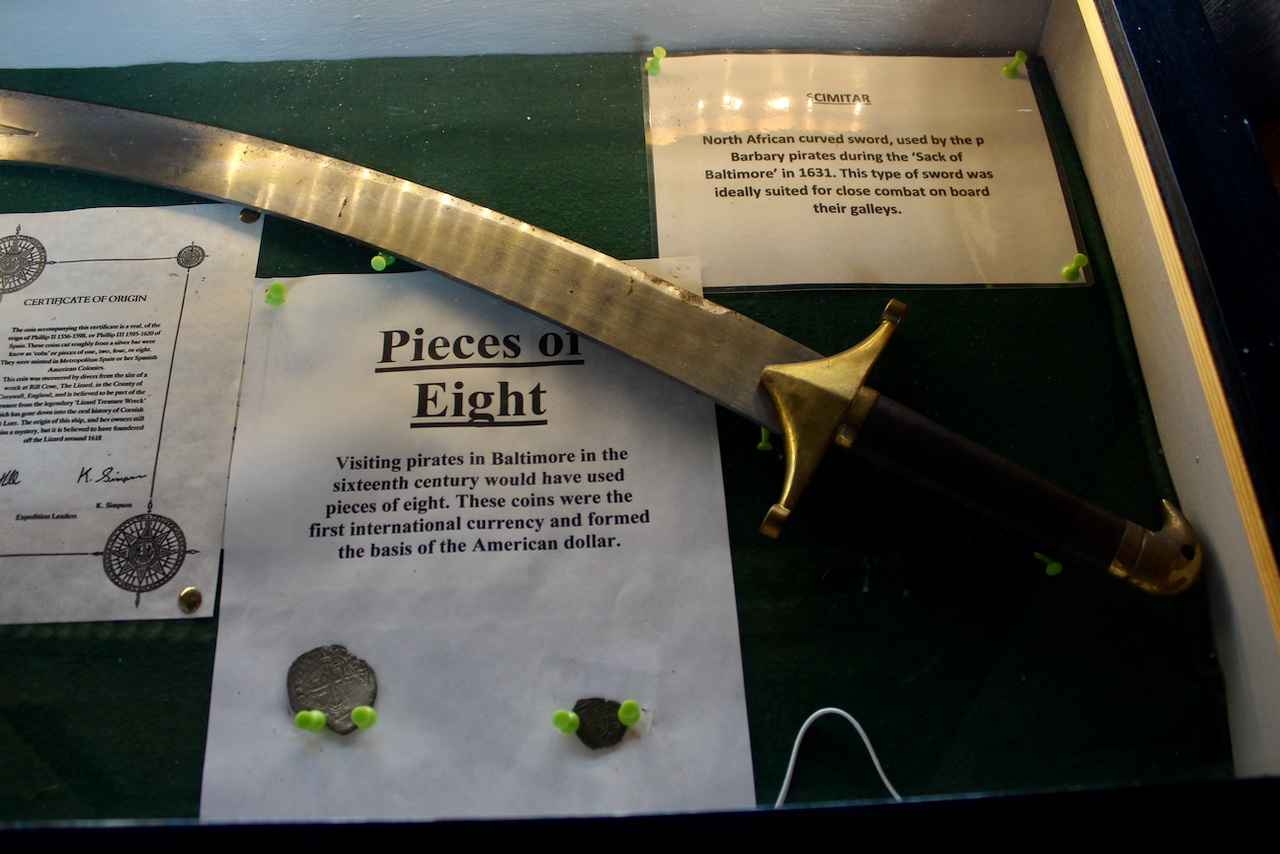
Coins that would have been used at the time, and a cimitar sword similar to those used by Barbary pirates. © Jennifer Winder-Baggot, www.irishhistorichouses.com

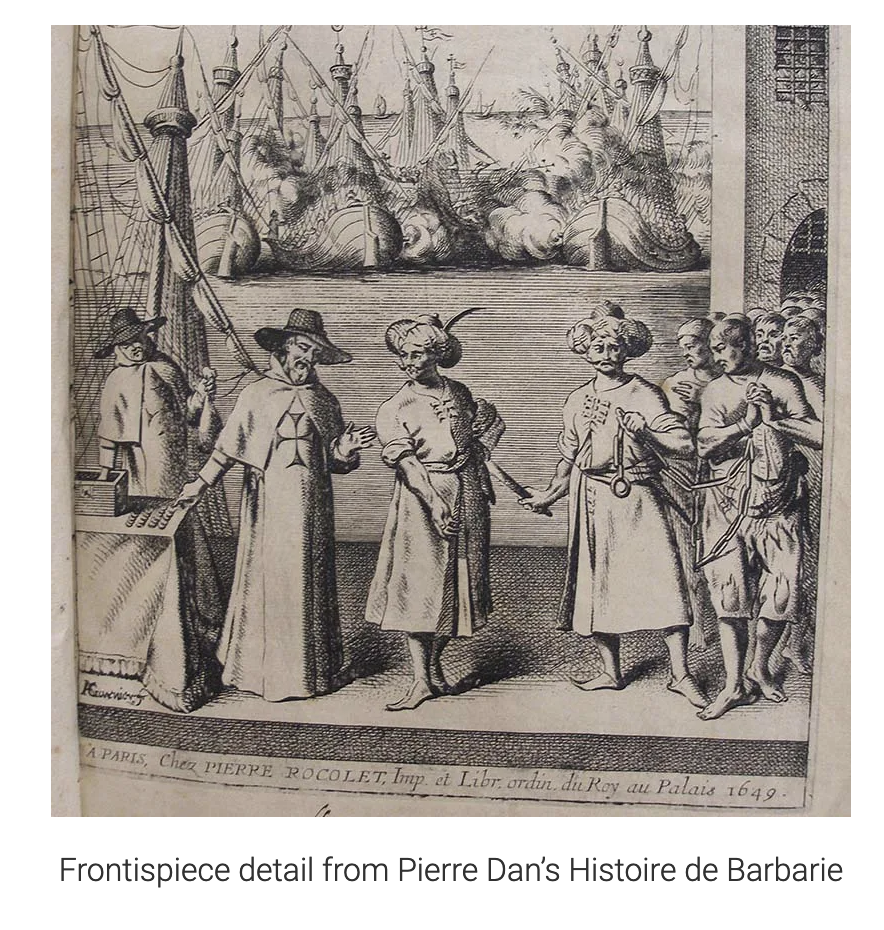
In 1624 the House of Lords in London instructed the House of Commons to grant Letters Patent for a collection to be made for the redemption of English captives, and an “Algerian Duty” was set aside from Customs tax. There were also ransom charities, but at the same time, it was feared that paying ransoms would encourage the taking of captives. An account of Barbary pirates was written by a French priest who worked in Algeria trying to negotiate the release of captives, Pierre Dan, “Histoire de Barbarie et de ses corsairs.” He worked for the Catholic charity the Order of the Holy Trinity and Redemption of Slaves.

Courtesy of DePaul University, Chicago [6]

The website tells us that in the 1640s the castle was surrendered to Oliver Cromwell’s forces and passed to the Coppingers. In 1642 the O’Driscolls attempted to recover the castle by force. In the 1690s the Coppingers had to forfeit their property. After the 17th century the castle fell to ruin.

Information board in Baltimore Castle.
A canonball like those used by the French Armada in 1796. © Jennifer Winder-Baggot, www.irishhistorichouses.com
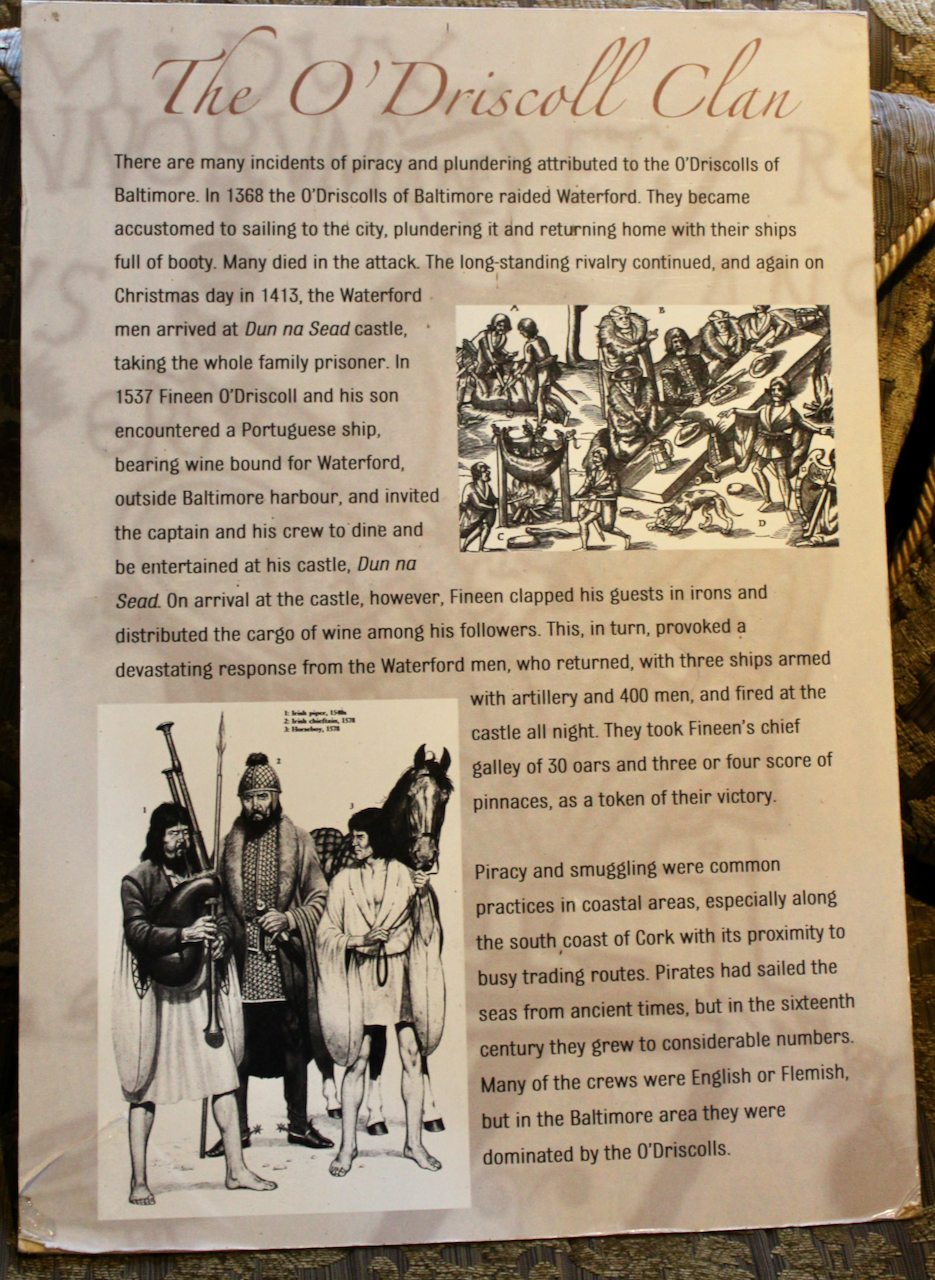
Information board in Baltimore Castle.

According to the information board in the castle, Percy Freke obtained the castle in 1703 from the investment company the Hollow Sword Blade Company. This company also owned Blarney Castle in County Cork for a period.

The Landed Estates database tells us:

The Hollow Sword Blades Company was set up in England in 1691 to make sword blades. In 1703 the company purchased some of the Irish estates forfeited under the Williamite settlement in counties Mayo, Sligo, Galway, and Roscommon. They also bought the forfeited estates of the Earl of Clancarty in counties Cork and Kerry and of Sir Patrick Trant in counties Kerry, Limerick, Kildare, Dublin, King and Queen’s counties (Offaly and Laois). Further lands in counties Limerick, Tipperary, Cork and other counties, formerly the estate of James II were also purchased, also part of the estate of Lord Cahir in county Tipperary. In June 1703 the company bought a large estate in county Cork, confiscated from a number of attainted persons and other lands in counties Waterford and Clare. However within about 10 years the company had sold most of its Irish estates. Francis Edwards, a London merchant, was one of the main purchasers.” [7]

As well as her work on the Pirates of Baltimore, Bernie McCarthy has published a book about Baltimore Castle which we did not purchase, unfortunately. Called Baltimore Castle, An 800 Year History, I would love to read it, as I’d love to know more about how the McCarthys rebuilt the ruin. I will purchase a copy next time we are in the area!

Percy Freke’s son Ralph (1675-1718) gained the title of 1st Baronet Freke, of Rathbarry, County Cork. The property then passed to Ralph’s daughter Grace who married John Evans, and their son was John Evans-Freke (1743-1777), who became 1st Baronet Freke of Castle Freke, County Cork. He married Elizabeth Gore, daughter of Arthur Gore (1703-1773) 1st Earl of Arran, 3rd Baronet of Newtown, Viscount Sudley.

John and Elizabeth had a son named also named John Evans-Freke (1765-1845), who succeeded as 6th Baron Carbery. This John Evans-Freke married Catherine Charlotte Gore, daughter of Arthur Saunders Gore, 2nd Earl of Arran of the Arran Islands. John Evans-Freke was MP for Donegal from 1784-1790 and MP for Baltimore 1790-1800. He had Catherine Charlotte did not have surviving children and the title passed down to his nephew, son of his brother Percy Evans-Freke. I don’t think the castle was inhabited after Cromwell’s time, however. The 6th and 7th Barons of Carbery (George Patrick Percy Evans-Freke) did make some improvements to the town, Frank Keohane tells us.

Finally the castle was purchased by Patrick and Bernadette McCarthy, who restored it.

Baltimore Castle, 1835.
Baltimore Castle 16 August 2023. © Jennifer Winder-Baggot, www.irishhistorichouses.com
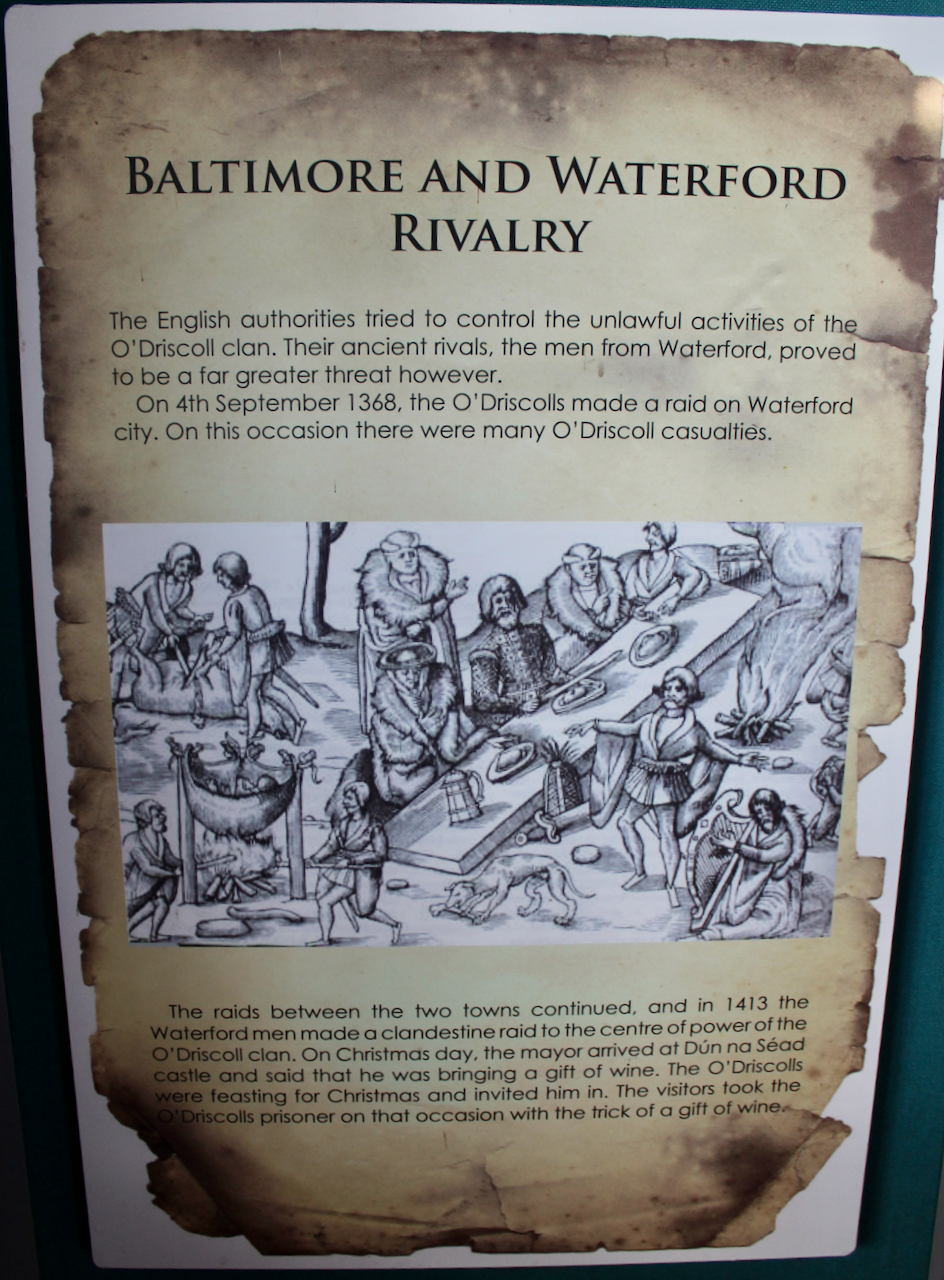
The castle was in a severely ruinous state when the McCarthys acquired it, as we can see from photographs in the noticeboards.

Baltimore Castle 16 August 2023.
Information board in Baltimore Castle.
Baltimore Castle 16 August 2023. © Jennifer Winder-Baggot, www.irishhistorichouses.com
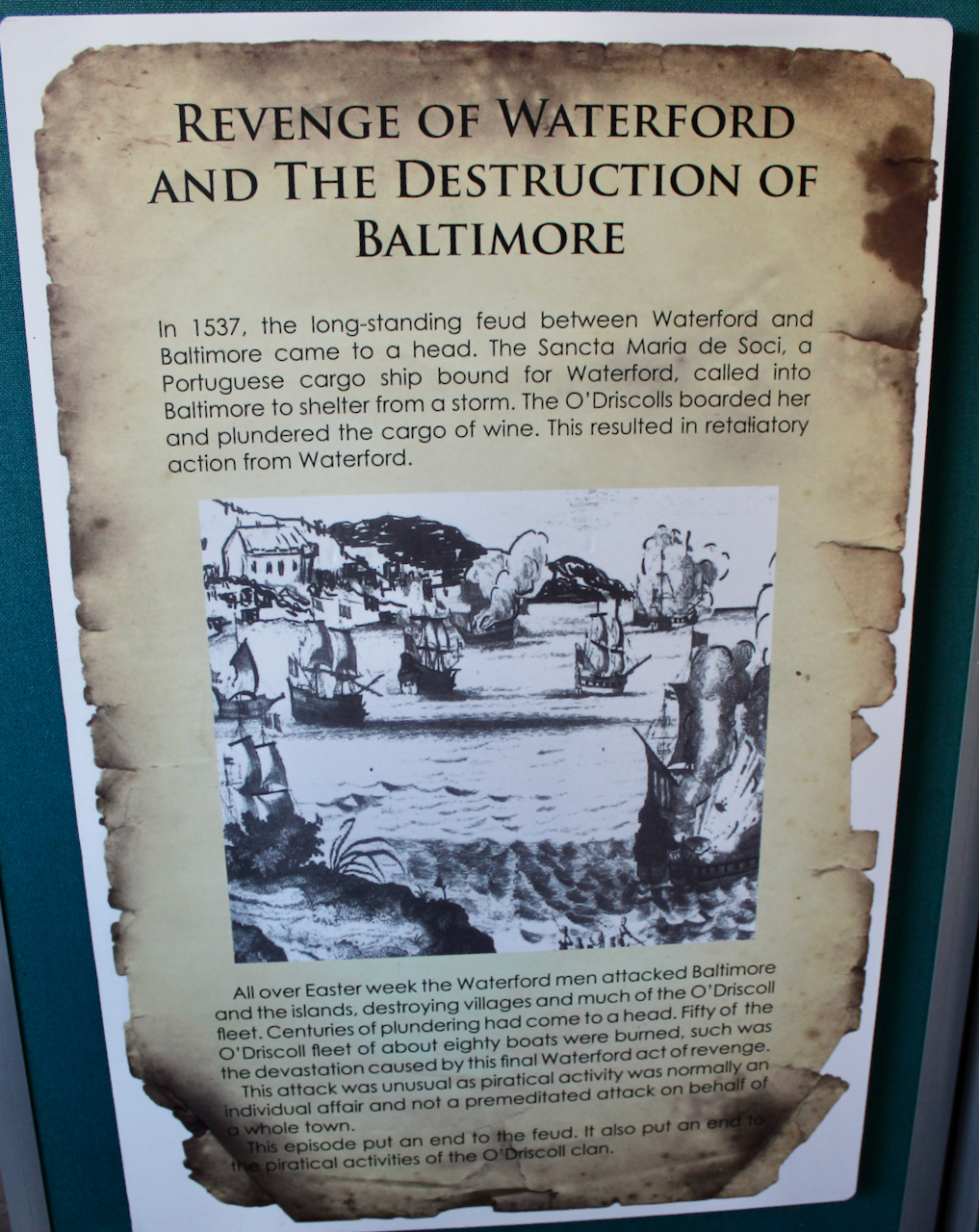
The castle now houses the museum and it contains wonderful artefacts and pieces of furniture. You can also go up to the ramparts and outside for beautiful views of the sea and of Baltimore.

Baltimore Castle 16 August 2023. © Jennifer Winder-Baggot, www.irishhistorichouses.com
Replica of a sixteenth century gallowglass sword, as would have been used by armies of the Irish Chieftains. Many Gallowglass fighters came from Scotland. A census from the end of the sixteenth century shows that McCarthy of Carbery had sixty horsemen, 80 gallowglass and 2000 kerne soldiers. O’Driscoll of Dún na Séad had six horsemen and 200 kerne. © Jennifer Winder-Baggot, www.irishhistorichouses.com
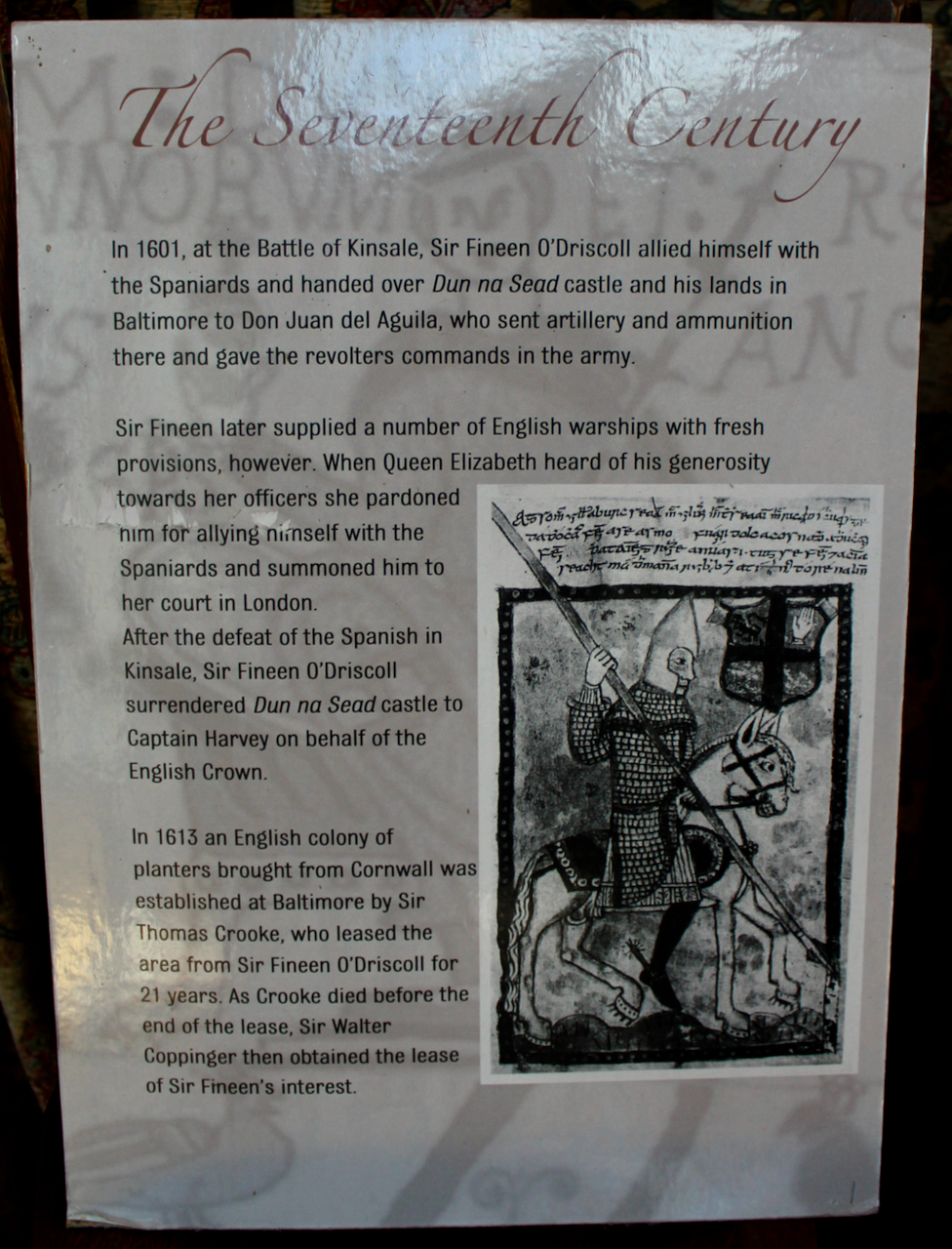
Baltimore Castle 16 August 2023. © Jennifer Winder-Baggot, www.irishhistorichouses.com
An oak wedding chest. © Jennifer Winder-Baggot, www.irishhistorichouses.com
The view from Baltimore Castle 16 August 2023. © Jennifer Winder-Baggot, www.irishhistorichouses.com
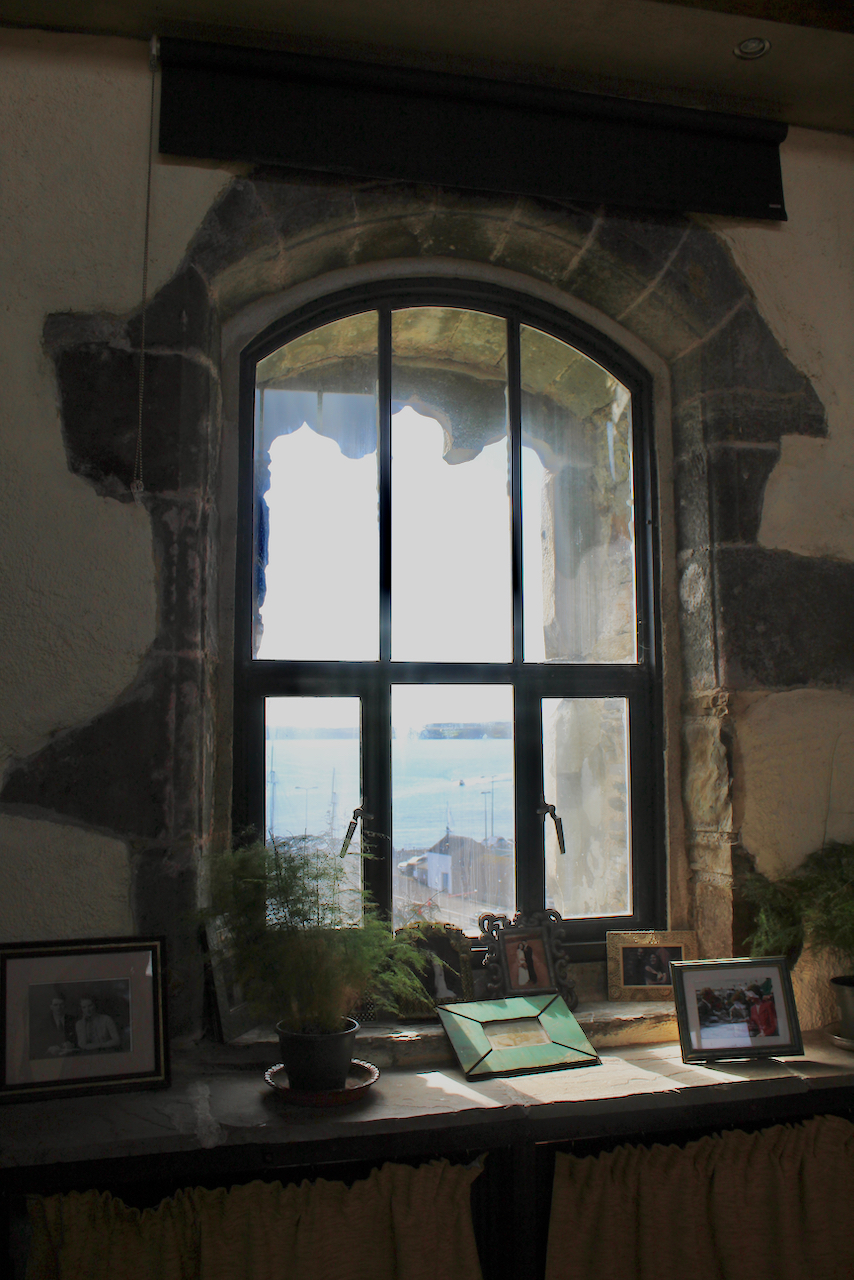
Baltimore Castle 16 August 2023. © Jennifer Winder-Baggot, www.irishhistorichouses.com
Finally, I always assumed that Baltimore in Maryland was named after Baltimore in Cork. It turns out that this is not the case! It is indeed named after a Lord Baltimore who had ties with Ireland, but his title was for a property in County Longford!

© Jennifer Winder-Baggot, www.irishhistorichouses.com
Baltimore Castle 16 August 2023. The 1st Lord Baltimore was George Calvert (1582-1632). I lived on Calvert Street in Baltimore, Maryland, from 2003-2005! He was granted an Irish peerage but it was named not after Baltimore in Cork but Baltimore Manor in County Longford.
George Calvert (1582-1632), 1st Baron Baltimore, Baltimore Castle 16 August 2023.

[1] p. 243. Keohane, Frank. The Buildings of Ireland. Cork City and County. Yale University Press: New Haven and London. 2020.

[2] p. 5, McCarthy, Bernie. Pirates of Baltimore from the Middle Ages to the Seventeenth Century, Baltimore Castle Publications, 2012. Footnoted reference is to Timothy O’Neill, Merchants and Mariners in Medieval Ireland, p. 30.

[3] p. 23, McCarthy.

[4] p 29, McCarthy.

[5] p. 49, McCarthy.

[6] https://news.library.depaul.press/full-text/2009/04/22/pirates-and-st-vincent-de-paul-who-knew/

Legend has it that from 1605 to 1607 when St. Vincent de Paul was a young priest he was captured by Algerian corsairs and sold to different masters before making a daring escape with one of his captors, a French renegade who wished to be reconciled with the Church. Although the account of Vincent’s captivity came from letters he wrote at the time to explain his two year disappearance, most historians today doubt the veracity of the account and speculate that the young Vincent had dropped out of sight because of his heavy debts, and the failure of his attempts to gain an ecclesiastical benefice. Nonetheless, the Vincentian (Lazarist) order also had missions in Algiers and Tunis to bring relief or freedom to captured Christians.

Fast fact: Between 1575 and 1869, there were 82 redemption missions where friars bought the freedom of an estimated 15,500 captives.

[7] https://landedestates.ie/family/2877

Kilcascan Castle, Ballineen, Co. Cork P47 R286 – section 482

Open dates in 2026: Aug 1-31, Sept 1-30, 9.30am-1.30pm
Fee: Free

2026 Diary of Irish Historic Houses (section 482 properties)

To purchase an A5 size 2026 Diary of Historic Houses (opening times and days are not listed so the calendar is for use for recording appointments and not as a reference for opening times) send your postal address to jennifer.baggot@gmail.com along with €20 via this payment button. The calendar of 84 pages includes space for writing your appointments as well as photographs of the historic houses. The price includes postage within Ireland. Postage to U.S. is a further €10 for the A5 size calendar, so I would appreciate a donation toward the postage – you can click on the donation link.

€20.00

donation

Help me to pay the entrance fee to one of the houses on this website. This site is created purely out of love for the subject and I receive no payment so any donation is appreciated!

€15.00

Kilcascan Castle, County Cork. Photograph © Jennifer Winder-Baggot, www.irishhistorichouses.com

We contacted the owner of Kilcascan Castle, Alison Bailey, before heading across Cork during Heritage Week. She welcomed us to her home, which has been a work in progress for three decades for the family and is still undergoing a lot of renovation. Many family members have added their work to the process.

Kilcascan was built for the Daunt family and they owned it until it was sold to the current owners. Alison told us that members of the Daunt family fought with William the Conqueror at the Battle of Hastings in 1066 and held a large estate in Gloucestershire until modern times. Two of the younger descendant sons came to Ireland in the 16th century and ultimately established a large house (recently demolished) and estate at Gortnegrenane near Kinsale. A descendant came c. 1712 and built a residence at Kilcascan.

The current house, or castle, replaces an earlier house, and is thought to have been built in the early decades of the nineteenth century (around 1820) around the time of the second wedding of Joseph Daunt (1779-1826). Alison told us that there had been a Georgian house nearby, which was demolished in the 1960s.

According to Burke’s Irish Family Records Joseph Daunt (1702-1783) married Sarah Rashleigh in 1729. Their son William (1750-1809) inherited Kilcascan and married Jane Gumbleton (d. 1830), daughter of Richard (1721-1776) who was High Sheriff of County Waterford in 1772 and lived in Castlerichard, otherwise known as Glencairn Abbey in County Waterford. Jane’s mother was Elizabeth Conner.

Replica portrait of Jane Gumbleton; either Jane (d. 1830) of Castlerichard, the second wife of William Daunt (d. 1809), or Jane (d. 1867) the wife of Joseph Daunt (d. 1826). Photograph © Jennifer Winder-Baggot, www.irishhistorichouses.com
Replica of a portrait of Captain Joseph Daunt (d. 1826). Photograph © Jennifer Winder-Baggot, www.irishhistorichouses.com

William Daunt and Jane née Gumbleton had several children, including Richard, Robert and Joseph (1778-1826).

It was Joseph (1778-1826) who inherited Kilcascan, and who built the current house, at the time of his second marriage. His first marriage was to Jane Wilson, daughter of the Rev. Thomas Wilson, Rector of Ardstraw, County Tyrone, but she died in 1816, after giving birth to at least five children. Secondly he married Jane Gumbleton from Fort William in County Waterford, daughter of Robert Warren Gumbleton, in 1822.

It has been suggested that Kilcascan was designed by the Pain brothers, James and George Richard. We know that Kilcascan was under construction before 1819 because when a ground floor ceiling collapsed around 1990 a date of 1819 was discovered carved on a ceiling joist. This would make it, Alison told me, the earliest country house constructed to a design by the Pains.

James (1779–1877) and his brother George Richard Pain (ca. 1793-1838) worked in close partnership and together established a highly successful architectural practice in the south of Ireland. They were pupils of John Nash. They were commissioned to work for the Board of First Fruits in Ireland so designed many churches and glebe houses. A building they designed which has many similarities to Kilcascan is the larger Strancally Castle in County Waterford, built around 1830. The triple arch on the Kilcascan facade is repeated on the garden front at Strancally as a veranda.

Strancally Castle in County Waterford, by the Pain brothers.
Lough Cutra castle, County Galway, courtesy of National Library of Ireland. Frank Keohane writes of Kilcascan that “At one end is a geometric stair with arcaded balustrading in a round tower which rises above the rest of the house; an arrangement similar to John Nash’s Lough Cutra castle, County Galway, as supervised by James and George R. Pain, whose work this may be.

Frank Keohane writes that nearby Manche House in County Cork, built for a cousin of the Daunts, Daniel Conner, was designed around 1824 by George R. Pain. Keohane writes that the builder was Jeremiah Calnan of Enniskeane, who may have also worked on Kilcascan. [2]

Kilcascan is a five bay two storey house with the two end bays projecting and joined by a battlemented cloister, as Mark Bence-Jones describes it, or colonnade, of three Tudor-shaped arches. It was hard for me to make out the plan of the house as it nestles into its setting.

We approached the house from the side and were greeted at a side door in a one storey castellated hallway next to a three storey square tower and then a two-storey round tower. From this side the house looks very higgeldy piggeldy.

I admired the garden at this side of the house, a profusion of flowers, with a pond. Like the castle itself, the garden is laid out on different levels, with steps between.

We walked through the house, which is a maze of different floor levels and stairways. We then walked around the house to see the more symmetrical entrance front. The house has beautiful Gothic windows and stone mouldings over the windows. There’s a limestone stringcourse under the level of the eaves. The pilasters of the colonnade are topped with square bartizans.

Unfortunately, Joseph Daunt was killed in a duel in 1826, shot by his cousin Daniel Connor from Manch House. The duel was fought over a case brought to court by Joseph Daunt which Daniel Connor dismissed, saying it was ungentlemanly of Daunt to pursue a poor woman for the price of a cow. Enraged at the insult, Daunt wanted to challenge Connor to a duel.

However, duels were illegal and to kill a man in a duel would count as murder. Despite this, many cases against men who had killed their opponent in a duel did not result in harsh sentencing, because the jury consisted of gentry peers, and they often judged that the death was the unfortunate result of a “fair fight between gentlemen.” In other words, there had to be a good reason to kill someone in a duel, and if the jury felt that this was the case, punishment was extremely light. Daunt knew that if he challenged a judge to a duel over a judgement made by the judge in court, and he killed the judge, he would receive punishment as a murderer. Therefore, Alison told us, Daunt arranged the distribution of a scurrilous article defaming Connor’s wife, thus forcing Connor to issue the challenge.

Though Connor killed Daunt, he was judged not guilty of murder.

The house was inherited by Joseph’s son William Joseph O’Neill Daunt (1807-1894) when he was just 19 years old.

Young William O’Neill Daunt was raised Protestant, but he converted to Catholicism. The Dictionary of Irish Biography tells us that he was influenced by the Conners of Connerville, especially Feargus O’Connor (Feargus’s father Roger officially changed his name from Conner to O’Connor).

William O’Neill Daunt sought repeal of the Act of Union that had abolished the Irish Parliament. Together with Daniel O’Connell he was one of the founders of the Repeal Association and he was its director for Leinster. He was also opposed to tithes that all people had to pay to the Protestant church.

He served as MP for Mallow in 1832-33 but was unseated by a petition. He married Ellen Hickey in 1839.

Daniel O’Connell appointed him to be his secretary when O’Connell was elected Lord Mayor of Dublin in 1841.

Despite his active political work for the Home Rule movement, travelling around Ireland and to Scotland seeking support for repeal of the union, he managed to spend most of his time at Kilcascan.

Daunt kept a diary, which the National Biography describes “Though excessively gossipy, the diary reveals much of the life of an Irish country gentleman and of Irish politics viewed from County Cork.” He also wrote Catechism of the history of Ireland (1844), Ireland and her agitators (1845; new edition 1868), Eighty-five years of Irish history (1886) and Personal recollections of the late Daniel O’Connell (1848). Under the nom-de-plume Denis Ignatius Moriarty, he wrote five novels. One novel, The Wife Hunter, features a hero based on Feargus O’Connor.

William and Ellen had a son, Achilles Thomas, who inherited Kilcascan, and a daughter who edited Daunt’s diary and never married. [3]

Achilles Thomas Daunt (b. 1849) married Anna Maria Corballis, daughter of Bartholomew Corballis who was a proponent of Catholic Emancipation and Chair of the Catholic Association of Ireland between 1827 and 1832. Achilles Thomas served as Justice of the Peace.

Achilles and Anna Maria had two surviving sons and two daughters. The daughters did not have children. Both sons emigrated, Reginald to Africa and Achilles Thomas Wilson O’Neill (b. 1880) to Canada.

The son Achilles married Elizabeth Dey from Canada, and they had several children. Current owner Alison told us that Achilles wrote Boys Adventure books!

The Landed Estates database tells us that The Irish Tourist Association Survey of 1944 referred to Kilcascan as the residence of Miss M. O’Neill-Daunt, probably Mary Dorothea, born in 1910, the daughter of Achilles. Alison and her husband bought Kilcascan from a son of Achilles, Tom, in 1988. A second son, also named Achilles, was killed in WW2.

The house has not yet been completely renovated, but some rooms are finished, including a lovely drawing room.

A lateral corridor at the back of the house has a surprisingly ornate groin-vaulted ceiling with foliate bosses.

Kilcascan Castle, County Cork, 15th August 2023. Photograph © Jennifer Winder-Baggot, www.irishhistorichouses.com

Upstairs has interesting Gothic decorative carving in the hallway, and one bedroom has lovely wood panelling on the ceiling and an impressive Gothic window.

The east side of the house, including the staircase, is still a work-in-progress. The work is, excuse the pun, “daunting”! The house sits in one hundred acres of farmland with sixty acres of woodland. Alison told us that descendants of the Kilcascan Daunts have visited the house. It’s great to see the house being preserved.

[1] https://www.buildingsofireland.ie/buildings-search/building/20910814/kilcascan-castle-kilcaskan-co-cork

[2] p. 227, Keohane, Frank. The Buildings of Ireland. Cork City and County. Yale University Press: New Haven and London. 2020.

[3] https://www.dib.ie/biography/daunt-moriarty-william-joseph-oneill-denis-ignatius-a2414

Text © Jennifer Winder-Baggot, www.irishhistorichouses.com

Shankill Castle, Paulstown, County Kilkenny R95 T8X7 – section 482

www.shankillcastle.com

The website tells us:

OPENING TIMES: Check website for booking details of annual events programme. Group booking available at other times of the year.

Open dates in 2026: Feb 7-8, 14-15, 21-22, 28, Mar 1, Apr 3-5, 10-12, 17-19, 24-26, May 1-3, 8-10, 15-17, 22-24, 29-31, June 5-7, 12-14, 19-21, 26-28, July 3-5, 10-12, 17-19, 24-26, 29, 31, Aug 1-2, 7-9, 14-23, 28-30, Sept 4-6, 11-13, 18-20, 25-27, Oct 2-4, 9-11, 16-18, 23-25, 30-31, 11am-5pm

Fee: adult €14 house & garden, €6 garden, OAP/student €10 house & garden, €4 garden, child house & garden €6, €3 garden

2026 Diary of Irish Historic Houses (section 482 properties)

To purchase an A5 size 2026 Diary of Historic Houses (opening times and days are not listed so the calendar is for use for recording appointments and not as a reference for opening times) send your postal address to jennifer.baggot@gmail.com along with €20 via this payment button. The calendar of 84 pages includes space for writing your appointments as well as photographs of the historic houses. The price includes postage within Ireland. Postage to U.S. is a further €10 for the A5 size calendar, so I would appreciate a donation toward the postage – you can click on the donation link.

€20.00

donation

Help me to pay the entrance fee to one of the houses on this website. This site is created purely out of love for the subject and I receive no payment so any donation is appreciated!

€15.00

Shankill Castle County Kilkenny 3rd June 2023. Photograph © Jennifer Winder-Baggot, www.irishhistorichouses.com

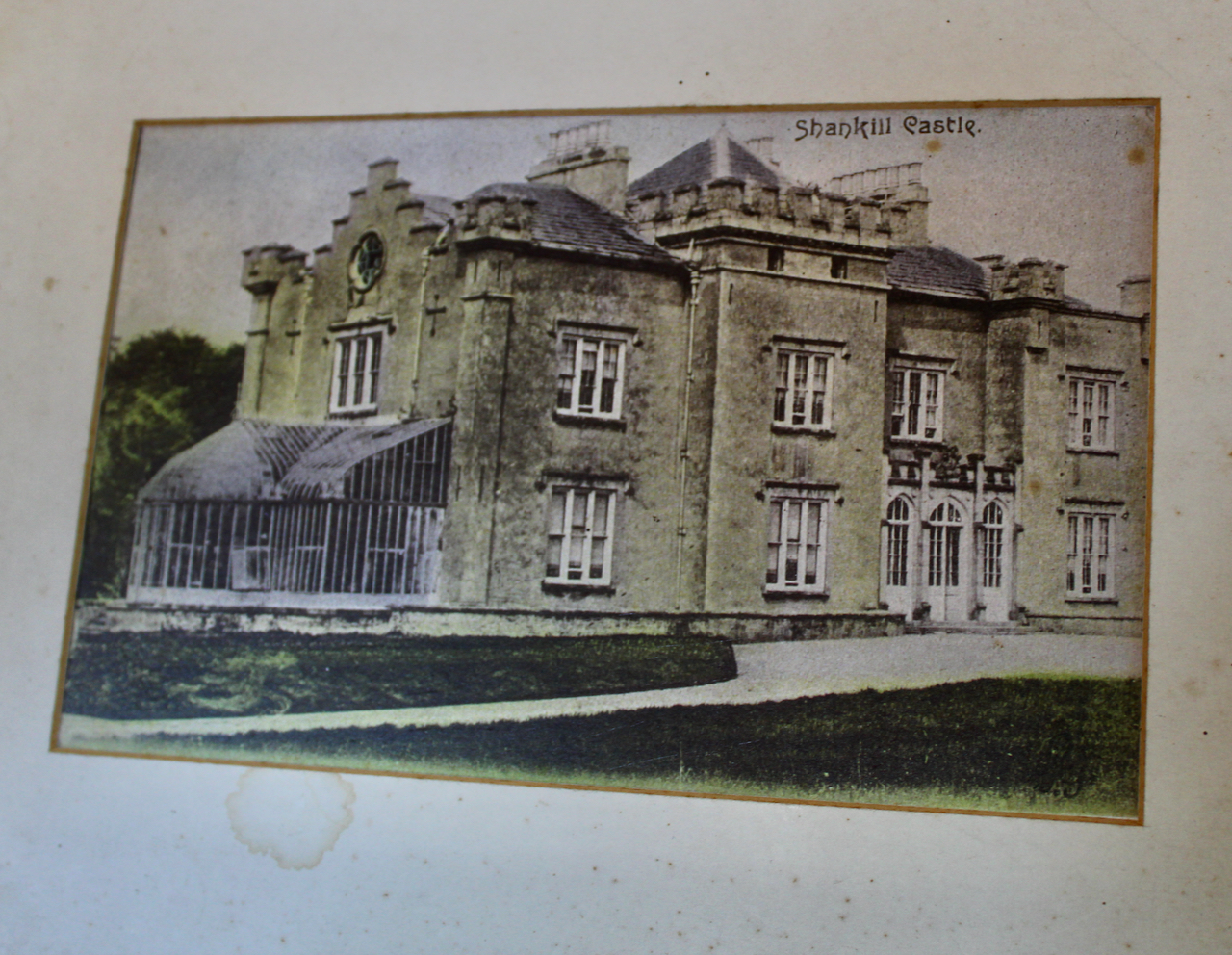
Shankill Castle is now a family home for the Cope family, since 1991. It was first built as a Butler tower house beside the ruins of a pre-reformation church – you can still see the ruins of the church in the grounds. The Copes give tours of their home and there are lovely gardens to wander and a café

The ruins of a pre-reformation church. Photograph © Jennifer Winder-Baggot, www.irishhistorichouses.com

The website tells us that “Elizabeth, a painter, and Geoffrey, a historian, have hosted many creative people in their home over the last twenty-five years. They have shared with them their unique and beautiful setting in Ireland’s Ancient East and have dedicated Shankill Castle to the arts and culture.

see: www.elizabethcope.com

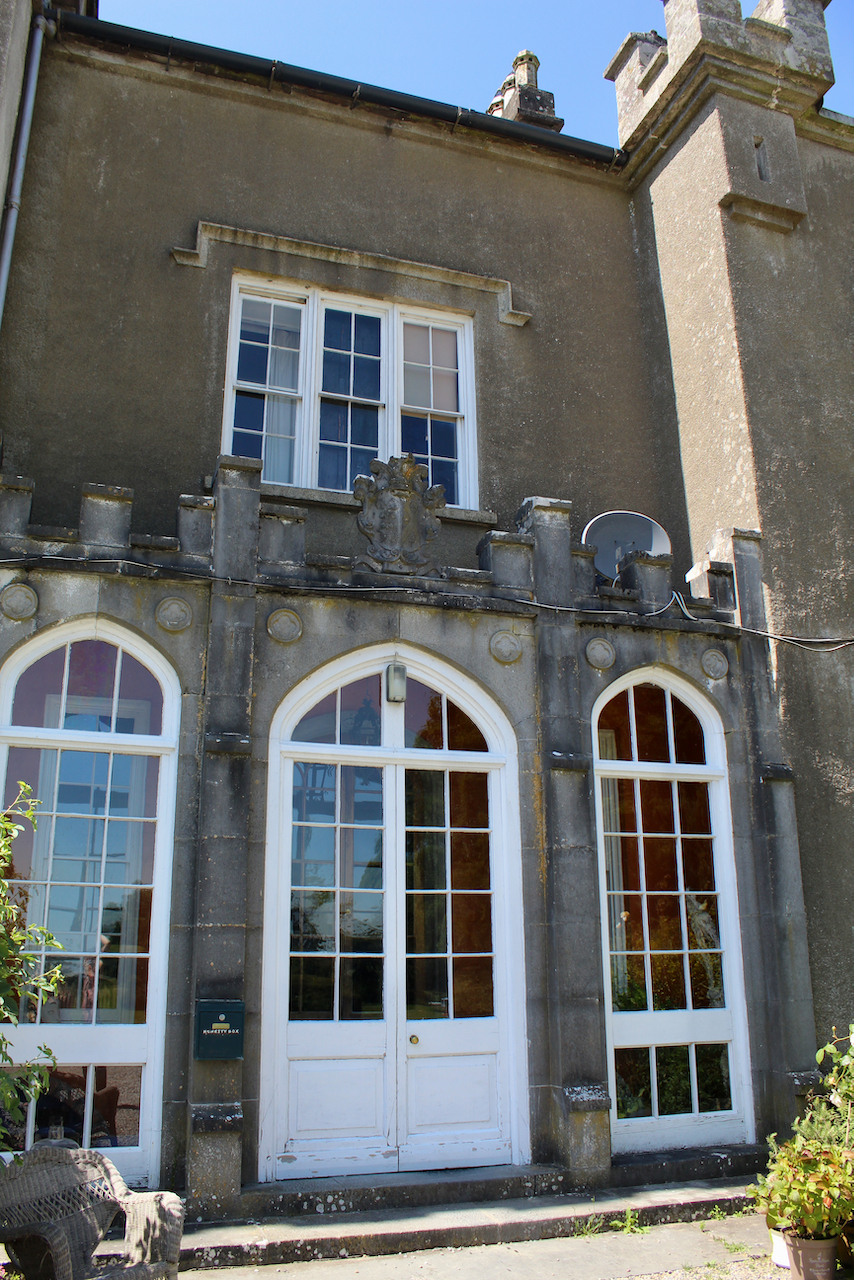
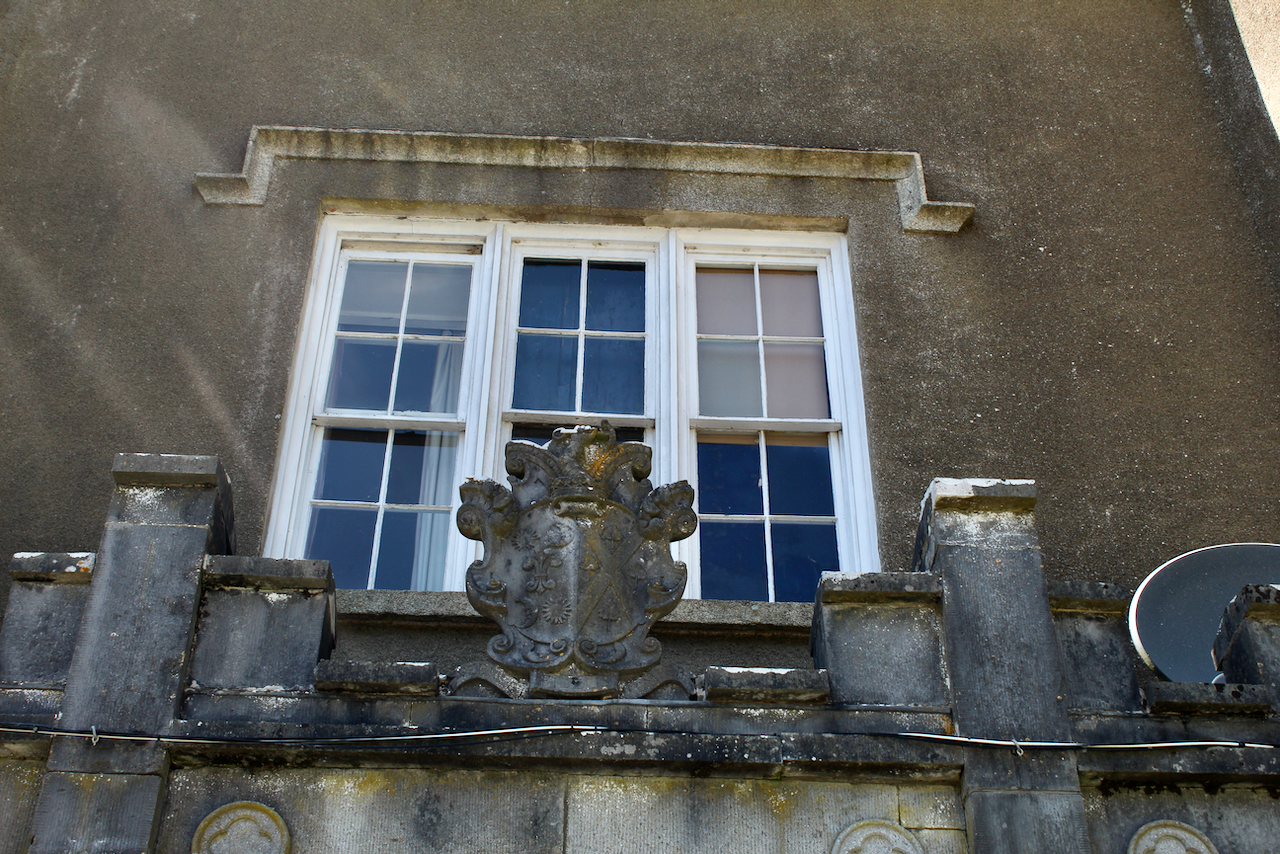
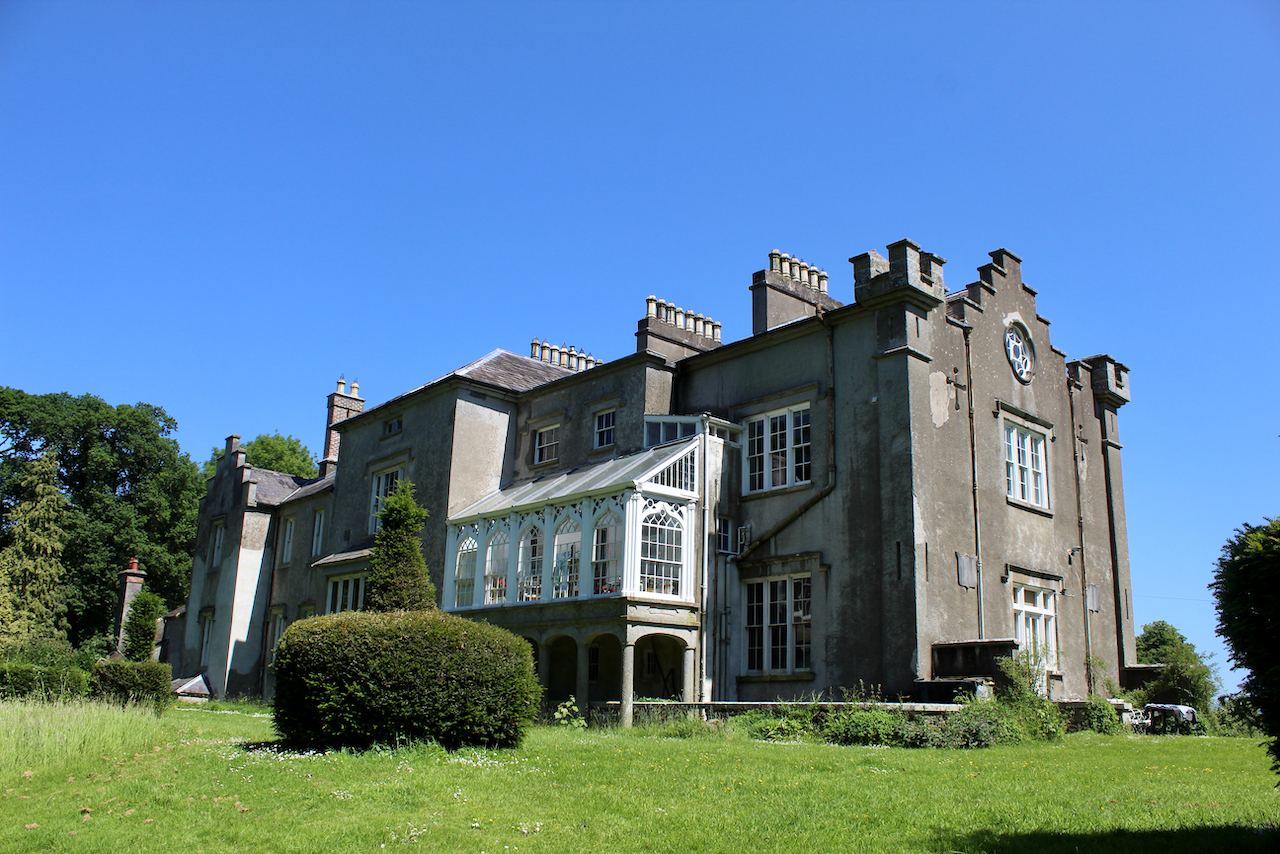
In 1708 the Castle was rebuilt and in the nineteenth century it was enlarged and castellated, adding a stable yard and the castellated entrance to the demesne. The stableyard and the castellated entrance to the demesne are attributed to Daniel Robertson. Other additions to the house include a Gothic porch bearing the Aylward crest and a conservatory.

In the garden there are remnants of an eighteenth century lime walk, nineteenth century laurel lawns and some trees that were favourites in the Victorian age such as giant Sequoias.

Shankill Castle County Kilkenny 3rd June 2023.

The website tells us that “In 1708, it was rebuilt by Peter Aylward who bought the land from his wife’s family. The new Shankill Castle was constructed as a Queen Anne house, set in a formal landscape, vista to the front and canal to the rear.

Peter Aylward was a Roman Catholic who fought in the Jacobite army in 1688-90. For this he was was outlawed, but he later conformed to the established Protestant church. [1]

Peter Aylward who bought Shankill Castle from his wife’s family, portrait by Garret Morphy. Photograph © Jennifer Winder-Baggot, www.irishhistorichouses.com
Elizabeth Butler (1674-1708), wife of Peter Aylward, daughter of Richard Butler, 2nd Baronet of Paulstown (or Poulstown), County Kilkenny. Photograph © Jennifer Winder-Baggot, www.irishhistorichouses.com
Shankill Castle County Kilkenny 3rd June 2023. To the left of the entrance porch is an advanced single bay two storey bay incorporating the 1600s tower house. Photograph © Jennifer Winder-Baggot, www.irishhistorichouses.com
The view from the front of Shankill Castle County Kilkenny 3rd June 2023. Photograph © Jennifer Winder-Baggot, www.irishhistorichouses.com

The house has battlemented full-height corner piers having slit-style blind apertures. The windows have hood mouldings. The house is delightfully higgeldy piggeldy with its enlargements and additions.

Shankill Castle County Kilkenny 3rd June 2023. Photograph © Jennifer Winder-Baggot, www.irishhistorichouses.com

Elizabeth Butler’s family owned Paulstown Castle, which was rebuilt in 1828 but is now a ruin.

Paulstown Castle, County Kilkenny, courtesy of National Inventory.

Peter Aylward and Elizabeth Butler had a son, Nicholas (d. 1756). He held the office of Member of Parliament (M.P.) for Thomastown and Sheriff of County Kilkenny in 1742. A website about landed families tells us that he was brought up Catholic but conformed to the established church in 1711. [see 1]. In August 1719 he married Catherine, second daughter of Maurice Keating of Narraghmore, Co. Kildare.

Their son, also named Nicholas (d. 1772), inherited Shankill Castle in 1756. That year, he married Mary Kearney, daughter of Benjamin Kearney of Blanchville (Co. Kilkenny). He held the office of High Sheriff in 1757. He died while his children were still young, and their mother had died in 1767, so the children were made wards of the Irish Court of Chancery, which in 1772 appointed their grandfather, Benjamin Kearney (d. 1784), as their guardian.

Shankill Castle County Kilkenny 3rd June 2023. Photograph © Jennifer Winder-Baggot, www.irishhistorichouses.com

After Mary née Kearney died, Nicholas married Susanna (d. 1775), widow of Edmund Waring. Susanna married a third time after Nicholas’s death, in October 1772, Rev. Henry Candler, and she died 4 August 1775.

Shankill Castle County Kilkenny 3rd June 2023. Photograph © Jennifer Winder-Baggot, www.irishhistorichouses.com

Nicholas and Mary née Kearney’s eldest son, Peter (1758-92), came of age in 1779. It is said that he was “of weak mind” and that his Guardian exercised a large influence over him. In 1780 he married Anne Kearney of New Ross (Co. Waterford). They had a son, Nicholas John Patrick Aylward (1787-1832).

This son was only five years old when his father died and he inherited Shankill Castle. He was educated at Kilkenny and Trinity College, Dublin (admitted 1804). [see 1] In 1805 at the age of just 18 he married Elizabeth (d. 1851), eldest daughter of James Kearney of Blanchville (Co. Kilkenny). This James was son of Benjamin Kearney (d. 1784), the guardian of Nicholas John Patrick’s father, so this was probably an influencing factor. He came of age three years later in 1808. He was High Sheriff of Co. Kilkenny, 1816-17. In the 1820s, he remodelled Shankill Castle, hiring William Robertson.

Shankill Castle County Kilkenny 3rd June 2023. Photograph © Jennifer Winder-Baggot, www.irishhistorichouses.com

A watercolour probably dating from the 1820s attributed to William Robertson shows a design proposal for alterations. For this reason, the changes to the house which were made for Nicholas Aylward (d. 1832) in the 1820s are attributed to William Robertson, although the proposal in the watercolour were not executed exactly as pictured. The end bays were crenellated and  linked by a Gothic porch, and one was raised to look like a tower. A new dining room running from the front of the house to the back was added on the left, and a castellated office wing on the right, effectively breaking up the symmetry of the original design. The back of the house, which is more irregular, is treated in much the same way, and adorned with a Gothic conservatory on the level of the half-landing of the stairs, carried on a stone arcade. [1]

The National Inventory describes it:

An impressive large-scale house built c. 1825 to designs prepared by William Robertson (1770-1850) for the Aylward family forming a picturesque landmark of Romantic quality in the landscape. The complex form and massing of the composition attests to the evolution of the site over a number of centuries with the present house incorporating the fabric of an early eighteenth-century range together with a medieval tower house, thereby representing the continuation of a long-standing presence on site.” [2]

The architect William Robertson was born in Kilkenny in 1770. The Dictionary of Irish Architects tells us he was probably a son or close connection of the nurseryman, William Robertson, who traded as ‘William Robertson and Son’ in Kilkenny. [3] The Dictionary adds that identifying his works is complicated by the fact that the names ‘Robertson’ and ‘Robinson’ are often confused, but it is possible that he may already have received at least one architectural commission as early as 1794, for stables at Woodstock, Co. Kilkenny. He seems to have worked in London for a time then moved back to Kilkenny.

The Dictionary of Irish Architects tells us of William Robertson:

Robertson was back in Kilkenny by 1801, when he was entrusted with the design of the new county gaol. In Kilkenny he developed a busy architectural practice. It appears that he may have had the Earl of Ormonde as a client as early as 1802 and that he was working with a partner named Wylie for a time circa 1804. Joseph Bourke, Dean of Ossory, suggesting to William Gregory in 1813 that Robertson might be employed to enlarge the barracks at Kilkenny, describes him, perhaps with some exaggeration, as ‘a very eminent architect in this part of the world, who has had the building of most of the public Edifices in the South, &c.’. In the same year Robertson reported to the Dean and Chapter of St Canice’s Cathedral on the fabric of the cathedral.

William Robertson died at Rosehill, the house which he had built for himself on the Callan road, in May 1850.” [4]

Gateway and lodge, c. 1825, probably originally conceived by William Robertson (1770-1850) according to the National Inventory, Shankill Castle, County Kilkenny, 3rd June 2023. Other sources seem to point to Daniel Robertson (d. 1849) as the designer. Photograph © Jennifer Winder-Baggot, www.irishhistorichouses.com

The history of Shankill Castle and Blanchville were further linked in the next generation. Nicholas John Patrick Aylward and Elizabeth née Kearney had a son, James Kearney Aylward (later Kearney-Aylward) (1811-84). He assumed the additional name of Kearney in 1876, on succeeding to a part of the estates of his cousin James Charles Kearney of Blanchville.

Blanchville, County Kilkenny, courtesy National Inventory.

Blanchville still stands and it has notable Tudor Revival stable building, built 1834, in the style of Daniel Robertson, which are now available for accommodation (see https://blanchville.ie/ ). Daniel Robertson built a memorial for Captain James Kearney, sometime between 1834-47, according to the National Inventory.

Single-bay four-stage Tudor Gothic-style bell and clock tower, built 1834/47, on a square plan, set back from road in grounds shared with Blanchville House, County Kilkenny. Built for Captain James Kearney, to designs prepared by Daniel Robertson, reputedly citing Sir Christopher Wren’s (1632-1723) Saint Mary’s Church (1670), Aldermanbury. Courtesy National Inventory.

The Heritage Council provided a grant to restore the tower in 2004.

Tudor Gothic-style bell and clock tower, built 1834/47, on a square plan, set back from road in grounds shared with Blanchville House, County Kilkenny. Built for Captain James Kearney, to designs prepared by Daniel Robertson. Photograph courtesy National Inventory.

James Kearney Aylward held roles as Sheriff, Deputy Lieutenant and Justice of the Peace. In 1853 he married Isabella Forbes. She was the widow of Beauchamp Bartholomew Newton (1798-1850) of Rathwade, County Carlow (a house attributed to Daniel Robertson). However, she did not have children by either of her marriages.

Rathwade, County Carlow, attributed to Daniel Robertson, courtesy of Colliers estate agents and myhome.ie

Therefore when James Kearney-Aylward died in 1884, Shankill Castle passed to his nephew, Hector James Charles Toler (1839-1918, later Toler-Aylward). [see 1] Hector was the son of James Kearney-Aylward’s sister Mary (d. 1880) who had married Reverend Peter Toler (d. 1883) of Bloomfield, County Roscommon.

Before James Kearney-Aylward died, he undertook further renovations of Shankill Castle, under the direction of William Deane Butler. The Archiseek website tells us that William Deane Butler (1793-1857) studied at the Dublin Society Schools and was a founding member of the Royal Institute of Architects in Ireland as well as the Society of Irish Artists, and he was also an engineer. Among his most important works are Amiens Street Station (now called Conolly Station) in Dublin, Kilkenny’s Catholic Cathedral, and Sligo Asylum. [5]

A conservatory attributed to Richard Turner or Joseph Paxton was added, but this has been removed.

An old postcard of Shankill Castle, with the original conservatory, which was removed.

The National Inventory continues: “Meanwhile the traces of renovation works carried out under the direction of William Deane Butler (c.1794-1857) together with accounts of a conservatory (post-1859; dismantled, post-1902) attributable to Richard Turner (1798-1881) indicate the continued development of the house well into the latter half of the nineteenth century. A riot of advanced and recessed bays, battlements, crow-stepped gables, and so on are carefully orchestrated to disguise the earlier disparate ranges in a cohesive architectural skin while supplementary fine details further embellish the architectural design value of the composition. Having been well maintained the house presents an early aspect with most of the historic fabric surviving in place both to the exterior and to the interior where it is believed that an original decorative scheme of artistic significance survives largely intact.” [2]

The front porch was in place when the original conservatory was still at the side of the house, as in the old postcard.

The Gothic porch, a later addition, Shankill Castle County Kilkenny 3rd June 2023. Photograph © Jennifer Winder-Baggot, www.irishhistorichouses.com
Shankill Castle County Kilkenny 3rd June 2023, the Aylward crest on the porch. Photograph © Jennifer Winder-Baggot, www.irishhistorichouses.com

Mark Bence-Jones writes in his  A Guide to Irish Country Houses (1988):

“(Toler-Aylward/IFR) ….This early C18 house appears to have had a recessed centre and projecting end bays. Some time ante 1828, the end bays were crenelated, one of them being raised to look like a tower; and they were joined by a Gothic porch. The front was extended by one bay to the left, so as to provide a new drawing room running from the front of the house to the back; and by a castellated office wing to the right. The back of the house, which is more irregular, is treated in much the same way, and adorned with a delightful Gothic conservatory on the level of the half-landing of the stairs, carried on a stone arcade.” [6]

The early conservatory was removed but one was later added to the back of the house.

The Gothic conservatory is a later addition to Shankill Castle County Kilkenny, photograph taken 3rd June 2023. Photograph © Jennifer Winder-Baggot, www.irishhistorichouses.com
Shankill Castle County Kilkenny 3rd June 2023. Photograph © Jennifer Winder-Baggot, www.irishhistorichouses.com

Hector James Charles Toler (1839-1918) who inherited Shankill Castle in 1884 from his uncle, then assumed the additional surname of Aylward to become Toler-Aylward. He served as High Sheriff, Deputy Lieutenant and Justice of the Peace of County Kilkenny. He married Emily Mary Eliza Butler (1853-1934), daughter of James Butler of Verona, Monkstown, County Dublin. Hector undertook further redecoration at Shankill in 1894.

They had a son, Hector James Toler-Aylward (1895-1974). He inherited the Shankill Castle estate from his father in 1918. He married Zinna Ethel Knox from Greenwood Park, Crossmolina, County Mayo (now a ruin). They had three daughters. At his death Shankill Castle passed to his widow, and on her death in 1980 to his elder daughter, who sold it in 1991.

Shankill Castle County Kilkenny 3rd June 2023. Photograph © Jennifer Winder-Baggot, www.irishhistorichouses.com
Shankill Castle County Kilkenny 3rd June 2023. The website tells us that “In the 19th century, the house was enlarged and castellated. Serpentine bays were added to the canal and an unusual polyhedral sundial given pride of place on a sunken lawn.” Photograph © Jennifer Winder-Baggot, www.irishhistorichouses.com
Shankill Castle County Kilkenny 3rd June 2023. Photograph © Jennifer Winder-Baggot, www.irishhistorichouses.com

The interior of the house retains much of its early 18th century character. The central hall on the entrance front has wood panelling and a handsome black Kilkenny marble chimneypiece. The house is full of the art work of Elizabeth Cope.

Shankill Castle County Kilkenny 3rd June 2023. Photograph © Jennifer Winder-Baggot, www.irishhistorichouses.com

The hall is flanked by smaller rooms with corner fireplaces, which were the original dining and drawing rooms and are part of the old towerhouse.

William Deane Butler refitted the hall with floor-to-ceiling timber panelling while the room beyond, previously a saloon, became the new dining room and was given a large Tudor-headed buffet niche and a new Gothic bay window. Surviving plans show that the room to the north of the hall was intended as a billiard room while a study was provided in the new wing. [see 1]

Mark Bence-Jones describes the interior in his Guide to Irish County Houses (1988): “Late-Georgian staircase hall with graceful wooden stairs and walls marbled Siena 1894. Dining room with Gothic plasterwork in ceiling and Gothic pelmet. The drawing room is charmingly Victorian, with flowered paper and curtains of faded gold dating from 1894 and an Italian white marble chimneypiece brought back from Milan ca. 1860 by James Aylward. It formerly opened into a conservatory built 1861 to the design of Sir Joseph Paxton, but this was removed 1961. The entrance front faces along an avenue of trees to a Claire-voie [“clear view”] with rusticated stone piers which was part of C18 layout.”

William Deane Butler transformed the dining room into a Victorian drawing room featuring an impressively-carved white marble chimneypiece which James Kearney-Aylward purchased in Milan in 1860.

The Drawing Room with chimneypiece purchased in Milan in 1860 by James Kearney Aylward (1811-84), Shankill Castle County Kilkenny 3rd June 2023. Photograph © Jennifer Winder-Baggot, www.irishhistorichouses.com
Elizabeth gave us the tour of her home, Shankill Castle County Kilkenny 3rd June 2023. She told us that the huge mirrors were transported from Waterford port by horse and cart – it is amazing they are intact! Photograph © Jennifer Winder-Baggot, www.irishhistorichouses.com
Shankill Castle County Kilkenny 3rd June 2023. Photograph © Jennifer Winder-Baggot, www.irishhistorichouses.com
The Dining Room. Photograph © Jennifer Winder-Baggot, www.irishhistorichouses.com

The Landed family website further describes the interior:

The principal and secondary staircases occupy the space behind the original tower, and while the main staircase was renewed in the late 18th century, the secondary stair remains largely in its original form. Beyond the hall a saloon overlooked the grounds to the rear of the house. On the first floor, a transverse corridor down the middle of the house gives access to the principal bedrooms.” [see 1]

Looking into the Gothic conservatory full of Elizabeth’s paintings, Shankill Castle County Kilkenny 3rd June 2023. Photograph © Jennifer Winder-Baggot, www.irishhistorichouses.com
The precious walls of marbled Siena from 1894, Shankill Castle County Kilkenny, with its unusual marbled Siena wallpaper, photograph taken 3rd June 2023. Photograph © Jennifer Winder-Baggot, www.irishhistorichouses.com
Shankill Castle County Kilkenny 3rd June 2023. The portrait is of Theobald Wolf, after whom Theobald Wolf Tone was named. Photograph © Jennifer Winder-Baggot, www.irishhistorichouses.com

Elizabeth then took us down to the basement.

The basement of Shankill Castle County Kilkenny 3rd June 2023. Photograph © Jennifer Winder-Baggot, www.irishhistorichouses.com
Shankill Castle County Kilkenny 3rd June 2023 – the service bells still work! Photograph © Jennifer Winder-Baggot, www.irishhistorichouses.com
Shankill Castle County Kilkenny 3rd June 2023. Photograph © Jennifer Winder-Baggot, www.irishhistorichouses.com

The website adds: “Steeped in such culture and heritage, Shankill Castle and Gardens has been a place of inspiration for artists for the past twenty-five years. The Cope family have dedicated themselves to the preservation and restoration of this historic house while celebrating the unique and eclectic character of the building. Consisting of three artists, one historian, and one archaeologist, the combined talents and passions of the Cope family are reflected in the inventive and lively activities offered at the castle. Exhibitions are frequently hosted in the castle and farmyard, which are also used as artists’ studios, attracting visitors not just locally, but from the whole of Ireland and internationally.

Shankill Castle County Kilkenny 3rd June 2023. Photograph © Jennifer Winder-Baggot, www.irishhistorichouses.com
We loved this statue at the back of the house. Photograph © Jennifer Winder-Baggot, www.irishhistorichouses.com

After our tour of the house we wandered back to the Café and the beautiful stableyard attributed to Daniel Robertson.

Shankill Castle County Kilkenny 3rd June 2023. The stableyard is attributed to Daniel Robertson. Photograph © Jennifer Winder-Baggot, www.irishhistorichouses.com
Shankill Castle County Kilkenny 3rd June 2023. Photograph © Jennifer Winder-Baggot, www.irishhistorichouses.com

The gardens are beautiful and the Copes are so generous to share them with visitors. They run an organic farm. Our visit from Dublin was a lovely day outing.

At Shankill Castle County Kilkenny 3rd June 2023. Photograph © Jennifer Winder-Baggot, www.irishhistorichouses.com
Shankill Castle County Kilkenny 3rd June 2023. Photograph © Jennifer Winder-Baggot, www.irishhistorichouses.com
Shankill Castle County Kilkenny 3rd June 2023. Organic vegetables growing, which are served in the café. Photograph © Jennifer Winder-Baggot, www.irishhistorichouses.com
Shankill Castle County Kilkenny 3rd June 2023. Photograph © Jennifer Winder-Baggot, www.irishhistorichouses.com

[1] https://landedfamilies.blogspot.com/2017/05/262-aylward-of-ballynagar-and-shankill.html

[2] https://www.buildingsofireland.ie/buildings-search/building/12306002/shankill-castle-shankill-paulstown-or-whitehall-shankill-co-kilkenny

[3] https://www.dia.ie/architects/view/4567/ROBERTSON,+WILLIAM#tab_biography

[4] William Robertson https://www.dia.ie/architects/view/4567/ROBERTSON,+WILLIAM#tab_biography

In 1796, 1797 and 1798 he was in England, possibly working in the office of a London architect. His diary-cum-notebook in the National Library of Ireland records excursions from London in August 1796 and April and September 1797. Places which he visited included Painshill, Woburn Park (Surrey), Oatlands, Wanstead, Wotton House, Blenheim and Tintern. The notebook shows clearly that his main interests were architecture and gardening. He had a London address when he exhibited two views of Kilkenny and a design for the garden front of a villa at the Royal Academy in 1797 and 1798 respectively. He is almost certainly the ‘W. Robertson’ who was the author of two works published by Ackermann in London at about this time: A Collection of Various Forms of Stoves, Used for forcing Pine Plants, Fruit Trees, And Preserving Tender Exotics (1798)and Designs in Architecture, For Garden Chairs, Small Gates for Villas, Park Entrances, Aviarys, Temples, Boat Houses, Mausoleums, and Bridges (1800).

“…His large library – ‘the result of Fifty Years’ collecting’ – was sold at auction in Dublin over a number of days the following April. For many years he had been keenly interested in local history and topography. In about 1808 he had ‘employed two talented Artists to make drawings of every object remarkable for its antiquity or picturesque beauty, then to be found in the County of Kilkenny, with the intention of publishing a Topographical Work‘. Some of these he had had engraved. After building up a large collection of material, he had never found time to produce the proposed book. This task fell to James George Robertson, a Scottish-born relative, who, in about 1828, when he was a boy of about twelve, had joined William Robertson and had presumably become his pupil and assistant. James George Robertson published a selection of the material with some additional notes of his own in a rather haphazard series of parts from 1851-53 under the title The Antiquities and Scenery of the County of Kilkenny. In 1853 James George Robertson presented the Kilkenny Archaeological Society with the manuscript report on the fabric of St Canice’s Cathedral, Kilkenny, which William Robertson had prepared in 1813.

“…The Irish Architectural Archive holds presentation elevations by Robertson for the enlargement and Gothicization of Kilkenny Castle, 1826 (Acc. 80/35) and sketch designs for Powerstown glebe house, Co. Kilkenny, with a related letter from Robertson to the Rev. Thomas Mercer Vigors, dated William Street, 5 April 1818 (Acc.78/36.B4,4a). It also holds a letter from Robertson, written from Kilkenny on 7 November 1813 to the London bookseller Joseph Taylor (Acc. 2006/112) in which he discusses Sir James Hall’s Essay on the Origin, History and Principles of Gothic Architecture (1813).

[5] https://www.archiseek.com/tag/william-deane-butler/

[6] Mark Bence-Jones  A Guide to Irish Country Houses (originally published as Burke’s Guide to Country Houses volume 1 Ireland by Burke’s Peerage Ltd. 1978); Revised edition 1988, Constable and Company Ltd, London.

Text © Jennifer Winder-Baggot, www.irishhistorichouses.com

Derreen Gardens, Lauragh, Tuosist, Kenmare, Co. Kerry, V93 D792 – section 482

https://www.derreengarden.com/

Open dates in 2026: all year, 10am-6pm

Fee: adult €12, child €6, family ticket €45 (2 adults & all accompanying children under18) season tickets from €40
Concession discounts available for large groups

2026 Diary of Irish Historic Houses (section 482 properties)

To purchase an A5 size 2026 Diary of Historic Houses (opening times and days are not listed so the calendar is for use for recording appointments and not as a reference for opening times) send your postal address to jennifer.baggot@gmail.com along with €20 via this payment button. The calendar of 84 pages includes space for writing your appointments as well as photographs of the historic houses. The price includes postage within Ireland. Postage to U.S. is a further €10 for the A5 size calendar, so I would appreciate a donation toward the postage – you can click on the donation link.

€20.00

Donation

Help me to fund my creation and update of this website. It is created purely out of love for the subject and I receive no payment so any donation is appreciated! For this entry, I paid for petrol and the entrance fee for myself and Stephen.

€10.00

Derreen House, March 2023. It was designed by James Franklin Fuller, burnt in the early 1920s but rebuilt in the same style. It is not open to the public. Photograph © Jennifer Winder-Baggot, www.irishhistorichouses.com

We visited County Kerry at the end of March 2023, when few other Revenue Section 482 properties are open. I didn’t stop to think, however, that it might not be the best time to see the gardens of Kerry in their best state! However, some trees were in bloom, while others had dropped their blossoms.

Derreen Gardens, 29th March 2023. Photograph © Jennifer Winder-Baggot, www.irishhistorichouses.com

Derreen is famous for its collection of rhododendrons and some of the Arboretum rhododendrons planted in the 1870s by the 5th Marquess of Lansdowne have grown to a size rarely seen elsewhere.

The house at Derreen is not on the Section 482 scheme, just the surrounding gardens. Derreen takes its name from the woods around it, as it means “little oak wood” in Gaelic. The gardens cover an area of 60 acres and include nearly eight miles of paths, which wind through mature and varied woodland, a garden laid out 150 years ago with subtropical plants from around the world and views of the sea and mountains.

Derreen Gardens is number 14 on this map of the Beara Peninsula.
Derreen Gardens, March 2023. Photograph © Jennifer Winder-Baggot, www.irishhistorichouses.com
Derreen Gardens, 29th March 2023. Photograph © Jennifer Winder-Baggot, www.irishhistorichouses.com

In 1657 the area was granted to William Petty (1623-1687), physician of Oliver Cromwell. In 1664, Petty undertook the survey of Ireland and by 1666 he had completed the measurement of 2,008,000 acres of forfeited land, for which, by contract, he was to receive one penny per acre. He also acquired an estate of £6,000 a year. [1] He received the baronies of Iveragh, Glanarought and Dunkerron in County Kerry as well as land in Counties Meath, Cork, Limerick and Offaly. These Kerry lands contained resources such as pearls in the river, silver in the mountains, and forest. He experimented, unsuccessfully, with iron making. There was already an iron-work in nearby Kenmare.

William Petty (1623-1687) by Isaac Fuller circa 1651, National Portrait Gallery of London ref. 2924.
Down Survey of Ireland information board in Ardgillan Castle, Dublin.

He married Elizabeth Waller (1636-1708), who had been previously married to Michael Fenton of Mitchellstown in County Cork.

The Dictionary of Irish Biography tells us that from 1659 Petty divided his time between London and Dublin and that, despite some London properties, Ireland supplied the bulk of his wealth.

In 1684 the Dublin Philosophical Society was founded and Petty was elected as its first president.

William Petty died of gangrene in his foot in 1687. He had refused a peerage, but after he died, Elizabeth née Waller was created Baroness Shelburne in her own right by King James II, in 1688. On the same day her eldest son by William Petty, Charles Petty (1672-1696), became Baron Shelburne.

Derreen Gardens, March 2023. Photograph © Jennifer Winder-Baggot, www.irishhistorichouses.com

Charles Baron Shelburne married Mary Williams (d.1710) but they had no children. After he died, she married Lt.-Gen. Henry Conyngham (d. 1705/6) of Mountcharles County Donegal and of Slane Castle in County Meath (another Section 482 property and the first one we visited when I undertook this project! See my entry).

William Petty and Elizabeth née Waller’s second son, Henry (1675-1751) was created Viscount Dunkerrin and Earl of Shelburne in the Irish Peerage. He married Arabella Boyle (d. 1740) daughter of Charles Boyle, 2nd Baron Clifford of Lanesborough, County York in England and 3rd Viscount Dungarvan, County Waterford. They had no sons but a daughter, Anne Fitzmaurice Petty. She married Francis Bernard (1698-1793) of Castle Bernard, County Cork (now an impressive ruin).

Castle Bernard ruins in County Cork, photograph courtesy of National Inventory of Architectural Heritage.

Since Henry Petty 1st Earl of Shelburne had a daughter but no sons his estates passed to his nephew John Fitzmaurice who changed his surname to Petty. The earldom of Shelburne was revived for John in 1753.

A sketch of Henry Petty (1675-1751) Earl of Shelburne by George Townshend, 4th Viscount and 1st Marquess Townshend National Portrait Gallery of London ref. 4855(15)

William Petty and Elizabeth née Waller’s daughter Anne (1671-1737) married Thomas Fitzmaurice (1668-1741), 21st Baron of Kerry, who became 1st Earl of Kerry. He was MP for County Kerry and a Privy Counsellor in Ireland. At the same time as being created Earl of Kerry in January 1722/23, he was created 1st Viscount Clanmaurice.

His grandson, the Marquess of Lansdowne, wrote of him, “my grandfather did not want the manners of the country nor the habits of his family to make him a tyrant. He was so by nature. He was the most severe character which can be imagined, obstinate and inflexible; he had not much understanding, but strong nerves and great perseverance, and no education, except what he had in the army, where he served in his youth, with a good degree of reputation for personal bravery and activity. He was a handsome man and, luckily for me and mine, married a very ugly woman, who brought into his family whatever degree of sense may have appeared in it, or whatever wealth is likely to remain in it, the daughter of Sir William Petty… With all this he had high principles of honour and a strict love of justice, which made him govern the country better than he did his own family… His children did not love him, but dreaded him; his servants the same.” [2]

By Derreen House, March 2023. Photograph © Jennifer Winder-Baggot, www.irishhistorichouses.com

The Landed Estates Database tells us the 1st Earl of Kerry had two younger brothers, William of Gallane, County Kerry, ancestor of the Fitzmaurices of Springfield Castle, County Limerick and John who had an only child Anne who married her cousin of Springfield Castle (you can rent the castle, see my Places to Visit and Stay in County Limerick entry. [3]

The property passed through the family of the Marquesses of Lansdowne. Timothy William Ferres tells us that the Marquesses of Lansdowne owned the greatest amount of land in Kerry, more than any other landowners in Kerry, with 94,983 acres. [see 1]

Derreen Gardens, March 2023. Photograph © Jennifer Winder-Baggot, www.irishhistorichouses.com

The 1st Earl’s daughter Elizabeth Anne (d. 1757) married Maurice Crosbie, 1st Baron Branden (circa 1689-1762). His daughter Arabella married Colonel Arthur Denny (d. 1742), MP and High Sheriff of County Kerry. Another daughter, Charlotte (d. 1774), married John Conway Colthurst (1722-1775) 1st Bt. of Ardrum, County Cork.

The 1st Earl’s eldest son, William Fitzmaurice (1694-1747) held the offices of Lord-Lieutenant of County Kerry and Custos Rotulorum of County Kerry, Governor for the county and Privy Counsellor. He married Elizabeth Moss but they had no children and she died and he subsequently married Gertrude Lambart in 1738, daughter of Richard Lambart (d. 1741) 4th Earl of County Cavan and 4th Viscount Kilcoursie, in the King’s County.

Their daughter Anna Maria FitzMaurice (d. 1808) married Maurice Fitzgerald (d. 1780) 16th Knight of Kerry.

William and Gertrude’s son Francis Thomas FitzMaurice became 3rd Earl of Kerry after his father died in 1747. Horace Walpole described him as “a simple young Irish Peer, who had married an elderly Irishwoman that had been divorced on his account, and had wasted a vast estate in the idlest ostentation.” [see 2] This elderly Irishwoman was Anastasia Daly (d. 1799 and buried in Westminster Abbey!), she was daughter of Peter Daly and had been married to Charles Daly of County Galway and she obtained a divorce from him in 1768 by an Act of Parliament.

Derreen Gardens, March 2023. Photograph © Jennifer Winder-Baggot, www.irishhistorichouses.com

The Marquess of Lansdowne wrote that “the present Lord Kerry, after being educated under the direction of the Chancellor of Ireland, and being left a good deal to himself, fell in love with a married lady twenty years older than himself, the daughter of an eminent Roman Catholic lawyer, and, obtaining a divorce, married her—an extraordinary vain woman. Having their way to fight up to get into good company, and having no posterity, they sold every acre of land which had been in our family since Henry the Second’s time.” [see 1]

The Landed Estates Database tells us:

Francis, the 3rd Earl of Kerry was mostly an absentee landlord, his estates being administered by agents including Christopher Julian. Dickson writes that he sold much of his Kerry estates to Richard Hare in the 1780s. With his death in 1818 the connection between the Earls of Kerry and Lixnaw came to an end. The title was inherited by the Marquis of Lansdowne of Derreen, county Kerry who owned 1,526 acres in county Limerick in the 1870s.”

The 3rd Earl of Kerry and his wife had no son. The 1st Earl of Kerry and his wife Anne née Petty had a second son, John (1706-1761). It was this son who is mentioned above, who became the heir of his uncle Henry Petty 1st Earl of Shelburne, and he changed his surname to Petty in 1751. That year, he was created 1st Baron Dunkeron and 1st Viscount FitzMaurice. He held the office of Sheriff of County Kerry in 1732 and was a Whig MP for County Kerry from 1743-1751. He was created 1st Earl of Shelburne, County Wexford in 1753. He was Governor of County Kerry and a Privy Counsellor. Between 1754 and 1760 he was MP in England for Chipping Wycombe, County Buckinghamshire and in 1760 he was created was created 1st Lord Wycombe, Baron of Chipping Wycombe [Great Britain].

Derreen Gardens, March 2023. Photograph © Jennifer Winder-Baggot, www.irishhistorichouses.com
Derreen Gardens, 29th March 2023. Photograph © Jennifer Winder-Baggot, www.irishhistorichouses.com

In 1734 he married his first cousin Mary Fitzmaurice, granddaughter of William Fitzmaurice, 18th Baron of Kerry and Lixnaw, daughter of William of Gullane, a brother of the 1st Earl of Kerry.

John Petty and his wife Mary née Fitzmaurice had two sons. The eldest, William (1737-1805), was born under his father’s original surname of Fitzmaurice but changed his name to Petty when his father changed his name. He rose to the position of Prime Minister of England.

William Petty (1737-1805) 1st Marquess of Lansdowne, Lord Shelburne, Prime Minister, after Sir Joshua Reynolds based on a work of 1766, National Portrait Gallery of London ref. 43.

William was called Viscount FitzMaurice between 1753 and 1761. He served in the British army and then had an illustrious political career. He held the office of First Lord of Trade April-December 1763 and like his forebears, served as a Privy Counsellor. He held the office of “Secretary of State for the South” between July 1766 and October 1768, and was Foreign Secretary March-July 1782 and was made Knight, Order of the Garter.

He held the office of Prime Minister and First Lord of the Treasury between 13 July 1782 and 5 April 1783. He was nominated Prime Minister in 1782 after the death of the Marquess of Rockingham, under whom he had been Secretary of State for Foreign Affairs. He was created 1st Marquess of Lansdowne, County Somerset [Great Britain] on 6 December 1784.

The Shelbourne hotel in Dubiln is named after him.

First William Petty married Sophia Carteret, daughter of John Carteret, 2nd Earl Granville of England. Their son John Henry Petty (1765-1809), succeeded as 2nd Marquess of Lansdowne. He married but had no children.

John Henry Petty (1765-1809) 2nd Marquess of Lansdowne National Portrait Gallery of London ref. D37171.

After his wife Sophia died in 1771, William married Louisa Fitzpatrick (1755-1789) in 1779, daughter of John Fitzpatrick, 1st Earl of Upper Ossory. Their son Henry (1778-1863) succeeded his brother as 3rd Marquess of Lansdowne in 1809.

Henry Petty-Fitzmaurice (1780-1863) 3rd Marquess of Lansdowne, Trustee of the National Portrait Gallery, by Henry Walton circa 1805 courtesy of National Portrait Gallery of London, NPG 178

In 1808 Henry (afterwards 3rd Marquess Lansdowne) married Louisa Emma Fox-Strangways (1785-1851), daughter of Henry Thomas Fox-Strangways, 2nd Earl of Ilchester. She held the office of Lady of the Bedchamber for Queen Victoria between August 1837 and September 1838.

In 1818 Henry changed his surname from Petty to Petty-Fitzmaurice, when he succeeded as 4th Earl of Kerry, after the death of Francis Thomas Fitzmaurice, 3rd Earl of Kerry (the one who had married “elderly” Anastasia). Henry followed in the footsteps of his forebears as MP and Privy Counsellor, and he also served as a Cabinet Minister and was appointed Knight, Order of the Garter in 1836.

Henry and Louisa had several children. Their daughter Louisa (d. 1906) married James Kenneth Howard, son of the 16th Earl of Suffolk. Henry 3rd Marquess’s oldest son, William Thomas Petty-FitzMaurice, who was called Earl of Kerry from 1818, predeceased him. William Thomas had married Augusta Lavinia Priscilla Ponsonby, daughter of John William Ponsonby, 4th Earl of Bessborough, and they had a daughter Mary Caroline Louisa Thomas Petty-FitzMaurice who married the son of the 2nd Earl of Powis. After the young Earl of Kerry died in 1836 at the age of just 25, his widow remarried, this time to Charles Alexander Gore (1811-1897).

It was therefore the next son of Henry and Louisa, Henry (1816-1866) who became the 4th Marquess of Lansdowne. The youngest son, Bentinck Yelverton Petty-FitzMaurice, died in 1892.

Henry Thomas Petty-Fitzmaurice (1816-1866) 4th Marquess of Lansdowne, Politician and railway company chairman, photograph by by John & Charles Watkins circa early 1860s, courtesy of National Portrait Gallery of London NPG Ax16422.
There’s a bridge across to a little island. Photograph © Jennifer Winder-Baggot, www.irishhistorichouses.com
Derreen Gardens, 29th March 2023. Photograph © Jennifer Winder-Baggot, www.irishhistorichouses.com

Henry (1816-1866) was styled as Earl of Shelburne from August 1836 until January 1863 when his father died. He was a Liberal MP for Calne in England between 1837 and 1856, and held the office of Under-Secretary for Foreign Affairs between 1856 and 1858. He was appointed Knight, Order of the Garter in 1864.

Derreen Gardens, 29th March 2023. Photograph © Jennifer Winder-Baggot, www.irishhistorichouses.com

The Landed Estates database tells us that before the Petty-Fitzmaurices built the house, at the time of Griffith’s Valuation the property was leased from the Lansdowne estate by Peter McSweeney. Griffith’s Valuation was the first full-scale valuation of property in Ireland and details of property with valuations were published between 1847 and 1864.

Derreen Gardens, 29th March 2023. Photograph © Jennifer Winder-Baggot, www.irishhistorichouses.com

The Landed Estates database adds that Derreen House was originally built by a branch of the O’Sullivans, from whom the lease passed to Peter McSweeney, who was married to a member of the O’Sullivan family.

Mark Bence-Jones tells us in his A Guide to Irish Country Houses (1988) that Henry Thomas Petty-Fitzmaurice 4th Marquess enlarged the house at Derreen between 1863 and 1866. [4] The National Inventory tells us that the version of the house built c. 1865 was designed by James Franklin Fuller. [5]

The house at Derreen Gardens. Only the gardens are Section 482 so the house is not open to the public. Photograph © Jennifer Winder-Baggot, www.irishhistorichouses.com

Henry the 4th Marquess married Georgina Herbert (1817-1841), daughter of General George Augustus Herbert, 11th Earl of Pembroke in 1840, but she died the following year. He then married the grandly named Emily Jane Mercer-Elphinstone-de Flahault (1819-1895), daughter of French army genearl Auguste Charles Joseph de Flahault, Comte de Flahault de la Billardrie and of Margaret Mercer Elphinstone, 2nd Baroness Keith and 7th Lady Nairne (a Scottish barony). They married in 1843 at the British Embassy in Vienna. Emily Jane succeeded her mother as 8th Lady Nairne in 1874.

The view from Derreen Gardens, March 2023. Photograph © Jennifer Winder-Baggot, www.irishhistorichouses.com
Derreen Gardens, 29th March 2023. Photograph © Jennifer Winder-Baggot, www.irishhistorichouses.com

Henry and Emily Jane had several children. Their daughter Emily Louisa Anne married Everard Charles Digby (1852-1915), son of 9th Baron Digby of Dorset.

Henry’s son Henry Charles Keith Petty-Fitzmaurice (1845-1927) succeeded as the 5th Marquess when his father died in 1866. A younger son, Edmond George Petty Petty-FitzMaurice, was created 1st (and last) Baron FitzMaurice of Leigh, Co. Wiltshire, England in 1906 and also played a role in Foreign Affairs of state.

Henry Charles Keith Petty-Fitzmaurice (1845-1927) married Maud Evelyn Hamilton (1850-1932), daughter of James Hamilton (1811-1885), 1st Duke of Abercorn and Louisa Jane née Russell. Henry Charles Keither was styled as Earl Clanmaurice between 1845 and 1863 and Earl of Kerry between 1863 and 1866, and in 1866 he succeeded to the many other titles passed down through his family.

Henry Charles Keith Petty-Fitzmaurice.

The 5th Marquess held the office of Lord of the Treasury between 1868 and 1872 and Under-Secretary for War between 1872 and 1874. He was Under-Secretary for India between April and July 1880, Governor-General of Canada between 1883 and 1888, and Viceroy of India between 1888 and 1893. He held the office of Secretary of State for War between 1895 and 1900. He succeeded as the 9th Lord Nairne in 1895 when his mother died. He held the office of Lord-Lieutenant of Wiltshire between 1896 and 1920, and Secretary of State for Foreign Affairs between 1900 and 1905.

The 5th Marquess’s wife held the office of Lady of the Bedchamber to Queen Alexandria between 1905 and 1909 and “Extra” Lady of the Bedchamber between 1910 and 1925.

Derreen Gardens, March 2023. Photograph © Jennifer Winder-Baggot, www.irishhistorichouses.com

The Marquesses of Lansdowne made Derreen their summer residence. The garden was originally planted by the 5th Marquess. The website tells us that in 1870 Lord Lansdowne began an ambitious project to transform the countryside around the house from bare rock and scrub oak into a luxurious woodland garden. He planted 400 acres of woodland to shelter a collection of shrubs and specimen trees which were then being brought back from plant hunting expeditions in the Himalayas and elsewhere.

Robert O’Byrne quotes from Extracts from Glanerought and the Petty-FitzMaurices by the sixth Marquis of Lansdowne (1937):

The year 1903 was made memorable at Derreen by a visit from King Edward VII and Queen Alexandra. Their Majesties made in that summer a tour of Ireland, partly in the Royal Yacht and partly overland. The original intention had been that they should come to Derreen by water from County Clare, but weather conditions made this inadvisable, and the journey was eventually made by motor-car. They arrived on the afternoon of July 31. A Union Jack had been floated on the top of Knockatee and a triumphal arch was erected outside the Derryconnery Gate, where an address of welcome was presented by the assembled tenantry. On the lawn in front of the house the children of Lauragh school had been marshalled and they presented a bouquet to the Queen. Then there was a walk around the gardens where two commemorative bamboos were duly planted in the glade now called “the King’s Oozy”. After tea in the new dining room, which had been added to the house that year, the party went down to the pier, where Queen Alexandra was initiated into the mysteries of prawn fishing. The ground had been lavishly baited in advance and the fishing was such a success, that in spite of the obvious impatience of His Majesty, she could scarcely be persuaded to relinquish her net when the hour came for departure.’

Robert O’Byrne tells us that during the 5th Marquess’s absence in India (1888-1893), Derreen was let to the Duke of Leeds. [6]

The house at Derreen was burnt and plundered in 1922 and rebuilt by 5th Marquess in a similar style 1924; it underwent further reconstruction, having been attacked by dry-rot, 1925-26.

The view from Derreen Gardens. Photograph © Jennifer Winder-Baggot, www.irishhistorichouses.com
Derreen Gardens, 29th March 2023. Photograph © Jennifer Winder-Baggot, www.irishhistorichouses.com

The 5th Marquess and his wife Maud Evelyn had several children. Their daughter Evelyn Emily Mary Petty-FitzMaurice (1870-1960) married Victor Christian William Cavendish (1868-1938) 9th Duke of Devonshire.

Their younger daughter Beatrix Frances Petty-FitzMaurice (1877-1953) married first Henry de la Poer Beresford (1875-1911) 6th Marquess of Waterford of Curraghmore (see my entry about Curraghmore). He died at the young age of 36, and after having six children with her first husband, Beatrix married Osbourne de Vere Beauclerk, 12th Duke of Saint Albans.

Beatrix Frances Duchess of St Albans [(1877-1953), Daughter of 5th Marquess of Lansdowne; former wife of 6th Marquess of Waterford, and later wife of 12th Duke of St Albans], Maud Evelyn Petty-Fitzmaurice, Marchioness of Lansdowne [mother of Beatrix, née Hamilton], Theresa Susey Helen Vane-Tempest-Stewart, Marchioness of Londonderry and Evelyn Emily Mary Cavendish, Duchess of Devonshire [(1870-1960), sister of Beatrix] by Frederick & Richard Speaight, National Portrait Gallery of London ref. x76669

Their younger son, Charles George Francis (1874-1914) added Mercer Nairne to his surname in 1914 to become the mouthful “Mercer Nairne Petty-FitzMaurice.” His wife’s surname was equally impressive, as he married Violet Mary Elliot-Murray-Kynynmound, daughter of the Earl of Minto, County Roxborough in England.

The elder son, Henry William Edmund Petty-Fitzmaurice (1872-1936), became 6th Marquess of Lansdowne. He married Elizabeth Caroline Hope, whose mother was Constance Christina Leslie, daughter of John Leslie, 1st Baronet of Glaslough, County Monaghan, of Castle Leslie, another Section 482 property (see my entry).

Mark Bence-Jones describes the property in his A Guide to Irish Country Houses (1988):

Derreen is famous for its garden, which extends over the greater part of the peninsula on which the house is built. It was originally planted by 5th Marquess; but the collection of trees and shrubs has been constantly added to by his successors. In the moist and mild climate, tender and exotic species flourish; while the older trees have grown to an incredible height and girth. The garden is particularly noted for its rhododendrons and tree ferns. As a foil to the luxuriant plantings, there are great natural outcrops of rock. After WWII, Derreen passed to Lady Nairne, now Viscountess Mersey, sister of 7th Marquess, who was killed in action 1944. It is now the property of her son, Honourable David Bigham; the garden is open to the public.” [see 4]

The 6th Marquess’s sons all died young, tragically, so the estate passed to their sister, Katherine Evelyn Constance Petty-FitzMaurice (1912-1995), who succeeded as the 12th Lady Nairne in 1944. She married Edward Clive Bigham, later 3rd Viscount Mersey, in 1933. They have several children.

There is a chapter about the family in Jane O’Hea O’Keeffe’s Voices from the Great Houses: Cork and Kerry (Mercier Press, Cork, 2013).

Derreen Gardens, 29th March 2023. Photograph © Jennifer Winder-Baggot, www.irishhistorichouses.com

[1] http://lordbelmontinnorthernireland.blogspot.com/2013/07/derreen-house.html

[2] G.E. Cokayne; with Vicary Gibbs, H.A. Doubleday, Geoffrey H. White, Duncan Warrand and Lord Howard de Walden, editors, The Complete Peerage of England, Scotland, Ireland, Great Britain and the United Kingdom, Extant, Extinct or Dormant, new ed., 13 volumes in 14 (1910-1959; reprint in 6 volumes, Gloucester, U.K.: Alan Sutton Publishing, 2000), volume VII, page 213.

[3] https://www.springfieldcastle.com 

http://landedestates.nuigalway.ie/LandedEstates/jsp/property-list.jsp?letter=D

[4] Bence-Jones, Mark. A Guide to Irish Country Houses (originally published as Burke’s Guide to Country Houses volume 1 Ireland by Burke’s Peerage Ltd. 1978); Revised edition 1988, Constable and Company Ltd, London.

[5] https://www.buildingsofireland.ie/buildings-search/building/21310805/derreen-house-derreen-wood-derreen-ma-by-co-kerry

[6] https://theirishaesthete.com/2018/06/25/luxuriance-of-growth/

Text © Jennifer Winder-Baggot, www.irishhistorichouses.com

Ballyseede Castle, Ballyseede, Tralee, Co. Kerry – section 482 Accommodation

www.ballyseedecastle.com

Open dates in 2026: Mar 14-Dec 31, 9am-11pm
Fee: Free to visit

Ballyseede Castle, March 2023. © Jennifer Winder-Baggot, www.irishhistorichouses.com

Ballyseede castle (pronounced Ballyseedy) is now a hotel, and Stephen and I treated ourselves to a stay in March 2023. The house was built in around 1760 for the Blennerhassett family, and parts were added and gothicized over time. Gothic revival additions may have been designed by William and Richard Morrison. Later renovations were carried out by James Franklin Fuller.

The castle is now one of four owned by the Corscadden family. We have visited the other properties: Cabra Castle in County Cavan and Markree in County Sligo, both of which are also section 482 properties (see my entries). We also visited the fourth, Castle Bellingham in County Louth, kindly welcomed by Patrick, who showed us around and I told him of my website. I am in the process of writing about that in my “Places to visit and stay in County Louth” page, still a work in progress.

Ballyseede Castle, March 2023: bifurcating staircase rising behind a screen of Doric columns at one end of the hall. © Jennifer Winder-Baggot, www.irishhistorichouses.com

The website tells us:

Take a step back in time with a hotel steeped in history that offers luxurious surroundings within 30 acres of private gardens and woodland.

The Doric columns that lead to an elegant oak staircase in the lobby are indicative of the grand decoration throughout the hotel. Impressive drawing rooms with ornate cornices, adorned with marble fireplaces provide an ideal setting for afternoon tea or morning coffee.

Elegant accommodation, fine dining with traditional Irish cuisine, rooms that tell a story and the picturesque natural setting, will all comprise to make your stay at Ballyseede Castle an unforgettable one.”

The entrance gates are described in the National Inventory: “Gateway, built c. 1825, comprising four limestone ashlar piers with wrought-iron double gates, flanking pedestrian gates and curved quadrant walls with half-round projecting bays having blind pointed arches. Painted and rendered walls with stone copings and having arched blind openings with painted sills.” © Jennifer Winder-Baggot, www.irishhistorichouses.com
The lovely drive up to the castle. © Jennifer Winder-Baggot, www.irishhistorichouses.com
Ballyseede, March 2023. © Jennifer Winder-Baggot, www.irishhistorichouses.com
Ballyseede Castle, March 2023: Limestone ashlar porch with crow-step gable and arched doorway with double-leaf panelled door. This porch was added in around 1880. © Jennifer Winder-Baggot, www.irishhistorichouses.com
Ballyseede Castle, County Kerry. Impressive lions flank the door. © Jennifer Winder-Baggot, www.irishhistorichouses.com
Ballyseede Castle, March 2023. © Jennifer Winder-Baggot, www.irishhistorichouses.com

The castle comes complete with dogs, a trademark of the Corscadden hotels. The Irish wolfhounds add elegance to wedding photographs.

The castle comes complete with dogs, a trademark of the Corscadden hotels. © Jennifer Winder-Baggot, www.irishhistorichouses.com
I fell in love with this affectionate little doggie, who had a particularly thick soft coat. © Jennifer Winder-Baggot, www.irishhistorichouses.com
Her brown shaggy friend was adorable too and they vied for attention, full of excitement every time I stopped to pet them. © Jennifer Winder-Baggot, www.irishhistorichouses.com

The Landed Estates database tells us that the Blennerhassett family was originally from Cumbria in the north of England. Robert Blennerhassett was the first to settle in Kerry. He married Elizabeth, daughter of Captain Jenkin Conway of Castle Conway, Killorglin, County Kerry, formerly known as Killorglin Castle (now a ruin). He was originally from Pembrokeshire in Wales.

Between 1611 and 1618 Robert acquired lands in Ireland. He held the office of Member of Parliament (M.P.) for Tralee in 1613 and between 1635 and 1639. He lived in an old castle named Ballycarty Castle and also owned the old Ballyseedy Castle. The current Ballyseede Castle is different from the original Ballyseedy Castle, a castle that had belonged to the Fitzgeralds, located at the west end of Ballyseedy Wood.

The Landed Estates database tells us that a John Blennerhassett was granted an estate of 2,787 acres in the barony of Trughanacmy, County Kerry (where Ballyseede Castle and Ballyseedy woods are located) and 2,039 acres in the barony of Fermoy, County Cork under the Acts of Settlement in 1666. [1] This John is probably son of Robert.

Lady Blennerhassett (I’m not sure which one), Ballyseedy Castle, Tralee, Co. Kerry, Irish school 18th century, Adams auction 19 Oct 2021

John Blennerhassett, son of Robert and Elizabeth, was, following his father’s footsteps, MP for Tralee [2]. He too lived in Ballycarty Castle, now a ruin. He married Martha Lynn, daughter of George from Southwick Hall, Northamptonshire, England. They had several children and he died in 1676.

His younger brothers Edward and Arthur married and lived nearby.

The lawn in front of the castle. © Jennifer Winder-Baggot, www.irishhistorichouses.com

John and Martha’s son John was also MP for Tralee and high sheriff, but died only a year after his father, in 1677. He had married Elizabeth Denny in 1654, whose family lived in Tralee Castle (it no longer exists). She was the daughter of Edward Denny (1605-1646) who was also an MP and High Sheriff for County Kerry. [see 2] The Denny and Blennerhassett families intermarried over generations.

Edward Denny (1547-1600), who was granted land in Tralee County Kerry after the Desmond Rebellions photograph courtesy of the Roaringwaterjournal website.

In her Voices from the Great Houses: Cork and Kerry (2013) Jane O’Hea O’Keeffe tells us about the grandfather of Edward Denny (1605-1646), Edward Denny (1547-1599/1600), who moved to Kerry:

Following the Desmond rebellions of 1569-73 and 1579-83, Sir Edward Denny of Waltham Abbey, Herefordshire, who was born in 1547, was granted 6,000 acres of land around Tralee, County Kerry. The ruined thirteenth century Tralee Castle, formerly a Desmond property, was included in the grant. Sir Edward Denny was a relative of Sir Walter Raleigh, who was also granted 42,000 acres in Cork and Waterford at this time.” [3]

John Blennserhassett and Martha had other children beside John who died in 1677. Their son Robert also held the office of MP for Tralee and High Sheriff of County Kerry in 1682. He married Avice Conway (d. 1663), a daughter of Edward Conway of Castle Conway, County Kerry. Their son John (d. circa 1738) inherited Castle Conway from his mother.

John (d. 1677) and Elizabeth née Denny’s son John (d. 1709) was MP for Tralee, Dingle and County Kerry at various times. He married Margaret Crosbie (1670-1759) of Tubrid, County Kerry (Tubrid House no longer exists, and should not be confused with Tubbrid Castle in County Kilkenny). Her father Patrick held the office of High Sheriff of County Kerry in 1660.

Margaret née Crosbie and John Blennerhassett had several children. After John’s death in 1709 Margaret married David John Barry in the same year, son of Richard Barry (1630-1694) 2nd Earl of Barrymore but they had no children together.

Margaret and John’s heir was Colonel John (1691-1775), who was called “Great Colonel John” thanks to his hospitality. He followed in his forebears’ footsteps, becoming an MP. In 1727 he signed a family compact with Maurice Crosbie of Ardfert and Arthur Denny of Tralee, partitioning the county representation among the three families [see 2].

Colonel John married Jane Denny, daughter of Colonel Edward Denny (1652-1709) of Tralee Castle.

A website about the Blennerhassett family tells us that in 1721 the first “Ballyseedy House” was built among ruins of the Geraldine Ballyseedy Castle at the west end of Ballyseedy Wood. Colonel John lived here with his family. [4]

The foundation stone dated 1721 over the seventeenth century fireplace. The foundation stone is from the earlier Blennerhassett home called “Ballyseedy Castle,” built in 1721, and the fireplace may be from the earlier Ballycarty Castle or the Desmond Ballyseedy Castle. This fireplace is now in Ballyseede Castle (built c. 1780). © Jennifer Winder-Baggot, www.irishhistorichouses.com

It was Margaret and John Blennerhassett’s younger son William (1705-1785) who built the house which has become the hotel Ballyseede Castle. It was built around 1780 (the National Inventory says c. 1760) and named “Elm Grove.” [4] William died during its construction and the work was completed around 1788 by his son William Blennerhassett Jr. (c. 1735-1797).

We will return to William and his family later. First, let’s look at the older son Colonel John and his offspring.

Colonel John’s son John Blennerhassett (1715-1763) would have succeeded his father and lived in the original Ballyseedy House, if he had not predeceased him in 1763. This John was admitted to the Middle Temple in London to train for the legal profession, and he also held the office of High Sheriff of County Kerry, in 1740, and M.P. for County Kerry between 1751 and 1760. He married Anne Crosbie, daughter of William Crosbie of Tubrid, County Kerry, who was MP for Ardfert between 1713 and 1743. Her mother was Isabella Smyth from Ballynatray, County Waterford, another Section 482 property – gardens only – that I’ll be writing about soon. Anne Crosbie had been previously married to John Leslie of Tarbert, County Kerry (another section 482 property which I hope to visit soon), but he died in 1736.

Anne died and John Blennerhassett remarried in 1753, this time wedding Frances Herbert, daughter of Edward Herbert (1693-1770) of Muckross, County Kerry. For more on Muckross House, see my entry on places to visit and stay in County Kerry.

Muckross House Killarney Co. Kerry, photograph by Chris Hill 2014 for Tourism Ireland, Ireland’s Content Pool.

Neither of John’s sons married and one died young. His house, Ballyseedy House, fell into disuse.

John’s daughter Frances married Reverend Jemmett Browne (d. 1797) of Riverstown, County Cork, another Section 482 property (see my entry).

Colonel John and Jane née Denny had a younger son, Arthur (1719-1799), who served as MP for Tralee between 1743 and 1760. He married Jane Giradot and had two daughters but no sons. His daughter Jane married George Allanson-Winn, 1st Lord Headley, Baron Allanson and Winn of Aghadoe, County Kerry. She was heiress of her father’s unentailed Ballyseedy estates – this would have been land that did not include what is now Ballyseede Castle. She died in 1825.

Colonel John and Jane née Denny also had several daughters. Agnes, born in 1722, married neighbour Thomas Denny (d. 1761) of Tralee Castle, son of Colonel Edward Denny (1728). Another daughter, Arabella (1725-1795), married Richard Ponsonby of Crotto, County Kerry (now demolished), MP for Kinsale, County Kerry, and then secondly Colonel Arthur Blennerhassett (1731-1810), a grandson of John who died in 1709 and Margaret née Crosbie. A third daughter of Jane and John Blennerhassett, Mary, married Lancelot Crosbie, who lived at Tubrid, County Kerry. Lancelot was MP for County Kerry between 1759 and 1760 and for Ardfert in County Kerry between 1762 and 1768 [see 2].

Ballyseede Castle, March 2023. © Jennifer Winder-Baggot, www.irishhistorichouses.com

Let us return now to Elm Grove, now called Ballyseede castle. It is an eleven-bay three-storey over part-raised basement house, comprising a three-bay entrance bay to the centre with door opening approached by flight of steps, and a pair of three-bay full-height flanking bow bay windows and single-bay end bays. It has five-bay side elevations with three-bay full-height bow bay window to south elevation and eight-bay west elevation with two-bay breakfront. [5]

Ballyseede Castle, March 2023: Five-bay side elevations with three-bay full-height bow bay window to south elevation. © Jennifer Winder-Baggot, www.irishhistorichouses.com

William Blennerhassett Senior (1705-1785), son of John Blennerhassett (d. 1709) of Ballyseedy and Margaret Crosbie married Mary, daughter of John Morley, Mayor of Cork. Their son William (c.1735-1797) inherited Elm Grove.

Their daughter Agnes, born in 1740, married William Godfrey (c. 1738-1817) 1st Baronet of Bushfield, County Kerry, later called Kilcolman Abbey (renovated by William Vitruvius Morrison in 1818, demolished in 1977).

William (c.1735-1797) held the office of High Sheriff of County Kerry in 1761 and was the Collector of Customs at Tralee, which could have been a lucrative post.

William married Catherine daughter of the interestingly named Noble Johnson of County Cork. William and Catherine’s son Arthur (1779-1815) lived in Elm Grove with his wife Dorcas (1775/7-1822) daughter of George Twiss from Cordell House, County Kerry. Arthur died in 1815, but it seems that before he died he began plans to renovate the house. As was the case with his father and grandfather, Arthur’s son, another Arthur (1800-1843), continued the renovations.

Ballyseede Castle, March 2023. © Jennifer Winder-Baggot, www.irishhistorichouses.com

William and Catherine’s daughter Catherine (b. 1777) married Colonel John Gustavus Crosbie (d. 1797), a son of Lancelot Crosbie and Mary née Blennerhassett. He was M.P. for County Kerry between 1795 and 1797. In 1794 he killed Barry Denny, 2nd Bt. in an election duel at Oak Park (now Collis-Sandes House) and was subsequently poisoned, it is said, by the Denny family, which resulted in him falling from his horse as he was riding home from Churchill to his home in Tubrid. Catherine then married George Rowan of Rathanny, County Kerry (a beautiful Georgian house, still occupied). Rowan ordered the militia to fire into the crowd at an election rally killing five people. He was tried for murder but not convicted. [6]

Another daughter, Mary, married another cousin, Captain Nevinson Blennerhassett de Courcy (1789-1845). He was the son of Anne Blennerhassett of the Castle Conway branch of the family.

A younger son of William and Catherine née Johnson, John (circa 1769-1794), served as MP for Kerry between 1790 and 1794. He died unmarried.

Mark Bence-Jones tells us that the Gothic Revival renovation dates from 1816 and may be designed by Richard Morrison (1767– 1849). [7] The work was completed in 1821, and the house renamed “Ballyseedy House” because the original old “Ballyseedy” of Colonel John Blennerhassett at the west end of Ballyseedy Wood had by then fallen into disrepair and disuse.

The house was extended, adding a seven-bay two-storey wing to the north. This wing has a pair of single-bay three-storey turrets to the east elevation. These turrets have battlemented roof parapets and pinnacles. The ten-bay rear elevation to the west has hood mouldings to the openings and a single-bay three-storey corner turret on a circular plan to north-west. [see 5]

The seven bay two-storey Gothic-Revival addition, perhaps designed by Richard Morrison. © Jennifer Winder-Baggot, www.irishhistorichouses.com
This wing has two single bay three storey turrets. © Jennifer Winder-Baggot, www.irishhistorichouses.com
The Gothic addition has battlemented parapet and hood mouldings over the windows. © Jennifer Winder-Baggot, www.irishhistorichouses.com

The Blennerhassett site tells us: “It was William Blennerhassett Jr’s son Arthur (1779-1815) and his wife Dorcas Twiss (1775/7-1822) who commenced addition of the long north wing, something of a “folly” with the stable yard surrounded by a great wall of false windows, with two carriage entrances and a round tower of medieval appearance at the north-west corner. The work of architect Sir William Morrison [From 1809 onward Richard Morrison collaborated increasingly with his second son, William Vitruvius Morrison (1794–1838)], this remodelling was completed in 1821, exactly 100 years after the older “Ballyseedy House” house had been built, by his son Arthur Blennerhassett (b. 1799 d.1843) then only 22 years of age.” [8]

Mark Bence-Jones describes: “At one side of the front is a long and low castellated service wing, with round and square turrets, the other side of which has a sham wall, consisting of a long range of false windows.”

I couldn’t work out where this sham wall of false windows was – perhaps later renovations changed this folly.

Ballyseede Castle, March 2023. © Jennifer Winder-Baggot, www.irishhistorichouses.com
This is the far end of the wing, with what must be the round tower mentioned in the description on the Blennerhassett website: “addition of the long north wing, something of a “folly” with the stable yard surrounded by a great wall of false windows, with two carriage entrances and a round tower of medieval appearance at the north-west corner.” © Jennifer Winder-Baggot, www.irishhistorichouses.com
Stephen liked the pike-wielding statues. © Jennifer Winder-Baggot, www.irishhistorichouses.com
This must be one of the carriage entrances. © Jennifer Winder-Baggot, www.irishhistorichouses.com
You can see in this photograph that the carriage entrance is open.

At the time of renovations, the son of Arthur and Dorcas, Arthur (1800-1843), was High Sheriff for County Kerry.

The Blennerhassett website tells us:

In the north wing is a “Banqueting Hall” which features a foundation stone dated 1721, set into the wall over primitive 17th century black oak fireplace surround.

In the north wing is a “Banqueting Hall.” © Jennifer Winder-Baggot, www.irishhistorichouses.com
We ate our breakfast here every day. © Jennifer Winder-Baggot, www.irishhistorichouses.com
The 17th century oak fireplace in the banqueting hall. © Jennifer Winder-Baggot, www.irishhistorichouses.com
Detail of the seventeenth century fireplace in Ballyseede. © Jennifer Winder-Baggot, www.irishhistorichouses.com
We were treated to a delicious breakfast every day. © Jennifer Winder-Baggot, www.irishhistorichouses.com
Breakfast includes lovely pastries and I confess Stephen and I sneaked a couple into our bag for lunch! © Jennifer Winder-Baggot, www.irishhistorichouses.com
Ballyseede Castle, March 2023. © Jennifer Winder-Baggot, www.irishhistorichouses.com

The Blennerhassett website tells us that another 17th century wooden fireplace surround of finer workmanship was installed in what was the library of the main house (now the hotel bar). The two fireplaces are believed to have been moved with other free-standing oak furniture from “Old” Ballyseedy” as it fell into ruin.

This is the fireplace in the bar believed to have been moved with other free-standing oak furniture from “Old” Ballyseedy” as it fell into ruin. My apologies for the quality of the photographs – the bar is used as a restaurant and I found it impossible to get a good photograph when people were eating in the room! © Jennifer Winder-Baggot, www.irishhistorichouses.com
17th century wooden fireplace in the former library of Ballyseede Castle. © Jennifer Winder-Baggot, www.irishhistorichouses.com
The former library of Ballyseede Castle is now the bar, where casual meals are also served. Stephen and I ate here every evening of our stay. © Jennifer Winder-Baggot, www.irishhistorichouses.com

Arthur Jr. (1800-1843) married Frances Deane O’Grady (1800-1834), daughter of Henry Deane O’Grady (1765-1847). This would have been a prestigious marriage. Her sisters married, respectively, Edward Chichester, 4th Marquess of Donegal (Amelia); David Roche (1791-1865), 1st Baronet of Carass, Co. Limerick (Cecilia); John Skeffington (1812-1863), 10th Viscount Massereene (Olivia); and Matthew Fitzmaurice Deane (1795-1868), 3rd Baron Muskerry (Louisa). Thus Arthur would have been very well connected. He served as M.P. for County Kerry between 1837 and 1841.

One of the formal rooms of Ballyseede Castle. © Jennifer Winder-Baggot, www.irishhistorichouses.com
The room has a lovely marble fireplace. © Jennifer Winder-Baggot, www.irishhistorichouses.com
Another of the formal rooms of Ballyseede Castle. © Jennifer Winder-Baggot, www.irishhistorichouses.com
Stephen and I particularly enjoyed the chess set and availed of it on two evenings, imagining ourselves in a drawing room in the eighteenth century. © Jennifer Winder-Baggot, www.irishhistorichouses.com
Ballyseede Castle. © Jennifer Winder-Baggot, www.irishhistorichouses.com
One of the bay windows of Ballyseede. © Jennifer Winder-Baggot, www.irishhistorichouses.com

It must have been during this Arthur’s time in the 1830s that Ballyseede was leased to Edward Denny (1796-1889), 4th Baronet.

Edward Denny (1796-1889) 4th Bt , Poet and hymn writer, by Camille Silvy, 1862, National Portrait Gallery of London, Ax57667.

In Voices from the Great Houses: Cork and Kerry (2013) Jane O’Hea O’Keeffe tells us:

p. 160. “Several generations of the Denny family occupied the ancient castle in Tralee. They ran the estate through both peaceful and turbulent times until 1826, when Sir Edward Denny, 3rd Baronet [1773-1831, of Castle Moyle, Co. Kerry], decided to demolish the castle. Tom Denny ruefully remarks, “The demolition of Tralee Castle by Sir Edward Denny was a crime, and much resented in Tralee at that time. People felt angry that part of the town’s history was being destroyed. Sir Edward was really quite a muddled character. As a younger man, when he inherited the estate, he promptly set about enlarging the castle, something which is powerful father-in-law Judge Day found very irritating, and which created enormous problems for Sir Edward’s finances. He subsequently went to live in Worcester. He remained fascinated by genealogy and artefacts from the family’s past and continued to acquire Tudor portraits long after he had pulled down the Tudor remains of the Denny house. 

In the 1830s the Worcestershire Dennys came back to Tralee, and Sir Edward Denny, 4th Baronet, rented Ballyseedy Castle outside the town for a number of years. His younger brother William [1811-1871] became his agent, and he lived at Princes Quay in Tralee in a house when the Dominican church now stands. Sir Edward Denny planned to rebuild the [Tralee] castle, and he replanted the park and also built lodges on the estate. His plans came to an end in 1840 when he joined the conservative Plymouth Brethren movement and he lived thereafter in poverty in London, leaving the management of the estate to his family. 

The indebted Denny estate in Tralee was run by members of the family, or their agents, until 1892, when it was taken over by an insurance company; this severed a family link to the area which had remained strong for over 300 years. 

The Denny estates at one time, stretched to around 29,000 acres, extending from Fenit to Tralee and around the other side of the bay to Derrymore,” explains Tom Denny. “Sir Arthur Denny, 5th Baronet (1838-1921), was a notorious gambler who managed to lose the entire estate by around 1892.” 

The dining room of Ballyseede Castle. © Jennifer Winder-Baggot, www.irishhistorichouses.com
Ballyseede Castle, March 2023. © Jennifer Winder-Baggot, www.irishhistorichouses.com

Arthur Blennerhassett died in 1843 when his son, Charles John Allanson Winn Blennerhassett (1830-1859) was only thirteen years old. By this time, Ballyseedy was probably back in the hands of the Blennerhassetts. Charles’s mother has died when he was only four. I am not sure who raised him. A few of his uncles still lived in County Kerry: His uncle Thomas (1806-1878) remained unmarried and lived in Kerry, and uncle Lt.-Col. Francis Barry Blennerhassett (1815-1877) lived in Blennerville, County Kerry, also unmarried.

Charles John Allanson Winn married Marianne Hickson of Dingle, County Kerry, in 1855. He held the office of High Sheriff in 1858 and was a Justice of the Peace. He died at the young age of 29 and his wife remarried, this time to Captain William Walker. Before Charles died, his wife had two children: Barbara, who died at the age of ten, and Arthur (1856-1939). Young Arthur was only three years old when his father died. He was sent away to school in Harrow in England.

Charles John Allanson Winn Blennerhassett (1830-1859) had several siblings. His sister Adelaide married Standish O’Grady (1832-1860) 3rd Viscount Guillamore, County Limerick. His sister Dorcas married Robert Conway Hurly of Glenduffe, County Kerry. His sister Amelia married Chichester Thomas Skeffington, son of Thomas Henry Skeffington, 2nd Viscount Ferrard, County Louth. Frances Annabella married John Richard Wolseley, 6th Bt of Mount Wolseley, County Carlow. His only brother, Henry Deane, died unmarried in 1850.

Young Arthur Blennerhassett (1856-1939) was the owner of 12,621 acres in 1876 [see 2]. He held the office of High Sheriff in 1878. In 1882 he married Clara Nesta Richarda FitzGerald, daughter of Desmond John Edmund FitzGerald, 26th Knight of Glin.

The house was further remodelled during the 1880s for the Blennerhassett family by James Franklin Fuller (1835–1924), after which it was then known as “Ballyseedy Castle.” Fuller added a battlemented parapet, hood mouldings and other mildly baronial touches. The three-bay single-storey flat-roofed limestone ashlar projecting porch was added to the entrance bay. The Blennerhassett website tells us that the back of the castle became the front at this time.

Older pictures of Ballyseedy. It looks like this could be the original front of the castle. It is identified on the Blennerhassett family website as Ballyseedy c.1837-1841 and their version is titled “The Seat of Arthur Blennerhassett Esq MP, Co Kerry.”

The Blennerhassett family website [8] tells us more about the history:

During the 1880s Arthur’s grandson, Maj. Arthur Blennerhassett (b.1856 d.1939), commissioned a “mock castle” refacing of the house, as was popular during the late Victorian period, these changes causing what had previously been the front elevation and west facing main entrance to become the rear of the house. This work, executed by Kerry architect, historian and Blennerhassett descendant James Franklin Fuller, caused the house to lose its Georgian elegance and simplicity but resulted in the more impressive building we see today. Following these changes the house began to be referred to as “Ballyseedy Castle” and is named as such on the family headed writing paper of the time.” [8]

Unfortunately not having read this fully in advance of our visit, I didn’t take a proper picture of the back of the hotel, not knowing that it had originally been the front!

The back of the hotel. © Jennifer Winder-Baggot, www.irishhistorichouses.com
An early aerial shot of Ballyseede.

Out the back there is a lovely garden with statues, small hedges, trees and a gazebo perfect for wedding photographs. Unfortunately it rained during most of our visit, so we didn’t get to explore much outside.

The gardens at Ballyseede Castle. © Jennifer Winder-Baggot, www.irishhistorichouses.com
A later addition to the castle, a sixteen bedroom extension. © Jennifer Winder-Baggot, www.irishhistorichouses.com

Arthur served as Deputy Lieutenant and Justice of the Peace. He fought in the first World War and gained the rank of Major in the 4th Battalion, Munster Fusiliers. In 1918, both he and Clara Nesta (known as Nesta) were appointed as Members of the Order of the British Empire (M.B.E.) for their services: Nesta because during WWI she and her younger daughters Hilda and Vera served as Voluntary Aid Detachment nurses caring for the wounded, first behind the battlefields of France, and later on Lord Dunraven’s hospital ship “Grianaig” in the Mediterranean. 

Arthur and Nesta had three daughters. Hilda and Vera lived at Ballyseedy. Hilda bequeathed the estate in 1965 to her kinsman Sir (Marmaduke) Adrian Francis William Blennerhassett, 7th Bt of Blennerville, County Kerry, who sold it 1967. [see 5] This branch of Blennerhassetts are descendants of Robert Blennerhassett of Ballycarty Castle and his wife Elizabeth Conway also, from their grandson Robert, younger brother of John from whom the Ballyseedy Blennerhassetts descended.

The Blennerhassett website has a copy of the auction of the contents of the house, held by Hamilton and Hamilton in 1967.

The stair hall of Ballyseede Castle. © Jennifer Winder-Baggot, www.irishhistorichouses.com
Everywhere there are little touches and treasures. © Jennifer Winder-Baggot, www.irishhistorichouses.com
Stephen and I loved this carved chair in the front hall. © Jennifer Winder-Baggot, www.irishhistorichouses.com
The halfway landing at Ballyseede Castle, March 2023. © Jennifer Winder-Baggot, www.irishhistorichouses.com
The first and second floors of Ballyseede Castle, March 2023. © Jennifer Winder-Baggot, www.irishhistorichouses.com

Marnie Corscadden was kind enough to upgrade us to a beautiful suite, complete with stand alone clawfoot bath! We had a wonderful stay.

Our impressive bedroom, the Coghill suite. © Jennifer Winder-Baggot, www.irishhistorichouses.com
Our room in Ballyseede Castle, County Kerry, with a stand alone clawfoot bath. © Jennifer Winder-Baggot, www.irishhistorichouses.com
Our bedroom had an amazing carved wooden wardrobe. © Jennifer Winder-Baggot, www.irishhistorichouses.com
The carved wardrobe in our room. © Jennifer Winder-Baggot, www.irishhistorichouses.com
The rooms are named after various families associated with the Blennerhassetts. We stayed in the Coghill Room.
Busy at “work.” © Jennifer Winder-Baggot, www.irishhistorichouses.com
The bed was a work of art also. © Jennifer Winder-Baggot, www.irishhistorichouses.com
I can’t wait to go back sometime! © Jennifer Winder-Baggot, www.irishhistorichouses.com
Stephen admiring the view. © Jennifer Winder-Baggot, www.irishhistorichouses.com

We explored the other rooms of the castle. The back gardens open into another function room, the Orangerie, which was built in 2017.

The Orangerie, built in 2017. © Jennifer Winder-Baggot, www.irishhistorichouses.com
I love the balloons! © Jennifer Winder-Baggot, www.irishhistorichouses.com
This rooms is very bright and comfortable. © Jennifer Winder-Baggot, www.irishhistorichouses.com
The Orangerie has some stained glass windows. © Jennifer Winder-Baggot, www.irishhistorichouses.com
A hallway along the back garden leads back to the reception area. © Jennifer Winder-Baggot, www.irishhistorichouses.com

There’s also a large reception room.

The banqueting hall in the north wing. We didn’t get to go into this room but I peered through the window to take a photograph. © Jennifer Winder-Baggot, www.irishhistorichouses.com
Ballyseede Castle, County Kerry. This leads to the large reception rooms. © Jennifer Winder-Baggot, www.irishhistorichouses.com
I noticed an old service bell in the hallway. © Jennifer Winder-Baggot, www.irishhistorichouses.com
We sneaked into another room to see it while it was open for cleaning – I love the Oriental decor. © Jennifer Winder-Baggot, www.irishhistorichouses.com

[1] https://landedestates.ie/family/1834

[2] Montgomery-Massingberd, Hugh. Burke’s Irish Family Records. London, U.K.: Burkes Peerage Ltd, 1976.

List of M.P.s for County Kerry:

1692: Edward Denny (1652-1709 or 1712) of Tralee Castle; Thomas Fitzmaurice (1668-1741) 1st Earl of Kerry

1697: Edward Denny (1652-1709 or 1712) of Tralee Castle; William Sandes

1703: Edward Denny (d. 1727/8, son of Edward Denny (1652-1709 or 1712) of Tralee Castle); John Blennerhassett (d. 1709)

1709: Edward Denny (1676–1727/8); John Blennerhassett (1691-1775)

1715: John Blennerhassett (1691-1775); Maurice Crosbie (c. 1689 –1762) 1st Baron Brandon, of Ardfert, County Kerry

1727: Maurice Crosbie (c. 1689 –1762) 1st Baron Brandon; Arthur Denny (1704-1742), son of Edward Denny (1676–1727/8)

1743: Maurice Crosbie (c. 1689 –1762) 1st Baron Brandon; John Petty-Fitzmaurice (1706-1761) 1st Earl of Shelburne, son of Thomas Fitzmaurice (1668-1741) 1st Earl of Kerry

1751: Maurice Crosbie (c. 1689 –1762) 1st Baron Brandon; John Blennerhassett (1715-1763), son of John Blennerhassett (1691-1775)

1759: John Blennerhassett (1715-1753); Lancelot Crosbie (1723-1780)

1761: William Petty-Fitzmaurice (1737-1805) 1st Marquess of Lansdowne; Lancelot Crosbie (1723-1780)

1762: John Blennerhassett (1715-1763)

1763: John Blennerhassett (1691-1775); Thomas Fitzmaurice

1768: John Blennerhassett (1691-1775); Barry Denny (c. 1744-1794), 1st Baronet

1775: Barry Denny (c. 1744-1794), 1st Baronet; Arthur Blennerhassett (1719-1799) son of John Blennerhassett (1691-1775)

1776: Arthur Blennerhassett (1719-1799); Rowland Bateman (c. 1737-1803)

1783: Barry Denny (c. 1744-1794) 1st Bt; Richard Townsend Herbert (1755-1832)

1790: Barry Denny (c. 1744-1794) 1st Bt; John Blennerhassett (1769-1794)

1794: Barry Denny (d. 1794 in in dual with John Gustavus Crosbie) 2nd Bt; John Gustavus Crosbie (c. 1749-1797) son of Lancelot Crosbie (1723-1780)

1795: Maurice Fitzgerald (1774-1849) 18th Knight of Kerry; John Gustavus Crosbie (c. 1749-1797)

1798: Maurice Fitzgerald (1774-1849) 18th Knight of Kerry; James Crosbie (c. 1760-1836)

[3] p. 157. O’Hea O’Keeffe, Jane. Voices from the Great Houses: Cork and Kerry. Mercier Press, Cork, 2013.

[4] http://www.blennerhassettfamilytree.com/Ballyseedy-Castle.php

[5] National Inventory: https://www.buildingsofireland.ie/buildings-search/building/21302913/ballyseede-castle-ballyseedy-co-kerry

[6] http://www.thepeerage.com/p27968.htm#i279679

[7] p. 28. Bence-Jones, Mark. A Guide to Irish Country Houses (1988)

[8] http://www.blennerhassettfamilytree.com/Ballyseedy-Castle.php

Fahanmura, 2 Knocksinna, Foxrock, Dublin 18, D18 W3F2 – section 482

www.fahanmura.ie

Open dates in 2026: June 2-30, Tues-Fri, July 1-31, Tue-Sat, Aug 4-23, 10am-2pm

Fee: adult €10, entrance fee is a voluntary donation in honesty box at door

2026 Diary of Irish Historic Houses (section 482 properties)

To purchase an A5 size 2026 Diary of Historic Houses (opening times and days are not listed so the calendar is for use for recording appointments and not as a reference for opening times) send your postal address to jennifer.baggot@gmail.com along with €20 via this payment button. The calendar of 84 pages includes space for writing your appointments as well as photographs of the historic houses. The price includes postage within Ireland. Postage to U.S. is a further €10 for the A5 size calendar, so I would appreciate a donation toward the postage – you can click on the donation link.

€20.00

donation

Help me to pay the entrance fee to one of the houses on this website. This site is created purely out of love for the subject and I receive no payment so any donation is appreciated!

€15.00

We visited Fahanmura in October 2022, a modernist house in Stillorgan, County Dublin. It was later put on the market for sale. Before that, it sold in 1959 to the grandparents of Paul who welcomed us and showed us around. It’s currently for sale with estate agent Colliers and the asking price is €1,700,000.

Fahanmura, photograph courtesy of Colliers estate agent and myhome.ie in 2023.

Maurice Craig suggests that the named may refer to an ancient slab in County Donegal called “Fahan Mura.” This slab, Craig tells us, is a cross with interlaced ornament and two stylised figures on the stone’s face. “The projecting lugs seem to represent the arms of a cross, and to be an early stage in the evolution of the High Cross form. It has a Greek inscription of the late seventh century.” Its simplified form is reflected in the paired back simplified style of the house. [1]

The National Inventory identifies that it was built for Moore Ffrench Parkhill on a site leased in 1936 from John Fitzpatrick of Knocksinna. [2] In the article about the sale of Fahanmura in the Business Post on May 7th 2023, Tina-Marie O’Neill tells us that Moore Ffrench Parkhill was the managing director of Scottish chemical supplier Charles Tennant Ltd’s Dublin office on Westmoreland Street. Unfortunately he didn’t enjoy his house for long, dying in 1940, just one year after the building was completed. It was purchased by current owner Paul’s grandfather, William Valentine Harvey, a director of William Hogg & Company, wine, tea and coffee importers of Cope Street, Dublin.

There are many modernist houses on this road of the same style, including Corners, Cranleigh, India House, Ribbadene, Gareg Wen, Iona and Glencroe (all listed in the National Inventory). [3]

Its composition is attributed to Frederick Edward Bradshaw MacManus (1903-85). I see that an architectural historian named Vincent Delany is writing a book about this architect, and has written about Fahanmura.

The view of Fanahmura from the road, October 2022. Photograph © Jennifer Winder-Baggot, www.irishhistorichouses.com

The Fahanmura website tells us that features of the Modern movement which exist in the house are: 

  • Asymmetrical 
  • Horizontal orientation 
  • Flat roof 
  • No cornices or eaves 
  • Cube-like shape 
  • Smooth, white walls 
  • Sleek, streamlined appearance 
  • Rounded corners highlighted by wraparound windows 
  • Glass block windows/Steel
  • Little or no ornamentation 
  • Open floor plans 

It is a beautiful representation of Modernism. The website adds:

The sleek, rounded Art Moderne style originated in the Bauhaus movement, which began in Germany. Bauhaus architects wanted to use the principles of classical architecture in their purest form, designing simple, useful structures without ornamentation or excess. Building shapes were based on curves, triangles, and cones. Bauhaus ideas spread worldwide and led to the Moderne or International Style in the United States. Art Moderne art, architecture, and fashion became popular just as Art Deco was losing appeal.

Fahanmura, photograph courtesy of Colliers estate agent and myhome.ie in 2023. There is a rendered stepped boundary wall to perimeter with concrete coping.

It is of four bays, two storey with a flat roof, and is on a staggered L shaped plan. It has a one storey extension at the rear with a ladder going between the one and two storey parts which reminds me of the ladder into a swimming pool, which adds to the California vibe. The flat roof can double as a sun deck!

The smooth rendered walls, horizontal glazing bars and smaller size windows on the upper level are are characteristic of this sort of building, the National Inventory tells us, as well as the canopy over the door.

Fahanmura, October 2022. Photograph © Jennifer Winder-Baggot, www.irishhistorichouses.com
Fahanmura, photograph courtesy of Colliers estate agent and myhome.ie in 2023.

Having been well maintained, the elementary form and massing survive intact together with substantial quantities of the original fabric, both to the exterior and to the interior, thus upholding the character or integrity of a house forming the unofficial centrepiece of a so-called International Style suburb.” [see 2]

Fahanmura October 2022. Photograph © Jennifer Winder-Baggot, www.irishhistorichouses.com

The large wooden double doors are approached by two steps, covered by a canopy. The door is flanked by sidelights with wrought iron cobweb detail with concrete sills, and standard lamps of an art deco design on plinths.

Photograph courtesy of Colliers estate agent and myhome.ie
Fahanmura, October 2022. Photograph © Jennifer Winder-Baggot, www.irishhistorichouses.com

Some of the windows are curved and have thin horizontal bars, and the frames are of steel, which is unusual, Paul told us.

Fahanmura October 2022. Photograph © Jennifer Winder-Baggot, www.irishhistorichouses.com
The back of Fahanmura, photograph courtesy of Colliers estate agent and myhome.ie
The back of Fahanmura October 2022. Photograph © Jennifer Winder-Baggot, www.irishhistorichouses.com
The back of Fahanmura, photograph courtesy of Colliers estate agent and myhome.ie

The back of the house has a wonderful large curved stepped window and more curves.

The wonderful stepped curved window in back, and the single storey extension with the swimming pool style ladder. Photograph © Jennifer Winder-Baggot, www.irishhistorichouses.com
The back of Fahanmura October 2022. Photograph © Jennifer Winder-Baggot, www.irishhistorichouses.com
The curved windows at the back of the house in October 2022 when Paul was renovating. Photograph © Jennifer Winder-Baggot, www.irishhistorichouses.com
The single storey extension, in October 2022 when Paul was renovating. Photograph © Jennifer Winder-Baggot, www.irishhistorichouses.com
The single storey extension. Photograph © Jennifer Winder-Baggot, www.irishhistorichouses.com

Paul was doing up the house inside when we visited. When you enter, there is a lovely curved staircase in the entrance lobby lit by the large curved stepped window.

The spacious entrance lobby and sweeping staircase, photograph courtesy of Colliers estate agent and myhome.ie. The hardwood hall table in the curve of the stairs is built into the wall.
Photograph courtesy of Colliers estate agent and myhome.ie
Fahanmura October 2022, before being put on the market for sale. Photograph © Jennifer Winder-Baggot, www.irishhistorichouses.com
Fahanmura October 2022. Photograph © Jennifer Winder-Baggot, www.irishhistorichouses.com
Fahanmura, October 2022. Photograph © Jennifer Winder-Baggot, www.irishhistorichouses.com
Ground plan of the ground floor of Fahanmura, courtesy of Colliers estate agent and myhome.ie
Paul showed us the advertisement from the Irish Times newspaper on Saturday 18th April 1959, when his grandparents bought Fahanmura.

To the left of the entrance lobby is a generous study, as Colliers Estate Agents describe it, with original Art deco ceramic fireplace and matching bookcases on either side.

The study with original Art Deco fireplace, photograph courtesy of Colliers estate agent and myhome.ie

The advertisement tells us that “a bright passage hall leads to a spacious dual aspect living room with feature curved windows , feature fireplace with recessed storage presses at either side and a wonderful tri aspect sunroom with direct garden access. To the right of the entrance lobby double doors open into the formal dining room, complete with original curved fireplace and access to the kitchen with original AGA stove.

We didn’t get to see these downstairs room as the owners were letting the rooms to a Ukranian family at the time.

The sitting room with curved windows, photograph courtesy of Colliers estate agent and myhome.ie.
I think this is the same room as above, without the furniture, photograph courtesy of Colliers estate agent and myhome.ie.
Curved windows, photograph courtesy of Colliers estate agent and myhome.ie.
This must be the tri aspect sunroom with direct garden access, photograph courtesy of Colliers estate agent and myhome.ie
The dining room, photograph courtesy of Colliers estate agent and myhome.ie
The dining room minus the furniture, photograph courtesy of Colliers estate agent and myhome.ie
The dining room also has an original Art Deco fireplace, photograph courtesy of Colliers estate agent and myhome.ie
The kitchen has a quirky turquoise Aga stove, photograph courtesy of Colliers estate agent and myhome.ie.

Off the kitchen lies a cold larder, utility room with twin Belfast sink and gives access to an inner hall which leads to original maid’s quarters, garage and out to the gardens.

The house has four bedrooms upstairs, and three of them access roof terraces.

First floor ground plan, photograph courtesy of Colliers estate agent and myhome.ie.

On the corridor landing is a quirky original inbuilt table that folds back into the wall, designed for placement of a breakfast or tea tray carried up by kitchen staff! A system of bell-pushes in the nine rooms link down to a panel in the kitchen.

Fahanmura October 2022. Photograph © Jennifer Winder-Baggot, www.irishhistorichouses.com
The landing upstairs in Fahanmura when it was being prepared for sale October 2022. Photograph © Jennifer Winder-Baggot, www.irishhistorichouses.com
Fahanmura, top of the staircase, when the house was being prepared for sale, October 2022. Photograph © Jennifer Winder-Baggot, www.irishhistorichouses.com
The upstairs corridor in Fahanmura when it was being prepared for sale, October 2022. Photograph © Jennifer Winder-Baggot, www.irishhistorichouses.com
The bedroom upstairs which has a door onto the balcony, photograph courtesy of Colliers estate agent and myhome.ie.
The same bedroom as above, sans furniture, photograph courtesy of Colliers estate agent and myhome.ie.
The rather old-fashioned arrangement of having a sink in the bedroom seems to have been altered – see the photograph below, I think this is the same bedroom as in this photograph, modernised and with the sink taken out, photograph courtesy of Colliers estate agent and myhome.ie.
The same bedroom as the empty one in the photograph above, photograph courtesy of Colliers estate agent and myhome.ie.

The bathroom has been modernised also and I am sad to see the Art Deco tiling removed!

The bathroom before renovation, photograph courtesy of Colliers estate agent and myhome.ie.
The crisp new renovated bathroom, the same room as in the photograph above, photograph courtesy of Colliers estate agent and myhome.ie.
The view out into the garden at Fahanmura October 2022, during renovation. Photograph © Jennifer Winder-Baggot, www.irishhistorichouses.com
Fahanmura, October 2022. Photograph © Jennifer Winder-Baggot, www.irishhistorichouses.com
The back garden, photograph courtesy of Colliers estate agent and myhome.ie.
Fahanmura, October 2022. Photograph © Jennifer Winder-Baggot, www.irishhistorichouses.com
The garden to the side of the house, photograph courtesy of Colliers estate agent and myhome.ie.

[1] Maurice Craig and Knight of Glin, Ireland Observed. A handbook to the Buildings and Antiquities. The Mercier Press, Dublin and Cork, 1970.

[2] https://www.buildingsofireland.ie/buildings-search/building/60230072/fahanmura-knocksinna-stillorgan-road-galloping-green-south-co-dun-laoghaire-rathdown

[3] Other examples of houses on Knocksinna:

Glencroe on Knocksinna, built before 1950 for James Cyril McVey. https://www.buildingsofireland.ie/buildings-search/building/60230066/glencroe-knocksinna-stillorgan-road-galloping-green-south-co-dublin
Glencroe on Knocksinna, built before 1950 for James Cyril McVey. Photograph © Jennifer Winder-Baggot, www.irishhistorichouses.com
Ribbadene, built before 1950. Photograph © Jennifer Winder-Baggot, www.irishhistorichouses.com
Cranleigh, built 1939 Arthur J. Thornton. https://www.buildingsofireland.ie/buildings-search/building/60230067/cranleigh-knocksinna-stillorgan-road-galloping-green-south-co-dublin
Modernist house on Knocksinna. Photograph © Jennifer Winder-Baggot, www.irishhistorichouses.com
India House, built before 1950. Photograph © Jennifer Winder-Baggot, www.irishhistorichouses.com
Iona. Photograph © Jennifer Winder-Baggot, www.irishhistorichouses.com
Garag Wen, on Knocksinna, built before 1950. Photograph © Jennifer Winder-Baggot, www.irishhistorichouses.com
Garag Wen, on Knocksinna Photograph © Jennifer Winder-Baggot, www.irishhistorichouses.com
Modernist house on Knocksinna. Photograph © Jennifer Winder-Baggot, www.irishhistorichouses.com

Text © Jennifer Winder-Baggot, www.irishhistorichouses.com

Kildrought House, Celbridge Village, Co. Kildare W23 N9P2 – section 482

Open dates in 2026: Jan 5-9, Feb 23-28, Mar 1-9, May 15-24, June 29-30, July 1-10, Aug 8-25,
10am-2pm

Fee: adult €10, OAP €8, student €5 with student card, child €5 under 12 years, school groups €3 per person

Kildrought House, Celbridge. Above the door is an arched window, which my photograph does not capture. For a good photograph, see Robert O’Byrne’s entry about Kildrought. [1] Photograph © Jennifer Winder-Baggot, www.irishhistorichouses.com
Entrance gate to Kildrought. Three stone and brick arches front the street, two for carriages and one for pedestrians. Photograph © Jennifer Winder-Baggot, www.irishhistorichouses.com

The charming Kildrought house is located on the main street of the village of Celbridge. I had never been to Celbridge village despite many visits to Castletown House, which has an entry from one end of the village. Kildrought house was developed at the same time as Castletown house, if not a little earlier, as Kildrought was built for Robert Baillie, who was, as well as being a leading tapestry manufacturer, a land agent for William Conolly (1662-1729) who built Castletown.

Front garden of Kildrought. Photograph © Jennifer Winder-Baggot, www.irishhistorichouses.com

Up the road another house had been recently built, in 1703, Celbridge Abbey for Bartholomew Van Homreigh (also spelled Homrigh. Celbridge Abbey is now unfortunately in a sad state of disrepair). Van Homreigh was commissary-general to William III’s army, and he became Lord Mayor of Dublin. He was the father of a friend of Jonathan Swift, Esther Van Homreigh, whom he called “Vanessa.”

Possible Portrait of Hester Vanhomrigh (‘Vanessa’) (1690-1723), courtesy of National Gallery of Ireland.
Celbridge Abbey, courtesy of National Library of Ireland published between ca. 1865-1914 Lawrence Photographic Collection, French, Robert, 1841-1917 photographer.
Celbridge Abbey, Lawrence Photographic Collection National Library of Ireland, French, Robert, 1841-1917 photographer.

The Kildare local history website tells us that the area was historically named Kildrought, and only changed the name to Cell-bridge, shortened to Celbridge, in 1714. [2] The River Liffey runs parallel to the main road of Celbridge.

Sign about the area of Celbridge.

William Conolly purchased land which had been owned by Thomas Dongan (1634-1715), 2nd Earl of Limerick, in 1709. Dongan’s estate has been confiscated as he was a Jacobite supporter of James II (he became first governor of the duke of York’s province of New York! The Earldom ended at his death). His mother was the daughter of William Talbot, 1st Baronet of Carton (see my entry about Carton, County Kildare, under Places to stay in County Kildare).

William Conolly (1662-1729) in his robes as Speaker of the Irish House of Commons, by Stephen Catterson Smith the Elder (1806-1872), portrait in Hall of Castletown. The portrait was donated by Mr and Mrs Galen Weston. This posthumous portrait was based on Jervas’s portrait.

Both Conolly and Baillie had property on Capel Street in Dublin, before moving to Celbridge. Conolly’s house was on the corner of Capel Street and Little Britain Street and was demolished around 1770. [3] William Conolly started from relatively humble beginnings in County Donegal. He trained as an attorney and grew wealthy by making astute land investments.

Kildrought house was built around 1720. Building at Castletown began in 1722.

Robert Baillie brought tapestry-making to Ireland, bringing Flemish weavers to Ireland. The tapestries in the House of Lords in Parliament, which is now part of the Bank of Ireland on College Green in Dublin, features tapestries made by Baillie’s workers. June, Kildrought’s owner, told us that he was an “upholder,” or what we now call an “upholsterer,” but it really meant at the time an interior designer. Baillie obtained the commission through his connection with Conolly. It was Conolly who oversaw the construction of the new Parliament building on College Green, the first purpose built two chamber parliament building in the world. (see [2])

The tapestries by the employees of Robert Baillie, in the House of Lords. Photograph by Swire Chin, Toronto, May 2013 flickr constant commons.

For more on the Irish Houses of Parliament, see Robert O’Byrne’s entry, https://theirishaesthete.com/2024/07/08/bank-of-ireland/

A Section of the House of Lords, Dublin 1767 After Rowland Omer, Irish, fl.1755-1767, courtesy of National Gallery of Ireland.

The design of Kildrought is attributed to Thomas Burgh (1670-1730), Surveyor General of Ireland, who also designed the Library of Trinity College, Dublin (the building that contains The Long Room).

The design of Kildrought is attributed to Thomas Burgh (1670-1730), Surveyor General of Ireland, who also designed the Library of Trinity College, Dublin (the building that contains The Long Room): A Prospect of the Library of Trinity College, Dublin, 1753, After Joseph Tudor (1695-1759). Print courtesy of the National Gallery of Ireland.

The house is two storeys to the front elevation and three to the rear (including a basement) and is five bays wide with a central entryway on the front facade. There is a pediment on the front facade and the arched window stretches up into the pediment. The National Inventory tells us that the use of early red brick (now painted yellow) to the dressings is an attractive feature of the composition and reveals a high quality of craftsmanship in the locality, notably to the profiled courses to the eaves. [4] The house is lime plastered, and has a two storey lean-to to one side with a pretty arched window, and a sundial installed by June, the current owner.

The brickwork of the eaves, repeated here on the one storey section of the house, is unusual. Photograph © Jennifer Winder-Baggot, www.irishhistorichouses.com
Sundial installed by the current owner, June. Photograph © Jennifer Winder-Baggot, www.irishhistorichouses.com
This entrance to the forecourt is from the carriage entrance to one side of the house. Photograph © Jennifer Winder-Baggot, www.irishhistorichouses.com
The carriage entrance of Kildrought, restored by the Stuarts. Photograph © Jennifer Winder-Baggot, www.irishhistorichouses.com

Stone steps lead up to the front door from the forecourt, and one walks over a bridgeway over the basement level. Over the front door is a decorative fanlight.

Kildrought. Photograph © Jennifer Winder-Baggot, www.irishhistorichouses.com

The current owners purchased the house in 1985, the first time it came on the market in 265 years, as before that, it was a leasehold property on the estate of William Conolly (1662-1729).

Robert Baillie married Susanna Antrobus, a cousin of Ester Van Homrigh. Jimmy O’Toole tells us in his book The Carlow Gentry: What will the neighbours say! that the commission for the House of Lords did not work out well for Robert Baillie. [6] He engaged the services of painter Johann Van der Hagen (we saw his work in Beaulieu in County Louth, see my entry) and the weaver John Van Beaver. Baillie understood that he would also be commissioned to furnish the houses of Parliament. However, he did not receive the commission for the furniture. Perhaps it was this misunderstanding that led to Baillie’s financial decline, leading him to sell Kildrought in 1749. This often seems to be the way with tradesmen working for aristocrats. Work was undertaken with expectation of further work and commissions. Businessmen had to take a gamble on the hope of future work, investing often beyond their means to supply quality work for the initial commission. If this initial commission didn’t lead to further work, it could lead to ruin.

Unfortunately the same worked for the aristocrats themselves. They ordered and obtained food, clothing, furniture from merchants and tradesmen, on credit. They built up debt, and were sometimes unable to pay off their debts. Debts were passed on after death to descendants so that one could inherit not just land and goods but debts.

The Baillie family moved to County Carlow. Robert’s son Arthur (b. 1726) married the daughter of a neighbour and land agent of William Conolly, Williamina Katherina Finey. Arthur purchased Sherwood Park in County Carlow. He passed the house then to his brother Richard (1726-1804) who fought with Wolfe at Quebec.

Sherwood Park, County Carlow, a later house of the Baillie family. Photograph taken from myhome.ie, house for sale in September 2022.

Robert’s son William (1723-1810) became a well-known engraver.

Captain William Baillie, (1723-1810), Engraver and Connoisseur by Engraver William Baillie, Irish, 1723-1818 After Nathaniel Hone the Elder, Irish, 1718-1784.
Captain William Baillie (1723-1810) by Nathaniel Hone courtesy Christies Old Master and British Pictures.

From 1782 Kildrought became the home of Owen Bagnall’s Celbridge Academy, until 1814, where students included future bishop John Jebb and the sons of George Napier and Sarah Lennox (her sister married Thomas Conolly, nephew and heir of William Conolly).

From 1818-40 it served as a fever hospital, then a vicarage, and had a few other occupants before the current owners.

The building was restored 1985-95 by the present owners.

The current owners have sought to restore the house authentically to what would have been the original condition. The front hall has decorative dentil cornice original to the house, and niches on either side of the front door, which Andrew Tierney tells us in his book The Buildings of Ireland: Central Leinster were uncovered during the restoration in the 1990s. Their keystones were copied from Castletown. [5] The front door has shutters for the glass top half of the door. The hall is a perfect cube.

Kildrought, County Kildare. Photograph © Jennifer Winder-Baggot, www.irishhistorichouses.com
Kildrought. Photograph © Jennifer Winder-Baggot, www.irishhistorichouses.com

The Stuarts had all of the wood panelling done in the house. The doors with shouldered architraves are original to the house.

Kildrought, County Kildare. Photograph © Jennifer Winder-Baggot, www.irishhistorichouses.com
Kildrought. Photograph © Jennifer Winder-Baggot, www.irishhistorichouses.com

The upstairs had been altered, and the Stuarts brought the house back to something more like its original configuration. At the top of the stairs is the arched window which we saw from the front.

Kildrought. Photograph © Jennifer Winder-Baggot, www.irishhistorichouses.com

The drawing room is the width of the main house, and has beautiful views over the back garden, and a fireplace at either end. The room had been divided into two but the Stuarts took down the central wall to create the spacious bright salon, the Great Parlour.

The Great Parlour. The fireplaces are cast in concrete and painted to look like marble, done by Peter Pearson, who also painted the overmantel paintings. Photograph © Jennifer Winder-Baggot, www.irishhistorichouses.com
Kildrought. Photograph © Jennifer Winder-Baggot, www.irishhistorichouses.com

The kitchen and another sitting room and informal dining room are downstairs in the basement level of the house, which is the ground level at the back of the house.

The terraced garden at the rear of the house goes down to the Liffey and was also created in 1720. The National Inventory points out that the formal gardens to the south-east are of particular interest in terms of their landscape design qualities, and reflect the eighteenth- and nineteenth-century fashions for formal landscaping. They are splendid, and we were lucky to have a superb sunny day which showed them off to best effect.

The current owners sought to recreate a formal garden and to restrict plantings only to those known to be introduced before 1720.

The back of Kildrought. Photograph © Jennifer Winder-Baggot, www.irishhistorichouses.com
Kildrought, County Kildare. Photograph © Jennifer Winder-Baggot, www.irishhistorichouses.com
Kildrought. Photograph © Jennifer Winder-Baggot, www.irishhistorichouses.com

The side wing was added around 1747.

The roses are as well chosen for their scent as their beauty. Photograph © Jennifer Winder-Baggot, www.irishhistorichouses.com
The side wing, added approximately 1747. Photograph © Jennifer Winder-Baggot, www.irishhistorichouses.com
Kildrought, County Kildare. Photograph © Jennifer Winder-Baggot, www.irishhistorichouses.com
Kildrought. Photograph © Jennifer Winder-Baggot, www.irishhistorichouses.com

There are two more buildings on the property. One has been converted to extra accommodation, described by the National Inventory as a three-bay single-storey curvilinear gable-fronted outbuilding with attic, c.1720, to north-west with seven-bay single-storey side elevation to north-east.

June and her husband had the gable end added to this building. Photograph © Jennifer Winder-Baggot, www.irishhistorichouses.com

There is also a three-bay single-storey flat-roofed red brick summer house, built around 1840, to the south.

Summer house, built around 1840. Photograph © Jennifer Winder-Baggot, www.irishhistorichouses.com

The Stuarts have created a wonderful home and every inch of the property seems to be well-kept and beautiful!

[1] https://theirishaesthete.com/tag/kildrought-house/

[2] http://kildarelocalhistory.ie/celbridge See also my entry on Castletown House in my entry for OPW properties in Kildare, https://irishhistorichouses.com/2022/02/21/office-of-public-works-properties-leinster-carlow-kildare-kilkenny/

[3] p. xiii, Jennings, Marie-Louise and Gabrielle M. Ashford (eds.), The Letters of Katherine Conolly, 1707-1747. Irish Manuscripts Commission 2018. The editors reference TCD, MS 3974/121-125; Capel Street and environs, draft architectural conservation area (Dublin City Council) and Olwyn James, Capel Street, a study of the past, a vision of the future (Dublin, 2001), pp. 9, 13, 15-17.

[4] https://www.buildingsofireland.ie/buildings-search/building/11805062/kildrought-house-main-street-celbridge-celbridge-co-kildare

[5] p. 225, Tierney, Andrew. The Buildings of Ireland: Central Leinster: Kildare, Laois and Offaly. Yale University Press, New Haven and London, 2019.

[6] p. 19. O’Toole, Jimmy. The Carlow Gentry: What will the neighbours say! Published by Jimmy O’Toole, Carlow, Ireland, 1993. Printed by Leinster Leader Ltd, Naas, Kildare. 

Text © Jennifer Winder-Baggot, www.irishhistorichouses.com

Oranmore Castle, Oranmore, Co. Galway – Section 482 accommodation

www.oranmorecastle.com

Oranmore Castle is listed on Revenue Section 482 as tourist accommodation.

Open for accommodation: May 1-October 31 2026

donation

Help me to pay the entrance fee to one of the houses on this website. This site is created purely out of love for the subject and I receive no payment so any donation is appreciated!

€15.00

Oranmore Castle, photograph from flickr creative commons Johanna.

Oranmore Castle is a tall fourteenth or fifteenth century castle on the shore of Galway bay, lapped on two sides by the sea at high tide. The castle contains two very large vaulted halls, but we only saw one of them. It has four storeys, a rectangular tower house with a square staircase turret, and a great hall on the ground floor.

Oranmore Castle, August 2022. Photograph © Jennifer Winder-Baggot, www.irishhistorichouses.com
The pier was built in the nineteenth century when turf boats from Connemara brought their loads to the people of Oranmore. Photograph © Jennifer Winder-Baggot, www.irishhistorichouses.com

We visited Oranmore Castle during Heritage week in 2022. I was excited to visit it as it belongs to a daughter of Castle Leslie in County Monaghan, another section 482 property which we have visited. Anita Leslie’s mother purchased it for her. At the time of our visit it was inhabited by Anita’s daughter Leonie and her husband Alec, who has since died.

The website welcomes us: “Welcome to Oranmore Castle — an exciting experience, which brings the mystery of the old alive and an eccentricity into the new. Oranmore Castle is a wonderful experience for people of all ages. Whether you come just to take a guided tour or whether you would like to create your own special event in the castle this is certainly an experience not to be missed! This enchanting castle sparks the imagination and is perfect for artistic retreats and alternative events, wedding ceremonies, concerts and workshops.

Just imagine getting married in the romantic and atmospheric setting of this charismatic space, certainly a day to be remembered! Run by dynamic husband and wife team Leonie (artist) and Alec Finn (noted musician of De Dannan) with a passion for the arts, the castle provides a unique, creative, welcoming and alternative space for people to reconnect with their artistic selves. Overlooking the magnificent Galway Bay, Oranmore Castle is a natural delight and will leave you feeling nourished, refreshed and inspired. Come and join in the fun and mystery or create your own history at Oranmore Castle, a place steeped in magic, tradition and eccentricity.

Photograph of photograph © Jennifer Winder-Baggot, www.irishhistorichouses.com

The website continues: “Oranmore Castle was built sometime round the fifteenth century possibly on the site of an older castle.

It was a stronghold of the Clanricardes who were a prominent Norman family of Galway. [The castle was recorded as being occupied by the Earl of Clanricarde in 1574]. In 1641 Galway was under the overlordship of the Marquess and fifth Earl Clanricarde. In March 1642 the town revolted and joined the Confederates with the Fort (St Augustin’s) still holding out.

Clanricarde placed a strong garrison in Oranmore castle, from which he provisioned the Fort of Galway from the sea until 1643 when Captain Willoughby Governor of Galway surrendered both fort and castle without the Marquess’s consent. In 1651 the castle surrendered to the Parliamentary forces.”

Portrait of Ulick, 5th Earl of Clanricarde (d. 1657). He was created Marquess of Clanricarde. He was Lord Deputy and Commander in Chief of Royalist forces against Cromwell in 1649. His Irish estates were lost but then recovered by his widow after the restoration of Charles II to the throne.

The 5th Earl of Clanricarde lived in Portumna Castle in County Galway. The town of Galway was held by the Confederates, who were mostly Catholic landowners. They wanted an end to anti-Catholic discrimination, and to have greater Irish self-governance. They were loyal to King Charles I, who was sympathetic to their cause. The Confederates formed their own parliament, in Kilkenny, and there was a period of Irish Catholic self-government between 1642 and 1649.

The Parliamentarians were supporters of Oliver Cromwell. Cromwell’s troops came to Ireland in 1649 to crush the alliance of the Confederates and the Royalists. Charles Coote, later 1st Earl of Mountrath, and his Parliamentarian troops fought the Confederates in Galway in 1651 and the town surrendered in 1652. The castles of both Oranmore and Claregalway were taken in 1651.

Charles Coote1st Earl of Mountrath (c.1610 –1661), 2nd Baronet, ca. 1642, before he was ennobled, Circle of William Dobson.

Hardiman’s History of Galway tells us: “The surrender [of Galway] was followed by a famine throughout the country, by which multitudes perished. This was again succeeded by a plague, which carried off thousands both in the town and the surrounding districts; so that the severest vengeance of heaven seemed now to have been poured down on the heads of this devoted community. Many, driven to despair by the severities inflicted upon them, instead of avoiding the pestilence, sought refuge in death from their merciless persecutors. This dreadful visitation continued for two years, during which upwards of one-third of the population of the province was swept away, and those who survived were doomed to undergo sufferings to which even death itself was preferable. Col. Stubbers, who was appointed military governor of the town upon its surrender, under pretence of taking up vagrants and idle persons, made frequent nightly excursions, with armed troops into the country, and seized upwards of a thousand people, often without discrimination of rank or condition, whom he transported to the West Indies, and there had sold as slaves.” [1]

The castle was restored to Richard Burke (c. 1610-1666), 6th Earl of Clanricarde in 1662 after King Charles II came to the throne. Many Catholics and Confederates were restored to their land after the restoration of the monarchy in 1661. 

The website continues: “In 1666 he leased the castle to Walter Athy. Mary, Walter’s daughter married secondly [her first husband, a Mr. French, had died] Walter Blake [c. 1670-1740] of Drumacrina Co Mayo, and her descendants by that marriage held Oranmore until 1853, when the estates of Walter Blake were sold to the Encumbered Estates Court.

Mary and Walter had a son, the exotically named Xaverius J. A. Blake. Their daughter Anne married Patrick D’Arcy of Kiltullagh, County Galway (now a ruin, unfortunately). The Blake family built a large house against the south side of the castle, but this was later demolished.

Oranmore Castle.

Xaverius (d. 1768) married a daughter of Charles Daly of Callow, County Galway, and had at least two sons, Walter (d. 1757) and Andrew (d. 1770). Walter married Bridget Daly, daughter of Denis Daly of Raford, County Galway (the house now at Raford, built by Francis Bindon, was built after they married but still stands, a beautiful three storey over basement house. It was advertised for sale in 2009). The other son, Andrew, died without any children. [2]

Walter Blake (d. 1757) and Bridget had a son, Xaverius (1752-1784). The Peerage website tell us that on his majority, Xaverius entered into possession of a rent-roll of £5,500 a year, together with £100,000 in ready money which had accumulated during his 16 year minority. With his wife he embarked on a career of such extravagance that by his death the greater part of the inheritance had been dissipated. He lived at Dunmacrina (or is it Drumacrina?), County Mayo, Ireland, and at Oranmore Castle. He married Isabella Knox, heiress to the Knox diamonds. Her father John Knox went by the nickname “Diamond” Knox, and he lived in Castlerea, County Roscommon. He was called “Diamond” Knox because of the large dowry which he gave his daughter Isabella, along with a large suite of diamonds, David Hicks tells us. [3] Diamond Knox marred Anne King, daughter of Henry King of Rockingham, County Roscommon. Upon Xaverius’s death there followed by lengthy litigation regarding the ownership of the Knox Diamonds, which was not settled until nearly a century later.

Isabella married again after Xaverius died, to Andrew Blake of Castlegrove, County Galway (the house is now a ruin).

Xaverius and Isabella had several children. Their son Walter Arthur Blake (d. 1836) lived at Drumacrina and Oranmore. He fought in the Irish Rebellion in 1798, for which he raised, equipped and maintained at his own expense a corps of Yeomen Cavalry in the King’s service. He held the office of Justice of the Peace. He married Mary Butler of County Clare, and they had a son, another Xaverius (d. 1838).

The Landed Estates database tells us that in 1786 Wilson mentions Oranmore as the seat of Denis Blake. He was a brother of Xaverius (1752-1784). In 1814 and again in 1837 Oranmore Castle is recorded as the seat of Walter Blake. At the time of Griffith’s Valuation he was leasing a property, valued at £10, in Oranmore townland, to Martin Grady. [4]

Xaverius (d. 1838) married Ellis Ussher, daughter of Christopher Ussher of Eastwell, County Galway. It was their son, Walter Augustus Blake (d. 1858) who sold Oranmore Castle to pay his debts in 1853.

The Landed Estates database tells us that Pádraig Lane writes that Walter Blake sold “Oran Castle” to James Dillon Meldon, a Dublin lawyer. [5] The Stillorgan History website tells us that James (1803-1883) was an agent to the Commission of Bankruptcy, with chambers at 16 Upper Ormond Quay and a solicitor of Casino, Milltown/Dundrum and Glencorrib, Mayo. He married Bedelia Louisa Ingram, daughter of John Ingham, Solicitor of Johnville, Cavan. He purchased land in Belmont near Tuam and restored it to the former tenants. He advanced them with money for farm implements, seed and horses with the help of his agent Thomas Jackson. He was a generous supporter of Dublin charities and he worked pro bono for the Sick and Indigent hotel and Inn
keepers charity. Their town house was 16 Fitzwilliam street and by 1873 they were at 24 Merrion Square. [6] This website doesn’t mention his ownership of Oranmore.

The website continues: “This house was left in ruins when the Blake family left Oranmore and the castle was un-roofed until 1947 when it was bought by Lady Leslie, a cousin of Churchill and wife of Sir Shane Leslie the writer.

We came across Shane Leslie (1885-1971), 3rd Baronet of Glaslough, County Monaghan and his wife Marjorie Ide in Castle Leslie, see my entry. [7]

In Oranmore Castle, August 2022.
Leonie Leslie, Shane Leslie’s mother. Originally Leonie Jerome, her sister Jennie was Winston Churchill’s mother.
The Castle must have looked like this when Lady Leslie purchased it.
The castle when the original Blake house had been demolished.

Lady Leslie purchased the property for her daughter, Anita – whom we also came across in Castle Leslie.

The tour guide showed us a copy of a letter which was sent to Leonie telling the story about how her mother purchased the castle. She must have been quite a character, the purchase seems quite impulsive! A leaflet from Oranmore tells us that Leonie Leslie was travelling around the west coast of Ireland with her friend Oliver St. John Gogarty. He had persuaded another American woman, Mrs Watson, to buy the castle from the Land Commission. Leonie Leslie then purchased it from Mrs Watson.

In Oranmore Castle, August 2022.
Oranmore Castle.

Anita Leslie had a very interesting life. She was an ambulance driver for five years in Egypt, Italy and France. She had been married first to a soldier from Russia, who had tried to save the Romanov family (see my entry for Castle Leslie). Secondly she married Bill King.

In Oranmore Castle, August 2022.
Oranmore Castle.

The website tells us that Lady Leslie re-roofed the castle and gave it to her daughter. She was certainly brave to take on such a dilapidated tower house! A cousin of Shane Leslie, Clare Sheridan, purchased the Spanish Arch in Galway around the same time. Lady Leslie discussed designing a roof for the castle with the County Engineer. Eventually he drew up plans for a cement roof, to be covered in asphalt.

Commander Bill King.
Bill King as a child, sent to Naval college at just twelve years old, our guide told us.
In Oranmore Castle, August 2022.
Oranmore Castle.

The website tells us that between 1950 and 1960, Anita and her husband, Cmdr Bill King (also a writer who sailed solo around the world in 1970) added a two storey wing joined to the castle by a single storey range. A nursery and bathroom was first added when a baby was born. Ten years later, stone from a small Protestant church which was being demolished was purchased and used to build the second small tower, with the help of Michael Richardson. At the time of our visit, the castle was occupied by artist Leonie King (daughter of Anita Leslie and Bill King) and her husband Alec Finn of the music band De Danaan.

In Oranmore Castle, August 2022.
Oranmore Castle taken from the side facing the sea.

There was a marquis attached to the front of the castle for a Heritage Week event.

Oranmore Castle, August 2022. Photograph © Jennifer Winder-Baggot, www.irishhistorichouses.com
The two storey addition. Photograph © Jennifer Winder-Baggot, www.irishhistorichouses.com
This is the entrance to the castle. Photograph © Jennifer Winder-Baggot, www.irishhistorichouses.com

Through the front door, one steps into the large vaulted chamber. It is difficult to capture in a photograph. The castle is a treasure trove of objects and furniture from around the world, and its inhabitants must be creative and artistic. Unfortunately we did not get to meet the owners.

The entrance to the castle. Photograph © Jennifer Winder-Baggot, www.irishhistorichouses.com
Photograph from airbnb website entry for a stay in Oranmore Castle.

The fireplace was carved by Michael Richardson from Moycullen.

Photograph from airbnb website entry for a stay in Oranmore Castle.
Oranmore Castle. Photograph © Jennifer Winder-Baggot, www.irishhistorichouses.com

The poster of the Irish Tower House shows a tower house much like Oranmore. We can see the vaulted ceiling, and the way there may have been many floors below the vault. It explains that the mortared vaults were built directly on top of a wattle or wicker-work screen supported by a timber frame. When the frame was removed the wattle was left attached to the mortar and was over plastered over. Today the impression of the woven wattle screens can be seen on the underside of many of these vaults, as we can see on the ceiling in Oranmore. We also saw this effect in St. Mary’s Abbey house in Trim, County Meath (see my entry).

In Oranmore Castle, August 2022.
The large vaulted chamber. Photograph © Jennifer Winder-Baggot, www.irishhistorichouses.com
The square hole above the doorway would have been where a wooden beam was placed, to hold up a wooden floor. Photograph © Jennifer Winder-Baggot, www.irishhistorichouses.com
A photograph of the family here in the castle, with Anita and her two children, Leonie and her brother, with the fireplace and the tapestry.
In Oranmore Castle, August 2022. Photograph © Jennifer Winder-Baggot, www.irishhistorichouses.com
In Oranmore Castle, August 2022.
You can see the thickness of the walls looking at this window. You can also see the vaulted ceiling with the marks from when the ceiling was made. It would have been originally built over a wickerwork frame, which was then removed. Photograph © Jennifer Winder-Baggot, www.irishhistorichouses.com
In Oranmore Castle, August 2022. Photograph © Jennifer Winder-Baggot, www.irishhistorichouses.com
Oranmore Castle. Photograph © Jennifer Winder-Baggot, www.irishhistorichouses.com

We did not get to see upstairs unfortunately, so I have to make do with photographs of the upstairs which were on display.

In Oranmore Castle, August 2022.
The main upper room of the keep was once a soldiers’ dormitory and now houses a large wooden four-poster bed for the occasional guest, Oranmore, Copyright Ianthe Ruthven/The Interior Archive Ltd, IR_92_10.
In Oranmore Castle, August 2022.
This picture may have been taken in Castle Leslie in County Monaghan, of Leonie and her brother. It looks similar to the bed in which Stephen and I slept at Castle Leslie!
Leonie and her brother Tarka as children in the castle.
Photograph from airbnb website entry for a stay in Oranmore Castle.
A lovely picture of owner Leonie.

Another fascinating person in the extended Leslie family is Clare Sheridan, née Frewin. She was a sculptor and writer. Her mother was the third Jerome sister, i.e. sister of Jennie Jerome mother of Winston Churchill.

Oranmore Castle.

You can stay in Oranmore Castle! It is on airbnb, https://www.airbnb.ie/rooms/750577721156942923?guests=1&adults=1&s=67&unique_share_id=df41c7c7-440c-4254-bb64-bcc281c67e14&source_impression_id=p3_1679423724_hQHjy8%2B%2F767VgiM0&modal=PHOTO_TOUR_SCROLLABLE

Photograph from airbnb website, of the bedroom one can stay in. One also has use of the main hall and a bathroom.

[1] http://www.galway.net/galwayguide/history/hardiman/chapter5/coote.html

[2] Blake family records, 1600 to 1700; a chronological catalogue with notes, appendices, and the genealogies of many branches, of the Blake family, together with a brief account of the fourteen ancient families of tribes of the town of Galway, and a description of the corporate arms used by that town at different periods; with an index to the records in the first part. Illustrated with photographs of various original documents and seals. 2d series. https://archive.org/stream/blakefamilyrecor00blakuoft/blakefamilyrecor00blakuoft_djvu.txt

[3] http://davidhicksbook.blogspot.com/2016/08/castlereagh-killala-co.html

[4] http://landedestates.nuigalway.ie/LandedEstates/jsp/property-list.jsp?letter=O

[5] https://landedestates.ie/estate/579

[6] https://www.youwho.ie/meldon.html

[7] https://irishhistorichouses.com/2020/08/07/castle-leslie-glaslough-county-monaghan/

Text © Jennifer Winder-Baggot, www.irishhistorichouses.com
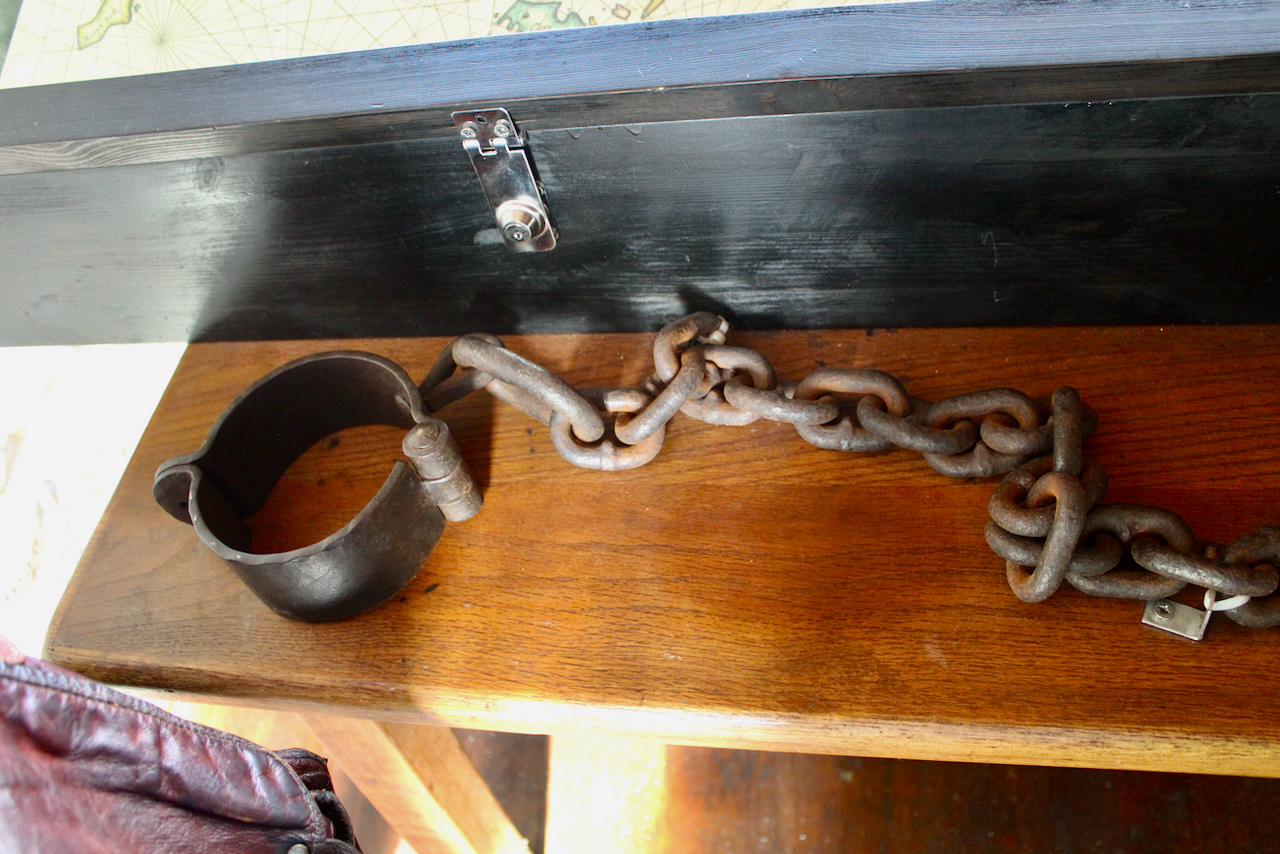
Riverstown House, Riverstown, Glanmire, County Cork T45 HY45 – section 482

Open dates in 2026: May 1-2, 7-9, 14-16, 21-23, 28-30, June 4-6, 10-12, 18-20, 25-27, July 2-4, 9-11, 16-18, 23-25, 30-31, Aug 1, 6-8, 13-23, 27-29 Sept 3-5, 2pm-6pm

Fee: adult €10, OAP €7, student €6, child €3

donation

Help me to pay the entrance fee to one of the houses on this website. This site is created purely out of love for the subject and I receive no payment so any donation is appreciated!

€15.00

Riverstown House, June 2022. The back facade of the house; the entrance door is on the opposite side. The roof has a round-headed bellcote. Photograph © Jennifer Winder-Baggot, www.irishhistorichouses.com
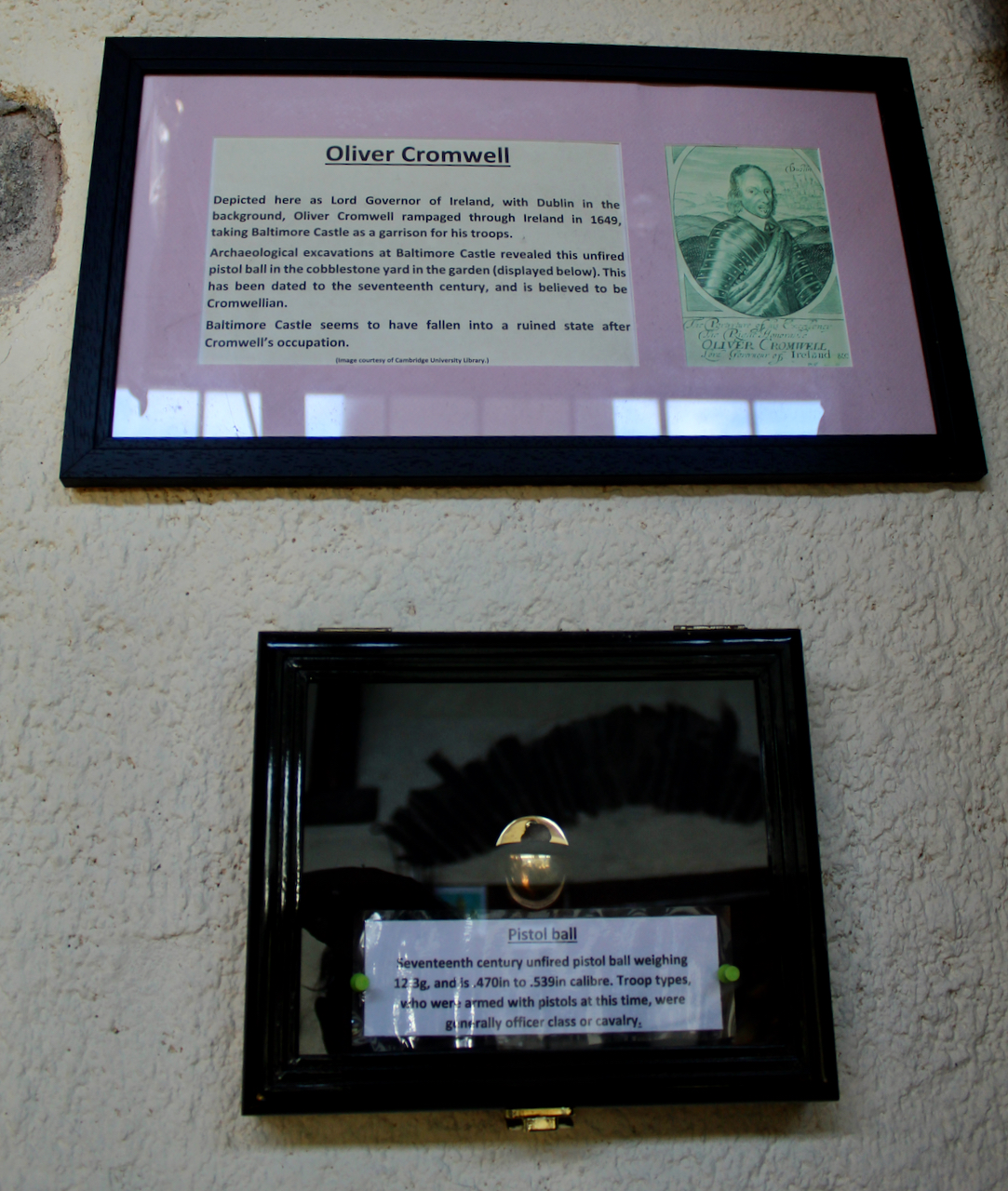
Riverstown County Cork, 1970, National Library archives. [1] The portico over the door has been since removed. Note that the image is mirror-image reversedsee my photograph above.
Riverstown House, June 2022. Photograph © Jennifer Winder-Baggot, www.irishhistorichouses.com

Riverstown is famous for its stucco work. It contains important plasterwork with high-relief figurative stucco in panels on the ceiling and walls of the dining room, by Paolo and Filipo Lafranchini. The brothers also worked in Carton House in County Kildare (see my entry for places to stay in County Kildare https://irishhistorichouses.com/2022/04/27/places-to-visit-and-to-stay-leinster-kildare-kilkenny-laois/) and in Kilshannig in County Cork (see my entry https://irishhistorichouses.com/2020/12/10/kilshannig-house-rathcormac-county-cork/).

The Swiss-Italian stuccadores were brought to Ireland from England in 1738 by Robert Fitzgerald (1675-1744) 19th Earl of Kildare, who built both Leinster House in Dublin (first known as Kildare House until his son was raised to be Earl of Leinster) and Carton House.

Stucco work carried out by Lafranchini brothers in 1739 in Carton House, now a hotel. Photograph © Jennifer Winder-Baggot, www.irishhistorichouses.com
Plasterwork by the Lafranchini brothers in Kilshannig, County Cork. Photograph © Jennifer Winder-Baggot, www.irishhistorichouses.com
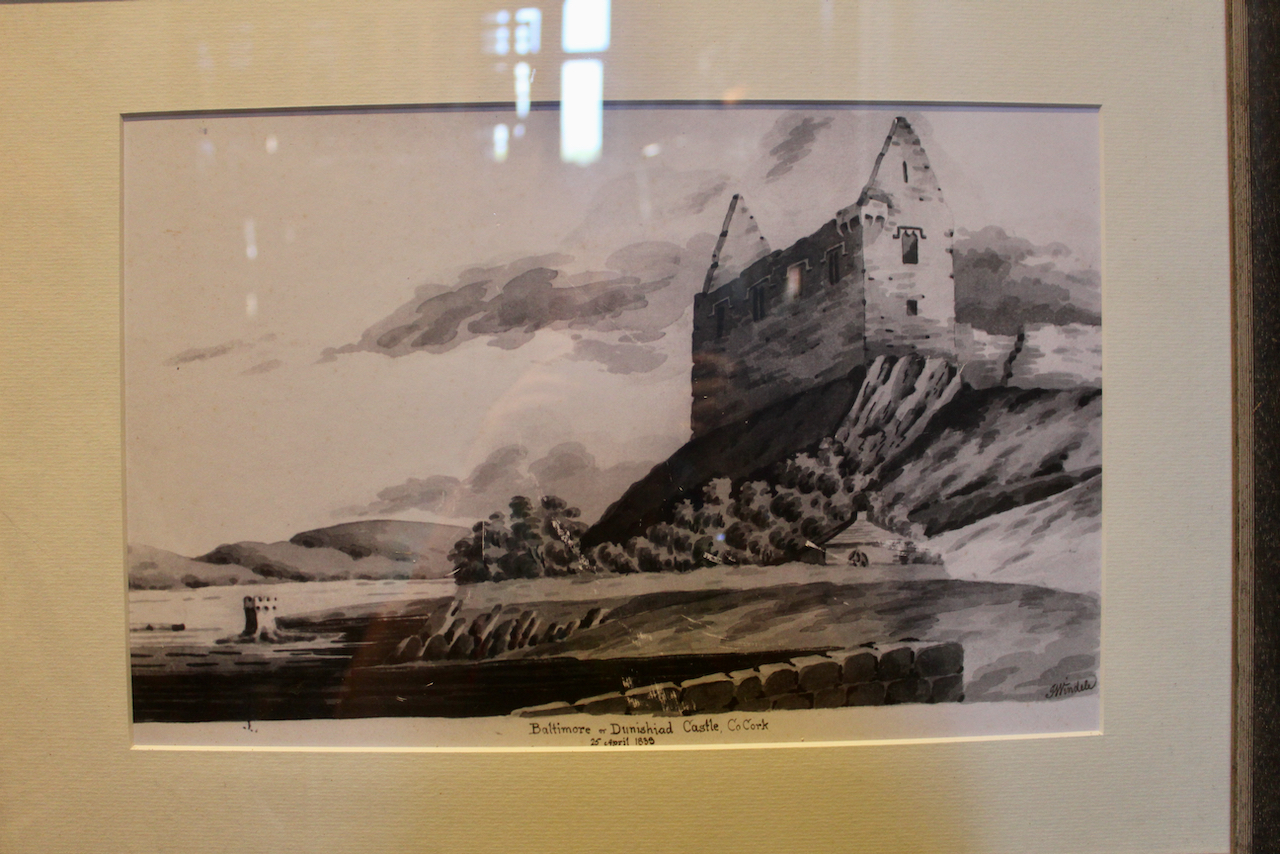
Going back to its origins, the estate of Riverstown was purchased by Edward Browne (b. 1676), Mayor of Cork. He married Judith, the heiress daughter of Warham Jemmett (b. 1637), who lived in County Cork. The present house possibly dates from the mid 1730s, Frank Keohane tells us in Buildings of Ireland: Cork City and County. [2] A hopper with the date 1753 probably records alterations, when the gable end at one side was replaced by full-height canted bays.

Mark Bence-Jones describes Riverstown in his A Guide to Irish Country Houses (1988):

“…The house consists of a double gable-ended block of two storeys over a basement which is concealed on the entrance front, but which forms an extra storey on the garden front, where the ground falls away steeply; and a three-storey one bay tower-like addition at one end, which has two bows on its side elevation. The main block has a four bay entrance front, with a doorway flanked by narrow windows not centrally placed.” [3]

Due to the deep slope upon which the house is built, one side is of three storeys, or two storeys over basement. Photograph © Jennifer Winder-Baggot, www.irishhistorichouses.com
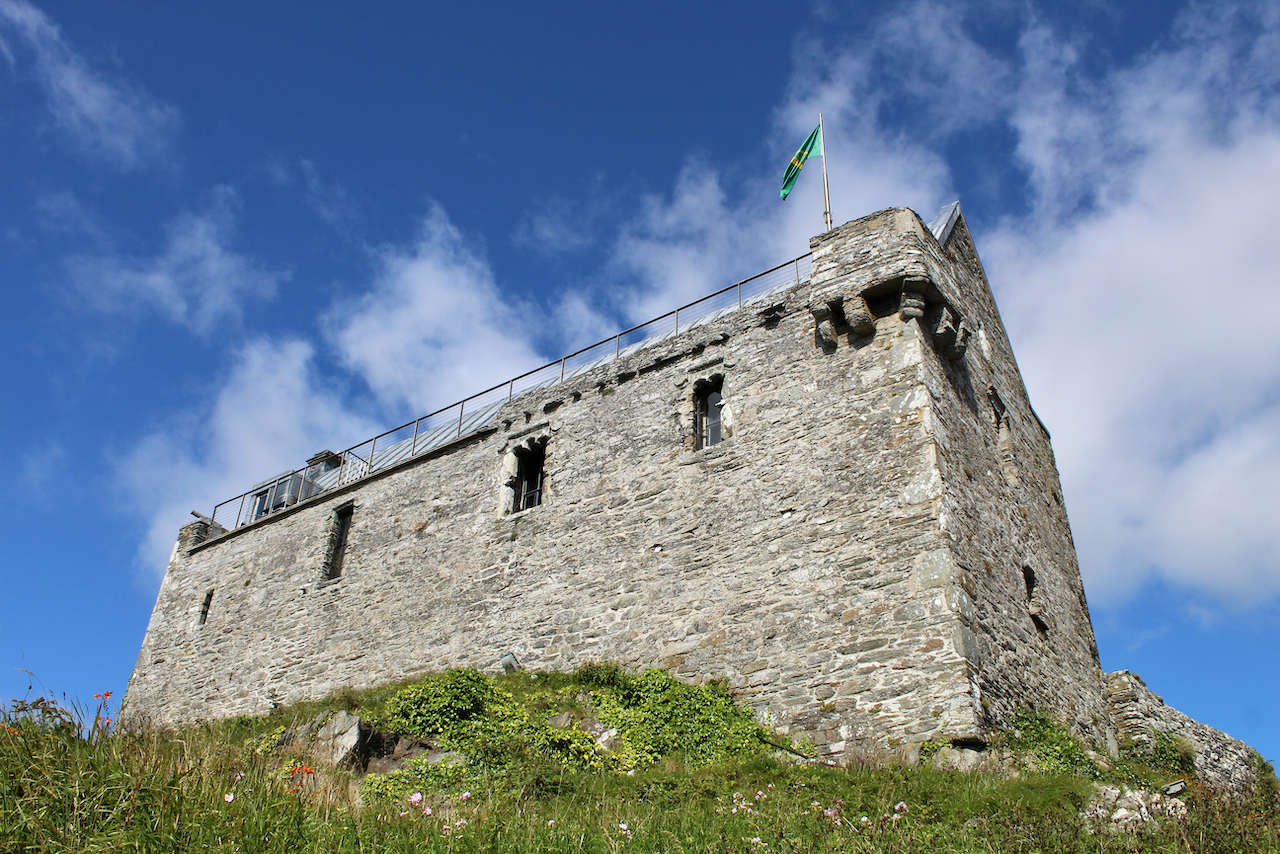
Riverstown, 2022. Photograph © Jennifer Winder-Baggot, www.irishhistorichouses.com
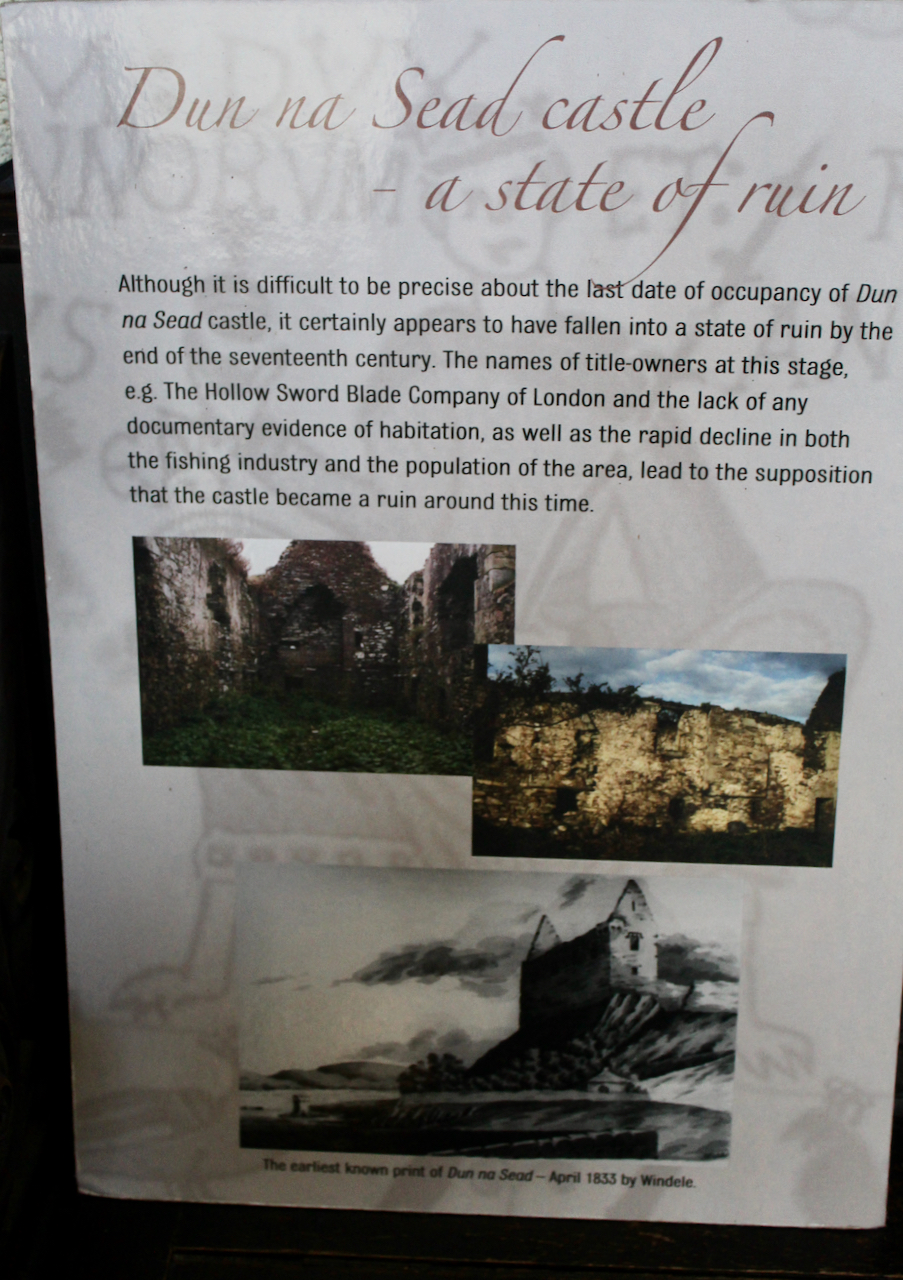
The grounds of Riverstown also contain an old ice house. Photograph © Jennifer Winder-Baggot, www.irishhistorichouses.com
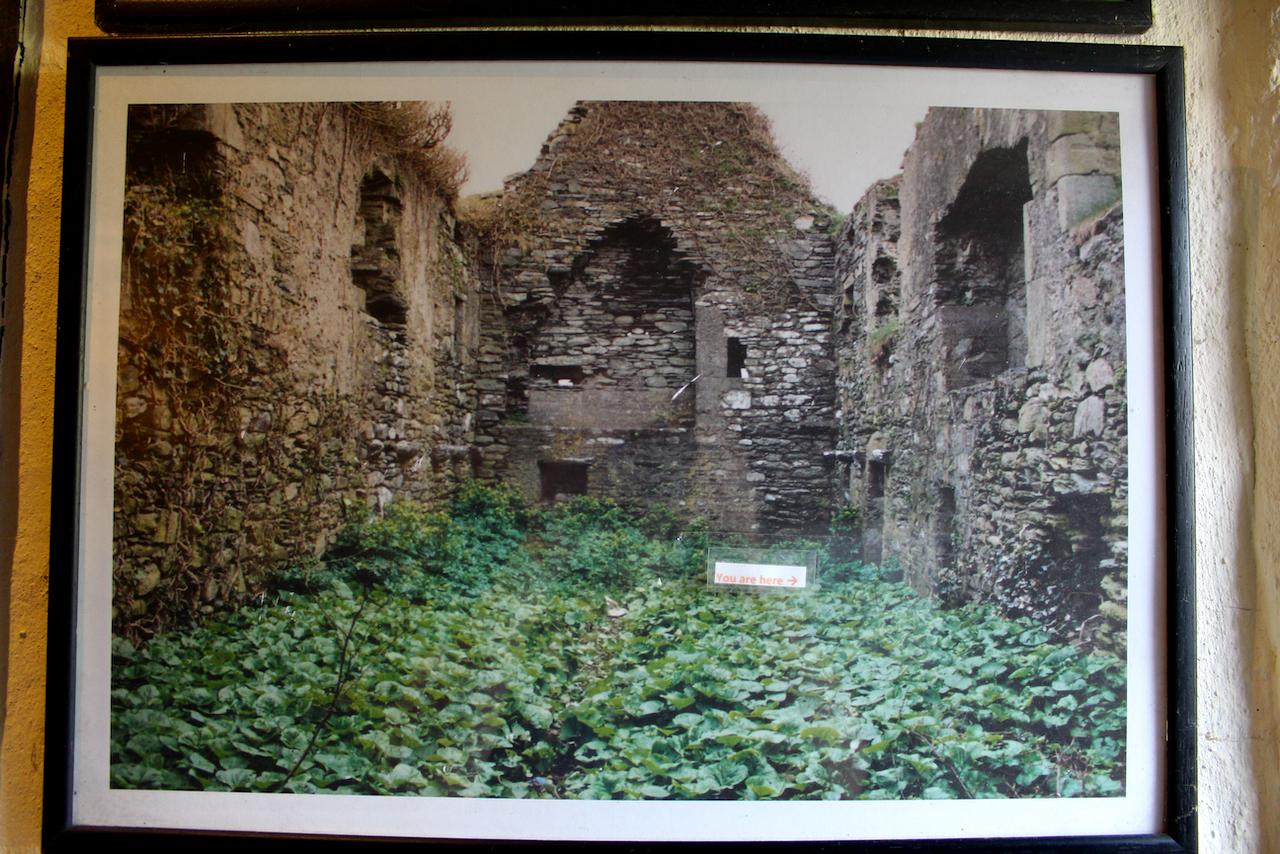
The tower-like third storey on part of the house was possibly added by architect Henry Hill around 1830, Keohane tells us. Henry Hill was an architect who worked in Cork, perhaps initially with George Richard Pain, and later with William Henry Hill and Arthur Hill.

Riverstown House, June 2022. Photograph © Jennifer Winder-Baggot, www.irishhistorichouses.com
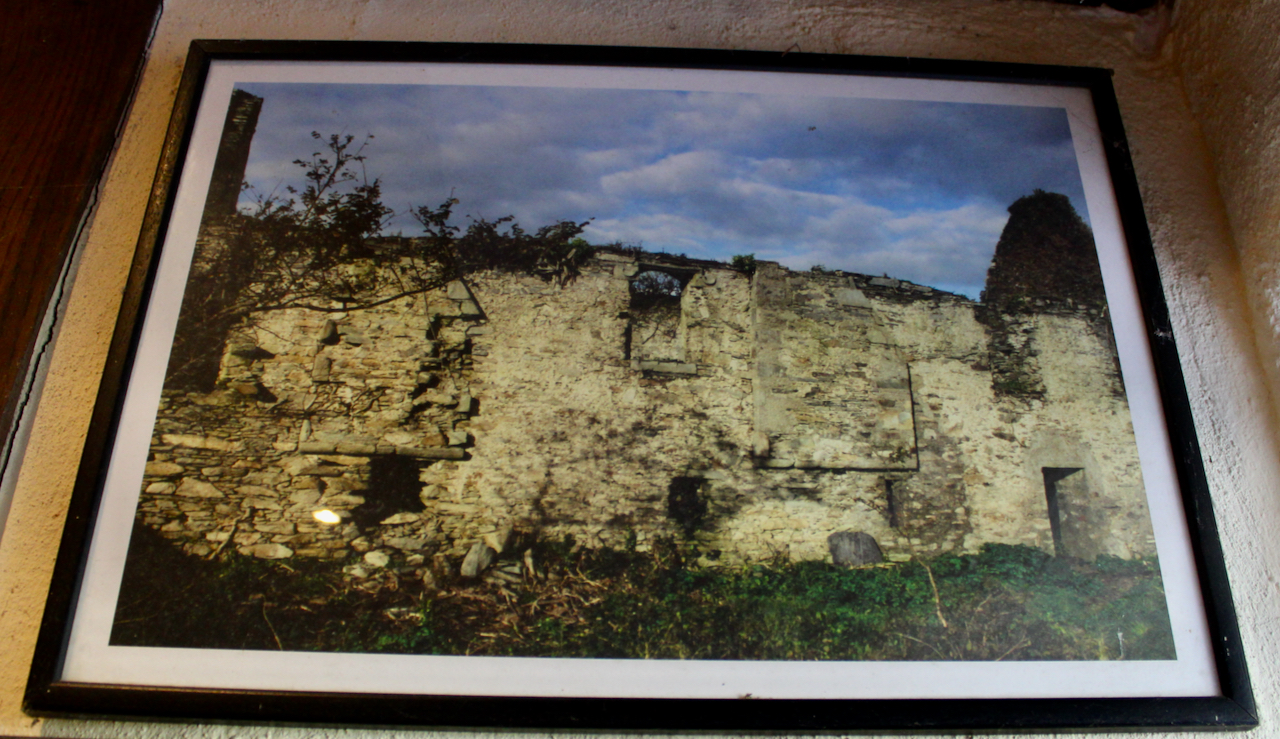
Riverstown, 2022. Photograph © Jennifer Winder-Baggot, www.irishhistorichouses.com
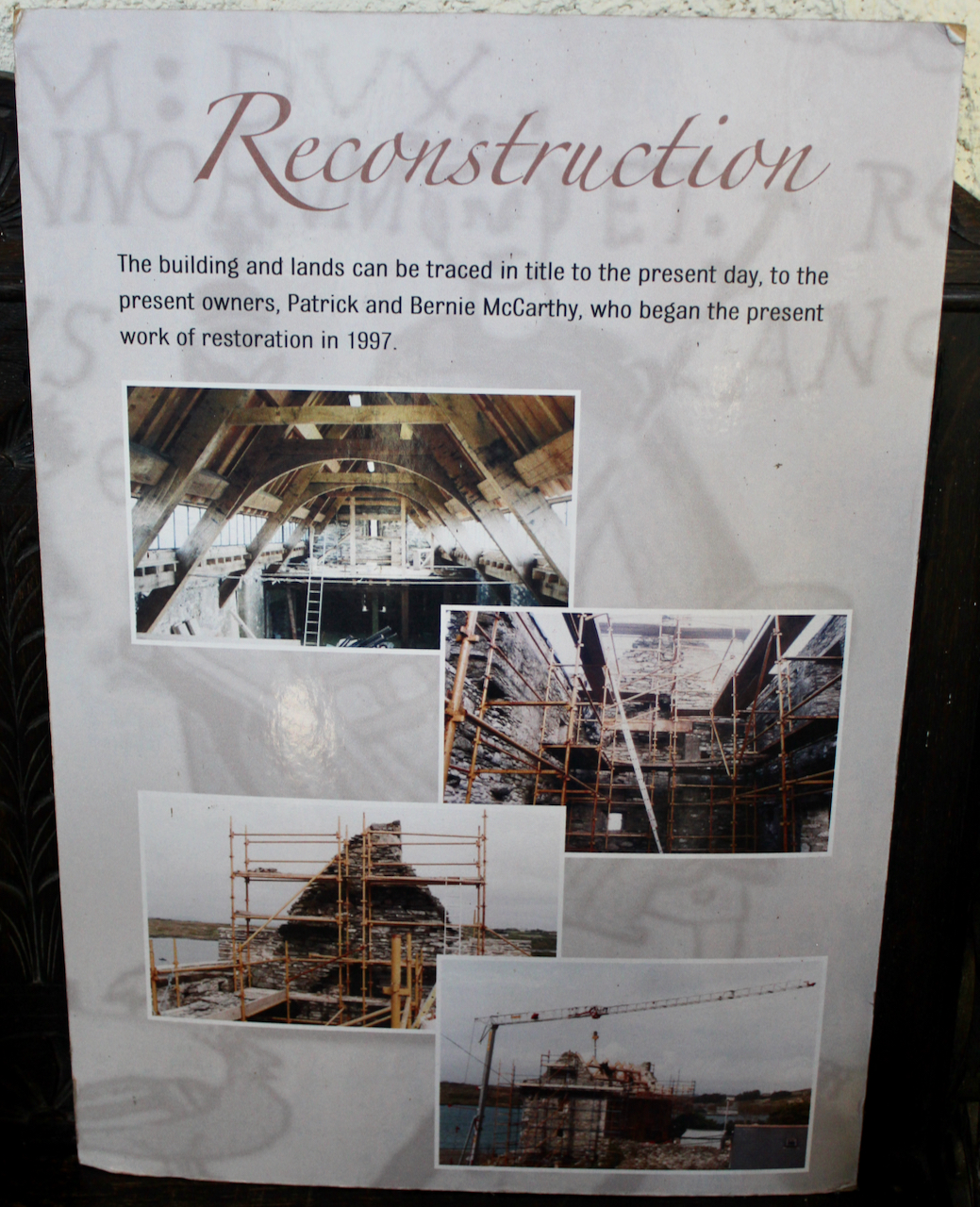
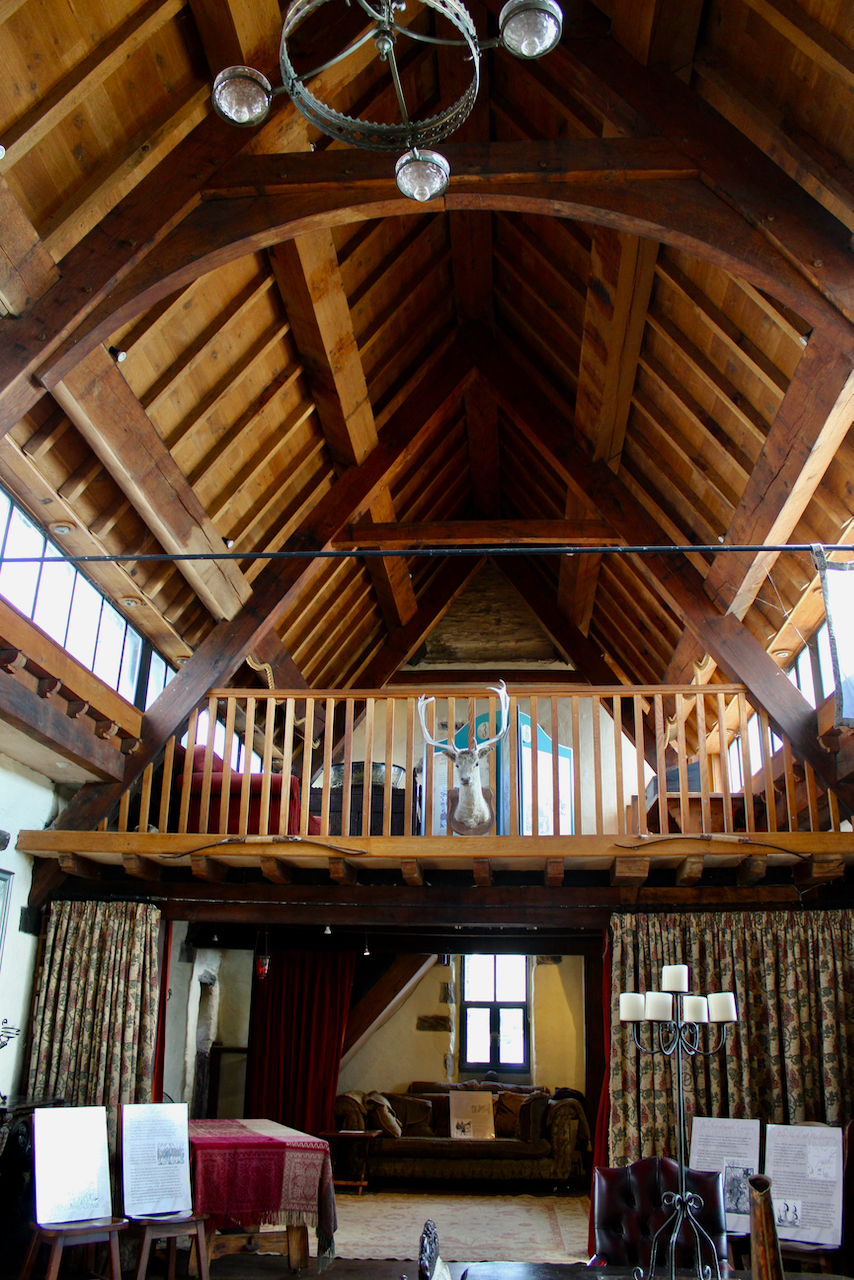
As Riverstown and its plasterwork was described in 1750 in Smith’s History of County Cork, it must have been created before this, perhaps when Browne’s son Jemmet Browne was elevated to the position of Bishop of Cork in 1745. He later became Archbishop of Tuam.

Reverend Jemmett Browne at a meet of Foxhounds by Peter Tillemans, courtesy of Yale Centre for British Art.

Reverend Jemmett Browne gave rise to a long line of clerics. He married Alice Waterhouse, daughter of Reverend Thomas Waterhouse. His son Edward (1726-1777) became Archbishop of Cork and Ross, and a younger son, Thomas, also joined the clergy.

A portrait of Alice Waterhouse, wife of Bishop Jemmett Browne.

Edward Archbishop of Cork and Ross named his heir Jemmett (1753-1797) and he also joined the clergy. He married Frances Blennerhassett of Ballyseede, County Kerry (now a hotel and also a section 482 property, see my entry). If the tower part of the house was built in 1830 it would have been for this Jemmett Browne’s heir, another Jemmett (1787-1850).

In Beauties of Ireland (vol. 2, p. 375, published 1826), James Norris Brewer writes that: “the river of Glanmire runs through the gardens banked with serpentine canals which are well stocked with carp, tench, etc. A pleasant park stocked with deer, comes close to the garden walls. The grounds of this very respectable seat about in aged timber and the whole demesne wears an air of dignified seclusion.”

The first Jemmett Browne was friendly with Laurence Sterne, author of Tristram Shandy. The bawdiness of the novel demonstrates that clerics at the time led a different life than those of today! Jemmett Browne’s interest in fine stucco work was probably influenced by fellow clerics Bishop George Berkeley, Samuel “Premium” Madden and Bishop Robert Clayton. Samuel Madden recommended, in his Reflections and Resolutions Proper to the Gentlemen of Ireland that stucco is substituted for wainscot. [4] Bishop Clayton owned what is now called Iveagh House on St. Stephen’s Green in Dublin (see my entry, https://irishhistorichouses.com/2022/09/23/open-house-culture-night-and-heritage-week-dublin-visits/ ).

Portrait c. 1740 of Archbishop Robert Clayton (1695–1758) and Katherine née Donellan by James Latham, courtesy of National Gallery of Ireland. Known for his unorthodox views, at the time of his death Robert Clayton was facing charges of heresy.
George Berkeley (1685-1753), Philosopher; Bishop of Cloyne, by John Smibert 1730 courtesy of National Portrait Gallery NPG 653. He was a friend of Reverend Jemmett Browne.

The stucco work is so important that the Office of Public Works feared it would be lost, as the house was standing empty in the 1950s before being purchased by John Dooley, father of the current owner, in around 1965. Under the direction of Raymond McGrath of the Office of Public Words, with advice from Dr. C. P. Curran, the authority on Irish decorative plasterwork, moulds were taken in 1955-6. The moulds are now displayed prominently in the home of Ireland’s President, Áras an Uachtaráin. (see my entry on the Áras in the entry on Office of Public Works properties in Dublin, https://irishhistorichouses.com/2022/01/21/office-of-public-works-properties-dublin/ )

Riverstown, 1975, photograph from Dublin City Library and Archive. (see[1])
The Lafranchini hallway in Áras an Uachtaráin, with the moulds taken of the stucco work in Riverstown. Photograph © Jennifer Winder-Baggot, www.irishhistorichouses.com
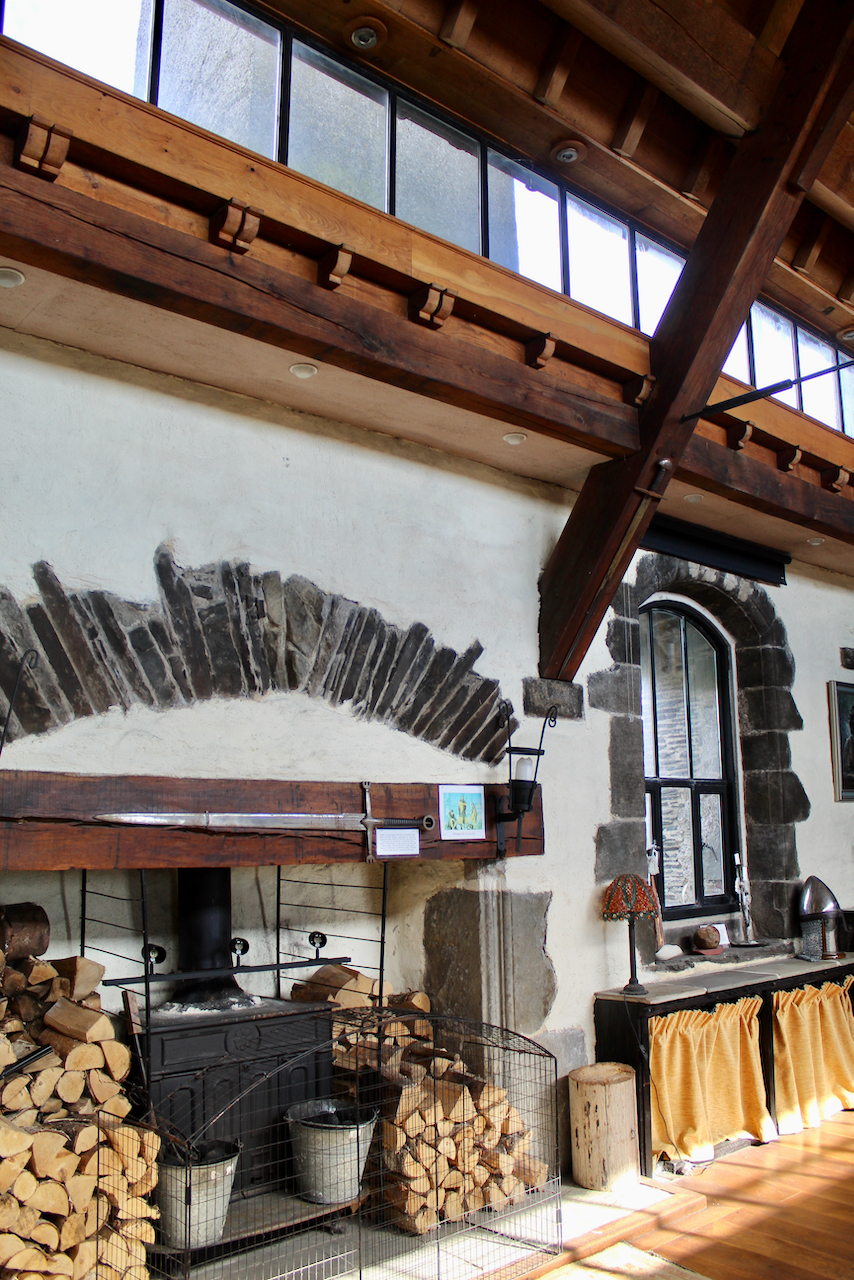
Shortly after John Dooley purchased the property, the members of the Irish Georgian Society decided to help to restore the plasterwork.

The book published on the 50th anniversary of the Irish Georgian Society, by Robert O’Byrne, has part of a chapter on Riverstown and the Irish Georgian Society’s role in restoration of the Lafranchini plasterwork in the 1960s.

The book published on the 50th anniversary of the Irish Georgian Society has part of a chapter on Riverstown and the Irish Georgian Society’s role in restoration of the Lafranchini plasterwork in the 1960s. By this time, John Dooley had purchased Riverstown, after it has been standing empty. At the time, Dooley had not yet moved in, and the dining room was not preserved to the standard the Georgian Society would have liked. The book has a photograph of potatoes being stored in the dining room.

Photograph from Irish Georgian Society, by Robert O’Byrne. The photograph was published in the Cork Examiner in February 1965. We don’t know of course how temporary this storage was.

The entrance hall of Riverstown is also impressive, and the members of the Georgian Society also helped to clean the plasterwork in this room. The walls curve, and the room has an elegant Neoclassical Doric frieze and shapely Corinthian columns.

Mark Bence-Jones decribes: “The hall, though of modest proportions, is made elegant and interesting by columns, a plasterwork frieze and a curved inner wall, in which there is a doorcase giving directly onto an enclosed staircase of good joinery. To the left of the hall, in the three storey addition, are two bow-ended drawing rooms back to back. Straight ahead, in the middle of the garden front, is the dining room, the chief glory of Riverstown.”

The rounded entrance hall has a Neoclassical Doric frieze, thin columns and marble busts and statue. Photograph © Jennifer Winder-Baggot, www.irishhistorichouses.com
Riverstown, 2022. Photograph © Jennifer Winder-Baggot, www.irishhistorichouses.com

The Lafranchini work in the dining room derives from Maffei’s edition of Agostini’s Gemme Antiche Figurate (1707-09). Frank Keohane notes that the Maffei’s engravings were also used for the decoration of the Apollo Room in 85 St. Stephen’s Green, Dublin, also by the Lafranchini brothers.

The ceiling at Riverstown: winged figure of Father Time, rescuing Truth from the assaults of Discord and Envy, taken from the allegorical painting by Nicholas Poussin which he painted on the ceiling in France for Cardinal Richelieu in 1641 and now hangs in the Louvre, Paris.

The dining room in Riverstown, August 2022. Marcus Curtius on horseback over fireplace, next to Aeneas carrying Anchises on his shoulders, then Liberty and Ceres. Photograph © Jennifer Winder-Baggot, www.irishhistorichouses.com
The Apollo Room, 85 St. Stephen’s Green, also by Lafranchini brothers, using Maffei’s engravings, executed in 1740. Photograph © Jennifer Winder-Baggot, www.irishhistorichouses.com
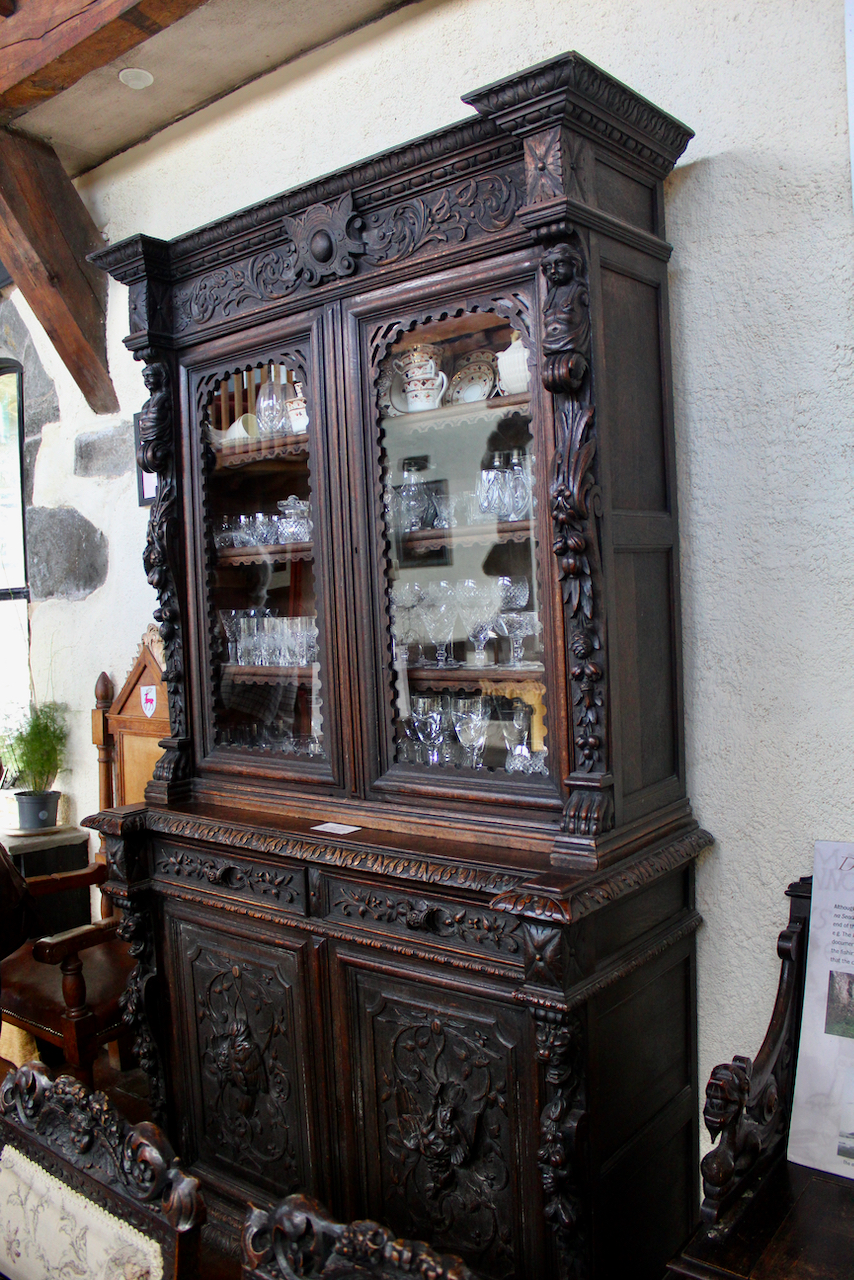
The ceiling at Riverstown: winged figure of Father Time, Chronos, rescuing Truth (a young woman, La Verdad) from the assaults of Discord and Envy, taken from the allegorical painting by Nicholas Poussin which he painted on the ceiling in France for Cardinal Richelieu in 1641 and now hangs in the Louvre, Paris. Discord is armed with a dagger and Envy with snakes, and in the original painting, Envy’s robes are green. A cherub bears the sickle and circle, symbolising Time and Immortality. Photograph © Jennifer Winder-Baggot, www.irishhistorichouses.com
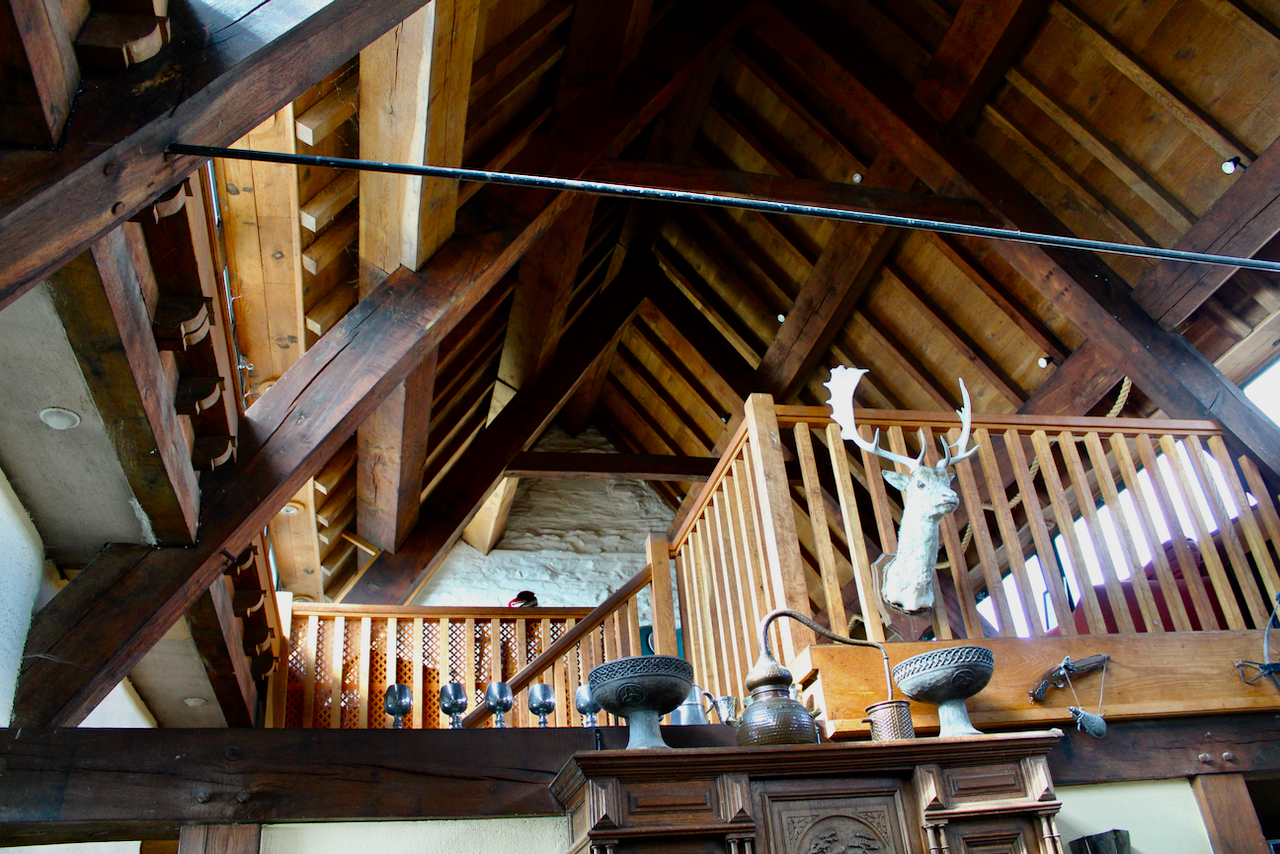
Riverstown, 2022. Photograph © Jennifer Winder-Baggot, www.irishhistorichouses.com
Corner of the ceiling at Riverstown. Photograph © Jennifer Winder-Baggot, www.irishhistorichouses.com
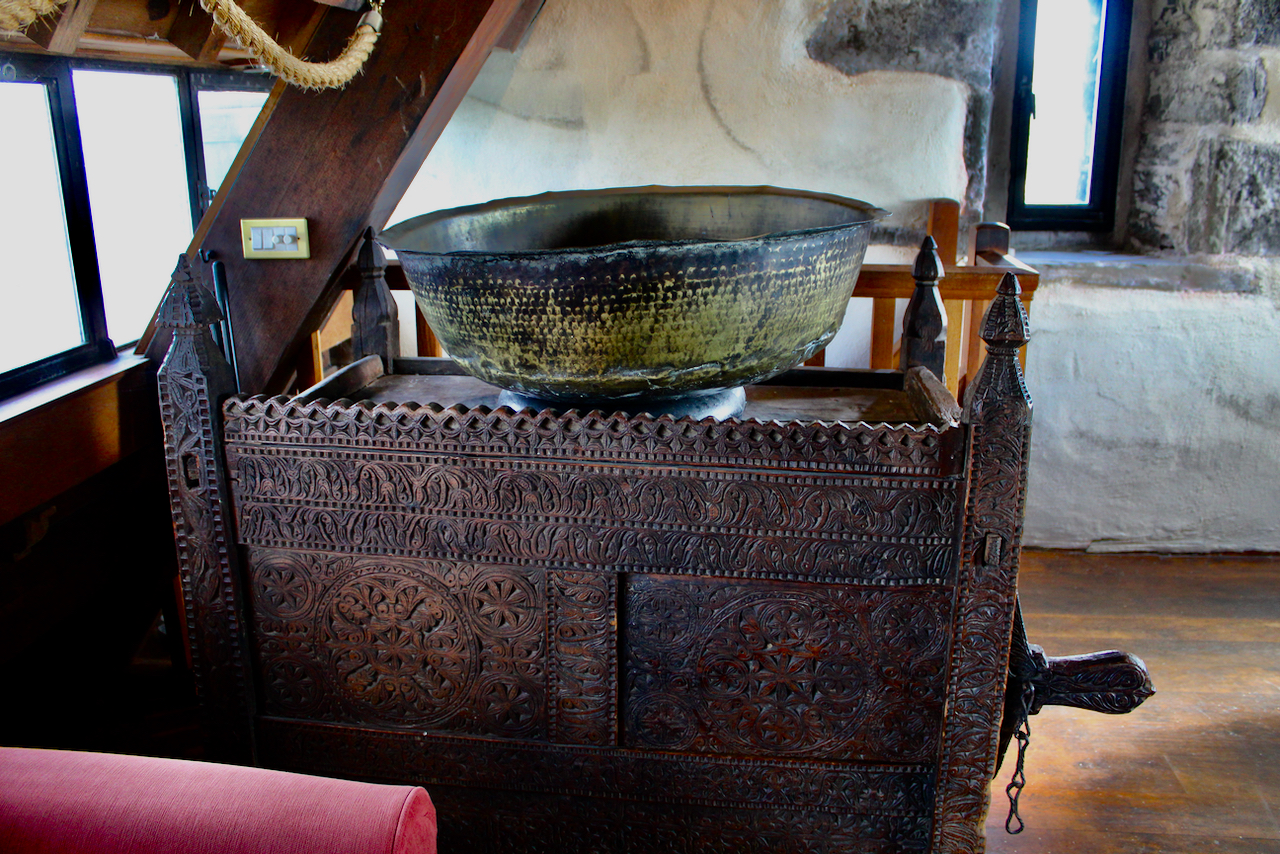
C. P. Curran tells us that the history of the Lafranchini brothers is obscure, but they “represent one of the successive waves of stuccodores who from quite early periods swarmed over Europe from fertile hives in the valleys of either side of the Swiss Italian Alps….They worked in some unascertained way side by side with local guildsmen and introduced new motifs and methods. Their repertory of ornament was abundant and they excelled in figure work.” [4] They executed their work in Carton in 1739, Curran tells us, and in 85 St. Stephen’s Green in 1740.

Marcus Curtius on horseback over fireplace, next to Aeneas carrying Anchises on his shoulders, then Liberty and Ceres. The panels have moulded frames, those over the fireplace and the opposing wall being lugged and enriched with acanthus-tufted C-scrolls above and below the panels. Photograph © Jennifer Winder-Baggot, www.irishhistorichouses.com

Keohane tells us that the simple eighteenth century black-marble slab chimneypiece was installed in the 1950s when the house was saved by the Dooley family from ruination. It replaced a remarkable overmantel, now in an upper room, with great scrolled jambs garlanded with flowers and tufted with acanthus, and a comic mask in the centre of the frieze which possibly depicts Bishop Browne.

A remarkable overmantel, now in an upper room, with great scrolled jambs garlanded with flowers and tufted with acanthus, and a comic mask in the centre of the frieze which possibly depicts Bishop Browne. Photograph © Jennifer Winder-Baggot, www.irishhistorichouses.com
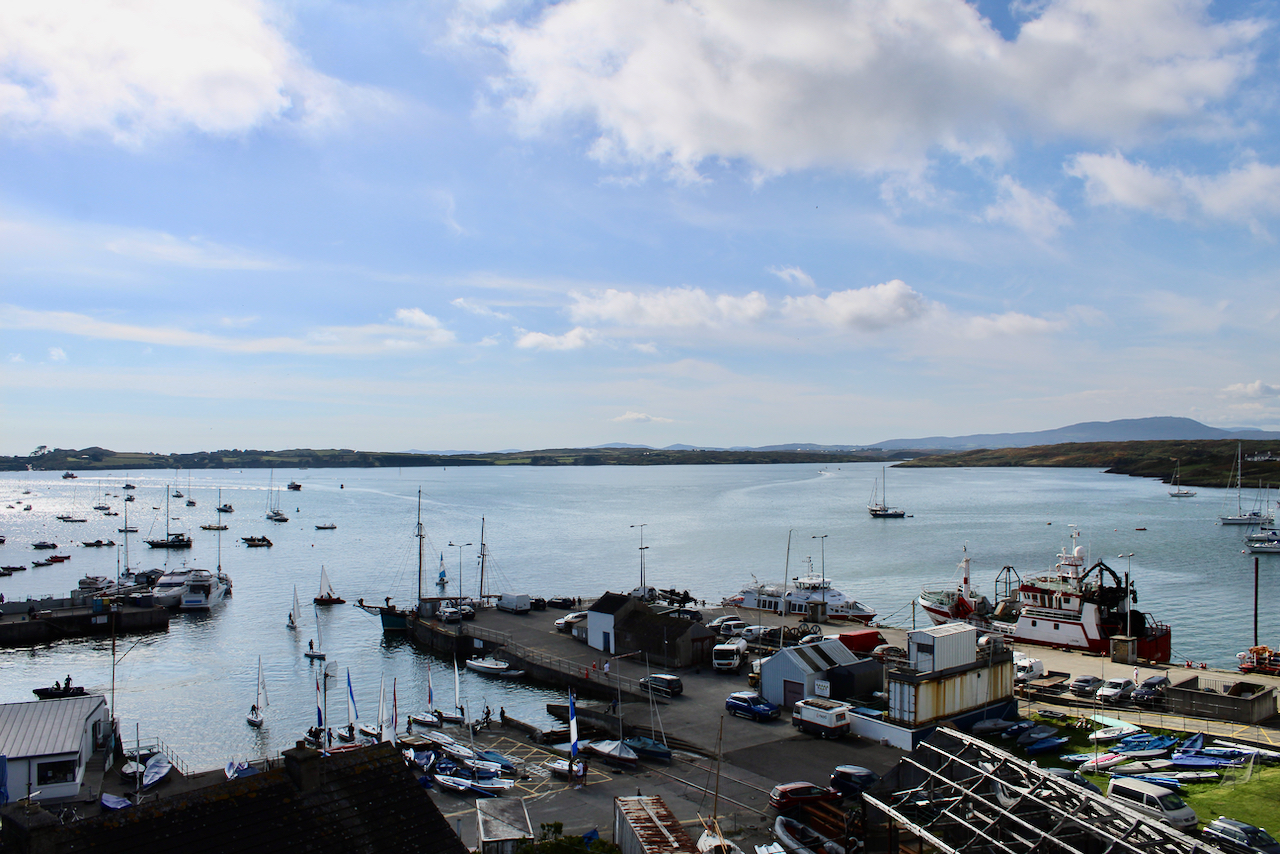
Marcus Curtius, personifying heroic virtue. Denis told us that it was he who uncovered the buildings in the top left hand corner of this panel, and that they surprised Desmond Guinness who was helping to clean the pictures, as he did not realise they were there! Photograph © Jennifer Winder-Baggot, www.irishhistorichouses.com
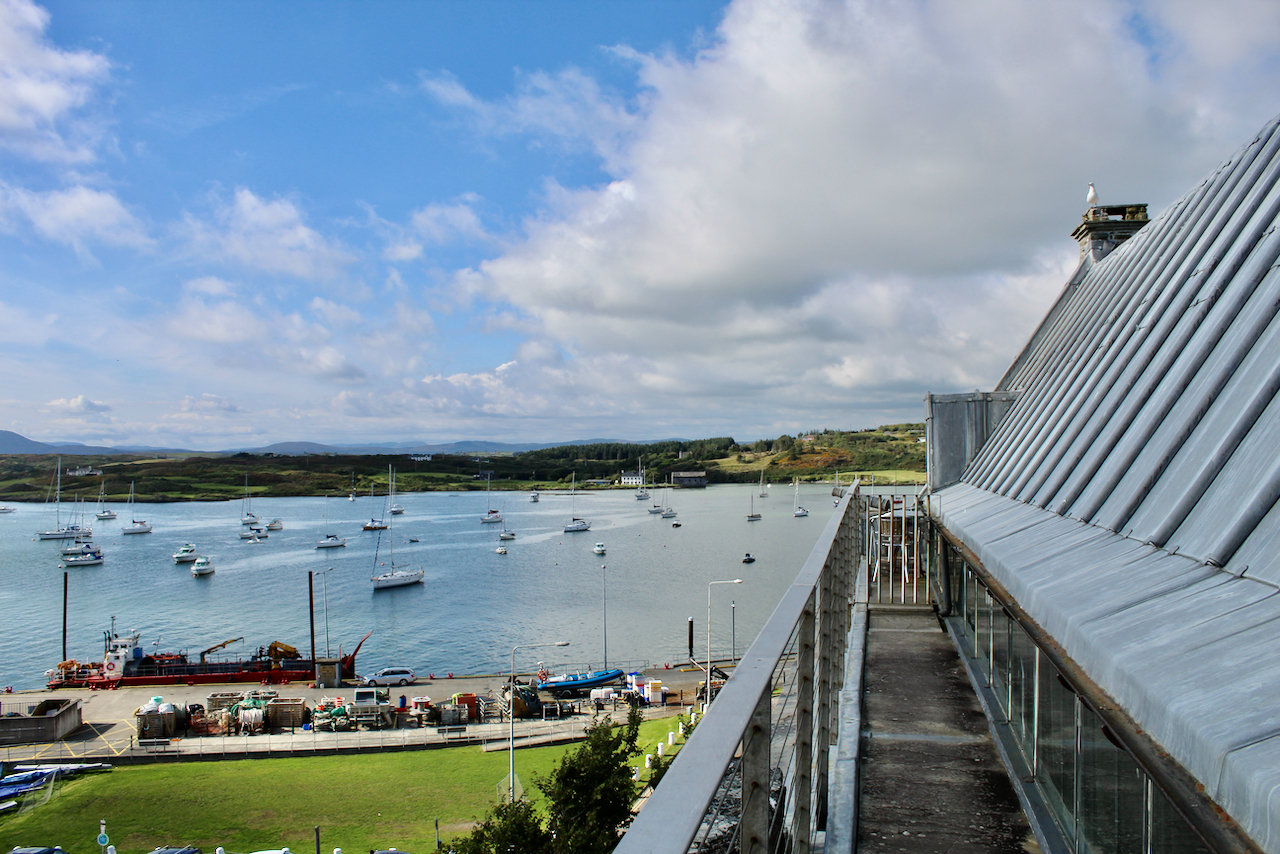
Aeneas, carrying Anchises on his shoulders and vase enclosing his household gods. It is an allegory of filial piety. Photograph © Jennifer Winder-Baggot, www.irishhistorichouses.com
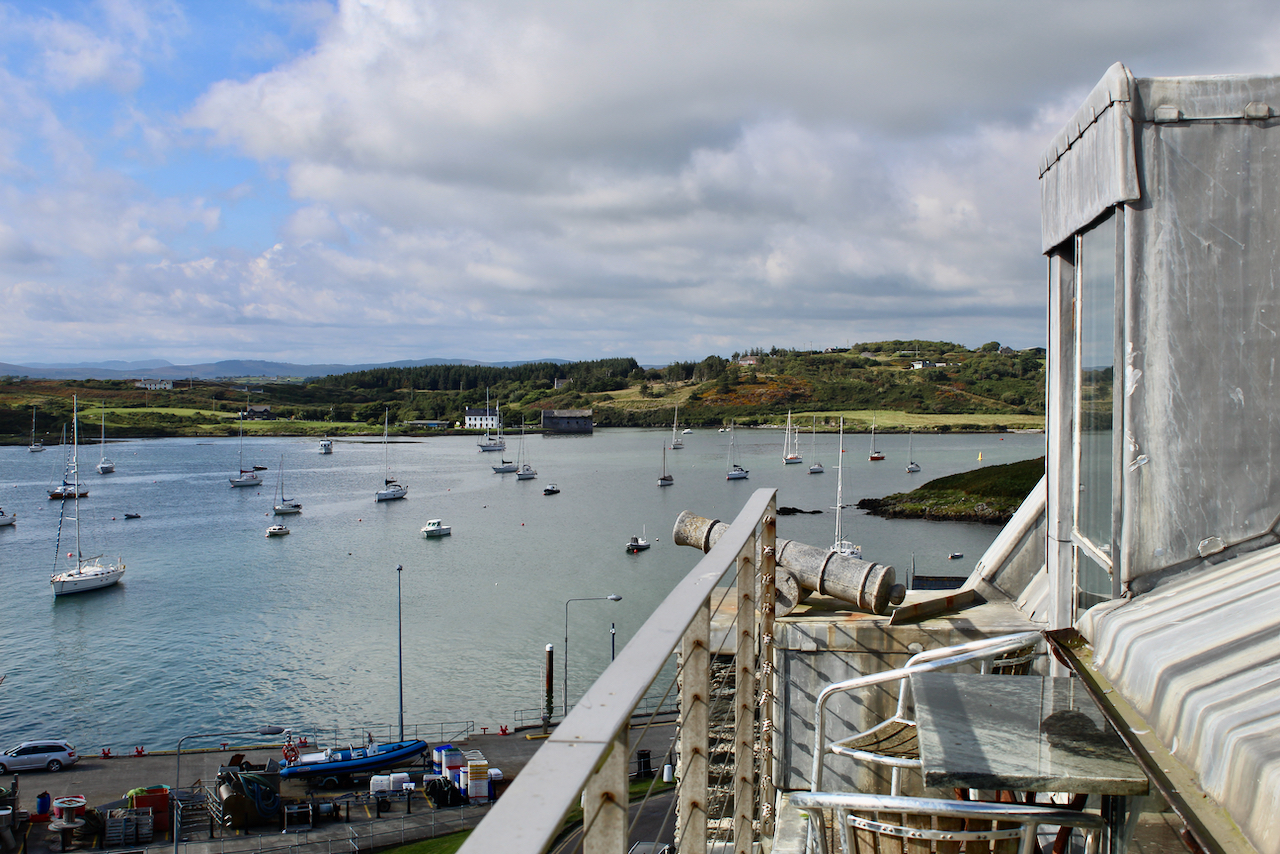
The figure of Liberty, or Grammar. Between the panels are pendants suspended from female masks, in the manner of Jean Berain, Keohane tells us, with thin bandwork and acanthus. Floral garlands are looped above. Photograph © Jennifer Winder-Baggot, www.irishhistorichouses.com
Ceres. Photograph © Jennifer Winder-Baggot, www.irishhistorichouses.com
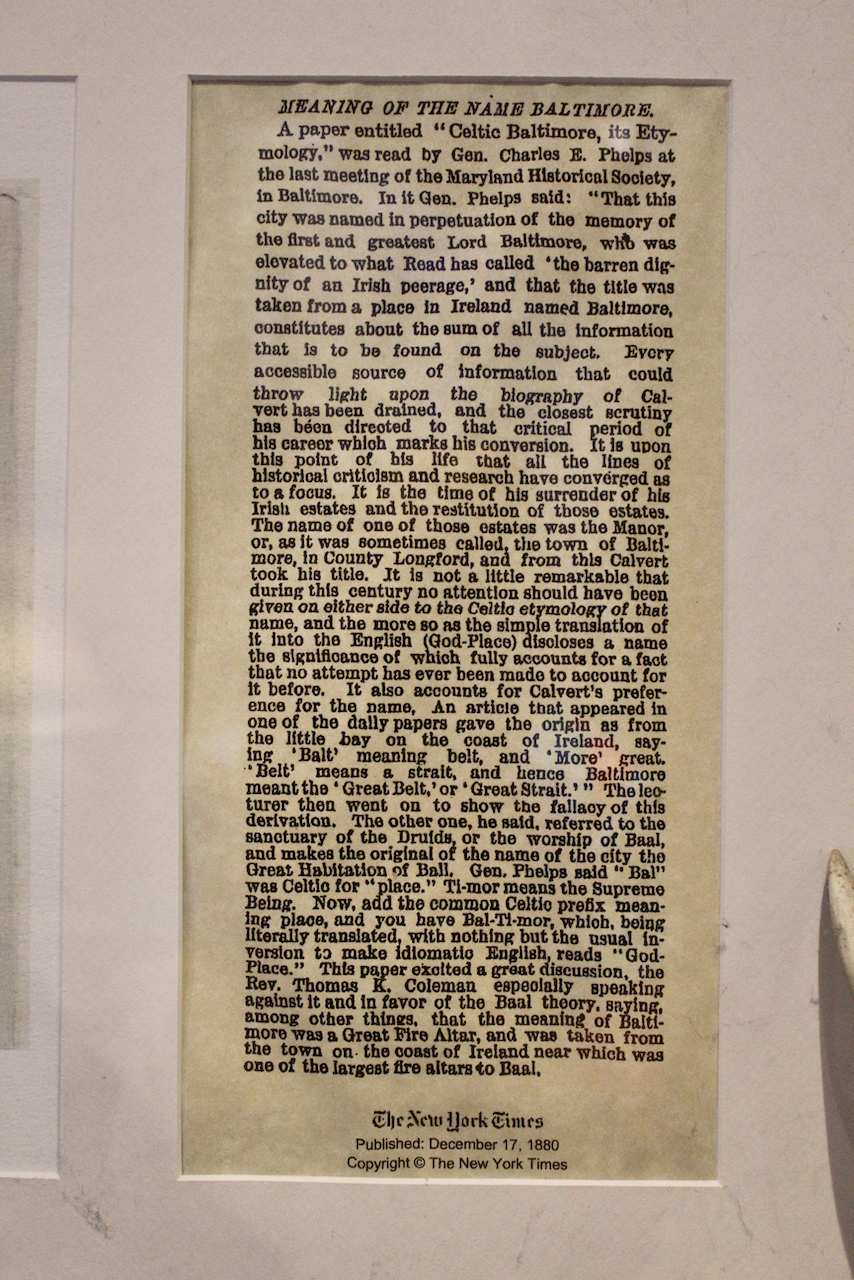
Riverstown, 2022. Photograph © Jennifer Winder-Baggot, www.irishhistorichouses.com
Fides Publica, Fortuna, Cincinnatus and Roma Aeterna, in the dining room at Riverstown. Photograph © Jennifer Winder-Baggot, www.irishhistorichouses.com
Fides Publica. Photograph © Jennifer Winder-Baggot, www.irishhistorichouses.com
Cincinnatus, or Achilles. Photograph © Jennifer Winder-Baggot, www.irishhistorichouses.com
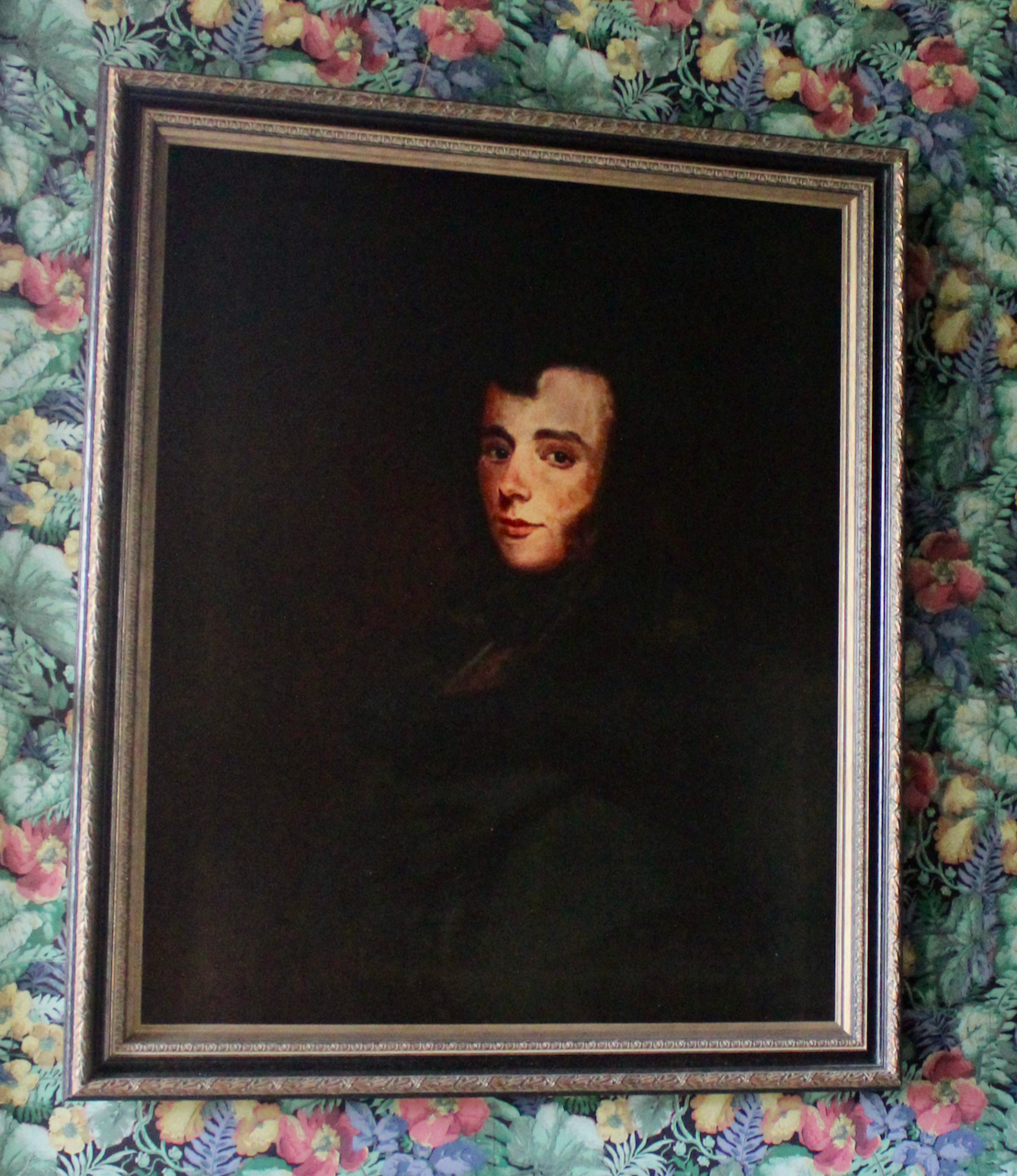
The figure of Rome. Photograph © Jennifer Winder-Baggot, www.irishhistorichouses.com
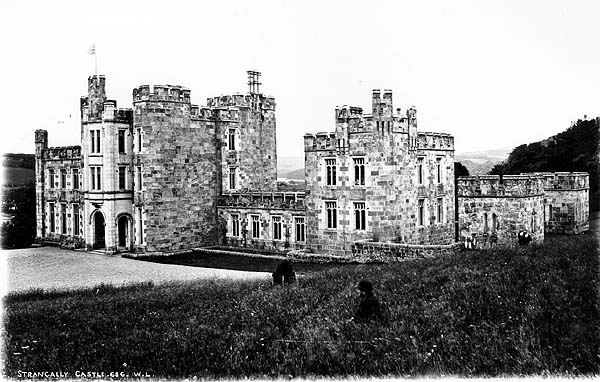
Riverstown, 2022. Photograph © Jennifer Winder-Baggot, www.irishhistorichouses.com
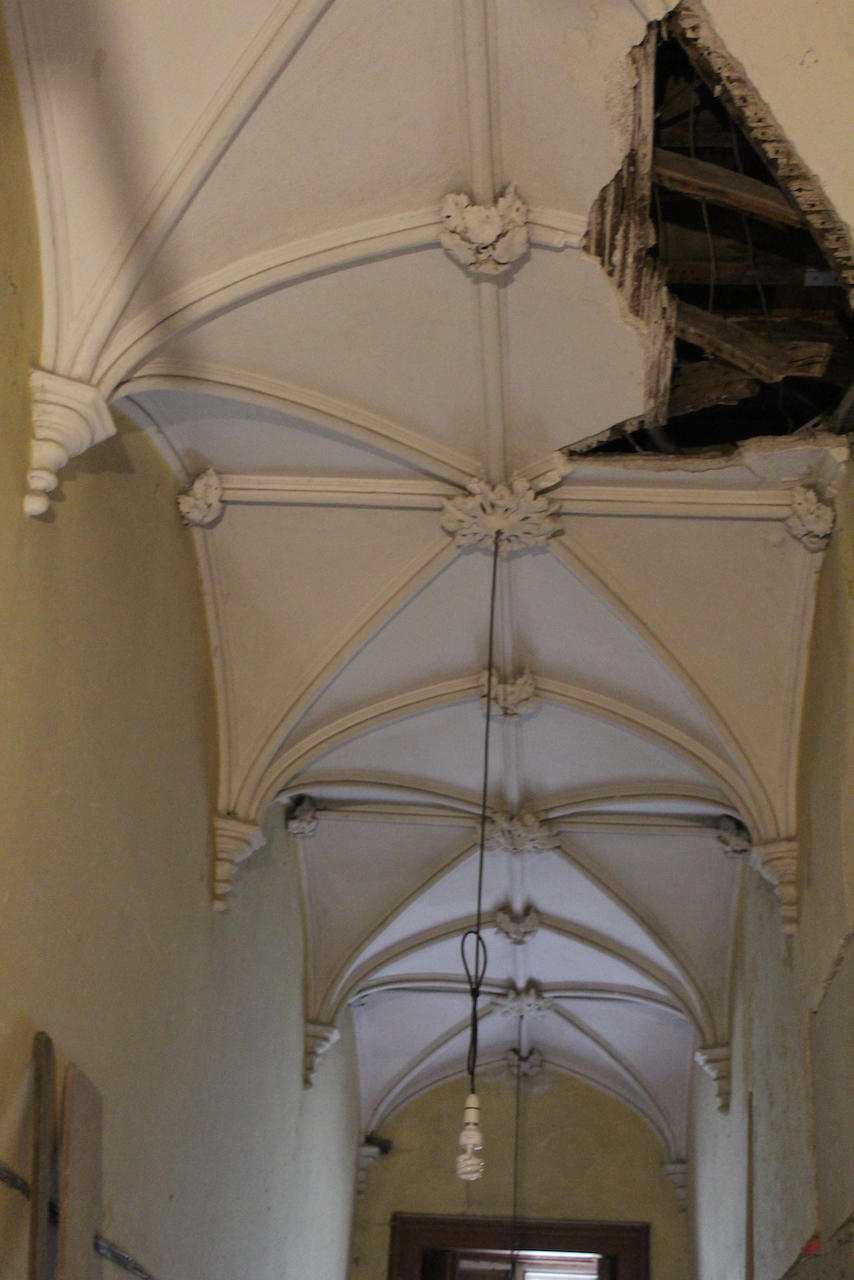
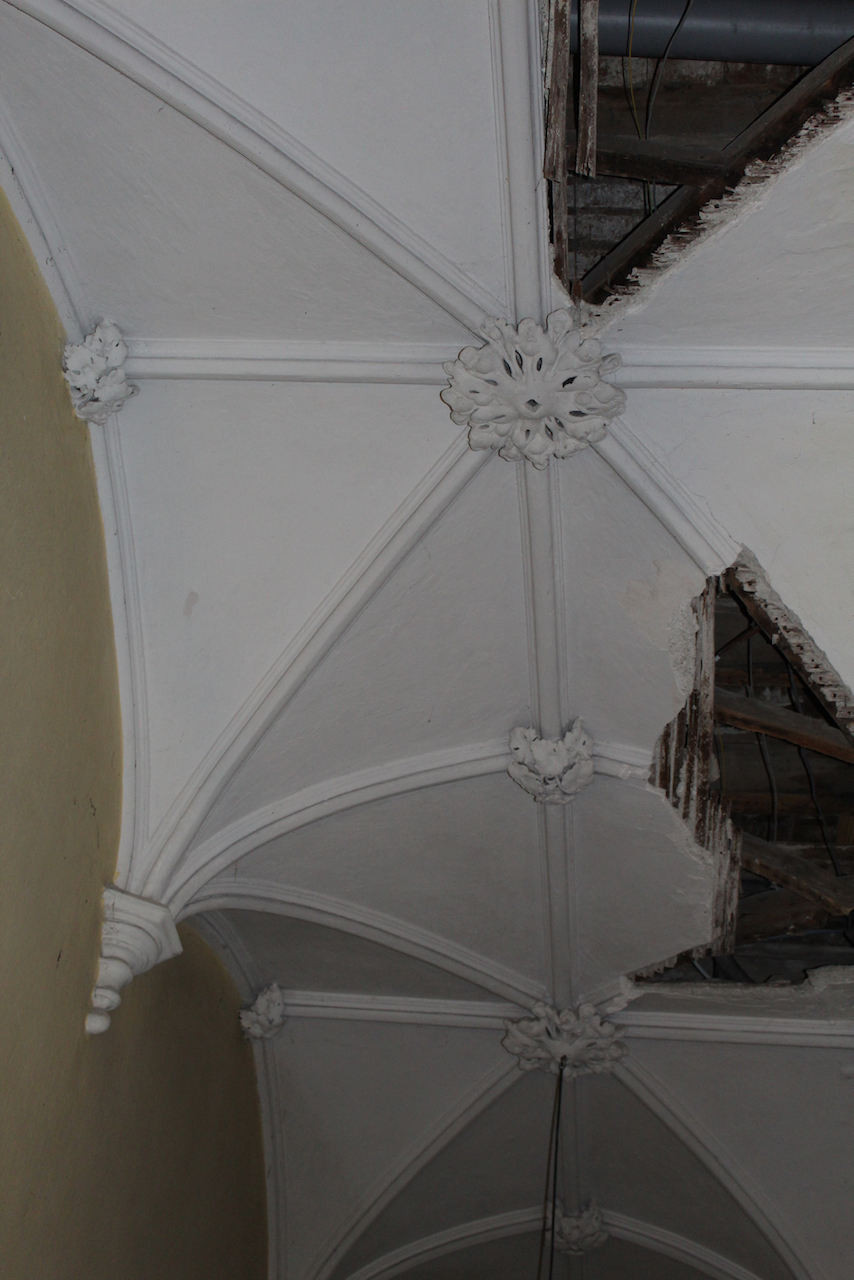
Even the stucco work around the mirror is splendid. Photograph © Jennifer Winder-Baggot, www.irishhistorichouses.com
Riverstown, 2022. Photograph © Jennifer Winder-Baggot, www.irishhistorichouses.com
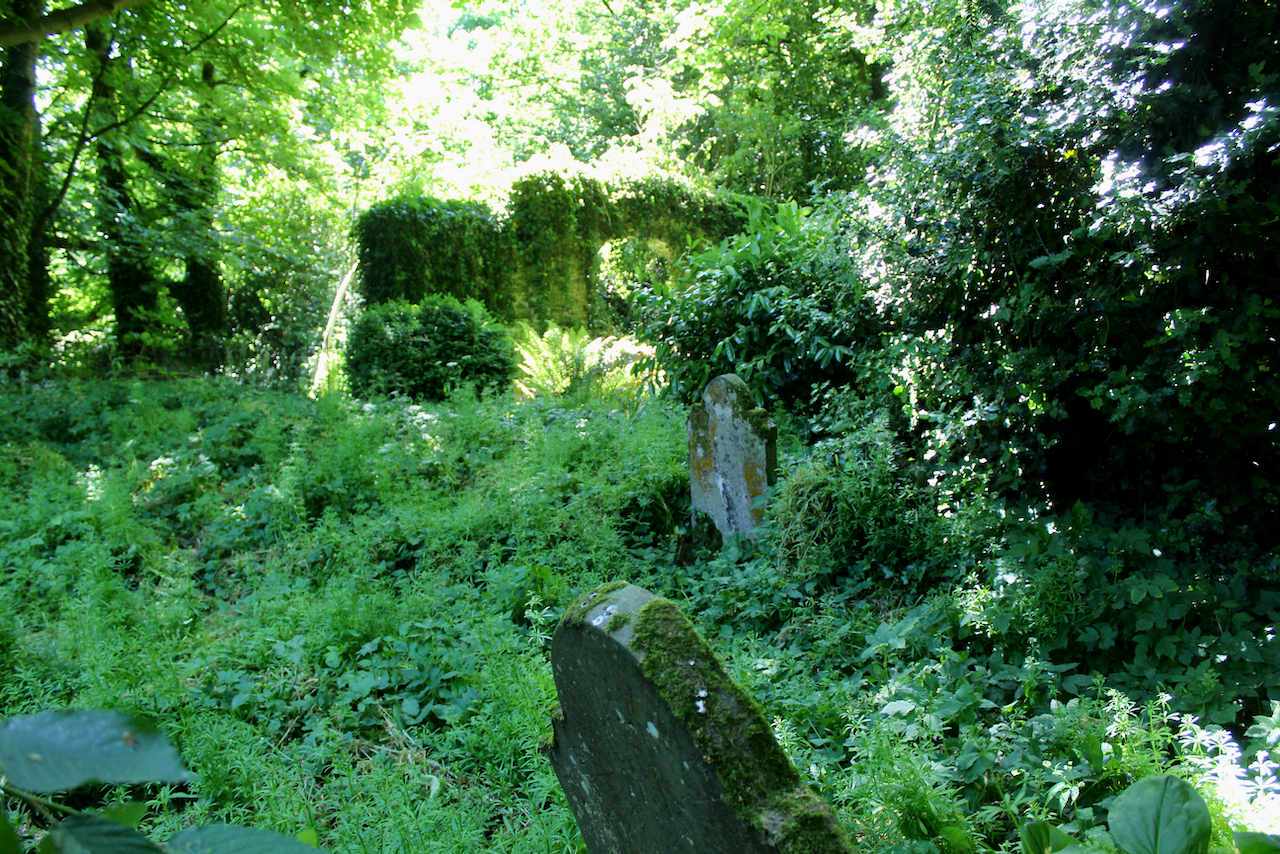
The work by the members of the Irish Georgian Society on the dining room in Riverstown was complete by the end of 1965. John Dooley continued the restoration of the rest of the house, and it is now kept in beautiful condition by his son Denis and wife Rita, with many treasures collected by the Dooleys. A 1970 Irish Georgian Society Bulletin, Robert O’Byrne tells us, reported further improvements made by the Dooleys. It tells us that one of the house’s two late-eighteenth century drawing rooms adjoining the dining room:

has been given a new dado, architraves, chimney-piece, overdoors and overmantel. These have been collected by John Lenehan of Kanturk, who rescued them from houses in Dublin that were being demolished and inserted them at Riverstown.”

Riverstown, 2022. Photograph © Jennifer Winder-Baggot, www.irishhistorichouses.com
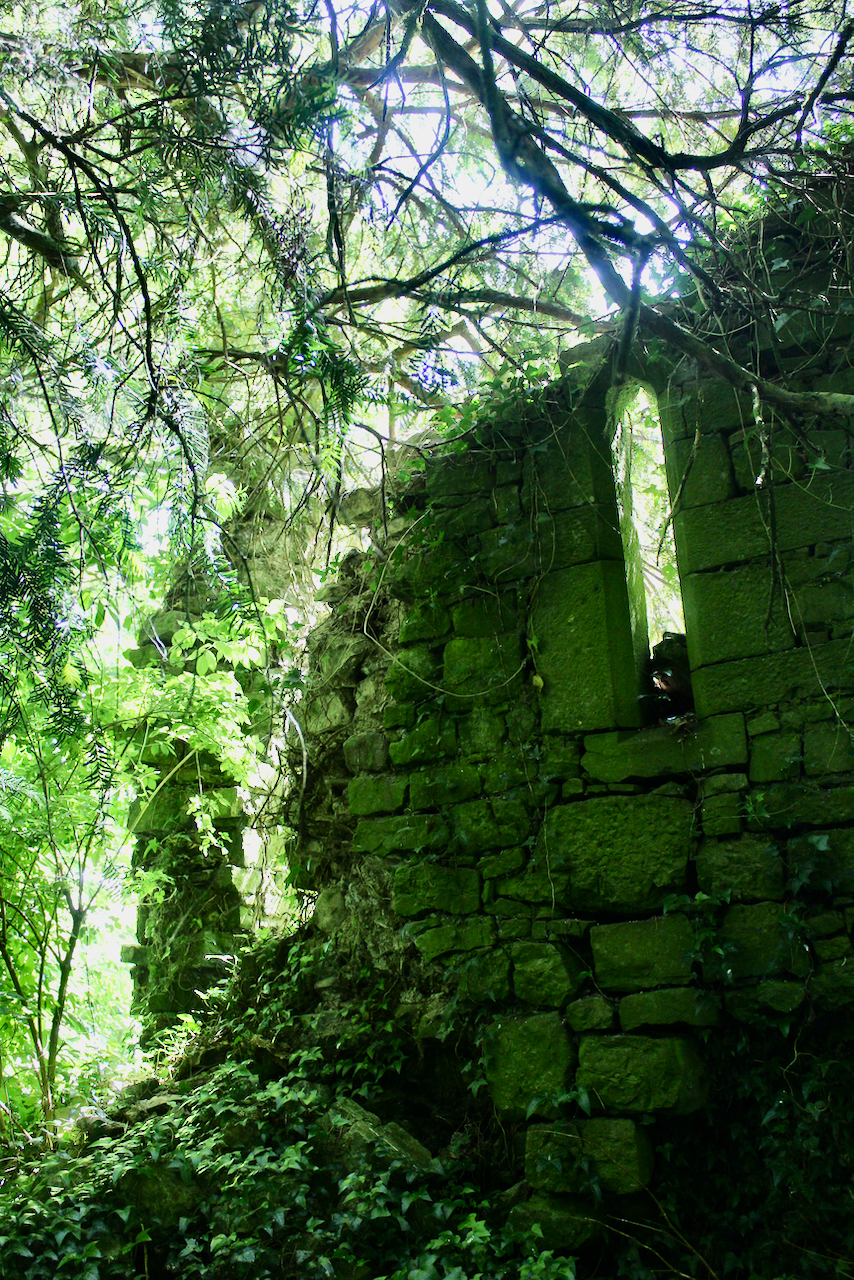
An old illustrated manuscript about the Brownes of Riverstown was presented by Mrs Trippe of Tangiers. The Browne family, Denis told us, mostly went to South Africa. Photograph © Jennifer Winder-Baggot, www.irishhistorichouses.com
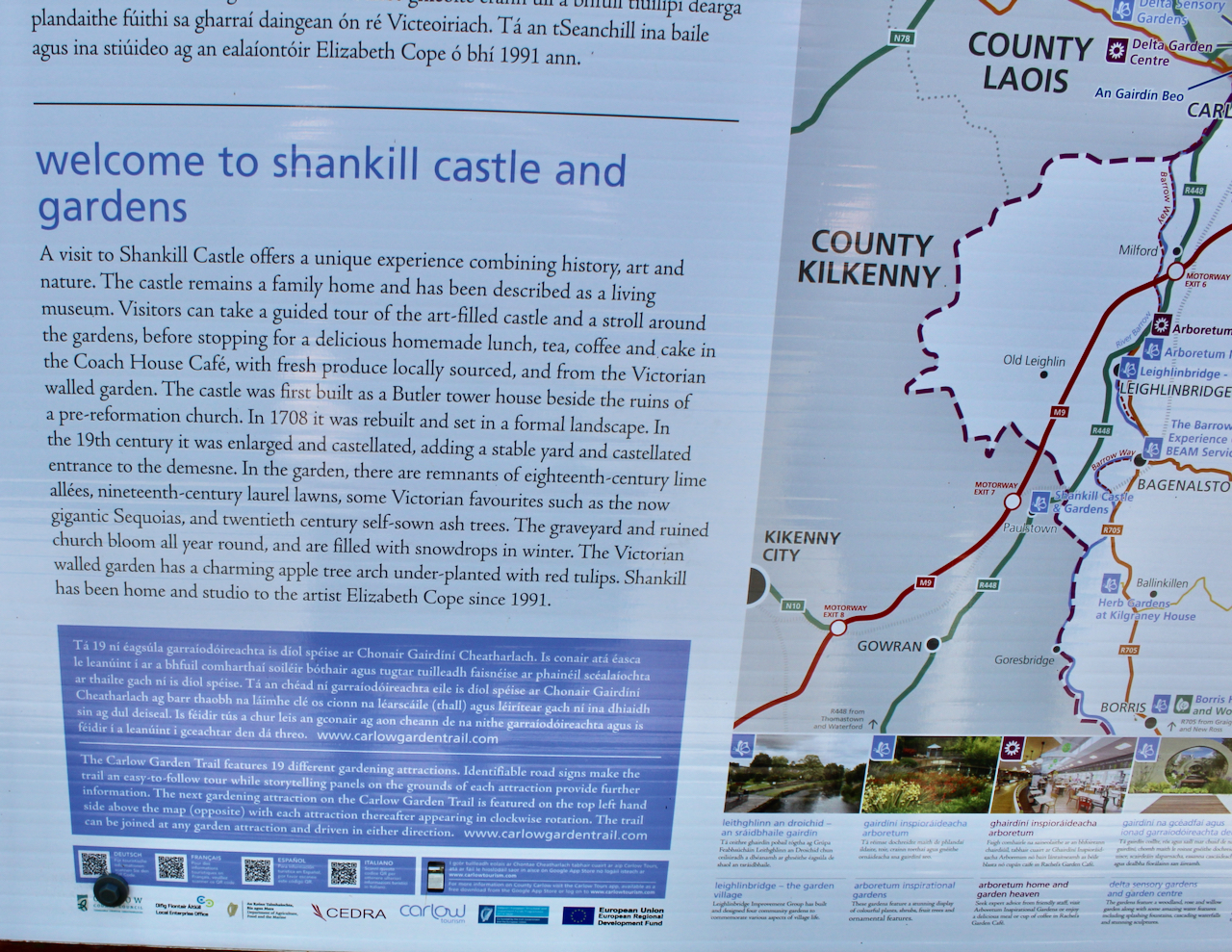
Beautiful carved doorframes, and a splendid Waterford crystal chandelier in the Green Drawing Room. Photograph © Jennifer Winder-Baggot, www.irishhistorichouses.com
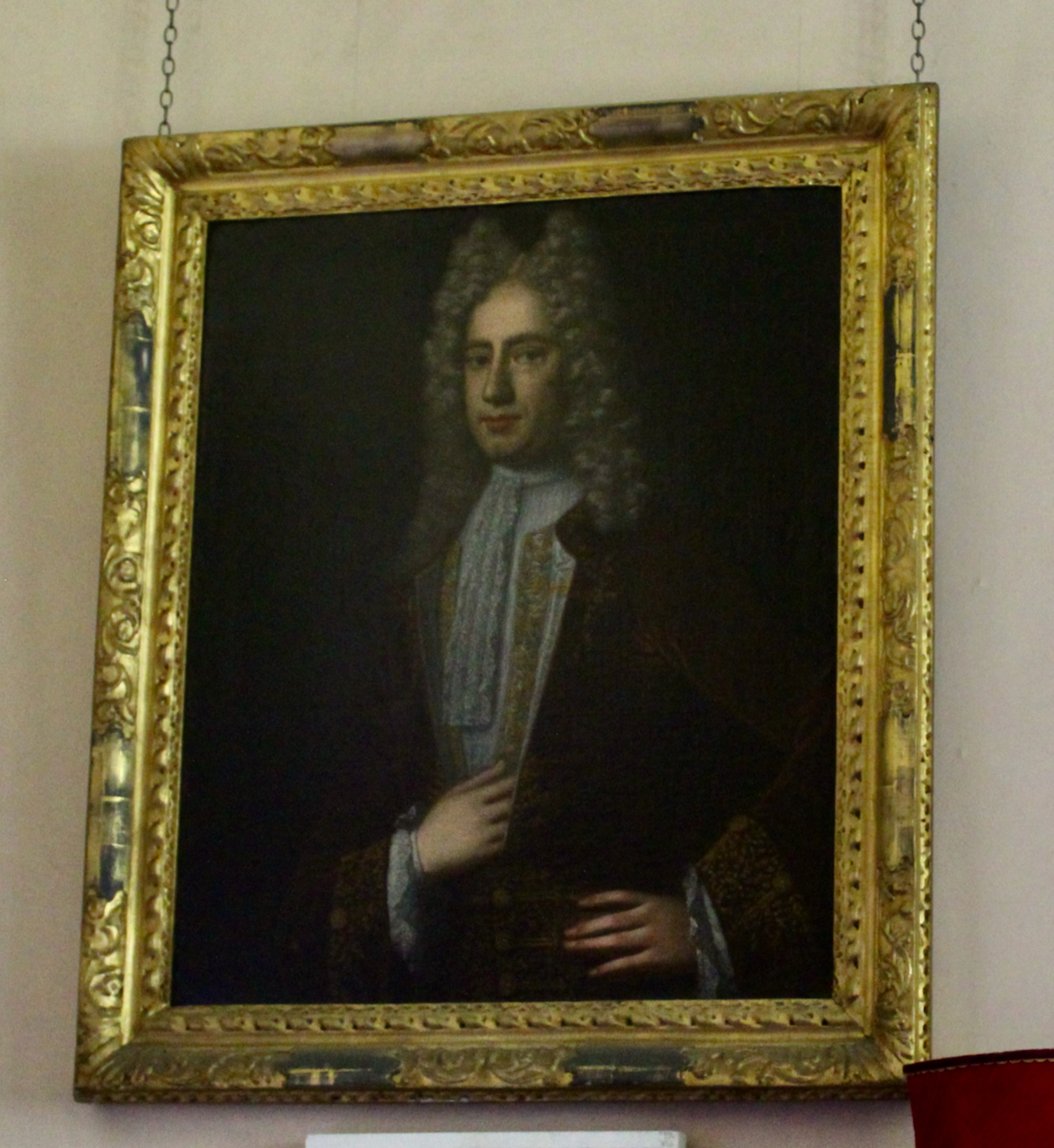
The two drawing rooms do indeed have splendid over mantel and overdoors. The drawing room has been hung with green silk wall covering. The Dooleys have shown fine taste for the decoration and maintenance of the rooms and I suspect John Dooley knew what he was doing when he purchased and thus saved the house.

Riverstown, 2022. Photograph © Jennifer Winder-Baggot, www.irishhistorichouses.com
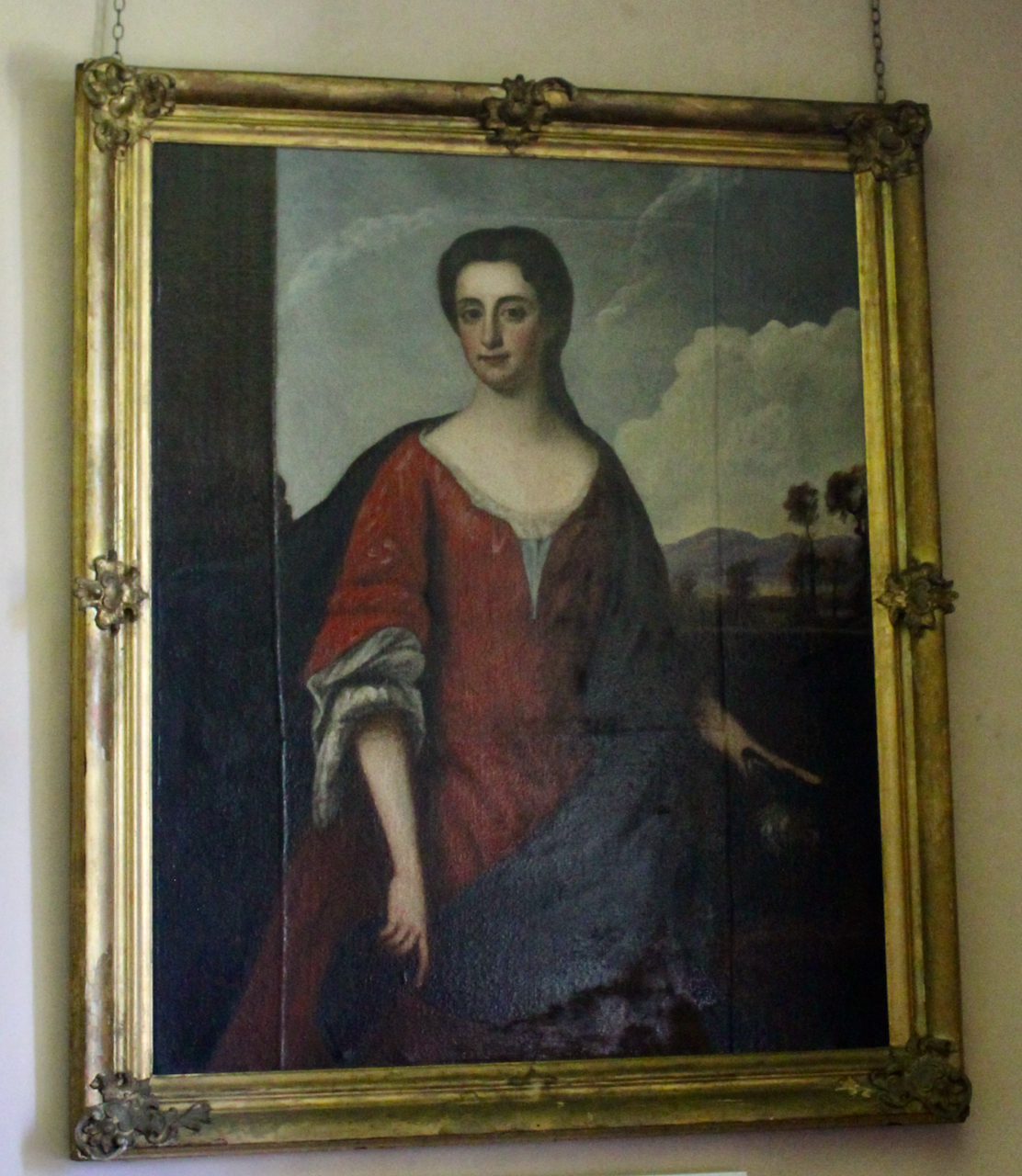
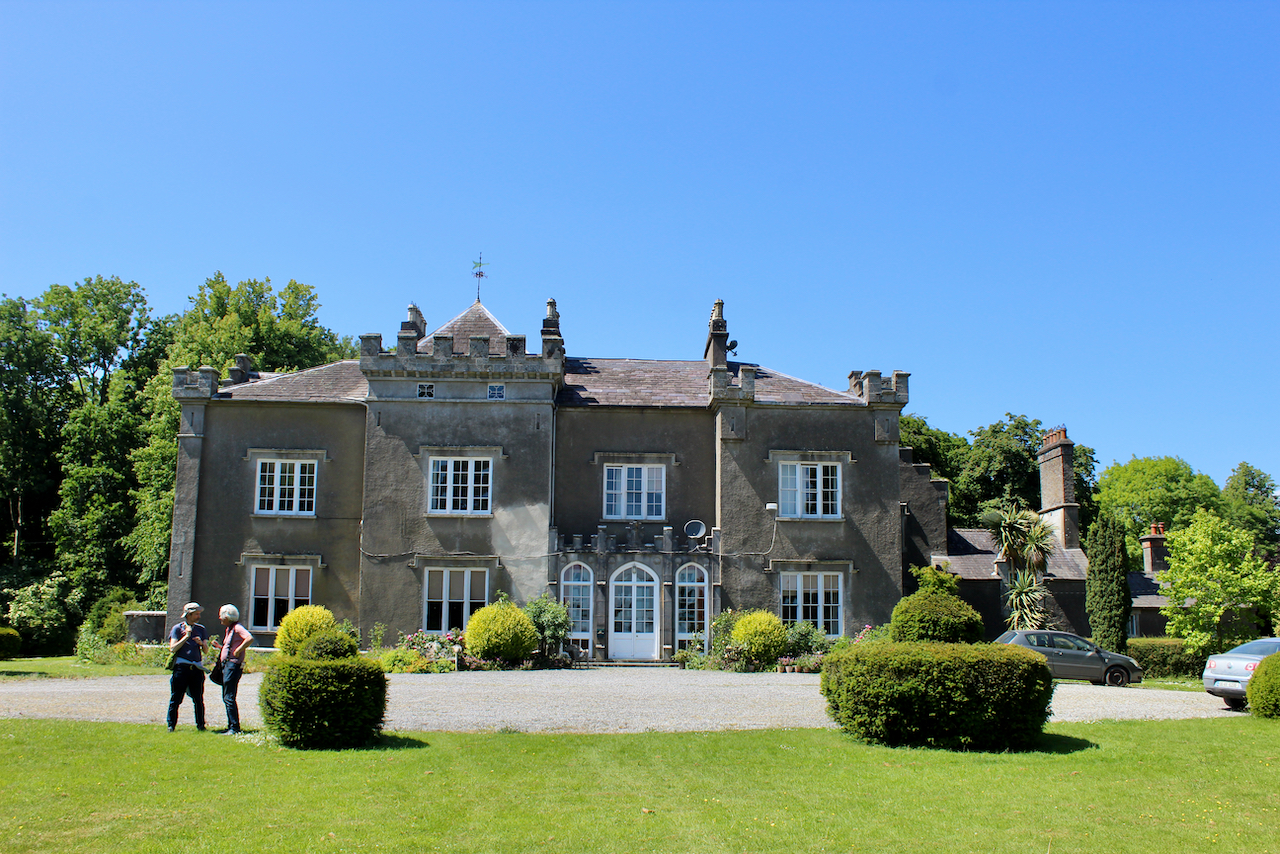
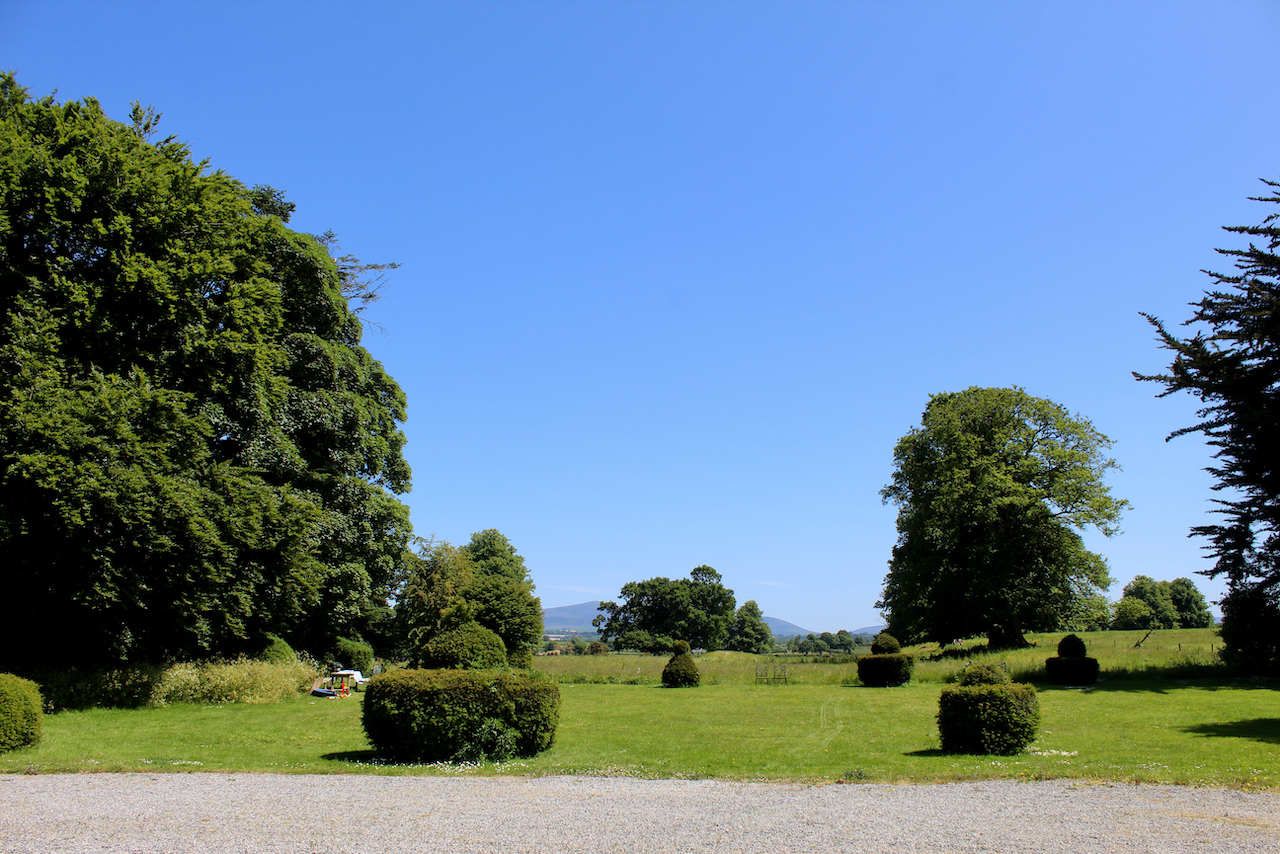
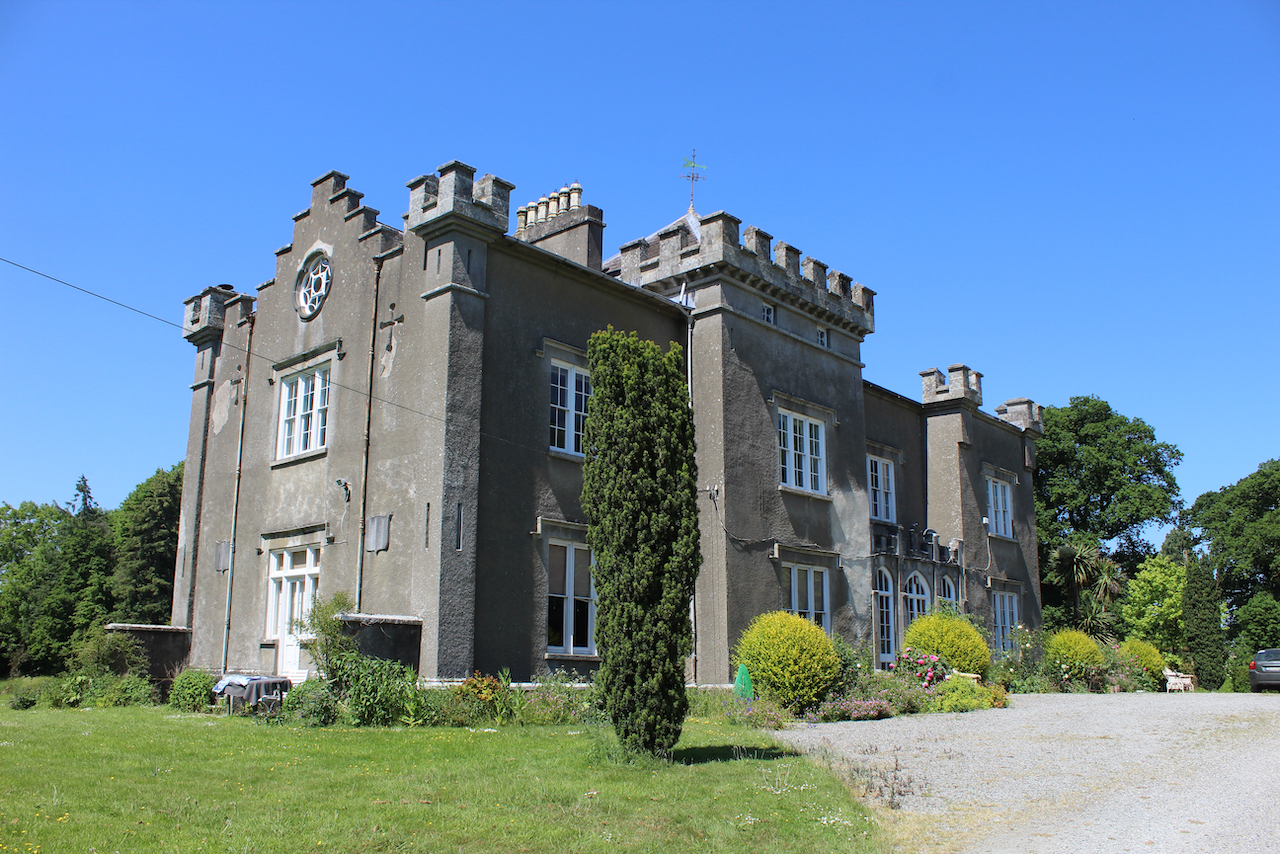
A fine wooden staircase brings us upstairs to a spacious lobby containing a Ladies’ conversation chair. Keohane suggests the stair may have originally been open to the front hall, but is now hidden by a screen wall. He writes that this arrangement probably dates from c. 1784, when Phineas Bagnell was granted a long lease of the house.

Riverstown, 2022. Photograph © Jennifer Winder-Baggot, www.irishhistorichouses.com
A bedroom upstairs has canted windows. Photograph © Jennifer Winder-Baggot, www.irishhistorichouses.com
Denis told us that the four-poster bed came from Lissadell, so perhaps W.B. Yeats slept in it! Photograph © Jennifer Winder-Baggot, www.irishhistorichouses.com
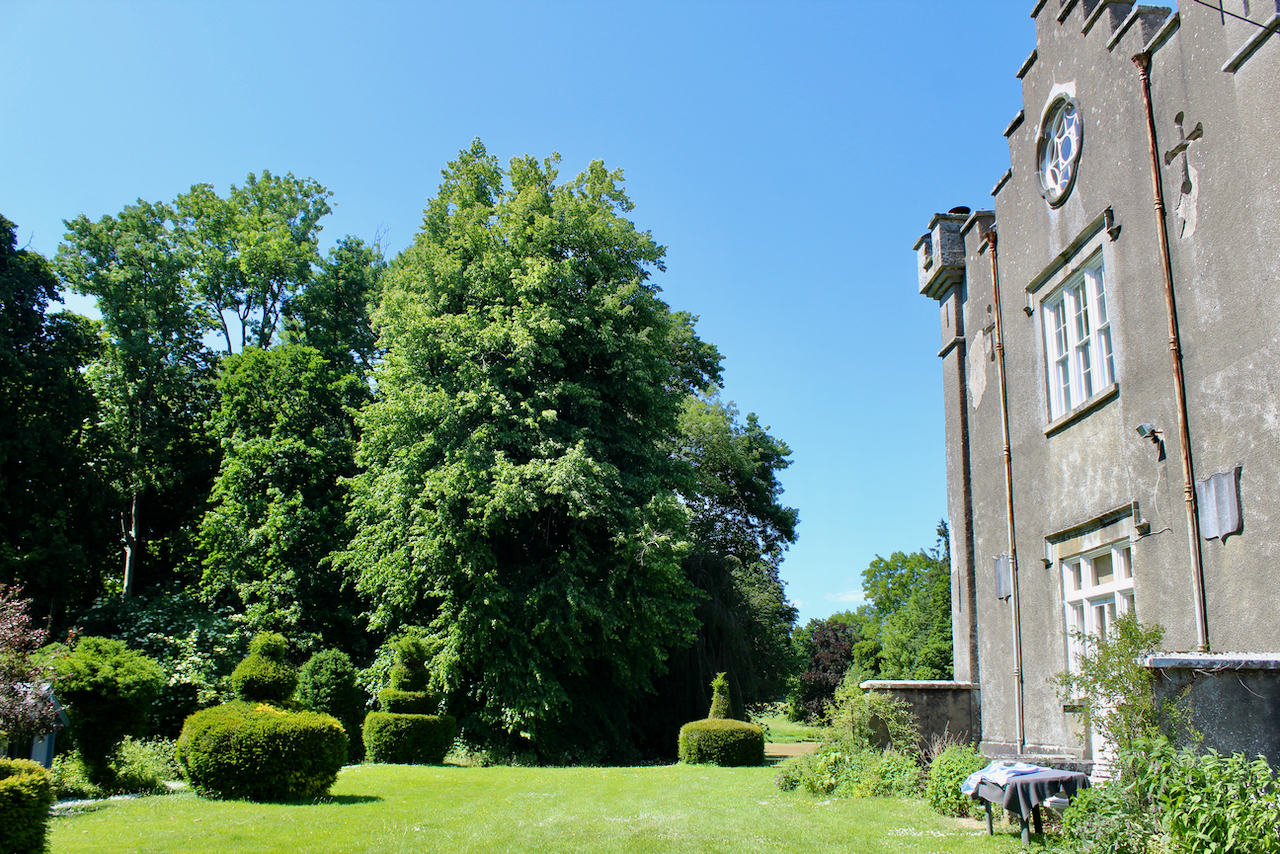
Riverstown, 2022. Photograph © Jennifer Winder-Baggot, www.irishhistorichouses.com
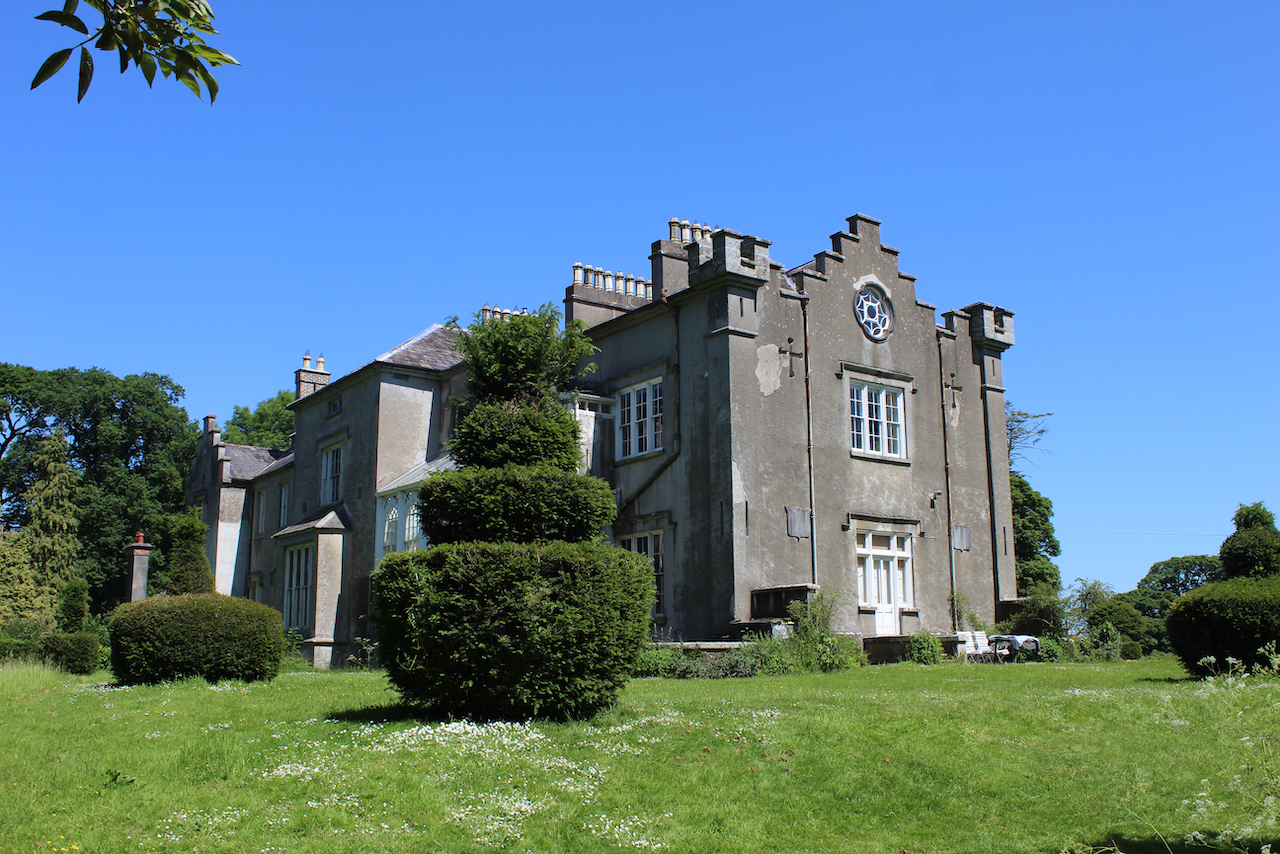
The owners’ bedroom has an extraordinary carved marble mantel. It was probably originally in the room with the Lafranchini stuccowork. It has great scrolled jambs garlanded with flowers and tufted with acanthus, and a comic mask in the centre of the frieze which possibly depicts Bishop Browne, Frank Keohane tells us.

The Dooleys have a garden centre, which is situated behind the house. They maintain the gardens with its rolling lawns beautifully. The Glanmire river passes by the bottom of the garden.

An old bridge at the end of the property passes over the Glanmire River. Photograph © Jennifer Winder-Baggot, www.irishhistorichouses.com
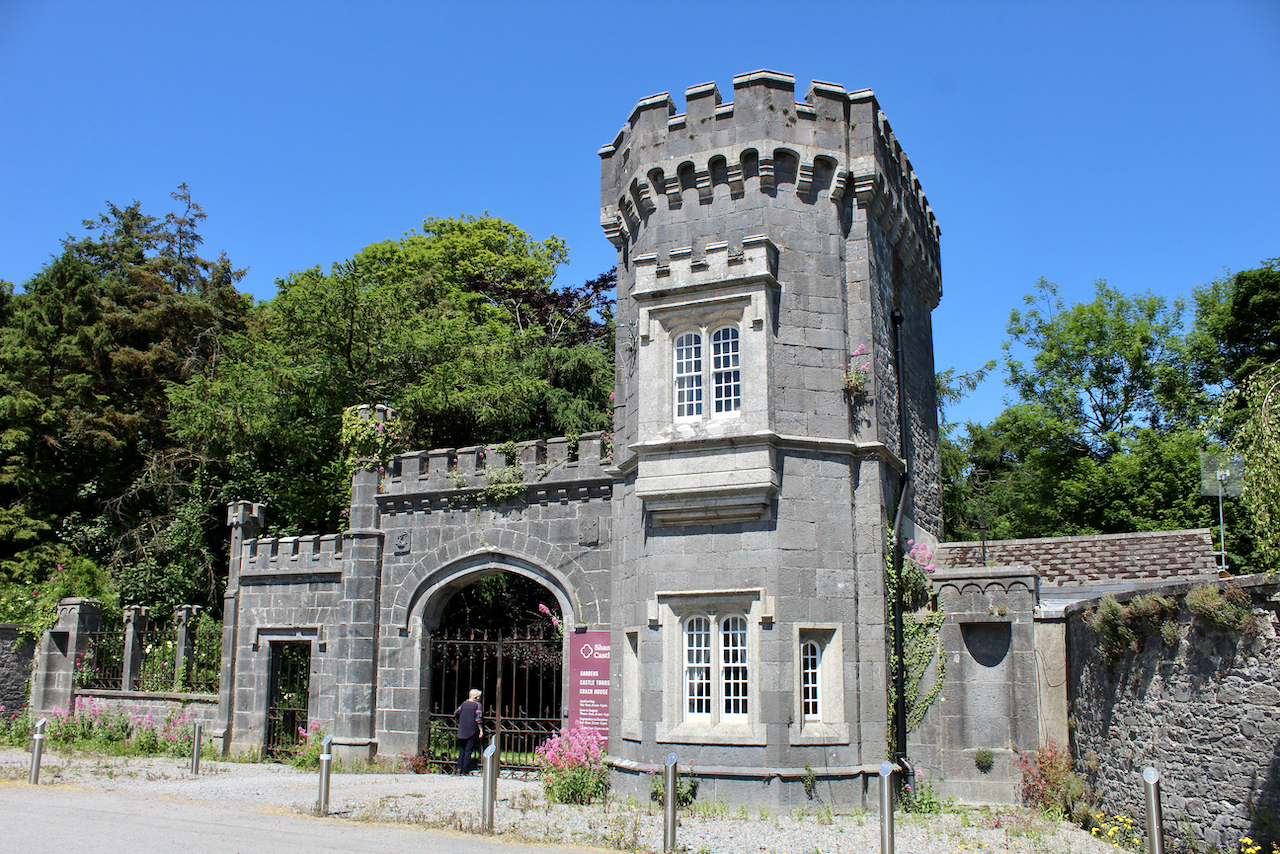
[1] https://repository.dri.ie/catalog
[2] p. 556, Keohane, Frank. Buildings of Ireland: Cork City and County. Yale University Press, New Haven and London, 2020.

[3] Bence-Jones, Mark A Guide to Irish Country Houses. (originally published as Burke’s Guide to Country Houses volume 1 Ireland by Burke’s Peerage Ltd. 1978); Revised edition 1988 Constable and Company Ltd, London.

[4] Curran, C.P. Riverstown House Glanmire, County Cork and the Francini. A leaflet given to us by Denis Dooley.

Text © Jennifer Winder-Baggot, www.irishhistorichouses.com