orange: “whole house rental” i.e. those properties that are only for large group accommodations or weddings, e.g. 10 or more people.
green: gardens to visit
grey: ruins
Today I will continue dividing my webpages per county of places to visit and places to stay.
Places to visit in County Antrim, Northern Ireland
1.Antrim Castle and Clotworthy House, County Antrim
2. Belfast Castle estate , County Antrim
3. Carrickfergus Castle, County Antrim
4. Dunluce Castle (ruin), County Antrim
5. Galgorm Castle, County Antrim – now part of a golf club.
6. Glenarm Castle, County Antrim – private, can book a tour
7. Malone House, Belfast, County Antrim– wedding and conference venue
8. Wilmont House (park only), Sir Thomas and Lady Dixon Rose Gardens.
donation
Help me to pay the entrance fee to one of the houses on this website. This site is created purely out of love for the subject and I receive no payment so any donation is appreciated!
€15.00
Places to visit. Count Antrim:
1. Antrim Castle gardens and Clotworthy House, County Antrim – estate and gardens open to the public, the Castle was destroyed by fire. The stable block, built in the 1840s and now known as Clotworthy House, is used as an arts centre.
Antrim Castle (between ca. 1865-1914), County Antrim, photograph by Robert French, Lawrence Photographic Collection, National Library of Ireland.Unfortunately the castle no longer exists.
The castle was built originally in 1613 by the English settler Hugh Clotworthy, and enlarged 1662 by his son John Clotworthy (1614-1665) 1st Viscount Massereene. The castle was rebuilt 1813 as a solid three storey Georgian-Gothic castellated mansion, designed by John Bowden, of Dublin.
John Clotworthy (d. 1665) 1st Viscount of Massereene, courtesy of Clotworthy House.
“Antrim Castle Gardens are an absolute historical gem. You will find nothing like these 400 year old gardens anywhere else in Northern Ireland. A £6m restoration project, which received generous support from Heritage Lottery Fund, has now preserved this historic site for generations to come.“
Antrim Castle, County Antrim courtesy of Discover Northern Ireland.
“Walk into the past as you stroll around this magnificent setting, visiting beautiful features such as the Large Parterre, Her Ladyship’s Pleasure Garden and Yew Tree Pond.
“Within the heart of the Gardens is a unique visitor experience, the refurbished Clotworthy House. Visit the Garden Heritage Exhibition where you can read about the history of the Gardens and the story of the Massereene family. It provides a fantastic opportunity to come and learn about garden history how the lives of the key family members intertwine with the development of Antrim town and the surrounding areas.
“The light filled Oriel Gallery plays host to a range of stunning exhibitions throughout the year.
“Be sure to visit and sample the many culinary delights in the Garden Coffee Shop with its delicious treat menu which has something to suit everyone. Your visit won’t be complete without a visit to the Visitor Shop where there is a unique range of goods with a distinct garden focus. With Christmas just around the corner, the shop offers some interesting and quaint gift ideas so why not drop in and pick something up for a friend, a loved one or even to spoil yourself.
“With a year round programme of events and activities including talks, walks, interactive workshops, performances and exhibitions, the Gardens are just waiting to be explored.“
Antrim Castle gardens, County Antrim courtesy of Discover Northern Ireland.
“Antrim Castle Gardens is a 17th century Anglo Dutch water garden, one of only three in the British Isles. In a beautiful riverside location close to Antrim town centre they are perfect for a stroll, a coffee or the opportunity to experience a variety of exhibitions, courses and classes.
“Developed around Antrim Castle, built by Sir Hugh Clotworthy and his son, Sir John Clotworthy, between 1610 and 1662, they are a complex living museum containing over four centuries of culture and heritage that tell the stories of the people who created, lived and worked here.“
Antrim Castle entrance (between ca. 1865-1914), County Antrim, photograph by Robert French, Lawrence Photographic Collection, National Library of Ireland.
The 1st Viscount Massereene married Margaret Jones, daughter of Roger Jones, 1st Viscount Ranelagh. Their daughter Margaret married and her husband gained the title through her, to become John Skeffington, 2nd Viscount Massereene. The 4th Viscount, whose first name was Clotworthy, which became a family name, married Lady Catherine Chichester, eldest daughter of Arthur, 4th Earl of Donegall. Their son Clotworthy became 1st Earl of Massereene.
The 4th Earl died in 1816, and the earldom expired; but the viscountcy of Massereene and barony of Loughneagh devolved upon his only daughter and sole heiress, Harriet Skeffington, 9th Viscountess of Massereene (1789-1843) [2]. She married, in 1810, Thomas Henry Foster, 2nd Viscount Ferrard. It was for Harriet and Thomas that the castle was rebuilt in 1813. Algernon William John Clotworthy Whyte-Melville Skeffington, 12th Viscount Massereene and Ferrard, DSO, was the last of the Skeffingtons to live at Antrim Castle. Lord and Lady Massereene and their family were hosting a grand ball in Antrim Castle when it was burnt by an IRA gang on the 28th October, 1922. Following the fire, Lord Massereene went to live in the nearby dower house, Skeffington Lodge (which subsequently became the Deer Park Hotel, but is no longer a hotel). Further losses of family treasures – this time by sale, not by fire – now followed.
After the Second World War, Skeffington Lodge was abandoned; the Antrim Castle stable block was converted for use as a family residence, and was re-named Clotworthy House. Clotworthy was acquired by Antrim Borough Council, and was converted for use as an Arts Centre in 1992.
Timothy William Ferrers tells us that a fine stone bridge, the Deer Park Bridge, spans the river at a shallow point and formed a link between the demesne and the rest of the estate. He continues:
“The Anglo-Norman motte adjacent to the house was made into a garden feature, with a yew-lined spiral walk leading to the top, from which views of the grounds, the town of Antrim and the river could (and can still) be enjoyed.
“The castle and the motte were enclosed within a bawn and protected by artillery bastions, which were utilized for gardens from the 18th century.
“The formal canals, linked by a small cascade and lined with clipped lime and hornbeam hedges, are the main attraction. The main gate lodge from the town, the Barbican Gate, was possibly built in 1818 to the designs of John Bowden and has been separated from the site by the intrusion of the road. An underpass now connects the lodge entrance to the grounds.” (see [2])
Also Featured in Irish Country Houses, Portraits and Painters. David Hicks. The Collins Press, Cork, 2014.
2. Belfast Castle estate , County Antrim
Belfast Castle and Gardens, photograph by Aidan Monaghan 2015 for Tourism Ireland [3]
“Belfast Castle estate is situated on the lower slopes of Cave Hill Country Park in north Belfast. It contains both parkland and mature mixed woodland and offers superb views of the city from a variety of vantage points. The estate is home to many different species of wildlife, including long-eared owls, sparrowhawks and Belfast’s rarest plant, the town hall clock.
“More information about the estate is available from Cave Hill Visitor Centre, located in Belfast Castle. You can call the centre directly on 028 9077 6925. Park features include Cave Hill Adventurous Playground, Cave Hill Visitor Centre, landscaped gardens, a Millennium herb garden, ecotrails and orienteering routes. We also offer refreshments (in Belfast Castle), scenic views, full car parking facilities and a wide variety of wildlife.“
Belfast Castle ca. 1900-1939, Eason photographic collection National Library of Ireland, flickr constant commons.
The Belfast Castle that we see today was not the original Belfast Castle.
Mark Bence-Jones writes in his A Guide to Irish Country Houses that the original Belfast Castle was a tall, square semi-fortified house with many gables, built at the beginning of C17 by the Lord Deputy Sir Arthur Chichester, uncle of the 1st Earl of Donegall. It stood surrounded by formal gardens and orchards going down to a branch of the River Lagan, and was the seat of the Donegalls until 1708 when it was destroyed by a fire “caused through the carelessness of a female servant,” three of six daughters of 3rd Earl perishing in the blaze. The castle was not rebuilt and the ruin was subsequently demolished.
Arthur Chichester (1739-1799) 1st Marquess of Donegall by Thomas Gainsborough, courtesy of Ulster Museum.
The Belfast Castle that we see today was built in the 1860s for George Hamilton Chichester (1797-1883) 3rd Marquess of Donegall. The architects of the new Belfast Castle were Sir Charles Lanyon and William Henry Lynn.
Harriet Anne née Butler (1799-1860) Countess of Belfast, wife of George Hamilton Chichester 3rd Marquess of Donegal and daughter of Richard Butler, 1st Earl of Glengall.Charles Lanyon (1813-1889) courtesy of Queen’s University Belfast.
Mark Bence-Jones writes:
“…stylistically, it would seem to be very much Lynn’s work; but it may also perhaps have been influenced by a design by William Burn, having a plan almost exactly similar to those of several of Burns’s Scottish-Baronial castles. Tall square tower, of six storeys, in the manner of Balmoral. Projecting pillared porch in “Jacobethan” style, with strapwork on columns. On the garden front, a fantastic snaking Elizabethan staircase of stone leading down to the terrace from the piano nobile was added 1894. Entrance hall in base of tower; larger hall opening at one end into staircase well with massive oak stair; arcaded first floor gallery. Now well maintained by the City of Belfast as a setting for functions.” [4]
The Castle passed from the 3rd Marquess of Donegall to his daughter Harriet Chichester and her husband Anthony Ashley-Cooper (1831-1886), who became the 8th Earl of Shaftsbury. Their son the 9th Earl of Shaftsbury served as Lord Mayor in 1907 and Chancellor of Queen’s University the following year. The family presented the castle and estate to the City of Belfast in 1934.
Timothy William Ferres tells us that from the end of the 2nd World War until the 1970s the castle became a popular venue for wedding receptions, dances and afternoon teas. In 1978, Belfast City Council instituted a major refurbishment programme that was to continue over a period of ten years at a cost of over two million pounds.
The architect this time was the Hewitt and Haslam Partnership. The building was officially re-opened to the public on 11 November 1988. [see 2]
Carrickfergus Castle, County Antrim, 2014 photography by Arthur Ward for Tourism Ireland, Ireland’s Content Pool. [3]
The website tells us
“Carrickfergus Castle is a Norman castle in Northern Ireland, situated in the town of Carrickfergus in County Antrim, on the northern shore of Belfast Lough.
“Besieged in turn by the Scots, Irish, English and French, the castle played an important military role until 1928 and remains one of the best preserved medieval structures in Ireland.
“For more than 800 years, Carrickfergus Castle has been an imposing monument on the Northern Ireland landscape whether approached by land, sea or air. The castle now houses historical displays as well as cannons from the 17th to the 19th centuries.
“A visit will give you the opportunity to see how the Great Hall at the top of the Great Tower has been transformed by the new roof which has greatly improved the visitor’s experience.“
Carrickfergus Castle, County Antrim, 2014 photography by Arthur Ward for Tourism Ireland, Ireland’s Content Pool. [3]
The Department for Communities website has more information about Carrickfergus Castle. It tells us:
“Begun by John de Courcy soon after his 1177 invasion of Ulster. Besieged in turn by the Scots, Irish, English and French, the castle played an important military role until 1928 and remains one of the best preserved medieval structures in Ireland.
“Its long history includes sieges by King John in 1210 and Edward Bruce in 1315, its capture by Schomberg for William III in 1689, and capture by the French under Thurot in 1760. The castle was used by the army until 1928, and in the 1939 to 1945 war it housed air-raid shelters.“
John de Courcy (1177-1204) came to Ireland in the time of King Henry II, and Henry gave him land in Ulster. De Courcy fought the inhabitants of Downpatrick for his land and set up a castle there for himself. King Henry II was so pleased with him he created him Earl of Ulster and Lord of Connacht and in 1185 appointed him Lord Lieutenant of Ireland. [see Patrick Weston Joyce, The Wonders of Ireland, 1911, on https://www.libraryireland.com/Wonders/Sir-John-De-Courcy-1.php ]
Carrickfergus Castle, County Antrim, photograph by Robert French, (between ca. 1865-1914), Lawrence Photograph Collection, National Library of Ireland.
Dunluce Castle by Matthew Woodhouse 2015 for Tourism Ireland [see 3]
The website tells us:
“With evidence of settlement from the first millennium, the present castle ruins date mainly from the 16th and 17th centuries. It was inhabited by both the feuding MacQuillan and MacDonnell clans. Historical and archaeological exhibits are on display for public viewing.
Opening Hours: Please check before visiting as public access may be restricted.“
The website tells us: “Galgorm Castle is an historic estate dating back to Jacobean times but has evolved into one of Northern Ireland’s most vibrant destinations with diverse business, golf and recreational activities housed there. The focal point is the 17th century Jacobean castle dating back to 1607, which has been restored and along with the immaculate walled gardens is part of the Ivory Pavilion wedding and events company. The castle is also a historical reminder of the important role the Galgorm Estate played as part of Northern Ireland’s history. Away from the championship golf course there is plenty of opportunity to try the game for the first time at the Fun Golf Area with a six-hole short course and Himalayas Putting Green. The Galgorm Fairy Trail is another family option which runs out of Arthur’s Cottage at the Fun Golf Area.And if looking for great food and drink, a meal at the Castle Kitchen + Bar at the Galgorm Castle clubhouse is a must. Members and non-members are welcome.”
“Visitors can enjoy enchanted walks through the Walled Garden and Castle Trail, indulge in an amazing lunch in the Tea Room, purchase some local produce or official merchandise, or browse through a wide range of ladies & gents fashions and accessories and a selection of beautiful gifts, souvenirs and crafts in the Byre Shop and Shambles Workshop – with many ranges exclusive to Glenarm Castle.“
“Glenarm Castle is the ancestral home of the McDonnell family, Earls of Antrim. The castle is first and foremost the private family home of Viscount and Viscountess Dunluce and their family but they are delighted to welcome visitors to Glenarm Castle for guided tours on selected dates throughout the year.
“Delve deep into the history of Glenarm Castle brought to life by the family butler and house staff within the walls of the drawing room, the dining room, the ‘Blue Room’ and the Castle’s striking hall.
“Finish the day with the glorious sight of the historic Walled Garden, which dates back to the 17th century.“
Dates are limited and booking in advance is required.
The castle was built around 1603 by Randal MacDonnell [1610-1682], afterwards 1st Earl of Antrim, as a hunting lodge or secondary residence to Dunluce Castle, and became the principal seat of the family after Dunluce Castle was abandoned. The mansion house was rebuilt ca. 1750 as a 3-storey double gable-ended block, joined by curving colonnades to two storey pavilions with high roofs and cupolas. This would have been during the life of the 5th Earl of Antrim, Alexander MacDonnell (1713-1775).
“Malone House, located in Barnett Demesne in south Belfast, is an late Georgian mansion which dates from the 1820s.
Today, it is a popular venue for conferences, functions and weddings and is licensed to hold marriage and civil partnership ceremonies, subject to the availability of a Registrar.“
It offers a wide range of facilities, including: • Function rooms • Conference rooms • Malone Room for coffee, lunches and afternoon teas • Higgin Gallery
Malone House 2014, unknown photographer for Tourism Ireland [see 3]
The website tells us:
“Located on the site of a 17th century fort, Malone House was built in the 1820s for William Wallace Legge, a rich Belfast merchant who had inherited the surrounding land. A keen landscaper, he designed and planted most of the estate’s grounds, which remain relatively unchanged today.
“When Legge died, ownership of Malone House passed to the Harberton family, who lived on the premises from 1868 to 1920. The building’s last owner was William Barnett, who presented Malone House to the city of Belfast in 1946.
“Following its presentation to the city, Malone House was leased to the National Trust in the early 1970s. After it was nearly destroyed by a fire in 1976, the building was repaired by the council and reopened in June 1983.
“Since then, it has become a major venue for weddings, conferences, social functions and other events, while the surrounding grounds are popular with walkers and cyclists.”
8. Wilmont House (park only), Sir Thomas and Lady Dixon Rose Gardens.
Wilmont House, Sir Thomas and Lady Dixon Park, 2015, by Brian Morrison for Tourism Ireland, see [3]
“The beautiful Sir Thomas and Lady Dixon Park comprises rolling meadows, woodland, riverside fields and formal gardens. The City of Belfast International Rose Garden has made the park world famous, and contains over 20,000 blooms in the summer, divided into trial and display beds, an historical section, and a heritage garden that displays the best of the roses from local breeders. Each season thousands of visitors enjoy the rose gardens and associated events during Rose Week.
“Sir Thomas and Lady Dixon Park also contains International Camellia Trials, a walled garden, a Japanese-style garden with water features for quiet contemplation, a very popular childrens’ playground, an orienteering course and many walks.”
Anna Stewart (née Garner), of Lisburn Co. Down, Second Wife of William Stewart of Wilmont, by Nathaniel Hone, courtesy of Shepphards auctions.
Mark Bence-Jones describes Wilmont House: p. 285. “(Reade/LGI1958) A plain two storey Victorian house, built 1859. Three bay front, with balustraded porch; lower wing, ending with wing as high as main block. Adjoining front with central curved bown and one bay on either side. Camber-headed windows in upper storey of main block. Eaved roof on bracket cornice.”
Timothy William Ferres tells us:
“The original house, which stood on the site of the present-day barbecue area, dated back to 1740 and was replaced by the present red-bricked house in 1859.
“This house was designed by Thomas Jackson (1807-90), one of Belfast`s most notable Victorian architects.
“Sir Thomas and Lady Dixon purchased Wilmont demesne in 1919.
“Sir Thomas died at Harrowgate in 1950. Lady Dixon, who was appointed DBE after the 1st World War in recognition of her service to HM Forces, died in 1964. A year before her death, in 1963, Wilmont demesne was officially handed over to Belfast Corporation. The house, according to her wishes, was shortly afterwards opened as a home for the elderly; while the grounds, at her behest, were opened to the public.
“The present park, named after its benefactors, consists of 134 acres and has been the venue for the City of Belfast International Rose Trials since 1964.” [5]
[1] p. 6. Bence-Jones, Mark. A Guide to Irish Country Houses (originally published as Burke’s Guide to Country Houses volume 1 Ireland by Burke’s Peerage Ltd. 1978); Revised edition 1988 Constable and Company Ltd, London.
Mark Bence-Jones writes of Antrim Castle in his A Guide to Irish Country Houses
“(Skeffington, Massereene and Ferrard, V/PB) A castle by the side of the Sixmilewater, just above where it flows into Lough Neagh, built originally 1613 by the important English settler, Sir Hugh Clotworthy, and enlarged 1662 by his son, 1st Viscount Massereene [John Clotworthy (1614-1665)]. The castle was rebuilt 1813 as a solid three storey Georgian-Gothic castellated mansion, designed by John Bowden, of Dublin, faced in Roman cement of a pleasant orange colour; the original Carolean doorway of the castle, a tremendous affair of Ionic pilasters, heraldry, festoons and a head of Charles I, being re-erected as the central feature of the entrance front, below a battlemented pediment. Apart from this, and tower-like projections at the corners, with slender round angle turrets and shallow pyramidal roofs, the elevations were plain; the entrance front being of four bays between the projections, and the long adjoining front of 11 bays. Mullioned oriels and a tall octagonal turret of ashlar were added to the long front in 1887, when the castle was further enlarged. Remarkable C17 formal garden, unique in Ulster, its only surviving counterpart being at Killruddery, Co Wicklow. Long canal, bordered with tall hedges, and other canal at right angles to it, making a “T” shape; old trees, dark masses of yew and walls of rose-coloured brick. Mount, with spiral path, originally the motte of a Norman castle. Imposing Jacobean revival outbuildings of course rubble basalt with sandstone dressings; built ca. 1840. Entrance gateway to the demesne with octagonal turrets. Antrim Castle was burnt 1922.”
[4] p. 36, Bence-Jones, Mark. A Guide to Irish Country Houses (originally published as Burke’s Guide to Country Houses volume 1 Ireland by Burke’s Peerage Ltd. 1978); Revised edition 1988, Constable and Company Ltd, London.
Today I’m continuing to split county entries into two pages: “Places to visit” and “Accommodation.”
On the map above:
blue: places to visit that are not section 482
purple: section 482 properties
red: accommodation
yellow: less expensive accommodation for two
orange: “whole house rental” i.e. those properties that are only for large group accommodations or weddings, e.g. 10 or more people.
green: gardens to visit
grey: ruins
donation
Help me to pay the entrance fee to one of the houses on this website. This site is created purely out of love for the subject and I receive no payment so any donation is appreciated!
€15.00
Clare:
1. Barntick House, Clarecastle County Clare – section 482
2. Bunratty Castle, County Clare – maintained by Shannon Heritage
3. Craggaunowen Castle, Kilmurray, Sixmilebridge, County Clare – maintained by Shannon Heritage
4. Dunguaire Castle, Kinvara, County Clare – maintained by Shannon Heritage
5. Knappogue or Knoppogue Castle, County Clare – maintained by Shannon Heritage
6. Mount Ievers Court, Sixmilebridge, County Clare – private house, check website to visit
7. Newtown Castle, Newtown, Ballyvaughan, County Clare– section 482
8. O’Dea’s, or Dysert Castle, County Clare
9. Vandeleur Gardens, formerly Kilrush House, County Clare
Bunratty Castle, County Clare, photograph by Chris Hill 2014, for Tourism Ireland, Ireland’s Content Pool. [1]
Mark Bence-Jones writes in his A Guide to Irish Country Houses:
p. 49. “(O’Brien, Inchiquin, B/PB; and Thomond, E/DEP; Studdert/IFR; Russell/IFR; Vereker, Gort, VPB) One of the finest 15C castles in Ireland, standing by the side of a small tidal creek of the Shanon estuary; built ca 1425, perhaps by one of the McNamaras; then held by the O’Briens, who became Earls of Thomond, until 6th Earl [Barnabas O’Brien (d. 1657)] surrendered it to the Cromwellian forces during the Civil War. A tall, oblong building, it has a square tower at each corner; these are linked, on the north and south sides, by a broad arch just below the topmost storey. The entrance door leads into a large vaulted hall, or guard chamber, above which is the Great Hall, the banqueting hall and audience chamber of the Earls of Thomond, with its lofty timber roof. Whereas the body of the castle is only three storeys – there being another vaulted chamber below the guard chamber – the towers contain many storeys of small rooms, reached up newel stairs and by passages in the thickness of the walls. One of these rooms, opening off the Great Hall, is the chapel, which still has its original plasterwork ceiling of ca 1619, richly adorned with a pattern of vines and grapes. There are also fragment of early C17 plasterwork in some of the window recesses. After the departure of the O’Briens, a C17 brick house was built between the two north towers; Thomas Studdert [1696-1786], who bought Bunratty early in C18, took up residence here in 1720. Later, the Studderts built themselves “a spacious and handsome modern residence in the demesne: and the castle became a constabulary barracks, falling into disrepair so that, towards the end of C19, the ceiling of the Great Hall collapsed. Bunratty was eventually inherited by Lt-Com R.H. Russell, whose mother was a Studdert, and sold by him to 7th Viscount Gort [Standish Robert Gage Prendergast Vereker (1888-1975)] 1956. With the help of Mr Percy Le Clerc and Mr John Hunt, Lord Gort carried out a most sympathetic restoration of the castle, which included removing C17 house, re-roofing the Great Hall in oak and adding battlements to the towers. The restored castle contains Lord Gort’s splendid collection of medieval and C16 furniture, tapestries and works of art, and is open to the public; “medieval banquets” being held here as a tourist attraction. Since the death of Lord Gort, Bunratty and its contents have been held in trust for the Nation.” [2]
Bunratty Castle, County Clare, Photograph by Chris Hill 2014 for Tourism Ireland, Ireland’s Content Pool. (see [1])Bunratty Castle, County Clare, Photograph by Chris Hill 2014 for Tourism Ireland, Ireland’s Content Pool. (see [1])Bunratty Co Clare National Library of Ireland stereo pairs collection STP_1858. (Dublin City Library and Archives) [3]Bunratty Castle Co Clare National Library of Ireland Lawrence Collection taken between 1880 and 1914, L_CAB_00962 (Dublin City Library and Archives) [3]
3. Craggaunowen Castle, Kilmurray, Sixmilebridge, County Clare
Craggaunowen Pre-Historic Park, County Clare, photo by Stephen Power 2014 for Tourism Ireland, Ireland’s Content Pool. (see [1])
“Early medieval 500AD-1500: The most common form of house style during this period was the ringfort –a circular area of earth surrounded by a bank and ditch. In some cases, stone was used in the defensive enclosure and these are known as cashels. Over 45,000 examples still remain today. Also dating from this period were crannogs (from the Irish crann – tree) – an artificial island built in the shallow areas of lakes with the houses surrounded by a timber palisade or fence. These can be spotted in the landscape as small tree covered islands close to the lake shore – both the ringforts and crannogs most commonly contained circular houses. A reconstruction of a crannog dwelling can be found at Craggaunowen, Co. Clare
“This was also a time when Christianity was introduced to Ireland and whereas the early churches of the 6th and 7th centuries were of timber, evidence of stone churches appear from the late 8th century. These were simple rectangular buildings of about 5m long with a high steep pitched roof. The only doorway had a flat-topped lintelled opening. The early Irish monasteries of the 9th and 10th centuries, such as Clonmacnoise, had larger churches and monastic buildings also included the drystone beehive hut or clochan, as can be seen at Skellig Michael, and also the Round Tower, built between the 10th and 12th century, which consisted of a narrow tower up to 30m high tapering at the top with a conical roof.” [4]
The Craggaunowen website tells us: “Craggaunowen Castle - built by John MacSioda MacNamara in 1550 a descendant of Sioda MacNamara who built Knappogue Castle in 1467. After the collapse of the Gaelic Order, in the 17th century, the castle was left roofless and uninhabitable. The Tower House remained a ruin until it and the estate of Cullane House across the road, were inherited in 1821 by ”Honest” Tom Steele, a confederate of Daniel O’Connell, Steele had the castle rebuilt as a summer house in the 1820s. He used it and the turret on the hill opposite for recreation. His initials can be seen on one of the quoin-stones to the right outside. “The Liberator”. By the time of the First Ordnance Survey, in the 1840s, the castle was “in ruins”. After Steele in 1848 the lands were divided, Cullane going to one branch of his family, Craggaunowen to another, his niece Maria Studdert. Eventually the castle and grounds were acquired by the “Irish Land Commission”. Much of the land was given over to forestry and the castle itself was allowed to fall into disrepair. In the mid-19th century, the castle, herd’s house and 96 acres were reported in the possession of a Reverend William Ashworth, who held them from a Caswell (a family from County Clare just north of Limerick). In 1906, a mansion house here was owned by Count James Considine (from a family based at Derk, County Limerick). Craggaunowen Castle was restored by John Hunt in the 1960s – he added an extension to the ground floor, which for a while housed part of his collection of antiquities. The collection now resides in the Hunt Museum in the city of Limerick.” [5]
Mark Bence-Jones writes in A Guide to Irish Country Houses (1988):
p. 115. “(Martyn/LGI1912; Gogarty/IFR; Russell, Ampthill, B/PB) An old tower-house with a bawn and a smaller tower, on a creek of Galway Bay; which was for long roofless, though in other respects well maintained by the Martyn family, of Tulira, who owned it C18 and C19, and which was bought in the present century by Oliver St John Gogarty, the surgeon, writer and wit, to save it from threat of demolition. More recently, it was bought by the late Christabel, Lady Ampthill, and restored by her as her home; her architect, being Donal O’Neill Flanagan, who carried out a most successful and sympathetic restoration. The only addition to the castle was an unobtrusive two storey wing joining the main tower to the smaller one. The main tower has two large vaulted rooms, one above the other, in its two lower storeys, which keep their original fireplaces; these were made into the dining room and drawing room. “Medieval” banquets and entertainments are now held here.”
Mark Bence-Jones writes about Knoppogue, or Knappogue, Castle in A Guide to Irish Country Houses (1988):
p. 180. “(Butler, Dunboyne, B/PB) A large tower-house with a low C19 castellated range, possibly by James Pain, built onto it. Recently restored and now used for “medieval banquets” similar to those at Bunratty Castle, Co Clare.”
6. Mount Ievers Court, Sixmilebridge, County Clare – private house, check website to visit
The website has a terrific history of the house. First, it tells us:
“Mount Ievers Court is an 18th c. Irish Georgian country house nestled in the Co. Clare countryside just outside the town of Sixmilebridge. The house was originally the site of a 16th c. tower house called Ballyarilla Castle built by Lochlann McNamara. The tower house was demolished in the early 18th c. to construct the present house, built between 1733-1737 by John & Isaac Rothery, for Col. Henry Ievers.
“Mount Ievers Court has been home to the Ievers family for 281 years and since then generations of Ievers and their families have worked hard to maintain the house in order to ensure that the estate retains a viable place in the local community and Ireland’s heritage long into the future. Mount Ievers is currently owned by Breda Ievers née O’Halloran, a native of Sixmilebridge, and her son Norman. Norman is married to Karen, an American by birth, who has a keen interest in Irish history & the family archives.“
Mark Bence-Jones writes in A Guide to Irish Country Houses (1988):
p. 214. “(Ievers/IFR) The most perfect and also probably the earliest of the tall Irish houses; built ca. 1730-37 by Colonel Henry Ievers to the design of John Rothery, whose son, Isaac, completed the work after his death and who appears to have also been assisted by another member of the Rothery family, Jemmy. The house, which replaced an old castle, is thought to have been inspired by Chevening, in Kent – now the country house of the Prince of Wales – with which Ievers could have been familiar not only through the illustration in Vitruvius Britannicus, but also because he may have been connected with the family which owned Chevening in C17. Mount Ievers, however, differs from Chevening both in detail and proportions; and it is as Irish as Chevening is English. Its two three storey seven bay fronts – which are almost identical except that one is of faded pink brick with a high basement whereas the other is of silvery limestone ashlar with the basement hidden by a grass bank – have that dreamlike, melancholy air which all the best tall C18 Irish houses have. There is a nice balance between window and wall, and a subtle effect is produced by making each storey a few inches narrower than that below it. The high-pitched roof is on a bold cornice; there are quoins, string-courses and shouldered window surrounds; the doorcase on each front has an entablature on console brackets. The interior of the house is fairly simple. Some of the rooms have contemporary panelling; one of them has a delightful primitive overmantel painting showing the house as it was originally, with an elaborate formal layout which has largely disappeared. A staircase of fine joinery with alternate barley-sugar and fluted balusters leads up to a large bedroom landing, with a modillion cornice and a ceiling of geometrical panels. On the top foor is a long gallery, a feature which seems to hark back to the C17 or C16, for it is found in hardly any other C18 Irish country houses; the closest counterpart was the Long Room in Bowen’s Court, County Cork. The present owners, S.Ldr N.L. Ievers, has carried out much restoration work and various improvements, including the placement of original thick glazing bars in some of the windows which had been given thin late-Georgain astragals ca. 1850; and the making of two ponds on the site of those in C18 layout. He and Mrs Ievers have recently opened the home to paying guests in order to meet the cost of upkeep.”
The website tells of the ancient origins of the family, and goes on to explain:
“A parchment found in the sideboard at Mount Ievers in July 2012 maintains that Henry Ivers arrived in Ireland in 1640 from Yorkshire, where the family had been settled since arriving with William the Conqueror nearly six hundred years earlier. It also records that Henry settled in County Clare in 1643 when he was appointed Collector of Revenue for Clare and Galway.“
Open dates in 2026: Jan 5-30, Feb 3-27, March 2-31, April 1-30, May 1-29, June 2-30, July 1-31, August 1-31, Sept 1-30, Oct 1-30, Nov 2-30, Dec 1-19 Mon-Fri, National Heritage Week, Aug 15-23, 10am-5pm Fee: Free
The website tells us: “The historic Newtown Castle has occupied a prominent position in Ballyvaughan since the 16th century. Having lain derelict for many years, the castle’s restoration began in 1994, completed in time for the opening of the Burren College of Art in August of that year.
“Newtown Castle is once again a vibrant building in daily use, central to the artistic, cultural and educational life of the Burren. It is open free of charge to the public on week days. Newtown Castle is also available to hire for: wedding ceremonies, small private functions or company events.”
Maurice Craig and Desmond Fitzgerald the Knight of Glin describe it in their book Ireland Observed. A handbook to the Buildings and Antiquities: “This sixteenth-century tower, nearly round in plan, rises from a square base, on which is the entrance door. Ingeniously places shot-holes protect its four sides.” [7]
Maurice Craig also writes about Newtown in his book The Architecture of Ireland from the Earliest Times to 1880:
“There is a small class of cylindrical tower-houses: so small that it is worth attempting to enumerate them all, omitting those which appear to be thirteenth-century (and hence not tower-houses). They are Cloughoughter, County Cavan (which is dubiously claimed for the fourteenth century); Carrigabrack, East of Fermoy County Cork; Knockagh near Templemore County Tipperary; Ballysheeda near Cappawhite County Tipperary; Golden in the same county; Crannagh now attached to an eighteenth century house near Templetuohy in the same county; Balief County Kilkenny; Grantstown near Rathdowney County Leix; Barrow Harbour County Kerry; Newtown near Gort in County Galway; Doonagore County Clare also by the sea; Faunarooska, Burren, County Clare; and Newtown at the North edge of the Burren, also in County Clare.
“The last of these is in some ways the most interesting, being in form a cylinder impaled upon a pyramid. Over the door (which is in the pyramid) there is a notch in the elliptical curve traced by the cylinder, and in this notch is a gunhole covering a wide sector of the sloping wall below. At some other castles, for example, Ballynamona on the Awbeg river, there is a feature using the same principle, which is not easy to describe. On each face of the building there is what looks at first site like the “ghost” or creasing of a pitched roof, but is in fact a triangular plane, about a foot deep at the top, decreasing to nothing at the base. In the apex there is a gunhole. Aesthetically the effect is very subtle.” [8]
Newtown Castle, courtesy of National Inventory of Architectural Heritage. [9]
The Castle was built in 1480 by Diarmuid O’Dea, Lord of Cineal Fearmaic. The uppermost floors and staircase were badly damaged by the Cromwellians in 1651. Repaired and opened in 1986, the castle houses an extensive museum, an audio visual presentation and various exhibitions.
Free car/coach parking and toilets Tea rooms and bookshop Chapel Modern History Room 1700AD – 2000AD Museum – Local artefacts 1000BC – 1700AD Audio – visual presentation – local archaeology Medieval masons and carpenters workshop Roof wall – walk to view surrounding monuments
8. Vandeleur Gardens, formerly Kilrush House, County Clare
Vandeleur walled Garden, Kilrush, Co Clare, photo by Air Swing Media 2019 for Tourism Ireland, Ireland’s Content Pool. (see [1])
Timothy William Ferrers writes about it on his website:
“KILRUSH HOUSE, County Clare, was an early Georgian house of 1808.
“From 1881 until Kilrush House was burnt in 1897, Hector Stewart Vandeleur lived mainly in London and only spent short periods each year in Kilrush.Indeed during the years 1886-90, which coincided with the period of the greatest number of evictions from the Vandeleur estate, he does not appear to have visited Kilrush.
“In 1889, Hector bought Cahircon House and then it was only a matter of time before the Vandeleurs moved to Cahircon as, in 1896, they were organising shooting parties at Kilrush House and also at the Cahircon demesne.
“Hector Stewart Vandeleur was the last of the Vandeleurs to be buried at Kilrush in the family mausoleum. Cahircon House was sold in 1920, ending the Kilrush Vandeleurs’ direct association with County Clare. Hector Vandeleur had, by 1908, agreed to sell the Vandeleur estate to the tenants for approximately twenty years’ rent, and the majority of the estate was purchased by these tenants.
“THE VANDELEURS, as landlords, lost lands during the Land Acts and the family moved to Cahircon, near Kildysart.
“In 1897, Kilrush House was badly damaged by fire.
“During the Irish Land Commission of the 1920s, the Department of Forestry took over the estate, planted trees in the demesne and under their direction the remains of the house were removed in 1973, following an accident in the ruins.Today the top car park is laid over the site of the house.
“Vandeleur Walled Garden now forms a small part of the former Kilrush demesne. The Kilrush demesne was purchased by the Irish Department of Agriculture as trustee under the Irish Land Acts solely for the purpose of forestry. The Kilrush Committee for Urban Affairs purchased the Fair Green and Market House.” [6]
[2] p. 49. Bence-Jones, Mark. A Guide to Irish Country Houses (originally published as Burke’s Guide to Country Houses volume 1 Ireland by Burke’s Peerage Ltd. 1978); Revised edition 1988 Constable and Company Ltd, London.
[7] Craig, Maurice and Knight of Glin [Desmond Fitzgerald] Ireland Observed. A handbook to the Buildings and Antiquities. The Mercier Press, Dublin and Cork, 1970.
[8] p. 103. Craig, Maurice. The Architecture of Ireland from the Earliest Times to 1880, Lambay Books, Portrane, County Dublin, first published 1982, this edition 1997, p. 103.
The Revenue Section 482 list for 2026 has been published! Unfortunately 18 properties have dropped off the list, and there are no new additions. Of the ones removed, I didn’t get to see nine of the properties. We were, however, able to visit the other nine properties which have now been removed. Some of the properties remain open for tourist accommodation, or perhaps even for a visit.
The properties which I did not get to visit include 81 North King Street in Dublin, and Castle Ellen in Galway.
I am sad to see that Tarbert in County Kerry is no longer listed, and Ballybur in County Kilkenny.
The Design Yard at Kilkenny Castle is no longer listed but you can still visit it for shopping in the courtyard.
Unfortunately I never visited Ballaghmore Castle in County Laois, which has dropped off the list. The website is still working, so it must still be available for a castle stay! See www.castleballaghmore.com
Castle Ballaghmore, photograph courtesy of website.
Woodbrook House in County Wexford is no longer a Section 482 property but you can still book for accommodation at www.woodbrookhouse.ie
Woodville House, photograph courtesy of Woodville house website.
I’m happy to report that all of the Wicklow properties listed last year remain on the Section 482. For full details and opening days and times, see https://irishhistorichouses.com
Thomas Fitzmaurice (1668-1741) 1st Earl of Kerry (21st Baron of Kerry), Viscount Clanmorris was the father of John Fitzmaurice Petty (1706-1761) 1st Earl of Shelburne, who added Petty to his name after his mother, Anne Petty (d. 1737). Another son of the 1st Earl of Kerry was his heir William FitzMaurice (1694-1747) who succeeded as 2nd Earl of Kerry.
William Petty (1737-1805) 1st Marquess of Lansdowne Lord Shelburne, Prime Minister, after Sir Joshua Reynolds based on a work of 1766, National Portrait Gallery of London 43.He was the son of John Fitzmaurice Petty (1706-1761) 1st Earl of Shelburne, who was the son of Thomas Fitzmaurice 1st Earl of Kerry (21st Baron of Kerry), Viscount ClanmorrisLouisa Lansdowne née Fitzpatrick, wife of William Petty 1st Marquess of Lansdowne by Joshua Reynolds from Catalogue of the pictures and drawings in the National loan exhibition, in aid of National gallery funds, Grafton Galleries, London. She was a daughter of John FitzPatrick 1st Earl of Upper Ossory.John Henry Petty (1765-1809) 2nd Marquess of Lansdowne National Portrait Gallery of London ref. D37171.John Henry Petty (1765-1809), 2nd Marquis of Lansdowne by Francois-Xavier Fabre, 1795.Henry Petty-Fitzmaurice (1780-1863) 3rd Marquess of Lansdowne, Trustee of the National Portrait Gallery, by Henry Walton circa 1805 courtesy of National Portrait Gallery, NPG 178.Henry Thomas Petty-Fitzmaurice (1816-1866) 4th Marquess of Lansdowne, Politician and railway company chairman, photograph by by John & Charles Watkins circa early 1860s, courtesy of National Portrait Gallery NPG Ax16422.Henry Charles Keith Petty-Fitzmaurice 5th Marquess of Lansdowne by Philip Alexius de László.Beatrix Frances Duchess of St Albans, Maud Evelyn Petty-Fitzmaurice, Marchioness of Lansdowne (wife of 5th Marquess), Theresa Susey Helen Vane-Tempest-Stewart, Marchioness of Londonderry and Evelyn Emily Mary Cavendish, Duchess of Devonshire, by Frederick & Richard Speaight.Mrs Letitia Pilkington (née Van Lewen), (1712-1750), “Adventuress” and Author Date: c.1760 Engraver: Richard Purcell, Irish, c.1736-c.1766 After Nathaniel Hone the Elder, Irish, 1718-1784.Oliver Plunket, by Edward Luttrell courtesy of National Portrait Gallery London.Called Frances Hales, Countess of Fingall, possibly Margaret MacCarty later Countess of Fingall, wife of Luke Plunkett (1639-1685) 3rd Earl of Fingall, by Simon Pietersz Verelst courtesy of National Trust Hatchlands. Margaret was daughter of Donough MacCarty (or MacCarthy) 1st Earl of Clancarty; 2nd Viscount Muskerry. Frances Hales married Peter Plunkett (1678-1717) 4th Earl of Fingall.Arthur James Plunkett (1759-1836) 8th Earl of Fingall by Charles Turner after Joseph Del Vechio NPG D36923.Horace Plunkett by photographer Bassano Ltd, 1923, courtesy of National Portrait Gallery of London, reference NPGx12783.William Conyngham Plunket, 1st Baron Plunket, (1764-1854), Orator and former Lord Chancellor of Ireland Engraver David Lucas, British, 1802-1881 After Richard Rothwell, Irish, 1800-1868.Marble bust of William Plunket, 1st Baron Plunket (1764-1854), Lord Chancellor of Ireland, by CHRISTOPHER MOORE RHA (1790 – 1863), courtesy of Adams auction 19 Oct 2021.William Pole of Ballyfin (d. 1781), English school of 18th century, pastel, courtesy of Christies auction, wikimedia commons. He married Sarah Moore, daughter of the 5th Earl of Drogheda.
Brabazon Ponsonby (1679-1758) 1st Earl of Bessborough, 2nd Viscount Duncannon, of the fort of Duncannon, Co. Wexford married Sarah Margetson. Their daughter Sarah (d. 1736/37) married Edward Moore, 5th Earl of Drogheda. Their daughter Anne married Benjamin Burton of Burton Hall, County Carlow. Their daughter Letitia (d. 1754) married Hervey Morres, 1st Viscount Mountmorres. Their son William Ponsonby (1704-1793) succeeded as 2nd Earl of Bessborough and a younger son, John (1713-1787) married Elizabeth, daughter of William Cavendish 3rd Duke of Devonshire.
[1] Bence-Jones, Mark. A Guide to Irish Country Houses (originally published as Burke’s Guide to Country Houses volume 1 Ireland by Burke’s Peerage Ltd. 1978); Revised edition 1988 Constable and Company Ltd, London.
Factory Hill, Glanmire, Co Cork
p. 123. “(Hoare, Bt, of Annabella/PB; Dring/IFR) A small Georgian house in the Palladian manner, consisting of a centre block joined to tiny pavilions by curved sweeps; and with the farmyard at the back. A seat of the Hoare family; bought ca 1954 by Mr John Dring, who sold it some years later.” [1]
Fahagh Court, Beaufort, Co Kerry – Killarney Country Club
p. 122. (Morrogh-Bernard/IFR) An irregular two storey house with a shallow battlemented bow and a rusticated doorcase of sandstone on its front, and a gable at the back. Now an hotel.” [1]
Fairfield House, Co Galway (see Carrowmore)
Fairy Hill, Mallow, Co Cork
p. 123. “(Sarsfield/LGI1958) A later Georgian house of one story over a basement. Irregular façade with bow and Wyatt window.”
Fairy Hill, Borrisokane, Co Tipperary
Fairy Hill, Borrisokane, Co Tipperary courtesy National Inventory
p. 123. “A two storey three bay C18 house with a pediment and a fanlighted doorway with sidelights and blocking. In 1837 the seat of W.H. Cox.” [1]
Faithlegg House, Waterford, Co Waterford – a hotel
Faithlegg House Hotel, Co Waterford, Courtesy Colin Shanahan_ Faithlegg House Hotel 2021, for Tourism Ireland.
p. 123. (Power/IFR; Gallwey/IFR) A three storey seven bay block with a three bay pedimented breakfront, built 1783 by Cornelius Bolton, MP, whose arms, elaborately displayed, appear in the pediment. Bought 1819 by the Powers who ca 1870 added two storey two bay wings with a single-storey bow-fronted wings beyond them. At the same time the house was entirely refaced, with segmental hoods over the ground floor windows; a portico or porch with slightly rusticated square piers was added, as well as an orangery prolonging one of the single-storey wings. Good C19 neo-Classical ceilings in the principal rooms of the main block, and some C18 friezes upstairs. Sold 1936 by Mrs H.W.D. Gallwey (nee Power); now a college for boys run by the De La Salle Brothers.” [1]
Falls Hotel (formerly Ennistymon House), County Clare
Falmore Hall, Dundalk, Co Louth courtesy of National Inventory of Architectural Heritage.
p. 123. “(Bigger, sub Hamilton/IFR; Windham-Dawson, sub Dartrey, E/PB1933) A two storey Georgian house of five bays, with an eaved roof and a bow on one front...” [1]
Falmore Hall, Dundalk, Co Louth courtesy of National Inventory of Architectural Heritage.
Fanningtown Castle, Croom, Co Limerick – whole house accommodation
Photograph courtesy of Fanningstown Castle website.
Farragh House (also known as Farraghroe), Longford, Co Longford – demolished
Farragh, County Longford, photograph courtesy of Mark Bence-Jones, A Guide to Irish Country Houses.
p. 124. “(Bond/LGI1958) A somewhat composite house, originally a shooting box but greatly enlarged by Willoughby Bond between 1811 and 1833, his architect being John Hargrave, of Cork. Subsequent additions were made in the Victorian period. Entrance front of three storeys and five baysm with Wyatt windows in centre above pillared porch. Side elevation of two storeys and three bays framed by giant plain pilasters; round-headed windows in arched recesses in upper storey of outer bays; two windows in middle above a single-storey Victorian bowed and balustraded projection. Other elevation of three storeys and four bays with a pediment extending over its whole length. Large two storey central hall with gallery and bifurcating staircase, too-lit through skylight with stained glass incorporating family motto, “Deus providebit,” which may have been set by mistake the wrong way round, so that from below the letters read back to front; people said that this had been done intentionally, so that the Almighty, looking down from above, would be able to read the motto and thus be reminded of his obligations. Farragh was sold ca 1960 by Mr B.W.Bond, it was subsequently demolished.” [1]
Farran, Coachford, Co Cork – Hidden Ireland whole house rental
Farran, Coachford, Co Cork courtesy National Inventory
p. 124. “(MacNeale.LGI1912; and sub McNeile/LG1972) A two storey gable-ended house of ca 1770. Five bay front, pedimented Doric doorcase.” [1]
Favour Royal, Aughnacloy, County Tyrone
p. 124. “(Moutray/LGI1912) A somewhat austere Tudor-Gothic house of 1825, said to be by an architect named William Warren; built for John Corry Moutray to replace a house of 1670 destroyed by fire 1823. Two storey with attic of rather low-pitched gables in front; three storey at the back. The front of the house has large rectangular windows with elaborate Gothic tracery and hood mouldings over them. Now owned by the Forestry Commisson.” [1]
Fellsfort, Co Cork (see Mitchellsfort)
Fellows Hall, Killylea, County Armagh
p. 124. “(Maxwell, sub Farnham, B/PB; Armstrong, IFR; Stronge, Bt/PB; McClintock/IFR) A Victorian Italianate rebuilding of a house of 1762, itself a rebuilding of a C17 house burnt 1752. Two storeys over basement; five bay front, round-headed windows with keystones in upper storey, rectangular windows with entablatures on console brackets above them in lower storey. Tripartite doorway with triple window above it. Roof on bracket cornice. Passed through marriage from the Maxwell family to the Armstrong and Stronge families, and then to the McClintock family.”
Fenagh House, Bagenalstown, County Carlow
Fenagh House, County Carlow, photograph courtesy of National Library of Ireland.
p. 124. “(Pack-Beresford/IFR) A plain and austere C19 house of stone. Irregular in plan, and extensive; but with a symmetrical entrance front of three bays, the centre bay being recessed with a pillared porch.” [1]
Fenaghy House, Galgorm, County Antrim
p. 124. “A two storey, five bay gable-ended C18 house, refaced as a stucco Italianate villa in mid-C19. Entablatures on console brackets over ground floor windows; two storey projecting porch with a Corinthian column on either side of the entrance doorway; pierced roof balustrade. Conservatory at end of house, of pretty ironwork. Good interior plasterwork.” [1]
Fennypark, Co Kilkenny
p. 124. “A Georgian house consisting of a two storey three bay centre with Wyatt windows and a pedimented pillared porch, joined to one storey one bay pedimented wings by links with iron verandahs.” [1]
Fermoy House, Fermoy, Co Cork – ‘lost’
Fermoy House, County Cork, photograph by Robert French, Lawrence Photograph Collection, National Library of Ireland.
p. 125. “(Anderson, Bt of Fermoy/PB1861; Cooke-Collis/IFR) A house of ca 1790, consisting of a centre block and wings. The seat of John Anderson, the enterprising army contractor who laid out the town of Fermoy. Later a seat of the Cooke-Collis family. Now demolished.” [1]
Ferns Castle, Wexford – OPW
Ferns Castle, photograph by Chris Hill, 2014 for Tourism Ireland, Ireland’s Content Pool.
p. 125. “(Bomford/IFR) A two storey five bay late-Georgian house with an eaved roof. Sold ca 1970; burnt 1972, subsequently rebuilt for institutional use.” [1]
Ferry Quarter, Strangford, County Down
p. 125. (Cooke/IFR) “A large stucco early-Victorian house, overlooking the entrance to Strangford Lough.” [1]
ffrankfort Castle, Dunkerrin, Co Offaly – a ruin
Ffrankfort Castle, County Offaly, entrance front, photograph: Standish Stewart, Varnishing Country Houses of Ireland by The Knight of Glin, David J. Griffin and Nicholas K. Robinson, published by The Irish Architectural Archive and The Irish Georgian Society, 1988.
p. 125. “Rolleston/IFR) A Georgian castellated house, with a battlemented parapet, pointed windows and a turret, incorporating part of a medieval castle and surrounded by the original fosse and a fortified wall of predominantly late C18 or early C19 appearance, with twin Gothic gateways opening into a forecourt in front of the house. Originally the seat of the ffranks; passed to the Rollestons through the marriage of the adopted daughter of Capt James ffrank to Francis Rolleston 1740. Now demolished except for some walls and moat.” [1]
Fields of Odin, Co Dublin (see St. Enda’s)
Finnebrogue House, Downpatrick, County Down
Finnebrogue House, County Down, photograph by Robert French, Lawrence Photograph Collection, National Library of Ireland.
p. 125. “(Perceval-Maxwell/IFR) A fine late C17 house, built on an H plan: a central range with wings projecting at the front and back.
The house is of two storeys over a basement, with an attic storey in the side and rear elevations.
The entrance front is of five bays, with two additional bays at the end of each wing.
The upper storey of the central range is treated as a piano nobile, with higher windows than those below. The house was altered and brought up to date at end of C18 by Dorothea, Mrs Waring-Maxwell, sister and heiress of Edward Maxwell, of Finnebrogue, having stood empty for some 25 years.
The original high-pitched roof was replaced by a roof that was lower, though still high by late 18th century standards; late-Georgian sash windows were inserted, and some of the 1st floor rooms were given high coffered ceilings similar to those of the Down Hunt Rooms in Downpatrick, which date from the same period. Some of the internal partition walls are of peat or turf, as in certain other Irish houses.” [1]
Finnstown, Lucan, Co Dublin – hotel
Finnstown, County Dublin, photograph courtesy of finnstowncastlehotel.com
p. 125. Two storey gable-ended Georgian house; three bay front; later projecting porch, three bay return.” [1]
Fisherwick Lodge, Ballyclare, County Antrim
p. 125. (Chichester, Donegall, M/PB) A hunting lodge of the Marquesses of Donegall; rebuilt ca 1805 as a hollow square with two single-storey fronts of nine bays each. Tall windows, reaching almost to the ground; pedimented wooden doorcase, with fluted columns.” [1]
Fishmoyne, near Templemore, Co Tipperary
p. 125. “(Carden/IFR) The seat of the junior branch of the Cardens; a three storey C19 block built to replace an earlier house destroyed by fire. Pedimented entrance door in three sided bow in middle of front, two bays on either side. Entablatures over ground floor and first floor windows; eaved roof. Octagonal hall.” [1]
Flesk Castle, Co Kerry (see Glenflesk Castle)
Flood Hall, Thomastown, Co Kilkenny – demolished
p. 125. (Solly-Flood/LGI1912; Hanford-Flood/LGI1912) A two storey Georgian house with C19 Gothic embellishments. Front with pediment flanked by small crockets; single-storey three sided bow below. Hood mouldings. Irregular C19 end. The home of Henry Flood, the great C18 statesman and Irish patriot. Demolished 1950.” [1]
Florence Court House, County Fermanagh – open to the public
Forenaghts (used to be townland of Little Forenaghts), Naas, Co Kildare
p. 128. “Wolfe/IFR) A three storey early or mid- C18 house, probably originally of five bays but subsequently extended to form a three storey front of seven bays, with an addition of ca 1831 which is of two storeys on the entrance front and a single high storey on the garden front. Also in the C19 the house was given an eaved roof on a bracket cornice and a single storey Doric portico; and it was refaced in stucco. The garden front is of six bays, with a two bay projection at one end; C19 wing on this side has a curved bow. Low ceilinged rooms in the main block. Hall with slightly curving staircase at back, enlarged early C20 aby taking in the adjoining room to the left, which in turn has been opened, with arches on either side of its fireplace, into the library beyond, which has bookcases incorporated in its panelling. Beautiful early C19 drawing room in the garden fron ton the wing, with a curved bow and a high coved ceiling decorated with elaborate C19 plasterwork. This room was probably made – and the wing added – by Rev Richard Wolfe, for his fashionable wife, who was Lady Charlotte Hely-Hutchinson, sister of 2nd Earl of Donoughmore.” [1]
Fort Etna, Patrickswell, Co Limerick
p. 126. “(Peacocke/LGI1912; Reilly, sub Simonds-Gooding and Peart/LGI1958) A two storey five bay C18 house with a Venetian window and a pedimented and shouldered doorcase. Five bay side. Gable-ended farm buildings treated as wings. The seat of the Peacocke family; afterwards of the Reilly family.” [1]
Fort Frederic, Virginia, Co Cavan – a ruin
p. 126. “(Sankey/LGI1912) A two storey mid-C18 house with a central three sided bow and two bays on either side of it. Georgian Gothic doorcase. Single-storey wings, one of them with two bows in its end wall.” [1]
Fort Robert, Ballineen, Co Cork – ‘lost’
Fort Robert, County Cork, photograph by Robert French, Lawrence Photograph Collection, National Library of Ireland.
p. 126. “(Conner;IFR) A late C18 weather-slated house of two storeys over high basement, built by R.L.Conner 1788. Eight bay front, with wide fanlighted doorway. Three bay side. Empty and decayed by 1854; ruinous by end of C19.” [1]
Fort Stewart, Ramelton, Co Donegal
p. 126. “(Stewart, Bt, of Ramelton/PB) A three storey gable-ended C18 house. Seven bay entrance front, with single-storey, two bay wings. C19 pilastered porch with door at side. Entrance hall with four engaged Tuscan columns and shallow rib-vaulting rising from them. Early C19 decoration in reception rooms.” [1]
Fort William, Tivoli, Co Cork
p. 126. “Baker/IFR) A late-Georgian house consisting of a two storey five bay centre block with single-storey bow-ended wings. Now part of the Silver Springs Hotel.” [1]
Fort William, Doneraile, Co Cork (see Kilmacoom)
Fort William, Glencairn, Lismore, Waterford
Fortwilliam, Glencairn, Lismore, Co Waterford courtesy Michael H. Daniels and Co.
Fortfergus (also known as Mountfergus), Killadysert, County Clare
p. 126. “(Ross-Lewin/LGI1912; Stacpoole/IFR) A long, irregular house of vaguely Georgian appearance, incorporating, or on the site of, a house built by Captain George Ross 1688. Passed by descent to Ross-Lewins; transferred by W.G. Ross-Lewin to his uncle, John Stacpoole, 1800. Sold under Encumbered Estates Act 1855 to Major William Hawkins Ball. Burnt 1922.” [1]
Fortfield, Terenure, Co Dublin
p. 126. “Yelverton, Avonmore, V/PB1910) A three storey house built ca 1785 for Chief Baron Yelverton, afterwards 1stViscount Avonmore. Seven bay front; central Venetian window above single-storey portico and with three oculi in the centre of top storey. Very wide staircase.” [1]
Fortgranite, Baltinglass, Co Wicklow
Fortgranite, Baltinglass, Co Wicklow Courtesy of National Inventory of Architectural Heritage.
p. 126. “(Dennis.IFR) A house of ca 1730 built by George Pendred, of Saunders Grove – whose son assumed the name of Saunders – which came to T.S. Dennis through his marriage to Katherine Saunders 1810; he remodelled it 1810-15, so that it is now predominantly late-Georgian in character. Two storey; entrance front with recessed centre and single storey Doric portico. Adjoining front is five bay with two single-storey three sided bows. Parapeted roof. The house was modernized 1870-1 by M.C. Dennis. The grounds contain a notable arboretum, planted ca 1820.” [1]
Fortland, Easkey, Co Sligo
p. 126. “(Brinkley/LGI1912) A Georgian house. Tripartite doorway with rusticated piers and pediment extending over door and sidelights.” [1]
Fortwilliam, Milford, Co Cork
Fortwilliam, Milford, Co Cork, photograph courtesy National Inventory.
p. 297. “(Sheehy/IFR) A house of mid-C19 appearance in the cottage style, with gables and ornamented bargeboards.”
Fortwilliam, Ballinasloe, Co Galway
p. 126. “(D’Arcy/IFR) A small Georgian house with Victorian additions.” [1]
Fosterstown House, Trim, Co Meath
Fosterstown House, Trim, Co Meath photograph courtesy of National Inventory of Architectural Heritage.
p. 127. “(Chambers. LGI1937 supp) A two storey three bay gable-ended late C18 house. The residence of the great Duke of Wellington (as Hon. Arthur Wellesley) when he was Member for Trim in the Irish Parliament.” [1]
Fota House, Arboretum and Garden, Carrigtwohill, County Cork – open to public
Fountainstown House, Crosshaven, Co Cork courtesy National Inventory.
p. 128. “(Hodder/IFR) A three storey double gable-ended early C18 house built by Samuel Hodder.” [1]
Fox Hall, Letterkenny, Co Donegal
Fox Hall, County Donegal, photograph by Robert French, Lawrence Photograph Collection, National Library of Ireland.
p. 128. “(Chambers/LG1863) A stucco-faced house of mid-C19 appearance, but in a straightforward late-Georgian manner, with large rectangular windows and astragals. Of two storeys over basement. Projecting porch, with two ball fiials, not centrally placed; roof on plain cornice.” [1]
Fox Hall, County Donegal, photograph by Robert French, Lawrence Photograph Collection, National Library of Ireland.
Foyle Park House, Eglington, County Derry
p. 128. “(Davidson/IFR) A plain two storey irregular late-Georgian house, built ca 1820 and opened 1827 as the North West of Ireland Society’s Literary and Agricultural Seminary and School of Classics. Come to the Davidson family by marriage later in C19. Sold 1920 by James Davidson to Mr H. Whiteside, who sold it back to Lt-Col K.B. L Davidson, of The Manor House, Eglington, 1968.” [1]
Frankville House, Athboy, Co Meath
Frankville House, County Meath, photograph by Robert French, Lawrence Photograph Collection, National Library of Ireland.
p. 128. “A two storey house of late-Georgian appearance. Three bay front, with Wyatt windows and an enclosed porch with a die. Four bay side, with two Wyatt windows in the lower storey not related to the windows above.” [1]
Frascati (or Frescati), Blackrock, Co Dublin – ‘lost’
Frescati House, Blackrock, County Dublin, courtesy of National Library of Ireland.
p. 128. “Fitzgerald, Leinster, D/PB) The seaside house of the Leinsters in C18, where Emily, Duchess of Leinster, lived during her widowhood and where her son, the United Irish leader, Lord Edward Fitzgerald, spent much of his youth. A long, plain two storey eighteenth century house, wiht a pedimented doorway between two three sided bows. Drawing room with ceiling by Thomas Riley, who decorated the gallery at Castletown, County Kildare for Emily Duchess’s sister Lady Louisa Conolly. Demolished 1981-3.” [1]
French Park, County Roscommon – lost
French Park, County Roscommon, entrance front 1954. photograph: National Parks and Monuments Branch, OPW, Vanishing Country Houses of Ireland by The Knight of Glin, David J. Griffin and Nicholas K. Robinson, published by The Irish Architectural Archive and The Irish Georgian Society, 1988.
p. 128. “(De Freyne, B.PB) An early Palladian winged house of red brick; probably built ca 1729 by John French to the design of Richard Castle. Three storey seven bay centre block, three bay pedimented breakfront with lunette window in pediment; late-Georgian pillared porch, two storey wings five bays long and four deep joined to main block by curved sweeps as high as they are themselves; the curved sweeps having three windows in their upper storey and a door flanked by two windows below. Two storey panelled hall; stairs with slender turned banisters ascending round it to gallery; panelling with bolection mouldings; walnut graining. Dining room originally hung with embossed leather which was later replaced by wallpaper; nineteenth century plasterwork cornice and rosette and circle in centre of ceiling. Drawing room on 1st floor above dining room, with Bossi chimneypiece at one end and a late eighteenth century Ionic chimneypiece at the other; good compartmented plasterwork ceiling executed for Arthur French, 4th Lord De Freyne, late nineteenth century. Fine eighteenth century wrought iron entrance gates. Now a roofless ruin having been sold by 7th and present Lord de Freyne 1953 and afterwards demolished.”
supplement: “This house incorporated a mid-C17 house, built by Patrick French, a burgess of Galway who acquired the estate and other lands, and who died 1669.” [1]
Furness (townland of Great Forenaghts, or Phornauts), Naas, County Kildare
Furness, Naas, County Kildare courtesy myhome.ie
p. 129. “Nevill, sub Neville/IFR; Dering, Bt/PB; Beauman/LG1886; Synnott/IFR) A house built originally ca 1740 for Richard Nevill, and attributed by the Knight of Glin to Francis Bindon; consisting of a three storey centre block joined by single-storey links to a storey projecting wings of the same height as the links; the elevation being further prolonged by quadrants joining the wings to office ranges; so that it extends to a total length of 400 feet. The centre block has a three bay ashlar faced entrance front, with a lunette window above a window framed by an aedicule on console brackets consisting of two engaged Ionic columns and a pediment; above a frontispiece of coupled Doric columns and a Doric entablature framing the entrance doorway. There is an almost identical elevation in Clermont, Co Wicklow. The garden front of the centre block is five bays, with blocking round the ground floor windows. From ca 1780 onwards, Richard Nevill, MP, great-nephew of the builder of the house, carried out various additions and alterations; chief of which was the raising of the left-hand link, so that it became a two storey wing with a curved bow on the garden front. The whole of the centre block, on the entrance front, is taken up with a hall, consisting of two sections opening into each other with an arch; they were originally separate, but the Doric frieze is probably contemporary with the building of the house, as is the handsome staircase of Spanish chestnut, which rises on one side of the arch; though there are indications that it has been remodelled. On the frieze of the staircase and gallery is a Vitruvian scroll decoration. The drawing room has a ceiling, probably by Michael Stapleton, of delicate late C28 plasterwork with a medallion of Minerva attended by a kneeling hero. The dining room, in the wing, is. Large simple room with a curved bow. Richard Nevill, MP, also landscaped the grounds. At his deat 1822, Furness passed to his daughter and heiress, the wife of Edward Dering. Later it was sold to the Beauman family. In 1897, by which time it had become very dilapidated, it was bought by N.J. Synnott, who carried out a thorough – and for those days, remarkably sympathetic – restoration. The vista from the entrance front of the house is now terminated by a column formerly at Dangan, Co Meath, the boyhood home of the great Duke of Wellington. It was brought here and erected 1962, as a 21st birthday present to Mr David Synnott from his father. The house features in the film of the Somerville and Ross Irish RM stories. Mr David Synnott sold Furness 1987.” [1]
[1] Bence-Jones, Mark. A Guide to Irish Country Houses (originally published as Burke’s Guide to Country Houses volume 1 Ireland by Burke’s Peerage Ltd. 1978); Revised edition 1988 Constable and Company Ltd, London.
2026 Diary of Irish Historic Houses (section 482 properties)
To purchase an A5 size 2026 Diary of Historic Houses (opening times and days are not listed so the calendar is for use for recording appointments and not as a reference for opening times) send your postal address to jennifer.baggot@gmail.com along with €20 via this payment button. The calendar of 84 pages includes space for writing your appointments as well as photographs of the historic houses. The price includes postage within Ireland. Postage to U.S. is a further €10 for the A5 size calendar, so I would appreciate a donation toward the postage – you can click on the donation link.
€20.00
donation
Help me to pay the entrance fee to one of the houses on this website. This site is created purely out of love for the subject and I receive no payment so any donation is appreciated!
€15.00
Donation towards website.
I receive no funding nor aid to create and maintain this website, it is a labour of love. The website costs €300 annually on wordpress. Help to fund the website.
€150.00
I hope your year has started well. Here is a list of the Section 482 houses I have yet to visit – provided they are on future Section 482 lists. I am separating out tourist accommodation. The list unfortunately is usually published in late February, so we have a while to wait to see what properties will be on it this year.
As you can see, although I have visited more than 100 Section 482 properties, I still have over fifty to go! So, lots of travel for myself and Stephen. Below my places yet to visit, I have chosen twelve sites, to visit one per month, if we can manage that.
Happy visiting!
February
Griesemount House , Ballitore, Co. Kildare, R14 WF64
Open dates in 2026: Apr 5-6, 12, 19, 26, May 3-4, 9-10, 16-17, 23-24, 30-31, June 1, 6-7, 12, 14,20-21, 27-28, July 4-5,11-12,18,19, 25-26, Aug 1-3, 8-9,15-23, 29-30, Sept 5-6,12-13,19-20, 26-27, Oct 4,10,18, 25-26, 1pm-5pm
Fee: Garden and Museum With steam adult €20, OAP €15, (Sun and Bank Holidays),No steam (Sat) adult €15, OAP €10, Museum only -with steam, adult €15, OAP €10 (Sun and Bank Holidays), No steam (Sat) adult €10, OAP €7, Garden only –adult/OAP €7, student/child free
May
Kiltimon House, Newcastle, Co. Wicklow
Open dates in 2026: Feb 10, 13, 17, 20, 24, 27, Mar 3, 6, 10, 13, 20, 24, 27, 31, Apr 10, 14, 17, 21,24, 28, May 5, 8-10, 12-13, 15-16, 19, 22, 26, June 9-10, 12-13, 16, 19, 23, 26, Aug 15-23, Sept 1, 4, 8, 11-12, 15, 18-19, 22, 25-26, 29, 9am-1pm
Fee: adult €10, OAP/student/child €5
Griesemount House , Ballitore, Co. Kildare, R14 WF64
Open dates in 2026: Jan 5-30, Feb 3-27, March 2-31, April 1-30, May 1-29, June 2-30, July 1-31, August 1-31, Sept 1-30, Oct 1-30, Nov 2-30, Dec 1-19 Mon-Fri, National Heritage Week, Aug 15-23, 10am-5pm
Fee: Free
16
Brookhill House, Brookhill, Claremorris, Co. Mayo
Open dates in 2026: Mar 13-26, Apr 17-25, June 12-26, July 8-24, Aug 15-23, 2pm-6pm
Fee: adult €8, OAP/child/student €3, National Heritage Week free
Open dates in 2026: Jan 7 -31, Feb 4-28, Mar 4-31. Nov 4-30, Dec 2-20, Wed-Sat, Apr 2-30. May1-31, Sept 1-30, Oct 1-31, Tues-Sun, June 2-30, July 1-31, Aug 1-31, Mon-Sun All Day
Fee: adult €7.50, family €18- up to 2 adults and 3 children
November
The Old Rectory, Rathkeale, Co. Limerick
Open dates in 2026: May 2-Nov 29, Saturday and Sundays, National Heritage Week, Aug 15-23,
10am-2pm
Fee: adult €8, child/OAP/student €3
December
Kilcarbry Mill Engine House, Sweetfarm, Enniscorthy, Co Wexford, Y21 F7YD
Open dates in 2026: Feb 4-5, 8-11, Mar 11-12, 16-19, May 10-11, 22-31, July 4-5, 13-14, Aug 3-30, Dec 19-22 12 noon-4pm
Open dates in 2026: Jan 5-30, Feb 3-27, March 2-31, April 1-30, May 1-29, June 2-30, July 1-31, August 1-31, Sept 1-30, Oct 1-30, Nov 2-30, Dec 1-19 Mon-Fri, National Heritage Week, Aug 15-23, 10am-5pm
Fee: Free
Newtown Castle, photograph courtesy of National Library of Ireland.
Cork
Ashton Grove, Ballingohig, Knockraha, Co. Cork, T56 V220
Open dates in 2026: Jan 7-31, Feb 4-28, Mar 4-31. Nov 4-30, Dec 2-20, Wed-Sat, Apr 2-30. May1-31, Sept 1-30, Oct 1-31, Tues-Sun, June 2-30, July 1-31, Aug 1-31, Mon-Sun All Day
Fee: adult €7.50, family €18- up to 2 adults and 3 children
Open dates in 2026: June 2-30, Tues-Fri, July 1-31, Tue-Sat, Aug 4-23, 10am-2pm
Fee: adult €10, entrance fee is a voluntary donation in honesty box at door
Farm Complex, Killeek, St Margaret’s, Co. Dublin
Open dates in 2026: Jan 9-12, 16-19, 23-26, 30-31, Mon-Fri, 9.30pm-1.30pm, Sat-Sun, 1pm-5pm, May 11, 15-18, 29-31, June 5-8, 12-15, 19-22, Aug 14-23, Sept 11-12, 18-21, 25-28, Oct 16-19, 23-24, Mon- Fri 9.30am-1.30pm, Sat-Sun 2pm-6pm
Fee: adult €6, student/OAP/child €5
Knocknagin House, Coney Hill, Ballbriggan, Co Dublin, K32 YE00
Open dates in 2026: June 2 – 27, July 1 – 31, Aug 1-14, Tues – Sat, National Heritage Week, Aug 15-23, 9.30am-1.30pm
Open dates in 2026: Jan 12-16, 19-23, 26-27, 29-31, Feb 3, 5-8, May 1-5, 7-13, 21, 23-34, 26-27, June 25-29, July 2, 20-21, 23-28, Aug 15-23, 8.30am -12.30pm
Open dates in 2026: Apr 5-6, 12, 19, 26, May 3-4, 9-10, 16-17, 23-24, 30-31, June 1, 6-7, 12, 14, 20-21, 27-28, July 4-5,11 12, 18, 19, 25-26, Aug 1-3, 8-9, 15-23, 29-30, Sept 5-6, 12-13,19-20, 26-27, Oct 4,10,18, 25-26, 1pm-5pm
Fee: Garden and Museum With steam adult €20, OAP €15, (Sun and Bank Holidays),
No steam (Sat) adult €15, OAP €10, Museum only -with steam, adult €15, OAP €10 (Sun and Bank Holidays), No steam (Sat) adult €10, OAP €7, Garden only – adult/OAP €7, student/child free
Open dates in 2026: Jan 5-30 Mon-Fri 2.30pm-6.30pm, June 8-22 Mon-Fri 2.30-6.30pm, Aug 15-23 Mon-Sun 9am-1pm, Sept 7-22, Mon-Fri, 2.30pm-6.30pm, Sat-Sun, 9am-1pm
Fee: Free
Kilpeacon House, Crecora, Co. Limerick
Open dates in 2026: May 2-30, June 1-30, Mon-Sat, Aug 15-23, 10am-2pm
As you can see as I work my way though the contents of Mark Bence-Jones’s A Guide to Irish Country Houses [1], there are thousands of “big houses” in Ireland – though many are “houses of middle size.”
Note that the majority of these are private houses, not open to the public. I discovered “my bible” of big houses by Mark Bence-Jones only after I began this project of visiting historic houses that have days that they are open to the public (Section 482 properties).
This is a project I have been working on for a while, collecting pictures of houses. Enjoy! Feel free to contact me to send me better photographs if you have them! I’ll be adding letters as I go…
[1] Mark Bence-Jones. A Guide to Irish Country Houses (originally published as Burke’s Guide to Country Houses volume 1 Ireland by Burke’s Peerage Ltd. 1978); Revised edition 1988 Constable and Company Ltd, London.
Donation
Help me to fund my creation and update of this website. It is created purely out of love for the subject and I receive no payment so any donation is appreciated! My website costs €300 per year on WordPress.
€15.00
Eastgrove, Cobh, Co Cork
Eastgrove, Cobh, Co Cork, courtesy National Inventory.
p. 118. “(Bagwell/IFR; Jenkinson, B/PB) An early C19 house in the “Cottage Gothic” style overlooking East Ferry, a heavily-wooded backwater of Cork Harbour; built by Dorcas (nee Bagwell), wife of Benjamin Bousfield, on land which had belonged to her mother’s family, the Harpers of Belgrove. Shallow gables with bargeboards; trellised iron verandah on front overlooking Ferry. A polygonal tower, with an eaved roof, was subsequently added at one end of the house and known as Wellington Tower. It contains a large and impressive dining room with curved walls. There is also a large and handsome drawing room. At one side of the house is a range of castellated outbuildings, with a slender tower like a folly; there is another tower in the woods...” [1]
Ecclesville, Fintona, County Tyrone
p. 118. “(Eccles, sub McClintock/LGI1912; Lecky-Browne-Lecky, sub Browne, IFR) A plain late-Georgian house… Now a home for the elderly.” [1]
Echlinville House (afterwards Rubane House), Kircubbin, County Down
p. 118. “(Echlin/LGI1912) An early to mid-C18 house, largely rebuilt 1850; but the library, a four bay pavilion with Ionic pilasters and Gothic astragals in its windows, survives from the earlier house; inside is a vaulted ceiling with two floating domes. In the grounds there is a small Classical bridge and a pebble house with pinnacles. Subsequently the seat of a branch of the Cleland family, its name being changed to Rubane House.” [1]
Eden Vale, Ennis, Co Clare
Eden Vale, County Clare, photograph courtesy Sothebys.
p. 118. “[Stacpoole/IFR] A C18 house, enlarged and embellished during 2nd half of C19 by Richard Stacpoole. Irregular entrance front with three bays on one side of tower-like central feature, and four bays on the other. Porch with pilasters and pierced parapet. At the end of the house are two Venetian windows, one on top of the other. Sold ca. 1930; now an old peoples’ home.” [1] It is no longer an old peoples’ home.
Edenfel, Omagh, County Tyrone
p. 118. “(Buchanan, sub Hammond-Smith/IFR) A Victorian house with gables and bargeboards…” [1]
Edenmore, Stranorlar, Co Donegal
Edenmore House, Ballybofey, County Donegal, photograph courtesy Rainey Estate Agents Oct 2024.
p. 118. “(Cochrane/IFR) A two storey gable-ended late C18 house. Front with three sided central bow and one bay on either side of it. The house is flanked by detached office wings running back, one much longer than the other; the front ends of these wings have three sided bows, matching the bow in the centre of the house; they are linked to the house by walls, forming one long elevation...” [1]
Edermine House, Enniscorthy, County Wexford
Edermine House, Enniscorthy, County Wexford courtesy of National InventoryEdermine, County Wexford, photograph by Robert French, (between ca. 1865-1914), Lawrence Photograph Collection, National Library of Ireland.
p. 118. “(Power, sub O’Reilly/IFR) A two storey Italianate villa by John B. Keane, built ca 1839 for the Powers, owners of the firm of John Power & Son, Distillers, of Dublin. Eaved roof on bracket cornice; three bay front with pillared porch, and triangular pediments over downstairs windows. Five bay side elevation, with a central Venetian window recessed in a giant blind arch. Grecian interior, fluted Doric columns in hall, paired Ionic columns and pilasters on staircase landing. A Gothic chapel was subseqnetnly built at one side of the house to the design of A.W. Pugin, a family friend; it was originally free-standing, but was afterwards joined to the house by an addition at the bck which includes a small Italianate campanile. At right angles to the chapel, a magnificent early Victorian iron conservatory, gracefully curving in the Crystal Palace manner, was built; probably by the Malcolmson Works in Waterford, or the Hammersmith Iron Works in Dublin; it is joined to the corner of the chapel by a cast iron verandah.” [1]
Edgeworthstown House, Edgeworthstown, County Longford – nursing home
Edgeworthstown Manor, County Longford, photograph by Robert French, (between ca. 1865-1914), Lawrence Photograph Collection, National Library of Ireland.
p. 118. “(Edgeworth/LGI1912; Montagu, sub Manchester, D/PB) An early 18th century house built by Richard Edgeworth MP, with small windows, low, wainscoted rooms and heavy cornices; much enlarged and modernized after 1770 by Richard Lovell Edgeworth, the inventor, writer on education and improving landlord, father of Maria Edgeworth, the novelist.
It comprises two storeys over a basement, with two adjoining fronts; prominent roof and dentil cornice. The entrance front has three bays between two triple windows in the upper storey, with doorway in a pillared recess between two shallow single-storey curved bows below; in the Victorian period, the right-hand triple window was replaced by two windos and the right hand bow by a rectangular single-storey projection. Adjoining front has a three-bay breakfront which rises above the roofline as a pedimented attic, and two bays either side. On the ground floor, Richard Lovell edgworth enlarged the rooms by throwing them into single-storey three bay rectangular projections, linked in the centre by an arcaded loggia; in the Victorian period one of the projections was replaced by a glass lean-to conservatory, and the loggia was removed. Curved top-lit staircase in centre of house.
In Richard Lovell Edgeworth’s time, the house was full of labour-saving devices: sideboards with wheels, pegs for footwear in hall, leather straps to prevent doors banging, a water pump which automatically dispensed 1/2d to beggars for each half-hour that they worked it. Inherited 1926 by Mrs. C.F. Montagu (nee Sanderson) whose mother was an Edgeworth; sold by her to Mr Bernard Noonan, who bequeathed it to an order of nuns, by whom it is used as a nursing home; the exterior of the house being much altered, and the interior gutted and rebuilt.” [1]
Edgeworthstown Manor, County Longford, photograph by Robert French, (between ca. 1865-1914), Lawrence Photograph Collection, National Library of Ireland.Edgeworthstown House, Edgeworthstown, Longford courtesy National Inventory
Edgeworthstown Rectory, Edgeworthstown, County Longford
Old Rectory Edgeworthstown, photograph courtesy Murtagh Brothers Estate Agents2024.
p. 119. P. 119. “(Edgeworth/LGI1958) A two storey three bay gable-ended early C18 house. The birthplace of Henry Essex Edgeworth, better known as Abbe Edgeworth de Fermont, who attended Louis XVI to the scaffold.” [1]
Edmondsbury, (formerly Newtown), Co Laois
Edmondsbury, (formerly Newtown), Co Laois courtesy National Inventory
p. 119. “(Butler, now Butler-Bloss/IFR) A house probably built by Edmond Butler soon after 1734. Good chimneypiece in hall. Sold 1910.” [1]
Edmondstown (Bishop’s Palace), Ballaghaderreen, Co Roscommon
Edmondstown (Bishop’s Palace or St. Nathy’s), Ballaghaderreen Co Roscommon, photograph from the National Inventory of Architectural Heritage.
p. 119. “A high Victorian house of stone with brick polychromy; pointed windows, pyramidal roofed turret.” [1]
Eglantine, Hillsborough, County Down
“(Mulholland, sub Dunleath, B/PB) A nineteenth century house with a remarkable double-ramped staircase.” [1]
Eglington Manor House, County Derry
Manor House Eglinton, photograph courtesy Pauline Elliott Estate Agents.
p. 119. Eglinton, Manor House, County Derry: “(Davidson/IFR) A two storey late-Georgian house with an eaved roof and a fanlighted doorway, built by the London Company of Grocers, who owned and developed the village of Eglinton. Bought by James Davidson ca. 1840, and subsequently enlarged by the addition of a battlemented wing, with a snall battlemented turret at the junction of the wing and the original house. The wing and turret have large vemiculated quoins; and the original house has similar quoins.” [1]
Eglish Castle, Birr, County Offaly – a ruin
Eglish Castle, Birr, County Offaly photograph courtesy National Inventory.
p. 119. “A two storey house with a pediment.” [1]
Elm Hill, Ardagh, Co Limerick
Elm Hill, Ardagh, Co Limerick courtesy National Inventory.
p. 119. “(Studdert/IFR) A weather slated C18 house of two storeys over a high basement. Six bay front; pedimented doorway with sidelights. Archway of curving Baroque shape, the main arch being surmounted by a round-headed opening, at side of house, leading to yard.” [1]
Elm Park, Farran, Co Cork
p. 119. “(Ashe, sub Woodley/IFR) A two storey five bay early C19 house, the two left-hand bays of the front projecting forwards, with a glazed pilastered porch in the angle thus formed. The other end of the house is slightly curved. Eaved roof...” [1]
Elm Park, Clarina, Co Cork – demolished
p. 119. “(Massy, Clarina, B/PB1949) An irregular early C19 cut-stone castellated house, mostly of two storeys over a basement; with round and square towers… Now demolished, except for the gate arch.” [1]
The Elms, Portarlington, Co Laois
The Elms, Portarlington, Co Laois courtesy National Inventory.
p. 119. “(Stannus/IFR) A Georgian house consisting of a gable-ended centre of three storeys over a basement, with lower symmetrical wings. The centre with a three bay front and large fanlighted staircase window not centrally placed in its rear elevation. The home of Lt-Col T.R.A. Stannus, father of Dame Ninette de Valois, the ballerina and choreographer.” [1]
Ely Lodge, Castle Hume, County Fermanagh
Ely Lodge, Enniskillen, Co. Fermanagh for sale 2025 photograph courtesy Savills.
p. 119. “(on the same estate as Castle Hume) (Hume, Bt/EDB; Loftus, Ely, M/PB; Grosvenor, Westminster, D/PB) Richard Castle built his first Irish Palladian house here for Sir Gustavus Hume, Bt, MP 1729; it was named Castle Hume. Fine stable-court, with rusticated openings, some of them surmounted by oculi, and an interior of vaults supported by Doric columns, as at Strokestown. The estate subsequently passed to the Ely family though the marriage of the Hume heiress to Nicholas Loftus, afterwards 1st Earl of Ely. In 1830s a new house was built a couple of miles away, on a promontory in Lough Erne, by [John Loftus (1770-1845)] 2nd Marquess of Ely, and named Ely Lodge; to provide stone for it, the main block of Castle Hume was demolished, so that only the stable-court remains. Ely Lodge, which was to the design of William Farrell, consisted of a two storey five bay gable-ended block with Doric pilasters along its whole front and a Doric porch, the gable-ends being treated as pediments; at one end was a single-storey wing set back, with corner-pilasters and a curved pilastered bow in its side elevation. In 1870, Ely Lodge was blow up as part of 21st birthday celebrations of the 4th Marquess, who intended to build a new house; it is also said that he blew the house up in order to avoid having Queen Victoria stay. In the event, the new house was never built, doubtless for the reason that the young Lord Ely spent too much money on rebuilding his other seat, Loftus Hall, County Wexford. The former stables at Ely Lodge have since been extended to form a house, which is the Irish seat of the Duke of Westminster; it contains a number of interior features of the now demolished Eaton Hall, Cheshire.” [1]
Emell Castle, Moneygall, County Offaly
Emell Castle, County Offaly, courtesy of National Inventory.
p. 119. “(Stoney/IFR) A large C16 tower-house of the O’Carrolls, with a gable-ended C18 house of two storeys over a basement and five bays built onto the front of it. Fanlighted doorway. The C18 addition was almost certainly built by Captain Robert Johnstone, who bought the property 1782 and left it at his death 1803 to his nephew, Thomas Stoney. Some work was carried out on both the tower and the house during C19, without altering the original character of either.” [1]
Emo Court, (also known as Emo Park), Portarlington, County Laois – OPW
Emsworth, Malahide Road, Kinsealy, County Dublin, Kinsealy, Co. Dublin, for sale July 2025 photograph courtesy of Sherry Fitzgerald.
p. 121. “The only one of James Gandon’s villas to survive intact; built ca. 1790 for J. Woodmason, a Dublin wholesale stationer. A pediment extends over the whole length of the two storey three bay centre, which is flanked by single storey one bay overlapping wings. Fanlighted doorway under porch of engaged Doric columns and engablature; ground floor windows of centre, and windows of wings, set in arched recesses. Chimney urns on wings.…” [1]
Enniscoe House, Co Mayo – section 482 plus accommodation
Ennismore, Cork, Co Cork – owned by religious order
“(Leycester/LG1952) An early C19 single-storey “villa in the cottage style” with wrought iron verandahs, facing down the Lee estuary. Long and wide hall, running through the middle of the house; large and lofty reception rooms, which formerly contained a notable collection of pictures. Sold ca 1952, now owned by a religious order.” [1]
Ennistymon House, Ennistymon, Co. Clare, now part of the Falls Hotel
Falls Hotel, formerly Ennistymon House, County Clare, photograph for Failte Ireland, 2021. [see Ireland’s Content Pool].Ennistymon House, County Clare, photograph by Robert French, Lawrence Photograph Collection, National Library of Ireland.
Erindale, County Carlow, courtesy of Jordan Residential.
p. 121. “(Vigors/LGI1912; Alexander/IFR) A remarkable two storey red-brick house of ca 1800, with a Gothic flavour and an ingenious plan made up of curved bows; so that one of the two bows on the entrance front serves as one of the end-bows of the adjoining elevation, which itself has a single centre bow. The windows in the entrance front are pointed; first floor centre window, and also two cntre ground-floor windows of the bows, being Venetian windows made Gothic. There is a very large semi-circular fanlight extending over the door and side-lights, with elaborate fancy glazing whith Dr Craig considers to be original. Wide eaved roof.” [1]
Errew Grange, Crossmolina, Co Mayo
Errew Grange, County Mayo courtesy of National Inventory.
p. 122. “(Knox) A large plain Victorian Gothic house on a peninsula jutting out into Lough Conn; rather similar to Mount Falcon, and, like it, probably by James Franklin Fuller; built ca 1870s. Became a hotel and gutted by fire 1930s, recently half rebuilt, also as an hotel.” [1]
Esker House, Lucan, Co Dublin – gone
p. 122. “A two storey Georgian house with a five bay centre and two sided bow at either side, the bows being of the same height as the centre, but with their upper storey windows close to the cornice so as to make the ground floor look higher. Small porch….” [1]
Eureka House, Townparks, Co Meath
Everton House, Crockaun, Co Laois
Everton House, Crockaun (or Oldderrig), Co Laois courtesy National Inventory
p. 122. “ A two storey C18 house with front consisting of two deep curved bows separated by one bay with a fanlighted doorway; with an additional bay to the left of the left-hand bow and a curved end-bow. Later two storey wing prolonging the front to the right of the right-handed bow...” [1]
Evington House, Carlow, Co Carlow
Evington House, Newgarden, Carlow, Co Carlow courtesy National Inventory.
p. 122. “A two storey three bay late-Georgian house with an eaved roof. Doorway with large fanlights extending over door and sidelights.” [1]
Eyrecourt, Co Galway – ‘lost’
Eyrecourt, County Galway, c. 1890. Photograph copy: David Davison. Vanishing Country Houses of Ireland by The Knight of Glin, David J. Griffin and Nicholas K. Robinson, published by The Irish Architectural Archive and The Irish Georgian Society, 1988.
p. 122. “Eyre/IFR) One of the only two important mid-C17 Irish country houses to survive intact into the present century, the other being Beaulieu, Co Louth. Built 1660s; of brick faced with rendered rubble. Of two storeys, with a dormered attic in the high, wide-eaved sprocketed roof; seven bay entrance front, with three bay pedimented breakfront centre; six bay side. Massive wooden modillion cornice. Splendid if somewhat bucolic doorcase of wood, with Corinthian pilasters, an over-wide entablature, carved scrolls, a mask and an elliptical light over the door surrounded by a frame of foliage. Windows with C18 Gothic glazing. Richly decorated interior. Hall divided by screen of arches and primitive wooden Corinthian columns from vast and magnificent carved oak staircase with two lower ramps adn a single central return leading up to a landing with elaborately moulded panelling and a plasterwork ceiling… staircase went to Detroit Institute of Arts, having been removed there after the house was left to decay from 1920 onwards, since when it has fallen into ruin.” [1]
[1] Mark Bence-Jones. A Guide to Irish Country Houses (originally published as Burke’s Guide to Country Houses volume 1 Ireland by Burke’s Peerage Ltd. 1978); Revised edition 1988 Constable and Company Ltd, London.
I have been exploring the beautiful photographs of Robert French in the National Library of Ireland this week. The Dictionary of Irish Biography tells us about the wonderful photographer who took such clear precisely composed photographs:
“French, Robert (1841–1917), photographer, was born 11 November 1841 in Dublin, eldest of the seven children of William French, a court messenger, and Ellen French (née Johnson). At the age of nineteen, in September 1860, he joined the Constabulary (later RIC) as a sub-constable, giving his occupation as ‘porter’. He was stationed at the barracks at Glenealy, Co. Wicklow. Having served almost two years, he resigned in August 1862.“
All Hallow’s College, Drumcondra, Dublin, photograph by Robert French, Lawrence Photographic Collection, National Library of Ireland.
“French next found employment in Dublin as a photographic printer, possibly at the portrait studio operated by John Fortune Lawrence at 39 Grafton Street. He later joined the more successful studio run by John Fortune’s brother, William Mervin Lawrence (1840–1932), which opened at 7 Upper Sackville (later O’Connell) Street in March 1865. Progressing upwards through the grades of printer, colourer-retoucher and assistant photographer, he attained the rank of photographer in the mid-1870s. Meanwhile, William Mervin Lawrence had developed a lucrative trade in the sale of topographical views and he gave French the task of providing a comprehensive range of scenic photographs representing all parts of the country. French performed this role with dedication and distinction for almost forty years until his retirement in 1914.
“French’s function was to provide photographs for a market that favoured views of picturesque landscapes, seaside resorts, and the streets of cities, towns, and villages. Lawrence was in charge of marketing strategy and planned French’s itineraries, but French selected the individual views. He travelled throughout the country, identifying and photographing appropriate subjects, generating stocks of negatives from which Lawrence’s printers produced multiple images for sale in the medium of prints, stereoscopic views, and lantern slides. The images were also widely used in commercial advertising and in publications designed for the tourist market, particularly in the extensive postcard trade that Lawrence developed in the late 1890s. As people wanted views that were up-to-date, many of the images, particularly those of urban scenes, were periodically retired and replaced, the replacements almost invariably being taken from the same optimum viewpoint. The photographs presented the more positive aspects of Ireland and contemporary Irish life, with evidence of social deprivation appearing only incidentally, and with few instances of social or political conflict other than a relatively small number of eviction scenes.“
Eviction scene, photograph by Robert French, (between ca. 1865-1914), Lawrence Photograph Collection, National Library of Ireland.
“French married, 1 December 1863, at St Peter’s church, Dublin, Henrietta Jones, daughter of Griffith Jones, a farmer at Newcastle, Co. Wicklow. The couple had eleven children, some of whom long afterwards recalled their father as a fervent unionist, fond of singing rather loudly in the congregation at St Patrick’s cathedral, and infuriatingly painstaking when taking family photographs. He is portrayed in a number of his own photographs as a dignified figure with a fine full beard. In his later years he lived on Ashfield Avenue, Ranelagh. He died 24 June 1917.
“While French played a central role in the success of the Lawrence firm, which dominated the photographic trade nationally for a generation, his historical significance arises from the extensive archive of surviving negatives. These make up the greater part of the Lawrence collection (held by the National Photographic Archive in Dublin), amounting to approximately 30,000 of the 45,000 images in the collection. They reveal him as a talented and extremely competent photographer. His compositions presented sites to best advantage, and the images are invariably sharp and engaging and suggest the inherent atmosphere of the place. The predominant factor, however, is that the photographs provide an invaluable visual record of urban and rural Ireland over a period of almost forty years. They document the process of change and modernisation in various aspects of environment and society, reflecting the considerable economic and social progress in the decades of relative peace and prosperity leading up to the first world war. While engaged in the relatively mundane profession of commercial photographer, French emerged as one of the foremost chroniclers of his generation, albeit unwittingly, and endowed posterity with a unique cultural and educational resource.” [2]
Derryquin, County Kerry, photograph by Robert French, (between ca. 1865-1914), Lawrence Photograph Collection, National Library of Ireland.
As you can see as I work my way though the contents of Mark Bence-Jones’s A Guide to Irish Country Houses [1], there are thousands of “big houses” in Ireland – though many are “houses of middle size.”
Note that the majority of these are private houses, not open to the public. I discovered “my bible” of big houses by Mark Bence-Jones only after I began this project of visiting historic houses that have days that they are open to the public (Section 482 properties).
This is a project I have been working on for a while, collecting pictures of houses. Enjoy! Feel free to contact me to send me better photographs if you have them! I’ll be adding letters as I go…
[1] Mark Bence-Jones. A Guide to Irish Country Houses (originally published as Burke’s Guide to Country Houses volume 1 Ireland by Burke’s Peerage Ltd. 1978); Revised edition 1988 Constable and Company Ltd, London.
Donation
Help me to fund my creation and update of this website. It is created purely out of love for the subject and I receive no payment so any donation is appreciated! My website costs €300 per year on WordPress.
€15.00
Daisy Hill (see Roe Park), Derry
Dalgan Park, Kilmaine, Co Mayo
“A two storey early C19 Classical house of cut limestone. Nine bay front, the three centre bays being framed by Ionic pilasters; medallion and plaque over entrance door. Parapeted roof. Bow at end. Impressive hall with Corinthian columns, lit by dome.” [1]
Dalyston, Loughrea, Co Galway – ‘lost’
Dalyston, County Galway c. 1970, photograph: David Davison, Vanishing Country Houses of Ireland by The Knight of Glin, David J. Griffin and Nicholas K. Robinson, published by The Irish Architectural Archive and The Irish Georgian Society, 1988.Dalyston, Loughrea, Co Galway courtesy National Inventory
“A good three storey late C18 house built for Rt Hon Denis Daly, MP. Three bay entrance front, of cut stone; tripartite doorcase with pilasters and pediment extending over door and sidelights; plain window surrounds. Deep and elaborately moulded roof cornice. Plain five bay side elevation. Small room off hall with decorated ceiling… Now a ruin.” [1]
Damer House, Roscrea, Co Tipperary – open to public
Danesfort (formerly Clanwilliam House), Belfast, County Antrim
“One of the finest High-Victorian mansions in Ireland, built 1864 for Samuel Barbour to the design of William J. Barre. Described by Mr Brett as “a sort of a French-Italian chateau”; dominated by a tall and very ornate tower with a mansard roof resting on an arcade of what Mr Brett calls “square cabbage columns” which constitutes a porte-cochere.” [1]
Danesfort, County Kilkenny
Danesfort, County Kilkenny courtesy of Mark Bence-Jones.
“A two storey C18 house with a handsome front of two bays on either side of a pedimented centre, with a Venetian window above a round-headed doorway between two windows. Blocked window surrounds; heavy roof cornice with urns; round-headed window in pediment. The two bays on either side of the centre were treated as pavilions and carried up into the attic storey by a lunette; these were later raised and battlemented to give the impression of Gothic towers, which, like the entrance gates of Castle Martyr, revealed themselves to be no more than stage scenery when viewed from the side... Now demolished.” [1]
Dangan Castle, Trim, Co Meath – a ruin
“The seat of the Wesley family, inherited by Richard Colley who assumed the name of Wesley (which later became Wellesley) and was created Lord Mornington; his son, 1st Earl of Mornington, was the father of the great Duke of Wellington, who, according to tradition, was born here. The house appears to have been early to mid C18, of two storeys and with a solid roof parapet; it was described (1739) as having “a noble piazza of seven curious turned arches in front of it.” Near the house was a stable block with central turret and pedimented ends. The grounds were said to (1739) to boast of at least 25 obelisks, a Rape of Prosperine weighing three tons, and a fort with cannon which fired salutes on family birthdays down by the lake; where three vessels – a 20 ton mar of war, a yacht and a packet boat – rode at anchor.” [1]
Daramona House, Street, Co Westmeath
The National Inventory tells us it is: “Three-bay two-storey country house, built c.1855, with a projecting tetrastyle cut stone Doric entrance porch to the centre of the front facade. A very fine and elegant mid nineteenth-century Italianate essay with the rear pavilions adding substance this medium-sized house. It is one of the most attractive houses of its type and date in Westmeath.”
Dartrey House (formerly Dawson’s Grove), Co Monaghan – demolished
Dartrey House (formerly Dawson’s Grove), County Monaghan, courtesy of Archiseek.
“A large Elizabethan-Revival mansion by William Burn, built in 1846 to replace an earlier house of about 1770.…The Elizabethan-Revival mansion which took the place of this house, built by Richard Dawson, 3rd Lord Cremorne and later 1st Earl of Dartrey, had long and somewhat monotonous elevations of curvilinear gables, mullioned windows and oriels, with, sporadically, a square turret and cupola. There were numerous Tudor chimneys, a generous application of strapwork and a two-tier terrace along the garden front with many yards of latticed balustrading.” [1]
“A plain three storey Georgian block, with a five bay front and sides of five and four bays; extended at back by two storey wings, to form a small three sided court. The entrance front has a magnificent doorway with a delicately leaded fanlight and side-lights, engaged Ionic columns and a baseless pediment extending over all. Late C18 and C19 interior plasterwork.” [1]
Dawson’s Grove (see Dartrey House), Co Monaghan
Dean’s Hill, Armagh, County Armagh
“Formerly the Deanery. A Georgian house built 1772-74 by Very Rev Hugh Hamilton, Dean (C of I) of Armagh, subsequently Bishop of Clonfert and Bishop of Ossory; altered 1887 under the supervision of J.H. Fullerton; a wing added 1896 to the design of H.C. Parkinson.” [1]
Debsborough, Nenagh, Co Tipperary
Deel Castle (see Castle Gore), Ballina, Co Mayo – lost
The Deeps, Crossabeg, Co Wexford
The Deeps, County Wexford, photograph courtesy Savills Ireland 2018.
Deerfield (United States Ambassador’s Residence), Dublin
“A house originally built 1776 by Sir John Blaquiere, MP (afterwards raised to 1st Lord de Blaquiere), Secretary to the Lord Lieutenant and one of the leading figures in the political life of Ireland during later C18; in a demesne carved out of Phoenix Park which he obtained on the strength of being the Park’s bailiff. In 1782, he was asked to surrender the house and grounds in return for some compensation, and the house became the official residence of the Chief Secretary, the principal executive of the government of Ireland under British rule. The house was enlarged and altered at various times, but has a predominantly late-Georgian character; of two storeys, with a bowed projection at either end of its principal front. Along this front is a fine enfilade of reception rooms. A large glass conservatory was added at one end 1852 by Lord Naas (afterwards 6th Earl of Mayo and Viceroy of India), while he was Chief Secretary. Later in the century, probably 1865 during the Chief Secretaryship of Chichester Fortescue (afterwards Lord Carlingford), the two bowed projections were joined by a single-storey corridor, into which were thrown the centre rooms, making them much deeper; the main wall of the house being carried by Ionic columns. The house became afterwards the United States Legation 1927, afterwards the Embassy.” [1] And it’s now the Ambassador’s Residence.
Delaford, Rathfarnham, Co Dublin – ‘lost’
“A three storey house, originally an inn, onto which an elegant single storey bow ended front was built ca 1800 by Alderman Bermingham. The front is of five bays, the two bays on either side breaking forwards; the slightly recessed centre being emphasised by two urns on the parapet. In the centre is a very wide fanlighted tripartite doorway, the segmental fanlight extending over the door and the sidelights, which have curving astragals. Large bow-ended rooms on either side of the hall.” [1]
Delamont Park, Killyleagh, County Down
“A mildly Tudor-Revival early to mid c-19 house, rather like a simplified version of one of Richard Vitruvius Morrison’s Tudor houses. Of two storeys, plus an attic with dormer-gables. Front with central polygonal bow, raised above the skyline to give the effect of a tower, flanked by two narrow oriels topped by dormer-gables. Irregular gabled side elevation, considerably longer than front. Slender polygonal turret with cupola at back of house. Altered 1968, to the design of Mr Arthur Jury.” [1]
Delville, Glasnevin, Co Dublin – ‘lost’
Delville, County Dublin, eating parlour c. 1950, photograph: Phyllis Thompson. Vanishing Country Houses of Ireland by The Knight of Glin, David J. Griffin and Nicholas K. Robinson, published by The Irish Architectural Archive and The Irish Georgian Society, 1988.
“A two storey early C18 house with five bay front… In C18 the seat of Dr Patrick Delany, Dean of Down, whose wife was the famous Mrs Delany, the letter writer and autobiographer. Together, they landscaped the grounds…It had a grotto, and an Ionic temple, which Mrs Delany painted with a fresco of St. Paul, and a medaliion bust of Mrs Johnson, “Stella”, who in the past used to come here with Swift. In 1837, Delville was the residence of S. Gordon. Towards end of C19, it was the residence of Sir Patrick Keenan, whose niece, Daisy, Countess of Fingall, a prominent figure in the Irish Revival as well as in Edwardian fashionable society, had her wedding reception here. The temple was demolished 1940s, and the house some time post 1951.” [1]
Delvin Lodge, Gormanston, Co Meath
“A plain three storey house with gables and dormer gables. Now a convent.” [1]
John Jameson acquired the Bow Street distillery in 1780 and by 1800 Jameson’s were the second largest producer of whiskey in Ireland and one of the largest in the world. James, the second son of John Jameson of Prussia Street, Dublin, established himself at Delvin Lodge.
In 1957 the Sisters of St. Clare acquired Delvin Lodge and opened a guest house for ladies needing a place for retirement but not requiring nursing care. The house was extended in the 1960s. The property is now in use as a privately operated nursing home.
Derk, Pallasgreen Co Limerick
Derk, Pallasgreen Co Limerick courtesy National Inventory
“A two storey house of ca 1770 with an eaved roof; five bay entrance front; pedimented and fanlighted Ionic doorcase; pedimented centre window above.” [1]
Derrabard, Omagh, County Tyrone
“A two storey Georgian house of rough stone blocks with ashlar facings…The house was derelict and falling into ruin by 1970.” [1]
Derreen House, Lauragh, County Kerry – garden section 482
Derry, Rosscarbery, County Cork photograph by Robert French, (between ca. 1865-1914), Lawrence Photograph Collection, National Library of Ireland.
“A house of late Georgian appearance… A seat of the Townshends; inherited by Charlotte Frances Payne-Townshend, wife of George Bernard Shaw, who sold it. Derry was the home of A.M.Sullivan, KC, the last Irish Serjeant-at-Law. It was burnt ca 1922.” [1]
Derrycarne, Dromod, Co Leitrim – derelict
Derrycarne, Dromod, Co Leitrim courtesy of Lord Belmont.
“A house on a promontory in the River Shannon between Lough Boderg and Lough Bofin, consisting of a two storey three bay bow-ended late Georgian front with Wyatt windows and an enclosed Doric porch; and a two storey 4 bay castellated wing extending back at right angles. Now derelict.” [1]
Derrylahan Park, Riverstown, Co Tipperary – burnt 1921
“A High Victorian house with steep gables and roofs, plate glass windows and decorative iron cresting on the ridges. Built 1862 at a cost of £15,000, to the design of Sir Thomas Newenham Deane. Burnt 1921.” [1]
Derrymore House, Bessbrook, County Armagh – National Trust, open to public
Derrymore House, County Armagh, courtesy of National Trust images, photographer Derek Croucher.
Derryquin Castle, Sneem, Co Kerry courtesy ArchiseekDerryquin, County Kerry, photograph by Robert French, (between ca. 1865-1914), Lawrence Photograph Collection, National Library of Ireland.Derryquin, County Kerry, photograph by Robert French, (between ca. 1865-1914), Lawrence Photograph Collection, National Library of Ireland.
Derryvolgie, Lisburn, County Antrim
“A square two storey house of ca 1840 with an eaved roof and an iron veranda, built onto a cottage said to date from the early C18 or late C17. Enlarged 1898 by S.W. Ewart, who added a wing with three sided bow surmounted by a half-timbered gable. The interior appears to have been altered at about the same time: a large hall formed by making an arch between the staircase hall, which contains a curving staircase, and the adjoining room; both rooms being given fretted ceilings; while the drawing room was given a frieze of Georgian style plasterwork and an Adam Revival chimneypiece set under an inglenook arch. Sold 1972 by Sir Ivan Ewart, 6th and present Bt, to the Ministry of Defence.” [1]
Derryvoulin House, Woodford, Co Galway
Derryvoulin, County Galway, photograph by Robert French, (between ca. 1865-1914), Lawrence Photograph Collection, National Library of Ireland.
“A two storey three bay late C18 house. One bay breakfront; fanlighted doorway, surround with blocking. Ground floor wider than those above. Single-storey projection at side.” [1]
Desart Court/Dysart, Co Kilkenny – ‘lost’
Desart Court, County Kilkenny entrance front c. 1915, photograph: Milford Lewis, Vanishing Country Houses of Ireland by The Knight of Glin, David J. Griffin and Nicholas K. Robinson, published by The Irish Architectural Archive and The Irish Georgian Society, 1988.
“A Palladian house consisting of a centre block of two storeys over basement joined to two storey wings by curved sweeps; built ca 1733 for John Cuffe, 1st Lord Desart, almost certainly to the design of Sir Edward Lovett Pearce. Centre block with seven bay front; central feature of four superimposed engaged Doric and Ionic columns and Doric entablature. Rusticated niche over rusticated doorway; ground floor windows also rusticated. Balustraded roof parapet; perron with double steps. Rusticated basement. Engaged Doric columns on curved sweeps. In the garden front of the centre block the entire lower storey was rusticated and the central feature consisted only of four engaged Ionic columns in the upper storey. there was also a balustraded parapet on this side and a large perron. Hall with wood dado, plasterwork panels, pedimented doorcases and ceiling of elaborate rococo plasterwork. In separate halls at each end of the house were two grand staircases with magnificent carved scroll balustrades; leading up to a bedroom corridor lit by a lantern. the drawing room, in the centre of the garden front, had a ceiling of rococo plasterwork similar to that in the hall. The house was burnt 1923, it was afterwards rebuilt by Lady Kathleen Milborne-Swinnerton-Pilkington, daughter of 4th Earl of Desart; the architect of the rebuilding being Richard Orpen. Some years later, however, it was sold and then demolished.” [1]
Doe Castle, Creeslough, Co Donegal – can visit, OPW
Doe Castle, Donegal, photograph from Ireland’s Content Pool, photograph by Gardiner Mitchell, 2014, for Tourism Ireland.
Dollanstown or Dolanstown, County Meath, courtesy Savills.
“An early C18 house of two storeys and seven bays, with a central breakfront, a Venetian window and a tall pedimented doorcase. Brackets under eaves on one side rather similar to those at Eyrescourt Castle, Co Galway.” [1]
Dollardstown, Slane, Co Meath – a ruin
“A house grandly remodelled in red brick ca 1730 for Arthur Meredyth, probably by Richard Castle. Three storey over a high basement with a parapet-attic of blind windows above the cornice. Seven bay front, three bay breakfronted centre, with Castle’s favourite sequence of a blind oculus above a niche above the entrance doorway, which is pedimented and pillared. Two bay side elevation, with Venetian windows in both principal storeys, triple windows above and triple blind windows in the attic and also in the basement; which, instead of being brick faced with stone, is of stone faced with brick. The principal front is flanked by two tall pedimented pavilions. Passed by inheritance to the Somerville (Athlumney) family; occupied by a farmer as early as 1837. Now a ruin.” [1]
Dolly’s Grove, Dunboyne, County Meath
“A two storey late-Georgian house; three bay front, with ground floor windows set in arched recesses; four bay side. Oval staircase. In 1814, the residence of James Hamilton.” [1]
Donacomper, Celbridge, Co Kildare
Donacomper, County Kildare, photograph by Robert French, (between ca. 1865-1914), Lawrence Photograph Collection, National Library of Ireland.
“A house enlarged and very successfully remodelled in Tudor-Revival by William Kirkpatrick ca 1835.Simple elevations with partly-stepped gables, mullioned windows and hood-mouldings; polygonal lantern and cupola. Lofty hall with timbered ceiling. Drawing room funning full depth of house with good plasterwork ceiling. Library of great beauty; ribbed timber ceiling, oak bookcases with carving and Gothic tracery, original C19 wallpaper in brown and gold. Staircase newels carved to resemble swans.” [1]
“A medieval and C17 castle, with a bowed centre of ca 1800 by Richard Morrison. Medieval doorways and fireplaces in some rooms. Doric entablatures in others on the first floor. Castellated gateway. Bequeathed by Miss C.M. Aylmer 1935 to the Church of Ireland, by which is was subsequently sold. The castle is now a ruin.” [1]
Donaghadee Manor House (Manor House Donaghadee), County Down
“A plain two storey Georgian house with its entrance front behind railings on the High Street of the town; six bay entrance front with pillared porch; three sided bow in side elevation.” [1]
Donaghcloney (see Straw Hill), County Down
The Donahies (Newbrook House), Co Dublin – ‘lost’
“A two storey three bay Georgian house faced with attractive brick. Pillared porch, three sided end bows. Adamesque interior plasterwork. Seat of the Casey family. Now demolished.” [1]
Donamon Castle, Roscommon, County Roscommon
“A c15 castle with a tall arch between its towers, like that at Bunratty Castle, given regular sash windows and Georgian-Gothic battlements towards end of C18 and further altered and enlarged mid c19. Staircase gallery with plaster fan vaulting. Now owned by the Divine Word Missions.” [1]
Donamon Castle, County Roscommon, photograph by dougf, CC BY-SA 2.0
Donard House, County Wicklow
Donard House, County Wicklow, Photograph courtesy of National Inventory of Architectural Heritage.
A two-storey five bay house with a fanlighted doorway.
Donard Lodge (and Spa House), Newcastle, County Down– demolished
Donard Lodge, County Down, photograph by Robert French, (between ca. 1865-1914), Lawrence Photograph Collection, National Library of Ireland.
“A distinguished two storey Classical house of granite ashlar, built in two stages 1830s by 3rd Earl Annesley as a marine residence. The architect at first was John Lynn, who later acted merely as contractor, carrying out plans by Thomas Duff, of Newry, and his partner, Thomas Jackson, of Belfast. Entrance front with central projecting bay (in fact a two storey porch) and a boldly projecting three sided bow at either side; the centre being joined on each side to the projecting ends by short Doric colonnade; one of these colonnades serving as the entrance portico, the door being in one side of the central projection. Garden front with curved and three sided bows and round headed ground floor windows. Elegant semi-circular conservatory by John Lynn at one end of the house. Donard Lodge is now demolished.” [1]
Donard Lodge, County Down, photograph by Robert French, (between ca. 1865-1914), Lawrence Photograph Collection, National Library of Ireland.
“A two storey late C18 house of brick, with wings extending back to form a U plan. Pedimented ionic doorcase in central three sided bow with three bays on either side, the end bays projecting slightly. now a ruin.” [1]
Donore, Multyfarnham, Co Westmeath – demolished
Doolistown, Trim, Co Meath – a ruin
“A two storey three bay Georgian house with good doorcase... Now a ruin.” [1]
The Doon, Togher, County Offaly
The Doon, County Offaly, courtesy of National Inventory.
“A square two storey house built 1798 by R.J. Enraght-Moony, incorporating a late C17 or early C18 house which had been the dower house when the family lived in the old castle nearby. Three bay front with single-storey portico; three bay side.” [1]
Doonass, Clonlara, Co Clare
Doonass, Clonlara, Co Clare courtesy of National Inventory.
“A two storey hosue of ca 1820 in the late Georgian-villa style. Entrance front with slightly recessed centre, one bay on either side, the windows set in two storey blind arches. Fanlighted doorway under two windows in centre; Wyatt windows on either side in lower storey. Eaved roof; curved bow at side. The back wing of the house has been demolished. A noteable folly tower dating from ca 1760 stands down by the river. It has a detached turret for a spiral staircase. A hell-fire club is said to have met there.” [1]
Doory Hall, Ballymahon, Co Longford – ruin
Doory Hall, Ballymahon, Co Longford courtesy National Inventory
“A house of ca 1820, by John Hargrave, of Cork. Two storey, five bay, centre bay projecting. Pediment, wide entance door under porch with fluted Doric columns, wide window over. Carved bow at end. Now a ruin.” [1]
Downhill Castle (or House), near Coleraine, County Derry – ruin, open to public
Downhill House, County Derry, photograph by Pocket Squares
Downhill, County Derry (here listed as Antrim?), photograph by Robert French, (between ca. 1865-1914), Lawrence Photograph Collection, National Library of Ireland.Downhill, County Derry (here listed as Antrim?), photograph by Robert French, (between ca. 1865-1914), Lawrence Photograph Collection, National Library of Ireland.
Dowth Hall, near Slane, County Meath
Dowth Hall, County Meath, courtesy Sherry Fitzgerald.
“A small and extremely elegant mid-C18 house, built for 6th Viscount Netterville; with a two storey front, but with an extra storey fitted in as a mezzanine at the back. The front, of ashlar, is five bay; the lower storey is rusticated; the windows in the upper storey are higher than those below, and have alternate triangular and segmental pediments over them. Urns on roofline; pedimented doorway with Doric columns and frieze. Splendid interior plasterwork, possibly by Robert West, who may in fact have been the architect. Doric frieze in hall. Beautiful rococo decoration on walls and ceiling of drawing room. Dining room ceiling with birds and clouds. Library with simple rococo ceiling and swags on walls.” [1]
Drenagh House (formerly Fruit Hill), Limavady, County Derry
It tells us “Nestled in beautiful parkland and surrounded by our gardens, you will find our grand Georgian Mansion House which is perfect for weddings, family get togethers, corporate events and much more.“
“An imposing three storey stone house of ca 1745, attributed to Francis Bindon, built for Barry Barry. Seven bay entrance front with three bay central breakfront; round-headed window framed by pilasters and segmental entablatures in the centre of each of two upper storeys; ground floor windows with rusticated surrounds, shouldered architraves round windows in upper storeys. Later enclosed porch with fanlight and Ionic columns and pilasters. Curved bow in one side elevation, but not in the other. Two storey hall with the staircase rising behind a bridge-gallery; a rare feature in Irish country houses at this date, though there is another example of it only a couple of miles away across the Westmeath border at Ballinlough Castle. As at Ballinlough, both the stair and gallery have slender wooden balusters; and there is C18 panelling on the walls. The doorcases, both upstairs and down, have heavy triangular or segmented pediments; and the ceiling is decorated with somewhat bucolic plasterwork.” [1]
Drewstown, County Meath, courtesy National Inventory.
Drimina House, Sneem, Co Kerry
Drimina House, County Kerry, photograph by Robert French, (between ca. 1865-1914), Lawrence Photograph Collection, National Library of Ireland.
“A gabled Victorian house on the shores of Sneem Harbour. Noted sub-tropical garden.” [1]
Drimnagh Castle, Dublin – sometimes open to public
“A large “strong-house” built 1626 by Sir Wiliam Villiers, 1st Bt, whose half-brother, James I’s and Charles I’s favourite, the Duke of Buckingham, was granted an extensive tract of land here. It had blank, forward facing gables and many massive chimney-stacks. Now a ruin.” [1]
Dromana, Co Waterford – section 482, Accommodation
A gabled early C17 semi-fortified house on a rock above the river Blackwater; now a ruin. Entrance court with Jacobean doorway. [1]
Dromin House, Dunleer, Co Louth
Dromin House, Dunleer, Co Louth courtesy National Inventory
“Georgian house of two storeys over basement; five bay front with later porch; parapeted roof.” [1]
Dromkeen, Co Cavan – convent
Dromkeen (or Drumkeen), Co Cavan – now Loreto convent, Courtesy of National Inventory.
“A two storey early C19 house; front of two bays on either side of a central three sided bow, crowned with battlemented gables and finials. Plain entablatures over ground floor windows. Now a convent and much altered.” [1]
Dromkeen House, Pallasgreen, co Limerick
Dromkeen House, County Limerick, courtesy of National Inventory.
“A gable ended Georgian house of two storeys over basement and five bays. Simple doorcase.” [1]
Dromoland Castle, Newmarket-on-Fergus, Co. Clare – hotel
Dromoland Castle, County Clare, photo care of Dromoland Castle, for Tourism Ireland 2019, Ireland’s Content Pool.
“A fine three storey late C18 block, built 1781 by Hon William Beresford, Bishop (C of I) of Dromore, afterwards Bishop of Ossory, Archbishop of Tuam and 1st Lord Decies. “Improved” by Beresford’s successor, Thomas Percy, the antiquary and poet, who laid out plantations, gardens and a glen, adorned with painted obelisks. In Bishop Percy’s time, the Palace was frequented by a circle of poets and painters, notably the poet Thomas Stott and the painter Thomas Robinson, a pupil of Romney. Sold 1842, when the diocese of Dromore was merged with Down and Connor; used for some years in late C19 as a school, and after that, empty; now ruinous.” [1]
Dromore Castle, Pallaskenry, County Limerick – ‘lost’
Dromore Castle, Pallaskenry, County Limerick courtesy National Inventory
“The most archaeologically correct C19 Irish castle, rising from a wooded ridge above a lough; built 1867-70 for 3rdEarl of Limerick to the design of the English architect and “aesthete” Edward William Godwin, who measured and studied the construction of at least a dozen old Irish castles before producing his plans. The grouping, the strength of detail, the solidness of the light grey stonework all make it a building of exceptional quality. A tall main block, with a massive keep at one end balanced by a reproduction of an ancient Irish round tower at teh other, has a lower hall range attached to it at right angles, as a Askeaton Castle; forming two sides of a courtyard which is enclosed on the tierh two sides by battlemented walls wiht corner towers and a narrow gateway. The walls of the castle are as much as six feet thick, with a batter; the details, which are beautifully wrought, are copied exactly from Irish originals; if not of C13 and C14, as Godwin believed, at any rate of C15 and C16; there are Irish battlements, bold chimneys, bartizans and machicoulis on stout corbelling, trefoil windows and angle loops. All the main rooms were made to face into the courtyard, and on the ground floor there is hardly a single outside windows, though this was not just archaeological but, as the Building News explained at the time, “so that in the event of hte country being disturbed, the inmates of Dromore Castle might not only feel secure themselves but be able to give real shelter to others,” this being the year of the Fenian rising, wen at least one other Irish country house, Humewood, County Wicklow – also by an English architect – was designed with a view to defence. A vaulted gateway, over which was a chapel, led into the courtyard; one one side it was the entrance to the banqueting hall, which had a high timber barrel roof and alarge stone fireplace wiht a sloping hood carried on corbels’ on the other was the entrance to the main block, from which a straight flight of stone stairs under a very unusaul stepped barrel vault led up to first floor corridor, off which opened the dining room and two drawing rooms. The larger drawing room, in the keep, had pointed arches in teh thickness of its walls, some of which were supported by marble columns. All three rooms had timbered ceilings with painted decoration in which celtic motifs were mixed with Japanese; Godwin being one of the chief protagonists of the Japanese taste. As if cut through the solid stone, the staircase continued up to the bedroom floor, where the corridor was particularly attractive, with a long row of deep window recesses and a timber barrel roof. The walls of the main room where to have been painted by the historical painter, Henry Stacy Marks, who actually started work, but the scheme had to be dropped owing to the damp – something which also caused Godwin trouble at his other Irish country house, Glenbeigh Towers, Co Kerry. Dromore was sold by the Limerick family between the two world wars to the McMahon family, who occupied it until ca 1950. An attempt was then made to find a buyer for it; and when this proved unsuccessful, the castle was dismantled. The ruins remain, as solid as any of the old ruined castles of the Irish countryside, but larger and more spectacular than most of them.” [1]
Dromore Castle, County Limerick drawing room chimneypiece 1986, photograph: William Garner, Vanishing Country Houses of Ireland by The Knight of Glin, David J. Griffin and Nicholas K. Robinson, published by The Irish Architectural Archive and The Irish Georgian Society, 1988.
Dromore Castle, Kenmare, County Kerry
Dromore Castle, County Kerry, photograph by Robert French, (between ca. 1865-1914), Lawrence Photograph Collection, National Library of Ireland.
“An early C19 castle by Sir Thomas Deane, built ca 1831-38 for Rev Denis Mahony; replacing a long low two storey house on a different site built on one side of a courtyard with the stables on the other, which still survives; and which itself replaced an old castle of the O’Mahonys, on a different site again. The present castle is of two storeys over basement and is faced in a golden-brown Roman cement imitating ashlar, with grey limestone dressings. The entrance front, which is dominated by a machicolated round tower and turret, at one side of a central heavily machicolated porch-tower, has a certain grimness; the windows are few and narrow. The garden front, facing down wooded slopes of sub-tropical luxuriance to the Kenmare River, is more graceful and friendly; there are fewer machicolations and the windows are wider; in the centre is a Perpendicular window of great height. At either end of the garden front is a three-sided bow, with corner-bartizans. Apart from the staircase window, the windows are rectangular, and combine wooden Gothic tracery with Georgian glazing; some of them incorporating rather unusual half Gothic fanlights. Inside the castle, a vast hall, like a long gallery, runs almost the full length of the front; it has a timbered ceiling and oak-grained doors with panels of Gothic tracery. In the centre, opposite the front door, an arch opens onto an imperial staircase of oak with Gothic balusters, lit by the great Perpendicular window...” [1]
Dromore Castle, County Kerry, photograph by Robert French, (between ca. 1865-1914), Lawrence Photograph Collection, National Library of Ireland.Dromore Castle, Kenmare, County Kerry courtesy National InventoryDromore Castle, County Kerry, courtesyabandonedworldphotography.com
Drumadarragh House, Kilbride, County Antrim
“A two storey three bay C18 house with a fanlighted doorway, to which two wings were added, probably 1827; they are of two bays each, similar in style and proportion to the centre; but each has a pediment gable with an oeil-de-boeuf window. The rear of the house is similar, except for a wing in the same style as the rest of the house, added 1903.” [1]
Drumalis, Larne, County Antrim
Drumalis, County Antrim, photograph by Robert French, (between ca. 1865-1914), Lawrence Photograph Collection, National Library of Ireland.
“A rambling two storey late-Victorian or Edwardian mansion, dominated by a four storey central tower and turret. Eaved roof; camber-headed windows; pillared porch; solid parapet on tower and turret.” [1]
Drumalis, County Antrim, photograph by Robert French, (between ca. 1865-1914), Lawrence Photograph Collection, National Library of Ireland.Drumalis, County Antrim, photograph by Robert French, (between ca. 1865-1914), Lawrence Photograph Collection, National Library of Ireland.
Drumbanagher, Poyntpass, County Armagh – demolished
“A very large Italianate house by William Playfair of Edinburgh, built ca 1837 for Maxwell Close, brother-in-law of 1stLord Lurgan who built Brownlow House, also to the design of Playfair. Two storey centre block with higher three storey wings set at right angles to it, and projecting beyond it both in the entrance and garden fronts; the space between the wings in the entrance front being filled by vast arched porte-cochere. Roofs of wings eaved and carried on bracket cornices; roof of centre block with balustraded parapet. Plain pilasters framing downstairs windows in ends of wings. Now demolished.” [1]
Drumbaragh House, Kells, Co Meath
Drumbaragh, County Meath, photograph by Robert French, (between ca. 1865-1914), Lawrence Photograph Collection, National Library of Ireland.
“A tall three storey three bay C18 block. Central chimneystack; C19 pillared porch and window surrounds.” [1]
Drumboe Castle, Stranorlar, Co Donegal – a ruin
“A Georgian house consisting of three storey centre with a three sided central bow and pillared porch, and bow-ended wings. A Wyatt window on either side of the centre bow.” [1]
Drumcairn, Stewartstown, County Tyrone
Drumcar, Dunleer, Co Louth – hospital
Drumcar, Dunleer, Co Louth courtesy National Inventory.
“A square block of ca 1778, three storeys over a basement with a five bay front, embellished C19 and extended by the addition of two large single-storey Italianate wings prolonging two adjoining fronts, one of them ending in a handsome archway. Doorcase with four engaged Ionic columns and pediment over middle two; mid to late C19 Doric portico; segmental pediments over ground floor windows. Doorcase with Tuscan pilasters in hall. Ballroom in one of the wings. Now owned by St. John of God Brothers.” [1]
Drumcar, County Louth, photograph courtesy of National Inventory.
Drumcarban, Crossdoney, Co Cavan
“A late C18 house of three storeys and three bays; doorcase with very delicate fanlight; flues grouped in one long stack.” [1]
Drumcashel, Castlebellingham, Co Louth – ruin
Drumcashel, Castlebellingham, Co Louth courtesy National Inventory.
“A C19 Tudor-Revival house with hood mouldings.” [1]
Drumcondra House, Drumcondra, Dublin – All Hallow’s College
Drumcondra House, Dublin, courtesy of Archiseek.
“A very important three storey C18 house, with two adjoining fronts. The grander of these two, which has a boldly projecting central feature of giant Corinthian pillars supporting a balustraded Corinthian entablature and is richly adorned with niches, aedicules and triangular and segmental pediments over the windows and two doorways, of unknown authorship; the simpler, which is plain but for a two storey pedimented frontispiece with a pilastered Venetian window in its upper storey, by Sir Edward Lovett Pearce, his earlier recorded private house work, which he carried out 1727 for Marmaduke Coghill, MP, Chancellor of the Exchequer and Judge of the Prerogative Court. The interior, which has C18 panelling and good contemporary chimneypieces, has been altered at various times, but some of it is by Pearce. On the lawn is a temple with a pediment and Cornithian pilasters, probably by Alessandro Galilei, the Italian architect who designed the main block of Castletown, Co Kildare. Now All Hallow’s College.” [1]
All Hallow’s College, Drumcondra, Dublin, photograph by Robert French, Lawrence Photographic Collection, National Library of Ireland.
Drumconora (formerly Nutfield), Ennis, Co Clare
“A handsome stone-faced mid-C18 house of three storeys over basement, attributed to Francis Bindon. Pedimented breakfront with triple window over round-headed tripartite doorway; 2 bays on either side. Quoins; string courses; window surrounds with keystones. Seat of the Crowes (see Dromore), afterwards of the O’Loghlens, the family of the eminent lawyer Sir Michael O’Loghlen who 1836 became the first Catholic to sit on the Judicial Bench in Ireland or Britain since the Revolution of 1688. Drumconora was sold by the O’Loghlens 1930s and subsequently demolished.” [1]
Drumcree House, Collinstown, Co Westmeath
Drumhierney, Co Leitrim
“A two storey six bay house with a two bay pedimented breakfront and conservatory with fluted Ionic pilasters. Now derelict.” [1]
Drumlargan, Co Meath
“A two storey double gable-ended house, probably early C18 but with C19 windows and a C19 two storey gabled projecting porch. Owned by the Bomford family until ca 1850.” [1]
Drummilly, Loughgall, County Armagh
Drummilly, County Armagh, photograph by Robert French, (between ca. 1865-1914), Lawrence Photograph Collection, National Library of Ireland.
“A plain, vaguely Georgian house with remarkable two storey elliptical structure of glass and art nouveau ironwork projecting from its centre and constituting the entrance. Elliptical windows in the upper storey of this addition.” [1]
Drumnasole House, Garronpoint, County Antrim
p. 113. “(Turnly/IFR) An early 19C house, in what was described (1845) as “a most romantic and sheltered site at the base of the perpendicular hills.” Begun sometime ante 1819 and not completed until ca 1840, built for Francis Turnly, who had been in the East India Company and spent much of his early life in China. Of basalt from the hill behind; two storey over basement, entrance front has breakfront centre with window flanked by two narrower windows above and fanlighted doorway under shallow porch of four engaged Doric columns below; one bay on either side. Side of house is five bay. Long hall with plasterwork ceiling; stairwell lit by dome.” [1]
Drumreaske House, Monaghan, co Monaghan
“A two storey C19 Tudor-revival house of the “cottage” type, with gables and decorated bargeboards.” [1]
Drumsill, County Armagh
“Owned by the MacGeough family from the C17. A house of ca 1788, remodelled by Francis Johnston, ca 1860. Sold 1916. An hotel 1957-72, when it was blown up.” [1]
Duarrigle Castle, Millstreet, Co Cork – ‘lost’
Duarrigle Castle, County Cork, entrance front, photograph: Robert French, Lawrence Collection, National Library of Ireland.
“A castellated house of early C19 appearance, consisting of 3 storey block and a two storey block with a round turret at their junction. Simple battlements; regularly disposed mullioned windows with ogival-headed lights; entrance doorway wiht ogival fanlight at the head of a flight of steps with wrought-iron railings. Hood mouldings. The seat of the Justice family, more recently of the O’Connors, maternal forebears of Mr Norman St John-Stevas, (whose mother, Mrs Stephen S Stevas, was formerly Miss Kitty St John O’Connor, of Duarrigle Castle). Now a ruin.” [1]
“A three storey pedimented cut-stone house of ca 1750, attributed to Richard Castle or his school, built for Thomas Trotter, MP. Three bay front; central breakfront with triple window above Venetian window above pedimented tripartite doorway. Balustraded roof parapet.” [1]
Duleek House, County Meath, courtesy National Inventory.
Dunany House, Togher, Co Louth
Dunany House, Togher, Co Louth courtesy National Inventory.
“A “U” shaped house with a courtyard, partly early C18, but much altered late C18 and made to look Gothic in early C19. Bolection chimneypiece in hall.” [1]
Dunany House, Togher, Co Louth courtesy National Inventory.
Dunboden Park, Mullingar, Co Westmeath
“A house of early to mid C19 appearance…”[1]
Dunboy Castle and Puxley Manor, Castletownberehaven, Co Cork
Dunboy Castle, County Cork, photograph by Robert French, (between ca. 1865-1914), Lawrence Photograph Collection, National Library of Ireland.
Under Dunboy Castle in Mark Bence-Jones:
“A castellated house of 1838 and earlier to which H.L. Puxley, owner of the Berehaven Copper Mines, added a vast new building of razor sharp ashlar 1880s; a sold, vigorous, three dimensional composition in with Ruskinian Gothic arches and windows were combined wiht the “Old English” oriels. Whilte the overall effect was High Victorian, it was not wholly uninfluenced by subsequent trends in English domestic architecture, having certain similarities to Norman Shaw’s Cragside, Northumberland. There were no battlements, but a skyline of steep and pointed roofs and tall chimneys. A high-roofed tower rose from the middle of the entrance front, and another from a corner of the front facing the water, which had an arcaded basement beneath it; at one side of the latter tower was a tremendous buttress, combined with a chimneystack. The chief feature of the interior was the series of transverse diaphragm arches spanning the hall. Burnt 1921, now a spectacular ruin.” [1]
Dunboy Castle, County Cork, photograph by Robert French, (between ca. 1865-1914), Lawrence Photograph Collection, National Library of Ireland.Puxley Mansion, Co Cork, courtesy of National Inventory.
Dunboyne Castle, Dunboyne, County Meath – accommodation
Dunboyne Castle, County Meath, courtesy National Inventory.
“This C18 house which replaced the old castle here as the seat of the Dunboynes. From its appearance, dating from two different periods, the front being later; probably inspired by Sir William Chambers’s Charlemont House in Dublin and added either by Pierce Butler, 10th Lord Dunboyne, who succeeded 1768, or by his son, 11th Baron, who died 1785. Of three storeys and seven bays, the ground floor being rusticated and treated as a basement and the first floor as a piano nobile with pediments over the windows. Tripartite pedimented and fanlighted entrance doorway; urns on parapet. Single-storey four bay rusticated wing. Good interior rococo plasterwork...” [1]
“A pleasant, comfortable unassuming house of ca 1860 which from its appearance might be a C20 house of vaguely Queen Anne flavour. Two storey, five bay centre, with middle bay breaking forward and three-sided single-storey central bow; two bay projecting ends. Moderately high roof on bracket cornice; windows with cambered heads and astragals. Wyatt windows in side elevation.” [1]
Dundalk House, County Louth, photograph by Robert French, (between ca. 1865-1914), Lawrence Photograph Collection, National Library of Ireland.
“A Georgian Gothic house of two storeys, with pointed windows and a three sided bow, originally seat of the Earls of Roden, who inherited the estate from the Earls of Clanbrassill of 2nd creation; acquired C19 by the Carrolls, owners of the tobacco firm of P.J. Carroll & Co, whose factory was nearby. Demolished ca 1900 owing to its site being unhealthy, and replaced by red brick gabled house of the period, which was given to P.J. Carroll and Co for use as offices 1936.” [1]
Dundanion, Blackrock, Co Cork
Dundanion, Blackrock, Co Cork courtesy of National Inventory.
“A two storey home of the Cork architect Sir Thomas Deane, who supervised its building, though it was designed by the Morrisons. Single storey Ionic portico; eaved roof.” [1]
Dundarave House, Bushmills, County Antrim
Dunderave, County Antrim, photograph by Robert French, (between ca. 1865-1914), Lawrence Photograph Collection, National Library of Ireland.
“A very fine Italianate palazzo by Charles Lanyon; built 1847 for Sir Edmond Workman-MacNaghten, 2nd Bt, to replace a castellated house which his father, Sir Francis MacNaghten, had built only ten years earlier...” [1]
Dundermot, Ballintober, Co Roscommon
Dundermot, County Roscommon, photograph courtesy of National Inventory.
“A three storey C18 double gable-ended house of three bays with two storey two bay wings almost as high as the centre. Regency ironwork porch’ ironwork balconies in front of ground floor windows of wings. Tall and massive chimneystacks on gable ends of centre block.” [1]
Dundrum House, County Tipperary – was previously a hotel
Dundrum House, County Tipperary, photograph from National Inventory of Architectural Heritage.
“A C18 Palladian mansion consisting of a centre block of two storeys over a high basement joined by short links to flanking wings or pavilions, very much in the style of Sir Edward Lovett Pearce: the seat of the Maude family, Viscounts Hawarden. Entrance front of seven bays, with a three-bay pedimented breakfront, links and wings of one bay each. Central, round-headed window with keystone above pedimented doorcase; similar windows on either side of door and in wings. Graceful perron in front of door with partly curving double stairs and iron railings. Oculi and camber-headed windows in basement; prominent quoins on centre block and wings. Large hall with compartmented ceiling. Impressive, double-pedimented stable block at right-angles to the entrance front.
“An extra storey, treated as an attic above the continuous cornice, was added to the centre block about 1890 by the 4th Viscount Hawarden, who was 1st and last Earl de Montalt. This did away with the pediment and spoilt the proportions of the house; making the centre block massive and ungainly, so that it dwarfs the wings. After being sold by the Maudes, the house ws for many years a convent; but it is now in private occupation once more.” [1]
Dundullerick, Lisgoold, Co Cork
“A Georgian house consisting of a two storey three bay centre with single storey two bay wings.” [1]
Duneske, Cahir, Co Tipperary
“A three storey asymmetrical Victorian house with a high roof and some gables; built ca 1870 for R.W. Smith to the design of Sir Thomas Drew. Plate glass windows, bows in various places. Porch with sinuous, rather art-nouveau style decoration in stucco…” [1]
Duneske House, County Tipperary, photograph courtesy of National Inventory.
Dungar, Coolderry, Co Offaly
Dungar House, County Offaly, courtesy of National Inventory.
“A two storey C19 house with a front and side elevation of three bays, the centre bay of the front being recessed, and that of the side breaking forwards. Porch and arches and rusticated piers; single-storey curved bow in centre of side elevation; prominent quoins; entabaltures over ground floor windows; eaved roof on bracket cornice.” [1]
Dungiven Castle, Dungiven, County Derry
“A C19 castle with a long two storey battlemented front, having a central polygon tower with a pointed Gothic doorway and a pointed window over, and a round tower at each end. Five bays on either side of centre.” [1]
Dunguaire Castle (or Dungory), near Kinvara, County Clare
Duninga, County Kilkenny courtesy of National Inventory.
“A house with a three storey centre and two storey projecting wings, joined by a Doric colonnade.” [1]
Dunkathel House (or Dunkettle), Glanmire, Cork
Dunkathel, County Cork, 1981.
“A house in the Palladian manner, consisting of a two storey nine bay centre block joined by screen walls with rusticated niches to office wings extending back; the front ends of the wings being treated as two storey two bay pavilions with oculi in their upper storey. The front of the centre block has quoins at its sides and framing a three bay breakfront; a solid roof parapet and fanlighted doorcase with an entablature and engaged Tuscan columns.…” [1]
Dunleckney Manor, Bagnelstown, Co Carlow
Dunleckney Manor, County Carlow, photograph by Robert French, (between ca. 1865-1914), Lawrence Photograph Collection, National Library of Ireland.
p. 116. “(Newton, sub Bagenal/IFR; Vesey sub de Vesci, V/PB) A C19 Tudor-Gothic house by Daniel Robertson, of Kilkenny. Built ca 1850 for Walter Newton, who inherited the estate from his mother, the heiress of the Bagenal family of Dunleckney. Faced in smooth limestone ashlar; steep gables and overhanding oriels; a slender polygonal corner turret decorated with panels of miniature tracery in the manner of English Perpendicular architecture; similar ornament on the bow of the garden front. Interior has plaster fan vaulting. Elaborately carved staircase of wood...” [1]
Dunleckney Manor, County Carlow, photograph by Robert French, (between ca. 1865-1914), Lawrence Photograph Collection, National Library of Ireland.Dunleckney Manor, County Carlow, by Daniel Robertson, 1835. Photograph from the National Inventory of Architectural Heritage.
Dunluce Castle, County Antrim – heritage visitor site
p. 116. (Shee, Bt/PB1869; Dering, Bt/PB) “A late C18 house of three storeys over a basement, incorporating an earlier house. Three bay bow-ended entrance front, with one bay central breakfront. Wide fanlighted doorway.” [1]
Dunmore House (also known as Dunmore Palace), Kilkenny, Co Kilkenny, now Dunmore Cottage
Dunmore cottage, Kilkenny, Co Kilkenny courtesy National Inventory
p. 116. “(Butler, Ormonde, MPB) A C17 red brick house on a palatial scale built post Restoration by Duchess of Ormonde, wife of the great Duke. Its chief interior feature was a staircase of carved wood, “so large the twenty men might walk abreast.” The Duchess also laid out elaborate gardens here. When the Duke was showing some people his improvements at Kilkenny Castle, one of them said: “Your Grace has done much here,” to which he replied “Yes, and there the Duchess has Dunmore; and if she does any more, I shall be undone.” The house was neglected and eventually demolished during C18.” [1]
Dunmore, Durrow, County Laois
Dunmore, County Laois, Vanishing Country Houses of Ireland by The Knight of Glin, David J. Griffin and Nicholas K. Robinson, published by The Irish Architectural Archive and The Irish Georgian Society, 1988.
“An early Georgian house of brick, plastered over, consisting of a three storey five bay gable-ended centre block with two storey projecting wings...” [1]
Dunnstown, Co Kildare
p. 116. “A two storey pedimented C18 house flanked by two free-standing wings with small pediments. The pediment of the main block was made into a barge-boarded gable C19.” [1]
Dunore House, Aldergrove, County Antrim
p. 117. “The only full-blown country house example in Ireland of the Eyptian taste; and a rather late example, having been built post 1857. Of smooth rusticated granite’ the doorcase being composed of four tems with Pharoahs’ heads, originally surrounded by hieroglyphics; the pediment being topped with an obelisk.” [1]
Dunsandle Castle, Co Galway – ‘lost’
Dunsandle, County Galway c. 1950, Vanishing Country Houses of Ireland by The Knight of Glin, David J. Griffin and Nicholas K. Robinson, published by The Irish Architectural Archive and The Irish Georgian Society, 1988.
p. 116. (Daly/IFR) A large plain mid to late C18 Palladian house, until recently the finest house in Co Galway, very tentatively attributed by the Knight of Glin to David Duckart. Built for Rt Hon Denis Daly MP… Sold ca 1954 by Major Bowes Daly; subsequently demolished.”
Dunsandle Castle, Co Galway courtesy National Inventory
Dunsany Castle, Dunsany, Co Meath section 482 in 2019
“A castle founded ca 1200 by Hugh de Lacy; and which, in 1403, passed by marriage, along with the neighbouring castle of Killeen, to Sir Christopher Plunkett; who left Killeen to his eldest son, ancester of the Earls of Fingall, and Dunsany to his second son, 1st Baron of Dunsany. The castle eventually consisted of two tall blocks, each with a pair of square corner-towers, joined by a hall range so as to enclose a shallow three sided court. The 13th Lord Dunsany restored and modernised the old castle in the 1780s, filling in the old court between the projecting tower blocks to form a spacious staircase hall, putting in pointed Georgian-Gothic windows and decorating the principle rooms in the fashionable style of the period. 14th Lord Dunsany carried out various additions and alterations to the castle around 1840, which can be safely attributed to James Shiel, who was working at the nearby Killeen Castle at that time. Shiel replaced the Georgian-Gothic windows on the entrance front and at the end of the castle with tracery and mullioned windows; but he was much more sparing with his medievalism here than he was at Killeen; so that the old grey castle with its square towers keeps all the character and atmosphere of a house that has grown through the ages, rather than looking merely like a castle of the 19th century…” [1]
Dunsland, Glanmire, Co Cork – ‘lost’
p. 117. “(Pike;LGI1958) A late-Victorian house with an eaved roof, half-timbered gables and pediments and entablatures over the ground floor windows. Home of Joseph Pike, burnt 1920.” [1]
Dunsoghly Castle, Finglas, Co Dublin
Dunsoghly Castle, Finglas, Co Dublin courtesy Irish Antiquities, by Brian T. McElherron.
p. 117. “(Dunne/LGI1912) A C15 castle built by Thomas Plunkett, Chief Justice of the King’s Bench; consisting of a tall four storey tower with tapering corner-turrets rising above the parapet of the centre block. At one side of the tower is a detached chapel, built 1573 by Sir John Plunkett, Chief Justice of the Queen’s Bench, and his third wife, Genet Sarsfield. The lowest storey of the tower is vaulted, those above it had timber floors. The castle still keeps its original roof, with massive oak timbers...” [1]
Durrow Abbey, Tullamore, Offaly
Durrow Abbey, County Laois, photograph courtesy of National Inventory.
p. 117. “(Graham-Toler, Norbury, E/PB; Slazenger, sub Powerscourt, V/PB) Originally a plain three storey 7 bay C18 house with a pillared porch; replaced ca 1837 by a Tudor-Gothic house built for 2nd Earl of Norbury, who was murdered here 1839. The house now consists of two two storey ranges at right angles to each other, one of them standing on slightly lower ground, with a small battlemented tower at their junction. The higher range has a central projecting porch-gable, with a corbelled oriel over the entrance door, and a slightly stepped gable at each end. There are tall Tudor-style chimneys and a few pinnacles. The house was rebuilt in the same style 1924. Nearby is the site of an ancient abbey, with a fine C10 High Cross...” [1]
Dysart, Delvin, Co Westmeath
[1] Mark Bence-Jones. A Guide to Irish Country Houses (originally published as Burke’s Guide to Country Houses volume 1 Ireland by Burke’s Peerage Ltd. 1978); Revised edition 1988 Constable and Company Ltd, London.
We visited in March 2023. The house was built in 1779 for Samuel Hayes and may have been designed by James Wyatt (1746-1813), or by Samuel Hayes himself. It then passed to the Parnell family and was the birthplace of the politician Charles Stewart Parnell. In 1904 the state purchased the Avondale Estate to develop modern day forestry in Ireland.
Avondale, County Wicklow, photograph by Robert French [between ca. 1865-1914], Lawrence Photographic Collection, National Library of Ireland.
Mark Bence-Jones writes in his A Guide to Irish Country Houses (1988):
p. 15. “A square house of two storeys over basement, built 1779 for Samuel Hayes, a noted amateur architect who possibly designed it himself. Five bay entrance front, the three centre bays breaking forward under a pediment; small Doric porch with paired columns, Coade stone panels with swags and medallions between lower and upper windows. Garden front with central bow; the basement, which in the entrance front is concealed, is visible on this side with its windows have Gibbsian surrounds. Magnificent and lofty two storey hall with C18 Gothic plasterwork and gallery along inner wall. Bow room with beautiful Bossi chimneypiece. Dining room with elaborate neo-Classical plasterwork on walls and ceiling; the wall decorations incorporating oval mirrors and painted medallions. Passed to William Parnell-Hayes, brother of the 1st Baron Congleton, and grandfather of Charles Steward Parnell, who was born here and lived here all his life with his mother and elder brother. Now owned by the dept of Lands, Forestry Division, which maintains the splendid demesne as a forest park…The house has in recent years been restored by the Board of Works.” [1]
Samuel Hayes who built the house also planted a forest. He was an expert on trees and wrote books and planted experimentally to see what trees grow best in Ireland. Hayes wrote A practical treatise on planting and the management of woods and coppices (1794). Intended to be a practical guide to the planting of trees and the managing of wood for timber, it was in fact Ireland’s first full-length book on trees. It is fitting that the property is now owned by Coillte, and that they also grow trees and ran the “Great Tree Experiment” here at Avondale. For several years after the house passed into the ownership of the state a forestry school was located in the property.
Avondale, County Wicklow, photograph by Robert French [between ca. 1865-1914], Lawrence Photographic Collection, National Library of Ireland.Avondale, County Wicklow, photograph by Robert French [between ca. 1865-1914], Lawrence Photographic Collection, National Library of Ireland.Avondale, County Wicklow, photograph by Robert French [between ca. 1865-1914], Lawrence Photographic Collection, National Library of Ireland.Avondale, County Wicklow, photograph by Robert French [between ca. 1865-1914], Lawrence Photographic Collection, National Library of Ireland.
The house contains Gothic features in the front hall, especially in the stuccowork. The front hall is double-height and has an overlooking balcony.
Samuel Hayes was the great grandson of Thomas Parnell (1625-1686), the first of the Parnell family to come to Ireland, and from whom Charles Stewart Parnell was also descended. Thomas’s son John (1680-1727) became Judge of the Court of King’s Bench and built a house at Rathleague in County Laois. According to the family tree framed in the Drawing Room, John had a daughter Anne who married John Hayes and gave birth to the builder of Avondale, Samuel Hayes.
In 1766 Samuel Hayes married Alice Le Hunt, daughter of Thomas Le Hunt, MP and wide streets commissioner of Dublin, but he died childless. The estate was initially inherited by Sir John Parnell (1744–1801), 2nd baronet. John Parnell (1680-1727) married Mary Whitshed, daughter of Thomas, Member of Parliament (M.P.) for Carysfort, County Wicklow between 1692 and 1698. Their son John (d. 1782) became 1st Baronet Parnell, of Rathleague, Queen’s County in 1766, after being High Sheriff for County Laois and MP for Maryborough in Laois (now Portlaoise).
1st Baronet Parnell married Anne Ward from Castle Ward in County Down. They had a son John (1744–1801), 2nd Baronet. He married Laetitia Charlotte Brooke, daughter of Arthur, 1st Baronet Brooke, of Colebrooke, Co. Fermanagh.
Portrait of John Parnell, 2nd Baronet, by Pompeo Girolamo Batoni, from National Trust, Castle Ward.
By the terms of Hayes’s will, Avondale passed from the 2nd Baronet to his son William Parnell (1777–1821), writer, landlord, and MP. Hayes stipulated in his will that rather than being inherited by the eldest son of the family, the estate would be inherited by a younger son. William was the younger brother of John Augustus, 3rd Baronet, who was disabled and died childless, and of Henry Brooke Parnell, who became 4th Baronet Parnell and later, 1st Baron Congleton, of Congleton, Cheshire, which had been the birthplace of the original Thomas Parnell who emigrated to Ireland.
As a result of his inheritance of Avondale, William Parnell assumed the name ‘Parnell-Hayes.’ [2] William married Francis Howard, granddaughter of Ralph Howard, 1st Viscount Wicklow. They had a son John Henry, who was Charles Stewart Parnell’s father. Charles Stewart Parnell inherited Avondale as he also was not the oldest son, but the seventh of eleven children. It was an unusual stipulation that Samuel Hayes made.
Delia was a member of the Plymouth Brethren, and converted a building on the property into house for worship. The 2nd Baron Congleton also converted to the Plymouth Brethren who met in Aungier Street in Dublin.
When Charles Stewart Parnell inherited Avondale estate, it was mired in debt. He sought to increase his income by mining the local area. He became a politician chiefly, our tour guide told us, to earn money to support the estate. The Dictionary of Irish Biography tells us:
“Parnell invested heavily in mining and quarrying ventures in Wicklow, in particular stone quarrying at Big Rock, near Arklow, from which he supplied paving setts to Dublin corporation. He expended money and effort in seeking to revive the old lead mine and to relocate the lodes of iron and seams of copper that had formerly been worked in the vicinity of Avondale. Through the late 1880s his chief recreation was the quest for gold in Wicklow, assaying samples of ore in his workshops successively at Etham and Brighton.” [3]
He may have been influenced in his politics by his mother’s Republican views, i.e. anti-monarchy. He sought home rule for Ireland and was President of the Land League, which sought to enable tenants to own the land on which they worked. He was arrested for this and put in rather luxurious quarters in Kilmainham Gaol, where he was incarcerated for six months.
By this time he was having an affair with Katherine O’Shea who was called “Kitty” in the press in order to belittle her. She was the wife of another MP who allowed the affair, presumably to maintain his position in parliament as Parnell commanded wide support. He fathered three children with Katherine and when her husband divorced her, they married, but she was unable to inherit Avondale, which passed to Parnell’s older brother.
The Irish turned against Parnell due to his affair, as discussed in James Joyces’s Portrait of the Artist as a Young Man where Stephen Daedalus’s father and aunt argue about Parnell and Stephen’s father laments “Ireland’s poor dead King.” There is a lengthy biography about him in the Dictionary of Irish Biography.
“Katharine Parnell lived on in deteriorating circumstances and died in Littlehampton, Sussex, on 5 February 1921. After Claude Sophie, who died shortly after her birth, Parnell and Katharine had two further daughters, Clare (1883–1909) and Katharine (‘Katie’) (1884–1947). Clare, who bore a haunting resemblance to Parnell, died in labour. Her son Assheton Clare Bowyer-Lane Maunsell, a lieutenant in the Lancashire Fusiliers, died of enteric fever in India on 29 July 1934, aged 24. As Parnell’s biographer F. S. L. Lyons wrote, ‘the line of direct descent from Parnell therefore ends in a cemetery in Lahore.’ “
The forest planted by Samuel Hayes mostly did not last, as we see from a photograph from 1900. However, the forestry school reinstated the forest, now owned by Coillte.
There are many walks on the estate, including a “tree top walk” and a viewing tower, which has a large enclosed screwshaped slide, which Stephen and I could not resist sliding down! Be prepared to lose all control to speed!
[1] Bence-Jones, Mark. A Guide to Irish Country Houses (originally published as Burke’s Guide to Country Houses volume 1 Ireland by Burke’s Peerage Ltd. 1978); Revised edition 1988 Constable and Company Ltd, London.

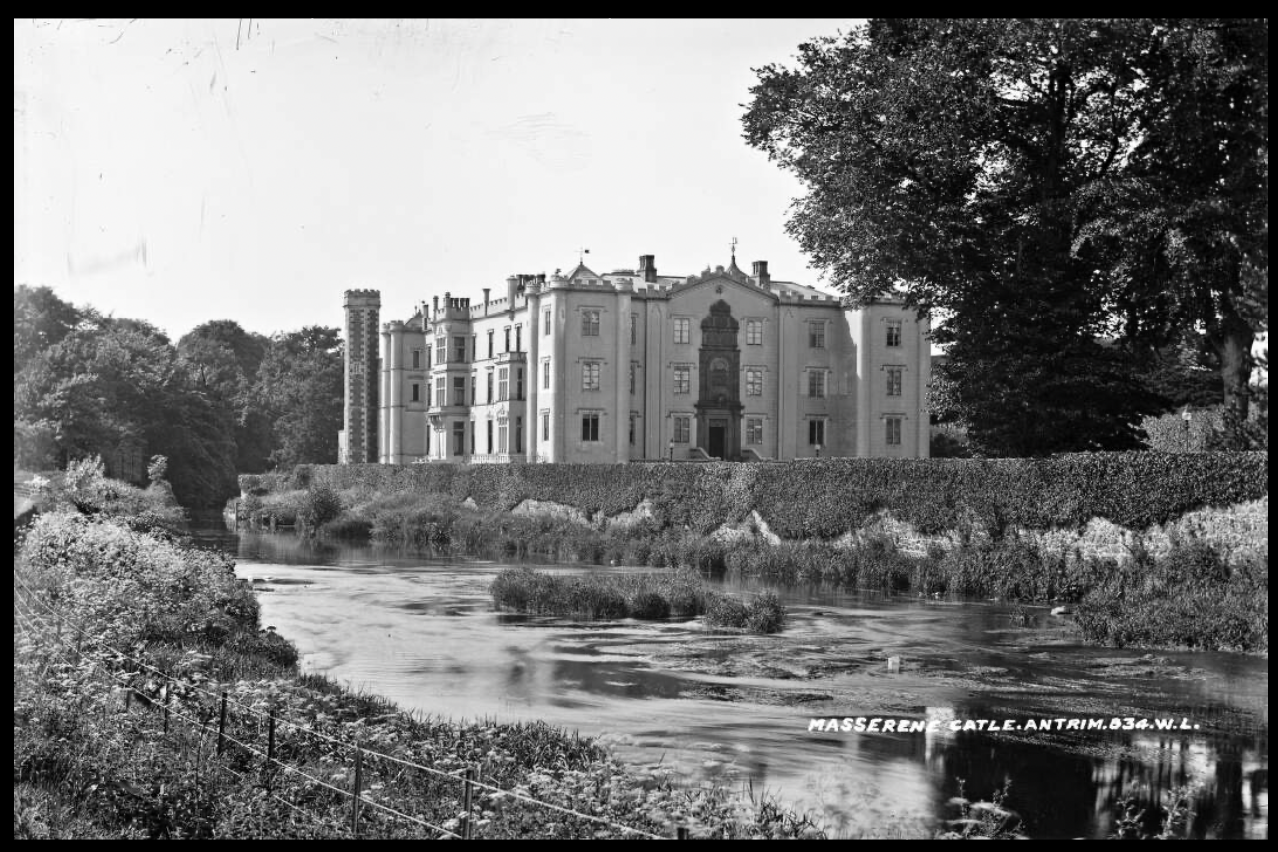
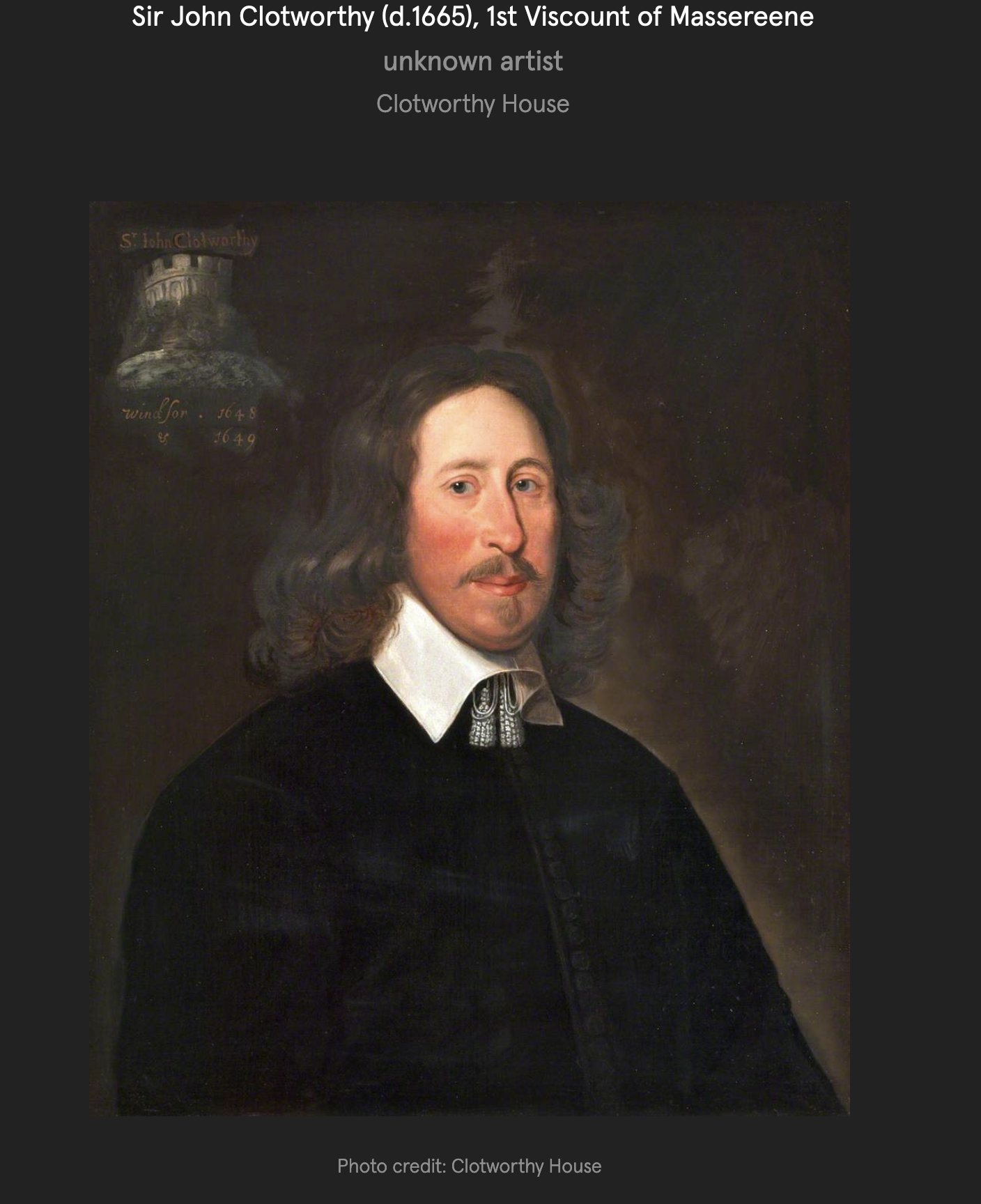
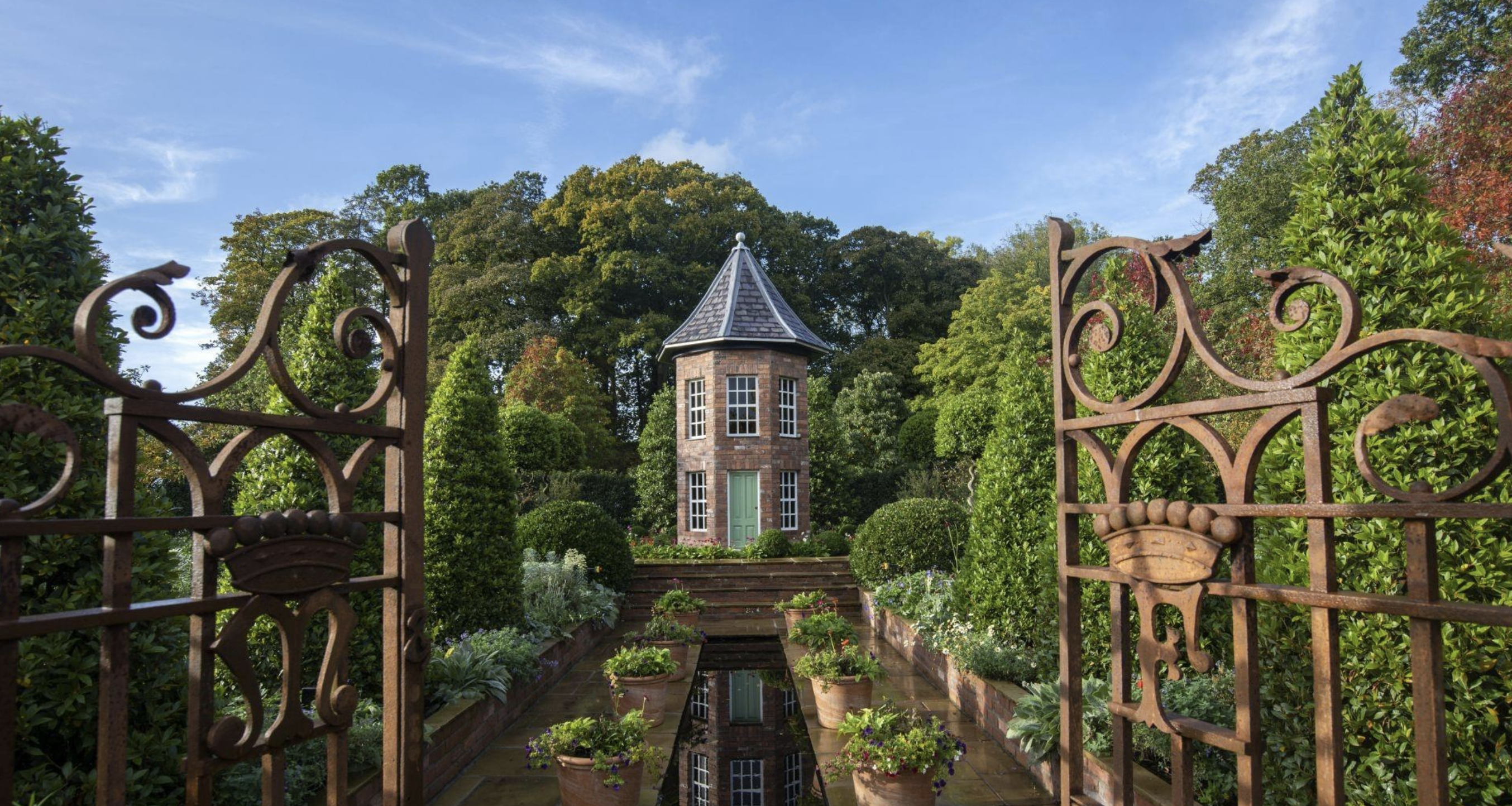
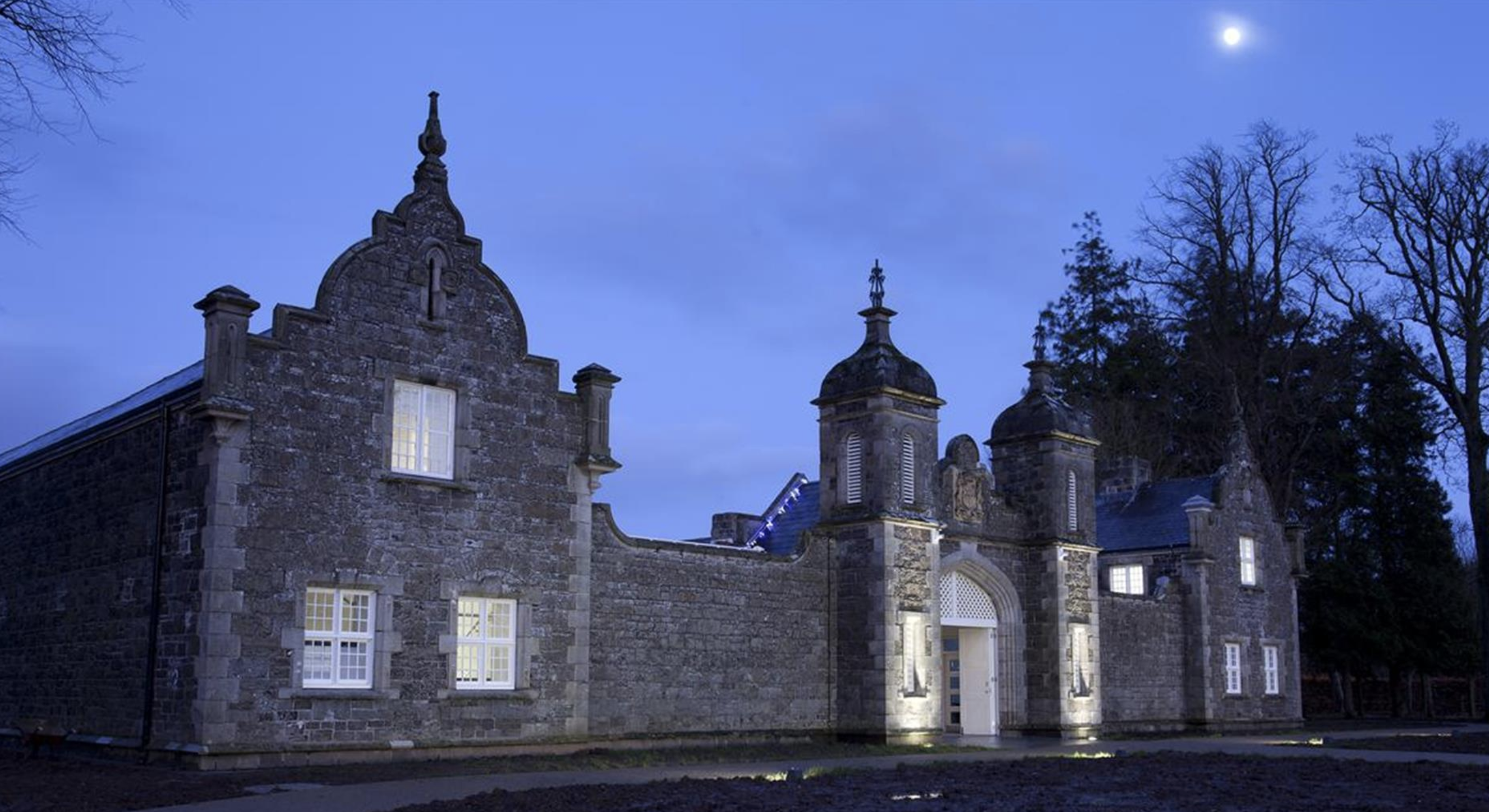
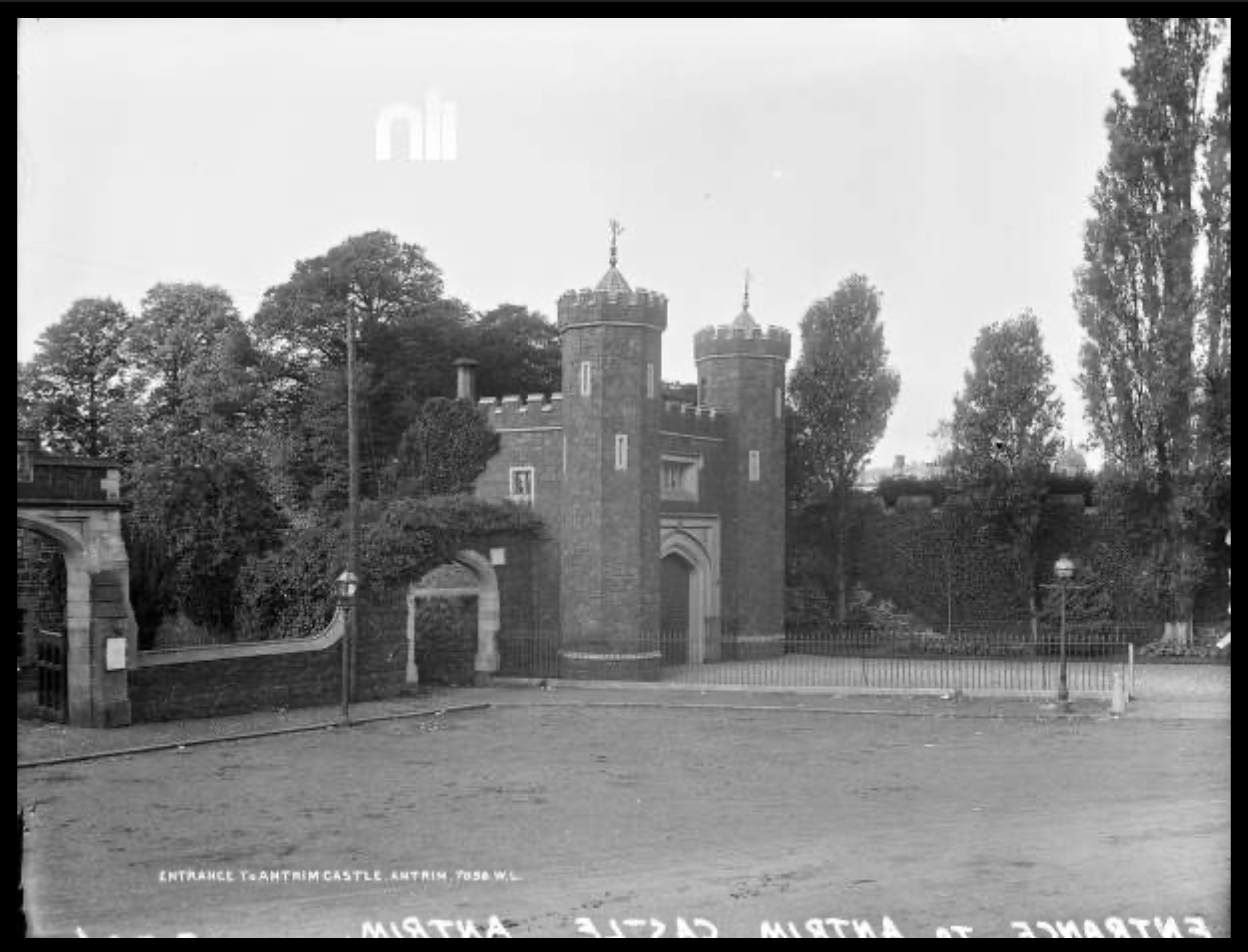

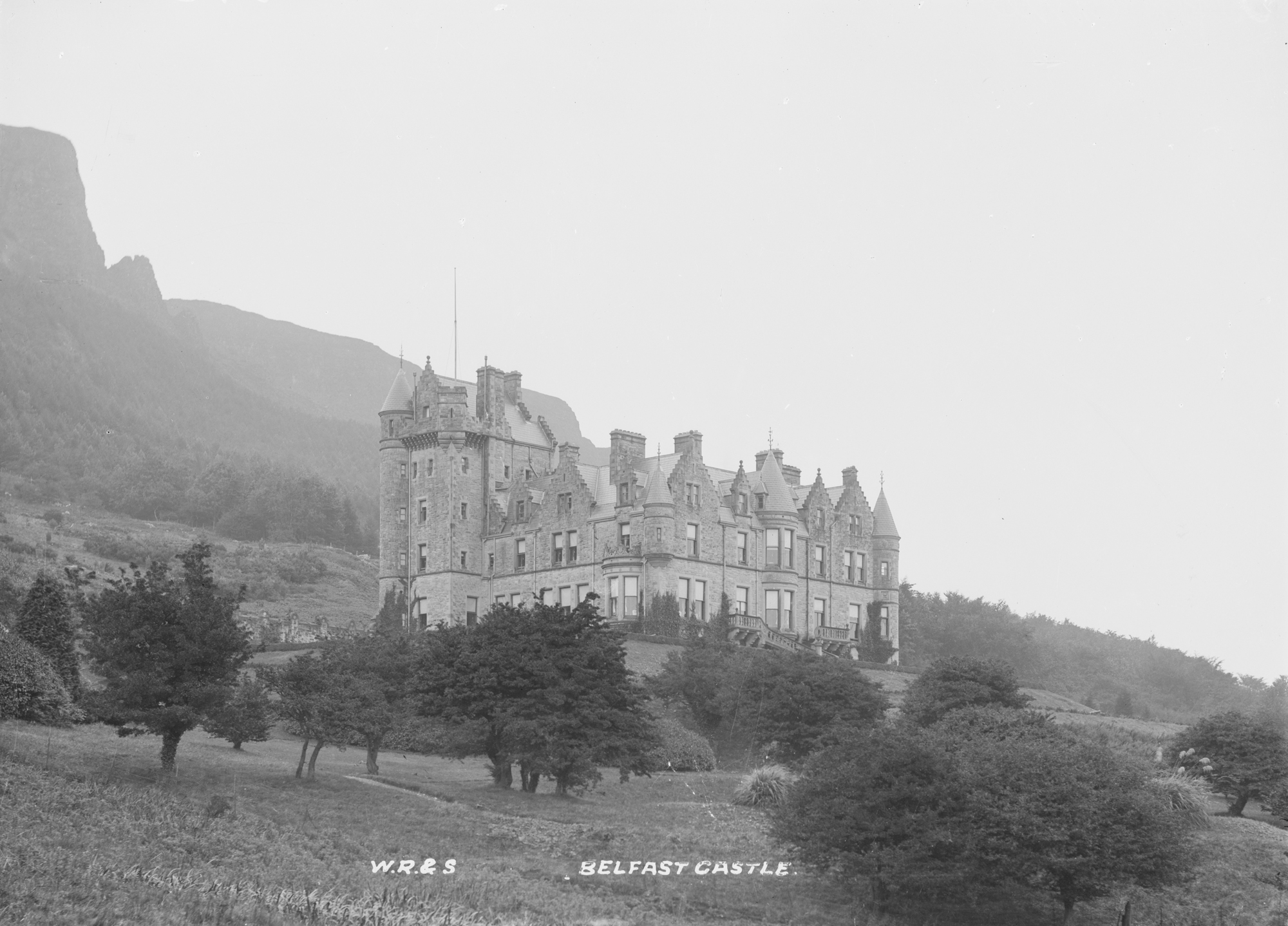
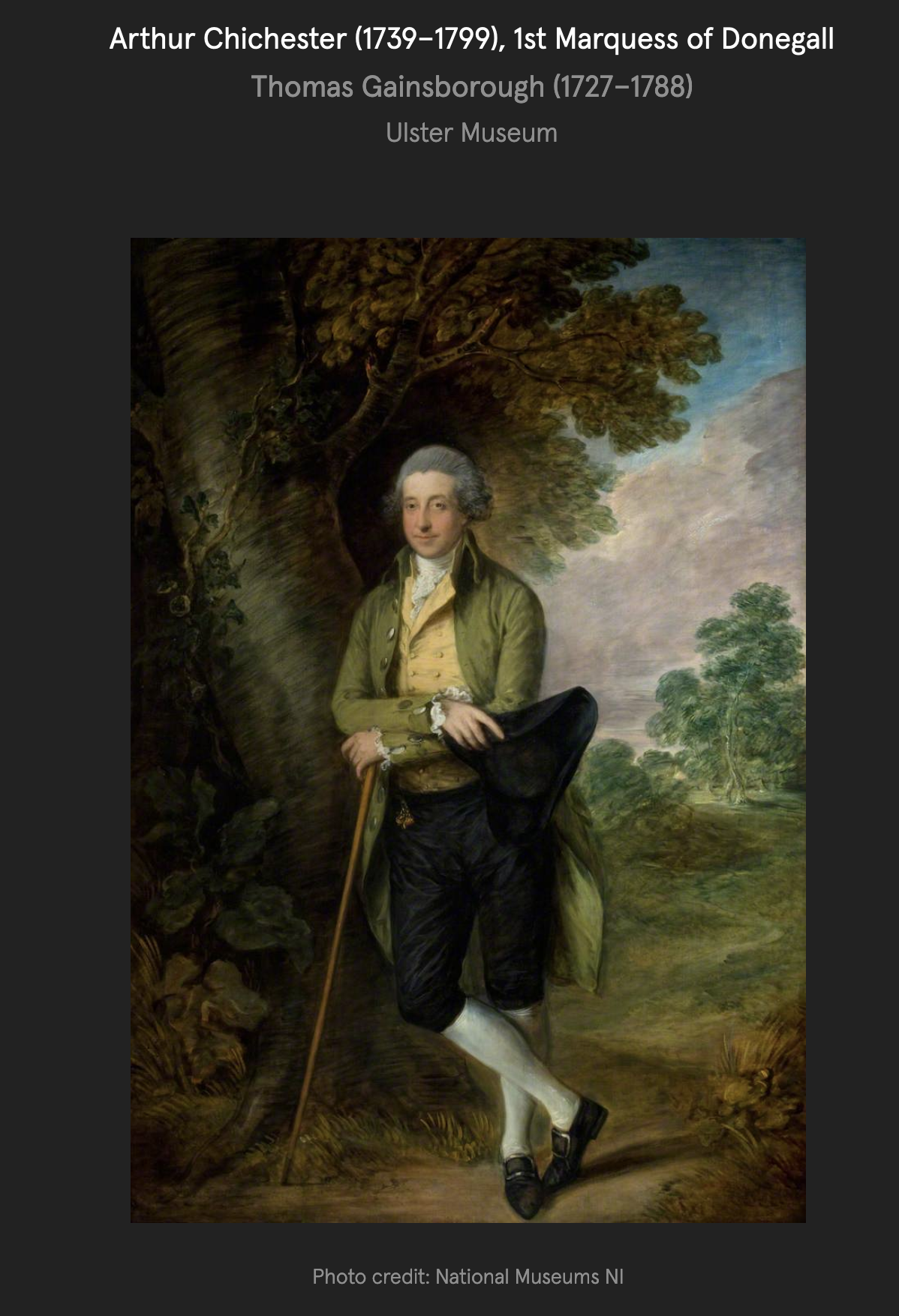
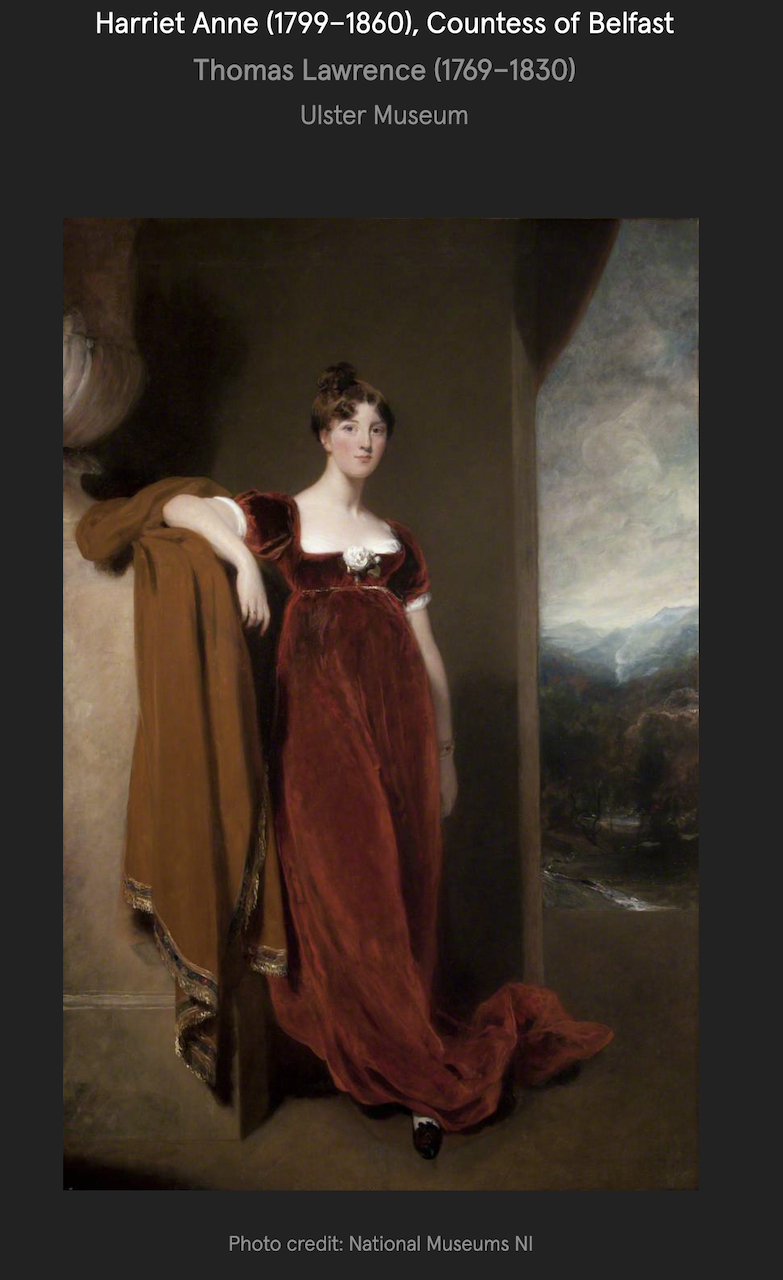
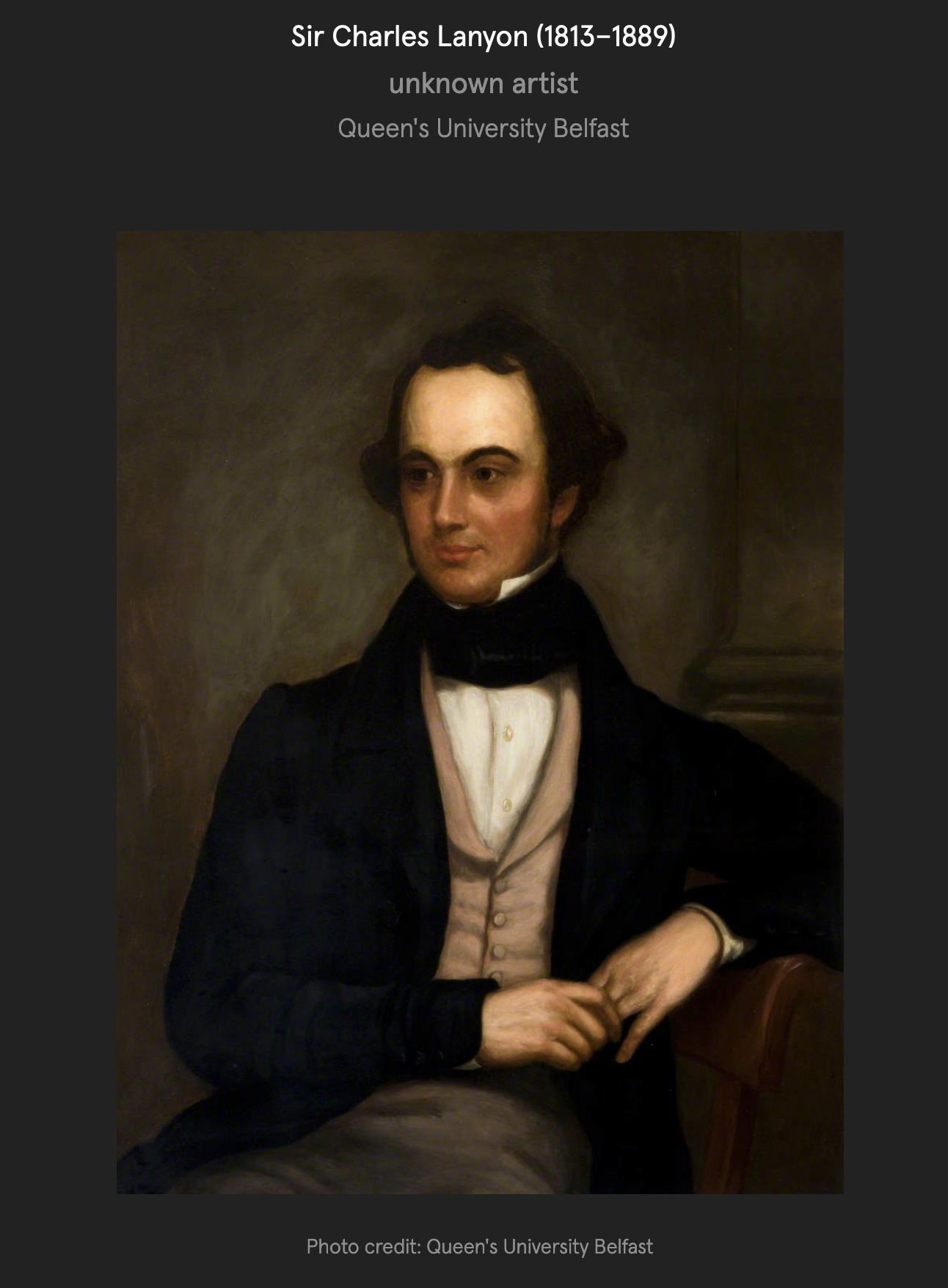
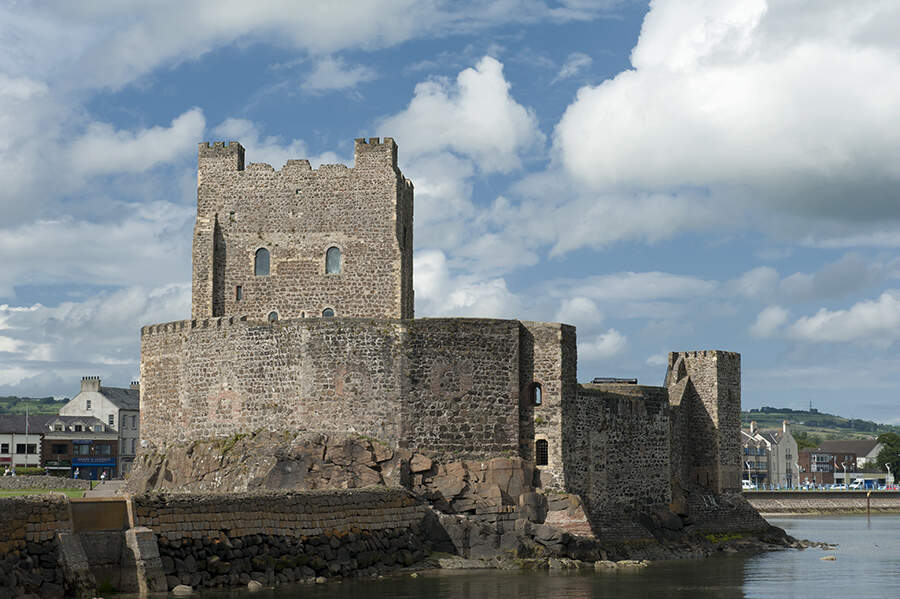

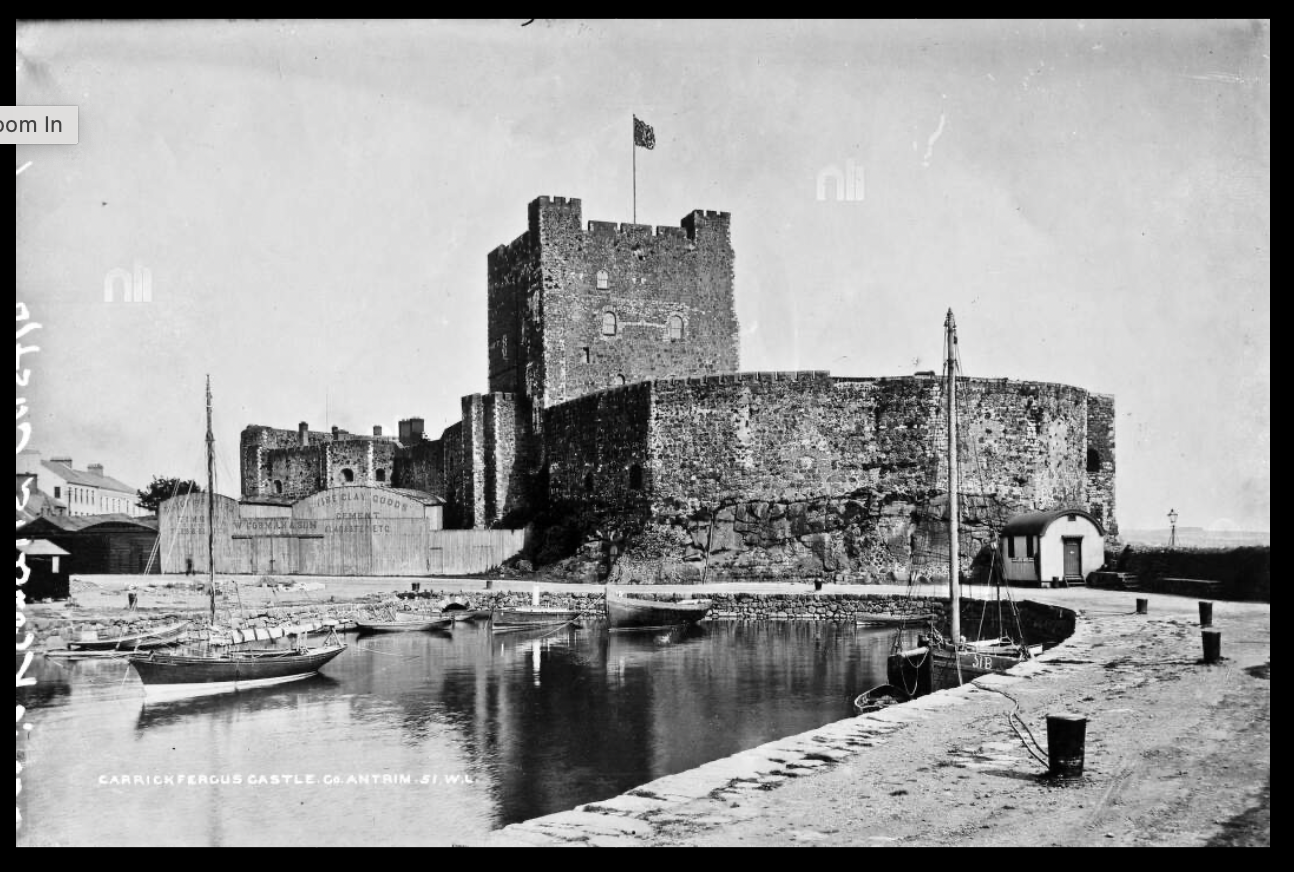
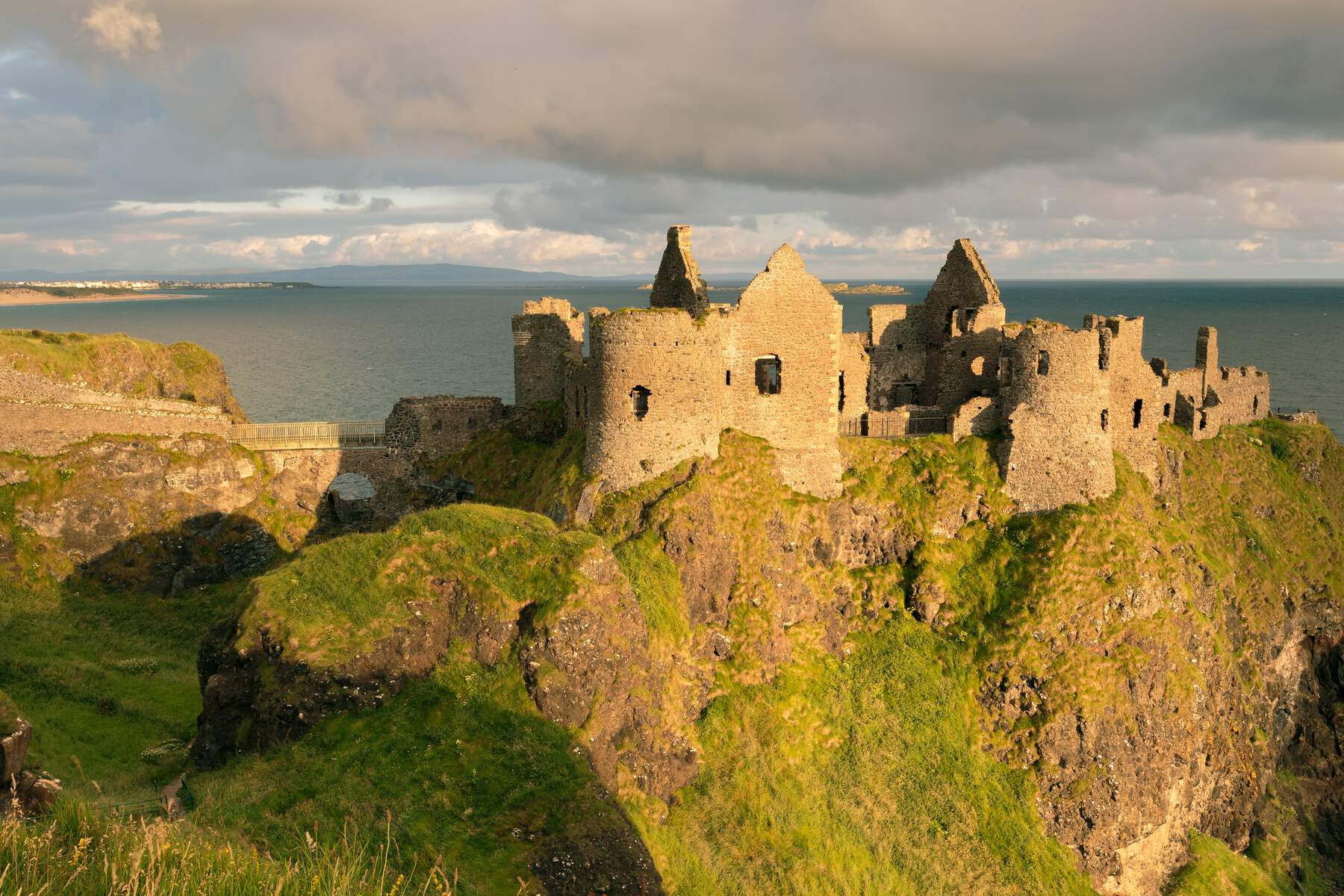
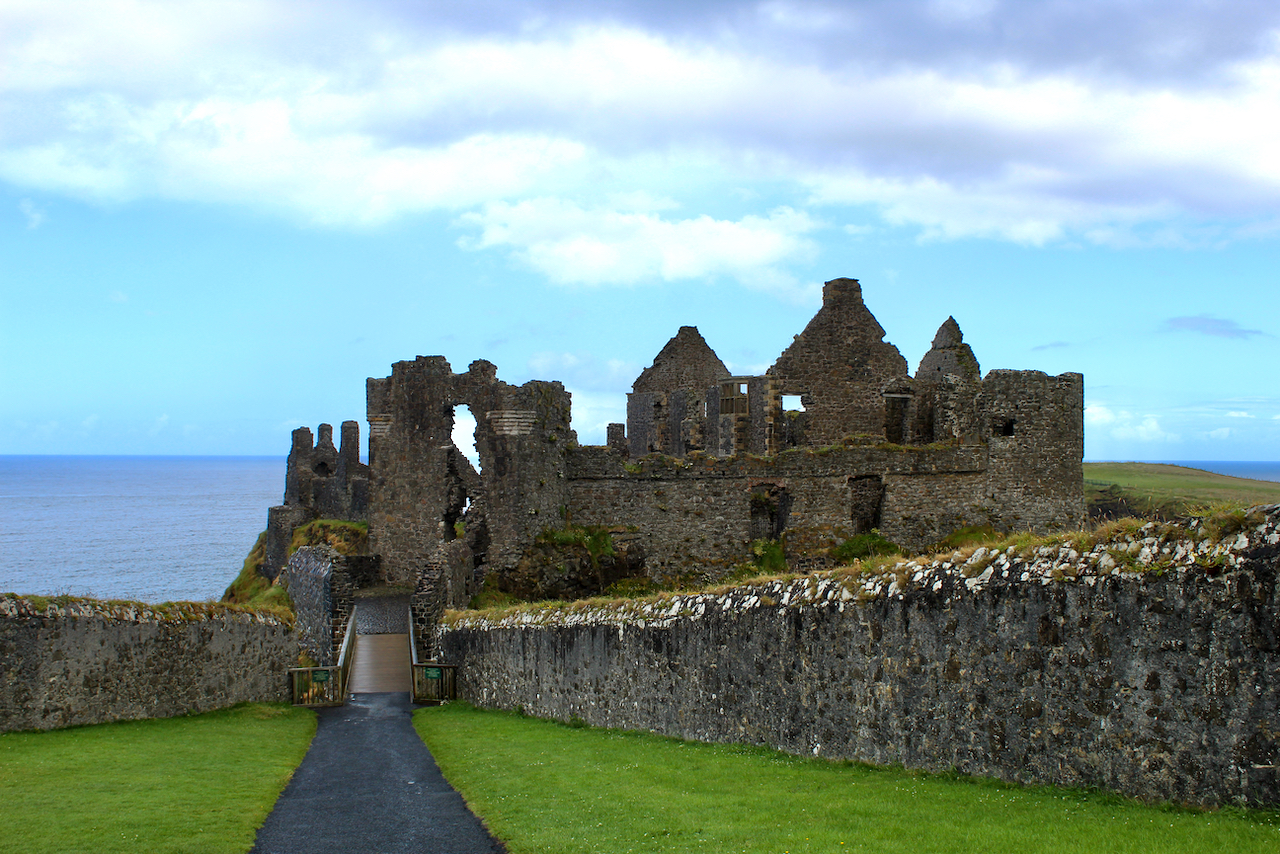
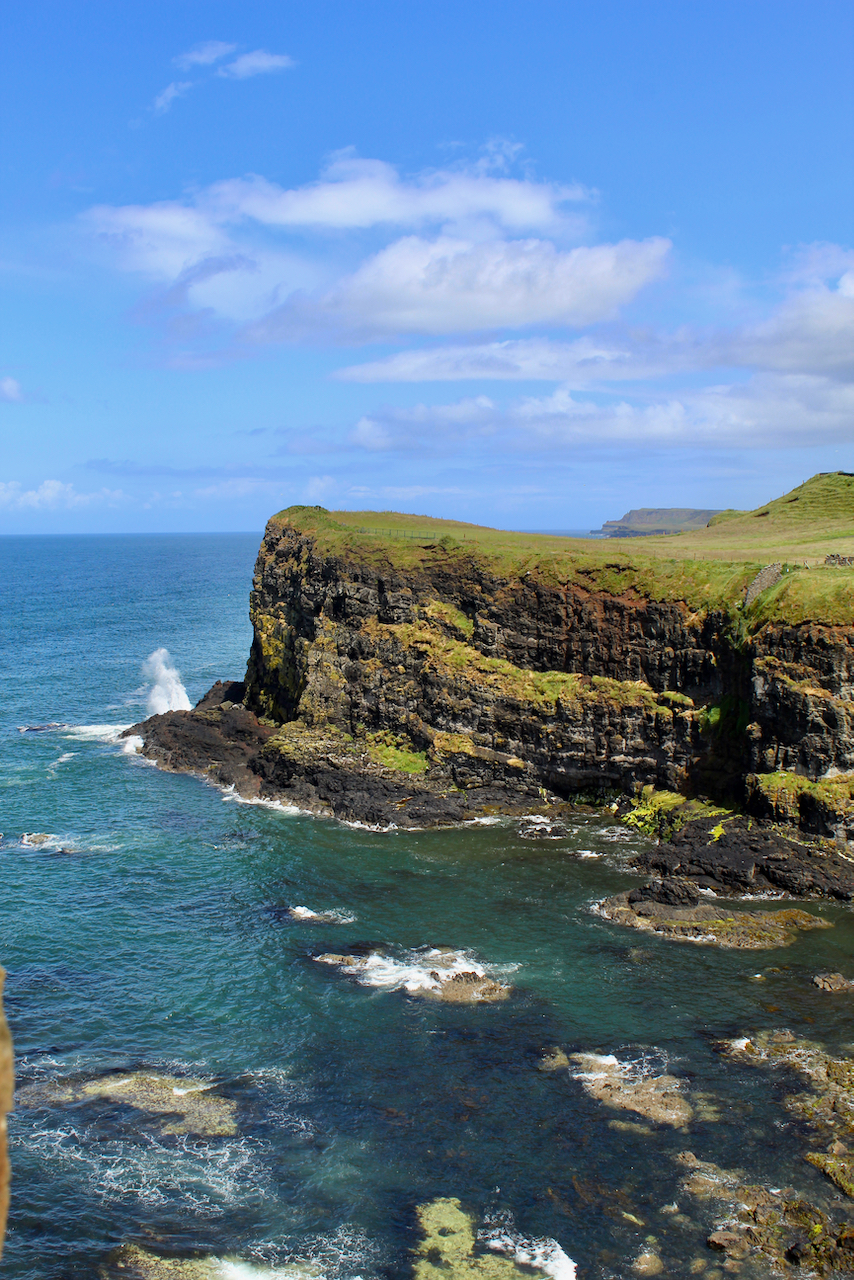
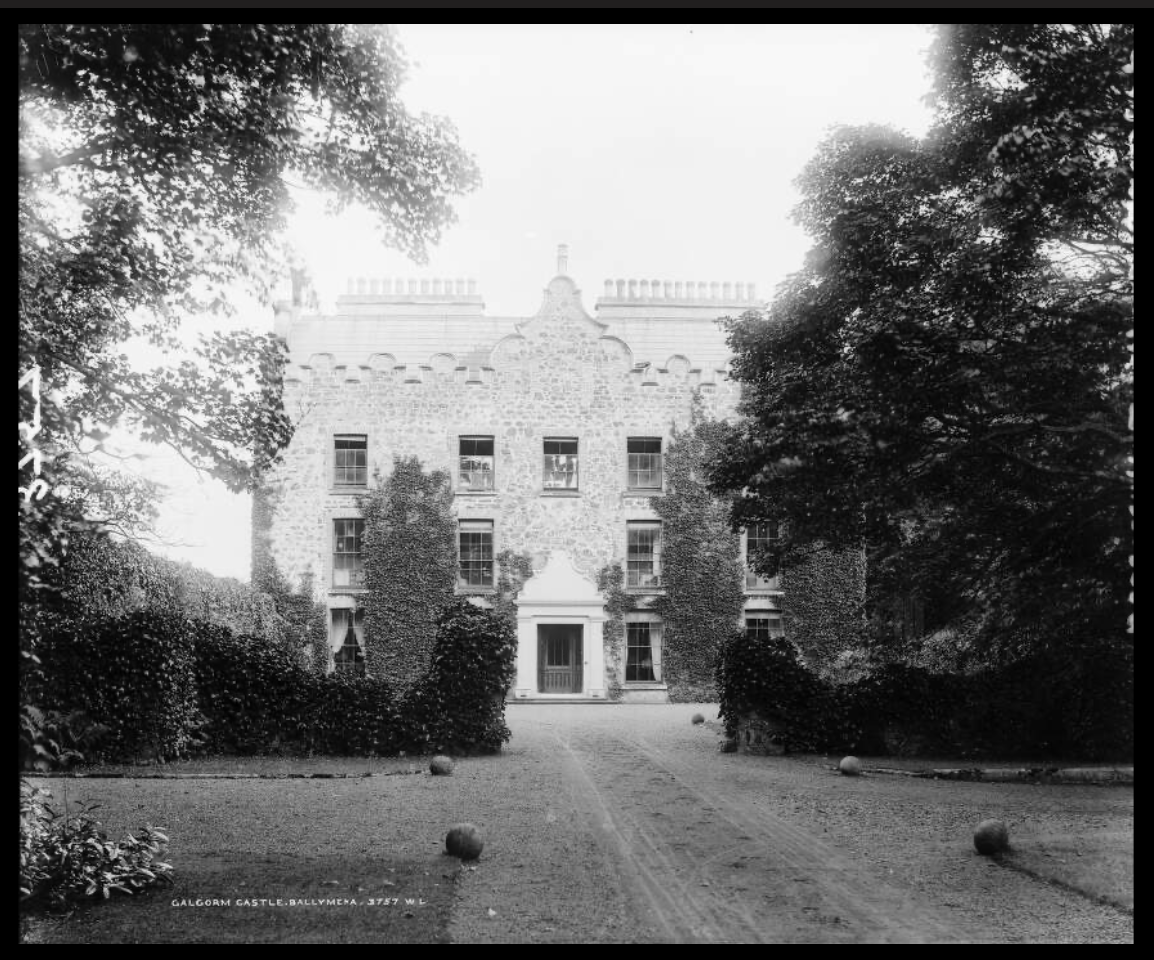
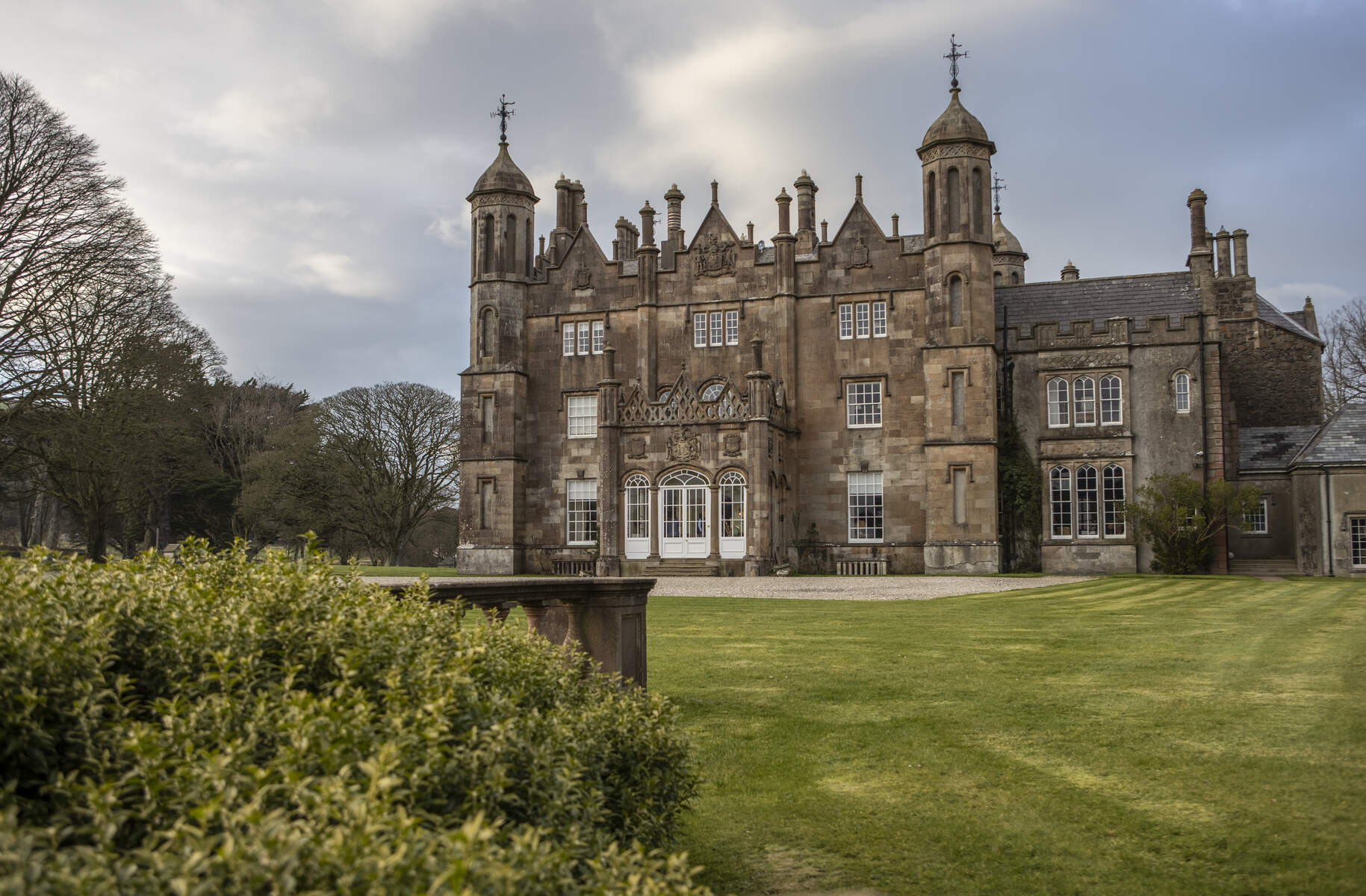


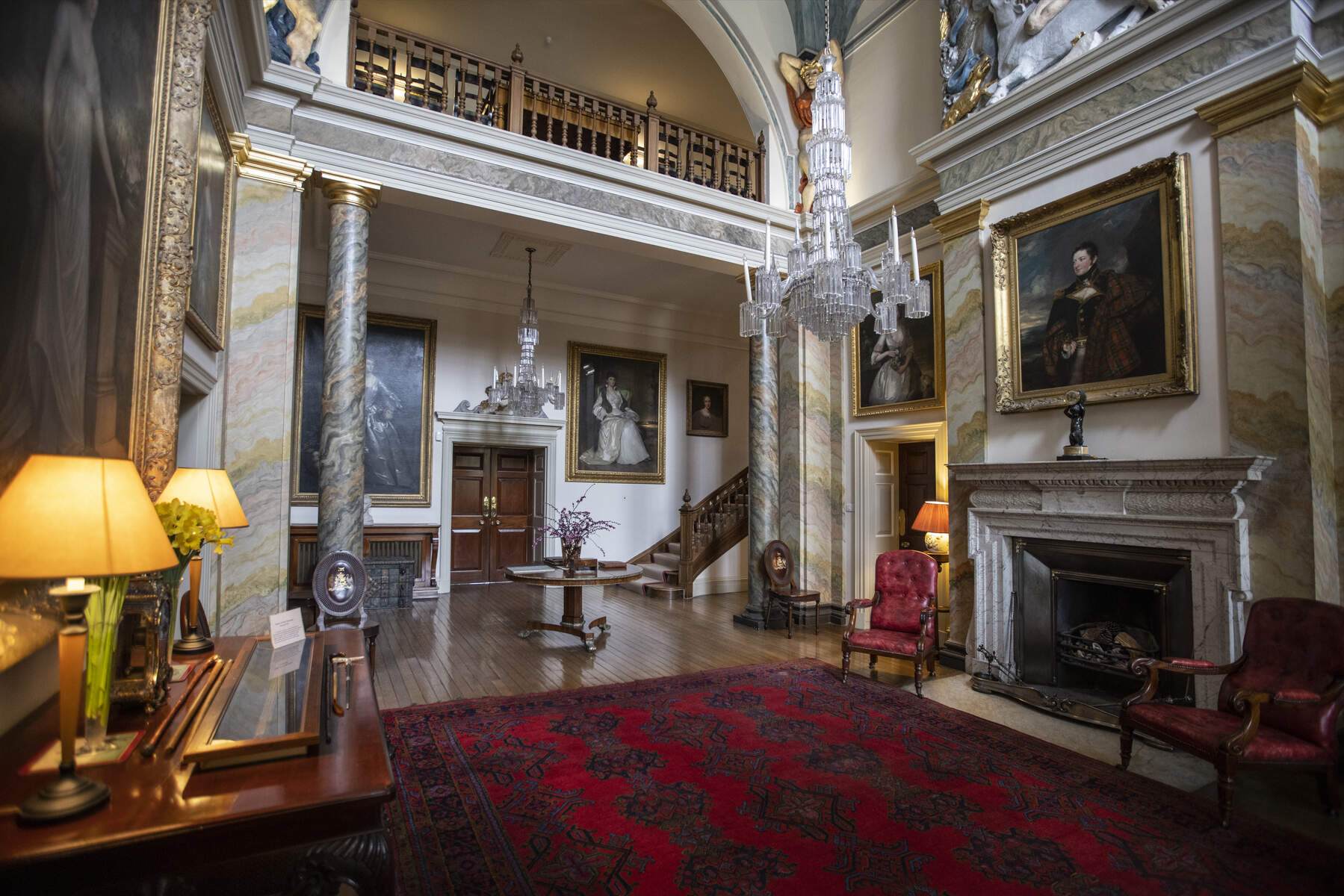
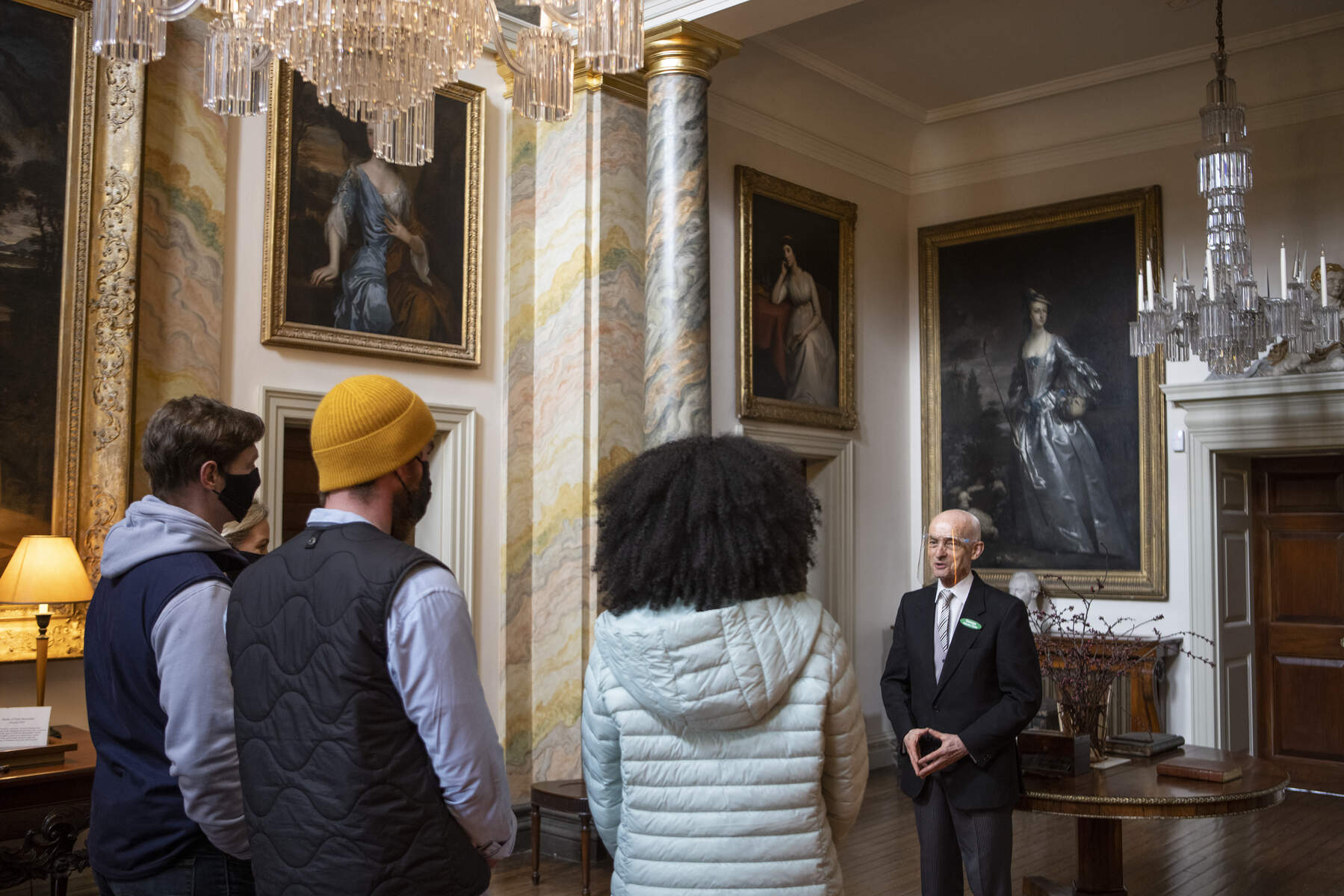

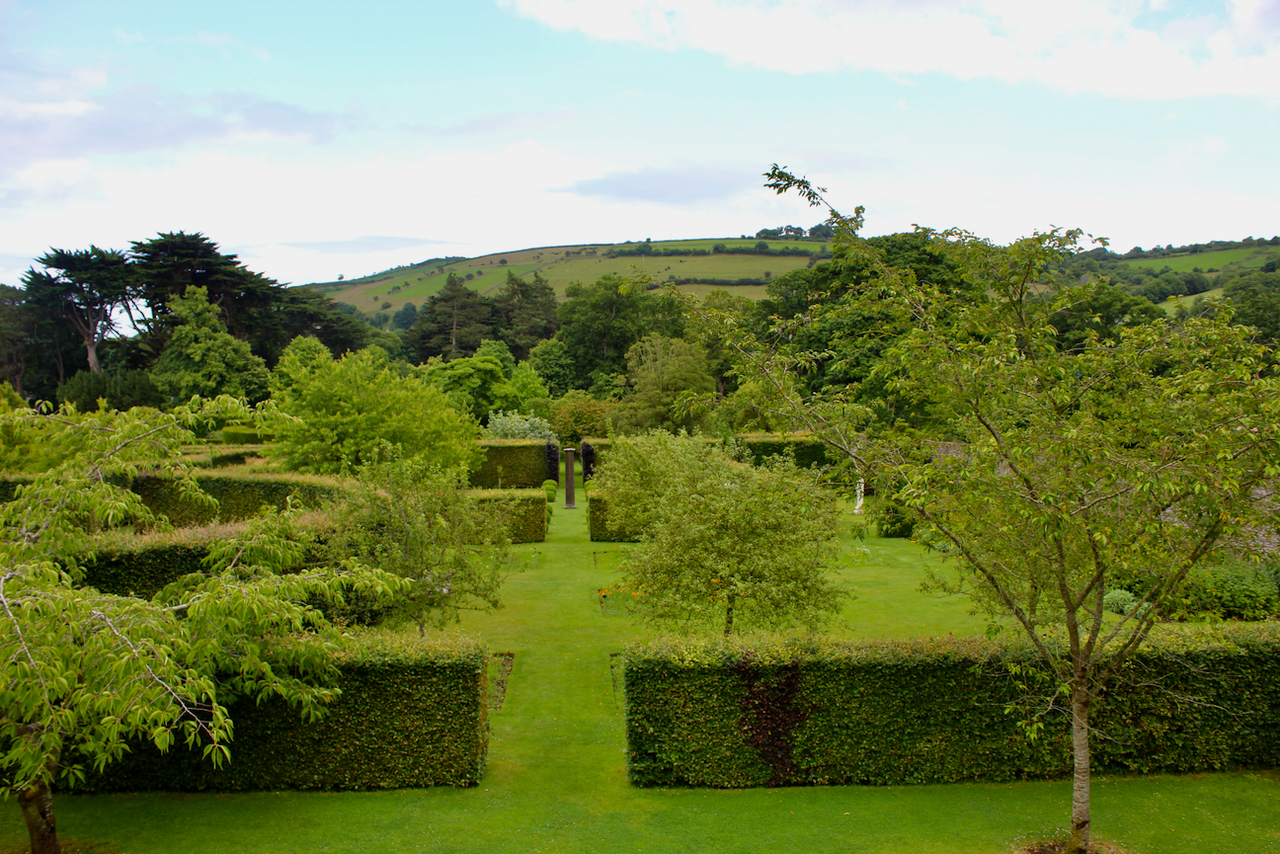
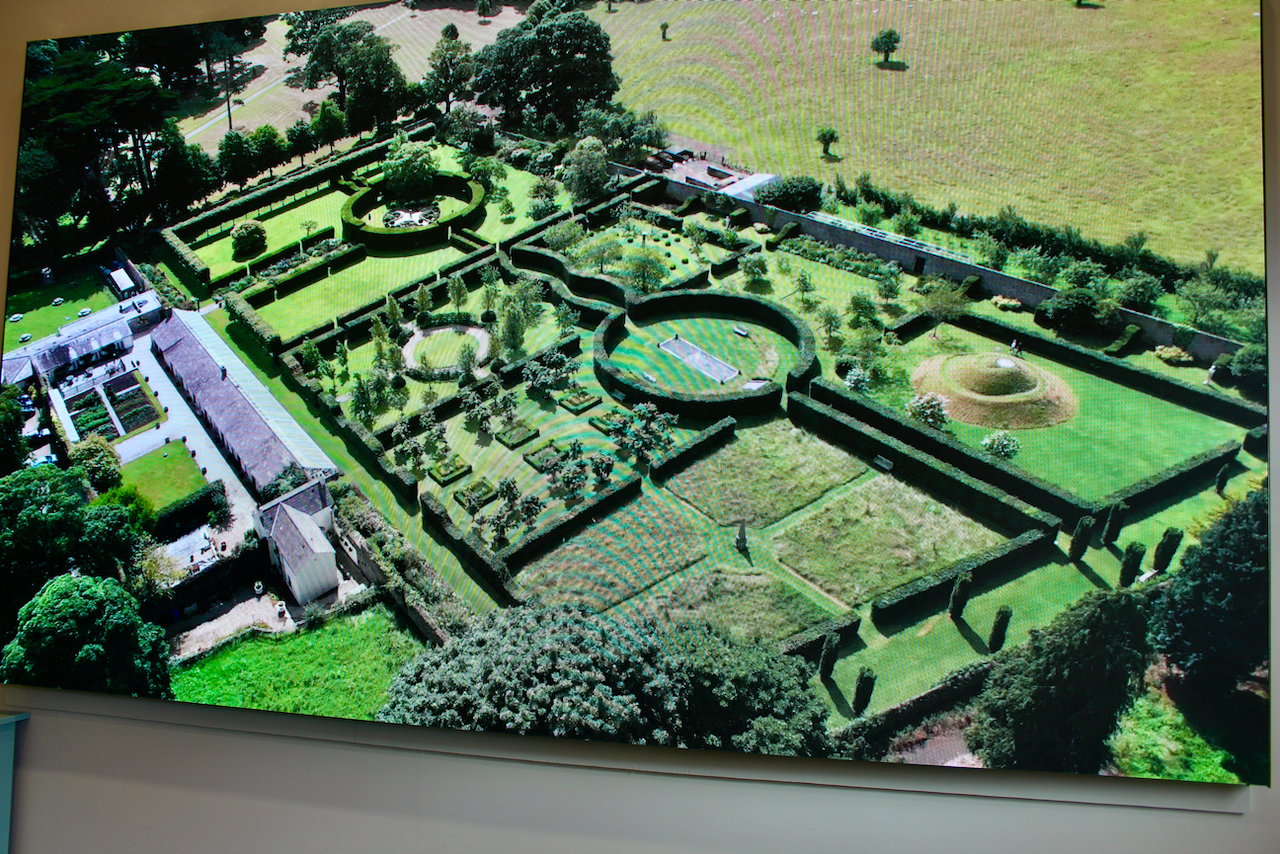

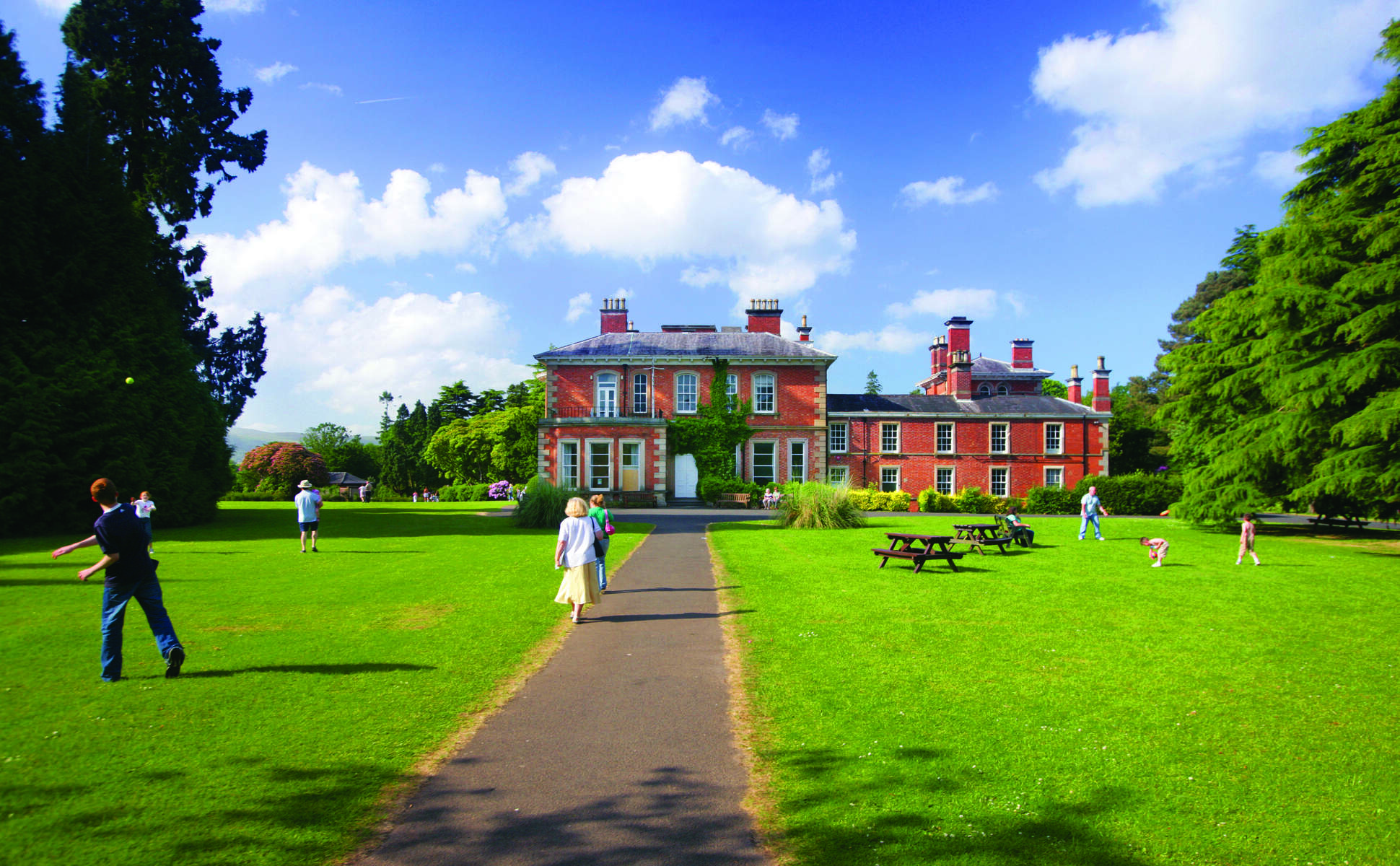
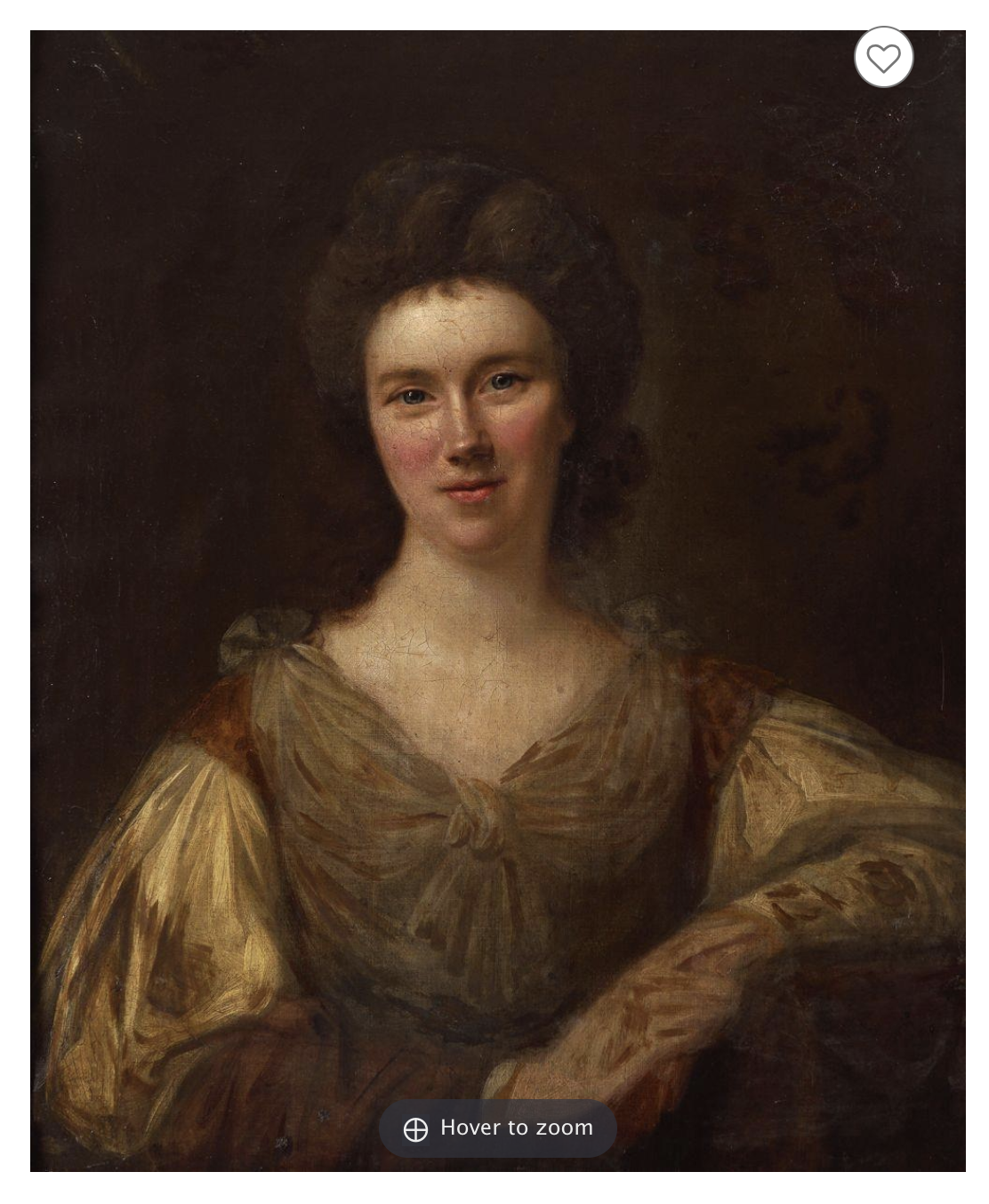
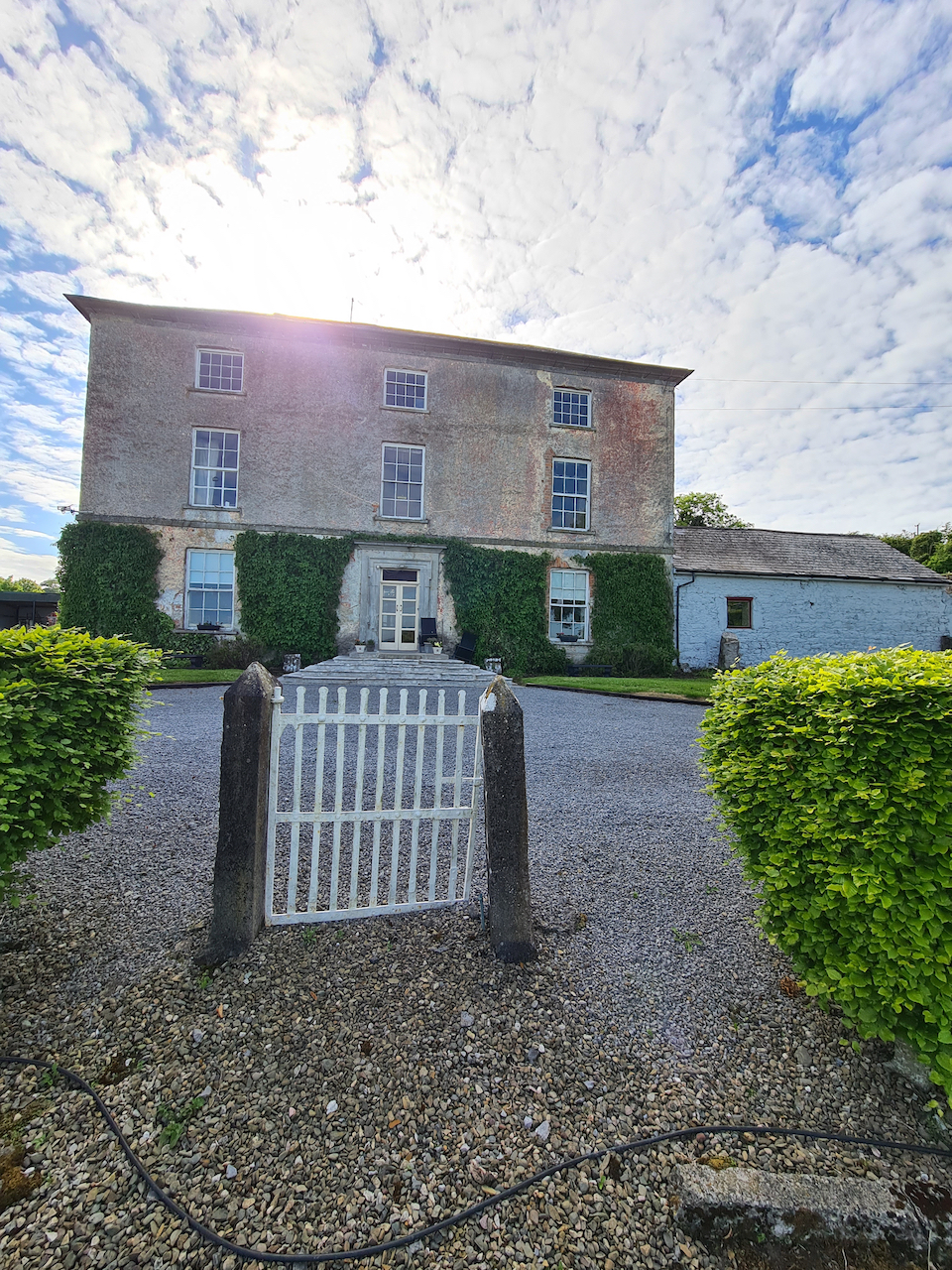
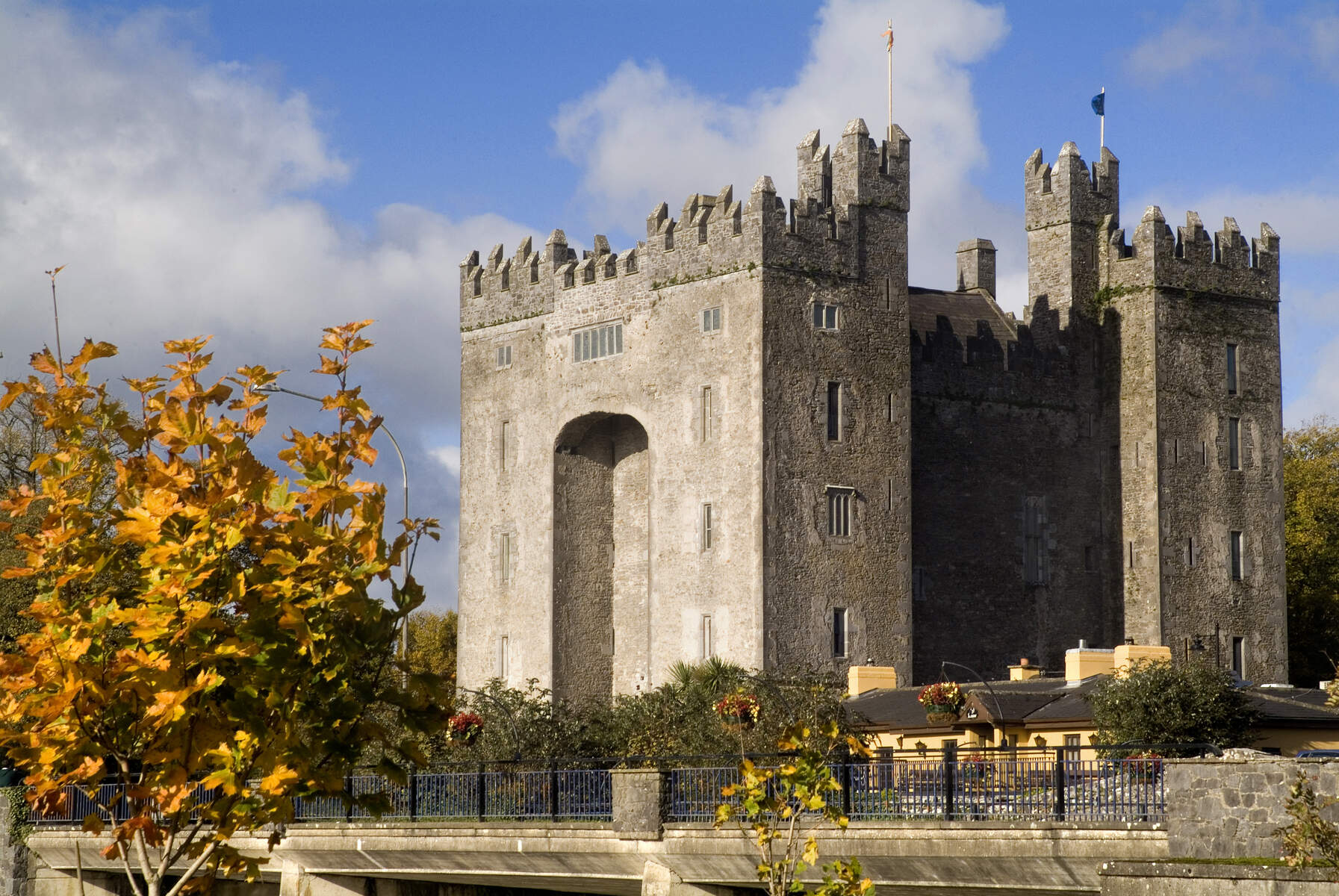
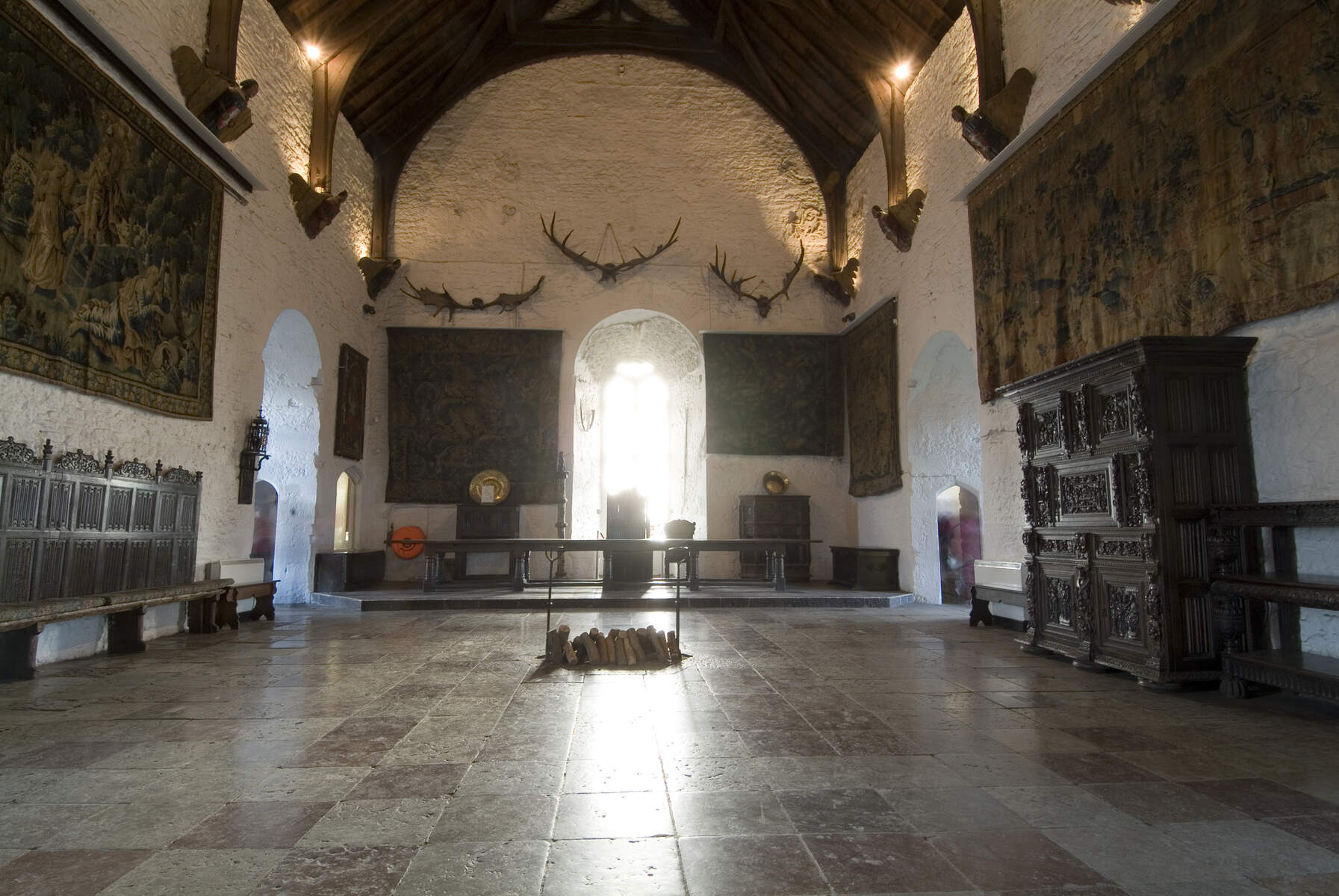

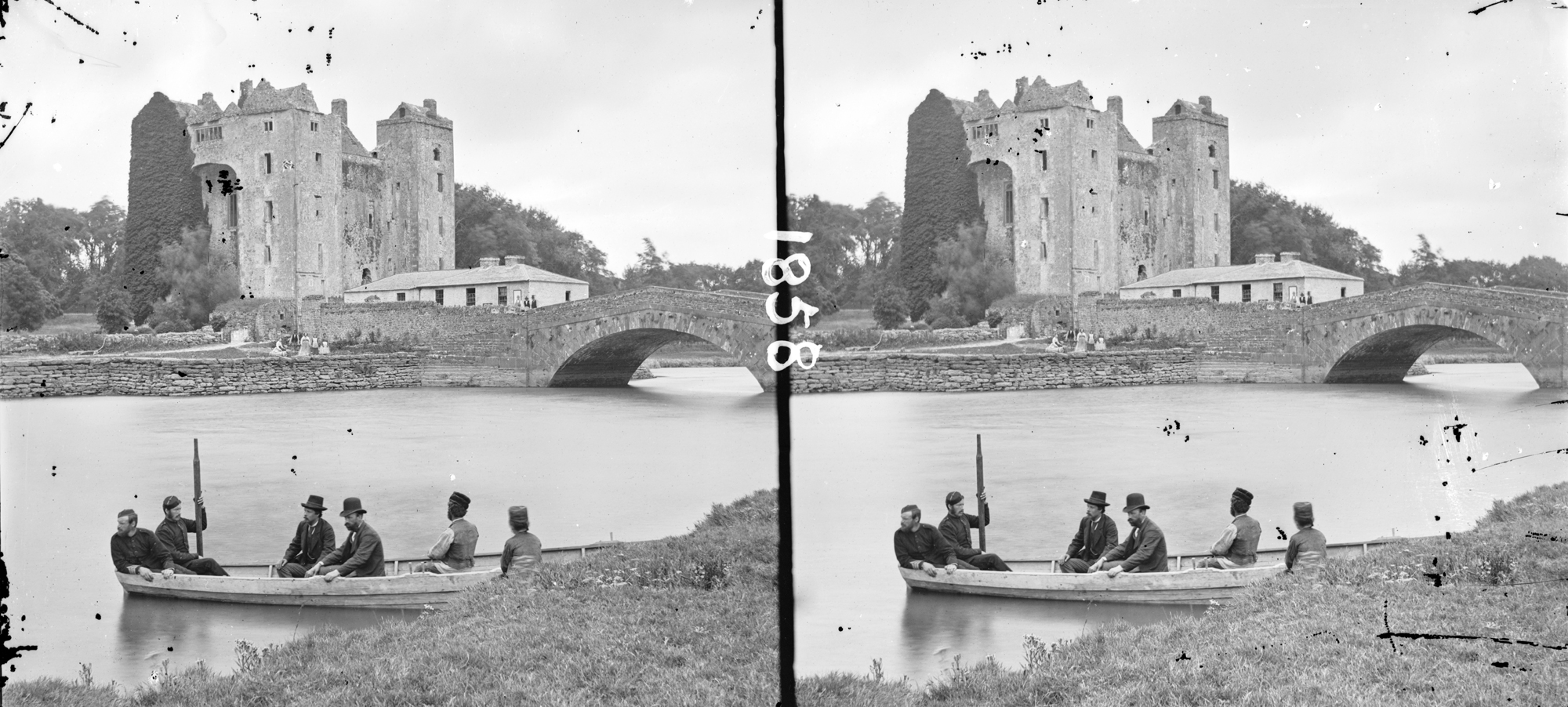
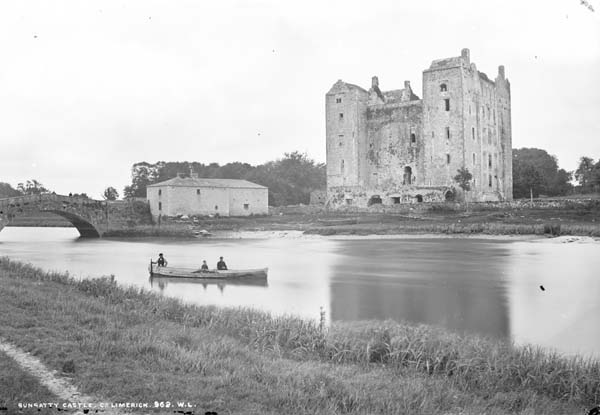
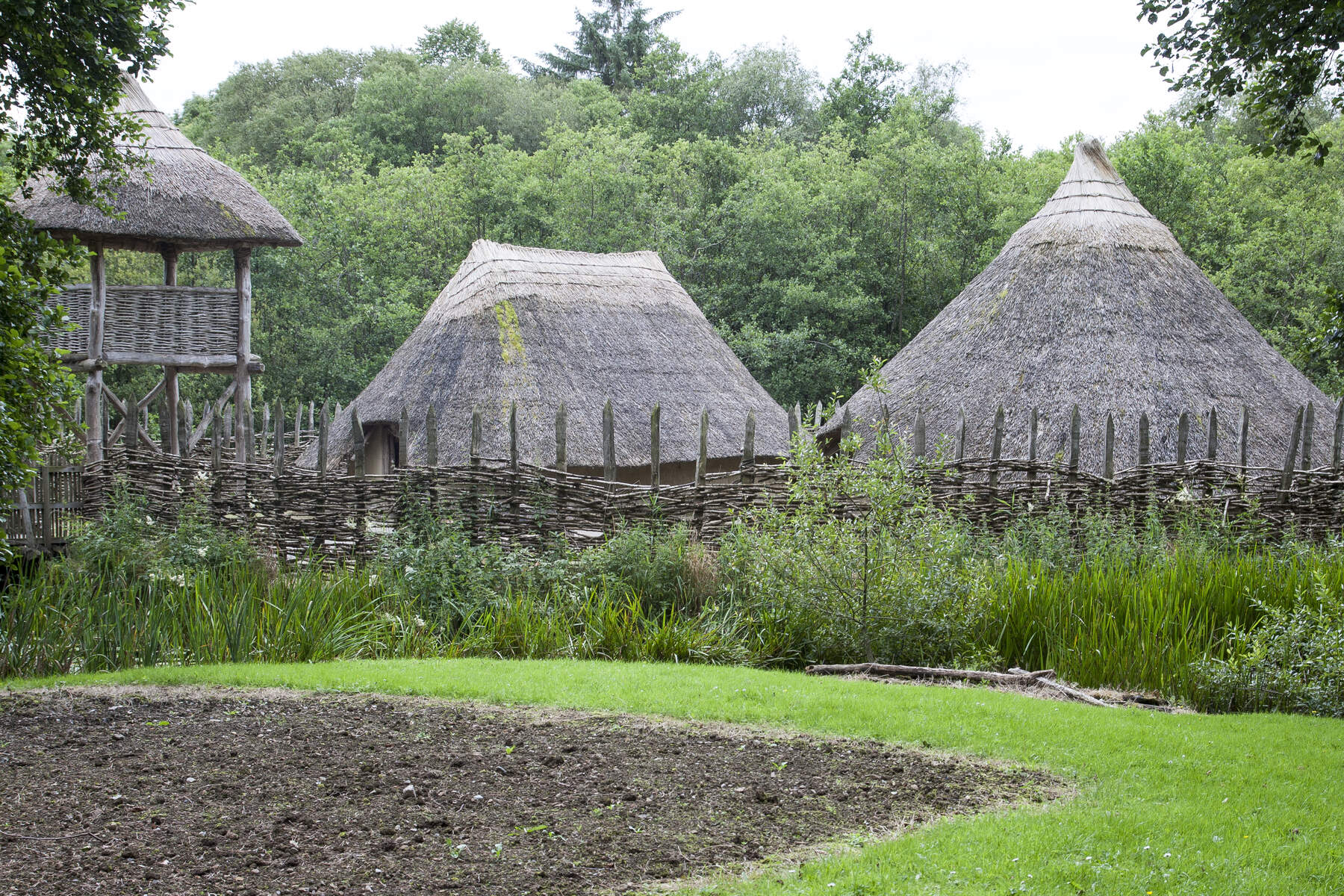


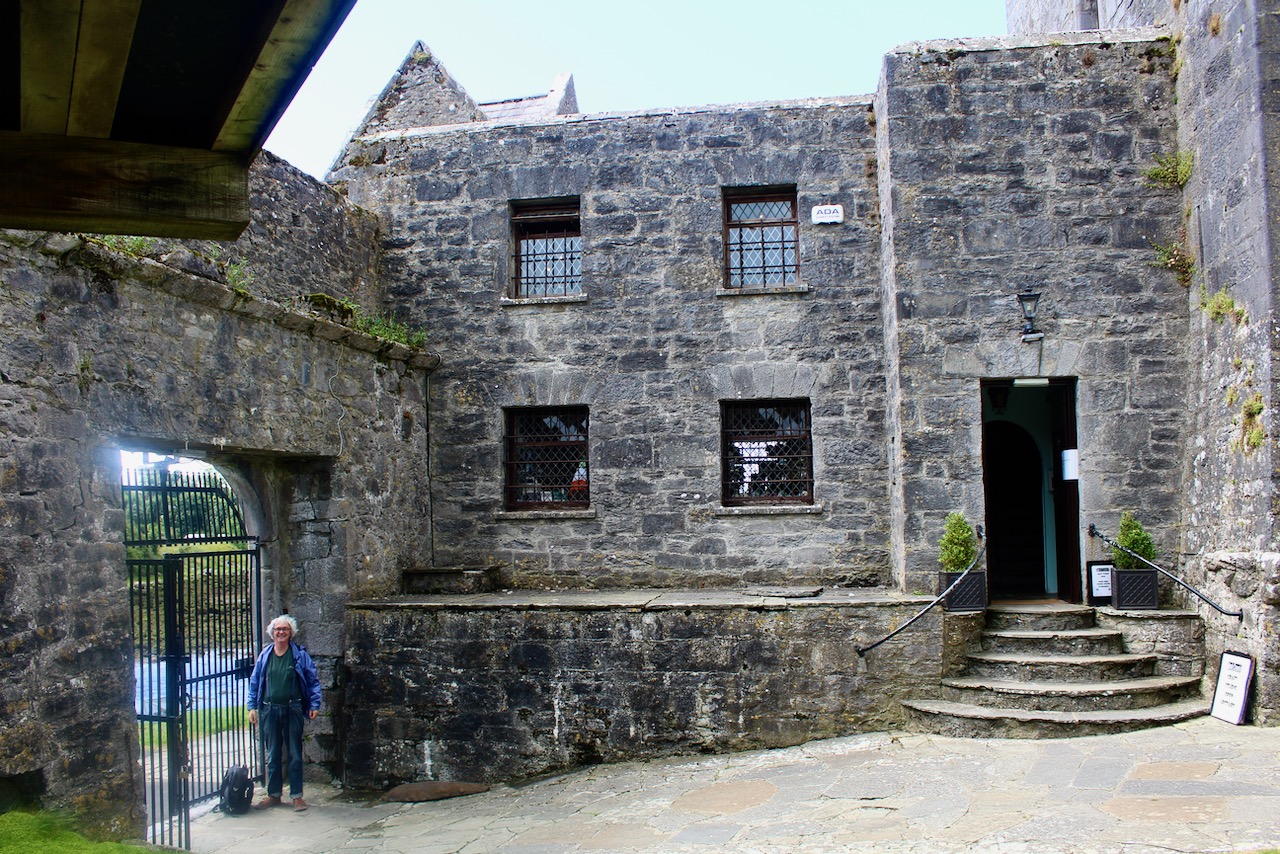
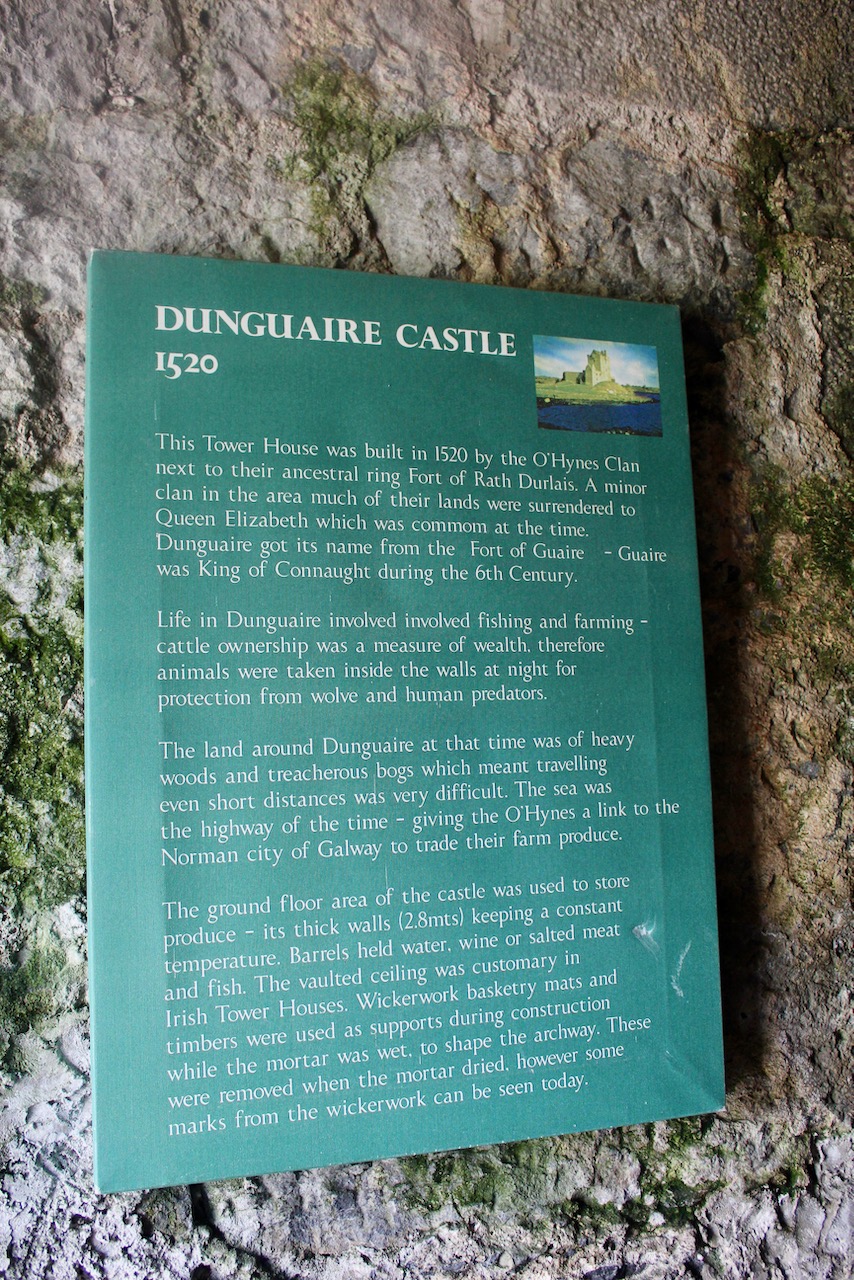

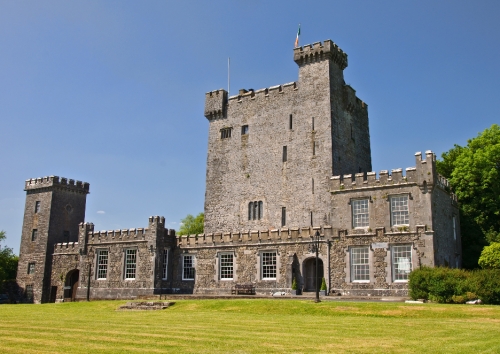


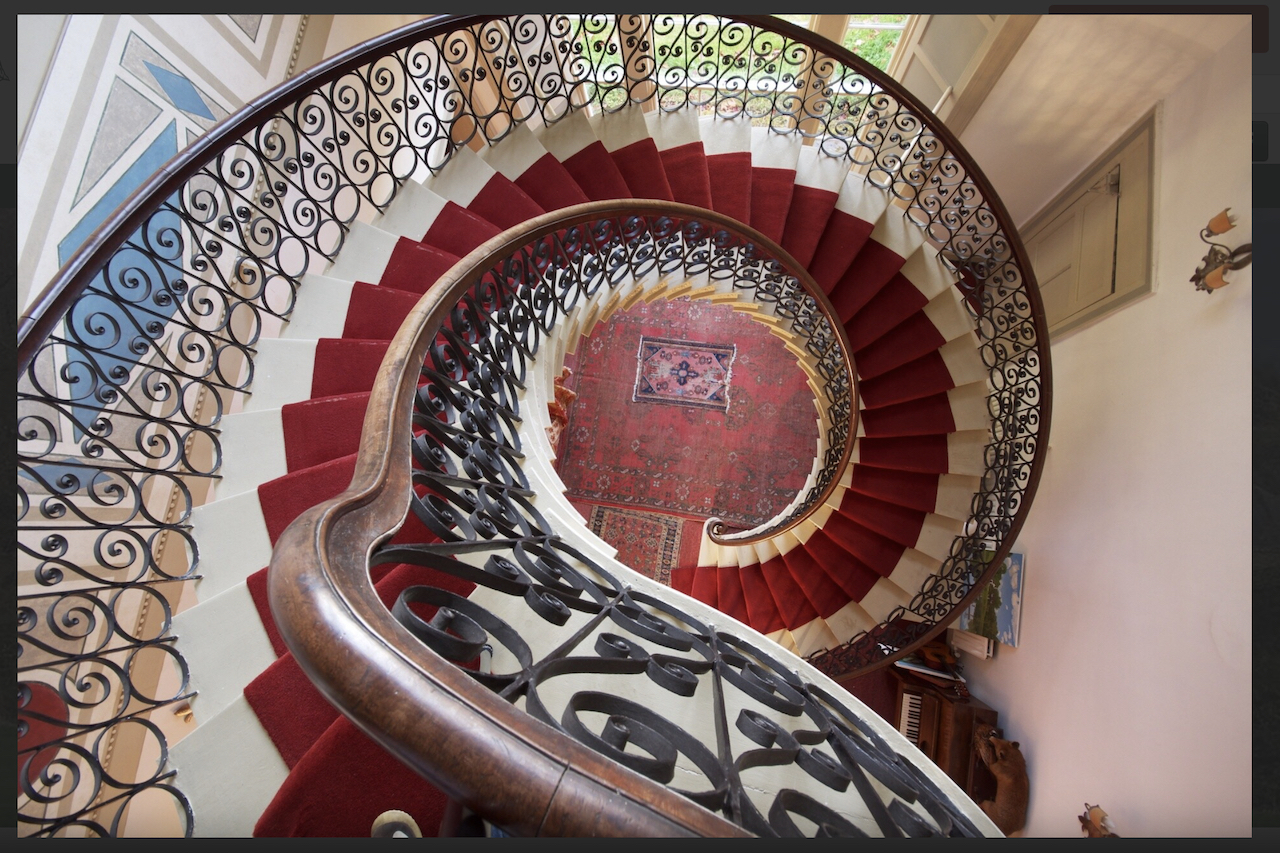
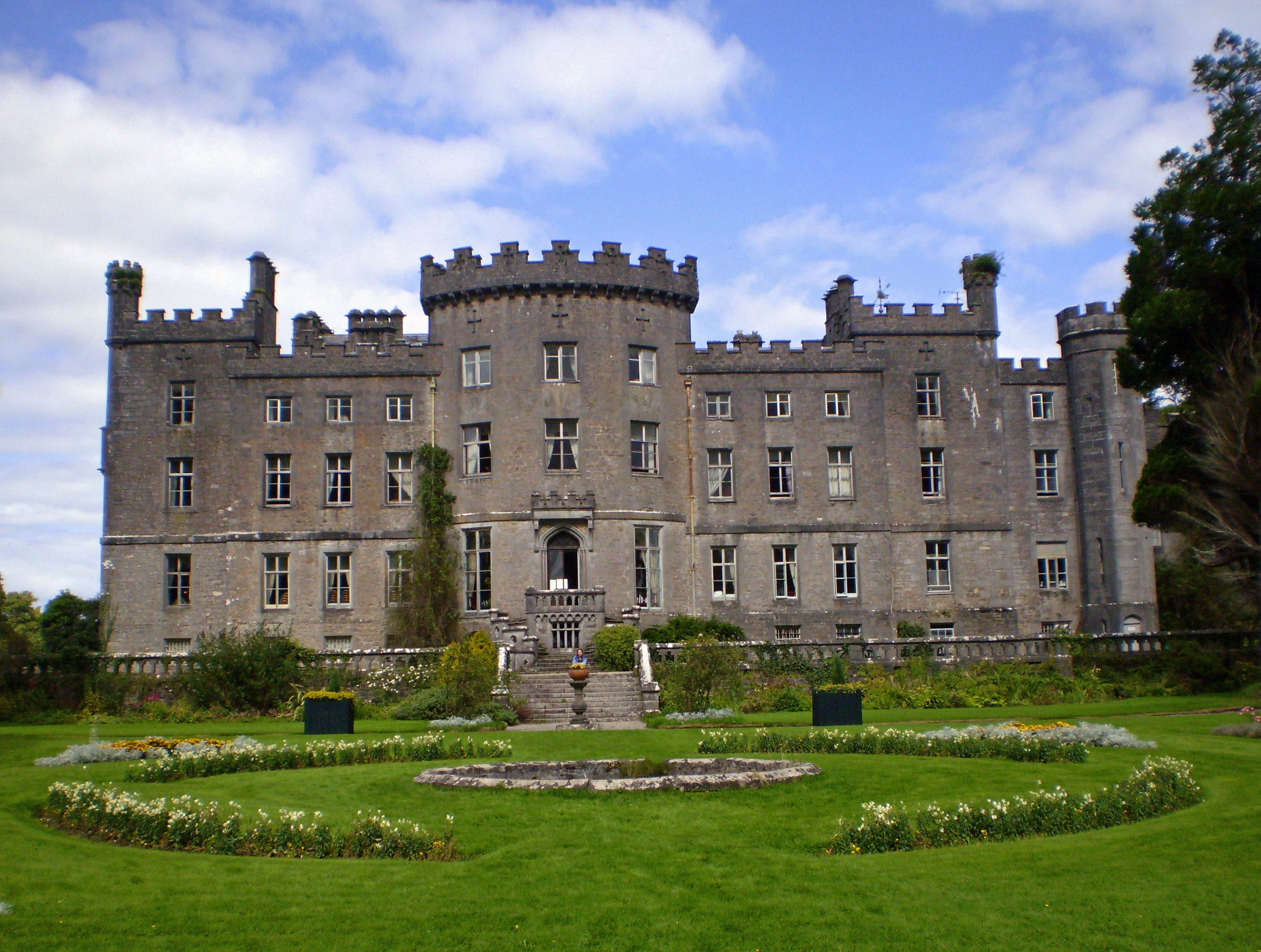
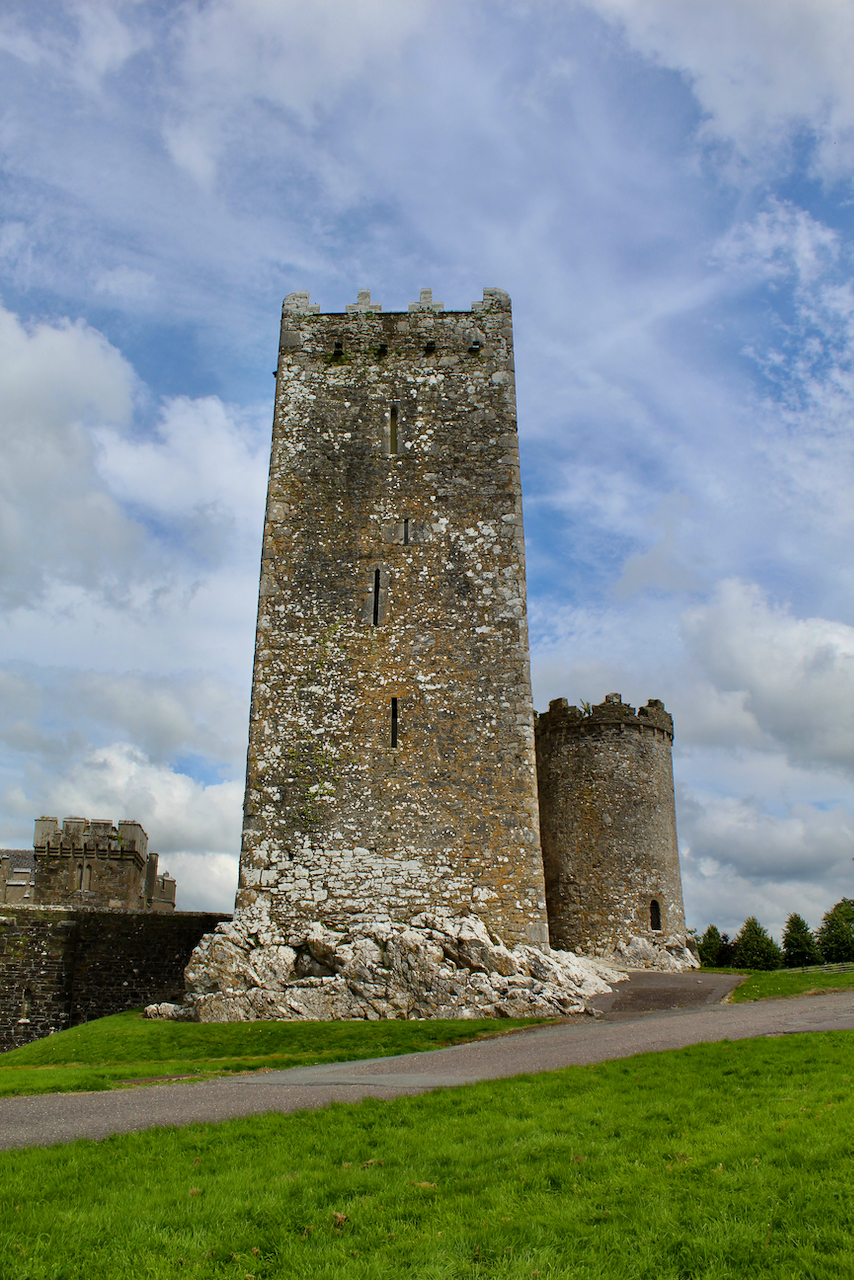
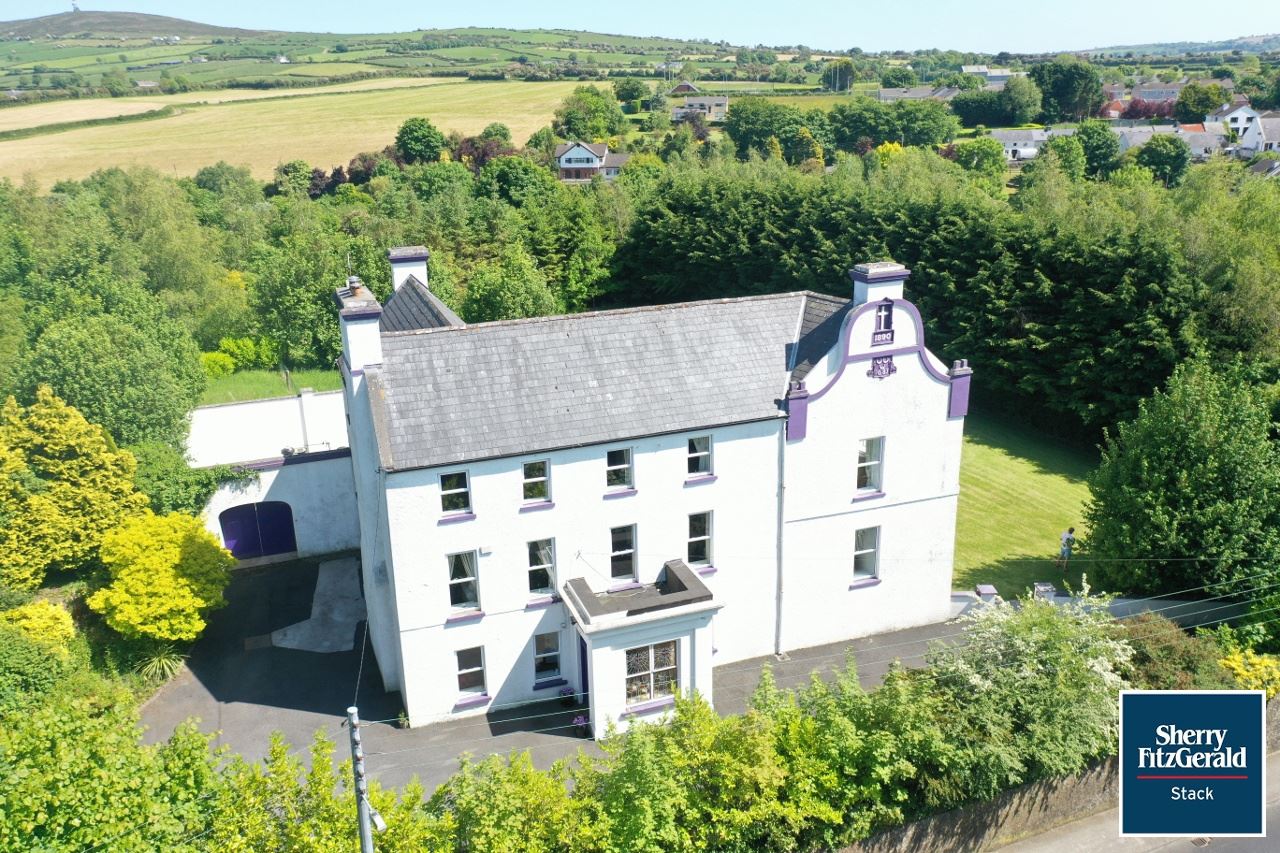
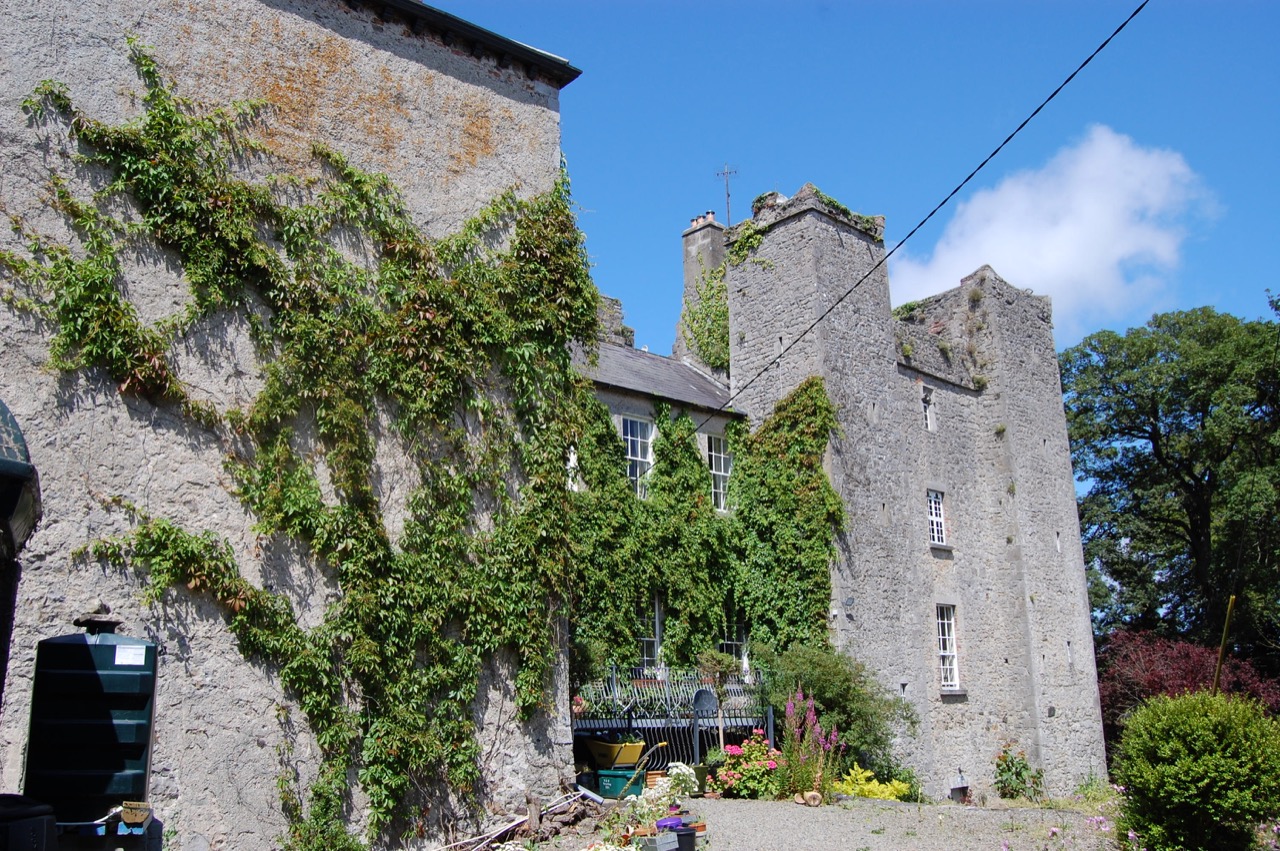
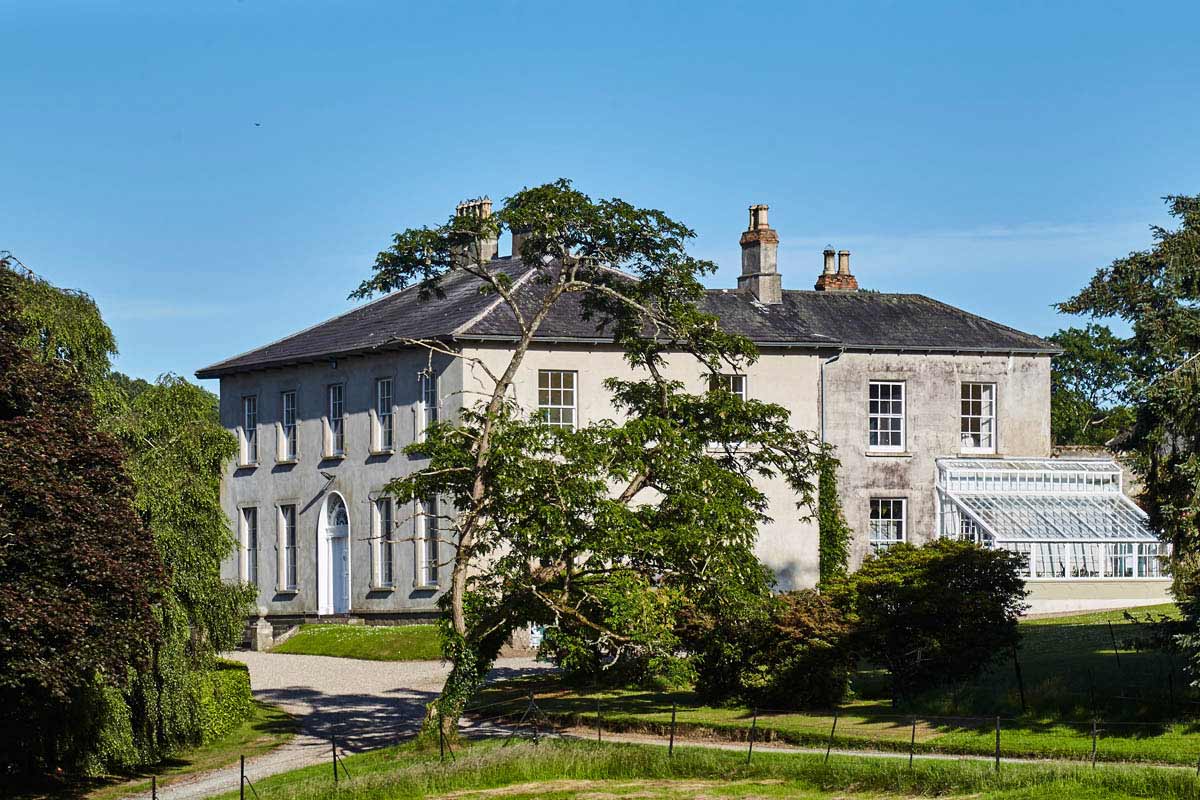
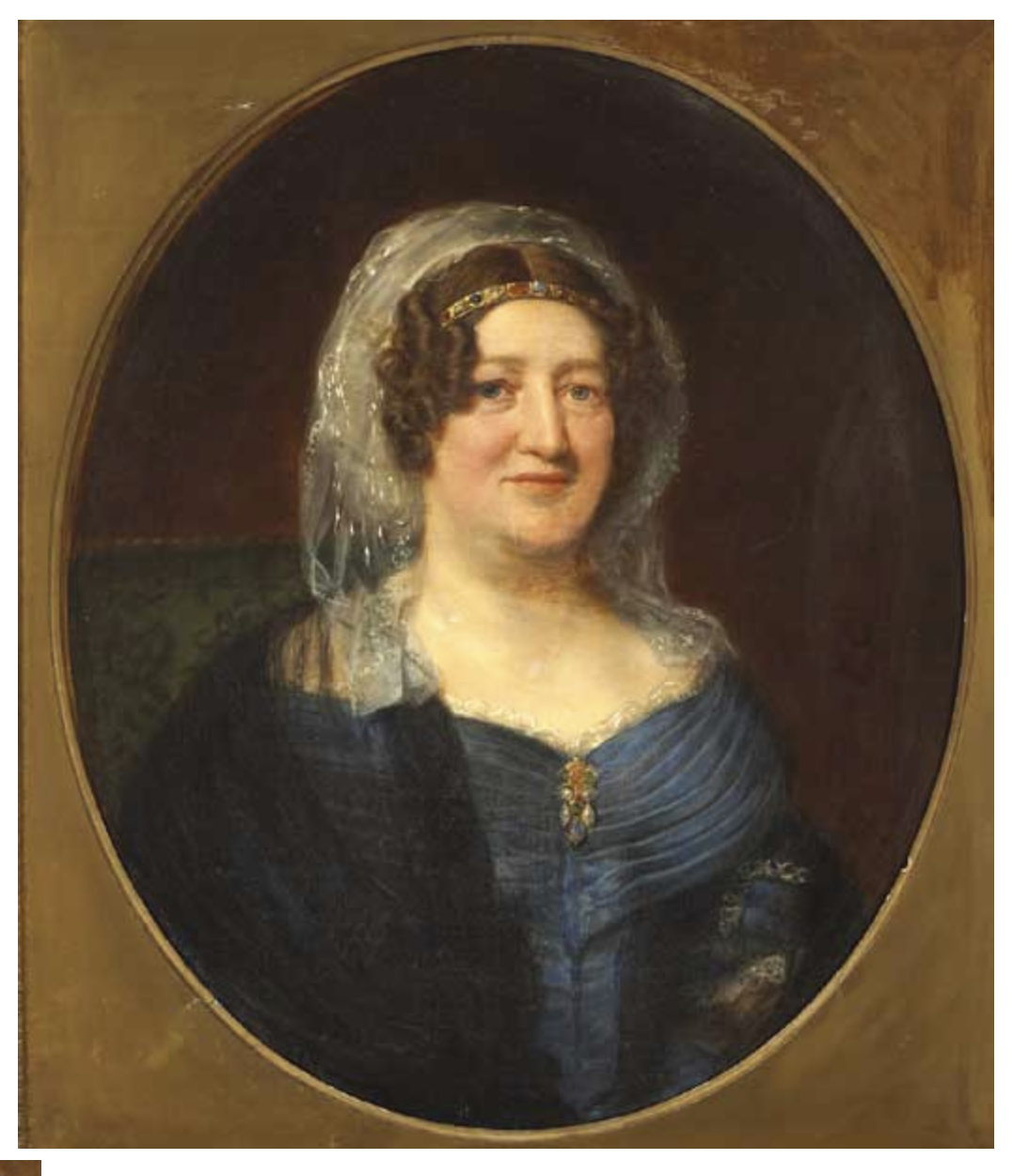

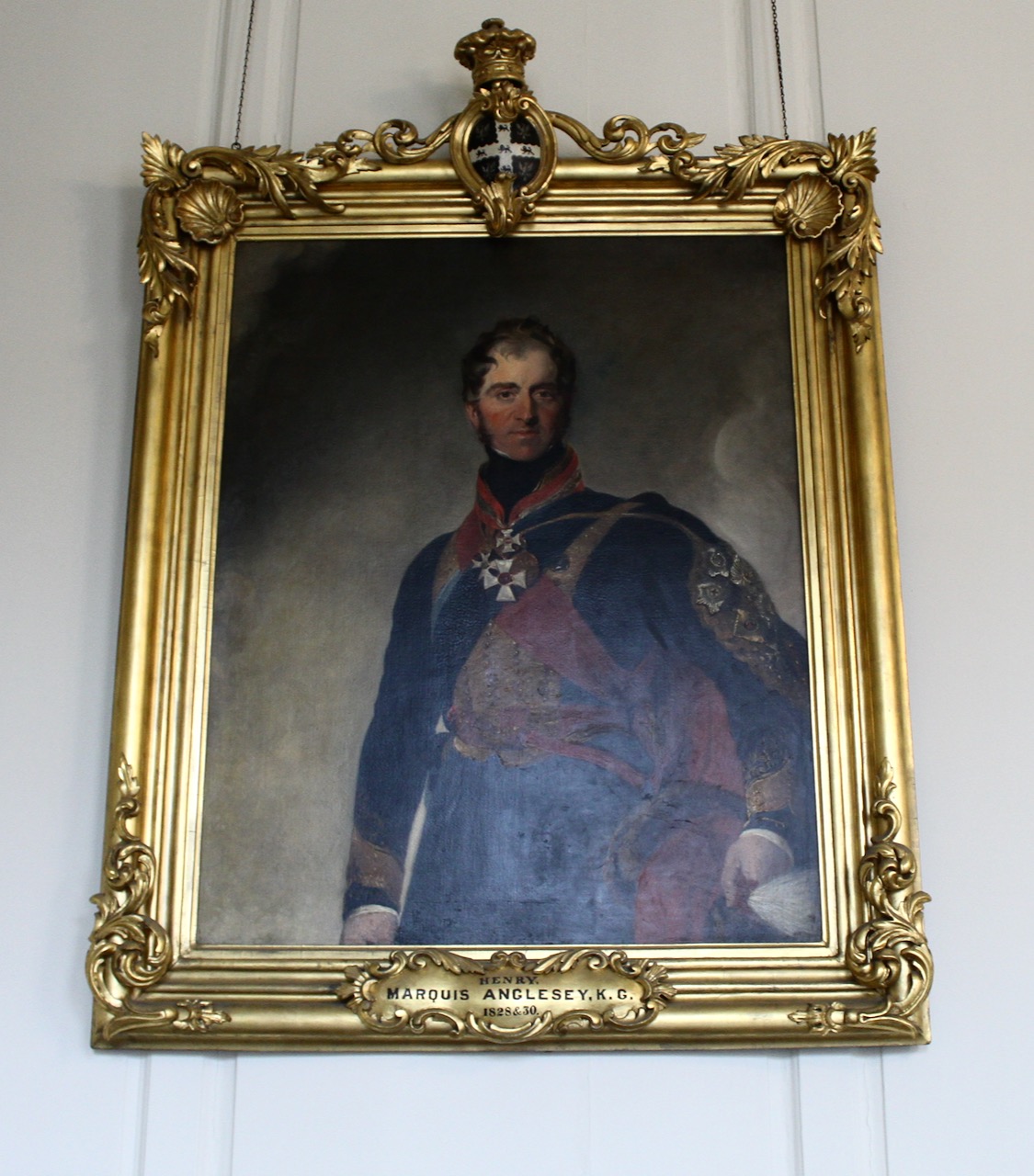
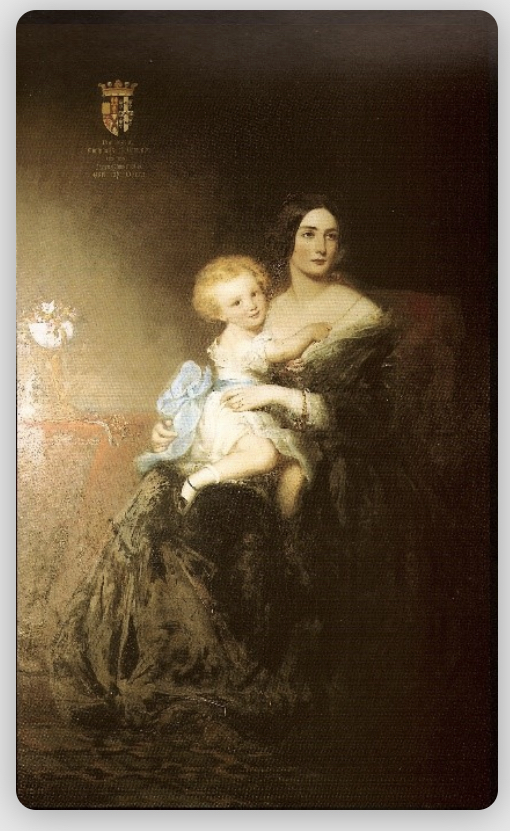


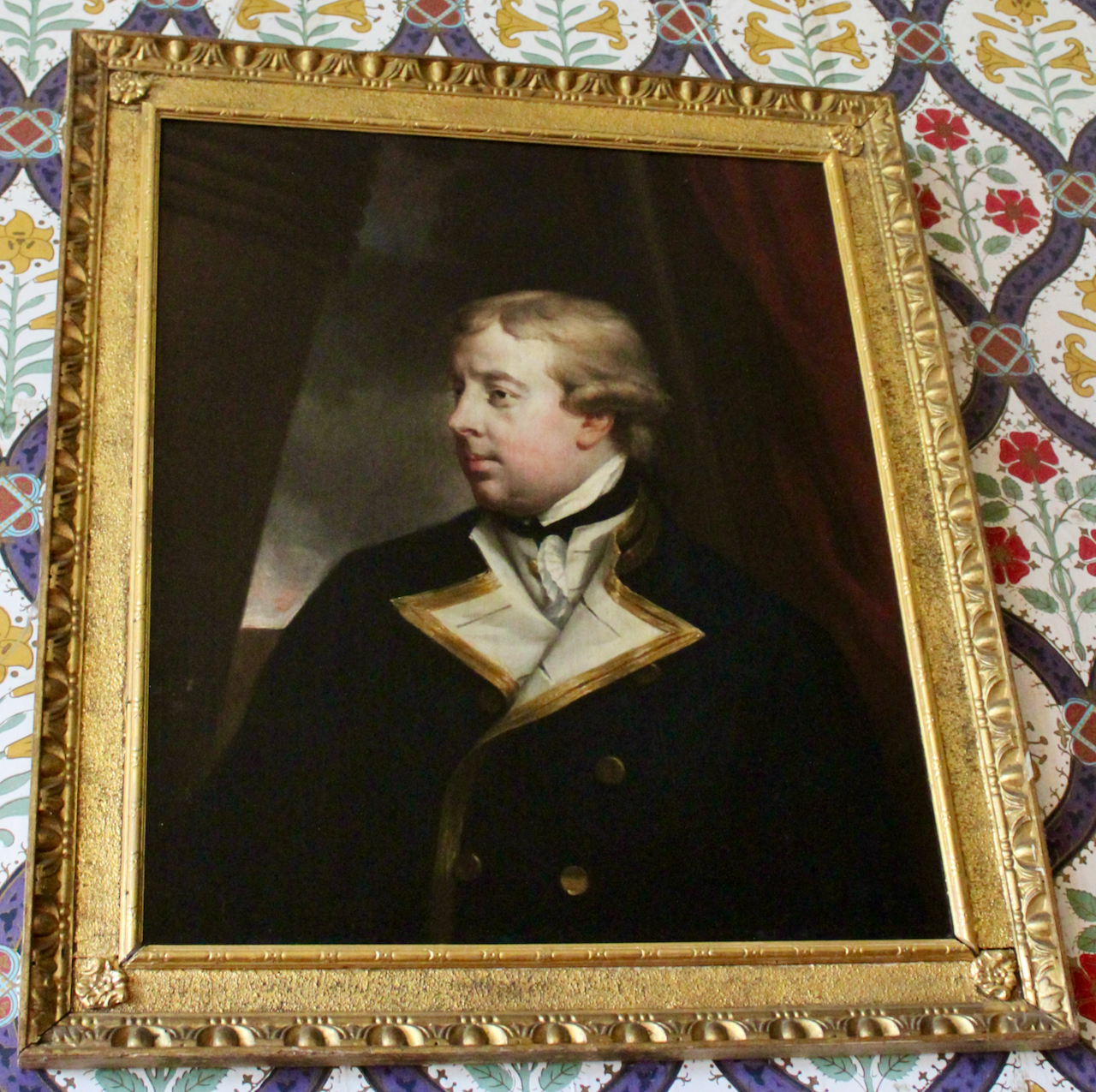

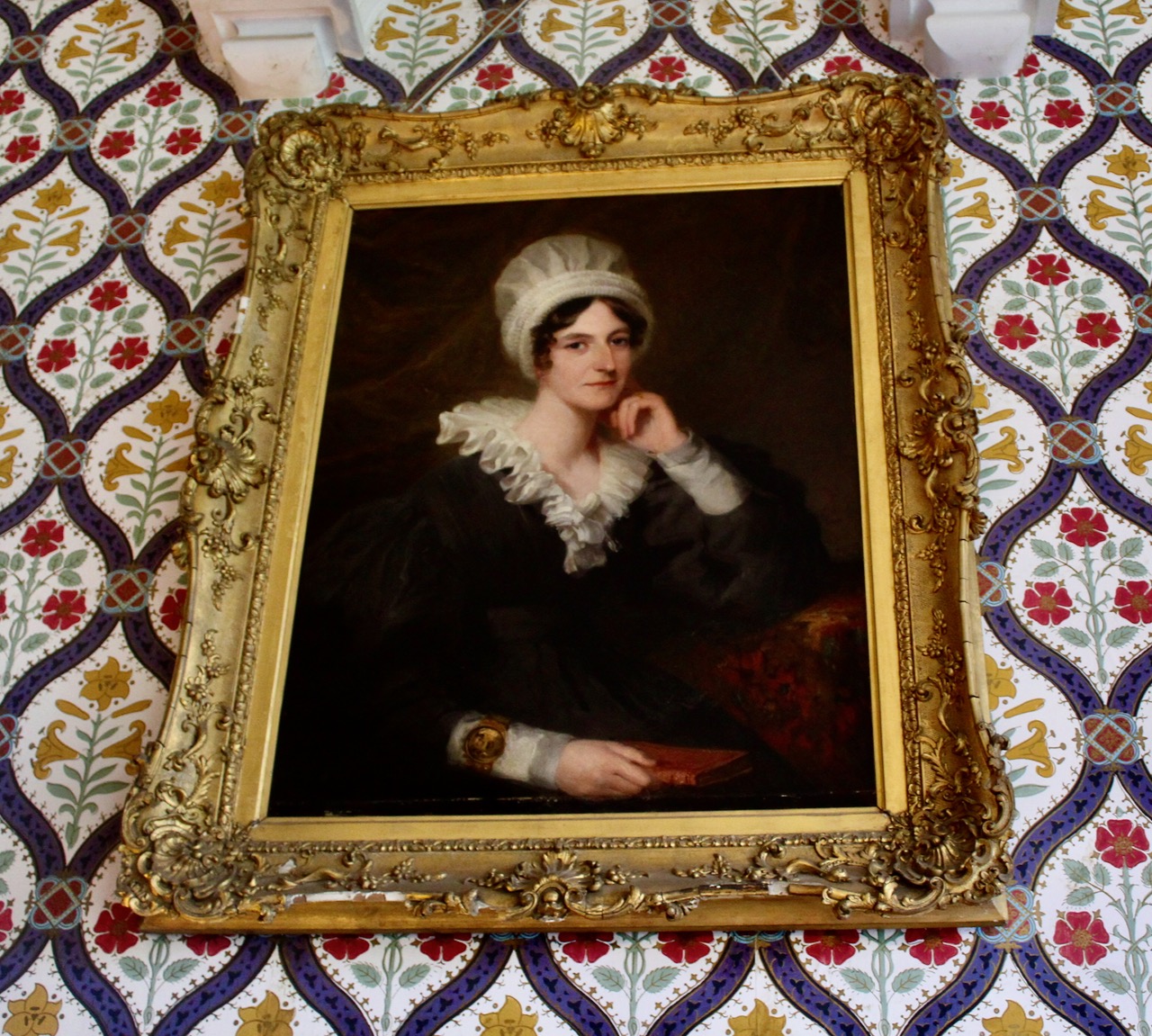
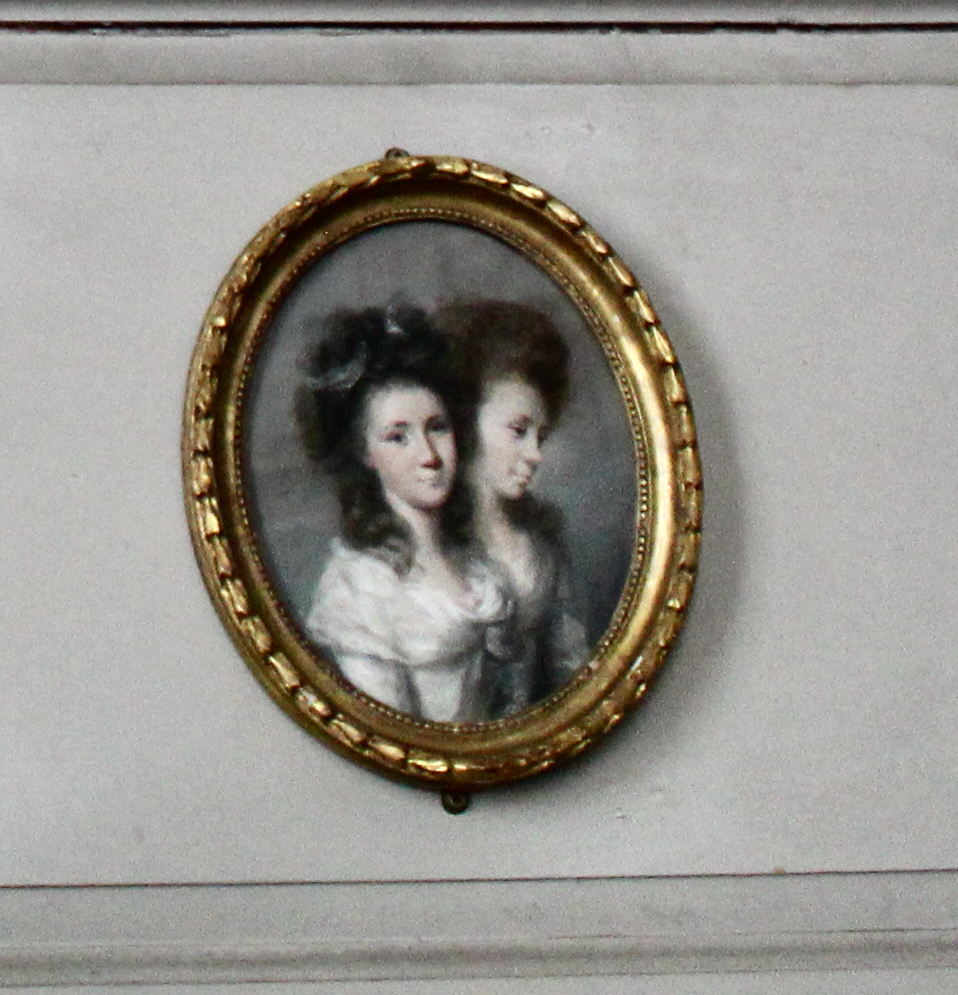
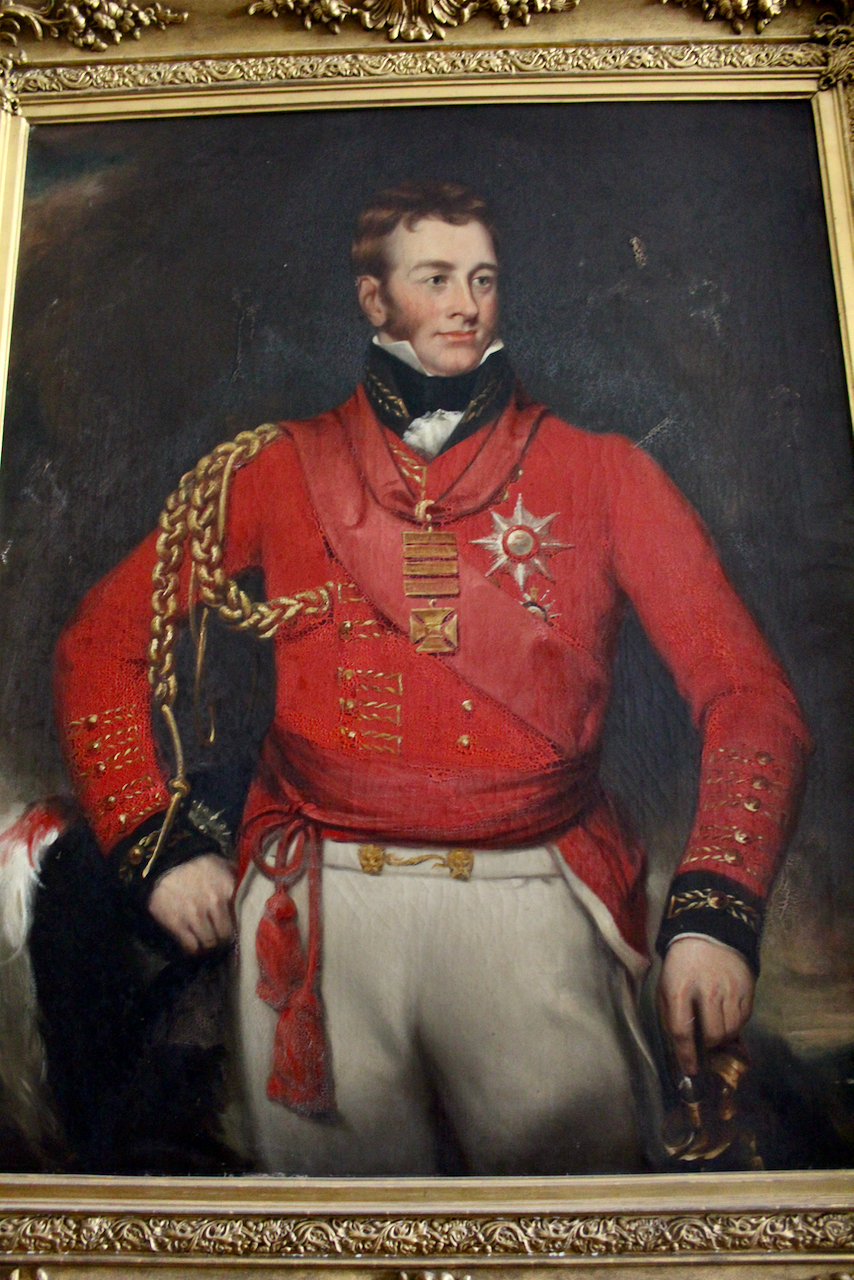

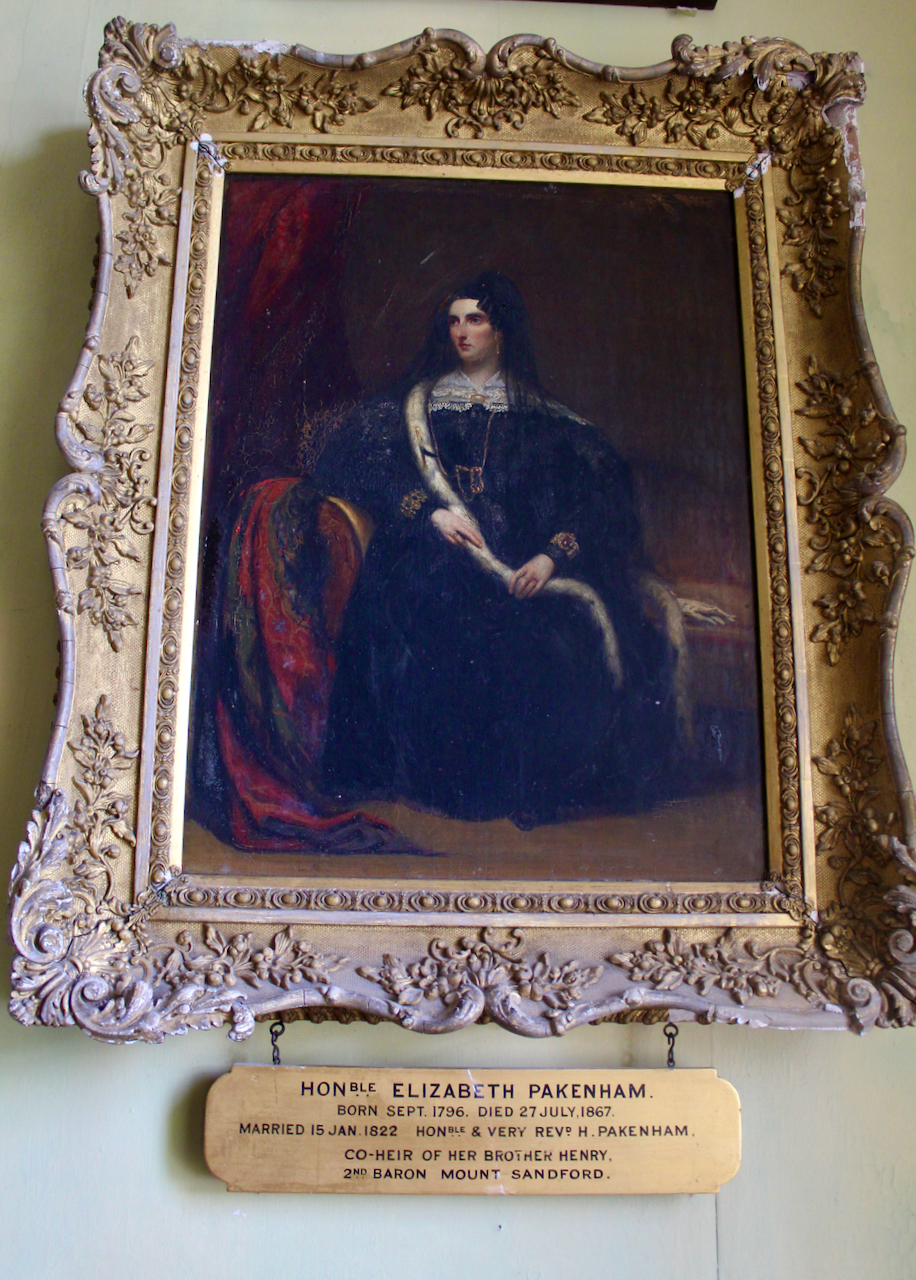
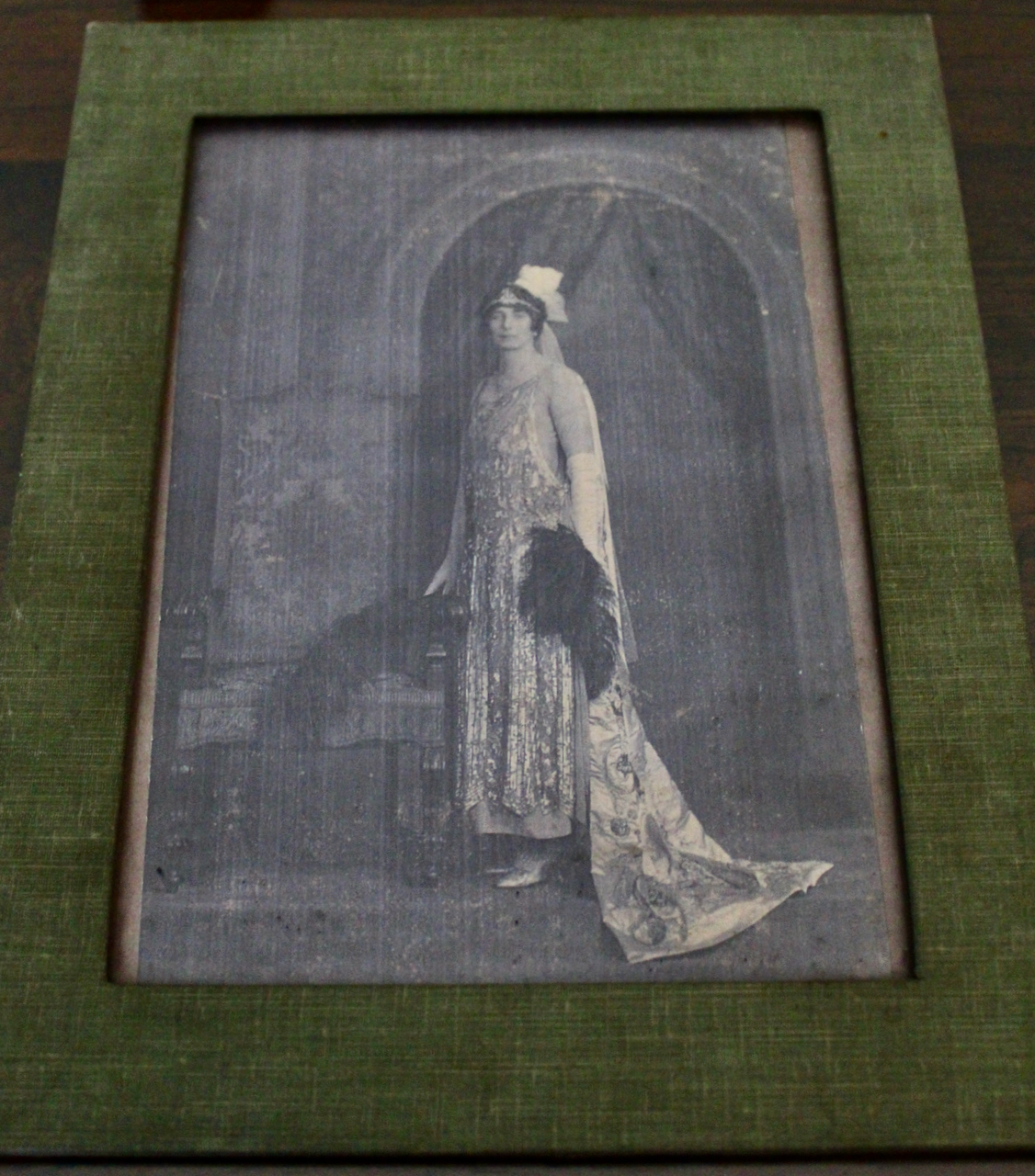

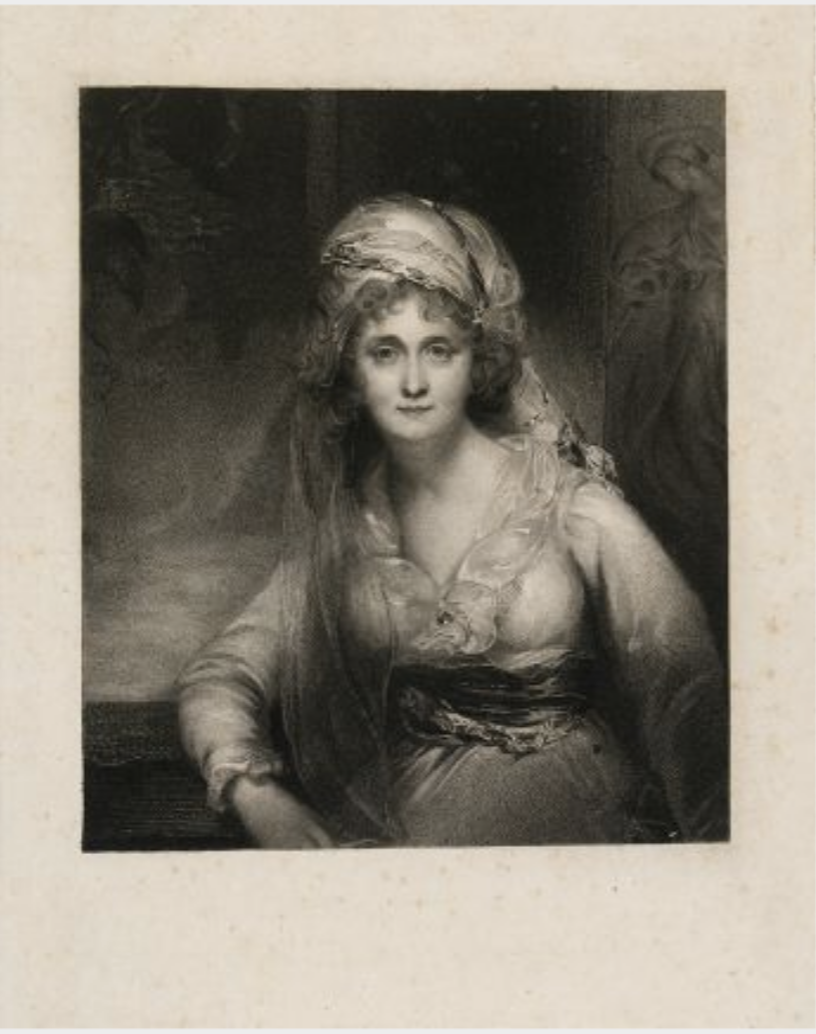
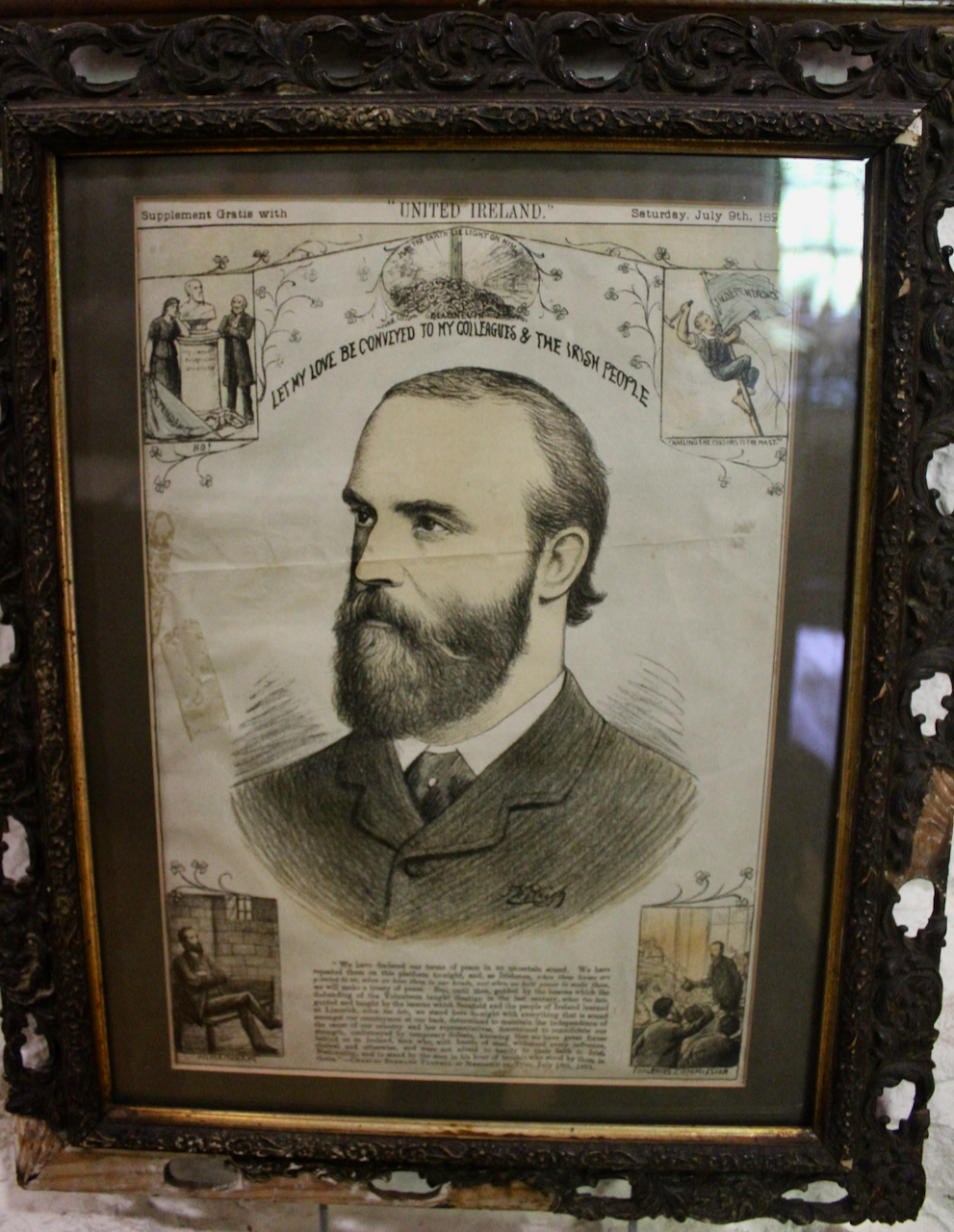
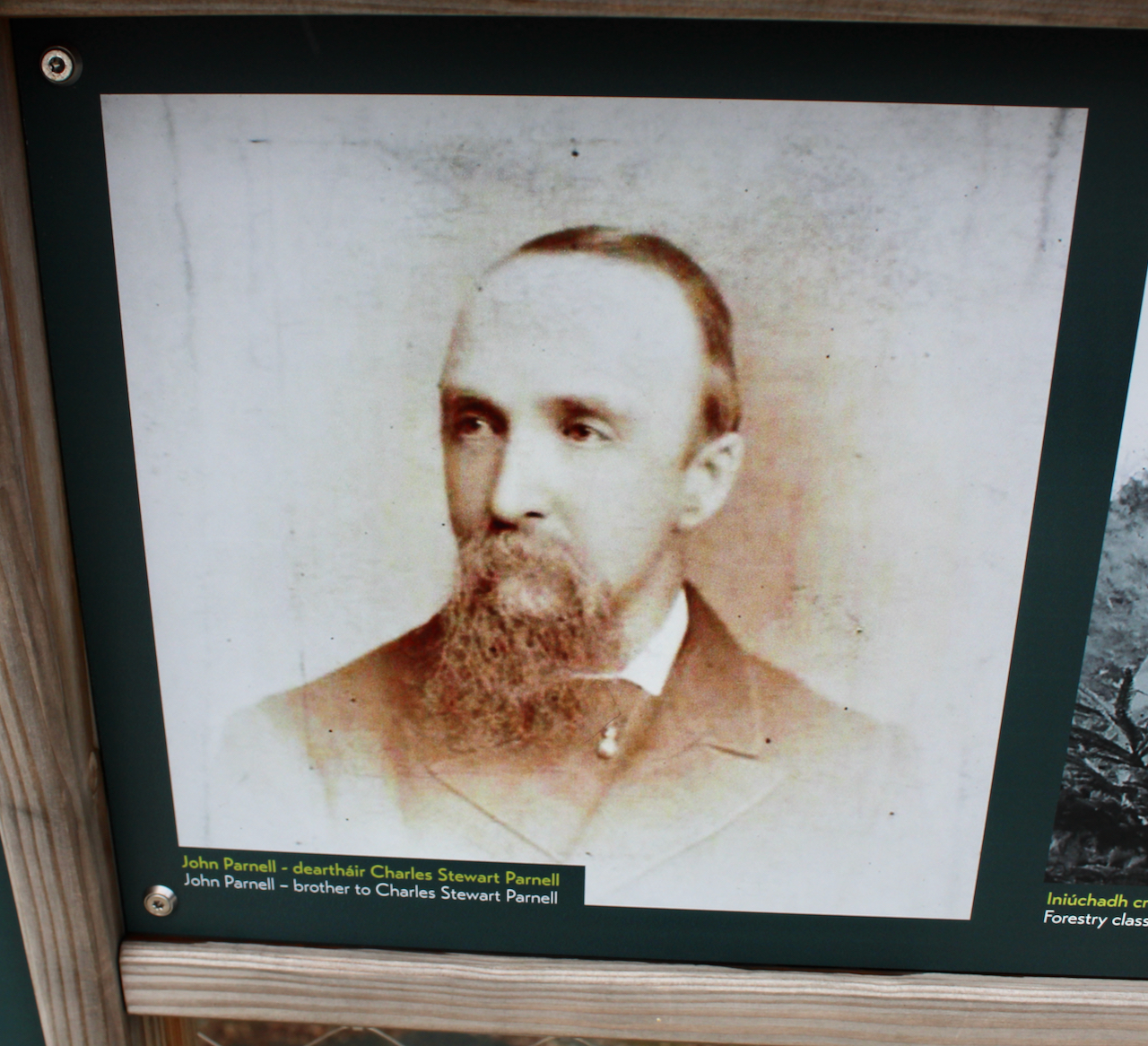
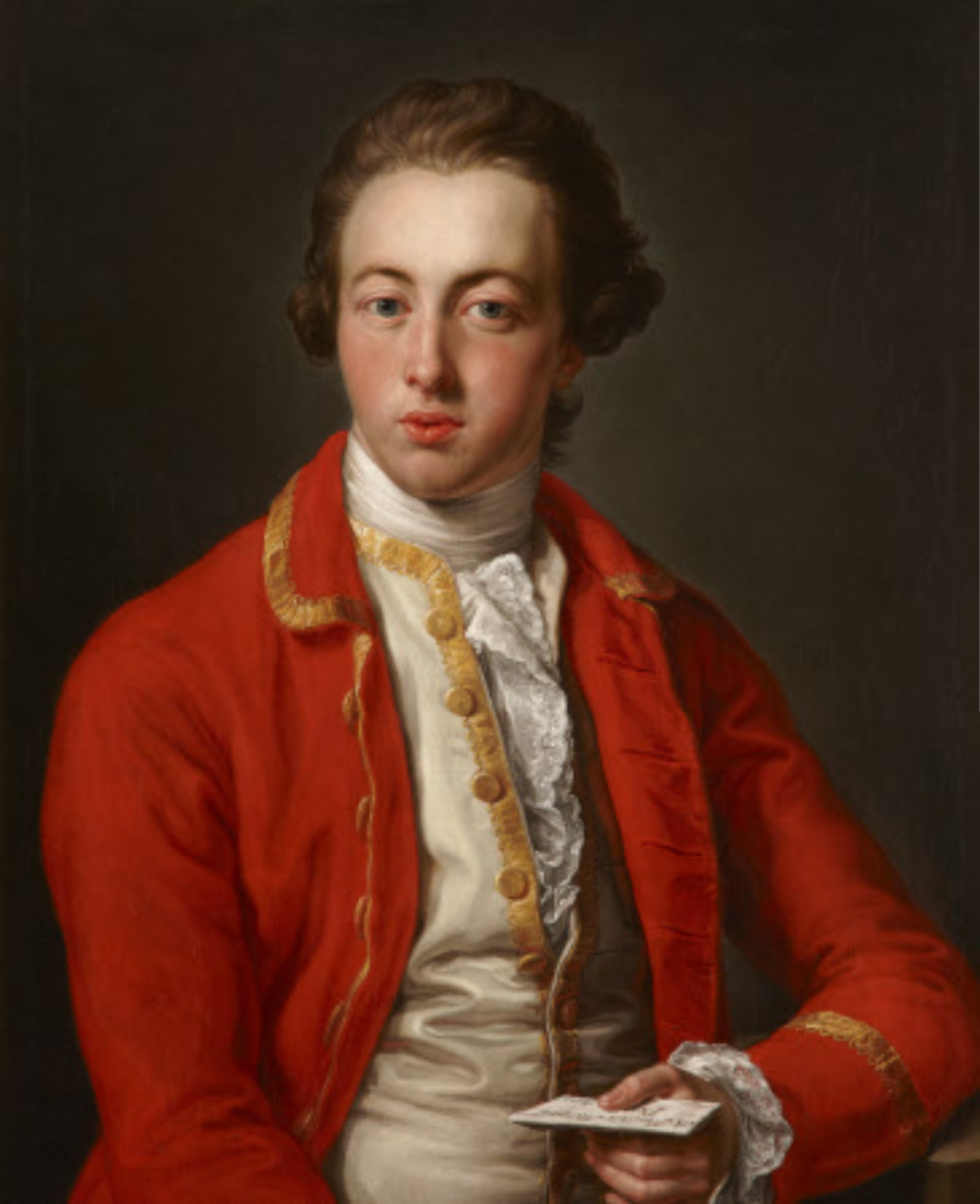


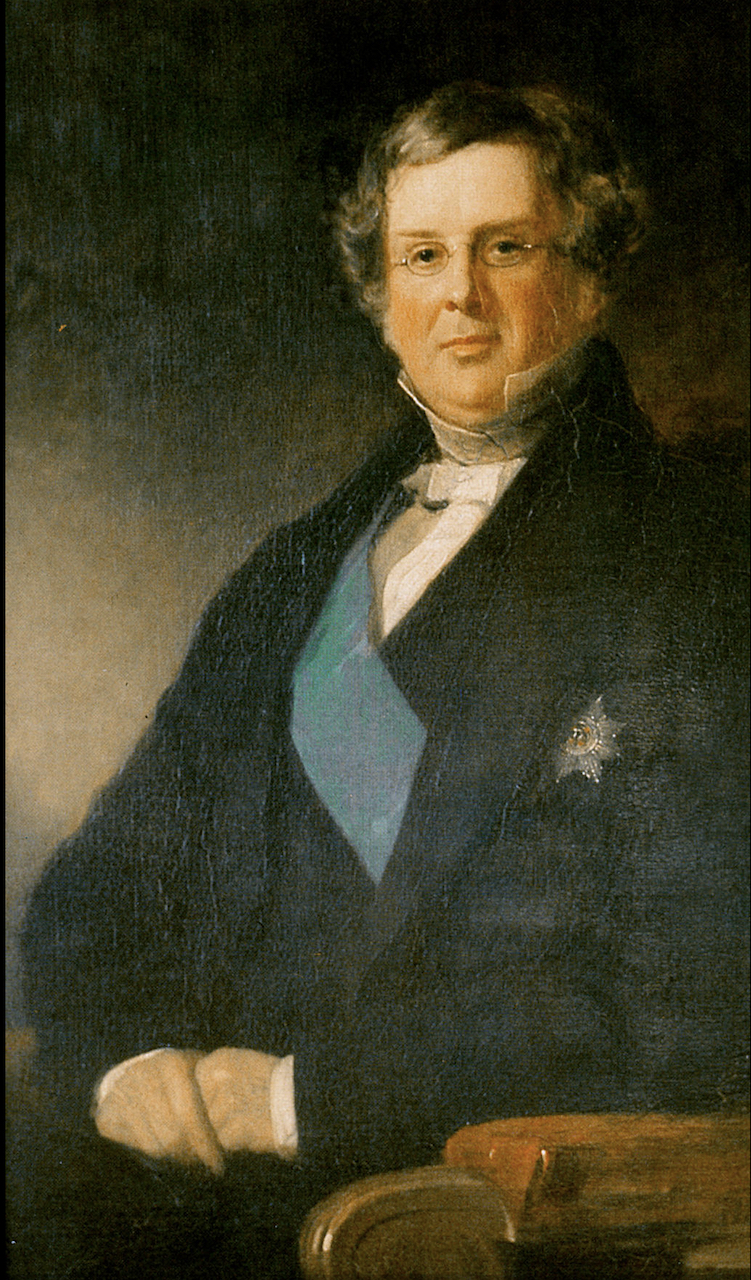
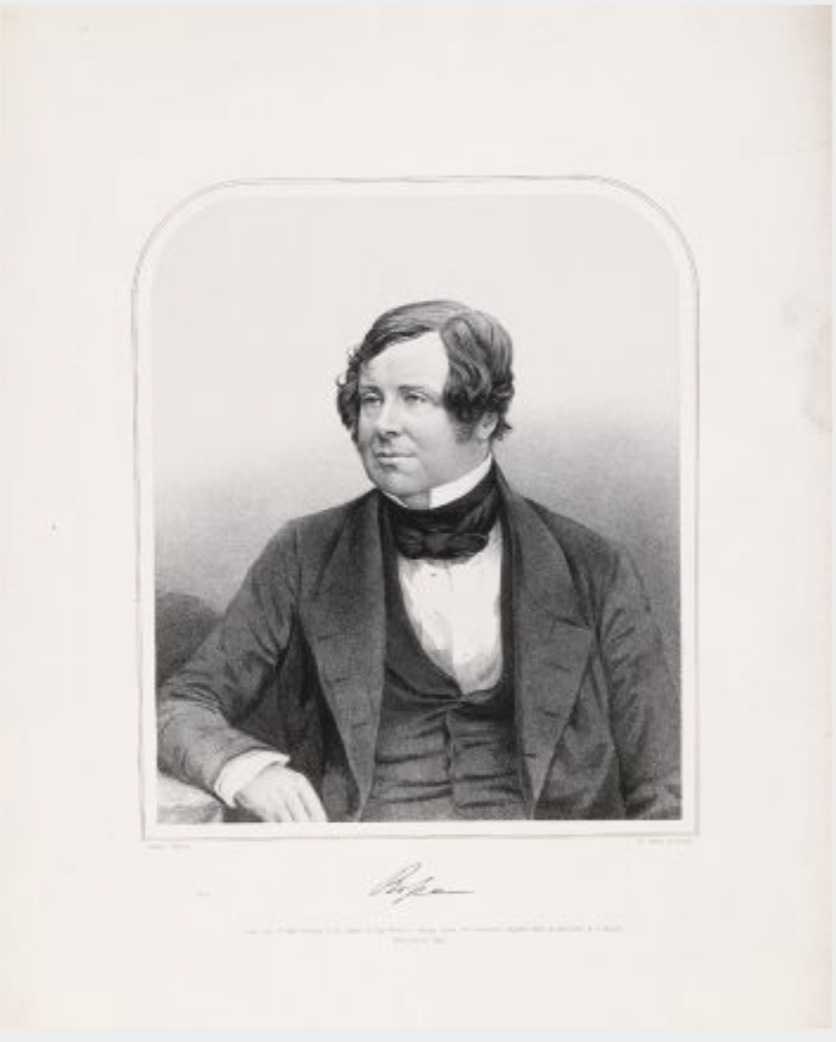
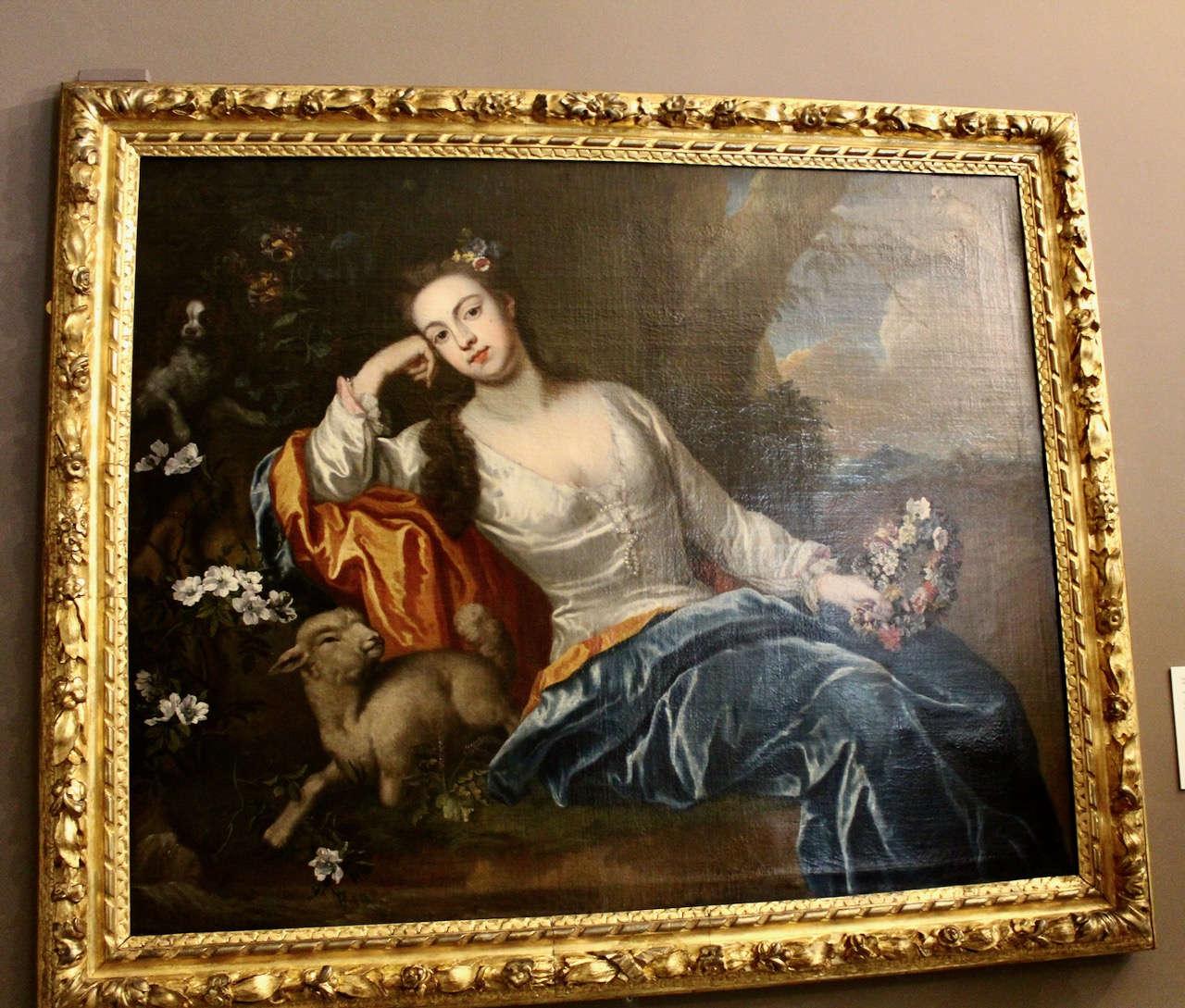



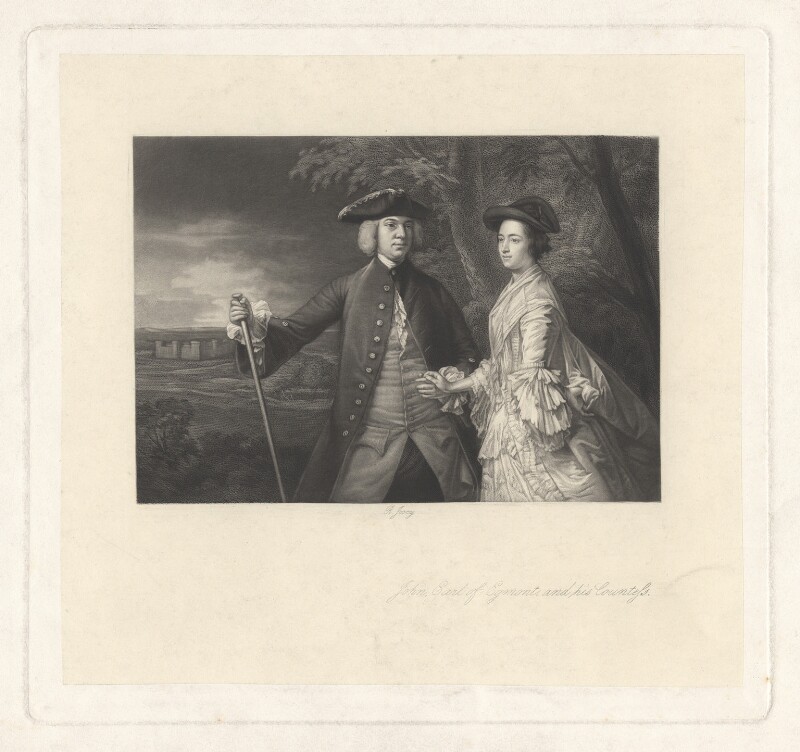

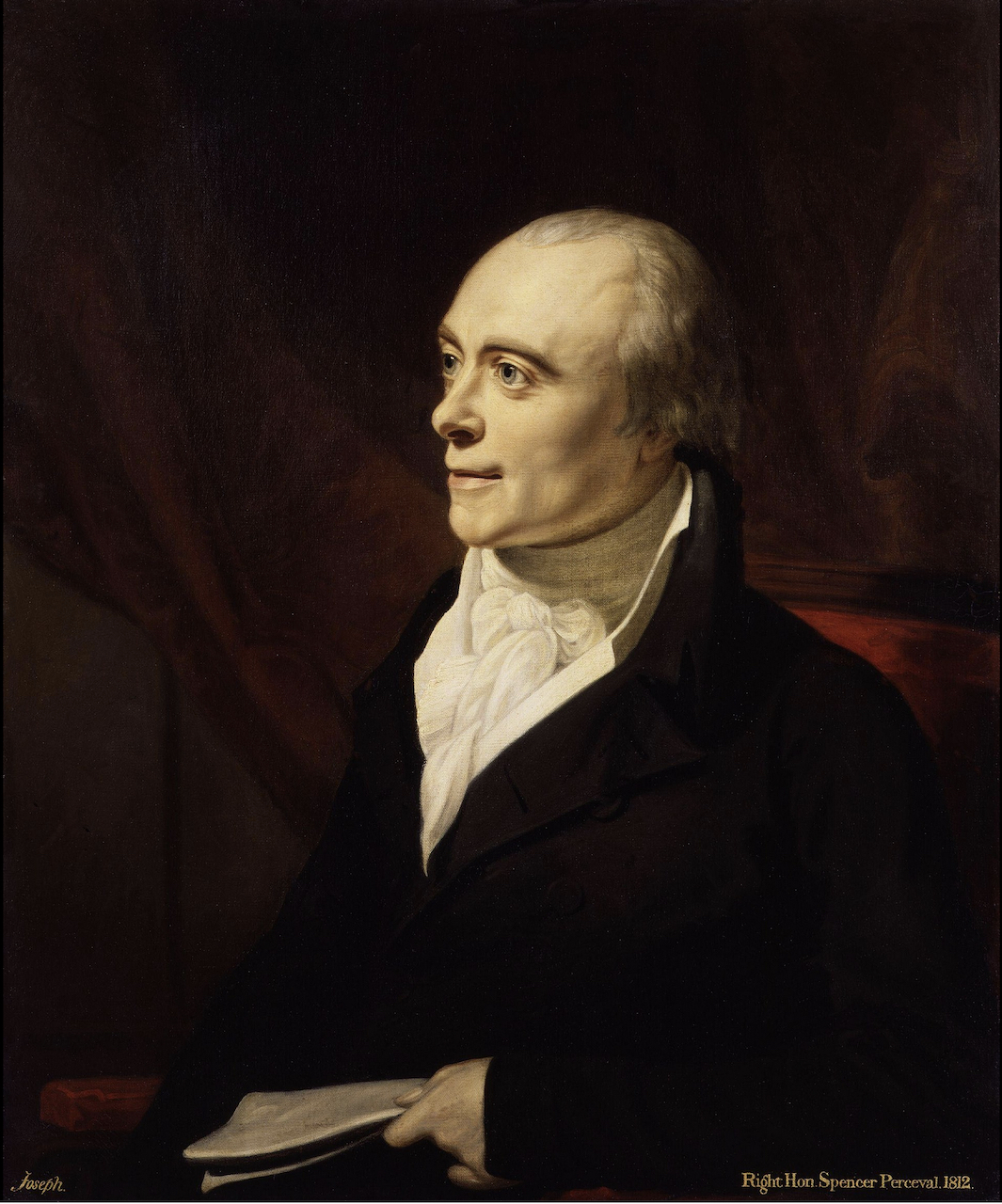
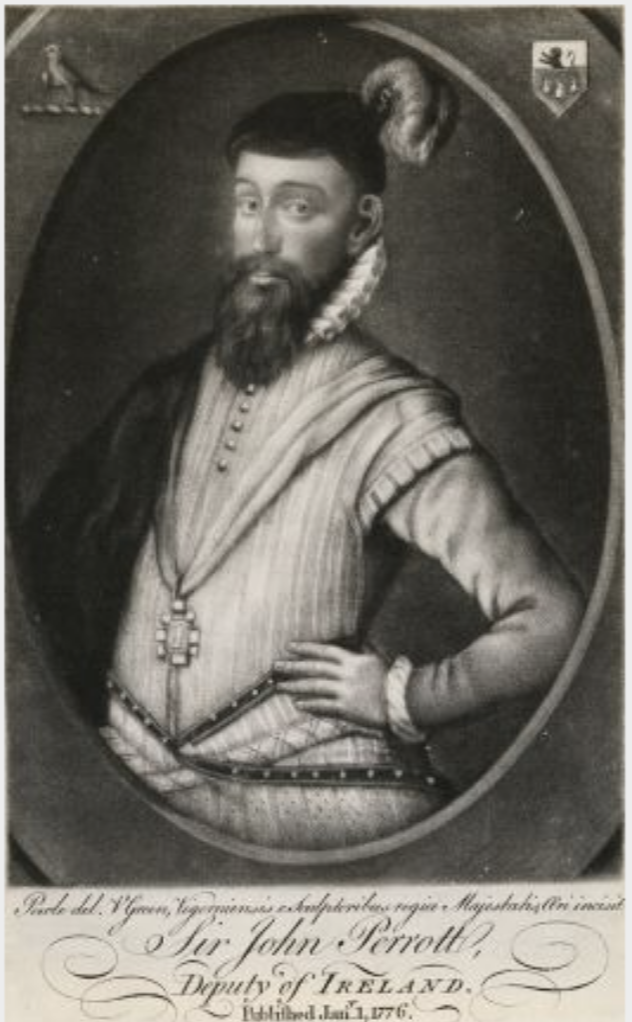
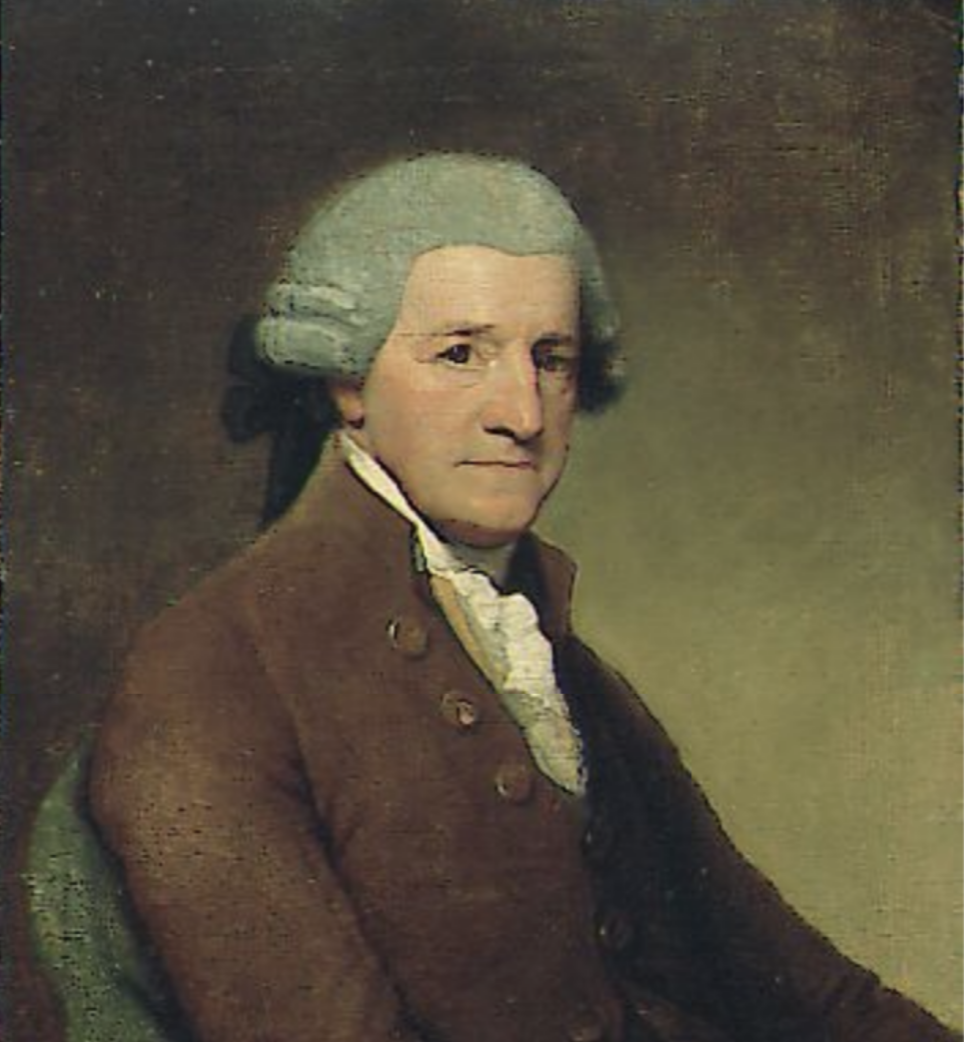

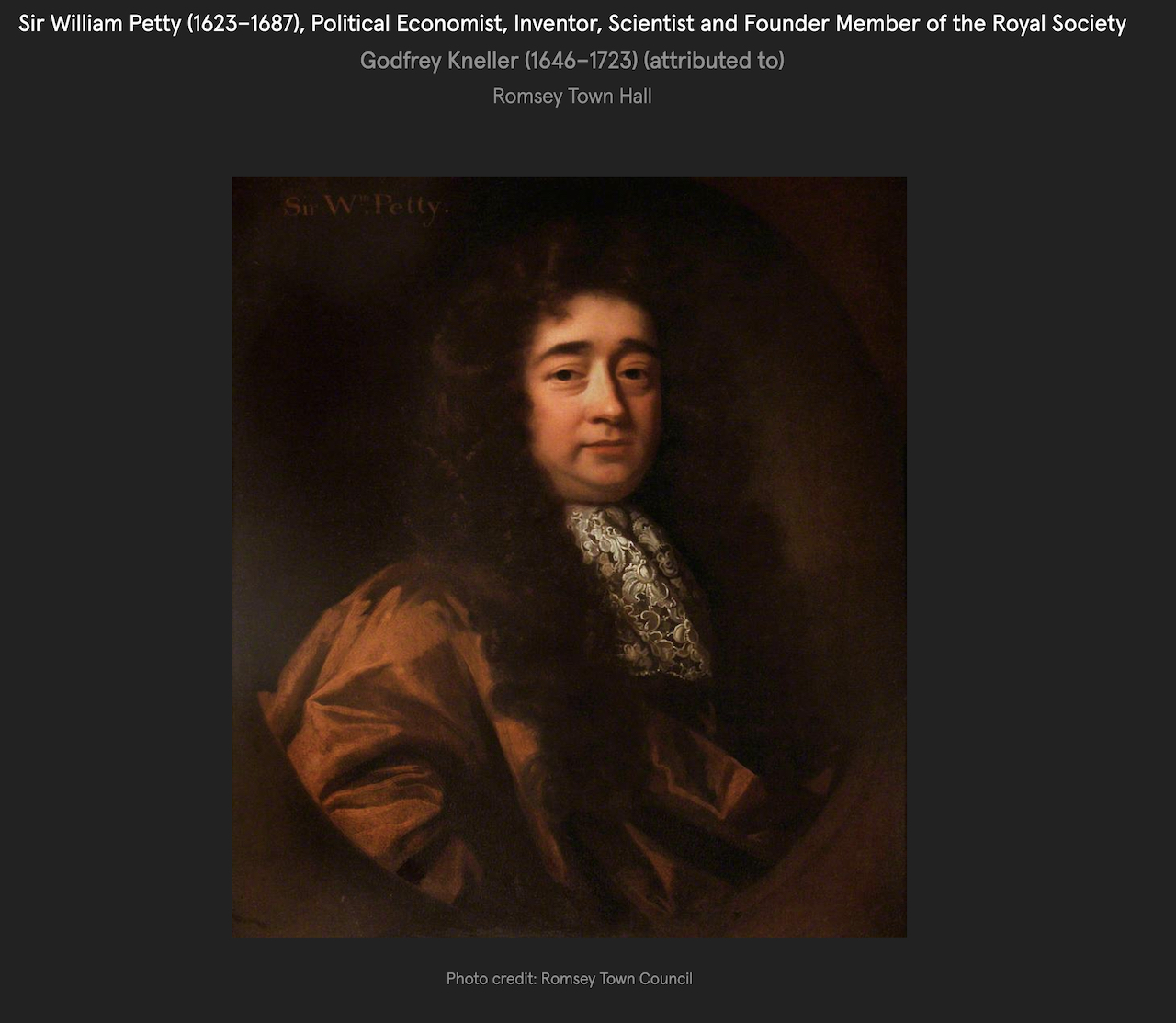
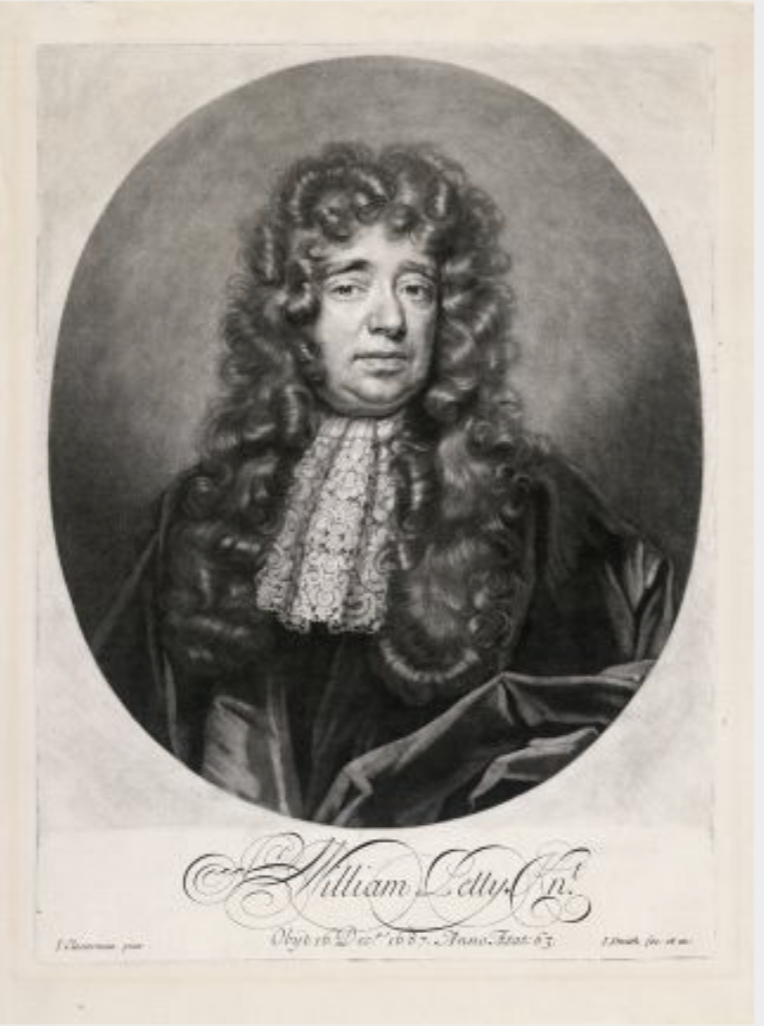
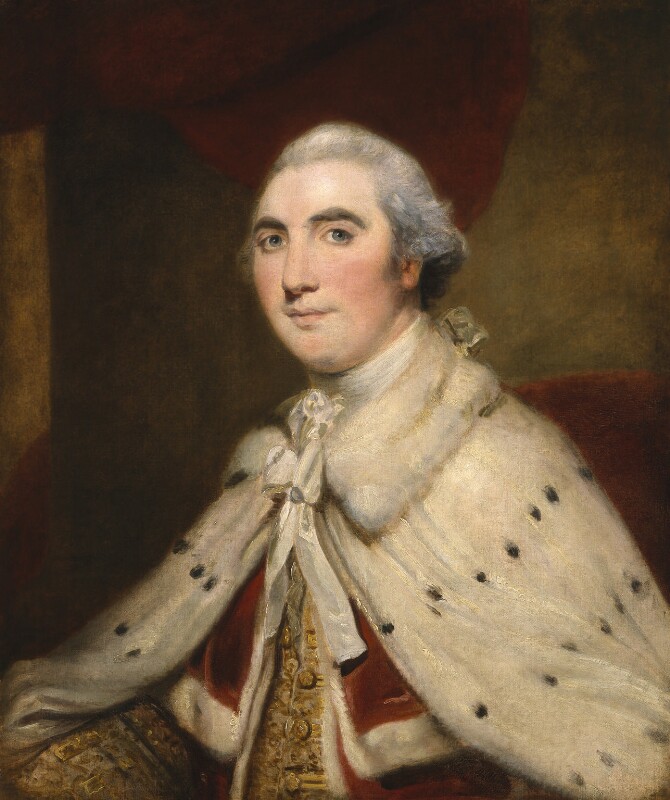


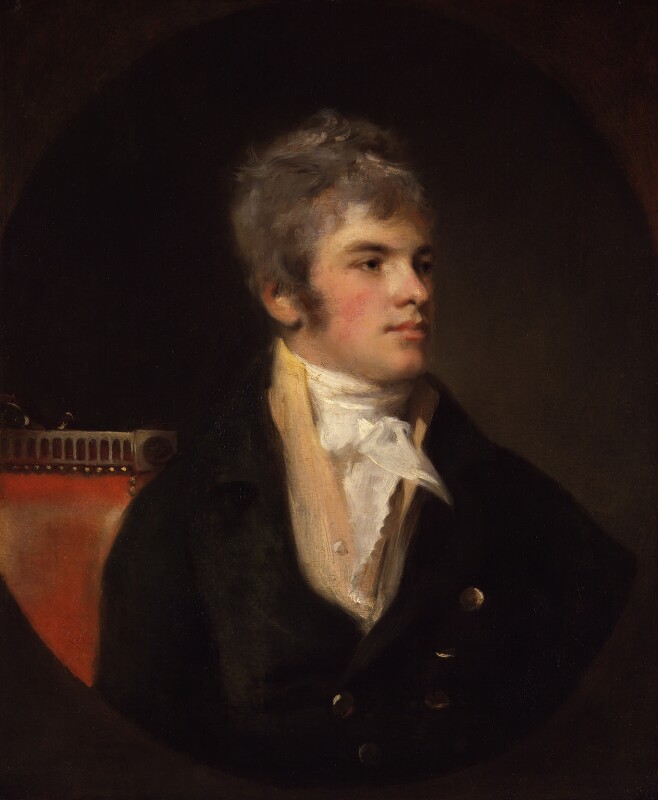


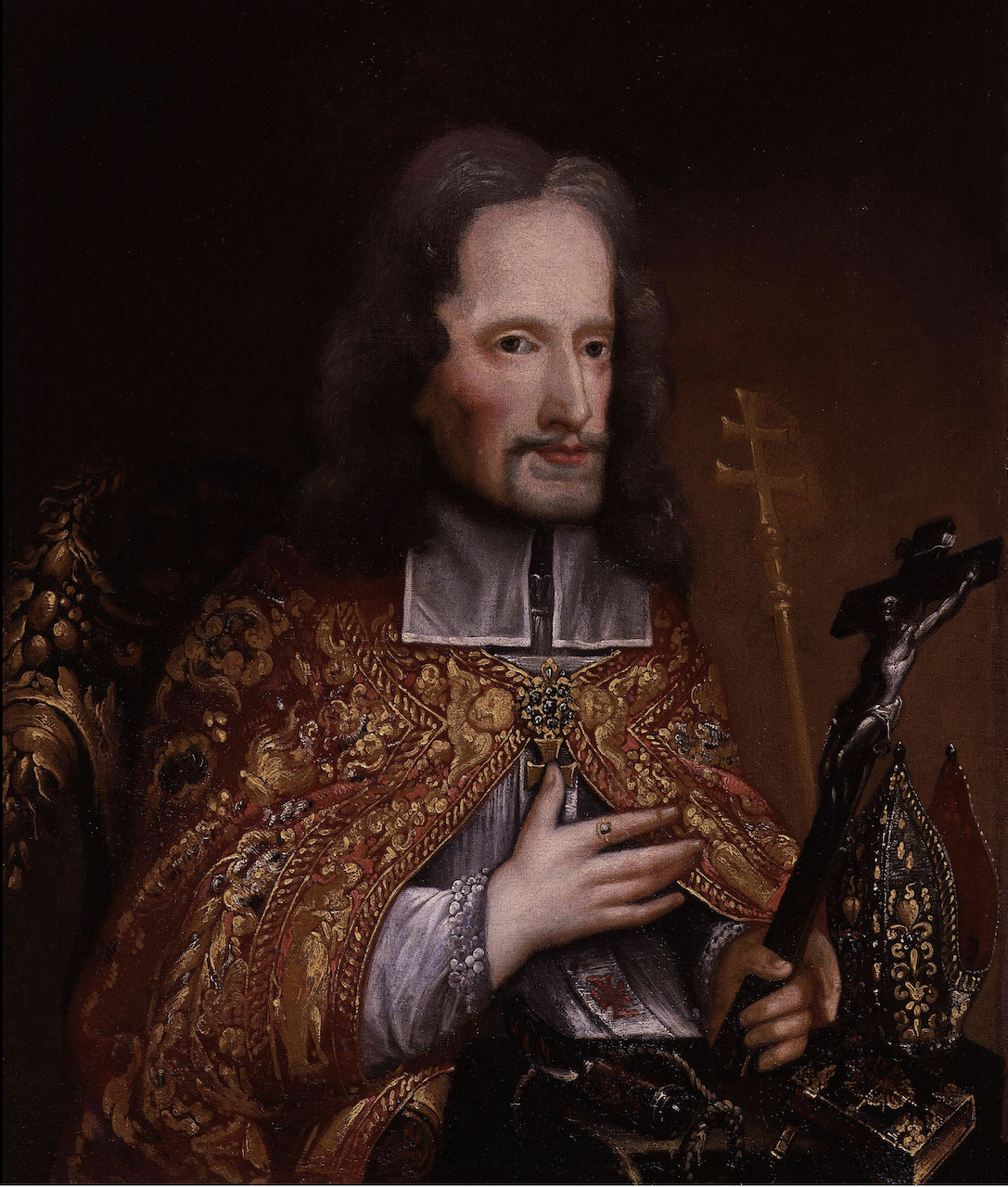


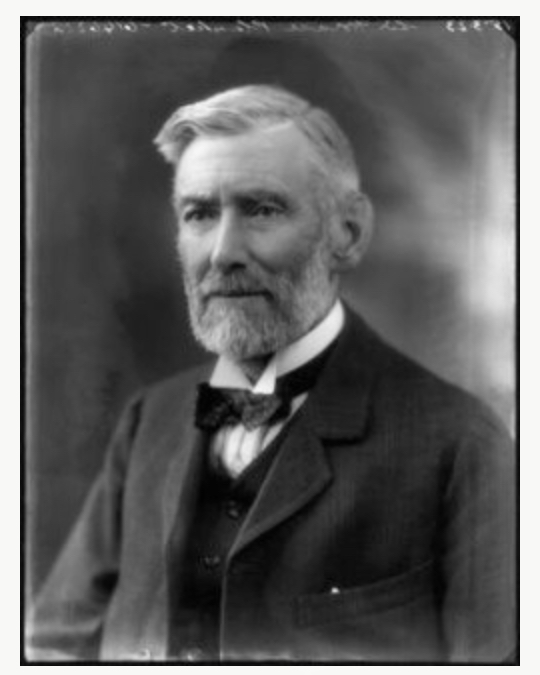
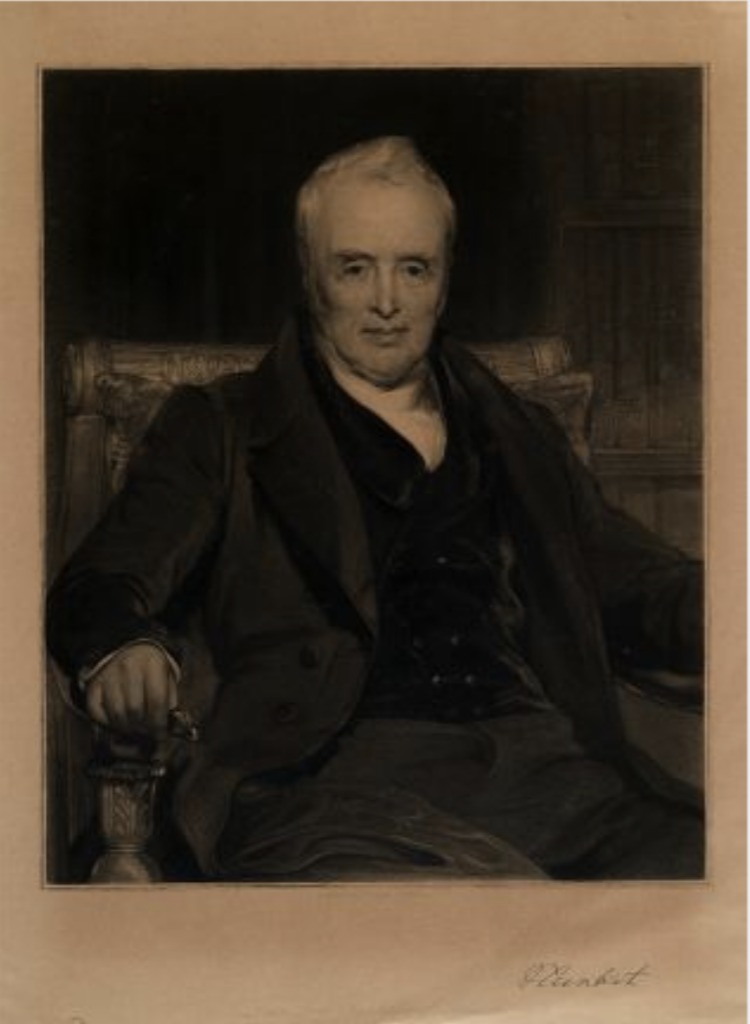

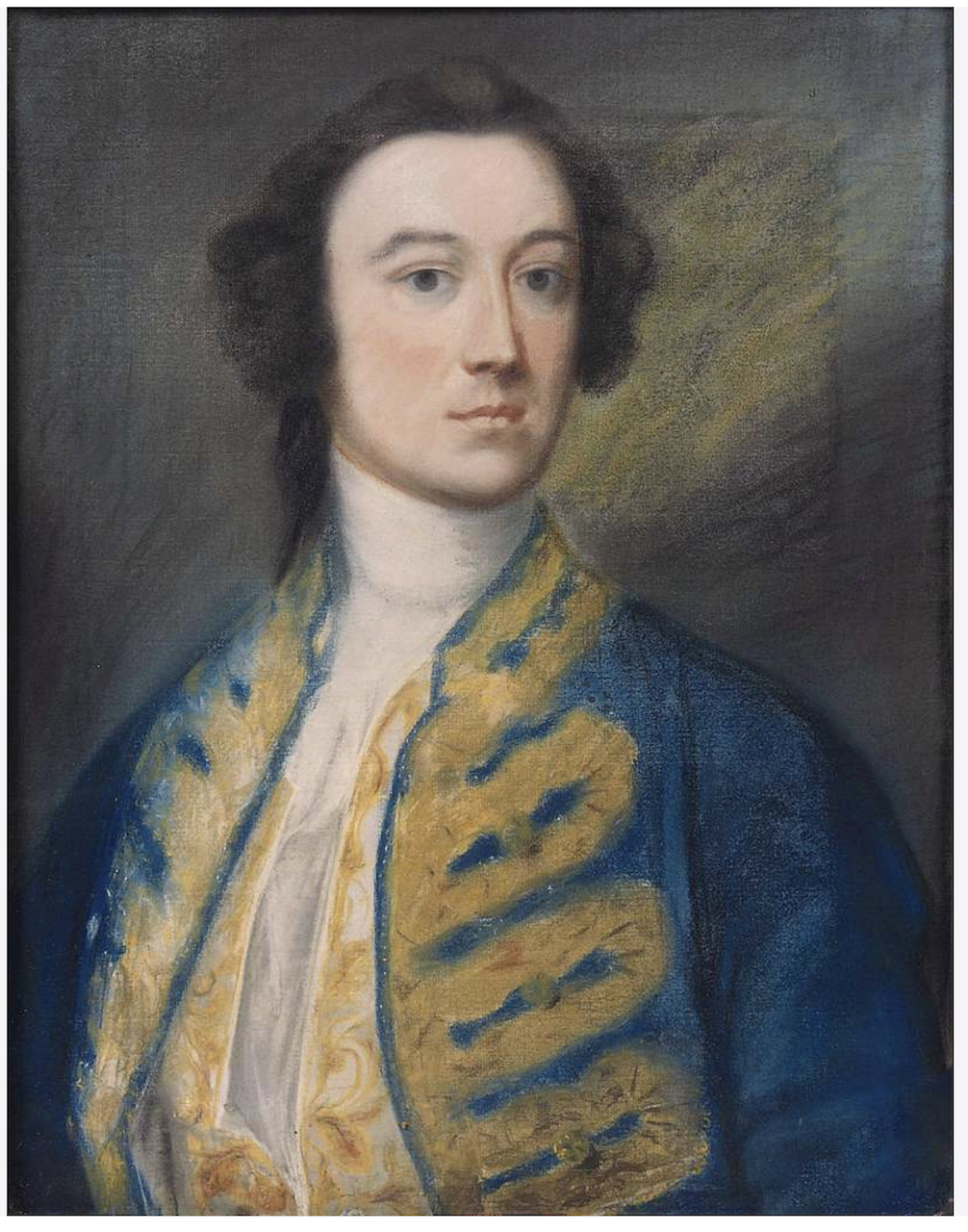

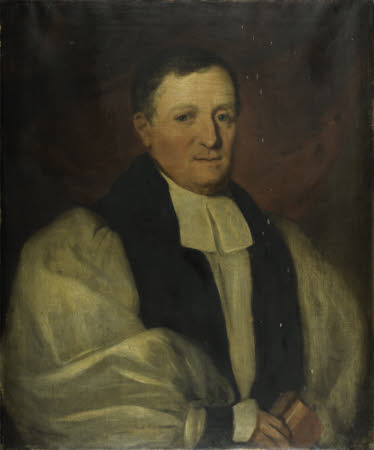


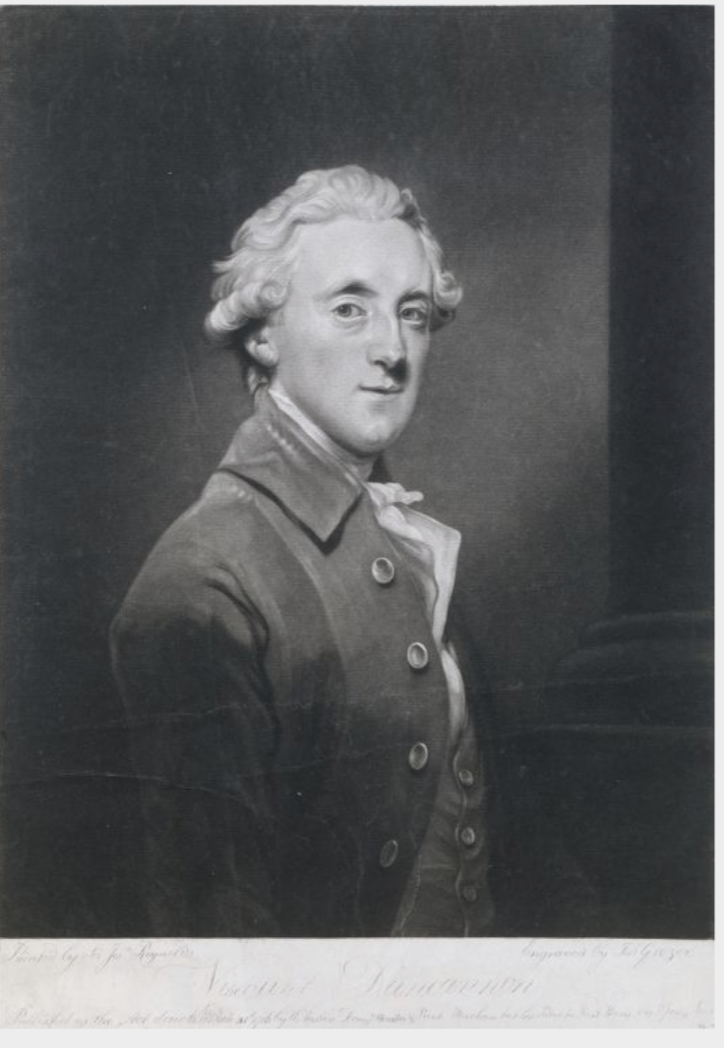
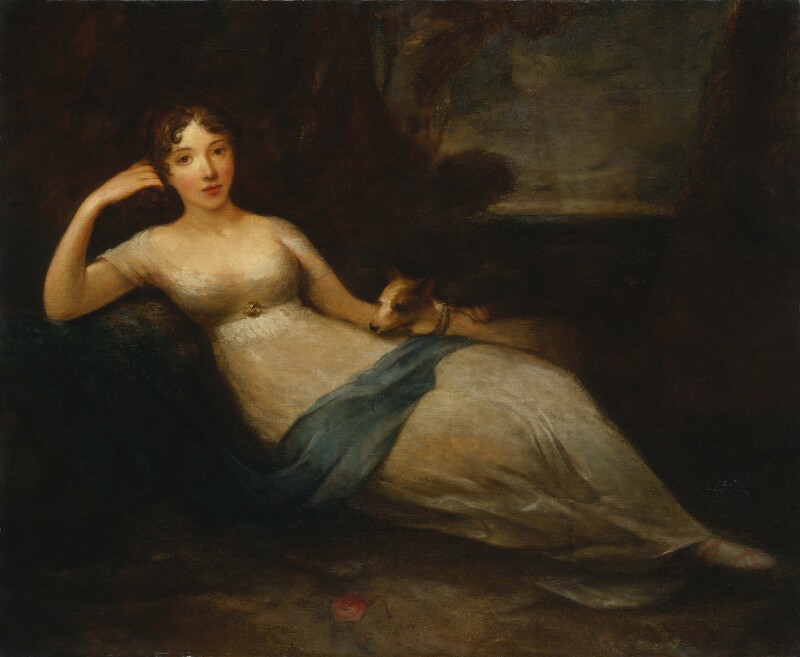
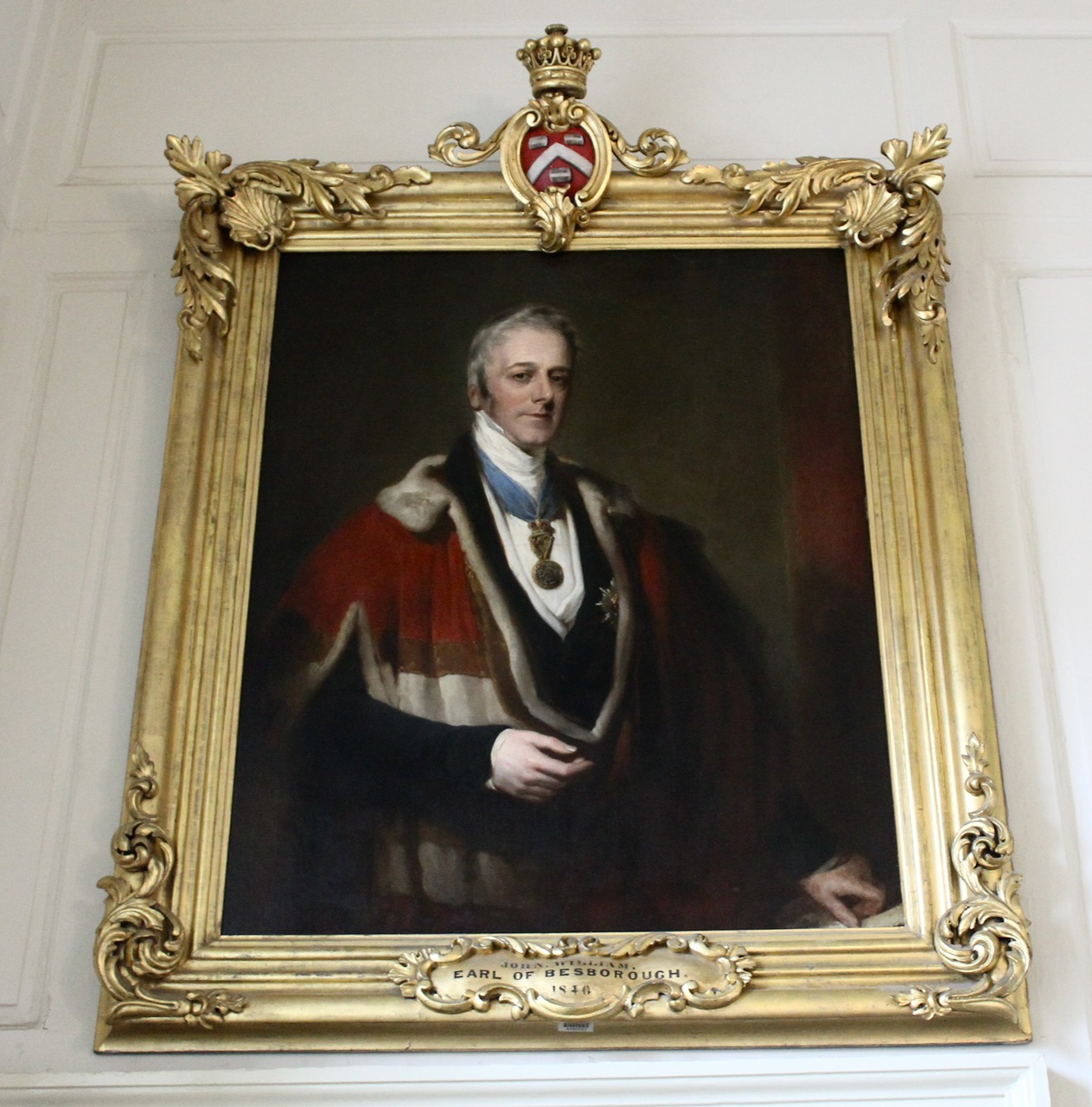
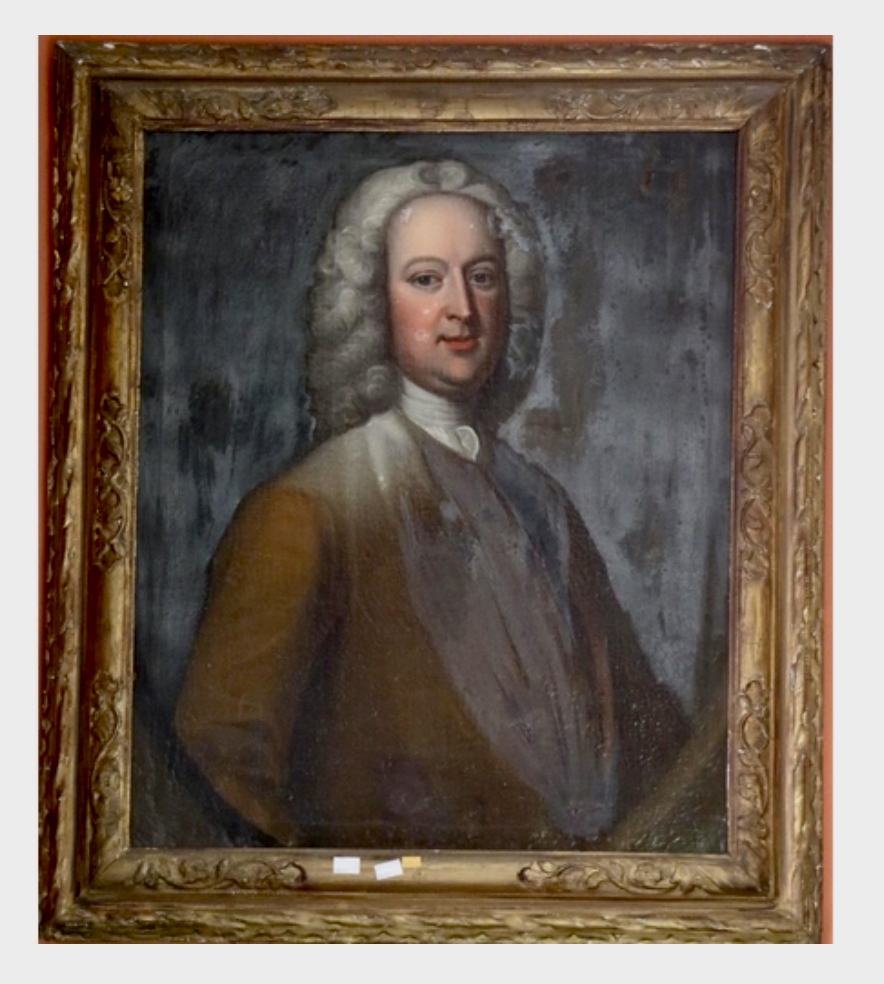
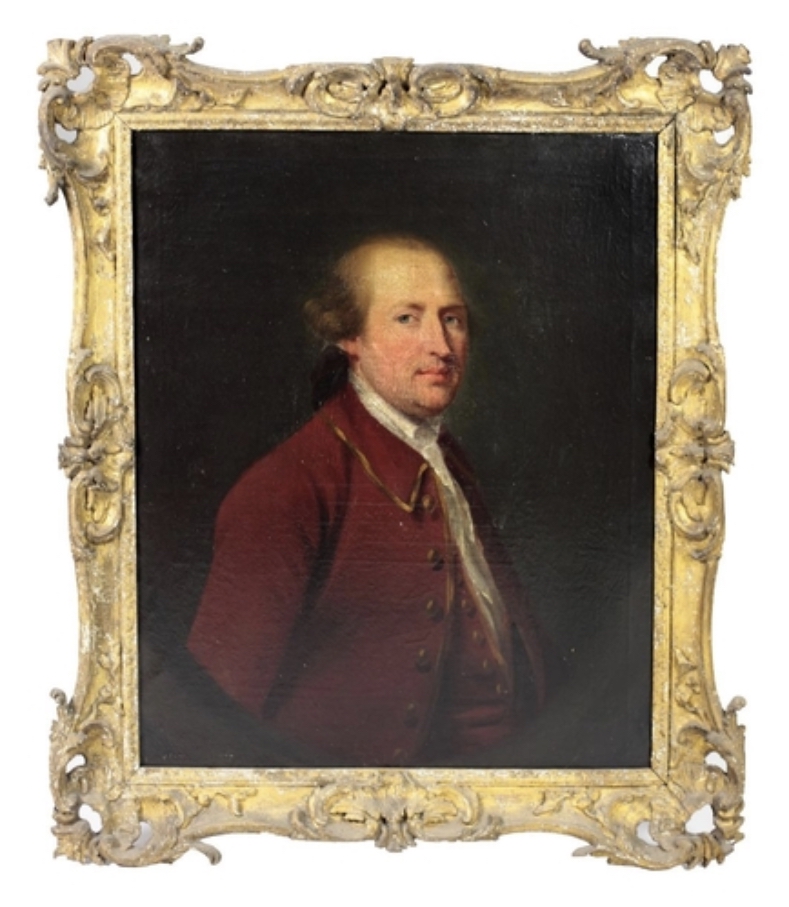
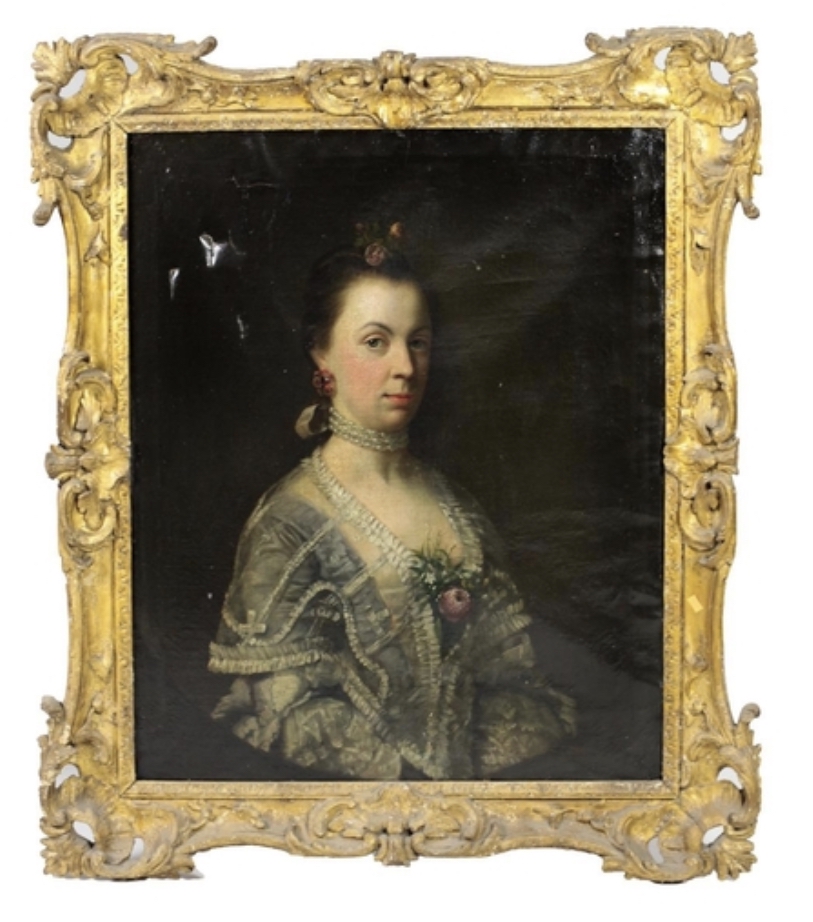

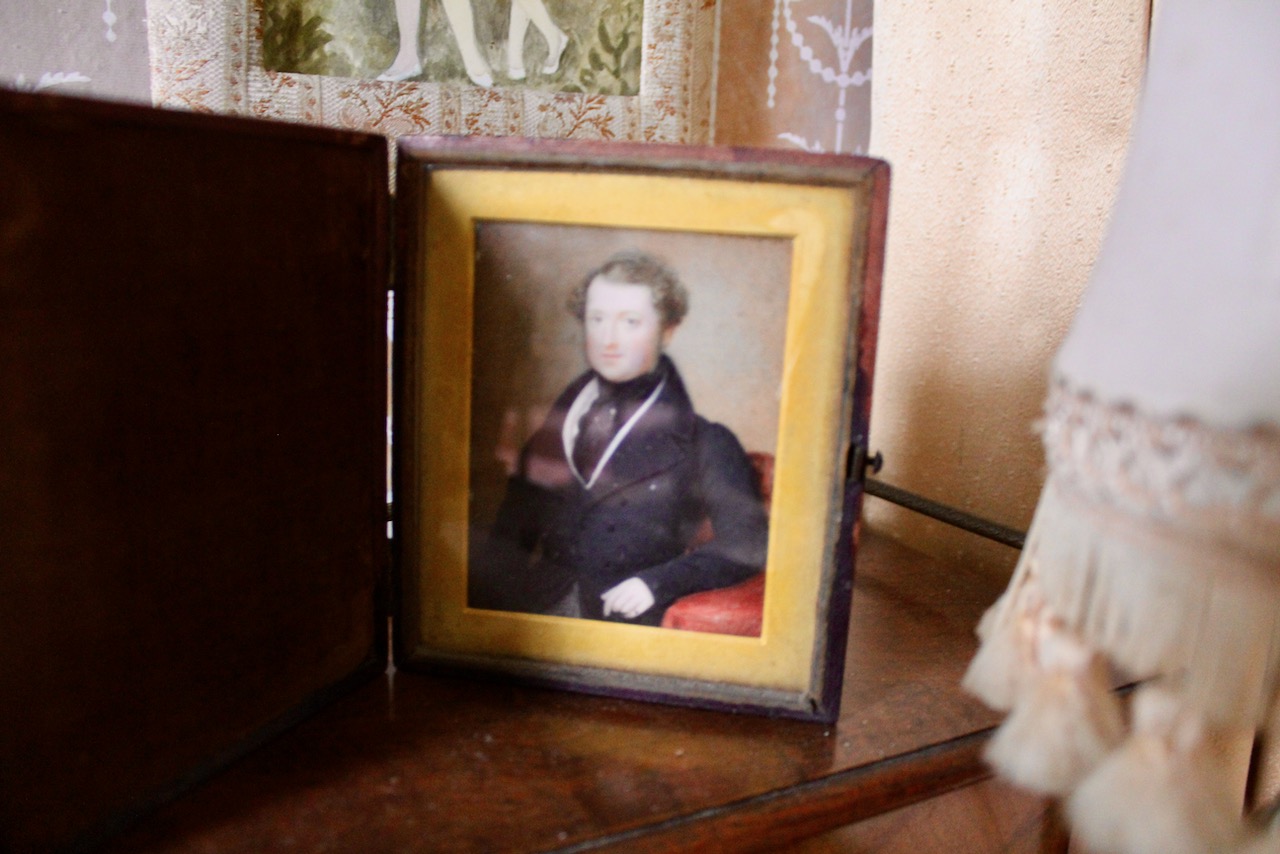
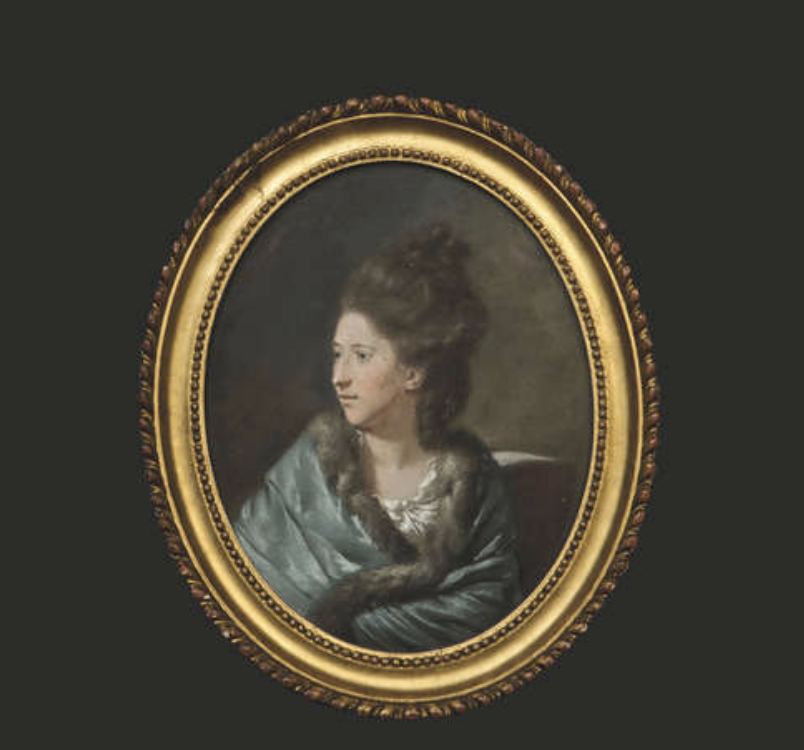

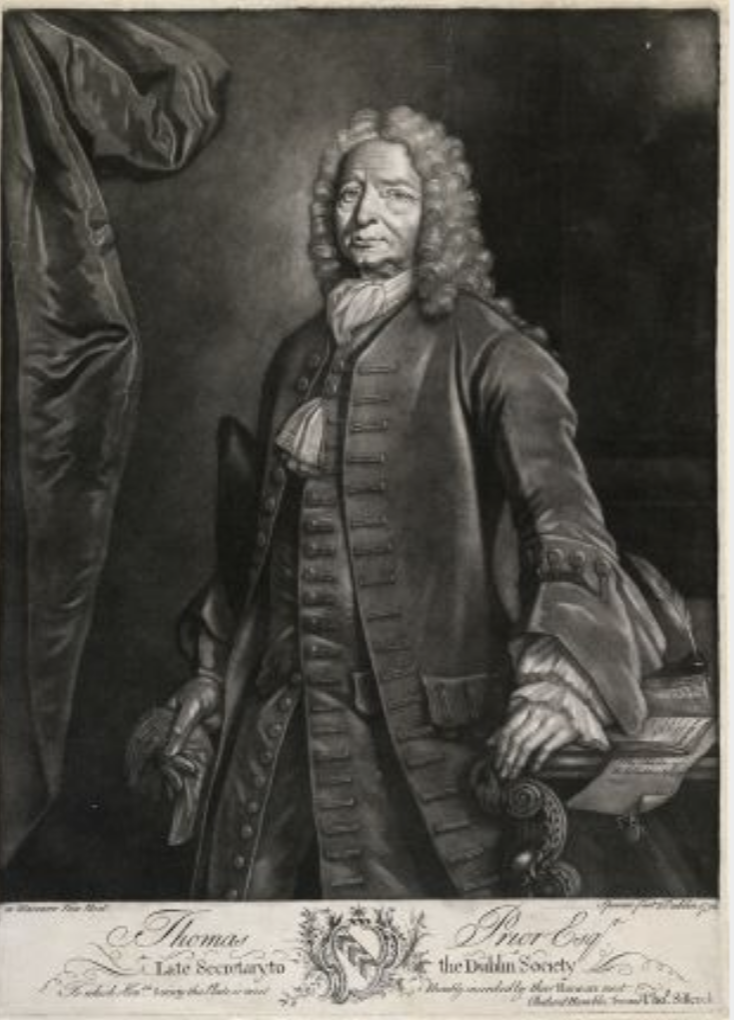


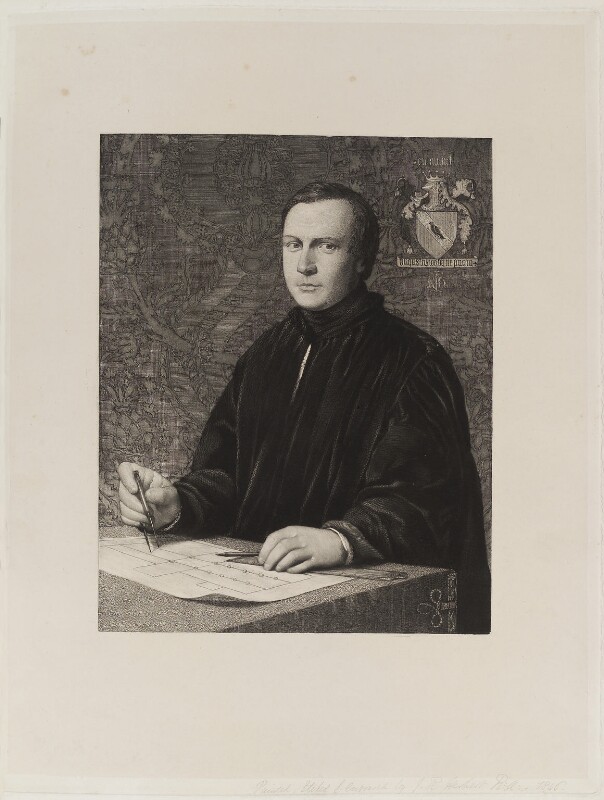


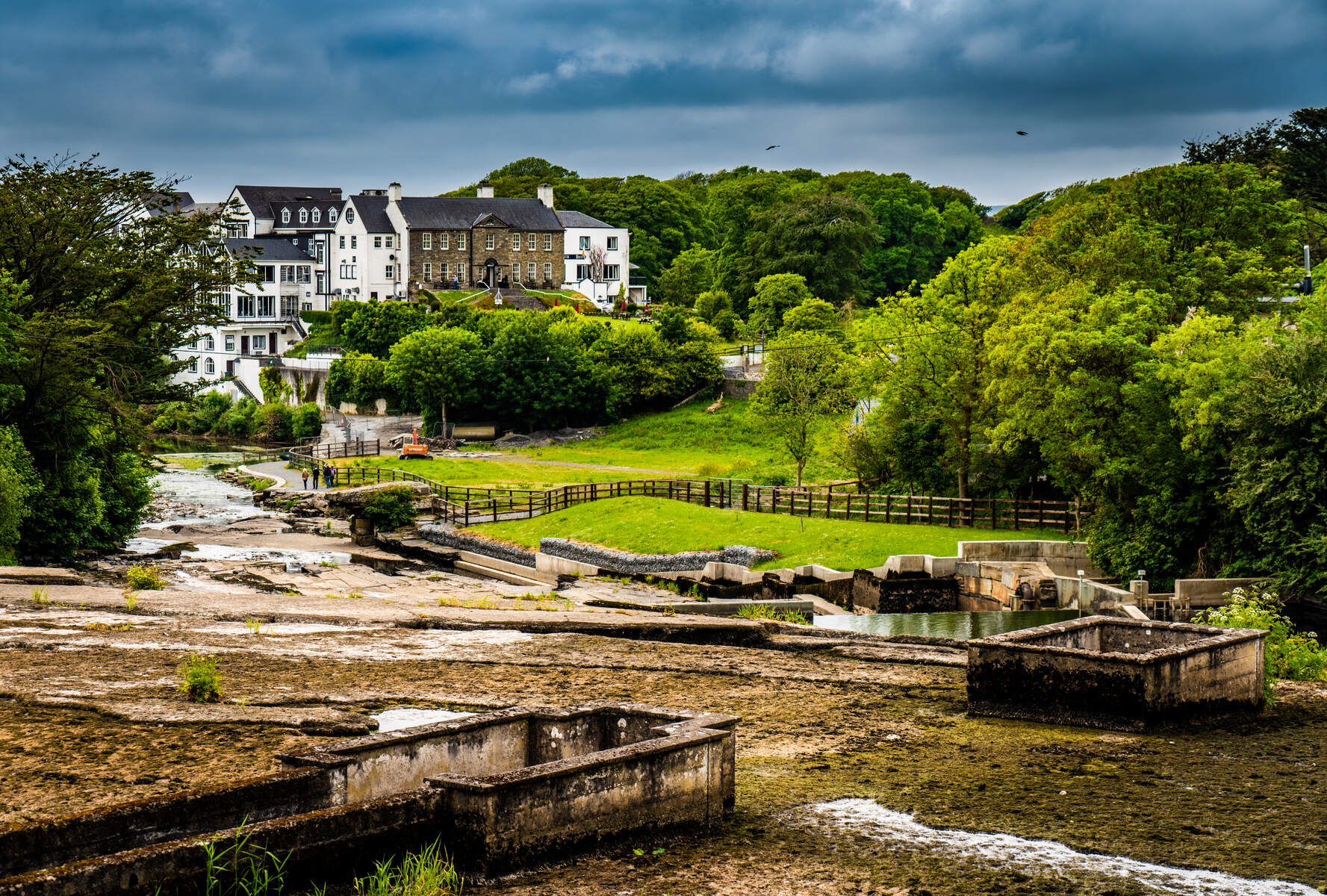


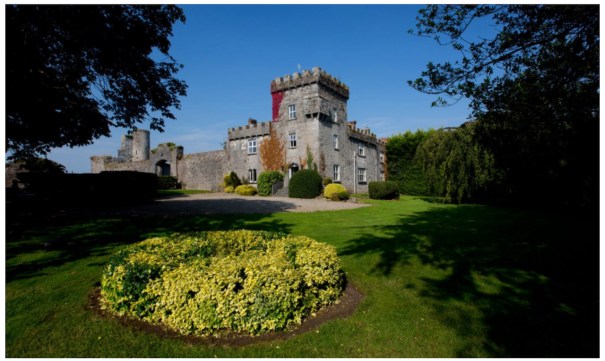


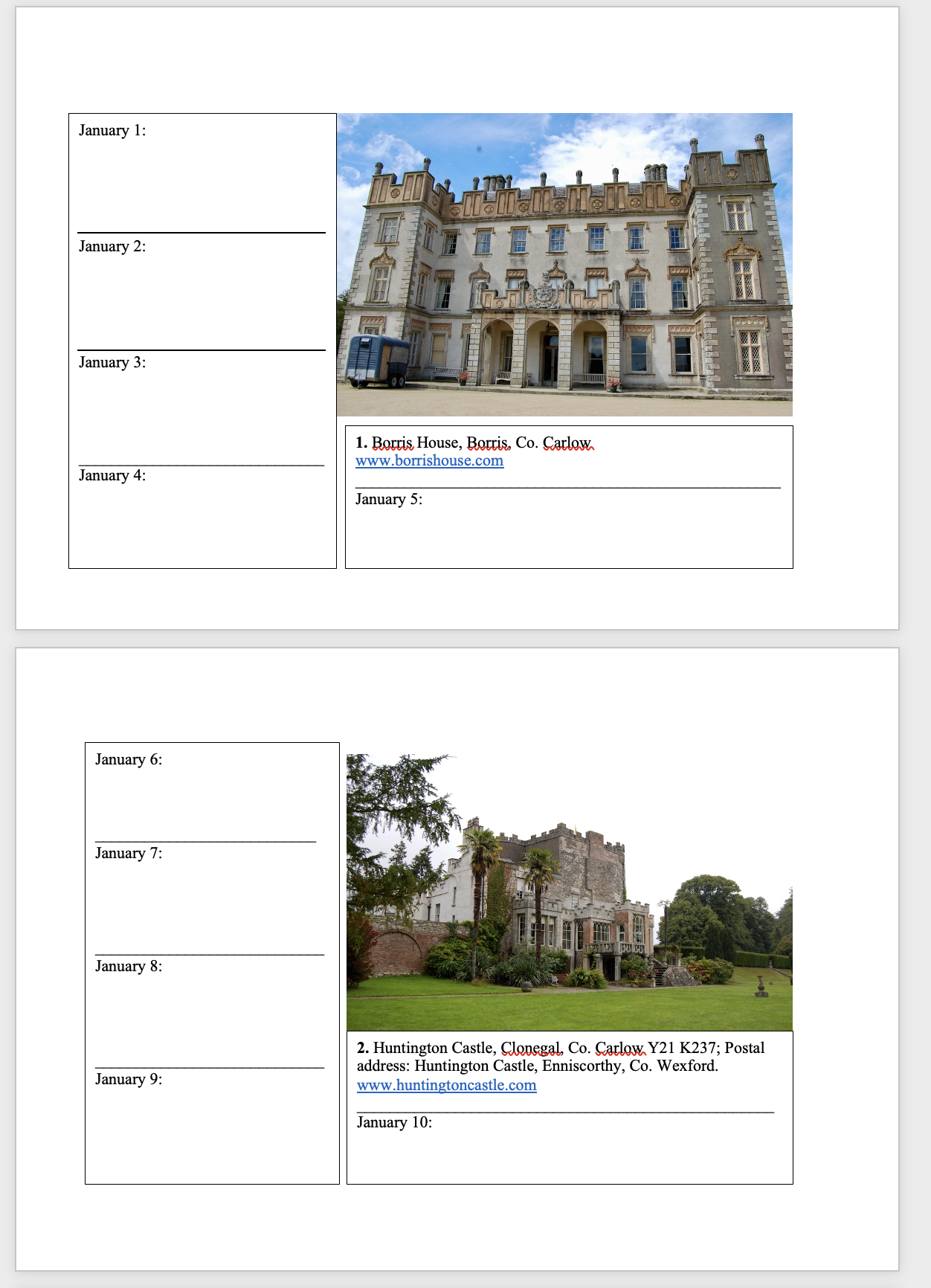
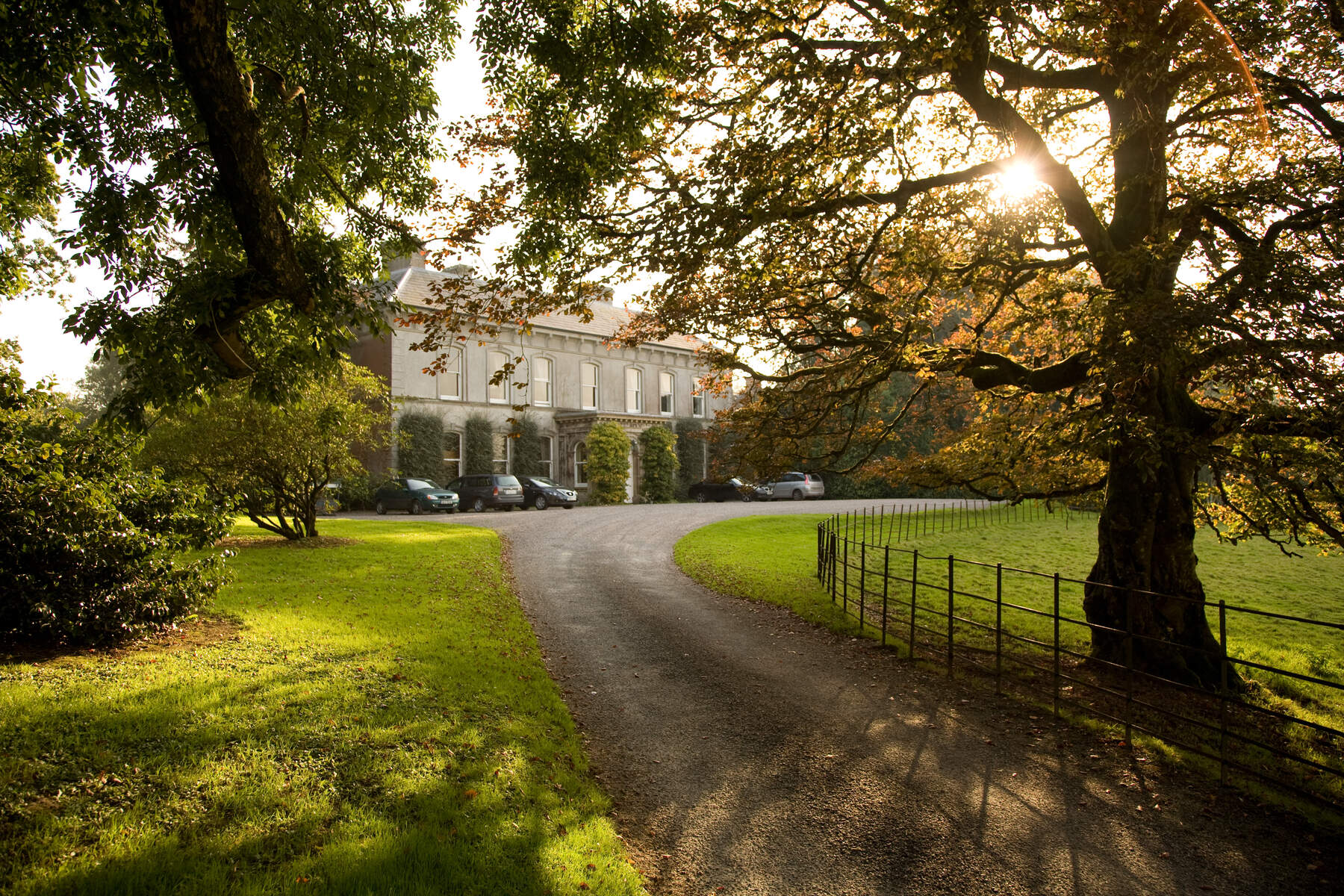


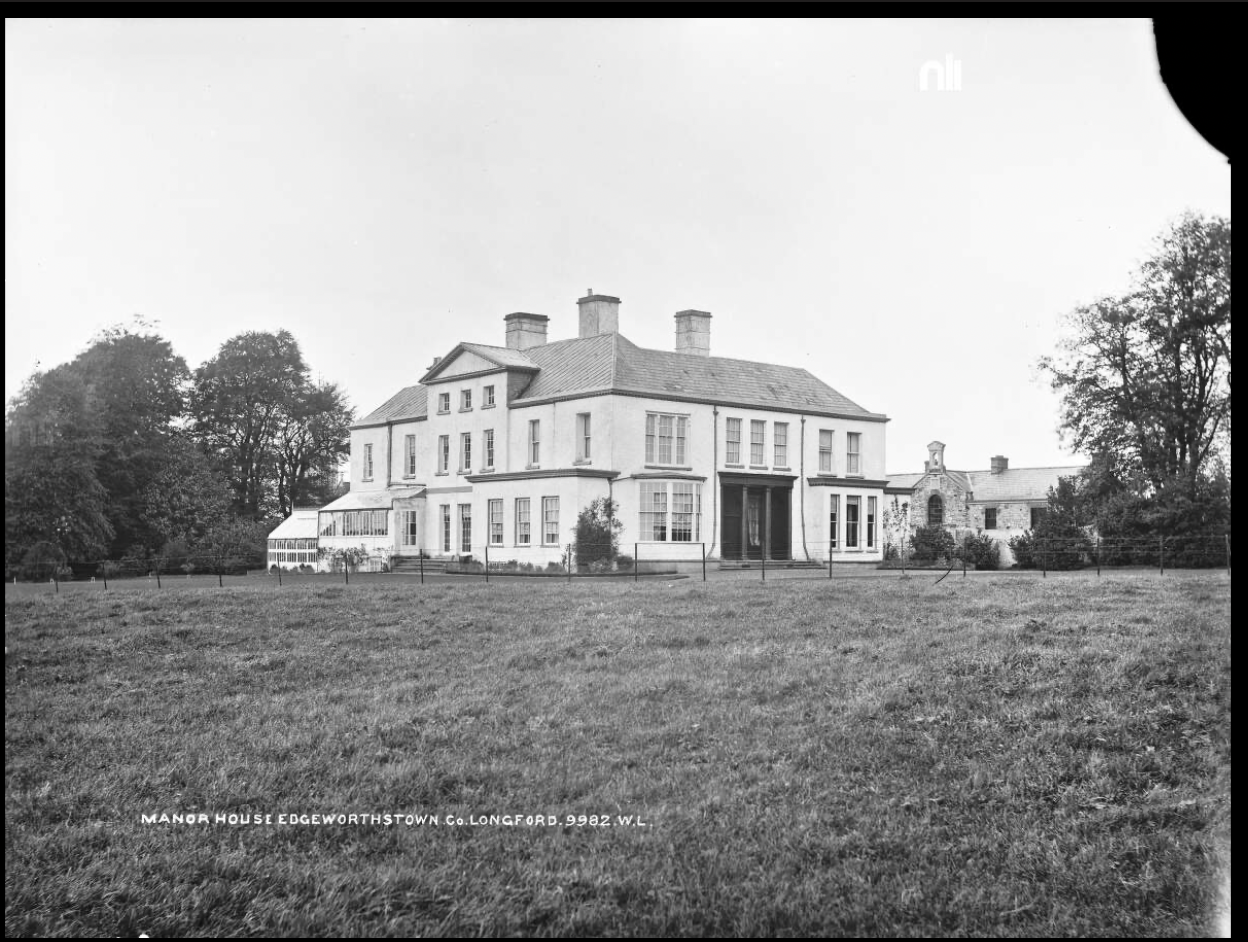
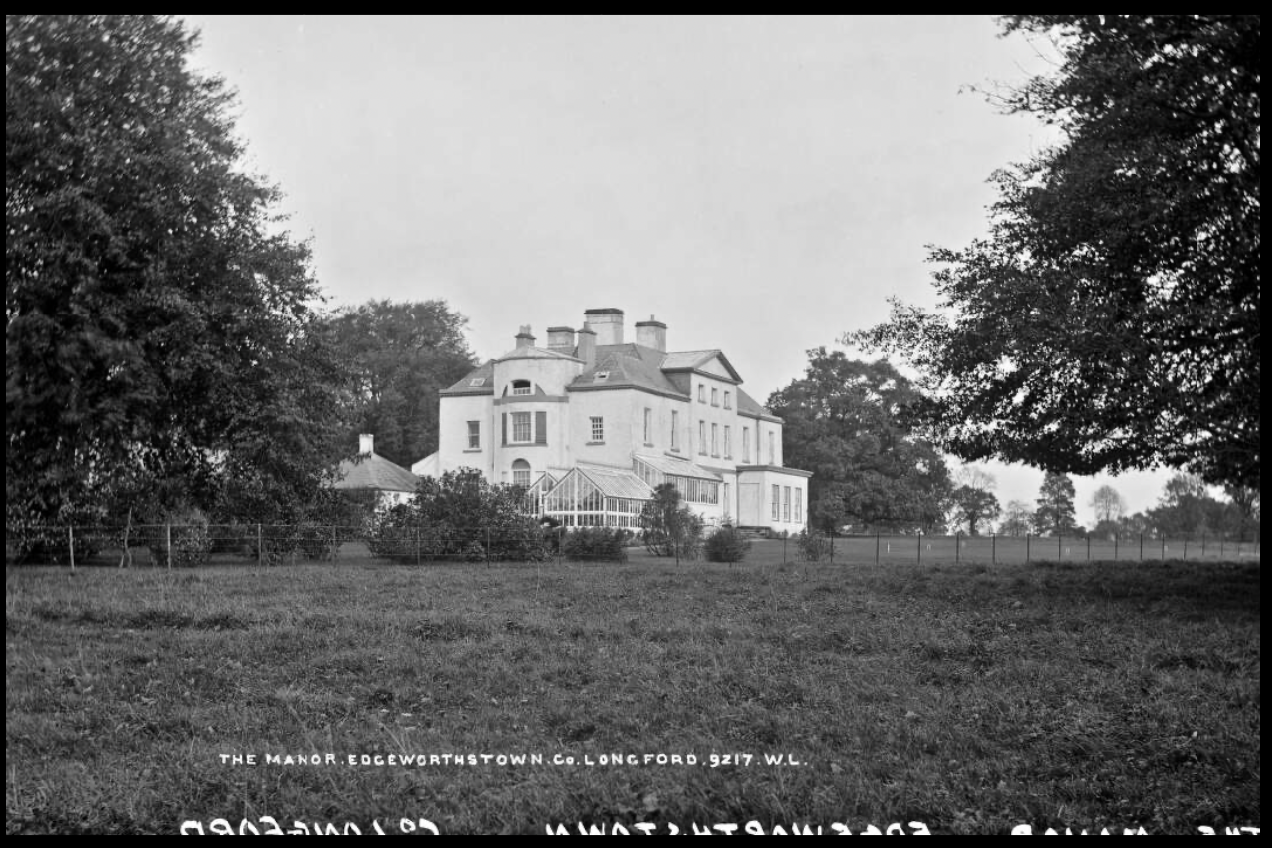


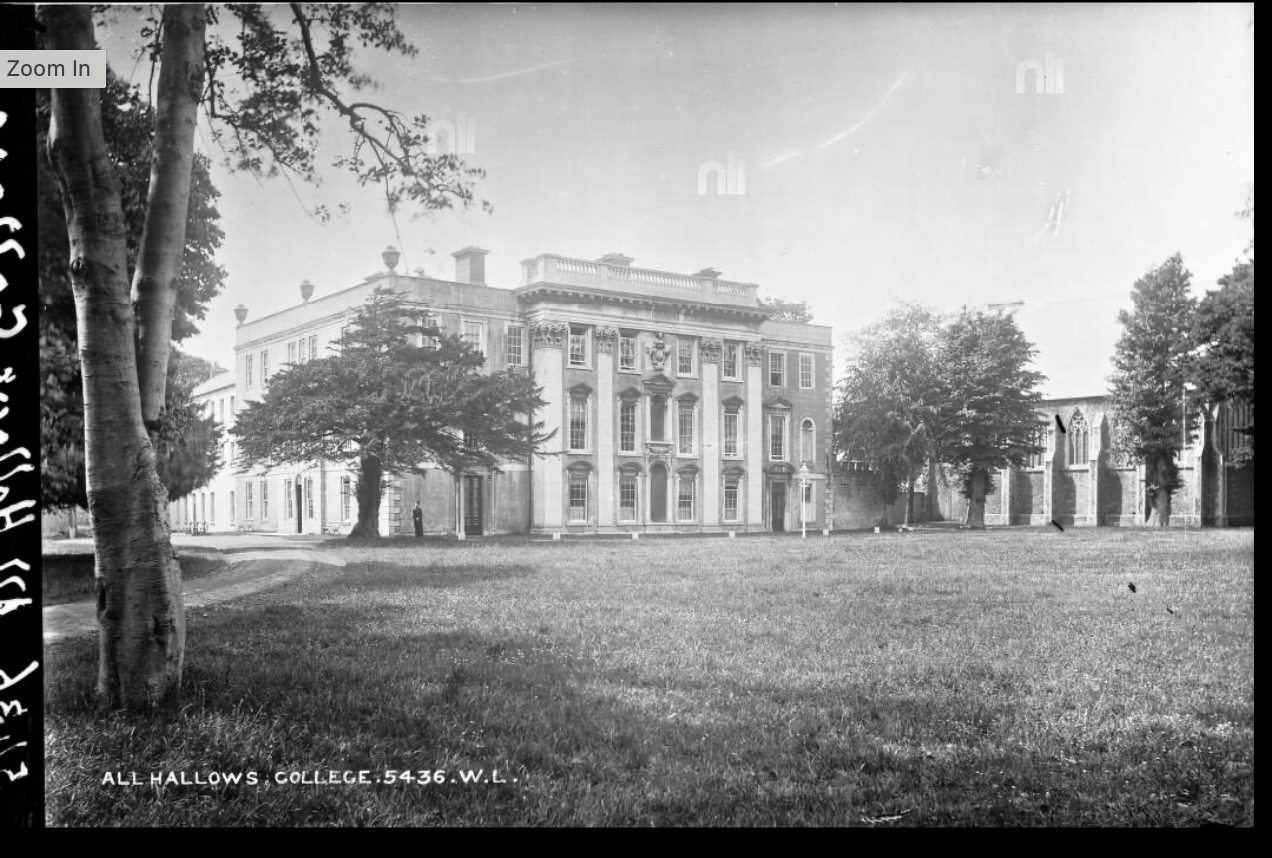


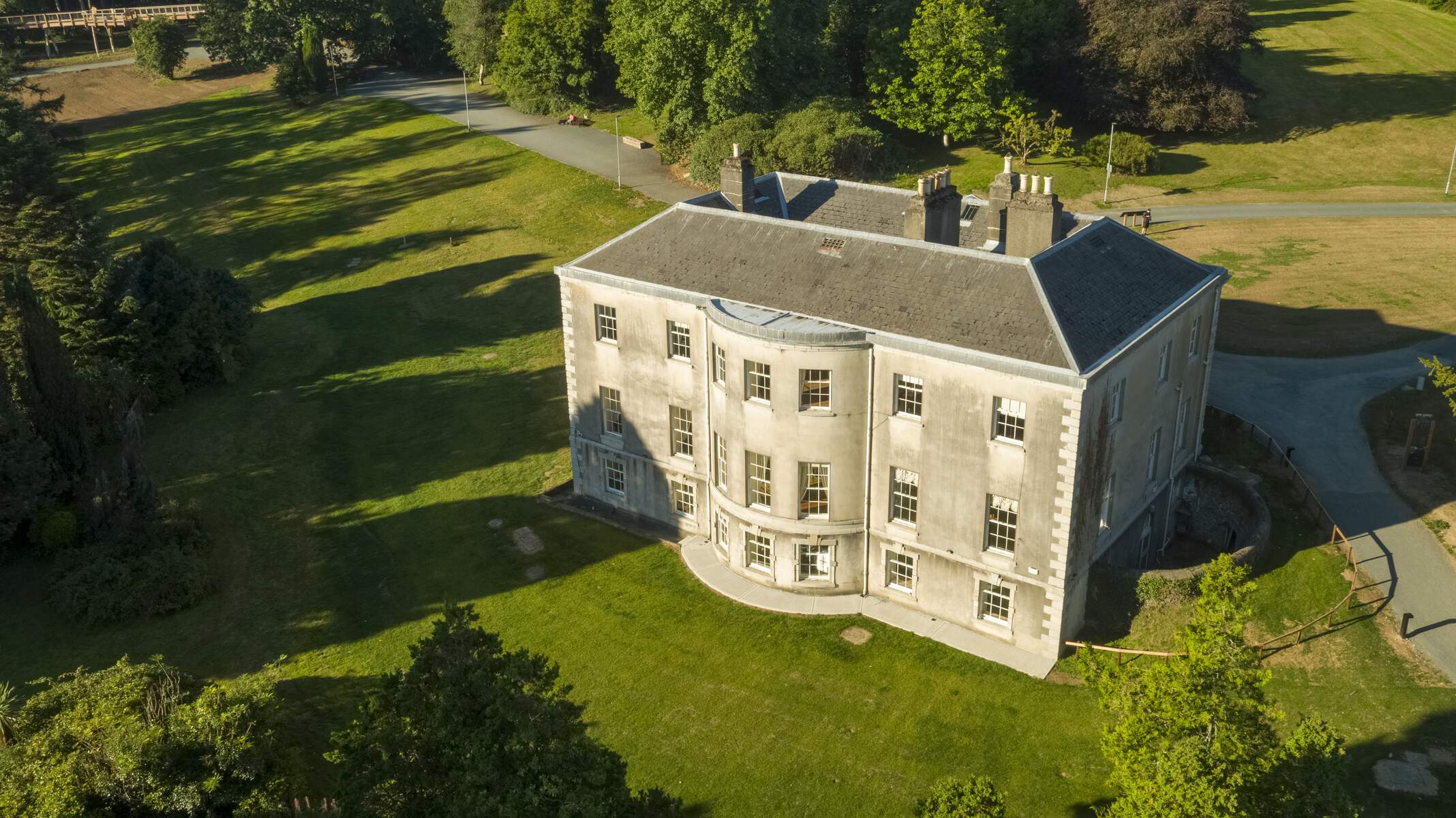
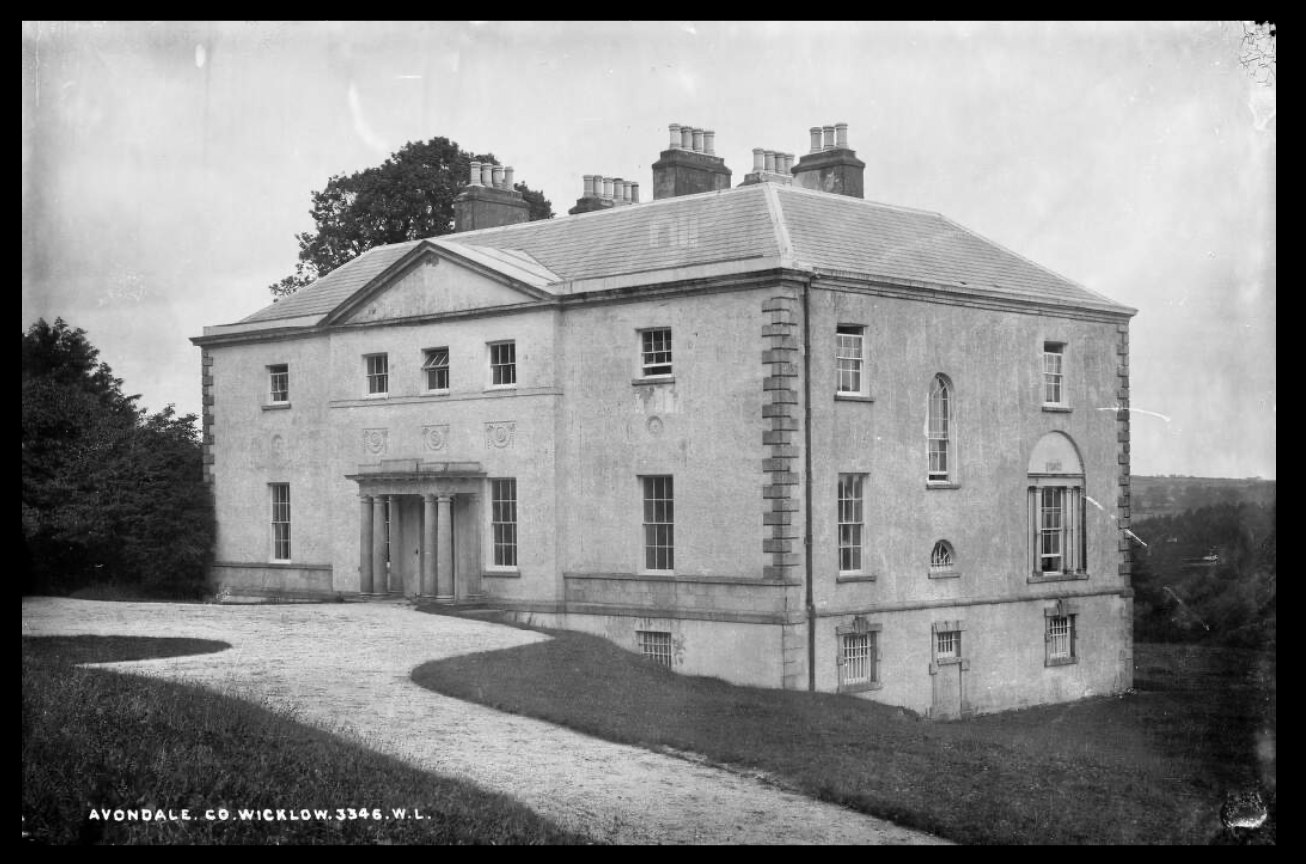
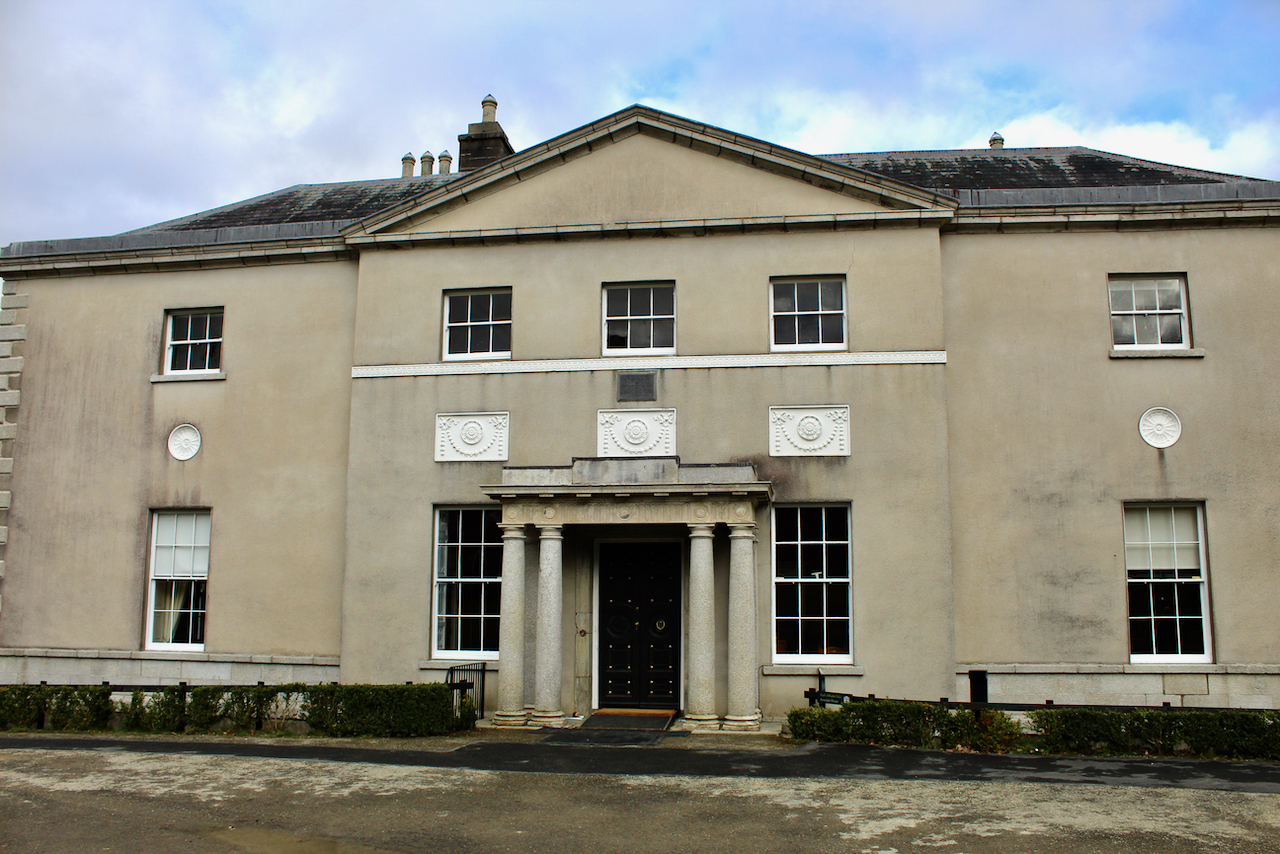
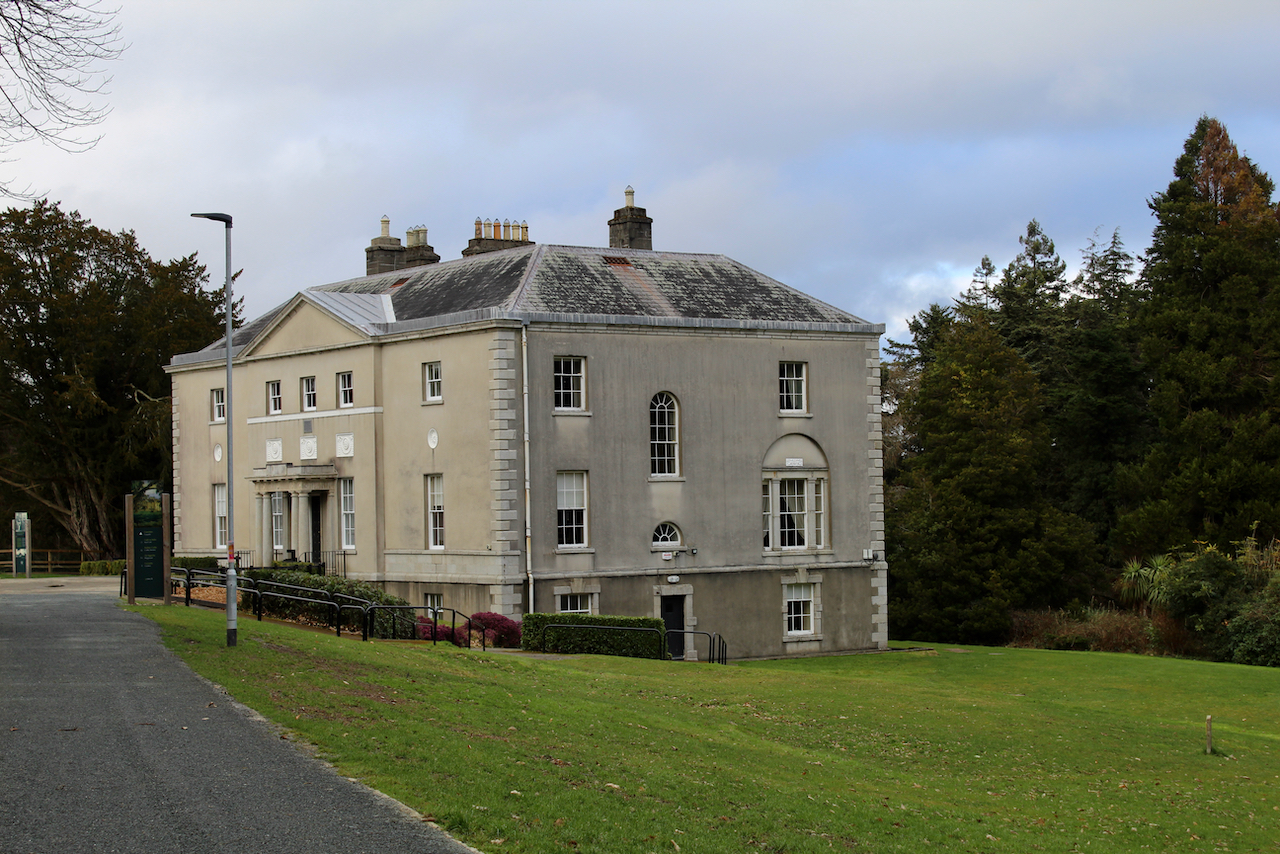
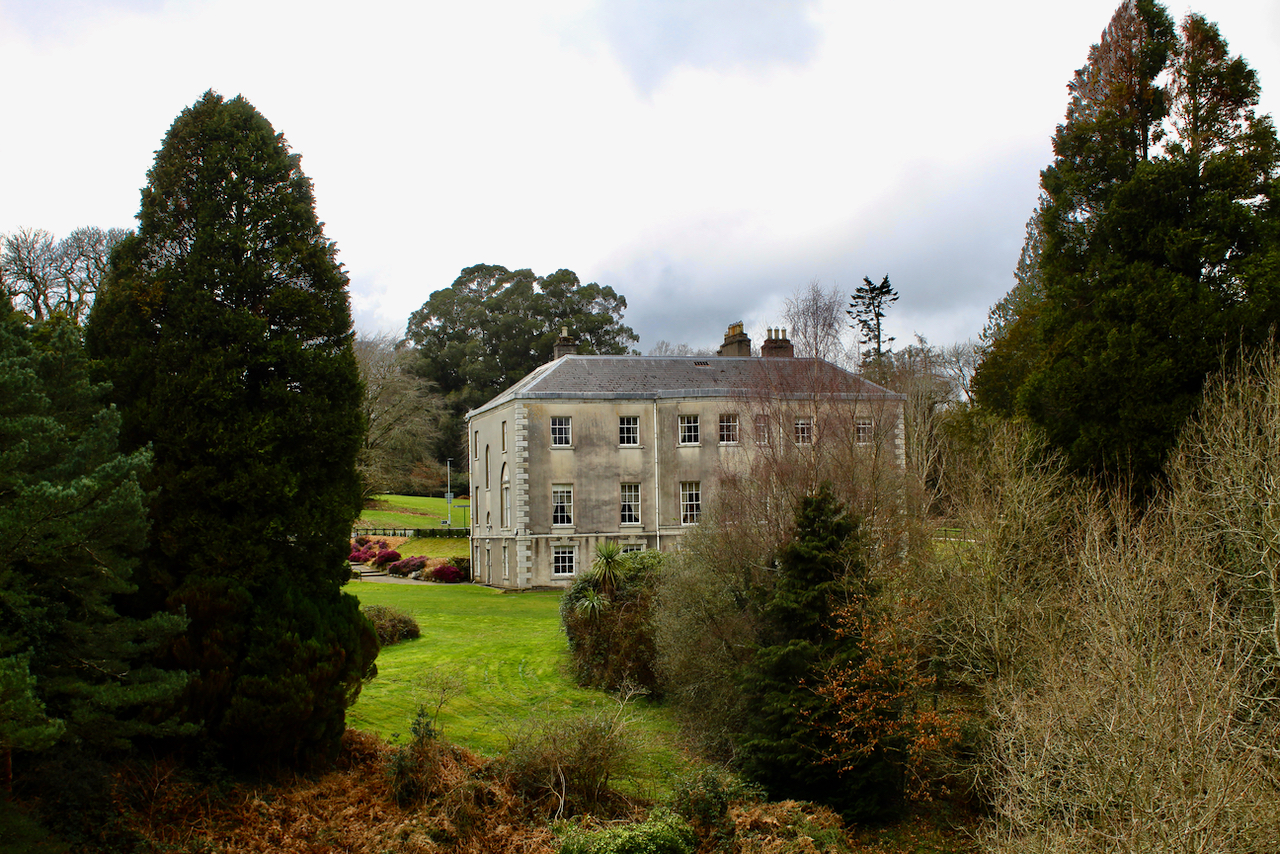
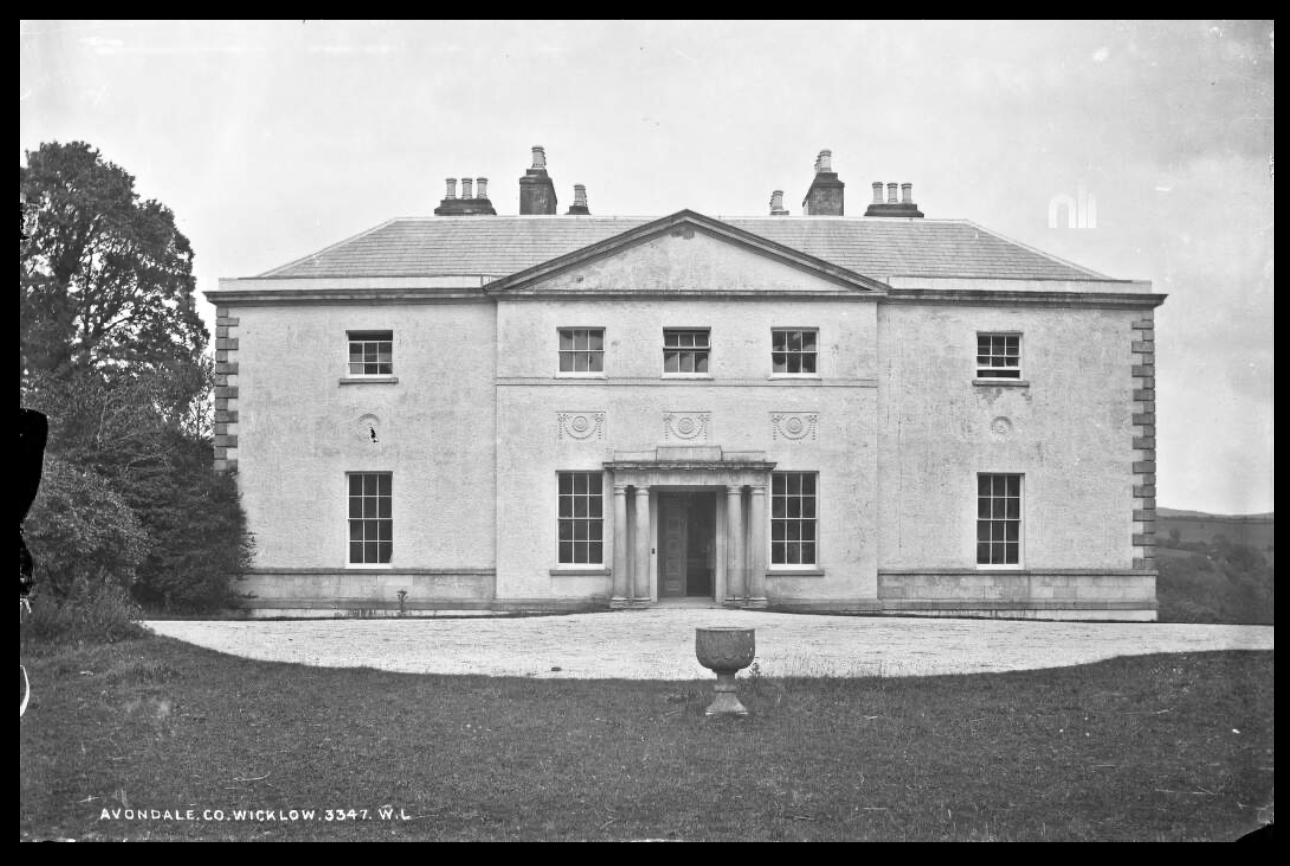
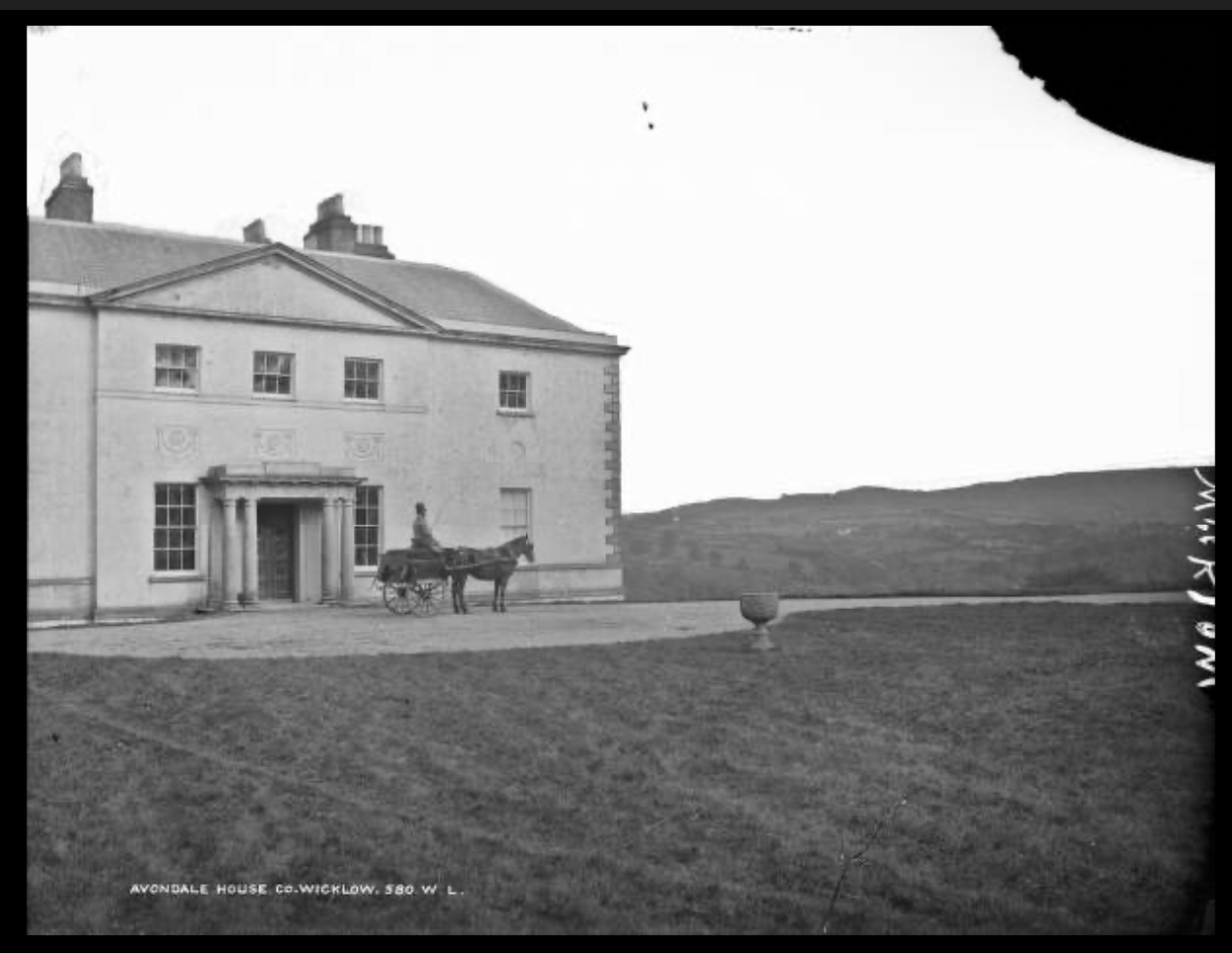
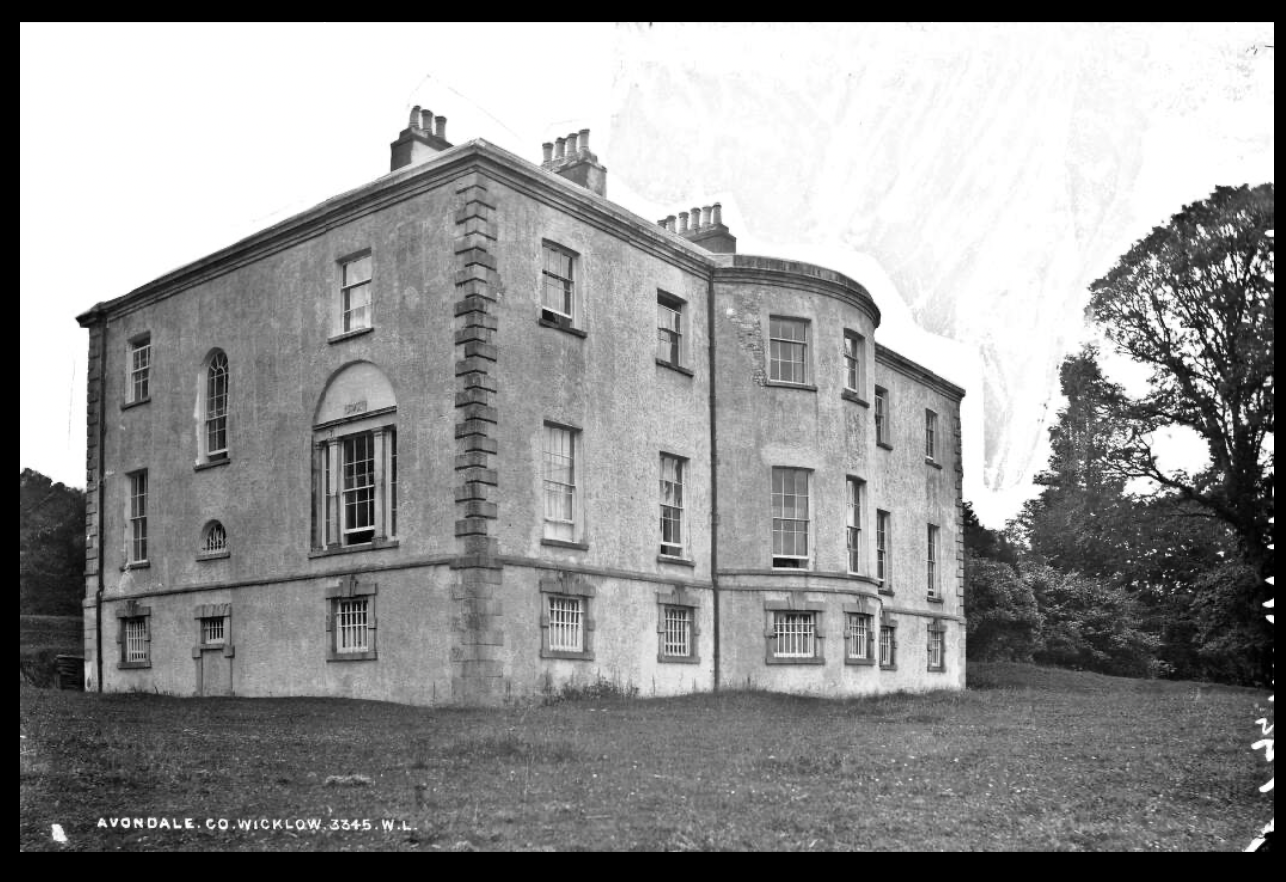

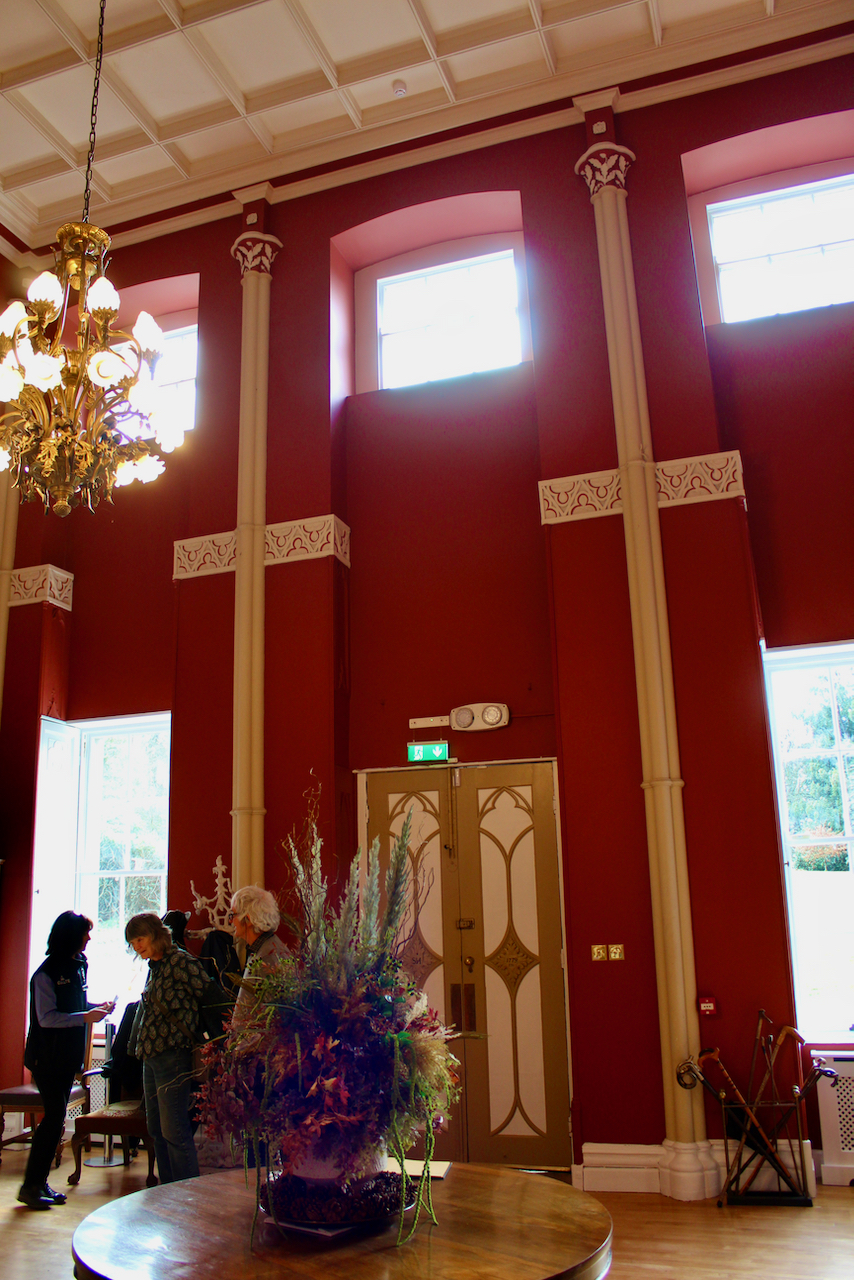
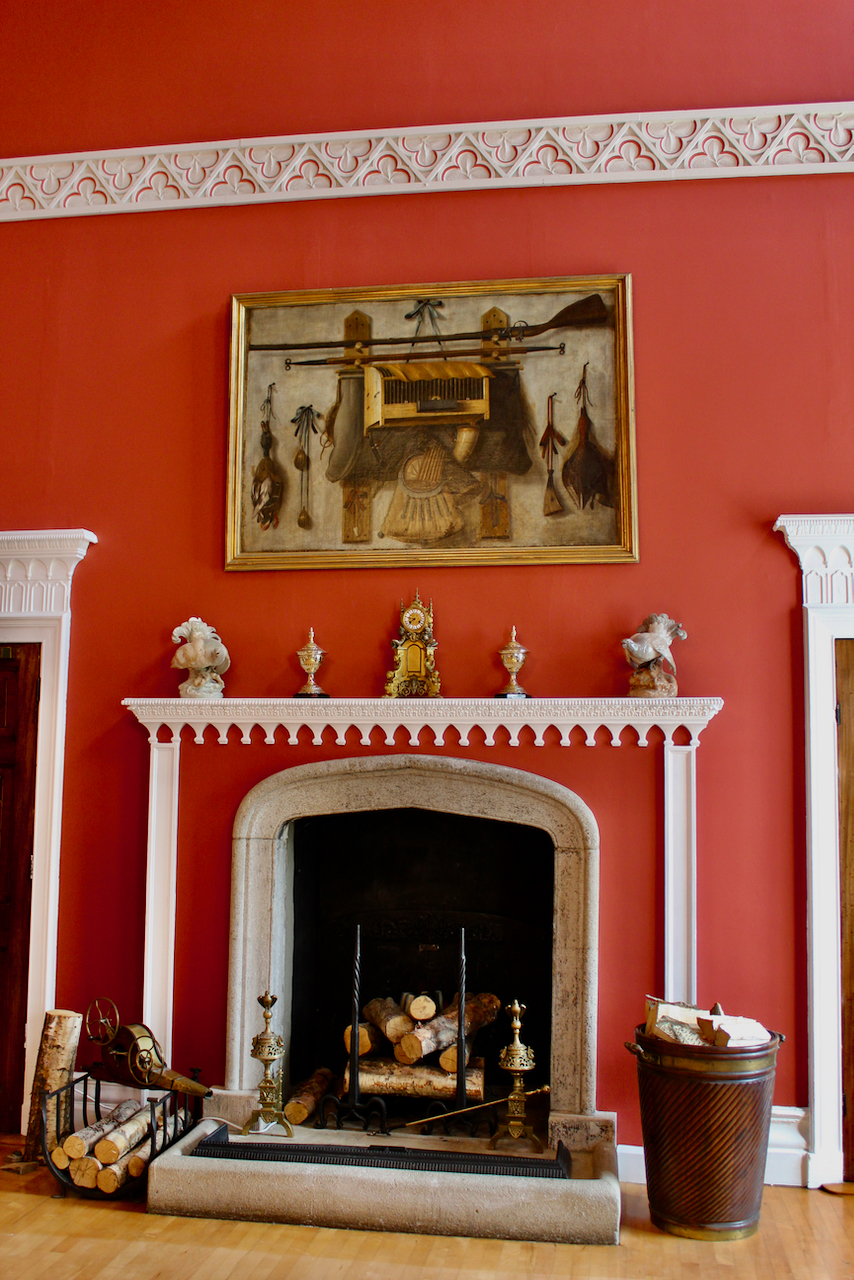

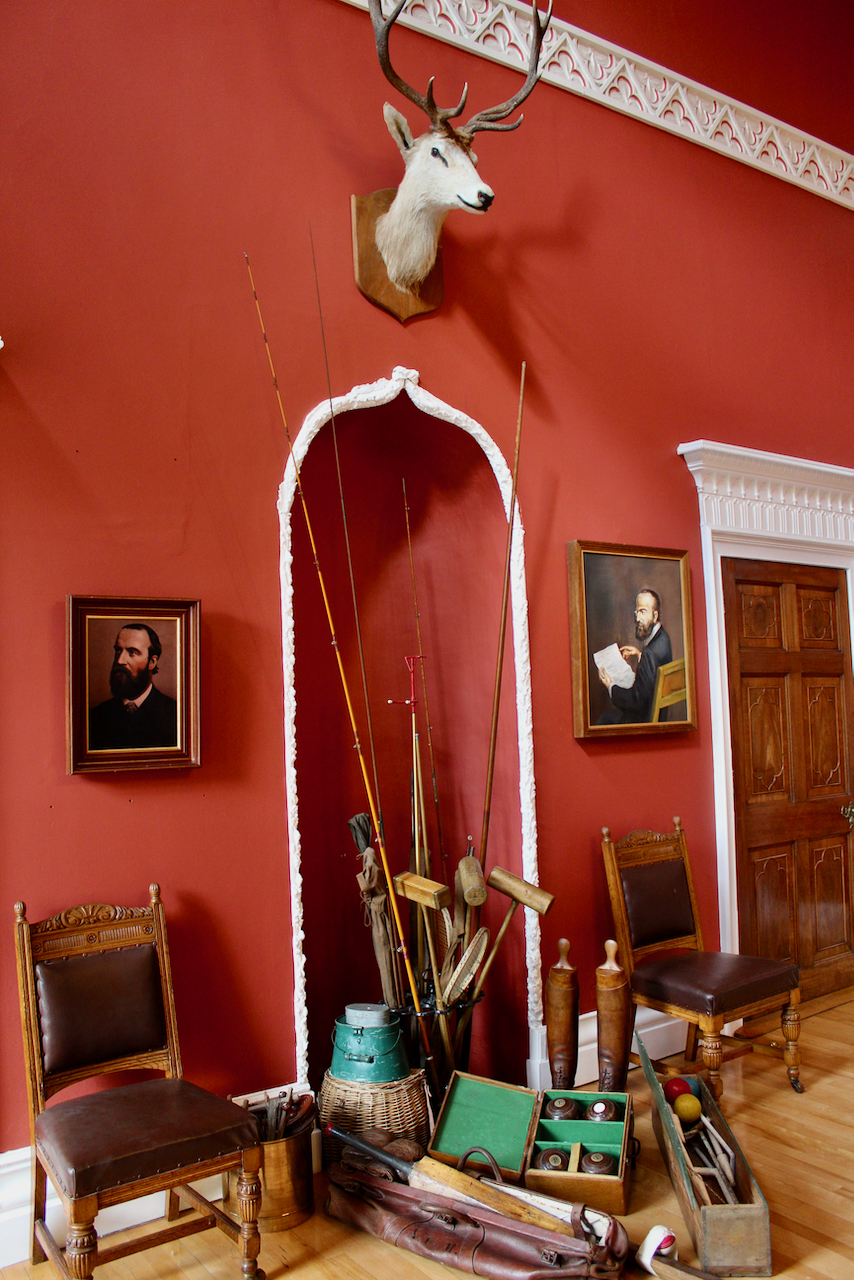

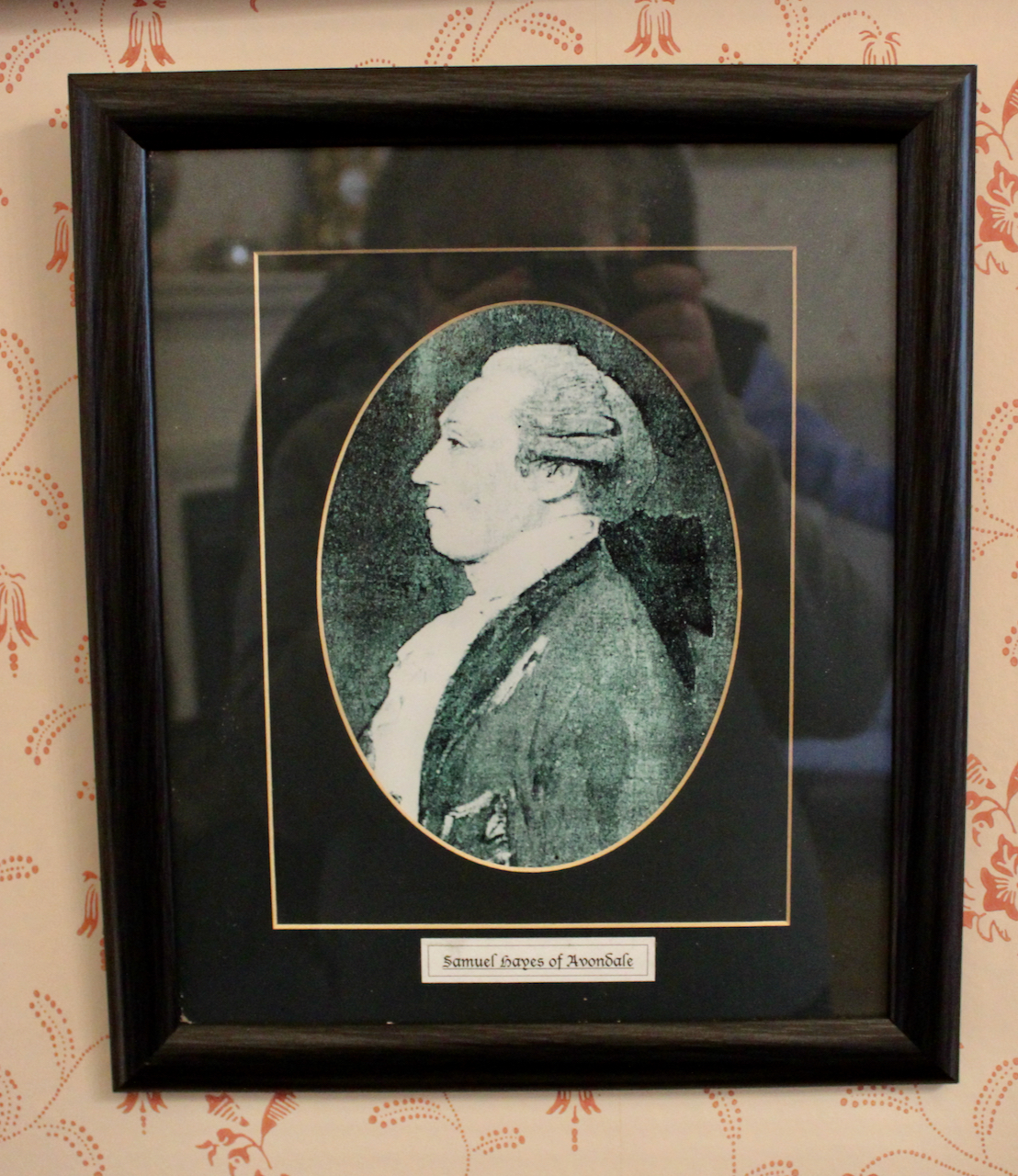
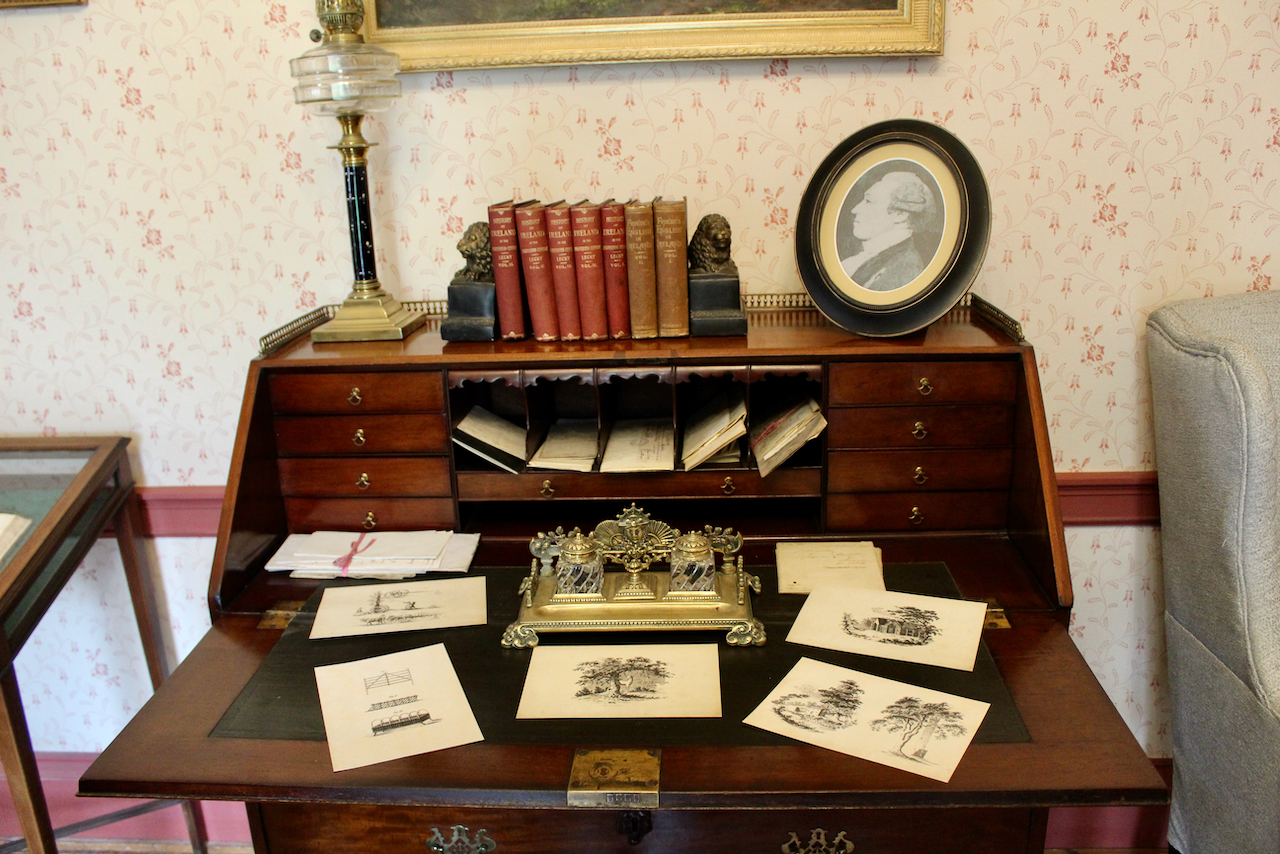
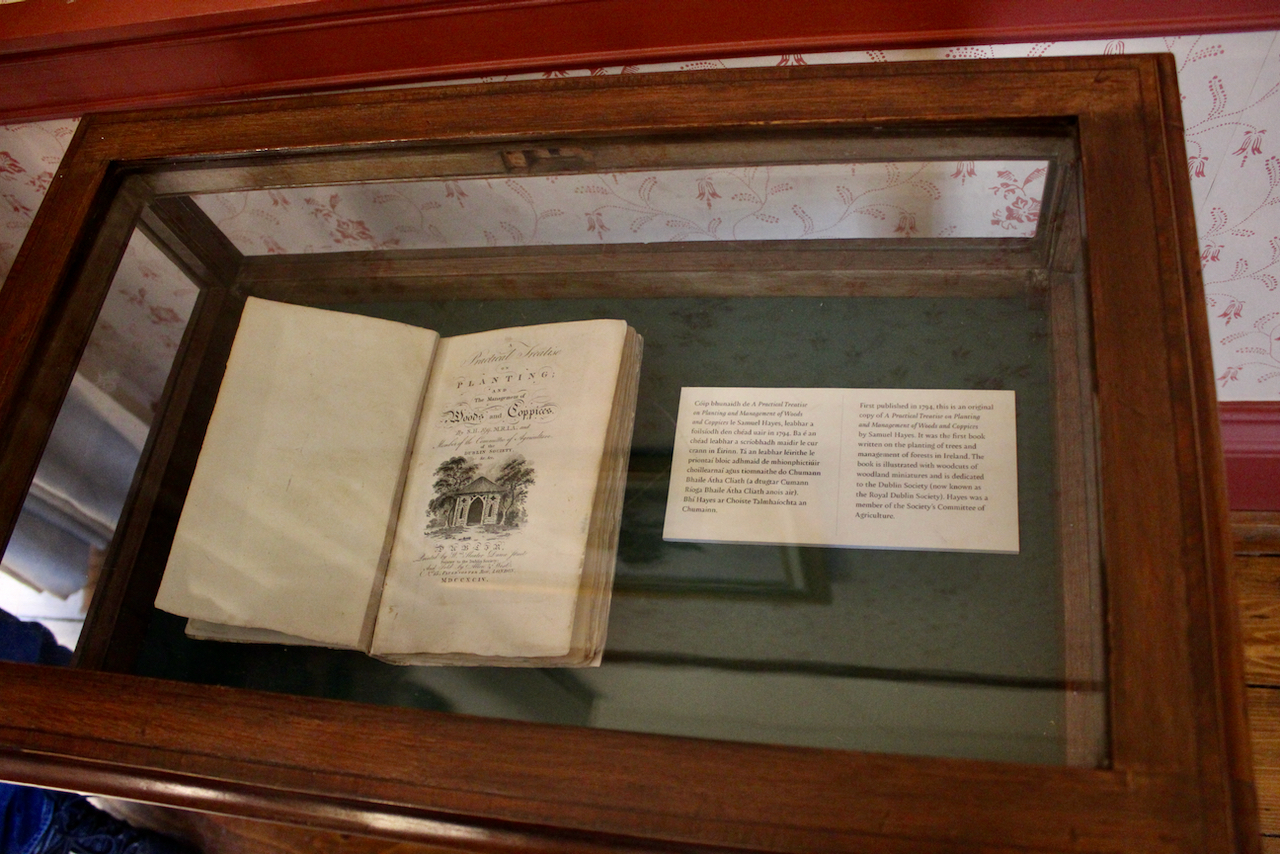
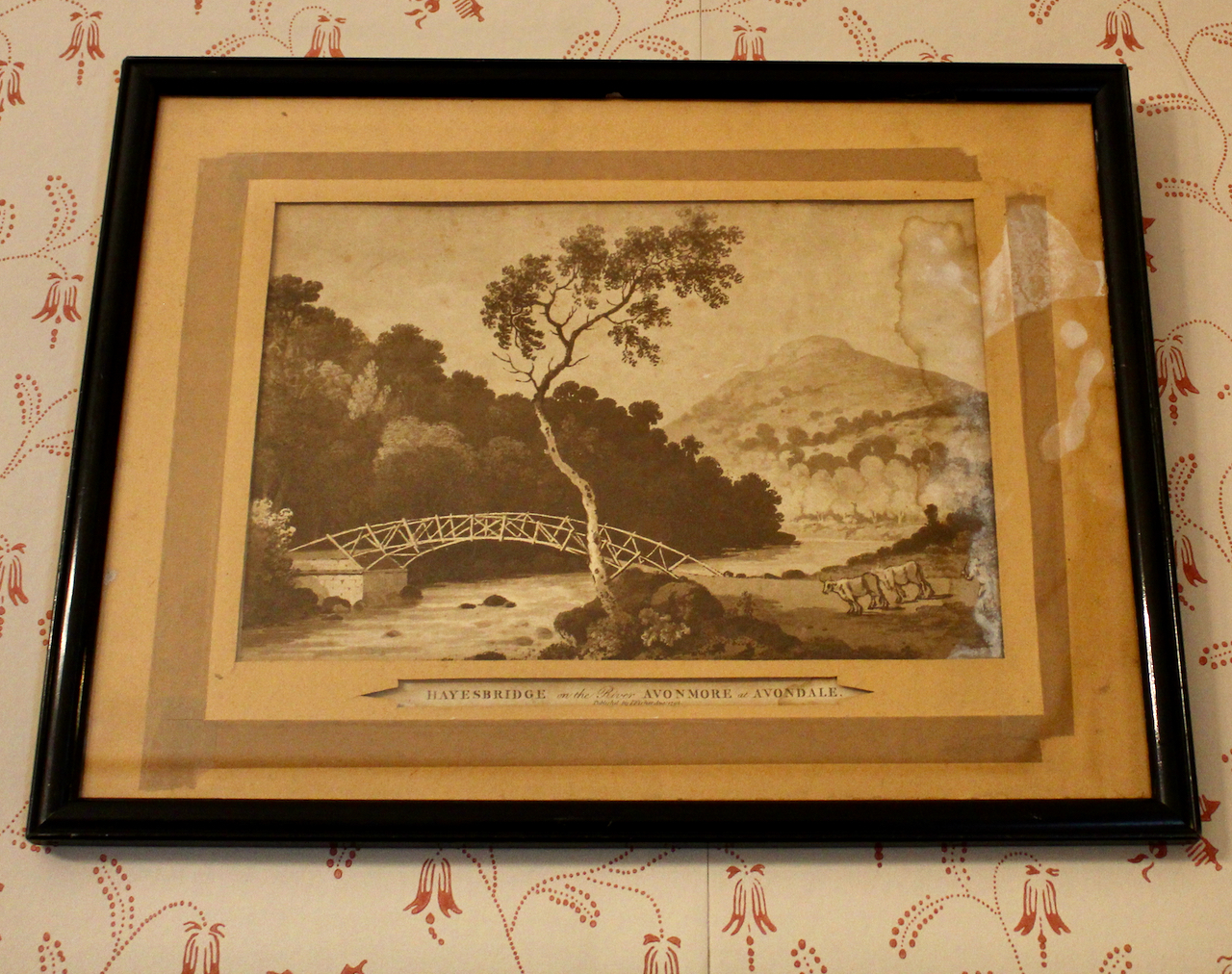
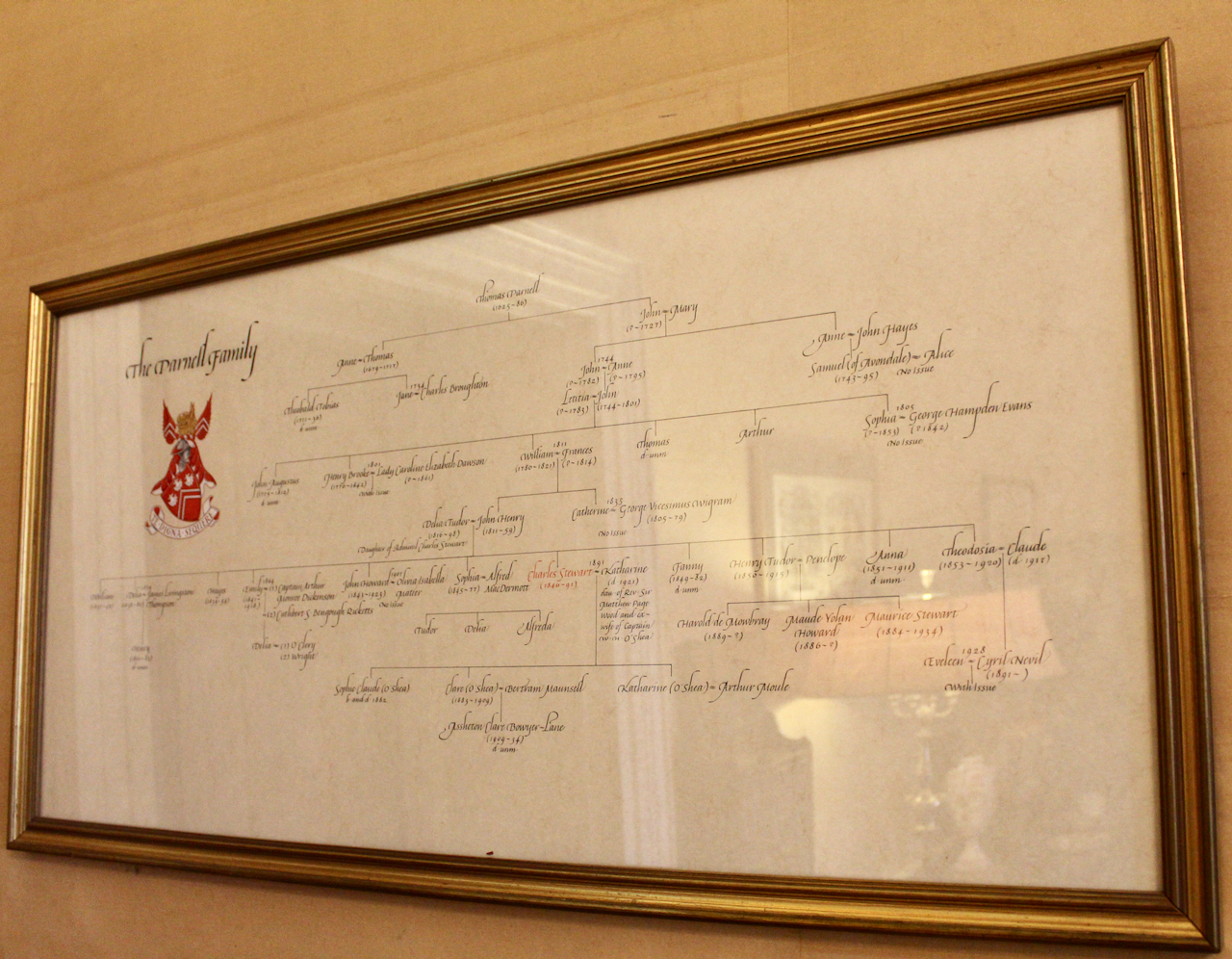

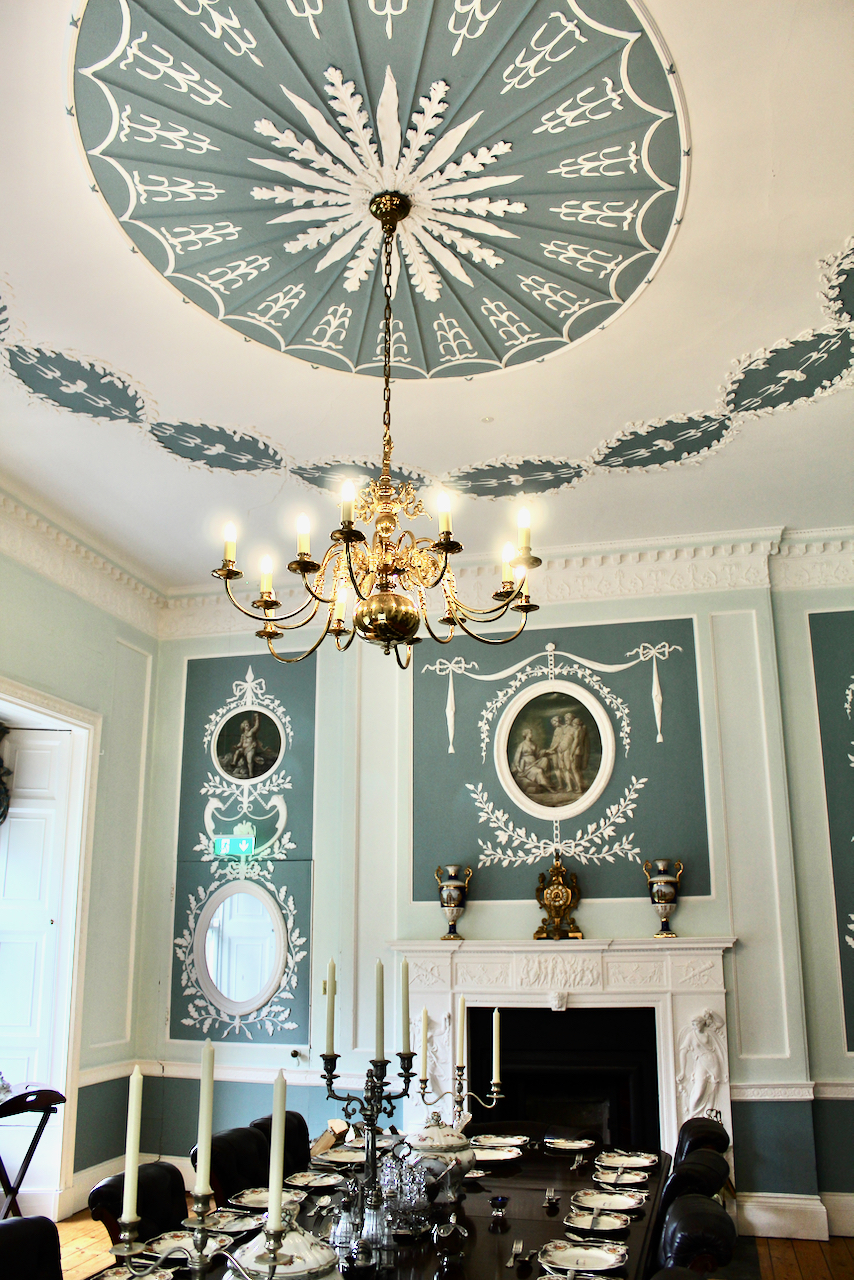
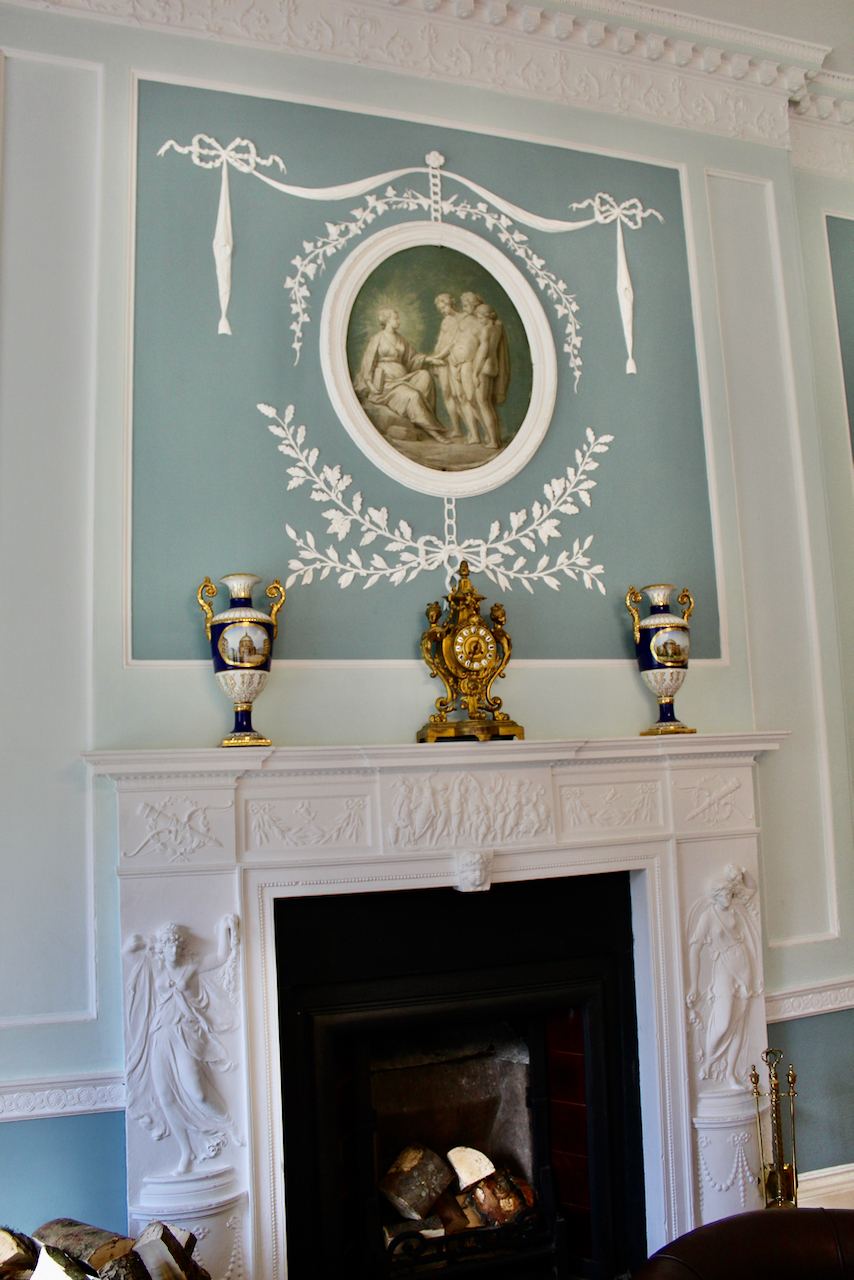
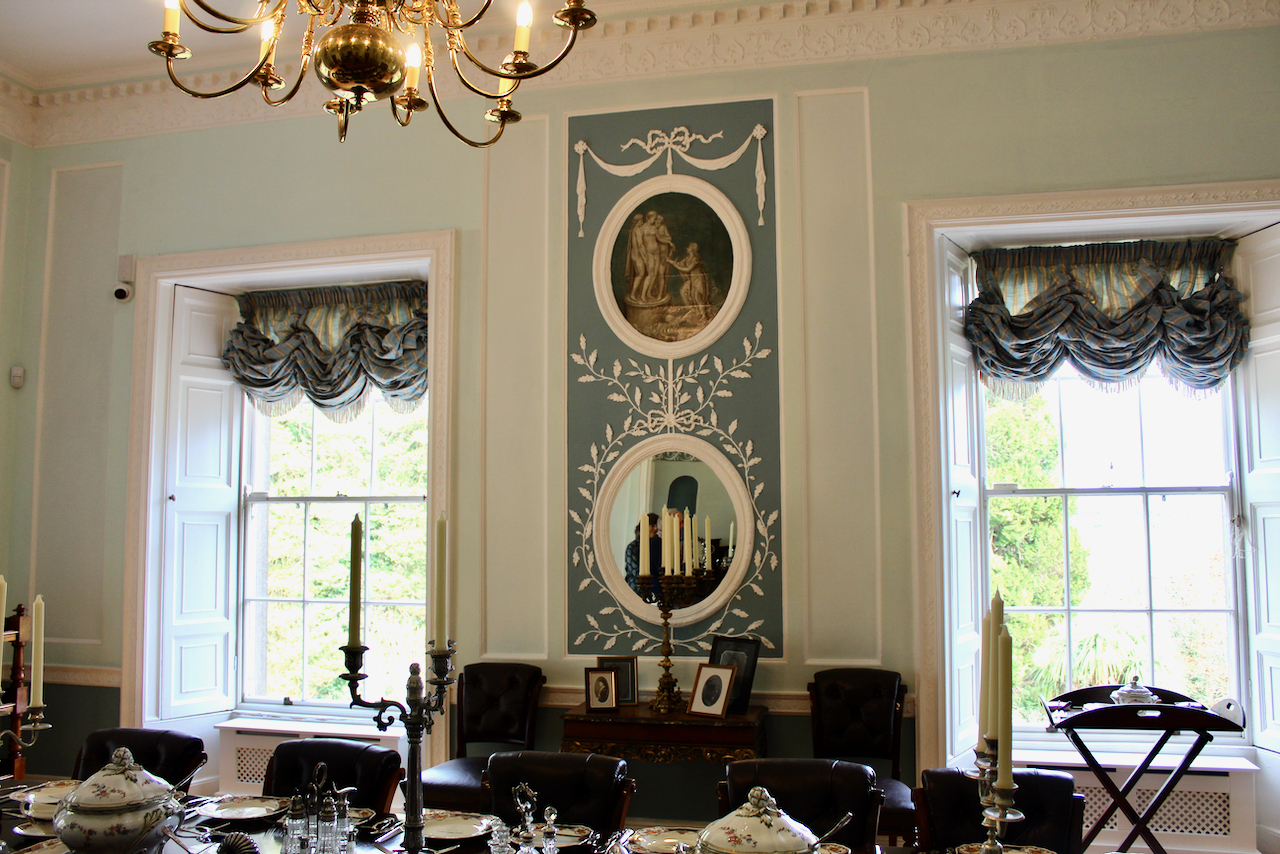
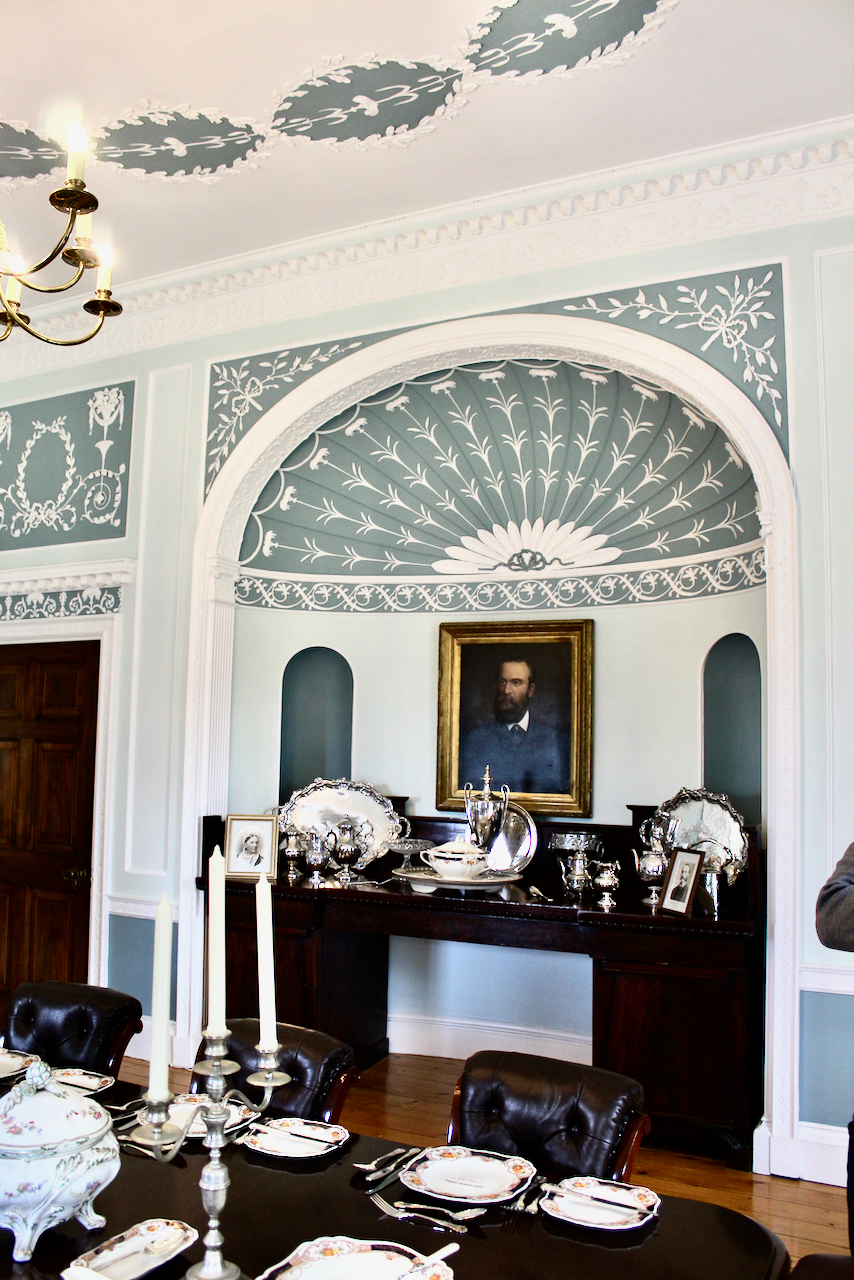
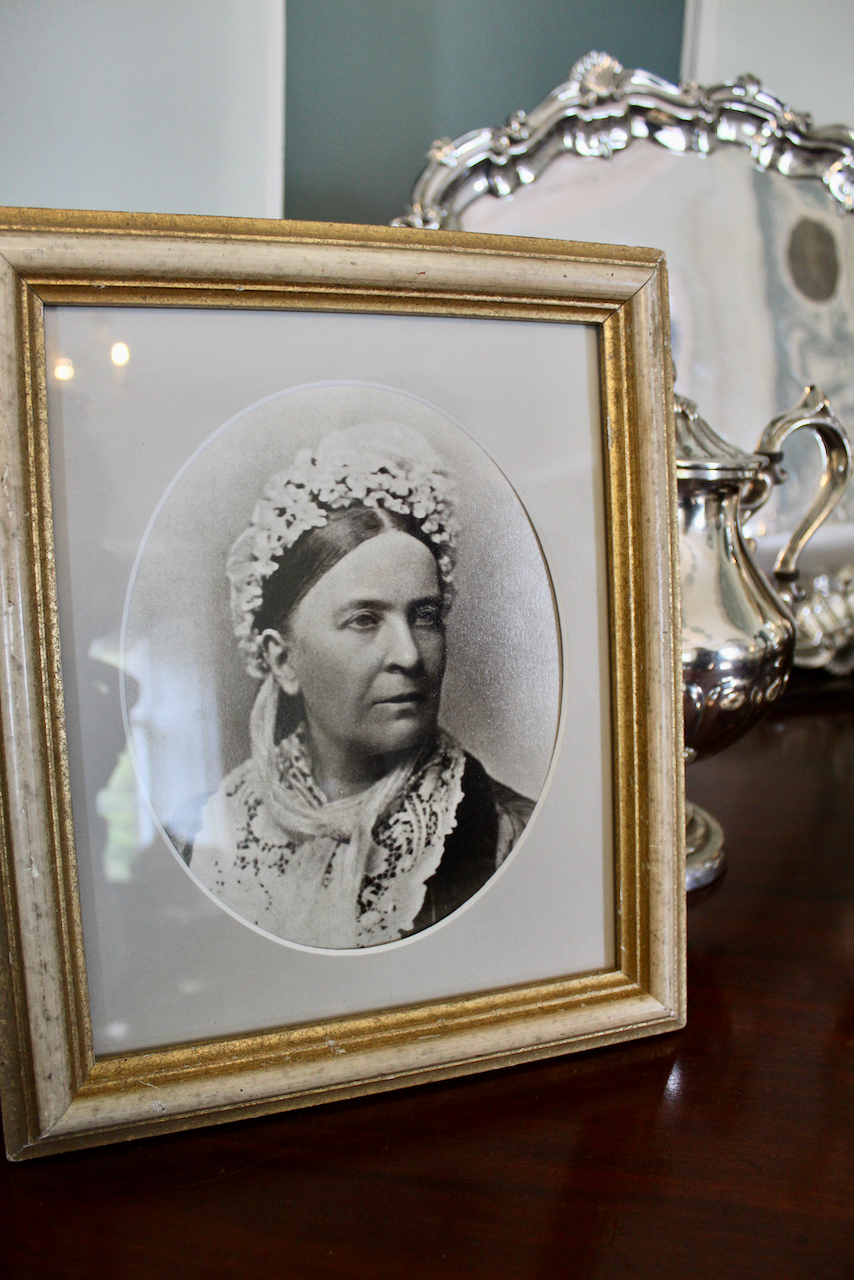

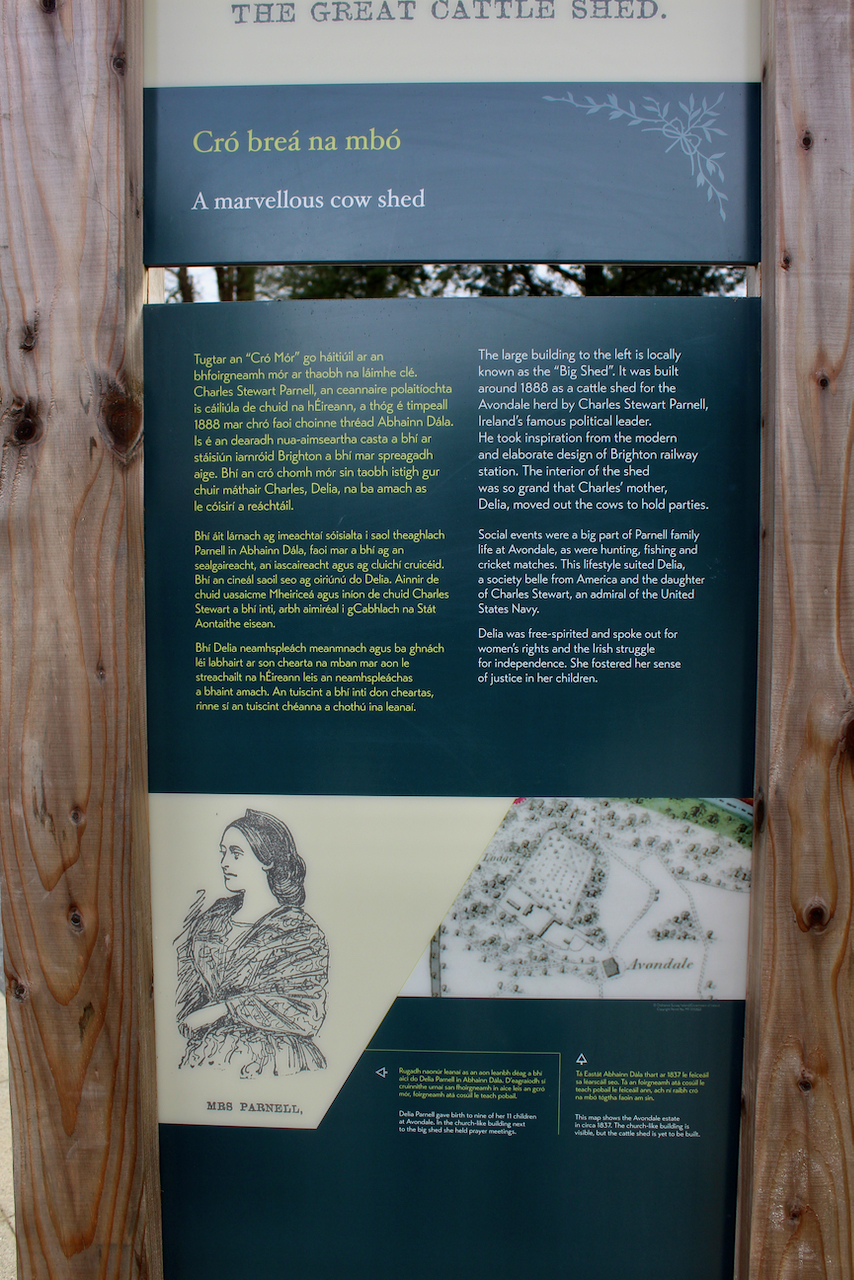


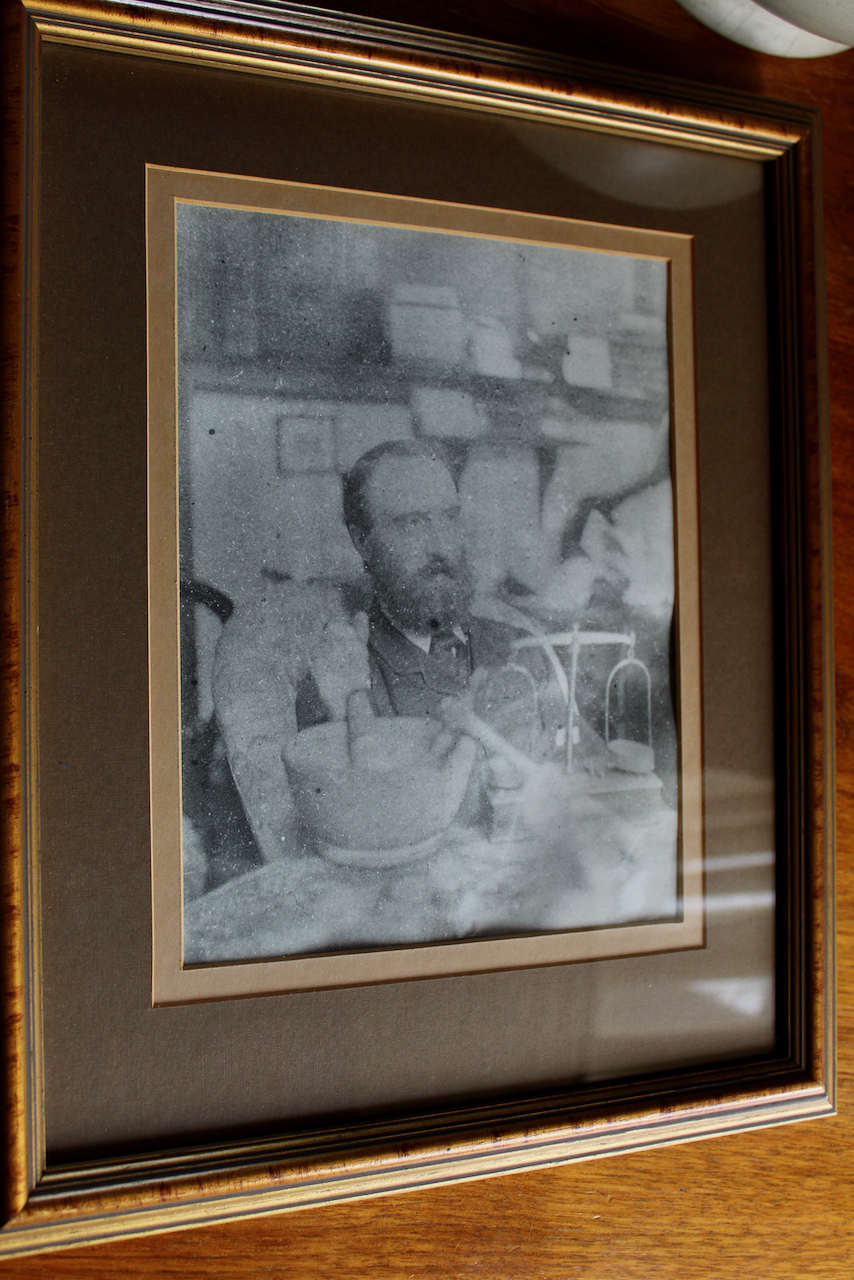

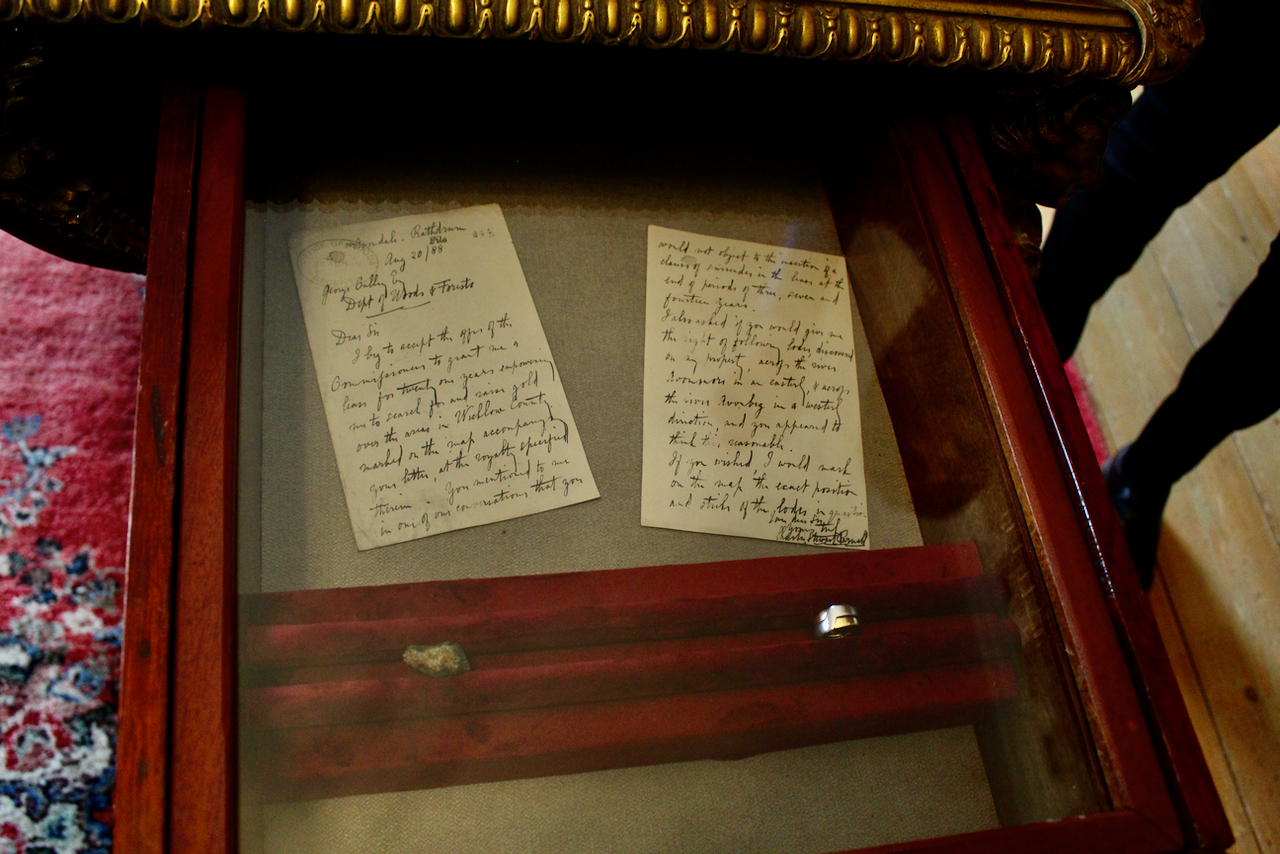
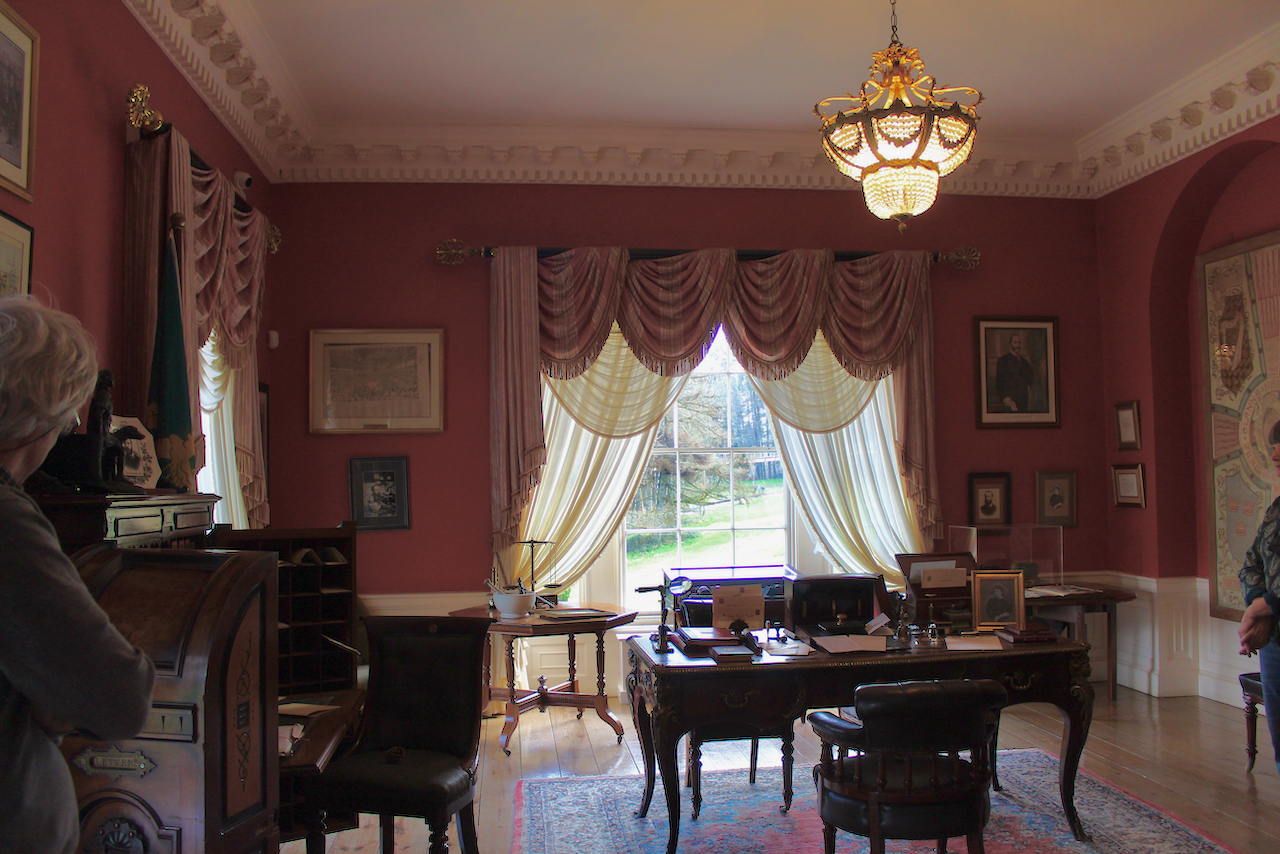


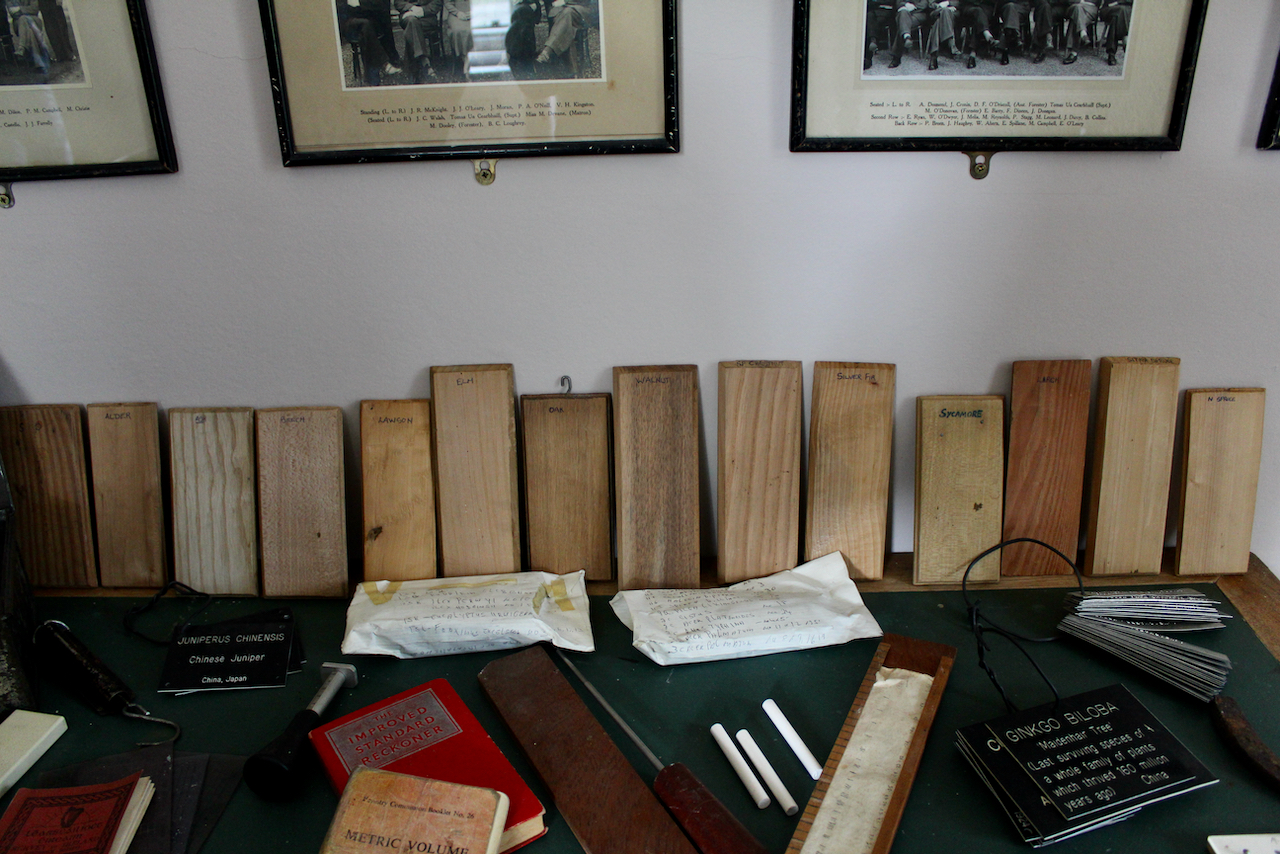

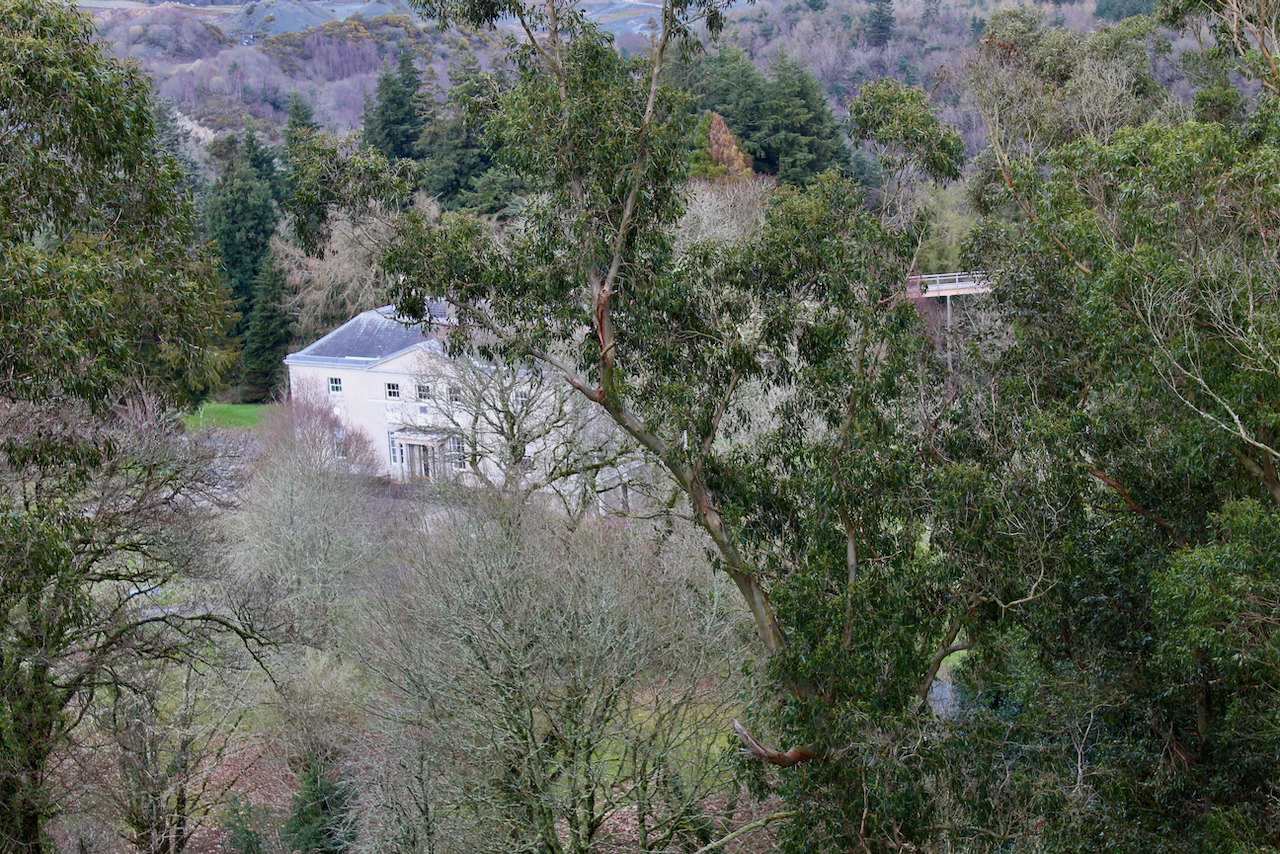
 Irish Historic Houses