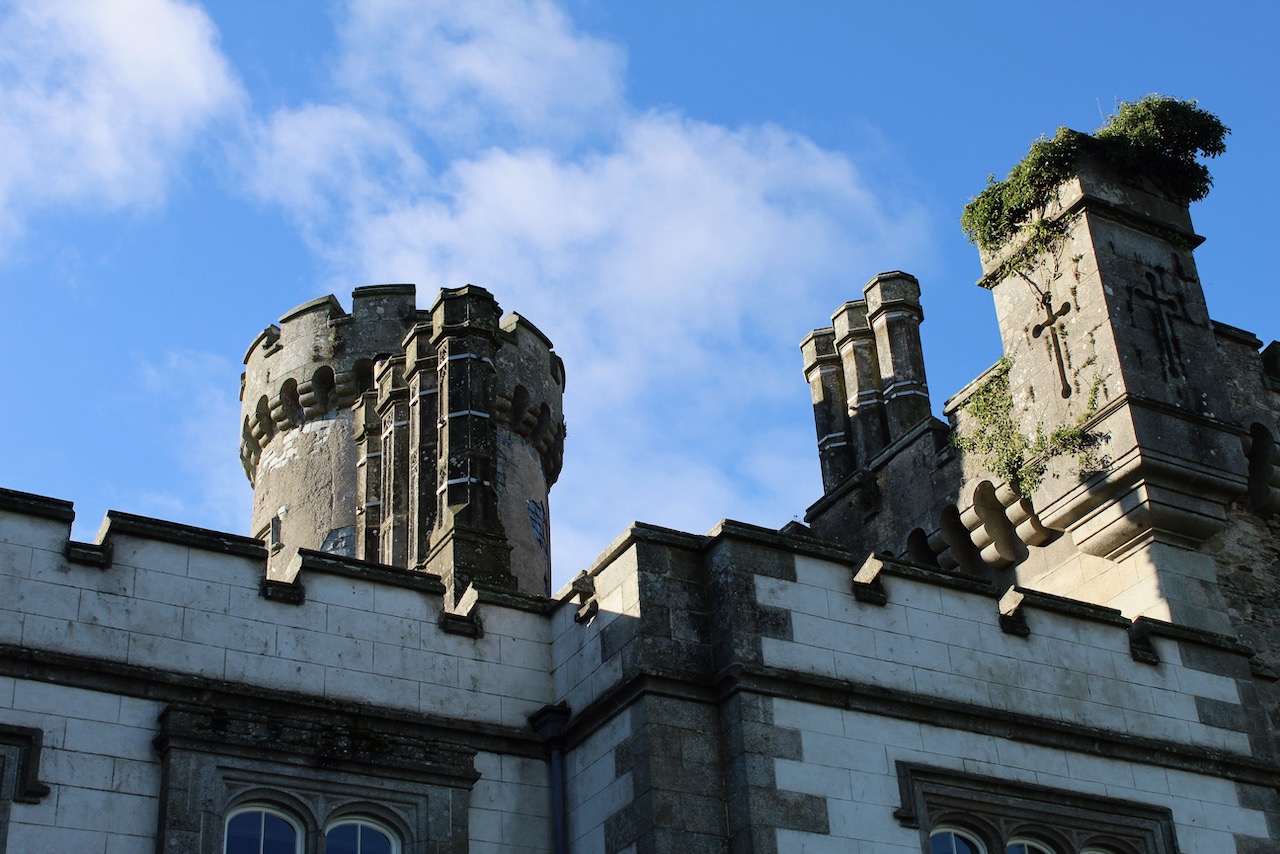
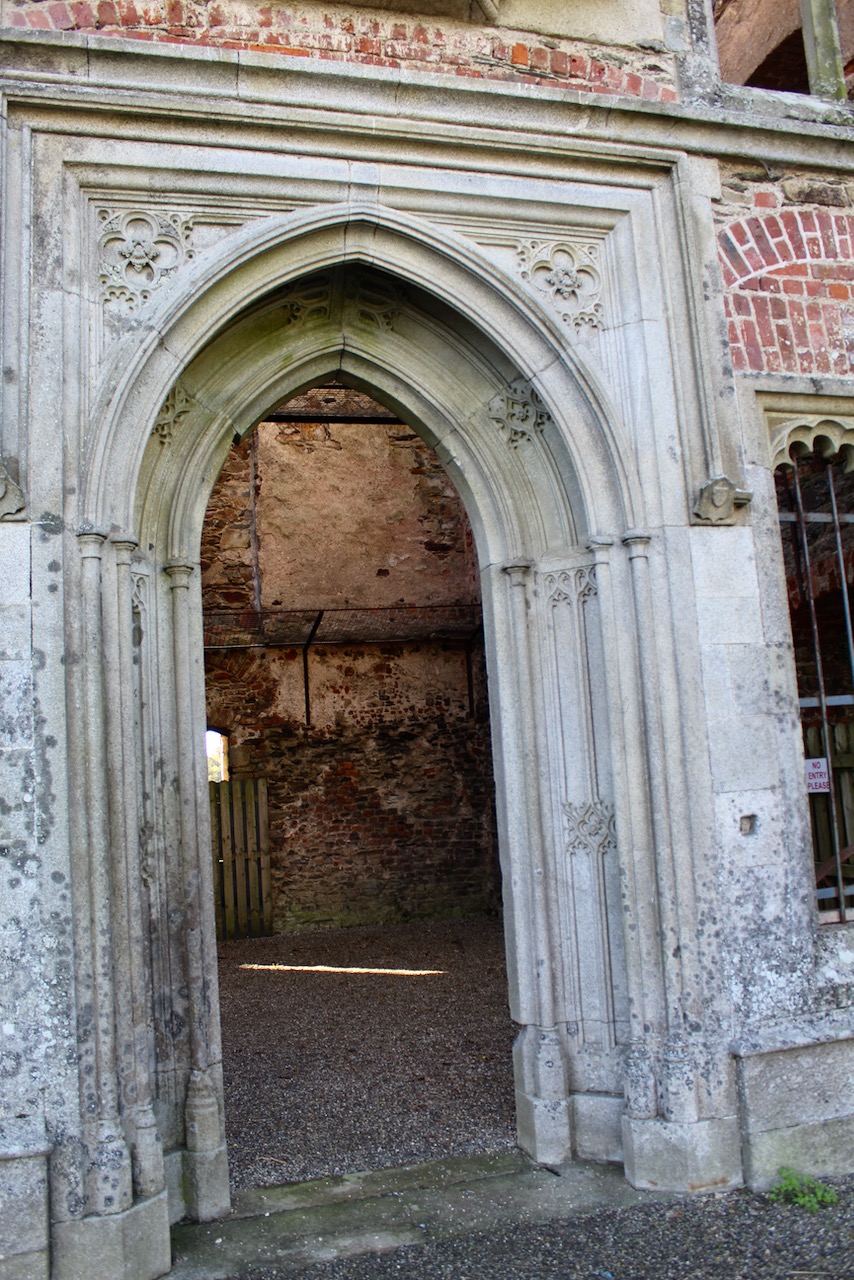
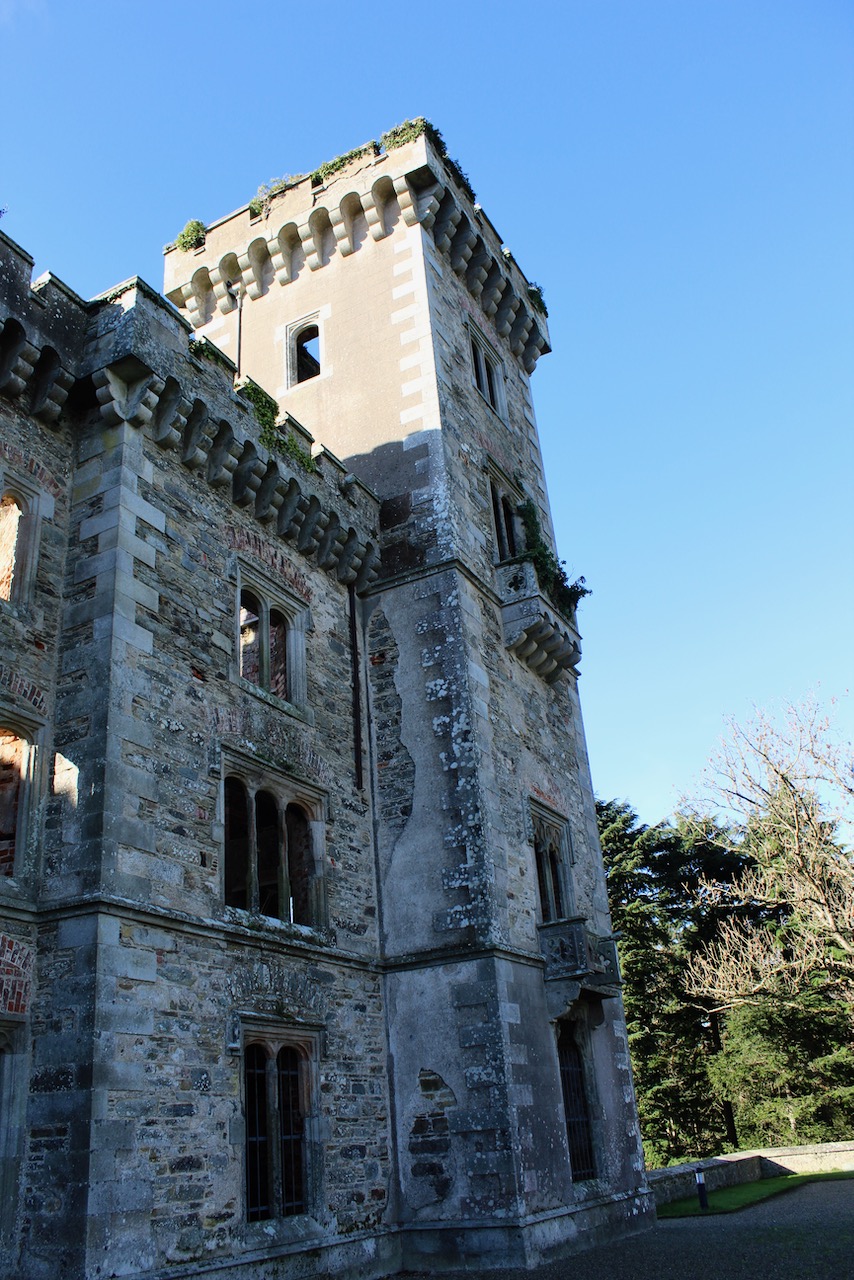
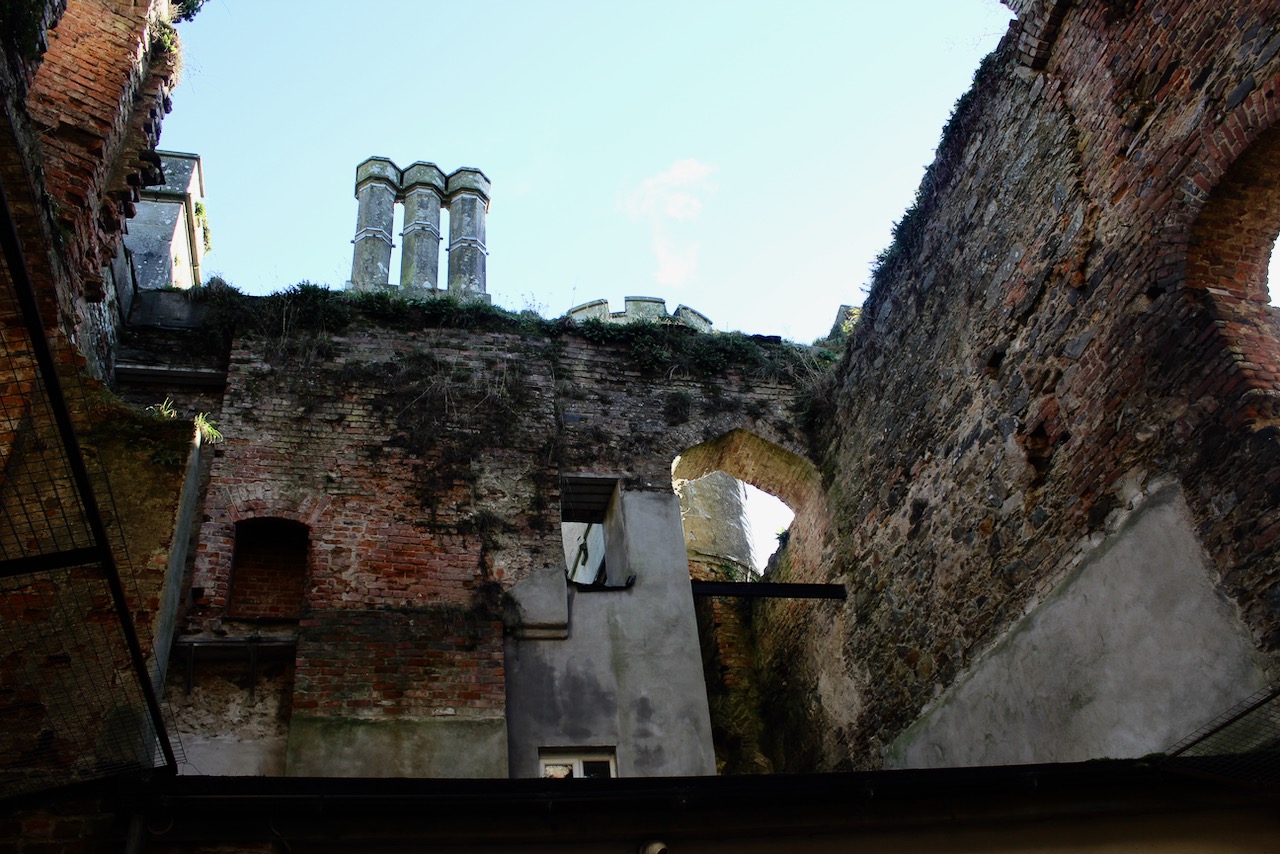
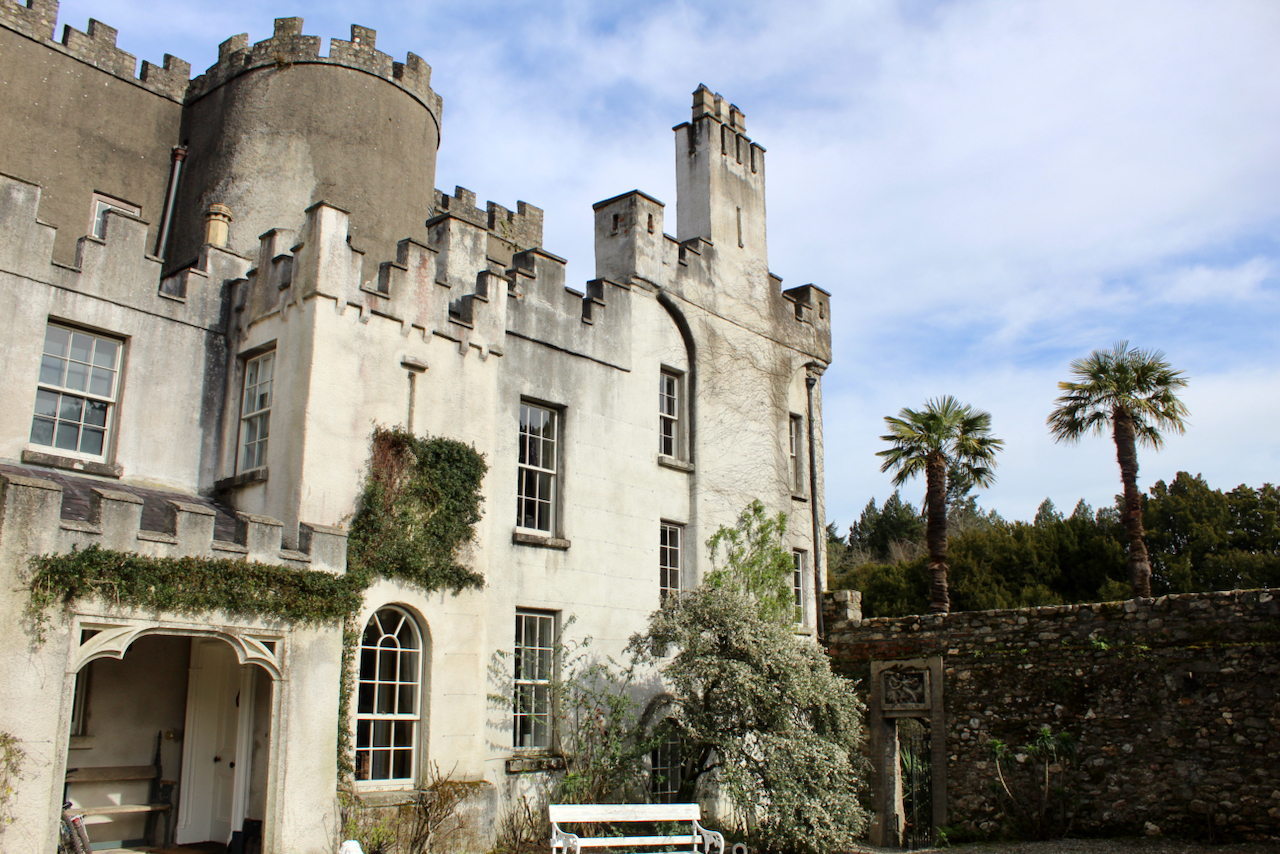
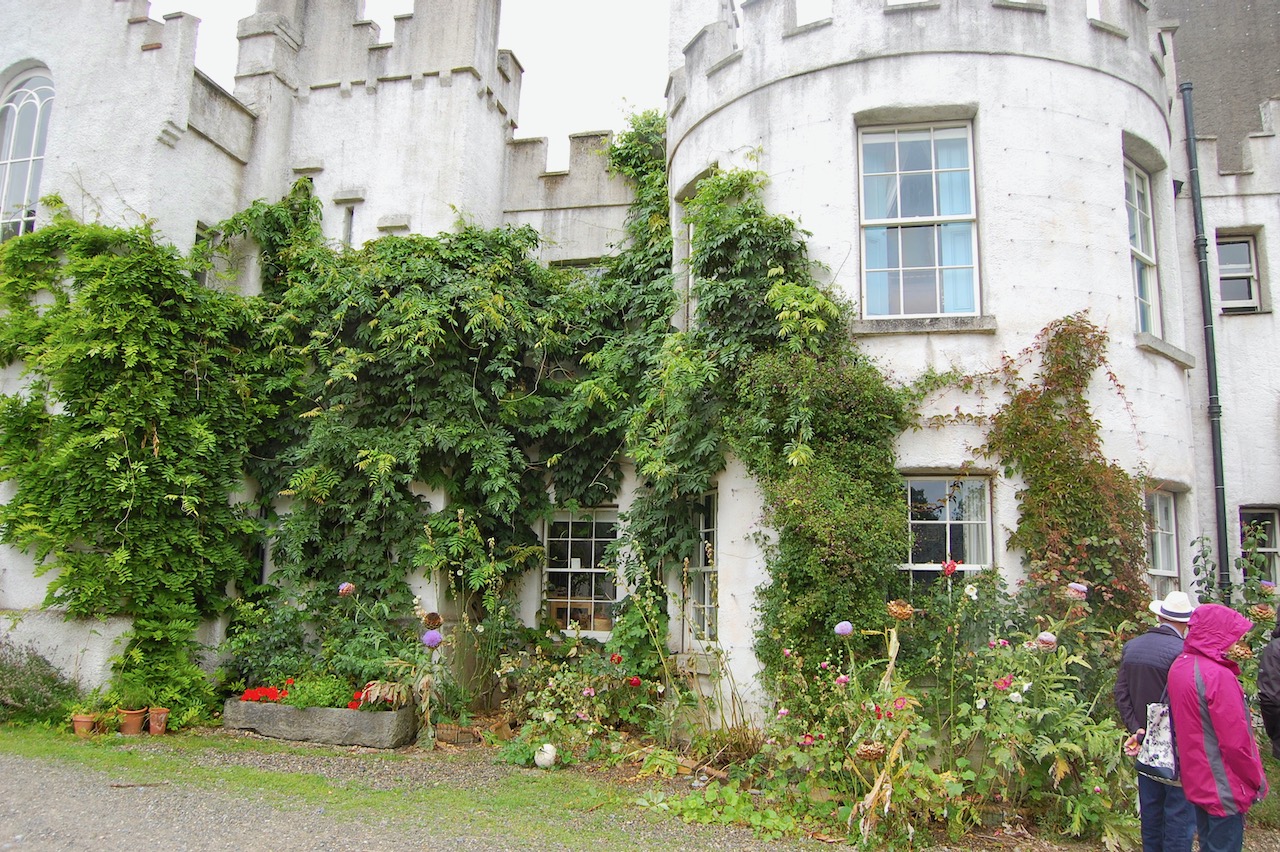
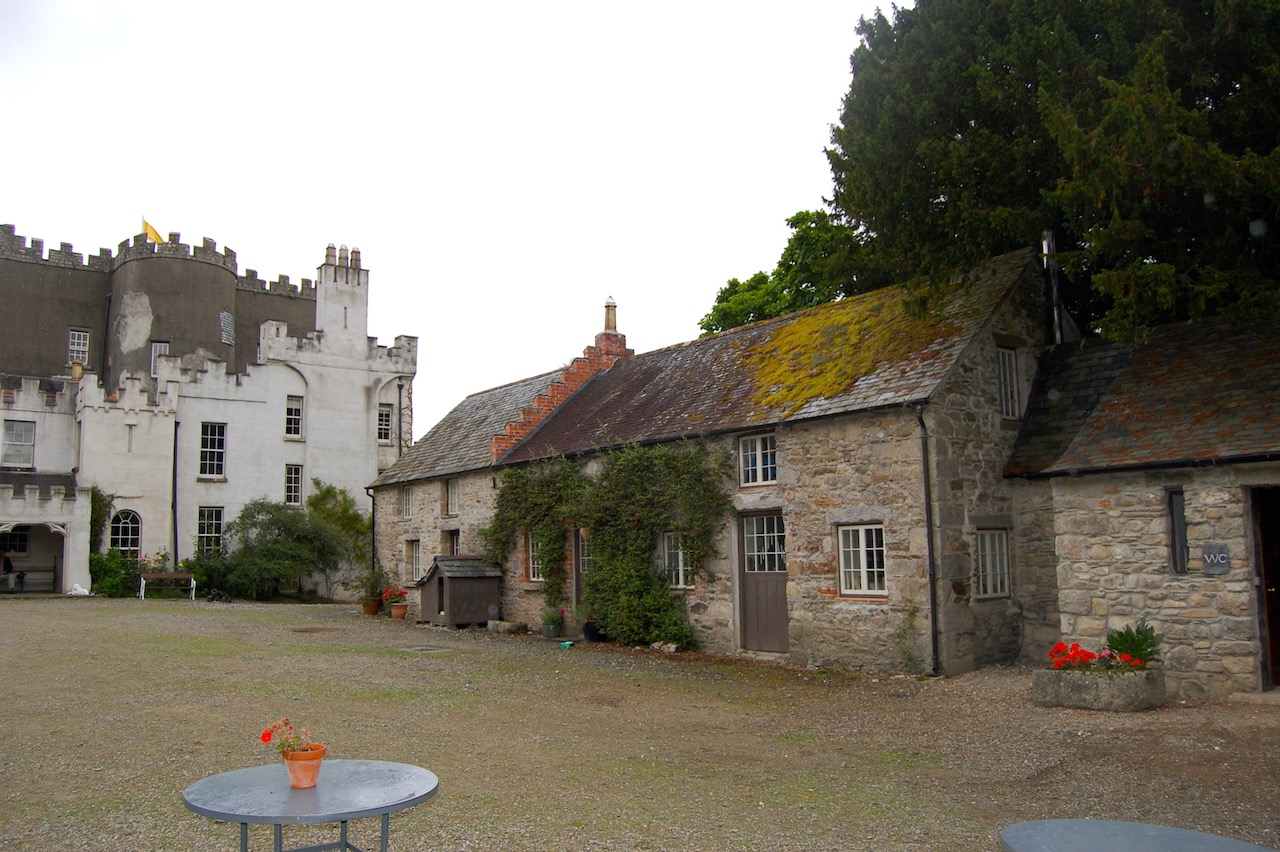
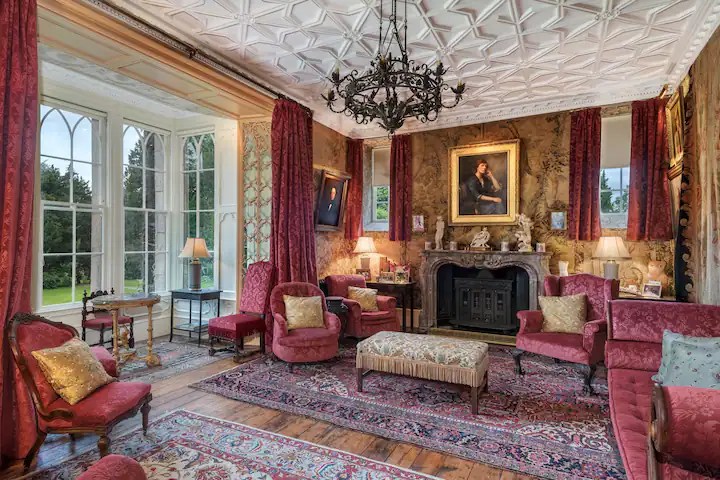
Places to visit and stay in County Wexford

On the map above:

blue: places to visit that are not section 482

purple: section 482 properties

red: accommodation

yellow: less expensive accommodation for two

orange: “whole house rental” i.e. those properties that are only for large group accommodations or weddings, e.g. 10 or more people.

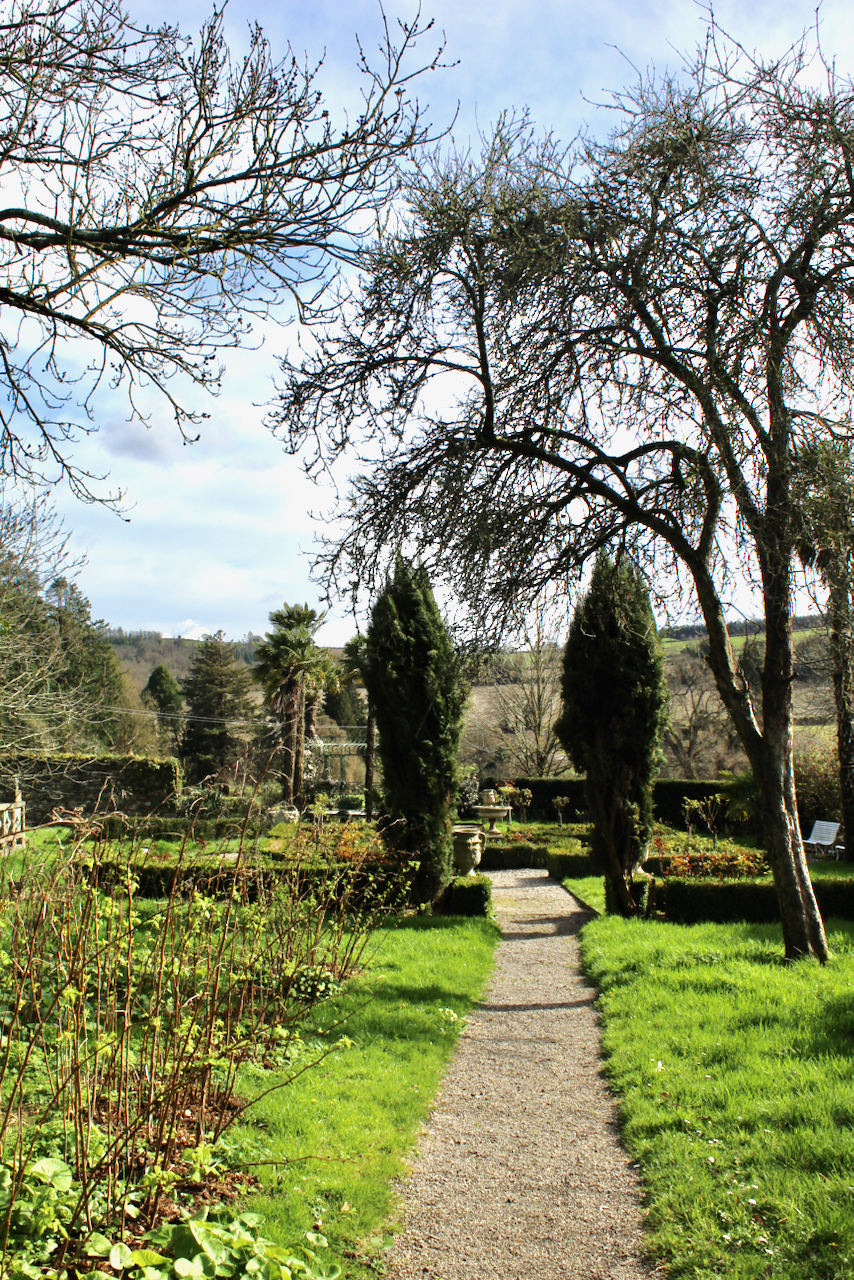
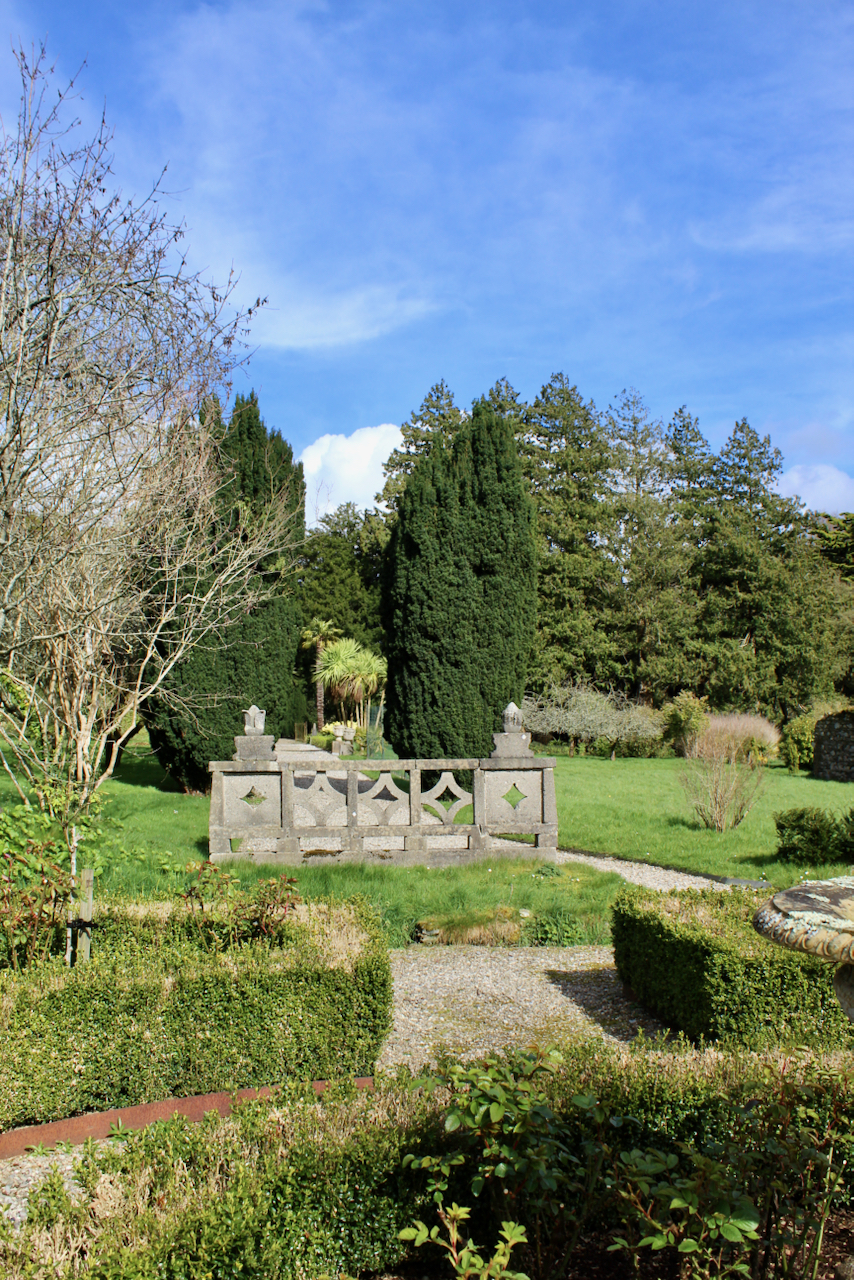
green: gardens to visit

grey: ruins

As well as places to visit, I have listed separately places to stay, because some of them are worth visiting – you may be able to visit for afternoon tea or a meal.

For places to stay, I have made a rough estimate of prices at time of publication:

€ = up to approximately €150 per night for two people sharing (in yellow on map);

€€ – up to approx €250 per night for two;

€€€ – over €250 per night for two.

2025 Diary of Irish Historic Houses (section 482 properties)

To purchase an A5 size 2025 Diary of Historic Houses (opening times and days are not listed so the calendar is for use for recording appointments and not as a reference for opening times) send your postal address to jennifer.baggot@gmail.com along with €20 via this payment button. The calendar of 84 pages includes space for writing your appointments as well as photographs of the historic houses. The price includes postage within Ireland. Postage to U.S. is a further €10 for the A5 size calendar, so I would appreciate a donation toward the postage – you can click on the donation link.

€20.00

donation

Help me to pay the entrance fee to one of the houses on this website. This site is created purely out of love for the subject and I receive no payment so any donation is appreciated!

€15.00

Wexford:

1. Ballyhack Castle, Co. Wexford – open to public OPW

2. Ballymore, Camolin, Co Wexford – museum 

3. Berkeley Forest House, County Wexford

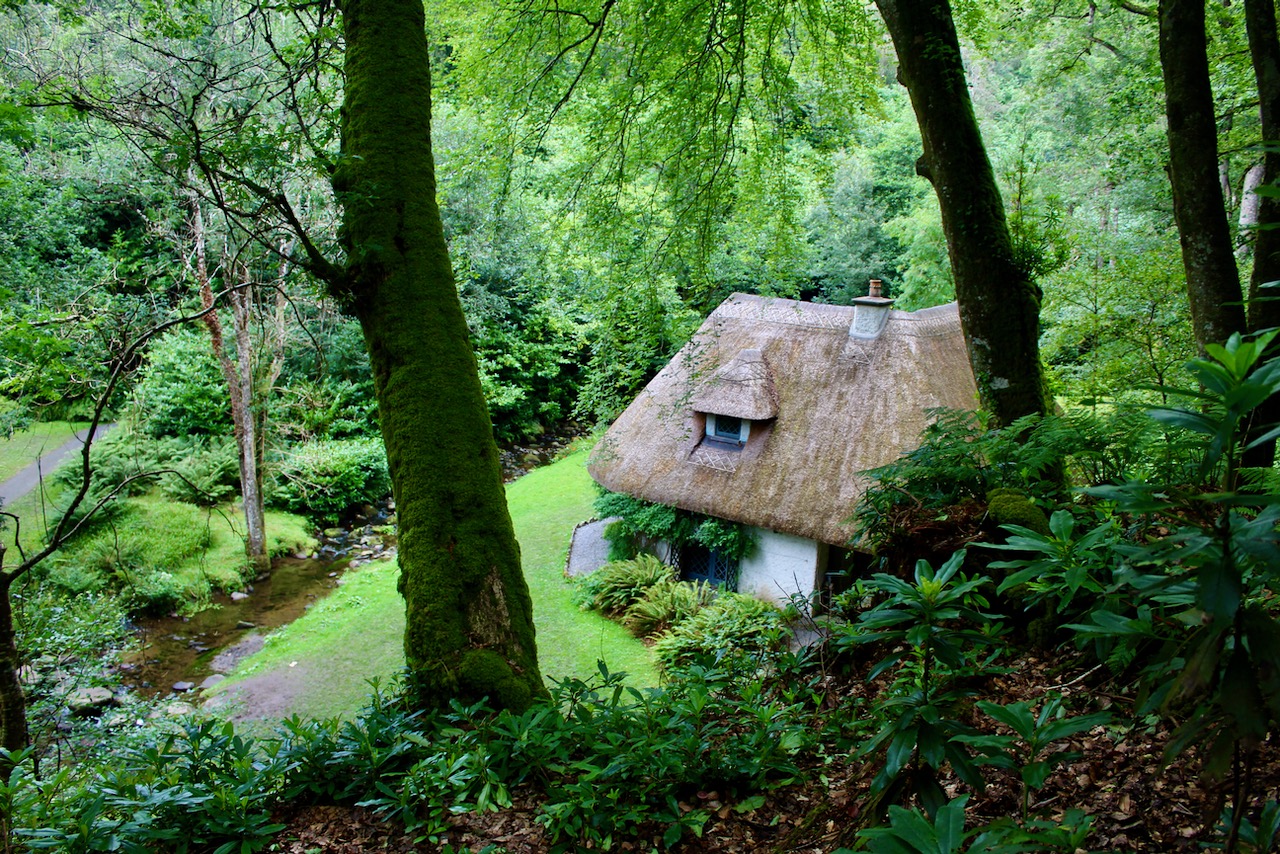
4. Clougheast Cottage, Carne, Co. Wexford – section 482

5. Enniscorthy Castle, County Wexford

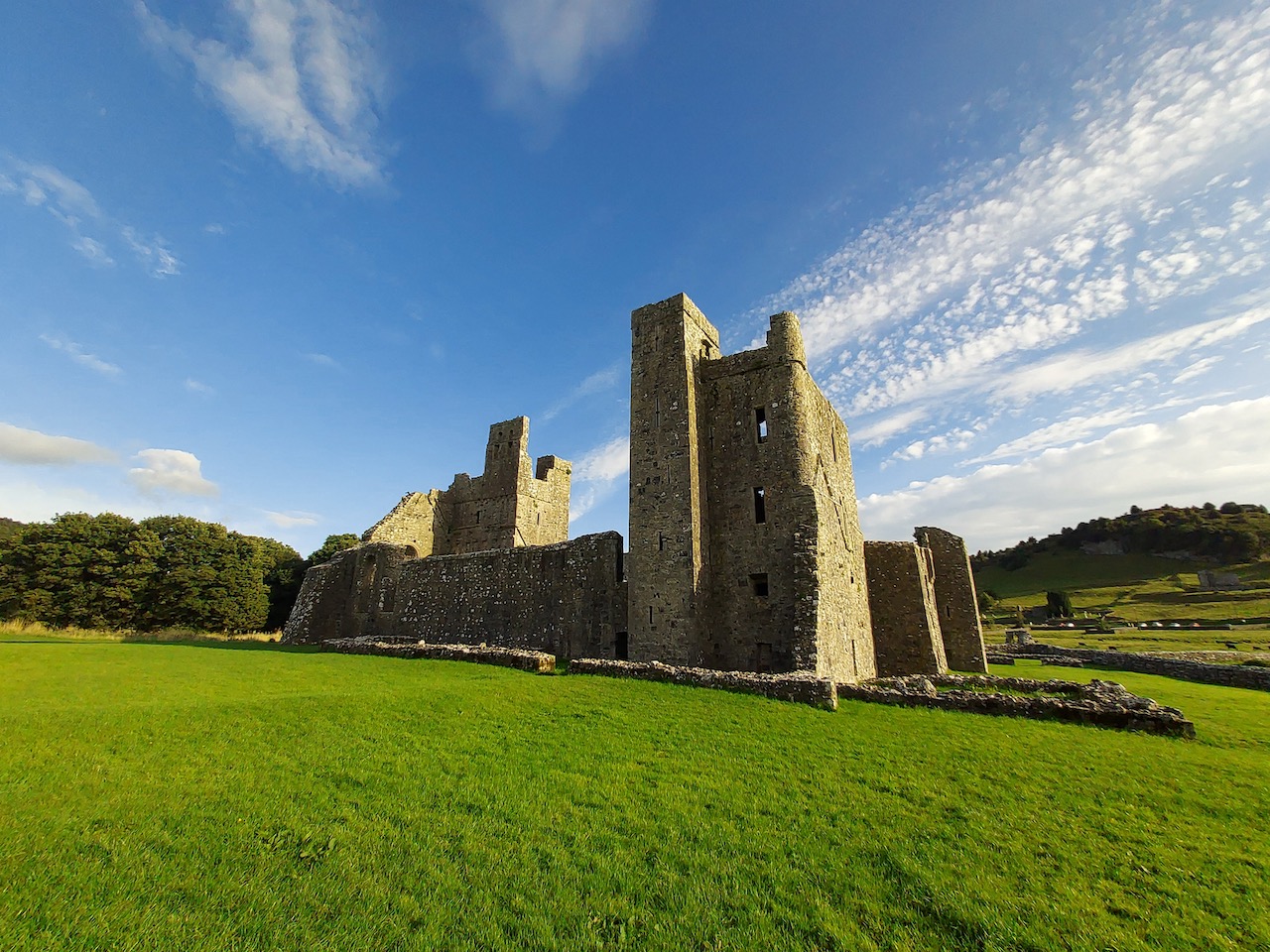
6. Ferns Castle, Wexford – open to public, OPW

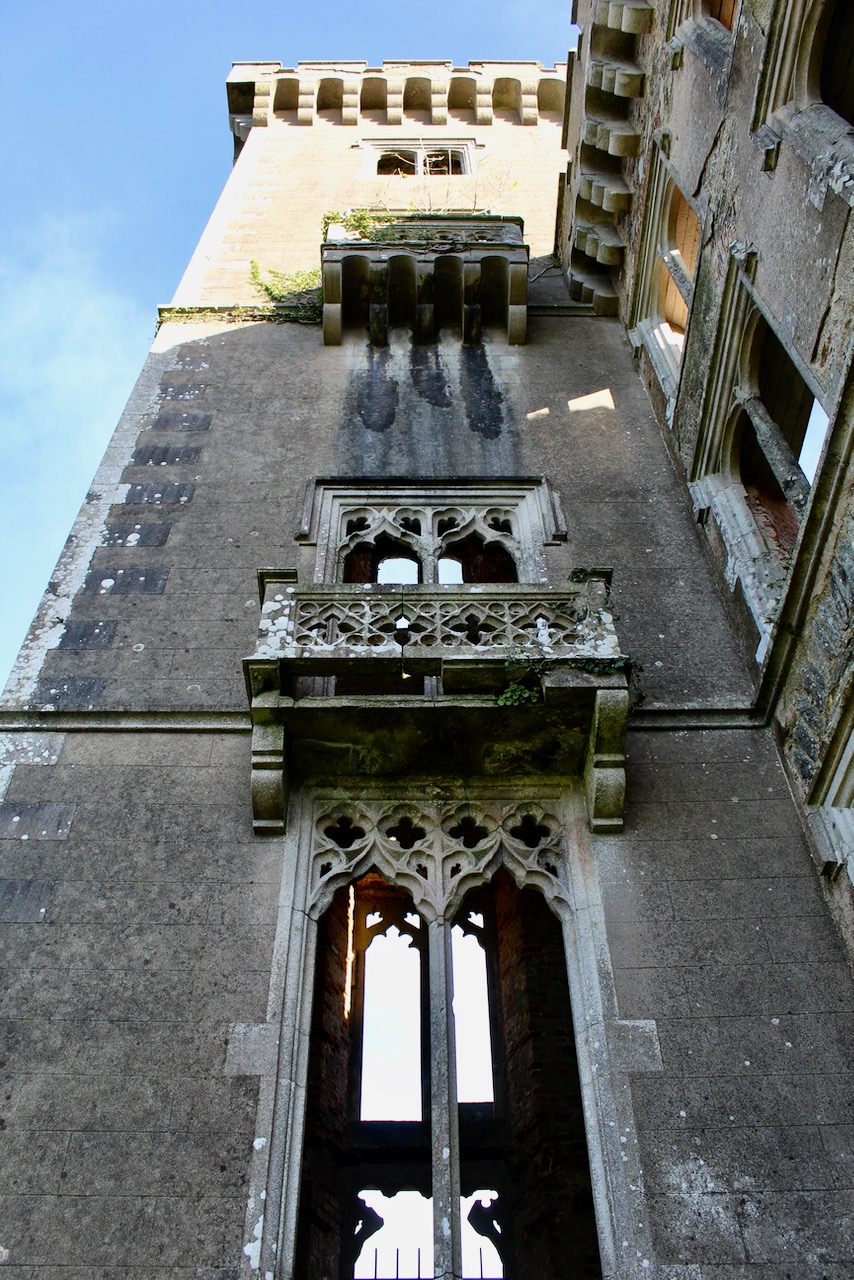
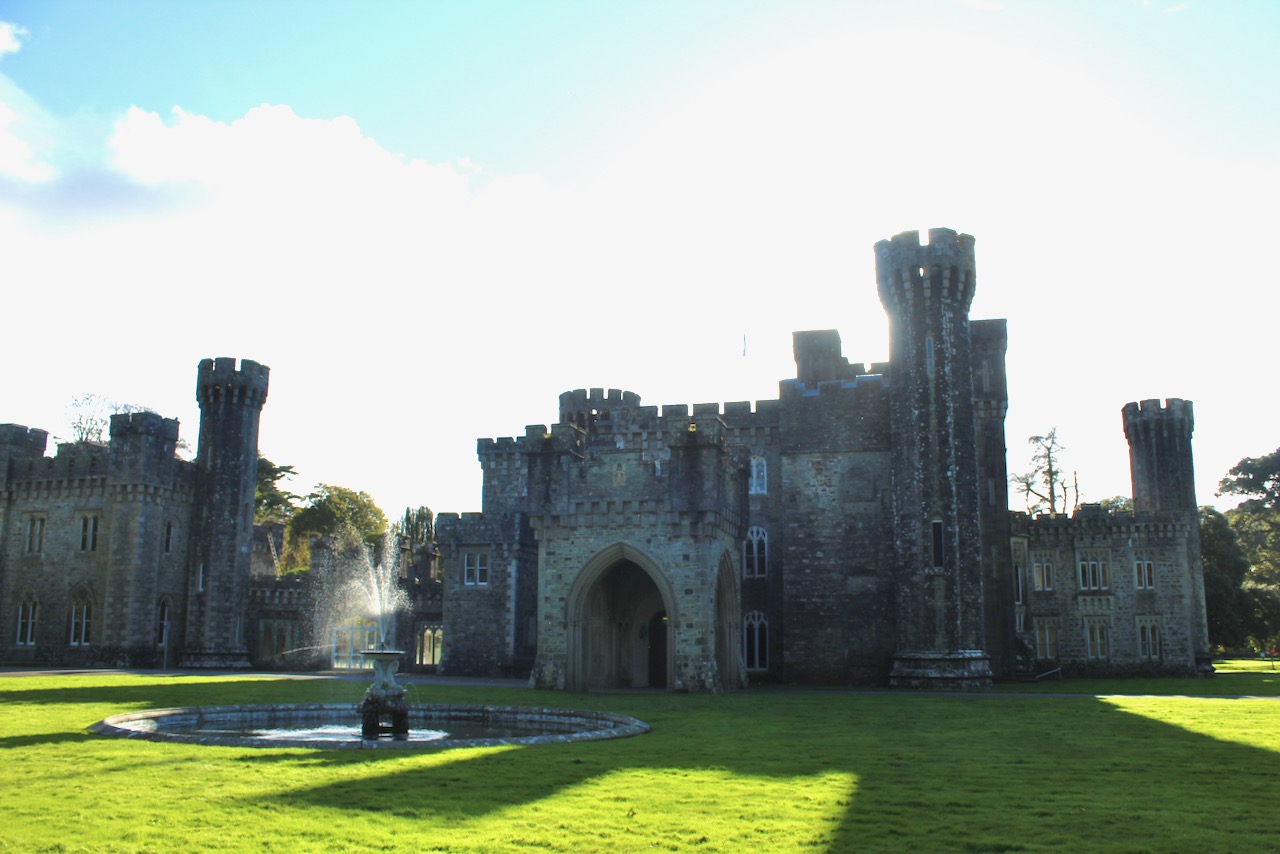
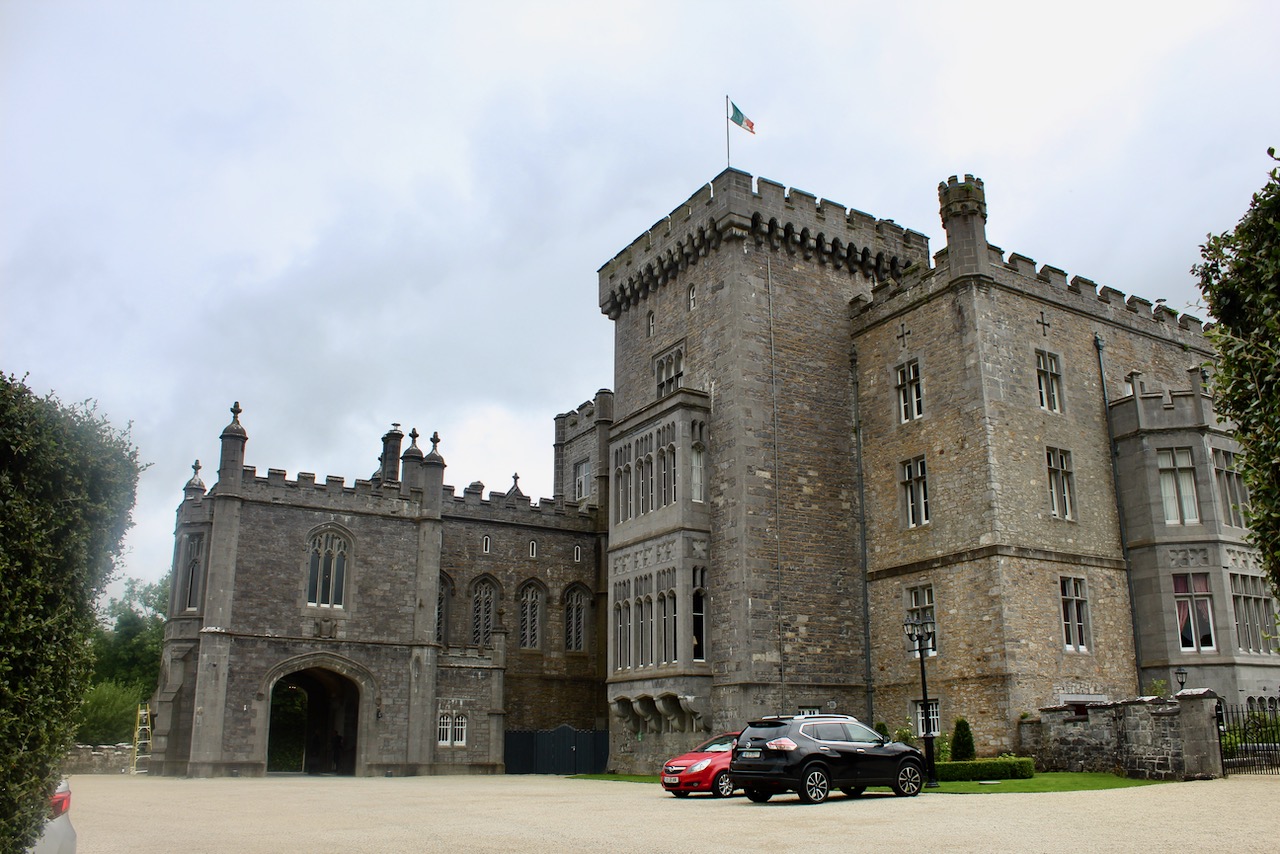
7. Johnstown Castle, County Wexford maintained by the Irish Heritage Trust

8. Kilcarbry Mill Engine House, Sweetfarm, Enniscorthy, Co Wexford – section 482

9. Kilmokea Country Manor & Gardens, Great Island, Campile, New Ross, Co. Wexford – section 482, gardens open

10. Newtownbarry House, Wexford

11. Sigginstown Castle, Sigginstown, Tacumshane, Co. Wexford – section 482

12. Tintern Abbey, Ballycullane, County Wexford – concessionary entrance to IGS members, OPW

13. Wells House, County Wexford

14. Woodville House, New Ross, Co. Wexford – section 482

Places to Stay, County Wexford

1. Artramon House, Castlebridge, Co Wexford – B&B 

2. Ballytrent House, Broadway, Co Wexford

3. Bellfry at Old Boley, County Wexford

4. Butlerstown Castle, Tomhaggard, Co Wexford – A ruin, coach house accommodation  

5. Clonganny House, Wexford – accommodation 

6. Dunbrody Park, Arthurstown, County Wexford – accommodation

7. Fruit Hill Cottages, Fruit Hill House, Campile, New Ross, County Wexford

8. Glendine House hotel, New Ross, County Wexford 

9. Killiane Castle, County Wexford

10. Kilmokea Country Manor & Gardens, Kilmokea, Great Island, Campile, New Ross, Co. Wexford  – accommodation 

11. Marlfield, Gorey, Co Wexford – accommodation 

12. Monart, Enniscorthy, Co Wexford – 5* hotel 

13. The Gate Lodge, Mount Congreve

14. Rathaspeck Manor “doll’s house” gate lodge, County Wexford and the Manor B&B

15. Riverbank House Hotel, The Bridge, Wexford, Ireland Y35 AH33

16. Rosegarland House, Wellingtonbridge, County Wexford – accommodation 

17. Wells House, County Wexford – self catering cottages

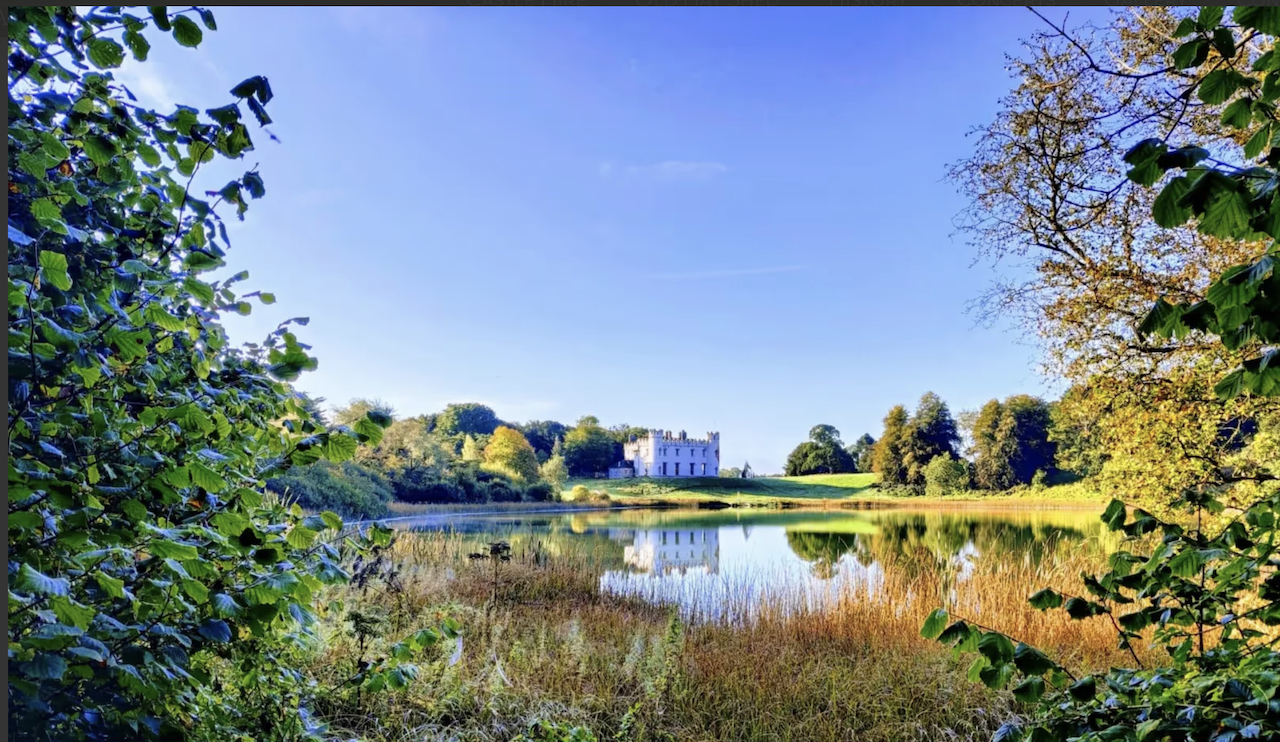
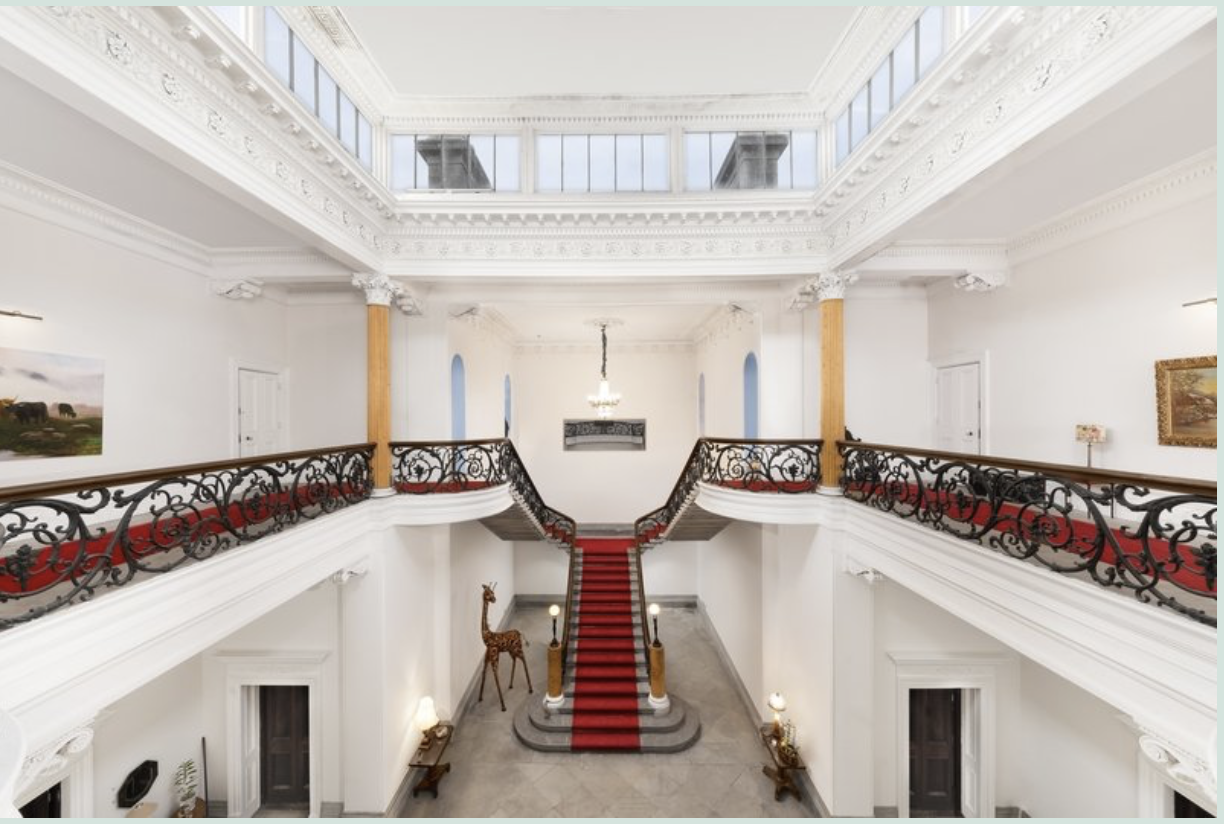
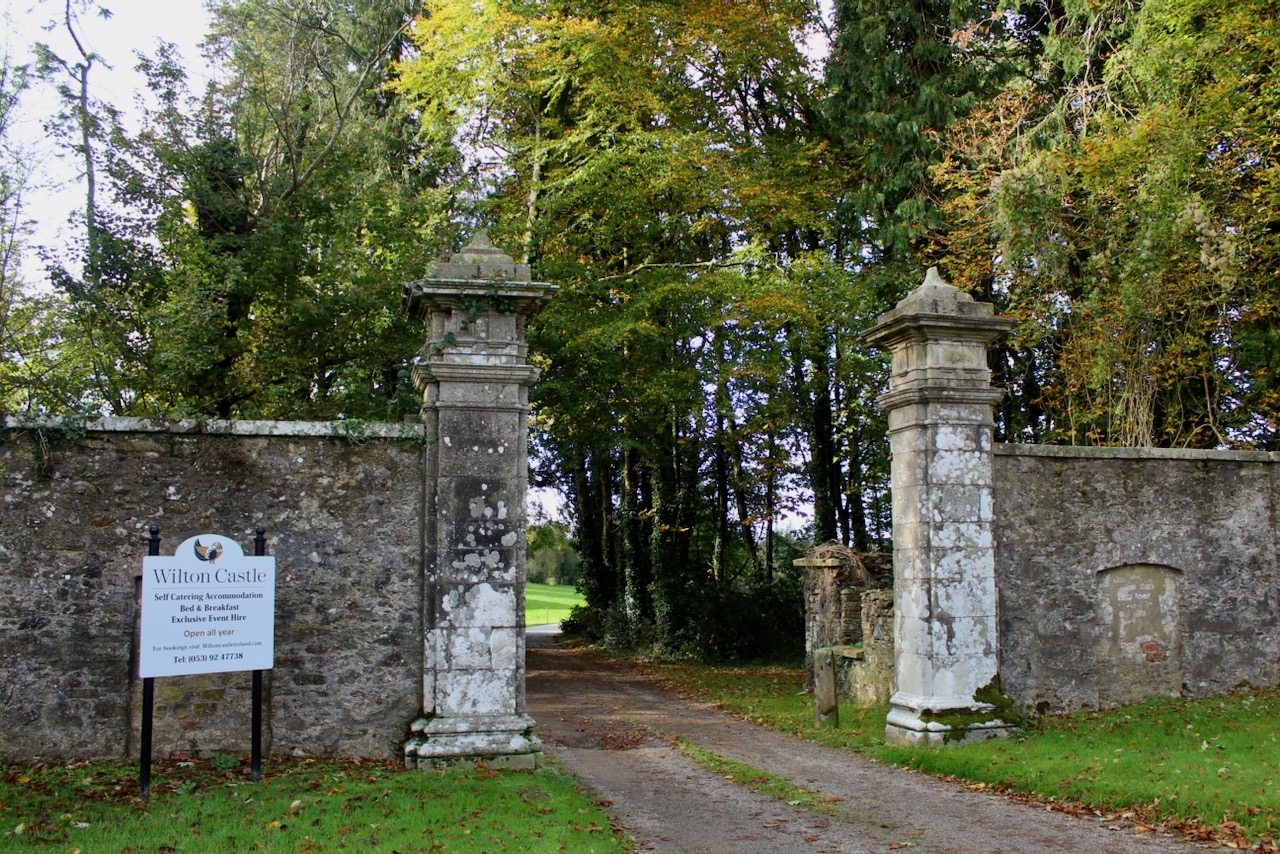
18. Wilton castle, Enniscorthy, Co Wexford

19. Woodbrook, Killane, Co Wexford

20. Woodlands Country House, Killinierin, County Wexford B&B

21. Woodville House, New Ross, Co Wexford

Whole House rental County Wexford:

1. Ballinkeele, County Wexford – whole house rental (sleeps up to 19 people)

2. Horetown House, County Wexford – whole house rental (wedding venue, up to 24 people in house, plus shepherd’s huts)

Places to visit in County Wexford:

1. Ballyhack Castle, Co. Wexford – open to public OPW

see my OPW write-up https://irishhistorichouses.com/2022/02/07/office-of-public-works-properties-leinster-laois-longford-louth-meath-offaly-westmeath-wexford-wicklow/

2. Ballymore, Camolin, Co Wexford – museum 

http://www.ballymorehistoricfeatures.com

The website tells us:

Ballymore is an old family property located away from main routes in a particularly scenic part of North Wexford. It retains many features which have survived from past periods of occupation in an attractive setting of mature trees, ordered landscape and views of the surrounding countryside.

It is a country house erected by Richard Donovan (1697-1763). The National Inventory tells us it is:

an estate having long-standing connections with the Donovan family including Richard Donovan (1752-1816); Richard Donovan (1781-1849) ‘of Ballymore’ (cf. 15612001); Richard Donovan (1819-84) ‘late of Ballymore Camolin County Wexford’ (Calendars of Wills and Administrations 1885, 217); Richard Donovan JP DL (1858-1916), ‘Gentleman late of Ballymore County Wexford’ (Calendars of Wills and Administrations 1916, 172); Richard Charlie Donovan (1898-1952); and Richard Alexander Donovan (1927-2005).

Ballymore, photograph courtesy of National Inventory of Architectural Heritage. The house itself is not open to the public. The house was built in 1721.

A large scale map indicates the route visitors are requested to follow. This route allows a leisurely ramble around several interesting features including the tea room, the museum, art gallery and display of old farming equipment in part of the farmyard. The residence itself is private and not open to the public.

In the surrounding grounds you will find the church and ancient graveyard, holy well, former site of a 1798 rebel camp and the 14th century Norman castle ruins, which now is a simple labyrinth.

The present church was built in 1869 on the site of a medieval building, of which nothing now survives except a carved wooden door lintel which can be seen at the museum.

The holy well is covered completely by a large boulder. This was done some centuries ago to discourage its continued use for prayer and devotion.

Ballymore, photograph courtesy of National Inventory of Architectural Heritage.

The castle mound is all that remains of the 14th century motte built by Norman settlers. The ruins of the stone-built tower were pulled down in the 19th century.

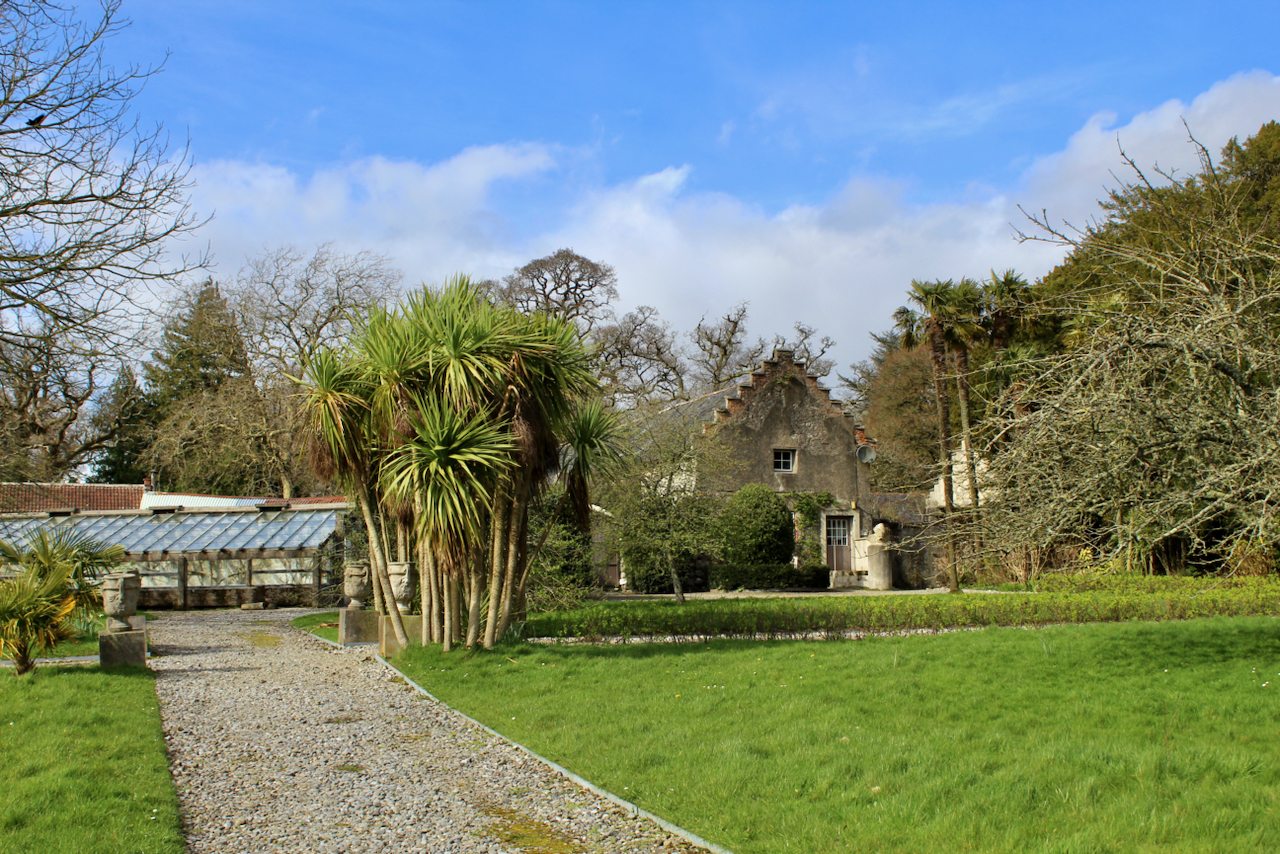
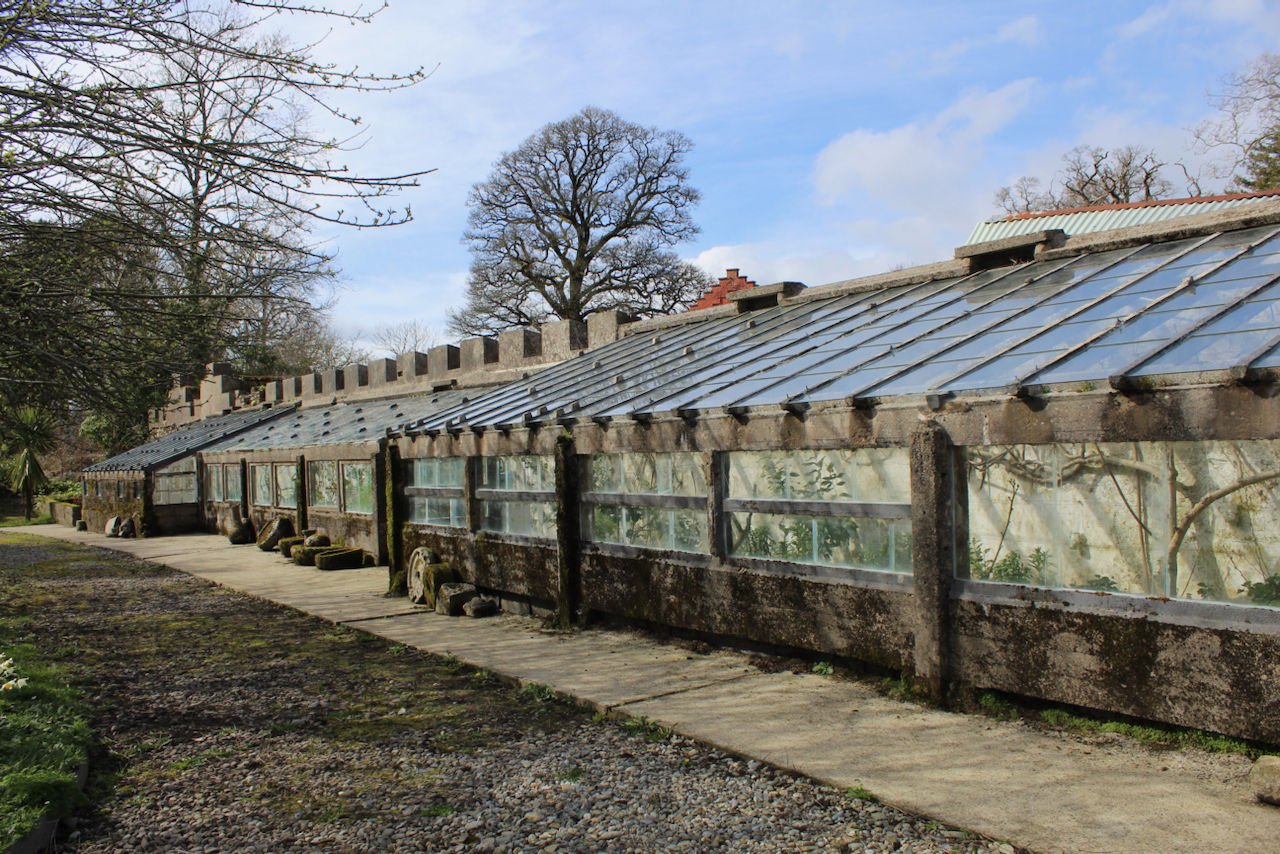
The large reconstructed greenhouse is the setting for the tea room. Its design copies the original greenhouse built around 1820, along with the walled garden behind it.

The museum and display area open out from the small courtyard. The museum itself is in a large converted hayloft in a period farmyard building. The contents of the museum are from the family home and farmyard. They illustrate many different aspects of earlier occupation and activity. Another feature is the old water wheel now on display in the same farm building.

The old dairy room will take you back in time. It adjoins the 1798 Room, containing a display of items from this period and from the house and family records. The further display area includes pieces of older farm equipment and hand tools used when the horse was the only source of motive power.

Ballymore, photograph courtesy of National Inventory of Architectural Heritage – the house is not open to the public.

The art gallery is located below the museum in what was the farm stables. It displays a selection of paintings and drawings of local scenes and activities by the much admired artist Phoebe Donovan.

Take one of our exclusive tours, which encompasses many features including the museum of local and family history spanning over 300 years, dairy and farming display, 1798 memorabilia room and the Phoebe Donovan art gallery.

Venture out into the surrounding grounds and you will find the ruins of a Norman castle dating back to the 14th century, Ballymore Church and graveyard (1869), and a former 1798 rebel camp site. You may even spot a buzzard or some of the other varied wildlife in the area.

Finally, relax and enjoy a beverage in our greenhouse tea room. Ballymore Historic Features is also part of the Wexford Heritage Trail.”

3. Berkeley Forest House, County Wexford

http://berkeleyforesthouse.com
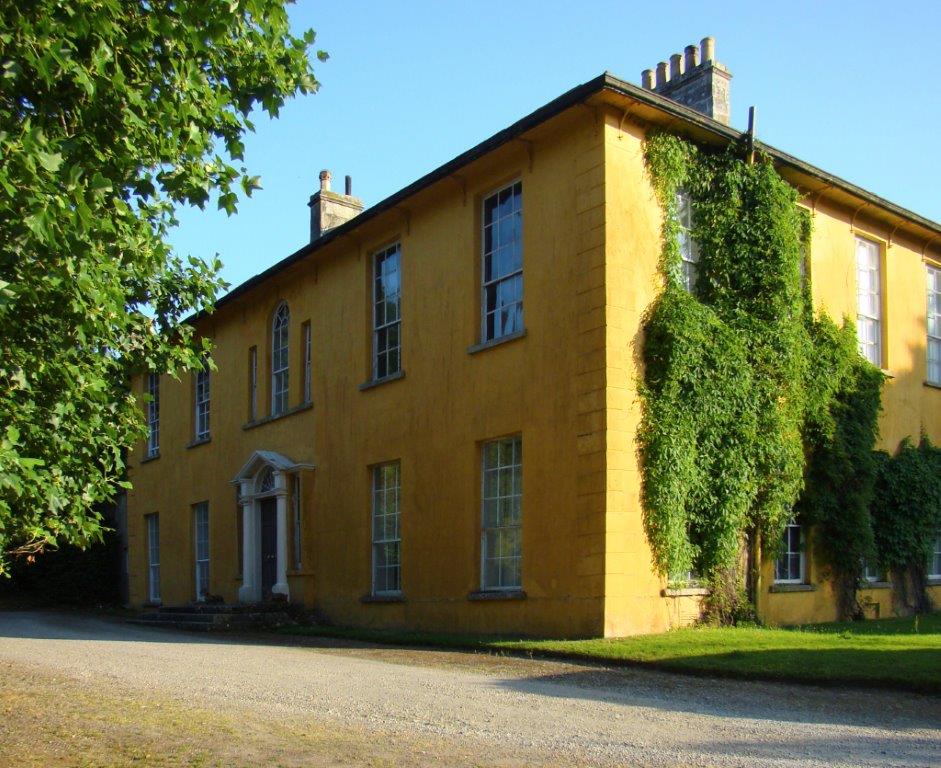
Berkeley Forest House, photograph courtesy of the house’s website.

This website tells us:

Berkeley Forest is unusual as a period house as it has a bright and uncluttered look with a strong Scandinavian flavour -painted floors, hand stencilled wallpaper and bedcoverings designed by artist Ann Griffin-Bernstorff who lives and works here during part of the year.

The house offers a beguiling experience. With a beautiful faded brick walled garden with a terrace, summer house and an outdoor fireplace, it is a delight throughout the day.

In easy reach of the Wexford beaches to the South and East and the picturesque villages of Inistioge, Thomastown and Graiguenamanagh, the cities of Kilkenny (Medieval) and Waterford (Viking) are also nearby. Just off the N30, less than 2 hours from Dublin Airport, 45 mins from Kilkenny, 20 mins from Wexford or Waterford, the house is perfectly situated to visit a host of interesting historical, cultural or sporting amenities, or to hide away in complete peace and quiet.

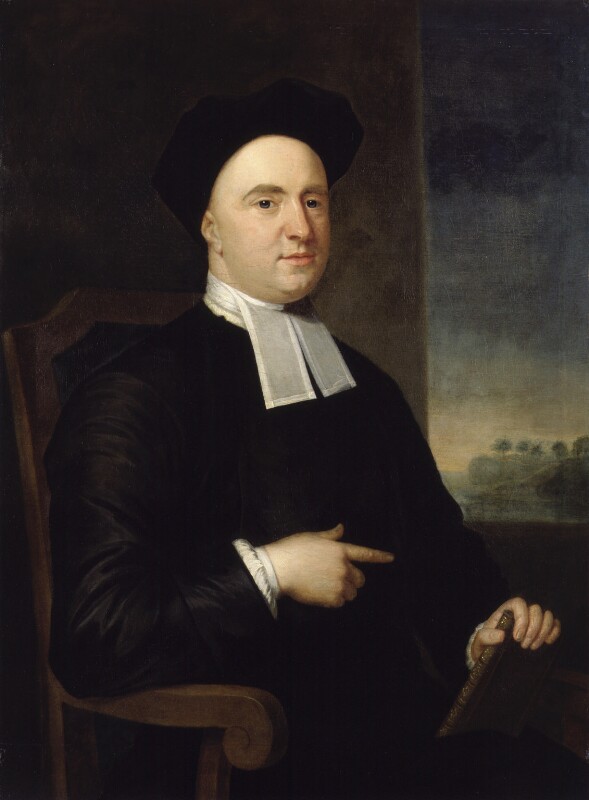
The house was once the home of the family of 18th century philosopher George Berkeley.
It also houses a 19th Costume museum which was created by Ann Griffin-Bernstorff and is available to costume and fashion students on request (her original 18th century Costume Collection is now to be seen at Rathfarnham Castle in Dublin) She is also the designer of the internationally acclaimed Ros Tapestry.

Berkeley Forest House, photograph courtesy of the house’s website.

The property consists of the main house, lawns and gardens; beyond that are pasture and woodland, some mature, some more recently planted; as well as original farm buildings. All of which ideal for exploring and wandering. There is a beautifully proportioned upper drawing room (28ftx18ft) which is suitable for music rehearsal, fine dining and specialist conferences.”

Berkeley Forest House, photograph courtesy of the house’s website.
George Berkeley (1685-1753), Philosopher; Bishop of Cloyne, by John Smibert 1730 courtesy of National Portrait Gallery NPG 653.

4. Clougheast Cottage, Carne, Co. Wexford – section 482

Jacinta Denieffe Tel: 086-1234322

Open dates in 2025: Jan 12-31, May 1-31, August 16-24, 9am-1pm

Fee: adult €5, child/OAP/student €2.50

5. Enniscorthy Castle, County Wexford

http://enniscorthycastle.ie

Enniscorthy castle, Co Wexford_Courtesy Patrick Brown 2014, for Tourism Ireland, Ireland’s Content Pool. [1]

The website tells us:

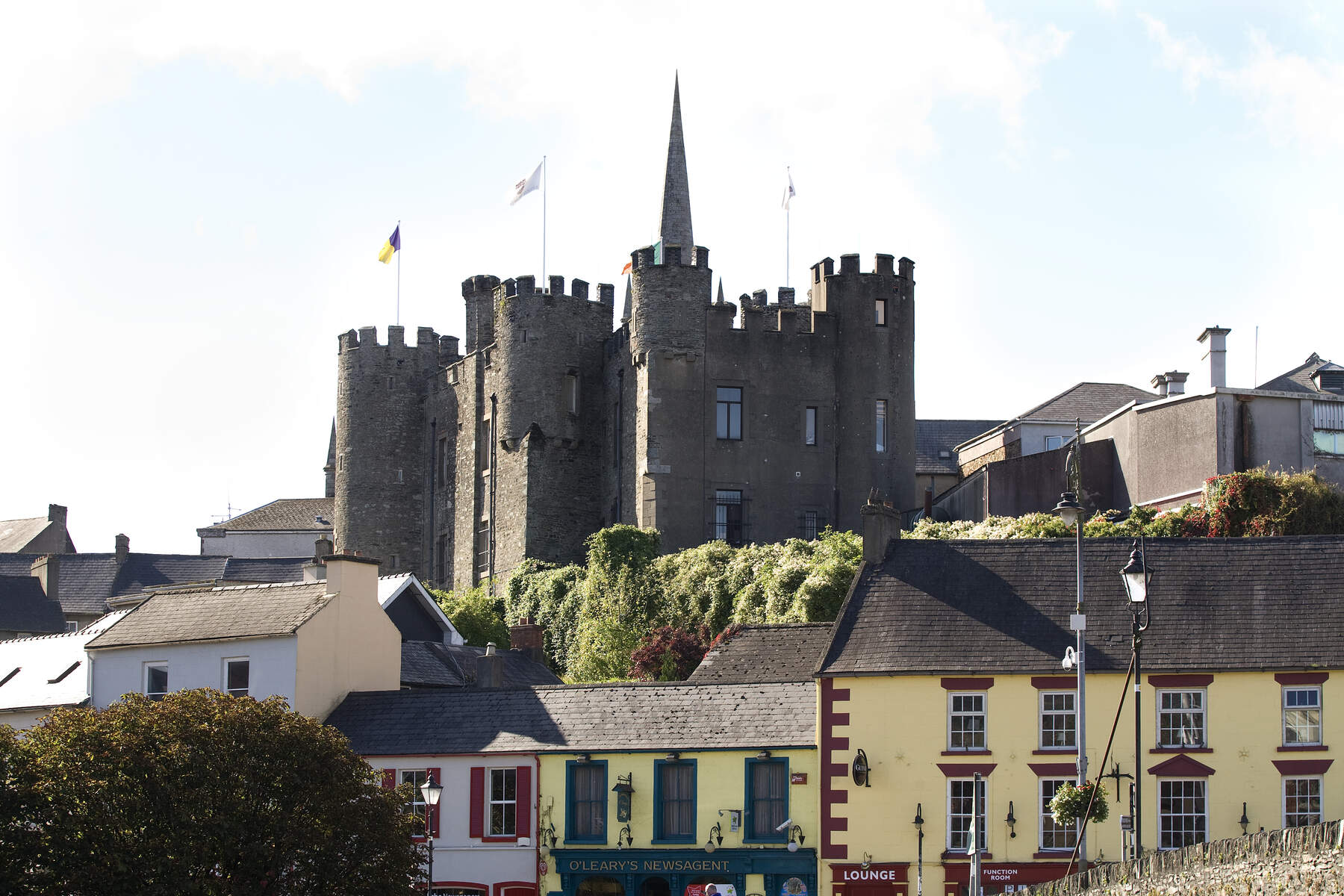
Enniscorthy Castle, in the heart of Enniscorthy town, was originally built in the 13th century, and has been ‘home’ to Norman knights, English armies, Irish rebels and prisoners, and local  merchant families.  Why not visit our dungeon to see the rare medieval wall art –The Swordsman, or our battlements at the top of the castle to marvel at the amazing views of Vinegar Hill Battlefield, Enniscorthy town, and the sights, flora and  fauna of the  surrounding countryside. Enniscorthy Castle explores the development of the Castle and town from its earliest Anglo-Norman origins, with a special focus on the Castle as a family home. Visitors can also view the ‘Enniscorthy Industries ‘exhibition on the ground floor from the early 1600’s onwards when Enniscorthy began to grow and prosper as a market town. Visitors can explore the work of the renowned Irish furniture designer and architect Eileen Gray (born in 1878 just outside the town). The roof of the castle is also accessible, with spectacular views of the surrounding buildings, Vinegar Hill, and countryside. Note that access to the roof is only possible when accompanied by a staff member. Tours of the Castle are self guided. Last admission is 30 minutes before closing. Our facilities include: craft and gift shop, toilets and baby changing area, wheelchair access to all floors (including roof) , and visitor information point (tourist office for town). We look forward to welcoming you to our town’s most public ‘home’.

Enniscorthy castle, Co Wexford_Courtesy Patrick Brown 2014, for Tourism Ireland, Ireland’s Content Pool. [1]

Mark Bence-Jones writes in his A Guide to Irish Country Houses (1988):

p. 121. “(Wallop, Portsmouth, E/IFR) A C13 four-towered keep, like the ruined castles at Carlow and Ferns, restored at various dates and rising above the surrounding rooftops of the town of Enniscorthy like a French chateau-fort, with its near row of tourelles. Once the home of Edmund Spenser, the poet. Now a museum.” [2]

The National Inventory of Architectural Heritage tells us that it is a two-bay three-stage over basement castle, built 1588, on a rectangular plan with single-bay full-height engaged drum towers to corners on circular plans. [3]

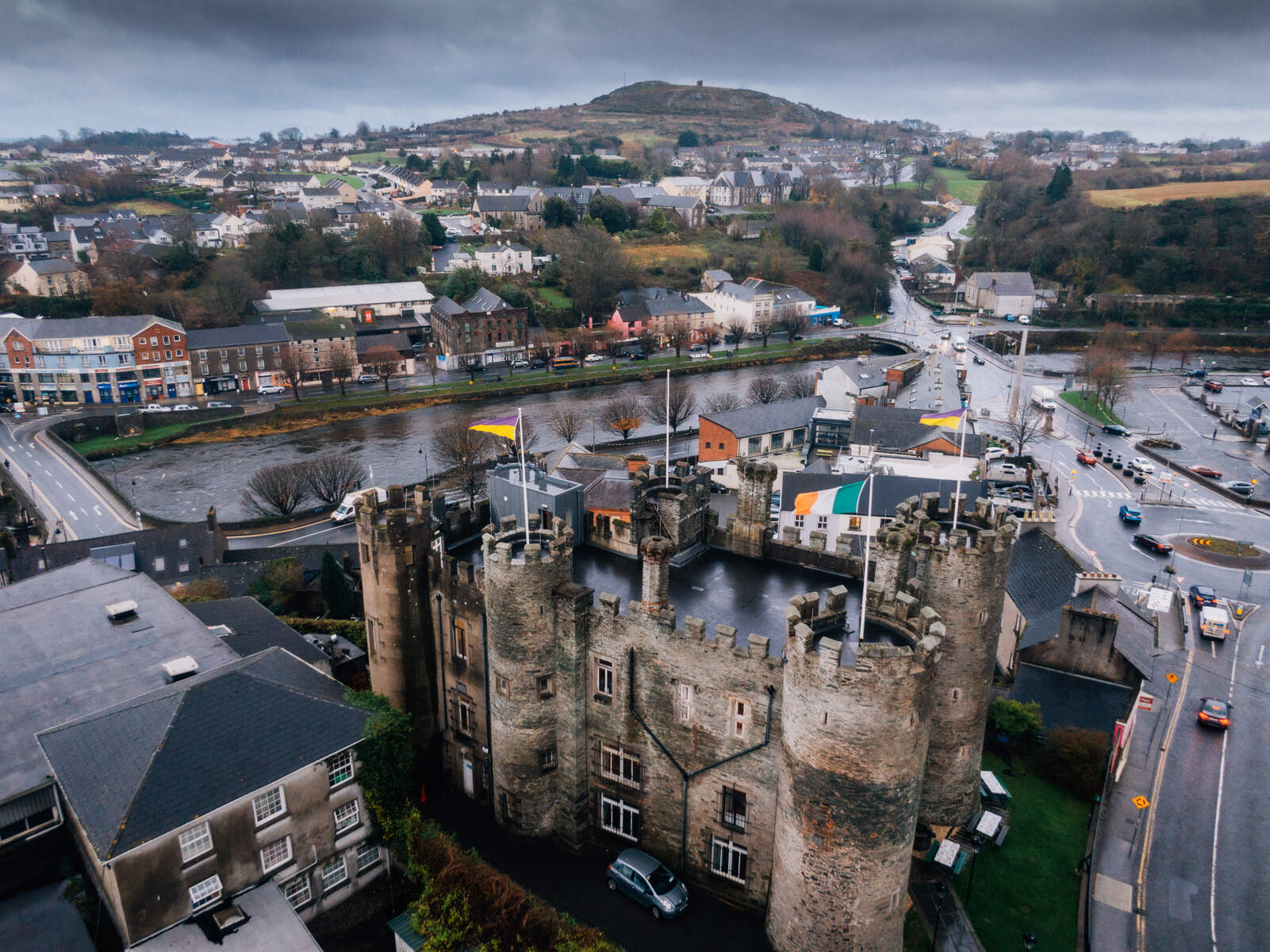
Enniscorthy, Co Wexford_Courtesy Celtic Routes 2019, for Tourism Ireland, Ireland’s Content Pool. (see [1])
Enniscorthy, Co Wexford_Courtesy Celtic Routes 2020, for Tourism Ireland, Ireland’s Content Pool. (see [1])

The website tells us more about the history of the castle:

Maud de Quency (granddaughter of the famous Strongbow) marries Philip de Prendergast (son of Anglo-Norman Knight Maurice de Prendergast) and they reside at Enniscorthy Castle from 1190 to his death in 1229. From then until the 1370’s, their descendants, and other Anglo-Norman families rule the Duffry and reside in Enniscorthy Castle.

“In 1375: The fief (a defined area of land or territory) of the Duffry  and Enniscorthy Castle are forcefully retaken by Art MacMurrough Kavanagh who regains his ancestral lands. This marks a time of Gaelic Irish revival. The MacMurrough Kavanagh dynasty rule until they eventually surrender the Castle and lands to Lord Leonard Grey in 1536. At this time Enniscorthy Castle is reported be in a ruined condition.

Enniscorthy, Co Wexford_Courtesy Celtic Routes 2020, for Tourism Ireland, Ireland’s Content Pool. (see [1])

“In 1569, The Butlers of Kilkenny and the Earl of Kildare lead a raid on Enniscorthy town on a fair day, killing numerous civilians and burning the castle. In 1581, The poet Edmund Spenser leases the Castle but never lives in it. Historians speculate that this was because Spenser feared the MacMurrough Kavanaghs.

“In 1585, Henry Wallop receives ownership of the Duffry by Royal Appointment. He exploits the dense forests (the Duffry, An Dubh Tír in Irish, meaning “The Black Country”) surrounding Enniscorthy which brings considerable wealth to the town, and funds the rebuilding of Enniscorthy Castle which we see standing today. Enniscorthy begins to rapidly develop as a plantation town.

“1649: Oliver Cromwell arrives in Co. Wexford. Enniscorthy Castle is beseiged by his forces; its defenders surrender, leaving it intact. In December of the same year the Castle once again fell to the Irish (under Captain Daniel Farrell), but two months later Colonel Cooke, the Governor of Wexford, reoccupied the castle.

“1898: The Castle is leased by Patrick J. Roche from the Earl of Portsmouth. P.J. Roche restores and extends the Castle making it into a residence for his son Henry J. Roche.

“1951: Roche family leaves.

“1962: Castle opens as Wexford County Museum.

Enniscorthy, Co Wexford_Courtesy Celtic Routes 2020, for Tourism Ireland, Ireland’s Content Pool. (see [1])

6. Ferns Castle, Wexford – open to public, OPW

see my OPW entry: https://irishhistorichouses.com/2022/02/07/office-of-public-works-properties-leinster-laois-longford-louth-meath-offaly-westmeath-wexford-wicklow/ 
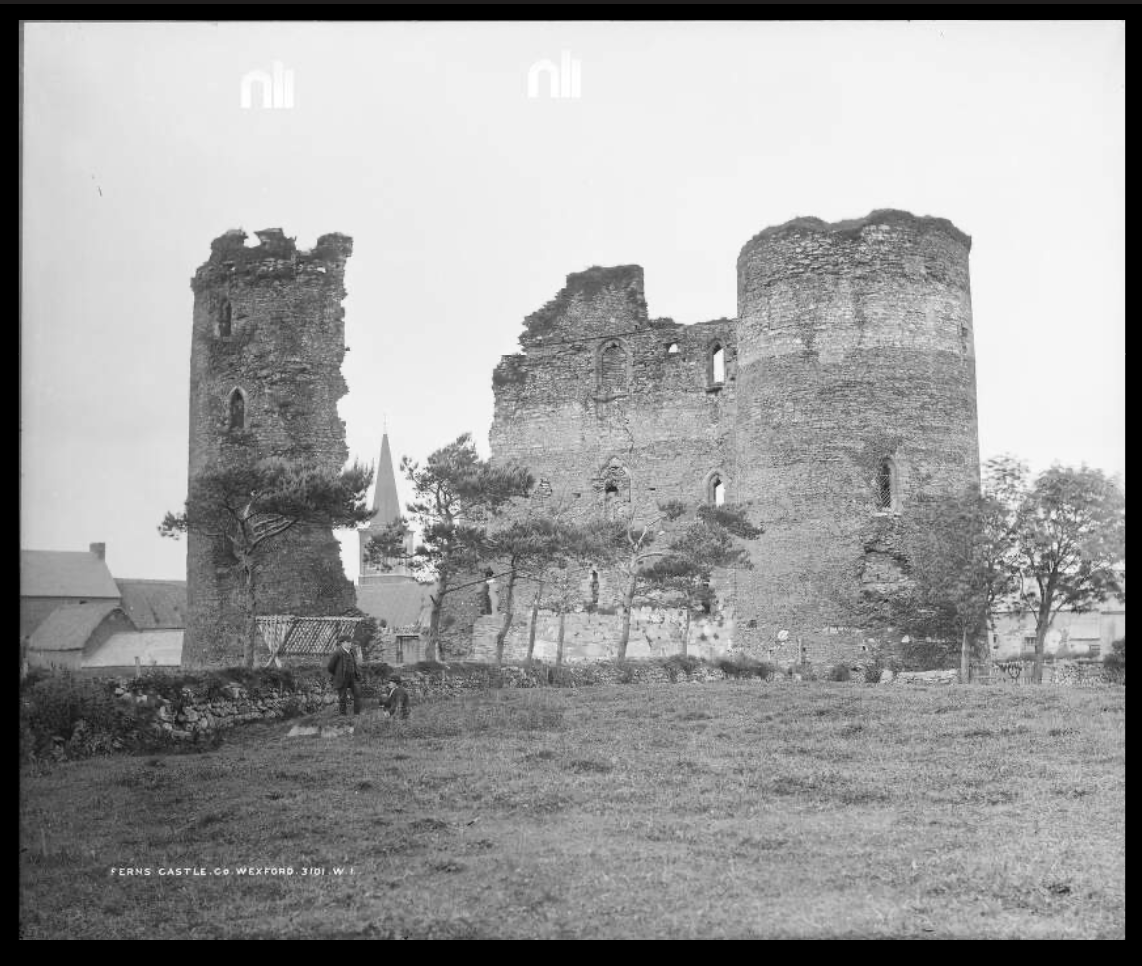
Ferns Castle, County Wexford, photograph by Robert French, Lawrence Photograph Collection, National Library of Ireland.

7. Johnstown Castle, County Wexford maintained by the Irish Heritage Trust
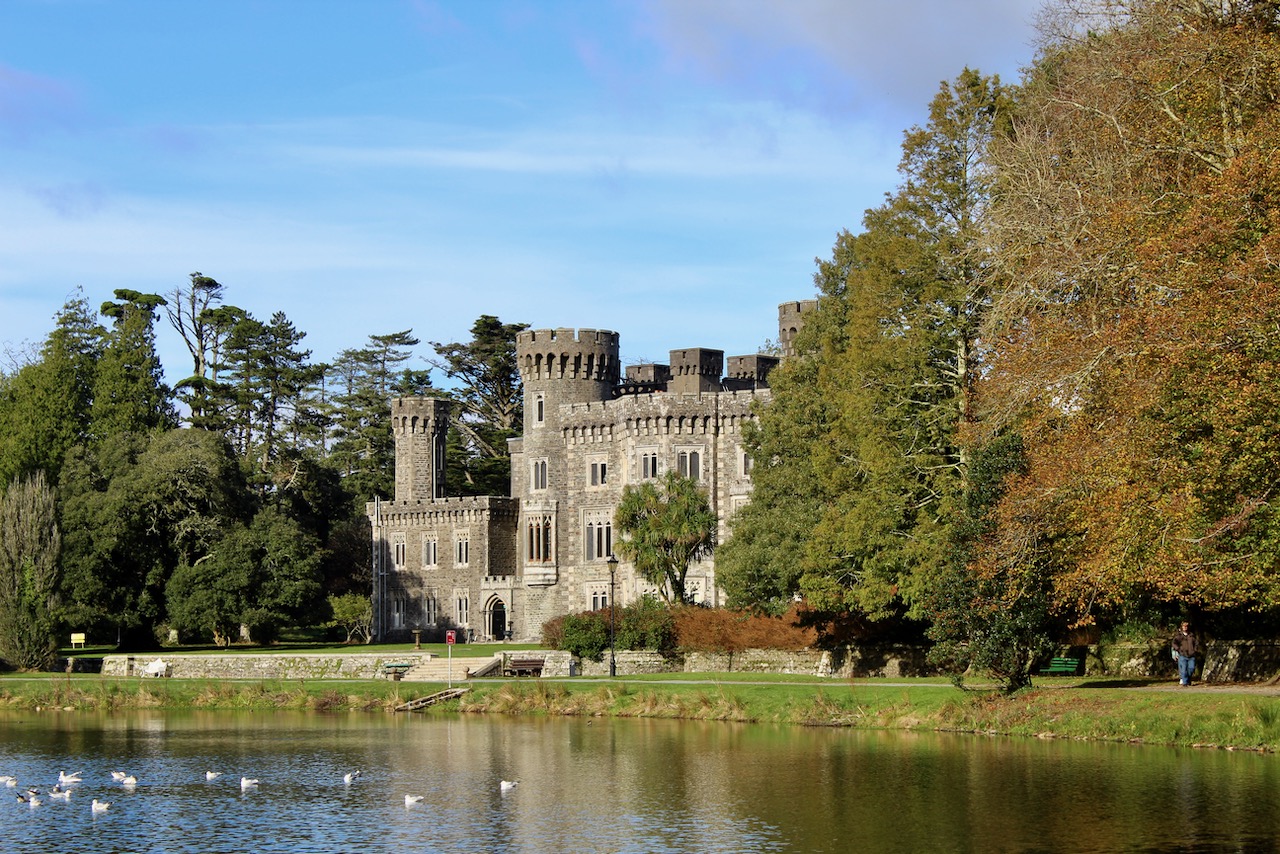
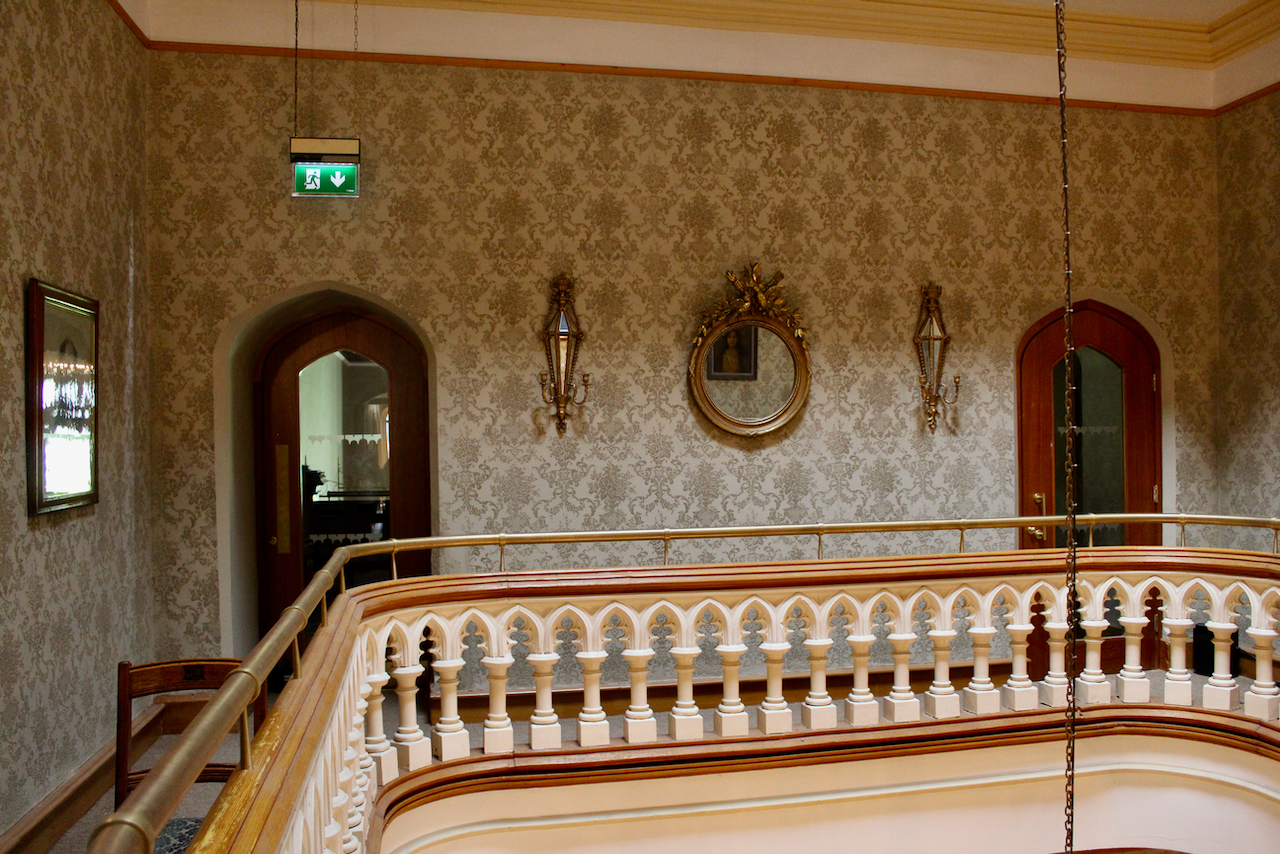
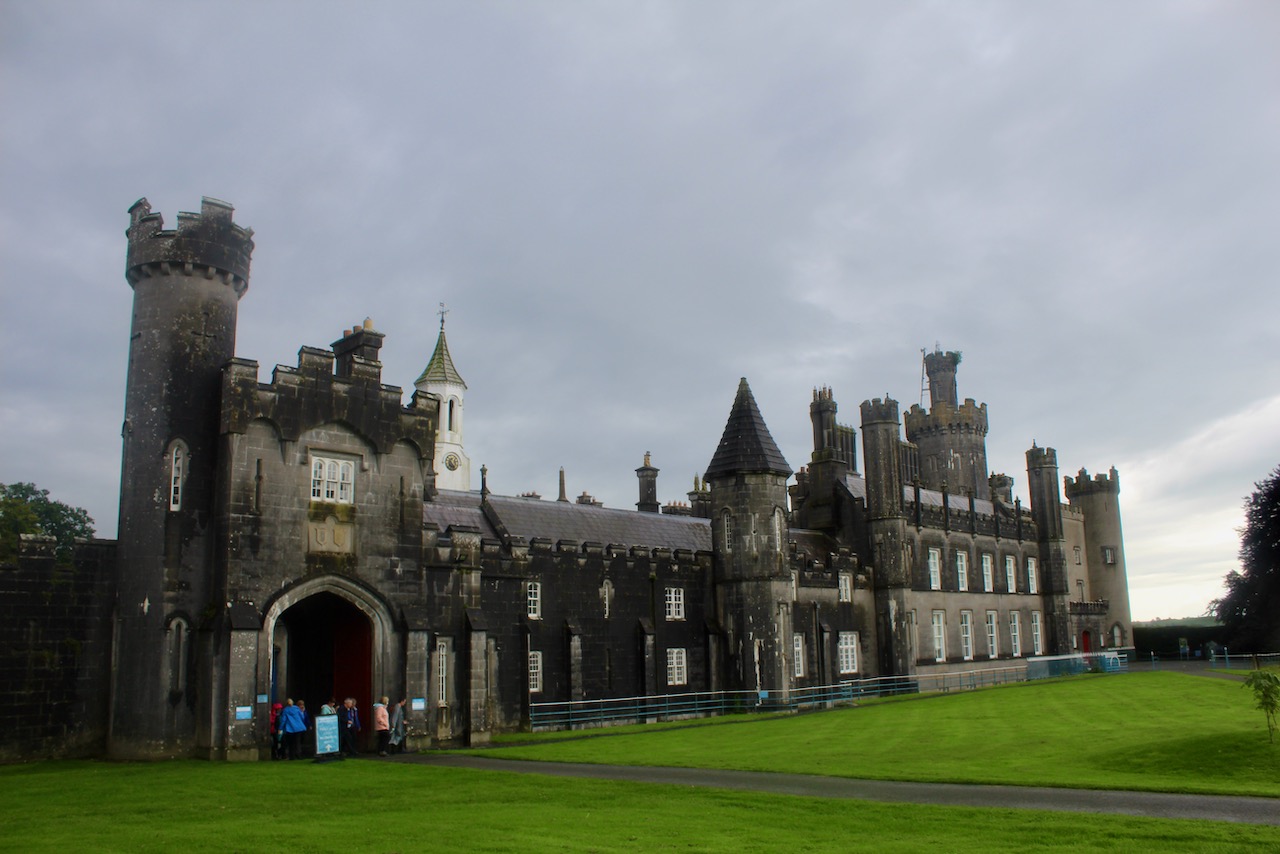
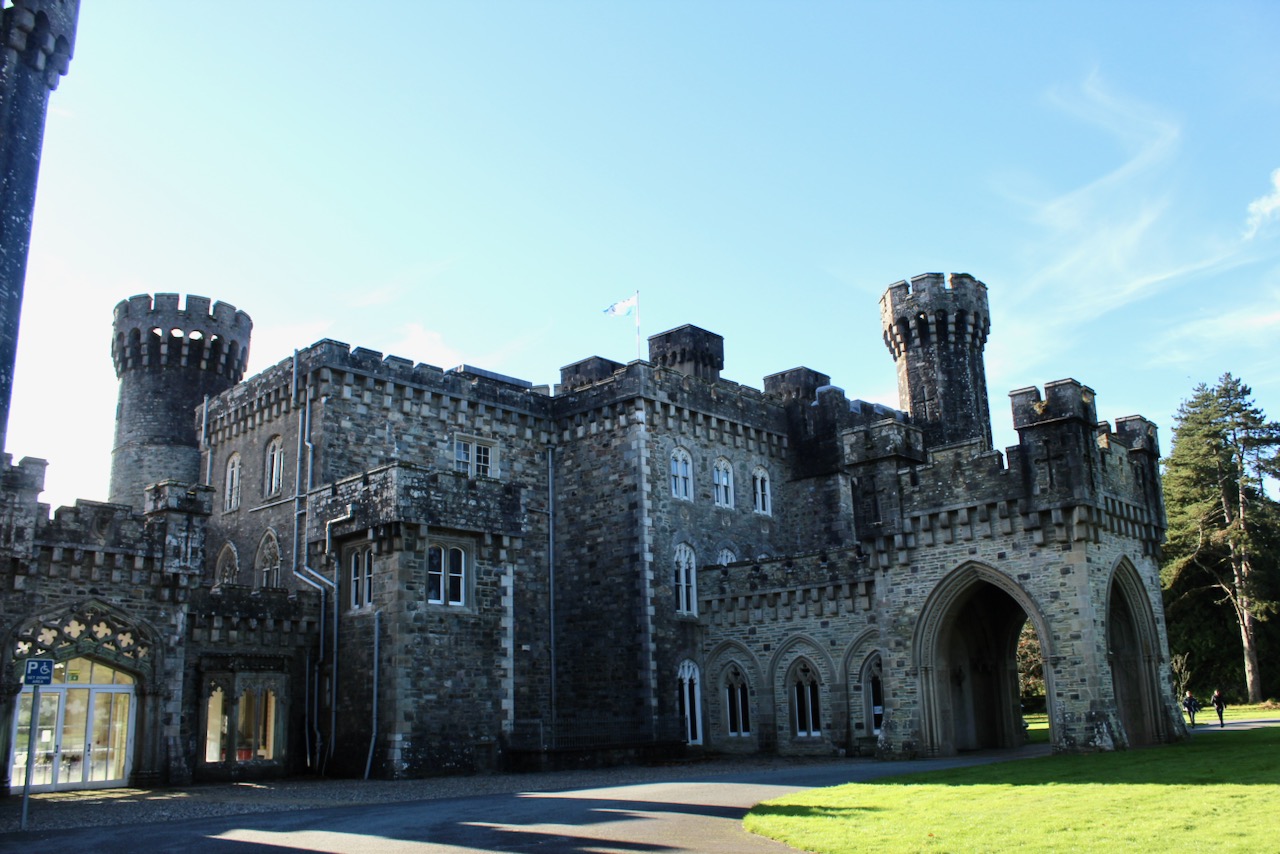
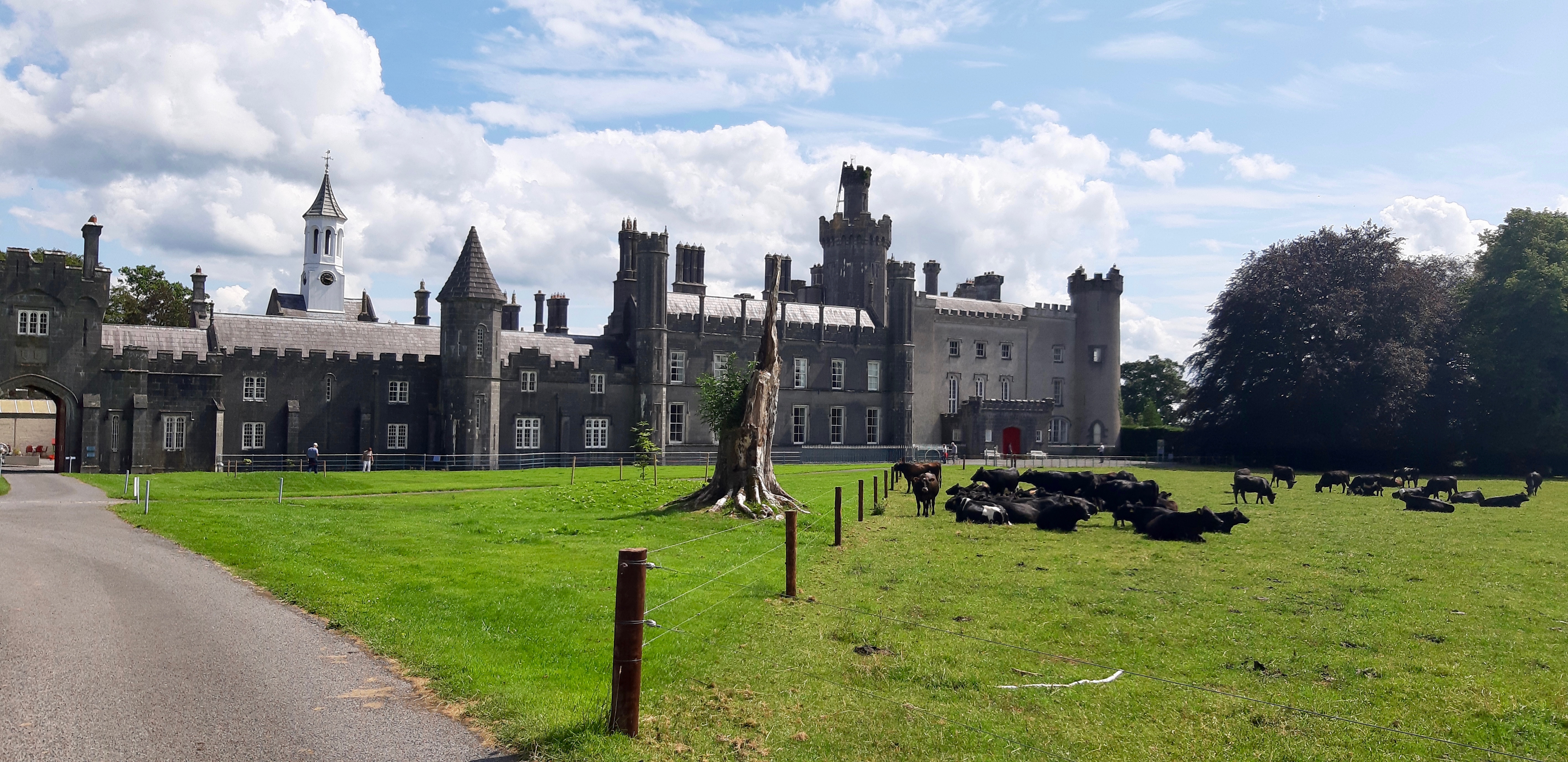
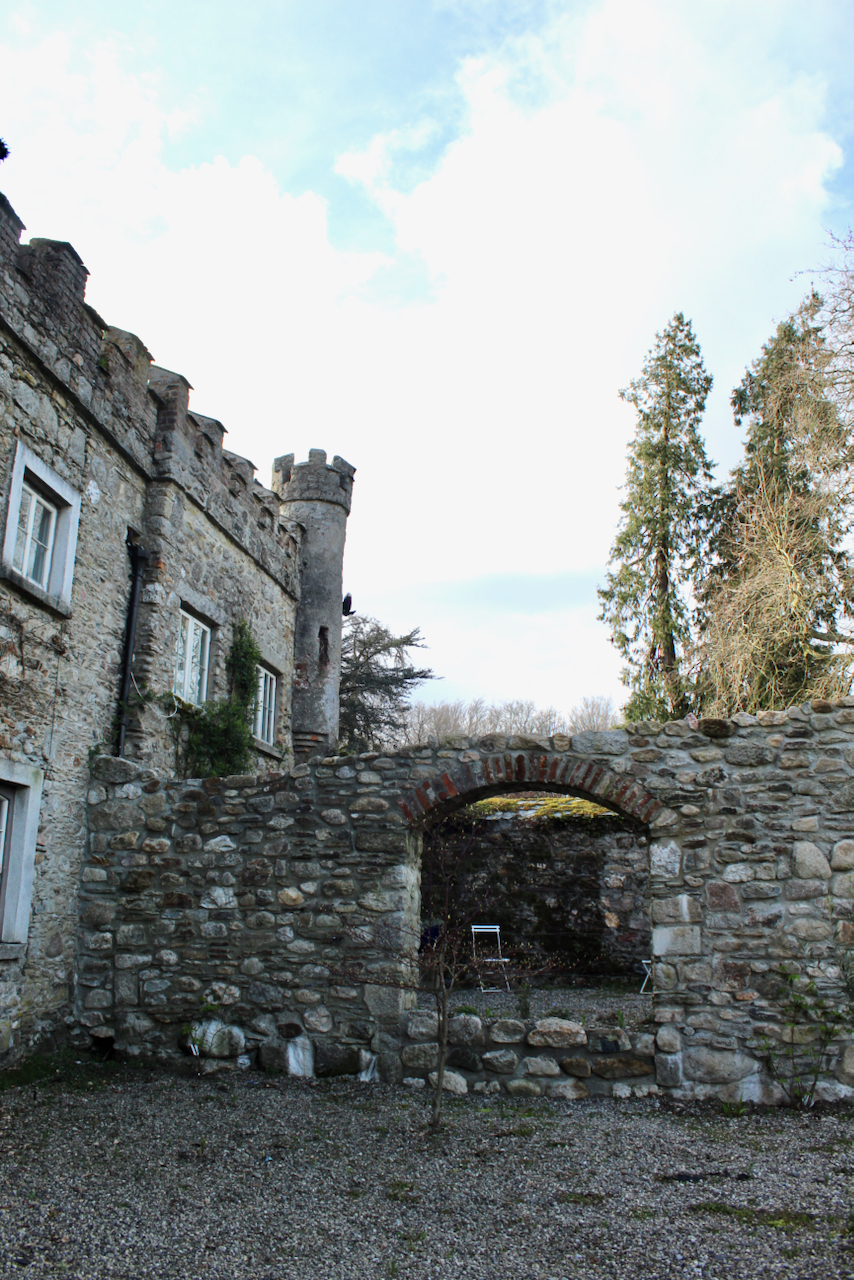
Johnstown Castle, County Wexford. The house was designed by Daniel Robertson (d. 1849). It envelops a seventeenth-century house (perhaps by Thomas Hopper) [4] remodelled (1810-4) by James Pain (1779-1877) of Limerick. Photograph © Jennifer Winder-Baggot, www.irishhistorichouses.com

https://johnstowncastle.ie/

See my entry https://irishhistorichouses.com/2023/09/30/a-heritage-trust-property-johnstown-castle-county-wexford/
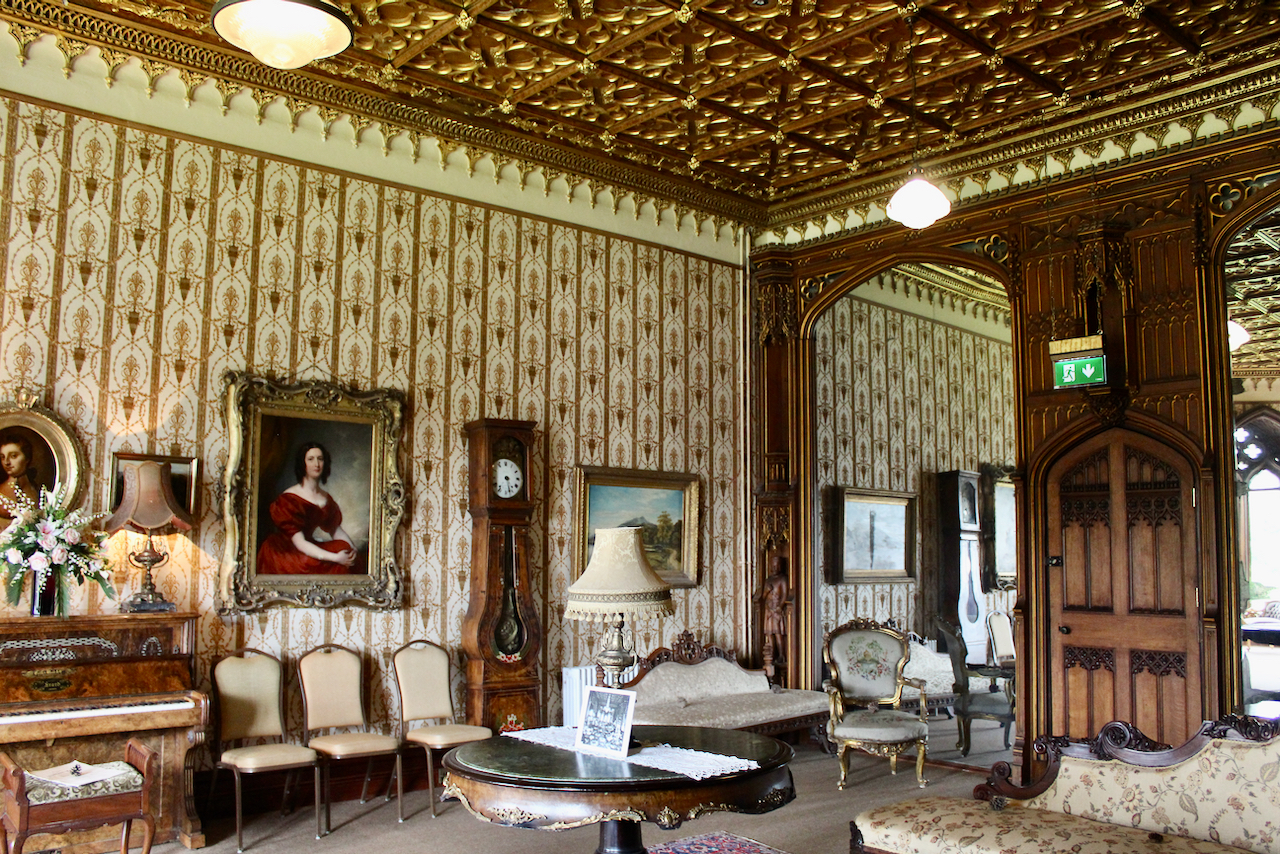
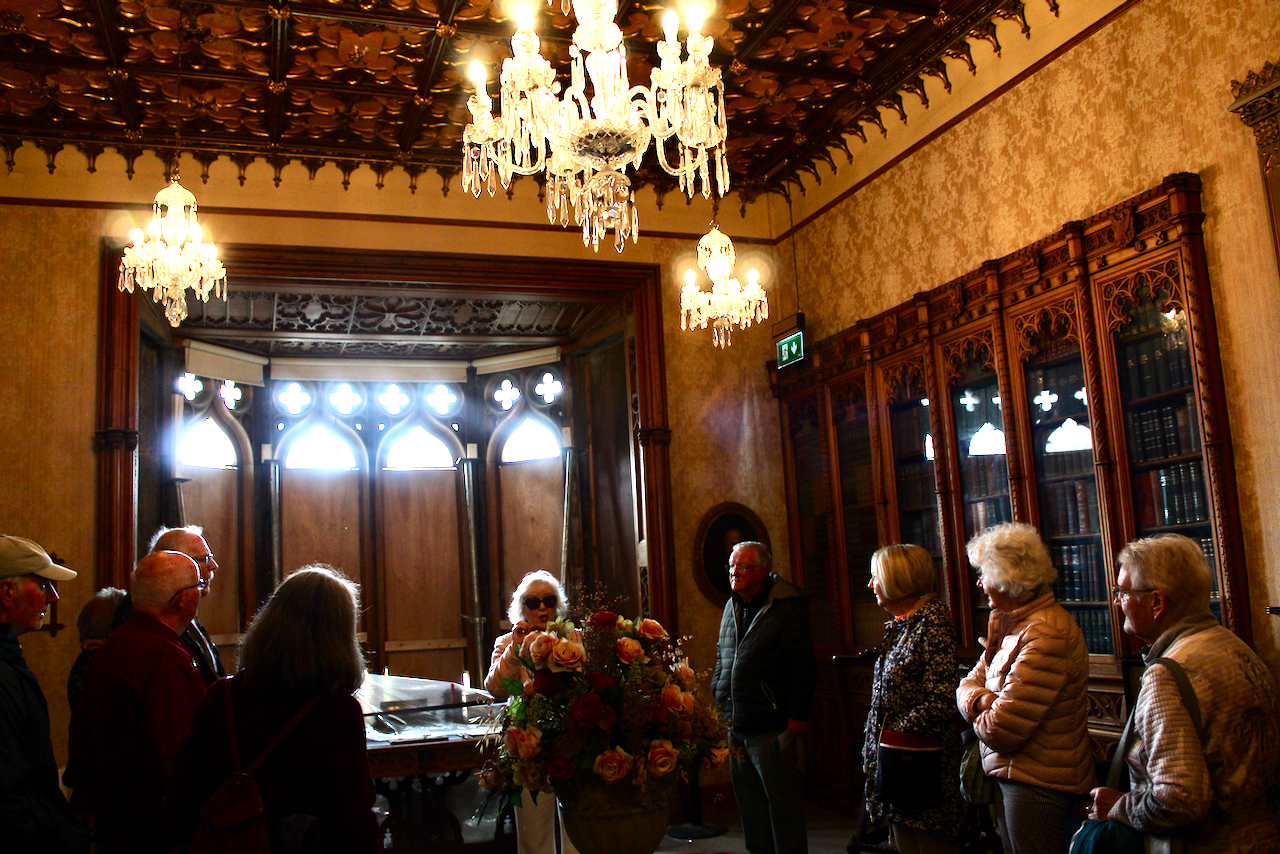
The Principal Drawing Room in Johnstown Castle. Photograph © Jennifer Winder-Baggot, www.irishhistorichouses.com
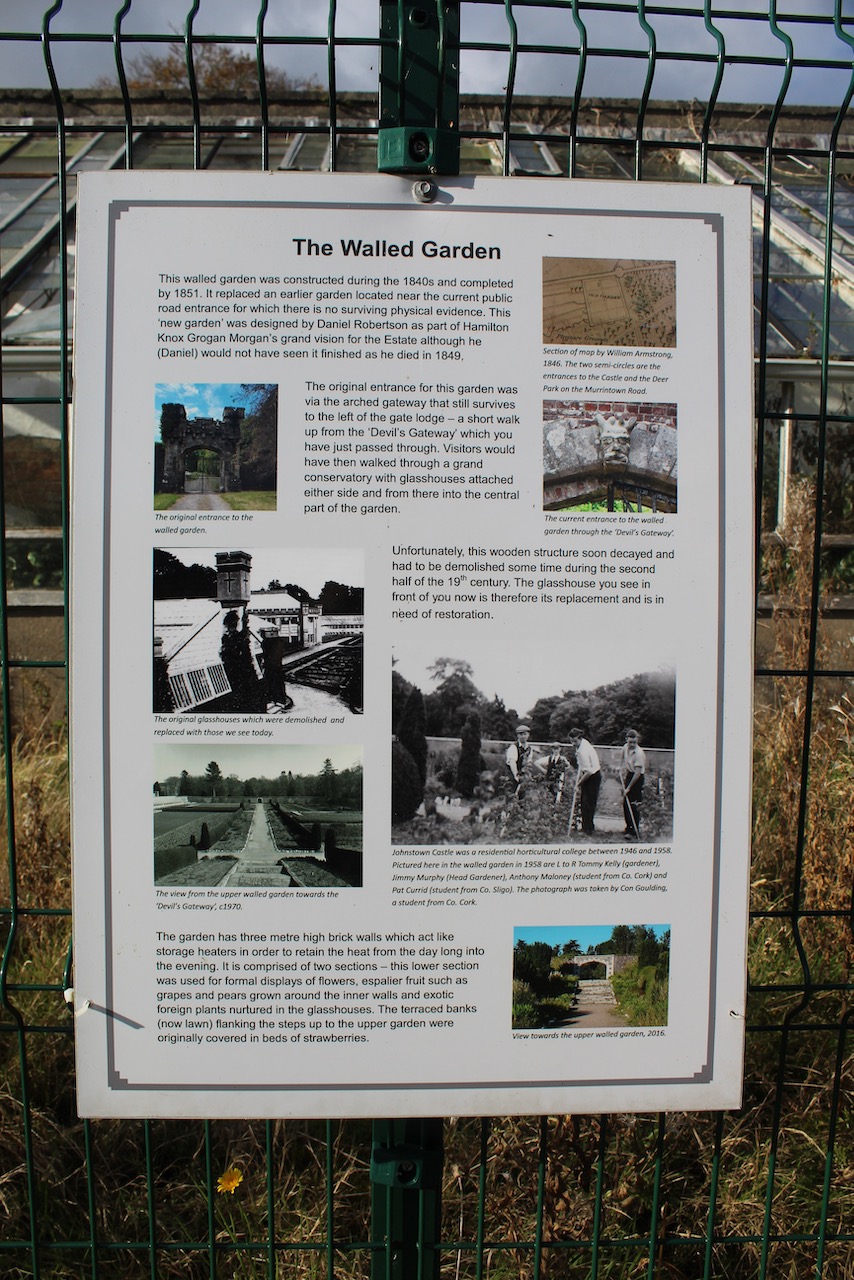
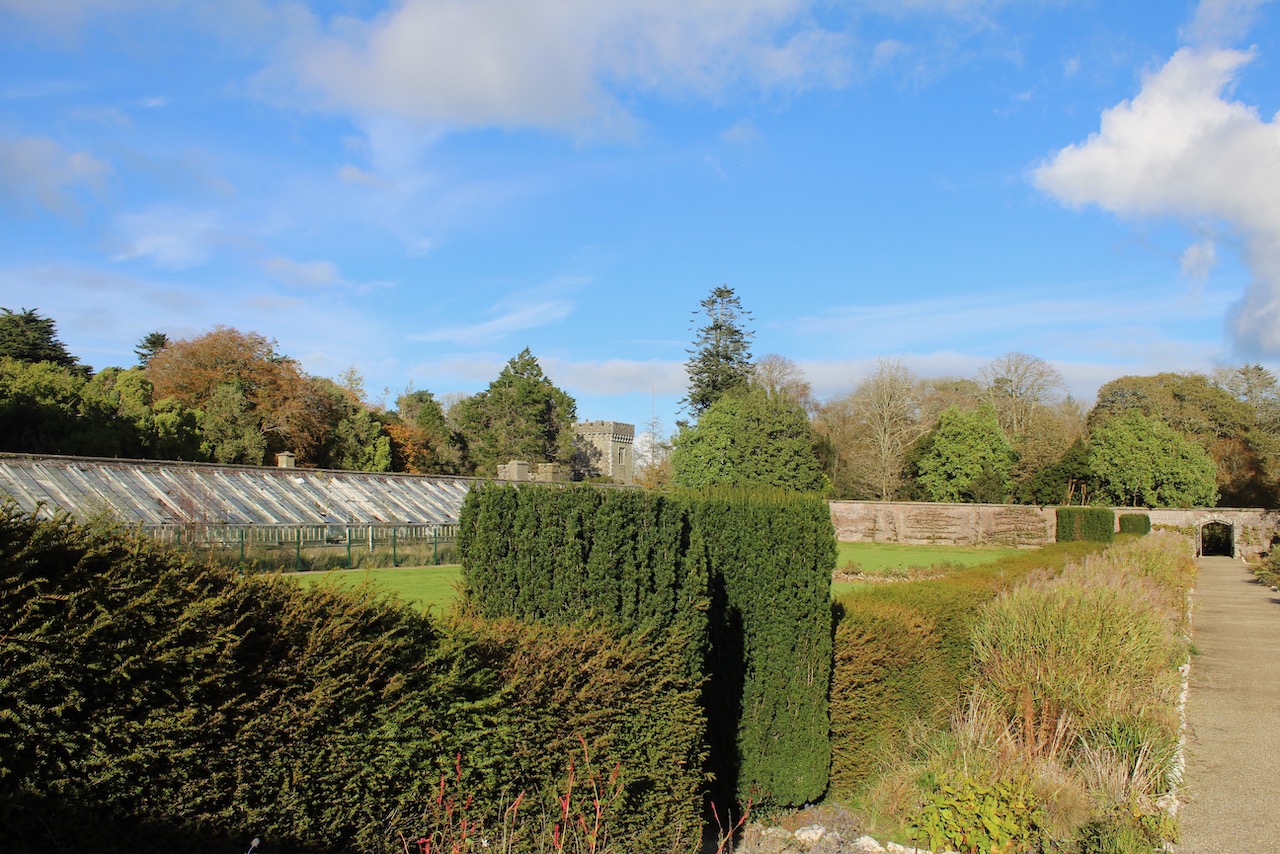
Walled garden, Johnstown Castle, County Wexford, November 2021. Photograph © Jennifer Winder-Baggot, www.irishhistorichouses.com
Stable Complex, Johnstown Castle, County Wexford, November 2021. Photograph © Jennifer Winder-Baggot, www.irishhistorichouses.com

8. Kilcarbry Mill Engine House, Sweetfarm, Enniscorthy, Co Wexford – section 482

Open dates in 2025: Jan 1-4, 29-31, Feb 3-5, Mar 5-7, 10-11, Apr 3-4, 11-13, May 10-12, 19-23, July 5-7, Aug 2-31, Dec 19-23, 27-30, 12 noon-4pm

Fee: adult €10, student/OAP €5, child free

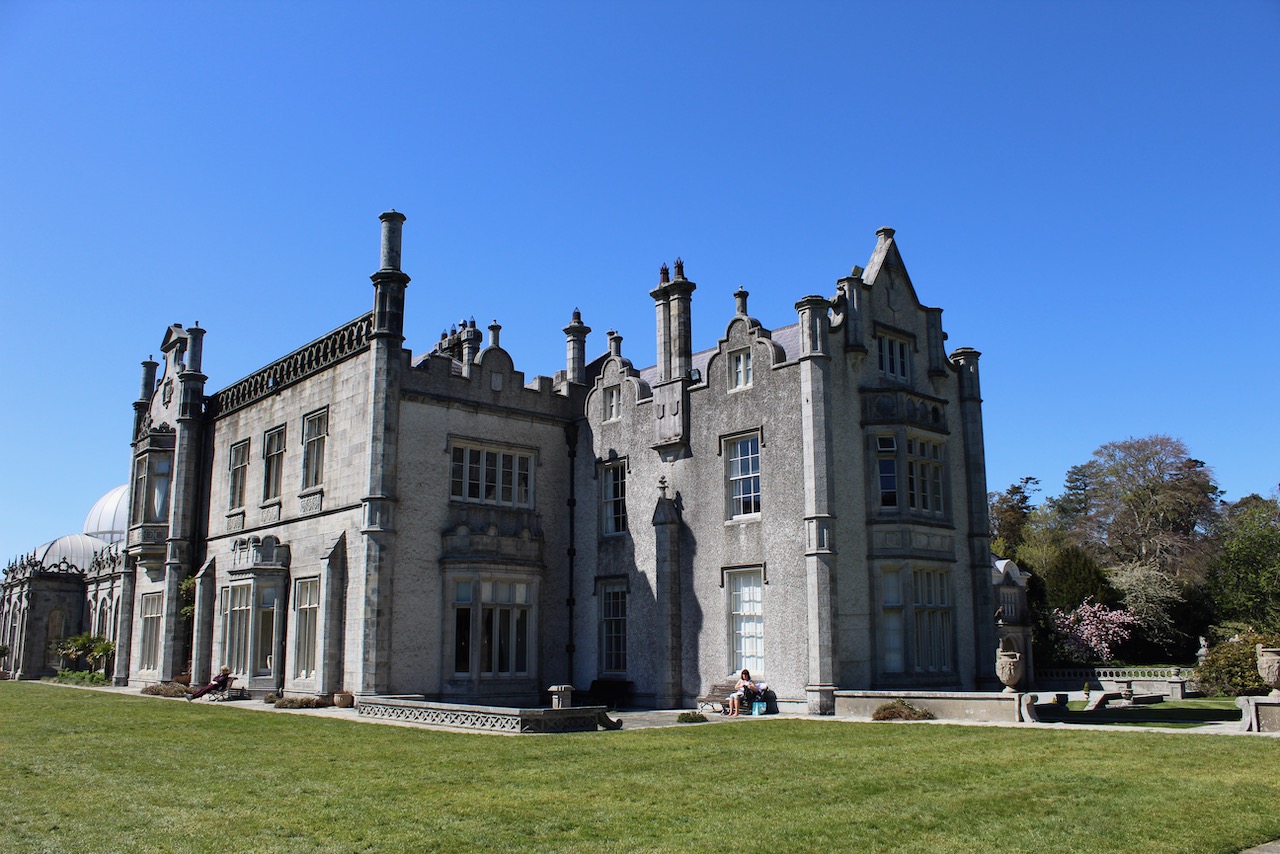
9. Kilmokea Country Manor & Gardens, Great Island, Campile, New Ross, Co. Wexford Y34 TH58 – section 482, gardens open to public
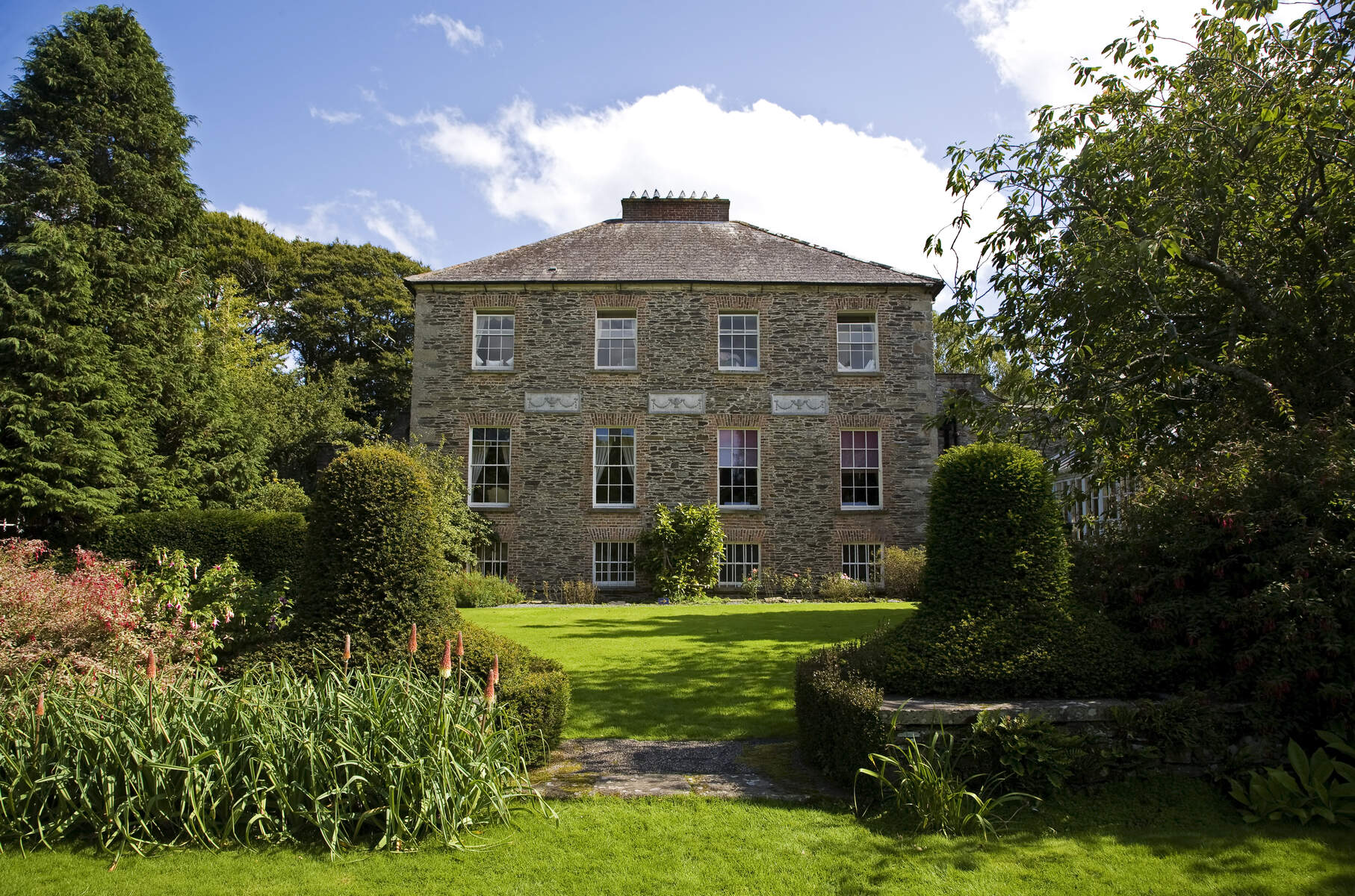
The main lawn at the rear of the house at Kilmokea – surrounded by perenniel borders – and some fine topiary, photograph 2014 by George Munday/Tourism Ireland. (see [1])

www.kilmokea.com
Tourist Accommodation Facility
Gardens Open in 2025: April 1-Nov 2, 10am-6pm

Fee: adult €9, OAP €6, student /child €5, family €25

We visited in 2023 – see my entry https://irishhistorichouses.com/2023/10/12/kilmokea-country-manor-gardens-kilmokea-great-island-campile-new-ross-co-wexford-y34-th58/

10. Newtownbarry House, Wexford – gardens open to the public

https://www.gardensofireland.org/directory/52/
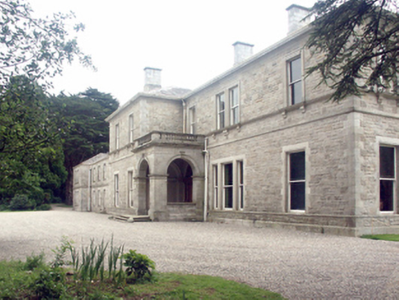
Newtownbarry House, County Wexford, photograph from National Inventory of Architectural Heritage.

Contact: Clody and Alice Norton 

Tel: +353 (0) 53 937 6383 

Email: clodynorton@gmail.com 

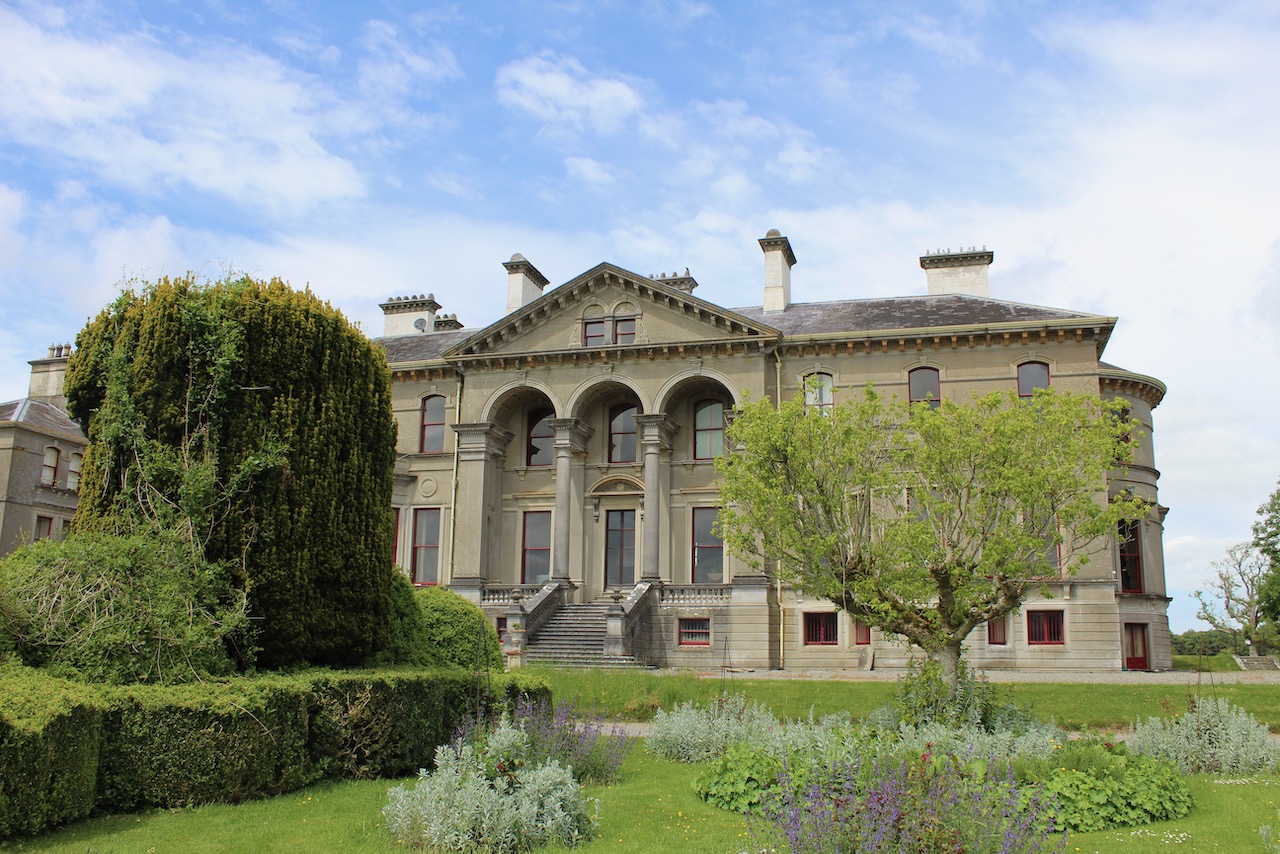
Mark Bence-Jones writes (1988): p. 225. “(Barry/IFR; Maxwell, Farnham, B/PB; Hall-Dare;IFR) The estate of Newtownbarry originally belonged to a branch of the Barrys; passed to the Farnhams with the marriage of Judith Barry to John Maxwell, afterwards 1st Lord Farnham, 1719. Subsequently acquired by the Hall-Dare family, who built the present house 1860s, to the design of Sir Charles Lanyon. It is in a rather restrained Classical style, of rough ashlar; the windows have surrounds of smooth ashlar, with blocking. Two storey; asymmetrical entrance front, with two bays projecting at one end; against this projection is set a balustraded open porch. Lower two storey service wing. Eaved roof on plain cornice. Impressive staircase.”

Newtownbarry House, County Wexford, photograph from National Inventory of Architectural Heritage.

The National Inventory tells us that it is a five-bay (five-bay deep) two-storey country house, built 1863-9, on an L-shaped plan off-centred on single-bay single-storey flat-roofed projecting porch to ground floor abutting two-bay two-storey projecting end bay; eight-bay two-storey rear (south) elevation. It continues:
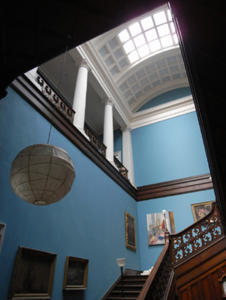
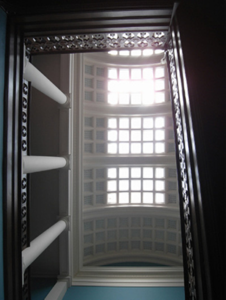
Newtownbarry House, County Wexford, photograph from National Inventory of Architectural Heritage.

A country house erected for Robert Westley Hall-Dare JP DL (1840-76) to a design by Lanyon, Lynn and Lanyon (formed 1860) of Belfast and Dublin (Dublin Builder 1864, 66) representing an important component of the mid nineteenth-century domestic built heritage of County Wexford with the architectural value of the composition, one succeeding the eighteenth-century ‘Woodfield…[a] mansion of long standing and of cottage-like character in the Grecian style of architecture’ (Lacy 1863, 485), confirmed by such attributes as the deliberate alignment maximising on panoramic vistas overlooking the meandering River Slaney with its mountainous backdrop in the near distance; the asymmetrical footprint off-centred on an Italianate porch; the construction in a rough cut granite offset by silver-grey dressings not only demonstrating good quality workmanship, but also providing an interplay of light and shade in an otherwise monochrome palette; and the slight diminishing in scale of the openings on each floor producing a feint graduated visual impression. Having been well maintained, the elementary form and massing survive intact together with substantial quantities of the original fabric, both to the exterior and to the interior arranged around a top-lit staircase hall recalling the Lanyon, Lynn and Lanyon-designed Stradbally Hall (1866-7), County Laois, where contemporary joinery; Classical-style chimneypieces; and plasterwork enrichments, all highlight the considerable artistic potential of the composition. Furthermore, adjacent outbuildings; walled gardens; all continue to contribute positively to the group and setting values of an estate having historic connections with the Hall-Dare family including Captain Robert Westley Hall-Dare JP DL (1866-1939), one-time High Sheriff of County Wexford (fl. 1891); and Robert Westley Hall-Dare (1899-1972).”

11. Sigginstown Castle, Sigginstown, Tacumshane, Co. Wexford, Y35 XK7D – section 482
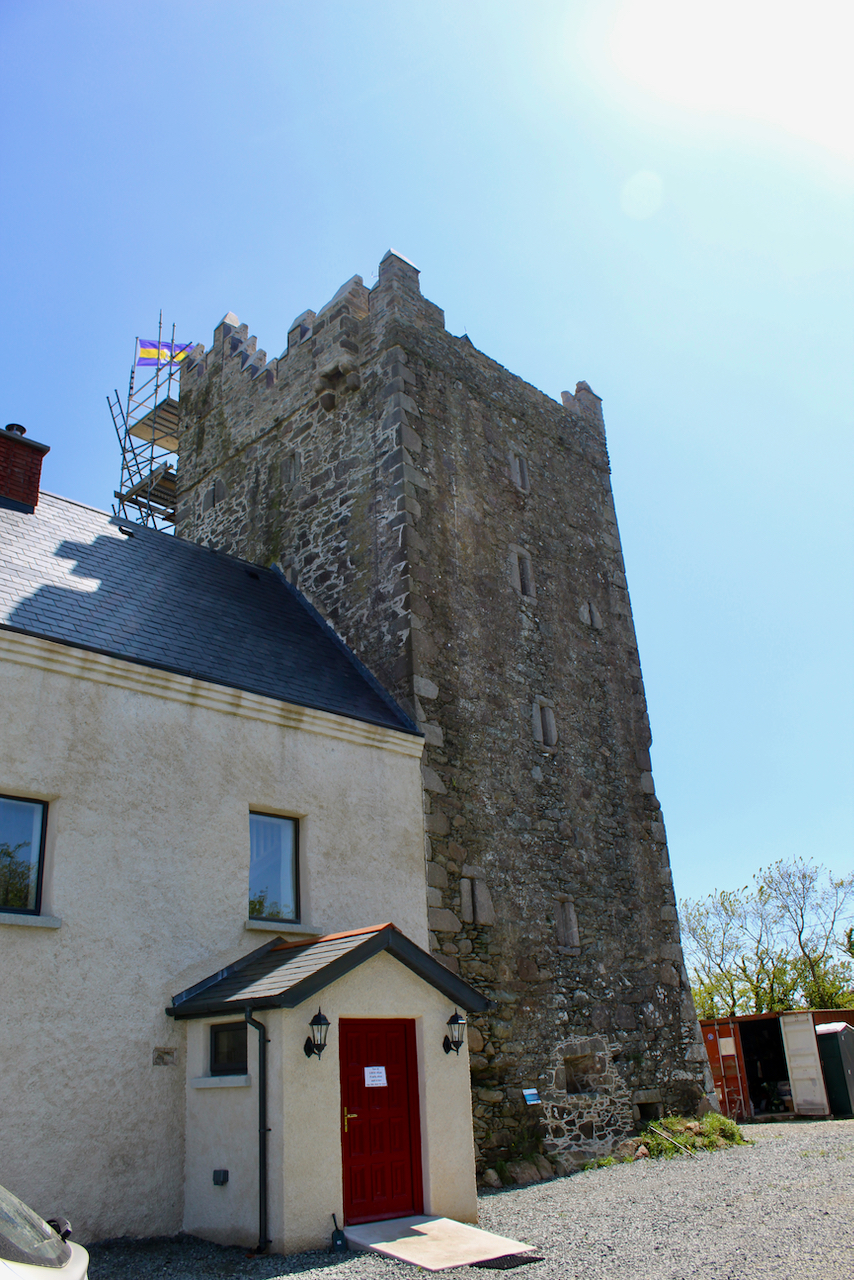
Sigginstown Castle, County Wexford, Photograph © Jennifer Winder-Baggot, www.irishhistorichouses.com

www.sigginstowncastle.com
Open dates in 2025: Mar 14-17, 21-23, April 4-6, 11-13, 18-21, May 2-5, 9-11, 16-18, 23-25, June 6-8, 13-15, 20-22, 27-29, July 4-6, 11-13, 18-20, 25-27, Aug 1-4, 8-10, 15-24, Sept 6-7, 13-14, 20-21, 27-28, 1pm-5pm

Fee: adult €10, child/OAP/student €8, groups of 6 or more €8 per person

We visited in 2023 – see my entry https://irishhistorichouses.com/2023/11/16/sigginstown-castle-tacumshane-co-wexford-y35-xk7d/

Sigginstown Castle, May 2023. Photograph © Jennifer Winder-Baggot, www.irishhistorichouses.com.

12. Tintern Abbey, Ballycullane, County Wexford – concessionary entrance to IGS members, OPW

see my entry https://irishhistorichouses.com/2025/04/07/tintern-abbey-county-wexford-an-opw-property/
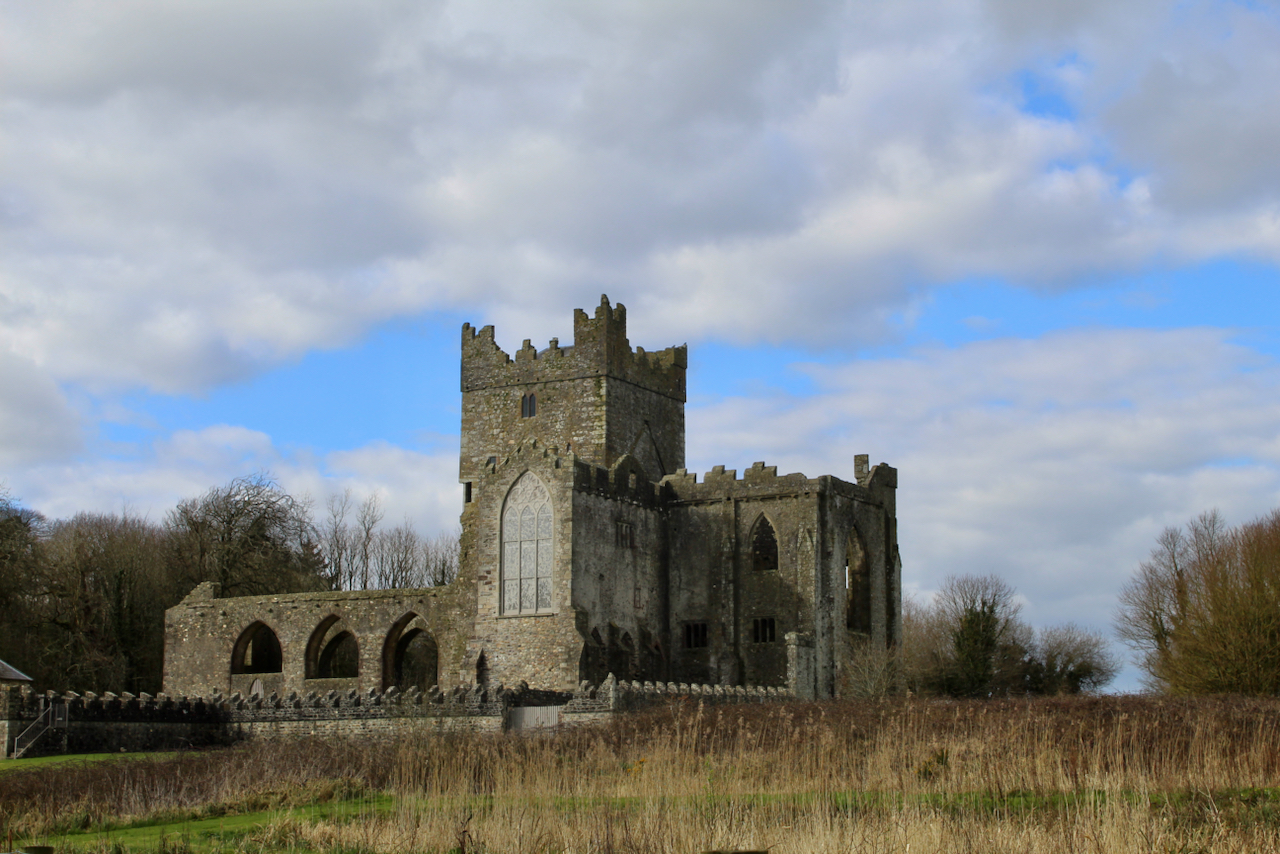
Tintern Abbey, County Wexford, 15th March 2025. Photograph © Jennifer Winder-Baggot, www.irishhistorichouses.com

13. Wells House, County Wexford – open for tours
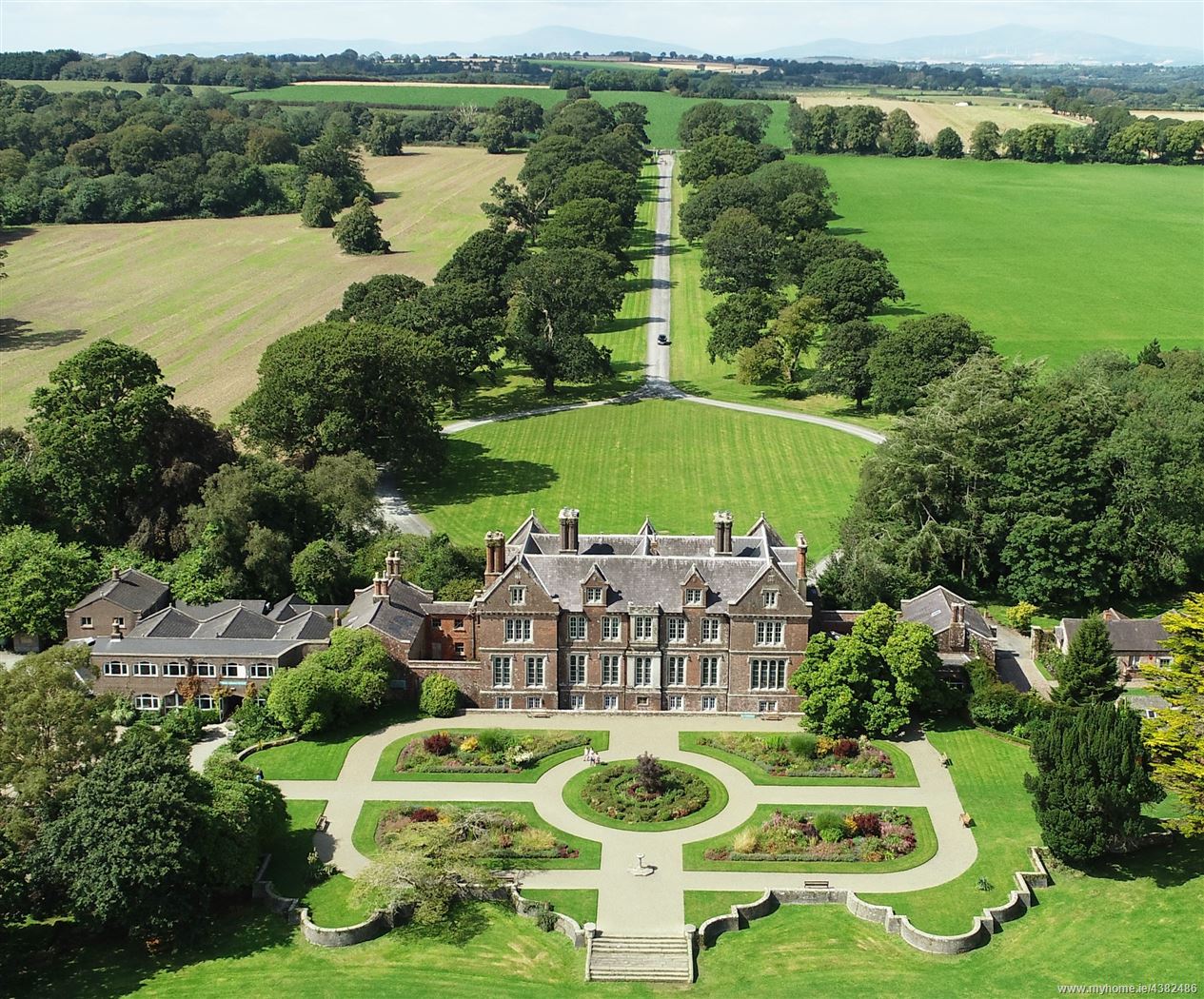
Wells House, County Wexford, from myhome.ie

See my entry https://irishhistorichouses.com/2025/05/29/wells-house-and-gardens-county-wexford-open-for-tours/

Web: www.wellshouse.ie 

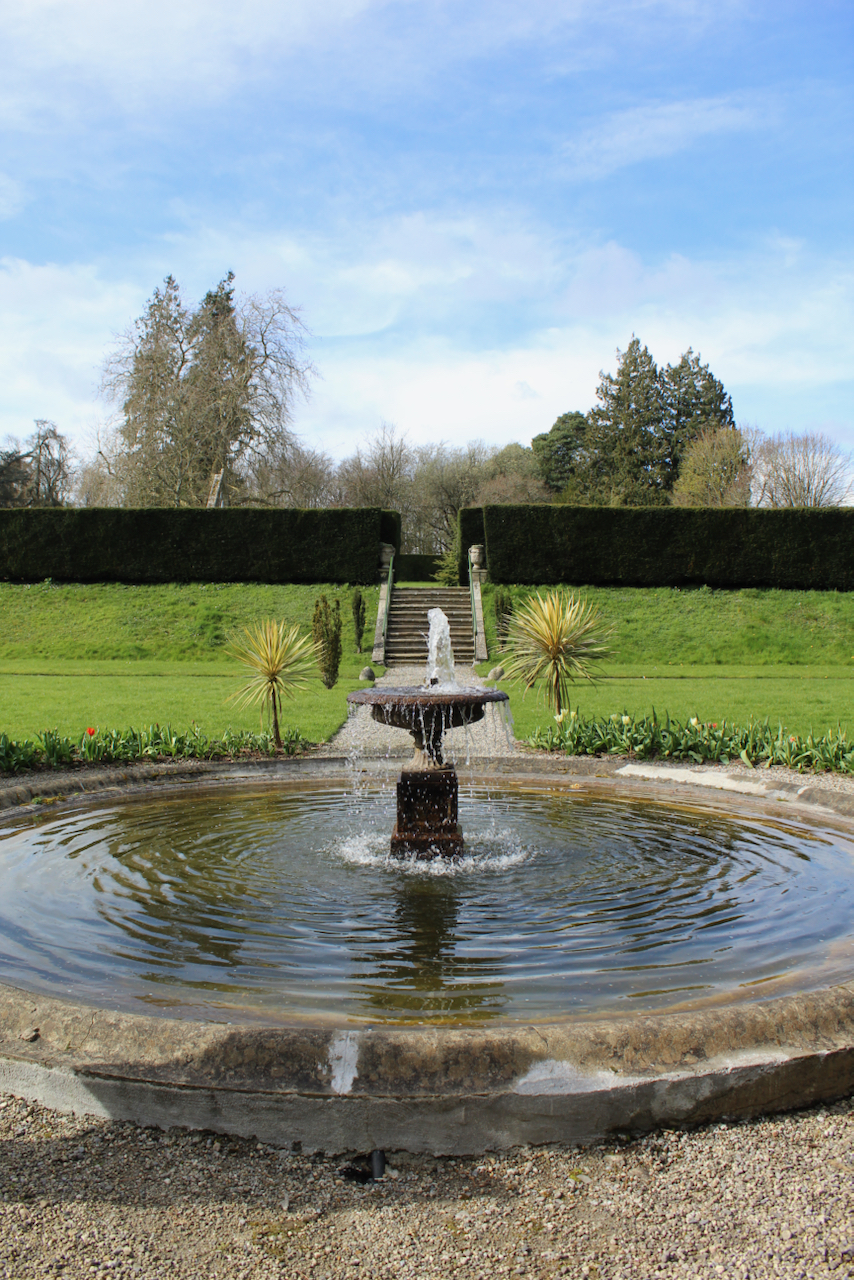
Wells House has a stunning Victorian Terrace garden, parterre garden and arboretum designed by the renowned architect and landscape designer, Daniel Robertson. 

The terraced gardens which have been restored to their former glory sit beautifully into the large setting of his vast parkland design which spans for acres in the stunning Co. Wexford landscape. 

With two woodland walks, a craft courtyard, adventure playground, restaurant and a busy calendar of events this is a perfect day out for all the family. 

and “Discover the 400-year-old history of Wells House & Gardens by taking a guided exploration of the house. Our living house tour and expert guide in Victorian dress will bring you back to a time. To a time when the magnificent ground floor and bedrooms witnessed the stories of Cromwell, Rebellions and the Famine. Uncover the everyday lives of the wealthy, powerful families who lived in the estate and their famed architect Daniel Robertson. All giving you a unique insight into the life of previous generations all the way up until the current owners of Wells House.

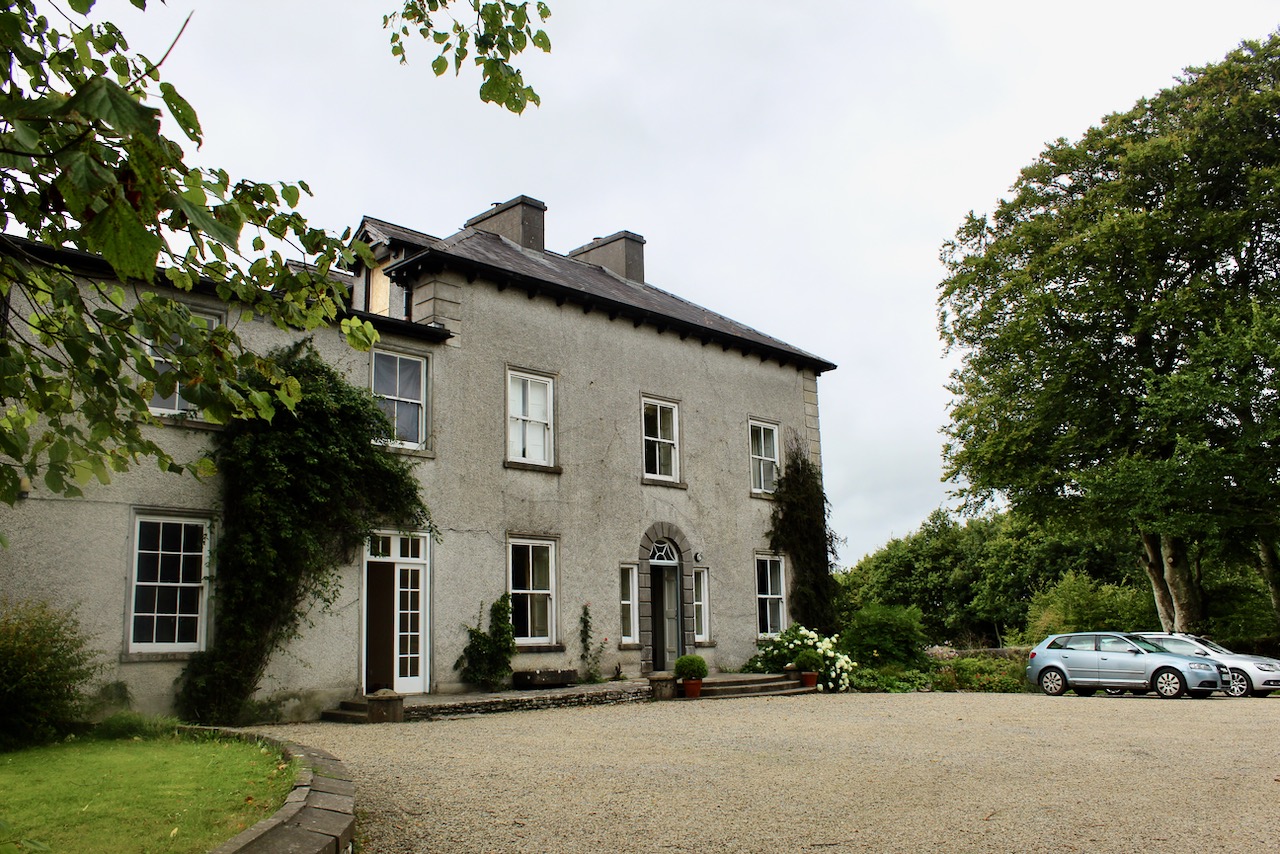
14. Woodville House, New Ross, Co. Wexford Y34 WP93 – section 482

www.woodvillegardens.ie
Open dates in 2025: May 1-31, June 1-30, July 1-31, Aug 1-24, 10am-5pm

Fee: adult/OAP /student €7, child under 12 years free

The National Inventory of Architectural Heritage tells us that it was allegedly erected for Edward William Tottenham (d. 1860) on the occasion of his marriage (1807) to Henrietta Alcock (d. 1861).

We visited in 2023, see my entry https://irishhistorichouses.com/2023/10/19/woodville-house-new-ross-co-wexford-y34-wp93/

Woodville House, photograph courtesy of Woodville house website.

Places to Stay, County Wexford

1. Artramon House, Castlebridge, Co Wexford – B&B 
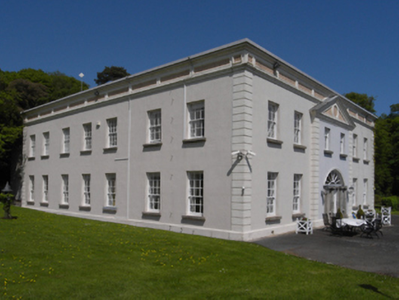
Artramon House, County Wexford, photograph from National Inventory of Architectural Heritage.
Artramon House, County Wexford, photograph from Artramon website.

https://www.artramon-farm.com/english/welcome

Mark Bence-Jones writes: p. 12. “(Le Hunte/LGI 1912; Neave, Bt/Pb) A late C18 house, remodelled after being burnt 1923. 2 storey; entrance front with pediment of which the peak is level with the coping of the parapet, and the base is well below the level of the main cornice. In the breakfront central feature below the pediment are two windows and a tripartite Venetian doorway; two bays on either side of the central feature.” 

Artramon – by Ulrike von Walderdorff in Wexford / Ireland

The National Inventory tells us it is a five-bay two-storey country house, rebuilt 1928-32, on an L-shaped plan centred on single-bay two-storey pedimented breakfront; seven-bay two-storey side (west) elevation… “A country house erected for Richard “Dick” Richards (Wexford County Council 17th June 1927) to a design by Patrick Joseph Brady (d. 1936) of Ballyhaise, County Cavan (Irish Builder 1928, 602), representing an important component of the domestic built heritage of County Wexford with the architectural value of the composition, one retaining at least the footings of an eighteenth-century house destroyed (1923) during “The Troubles” (1919-23), confirmed by such attributes as the deliberate alignment maximising on scenic vistas overlooking gently rolling grounds with ‘fine views of the estuary, harbour and town of Wexford’ as a backdrop (Fraser 1844, 118); the symmetrical frontage centred on a curiously compressed breakfront; the diminishing in scale of the openings on each floor producing a graduated visual impression; and the monolithic parapeted roofline. Having been well maintained, the elementary form and massing survive intact together with substantial quantities of the original fabric, both to the exterior and to the interior where contemporary joinery; reclaimed Classical-style chimneypieces; and sleek plasterwork refinements, all highlight the artistic potential of the composition. Furthermore, adjacent outbuildings (extant 1840); and a substantial walled garden (extant 1840), all continue to contribute positively to the group and setting values of an estate having historic connections with the Le Hunte family including Captain George Le Hunte (d. 1799); William Augustus Le Hunte (1774-1820), one-time High Sheriff of County Wexford (fl. 1817); George Le Hunte (1814-91), ‘late of Artramont [sic] County Waterford [sic]’ (Calendars of Wills and Administrations (1892, 481); and the largely absentee Sir George Ruthven Le Hunte KCMG (1852-1925), one-time Governor and Commander-in-Chief of Trinidad and Tobago (fl. 1908-15); and Major Sir Arundell Thomas Clifton Neave (1916-92), sixth Baronet.

2. Ballytrent House, Broadway, Co Wexford – one wing rental.
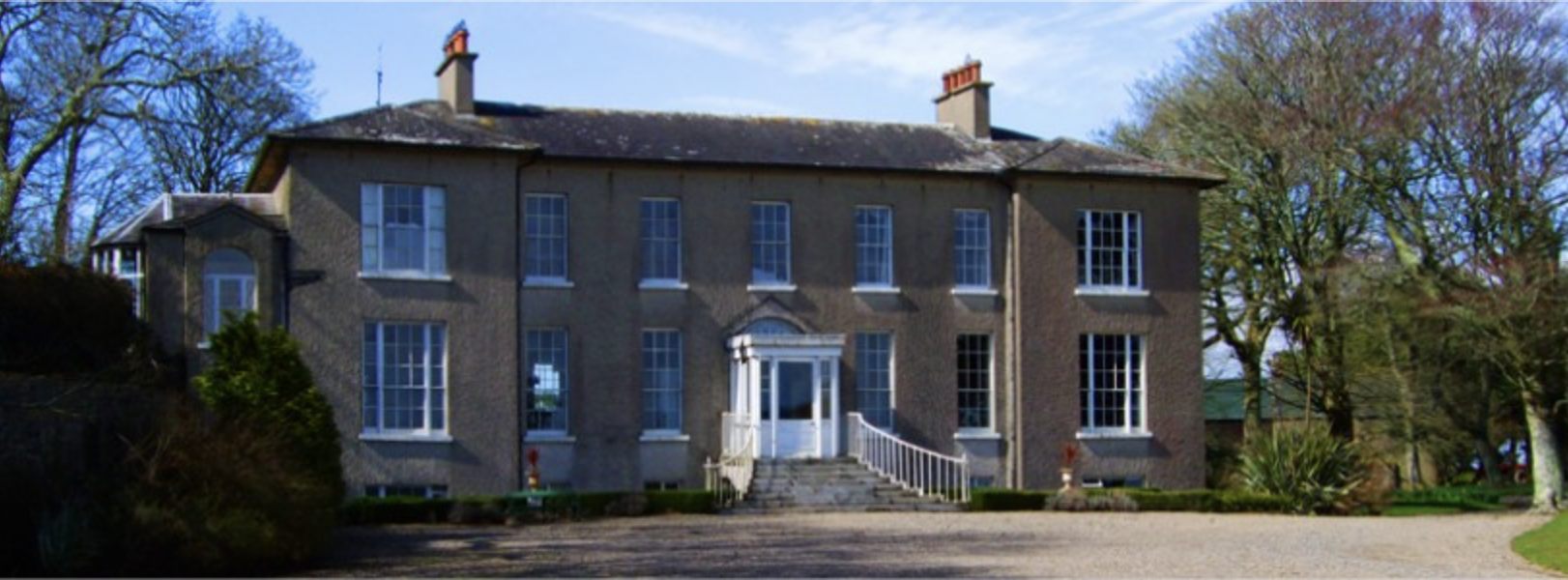
http://ballytrenthouse.com 

Ballytrent House, courtesy of their website.

Mark Bence-Jones writes of Ballytrent (1988):

p. 28. “Redmond/Hughes. A two storey Georgian house, 5 bays, projecting ends, each with a Wyatt window in both storeys. Adamesque plasterwork. Home of John Redmond MP, leader of Irish Parliamentary Party.” 

The website tells us:

Welcome to the Ballytrent website. Visitors to Wexford seeking a quiet, secluded location,could not choose a better location than Ballytrent. Ballytrent is a magnificent 18th century heritage house set in extensive grounds overlooking the sea towards Tuskar Rock Lighthouse. 

In the grounds of the house is located a Ráth or earthen mound dating back to prechristian times and, measuring 650 yards in circumference, is reputed to be the largest in Europe. The grounds also contain a large flag pole that was once the tallest mast in the British Isles. The Rath garden is a haven for songbirds & a visit, either early morning or late evening, is pure magic! 

Ballytrent is tranquil and secluded. The garden & lawns cover three acres and include some rare plants. Our farm is a mix of cattle, cereals and root crops. We extend a warm welcome to those interested in visiting the farm. We are fortunate in having the best weather in Ireland – the annual rainfall is approximately 35 inches and each year the Weather Station at Rosslare records the highest mean sunshine hours. We are indeed the Sunny South East! 

Ballytrent House, 
Ballytrent, 
Rosslare Harbour, 
Co. Wexford, 
Ireland. 

Telephone/Fax: 053 91 31147 
Email: jepryan@eircom.net 

Situated in St Helen’s E.D., Ballytrent, with its double ringed ráth, is an 18th century  home set in extensive ground. The history of Ballytrent is a collection of works and illustrations put together after several years  of research by Mary Stratton Ryan, wife of the present owner, James Power Ryan. 

A brief look at this work could keep the most avid historian content for quite a while. It is from this book that the following list of names and facts are taken,  all having connections to Ballytrent. 

  • Aymer De Valance; Earl of Pembroke, buried in Westminster Abbey, London. 
  • Robert Fitzstephens; Ballytrent bestowed on him by Strongbow. 
  • John le Boteller (Butler); Constable of the Kings Castle at Ballytrent. 
  • John Sinnot; Listed as a Juror of the Inquisition at Wexford (c1420). 
  • Patrick Synnot; In a 1656 Curl Survey of Ireland shown as owner of 96 acres 24 perches at Ballytrent. 
  • Abraham Deane; Given Ballytrent by Cromwell. 
  • Sarah Hughes; Daughter of Abraham Deane. 
  • Walter Redmond; Purchased Ballytrent from Henry Hughes. 
  • William Archer Redmond MP; Father of John and William – both also MP’s. 
John Redmond (1856-1918) by Harry Jones Thaddeus, 1901, National Gallery of Ireland NGI889.
  • John Edward Redmond MP; Represented North Wexford, succeeded Parnell as leader of the Nationalist Party. 
  • William Hoey Kearney Redmond MP; MP for Wexford and Fermanagh. 
  • John H. Talbot (the younger);  Inherited Ballytrent from his sister Matilda Seagrave. 
  • William Ryan; Grandson of Sir James Power. Purchased Ballytrent from Emily Talbot (nee Considine). 
  • James Edward Power Ryan; Present owner and grandson of William Ryan. 

This clearly illustrates the influence and power that is part of the documented history of Ballytrent, without even considering the possibilities of the time when the ráth was in its prime.”

3. Bellfry at Old Boley, County Wexford

http://oldboleywexford.com

4. Butlerstown Castle, Tomhaggard, Co Wexford – A ruin, coach house accommodation  

http://www.butlerstowncastle.com/  

5. Clonganny House, Wexford – accommodation 
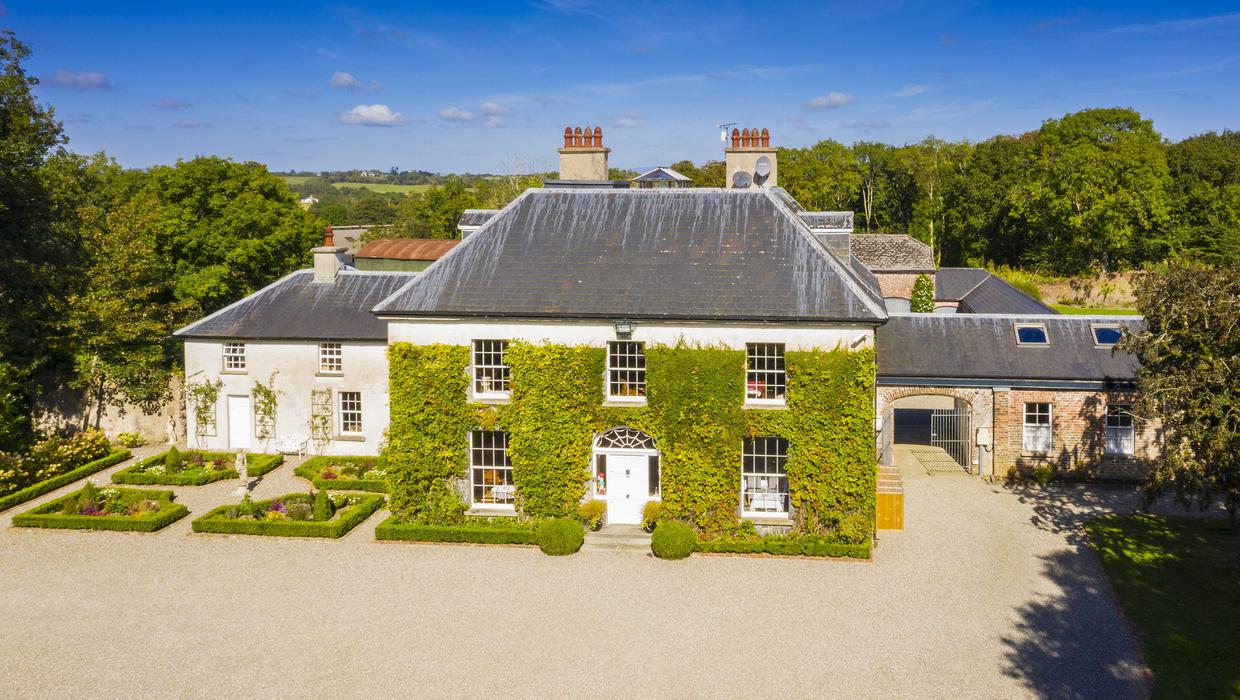
https://clonganny.com/

Clonganny House, County Wexford.

The website tells us: “Clonganny House is a fine country Georgian residence originally erected for Hawtry White (1758-1837) and sympathetically restored in the late twentieth century. Retaining many original features, Clonganny is a fine example of late Georgian architecture. Set in eight acres embracing gently rolling lawns, serene woodland, and a stunning walled garden, Clonganny House is only a short drive to a beautiful, award winning coastline and miles of golden sandy beaches.

6. Dunbrody Park, Arthurstown, County Wexford – accommodation €€

WWW.DUNBRODYHOUSE.COM 

Dunbrody House, courtesy of their website.

Mark Bence-Jones writes (1988): p. 114. “(Chichester, Templemore, B/PB; and Donegall, M/PB) A pleasant, comfortable unassuming house of ca 1860 which from its appearance might be a C20 house of vaguely Queen Anne flavour. Two storey, five bay centre, with middle bay breaking forward and three-sided single-storey central bow; two bay projecting ends. Moderately high roof on bracket cornice; windows with cambered heads and astragals. Wyatt windows in side elevation.” 
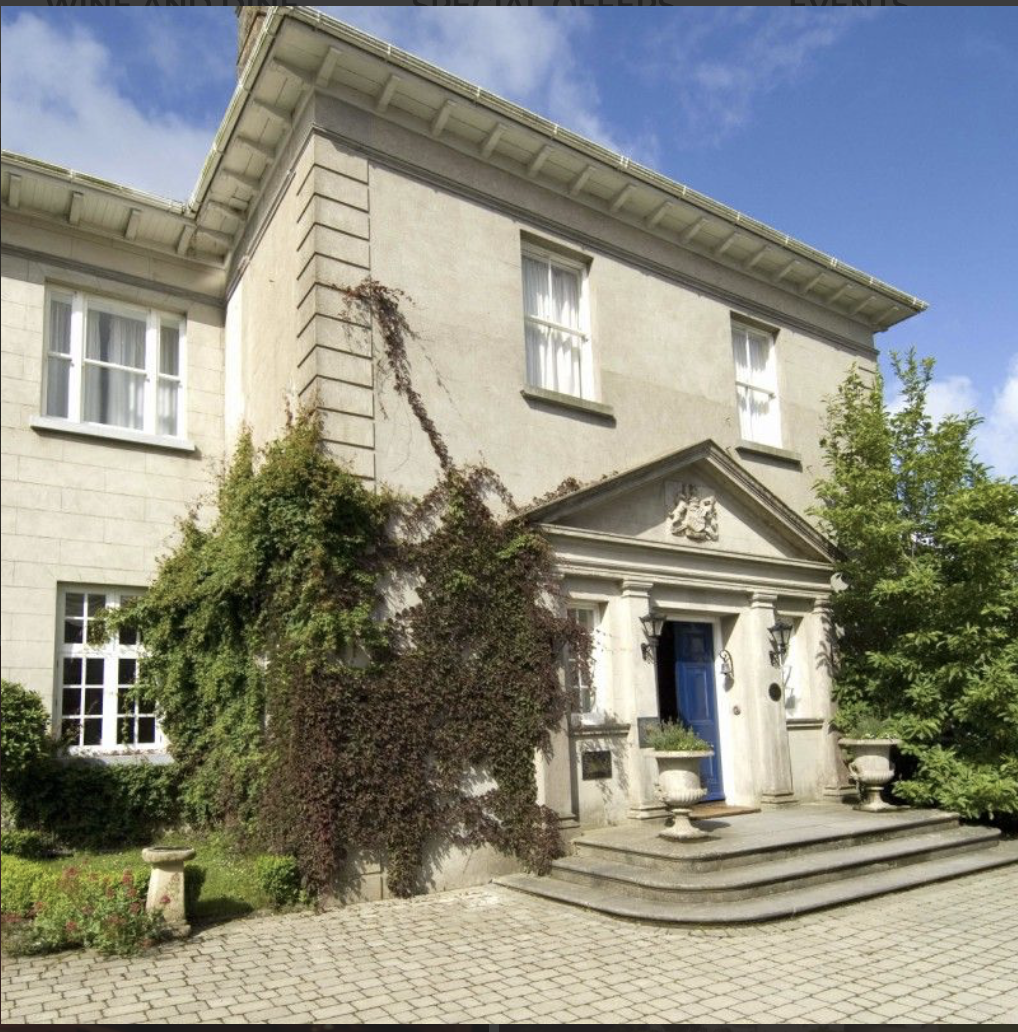
Dunbrody House, courtesy of their website.

The National Inventory tells us:

nine-bay two-storey country house with dormer attic, extant 1819, on an E-shaped plan with two-bay two-storey advanced end bays centred on single-bay two-storey breakfront originally single-bay three-storey on a rectangular plan. “Improved”, 1909-10, producing present composition…A country house erected by Lord Spencer Stanley Chichester (1775-1819) representing an integral component of the domestic built heritage of south County Wexford with the architectural value of the composition, one sometimes known as “Dunbrody Park” (Lacy 1863, 516) or “Harriet’s Lodge” after Lady Anne Harriet Chichester (née Stewart) (c.1770-1850), suggested by such attributes as the deliberate alignment maximising on scenic vistas overlooking gently rolling grounds with Waterford Harbour as a backdrop; the near-symmetrical frontage centred on a truncated breakfront; the diminishing in scale of the openings on each floor producing a graduated visual impression; and the decorative timber work embellishing the roofline: meanwhile, a photograph (30th August 1910) by A.H. Poole of Waterford captures recent “improvements” to the country house with those works ‘[presenting the] appearance [of] a twentieth-century house of vaguely “Queen Anne” flavour’ (Bence-Jones 1978, 114). Having been well maintained, the elementary form and massing survive intact together with substantial quantities of the original or sympathetically replicated fabric, both to the exterior and to the interior where contemporary joinery; Classical-style chimneypieces; and sleek plasterwork refinements, all highlight the artistic potential of the composition. Furthermore, adjacent outbuildings (extant 1840); a private burial ground; and distant gate lodges, all continue to contribute positively to the group and setting values of an estate having historic connections with the Barons Templemore including Henry “Harry” Spencer Chichester (1821-1906), second Baron Templemore ‘late of Great Cumberland-place Middlesex’ (Calendars of Wills and Administrations 1907, 508); Arthur Henry Chichester (1854-1924), third Baron Templemore; Arthur Claud Spencer Chichester (1880-1953), fourth Baron Templemore; and Dermot Richard Claud Chichester (1916-2007), fifth Baron Templemore.

7. Fruit Hill Cottages, Fruit Hill House, Campile, New Ross, County Wexford €

https://www.fruithillcottages.com/

Set in the landscaped grounds of 18th Century Fruit Hill House, these traditional self-catering farm cottages make an ideal base for touring South-East Ireland.

8. Killiane Castle, County Wexford

Killiane Castle, courtesy of their website.

https://killianecastle.com/

The website tells us: “The castle history is a remarkable tale of survival. Killiane Castle, a landmark in this cornerstone of Ireland’s Ancient East, has been in the Mernagh family for over one hundred years. However, its origins date back to medieval times to the Norman conquests and possibly even further to the early Irish settlers 500 years ago. 

The name ‘Killiane’ derives from ‘Cill Liadhaine’ in Gaelic, meaning the church of St Leonard which lies within the grounds of the Castle. 

Killiane Castle, courtesy of their website.

Medieval Times 

Pre-dating the castle history, it is likely that there was some form of native Irish settlement here before the Normans. However, the first recorded owner of the lands was Richard de Hay in the 13th century. Richard de Hay came over with Fitzstephen in the first Norman invasion. 

The Norman tower house is approximately 50ft high and measures 39ft x 27ft externally. The walls are between 4ft and 9ft in thick. The Normans built the tower around 1470. It is most likely one of the “£10 castles”.  King Henry VIII awarded a grant of £10 for the building of fortresses in his kingdom that became known as the “£10 castles”.  In recent years, an Australian visitor brought us a photo of the original deeds for Killiane Castle signed by King Henry VIII no less! 

Thomas Hay, a descendant of Richard, probably built the tower in the late 15th century c.1470. The present castle and surrounding walls bear testimony to the building genius of the Normans, over 500 years old and quite sound!  Built in a prominent position, the tower most likely overlooked a harbour. However, in the intervening years, reclaimed land replaced the harbour.  The surrounding lands feature a canal, slob lands and slightly further down the coast, Rosslare strand. 

Local Legend… 

Legend has it that below the ground floor underneath the stair way is a dungeon leading to a passageway to a doorway that no longer exists. 

“In the early 16th century c.1520, Killiane passed to the Cheevers family by marriage. They continued to fortify the site. By 1543 one Howard Cheevers held Killiane, 2000 acres of land and the office of Mayor of Wexford. The ‘Laughing Cheevers’, as they were then known, held prominence in Wexford for another 100 years until the great rebellion. They built the house sometime in the early 17th century. 

The 17th century was a tumultuous part of the castle history. George Cheevers took part in the Irish Rebellion of 1641. He played a role in both the Siege of Duncannon, and the Confederation of Kilkenny. Following the Sacking of Wexford, Cromwell dispossessed him for his part in these rebellions. Georges son, Didicus, was a blind Franciscan monk. Infamously, several clergy were murdered in Wexford town’s Bullring at this time. Didicus was one of them. Sent to Connaught by Cromwell, the Cheevers family left Killiane. Just a few remained as tenants. The last of the them, an old man, who died in 1849. 

Nearby stands the ruins of the small medieval church of Saint Helen which was in ruins by 1835. Enclosed by a wall is the adjoining cemetery. It is reputed to be the burial place of the Cheevers family.” 
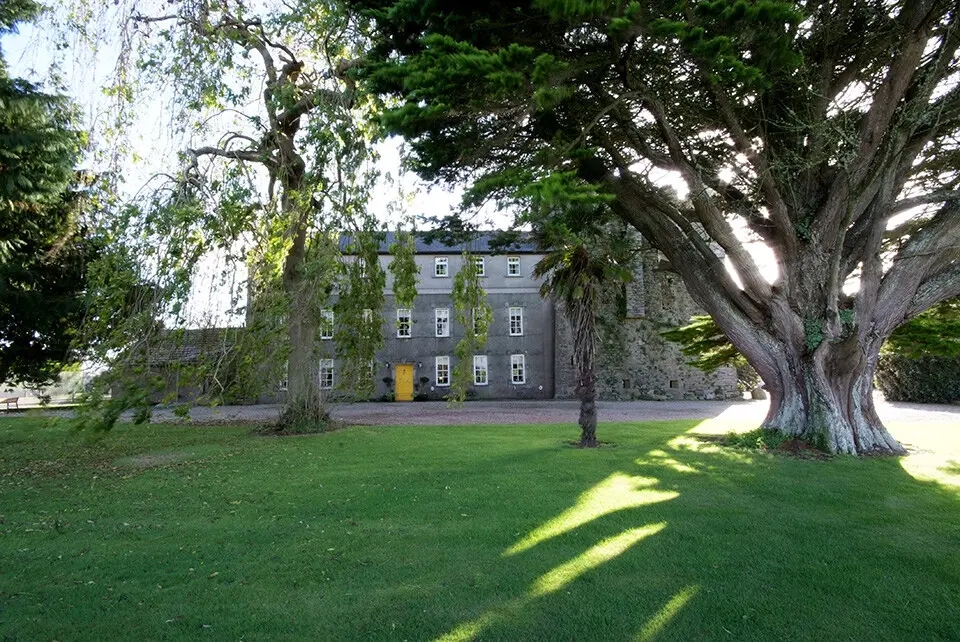
Killiane Castle, courtesy of their website.

Cromwell’s Rule 

In 1656 the property, along with 1500 acres, was granted to one of Cromwell’s soldiers, a Colonel Bunbury.  He sold it on to his friends, the Harveys of Lyme Regis. The first of these, Francis Harvey, became MP for Clonmines and Mayor of Wexford, positions his son John also held.  A famous beauty known as the Rose of Killiane, a daughter of the Harveys, married the Dean of Dublin in 1809. 

Victorian Times 

As time went by, the Harveys increasingly became absentee landlords. They leased the land to their tenants. Both the condition of the castle and the size of the estate materially diminished during this dark time in the castle hsitory. 

Throughout the 19th century there are references to tenants ‘Aylward’, ‘Elard’ and ‘Ellard’, possibly all the one family. By this time, the Harveys overwintered in their townhouse in Wexford at 38 Selskar Street. The family considered Killiane Castle too damp to stay at in winter. 

In 1908 Crown Solicitor, Kennan Cooper, bought the property for £1515. Cooper, a renowned character, kept racehorses and the 1911 census shows Killiane occupied by his tenant, George Grant and family. The census records Grant’s occupation as a ‘Horse trainer/jockey’. 

In 1920 John Mernagh, father of Jack the present owner, bought Killiane with 230 acres for £2000. At that time there was no roof on the tower-house. Ivy covered it. John re-roofed it and used it to store grain and potatoes.  Today the castle is home to Jack & Kathleen Mernagh who run the property along with their son Paul & his wife Patrycja and their family. 

The Structure of the Building  

Original Norman Features  

The castle still contains one original window that dates from the 15th century.  The original window is an ogee style window featuring two lights. Over the years, incumbents replaced the other windows. The main entrance to the castle was originally on the east side. It provided an adjoining door to the house at one time. The original door is bricked-up. On the south side of the tower a new door has been opened. 

Murder Holes! 

Looking at the front of the castle. There are murder holes over each of the doors on the ground floor. Perfectly located to pour hot tar over any unwelcome visitors!  This practice, we assure you, is not in place today! 

The third floor contains a fine granite fireplace. Small smooth stones from the beach line the chimney rising on the outer wall. Also in evidence on this floor, is a cupboard recess. 

Corrugated iron replaced the original slate roof. The parapet consists of large sloping slabs. The battlements are of the steeply stepped type. There is a square turret on each corner. On the outside of the southern turret is a carved head. 

The large bawn has a round tower on the south east corner and a square tower on the south west corner, castle occupying the north west corner. The north east tower has been removed. In order to accommodate the facade of the house, the northern apron wall was taken down. 

Original 17th Century House 

The original 17th century house consisted of two storeys with a garret on top. The incumbents raised the roof at a date unknown to us.  This action incorporated the original dormer windows of the garrets,converting it into a third storey. Furthermore, they also reduced the great slant on the original 17th-century roof. The staircase of the house is of a simple very wide design, typical of the 17th century. 

9. Kilmokea Country Manor & Gardens, Kilmokea, Great Island, Campile, New Ross, Co. Wexford  – accommodation, see above

10. Marlfield, Gorey, Co Wexford – accommodation 
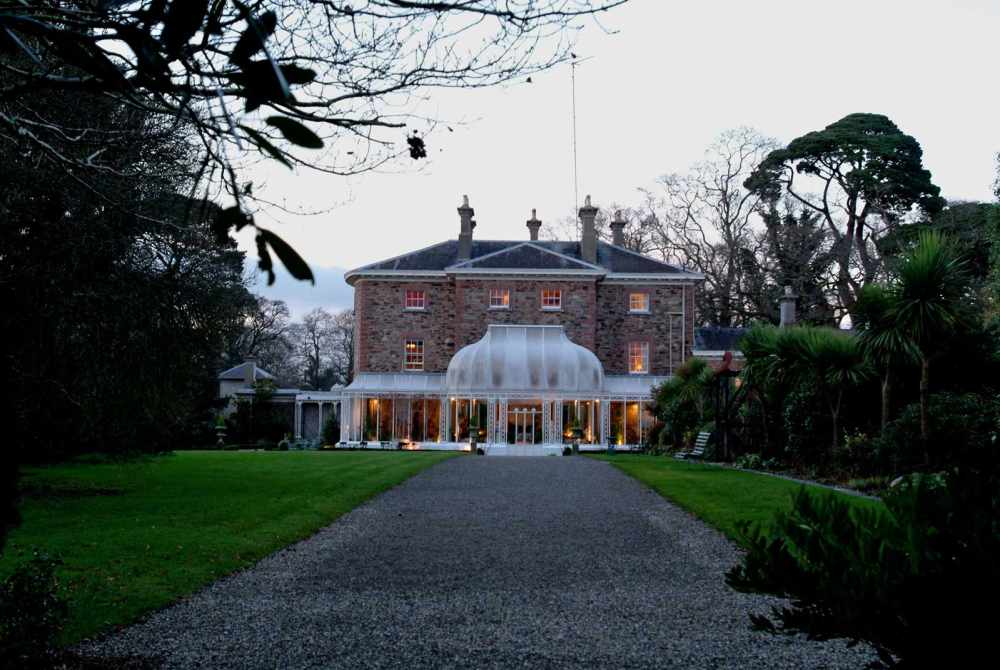
WWW.MARLFIELDHOUSE.COM 

Marlfield House, photograph courtesy of the website.

The website tells us:

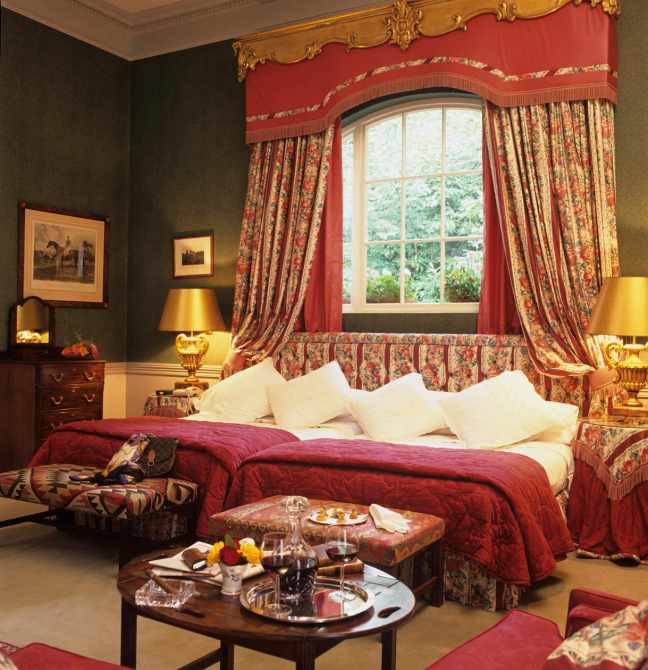
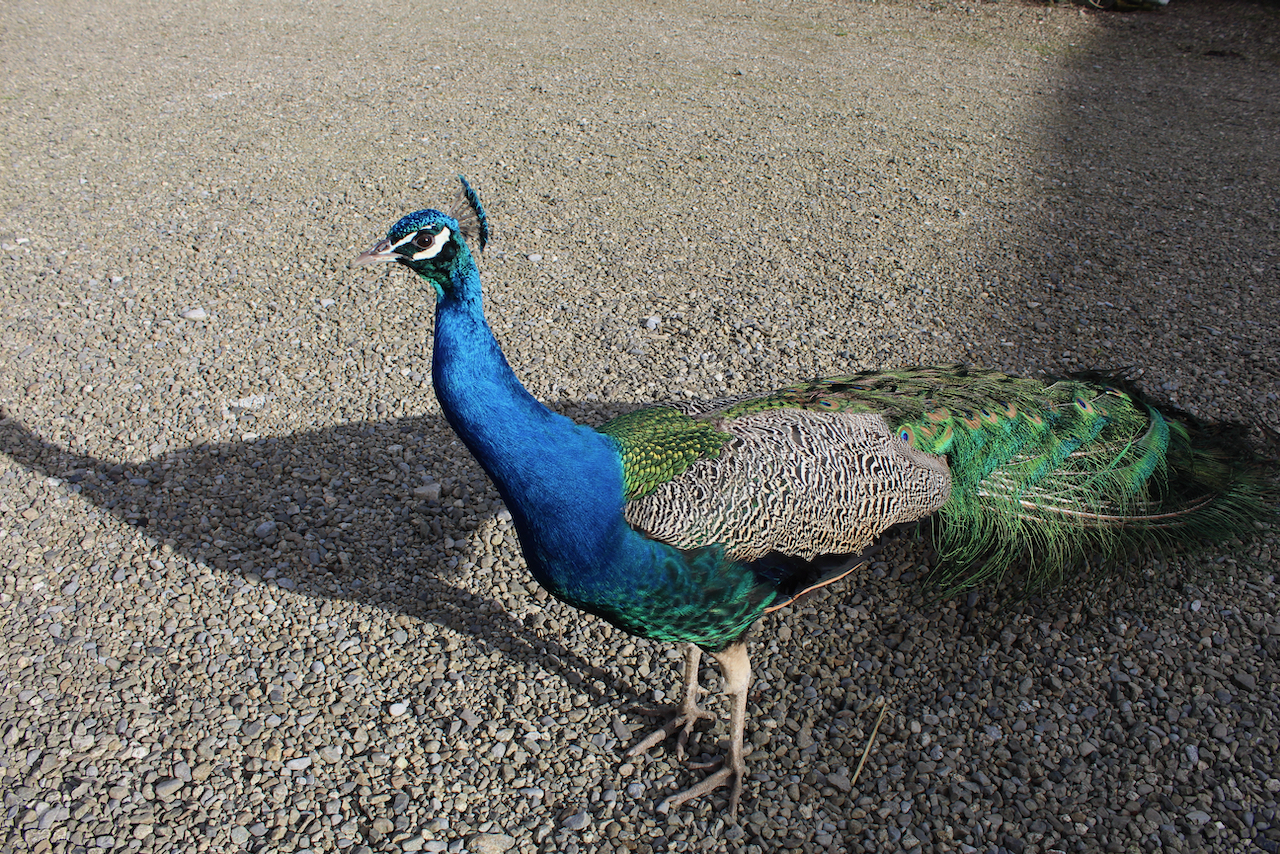
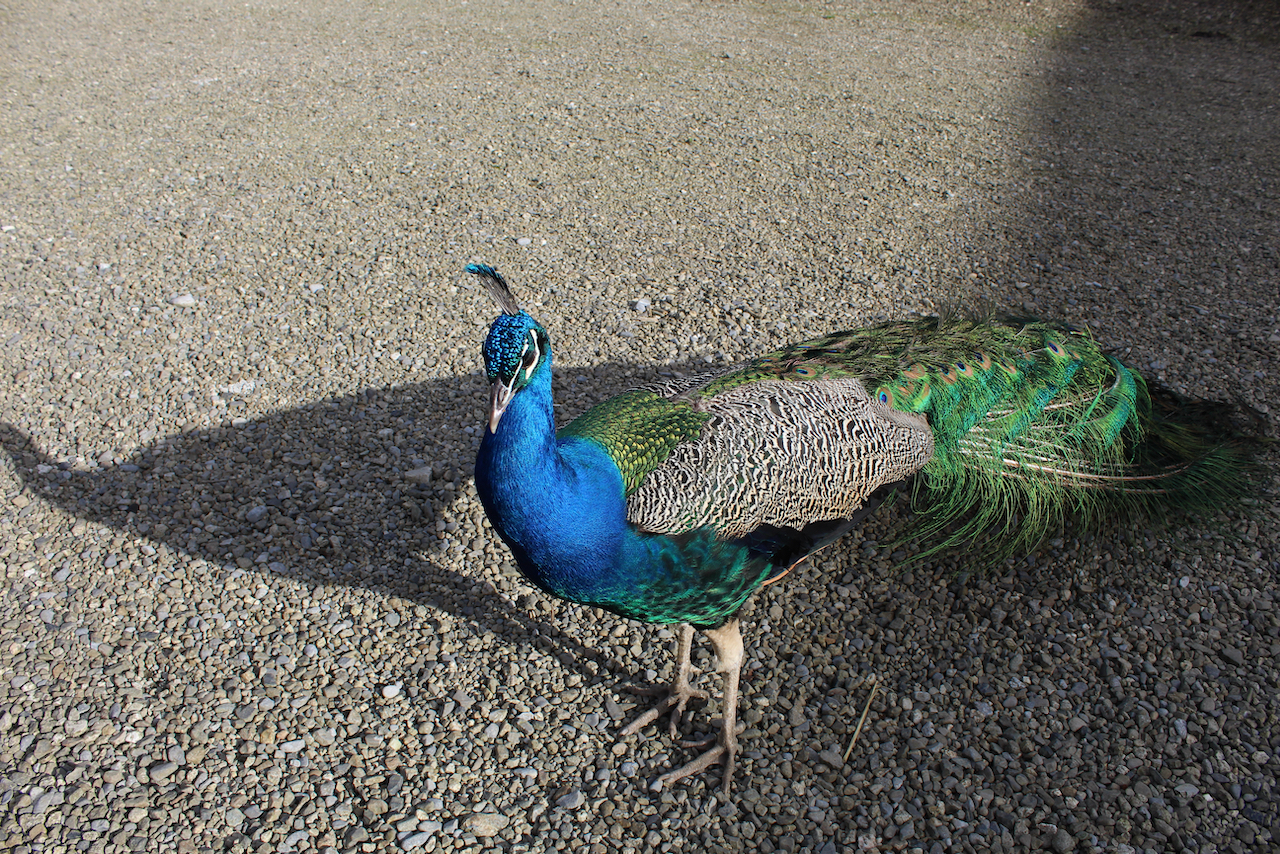
Marlfield House is renowned for its hospitality and service, welcoming guests for over 40 years, and is recognised as one of the most luxurious boutique hotels in Wexford, Ireland with the focus on environmentally sustainable practices. All rooms and suites at Marlfield House luxury hotel in County Wexford, Ireland are styled to provide you with elegant, comfortable interiors, furnished with antiques and paintings. Set in 36 acres of woodland, ornamental lake, rose, vegetable and herb gardens, it is a haven of tranquillity, with peacocks, hens, dogs and ponies waiting to greet you on your garden walk.

Marlfield House, photograph courtesy of the website.

The house is set in 40 acres of manicured gardens, encompassing a large kitchen garden, woodland walks, lake and fowl reserve, lawns and herbaceous borders. The interior bears all the signs of a much loved house filled with fresh flowers, gleaming antiques and mirrors, blazing fires and period paintings.

Marlfield House, photograph courtesy of the website.

Mark Bence-Jones writes of Marlfield (1988):

Supplement 

P. 299. (Stopford, Courtown, E/PB) “A three storey Regency house of random stone with brick facings; four bay front with two bay breakfront centre, eaved roof on bracket cornice, massive chimneystacks. Originally the dower house of the [Stopford] Earls of Courtown, it eventually replaced Courtown House as their Irish seat. Sold in 1979 to Mary Bowe, who has opened it as an hotel. As an extension to the dining room, a veranda and an elegant curvilinear conservatory were added to the front of the house 1983; the architects of this addition being Messrs Cochrane, Flynn-Rogers and Williams.” 
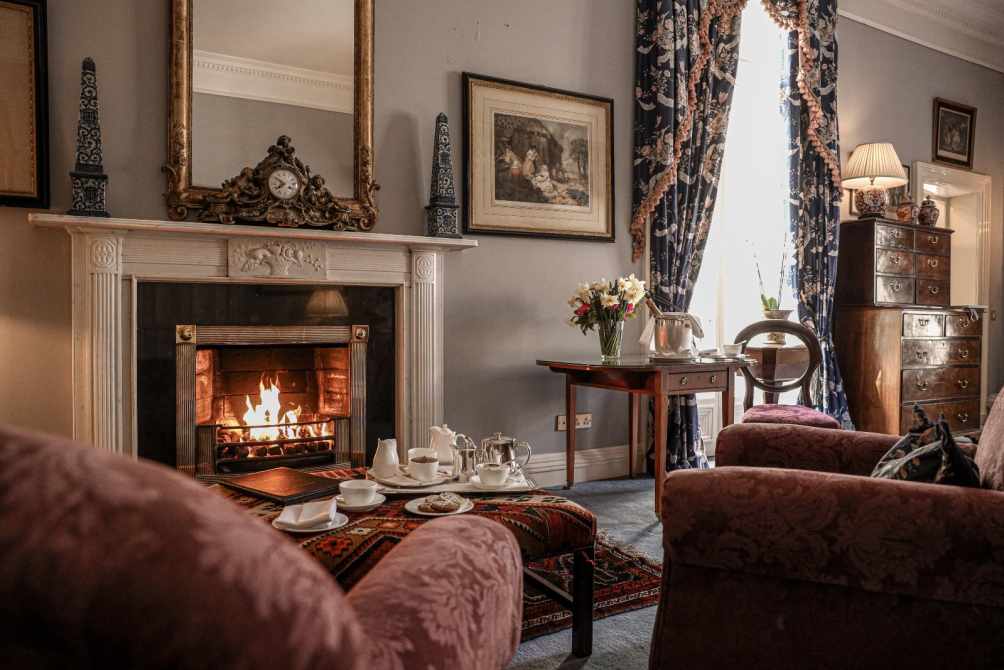
Marlfield House, photograph courtesy of the website.

The National Inventory tells us it is a four-bay (two-bay deep) three-storey land agent’s house, built 1852, on a T-shaped plan; four-bay three-storey rear (south) elevation centred on two-bay full-height breakfront. Occupied, 1901; 1911. In occasional use, 1916-75. Vacated, 1975. Sold, 1977. Modified, 1989, producing present composition to accommodate continued alternative use… “A land agent’s house erected by James Thomas Stopford (1794-1858), fourth Earl of Courtown (Walsh 1996, 68), representing an important component of the mid nineteenth-century domestic built heritage of the outskirts of Gorey with the architectural value of the composition, one succeeding an adjacent house occupied by Reverend James Bentley Gordon (1750-1819), author of “History of the Rebellion in Ireland in the Year 1798” (1803), confirmed by such attributes as the compact plan form centred on a much-modified doorcase; the construction in an ochre-coloured fieldstone offset by vibrant red brick dressings producing a mild polychromatic palette; the diminishing in scale of the openings on each floor producing a graduated visual impression; and the monolithic timber work embellishing the roofline. Having been well maintained, the elementary form and massing survive intact together with substantial quantities of the original fabric, both to the exterior and to the interior, including some crown or cylinder glazing panels in hornless sash frames: meanwhile, contemporary joinery; Classical-style chimneypieces; and the decorative plasterwork enrichments, all highlight the artistic potential of the composition. Furthermore, adjacent outbuildings (extant 1904); a walled garden (extant 1904); and a nearby gate lodge (see 15700718), all continue to contribute positively to the group and setting values of a self-contained estate having historic connections with Colonel Robert Owen (1784-1867) and Charlotte Owen (1796-1853) ‘late of Marlfield County Wexford’ (Calendars of Wills and Administrations 1870, 447); and the Stopford family following the sale (1947) and demolition (1948-9) of Courtown House (see 15701216) including James Walter Milles Stopford (1853-1933), sixth Earl of Courtown; Major James Richard Neville Stopford DL OBE (1877-1957), seventh Earl of Courtown; and Brevet Colonel James Montagu Burgoyne Stopford OBE (1908-75), eighth Earl of Courtown.

Marlfield House, photograph courtesy of the website.

11. Monart, Enniscorthy, Co Wexford – 5* hotel 
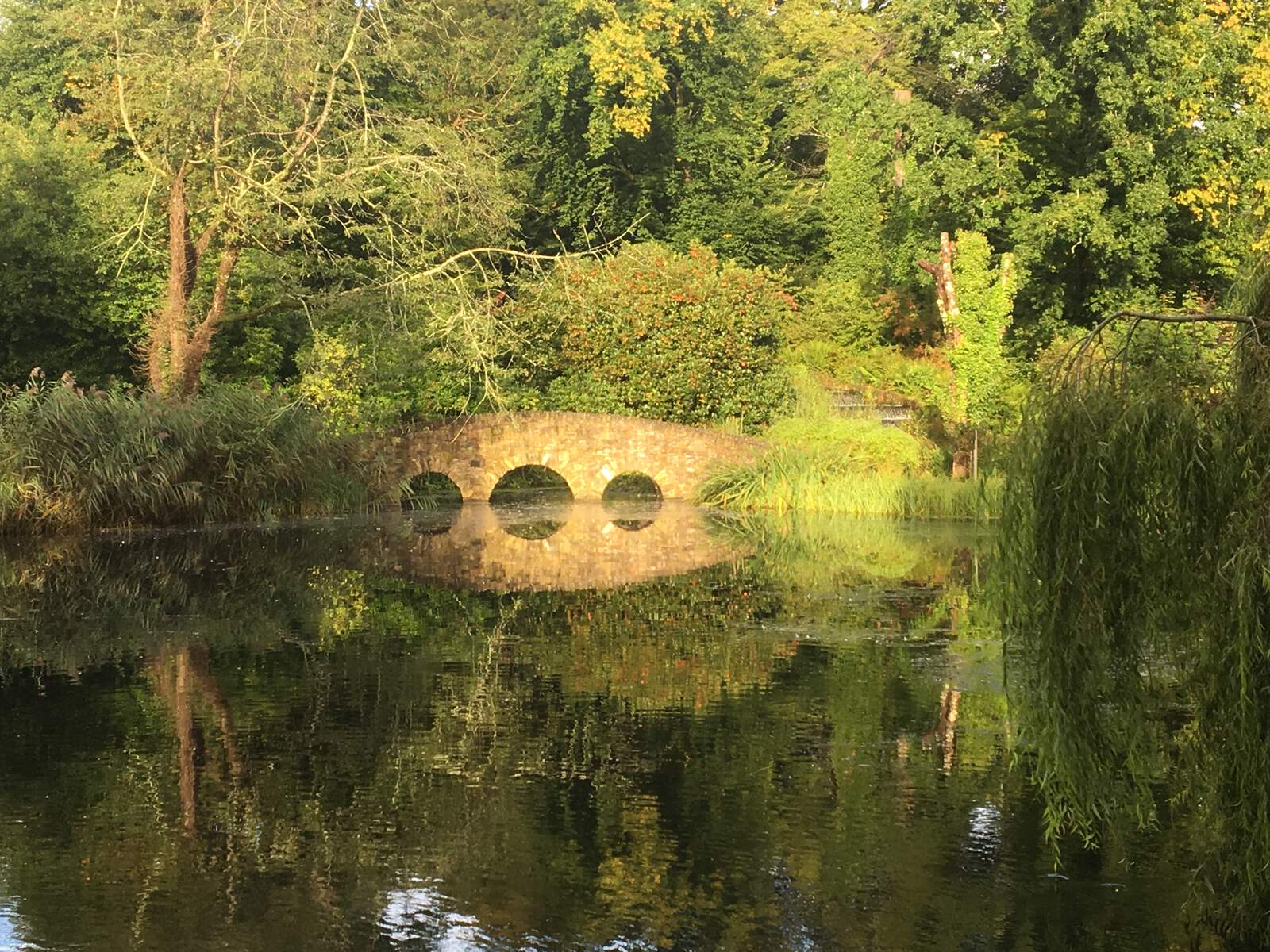
https://www.monart.ie/

Monart Spa Wexford Annica Jansson 2016, for Tourism Ireland, Ireland’s Content Pool.

Nestled in over 100 acres of lush countryside in County Wexford, Monart offers two types of accommodation, 68 deluxe bedrooms with lake or woodland views and two luxurious suites located in the 18th century Monart House.

Mark Bence-Jones writes (1988): p. 208. “Cookman/IFR) A three storey mid-C18 house of sandstone and limestone dressings Five bay front with breakfront centre; Venetian windows in centre of middle storey, with Diocletian windows over it; modified Gibbsian doorcase. Later additions.”

The National Inventory tells us:

A country house erected by Edward Cookman JP (d. 1774), one-time High Sheriff of County Wexford (fl. 1763), representing an important component of the eighteenth-century domestic built heritage of County Wexford with the architectural value of the composition, ‘a handsome mansion pleasantly situated on a gentle eminence above the Urrin [River] in a highly improved and richly wooded demesne’ (Lewis 1837 II, 385), confirmed by such attributes as the neo-Palladian plan form centred on a Classically-detailed breakfront; the construction in an ochre-coloured fieldstone offset by silver-grey granite dressings not only demonstrating good quality workmanship, but also producing a mild polychromatic palette; the diminishing in scale of the openings on each floor producing a graduated visual impression; and the parapeted roofline. Having been sympathetically restored following a prolonged period of unoccupancy in the later twentieth century, the elementary form and massing survive intact together with substantial quantities of the original fabric, both to the exterior and to the interior, including crown or cylinder glazing panels in hornless sash frames: meanwhile, contemporary joinery; Classical-style chimneypieces; and “bas-relief” plasterwork enrichments, all highlight the artistic potential of a country house having historic connections with the Cookman family including Nathaniel Cookman (—-); Edward Rogers Cookman JP (1788-1865) ‘late of Monart House in the County of Wexford’ (Calendars of Wills and Administrations 1865, 70); Nathaniel Narcissus Cookman JP DL (1827-1908), ‘Country Gentleman late of Monart House Enniscorthy County Wexford’ (Calendars of Wills and Administrations 1908, 96; cf. 15701922); and Captain Nathaniel Edward Rogers Cookman JP DL (1894-1983); and a succession of tenants including Lowry Cliffe Tottenham (1858-1937), ‘Gentleman [and] District Inspector of Royal Irish Constabulary’ (NA 1911).” 

12. The Gate Lodge, Mount Congreve €€

https://mountcongreve.com/gate-lodge/

Located in the heart of the lush Waterford countryside, on the grounds of the historic 18th-century Mount Congreve estate, this tastefully restored gate lodge is the perfect choice if you’re looking for a luxury self-catering stay in Ireland.

Originally built in 1775, the newly renovated Gate Lodge at Mount Congreve is home to a fully fitted galley kitchen with marble countertops, a living room with a 19th-century French walnut fold-out day bed, two mustard wingback armchairs, Smart TV, an antique bio-ethanol stove, and a bathroom complete with a walk-in shower.”Originally built in 1775, the newly renovated Gate Lodge at Mount Congreve is home to a fully fitted galley kitchen with marble countertops, a living room with a 19th-century French walnut fold-out day bed, two mustard wingback armchairs, Smart TV, an antique bio-ethanol stove, and a bathroom complete with a walk-in shower.

With two cosy double bedrooms (sleeping up to four adults*), the Gate Lodge is the perfect choice if you’re looking for a luxury self-catering stay in Ireland.

13. Rathaspeck Manor “doll’s house” gate lodge, County Wexford and the Manor B&B

https://www.airbnb.ie/rooms/18288598?source_impression_id=p3_1646906004_9dSSY0tDTw%2FmQ8TE

The delightful Rathaspeck gate lodge, County Wexford, available for accommodatino on airbnb. Photograph © Jennifer Winder-Baggot, www.irishhistorichouses.com

and Manor https://www.rathaspeckmanor.ie

The website tells us:

Rathaspeck Manor Georgian House Wexford was built between 1680-1720 by the Codd Family who came to Ireland circa 1169. William Codd’s son Sir Osborne Codd settled at Rathaspeck and erected a castle there in 1351. 

A descendant Loftus Codd was succeeded by daughters, one of whom, Jane Codd, married Thomas Richards. The Richards Family came to Ireland in 1570 approx. It was this marriage which placed Rathaspeck in the Richards Family. 

Jane and Thomas had 6 sons and 2 daughters. The eldest son Thomas, born 1722 had a Family of two daughters, the oldest Martha married Count Willimsdorf from the Kingdom of Hannover in 1802. This couple had one son, Thomas William Fredrick Von Preberton Willimsdorf who died in 1834 unmarried. There were also three daughters, one of whom Elizabeth, born in 1778, died in 1863 in Holland. 

Elizabeth married Count Von Leinburg Slirrin on April 15th 1802 and they proceeded to have a Family of ten children born between 1803 and 1820 . It is believed that sometime after this the family moved to Holland. Rathaspeck was in the hands of an English Family called Moody after this until the early 1900’s. The Moody built the present gate lodge – or “Doll’s House” in 1900. 

The Meyler Family came to Rathaspeck in 1911 when it was offered for sale and it was from the Meyler Family that the Manor passed to the Cuddihy Family. 

The site of the original Castle is unknown, but it is considered that the present Rathaspeck Manor Georgian Country Home, Ireland is built on the site. 

“Rath” means Fort , so the name of Rathaspeck stems from the Gaelic Ratheasbuig , meaning “Fort of the Bishop”. 

14. Riverbank House Hotel, The Bridge, Wexford, Ireland Y35 AH33

https://www.riverbankhousehotel.com

15. Rosegarland House, Wellingtonbridge, County Wexford – courtyard accommodation

https://rosegarlandestate.ie/

Rosegarland Estate offers visitors a unique opportunity to stay on an extremely old and unspoilt country estate. It allows you to step back in time when you walk along the avenues, woodland paths and old bridle paths which pass through the ancient woodlands and beside the River Corach.

Relax and unwind in one of our luxury self-catering cottages in Rosegarland Estate. Our four cottages are registered with Failte Ireland (the Irish Tourist Board) and have been awarded a 4 star rating.  Old world charm has been combined with modern day luxury in the cottages which are set in a picturesque courtyard. A welcome basket of home baked goodies will greet you when you arrive.

All the cottages have complimentary WiFi and satellite television channels which can be enjoyed in front of a Waterford Stanley wood burning stove.

Rosegarland Estate, courtesy of website.

Mark Bence-Jones writes (1988):

p. 245. “(Synnott/IFR; Leigh/IFR) An early C18 house of two storeys over a high basement was built by Leigh family, close to an old tower house of the Synnotts, the original owners of the estate. Later in C18, a larger two storey gable-ended range was added at right angles to the earlier building, giving the house a new seven bay front, with a very elegant columned and fanlighted doorway, in which the delicately leaded fanlight extends over the door and the sidelights. There is resemblance between this doorway and that of William Morris’s town house in Waterford (now the Chamber of Commerce) which is attributed to the Waterford architect, John  Roberts; the fact is that it is also possible to see a resemblance between the gracefully curving and cantilevered top-lit staircase at Rosegarland – which is separated from the entrance hall by a doorway with an internal fanlight – and the staircase of the Morris house, would suggest that the newer range at Rosegarland and the Morris house are by the same architect. At the back of the house, the two ranges form a corner of a large and impressive office courtyard, one side of which has a pediment and a Venetian window. In another corner of the courtyard stands the old Synnott tower house, which, in C19, was decorated with little battlemented turrets and a tall and slender turret like a folly tower, with battlements and rectangular and pointed openings; this fantasy rises above the front of the house. The early C18 range contains a contemporary stair of good joinery, with panelling curved to reflect the curve of the handrail. The drawing room, in the later range, has a cornice of early C19 plasterowrk and an elaborately carved chimneypiece of white marble. The dining room, also in this range, was redecorated ca 1874, and given a timber ceiling and a carved oak chimneypiece.” 
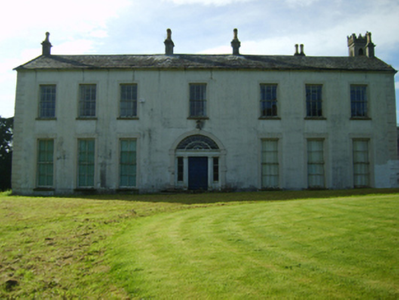
Rosegarland House, courtesy of National Inventory of Architectural Heritage.

The National Inventory tells us:

A country house erected by Robert Leigh MP (1729-1803) representing an important component of the eighteenth-century domestic built heritage of south County Wexford with the architectural value of the composition, one attributable with near certainty to John Roberts (1712-96) of Waterford, confirmed by such attributes as the deliberate alignment maximising on scenic vistas overlooking gently rolling grounds and the meandering Corock River; the symmetrical footprint centred on a Classically-detailed doorcase not only demonstrating good quality workmanship, but also showing a pretty fanlight; and the diminishing in scale of the openings on each floor producing a graduated visual impression. A prolonged period of unoccupancy notwithstanding, the elementary form and massing survive intact together with substantial quantities of the original fabric, both to the exterior and to the interior including not only crown or cylinder glazing panels in hornless sash frames, but also a partial slate hung surface finish widely regarded as an increasingly endangered hallmark of the architectural heritage of County Wexford: meanwhile, contemporary joinery; ‘elaborately carved chimneypieces of white marble’ (Bence-Jones 1978, 246); plasterwork enrichments; and a top-lit staircase recalling the Roberts-designed Morris House [Chamber of Commerce] in neighbouring Waterford (Craig and Garner 1975, 68), all highlight the considerable artistic potential of the composition. Furthermore, an adjacent stable complex (see 15704041); a walled garden (see 15704042); a nearby farmyard complex (extant 1902; coordinates 685132,615236); and a distant gate lodge (extant 1840; coordinates 685381,616928), all continue to contribute positively to the group and setting values of an estate having long-standing connections with the Leigh family including Francis Robert Leigh MP (1758-1839); Francis Augustine Leigh (1822-1900), ‘late of Rosegarland County Wexford’ (Calendars of Wills and Administrations 1900, 277); Francis Robert Leigh DL (1853-1916), ‘late of Rosegarland Wellington Bridge County Wexford’ (Calendars of Wills and Administrations 1916, 371); Francis Edward Leigh (1907-2003); and Robert Edward Francis Leigh (1937-2005).

16. Wells House, County Wexfordself-catering cottage accommodation, see above

https://wellshouse.ie/self-catering-accommodation-wexford 

17. Wilton Castle, Bree, Enniscorthy, Co. Wexford Y21 V9P9 – section 482

www.wiltoncastleireland.com
Open for accommodation: all year

See my write-up: www.irishhistorichouses.com/2022/02/04/wilton-castle-bree-enniscorthy-co-wexford-and-a-trip-to-johnstown-castle/
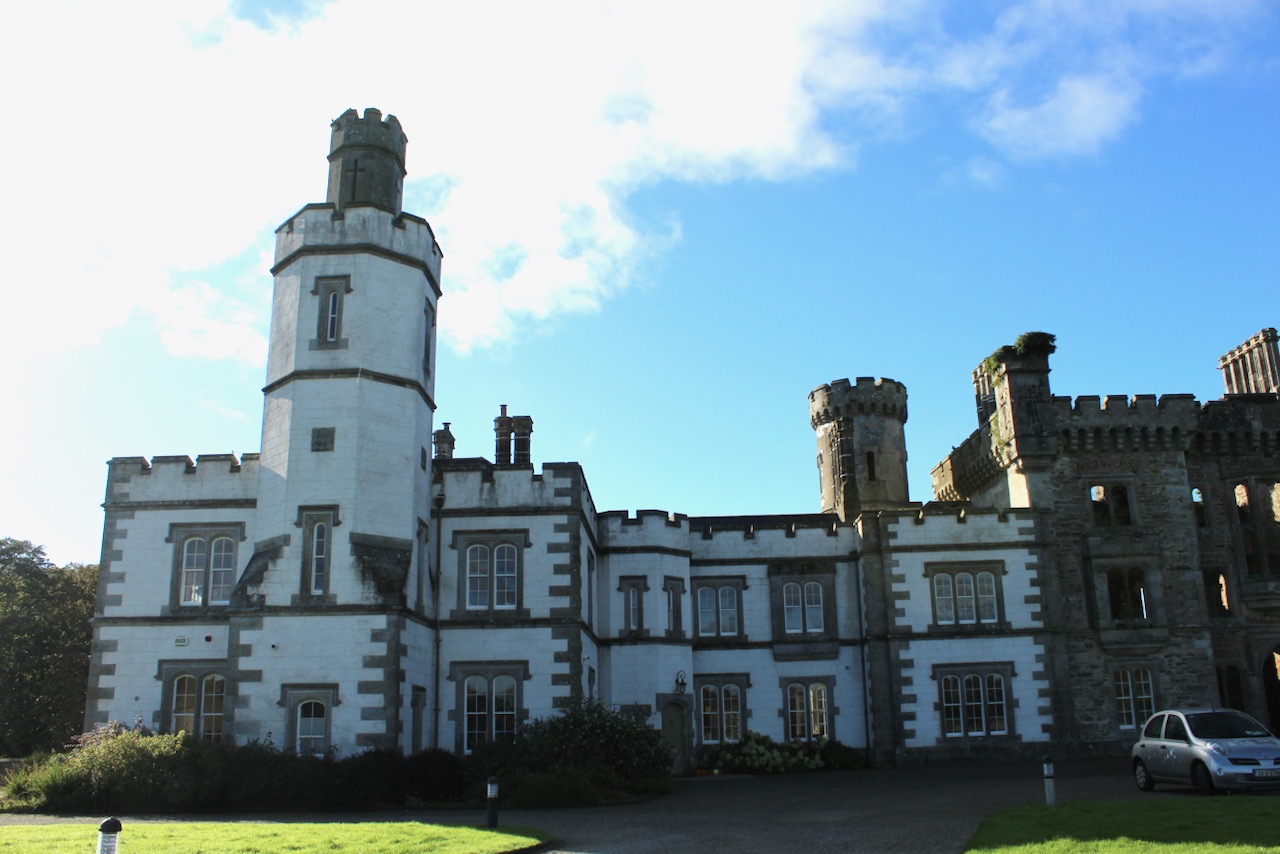
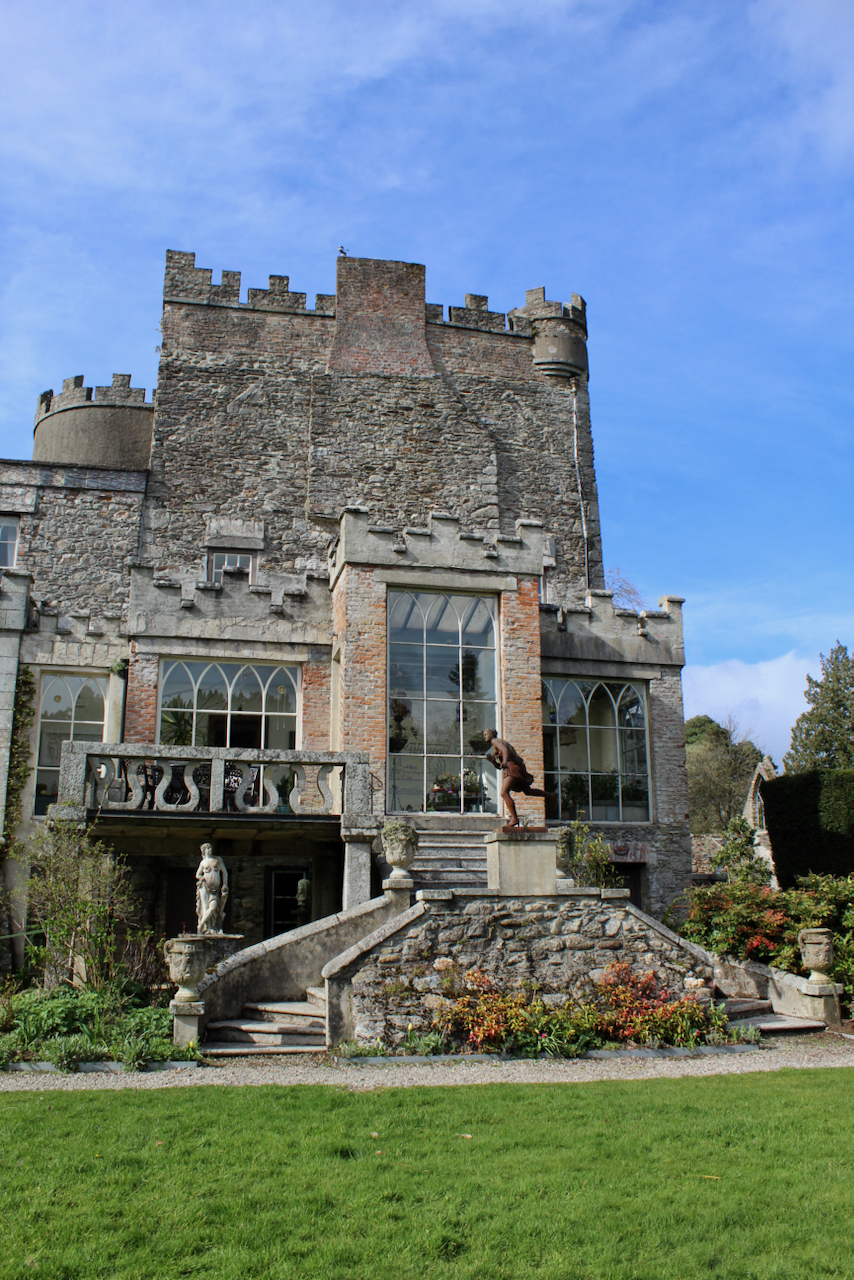
Wilton Castle, County Wexford.

18. Woodbrook House, Killanne, Enniscorthy, Co. Wexford – section 482

Tourist Accommodation Facility

Open for accommodation all year 2025

www.woodbrookhouse.ie

See my entnry https://irishhistorichouses.com/2025/03/13/woodbrook-killanne-enniscorthy-co-wexford-y21-tp-92-section-482-accommodation/
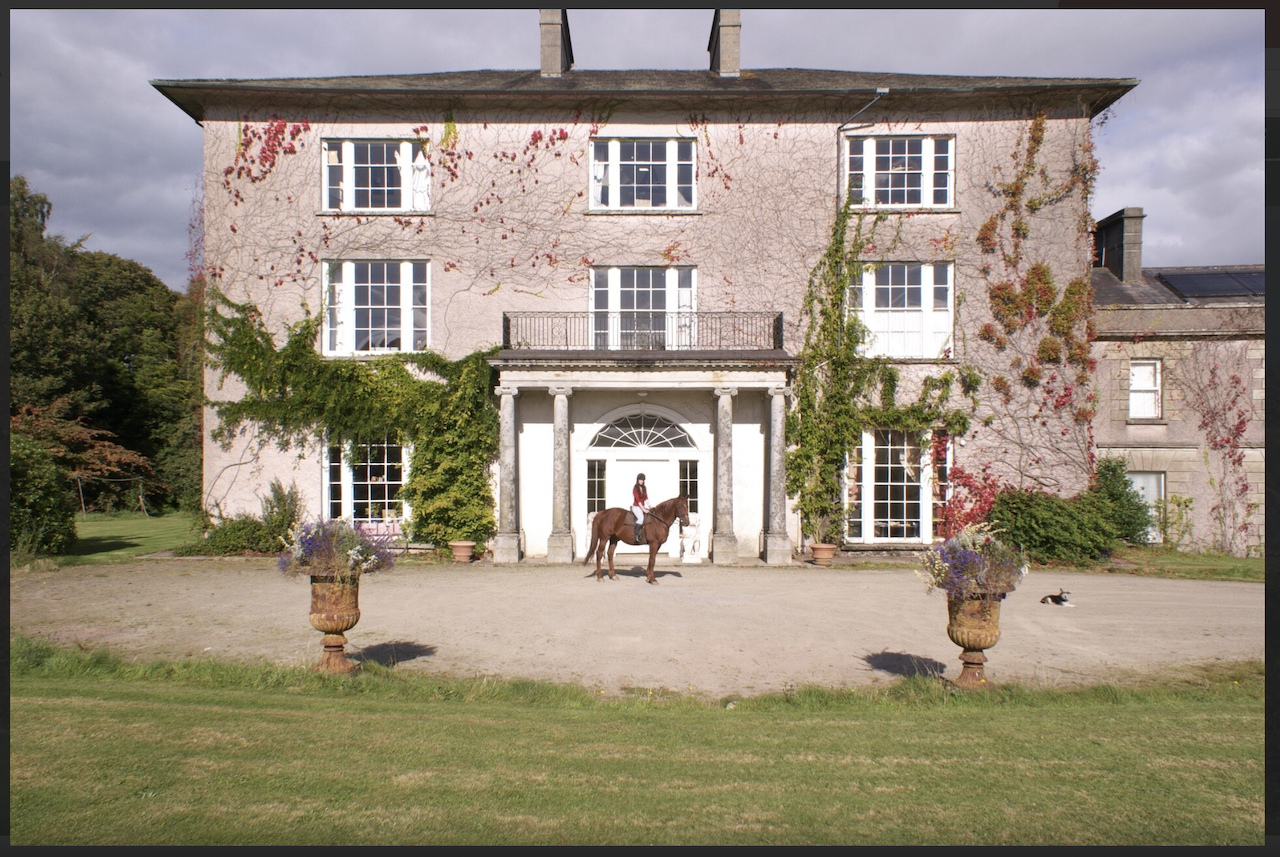
Woodbrook, County Wexford, courtesy Hidden Ireland.

The Historic Houses of Ireland website tells us:

Nestling beneath the Backstairs Mountains near Enniscorthy in County Wexford, Woodbrook, which was first built in the 1770s, was occupied by a group of local rebels during the 1798 rebellion. Allegedly the leader was John Kelly, the ‘giant with the gold curling hair’ in the well known song ‘The Boy from Killanne’. It is said that Kelly made a will leaving Woodbrook to his sons but he was hanged on Wexford bridge, along with many others after the rebels defeat at Vinegar Hill. He was later given an imposing monument in nearby Killanne cemetery. 

Arthur Jacob, who originally came from Enniscorthy and became Archdeacon of Armagh, built Woodbrook for his daughter Susan, who had married Captain William Blacker, a younger son of the family at Carrigblacker near Portadown. The house was badly knocked about by the rebels and substantially rebuilt in about 1820 as a regular three storey Regency pile with overhanging eaves, a correct Ionic porch surmounted by a balcony and three bays of unusually large Wyatt windows on each floor of the facade.

Woodbrook House, photograph courtesy of Woodbrook website.

Woodbrook lay empty for some years after E. C. Blacker’s death in 1932. The house was occupied by the Irish army during the Second World War and was then extensively modernised when his nephew Robert moved back to County Wexford with his wife and family after the sale of Carrickblacker in the 1950s. Eventually sold in the mid 1990s, Woodbrook and the remains of a once substantial estate was bought by Giles and Alexandra FitzHerbert in 1998. They continue to live in the house with their family today.https://www.ihh.ie/index.cfm/houses/house/name/Woodbrook

19. Woodlands Country House, Killinierin, County Wexford B&B

https://www.woodlandscountryhouse.com

Relax in comfortable old world charm in the heart of the Wexford Countryside at Woodlands Country House, a magnificently well preserved Georgian House with beautiful antiques. It is a charming and intimate place to relax, where fine food and furnishings are matched by warm and impeccable service that says you are special.

Woodlands Country House Bed & Breakfast is ideally situated near the market town of Gorey and the picturesque seaside resort of Courtown Harbour on the Wexford/Wicklow border in South East Ireland. The Country House B&B is only 1 hour from Dublin off the M11 making it an ideal location for touring the South East of Ireland.

20. Woodville House, New Ross, Co Wexford – 482, see above

Whole House rental County Wexford:

1. Ballinkeele, whole house rental (sleeps up to 19 people)

www.ballinkeele.ie

Ballinkeele House, photograph courtesy of website.

The website says:

Make yourselves comfortable in your grand home from home. This Irish country house was built to entertain and is perfect for gathering family & friends together for a holiday, a special birthday or anniversary. With 7 bedrooms and dining table for 19 guests – there’s space for everyone. You’ll be the hero for booking Ballinkeele!

Built in the 1840s by your host’s family, it’s a the perfect blend of modern and antique with a bespoke modern kitchen, WiFi and (Joy of Joys!) a modern heating system!”

Ballinkeele House, photograph courtesy of website.

The Historic Houses of Ireland website tells us:

In the first quarter of the 19th century the Maher family, who were famous for their hunting and racing exploits in County Tipperary, moved to County Wexford. They purchased Ballinkeele, near Enniscorthy, from the Hay family, one of whose members had been hanged for rebellion on Wexford bridge in 1798. John Maher, MP for County Wexford, began work on a new house in 1840 and Ballinkeele is one of Daniel Robertson’s few houses in the classical taste. The other was Lord Carew’s magnificent Castleboro, on the opposite side of the River Slaney, sadly burnt by the IRA in 1922 and now a spectacular ruin.   

The house is comprised of a ground floor and a single upper storey, with a long, slightly lower, service wing to one side in lieu of a basement. The facades are rendered with cut-granite decoration, including a grandiose central porch, supported by six Tuscan columns and surmounted by an elaborate balustrade, which projects to form a porte cochère.”

Ballinkeele House, photograph courtesy of website.

The garden front has a central breakfront with a shallow bow, flanked by wide piers of rusticated granite. These are repeated at each corner as coigns.

The interior is classical, with baroque overtones, and is largely unaltered with most of its original contents. The hall runs from left to right and is consequently lit from one side, with a screen of scagliola Corinthian columns at one end and an elaborate cast-iron stove at the other.

The library and drawing room both have splendid chimneypieces of inlaid marble in the manner of Pietro Bossi, while the fine suite of interconnecting rooms on the garden front open onto a raised terrace.” 
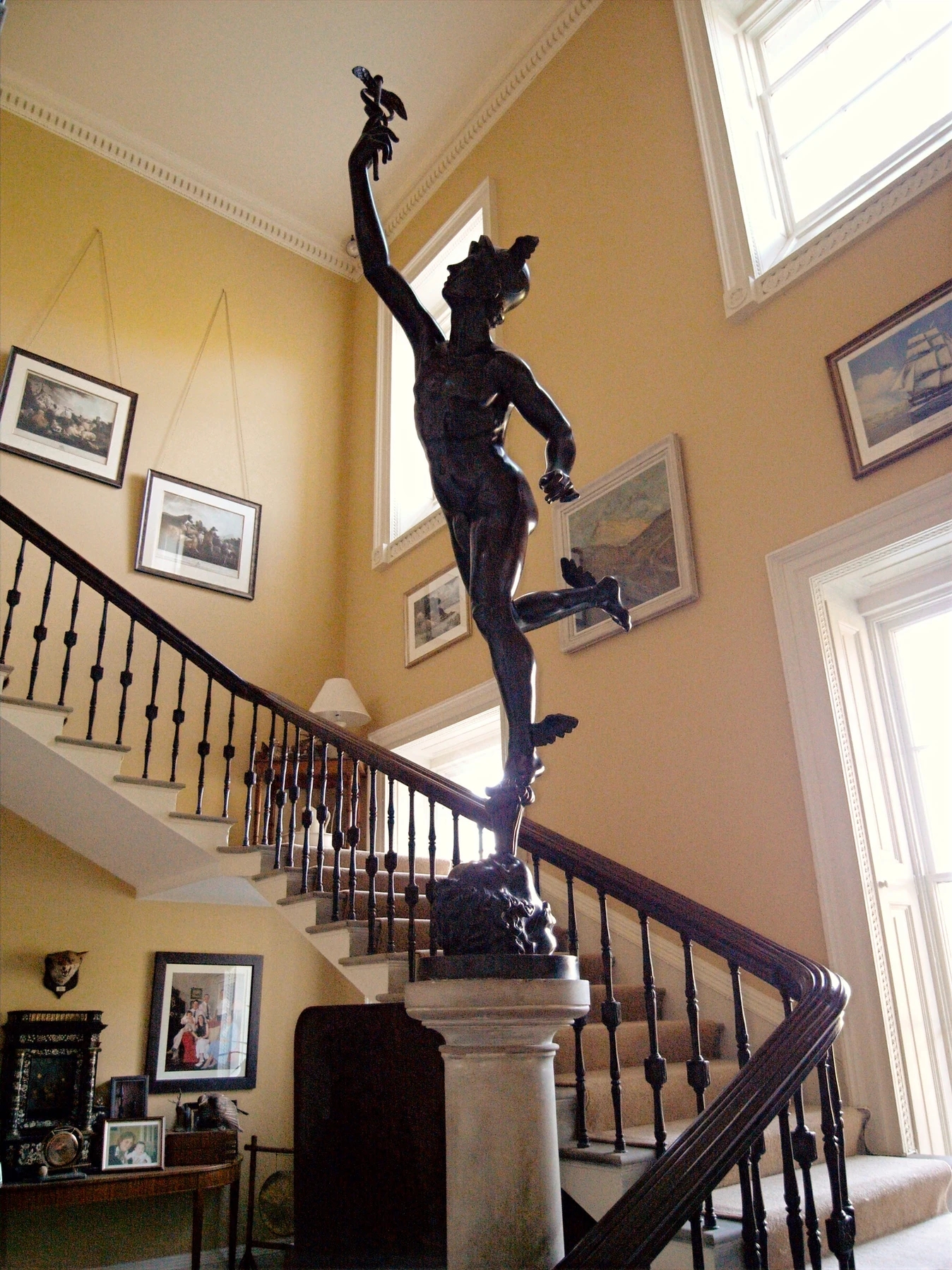
Ballinkeele House, photograph courtesy of website.

“The staircase hall has a spectacularly cantilevered stone staircase, with decorative metal balusters. As it approaches the ground floor the swooping mahogany handrail wraps itself around a Tuscan column supporting a bronze statue of Mercury, in a style that anticipates Art Nouveau by more than forty years.

Outside, two avenues approach the house, one which provides a glimpse of a ruined keep reflected in an artificial lake, while both entrances were built to Robertson’s designs.

The present owners are Valentine and Laura Maher who live at Ballinkeele with their children.

[ https://www.ihh.ie/index.cfm/houses/house/name/Ballinkeele ]
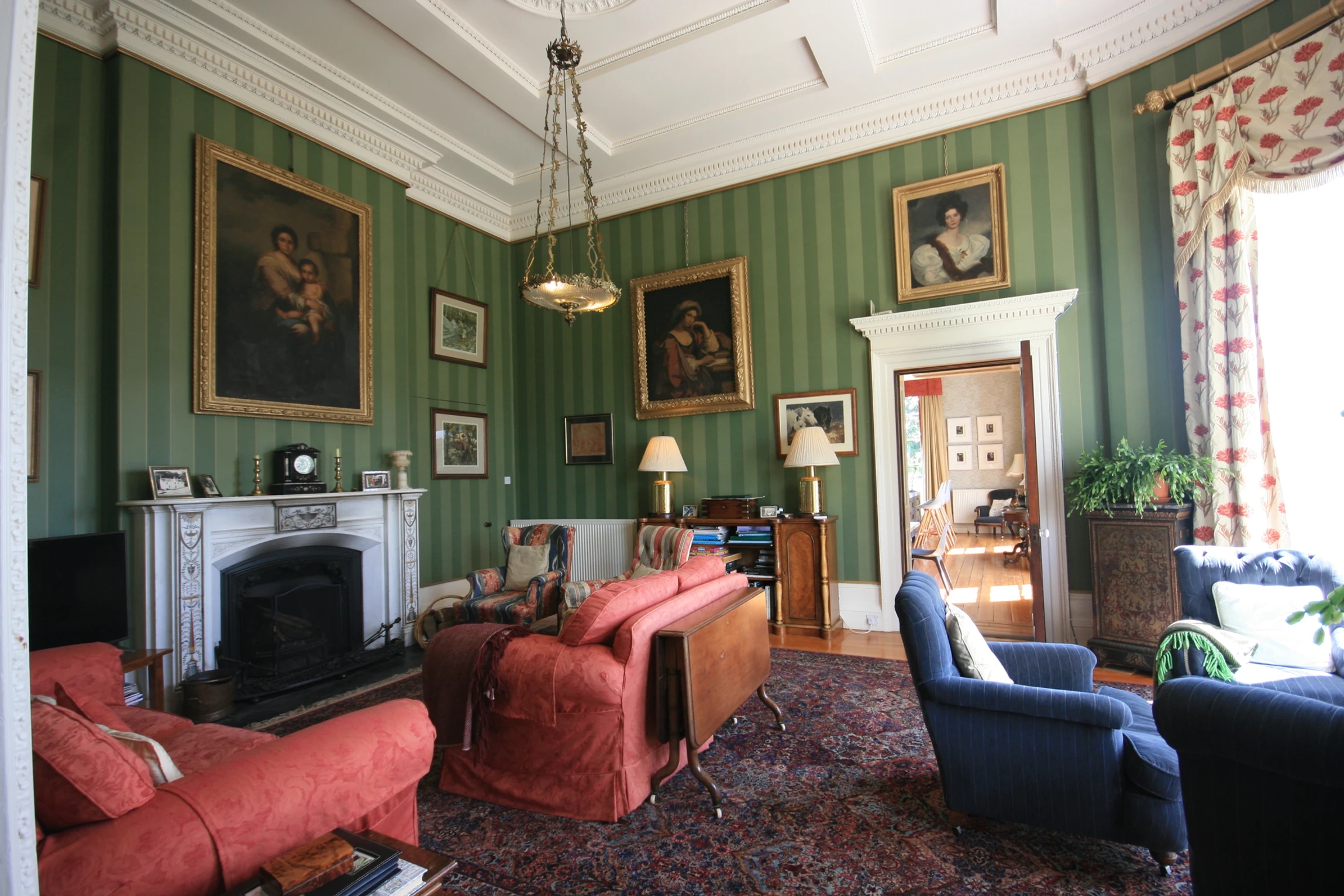
Ballinkeele House, photograph courtesy of website.

2. Horetown House, County Wexford (wedding venue, up to 24 people in house, plus shepherd’s huts)

https://www.horetownhouse.ie/

The website tells us:

Horetown House, photograph courtesy of website.

Horetown House is a private country house wedding venue in County Wexford in the South-East corner of Ireland. Situated among rolling hills in the heart of rural Wexford, Horetown House is the perfect venue for a stylish, laid back wedding. Our charming country house is yours exclusively for the duration of your stay with us.

Family owned and run, we can take care of everything from delicious food, bedrooms and Shepherds huts, to a fully licensed pub in the cellar. Horetown House is perfect for couples looking for something a little bit different, your very own country house to create your dream wedding.

Mark Bence-Jones writes (1988): p. 155. “(Davis-Goff, Bt/PB) A three storey Georgian house. Front with two bays on either side of a recessed centre. Triple windows in centre and pillared portico joining the two projections.” 

The National Inventory tells us it is:

A country house erected to designs signed (1843) by Martin Day (d. 1861) of Gallagh (DIA; NLI) representing an important component of the mid nineteenth-century domestic built heritage of County Wexford with the architectural value of the composition, one succeeding a seventeenth-century house (1693) annotated as “Hoarstown [of] Goff Esquire” by Taylor and Skinner (1778 pl. 149), confirmed by such attributes as the deliberate alignment maximising on panoramic vistas overlooking gently rolling grounds; the symmetrical frontage centred on a pillared portico demonstrating good quality workmanship in a silver-grey granite; the diminishing in scale of the openings on each floor producing a graduated visual impression; and the parapeted roofline. Having been well maintained, the elementary form and massing survive intact together with substantial quantities of the original fabric, both to the exterior and to the interior where contemporary joinery; restrained chimneypieces; and decorative plasterwork enrichments, all highlight the artistic potential of the composition. Furthermore, a nearby quadrangle erected (1846) by ‘S.D. Goff Esq Architect [and] Johnson Builder’ continues to contribute positively to the group and setting values of an estate having historic connections with the Goff family including Strangman Davis Goff (né Davis) (1810-83) ‘late of Horetown House County Wexford’ (Calendars of Wills and Administration 1883, 318); and Sir William Goff Davis Goff (1838-1918) of Glenville, County Waterford; a succession of tenants including Joseph Russell Morris (NA 1901) and Edward Naim Townsend (NA 1911); and Major Michael Lawrence Lakin DSO (1881-1960) and Kathleen Lakin (née FitzGerald) (1892-30) of Johnstown Castle.”

donation

Help me to pay the entrance fee to one of the houses on this website. This site is created purely out of love for the subject and I receive no payment so any donation is appreciated!

€15.00

[1] https://www.irelandscontentpool.com/en

[2] Bence-Jones, Mark. A Guide to Irish Country Houses (originally published as Burke’s Guide to Country Houses volume 1 Ireland by Burke’s Peerage Ltd. 1978); Revised edition 1988 Constable and Company Ltd, London.

[3] https://www.buildingsofireland.ie/buildings-search/building/15603115/enniscorthy-castle-castle-hill-enniscorthy-enniscorthy-wexford

[4] https://www.archiseek.com/2014/johnstown-castle-county-wexford/

[5] https://www.buildingsofireland.ie/buildings-search/building/15704226/johnstown-castle-johnstown-fo-by-wexford

Text © Jennifer Winder-Baggot, www.irishhistorichouses.com

Johnstown Castle, County Wexford, a Heritage Trust property

Maintained by the Irish Heritage Trust

Johnstown Castle, County Wexford. The house was designed by Daniel Robertson (d. 1849). It envelops a seventeenth-century house (perhaps by Thomas Hopper) [1] remodelled (1810-4) by James Pain (1779-1877) of Limerick. Photograph © Jennifer Winder-Baggot, www.irishhistorichouses.com
https://johnstowncastle.ie/

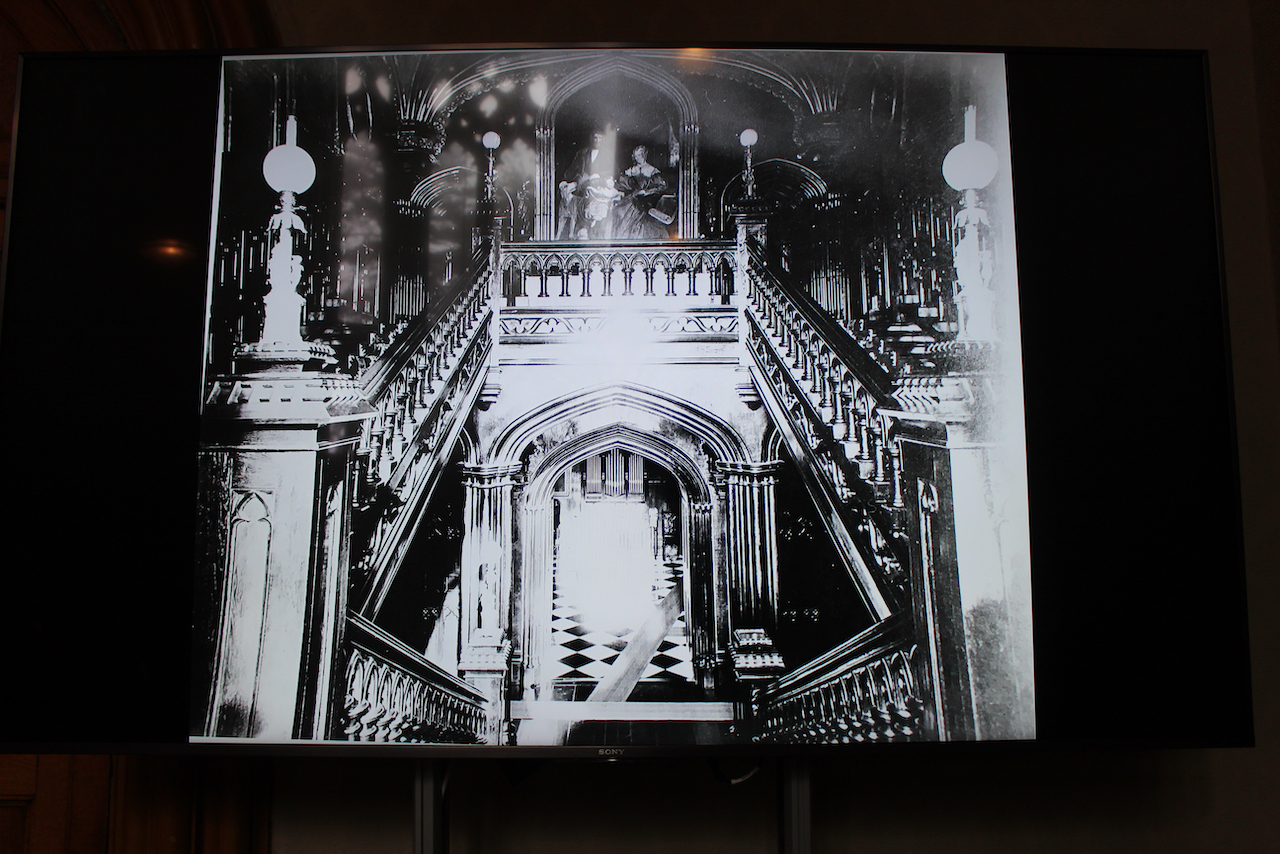
Photograph on display from 1890.

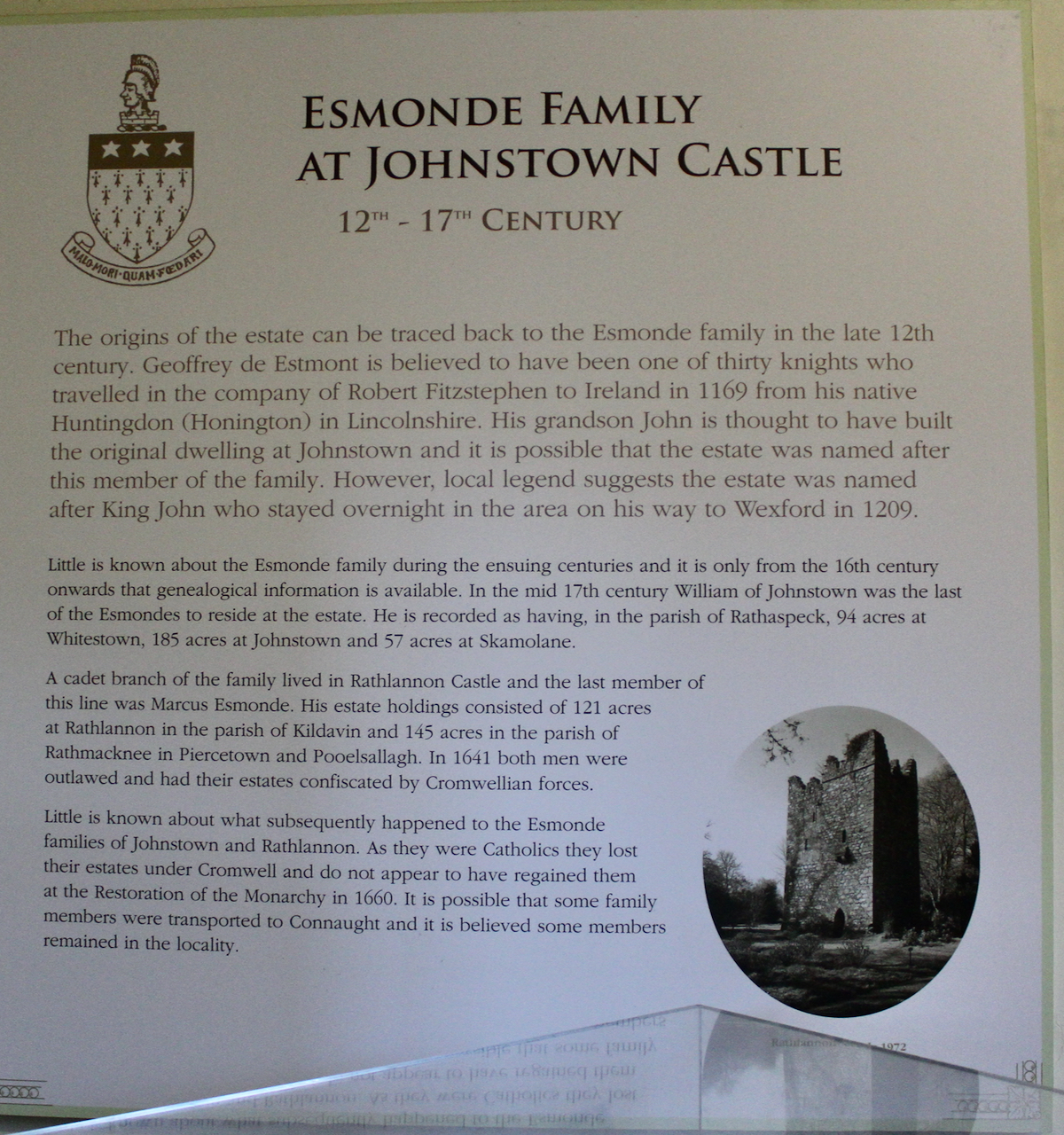
An information board in the museum tells us that Geoffrey and Maurice Esmonde were the estate’s first owners, who arrived as part of the Anglo-Norman invasion in 1169. Geoffrey Esmonde built the original Johnstown Castle, which was a plain and modest tower house. His son Maurice built a second tower house at Rathlannon Castle, the remains of which are on the grounds to this day.

Information board at Johnstown Castle.

Our guide Mary told us that the Esmondes tower house used to stand in front of the current Johnstown Castle, but it was taken down. See below an old photograph – the old tower is the part covered in ivy in the photo.

The original tower house of the Esmondes was the ivy covered one in this photograph. It has since been taken down.
Rathlannon Castle, built by Maurice Esmonde in the 1200s. Photograph © Jennifer Winder-Baggot, www.irishhistorichouses.com
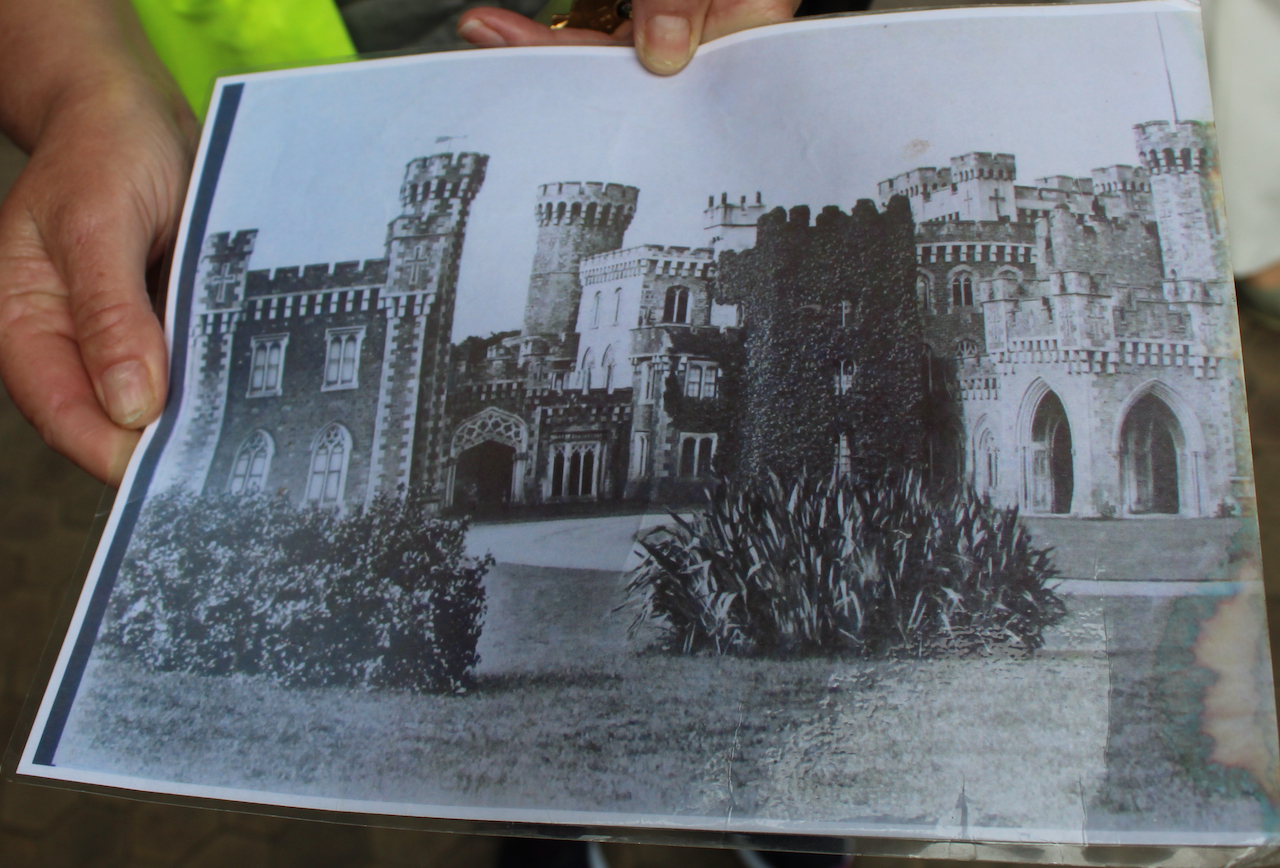
The Esmondes lived here for 500 years until they lost their lands during the invasion of Oliver Cromwell, as they were Catholics. Our guide Mary told us that Cromwell slaughtered over 3000 people in Wexford.

There is a chapter on the Esmonds of Ballynastragh in The Wexford Gentry by Art Kavanagh and Rory Murphy. They tell us that it is believed that Geoffrey de Estmont was one of the thirty knights who accompanied Robert FitzStephen to Ireland in 1169 when the latter lead the advance force that landed at Bannow in county Wexford. Geoffrey built a motte and baily at Lymbrick in the Barony of Forth in Wexford, and his son Maurice built a castle on the same site. After Maurice’s death in 1225 the castle was abandoned and his son John built a castle on a new site which was called Johnstown Castle. John died in 1261. [2]

James Esmonde, an early Esmonde living at Johnstown Castle, married Isabel Rosseter, daughter of Thomas Rosseter who owned Rathmacknee Castle in County Wexford – this is a tower house that still stands and is a National Monument. It remained occupied until 1760s and in the nineteenth century it was restored by Hamilton Knox Grogan-Morgan who also owned Johnstown Castle.

James’s grandson, Walter or William, married Margaret Furlong, daughter of Michael of Horetown, County Wexford. They had several children. Their younger son Patrick held the office of Sheriff of Carlow in 1627. He married Katherine Gough and their son Laurence (about 1570-1645) was created 1st Lord Esmonde, Baron of Lymbrick, Co. Wexford, for his services to the crown.

Laurence Esmonde converted to Anglicanism and served in the armies of British Queen Elizabeth I and then James I. He is the ancestor of the Esmondes who owned Huntington Castle in County Carlow (see my entry https://irishhistorichouses.com/2019/06/28/huntington-castle-county-carlow/).

Huntington Castle, 2023. Photograph © Jennifer Winder-Baggot, www.irishhistorichouses.com

It was an elder son of Walter or William Esmonde and Margaret Furlong, Robert, who inherited the Johnstown estate, which then passed to Robert’s son William. William was MP for Wexford in 1634. However, in the following decades the Esmondes lost the estate.

Lieutenant Colonel John Overstreet was granted Johnstown Castle estate in 1652 in lieu of payment for fighting in Cromwell’s army. When Overstreet died, his wife married another Cromwellian, Edward Withers, who took over the ownership of the castle as Overstreet had no offspring. Withers and his new wife also had no children. Withers and his wife sold the castle to John Reynolds, who had married a niece of John Overstreet, Elizabeth Lacy.

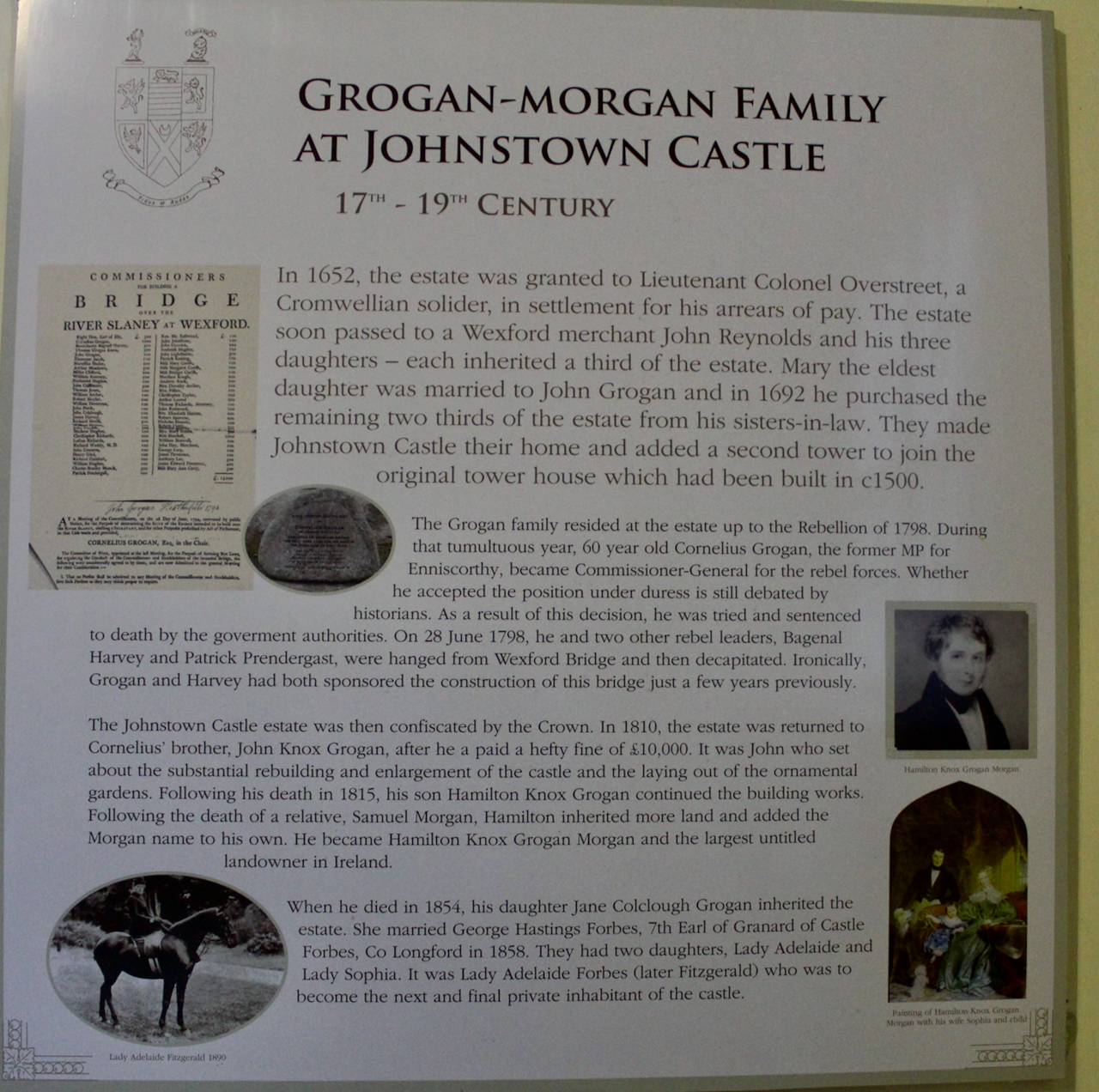
John Reynolds and his wife had three daughters, who were co-heirs to the Johnstown estate. Their daughter Mary married John Grogan (1653-1720), and this is how the property passed into Grogan ownership in 1692. [3]

John Grogan was the son of Cornelius Grogan, a yeoman who brought some property in the town of Wexford. [see 3]

A tower like gate lodge erected to a design (1846) by Martin Day of Gallagh, with an oriel window similar to the Daniel Robertson designed gate lodge at Shankill Castle, County Kilkenny. Photograph © Jennifer Winder-Baggot, www.irishhistorichouses.com
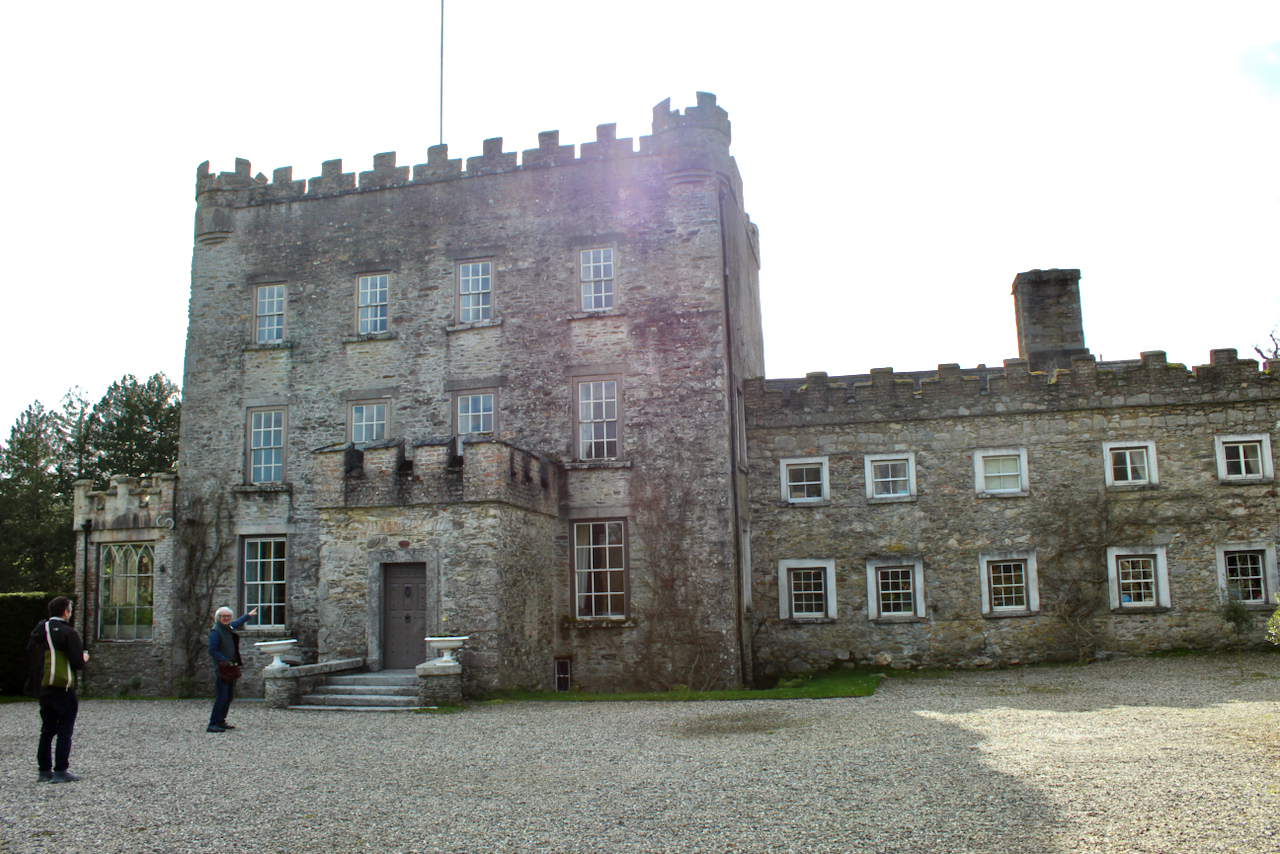
The Grogan family and their descendants lived at Johnstown Castle until 1945 when it was handed over to the state. Our guide told us that it was given in lieu of death duties. Nearly all of the furniture was sold, but fortunately some has been recovered.

John Grogan (1653-1720) and Mary Reynolds had a son Cornelius (1687-1724). Cornelius’s son John (1717-1783) married an heiress, Catherine Knox of Rathmacknee, County Wexford. Catherine’s father was Andrew Knox, and her mother was Mary Grogan, daughter of John Grogan (1653-1720) who had acquired Johnstown Castle by his wife, Mary Reynolds. Mary Grogan was John’s daughter by his second wife, Anne Livingston.

After Mary’s husband Andrew Knox died, she married a second and third time. Her second husband was William Hore (1680-1745) of Wexford, whose first wife had been Dorothy Ponsonby, daughter of William, 1st Viscount Duncannon. After William Hore died, Mary née Grogan married Charles Tottenham (1685-1758, Tottenham “in his boots” as he was called for once wearing his boots into parliament, since he was running late).

Charles Tottenham “in his Boots”, 1731 by James Latham, National Gallery of Ireland 411. He married Mary née Grogan after her previous husband died. In 1731 a proposal that an Irish tax surplus be given to the British treasury caused consternation, and Tottenham, though ill, rode up to Dublin from County Wexford as he was MP for New Ross and he was anxious to vote on the proposal. A serjeant-at-arms tried to stop Tottenham from entering the Parliament house in his muddy boots but Tottenham strode inside, ever after being given the nickname “Tottenham in his boots.”

Another daughter of John and Anne née Livingston was Sarah (1699-1777). She married William Morgan, Mayor of Waterford. They had a son, Samuel, who left a fortune to a later occupant of Johnstown Castle, as we shall see later.

John Grogan (1717-1783) and Catherine Knox had a son Cornelius (1738-1798) who succeeded to the family estates and served as high sheriff of County Wexford and from 1783-1790, MP for Enniscorthy in the Irish parliament.

Cornelius had a bridge built, Wexford bridge, and charged a toll from those crossing. During the rebellion of 1798 Cornelius joined the insurgents, the United Irishmen and he was beheaded for his treason in 1798 and his head was hung on Wexford bridge, along with two other landlords turned rebels, John Henry Colclough and Bagenal Beauchamp Harvey.

The Johnstown estate was restored to his younger brother, John Knox Grogan (1760-1814), on payment of a heavy fine.

Information board at Johnstown Castle.

The information board tells us that the younger brother John Knox Grogan (1760-1814) set about rebuilding and enlarging the castle, and laying out the ornamental gardens. According to the National Inventory, he hired James Pain (1779-1877) of Limerick and work was carried out from 1810-1814.

John Knox Grogan married Anne Coote, daughter of Chidley Coote of Ash Hill, County Limerick (a section 482 property – see my entry https://irishhistorichouses.com/2023/04/06/ash-hill-kilmallock-co-limerick/). She died in childbirth after giving birth to her daughter Anne.

Second, John Knox Grogan (1760-1814) married Elizabeth Fitzgerald, daughter of James Stephen Fitzgerald of Ballythomas, County Laois.

Following John Knox Grogan’s death, his son Hamilton Knox Grogan (1808-54) continued the building works. He hired Daniel Robertson, who created the castle as we see it today.

In 1827 Hamilton Knox Grogan inherited more land from a cousin of his father, Samuel Morgan (1737-1827) of Ardcandrisk, County Wexford (see above; the house has been demolished). He added Morgan to his surname then, to become Hamilton Knox Grogan-Morgan, becoming the largest landowner without a title in Ireland.

Mark Bence-Jones tells us about Johnstown Castle (1988):

Front of Johnstown Castle. Photograph © Jennifer Winder-Baggot, www.irishhistorichouses.com
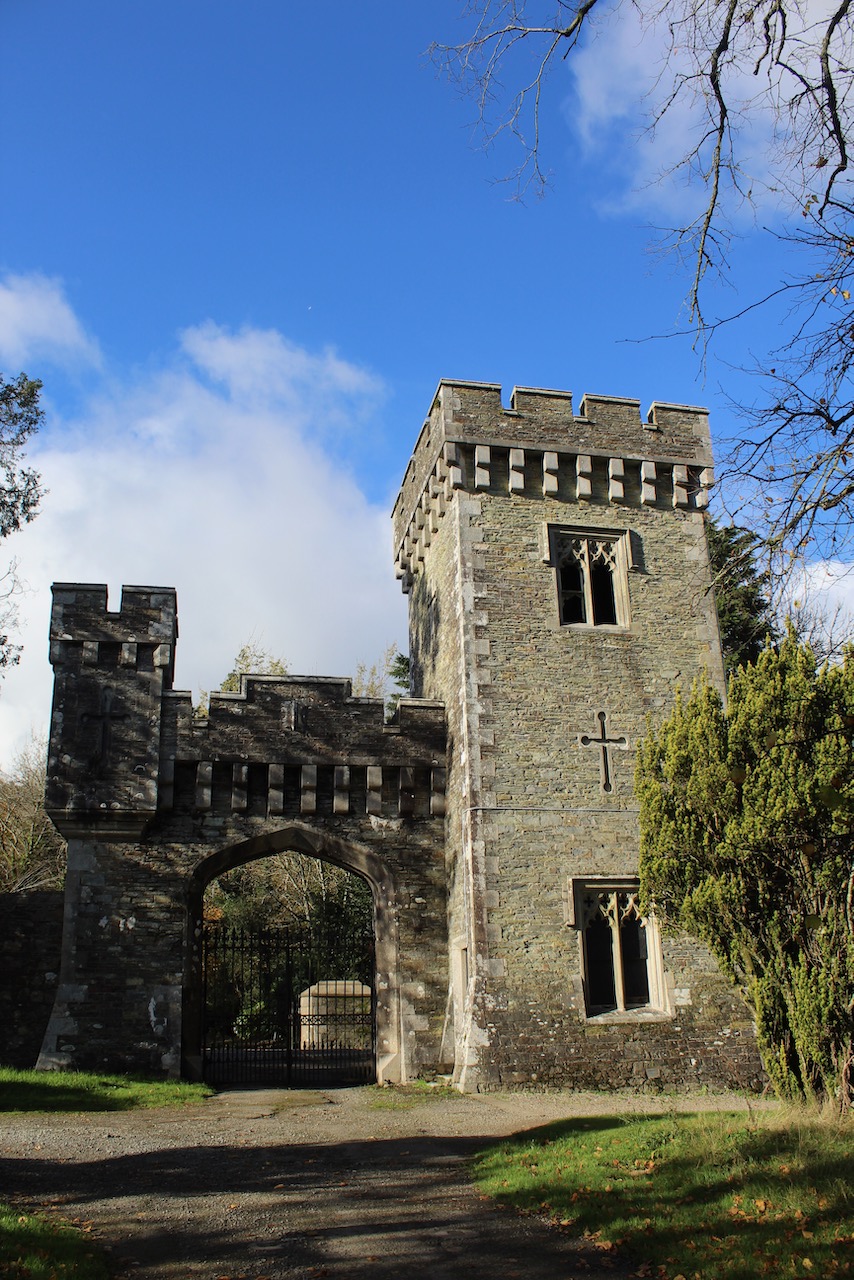
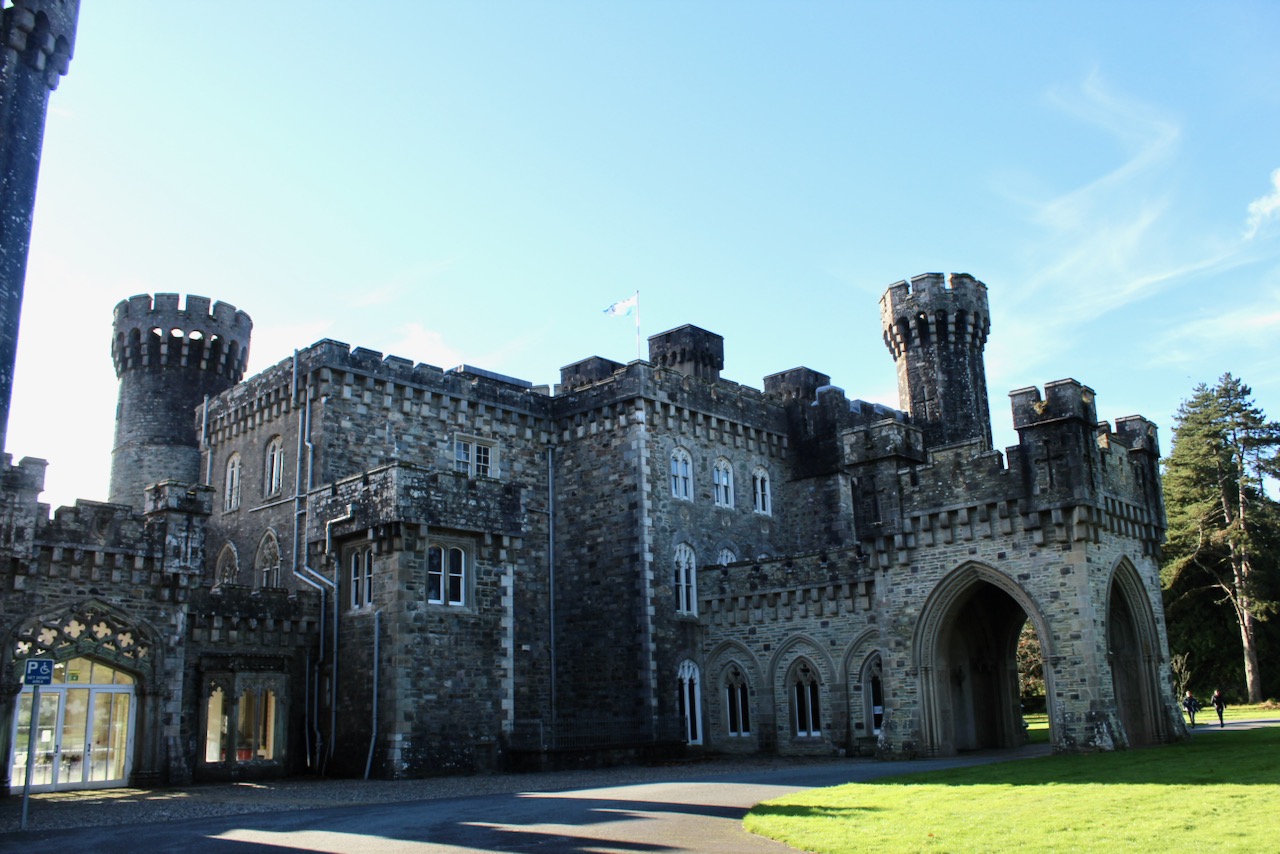
p. 161. “(Esmonde, bt/PB; Grogan-Morgan; LG1863; Forbes, Granard, E/PB; FitzGerald, sub Leinster, D/PB) An old tower house of the Esmondes, engulfed in an impressively turreted, battlemented and machicolated castle of gleaming silver-grey ashlar built ca 1840 for Hamilton Knox Grogan Morgan [1808-54], MP, to the design of Daniel Robertson [d. 1849], of Kilkenny. The entrance front is dominated by a single frowning tower with a porte-cochere projecting at the end of an entrance corridor and a Gothic conservatory at one end.”

The entrance front is dominated by a single frowning tower with a porte-cochere projecting at the end of an entrance corridor and a Gothic conservatory at one end. Photograph © Jennifer Winder-Baggot, www.irishhistorichouses.com
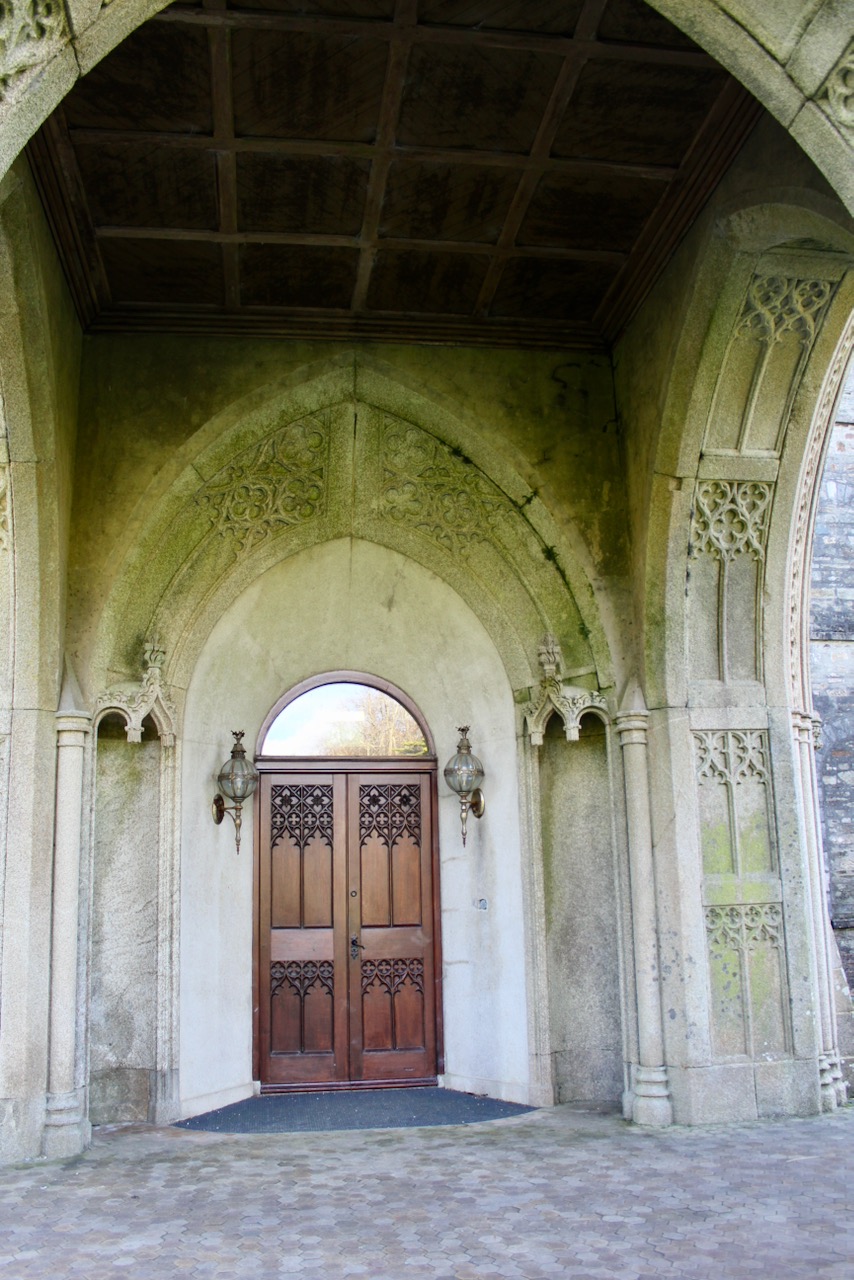
Inside the front arch of Johnstown Castle. Photograph © Jennifer Winder-Baggot, www.irishhistorichouses.com
The Gothic conservatory in the middle. Photograph © Jennifer Winder-Baggot, www.irishhistorichouses.com
Johnstown Castle, County Wexford. Photograph © Jennifer Winder-Baggot, www.irishhistorichouses.com
Mark Bence-Jones continues: “The garden front has two round turrets, a three-sided central bow with tracery windows. Lower wing with polygonal tower.”

Garden front, Johnstown Castle, County Wexford: The garden front has two round turrets, a three-sided central bow with tracery windows. Photograph © Jennifer Winder-Baggot, www.irishhistorichouses.com
The National Inventory describes it:

Detached three-bay three-storey over basement country house, built 1836-72, on an asymmetrical plan centred on single-bay full-height breakfront with single-bay (four-bay deep) single-storey projecting porch-cum-“porte cochère” to ground floor; five-bay three-storey Garden Front (south) with single-bay four-stage turrets on circular plans centred on single-bay full-height bow on an engaged half-octagonal plan…A country house … enveloping a seventeenth-century house remodelled (1810-4) by James Pain (1779-1877) of Limerick (DIA), confirmed by such attributes as the asymmetrical plan form centred on ‘a splendid porch…formed by beautiful Gothic arches with neat light groinings’ (Lacy 1852, 259); the construction in a blue-green rubble stone offset by glimmering Mount Leinster granite dressings not only demonstrating good quality workmanship, but also producing a sober two-tone palette; the diminishing in scale of the multipartite openings on each floor producing a graduated visual impression with the principal “apartments” defined by a polygonal bow; and the battlemented turrets producing an eye-catching silhouette: meanwhile, aspects of the composition clearly illustrate the continued development or “improvement” of the country house ‘under the munificent and highly-gifted Lady Esmonde who never tires of affording employment to the skilful artisans whom she herself has trained’.”

Hamilton Knox Grogan Morgan married Sophia Maria Rowe (1805-1867), daughter of Ebenezer Radford Rowe of Ballyharty, County Wexford.

Hamilton Knox Grogan-Morgan (1807-1854) and his family. Photograph © Jennifer Winder-Baggot, www.irishhistorichouses.com
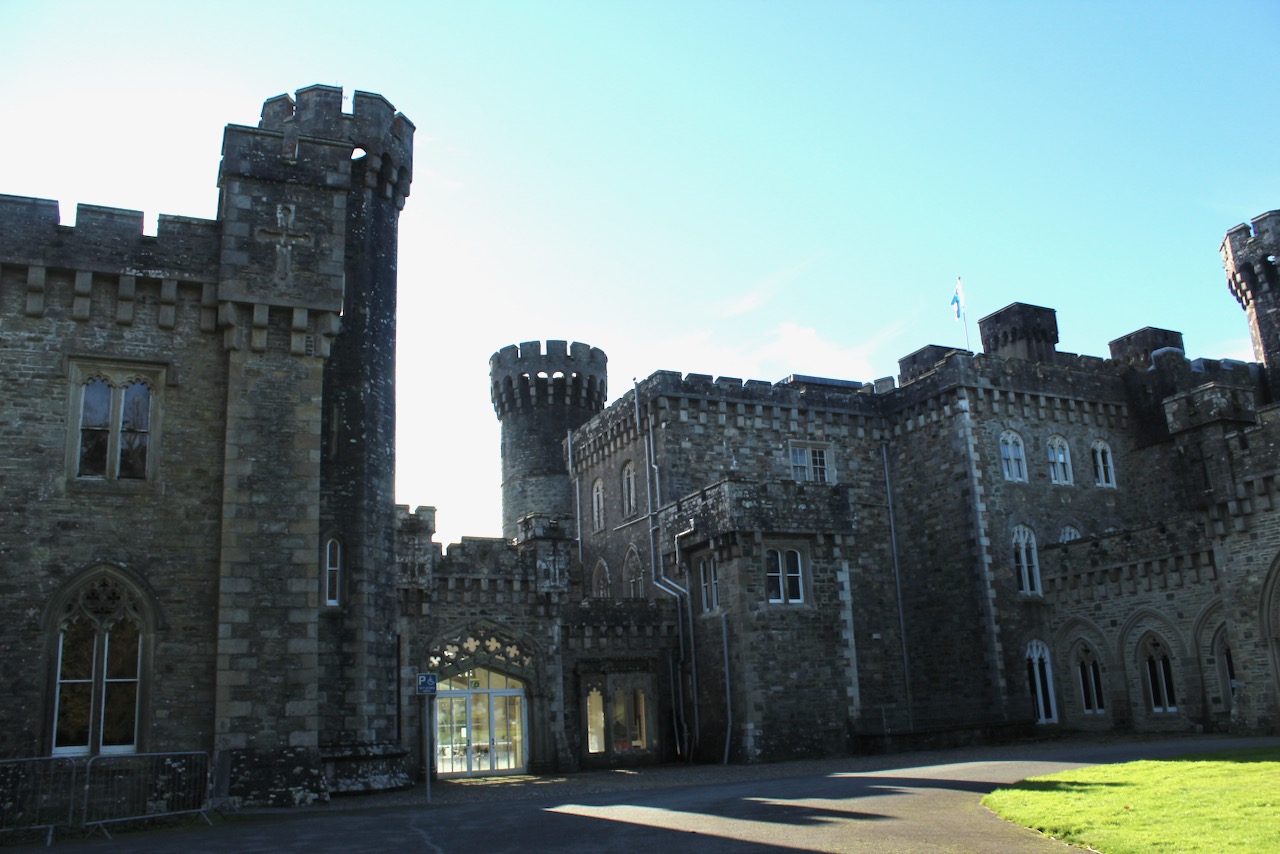
You can see the basement on the garden front. Photograph © Jennifer Winder-Baggot, www.irishhistorichouses.com
Johnstown Castle, County Wexford. Photograph © Jennifer Winder-Baggot, www.irishhistorichouses.com
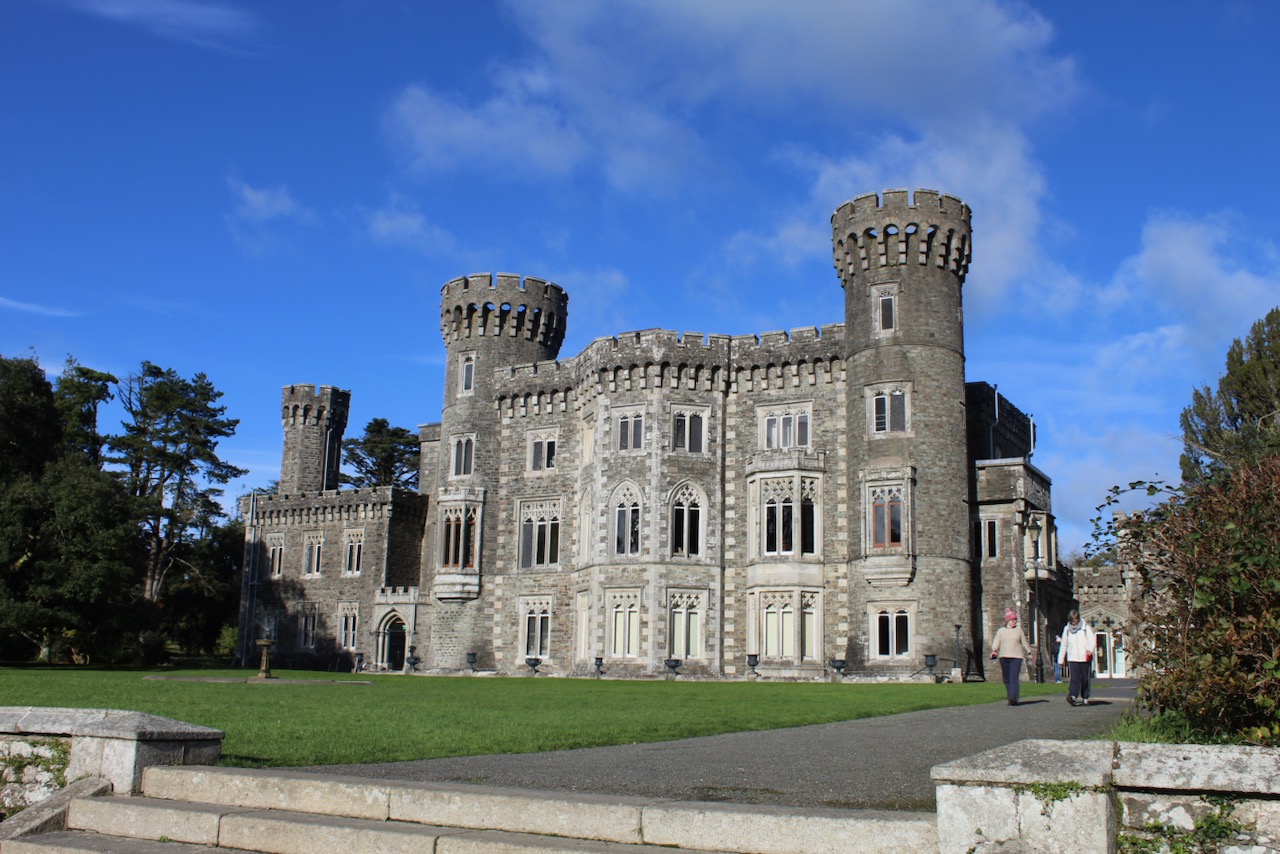
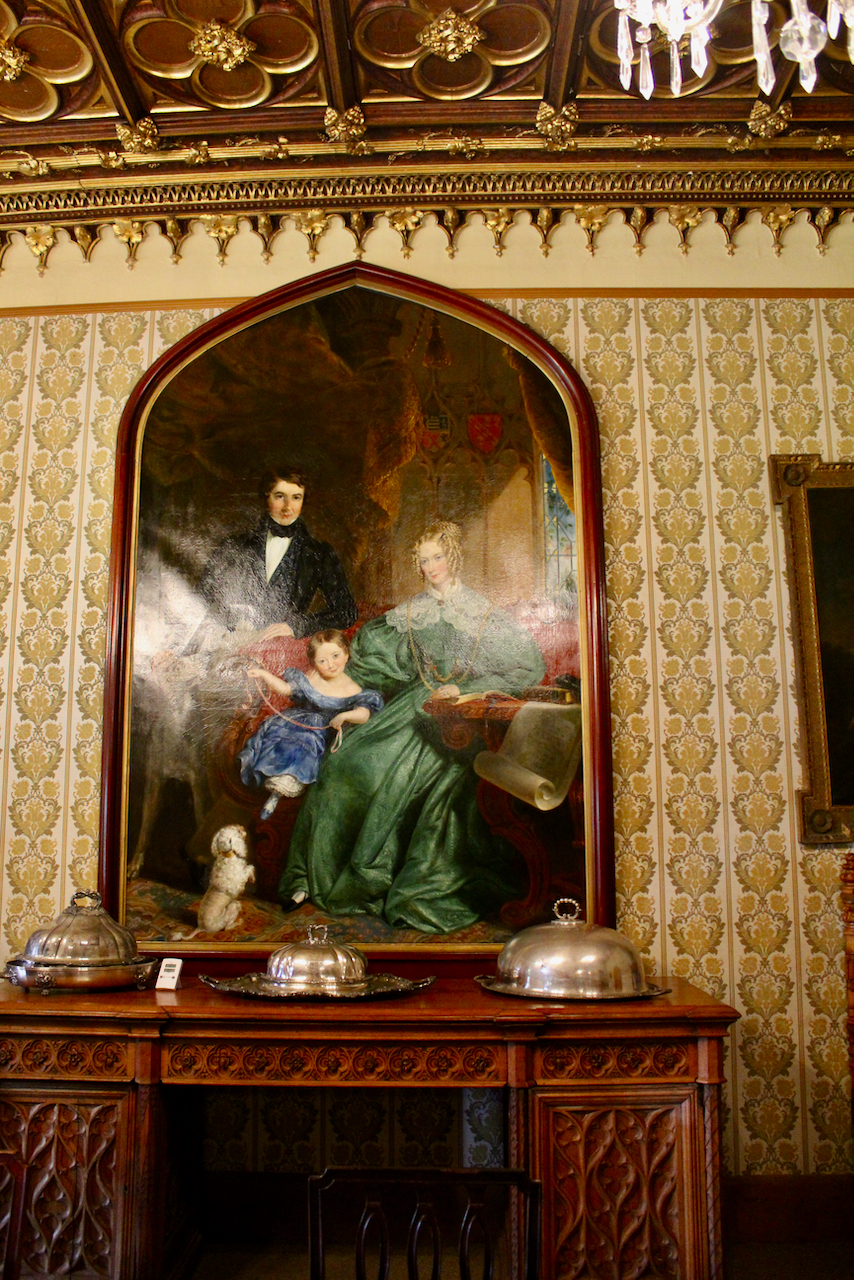
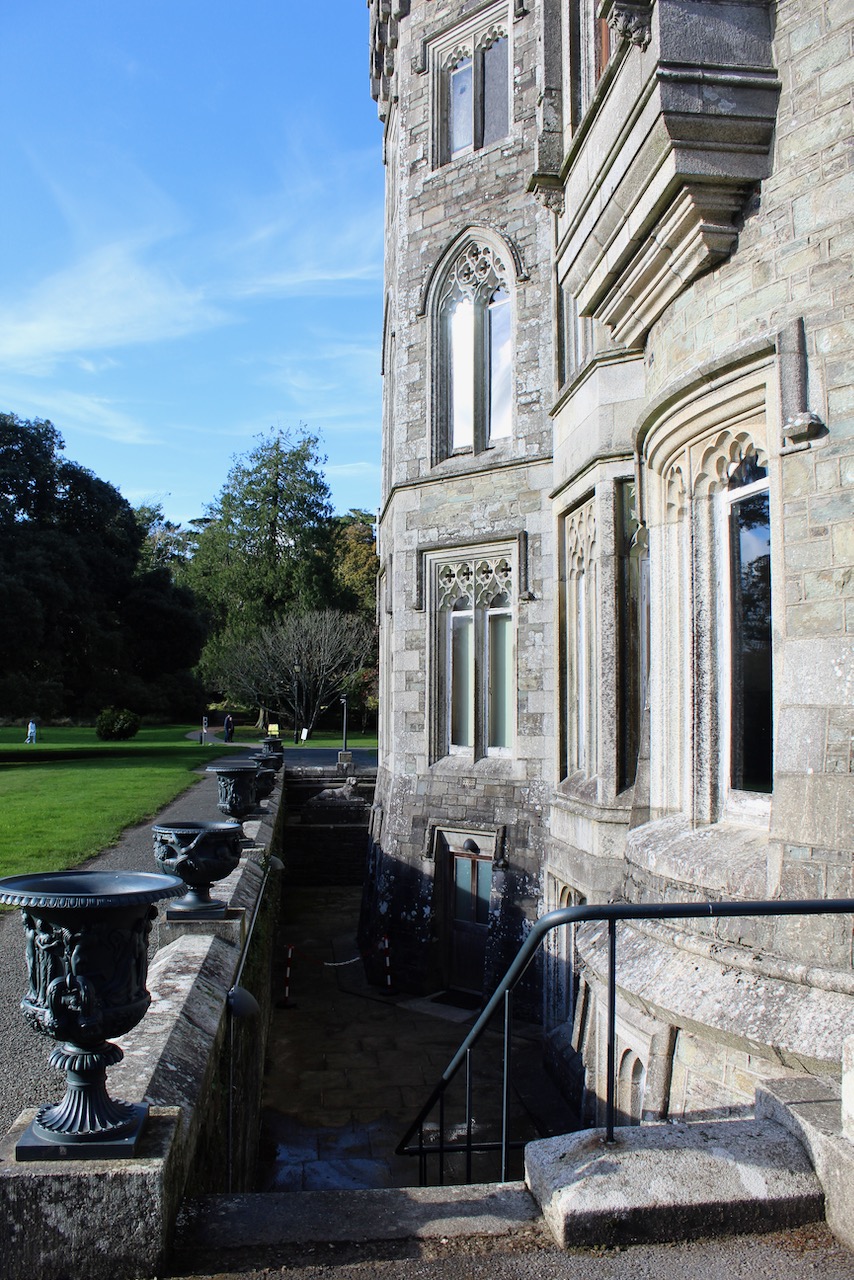
The clock tower side of Johnstown Castle. Photograph © Jennifer Winder-Baggot, www.irishhistorichouses.com
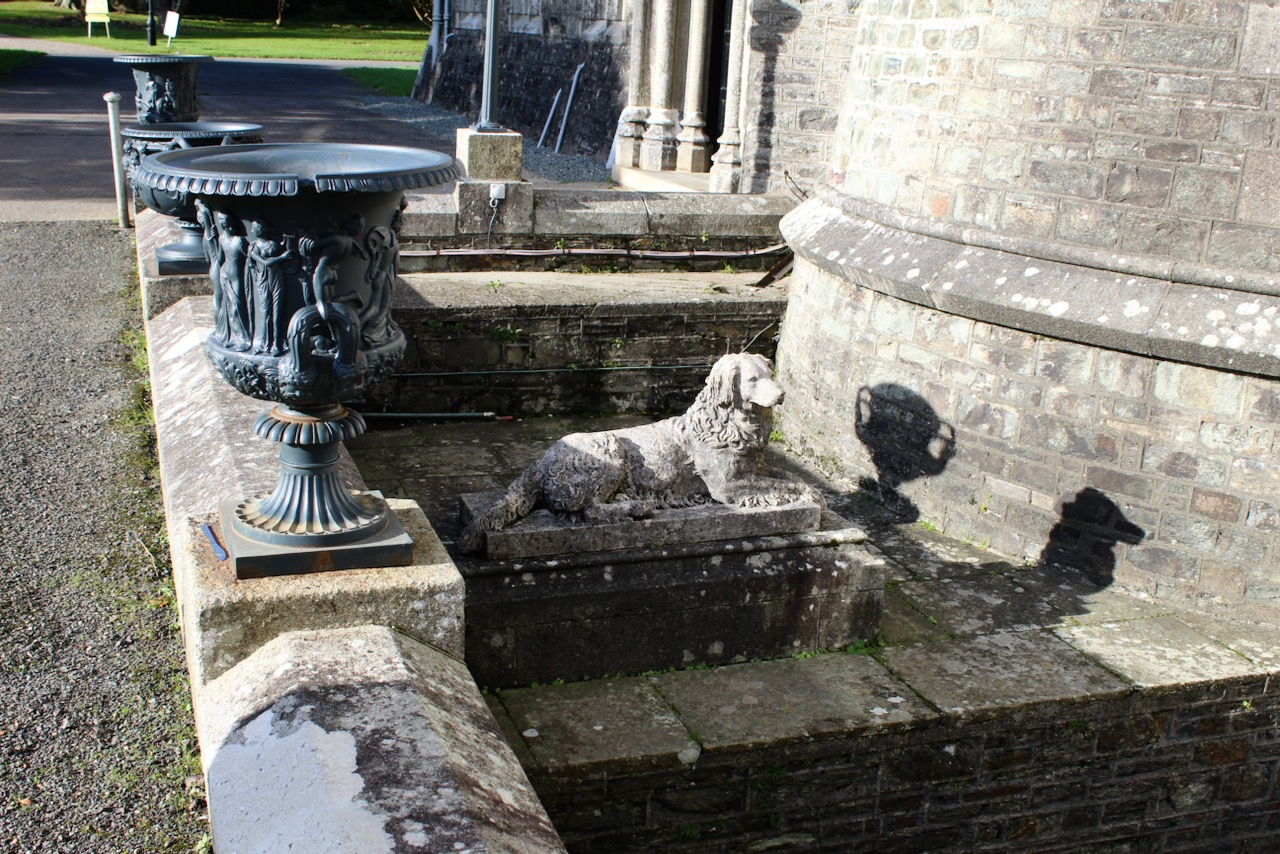
Spectacular doorway arch to one side of Johnstown Castle. Photograph © Jennifer Winder-Baggot, www.irishhistorichouses.com
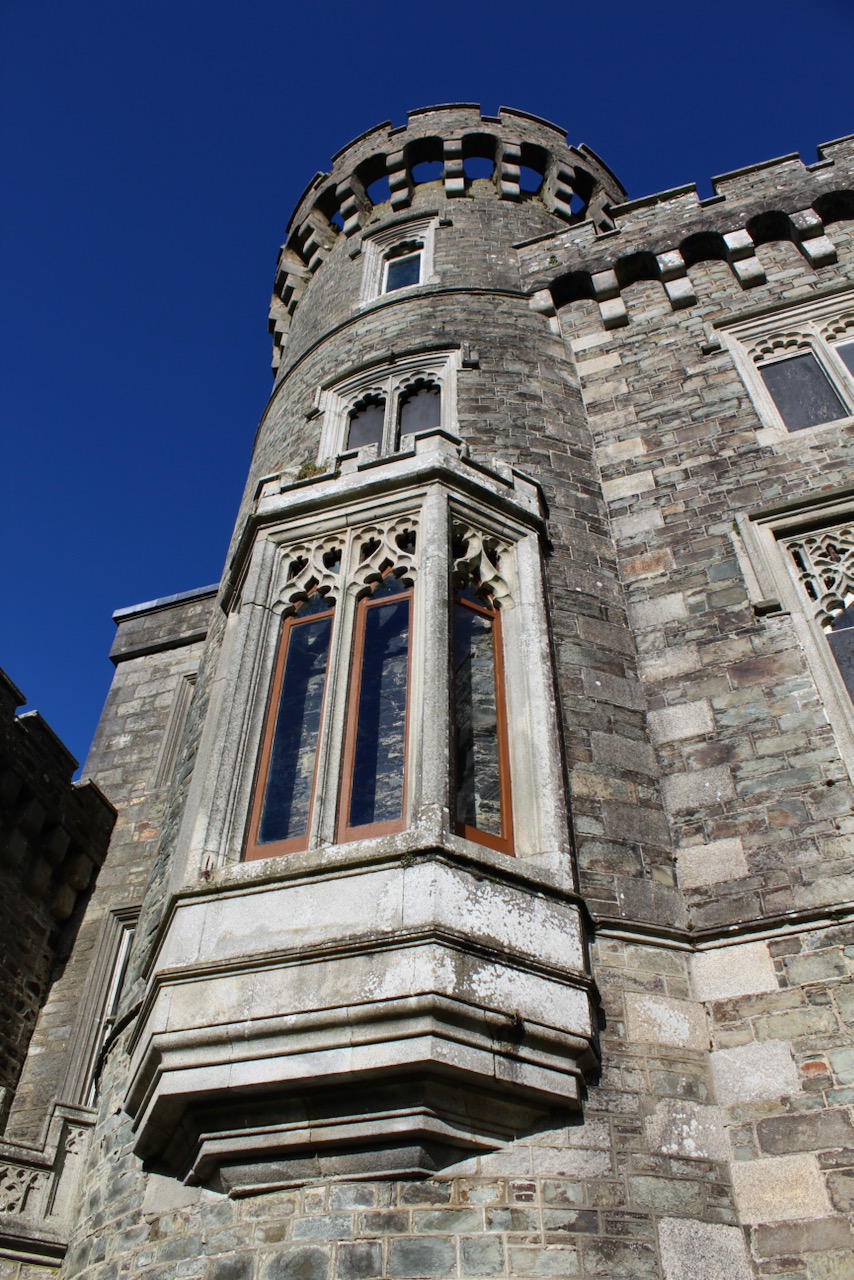
The doorway arch at Johnstown Castle features a border of carved stone heads. Photograph © Jennifer Winder-Baggot, www.irishhistorichouses.com
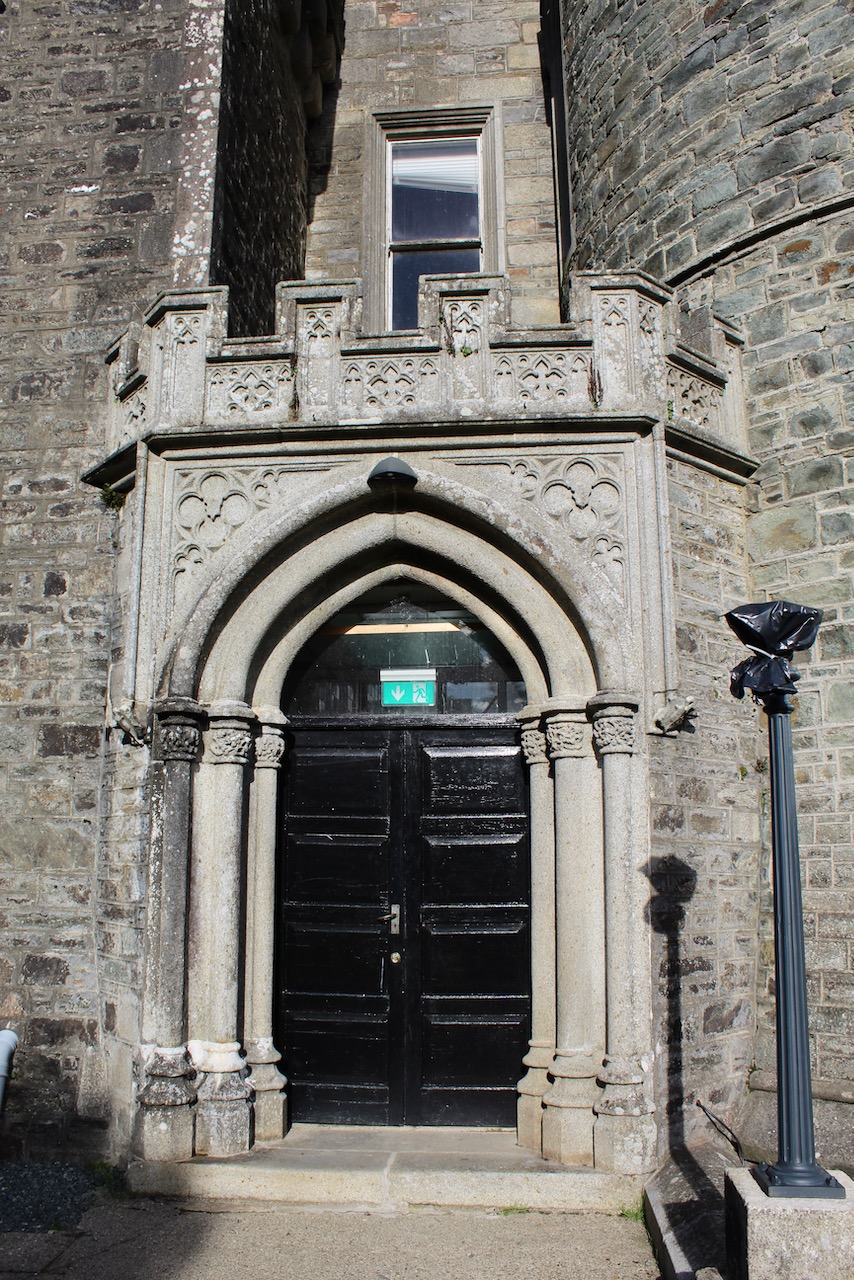
Carved stone heads at Johnstown Castle. Photograph © Jennifer Winder-Baggot, www.irishhistorichouses.com
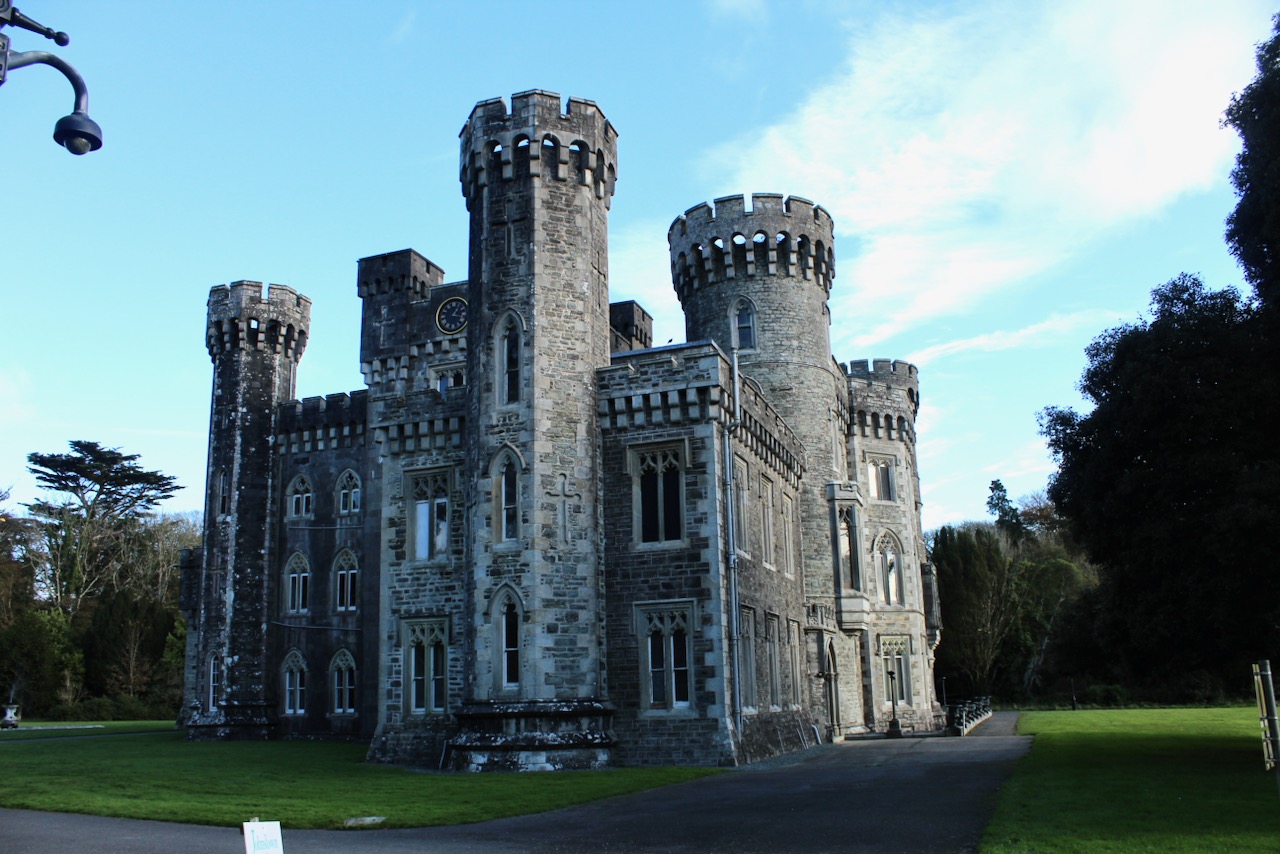
Window surround detail and tracery at Johnstown Castle. Photograph © Jennifer Winder-Baggot, www.irishhistorichouses.com
A workman at Johnstown Castle. Photograph © Jennifer Winder-Baggot, www.irishhistorichouses.com
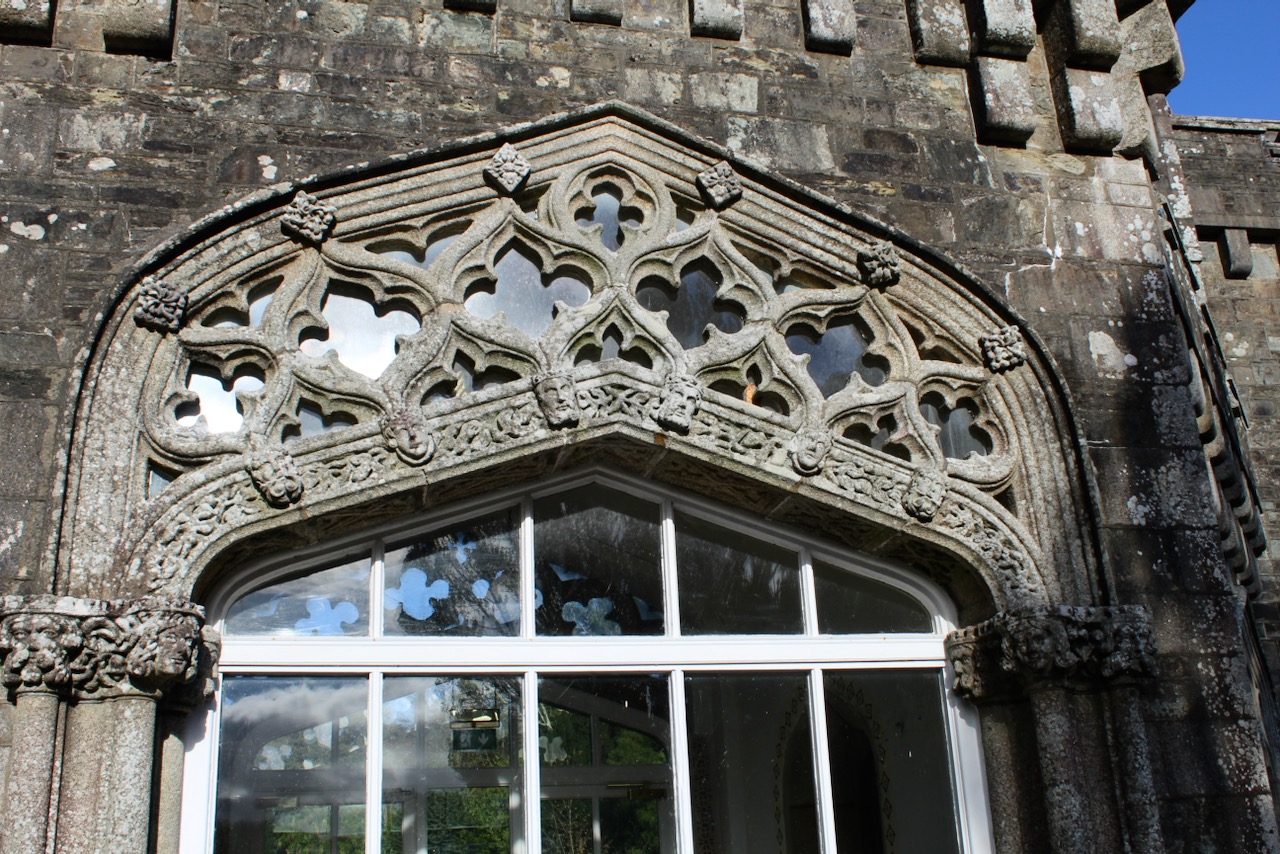
We did not get to see the inside of Johnstown Castle when we visited in November 2021 as it was closed that day, but we visited again in May 2023.

The portico corridor, Johnstown Castle, National Inventory of Architectural Heritage tells us: “corridor on a rectangular plan retaining encaustic tiled floor, Gothic-style timber panelled wainscoting supporting carved timber dado rail, clustered colonette-detailed carved timber surrounds to window openings framing Gothic-style timber panelled shutters on Gothic-style timber panelled risers, and groin vaulted ceiling with carved timber ribs on portrait-detailed oak leaf corbels.” [4] Photograph © Jennifer Winder-Baggot, www.irishhistorichouses.com
Detail of carving in the portico corridor. Photograph © Jennifer Winder-Baggot, www.irishhistorichouses.com
More decorative head carvings. Photograph © Jennifer Winder-Baggot, www.irishhistorichouses.com
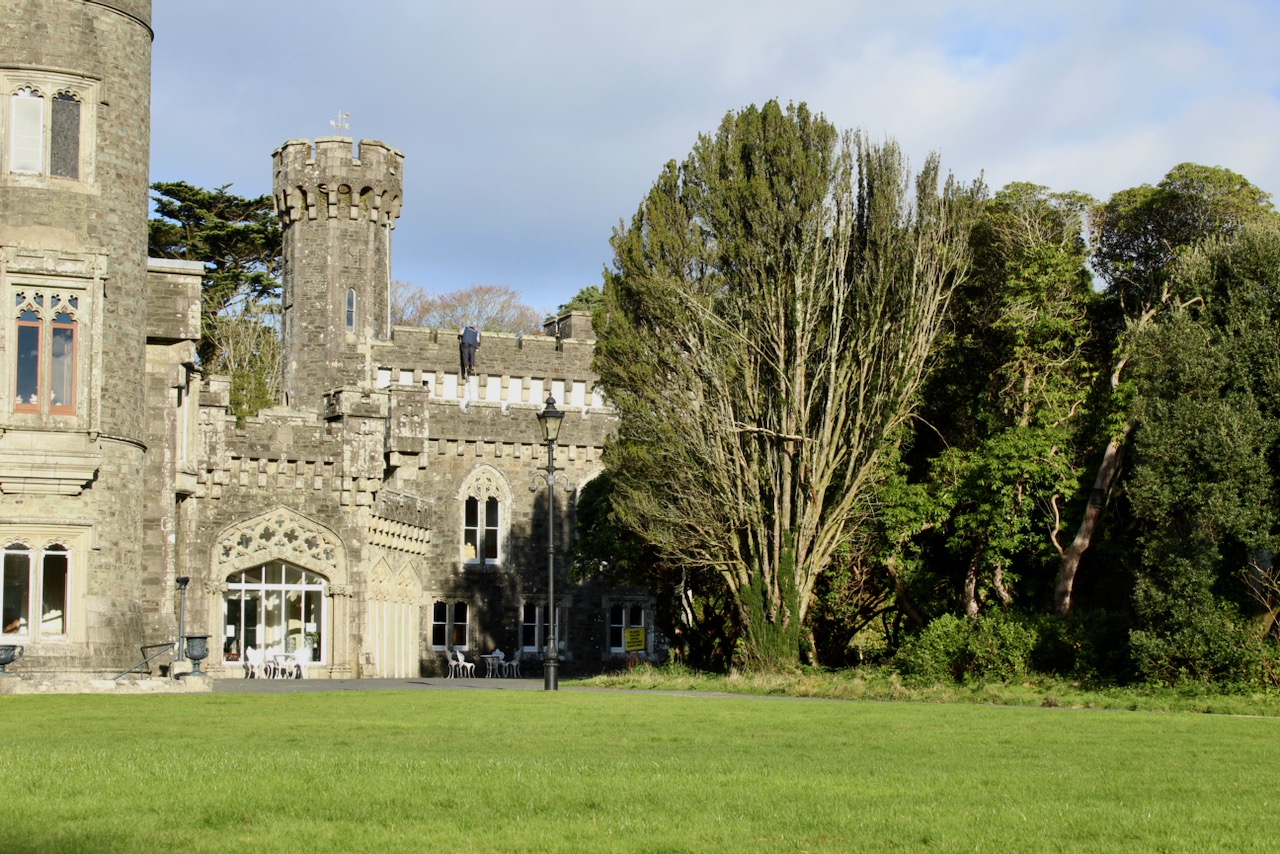
Tile floor of the corridor, Johnstown Castle, photograph from National Inventory of Architectural Heritage. [4]

Hamilton Knox Grogan Morgan’s daughter Jane inherited the estate. Sophia and Hamilton were not happily married, our guide told us. They had no sons, just two daughters. After Hamilton died his wife remarried in 1856, this time to Thomas Esmonde (1786-1868) 9th Baronet of Ballynastragh, County Wexford.

Sophia Maria Knox Grogan Morgan née Rowe (1805-1867) and her second husband, Thomas Esmonde (1786-1868) 9th Baronet.

Sophia was allowed to remain living in the house, and her husband moved in with her.

There is a story that in order to inherit the estate, the daughters were made to run a race to see who would win, and thus inherit! Jane won the race.

Johnstown Castle. Jane Colclough Grogan-Morgan portrait by Margaret Carpenter, 1846. Photograph © Jennifer Winder-Baggot, www.irishhistorichouses.com

The other daughter of Hamilton Knox Grogan Morgan, Elizabeth Geraldine, married Robert Tilson FitzMaurice Deane (1826-1857), son of Matthew Fitzmaurice Deane, 3rd Baron Muskerry of County Cork. In 1854 his name was legally changed to Robert Tilson FitzMaurice Deane-Morgan by Royal Licence.

Jane married George Arthur Forbes (1833-1889), 7th Earl of Granard, County Longford. Jane did not get along well with her mother. Her mother was a Protestant, and Jane and her husband converted to Catholicism. They built a church in Newtown Forbes in Longford. Jane’s mother tried to disinherit her but her new will was signed with an “x” and the judge said it didn’t stand up in court.

Jane Colclough Grogan-Morgan (1834-1872), and next to her picture is George Arthur Forbes (1833-1889) 7th Earl of Granard.

Jane was charitable and on her death there was a headline announcing “death of princess,” our guide told us. The Earl of Granard married a second time after Jane died, and had several more children. He lived in Castle Forbes in County Longford. He married Frances Mary Petre, daughter of William Bernard Petre, 12th Baron Petre of Writtle, Co. Essex in England.

Jane and George Arthur had two daughters, Sophia Maria Elizabeth and Adelaide Jane Frances. Sophia married Henry Christopher Grattan-Bellew, 3rd Baronet Bellew, of Mount Bellew, Co. Galway. Adelaide married Maurice Fitzgerald (1852-1901), son of the 4th Duke of Leinster, of Carton House in County Kildare. They inherited the estate at Johnstown Castle.

Maurice Fitzgerald (1852-1901) and his wife, Adelaide.
Henry Grattan Bellew, 3rd Baronet, b.1860, married Sophia Forbes, daughter of the Earl of Granard, by Dermod O’Brien, courtesy of Adam’s auction 10 Oct 2017. He represented one of the few Catholic aristocratic families who survived Cromwellian deportation to Connaught. Mount Bellow was an architecturally significant house with a fine library of books; the former destroyed, the latter dispersed.
Information board at Johnstown Castle.

Adelaide (1860-1942) converted to Protestantism to marry the Maurice Fitzgerald (1852-1901). Like her mother, she undertook much charity work. She brought the first motorised ambulance to County Wexford.

Adelaide and Maurice had four children: Geraldine (1881-1954), Gerald Hugh (1886-1914), Kathleen (1892-1930) and Marjorie (1896-1899).

Geraldine married Gerald More O’Ferrall (d. 1951) of Lissard House, County Longford (now demolished). Adelaide and Maurice’s son Gerald died in WWI in France. He had married Dorothy Violet Charrington from England. After his death, she remarried, to Thomas William Jefferies of Wexford.

A daughter of Maurice Fitzgerald and Adelaide Jane, Geraldine, married Gerald More O’Ferrall.

Kathleen married Major Michael Lakin (1881-1960) of Horetown House, County Wexford, and it was their son Maurice Victor Lakin (d. 1919) who inherited the estate. His brother Gerald fought in World War II and died in Africa in 1943. Kathleen died tragically in a horse riding accident when she was just 37 years old.

Wedding photograph of Michael Lakin (1881-1960) of Horetown House who married Kathleen Fitzgerald (1892-1930) in 1914. He is next to Inez Charlotte Grace Casberd-Boteler, I presume as she is listed as Lady Henry Fitzgerald, and Henry was another son of Charles William Fitzgerald, 4th Duke of Leinster. She is next to the wife of Maurice Fitzgerald, Adelaide Jane Frances née Forbes, who is next to Captain Gerald Fitzgerald (1851-1893), 5th Duke of Leinster. Is the centre is Captain Michael Lakin’s father, also Michael, 1st Baronet Lakin, of The Cliff, Co. Warwick. He is next to Bell Irvine, best man, who is next to Miss C. Paget (bridesmaid), and Miss. D Charrington. The page is Andrew Horsburgh Porter, and Kathleen the bride is seated.
Horetown House, County Wexford, photograph courtesy of Horetown website.

Maurice Victor Lakin, pictured below, was the last man to privately own the castle and estate before handing it over to the state.

Johnstown Castle, County Wexford.

Maurice Victor Lakin gifted it to the state in 1945.

The Grogan-Morgan family tree.
Explanation of the handover to the state and Department of Agriculture.

After walking through the entrance corridor a room is reached called the “Apostles’ Hall” due to the wooden carvings. The National Inventory continues:

A prolonged period of unoccupancy notwithstanding, the elementary form and massing survive intact together with substantial quantities of the original fabric, both to the exterior and to the interior where encaustic tile work; the so-called “Apostles Hall” with ‘oak panelling and carving of the most costly description’ (Lacy 1852, 268); contemporary joinery ‘by poor Mooney who may be said to have lived and died in the employment of the munificent proprietor [and who was] succeeded by another native genius [named] Sinnott’ (ibid., 269); restrained chimneypieces in contrasting neo-Classical or Egyptian Revival styles; and geometric ceilings recalling the Robertson-designed Wells House (1836-45), all highlight the considerable artistic significance of the composition.

The “Apostles Hall,” Johnstown Castle, County Wexford. Photograph © Jennifer Winder-Baggot, www.irishhistorichouses.com
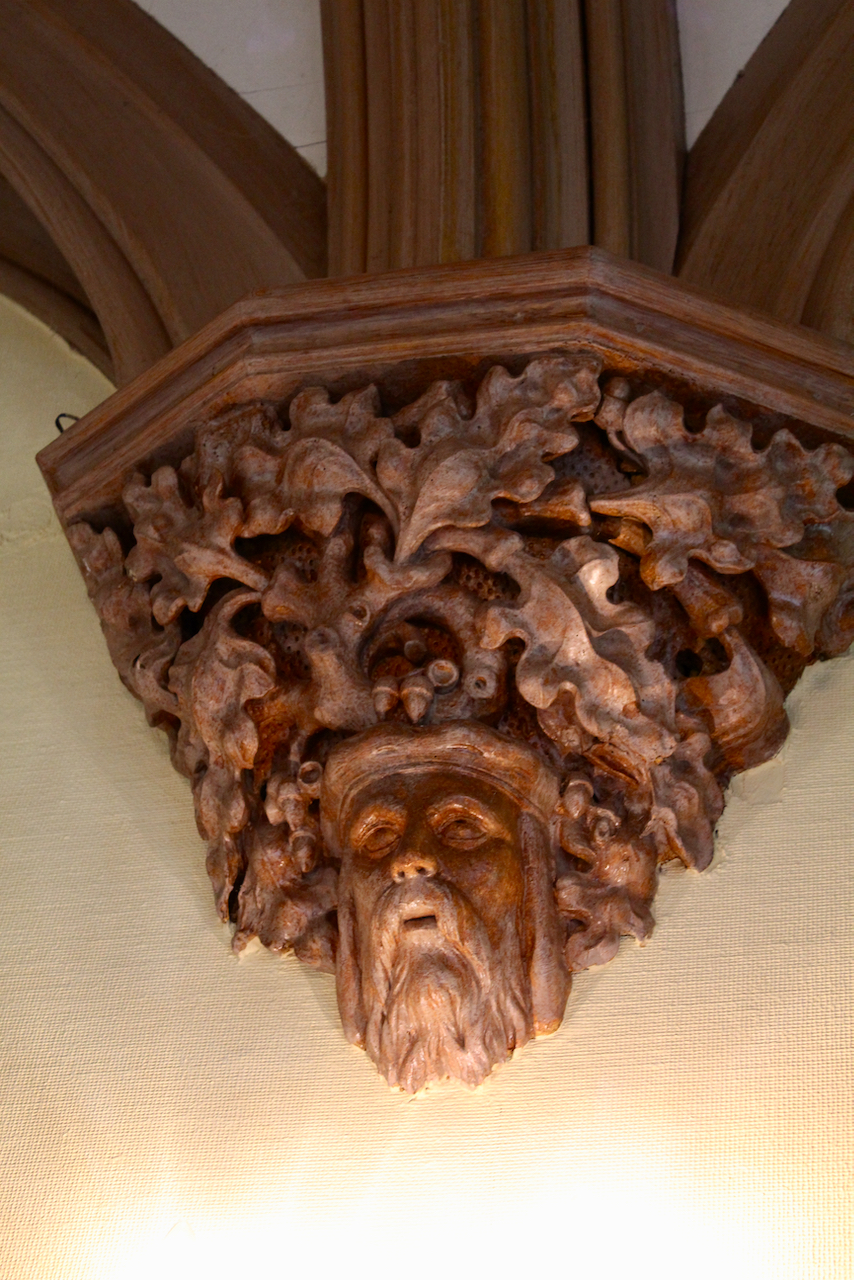
The Apostles in the Apostles Hall. Photograph © Jennifer Winder-Baggot, www.irishhistorichouses.com
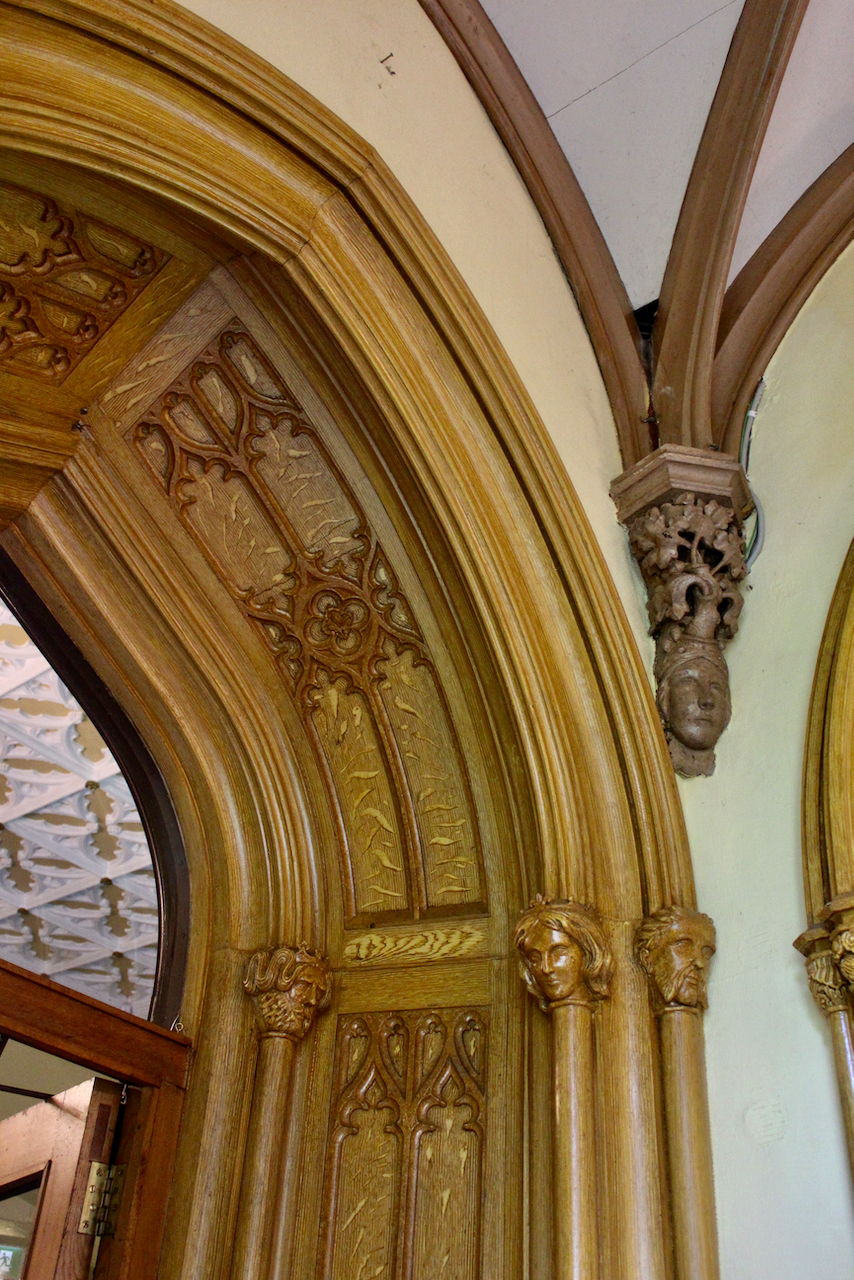
Johnstown Castle, Apostles Hall. Photograph © Jennifer Winder-Baggot, www.irishhistorichouses.com
Wood carving in the Apostles Hall. Photograph © Jennifer Winder-Baggot, www.irishhistorichouses.com

From the Apostles Hall you enter a top-lit three storey galleried space. Our guide told us that this used to be a music room. The National Inventory of Architectural Heritage describes it: “top-lit triple-height “Grand Hall” on a square plan retaining tessellated “Asphaltum” tiled floor, clustered colonette-detailed carved timber surrounds to door openings framing Gothic-style timber panelled doors, arcaded galleries (upper floors) with carved timber hand rails, and fan vaulted plasterwork ceiling centred on replacement glass block-filled mass concrete dome.” [4]

The Waterford Crystal chandelier in the former music room. Photograph © Jennifer Winder-Baggot, www.irishhistorichouses.com
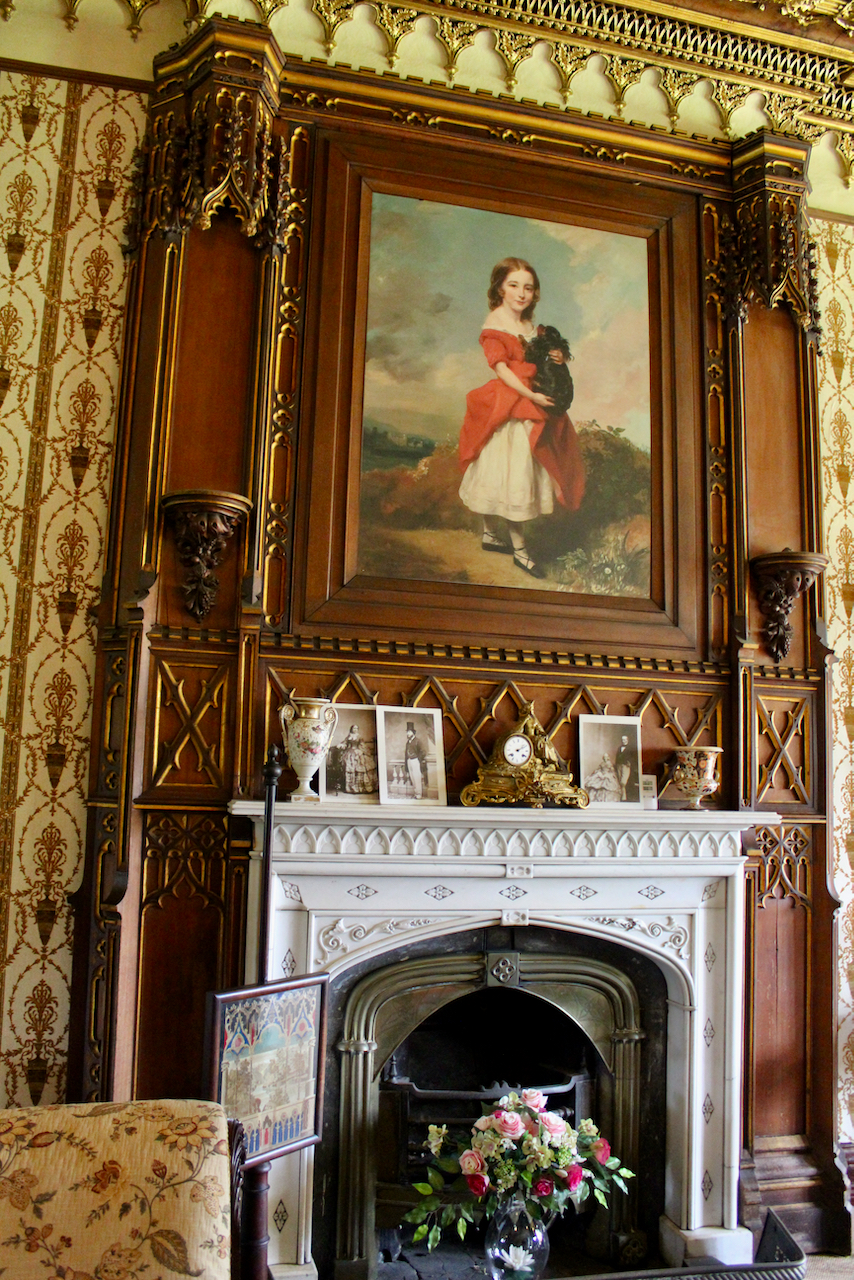
Ground floor of the three tiered gallery space. Photograph © Jennifer Winder-Baggot, www.irishhistorichouses.com
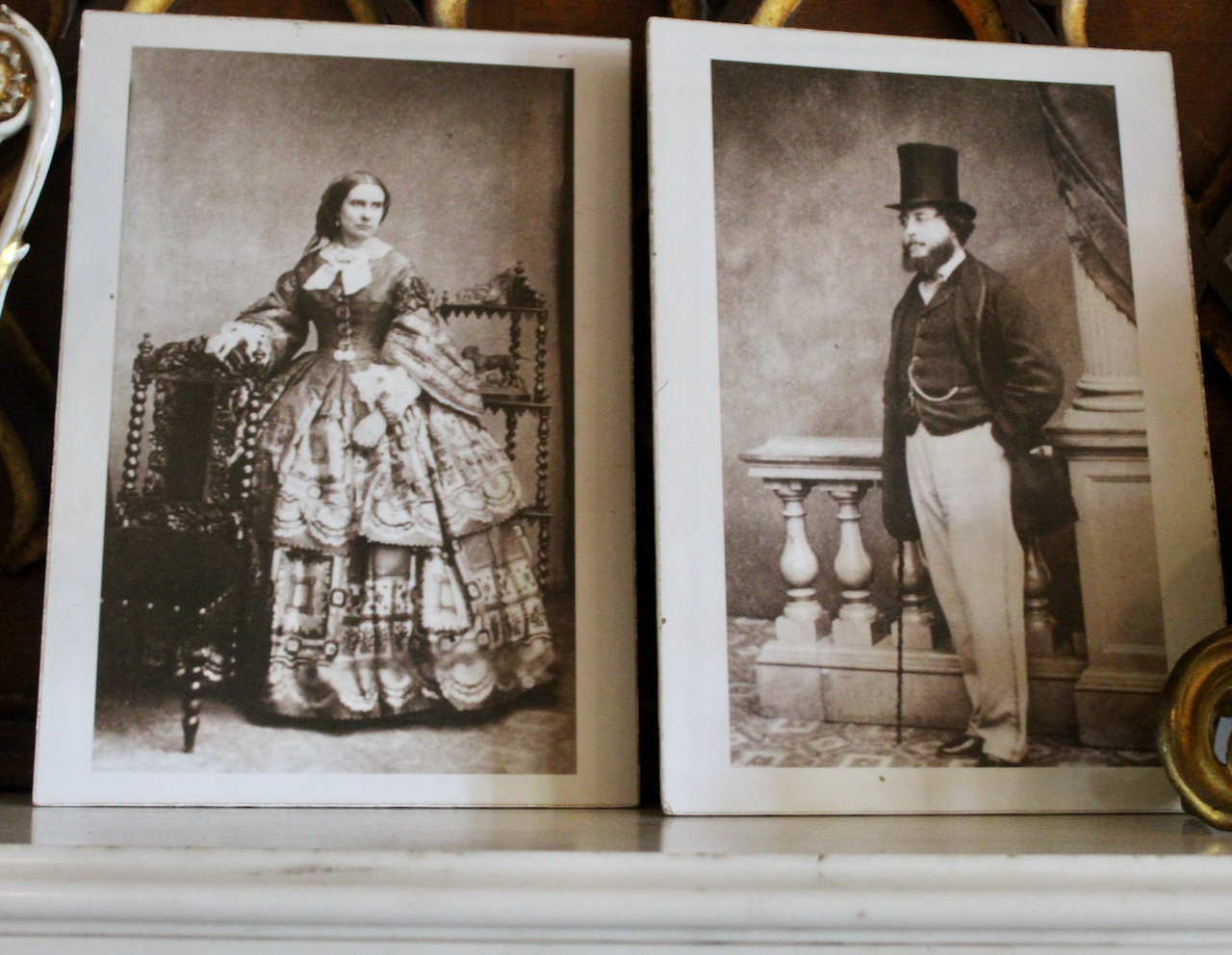
Ground floor of the three tiered gallery space. The table with quatrefoil carving belonged to the Knox Grogan Morgans. Photograph © Jennifer Winder-Baggot, www.irishhistorichouses.com
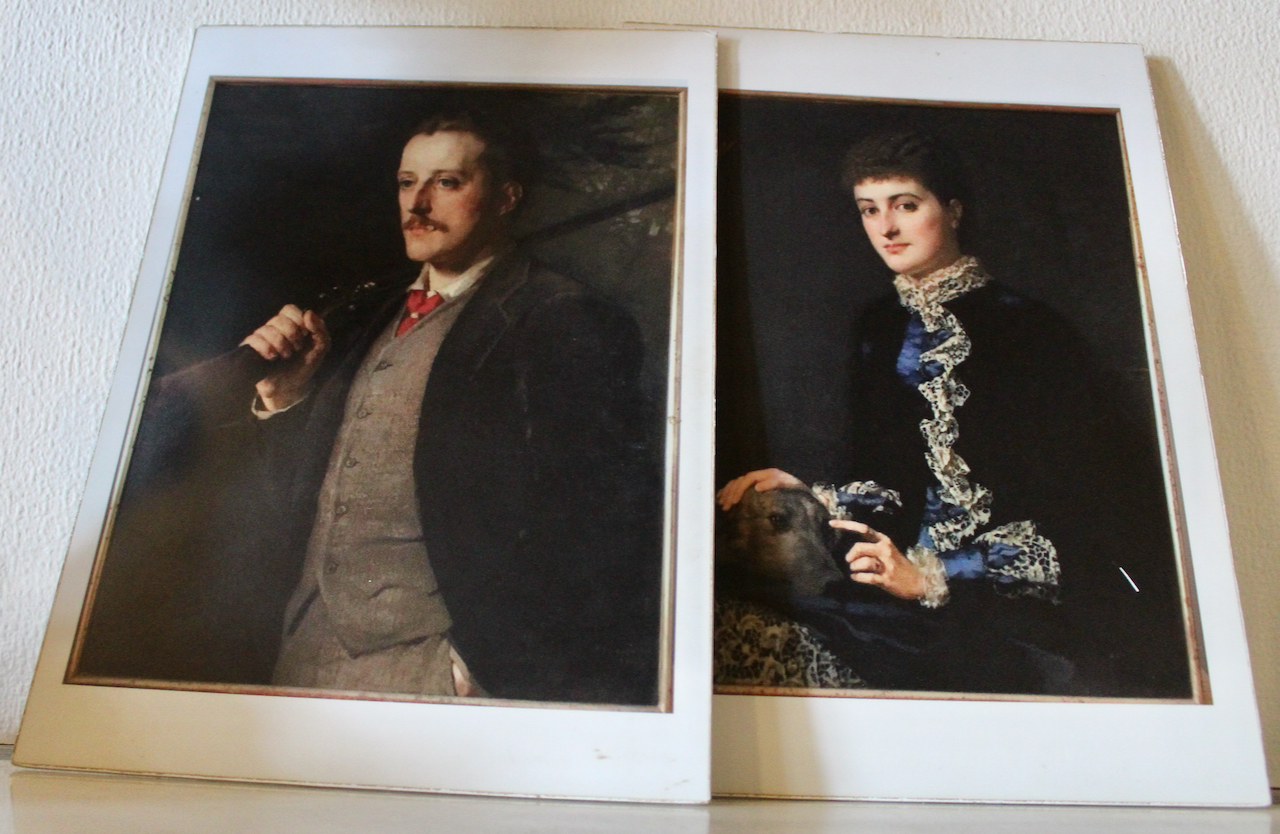
As well as hosting musical events in this space, tenants would be given Christmas dinner here. Mary told us that the owners were good to their tenants.

Johnstown Castle, ground floor of the three tiered gallery space. This cabinet of birds is original to the castle. Photograph © Jennifer Winder-Baggot, www.irishhistorichouses.com
Top-lighting in the fan vaulted gallery, Johnstown Castle. The guide told us there used to be stained glass here. Photograph © Jennifer Winder-Baggot, www.irishhistorichouses.com
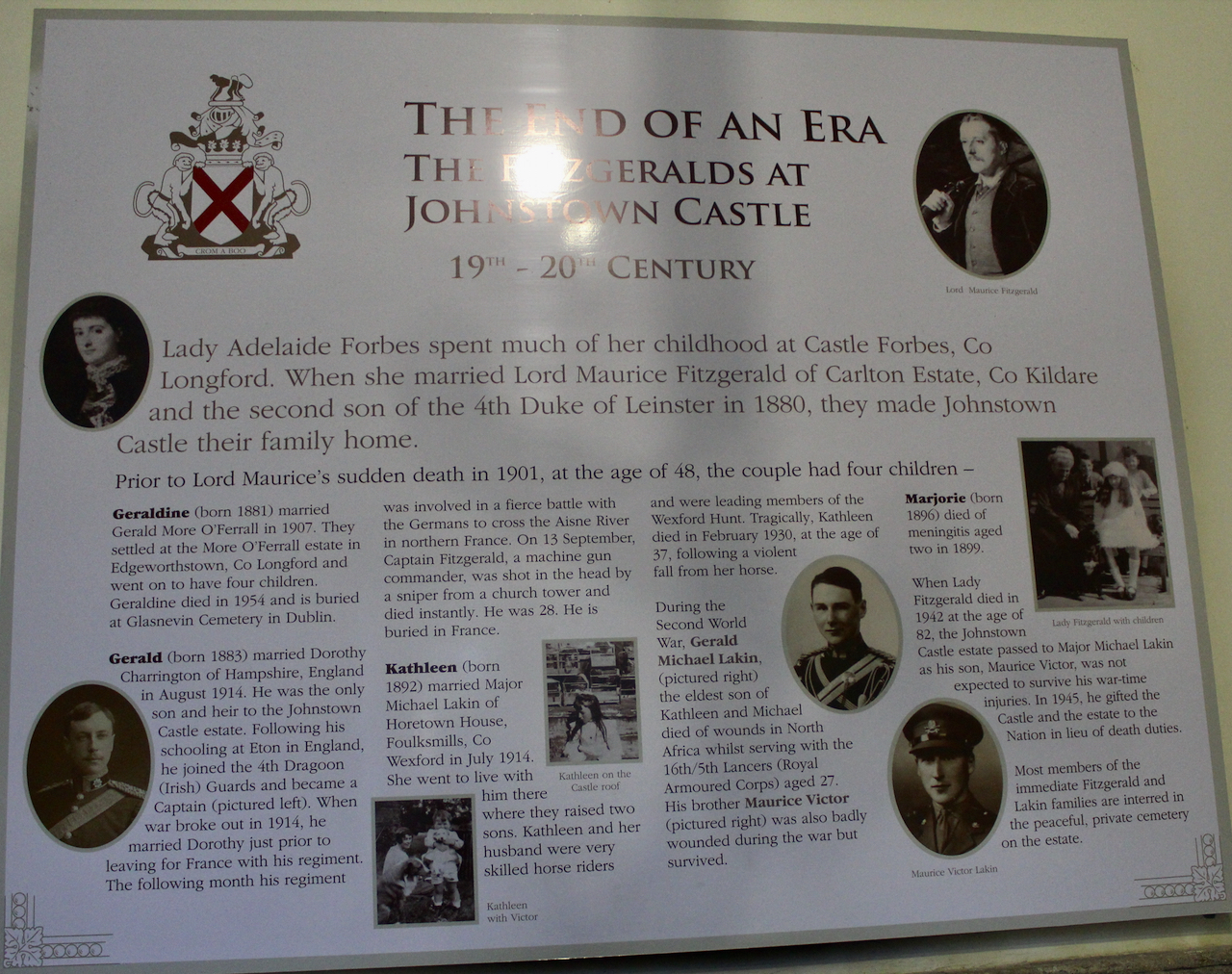
The fan vaulted plasterwork has funny heads around the edges. Photograph © Jennifer Winder-Baggot, www.irishhistorichouses.com
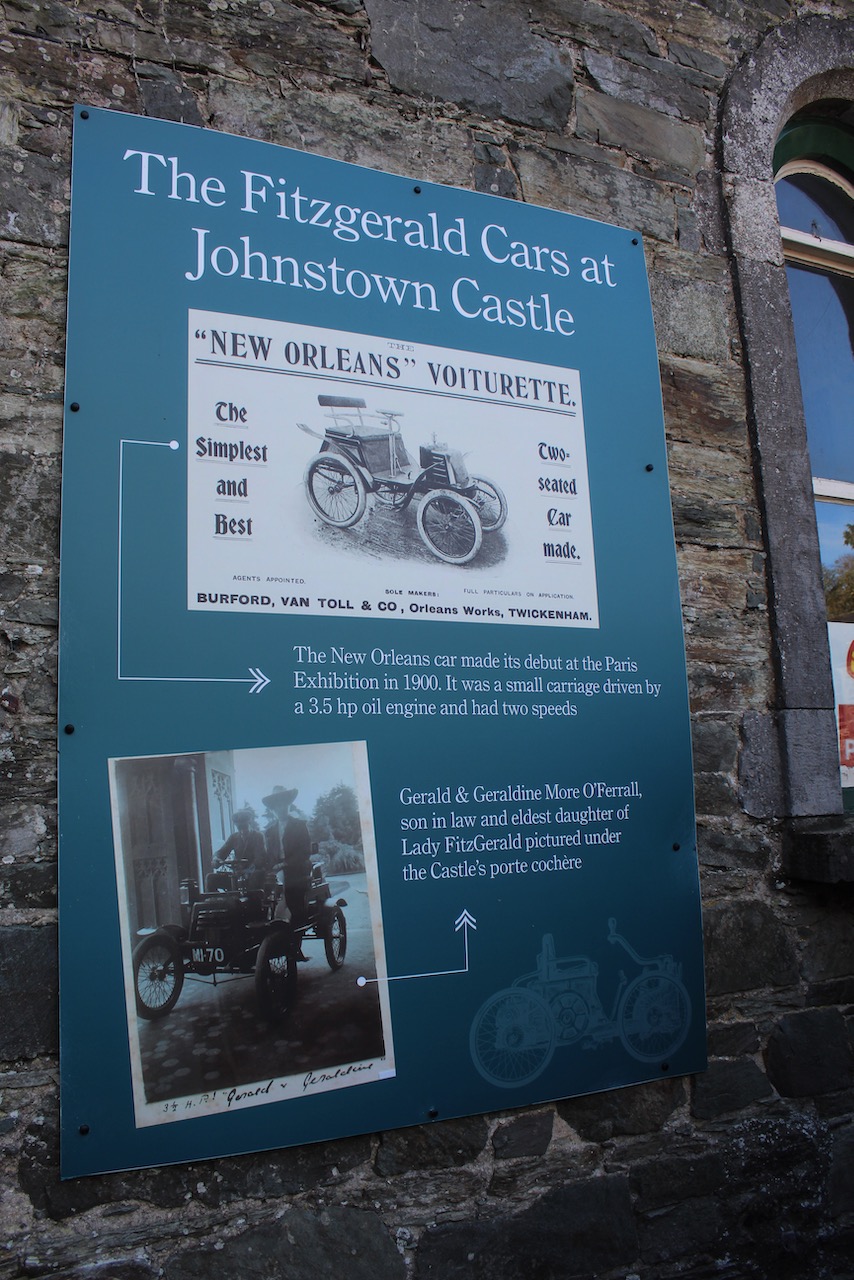
Johnstown Castle, first floor and second floor galleries. Photograph © Jennifer Winder-Baggot, www.irishhistorichouses.com
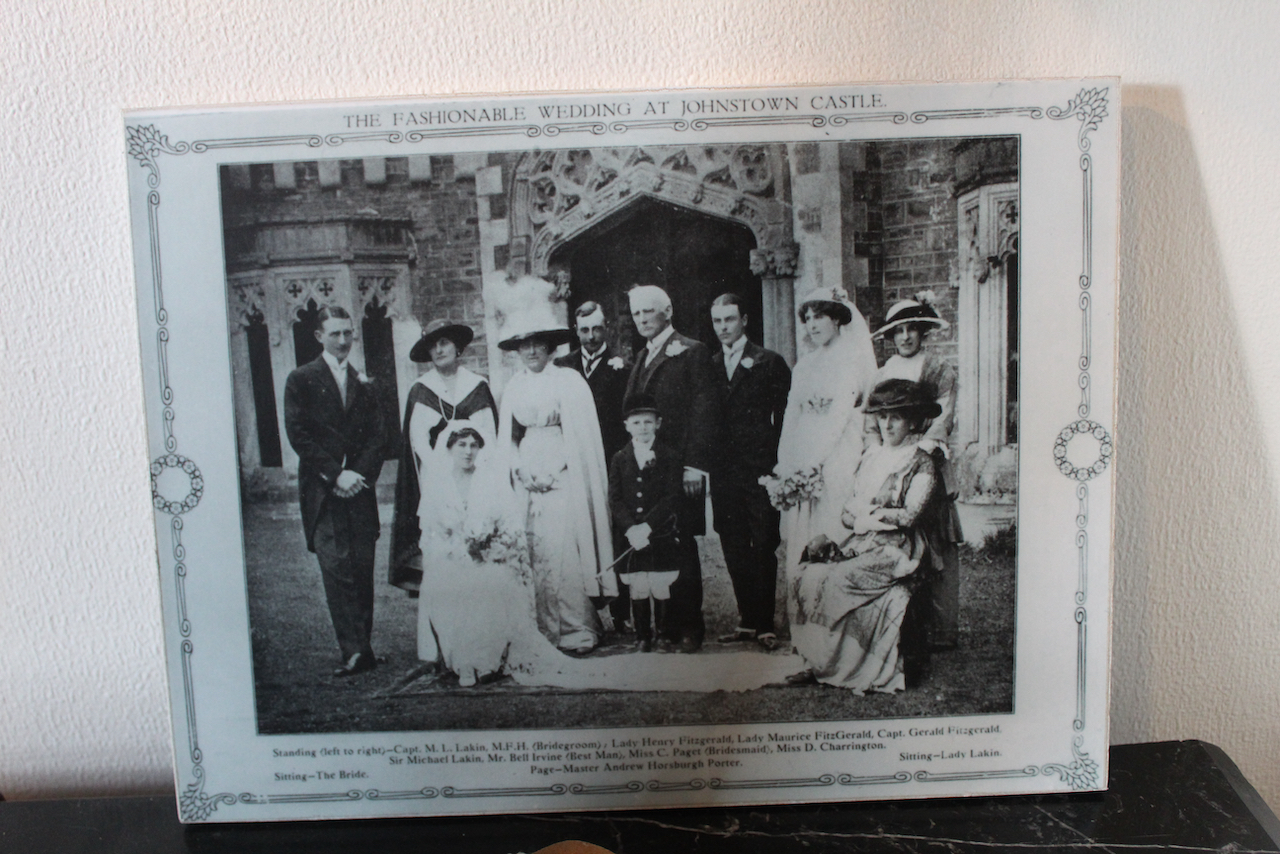
Photograph © Jennifer Winder-Baggot, www.irishhistorichouses.com

A grand staircase was removed, and the balcony remains:

The grand staircase was removed, unfortunately – see this picture with staircase intact.
The balustrade was extended, and the armorial shield added, after the staircase was removed. Photograph © Jennifer Winder-Baggot, www.irishhistorichouses.com
The doorway under where the stairs used to be, and the remaining balustrade. Photograph © Jennifer Winder-Baggot, www.irishhistorichouses.com

The next room is the: “bow-ended dining room (south) retaining clustered colonette-detailed carved timber surround to door opening framing timber panelled door with clustered colonette-detailed carved timber surrounds to opposing window openings framing Gothic-style timber panelled shutters on Gothic-style timber panelled risers.”

Johnstown Castle, photograph from National Inventory of Architectural Heritage: “bow-ended dining room” [4]
The windows were boarded up for repair when we visited. This room is identified as the dining room in the National Inventory, but holds bookcases so was probably not the dining room. Photograph © Jennifer Winder-Baggot, www.irishhistorichouses.com
The carving on the window embrasure is very complex. Photograph © Jennifer Winder-Baggot, www.irishhistorichouses.com
Johnstown Castle, detail of ceiling. Photograph © Jennifer Winder-Baggot, www.irishhistorichouses.com
Bookcases. Photograph © Jennifer Winder-Baggot, www.irishhistorichouses.com
The bookcases are beautifully carved. Photograph © Jennifer Winder-Baggot, www.irishhistorichouses.com
The bookcases are topped with armorial shields. Photograph © Jennifer Winder-Baggot, www.irishhistorichouses.com
Some of the original furniture has been brought back to the castle. Photograph © Jennifer Winder-Baggot, www.irishhistorichouses.com
Gothic style chimneypiece. Photograph © Jennifer Winder-Baggot, www.irishhistorichouses.com

The National Inventory tells us that Armorial panels over the glazed-in carriageway and on the dining room chimneypiece show a coat of arms combining three bears heads couped and muzzled [Forbes] centred on a griffin sergeant [Morgan] representing the marriage of George Arthur Hastings Forbes (1833-89), seventh Earl of Granard, and Jane Colclough Morgan (1840-72) with Order of Saint Patrick motto “QUIS SEPARABIT MDCCLXXXIII [Who Will Separate Us 1783]” recognising the earl’s investment as a Knight of the Order of Saint Patrick (K.P.) in 1857. 

Napolean scowls into the room.
Ceiling detail in Johnstown Castle. Photograph © Jennifer Winder-Baggot, www.irishhistorichouses.com
Grogan bookplates. We see the bookplate of Overstreet Grogan (1762-1814), a son of John Grogan (1716-1783) and his wife Catherine Knox.
Grogan livery buttons.

The next room contains the Hamilton Knox portrait.

Johnstown Castle. Photograph © Jennifer Winder-Baggot, www.irishhistorichouses.com
The painting of Hamilton Knox Grogan Morgan and his family.
The little dog Lady Morgan, who sports a rather unattractive haircut, makes up for it with her gold collar. Photograph © Jennifer Winder-Baggot, www.irishhistorichouses.com
The pinecones stops anyone sitting on the original furniture! This couch is the same one as in the painting of Hamilton Knox Grogan Morgan and his family. Photograph © Jennifer Winder-Baggot, www.irishhistorichouses.com

It was quite a process to situate the newly restored couch into the castle’s room upstairs, as we see in this photograph below:

Moving the couch. Photograph © Jennifer Winder-Baggot, www.irishhistorichouses.com

After giving the property to the state, the Lackin family moved to France. They retained the hunting, fishing and burial rights to the property. Recently Victor Lackin’s grandson visited, and he fished in the lake, and had his photograph taken by his ancestor’s portrait. He is very like Hamilton Knox Grogan-Morgan!

A descendant of Hamilton Knox Grogan-Morgan.
18th Century Irish School “Portrait of John Stratford, 1st Earl of Aldborough,” Photograph © Jennifer Winder-Baggot, www.irishhistorichouses.com
Beautiful views of the parkland. Photograph © Jennifer Winder-Baggot, www.irishhistorichouses.com
The dining room. Photograph © Jennifer Winder-Baggot, www.irishhistorichouses.com
Coat-of-arms-detailed cut-veined green marble Gothic-style chimneypiece in Gothic-style timber surround, and picture railing below grape-and-vine-detailed cornice to quatrefoil-detailed compartmentalised ceiling in carved timber frame” from National Inventory of Architectural Heritage. [4]
Grape-and-vine-detailed cornice. Photograph © Jennifer Winder-Baggot, www.irishhistorichouses.com
A portrait in Johnstown Castle – 18th Century Irish School “Portrait of the 2nd Countess of Aldborough,” a charming three-quarter length study, seated in pink dress, with jewels, and seated by a table with coronet. She was the wife of Edward Augustus Stratford, 2nd Earl of Aldborough.
Beside the Grogan Morgan family portrait is 18th Century Irish School “Portrait of Martha, 1st Countess Aldborough.” She is Martha O’Neale (1707-1796), daughter of Benjamin O’Neale, Archdeacon of Leighlin and Ferns. Photograph © Jennifer Winder-Baggot, www.irishhistorichouses.com
Johnstown Castle, hallway. Photograph © Jennifer Winder-Baggot, www.irishhistorichouses.com
Detail of the carved door frames at Johnstown Castle. Photograph © Jennifer Winder-Baggot, www.irishhistorichouses.com
The principal Drawing Room in Johnstown Castle. Photograph © Jennifer Winder-Baggot, www.irishhistorichouses.com

The next room, the principal Drawing Room, features two huge mirrors brought from Paris at one end of the room, installed in about 1860.

The Principal Drawing Room in Johnstown Castle. Photograph © Jennifer Winder-Baggot, www.irishhistorichouses.com
Johnstown Castle, our tour guide, Mary. Photograph © Jennifer Winder-Baggot, www.irishhistorichouses.com
A photograph of how the room with the large mirrors used to look.
Detail of the ceiling. Photograph © Jennifer Winder-Baggot, www.irishhistorichouses.com
The principal Drawing Room. Photograph © Jennifer Winder-Baggot, www.irishhistorichouses.com
Jane Colclough Grogan Morgan – who married George Arthur Hastings Forbes and became Countess Granard.
A bedroom in Johnstown Castle. Photograph © Jennifer Winder-Baggot, www.irishhistorichouses.com
The door carvings are magnificent, even into a bathroom. Photograph © Jennifer Winder-Baggot, www.irishhistorichouses.com
Chimneypiece detail in Johnstown Castle. Photograph © Jennifer Winder-Baggot, www.irishhistorichouses.com
Another splendid ceiling in Johnstown Castle. Photograph © Jennifer Winder-Baggot, www.irishhistorichouses.com
This room has a fine chimneypiece also, in Johnstown Castle. Photograph © Jennifer Winder-Baggot, www.irishhistorichouses.com
I liked this tabletop mirror with its detailed carvings that remind me of Jacobean furniture carvings. Photograph © Jennifer Winder-Baggot, www.irishhistorichouses.com
In this photograph we see the old laboratory that was set up for the agricultural school. Photograph © Jennifer Winder-Baggot, www.irishhistorichouses.com
The laboratory room in Johnstown Castle. Photograph © Jennifer Winder-Baggot, www.irishhistorichouses.com

The castle hosted students from the Botanic Gardens from 1949-56. Our guide told us about Tom Walsh, I jotted down a note that he was the first agricultural student in Ireland, who sent students to America. They returned and took soil samples, and now we have the best quality beef and dairy industry in the world, due to the work done with soil. It was another Tom Walsh who started the Wexford Opera Festival.

Information board at Johnstown Castle.

After learning about the agricultural work carried out in Johnstown Castle we went to the basement to see the kitchen and servants areas.

Basement of Johnstown Castle. Photograph © Jennifer Winder-Baggot, www.irishhistorichouses.com
The Servants dining area. Photograph © Jennifer Winder-Baggot, www.irishhistorichouses.com
The servants.
Information at Johnstown Castle.
The range in the kitchenit is not the original. Photograph © Jennifer Winder-Baggot, www.irishhistorichouses.com
Despite being in the basement, windows let in the light. Photograph © Jennifer Winder-Baggot, www.irishhistorichouses.com
The bright basement. Photograph © Jennifer Winder-Baggot, www.irishhistorichouses.com
Part of an old vacuum cleaner! Photograph © Jennifer Winder-Baggot, www.irishhistorichouses.com

We left the castle through the servants and goods entrance, a tunnel from the basement that is 85 metres long! It is the longest such tunnel in Ireland.

The beginning of the 85 metre servants tunnel. Photograph © Jennifer Winder-Baggot, www.irishhistorichouses.com
The tunnel exits through this white door. The tower is called the Meat House. Photograph © Jennifer Winder-Baggot, www.irishhistorichouses.com
Map of the estate.
Johnstown Castle stands in a lush setting of lawns and exotic trees and shrubs, overlooking a lake with has a Gothic tower rising from its waters and a terrace lined with statues on its far side. Photograph © Jennifer Winder-Baggot, www.irishhistorichouses.com
Johnstown Castle, County Wexford. Photograph © Jennifer Winder-Baggot, www.irishhistorichouses.com

The National Inventory continues: “Furthermore, a “Terrace Garden”; a stable complex; folly-like towers and turrets overlooking an artificial lake ; a walled garden; and nearby gate lodges, all continue to contribute positively to the group and setting values of a largely intact estate.

Johnstown Castle, County Wexford. Photograph © Jennifer Winder-Baggot, www.irishhistorichouses.com
Walled garden, Johnstown Castle, County Wexford, November 2021. Photograph © Jennifer Winder-Baggot, www.irishhistorichouses.com
Entrance to Johnstown Castle estate, County Wexford.
Johnstown Castle, County Wexford. Photograph © Jennifer Winder-Baggot, www.irishhistorichouses.com
Stable Complex, Johnstown Castle, County Wexford, November 2021.

[1] https://www.archiseek.com/2014/johnstown-castle-county-wexford/

[2] Kavanagh, Art and Rory Murphy, The Wexford Gentry. Published by Irish Family Names, Bunclody, Co Wexford, Ireland, 1994.

[3] Gaul, Liam. Johnstown Castle A History. The History Press, 2014.

[4] https://www.buildingsofireland.ie/buildings-search/building/15704226/johnstown-castle-johnstown-fo-by-wexford

Text © Jennifer Winder-Baggot, www.irishhistorichouses.com

Places to visit and stay in County Westmeath, Leinster

On the map above:

blue: places to visit that are not section 482

purple: section 482 properties

red: accommodation

yellow: less expensive accommodation for two

orange: “whole house rental” i.e. those properties that are only for large group accommodations or weddings, e.g. 10 or more people.

green: gardens to visit

grey: ruins

Carlow, Dublin, Kildare, Kilkenny, Laois, Longford, Louth, Meath, Offaly, Westmeath, Wexford and Wicklow are the counties that make up the Leinster region.

As well as places to visit, I have listed separately places to stay, because some of them are worth visiting – you may be able to visit for afternoon tea or a meal.

For places to stay, I have made a rough estimate of prices at time of publication:

€ = up to approximately €150 per night for two people sharing (in yellow on map);

€€ – up to approx €250 per night for two;

€€€ – over €250 per night for two.

For a full listing of accommodation in big houses in Ireland, see my accommodation page: https://irishhistorichouses.com/accommodation/

Places to visit in County Westmeath:

1. Athlone Castle, County Westmeath

2. Belvedere House, Gardens and Park, County Westmeath

3. Killua Castle, County Westmeath https://killuacastle.com/guided-tours/

4. Lough Park House, Castlepollard, Co. Westmeath

5. Rockfield Ecological Estate, Rathaspic, Rathowen, Mullingar, Co. Westmeath

6. St. John’s Church, Loughstown, Drumcree, Collinstown, Co. Westmeath

7. Tullynally Castle & Gardens, Castlepollard, Co. Westmeath

8. Turbotstown, Coole, Co. Westmeath

9. Tyrrelspass Castle, County Westmeathrestaurant and gift shop 

Places to stay, County Westmeath: 

1. Annebrook House Hotel, Austin Friars Street, Mullingar, Co. Westmeath, N91YH2F

2. Lough Bawn House, Colllinstown, County Westmeath €€

3. Lough Bishop House, Collinstown, County Westmeath

4. Mornington House, County Westmeath €€

Whole House Rental/wedding venue, County Westmeath:

1. Bishopstown House, Rosemount, County Westmeath – whole house rental (sleeps up to 18 people)

2.  Middleton Park, Mullingar, County Westmeath – whole house rental and weddings

donation

Help me to pay the entrance fee to one of the houses on this website. This site is created purely out of love for the subject and I receive no payment so any donation is appreciated!

€15.00

Places to visit in County Westmeath:

1. Athlone Castle, County Westmeath

http://www.athlonecastle.ie/ 

Cruising by Athlone Castle, Co Westmeath Courtesy Fennell Photography 2015, for Tourism Ireland, Ireland’s Content Pool.

The website tells us: “Trace the footprints of the generations who shaped this place. From early settlements and warring chieftains to foreign invaders and local heroes. This site on the River Shannon is the centre of Ireland’s Hidden Heartlands.

Over the centuries it has been the nucleus of the Anglo-Norman settlement; a stronghold of the rival local families the Dillons and the O’Kelly’s; the seat of the Court of Claims; the residence of the President of Connaught and the Jacobite stronghold during the sieges of Athlone.  After the Siege of Athlone it became incorporated into the new military barrack complex.  It remained a stronghold of the garrison for almost three hundred years.

In 1922 when the Free State troops took over the Barracks from their British counterparts, they proudly flew the tricolour from a temporary flagpole much to the delight of the majority of townspeople.

In 1967 the Old Athlone Society established a museum in the castle with a range of exhibits relating to Athlone and its environs and also to folk-life in the district.  Two years later when the military left the castle it was handed over to the Office of Public Works and the central keep became a National Monument.

In 1991 to mark the Tercentenary of the Siege of Athlone the castle became the foremost visitor attraction in Athlone.  Athlone Town Council (then Athlone UDC) made a major investment in the castle creating a multi-faceted Visitor Centre as it approached its 800th Anniversary in 2010. A total of €4.3million euro was invested in the new facility by Fáilte Ireland and Athlone Town Council and was officially opened by the then Minister of State for Tourism and Sport, Michael Ring T.D. on Tuesday 26th February 2012.

Athlone Castle, County Westmeath, photograph by Robert French, Lawrence Photographic Collection, National Library of Ireland.
Athlone Castle, Athlone, Co Westmeath_Courtesy Ros Kavanagh 2014, for Tourism Ireland, Ireland’s Content Pool.

Athlone Castle Visitor Centre is now a modern, engaging, fun and unique family attraction which harnesses most significant architectural features, such as the keep, to act as a dramatic backdrop to its diverse and fascinating story.

It houses eight individual exhibition spaces, each depicting a different aspect of life in Athlone, the Castle and the periods both before and after the famous Siege. Fun, hands-on interactives, touchable objects and educational narratives immerse visitors in the drama, tragedy and spectacle of Athlone’s diverse and fascinating story. 3D maps, audio-visual installations, illustrations and artefacts bring the stories and characters of Athlone to life and The Great Siege of Athlone is dramatically recreated in a 360-degree cinematic experience in the Keep of the castle.

Athlone Castle, Athlone, Co Westmeath_Courtesy Ros Kavanagh 2014, for Tourism Ireland, Ireland’s Content Pool.

As part of Westmeath County Council’s commemoration of Ireland’s world-renowned tenor, John Count McCormack, a new exhibition dedicated to the celebrated singer was opened at Athlone Castle in October 2014.

Archiseek tells us about Athlone Castle: “Towards the end of the 12th century the Anglo-Normans constructed a motte-and-bailey fortification here. This was superceeded by a stone structure built in 1210, on the orders of King John of England. The Castle was built by John de Gray, Bishop of Norwich. The 12-sided donjon dates from this time. The rest of the castle was largely destroyed during the Siege of Athlone and subsequently rebuilt and enlarged upon. In the early 1800s, during the Napoleonic Wars, the castle was rebuilt as a fortification to protect the river crossing, taking the form we largely see today. The machicolations of the central keep are all nineteenth century. In the interior is an early nineteenth century two-storey barrack building. The modern ramp up to the castle has a line of pistol loops. The castle was taken over by the Irish Army in 1922 and continued as a military installation until it was transferred to the Office of Public Works in 1970.” [8]

Athlone Castle, Athlone, Co Westmeath_Courtesy Sonder Visuals 2021 for Tourism Ireland, Ireland’s Content Pool.

2. Belvedere House, Gardens and Park, County Westmeath

Belvedere, County Westmeath, August 2021. Photograph © Jennifer Winder-Baggot, www.irishhistorichouses.com

http://www.belvedere-house.ie/

Mark Bence-Jones writes of Belvedere in his 1988 book:

p. 39. “(Rochfort, sub Belvedere, E/DEP Rochfort/LGI1912; Marlay/LGI1912; Howard-Bury, sub Suffolk and Berkshire, E/PB; and Bury/IFR) An exquisite villa of ca 1740 by Richard Castle, on the shores of Lough Ennell; built for Robert Rochfort, Lord Bellfield, afterwards 1st Earl of Belvedere, whose seat was at Gaulston, ca 5 miles away. Of two storeys over basement, with a long front and curved end bows – it may well be the earliest bow-ended house in Ireland – but little more than one room deep.”

Belvedere, County Westmeath, August 2021. Photograph © Jennifer Winder-Baggot, www.irishhistorichouses.com

See my entry https://irishhistorichouses.com/2024/05/23/belvedere-house-gardens-and-park-county-westmeath/

3. Killua Castle, County Westmeath

https://killuacastle.com/guided-tours/

4. Lough Park House, Castlepollard, Co. Westmeath

Lough Park House, photograph courtesy of National Inventory of Architectural Heritage.

Open dates in 2025: Mar 15-21, 28-31, Apr 18-21, May 1-7, June 1-9, July 12-25, Aug 1-7, 16-24,

2pm-6pm

Fee: adult €6

5. Rockfield Ecological Estate, Rathaspic, Rathowen, Mullingar, Co. Westmeath

Open dates in 2025: May 20-30, June 15-30, July 20-30, Aug 15-30, Sept 1-20, 2pm-6pm

Fee: Free

6. St. John’s Church, Loughstown, Drumcree, Collinstown, Co. Westmeath

St. John’s Church, photograph courtesy of National Inventory of Architectural Heritage.

Open in 2025: July 1-31, Aug 1-30, 2pm-6pm

Fee: adult €10, OAP/student/child €5

7. Tullynally Castle & Gardens, Castlepollard, Co. Westmeath N91 HV58

Tullynally, County Westmeath, August 2021. Photograph © Jennifer Winder-Baggot, www.irishhistorichouses.com

https://irishhistorichouses.com/2020/11/19/tullynally-castle-and-gardens-castlepollard-county-westmeath/

www.tullynallycastle.com
Open dates in 2025:

Castle, May 1-3, 8-10, 15-17, 22-24, 29-31, June 5-7, 12-14, 19-21, 26-28, July 3-5, 10-12, 17-19, Aug 1-2, 7-9, 14-24, 28-30, Sept 4-6, 11-13, 18-20, 11am-3pm

Garden, Mar 27-Sept 28, Thurs-Sundays, and Bank Holidays, National Heritage Week, Aug 16-24,11am-5pm

Fee: castle adult €16.50, child entry allowed for over 8 years €8.50, garden, adult €8.50, child €4, family ticket (2 adults + 2 children) €23, adult season ticket €56, family season ticket €70, special needs visitor with support carer €4, child 5 years or under is free

8. Turbotstown, Coole, Co. Westmeath

Turbotstown, County Westmeath. Photograph © Jennifer Winder-Baggot, www.irishhistorichouses.com

Open in 2025: Aug 1-31, Sept 1-9, Dec 1-20, 9am-1pm

Fee: adult/student/OAP €8, child €4

We visited in 2023, https://irishhistorichouses.com/2023/11/23/turbotstown-coole-co-westmeath/

and see Robert O’Byrne’s entry about Turbotstown, https://theirishaesthete.com/2015/10/19/a-fitting-tribute-to-the-past/

9. Tyrrelspass Castle, Co Westmeathrestaurant and gift shop

https://www.facebook.com/tyrrellspasscastle/ 

Places to stay, County Westmeath: 

1. Annebrook House Hotel, Austin Friars Street, Mullingar, Co.Westmeath, Ireland, N91YH2F.

https://www.annebrook.ie/gallery.html

The family run Annebrook House Hotel Mullingar opened its doors February 2007.  Originally an Old Georgian residence for the local county surgeon, Dr O’Connell, the historic Annebrook House Hotel was purchased by the Dunne family in 2005. With his experience in hospitality and construction Berty Dunne set about creating a hotel as unique as the man who owns it. The Annebrook’s central location, its diverse range of accommodation from 2 bedroomed family suites to executive doubles has made it a very popular location for those coming to experience all that the midlands has to offer.

Situated in the heart of Mullingar overlooking 10 acres of parkland, the Award Winning 4 star Annebrook House Hotel presents a modern day styling coupled with 17th century heritage.  As a family run hotel the Annebrook prides itself on quality and high standards of customer service, working as part of one team to ensure all guests of their best and personal attention at all times. Annebrook House Hotel is steeped in history and enjoys the enviable advantage of being one of the most centrally located hotels in Mullingar town. This unique venue mixes old world charm with modern comfort and has established itself as one of Westmeath’s top wedding venues and was recently voted Best Wedding Venue Ireland by Irish Wedding Diary Magazine. With accommodation ranging from executive hotel rooms, family suites, luxurious champagne suites and apartments, the Annebrook has much to offer those visiting Mullingar. Offering a range of dining options from Berty’s Bar to fine dining in the award winning Old House Restaurant.  The four star Annebrook House Hotel offers an excellent service to both its corporate & leisure guests. The hotel is accessible by car just 50 mins from Dublin and is only 10 minutes from the local Train Station.

2. Lough Bawn House, Colllinstown, Co Westmeath – B&B accommodation €€

http://loughbawnhouse.com

Photograph courtesy of Lough Bawn House website.

A classic Georgian house in a unique setting. Lough Bawn house sits high above Lough Bane with amazing sweeping views. Nestled in a 50 acre parkland at the end of a long drive, Lough Bawn House is a haven of peace and tranquillity.

The house and estate has been in the same family since it was built in 1820 by George Battesby, the current occupier, Verity’s, Great Great Great Grandfather. The house is being lovingly restored by Verity, having returned from England to live in the family home. Verity ran her own catering and events company in Gloucestershire for over 20 years. Her passion for cooking & entertaining shines through. Guests enjoy an extensive and varied breakfast with much of the ingredients being grown or reared by Verity herself, and delicious dinners are on offer. Breakfast is eaten in the large newly restored dining room, with wonderful views over the lough and of the parading peacocks on the rolling lawns.

Photograph courtesy of Lough Bawn House website.

Both of the large, en-suite rooms have fine views down the length of Lough Bane and over the wooded hills while the single room and the twin/double room have sweeping views of the surrounding parklands. Guests are warmly welcomed and encouraged to relax in the homely drawing room in front of a roaring fire or to explore one of the many local historical sites, gardens, walks or cultural entertainments on offer.

Several areas of the estate have been classified as Special Areas of Conservation (SAC‘s) due to the incredibly varied and rare flora. Wild flowers can be found in abundance and a charming fern walk has been the created amongst the woodland near the house.

3. Lough Bishop House, Collinstown, County Westmeath

https://loughbishophouse.com/

The website tells us:

Built in the early 19th Century, Lough Bishop is a charming Country House nestling peacefully into a south-facing slope overlooking Bishop’s Lough in County Westmeath, Ireland.

Breathtaking scenery in an unspoilt and tranquil setting, amid the rolling farmlands and lakes of Westmeath make Lough Bishop an ideal refuge from the hustle and bustle of modern life. There are family dogs in the background and animals play a large part of life at Lough Bishop House.

Lough Bishop House is a family run business offering Country House Bed & Breakfast accommodation in a wonderful location in the middle of a working organic farm. We even have a purpose built trailer towed behind the quad bike to give guests a tour of the farm and the opportunity to get up close to the animals.

Following extensive renovation this attractive Georgian Country Farmhouse offers its guests luxurious bed and breakfast accommodations, peaceful surroundings and fine home cooked food much of which comes from our own farm, garden and orchard.

4. Mornington House, County Westmeath – B&B accommodation 

Mornington House, photograph courtesy of their website.

https://mornington.ie

Mornington House, a historic Irish Country Manor offering luxury country house accommodation located in the heart of the Co. Westmeath countryside, just 60 miles from Ireland’s capital city of Dublin. Tranquility and warm hospitality are the essence of Mornington, home to the O’Hara’s since 1858.

Mornington House is hidden away in the midst of a charming and dramatic landscape with rolling hills, green pasture, forests with ancient, heavy timber and sparkling lakes, deep in an unexplored corner of County Westmeath. Nearby are ancient churches, castles and abbeys, and delightful small villages to explore, away from all hustle and bustle of 21st century life, yet just 60 miles from Dublin.

There has been a house at Mornington since the early 17th century but this was considerably enlarged in 1896 by Warwick’s grandparents. It is now a gracious family home with a reputation for delicious breakfasts which are prepared in the fine tradition of the Irish Country House and really set you up for the day ahead.

A special place to stay for a romantic or relaxing break Mornington House’s location in the centre of Ireland just an hour’s drive from Dublin and Dublin Airport makes it ideal for either a midweek or weekend country break. Guests can walk to the lake or wander round the grounds. Excellent golf, fishing, walking and riding can be arranged. The Hill of Uisneach, the Neolithic passage tombs at Loughcrew and Newgrange and the early Christian sites at Fore and Clonmacnoise are all within easy reach, as are the gardens at Belvedere, Tullynally and Loughcrew.

The National Inventory tells us:

A well-detailed middle-sized country house, on complex plan, which retains its early aspect, form and much of its important early fabric. The ascending breakfronts to the entrance front of this structure adds to the overall form and its architectural impact. The facade, incorporating extensive moulded detailing and a very fine doorcase, is both visually and architecturally impressive and displays a high level of workmanship. The present entrance front (east) is built to the front of an earlier house, the form of which suggests that it might be quite early, perhaps early eighteenth-century in date. The 1896 entrance front was built to designs by W.H. Byrne (1844-1917), a noted architect of his day, best remembered for his numerous church designs. Apparently, Mornington is one of only two domestic commissions that can be attributed to this noteworthy architect, adding extra significance to this structure. The building was completed by 1898 at a cost of £2,400. Mornington House was in the ownership of the Daly Family in the early eighteenth-century and has been in the ownership of the O’Hara Family since 1858. It forms the centrepiece of an interesting, multi-period, complex with the outbuildings, the walled gardens and the fine entrance gates to the south. It represents an important element to the architectural heritage of Westmeath and occupies attractive nature grounds to the east of Multyfarnham.” [9]

Whole House accommodation, County Westmeath:

1. Bishopstown House, Rosemount, Westmeath (sleeps up to 18 people)

https://www.bishopstownhouse.ie

Photograph courtesy of Bishopstown House website.

The website tells us of the history:

Bishopstown House is a three-storey Georgian house built in the early 1800s by the Casey family. After he passed away, the original owner, Mr. J Casey left Bishopstown to his two daughters, who then sold the house to Mr Richard Cleary in 1895.

Mr Richard Cleary, formally from the famed lakeside Cleaboy Stud near Mullingar, planned and erected Bishopstown House and Stud. In his younger days he rode horses at Kilbeggan, Ballinarobe, Claremorris and other Irish meetings with varying degrees of success, but as a trainer he knew no bounds. In his later years he devoted his time to breeding and training, and in time he became one of Ireland’s most famous trainers, breeding some excellent horses, including the winner of the 1916 Irish Grand National, Mr James Kiernan’s All Sorts!

Other famous horses from the Bishopstown stud include Shaun Spada and Serent Murphy who both won the Aintree Grand National in England. Another horse called Dunadry won the Lancashire Steeple Chase. Other stallion winners include Sylvio III, Lustrea and Irish Battle who frequently had their names in the limelight throughout Irish and English racecourses.

After being left fall into a dilapidated state, the stud farm and house was purchased by Paddy and Claire Dunning, the owners of the award-winning Grouse Lodge Recording Studios and Coolatore House and members of the Georgian society. It was restored to its former glory in 2009 and is now available for rent.

2.  Middleton Park, Mullingar, County Westmeath – wedding venue and accommodation 

Photograph courtesy of Middleton Park House website.

https://www.middletonparkhouse.com

http://mph.ie

Middleton Park House featured in The Great House Revival on RTE, with presenter (and architect) Hugh Wallace. The website tells us:

Carolyn and Michael McDonnell, together with Carolyn’s brother Henry, joined together to purchase this expansive property in Castletown Geoghegan. Built during the famine, the property was last in use as a hotel but it had deteriorated at a surprisingly fast rate over its three unoccupied years.

Designed by renowned architect George Papworth, featuring a Turner-designed conservatory, Middleton Park House stands at a palatial 35,000sq. ft. and is steeped in history. Its sheer scale makes it an ambitious restoration.

The trio’s aim is to create a family home, first and foremost, which can host Henry’s children at the weekends and extended family all year-round. Due to its recent commercial use, the three will need to figure out how to change industrial-style aspects to make it a welcoming home that is economical to run.

Henry will be putting his skills as a contractor and a qualified chippy to use, and Michael will be wearing his qualified engineer’s hat to figure out an effective heating system. Carolyn will be using her love of interiors to work out the aesthetic of the house, and how to furnish a property the size of 35 semi-detached houses in Dublin.

Photograph courtesy of Middleton Park House website.

The trio have now made the house available for accommodation and as a wedding venue.

Photograph courtesy of Middleton Park House website.

The National Inventory tells us:

A very fine and distinguished large-scale mid-nineteenth country house, which retains its early form, character and fabric This well-proportioned house is built in an Italianate style and is elevated by the fine ashlar limestone detailing, including a well-executed Greek Ionic porch/portico and a pronounced eaves cornice. This house was (re)built for George Augustus Boyd [1817-1887] in 1850 to designs by George Papworth (1781-1855) and replaced an earlier smaller-scale house on site, the property of a J. Middleton Berry, Esq., in 1837 (Lewis). The style of this house is quite old fashioned for its construction date and has the appearance of an early-nineteenth/late-Georgian country house. The form of this elegant house is very similar to Francis Johnston’s masterpiece Ballynagall (15401212), located to the north of Mullingar and now sadly in ruins. This house remained in the Boyd-Rochfort family until 1958 and was famously offered as a prize in a raffle in 1986 by its then owner, Barney Curly. This house forms the centerpiece of an important collection of related structures along with the elegant conservatory by Richard Turner (15318024), the service wing to the north (15318020), the stable block to the north (15318022) and the main gates (15318017) and the gate lodge (15318018) to the west. This building is an important element of the built heritage of Westmeath and adds historic and architectural incident to the landscape to the south of Castletown Geoghegan.” [10]

[1] https://www.buildingsofireland.ie/buildings-search/building/14911023/ballybrittan-house-ballybrittan-co-offaly

[2] https://www.irelandscontentpool.com/en

[3] Bence-Jones, Mark. A Guide to Irish Country Houses (originally published as Burke’s Guide to Country Houses volume 1 Ireland by Burke’s Peerage Ltd. 1978); Revised edition 1988 Constable and Company Ltd, London.

[4] p. 136. O’Reilly, Sean. Irish Houses and Gardens. From the Archives of Country Life. Aurum Press Ltd, London, 1998. 

[5] https://www.buildingsofireland.ie/buildings-search/building/14942001/corolanty-house-curralanty-offaly

[6] https://www.ihh.ie/index.cfm/houses/house/name/Gloster%20House

[7] https://offalyhistoryblog.wordpress.com/2018/03/31/sun-too-slow-sun-too-fast-ethel-and-enid-homan-mulock-of-ballycumber-house-by-lisa-shortall/

[8] https://archiseek.com/2009/athlone-castle-co-westmeath/

[9] https://www.buildingsofireland.ie/buildings-search/building/15400709/mornington-house-monintown-co-westmeath

[10] https://www.buildingsofireland.ie/buildings-search/building/15318019/middleton-park-house-castletown-geoghegan-co-westmeath

Text © Jennifer Winder-Baggot, www.irishhistorichouses.com
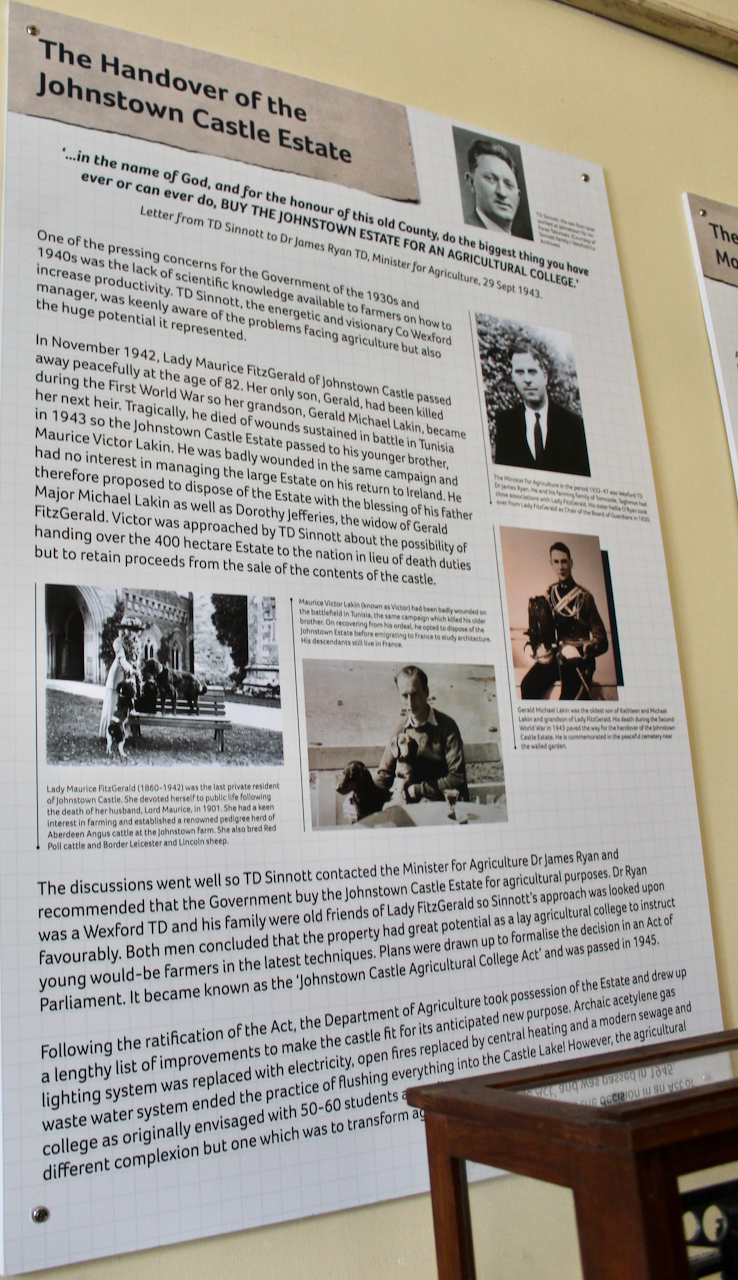
Wilton Castle, Bree, Enniscorthy, Co. Wexford Y21 V9P9 – section 482

Tourist Accommodation Facility – not open to visitors, overnight guests only

www.wiltoncastleireland.com
Open for accommodation: all year

Wilton Castle. Photograph © Jennifer Winder-Baggot, www.irishhistorichouses.com
Wilton Castle, November 2021. Photograph © Jennifer Winder-Baggot, www.irishhistorichouses.com

We treated ourselves to a stay in Wilton Castle in November in 2021. Having been gutted in a fire in 1923, it stood as a dramatic ruin until the Windsors purchased and began to refurbish it into luxurious accommodation. The current restoration was completed in 2014. So far just half of it has been rebuilt, the rest has been stabilised but remains empty and without a roof. The work which has been done by the Windsors is incredible – it seems to have been rebuilt to a very high standard. I’m not sure if they intend to continue to rebuild the rest of the castle.

Wilton Castle was designed for Harry Alcock (1792-1840) by Daniel Robertson (d. 1849) in 1836-38, subsuming parts of an earlier castle and house.

The area was previously known as Clogh na Kayer (The Castle of the Sheep). Herbert Hore writes in History of the Town and County of Wexford that an ancient Castle of Cloghnakayer was built in the fourteenth century. The De Dene family owned the land until 1354, when an only daughter married Philip Furlong whose descendant, Sir Fulke Furlong, knight, of Horetown, built a castle around 1410. 

The land then passed to the Butlers of Mountgarret. Edward Butler, Baron of Kayer (eldest son of Pierce, second son of Richard 1st Viscount Mountgarret) rebuilt and restored the ancient Castle, and added a mansion house to it in 1599. [1]

The view from our suite. Photograph © Jennifer Winder-Baggot, www.irishhistorichouses.com

Edward Butler’s son, Pierce, inherited. Pierce Butler was a Catholic and a supporter of the monarchy and his land was confiscated by the Cromwellian parliament in 1655 and granted to a Cromwellian soldier, Captain Robert Thornhill. Captain Robert’s son sold the estate in 1695 to William Alcock (d. 1705) of Downpatrick, County Down. [2]

Herbert Hore tells us that William Alcock rebuilt the castle, and called it Wilton. It was this castle that was subsumed in Daniel Robertson’s design for Harry Alcock. Herbert Hore writes that “the late Colonel Alcock [Harry, (1821-93)] told me that some of the walls of the ancient Castle of the Butlers are incorporated in the present building.”

Robert O’Byrne writes: “William Alcock built a new residence for himself on the site of an old castle, and this was occupied by his descendants for several generations. A handsome classical doorcase of granite with segmental pediment above fluted pilasters survives on the façade of the former steward’s house at Wilton to indicate the appearance of the original Alcock house, dismissed by Martin Doyle in his 1868 book on the county as being ‘in the dull style of William and Mary.’ ” [3]

A handsome classical doorcase of granite with segmental pediment above fluted pilasters survives on the façade of the former steward’s house at Wilton to indicate the appearance of the original Alcock house.” Photograph © Jennifer Winder-Baggot, www.irishhistorichouses.com
The former steward’s house, in the stable yard below Wilton Castle. Photograph © Jennifer Winder-Baggot, www.irishhistorichouses.com

A daughter of William and his wife Jane nee Bamber of Bamber Hall of Lancaster, England, married Patrick Lattin and was the mother of the famous Jack Lattin of Morristown Lattin, County Kildare, who danced himself to death!

The estate passed to William Alcock’s son, another William Alcock (1681-1739), then to his son, Col. William Alcock (d. 1779) (Colonel in the Waterford Militia). He married Mary Loftus of Loftus Hall, County Wexford, daughter of Nicholas Loftus, 1st Viscount Loftus of Ely and his wife Anne Ponsonby, daughter of William Ponsonby, 1st Viscount Duncannon.

Loftus Hall, the home of Mary Loftus, wife of William Alcock (d. 1779). Photograph from the National Inventory of Architectural Heritage.

Wilton then passed to his son, Henry Alcock (d. 1811). Henry Alcock married Elizabeth Katherine Ussher, daughter of Beverly Ussher of Kilmeadon, County Waterford, who was a long term MP for County Waterford. Henry Alcock also served as an MP for Waterford. Elizabeth Katherine’s sister Mary also married an MP, John Congreve of Mount Congreve in Waterford (which has beautiful gardens open to the public, although temporarily closed – I wonder if the house is to be opened also?).

The estate then passed to his son, William Congreve Alcock (1771-1812). William competed in the general election of 1807 against John Colclough of Tintern Abbey (son of Vesey Colclough, MP for County Wexford). Unfortunately they decided to settle a dispute by a duel, and William shot and killed John. John had been engaged to a sister of William’s. William was tried for murder but acquitted. He never got over the incident however and it affected his mental health and he died five years later. [4] Thus Wilton Castle passed to his brother, Harry Alcock (1792-1840).

In 1818 Harry Alcock married Margaret Elinor Savage, daughter of James Savage of Kilgibbon, County Wexford (this house is now a ruin). He then engaged Daniel Robertson in 1837 to renovate Wilton House, which became Wilton Castle. The newer house was built in front of the older Wilton House.

The older Wilton House, covered in weather-slating, is visible at the back of Wilton Castle. Photograph © Jennifer Winder-Baggot, www.irishhistorichouses.com

The details of Daniel Robertson’s training are not known. He struggled with bankruptcy for a large part of his life and moved from working in Oxford in England to Ireland, at the urging of his father-in-law. The Dictionary of Irish Architects tells us:

From the early 1830s he did no further work in Britain but received a series of commissions in Ireland, mainly for country house work in the south eastern counties. Most of these houses or additions were in the Tudor style, which, he asserted in a letter to a client, Henry Faulkner, of Castletown, Co. Carlow, was ‘still so new and so little understood in Ireland’. For some of them he used Martin Day as his executant architect. In spite of his success in attracting commissions, when he was working at Powerscourt in the early 1840s he was, in the words of Lord Powerscourt, ‘always in debt and…used to hide in the domes of the roof of the house’ to escape the Sheriff’s officers who pursued him. By then he was crippled with gout and in an advanced state of alcoholism; at Powerscourt he ‘used to be wheeled out on the terrace in a wheelbarrow with a bottle of sherry, and as long as that lasted he was able to design and direct the workmen, but when the sherry was finished he collapsed and was incapable of working till the drunken fit had evaporated.’ In at least two instances – at Powerscourt and at Lisnavagh – he lived on the premises while work was in progress, and it seems that from the 1830s until the year of his death his wife and family never settled for any time in Ireland… Robertson was overseeing the completion of Lisnavagh, Co. Carlow, where he had been living intermittently since the start of building in 1846, when he fell seriously ill in the spring of 1849” and died in September of that year. [5]

Ballydarton House, County Carlow, also designed by Daniel Robertson, in 1830. Photograph from the National Inventory of Architectural Heritage.
Dunleckney Manor, County Carlow, by Daniel Robertson, 1835. Photograph from the National Inventory of Architectural Heritage.

Daniel Robertson also designed the nearby Johnstown Castle in County Wexford. We visited Johnstown Castle also but unfortunately it was closed the only day we were in Wexford, as they were taking down Hallowe’en decorations from a special event! Such a pity we weren’t able to see the inside of the castle yet, but we shall certainly visit again.

Johnstown Castle is described in the National Inventory of Architectural Heritage: “the construction in a blue-green rubble stone offset by glimmering Mount Leinster granite dressings not only demonstrating good quality workmanship, but also producing a sober two-tone palette.” [6] Wilton Castle also has Mount Leinster granite dressings. It was covered however in white lime plaster – which has been reinstated on the renovated part of the castle.

The lakeside facade of Johnstown Castle, County Wexford, built 1836-72 for Hamilton Knox Grogan Morgan (1808-54), MP, also by Daniel Robertson – it has remarkable similarities to Wilton Castle. It envelops a seventeenth-century house (perhaps by Thomas Hopper) [7] remodelled (1810-4) by James Pain (1779-1877) of Limerick. Photograph © Jennifer Winder-Baggot, www.irishhistorichouses.com
Johnstown Castle overlooks a beautiful lake. Photograph © Jennifer Winder-Baggot, www.irishhistorichouses.com

Harry’s daughter Henrietta married William Russell Farmar who also had a house built by Daniel Robertson: Bloomfield in County Wexford.

Bloomfield, a country house erected for William Russell Farmar JP (1802-71) to a design by Daniel Robertson. Photograph from National Inventory of Architectural Heritage.

Another daughter, Sarah, married Thomas John Fetherston, 5th Baronet, of Ardagh, County Longford (the house is now in use as training college, St. Brigid’s Training College, by the Sisters of Mercy).

Harry’s son, another Harry Alcock (1821-93), inherited Wilton Castle and the estate. He served as High Sheriff of Wexford in 1846 and was Lt-Col. of the Wexford Militia.  He continued the building work, which finished in 1844, adding the large square four storey tower with its elaborate balconies. He also improved the surrounding estate. He increased the plantation of trees and implemented a programme of road construction, fence building and draining of land which was carried out as Famine relief work. [8]

Wilton Castle, November 2021. Photograph © Jennifer Winder-Baggot, www.irishhistorichouses.com

Wilton Castle, when designed by Daniel Robertson, consisted of a three-storey main block and two-storey wing, all dominated by a tall square tower at one end and a tall polygonal tower and turret at the other, and it is heavily machicolated and battlemented. It is the two storey wing which has been renovated for accommodation.

The tall square tower is at one end of Wilton Castle, on the three storey section. Photograph © Jennifer Winder-Baggot, www.irishhistorichouses.com

Harry Alcock died unmarried in 1893 and the estate (some 7,000 acres in the 1870s) passed to his nephew, Philip Clayton Alcock (1861-1949), son of Harry’s brother Philip Savage Alcock (1828-86) of Park House on the Wilton estate and his wife Katherine Annette Browne-Clayton of Carrickbyrne Lodge in County Wexford. Philip Clayton Alcock was a Captain in the Gloucestershire Regiment, and in 1900 High Sheriff of Wexford, but by 1922 he felt it was too dangerous to remain at Wilton and moved to England. In 1923 his fears about his Irish property were justified when Wilton Castle was burned by arsonists. [9]

A contemporary account in the Irish Times, 7 March 1923 tells us about the burning: “Wilton Castle, the residence of Captain P.C. Alcock, about three miles from Enniscorthy, was burned by armed men on Monday night. Nothing remains of the beautiful building but smoke-begrimed, roofless walls, broken windows, and a heap of smouldering debris. The Castle was occupied by a caretaker – Mr. James Stynes – the owner, with his wife and family, having gone to England about a year ago. Shortly after 9 o’clock on Monday night the caretaker was at the Steward’s residence…when he was approached by armed men, who demanded the keys to the Castle. When he asked why they wanted the keys, one of the armed men said: “We have come to burn the place. We are sorry”. The raiders told the caretaker that he could remove his personal belongings from the part of the Castle that he occupied, but they would not allow him to remove the furniture. Fearing that the Castle might be burned, however, Captain Alcock had removed the most valuable portion of his furniture some weeks ago, but a good many rooms were left furnished. When the caretaker had removed his property he was ordered back to the Steward’s house. Soon the noise of breaking glass was heard. It appears that the armed men broke all the windows on the ground floor, and having sprinkled the floors with petrol, set them alight. They did not hurry over their work of destruction, and they did not leave the Castle until near 12 o’clock, when the building was enveloped in flames. About thirty men took part in the raid. After the raiders left, the caretaker and Steward, with what help they could procure, tried to extinguish the flames, but their effort was hopeless”. [10]

Photograph from the National Inventory of Architectural Heritage of Wilton Castle before renovation.
The tall polygonal tower and telescoping turret at the other end of Wilton Castle, on the two storey section of the castle, which has been renovated and faced in a creamy white lime plaster to distinguish it from the section which remains a ruin. Photograph © Jennifer Winder-Baggot, www.irishhistorichouses.com

Wilton Castle was built on a moated platform surrounded by parapet walls and sham fortifications.

The moated area, in front of the castle. Photograph © Jennifer Winder-Baggot, www.irishhistorichouses.com
One of the little fortification towers along the moat in front of the castle. Photograph © Jennifer Winder-Baggot, www.irishhistorichouses.com
Area in front of the castle, with another of the fortification towers and the moated area (not filled with water) lies on the far side of the low wall. Photograph © Jennifer Winder-Baggot, www.irishhistorichouses.com
The windows of Wilton Castle are arched and paired and have hood mouldings; the roof has crenellations. Photograph © Jennifer Winder-Baggot, www.irishhistorichouses.com
The side of Wilton Castle. Note the fine stone chimneys. The octagonal turret on the south west corner of Wilton Castle is built entirely of Mount Leinster granite and contains 182 cubic ft of stone or approx 13.5 ton in weight. [11] Photograph © Jennifer Winder-Baggot, www.irishhistorichouses.com
Wilton Castle, November 2021. Photograph © Jennifer Winder-Baggot, www.irishhistorichouses.com

In the three storey section of the castle, there is a beautiful carved doorcase, and an oriel window over it with delicate stone tracery and crenellations on top of the windowframe. Mark Bence-Jones defines an oriel window as “a large projecting window in Gothic, Tudor, Gothic-Revival and Tudor-Revival architecture; sometimes rising through two or more storeys, sometimes in an upper storey only and carried on corbelling.” [12] There is a similar oriel window at Johnstown Castle, which is only one storey high.

The beautifully carved Tudor-style doorcase at Wilton Castle. Photograph © Jennifer Winder-Baggot, www.irishhistorichouses.com
The carved doorcase and oriel window of Wilton Castle. Photograph © Jennifer Winder-Baggot, www.irishhistorichouses.com

At Wilton Castle there are double sets of sidelight windows either side of the doorcase, with arched carved window frames.

The Oriel window at Johnstown Castle, similar to that at Wilton Castle though the one at Wilton Castle is double-height. Photograph © Jennifer Winder-Baggot, www.irishhistorichouses.com

I was most excited to discover that we could explore the ruined part of the castle as it has been stabilised securely. It was wonderful to explore the detail.

The tower of the ruined part of Wilton Castle. It has wonderful balconies on heavy stone corbels with Gothic tracery windows. Photograph © Jennifer Winder-Baggot, www.irishhistorichouses.com
The oriel window and doorcase as seen from inside Wilton Castle. Photograph © Jennifer Winder-Baggot, www.irishhistorichouses.com
Wilton Castle. Photograph © Jennifer Winder-Baggot, www.irishhistorichouses.com
Wilton castle. Photograph © Jennifer Winder-Baggot, www.irishhistorichouses.com
Wilton Castle, November 2021. Photograph © Jennifer Winder-Baggot, www.irishhistorichouses.com

We kept discovering more. Pictures from the front of the castle do not do it justice. The land drops down behind the castle to the River Boro, to reveal beautiful pastoral views from the back windows of the castle.

The view over the river from inside the ruin of Wilton Castle. Photograph © Jennifer Winder-Baggot, www.irishhistorichouses.com
Wilton Castle. Photograph © Jennifer Winder-Baggot, www.irishhistorichouses.com
The River Boro running along the back of Wilton Castle. Photograph © Jennifer Winder-Baggot, www.irishhistorichouses.com
There are lots of stone corbels. Photograph © Jennifer Winder-Baggot, www.irishhistorichouses.com
The spiral staircase inside the round tower at the back of the castle which joins the older Wilton House to the rest of the Castle. Photograph © Jennifer Winder-Baggot, www.irishhistorichouses.com
The view from the interior spiral staircase inside the ruin, of the river side of the castle and down toward the steward’s house. Photograph © Jennifer Winder-Baggot, www.irishhistorichouses.com

One can walk down to the river and more of the detail of the castle is revealed from behind. We found a warren of tunnels to one side on a level below the castle.

The tunnel from the castle level down to the farmyard. Photograph © Jennifer Winder-Baggot, www.irishhistorichouses.com
In this photograph you can see the side of the castle, and the path below. The river lies below that. Photograph © Jennifer Winder-Baggot, www.irishhistorichouses.com
The tunnels to the side of Wilton Castle, at the lower level. Photograph © Jennifer Winder-Baggot, www.irishhistorichouses.com

The tunnels provided quick access for servants to different parts of the castle, stable yard and grounds. There were cellars for wine and storage areas for food. Cast iron grilles let natural light and air into the tunnels. [13]

The entrances to the tunnels are in this stone wall. Photograph © Jennifer Winder-Baggot, www.irishhistorichouses.com
Entrances to the tunnels, in the stone wall. Photograph © Jennifer Winder-Baggot, www.irishhistorichouses.com
Wilton Castle. Photograph © Jennifer Winder-Baggot, www.irishhistorichouses.com
The riverside facade of Wilton Castle. The three storey section in the back – which is part of the older Alcock house – is covered in weather-slating tiles. The round tower contains the spiral staircase which I climbed inside the ruin. Photograph © Jennifer Winder-Baggot, www.irishhistorichouses.com
It was only when we explored around the river side of Wilton Castle that we realised the extent of its size and the beauty of its surroundings. Photograph © Jennifer Winder-Baggot, www.irishhistorichouses.com
Wilton Castle. Photograph © Jennifer Winder-Baggot, www.irishhistorichouses.com
The older section of Wilton Castle, formerly Wilton House. Photograph © Jennifer Winder-Baggot, www.irishhistorichouses.com
From the path along the river side of the castle, one can climb back up these stairs, to discover a picnic area! Photograph © Jennifer Winder-Baggot, www.irishhistorichouses.com
The picnic area. Photograph © Jennifer Winder-Baggot, www.irishhistorichouses.com
Wilton Castle. Photograph © Jennifer Winder-Baggot, www.irishhistorichouses.com
From the picnic area, you can see the full height of the square tower. Photograph © Jennifer Winder-Baggot, www.irishhistorichouses.com
More wonderful balconies and tracery windows in the square tower, seen from the river side. Photograph © Jennifer Winder-Baggot, www.irishhistorichouses.com

After the fire, the Alcocks were unable to rebuild as the house had not been insured. The lands were redistributed by the Irish Lands Commission, and the castle and land was purchased by local farmer, Sean Windsor.

When we arrived we were welcomed and brought inside the renovated section of the castle. It opens into a nicely tiled hallway.

Wilton Castle, November 2021. Photograph © Jennifer Winder-Baggot, www.irishhistorichouses.com

The accommodation consists of four suites, one of which has a large entertaining space. Two suites are upstairs and two downstairs, with the large one being downstairs. Our accommodation was upstairs.

Wilton castle. Photograph © Jennifer Winder-Baggot, www.irishhistorichouses.com
The upstairs hallway. Photograph © Jennifer Winder-Baggot, www.irishhistorichouses.com

Our accommodation was a suite, with sitting room, fully stocked kitchen, bathroom with walk-in shower, and bedroom. The sitting room and bedroom have beautiful wallpaper.

Wilton castle. Photograph © Jennifer Winder-Baggot, www.irishhistorichouses.com
Wilton Castle. Photograph © Jennifer Winder-Baggot, www.irishhistorichouses.com
Our bedroom had a lovely Chinese style wallpaper. Photograph © Jennifer Winder-Baggot, www.irishhistorichouses.com
Wilton Castle. Photograph © Jennifer Winder-Baggot, www.irishhistorichouses.com
Wilton Castle, November 2021. Photograph © Jennifer Winder-Baggot, www.irishhistorichouses.com

Our bathroom was in the round tower of the castle!

Wilton Castle. Photograph © Jennifer Winder-Baggot, www.irishhistorichouses.com
While our suite had a walk-in shower, the suite in the floor below has a bath. Photograph © Jennifer Winder-Baggot, www.irishhistorichouses.com

Our host showed us the larger suite downstairs that has room for a party. The double doors in the room open up to the view of the river below, onto a fine sweep of steps.

Wilton Castle. Photograph © Jennifer Winder-Baggot, www.irishhistorichouses.com
The double doors from the entertainment suite. Photograph © Jennifer Winder-Baggot, www.irishhistorichouses.com
The larger entertainment suite. Photograph © Jennifer Winder-Baggot, www.irishhistorichouses.com
Wilton Castle, November 2021. Photograph © Jennifer Winder-Baggot, www.irishhistorichouses.com

The accommodation is more pricey than we can usually afford but for a romantic getaway it is hard to beat! It’s very quiet. There seemed to be one other suite occupied when we were there, but we never saw or heard the inhabitants. The Windsors live in a house next door. We chose to have breakfast provided, which was brought to us on a tray in the morning. We used the kitchen facilities one evening to make our dinner, and the next night, ordered a delivery from nearby Enniscorthy, which was delivered to the castle!

donation

Help me to pay the entrance fee to one of the houses on this website. This site is created purely out of love for the subject and I receive no payment so any donation is appreciated!

€15.00

[1] p.560-561, Hore, Herbert. History of the Town and County of Wexford, Volume 6, ed. Philip Hore, pub. 1901-1911. Reference from http://butlerancestryireland.blogspot.com/2012/11/butlers-co-wexford-ch1-richard-1stviscount-mountgarrett.html

There is also an excellent history of the early days of the area on the Bree Heritage website, https://breeheritage.com/2015/02/27/the-early-history-of-wilton-castle-bree-co-wexford/

[2] https://landedfamilies.blogspot.com/search/label/Wexford

[3] https://theirishaesthete.com/2018/05/21/wilton-castle/

[4] For more on this, see the chapter in The Wexford Gentry by Art Kavanagh and Rory Murphy. Published by Irish Family Names, Bunclody, Co Wexford, Ireland, 1994.

[5] https://www.dia.ie/architects/view/4570/ROBERTSON%2C+DANIEL#tab_biography

[6] https://www.buildingsofireland.ie/buildings-search/building/15704226/johnstown-castle-johnstown-fo-by-co-wexford

[7] https://www.archiseek.com/2014/johnstown-castle-county-wexford/

[8] p. 130, Hicks, David. Irish Country Houses: A Chronicle of Change. The Collins Press, Cork, 2012.

[9] https://landedfamilies.blogspot.com/search/label/Wexford

[10] https://www.archiseek.com/2015/1838-wilton-castle-co-wexford/

[11] Note taken from the Wilton Castle facebook page, where you can see the progress of restoration that took place. https://www.facebook.com/WiltonCastleIreland

[12] Bence-Jones, Mark. A Guide to Irish Country Houses (originally published as Burke’s Guide to Country Houses volume 1 Ireland by Burke’s Peerage Ltd. 1978); Revised edition 1988, Constable and Company Ltd, London.

[13] p. 130, Hicks, David. Irish Country Houses: A Chronicle of Change. The Collins Press, Cork, 2012.

Here are more photographs from our visit to Johnstown Castle, also designed by Daniel Robertson.

The clock tower side of Johnstown Castle. Photograph © Jennifer Winder-Baggot, www.irishhistorichouses.com
The front entrance of Johnstown Castle – clock tower side on the right. Photograph © Jennifer Winder-Baggot, www.irishhistorichouses.com
Inside the front arch of Johnstown Castle. Photograph © Jennifer Winder-Baggot, www.irishhistorichouses.com
The front entrance of Johnstown Castle. Photograph © Jennifer Winder-Baggot, www.irishhistorichouses.com
Spectacular doorway arch to one side of Johnstown Castle. Photograph © Jennifer Winder-Baggot, www.irishhistorichouses.com
The doorway arch at Johnstown Castle features a border of carved stone heads. Photograph © Jennifer Winder-Baggot, www.irishhistorichouses.com
Carved stone heads at Johnstown Castle. Photograph © Jennifer Winder-Baggot, www.irishhistorichouses.com
Window surround detail and tracery at Johnstown Castle. Photograph © Jennifer Winder-Baggot, www.irishhistorichouses.com
A workman at Johnstown Castle. Photograph © Jennifer Winder-Baggot, www.irishhistorichouses.com

Text © Jennifer Winder-Baggot, www.irishhistorichouses.com
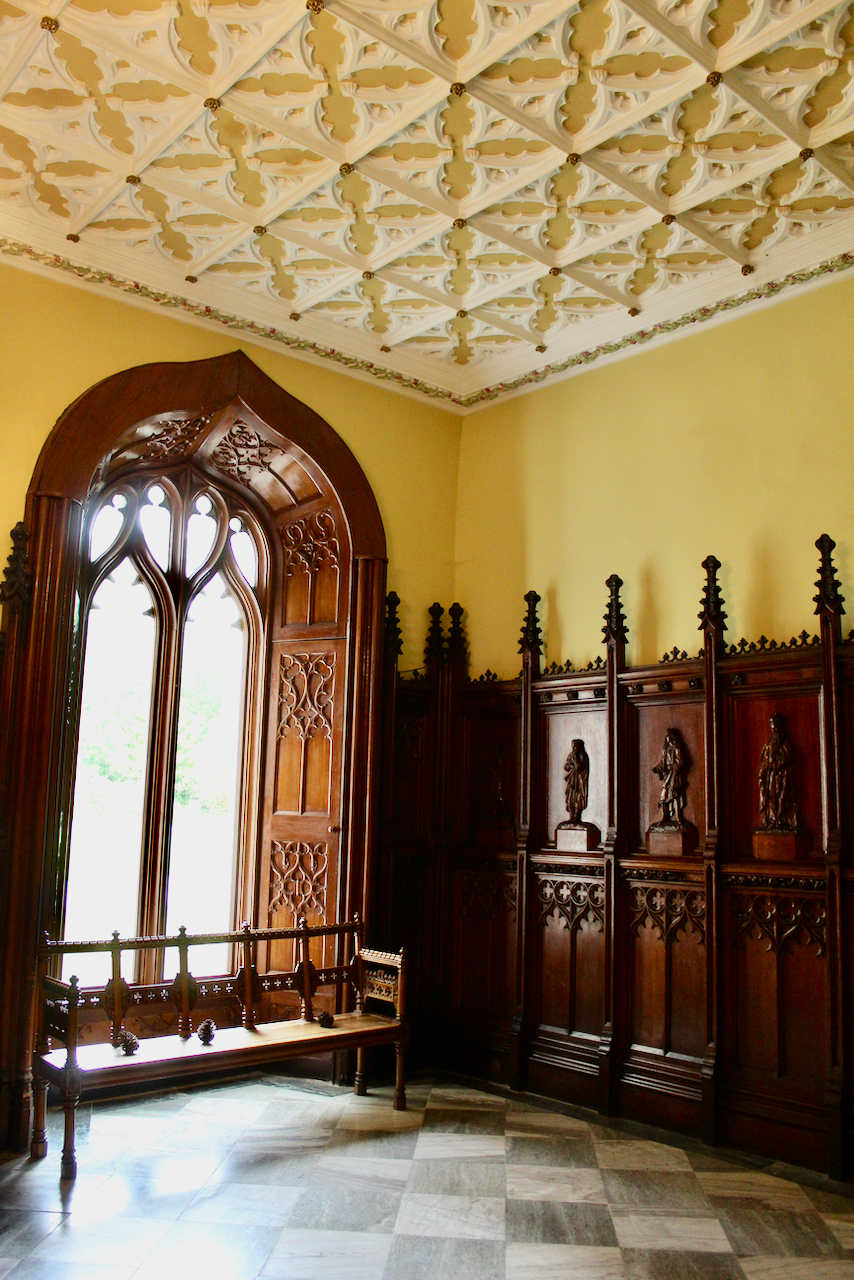
Happy New Year!

I love starting a new year. The new listing for Section 482 properties won’t be published until February or March, so at the moment we will have to rely on 2021 listings (January listings below).

I had an amazing 2021 and visited lots of properties! As well as those I’ve written about so far, I am hoping to hear back for approval for a few more write-ups. Last year Stephen and I visited thirteen section 482 properties, thirteen OPW properties, and some other properties maintained by various groups.

The Section 482 properties we visited were Mount Usher gardens and Killruddery in County Wicklow; Killineer House and gardens in County Louth; Salthill Gardens in County Donegal; Stradbally Hall in County Laois; Enniscoe in County Mayo; Tullynally in County Westmeath; Kilfane Glen and Waterfall in County Kilkenny; Killedmond Rectory in County Carlow; Coopershill, Newpark and Markree Castle in County Sligo and Wilton Castle in County Wexford.

Mount Usher Gardens, County Wicklow (June 2021). Photograph © Jennifer Winder-Baggot, www.irishhistorichouses.com
Killruddery, County Wicklow (we visited in April 2021). Photograph © Jennifer Winder-Baggot, www.irishhistorichouses.com
Killineer House and Gardens, County Louth (visited in June 2021). Photograph © Jennifer Winder-Baggot, www.irishhistorichouses.com
Salthill Gardens, County Donegal (visited in July 2021.) Photograph © Jennifer Winder-Baggot, www.irishhistorichouses.com
Stradbally Hall, County Laois (visited in June 2021). Photograph © Jennifer Winder-Baggot, www.irishhistorichouses.com
Enniscoe, County Mayo (visited in August 2021). Photograph © Jennifer Winder-Baggot, www.irishhistorichouses.com
Tullynally, County Westmeath (visited in August 2021). Photograph © Jennifer Winder-Baggot, www.irishhistorichouses.com
Kilfane Glen and Waterfall, County Kilkenny (visited in August 2021). Photograph © Jennifer Winder-Baggot, www.irishhistorichouses.com
Gardens at Killedmond Rectory, County Carlow (visited in August 2021). Photograph © Jennifer Winder-Baggot, www.irishhistorichouses.com
Coopershill, County Sligo (visited in August 2021). Photograph © Jennifer Winder-Baggot, www.irishhistorichouses.com
Newpark House, County Sligo (visited in August 2021). Photograph © Jennifer Winder-Baggot, www.irishhistorichouses.com
Markree Castle, County Sligo (visited in August 2021). Photograph © Jennifer Winder-Baggot, www.irishhistorichouses.com
Wilton Castle, County Wexford (visited in November 2021). Photograph © Jennifer Winder-Baggot, www.irishhistorichouses.com

The OPW properties we visited were Dublin Castle, the Irish National War Memorial Gardens, National Botanic Gardens, Rathfarnham Castle, St. Stephen’s Green, Iveagh Gardens, Phoenix Park and Royal Hospital Kilmainham in Dublin; Emo Court, County Laois; Portumna Castle, County Galway; Fore Abbey in County Westmeath; Parke’s Castle, County Leitrim; and Ballymote Castle, County Sligo.

Inside Dublin Castle (visited in September 2021). Photograph © Jennifer Winder-Baggot, www.irishhistorichouses.com
Irish National War Memorial Gardens, Dublin, designed by Lutyens (we go walking here all the time!). Photograph © Jennifer Winder-Baggot, www.irishhistorichouses.com
National Botanic Gardens, Dublin (visited in September 2021). Photograph © Jennifer Winder-Baggot, www.irishhistorichouses.com
Inside Rathfarnham Castle (visited in September 2021). Photograph © Jennifer Winder-Baggot, www.irishhistorichouses.com
The Iveagh Gardens, Dublin (visited in October 2021). Photograph © Jennifer Winder-Baggot, www.irishhistorichouses.com
The Gardens at Royal Hospital Kilmainham (visited in January 2022). Photograph © Jennifer Winder-Baggot, www.irishhistorichouses.com
Emo Park, County Laois (visited in June 2021). Photograph © Jennifer Winder-Baggot, www.irishhistorichouses.com
Portumna Castle, Galway (visited in July 2021). Photograph © Jennifer Winder-Baggot, www.irishhistorichouses.com
Fore Abbey, County Westmeath (visited in August 2021). Photograph © Jennifer Winder-Baggot, www.irishhistorichouses.com
Parke’s Castle, County Leitrim, maintained by the OPW (visited in August 2021). Photograph © Jennifer Winder-Baggot, www.irishhistorichouses.com
Ballymote Castle, County Sligo (visited in August 2021). Photograph © Jennifer Winder-Baggot, www.irishhistorichouses.com

We also visited Duckett’s Grove, maintained by Carlow County Council; Woodstock Gardens and Arbortetum maintained by Kilkenny County Council; Johnstown Castle, County Wexford maintained by the Irish Heritage Trust (which also maintains Strokestown Park, which we have yet to visit – hopefully this year! it’s a Section 482 property – and Fota House, Arboretum and Gardens, which we visited in 2020); Dunguaire Castle, County Clare, which is maintained by Shannon Heritage, as well as Newbridge House, which we also visited in 2021. Shannon Heritage also maintains Bunratty Castle, Knappogue Castle and Cragganowen Castle in County Clare, King John’s Castle in Limerick, which we visited in 2019, Malahide Castle in Dublin which I visited in 2018, GPO museum, and the Casino model railway museum. We also visited Belvedere House, Gardens and Park – I’m not sure who maintains it (can’t see it on the website).

Duckett’s Grove, County Carlow (visited in August 2021). Photograph © Jennifer Winder-Baggot, www.irishhistorichouses.com
Woodstock House, County Kilkenny, maintained by Kilkenny County Council (visited in August 2021). Photograph © Jennifer Winder-Baggot, www.irishhistorichouses.com
Johnstown Castle, County Wexford, maintained by the Irish Heritage Trust (visited in November 2021). Photograph © Jennifer Winder-Baggot, www.irishhistorichouses.com
Dunguaire Castle, County Clare (visited in July 2021). Photograph © Jennifer Winder-Baggot, www.irishhistorichouses.com
Newbridge House, County Dublin (visited in June 2021). Photograph © Jennifer Winder-Baggot, www.irishhistorichouses.com
Belvedere House, County Westmeath (visited in August 2021). Photograph © Jennifer Winder-Baggot, www.irishhistorichouses.com

We were able to visit two historic properties when we went to view auction sales at Townley Hall, County Louth and Howth Castle, Dublin.

The domed rotunda in Townley Hall, County Louth (visited in October 2021). Photograph © Jennifer Winder-Baggot, www.irishhistorichouses.com
Howth Castle, County Dublin (visited in September 2021). Photograph © Jennifer Winder-Baggot, www.irishhistorichouses.com

Finally some private Big Houses that we visited, staying in airbnbs, were Annaghmore in County Sligo and Cregg Castle in Galway.

Annaghmore, County Sligo, where we stayed as airbnb guests with Durcan and Nicola O’Hara (in August 2021). Photograph © Jennifer Winder-Baggot, www.irishhistorichouses.com
Cregg Castle, County Galway (in July 2021). Photograph © Jennifer Winder-Baggot, www.irishhistorichouses.com

Here are the listings for January 2021:

Cavan

Cabra Castle (Hotel)

Kingscourt, Co. Cavan

Howard Corscadden.

Tel: 042-9667030

www.cabracastle.com

Open dates in 2021: all year, except Dec 24, 25, 26, 11am-12 midnight

Fee: Free

Cabra Castle, County Cavan. Photograph © Jennifer Winder-Baggot, www.irishhistorichouses.com

Corravahan House & Gardens

Corravahan, Drung, Ballyhaise, Co. Cavan

Ian Elliott

Tel: 087-9772224

www.corravahan.com

Open dates in 2021: Jan 4-5, 11-12, 18-19, 25-26, Feb 1-2, 8-9, 15-16, 22-23, Mar 1-2, 8-9, May 4- 5, 9-12, 16-19, 23-26, 30-31, June 1-4, Aug 14-31, Sept 1-2, 9am-1pm, Sundays 2pm- 6pm
Fee: adult €10, OAP/student/child €5 

Corravahan, County Cavan. Photograph © Jennifer Winder-Baggot, www.irishhistorichouses.com

Clare

Newtown Castle

Newtown, Ballyvaughan, Co. Clare

Mary Hawkes- Greene

Tel: 065-7077200

www.newtowncastle.com , www.burrencollege.ie

Open dates in 2021: Jan 4-May 31, Mon-Fri, June 1-30 Mon-Sat, July 1-Aug 31 daily, Sept 1-Dec 17 Mon-Fri, 10am-5pm
Fee: Free 

Newtown Castle, County Clare. Photograph from National Inventory of Architectural Heritage.

Cork

Blarney Castle & Rock Close

Blarney, Co. Cork

C. Colthurst

Tel: 021-4385252

www.blarneycastle.ie

Open dates in 2021: all year except Christmas Eve & Christmas Day, Jan-Mar, Mon-Sat, 9am- sundown, Sun, 9am-6pm 

Apr-May, 9am-6pm, June-Aug, Mon-Sat, 9am-7pm, Sun, 9am-6pm, Sept, Mon-Sat, 9am-6.30pm, Sun, 9am-6pm,
Oct, Nov, Dec daily 9am-6pm,
Fee: adult €18, OAP/student €15, child €10, family and season passes 

Brideweir House

Conna, Co. Cork

Ronan Fox

Tel: 087-0523256

Open dates in 2021: Jan 1-Dec 24, 11am-4pm 

Fee: adult €10, OAP/student €5, child free

Woodford Bourne Warehouse

Sheares Street, Cork

Edward Nicholson

Tel: 021-4273000

www.woodfordbournewarehouse.com

Open dates in 2021: all year except Christmas Eve, Christmas Day, 1pm-11pm 

Fee: Free

Donegal

Portnason House 

Portnason, Ballyshannon, Co. Donegal
Madge Sharkey
Tel: 086-3846843
Open dates in 2021: Jan 18-22, 25-29, Feb 1-5, 8-12, Aug 14-30, Sept 1-17, 20-23, 27-28, Nov 15- 19, 22-26, Dec 1-3 6-10, 13-14, 9am-1pm 

Fee: adult €8, OAP/student/child €5 

Dublin City

Bewley’s 

78-79 Grafton Street/234 Johnson’s Court, Dublin 2

Peter O’ Callaghan

Tel 087-7179367

www.bewleys.com

Open dates in 2021: all year except Christmas Day, 

11am-7pm Fee: Free 

Hibernian/National Irish Bank

23-27 College Green, Dublin 2

Dan O’Sullivan 

Tel: 01-6755100

www.clarendonproperties.ie

Open dates in 2021: all year, except Dec 25, Wed-Fri 9.30am-8pm, Sun 11am-7pm, Sat, Mon, Tue, 9.30-7pm 

Fee: Free 

Powerscourt Townhouse Centre

59 South William Street, Dublin 2

Mary Larkin

Tel: 01-6717000

Open dates in 2021: All year except New Year’s Day, Easter Sunday, Easter Monday, Christmas Day, St. Stephen’s Day & Bank Holidays, Mon-Sat, 10am-6pm, Thurs, 10am-8pm, Sundays, 12 noon-6pm

Fee: Free

Powerscourt Townhouse, Dublin City. Photograph © Jennifer Winder-Baggot, www.irishhistorichouses.com

10 South Frederick Street

Dublin 2

Joe Hogan

Tel: 087-2430334

Open dates in 2021: Jan 1-24, May 1, 3-8, 10-15, 17-22, 24-27, Aug 14-22, 2pm-6pm 

Fee: Free 

County Dublin 

“Geragh” 

Sandycove Point, Sandycove, Co. Dublin

Gráinne Casey

Tel: 01-2804884

Open dates in 2021: Jan 28-29, Feb 1-5, 8-12, 15-22, May 4-31, Aug 14-22, Sept 1-3, 2pm-6pm Fee: adult €7, OAP €4, student €2, child free  

Meander

Westminister Road, Foxrock, Dublin 18,

Ruth O’Herlihy, 

Tel: 087-2163623

Open dates in 2021: Jan 4-8, 11-15, 18-22, 25-29, May 1, 4-8, 10-11, 17-22, June 8-12, 14-19, 21- 26, Aug 14-22, 9am-1pm 

Fee: adult €5, OAP/child/student €2 

Tibradden House

Mutton Lane, Rathfarnham, Dublin 16

Selina Guinness

Tel: 01-4957483

www.selinaguinness.com

Open dates in 2021: Jan 14-17, 23-24, 28-29, Feb 4-7, 11-12, 19-21, 26-28, May 3-13,16, 18-20, 23-27, June 2-4, 8-10, 14-16, 19-20, Aug 14-22, weekdays 2.30pm-6.30pm, weekends 10.30am-2.30pm
Fee: adult/OAP €8 student €5, child free, Members of An Taisce the The Irish Georgian Society (with membership card) €5 

Galway 

Woodville House Dovecote & Walls of Walled Garden 

Craughwell, Co. Galway
Margarita and Michael Donoghue
Tel: 087-9069191
www.woodvillewalledgarden.com
Open dates in 2021: Jan 29-31, Feb 1-28, Apr 1-13, 11am- 4.30pm, June 1, 6-8, 13-15, 21-22, 27- 29, July 10-11, 17-18, 24-25, 31, Aug 1-2, 6-8, 13-22, 27-29, Sept 4-5, 11am-5pm Fee: adult/OAP €6, child €3, student, €5, family €20, guided tours €10 

Kerry

Derreen Gardens

Lauragh, Tuosist, Kenmare, Co. Kerry

John Daly

Tel: 087-1325665

www.derreengarden.com 

Open dates in 2021: all year, 10am-6pm

Fee: adult/OAP/student €8, child €3, family ticket (2 adults and all children under 18 and 2 maps) €20 

Kildare

Farmersvale House

Badgerhill, Kill, Co. Kildare

Patricia Orr

Tel: 086-2552661

Open dates in 2021: Jan 18-31, Feb 1-6, July 23-31, Aug 1-31, 9.30am-1.30pm
Fee: adult €5, student/child/OAP €3, (Irish Georgian Society members free) 

Harristown House

Brannockstown, Co. Kildare

Hubert Beaumont
Tel: 087-2588775

www.harristownhouse.ie

Open dates in 2021: Jan 11-15, 18-22, Feb 8-12, 15-19, May 4-28, June 7-11, Aug 14-22, Sept 6-10, 9am-1pm 

Fee: adult/OAP/student €10, child €5 

Harristown House, County Kildare. Photograph © Jennifer Winder-Baggot, www.irishhistorichouses.com

Kildrought House

Celbridge Village, Co. Kildare

June Stuart

Tel: 01-6271206, 087-6168651

Open dates in 2021: Jan 1-20, May 18-26, Aug 11-31,10am-2pm
Fee: adult €6, OAP/student/child €3, child under 5 years free, school groups €2 per head 

Moyglare Glebe

Moyglare, Maynooth, Co. Kildare

Joan Hayden

Tel: 01-8722238

Open dates in 2021: Jan 4-8, 11-15, 18-22, 25-29, May 1-31, Aug 14-22, Sept 4-7, 8.30am-12.30pm Fee: adult €6, OAP/student/child €3 

Kilkenny

Kilkenny Design Centre

Castle Yard, Kilkenny

Joseph O’ Keeffe, Tel: 064-6623331

www.kilkennydesign.com

Open dates in 2021: all year,10am-7pm 

Fee: Free

Laois

Ballaghmore Castle

Borris in Ossory, Co. Laois

Grace Pym

Tel: 0505-21453

www.castleballaghmore.com

Open dates in 2021: all year, 9.30am-6pm
Fee: adult €5, child/OAP €3, student free, family of 4, €10 

Leitrim

Manorhamilton Castle (Ruin)

Castle St, Manorhamilton, Co. Leitrim

Anthony Daly

Tel: 086-2502593

Open dates in 2021: Jan 7-Dec 21, National Heritage Week, Aug 14-22, closed Sat & Sun, 10am- 5pm
Fee: adult €5, child free 

Limerick

Ash Hill 

Kilmallock, Co. Limerick

Simon and Nicole Johnson 

Tel: 063-98035

www.ashhill.com

(Tourist Accommodation Facility)

Open dates in 2021: Jan 15-Oct 31, Nov 1-29, Dec 1-15, 9am-4pm Fee: adult/student €5, child/OAP free 

Glebe House

Bruff, Co. Limerick

Colm McCarthy

Tel: 087-6487556

Open dates in 2021: Jan 4-29, May 10-28, Aug 13-22, Sept 13-24, Mon-Fri, 5.30pm-9.30pm, Sat- Sun, 8am-12 noon 

Fee: Free 

Mayo

Brookhill House

Brookhill, Claremorris, Co. Mayo

Patricia and John Noone

Tel: 094-9371348

Open dates in 2021: Jan 13-20, Apr 13-20, May 18-24, June 8-14, July 13-19, Aug 1-23, 2pm-6pm

Fee: adult €6, student €3, OAP/child/National Heritage Week free

Meath

Cillghrian Glebe now known as Boyne House Slane (or Stackallan)

Slane, Co. Meath

Alan Haugh

Tel: 041-9884444

www.boynehouseslane.ie

Open dates in 2021: all year, National Heritage Week, Aug 14-22, 9am-1pm Fee: Free 

Dardistown Castle

Dardistown, Julianstown, Co. Meath

Lizanne Allen

Tel: 086 -2774271

www.dardistowncastle.ie

Open dates in 2021: Jan 9-31, Feb 11-21, May 15-21, Aug 14-31, Sept 1-30, 10am-2pm Fee: adult €6, student/OAP €5, child free 

Dardistown Castle, County Meath. Photograph © Jennifer Winder-Baggot, www.irishhistorichouses.com

Gravelmount House 

Castletown, Kilpatrick, Navan, Co. Meath
Brian McKenna
Tel: 087-2520523
Open dates in 2021: Jan 1-13, May 10-30, June 1-20, Aug 14-22, 9am-1pm Fee: adult €6, OAP/student/child €3 

Moyglare House

Moyglare, Co. Meath

Postal address Maynooth Co. Kildare

Angela Alexander

Tel: 086-0537291

www.moyglarehouse.ie

Open dates in 2021: Jan 1, 4-8, 11-15, 18-22, 25-29, May 1-21, 24-28, 31, June 1-3, Aug 14-22, 9am-1pm
Fee: adult €7.50, OAP/student/child €5 

St. Mary’s Abbey

High Street, Trim, Co. Meath

Peter Higgins 

Tel: 087-2057176

Open dates in 2021: Jan 25-29, Feb 22-26, Mar 8-12, Apr 12-16, May 24-30, June 21-27, July 19- 25, Aug 14-22, Sept 13-17, 20-24, 2pm-6pm 

Fee: adult €5, OAP/student/child €2 

Tankardstown House 

Rathkenny, Slane, Co. Meath

Tadhg Carolan, Tel: 087-7512871

www.tankardstown.ie

Open dates in 2021: All year including National Heritage Week, 9am-1pm

Fee: Free

Tankardstown, County Meath. Photograph © Jennifer Winder-Baggot, www.irishhistorichouses.com

Monaghan

Castle Leslie

Glaslough, Co. Monaghan

Samantha Leslie 

Tel: 047-88091

www.castleleslie.com

(Tourist Accommodation Facility)

Open dates in 2021: all year, National Heritage Week, events August 14-22 Fee: Free 

Castle Leslie, County Monaghan. Photograph © Jennifer Winder-Baggot, www.irishhistorichouses.com

Offaly

Ballybrittan Castle

Ballybrittan, Edenderry, Co. Offaly

Rosemarie

Tel: 087-2469802 

Open dates in 2021: Jan 3-4, 10-11, 17-18, 23-24, 30-31, Feb 6-7, 13-14, 20-21, 27-28, Mar 6-7,13- 14, 20-21, 27-28, May 1-2, 8-9, 15-16, 22-23, June 12-13,19-20, 26-27, July 3-4,10- 11,17-18, 24-25, 31, Aug 14-22, Sept 4-14, 2pm-6pm. 

Fee: free – except in case of large groups a fee of €5 p.p. 

Corolanty House

Shinrone, Birr, Co. Offaly

Siobhan Webb

Tel: 086-1209984

Open dates in 2021: Jan, Feb, July, Aug, Sept, daily 2pm-6pm

Fee: Free

Crotty Church

Castle Street, Birr, Co. Offaly

Brendan Garry

Tel: 086-8236452

Open dates in 2021: All year, except Dec 25, 9am-5pm 

Fee: Free

High Street House

High Street, Tullamore, Co. Offaly

George Ross

Tel: 086-3832992

www.no6highstreet.com

Open dates in 2021: Jan 4-8, 11-15, 18-22, 25-29, May 1-18, Aug 14-22, Sept 1-24, 9.30am-1.30pm Fee: adult/student €5, OAP €4, child under 12 free 

Springfield House 

Mount Lucas, Daingean, Tullamore, Co. Offaly Muireann Noonan
Tel: 087-2204569
www.springfieldhouse.ie 

Open dates in 2021: Jan 1-14, 1pm-5pm, May 14-16, 24-28, July 2-4, 9-11, 16-18, Aug 7-29, 2pm- 6pm, Dec 26-31, 1pm-5pm
Fee: Free 

Roscommon

Strokestown Park House

Strokestown Park House, Strokestown, Co. Roscommon

Ciarán

Tel: 01-8748030

www.strokestownpark.ie

Open dates in 2021: Jan 2-Dec 20, Jan, Feb, Mar 1-16, Nov, Dec,10.30am-4pm, March 17-Oct 31, 10.30am-5.30pm,
Fee: adult €14, €12.50, €9.25, OAP/student €12.50, child €6, family €29, groups €11.50 

Tipperary

Beechwood House

Ballbrunoge, Cullen, Co. Tipperary

Maura & Patrick McCormack

Tel: 083-1486736

Open dates in 2021: Jan 4-8, 18-22, Feb 1-5, 8-12, May 1-3, 14-17, 21-24, June 11-14, 18-21, Aug 14-22, Sept 3-6, 10-13, 17-20, 24-27, 10.15am-2.15pm 

Fee: adult €5, OAP/student €2, child free, fees donated to charity 

Waterford 

The Presentation Convent 

Waterford Healthpark, Slievekeel Road,Waterford Michelle O’ Brien
www.rowecreavin.ie
Tel: 051-370057 

Open dates in 2021: Jan 1-Dec 31, excluding Bank Holidays and Sundays, Mon-Fri, 8am-6pm, Sat, 10am-2pm, National Heritage Week, Aug 14-22
Fee: Free 

Wexford

Clougheast Cottage

Carne, Co. Wexford

Jacinta Denieffe

Tel: 086-1234322

Open dates in 2021: Jan 11-31, May 1-31 August 14-22, 9am-1pm Fee: €5 

Wilton Castle

Bree, Enniscorthy, Co. Wexford

Sean Windsor

(Tourist Accommodation Facility)

Tel: 053-9247738 

www.wiltoncastleireland.com   

Open dates in 2021: all year

Wilton Castle, County Wexford. Photograph © Jennifer Winder-Baggot, www.irishhistorichouses.com

Wicklow

Castle Howard

Avoca, Co. Wicklow

Mark Sinnott

Tel: 087-2987601

Open dates in 2021: Jan 11-13, Feb 1-5, Mar 1-3, 22-24, June 10-12, 14-15, 19, 21-26, 28, July 5-9, 19-22, Aug 13-22, Sept 6-11, 18, 25, Oct 4-6, 11-13, 9am-1pm 

Fee: adult €8.50, OAP/student €6.50, child €5 

Castle Howard, County Wicklow. Photograph © Jennifer Winder-Baggot, www.irishhistorichouses.com

Mount Usher Gardens

Ashford, Co. Wicklow

Caitriona Mc Weeney

Tel: 0404-49672

www.mountushergardens.ie

Open dates in 2021: all year 10am-6pm

Fee: adult €8, student/OAP €7, child €4, no charge for wheelchair users

Powerscourt House & Gardens

Powerscourt Estate, Enniskerry, Co. Wicklow

Sarah Slazenger

Tel: 01-2046000

www.powerscourt.ie

Open: All year, closed Christmas day and St Stephens day, 9.30am-5.30pm, ballroom and garden rooms Sun, 9.30am-1.30pm
Fee: Mar-Oct, adult €11.50, OAP €9, student €8.50, child €5, family ticket €26, Nov- Dec, adult €8.50, OAP €7.50, student €7, child €4, family ticket 2 adults + 3 children €18, children under 5 free 

Powerscourt, County Wicklow. Photograph © Jennifer Winder-Baggot, www.irishhistorichouses.com

Huntington Castle, County Carlow Y21 K237 – section 482

In the past, in August 2016, I visited Huntington Castle in Clonegal, County Carlow.
www.huntingtoncastle.com
Open dates in 2025, but check website as sometimes closed for special events:

Feb 1-2, 8-9, 15-16, 22-23, Mar 1-2, 8-9, 15-16, 22-23, 29-30, Apr 5-6, 12-30, May 1-31, June 1-30, July 1-31, Aug 1-31, Sept 1-30, Oct 4-5, 11-12, 18-19, 25-31, Nov 1-2, 8-9, 15-16, 22-23, 29-30, Dec 6-7, 13-14, 20-21, 11am-5pm

Fee: house/garden, adult €13.95, garden €6.95, OAP/student, house/garden €12.50, garden €6, child, house/garden €6.50, garden €3.50, group and family discounts available

2025 Diary of Irish Historic Houses (section 482 properties)

To purchase an A5 size 2025 Diary of Historic Houses (opening times and days are not listed so the calendar is for use for recording appointments and not as a reference for opening times) send your postal address to jennifer.baggot@gmail.com along with €20 via this payment button. The calendar of 84 pages includes space for writing your appointments as well as photographs of the historic houses. The price includes postage within Ireland. Postage to U.S. is a further €10 for the A5 size calendar, so I would appreciate a donation toward the postage – you can click on the donation link.

€20.00

Donation

Help me to fund my creation and update of this website. It is created purely out of love for the subject and I receive no payment so any donation is appreciated!

€15.00

Huntington Castle, County Carlow, 2016. Photograph © Jennifer Winder-Baggot, www.irishhistorichouses.com

It’s magical! And note that you can stay at this castle – see their website! [1]

Huntington Castle stands in the valley of the River Derry, a tributary of the River Slaney, on the borders of Counties Carlow and Wexford, near the village of Clonegal. Built in 1625, it is the ancient seat of the Esmonde family, and is presently lived in by the Durdin-Robertsons. It passed into the Durdin family from the Esmonde family by marriage in the nineteenth century, so actually still belongs to the original family. It was built as a garrison on the strategically important Dublin-Wexford route, on the site of a 14th century stronghold and abbey, to protect a pass in the Blackstairs Mountains. It was also a coach stop on the Dublin travel route to Wexford. There was a brewery and a distillery in the area at the time. After fifty years, the soldiers moved out and the family began to convert it into a family home. [2]

The fourteenth century abbey at Huntington Castle. Photograph © Jennifer Winder-Baggot, www.irishhistorichouses.com
The Abbey, 2023. Photograph © Jennifer Winder-Baggot, www.irishhistorichouses.com

A History of the house and its residents

The castle website tells us that the Esmondes (note that I have found the name spelled as both ‘Esmond’ and ‘Edmonde’) moved to Ireland in 1192 and were involved in building other castles such as Duncannon Fort in Wexford and Johnstown Castle in Wexford (see my entry for places to visit in County Wexford). There is a chapter on the Esmonds of Ballynastragh in The Wexford Gentry by Art Kavanagh and Rory Murphy. They tell us that it is believed that Geoffrey de Estmont was one of the thirty knights who accompanied Robert FitzStephen to Ireland in 1169 when the latter lead the advance force that landed at Bannow that year. Sir Geoffrey built a motte and baily at Lymbrick in the Barony of Forth in Wexford, and his son Sir Maurice built a castle on the same site. After Maurice’s death in 1225 the castle was abandoned and his son John built a castle on a new site which was called Johnstown Castle. John died in 1261. [3] After the Cromwellian Confiscations, since the Johnstown Esmondes were Catholic, their lands were granted to Colonel Overstreet, and later came into the possession of the Grogan family. The Ballynastragh/Lymbrick lands were also confiscated and the Ballytramont property was granted to the Duke of Ablemarle (General Monck). [see my entry about Johnstown Castle in Places to visit and stay in County Wexford]. They later regained Ballynastragh.

The 12-14th century abbey at Huntington Castle, 2016. Photograph © Jennifer Winder-Baggot, www.irishhistorichouses.com
Inside the Abbey, on our visit in 2023. Photograph © Jennifer Winder-Baggot, www.irishhistorichouses.com

A descendant, Laurence Esmonde (about 1570-1645) converted to Anglicanism and served in the armies of British Queen Elizabeth I and then James I.

He fought in the Dutch Wars against Spain, and later, in 1599, he commanded 150 foot soldiers in the Nine Years War, the battle led by an Irish alliance led mainly by Hugh O’Neill 2nd Earl of Tyrone and Hugh Roe O’Donnell against the British rule in Ireland.

Hugh O’Neill (c. 1540-1616) 2nd Earl of Tyrone, courtesy of the Ulster Museum. He was one of the rebels in the Nine Years War, who fought against Laurence Esmonde (b. about 1570, d. 1645).

In 1602 he built a castle and a church at Luimneach near the modern village of Killinerin and near Ballynastragh, which he named Lymbrick after the original Norman motte and bailey in the Barony of Forth. [see 3]

View of the castle from the Abbey, 2023. Photograph © Jennifer Winder-Baggot, www.irishhistorichouses.com
Abbey ruins at Huntington Castle. Photograph © Jennifer Winder-Baggot, www.irishhistorichouses.com

He governed the fort of Duncannon from 1606-1646. In reward for his services, he was raised to the peerage in 1622 as Baron of Lymbrick in County Wexford and it seems that a few years after receiving this honour he built the core of the present Huntington Castle on the site of an earlier military keep. He built a three-storey fortified tower house, which forms the front facing down the avenue, according to Mark Bence-Jones in A Guide to Irish Country Houses. [4]

1622 core of Huntington Castle. Photograph © Jennifer Winder-Baggot, www.irishhistorichouses.com
Huntington Castle, 2023. Photograph © Jennifer Winder-Baggot, www.irishhistorichouses.com
Note the Egyptian style decorative motif over the entrance door – it makes more sense once one discovers what is inside the basement of the castle. Photograph © Jennifer Winder-Baggot, www.irishhistorichouses.com

This original tower-house is made of rough-hewn granite. In her discussion of marriage in Making Ireland English, Jane Ohlmeyer writes that for the Irish, legitimacy of children didn’t determine inheritance, and so attitudes toward marriage, including cohabitation and desertion, were very different than in England. She writes that the first Baron Esmonde behaved in a way reminiscent of medieval Gaelic practices when he repudiated his first wife and remarried without a formal divorce. Laurence met Ailish, the sister of Morrough O’Flaherty (note that Turtle Bunbury tells us that she was a granddaughter of the pirate queen Grace O’Malley!) on one of his expeditions to Ulster, and married her. However, after the birth of their son, Thomas, she returned to her family, fearing that her son would be raised as a Protestant. [5]

Esmonde went on to marry Elizabeth Butler, a granddaughter of the ninth earl of Ormond (daughter of Walter Butler, and she was already twice widowed). He had no children by his second marriage and despite acknowledging Thomas to be his son, he did not admit that his first marriage was lawful and consequently had no official heir and his title Baron of Lymbrick became extinct after his death.

Baron Esmonde died after a siege of Duncannon fort by General Thomas Preston, 1st Viscount Tara, of the Confederates, who considered Esmonde a defender of the Parliamentarians (i.e. Oliver Cromwell’s men, the “roundheads”). Although his son did not inherit his title, he did inherit his property. [6]

After Lawrence’s death the Huntington estate and castle was occupied as a military station by Dudley Colclough from 1649-1674. [see 3]

Lawrence’s son Thomas Esmonde started his military career as an officer in the continental army of King Charles I. For his service at the siege of La Rochelle he was made a baronet of Ireland while his father still lived, and became 1st Baronet Esmonde of Ballynastragh, County Wexford, in 1629. He did not return to Ireland, however, until 1646 after his father’s death. He joined the rebels, the Confederate forces, who were fighting against the British forts which his father held. Taking after his mother, he was a resolute Catholic.

He married well, into other prominent Catholic families: first to a daughter of the Lord of Decies, Ellice Fitzgerald. She was the widow of another Catholic, Thomas Butler, 2nd Baron Caher, and with him had one daughter, Margaret, who had married Edmond Butler, 3rd/13th Baron Dunboyne a couple of years before her mother remarried in around 1629. Thomas and Ellice had two sons. Ellice died in 1644/45 and Thomas married secondly Joanne, a daughter of Walter Butler 11th Earl of Ormond. She too had been married before, to George Bagenal who built Dunleckney Manor in County Carlow. Her sons by Bagenal were also prominent Confederate Colonels. She was also the widow of Theobald Purcell of Loughmoe, County Tipperary. We came across the Purcells of Loughmoe on our visit to Ballysallagh in County Kilkenny (see my entry).

Thomas served as Member of Parliament for Enniscorthy, County Wexford from 1641 to 1642, during the reign of King James II.

His son Laurence succeeded as 2nd Baronet, and reoccupied Huntington Castle in 1682. [see 3]

Laurence made additions to Huntington Castle around 1680, and named it “Huntington” after the Esmonde’s “ancestral pile” in Lincolnshire, England [7]. He is probably responsible for some of the formal garden planting. The Irish Aesthete Robert O’Byrne discusses this garden in another blog entry [8]. He tells us that the yew walk, which stretches 130 yards, dates from the time of the Franciscan friary in the Middle Ages!

Huntington Castle, photograph by Daniel O’Connor, 2021 for Tourism Ireland, Ireland’s Content Pool. [9]
Huntington Castle, 2023. Photograph © Jennifer Winder-Baggot, www.irishhistorichouses.com
The over 500 year old yew walk. Photograph © Jennifer Winder-Baggot, www.irishhistorichouses.com
The formal gardens, 2023. Photograph © Jennifer Winder-Baggot, www.irishhistorichouses.com
The grounds of Huntington Castle. Photograph © Jennifer Winder-Baggot, www.irishhistorichouses.com

Laurence 2nd Baronet married Lucia Butler, daughter of another Colonel who fought in the 1641 uprising, Richard Butler (d. 1701) of Garryricken. Their daughter Frances married Morgan Kavanagh, “The MacMorrough” of the powerful Irish Kavanagh family.

The 3rd Baronet, another Laurence, served for a while in the French army.

A wing was constructed by yet another Sir Laurence, 4th Baronet, in 1720. The castle, as you can see, is very higgeldy piggedly, reflecting the history of its additions. The 4th Baronet had no heir so his brother John became the 5th Baronet. He had a daughter, Helen, who married Richard Durdin of Shanagarry, County Cork. The went out to the United States and founded Huntington, Pennsylvania. He had no sons, and died before his brother, Walter, who became the 6th Baronet. Walter married Joan Butler, daughter of Theobald, 4th Baron Caher. Walter and Joan also had no sons, only daughters.

Huntington Castle. Photograph © Jennifer Winder-Baggot, www.irishhistorichouses.com

In The Wexford Gentry we are told that the widow of the 6th Baronet was left in “straitened circumstances” after her husband Walter died in 1767, and sold the estate of Huntington to Sir James Leslie (1704-1770), the Church of Ireland Bishop of Limerick, in 1751. He was from the Tarbert House branch of the Leslie family in County Kerry. Huntington remained in his family until 1825 when it was leased to Alexander Durdin (1821-1892) and later bought by his descendants. [see 3, p. 106].

The line of inheritance looks very convoluted. I have consulted Burke’s Peerage. John Durdin migrated from England to Cork in around 1639. His descendant Alexander Durdin, born in 1712, of Shanagarry, County Cork, married four times! His second wife, Mary Duncan of Kilmoon House, County Meath, died shortly after giving birth to her son Richard, born in 1747. Alexander then married Anne née Vaux, widow of the grandson of William Penn the founder of Pennsylvania. Finally, he married Barbara St. Leger, with whom he had seven more sons and several daughters.

It was Alexander’s son Richard who married Helen Esmonde, daughter of the 4th Baronet, according to Burke’s Peerage. Richard then married Frances Esmonde, daughter of the 7th Baronet.

The 6th Baronet had only daughter so the title went to a cousin. This cousin was a descendant of Thomas Esmonde 1st Baronet of Ballynastragh, Thomas’s son James. James had a son Laurence (1670-1760), and it was his son, James (1701-1767) who became the 7th Baronet of Ballynastragh. It was his daughter Frances who married Richard Durdin of Huntington Pennsylvania, who had been previously married to Helen Esmonde.

Despite his two marriages, Richard had no son. His brother William Leader Durdin (1778-1849) married Mary Anne Drury of Ballinderry, County Wicklow and it was their son Alexander (1821-1892) who either inherited Huntington, or at least, according to The Wexford Gentry, leased and later purchased Huntington, the home of his ancestors.

Alexander also had only daughters. In 1880, his daughter Helen married Herbert Robertson, Baron Strathloch (a Scots feudal barony) and MP for a London borough. She inherited Huntington Castle when her father died. Together they made a number of late Victorian additions at the rear of the castle while their professional architect son, Manning Durdin-Robertson, an early devotee of concrete, carried out yet further alterations in the 1920s. Manning also created W. B. Yeats’s grave, and social housing in Dublin.

Huntington Castle, Clonegal, County Carlow, the view when one enters the courtyard from the avenue. Photograph © Jennifer Winder-Baggot, www.irishhistorichouses.com

There is an irregular two storey range with castellated battlements and a curved bow and battlemented gable in front of the earlier building, which rises above them. The front battlemented range was added in the mid 1890s.

The older part of the castle includes a full height semicircular tower. Inside, when one enters through the portico facing onto the stable yard, one can see the outside of this full height semicircular tower, curving into the room to one’s right hand side, where there is even a little stone window set in the curved wall, and the round tower bulges into the stairway hall, clad with timber and covered in armour.

Huntington Castle, 2023, facing into stable yard. Photograph © Jennifer Winder-Baggot, www.irishhistorichouses.com
Detail of Huntington Castle, 2023. Photograph © Jennifer Winder-Baggot, www.irishhistorichouses.com
The stable yard, 2023. Photograph © Jennifer Winder-Baggot, www.irishhistorichouses.com
Huntington Castle, 2023. Photograph © Jennifer Winder-Baggot, www.irishhistorichouses.com

We entered the castle through a door in the battlemented porticon next to the double height bow facing onto the stableyard and courtyard. Inside the portico are statues which may have been from the Abbey – I forgot to ask our tour guide, as there was just so much to see and learn about.

Huntington Castle, 2023. Photograph © Jennifer Winder-Baggot, www.irishhistorichouses.com

We were not allowed to take photos inside, except for in the basement, but you can see some pictures on the official website [1] and also on the wonderful blog of the Irish Aesthete [10].

Gary waits for the tour, at the entrance. Photograph © Jennifer Winder-Baggot, www.irishhistorichouses.com
The entrance to the tour is through the door under the battlemented portico. Photograph © Jennifer Winder-Baggot, www.irishhistorichouses.com
Huntington Castle, 2023. Photograph © Jennifer Winder-Baggot, www.irishhistorichouses.com
Huntington Castle, 2016. Photograph © Jennifer Winder-Baggot, www.irishhistorichouses.com
Huntington Castle, 2023. Photograph © Jennifer Winder-Baggot, www.irishhistorichouses.com

There were wonderful old treasures in the house including armour chest protections in the hallway along the stairs, which was one of the first things to catch my attention as we entered. Our guide let us hold it – it was terribly heavy, and so a soldier must have been weighed down by his armour – wearing chain mail underneath his shielding armour. The chest protection piece we held was made of cast iron! She showed us the “proof mark” on the inside. Cast iron could shatter, our guide told us, so a piece of armour would be tested, leaving a little hole, which proved that it would not shatter when worn and hit by a projectile or sword. This piece dates all the way back to Oliver Cromwell’s time!

To the right when one enters is a room full of animal heads and weapons. There is a huge bison head from India and a black buck, and a sawfish from the Caribbean. A gharial crocodile hanging on the wall was killed by Nora Parsons at the age of seventeen in India! There is also the shell of an armadillo. The room also has a lovely wooden chimneypiece and there is another in the hallway, which has a Tudor style stucco ceiling. We went up a narrow stairway lined as Bence-Jones describes “with wainscot or half-timbered studding.”

Manning Durdin-Robertson married Nora Kathleen Parsons, from Birr Castle. She wrote The Crowned Harp. Memories of the Last Years of the Crown in Ireland, an important memorial of the last years of English rule in Ireland [11]. I ordered a copy of the book from my local library! It’s a lovely book and an enjoyable rather “chatty” read. She writes a bit about her heritage, which you can see in my entry on another section 482 castle, Birr Castle. She tells us about life at the time, which seems to have been very sociable! She writes a great description of social rank:

The hierarchy of Irish social order was not defined, it did not need to be, it was deeply implicit. In England the nobility were fewer and markedly more important than over here and they were seated in the mansions considered appropriate….
The top social rows were then too well-known and accepted to be written down but, because a new generation may be interested and amused, I will have a shot at defining an order so unreal and preposterous as to be like theatricals in fancy dress. Although breeding was essential it still had to be buttressed by money.

Row A: peers who were Lord or Deputy Lieutenants, High Sheriffs and Knights of St. Patrick. If married adequately their entrenchment was secure and their sons joined the Guards, the 10th Hussars or the R.N. [Royal Navy, I assume]
Row B: Other peers with smaller seats, ditto baronets, solvent country gentry and young sons of Row A, (sons Green Jackets, Highland regiments, certain cavalry, gunners and R.N.).
Row A used them for marrying their younger children.
Row C: Less solvent country gentry, who could only allow their sons about £100 a year. These joined the Irish Regiments which were cheap; or transferred to the Indian army. They were recognised and respected by A and B and belonged to the Kildare Street Club.
Row D: Loyal professional people, gentlemen professional farmers, trade, large retail or small wholesale, they could often afford more expensive Regiments than Row C managed. Such rarely cohabited with Rows A and B but formed useful cannon fodder at Protestant Bazaars and could, if they were really liked, achieve Kildare Street.

Absurd and irritating as it may seem today, this social hierarchy dominated our acceptances.

I had the benefit of always meeting a social cross section by playing a good deal of match tennis…. The top Rows rarely joined clubs and their play suffered….There were perhaps a dozen (also very loyal) Roman Catholic families who qualified for the first two Rows; many more, equally loyal but less distinguished, moved freely with the last two.

Amongst these “Row A” Roman Catholics were the Kenmares, living in a long gracious house at Killarney. Like Bantry House, in an equally lovely situation.…”

There are some notable structures inside the building, as Robert O’Byrne notes. “The drawing room has 18th century classical plaster panelled walls beneath a 19th century Perpendicular-Gothic ceiling. Some passages on the ground floor retain their original oak panelling, a number of bedrooms above being panelled in painted pine. The dining room has an immense granite chimneypiece bearing the date 1625, while those in other rooms are clearly from a century later.” [10]

The dining room, the original hall of the castle, is hung with Bedouin tents, brought back from Tunisia in the 1870s by Herbert Robertson, Helen Durdin’s husband. The large stone fireplace has the date stone 1625, and a stained glass window traces out the Esmonde and Durdin genealogy. We know that the room is very old by the thickness of the walls. The room has an Elizabethan ceiling, and portraits of family members hang on the walls. You can see a photograph of the room on the Castle Tours page of the website. There is a portrait of Barbara St. Leger, from Doneraile in Cork, who married Alexander Durdin (1712-1807), the one who also married the two Esmonde daughters. It is said that Barbara wore a set of keys at her waist, and that sometimes ghostly jingling can be heard in the castle.

Next to the dining room is a ladies drawing room with white panelled walls and a stucco ceiling with Gothic drop decoration and compartments. I think it was in this room the guide told us that the panelling is made of plaster, created to look like wood panelling. You can see some photographs of these rooms on the castle’s facebook page. The ceiling may seem low for an elegant room but we must remember that it originally housed a barracks! This room also is part of the original structure – the doorway into the next room shows how thick the wall is – about the length of two arms.

Another drawing room is hung with tapestry, which would have kept the residents a bit warmer in winter. There are beautiful stuccoed ceilings, which you can see on the website, and a deep bay window with Gothic arches in the bars of the window.

The Tapestry Room, Huntington Castle, photograph courtesy of Huntington Castle website. The portrait over the fireplace is, I believe, Helen Durdin who married Herbert Robertson. I think this room was added to the castle in 1760.

Huntington was one of the first country houses in Ireland to have electricity, and in order to satisfy local interest a light was kept burning on the front lawn so that the curious could come up and inspect it.

The turbine house is at the end of this row of trees. Photograph © Jennifer Winder-Baggot, www.irishhistorichouses.com

I loved the light and plant filled conservatory area, with a childlike drawing on one wall. The glass ceiling is draped in grape vines. The picture is of the estate, drawn by the four children of the house in 1928, Olivia Durdin-Robertson and her brother Derry and sister Barbara, children of Manning and Nora. I loved the pictures of the children themselves swimming in the river, wearing little swimming hats! The picture even has the telephone wires in it. The conservatory area is part of an addition on the back of the castle, added around 1860.

Huntington Castle, photograph courtesy of Huntington Castle website, with the vine that was taken in 1860 from Hampton Court in London.
Huntington Castle, 2023. Photograph © Jennifer Winder-Baggot, www.irishhistorichouses.com

The conservatory is in the brick and battlemented addition to one side of the castle. From the formal gardens to the side of the castle a different vantage shows more of the castle and one can see the original tower house, and the additions.

1960s addition to the castle. Photograph © Jennifer Winder-Baggot, www.irishhistorichouses.com
The Conservatory. Photograph © Jennifer Winder-Baggot, www.irishhistorichouses.com
The formal garden was probably laid out by Laurence Esmonde, 2nd Baronet of Ballynastragh, County Wexford, from the 1680s. Photograph © Jennifer Winder-Baggot, www.irishhistorichouses.com
This shows the addition which houses the light filled conservatory. Photograph © Jennifer Winder-Baggot, www.irishhistorichouses.com
Huntington Castle, 2023. Photograph © Jennifer Winder-Baggot, www.irishhistorichouses.com

The conservatory contains a vine that is a cutting taken in the 1860s of a great vine in Hampton Court.

Percy the Peacock had a seat on the balcony off the conservatory. Photograph © Jennifer Winder-Baggot, www.irishhistorichouses.com
Huntington Castle, 2023. Photograph © Jennifer Winder-Baggot, www.irishhistorichouses.com
A door under the conservatory which leads into the basement has another Egyptian plaque over the door. Photograph © Jennifer Winder-Baggot, www.irishhistorichouses.com

We were allowed to take photos in the basement, which used to house dungeons, and now holds the “Temple of Isis.” It also contains a well, which was the reason the castle was situated on this spot.

In the 1970s two of the four children of Manning Durdin-Robertson, the writer and mystic Olivia Durdin-Robertson, who was a friend of W.B. Yeats and A.E. Moore, and her brother Laurence (nicknamed Derry), and his wife Bobby, converted the undercroft into a temple to the Egyptian Goddess Isis, founding a new religion. In 1976 the temple became the foundation centre for the Fellowship of Isis [11]. I love the notion of a religion that celebrates the earthy aspects of womanhood, and I purchased a copy of Olivia Durdin-Robertson’s book in the coffee shop. The religion takes symbols from Egyptian religion, as you can see in my photos of this marvellous space:

Entrance to the basement. Photograph © Jennifer Winder-Baggot, www.irishhistorichouses.com
Temple of Isis in Huntington Castle. This room houses the well. Photograph © Jennifer Winder-Baggot, www.irishhistorichouses.com
Temple of Isis in Huntington Castle. Photograph © Jennifer Winder-Baggot, www.irishhistorichouses.com
You can see the old vaulted brick ceilings of the basement. Photograph © Jennifer Winder-Baggot, www.irishhistorichouses.com
Temple of Isis in Huntington Castle. Photograph © Jennifer Winder-Baggot, www.irishhistorichouses.com
The basement still has its wooden beam ceilings. Photograph © Jennifer Winder-Baggot, www.irishhistorichouses.com
Huntington Castle, Temple of Isis. Photograph © Jennifer Winder-Baggot, www.irishhistorichouses.com

Turtle Bunbury has a video of the Fellowship of Isis on his website [12]! You can get a flavour of what their rituals were like initially. Perhaps they are similar today. The religion celebrates the Divine Feminine.

Huntington Castle, 2023. Photograph © Jennifer Winder-Baggot, www.irishhistorichouses.com

After a tour of the castle, we then went to the back garden, coming out from the basement by a door under the stone balcony. According to its website:

The Gardens were mainly laid out in the 1680s by the Esmondes. They feature impressive formal plantings and layouts including the Italian style ‘Parterre’ or formal gardens, as well the French lime Avenue (planted in 1680). The world famous yew walk is a significant feature which is thought to date to over 500 years old and should not be missed.

Later plantings resulted in Huntington gaining a number of Champion trees including more than ten National Champions. The gardens also feature early water features such as stew ponds and an ornamental lake as well as plenty to see in the greenhouse and lots of unusual and exotic plants and shrubs.“”Later plantings resulted in Huntington gaining a number of Champion trees including more than ten National Champions. The gardens also feature early water features such as stew ponds and an ornamental lake as well as plenty to see in the greenhouse and lots of unusual and exotic plants and shrubs.

Huntington Castle, 2023. Photograph © Jennifer Winder-Baggot, www.irishhistorichouses.com
Huntington Castle, 2023.
One exits the stable yard through a small gate in the wall, to the garden, and the orchard and greenhouses are to the right. Photograph © Jennifer Winder-Baggot, www.irishhistorichouses.com
The orchard. Photograph © Jennifer Winder-Baggot, www.irishhistorichouses.com
Even the auxiliary buildings have stepped gables. Photograph © Jennifer Winder-Baggot, www.irishhistorichouses.com
The greenhouses were built by Manning Durdin-Robertson and are made of concrete. Photograph © Jennifer Winder-Baggot, www.irishhistorichouses.com
Huntington Castle, 2023. Photograph © Jennifer Winder-Baggot, www.irishhistorichouses.com
The Rose Walk and stream. Photograph © Jennifer Winder-Baggot, www.irishhistorichouses.com
The Bluebell woods. Photograph © Jennifer Winder-Baggot, www.irishhistorichouses.com
Our 2023 visit, Stephen and Gary. Photograph © Jennifer Winder-Baggot, www.irishhistorichouses.com
Huntington Castle, 2023. Photograph © Jennifer Winder-Baggot, www.irishhistorichouses.com

The “stew ponds” would have held fish that could be caught for dinner.

The Stew Ponds, 2023. Photograph © Jennifer Winder-Baggot, www.irishhistorichouses.com
The lake, 2023. Photograph © Jennifer Winder-Baggot, www.irishhistorichouses.com
DSC_1369
The lake, in 2016. Photograph © Jennifer Winder-Baggot, www.irishhistorichouses.com
The wilderness near the River. Photograph © Jennifer Winder-Baggot, www.irishhistorichouses.com
The river Derry, at the end of the property, and an old mill building beyond. Photograph © Jennifer Winder-Baggot, www.irishhistorichouses.com

After the garden, we needed a rest in the Cafe.

The tearoom has some built-in pigeon boxes. Photograph © Jennifer Winder-Baggot, www.irishhistorichouses.com
One of the auxiliary buildings in the stable yard has been renovated into a “Granny flat.” Photograph © Jennifer Winder-Baggot, www.irishhistorichouses.com
The garden side of the granny flat. Photograph © Jennifer Winder-Baggot, www.irishhistorichouses.com
The wall must be very old, with this enormously thick supporting buttress. Photograph © Jennifer Winder-Baggot, www.irishhistorichouses.com
Back of the “granny flat.” Photograph © Jennifer Winder-Baggot, www.irishhistorichouses.com
I loved the arrangement of plates on the walls of the cafe! Photograph © Jennifer Winder-Baggot, www.irishhistorichouses.com

I was also thrilled by the hens who roamed the yard and even tried to enter the cafe:

There is space next to the cafe that can be rented out for events:

A few plants were for sale in the yard. A shop off the cafe sells local made craft, pottery, and books. The stables and farmyard buildings are kept in good condition and buzzed with with the business of upkeep of the house and gardens.

Ancilliary building in the stable yard. Photograph © Jennifer Winder-Baggot, www.irishhistorichouses.com
The stable yard has a very handy mounting block, to get on to your horse. Photograph © Jennifer Winder-Baggot, www.irishhistorichouses.com
Last time we visited, I was amused by the hens wandering around the yard. This time, we were accompanied in our coffee and delicious coffee cake by an inquisitive peacock, and there were some more retiring peahens. Photograph © Jennifer Winder-Baggot, www.irishhistorichouses.com
The inquisitive – and acquisitive! – peacock. Photograph © Jennifer Winder-Baggot, www.irishhistorichouses.com
I’ll never tire of admiring the vibrant “art nouveau” colours of the peacock. Photograph © Jennifer Winder-Baggot, www.irishhistorichouses.com
The stables house art studios, I believe. Photograph © Jennifer Winder-Baggot, www.irishhistorichouses.com
what is this tall flower? Photograph © Jennifer Winder-Baggot, www.irishhistorichouses.com

[1] https://www.huntingtoncastle.com/

[2] The website http://www.ihh.ie/index.cfm/houses/house/name/Huntington%20Castle says it was built on the site of a 14th century stronghold and abbey, whereas the Irish Aesthete says it was built on the site of a 13th century Franciscan monastery.

[3] Kavanagh, Art and Rory Murphy, The Wexford Gentry. Published by Irish Family Names, Bunclody, Co Wexford, Ireland, 1994. 

[4]  Bence-Jones, Mark. A Guide to Irish Country Houses (originally published as Burke’s Guide to Country Houses volume 1 Ireland by Burke’s Peerage Ltd. 1978); Revised edition 1988 Constable and Company Ltd, London.

[5] p. 171, Ohlmeyer, Jane. Making Ireland English. The Irish Aristocracy in the Seventeenth Century. Yale University Press, New Haven and London, 2012. See also pages 43, 273, 444 and 451.

[6] Dunlop, Robert. ‘Edmonde, Laurence.’ Oxford Dictionary of National Biography, online edition volume 18, accessed February 2020. https://en.wikisource.org/wiki/Esmonde,_Laurence_(DNB00)

[7] http://www.turtlebunbury.com/history/history_houses/hist_hse_huntington.html

[8] https://theirishaesthete.com/2016/11/14/light-and-shade/

[9] https://www.irelandscontentpool.com/en

[10] https://theirishaesthete.com/2017/01/23/huntington/

[11] Robertson, Nora. The Crowned Harp. Memories of the Last Years of the Crown in Ireland. published by Allen Figgis & Co. Ltd., Dublin, 1960.

[12] http://www.turtlebunbury.com/history/history_houses/hist_hse_huntington.html

http://www.fellowshipofisis.com/

Irish Historic Homes

Text © Jennifer Winder-Baggot, www.irishhistorichouses.com

Donation

Help me to fund my creation and update of this website. It is created purely out of love for the subject and I receive no payment so any donation is appreciated!

€10.00