Help me to pay the entrance fee to one of the houses on this website. This site is created purely out of love for the subject and I receive no payment so any donation is appreciated!
We visited Enniscoe House in August, during Heritage Week. I was delighted that the owner, Susan Kellett, had heard of and likes my website! She gave us a lovely tour of her home, which she also runs as an upmarket guest house. One can stay in the beautiful bedrooms in the house where breakfast is provided and dinner is also an option, or in self-catering accommodation in converted stables.
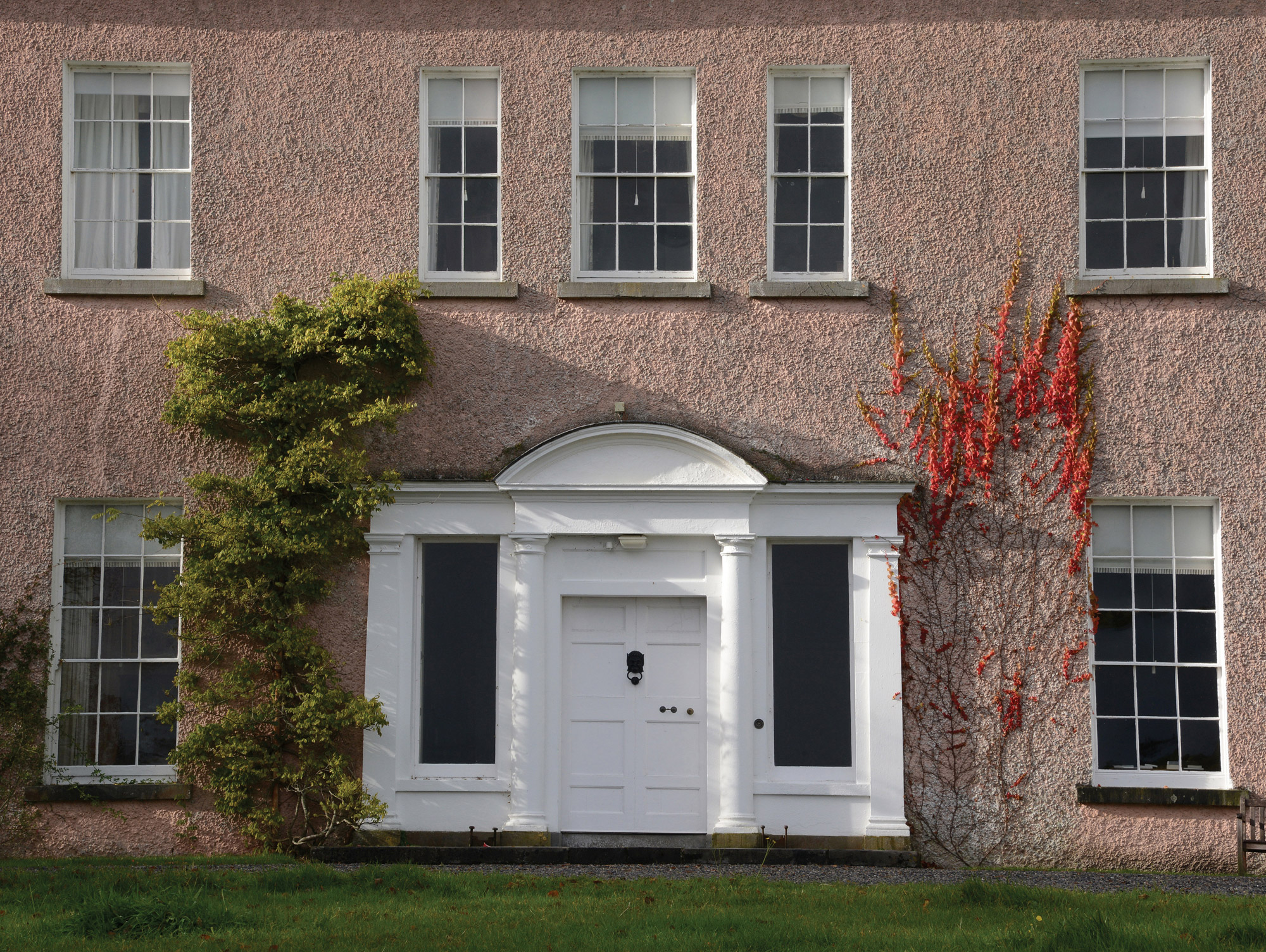
Enniscoe house is a two storey house with a five bay entrance front, with a central window in the upper storey above the pedimented tripartite doorway. The doorway has Doric columns and pilasters, and sidelights. The side elevation has five bays. [1]
Susan’s father inherited the property from his cousin, Mervyn Pratt (1873-1950). Mervyn’s grandfather, another Mervyn Pratt (1807-1890) married Madeline Eglantine Jackson, heiress, from Enniscoe. We came across Mervyn Pratt before, when we visited Cabra Castle. [2]
Mervyn and Madeline Eglantine’s daughter Louisa Catherine Hannah Pratt, the sister of Joseph, the second Mervyn’s father, married Thomas Rothwell from Rockfield, County Meath (which is currently for sale for €1.75 million [3]), and Susan’s father was their descendant. [4]
An informative booklet about Enniscoe which Susan gave me tells us that in ancient times, there was a castle at “Inniscoe,” one of the chief residences of the Kings of Hy-Fiachrach (who claimed descent from Fiachrae, brother of Niall of the Nine Hostages). The booklet tells us that traces of early earthworks can still be found. “Innis Cua” means the island of the hound. The O’Dowda, a Hy-Fiachrach family, ruled in the area and were famous for their greyhounds, which probably led to the Anglicised name Enniscoe. From the time of the Normans coming to Ireland, the land was fought over by the Bourkes, Barretts, Lynotts and Cusacks, and eventually owned by the Bourkes. At one stage Theobald Bourke, “Tibbot ne Long” (Theobald of the Ships), 1st Viscount of Mayo (1567-1629) owned the land around Enniscoe.
The information booklet tells us that the Patent Rolls of James I state that Enniscoe was possessed by the sons of John McOliverus Bourke in 1603 (this Patent Roll sounds like a great source of information! Copies are available in the National Library, and the information is gathered from 1603-1619). In the Strafford Inquisition of 1625, which gathered information about the landowners of County Mayo for Thomas Wentworth, the Earl of Strafford (who had plans for a Plantation), Richard Roe Bourke was recorded as having one third of the castle, town and lands of Enniscoe, and Thomas Roe Bourke had the other two thirds.
By 1641, the Bourkes no longer lived at Enniscoe. Susan’s booklet tells us that a Roger William Palmer owned the lands at one point – perhaps related to Roger Palmer, 1st Earl of Castlemaine (1634-1705), who was married to Barbara Villiers, who later became a favourite of King Charles II.
In the 1660s, a soldier in Cromwell’s army, Francis Jackson, was granted the lands at Enniscoe. This was confirmed by Charles II in 1669. He settled down to live in Ireland and to farm the land.
In the mid-eighteenth century George Jackson (1717-1789), great grandson of Francis, built a large farmhouse, using stones of the old castle of “Inniscoe” and oak trees recovered from nearby bogland. This house was a tall single gabled building of five bays, and it has been incorporated into the current house – Susan pointed out to us where the newer house joins to the old. George married Jane Cuffe, daughter of James Cuffe of Ballinrobe, County Mayo, and sister of James, the 1st and last Baron Tyrawley of County Mayo [of the second creation – the first creation of Baron Tyrawley was for Charles O’Hara in 1706].
George Jackson’s son, George “Two” (as he is called by the family) (1761-1805), became a Member of Parliament for County Mayo in the Irish House of Commons, with the aid of Baron Tyrawley.
George Two expanded the house into what it is today. The old house was three storey but the new front was two storey. He built on two large reception rooms and a grand staircase. The architect Jeremy Williams attributes the design of the enlargement of the house to John Roberts (1712-1796) of Waterford, who also designed Christ Church Cathedral in Waterford, and may have built Moore Hall in County Mayo. [5] The stucco work in the Stairway Hall is similar to some in Deel Castle done in the 1790s, which is situated across the lake from Enniscoe, for James Cuffe, Baron Tyrawley.
James Cuffe bought the life interest of Deel Castle, which had also originally been a Bourke castle, from his uncle (the brother of his mother, Elizabeth Gore) Arthur Gore, 1st Earl of Arran. James Cuffe built a new house a short distance from the castle. Deel Castle reverted to the Earls of Arran after James Cuffe’s death, but is now a ruin, and the house was burnt in 1921 and not rebuilt. David Hicks has written about Deel Castle and the neighbouring house, Castle Gore, on his website. [6]
The large entrance hall of Enniscoe has a frieze of foliage, and Adamesque decoration in the centre of the ceiling.
The portrait in the Front Hall of the man in wonderful frilled pantaloons is an ancestor, Sir Audley Mervyn (about 1603-1675), Speaker in the Irish House of Commons. His parents Henry Mervyn and Christian Touchet purchased lands in County County Tyrone from Mervyn Touchet, the 2nd Earl of Castlehaven, which Audley Mervyn (who was named after the Touchet estate in Staffordshire, Audley) inherited. [7] The heads of Indian deer were shot by the brothers Audley and Mervyn Pratt while fighting with the British army in the early 1900s. The carved hall chairs picture the Bourke family crest of a chained cat; Susan’s mother was a Bourke from Heathfield House, Ballycastle, County Mayo. [8] The pike was caught in Lough Conn in 1896 and weighs 37 lbs!
The front hall leads into the staircase hall, which is built on the exterior wall of the old house. The staircase hall has a frieze of urns and foliage and a glazed dome surrounded by foliage and oval medallions of classical figures.
One can see the division between older original house and the newer part clearly. Behind the staircase hall is a lobby with a delicate interior fanlight opening onto the staircase of the earlier house.
The Rising of 1798, which had been inspired by the French Revolution, came to Enniscoe, in the form of French soldiers under General Jean Joseph Amable Humbert, who landed at Killala in County Mayo on August 23, 1798. George Jackson was a Colonel in the North Mayo Militia and so would have opposed the 1798 Rebellion and the incoming French troops – although he was stationed further south as militia regiments were never stationed in their own county. The French soldiers stopped at the house at Enniscoe and Susan told us that the troops drank his wine, later declaring that it was “the only good wine in Ireland”! The scaffolding from the enlargement of the house was still lying in front of the house when the troops arrived and they used it for firewood for their campfire. George’s regiment were summoned back from the south, and Colonel Jackson was made Military Governor of the Crossmolina area. He was responsible for killing or imprisoning many of the defeated rebels in the surrounding countryside, and it is said that he lined the road from Crossmolina to Gortnor Abbey with severed heads on pikes. General Humbert and his troops were defeated by the British Army in the Battle of Ballinamuck. [9]
One result of the 1798 Rebellion was that the Irish Parliament was abolished by the Act of Union in 1800, which was supported by George Jackson. George was promoted to Colonel of the Carabineers, a dragoon in the British Army, and the position was inherited by his son, William.
William married Jane Louise Blair, daughter of Colonel William Blair of Scotland, and moved to England, and died young. He died in 1822 and his wife predeceased him in 1817 so their only daughter, Madeline Eglantine Jackson, was left an orphan at the age of six. She was raised by her aunt at Stephenstown in County Louth. Her mother’s sister was Catherine Eglantine Blair, who married Matthew Fortescue, whose father had built Stephenstown. They arranged a good marriage for Madeline when she turned 18, to a cousin of the family, Mervyn Pratt of Cabra Castle. They married in 1834.
Madeline and Mervyn settled in Enniscoe and Mervyn had the estate surveyed in order to set to work on an enormous scheme of draining land and building roads. The booklet Susan gave me tells us that during the famine, the Pratts did their best for those in the area and they gained a reputation for good management and fairness.
Madeline and Mervyn had five children. Their only son Joseph joined the army and served in India, and when he came home, took over the running of Enniscoe. He married his cousin Ina Hamilton of Cornacassa, County Monaghan (this house has been partly demolished. It was built around 1800 for Dacre Hamilton). [10]
Joseph Pratt was one of the first landlords to start selling his land to his tenants under the Wyndham Land Acts of 1903. Joseph and Ina did much to improve their estate, farming and creating the garden within the old walled garden. The Heritage Centre gives us an idea of what life on the farm was like for both the home owners and the many people employed on the estate.
Joseph’s elder son Mervyn was injured in the wars and the younger Audley was killed in the First World War. The Heritage Centre located in the walled garden at Enniscoe displays a hippo skull which Audley brought home from Africa when he fought in the Boer War (1899-1902).
Major Mervyn lived all his life in Enniscoe, and was particularly interested in gardening and fishing. His rock garden and greenhouses were well-known. He never married, and left Enniscoe to his cousin Jack Nicholson, Susan’s father (Jack was a great-grandson of Madeline Jackson). Mervyn did not spend much time in Cabra Castle in County Cavan which he also inherited, and he left it to another cousin, Mervyn Sheppard.
Jack Nicholson married Patita Bourke, daughter of Captain Bertrim Bourke of Heathfield, County Mayo. In his blog, David Hicks tells us that Heathfield was purchased by the Land Commission and the family were allocated a farm at Beauparc, County Meath. He adds that former President of Ireland Mary Robinson was from the Bourke family of Heathfield.
Jack was a Professor of Veterinary Medicine, so I felt a bond with Susan, as my father, Desmond Baggot, was also a Professor of Veterinary Medicine! Jack was head of the Veterinary College of Ireland, so perhaps their paths crossed as my father was studying there at the time of my birth, before we moved to the United States where my father did his PhD in Ohio State University. Jack died in 1972 and Enniscoe house and lands passed to his children. In 1984 Susan Kellett took over the property from her brother.
The house is full of Patita’s creative and sometimes cheeky paintings.
The dining room was originally the library. The side nook was created by Susan’s parents. It has a simple early nineteenth century cornice of reeding and acanthus leaves.
Next we went up to the bedrooms. Susan’s son DJ and his wife Colette help to run the guest house. The main bedrooms open off the oval top-lit landing. They are classically proportioned large rooms with canopy or four poster beds, all with en suite bathrooms.
After our wonderful tour, we headed over to the walled garden and the North Mayo Heritage Centre, which also provides a genealogy service. [11] It is a member of the Irish Family History Foundation, which provides a country wide service through the website RootsIreland. North Mayo Heritage Centre covers the northern half of County Mayo, and the Centre in Ballinrobe covers the southern half.
The walled garden was restored in 1996-9 under the Great Gardens of Ireland Restoration Programme. The head gardener at Enniscoe from 1872 to 1912 was William Gray, who moved to Enniscoe from St. Anne’s in Clontarf, where he had worked on Benjamin Lee Guinness’s estate. Much of the present ornamental garden is much as it was in William’s day.
[8] p. 151. Great Irish Houses. Forward by Desmond FitzGerald and Desmond Guinness. IMAGE Publications, 2008.
[9] Guy Beiner’s book entitled Remembering the Year of the French (University of Wisconsin Press, 2007) discusses folk history and how this French incursion and the 1798 Rebellion in Mayo is remembered.
Open dates in 2026: May 1-2, 8-9, 15-16, 22-23, 29-30, June 5-6, 12-13, 19-20, 26-27, July 2-4, 8-11, 15-18, 22-25, 29-31, Aug 1, 5-8, 12-23, 26-29, Sept 4, 11, 18, 25, 2pm-6pm
Fee: adult/OAP/student €8, child 10 years and under €2
donation
Help me to pay the entrance fee to one of the houses on this website. This site is created purely out of love for the subject and I receive no payment so any donation is appreciated!
In July 2021, Stephen and I dropped in to Salthill Garden on our way up to visit his mum in Donegal. Salthill Garden is just outside Donegal town. The gardens are listed in the Revenue Section 482 list, but the house is not, although the house was built in approximately 1770 and might have been designed by Thomas Ivory (1732 – 1786), who built the beautiful Blackhall Place in Dublin, which now houses the Law Society.
Salthill House was the house for Agent to Conyngham family of The Hall, Mountcharles. The Conynghams of Slane Castle are descendants of the Conynghams of Mountcharles. [1]
The Conynghams lived in Donegal possibly as early as 1660, when Albert Conyngham purchased land there. [2] The first Conyngham to move to Ireland was Alexander (1610-1660), who joined the clergy and was appointed in 1611 to be the first Protestant minister of Enver and Killymard, County Donegal. [3] He was appointed to the deanery of Raphoe in Donegal in 1630. His son Albert lived at Mountcharles.
It was Albert’s son Henry (1664-1705), a military man who also served as MP for County Donegal, who moved to Slane Castle in County Meath. I thought the Mountcharles was named after a Charles Conyngham, but since there are no Charles’s in the early Conynghams of Mountcharles, I believe Mountcharles may have been named in honour of King Charles of England.
The gardens are a great achievement, recreating a flourishing walled garden. It is a good example of a walled garden that has been brought back to life to provide fruits and vegetables for the home owners, as well as flowers, and a place of beauty and tranquility for any visitor. There is an information centre but it and the toilet facilities were closed due to the Covid pandemic. There is a cafe nearby at the nearby Salthill Pier, the Salthill Cabin.
Slane Castle was originally owned by the Flemings, who became Lords of Slane. The Fleming estates were forfeited in 1641 (after a rebellious uprising), from William 14th Baron Slane and his son Charles, 15th Baron Slane, but restored to them in 1663 (after the Restoration of Charles II to the throne, who restored land to those who were loyal to the monarchy through the time of Cromwell and the Parliamentarians). The 15th Baron had left Ireland after his land was confiscated and fought in Louis XIVth’s French army, and died in 1661. It was his brother Randall Fleming the 16th Baron Slane who was restored to his estate under the Act of Settlement and Distribution. [5] However, the Flemings’ land was forfeited again, in 1688, with the coming to the throne of William III. It was in 1703 that Henry Conyngham purchased land in Slane.
Henry Conyngham’s son Henry (1705-1781) was created 1st Earl Conyngham of Mountcharles, County Donegal but he died without issue. His sister Mary married Francis Burton and their son William Burton took the name of Conyngham to inherit his uncle’s estates. William Burton Conyngham (1733-1796) was a member of the Irish parliament and did much to create employment in County Donegal.
Conyngham planned a settlement on the previously unpopulated island of Rutland, and installed, from 1784, a street of residences and business premises, post office, school house and a fish landing and processing facility. The island remained inhabited into the 1960s. The village which developed around the mainland pier which served Rutland, Burtonport, still bears his name.
William Burton Conyngham (1733–1796) by Anton Raphael Mengs c. 1754-58, courtesy of wikipedia.
The Conynghams were one of the largest landowners in Donegal: by 1876 the third Marquess Conyngham (George Henry, 1825-1882; the 3rd Baron became the 1st Marquess) and the wider family owned four separate estates in the county amounting to over 122,300 acres of land, as well as extensive landholdings in Clare (centred around Kilkee) and Meath (centred around Slane), and in Kent in the south-east of England.
The Conyngham’s agent’s house was called Salthill because the area was known in Irish as Tamhnach an tSalainn (‘the Field of Salt’). The anglicization of this is “Tawnyfallon,” as Salthill was also known. The fields along the coast flooded and when they dried, the salt could be collected. This provided an income for the locals and for the Conynghams.
Salthill House was the residence for Hugh Montgomery, Esq. according to the 1777 – 83 Taylor and Skinner map of the area [6]. There is a record of the renewal of a lease on ‘Tawnyfallon, otherwise Salthill’ from Henry Conyngham (1st Marquess) to a Francis Montgomery in 1824 (Conyngham Papers). The National Inventory adds that Salthill was the home of a Leonard Cornwall, Esq., in 1838 (marriage record) and 1846 (Slater’s Directory), and a Robert Russell in 1857 – c. 1881 (latter date in Slater’s Directory). The Hall, belonging to the Conynghams, was sold after World War II by the 6th Marquess.
The walled garden of Salthill House was built around 1800. [7] The National Inventory of Architectural Heritage tells us that the walls are constructed of coursed rubble and random rubble stone masonry, and that the South-east wall abuts main outbuilding to the rear of the house.
More recently, the house was the home of John and Nancy McCaffrey until the early 1980s, when it was purchased by Lynn Temple of Magees, the manufacturers and promoters of Donegal Tweed, and his wife Elizabeth. The Irish Historic Houses website describes the work that the current owner, Elizabeth Temple, has carried out in the garden:
“During the last thirty years Elizabeth has re-created the walled garden, which is sheltered by the house and yards, slowly and patiently. She complimented the original gravel paths with hedges and grass paths to provide additional structure, and concentrated on plants that thrive in this northernly environment. The result is an authentic country house walled garden, skilfully planted with a combination of perennials and shrubs, interspersed with vegetables, herbs and fruit trees…the gravel avenue, curved sweep and yards are skilfully raked into swirling curvilinear patterns that recall the abstract la Tène ornamentation that influenced Irish early Christian art.” [see 6]
We were greeted at the gate by Elizabeth Temple. I asked her about the curvilinear patterns mentioned in the Historic Houses of Ireland website, but instead she explained that she likes to plant in such a way that there are several layers to see, of graduated heights, in each direction you look. There were several visitors that day so we did not get to chat as much as I may have wished but the day was a little rainy also, so we did not linger for as long as the gardens deserve. We shall have to visit again!
Open dates in 2026: Feb 1-20, May 1-31, Aug 15-23, 9am-1pm
Fee: house and garden, adult/OAP/child/student, €12, house €5, garden €7
donation
Help me to pay the entrance fee to one of the houses on this website. This site is created purely out of love for the subject and I receive no payment so any donation is appreciated!
Stephen and I visited Killineer on Saturday June 9th, one of our first houses to visit once Covid restrictions eased. I like the drive up along the M1 motorway, over the Mary McAleese bridge. The house has entrance gates.
The house is a Regency house, that is, of the Classical style built shortly after the period in England when George IV was Prince Regent (1811-1820, when King George III was ill). Like many Regency houses, it has a stucco facade and columns framing the front door, with a Doric single-storey portico.
The house was built for a local businessman, George Harpur, who made his fortune in trade, dealing in salt and timber. He would have availed of the nearby port to bring in his salt, and timber from Canada. Salt was used to preserve meats and was a precious commodity. Harper married Louisa Ball in 1835, daughter of George Ball (1755-1842) of Ballsgrove, County Louth, and his wife Sarah Webber.
Killineer house was completed in 1836. The front, of two storeys, has six bays on top and a Doric single-storey portico flanked by two bays on either side. The corners have double-height pilasters. The house has a basement and the back is of three storeys. The sides are of three bays, with entablatures over the ground floor windows.
Harpur surrounded the house with seventeen acres of garden, creating terraces and a lake which on the site of an earlier rough pond. A house already stood on the property, the remains of which are in the walled garden behind the current house.
The earlier house, now located in the walled garden behind the house, may have been built by George Pentland (1770-1834), who owned the property before Harpur, before he moved to Blackhall in 1815, which was begun in approximately 1790 by a fellow solicitor, Philip Pendleton. [2] Before that, the land was owned by Thomas Taylour of Headfort House, County Meath.
Black Hall, County Louth. Picture from the National Inventory of Architectural Heritage. Casey and Rowan (1993) suggest that the house is in a ‘style greatly reminiscent of Francis Johnston.’ Headfort House, County Meath, photograph by A.E. Henson, from Country Life, volume LXXIX, published 21/03/1936. The house was built in the early 1770s by Irish architect George Semple with the interiors designed by Robert Adam. [3]
The Harpurs had no children and the house was sold, probably after George Harpur died in 1888. Unfortunately, any record of the plans for the house or garden have been lost, so neither the architect nor the creator of the garden has been identified.
The house passed through several owners until the present family, including Robert Ussher, and the Montgomery family of Beaulieu, County Louth. Richard Thomas Montgomery (1813-1890) of Beaulieu had a son, Richard Johnston Montgomery, who lived in Killineer house when he was High Sheriff of County Louth in 1910. Perhaps he lived at Killineer until he inherited Beaulieu. He married Maud Helena Collingwood Robinson of Rokeby Hall, another Section 482 property in Louth.
James Carroll, ancestor of the current owner, purchased the house in 1938. He was the grandson of Patrick James Carroll, a tobacco manufacturer from Dundalk. James’s daughter Grace lived in Killineer all of her life and never married. She died in 1999, and the house passed to her cousin, the current owner.
According to her obituary in the Irish Times, Grace became involved with the Order of Malta, of which her father had been president. She was the first woman in this country to be appointed Dame Grand Cross of Honour and Devotion, Sovereign Military Hospitaller, Order of Malta. This was in recognition of her work and fundraising for those with disabilities in Drogheda. She was instrumental in helping fund The Village, a training centre for those with special needs, built in the former Presentation Convent. [4]
She maintained the gardens laid out by George Harpur, and they were featured in Country Life in 1998. We enjoyed a wander in the lovely gardens after the owner Charles Carroll gave us a tour inside.
The house has an impressive octagonal entry hall, with niches and busts on plinths. It has four doors that look as if they lead off the hall, but two are only for symmetry and do not open. The house itself has a classical layout of four rooms plus the hall on the ground floor, a basement, and the bedrooms above. It has an “imperial” staircase – a staircase which bifurcates into two. A lovely stained glass window of browns, blues and yellows, made by Edward Lowe of Dublin who also did the windows in Collon’s Church of Ireland, has the Carroll coat of arms in the middle. [5] Below the stairs, in a door, is another stained glass window, with a knight with a lion, which might also have been installed by the Carrolls.
The Carrolls are an ancient Irish family that can be traced back to the Carrolls of Oriel. Oriel was an area of Ireland. Donogh O’Carroll, King of Oriel, died in 1168 AD and the Carrolls of Oriel are his descendants. Patrick Carroll of Culcredan, County Louth, was born in 1600. The Carrolls of Killineer branch off from the main line of “the O’Carroll Oriel” after this Patrick Carroll. [6] [7]
We entered the dining room first and sat down under a portrait of Grace to hear a little about the history of the house. The windows are French doors, and the room is panelled. It originally had a ceiling with a seascape of Neptune, but unfortunately the house was left empty for two years before the Carrolls purchased it and the ceiling was ruined. The ceiling now features a “very attractive bold circle of plasterwork in the centre of the ceiling,” as Mark Bence-Jones describes it. [8]
The plasterwork in the house is impressive. There are about five layers of cornice patterns around the ceiling in the study, such as ovals and egg-and-dart, and the rooms have wood-like plaster panelled walls. The rooms are decorated in a French empire style of gilt and a deep rose colour. Charles pointed out that some of the plasterwork over the doors may have been added later, as it is a little too ornate and does not quite fit with the rest of the plasterwork.
The fourth room on the ground floor has been divided in two, probably after the house was built. The pattern around the ceiling continues in both rooms, and features griffons and centaurs and is coloured wine red, pale blue and pink. An unusual sculpted ceiling depicts the figure of Justice, doves, and a figure with a lyre.
A summer-house in the garden is designed to mirror the architecture of the house, and was probably also built by George Harpur.
Stretching from the house, the garden is terraced. It leads down through a canopy to a laurel maze and lawn laid out in an astragal pattern, to the lake, where a swan was guarding a nest. The lakes, created by George Harpur, are lined with a special yellow clay, which is very fine and hard, so it holds in the water particularly well. Yellow clay is impermeable and can be used to prevent damp in houses.
Behind the house lies the walled garden from the original house at Killineer. It is still in active use today producing fruits and vegetables. It has a glasshouse in which apricot, peach and nectarine trees grow, and an apiary that houses bees who pollinate the plants.
The lush gardens were a treat after months of lockdown in Dublin. They were so peaceful, such an oasis from the everyday bustle. They remind us to stop, linger, and appreciate.
Robert O’Byrne notes that: A century earlier the land here had been granted by the local corporation on a 999-year lease to Sir Thomas Taylor, whose family lived atHeadfort, County Meath. It then passed to the Pentlands whose main residence was to the immediate east at Blackhall. At some date in the 18th century a house was built on the property: it appears on earlymapsbut little now remains other than one room which still retains sections of plaster panelling. Located to the rear of the walled garden, this space now serves as atoolshed.
It’s interesting that George Pentland’s son, George Henry Pentland (1800-1882), married Sophia Mabella Montgomery, of Beaulieu, since after George Harpur died, Killineer was owned by one of the Montgomery family from Beaulieu.
George Henry Pentland (1800-1882) married twice, once to Rebecca Brabazon and secondly to Sophia Mabella Montgomery, daughter of Rev. Alexander and Margaret Johnston. George Henry Pentland lived at Black Hall, Co Louth, as did his father George Pentland (1770-1834).
The church was erected thanks to the Foster family of Collon, County Louth and of Glyde Court, whom we came across in their association with Cabra Castle in County Cavan.
[8] Mark Bence-Jones. A Guide to Irish Country Houses (originally published as Burke’s Guide to Country Houses volume 1 Ireland by Burke’s Peerage Ltd. 1978); Revised edition 1988 Constable and Company Ltd, London.
Help me to pay the entrance fee to one of the houses on this website. This site is created purely out of love for the subject and I receive no payment so any donation is appreciated!
€15.00
Beaulieu House, near Drogheda in County Louth, is not on the Section 482 list in 2019 or 2020, for the first time in many years. I visited, however, during Heritage Week in 2019, and it’s definitely worth a write-up. The front hall is magnificent, and the history of the house is a lesson in the history of Ireland. The history of Beaulieu encompasses the history of Ireland from the 1640s and its owners played an active role.
It is pronounced “Bewley” and sometimes written on earlier maps as “Bewly.” Nobody is sure where the name came from, but the website suggests that it may come from “booley,” the practice of the Irish in which cattle are moved from place to place to graze. It could of course be after the French for lovely place.
The house overlooks the River Boyne – you can see it beyond the garden at the side of the house:
Beaulieu is a very important house architecturally as it is one of the few Dutch influenced houses still surviving, in a style deriving from works of Inigo Jones. It was built around 1715 and incorporates an older building. The Irish Aesthete tells us that the architect was probably John Curle. [1] The Dictionary of Irish Architects tells us that John Curle may have come originally from Scotland, and was active in Counties Fermanagh, Louth, Meath and Monaghan in the late 1690s and first quarter of the 1700s. As well as working on Beaulieu, he designed the original house at Castle Coole, Co. Fermanagh, built in 1709, and in about 1709 he designed Conyngham Hall (later Slane Castle), Co. Meath (another Section 482 property). It has also been suggested that Curle also designed Stackallan House, Co. Meath, in 1712.
Stackallan House, County Meath. Photograph from the National Inventory of Architectural Heritage.
Cement-rendered with redbrick trim, Beaulieu has two show facades, the west front and the south garden front. The entrance is of seven bays, with the two end bays brought forward. The windows are framed with flat brick surrounds, and the doorcase, of brick, consists of two Corinthian pilasters supporting a large pediment with carved swags.
Beaulieu, photograph from the National Inventory of Architectural Heritage.
There are three dormer windows over the centre three bays, and one above each two-bay projection, and this type of dormer window is a classical mid-seventeenth century practice of construction. [2] The high eaved roof is carried on a massive wooden modillion cornice. Modillions are small consoles at regular intervals along the underside of some types of classical cornice.
Photograph from the National Inventory of Architectural Heritage, showing the modillion cornice.
The two tall moulded chimneystacks are also of brick. [3] There is a single-storey projecting billiard room in the back and a canted bay which I did not see, on the east side. [4]
Photograph from the National Inventory of Architectural Heritage, showing the billiard room extension.
The garden front is a six-bay elevation with two doorcases, one in the centre of each principal room, both with Ionic pilasters and crowned with large triangular pediments. It looks as though the doors open by lifting upwards on a sash, like the door/window we saw at Corravahan in County Cavan.
Photograph from the National Inventory of Architectural Heritage.
This side of the building has three dormer windows.
Beaulieu is now owned by Cara Konig-Brock, who inherited it in from her mother Gabriel de Freitas, who was the tenth generation of descendants since King Charles II granted the lands to Henry Tichbourne in 1666. Gabriel inherited the house from mother, Sidney nee Montgomery, who was married to Nesbit Waddington. [5] The house is unusual in that it has often passed through the female rather than male line.
We arrived early for the tour, so wandered the gardens first. We were excited to see the ramshackle remnants of a festival in the wooded part of the back garden – Vantastival takes place at Beaulieu. I love the magic, creativity and craftsmanship of the pop-up structures in the woods.
But before I discuss the garden, I’ll tell you about the tour and the house, to give a bit of perspective.
We were greeted by a guide when it was time to enter the house. The front hall which we entered is impressive and rather worn with age. It is double height, and I found it difficult to take in everything at once; when overwhelmed, I focus on one thing – in this case it was the couch. I was delighted to be invited sit in front of the huge fireplace to start the tour, to be able to take in my surroundings. Our guide told us we could take photographs as long as we don’t take pictures of the paintings. It was hard to take photographs, however, without including the paintings, as they covered the walls! So I didn’t take many photos, unfortunately. The large two storey hall is a late seventeenth century copy of a medieval hall.
The double height front hall, courtesy of Beaulieu website.The double height front hall, courtesy of Beaulieu website.The double height front hall, courtesy of Beaulieu website.Unknown artist, portraits of Sir William Tichborne (d.1694) and his wife Judith Bysse (d.1682) courtesy of Beaulieu website.Photograph of the double height front hall of Beaulieu, from Georgian Mansions in Ireland by Thomas U. Sadleir and Page L. Dickinson, printed for the authors at the Dublin University Press, by Ponsonby and Gibbs, 1915.
Before Henry Tichbourne, who acquired it around 1666, the land was owned by the Plunketts. According to the Beaulieu website, the Plunkett family may have first inhabited a tower house at the location. I came across the Plunketts when we visited Dunsany Castle, another Section 482 property. Sir Hugh de Plunkett, an Anglo-Norman, came to Ireland during the reign of Henry II. From then on the family owned lands in Louth and Meath. In 1418 Walter Plunkett obtained royal confirmation of his rights in Bewley and other land. [6] Christopher and Oliver Plunkett, the 6th Baron of Louth (1607-1679) took part in the 1641 Rebellion, and were outlawed. [7] The wide walls of the original tower house can be found in the fabric of the building today. [8] Our guide described these walls: rather contrary to expectations, the walls get thicker higher up. This makes sense if you consider that cannonballs would hit the upper part of a structure.
According to Mark Bence-Jones, it is one of the first country houses built in Ireland without fortification, although until the 19th century it was surrounded by a tall protective hedge, or palisade. [9] Also, the front door is hung with massive carved oak and iron studded shutters, which Bence-Jones explains are probably a vestige of military protection. We did not see these shutters as the door was open for visitors. In the 17th century, troops were garrisoned in the house for a time. We learned more about these troops during the tour.
A History of Beaulieu is a History of Ireland in the 1600’s
To begin chronologically, it’s best to start in 1641 during Phelim O’Neill’s uprising against the British. Phelim O’Neill (1604-1653) rose up to try to prevent a second wave of Plantation in Ireland. During the plantations, first in Laois and Offaly and then in Ulster, lands were taken from the native Irish and given to Protestant settlers to farm, in order to firm up the English King’s control in Ireland. Richard Plunkett, who owned the land at Beaulieu at the time and was a colonel in Phelim O’Neill’s army, allowed Phelim to station his troops in his fortified dwelling at Beaulieu. In his fight, Phelim attacked the walled city of Drogheda.
‘Chief Traytor of all Ireland’ – Sir Phelim O’Neill, (?1604-1653), Leader of the 1641 Irish Rebellion Date/ 17th century; Engraving Date/ 17th century. Photograph courtesy of the National Gallery of Ireland.
Henry Tichbourne (or Tichborne – different reference sources spell the name differently) at this time was governor of Lifford, County Donegal. [10] He had come to Ireland from England where as a younger son of Benjamin the 1st Baronet Tichborne of Titchborne, Co. Southampton, he had joined the military. He became commissioner for the Plantation of County Londonderry. Tichborne was sent to Drogheda to protect the city from Phelim O’Neill and his followers. Henry saved the city of Drogheda. His victory is celebrated in the incredible intricately carved wooden “trophy” over the front door in Beaulieu, which includes the “Barbican gate” of Drogheda, underneath the armoured soldier:
According to our guide, after the battle with Phelim O’Neill, the house at Beaulieu was left empty, and Henry Tichbourne moved in. Later, he purchased the land from the Plunketts. The Plunketts had mortgaged their land in order to raise funds for the rebellion of 1641. Tichbourne was able to take over the mortgages and pay them, and thus acquire the estate, thus buying the land and tower that had been formerly occupied by his enemies. [11]
In 1642 King Charles I appointed Tichbourne Lord Justice of Ireland, and he held office until January 1644. In 1644 he went to England with the aim of negotiating peace between the King and the Irish Confederacy. James Butler, 1st Duke of Ormonde, came to the aid of Tichbourne in Drogheda in 1642. This could explain why Tichbourne was involved with trying to negotiate an agreement between King Charles and the Confederates, as Ormonde was a leading negotiator. [12] Complications arose because at the same time, the Puritans were gaining support in the Parliament in England. They judged Charles I to be betraying his religion and his people. Tichbourne sided with Charles I. He was captured by Parliamentary forces and spent some months as a prisoner in the Tower of London.
Upon his release, he returned to Drogheda. When Oliver Cromwell and his troops came to Ireland in 1649 they laid siege to Drogheda. Tichborne decided that the Royalists could not retain control of Ireland, and decided to join Cromwell’s side, the “Parliamentarians.” When Charles II was restored to the throne in 1661, he forgave Tichborne for his submission to the Parliament loyal to Oliver Cromwell. Charles II was very forgiving. (see Antonia Fraser’s excellent biography of Charles II. Fraser, incidentally, grew up in another house on the Section 482 list, Tullynally.) Charles II confirmed Henry Tichbourne’s ownership of Beaulieu in 1666, and made Tichbourne Marshall of the Irish Army. [13]
The painting in the chimneypiece in the Hall is of Drogheda after Cromwell’s siege. Henry Tichbourne, the grandson of the Tichbourne who fought at Drogheda, commissioned Willem Van Der Hagen to paint a port-scape of Drogheda in the early 1720s. Van Der Hagen began a painting career in Ireland around 1718. He began by painting sets at the Smock Alley Theatre in Dublin – a theatre which has been re-established today after years of alternative use – and went on to become a founding father of Irish landscape painting. The panel painting is built into the overmantel, a picture that refers to Henry’s grandfather the military commander. It is a landscape of Drogheda, with, as the website describes: “its Cromwell-bombarded, medieval walls, gabled houses, (Dutch billies), numerous towers, gates, church spires, monastery gardens and a famous double barbican.”
Henry’s son William Tichborne was knighted in 1661 and sat in the Irish Parliament for the borough of Swords, 1661-1666. He was attainted by the Irish Parliament of King James II but was not dispossessed of his estates. He was M.P. for County Louth from 1692 until he died in 1693. He was married to Judith, daughter and co-heiress of John Bysse, Chief Baron of the Exchequer in Ireland. [14]
John Bysse, Chief Baron of the Irish Exchequer (c 1602-1680) by Sir James Thornhill (1675-1734), Public Domain, https://commons.wikimedia.org
William’s son Henry (1663-1731) also sat in the Irish House of Parliament, representing Ardee and later, County Louth. He also served as Mayor of Drogheda. He was High Sheriff of County Louth and of County Armagh in 1708. He was raised to the Irish peerage as Baron Ferrard of Beaulieu soon after the accession of George I, for promoting the cause of William III in Ireland. He was also Governor of Drogheda. It was probably Henry Baron Ferrard who started work creating the house as we see it today. It was originally thought that the house was begun in William Tichbourne’s time, but due to a letter found by Dr. Edward McPartland in the Molesworth papers in the National Library of Ireland between the then Lord Molesworth and the 1st Lord Ferrard of Beaulieu, it suggests that the building work was carried out between 1710-1720. [15]
The front hall is described in Sean O’Reilly’s Irish Houses and Gardens. From the Archives of Country Life:
“In the entrance hall the magnificence impresses itself on the visitor through architectural effect – the grandeur of the way it rises through two storeys, with the upper levels glazed, most unusually, on inner and outer walls. The internal windows, like those outside with sashes postdating the original construction, allow light to pass between the corridor and hall… the hall is interesting especially for its suggestion of the mixture of traditional or medieval and new Renaissance lifestyles. It is backward looking in the conception of a hall as public living room, a function it continues to serve today as it takes up such a huge proportion of the building… Yet the hall also looks ahead to the Renaissance in its classical articulation and enforced symmetry, all symbolising the power of intellectual discipline.” [16]
The guide told us that the front hall was actually the courtyard originally, and the front door of the house was the middle door at the back of the hall. There are even windows on the upper level of the hall, which were originally the front windows of the house, and they are part of the corridors upstairs and overlook the hall – see pictures on the website. None of my reference sources however state that this is the case, and the front hall was certainly built in the time of Henry Tichborne, Lord Ferrard.
There are more wooden carvings over two other doors in the Hall. One shows the coat of arms of Ferrard of Beaulieu, who commissioned the three carvings, and the other features musical instruments. The hall was probably used as a place for musical recitals and performances. The lovely plasterwork and panelling is original.
Henry Tichbourne Lord Ferrard wrote in a letter about his relief at finishing the current work on his house. He is proud of the staircase, which was probably delivered by boat, and assembled in Beaulieu, in 1723. The staircase has three flights, with carved balusters and the newels in the form of fluted Corinthian columns. As well as the staircase, it is said that the bricks were brought up the Boyne as ballast in boats, perhaps from Holland.
The wainscoted drawing room contains another work by Willem Van der Hagen, a magnificent trompe-l’oeil painting on the ceiling in a large plaster compartmental panel frame, with garlands of foliage and flowers. It pictures goddess Aurora descending in a chariot to her garden bower from the heavens [17].
Photograph by Paul Highnam 2015, from Country Life picture library.The wood panelled Drawing Room has a compartmental plasterwork ceiling in which the central panel depicts a classical trompe l’oeil scene; photograph courtesy of Christopher Simon Sykes/The Interior Archive Byline/ John Curle PhotoShelter ID/ I0000T4F4X0ZyN6o.
Most of the other reception rooms also have wood panelling. A fine Italian marble fireplace adorns one of the reception rooms, with a classical carving of Neptune being drawn in a conch shell.
Van der Haagen also designed the gardens, including the terracing and the walled garden. [18] William Aston employed men to create two lakes on the property, in order to provide work in times of scarcity. There is a painting of him in the front hall, pointing toward the lakes.
Lord Ferrard’s sons predeceased him – the eldest was drowned when crossing to England in 1709. The estate therefore passed to Henry Tichbourne’s daughter, Salisbury Tichbourne, and her husband William Aston. [19]
I was fascinated to see the crest with the arm carrying a broken sword, on the chairs in the front hall. I thought it was the crest for the family in Clonalis. On further questioning, the guide told us that it refers to a joust undertaken by King Henry II of France. In 1559 King Henry II wanted to joust against the best jouster of his court. The courtier, Gabriel Montgomery, did not want to joust against King Henry for fear of winning, but Henry promised that no retribution would be taken. The jouster however killed Henry, breaking his jousting stick – which can be seen in the crest. The jouster fled, as despite the king’s assurances for his safety, the jouster could not trust that the king’s widow, Catherine de Medici, would not seek revenge! The broken lance forms part of the Montgomery crest.
Salisbury and William had a son, Tichborne Aston, who was an M.P. for Ardee. In 1746, he married Jane Rowan, daughter of William Rowan. They had a son and a daughter and the property passed down through the generations to its current owners. [20] After Tichborne died, Jane remarried, this time to Gawin Hamilton (1729-1805), of Killyleagh, County Down.
I loved that from upstairs you can look over the railing onto the front hall. We saw a bedroom which can be hired out for b&b, which sounds like a treat!
“Four acres of walled garden and grassy terraces surrounding Beaulieu have remained largely original to their early design. Lime trees form an avenue along the short, straight drive and picturesque lakes complete the vista at the front of the house. Family letters [those of Sir Henry, Baron Ferrard] describing the walled garden from this period, tell us that fruits such as figs and nectarines were being grown and also describe crops of flax, hops and bear.”
A chapel on the grounds is St. Brigid’s of Beaulieu. According to our guide, it was originally built in 1413 by William Plunkett, a pre-Reformation bishop, and his crypt is inside. Sadlier and Dickinson’s Georgian Mansions of Ireland in fact tells us that John Plunkett of “Bewly” and his wife Alicia founded a church within their manor as far back as the close of the thirteenth century, in the reign of Edward II! The latest version was built in 1807. It contains also a “cadaver stone” the guide told us, which was found in the mud flats of the river, which has a carved skeleton on it. According to Casey and Rowan, it is one of the earliest representations of cadaver figures in Irish medieval sculpture. It displays a female in an advanced state of decomposition, with a lurid range of reptilian life. Worms, toads, newts and lizards slide in and around the shroud. [21]
Photograph by Paul Highnam, 2015, from Country Life Picture Library.
But instead of with death I leave you with life, of growth in the wonderful polytunnel.
[2] p. 154-155. Casey, Christine and Alistair Rowan, The Buildings of Ireland: North Leinster. The Counties of Longford, Louth, Meath and Westmeath. Penguin Books, London, 1993.
[3] Mark Bence-Jones. A Guide to Irish Country Houses.(originally published as Burke’s Guide to Country Houses volume 1 Ireland by Burke’s Peerage Ltd. 1978); Revised edition 1988 Constable and Company Ltd, London.
[6] p. 17-20. Sadlier, Thomas U. and Page L. Dickinson, Georgian Mansions in Ireland. Printed for the authors at the Dublin University Press, by Ponsonby and Gibbs, 1915.
“Though the Plunketts were deeply involved in the upheavals of the 1640s and 1689- 91, they survived with their lands intact. During the rebellion of 1641, the 6th Baron Louth, Oliver Plunkett, together with several other Catholic Old English lords of the Pale, formed an alliance with Irish rebel leaders from Ulster. The Catholic gentry of Louth appointed Lord Louth as colonel-general of the royalist forces to be raised in the county, though he declined the position. He was taken prisoner in 1642 and outlawed for high treason. Under the Cromwellian land settlement, his lands were forfeited. When Charles II returned to the throne in 1660, most of these lands were restored to Lord Louth and to his son Matthew.”
Also this site tells us of the earlier Plunketts at Beaulieu:
“The Plunkett family of Tallanstown, county Louth was descended from Sir Hugh de Plunkett, an Anglo-Norman who came to Ireland during the reign of Henry II. From then on the family owned lands in Louth. From the fourteenth century they lived at Bewley (Beaulieu) near Drogheda, and a branch of the family was associated with Tallanstown by the late fifteenth century. Early in the fourteenth century, John Plunkett of Bewley, a direct descendent of Sir Hugh, had two sons. One of these, Richard Plunkett, was the ancestor of two titled landowning families; the Earls of Fingall and the Barons of Dunsany, of Dunsany Castle, county Meath – Christopher Plunkett was created Lord Dunsany in 1461. The other son, John Plunkett of Bewley, was the ancestor of the Lords Louth. Of John Plunkett’s direct descendants, his grandson, Walter Plunkett of Bewley, was Sheriff of county Louth in 1401, a position later held by Sir John Plunkett of Bewley, Kilsaran and Tallanstown, who died in 1508. “
[9] Mark Bence-Jones. A Guide to Irish Country Houses.(originally published as Burke’s Guide to Country Houses volume 1 Ireland by Burke’s Peerage Ltd. 1978); Revised edition 1988 Constable and Company Ltd, London.
[11] see Sadlier, Thomas U. and Page L. Dickinson, Georgian Mansions in Ireland. Printed for the authors at the Dublin University Press, by Ponsonby and Gibbs, 1915. See also Great Irish Houses, edited by Amanda Cochrane, published by Image Publications, London, 2008. The text of this book is by many authors, and individual entries are not credited. Text is by Desmond Fitzgerald, Desmond Guinness, Kevin Kelly, Amanda Cochrane, Ben Webb, William Laffan, Deirdre Conroy, Kate O’Dowd, Elizabeth Mayes and Richard Power.
[12] The best piece I have read about the Catholic Confederacy of the 1640s is by Micheál Siochrú, Confederate Ireland 1642–1649 A constitutional and political analysis. Four Courts Press, 1998.
[13] p. 81. Montgomery Massingberd, Hugh and Christopher Simon Sykes. Great Houses of Ireland. Laurence King Publishing, London, 1999.
[14] p. 17-20. Sadlier, Thomas U. and Page L. Dickinson, Georgian Mansions in Ireland. Printed for the authors at the Dublin University Press, by Ponsonby and Gibbs, 1915.
[15] p. 85. Montgomery Massingberd, Hugh and Christopher Simon Sykes. Great Houses of Ireland. Laurence King Publishing, London, 1999.
[16] p. 130. O’Reilly, Sean. Irish Houses and Gardens. From the Archives of Country Life. Aurum Press Ltd, London, 1998.
[18] p. 86. Great Irish Houses. Forewards by Desmond FitgGerald, Desmond Guinness. IMAGE Publications, 2008.
[19] p. 17-20. Sadlier, Thomas U. and Page L. Dickinson, Georgian Mansions in Ireland. Printed for the authors at the Dublin University Press, by Ponsonby and Gibbs, 1915. According to The Peerage website, Salisbury was the granddaughter of Henry Tichbourne: her father Robert Charles Tichbourne was the son of Lord Ferrard but he predeceased his father so the property passed to his son-in-law William Aston who had married Salisbury Tichbourne. This genealogy makes sense as it accounts for Salisbury’s unusual name, as Robert Charles Tichbourne married Hester Salisbury.
[20] Henry Tichborne, married Jane, daughter of Sir Robert Newcomen of Kenagh, County Longford. They had five sons and three daughters: Sir William Tichborne, the second but eldest surviving son, married Judith Bysse, daughter of John Bysse, Chief Baron of the Irish Exchequer, by whom he was the father of Henry, first and last Baron Ferrard. Henry Baron Ferrard married Arabella Cotton. She was the daughter of Sir Robert Cotton, 1st Baronet of Combermere, in Cheshire. They had four sons (William, Cotton, Robert & Henry), all of whom died before their father leaving no male issue, so that at his death in 1731 his titles became extinct.
The son Robert Charles married Hester Salisbury and their only surviving daughter, Salisbury Tichborne, married William Aston, MP for Dunleer. They had a son, Tichborne Aston (1716-1748), who was an M.P. for Ardee. In 1746, he married Jane Rowan, daughter of William Rowan. Tichborne and Jane Aston had a son, William (1747-1769), and a daughter, Sophia.
According to Great Mansions of Ireland, while William Aston owned Beaulieu, the house had Lord Chief Justice Singleton as a tenant. This Chief Justice was a friend of the Lord Lieutenant, the four Earl of Chesterfield, which may explain why it is sometimes said that Lord Chesterfield himself occupied Beaulieu. In D’Alton’s History of Drogheda, a poet and bricklayer, Henry Jones, is said to have been born in Beaulieu. He was also a friend of the Earl of Chesterfield, and of Aston.
Sophia Aston married Thomas Tipping of Bellurgan, County Louth, who was M.P. for the borough of Kilbeggan. Her brother William died and Beaulieu passed to her. Their daughter Sophia-Mabella Tipping, married Rev Robert Montgomery, Rector of Monaghan, and the house passed to them. Another daughter, Elizabeth Tipping (d. 1775), married Lt.-Gen. Cadwallader Blayney, 9th Lord Blayney, Baron of Monaghan.
Mrs Sophia Tipping and her Daughter Wilhelmina Salisbury by Philip Hussey.
Rev Robert Montgomery and Sophia-Mabella had sons Rev. Alexander and (Captain)Thomas Montgomery.
Reverend Alexander Montgomery married Margaret Johnson, and they had a son Richard Thomas Montgomery (1813-1890). According to his grave, Alexander Montgomery took on his wife’s name and became Alexander Johnson. The son, Richard Thomas, married Frances Barbara Smith.
Their son Richard Johnson Montgomery (1855-1939) Maud Helenda Collingwood Robinson of Rokeby Hall.
Richard Johnston Montgomery’s daughter Sidney married Nesbit Waddington. They were parents of Gabriel and Penderell.
Gabriel Waddington married, and was mother of Cara, the current owner.
Open dates in 2026: June 1-27, Aug 15-31, Sept 1-19, 9am-1pm
Fee: adult house €14, house and garden €20, garden only €7
donation
Help me to pay the entrance fee to one of the houses on this website. This site is created purely out of love for the subject and I receive no payment so any donation is appreciated!
We visited Cappoquin House during Heritage Week in 2020. Cappoquin House was built in 1779 for Sir John Keane (1757-1829), and is still owned by the Keane family. The original house, sometimes known as “Belmont,” the name of the townland, was built on a site of an Elizabethan house built by the Munster planter, Sir Christopher Hatton. [1] It is most often attributed to a local architect, John Roberts (1712-96). [2] John Roberts was also architect of Moore Hall in County Mayo (1792 – now a ruin) and Tyrone House in County Galway (1779 – also a ruin).
From the National Inventory of Architectural Heritage, Moore Hall, County Mayo.From the National Inventory of Architectural Heritage, Tyrone House, County Galway.
Glascott Symes points out in his book Sir JohnKeane and Cappoquin House in time of war and revolution that it is not known who the original architect was, and it may have been Davis Ducart, who also built Kilshannig. [3]
The house was burnt and destroyed in 1923, because a descendent, John Keane (1873-1956), accepted a nomination to the Senate of the new government of Ireland. Ireland gained its independence from Britain by signing a Treaty, in which independence was given to Ireland at the expense of the six counties of Northern Ireland, which remained a part of Britain. Disagreement about the Treaty and the loss of the six counties led to the Irish Civil War. During this war, Senators’ houses were targeted by anti-Treaty forces since Senators served in the new (“pro-Treaty”) government; thirty-seven houses of Senators were burnt.
Fortunately the Keanes received compensation and engaged Richard Francis Caulfield Orpen (1863-1938) of South Frederick Street, Dublin [4], brother of painter William Orpen, to rebuild. Any material possible to salvage from the fire was used, and the fine interiors were recreated. [5] It was at this time that the former back of the house became the front, overlooking a courtyard which is entered through an archway.
The house has a balustraded parapet topped with urns. The garden front, which was originally the front of the house, faces toward the Blackwater River, and has a central breakfront of three bays with round-headed windows and door. The door has cut-limestone surround with flush panelled pilasters and a fanlight. The round-headed flanking windows have fluted keystones and six-over-six timber sashed windows with fanlights.
The porch on one side of the house was built in 1913 by Page L. Dickinson for John Keane, and remains the same after the fire. [6] The work done by Dickinson inside the house in 1913, including decorative plasterwork, was destroyed.
When Sir John had the house rebuilt after the fire, he asked Page Dickinson again to be his architect but by this time Dickinson had moved to England, so Keane engaged Dickinson’s former partner, Richard Caulfield Orpen.
The white buildings around the courtyard were not destroyed in the fire and pre-date the rebuilt house. Some probably date from Hatton’s time.
The Keanes are an old Irish family, originally named O’Cahan. The Ulster family lost their lands due to the Ulster Plantation in 1610. In 1690, following the victory of William III at the Battle of the Boyne, George O’Cahan and converted to Protestantism and anglicized his name to Keane. He practiced as a lawyer. [7] In 1738 his son, John, acquired land in the area of Cappoquin in three 999 years leases from Richard Boyle, the 4th Earl of Cork. The leases included an old Fitzgerald castle. It was this John’s grandson, also named John Keane (1757-1829), who bought out the lease and built Cappoquin House. [8]
John became MP for Bangor in the Irish parliament from 1791 to 1801 and for Youghal in the British parliament from 1801 to 1818. He was created a baronet, denominated of Belmont and Cappoquin, County Waterford, in 1801 after the Act of Union. The current owner is the 7th Baronet.
John the 1st Baronet’s oldest son, Richard, became the 2nd Baronet (1780-1855). John’s second son, John, served in the British army, and received the title of 1st Baron Keane of Ghuznee in Afghanistan and Cappoquin, Co. Waterford, in 1839. The current owner is a descendant of the elder son, Richard the 2nd Baronet, who also served in the military. He was Lieutenant Colonel of the Waterford Militia.
After his first wife died, Sarah Keily, daughter of Richard Keily of Springmount, County Waterford and Sarah Ussher of Cappagh House, another section 482 property in County Waterford, John Keane the 1st Baronet remarried, this time to Dorothy née Scott, widow of Philip Champion de Crespigny who was MP for Aldborough in Suffolk, England.
Dorothy Scott (1765-1837) second wife of John Keane, 1st Baronet, by George Romney courtesy of Philadelphia Museum of Art.
In 1855 the Keane estate was offered for sale in the Encumbered Estates Court, as the estate was insolvent after tenants could not pay their rents during the Famine. It seems however that the 3rd Baronet, John Henry Keane (1816-1881), managed to clear the debt and reclaim the estate.
Sir Charles showed us maps of the property, as drawn up under the Encumbered Estates Act.
The 4th Baronet, Richard Henry Keane (1845-1892), served as High Sheriff of County Waterford and Deputy Lieutenant of County Waterford. He married Adelaide Sidney Vance, whose father John was a Conservative MP for the city of Dublin, and they had several children.
John Keane (1873-1956) the 5th Baronet also served in the British Army, and fought in the Boer War between 1899-1902. He was Private Secretary to the Governor of Ceylon between 1902 and 1905. In 1904 he was admitted to the Middle Temple to become a Barrister, but he never practiced as a Barrister. Following in his father’s footsteps he too held the office of High Sheriff of County Waterford. He followed politics closely and supported Home Rule for Ireland. He was a kind, thoughtful man and housed refugees during the wars. He fought in World War One, becoming a Lieutenant Colonel. It was this John who became a Senator.
In the cap is John Keane 5th Baronet, with his wife, daughter and his 2nd and 3rd sons George, right and Frederick, left, 3 September 1902 courtesy of National Library of Ireland.
The 5th Baronet married Eleanor Lucy Hicks-Beach, daughter of the 1st Earl of Saint Aldwyn, Gloucester, England.
Keane joined Horace Plunkett in the co-operative movement in Ireland, which promoted the organisation of farmers and producers to obtain self-reliance. The idea was that they would process their own products for the market, thus cutting out the middle man. The founders of the co-operative movement embraced new technologies for processing, such as the steam-powered cream separator. Unfortunately this led to a clash with farm labourers who unionised to prevent reduction in their wages when prices fell. Keane refused to negotiate with the Union. Rancour grew between landowners and labourers, which may have encouraged the later burning of Keane’s house. The idealism of the co-operative movement, with the goal of “better farming, better business, better living,” was easier said than done.
Horace Plunkett by photographer Bassano Ltd, 1923, courtesy of National Portrait Gallery of London, reference NPGx12783.
Keane kept diaries, which have been studied by Glascott J.R.M. Symes for an MA thesis in Maynooth University’s Historic House Studies. Symes outlines the details about the disagreements. [9] Horace Plunkett, one of the founders of the Irish Agricultural Organisation Society, also became a Senator in Ireland’s first government and his house in South Dublin, Kilteragh, was also destroyed during the Civil War that followed the founding of the state.
Keane knew that his house may become a target and he sent his wife and children to live in London, and packed up principal contents of the house. Seventy six houses were destroyed in the War of Independence in what was to become the Republic of Ireland, but almost two hundred in the Civil War. [10] Unfortunately the library and some of the art collection at Cappoquin were destroyed. [11]
We entered the house through a door in the older former servants’ area in order to see the maps. We then passed into the main house, with its impressive entrance hall, with stone floor and frieze of plasterwork.
From the stair hall we entered the library, which has a dentilled cornice and built-in bookcases and is painted a deep red colour. The most intricate works in rebuilding the interior of the house were the library bookcases and the staircase, which are a tribute to the skills of carpenter James Hackett and Edward Brady, a mason from Cappoquin. [see Symes].
Beyond the stair hall is the central drawing room, which was formerly the entrance hall. It has an Ionic columnar screen, and a decorative plasterwork cornice – a frieze of ox skulls and swags.
The ceiling plasterwork and columns in the drawing room are by G. Jackson and Sons (established 1780) of London, who also made the decoration in the stair hall. Sir Charles explained to us that it would have been made not freehand but from a mould.
The chimneypiece is similar to one in 52 St. Stephen’s Green, the home of the Office of Public Works. One can tell it is old, Sir Charles told us, by running one’s hand over the top – it is not smooth, as it would be if it were machine-made. According to Symes, three original marble mantelpieces survive from before the fire, and the one in the drawing room was brought from a Dublin house of Adelaide Sidney Vance’s family, probably 18 Rutland Square (now Parnell Square), in the late nineteenth century. The Vance chimneypiece is of Carrara marble with green marble insets and carved panels of the highest quality. Christine Casey has identified the designs as derived from the Borghese vase, a vase now in the Louvre museum, which was sculpted in Athens in the 1st century BC. [12]
The chimneypieces in the dining room and former drawing room are of carved statuary marble with columns and are inset with Brocatello marble (a fine-grained yellow marble) from Siena. [13] The dining room has another splendid ceiling. The chimmeypiece in the dining room has a central panel of a wreath and oak leaves with urns above the columns.
After our house tour, we had the gardens to explore. The gardens are open to the public on certain days of the year [14]. They were laid out in the middle of the nineteenth century but there are vestiges of earlier periods in walls, gateways and streams. Sir Charles’s mother expanded the gardens and brought her expertise to the planting.
To the west of the house is an orchard of pears and Bramley apples.
One wends one’s way up the hill across picturesque lawns, the Upper Pleasure Gardens. The paths take one past weeping ash and beeches, a Montezuma pine and rhododendrons.
Our energy was flagging by the end of our walk around the gardens so unfortunately I have no pictures of the sunken garden, which is on the south side of the house, overlooking the view towards Dromana House.
[5] p. 56. Mark Bence-Jones. A Guide to Irish Country Houses (originally published as Burke’s Guide to Country Houses volume 1 Ireland by Burke’s Peerage Ltd. 1978). Revised edition 1988, Constable and Company Ltd, London.
Castle – April 30, May 1-2, 7-9, 14-16, 21-23, 28-30, June 4-6, 11-13, 18-20, 25-27, July 2-4, 9-11, 16-18, 23-25, 30-31, Aug 1, 13-23, 27-29, Sept 3-5, 10-12, 17-19, 11am-3pm
Garden – Mar 19-22, 26-29, Apr 2-6, 9-12, 16-19, 23-26, 30, May 1-4, 7-10, 14-17, 21-24, 28-31, June 1, 4-7, 1-14, 18-21, 25-28, July 2-5, 9-12, 16-19, 23-26, 30-31, Aug 1-3, 6-9, 13-23, 27-30, Sept 3-6, 10-13, 17-20, 24-27,9am-5pm
Fee: castle fee – adult €17, child entry allowed for over 8 years €9, garden fee – adult €9, child €4, family ticket (2 adults + 2 children) €24, adult season ticket €60, family season ticket €73.50, special needs visitor with support carer €4, child 5 years or under is free
2026 Diary of Irish Historic Houses (section 482 properties)
To purchase an A5 size 2026 Diary of Historic Houses (opening times and days are not listed so the calendar is for use for recording appointments and not as a reference for opening times) send your postal address to jennifer.baggot@gmail.com along with €20 via this payment button. The calendar of 84 pages includes space for writing your appointments as well as photographs of the historic houses. The price includes postage within Ireland. Postage to U.S. is a further €10 for the A5 size calendar, so I would appreciate a donation toward the postage – you can click on the donation link.
€20.00
donation
Help me to pay the entrance fee to one of the houses on this website. This site is created purely out of love for the subject and I receive no payment so any donation is appreciated!
We visited Tullynally Castle and Gardens when we were staying near Castlepollard with friends for the August bank holiday weekend in 2020. Unfortunately the house tour is only given during Heritage Week, but we were able to go on the Below Stairs tour, which is really excellent and well worth the price.
In 2021 I prioritised seeing Tullynally during Heritage Week, and we went on the upstairs tour!
According to Irish Historic Houses, by Kevin O’Connor, Tullynally Castle stretches for nearly a quarter of a mile: “a forest of towers and turrets pierced by a multitude of windows,” and is the largest castle still lived in by a family in Ireland [1]. It has nearly an acre of roof! It has been the seat of the Pakenham family since 1655. I love that it has stayed within the same family, and that they still live there. I was sad to hear of Valerie Pakenham’s death recently – she wrote wonderful books of history and on Irish historic houses.
The current incarnation of the Castle is in the romantic Gothic Revival style, and it stands in a large wooded demesne near Lake Derravaragh in County Westmeath.
We stayed for the weekend even closer to Lake Derravaragh, and I swam in it!
The lands of Tullynally, along with land in County Wexford, were granted to Henry Pakenham in 1655 in lieu of pay for his position as Captain of a troop of horse for Oliver Cromwell. [2] [3] His grandfather, Edward (or Edmund) Pakenham, had accompanied Sir Henry Sidney from England to Ireland when Sir Sidney, a cousin of Edward Pakenham, was appointed Lord Deputy of Ireland. [4]
A house existed on the site at the time and parts still exist in the current castle. It was originally a semi-fortified Plantation house. When Henry Pakenham moved to Tullynally the house became known as Pakenham Hall. It is only relatively recently that it reverted to its former name, Tullynally, which means “hill of the swans.”
Henry was an MP for Navan in 1667. He settled at Tullynally. He married Mary Lill, the daughter of a Justice of the Peace in County Meath and left the property to his oldest son by this marriage, Thomas (1649-1706) who became a member of Parliament and an eminent lawyer. Henry remarried after his first wife died, this time to Anne Pigot and he had at least two more children with her.
Thomas, who held the office of Prime Sergeant-at-law in 1695, married first Mary Nelmes, daughter of an alderman in London. Thomas married a second time in 1696 after his first wife died, Mary Bellingham, daughter of Daniel, 1st Baronet Bellingham, of Dubber, Co. Dublin. His oldest son, by his first wife, Edward (1683-1721), became an MP for County Westmeath between 1714 and 1721. A younger son, Thomas (d. 1722) lived at Craddenstown, County Westmeath.
Edward (1683-1721) married Margaret Bradeston and was succeeded by his son, Thomas Pakenham (1713-1766) [see 3]. After her husband died in 1721, Margaret married Reverend Ossory Medlicott. Edward’s younger son George Edward (1717-1768) became a merchant in Hamburg.
Thomas (1713-1766) married Elizabeth Cuffe (1719-1794), the daughter of Michael Cuffe (1694-1744) of Ballinrobe, County Mayo. Her father was heir to Ambrose Aungier (d. 1704), 2nd and last Earl of Longford (1st creation). Michael Cuffe sat as a Member of Parliament for County Mayo and the Borough of Longford. In 1756 the Longford title held by his wife’s ancestors was revived when Thomas was raised to the peerage as Baron Longford. After his death, his wife Elizabeth was created Countess of Longford in her own right, or “suo jure,” in 1785.
Michael Cuffe had another daughter, Catherine Anne Cuffe, by the way, who married a Bagot, Captain John Lloyd Bagot (d. 1798). I haven’t found whether my Baggots are related to these Bagots but it would be nice to have such ancestry! Even nicer because his mother, Mary Herbert, came from Durrow Abbey near Tullamore, a very interesting looking house currently standing empty and unloved.
Thomas’s son, Edward Michael Pakenham, 2nd Baron Longford (1743-92) had Pakenham Hall enlarged in 1780 to designs by Graham Myers who in 1789 was appointed architect to Trinity College, Dublin. Myers created a Georgian house. The Buildings of Ireland website tells us that the original five bay house had a third floor added at this time. [5]
The oldest parts still surviving from the improvements carried out around 1780 are some doorcases in the upper rooms and a small study in the northwest corner of the house. We did not see these rooms, but Christine Casey and Alistair Rowan tell us that the study has a dentil cornice and a marble chimneypiece with a keystone of around 1740. [see 2] The oldest part of the castle is at the south end, and still holds the principal rooms.
Edward Michael Pakenham, 2nd Baron Longford, married Catherine Rowley, daughter of Hercules Langford Rowley of Summerhill, County Kilkenny, in 1768. He was in the Royal Navy but retired from the military in 1766, when he succeeded as 2nd Baron Longford. He was appointed Privy Counsellor in Ireland in 1777.
Admiral Thomas Pakenham (1757-1836), a younger brother of Edward Michael Pakenham, the 2nd Baron Longford, built another house on the Tullynally estate, Coolure House, around 1775, when he married Louisa Anne Staples, daughter of John Staples (1736-1820), MP for County Tyrone and owner of Lissan House in County Tyrone – which can now be visited, https://www.lissanhouse.com/ . Their son Edward Michael Pakenham (1786-1848) inherited Castletown in County Kildare and he legally changed his name to Edward Michael Conolly. Louisa Anne Staples’s mother was Harriet Conolly, daughter of William Conolly (1712-1754) of Castletown, County Kildare.
Coolure House, on the Tullynally estate, built for Admiral Thomas Pakenham around 1775. Photograph from the National Inventory of Architectural Heritage.
Edward Michael Pakenham 2nd Baron Longford and his wife Catherine née Rowley had many children. Their daughter Catherine (1773-1831) married Arthur Wellesley, Duke of Wellington, but it was an unhappy marriage. The daughter of the current occupant of Tullynally Thomas Pakenham and his wife Valerie, Eliza Pakenham, published Tom, Ned and Kitty: An Intimate History of an Irish Family, about the Duke of Wellington and the family’s relation to him. Kitty fell for the local naval man, Arthur Wellesley, but the family refused to let her marry him. He promised her that he would return and marry her. He went off to sea, and she was brokenhearted. He returned as the Duke of Wellington and did indeed marry her. He, however, was not a very nice man, and is reported to have said loudly as she walked up the aisle of the church to marry him, “Goodness, the years have not been kind.”
When Edward died in 1792 his son Thomas (1774-1835) inherited, and became the 3rd Baron Longford. When his grandmother Elizabeth née Cuffe, who had been made the Countess of Longford in her own right, died in 1794, Thomas became 2nd Earl of Longford.
Tullynally was gothicized by Francis Johnston to become a castle.
We came across Francis Johnson (1760-1829) the architect when I learned that he had been a pupil of Thomas Cooley, the architect for Richard Robinson, Archbishop of Armagh (who had Rokeby Hall in County Louth built as his home). Johnston took over Cooley’s projects when Cooley died and went on to become an illustrious architect, who designed the beautiful Townley Hall in County Louth which we visited recently. He also enlarged and gothicized Markree Castle for the Coopers, and Slane Castle for the Conynghams. His best known building is the General Post Office on O’Connell Street in Dublin. We recently saw his house in Dublin on Eccles Street, on a tour with Aaran Henderson of Dublin Decoded.
Thomas the 2nd Earl sat in the British House of Lords as one of the 28 original Irish Representative Peers. Casey and Rowan call Francis Johnston’s work on the house “little more than a Gothic face-lift for the earlier house.” He produced designs for the house from 1794 until 1806. On the south front he added two round towers projecting from the corners of the main block, and battlemented parapets. He added the central porch. To the north, he built a rectangular stable court, behind low battlemented walls. He added thin mouldings over the windows, and added the arched windows on either side of the entrance porch.
Terence Reeves-Smyth details the enlargement of Tullynally in his Big Irish Houses:
“Johnson designed battlements and label mouldings over the windows, but as work progressed it was felt this treatment was too tame, so between 1805 and 1806 more dramatic features were added, notably round corner turrets and a portcullis entrance, transforming the house with characteristic Irish nomenclature from Pakenham Hall House to Pakenham Hall Castle.”
“During the early nineteenth century, a craze for building sham castles spread across Ireland with remarkable speed, undoubtedly provoked by a sense of unease in the aftermath of the 1798 rebellion. Security was certainly a factor in Johnson’s 1801 to 1806 remodelling of Tullynally, otherwise known as Pakenham Hall, where practical defensive features such as a portcullis entrance were included in addition to romantic looking battlements and turrets. Later enlargements during the 1820s and 1830s were also fashioned in the castle style and made Tullynally into one of the largest castellated houses in Ireland – so vast, indeed, that it has been compared to a small fortified town.”
Thomas married Georgiana Emma Charlotte Lygon, daughter of William Lygon, 1st Earl Beauchamp (UK) in 1817. He was created 1st Baron Silchester, County Southampton [U.K.] on 17 July 1821, which gave him and his descendants an automatic seat in the House of Lords.
According to Rowan and Casey it may have been his wife Georgiana Lygon’s “advanced tastes” that led to the decision to make further enlargements in 1820. They chose James Sheil, a former clerk of Francis Johnston, who also did similar work at Killua Castle in County Westmeath, Knockdrin Castle (near Mullingar) and Killeen Castle (near Dunshaughlin, Co. Meath).
At Tullynally Sheil added a broad canted bay window (a bay with a straight front and angled sides) towards the north end of the east front, with bartizan turrets (round or square turrets that are corbelled out from a wall or tower), and wide mullioned windows under label mouldings (or hoodmouldings) in the new bay.
One enters into a large double height hall. It is, Terence Reeves-Smyth tells us, 40 feet square and 30 feet high. I found it impossible to capture in a photograph. It has a Gothic fan vaulted ceiling, and is wood panelled all around, with a fireplace on one side and an organ in place of a fireplace on the other side.
The hall, Casey and Rowan tell us, has a ceiling of “prismatic fan-vaults, angular and overscaled, with the same dowel-like mouldings marking the intersection of the different planes…The hall is indeed in a very curious taste, theatrical like an Italian Gothick stage set, and rendered especially strange by the smooth wooden wainscot which completely encloses the space and originally masked all the doors which opened off it.” [6] As this smooth wainscot and Gothic panelled doors are used throughout the other main rooms of the house and are unusual for Sheil, this is probably a later treatment.
“Visitors entering the castle will first arrive in the great hall – an enormous room forty-feet square and thirty feet high with no gallery to take away from its impressive sense of space. A central-heating system was designed for this room by Richard Lovell Edgeworth, who earlier in 1794 had fitted up the first semaphore telegraph system in Ireland between Edgeworthstown and Pakenham Hall, a distance of twelve miles. In a letter written in December 1807, his daughter Maria Edgeworth, a frequent visitor to Pakenham Hall, wrote that “the immense hall is so well warmed by hot air that the children play in it from morning to night. Lord L. seemed to take great pleasure in repeating twenty times that he was to thank Mr. Edgeworth for this.” Edgeworth’s heating system was, in fact, so effective that when Sheil remodelled the hall in 1820 he replaced one of the two fireplaces with a built-in organ that visitors can still see. James Sheil was also responsible for the Gothic vaulting of the ceiling, the Gothic niches containing the family crests, the high wood panelling around the base of the walls and the massive cast-iron Gothic fireplace. Other features of the room include a number of attractive early nineteenth century drawings of the castle, a collection of old weapons, family portraits and an Irish elk’s head dug up out of a bog once a familiar feature of Irish country house halls.” [see 1]
There is a long vaulted corridor that runs through the house at first-floor level which Rowan and Casey write is probably attributable to Sheil.
The ground floor of the main house contains Lord Longford’s study, the dining room, library, drawing room, Great Hall, Lady Longford’s sitting room, Plate room and Servant’s Library.
From the Great Hall we entered the dining room, which used to be the staircase room.
The dining room, drawing room and library were all decorated in Sheil’s favoured simple geometrical shaped plasterwork of squares and octagons on the ceiling. [6]
We can see that the windows in the dining room are in the canted bow which was added by James Shiel. The room is hung with portraits of family members. The ceiling drops at the walls into Gothic decoration ofprismatic fan-vaults with dowels similar to those in the Hall, though less detailed.
Tullynally Castle, Castlepollard, Co Westmeath, photograph by Thomas Pakenham for Failte Ireland, 2015.
Georgina née Lygon, wife of the 2nd Earl, was well-read and wealthy. She and her husband were friendly with the Edgeworths of nearby Edgeworthstown. She was responsible for developing the gardens, planting the trees which are now mature, and creating a formal garden. Her husband died in 1835 but she lived another forty-five years, until 1880. She and her husband had at least eight children. Their son Edward Michael Pakenham (1817-1860) succeeded to become 3rd Earl of Longford in 1835 while still a minor.
We then went to the library. The library was started by Elizabeth Cuffe, wife of the the 1st Baron Longford, and continued by Georgiana, wife if the 2nd Earl. Again, it’s hard to capture in a photograph, while also being on a tour.
The portrait over the fireplace in the library is Major General Edward Michael Pakenham (1778-1815), brother of the 2nd Earl of Longford. Major General Pakenham (whose sword in the red sheath is in the front Hall) was killed in the Battle of New Orleans in 1815, between Britain and the United States of America, in the “War of 1812.”
Another brother of the 2nd Earl of Longford was Lieutenant General Hercules Pakenham (1781-1850). He married Emily Stapleton, daughter of Thomas Stapleton, 13th Lord le Despenser, 6th Baronet Stapleton, of the Leeward Islands in the Caribbean. Hercules inherited Langford Lodge in County Antrim, from his mother Catherine Rowley (it no longer exists). Hercules served as MP for Westmeath.
When he reached his majority, the third Earl, Edward Michael, who was called “Fluffy,” along with his mother, made further enlargements from 1839-45 with two enormous wings and a central tower by another fashionable Irish architect, Sir Richard Morrison. The wings linked the house to the stable court which had been built by Francis Johnston. The addition included the large telescoping octagonal tower.
“Fluffy” Edward Michael Pakenham, 3rd Earl of Longford (1817-1860).A description of the castle, at Tullynally.
Terence Reeves-Smyth writes:
“More substantial additions followed between 1839 and 1846 when Richard Morrison, that other stalwart of the Irish architectural scene, was employed by the Dowager Countess to bring the house up to improved Victorian standards of convenience. Under Morrison’s direction the main house and Johnson’s stable court were linked by two parallel wings both of which were elaborately castellated and faced externally with grey limestone. Following the fashion recently made popular by the great Scottish architect William Burn, one of the new wings contained a private apartment for the family, while the other on the east side of the courtyard contained larger and more exactly differentiated servants’ quarters with elaborate laundries and a splendid kitchen.”
Casey and Rowan describe Morrison’s work: “On the entrance front the new work appears as a Tudoresque family wing, six bays by two storeys, marked off by tall octagonal turrets, with a lower section ending in an octagonal stair tower which joins the stable court. This was refaced and gained a battlemented gateway in the manner of the towers that Morrison had previously built as gatehouses at Borris House, County Carlow [see my entry on Borris House] and Glenarm Castle, County Antrim. The entrance porch, a wide archway in ashlar stonework, with miniature bartizans rising from the corners, was also rebuilt at this time. Though Morrison provided a link between the old house and the family wing by building a tall octagonal tower, very much in the manner of Johnston’s work at Charleville Forest, County Offaly [see my entry Places to visit and stay in County Offaly], the succession of facades from south to north hardly adds up to a coherent whole. The kitchen wing, which forms an extension of the east front, is much more convincingly massed, with a variety of stepped and pointed gables breaking the skyline and a large triple-light, round-headed window to light the kitchen in the middle of the facade.“
On the tour, our guide told us of the various additions. She told us that “Fluffy” lived with his mother and chose to follow the fashion of living in an apartment in a wing of the house.
On the “downstairs tour” we toured the wings of the castle that had been added by Fluffy and his mother. A wing was built for the staff, and it was state of the art in the 1840s when Richard Morrison built these additions. Fluffy never married, and unfortunately died in “mysterious circumstances” in a hotel in London.
When Fluffy died his brother William (1819-1887), an army general in the Crimean War and long-serving military man, became the 4th Earl of Longford.
Terence Reeves-Smyth continues:“After the third Earl’s death in 1860 his brother succeeded to the title and property and proceeded to modernise the castle with all the latest equipment for supplying water, heat and lighting. Except for a water tower erected in the stable court by the Dublin architect J. Rawson Carroll in the 1860s, these modifications did not involve altering the fabric of the building, which has remained remarkably unchanged to the present day.”
The further additions in 1860 are by James Rawson Carroll (d.1911), architect of Classiebawn, Co Sligo, built for Lord Palmerston and eventually Lord Mountbatten’s Irish holiday home in the 1860s.
The 4th Earl married Selina Rice-Trevor from Wales in 1862. Her family, our guide told us, “owned most of Wales.” His letters and a copy of his diary from when he arrived home from the Crimean War are all kept in Tullynally.
Tullynally, County Westmeath.Tullynally, County Westmeath.
We can even read his proposal to Selina:
Tullynally, County Westmeath.Tullynally, County Westmeath.
William the 4th Earl installed a new plumbing system. He also developed a gas system, generating gas to light the main hall. The gas was limited, so the rest of the light was provided by candles, and coal and peat fires. His neighbour Richard Lovell Edgeworth provided the heating system.
The next generation was the 5th Earl, son of the 4th Earl, Thomas Pakenham (1864-1915). He was also a military man. He married Mary Julia Child-Villiers, daughter of Victor Albert George Child-Villiers, 7th Earl of Island of Jersey and they had six children.
The family are lucky to have wonderful archives and diaries. Mary Julia Child-Villiers was left a widow with six children when her husband died during World War I in Gallipoli. The downstairs tour shows extracts from the Memoir of Mary Clive, daughter of the 5th Earl of Longford.
Tullynally, County Westmeath.Tullynally, County Westmeath.
Since 1915 the family have been writers (before that, they were mostly military). Edward the 6th Earl (1902-1961) was a prolific playwright who restored the Gate Theatre in Dublin and taught himself Irish, and with his wife Christine, created the Longford Players theatrical company which toured Ireland in the 30s and 40s. He served as a Senator for the Irish state between 1946 and 1948.
His sister Violet Georgiana, who married Anthony Dymoke Powell, wrote many books, and her husband was a published writer as well. Another sister, Mary Katherine, who married Major Meysey George Dallas Clive, also wrote and published. Their sister Margaret Pansy Felicia married a painter, Henry Taylor Lamb, and she wrote a biography of King Charles I.
A brother of Edward, Frank (1905-2001), who became the 7th Earl after Edward died in 1961, and his wife Elizabeth née Harman, wrote biographies, as did their children, Antonia Fraser, Rachel Billington and Thomas Pakenham the 8th Earl of Longford. Antonia Fraser, who wrote amongst other things a terrific biography of Marie Antoinette and another wonderful one of King Charles II of England, is one of my favourite writers. She is a sister of the current Earl of Longford, Thomas, who lives in the house. They did not grow up in Tullynally, but in England. Thomas’s wife Valerie has published amongst other books, The Big House in Ireland.
There was a handy chart of the recent family on the wall in the courtyard café:
Tullynally, County Westmeath.
Stephen noted with satisfaction that Thomas Pakenham does not use his title, the 8th Earl of Longford. That makes sense of course since such titles are not recognised in the Republic of Ireland! In fact Stephen’s almost sure that it is against the Irish Constitution to use such titles. This fact corresponds well with the castle’s change in name – it was renamed Tullynally in 1963 to sound more Irish.
When we visited in 2020 we purchased our tickets in the café and had time for some coffee and cake and then a small wander around the courtyard and front of the Castle. One enters the stable courtyard, designed by Francis Johnston, to find the café and ticket office.
The coach was passed down to Olive Pakenham-Mahon of Strokestown, Roscommon (another section 482 property, see my entry), who was Dean Henry’s great granddaughter. Olive sold it to her cousin Thomas Pakenham, the present owner of Tullynally. It was restored by Eugene Larkin of Lisburn, and in July 1991 took its first drive in Tullynally for over a hundred years. Family legend has it that the coach would sometimes disappear from the coachhouse for a ghostly drive without horses or coachman! It was most recently used in 1993 for the wedding of Eliza Pakenham, Thomas’s daughter, to Alexander Chisholm.
Tullynally, County Westmeath.
The tour brought us through the arch from the first courtyard containing the café, into a smaller, Morrison courtyard.
Richard Morrison spent more time working on the laundry room than on any other part of the house.
Our guide described the life of a laundress. After the installation of the new laundry, water was collected in a large watertank, and water was piped into the sinks into the laundry.
A laundry girl would earn, in the 1840s (which is during famine time), €12/year for a six day week, and start at about fourteen years of age. A governess would teach those who wanted to learn, to read and write, so that the girls could progress up in the hierarchy of household staff. There was even a servants’ library. This was separate of course from the Pakenham’s library, which is one of the oldest in Ireland. There was status in the village to be working for Lord Longford, as he was considered to be a good employer. His employees were fed, clothed in a uniform, housed, and if they remained long enough, even their funeral was funded. There was a full time carpenter employed on the estate and he made the coffins.
The laundry girls lived in a world apart from household staff. They ate in the laundry. Their first job in the morning would be to light the fire – you can see the brick fireplace in the first laundry picture above. A massive copper pot would be filled with water, heated, and soap flakes would be grated into the pot. The laundry girls would do the washing not only for their employers but also for all of the household staff – there were about forty staff in 1840. As well as soap they would use lemon juice, boiled milk and ivy leaf to clean – ivy leaves made clothes more black. The Countess managed the staff, with the head housekeeper and butler serving as go-between.
William, the 4th Earl of Longford, had a hunting lodge in England and since he had installed such a modern laundry in Tullynally, he would ship his laundry home to Pakenham Hall be washed!
Next, the washing would be put through the mangle.
The girls might have to bring laundry out to the bleaching green. A tunnel was installed so that the girls avoided the looks and chat of the stable boys, or being seen by the gentry. William also developed a drying room. Hot water ran through pipes to heat the room to dry the clothes.
The next room was a small museum with more information about the castle and family, and included a receipt for the iron end of a mangle, purchased from Ardee Street Foundry, Brass and Iron Works, Dublin. We live near Ardee Street!
Tullynally, County Westmeath.
This information board tells us details about the staff, as well as giving the layout of the basement:
The basement contained the Bake room, boot room, beer cellar, servant’s hall, brushing room, butler’s pantry, footman’s bedroom, and across the courtyard, the bacon room.
By 1860 Pakenham Castle was run in the high Victorian manner. The Butler and Housekeeper managed a team of footmen, valets, housemaids and laundry maids, whilst Cook controlled kitchen maids, stillroom maid and scullery maids. A stillroom maid was in a distillery room, which was used for distilling potions and medicines, and where she also made jams, chutneys etc. There was also a dairy, brewery and wine cellar. The Coachman supervised grooms and stable boys, while a carpenter worked in the outer yard and a blacksmith in the farmyard. Further information contains extracts from Mrs. Beeton’s Book of Household Management (1859), detailed duties of a housemaid, a laundry-maid, and treatment of servants. The estate was self-sufficient. Staff lived across the courtyard, with separate areas for men and women. There were also farm cottages on the estate. Servants for the higher positions were often recruited by word of mouth, from other gentry houses, and often servants came from Scotland or England, and chefs from France.
Tullynally, County Westmeath.Tullynally, County Westmeath.Tullynally, County Westmeath.Tullynally, County Westmeath.Tullynally, County Westmeath.
We are also given the figures for servants’ wages in 1860.
Tullynally, County Westmeath.
Next, we headed over toward the kitchen. On the way we passed a water filter system, which was a ceramic jar containing an asbestos and charcoal filter system. However, staff were given beer to drink as it was safer at the time than water. We saw a container used to bring food out to staff in the fields – the food would be wrapped in hay inside the container, which would hold in the heat and even continue to cook the food. We stopped to learn about an ice chest:
The ice chest would be filled with ice from the icehouse. We were also shown the coat of a serving boy, which our tour guide had a boy on the tour don – which just goes to show how young the serving boys were:
A serving boy wearing this uniform would carry dishes from the kitchen to the dining room, which was as far from the kitchen as possible to prevent the various smells emanating from the kitchen from reaching the delicate nostrils of the gentry. The serving boy would turn his back to the table, and watch mirrors to see when his service was needed at the table, under the management of the butler. Later, when the ladies had withdrawn to the Drawing Room, to leave the men to drink their port and talk politics, the serving boy would produce “pee pots” from a sideboard cupboard, and place a pot under each gentleman! Our guide told us that perhaps, though she is not sure about this, men used their cane to direct the stream of urine into the pot. The poor serving boy would then have to collect the used pots to empty them. Women would relieve themselves behind a screen in the Drawing Room.
In the large impressively stocked kitchen, we saw many tools and implements used by the cooks. Richard Morrison ensured that the kitchen was filled with light from a large window.
This kitchen was used until around 1965. The yellow colour on the walls is meant to deter flies. Often a kitchen is painted in blue either, called “Cook’s blue,” also reputed to deter flies. Because this kitchen remained in continuous use its huge 1875 range was replaced by an Aga in the 1940s.
Candles were made from whale blubber. Candles made from blubber closer to the whale’s head were of better quality.
The housekeeper would have her own room, which our guide told us, was called the “pug room” due to the, apparently, sour face of of the housekeeper, but also because she often kept a pug dog!
Next we were taken to see Taylor’s room. Taylor was the last Butler of the house. We passed an interesting fire-quenching system on the way.
This would normally be the end of the tour, but since we were such a fascinated, attentive group, the guide took us into the basement to see the old servants’ dining hall.
The gardens, covering nearly 30 acres, were laid out in the early 19th century and have been restored. They include a walled flower garden, a grotto and two ornamental lakes.
Here is the description of the gardens, from the Irish Historic Houses website:“The gardens, illustrated by a younger son in the early eighteenth century, originally consisted of a series of cascades and formal avenues to the south of the house. These were later romanticised in the Loudonesque style, with lakes, grottoes and winding paths, by the second Earl and his wife [Thomas (1774-1835) and Georgiana Lygon (1774-1880)]. They have been extensively restored and adapted by the present owners, Thomas and Valerie Pakenham, with flower borders in the old walled gardens and new plantings of magnolias, rhododendron and giant lilies in the woodland gardens, many collected as seed by Thomas while travelling in China and Tibet. He has recently added a Chinese garden, complete with pagoda, while the surrounding park contains a huge collection of fine specimen trees.” [7]
Open dates in 2026: Jan 12-14, Feb 9-13, Mar 9-11, 25-27, June 10-13, 22-24, 29-30, July 1-4, 13-18, 27-30, Aug 15-23, Sept 7-12, 19, 26, Oct 5-7, 12-14, 9am-1pm
Fee: adult €8.50, OAP/student €6.50, child €5
donation
Help me to pay the entrance fee to one of the houses on this website. This site is created purely out of love for the subject and I receive no payment so any donation is appreciated!
Wicklow is full of stunning gems of houses, unfortunately nearly all are private [1]. We are lucky to be able to visit Castle Howard as it is on the revenue 482 list. Stephen and I went to Castle Howard on Saturday September 14th 2019. Don’t be confused with the Castle Howard in the UK, setting for the original filmed version of Brideshead Revisited (the one with Jeremy Irons, not the excellent more recent version starring Ben Whishaw).
Photograph taken from the National Inventory of Architectural Heritage [2].
The house was built around the fabric of an earlier house in 1811 for Lieutenant Colonel Robert Howard to the design of Richard Morrison. It is designed to combine two archaic styles: a castle and an abbey [3].
Lieutenant Colonel Robert Howard was the son of William Howard (1759-1818) 3rd Earl of Wicklow. The 3rd Earl of Wicklow was the son of Ralph Howard (d. 1789) 1st Viscount Wicklow.
Ralph Howard, later 1st Viscount Wicklow (1726 ‑ 1786) by Pompeo Batoni, courtesy of Speed Art Museum.
After the 1st Viscount died his widow, Alice née Forward, was created Countess of Wicklow in 1793 in the Peerage of Ireland with remainder to her male heirs. Her son Robert Howard became 2nd Viscount Wicklow and 2nd Baron Clonmore, of Clonmore Castle, County Carlow in 1789 when his father died. Before his father’s death he served in the Irish House of Commons. When his father died in 1789 he had to resign from the Irish House of Commons and to join the British House of Lords. When his mother died in 1815 he inherited her title to become the 2nd Earl of Wicklow. He died unmarried in 1815 and the titles passed to his brother, William Howard (1759-1818), who became 3rd Earl of Wicklow.
In 1780 William Howard took the surname of Forward after succeeding to the estates of his mother’s family, Castle Forward in County Donegal, and 6,000 acres in the barony of Raphoe, County Donegal. When William became the 3rd Viscount Wicklow, and later 3rd Earl of Wicklow, he resumed the name of William Howard.
William Howard married Eleanor Caulfeild, daughter of Francis Caulfeild and granddaughter of James Caulfeild, 3rd Viscount Charlemont. His son William became the 4th Earl of Wicklow, and John, who purchased the land at Castle Howard, was a younger son.
“In 1811 Col Robert Howard purchased a house then called Cronebane Lodge, romantically perched above the Meeting of the Waters, a spot made famous thanks to a poem written by Thomas Moore four years before. Its location, combined with the desire to build a residence evoking an ancient past, encouraged Col Howard to commission a design from architect Richard Morrison that would appear part-castle and part-abbey. The interiors owe much to the English Perpendicular style, not least the splendid staircase. Lit by a large arched Gothic window, the cantilevered Portland stone steps with brass banisters spiral up to the first floor below a plasterwork ceiling replete with coats of arms featuring families associated with the Howards. Although no longer with descendants of the original owners, Castle Howard remains in private hands and in excellent condition.” [5]
The “English Perpendicular” style is a style of Gothic architecture developed in England in the 14th to 17th century.
The earlier house on the site, Cronebane Lodge, belonged to the director of the Avoca Copper Mines. [6] The mines had their own coinage: one can find halfpenny coins stating “payable at Cronebeg Lodge or in Dublin” for sale on the internet! The coins picture St. Patrick in his Bishop’s Mitre on one side and a shield on the other. The Associated Irish Mine Company was founded in 1787 by Abraham Mills, William Roe, Thomas Weaver, Thomas Smith, Charles Caldwell and Brabazon Noble and its head office at 184 Great Britain Street, Dublin. It existed until 1798. [7]
Richard Morrison (b. 1767) studied under William Gandon. He became an architect and often collaborated with his son, William Vitruvius Morrison.
Richard and William Vitruvius Morrison also remodelled Shelton Abbey in County Wicklow, in 1819, for the Howard family. [8] Shelton Abbey was owned for nearly three hundred years by the Howard family, the Earls of Wicklow, into which Robert Howard was born.
Shelton Abbey in County Wicklow, remodelled by Richard Morrison in 1819. Photo from the National Inventory of Architectural Heritage. It is now an open prison, sold by the 8th Earl of Wicklow, William Howard, to the Irish state in 1951.Shelton Abbey, photograph courtesy of National Library of Ireland NLI Ref: EAS_3838 Eason Photographic Collection Date: c.1900-1939.
Among Richard Morrison’s public works include the court-house and gaol at Galway, court-houses in Carlow, Clonmel, Roscommon, Wexford and elsewhere, and St Mary’s Pro-Cathedral in Dublin. He built or altered very many mansions of the nobility and gentry in Ireland, and was knighted by the Lord Lieutenant of Ireland in 1841. [9]
He and his son also designed renovations for Killruddery House, near Bray in County Wicklow, which is another section 482 house; Ballyfin House in County Laois (now a five star hotel); and Fota, in County Cork, which Stephen and I visited this year (October 2020). Richard Morrison also designed Knockdrin Castle, just north of Mullingar in County Westmeath.
There is a wonderful pyramid mausoleum of the Howard family in Old Kilbride Cemetery in Arklow, County Wicklow, built in 1785.
A mausoleum erected by Ralph Howard (1726-86), first Viscount Wicklow of Shelton Abbey, attributed to Simon Vierpyl (c.1725-1810) of Dublin and London. Photograph from National Inventory of Architectural Heritage.
I rang the house beforehand and made a time for our visit in order to have a tour. We had a lovely drive out to Wicklow, and rang when we reached the gates. Someone drove up in a tractor to open them for us.
We drove past a lovely gate lodge, and through some gorgeous scenery.
We crossed a small stone bridge to reach the castle. This bridge used to be topped by a lion, the symbol of the Howard family. Unfortunately the lion stands no longer.
One cannot see the whole house as one drives up, and it becomes even more impressive as it is when one walks around it.
We parked, and knocked on the front door, which was picturesque in its Gothic pointed arched stone setting, with roses growing over the top of the door. The medieval-style studded door with ancient looking pull handle and Georgian door knocker is in the castellated two storey wing.
Mark Bence-Jones describes the abbey-like section of the house as a two-storey wing ending in a gable with pinnacles and a Perpendicular window. A gable is a peaked end wall, often triangular, at the end of a double pitched roof, or sometimes just refers to an end wall.
The “castle” side of the house has two turreted towers, and two bows. There is a conservatory at the south-east side. The building is finished with render with stone dressing.
As the Lieutenant Colonel Howard and his wife Letitia Deborah Brooke had no children, the house passed to a nephew, Richard Brooke, the son of Letitia Deborah’s brother, Henry Brooke (1770-1834), who was created the 1st Baronet Brooke of Colebrook, County Fermanagh, in 1822. Richard (1801-1877) took the surname Howard-Brooke in 1835. His son and heir was also a Lieutenant Colonel, Robert Howard-Brooke (1840-1902). Robert married Florence Elizabeth Johnston of Kinlough House, Co Leitrim but they had no children. Robert held the office of High Sheriff of County Wicklow in 1880. Florence died in 1893.
Langlois Massy Lefroy (1886-1957) and his wife Sheelah, who was the daughter of Benjamin Bloomfield Trench who lived in Loughton, County Offaly, the subject of last week’s blog, purchased Castle Howard in 1924. Lefroy sold it in 1954 when he inherited Carriglas Manor (he was a descendant of Tom Lefroy, a suitor of Jane Austen, who lived in Carriglas Manor, County Longford). When he died his wife Sheelagh moved back to Loughton to live with her unmarried sister Thora. [13].
The house is currently owned by Ivor Fitzpatrick, a prominent Dublin solicitor and property developer, and his wife, Susan Stapleton.
There were visitors leaving as we were coming, so the tour guide was kept busy! Mark Sinnott, who was listed as the contact person, is not the owner, but works on the estate. The estate has an Equestrian centre and the house occasionally hosts shooting, and our tour guide helps with that. He has been working there for eighteen years, so knows the house and estate intimately.
In the front hall, our guide Mark told us the history of the house. He explained that the front hall had been renovated by previous owners and the ceiling lowered so it is less impressive than the original entry hall would have been.
There is a beautiful curved brass-banistered spiral stairway, which is pictured in a book of photographs (simply called Photographs) by Paddy Rossmore, edited by the Irish Aesthete Robert O’Byrne, published this year by Lilliput Press and reviewed in January in the Irish Times. [see 5]
Photograph by Paddy Rossmore from Photographs, taken from Irish Times article. [see 5]
The library has terrific plasterwork on the ceiling, especially in the round towers – very intricate work. The round towers form little rooms off the main room. We only saw one storey so didn’t get to see the tower room sections on the upper floors. Impressive antlers adorned one wall, of the Giant Irish Elk. Most antlers found in Ireland are about 11,000 years old! These “elk” were not unique to Ireland; they lived across Eurasia all the way into China. The most recent remains discovered date back 7,700 years, and were found in Siberia. They are called “Irish” as they are most commonly found in Ireland, preserved in bogs. They are not near relations of “elk” found today, such as moose, and are more properly called deer. Irish Elk are the largest species of deer that ever lived. The antlers in Castle Howard were attached to a skull. Not all sets of antlers found are attached to a skull, as Giant Elk, just like deer today, shed their horns regularly, and regrew them during mating season. [11]
In the records of children in Duchas.ie, Winnie Doyle writes in 1928 that there is an underground tunnel from the kitchen to the garden. [12]
A straight path leads through formal gardens including a maze and an orchard, alongside a tall wall which appeared to lead into woodland and to a walled garden – it was rainy so we didn’t explore as much as I might have liked. At the end of this path are stables and outbuildings. To one side of the path is a clock tower folly and a bricked terraced area and small temple area with a water fountain – it is extremely romantic. The house itself backs onto a large tree filled lawn.
A wall extends from the folly tower, to frame a courtyard on the far side of the wall from the house. On the house side of the wall is a picturesque pond area.
[3] Mark Bence-Jones A Guide to Irish Country Houses (originally published as Burke’s Guide to Country Houses volume 1 Ireland by Burke’s Peerage Ltd. 1978); Revised edition 1988 Constable and Company Ltd, London.
Open dates in 2026: Feb 1-Dec 23, 27-31, Feb, Oct, Nov, Dec 9am-5.30pm, Mar-Sept 9am-6pm
Fee: adult €15.50 OAP/student €13, child €750, group rates on request
donation
Help me to pay the entrance fee to one of the houses on this website. This site is created purely out of love for the subject and I receive no payment so any donation is appreciated!
In his A Guide to Irish Country Houses, Mark Bence-Jones calls Russborough House “arguably the most beautiful house in Ireland.” [1] We are lucky that Russborough House is open to the public, thanks to the Beit Foundation. Sir Alfred and Lady Clementine Beit left the property to the state in 1978, to be cared for by a Trust established for the purpose. The Irish Aesthete Robert O’Byrne tells us about the Beits: “The couple had no immediate connection with Ireland, although Lady Beit’s maternal grandmother had been raised in this country and being a Mitford, she was first cousin of the Hon Desmond Guinness’s mother.” [2]
Russborough House was built for Joseph Leeson (1701-1783) in 1741 when he inherited a fortune from his father, also named Joseph (1660-c. 1741), and purchased land owned by John Graydon, and it was designed by Richard Castle.
Leeson went to great expense creating the grounds for the building of his house: “Leeson’s development of the garden terraces was extravagant. The house gained its fine prominence from sitting on an embankment created by the opening of the lakes and ponds, all reputedly costing some £30,000.” [3]
We came across Richard Castle (c.1690-1751) (or Cassels, as his name is sometimes spelled) in Powerscourt in County Wicklow. The Dictionary of Irish Architects tells us that, oddly, he was born David Riccardo, and it is not known when or why he changed his name. [4]
Castle originally trained as an engineer. He worked in London, where he was influenced by Lord Burlington. Richard Boyle, 3rd Earl of Burlington and 4th Earl of Cork, is credited with bringing the Palladian style of architecture to Britain and Ireland, after Grand Tours to Europe. [5] Palladian architecture is a style derived from the designs of the Venetian architect Andrea Palladio (1508-1580). Palladio’s work was strongly based on the symmetry, perspective, and values of the formal classical temple architecture of the ancient Greeks and Romans.
Portrait of Richard Boyle, 3rd Earl of Burlington (1694-1753) by Jonathan Richardson, courtesy of London’s National Portrait Gallery NPG 4818.
Castle came to the attention of Sir Gustavus Hume of County Fermanagh, who invited Castle to Ireland in 1728 to build him a home on the shores of Lough Erne, Castle Hume, which unfortunately no longer exists. [6] Castle was a contemporary of Edward Lovett Pearce, and early in his career in Dublin worked with him on the Houses of Parliament in Dublin. Both Lovett Pearce and Castle favoured the Palladian style, and when Lovett Pearce died at the tragically young age of 34, in 1733, Castle took over all of Lovett Pearce’s commissions.
The Dictionary of Irish Architects gives us a flavour of what Castle was like as a person:
“According to the short biography in Anthologia Hibernica for October 1793, Castle was a man of integrity, of amiable though somewhat eccentric manners, kept poor by his improvidence and long afflicted by gout resulting from intemperance and late hours. The same source states that he often pulled down those of his works which were not to his liking, ‘and whenever he came to inspect them … required the attendance of all the artificers who followed him in a long train’. “
Castle began work on Powerscourt House in County Wicklow in 1730, finishing in 1741. He also began work on Westport House in County Mayo in 1730. He worked on Carton House, in County Kildare, which is now an upmarket hotel, from 1739-1744. In Dublin City he built Tyrone House (which now houses the Department of Education) for Marcus Beresford, Earl of Tyrone (we came across him at Curraghmore in County Waterford) [7]. He designed and built the hunting lodge called Belvedere in County Westmeath around 1740, and began to work on Russborough House around 1742. He was still working on Russborough House when he died suddenly, while at Carton House, in 1751, while writing a letter to a carpenter employed at Leinster House (begun in 1745 for James FitzGerald, the 20th Earl of Kildare, the house was at initially called Kildare House, and now houses the government in Dublin). Desmond FitzGerald, the Knight of Glin, wrote about Richard Castle and his work, and attributes another section 482 property to him, Strokestown House in County Roscommon. FitzGerald attributes many more buildings to Castle. [8]
Joseph Leeson (1711-1783) was the grandson of Hugh Leeson, who came to Ireland from England as a military officer in 1680, and settled in Dublin as a successful brewer. Hugh married Rebecca, daughter of Dublin Alderman Richard Tighe. Joseph inherited the brewing fortune from his father, another Joseph, who had married the daughter, Margaret, of a Dublin Alderman and Sheriff, Andrew Brice.
Margaret Leeson née Brice wife of Joseph Leeson (1660-1741), c. 1772 by unknown artist, courtesy of National Gallery of Ireland NGI 1649.
As well as young Joseph, his father Joseph and Margaret née Brice had a daughter, Anne, who married Hugh Henry (d. 1743) of Straffan House in County Kildare and Lodge Park in County Kildare, the latter also a section 482 property. Another daughter, Joyce, married Robert Blackwood, 1st Baronet Blackwood, of Ballyleidy, County Down.
Young Joseph Leeson entered politics and from 1743 sat in the House of Commons. By this time, he had already married, been widowed by his first wife, Cecelia Leigh, and remarried, to Anne Preston (daughter of Nathaniel Preston, ancestor of the owners of a house we have visited, Swainstown in County Meath – which was built later than the start date of Russborough, in 1750, and which Richard Castle may also have designed), and inherited his fortune from his brewer father, and started building Russborough House. He was raised to the peerage first as Baron Russborough in 1756, and as Earl of Milltown in 1763.
Cecilia Leeson (born Leigh) (d.1737) Date 1735-1737 by Anthony Lee, Irish, fl.1724-1767. First wife of Joseph Leeson. Photograph courtesy of the National Gallery of Ireland.
Anne died on 17 January 1766, and Leeson married thirdly Elizabeth French, daughter of the Very Reverend William French, Dean of Ardagh, on 10 February 1768.
Photo taken by Jeremy Hylton, showing the extent of the centre block with the curving Doric colonnades and two-storey seven bay wings. Beyond the wings on either side of the central block, one can see the arches with cupolas. The full stretch contains kitchen and stable wings.
The entrance front of Russborough stretches for over 700 feet, reputedly the longest house in Ireland, consisting of a seven bay centre block of two storeys over a basement, joined by curving Doric colonnades to wings of two storeys and seven bays which are themselves linked to further outbuildings by walls with rusticated arches surmounted by cupolas. In this structure, Russborough is rather like Powerscourt nearby in Wicklow, and like Powerscourt, it is approached from the side.
The residential part of the house is quite small, and is entirely housed in the central block. Of seven bays across, it houses three rooms along its front. It is made of local granite from Golden Hill quarry rather than the more expensive Portland stone often imported from Britain. In Sean O’Reilly’s discussion of the house in his Irish Houses and Gardens (from Country Life), he explains the styles used on the facade of the house:
“the different functions of the building’s elements are appropriately distinguished though Castle’s frank, if unsubtle, use of the orders: Corinthian for the residence, Doric for the colonnades, Ionic for the advancing wings, and a robust astylar threatment for the ranges beyond.” [9]
The lions at the foot of the entrance steps carry the heraldic shield of the Milltowns, which must have been put in place after 1763 when Joseph Leeson was promoted to be Earl of Milltown. Photo by Jeremy Hylton.Photograph by Jeremy Hylton of central block.
The main central block has a pediment on four Corinthian columns, with swags between the capitals of the columns. Above the entrance door is a semi-circular fanlight window.
The garden front of the centre block has a few urns on the parapet, and a pair of Corinthian columns with an entablature framing a window-style door in the lower storey which opens onto broad balustraded stone steps down to the garden.
Inside, we see Castle’s difference from Edward Lovett Pearce, in his fondness for the Baroque, which is described in wikipedia:
“The Baroque style used contrast, movement, exuberant detail, deep colour, grandeur and surprise to achieve a sense of awe. The style began at the start of the 17th century in Rome, then spread rapidly to France, northern Italy, Spain and Portugal, then to Austria, southern Germany and Russia…excess of ornamentation…The classical repertoire is crowded, dense, overlapping, loaded, in order to provoke shock effects.“
The Baroque effect is most obvious in the wonderful plasterwork. The plasterwork may be by the Francini brothers – it is not definite who carried it out but the Francini brothers certainly seem to have had a hand in some of the beautiful stucco work.
In his book, Big Irish Houses, Terence Reeves-Smyth describes the entrance hall:
“Ascending the broad flight of granite steps guarded by a pair of carved lions, the visitor enters the front hall – a well-proportioned room with a floor of polished oak and an ornate but severe compartmental ceiling with Doric frieze quite similar to the one Castle deigned for Leinster House. The monumental chimneypiece is of black Kilkenny marble, much favoured by Castle for entrance halls, while above it hangs a striking painting by Oudry of Indian Blackbuck with Pointers and Still Life, dated 1745.” [11]
The principal reception rooms lead from one to the other around the central block: the saloon, drawing-room, dining-room, tapestry room and the grand staircase. They retain their original doorcases with carved architraves of West Indian mahogany, marble chimneypieces and floors of inlaid parquetry.
The house took ten years to complete, and development of the house followed Leeson’s trips to Europe, where he bought items to populate his house. In 1744 and in 1751 he travelled to Rome and purchased extensive Roman materials, as well as many artworks. He had his portrait painted by Pompeo Batoni, and was aided in his purchases by dealers including an Irishman named Robert Wood. A book details his collection, as well as later owners of Russborough, Russborough: A Great Irish House, its Families and Collections by William Laffan and Kevin V Mulligan.
The Saloon occupies the three central bays of the north front of the house. It has a coved ceiling with rococo plasterwork incorporating flowers, garlands, swags and putti bearing emblems of the Seasons and the Elements, which on stylistic grounds can be attributed to the Francini brothers of Italy. [Rococo is the asymmetrical freely-modelled style of decoration originating in France and popular in Ireland from about 1750 to 1775. Craig, Maurice and Knight of Glin, Ireland Observed, A Handbook to the Buildings and Antiquities. Mercier Press, Dublin and Cork, 1970]. Terence Reeves-Smyth describes the room:
“The walls are covered with a crimson cut Genoese velvet dating from around 1840 – an ideal background for paintings which include many pictures from the Beit collection. The room also has Louis XVI furniture in Gobelins tapestry signed by Pluvinet, a pair of Japanese lacquer cabinets from Harewood House and a chimney-piece identical to one at Uppark in Sussex, which must be the work of Thomas Carter (the younger) of London.
“A striking feature of the room is the inlaid sprung mahogany floor with a central star in satinwood. This was covered with a green baize drugget when the house was occupied by rebels during the 1798 rebellion. The potential of the drugget for making four fine flags was considered but rejected, lest “their brogues might ruin his Lordship’s floor.” The rebels, in fact, did virtually no damage to the house during their stay, although the government forces who occupied the building afterwards were considerably less sympathetic. It is said that the troops only left in 1801 after a furious Lord Milltown challenged Lord Tyrawley to a duel “with blunderbusses and slugs in a sawpit.” [11]
Next to the Saloon is the music room with another wonderful rococo ceiling, and then the library, which was formerly the dining room, both have ceilings probably by the Francini brothers. There aren’t records to tell us who created the stucco work of the house, and stylistically different parts of the house have been done by different hands.
“The coffered and richly decorated barrel-vaulted ceiling of the tapestry room, to the south of the music room, is by a less experienced artist, though the room is no less impressive than the others and contains an English state bed made in London in 1795 and two Soho tapestries of Moghul subjects by Vanderbank.“
“Infused with a restless energy the plasterwork of the adjacent drawing-room spills onto the walls, where fantastic plaster frames surround the four oval marine scenes by Vernet representing morning, noon, evening and night. Although part of the patrimony of the house, these pictures were sold in 1926 and only after a determined search were recovered 43 years later by Sir Alfred Beit. [12]
“Beyond lies the boudoir, a charming little panelled apartment with a Bossi chimney-piece dating around 1780. From here visitors pass into the tapestry-hung corridor leading to the pavilion, formerly the bachelor’s quarters. The dining-room, formerly the library, on the opposite side of the hall has a monumental Irish chimney-piece of mottled grey Sicilian marble. The walls are ornamented both by paintings from the Beit collection and two magnificent Louis XIV tapestries.” [11]
Reeves-Smyth goes on to say that “No one who visits Russborough is likely to forget the staircase with its extraordinary riot of exuberant plasterwork; there is nothing quite like it anywhere else in the British Isles.
“In later years the decorator Mr. Sibthorpe is reported to have remarked that it represented “the ravings of a maniac,” adding that he was “afraid the madman was Irish.”
Sean O’Reilly tells us that the Knight of Glin pointed out that Castle “cribbed the idea of the balustraded upper landing lit by a lantern window at Russborough from Pearce’s superb Palladian villa of Bellamont Forest, Co Cavan, built circa 1730 for his uncle Lord Justice Coote (and recently immaculately restored by the designer John Coote from Australia)”. Sadly since this was written, John Coote has died. I did not take a photograph of the upper landing, but you can see it on the Russborough website or better yet, during a visit to the house. The rooms off the this top-lit lobby would have been the bedrooms.
Joseph the 1st Earl of Milltown and his first wife Cecelia had several children including the heir, Joseph (1730-1801), who succeeded as 2nd Earl of Milltown, and his brother Brice (1735-1807) who succeeded as 3rd Earl. They also had a daughter, Mary (1734-1794) who married John Bourke, 2nd Earl of Mayo. Joseph 1st Earl and his second wife, Anne Preston, had a daughter, also named Anne, who married her cousin Hugh Henry, son of Hugh Henry (d. 1743) and her aunt Anne Leeson.
Joseph the 1st Earl of Milltown died in 1783, and his bachelor son Joseph succeeded to the peerages and to Russborough. The first Earl’s third wife and widow, Elizabeth French, lived on to a very great age until 1842. She and the 1st Earl had a daughter Cecelia who married Colonel David La Touche of Marlay. They als had a daughter Frances Arabella who married Marcus de la Poer Beresford, son of John the 1st Marquess of Waterford (of Curraghmore House, which we visited, another section 482 property). They also had sons Robert (1773-1842) and William (1770-1819).
Joseph Leeson, 1st Earl of Milltown with his third Wife Elizabeth, their daughter Cecilia and his grandson Joseph, later 3rd Earl of Milltown Date c.1772 after Pompeo Batoni. Photograph courtesy of National Gallery of Ireland.Joseph Leeson, later 2nd Earl of Milltown (1730-1801) Date 1751 by Pompeo Batoni, Italian, 1708-1787, photograph courtesy of the National Gallery of Ireland.
When the 2nd Earl of Milltown died in 1801, his brother Brice succeeded to Russborough and to the title to become the 3rd Earl of Milltown.
Cecilia La Touche née Leeson (about 1769-1848).She was the daughter of Joseph 1st Earl of Milltown and she married Colonel David la Touche.
Russborough remained in the possession of the Earls of Milltown until after the 6th Earl’s decease – the 5th, 6th and 7th Earls of Milltown were all sons of the 4th Earl of Milltown. The 6th Earl’s widow, the former Lady Geraldine Stanhope, daughter of the 5th Earl of Harrington, Co. Northampton in England, lived on at Russborough until 1914.
Emily Douglas (d.1841) by James Dowling Herbert courtesy of National Gallery of Ireland NGI 6271. She was wife of Joseph Leeson (1766-1800) mother of 4th Earl of Milltown.Edward Nugent Leeson, 6th Earl of Milltown (1835-1890), 1875 by Francis Grant, Courtesy of National Gallery of Ireland NGI.1036.
The family collection of pictures in the house was given by Lady Geraldine to the National Gallery of Ireland, in 1902 (the Milltown wing was thus created in the National Gallery). [13] On the death of Lady Milltown in 1914, it passed to a nephew, Sir Edmund Turton (the son of the 4th Earl’s daughter Cecelia), who rarely stayed there, as he lived in Yorkshire and was an MP in the British Parliament. After Turton’s death in 1928, his widow sold the house to Captain Denis Bowes Daly (of the Dalys of Dunsandle, County Galway – now a ruin) in 1931.
Alfred Beit, heir to a fortune made in gold and diamond mining by his uncle in South Africa, saw Russborough in an article in Country Life in 1837. He was so impressed that he had the dining room chimneypiece copied for a chimney in his library in his home in Kensington Palace Gardens in London. [see 13] In 1952 he bought Russborough from Captain Daly to house his art collection and in 1976 established the Alfred Beit Foundation to manage the property. The foundation opened the historic mansion and its collections to the Irish public in 1978.
Sir Alfred died in 1994 but Lady Beit remained in residence until her death in 2005. [14] The Beits donated their art collection the National Gallery of Ireland in 1986, and a wing was dedicated to the Beits.
Russborough House is now a destination for all the family. Inside, rooms have been filled with information about the Beits, their life and times. They entertained many famous friends, travelled the world, and collected music, photographs and films, all now on display.
The Russborough website tells us: “In 1939 Sir Alfred joined the Royal Air Force. In this room, extracts can be heard from some of the many romantic letters that Sir Alfred Beit wrote to his wife during the Second World War.”
“The exhibition includes a short film that starts in 2D and then moves to the third dimension. We display 3D images taken by Sir Alfred on his world travels in the 1920s and 1930s.
“This private auditorium is arguably one of the most interesting rooms in the house, and was created by Sir Alfred himself when he bought Russborough so that he could share his adventures with friends and enjoy movies on the silver screen.
“Visitors can also sit and watch fascinating footage from around the world in the glamorous 1920s at the touch of a button.”
Outside near the former riding arena, hedges have been shaped into a maze.
[1] Mark Bence-Jones. A Guide to Irish Country Houses (originally published as Burke’s Guide to Country Houses volume 1 Ireland by Burke’s Peerage Ltd. 1978); Revised edition 1988, Constable and Company Ltd, London.
Open dates in 2026: May 1–31, June 1- 30, Aug 1–23, 11am-3pm
Fee: adult €5, OAP €4, child/student free, family €10
donation
Help me to pay the entrance fee to one of the houses on this website. This site is created purely out of love for the subject and I receive no payment so any donation is appreciated!
We drove up a long tree-lined avenue to Loughton House. Stephen rang from the car on our way and spoke to Michael Lyons, who was out chopping wood, so told us that Andrew would be at the house to meet us.
Loughton House was built on the site of a previous house, in 1777. When we arrived, we wondered why there were two front doors. I think Andrew Vance, who greeted us, explained, but we were so busy introducing ourselves and immediately got along so well, that I forget what he told me about the two doors. That’s a question for next time!
According to the website, alterations were made to the house in 1835 by James and George Pain. I don’t know who the architect of the 1777 house is, but originally the house faced north, with a shallow full-height half hexagon bow in the centre.
Mark Bence-Jones describes the house in his A Guide to Irish Country Houses:
“Of elegant and restrained late-Georgian character, the main front consisting of two wide and shallow three sided bows of three bays each, with a two bay centre between them. Single storey wing of two bays, adorned with pilasters. Pediments and entablatures on console brackets over ground floor and first floor windows. Parapeted roof. Very handsome Georgian stables.” [1]
The 1777 house was built for Major Thomas Pepper. Thomas, born around 1735, of Ballygarth, Julianstown, Co Meath, son of Lambert Pepper and Jane Otway, was Major in the 14th Light Dragoons. The Peppers acquired Ballygarth Castle (now a ruin) and lands in County Meath after the Restoration of Charles II to the British throne in 1660, for their loyalty to the Stuart monarchy. [2] Thomas Pepper married Mary Ryder, daughter of John Ryder, the Archbishop of Tuam, County Roscommon. The 14th Light Dragoons was originally called James Dormer’s Dragoons, and were raised in the south of England in 1715 in response to the Jacobite Rebellion. They were sent to Ireland in 1717. In 1747 they were renamed the 14th Regiment of Dragoons, and became the Light Dragoons in 1776 [3]. Loughton House passed to their son Thomas Ryder Pepper (1760-1828), who in 1792 married Anne Bloomfield, daughter of John Benjamin Bloomfield and Charlotte Anne Waller, of Newport, County Tipperary. The Bloomfield family had originally settled at Eyrecourt, County Galway.
Thomas Ryder Pepper (1760-1828) with The Old Castle, Loughton in the background from Loughton house auction, 2016, Shepphards.
When Thomas Ryder Pepper died, the house passed to his brother-in-law, Benjamin Bloomfield, 1st Baron Bloomfield (1815) of Oakhampton and Redwood (1768-1846). Redwood House in County Tipperary no longer exists. Oakhampton, also in Tipperary, still stands. He was Lieutenant General in the British Army and fought the rebels in 1798 at Vinegar Hill, County Wexford. He rose in the ranks to become Keeper of the Privy Purse for King George IV. This was a particularly difficult job – we came across King George IV before at several houses listed in the Revenue Section 482 Property list. The king enjoyed a romance with Elizabeth Conyngham of Slane Castle, and relished the good life: food, drink and beauty in the form not only of women but in architecture, with the help of John Nash. He was therefore rather a Big Spender. Naturally, therefore, he came to resent Benjamin Bloomfield and his efforts to tighten the purse strings.
Benjamin Bloomfield (1768-1846) 1st Baron Bloomfield as Keeper of His Majestys Privy Purse at the Coronation of George IV, by Henry Meyer, after Philip Francis Stephanoff 1826, NPG D31893.Benjamin Bloomfield (1768-1846) 1st Baron Bloomfield, by John Lilley, from Loughton house auction catalogue, 2016, ShepphardsBenjamin Bloomfield (1768-1846) 1st Baron Bloomfield, Irish school, 19th c, from Loughton house sale, 2016, Shepphards.Portrait of Lady Bloomfield, from Loughton house sale, 2016, Shepphards
We have already seen that several houses underwent alterations in expectation of a visit from King George IV in 1821. In Charleville, County Wicklow, a new floor was installed at great expense. Here in Loughton, a bedroom was done up for the King. Unfortunately, the King never made it to Loughton.
It was later that Bloomfield hired James and George Richard Pain to renovate Loughton House, in 1835.
James and George were sons of James Pain, an English builder and surveyor. Their Grandfather William Pain was the author of a series of builder’s pattern books, so they had architecture in the blood. According to the Dictionary of Irish Architects, James and his younger brother George Richard were both pupils of John Nash, one of the foremost British architects of his day responsible for the design of many important areas of London including Marble Arch, Regent Street and Buckingham Palace. He was architect to the prolific lover of architecture the Prince Regent, later King George IV. When Nash designed Lough Cutra Castle in County Galway for Charles Vereker in 1811, he recommended that the two brothers should be placed in charge of the work, so it was at this time that they came to Ireland. Lough Cutra is an amazing looking castle privately owned which is available for self-catering rental. [4] James Pain settled in Limerick and George in Cork, but they worked together on a large number of buildings – churches (both Catholic and Protestant), country houses, court houses, gaols and bridges – almost all of them in the south and west of Ireland. [5] In 1823 James Pain was appointed architect to the Board of First Fruits for Munster, responsible for all the churches and glebe houses in the province.
The Pains Gothicized and castellated Dromoland Castle in County Clare at some time from 1819-1838, now a luxury hotel. [6] They took their Gothicizing skills then to Mitchelstown Castle in 1823-25, but that is now a ruin. In 1825 they also worked on Convamore (Ballyhooly) Castle but that too is now a ruin. They also probably worked on Quinville in County Clare and also Curragh Chase in County Limerick (now derelict after a fire in 1941), Blackrock Castle in County Cork (now a science centre, museum and observatory which you can visit [7]), they did some work for Adare Manor in County Limerick (also now a luxury hotel), Clarina Park in Limerick (also, unfortunately, demolished, but you can get a taste of what it must have been like from its gate lodge), Fort William in County Waterford, probably they designed the Gothicization and castellation of Ash Hill Towers in County Limerick (also a section 482 property!), alterations and castellation of Knoppogue Castle, County Clare (you can also visit and stay, or attend a medieval style banquet), Aughrane Castle mansion in County Galway (demolished – Bagots used to own it, I don’t know if we are related!), a castellated tower on Glenwilliam Castle, County Limerick and more.
The Pain brothers reoriented Loughton House to face south, and the main doorcase was put to the east end, the Loughton House website tells us. In his Buildings of Ireland: Central Leinster. Counties of Kildare, Laois and Offaly, Andrew Tierney tells us that this oblique approach of typical of James Pain. [8]
The National Inventory of Architectural Heritage claims that Loughton House is probably the Pain’s finest Classical work [9]. The exterior is relatively plain, with limestone window dressings with keystones. The north facing side is the original house, whereas the south facing side, of eight bays instead of the seven in the north side, is by the Pain brothers. The windows on this side have moulded cement detailing: architrave, cornice and consoles, and pediments. We saw more of the Pains’ work inside, in the Drawing and Dining Rooms which date from their renovation, and the wonderful curved stone cantilevered staircase.
The current owners, who acquired the house in 2016, are both medical doctors, as was the previous owner, Dr. James Reilly, who was also a former Minister for Health in the Irish government. When we visited, the house exuded a comfortable quirky chic, with marble busts on pillars in the front hall and a touch of whimsy, with a stag’s head draped in a fur at the bottom of the sweeping cantilevered staircase.
The Loughton House website tells us:
“The house has very fine detailing – traces of the late eighteenth-century decoration can be seen in the house as well as early nineteenth-century changes in internal layout.
“The ground floor is laid out with bright and generously proportioned formal reception rooms with magnificent decorative cornicing and ceilings, ornate plaster work and large original period fireplaces. The original wood floors remain throughout and the grand sash bay windows permit torrents of light into the house. Most notable are the wood-carved shutters and door panels in the original Billiard room.” [10]
Loughton passed to Bloomfield’s son, John Arthur Douglas Bloomfield (1802-1879). He succeeded as 2nd Baron Bloomfield on his father’s death. He was a diplomat and travelled widely, was envoy to St. Petersburg and Ambassador to Austria. He was appointed Privy Counsellor on 17 December 1860. He was created 1st Baron Bloomfield of Ciamhaltha, Co. Tipperary on 7 August 1871. In 1834 his father had a hunting lodge built, Ciamhaltha House, County Tipperary, so the new title referred to this house [11]. He and his wife Georgiana Liddell had no son and the titles ended with his death. Georgina served as a Maid of Honour to Queen Victoria between 1841-45. Upon Georgiana’s marriage to Baron Bloomfield in 1845, when Georgiana left her position in the house of the Queen, Victoria gave her a cutting from a vine, which still grows at Loughton House today. Georgiana wrote the book Reminiscences of Court and Diplomatic Life, published 1883. It sounds fascinating!
John Arthur Douglas Bloomfield (1802-1879) 2nd Baron Bloomfield, wearing a burgundy red jacket and fur collar, Painting After Sir Thomas Lawrence, from Loughton house auction catalogue, 2016, ShepphardsGeorgiana Bloomfield née Liddell, Lady Bloomfield from Loughton house auction catalogue, 2016, Shepphards.
The house passed to the Baron’s sister, Georgiana, and her husband, Henry Trench, of Cangort Park, County Offaly (still standing, privately owned). The Landed Estates website tells us that in the 1870s, Henry Trench owned 4,707 acres in county Tipperary, 2,113 acres in county Offaly, 1,926 acres in county Limerick, 1,581 acres in county Galway, 704 acres in county Clare and 432 acres in county Roscommon. [12]
Frederick Trench (1755-1840) 1st Baron Ashtown from Loughton sale Sept 2016 by Shepphards. He was an uncle of Henry Trench who married Georgiana Bloomfield.A portrait of Blanche Trench (1852-1937), from Loughton house sale, 2016, Shepphards. She was a daughter of Henry Trench and Georgiana née Bloomfield.
When James Reilly sold Loughton House, he unfortunately sold its contents, including an archive of family papers. Michael Parsons of The Irish Times wrote of the auction:
“Lot 2066, The Loughton Papers circa 1749-1960 – an archive of documents including correspondence, diaries, journals, sketch books and recipe books created by the various families who had lived at Loughton House – sold for €12,000 (above the estimate of €5,000-€8,000).“
“Sheppard’s said the buyer was Galway businessman Pat McDonagh, founder and managing director of the Supermac’s fast-food chain and owner of the Barack Obama Plaza – a services area on the M8 motorway just outside the village of Moneygall built following the visit of the US president.”
Fortunately, the article continues to reassure the readers that the documents will be properly preserved and accessible:
“In a statement issued via the auction house, Mr McDonagh described the archive “part of a tapestry of history” and that his “first priority” was its “preservation for historians, the community and the country”.
“The statement said: “Mr McDonagh commended Offaly County Council for their interest in working with Supermac’s for the preservation of the papers” which will be digitised, and that “historians owe a debt of gratitude to the owners of Loughton House, Dr James Reilly and his wife Dorothy”.
“Mr McDonagh “confirmed also that the visitor centre at the Barack Obama Plaza will host a Loughton House section, where extracts from the archive will be displayed on a rolling basis.” He said the plaza would work to ensure that the heritage of the house was not lost to the community, adding that he would encourage local and expert input to ensuring that the archive would be educational, appropriate and accessible.” [13]
A portrait of Dora Agnes Caroline Trench (1858-1899) née Turnor, wife of Benjamin Bloomfield Trench, from Loughton house sale, 2016, Shepphards. A portrait of Mr Trench, dated 1920, from Loughton house sale, 2016, Shepphards.
The wood carved panels shutters and door panels in the billiards room, now a dining room, were decorated by one of the Trenches, Dora. The form of decoration, with details rendered by a hot poker, is exquisitely done. The portrait of the artist, Dora, hangs next to the doors. Dora was Henry Trench’s son Benjamin Bloomfield Trench’s wife, Dora Agnes Caroline Turnor. Dora Trench died in 1899, after a brief illness. Benjamin and Dora had two daughters, Sheelagh Georgiana Bertha and Theodora Caroline. [14]
Dora illustrated the doors with crests and intricate patterns, and all of the doors from the room are decorated, along with the shutters. I was delighted when Stephen asked if I could take a photograph of the door – I didn’t like to ask, knowing that most section 482 houses forbid indoor photography. Andrew’s assent typified his warm welcome. You can see photographs of the room, called Dora’s Room, on the Loughton website, along with photographs of the other reception rooms, the Library, Dining and Drawing Rooms. “Dora’s Room” contains a long table and chairs, and an intricately carved fireplace.
The fireplace in Dora’s Room can be seen on the Loughton website. It is, Andrew Tierney tells us in his Buildings of Ireland: Central Leinster, it is Tudor Revival, of 1862. The male caryatid figure on the right is the original, Andrew thinks, whereas the figure on the left is a copy. It’s strange how such fireplaces are carved in wood and manage to survive the fire they contain. Andrew said it throws out great heat. It has a second flue behind, from which the fire can draw its oxygen, rather than drawing from the warmed air inside the room.
The Loughton website tells us that the Trenches remained in residence until 1973 when the property was passed to the Atkinson family.
Major Anthony Guy Atkinson (b. 1909) inherited Loughton in 1970 from his cousins Thora and Sheelah Trench (Dora’s daughters). Henry Trench, Georgina Bloomfield’s husband, had a sister, Anne Margaret Trench. She married Guy Caddell Atkinson. They inherited Cangort Park in County Tipperary and Major Anthony Guy Atkinson was a descendant of Anne Margaret Trench. [15] He made Loughton over to his son, Guy Nevill Atkinson (b. 1950), who sold it in 2001.
From Dora’s Room we came upon the hallway with the sweeping floating stone cantilever staircase. This was originally the entrance hall, before James Pain added the staircase and moved the entrance to the east end.
Andrew drew our attention to an old tall clock with barometer. It was from Lissadell House, and, appropriately, was made by a man named Yates – not the poet Yeats who frequented the house, note the different spelling, but in a nice touch, the picture hanging beside it was of the poet. Incidentally, one of the Trench family, a sister of Benjamin Bloomfield Trench who inherited Loughton, Louisa Charlotte, married Colonel James Gore-Booth, of the Lissadell family. The owners have taken their time to populate the house appropriately, with respect for its history and a dash of humour.
I was most enamoured with the next room, the library, with its floor to ceiling built in bookshelves. It retains original wallpaper, worn but still in situ.
“This is where we sit in the evenings, with a glass of wine,” Andrew told us. I could just see myself there too, in the well-worn couches, facing the fireplace. You can also see this room on the website, with its comfy leather armchairs. The Equine pictures are appropriate as Andrew is Master of the local Hunt!
In the Drawing Room, a formal room with sofas, carpets and lovely salmon pink walls, gorgeous cabinets, piano and ornate gilt overmantel mirror, Andrew pointed out another treasure: the fire insurance plaque from a building. The various insurance companies had their own firetrucks and teams, and they only put out fires of the buildings insured by them. Unfortunate neighbours burned down. I was excited to see the plaque as I had seen one on the Patriot Inn in Kilmainham, one of the few remaining, and learned about them in a lecture in Warrenmount in Dublin.
Loughton, May 2019.
We then entered the second dining room (if we consider Dora’s Room, the former Billiards room, to be a dining room also, as it is currently furnished), a larger room than the first. This dining room also has a clever fireplace, this one of steel, with secret cabinets at the sides to keep the plates and dishes hot. It also had vents, and further vents built into the walls of the room, to control temperature and air flow.
A painting above the door is by Sarah, Lady Langham, an artist, who has also applied her creative skills to the house, and who manages the day-to-day operation of the house. She has made curtains and even the wallpaper of The King’s Bedroom. On our way to the back staircase we ran into Sarah herself, as I was photographing the chain that was used to pull the coal to the upper floors.
The final rooms we viewed are Sarah’s piece de resistance, “the King’s Suite,” which comprises two rooms – the room where George IV was meant to sleep, and a room next to it also furnished with a bed, which might have been his dressing room or a parlour.
Sarah created the wallpaper. It features a crest of a unicorn and a lion around the top – and a stag that is pictured in the recurring motifs below. She also made the magnificant curtains and pelmet.
The fireplace is interesting. It is made of limestone, which contains fossils of tubular sea creatures:
This, along with other rooms, is available for guest accommodation.
There is a stable complex to one side of the house. Andrew brought us out to show us the function room, which was originally a coal shed. It’s huge, and would be wonderful for parties, and is available for hire. The garden outside it, which would also be available for the functions, is romantic and beautiful, with a pond and stone walls.
Michael joined us briefly and shared with us a photograph he had found in the national archives in England, of a group gathered at what is now the back of the house.
Andrew then urged us to wander in the gardens. We walked over to what looks like a Norman keep. It is Ballinlough Castle (not to be confused with Ballinlough Castle of County Westmeath), which dates back to the early seventeeth century, and belonged to the O’Carroll family. I climbed nearly all the way to the top (at my own peril!)!
[1] Mark Bence-Jones. A Guide to Irish Country Houses. (originally published as Burke’s Guide to Country Houses volume 1 Ireland by Burke’s Peerage Ltd. 1978); Revised edition 1988 Constable and Company Ltd, London.
[8] p. 472. Tierney, Andrew. Buildings of Ireland: Central Leinster. The Counties of Kildare, Laois and Offaly. Yale University Press, New Haven and London, 2019.
Help me to pay the entrance fee to one of the houses on this website. This site is created purely out of love for the subject and I receive no payment so any donation is appreciated!
€15.00
Information panel about Barmeath from the Battle of the Boyne museum.
I was excited to see Barmeath Castle as it looks so impressive in photographs. We headed out on another Saturday morning – I contacted Bryan Bellew in advance and he was welcoming. We were lucky to have another beautifully sunny day in October.
We drove up the long driveway.
Barmeath Castle, courtesy of Historic Houses of Ireland website.Photograph taken from National Inventory of Architectural Heritage [1] I myself didn’t manage to take a photograph of the entire building.
The Bellew family have lived in the area since the 12th century, according to Timothy William Ferres. [2] The Bellews were an Anglo-Norman family who came to Ireland with King Henry II. The Castle was built in the 15th century by previous owners, the Moores, as a tower house. The Moores were later Earls of Drogheda, and owned Mellifont Abbey after the Dissolution of the Monasteries, which became the Moore family home until 1725. [3] Edward Moore (c.1530–1602), ancestor of the Earl of Drogheda, served in the English garrison at Berwick on the Scottish border during the 1550s before going to Ireland c.1561, probably having been encouraged to do so by his kinsman Henry Sidney, who had held senior appointments in Ireland in the late 1550s.
We were greeted outside the castle by Lord and Lady Bellew – the present owner is the 8th Lord Bellew of Barmeath. I didn’t get to take a photograph of the house from the front as we immediately introduced ourselves and Lord Bellew told us the story of the acquisition of the land by his ancestor, John Bellew.
Photograph taken from National Inventory of Architectural Heritage [1]. Square tower which was added in 1839, with its Romanesque arch and portcullis.
The name “Barmeath” comes from the Irish language, said to derive from the Gaelic Bearna Mheabh or Maeve’s Pass. Reputedly Queen Maeve established a camp at Barmeath before her legendary cattle raid, which culminated in the capture the Brown Bull of Cooley, as recounted in the famous epic poem, The Tain.
The Historic Houses of Ireland website tells us:
“Barmeath Castle stands proudly on the sheltered slopes of a wooded hillside in County Louth, looking out over the park to the mountains of the Cooley Peninsula and a wide panorama of the Irish sea. The Bellew family was banished to Connacht by Cromwell but acquired the Barmeath estate in settlement of an unpaid bill.” [4]
Photograph taken from National Inventory of Architectural Heritage [1]
John Bellew fought against Cromwell and lost his estate in Lisryan, County Longford, and was banished to Connaught.
Theobald Taaffe (d. 1677) 1st Earl of Carlingford, County Louth, also lost lands due to his opposition to Cromwell and the Parliamentarians and loyalty to King Charles I. The Taaffes had also lived in Ireland since the twelfth or thirteenth century, and owned large tracts of land in Louth and Sligo. Theobald Taaffe, who was already 2nd Viscount, was advanced in 1662 to be 1st Earl of Carlingford. He engaged John Bellew as his lawyer to represent him at the Court of Claims after the Restoration of King Charles II (1660).
Theobald Taaffe’s mother was Anne Dillon, daughter of Theobald Dillon 1st Viscount of Costello-Gallin, County Mayo. John Bellew, while banished to Connaught, married a daughter of Robert Dillon of Clonbrock, County Galway. The Clonbrock Dillons were related to the Viscounts Dillon, so perhaps it was this relationship which led Lord Carlingford to engage John Bellew as his lawyer.
Bellew won the case and as payment, he was given 2000 of the 10,000 acres which Lord Carlingford won in his case, recovered from Cromwellian soldiers and “adventurers” who had taken advantage of land transfers at the time of the upheaval of Civil War. Lord Carlingford may have taken up residence in Smarmore Castle in County Louth, which was occupied by generations of Taaffes until the mid 1980s and is now a private clinic. A more ancient building which would have been occupied by the Taaffe family is Taaffe’s Castle in the town of Carlingford.
The Baronetcy of Barmeath was created in 1688 for Patrick Bellew (d. 1715/16), the lawyer John’s son, for his loyalty to James II. [see 2] John Bellew’s daughter Mary married Gerald Aylmer 2nd Baronet of Balrath, County Meath. His son Christopher gave rise to the Bellews of Mount Bellew in County Galway and established the market town, Mount Bellew.
Patrick, who was High Sheriff of County Louth in 1687, married Elizabeth Barnewall, daughter of Richard, 2nd Baronet Barnewall of Crickstown, County Meath (a little bit of a ruin survives of this castle). His son John (c. 1660-1734) inherited Barmeath and the title, 2nd Baronet of Barmeath.
The castle we see today was built onto the 15th century tower house, in 1770, for Patrick Bellew (c. 1735-1795) 5th Baronet, and enlarged and castellated in 1839 by Sir Patrick Bellew (1798-1866), 7th Bt, afterwards 1st Baron Bellew.
John Bellew 1st Baron (d. 1691) by Garrett Morphy, courtesy of http://www.galleryofthemasters.com . He commanded a regiment of infantry in Ireland and was a Roman Catholic peer who sat in James II’s Parliament of 1689. He died of wounds received in the Battle of Aughrim.
Casey and Rowan speculate: “An explanation for the quality of the interiors at Barmeath may lie in the remarkable propensity which Bellews displayed for marrying heiresses in the eighteenth century. In 1688 Patrick Bellew of Barmeath was created a Baronet of Ireland. His son Sir John Bellew, the second Baronet, married an heiress; so did the third Baronet, Sir Edward, who died in 1741.”
The 2nd Baronet married first, in 1685, Mary, daughter of Edward Taylor, who was eventually heiress of her brother, Nicholas Taylor. He married secondly, Elizabeth, daughter of Edward Curling, storekeeper of Londonderry during the siege of that city.
Edward the 3rd Baronet married Eleanor, eldest daughter and co-heir of Michael Moore of Drogheda.
Patrick Bellew (c. 1735-1795) 5th Baronet inherited Barmeath and also owned considerable land in County Galway, which he sold in August 1786 to his Galway Bellew cousins, with whom he maintained close contact. He married Mary, daughter and co-heiress of Matthew Hore, of Shandon, County Waterford.
Henry Grattan Bellew, 3rd Baronet of Mount Bellew in County Galway, b.1860, married Sophia Forbes, daughter of the Earl of Granard, by Dermod O’Brien, courtesy of Adam’s auction 10 Oct 2017
The Bellews are historically a prominantly Catholic family. Patrick Bellew the 5th Baronet was active in promoting the cause of Catholics in Ireland. The Dictionary of Irish Biography tells us:
“Politically assertive, Sir Patrick was active in catholic politics from the early 1760s, reassuring the government of catholic loyalty and petitioning for catholics to be allowed enter the army in 1762. As the gentry began to supplant the Dublin middle classes in the Catholic Committee in the 1770s, he increasingly became involved in its affairs and was appointed to its select committee in 1778. In 1778 he contributed and raised funds for catholic agitation and spent much of the year in England lobbying for repeal of the penal laws; his efforts were rewarded with the passing of the 1778 relief act.” [5]
Bence-Jones writes in his Life in an Irish Country House that it was Patrick Bellew, the 5th Baronet, who remodelled the house and had the decorative library ceiling made. [6]
The rococo interior details pre-date the exterior Gothicization of Barmeath Castle. The egg-and-dart mouldings around the first floor doors, Corinthian columns and staircase all seem to date, according to Casey and Rowan, to approximately 1750, which would have been the time of the 4th and 5th Baronets; John the 4th Baronet (1728-50) died of smallpox, unmarried, and the title devolved upon his brother, Patrick (c. 1735-95), 5th Baronet. The library might be from a little later. Casey and Rowan describe it:
“The finest room, the library, set on the NE side of the house above the entrance lobby, is possibly a little later. Lined on its N and S walls with tall mahogany break-front bookcases, each framed by Ionic pilasters and surmounted by a broken pediment, it offers a remarkable example of Irish rococo taste. The fretwork borders and angular lattice carving of the bookcases are oriental in inspiration and must reflect the mid-C18 taste for chinoiserie, made popular by pattern books such as Thomas Chippendale’s Gentleman and Cabinet Maker’s Director (1754). The ceiling has a deep plasterwork cove filled with interlaced garland ropes, a free acanthus border, oval motifs and shells set diagonally in the corners. Free scrolls, flowers and birds occupy the flat area with, in the centre, a rather artless arrangement of Masonic symbols, including three set-squares, three pairs of dividers, clouds and the eye of God.” [7]
The Dictionary of Irish Biography continues: “Sir Patrick was succeeded by his eldest son, Sir Edward Bellew (1758?–1827), 6th baronet. Active in the Catholic Committee from the 1780s, Sir Edward was named as a trustee of Maynooth College at its foundation in 1795. He continued to work for emancipation after the union and was one of the delegates who presented the Irish catholic petition to parliament in 1805. Representative of the aristocratic tendency on the Catholic Board, he disapproved of the populist style of agitation of Daniel O’Connell, and in December 1816 he seceded from the board in protest at O’Connell’s uncompromising opposition to a government veto on episcopal appointments.” [see 5]
The 6th Baronet continued the fortuitous tradition of marrying an heiress as he married, in 1786, Mary Anne, daughter and sole heir of Richard Strange, of Rockwell Castle, County Kilkenny. Casey and Rowan write that due to this marriage, “it was no doubt his accumulated wealth and that of his bride…which enabled his son, Patrick, the first Lord Bellew, to recast the house in its elaborate castle style.“
The title Baron Bellew of Barmeath was created in 1848 for Patrick Bellew, previously 7th Baronet, who represented Louth in the House of Commons as a Whig, and also served as High Sheriff and Lord Lieutenant of County Louth. He was Commissioner of National Education in Ireland between 1839 and 1866. He married Anna Fermina de Mendoza, daughter of Admiral Don José Maria de Mendoza y Rios of Spain.
It was probably his elevation from Baronet to Baron which encouraged Patrick Bellew “to turn his sensible mid-Georgian home into a Norman pile of straggling plan and flamboyant silhoutte,” as Christine Casey or Allistair Rowan write in The Buildings of Ireland: North Leinster (1993).
Part of a genuine tower house is still part of the castle, detectable by the unusual thickness of the window openings at the northeastern corner of the building. [see 7] Before the 1839 enlargement, it was a plain rectangular block, two rooms deep and three storeys high, with seven windows across the front, and a central main door.
Mark Bence-Jones suggests in his A Guide to Irish Country Houses that the design for the enlargement may have been by John Benjamin Keane. [8] Lord Bellew recalled Mr. Bence-Jones’s visit to the house! However, Casey and Rowan write that the Hertfordshire engineer Thomas Smith (1798-1875), who had also worked in Dundalk, designed of the Neo-Norman castle.
Casey and Rowan tell us that Smith replaced the eaves cornice of the house with battlements and added round towers at each end of the original front of the house.
“On the north, Smith provided a Norman gateway to the yard, with a pair of dumpy machicolated towers, and he also added, to the northwest corner of the house itself, a new entrance tower, rectangular in plan, with a circular stair turret, which gives an asymmetrical accent to the entire composition.” [see 7]
Photograph taken from National Inventory of Architectural Heritage [1] “On the north, Smith provided a Norman gateway to the yard, with a pair of dumpy machicolated towers.”
At this time, Bence-Jones tells us, the castle kept its Georgian sash-windows, though some of them lost their astragals later in the nineteenth century. The entire building was cased in cement, lined to look like blocks of stone, and hoodmouldings were added above the windows.
The property passed to the 1st Baron’s son, Edward Joseph Bellew (1830-1895), who became 2nd Baron Bellew of Barmeath.
Edward Joseph Bellew (1830-1895) 2nd Baron Bellew by unknown photographer 1860s courtesy of National Portrait Gallery NPG Ax196758.
The Bellews brought us inside, and Lady Bellew had us sign the visitors’ book. I told them I am writing a blog, and mentioned that we visited Rokeby Hall and met Jean Young, who had told us that she is reading the archives of Barmeath. Lord Bellew proceeded with the tour.
Casey and Rowan describe the interior:
” A neo-medieval lobby off the porte cochére, with a heavy flat lierne vault and central octagonal boss, is the only part of the house which attempts to sustain the style of the exterior. The rest of Barmeath is finished in a fine taste, mostly with mid-eighteenth century rococo classical details or, on the drawing room floor, in light Tudor manner. The core of the house is the hall and staircase which occupy the centre of the main range and are linked by an arcaded screen. The room is square in plan, lit by an Ionic Palladian window with a boldly scaled modillion cornice.“
On the staircase, we chatted about history and enjoyed swapping stories. Lord Bellew pointed out the unusually large spiral end of the mahogany staircase handrail, perpendicular to the floor – it must be at least half a metre in diameter. The joinery of the staircase is eighteenth century, with Corinthian balusters.
Mark Bence-Jones describes it:
“Staircase of magnificent C18 joinery, with Corinthian balusters and a handrail curling in a generous spiral at the foot of the stairs, opening with arches into the original entrance hall; pedimented doorcases on 1st floor landing, one of them with a scroll pediment and engaged Corinthian columns.”
Casey and Rowan tell us that the long first-floor drawing room and a second sitting room at the south end of the front were redesigned by Smith. They tell us “they have pretty diaper reeded ceilings of a neo-Elizabethan pattern, with irregular octagonal centres.” Bence-Jones continues his description:
“Long upstairs drawing room with Gothic fretted ceiling. Very handsome C18 library, also on 1st floor; bookcases with Ionic pilasters, broken pediments and curved astragals; ceiling of rococo plasterwork incorporating Masonic emblems. The member of the family who made this room used it for Lodge meetings. When Catholics were no longer allowed to be Freemasons, [in accordance with a Papal dictat, in 1738], he told his former brethren that they could continue holding their meetings here during his lifetime, though he himself would henceforth be unable to attend them.”
When in the library, I told Lord Bellew that I’d read about his generous ancestor who continued to allow the Freemasons to meet in his home despite his leaving the organisation. Lord Bellew pointed out the desk where Jean works when she visits the archives. What a wonderful room in which to spend one’s days!
Next we headed outside, and Lord Bellew took us on a tour of the garden. Barmeath Castle is set on 300 acres of parkland with 10 acres of gardens, including a lake with island. There’s a walled garden and an archery ground. The main design of the garden is by Thomas Wright who came to Ireland in 1745. The Boyne Valley Garden Trail website tells us that the gardens were abandoned between 1920 and 1938, but were brought back to life by Jeanie Bellew, the present incumbent’s grandmother. These improvements continue with Rosemary and Bryan Bellew. [10]
I found a short video of Lord Bellew discussing the castle on youtube, and he tells how his son made the “temple” on the island, in return for the gift of a car! The temple is very romantic in the distance, and extremely well-made, looking truly ancient.
The Irish Historic Houses website tells us about the gardens:
“The lake and pleasure grounds were designed by the garden designer and polymath, Thomas Wright of Durham (1711-1785), who visited Ireland in 1746 at the invitation of Lord Limerick and designed a series of garden buildings on his estate at Tollymore in County Down. Wright explored ‘the wee county’ extensively and his book “Louthiana”, which describes and illustrates many of its archaeological sites, is among the earliest surveys of its type. His preoccupation with Masonic ‘craft’ indicates that Wright is likely to have been a Freemason, which probably helped to cement his friendship with the Bellew of the day [this would have been John the 4th Baronet]. He may well have influenced the design for the Barmeath library and indeed the mid-eighteenth century house.
“Wright’s highly original layout, which is contemporary with the house, is remarkably complete and important, and deserves to be more widely known. It includes a small lake, an archery ground, a maze, a hermitage, a shell house and a rustic bridge, while the four-acre walled garden has recently been restored.” [11]
We walked along the lake to the specially created bridge by Thomas Wright. We walked over it, and I marvelled at how it stands still so solid, after two hundred and fifty years!
Thomas Wright also designed the perhaps more famous “Jealous Wall” and other follies at Belvedere, County Westmeath. He may have designed them especially for Robert Rochfort, Lord Belvedere, or else Lord Belvedere used Wright’s Six Original Designs of Grottos (1758) for his follies. The Jealous Wall was purportedly built to shield Rochfort’s view of his brother George’s house, Rochfort House (later called Tudenham Park).
The gardens are open to the public as part of the Boyne Valley Gardeners Trail. [12] More visitors were scheduled to arrive so Lord Bellew saw us to our car and we headed off.
Later, on a visit to the Battle of the Boyne museum, we saw the Bellew regalia pictured on a soldier.
[6] p. 38. Bence-Jones, Mark. Life in an Irish Country House. Constable and Company Ltd, London, 1996.
[7] p. 152-154. Casey, Christine and Alistair Rowan. The Buildings of Ireland: North Leinster. Penguin Books, London, 1993.
[8] Mark Bence-Jones. A Guide to Irish Country Houses.(originally published as Burke’s Guide to Country Houses volume 1 Ireland by Burke’s Peerage Ltd. 1978); Revised edition 1988 Constable and Company Ltd, London.


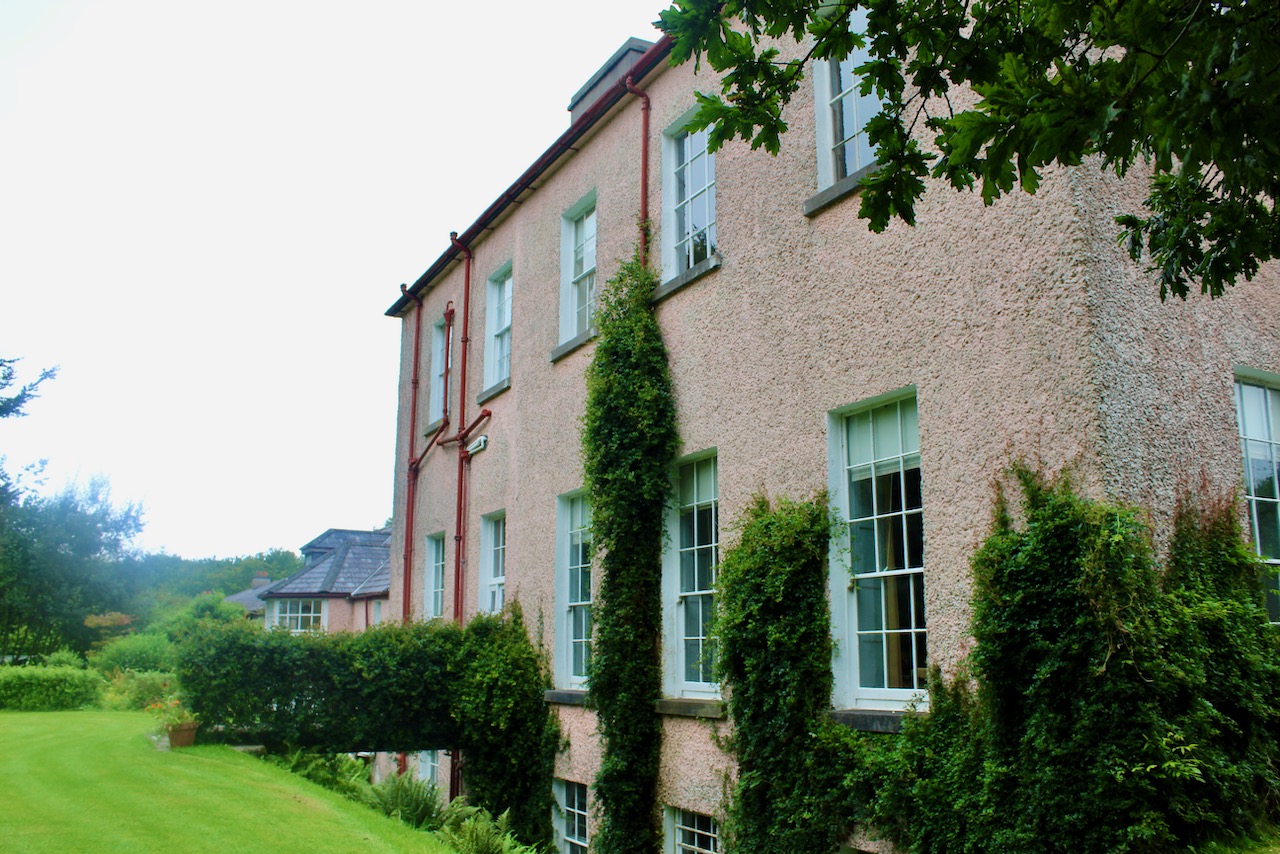
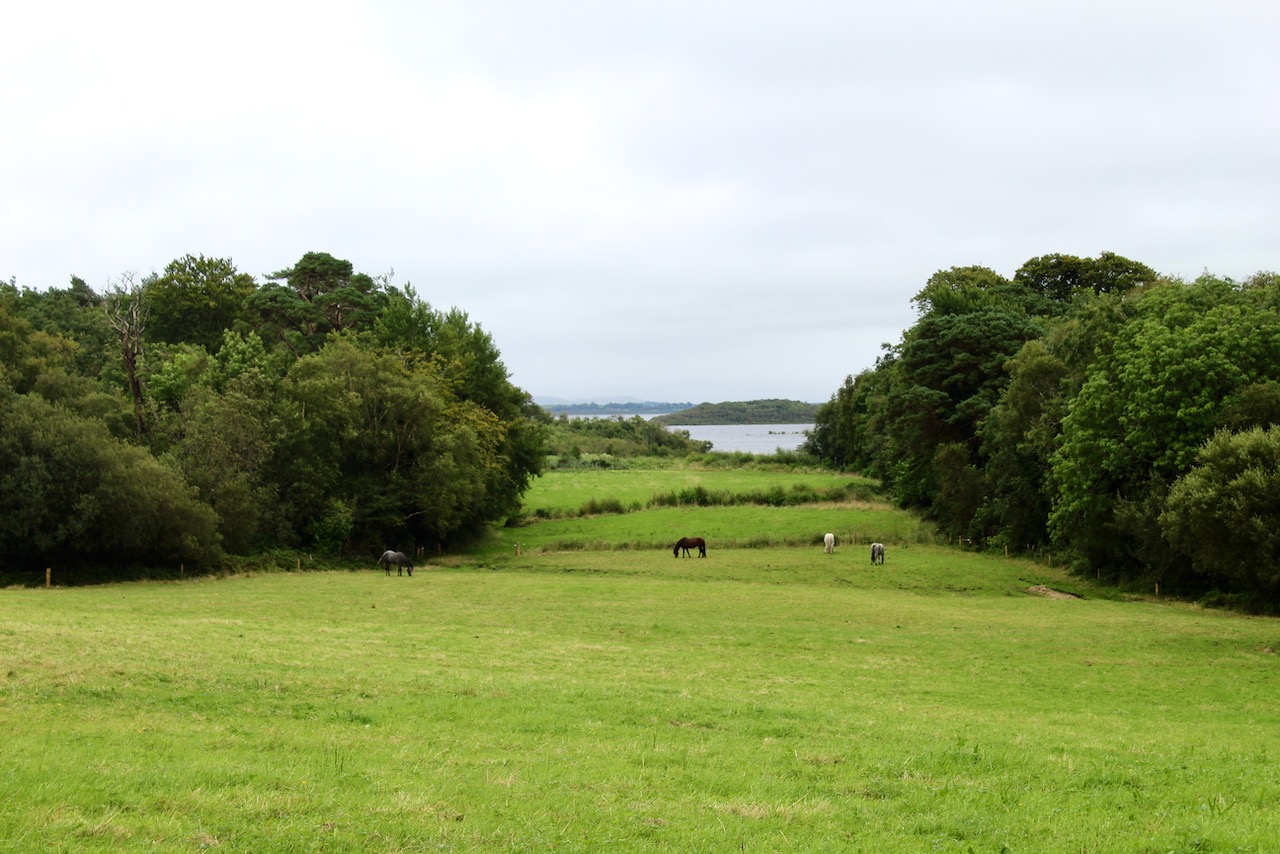

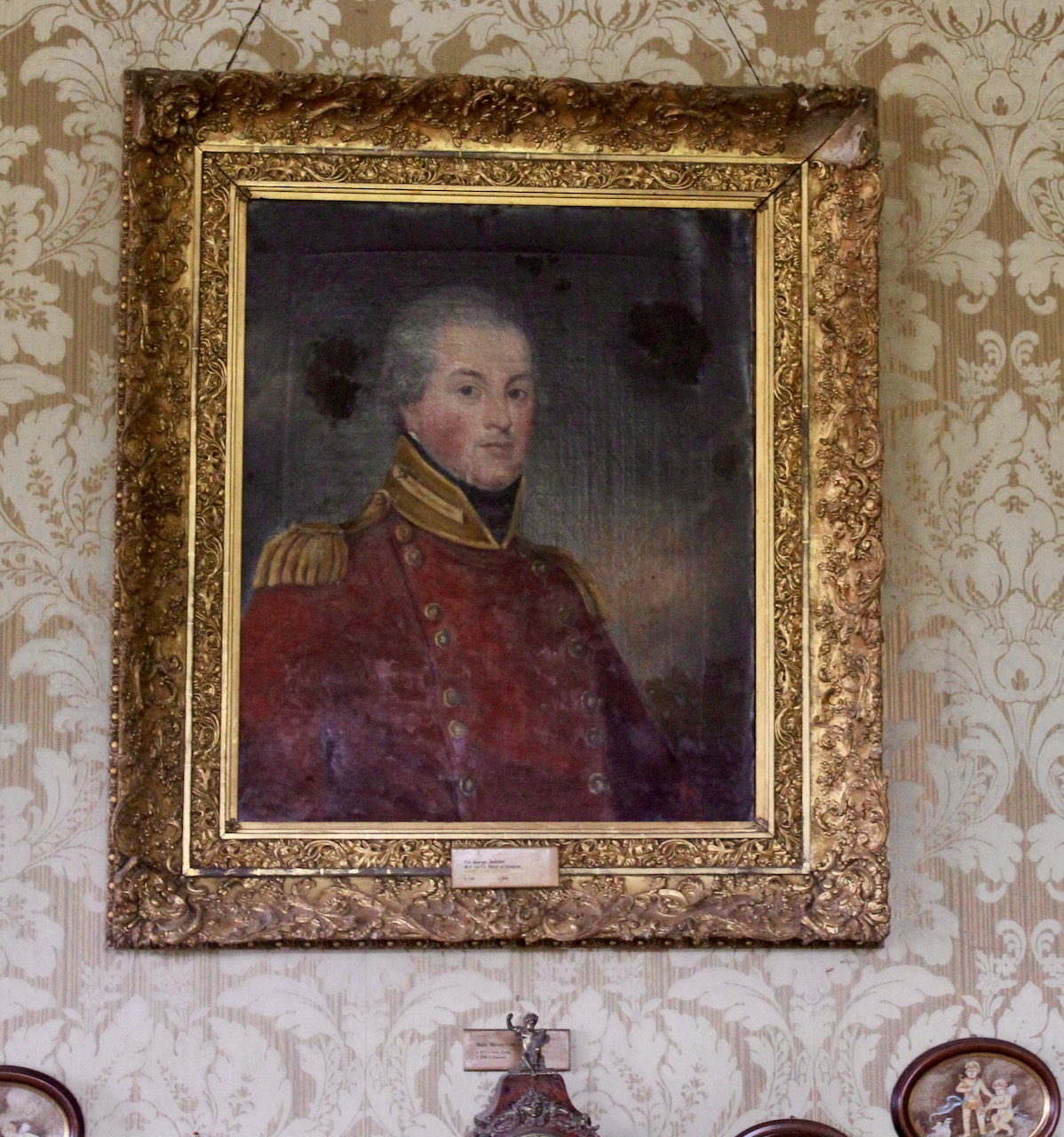
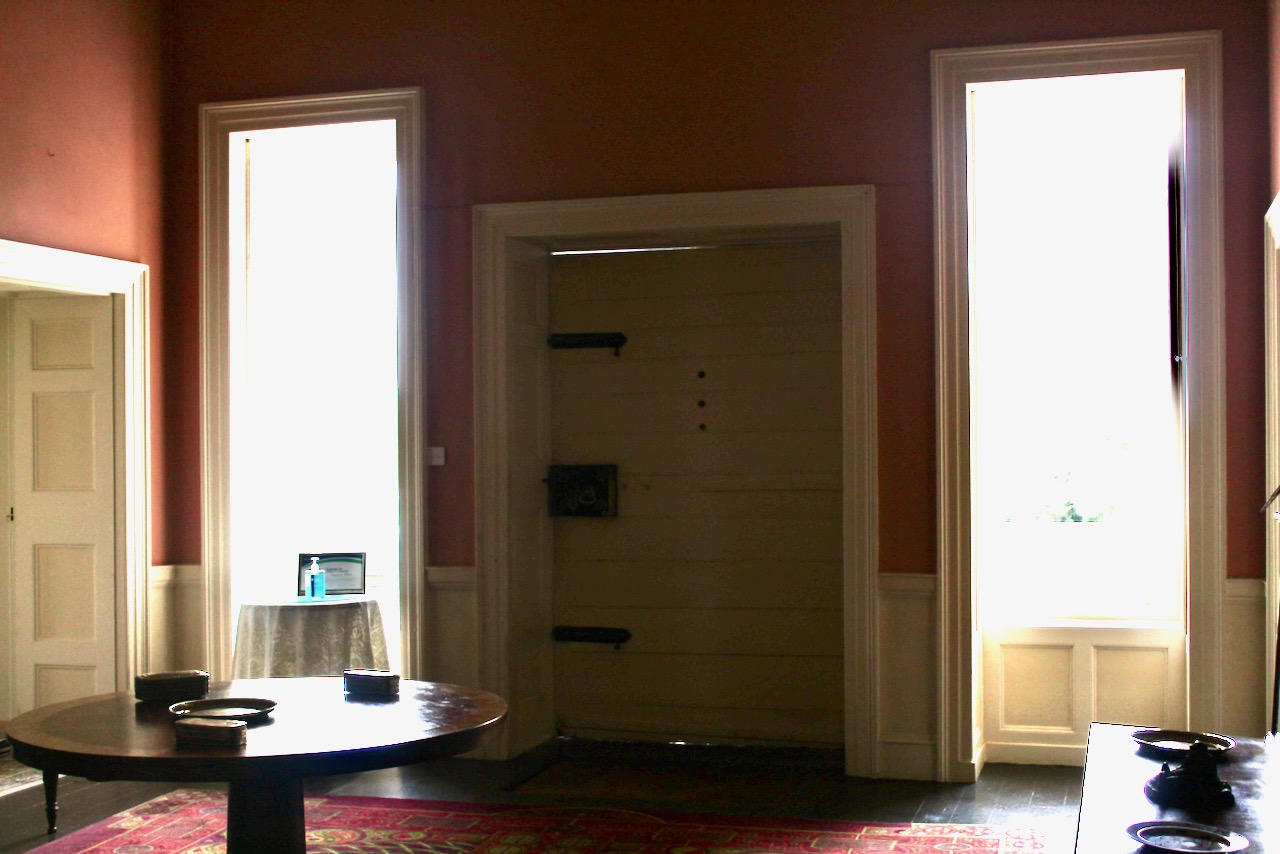

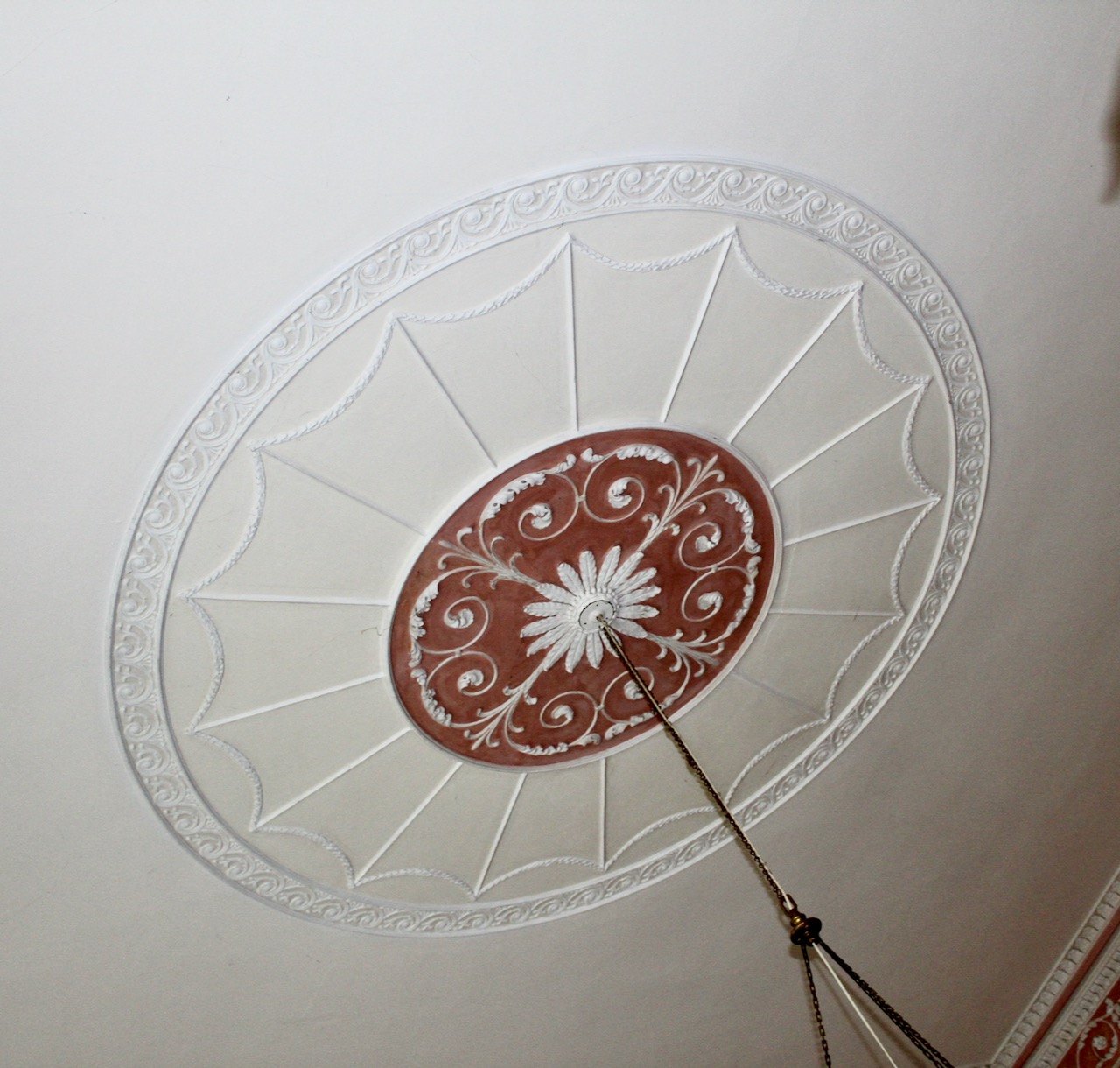
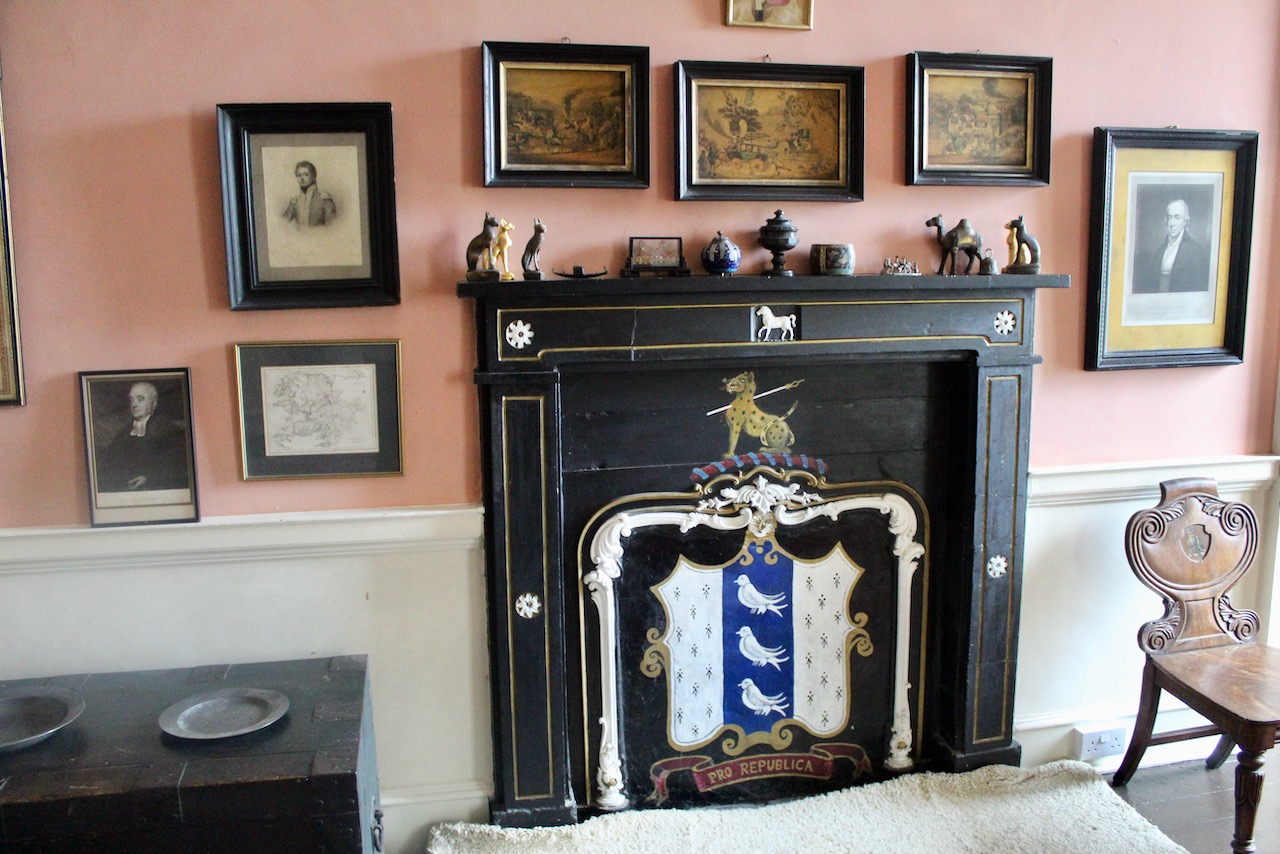
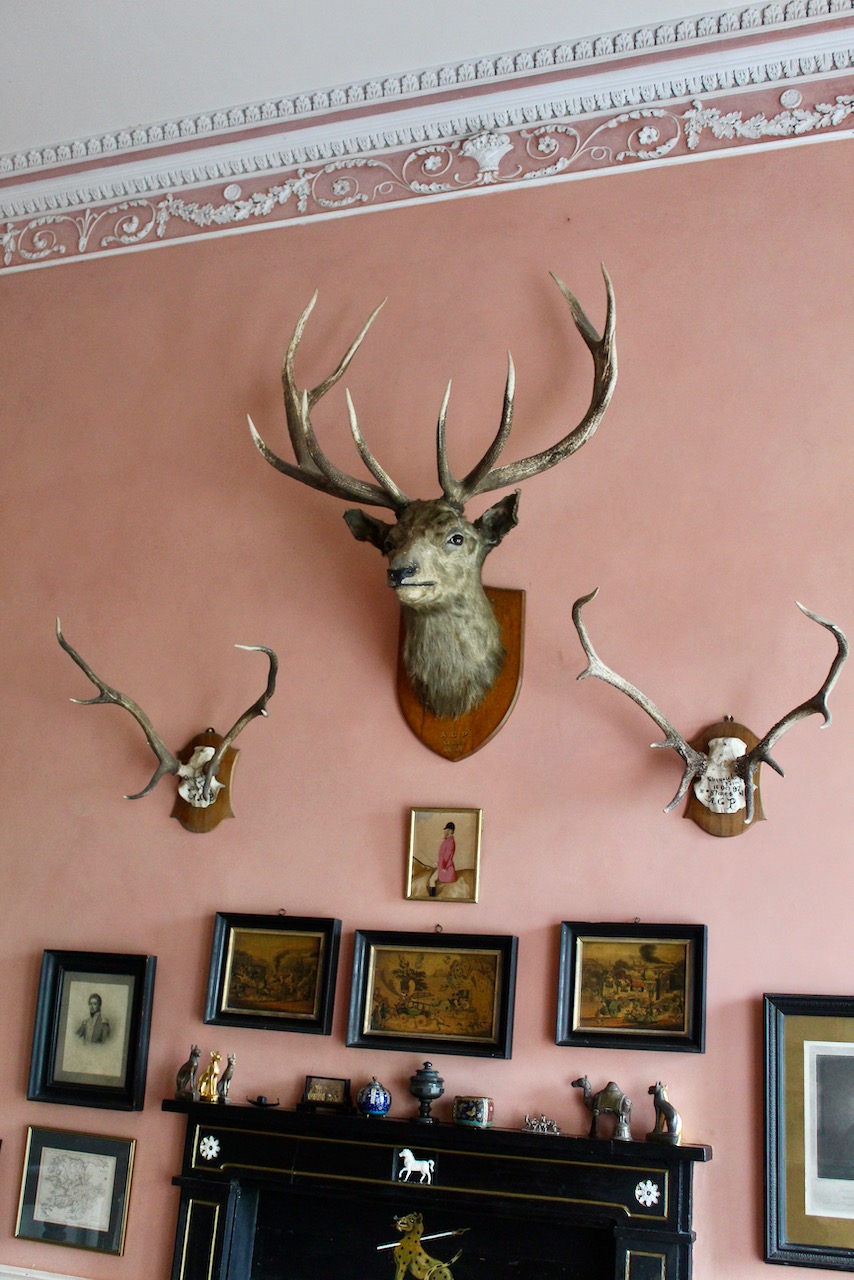
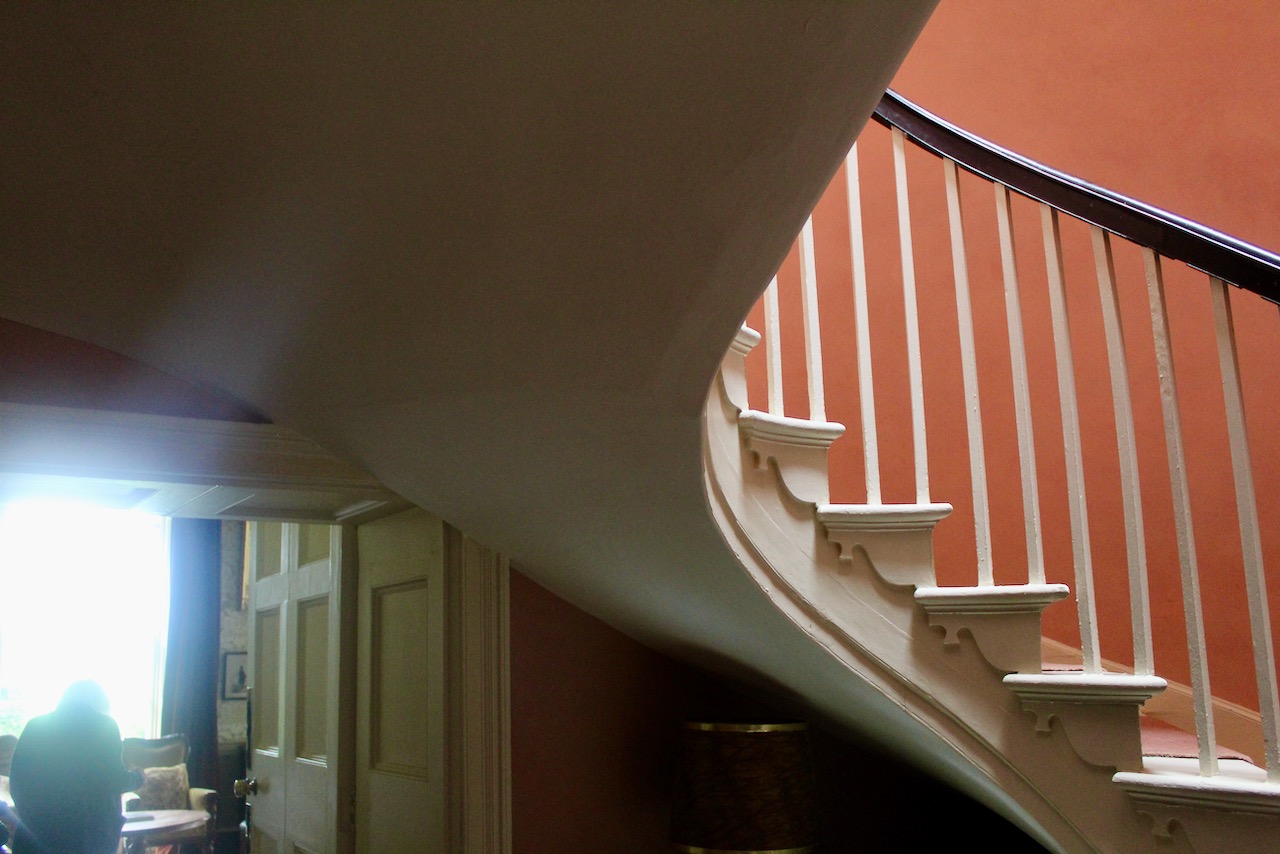
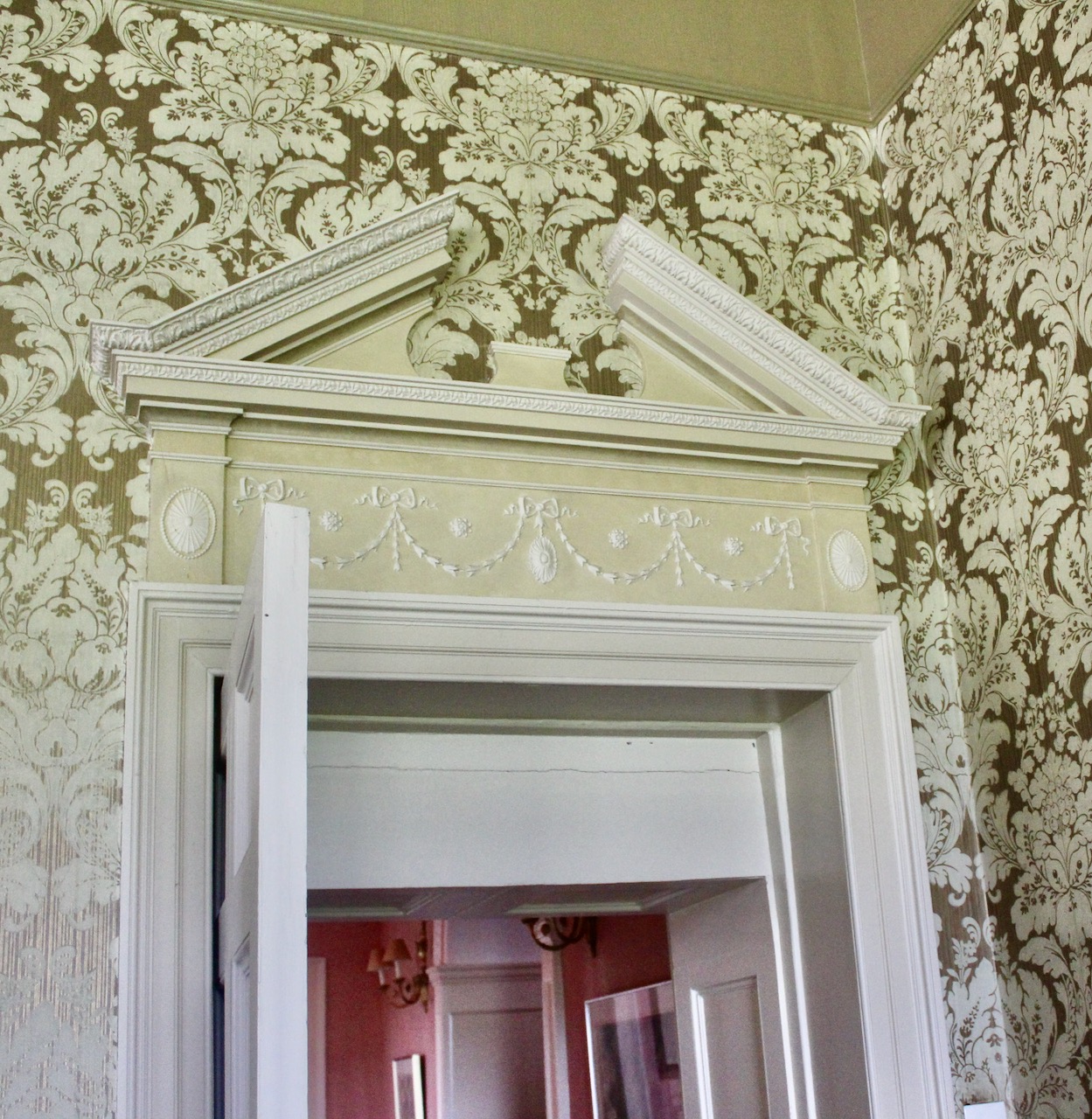
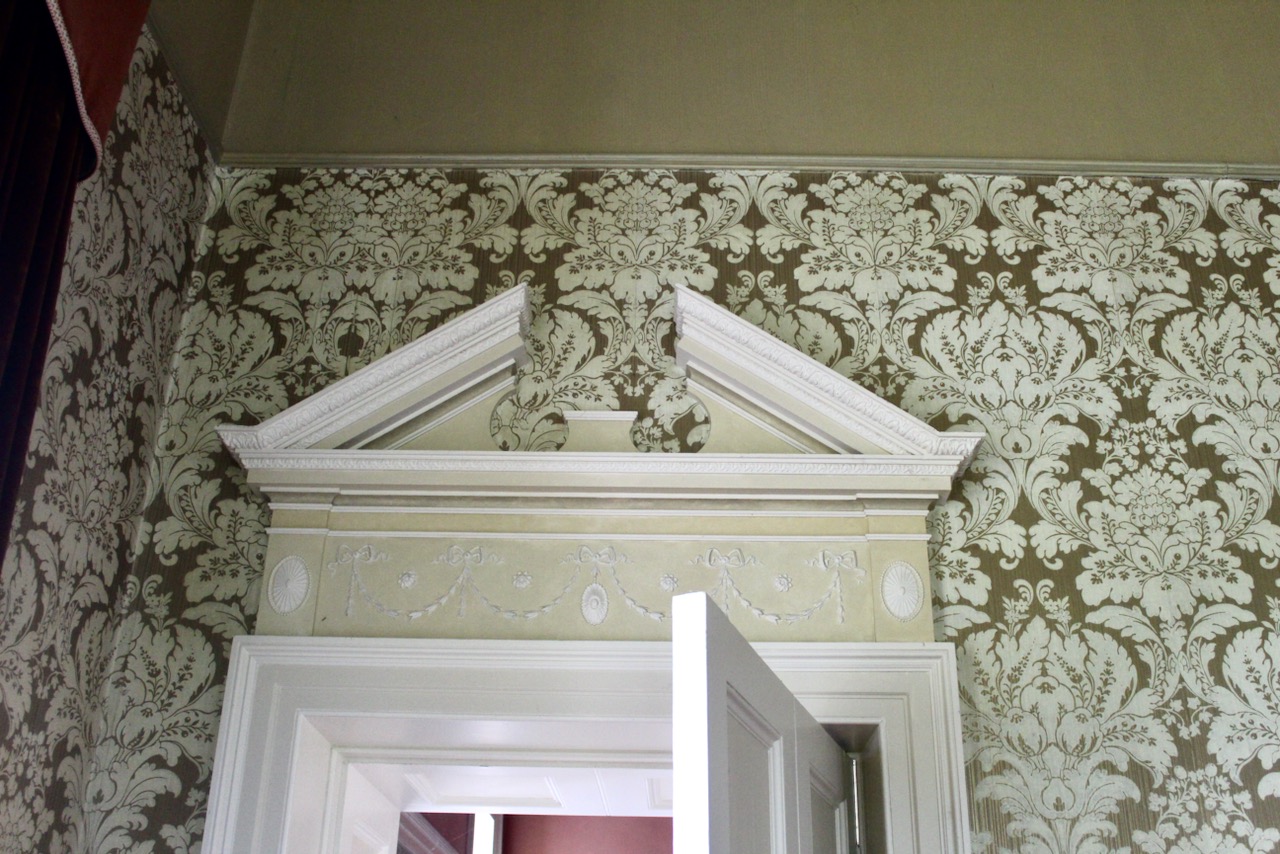
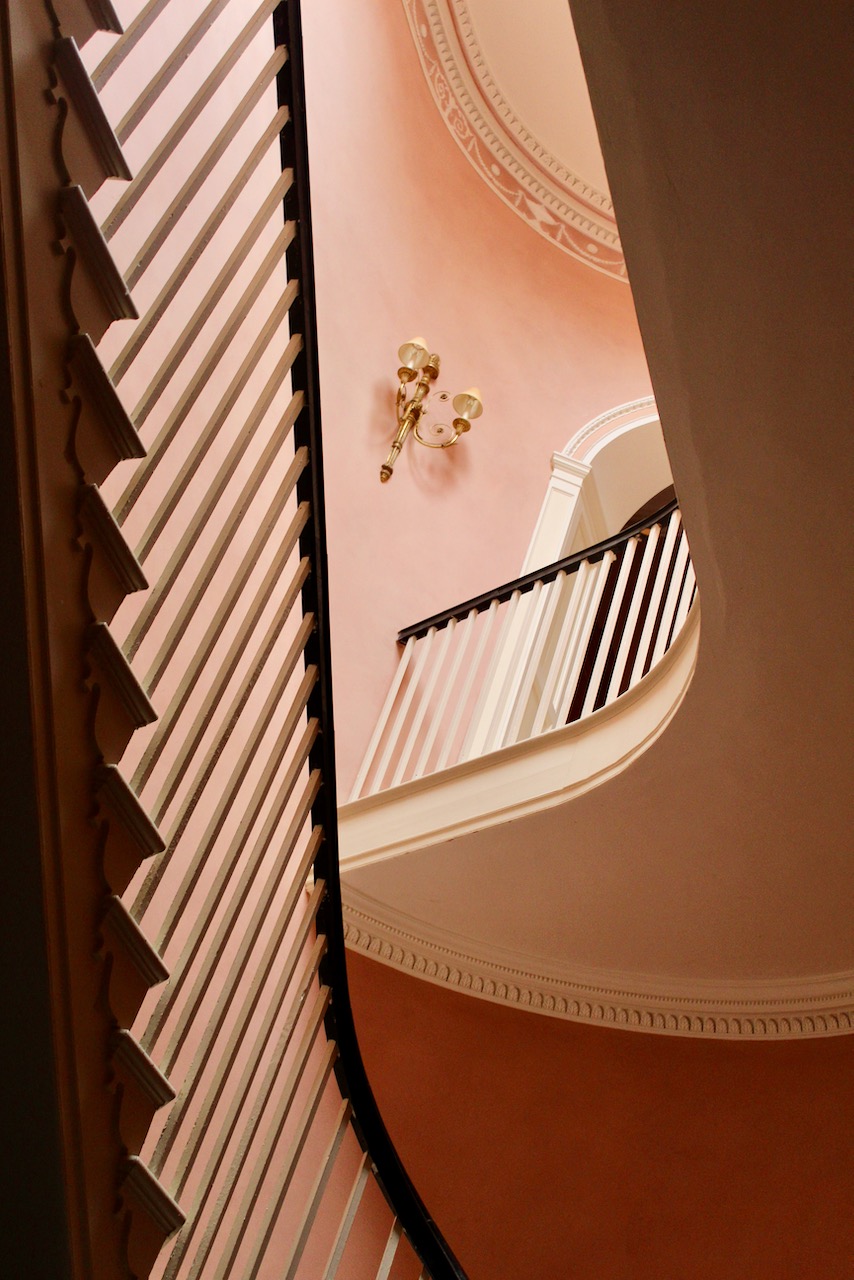
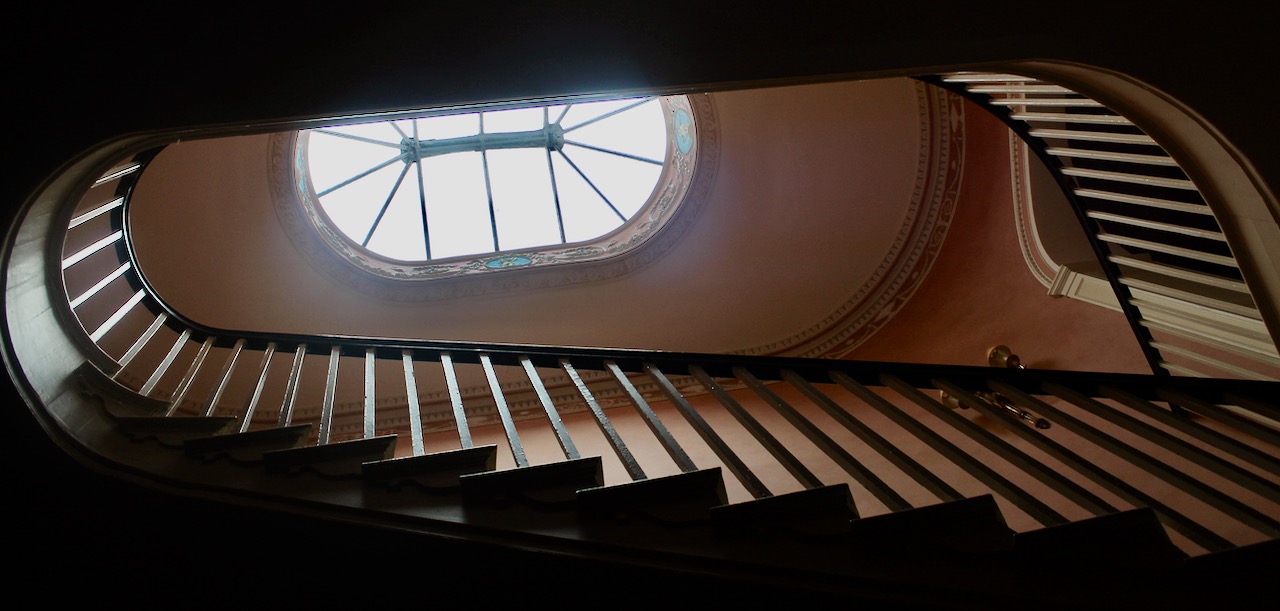
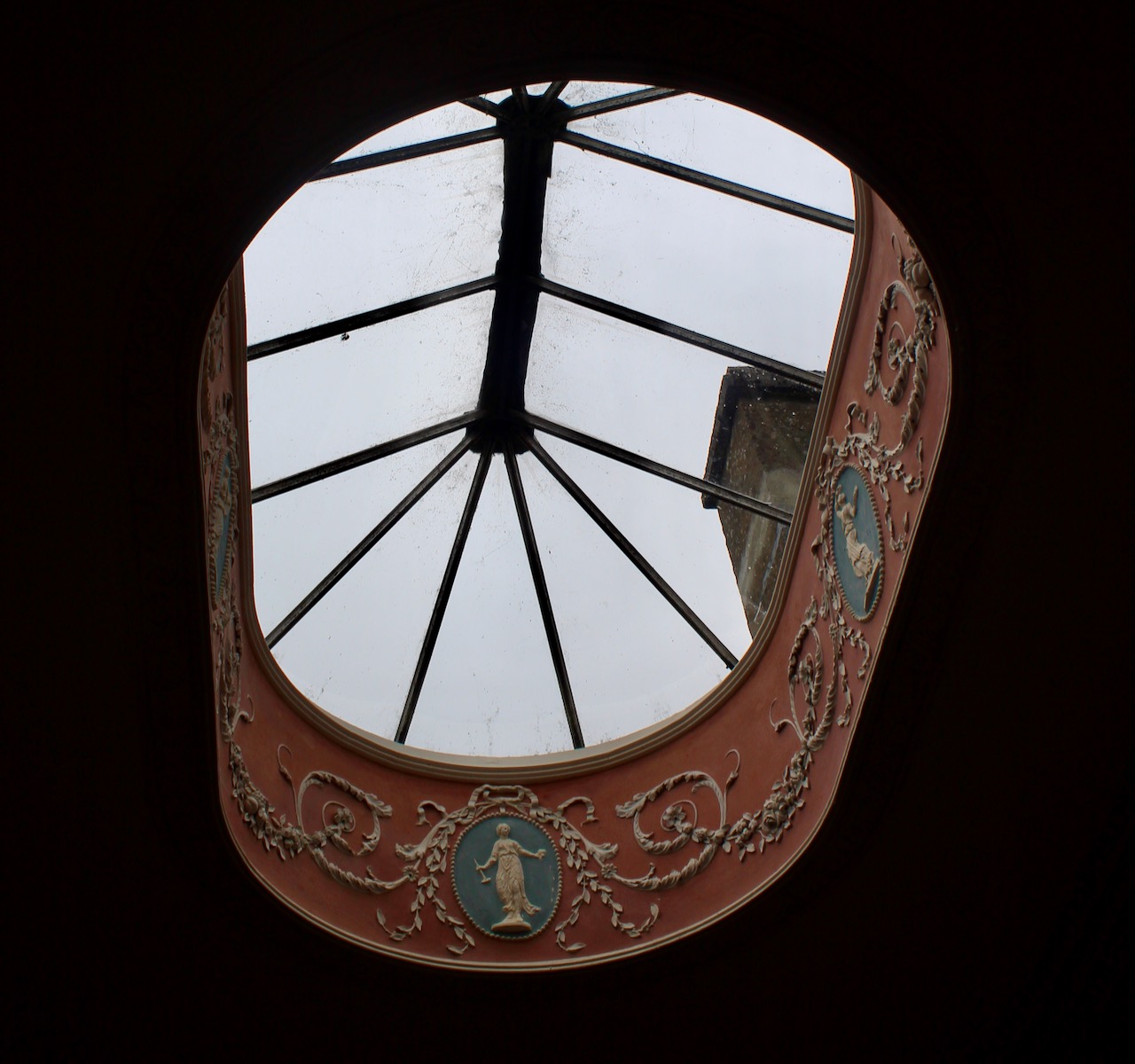
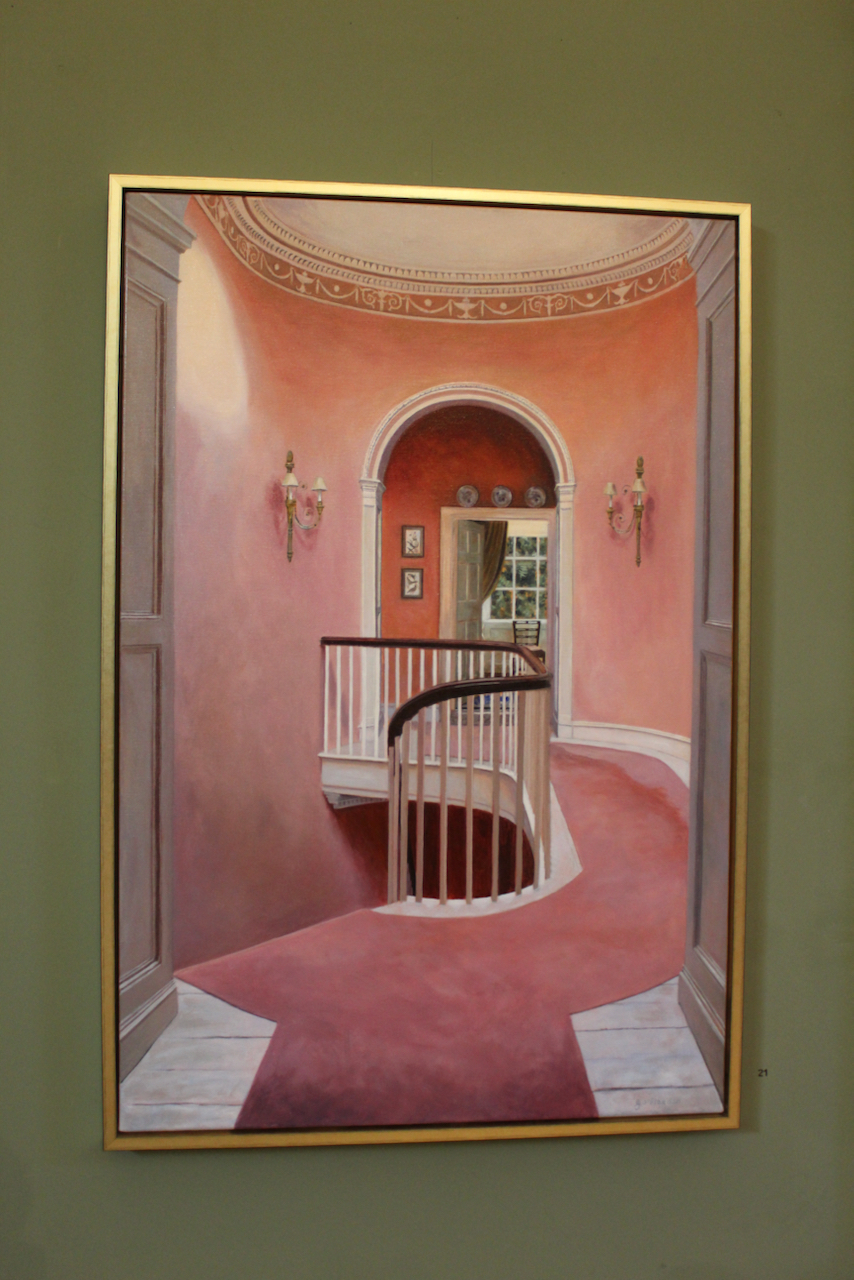
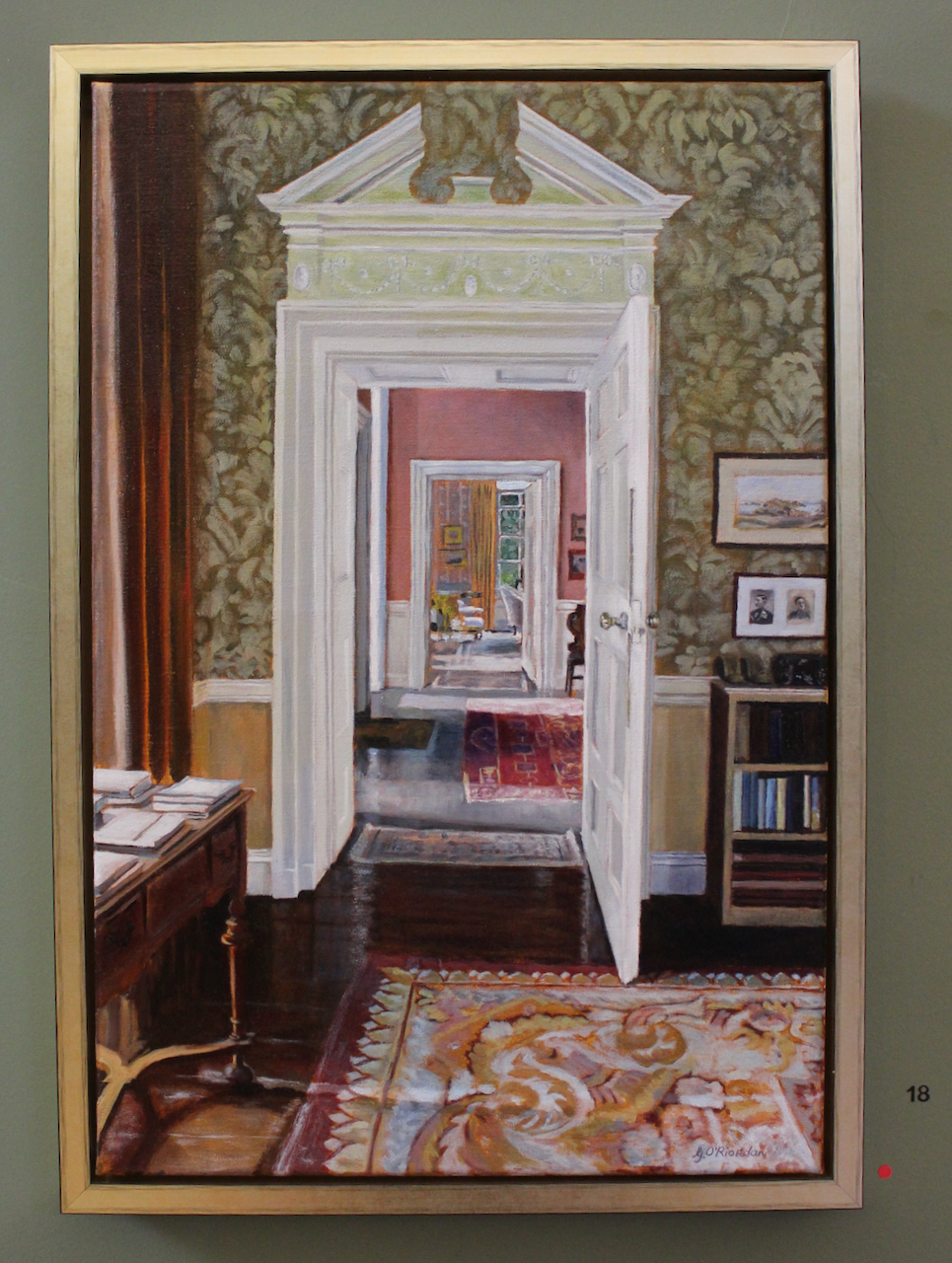

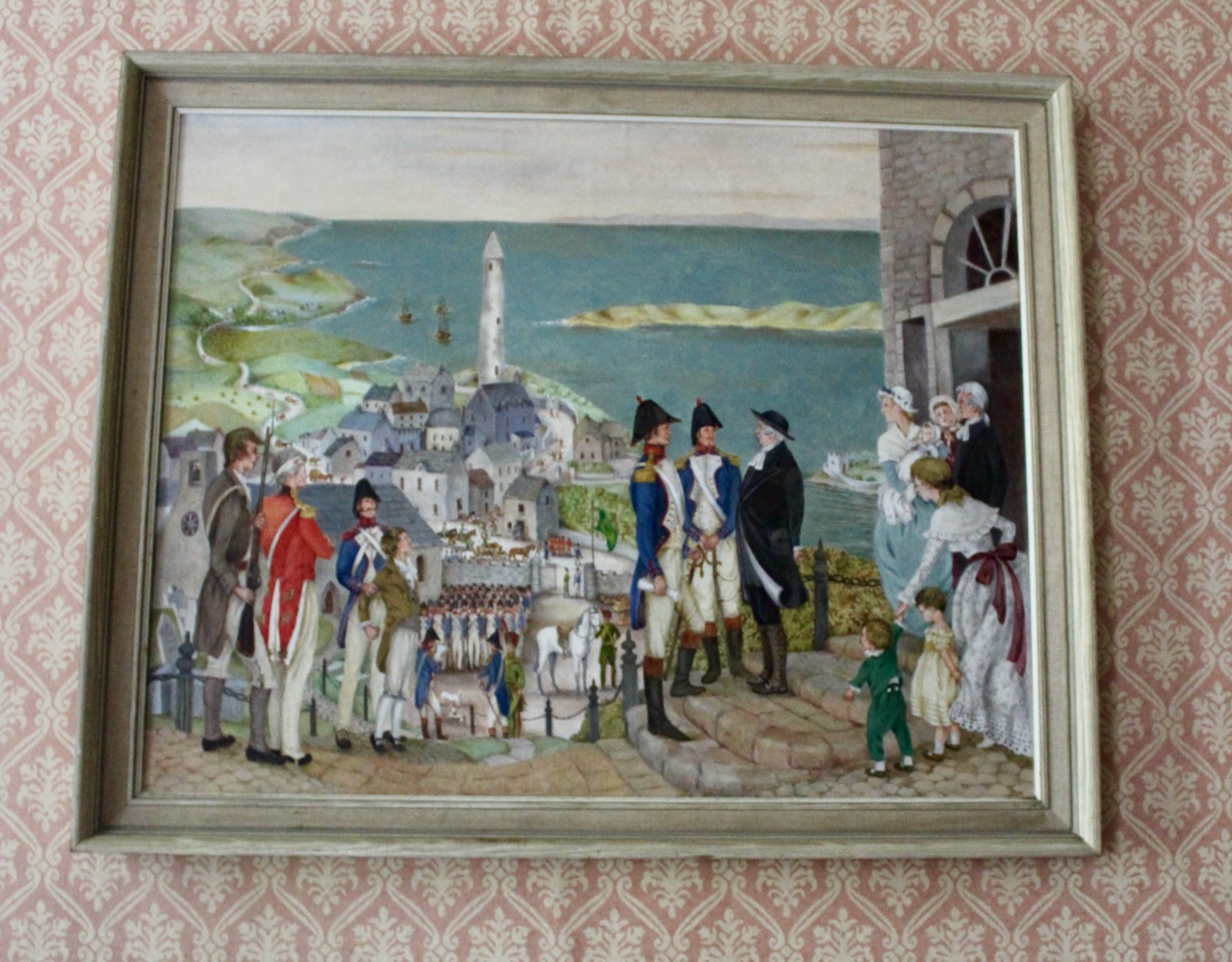

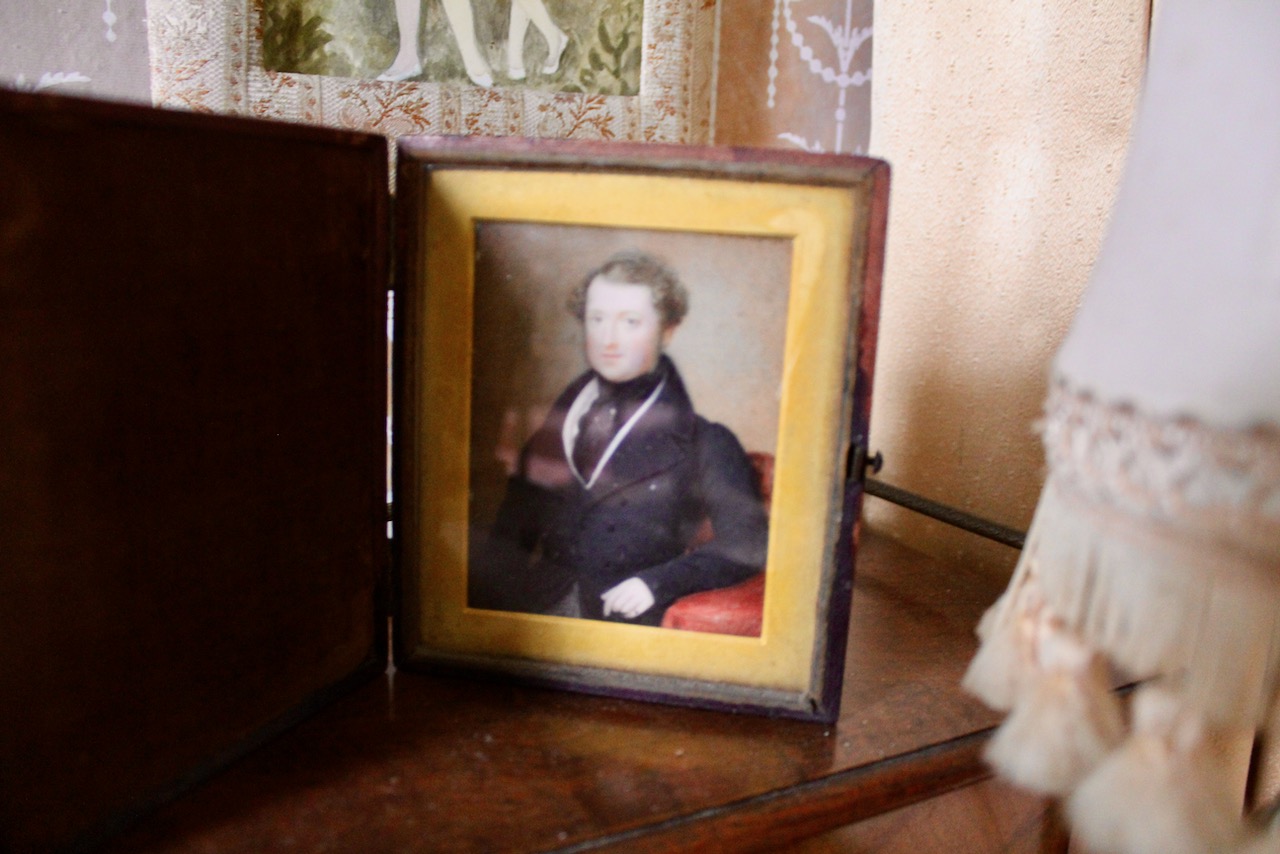
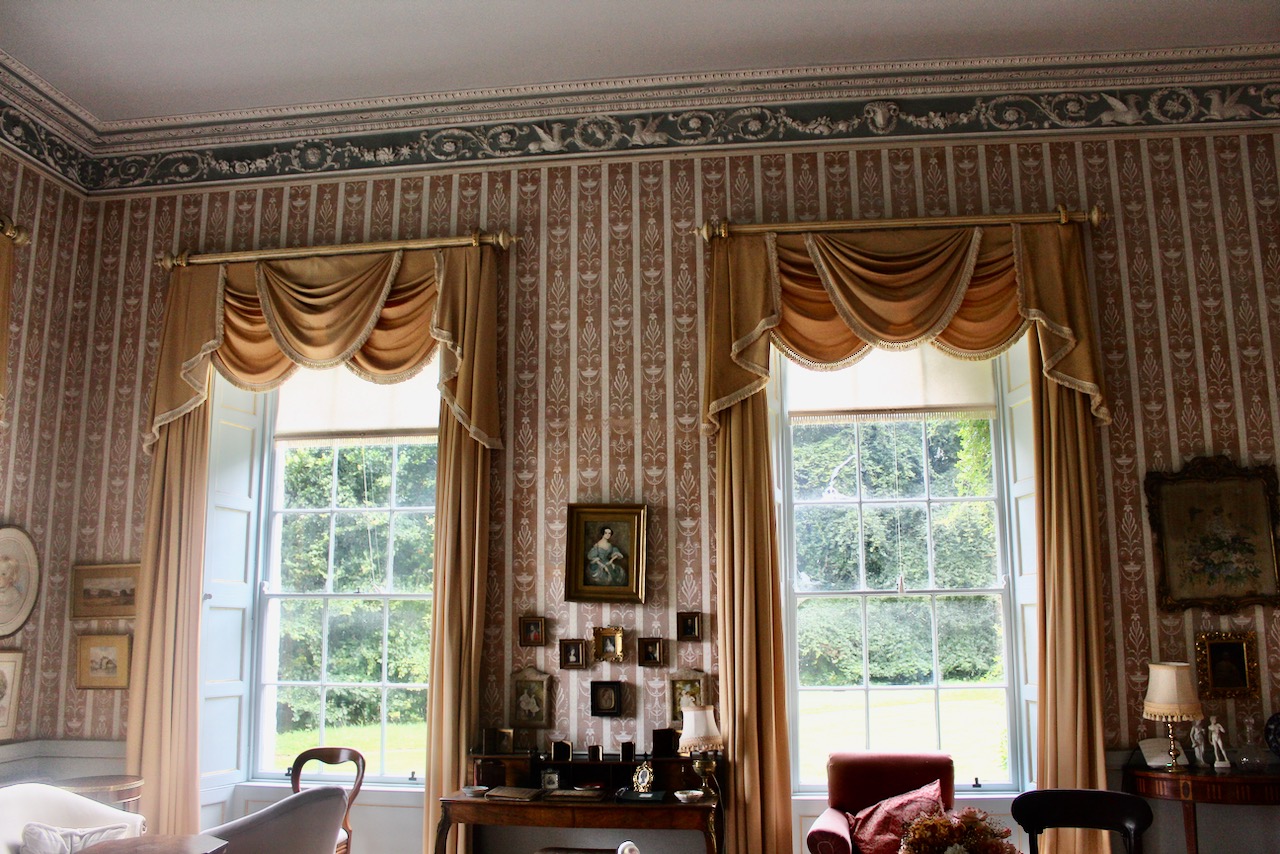
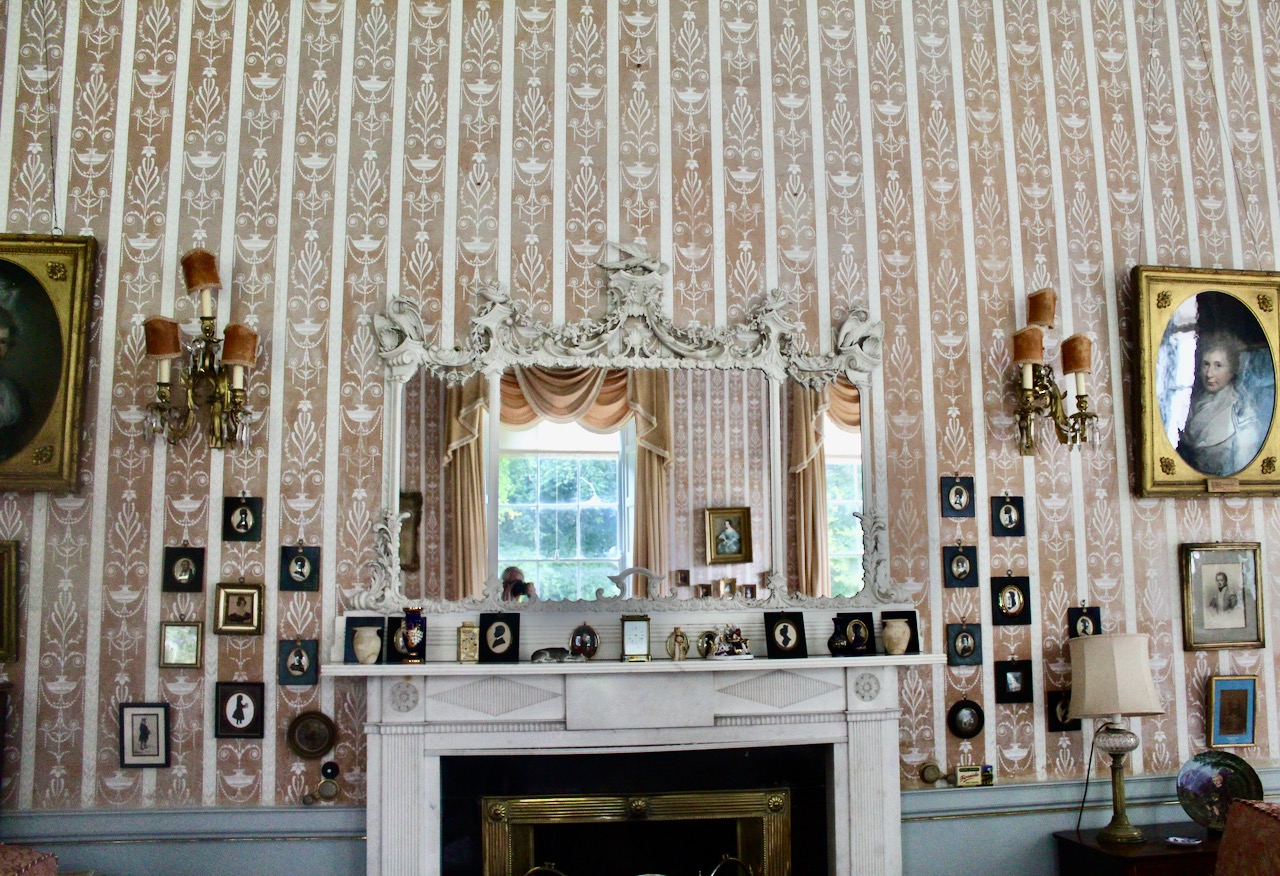
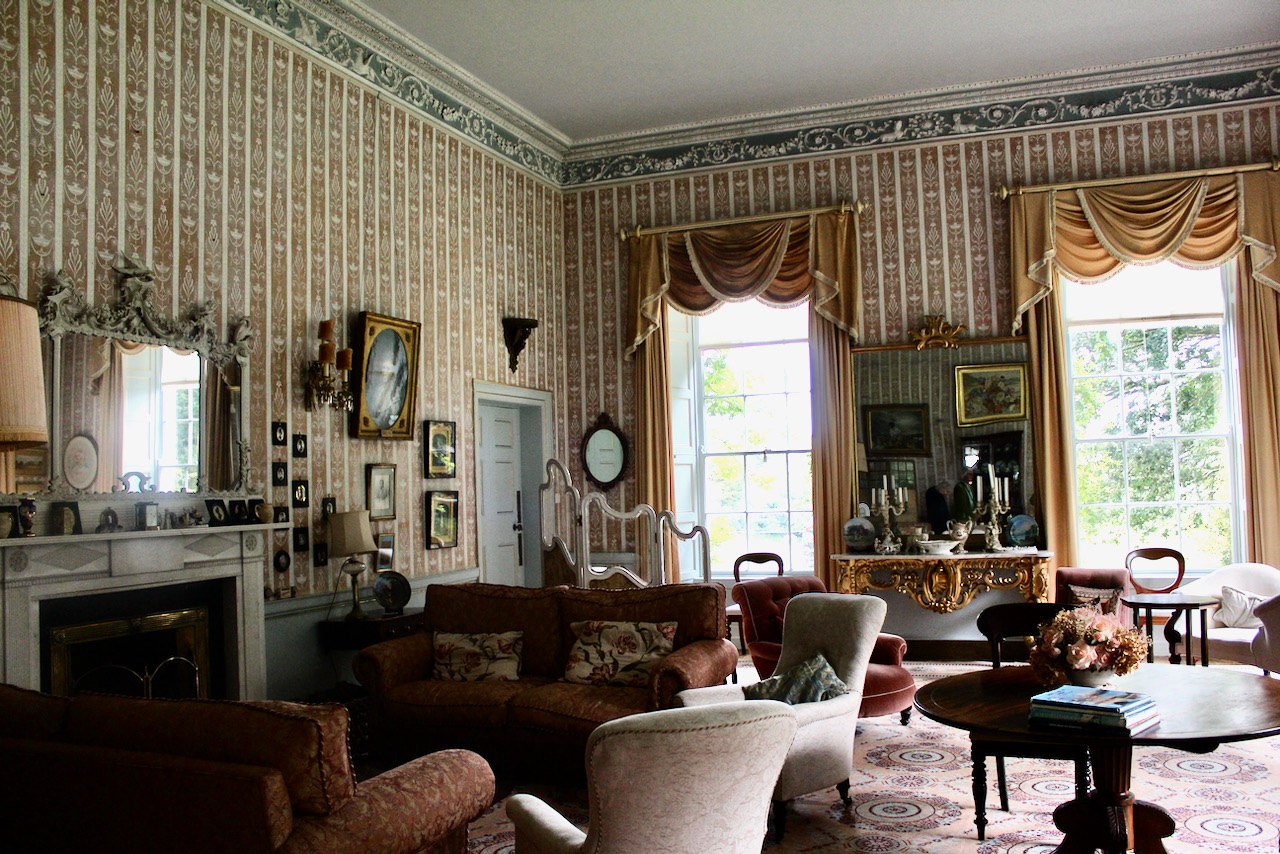
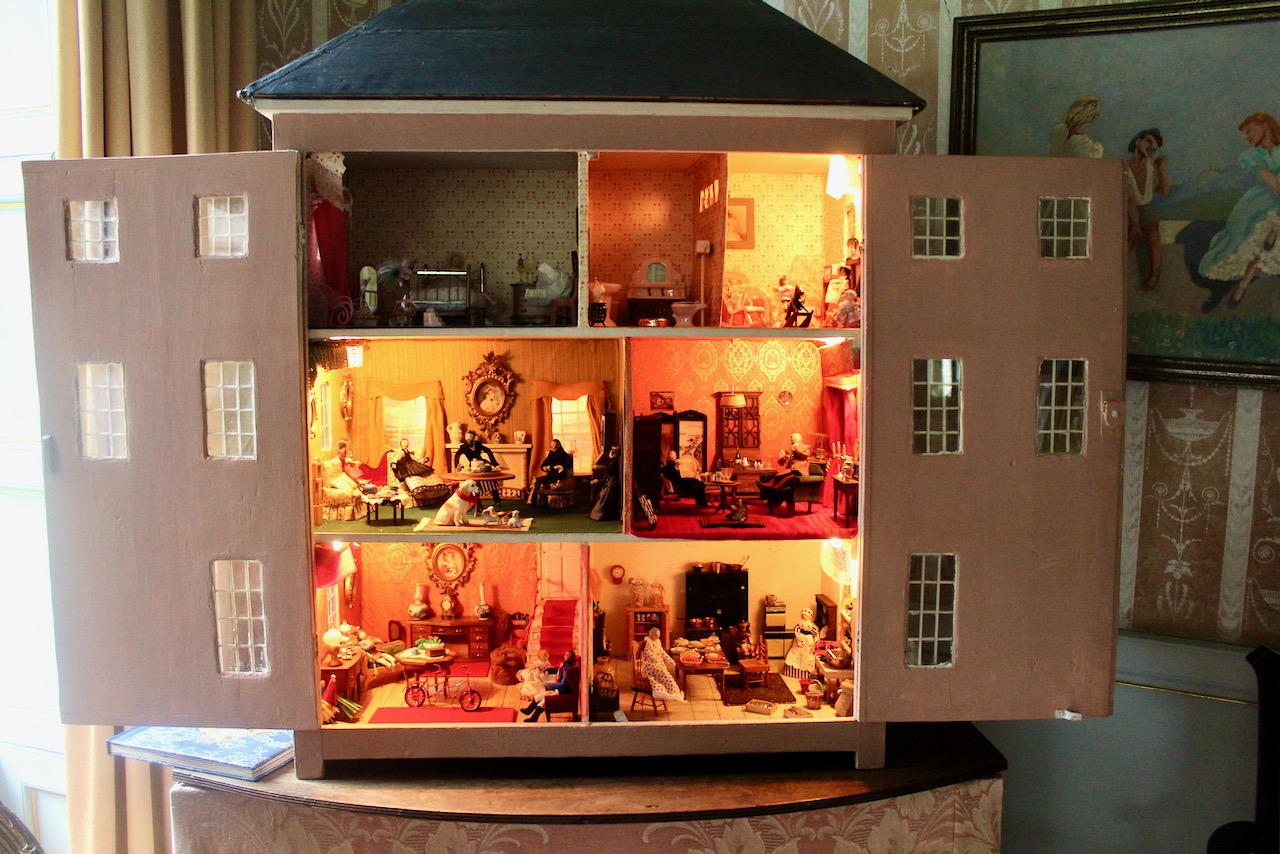
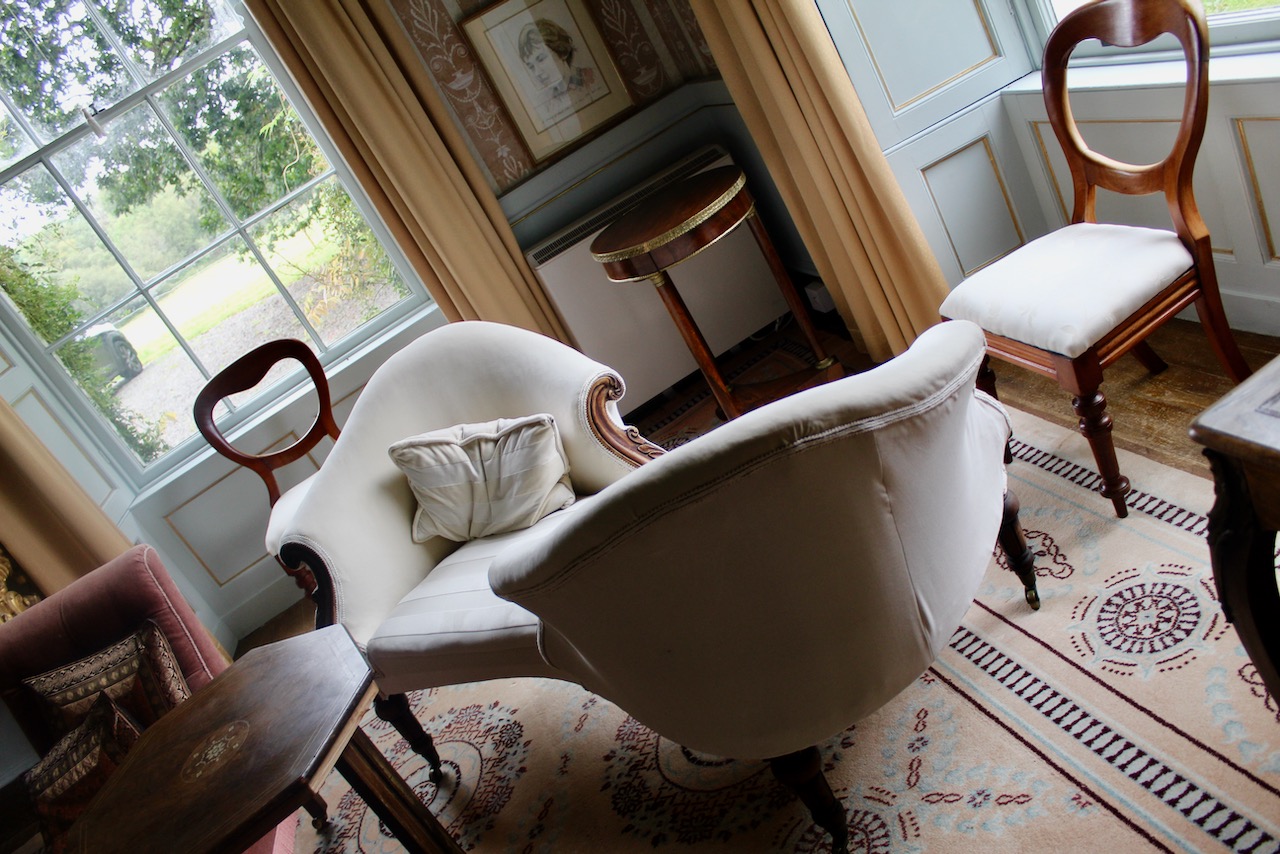
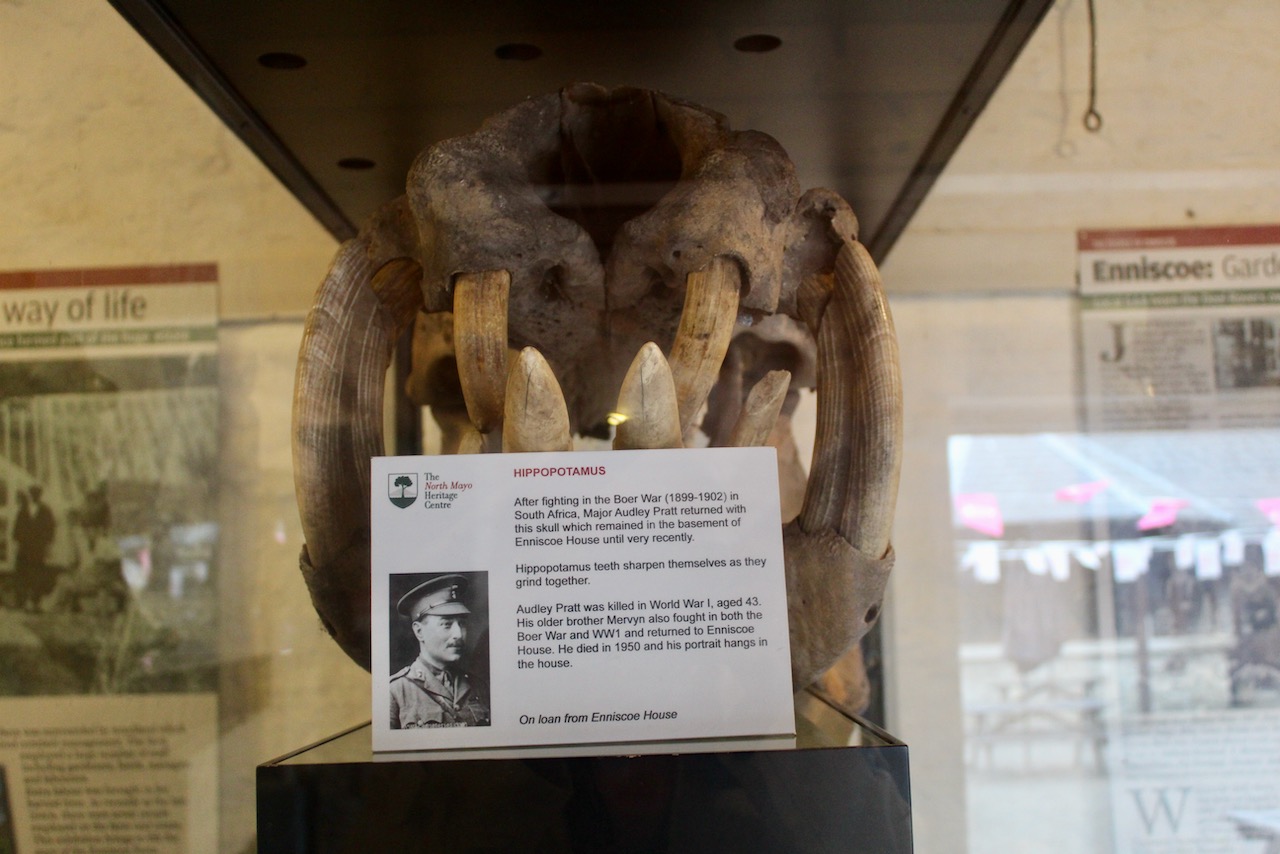
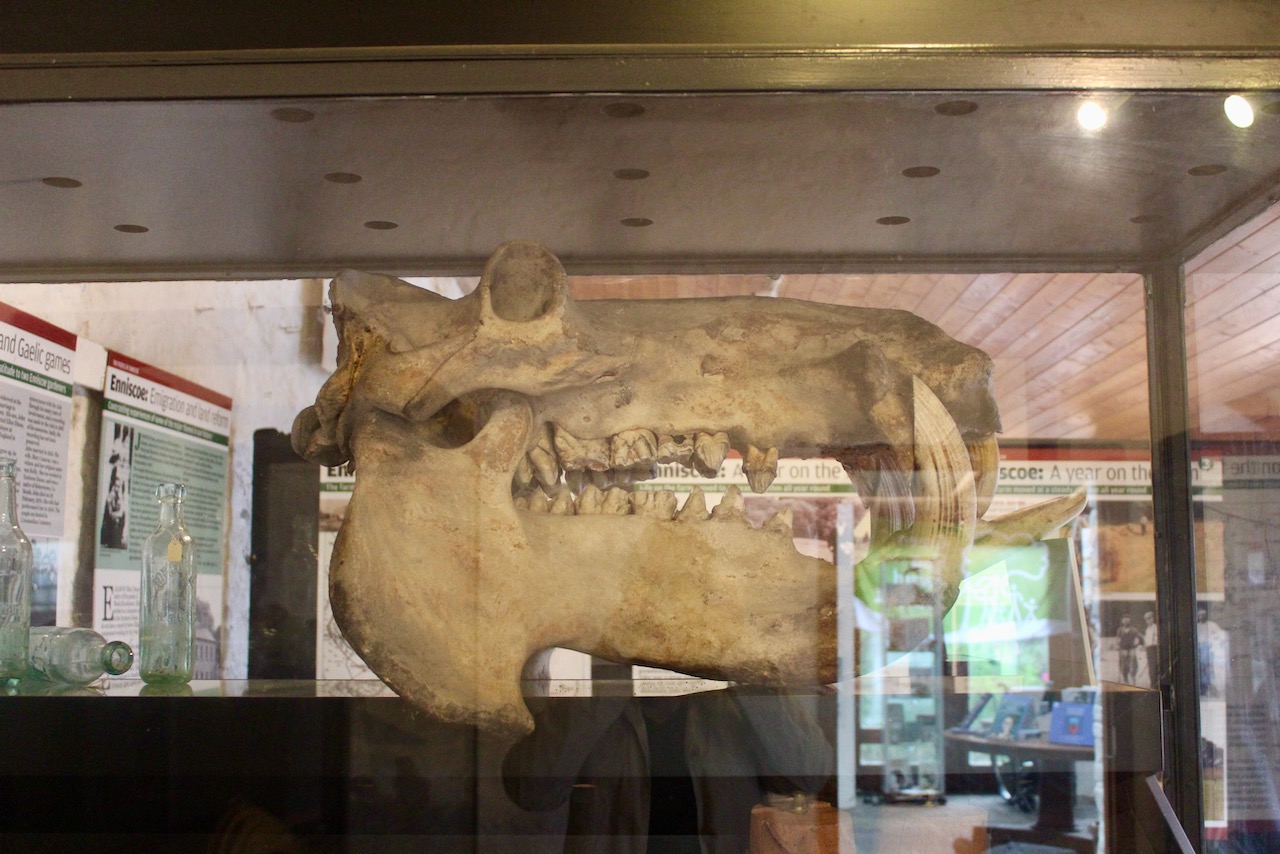

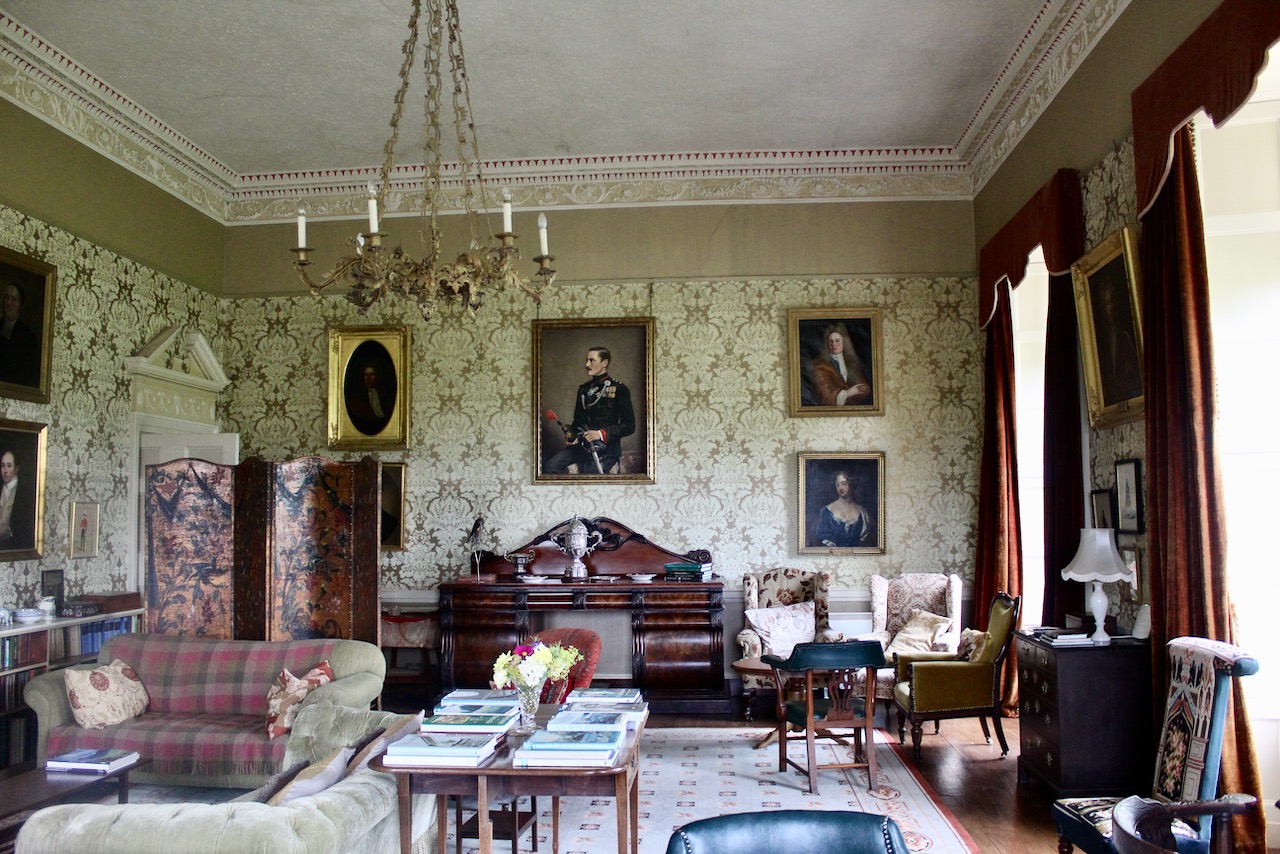

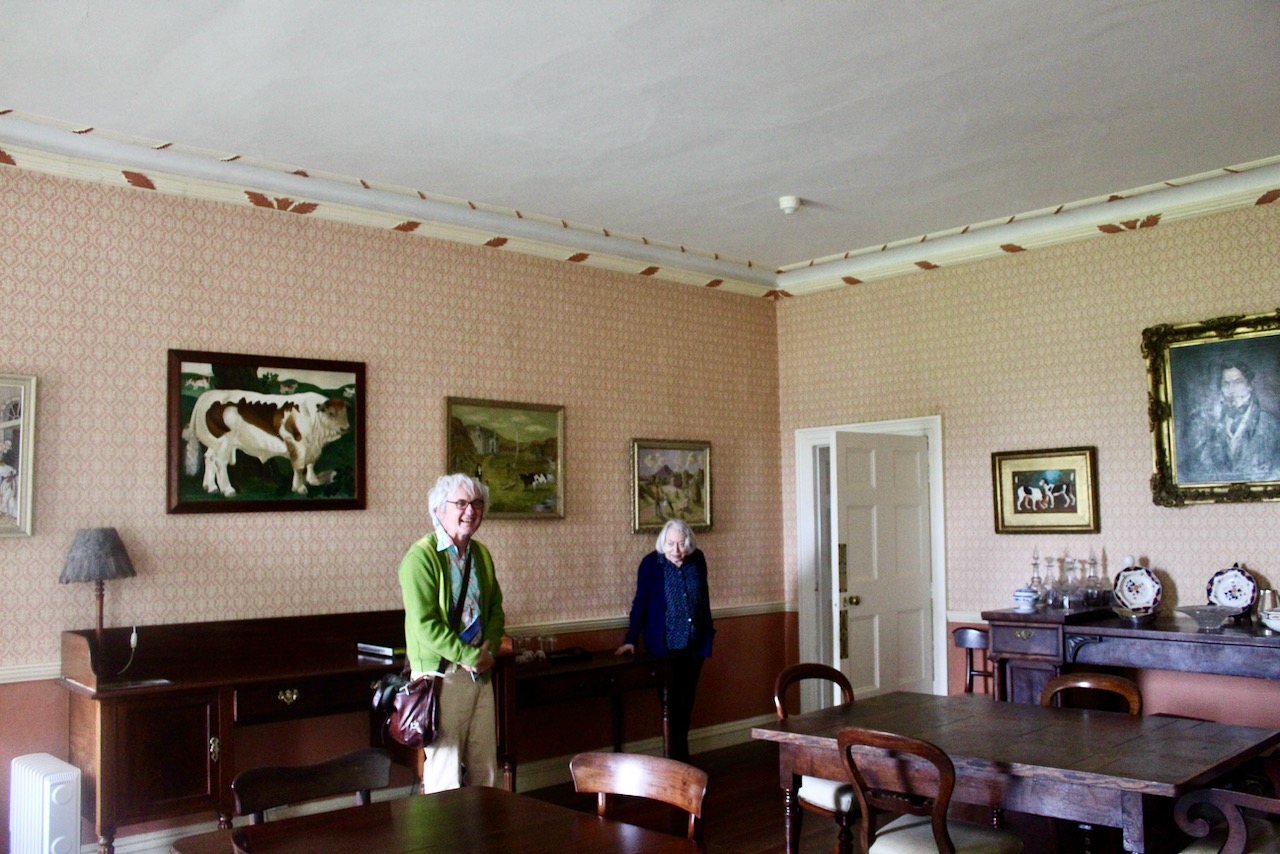

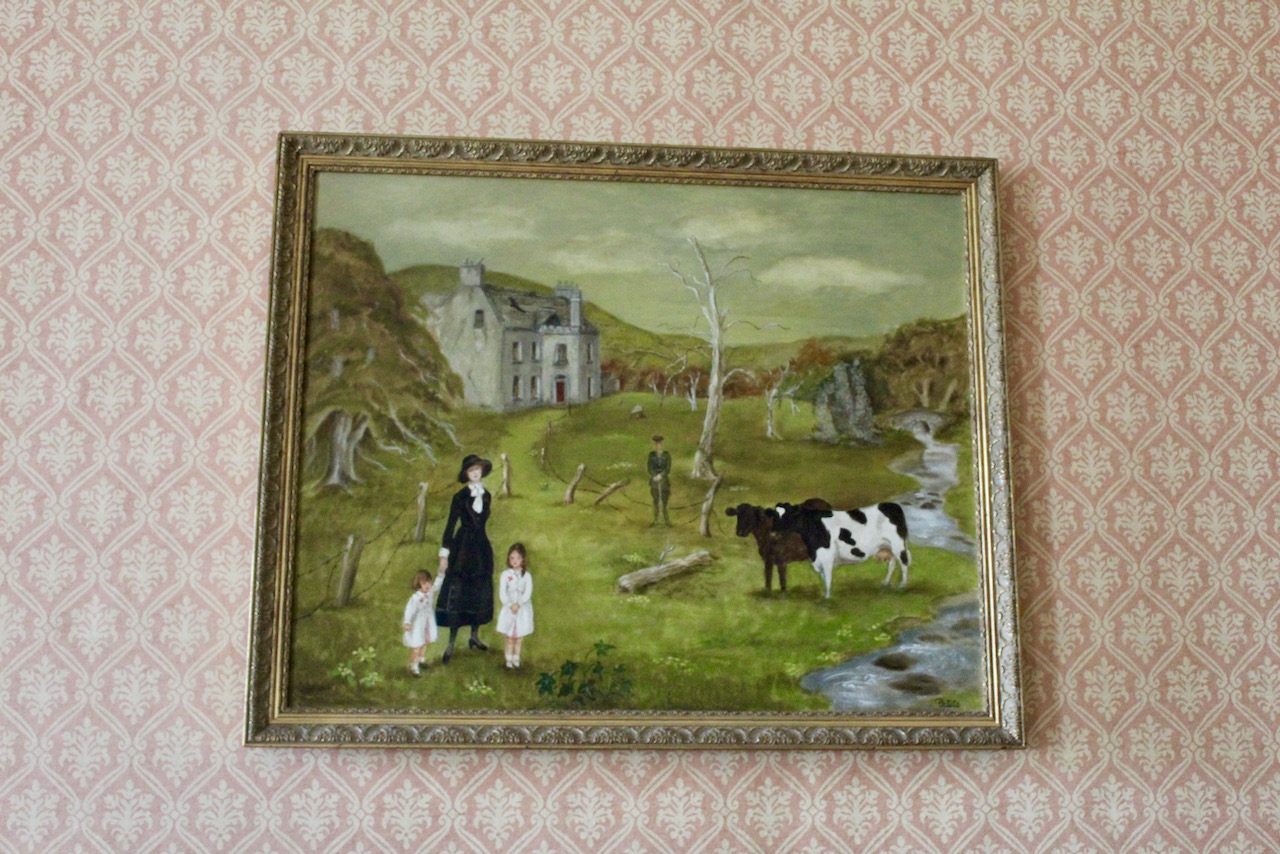

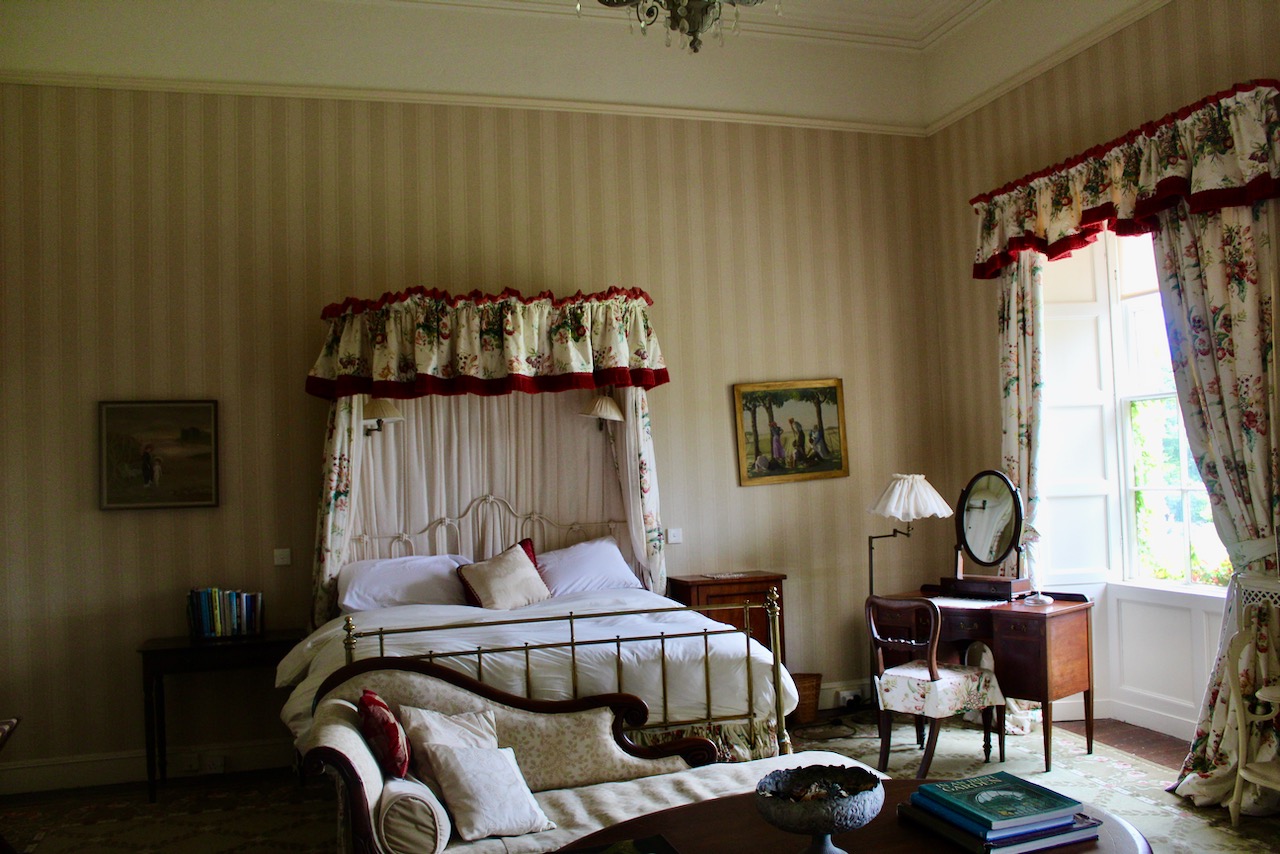
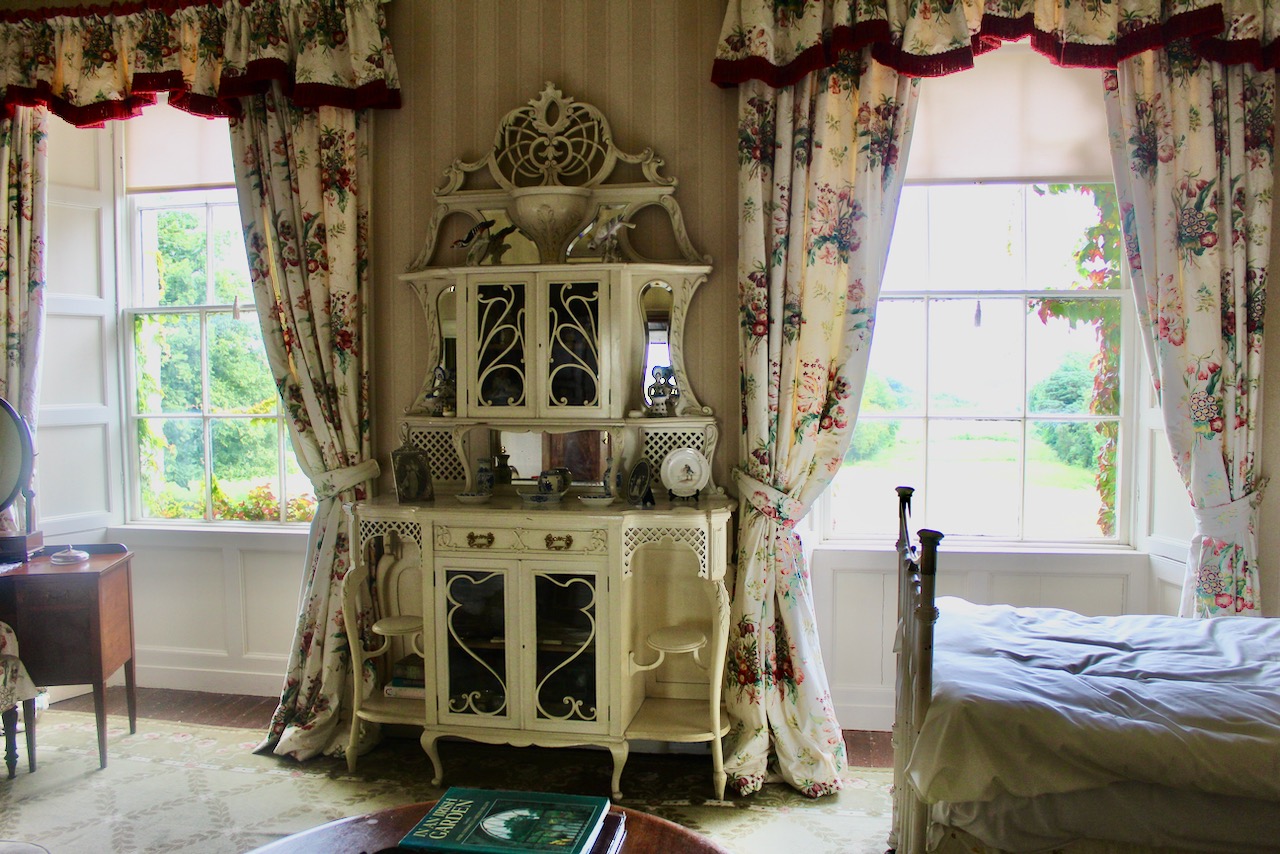
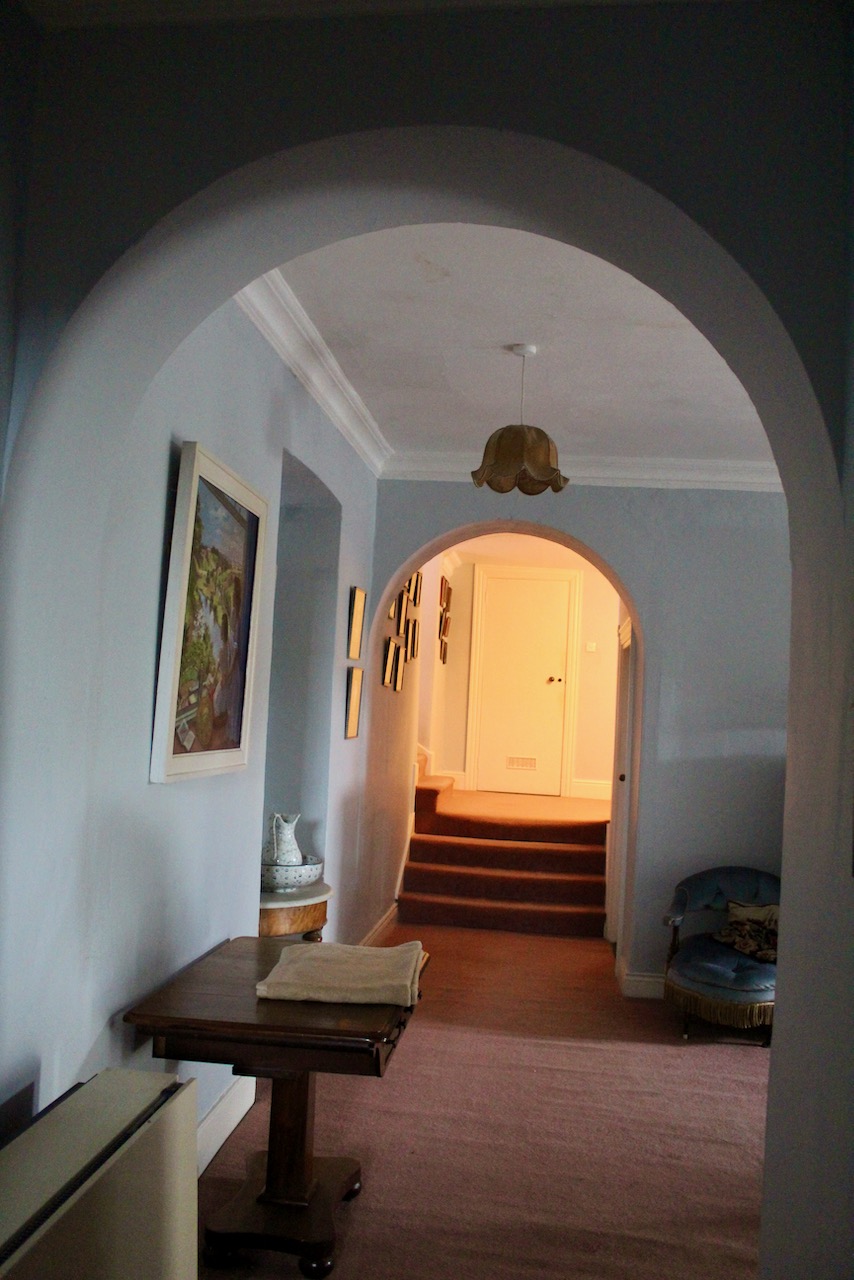
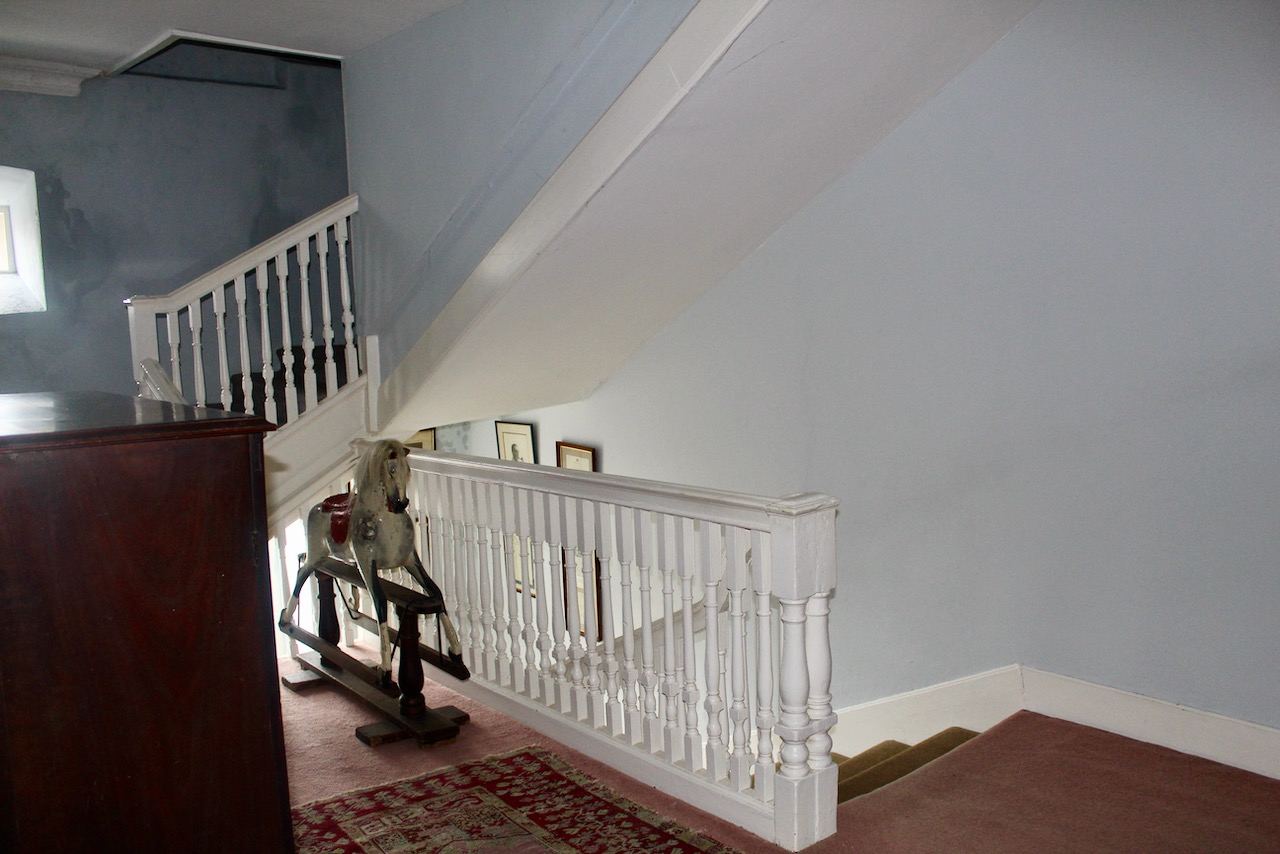
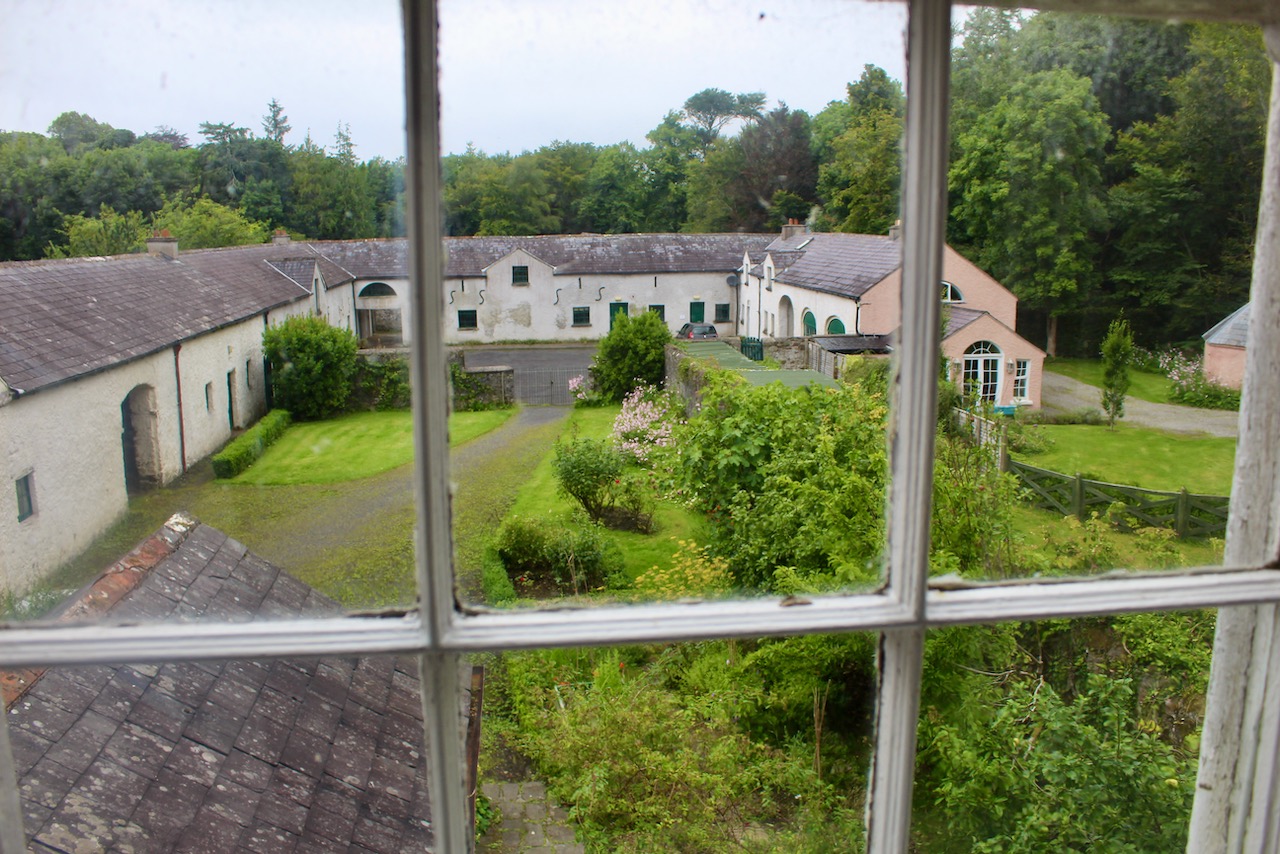

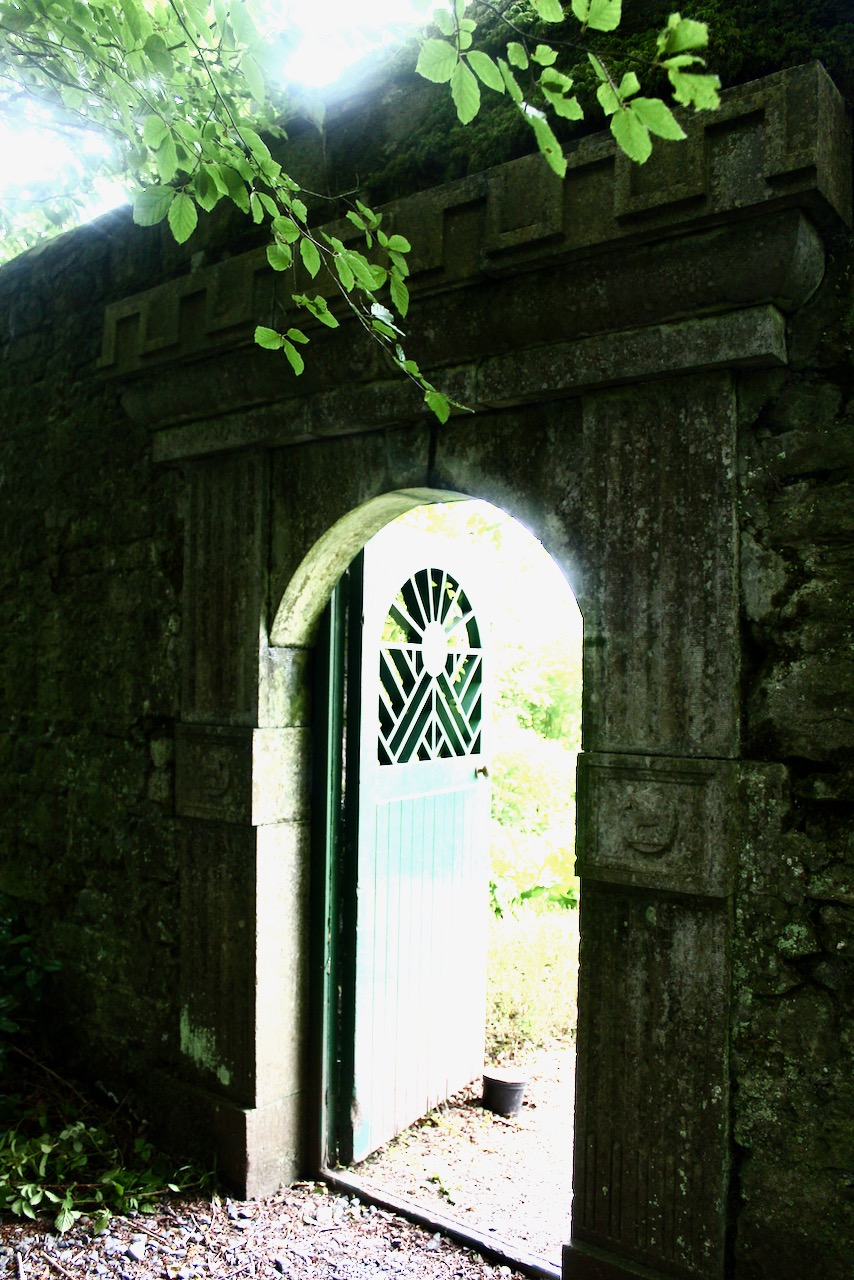
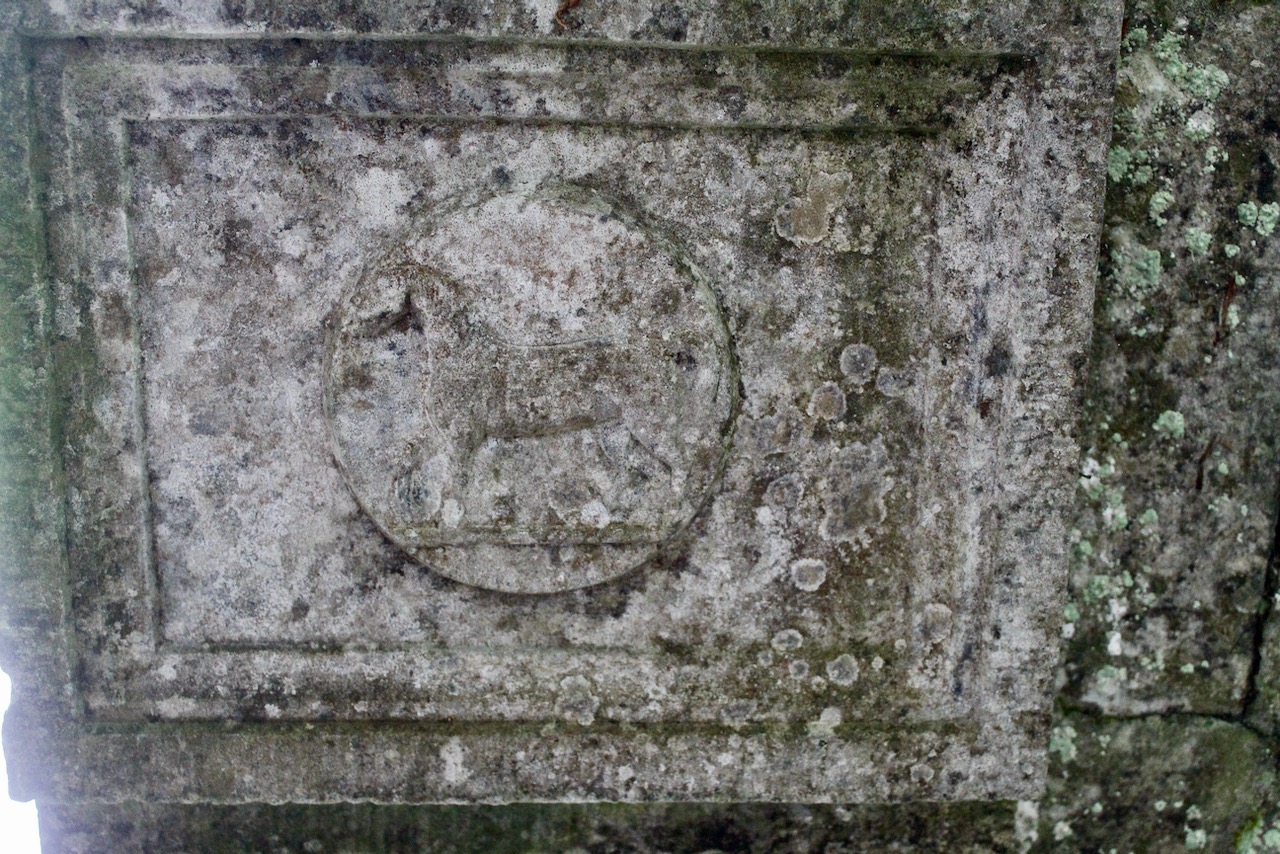

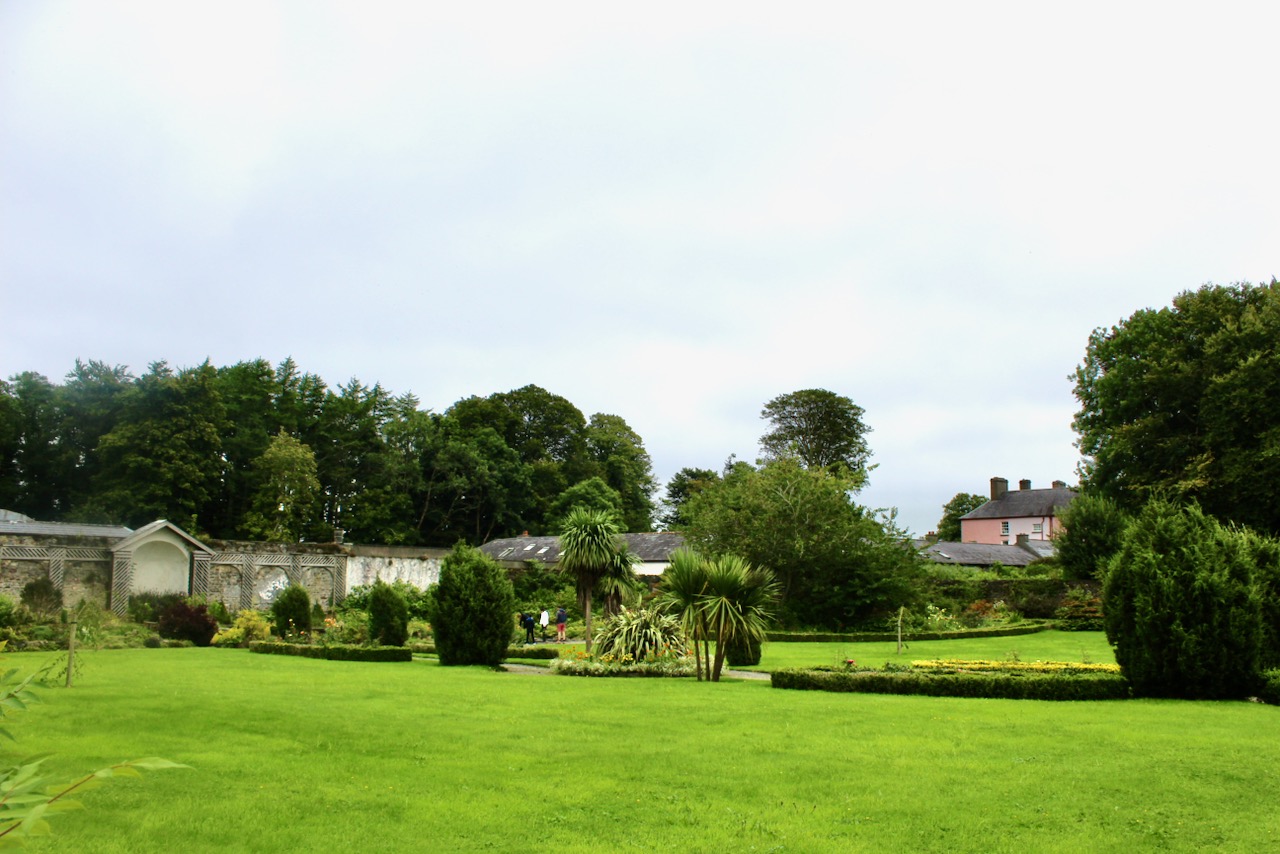
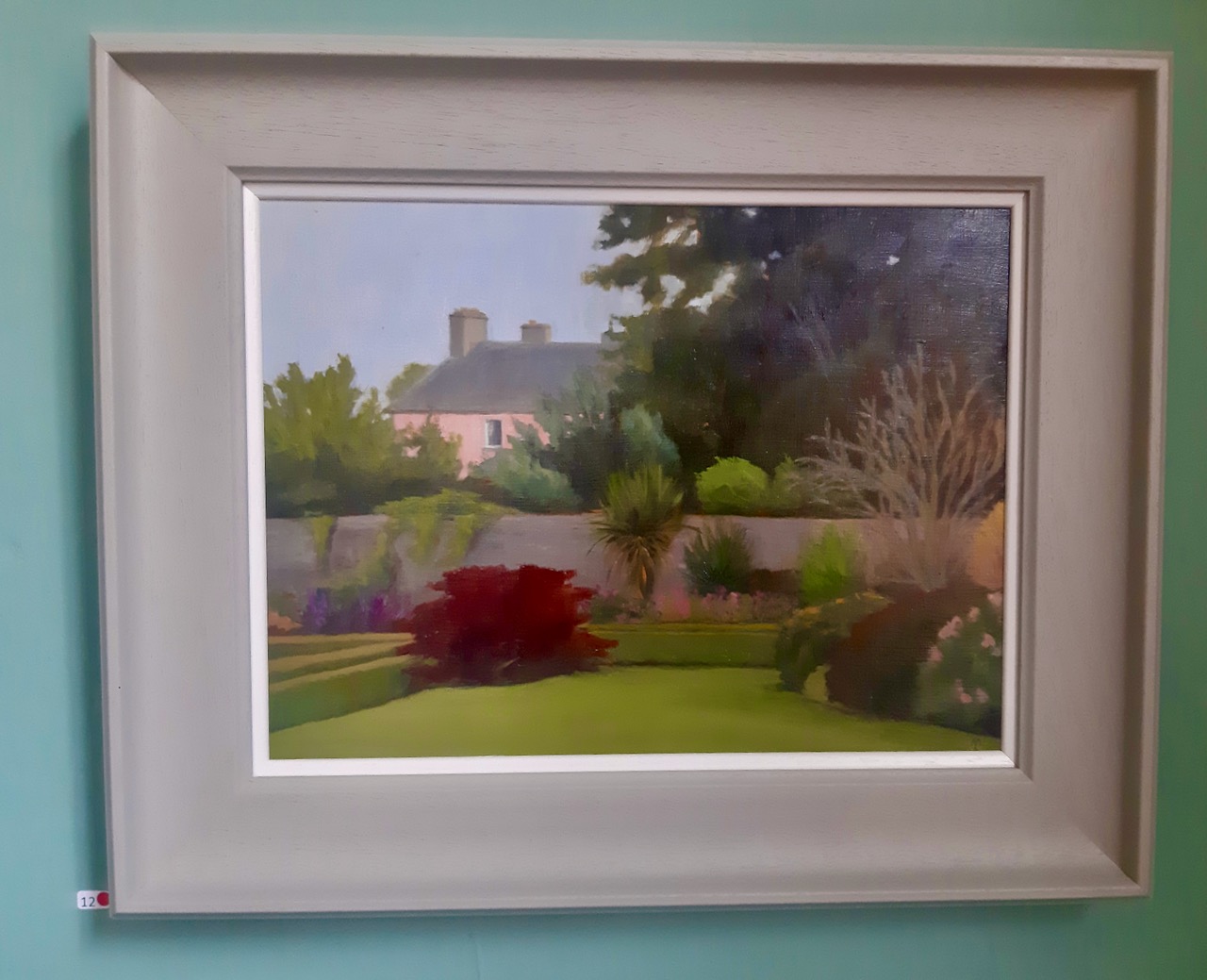
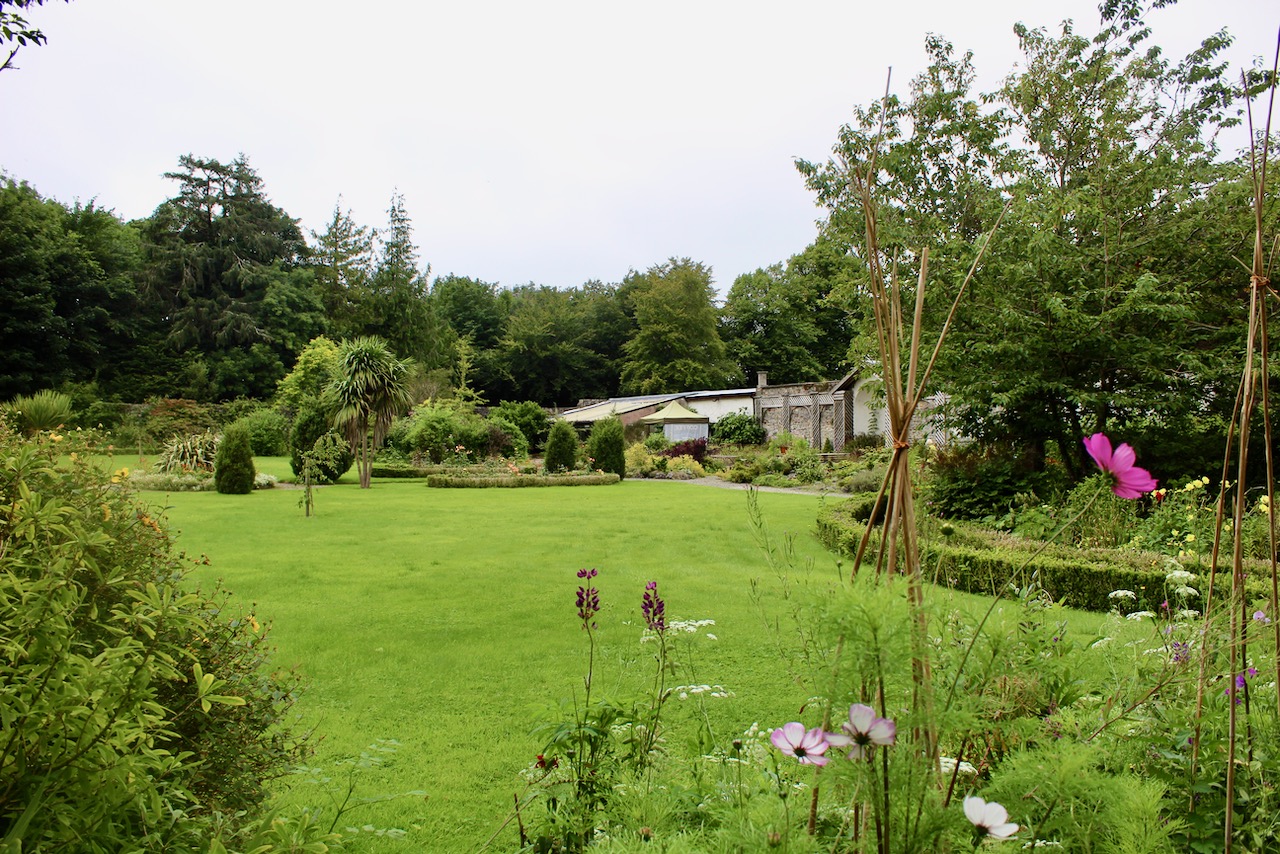
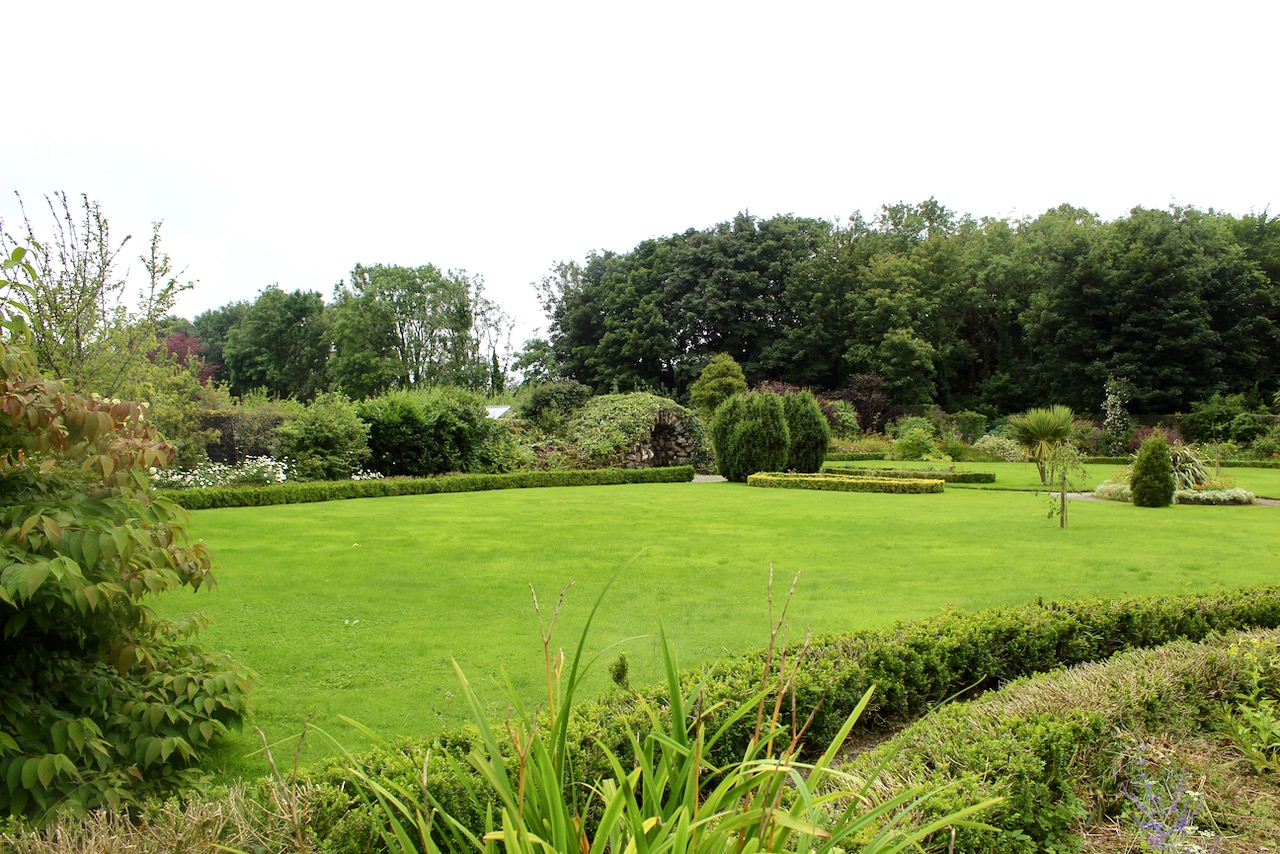
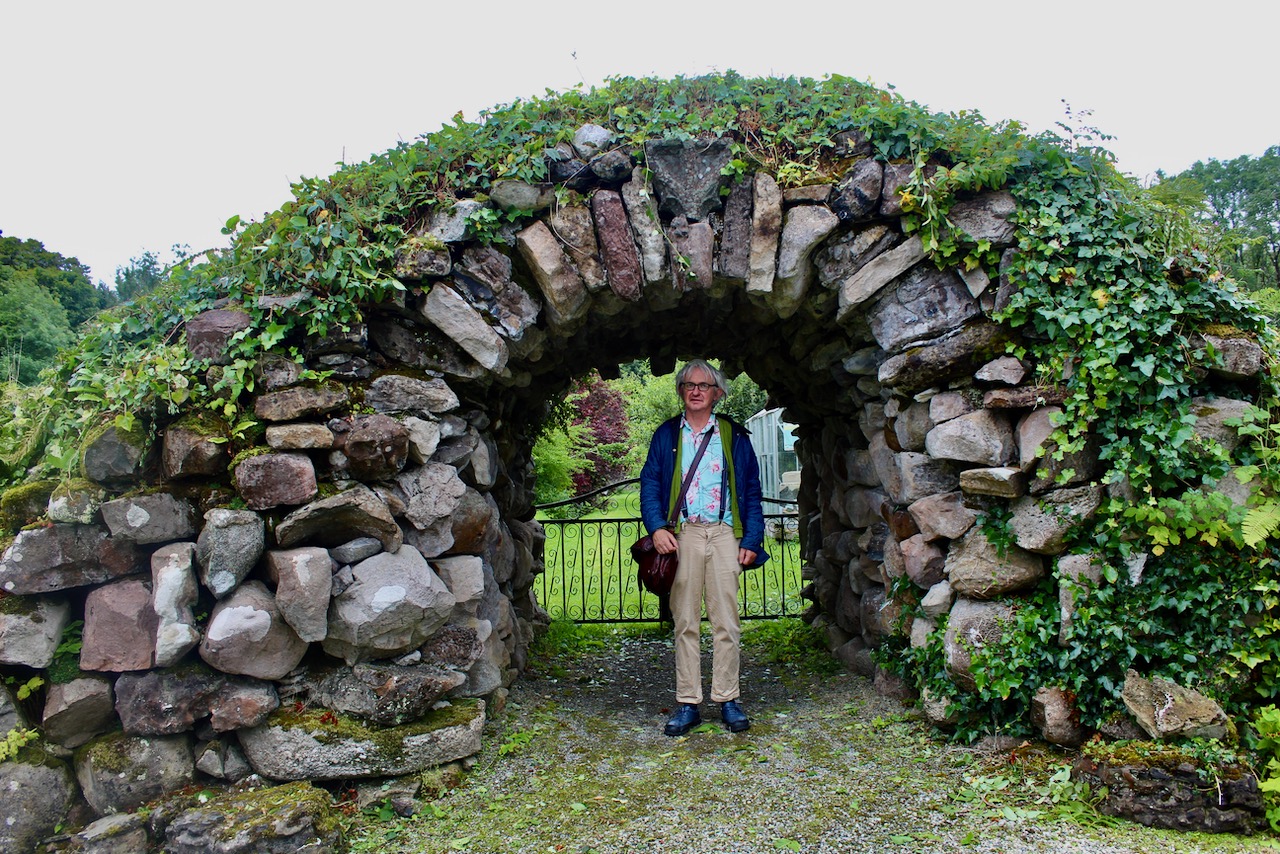
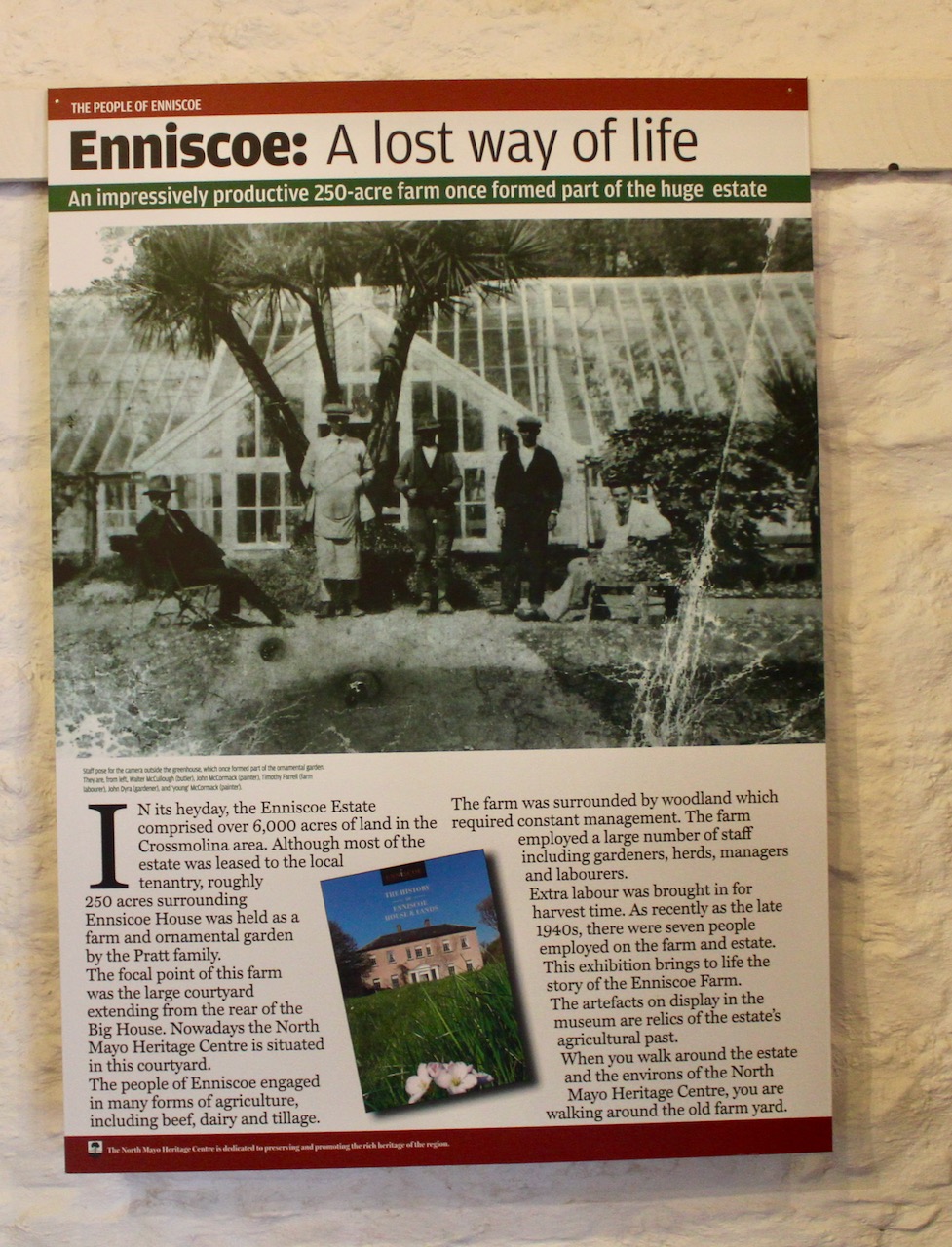
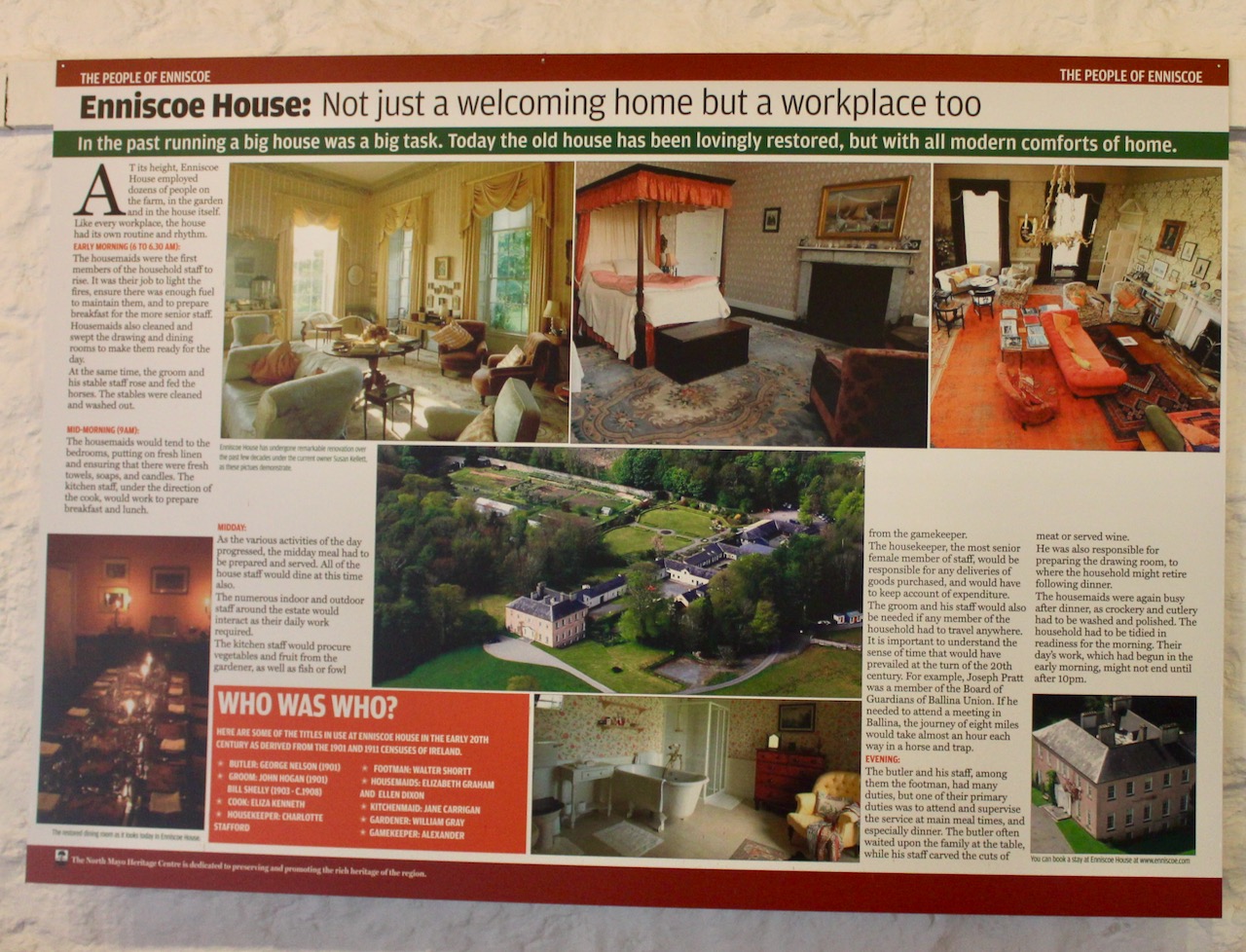
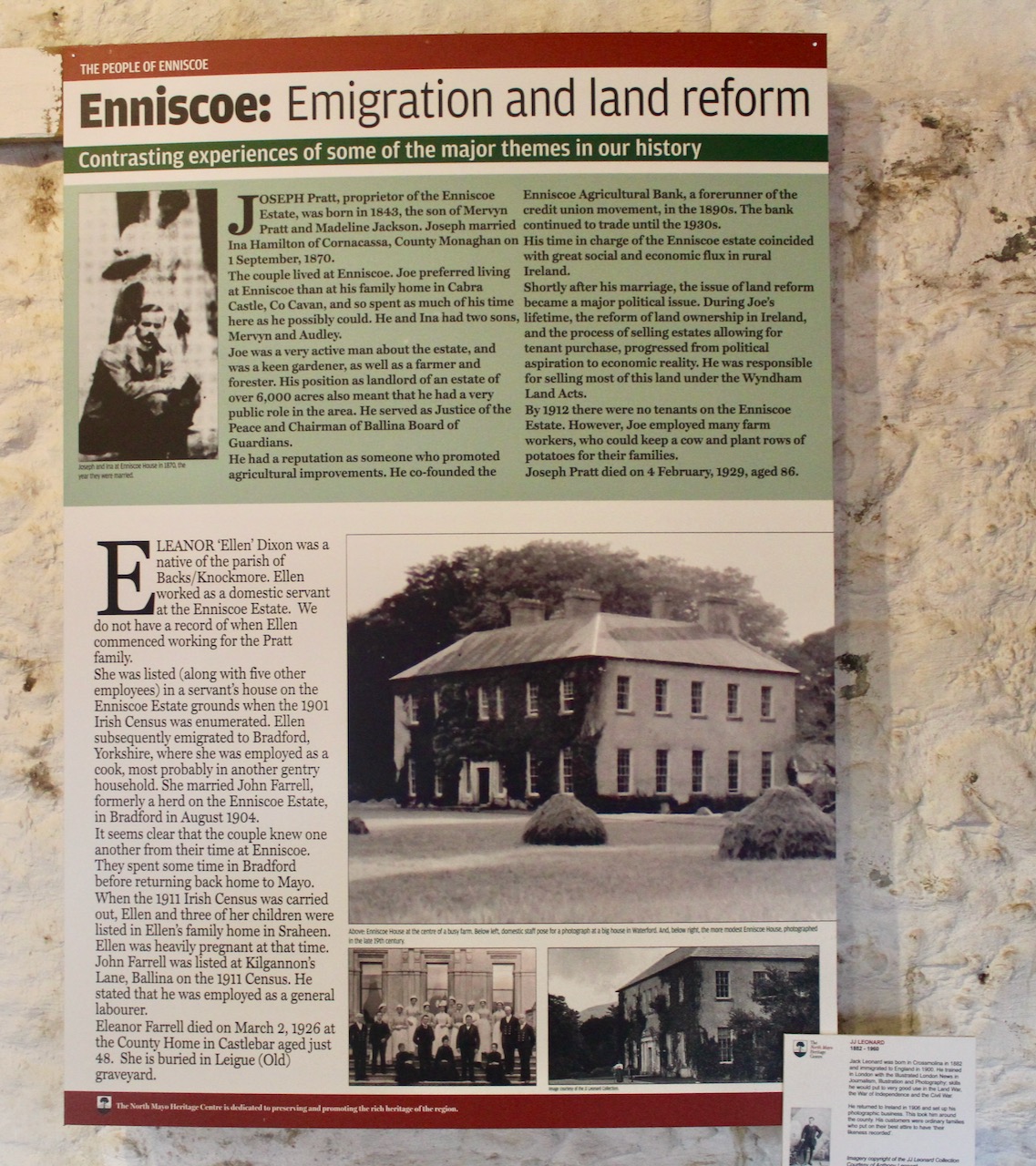


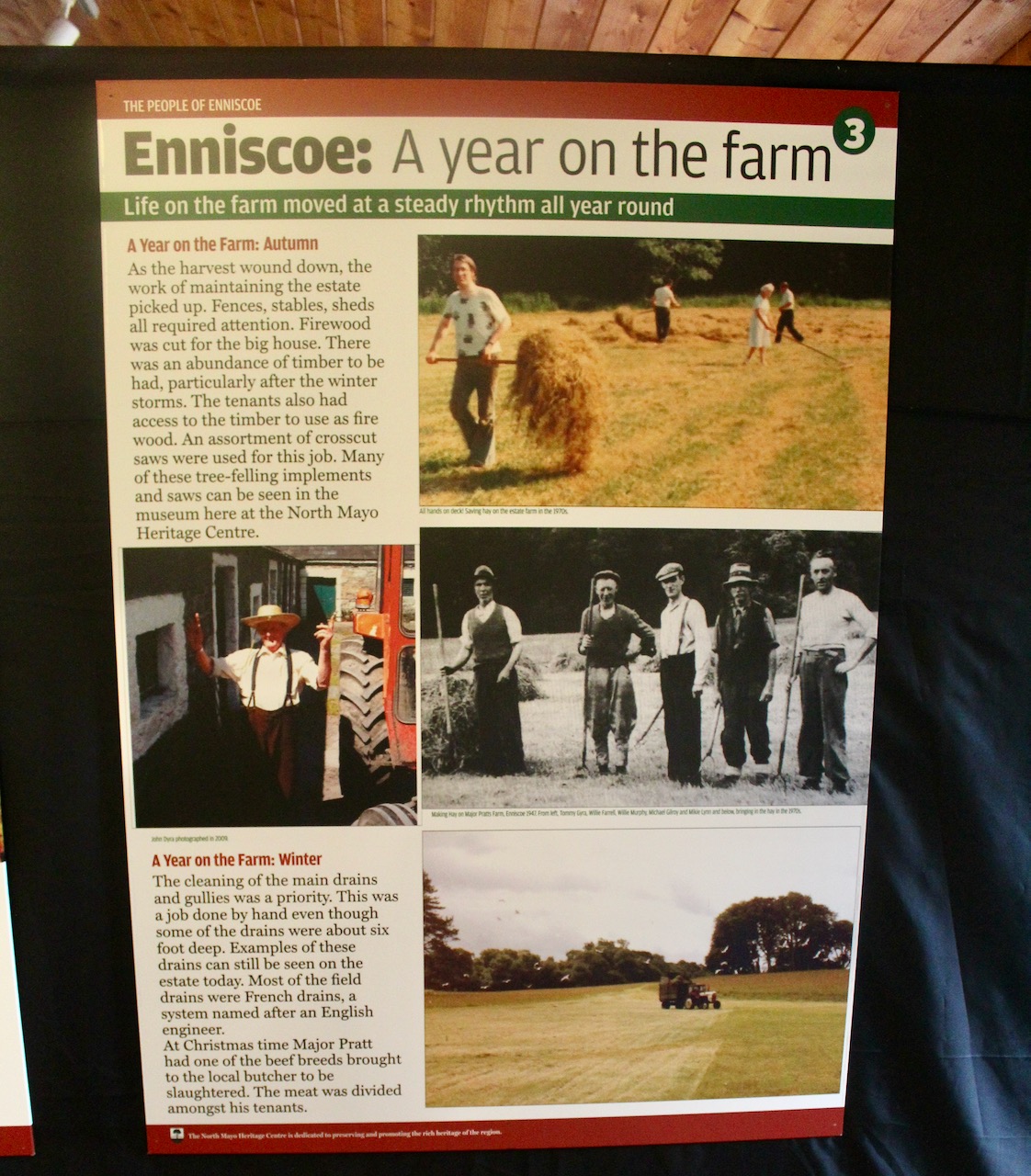
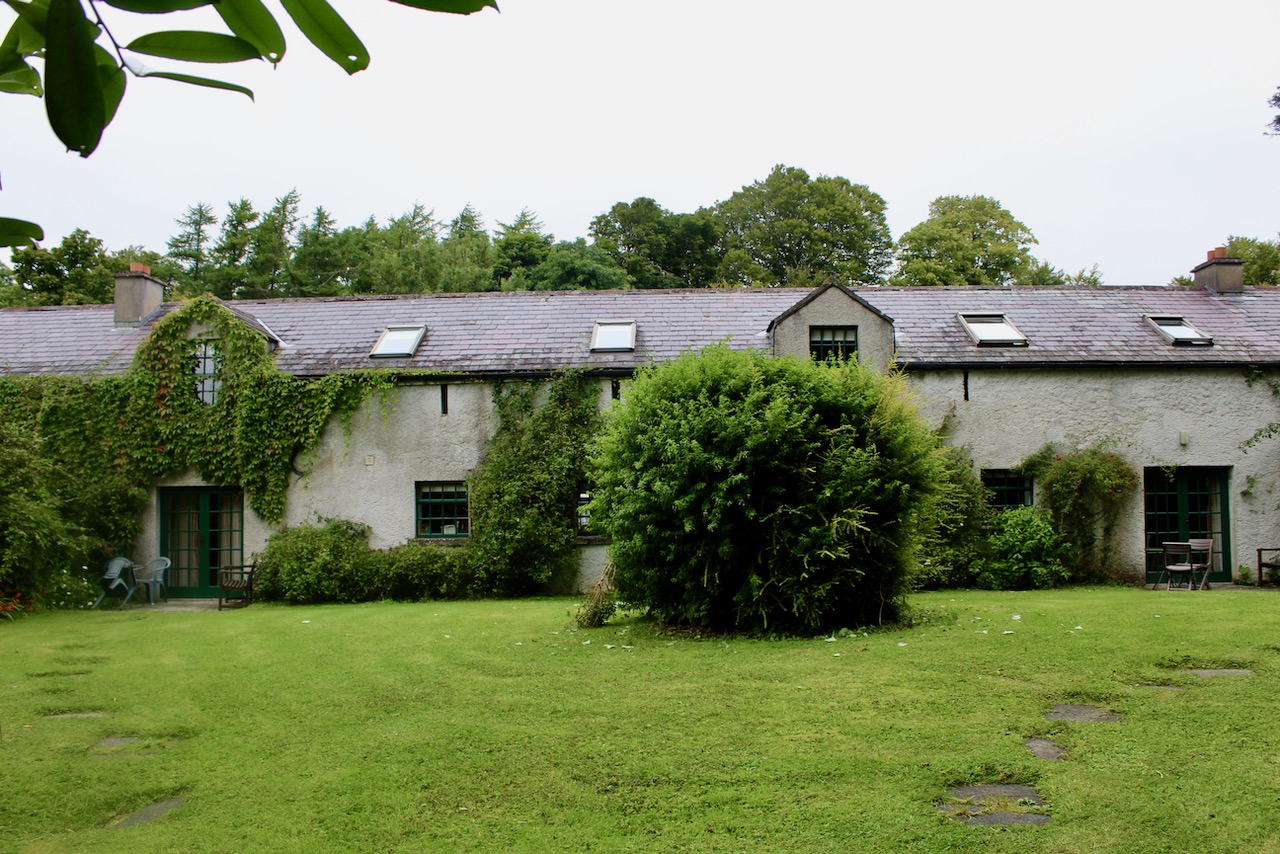

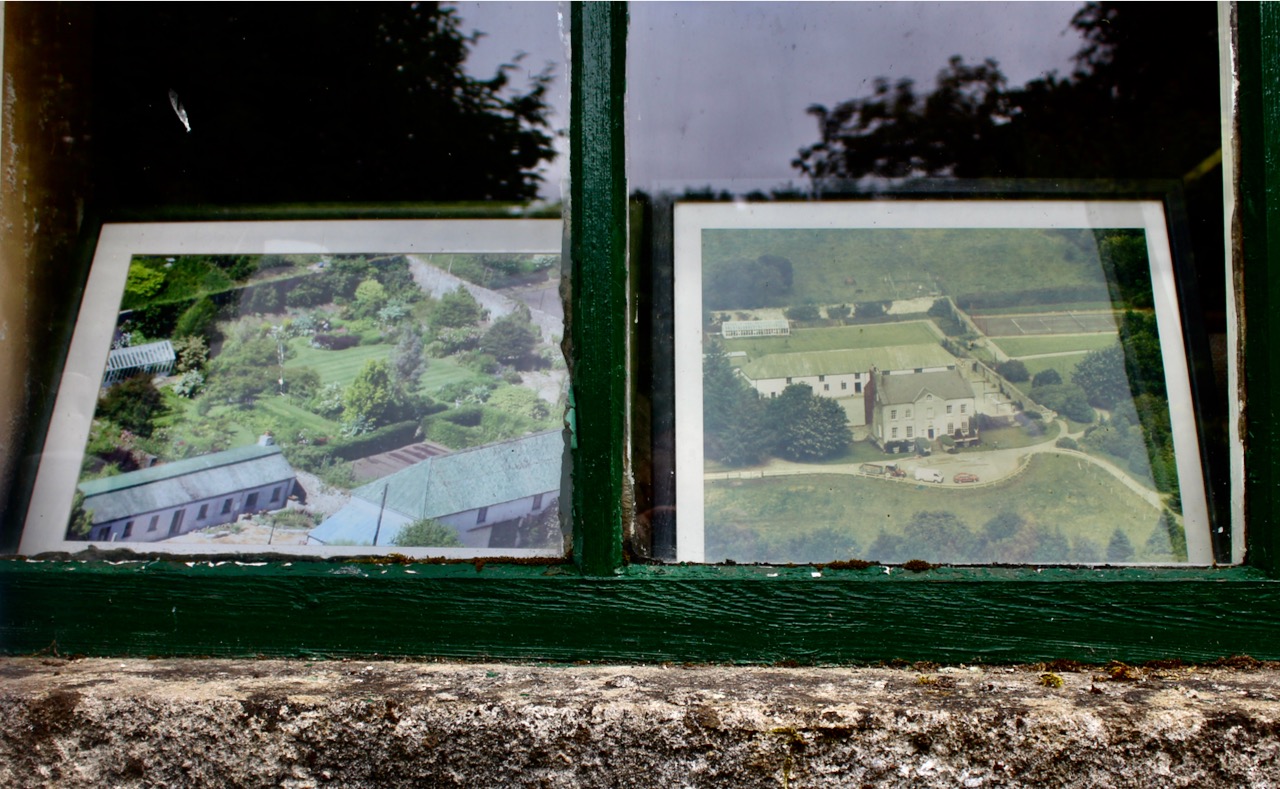

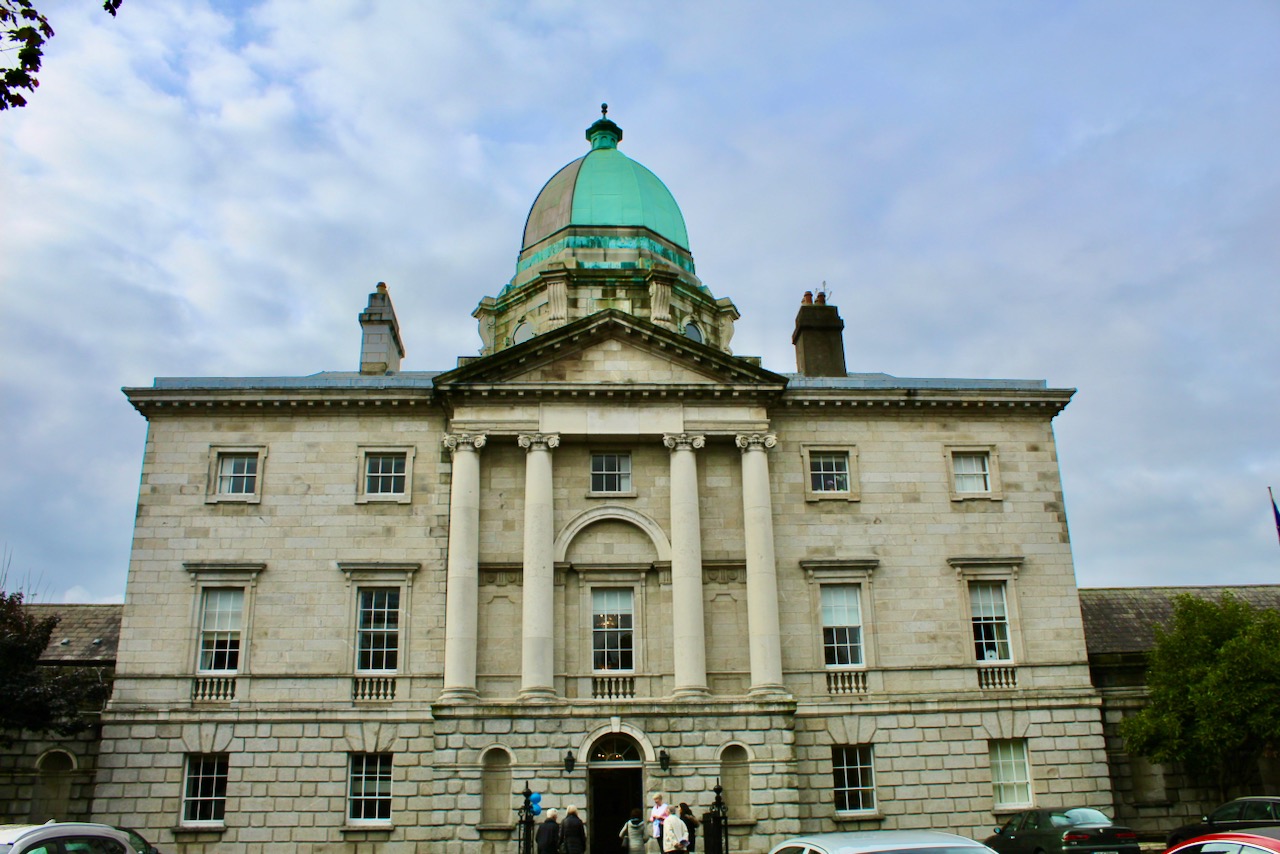

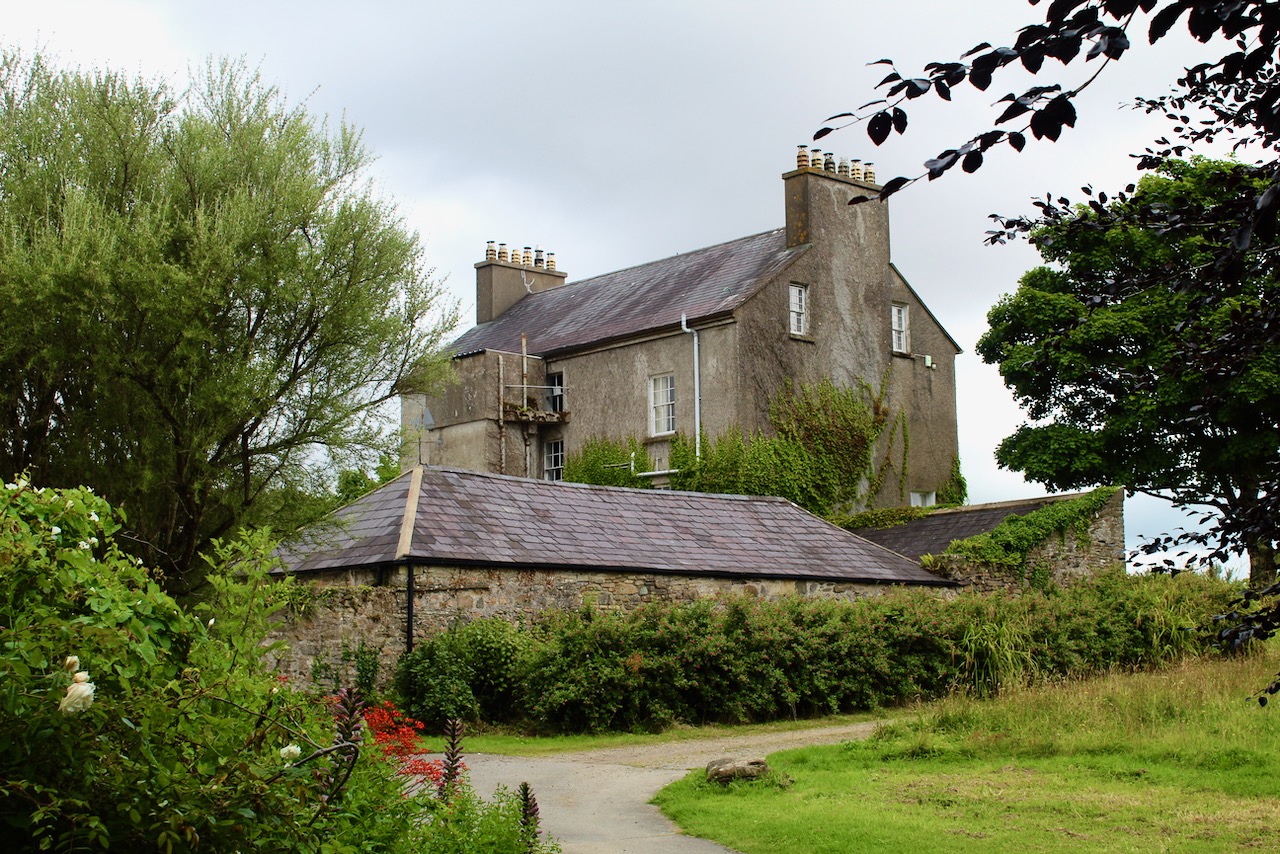

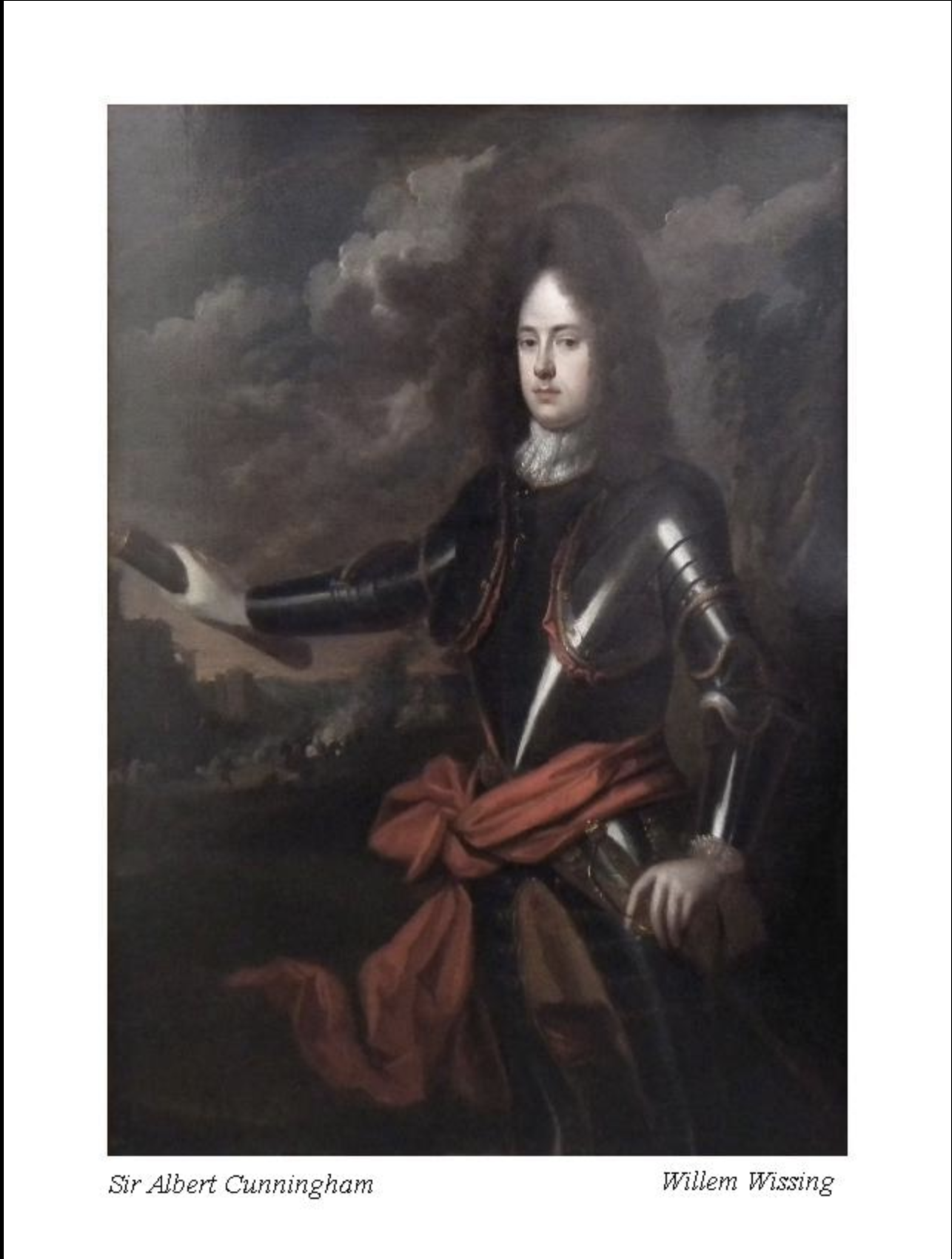

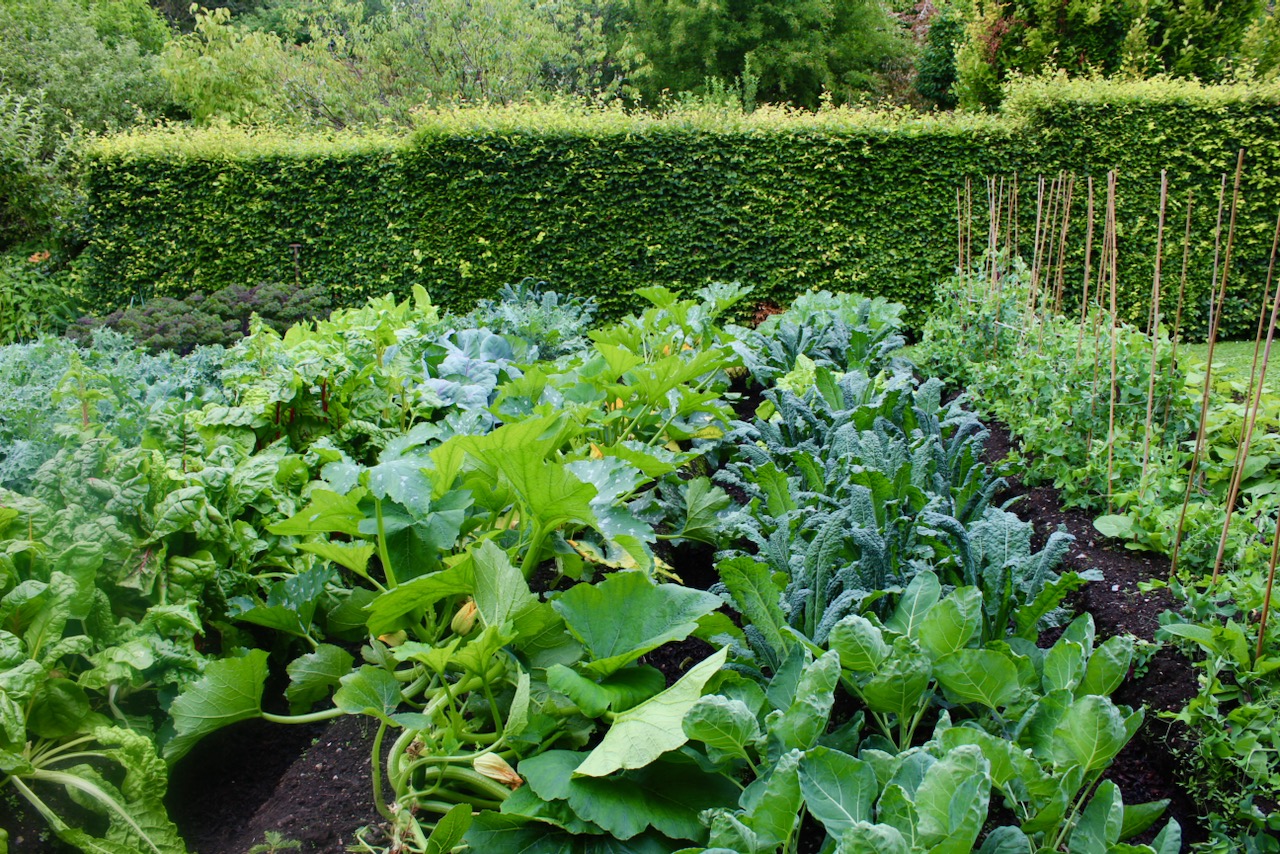

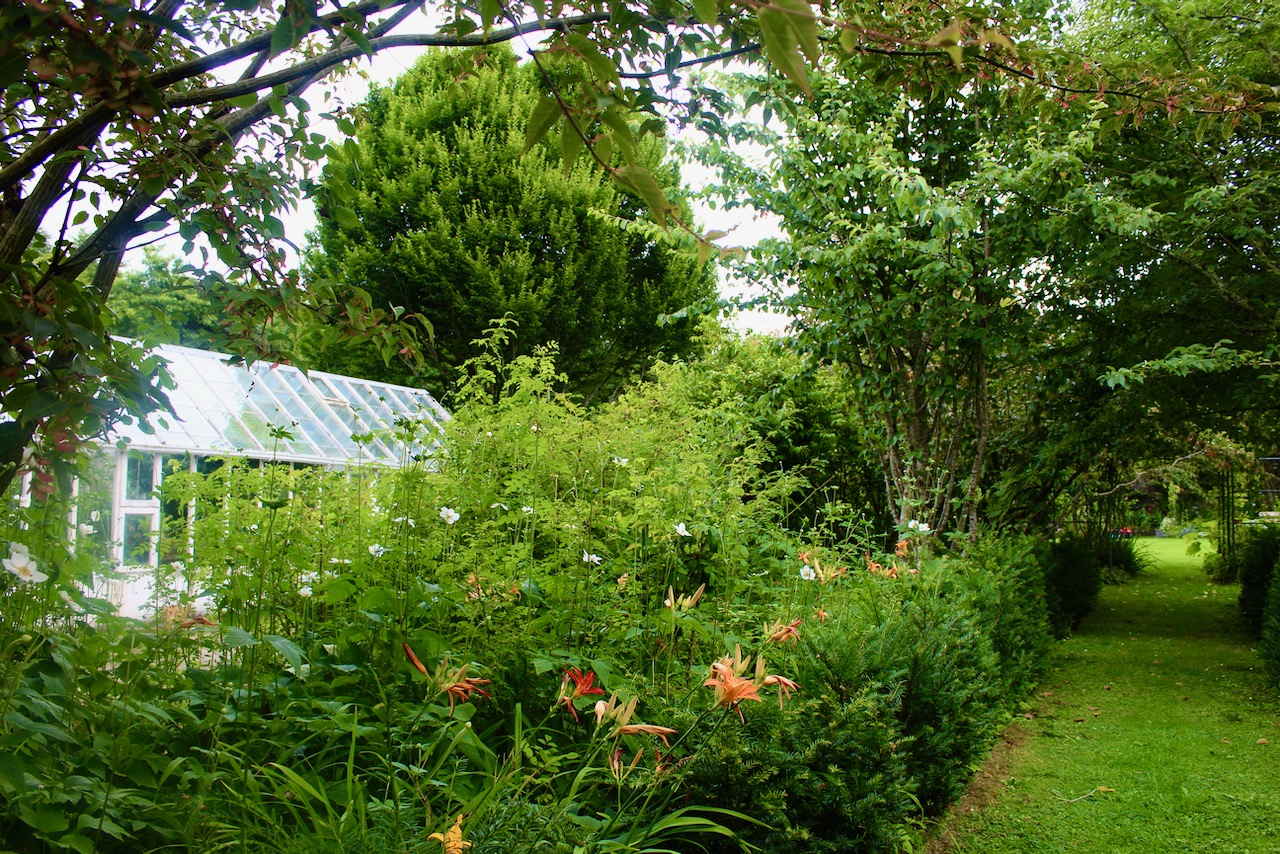
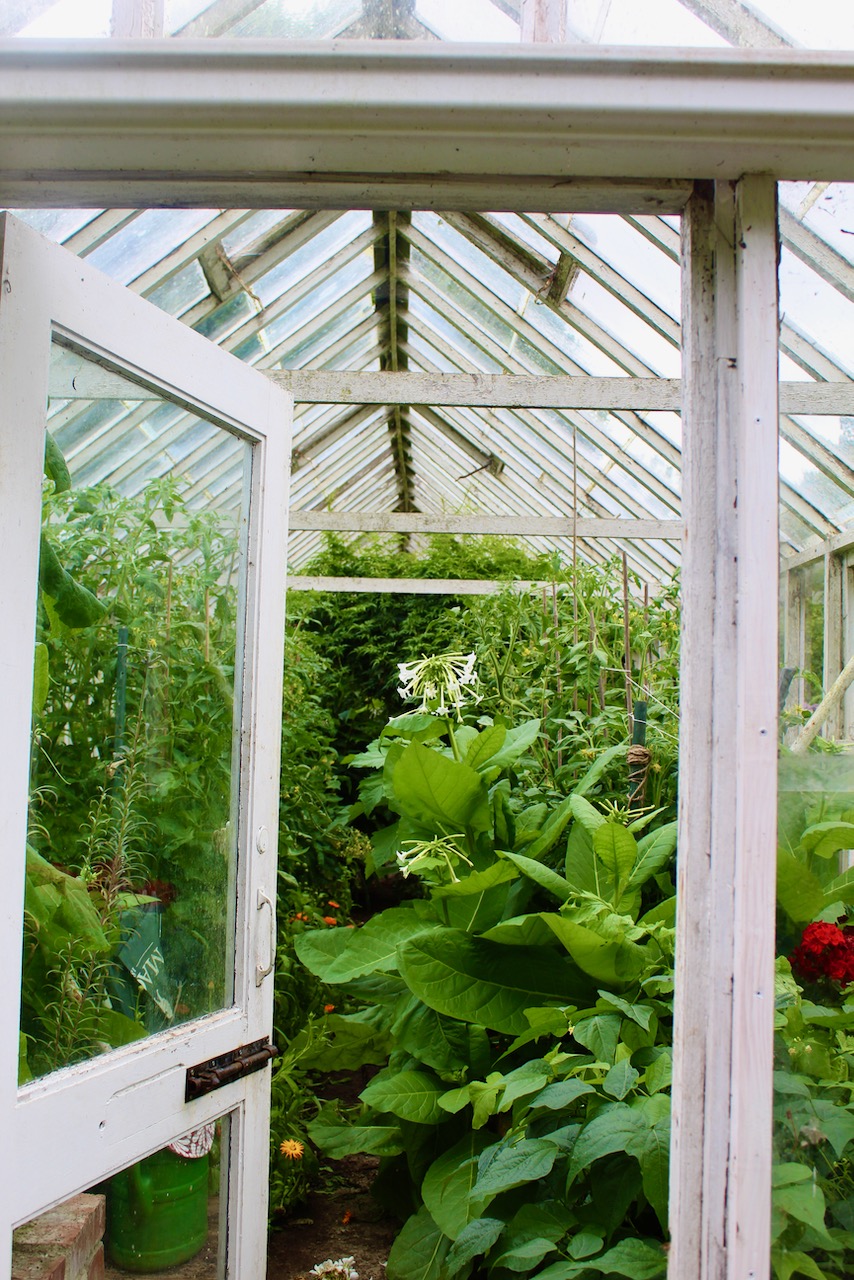
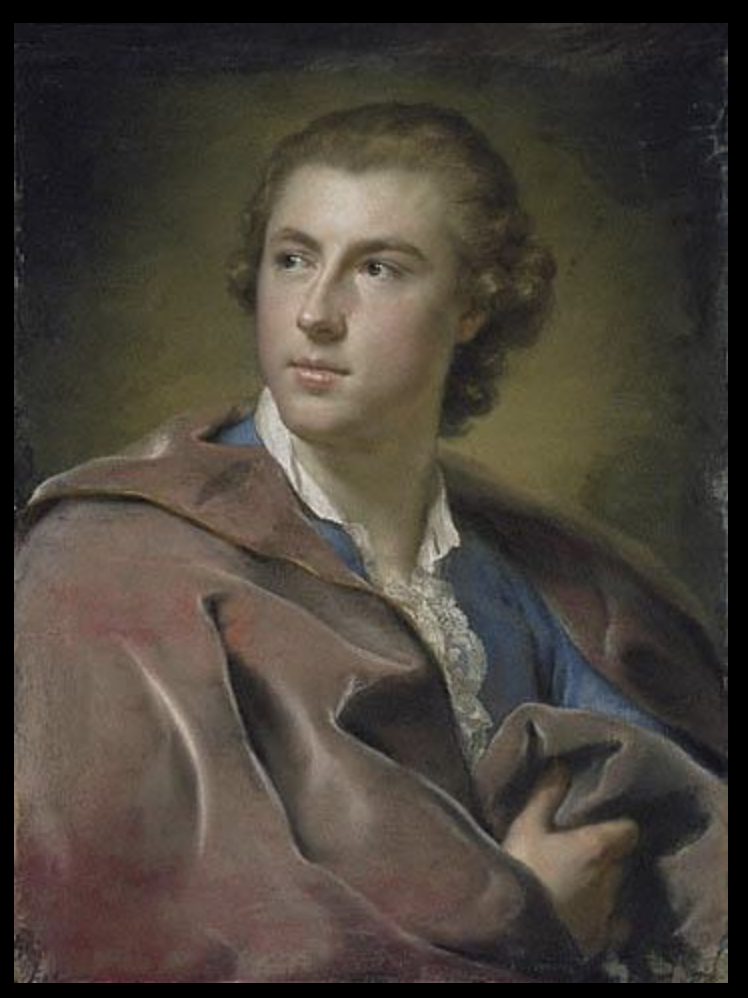

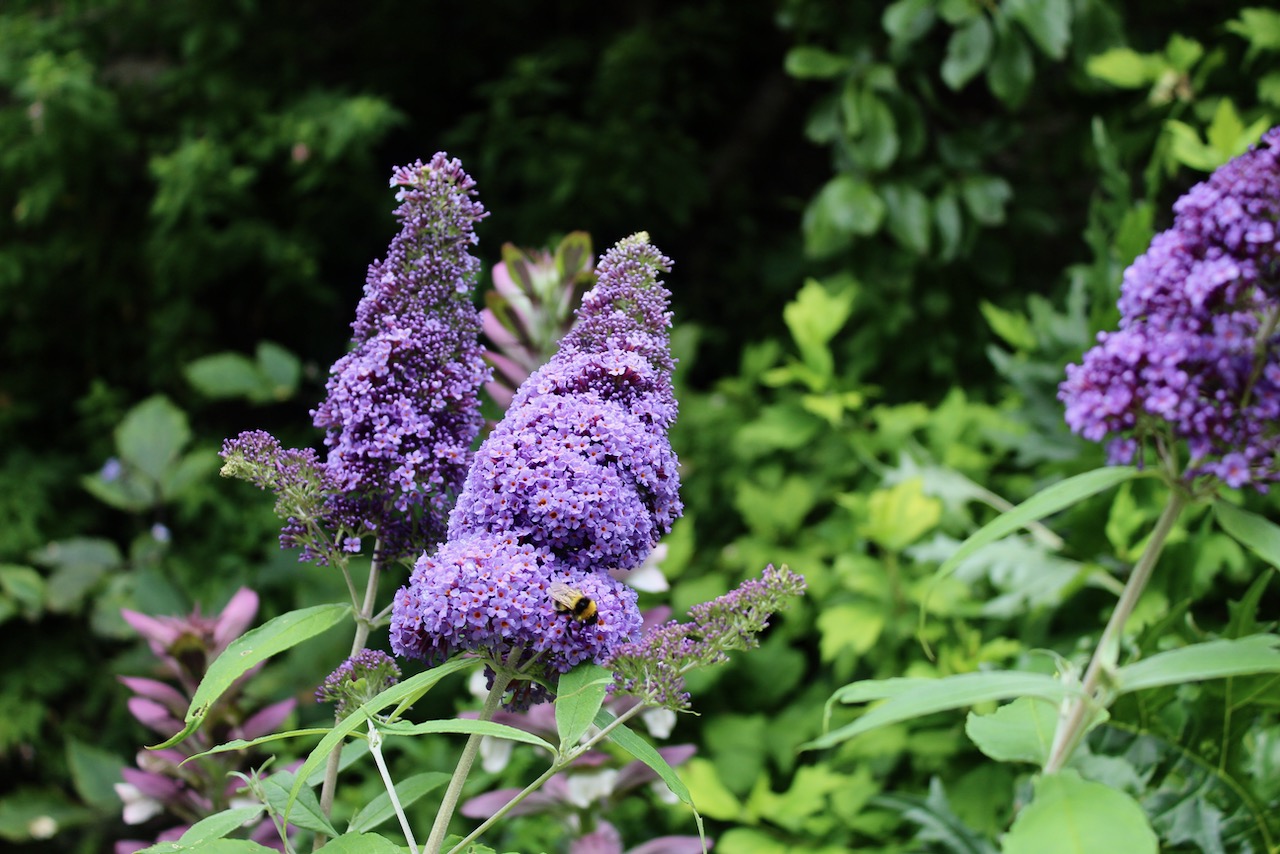
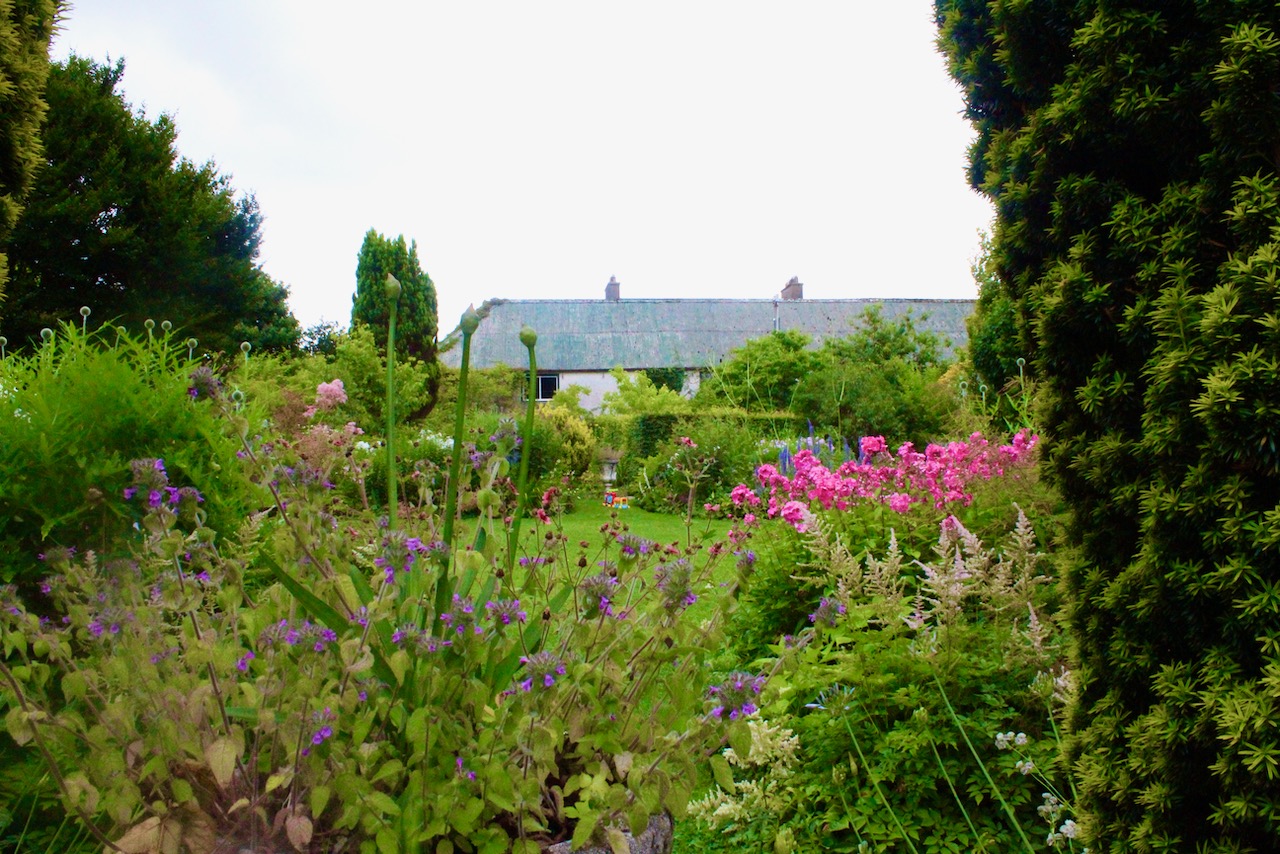
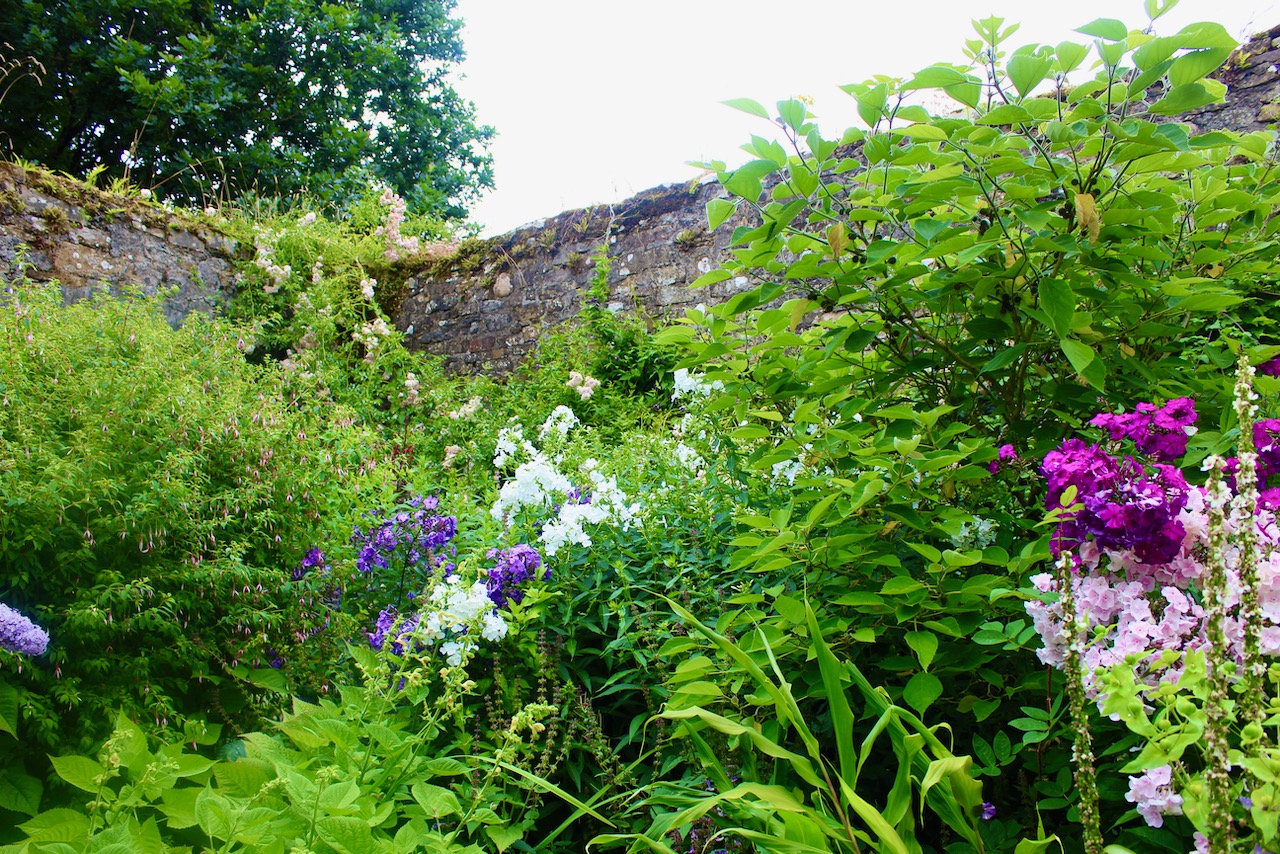
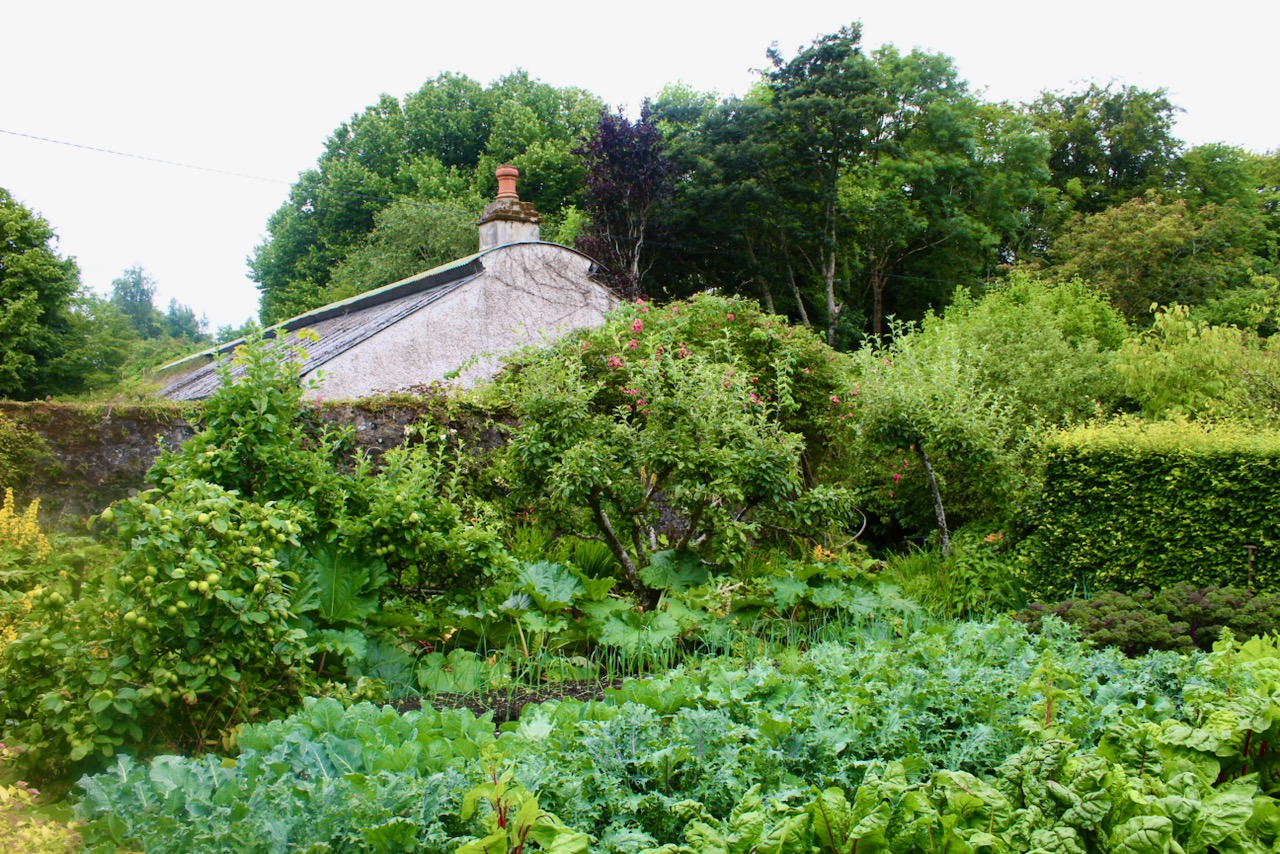

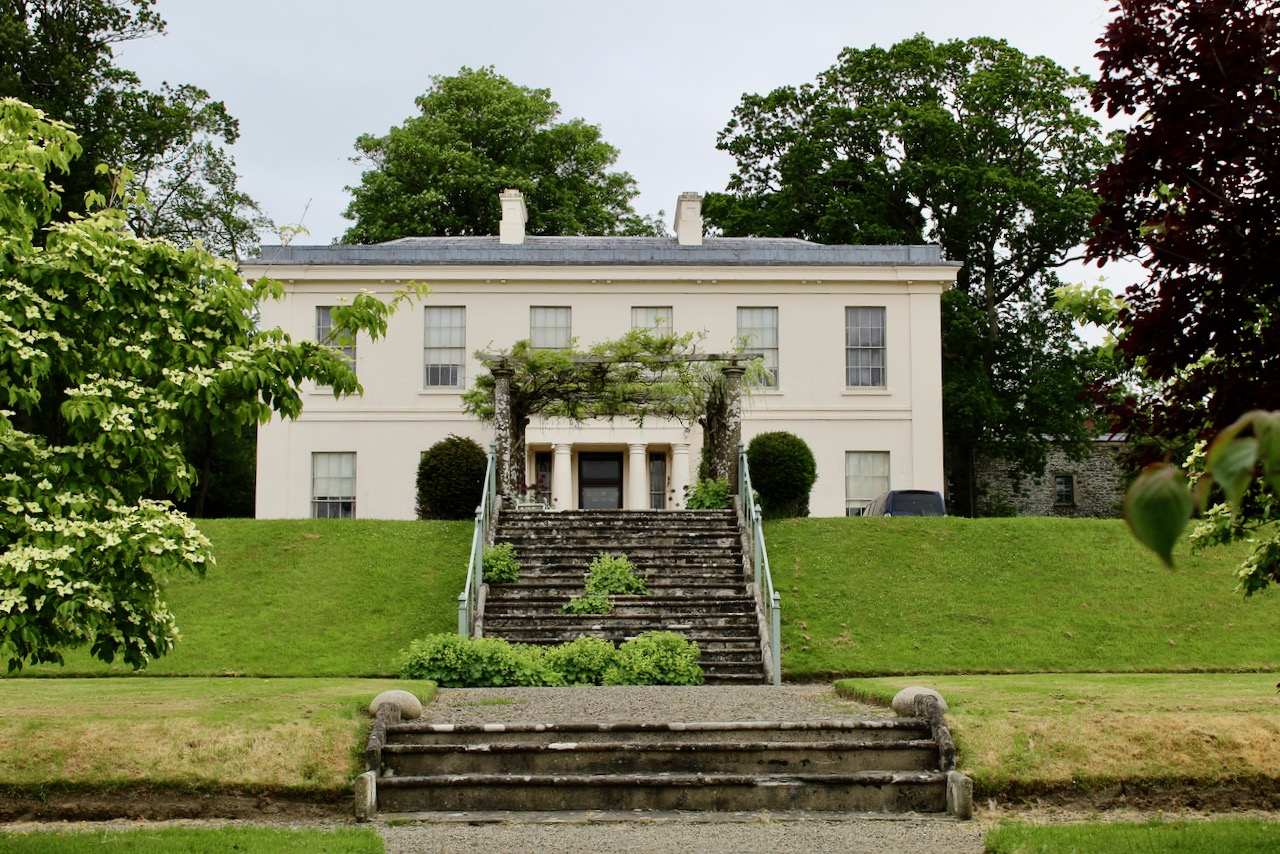
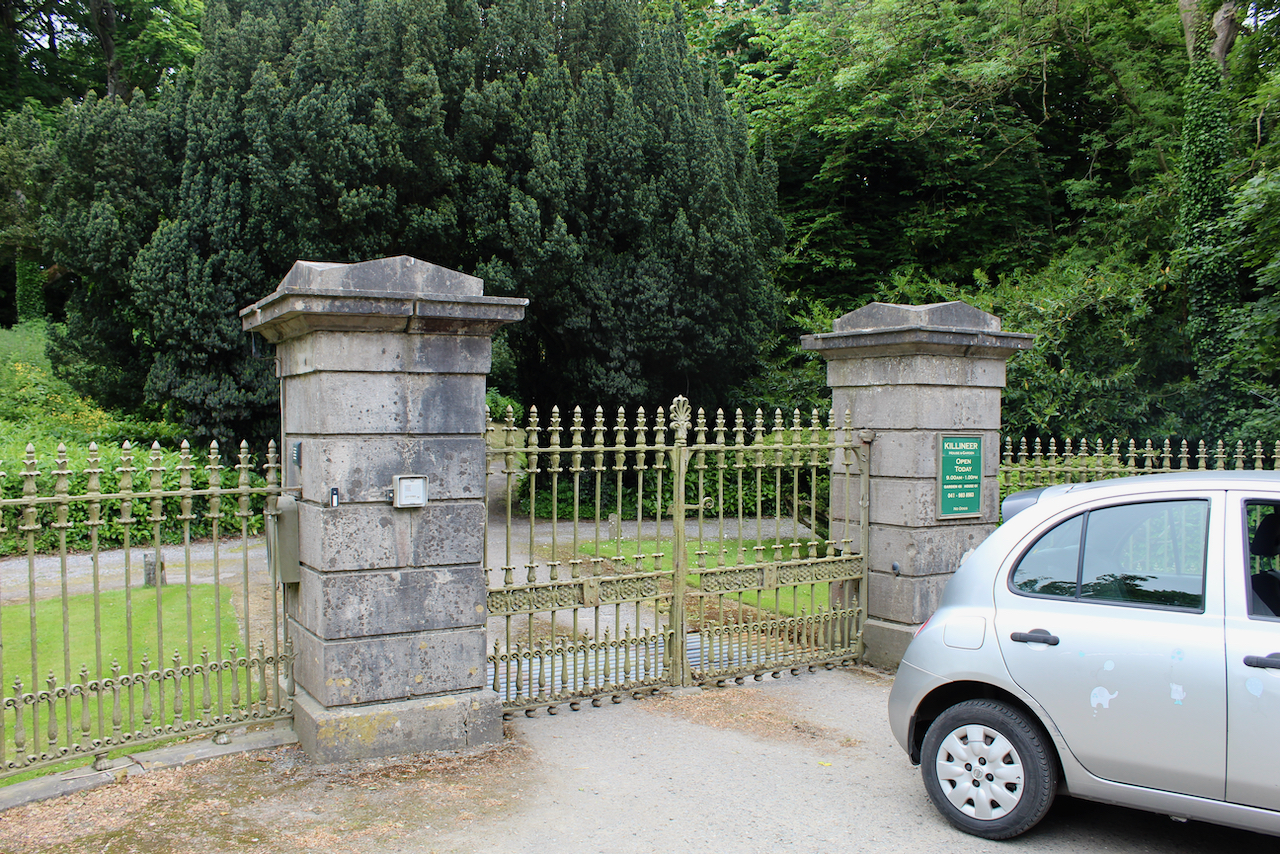
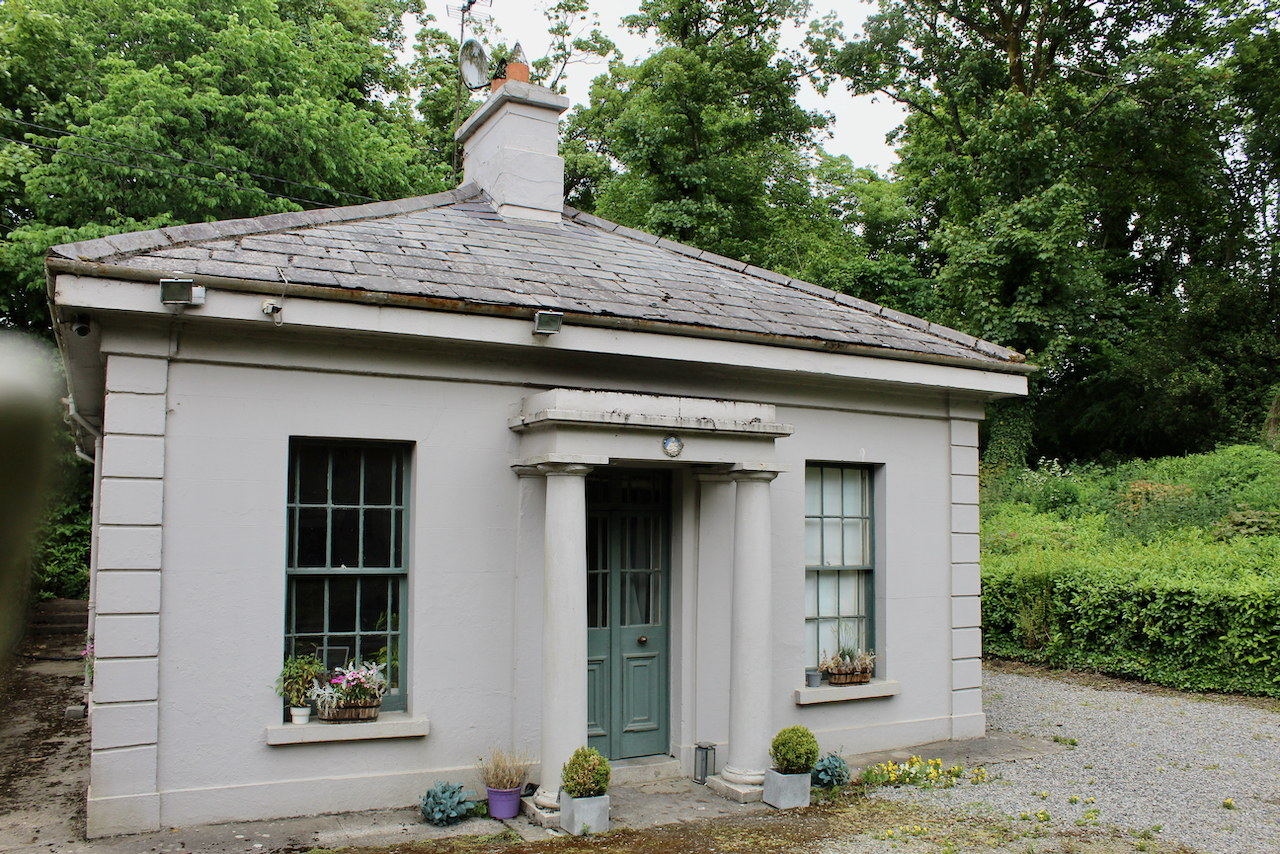
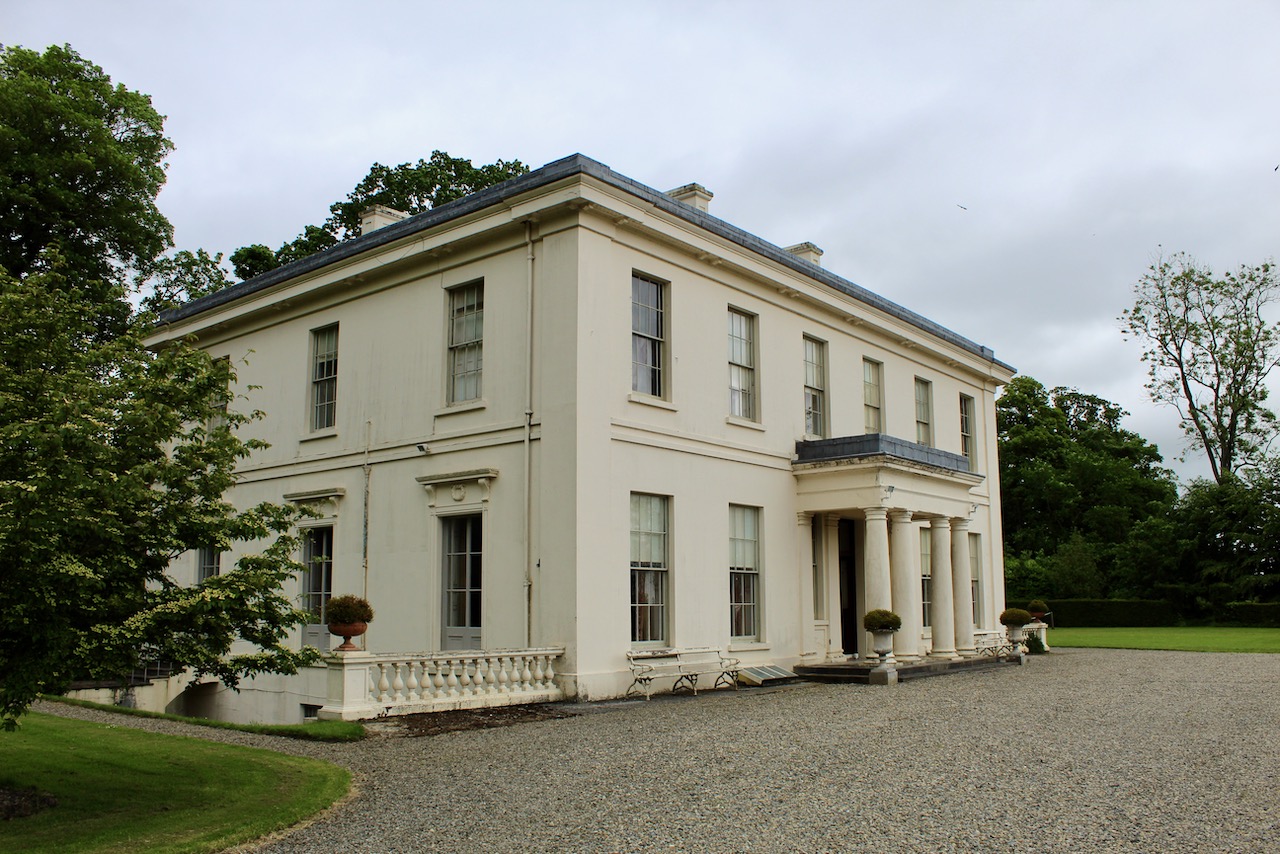
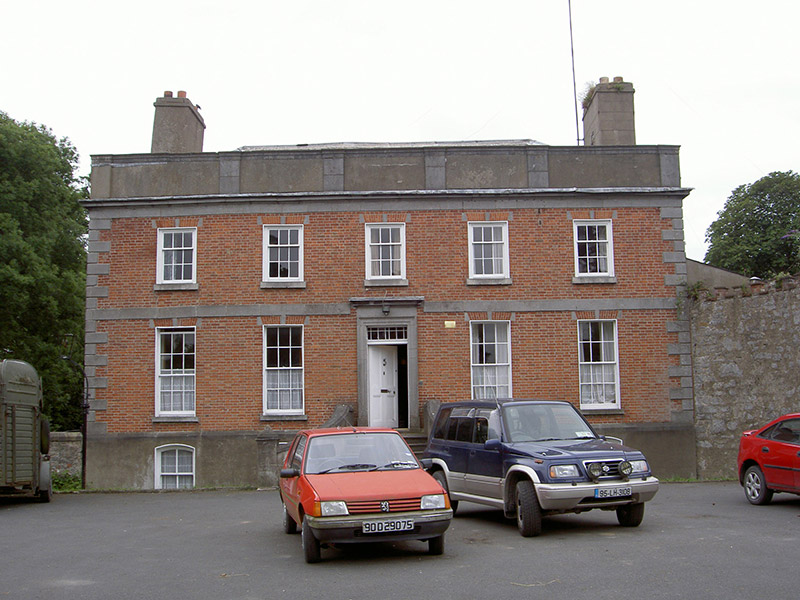
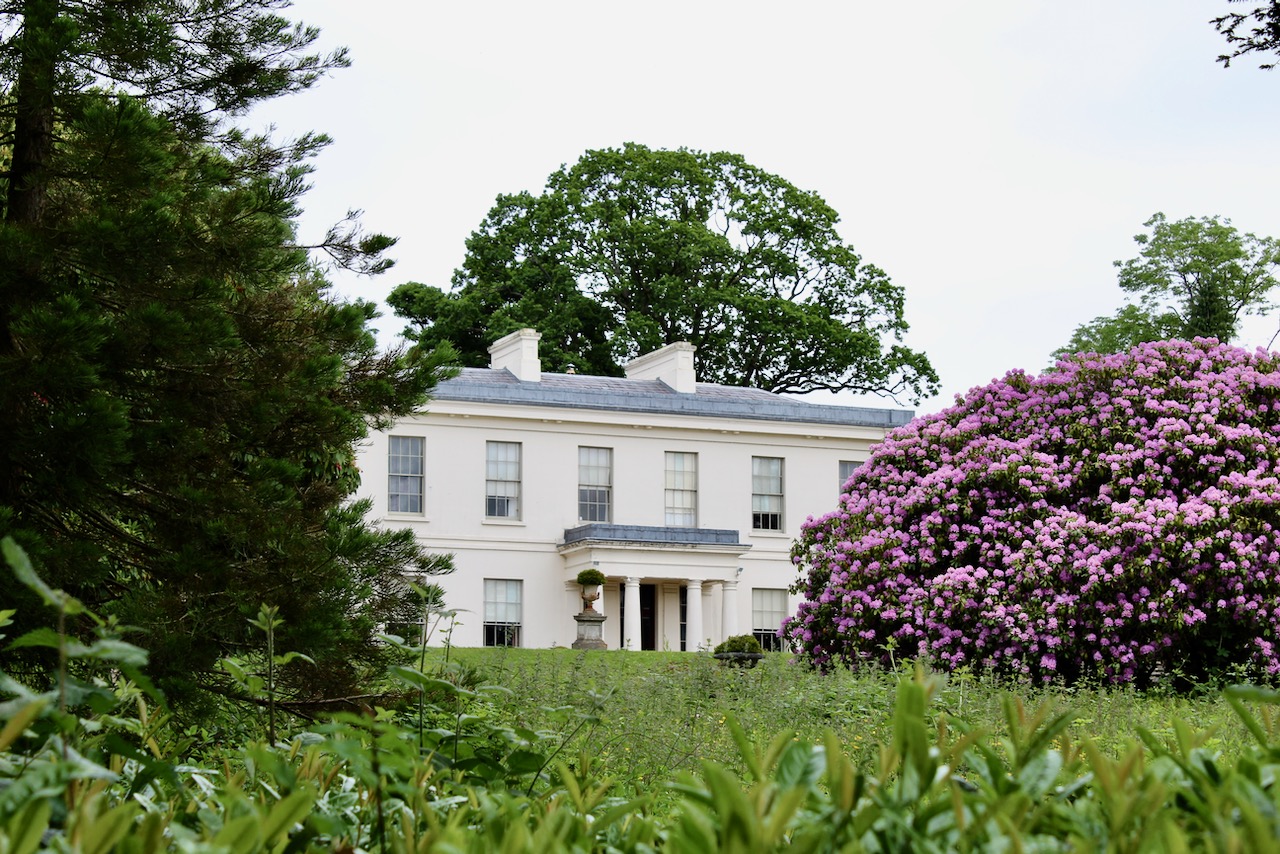
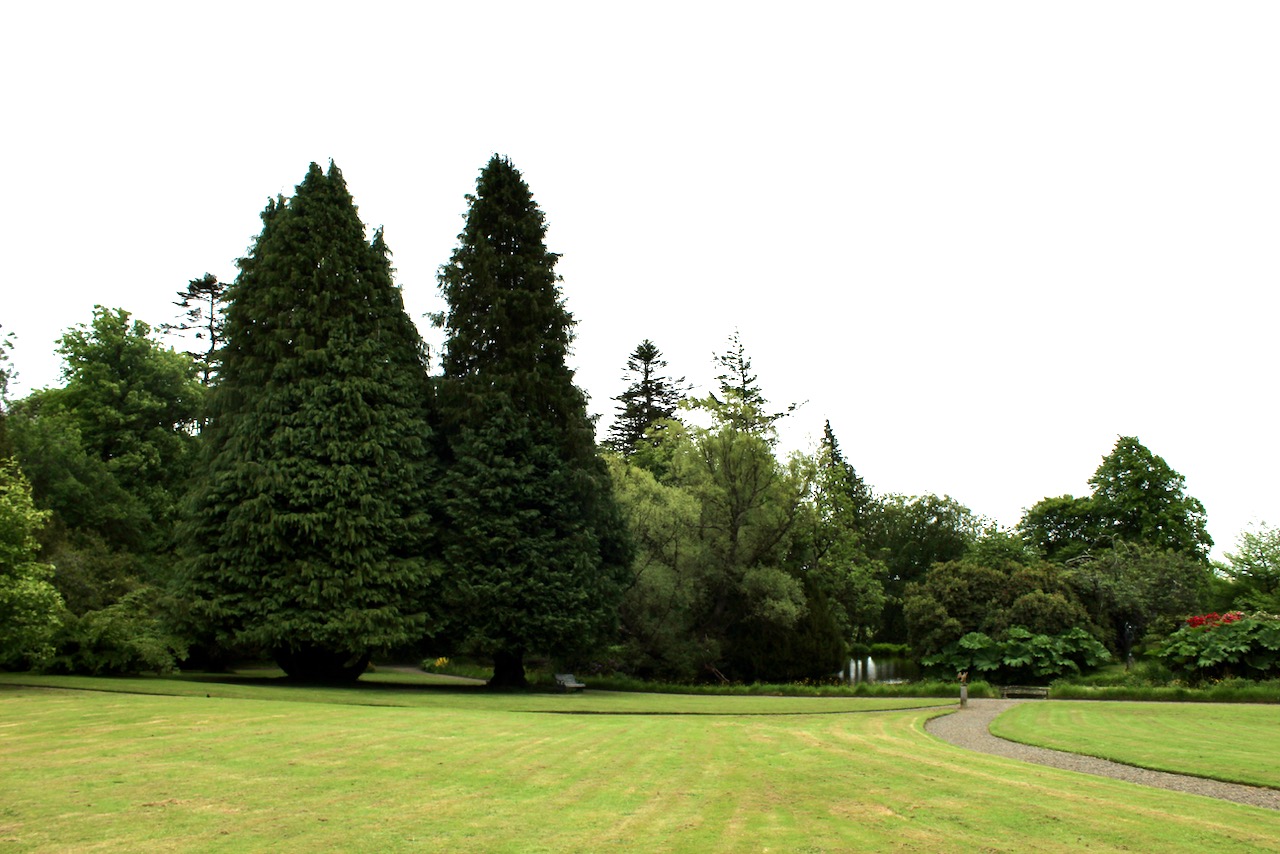
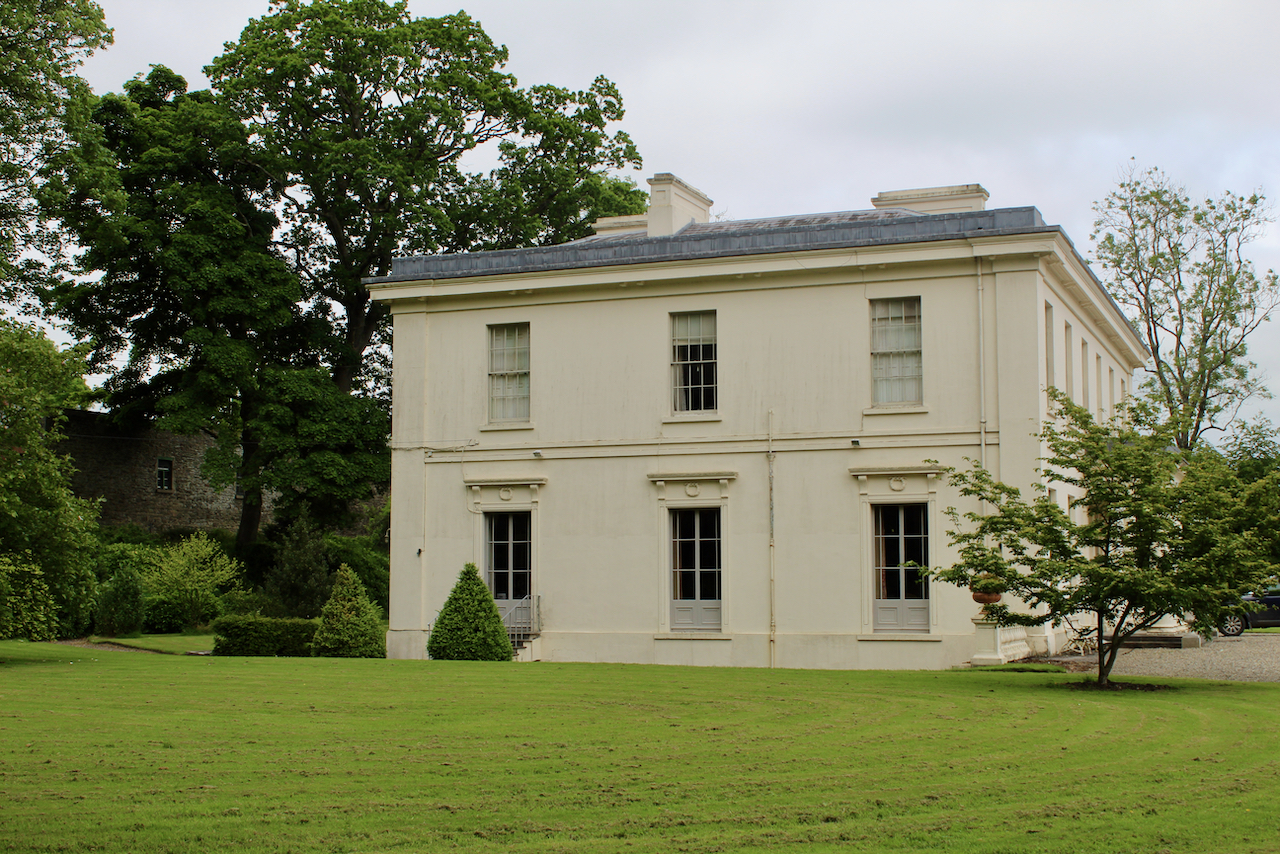
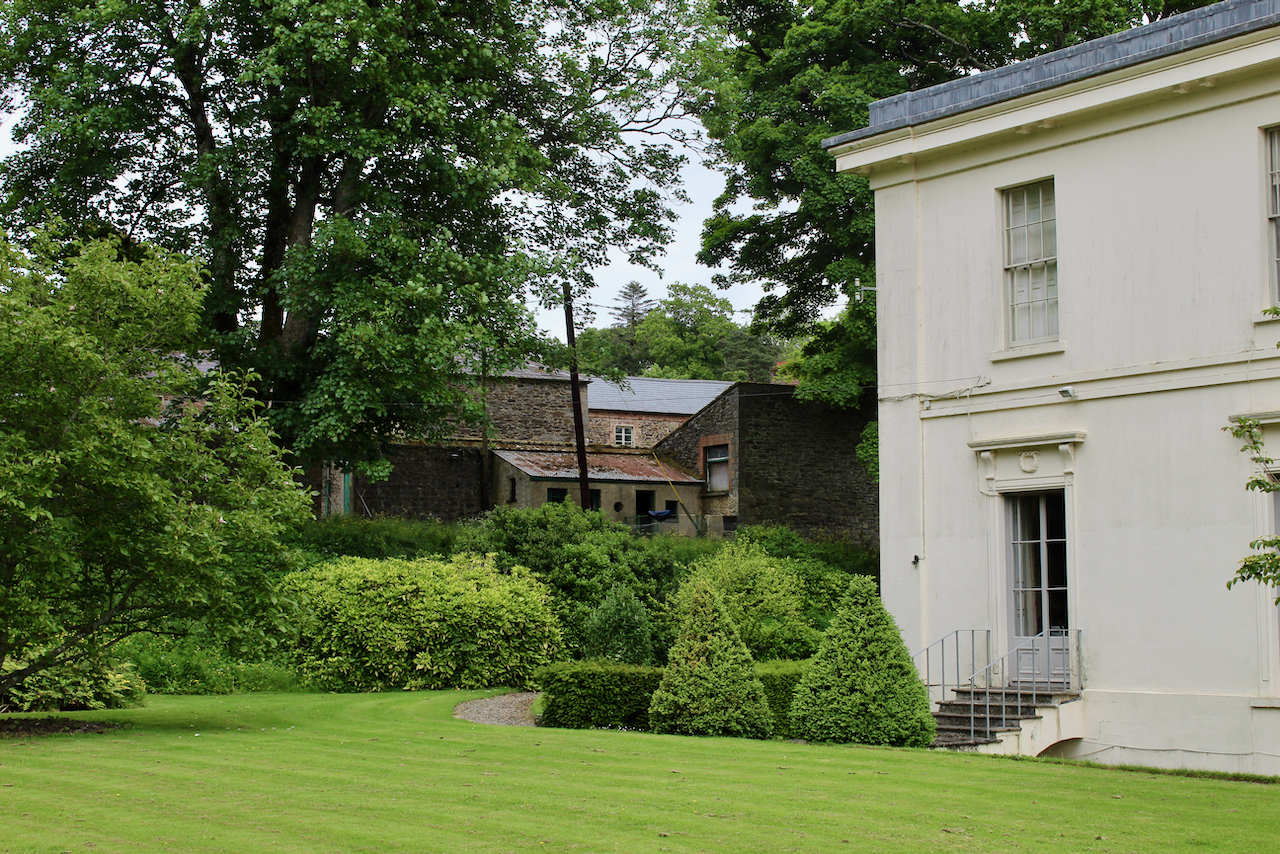
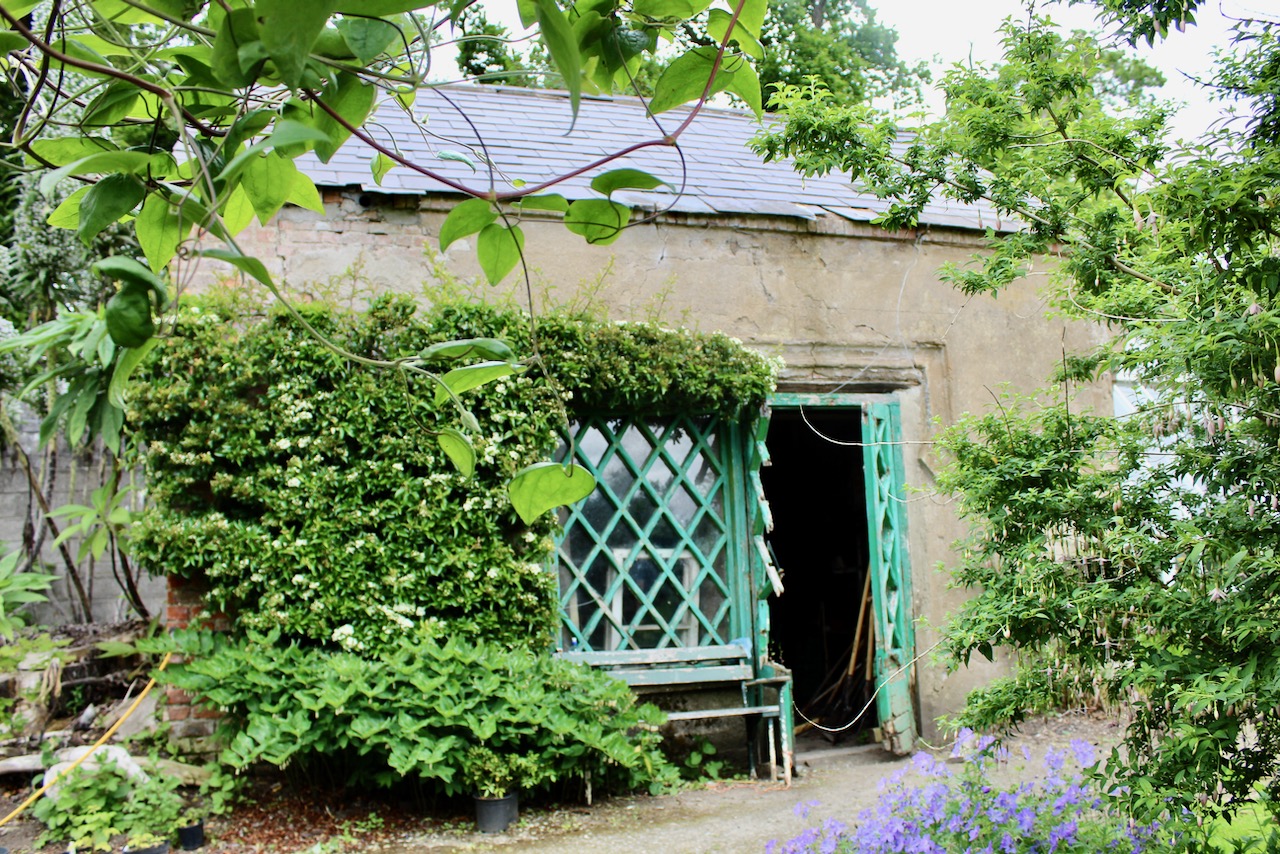
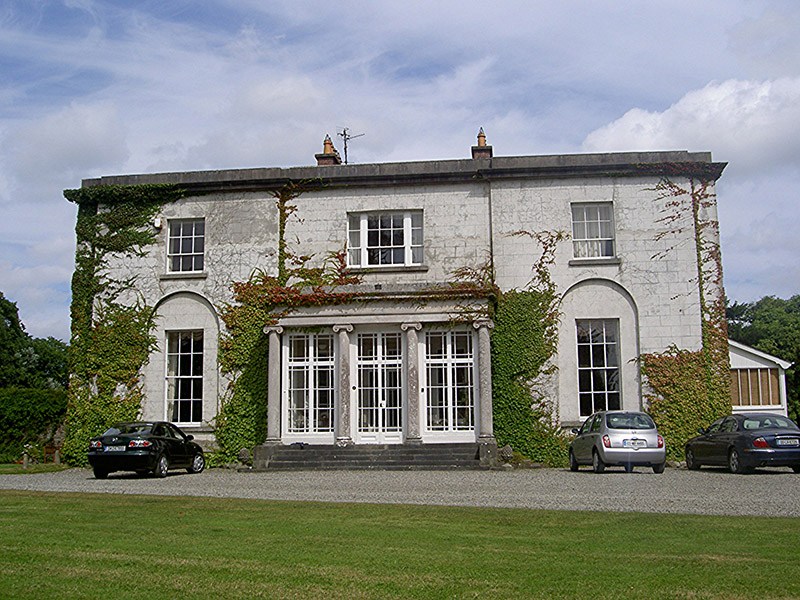
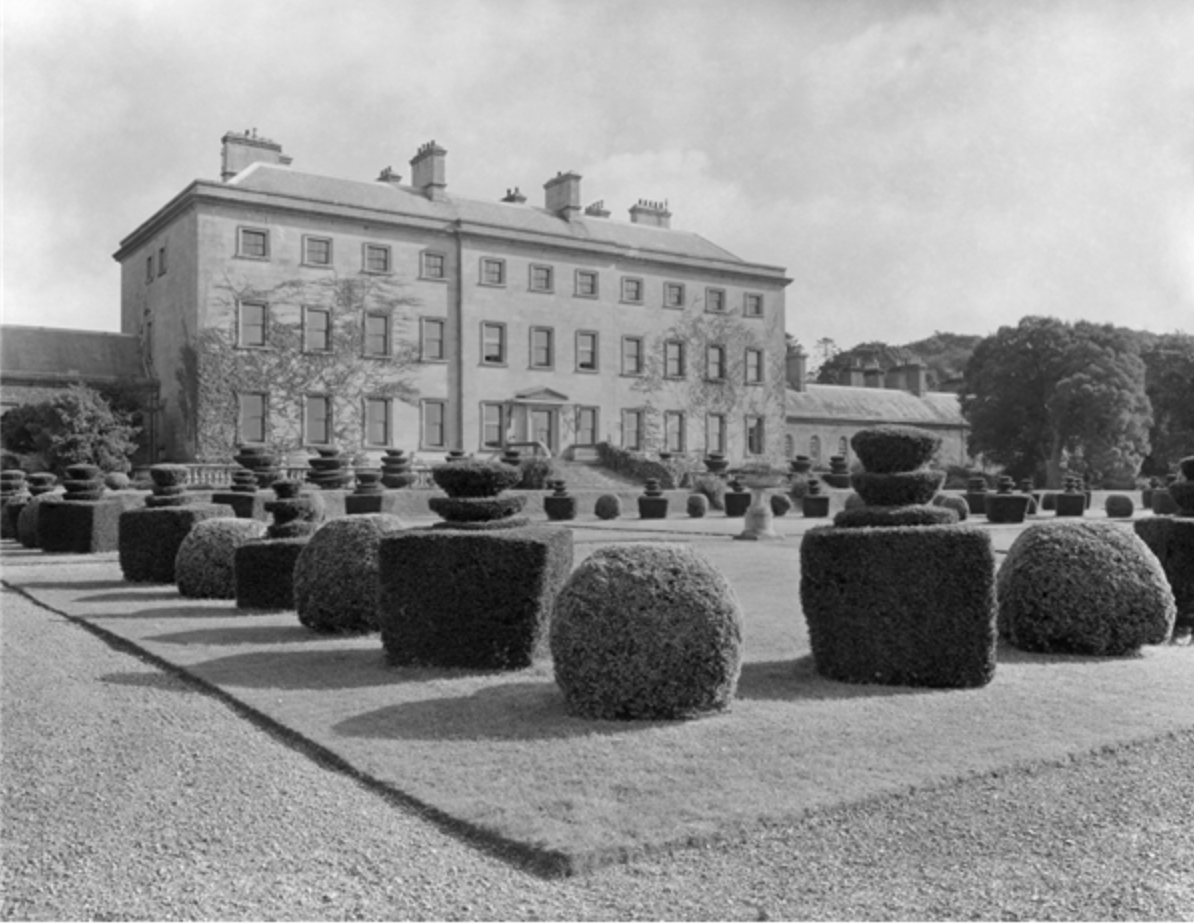
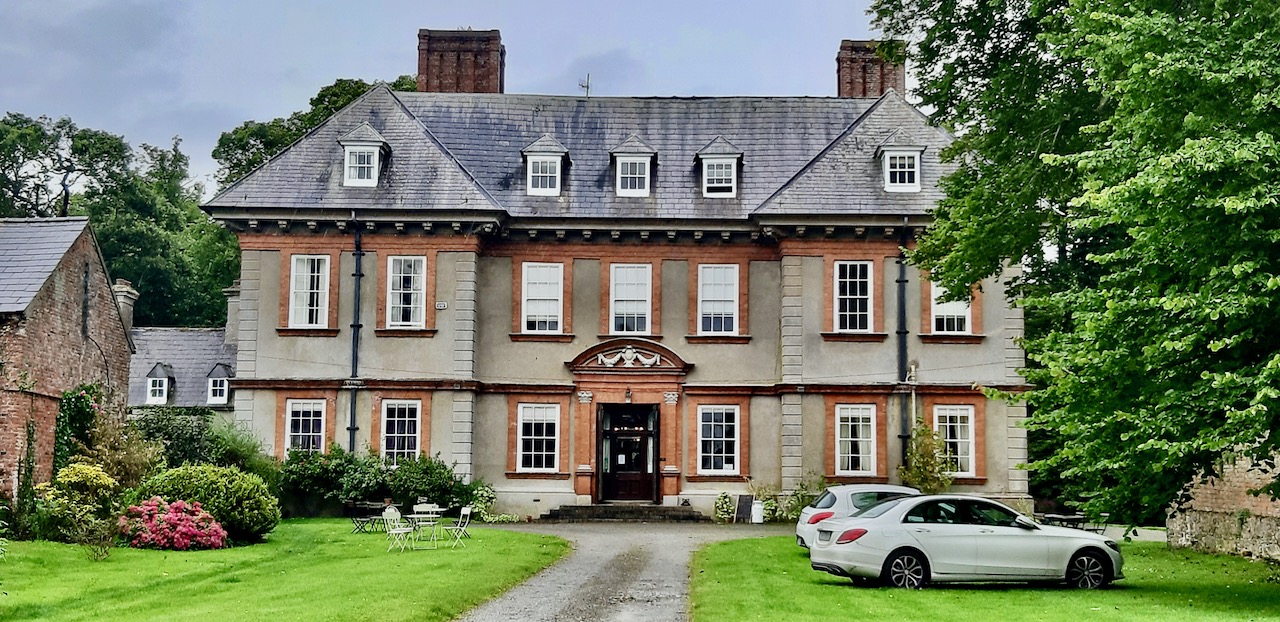

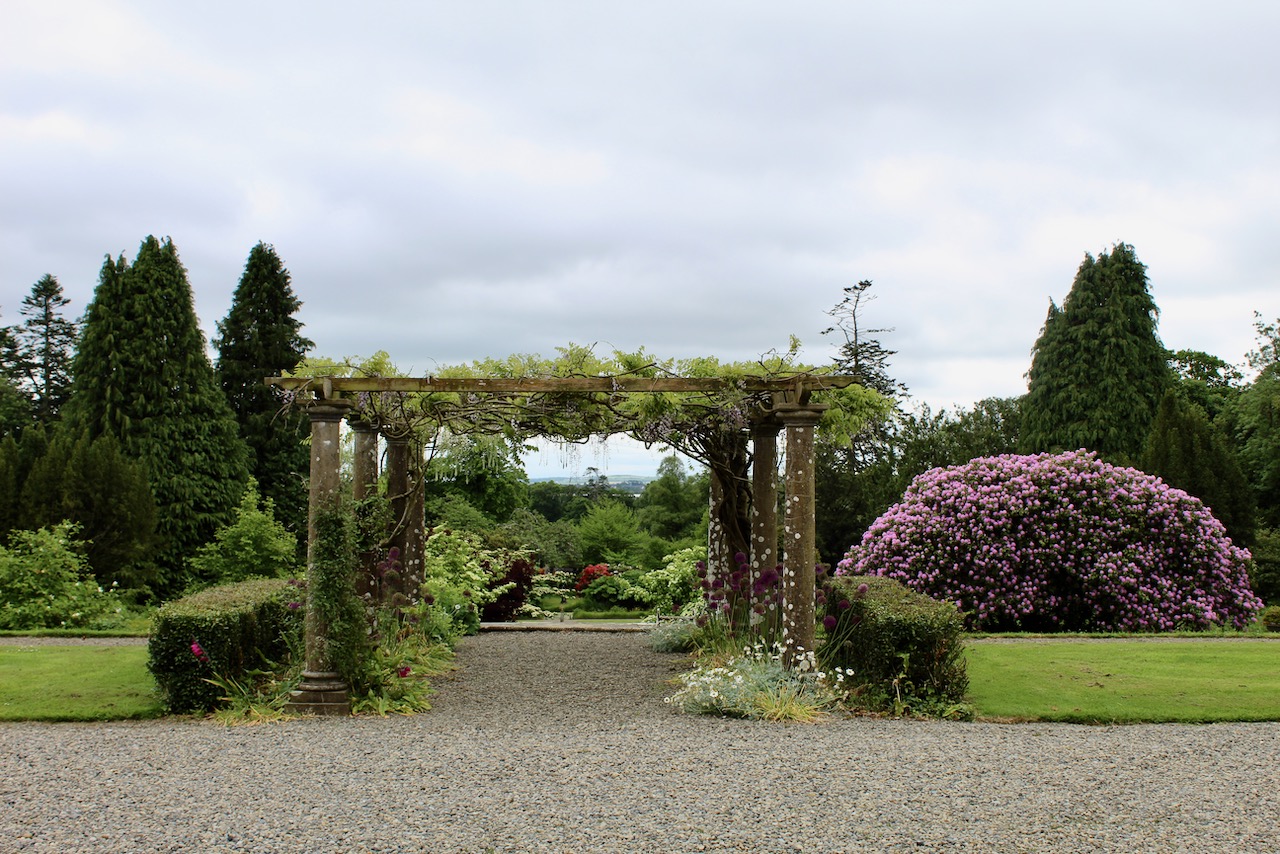

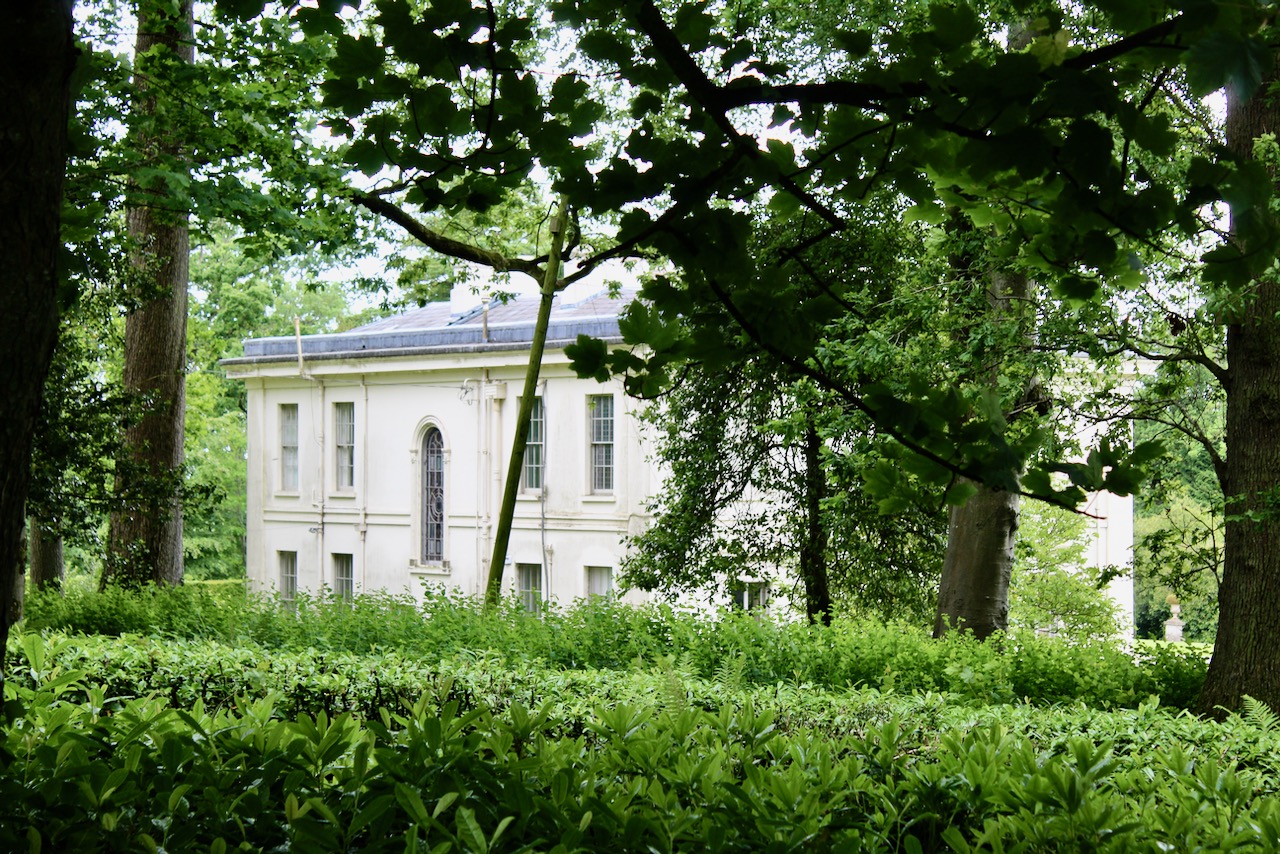
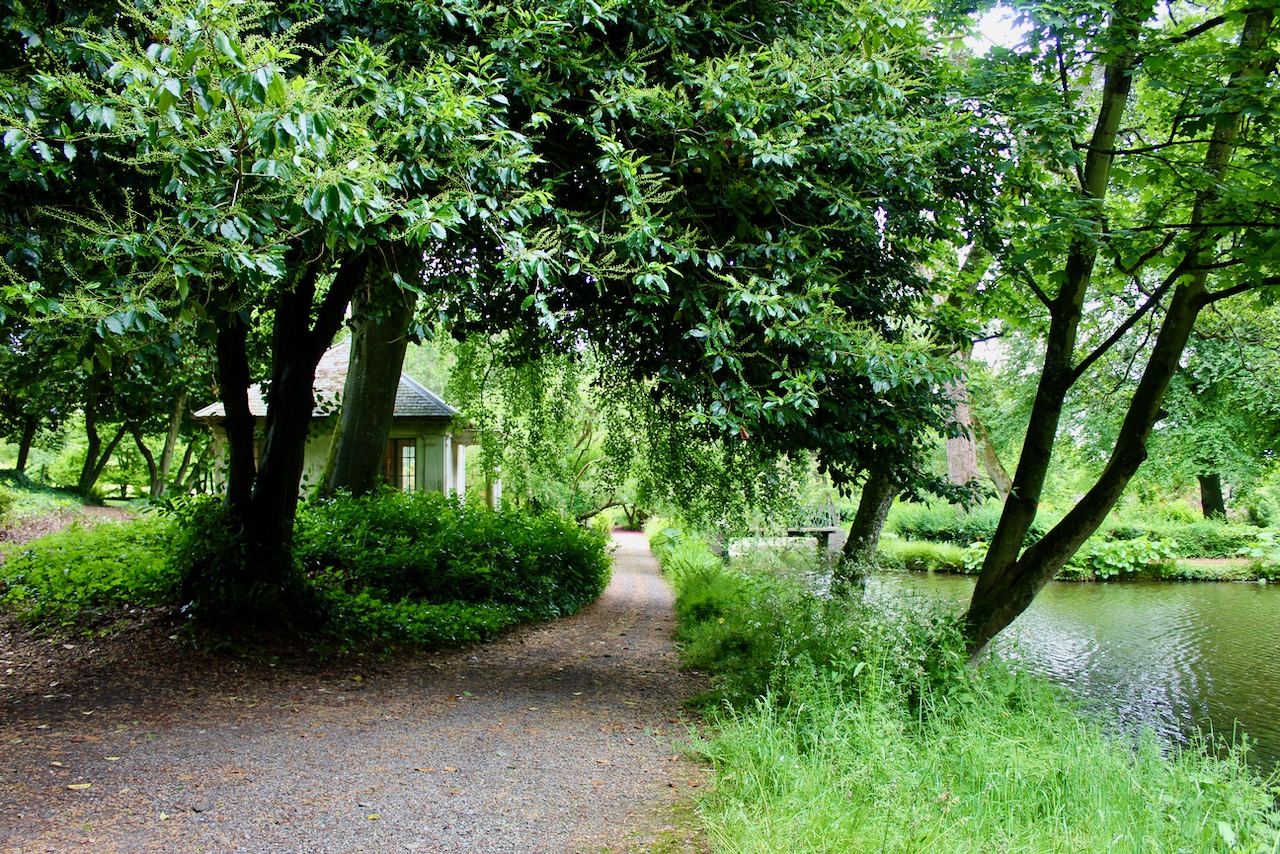
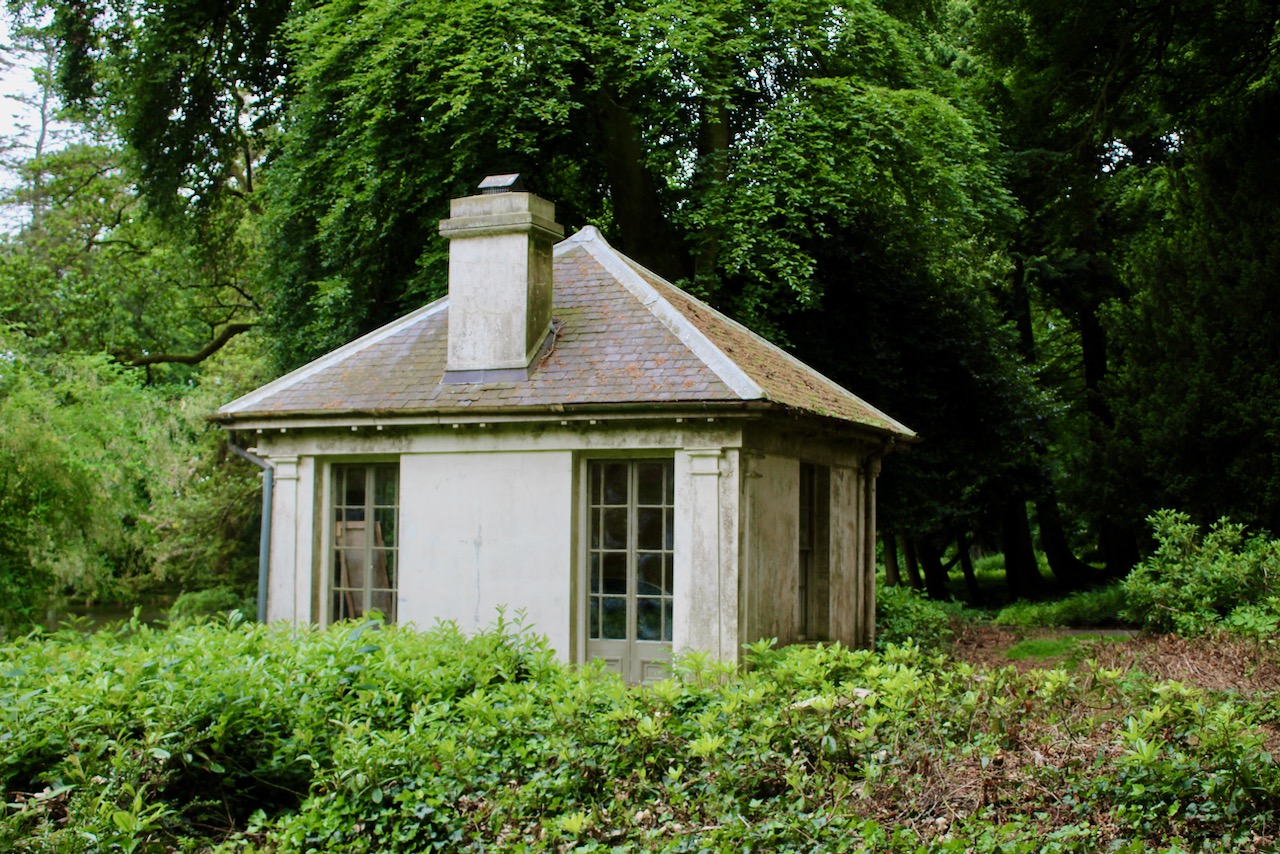
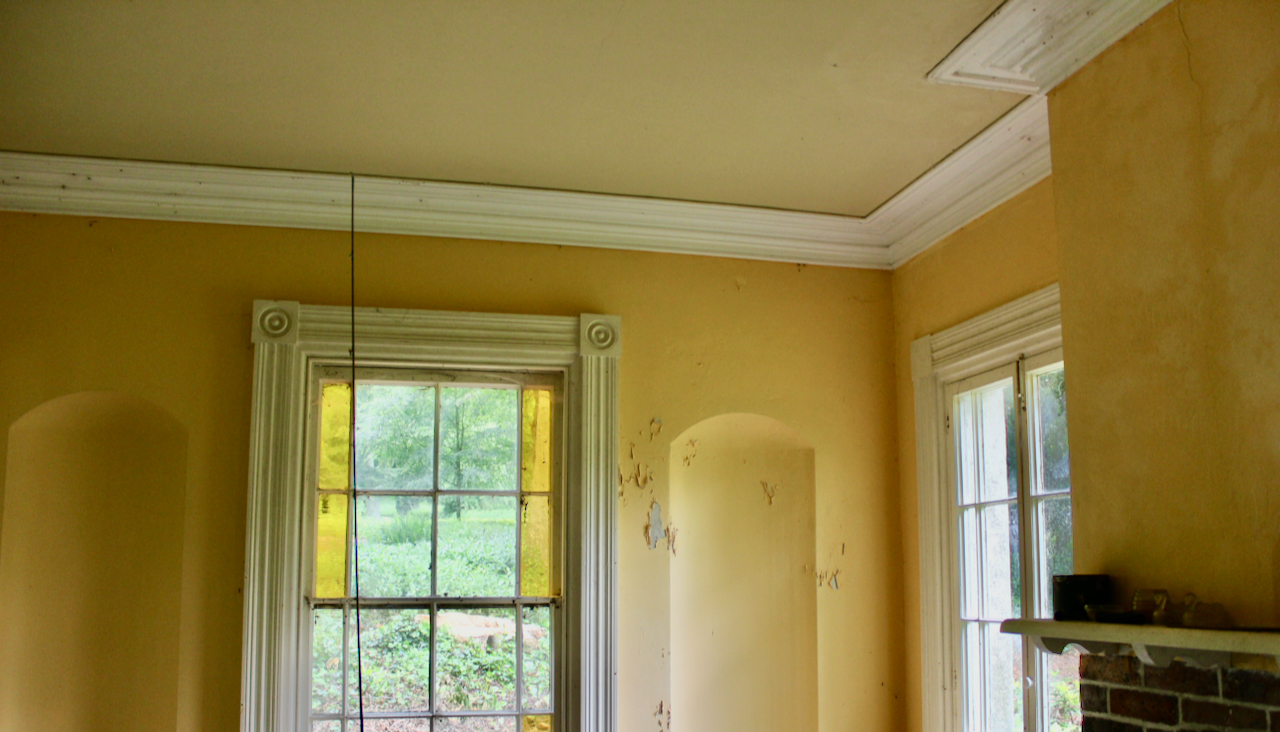
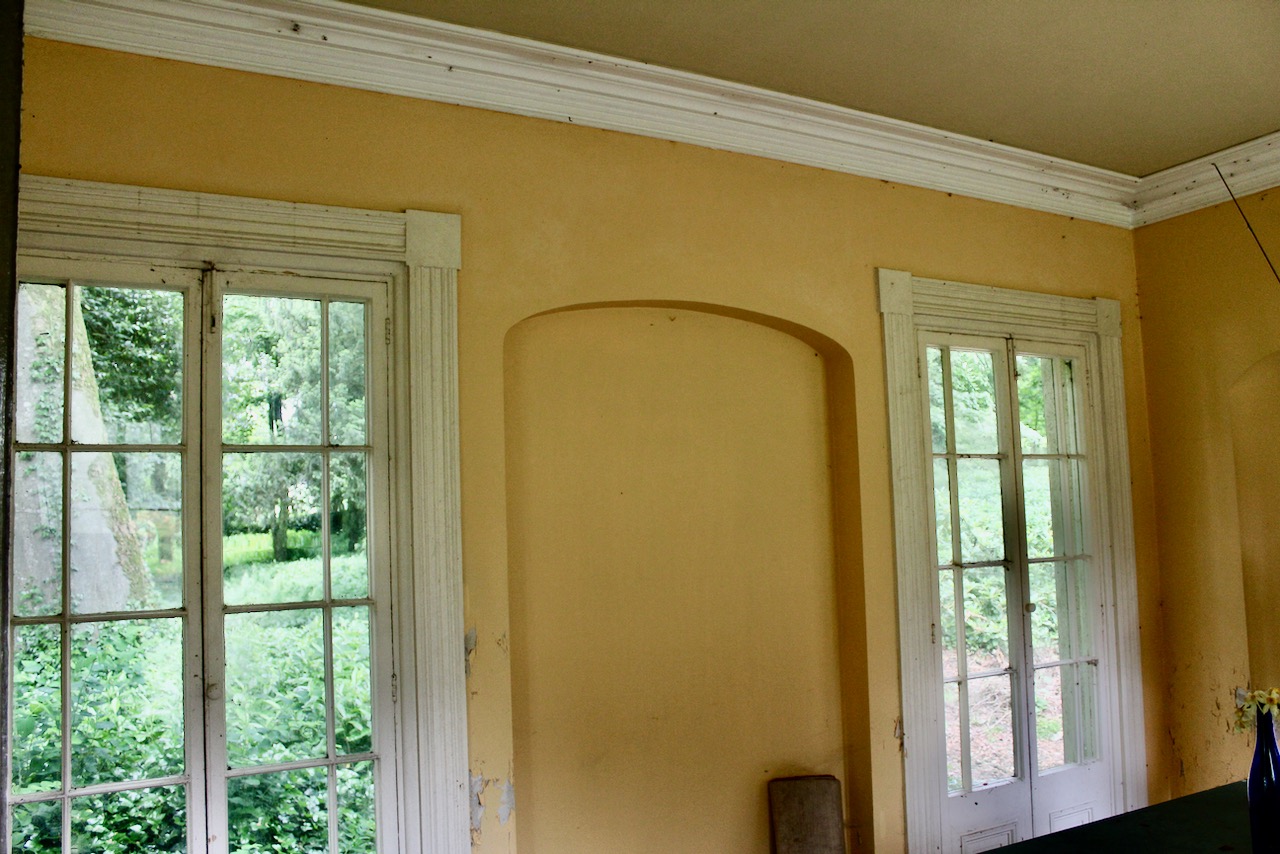
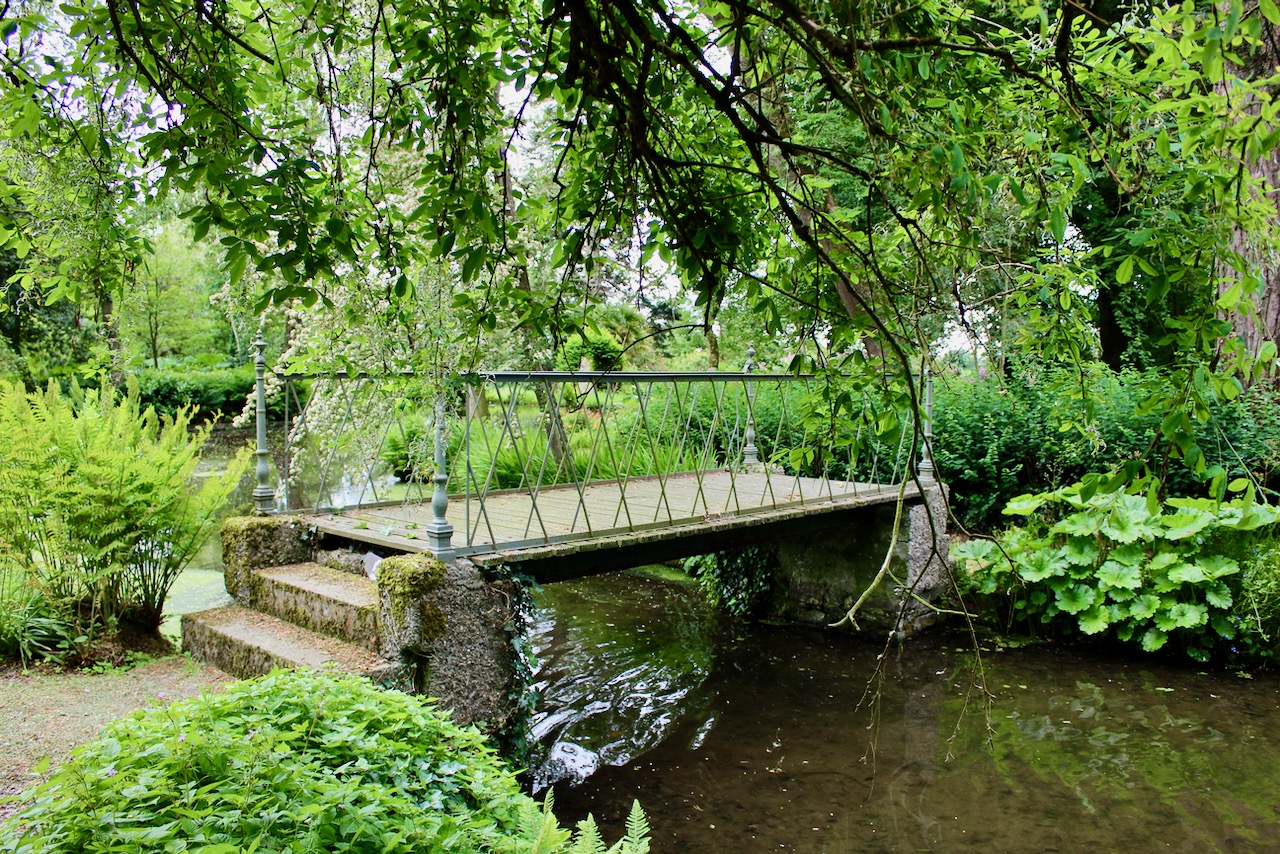
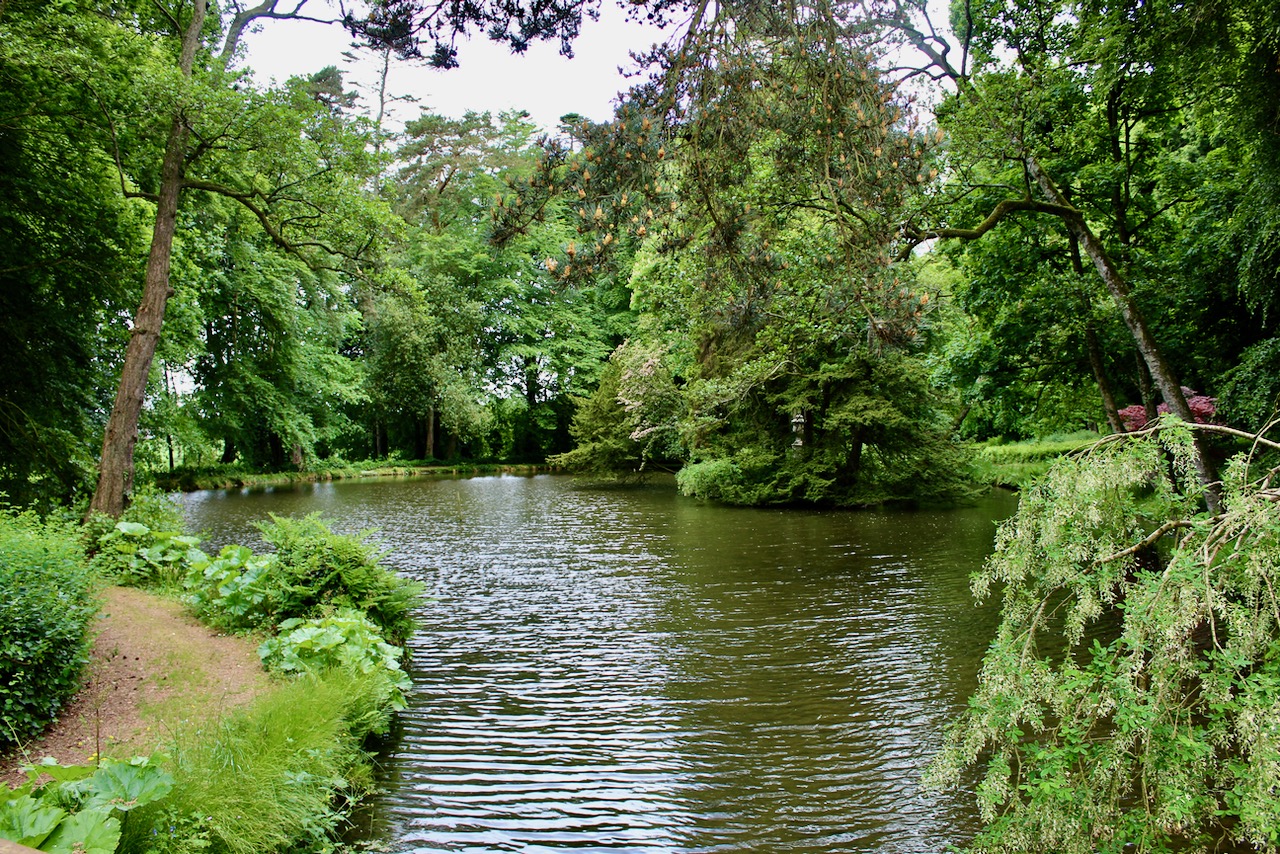
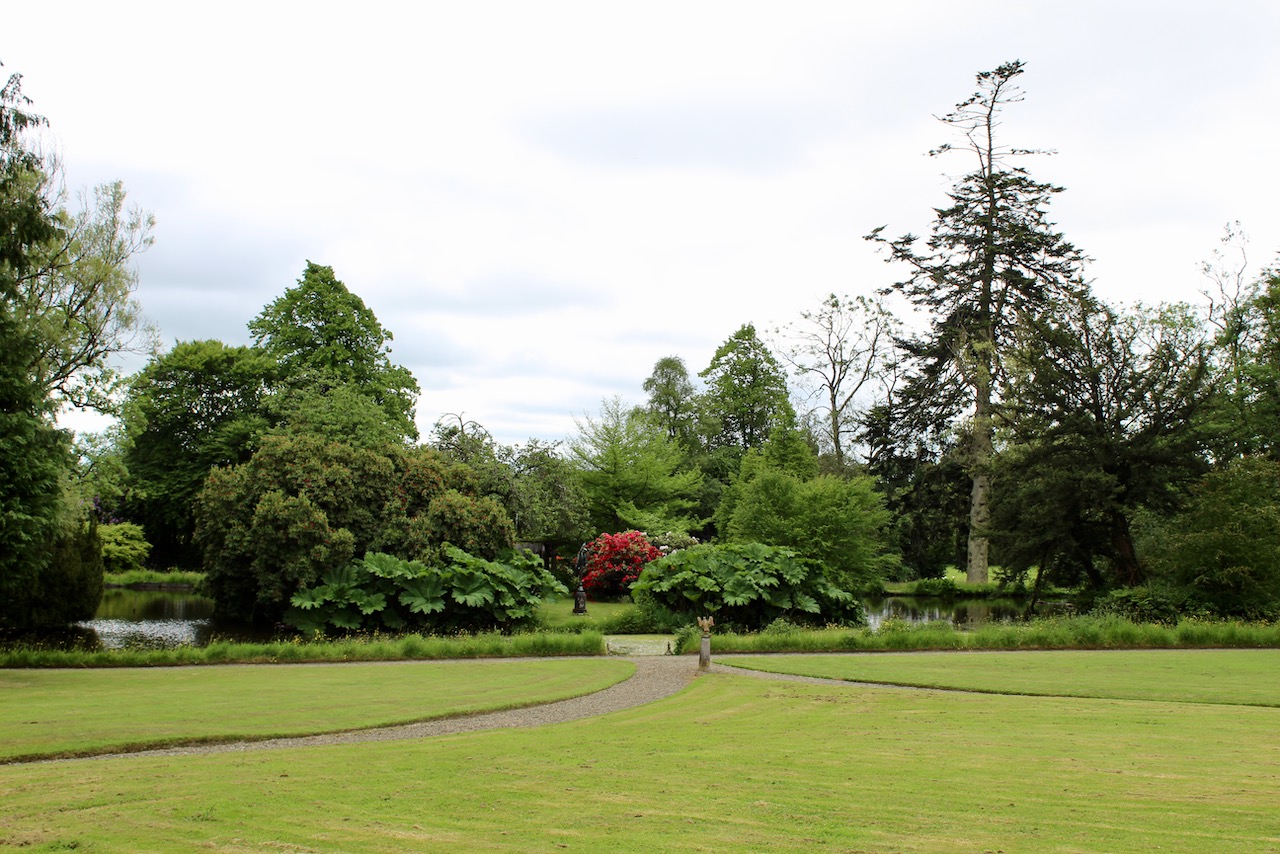
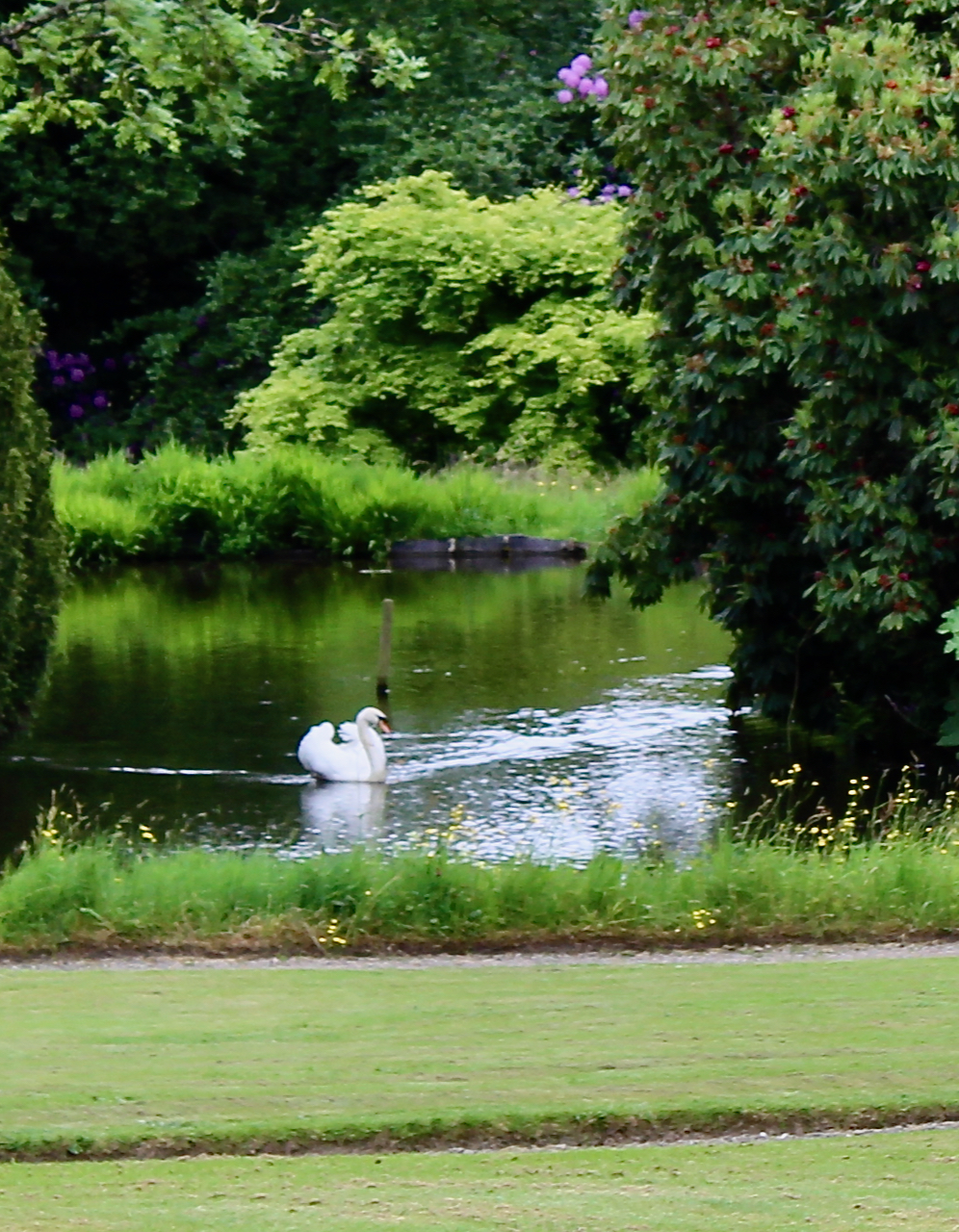
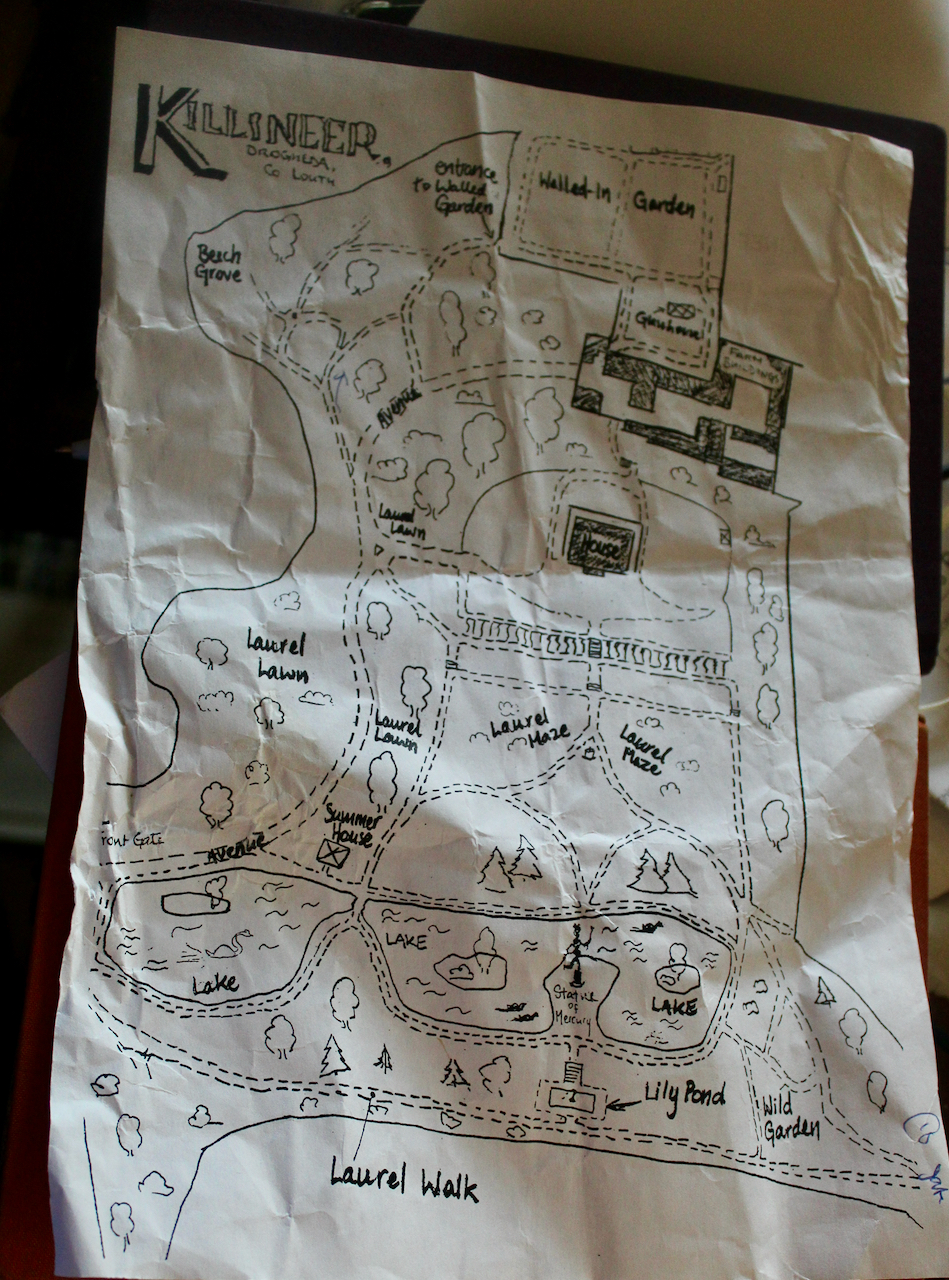
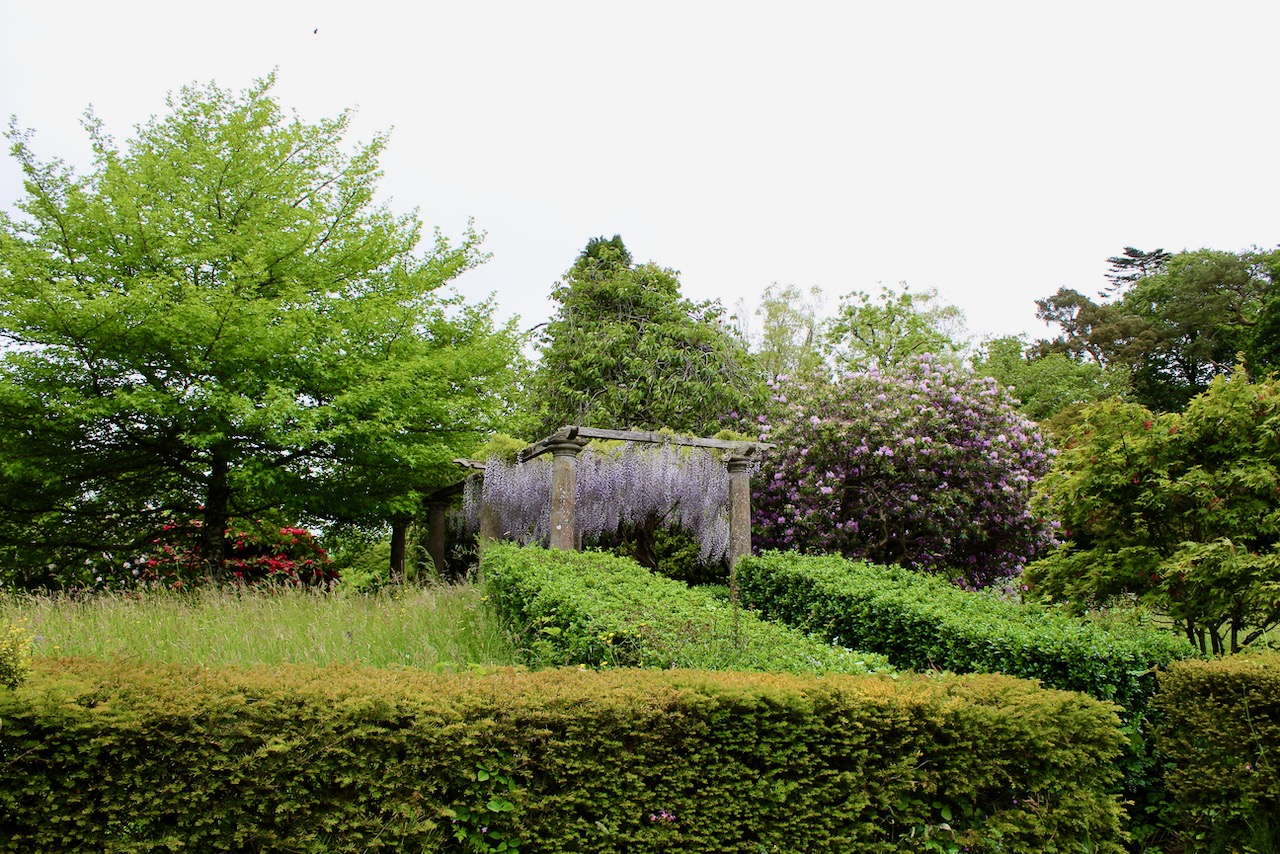
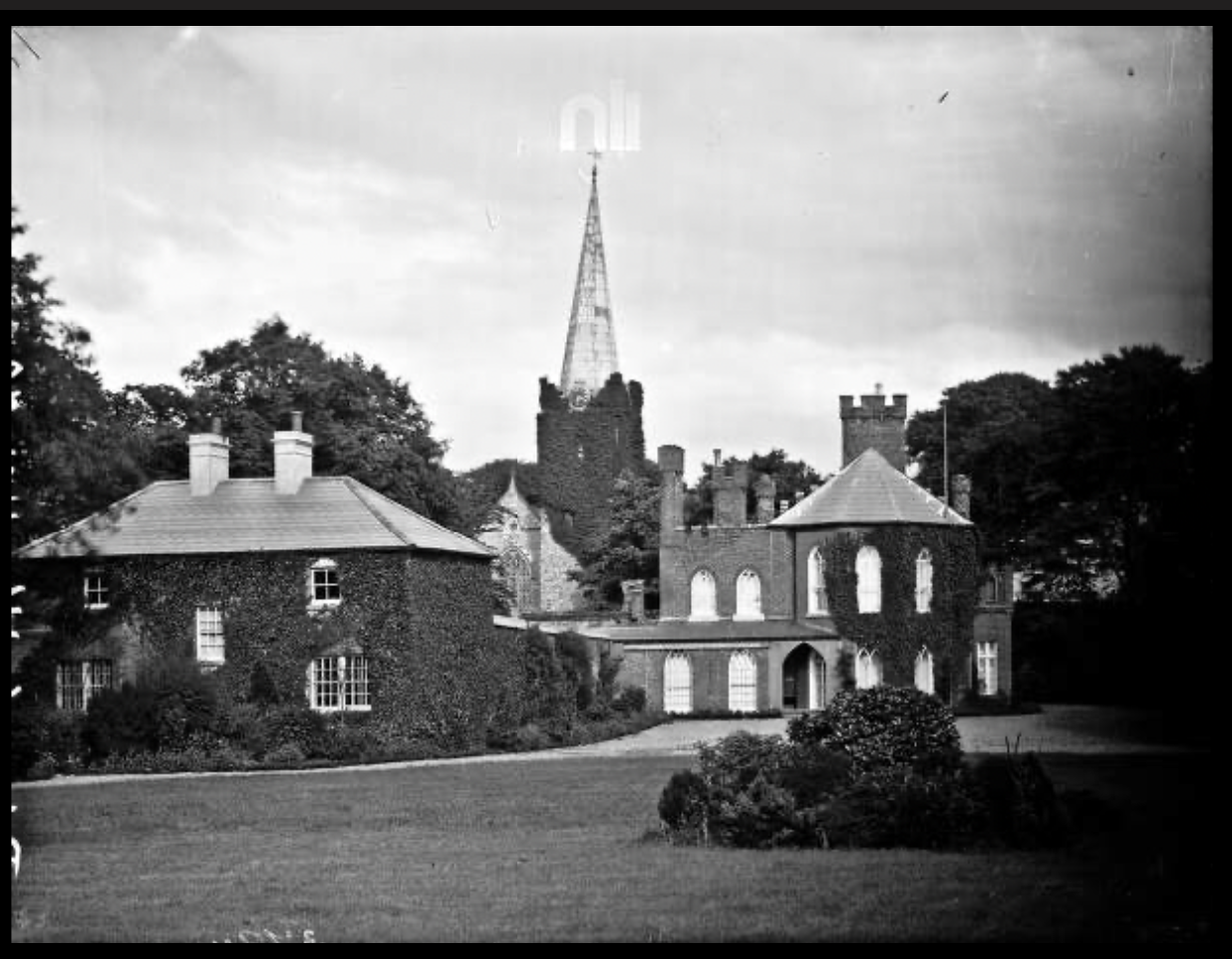
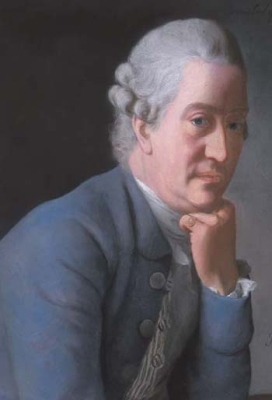
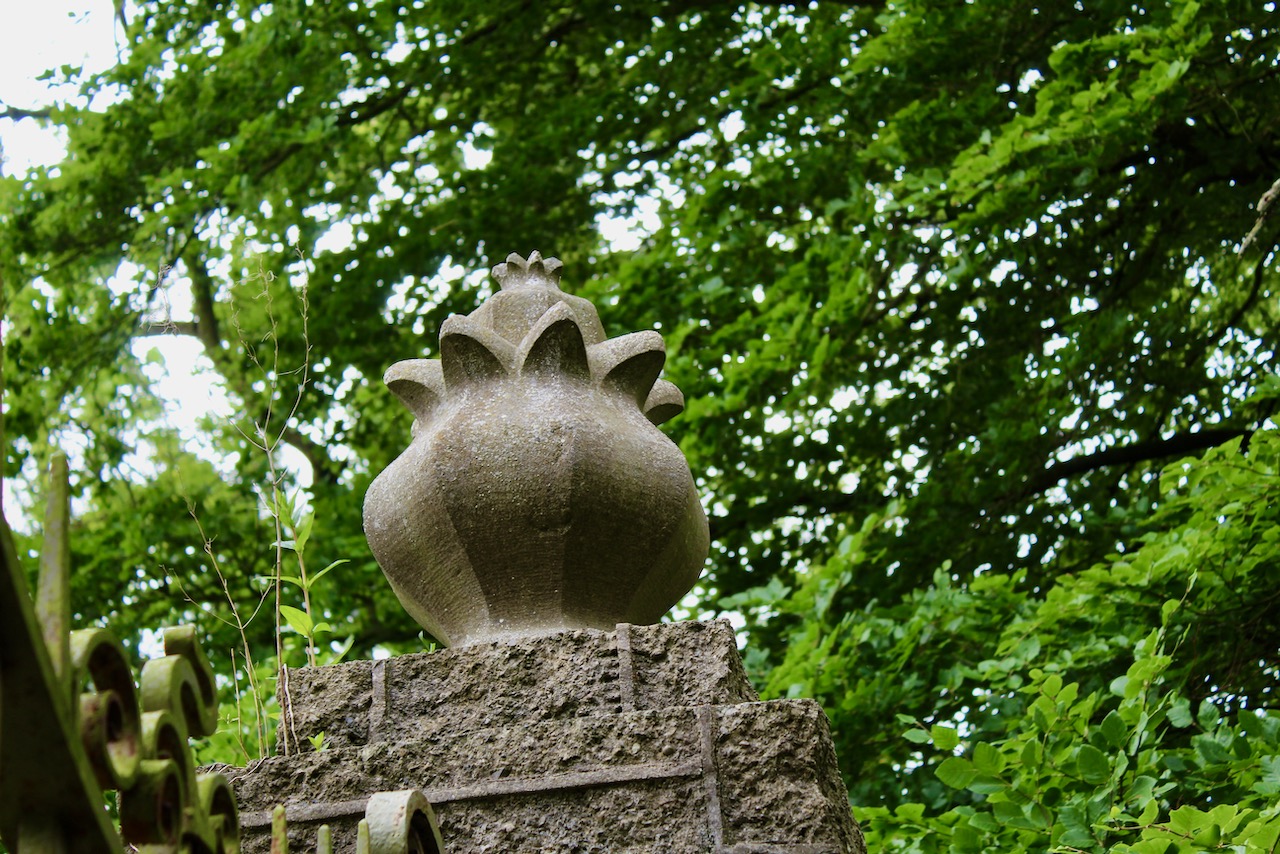
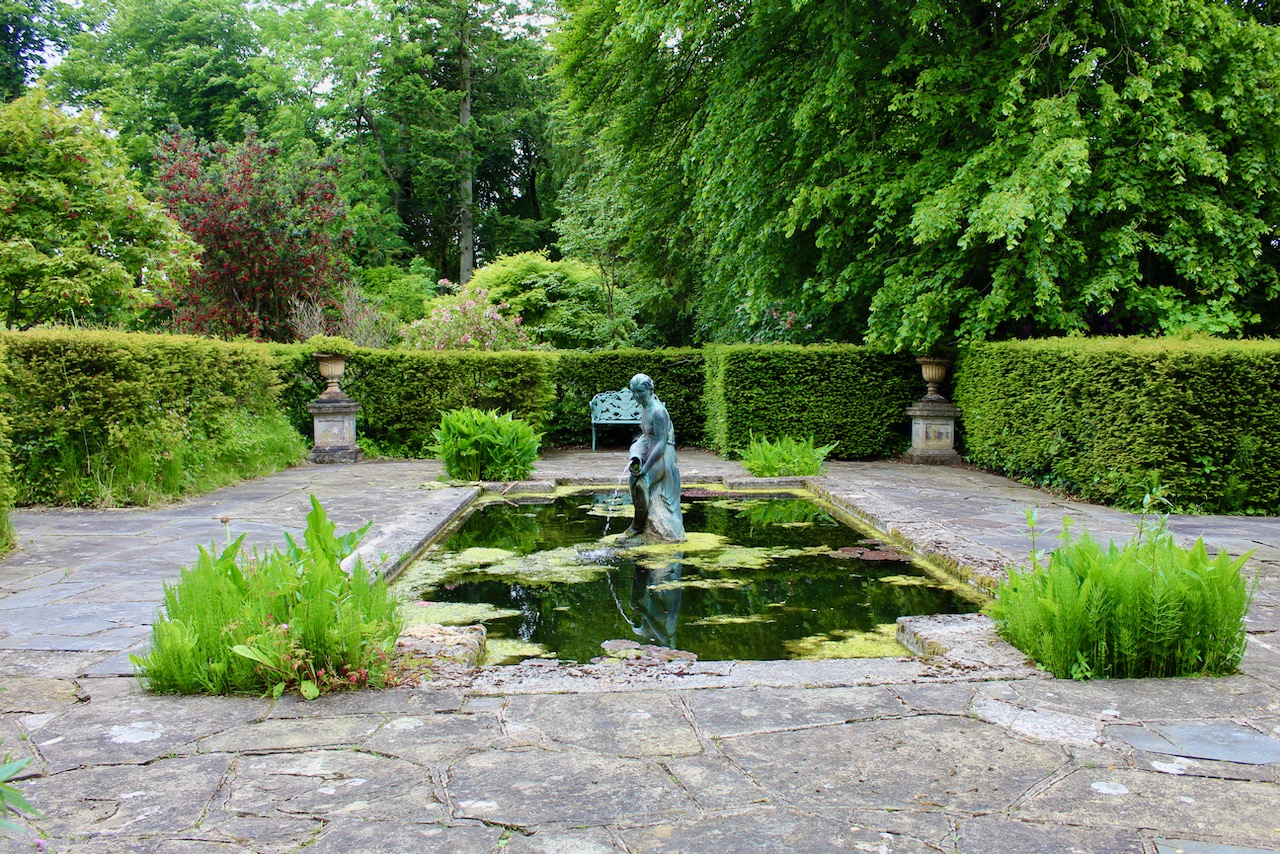
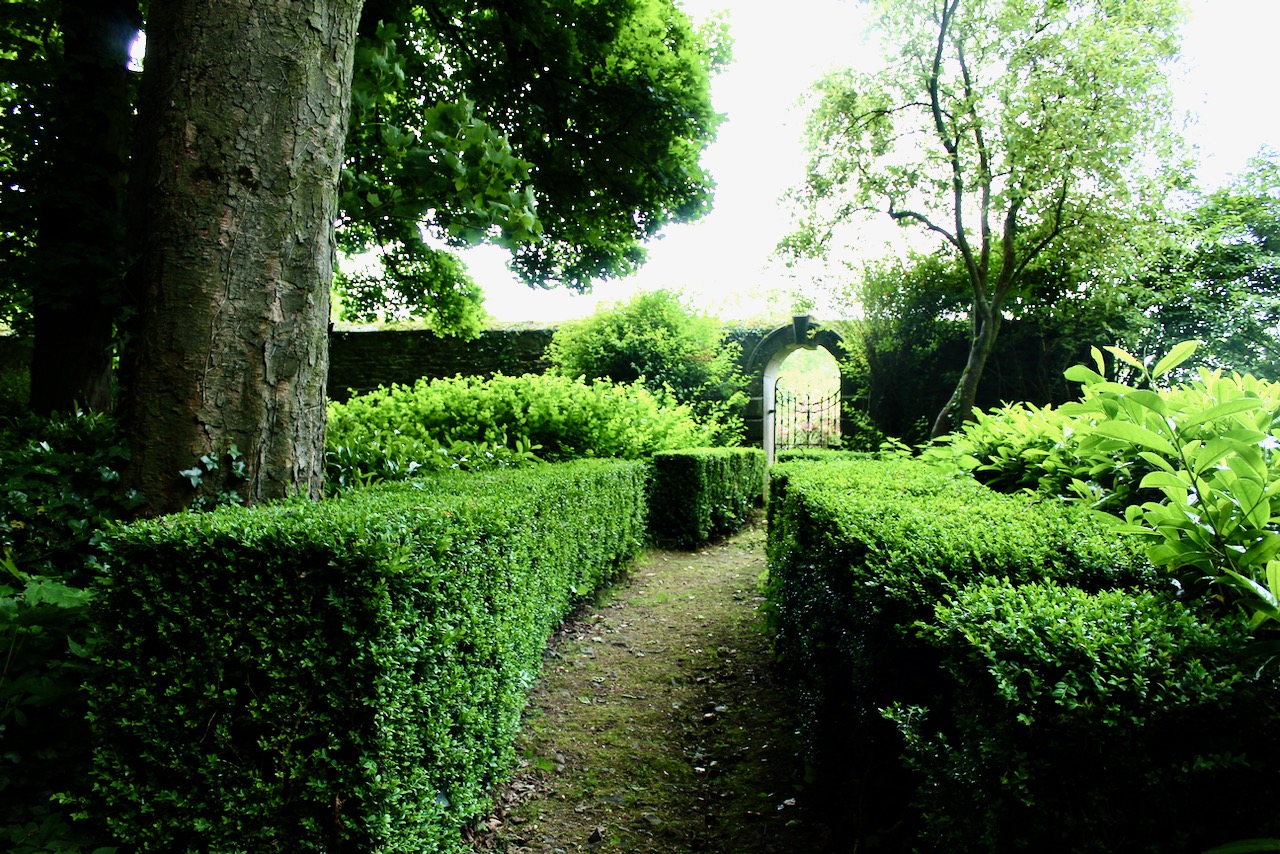
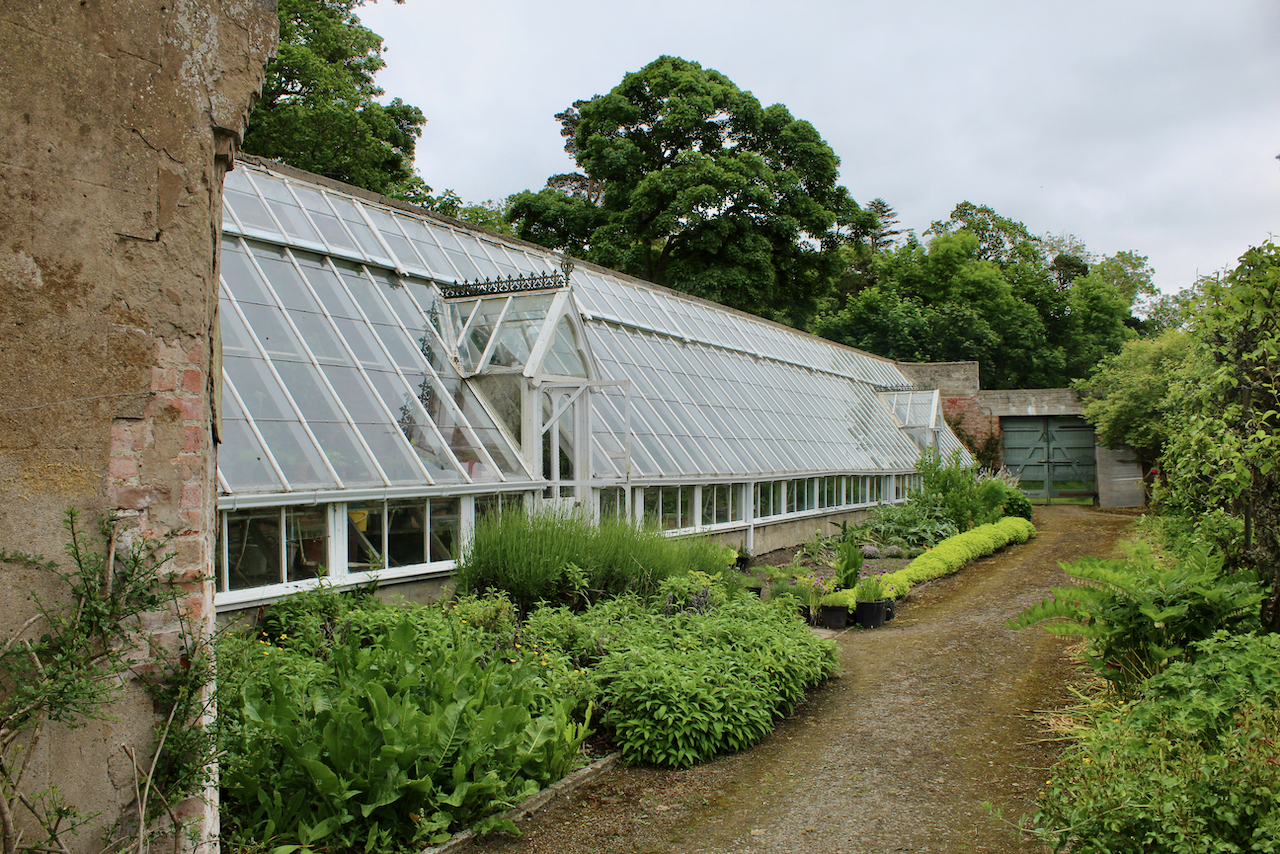
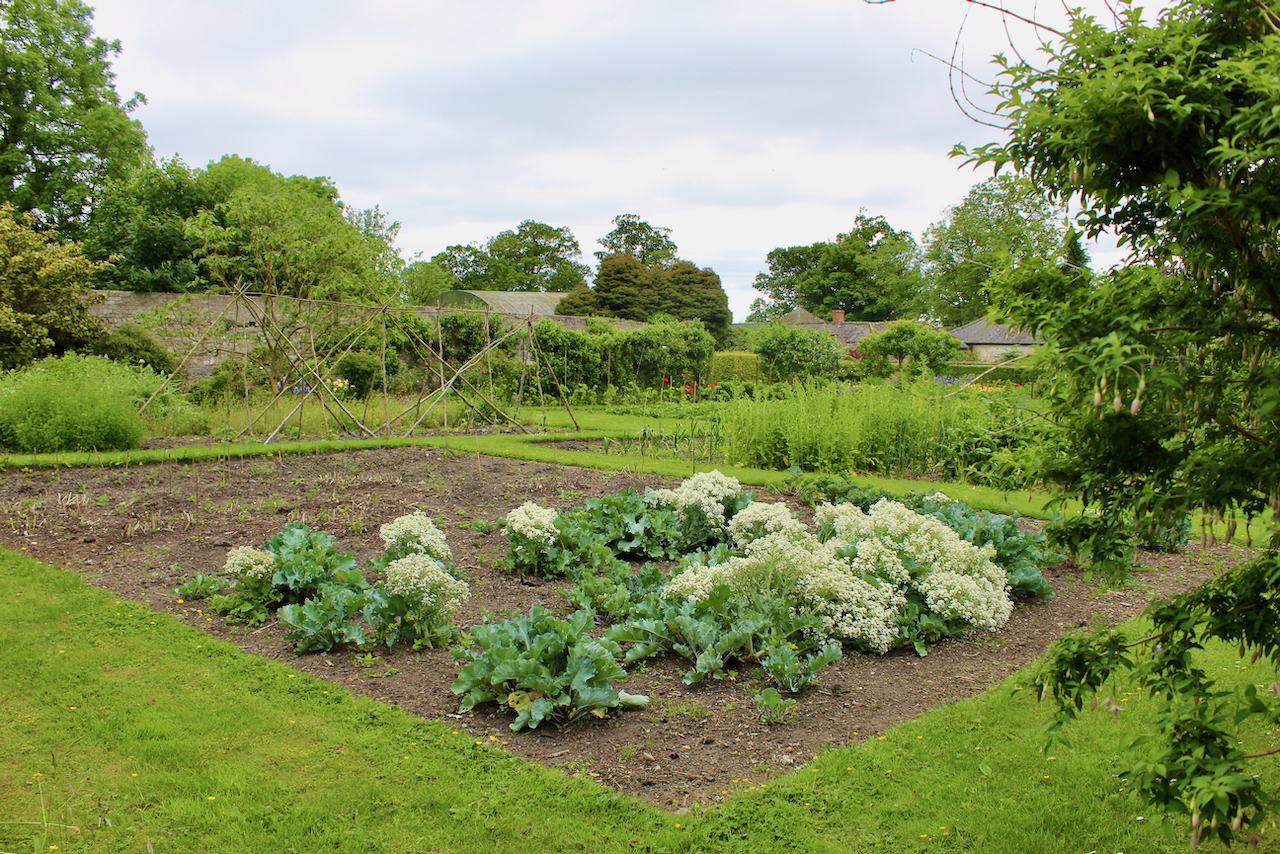
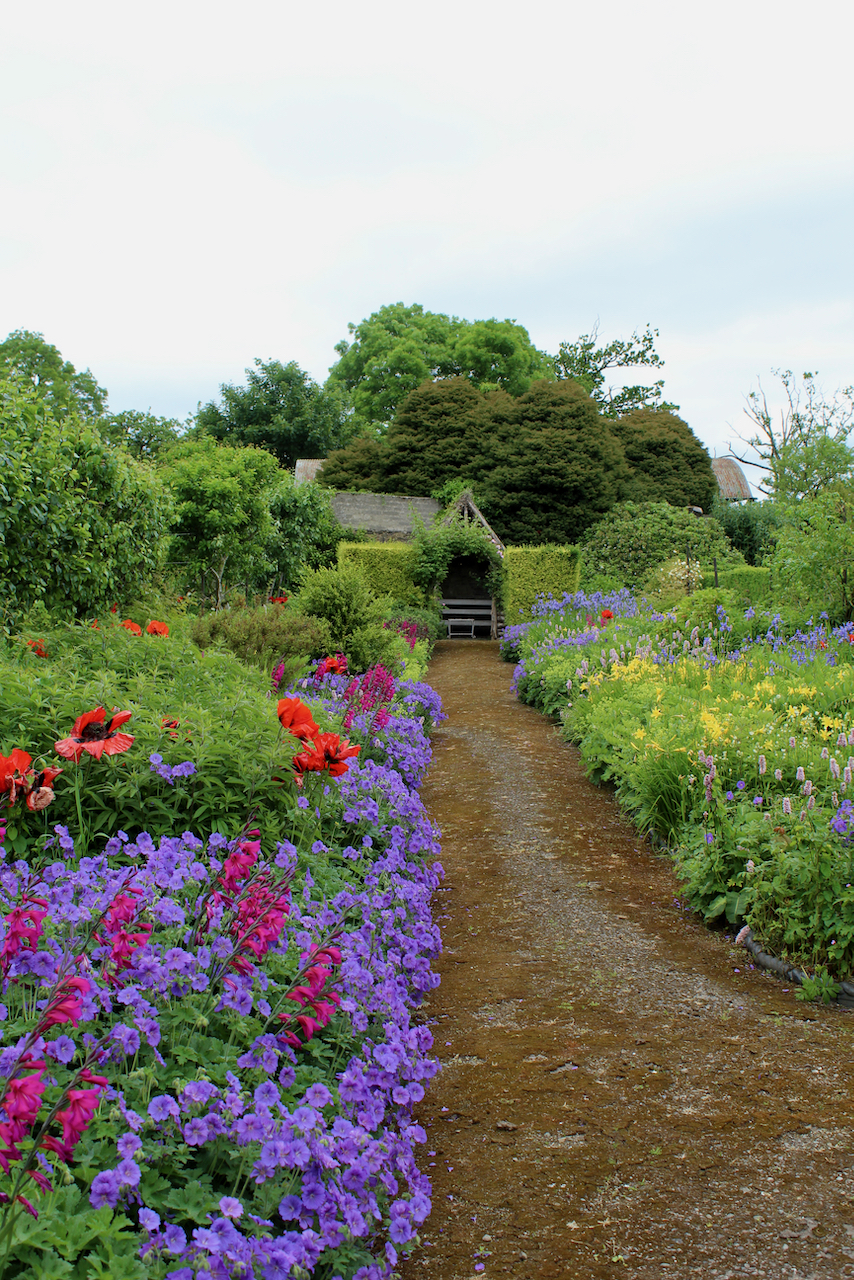
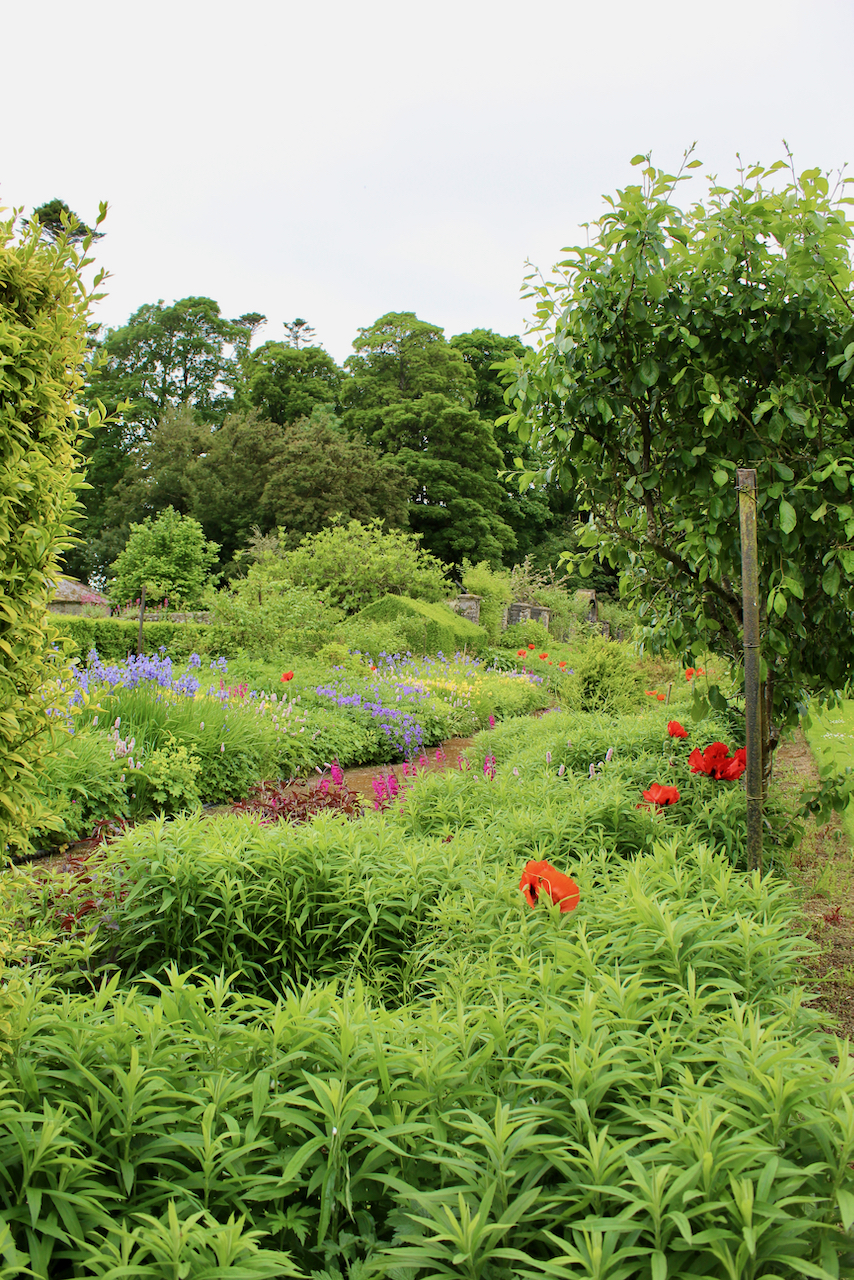
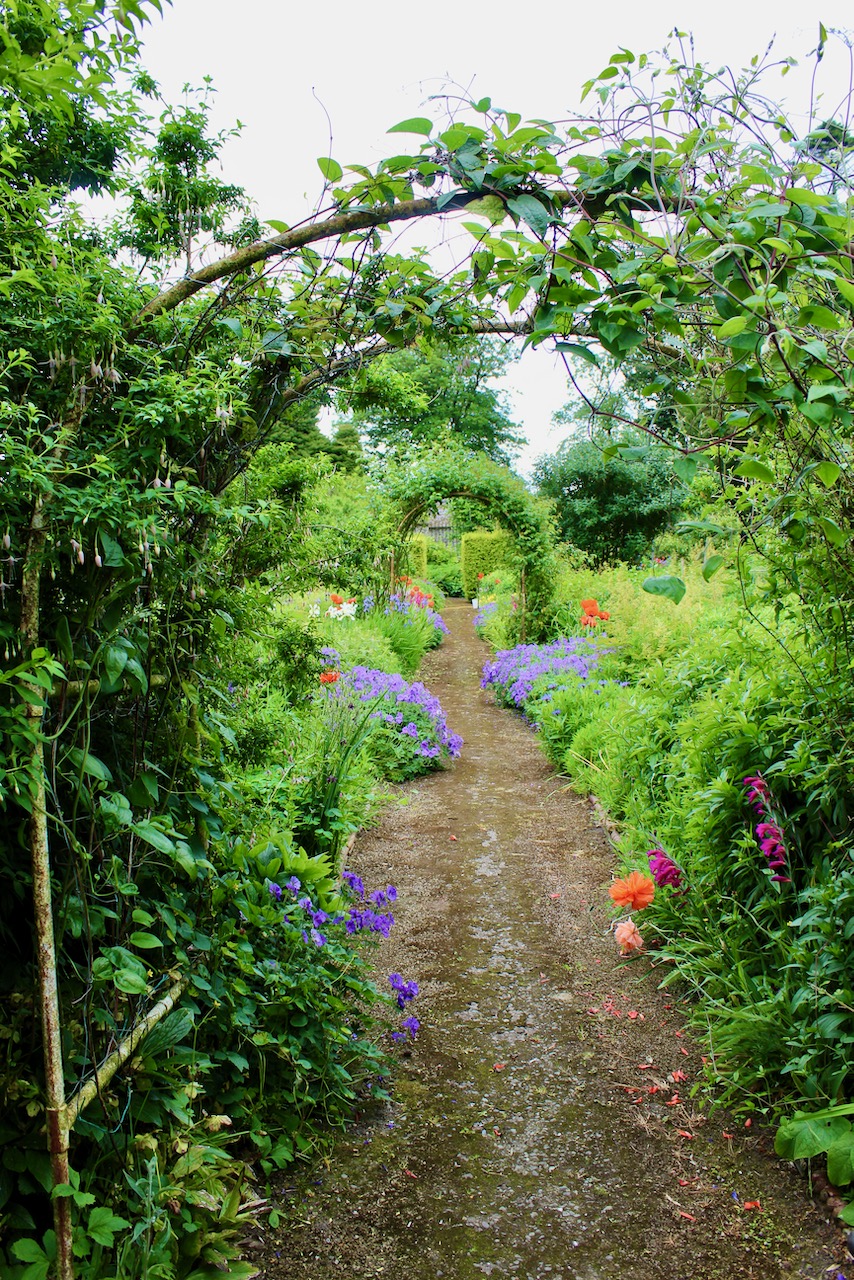
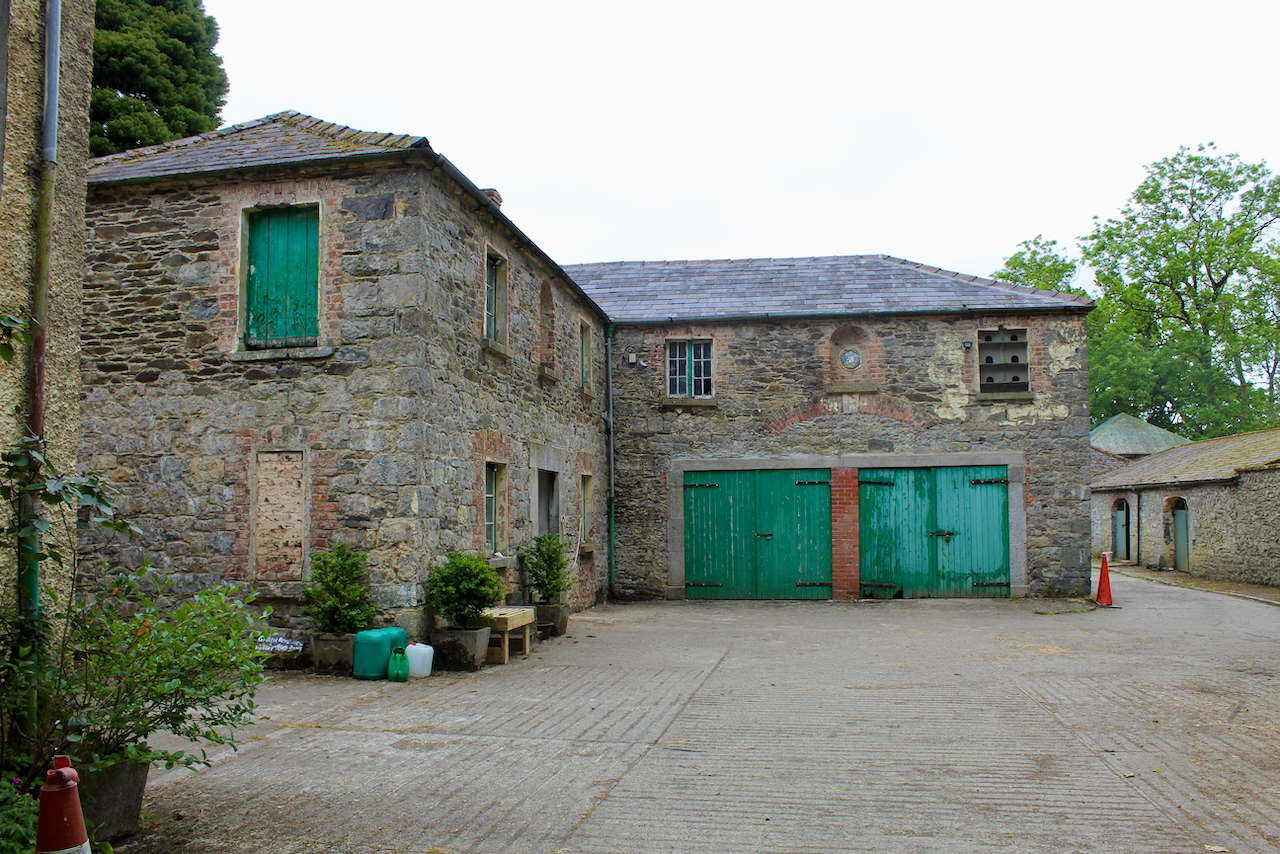
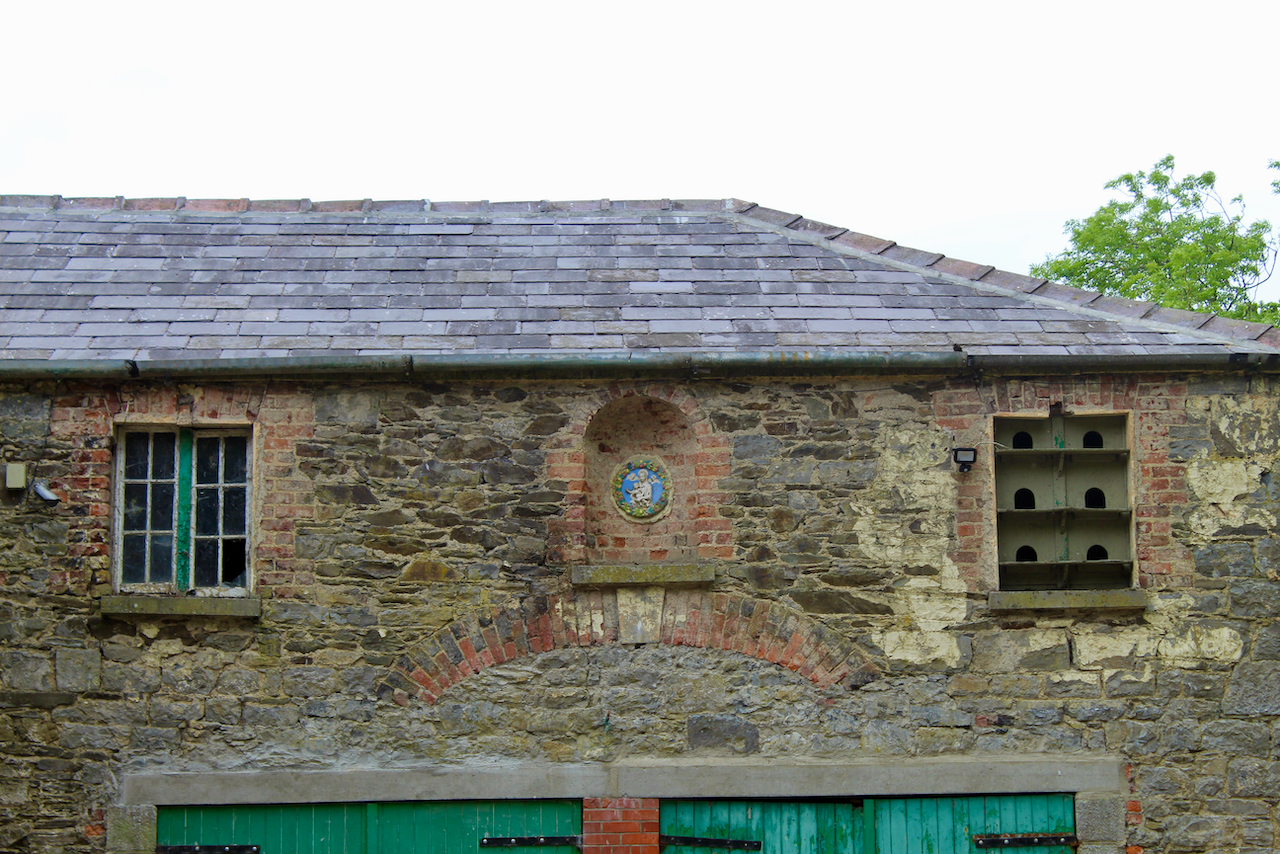
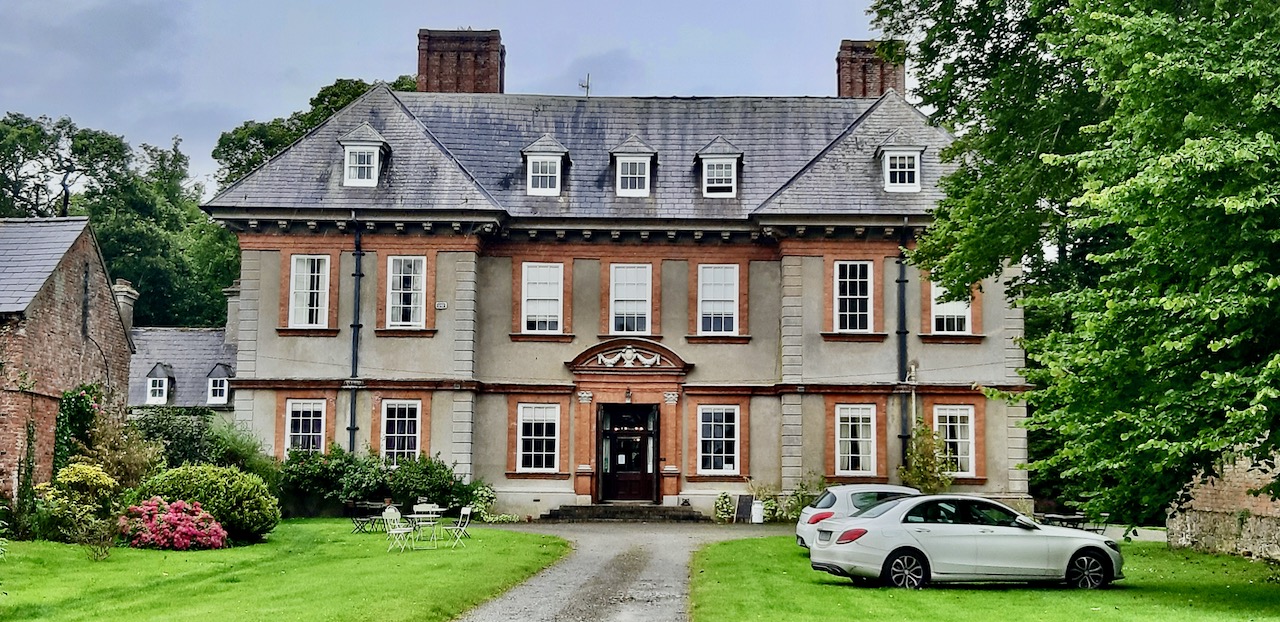
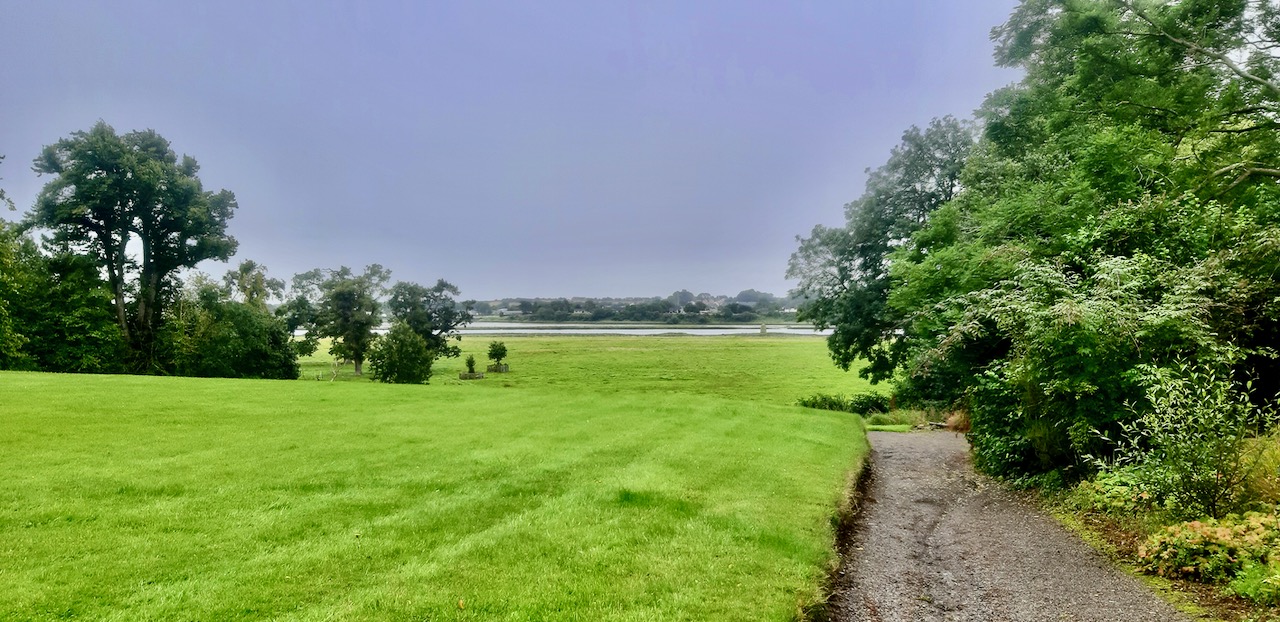
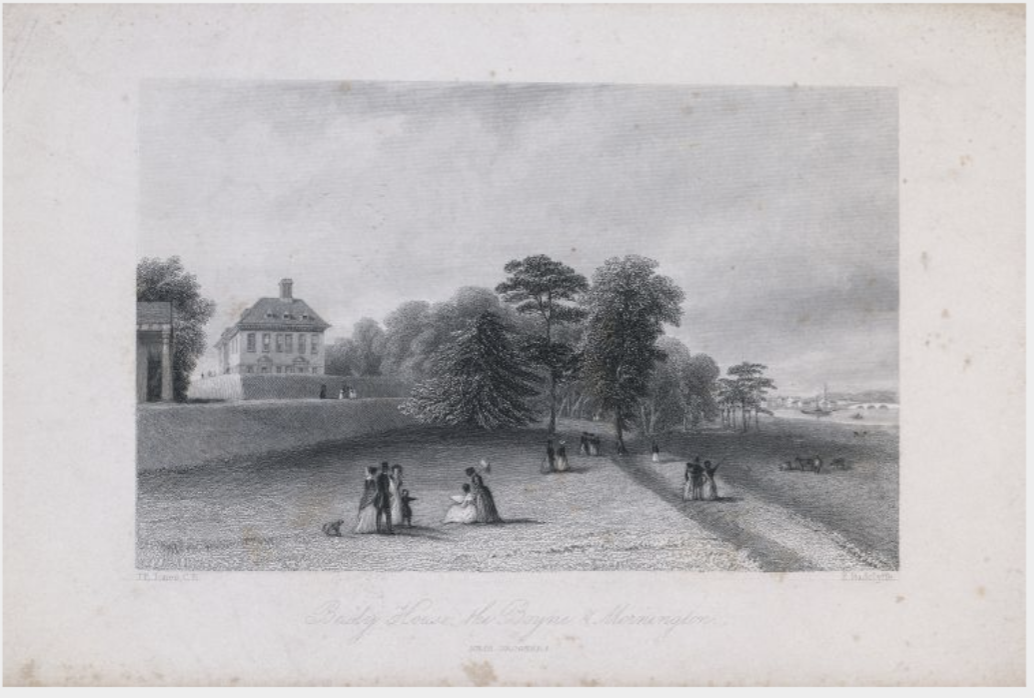
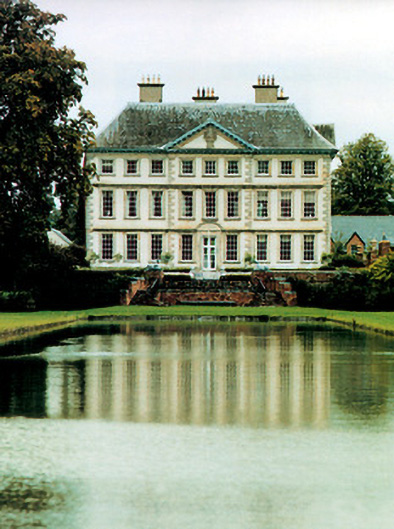
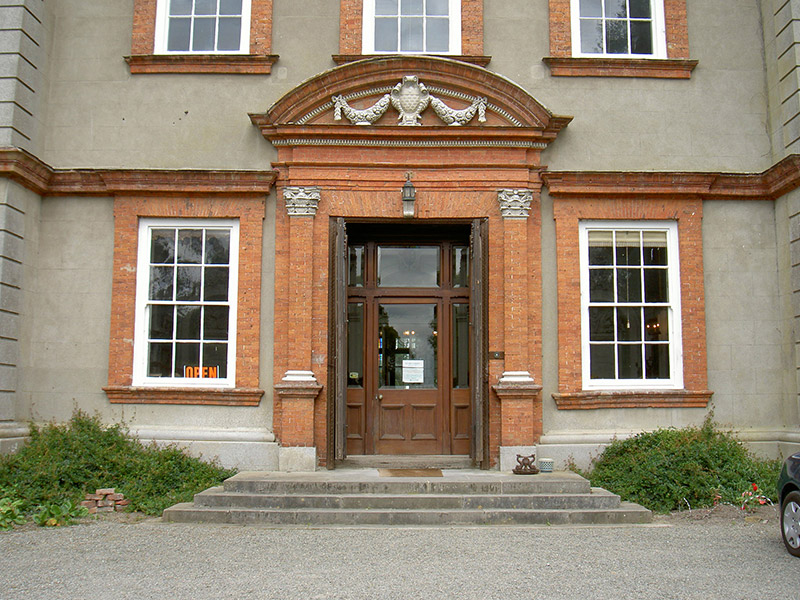
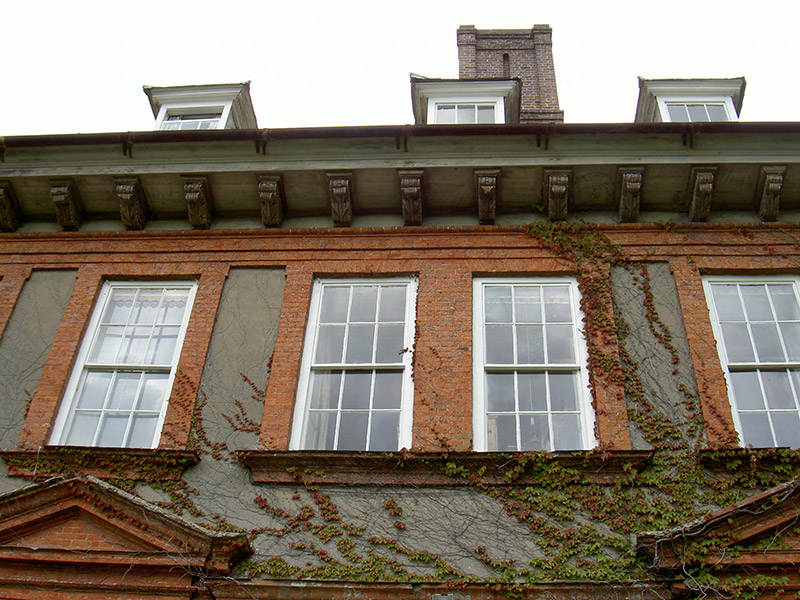
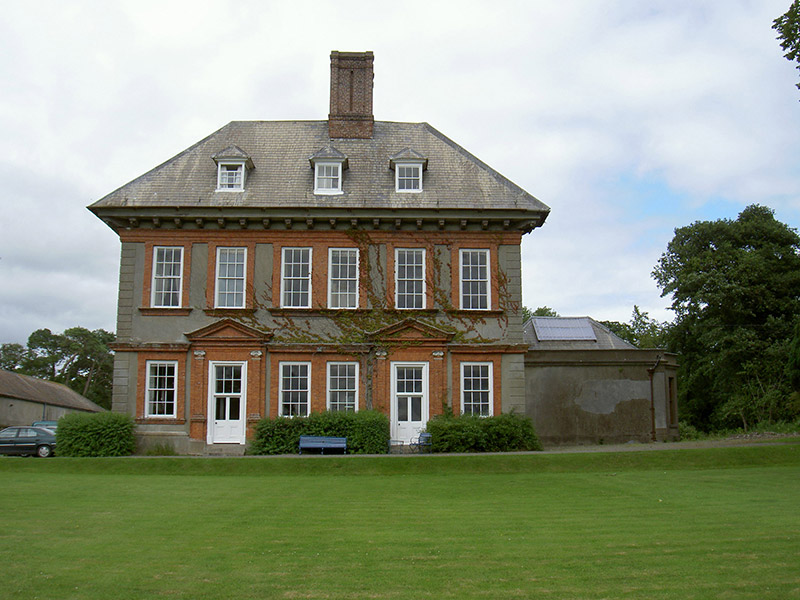
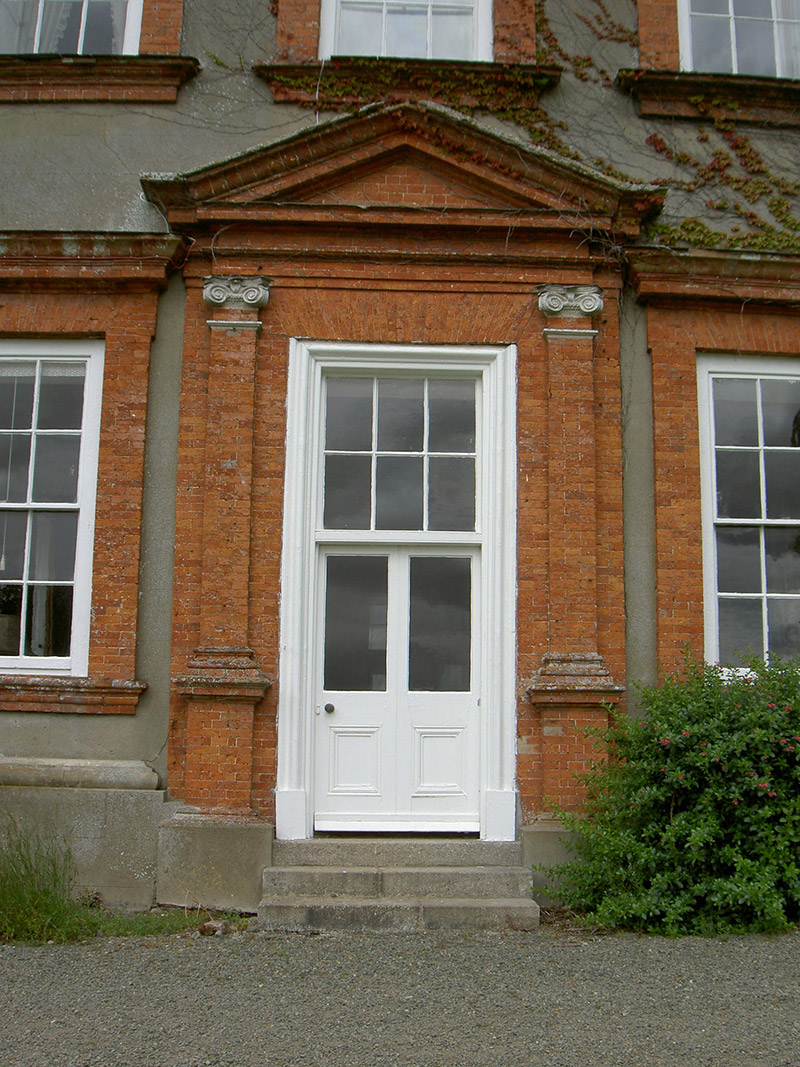

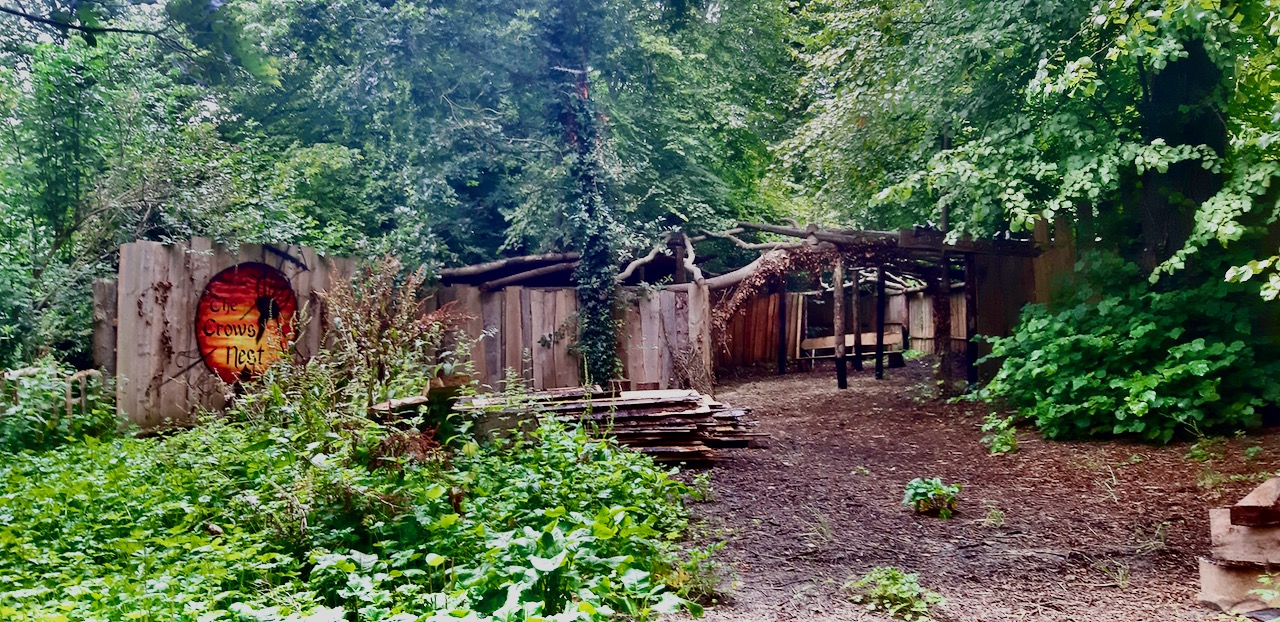
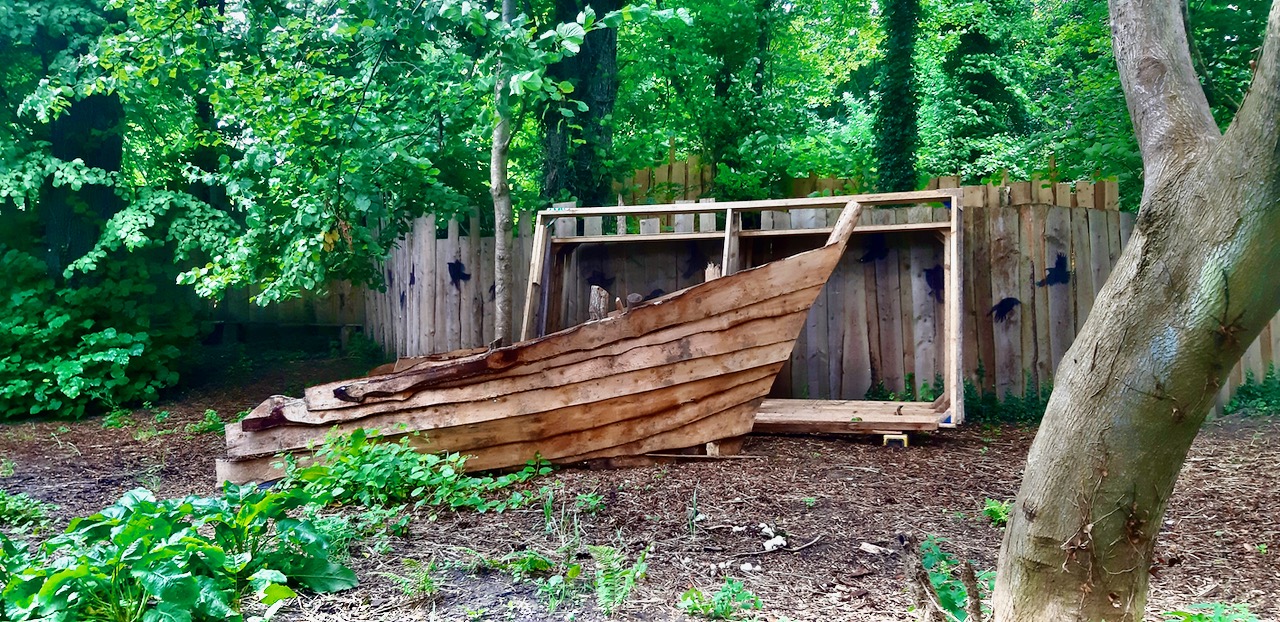
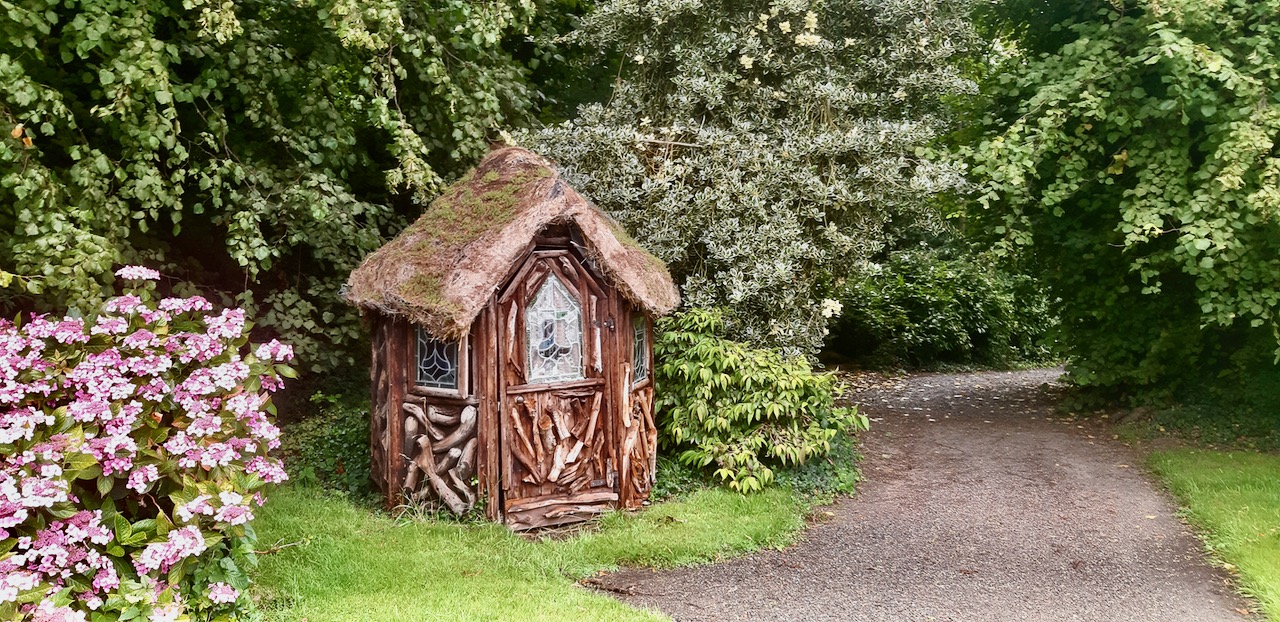
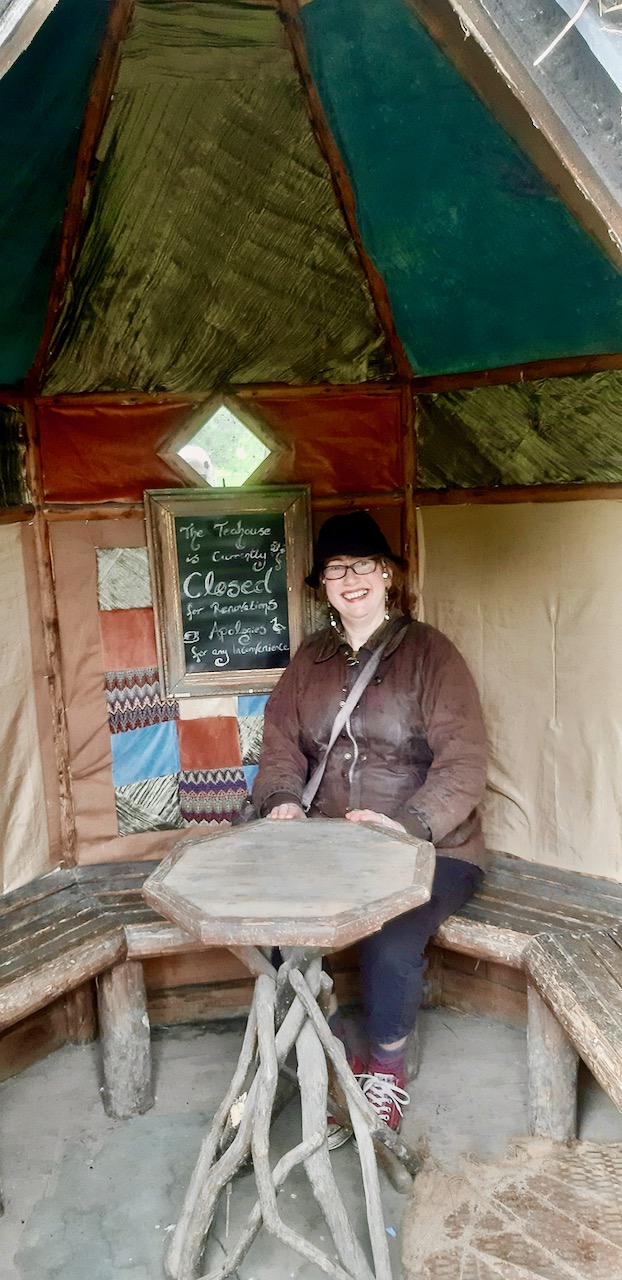
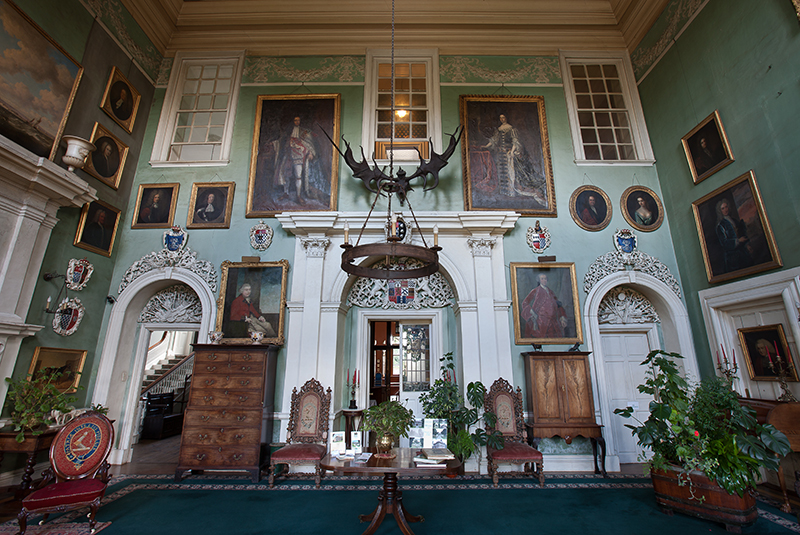
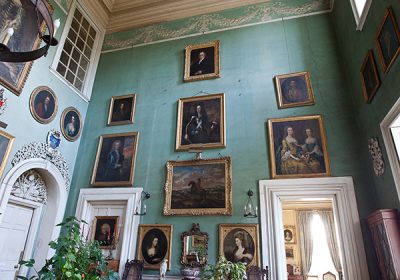
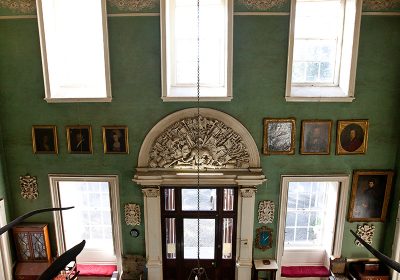
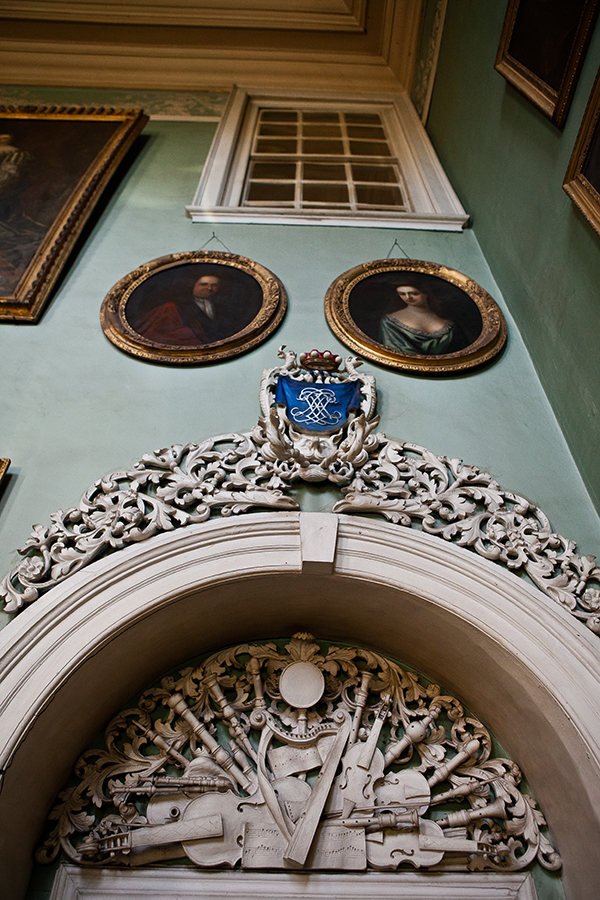

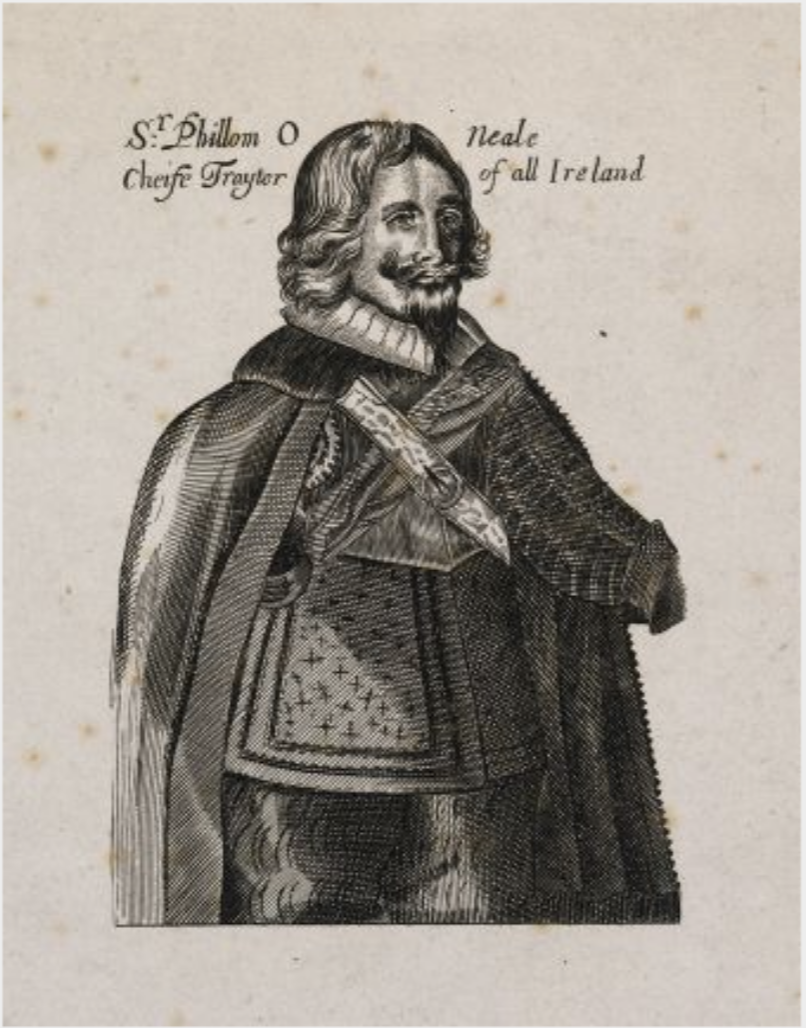

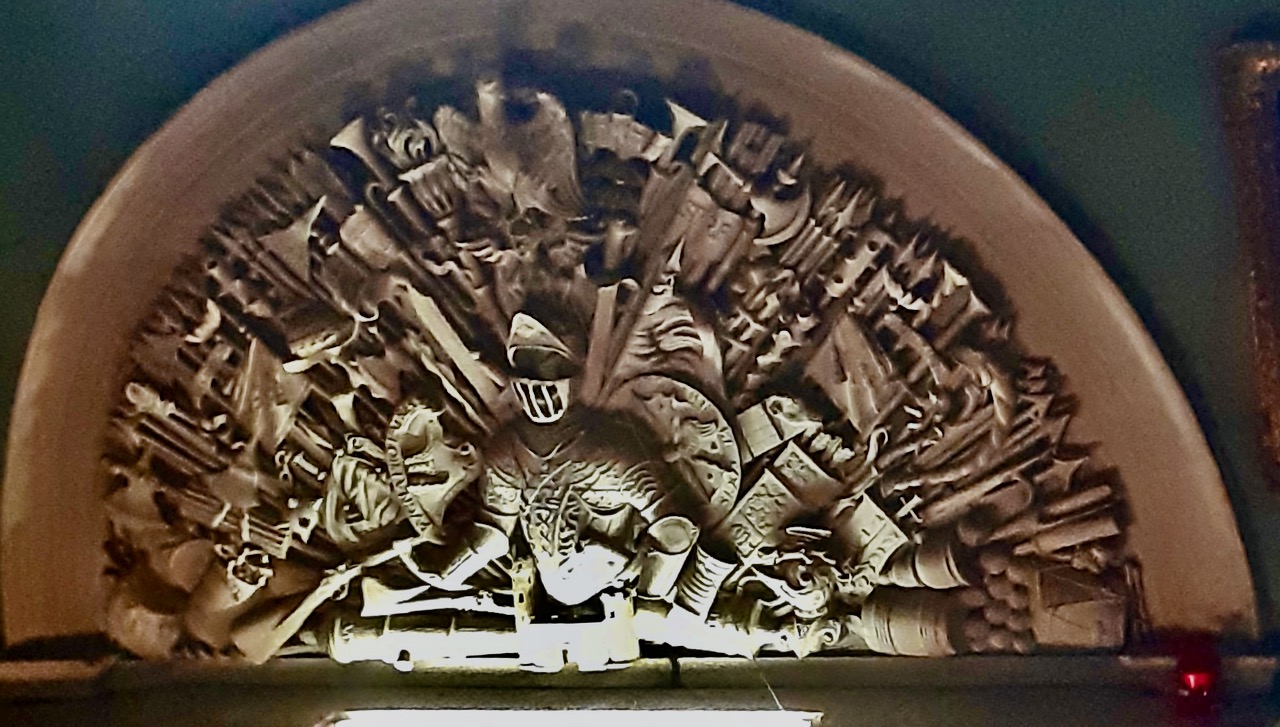

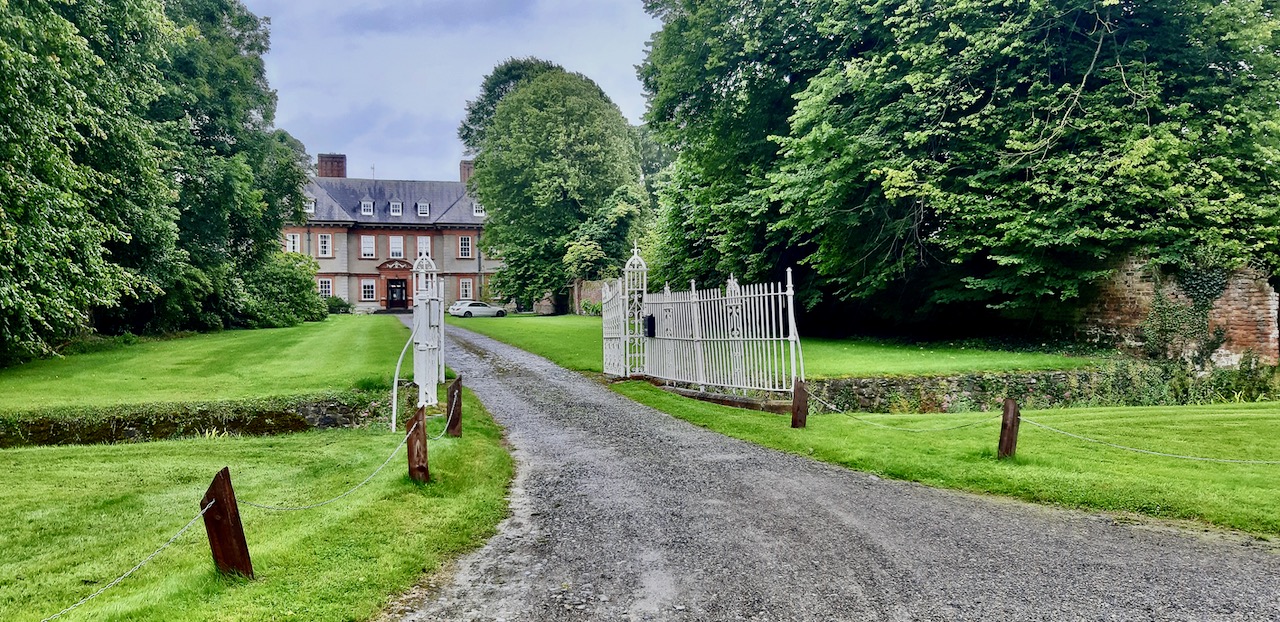

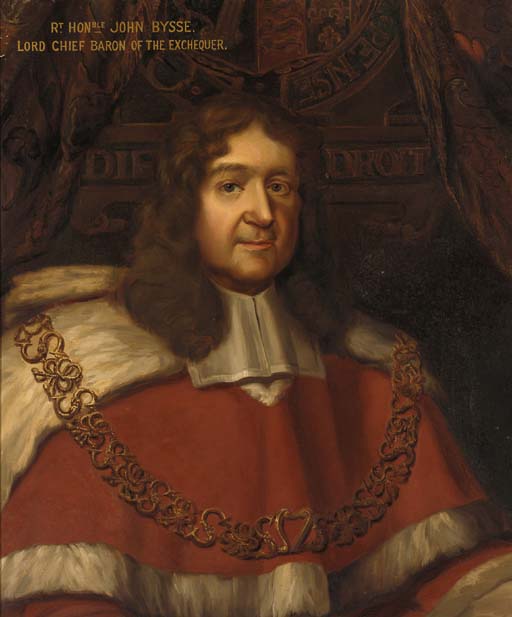

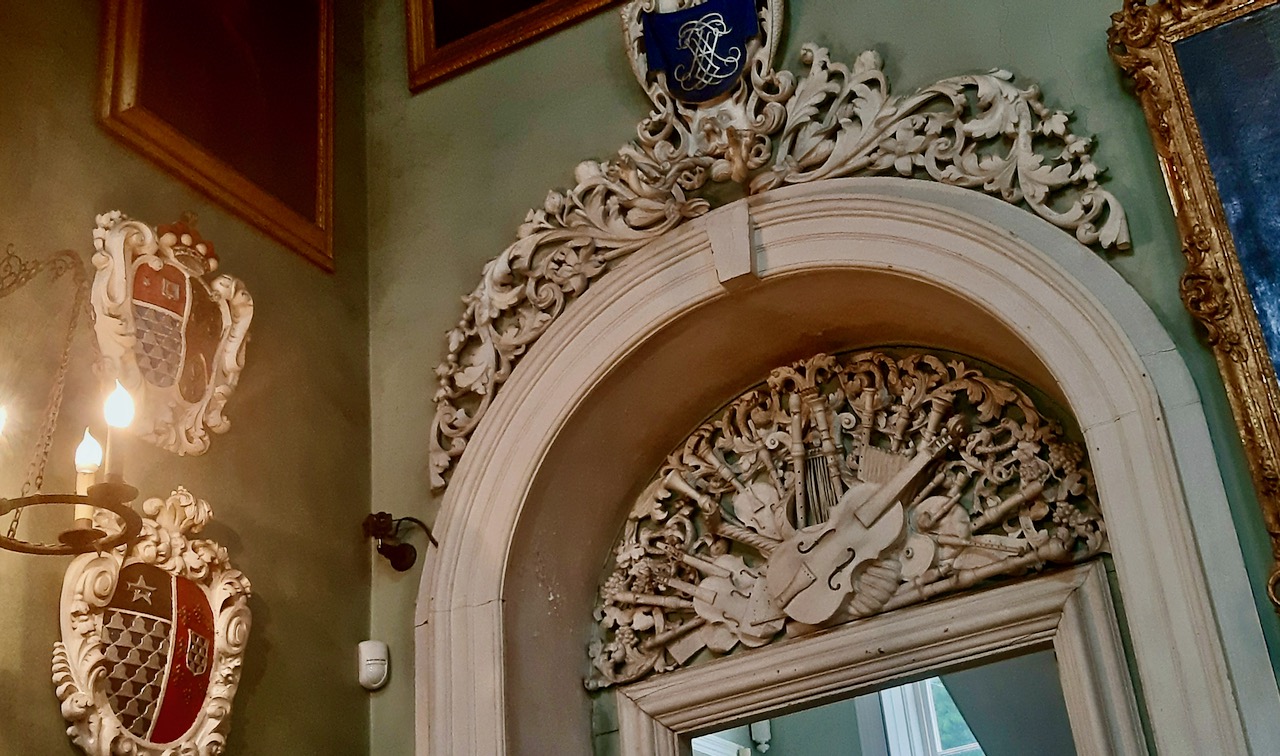

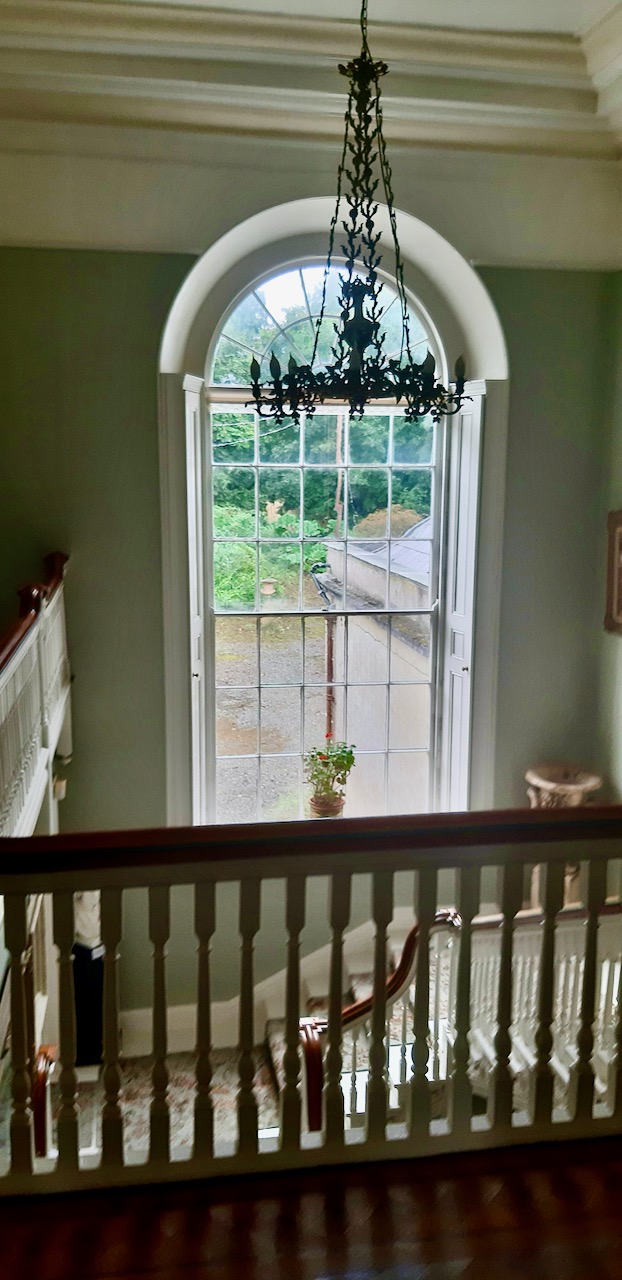


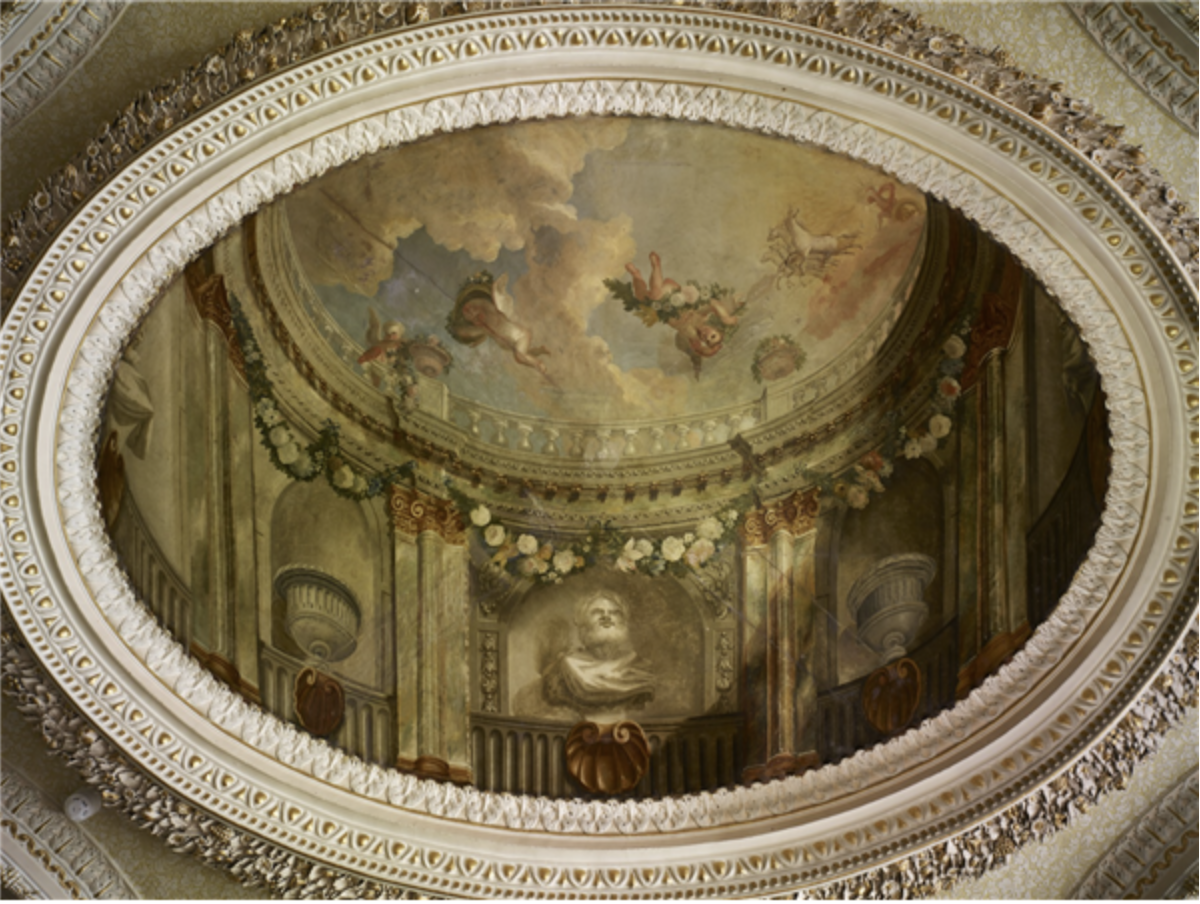
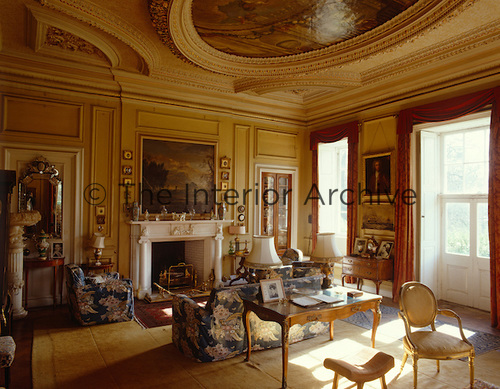

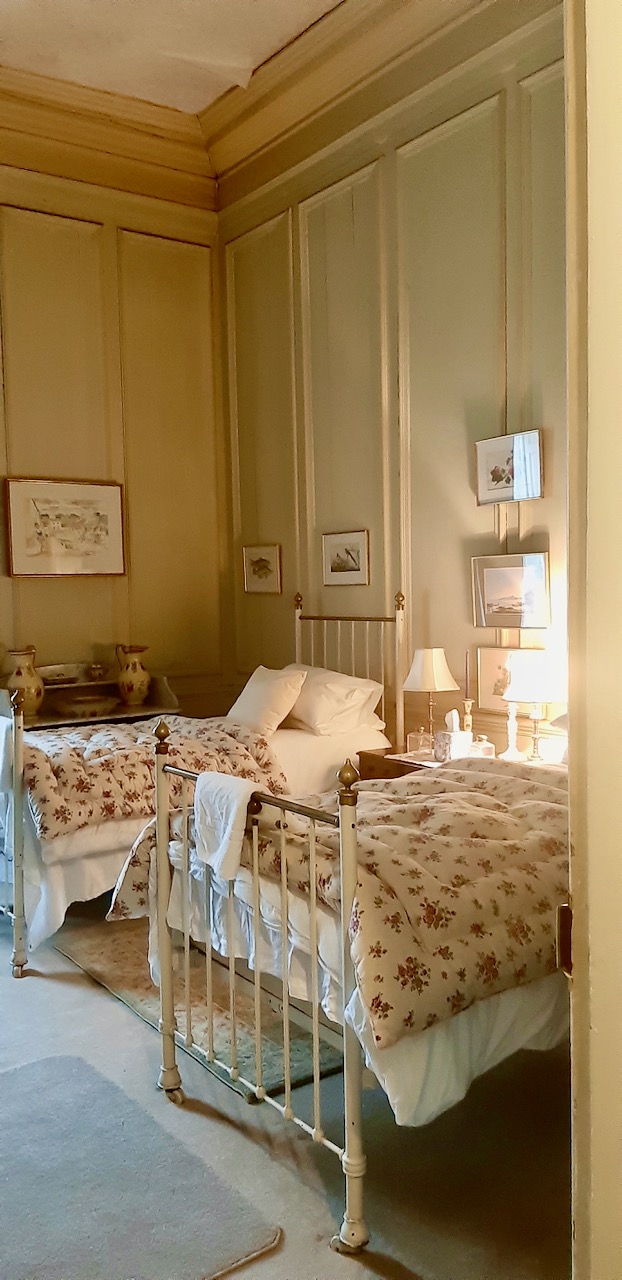
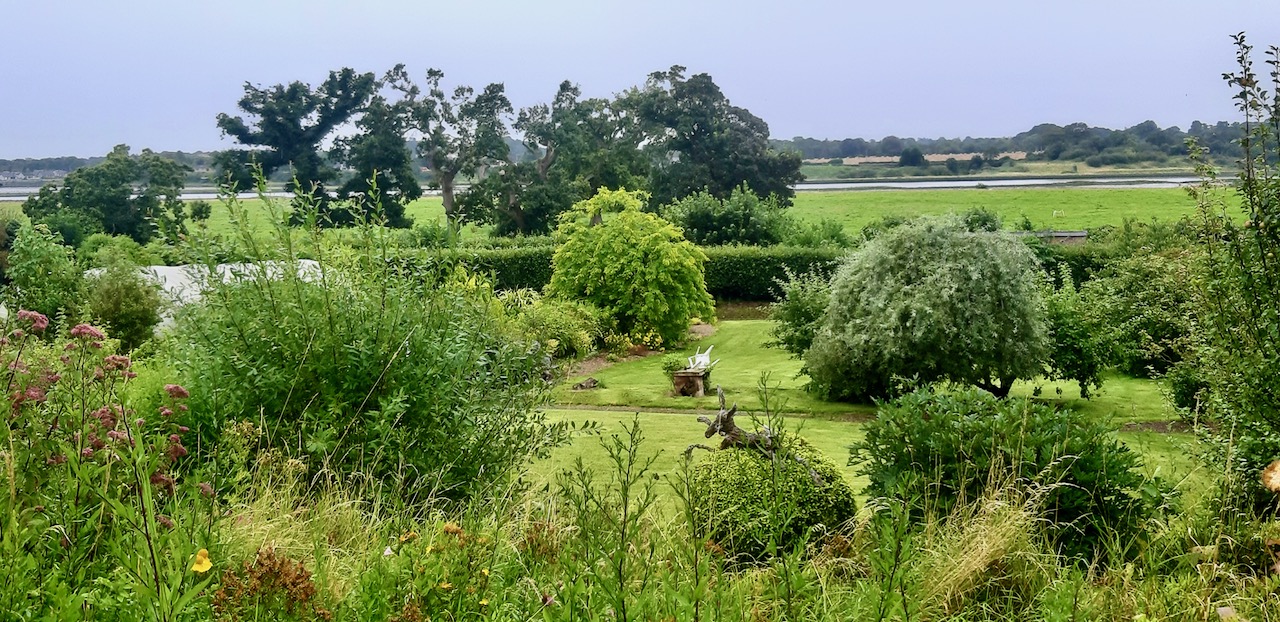
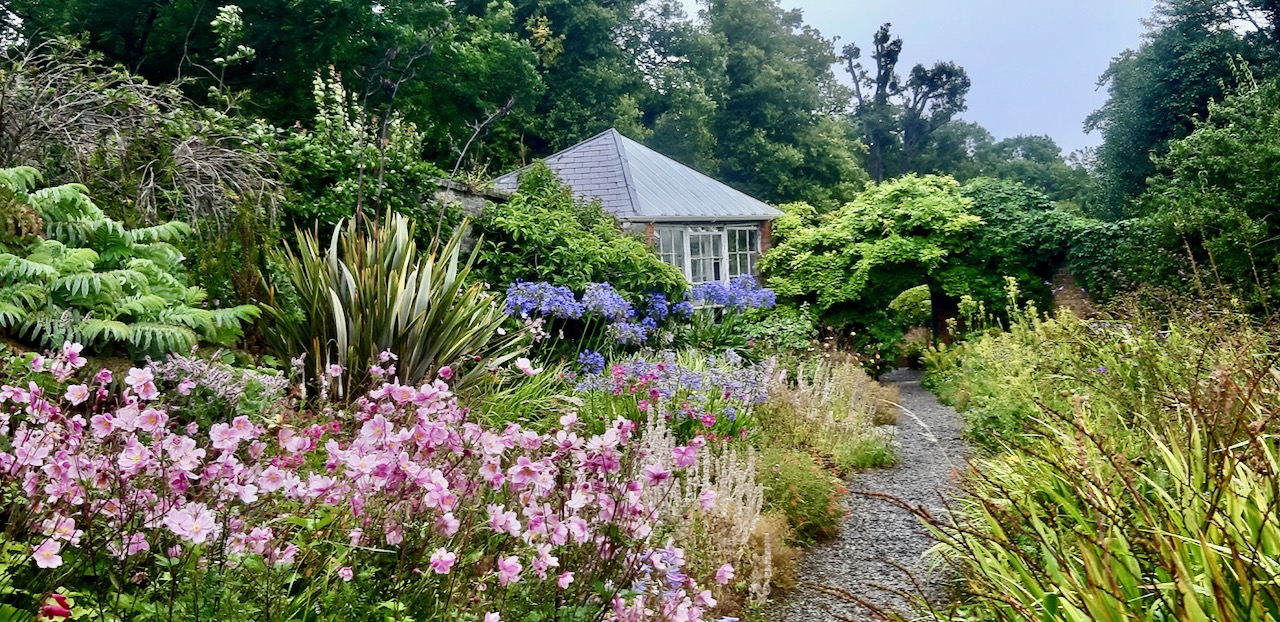
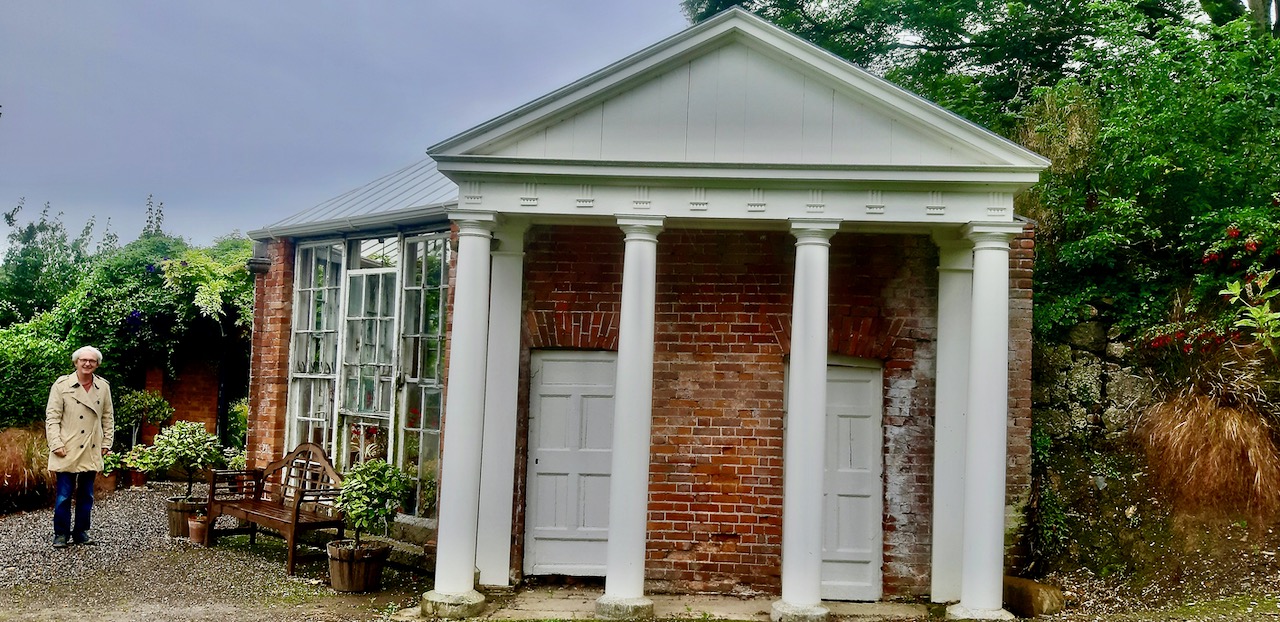
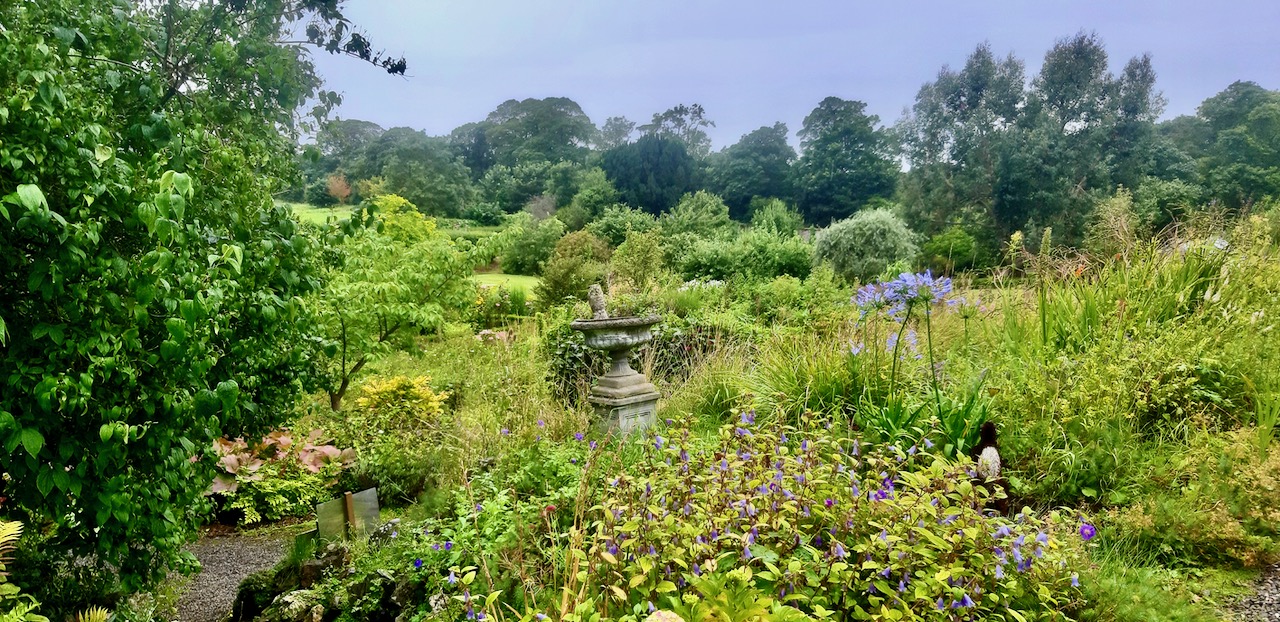
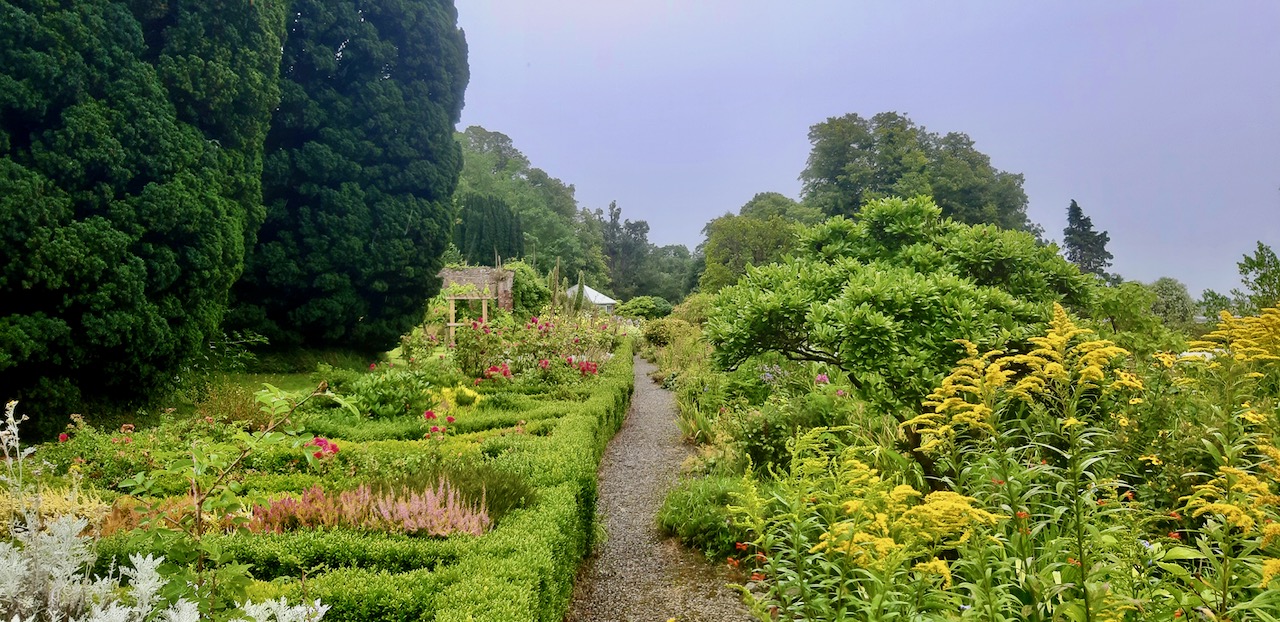

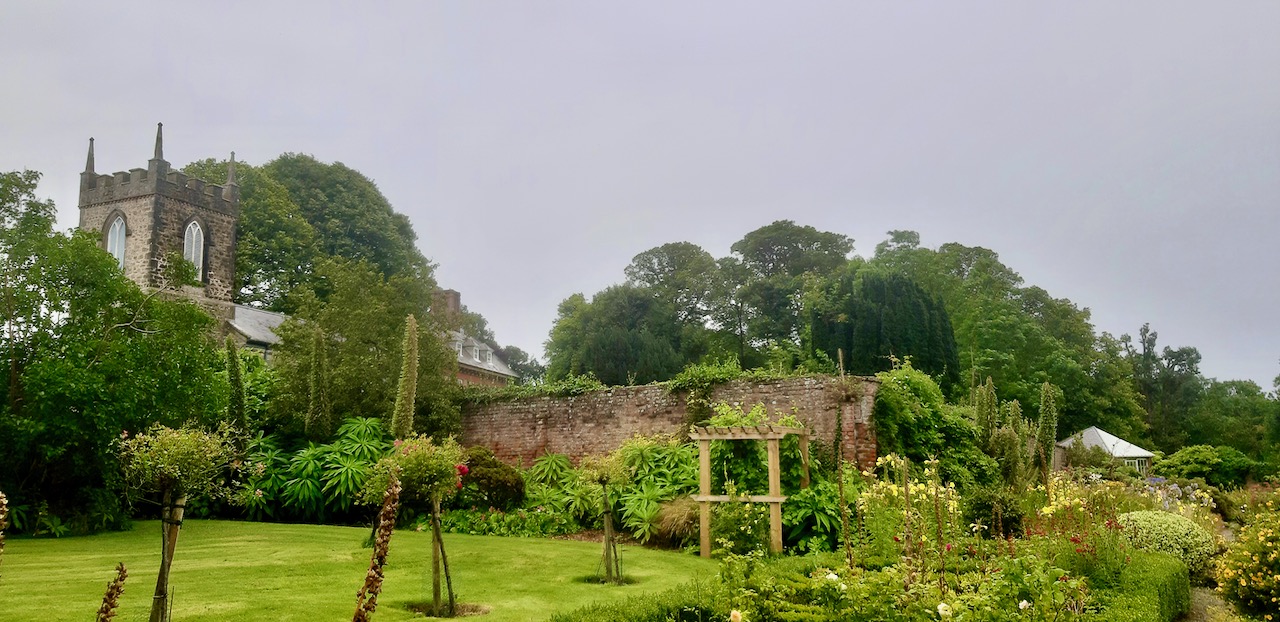
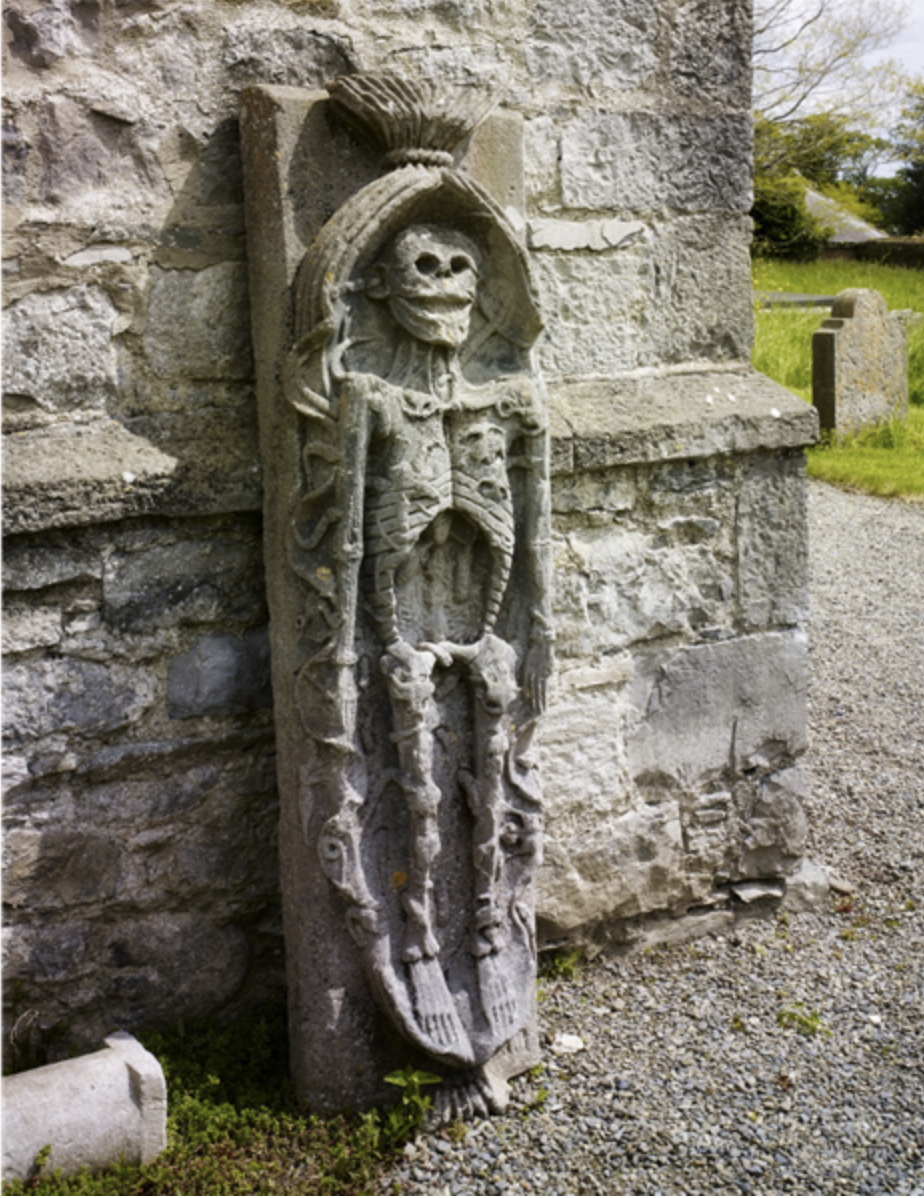
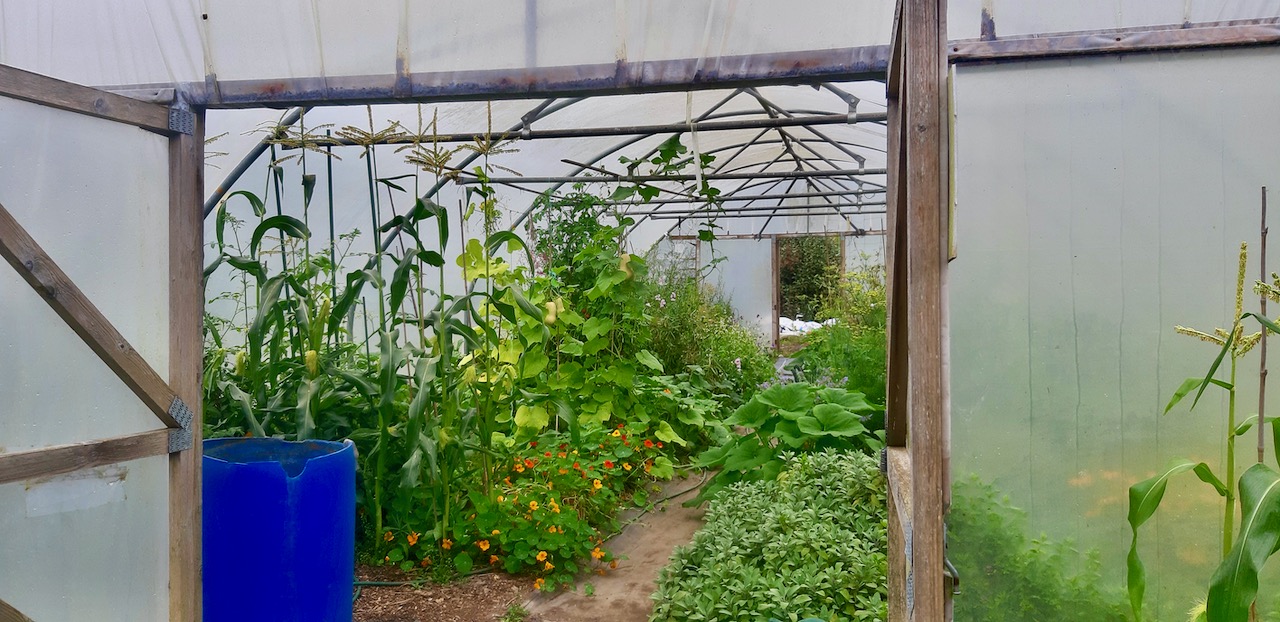
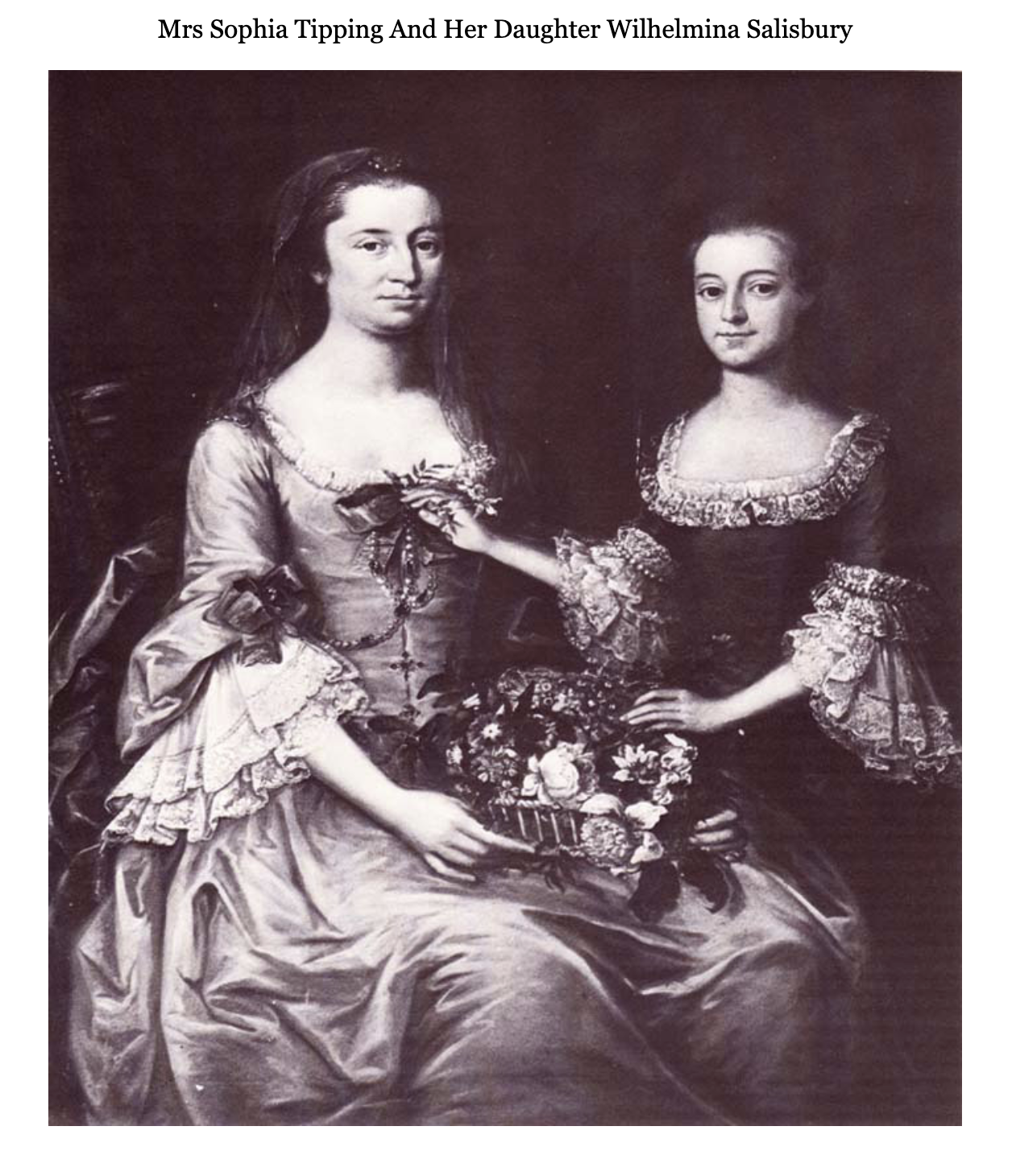
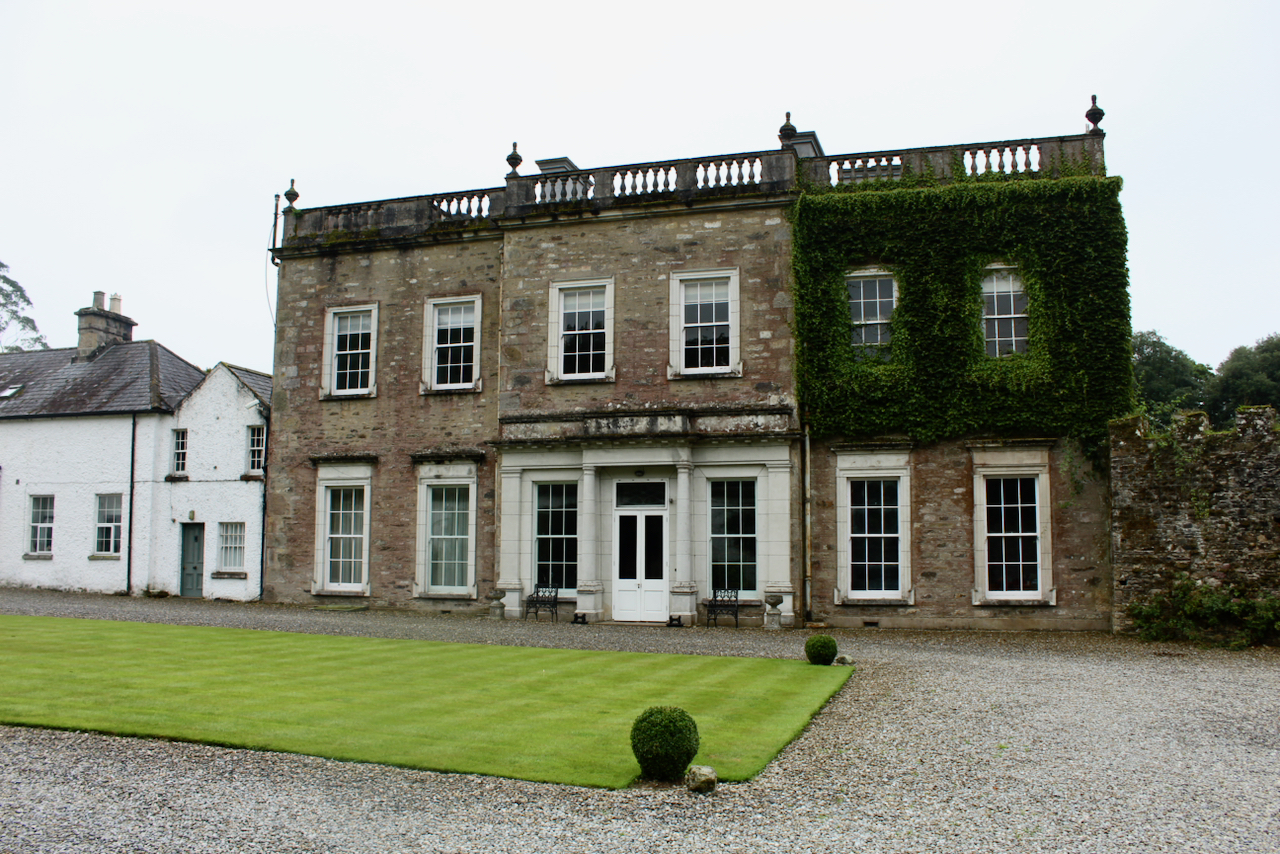


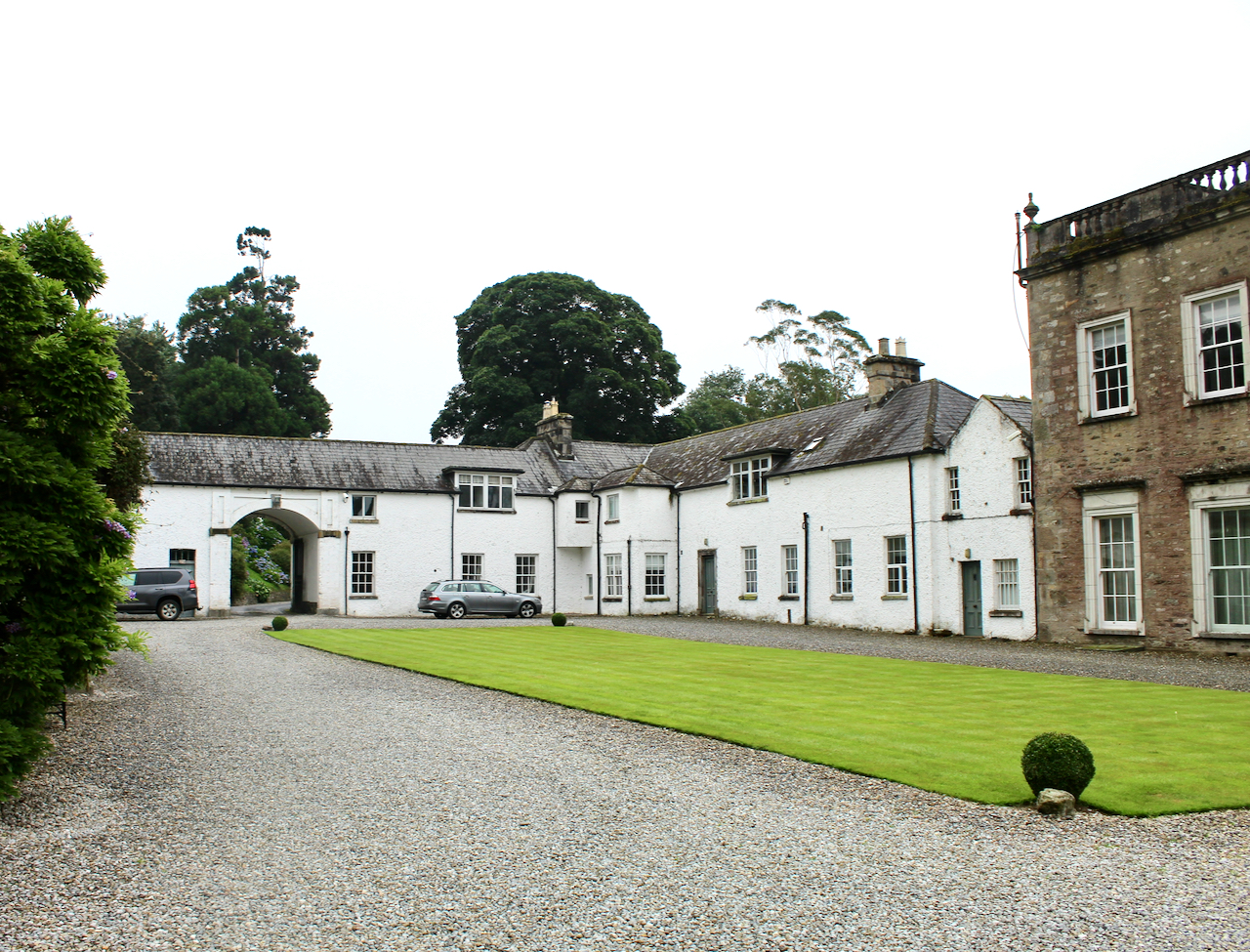


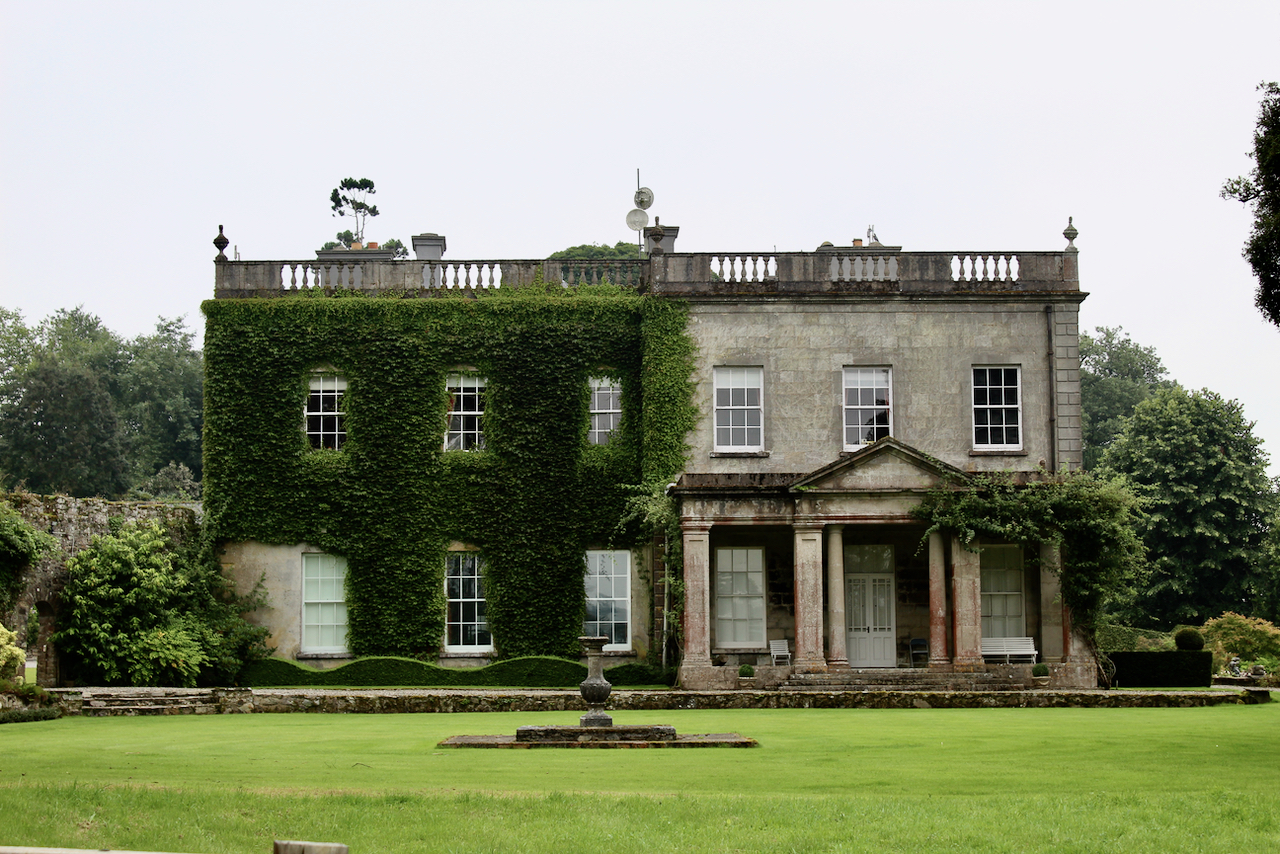
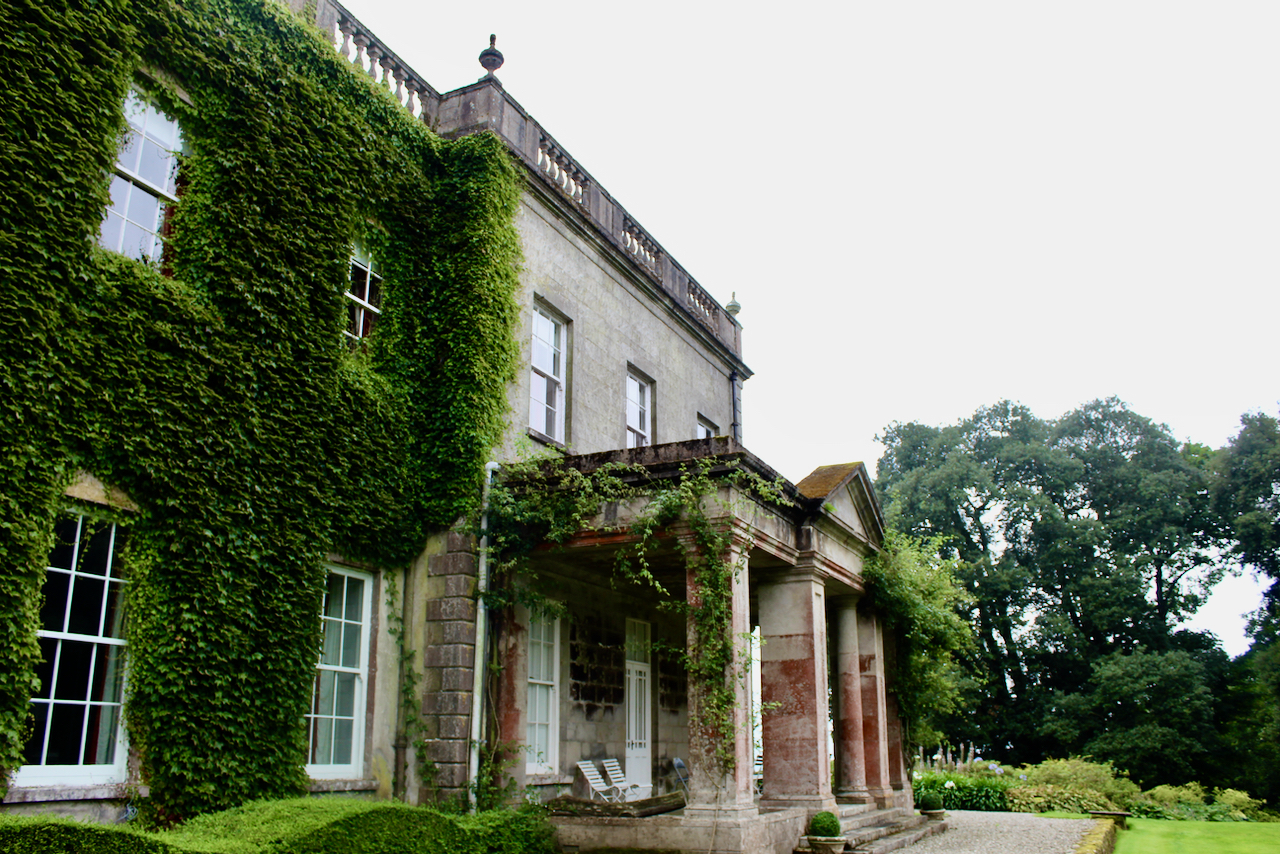
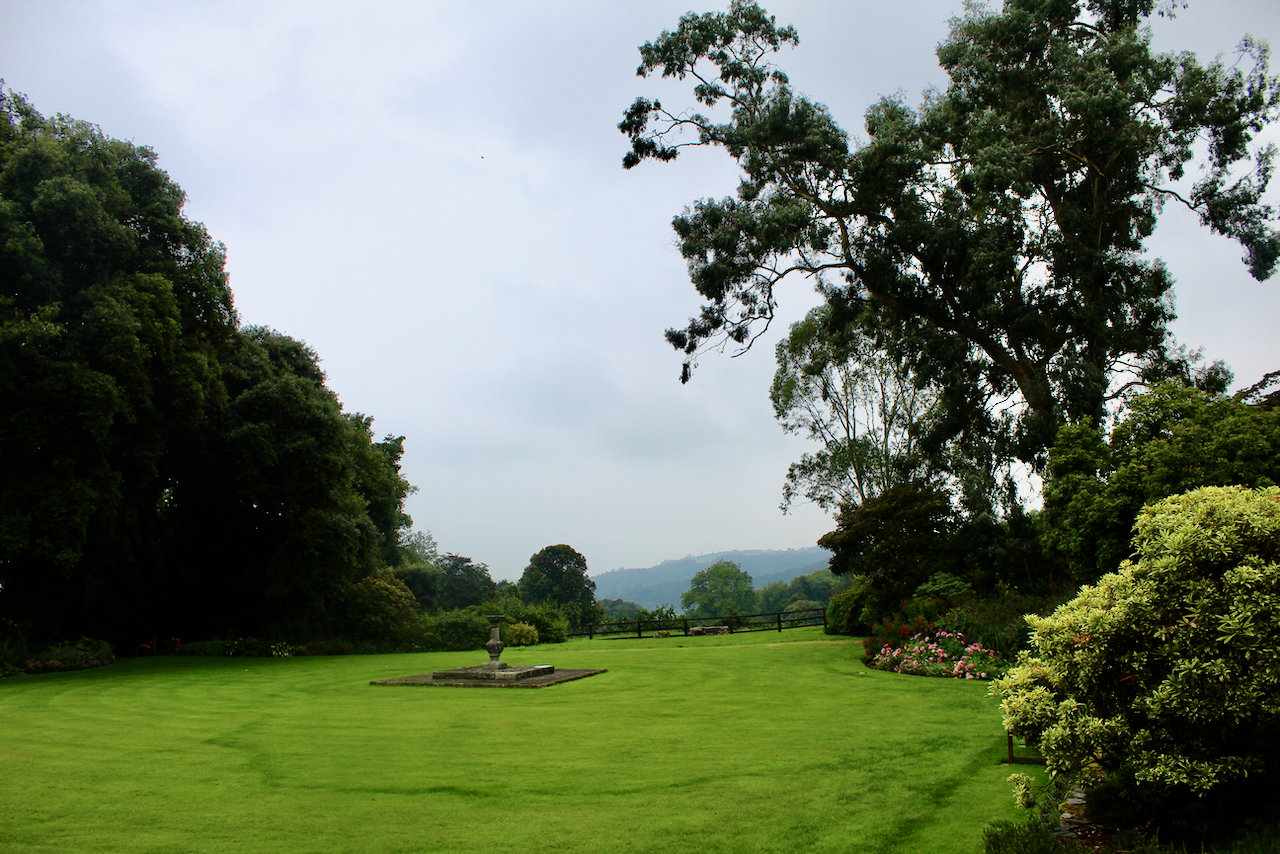
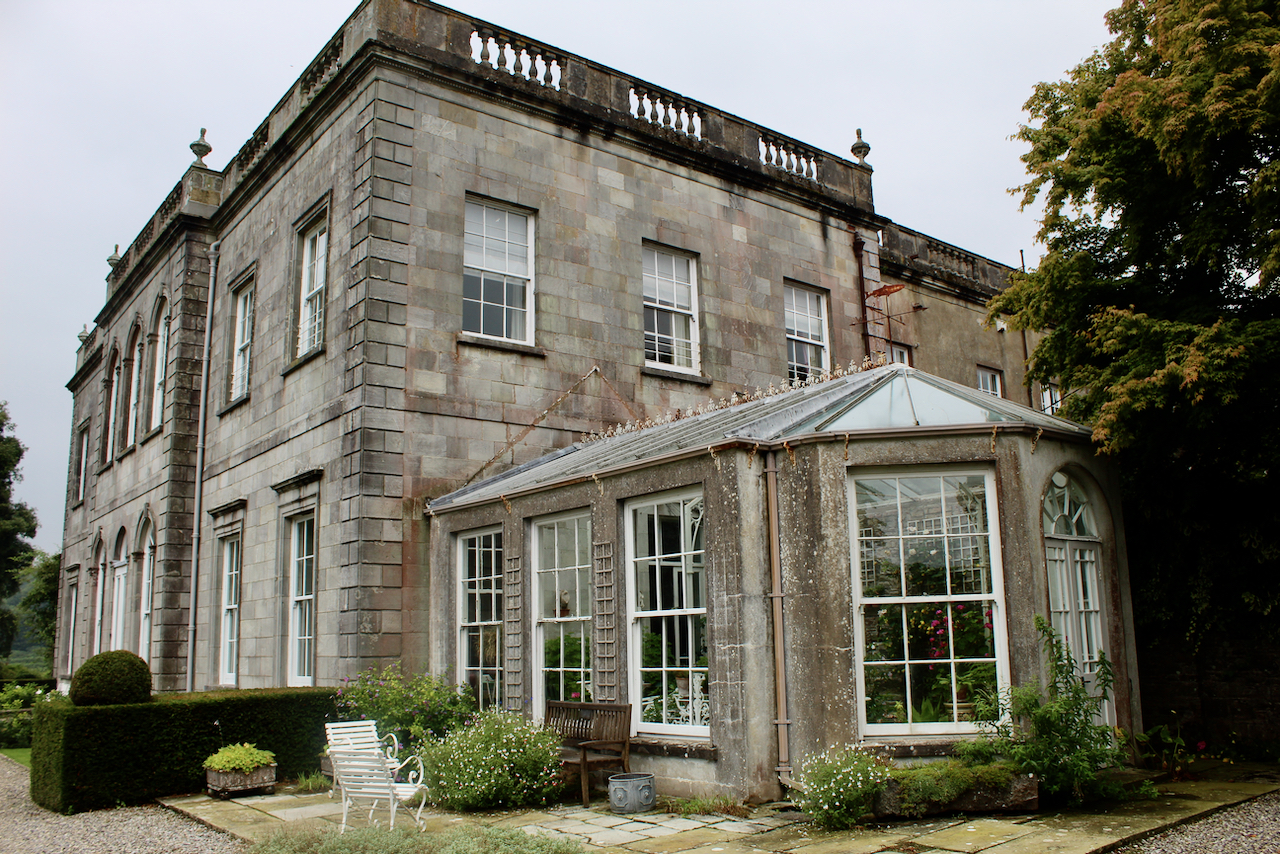

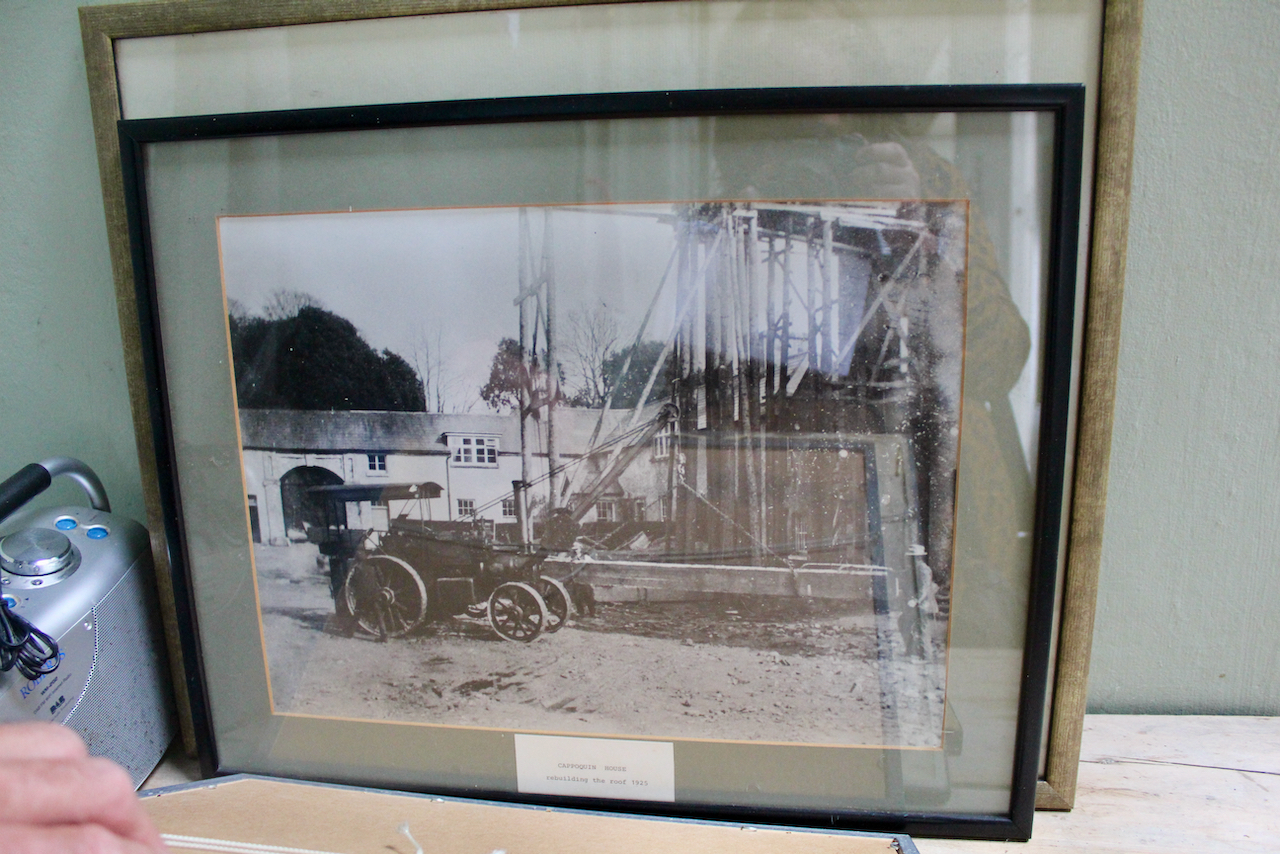
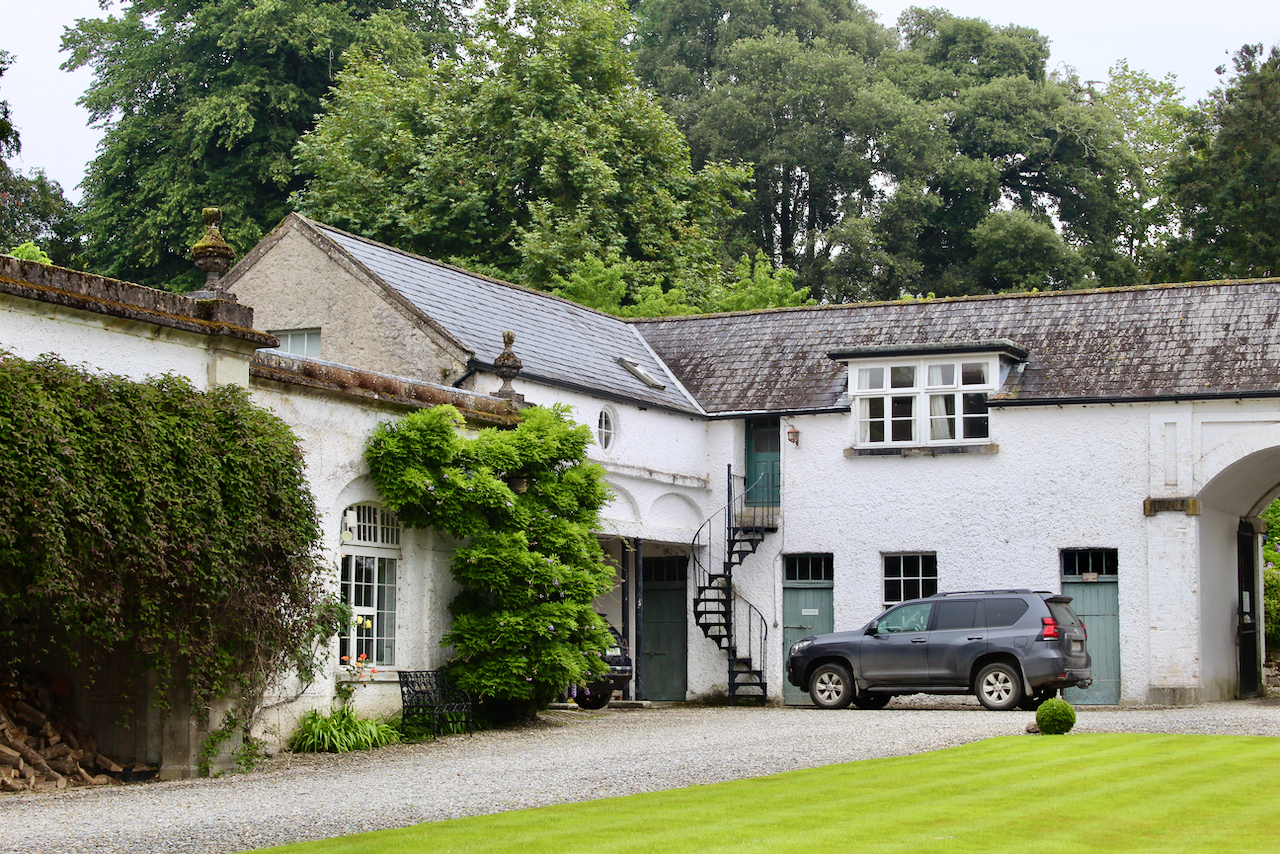
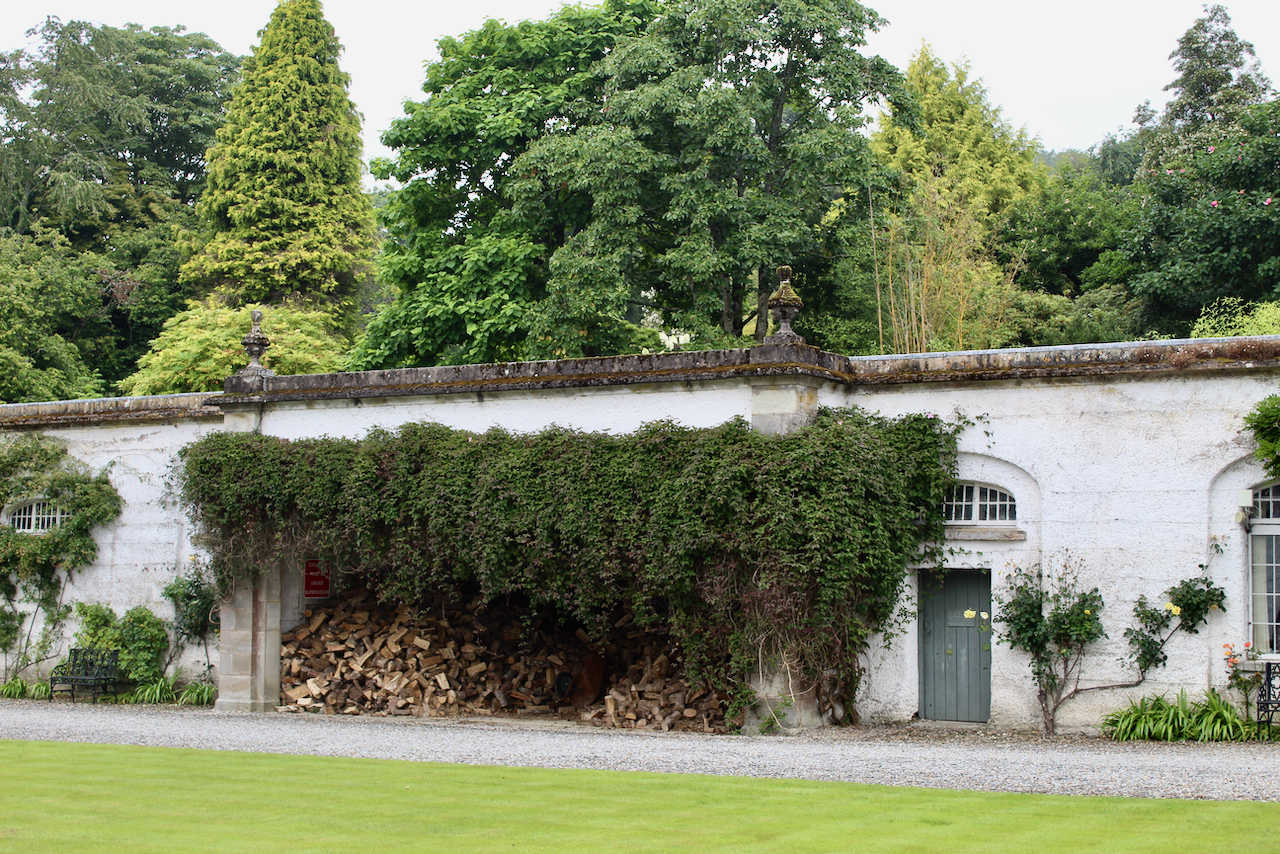
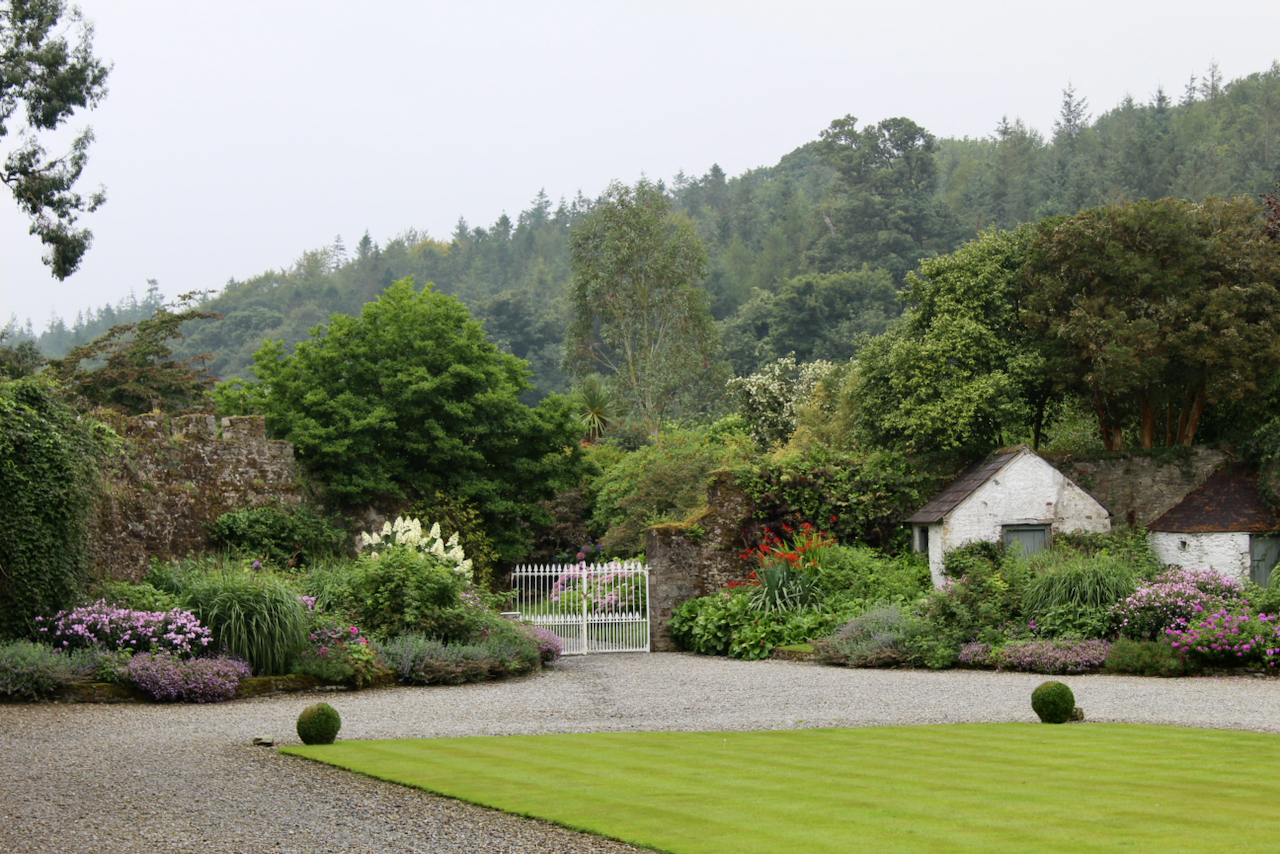
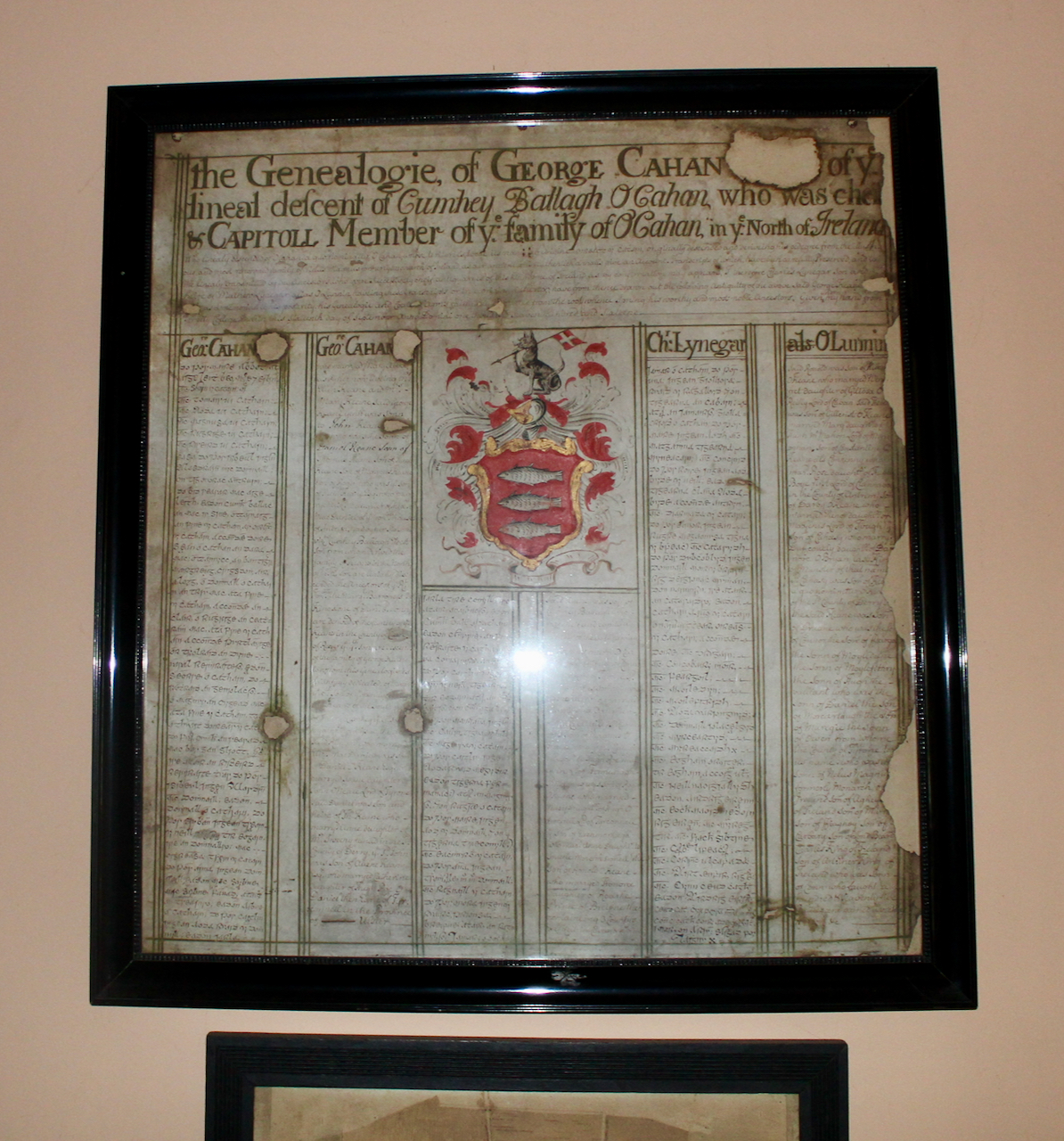
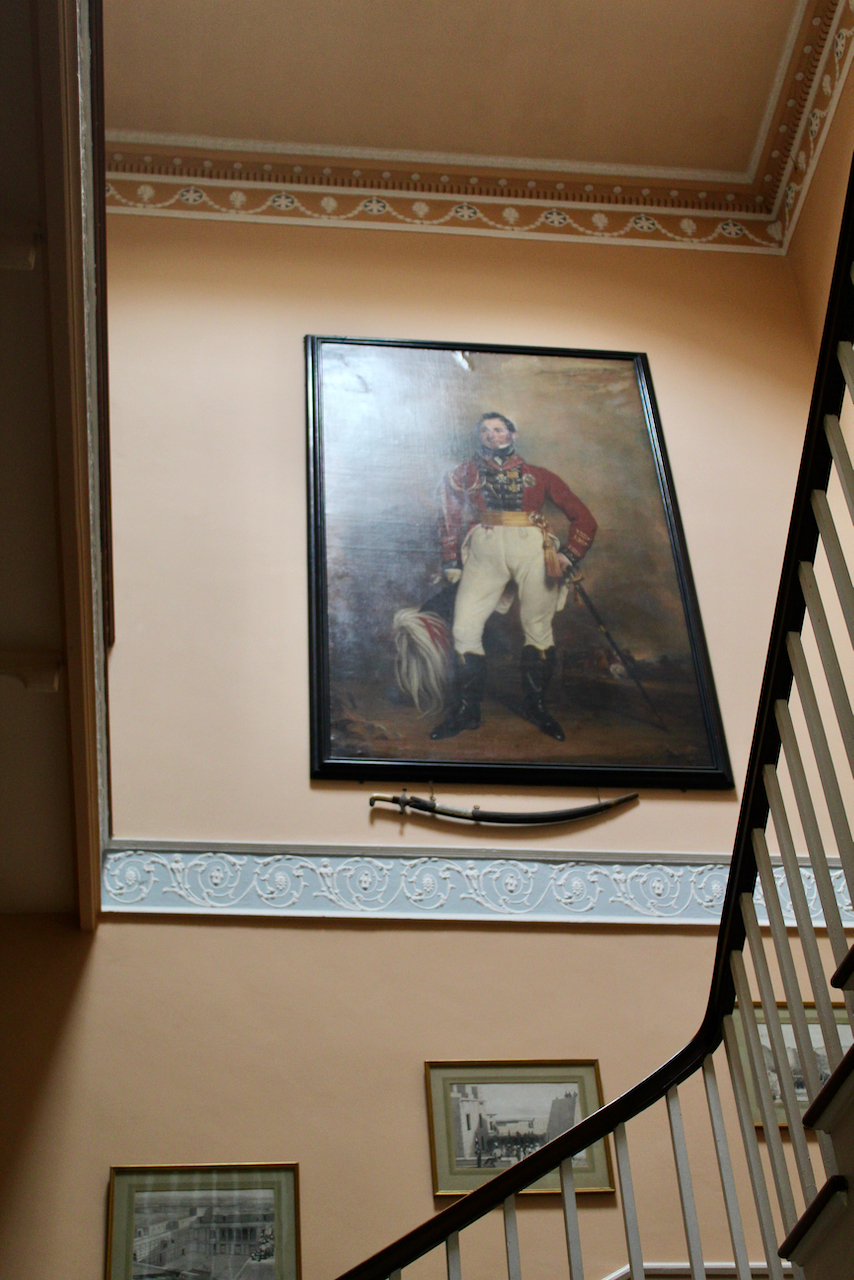

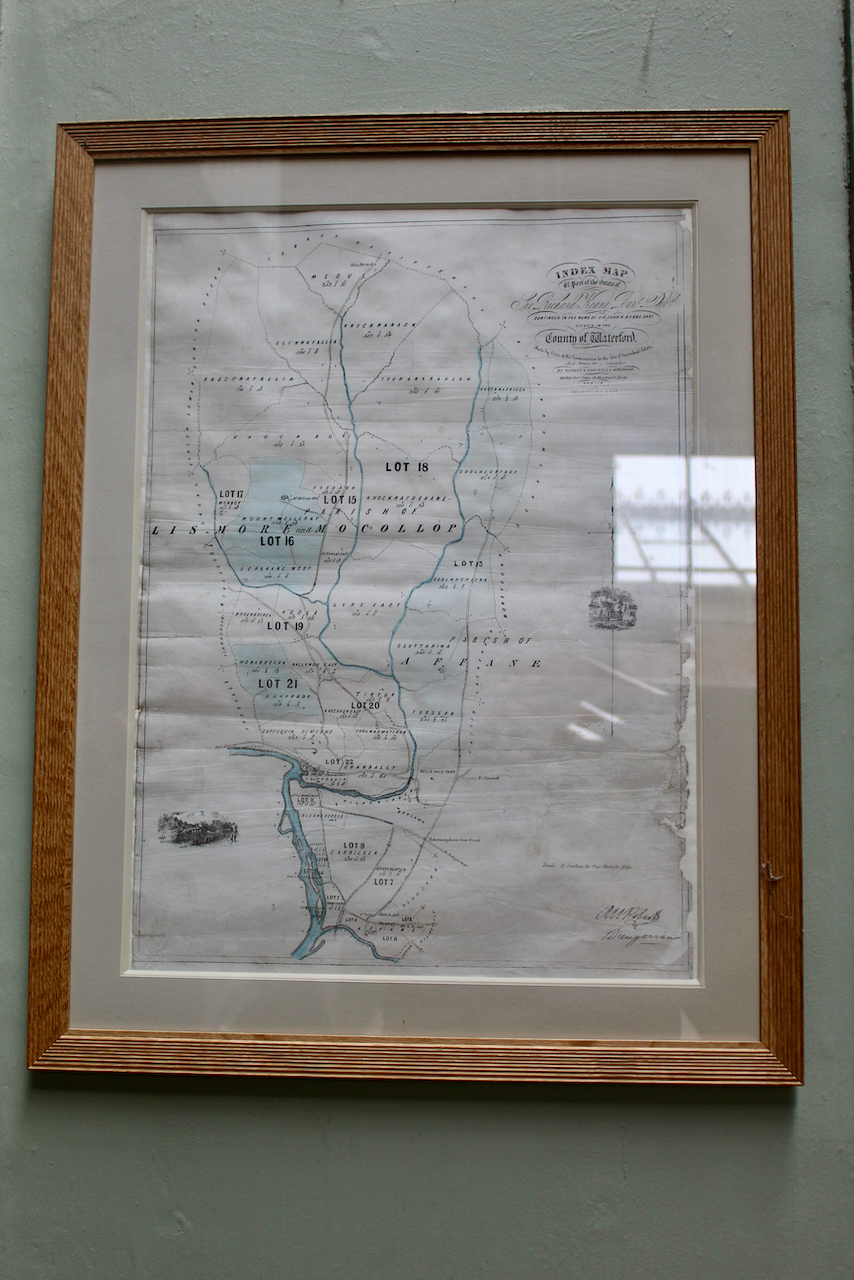
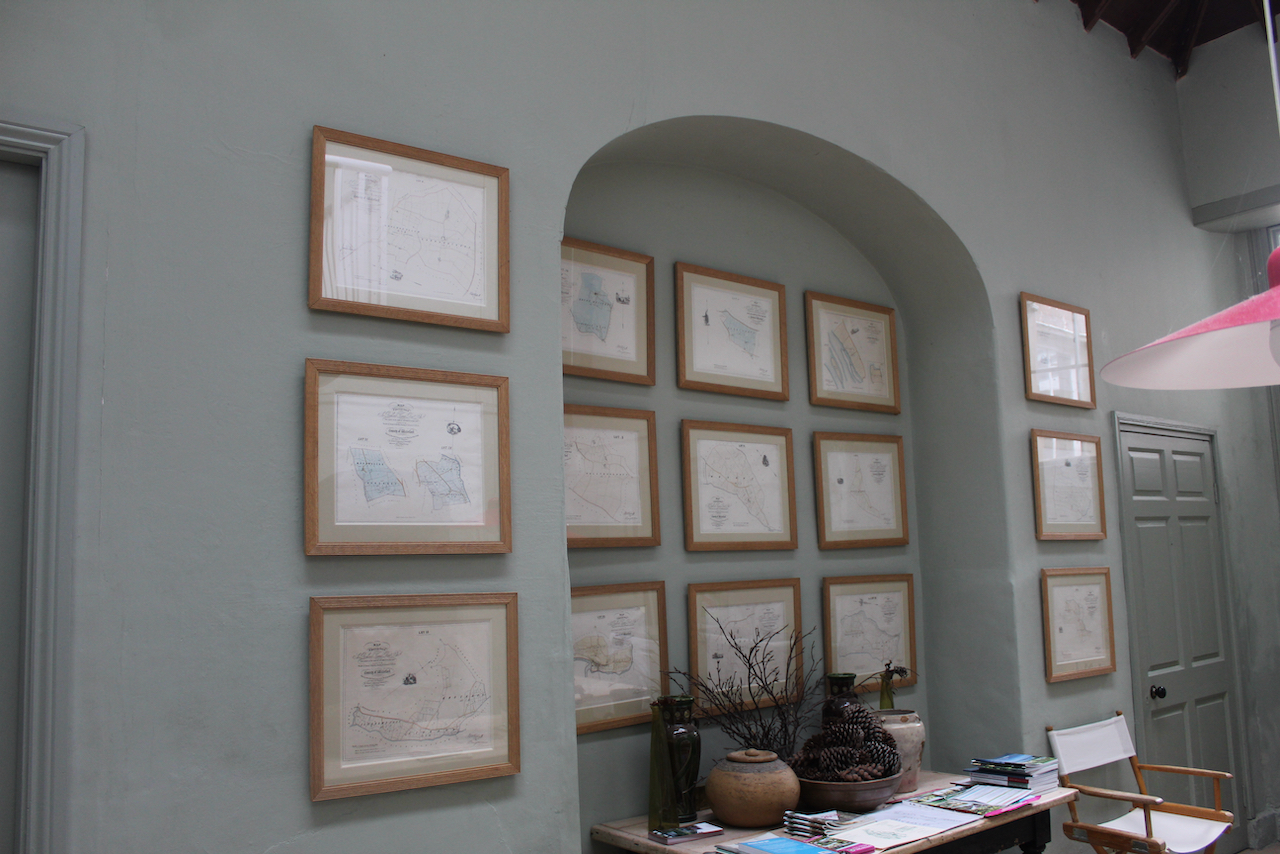
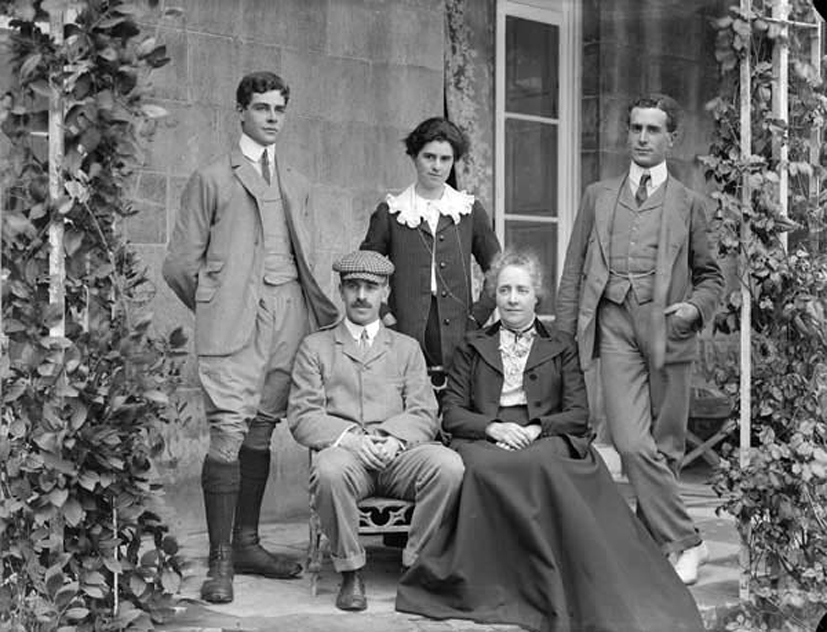
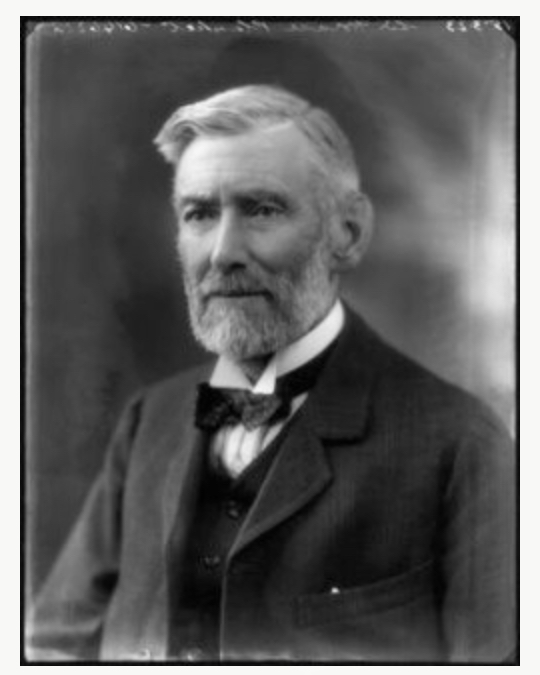

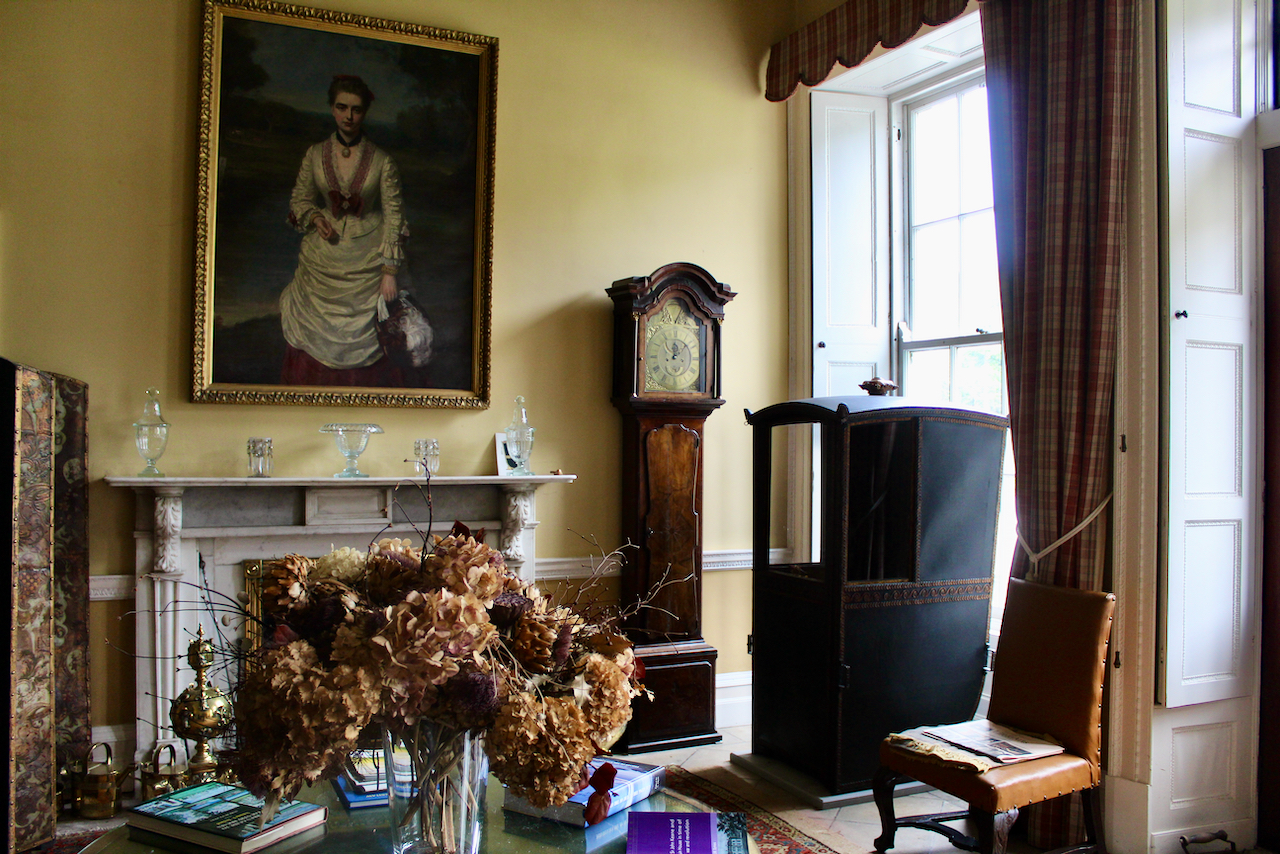
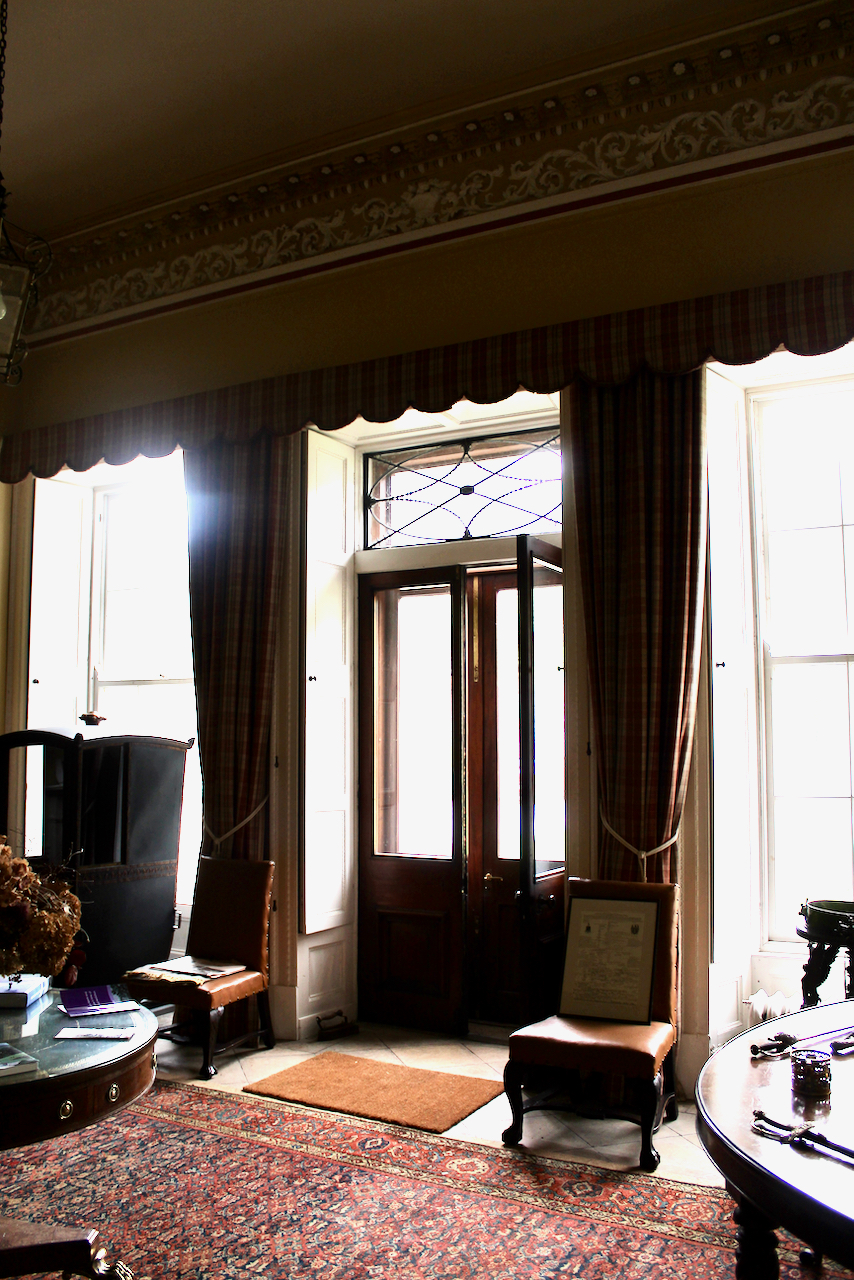


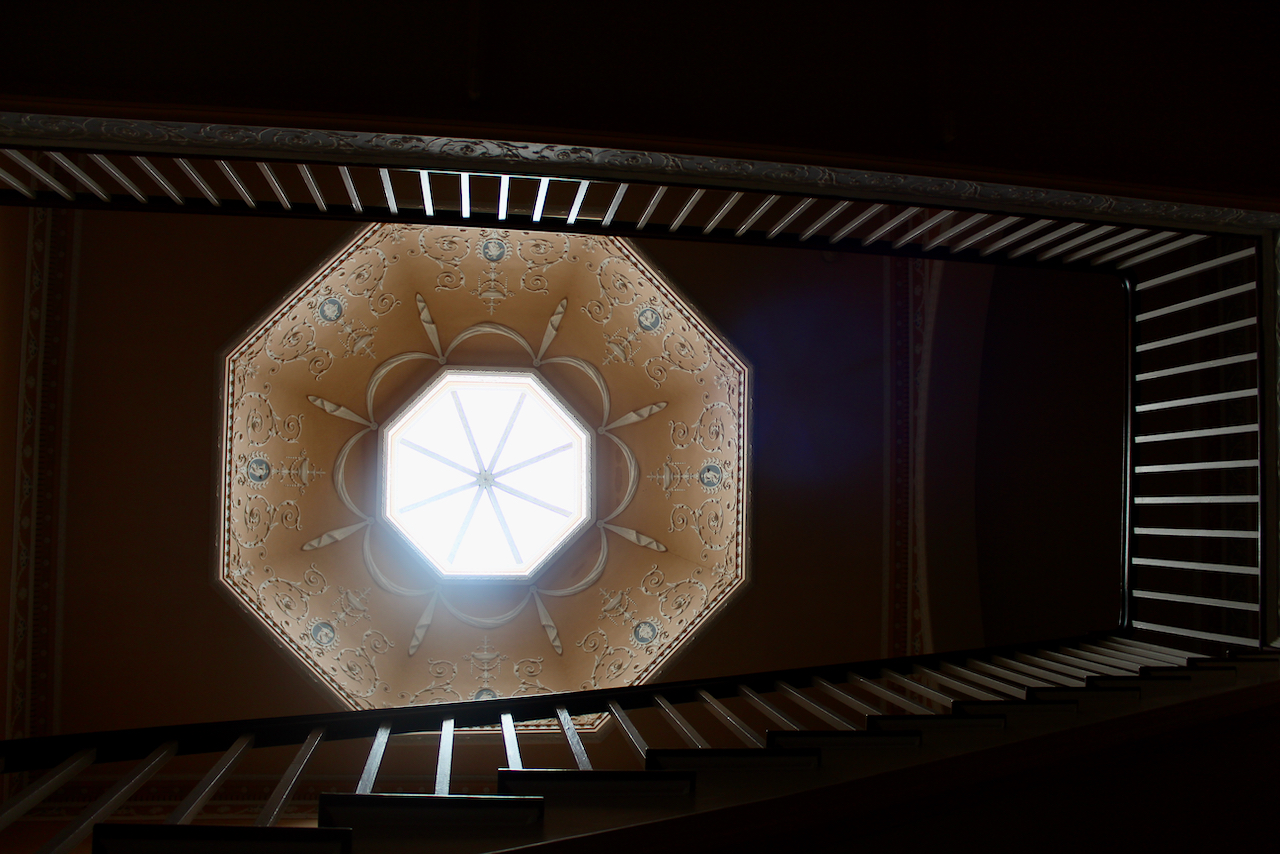
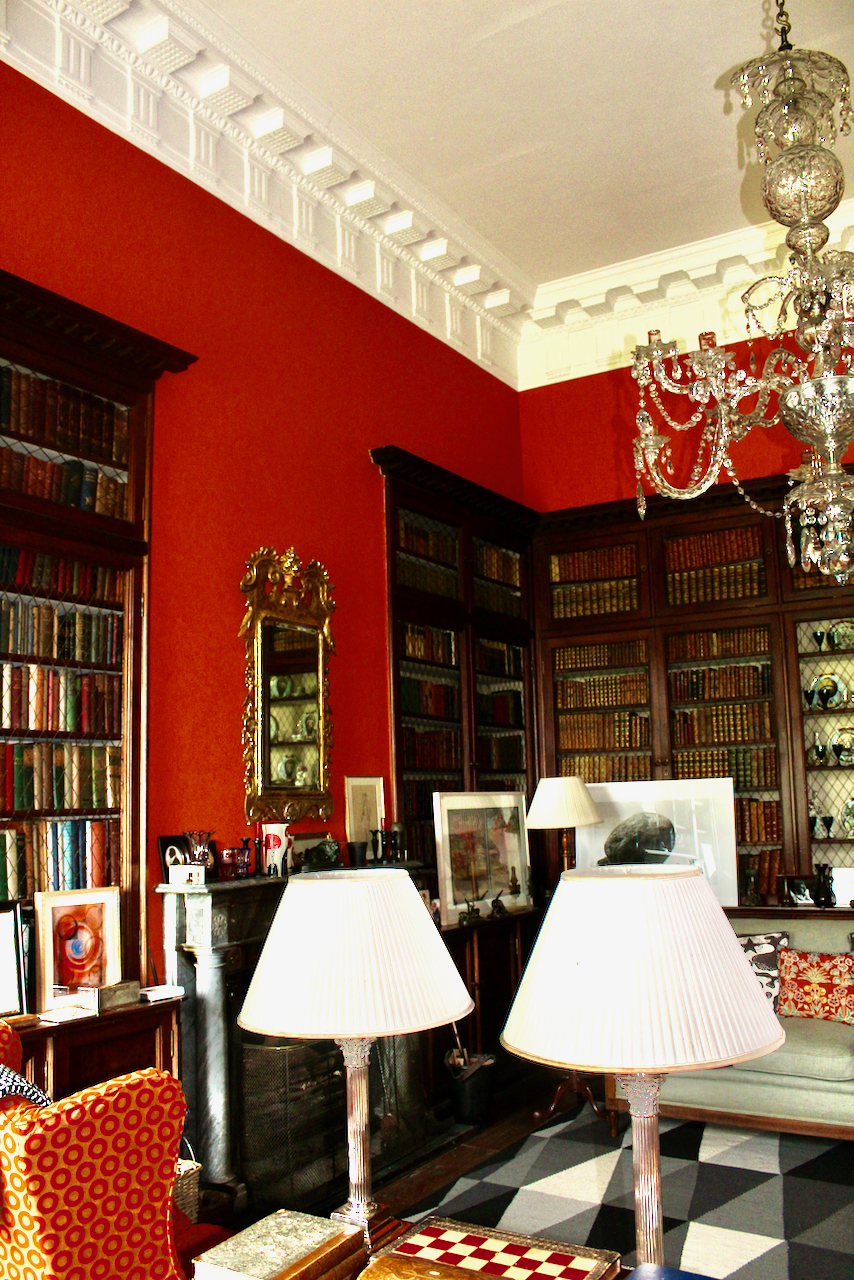

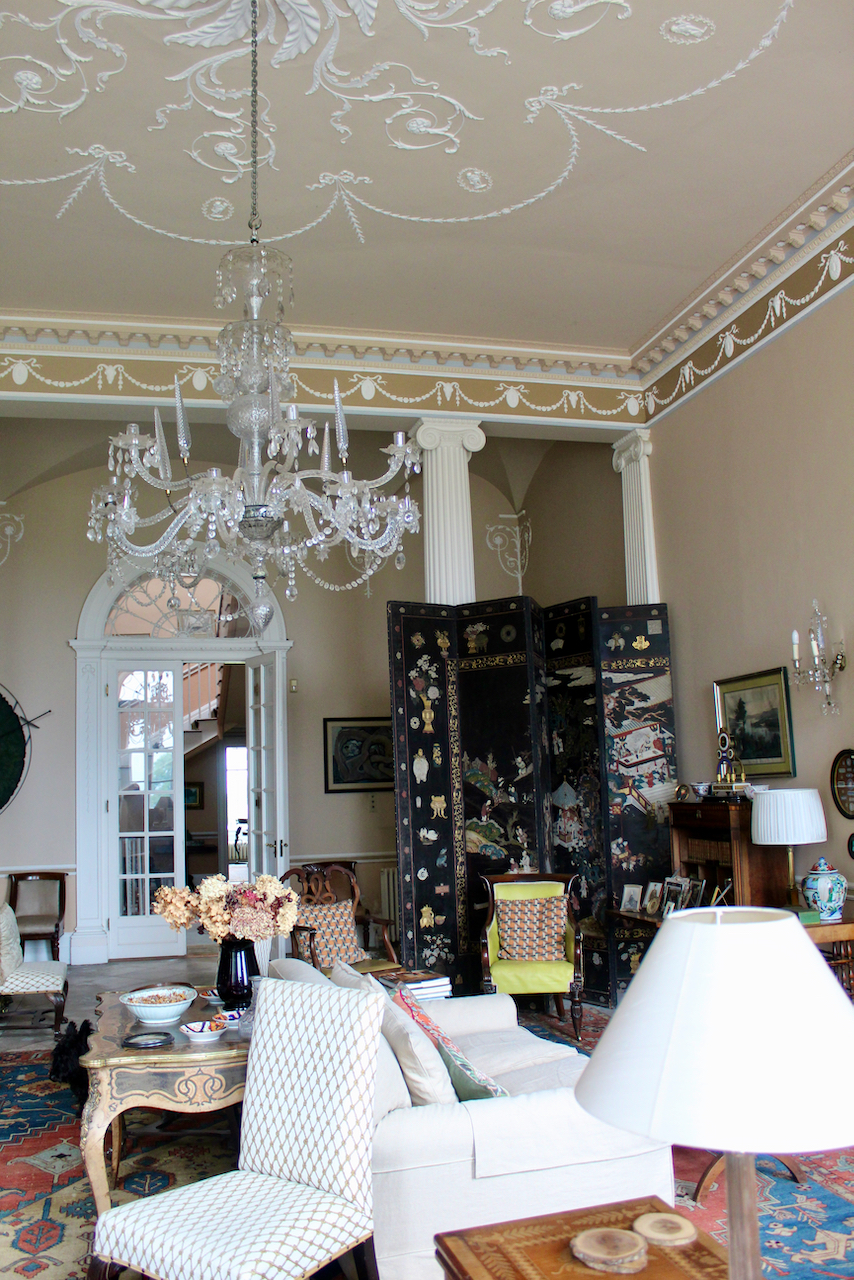
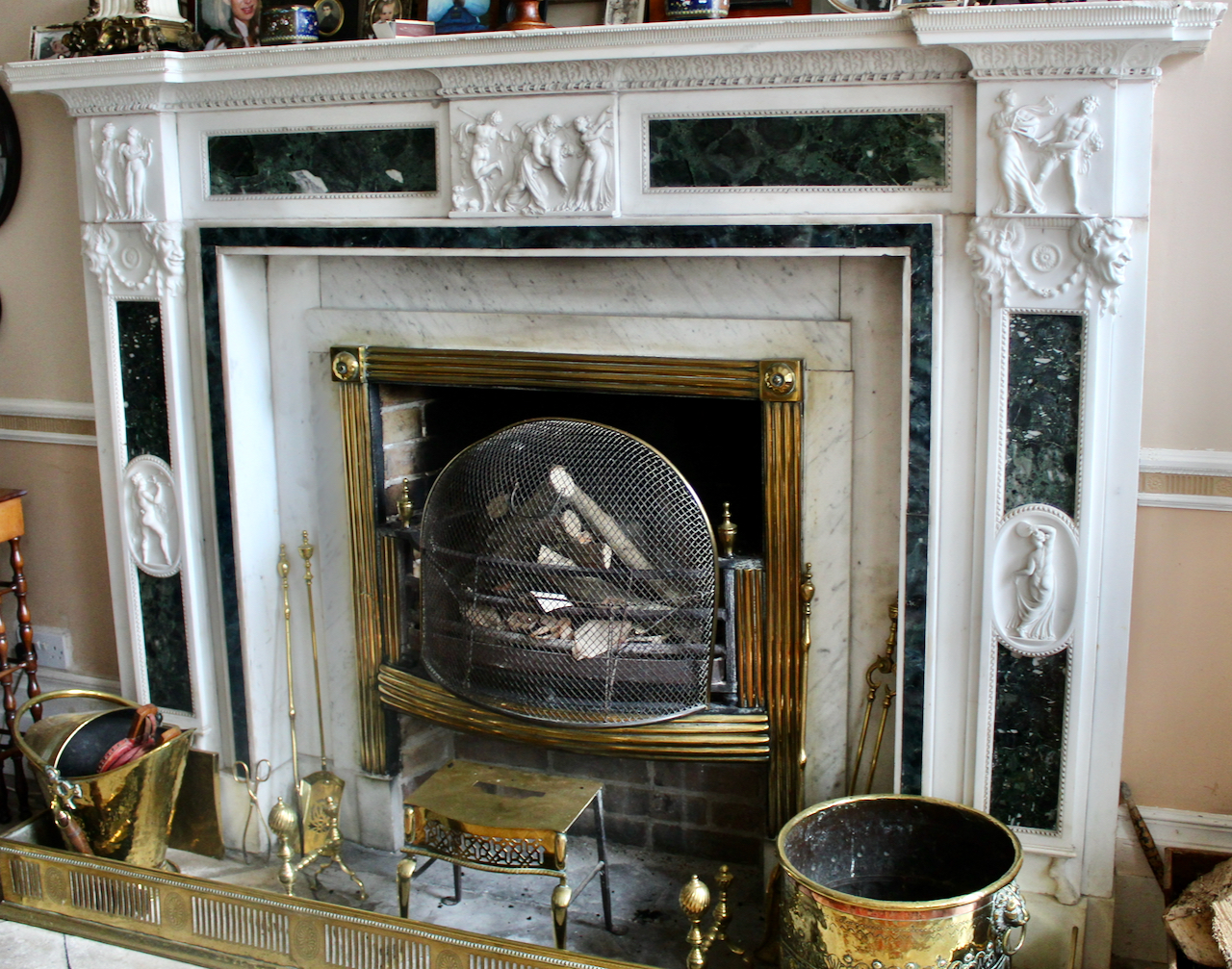

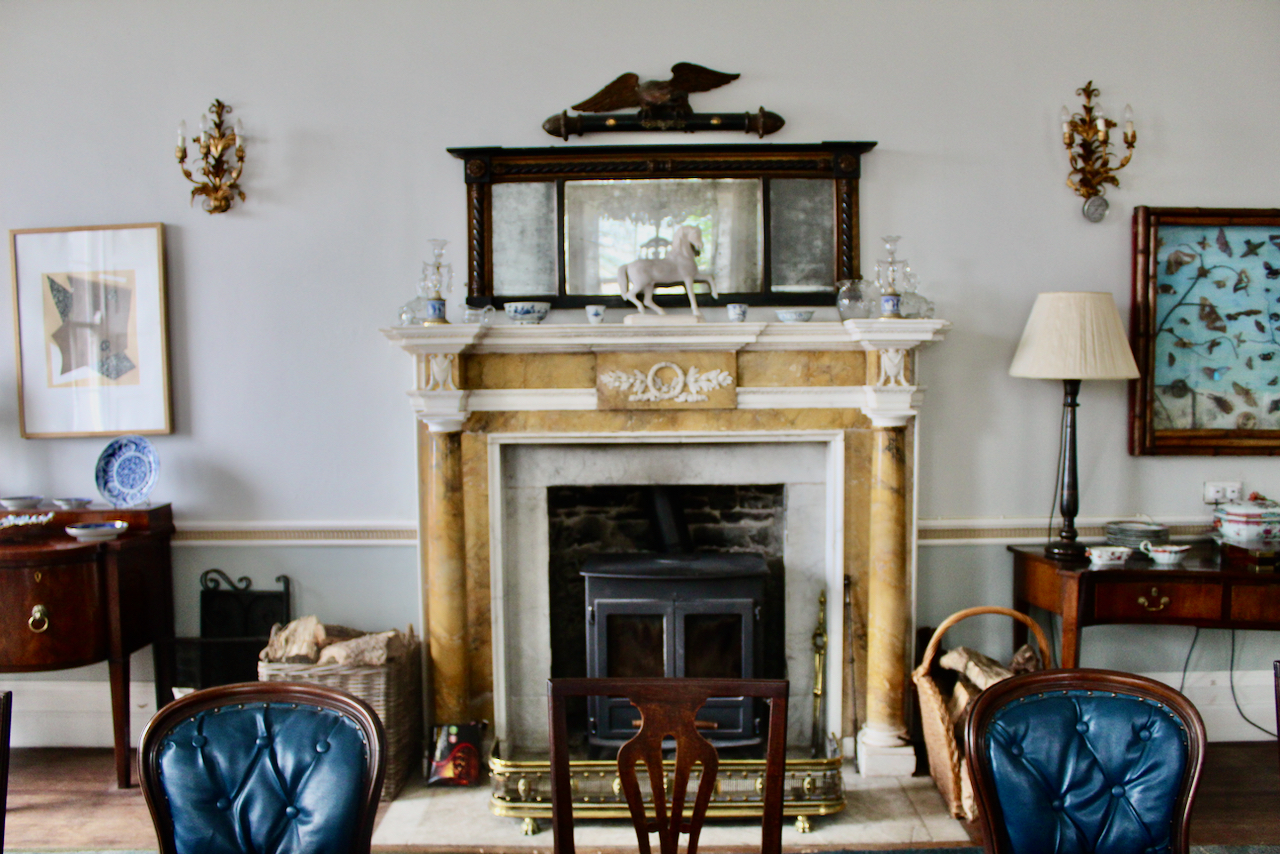

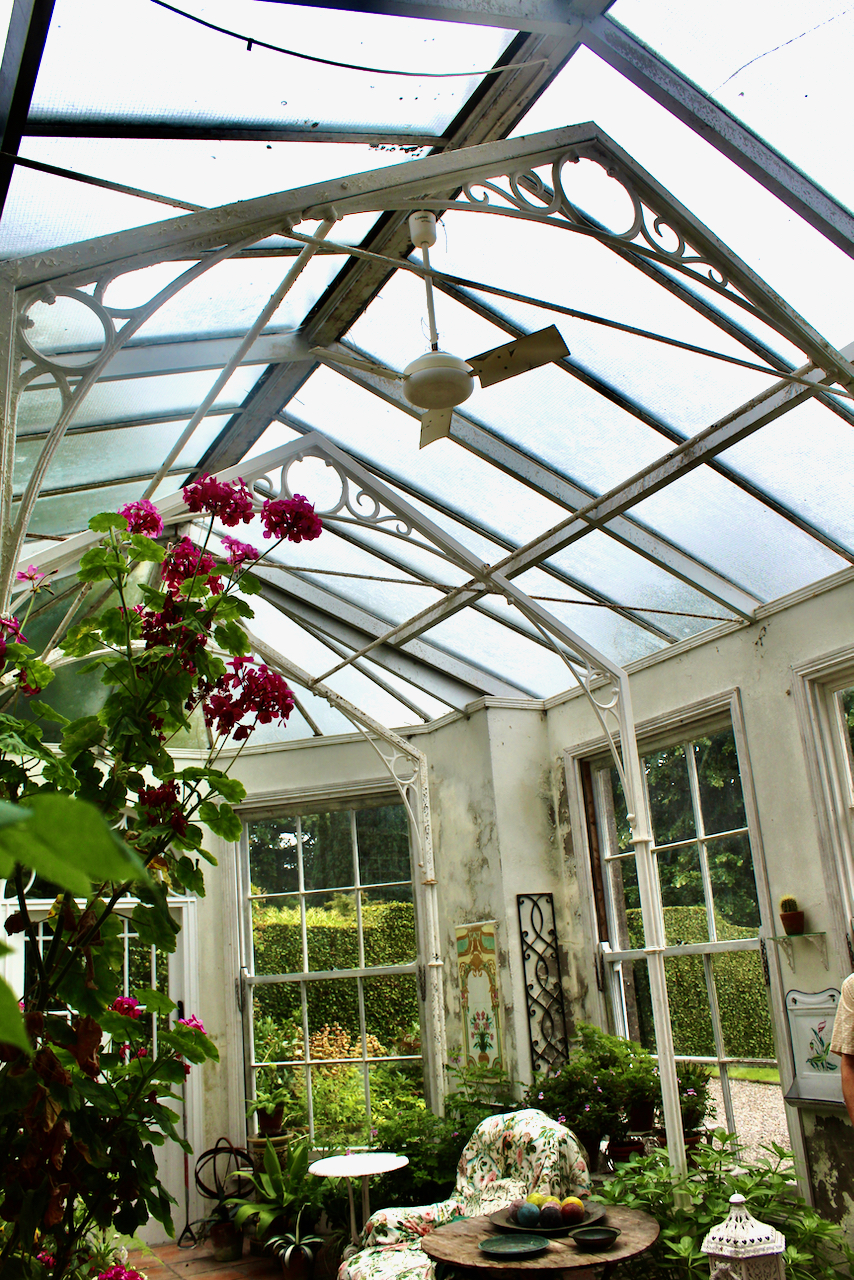
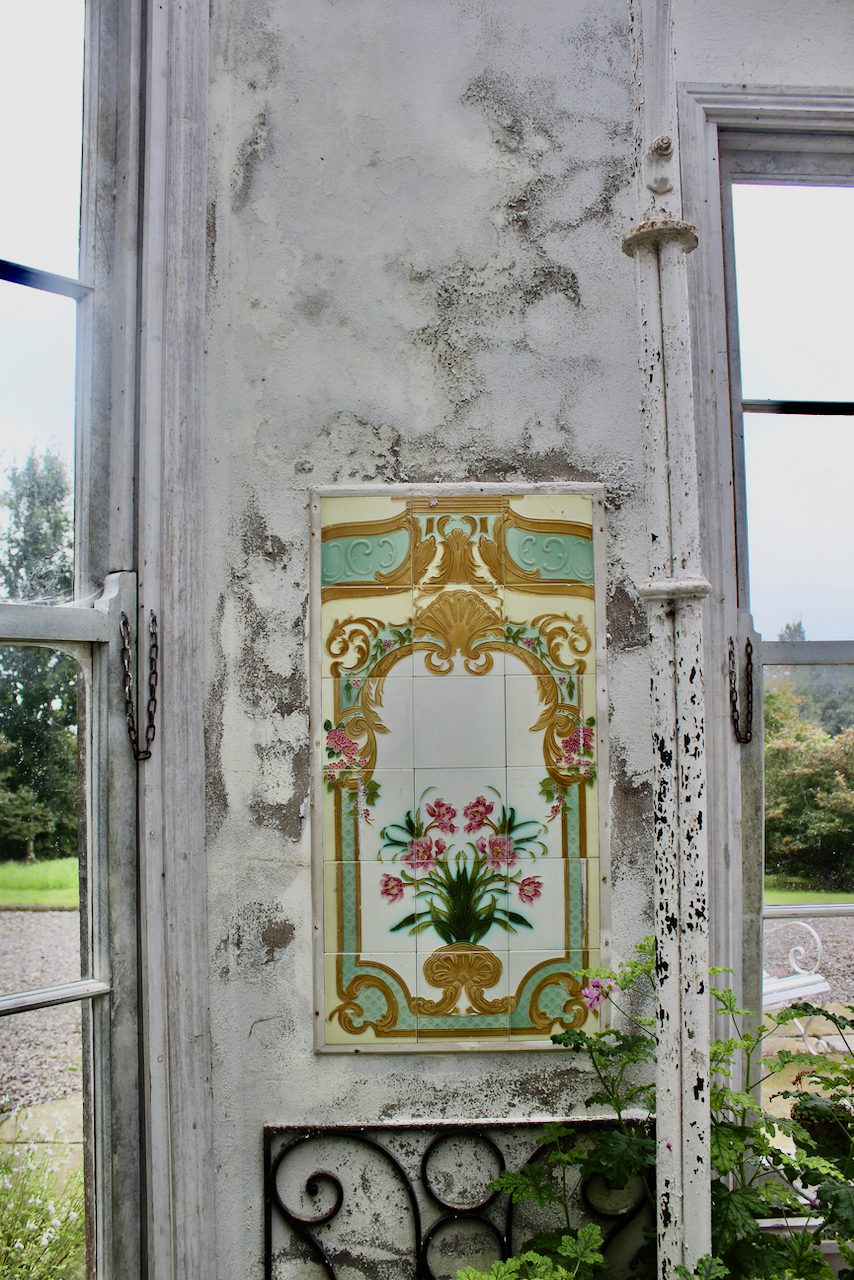
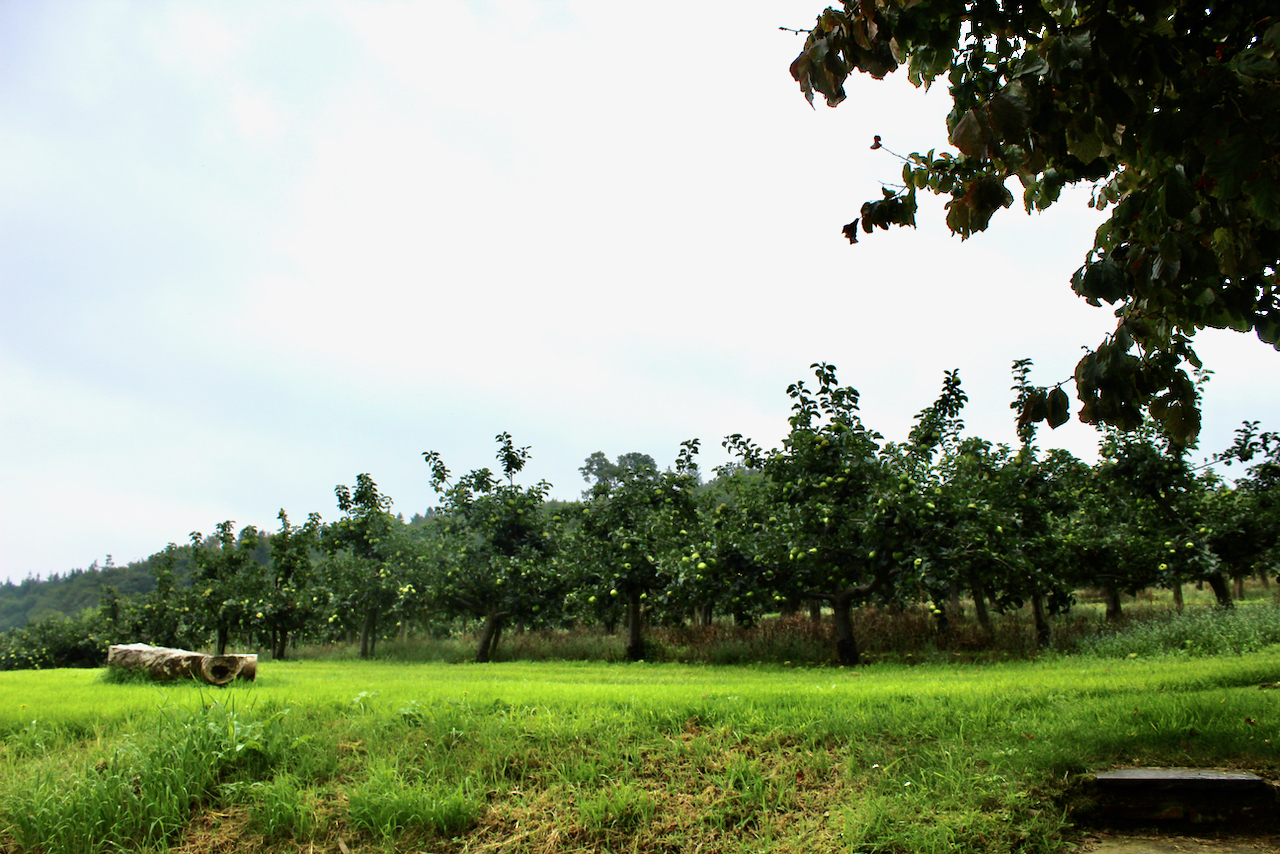


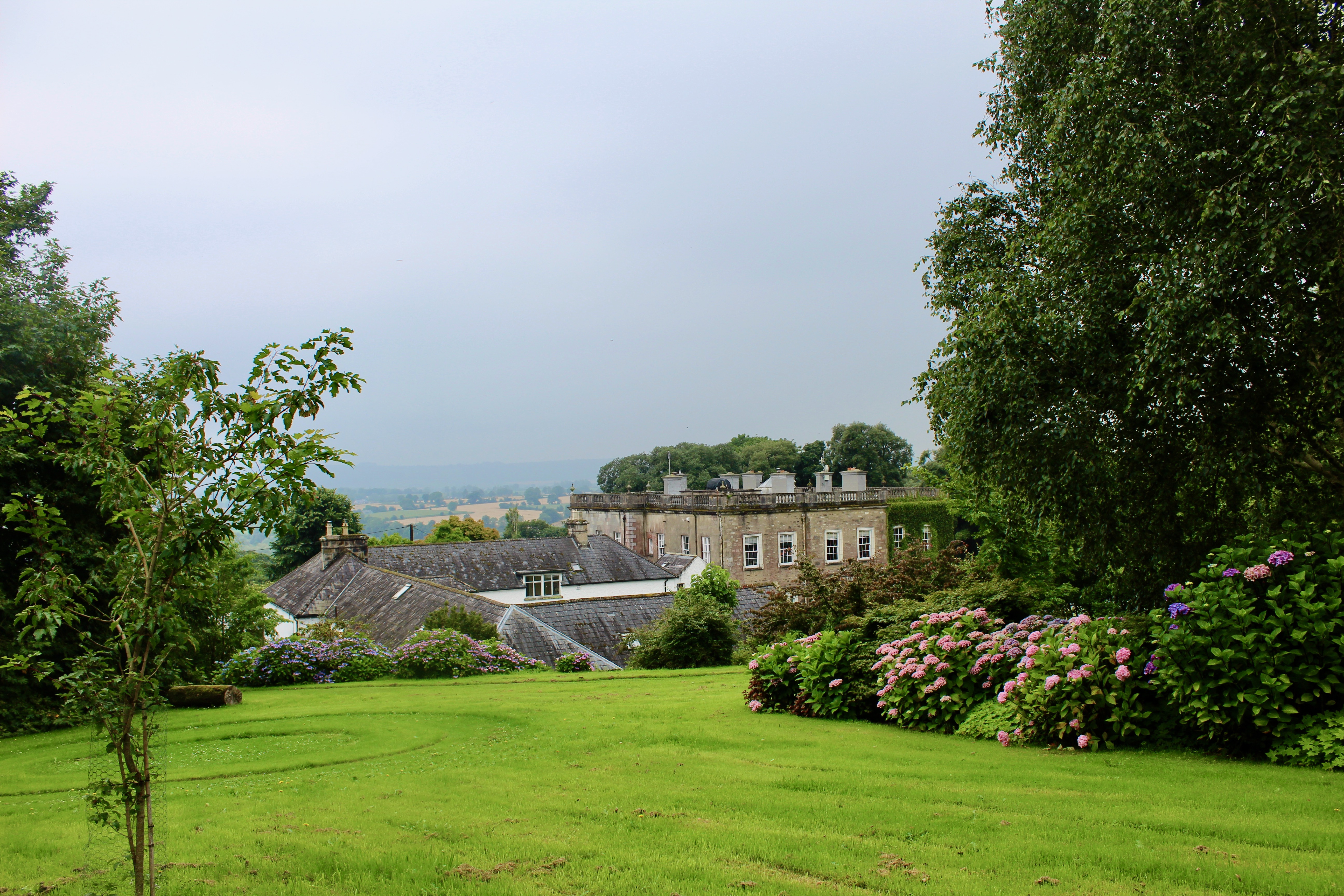

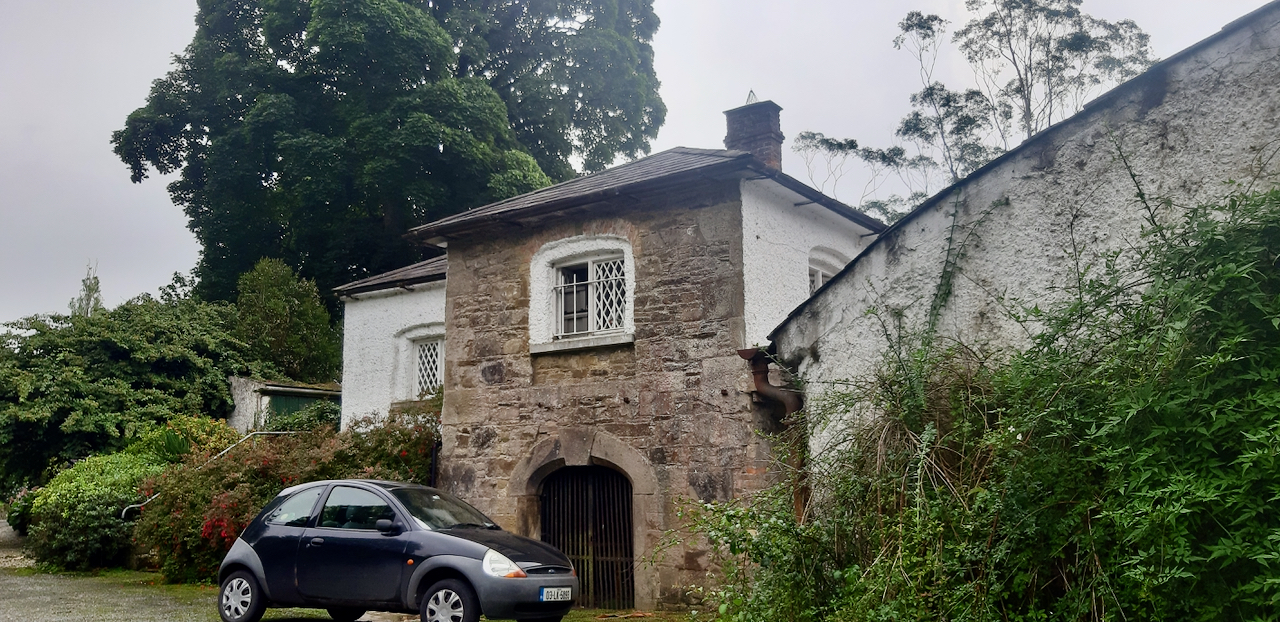
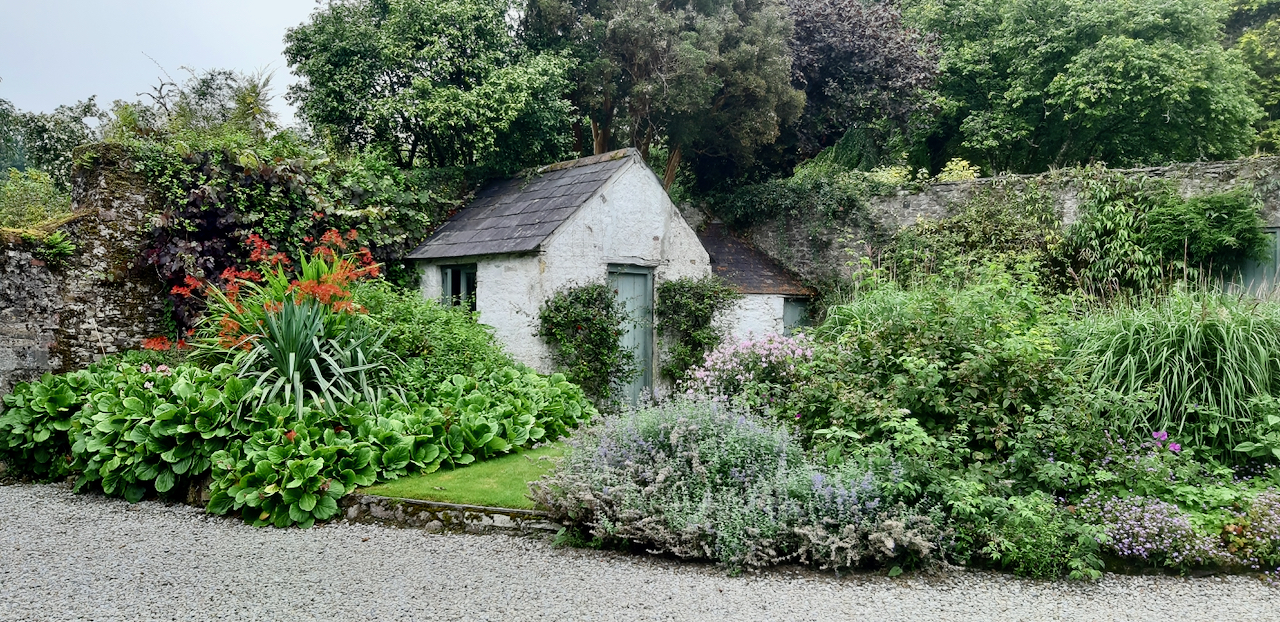
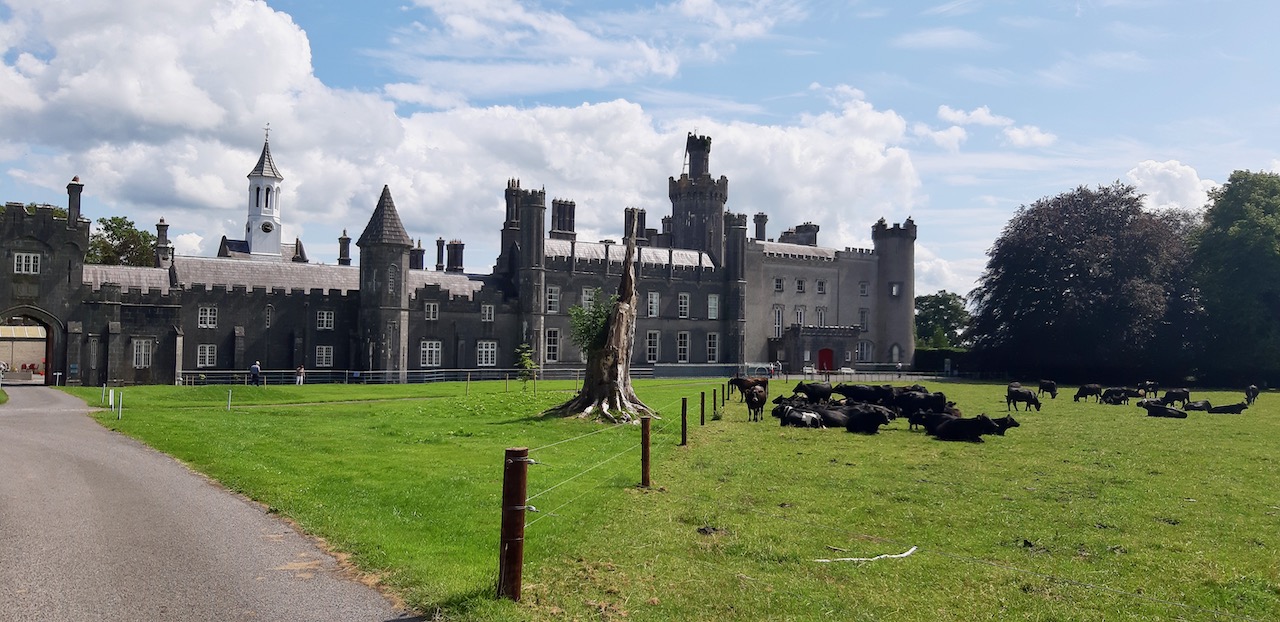
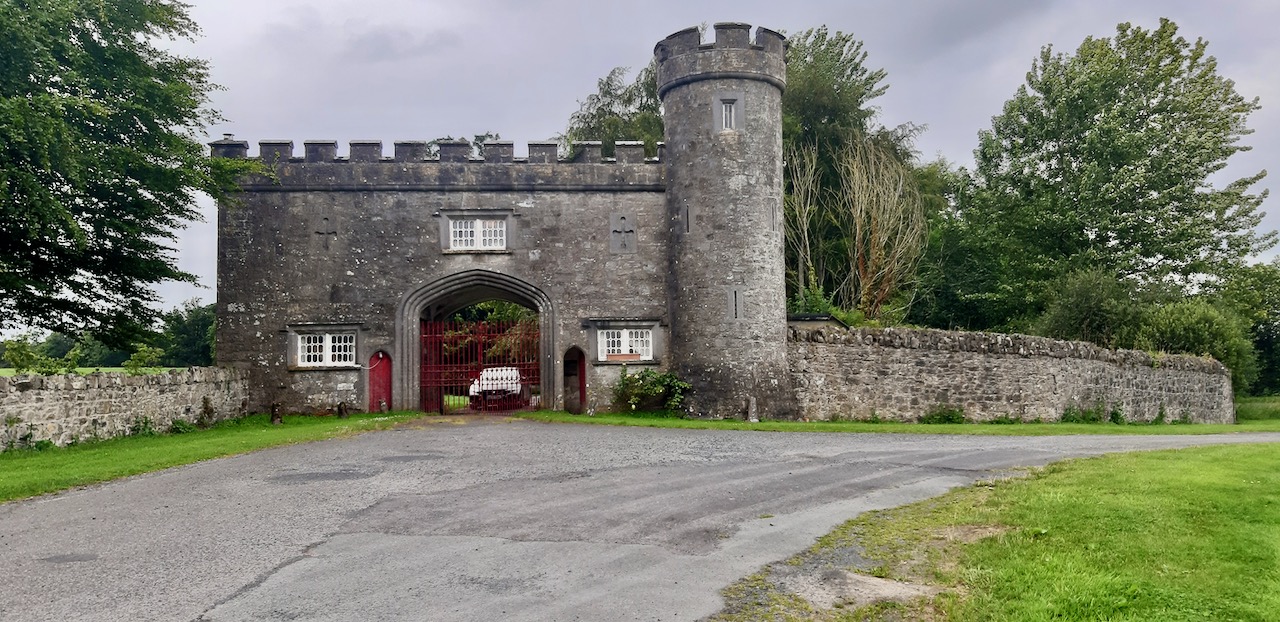


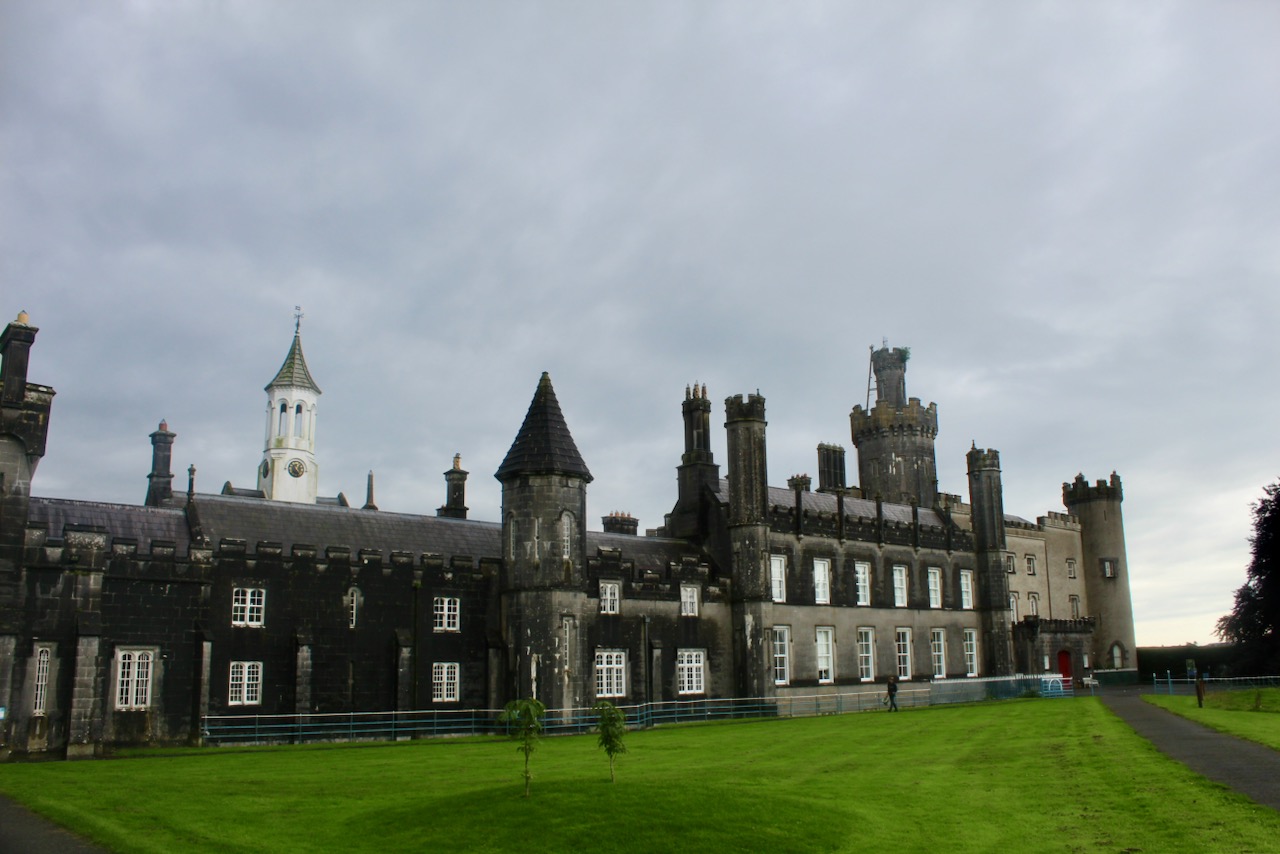

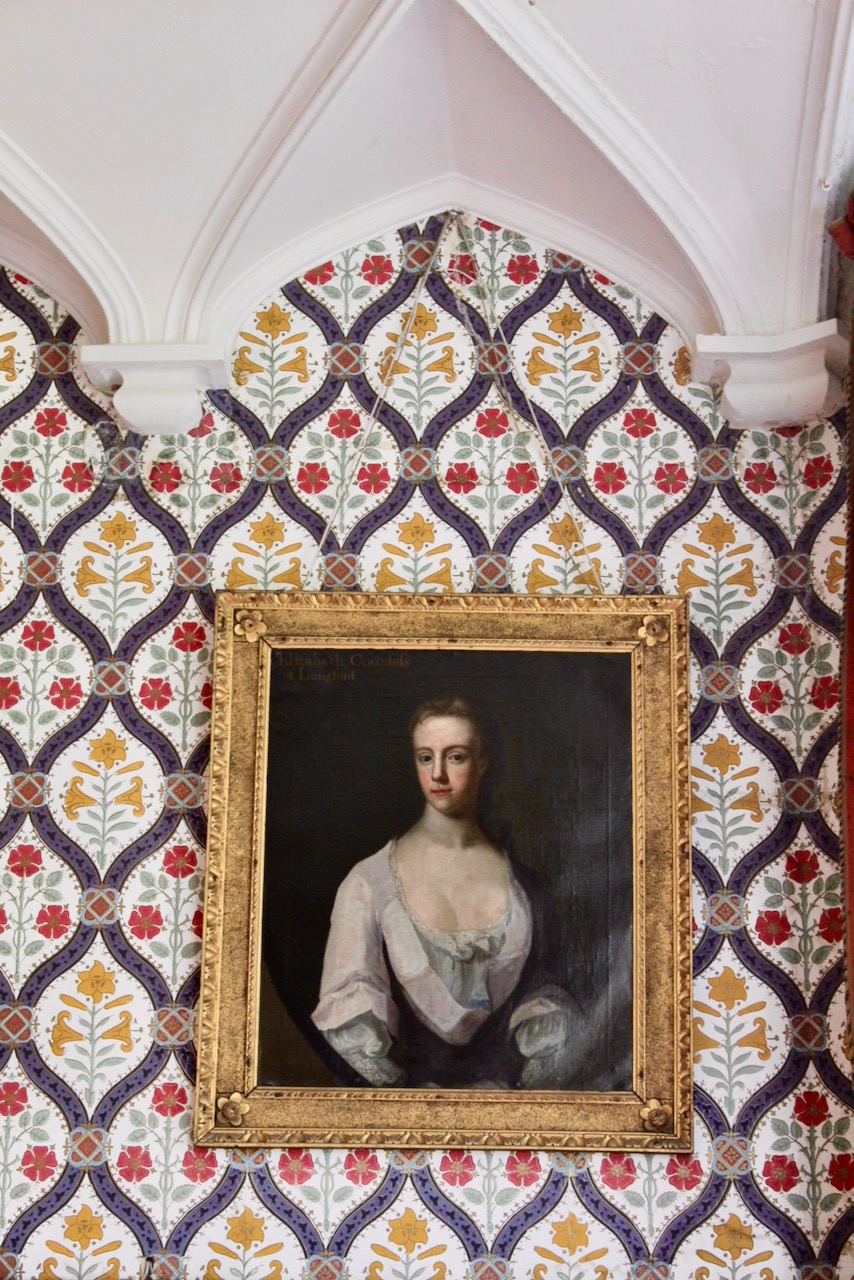


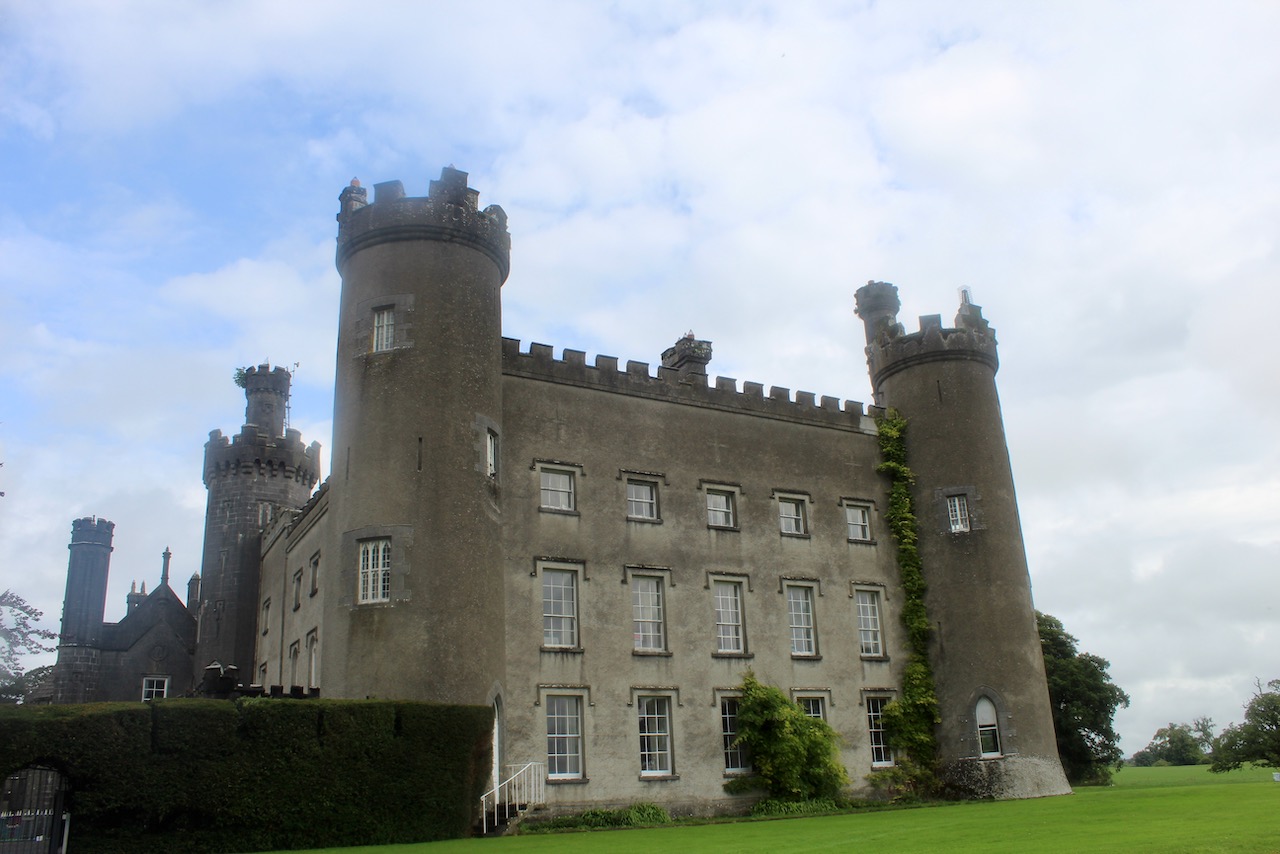
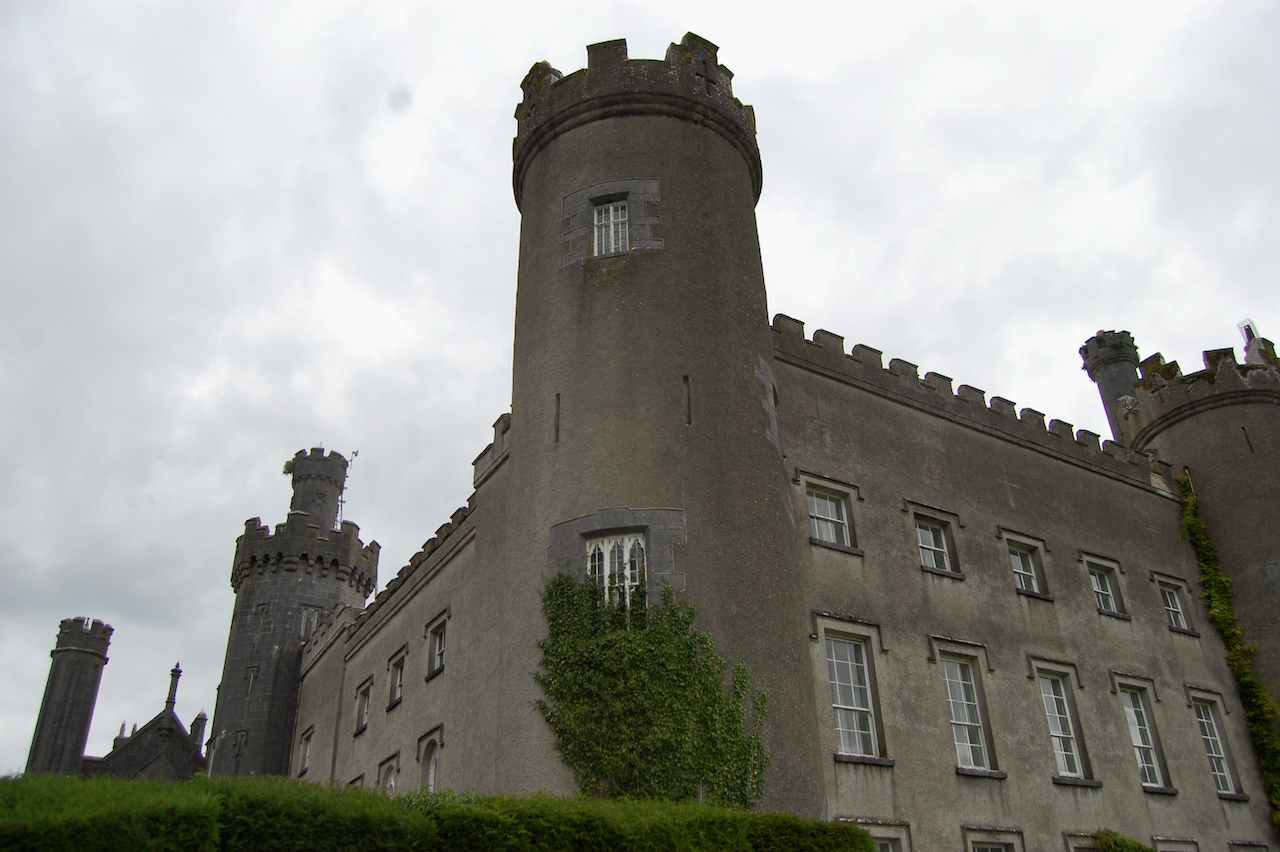


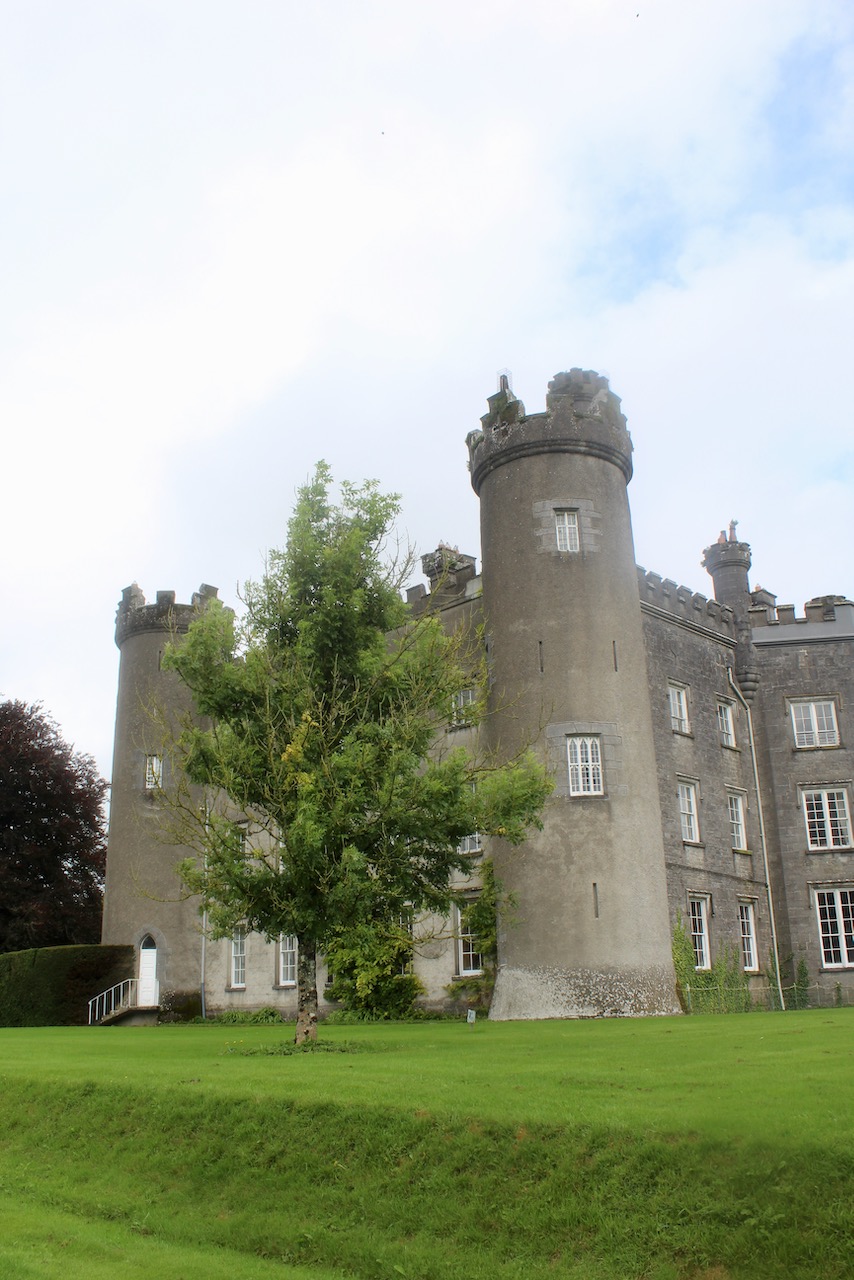
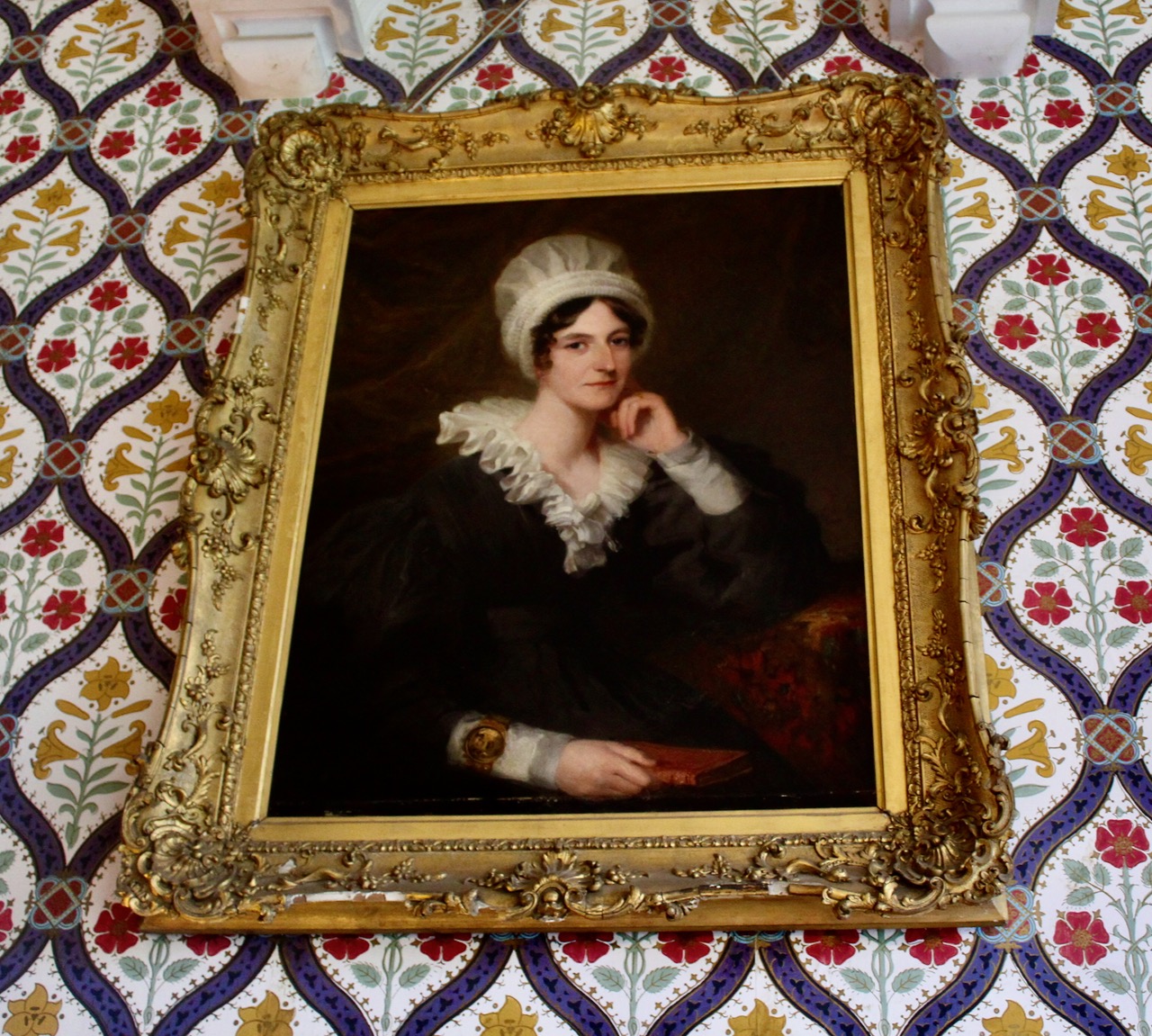
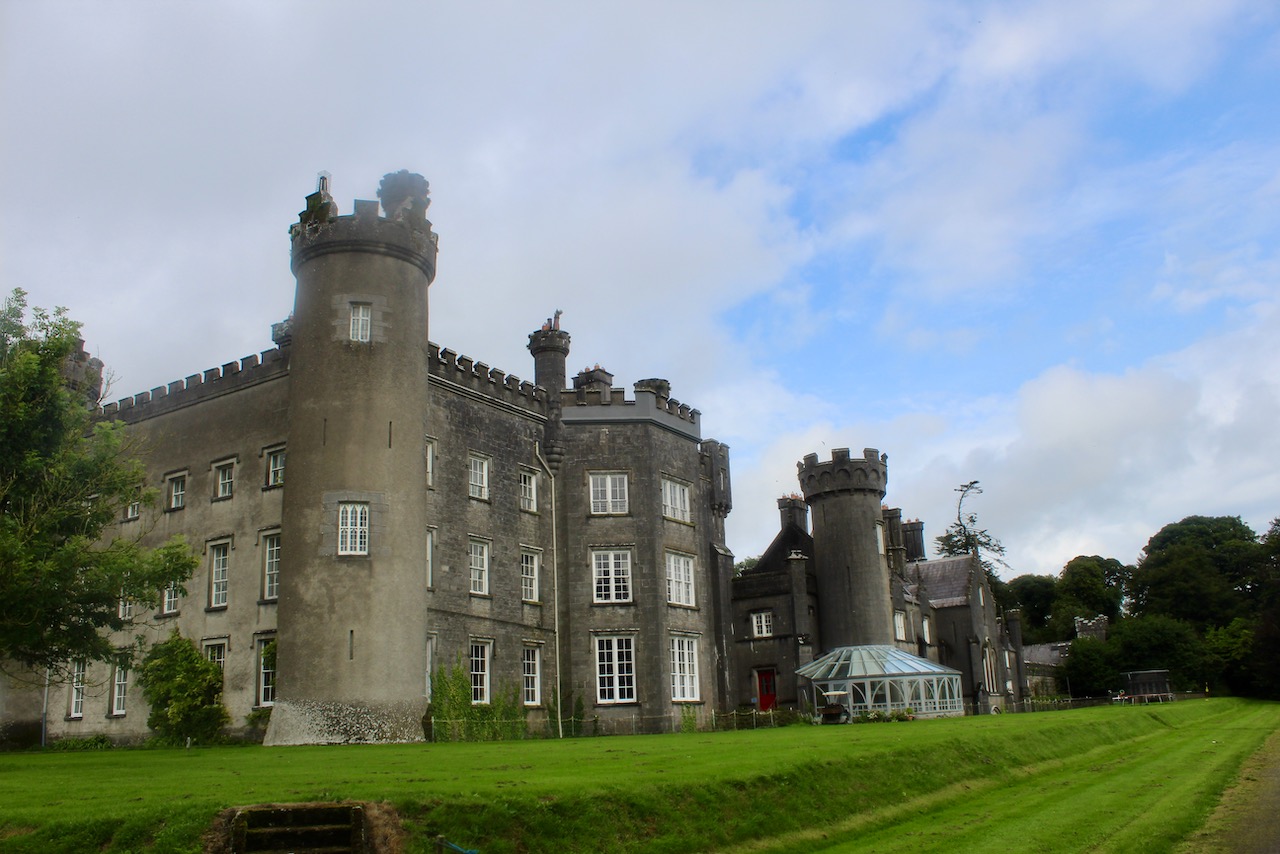
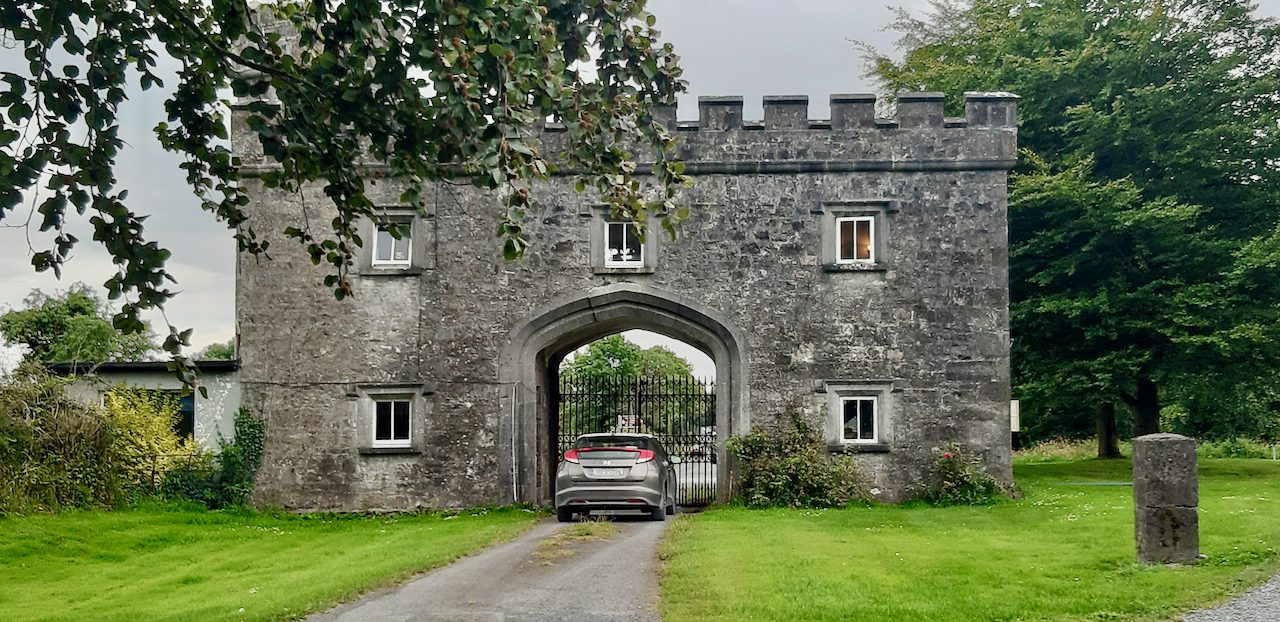
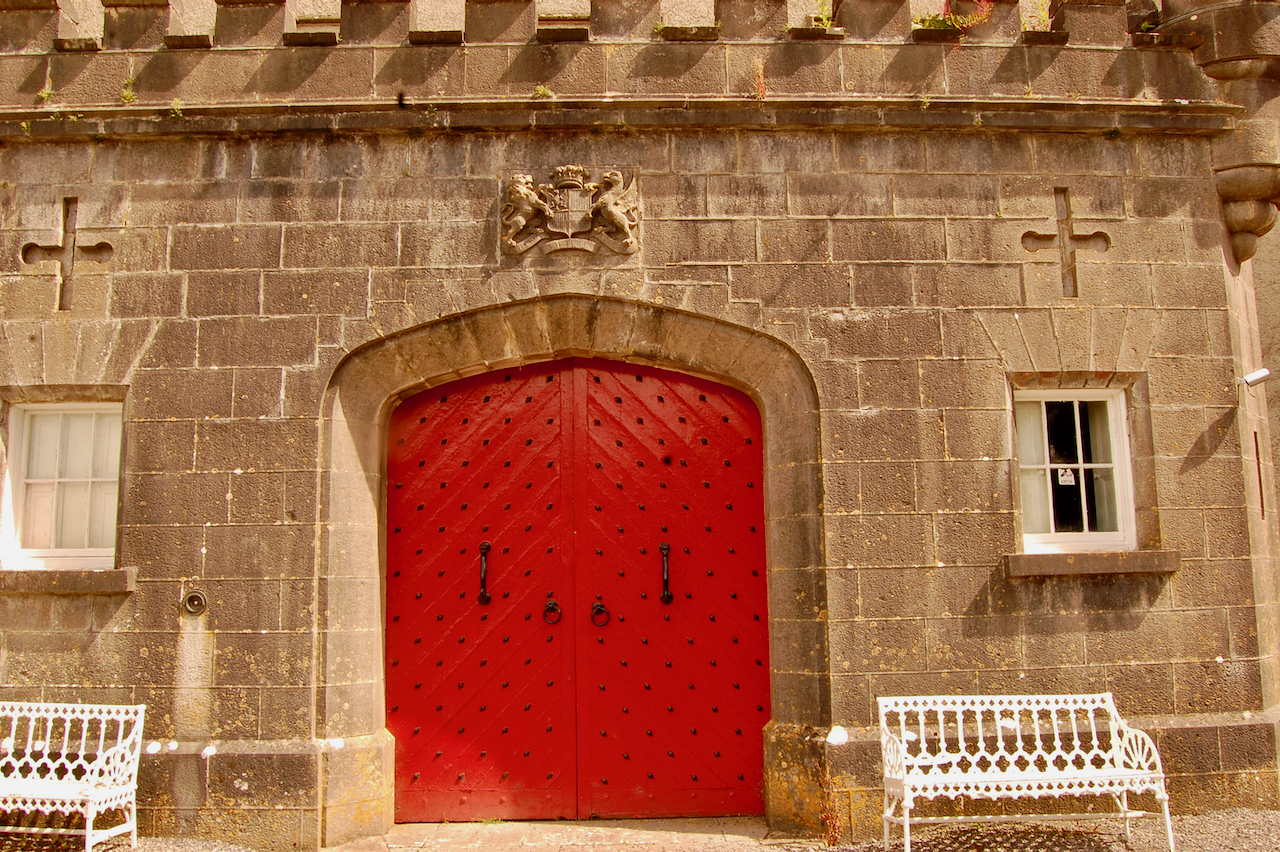
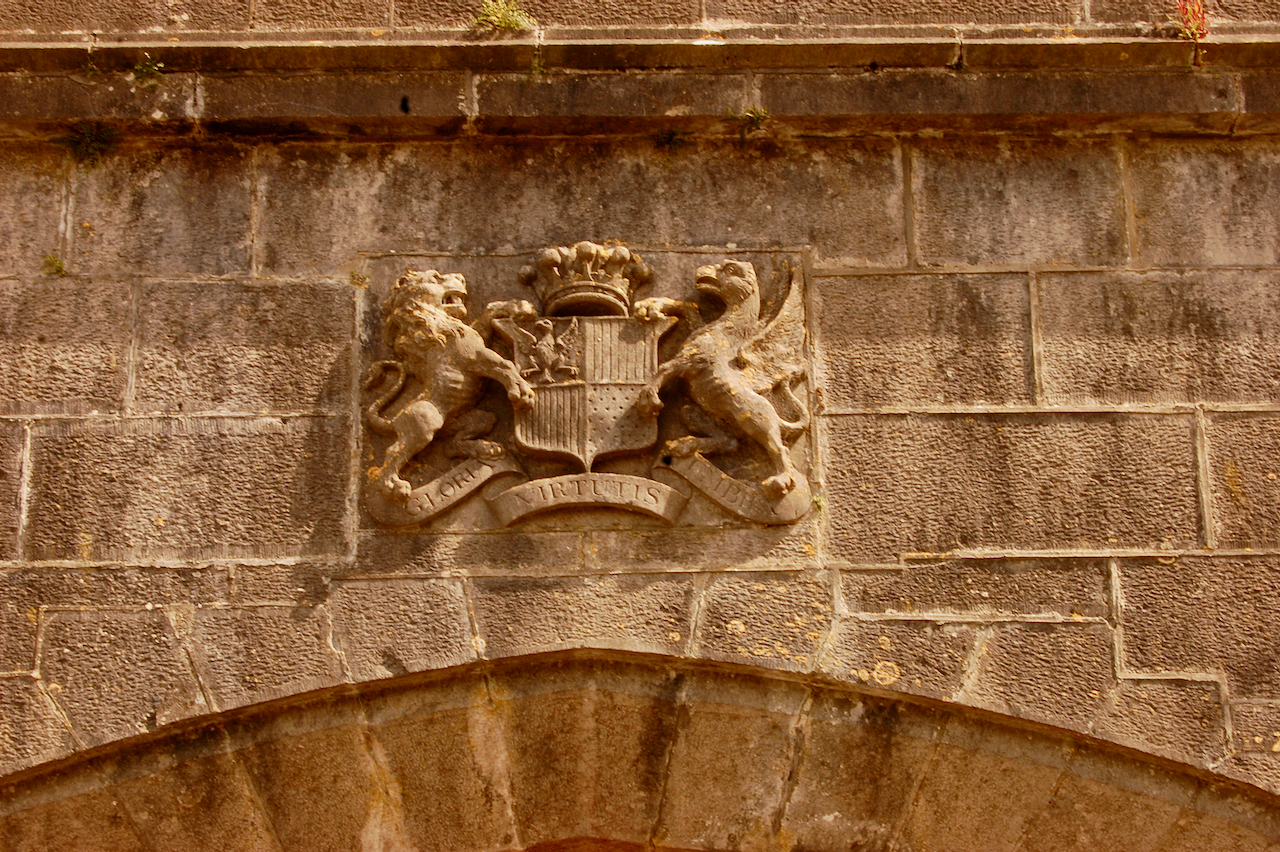

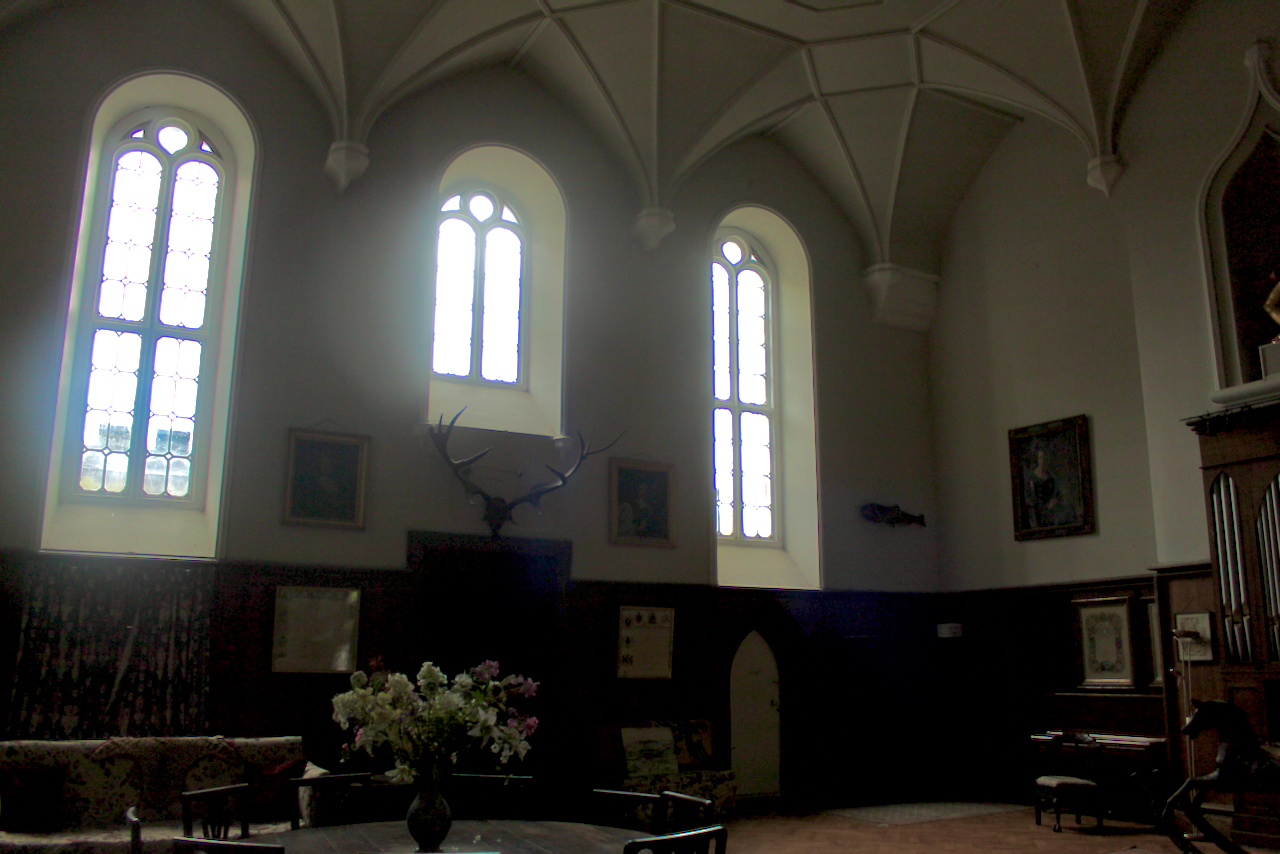
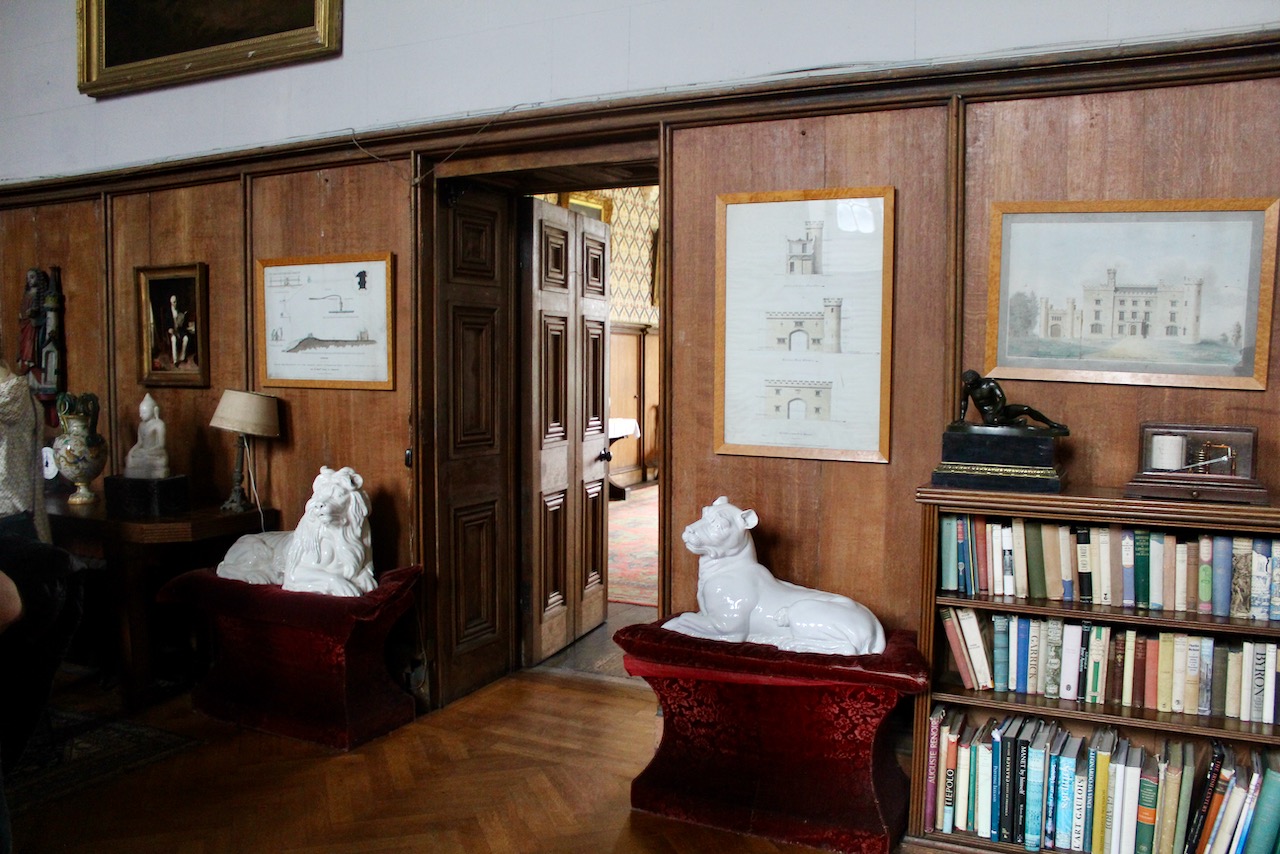
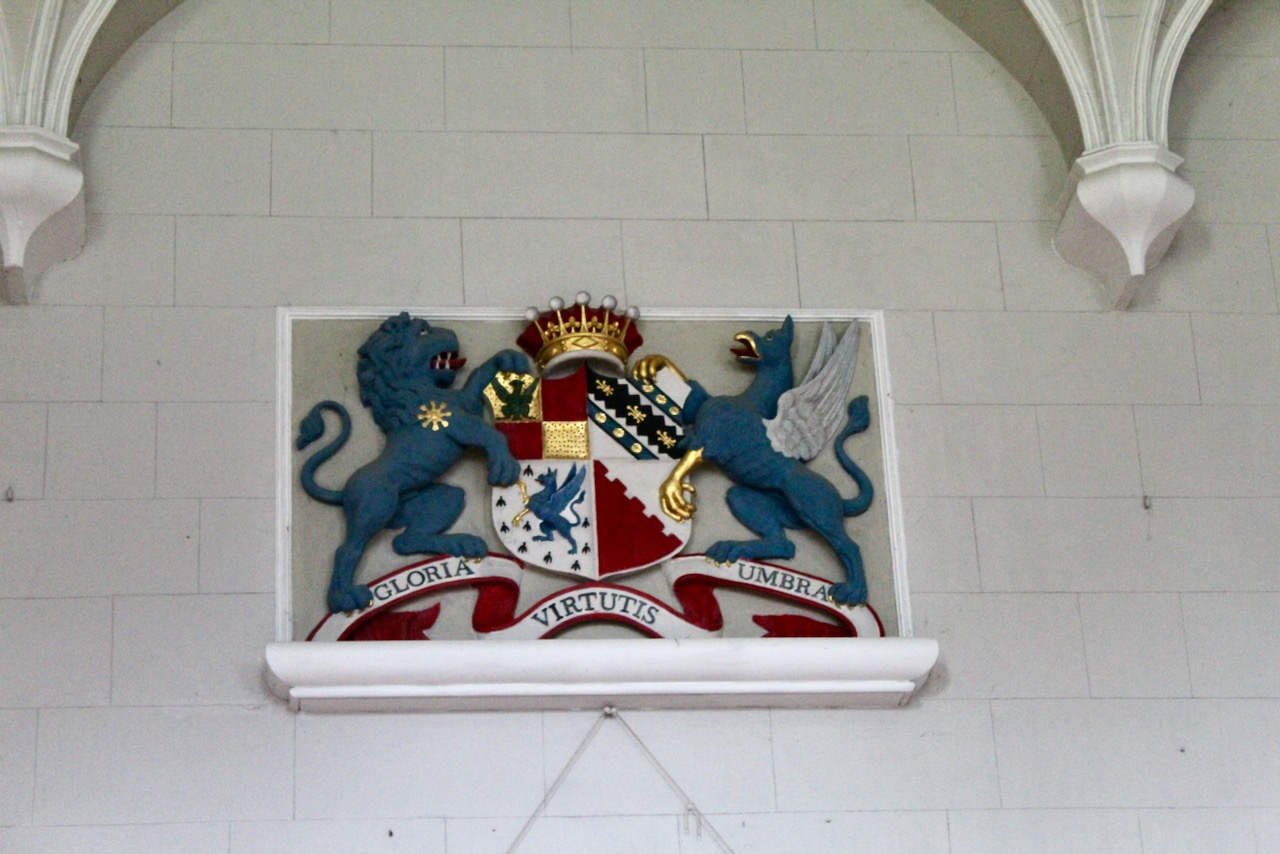
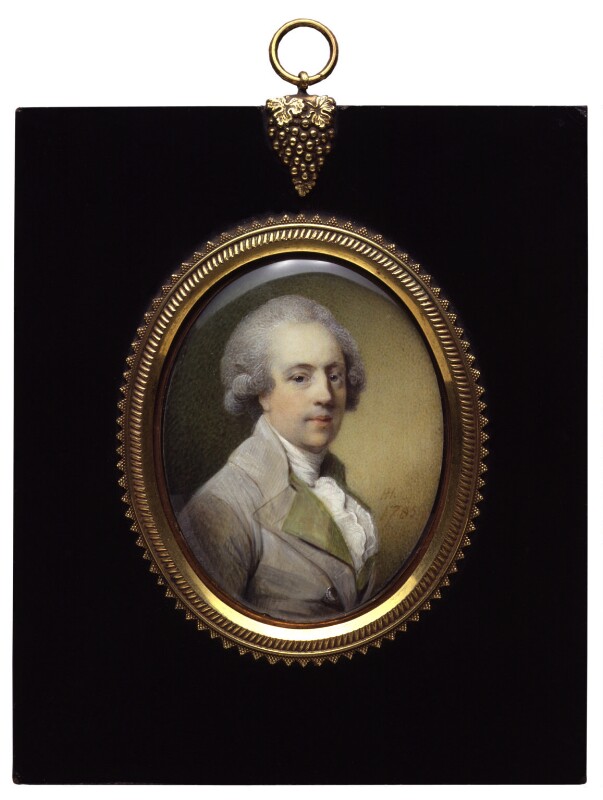

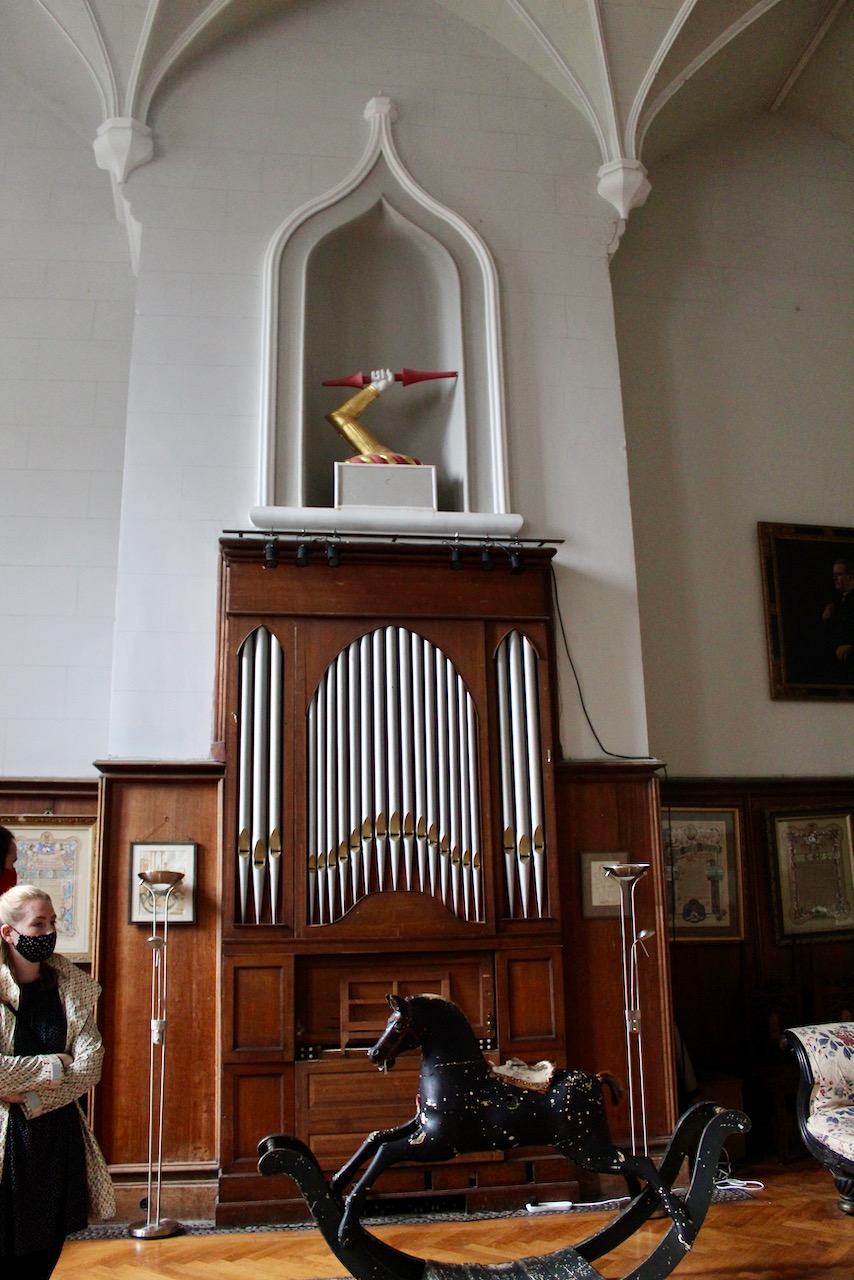

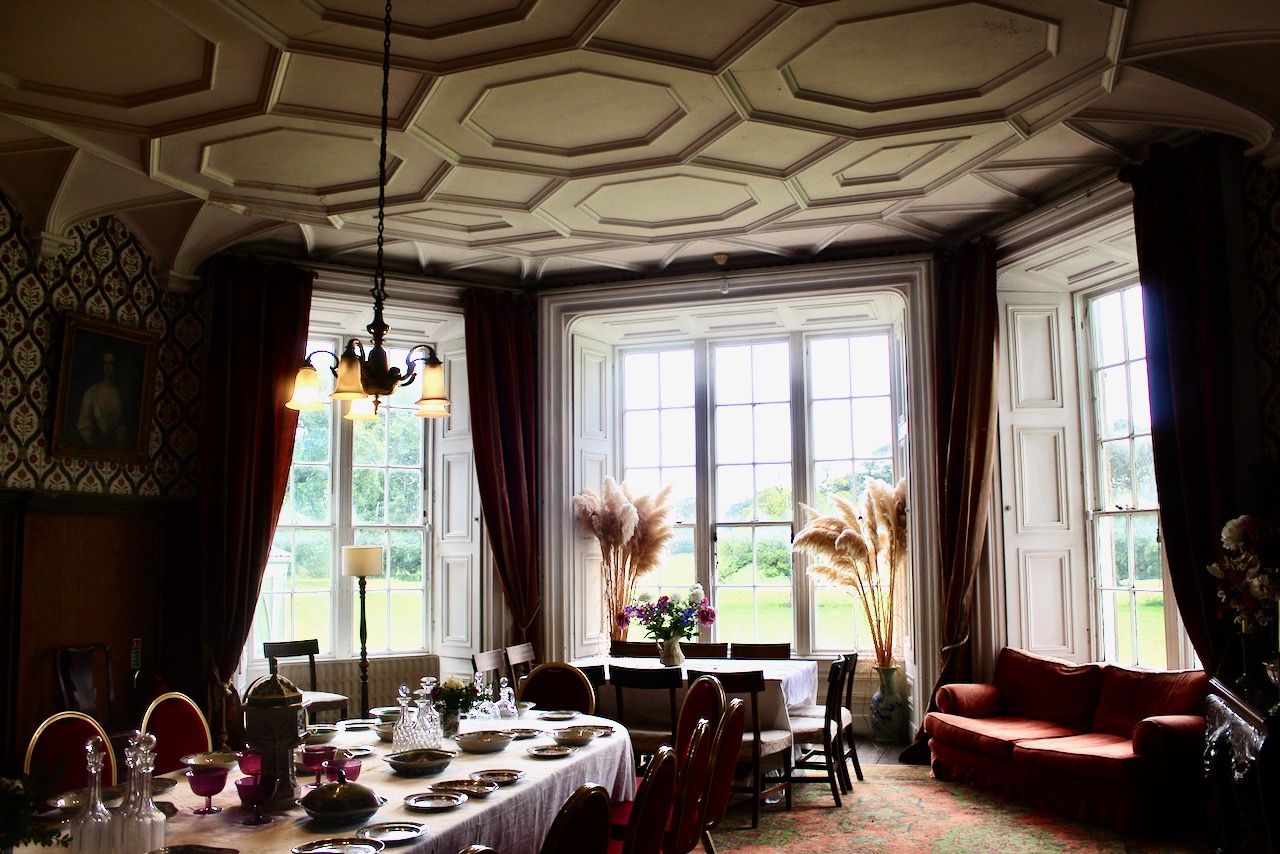
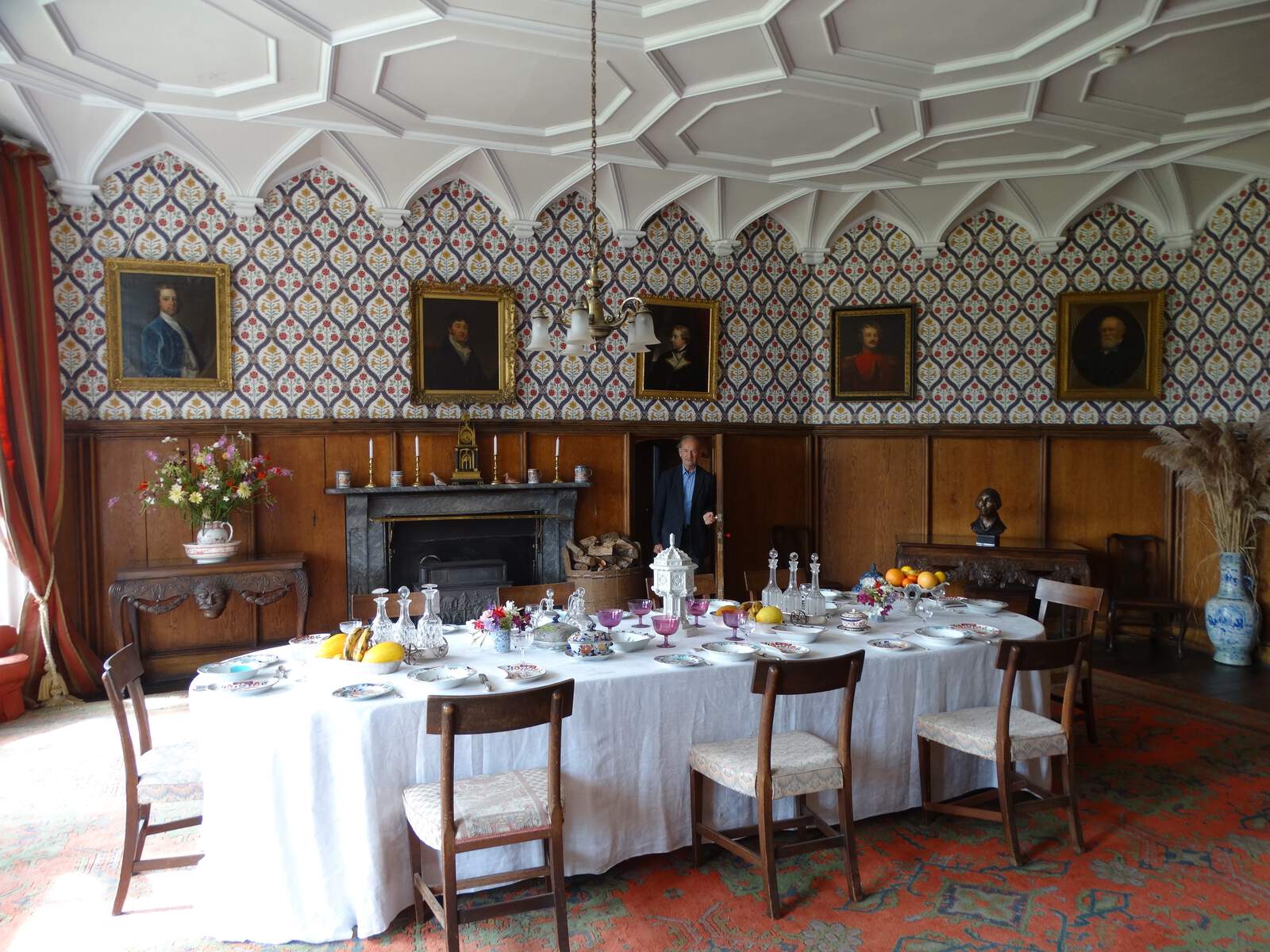
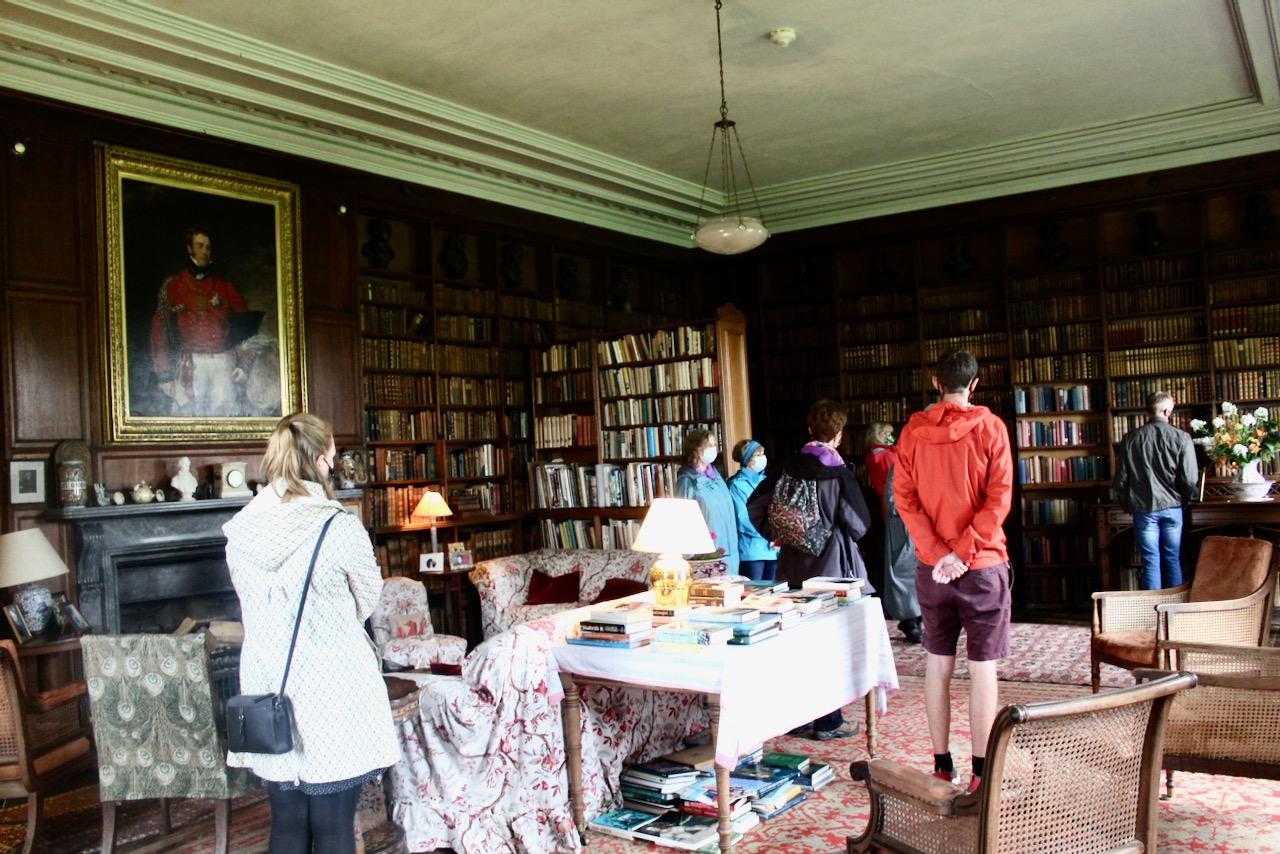
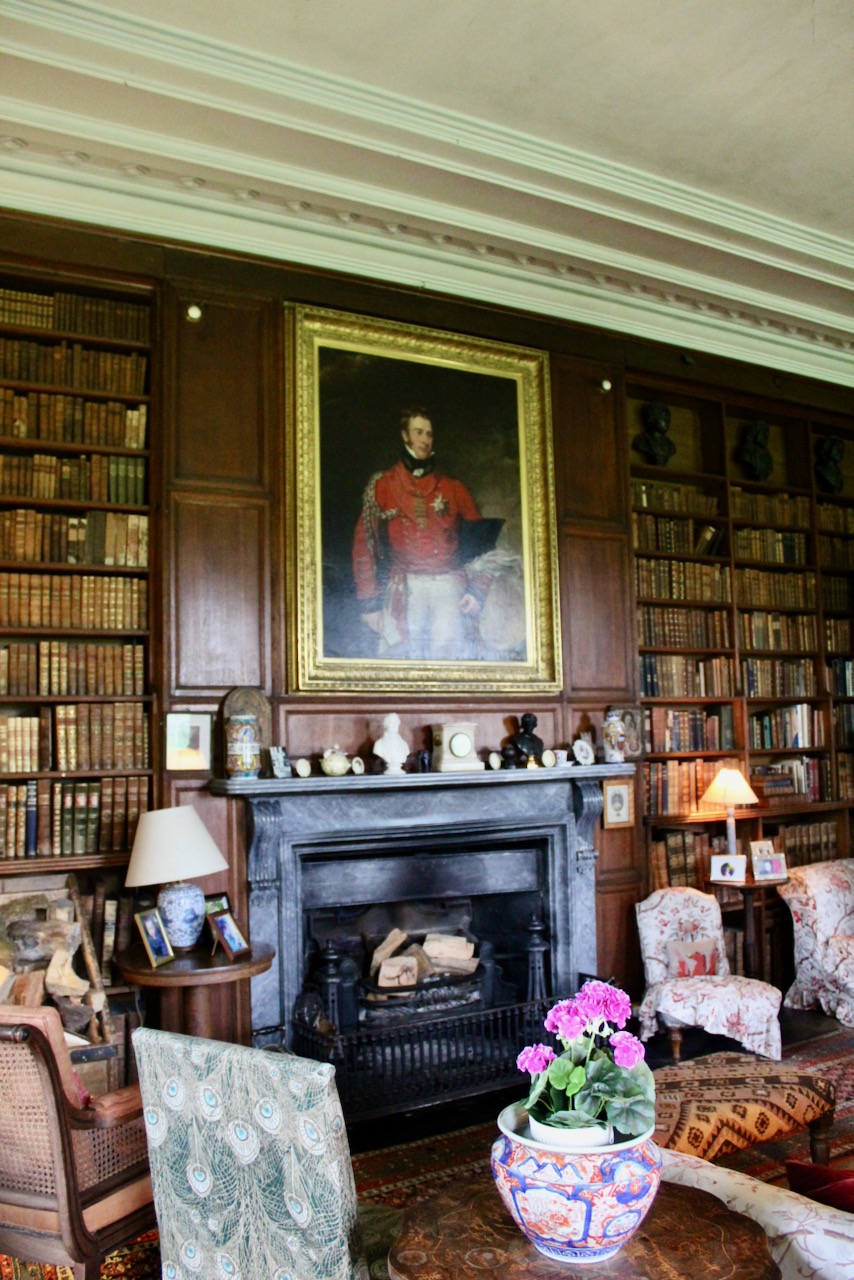
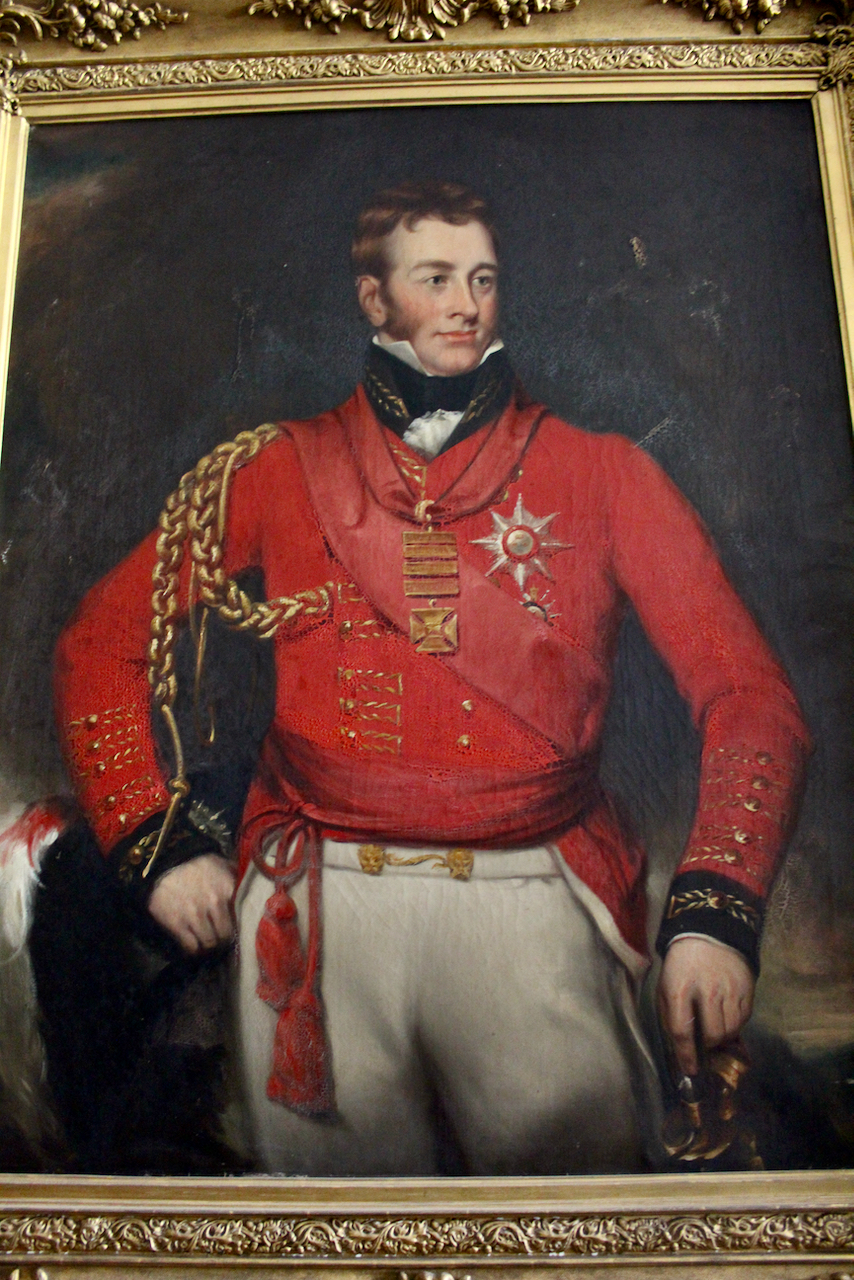


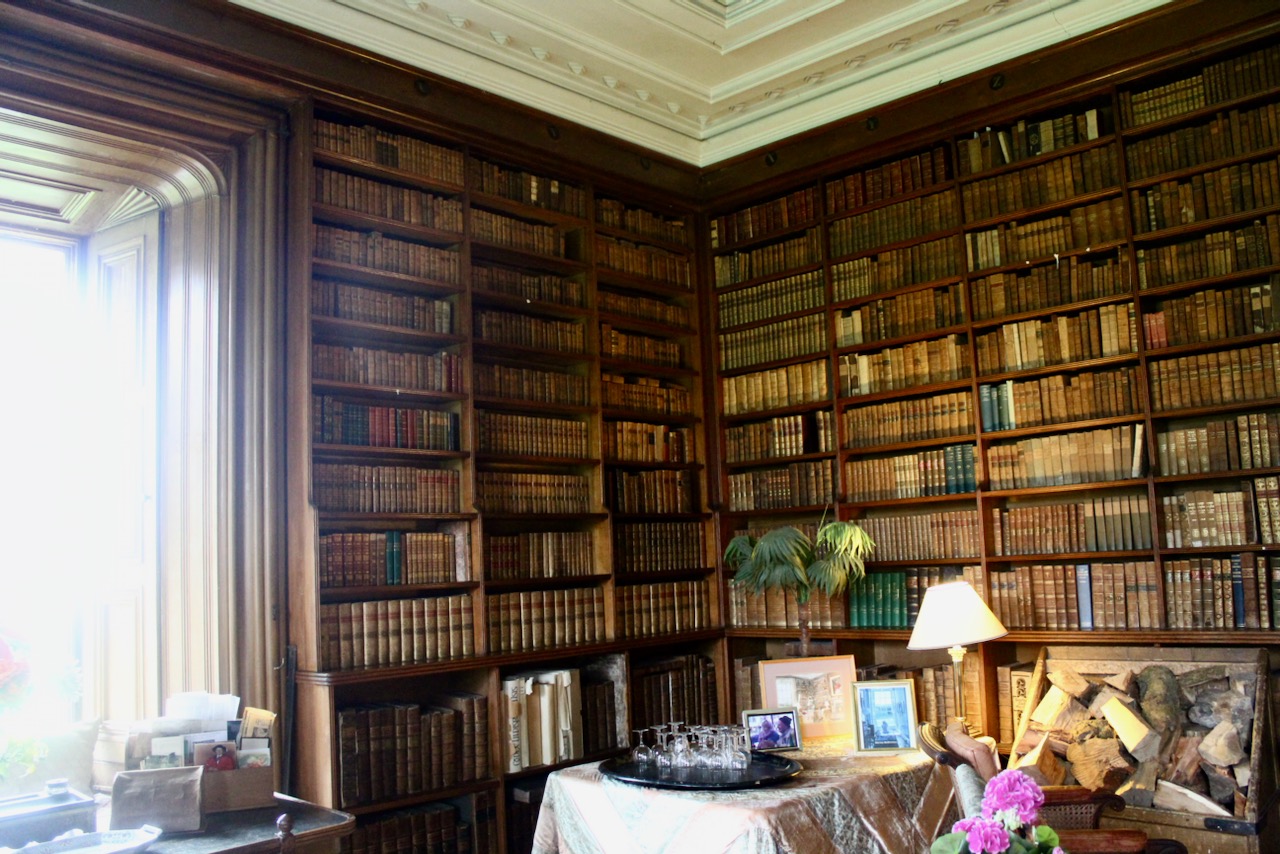
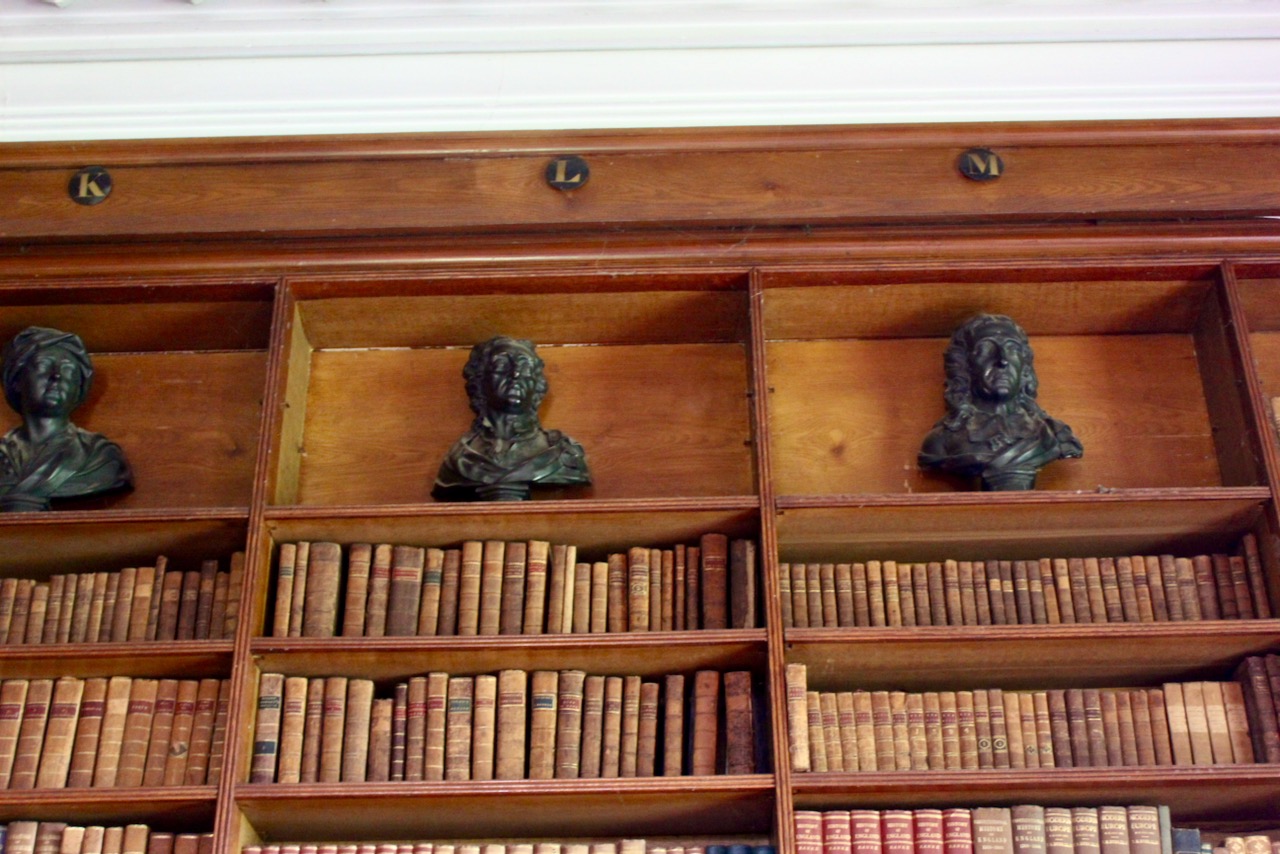

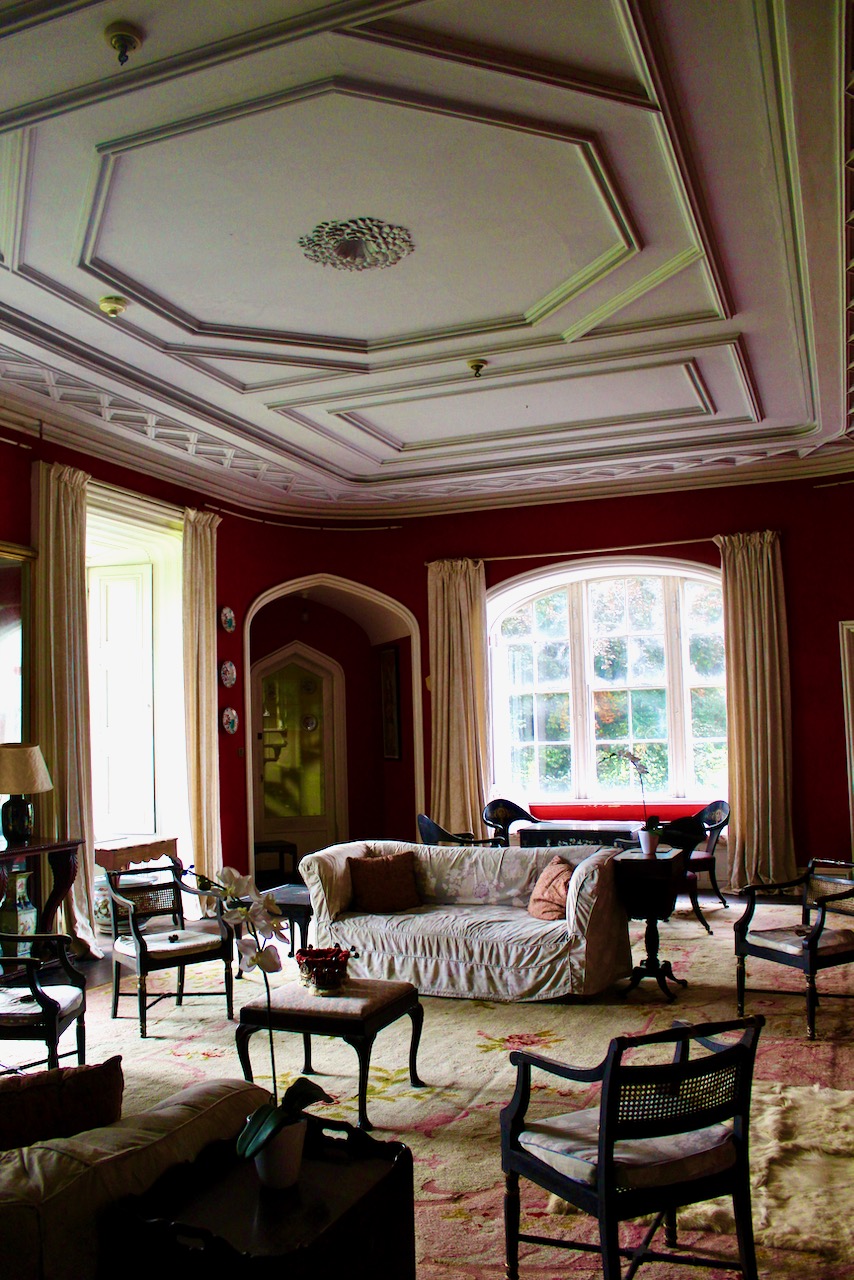
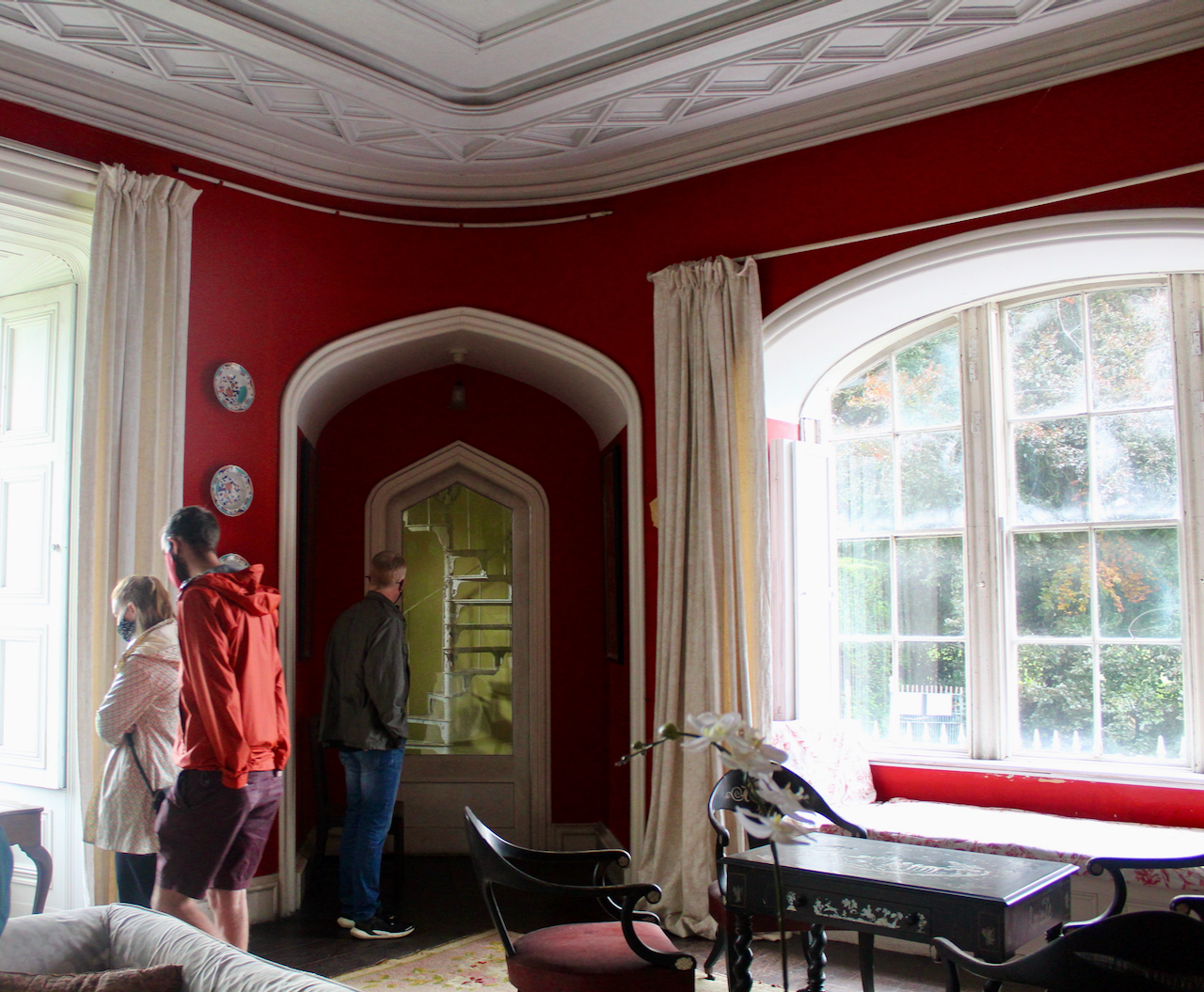
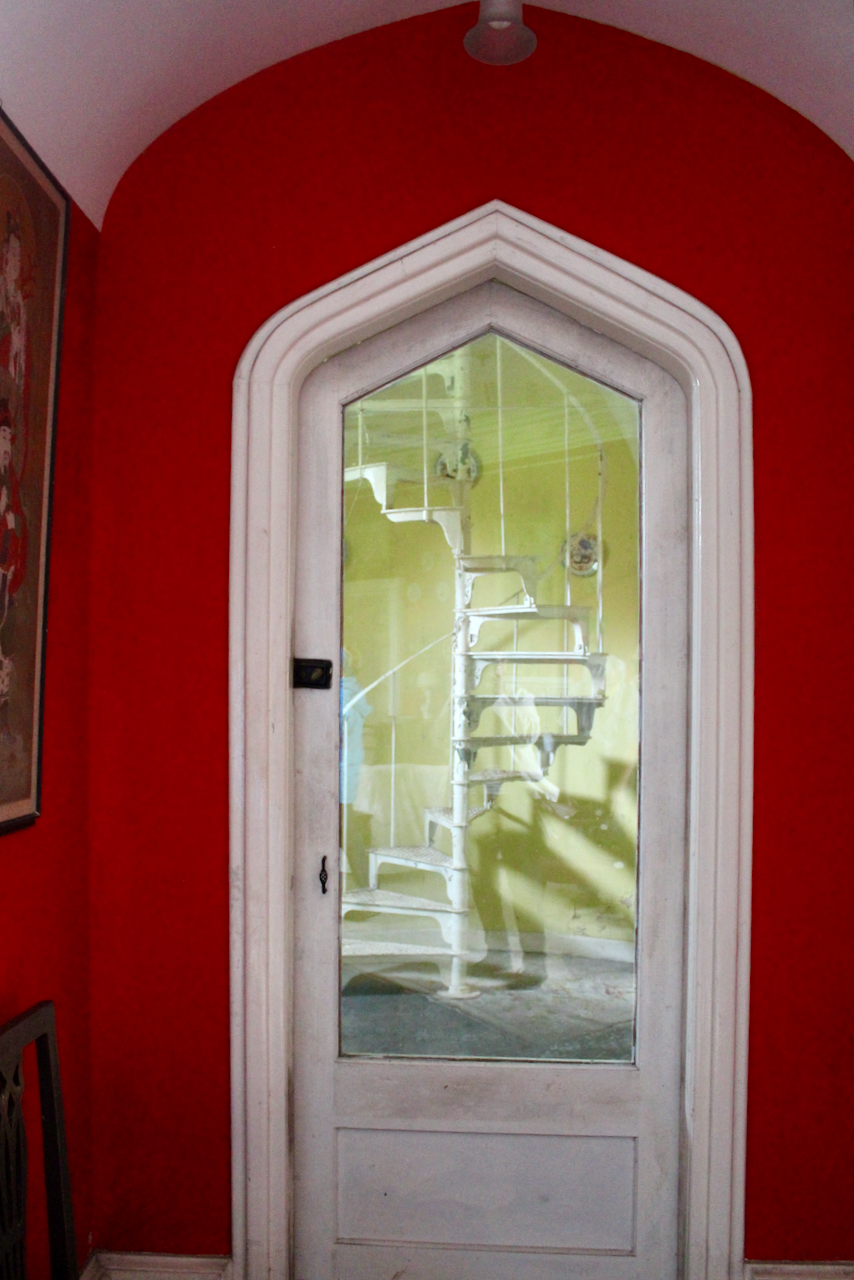
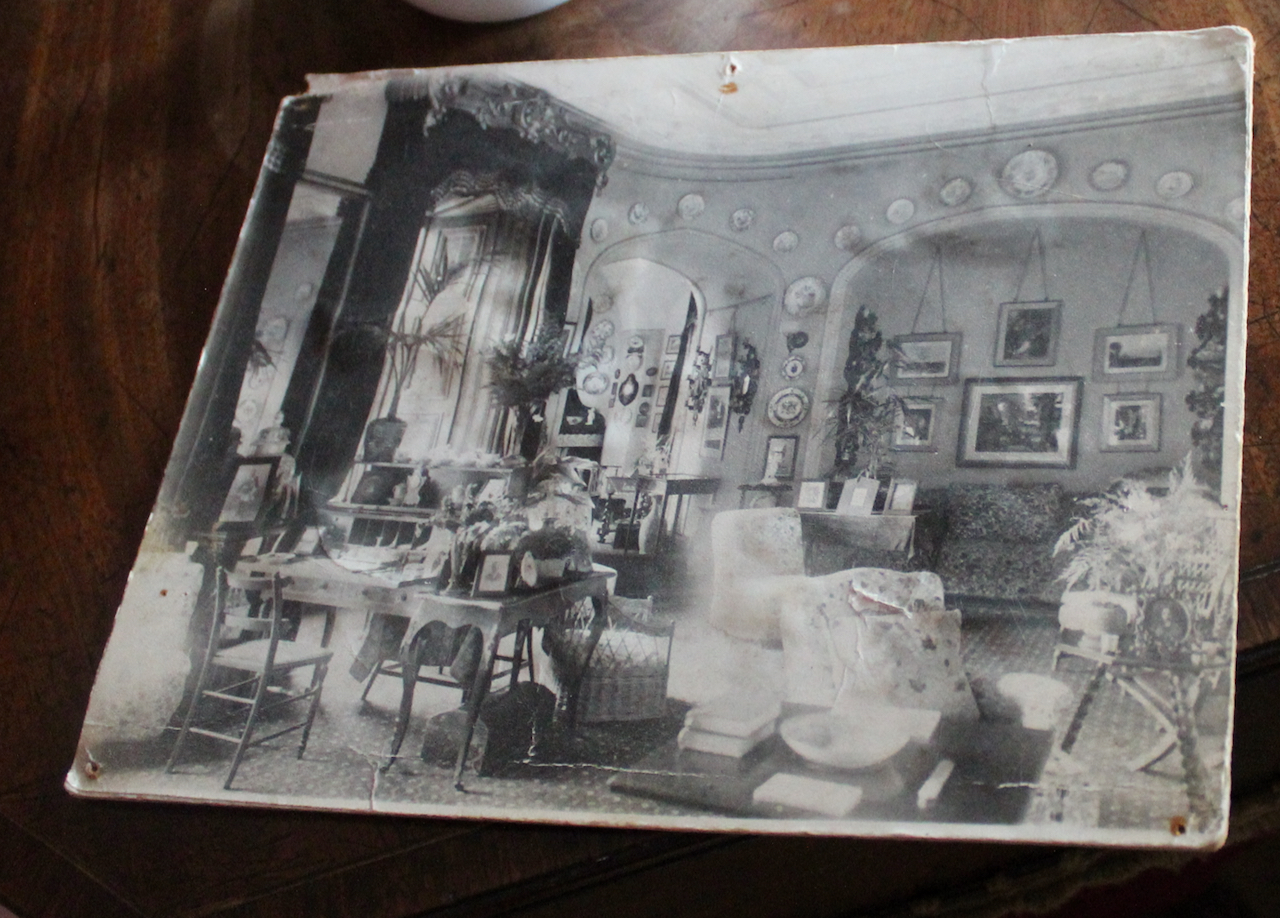
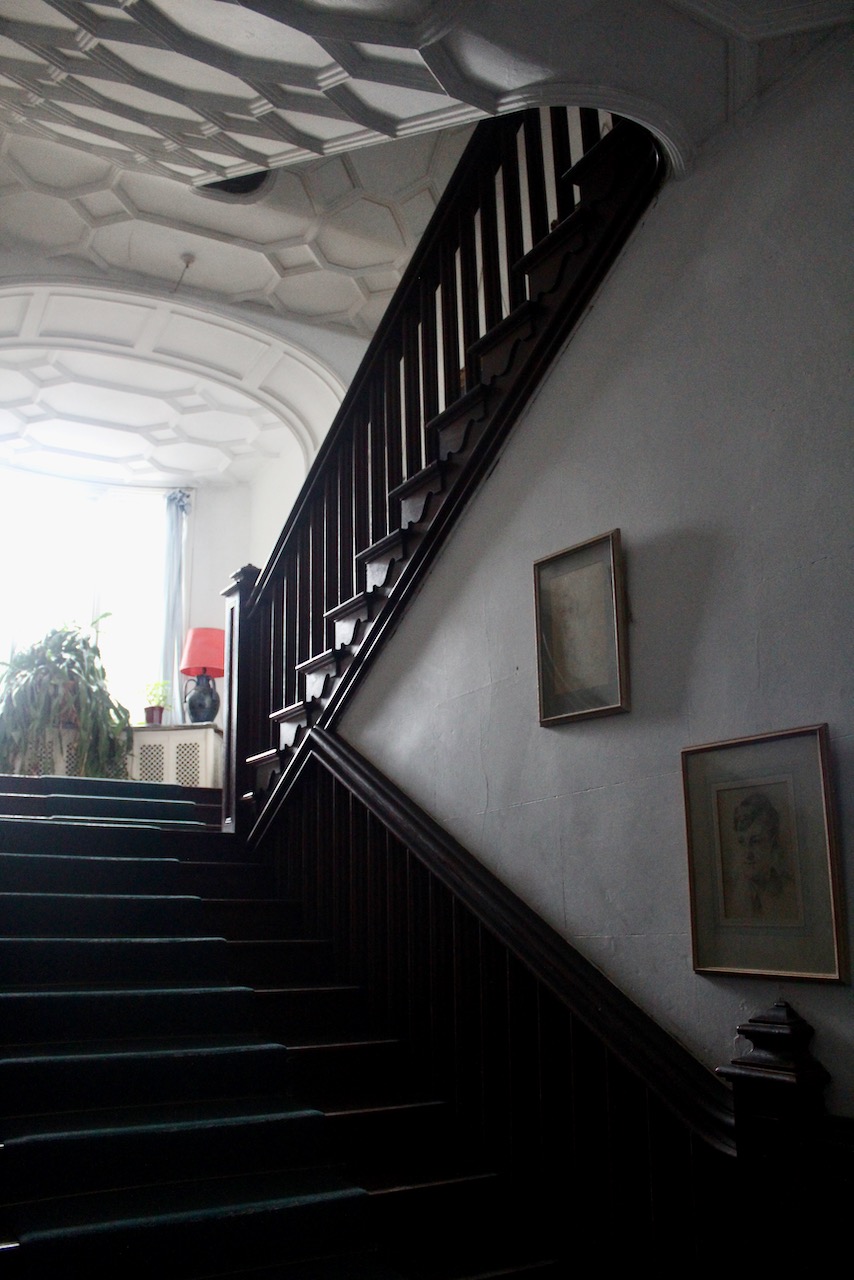
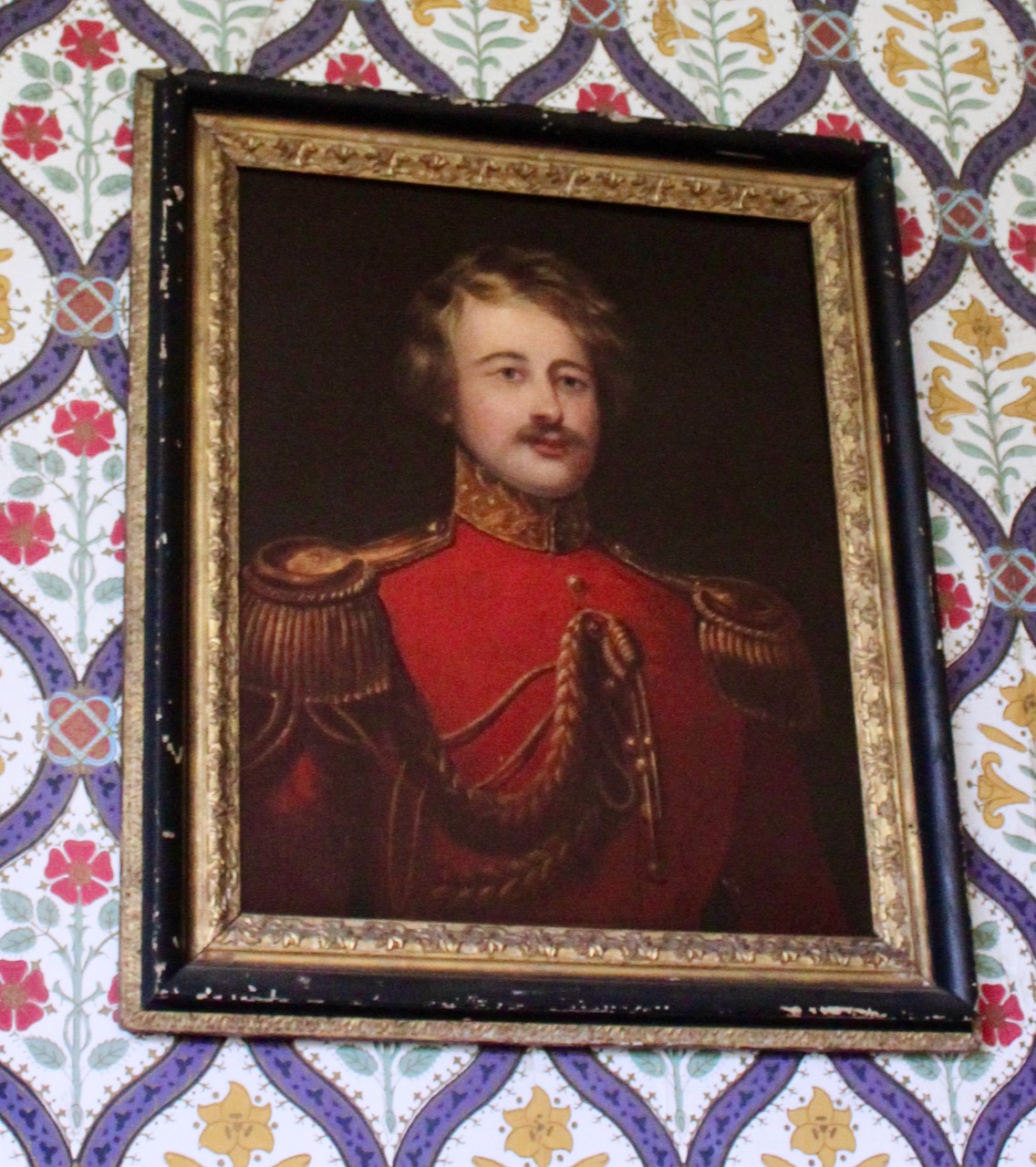


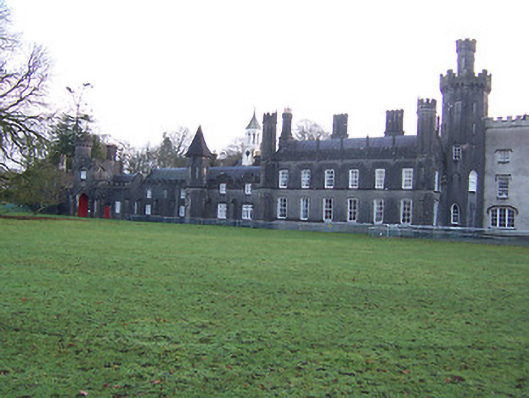
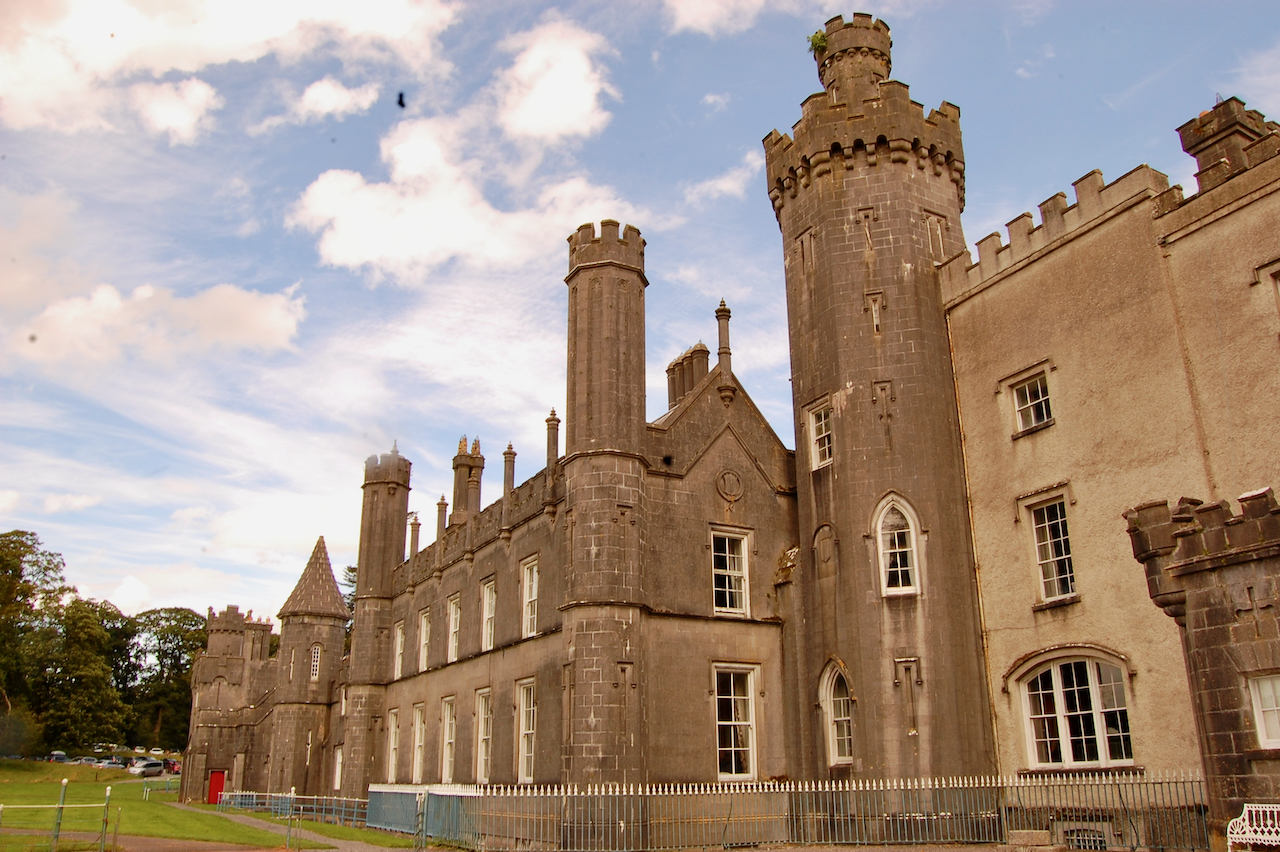
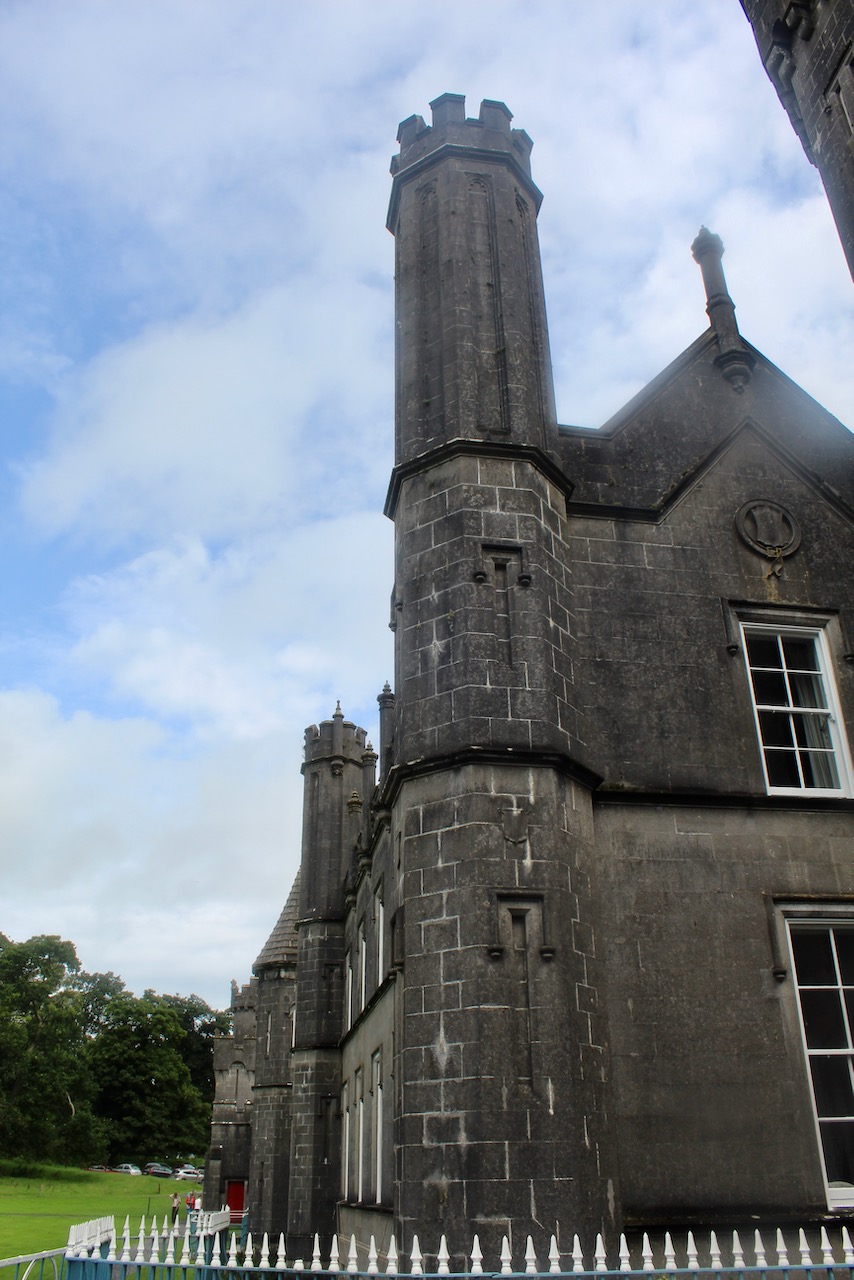

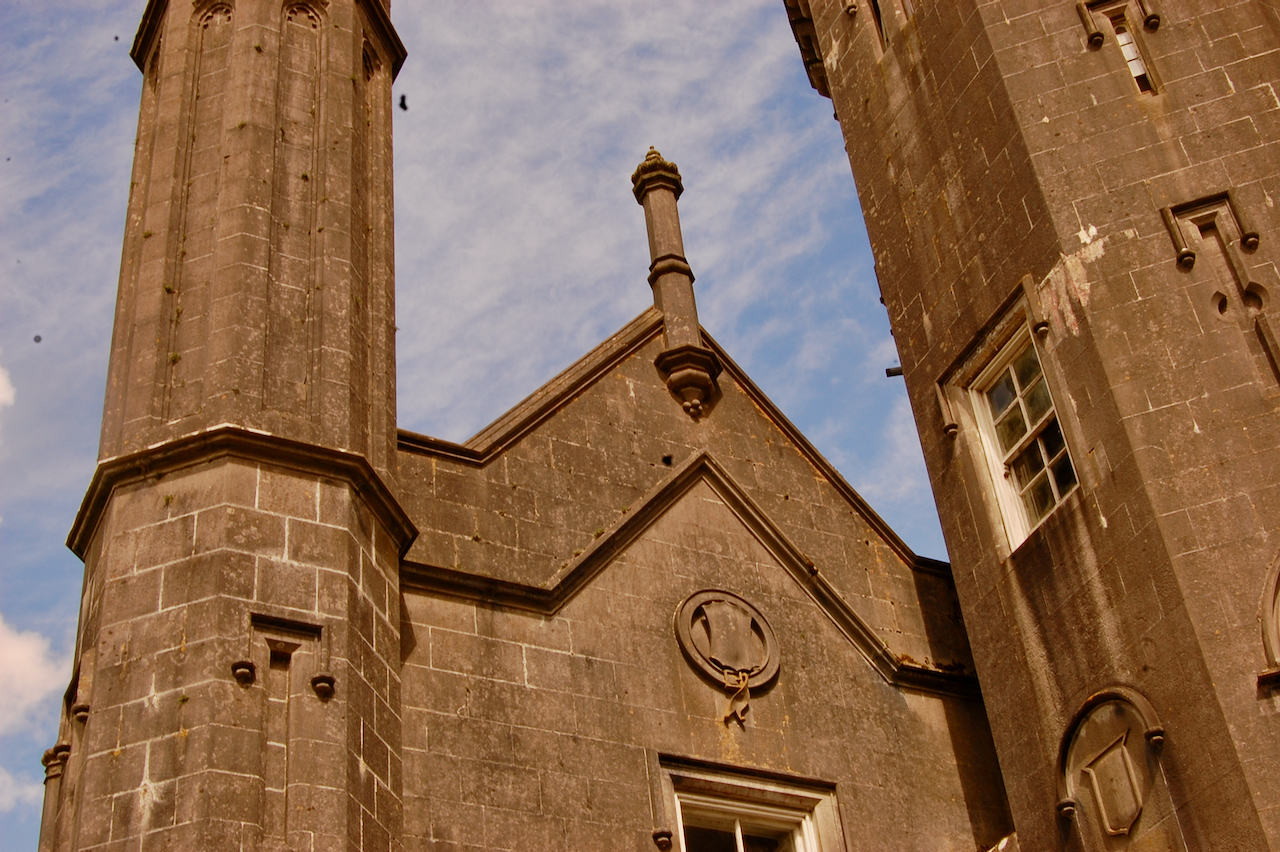
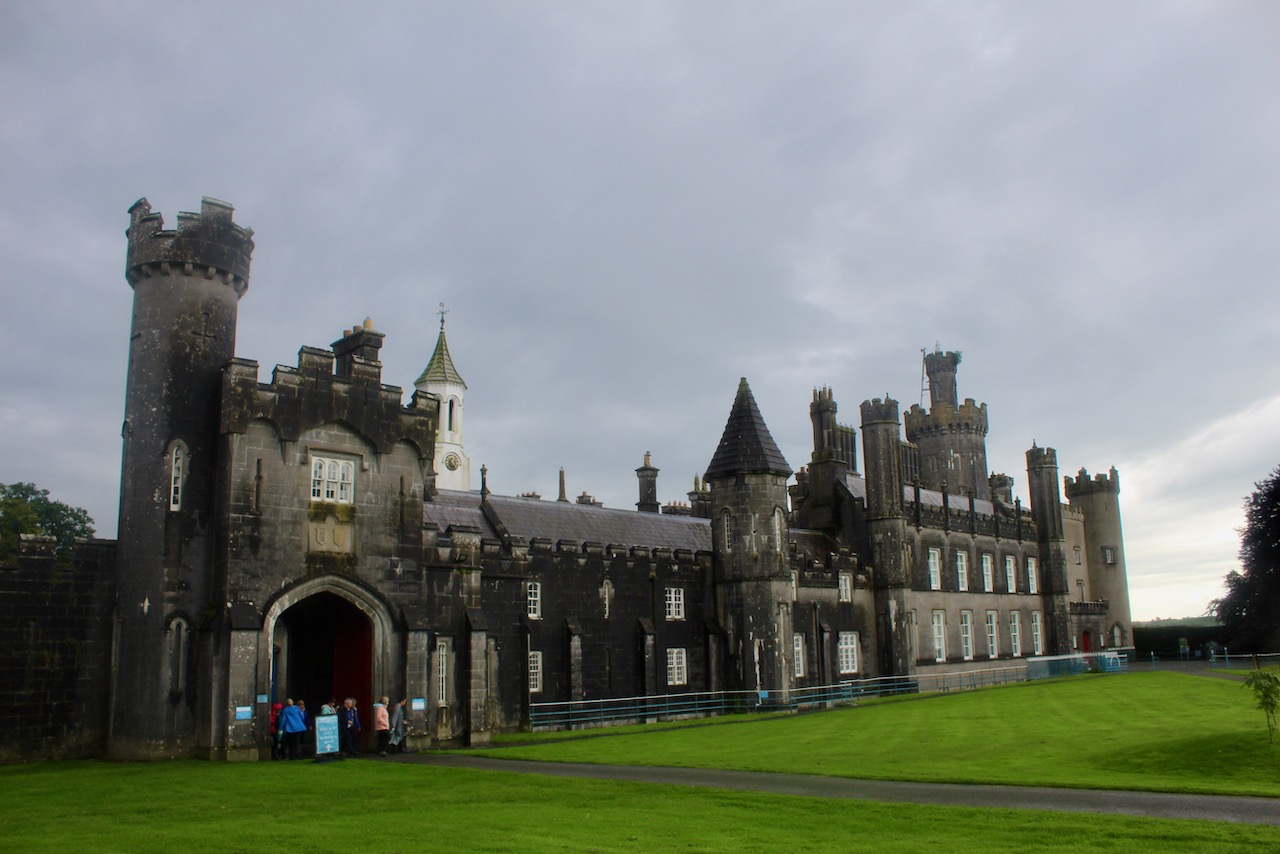
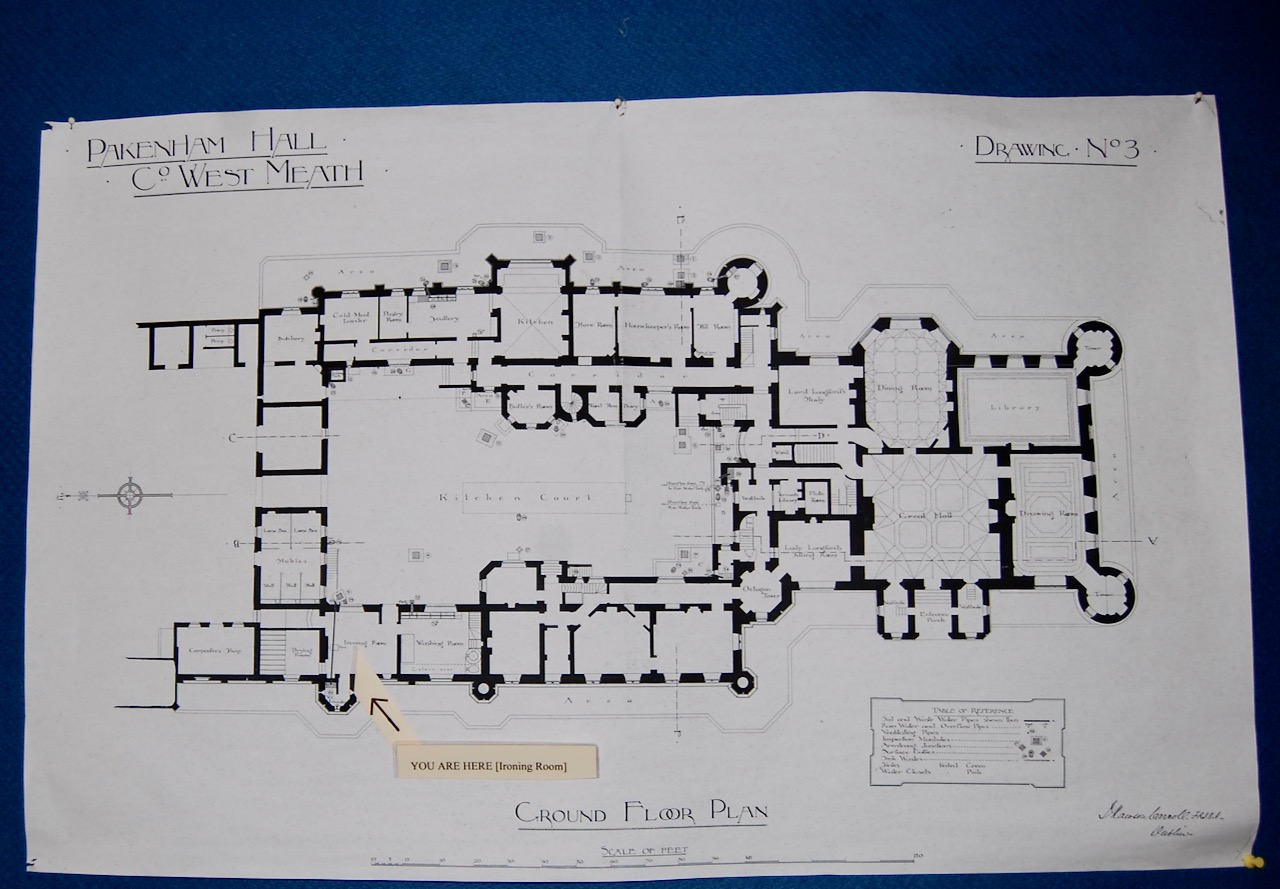

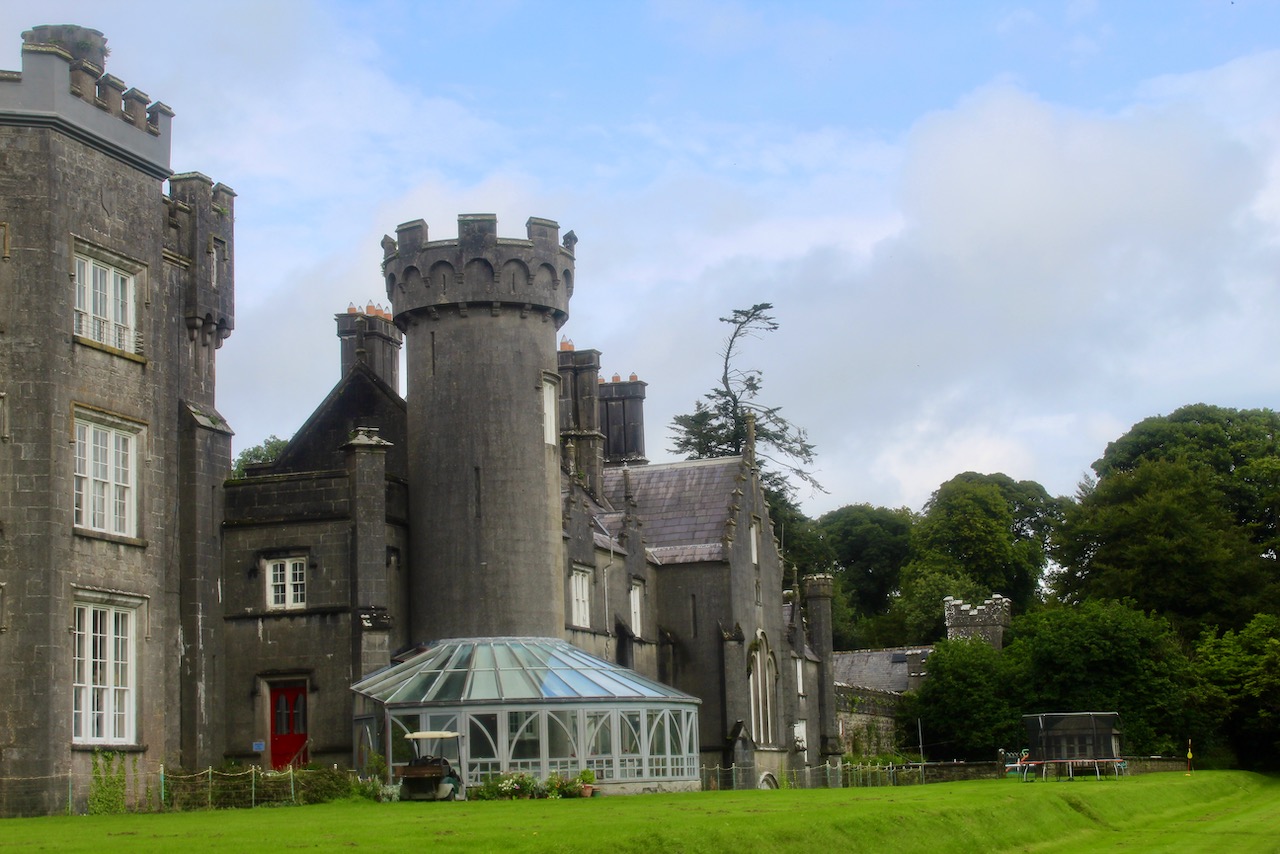
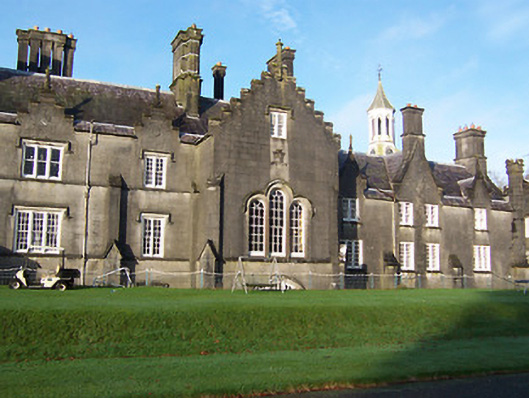
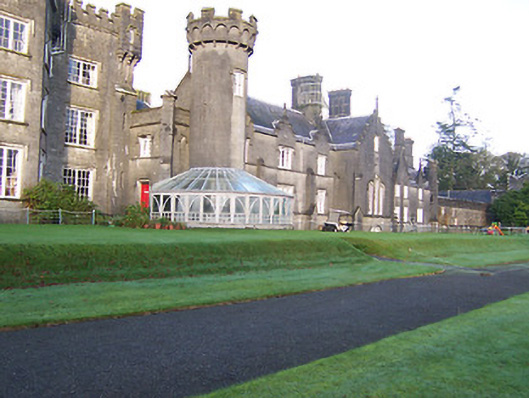

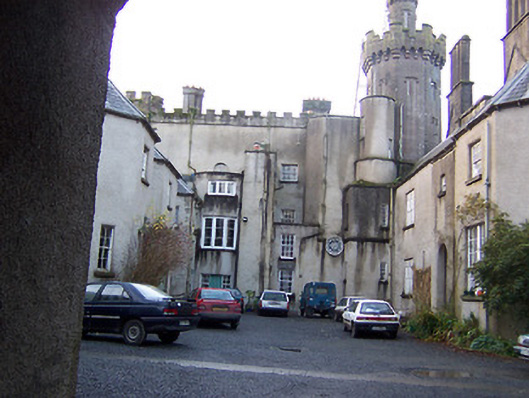


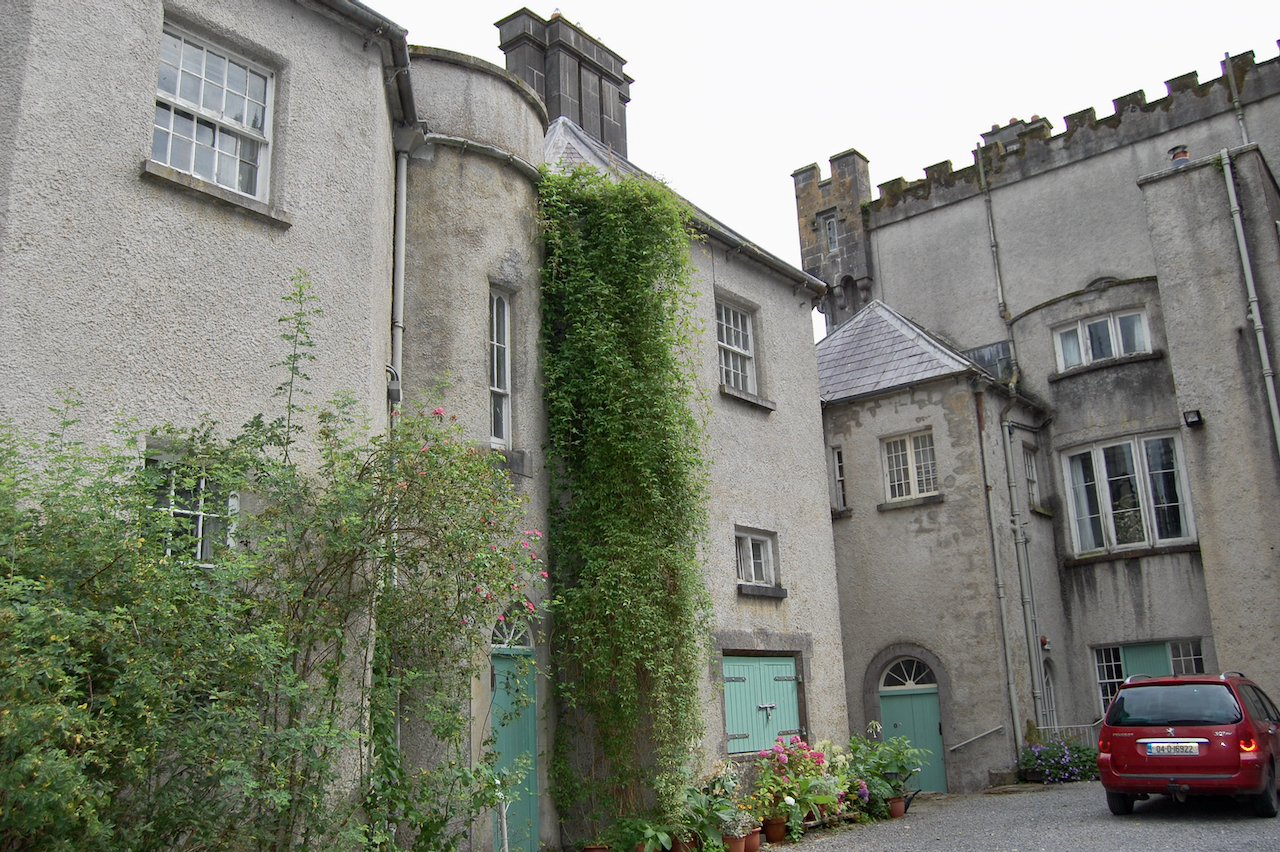
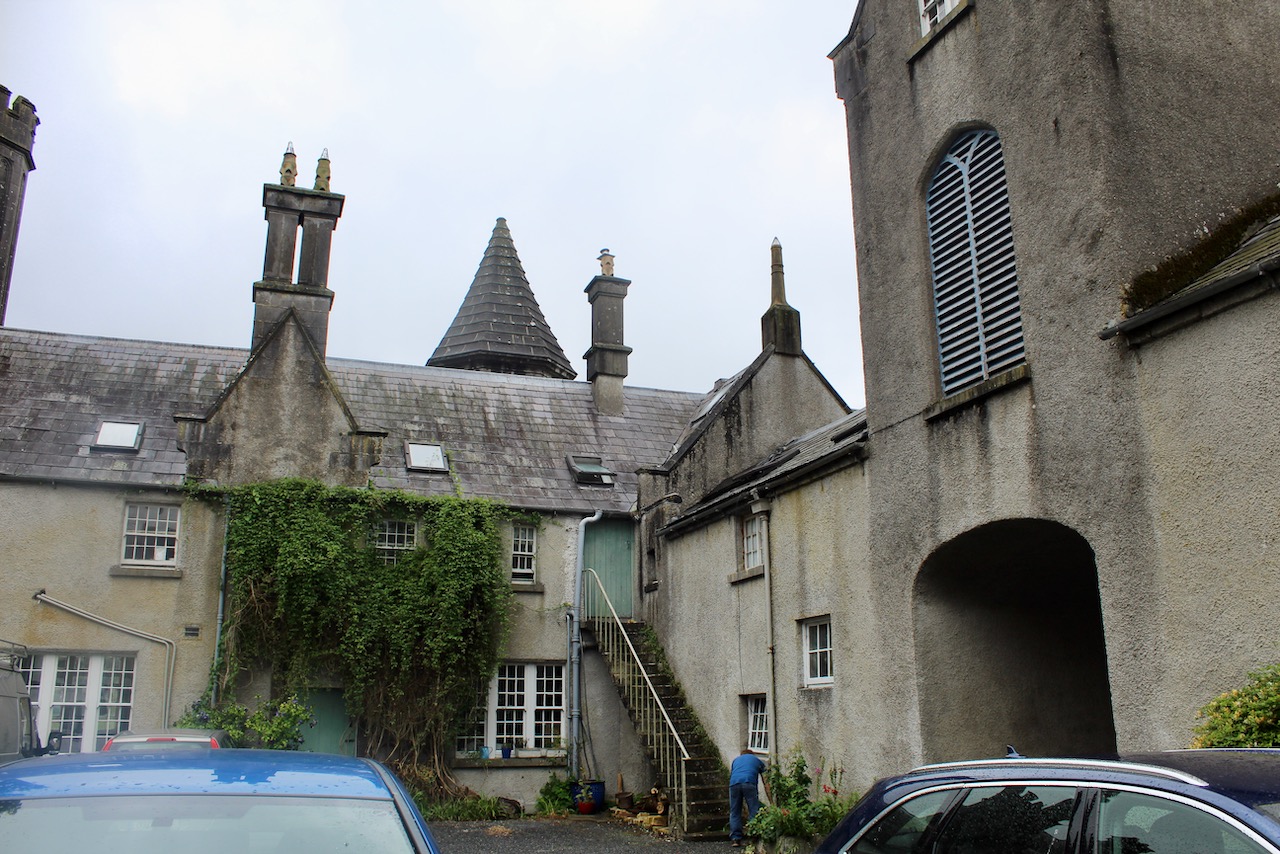
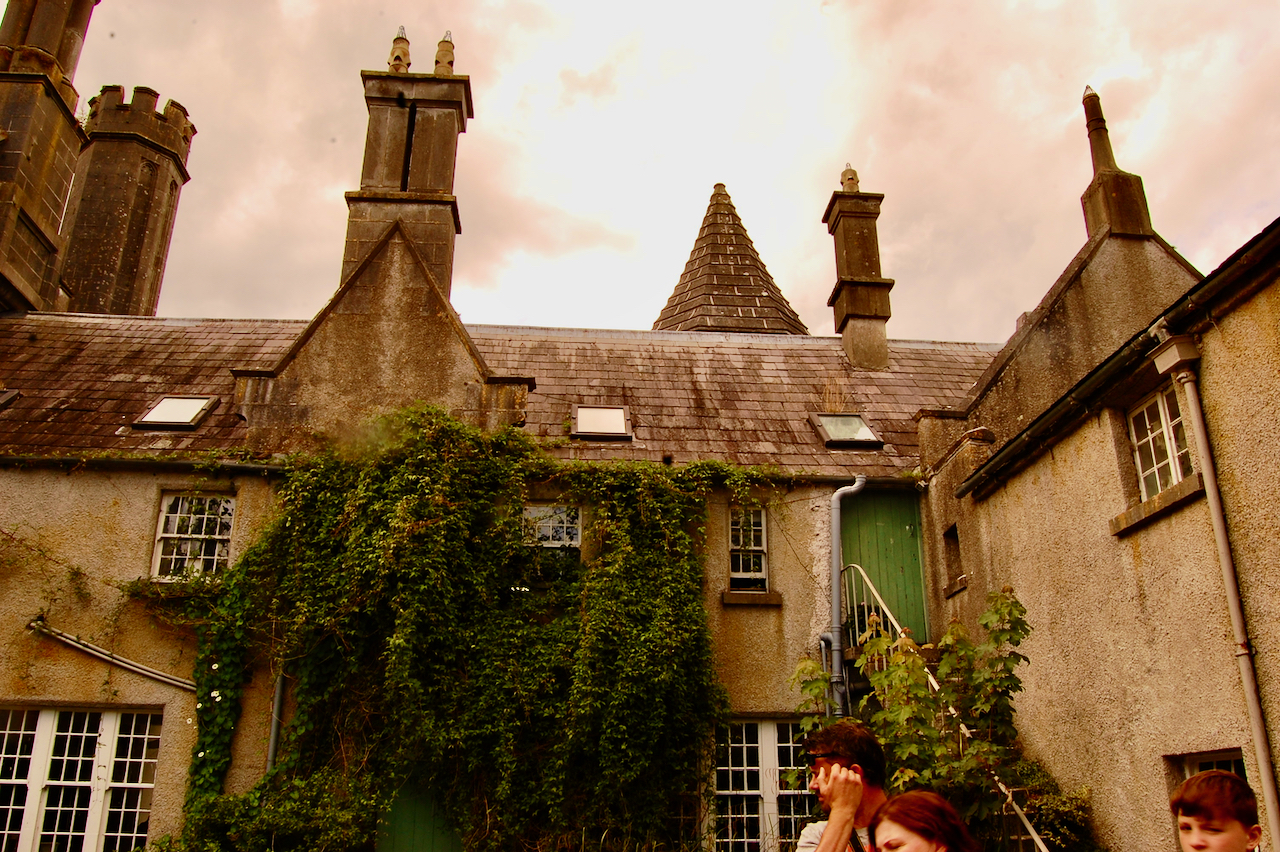
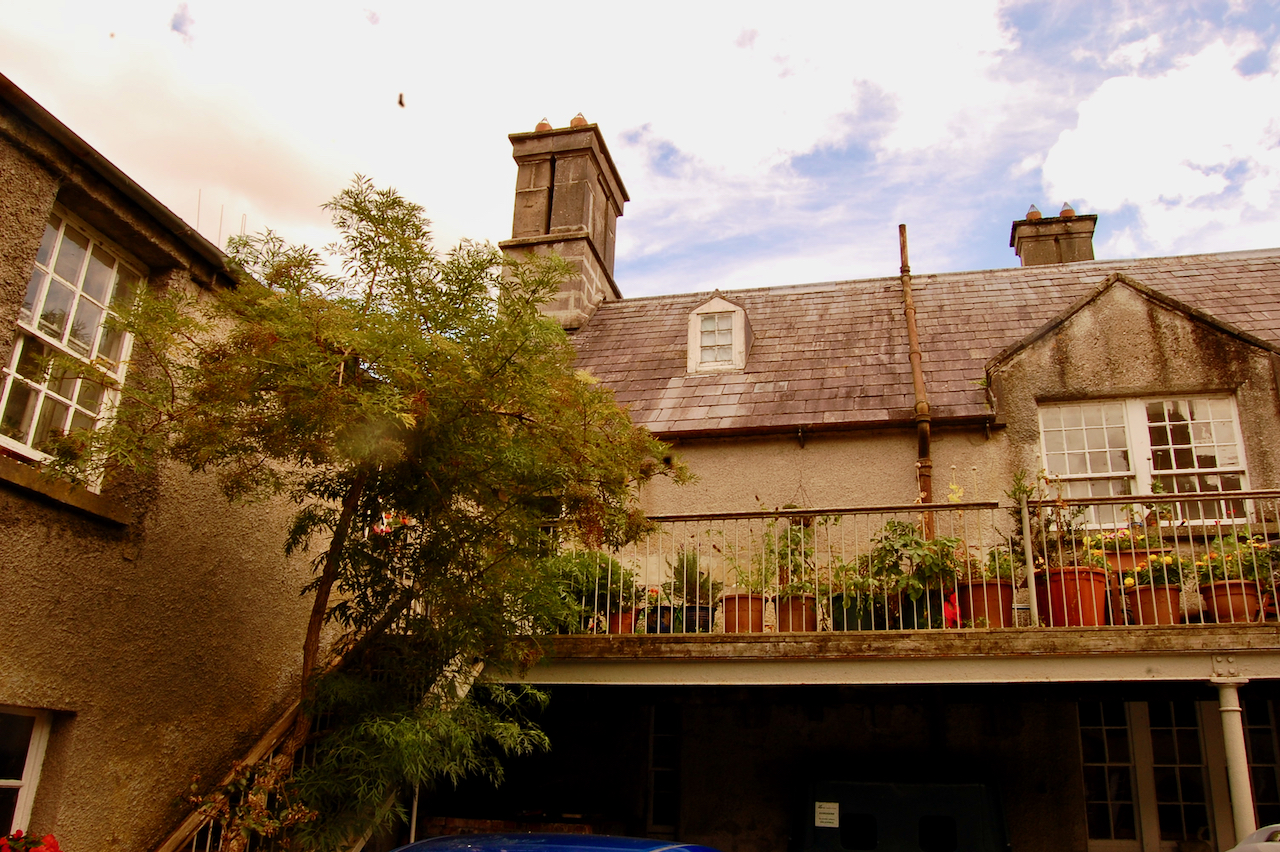
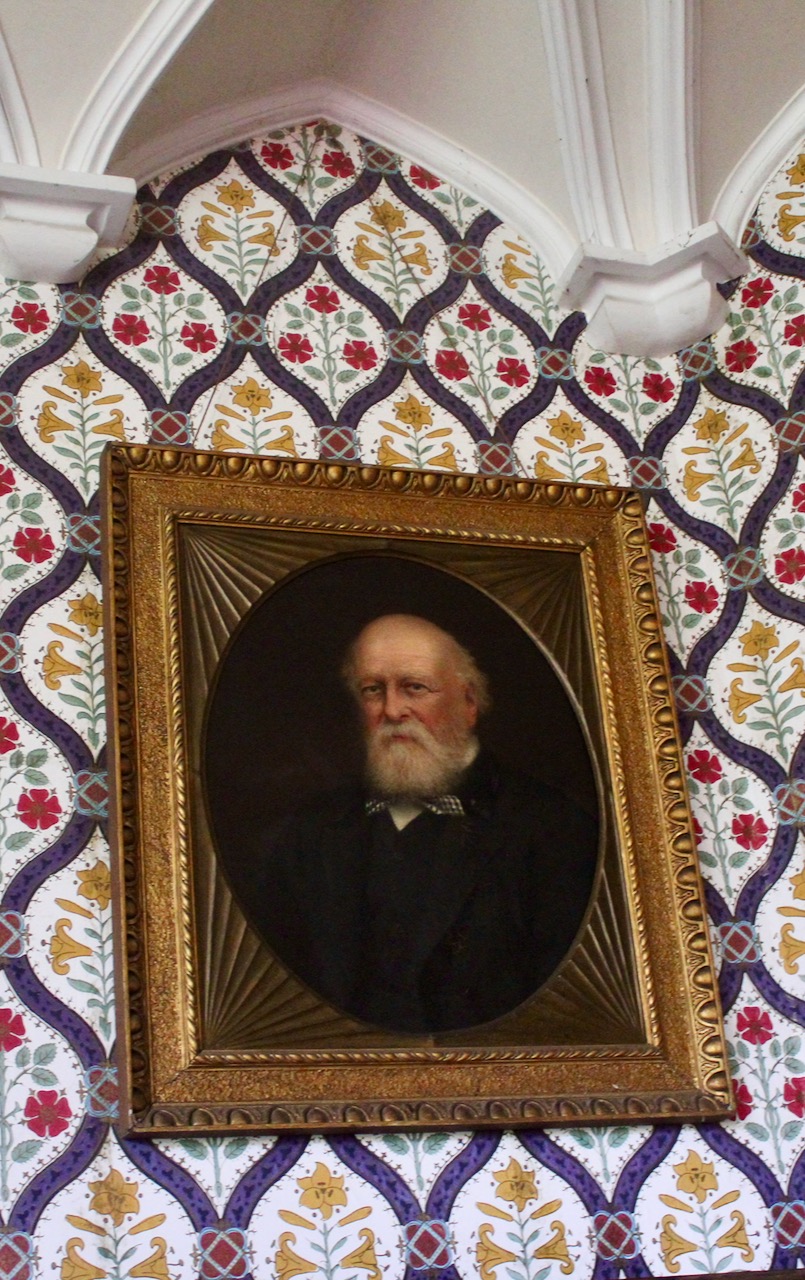

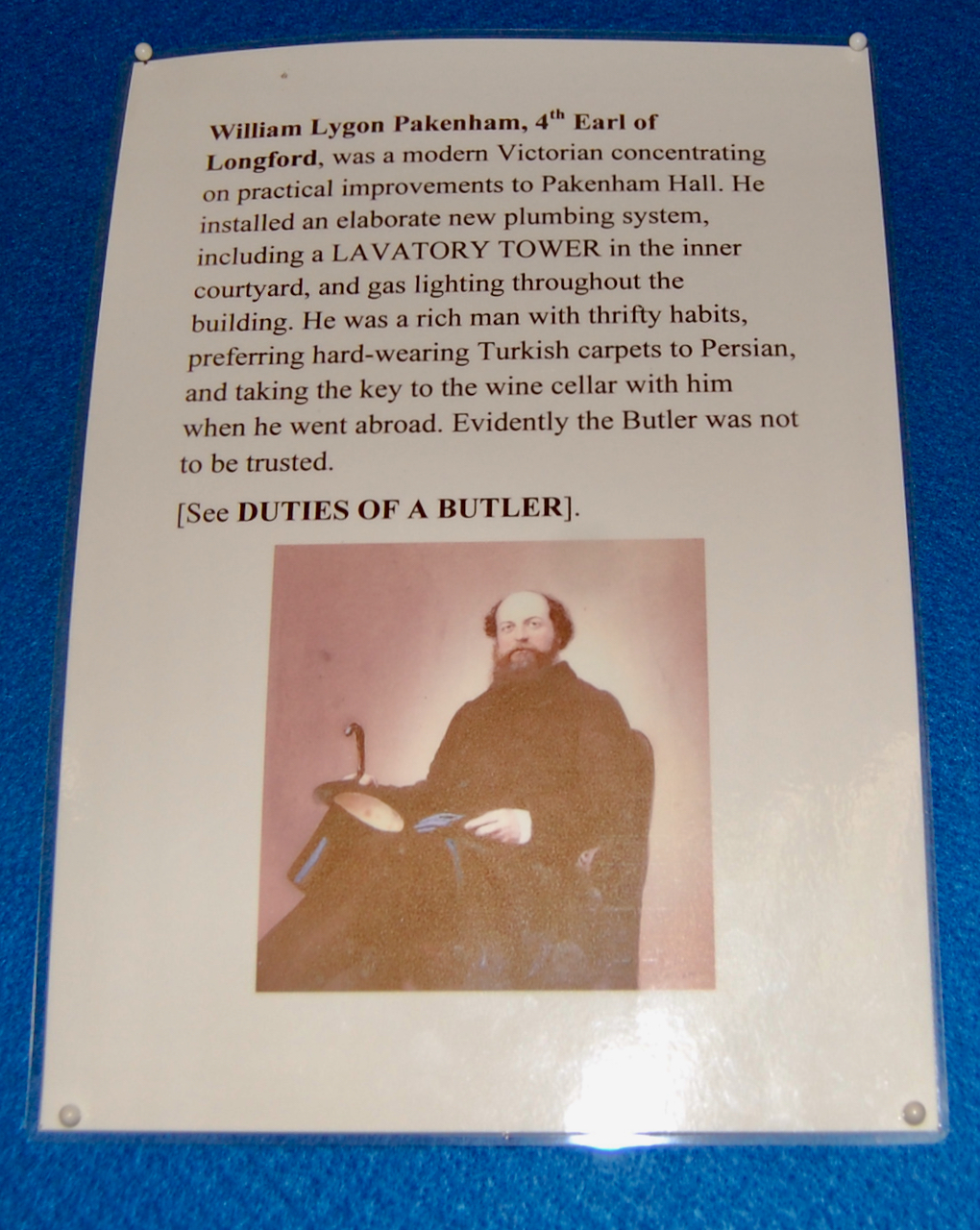


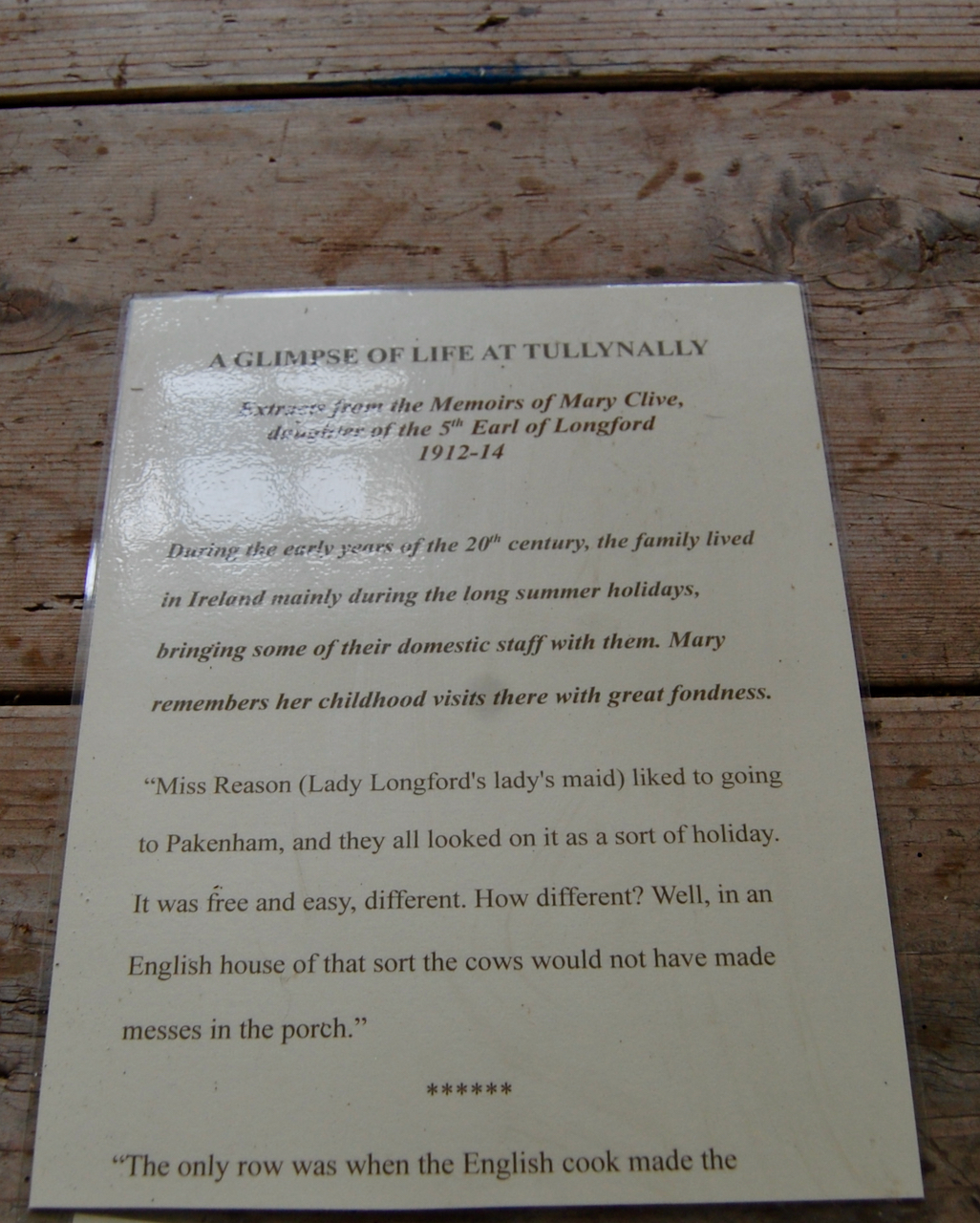
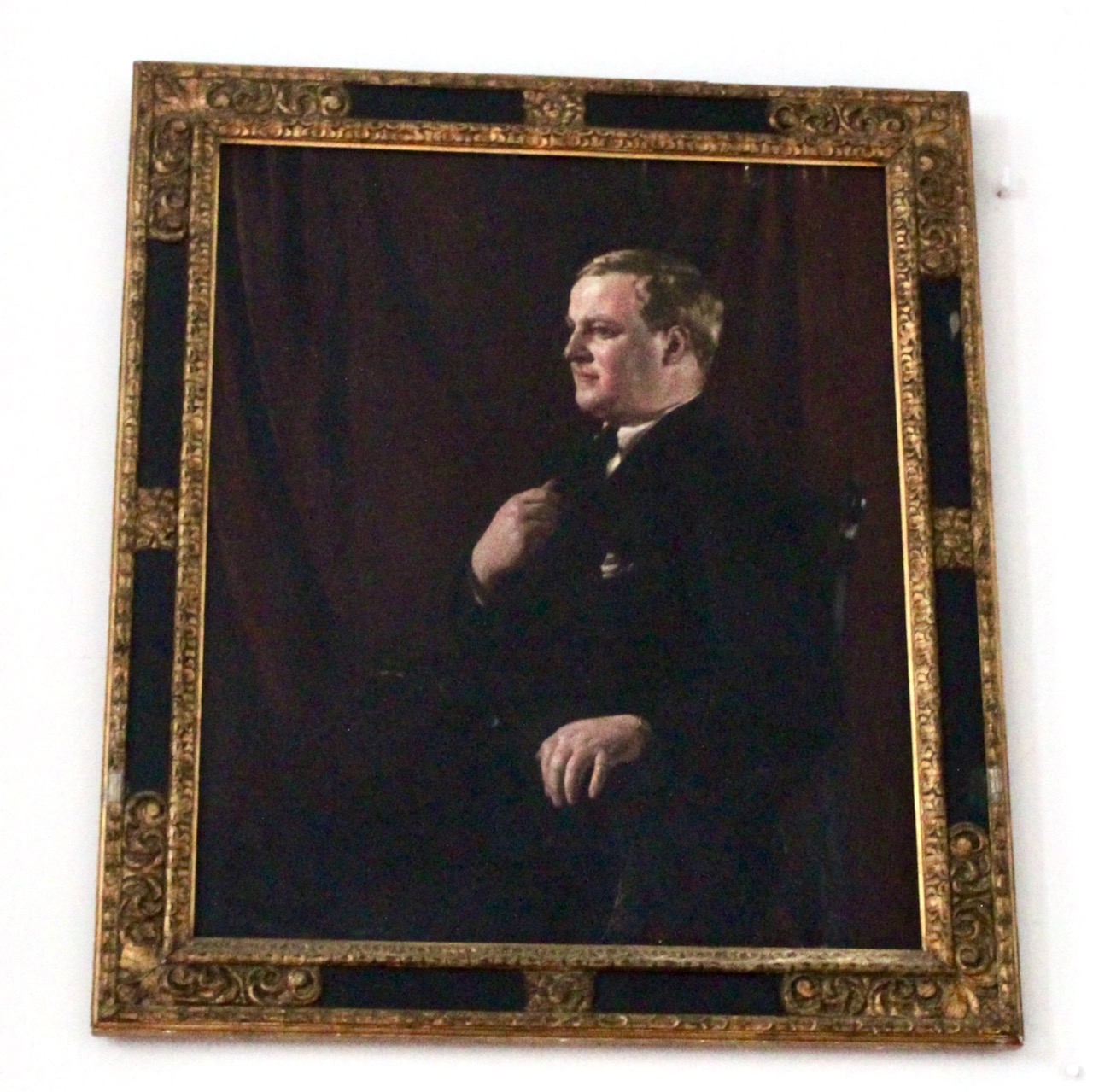
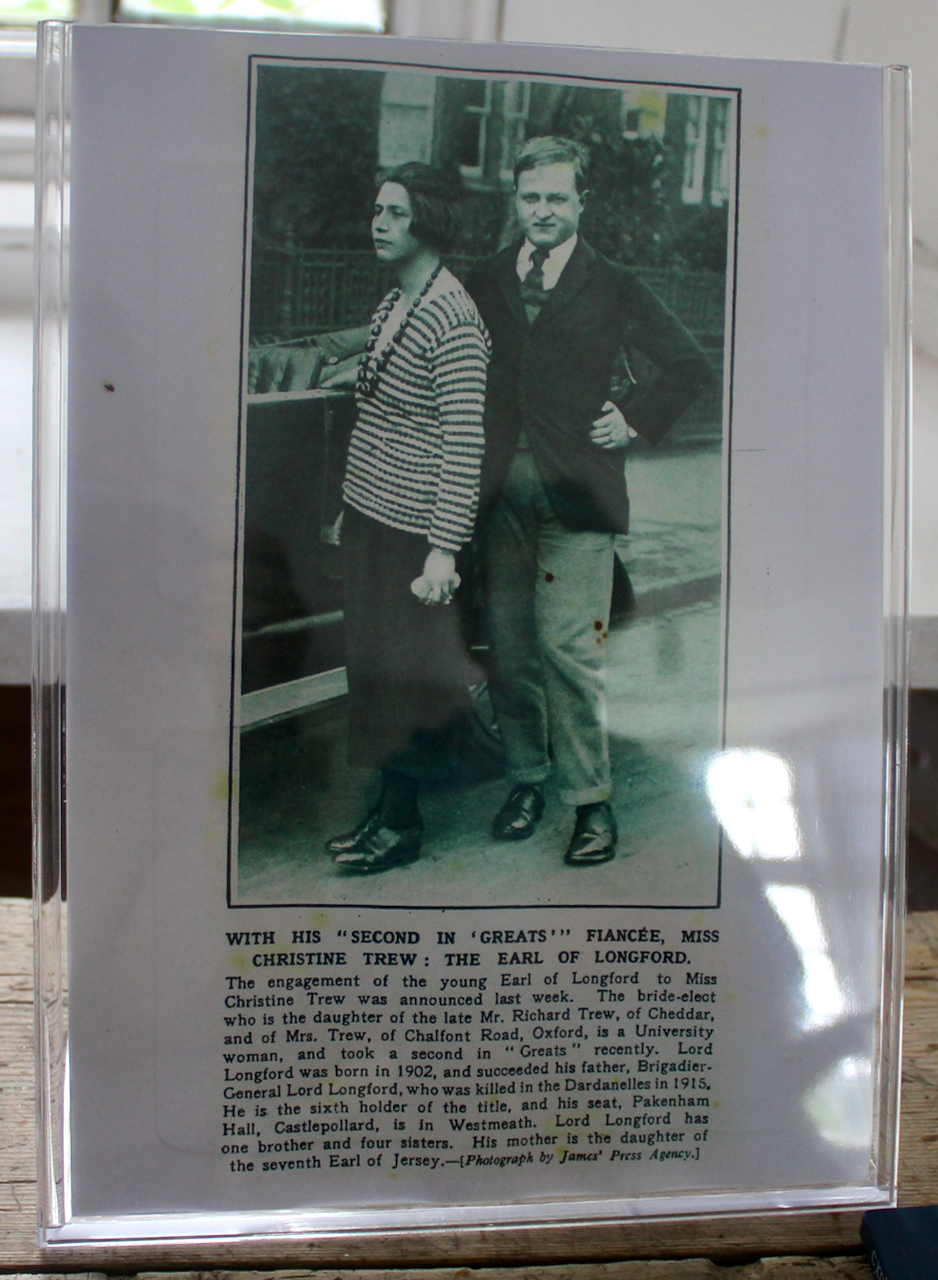


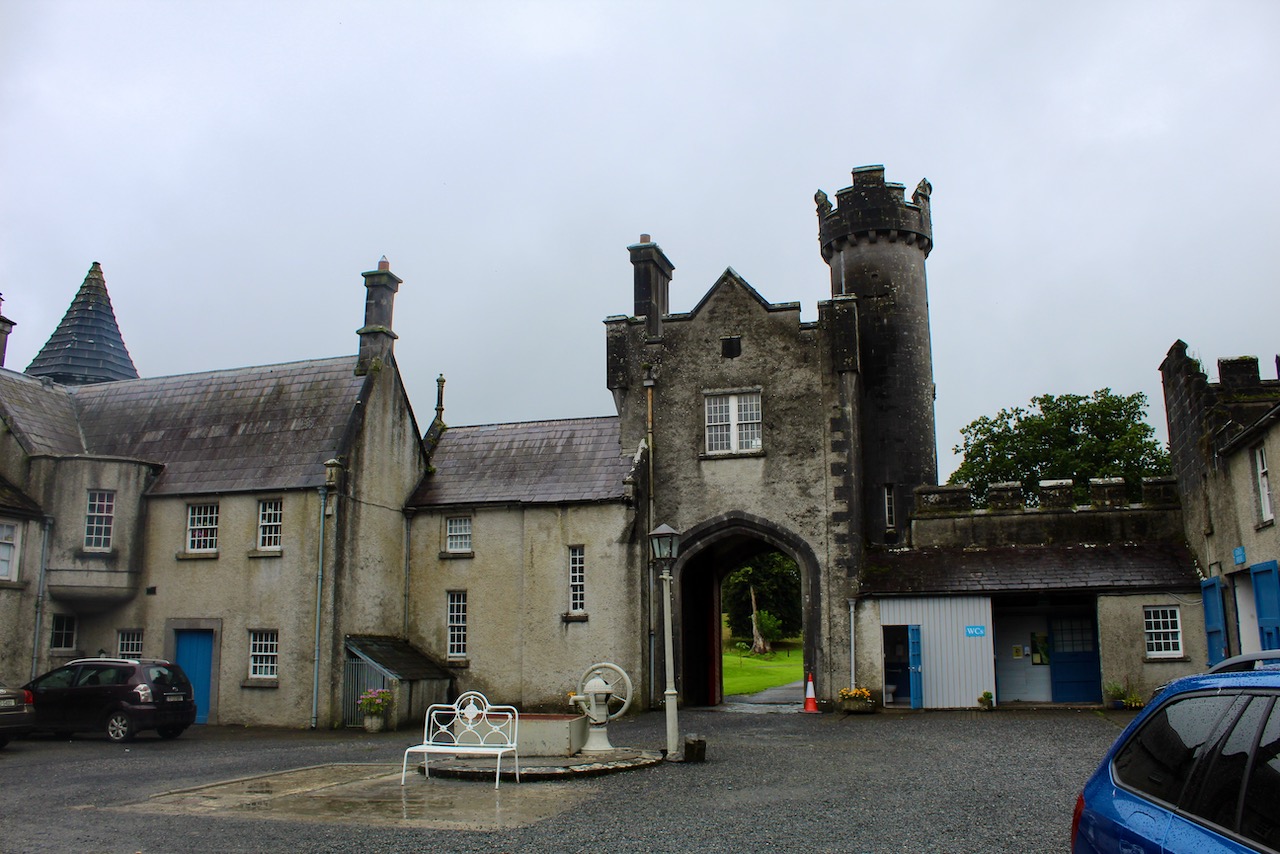
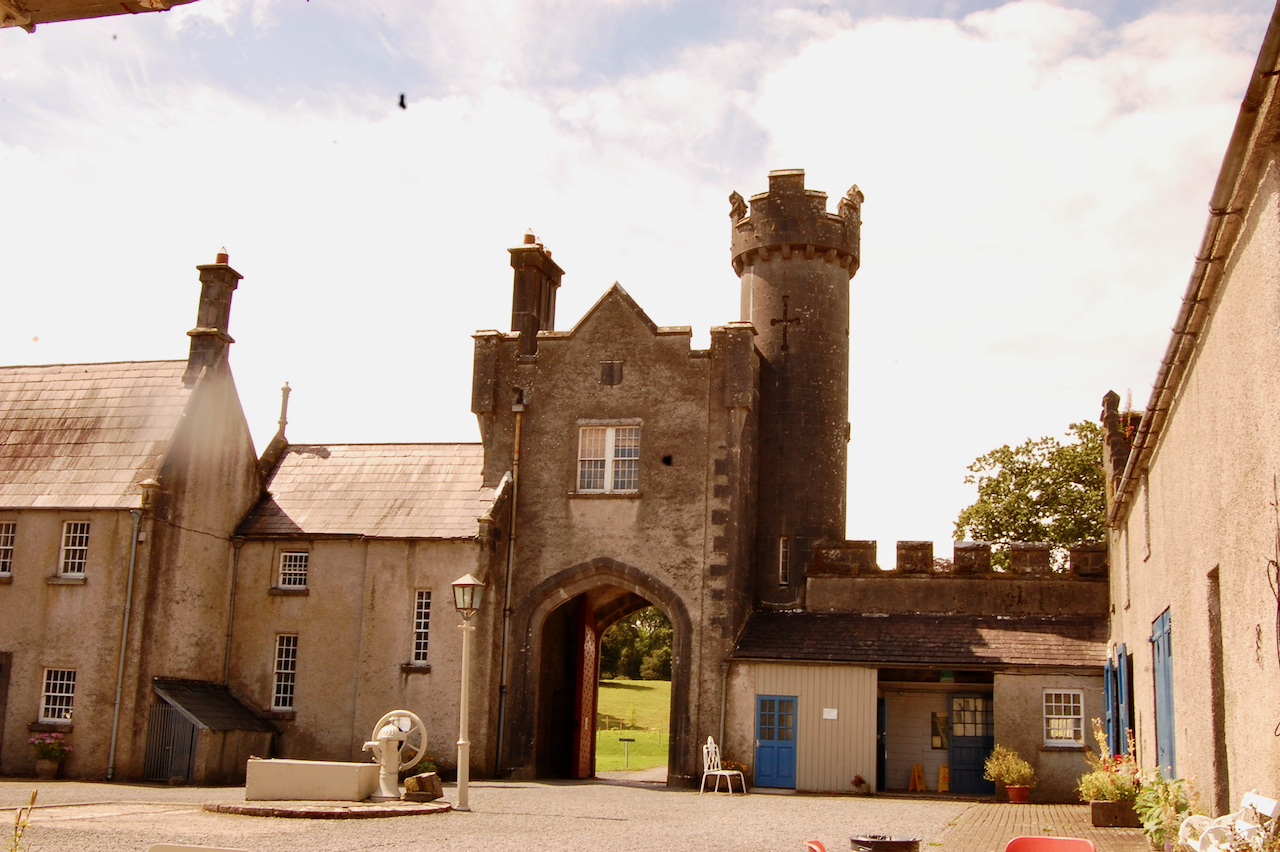

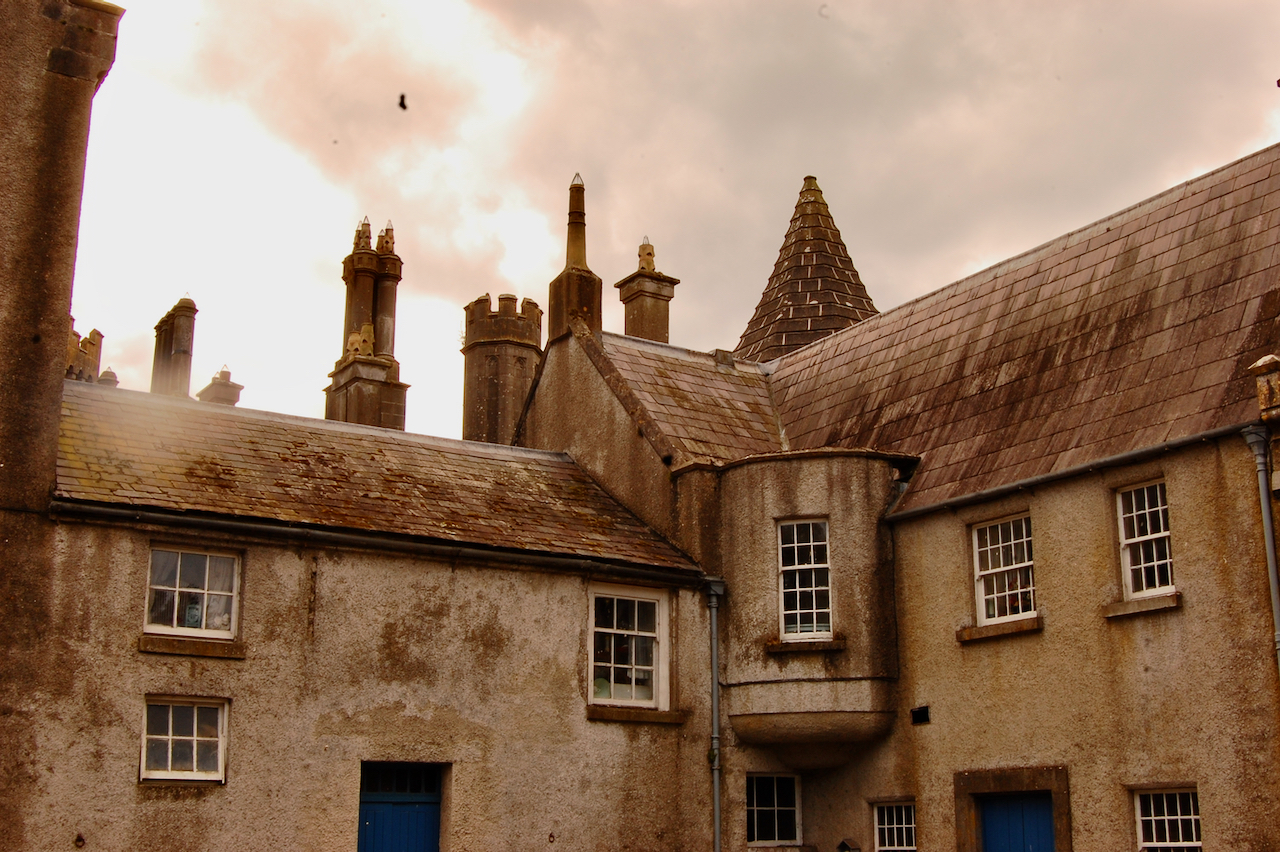
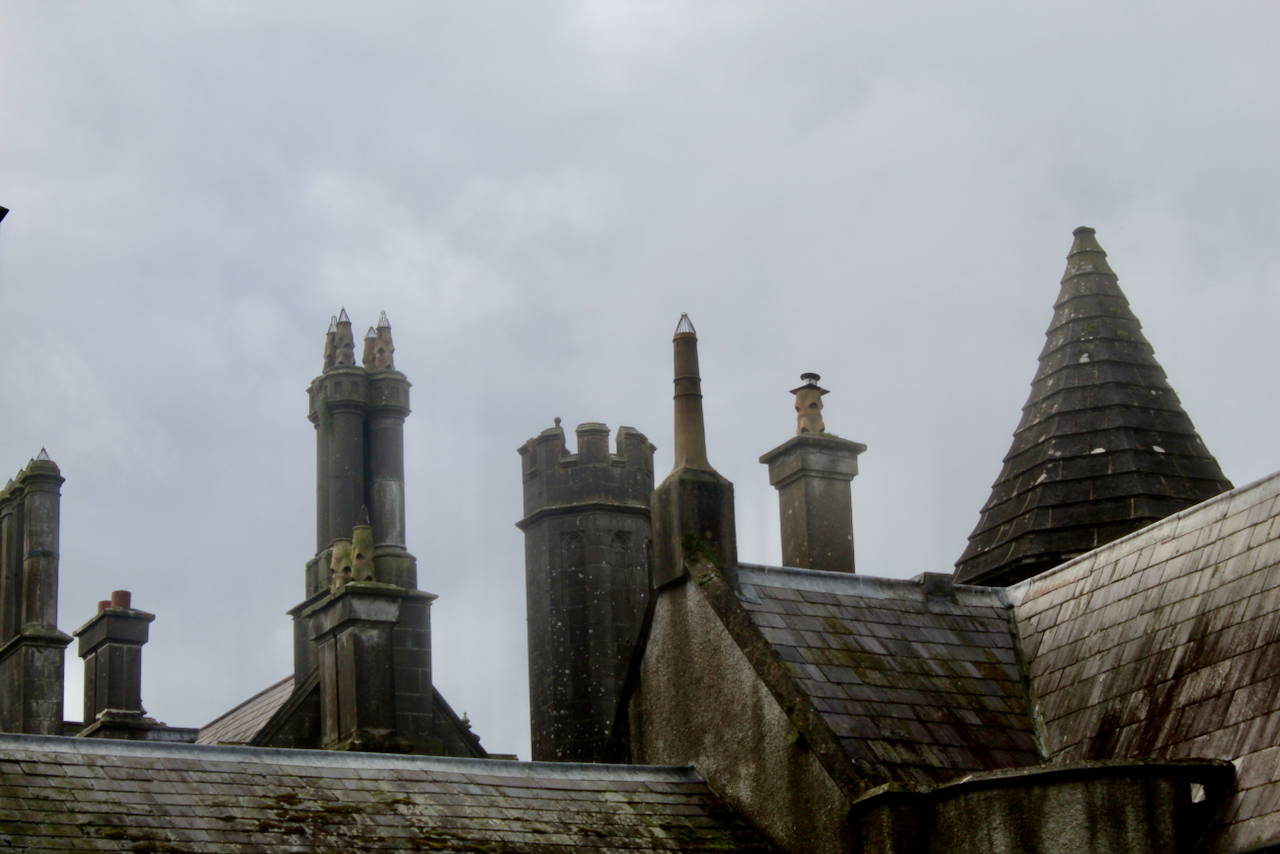

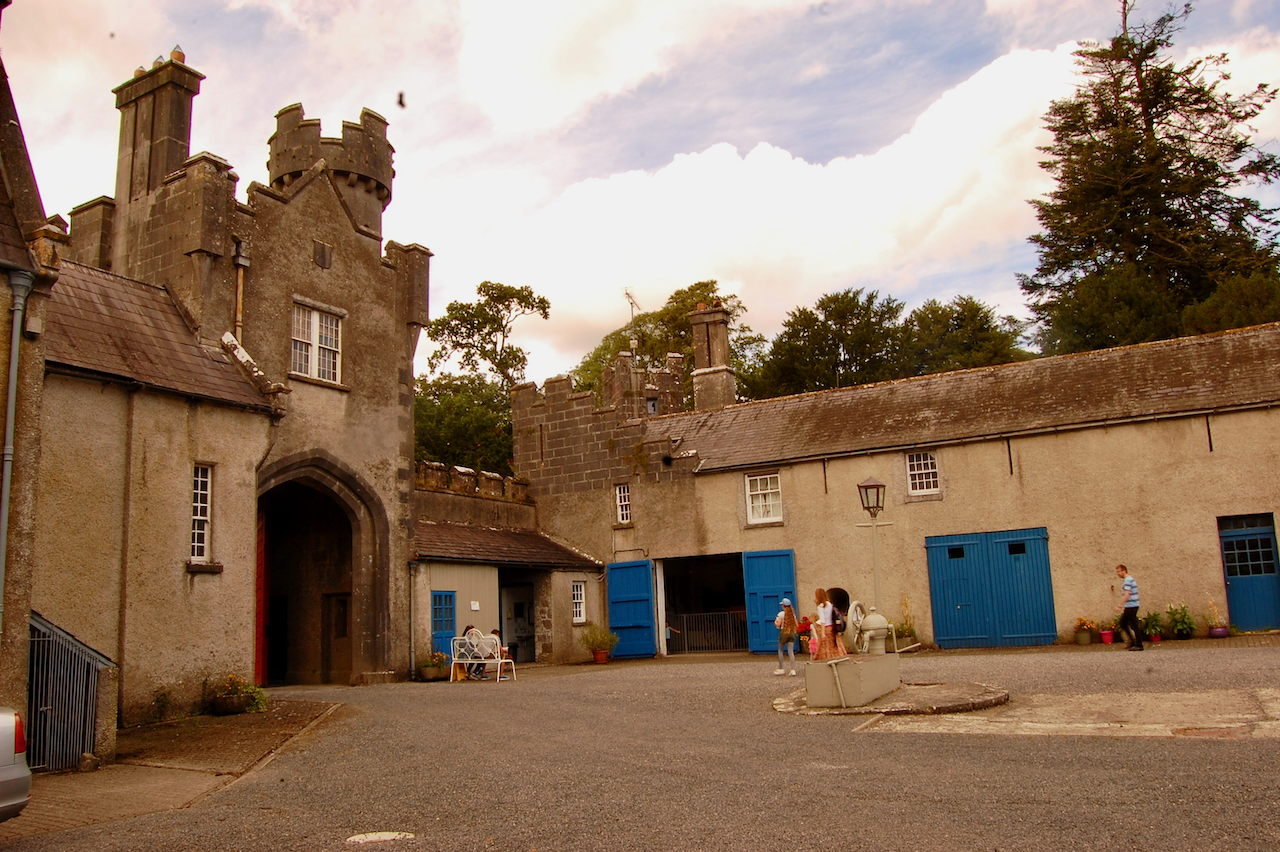


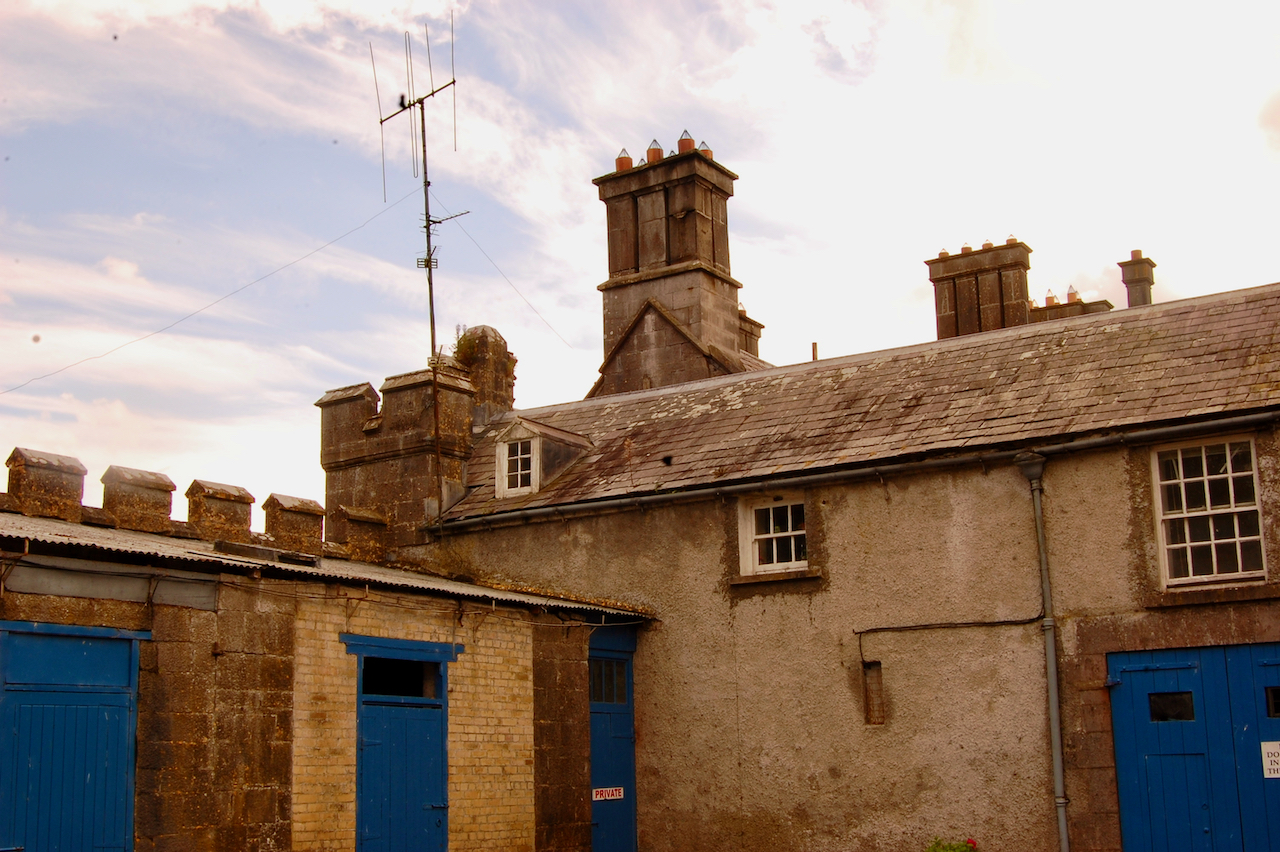
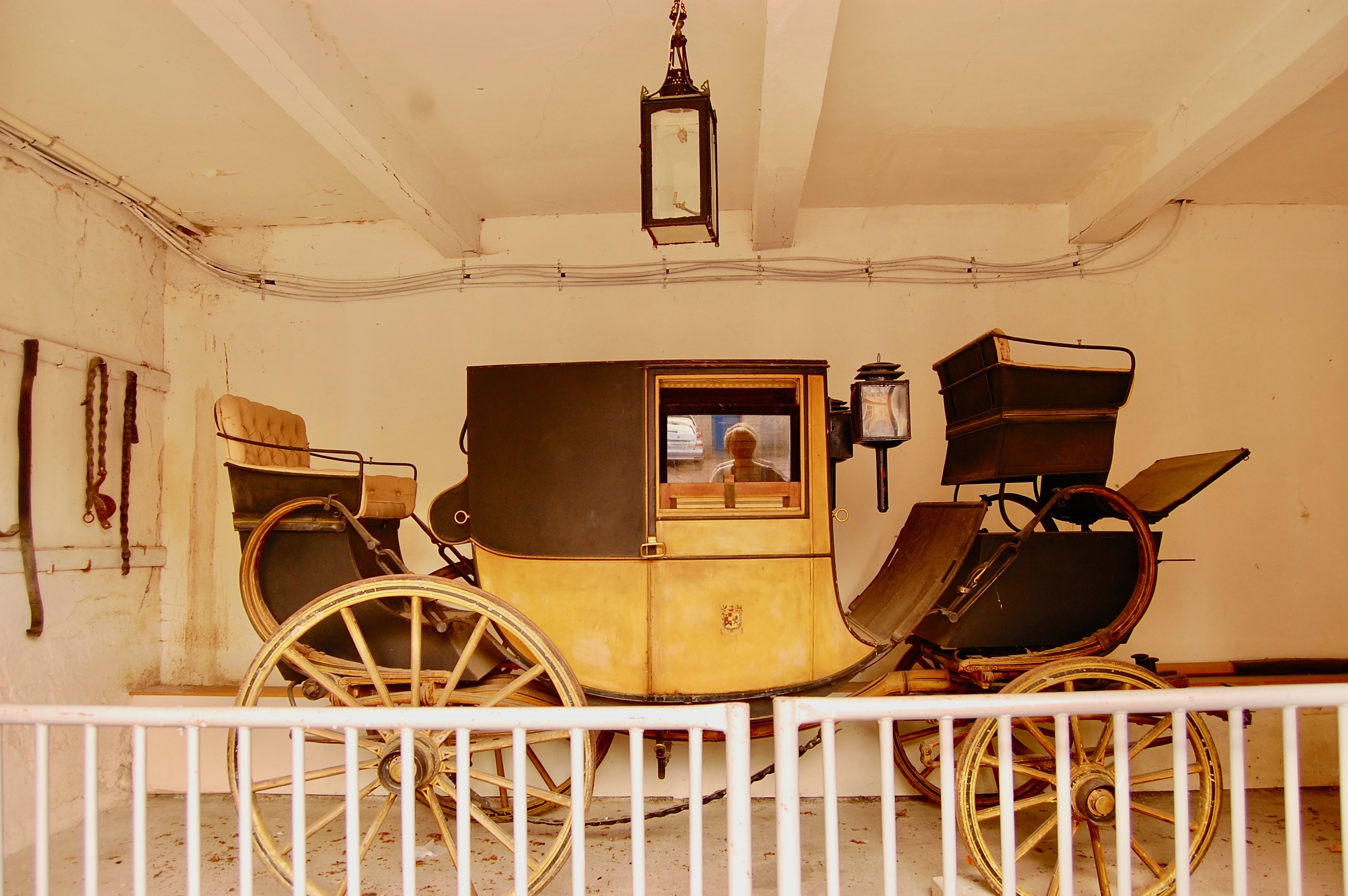
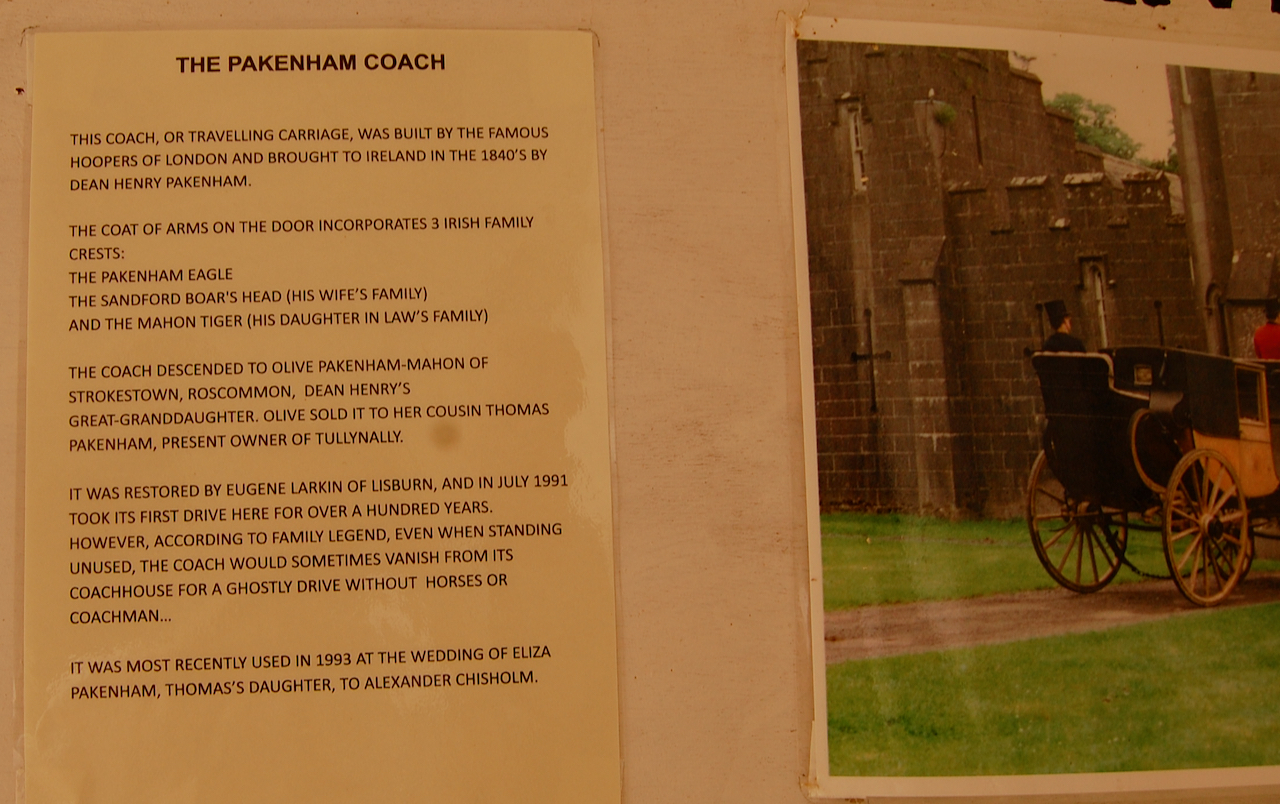
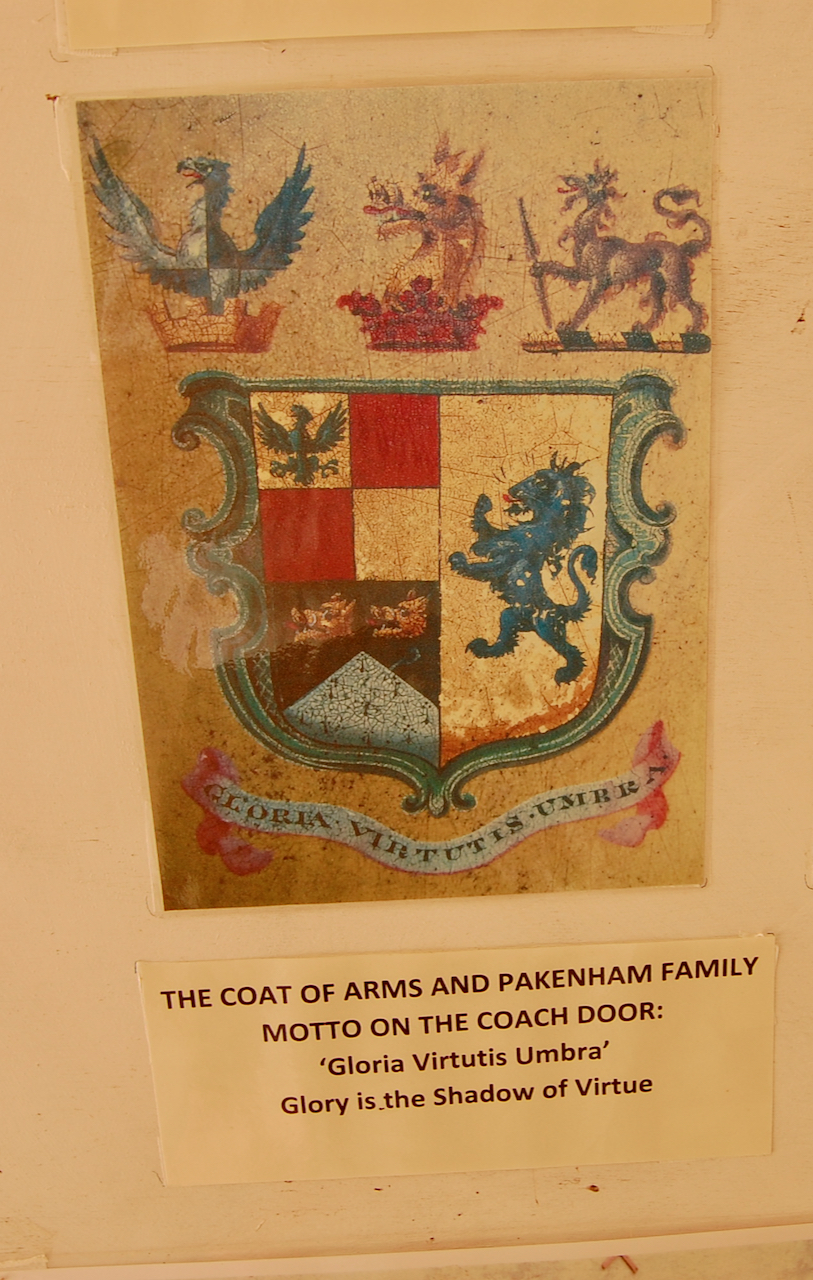

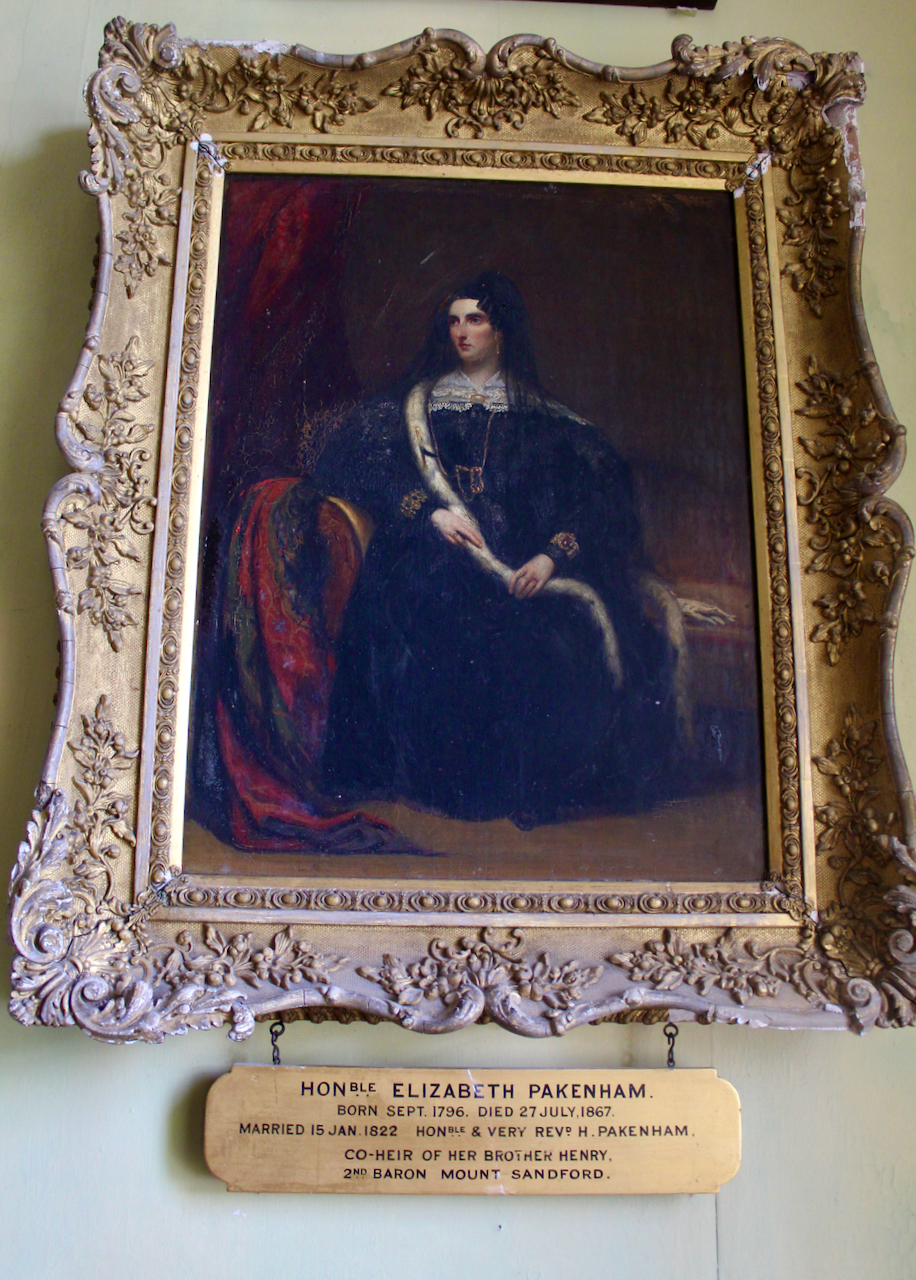
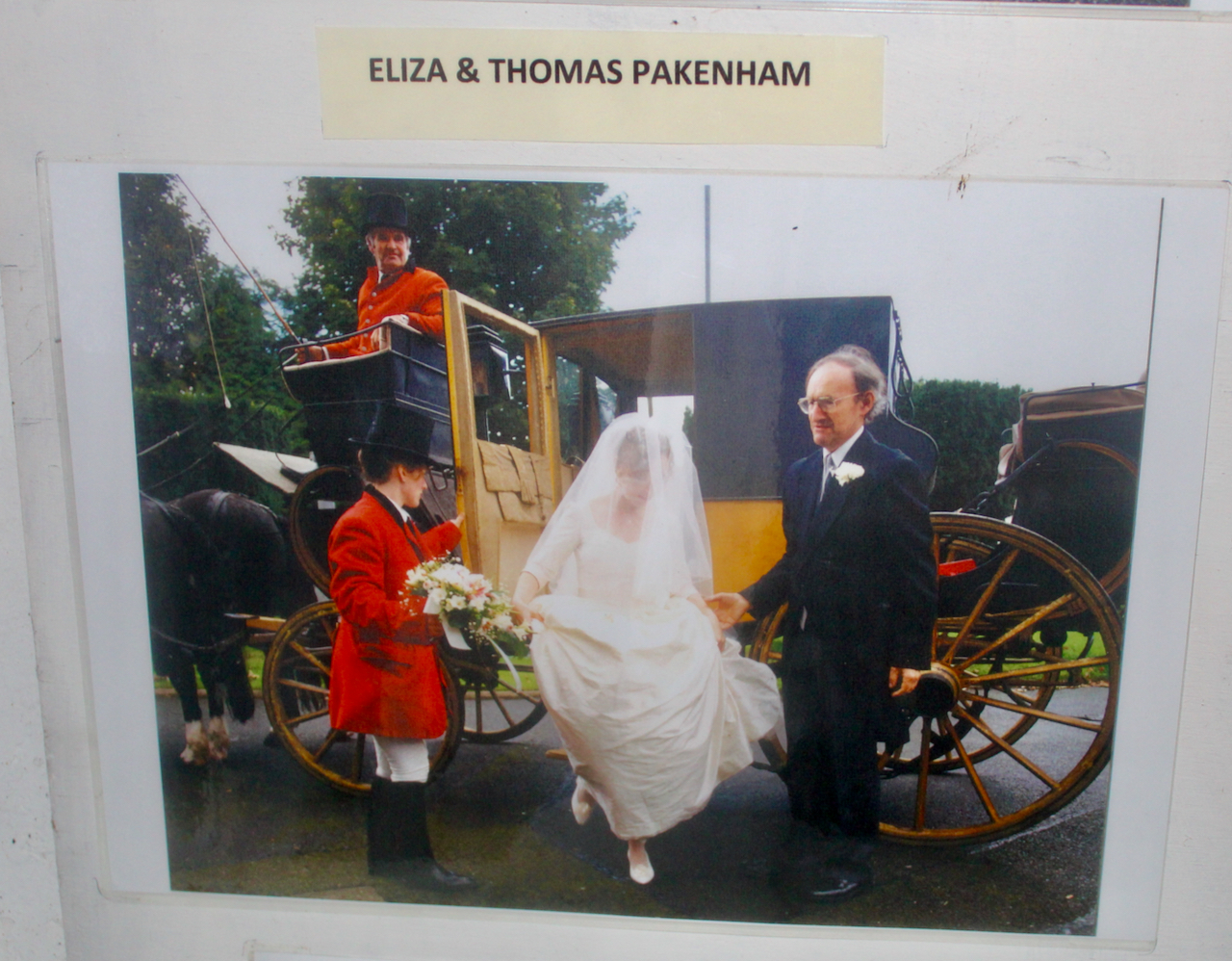
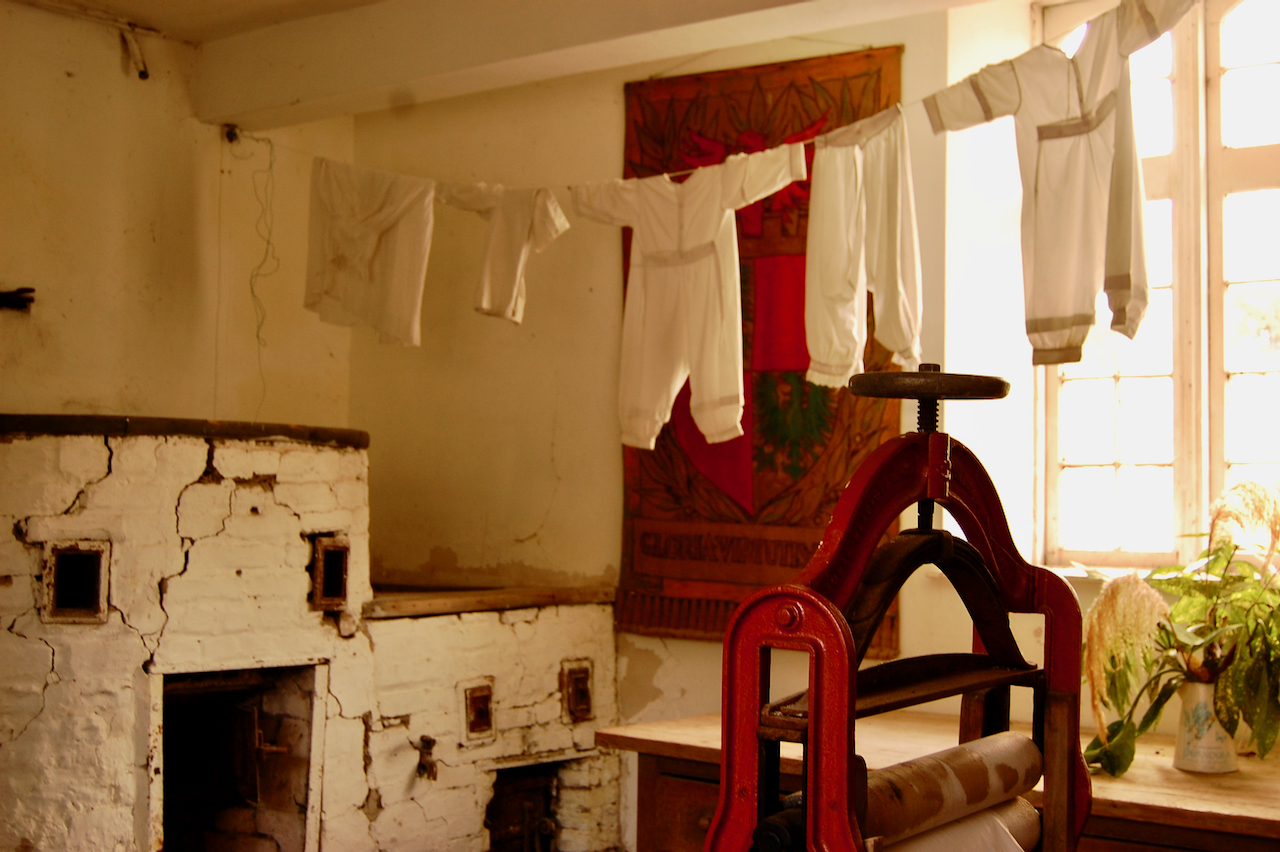
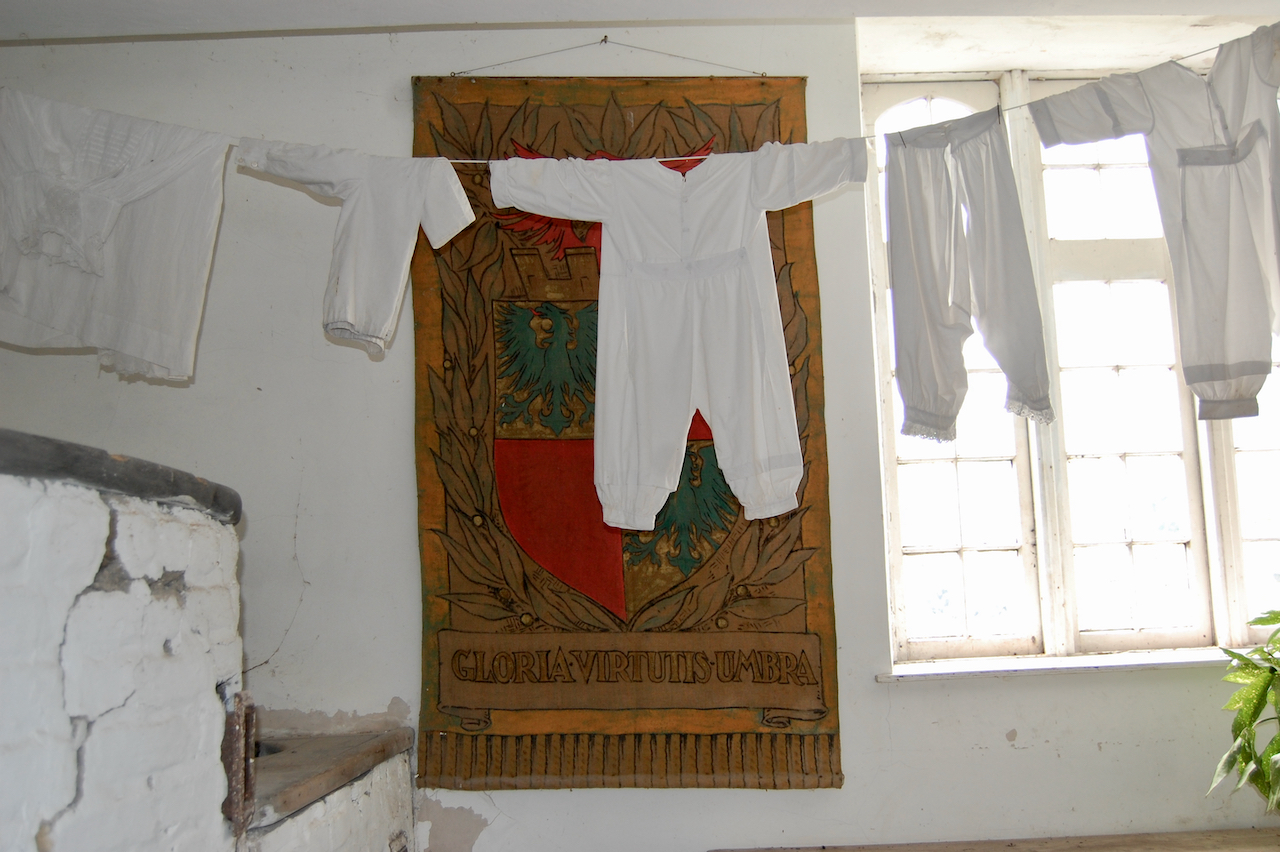




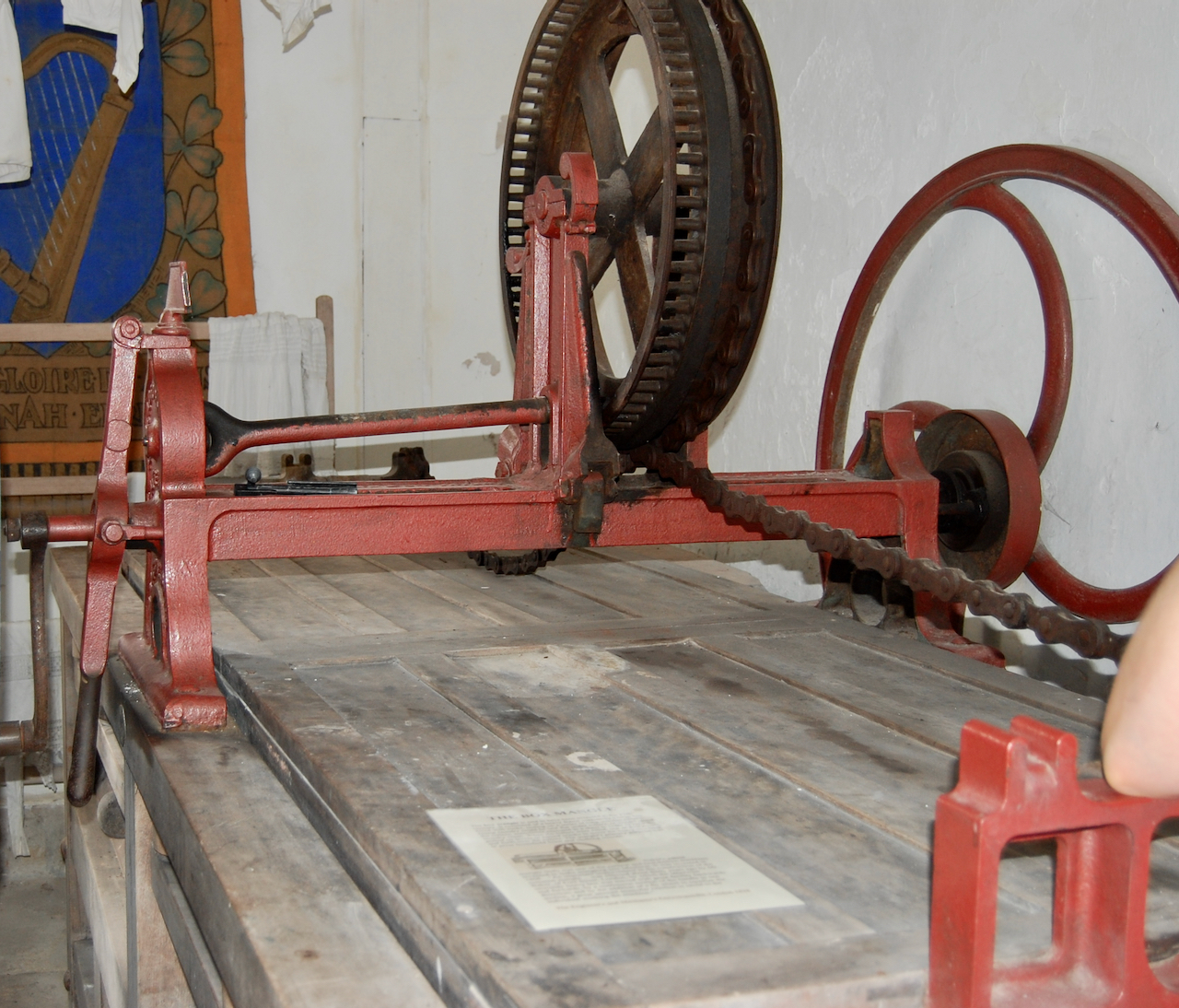
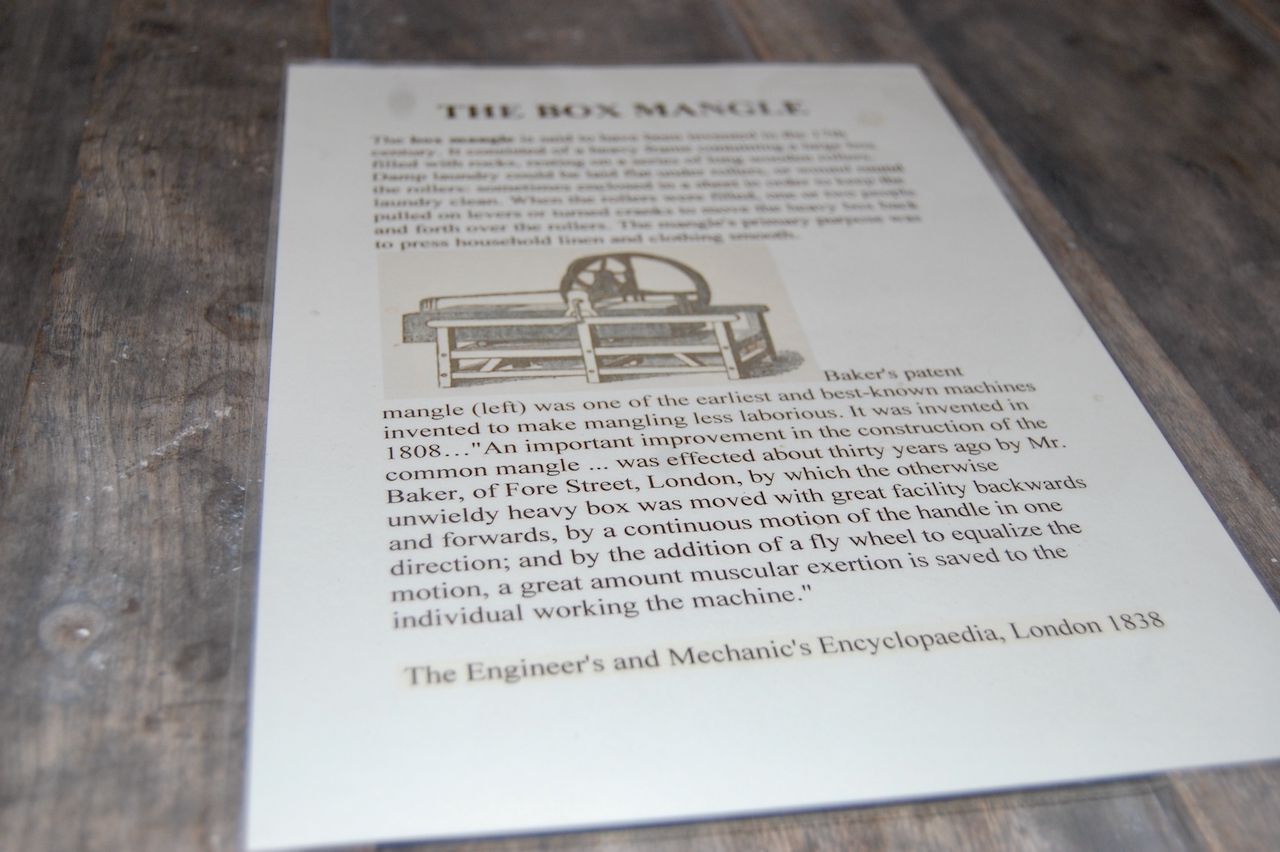
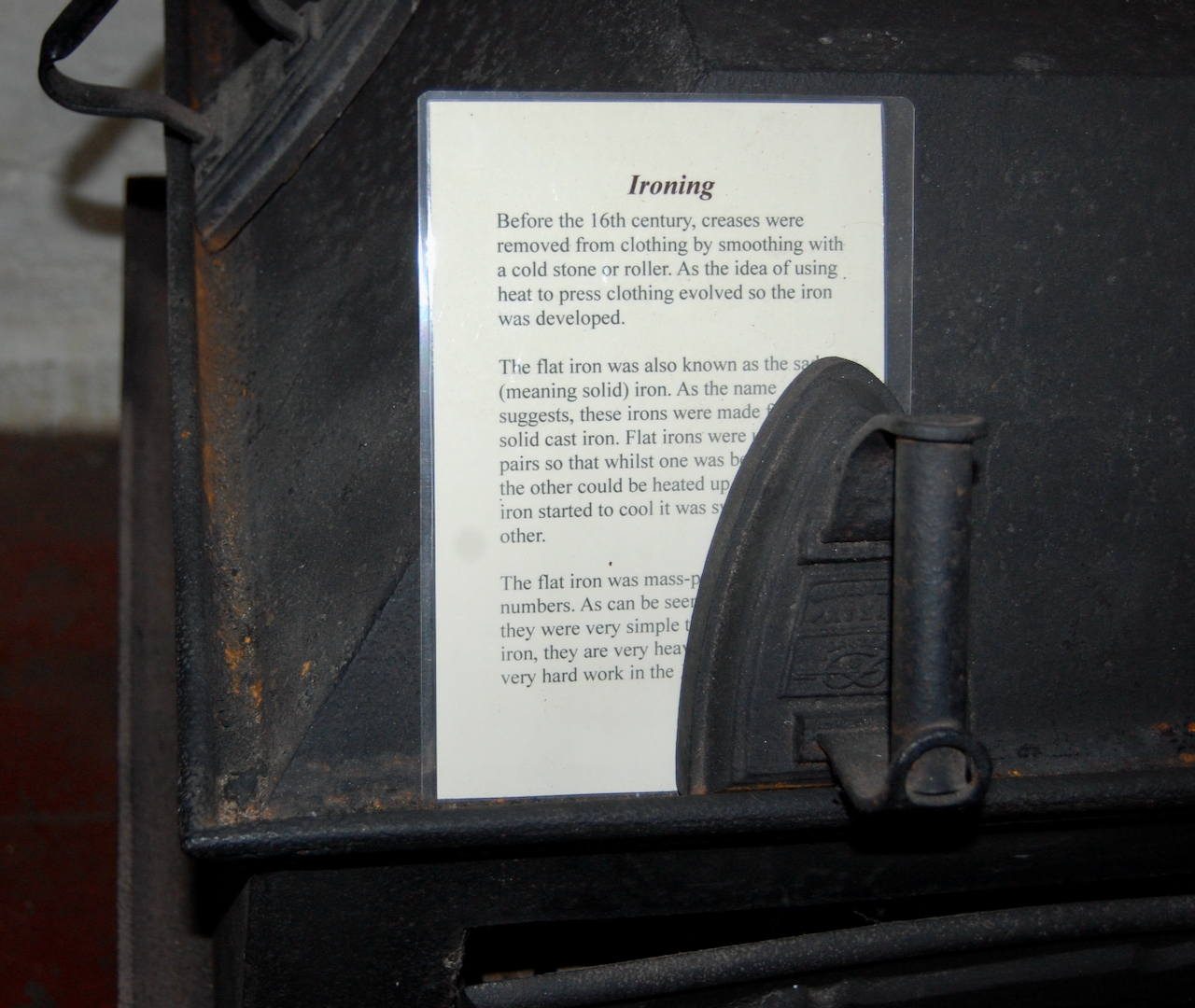
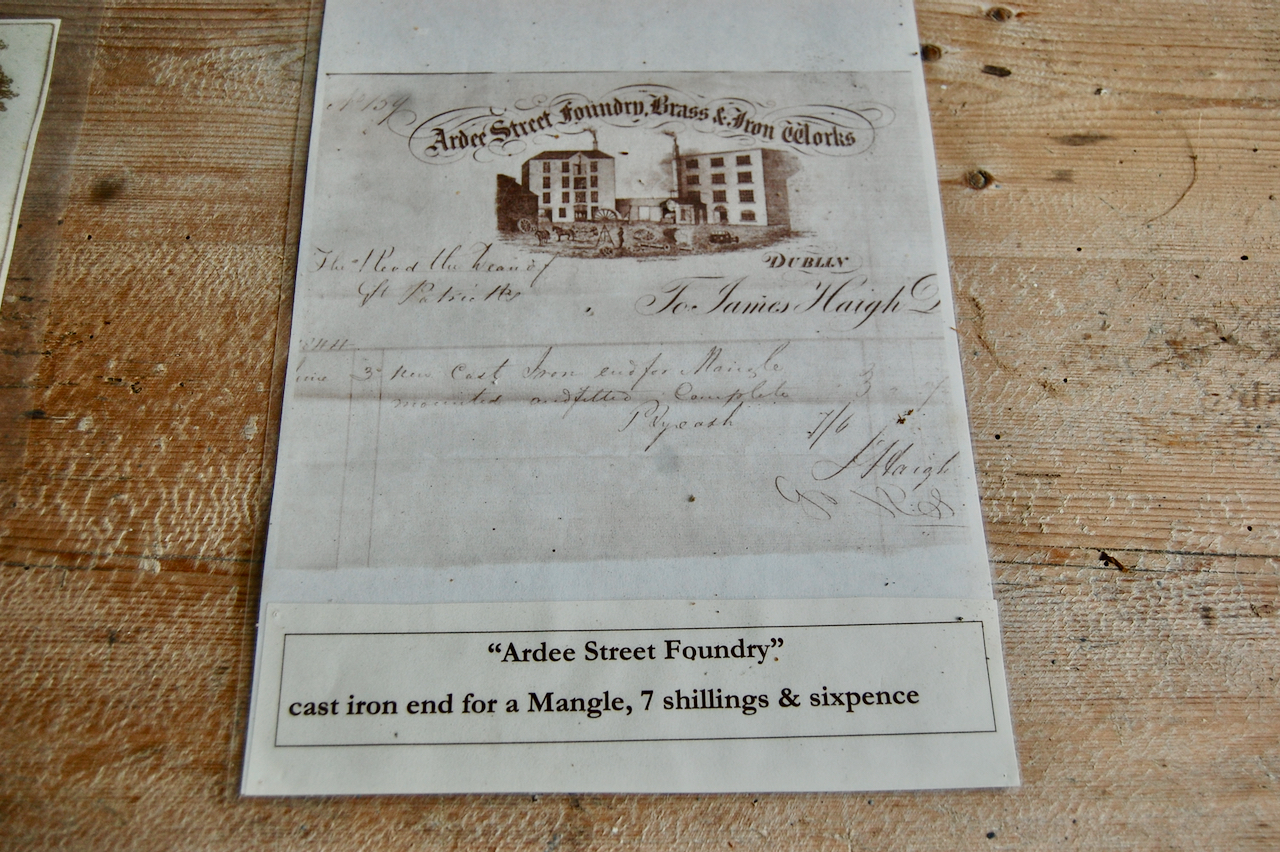
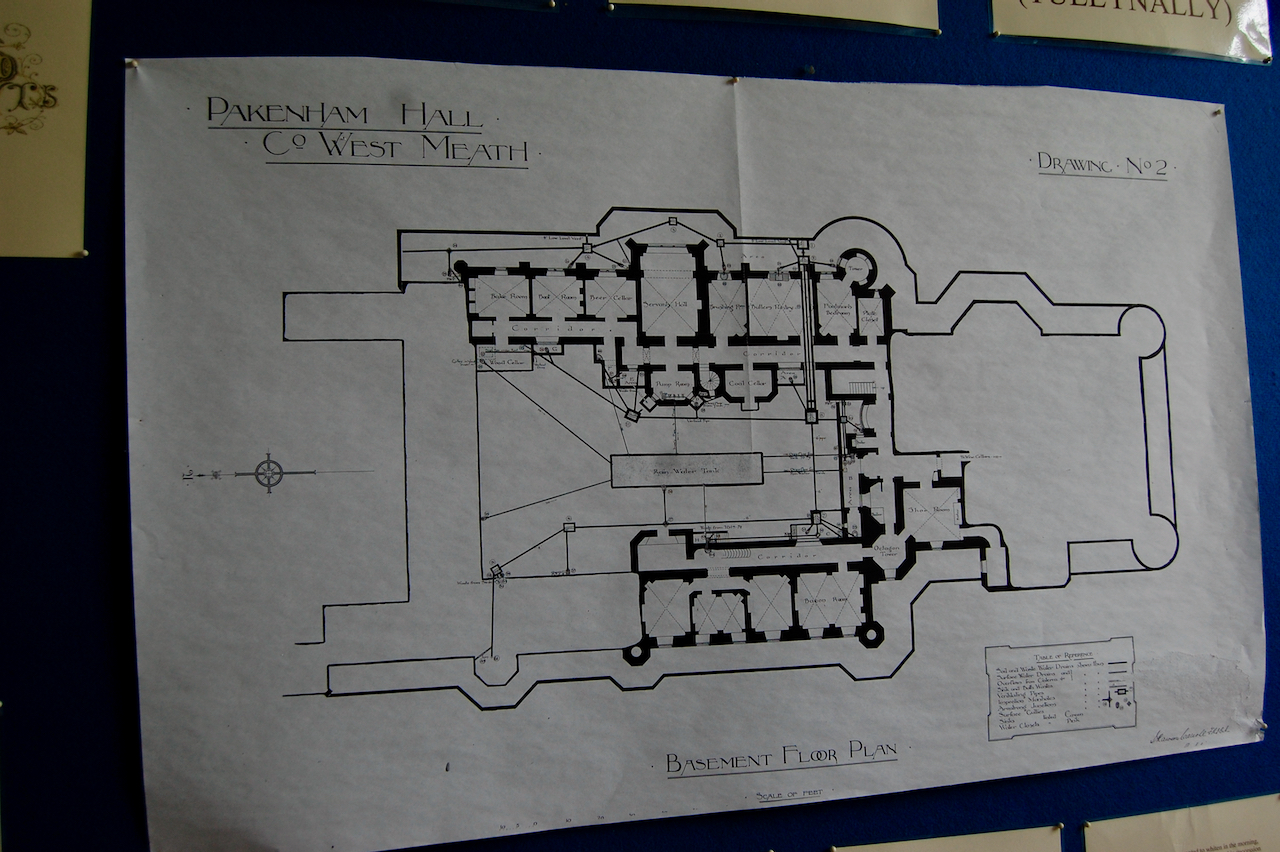
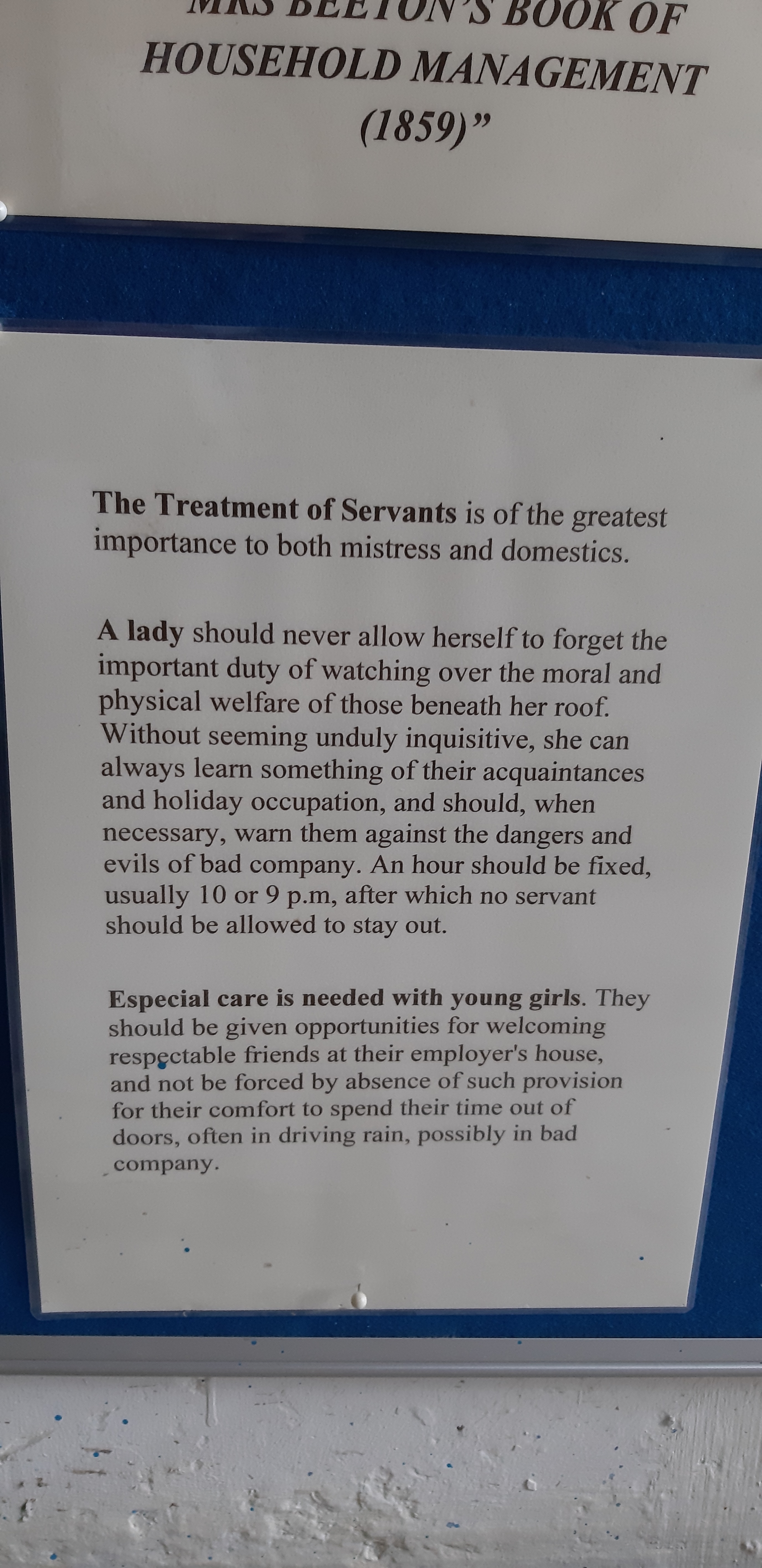
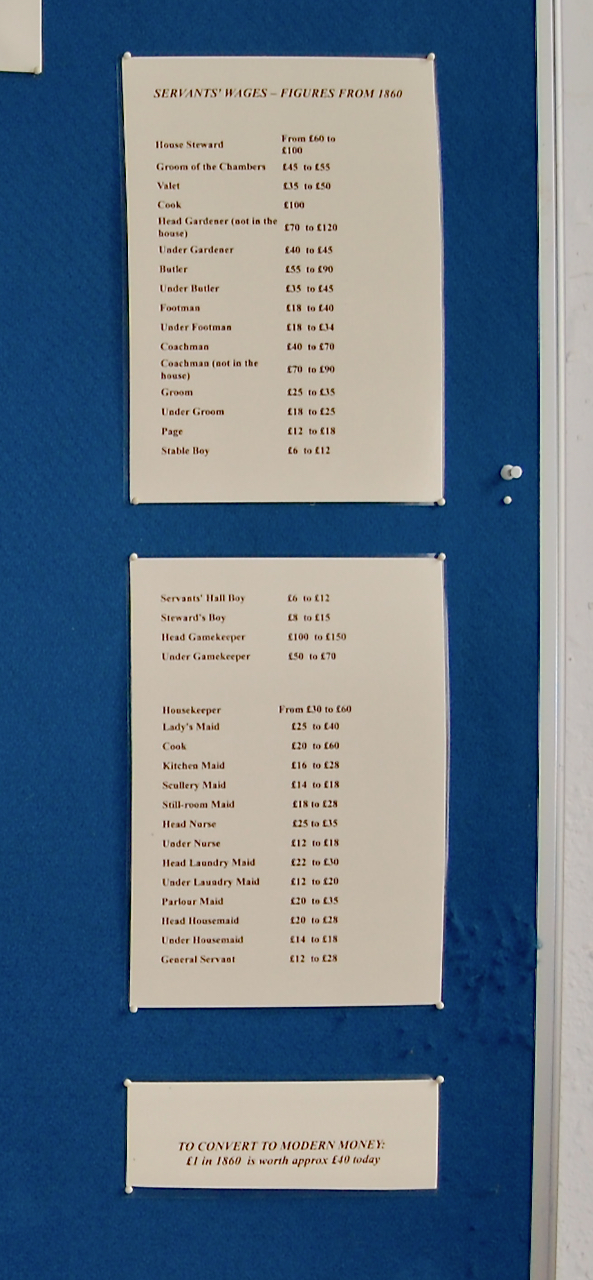
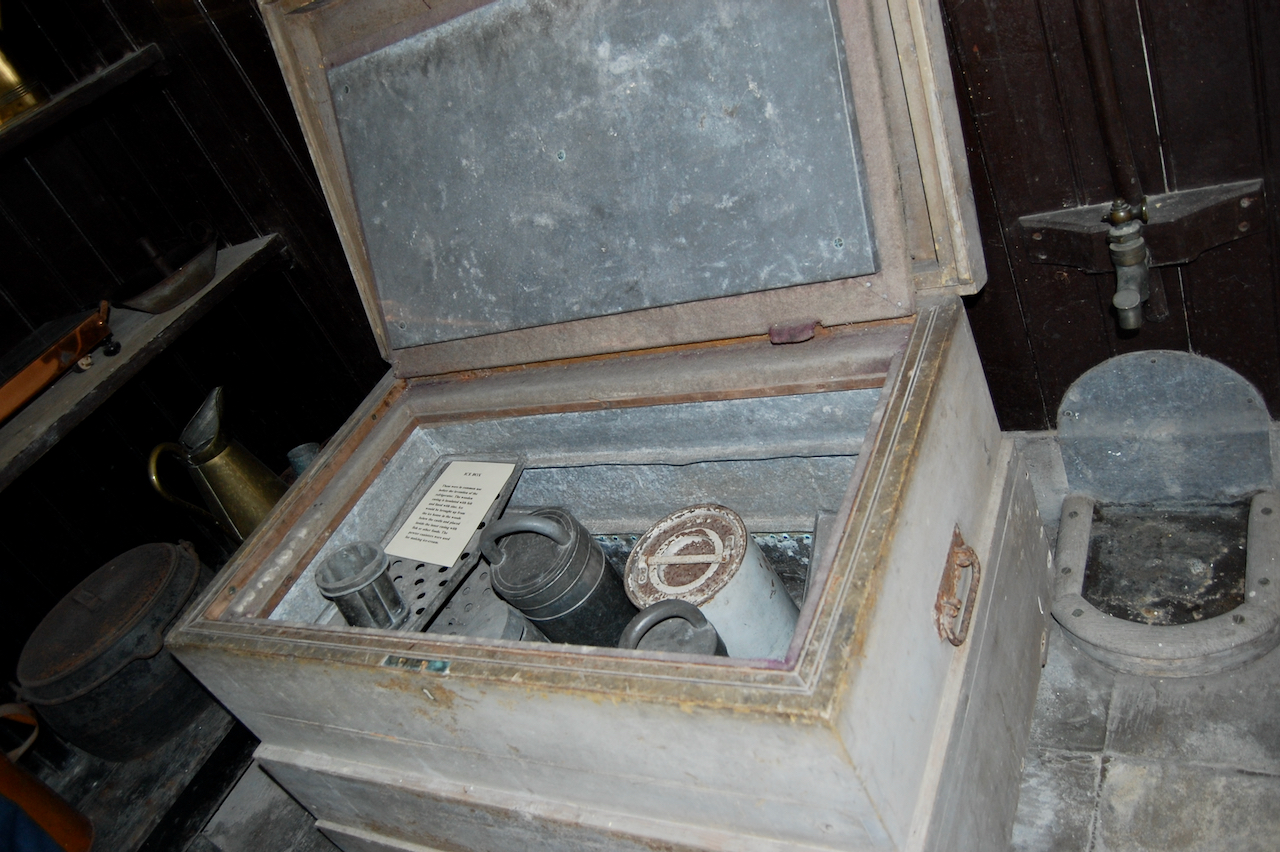


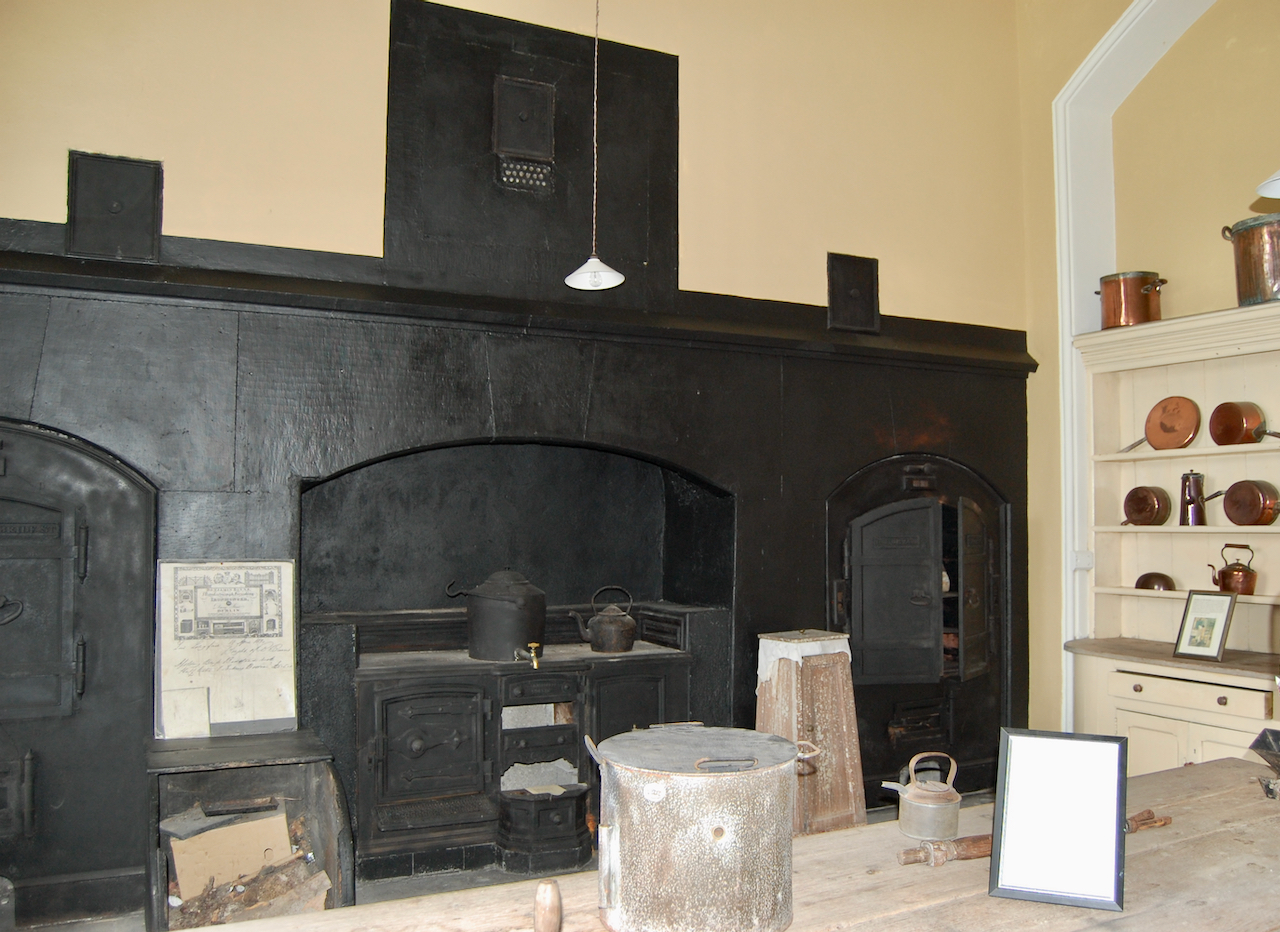
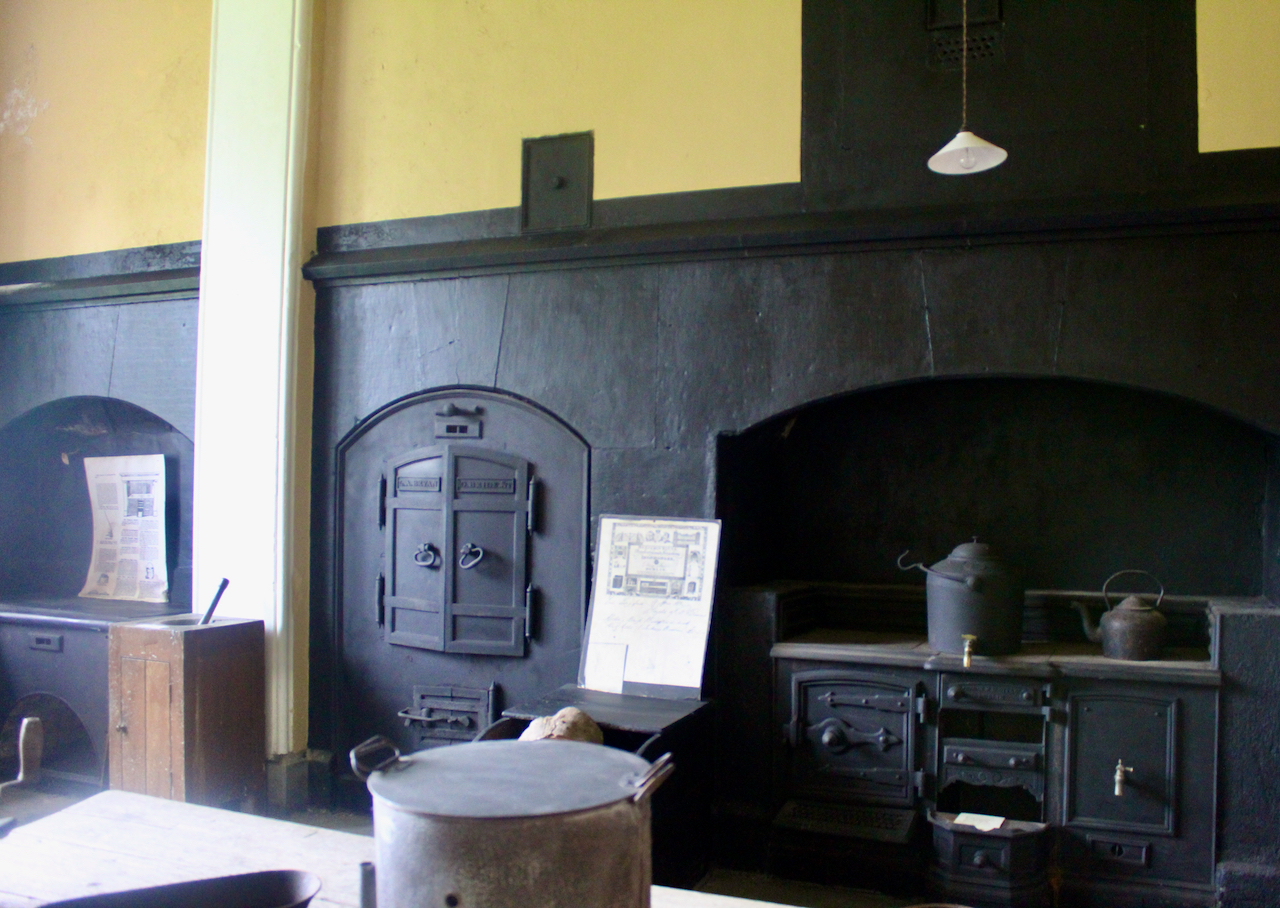
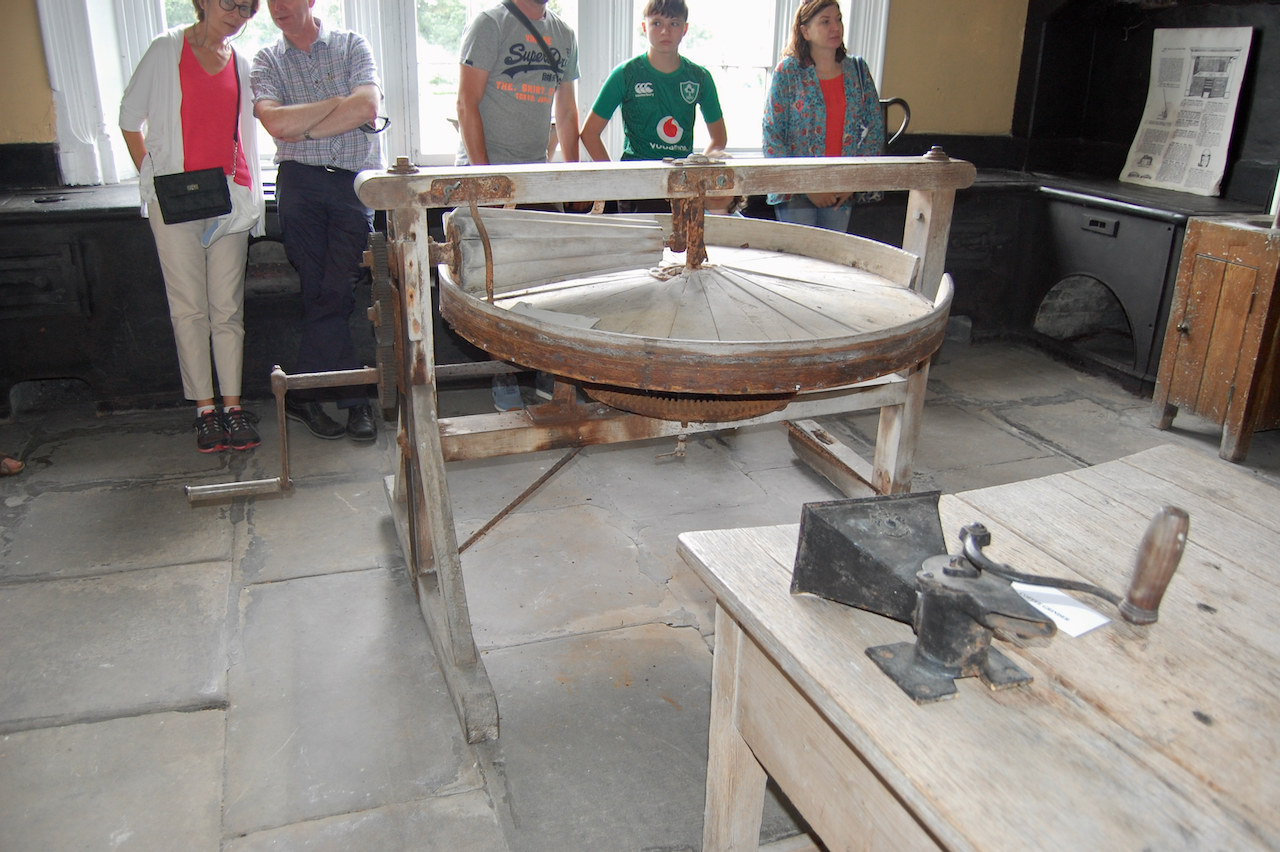
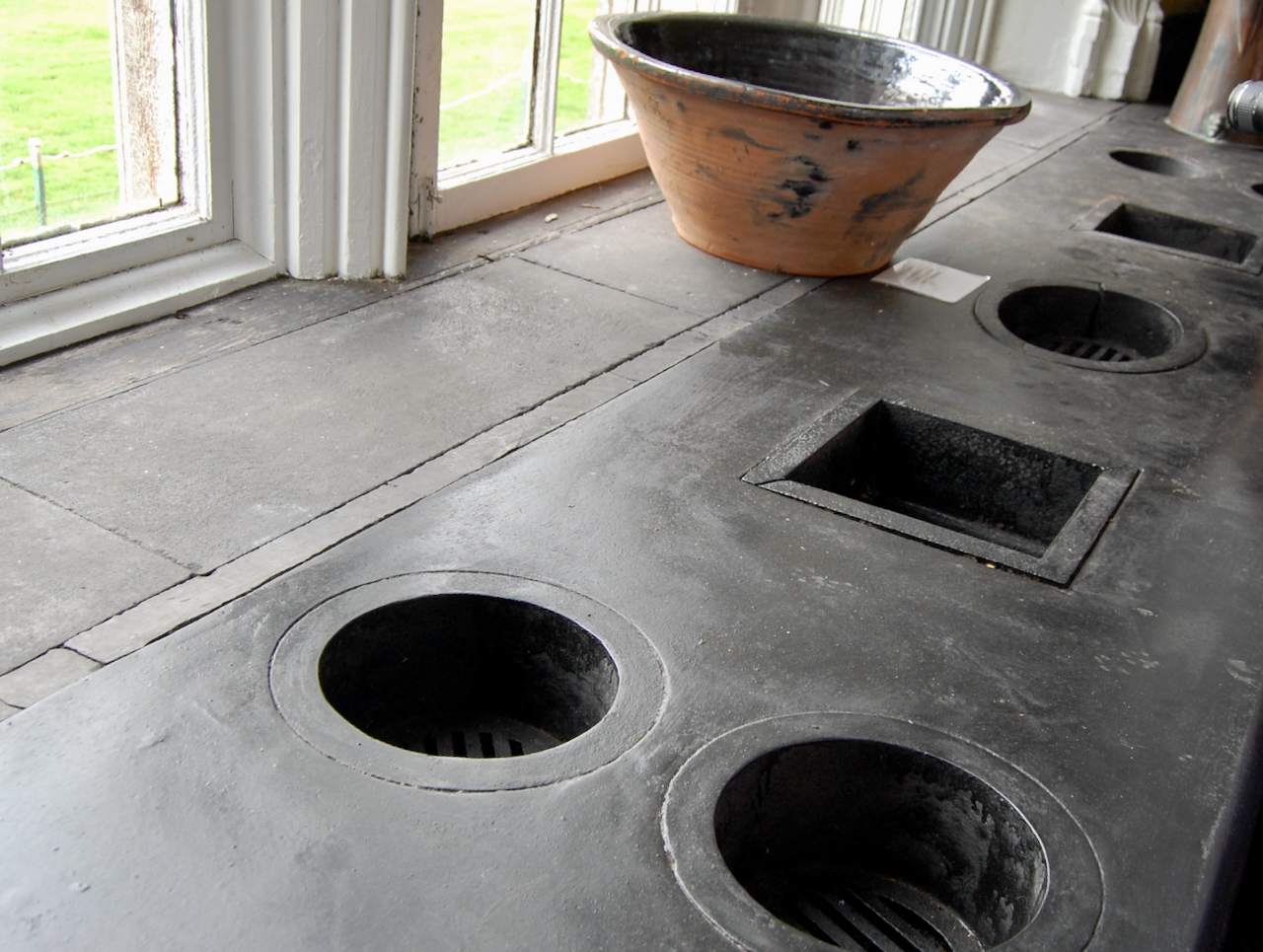

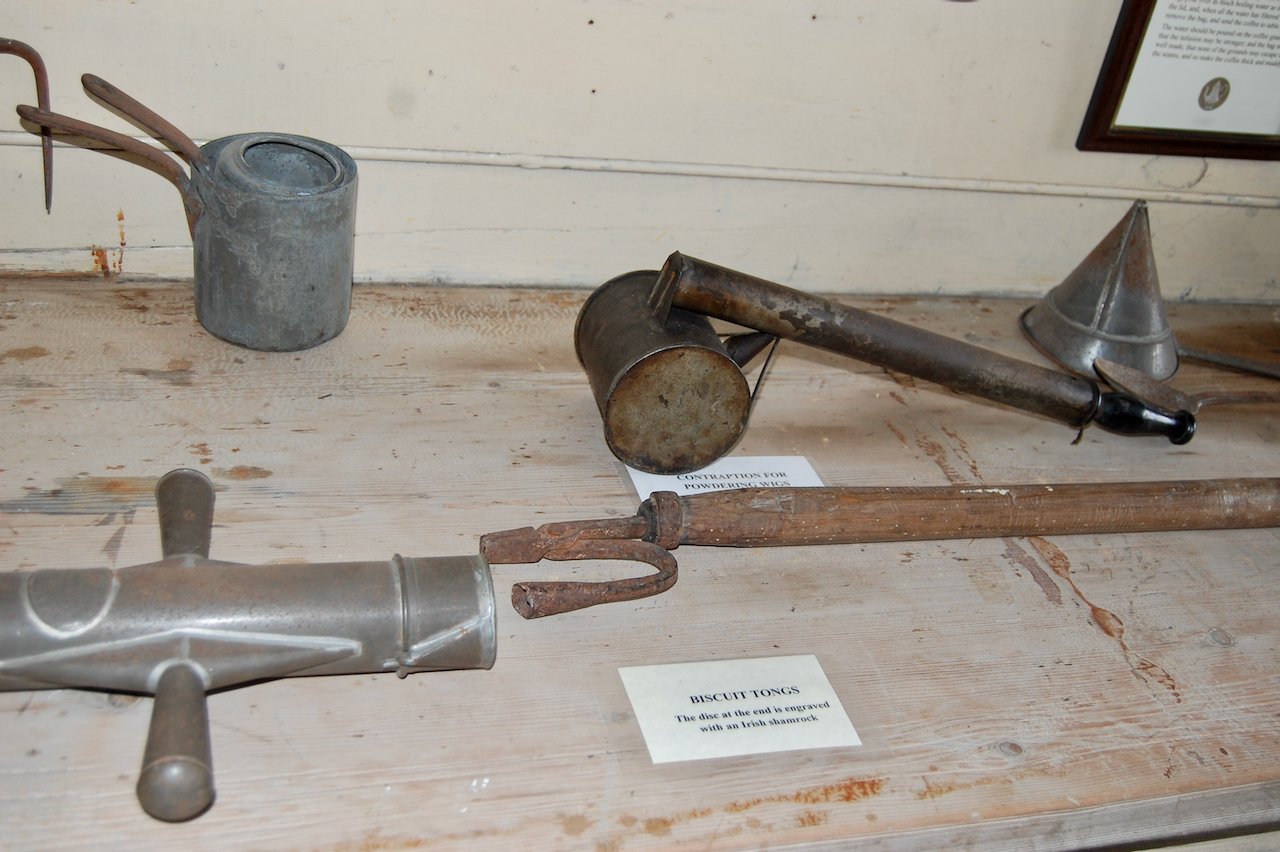


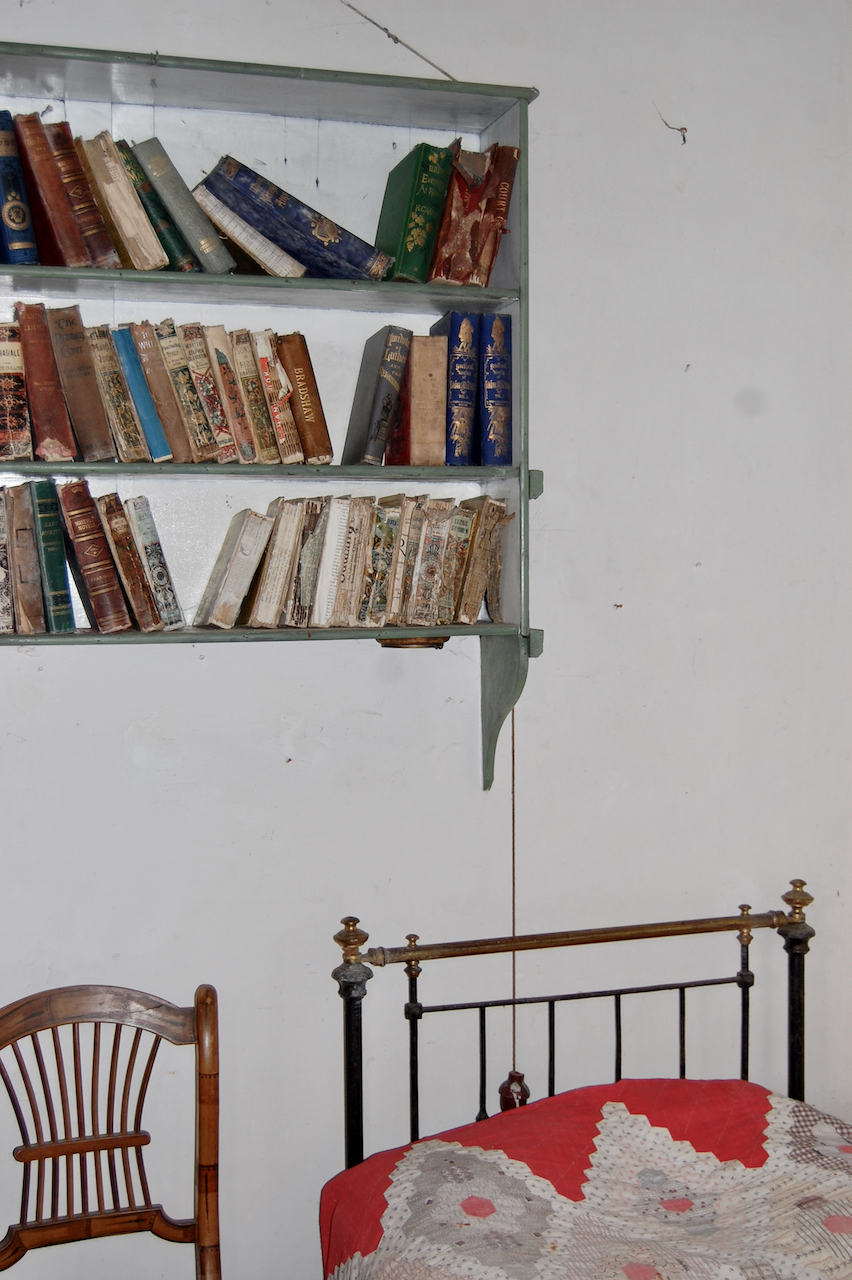
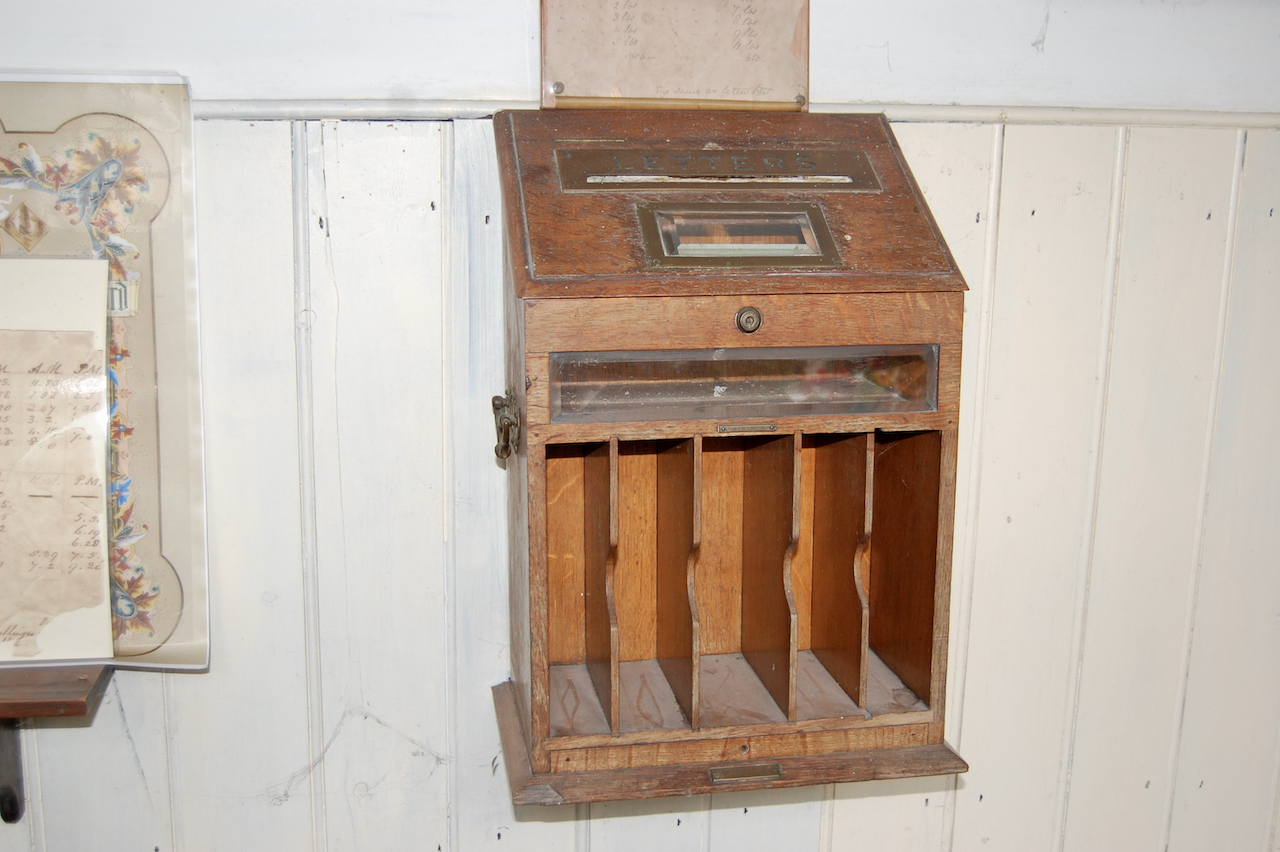


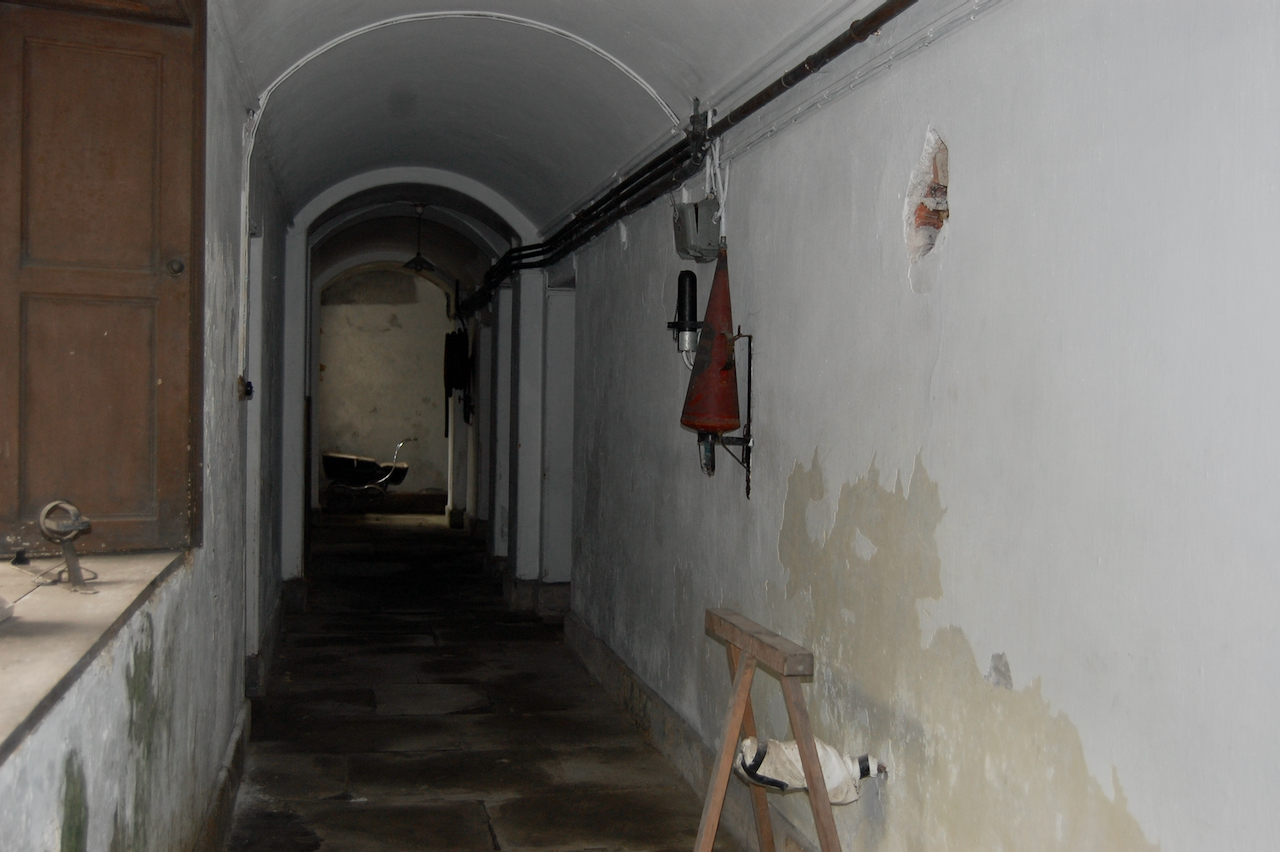


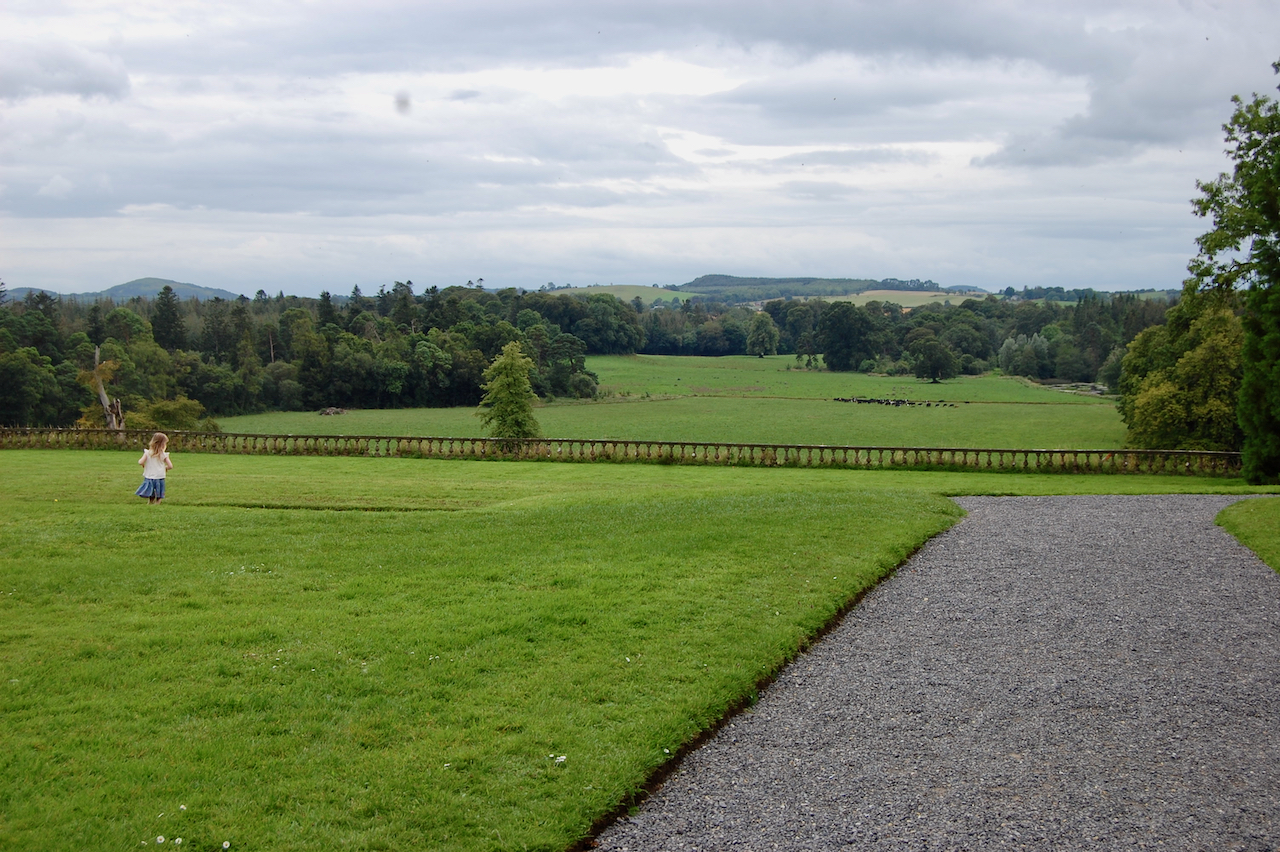
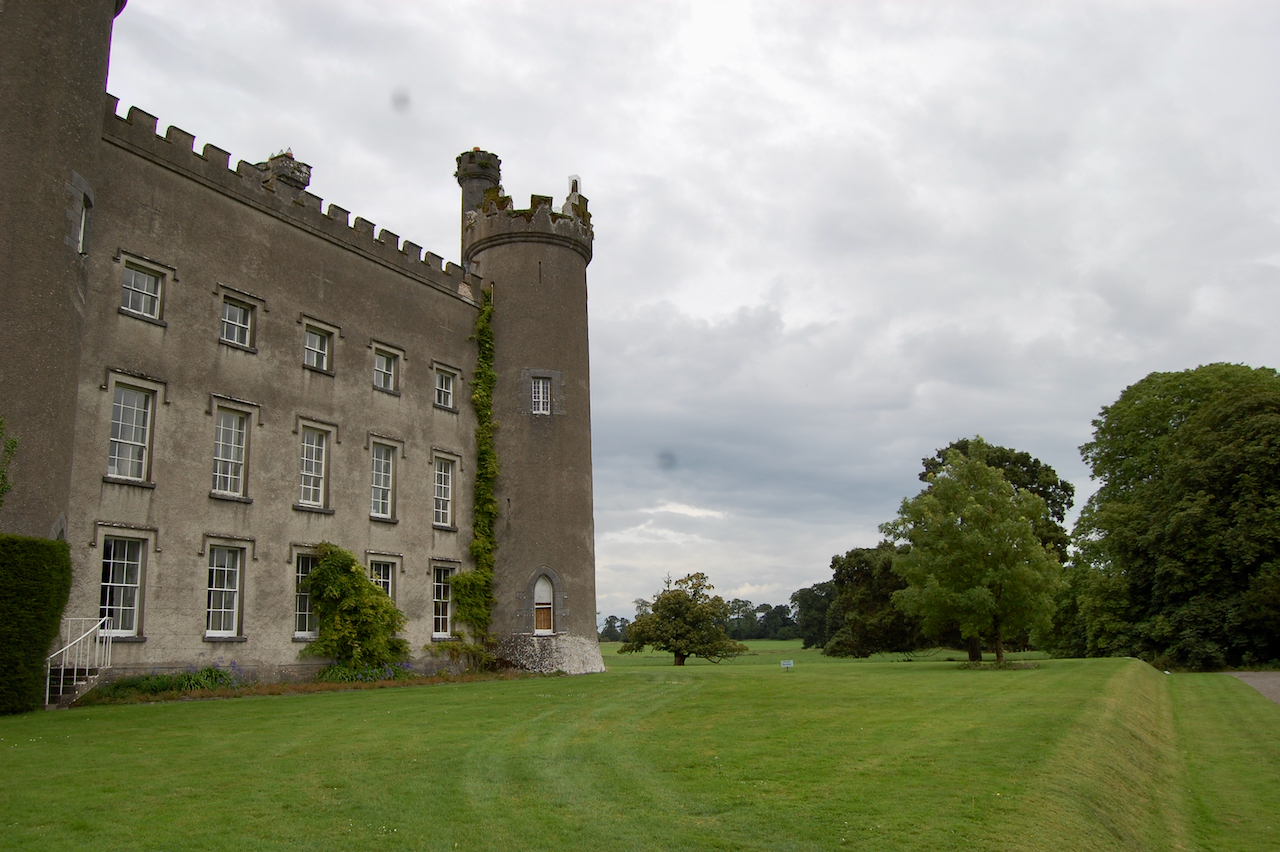

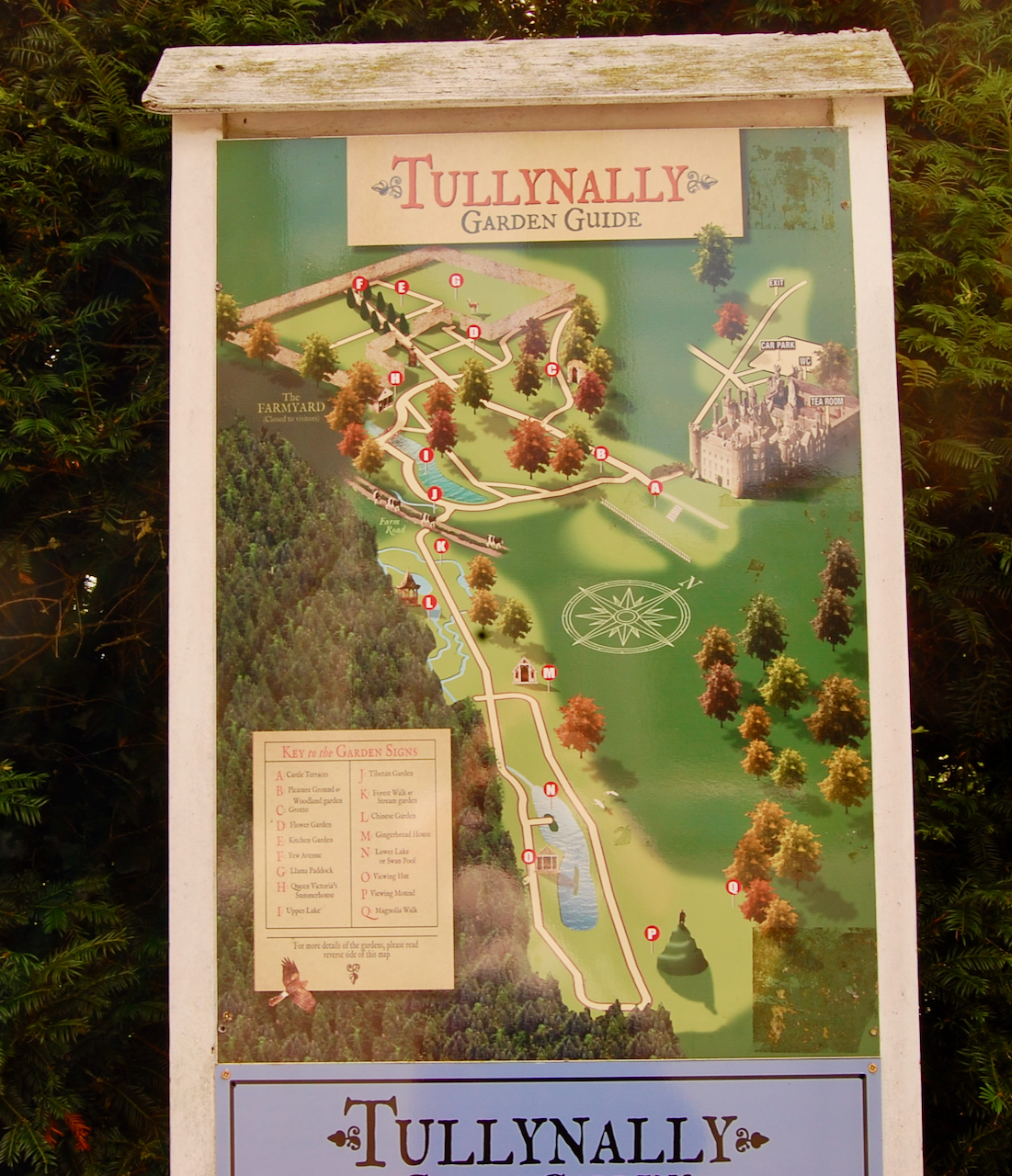


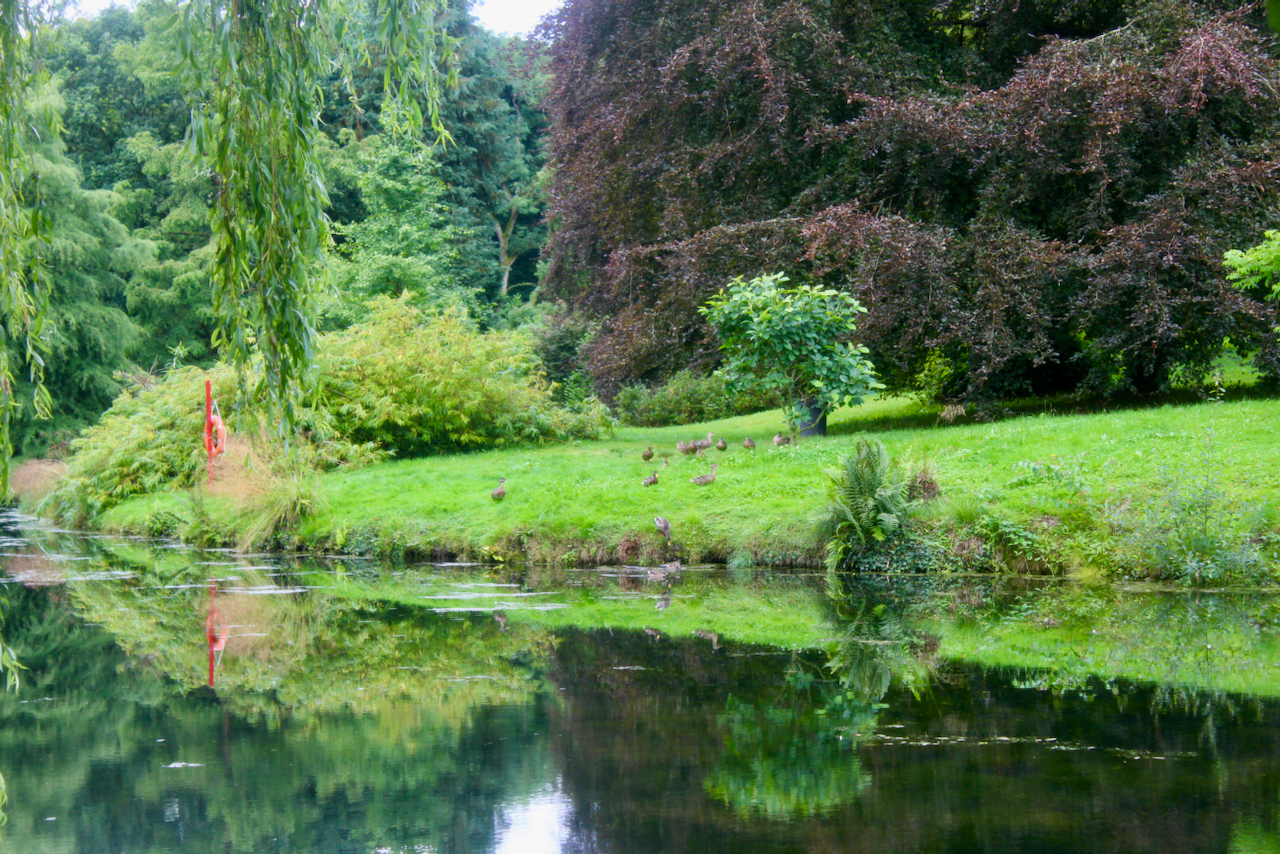
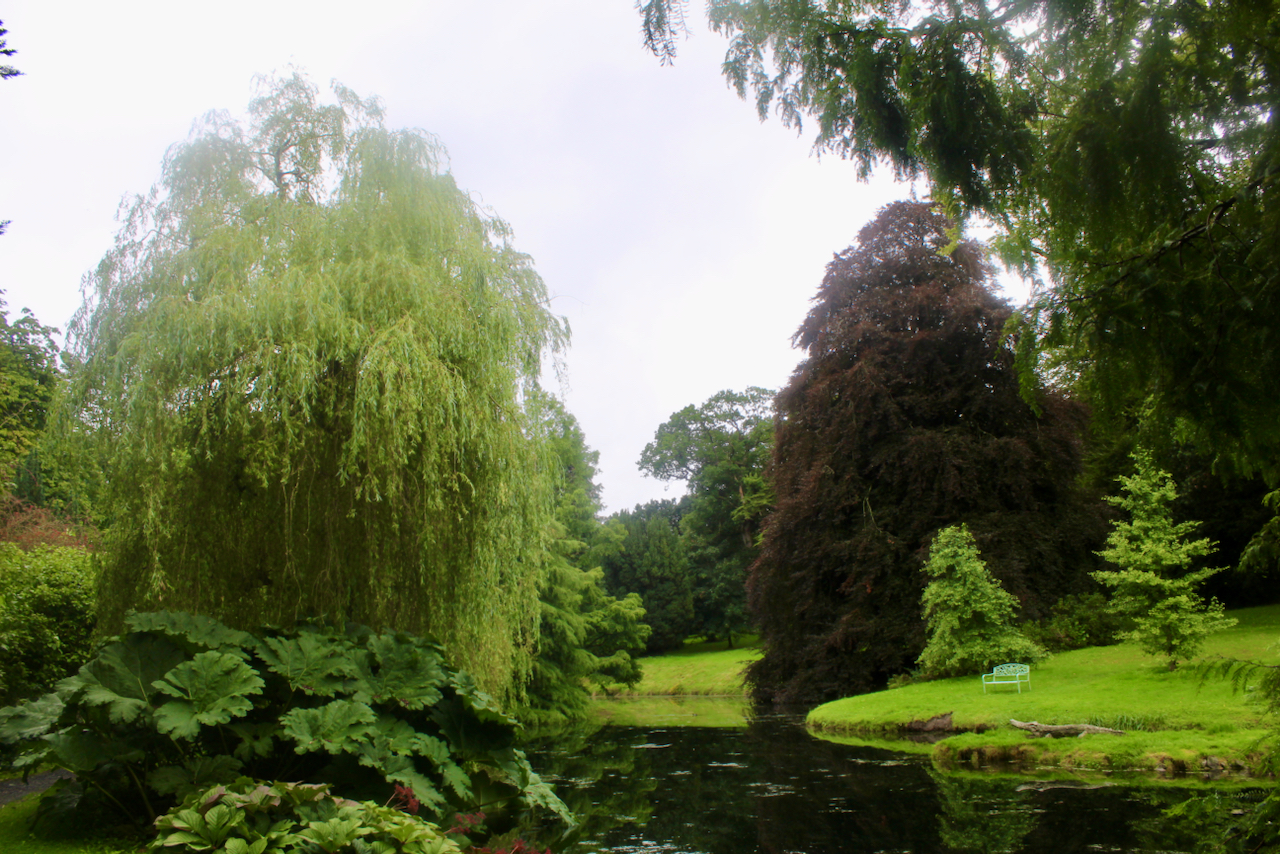


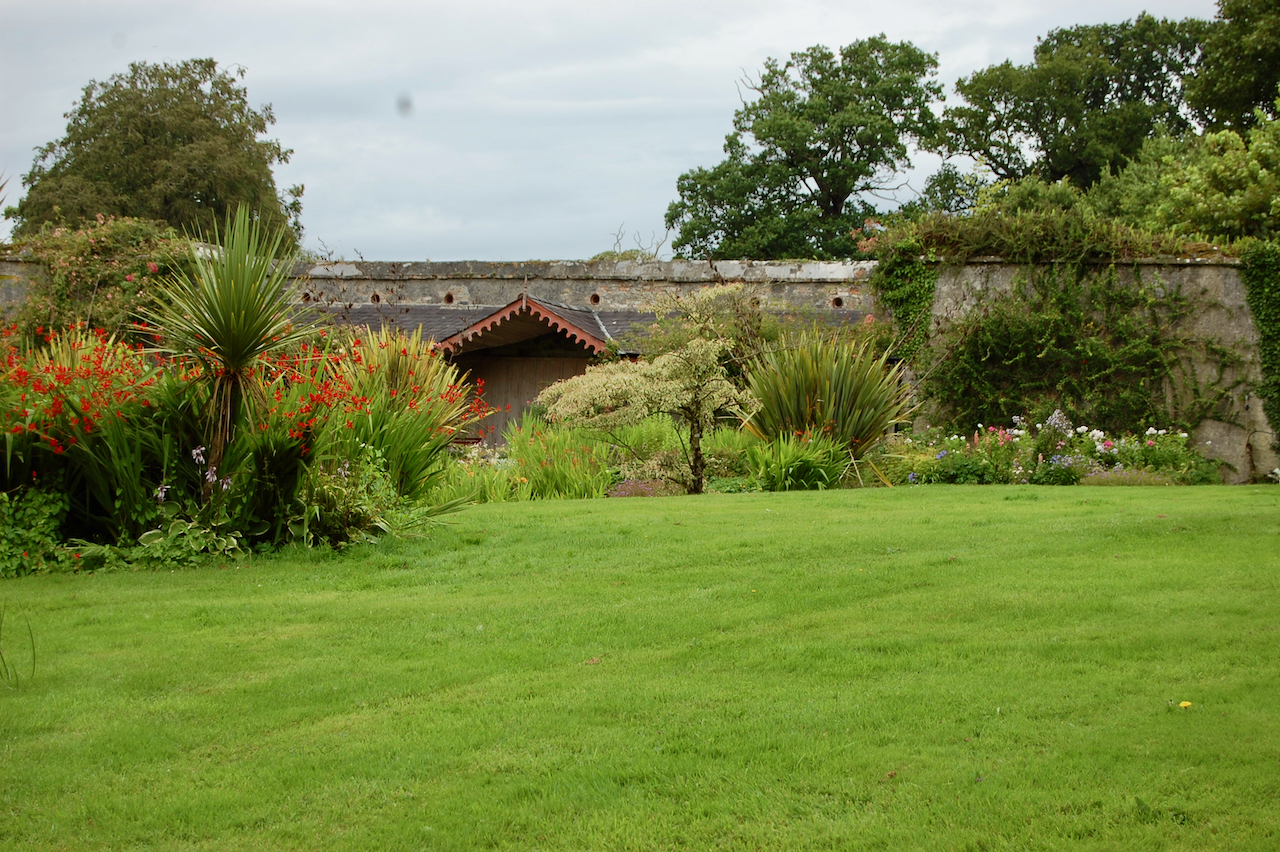

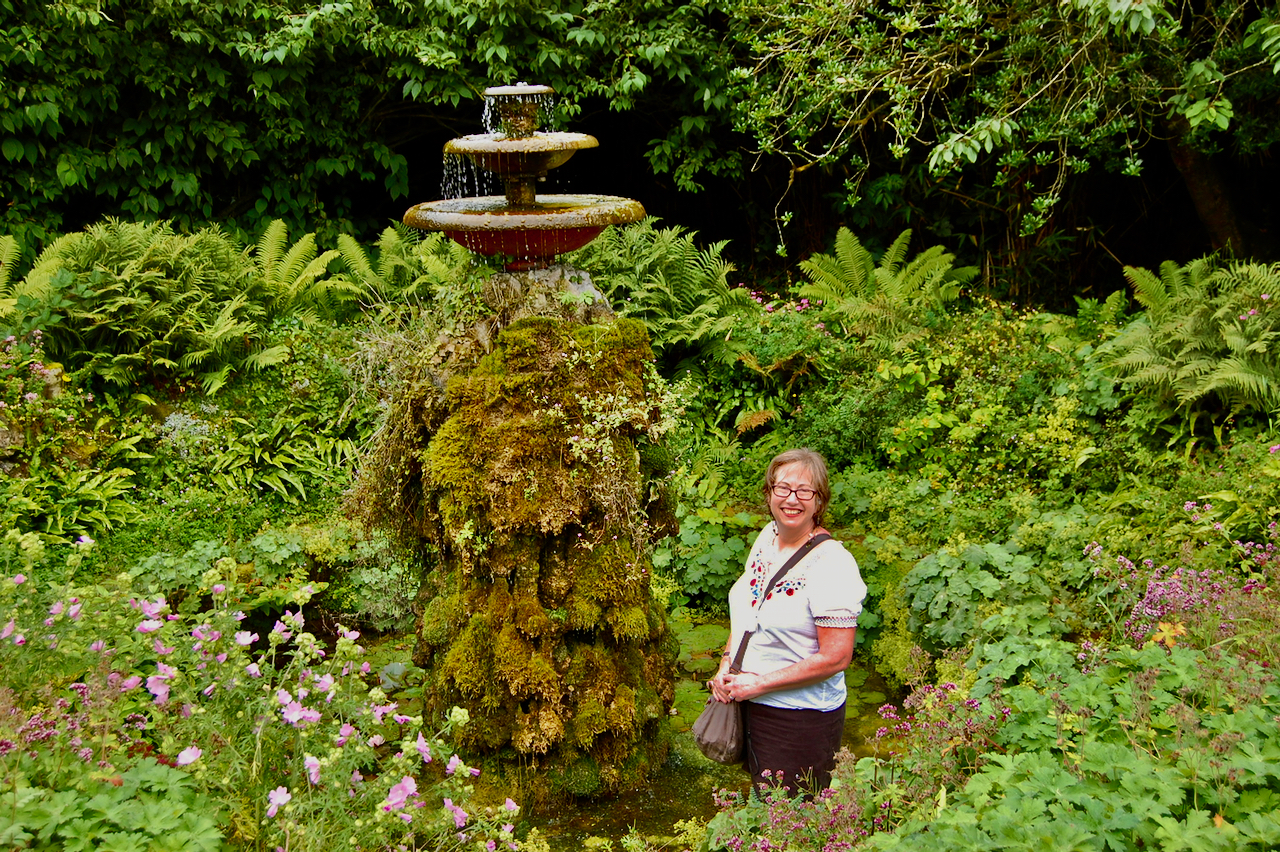
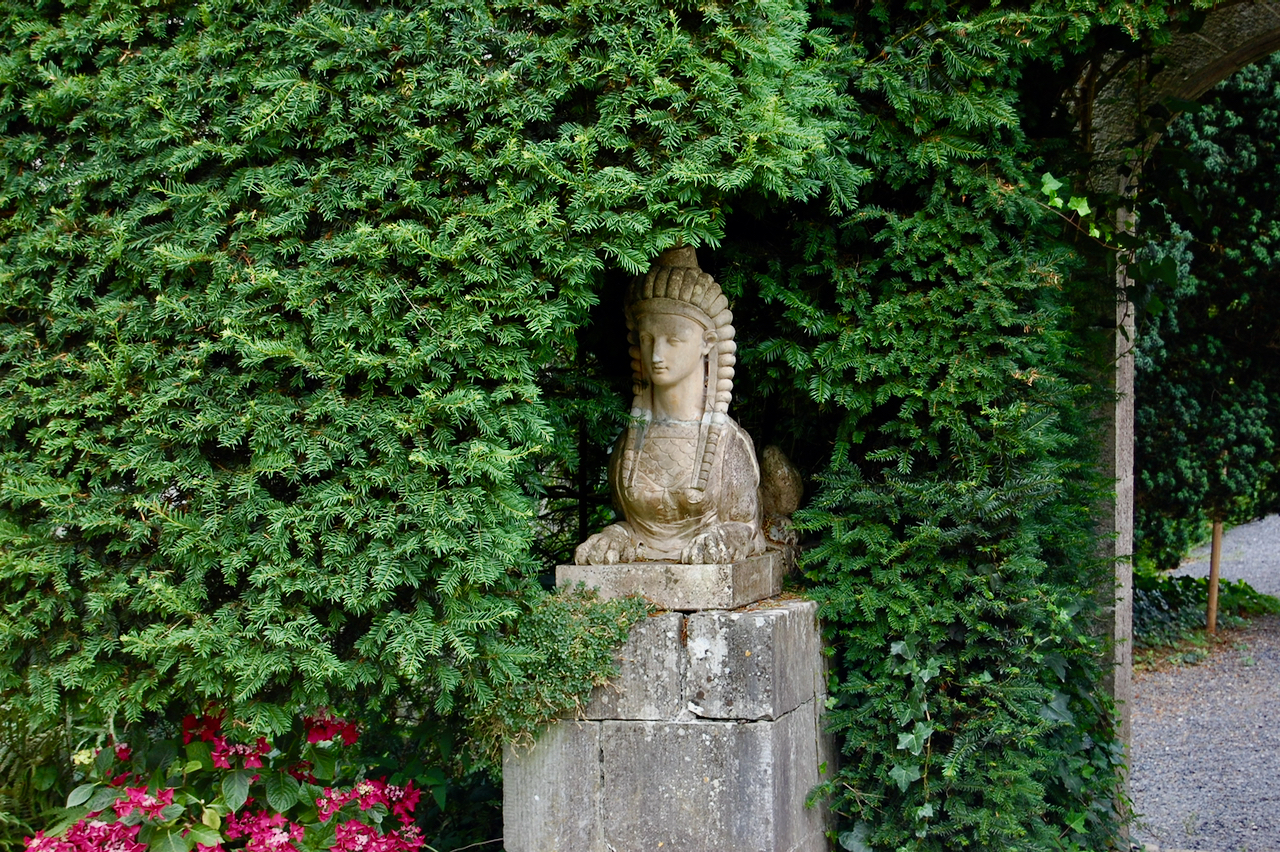
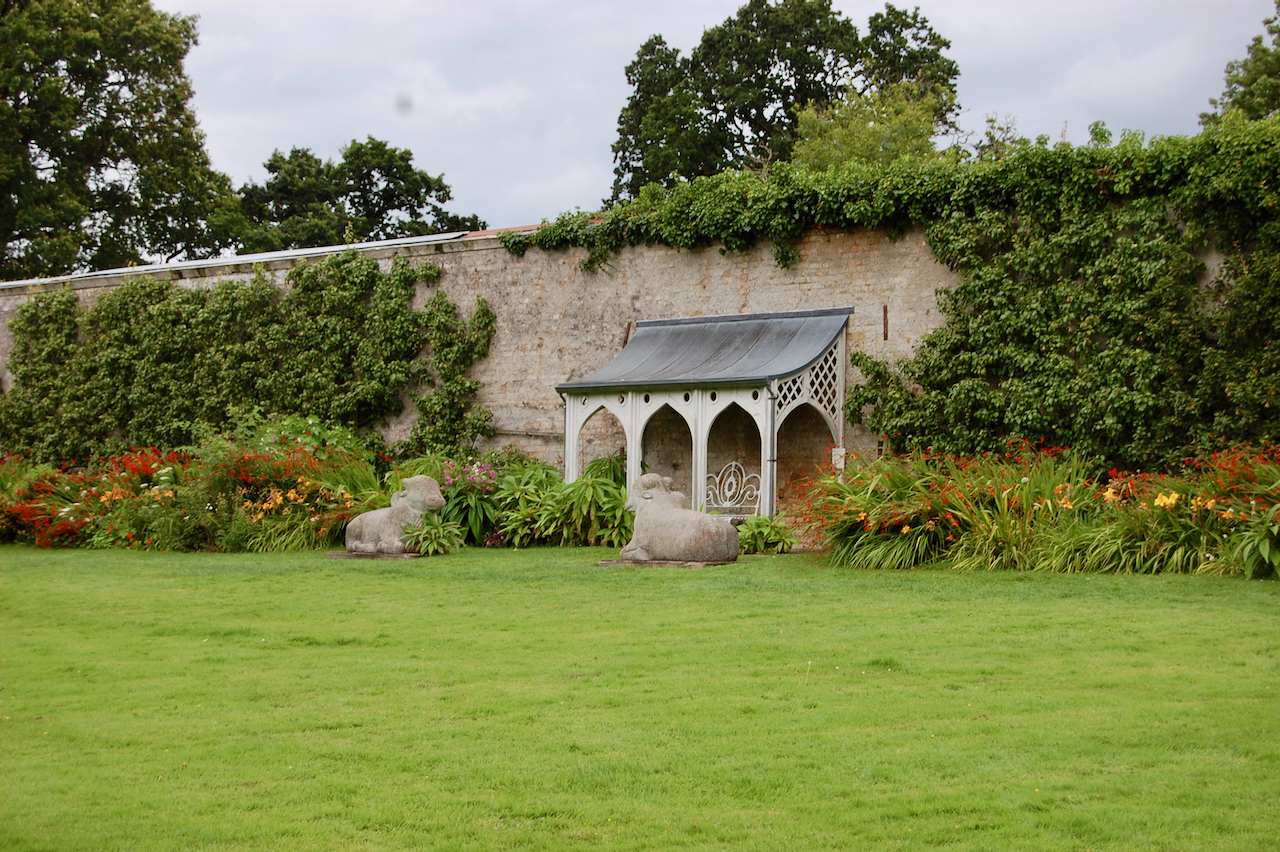
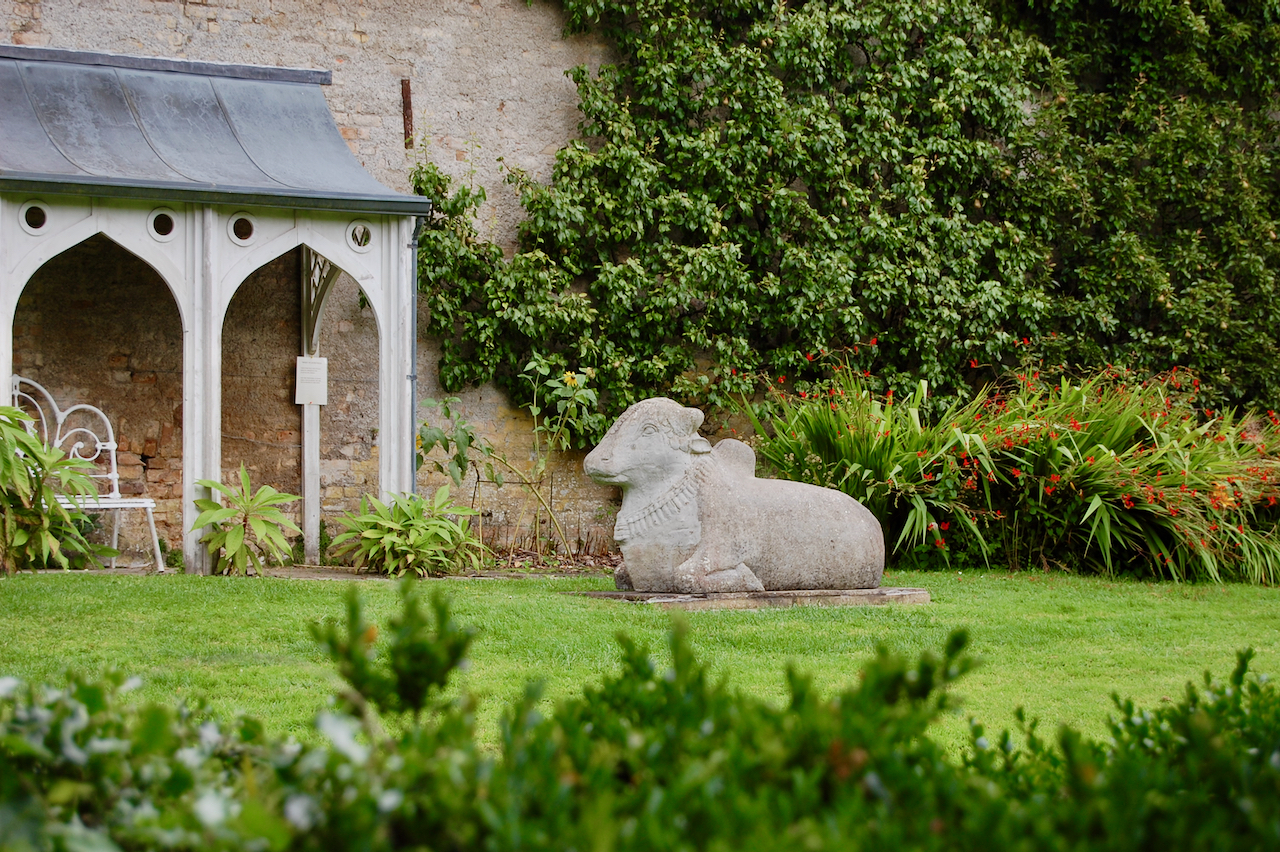
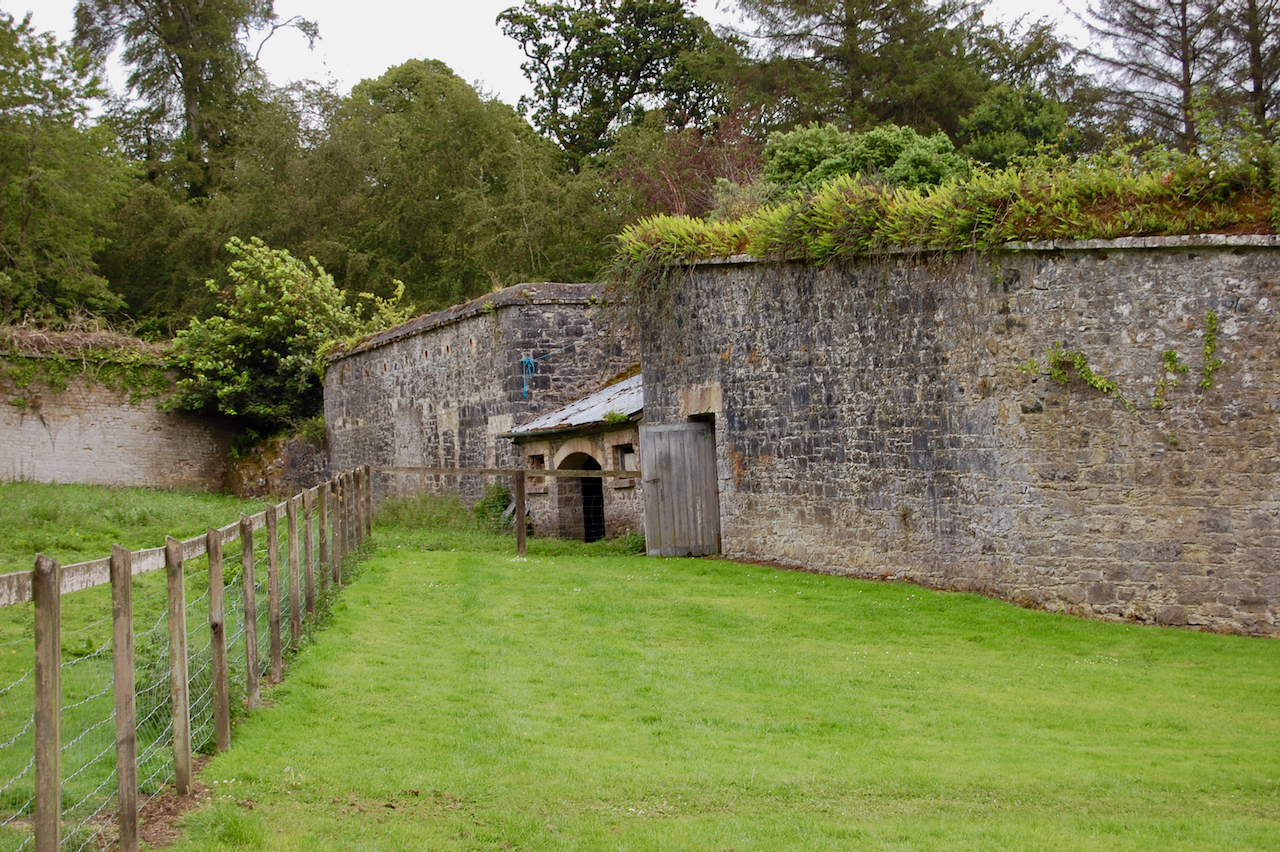


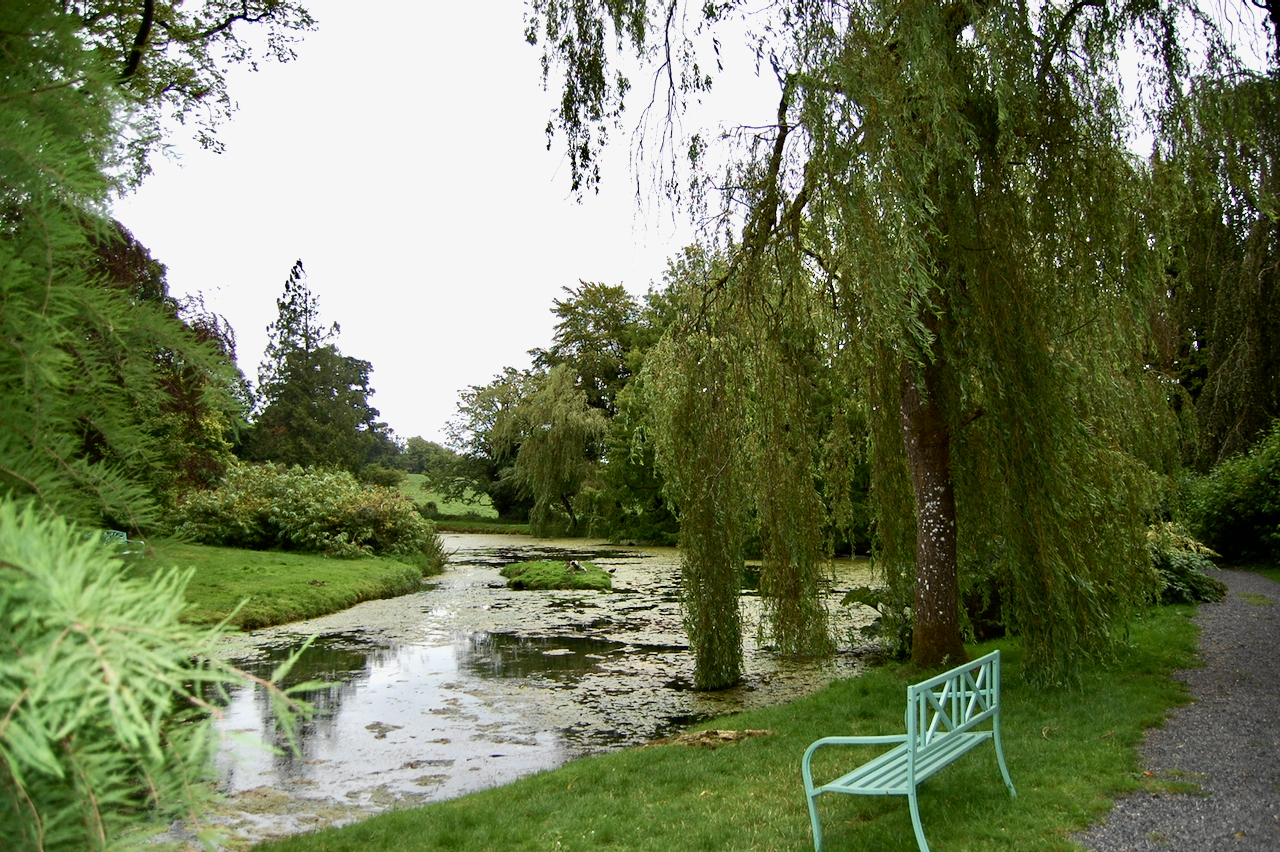


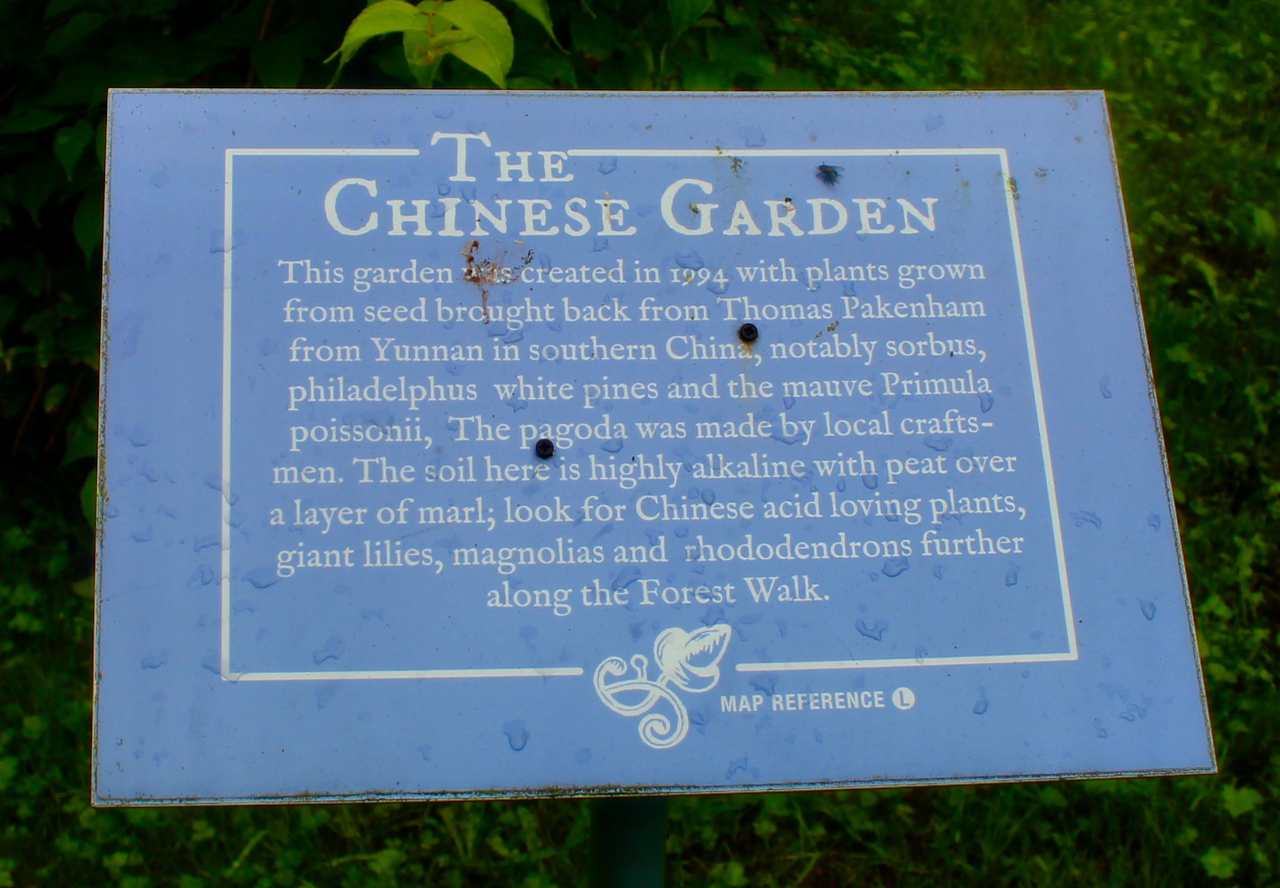


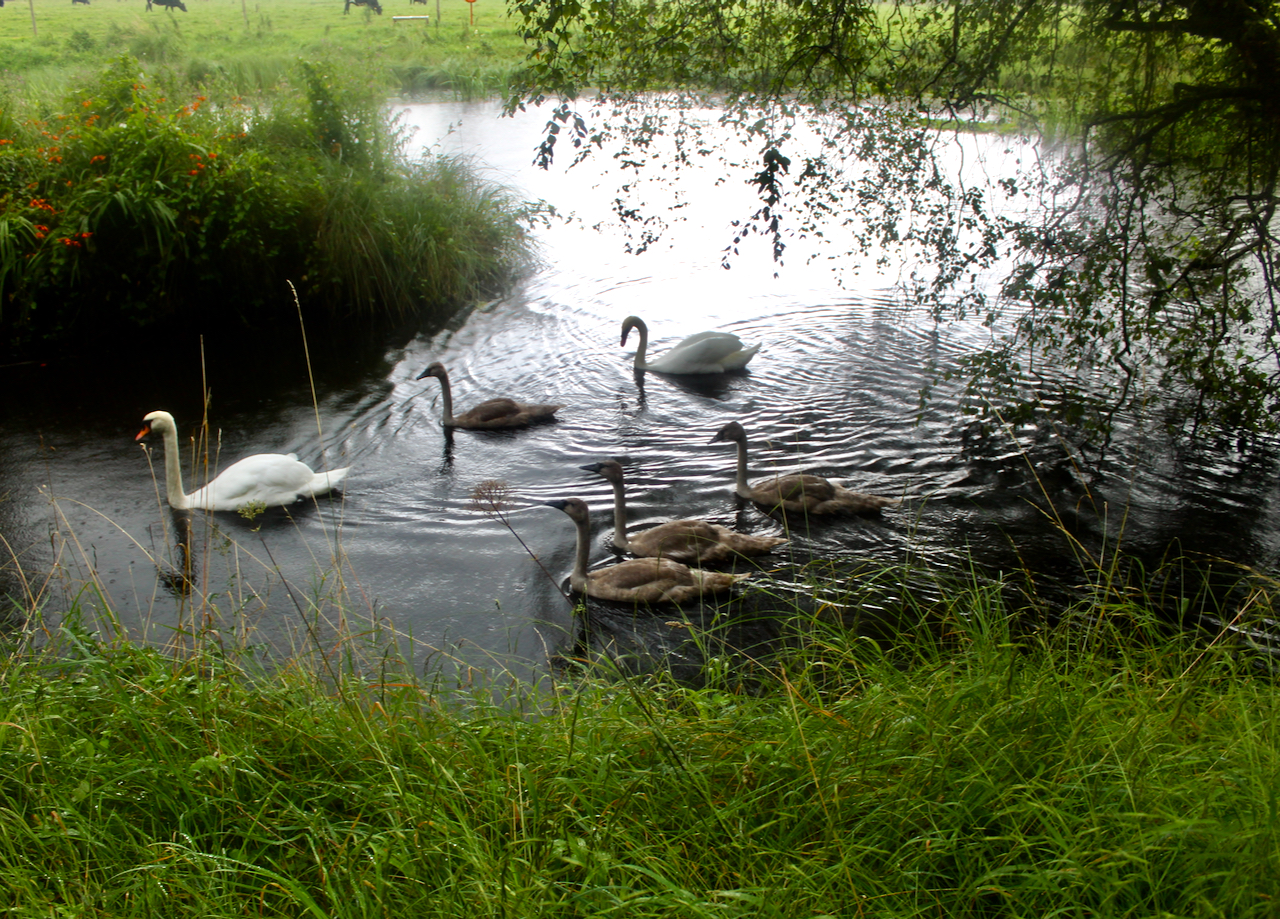
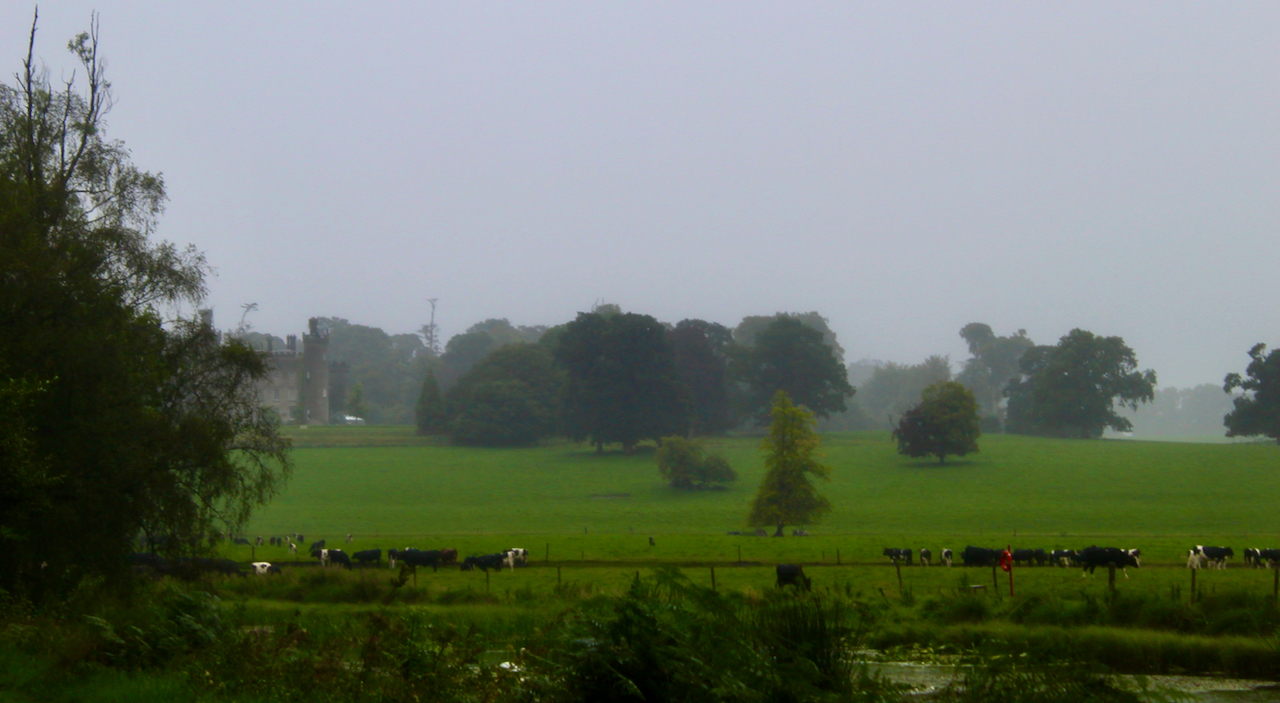
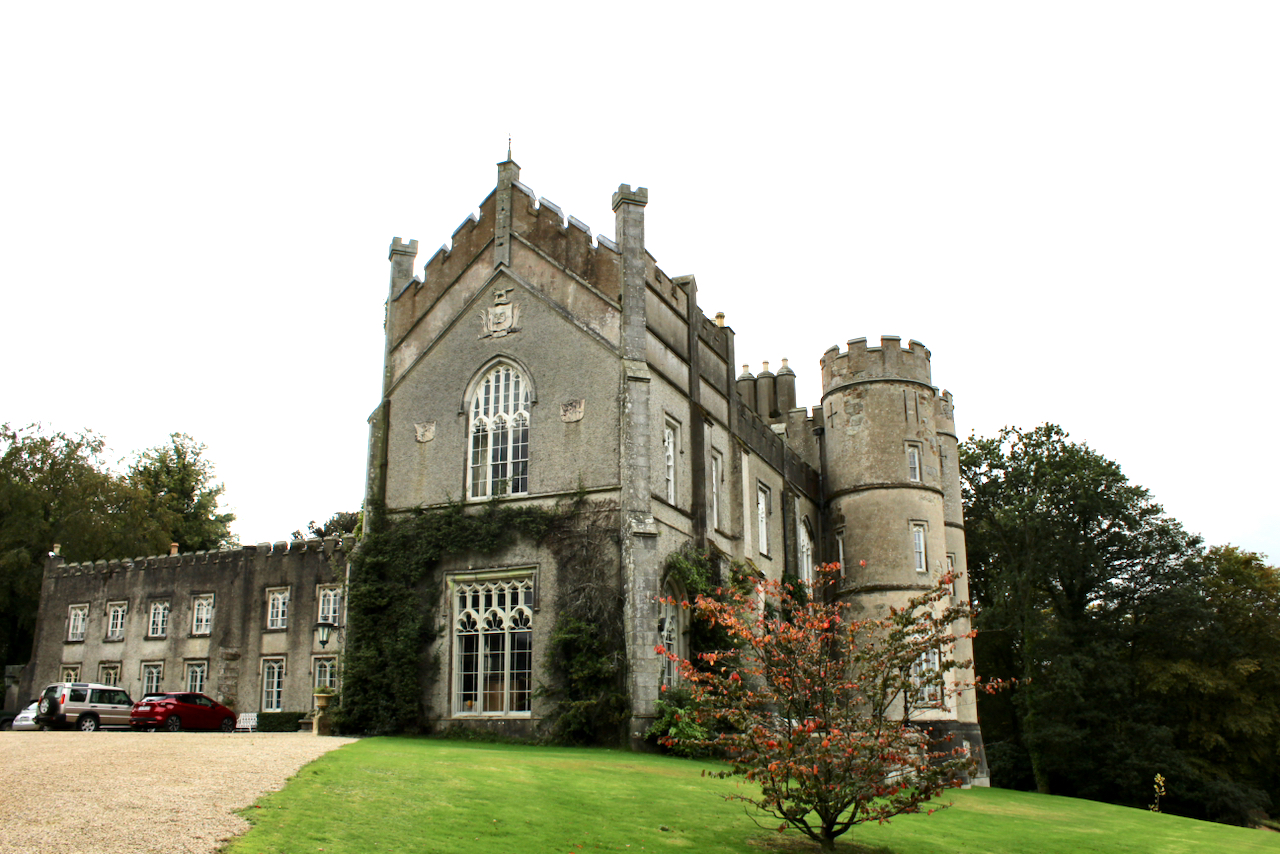


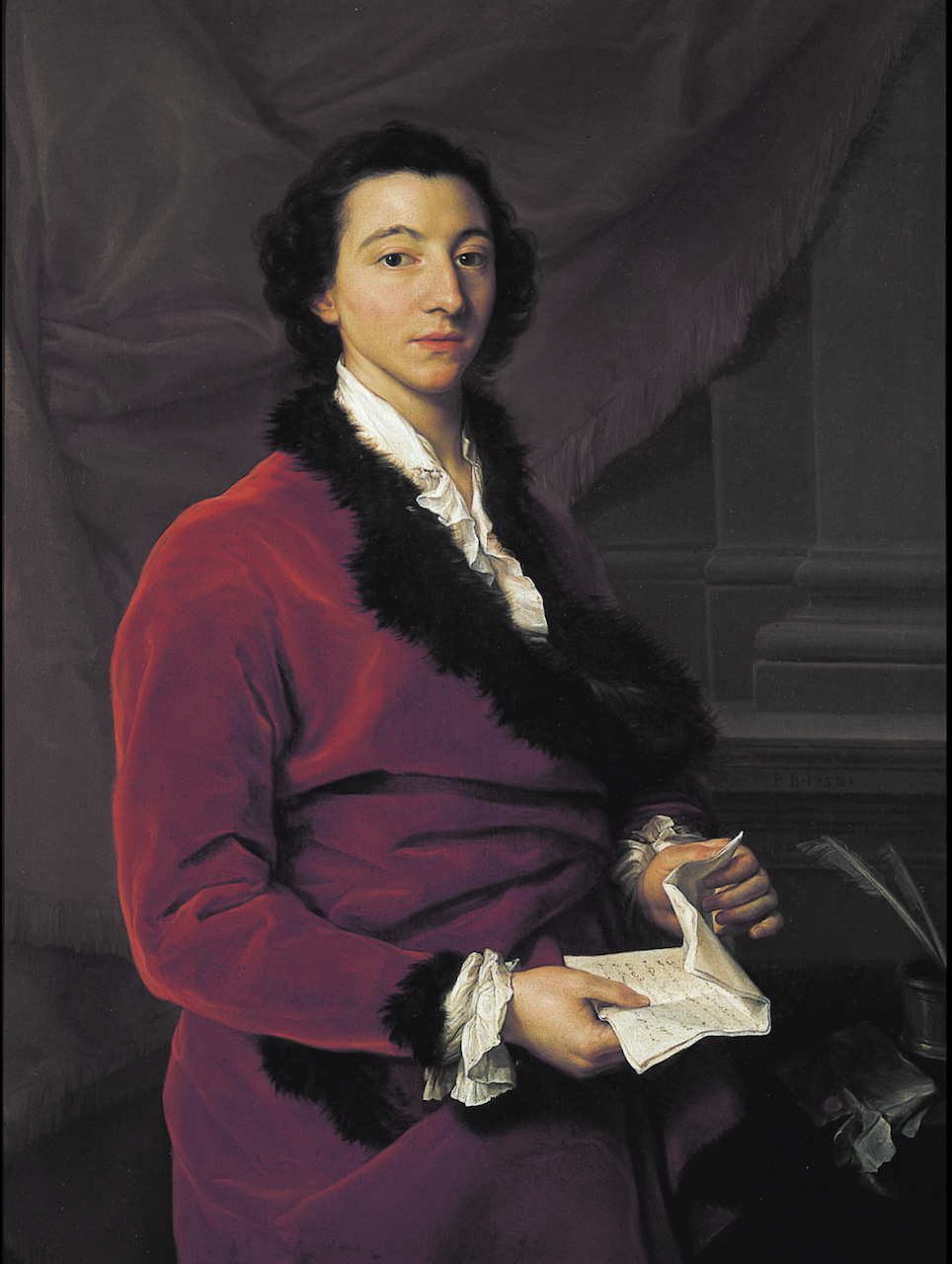


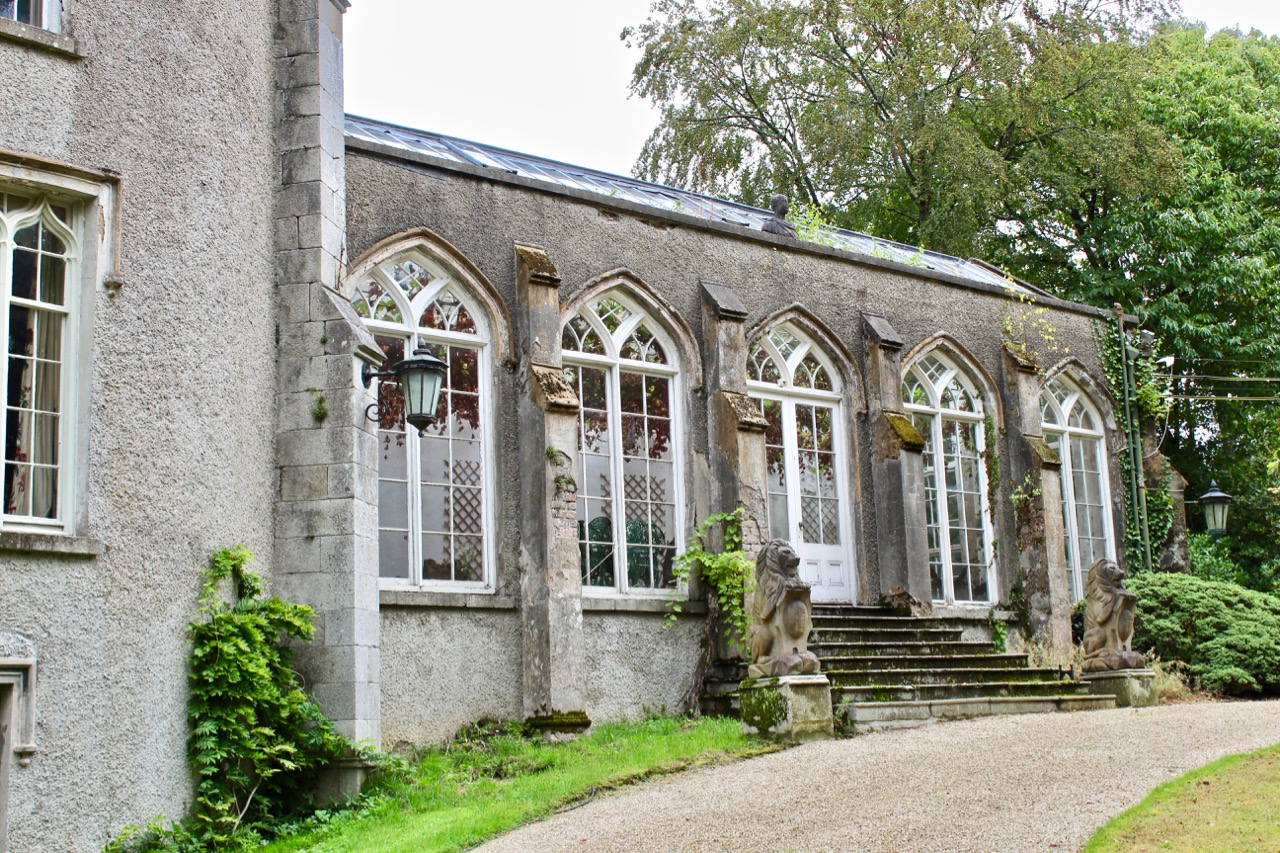
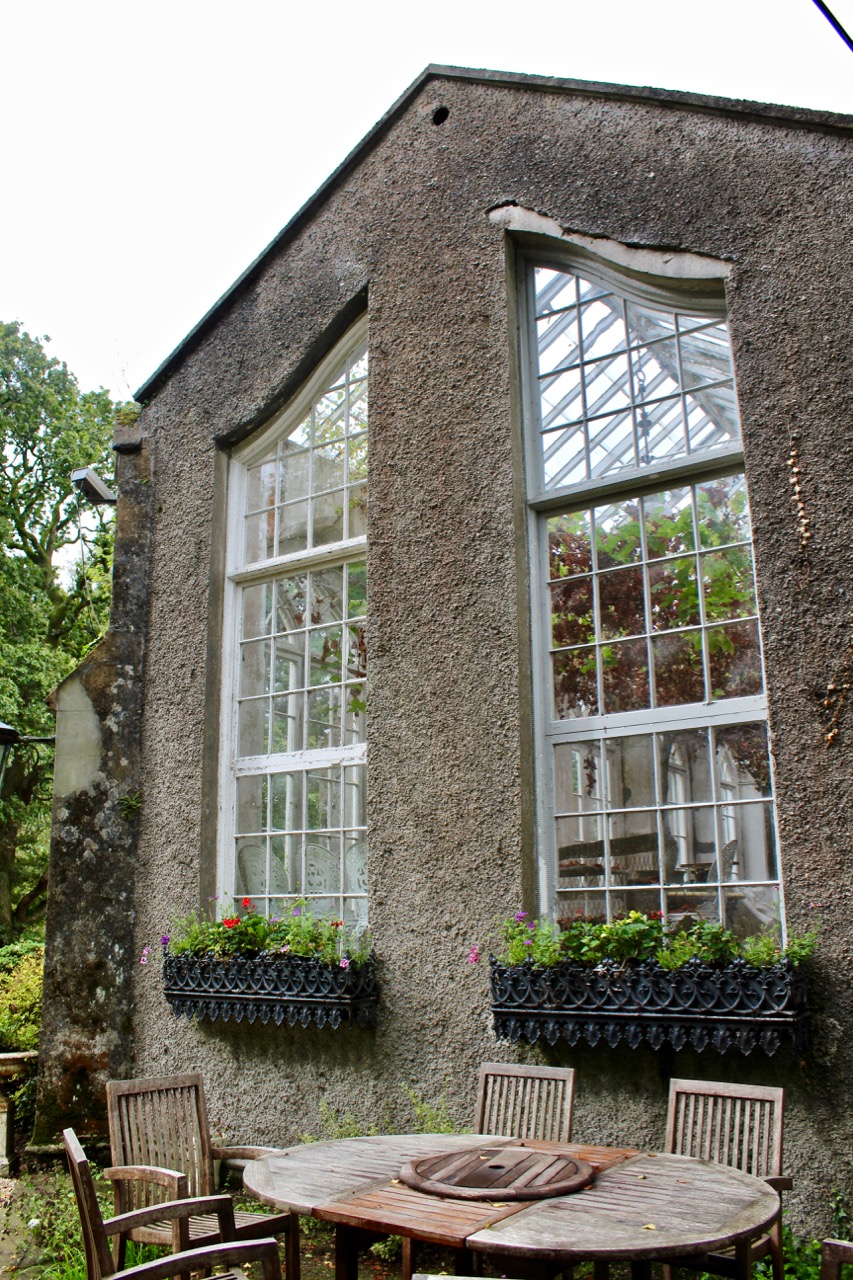


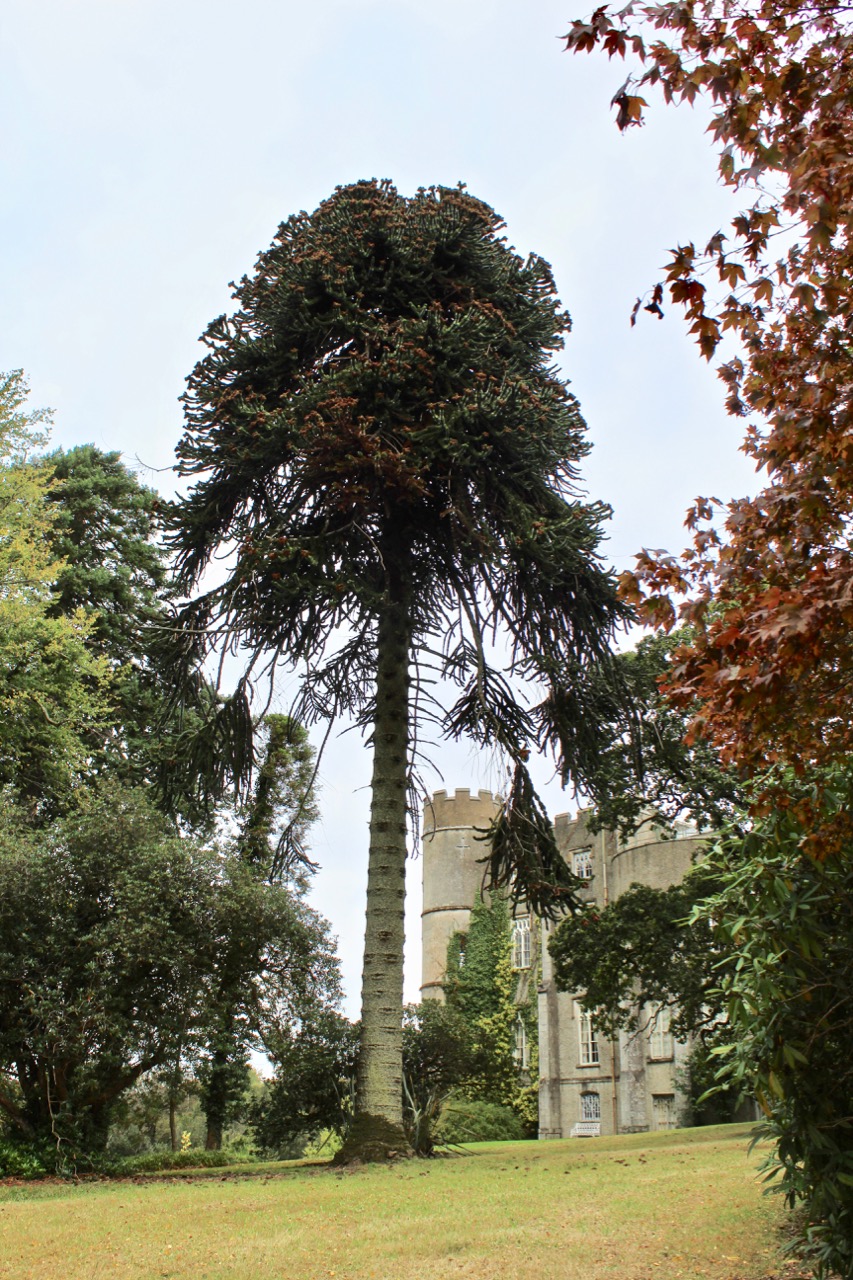


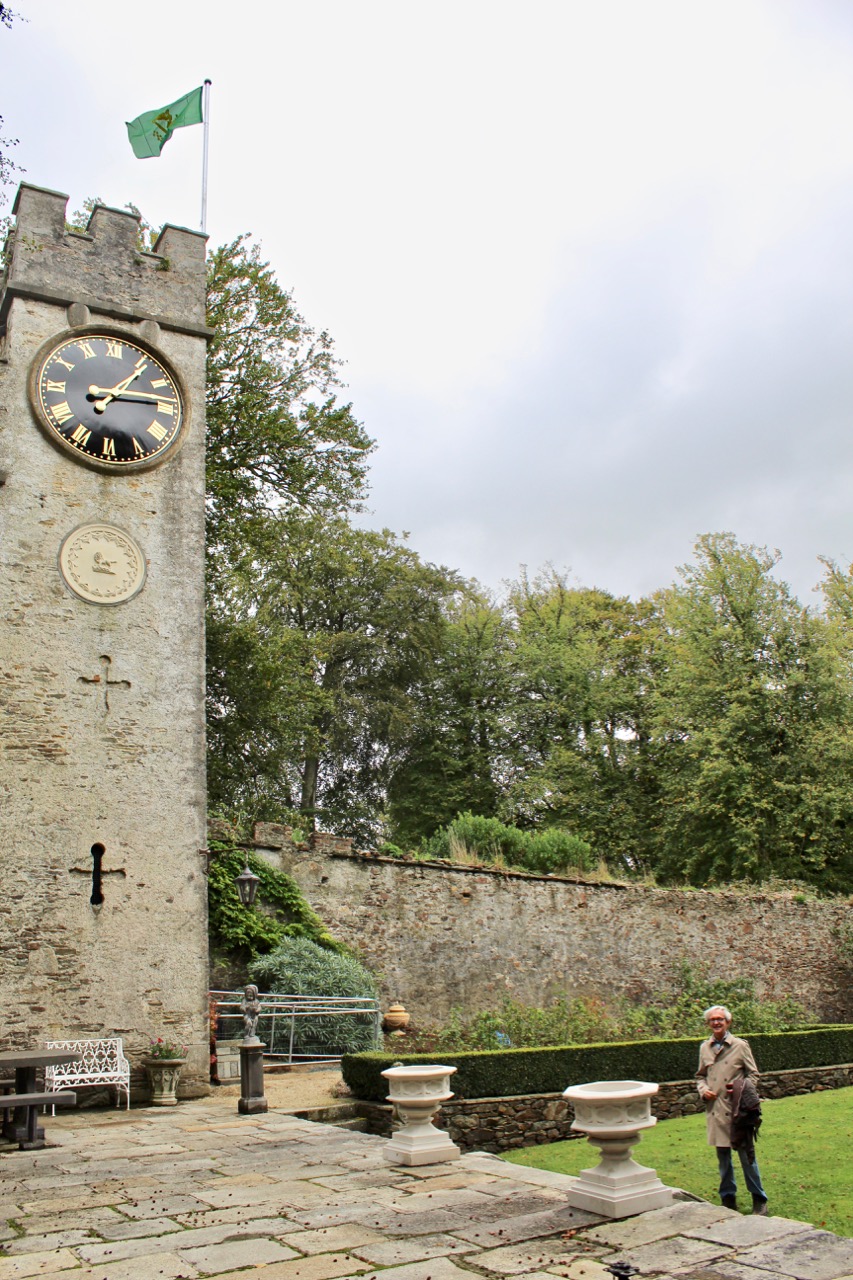


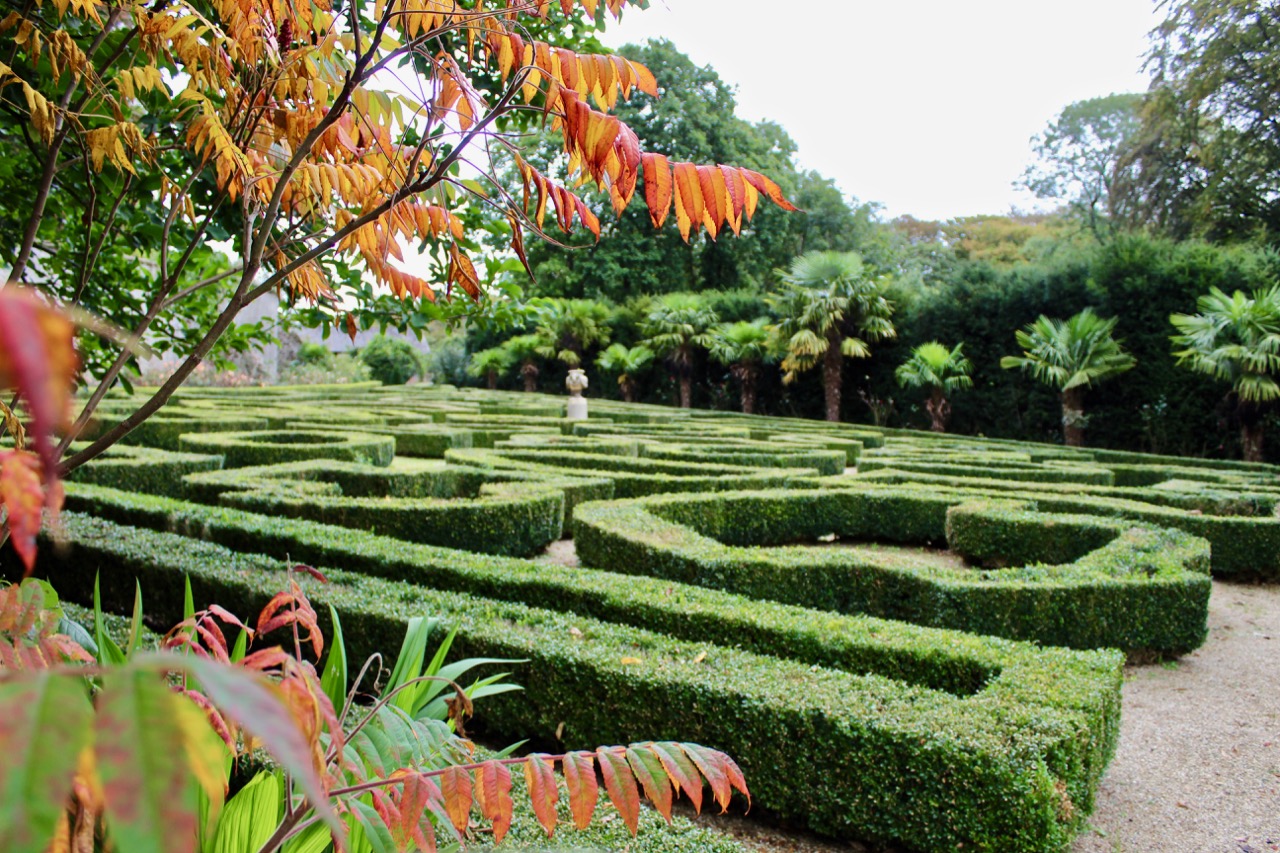


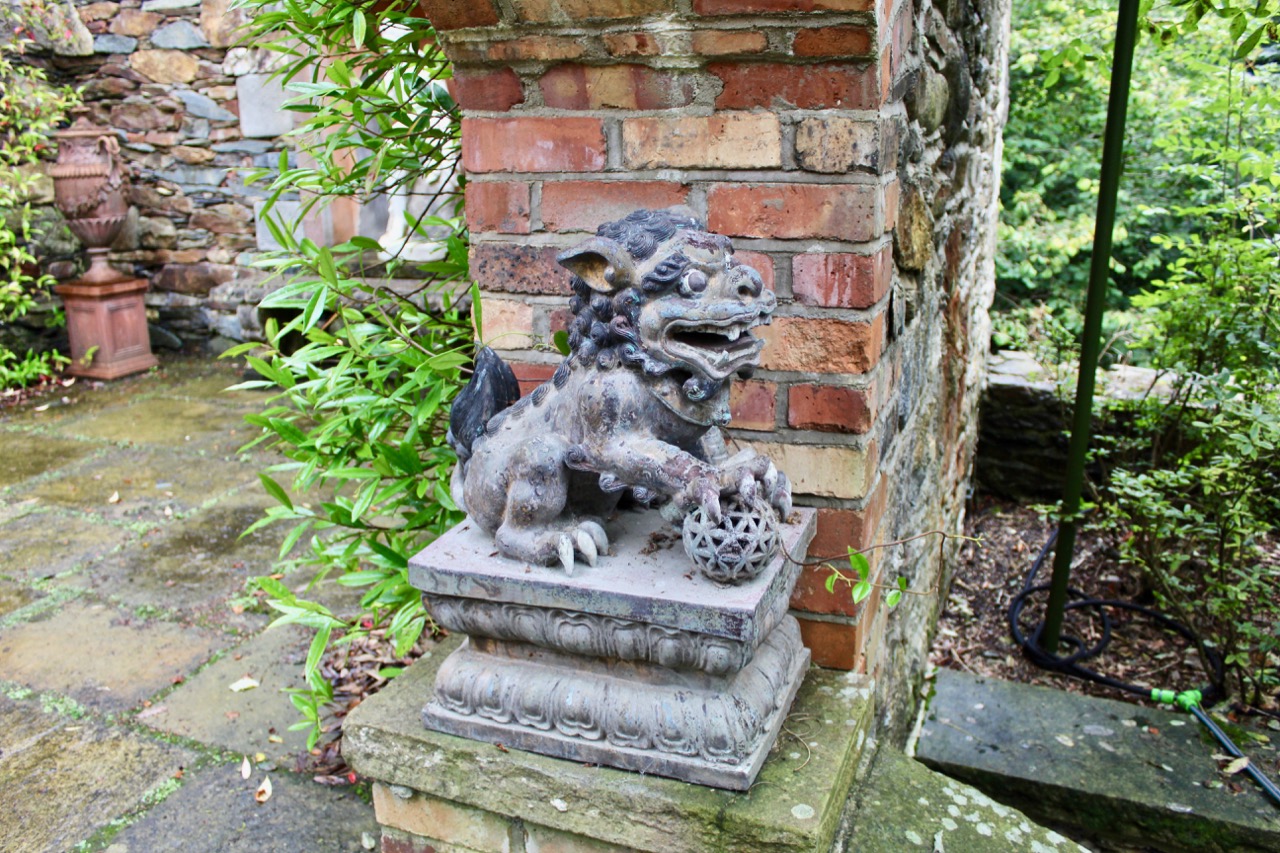


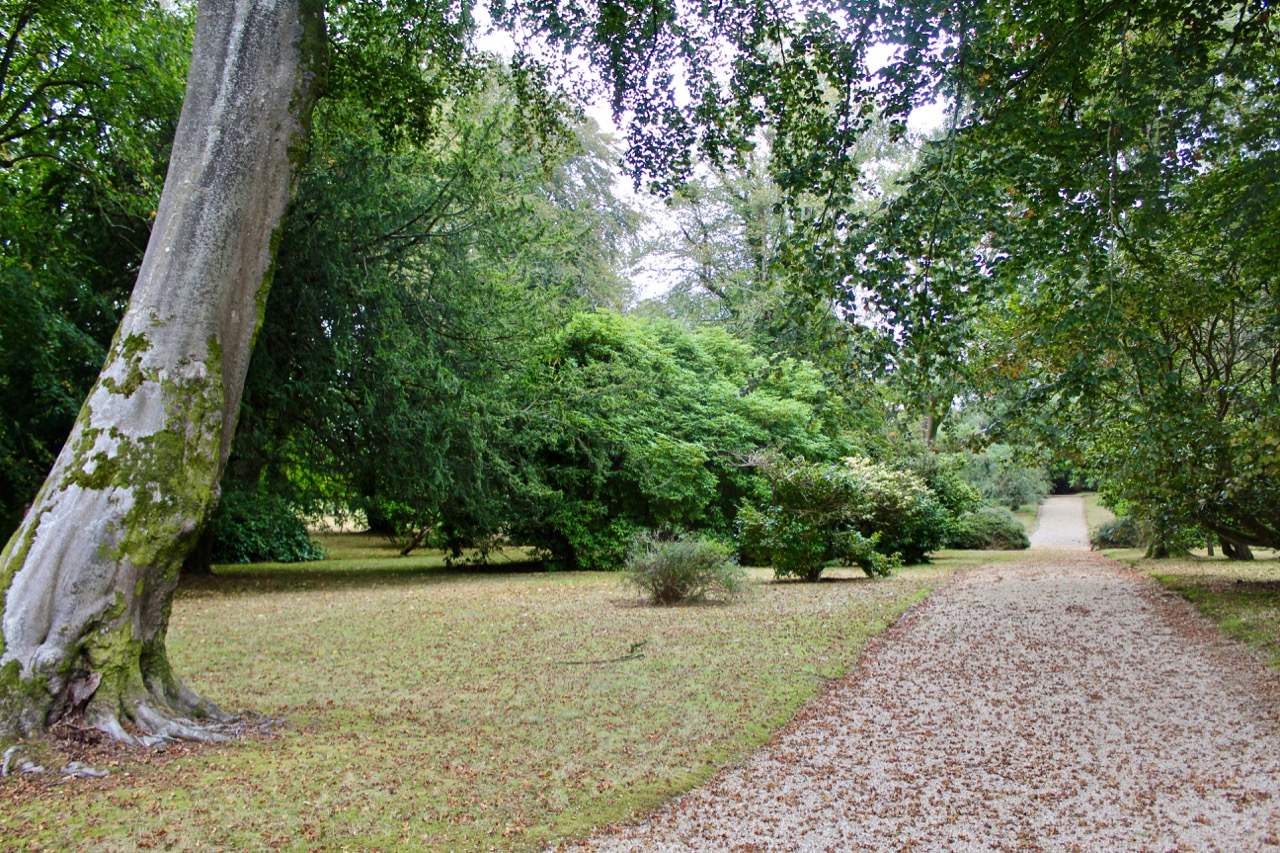

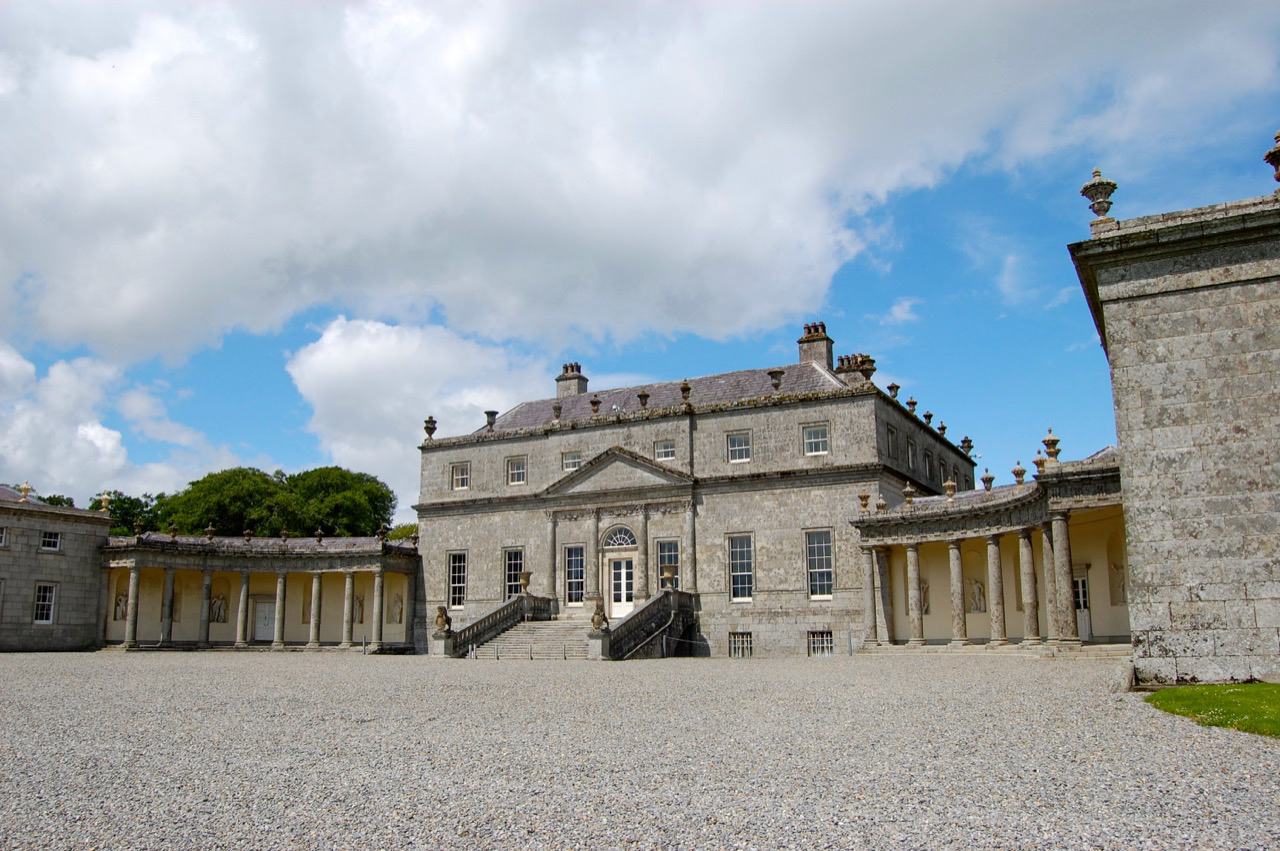
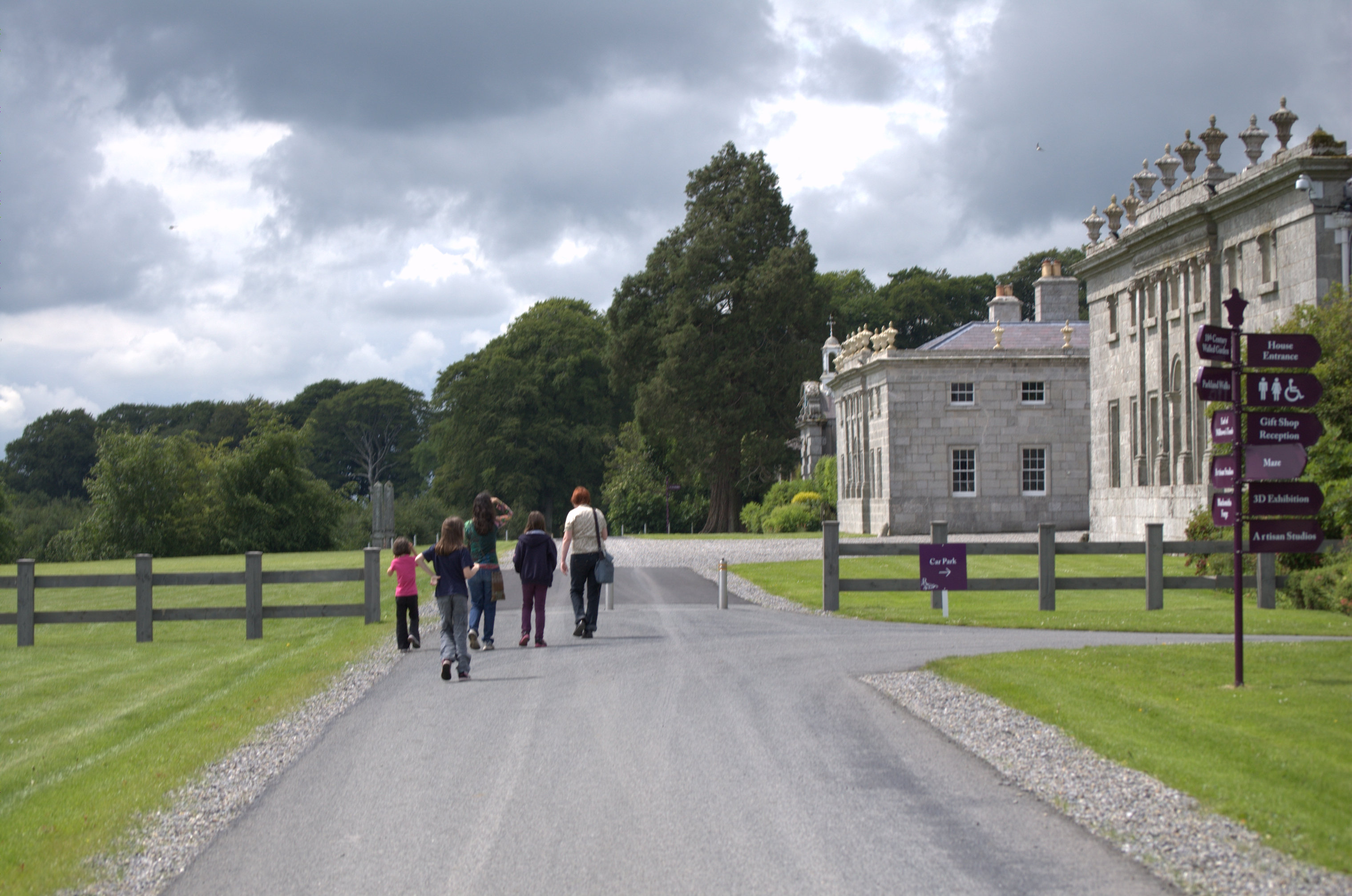
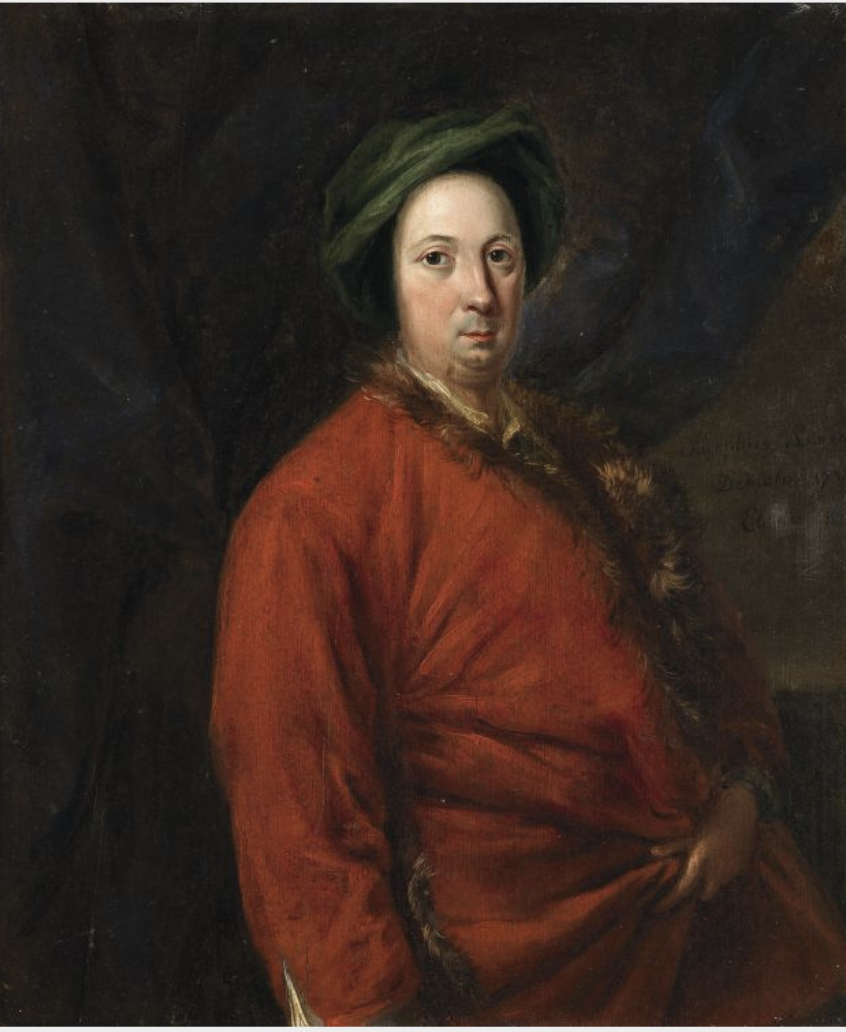
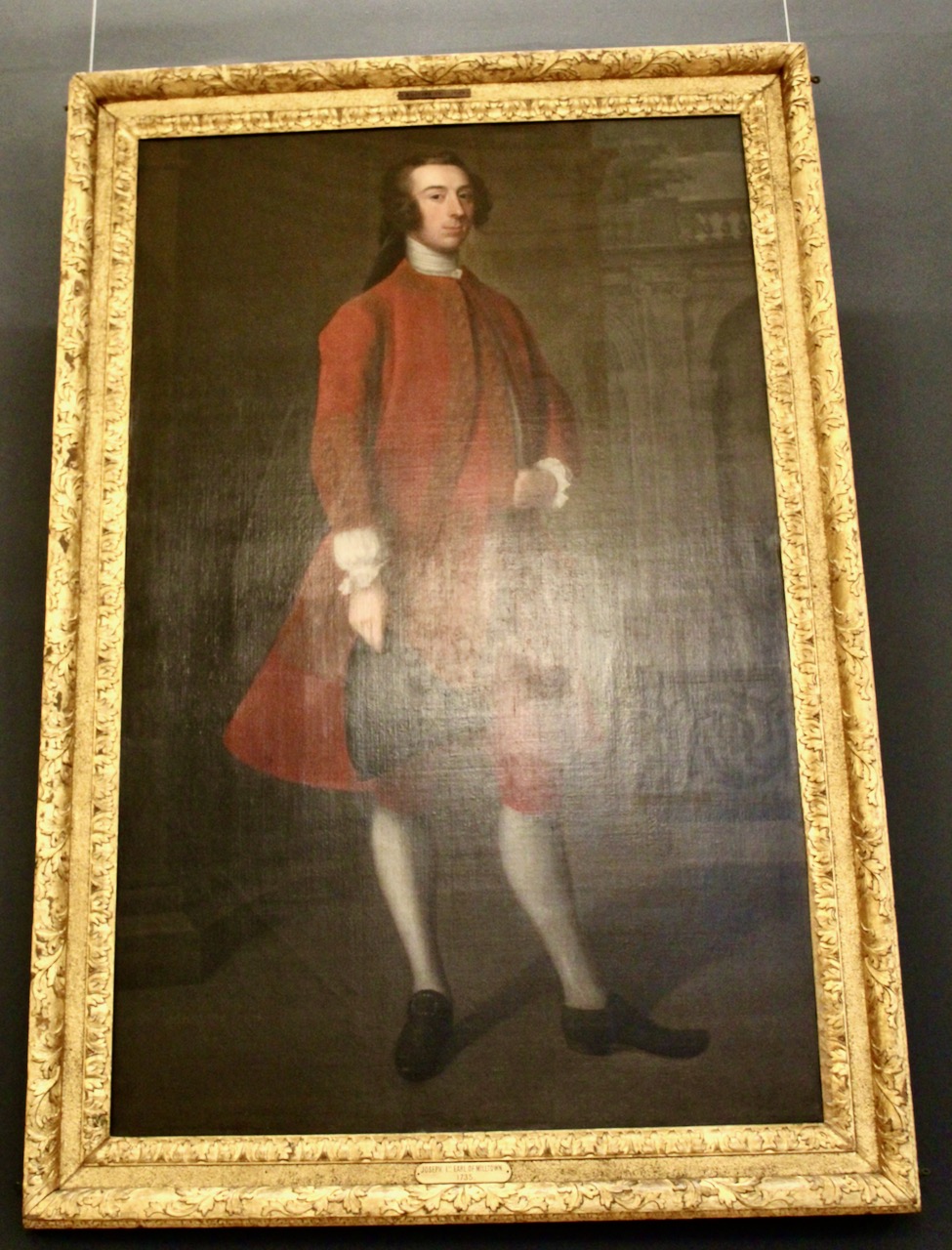
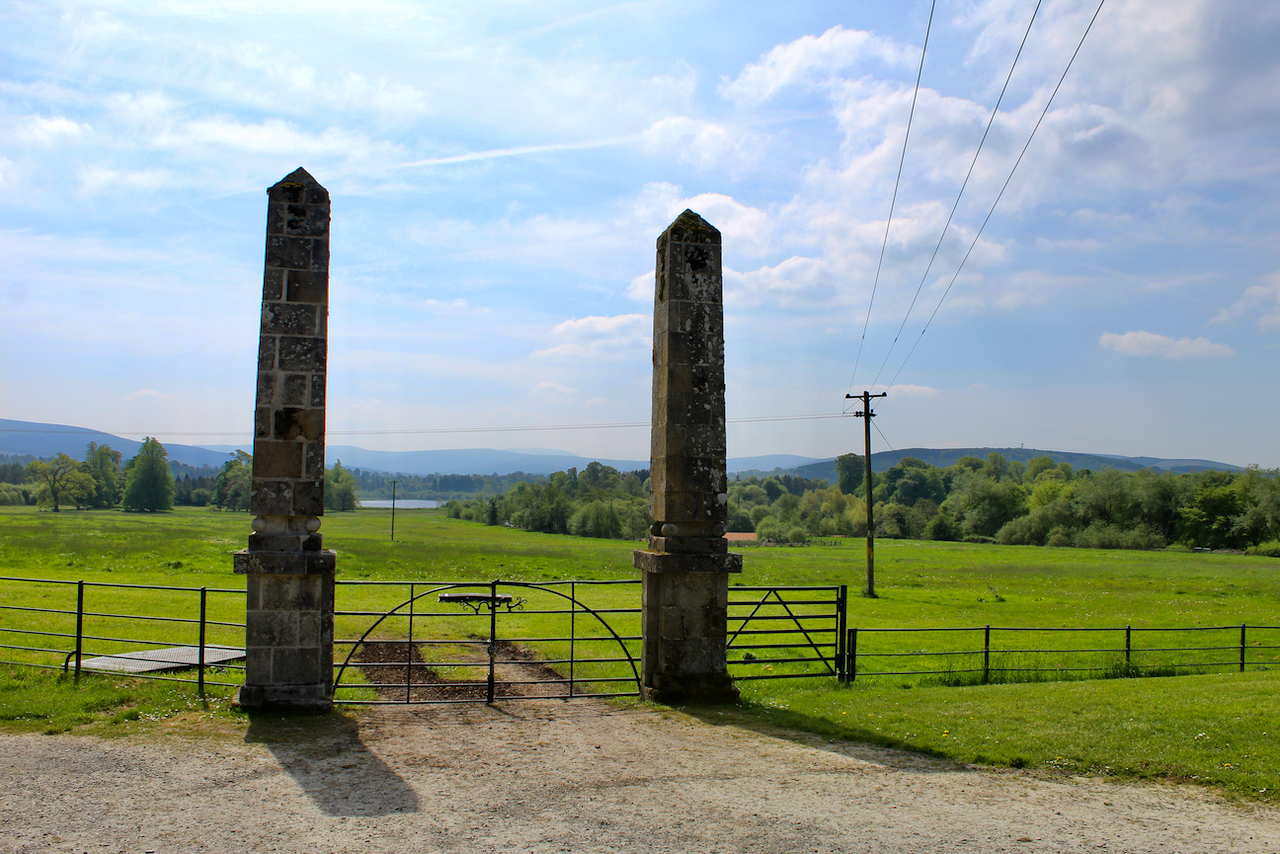
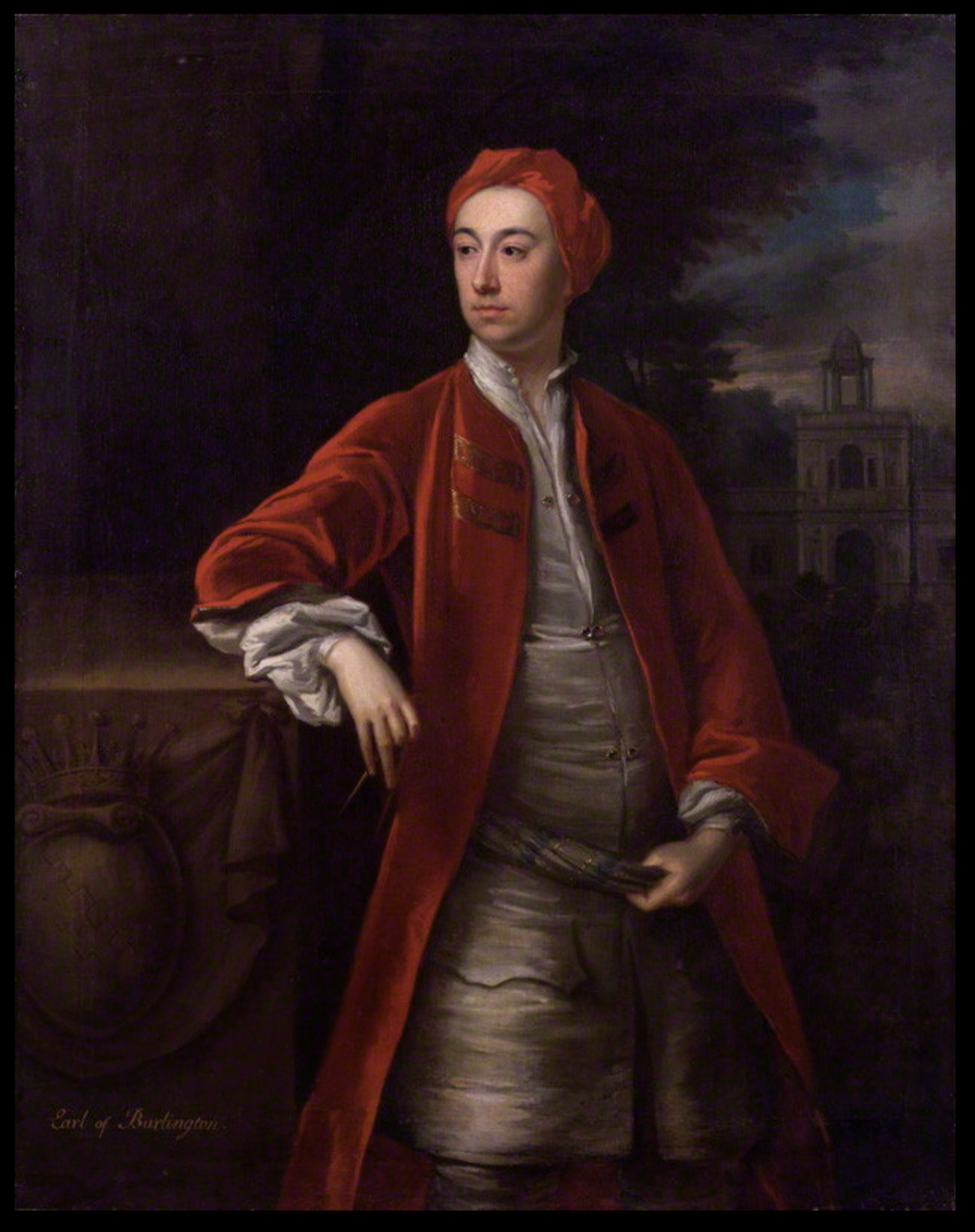
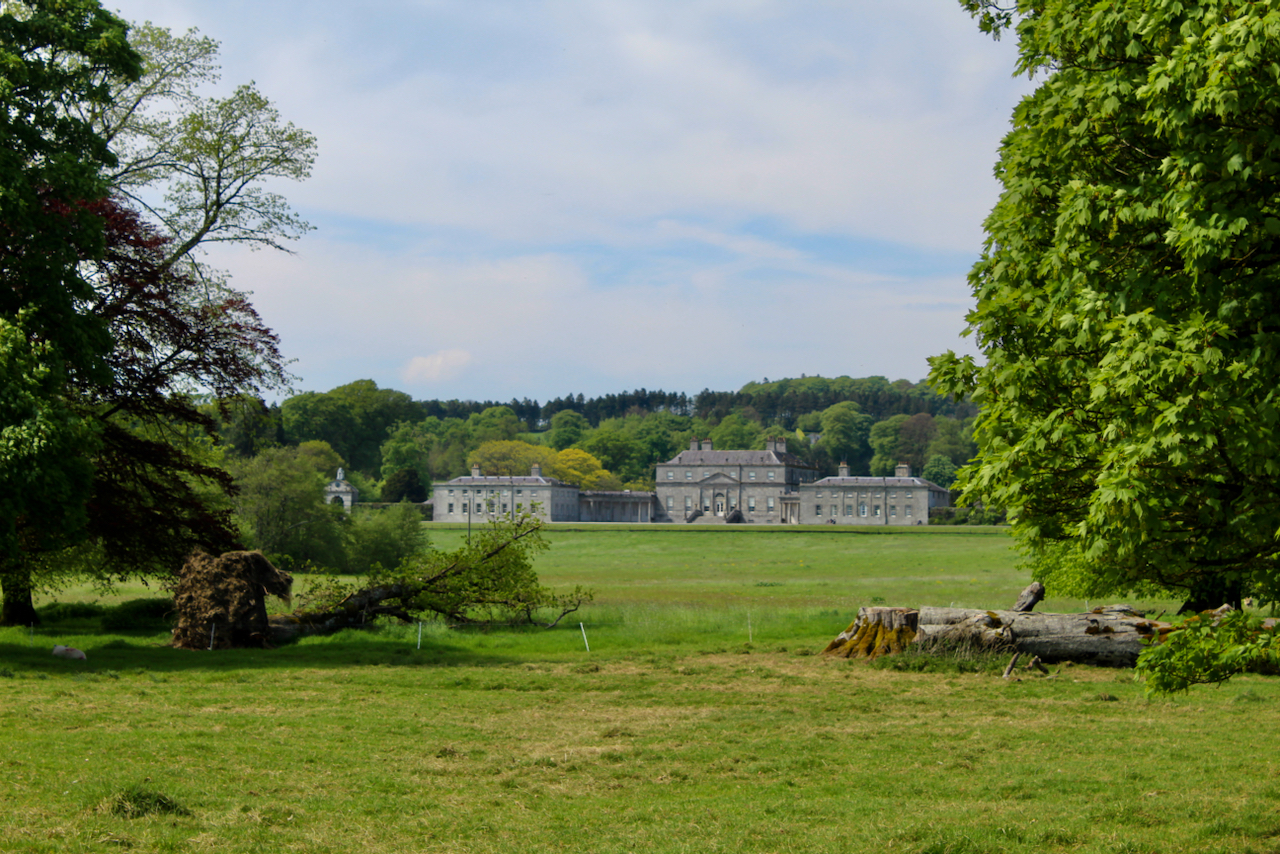
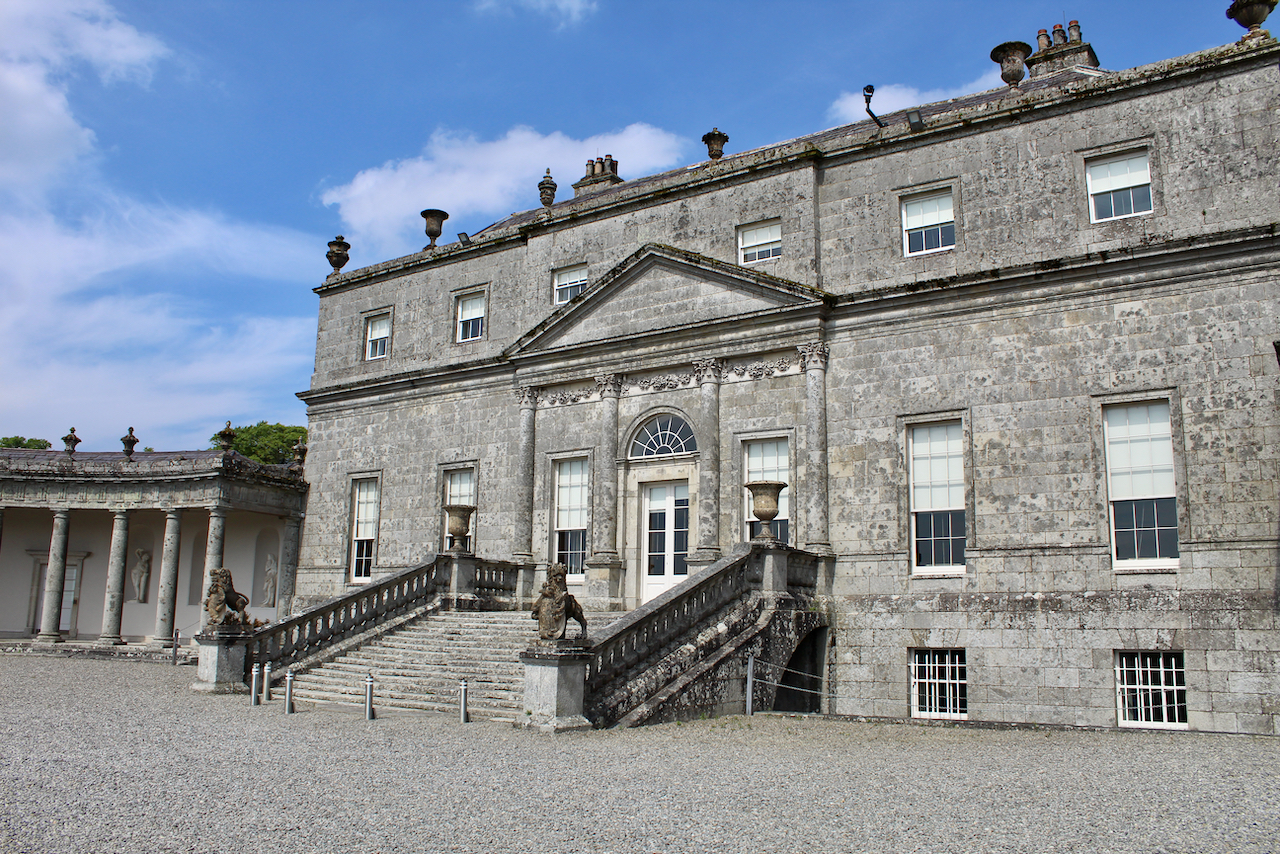

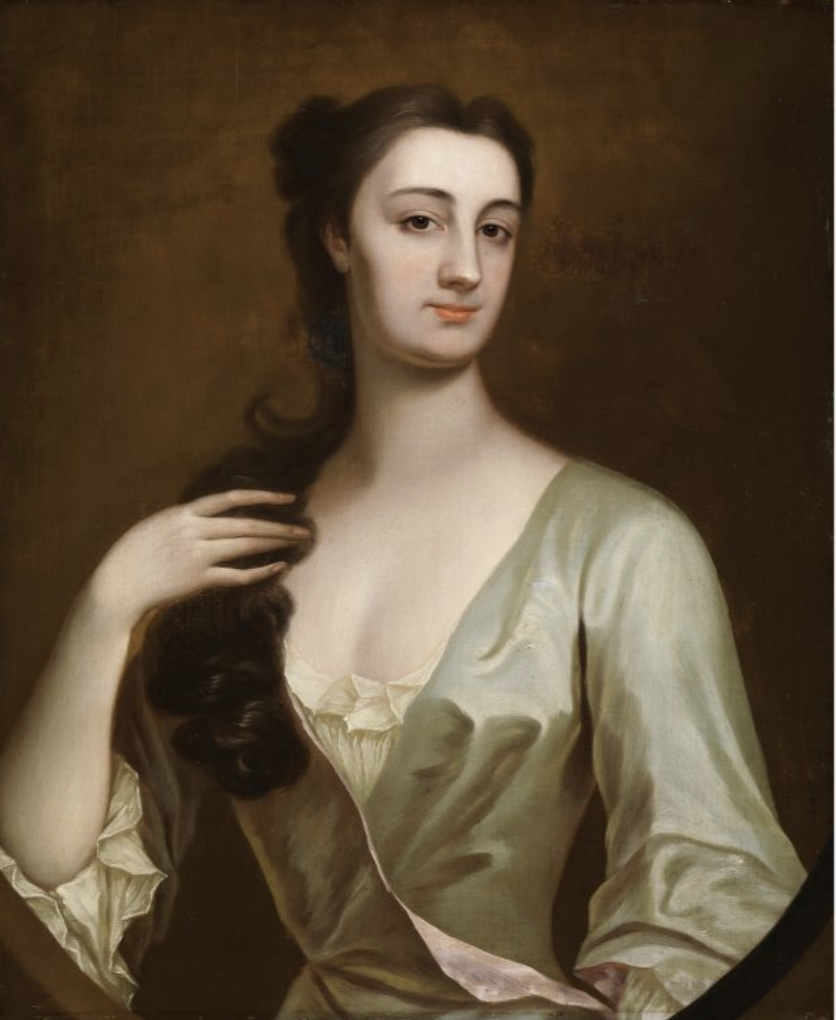
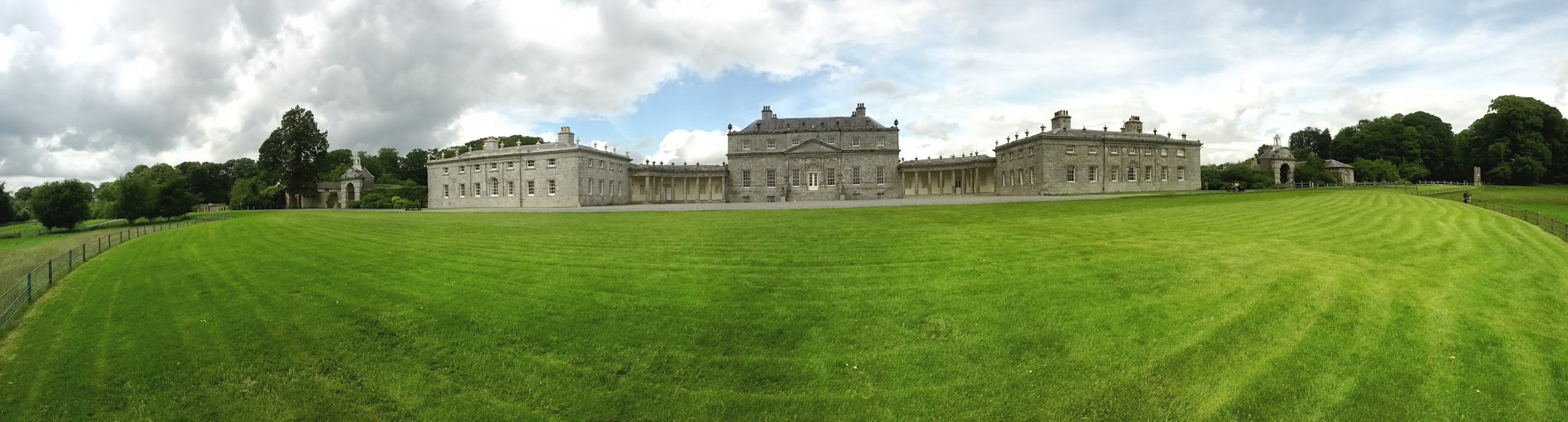
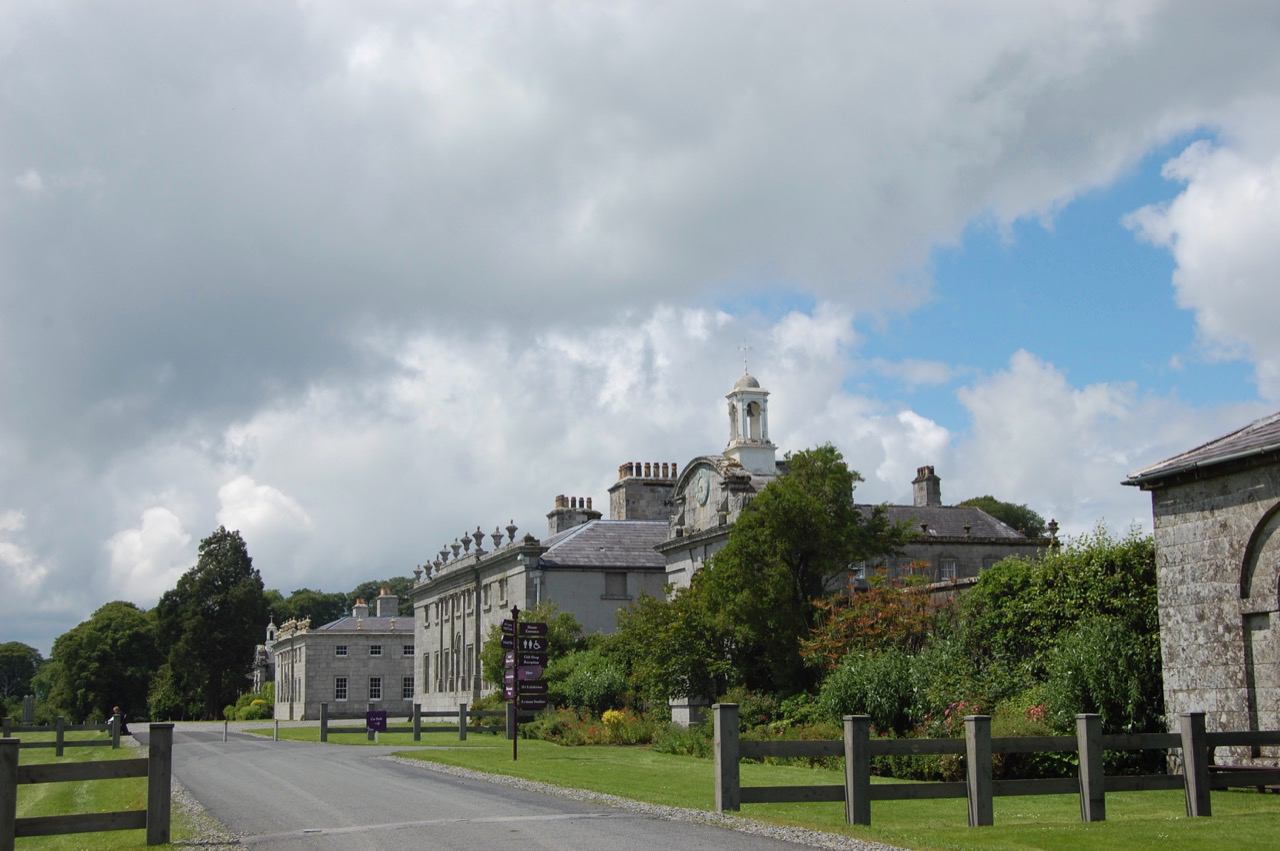
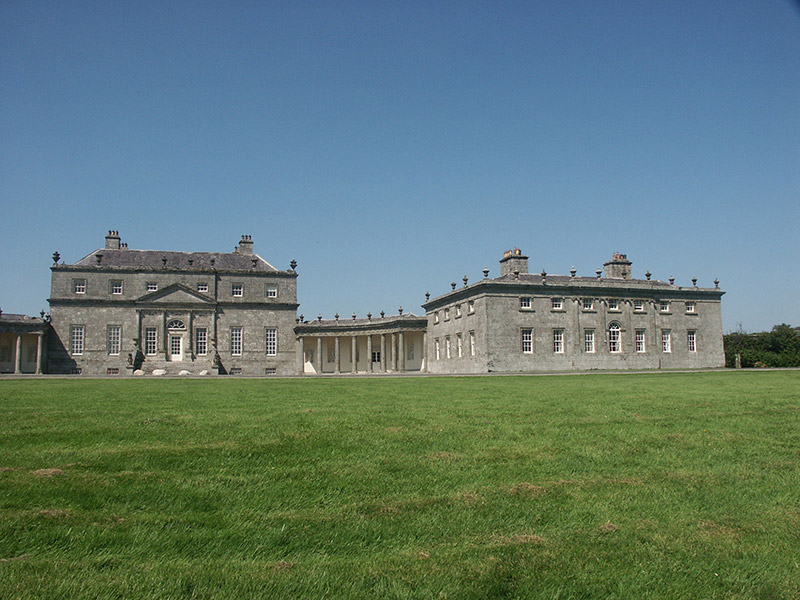
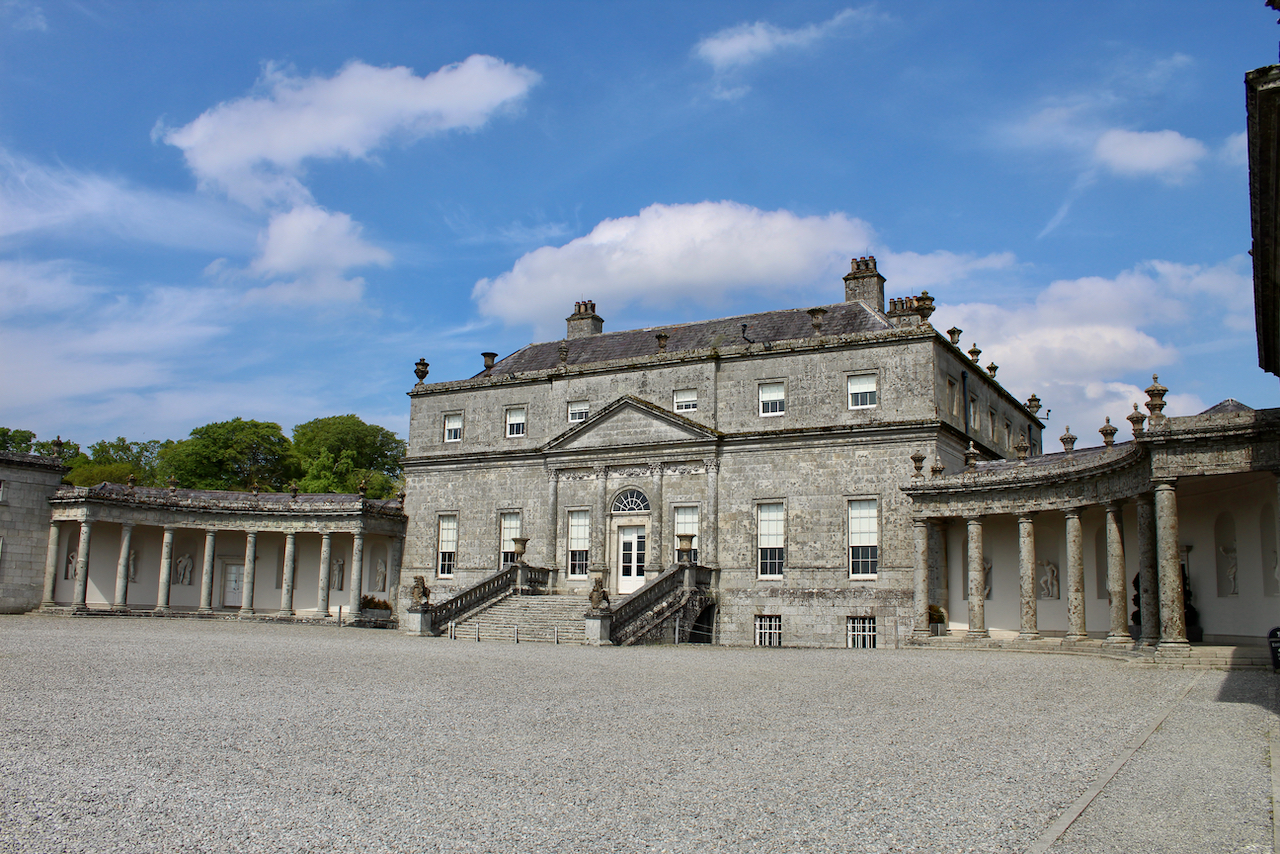
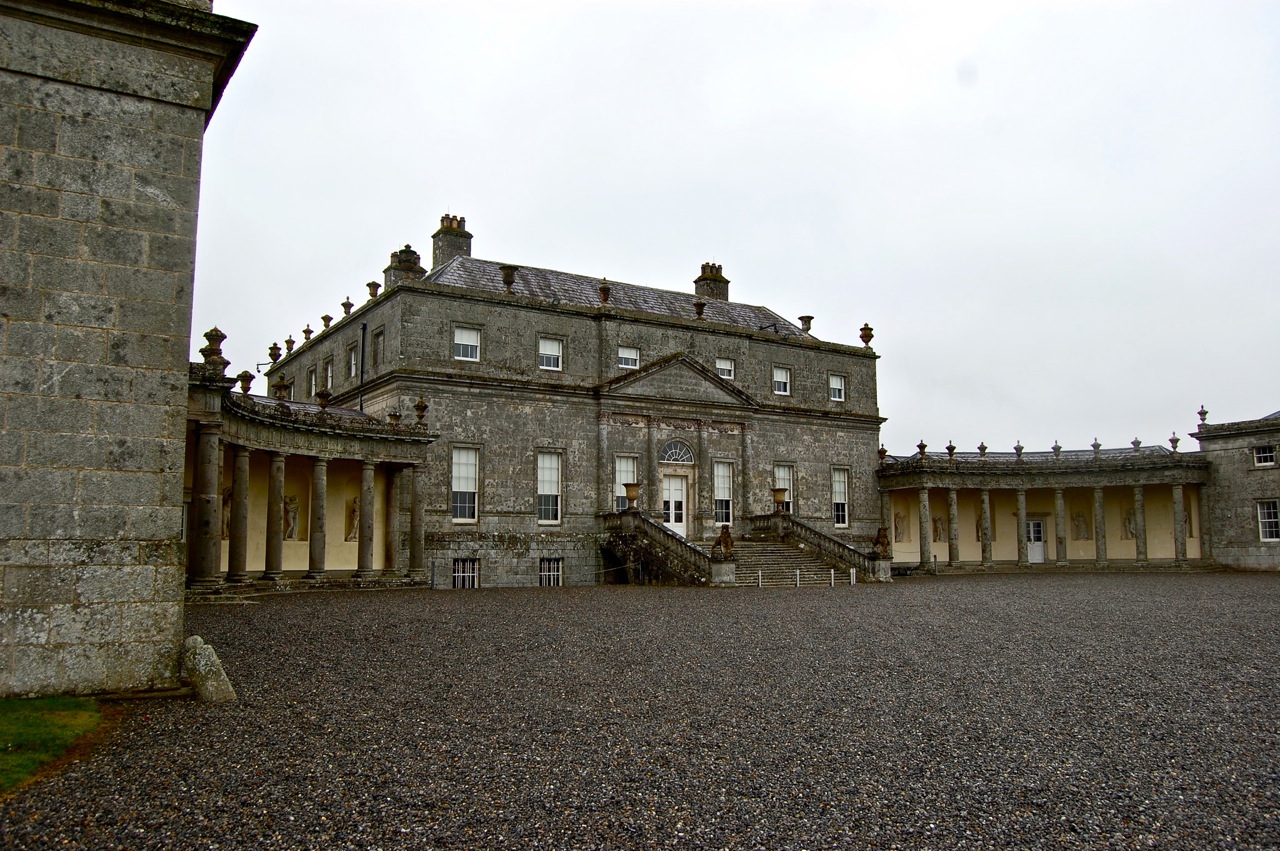
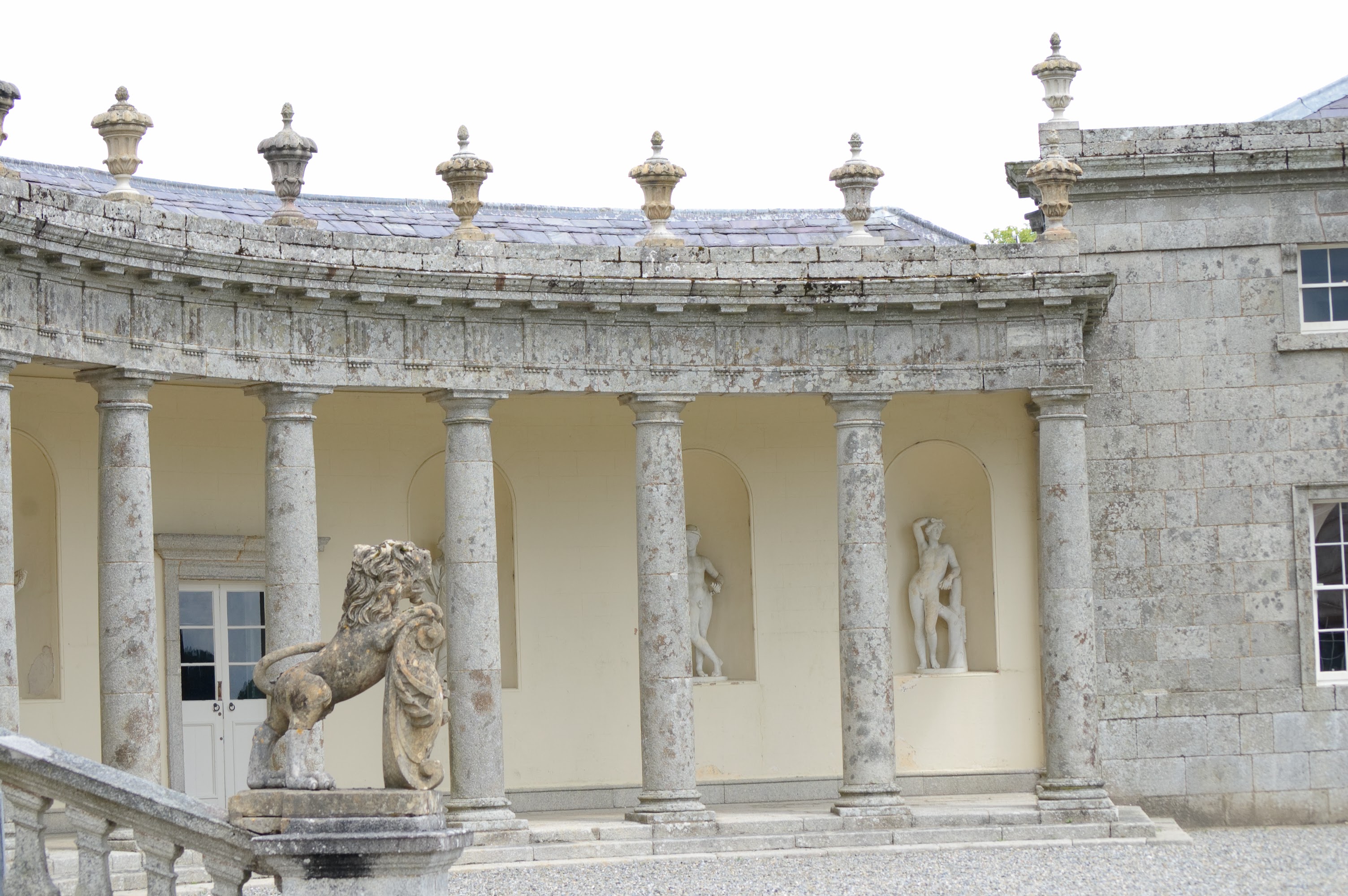

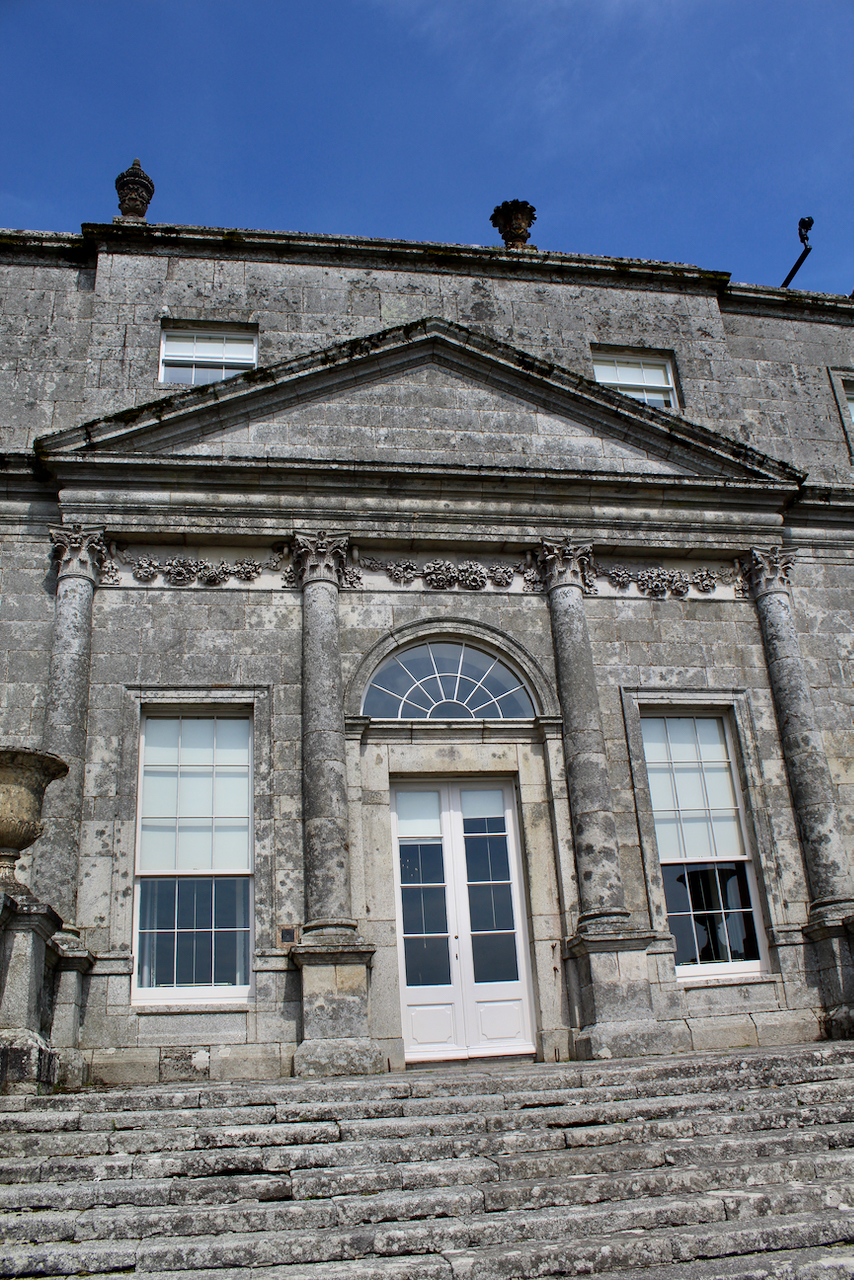
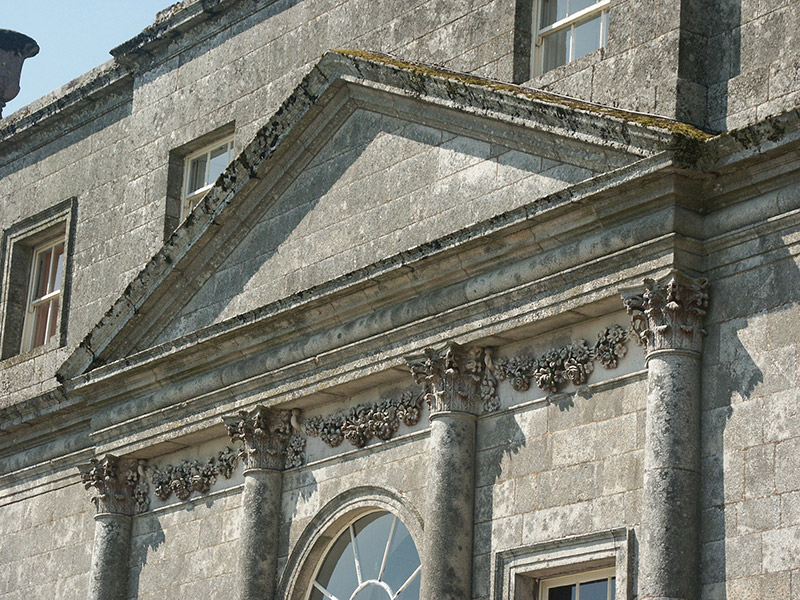
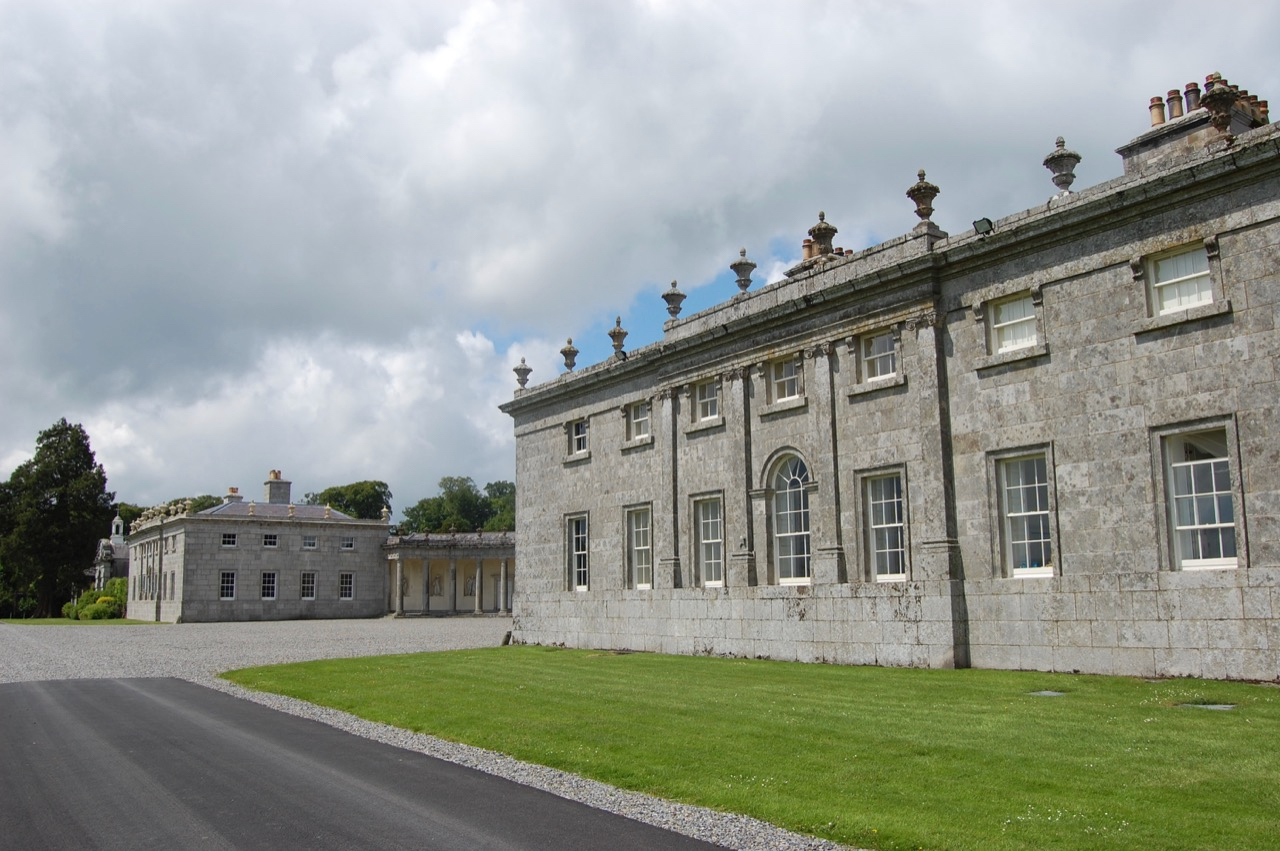
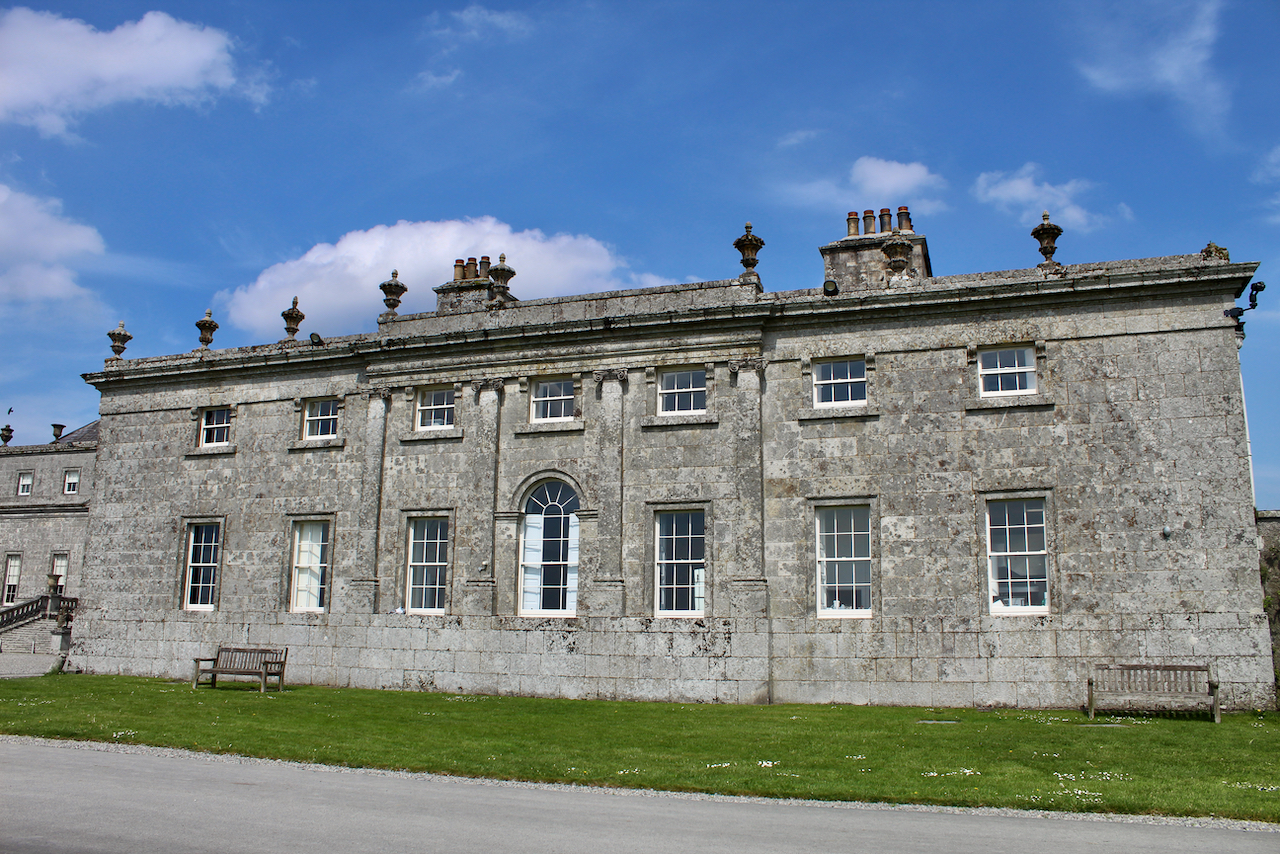
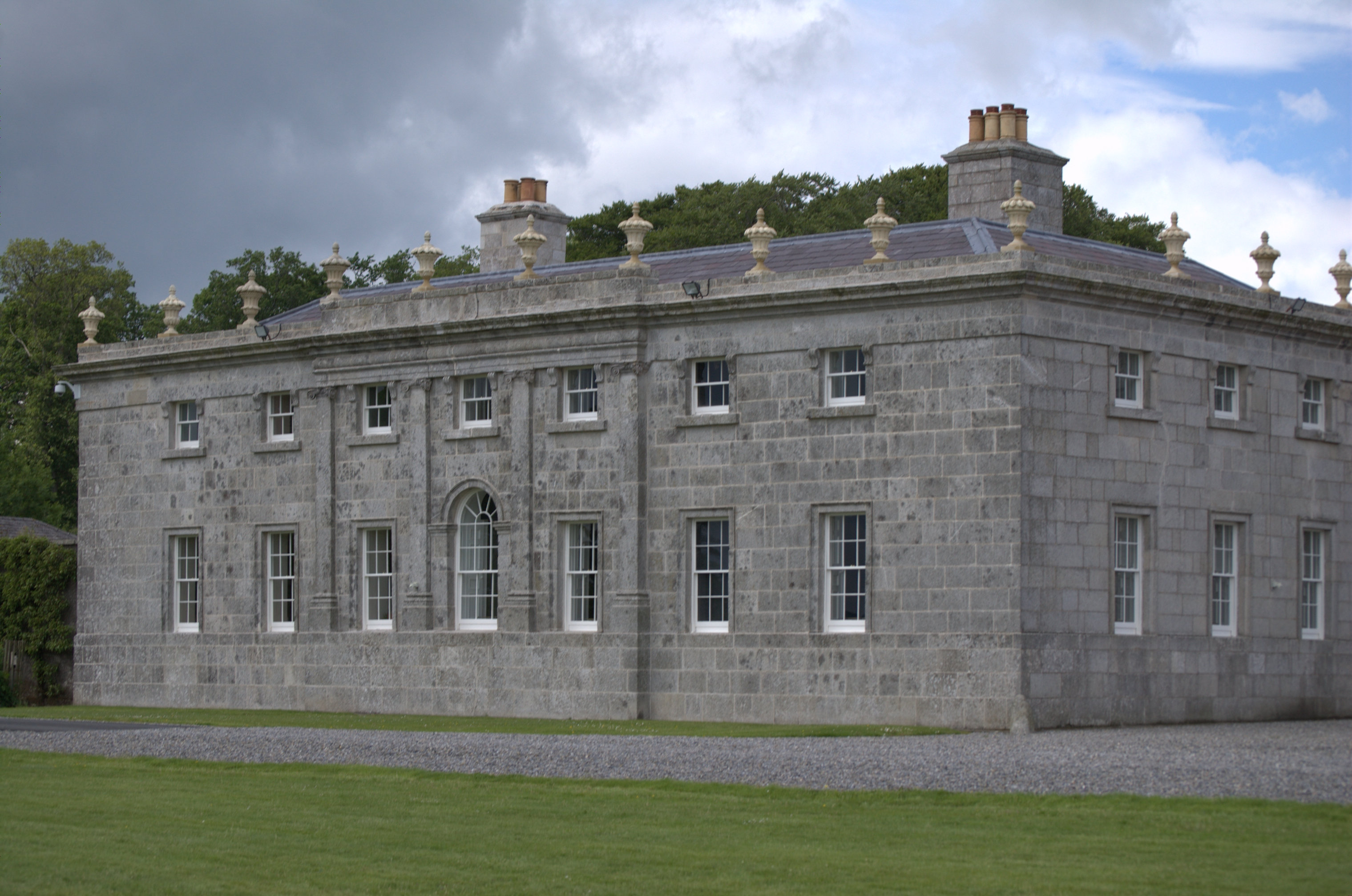
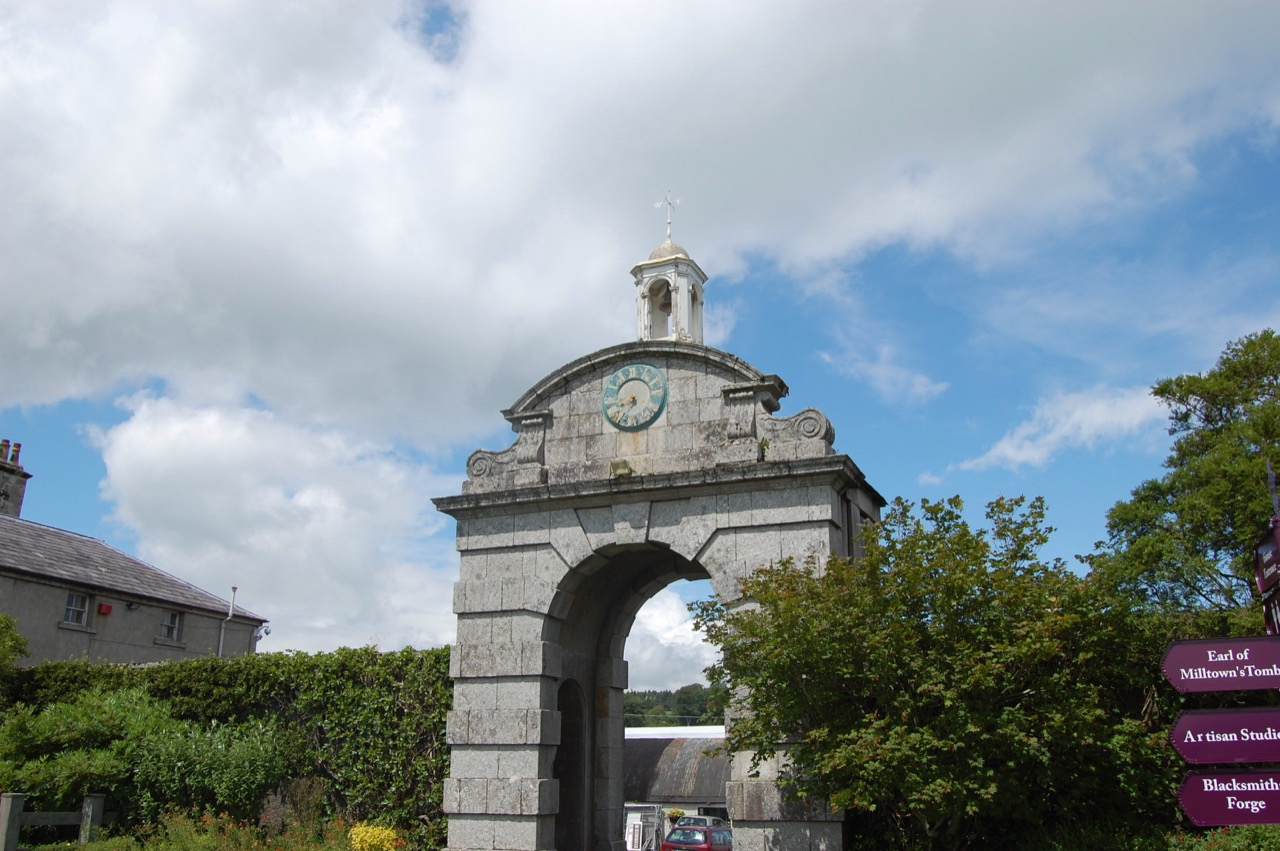
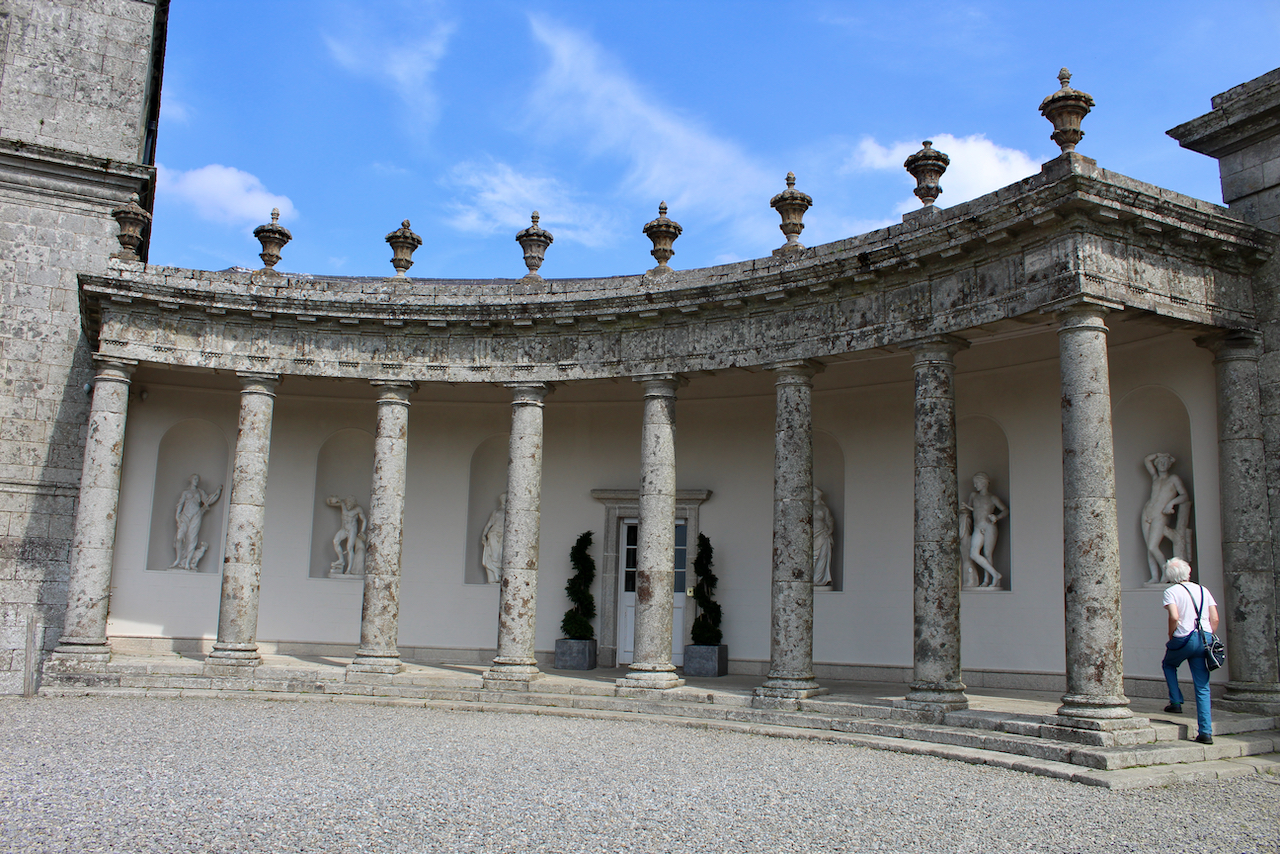
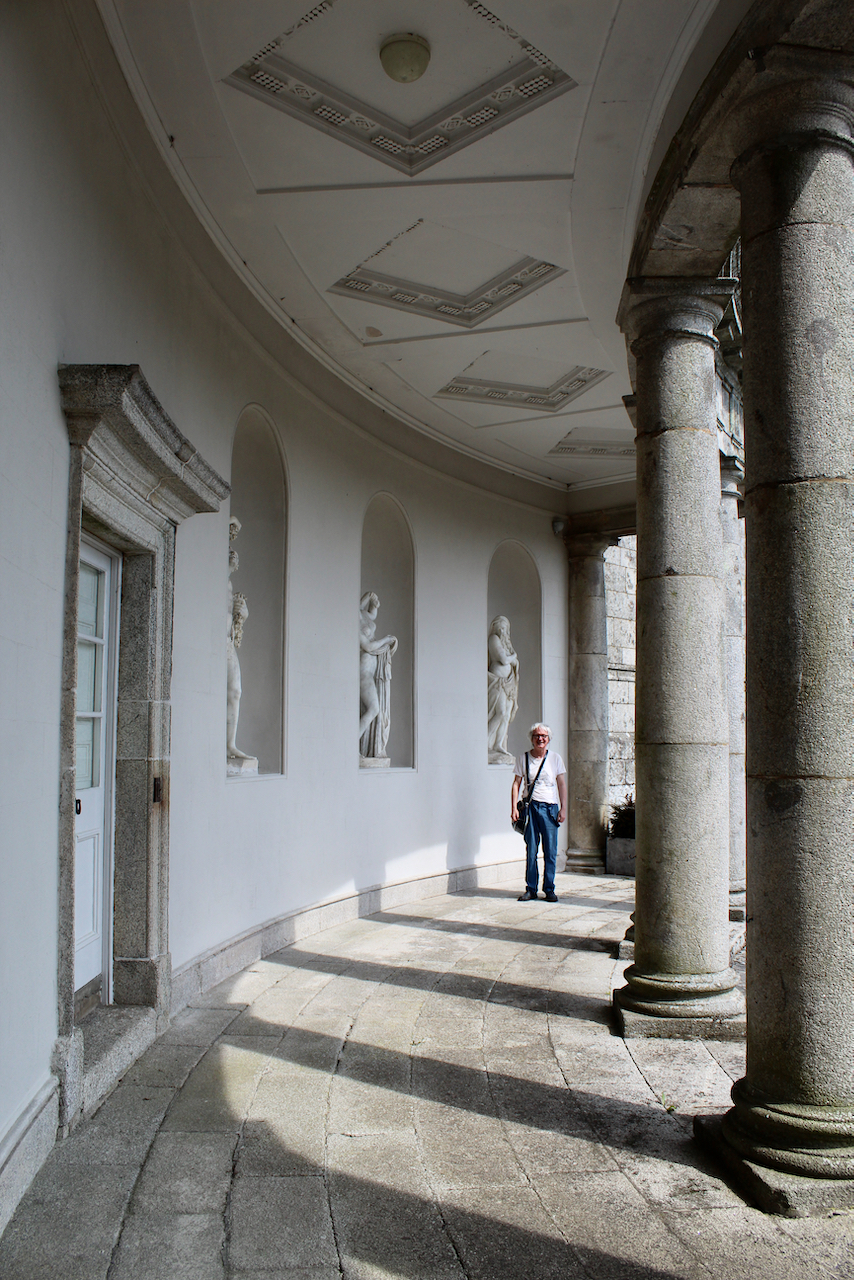
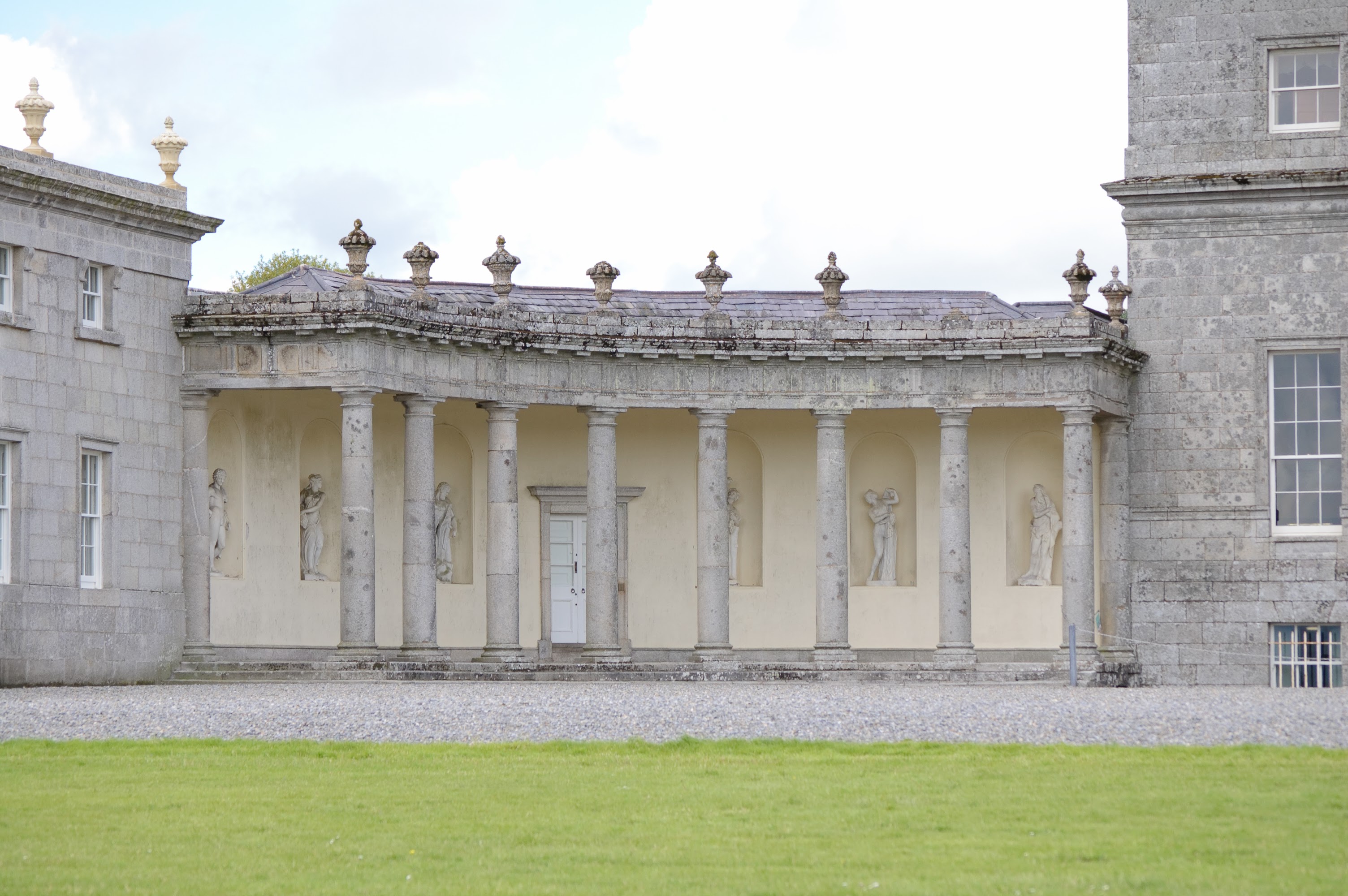
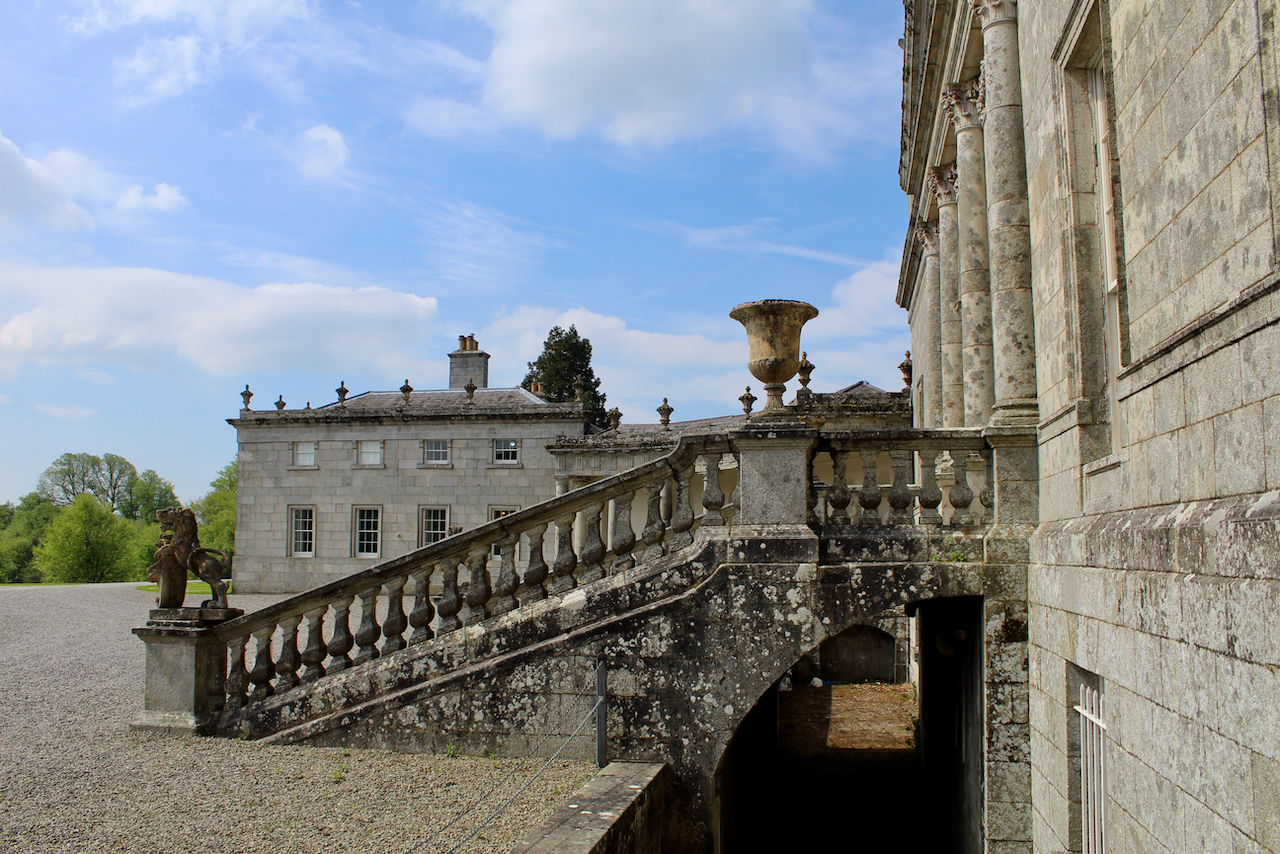
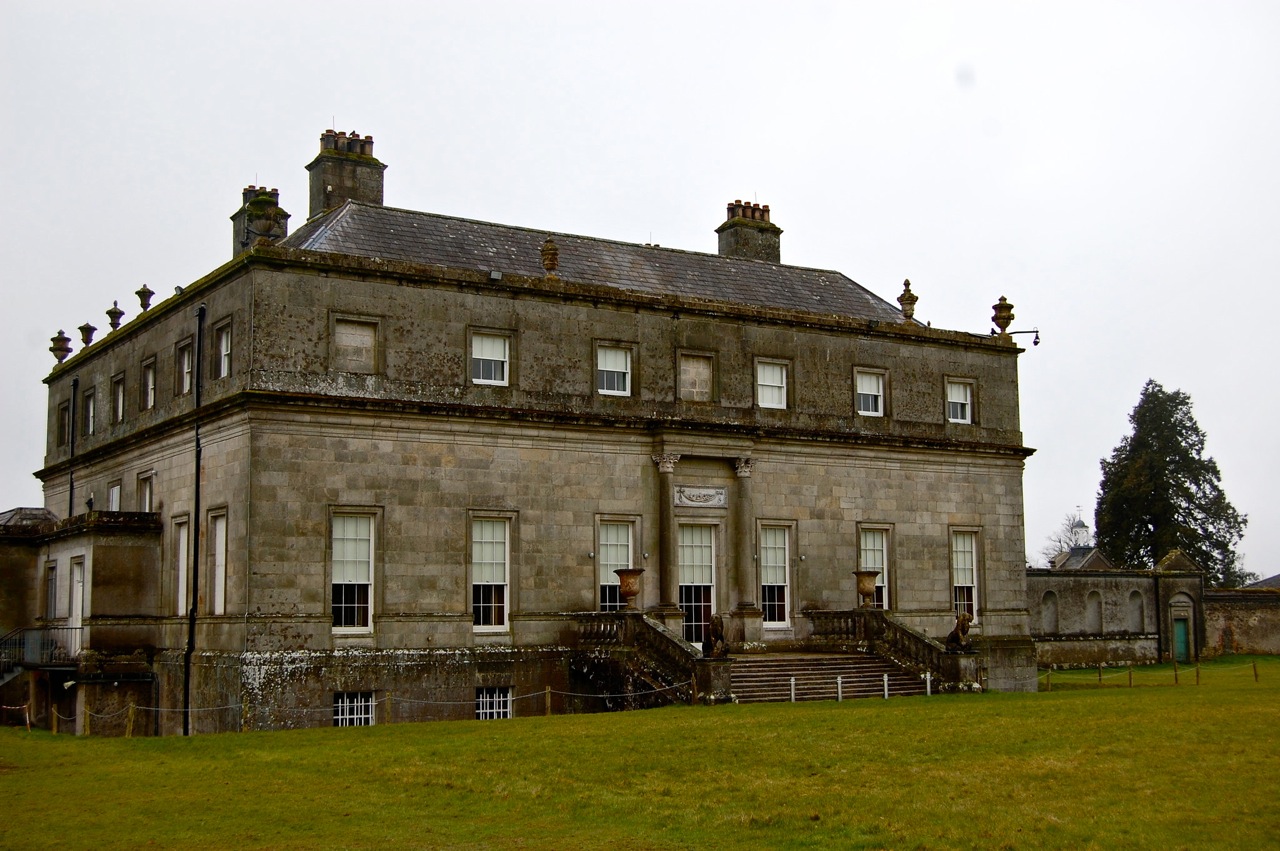
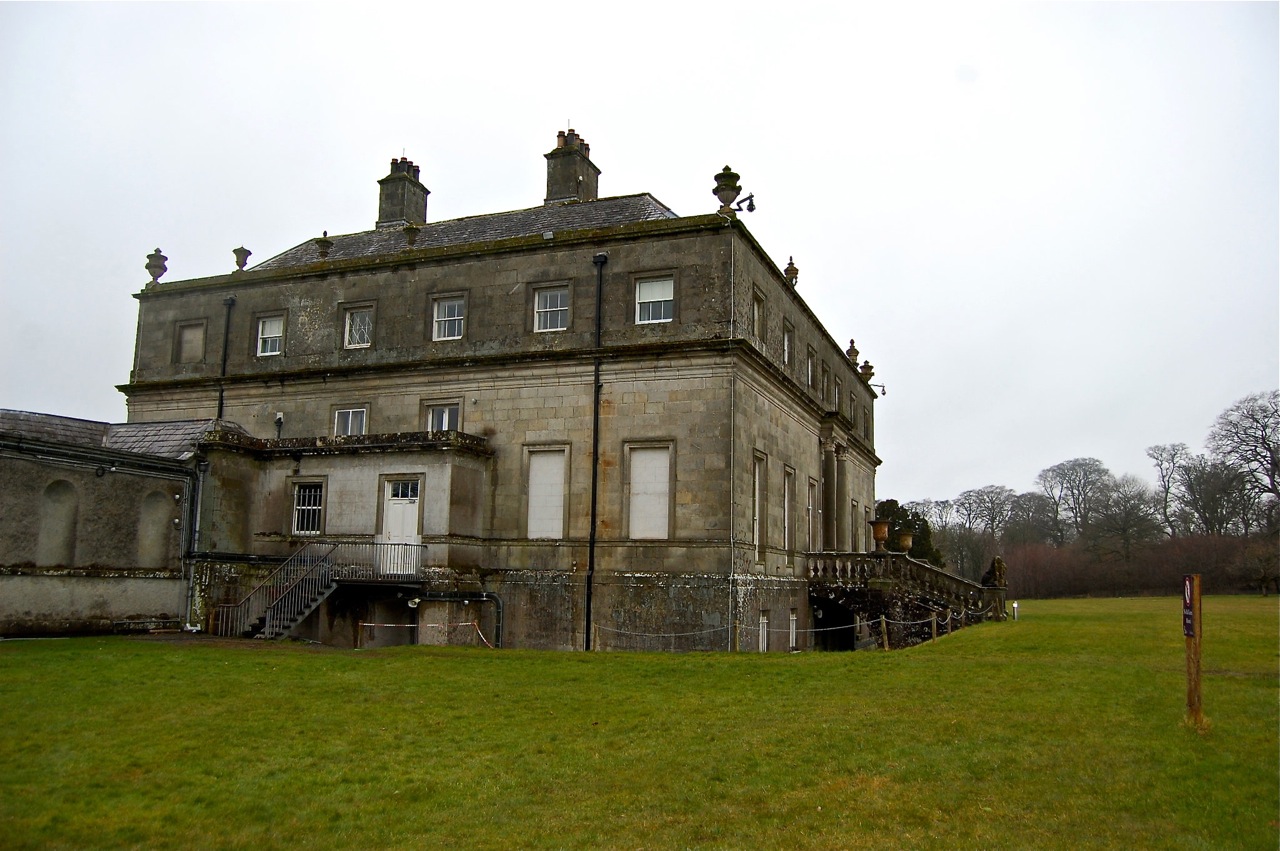
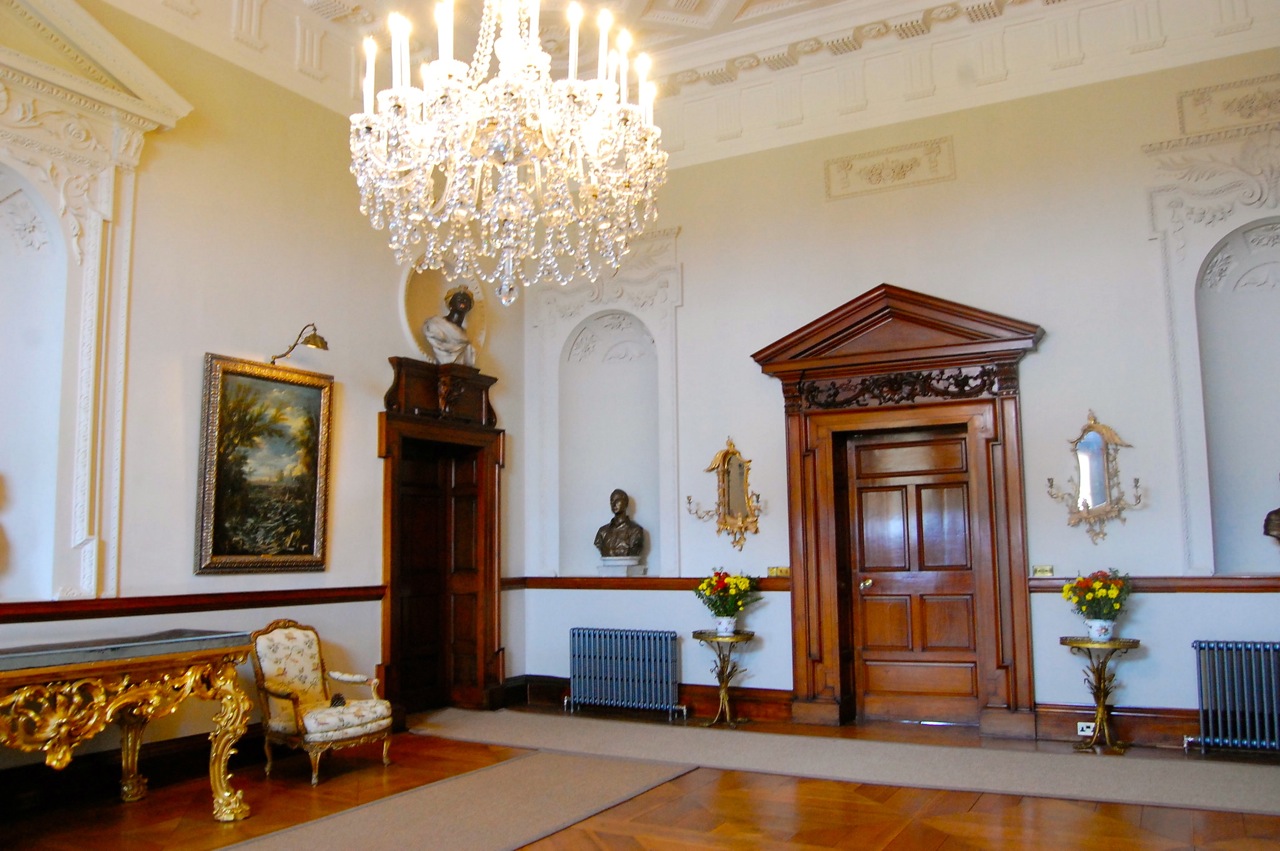
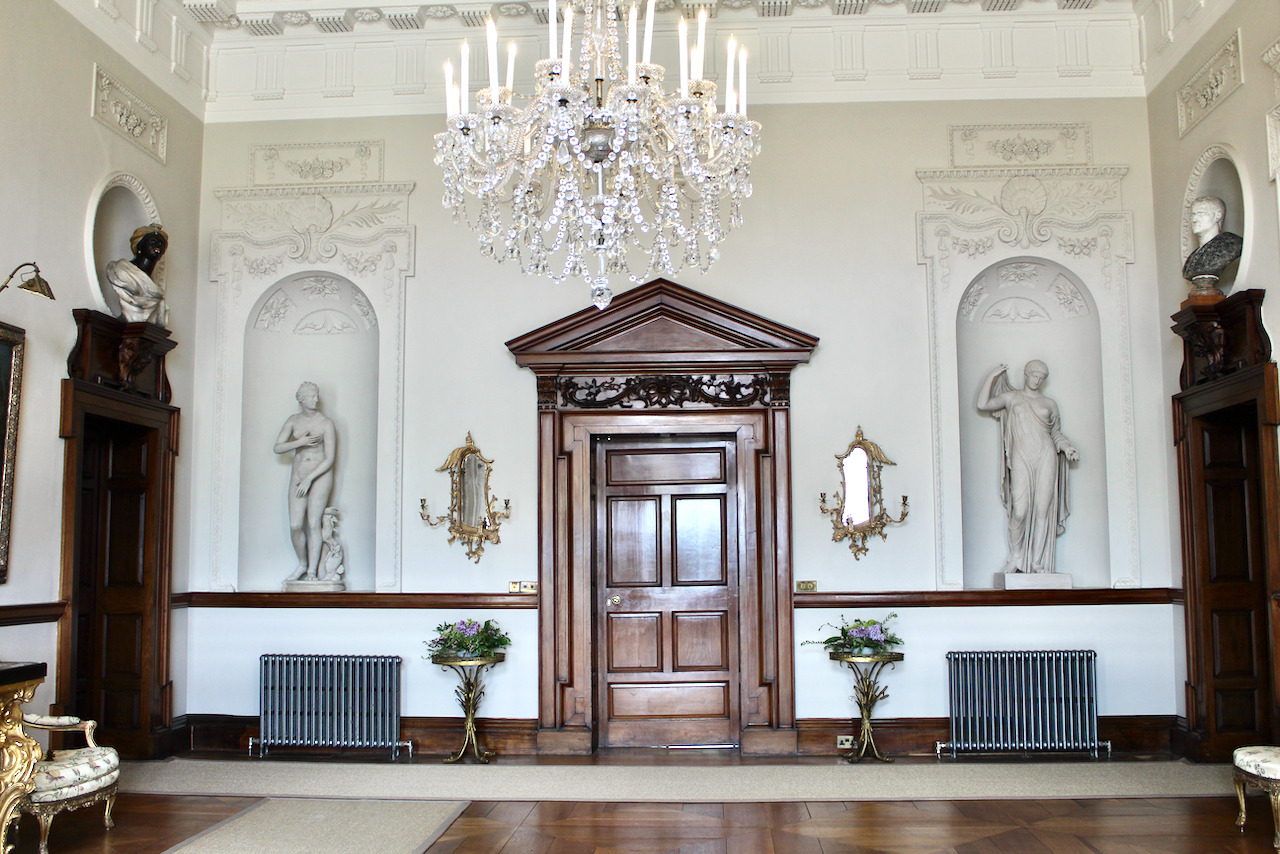
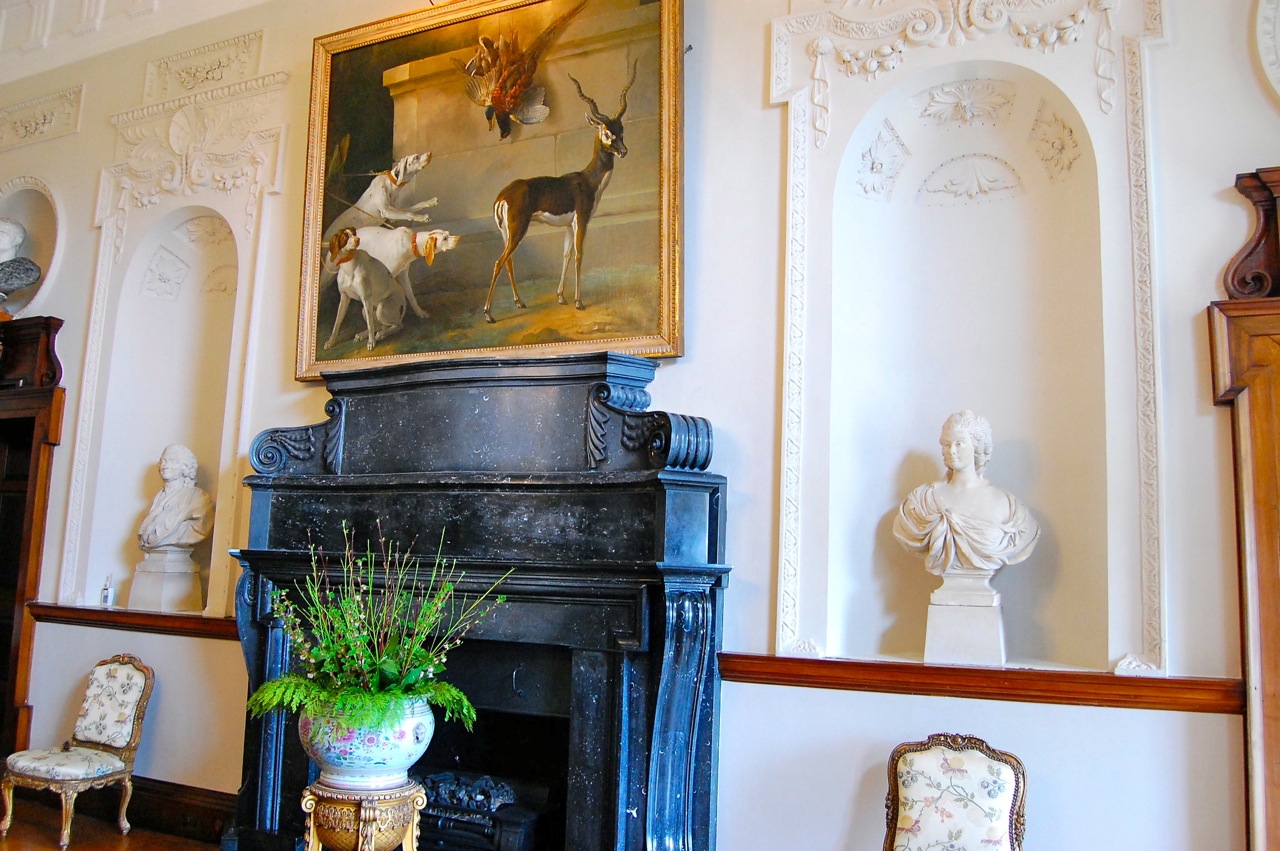
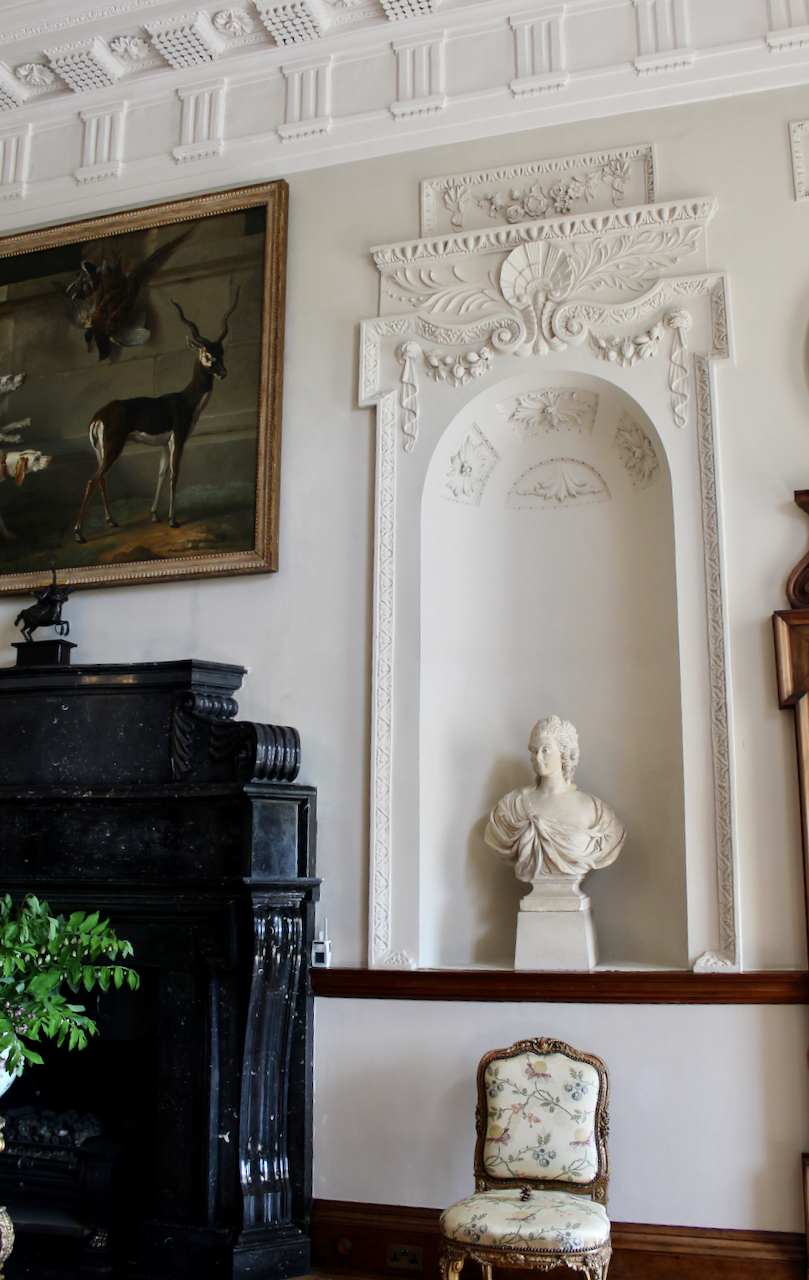
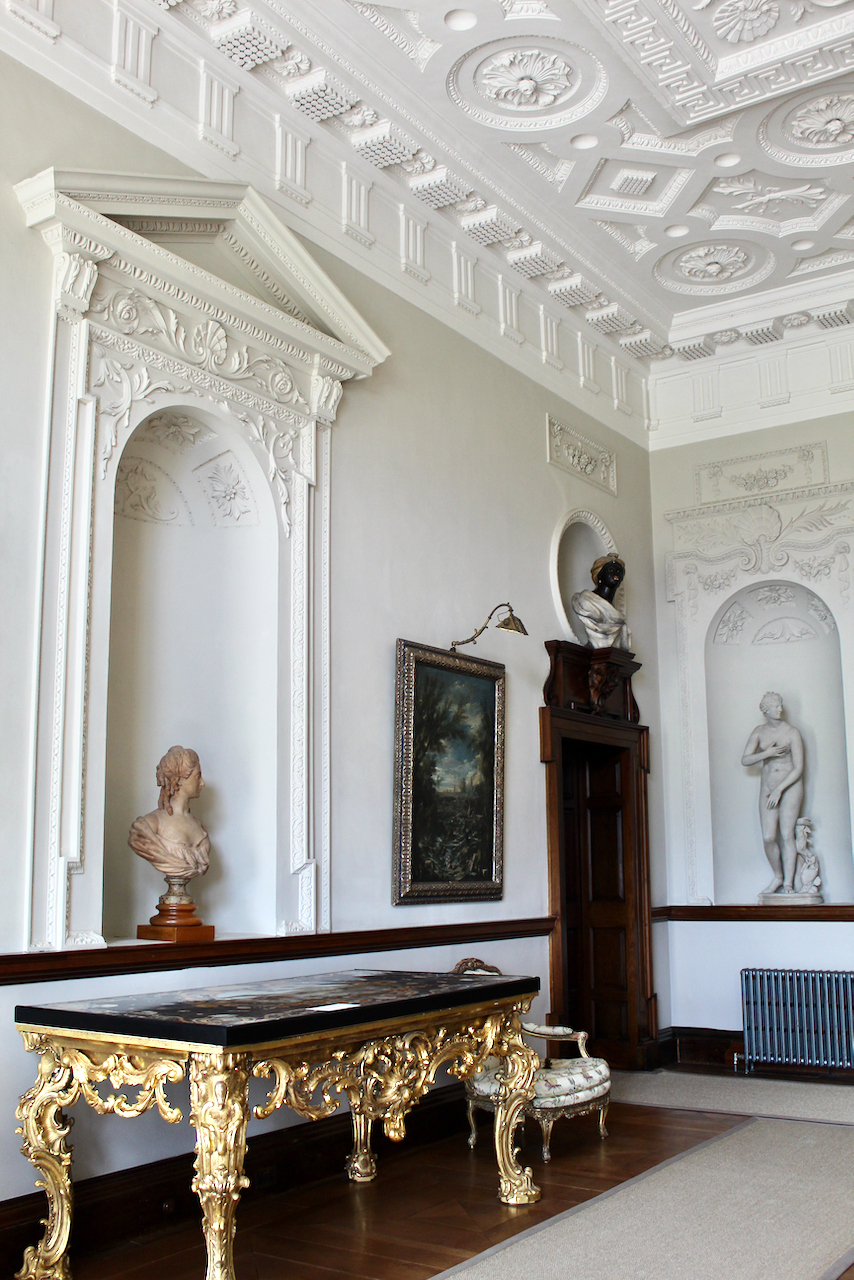
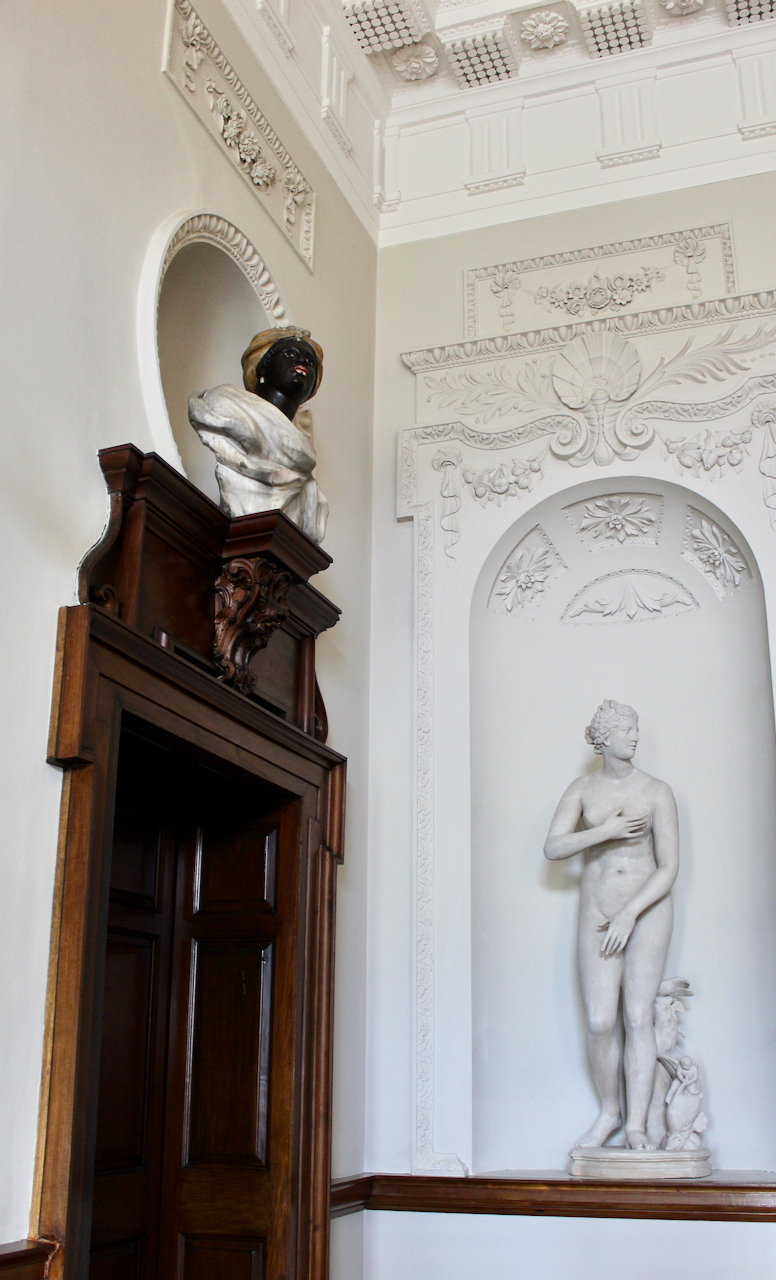
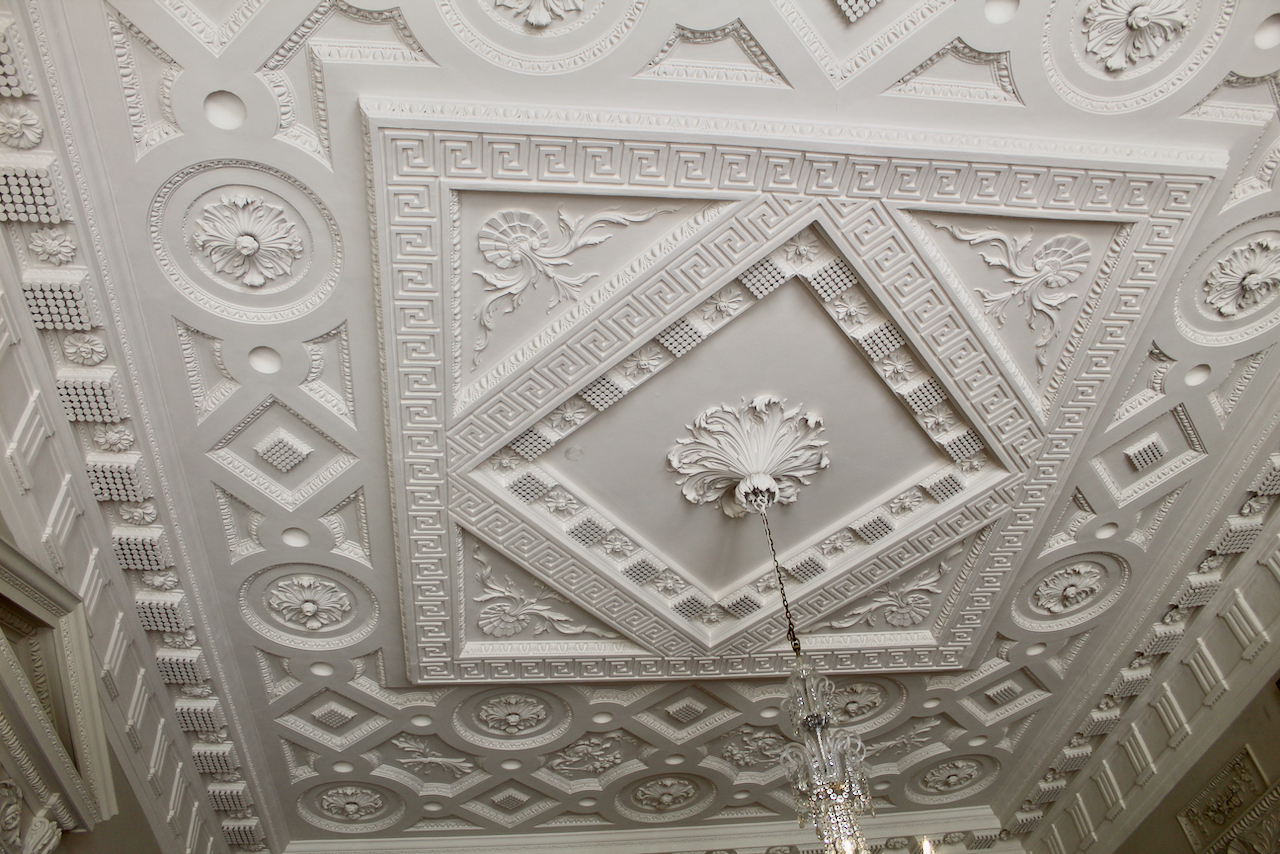


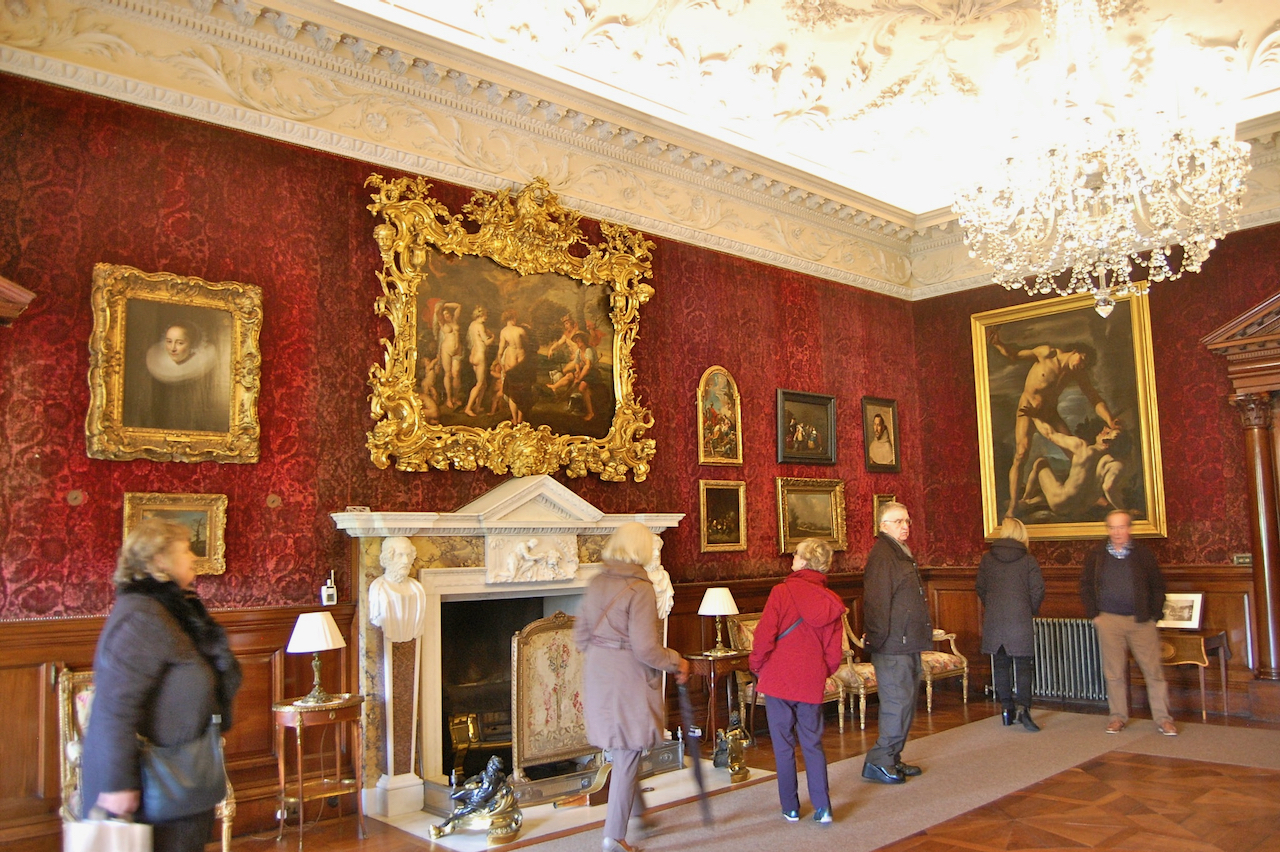
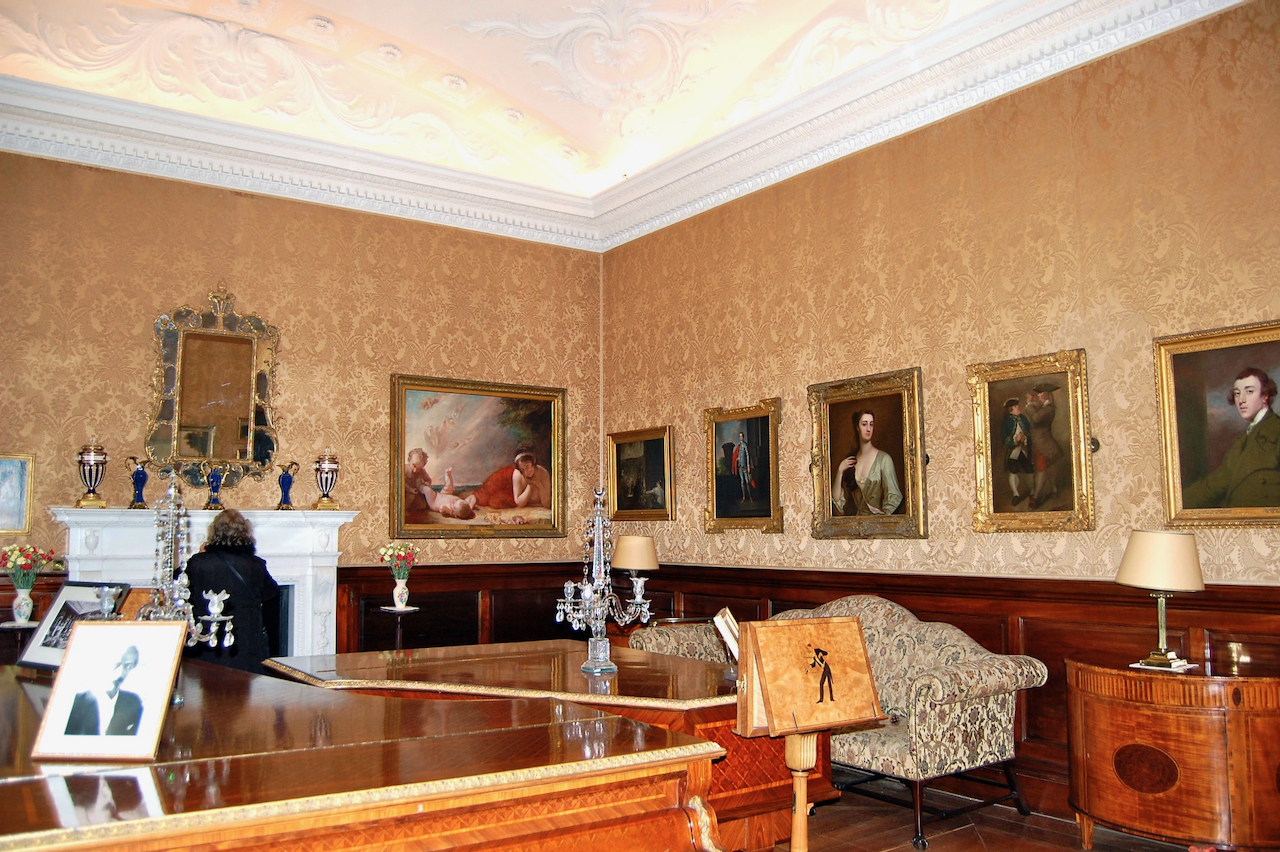


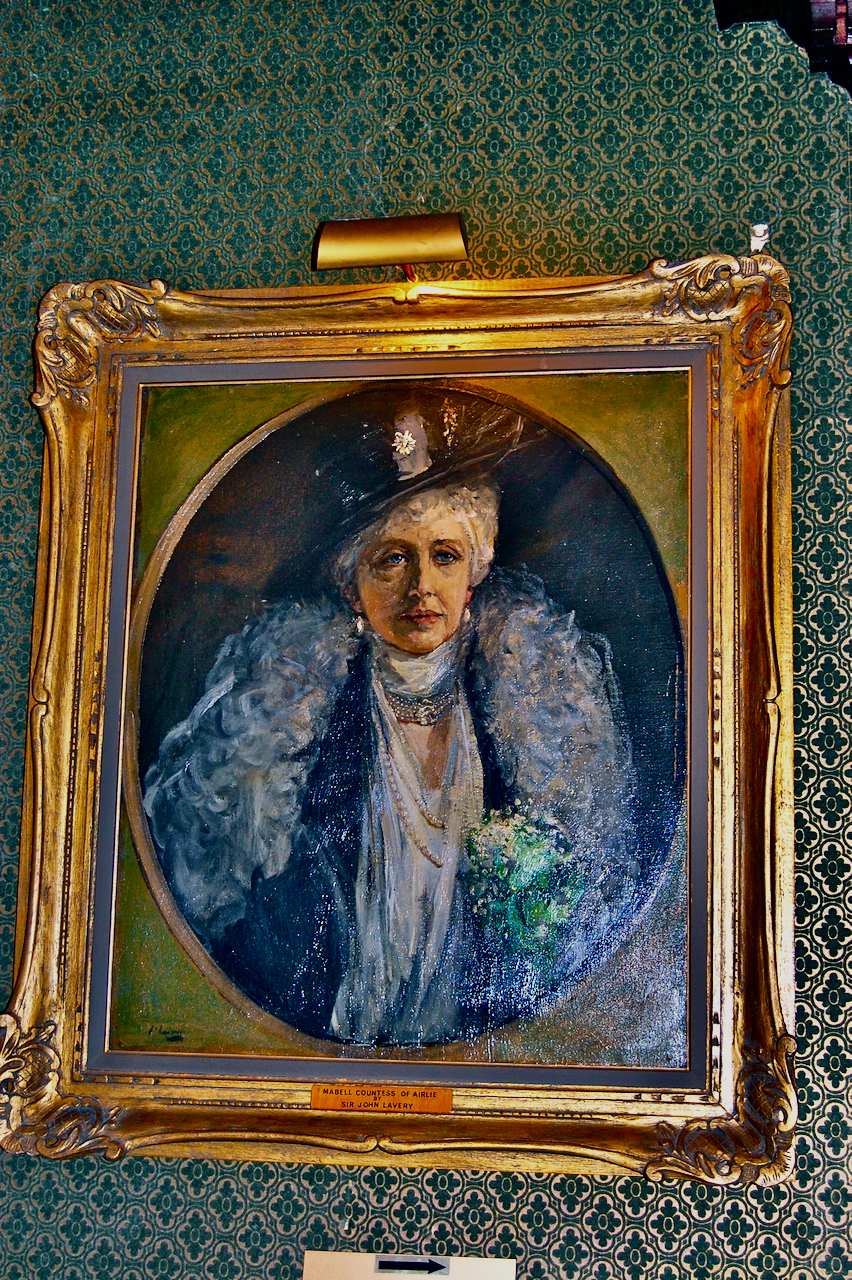

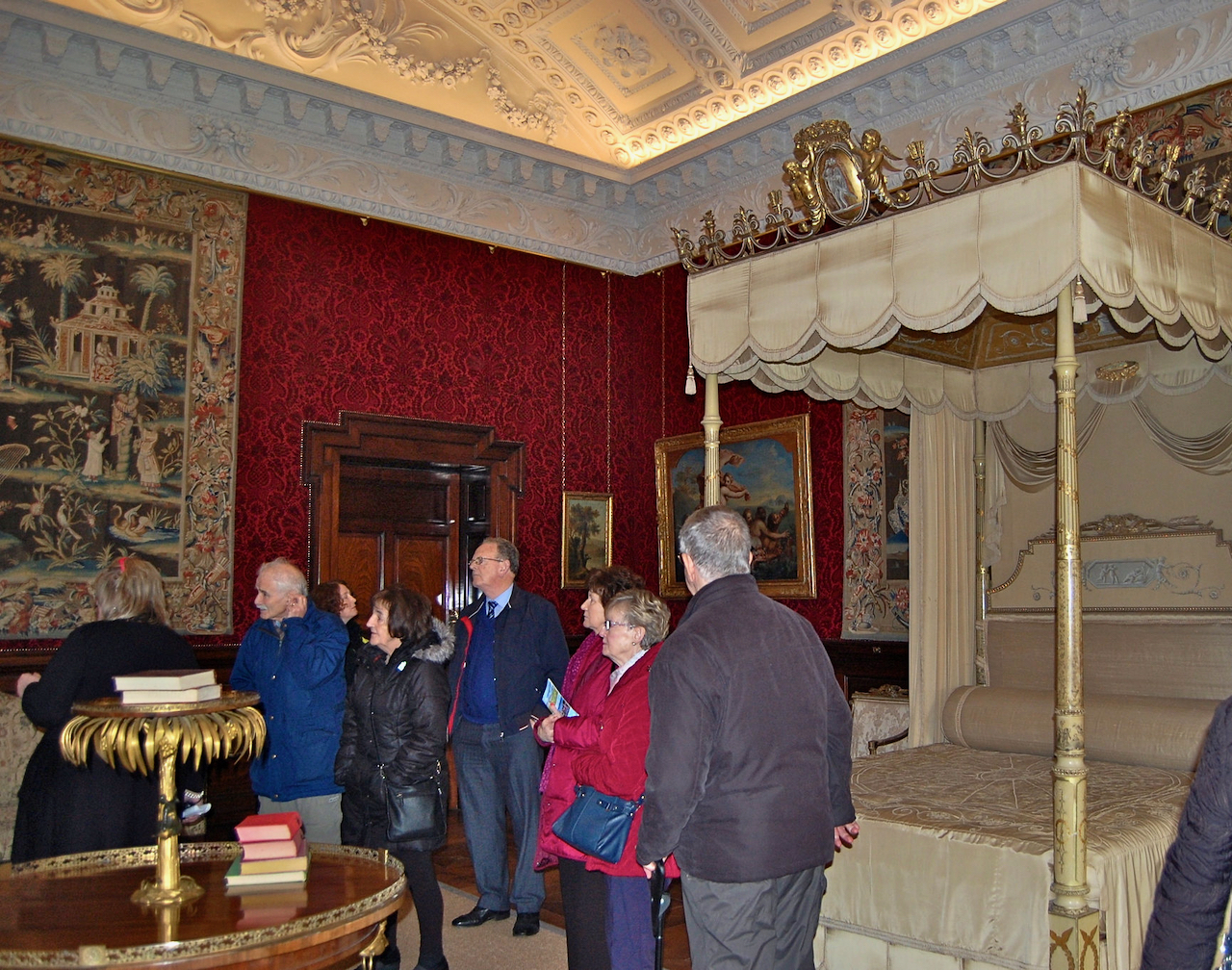
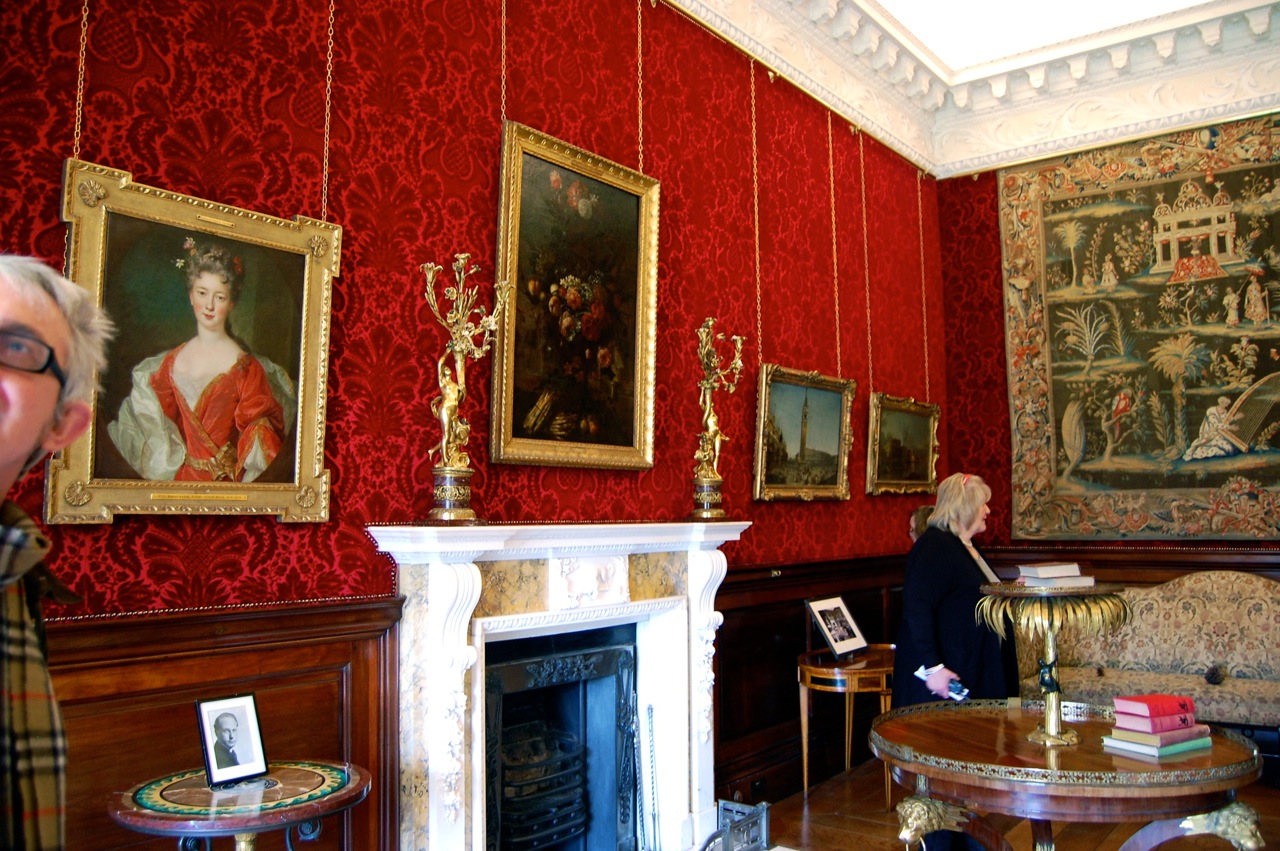
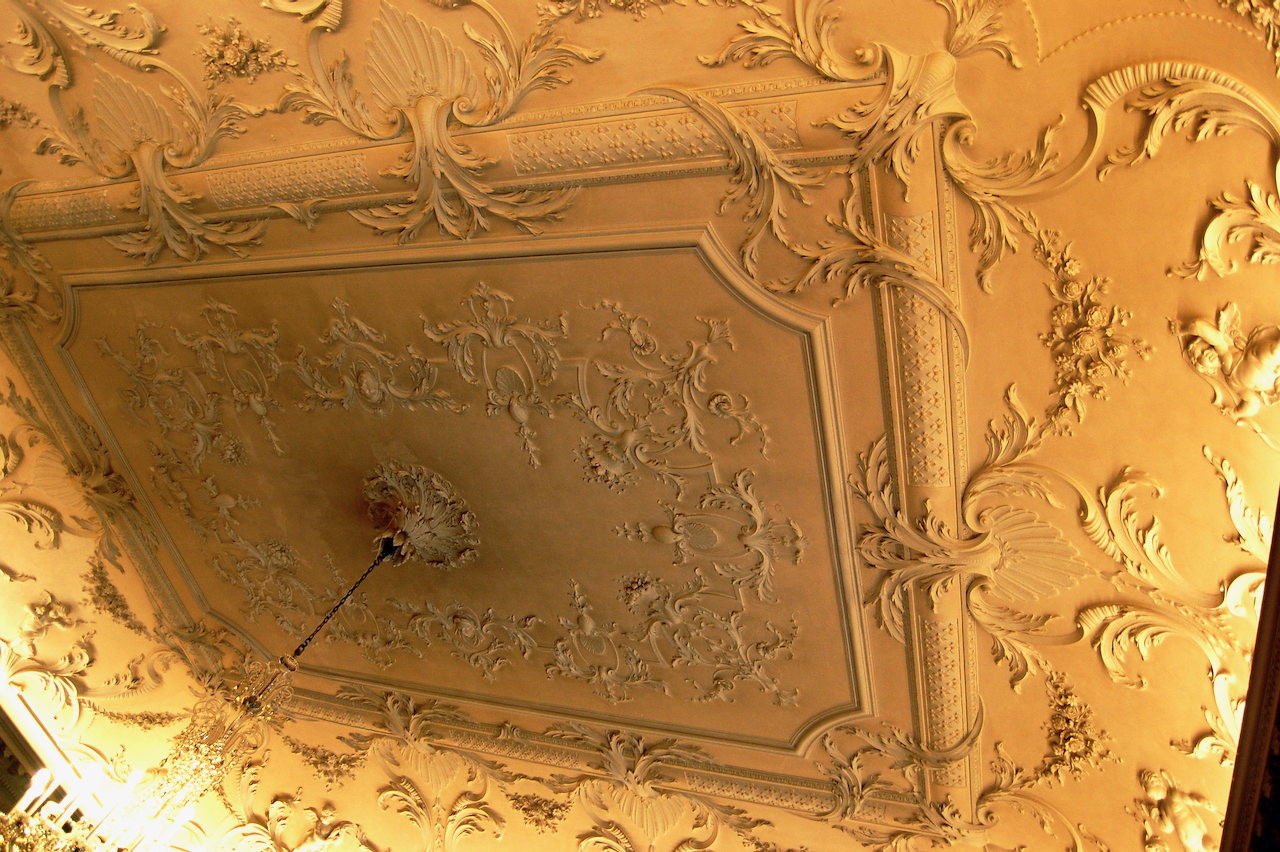
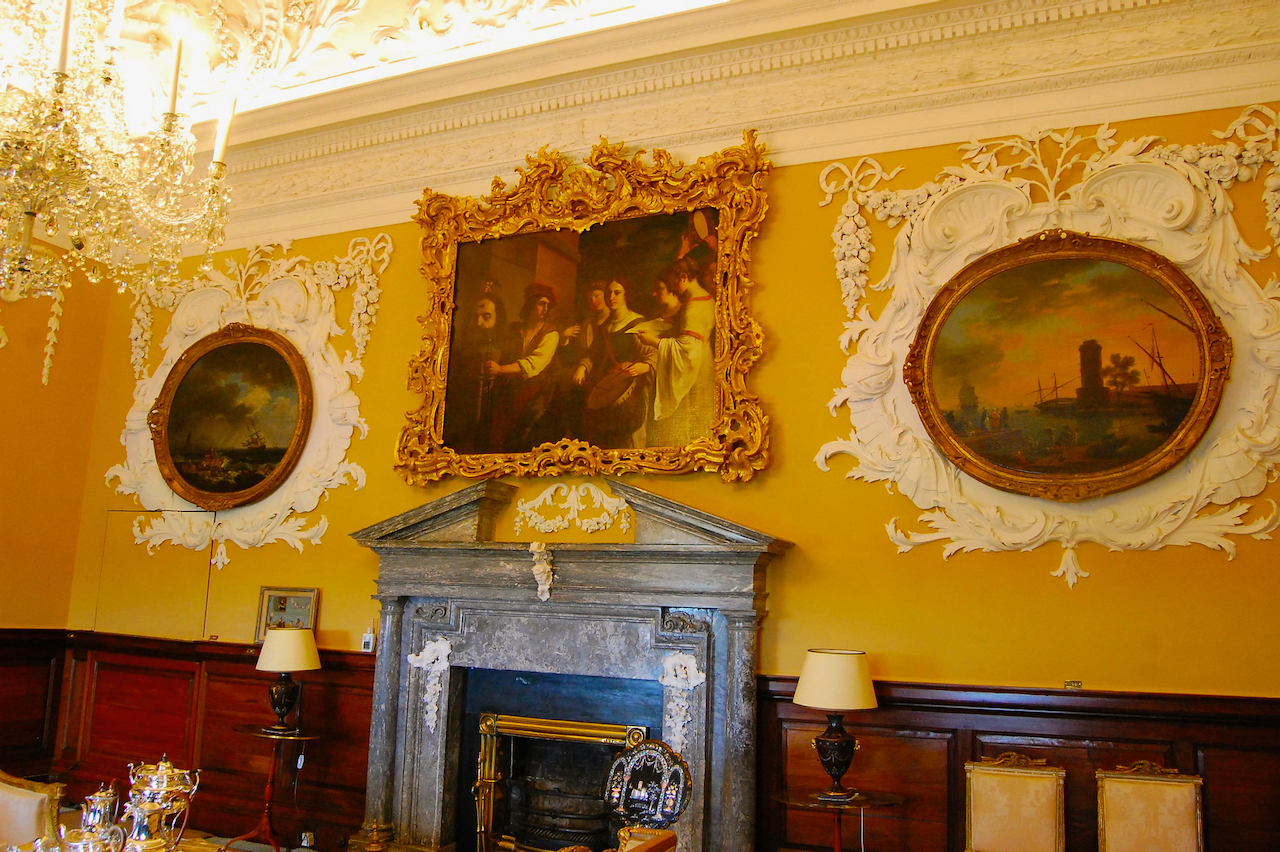


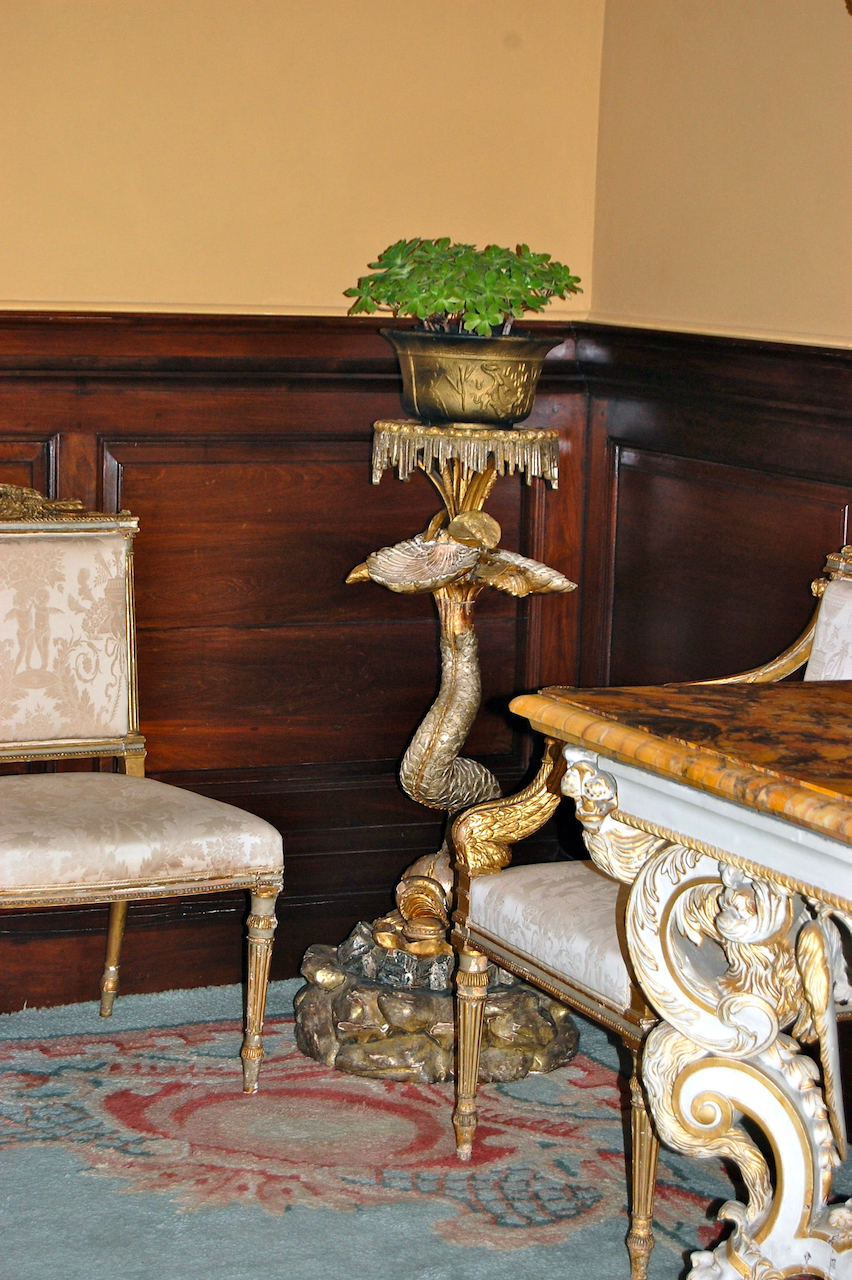
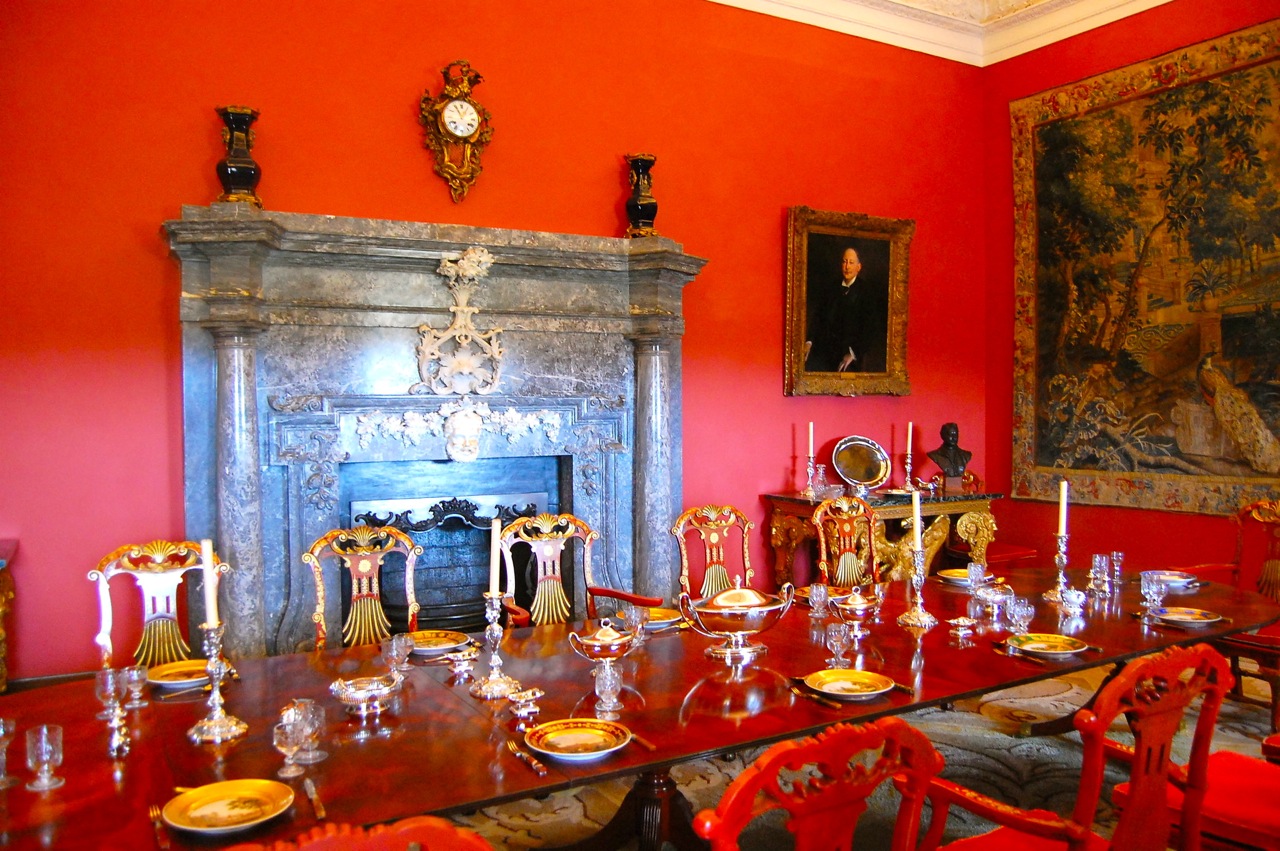

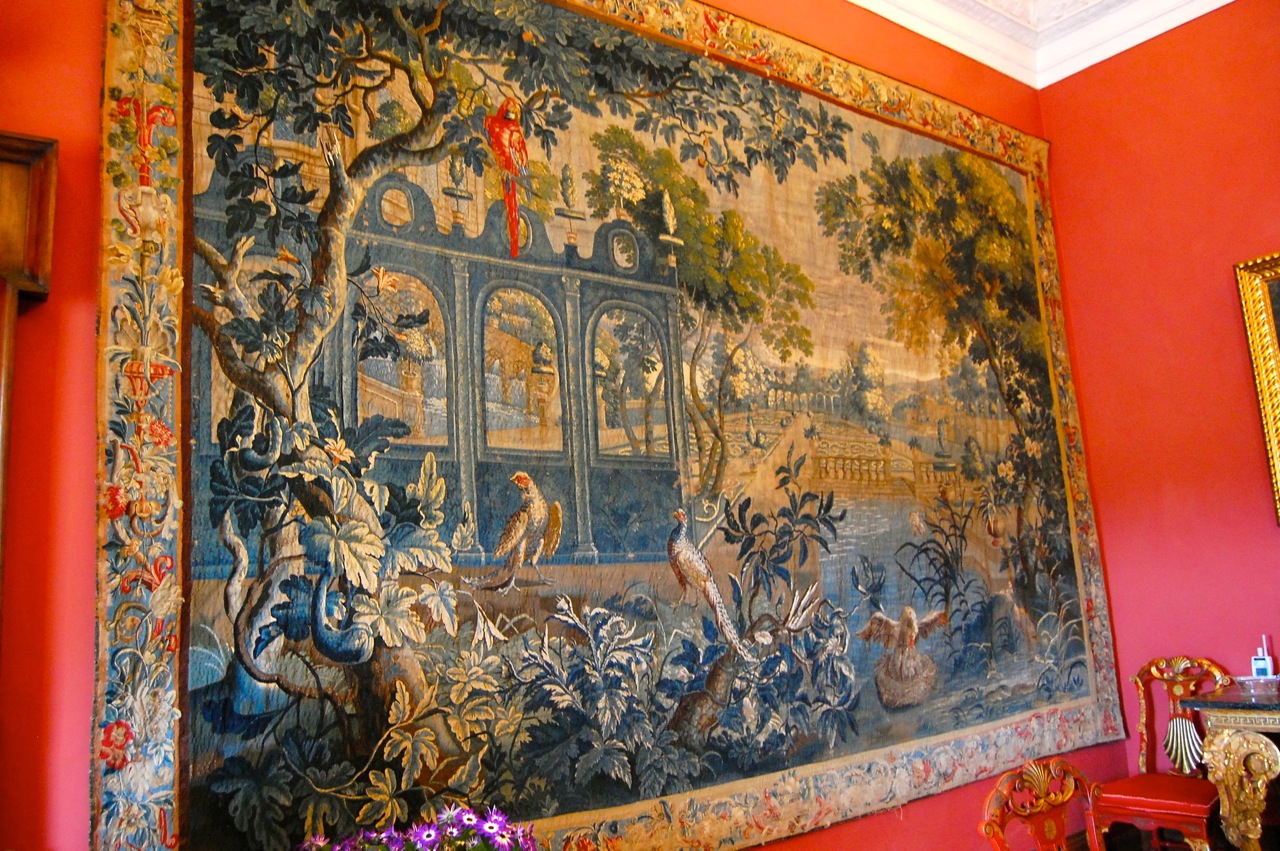
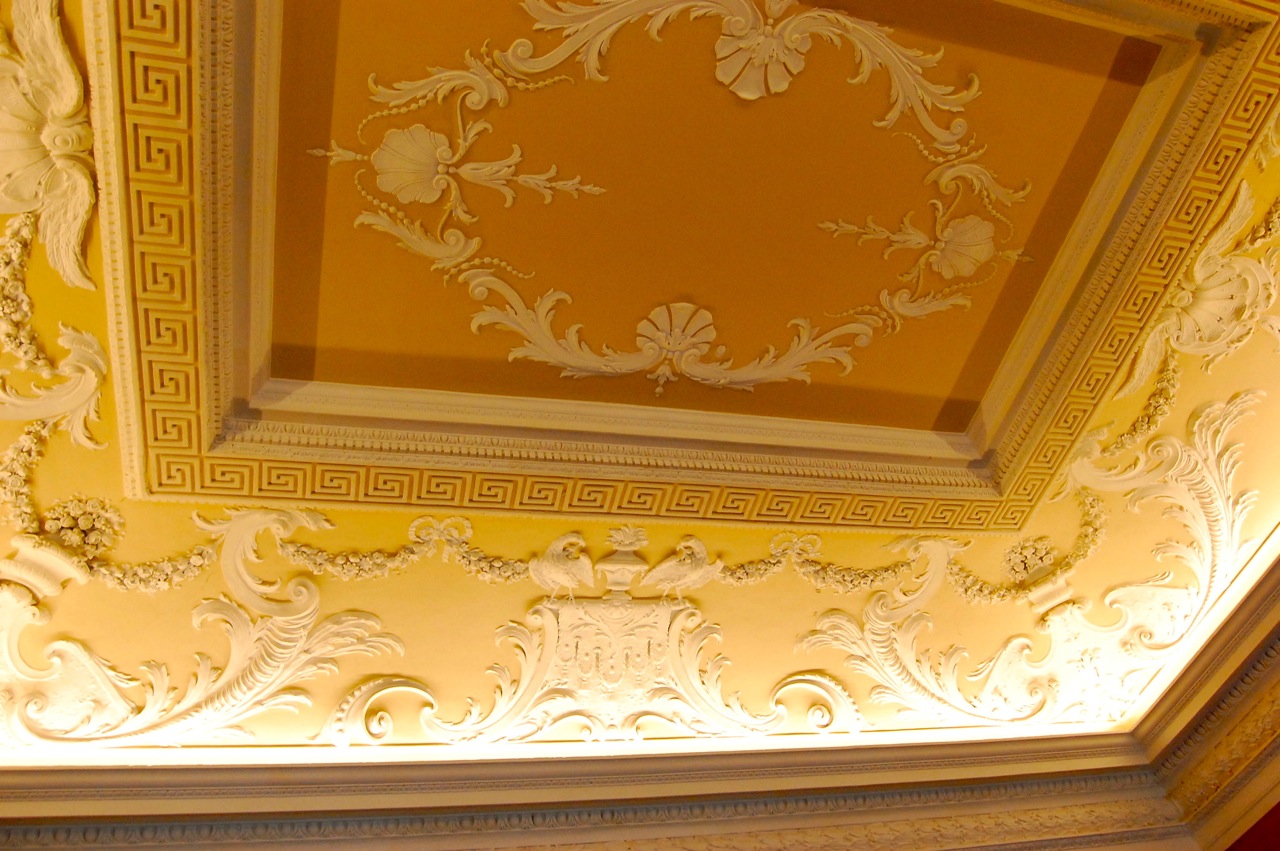


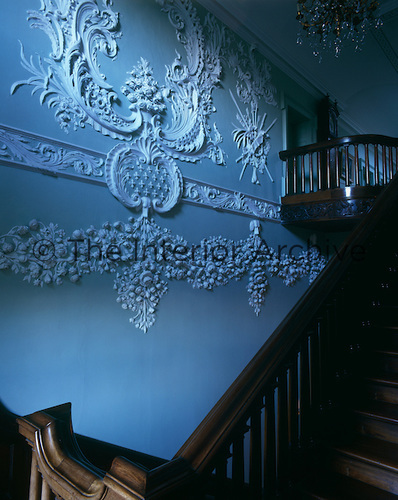

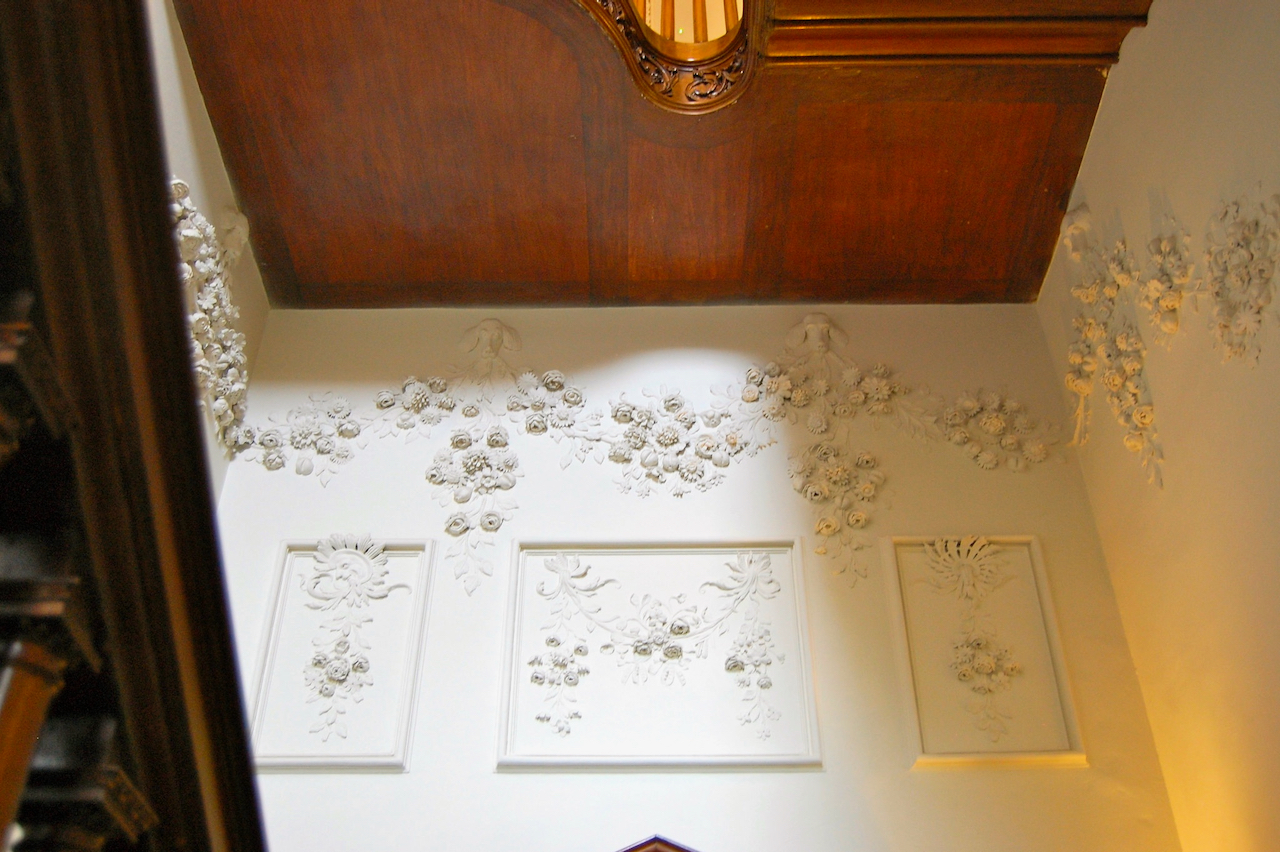
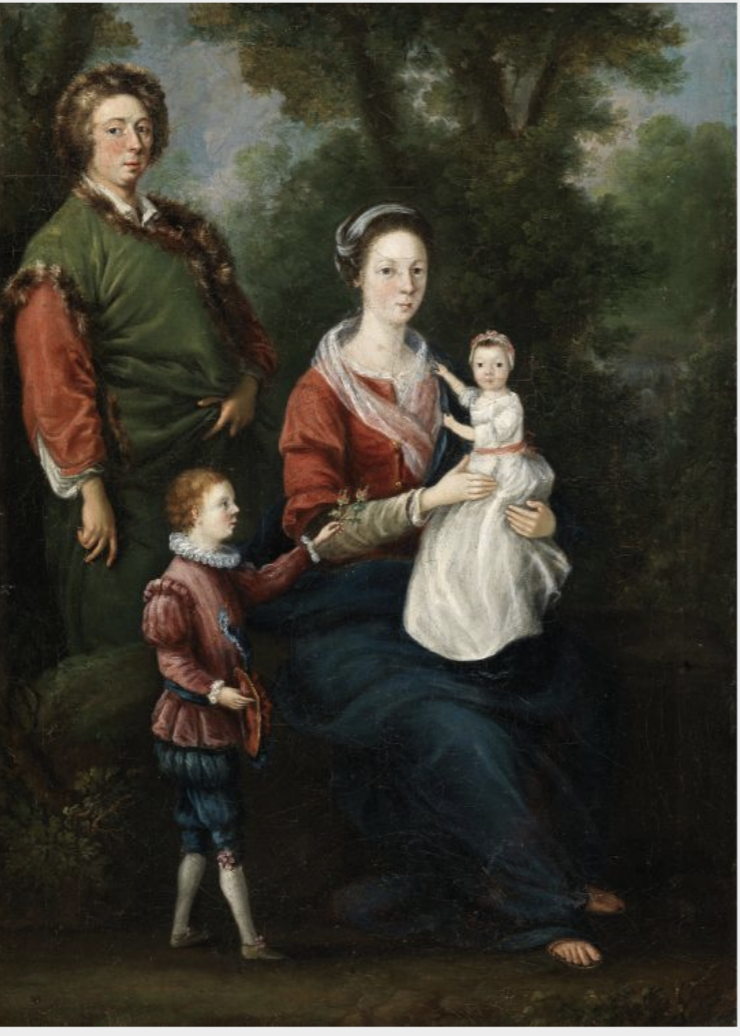
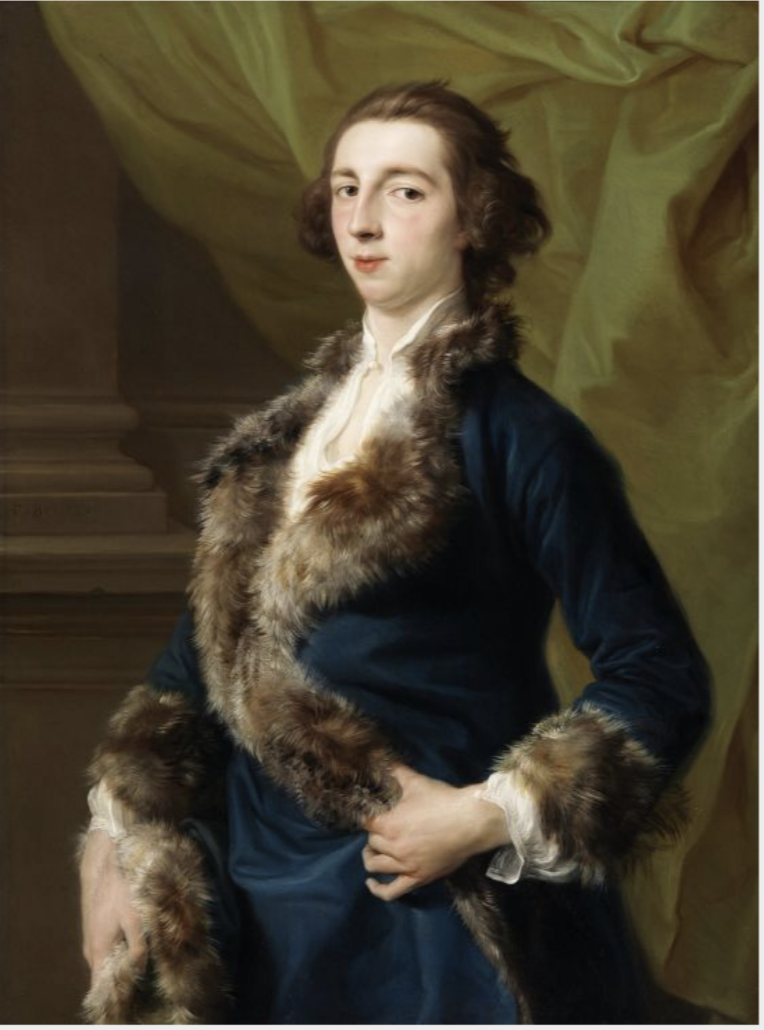

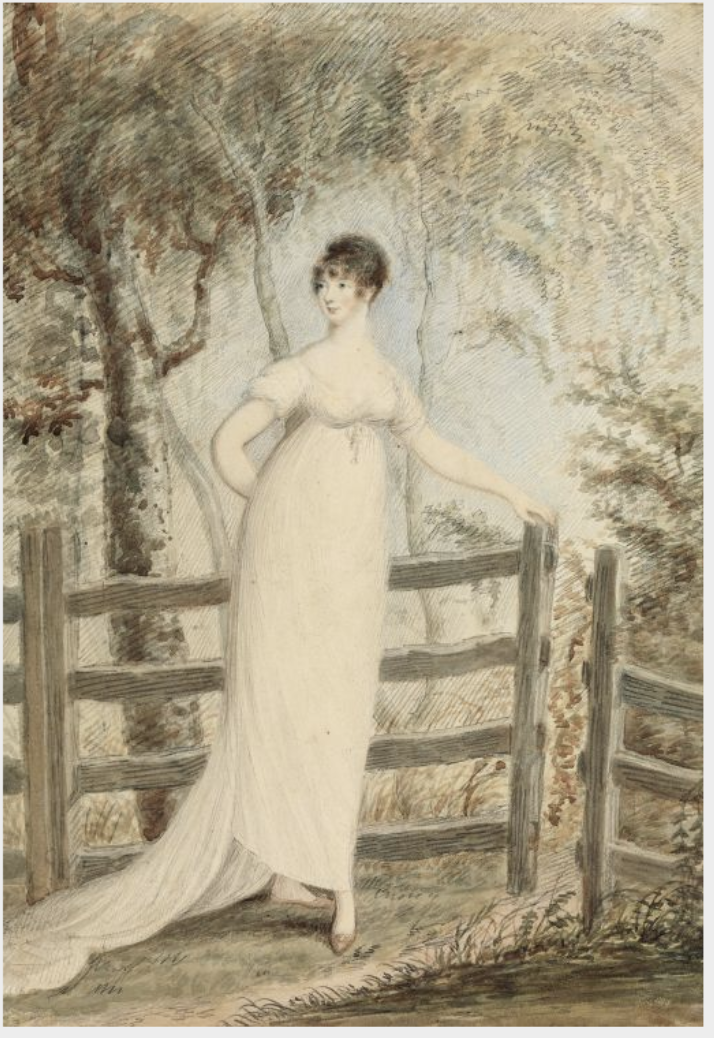
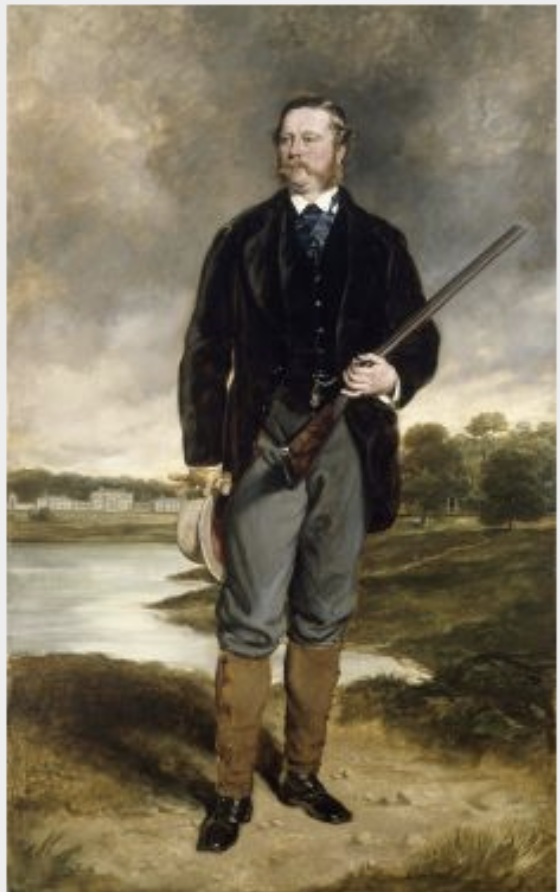

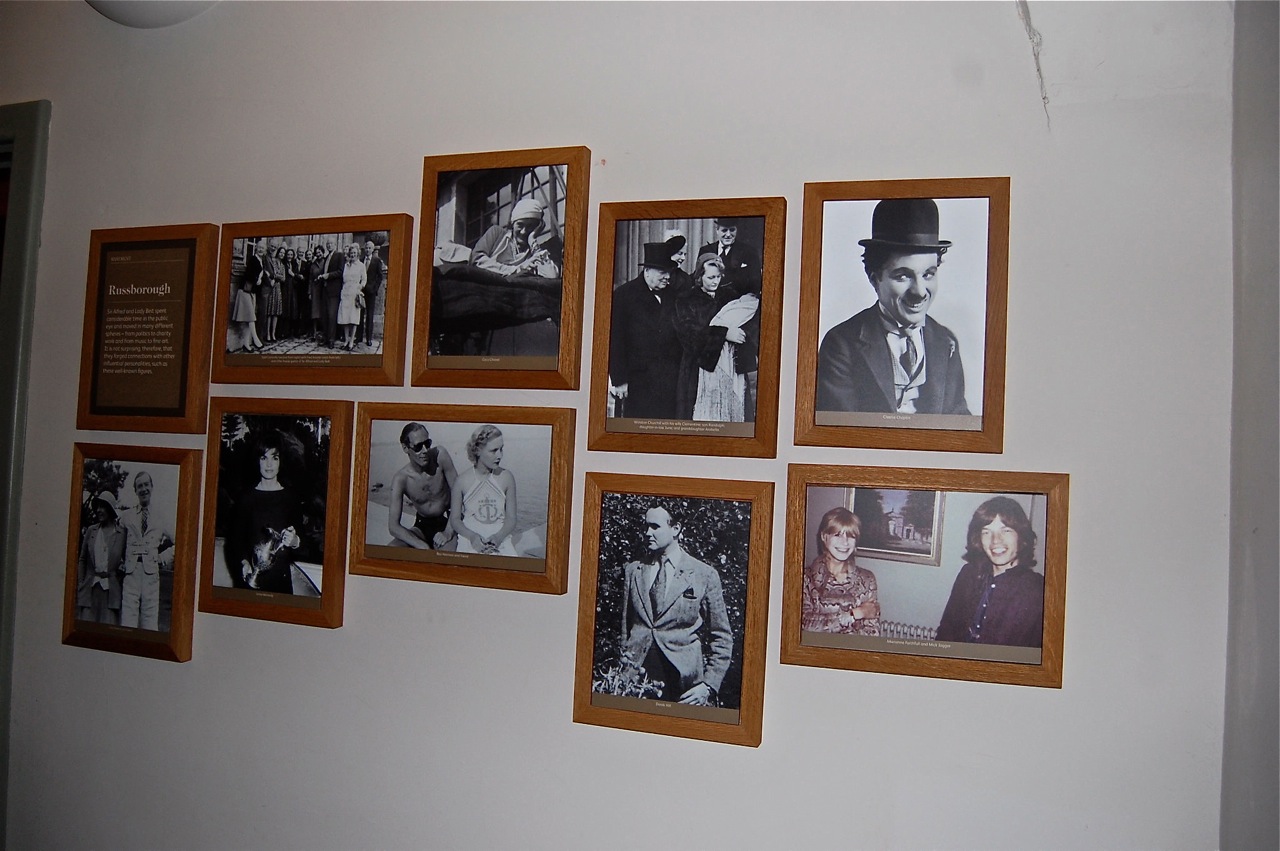

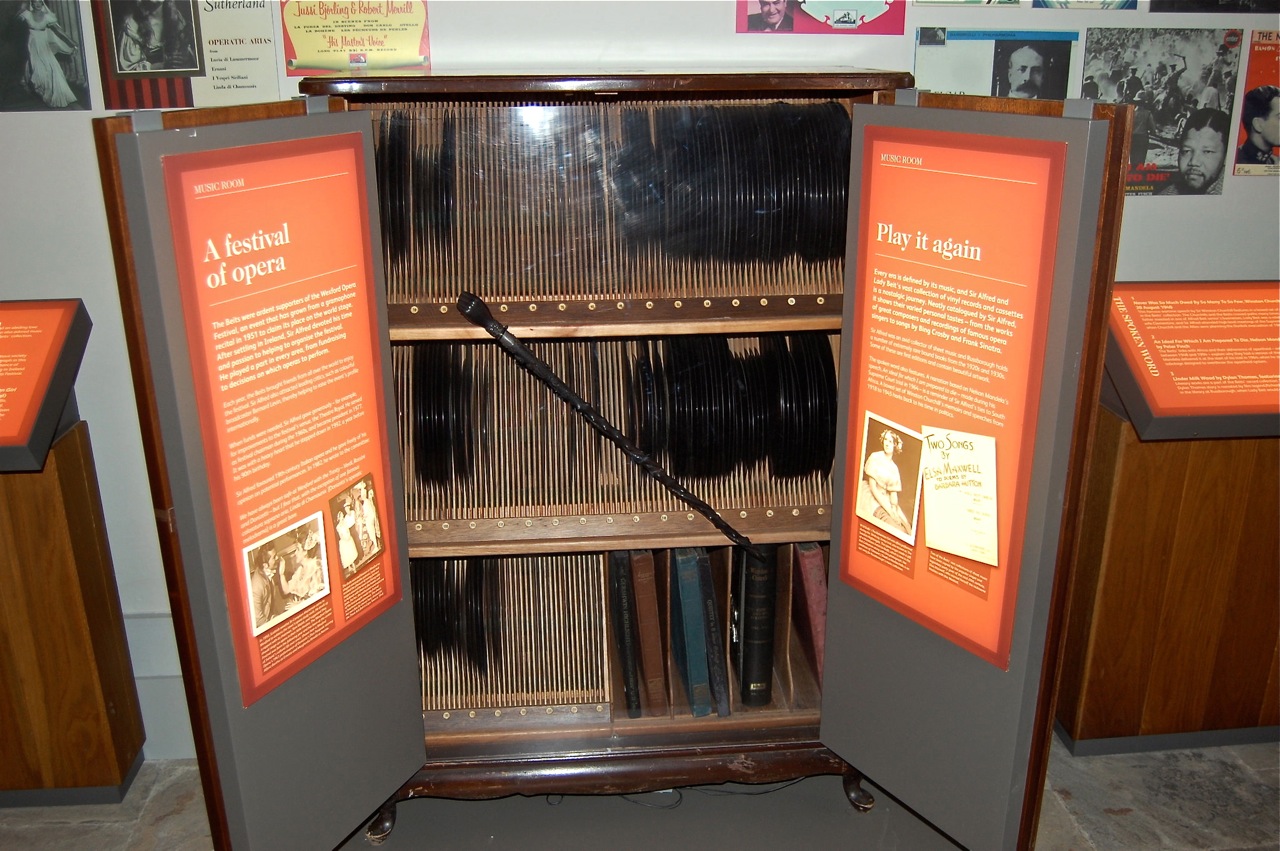
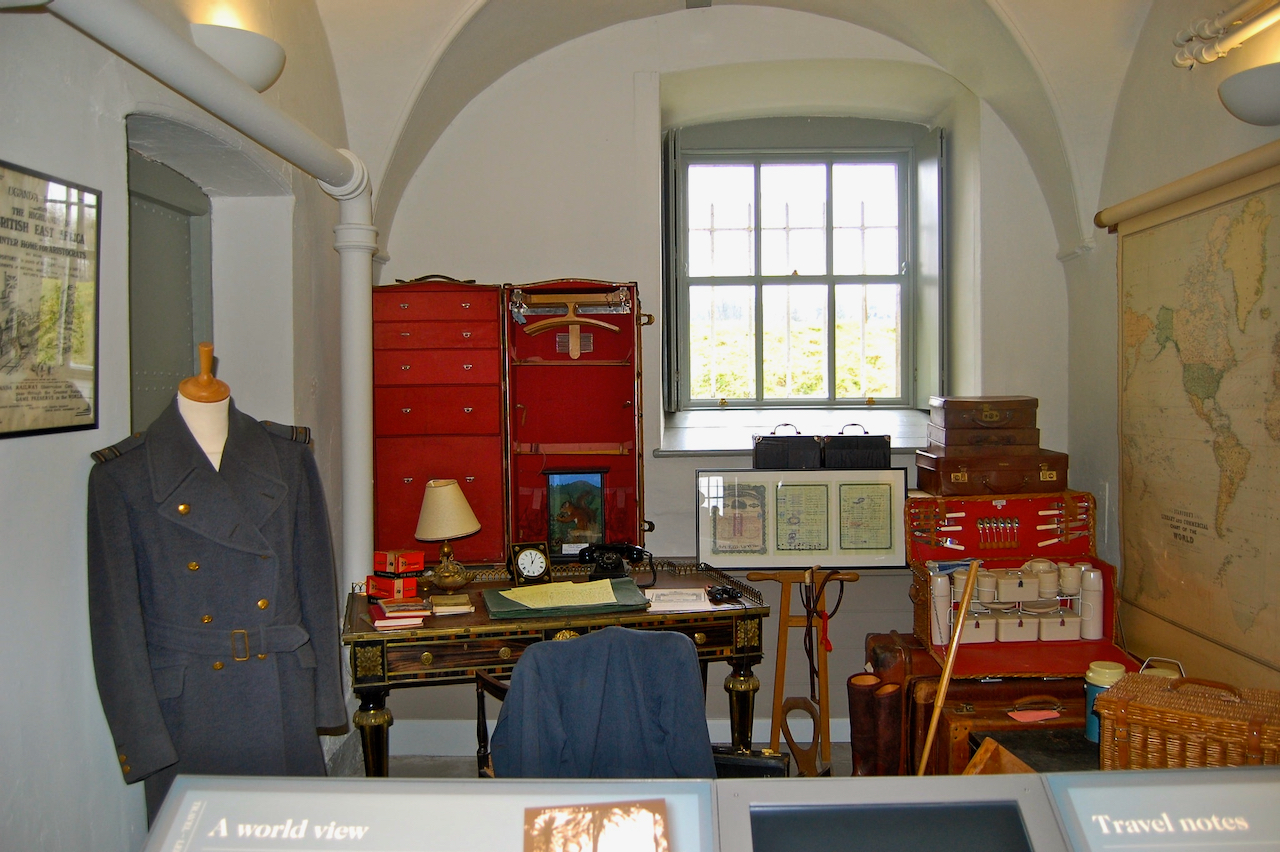

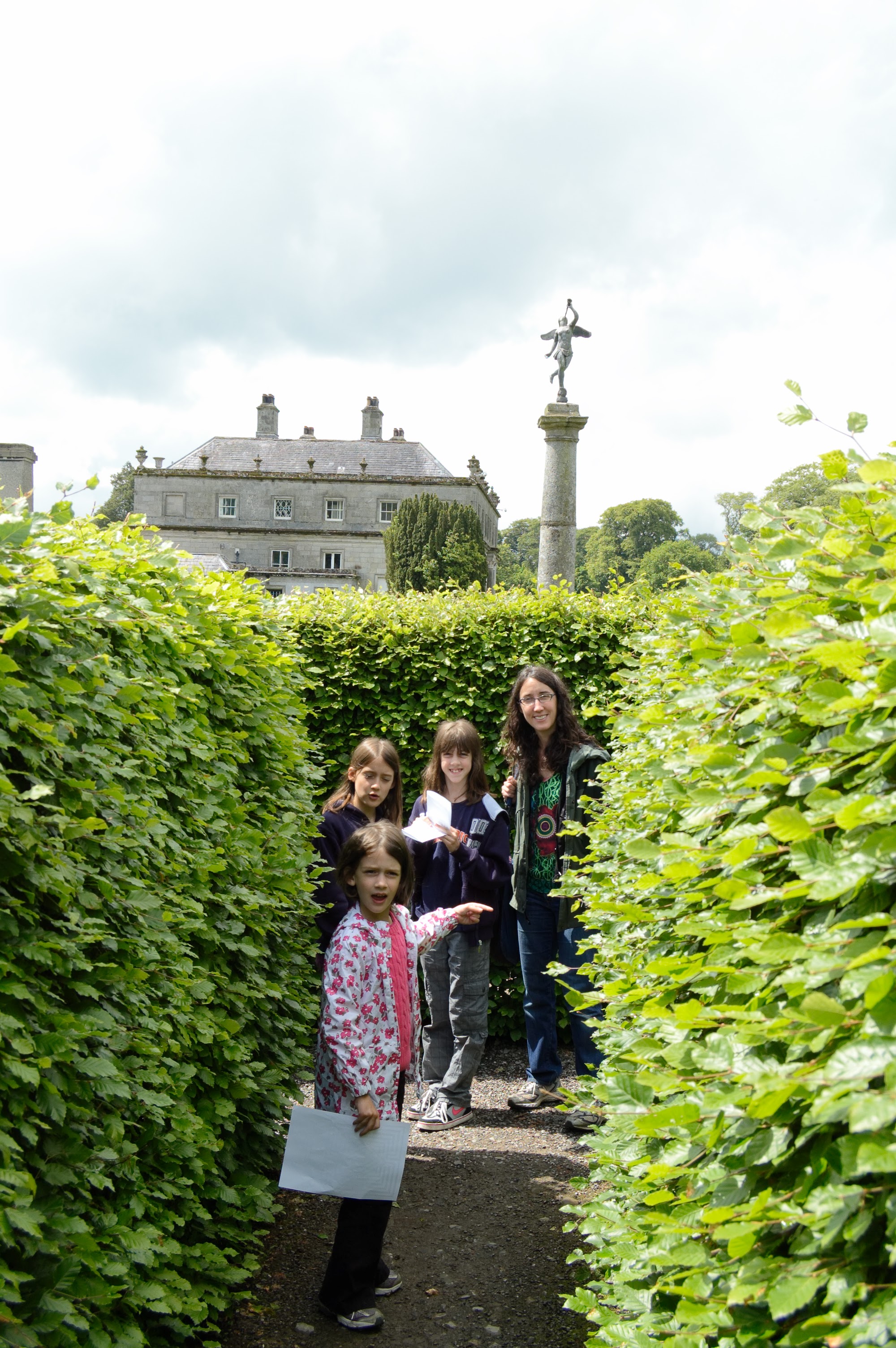


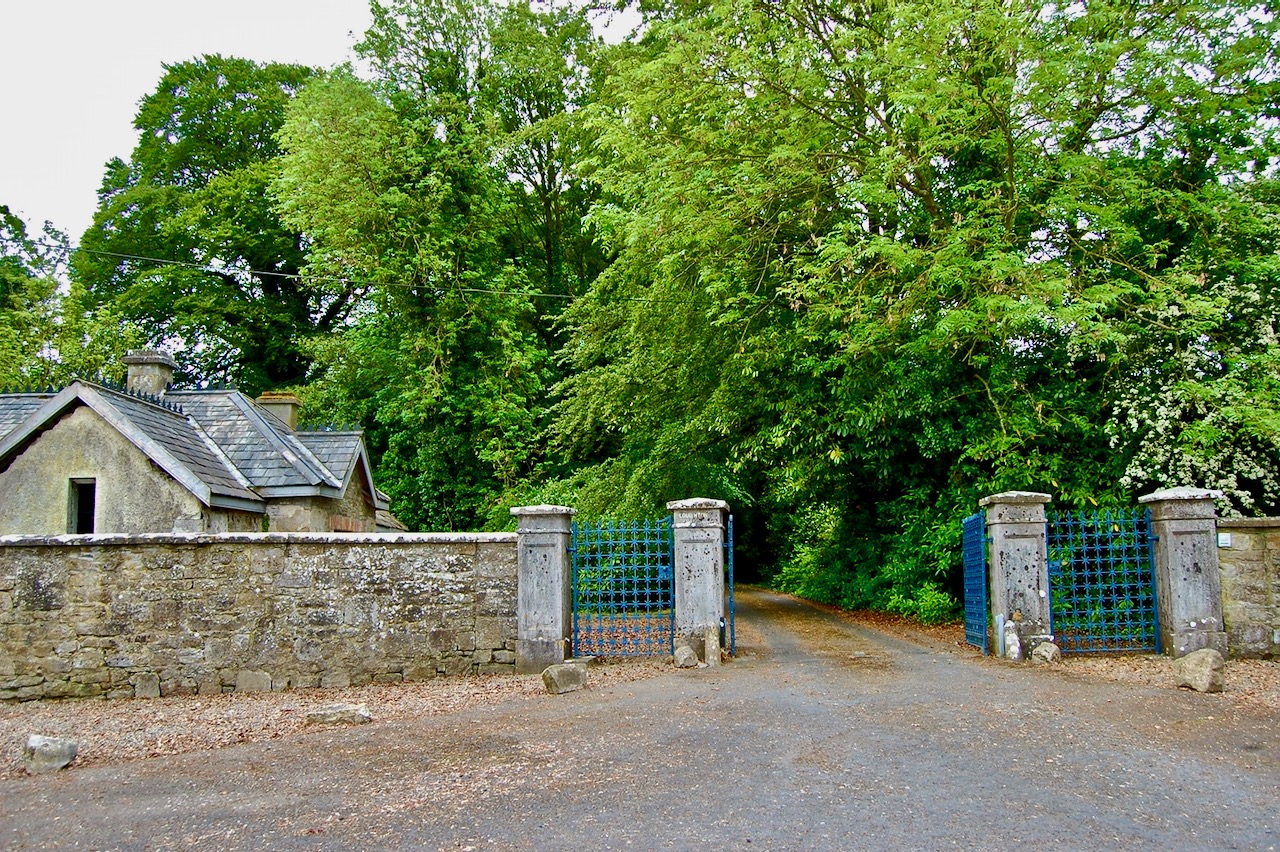
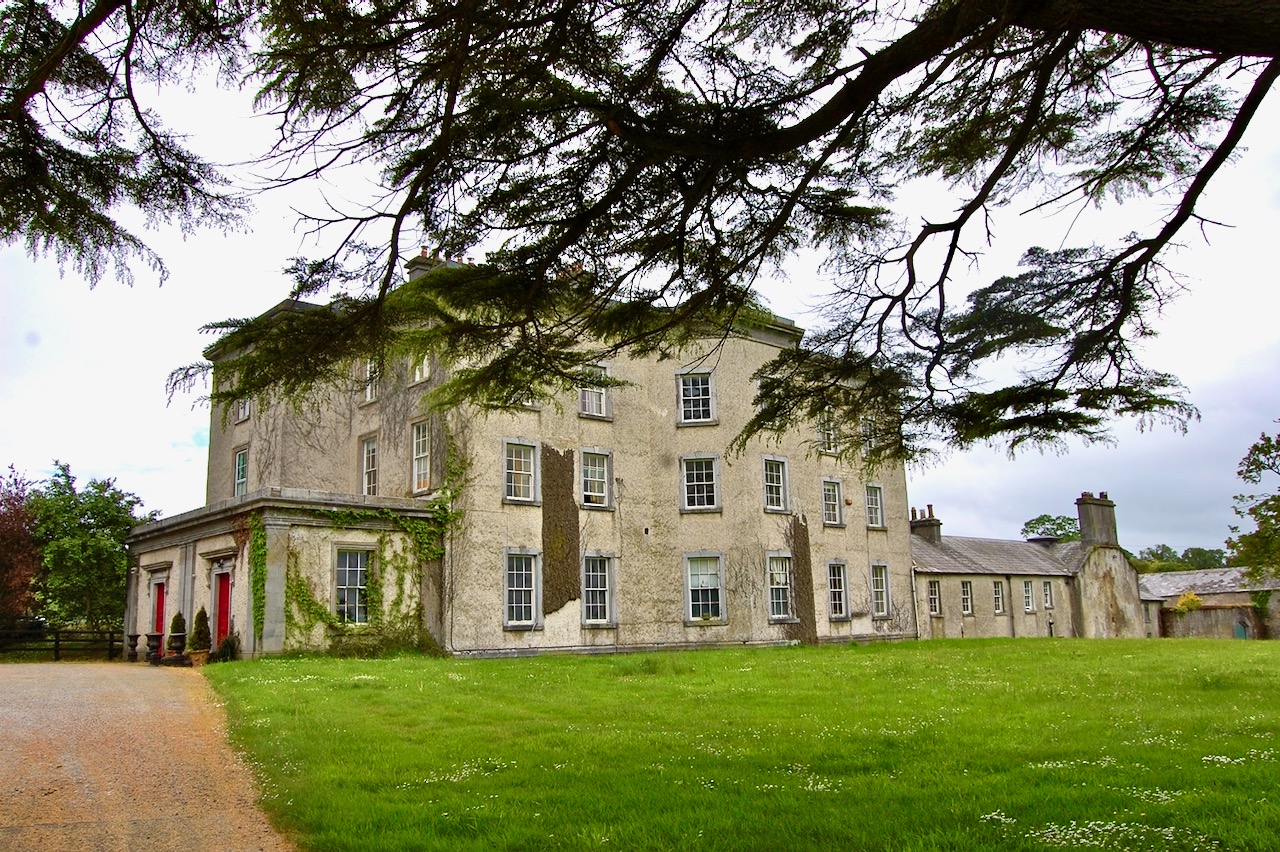
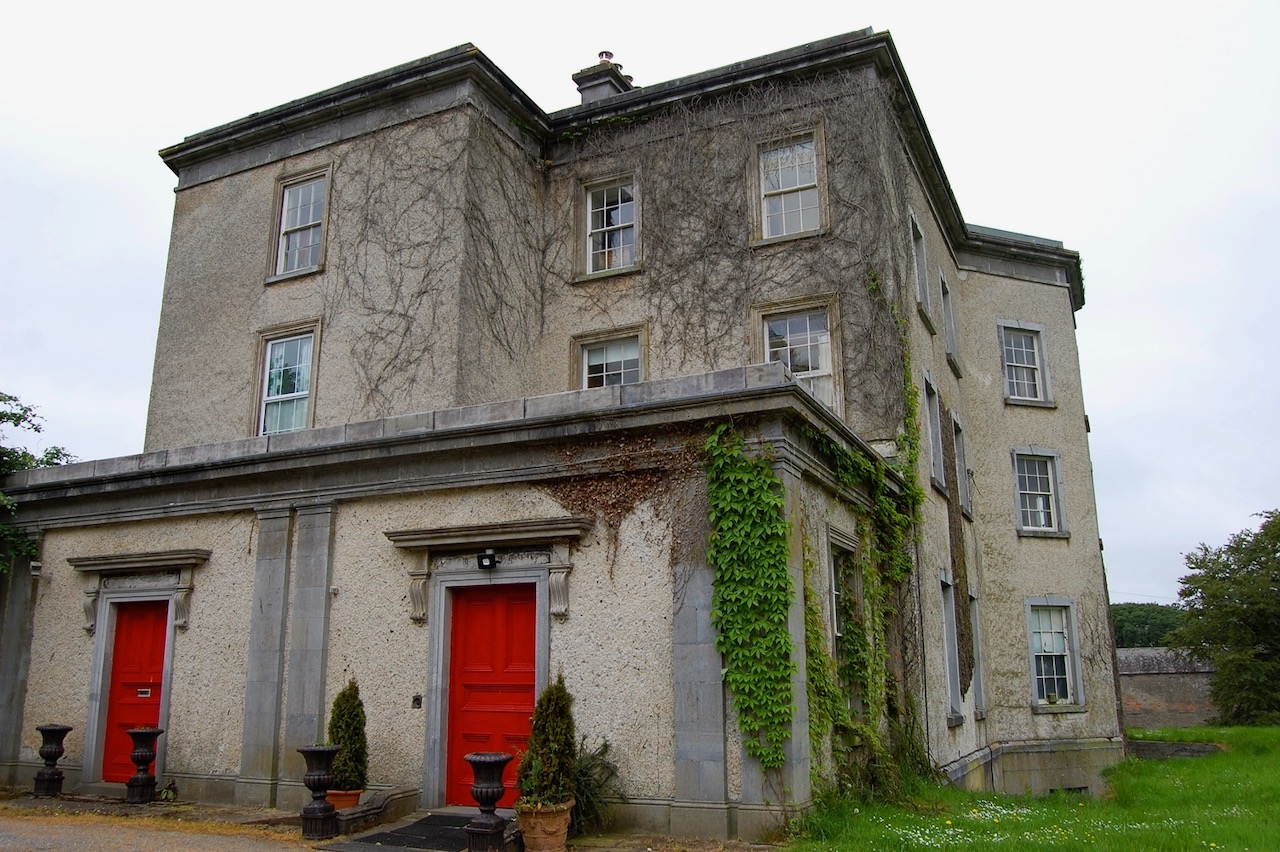
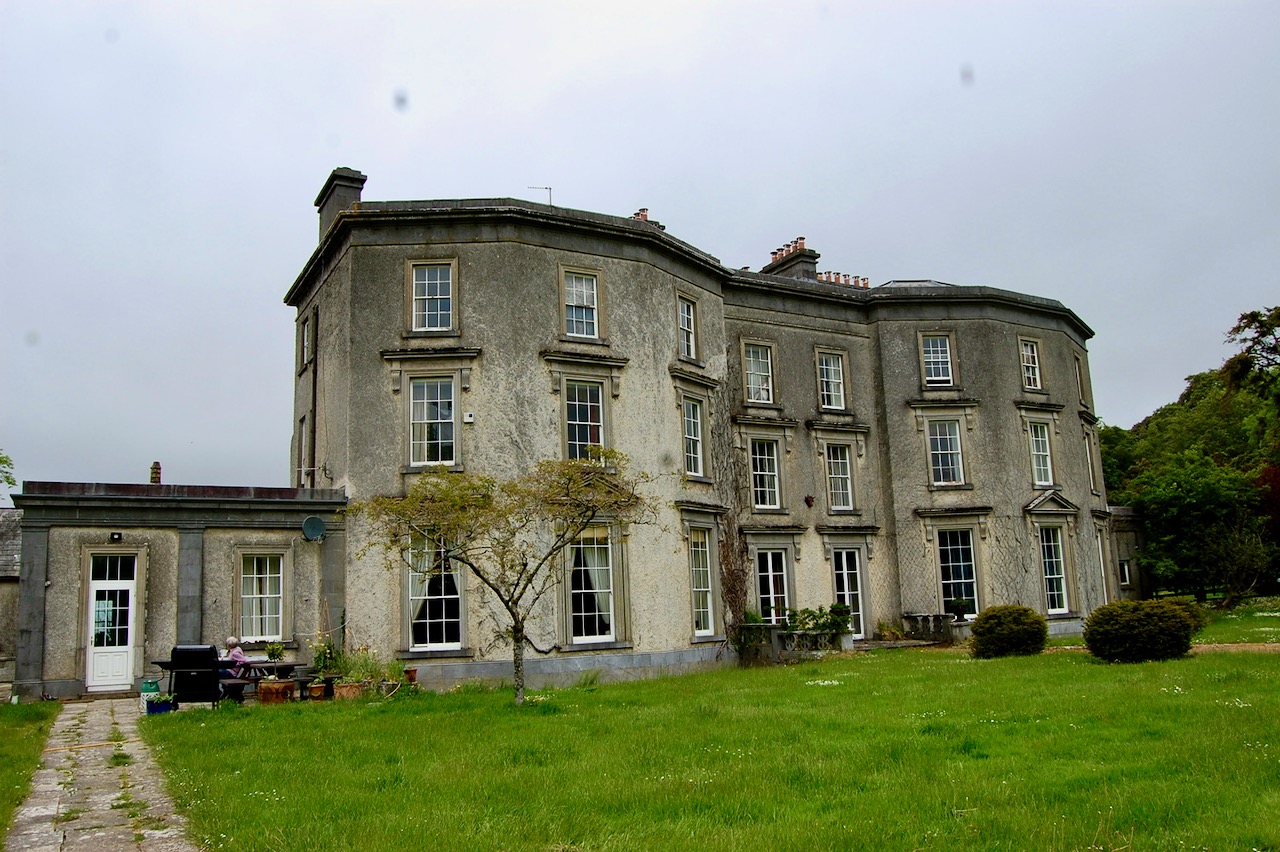

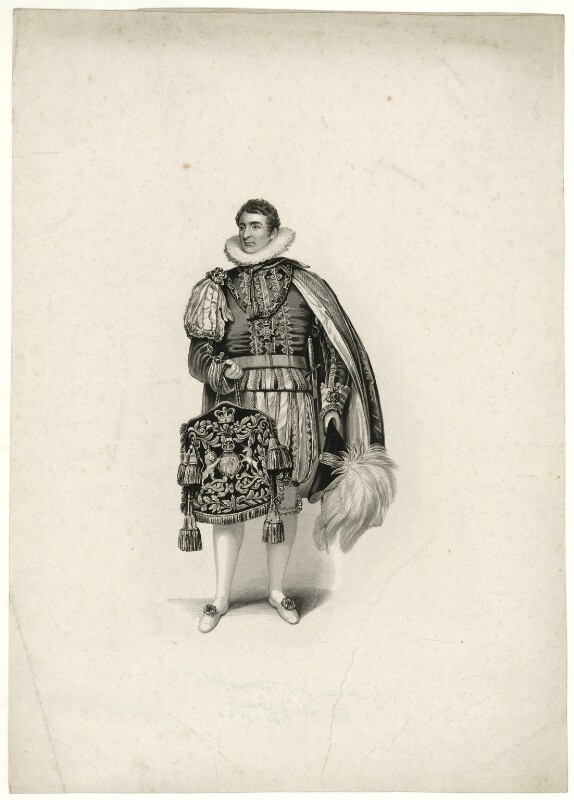
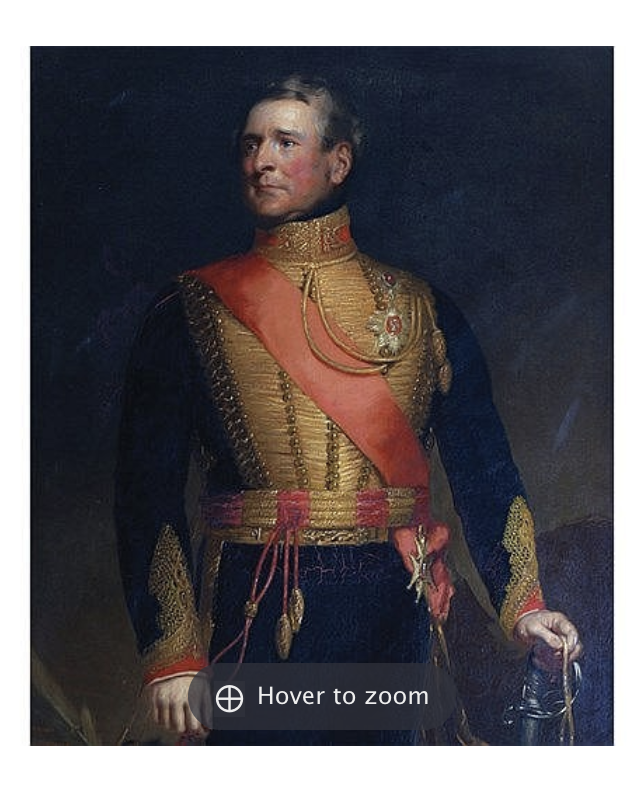
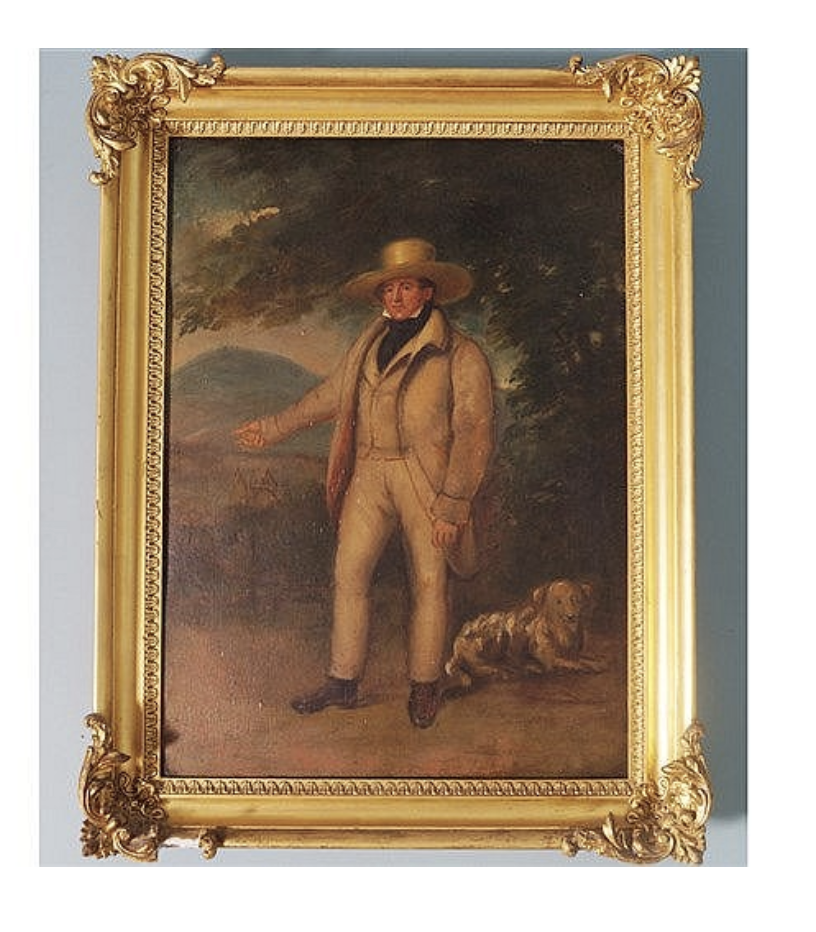
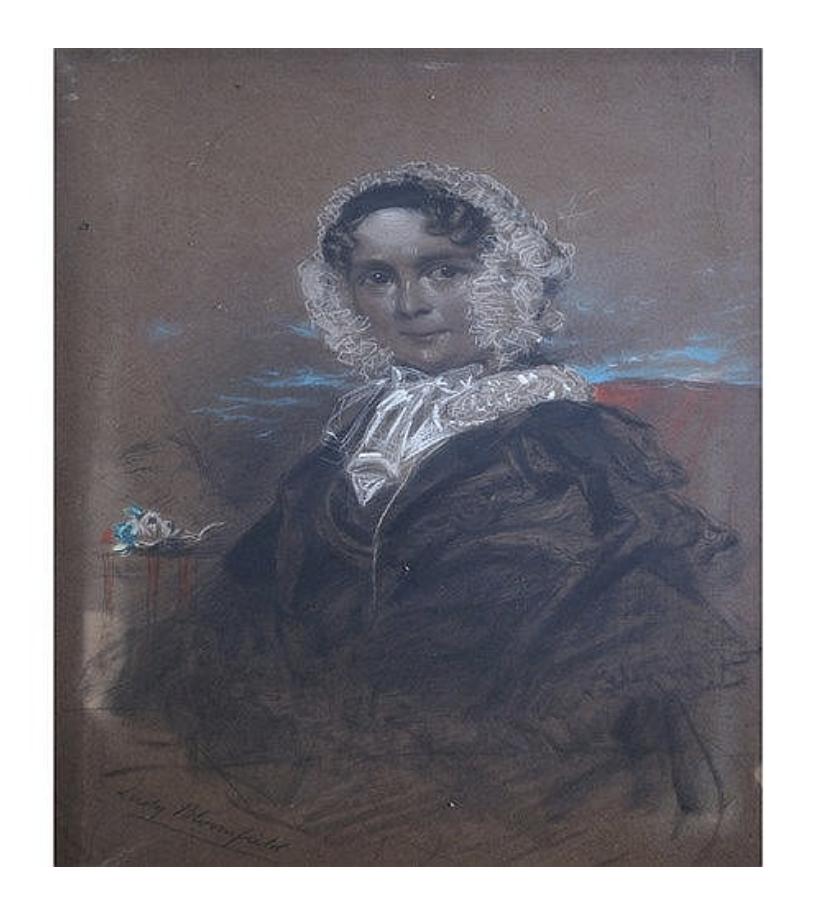
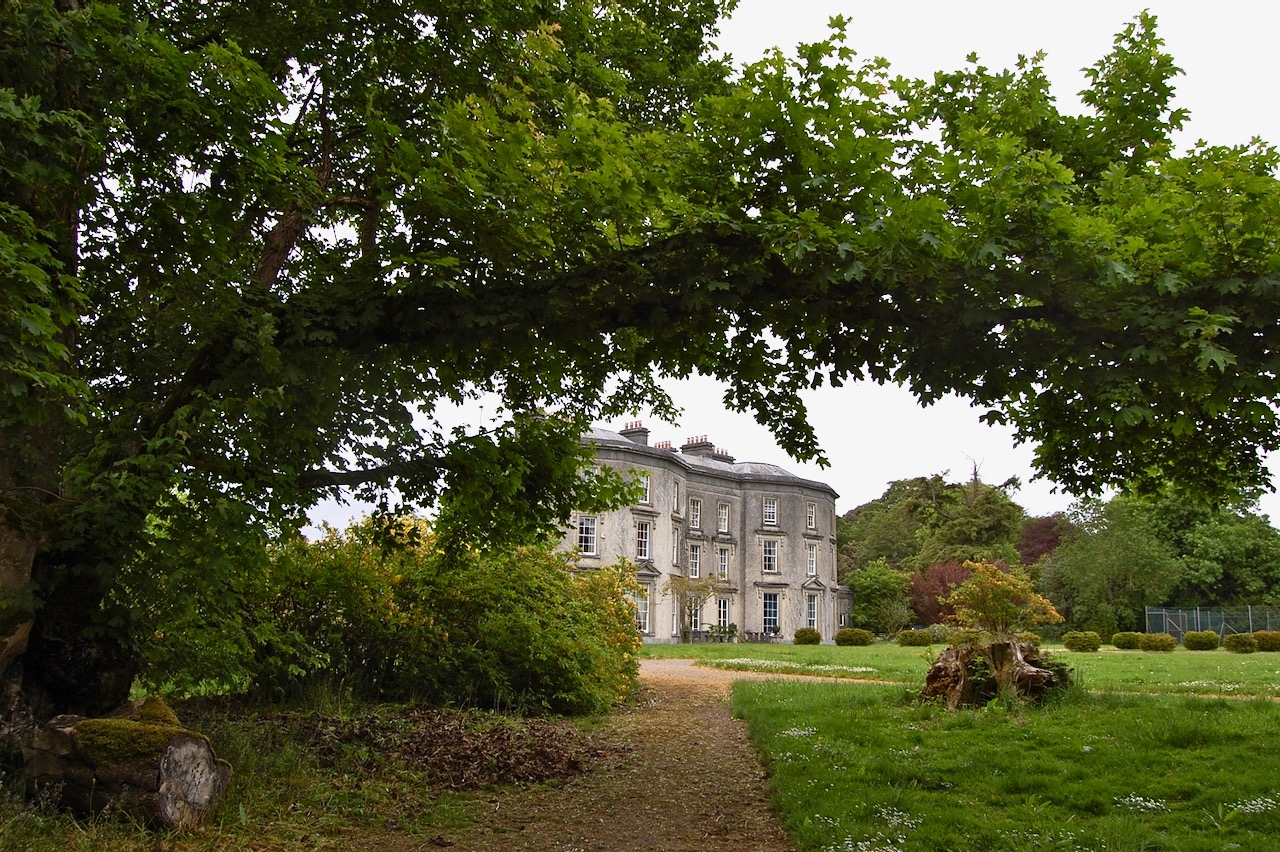
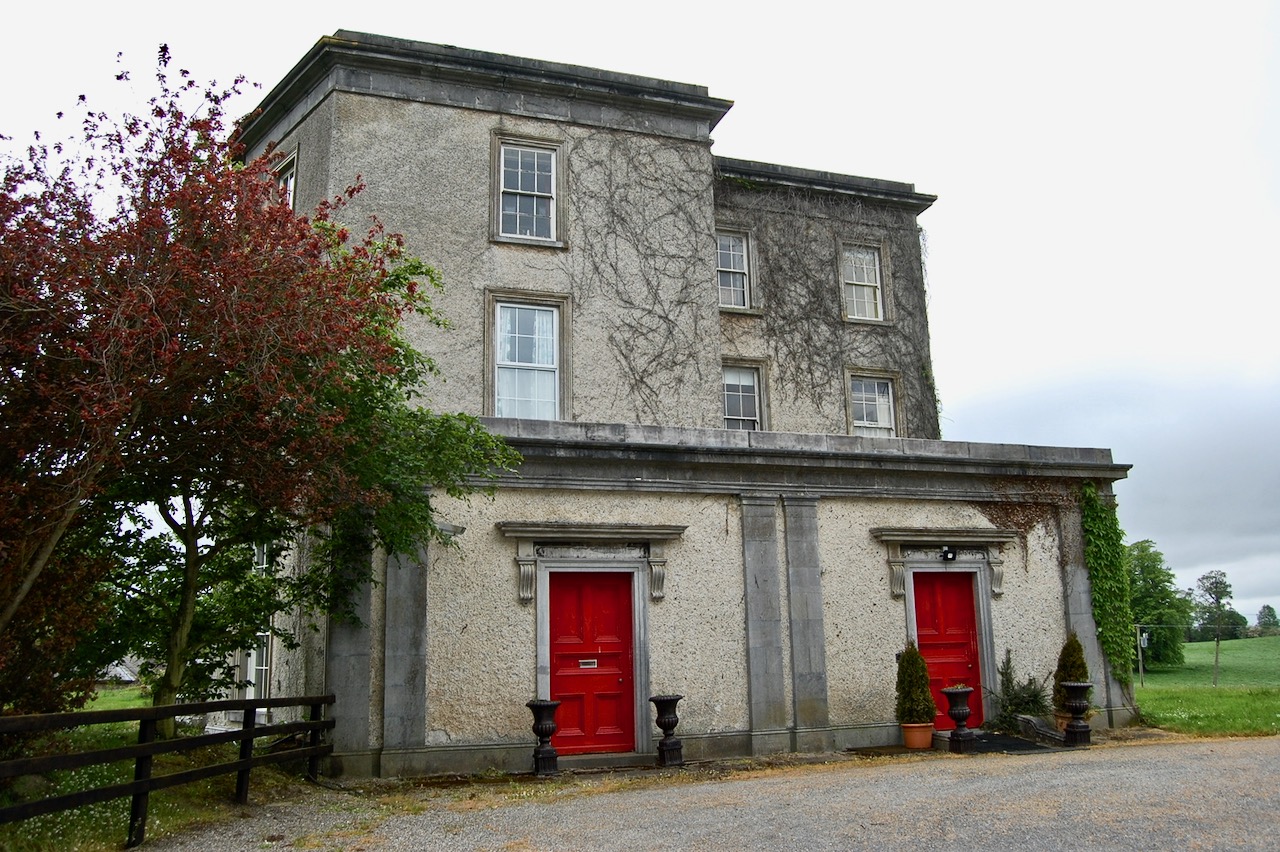
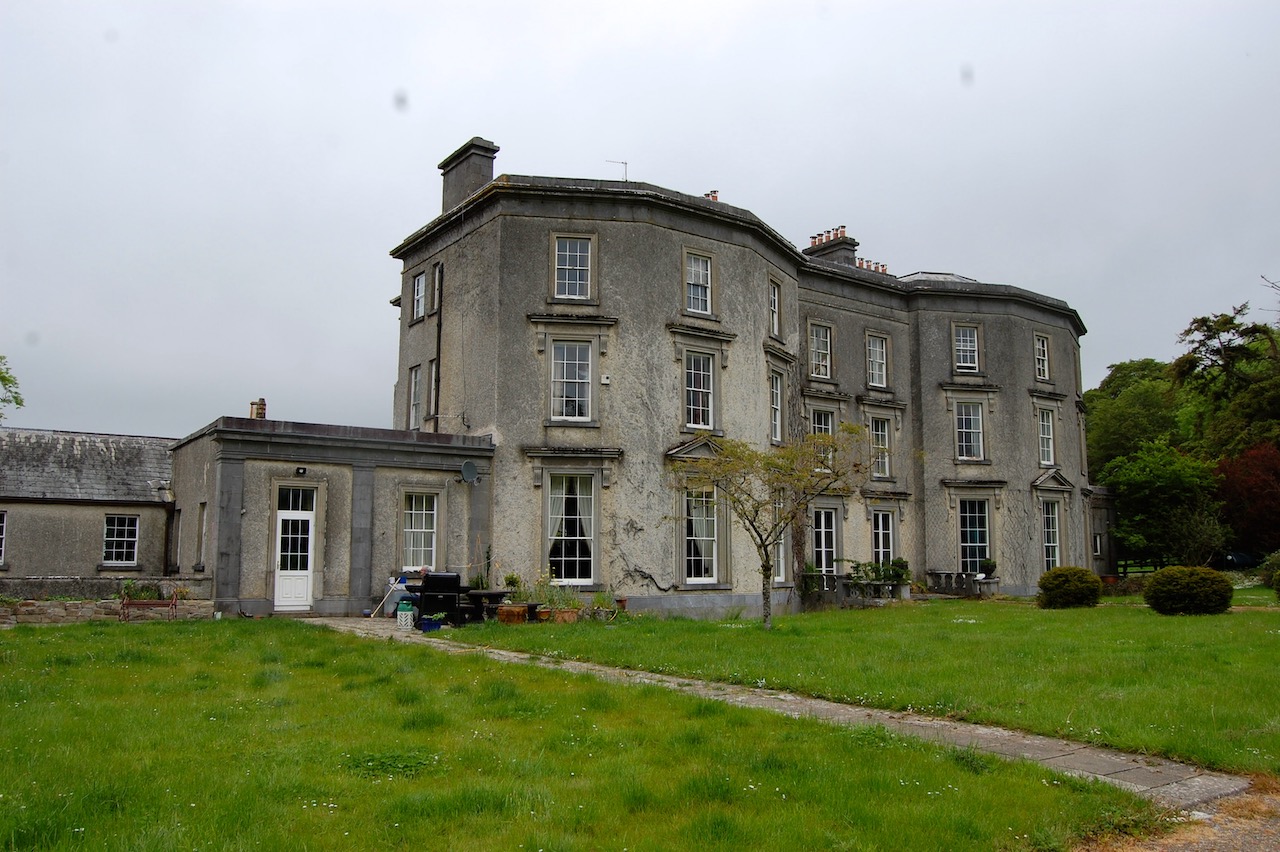
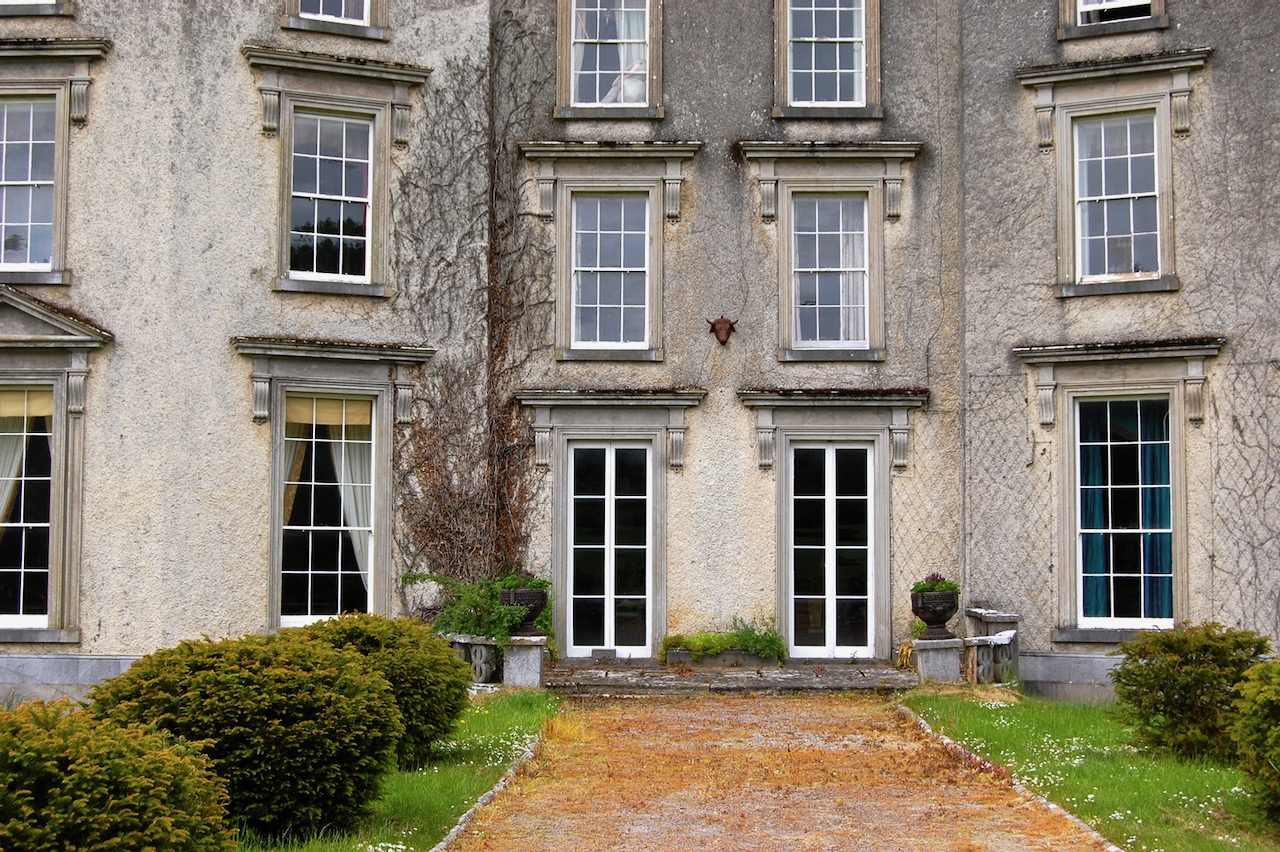
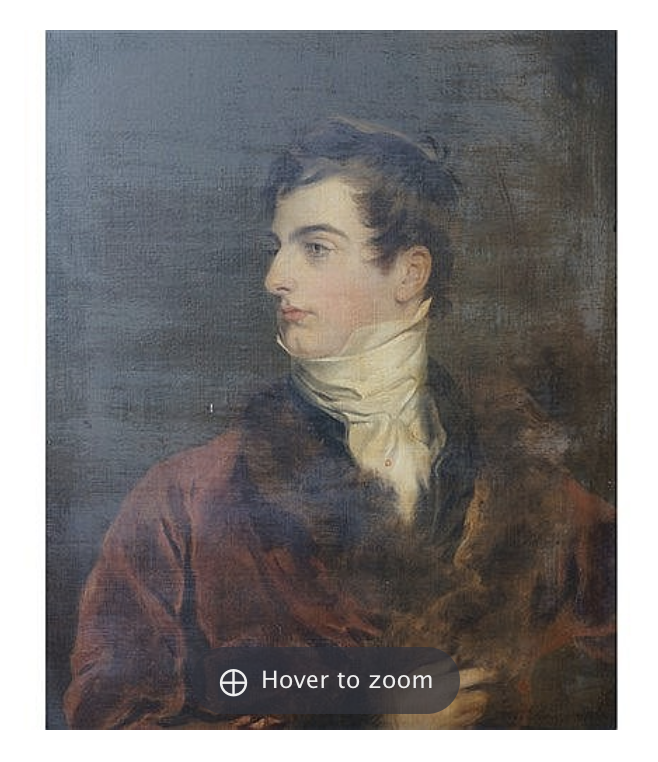
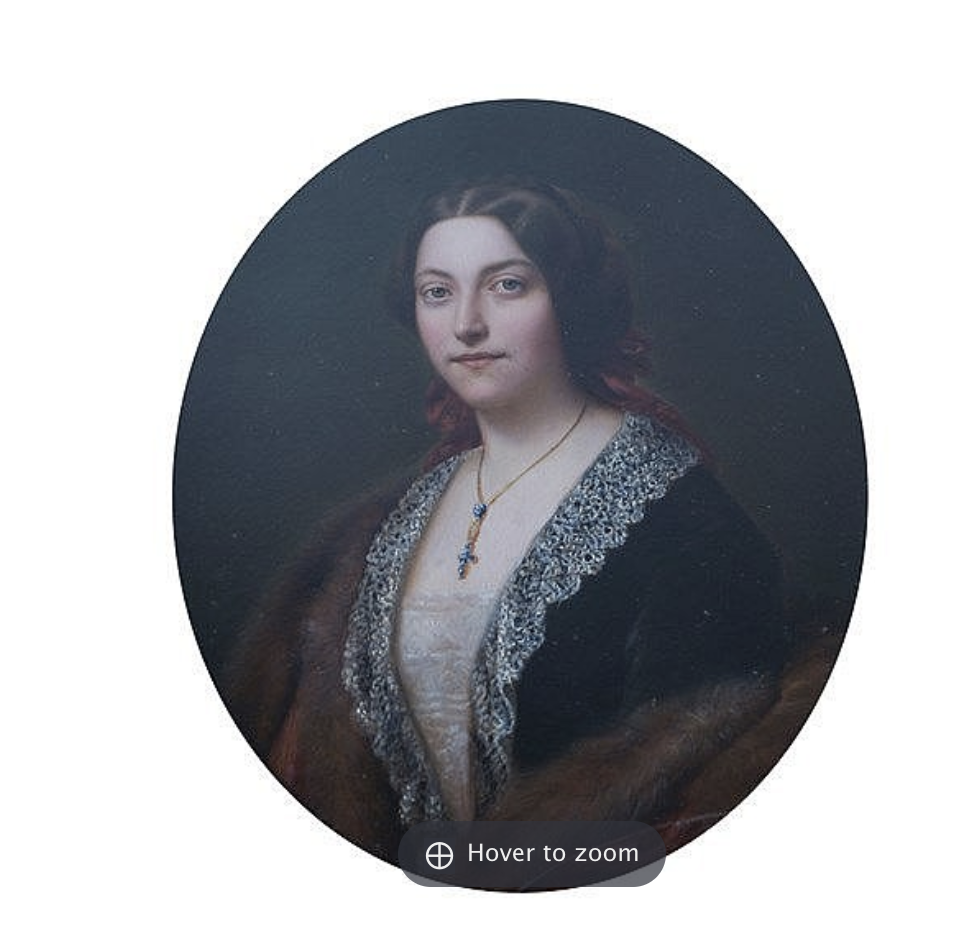

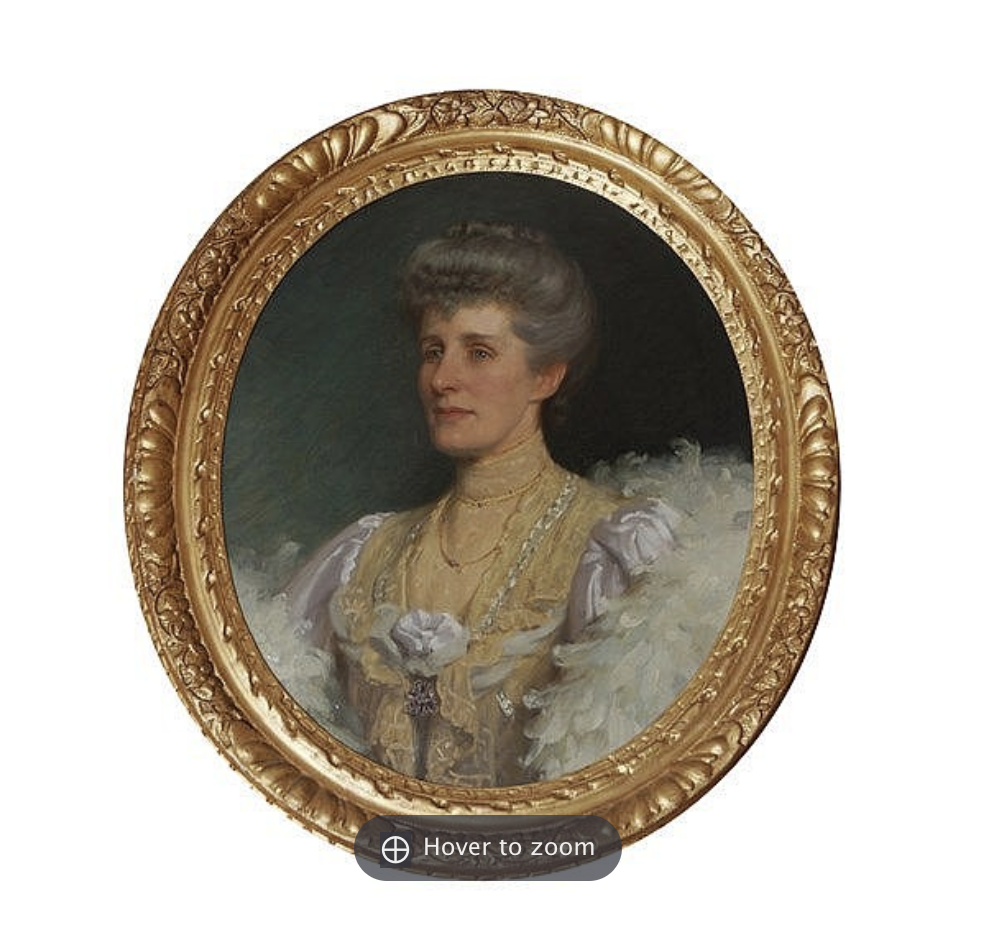
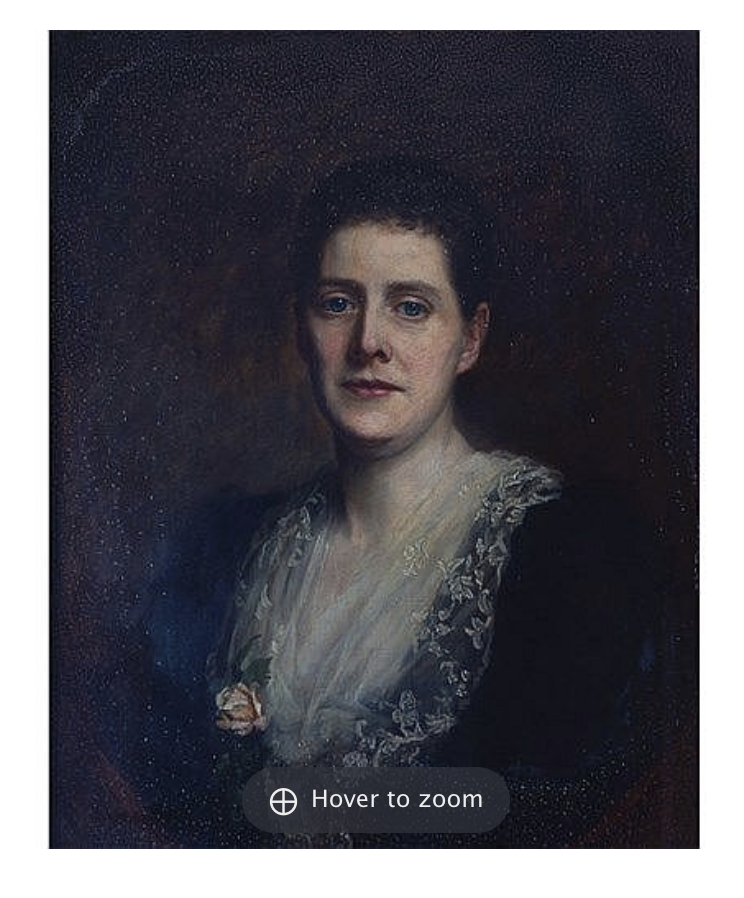

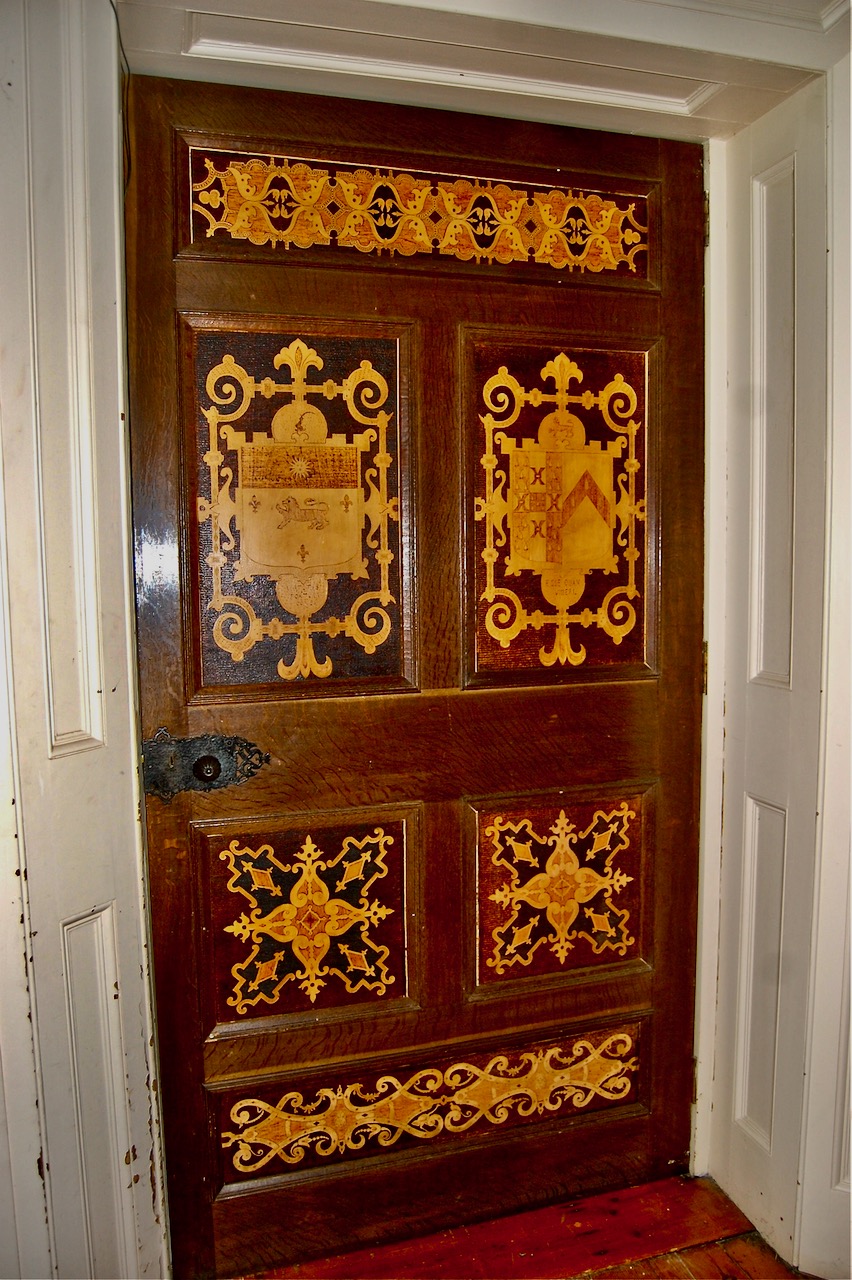
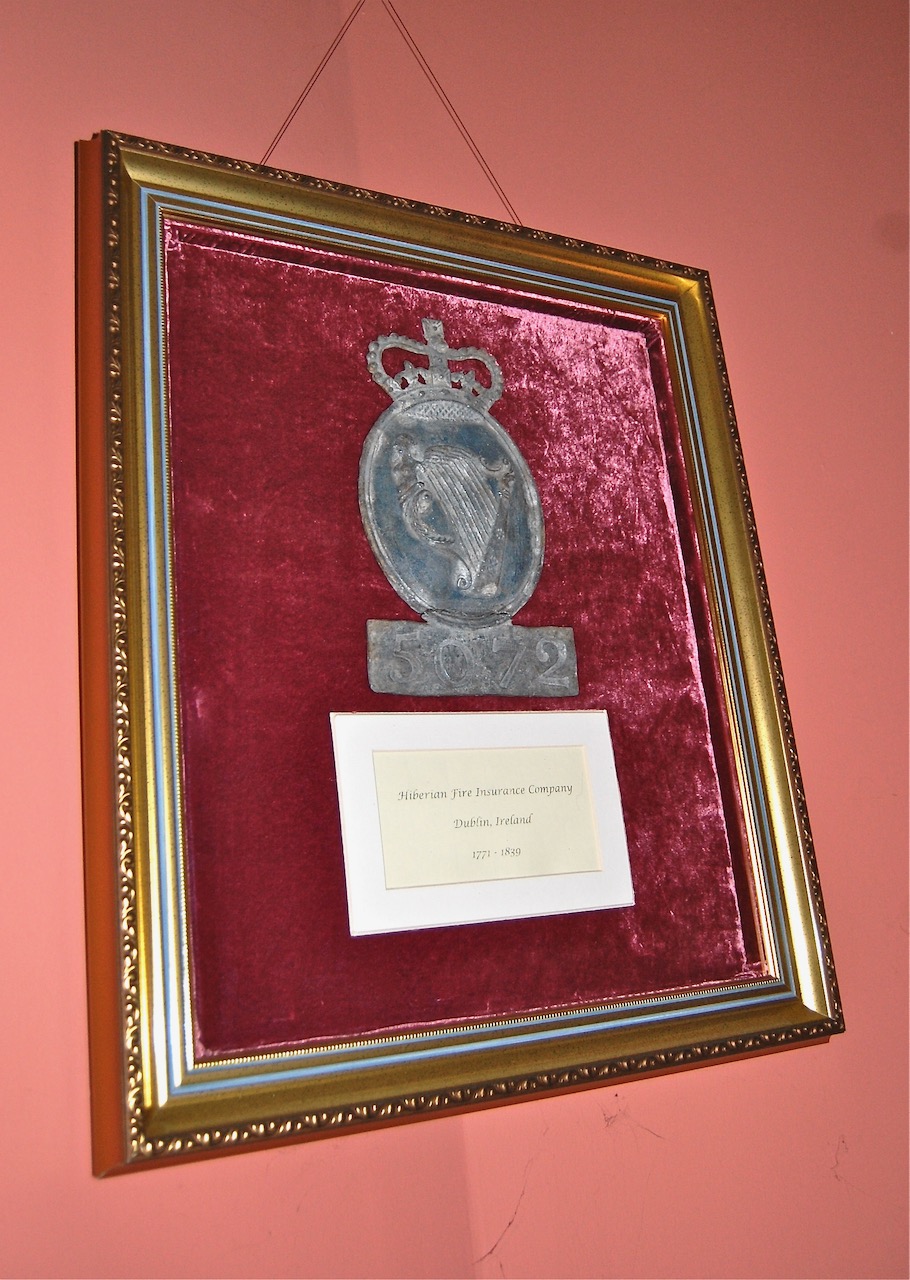
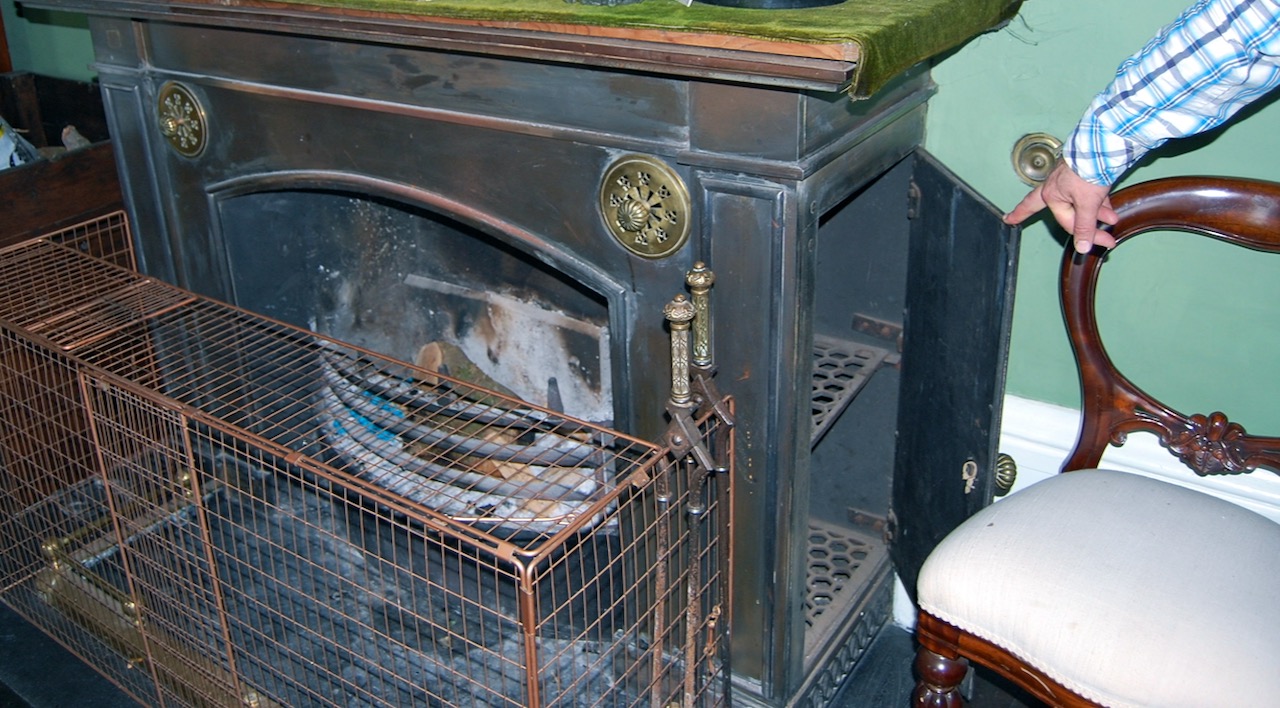
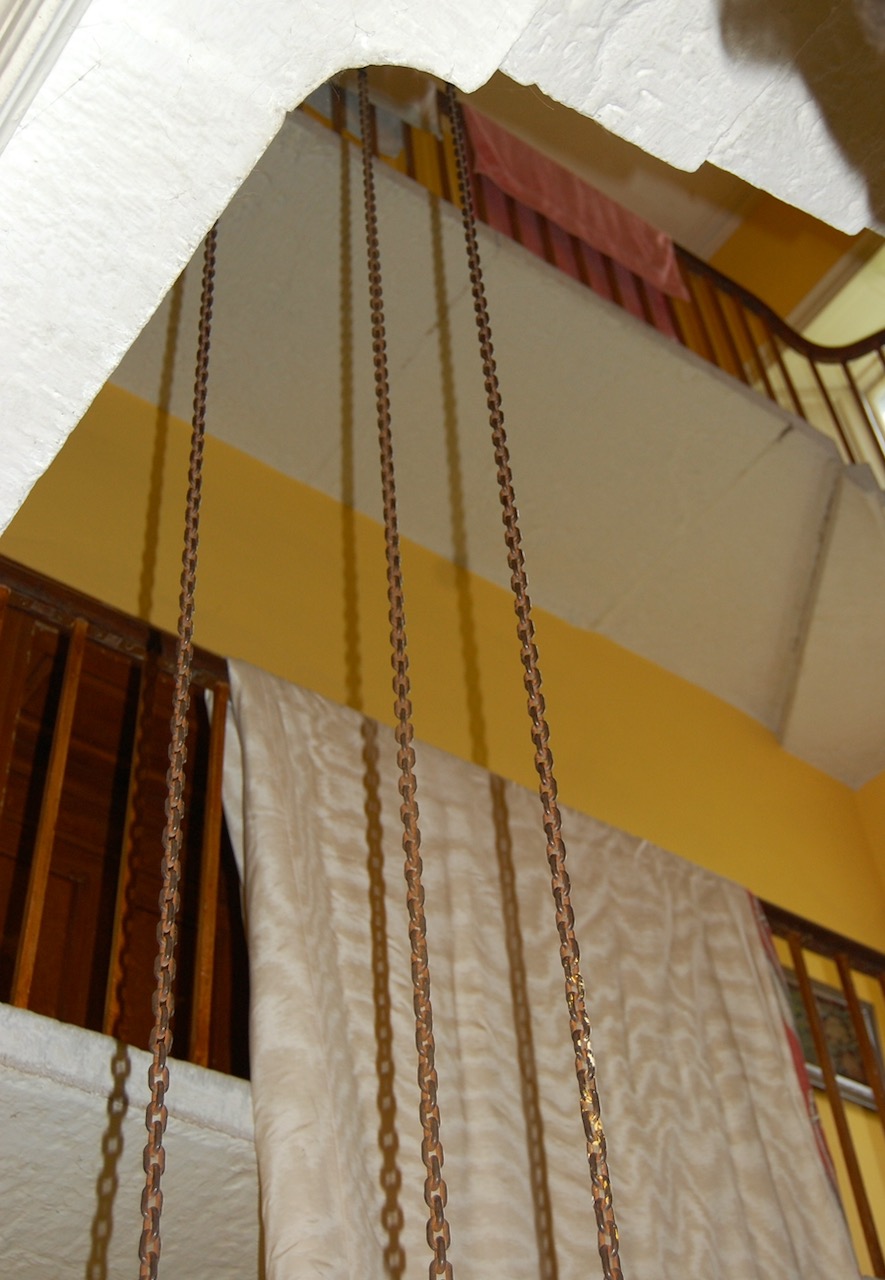
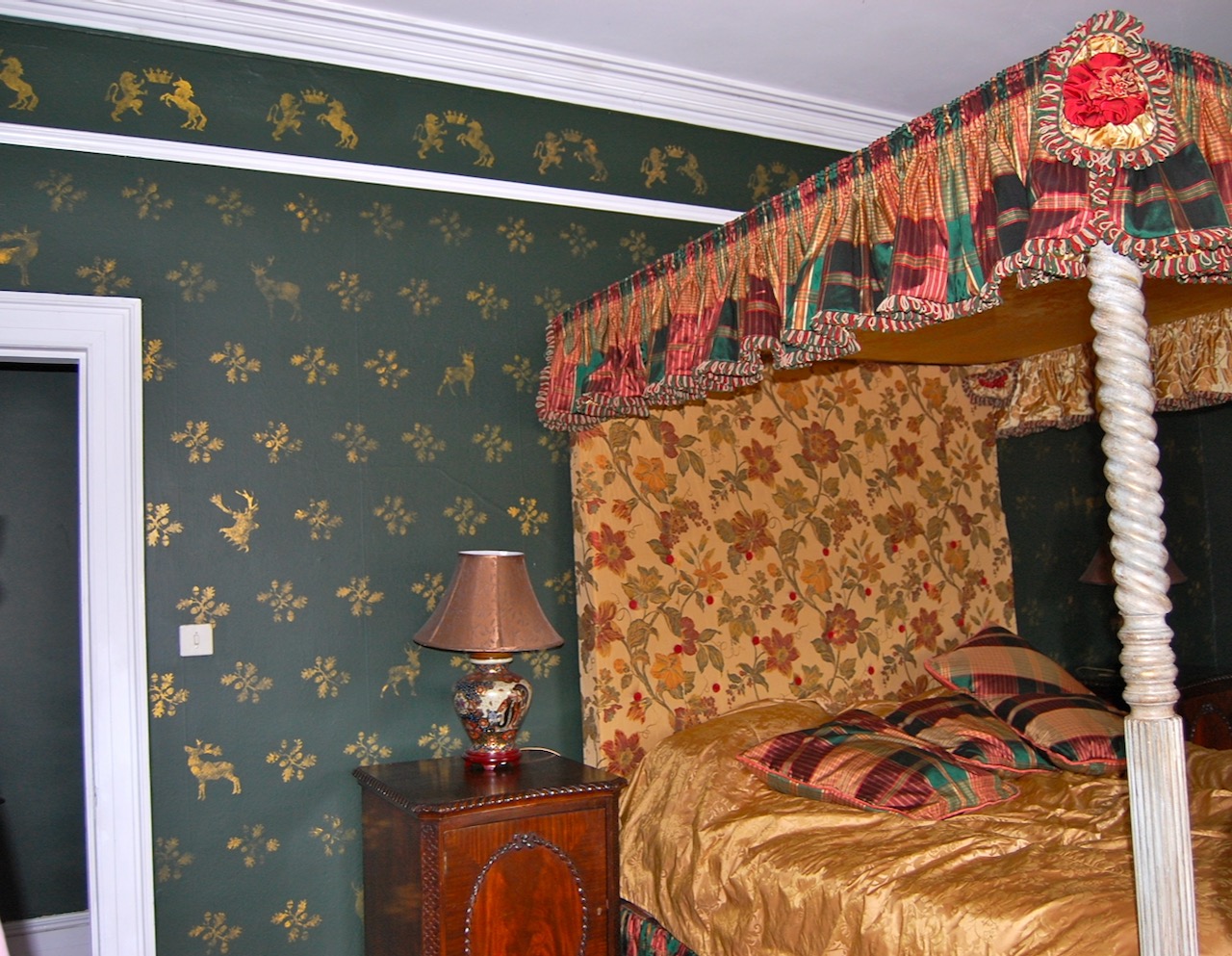
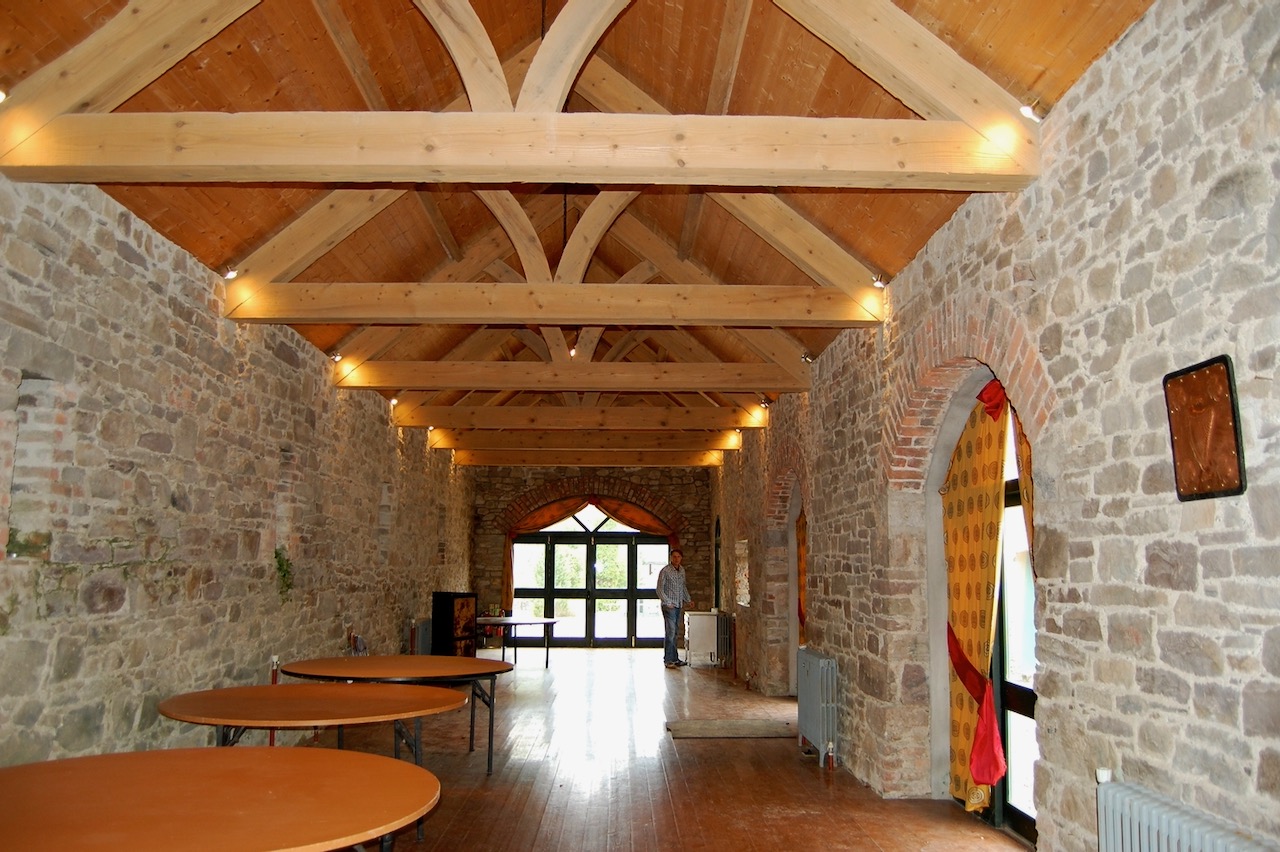
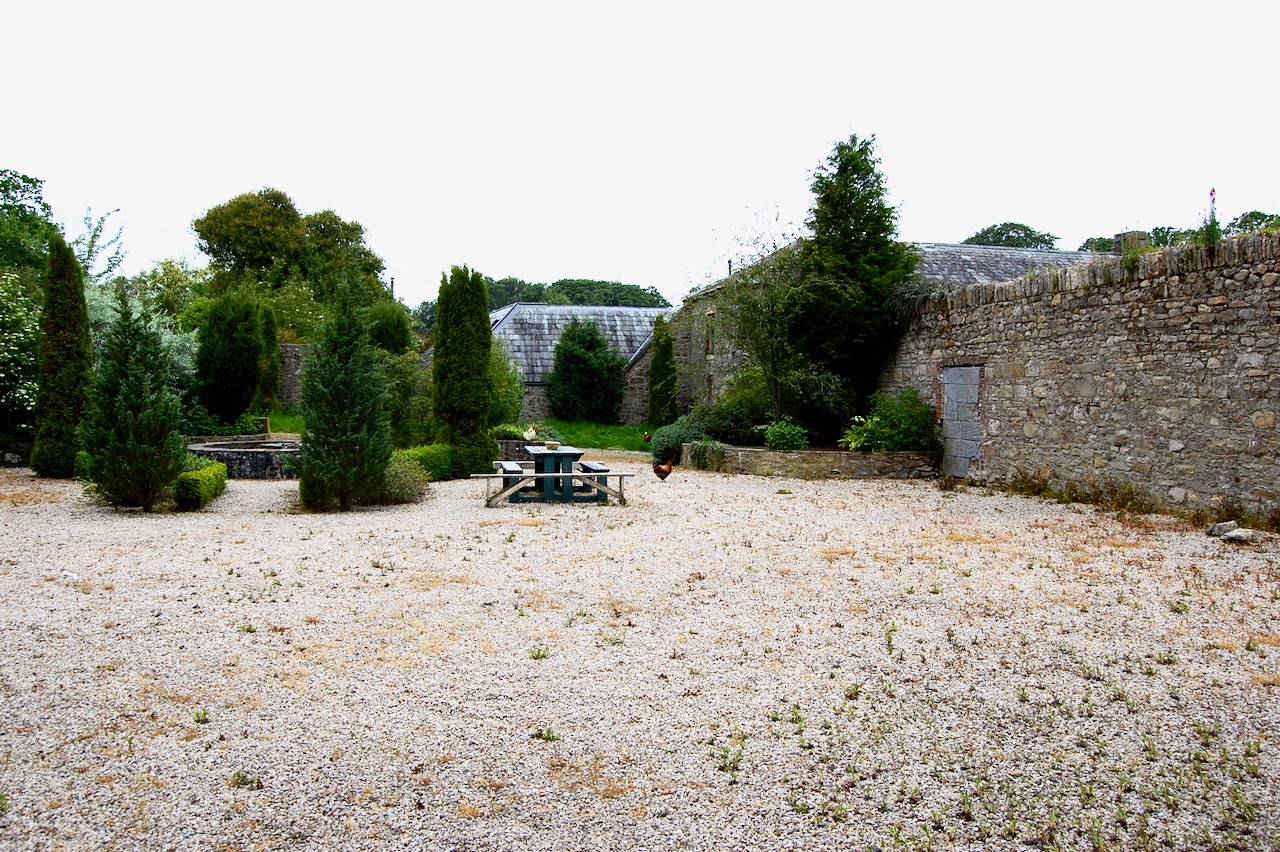
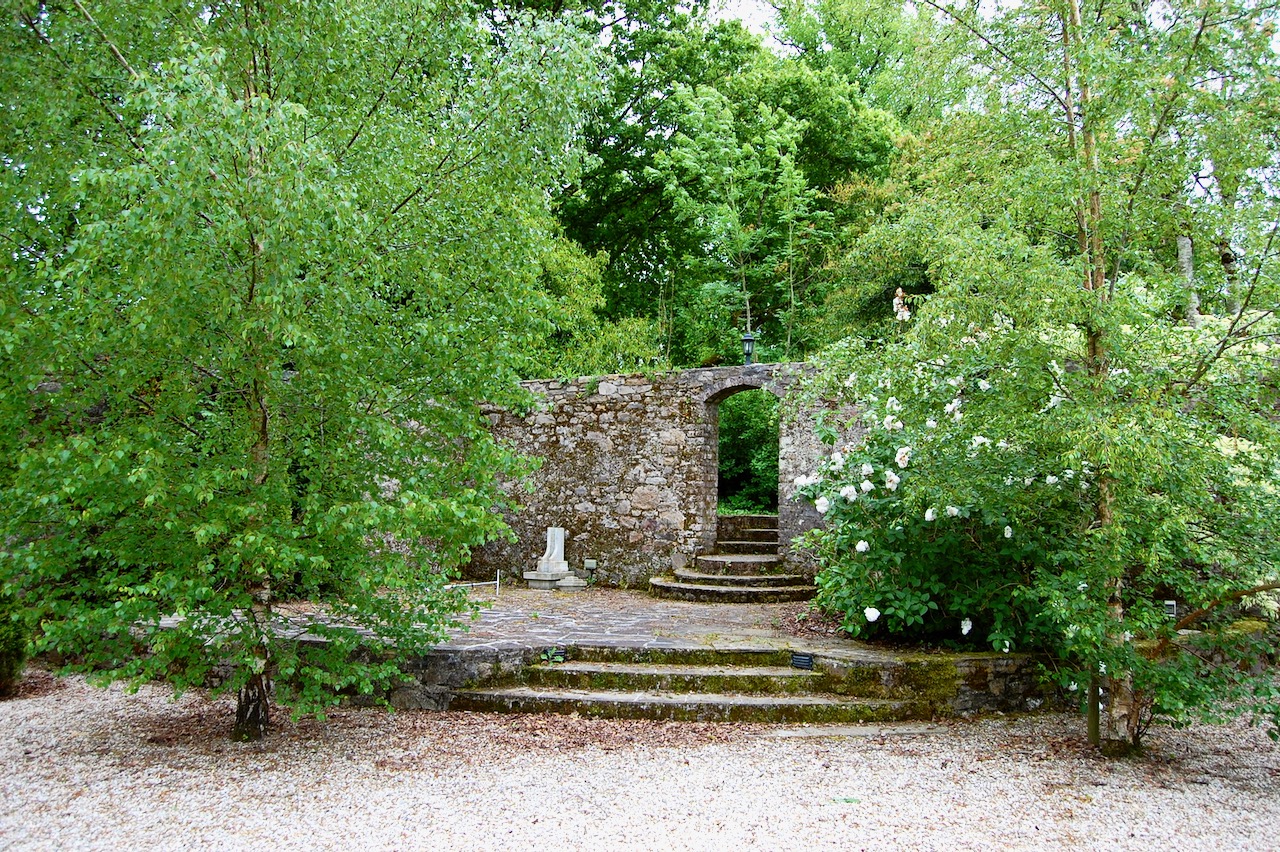
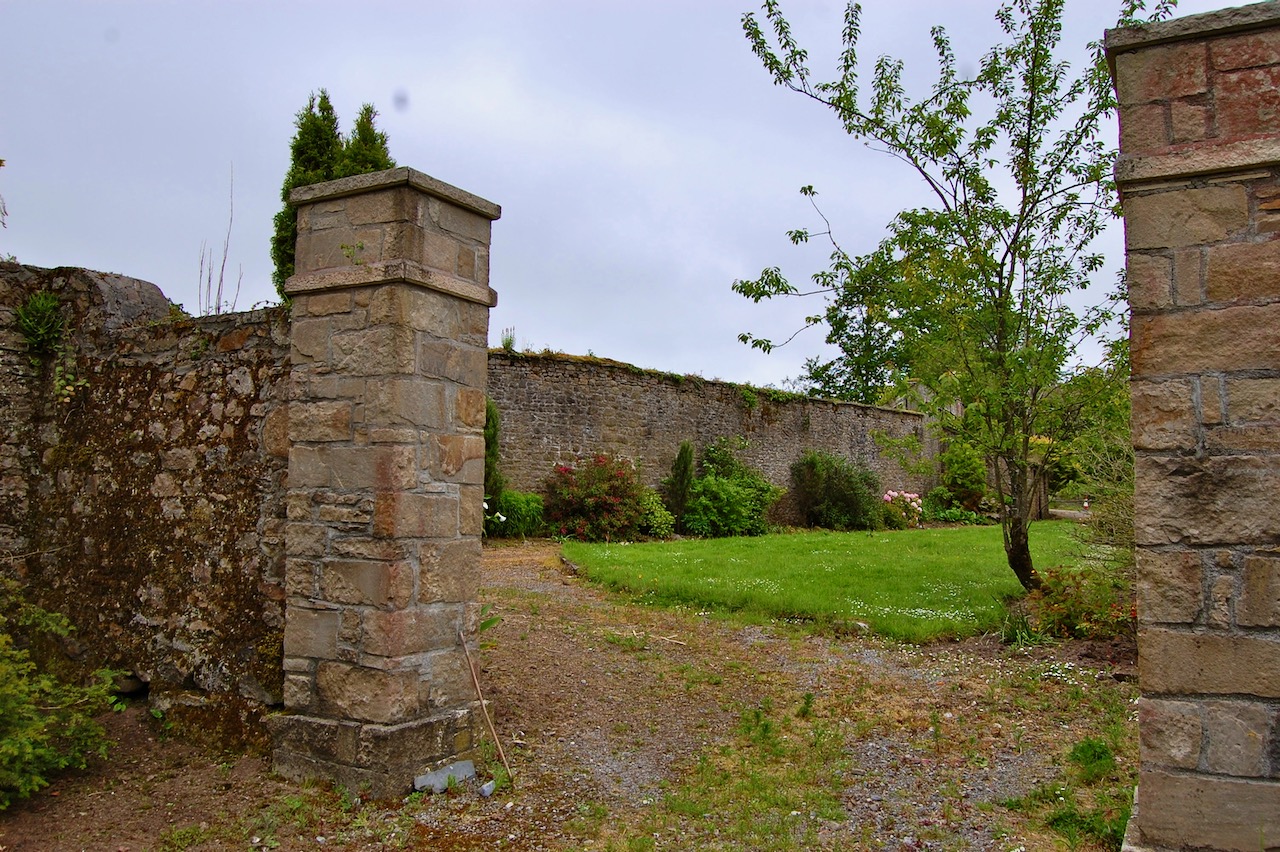
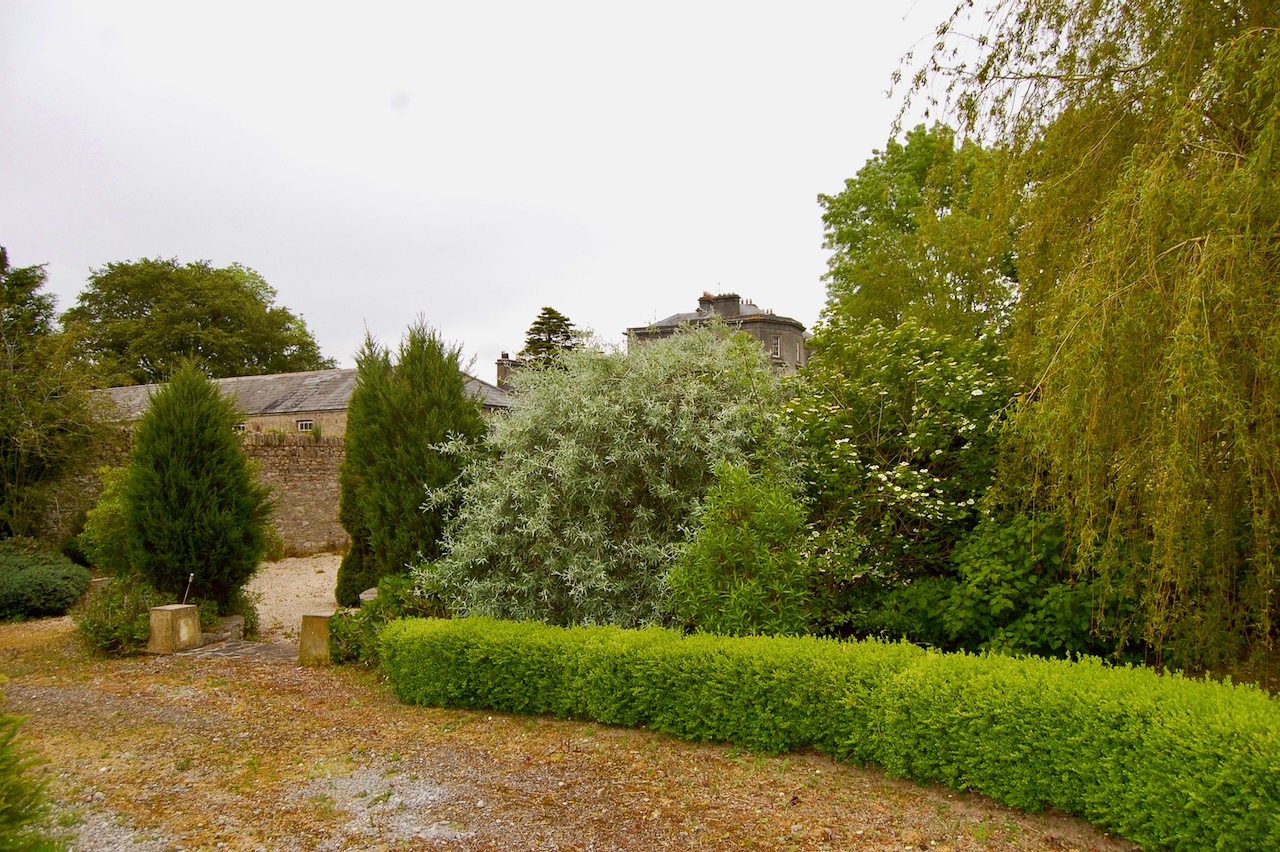
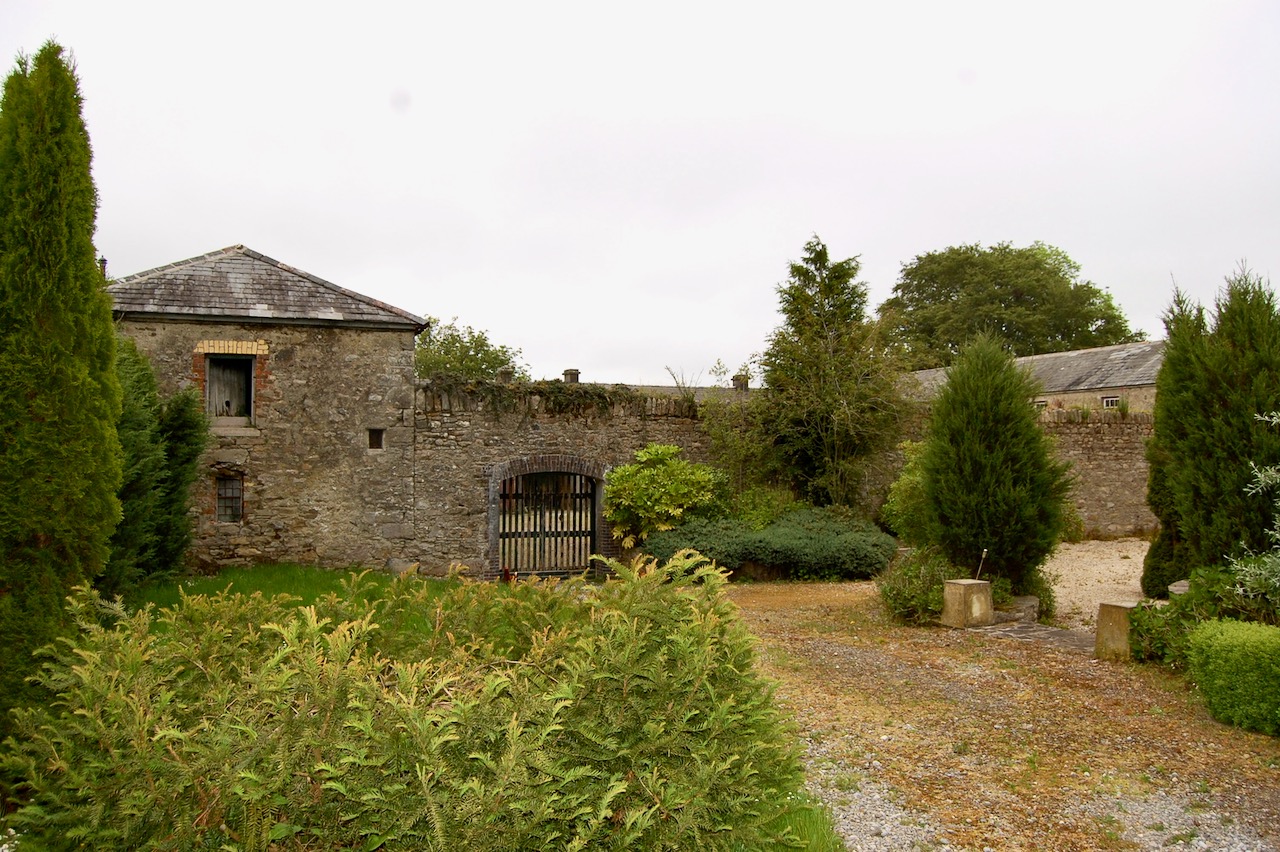
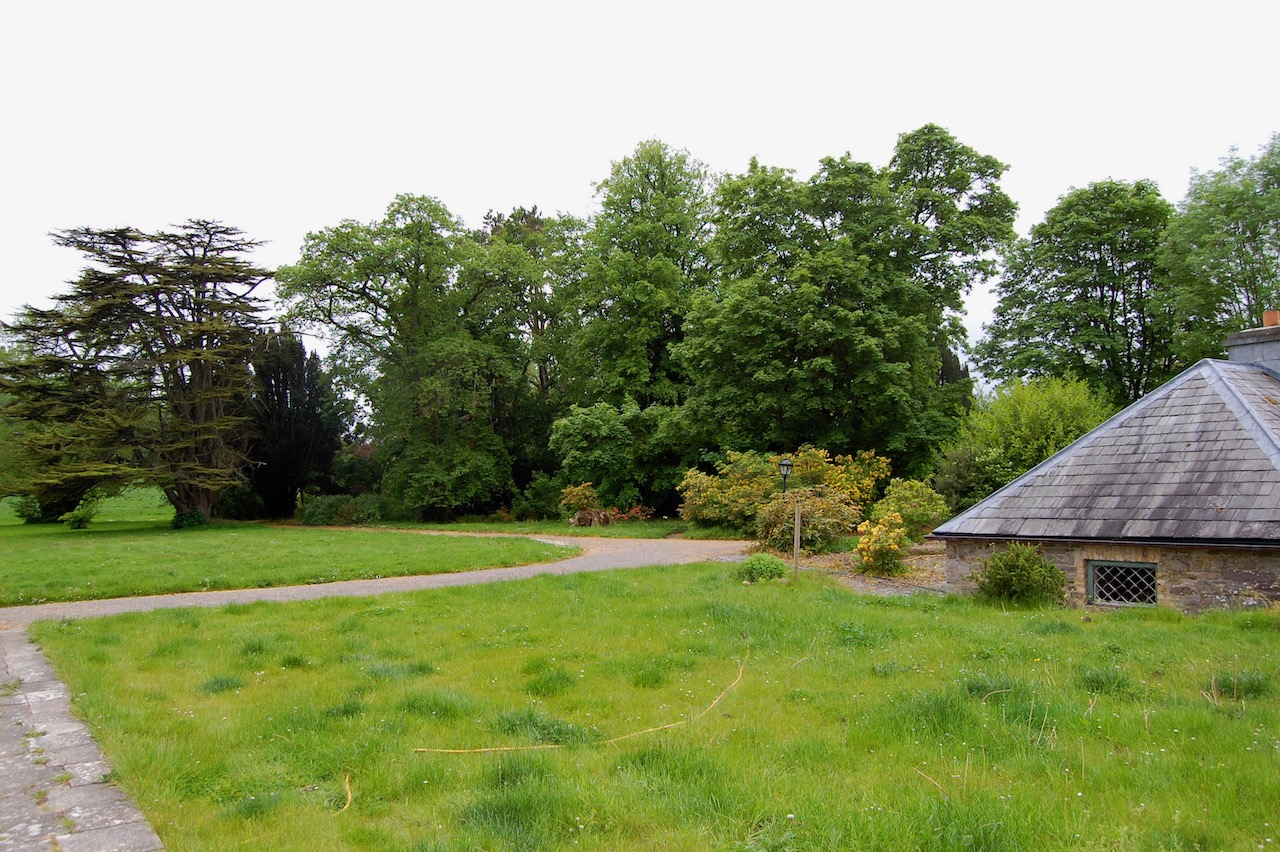
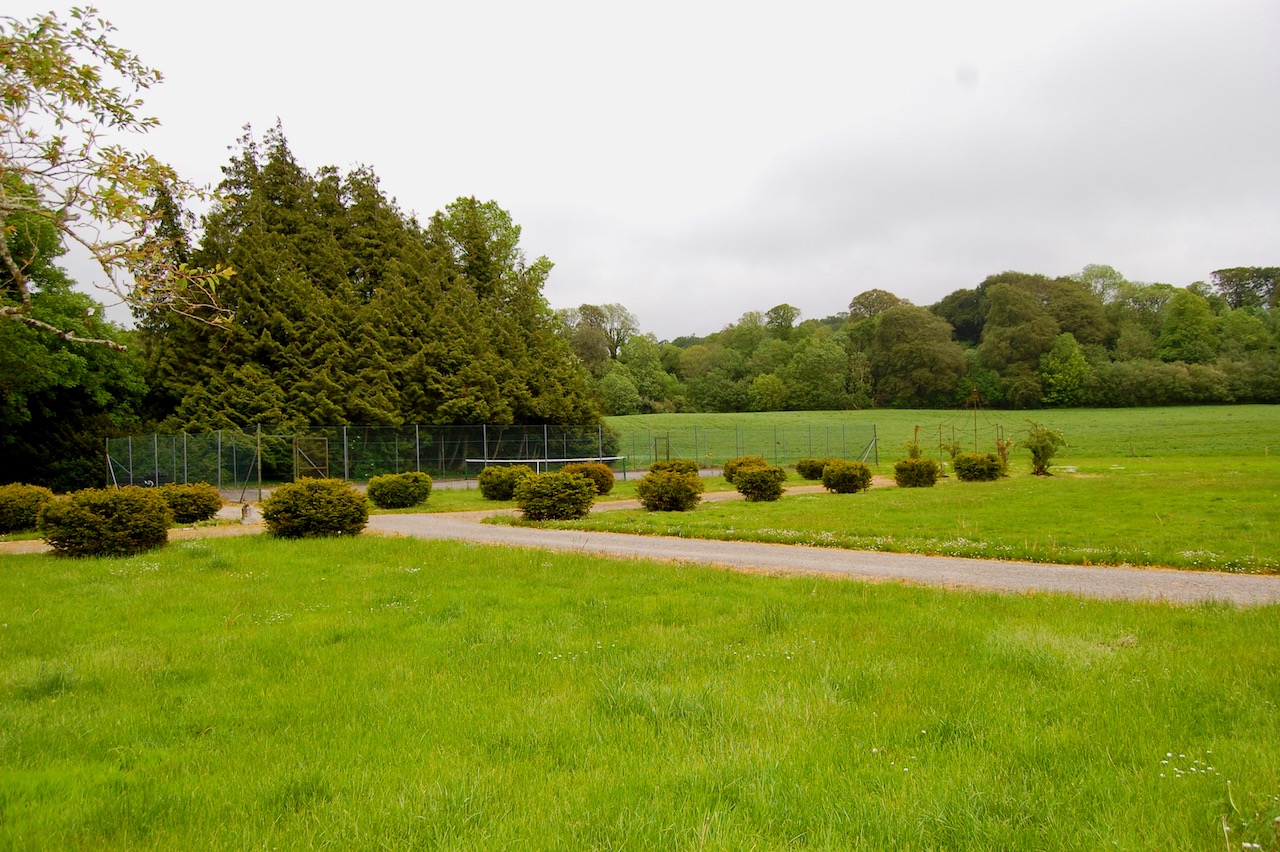
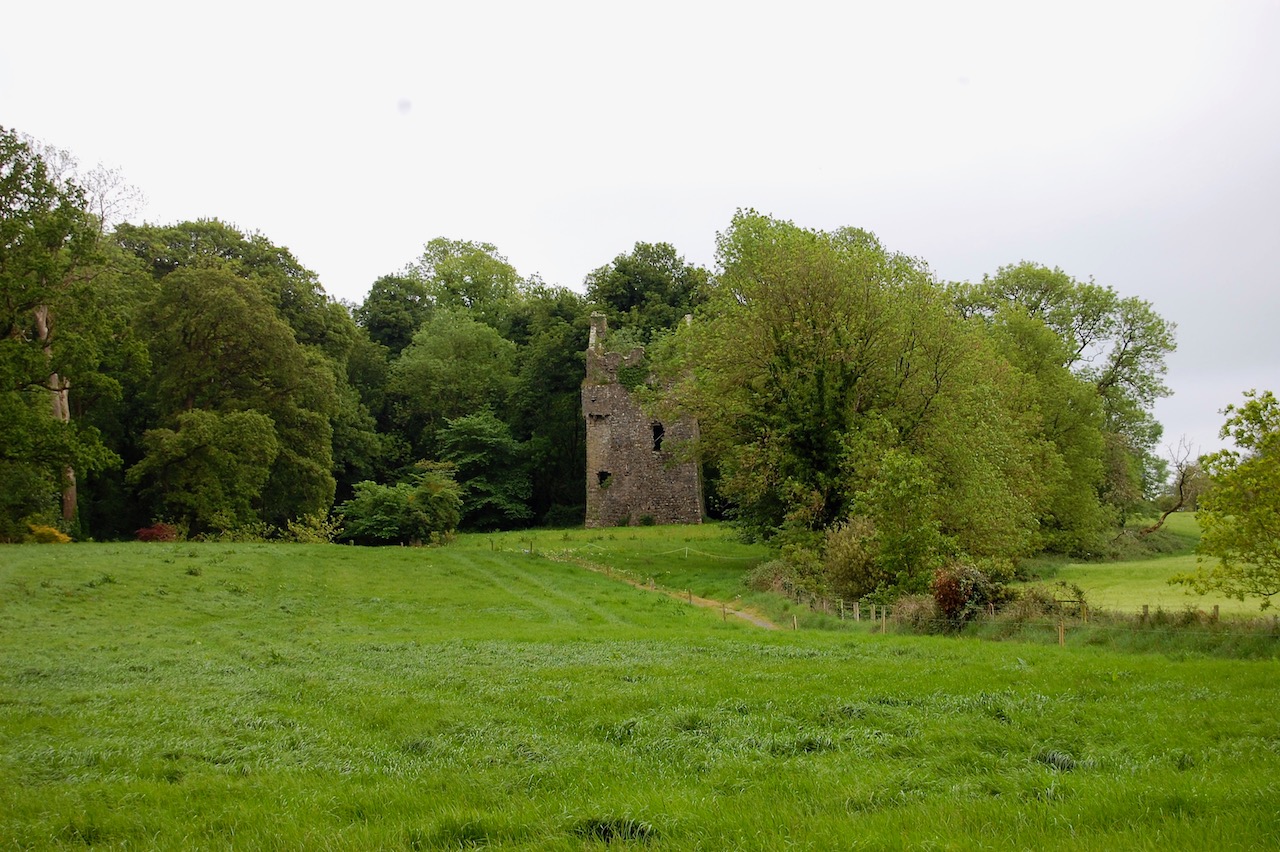
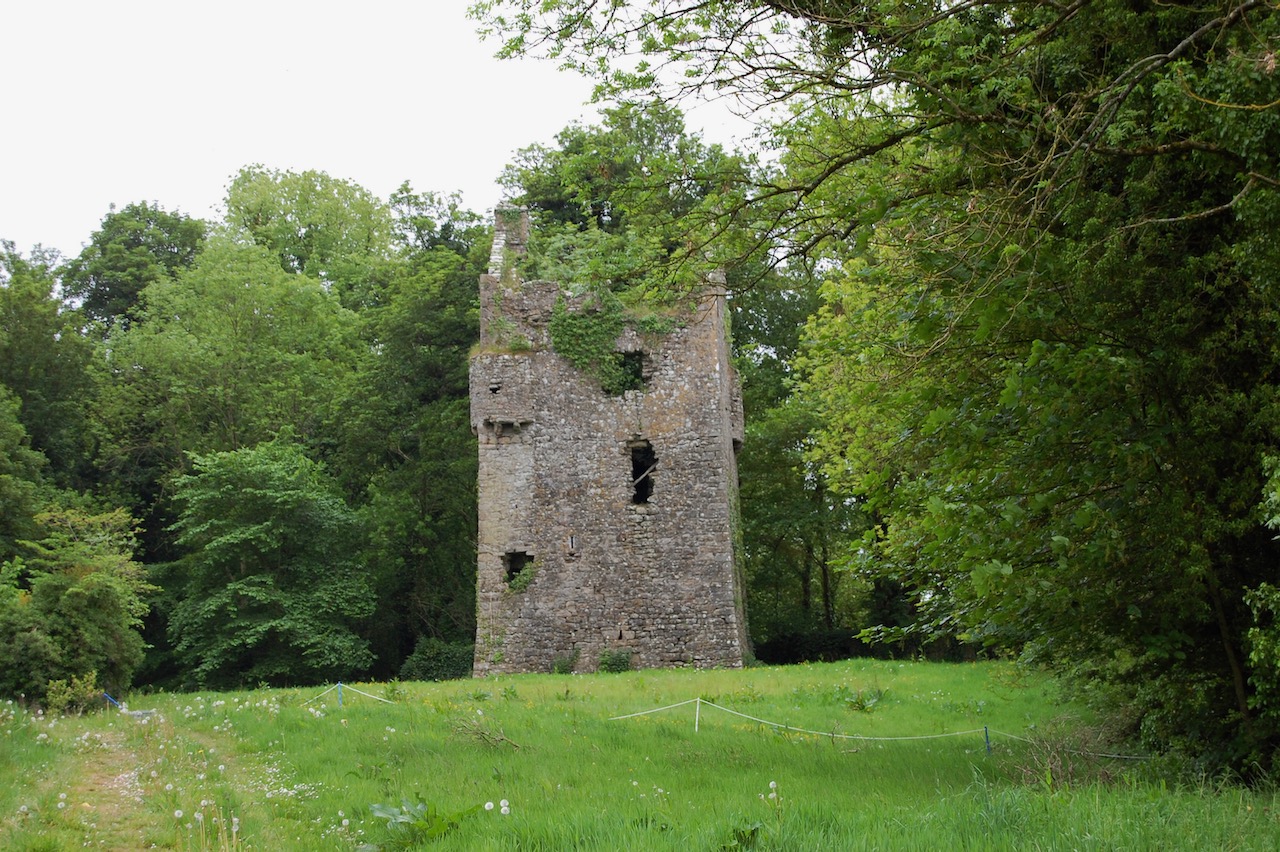
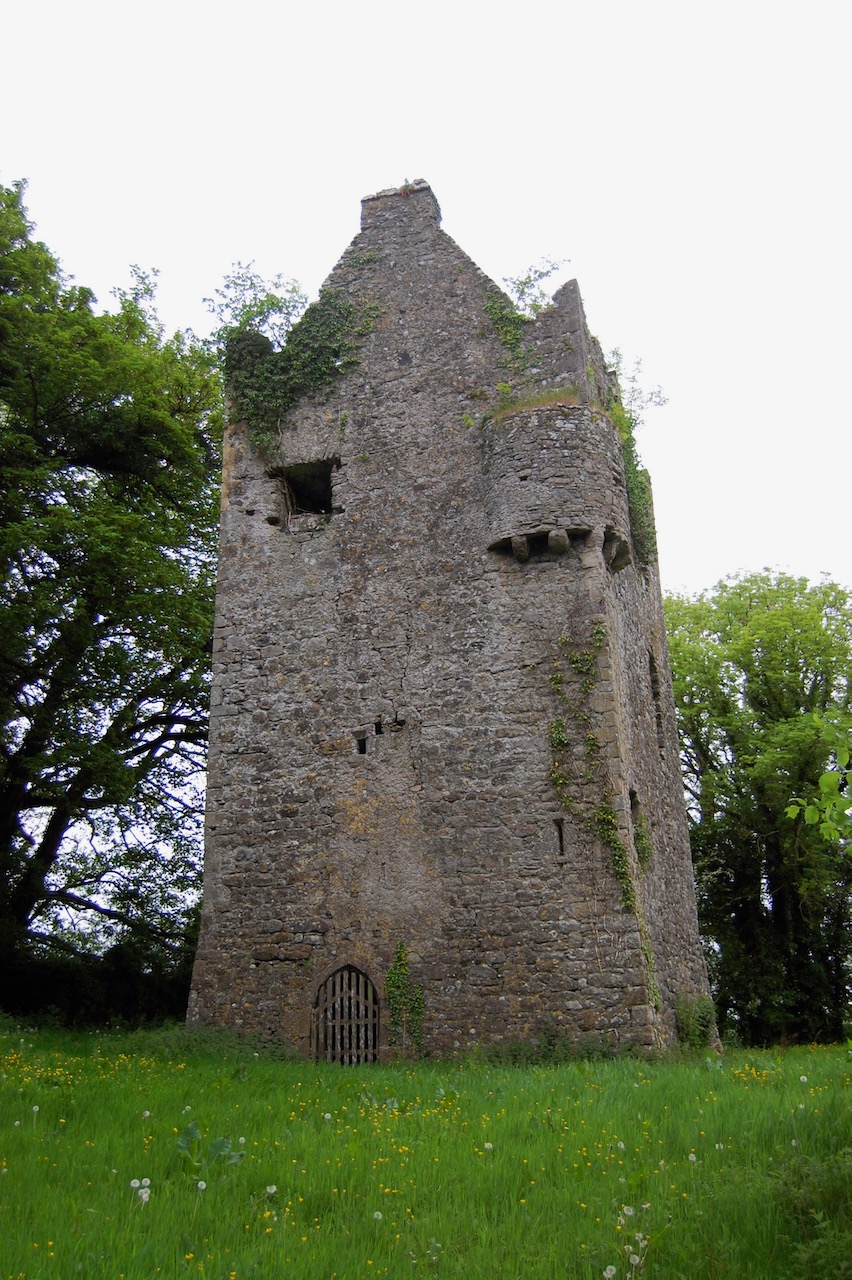
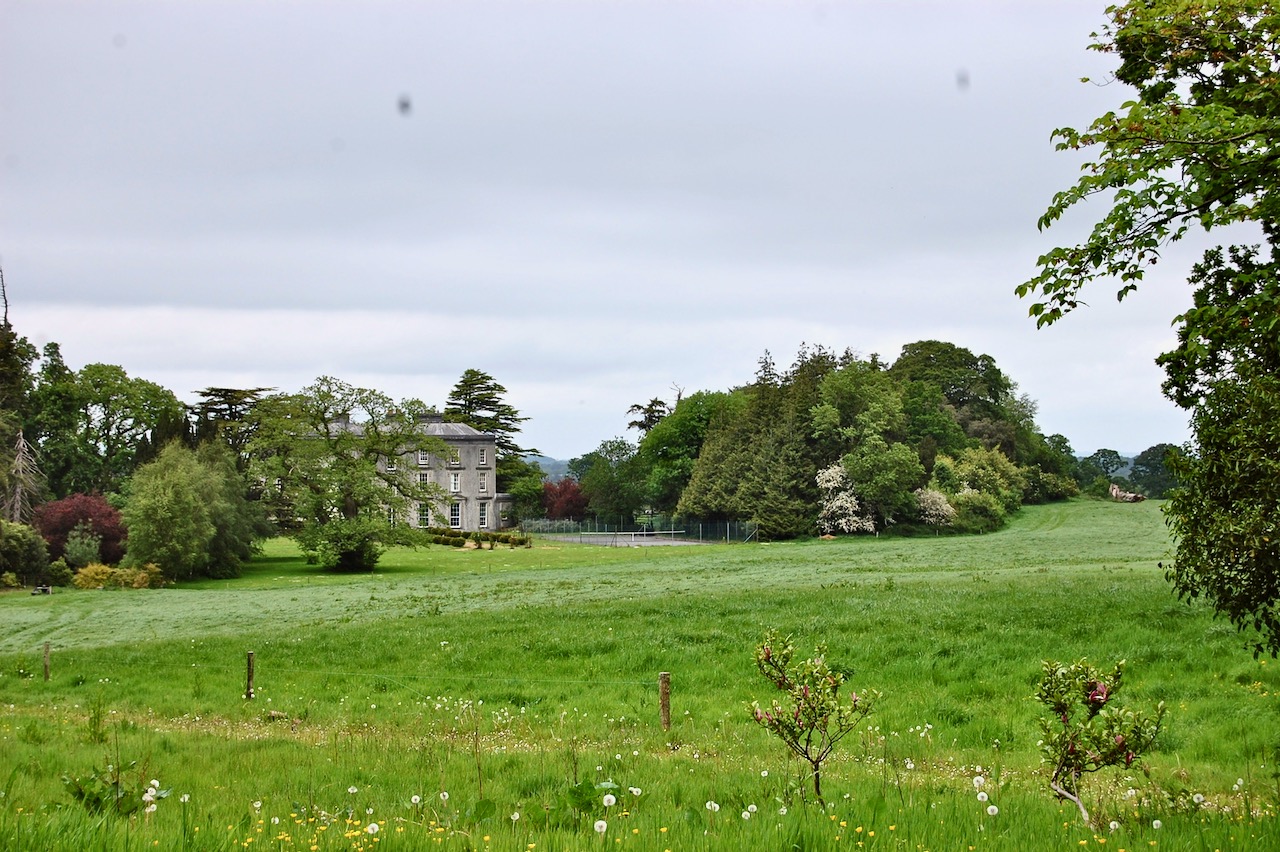
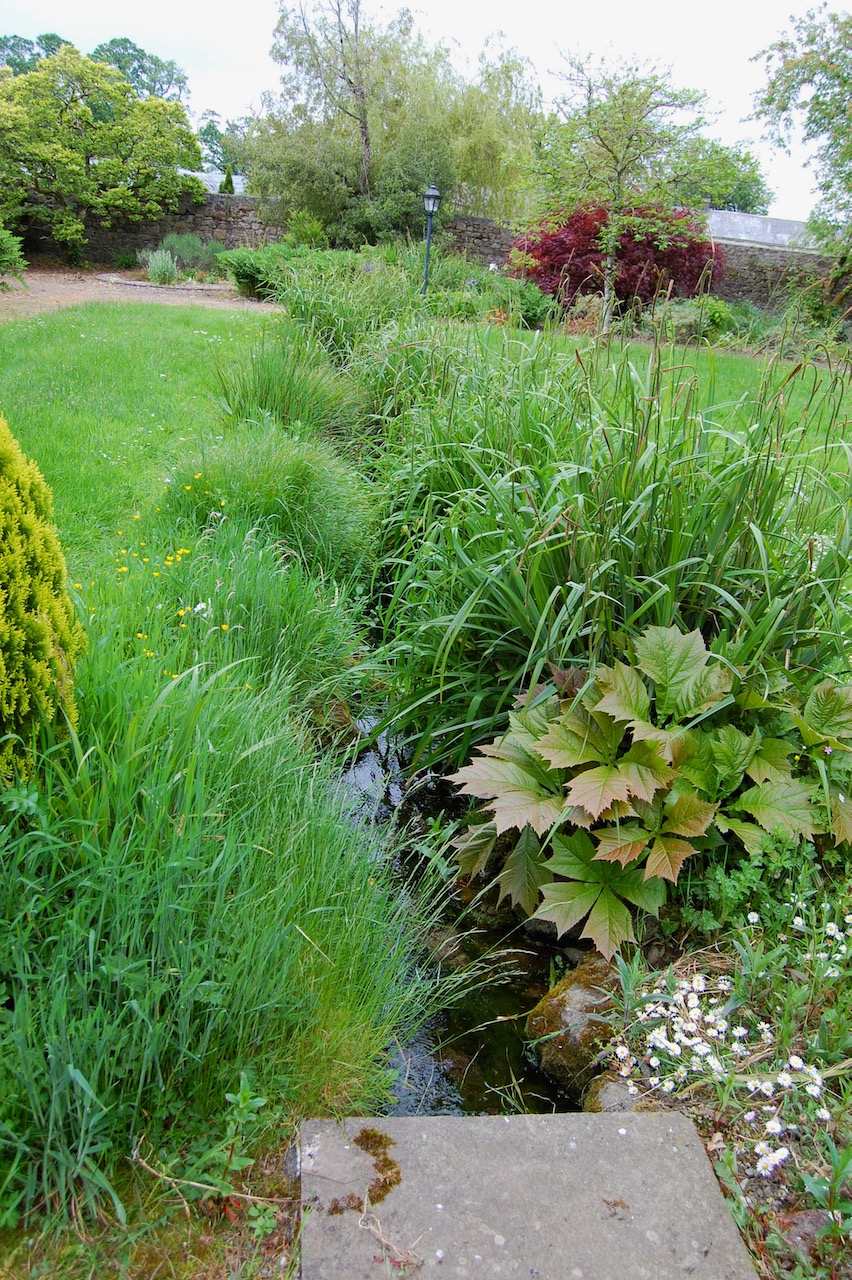
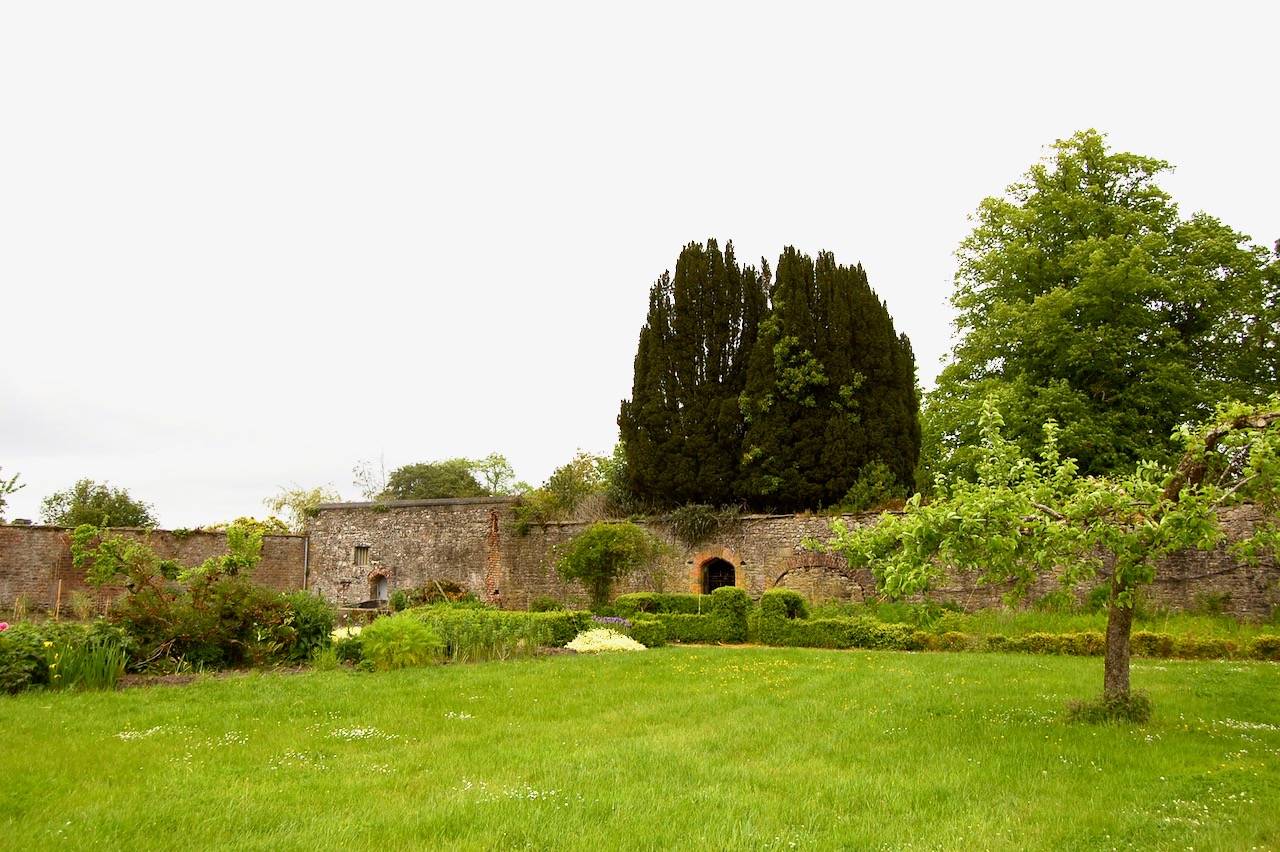
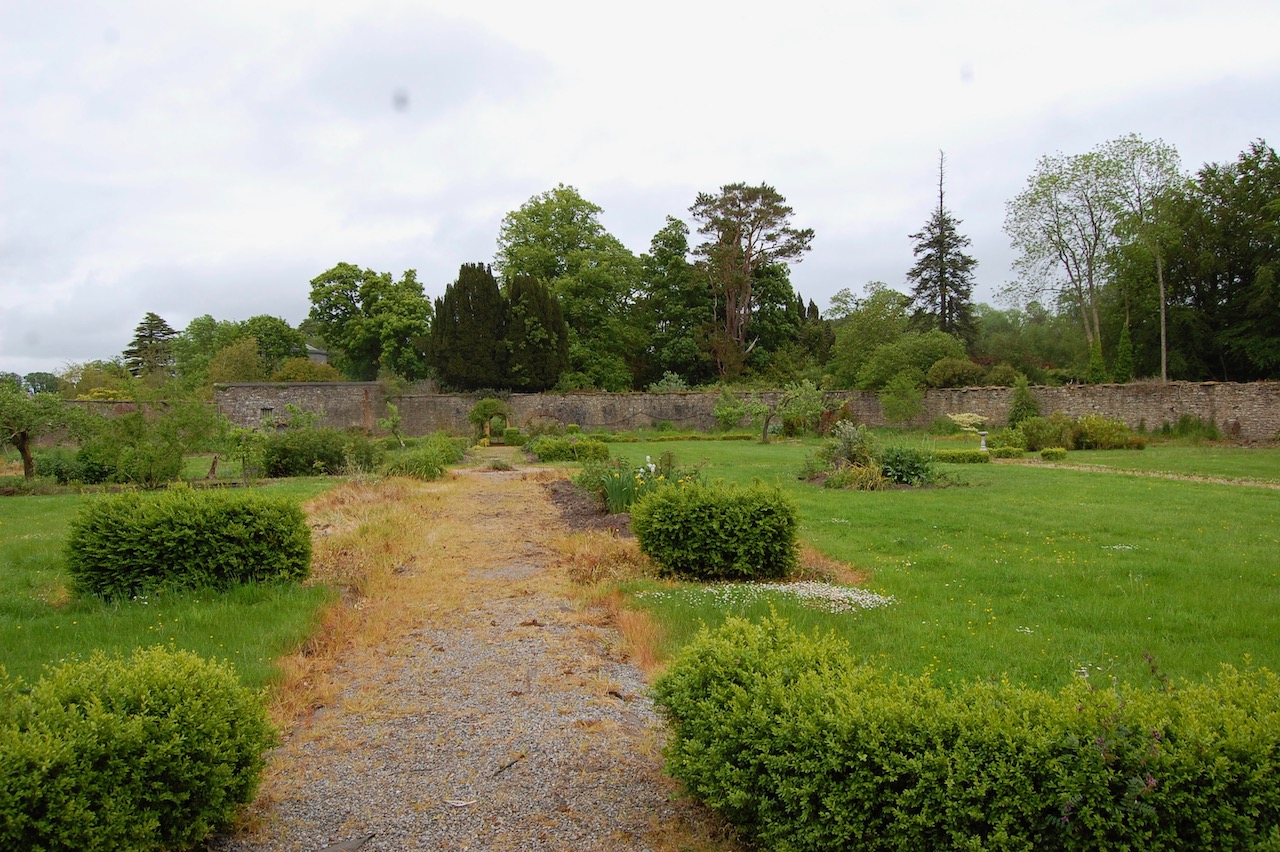
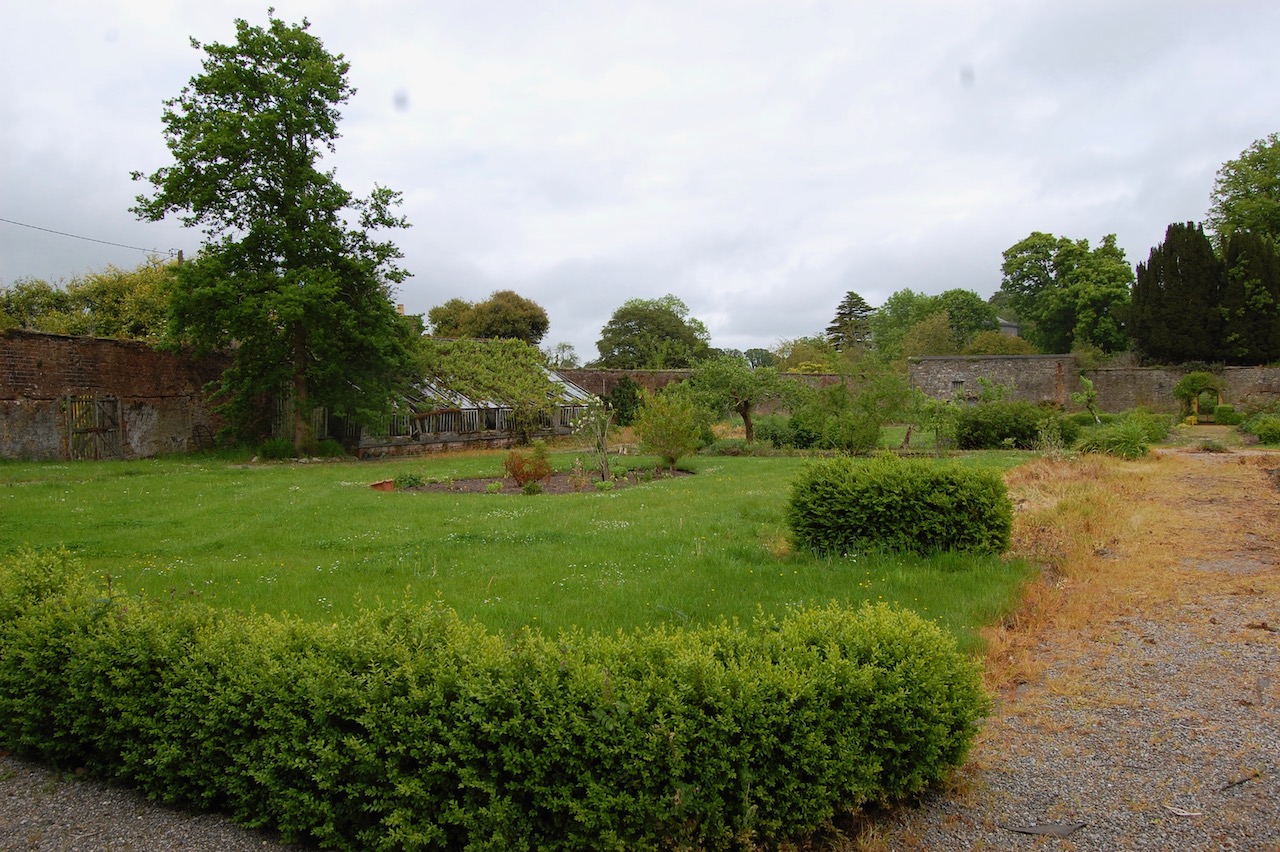
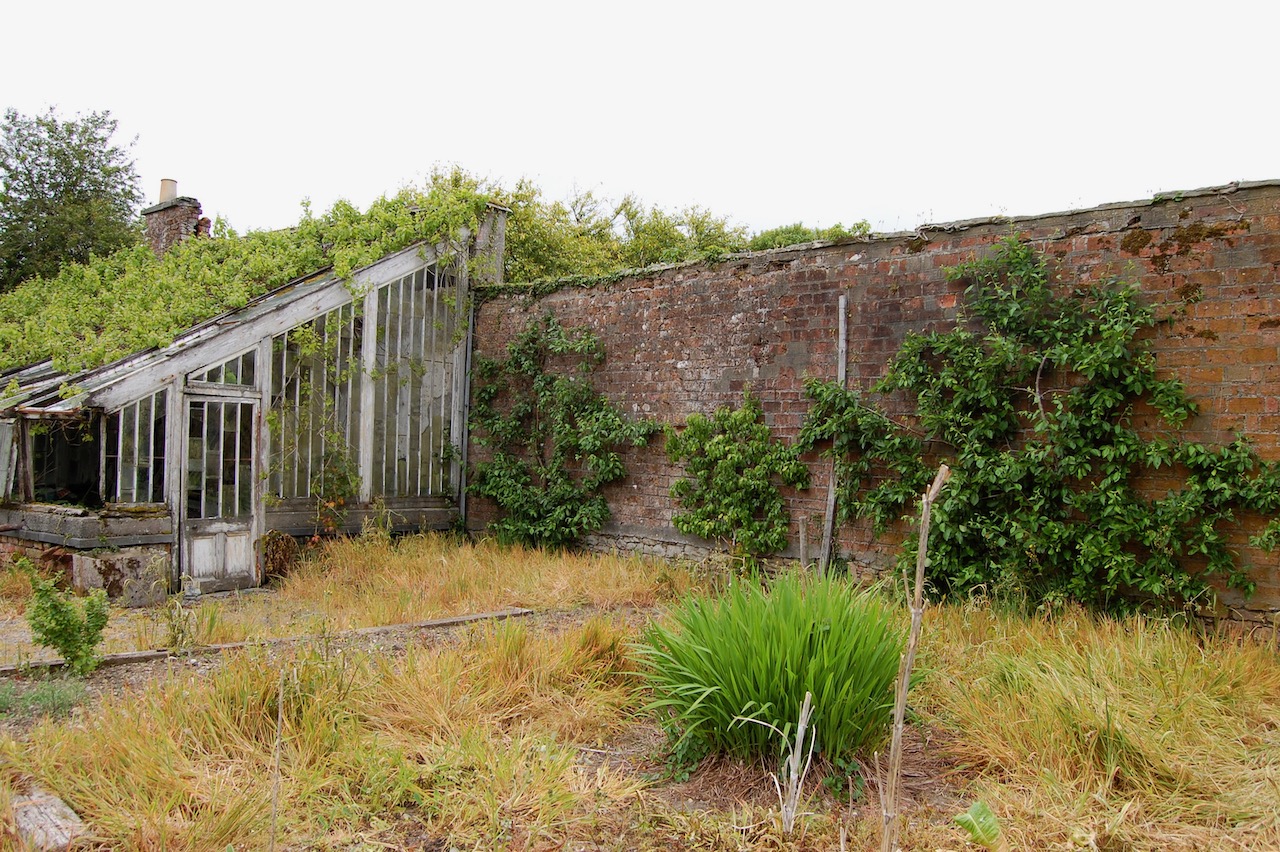
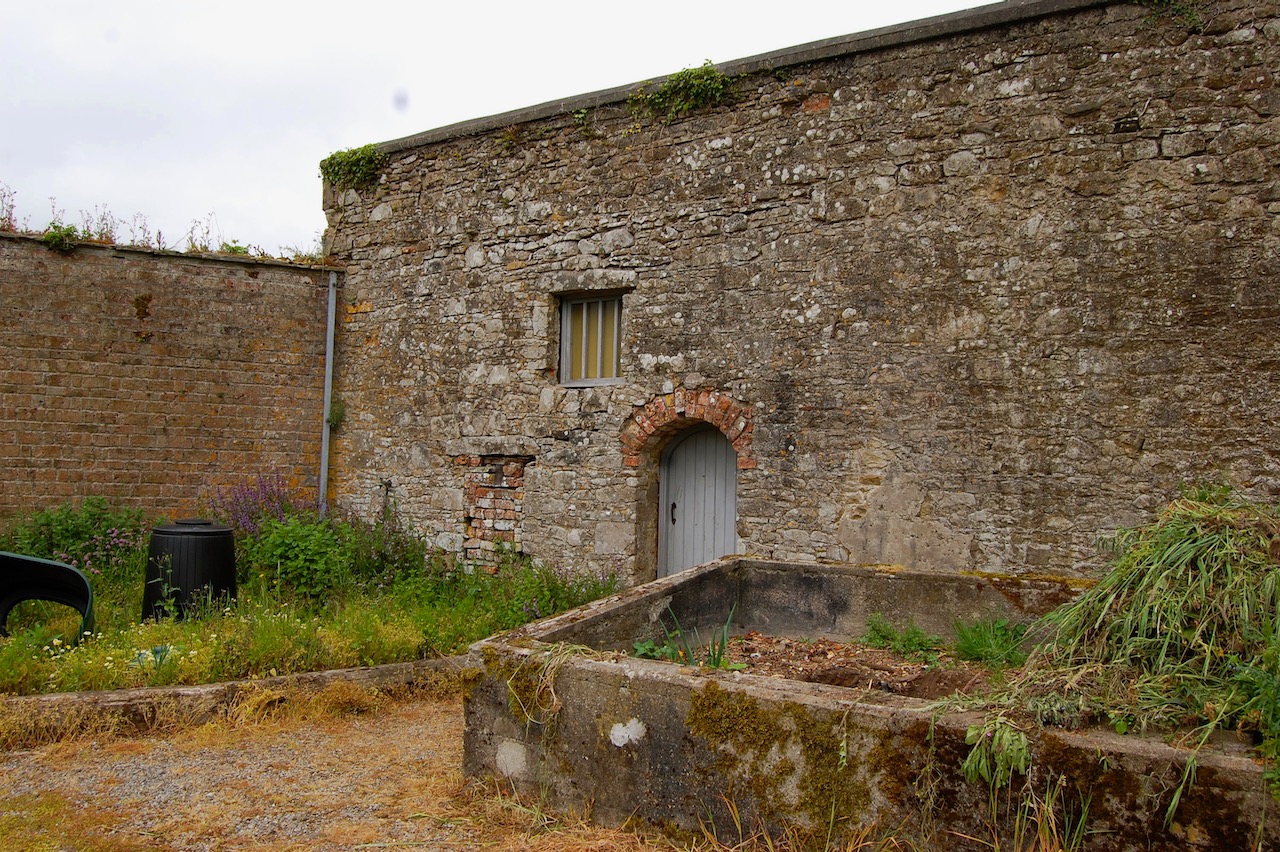
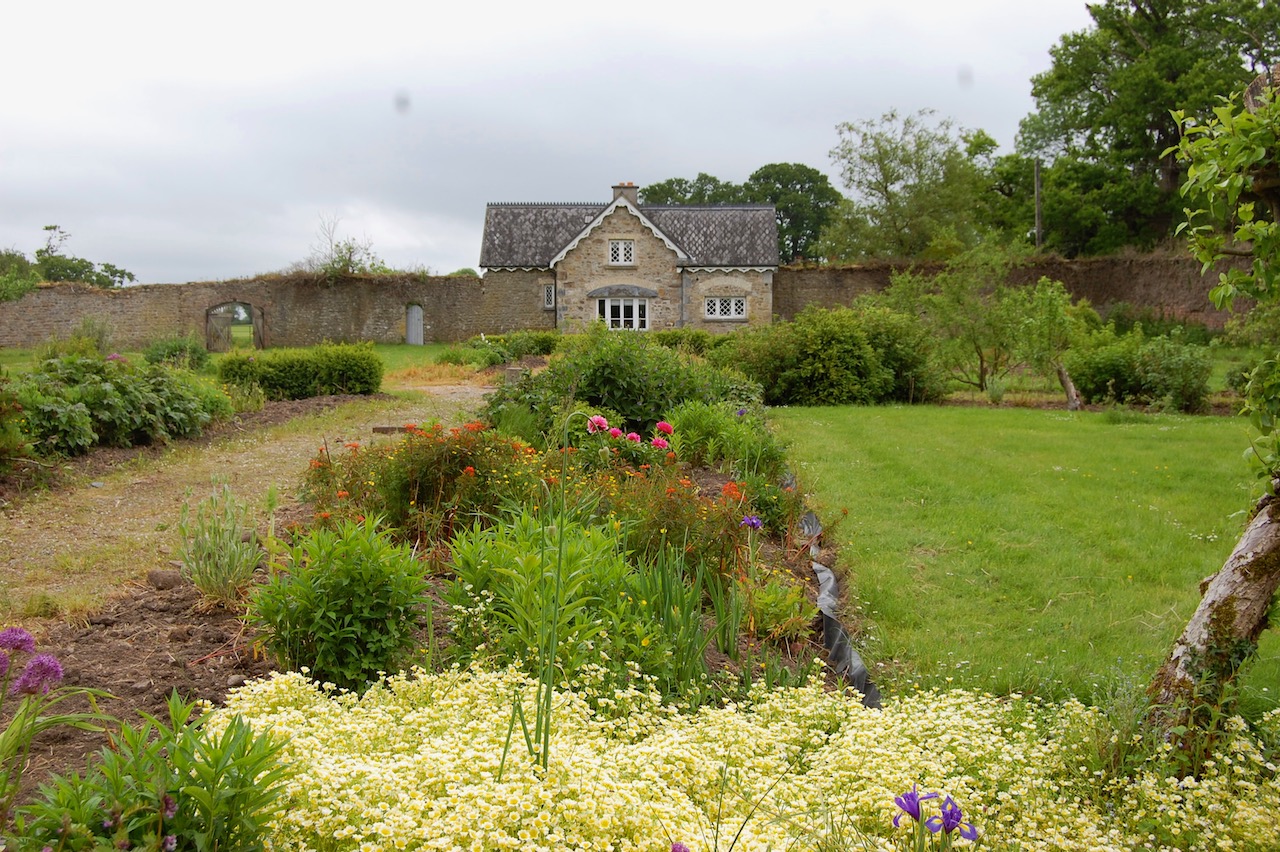
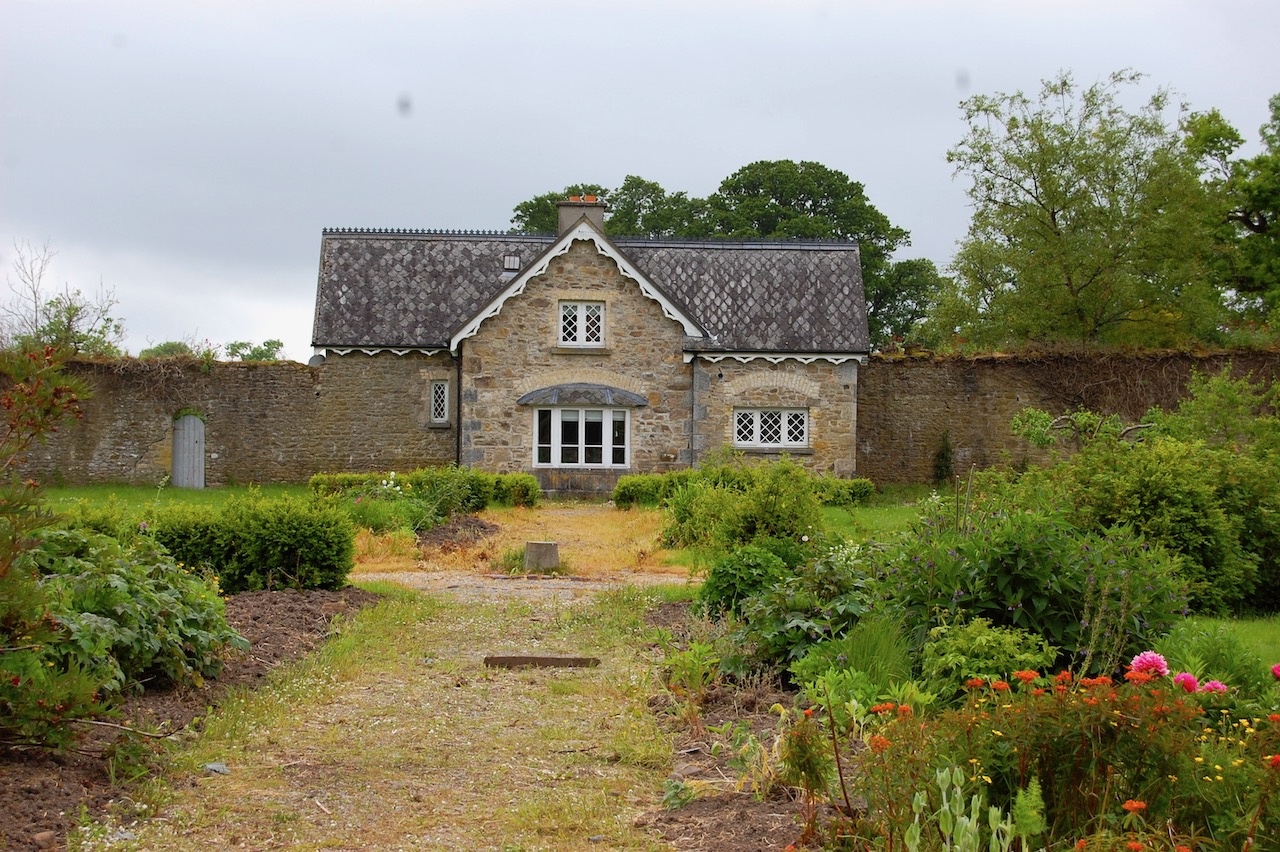
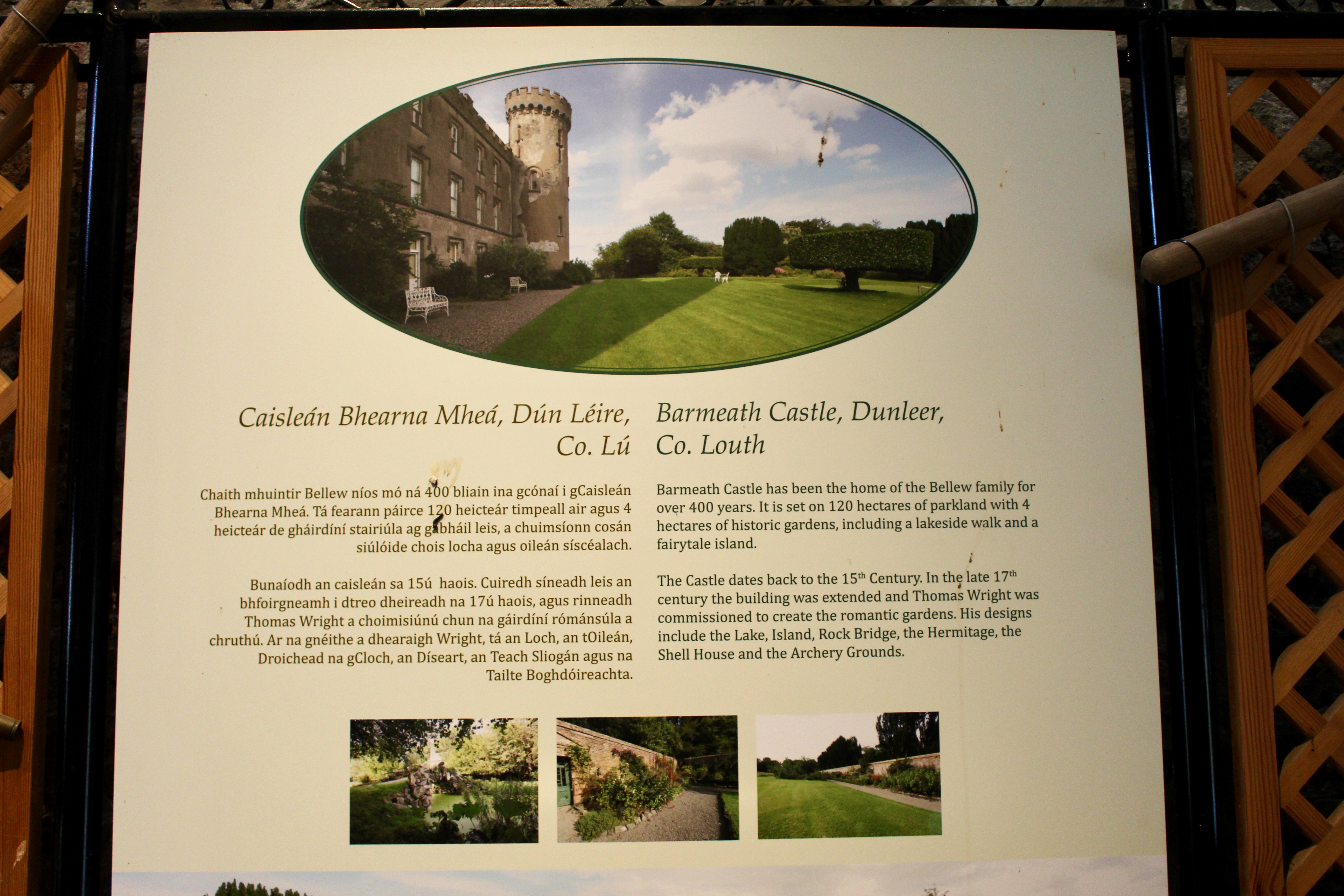
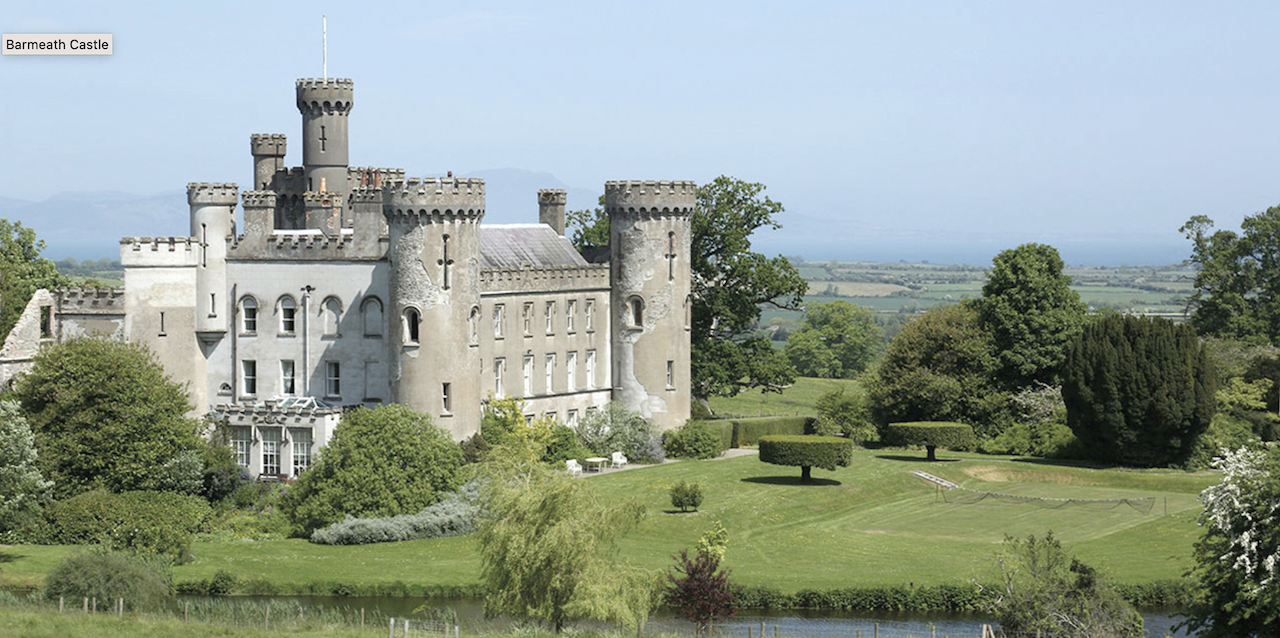
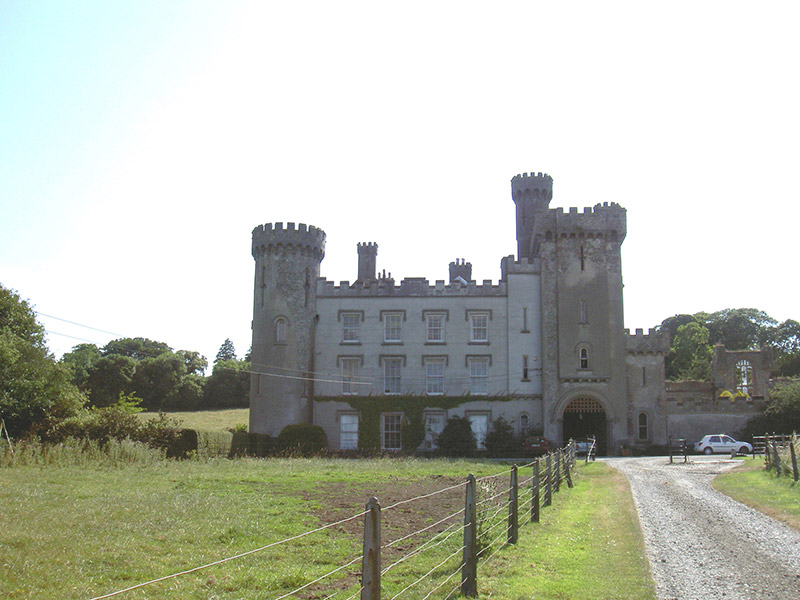
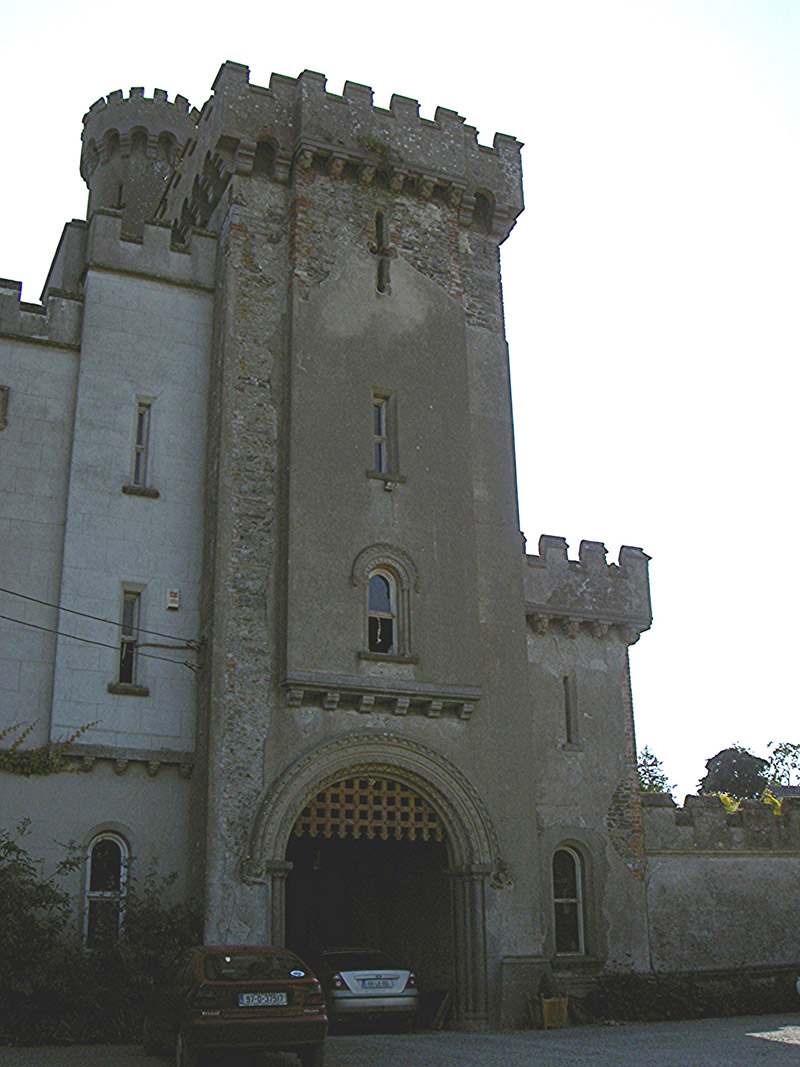
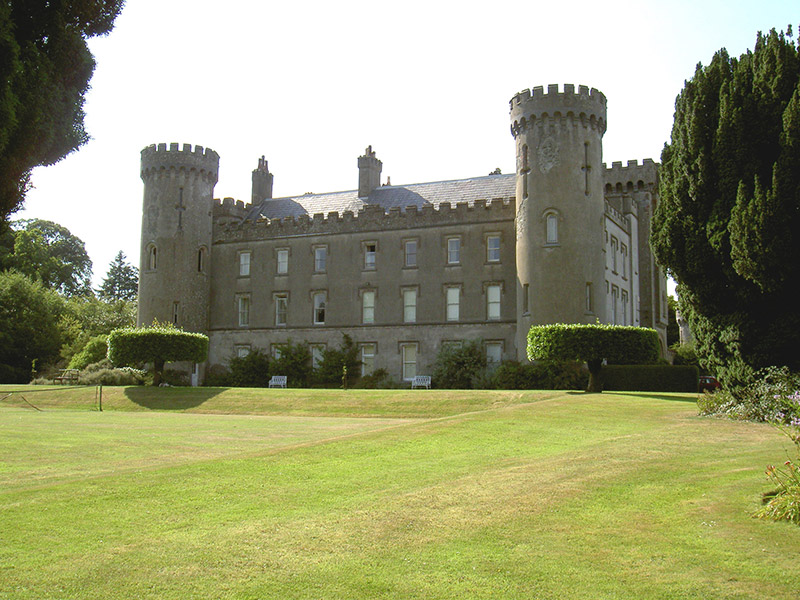
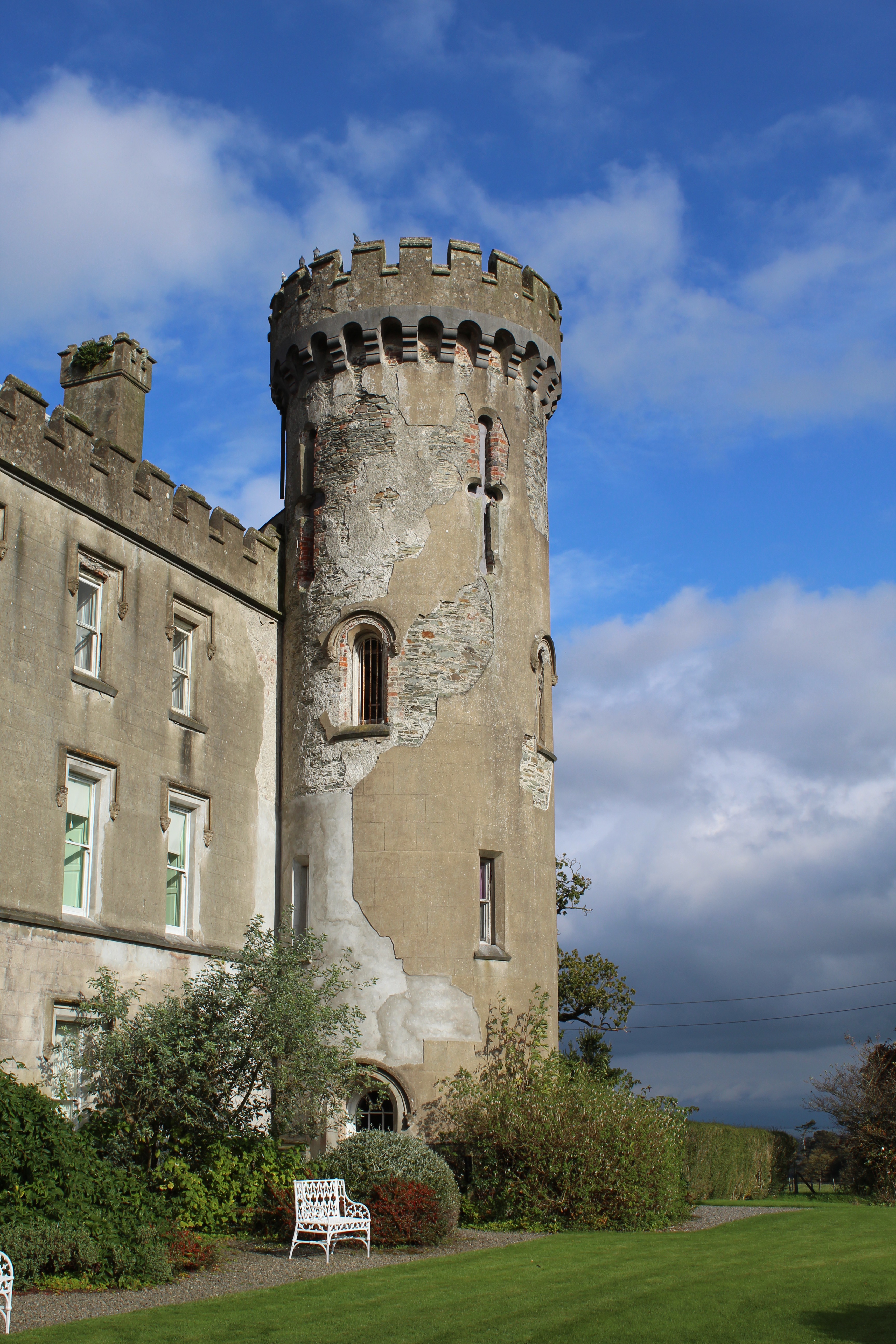


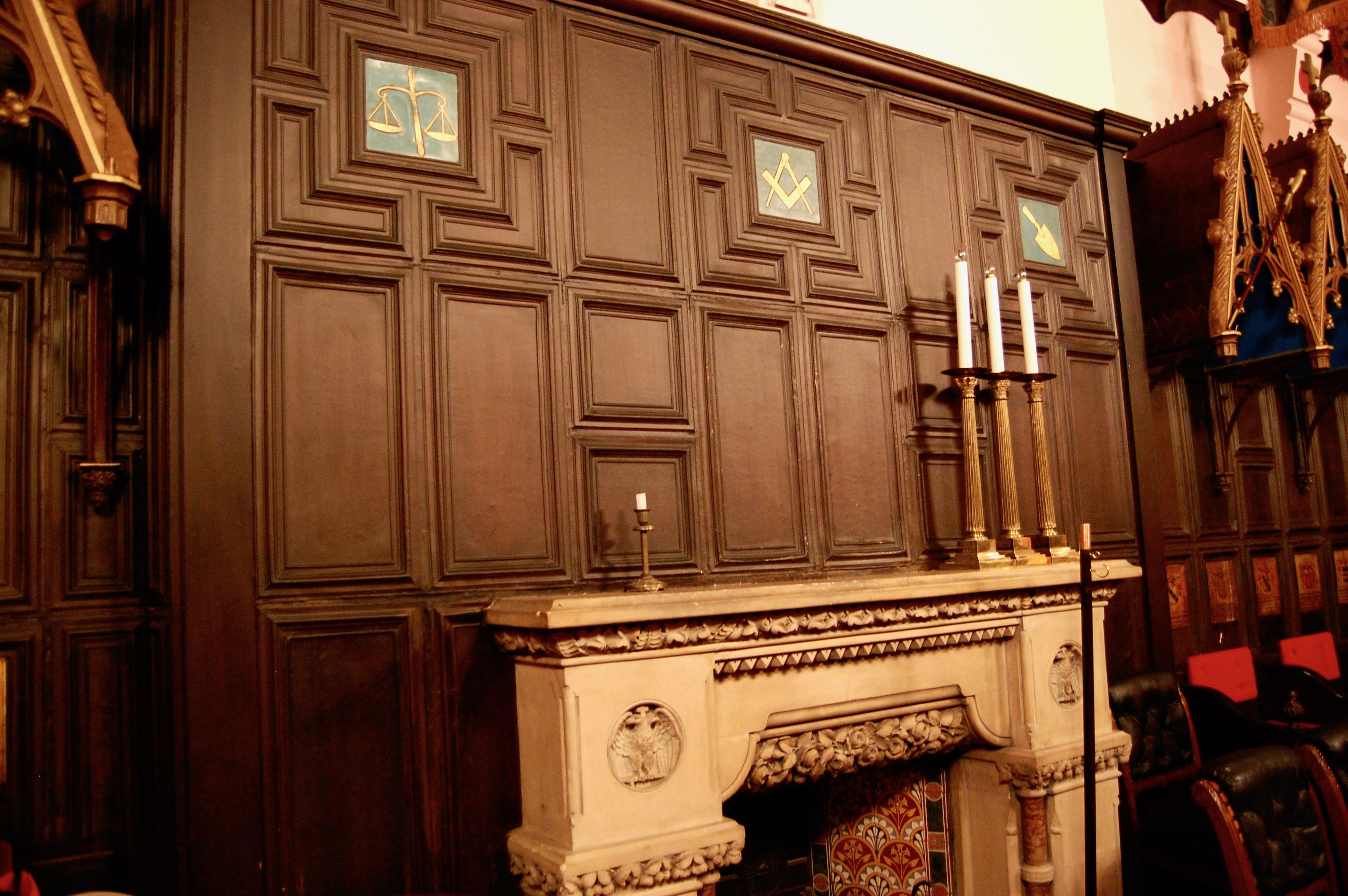
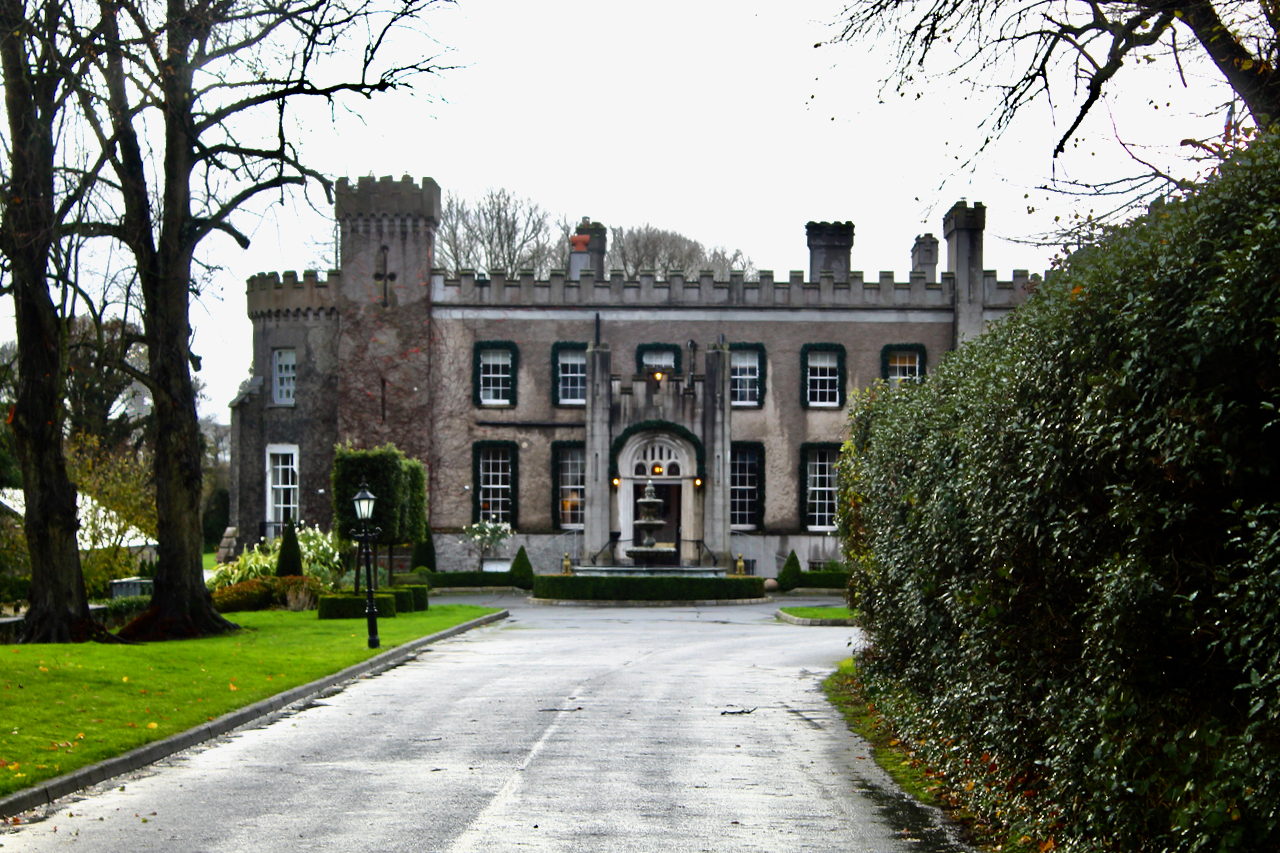
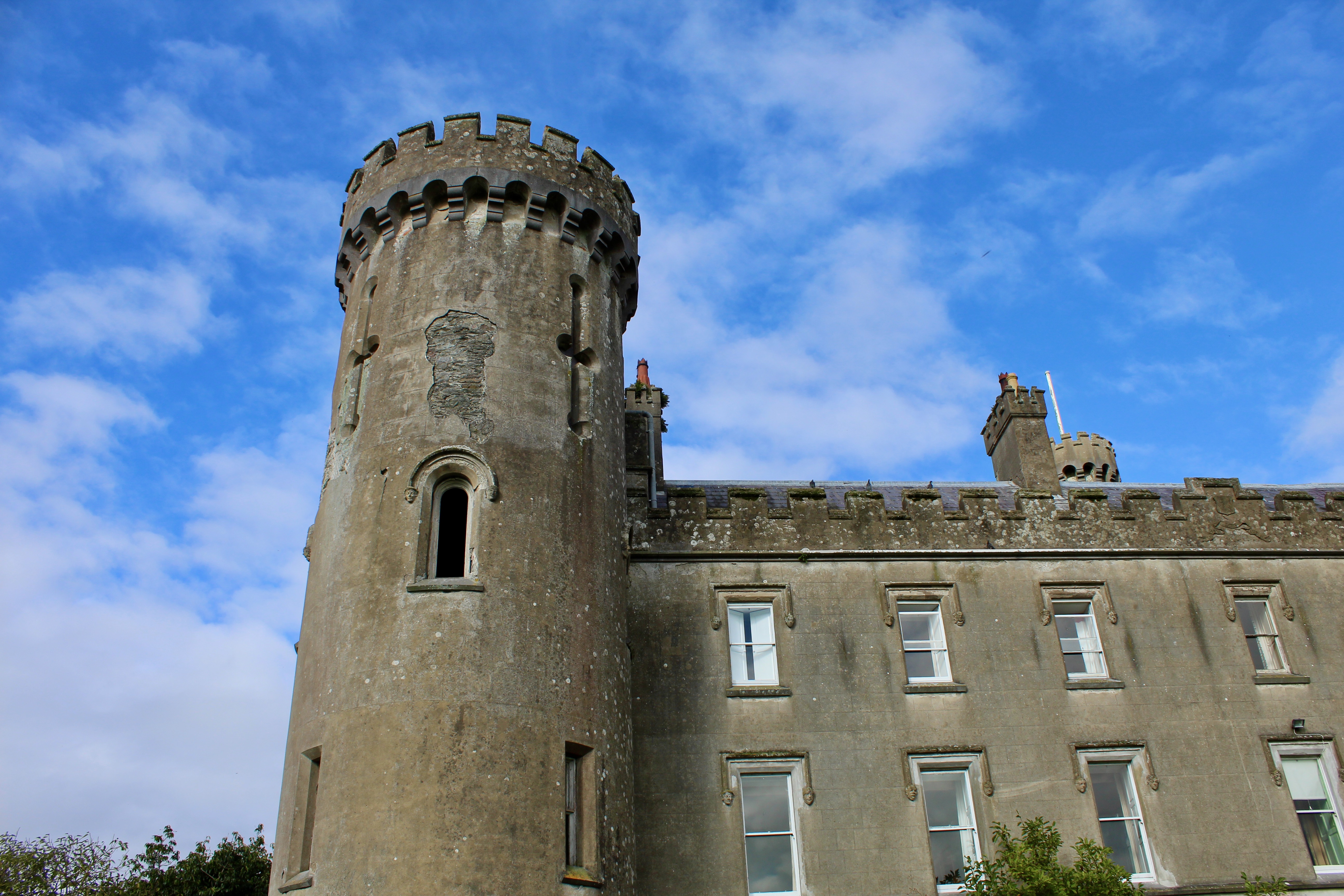
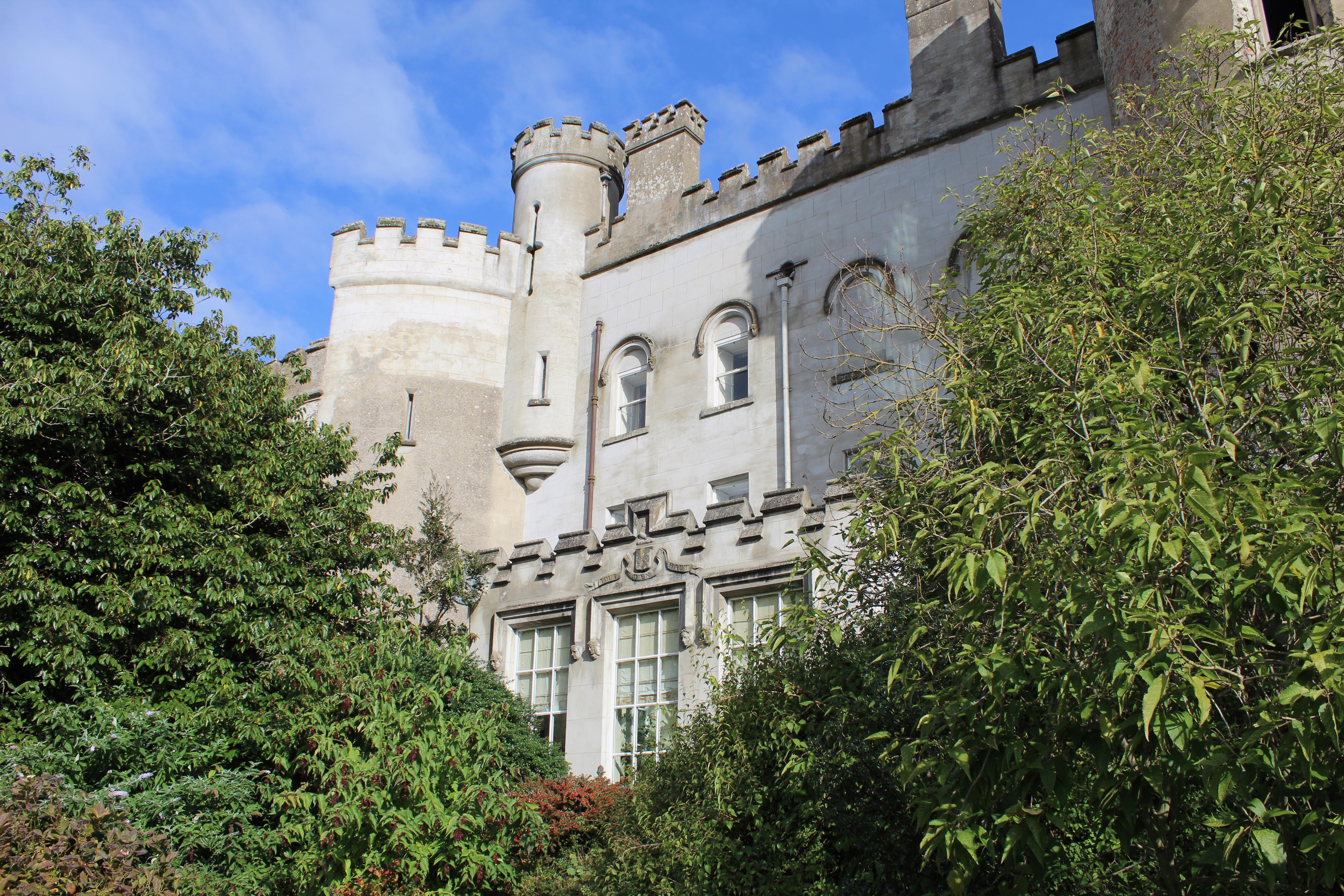
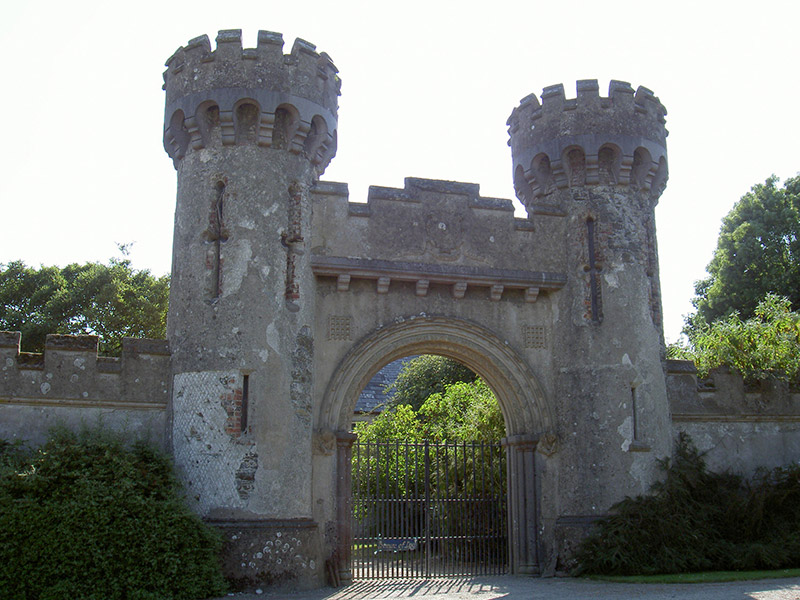
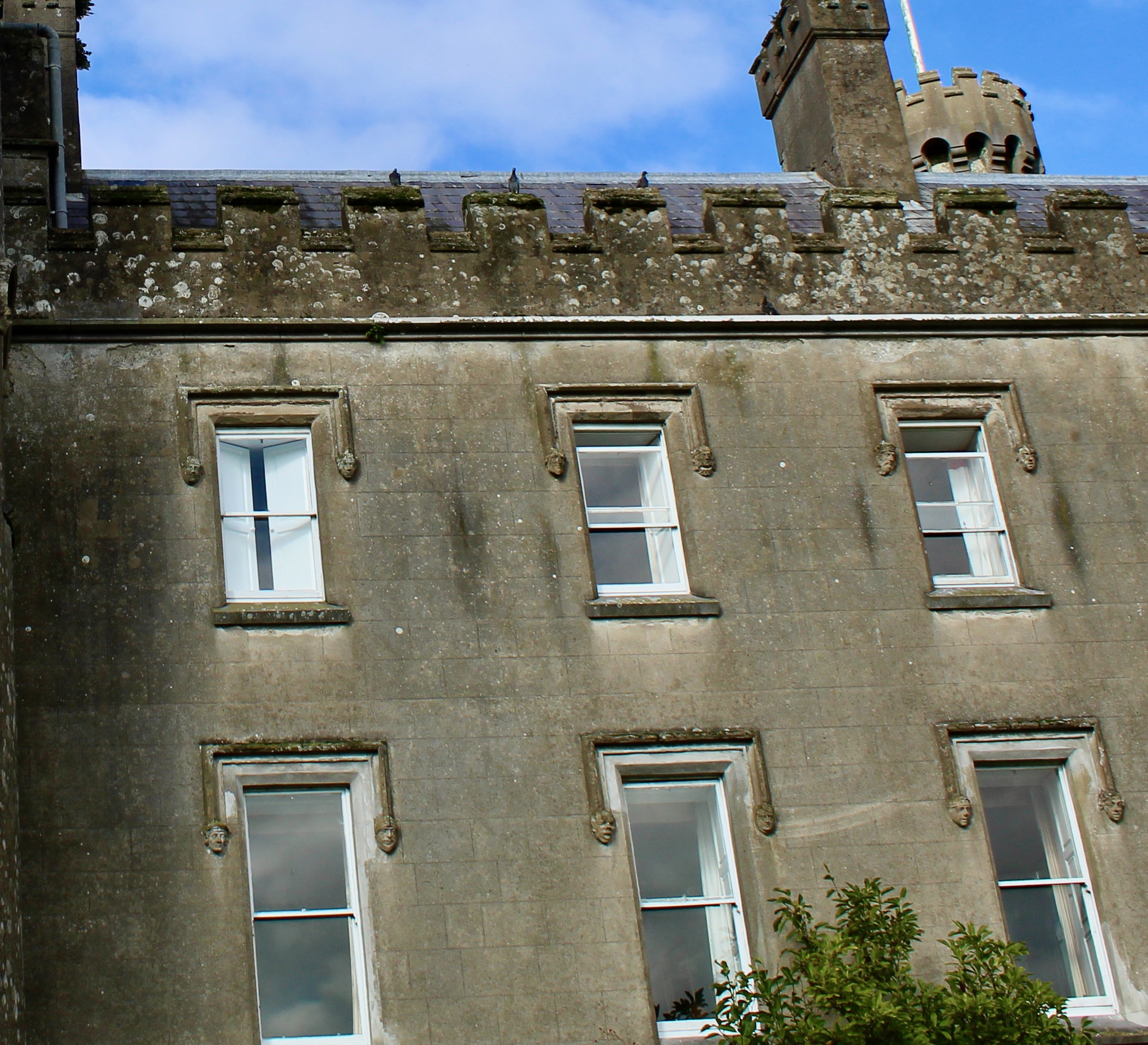
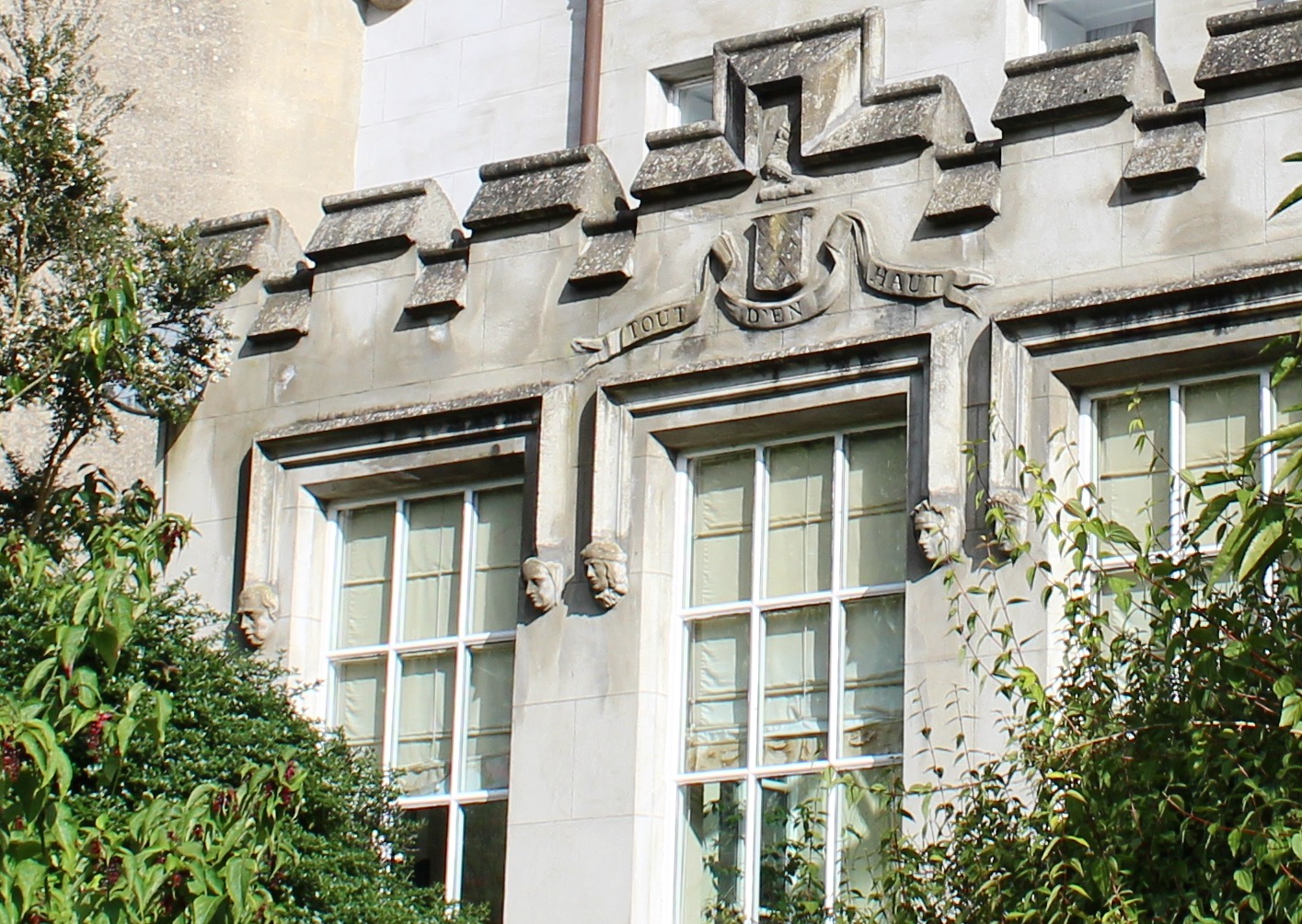
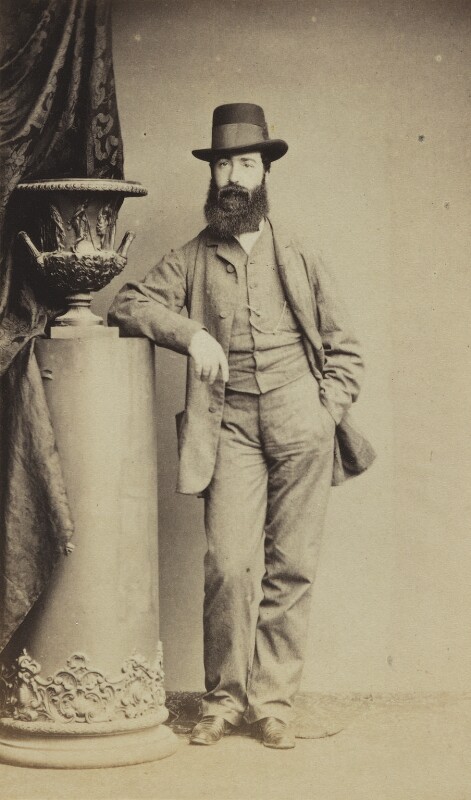
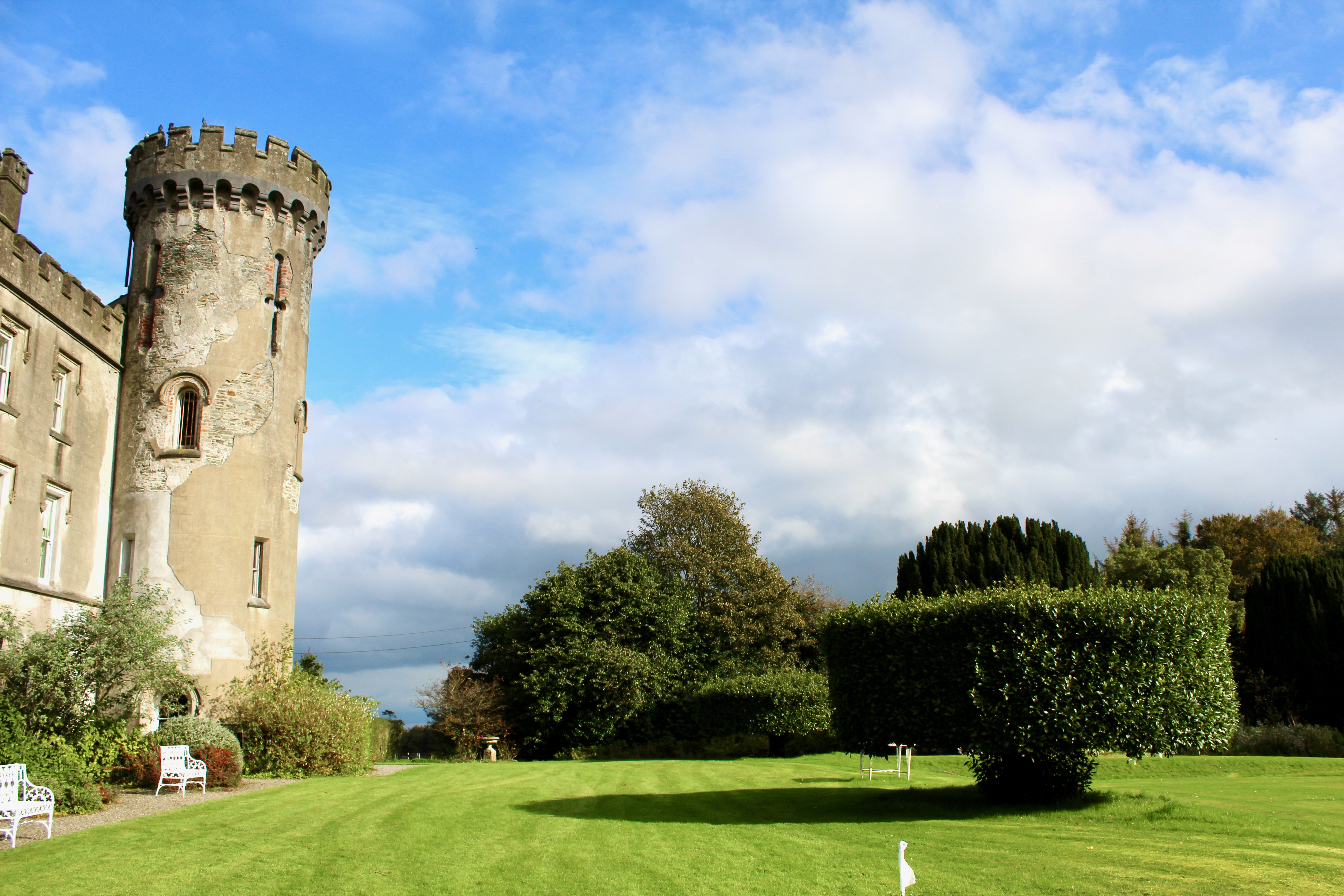
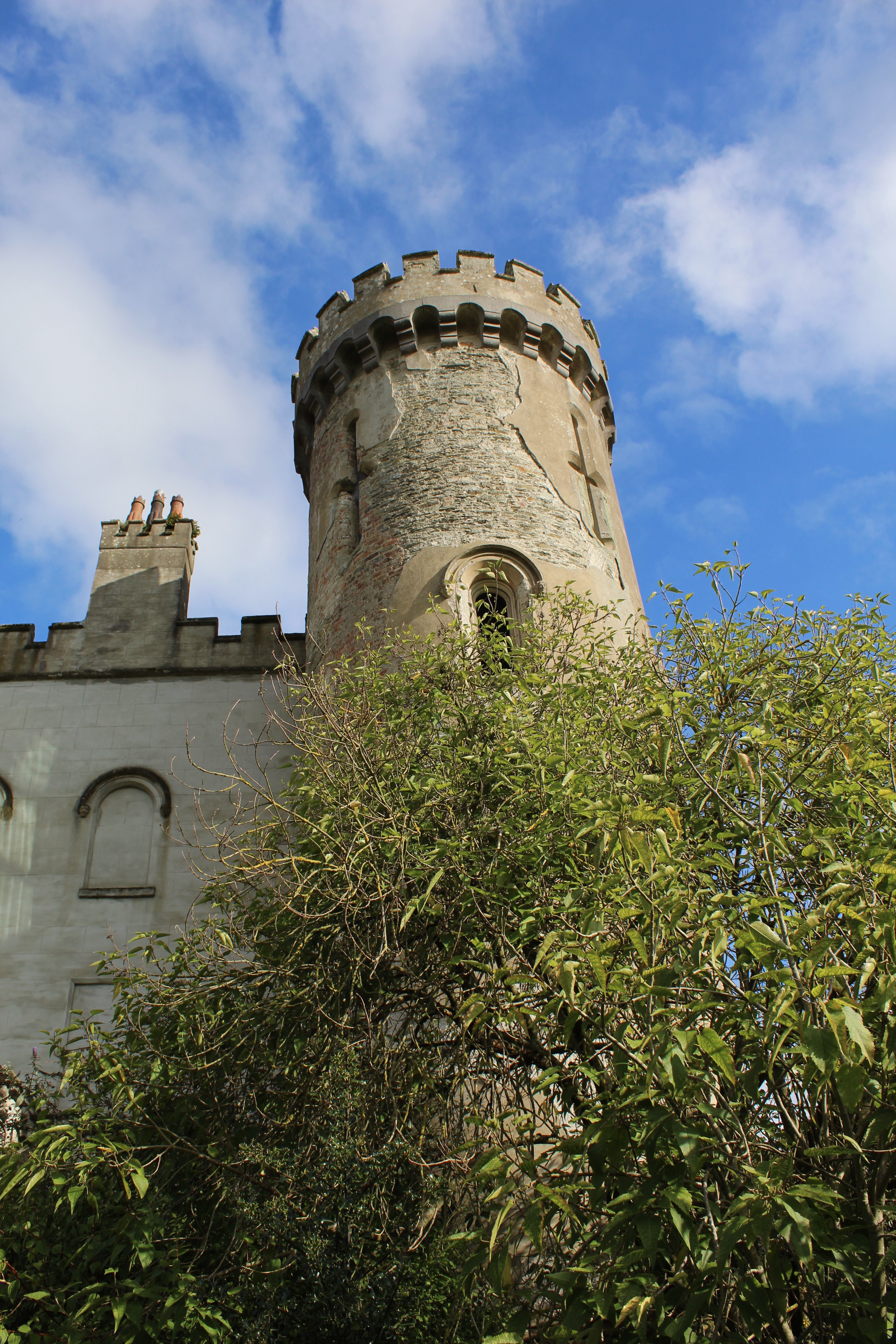
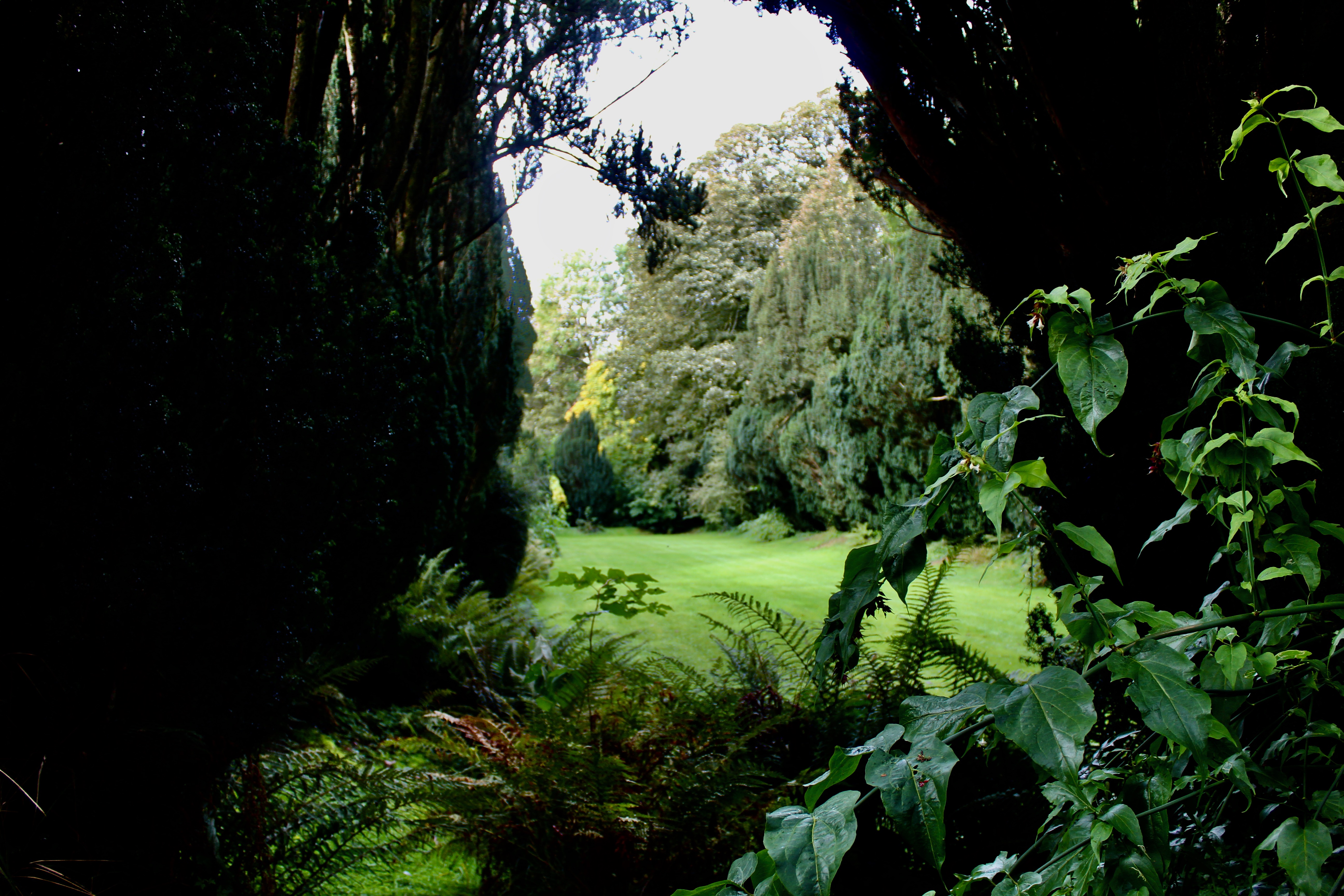
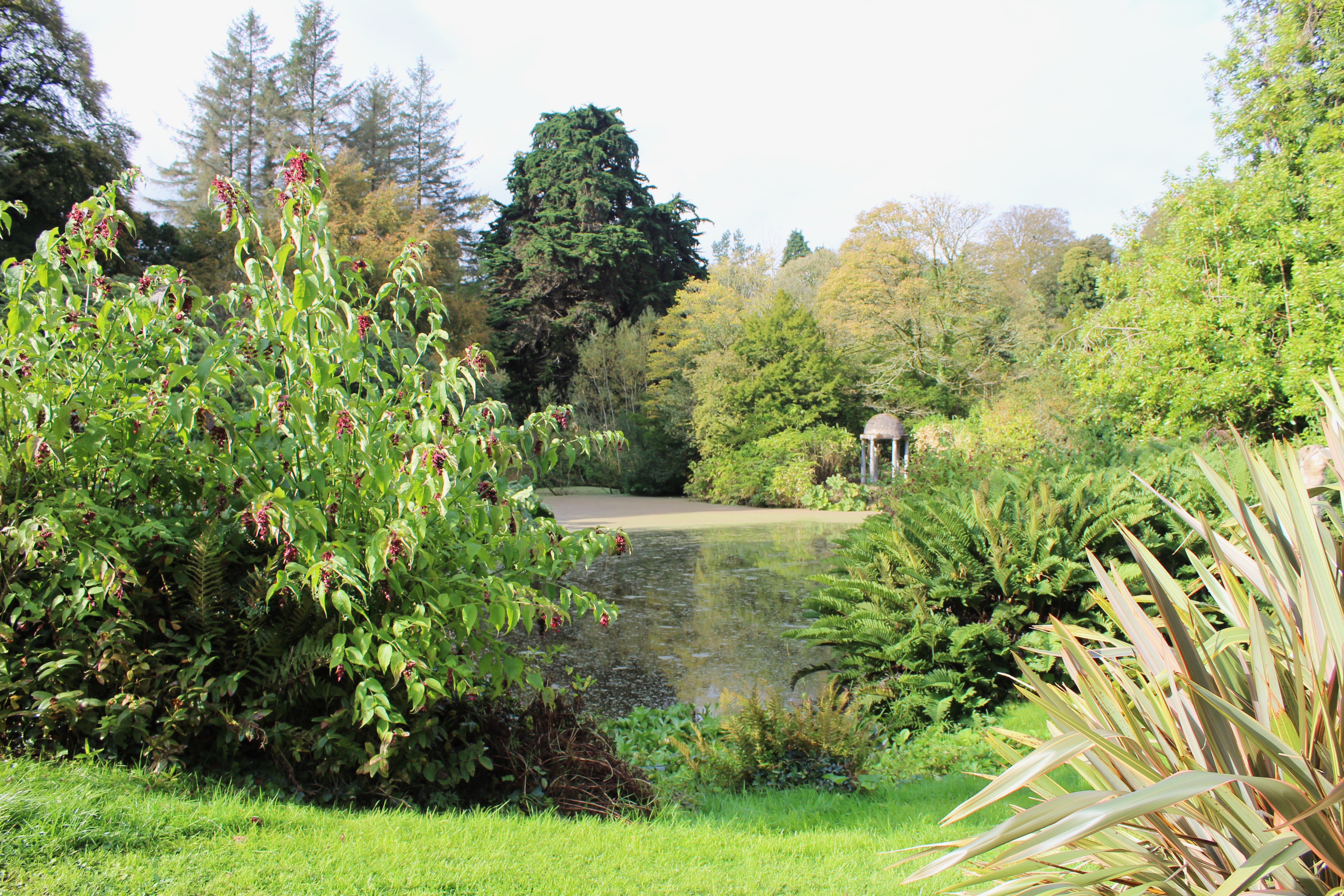
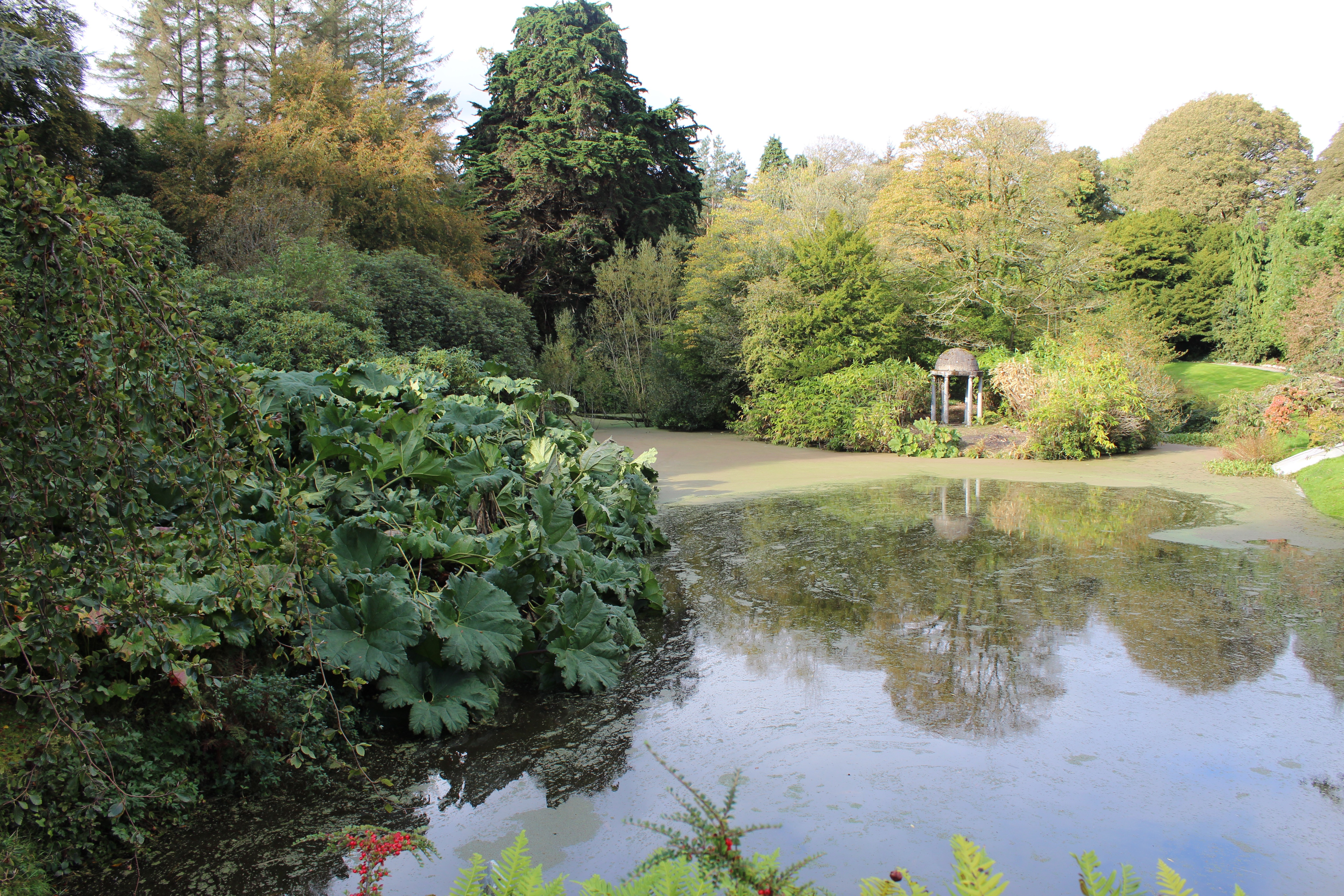
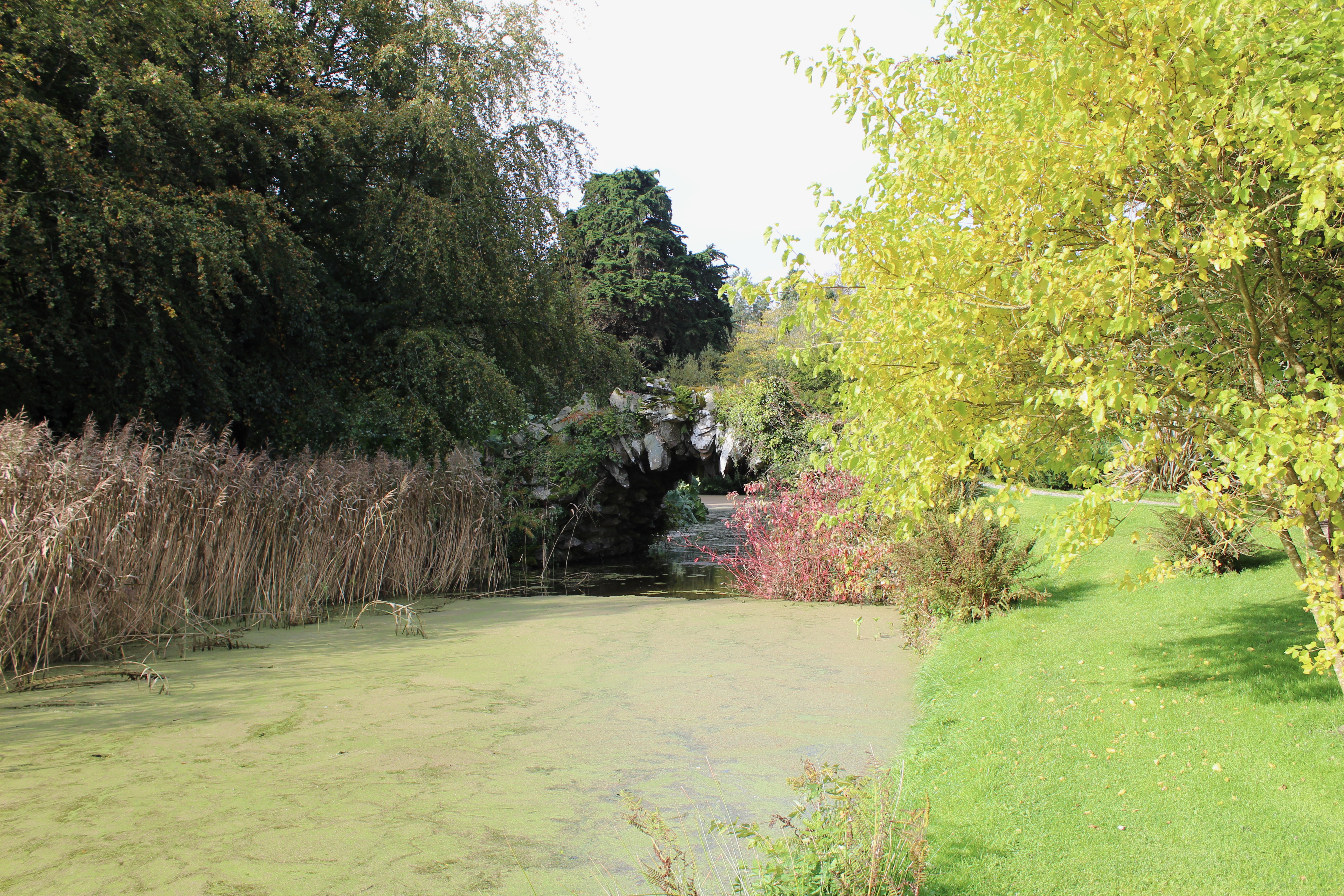

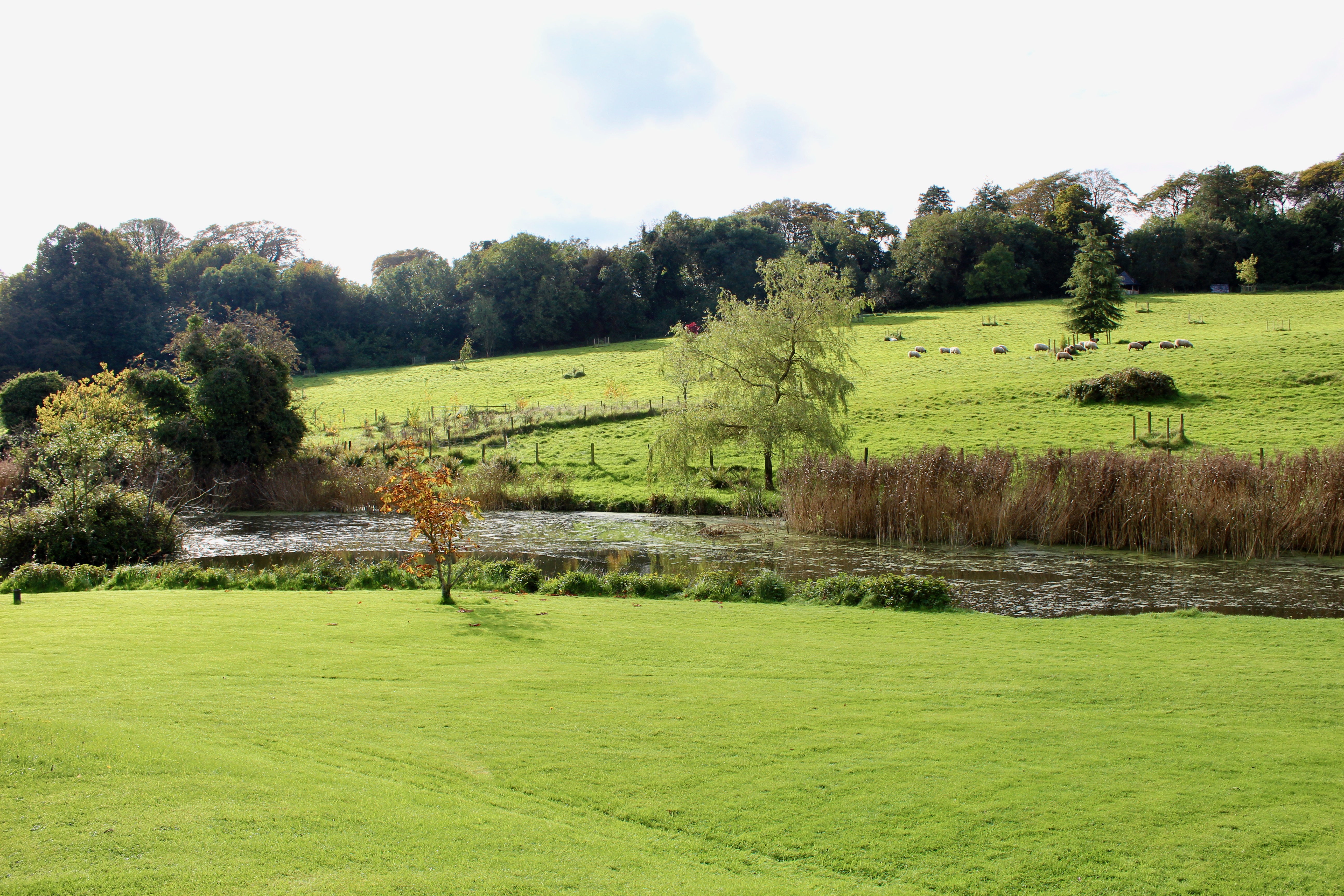
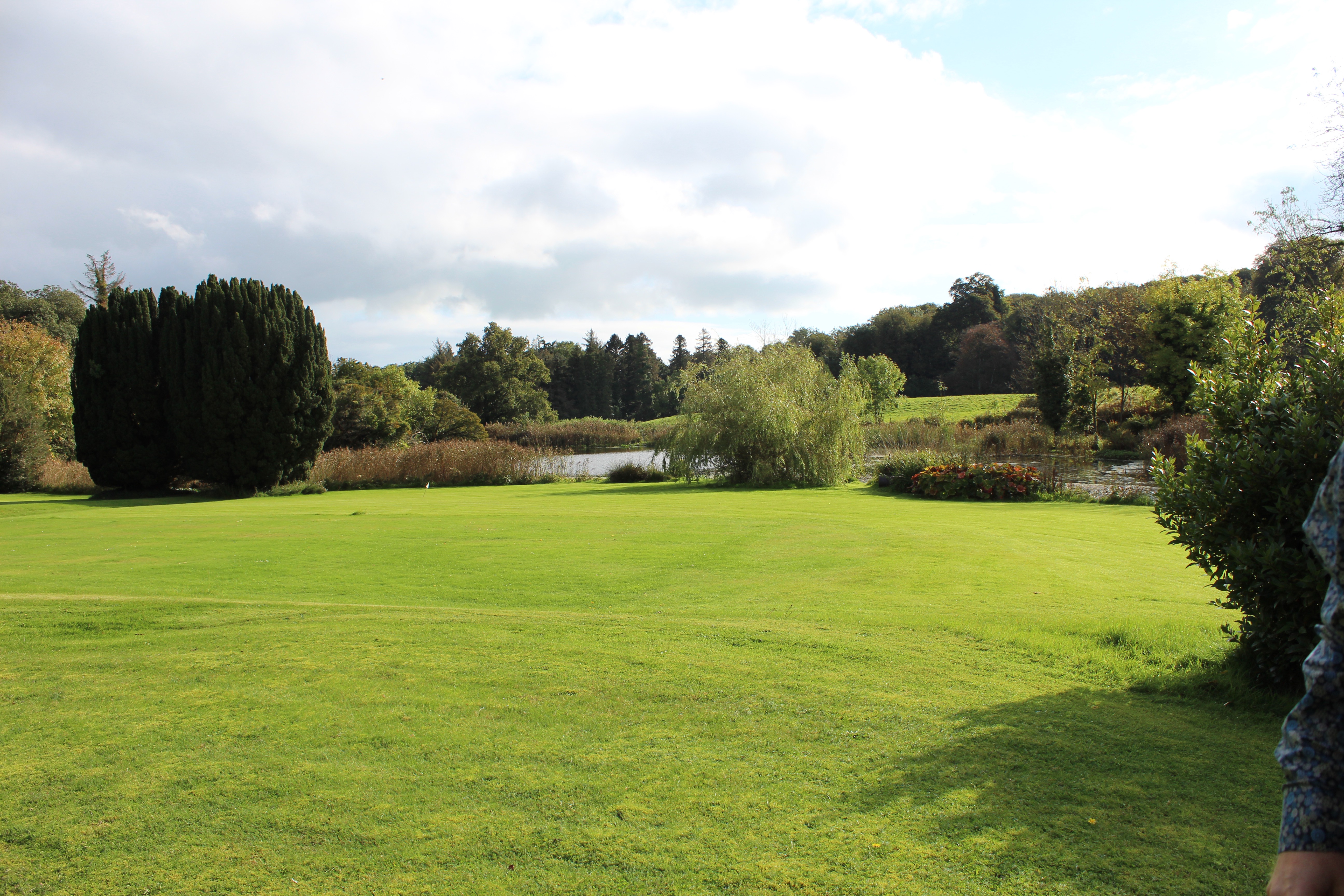
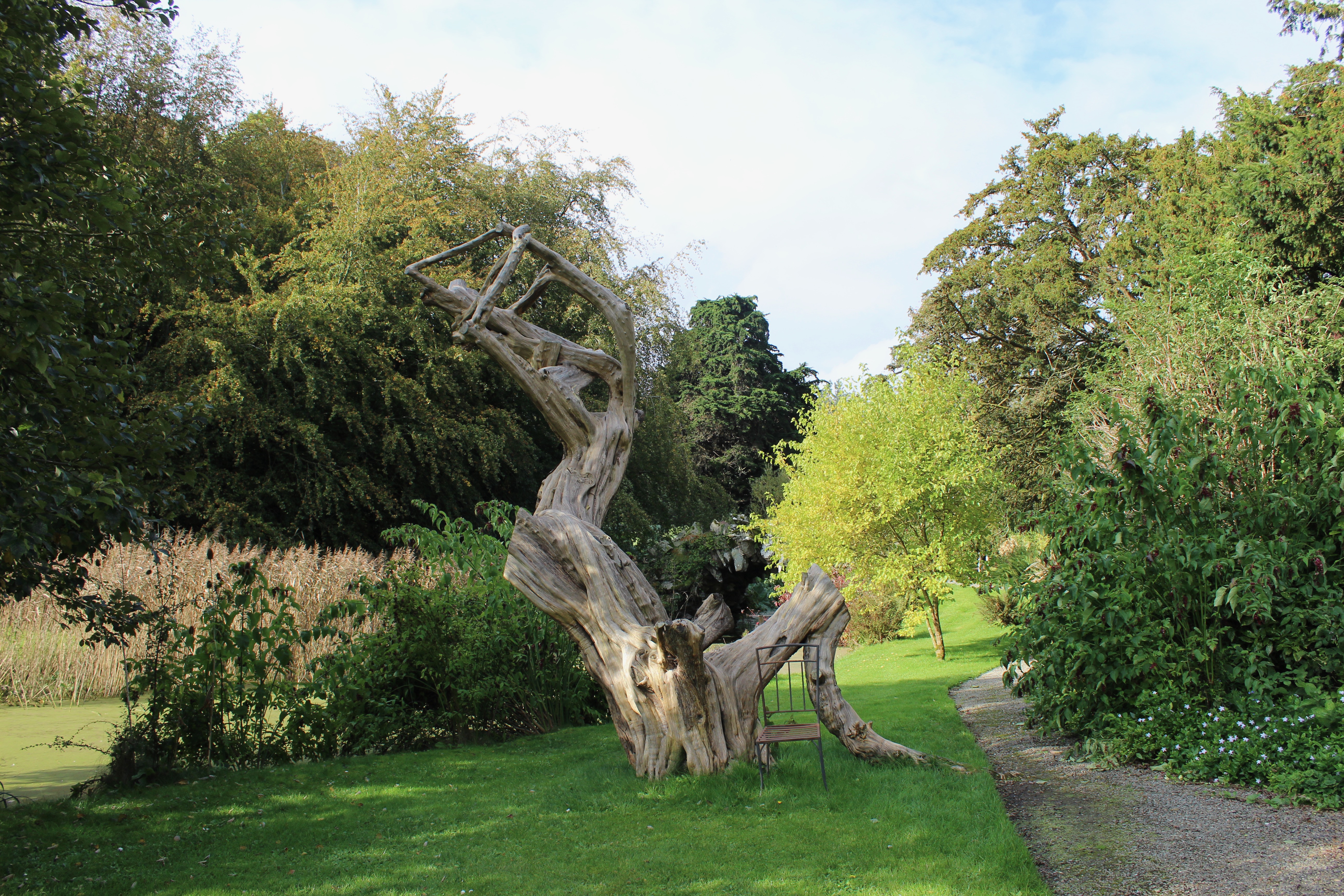
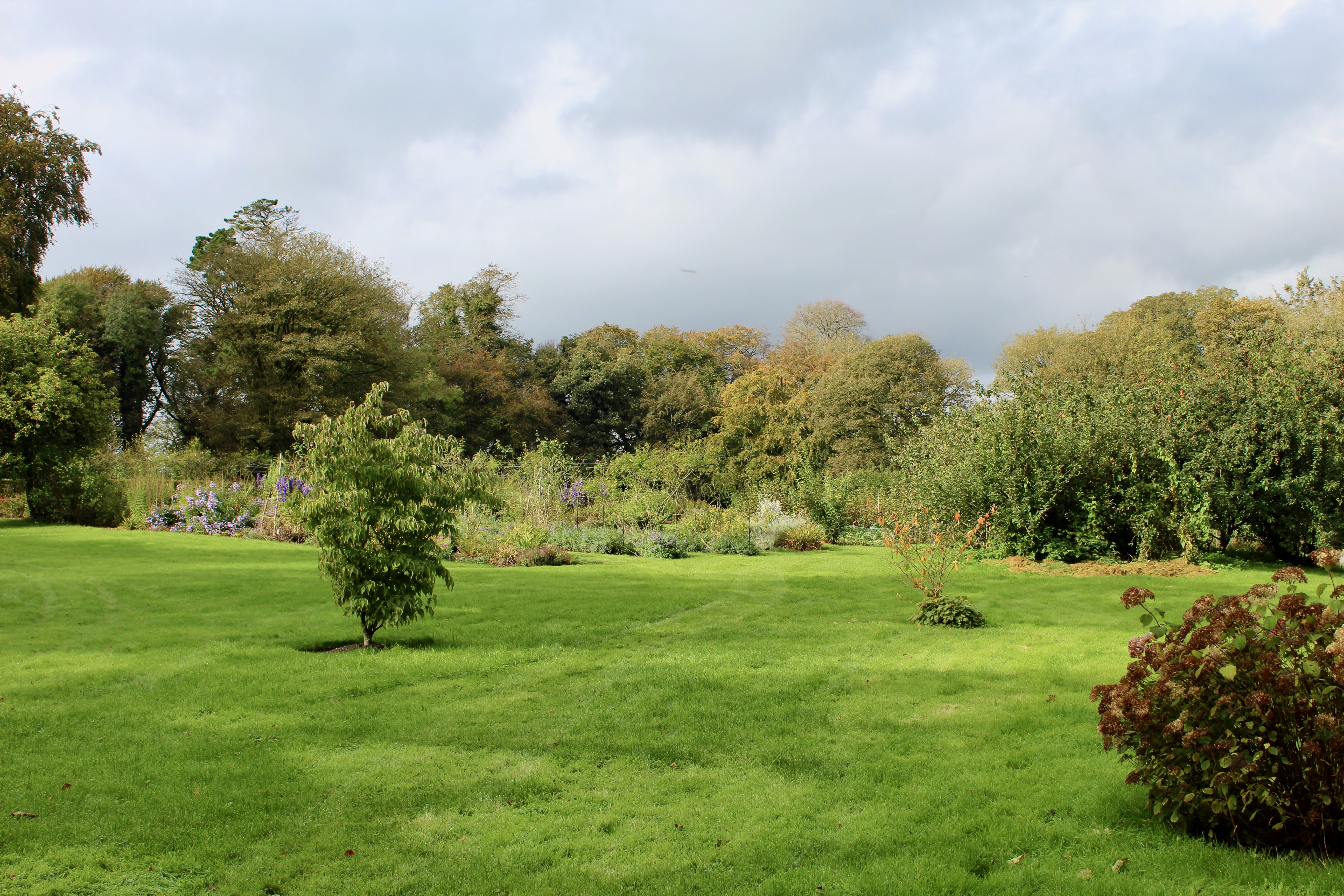
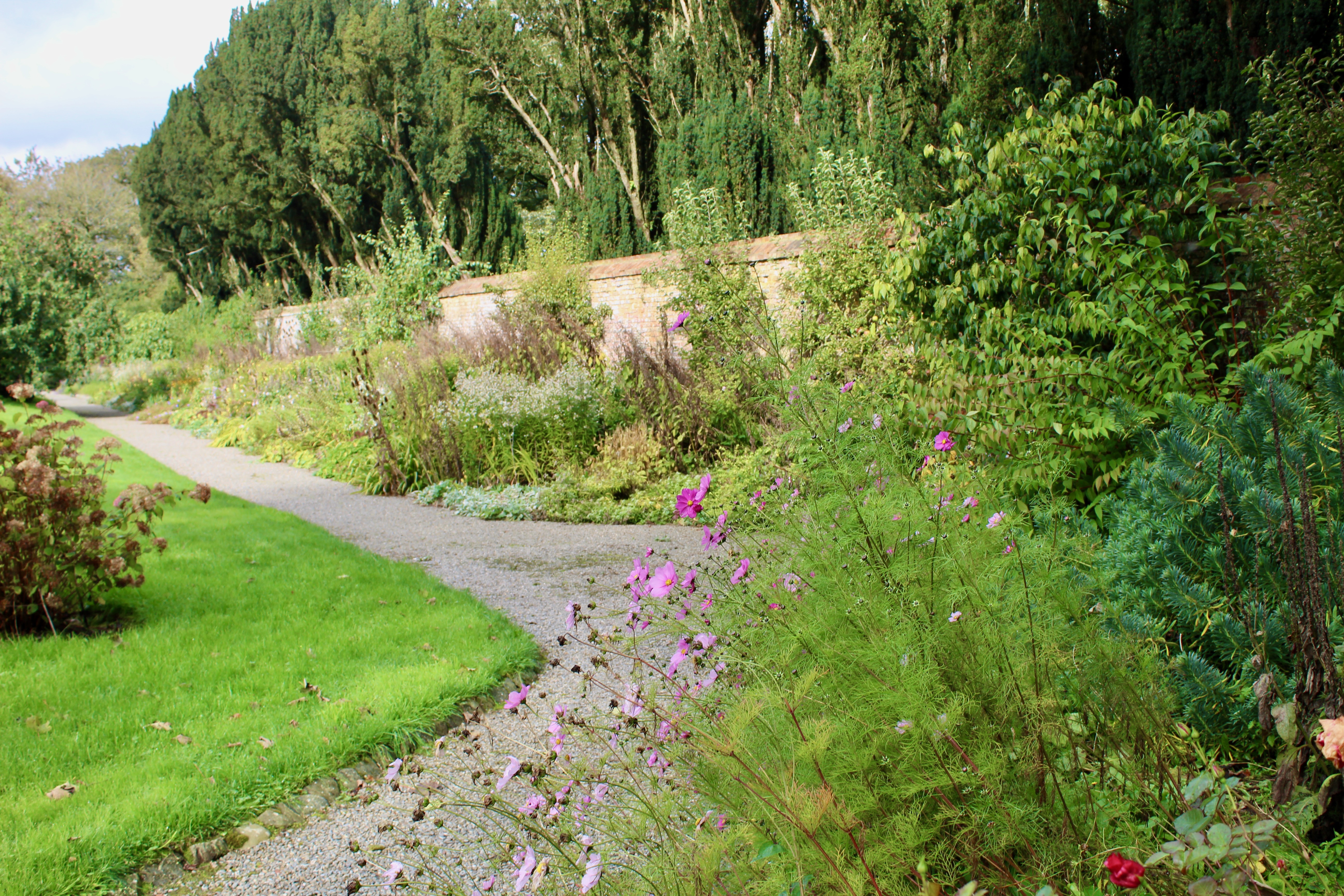
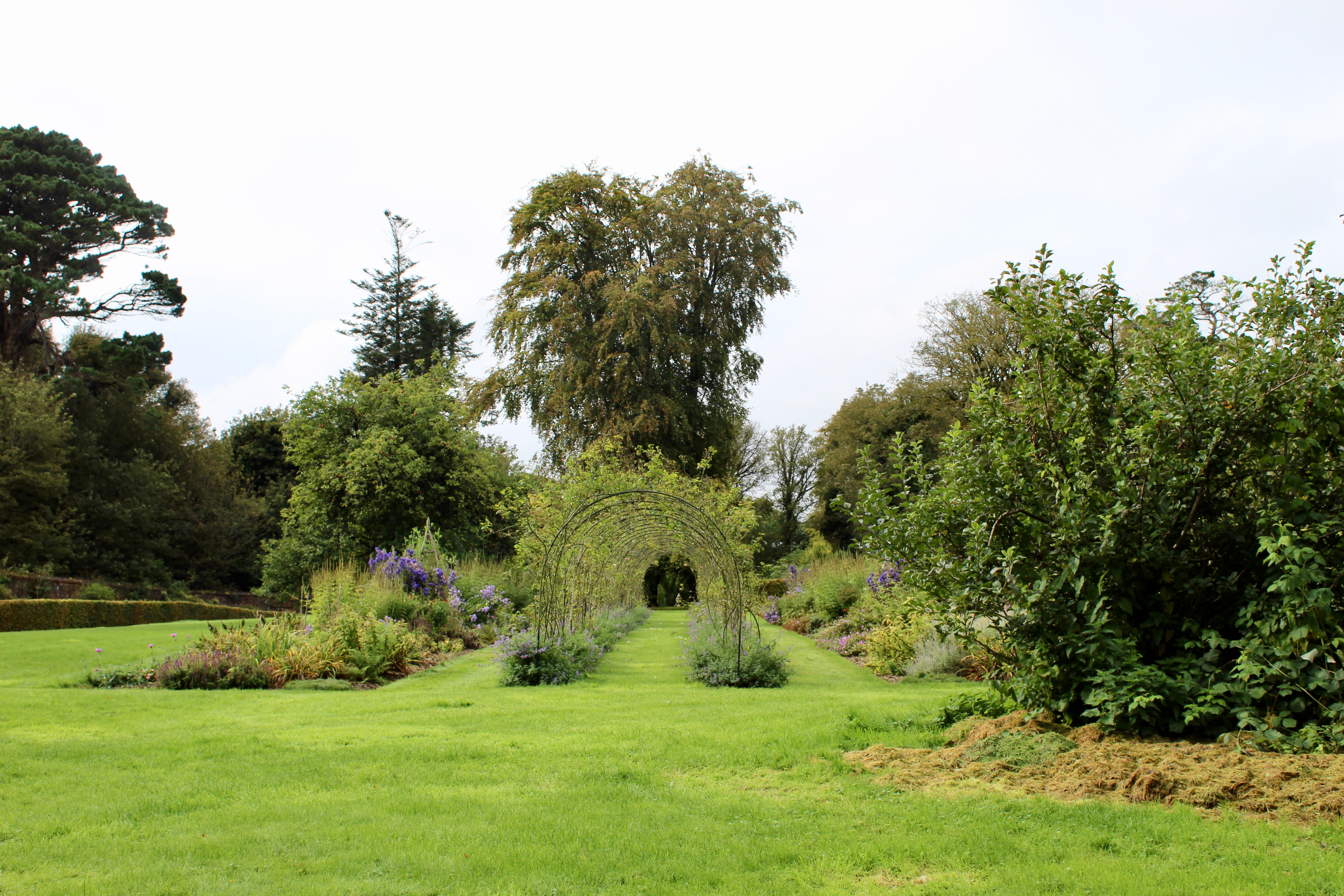
 Irish Historic Houses